The Broad Ax
Saturday, October 24, 1914
Chicago, Illinois
Page text (machine-generated)
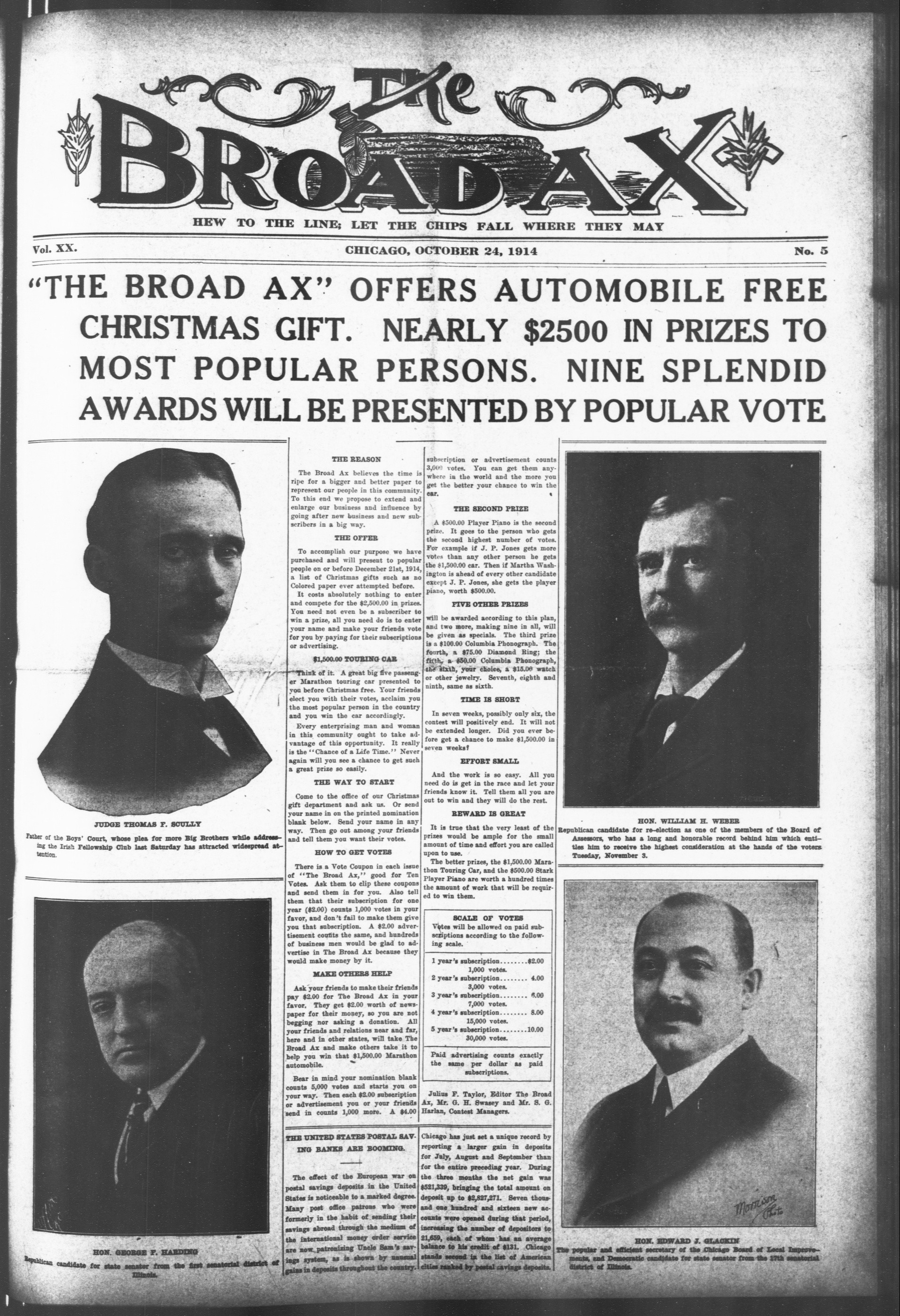
"THE BROAD AX" OFFERS AUTOMOBILE FREE CHRISTMAS GIFT. NEARLY $2500 IN PRIZES TO MOST POPULAR PERSONS. NINE SPLENDID AWARDS WILL BE PRESENTED BY POPULAR VOTE
Vol. XX.
```markdown
```
JUDGE THOMAS F. SCULLY Father of the Boys' Court, whose plea for more Big Brothers while addressing the Irish Fellowship Club last Saturday has attracted widespread attention.
M.
CHICAGO, OCTOBER 24, 1914
THE REASON
The Broad Ax believes the time is ripe for a bigger and better paper to represent our people in this community. To this end we propose to extend and enlarge our business and influence by going after new business and new subscribers in a big way.
THE OFFER
To accomplish our purpose we have purchased and will present to popular people on or before December 21st, 1914, a list of Christmas gifts such as no Colored paper ever attempted before. It costs absolutely nothing to enter and compete for the $2,500.00 in prizes. You need not even be a subscriber to win a prize, all you need do is to enter your name and make your friends vote for you by paying for their subscriptions or advertising.
$1,500.00 TOURING CAR
Think of it. A great big five passenger Marathon touring car presented to you before Christmas free. Your friends elect you with their votes, acclaim you the most popular person in the country and you win the car accordingly.
Every enterprising man and woman in this community ought to take advantage of this opportunity. It really is the "Chance of a Life Time." Never again will you see a chance to get such a great prize so easily.
THE WAY TO START
Come to the office of our Christmas gift department and ask us. Or send your name in on the printed nomination blank below. Send your name in any way. Then go out among your friends and tell them you want their votes.
HOW TO GET VOTES
There is a Vote Coupon in each issue of "The Broad Ax," good for Ten Votes. Ask them to clip these coupons and send them in for you. Also tell them that their subscription for one year ($2.00) counts 1,000 votes in your favor, and don't fail to make them give you that subscription. A $2.00 advertisement counts the same, and hundreds of business men would be glad to advertise in The Broad Ax because they would make money by it.
MAKE OTHERS HELP
Ask your friends to make their friends pay $2.00 for The Broad Ax in your favor. They get $2.00 worth of newspaper for their money, so you are not begging nor asking a donation. All your friends and relations near and far, here and in other states, will take The Broad Ax and make others take it to help you win that $1,500.00 Marathon automobile.
Bear in mind your nomination blank counts 5,000 votes and starts you on your way. Then each $2.00 subscription or advertisement you or your friends send in counts 1,000 more. A $4.00
THE UNITED STATES POSTAL SAVING BANKS ARE BOOMING.
The effect of the European war on postal savings deposits in the United States is noticeable to a marked degree. Many post office patrons who were formerly in the habit of sending their savings abroad through the medium of the international money order service are now patronizing Uncle Sam's savings system, as is shown by unusual gains in deposits throughout the country.
subscription or advertisement counts 3,000 votes. You can get them anywhere in the world and the more you get the better your chance to win the car.
THE SECOND PRIZE
A $500.00 Player Piano is the second prize. It goes to the person who gets the second highest number of votes. For example if J. P. Jones gets more votes than any other person he gets the $1,500.00 car. Then if Martha Washington is ahead of every other candidate except J. P. Jones, she gets the player piano, worth $500.00.
FIVE OTHER PRIZES
will be awarded according to this plan,
and two more, making nine in all, will
be given as specials. The third prize
is a $100.00 Columbia Phonograph. The
fourth, a $75.00 Diamond Ring; the
fifth, a $50.00 Columbia Phonograph,
the sixth, your choice, a $15.00 watch
or other jewelry. Seventh, eighth and
ninth, same as sixth.
TIME IS SHORT
In seven weeks, possibly only six, the contest will positively end. It will not be extended longer. Did you ever before get a chance to make $1,500.00 in seven weeks?
EFFORT SMALL
And the work is so easy. All you need do is get in the race and let your friends know it. Tell them all you are out to win and they will do the rest.
REWARD IS GREAT
Julius F. Taylor, Editor The Broad Ax, Mr. G. H. Swasey and Mr. S. G. Harlan, Contest Managers.
Chicago has just set a unique record by reporting a larger gain in deposits for July, August and Septsmber than for the entire preceding year. During the three months the net gain was $521,339, bringing the total amount on deposit up to $2,827,271. Seven thousand one hundred and sixteen new accounts were opened during that period, increasing the number of depositors to 21,659, each of whom has an average balance to his credit of $131. Chicago stands second in the list of American cities ranked by postal savings deposits.
No. 5
[Picture of a man with a mustache and a suit. The background is black. The man's face is centered, and he looks directly at the viewer. The image is in black and white. There are no other discernible details or text.]]
HON. WILLLAM H. WEBER
Republican candidate for re-election as one of the members of the Board of Assessors, who has a long and honorable record behind him which entitles him to receive the highest consideration at the hands of the voters Tuesday. November 3.
Morisson
Photo
HON. EDWARD J. GLACKIN
The popular and efficient secretary of the Chicago Board of Local Improvements, and Democratic candidate for state senator from the 17th senatorial district of Illinois.
PAGE TWO
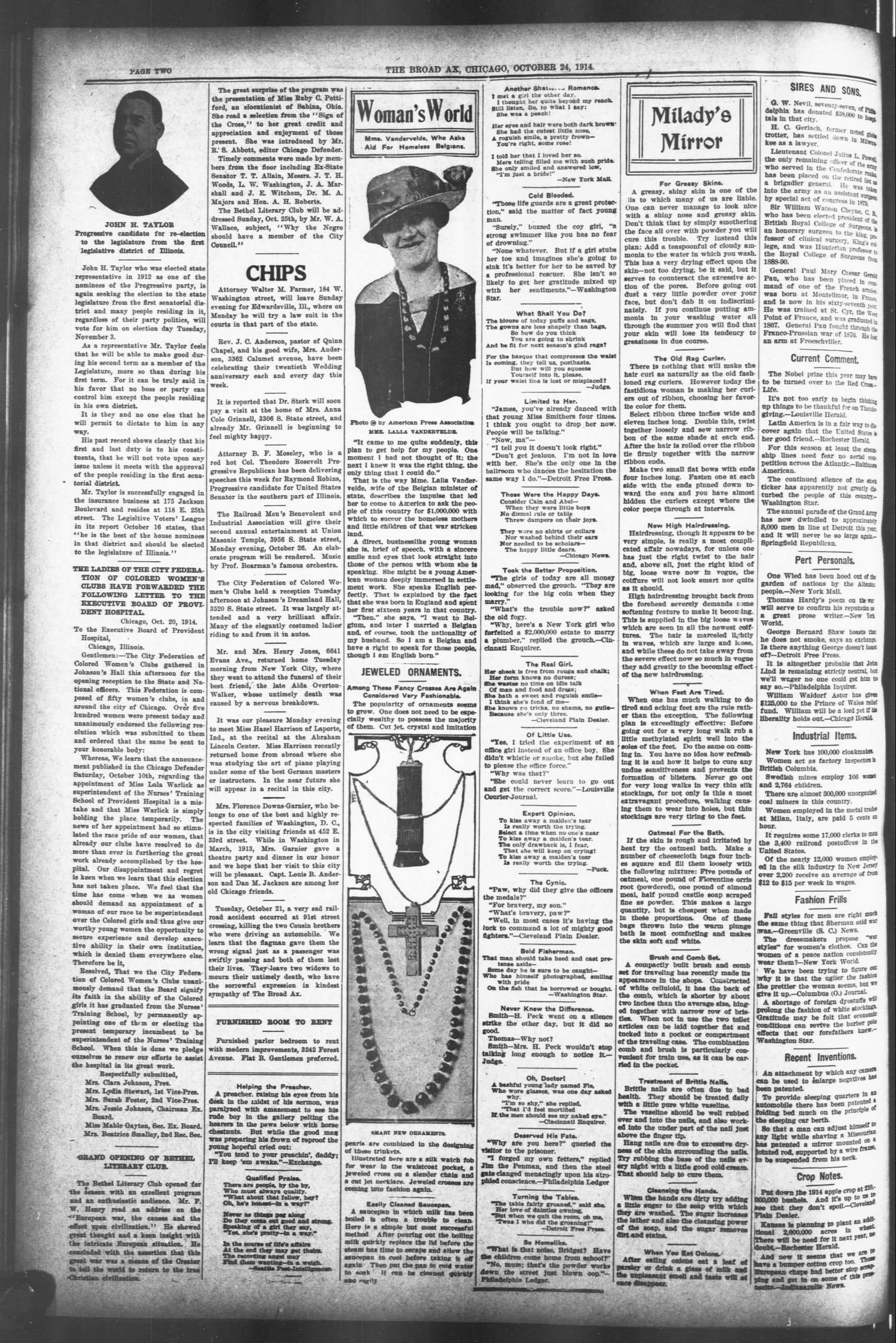
JOHN H. TAYLOR
Progressive candidate for re-election
to the legislature from the first
legislative district of Illinois.
John H. Taylor who was elected state representative in 1912 as one of the nominees of the Progressive party, is again seeking the election to the state legislature from the first senatorial district and many people residing in it, regardless of their party politics, will vote for him on election day Tuesday, November 3.
As a representative Mr. Taylor feels that he will be able to make good during his second term as a member of the Legislature, more so than during his first term. For it can be truly said in his favor that no boss or party can control him except the people residing in his own district.
It is they and no one else that he will permit to dictate to him in any way.
His past record shows clearly that his first and last duty is to his constituents, that he will not vote upon any issue unless it meets with the approval of the people residing in the first senatorial district.
Mr. Taylor is successfully engaged in the insurance business at 175 Jackson Boulevard and resides at 118 E. 25th street. The Legislative Voters' League in its report October 16 states, that "he is the best of the house nominees in that district and should be elected to the legislature of Illinois."
THE LADIES OF THE CITY FEDERATION OF COLORED WOMEN'S CLUBS HAVE FORWARDED THE FOLLOWING LETTER TO THE EXECUTIVE BOARD OF PROVI-DENT HOSPITAL.
Chicago, Oct. 20, 1914.
To the Executive Board of Provident Hospital,
Chicago, Illinois.
Gentlemen:—The City Federation of Colored Women's Clubs gathered in Johnson's Hall this afternoon for the opening reception to the State and National officers. This Federation is composed of fifty women's clubs, in and around the city of Chicago. Over five hundred women were present today and unanimously endorsed the following resolution which was submitted to them and ordered that the same be sent to your honorable body:
Whereas, We learn that the announcement published in the Chicago Defender Saturday, October 10th, regarding the appointment of Miss Lula Warlick as superintendent of the Nurses' Training School of Provident Hospital is a mistake and that Miss Warlick is simply holding the place temporarily. The news of her appointment had so stimulated the race pride of our women, that already our clubs have resolved to do more than ever in furthering the great work already accomplished by the hospital. Our disappointment and regret is keen when we learn that this election has not taken place. We feel that the time has come when we as women should demand an appointment of a woman of our race to be superintendent over the Colored girls and thus give our worthy young women the opportunity to secure experience and develop executive ability in their own institution, which is denied them everywhere else. Therefore be it.
Resolved, That we the City Federation of Colored Women's Clubs unanimously demand that the Board signify its faith in the ability of the Colored girls it has graduated from the Nurses' Training School, by permanently appointing one of them or electing the present temporary incumbent to be superintendent of the Nurses' Training School. When this is done we pledge ourselves to renew our efforts to assist the hospital in its great work.
Respectfully submitted,
Mrs. Clara Johnson, Pres.
Mrs. Lydia Stewart, 1st Vice-Pres.
Mrs. Sarah Foster, 2nd Vice-Pres.
Mrs. Jessie Johnson, Chairman Ex.
Board.
Miss Mable Gayton, Sec. Ex. Board.
Mrs. Beatrice Smalley, 2nd Rec. Sec.
GRAND OPENING OF BETHEL
LITERARY CLUB.
The Bethel Literary Club opened for the season with an excellent program and an enthusiastic audience. Mr. F. W. Henry read an address on the "European war, the causes and the effect upon civilization." He showed great thought and a keen insight with the intricate European situation. He concluded with the assertion that this great war was a means of the Creator to tell the world to return to the true Christian civilization.
The great surprise of the program was the presentation of Miss Ruby C. Pettiford, an elocutionist of Sabina, Ohio. She read a selection from the "Sign of the Cross," to her great credit and appreciation and enjoyment of those present. She was introduced by Mr. R.' S Abbott, editor Chicago Defender. Timely comments were made by members from the floor including Ex-State Senator T. T. Allain, Messrs. J. T. H. Woods, L. W. Washington, J. A. Marshall and J. E. Witchem, Dr. M. A. Majors and Hon. A. H. Roberts. The Bethel Literary Club will be addressed Sunday, Oct. 25th, by Mr. W. A. Wallace, subject, "Why the Negro should have a member of the City Council."
CHIPS
Attorney Walter M. Farmer, 184 W. Washington street, will leave Sunday evening for Edwardsville, Ill., where on Monday he will try a law suit in the courts in that part of the state.
---
Rev. J. C. Anderson, pastor of Quinn Chapel, and his good wife, Mrs. Anderson, 3362 Calumet avenue, have been celebrating their twentieth Wedding anniversary each and every day this week.
It is reported that Dr. Stork will soon pay a visit at the home of Mrs. Anna Cole Grinnell, 3306 S. State street, and already Mr. Grinnell is beginning to feel mighty happy.
Attorney B. F. Moseley, who is a red hot Col. Theodore Rosevelt Progressive Republican has been delivering speeches this week for Raymond Robins, Progressive candidate for United States Senator in the southern part of Illinois.
The Railroad Men's Benevolent and Industrial Association will give their second annual entertainment at Union Masonic Temple, 3956 S. State street, Monday evening, October 26. An elaborate program will be rendered. Music by Prof. Boarman's famous orchestra.
The City Federation of Colored Women's Clubs held a reception Tuesday afternoon at Johnson's Dreamland Hall, 3520 S. State street. It was largely attended and a very brilliant affair. Many of the elegantly costumed ladies riding to and from it in autos.
Mr. and Mrs. Henry Jones, 6641 Evans Ave., returned home Tuesday morning from New York City, where they went to attend the funeral of their best friend, the late Aida Overton-Walker, whose untimely death was caused by a nervous breakdown.
It was our pleasure Monday evening to meet Miss Hazel Harrison of Laporte, Ind., at the recital at the Abraham Lincoln Center. Miss Harrison recently returned home from abroad where she was studying the art of piano playing under some of the best German masters or instructors. In the near future she will appear in a recital in this city.
一
Mrs. Florence Downs-Garnier, who belongs to one of the best and highly respected families of Washington, D. C., is in the city visiting friends at 452 E. 33rd street. While in Washington in March, 1913, Mrs. Garnier gave a theatre party and dinner in our honor and we hope that her visit to this city will be pleasant. Capt. Louis B. Anderson and Dan M. Jackson are among her old Chicago friends.
Tuesday, October 21, a very sad railroad accident occurred at 91st street crossing, killing the two Cousin brothers who were driving an automobile. We learn that the flagman gave them the wrong signal just as a passenger was swiftly passing and both of them lost their lives. They-leave two widows to mourn their untimely death, who have the sorrowful expression in kindest sympathy of The Broad Ax.
FURNISHED BOOM TO RENT
Furnished parlor bedroom to rent with modern improvements, 3242 Forest Avenue. Flat B. Gentlemen preferred.
Helping the Preacher.
A preacher, raising his eyes from his desk in the midst of his sermon, was paralyzed with amazement to see his rude boy in the gallery pelting the hearers in the pews below with horse chestnuts. But while the good man was preparing his frown of reproof the young hopeful cried out:
"You tend to your preachin', daddy; I'll keep 'em awake."—Exchange.
Qualified Praise.
There are people, by the by,
Who must always qualify.
"What about that fellow, hey?
Oh, he's honest—in a way!"
Never as things peg along
Do they come out good and strong.
Speaking of a girl they say,
"Yes, she's pretty—in a way."
In the course of life's affairs
At the end they may get theirs.
The recording angel may
Find them wanting—in a weigh.
THE BROAD AX. CHICAGO, OCTOBER 24, 1914.
Mme. Vandervelde, Who Asks
Aid For Homeless Belgians.
A.
Photo © by American Press Association
"MME LALLA VANDERVELDE
"It came to me quite suddenly, this plan to get help for my people. One moment I had not thought of it; the next I knew it was the right thing, the only thing that I could do."
That is the way Mme. Lalla Vandervelde, wife of the Belgian minister of state, describes the impulse that led her to come to America to ask the people of this country for $1,000,000 with which to succor the homeless mothers and little children of that war stricken land.
A direct, businesslike young woman she is, brief of speech, with a sincere smile and eyes that look straight into those of the person with whom she is speaking. She might be a young American woman deeply immersed in settlement work. She speaks English perfectly. That is explained by the fact that she was born in England and spent her first sixteen years in that country. "Then," she says, "I went to Belgium, and later I married a Belgian and, of course, took the nationality of my husband. So I am a Belgian and have a right to speak for those people, though I am English born."
JEWELED ORNAMENTS
Among These Fancy Crosses Are Again Considered Very Fashionable. The popularity of ornaments seems to grow. One does not need to be especially wealthy to possess the majority of them. Cut jet, crystal and imitation
[Image of a religious necklace with a cross pendant, a rosary, and a candle holder. The necklace is made of black beads, the cross pendant is silver, and the candle holder is black.]
pears are combined in the designing of these trinkets. Illustrated here are a silk watch fob for wear in the waistcoat pocket, a jeweled cross on a slender chain and a cut jet necklace. Jewelled crosses are coming into fashion again.
Easily Cleaned Saucepan
A saucepan in which milk has been boiled is often a trouble to clean. Here is a simple but most successful method. After pouring out the boiling milk quickly replace the lid before the steam has time to escape and allow the saucepan to cool before taking it off again. Then put the pan in cold water to soak. It can be cleaned quickly and easily.
Another Shatter... Romance.
I met a girl the other day.
I thought her quite beyond my reach.
Still listen, Be, to what I say:
She was a peach!
Her eyes and hair were both dark brown
She had the cutest little nose,
A rugish smile, a pretty trown—
You're right, some rose!
I told her that I loved her so.
Mere telling filled me with such pride.
She only smiled and answered low,
"I'm just a bride!"
Cold Blooded.
"Those life guards are a great protection," said the matter of fact young man.
"Surely," buzzed the coy girl, "a strong swimmer like you has no fear of drowning."
"None whatever. But if a girl stubs her toe and imagines she's going to sink it's better for her to be saved by a professional rescuer. She isn't so likely to get her gratitude mixed up with her sentiments."—Washington Star.
What Shall You Do?
The blouse of today puffs and sags,
The gowns are less shapely than bags,
So how do you think
You are going to shrink
And be fit for next season's glad rags?
For the basque that compresses the waist
Is coming, they tell us, posthaste.
But how will you squeeze
Yourself into it, please.
If your waist line is lost or misplaced?
—Judge
Limited to Her-
"James, you've already danced with that young Miss Smithers four times. I think you ought to drop her now. People will be talking."
"Now, ma"—
"I tell you it doesn't look right."
"Don't get jealous. I'm not in love with her. She's the only one in the ballroom who dances the hesitation the same way I do."—Detroit Free Press.
Those Were the Happy Days.
Consider Cain and Abel—
When they were little boys
No dismal rule or table
Threw dampers on their joys.
They wore no shirts or collars
Nor washed behind their ears
Nor needed to be scholars—
The happy little dears.
—Chicago News.
Took the Better Proposition.
"The girls of today are all money mad," observed the grouch. "They are looking for the big coin when they marry."
"What's the trouble now?" asked the old fogy.
"Why, here's a New York girl who forfeitted a $2,000,000 estate to marry a plumber," replied the grouch.—Cincinnati Enquirer.
The Real Girl.
Her cheek is free from rouge and chalk;
Her form knows no dures;
She knows no tricks, no shams, no guille-
Because she's only three.
Of Little Use
"Yes, I tried the experiment of an office girl instead of an office boy. She didn't whistle or smoke, but she failed to please the office force."
"Why was that?"
"She could never learn to go out
and get the correct score."—Louisville
Courier-Journal.
Expert Opinion.
Expert Opinion.
To kiss away a malden's tear
Is really worth the trying.
Select all the tears
To kiss away a malden's tear.
The only drawback is, I fear,
That she will keep on crying!
To kiss away a malden's tear
Is really worth the trying.
The Cynic.
"Paw, why did they give the officers the medals?"
"For bravery, my son."
"What's bravery, paw?"
"Well, in most cases it's having the luck to command a lot of mighty good fighters."—Cleveland Plain Dealer.
Bold Fisherman
That man should take heed and cast pretense aside—
Who has himself photographed, smiling with pride
On the fish that he borrowed or bought
—Washington Star.
Never Knew the Difference.
Smith—H. Peck went on a silence
strike the other day, but it did no
good.
Thomas—Why not?
Smith—Mrs. H. Peck wouldn't stop
talking long enough to notice it—
Judge.
A bashful young lady named Fle,
who wore glasses, was one day asked
why.
"I'm so shy," she replied,
"I'd feel mortified
If the men should see my naked eye."
—Cincinnati Enquirer.
Deserved His Fate.
"Why are you here?" queried the visitor to the prisoner.
"I forged my own fetters," replied Jim the Penman, and then the steel gate clanged menacingly upon his strophied conscience.—Philadelphia Ledger
Turning the Tables.
"The table fairly groaned," said sha. Her love of dainties owning.
"What is that noise. Bridget? Have the children come home from school?" "No, mum; that's the powder works down the street just blown oop."- Philadelphia Ledger.
Milady's Mirror
For Greasy Skins.
A greasy, shiny skin is one of theils to which many of us are liable. One can never manage to look nice with a shiny nose and greasy skin. Don't think that by simply smothering the face all over with powder you will cure this trouble. Try instead this plan: Add a teaspoonful of cloudy ammonia to the water in which you wash. This has a very drying effect upon the skin—not too drying, be it said, but it serves to counteract the excessive action of the pores. Before going out dust a very little powder over your face, but don't dab it on indiscriminately. If you continue putting ammonia in your washing water all through the summer you will find that your skin will lose its tendency to greasiness in due course.
The Old Bag Curler.
There is nothing that will make the hair curl as naturally as the old fashioned rag curlers. However today the fastidious woman is making her curlers out of ribbon, choosing her favorite color for them.
Select ribbon three inches wide and eleven inches long. Double this, twist together loosely and sew narrow ribbon of the same shade at each end. After the hair is rolled over the ribbon tie firmly together with the narrow ribbon ends.
Make two small flat bows with ends four inches long. Fasten one at each side with the ends pinned down toward the ears and you have almost hidden the curlers except where the color peeps through at intervals.
New High Hairdressing.
Hairdressing, though it appears to be very simple, is really a most complicated affair nowadays, for unless one has just the right twist to the hair and, above all, just the right kind of big, loose wave now in vogue, the coiffure will not look smart nor quite as it should.
High hairdressing brought back from the forehead severely demands some softening feature to make it becoming. This is supplied in the big loose waves which are seen in all the newest coifures. The hair is marceled lightly in waves, which are large and loose, and while these do not take away from the severe effect now so much in vogue they add greatly to the becoming effect of the new hairdressing.
When Fast Are Tired.
When one has much walking to do tired and aching feet are the rule rather than the exception. The following plan is exceedingly effective: Before going out for a very long walk rub a little methylated spirit well into the soles of the feet. Do the same on coming in. You have no idea how refreshing it is and how it helps to cure any undue sensitiveness and prevents the formation of blisters. Never go out for very long walks in very thin silk stockings, for not only is this a most extravagant procedure, walking causing them to wear into holes, but thin stockings are very tiring to the feet.
Oatmeal For the Bath
If the skin is rough and irritated by heat try the oatmeal bath. Make a number of cheesecloth bags four inches square and fill them loosely with the following mixture: Five pounds of oatmeal, one pound of Florentine orris root (powdered), one pound of almond meal, half pound castile soap scraped fine as powder. This makes a large quantity, but is cheapest when made in these proportions. One of these bags thrown into the warm plunge bath is most comforting and makes the skin soft and white.
Brush and Comb Set
A compactly built brush and comb set for traveling has recently made its appearance in the shops. Constructed of white celluloid, it has the back of the comb, which is shorter by about two inches than the average size, hinged together with narrow row of bristles. When not in use the two toilet articles can be laid together flat and tucked into a pocket or compartment of the traveling case. The combination comb and brush is particularly convenient for train use, as it can be carried in the pocket.
Treatment of Brittle Nails
Brittle nails are often due to bad health. They should be treated daily with a little pure white vaseline. The vaseline should be well rubbed over and into the nails, and also worked into the under part of the nail just above the finger tip. Hang nails are due to excessive dryness of the skin surrounding the nails. Try rubbing the base of the nails every night with a little good cold cream. That should help to cure them.
Cleansing the Hands
When the hands are dirty try adding a little sugar to the soap with which they are washed. The sugar increases the lather and also the cleansing power of the soap, and the sugar removes dirt and stains.
When You Eat Onions./
After eating onions eat a leaf of parsley or drink a glass of milk and the unpleasant smell and taste will at once disappear.
SIRES AND SONS
G. W. Nevil, seventy-seven, of Philadelphia has donated $38,000 to hospitals in that city.
H. C. Gerlach, former noted globe trotter, has settled down in Milwaukee as a lawyer.
Lieutenant Colonel Julius L. Powell, the only remaining officer of the army who served in the Confederate ranks has been placed on the retired list as a brigadier general. He was taken into the army as an assistant surgeon by special act of congress in 1873.
Sir William Watson Cheyne, C. B. who has been elected president of the British Royal College of Surgeons is an honorary surgeon to the king, professor of clinical surgery, King's college, and was Hunterian professor to the Royal College of Surgeons from 1888-90.
General Paul Mary Caesar Gerald
Pau, who has been placed in com-
mand of one of the French armies,
was born at Montellar, in France,
and is now in his sixty-seventh year.
He was trained at St. Cyr, the West
Point of France, and was graduated in
1867. General Pau fought through the
Franco-Prussian war of 1870. He lost
an arm at Froeschiller.
Current Comment.
The Nobel prize this year may have to be turned over to the Red Cross—Life.
It's not too early to begin thinking up things to be thankful for on Thanksgiving.—Louisville Herald.
Latin America is in a fair way to discover again that the United States is her good friend.—Rochester Herald.
For this season at least the steamship lines need fear no aerial competition across the Atlantic.—Baltimore American.
The continued silence of the stock ticker has apparently not greatly disturbed the people of this country.—Washington Star.
The annual parade of the Grand Army has now dwindled to approximately 8,000 men in line at Detroit this year, and it will never be so large again.—Springfield Republican.
Pert Personals.
One Wled has been hoed out of the garden of nations by the Albanian people.—New York Mall.
Thomas Hardy's poem on the war will serve to confirm his reputation as a great prose writer.—New York World.
George Bernard Shaw boasts that he does not smoke, says an exchange. Is there anything George doesn't boast off?—Detroit Free Press.
It is altogether probable that John Lind is remaining strictly neutral, but we'll wager no one could get him to say so.—Philadelphia Inquirer.
William Waldorf Astor has given $125,000 to the Prince of Wales relief fund. William will be a lord yet if his liberality holds out.—Chicago Herald.
Industrial Items.
New York has 100,000 cloakmakers.
Women act as factory inspectors in British Columbia.
Swedish mines employ 166 women and 2,764 children.
There are almost 300,000 unorganized coal miners in this country.
Women employed in the metal trades at Milan, Italy, are paid 5 cents an hour.
It requires some 17,000 clerks to man the 3,400 railroad postoffices in the United States.
Of the nearly 12,000 women employed in the silk industry in New Jersey over 2,200 receive an average of from $12 to $15 per week in wages.
Fashion Frills
Fall styles for men are right much the same thing that Sherman said war was.-Greenville (S. C.) News.
The dressmakers propose "wear styles" for women's clothes. Can the women of a peace nation consistently wear them?-New York World.
We have been trying to figure out why it is that the uglier the fashion the prettier the woman seems, but we give it up.-Columbus (O.) Journal.
A shortage of foreign dress will prolong the fashion of white stockings. Gratitude may be felt that economic conditions can revive the barber pole effects that our forefathers knew.-Washington Star.
Recent Inventions.
An attachment by which any camera can be used to enlarge negatives has been patented. To provide sleeping quarters in an automobile there has been patented a folding bed much on the principle of the sleeping car berth.
So that a man can adjust himself to any light while shaving a Missouriian has patented a mirror mounted on a jointed rod, supported by a wire frame, to be suspended from his neck.
Crop Notes.
Put down the 1914 apple crop at 210,000,000 bushels. And it's up to us to see that they don't spoil—Cleveland Plain Dealer.
Kansas is planning to plant an additional 2,000,000 acres in wheat. There will be need for it next year, no doubt—Rochester Herald.
And now it seems that we are to have a bumper cotton crop too. Those European chaps had better stop scraping and get in on some of this prospect—Indianapolis News.
The KITCHEN CUPBOARD
DINNER MENU.
Consomme.
Creamed Carrots.
Potato Omelet.
Bolled Black Bass.
Pepper and Grapefruit Salad.
Whole Wheat Bread.
Stuffed Cucumber.
Grape Pie.
Coffee.
FISH is so much cheaper than meat
that it is wise at this time to
make as much use of it as pos-
sible. The great variety of fish and
the many ways of serving it which
may be taken advantage of make it
possible frequently to substitute it for
Potato Omelet—Take the yolks of three eggs and boil very light. Season one cupful of cold mashed potatoes with salt, pepper, one-half cupful of milk and a little chopped parsley. Beat the yolks into this, then add beaten whites. Heat pan piping hot and butter; pour omelet into it. Brown lightly, turn and serve very hot.
Bolled Black Bass—Put in a pot enough slightly salted water to cover fish, add one gill of vinegar, one onion, eight whole peppers and a blade of mace. Sew up the fish in a piece of thin cheesecloth fitted smugly to it. Lay in water, bring slowly to boil, then boil steadily, allowing twelve minutes to each pound of fish. When done remove cloth, lay fish on platter and serve with cream sauce.
Pepper and Grapefruit Salad.—Cut slices from the stem ends of six green peppers and remove seeds. Refill with grapefruit pulp, finely cut celery and English walnut meats broken in pieces, allowing twice as much grapefruit as celery and two nut meats to each pepper. Arrange on chicory or lettuce leaves and serve with mayonnaise dressing.
Stuffed Cucumbers.—Take four good sized cucumbers, peel, cut in halves lengthwise, and scoop out the seeds. Mix together one-half pint of breadcrumbs, one level teaspoonful of salt, one saltspoonful of pepper, one-half cupful of finely chopped nuts, one good sized onion, one tablespoonful of chunny. Stuff the cucumbers; fasten them together with wooden skewers or tie with string. Put six tablespoonfuls of olive oil in a shallow baking pan; when hot put in the cucumbers, turn them until carefully browned on all sides. Add one-half cupful of water and bake slowly for one and one-half hours, basting frequently.
Anna Thompson!
THE KITCHEN CUPBOARD VEGETABLE SOUFFLES. FOR lunch or dinner a vegetable souffle is delicious. Most vegetables may be used for the purpose. Care should be exercised in mixing the ingredients.
Browned In the Oven.
Cauliflower Souffle.—Beat separately the yolks and whites of three eggs. Chop finely half a pound of cooked cauliflower and add half a teaspoonful of salt, a pinch of pepper and grated Parrosetan cheese to taste. Mix this with the yolks of eggs and put in a well buttered pie dish with the stiffly beaten whites of eggs on the top. Bake in a quick oven
Tomato Souffle – Take three large tomatoes, scald, skin and slice them. Cook in a double boiler with one bay leaf, a teaspoonful of salt, a slice of onion and six peppercorns for half an hour until the tomatoes are thoroughly cooked. Now melt two tablespoonfuls of butter and add two tablespoonfuls of flour. Cook for a few minutes and then add onefulful of the strained juice of the cooked tomatoes. Keep over the fire, and when smooth pour into it the beaten yolks of three eggs and set aside to cool. When cool add the whites of eggs, sprinkle with grated cheese and take in a moderate ogen.
Novel Use of Sweet Potatoes.
Sweet Potato Souffle. -Select small sweet potatoes for this purpose. Slice lengthwise in order to get a layer of potato without slicing across the grain. Cut about twice as thick as asparta Saratoga potatoes in order to allow for two crusts to the puff. Drop into cold water for an hour, drain and wipe perfectly dry. Have two pans of fat in readiness, one with the blue smoke just rising and the other rather hotter. Drop a few slices at a time in the first kettle and let them remain until half done. Drain and put them into the oven where they will keep hot for five minutes, then plunge into the second saucepan. Cook until brown.
Spinach Souffle.-Take a half peck of spinach, pick over, wash thoroughly, drain and put into a kettle with a half cupful of water and a teaspoonful of salt. Simmer ten or fifteen minutes, take up, chop and press through a colander. Add two tablespoonfuls of cream, the yolks of four eggs and a dash of cayenne. Fold in the beaten whites of four eggs and turn into a buttered dish. Cover the top with grated breadcrumbs and bits of butter. Sprinkle with cheese and bake in a hot oven. Serve with egg sauce.
Annas Thompson.
IT'S A POOR RULE, ETC.
In Which Juvenile Logic Comes to the Front In Unexpected Fashion.
Who can tell the working of children's minds or how, all unwittingly, we may make ours appear unjust in our dealings toward them?
This was brought home to Mr. Heewit the other day as he took his young hopeful, aged six, for a constitutional. The youngster was evidently thinking hard, for he was silent—which was unusual.
"Daddy," he said, looking up suddenly, "I think I want to get married!"
"I want to marry granny."
"Do you, indeed? And do you think I would let you marry my mother—eh?"
"Well, why shouldn't I?" retorted the tender logician. "You married mine, didn't you?"—London Answers.
Running No Chances
A lady entertaining an important guest was giving final instructions to her new maid just arrived from the country.
"Now, Polly," she said, "in the morning take a jug of hot water up to Mr. Chumleigh's room. Be sure not to forget it."
The lady thought no more of the matter until the next day, when at noon she remarked casually:
"You took that hot water up to Mr. Chumleigh's room this morning. I suppose"
Polly beamed.
"Why, yes, mum, I was so frightened I'd forget it I took it up overnight." London Standard.
Her Preference.
Young Mawks had decided to enlist and go to war, and his wife was objecting.
"But, darling," he argued. "even if I were killed, just think how fine it would be to be the widow of a hero."
"Oh, no, Wilfred," pleaded the young wife earnestly, her mind reverting to a familiar proverb; "I would rather be the wife of a live jackass than a dead lion."—Judge.
Narrow It Down
"Yes, we lost all our baggage abroad.
It was piled high on the plaza before
Cologne cathedral the last we saw of
it"
"How much baggage?"
"Why, one trunk."
"What was in it?"
"N-nothing. We emptied it before we left it. But it was a perfectly good trunk."—Cleveland Plain Dealer
Making an Impression
"Isn't your wife a trifle abrupt, not to say harsh, in her manner of addressing you?" asked the old friend who was taking dinner.
"That's all right," replied Mr. Cumrox. "It's perfectly understood. My wife talks to me that way for the sake of the moral effect on the cook."—Washington Star.
Modern Meteorology
Mrs. Lobb—What on earth is that?
Mr. Lobb—This, my dear, is a barometer, a present from our son at college.
Mrs. Lobb—Oh, I've heard of them! Isn't the dear boy thoughtful? Which way do we screw it when we want the weather to be fine?—London Tit-Bits.
Strong Personal Reflection.
"Shine yer boots, sir?"
"No!" snapped the man.
"Shine 'em so's yer can see yer face in 'em?"
"No, I tell you!"
"Coward!" taunted the bootblack—New York Globe.
Ah, whither away with the rod and
line, my young Izaak Walton?"
"Aw, gwan wid yer! My name
Rudolph Stubbs!" — Wisconsin Stat
Journal.
A Double Fumble.
"Who was that tough looking chap
I saw you with today Hicks?"
"Be careful, Parker! That was my
twin brother."
"By Jove, old chap, forgive me!
ought to have known."—Boston Tran-
script.
A Pleasant Ride Ahead.
"Great Scott! I forgot to bring the
tell it alone."
weir it along.
"Good," exclaimed his wife. "Now we can go right on without taking time out for you to tinker with the engine."-Detroit Free Press.
Not Fit to Eat
the Magna Charma was made.
Mrs. Richquicke. (Just returned from abroad)—Yes, and if you could see how it is made you'd never eat another bit of it.—Town Toons.
Home furnishing Cooker Notes
Classifying the Living Room.
There is usually only one living room in the smaller priced apartments or houses. Besides the dining room, kitchen, bath and bedrooms there is only this one room of indefinite character which can be furnished at will as a library, music room, den, study or a plain parlor. Its future destination is left to the judgment of the owner.
Any one of the above named characters may be given this general room. For instance, if the young housekeeper is musical and owns a piano the room at once should be classified as a music room. If there are a good many books belonging to members of the family the room takes on the character of a library. If there are a handsome writing desk and a writer in the family it may serve to make the room a study.
More often, however, this one room is a sort of general living room without any definite character, just a place of comfort and cleanliness where the family assemble after dinner for a period of rest and pleasure.
In the latter case comfort is the thing to be considered, and following close upon its heels is prettiness, for it is almost impossible to be perfectly comfortable in an ugly room. It is not necessary for the young housekeeper to spend a great deal of money in pursuit of either comfort or prettiness. The daintest kind of rooms are those furnished in wicker or reed and chints or cretonne.
Double Use For Dining Rooms
A certain custom that is much in practice abroad in the smaller apartments and houses may well be adopted here. Over there whenever the dining room and parlor adjoin they are papered in the same way. Between meals the dining room table is treated as a library table, covered with periodicals, books, pictures, etc. Outside of the usual number of stiff backed dining room chairs there is nothing to suggest a place to eat. These stiff backed chairs are placed around between easy chairs. There is perhaps a couch laden with cushions, a bookcase, a desk and other furniture usual in the living room.
This treatment presents another useful room to the family, for, after all, a dining room is practically useless, save for three hours at most during the day. In the foreign way, however, the dining room is very often more popular than the formal parlor. This idea may well be adopted by the young housewife who finds herself limited for space.
Getting More Closet Space.
An unused back stairway can be made into two splendid closets, one on each floor, for a comparatively small outlay. Downstairs, opening out of the dining room, a fine preserve closet can be evolved, lining the unused space with dovetail boards and building in shelves. Sometimes this closet will be big enough to hold a barrel or two or a trunk. If there is a window for this closet all the better. If not a piece of glass can be put into the panel of the door leading into the dining room or pantry. On the second floor the space can be utilized for a linen closet. In many houses these two closets will be found more useful than a breakneck stairway which is apt to be selected by the architect in lieu of the closet room more desired by the average housekeeper.
Dyeing a Carpet on the Floor.
To dye a carpet on the floor, says one housewife, have the desired color of dye boiling hot. Keep it on the stove and use a cup and a narrow paint brush in applying it. Paint one stripe, then skip one, then the next; never two side by side, else the colors will run and there will be no straight edge to the stripes. After these have dried paint the remaining stripes. Weaken the dye for delicate shades. You may make new colors. Blue and yellow make green; blue and red make purple, etc. Try a little and see what colors you obtain. As the dye in the cup cools pour it back and take hot. Don't try to color dark light. It is impossible.
A Music Room Convenience.
The latest addition to music room equipment is a combination piano bench and music cabinet, recently invented. The top of the bench is in three hinged sections, covering three separate compartments arranged for keeping sheet music in orderly array, says Popular Mechanics. The end pieces are also hinged and swing away from the bench, allowing ready access to any piece of music desired. It is not even necessary to arise from the bench in order to take out or replace a selection from either of the end compartments, which are equipped for vertical filing.
Furniture For Small Rooms.
Massive heavy furniture has gone out of date with the vogue of small rooms, and now the modern housewife tries to give her apartment a bigger, airier appearance with the aid of dainty draperies and light furniture instead of the former dark hangings and plush pieces. The young housekeeper can turn out a charming room with very little expenditure if she is content to stick to wicker and chinns.
Cookery Notes
Appetizing Vegetable Salads
In addition to potatoes, cucumbers and tomatoes, the usual salad vegetables, let us remember how good are cold peas and especially haricot beans if served this way; then French beans, runner beans and especially those delicate white varieties of haricot beans with the yellow pod and white bean; young carrots boiled and left till cold, cold asparagus, sprigs of cauliflower and crisp celery—all these may be served singly or in company with each other.
A very appetizing salad, excellent as a digestive, is of small capsicums, taken rather unripe. They should be split lengthwise and laid in cold water for some hours to reduce the pungency, then drained and torn into pieces. Shred some crisp lettuce leaves, chop a small onion and slice one or two tomatoes. Lay the lettuce within the bowl first, then the tomatoes, next the capsicums, and sprinkle the onion over. Finally pour over one of the above sauces or ordinary mayonnaise.
A vegetable salad where a mayonnaise sauce is used for the dressing should have this poured over on the minute before it is brought to table; otherwise it may separate and the vegetables get sodden. Any kind of garnishing that is suitable may be used—rings of hard boiled egg, nasturtium flowers or leaves and especially chopped nasturtium seeds, sprigs of fennel, parsley, etc.
Salad Dressings Minus Oil
The success of vegetable salads depends entirely upon the sauce or dressing. The ordinary salad dressing of oil and vinegar, pepper and salt is not sufficient for a vegetable salad. The cook who finds mayonnaise a difficulty will be helped by following an old recipe for salad dressing the foundation of which is two boiled potatoes, passed through a kitchen sleeve, and also the addition of the pounded yolks of two hard boiled eggs. If these ingredients are mixed gradually and slowly with two, three or four spoonfuls of oil, one or two of vinegar and made mustard, salt and pepper at discretion the result cannot fall to be a smooth, rich, creamy sauce that will offend no one, as badly made mayonnaise must always do.
Another sauce for a salad dressing which will appeal to those who cannot take oil is the following: A yolk of egg taken raw and beaten with a teaspoonful of mustard, a saltspoonful of salt, one-half of a saltspoonful of pepper and a whole teaspoonful of white sugar. Mix in gradually sufficient thick cream to make enough dressing, and lastly, work in a tablespoonful of vinegar drop by drop.
For Tough Steaks.
If your steak seems tough lay it on a chopping board and beat it well with a rolling pin. This will break up the fibers and do away with the toughness. Another way of softening it is to soak it in vinegar for a few minutes. The vinegar flavors it delicously as well as making it tender.
It is a good plan to keep steak for a few days before cooking it, but you must remember that it is no use trying to do so after it has been cut into pieces, or the juice will trickle out and escape. If it is not whole you had better cook it at once and risk the toughness.
Chuck steak is good and reasonable in price. Undercut and fillet are more expensive and delicate.
Peppers For Winter.
Sweet peppers may be kept for winter's use in several ways. One is to salt them away. Wash and wipe whole sweet peppers and tie tight in a cheesecloth bag; place in a stone jar and fill it up with cold water, salted, allowing four tablespoonfuls of salt to each quart of water. When needed freshen by soaking in fresh soft warm water. Keep them in a cold place. Another scheme is to dry them. Wash and dry the peppers thoroughly. String them on heavy thread or tie and knot each stem with twine (not close enough to touch) and hang the strings in a dry place until the moisture has evaporated. Later, if preferred, they can be tied in bags and hung up.
Fresh Tomatoes For Winter.
Gather smooth, ripe tomatoes in the fall. Select those without broken skins, wipe them off clean and put them in stone jars; melt lard, let it cool and pour it over them, covering them well; set jar in cellar. When taking them out for use save the lard, melt and pour back over the remaining ones. In this way you have fresh tomatoes all winter.
English Jam.
To a pound of fruit allow a pound of sugar and let all stand awhile to draw the juice out of the fruit. Put on the fire to cook without adding water. Cook until it will jelly when cold. It does not need to be sealed; it will keep without. Just tie a cloth or paper over the top of the jar when you set it away.
Cooking Vegetables.
When cooking vegetables remember that all vegetables which grow above ground should be put into boiling water, and all which grow underground in cold water, with the exception of new potatoes.
She found her years advancing,
But not her weekly pay.
She made her cheeks more ruddy,
Evolved a little "pep."
And after weeks of study
Perfected a new step.
And now on many stages
Of jobs she has her pick.
They had to raise her wages.
She put up such a kick.
-Louisville Courier-Journal
A Long Goodby.
"Come on, Bill," whispered the old burglar in disgust. "It's no use wasting time in disgust.
"Don't you think these lovers will get off the steps soon?" queried the new burglar.
"No. I just heard him say that was the last kiss. They'll be an hour yet."
-Kansas City Journal.
Aside From That—
It might have been a motorcar.
It looked like one, at least.
It had a door, the wheels were four,
The chugging seldom ceased.
And yet my neighbor seemed in pain,
I marveled at his woe
Until I saw the little flaw-
He could not make it go!
Newly Discovered Talents.
Newly Discovered Talents.
"Of course I shrieked when I thought there was a burglar in the house," said young Mrs. Torkins.
"What did your husband do?"
"Charley looked at me with deep reproach and asked why I couldn't holer that way once in awhile when the home team needed a boost."—Washington Star.
The Barrier.
I watch the pigeons bill and coo
In manner chastely sentimental.
That's something you and I could do,
But for the awful fact of rental.
So I will hold, my own fair hand—
'Tis somewhat red and rough and bony—
And not seek yours, you understand?
Yes, higher cost of matrimony.
Pa Gets Peevish.
"is a bandolier a Venetian bandman, pa?"
"Not another word, Willis!"—Birmingham Ace-Herald.
Looking For Information.
And, asked for kisses when we dined,
Why she says no when she means yes.
A. Plain Hint.
"Why don't you ask that nice girl to marry you?"
"What stronger hint do you want you chump?"-Louiville Courier-Journal.
A la Mode.
When there came a new style
She outdid it a mile
And looked like get out in a basque.
—Sokane Sookesman-Review.
A Plausible Theory.
"Why is a man's skull made in sections instead of all in one piece?" asked Johnny, who had just taken up physiology. "So that it will stretch at the seams and not burst when he gets the 'swelled head,'" answered father—Judge.
The Chin.
To not grow at all,
While others come to meet,
and double
Collects Weekly
Prepared For It.
"That young college professor seems to have a great many tricks for catching the girls' fancy, hasn't be?" "Yes. But, then, you know, he took the degree of bachelor of arts."—Baltimore American.
Her Little Game.
Bighead. For poor darling Jack
For it’s very becoming, indeed*
Oh. That's Different!
"Never let your right hand know what your left hand is doing," quoted the sage.
"But suppose you are a prizefighter?" interrogated the fool—Cincinnati Enquirer.
Household Hostilities.
When the cook demands her passports
And declares that she will go
"Tis a very solemn moment,
As all housewives fully know.
—Kansas City Journal.
Listen to This. Will You!
"Since the war began the women have been taking the places of the men on the Paris street cars." "Well, they'd do it here, but the men are too ill manned to get up."—Buffalo Express.
The Censor.
Whenever father starts a tale
To show his lively sense of wit
Mistifies the man's pale
Then very promptly censors it.
—Detroit Free Press.
A Bure Sign.
"What was that you said, my dear?"
"Oh, it doesn't matter if you didn't
hear it."
"Giving me the worst of it again, FH
bet."—Detroit Free Press.
PAGE THREE
Some people would rather be Happy than good.
A long face gets a short welcome from the busy man.
You can buy a thing cheap if there are no other bidders.
Unless you try you will never know what you can't do.
After the war—in every country of Europe—the tax collector.
Too much will power is overdevelopment on the negative side.
The men that talked of the horseless age forgot war and cavalry.
Quarrels would not last long if the fault were on one side only.
Success seldom comes to a man who is too lazy to meet it halfway.
A bond of union is soon formed between brethren in misfortune.
The spug ought to find himself in his natural element this Christmas.
The amateur strategists are considerable of a war tax in themselves.
The man who smiles at adversity can always keep the world guessing.
When peace comes it may bear the label "Made In the United States."
The hazards of war are almost as great as the perils of arctic exploration.
There may be fewer kings in the European deck when this trouble is settled.
One thing about the wages of sin is that a man doesn't have to go to law to collect them.
Europe's rulers seem to have agreed upon a policy of telling their troubles to Uncle Sam.
The football "demon" and "phenom" is mobilizing around many of our centers of learning.
Love laughs at locksmiths, but that doesn't necessarily prove that love has a sense of humor.
A grouch gets what is left after the cream has been skimmed off the milk of human kindness.
More than one of the contestants is beginning to look on the whole affair as an overworked shell game.
It is better to be a depositor in the savings banks of America than a plutocrat in the capitals of Europe.
"Small, hot bullets cause little pain." declares a dispatch. Nobody says as much about large, cold bayonets.
The continued silence of the stock ticker has apparently not greatly disturbed the people of this country.
The reason a man gets angry in an argument is because the other fellow is too ignorant to agree with him.
"I regret to report" is a phrase either tabooed by the commanders or consciously deleted by the censors.
"Turn to the right and keep straight ahead" is the only direction that will always take you where you want to go.
After wading through the mud of Shantung the Japanese army may start a good roads movement in China.
If you wish to preserve strength and freshness, if you wish to make your message clear, be wider than your calling.
When you make a mistake do not look back at it long. Take the reason of the thing into your mind, then look forward.
Mary Garden lost her entire theatrical wardrobe in France. Perhaps some wounded soldier mistook it for a first aid package.
When it comes to the test of "bounded on the north by" Johnny will find he knows about as much about it as dear teacher.
While hunting for a lost golf ball a Chicagoan died of heart failure. A man who can't afford to lose a ball shouldn't play golf.
It is odd and sometimes melancholy to see a man trying to "make up his mind" when he has no material on hand to work with.
If you can eat and earn what you eat and can sleep in a bed and room you pay for you are foolish if you are unhappy and grouchy.
Switzerland is estimating that it is costing her $300,000 a day to be neutral. But it would cost her a great deal more than that not to be.
Turkey's action in tearing up the capitulations has at least introduced another comparatively unfamiliar word in common use to join moratorium and a few other products of the war.
As a result of the Baltimore "Star Spangled Banner" celebration an association has been formed "to foster the love of the American flag." That association has tackled about the easiest job of any organization in the United States.
THE BROAD AX
Will promulgate and at all three unholls the true principles of Democracy, but Catholics, Protestants, Priests, Infidels, Single Taxes, Republicans, or anyone else can have their say, as long as their language is proper and responsibility is fixed. The Broad Ax is a newspaper whose platform is broad enough for all, ever claiming the editorial right to speak its own mind.
Advertising rates made known on application. All communications to
5027 FEDERAL STREET, CHICAGO, ILL
PHONE DREXEL 4590.
JULIUS F. TAYLOR, Editor and Publisher
Entered as Second-Class Matter Aug. 15,
Michigan, Illinois,
under Act of March 1, 1978.
EDITORIAL COLUMNS
THE LATE AIDA OVERTON-WALKER LAID TO REST IN CYPRESS HILL CEMETERY, NEW YORK CITY.
The funeral of Aida Overton-Walker was held Oct. 15th in New York City, from St. Phillips Episcopal Church, of which deceased was a member.
The Rev. Hutchins C. Bishop, vector, officiating.
The impressive funeral service of the Episcopal church seemed to perfectly fit the occasion and the song service seemed to express a sadness of an unusual order, as each member of the choir knew the deceased personally.
The one solo number Calvary rendered by Strutt Payne will long be remembered by those who heard it.
The floral offerings were large and magnificent.
The burial took place at Cypress Hills Cemetery by the side of her mother and grandmother.
That Aida Overton-Walker was close to the hearts of the people was shown by the large attendance at her funeral, also by the vast throngs that viewed her remains as she lay in state at her late residence, 107 West 132nd St., and in the vestibule of St. Phillips church.
There was only one Aida Overton-Walker. Wonderful artist, big-hearted woman, whose ear was ever open to listen to distress and who always thought of herself last.
Words cannot pay a fitting tribute to a character like hers.
She was 34 years of age and was born in 27th street, in that city. Her first advent on the stage was with Isham's Octooroons. She was then about 16 years of age. Later, she joined the Black Patti Show; and again, Hyde's Comedians, about 1897 or 1898. In 1900 she began with the Williams and Walker Show. On June 26, 1899, she was married to George Walker. She was also at one time with Cole and Johnson's Red Moon Show; aside from shows of her own, in which she starred. Perhaps her greatest efforts was during the year of the first production of "Abyssina" and "In Bandana Land," in which she scored triumphantly.
She has appeared repeatedly at Hammerstein's and received ovations each time. She has introduced some of the latest and most artistic dances known to modern times. She has starred with the Porto Rican Girls, in which she took special pride. Her whole stage career has been attended with success, due to her courage and untiring efforts to be a leader in her class.
She was the idol of her mother who died a year or two ago. George W. Walker died in 1911. Perhaps her nearest living relatives are Mrs. Lovie Morris, of Elizabeth City, N. C., Mr. and Mrs. John W. Overton, her uncle, residing in New York City, Miss Jessie Overton, an adopted sister, Mrs. Aundorf, an aunt, and Mrs. Wilhema Ford, a cousin, of Brooklyn. An incident of note is that J. C. Thomas, the widely known undertaker, buried her grandmother, her mother, her husband, and finally herself.
She appeared in recent years in many entertainments in the interest of charity, and her activities were not confined to New York. She was the central figure in entertainments given at Grand Central Palace, the New Star Casino and the Manhattan Casino, all of which were largely attended. The Hope Day Nursery and White Rose Home of New York, the Mercy Hospital, Philadelphia, and the Old Folks Home, Chicago, were among the institutions benefited.
The last entertainment under Mrs. Walker's management was given at Manhattan Casino August 16, which was a big success. N. E. J.
---
"GUNBOAT" SMITH QUITS IN
FIGHT WITH LANGFORD.
TAKES COUNT IN THIRD ROUND
AFTER NEGRO HANDS HIM
TERRIFIC BEATING.
Boston, Mass., Oct. 20—(Special)—Before the biggest crowd that has ever seen a fight at the Atlas A. A. this season, "Gunboat" Smith of Philadelphia quit before Sam Langford of Boston in the third round of a battle scheduled for twelve sessions.
Smith never had a chance and some of the fans thought he used excellent judgment when he remained on his knees and listened to the doleful "ten" as Jack McGuigan of Philadelphia beloowed the seconds that relegated "Smith to the ranks of "hasbeens."
Right Cross Does Trick.
A right cross to the jaw after Smith lightly led his left marked the beginning of the end. He went down after two minutes of running and smothering in the third session and crawled on his knees to a neutral corner, where he took the count.
From the start it was patent that Smith was afraid of Langford. The bout had not been under way thirty seconds when he was on the floor listening to the arithmetic of McGuigan. He got up as the referee did the pump handle act at the toll of "seven" and grappled Sam like he would a life preserver.
Langford Bombards Foe.
The bombardment that followed was terrific. Langford jabbed lefts to the stomach and hooked lefts to the head, following up these wallpops with crushing rights to the ribs and kidneys, each one causing Smith to bend from the force of the blows. The round ended with Smith running away.
In the second session, after taking all sorts of wallpops on the body and head, Smith sank peacefully to the mat for a count of nine. It looked gloomy for him at this stage. When he got up he was knocked off his pins again and the bell rescued him from his sad plight as the referee shouted "five."
Negro Finishes Task.
The respite refreshed Smith and he dealt Sam three jabs at the opening of the third session. Langford, like an infuriated beast, tore in at the ex-tar and ripped in rights and lefts to the body. This sort of work continued until the right cross reached Smith's jaw, as a result of which he went to the floor with that careless abandon which denotes that a man doesn't care for the task that confronts him. Wisely or unwisely, Smith took the count and the spectators marched out of the arena declaring they were stung.
Langford had his revenge, and he certainly evened scores for the failure of the Smith contingent to keep its agreement to go to the coast after the contest in this city last November from which Smith emerged winner.
THE DEATH OF ATTY. SAMUEL A.
MC ELWEE OCCURRED WEDNES-
DAY MORNING AT 4 P. M. AT HIS
RESIDENCE, 3220 FOREST AVE.
The Foresters will have charge of the body. Charles Jackson will officiate as undertaker. It is the wish of the family that quietness shall prevail upon this occasion, therefore the services will be held at the residence and preached by his Pastor, Dr. J. C. Anderson of Quinn Chapel Church.
Samuel McElwee was born in Brownville, Tenn., in 1859. He was at his death 55 years old. He first matriculated at Obelin college, Ohio. There he washed windows, washed dishes, picked currants, waited on the table, working his way through this school. He then taught school for five years in the state of Miss. After which he taught one year in Ala. The second year on being refused the school, he had to walk 30 miles back to his native state. While attending school he was often without money; he would then sell bibles and medicines and was known as the child doctor. He entered Fisk University upon his 3rd term. He was nominated and elected to the State Legislature of Tenn. He would often walk 10 miles to recite to the White students of Vanderbilt University of Nashville. He graduated at Fisk May the 26th, 1883. He was selected as temporary chairman of the Republican State convention of Tenn., and elected as a National delegate from the same to the National convention which nominated James G. Blaine in 1886, while a member of the State Legislature he was the author of a bill which by its passage appropriated $6,600 for the normal school, also a bill appropriating $85,000 for the Tennessee Insane Asylum and $55,000 to the deaf and dumb institution.
He leaves a wife, 3 daughters, his mother-in-law, father, 83 years old, mother, 90 years old, who still lives upon their farm in Brownville. He came to Chicago July 5th, 1901, was admitted to the bar and served his clients until his death.
For sometime past his office was located at 12th and Halsted St., and clients were composed exclusively of Jewish people. Funeral services will be held over his remains this morning and the earthly part of him will be laid to rest in Mt. Glenwood cemetery.
THE BROAD AX. CHICAGO, OCTOBER 24, 1914.
M.
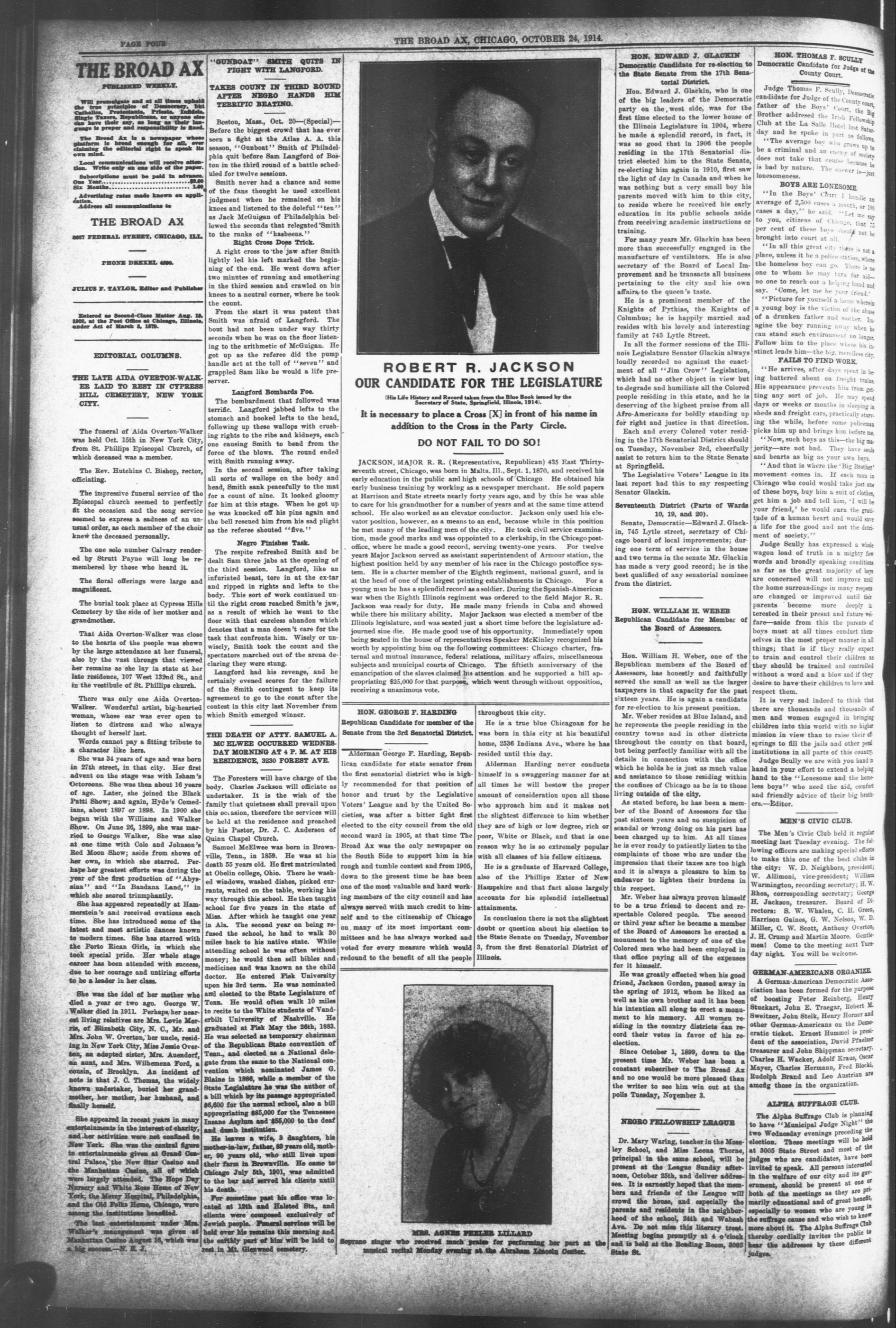
ROBERT R. JACKSON OUR CANDIDATE FOR THE LEGISLATURE
(His Life History and Record taken from the Blue Book issued by the Secretary of State, Springfield, Illinois, 1914).
It is necessary to place a Cross [X] in front of his name in addition to the Cross in the Party Circle.
DO NOT FAIL TO DO SO!
JACKSON, MAJOR R. R. (Represen-
seventh street, Chicago, was born in M
early education in the public and high
early business training by working as
at Harrison and State streets nearly
to care for his grandmother for a num-
school. He also worked as an elevator
vator position, however, as a means to
he met many of the leading men of the
tion, made good marks and was oppo-
office, where he made a good record,
years Major Jackson served as assistan-
highest position held by any member
tem. He is a charter member of the B
at the head of one of the largest print-
young man he has a splendid record and
war when the Eighth Illinois regiment
Jackson was ready for duty. He ma-
while there his military ability. Major
Illinois legislature, and was seated just
journed sine die. He made good use a
being seated in the house of represent-
worth by appointing him on the follow-
ternal and mutual insurance, federal n
subjects and municipal courts of Chic-
emancipation of the slaves claimed his
propriating $25,000 for that purpose,
receiving a unanimous vote.
JACKSON, MAJOR R. R. (Representative, Republican) 435 East Thirty-seventh street, Chicago, was born in Malta, Ill., Sept. 1, 1870, and received his early education in the public and high schools of Chicago He obtained his early business training by working as a newspaper merchant. He sold papers at Harrison and State streets nearly forty years ago, and by this he was able to care for his grandmother for a number of years and at the same time attend school. He also worked as an elevator conductor. Jackson only used his elevator position, however, as a means to an end, because while in this position he met many of the leading men of the city. He took civil service examination, made good marks and was appointed to a clerkship, in the Chicago postoffice, where he made a good record, serving twenty-one years. For twelve years Major Jackson served as assistant superintendent of Armour station, the highest position held by any member of his race in the Chicago postoffice system. He is a charter member of the Eighth regiment, national guard, and is at the head of one of the largest printing establishments in Chicago. For a young man he has a splendid record as a soldier. During the Spanish-American war when the Eighth Illinois regiment was ordered to the field Major R. R. Jackson was ready for duty. He made many friends in Cuba and showed while there his military ability. Major Jackson was elected a member of the Illinois legislature, and was seated just a short time before the legislature adjourned sine die. He made good use of his opportunity. Immediately upon being seated in the house of representatives Speaker McKinley recognized his worth by appointing him on the following committees: Chicago charter, fraternal and mutual insurance, federal relations, military affairs, miscellaneous subjects and municipal courts of Chicago. The fiftieth anniversary of the emancipation of the slaves claimed his attention and he supported a bill appropriating $25,000 for that purpose, which went through without opposition, receiving a unanimous vote.
HON. GEORGE F. HARDING
Republican Candidate for member of the
Senate from the 3rd Senatorial District
Alderman George F. Harding, Republican candidate for state senator from the first senatorial district who is highly recommended for that position of honor and trust by the Legislative Voters' League and by the United Societies, was after a bitter fight first elected to the city council from the old second ward in 1905, at that time The Broad Ax was the only newspaper on the South Side to support him in his rough and tumble contest and from 1905, down to the present time he has been one of the most valuable and hard working members of the city council and has always served with much credit to himself and to the citizenship of Chicago on many of its most important committees and he has always worked and voted for every measure which would redound to the benefit of all the people
A.
MRS. AGNES PEELER LILLARD
Soprano singer who received much praise for perform
musical recital Monday evening at the Abraham
Soprano singer who received much praise for performing her part at the musical recital Monday evening at the Abraham Lincoln Center.
throughout this city.
He is a true blue Chicagoan for he was born in this city at his beautiful home, 2536 Indiana Ave., where he has resided until this day.
Alderman Harding never conducts himself in a swaggering manner for at all times he will bestow the proper amount of consideration upon all those who approach him and it makes not the slightest difference to him whether they are of high or low degree, rich or poor, White or Black, and that is one reason why he is so extremely popular with all classes of his fellow citizens.
He is a graduate of Harvard College, also of the Phillips Exter of New Hampshire and that fact alone largely accounts for his splendid intellectual attainments.
In conclusion there is not the slightest doubt or question about his election to the State Senate on Tuesday, November 3, from the first Senatorial District of Illinois.
HON. EDWARD J. GLACKIN Democratic Candidate for re-election to the State Senate from the 17th Senatorial District.
Hon. Edward J. Glackin, who is one of the big leaders of the Democratic party on the west side, was for the first time elected to the lower house of the Illinois Legislature in 1904, where he made a splendid record, in fact, it was so good that in 1906 the people residing in the 17th Senatorial district elected him to the State Senate, re-electing him again in 1910, first saw the light of day in Canada and when he was nothing but a very small boy his parents moved with him to this city, to reside where he received his early education in its public schools aside from receiving academic instructions or training.
For many years Mr. Glackin has been more than successfully engaged in the manufacture of ventilators. He is also secretary of the Board of Local Improvement and he transacts all business pertaining to the city and his own affairs, to the queen's taste.
He is a prominent member of the Knights of Pythias, the Knights of Columbus; he is happily married and resides with his lovely and interesting family at 745 Lytle Street.
In all the former sessions of the Illinois Legislature Senator Glackin always loudly recorded no against the enactment of all "Jim Crow" Legislation, which had no other object in view but to degrade and humiliate all the Colored people residing in this state, and he is deserving of the highest praise from all Afro-Americans for boldly standing up for right and justice in that direction. Each and every Colored voter residing in the 17th Senatorial District should on Tuesday, November 3rd, cheerfully assist to return him to the State Senate at Springfield. The Legislative Voters' League in its last report had this to say respecting Senator Glackin.
Seventeenth District (Parts of Wards 10.19. and 20).
Senate, Democratic—Edward J. Glackin, 745 Lytle street, secretary of Chicago board of local improvements; during one term of service in the house and two terms in the senate Mr. Glackin has made a very good record; he is the best qualified of any senatorial nominee from the district.
HON. WILLIAM H. WEBER
Republican Candidate for Member of
the Board of Assessors.
Hon. William H. Weber, one of the Republican members of the Board of Assessors, has honestly and faithfully served the small as well as the larger taxpayers in that capacity for the past sixteen years. He is again a candidate for re-election to his present position.
Mr. Weber resides at Blue Island, and he represents the people residing in the country towns and in other districts throughout the county on that board, but being perfectly familiar with all the details in connection with the office which he holds he is just as much value and assistance to those residing within the confines of Chicago as he is to those living outside of the city.
As stated before, he has been a member of the Board of Assessors for the past sixteen years and no suspicion of scandal or wrong doing on his part has been charged up to him. At all times he is ever ready to patiently listen to the complaints of those who are under the impression that their taxes are too high and it is always a pleasure to him to endeavor to lighten their burdens in this respect.
Mr. Weber has always proven himself to be a true friend to decent and respectable Colored people. The second or third year after he became a member of the Board of Assessors he erected a monument to the memory of one of the Colored men who had been employed in that office paying all of the expenses for it himself.
He was greatly effected when his good friend, Jackson Gordon, passed away in the spring of 1912, whom he liked as well as his own brother and it has been his intention all along to erect a monument to his memory. All women residing in the country districts can record their votes in favor of his reelection. Since October 1, 1899, down to the present time Mr. Weber has been a constant subscriber to The Broad Ax and no one would be more pleased than the writer to see him win out at the polls Tuesday, November 3.
NEGRO FELLOWSHIP LEAGUE
Dr. Mary Waring, teacher in the Moselle School, and Miss Leona Thorne, principal in the same school, will be present at the League Sunday afternoon, October 25th, and deliver addresses. It is earnestly hoped that the members and friends of the League will crowd the house, and especially the parents and residents in the neighborhood of the school, 24th and Wabash Ave. Do not miss this literary treat. Meeting begins promptly at 4 o'clock and is held at the Reading Room, 3005 State St.
HON. THOMAS F. SCULLY Democratic Candidate for Judge of the County Court.
Judge Thomas F. Scully, Democratic candidate for Judge of the County court, father of the Boys' Court, the Big Brother addressed the Irish Fellowship Club at the La Salle Hotel last Saturday and he spoke in part as follows.
"The average boy who grows up to be a criminal and an enemy of society does not take that course because he is bad by nature. The answer is—just lonesomeness.
BOYS ARE LONESOME
"In the Boys' Court I handle an average of 2,500 cases a month, or 100 cases a day," he said. "Let me say to you, citizens of Chicago, that 75 per cent of these boys should not be brought into court at all.
"In all this great city there is not a place, unless it be a police station, where the homeless boy can go. There is no one to whom he may turn for aid; no one to reach out a helping hand and say. 'Come, let me be your friend.'"
"Picture for yourself a home wherein a young boy is the victim of the abuse of a drunken father and mother. Imagine the boy running away when he can stand such environment no longer. Follow him to the place where his instinct leads him—the big men instincts."
"He arrives, after days spent in being battered about on freight trains. His appearance prevents him from getting any sort of job. He may spend days or weeks or months in sleeping in sheds and freight cars, practically starring the while, before some policeman picks him up and brings him before me.
"Now, such boys as this—the big majority—are not bad. They have souls and hearts as big as your own boys.
"And that is where the 'Big Brother' movement comes in. If each man in Chicago who could would take just one of these boys, buy him a suit of clothes, get him a job and tell him, 'I will be your friend,' he would earn the gratitude of a human heart and would save a life for the good and not the detriment of society."
Judge Scully has expressed a whole wagon load of truth in a mighty few words and broadly speaking conditions as far as the great majority of boys are concerned will not improve until the home surroundings in many respects are changed or improved until their parents become more deeply interested in their present and future welfare—aside from this the parents of boys must at all times conduct themselves in the most proper manner in all things; that is if they really expect to train and control their children as they should be trained and controlled without a word and a blow and if they desire to have their children to love and respect them.
It is very sad indeed to think that there are thousands and thousands of men and women engaged in bringing children into this world with no higher mission in view than to raise their of springs to fill the jails and other penal institutions in all parts of this country. Judge Scully we are with you hand in hand in your effort to extend a helping hand to the "Lonesome and the homeless boys" who need the aid, comfort and friendly advice of their big brothers.—Editor.
MEN'S CIVIC CLUB.
The Men's Civic Club held it regular meeting last Tuesday evening. The following officers are making special efforts to make this one of the best clubs in the city: W. D. Neighbors, president; W. Allimoni, vice-president; William Warmington, recording secretary; H. W. Rhes, corresponding secretary; George H. Jackson, treasurer. Board of Directors: S. W. Whalen, C. H. Green, Harrison Gaines, G. W. Nelson, W. D. Miller, C. W. Scott, Anthony Overton, J. H. Crump and Martin Moore. Gentlemen Come to the meeting next Tuesday day night. You will be welcome.
GERMAN-AMERICANS ORGANIZE
A German-American Democratic Association has been formed for the purpose of boosting Peter Reinberg, Henry Stuckart, John E. Traegar, Robert M. Sweitzer, John Stelk, Henry Horner and other German-Americans on the Democratic ticket. Ernest Hummel is president of the association, David Pfehlzer treasurer and John Shippman secretary. Charles H. Wacker, Adolf Kraus, Oscar Mayer, Charles Hermann, Fred Blocki, Rudolph Brand and Leo Austrian are among those in the organization.
ALPHA SUFFRAGE CLUB
The Alpha Suffrage Club is planning to have "Municipal Judge Night" the two Wednesday evenings preceding the election. These meetings will be held at 3005 State Street and most of the judges who are candidates, have been invited to speak. All persons interested in the welfare of our city and its government, should be present at one or both of the meetings as they are primarily educational and of great benefit, especially to women who are young in the suffrage cause and who wish to know more about it. The Alpha Suffrage Club thereby cordially invites the public to hear the addresses by these different judges.
MUSICAL RECITAL AT THE ABRAM LINCOLN CENTER MONDAY EVENING WAS A FLATTERING SUCCESS.
Monday evening past, Prof. B. Emmanuel Johnson, gave his annual musical recital at the Abraham Lincoln Center. It was attended by about four hundred society people who seemed to highly appreciate each number rendered by those participating in it. Right here it might not be out of place to state that Prof. Johnson deserves a large amount of credit for endeavoring to give once each year a high class musical entertainment.
As it never fell to our lot to receive a thorough musical education we are not in a position to state whether or not, Clarence Cameron White, the noted violinist of Boston, Mass., and the song birds ran up to high C or down to low A. We will leave that part for those that are able to pass criticism upon the defects if any on the part of the playing and singing of the Galaxy of the musical artists who assumed the leading parts in the recital, and we will simply publish the program as rendered on that occasion.
Program:-Part I—Spanish Dance,
No. 5 (Duo) Moszkowski, Ida Mae Bell
and Ernestine Thompson; Expectancy
(Vocal) Stickles, Mrs. Lillard; Kuyawiak
(Two pianos) Wieniawski, Albertine
Pierce and Mr. Johnson; Military March
(Eight hands) Schubert, Beatrice Lear,
Helen Wheeler, John Chur and Mr. Johnson;
Dreaming (Vocal) Joyce, Violet
Galloway; Fantasy Appassionata (Viola)
Vienxtemps, Mr. White
Part 2—(a) When the Roses Fall (Vocal) Vannah, (b) Bid Me To Live, Hatton, Mrs. Towson; (a) Bercuse (Violin) Clarence Cameron White, (b) Orientale, Caesar Cui, (c) Liebesfreund, Fritz Kreisler, Mr. White; Concertstuck—Last Movement, Weber, Miss Grace Galloway and Mr. Johnson; When the Heart is Young (Vocal) Buck, Mrs. Lillard; (a) Traumerei (Violin) By Desire, Schumann, (b) Perpetual Motion, Franz Ries, Mr. White; Concerto—Last Movement, Mendelssohn, Miss Ida Mae Bell and Mr. Johnson.
Dancing followed at the end of the program in Emerson Hall. Garfield Wilson's Orchestra furnished the music.
Misunderstood.
She sighed in such a plaintive way,
I pitted her, I vow,
And sought to kiss her grief away.
She is the plaintiff now!
—Judge
Another sad and wistful maid
I paused when despondent.
Her handband it. "I'm afraid
That I'm the correspondent
—Sokane Stookman-Review
Of Different Mind
"Going to divorce your husband, eh?
Let me recommend my lawyer. He got me my divorce without the slightest publicity."
"Glad you told me about him. I might have made a mistake and employed him if you had not."—Houston Post.
Going Away.
You tell your friends, the Wombats,
that you're for Paris bound.
To this they rise and straight surmise
At Newport they'll be found.
Full soon you seek at ten a week
A boarding place somewhere,
And, the next day, to your dismay,
The Wombats turn up there.
A journal.
Tearing the Hole
"That man's been in the warn. He told me of all the men he killed and all the wounds he got." "Then I suppose those are his scars of glory he was showing?" "Nope. That's where our dog hit him."-Baltimore American
Przemval
[ "Træmself" is pronounced "Pæthem
fat" - Newspaper Item.]
The
There was a young lady of Przemysl
Whoe family tree had a blemysl.
Her father was Prussian,
Her mother was Russian,
And her uncle and aunt were both Flem
yal.
-Philadelphia Leder.
At the Museum
"What's the matter with the glass etter?"
"He ate a couple of windows last evening, and I think he must have a pane in his stomach." — Baltimore American.
Devotion
DEVOTION.
If I had a thousand lives to live
I live them all on.
If I had a thousand hearts to give
you'd get the thousand. Run.
On the other hand, in the winter's storm
he had so cold you're blue.
If you had a limited feet to warm
I'd warm them all for you.
— New York Mall
Her Only Excuse
"Did you hear about Mrs. Midly's latest? She actually kissed her husband goodbye at the railway station." "The simple old dear! She's hopefully old fashioned." Cleveland Plain Dealer.
Human Netune
When I had a syllabus, a protoplasm and a large three corneled cumbersmud, a baggel in each hand. I could tell you what you are M. failing, I'd shot. The reason why I want them is because I have them not.
Guits the Thing.
Nell—Bess always dresses appropriately for every occasion.
Belle—Yes, I noticed she wore a dress of pan velvet when she danced "the kitchen sink."—Brittany, a woman.
Milady's Mirror
The Business Woman's Toilet
The business woman has no time for morning prinking. As one young woman puts it, "Before I go to bed at night I have to be dressed for the next day." She does not spend more than an hour in the evening over her toilet, but in addition she spends an hour once a week at a first class beauty parlor. One week she has a shampoo and scalp treatment, another facial massage and manicure treatment; on another visit her feet are put in order, and so on.
She takes her warm, cleansing bath at night, but before this she cleanses her face and neck thoroughly with a good cleansing cream, then anoints it with massage cream, which for the moment she leaves on the face.
Grooming the Hair.
She lets down her hair, brushes it thoroughly and leaves it pinned up lightly, but sufficiently high to escape a wetting in the bath. Then she flies her nails and jumps in her bath, which is soft and fragrant with soap powder. She does not allow the water to touch her face or neck, but she uses a flesh brush vigorously over her body and scrubs her finger nails and toe nails before she empties the tub and rinses off well with a fine spray. This spray or thorough rinse is absolutely necessary, for, after the soapy water has done its cleansing purpose, it should be well rinsed off the skin.
Massaging the Face.
When she returns to her toilet tables the heat of the bath has started a mild perspiration on scalp and face, and the massage cream that she has left on her face has been largely absorbed. She gives her scalp a five minute massage, and, slightly wetting her hair, she rolls the locks about the face and nape of the neck over kid rollers for the night. The skin of the face being now well lubricated, a few minutes' facial massage quite removes the tired lines of the day, and she finishes with a brisk douche of cold water.
Caring For the Nails
The skin about the nails has been softened in the bath, and a few minutes' work with a nail stick, followed by a little polishing, is sufficient to put them in good condition. Nails that are never neglected are not difficult to keep in order.
If any artificial hair is worn this is the moment to brush it and arrange it for the morning. If there are any changes to be made in the dress—a stitch to take, a fresh collar to be added—do it now. Lay out clean clothes; put soiled ones into the laundry bag.
The few extra minutes this will take are largely compensated for by the restfulness of going to bed in a tidy room and the consciousness that there need be no rush or disturbance in the morning.
How to Wash the Hands.
There is a right and wrong way of doing everything, and this maxim applies as much to washing the hands as to anything else.
Choose your soap carefully. It must be good and pure and not too highly scented. A little borax or ammonia in the water will serve the double purpose of softening it and assisting to remove stains.
Every time you wash your hands wash them thoroughly, taking care that the lines on the palm are perfectly cleansed. If this is neglected the lines will become coarser and deeper, which is just what we are most anxious to avoid.
It is very important indeed that the hands should be thoroughly dried and that they should not be exposed either to cold or the heat of the fire immediately after being washed.
If they are left with a little dampness on them you are encouraging the formation of chaps, and roughness and redness are sure to follow.
Foot Ease
Nothing is more trying to the temper than a corn. If the corn is a hard one and very hard bind a slice of lemon over it every night till it is less painful.
If you have soft corns between the afflicted toes put pads of absorbent cotton saturated with boracle powder. Use a fresh pad every day. It is wonderful how quickly this treatment relieves the pain.
If your feet get tender and blister easily when walking you should always wear woolen stockings, and before pulling them on your feet should be well dusted over with boracle powder.
Beautiful White Hands.
To written hands that have become browned through exposure the following is an excellent mixture:
Take a wineglassful each of honey, lemon juice and eau de cologne. Mix well together, pour into a china jar and keep closely corked. Apply night and morning after washing and drying, rubbing the mixture well into the hands.
The Powder Puff.
Instead of powder puffs requiring frequent cleansing there are now offered tiny balls of absorbent cotton fitted with pink, blue, yellow or mauve ribbons to match the toilet table color. These are to be used once and discarded. They should be kept in a wide mouth jar on box.
THE BROAD AX, CHICAGO, OCTOBER 24, 1914
KENY FERROY THURING
HON. ADAM WOLF
Republican candidate for re-election for member of the Board of Assessors; women can vote for him on Tuesday, November 3rd; he is a steadfast friend of the Colored race and its voting members will assist to put him over at the polls on the above mentioned date.
JUDGE EDMUND K. JARECKI
Democratic candidate for judge of the Municipal Court, who is fair and square and should be elected with both hands down Tuesday, November 3.
Judge Edmund K. Jareeki, Democratic candidate for Judge of the Municipal Court full term, who has made a mark for himself so far in public in this city, was born in Posen, German-Poland and at
JUDGE EDMUND K. JARECKI
---
the age of six years his parents brought him to this country growing up and becoming a full fledged American citizen, his parents on landing in America made a bee line for Chicago, and it was in this city that he received his education in its public schools and after graduating from them he attended St. Stanislaus College. He also attended the-Chicago Manual Training School, and became a mechanical draftsman. He is a graduate of the Northwestern University Law School, and was admitted to
M.
MRS. GERTRUDE
One of the popular contralto song
n the art of singing.
become highly proficient
the bar in 1908. He was elected Alderdabor, while as an attorney for the purum man of the old Sixteenth Ward in 1911, and was appointed attorney for the pure food commission by Governor Dunne in 1912. On May 1, 1914, he was appointed by the governor Associate Judge of the Municipal Court, to fill the unexpired term of Michael Sullivan. He is a member of the Illinois Bar Association, Knights of Columbus, Modern Woodmen, Polish National Alliance and the Polish Altemata. As an Alderman
---
he always demonstrated fairness to food commission he prosecuted many wholesalers who sought to unload impure canned goods on the Chicago markets. His prosecution of these unscrupulous merchants led to the destruction of the spoiled goods, thus conserving the health of the Chicago public.
Being an able lawyer and an upright citizen, Judge Jarecki highly deserves to be elected one of the Judges of the Municipal Court.
WOOD-XOWSON
stresses, who is fully determined to
in the art of singing.
Good form
Discussions Are Taboo.
It is not wise to be so thin skinned as not to be able to listen to an argument in which your pet theories are attacked without getting angry. But there is a limit to all things, and the person who wantonly attacks your friends is guilty of a gross breach of good manners, to say the least. An expression of personal opinion may be forgiven, because every one has a right to it, but no one has a right to thrust his opinions upon others at every opportunity. In all good society discussion of politics, religion and other such suspects is forbidden by general consent. It has almost come to the point that the present war is not to be talked about except among friends, as in a general gathering there are certain to be persons who would feel strongly upon the subject of his own particular country.
There are several things to be remembered, one of them that very little is known as to what is really happening in the war zones, and another that each country involved in the war has an opinion as to the cause of it that is entirely different from that of every other country. The only subject upon which all are united is that the situation is deplorable in whatever light it is viewed and that it cannot be made any better by unwise discussion.
The very fact that each person feels so strongly about it is evidence that it is not a safe subject for conversation and that good taste will put it among those not to be discussed except among friends who understand one another well enough to forgive any extravagant expressions of opinion.
The Correct Introduction.
In the case of introductions nothing can be more simple or more correct than the form of "Miss A., let me introduce Mr. B." and still this is entirely the proper thing. The form, however, means that the lady must permit the man to be introduced to her, not she presented to him. This should appeal to the sense of propriety in any one, it would appear, if a moment's thought is given to the matter at all.
The younger should always be presented to the elder, except in the case of a young lady and an elderly man. Should the man, however, be prominent in any way it is entirely correct to present a young lady to him, saying, "Mr. Blank, I want you to know my friend Miss E."
It is the very simplest thing to remember that an unmarried woman is presented to the married one, a very young girl to any ladies that are older, a man to his hostess and also in such a case to his host, whether the latter be the elder or not, just because he is the one who is entertaining.
The Broad Ax Contest
THIS BALLOT IS GOOD FOR
TEN VOTES
NOT GOOD AFTER NOVEMBER 8th,
NOT GOOD AFTER NOVEMBER 8th,1914
GOOD FOR TEN VOTE
out, if sent to THE BROAD AX
ballot will be altered in any way or
THE BROAD AX.
Nomination
The Broad
GOOD FOR TEN VOTES when neatly trimmed and filled out, if sent to THE BROAD AX office before expiration date. No ballot will be altered in any way or transferred after being received by THE BROAD AX.
Nomination Coupon The Broad Ax Contest
GOOD FOR 5,000 VOTES
I Nominate
Address
Signed
Address
Only one nomination for each candidate counts 5
Names of persons making nominations will not be divulged
Only one nomination for each candidate counts 5,000 votes. Names of persons making nominations will not be divulged.
For M
Address
PAGE FIVE
A friend is one who gives help rather than advice.
The submarine is mightier than the Dreadnought.
It isn't only the worldly people who want the earth.
Contentment is found in not wanting what you can't get.
And lots of people do not work as much as they wait.
It looks easier to bombard Præmysi than to pronounce it.
Think of the havoc being wrought on the European guidebooks.
A good husband is an asset, but a worthless one is a liability.
Something else to worry about, the "risks" of premature peace.
Opportunity is delivering double knocks on Uncle Sam's door.
There seem to be more blockheads in the world than wooden legs.
What the world still seems to need is a soft drink that people don't tire of.
Though haste is not always advisable, it is preferable to procrastination.
A tax on war talk would produce enough revenue to pay the national debt.
If fewer persons lived in glass houses there would be less fun in throwing stones.
All very well for Europe to wipe out
old scores, but she is running up some
new ones.
It must have been a seasick man
who said you couldn't eat your cake
and keep it.
It's all up with the army aviator
when he complies with an invitation
to drop down.
A skeptic is merely a person who
doesn't share the good opinion you
have of yourself.
We should never be too anxious to
see ourselves as others see us. It might
hurt our feelings.
Some promising youths keep on
promising all of their lives and do not
accomplish much.
There must be something fishy in the report that ichthyol has gone up on account of the war.
You can make some people almost as mad by talking about them as you can by ignoring them.
If every man has his price it's no wonder we feel so cheap when we realize we have been sold.
War is terrible. The dowager Grand Duchess' of Mecklenburg-Strelitz has lost her English pension.
Ax Contest
OVEMBER 8th, 1914
ES when neatly trimmed and filled
officec before expiration date. No
transferred after being received by
n Coupon
Ax Contest
each candidate counts 5,000 votes. ons will not be divulged.
PAGE 81X
Miss Mills And Dick
How the Change In the Firm Came to Pass.
By ANITA WENTWORTH.
The name of the firm was Brownlow & Son, but every one who knew Dick Brownlow knew that the "old man" had taken him in without too many hopes of making a business man of him. Dick was twenty-three years old. He had been squeezed through college and made many trips abroad. He was a member of three clubs, and it had cost his father $50,000 to get him to his present point in life.
Dick had been using the office as a sort of "hangout" for two or three months and had at last advanced in the business world to the point where he could acknowledge an order by mail and almost bluff the old office manager and other employees.
Then the older Brownlow decided that the son ought to have a stenographer all to himself, and an advertisement was accordingly inserted. There were forty-nine answers, and it was for Dick to peruse them and make up his mind which applicant to take.
He had five of them call at the office and chose Miss Mills because she was the best looking of the lot. So Miss Mills appeared on a certain Monday morning and began her work.
Although he was the junior partner, Dick determined at once to prove to her that he not only acknowledged her right to live, but that he was rather glad she was alive.
That morning the Son of Brownlow & Son dictated two letters and spent the rest of the time in patronizing his stenographer. He asked many questions and related some of his adventures. When noon came he felt that he had made matters so pleasant that he decided to ask Miss Mills to lunch with him. She looked him sedately in the eyes and refused politely. There had been an expression in her face for a moment, however, as if she intended to give notice and resign her place on the spot. But evidently her glance at Dick's frank, honest face overcome this idea, if she had it.
The junior partner was astonished. To do him justice, he was not indignant, but he was piqued.
The setback made him assume more dignity in the afternoon, and if he was not glad of it Miss Mills was. It was two days before the invitation was renewed and as promptly refused.
That was another setback for Dick, and it naturally set him to studying the problem. He was not accustomed to being refused anything by anybody. It was a real relief to him when finally he decided that the girl stood in awe of him because he was the junior partner of the house. It seemed to him only kind that he should dissipate that awe.
At the end of another week he made it his business to overtake her on the street as she was going home. Bowing with the utmost respect, he said: "Miss Mills, a friend of mine who was going to the theater tonight with his wife has been disappointed and has given me the tickets. Wouldn't you like to accompany me?"
"I-I have another engagement," she replied, blushing both because it was false and because he knew it was false.
"Oh—ah—I see. It's a great play." "I thank you just the same."
That was another surprise for Mr. Dick Brownlow, but he didn't turn on his heel with the mental threat to discharge the "uppy" stenographer in the morning.
Miss Mills went to her duties next morning wondering if she would be told that her services were no longer required, but nothing of the sort awaited her. On the contrary, about mid-foreoon, when she had written several letters, the junior partner remarked:
"Miss Mills, I want to say that your work gives the greatest satisfaction, and from this time on your salary will be advanced from $12 to $16 a week."
"But I can't earn $16 a week—not now," she replied. "I'm only a beginner, and I'm glad to earn $12."
"You refuse a raise of salary!" he exclaimed, as he looked at her in astonishment.
"If you please—until I can earn every penny of it."
Dick came down with another thud. It was no use trying to puzzle it out. He hadn't the brain power to do it. Instead of puzzling he went to his father and said:
"Governor, I wanted to raise my stenographer's salary and she wouldn't have it. What do you think of that?"
"Dear me, Dick, but I hope you are not going to get into a scrape," replied the father as he rubbed his hands together and looked very anxious. "If you think she is trying to get a hold on you you'd better discharge her."
"Oh, see here, dad," said Dick promptly. "I know that she isn't anything of that kind, but I can't make her out. She won't go out to lunch or to the theater with me or accept any other favors."
"You shouldn't have asked her, Dick," said Mr. Brownlow sterely.
Some junior partners might have given it up, but Dick wouldn't. He felt that he had been thrown down and humiliated, and he wanted to know why. So one evening he presented himself at Miss Mills' boarding house and
asked for her. He was received in the parlor, and Miss Mills came down. He hemmed and hawed for a time and then drew a long breath and began: "Miss Mills, would it do any good to ask you to go to the theater with me some night toward the last of the week?"
"I'm afraid not," she answered. "But I can't make you out. You refuse to go to lunch with me; you refuse a raise of salary; you refuse to go to the theater. Will you tell me why this is?"
"I will, Mr. Brownlow. I am from a small town in the interior of the state. My mother is a widow, and we are poor. I am here to make a living for both of us."
"I had two places before I came to you, but I had to give them up because of just such flattery as you have bestowed upon me. They were not satisfied to let me do as good work as I could for a fixed sum per week. I must give up my place with you for the same reason."
"But I don't see it," repiled Dick.
Miss Mills looked at the young man and perceived that he really did not "see it." Very patiently and in a tone not at all angry she replied:
"You are the junior partner in the house. I am your stenographer. You want me to go to the theater with you. We should see many people there that know you. Who am I? Your stenographer. What would they think and say? Perhaps nothing to injure you socially, but how about me?"
"Miss Mills," said Dick, getting up and preparing to go, "I see now. Thank you for the lesson. You have made me realize something, and that something is that I must seem to you like a pompous fool."
Without waiting for a reply he bade her a ceremonious "Good night" and hurried away.
The girl watched him go with an expressionless face, but when the door closed behind him she hurried to her room and sobbed bitterly.
That she could not remain with the firm was a decision that she made without argument. Indeed, she hesitated next morning as to whether she should go to the office at all or merely write surrendering her post.
Her sense of duty conquered. When she appeared Dick Brownlow did not attempt to help her off with her veil and coat, as he had tried before. Instead he merely said "Good morning" politely and turned to his desk again.
Presently he stepped to her side and began to dictate. When he was done he hesitated and said:
"Will you pardon me if I recur once more and for the last time to a personal matter?"
Miss Mills, who had been trying to reach the point of presenting her resignation and finding it very hard, much to her own indignation at herself, said "Yes" almost inaudibly.
"Then." said Mr. Dick Brownlow bravely, "I will ask you not to resign, as I know you intended to do. I could see it in your face this morning. If it will make you more comfortable, I will arrange to have you transferred to my father's office, but if you would forgive me and do me the honor of trusting me I think I can prove to you that you will not make a mistake by staying in my own office."
The girl looked at him with eyes moist with tears. "I will stay," said she.
Six months afterward the Son of Brownlow & Son entered the private office of the head of the firm and said: "Father, that Miss Mills didn't exactly try to get a hold on me, but she has one for all that, and I really think we'll have to take her into the firm and make it Brownlow, Son & Daughter." "I couldn't want a better partner," said the head of the firm.
Strides Used by Soldiers.
Soldiers are marching across Europe, but they do not keep step. They vary both in the length of the step and rapidity of their pace. The British infantry step thirty-one and one-half inches, the longest of all the steps. Germany keeps step with Switzerland—they each do thirty-one inches—while twenty-nine inches is the pace in the armies of Italy, France and Austria. The Russians take the shortest step, twenty-seven and one-half inches, and do only 112 in a minute. The German infantryman does 114, the Austrian 115, and the French and Italian each manage 120. Consequently to march a mile takes the Russian twenty minutes, the Austrian eighteen and two-thirds minutes, the French and Italian eighteen minutes, while the German could beat this by ten or eleven seconds—London Chronicle.
PRACTICAL HEALTH HINT
The Mouth and Disease.
Do not lose sight of the fact that a clean mouth, clean gums and also teeth go a long way toward promoting good health. Guard them well, for when they are neglected they become breeding places for germs and disease. A cheap and effective dentifice is made thus: Dissolve two ounces of borax in three pints of warm water; before quite cold add thereto one teaspoonful of tincture of myrrh and one table-spoonful of spirits of camphor; bottle the mixture for use. One wineglassful of the solution is sufficient for each application. This preparation applied daily with a soft brush preserves and beautifies the teeth. extirpates all tartarous adhesion, produces a pearl-like whiteness, arrests decay and induces a healthy action of the gums.
THE BROAD AX. CHICAGO. OCTOBER 24, 1914
PRACTICAL HEALTH HINT.
Diet For the Anaemic
A diet for anaemic persons should be very nutritious and digestible. As much as possible should be taken, including a generous supply of red meat lightly cooked, green vegetables, no potatoes, eggs raw or proached, bacon toasted or boiled, no fried food, no neal or pork, no tea, very little coffee, plenty of milk and cream, cocoa, milk puddings, and stewed fruits. Stewed prunes, figs and baked apples are helpful, as are fluids in large quantities; no acids, such as vinegar, acid wines, like claret and white wines; no recooked meat, no spiced or curried dishes, no salads or pickles, no cheese, new bread or pastry.
GROWTH OF INDIA.
It Has Made Wonderful Strides In the Last Half Century.
India's trade has increased during the last half century from $300,000,000 to more than $1,400,000,000. It has in operation 32,000 miles of railroad in its railroad mileage, carrying 330,000 passengers yearly at the rate of five miles for one cent. It maintains 76,000 miles of telegraph line, over which messages can be sent for more than 2,000 miles at a cost of only 12 cents.
India is now the largest exporter of rice in the world, holds first place in its exports of tea, next to Argentina is the largest exporter of hides, and next to the United States is the largest exporter of cotton in the world. Next to the United States and Russia it is the largest wheat producing country. The Tata iron works in Bengal, employing 8,000 men, have laid down iron in San Francisco at less than the price charged by the United States Steel corporation. India's system of irrigation stands easily first in the world, being far more extensive than that of Egypt or America. Its more than 46,000 miles of irrigation canals have reclaimed more than 22,000,000 acres of land, and famine has been prevented forever in some districts.—Sherwood Eddy in World's Work.
BISMARCK'S PROPHECY.
A Peep Into the Future by the Great German Statesman.
Many years ago the writer, then a mere boy, was for a short time a privileged visitor in the country home at Friedrichsruh of the late Prince Bismarck. The memory of one conversation remains with him as though it occurred but yesterday.
With a map of the world before him the prince was explaining how the existing political conditions had come into being and, among other things, remarked that no state of affairs could be considered permanent there—in Europe.
Placing his left hand upon France he said, "Here we shall have ever growing dissension and weakness resulting from overculture." Then, placing his right hand upon Asia, he said; "Eventually here will move here" (indicating Europe by a tapping movement of the forefinger of his left hand). "It is only a question of when these millions become hungry enough." A little later he continued, "In those days there will be but one safe country, but one country that shall represent our civilization." And silently he lifted his left hand and laid it heavily upon America—Howard V. Sutherland in New York Post.
Spoiled Food In Commerce.
The United States department of agriculture has issued a ruling which hereafter will require any spoiled food to be denatured before it can be shipped in interstate commerce. This will permit the shipment of spoiled eggs for use in tanning and other spoiled substances for the making of fertilizer or oils or greases used in machinery, but will require them to be treated with salt, kerosene oil or coloring matter or in other ways so that they cannot possibly be used for food. This is on the analogy of the denaturing of grain alcohol for use in the arts.
Chinese In Uncle Sam's Army.
A company of Chinese soldiers regularly enlisted in the militia in Hawaii constitutes an odd body in the reserve fighting forces of the United States. The organization was formed with the sanction of the war department at Washington, and under the tutelage of American army officers has made such pronounced progress in the mastery of military tactics that the recruiting of a second company is being considered. —Popular Mechanics Magazine.
Woman's Progress in England. A woman has for the first time been appointed superintendent and deputy medical officer to the women convicts in an English prison. Less than fifty years ago Miss Jex-Bicke, the first woman to attempt taking a medical degree in England, was stoned in the streets of Edinburgh and the university closed to her.—Women's Political World.
Some idea of the power of a modern gun may be formed when it is stated that when an eighty-one ton gun fires a shot twelve miles it is fired at such an angle that the shell goes up to a height of 5,428 feet higher than Mont Blanc. A 100 ton projectile strikes with a force equal to 465,000 155 pound men jumping from a height of one foot.
having this enormous outlet, we are in a position to buy in unusually large quantities direct from the manufacturers. Through our buying power we are enabled to give our patrons millinery at extraordinary popular prices and still maintain the usual good merit of quality and Service.
$3.50 and $4.00 silk velvet shapes, all new models,
large new dress shapes $1.98 Special opening sale price
$3.00 all silk velvet Russian Turban Sailor Shapes. Special $1.98
$4.00 all silk velvet, large shapes, soft and blocked crown, sailor effect. Special
Dress and Street Trimmed Hats--artistically trimmed with ostrich, velvet flowers and gold effects, $7.50 values $2.98
WE CARRY CHILDRENS SCHOOL HATS "Hats Delivered Free of Charge"
LINCOLN MILLINERY
3218 STATE STREET 3218
"TAKE A PEEK AT OUR WINDOWS"
Arthur's $2.00 Hats
d.o.
Advertise in The Broad Ax
Copyright 1914
Gage Brothers & Co.
Chicago
OPEN EVENINGS
having this enormous outl
quantities direct from the
enabled to give our patron
maintain the usual good m
$3.50 and $4.00
large new dress sha
$3.00 all silk velvet Russ
Sailor Shapes. Special -
$4.00 all silk velvet, large
and blocked crown, sailor eff
Dress and S
ically trimm
velvet flower
fects, $7.50
WE CARRY O
"Hats Deli
LING
M
3218 ST
"TAKE A F
Arthur
R.W.
```markdown
```
Autumn Announcement
We cordially invite you and your friends to inspect our Fall millinery display. We have placed for your approval the many models of the latest Parisian effects in the new Kaiser hat and the unique Russian Turban and the large sailor with the new flat trimming.
We operate a chain of many Millin-
in large department stores and
outlet, we are in a position to buy in
the manufacturers. Through our buyin-
trons millinery at extraordinary popu-
d merit of quality and Service.
1.00 silk velvet shapes, all new
shapes $1.98 Special open
Russian Turban 98c OPEN
large shapes, soft
effect. Special $1.98
and Street Trimmed Hats--artist-
trimmed with ostrich,
flowers and gold ef-
f.50 values $2.98
ERY CHILDRENS SCHOOL HATS
"Delivered Free of Charge"
N COLN
MILLINERY
STATE STREET 32
A PEEK AT OUR WINDOW
r's $2.00
We operate a chain of many Millinery Departments in large department stores and for the reason of
$2.00
The Fall 'Heading' for you is an Arthur Hat---one like our "Green Top,"say. If you want to see this and about a hundred other down-to-the-minute styles of consistent $3.00 quality; drop in to-day---and admit we're showing them at
```markdown
```
new models,
all opening sale price
OPEN EVENINGS
3218
INDOWS"
Arthur's $2
"GREEN TOP"
DAMES AND DAUGHTERS.
Jennie D. Loltman, aged twenty-two, has obtained the degree of master of law from Boston university.
laws from
The Duchess of Mariborough, who
was Miss Consuelo Vanderbilt, has, it
is said, contributed $2,000,000 to the
welfare cause in England.
Mrs. Margaret Stockman of Hampstead Garden, a suburb of London, is so framing her will as to disinherit her only son if women do not get the vote before her death.
Mme. Montessori will supervise the work of the model Montessori school to be conducted as a part of the educational demonstration work at the Panama-Pacific International exposition in 1915.
China already has women doctors, but it remains for Miss Yarlock Low to offer to her country the services of a lawyer. Miss Low is a junior at an American university and feels sure that by the time she has won her degree her home province of Pingyang will be ready to receive her.
Flippant Flings.
Adam blamed it on an apple. But nowadays it is a peach that usually starts all the trouble.-Cincinnati Enquirer.
Ohio has not yet signified its usual desire to furnish all of the presidential candidates in 1916.-St. Louis Globe-Democrat.
Another interesting point is, What effect will this war have on some of those titles that have been bought by the rich papas of American girls?-Duluth Herald.
"The golden age of beautiful women is passing," observes—or at least alleges—a Japanese naval officer. No wonder these far easterners are mad enough to go to war.-Cleveland Plain Dealer.
Animal Oddities.
There are 20,000 different kinds of butterflies.
The founder lays 7,000,000 eggs a year, the turbot 12,000,000.
The earliest riser of the bird family is the greenfinch, which sometimes begins to sing at 1 o'clock on a summer morning.
In appearance flying fish are very like a sand mullet. The wings resemble an extended dorsal fin and open and shut like a lady's fan.
One little honeybee will hang suspended from a limb, while from his body a hundred others will depend—one holding to another, chain fashion—and one cannot see that the first bee waves or finds his load heavy.
Tax Suggestions
Let economy be taxation's teammate.—Cleveland Plain Dealer.
Moving pictures of the war ought to be taxed on their gate receipts.—Philadelphia Record.
Let's have a tax on baseball tickets and have it effective from Nov. 1 to March 1 each year.—Lawrence Telegram.
A war tax on automobiles which would take the joy out of the joy ride could not be wholly burdensome.—New York World.
We would suggest that the administration might get a pile of money by putting a war tax on the free lunch.—Philadelphia Inquirer.
Town Topics
Baltimore needn't think she owns "The Star Spangled Banner."—Richmond Times-Dispatch.
Chicago, like Boston, loses her grand opera by reason of the European war. By the way, it is still true, in Chicago, that nothing is wasted but the squeal—Manchester Union.
"Near side stops" for the street cars have proved to be very popular in New York, where some people in the past have experienced difficulty in getting the motormen to stop at all—Boston Globe.
Cost of Living.
Why not a five and ten cent butcher shop?-Washington Herald. The grocers blame prices on the "man higher up," but always it is the man lowest down who pays them.-Philadelphia Inquirer. Newark, N. J., has also opened municipal markets. A general engagement is opening against the advance of prices, with a particular effort to outfank beef.-New York Sun.
Train and Track
Finland has 2,430 miles of railway.
About 65 per cent of the Swiss federal railways rest on steel ties.
As a recognition of good service the Erie railroad paints the name of a meritorious engineer on the locomotive.
Russia's railways are narrower than the European standard. They were built so to hamper any attempt at military invasion
Simple Salve
Never neglect a cough or a continued cold. Consult your physician early. Don't let your baby crawl on a dirty floor. Wash its hands after creeping. To disguise the unpleasant taste of epsom salts drop in a little lemon juice. Then you will find the salt solution quite pleasant to take. Hot water used both internally and externally is highly recommended by medical men as a cure for insomnia. Bathing the feet in hot water is said to be particularly efficacious.
"William, why can't we have an automobile like other people?"
"Because, my dear, I'll have to put a new roof on the house before it will hold a mortgage."—Baltimore American.
"The dentist is an artist," said the funny Mr. Heath.
"The pencil doesn't earn him bread, But I've seen him draw teeth."
—Cincinnati Enquirer.
"Did you meet any nice men at the summer resort, dear?"
"I should say I did, and I met a couple of rich ones too."—Detroit Free Press.
A public pest we all despise.
His actions make us groan.
He guesses the wrong number
And rings our telephone!
—Spokane Spokesman-Review.
"She was completely prostrated and made very ill by his perfidy."
"Did she recover?"
"Yes, $5,000."—Boston Transcript.
Flies delight to busz and bite
And bother when you read or write.
If I just had a bumblebee
I guess they wouldn't bother me!
—Los Angeles Times.
"Did the medicine I prescribed have a soporific effect?"
"Oh, no, doctor; it only put me to sleep."—Baltimore American.
That man will fall into some kinks
Of unrestricted moor.
"How do you know that Chaucer dictated his old English to a stenographer?"
"Look at the way it's spelled."—Phil adelphia Ledger.
We're buying 'em now by the pound!"
—Cleveland Plain Dealer.
"Are the running expenses of an automobile very high?"
"Not if the motorcycle cop fails to get your number."—Baltimore American.
The fat man leans against the house,
And thus it can be seen
He's fat because he eats too much,
And that's what makes him lean.
—Cincinnati Enquirer.
"What's the matter, old man? Been in a boiler explosion?"
"No. Had the coal put in today, and I've just crawled over it to fasten the cellar window."—Detroit Free Press.
The farmer we delight to chaff,
But on his way he goes
And often gets a quiet laugh
At city people's clothes.
—Kansas City Journal
Old Mother Netticoat wanted a petticoat and went downtown to a store. But when she got there the girl said with a stare, "They're not wearing them things any more."—Central (Kan.) Courier.
Statistics are a comfort great. We twist them with sincere delight. No matter what the figures state. Each makes them show that he is right. —Washington Star.
"Yes, he's an awful hustler. Always ahead of time. Seems to anticipate everything. Used to be a newsboy."
"I see. Probably sold 6 o'clock editions at noon!" —Cleveland Plain Dealer.
All voters are not druggists. But they show a lot of skill. In mixing for the candidates. A mighty bitter pill. —Spokane Spokesman-Review.
"What are you going to wear at the fancy dress ball, Mabel?"
"I'm going to wear two skirts and a petticoat and go as an old fashioned matron." -Detroit Free Press.
"The battleship lacks shame," said Bill,
"For, though she's well equipped,
She won't go into battle till
"The people in that institution are crazy about it."
"What is it?"
"An insane asylum."—Baltimore American.
A brittle thing is speech, so take Precaution how you bend it.
For any man can make a break.
But mighty few can mend it.
—Judge.
"Men don't marry for money half as often as they are supposed to"
"No, for not half the girls supposed to be rich are wealthy."—Philadelphia Ledger.
Mary had a little lamb,
And then I heard her holler:
"What does that waiter think I am?
He charged me half a dollar!"
—Cincinnati Enquirer.
"There's a perfect match."
"Soof."
"Yes. She's a spitfire, and he's just a stick of wood."—Detroit Free Press.
Behold the strong ditch digger
Who turns an easy trick
While others do that they detest.
He always makes his pick.
—Spokane Spokesman-Review.
"Every class in life seems to have its peculiar disease."
"Then I suppose jailbirds have a breaking out and carpenters have the shingles."—Baltimore American.
Said she: "What lovely fashions, dear! They do so change from year to year!"
"There's not much change that I can see in pocketbooks," responded he.
"They're worn a little shorter, though, and lighter than a year ago."
---
THE BROAD AX, CHICAGO, OCTOBER 24, 1914
SIRES AND SONS.
Earl Kitchener would have been made viceroy of India but for the war. The Right Hon. John Burns, president of the British local government board, who resigned out of disagreement with England's war policy, is a noted advocate of peace. Robert P. Skinner, the new American consul general at London, is a native of Ohio who entered the diplomatic service in 1897 as consul at Marseilles, France. Since then he has served at Hamburg and Berlin. Arthur Bally-Blanchard, recently appointed United States minister to Haiti, is an experienced diplomat and was secretary of the embassy at Tokyo, Japan, at the time of his elevation to the position of minister to Haiti.
Dr. Alexis Carrel of the Rockefeller Institute For Medical Research of New York, famous for his success in suturing blood vessels and transplantation of human organs, is now in charge of a large hospital in Paris, where the French wounded are treated.
Count Leopold Berchtold controls the foreign relations of Austria-Hungary as minister and as chancellor. He has one hobby—racing. He has for years maintained a large racing stable and stud farm at Arpadhalon, and his colors are well known on most of the continental race courses.
Pert Personals.
Rustem Bey cannot be called an "Unspeakable Turk." — Philadelphia Ledger.
Why not give the Nobel prize to Castro? He has not disturbed the peace this year.—Indianapolis Star.
Lady Wantage of England probably does not live up to her name any more than the rest of 'em.—Buffalo Express.
We have seen the published pictures of Governor Elect Curtis of Maine, and we are convinced that if he does any hair splitting it will not be on his hair. -Manchester Union.
Flippant Flings.
The south may yet have to cross Mason and Dixon's line to get a drink.—New York World.
In case Europe should wish to organize an "A B C" mediation of its own there are Abyssinia, Bulgaria and China.—Chicago News.
It is reported that a British inventor has made type of glass. Then, perhaps, we'll be able to see through some of those English jokes.—Philadelphia Ledger.
One of Nat Goodwin's former wives is reported to be lost in the war zone. However, it is hardly possible for anything to happen without a former Mrs. Goodwin being in it.—Detroit Free Press.
Town Topics.
Boston did not wait upon the federal government to develop its port facilities. Why should Philadelphia?—Philadelphia Ledger.
Chicago proclaims an increase of 10 per cent in population since 1910. St. Louis, Philadelphia and the rest take notice.—New York Sun.
It is difficult to say which is the greater menace to the average citizen of St. Louis, the auto speeder or the motorcar pirate.—St. Louis Republic.
Everybody hopes that the old fashioned lake commerce is preparing to yield to the blandishments of Chicago's new harbor next summer.—Chicago News.
War Echoes.
War is another "sport of kings."—Louisville Courier-Journal.
Blessed are the peacemakers, even though they inherit a war tax.—Cleveland Plain Dealer.
Reports of the inhuman slaughter going on abroad begin to suggest that we put the soft pedal on this boast of "twentieth century civilization."—Omaha Bee.
Belgium, it is said, has become a nation of widows, and the other combatant countries are facing a like state of affairs; but, of course, the war will supply glory enough to go round.—Indianapolis News.
The Writers.
Thomas Hardy, the novelist, has a hobby. It is studying old church music. Miss F. Tennyson Jesse, grandniece of Alfred Tennyson, is making a name for herself in the literary world. Mrs. Rose Hartwick Thorpe, who wrote "Curfew Must Not Ring Tonight" nearly half a century ago, is now living at San Diego, Cal. She has returned to her literary work and has recently published a book of poems.
Short Stories.
All field guns hereafter built for the United States army will be so mounted that they can be used against aeroplanes.
The sacred number of the Mexicans and the ancient people of Yucatan was thirteen. Their week had thirteen days, and they had thirteen snake gods.
By the census of 1010 there were in this country 6,861,502 farms, with an acreage of 878,798,000 and worth, with their buildings, live stock and treatments 841,000,000.
SIRES AND SONS.
General Joseph Joffre, who has been placed in supreme command of the French army, was trained as an engineer. General Joffre is sixty-two years old. Among the men who passed the examination for M. D. at the Vienna university last winter was a well known retired jurist aged seventy. His name is Eduard Ederl von Feyler. Field Marshal Sir John Denton Pinkstone French, commander in chief of the British field army, joined the navy in 1866 and served as a cadet for four years. He entered the army in 1874. Sigurdur Eggerz, appointed minister to Iceland by the king of Denmark, has been for two years a member of the alting and has always voted with the home rule party. He is a jurist and for some years has been the judge and revenue officer of the district of Skaptafell, on the southwest coast of Iceland.
General Helmuth von Moltke, chief of the German general staff and commander in chief of all the German forces, was born in 1848 in Gersdorf, Mecklenburg. On the death of Field Marshal von Moltke, his uncle, in 1891 he became aid-de-camp to the kaiser. In 1896 he became major general and commandant at Potsdam. He has been chief of the general staff of the army since Feb. 16, 1904.
Pert Personals.
Mr. Kipling says that every man in England must go to war, but his enlistment is not reported as yet.—Houston Chronicle.
Has H. G. Wells noticed that the French literary fellers have enlisted instead of writing hot stuff?—Lowell Courier-Citizen.
They call General Ruzky the "Stonewall Jackson" of the Russian army. He will have to hustle some to live up to that sobriquet.—Houston Post.
Bernard Shaw says that war ought to be made as awful as possible. Now and then Bernard contributes his bit to make it so.—Detroit Free Press.
The name of the navy officer in charge of the Tuckerton radio station is Felix X. Gygax. It sounds as if it had been transmitted in code by wireless.—New York World.
Fashion Frills
American women are to have martial styles this fall. For the next peace parade?—New York Sun.
Well, anyhow, if the girls can't wear such brilliantly colored clothes this winter because the war in Europe has shut off the supply of dyestuffs they won't be so hard on the eyes—Indianapolis News.
Now we are told that war styles for women's clothes are to distinguish coming fashions. This is something that will have to be handled with great care if we are going to maintain our neutrality. It may even be necessary to have a censor on the job—Philadelphia Press.
Animal Oddities
Kangaroos on their native heath have been known to jump seventy feet. The shark holds the record for long distance swimming. A shark has been known to cover 800 miles in three days. A bee, unladen, will fly forty miles an hour, but one coming home laden with honey does not travel faster than twelve miles an hour. It has been noted that sea elephants live on various kinds of small fish and use the trunk to seize them with. Afterward the food is transferred to the mouth precisely as elephants manage it.
Short Stories.
Sugar is made in Africa from cactus plants. Icelandic patriots have designed a new national flag—a navy blue field marked with a white cross with a red cross inside it. A steamer whose rudder had been broken was steered for several days through the Pacific by packing boxes hung over the sides. The tallest wooden flagpole is that erected on the grounds of the Panama exposition in San Francisco. It is four feet in diameter at the base and weighs thirty-five tons.
Flippant Flings.
European chorus: "I love my country, but, oh, you United States!"—Philadelphia Ledger.
The real estate market in Europe is all shot to pieces.—Cincinnati Commercial Tribune.
However, those not now in the swim can soon form a new D. A. R.—Daughters of American Refugees.—Washington Post.
There is said to be a heavy slump in the importation of that species of lace work popularly known as swiss cheese.—Philadelphia North American.
German Gleanings.
Kiel is the headquarters of the German submarine service.
The German war office has had only six different chiefs since 1871. A feature of the German military system is the requirement that all soldiers on active service shall wear around their necks labels with their names, regiment and rank. In the event of disablement these are useful for purposes of identification.
LINCOLN STATE BANK OF CHICAGO
3105-07 SOUTH STATE STREET
CHICAGO, ILL.
Douglas 200
CAPITAL,"$200,000.00
SURPLUS
Commercial Banking
Savings and Checking
Foreign Exchange
Safety Deposit Vault
Mortgages and Bond
This Registering Home Bank FREE to our Savings Depositors: will start you saving and keep you at it. A Savings Account is the first step to wealth. Open one with us.
DE WITT H. HARDIN
LAWYER
NOTARY PUBLIC
Suite 8 Johnson Bldg. Phone Douglas 7720
3522 So. State St., Chicago
RESIDENCE 3423 FOREST AVB.
Phone Douglas 6001
NOTARY PUBLIC Office Phone
Automatic 44-185
W. G. ANDERSON
ATTORNEY-AT-LAW
Room 40, 143 North Dearborn Street
Cor. Randolph St. CMICAGO McCormick Bldg
Evening Office, 3458 State Street
Phone Automatic 77-574
A. D. GASH
ATTORNEY AT LAW
118 North La Salle St. Chicago
Suite 615 to 616
Telephone Main 3077
4709 S. STATE STREET
CHICAGO
Hours 9 A. M. to 5 P. M., 7 P. M. to 9 P. M.
Sundays by Appointment
Phone FRANKLIN 2717
Louis B. Anderson
LAWYER
Phone FRANKLIN 2727
AUTO. 41-543
Res. 508 E. 36th St.
Phone Douglas 4397
J. GRAY LUCAS
ATTORNEY-AT-LAW
25 N. Dearborn St.
Louis B. Anderson
LAWYER
Room 508 Firmenich Building
184 W. Washington St. :: CHICAGO
Cor. 5th Ave.
PHONES: OFFICE, MAIN 4183
AUTOMATIC 3-736
RESIDENCE, DREXEL 7990
Walter M. Farmer
ATTORNEY AT LAW
SUITE 708, 184 WASHINGTON ST.
NOTARY PUBLIC CHICAGO
THE NEW ATT
4711 SOUTH STATE STREET
D. A. DOOLEY, Proprietor
THE FINEST MOVING
THE SOUTH
SHOW EVERY EVENING
SATURDAY A
NEW PICTURES EVERY N
MINUTE. BEAUTIFUL LOB
Admission - - Adults,
OPEN THE Y
Phone Douglas 4049 and 538
GEO.
CARPENTER A
Repair work of
Screens made to order
Office and Res. 3315 STATE
NEW ATLAS THEATER
SH STATE STREET, EAST SIDE OF THE STREET
W, Proprietor. T. E. MURPHY, Manager
FINEST MOVING PICTURE HOUSE ON
THE SOUTH SIDE
EVERY EVENING. MATINEE EVERY
SATURDAY AND SUNDAY
PICTURES EVERY NIGHT. FRESH AIR EVERY
BEAUTIFUL LOBBY. EVERYTHING MODERN
Adults, 10 Cents; Children, 5 Cents
IN THE YEAR ROUND
Douglas 4049 and 5380
GEO. W. WELLS
CARPENTER AND CONTRACTOR
Repair work of all kinds neatly done
Screens made to order. Satisfaction Guaranteed
Res. 3315 STATE ST. CHICAGO
THE NEW ATLAS THEATER
4711 SOUTH STATE STREET, EAST SIDE OF THE STREET
D. A. DOOLEY, Proprietor T. E. MURPHY, Manager
THE FINEST MOVING PICTURE HOUSE ON
THE SOUTH SIDE
SHOW EVERY EVENING. MATINEE EVERY
SATURDAY AND SUNDAY
NEW PICTURES EVERY NIGHT. FRESH AIR EVERY
MINUTE. BEAUTIFUL LOBBY. EVERYTHING MODERN
Admission - - Adults, 10 Cents; Children, 5 Cents
OPEN THE YEAR ROUND
There was a diplomat whose mind
Was one of wondrous strength.
Yet who in speech was not inclined
To go to any length.
On the piano he could play,
Likewise the violin.
He touched the harp strings in a way
That great applause would win.
The classics he would sound with soul
With ragtime, too, he paced.
He was equipped for an appeal
To every style and taste.
And now when interviewers seek
His presence to commune
He smiles on them, but does not speak.
He simply plays a tune.
—Washington Star.
---
CAPITAL, $200,000.00
NOTARY PUBLIC
Phone FRANKLIN 2717
PAGE SEVEN
SURPLUS, $20,000.00
Commercial Banking
Savings and Checking Accounts
Foreign Exchange
Safety Deposit Vaults
Mortgages and Bonds
3 Per Cent Interest on Savings Deposits Your Patronage Solicited
Depository and Correspondent, Continental & Commercial National Bank of Chicago, Illinois.
MILES J. DEVINE
ATTORNEY AT LAW
Franklin A. Denison
ATTORNEY AT LAW
36 W. Randolph Street, CHICAGO
Suite 708 Delaware Bldg. Tel. Central 3142
Office Phones: Res. 5133 So. Wabash Ave.
Oakland 4662, Auto. 73-058 Phone Dreszel 18815
4709 S. STATE STREET
CHICAGO
Hours 9 A.M. to 5 P.M., 7 P.M. to 9 P.M.
Sundays by Appointment
Res. 508 E. 36th St.
Phone Douglas 4397
Phone
FRANKLIN 2727
AUTO. 41-543
A. L. WILLIAMS
ATTORNEY AND COUNSELOR AT LAW
Suite 706 Firmenich Bldg.
184 W. Washington St.
Residence 5548 Jefferson Av.
" Phone Midway 5515 Chicago
Grew Up With the Job.
To curiosity John Jones
In childhood stooped,
And all the little girls and boys
Declared he snooped.
In other people's business still
To poke he tried,
And as a youth his comrades all
Announced he pried.
When grown he went in politics,
Becoming a stateman,
And a friend found he would with skill
Investigate.
He grew until he got inside
A stateman's robes,
A government commission formed,
And now he went to New York Evening Sun.
PAGE EIGHT
GENERAL BANKING
3 per cent allowed
Safety Deposit Vault
REAL ESTATE
As agent buy and sell Real Estate on c
dents, including payment of taxes and b
on Chicago Real Estate.
Especially Invites the patr
Telephone
JOHN J.
Real
Lo
per cent allowed on Savings Access
ity Deposit Vaults, $3.00 per
REAL ESTATE DEPARTMENT
and sell Real Estate on commission, manages estate
ing payment of taxes and looking after assessments.
Real Estate.
Especially Invites the patronage of Chicago business m
3 per cent allowed on Savings Accounts Safety Deposit Vaults, $3.00 per Year
As agent buy and sell Real Estate on commission, manages estates for non-residents, including payment of taxes and locking after assessments. Money to loan on Chicago Real Estate.
Especially Invites the patronage of Chicago business men.
Telephone Yards 693 JOHN J. BRADLE Real Estate Loans
JOHN J. BRADLEY
Fire and Plate Glass Insurance
4709 S. HALSTED ST
CHICAGO
douglas 4462
ate 73-974
ate 74-478
HARRY
P
LA VERDO BUFFET
IMPORTED AND DOMESTIC
3100 State Street
ED AND DOMESTIC CIGARS AND CIGARS Street
IMPORTED AND DOMESTIC CIGARS AND CIGARETTES
3100 State Street CHICAGO
Phone: Douglas 3256 Automatic 72-379
HENRY JONES A. F. CODOZO
THE ELITE
CAFE and BUFFET
THE ELITE
CAFE and BUFFET
Finest Table d'Hote in the City
4 p. m., to 1 a. m.
State Street
BLOCKI, Pres.
F. W. BLOCK
HN BLOCKI & S
3030 State Street
JOHN BLOCKI, Pres.
JOHN BLOCK
PERF
C. E. Kreyser
5057 S. STA
NOT ON T
For high grade Drugs, Chemical
All Prescriptions C
ALSO CARRY /
Blocki's Ideal &
In Bottle
PERFUMERS
GO TO
E. Kreyssler, Drugs
5057 S. STATE STREET
NOT ON THE CORNER
High grade Drugs, Chemicals, and Medicinal Props
All Prescriptions Carefully Compounded
ALSO CARRY A FULL LINE OF
Bckl's Ideal & Blockl's Flea
In Bottle Perfumes
For high grade Drugs, Chemicals, and Medicinal Preparations All Prescriptions Carefully Compounded ALSO CARRY A FULL LINE OF Blockl's Ideal & Blockl's Flower In Bottle Perfumes
Phone Douglas 5732
Res., Edgewater 3070
Phone Douglas 6569
Auto. 72-380
FOLEY'S
3036 SOUTH
FOLEY'S BUFFET
3036 SOUTH STATE STREET
D. P. FOLEY, Proprietor
Headquarters for
RAIL-ROAD MEN
Established 1890
Tel. Douglas 9069-9222 Automatic 72-169
Office 1370 Douglas
AL. RUSSELL
Facts From Fr
France has only twenty
tories.
France and its coloni
area of 4,872,000 square
LIQUORS
CAFE AND CHOP SUE IN CONNECTION
20 YEARS AT THIS CORNER
N. E. Cor. 35th and State Sts., Chicago
The board of inquiry into the Emprss of Ireland disaster established a new precedent in its report. The blame for the negligence which caused the loss of 1,002 lives was not laid on a dead man.
A camera which permits photographs to be autographed on the film at the moment the picture is taken has been sold for $200,000. Most of us would like to see a photograph of our signature worth the price of the patent.
Phone { Douglas 4482
Auto 73-974
Auto 74-478
S. E. Cor. State and 36th Place, Chicago Telephone Douglas 1565
owed on Savings Accounts
at Vaults, $3.00 per Year
ESTATE DEPARTMENT
estate on commission, manages estates for non-resi-
tues and looking after assessments. Money to loan
the patronage of Chicago business men.
J. BRADLEY Real Estate Loans
HOMESTIC CIGARS AND CIGARETTES CHICAGO
Automatic 72-379
A. F. CODOZOE
E ELITE
E and BUFFET
F. W. BLOOKI, Trns. LOCKI & SON
GO TO
Keyssler, Druggist
STATE STREET
IN THE CORNER
Chemicals, and Medicinal Preparations
Options Carefully Compounded
HARRY A FULL LINE OF
Real & Blocki's Flower
Little Perfumes
Sporting Events of all kinds
by Special Wife
Y'S BUFFET
SOUTH STATE STREET
Facts From France.
France has only twenty tobacco factories. France and its colonies occupy an area of 4,872,000 square miles. The river Seine, its branches and canals, connect the city of Rouen with one-fifth the area and one-third the population of France.
Beauty Spots
When polishing the finger nails rub across, not up and down.
Cutting the eyebrows and eyelashes results in stiff, stubby hairs.
In removing wrinkles from the forehead the movement should be rotary and backward toward the temples.
Constantly blinking the eyes encourages the little network of wrinkles around them that are so disfiguring.
The bran or oatmeal bag thrown into the bath water will soften the water and aid the cleansing process.
HARRY J. KELLY
Prop.
Automatic 72-379
Chicago, Ill
CHICAGO
THE BROAD AX CAN BE FOUND ON SALE AT THE FOLLOWING NEWS STANDS:
From on and after this date The Broad Ax, can be found on sale at the following news stands:
E. H. Faulkner, news agency; 3109 S. State street.
Mme. Rosa Lee Tyler, ice cream cafe; 3313 S. State St.
George I Martin, maker of fine cigars and news stand, 18 W. 31st St., near State.
E. M. Harvey's barber shop and news stand, 3924 State street.
W. S. Cole, cigars, tobacco and news stand, 34 W. 31st St., near Dearborn.
A HUMAN MENAGERI
Her "lamb" his mother called him he was a toddler small.
His nunky "little monkey" his wee used to call.
He grew up fat and awkward, to t "a great big calf."
At college he was "gray young dog," said it with a laugh.
He entered next the Stock Exchange there he was a "bear."
As he was shrewd, one said of him, fox, I declare!
Making a coup sensational, a "lion" came.
"A mean skunk" some men said w and on him placed the blame.
Later from "bear" he turned to "foolish step alas!
W. M. Maxwell, notions, cigars, to bacco, confections and news stand, 5244 State St.
Edward Felix, notions, cigars and news stand, 52 W. 30th St.
F. Bishop, cigars, tobacco and news stand, 3 W. 27th St., near State.
Sylvester McGloffin, news stand and laundry office, 4122 State St.
William Gaughan, laundry office cigars, tobacco and news stand, 2636 State St.
E. M. Oliver, notions, cigars and news stand, 15 W. 36th Street, near State.
A. D. Hayes, cigars, tobacco, notions, stationery and news stand, 3640 S. State St.
George McFaro, shoe shining parlor and news stand. 3800 $ \frac{1}{2} $ State street. T. B. Hall, Laundry office, cigars, tobacco and news stand. 3618 South State street. Bell & Alford, cigars, tobacco and news stand. 3128 $ \frac{1}{2} $ South State street. Fred M. Waterfield, cigars, tobacco, notions and news stand. 5202 South State street. Coleman & Glanton, cigars, tobacco and news stand, 3342 S. State street. J. S. Williams, ladies and gents shoe dressing parlor, laundry office and news stand. 12 E. 34th street. Miss E. M. McClain, hair dressing parlor and news stand. 30 W. 39th street. F. M. Diffay, cigars, tobacco, notions and news stand. 3605 State street.
A. Turpin, eigars, confections and news stand, 3511 S. State street.
PETROGRAD.
The New Name is Simply a Return to the Original One.
The city heretofore known as St. Petersburg is in future to be called Petrograd. This apparent innovation is in reality a return to the name which Peter the Great's second capital had borne from the beginning. All the old books published in that city during the latter part of Peter's reign and those of his immediate successors bear the word Petrograd on the title pages. "Grad" and "gorod" are two forms of the same word, which means "city" or "town." Etymologically it signifies an enclosed space and belongs to the same root as the English word "garden." It occurs in hundreds of Slav geographical names—as, for instance, in Novgorod, "new town"; Ivangorod, Elizabetgrad, Euxinograd. Constantinople itself is often called in Russian the "emperor's city"—Czaregrad.
During the reigns of the Empresses Catherine and Elizabeth the mania for adopting foreign names was rife in Russia, and on many places known in old Russian history German names were bestowed, most of which remain to this day.
After the treaty of Berlin, when Count Ignatiev, who had been Russia's ambassador in Constantinople became at first minister of the interior and then president of the Slavonic society, he, Kamarov, and a number of other Slavophiles started a movement in favor of altering those German names to their Russian equivalents or to the original Slav appellations, wherever there were any such. In time, no doubt, Peterhof, Oranienbaum, Yekaterinburg, Orenburg and a host of other places will also be rechristened, and Count Ignatiev's proposal will be fully carried out—Dr. E. J. Dillon in Manchester Guardian.
HOW THE SUGAR GOES
Pathetic Wail of a New York Restaurant Proprietor.
"I love my patrons," said a well known restaurant proprietor, "but friendship and platonic affection cease when they begin to take all the sugar I have. The other day I took an inventory of the stock of this establishment, and I found that my patrons were using fifteen and eighteen lumps of sugar to every cup of coffee or tea that was consumed. I knew that could not be true, and I put a watch on my help, thinking that some one was stealing the sugar. I saw none of my help go near the barrel, while the sugar continued to go at the same rate.
"So I watched my customers. Many of them never used sugar in their coffee or tea before this war, and now they dig into the bowl and take out a large handful of the lumps. Do you think they put any of it into their coffee or tea? No; they put the lumps into their pockets and take them home.
"The war and the high cost of living are responsible. People taking their lunches downown feel that they cannot afford to buy sugar for the family, so they let the restaurant man furnish it. What am I going to do? If I catch them and tell them to put it back they do not come here for their lunches any more, and if I let them keep on taking it I will be broke soon."—New York Telegraph.
A HUMAN MENAGERIE.
Her "lamb" his mother called him when he was a toddler small.
His nunky "little monkey" his wee nephew used to call.
He grew up fat and awkward, to the girls "a great big calf."
At college he was "gay young dog." They said it with a laugh.
He entered next the Stock Exchange, and there he was a "bear."
As he was shrewd, one said of him, "A sly fox, I declare!"
Making a coup sensational, a "lion" he became.
"A mean skunk" some men said who lost and on him placed the blame.
Later from "bear" he turned to "bull," a foolish step alas!
Insidious Persistence.
"I understand that you have broken your engagement with Harold Jimmins," said one girl.
"We were never engaged," replied the other. "The trouble with Harold is that he is too grammatical."
"What has grammar to do with it?" "He took advantage of the fact that when I get excited I stammer. When he asked me to marry him I said 'No, no!' and he immediately insisted that two negatives make an affirmative"—Washington Star.
Periods of Elation
"Why do you have your office on the same floor with a dentist?" asked Mrs. Gabb. "Don't the painful noises worry you?" "Sometimes," replied Mr. Gabb. "But I enjoy the painful silences." "What do you mean by a painful silence?" asked Mrs. Gabb. "That's when the dentist gets a woman in the chair and puts a rubber dam in her mouth," replied Mr. Gabb. "Cincinnati Enquirer."
Little Girl's Guess.
Little Girl's mother was reading the paper and came to a personal referring to the departure of a young man for a polytechnic school.
"Wonder what polytechnic means?" she said. "Look in the dictionary, Little Girl, and see."
But Little Girl was busy with a new doll's wardrobe, so she chose to guess. "Maybe it's a school where they train parrots, mamma."—St. Louis Post-Dispatch.
No Reason For a Curfew.
"I understand they have a curfew law out there now," he said.
"No," his informant answered; "they did have one, but they abandoned it."
"What was the matter?"
"Well, the bell rang at 9 o'clock and almost every one complained that it woke them up."—Pittsburgh Chronicle-Telegraph.
Had to Say Something Mean.
"Hubby, some ladies have asked me
to join the movement for beautifying
our town."
"Well?"
"And I'd like to join."
"And what's your idea of beautifying
our town? Getting a new feather
for your hat?"—Kansas City Journal.
A Compliment.
"I've lent Grimpus my garden hose, my lawn mower, my phonograph and my safety razor, but I had to refuse his last request."
"What did he want?"
"He wanted to borrow my photograph to carry on a flirtation by mail." —Pittsburgh Dispatch
Distressing.
"And so you were held up abroad by the war. You suffered many inconveniences no doubt."
"Yes, indeed. Why, for weeks before I could get out there wasn't a tango parlor open."—Pittsburgh Press.
Exchanging Compliments.
Mr. Eatabout—I like to see one eat appropriate food. May I offer you some of this delicious angel food?
Mrs. Donetodeath—I quite agree with you. Suppose you try some of the sponge cake—New York Globe.
Not So Mad as All That.
"I never saw a woman so mad. In her rage she stamped up and down the room."
"And tore her hair, I suppose."
"Mercy, no! It cost too much."—Boston Transcript.
"I'm mother says so," replied the young father. "Beams it is always crying for me when it tells after 10 m."—Louisville Courtes Journal.
A STORE FOR EVERYBODY
HILLMAN'S
STATE & WASHINGTON STS.
Everything to eat, to wear and for the home. Ready to
wear attire for man, woman and child at lowest prices,
quality and workmanship considered. Make it a point to
visit this store every day and take advantage of the special
bargain offerings that we give in all departments.
The-Cranford Apartment Building. 3600-Wabash Ave.
THE NEW YORK MUSEUM
The finest building ever opened to Colored tenants in Chicago Steam heat, electric light, tile baths, marble entrance. J. W. Casey, Agent, Phone Randolph 803 74 W. WASHINGTON STREET.
The "Daylight" Is An Entirely New Color Distinct
It is a unique and science constructed incandescent globe containing the correct produce a perfect daylight.
The light is deflected by prevents its quality being in color-tones from ceiling on.
Under this light the most paper, ink, etc., can be accu
The "Daylight" Gas is Only Space Lighting Render This P
It consumes one cent's worth.
Several hundreds of them have prompt adoption by the leading their best indorsement.
If your business demands a you to detect minute differences material, write to us or telephone one of our lighting experts at your opportunity to inspect an install and estimate of your lighting reel.
These lights are installed on basis, only.
The Peoples Gas Light
Peoples Gas Building
The "Daylight" Gas Arc Is Entirely New Space Lighting Unit Color Distinguishing Worker
a unique and scientific combination of reflected incandescent mantles with a containing the corrective color rays not a perfect daylight effect.
The light is deflected by a mirror lined shades its quality being impaired by absorbing lines from ceiling or walls.
Under this light the most delicate shades in ink, etc., can be accurately judged and rendered This Particular Service
consumes one cent's worth of gas per hour.
Several hundreds of them have already been installed adoption by the leading firms in various lines at indorsement.
Our business demands a soft steady light which protect minute differences of shading in any class write to us or telephone Randolph 4567. Our lighting experts at your service, who will ability to inspect an installation, and make a coordinate of your lighting requirements without any lights are installed on a low-rate rental and only.
The Peoples Gas Light & Coke Company
Us Building
Telephone
The "Daylight" Gas Arc
Is An Entirely New Space Lighting Unit For Color Distinguishing Work
It is a unique and scientific combination of specially constructed incandescent mantles with a translucent globe containing the corrective color rays necessary to produce a perfect daylight effect.
The light is deflected by a mirror lined shade, which prevents its quality being impaired by absorbing additional color-tones from ceiling or walls.
Under this light the most delicate shades in silk, cloth, paper, ink, etc., can be accurately judged and matched.
The "Daylight'" Gas Arc Is Absolutely The Only Space Lighting Unit Which Will Render This Particular Service
It consumes one cent's worth of gas per hour.
Several hundreds of them have already been installed, and their prompt adoption by the leading firms in various lines is, perhaps, their best endorsement.
If your business demands a soft steady light which will enable you to detect minute differences of shading in any class of color or material, write to us or telephone Randolph 4567. We will place one of our lighting experts at your service, who will give you an opportunity to inspect an installation, and make a complete plan and estimate of your lighting requirements without any cost to you.
These lights are installed on a low-rate rental and maintenance basis, only.
The Peoples Gas Light & Coke Company
Peoples Gas Building
Telephone Randolph 4567
ESTABLISHED
1877
JOHN J. DUNN
WHOLESALE COAL RETAIL
FIFTY-FIRST STREET and ARMOUR AVENUE
RAILYARDS 51st St. and L. S. & M. S.
51st St. and ARMOUR AVE.
FIFTY-FIRST STREET and ARMOUR AVENUE
RAILYARDS 51st St. and L. S. & M. S.
"What is the matter with Wombat?"
"The doctor says the salts in his body are below normal."
"I always thought he was entiply too fresh."—Kansas City Journal.
One day Bill Jones expressed his views
About a man and tempted fate.
And now poor Bill his action rues—
From now on he'll talk via slow freight
—Cincinnati Enquirer.
"Is the kaiser much of a dancer?"
"I understand that he leads all the Germans."—Baltimore American.
At fashion's ways a man will frown
Or cynically smile.
Yet how he calls Maria down
If she looks out or style!
—Washington Star.
---
FRANK DUNN
J. B. MoCAHEY
TRUSTEESI
FRANK DUNN
J. W. Casey, Agent,
74 W. WASHINGTON STREET.
"Gas Arc"
Space Lighting Unit For
Enguishing Work
Scientific combination of specially
mantles with a translucent
effective color rays necessary to
effect.
By a mirror lined shade, which
impaired by absorbing additional
walls.
Most delicate shades in silk, cloth,
accurately judged and matched.
The Arc Is Absolutely The
Light Unit Which Will
Particular Service
Both of gas per hour.
Have already been installed, and their
firms in various lines is, perhaps,
A soft steady light which will enable
of shading in any class of color or
one Randolph 4567. We will place
our service, who will give you an
allation, and make a complete plan
requirements without any cost to you.
Light & Coke Company
Telephone Randolph 4567
and ARMOUR AVENUE
St. and L. S. & M. S.
ARMOUR AVE.
CHICAGO
"The animal over there belongs to
the marsupial family."
"They're new ones to me. Is it a
family that's just moved into the
neighborhood?"—Baltimore American.
Aax defied the lightning, oh!
He bluffed it, we are told.
Had he defied the autos, though.
They would have knocked him cold.
—New York Mail.
Naggaby—This headline says, "Scene
of Battle Shifts"—what are battle
shifts? Waggaby—Shirts of mail, of
course—Indianaapolis Star.
The carpenter's a proper man,
Deserving all rewards.
Deny this statement if you can:
He even shaves his boards.
—Detroit Free Press
TEL. OAKLAND
1550,1551,1552
CHICAGO