The Broad Ax
Saturday, January 23, 1915
Chicago, Illinois
Page text (machine-generated)
THE BROAD AX
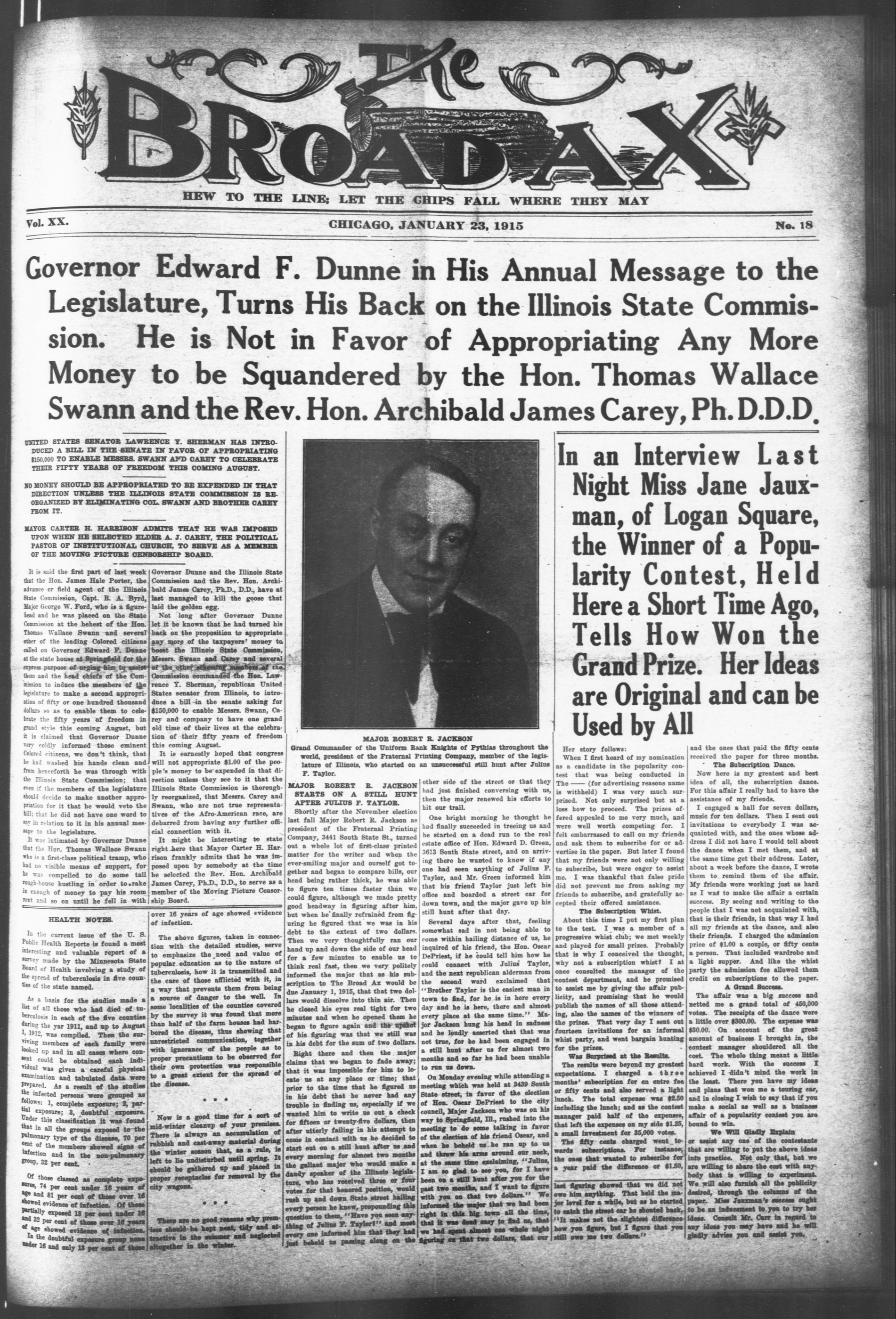
Governor Edward F. Dunne in His Annual Message to the Legislature, Turns His Back on the Illinois State Commission. He is Not in Favor of Appropriating Any More Money to be Squandered by the Hon. Thomas Wallace Swann and the Rev. Hon. Archibald James Carey, Ph.D.D.D.
UNITED STATES SENATOR LAWRENCE Y. SHERMAN HAS INTRODUCED A BILL IN THE SENATE IN FAVOR OF APPROPRIATING $150,000 TO ENABLE MESSRS. SWANN AND CAREY TO CELEBRATE THEIR FIFTY YEARS OF FREEDOM THIS COMING AUGUST.
NO MONEY SHOULD BE APPROPRIATED TO BE EXPENDED IN THAT DIRECTION UNLESS THE ILLINOIS STATE COMMISSION IS BE-ORGANIZED BY ELIMINATING COL. SWANN AND BROTHER CAREY FROM IT.
MAYOR CARTER H. HARRISON ADMITS THAT HE WAS IMPOSED UPON WHEN HE SELECTED ELDER A. J. CAREY, THE POLITICAL PASTOR OF INSTITUTIONAL CHURCH, TO SERVE AS A MEMBER OF THE MOVING PICTURE CENSORSHIP BOARD.
Vol. XX.
Governor
Legislation.
Money
Swanna
UNITED STATES SENATOR LAWYER
DUCED A BILL IN THE SENATE
$150,000 TO ENABLE MESSERS, SW
THEIR FIFTY YEARS OF FREE
NO MONEY SHOULD BE APPROPRIED
DIRECTION UNLESS THE ILL
ORGANIZED BY ELIMINATING O
FROM IT.
MAYOR CARTER H. HARRISON A
UPON WHEN HE SELECTED EL
PASTOR OF INSTITUTIONAL C
OF THE MOVING PICTURE OEN
It is said the first part of last week that the Hon. James Hale Porter, the advance or field agent of the Illinois State Commission, Capt. R. A. Byrd, Major George W. Ford, who is a figurehead and he was placed on the State Commission at the behest of the Hon. Thomas Wallace Swann and several other of the leading Colored citizens called on Governor Edward F. Dunn at the state house at Springfield for the express purpose of urging him to assist them and the head chiefs of the Commission to induce the members of the legislature to make a second appropriation of fifty or one hundred thousand dollars so as to enable them to celebrate the fifty years of freedom in grand style this coming August, but it is claimed that Governor Dunne very coldly informed those eminent Colored citizens, we don't think, that he had washed his hands clean and from henceforth he was through with the Illinois State Commission; that even if the members of the legislature should decide to make another appropriation for it that he would veto the bill; that he did not have one word to say in relation to it in his annual message to the legislature.
It was intimated by Governor Dunne that the Hon. Thomas Wallace Swann who is a first-class political tramp, who had no visible means of support, for he was compelled to do some tall rough-house hustling in order to rake in enough of money to pay his room rent and so on until he fell in with
HEALTH NOTES
In the current issue of the U. S. Public Health Reports is found a most interesting and valuable report of a survey made by the Minnesota State Board of Health involving a study of the spread of tuberculosis in five counties of the state named.
As a basis for the studies made a list of all those who had died of tuberculosis in each of the five counties during the yar 1911, and up to August 1, 1912, was compiled. Then the surviving members of each family were looked up and in all cases where consent could be obtained each individual was given a careful physical examination and tabulated data were prepared. As a result of the studies the infected persons were grouped as follows: 1, complete exposure; 2, partial exposure; 3, doubtful exposure. Under this classification it was found that in all the groups exposed to the pulmonary type of the disease, 70 per cent of the members showed signs of infection and in the non-pulmonary group, 32 per cent.
Of those classed as complete exposures, 74 per cent under 16 years of age and 81 per cent of those over 16 showed evidence of infection. Of those partially exposed 18 per cent under 16 and 32 per cent of those over 16 years of age showed evidence of infection. In the doubtful exposure group none under 16 and only 18 per cent of those
Governor Dunne and the Illinois State Commission and the Rev. Hon. Archibald James Carey, Ph.D., D.D., have at last managed to kill the goose that laid the golden egg.
Not long after Governor Dunne let it be known that he had turned his back on the proposition to appropriate any more of the taxpayers' money to boost the Illinois State Commission, Messrs. Swann and Carey and several of the other scheming members of the Commission commanded the Hon. Lawrence Y. Sherman, republican United States senator from Illinois, to introduce a bill in the senate asking for $150,000 to enable Messrs. Swann, Carey and company to have one grand old time of their lives at the celebration of their fifty years of freedom this coming August.
It is earnestly hoped that congress will not appropriate $1.00 of the people's money to be expended in that direction unless they see to it that the Illinois State Commission is thoroughly reorganized, that Messrs. Carey and Swann, who are not true representatives of the Afro-American race, are debarred from having any further official connection with it.
It might be interesting to state right here that Mayor Carter H. Harrison frankly admits that he was imposed upon by somebody at the time he selected the Rev. Hon. Archibald James Carey, Ph.D., D.D., to serve as a member of the Moving Picture Censorship Board.
over 16 years of age showed evidence of infection.
The above figures, taken in connection with the detailed studies, serve to emphasize the need and value of popular education as to the nature of tuberculosis, how it is transmitted and the care of those afflicted with it, in a way that prevents them from being a source of danger to the well. In some localities of the counties covered by the survey it was found that more than half of the farm houses had harbored the disease, thus showing that unrestricted communication, together with ignorance of the people as to proper precautions to be observed for their own protection was responsible to a great extent for the spread of the disease.
Now is a good time for a sort of mid-winter cleanup of your premises. There is always an accumulation of rubbish and cast-away material during the winter season that, as a rule, is left to lie undisturbed until spring. It should be gathered up and placed in proper receptacles for removal by the city wagons.
CHICAGO, JANUARY 23, 1915
M.
MAJOR ROBERT R. JACKSON
Grand Commander of the Uniform Rank Knights of Pythias throughout the world, president of the Fraternal Printing Company, member of the legislature of Illinois, who started on an unsuccessful still hunt after Julius F. Taylor.
MAJOR ROBERT R. JACKSON
STARTS ON A STILL HUNT
APTER JULIUS F. TAYLOR.
other side of the street or that they had just finished conversing with us then the major renewed his efforts to
Shortly after the November election last fall Major Robert R. Jackson as president of the Fraternal Printing Company, 3441 South State St., turned out a whole lot of first-class printed matter for the writer and when the ever-smiling major and yourself got together and began to compare bills, our head being rather thick, he was able to figure ten times faster than we could figure, although we made pretty good headway in figuring after him, but when he finally refrained from figuring he figured that we was in his debt to the extent of two dollars. Then we very thoughtfully ran our hand up and down the side of our head for a few minutes to enable us to think real fast, then we very politely informed the major that as his subscription to The Broad Ax would be due January 1, 1915, that that two dollars would dissolve into thin air. Then he closed his eyes real tight for two hours and when he opened he began to figure again and the upshot of his figuring was that we still was in his debt for the sum of two dollars.
Right there and then the major claims that we began to fade away; that it was impossible for him to locate us at any place or time; that prior to the time that he figured us in his debt that he never had any trouble in finding us, especially if we wanted him to write us out a check for fifteen or twenty-five dollars, then after utterly failing in his attempt to come in contact with us he decided to start out on a still hunt after us and every morning for almost two months the gallant major who would make a dandy speaker of the Illinois legislature, who has received three or four votes for that honored position, would rush up and down State street hailing every person he knew, propounding this question to them, "Have you seen anything of Julius F. Taylor?" and most every one informed him that they had just behold us passing along on the
other side of the street or that they had just finished conversing with us, then the major renewed his efforts to hit our trail.
One bright morning he thought he had finally succeeded in treeing us and he started on a dead run to the real estate office of Hon. Edward D. Green, 3613 South State street, and on arriving there he wanted to know if any one had seen anything of Julius F. Taylor, and Mr. Green informed him that his friend Taylor just left his office and boarded a street car for down town, and the major gave up his still hunt after that day.
Several days after that, feeling somewhat sad in not being able to come within hailing distance of us, he inquired of his friend, the Hon. Oscar DePriest, if he could tell him how he could connect with Julius Taylor, and the next republican alderman from the second ward exclaimed that "Brother Taylor is the easiest man in town to find, for he is in here every day and he is here, there and almost every place at the same time." Major Jackson hung his head in sadness and he loudly asserted that that was not true, for he had been engaged in a still hunt after us for almost two months and so far he had been unable to run us down.
On Monday evening while attending a meeting which was held at 3439 South State street, in favor of the election of Hon. Oscar DePriest to the city council, Major Jackson who was on his way to Springfield, III, rushed into the meeting to do some talking in favor of the election of his friend Oscar, and when he behold he he ran up to us and throw his arms around our neck, at the same time exclaiming, "Julius, I am so glad to see you, for I have been on a still hunt after you for the past two months, and I want to figure with you on that two dollars." We informed the major that we had been right in this big town all the time, that it was dead easy to find us, that we had spent almost one whole night figuring on that two dollars, that our
In an Interview Last Night Miss Jane Jauxman, of Logan Square, the Winner of a Popularity Contest, Held Here a Short Time Ago, Tells How Won the Grand Prize. Her Ideas are Original and can be Used by All
Her story follows:
When I first heard of my nomination as a candidate in the popularity contest that was being conducted in The —— (for advertising reasons name is withheld) I was very much surprised. Not only surprised but at a loss how to proceed. The prizes offered appealed to me very much, and were well worth competing for. I felt embarrassed to call on my friends and ask them to subscribe for or advertise in the paper. But later I found that my friends were not only willing to subscribe, but were eager to assist me. I was thankful that false pride did not prevent me from asking my friends to subscribe, and gratefully accepted their offered assistance.
About this time I put my first plan to the test. I was a member of a progressive whist club; we met weekly and played for small prizes. Probably that is why I conceived the thought, why not a subscription whist? I at once consulted the manager of the contest department, and he promised to assist me by giving the affair publicity, and promising that he would publish the names of all those attending, also the names of the winners of the prizes. That very day I sent out fourteen invitations for an informal whist party, and went bargain hunting for the prizes.
Was Surprised at the Results.
The results were beyond my greatest expectations. I charged a three months' subscription for an entire fee or fifty cents and also served a light lunch. The total expense was $2.50 including the lunch; and as the contest manager paid half of the expenses, that left the expenses on my side $1.25, a small investment for 35,000 votes.
The fifty cents charged went towards subscriptions. For instance, the ones that wanted to subscribe for a year paid the difference or $1.50.
last figuring showed that we did not owe him anything. That held the major loyal for a while, but as he started to catch the street car he shouted back, 'It makes not the slightest difference how you figure, but I figure that you still owe me two dollars.'
No.18
age to the Commis- Any More Wallace, Ph.D.D.D. View Last Jane Jaux- ogan Square, or of a Popu- test, Held Short Time Ago, Won the e. Her Ideas real and can be
and the ones that paid the fifty cents received the paper for three months. The Subscription Dance. Now here is my greatest and best idea of all, the subscription dance. For this affair I really had to have the assistance of my friends. I engaged a hall for seven dollars, music for ten dollars. Then I sent out invitations to everybody I was acquainted with, and the ones whose address I did not have I would talk about the dance when I met them, and at the same time get their address. Later, about a week before the dance, I wrote them to remind them of the affair. My friends were working just as hard as I was to make the affair a certain success. By seeing and writing to the people that I was not acquainted with, that is their friends, in that way I had all my friends at the dance, and also their friends. I charged the admission price of $1.00 a couple, or fifty cents a person. That included wardrobe and a light supper. And like the whist party the admission fee allowed them credit on subscriptions to the paper. A Grand Success
The affair was a big success and netted me a grand total of 450,000 votes. The receipts of the dance were a little over $300.00. The expense was $30.00. On account of the great amount of business I brought in, the contest manager shouldered all the cost. The whole thing meant a little hard work. With the success I achieved I didn't mind the work in the least. There you have my ideas and plans that won me a touring car, and in closing I wish to say that if you make a social as well as a business affair of a popularity contest you are bound to win.
We Will Gladly Explain or assist any one of the contestants that are willing to put the above ideas into practice. Not only that, but we are willing to share the cost with anybody that is willing to experiment. We will also furnish all the publicity desired, through the columns of the paper. Miss Janxman's success ought to be an inducement to you to try her ideas. Consult Mr. Carr in regard to any ideas you may have and he will closely advise you and assist you.
---
The KITCHEN CUPBOARD
BREAKFAST MENU.
Steamed Prunes.
Oatmeal.
Larded Liver.
Toast. Jam or Jelly.
Coffee or Tea.
LIVER is a staple breakfast food, though it gives savor to the mid-day meal as well.
Liver With Toast.—Chop up the liver, mix with some sweet herbs, a little minced onion and salt pork and two or three tablespoonfuls of breadcrumbs. Put all together in a crock, dredge with flour, cover and set in a slow oven for an hour and a half. Remove to a heated dish and serve with toast points and parsley border.
With Piquant Sauce.
Larded Liver.—Take a fresh liver and lard it with fat bacon. Make a pickle of vinegar, sliced onion, thyme, parsley, bay leaf, half a bud of garlic, salt and pepper and put liver into it. Let it stand for twenty-four hours, drain and place in the oven in a buttered roasting pan. Baste with the strained pickle juice. When done place on platter and cover with sauce piquante, made as follows:
Put into a saucepan two ounces of butter, a sliced carrot and six sliced shallots. Add a bunch of savory herbs, half a bay leaf, pepper, salt and a thin slice of lean ham. Let simmer until they form a brown glaze, then add four tablespoonfuls of vinegar and half a pint of good stock, with a lump of sugar. Simmer, skim off fat, strain and when very hot serve with the liver.
An Elaborate Dish.
Braised Liver.—Take one calf's liver, one onion, one stalk of celery, two sprigs of parsley, one pint of stock or water, one tablespoonful of mushroom ketchup, one carrot, one bay leaf, one turnip, quarter pound of larding pork, one tablespoonful of butter, one tablespoonful of Worcestershire sauce, one tablespoonful of flour. Wash the liver and lard it the same as a fillet of beef. Wash and cut the vegetables into slices and put them in the bottom of a braising pan if you have one, if not in a deep baking pan. Lay the liver on the bed of vegetables, add the stock or water, put a lid over the pan and bake in a moderate oven for two hours. When done put liver on a dish. Put the butter in a frying pan, stir it over the fire until a nice brown, add the flour, mix and strain the liquor from the other pan into this, which should be about a half pint. Stir continually until it bolls, then add the Worcestershire sauce and mushroom ketchup. Pour over and around the liver and serve.
Anna Thompson.
The KITCHEN
CUPBOARD
THESE dalinity desserts may be prepared with almost any fruit. When fresh fruit cannot be had canned fruit may be substituted. Pineapple Charlotte-Take one cupful of heavy cream and whip it until very stiff, add one-half cupful of powdered sugar, the stiffly beaten white of an egg, one-half cupful of grated pineapple, two teaspoonfuls of lemon juice and a little of the grated yellow rind. Line a mold with sponge or other small cakes, fill with the cream and chill on ice.
A Homely Dish.
Apple Charlotte With Raisins—Get a pan of the right size, put a tablespoonful of butter in pan, put in a layer of buttered toast and then a layer of sliced apples; sprinkle with sugar and grated nutmeg; then add a layer of raisins. Repeat until dish is full, with buttered toast on top. Beat one or two eggs, add two cupfuls of milk and pour over all. Bake until apples are cooked. Serve with cream and sugar.
An Ornamental Dessert
Orange Charlotte.—Take half a box of gelatin, pour over it half a cupful of cold water and soak half an hour. Then pour over it a cupful of boiling water, adding the juice of a lemon, a cupful of orange juice and a little of the yellow part of the rind grated. Whip to a foam a pint of cream and add to the gelatin mixture. Continue to beat until it thickens and then turn into a glass or china mold lined with sections of sweet orange.
Dainty and Sweet.
Maple Charlotte.—Take one-half ounce gelatin. Soak in cold water. Dissolve by standing it over hot water. Put three tablespoonfuls of grated maple sugar in a saucepan, stir it melted, add one pint of cream. Let the mixture boll gently to a creamy thickness, cool slightly, add yolk of three eggs, four tablespoonfuls of maple sugar, one teaspoonful vanilla, two tablespoonfuls of cold milk beaten till light. Stir in gelatin, set aside to get cold. Line a mold with sponge cake cut in slices. Four in the cream and cover the top of the mold with this sliced of cake, garnish with spun maple sugar and whipped sweetened cream poured over top of cake. This dessert should stand two hours on ice before serving.
Anna Thompson.
The KITCHEN CUPBOARD
COOKING AU GRATIN.
DISHES cooked in this style are delicious. It is a simple yet satisfactory way of using left over foods like cold potatoes or vegetables. Eggs au Gratin.-Cut six hard cooked eggs into halves lengthwise and place in a circle around dish. Prepare a sauce as follows: Melt one tablespoonful of butter, add one tablespoonful of flour, one-half teaspoonful of salt, a dash of cayenne pepper, one-half teacupful of water, same amount of cream, two tablespoonfuls of grated cheese. Boll for two or three minutes; add two raw egg yolks. Mix well and pour at once over the eggs. Sprinkle with buttered cracker crumbs and brown in a quick oven.
A Meat Economy.
Kidneys and Onion au Gratin.—Take three or four onions and the same number of sheep's kidneys. Cut the tops off the onions and put them into a saucepan of boiling water with salt. Put the lid on the pan and boil the contents for one and a quarter hours; then take up, remove the skins and slip the center of the onion out. Cut the kidneys in two lengthways. Season with pepper, salt and a piece of butter and put half into each onion. Set the onions on a greased tin with the onions sideways to prevent the juice from the kidneys escaping. Chop the onion centers finely and put as much as possible back into the ends of the onions. Scatter breadcrumbs over all thickly and bake slowly until the onions appear to be thoroughly done.
Novel Way of Using Noodles.
Noodles au Gratin.—Prepare a fairly stiff but smoothly kneaded paste with one-half pound flour, one-half ounce butter, three yolks of eggs and a pinch of salt. Allow the paste to stand for at least one hour; then roll out as thinly as possible. Fold the pieces (rolled out) and cut the paste crossways into narrow strips about one-eighth of an inch wide. Loosen the strips (shake them up and dredge with a little flour). Put the noodles into a pan of fast boiling salted water and boil for about eight minutes; then drain and let cool. Butter a baking dish, spread with a little white sauce, then a layer of noodles, sprinkle some grated cheese in next and a few drops of melted butter. Cover with sauce and continue thus until the noodles are used up. See that the last layer is well masked with white sauce, sprinkle over with bread-crumbs, place a few tiny bits of butter here and there on top of the crumbs and bake in a quick oven for ten minutes. The dish is then ready for serving.
Anna Thompson.
The KITCHEN
CUPBOARD
DO YOU LIKE FISH?
BREAKFAST MENU.
Baked Apples. Broiled Mackerel.
Boiled Rice. Wheat Muffins.
Coffee.
A GREAT variety of fish is now in the market. So wide is the choice that it seems almost any one ought to be suited. Some ways of cooking the season's fish are suggested.
Baked Fish.
Baked Perch.-Take a dripping pan, put in a row of salt pork sliced thin, cover with perch, put in a little pepper, then another row of salt pork over the perch and keep it up till the pan is half full. Add a little salt on the top.
Baked Pickler.-Remove the backbone and all the small bones which can be removed without tearing the flesh too much or getting the fish out of shape. Brush the fish with lemon juice and olive oil and let it stand about an hour. Then put very thin slices of pork across a rack in a dripping pan and place the fish skin side down over the pork. Brush with "tried out" pork and bake in a covered pan for forty minutes. Baste it once or twice while cooking and serve with hollandaise sauce or if preferred with maître d'hotel butter.
Cooked With Vegetables.
Halibut With Tomatoes.—Take the required amount of halibut steak and put into a buttered pan. Arrange pieces of tomato to cover it and put on top of the tomatoes plenty of green peppers sliced rather thin. Season with salt and pepper and pour over all one-fourth cupful of melted butter. Bake in hot oven thirty minutes, basting frequently. A garnish of sliced hard boiled eggs may be added.
Broiled Spanish Mackerel. — Clean thoroughly, split down the back and remove the backbone. Broil over a clear fire on a well greased wire broiler for ten minutes, flesh side down; then turn for one minute on the skin side. Remove to a hot platter. Season with salt, pepper and butter or with maitre d'hotel butter and garnish with parsley. Make the maitre d'hotel butter by creaming one tablespoonful of butter in a bowl and adding slowly one tablespoonful of lemon juice, half a teaspoonful of salt, half a saitspoonful of pepper and one teaspoonful of finely chopped parsley.
THE BROAD AX, CHICAGO, JANUARY 23, 1915.
The KITCHEN CUPBOARD
LUNCHEON MENU.
Casserole of Lamb With Vegetables.
Bolled Potatoes.
Celery Salad.
Cocos. Brown Betty.
RECIPES for lamb, served in ways suitable for luncheon and tea. are suggested here:
Casserole of Lamb and Vegetables.—Take two pounds neck of lamb, one ounce butter or drippings, one onion, stock, one teacupful green peas, one dozen small carrots, two or three turnips and seasoning. Melt the butter in the casserole and fry the onion slightly. Cut the lamb into neat pieces and fry these also. Cover with stock and allow to simmer for one and a half hours. Add the vegetables the last half hour. These should be cut into neat cubes and strips. Thicken the gravity just before serving with a tablespoonful of flour smoothed free from lumps with a little cold water. Sprinkle the top with a little chopped parsley and serve in the casserole.
This For Luncheon.
Lamb In Aspic.—Prepare an aspic jelly in the usual manner. Pour a portion of it in the bottom of a plain mold and decorate the bottom and sides with evenly cut slices of hard boiled eggs, sprigs of parsley and slices of lamb; then fill the mold with the remaining aspic and set on ice until firm. Turn out on a chilled platter and surround with lemon cups filled with new peas molested with French dressing. Stuffed Lamb.—When buying a leg of lamb ask the butcher to remove the bone so that a pocket is left to stuff. It does not roast so dry as the shoulder and is in many ways a better cut of meat. A good stuffing is made as follows: Take stale bread and molsten with hot water until it is soft, pouring off the water. Add a well beaten eggs, salt, pepper and sage to taste. Fill the cavity and sew it up. Bake for an hour or two according to size.
A Novel Stew.
Lamb Stew With Vegetables.—Take two pounds of lamb, two quarts of canned string beans and one pound of canned tomatoes. Take beans and cut in four pieces long section and cross section; cut the meat in small pieces, wash it first and then put in your cooking pan; add four glasses of water and cook until it is half done; then put your string beans in it and four good sized onions cut into small pieces; then cut your tomatoes and put in; put on enough hot water to cover and let cook until well done; you can salt to suit taste. When cooked mix and serve.
Anna Thompson.
The KITCHEN CUPBOARD
BANANA DESSERTS.
BANANAS make convenient winter desserts. They are easily prepared and delicious. The addition of lemon juice, oranges, grape fruit or the fruit flavors from canned fruits make it possible to vary the desserts to suit the taste.
These Are Tart.
Lemon Bananas.-Take four large, ripe bananas, slice in a glass dish and squeeze the juice of a lemon over them. Then add one gill of water and a half cupful of sugar. Let stand half an hour in a cold place before serving.
Sliced Bananas With Cranberries.—Take two bananas, one cupful strained cranberries, one-fourth cupful sugar and one cupful of water. Boll sugar and water for five minutes, add cranberries, remove from the fire and cool. Skin, scrape and slice the bananas into ice cream glasses or a glass bowl and strain the cranberries over top. Bananas and Grapefruit.-Slice and chill bananas. Then place in tall glasses, cover thickly with powdered sugar and pour over them the juice of grapefruit. Let them stand an hour or more before serving if possible. No cream or lemon will be required with this dessert.
Flavored With Fruit Juice.
Banana Cream With Raspberry Sauce.-Peel and crush two large bananas, add two teaspoonfuls lemon juice and two-thirds cupful of powdered sugar. Beat thoroughly. Beat white of one egg until light and fuzzy. Add one-third cupful of grated coconut, fold in one-half pint of beany cream beaten until stiff and serve cold. To make the sauce, thicken one cupful of raspberry juice with one teaspoonful arrowroot and sweeten to taste.
Bananas Filled With Cream.—Remove one section of the peel from as many bananas as are to be served. Take out the pulp and force through vegetable ricer. For six bananas allow one cupful powdered sugar, one cupful of thick cream, one-third cupful of sweet milk beaten together and one tablespoonful of lemon juice. Fill the banana skins and put on the section that was removed. Set the stuffed fruit in a tin pail, put on cover and pack in equal parts salt and ice. After being packed one and one-half hours they will be ready to serve.
The KITCHEN CUPBOARD
BEAN SOUPS.
BEAN SOUPS are considered nutritious. Made with a rich stock and thickened with beans, these soups are substantial dishes for cold weather.
Baked Bean Soup.-Put in saucepan a cupful of cold baked beans, two cupfuls water and two slices of onion, bring to the boiling point and simmer half an hour. Rub through a sleeve and add one-half cupful stewed and strained tomatoes, two teaspoonfuls each of butter and flour, one teaspoonful chili sauce. Season to taste with salt and pepper. Served with bread or crackers and followed by a light dessert, it provides a cheap and satisfying lunch.
Made With Red Beans.
Bean Chowder.—Wash well one cupful of red beans. Soak over night in a quart of cold water. In the morning add a whole onion and stew until the beans are tender. Add water as they cook to keep the quantity first added. When beans are tender add medium sized diced potatoes, half a pint of strained tomatoes and half a cupful of broken macaroni. Boll for about an hour. Season with salt and pepper. Add diced fried bacon and one table-spoonful bacon fat. Then serve.
Flavored With Herbs.
Kidney Bean Soup.—Take two cupfuls cold kidney beans, four cupfuls stock of water, one tablespoonful grated onion, one tablespoonful butter, one teaspoonful salt, one teaspoonful thyme, one-fourth teaspoonful white pepper, one teaspoonful chopped parsley and a dash of paprika. Put the kidney beans on to boil with the stock or water; boil twenty minutes, mash and strain. Return to the boiler, add the onion, butter, salt, pepper, paprika, parsley and thyme; boil a couple of minutes and serve. If not thick enough add one tablespoonful flour mixed with a little cold water.
Soup of the Fatherland.
German Bean Soup.—Take one cupful of beans, two cupfuls of water, one small onion, one medium sized potato, two tablespoonfuls of butter, two teaspoonfuls of salt, pepper to taste and water as needed. Soak beans over night in a pint of water; in the morning pour off. Measure the beans after they have expanded, add same amount of water, the potato cut into small cubes, the minced onion and boil until tender. When ready to serve add the butter and seasoning. If too thick a little more water can be added. Many like a little vinegar in bean soup, but this may be added at table by each according to taste.
Anna Thompson.
The KITCHEN GUPBOARD
CRANBERRY PIES.
DINNER MENU.
Cream of Asparagus Soup.
Veal Stew. Riced Potatoes.
Peas With Butter Balls.
Watercress.
Cranberry Pie. Small Cakes.
Coffee.
WHEN they are in season one should eat of cranberries as often as possible. A good way to use them is in pies. There are several sorts of cranberry ple.
Topped With Cream.
Jellied Cranberry Pie.—Bake a crust on an inverted agate pie tin. When baked fill with jellied cranberry sauce, on which pie whipped cream, sweetened, and just a suggestion of vanilla. Cranberry and Raisin Pie.—Cover the bottom of a pie pan with a plain paste, reserving enough for an upper crust. Make a rim around the edge and pour in a filling made with a cupful of cranberries cut into halves, half a cupful of chopped, seeded raisins, three-fourths of a cupful of sugar, a tablespoonful of cornstarch and lump of butter. Cover with the upper crust and bake in the oven.
A. Good Imitation.
Mock Cherry Pie. -Take two large cupfuls of cut cranberries, a cupful of cut raisins, two cupfuls of sugar, two cupfuls of boiling water, two tablespoonfuls of flour, butter size of a walnut and a dessertspoonful of vanilla. Mix flour with sugar, add boiling water; then add fruit, then butter. Stir until it comes to a boil. Add vanilla. Put in crusts for two pies.
Old Fashioned Pie.
Latticed Cranberry Pie.—Line a deep pie plate with rich puff paste. Stew three cupfuls of cranberries with a cupful and a half of sugar, and when they are tender stir with a wooden spoon until all the cranberry skins are broken. Pour this mixture into the pastry shell. Roll out some paste and cut it into six strips half an inch wide and the length of the pie pan's diameter. Cut another strip big enough to reach around the pan. Arrange three strips one way of the pie and three strips across them to form diamonds. Arrange the seventh strip around the edge of the pie over the others. Best an egg and mix it with a little milk. Wash the strips of crust with this and bakes the pie in a quick oven until the crust is brown.
The KITCHEN CUPBOARD
WHEN YOU SERVE BACON.
BREAKFAST MENU.
White Grapes. Cereal.
Fried Eggs With Bacon.
Toast. Coffee.
BACON would be more popular
were it served in a greater vari-
ety of ways. It may be cooked
alone or combined with other foods
with success.
Cooked With Eggs.
Fried Eggs With Bacon.—Take four eggs, four slices of bacon, four sprigs of parsley. Put the bacon in a hot pan, keep turning all the time and remove the drippings. When the bacon is crisp remove from pan and put in the eggs, reducing the heat. The eggs must fry slowly. When done on one side or both sides put on hot platter. Garnish with bacon and parsley.
A Tempting Dish.
Bacon and Egg Balls.-Have some hot fat in a deep pan. The temperature should be that necessary for fritters. Stir it until it whirls around quickly. Now break an egg into this miniature whirlpool and keep the fritter turning with the stick till the egg is of the consistency of a poached one and quite round; then lift it out and lay it in a hot dish. Let the dish lean toward the fire to keep the eggs hot. Do as many more as you require in the same way. They will keep hot and soft in the dish before the fire for quite half an hour. Serve either on a square of fried bacon placed on a fried crouton or on a dish with little curls of fried bacon between.
Delicious With Cream.
Creamed Bacon on Toast.—Take half a pound of thinly sliced bacon, a cupful of milk, a tablespoonful of flour, four pieces of toast, four sprigs of parsley. Put the bacon in a hot frying pan and fry until crisp. Drain off nearly all the drippings, sprinkle with flour and mix. Then add the cold mills slowly. Boll three minutes slowly. Stir quite often. Serve on toast garl pushed with parsley.
Served With Sauce.
Fried Bacon With Cream Sauce.—Slice bacon thin and put into hot frying pan, keep turning until brown, but not hard. Remove, put on slices of toast. Put a tablespoonful of flour into the pan with bacon fat, mix until smooth, put over fire. Add a cupful of cold milk and boll two minutes, adding a little pepper and salt. Stir until smooth and creamy. Pour over the bacon and garnish with a little chopped parsley.
Anna Thompson.
The KITCHEN
GUPBOARD
MEAT pies are popular in England. They are made with any meat and often have a crust of pastry. Those made with beef are the most popular.
Baked Meat Pie—Take one and a half pounds of beef, a quart of cut potatoes, half a cupful of cut onion, half a cupful of finely cut carrot, two tablespoons of finely cut parsley, a teaspoonful of salt, one-third teaspoonful of paprika and a tablespoonful of flour. Wash the meat, cut in small pieces, put into a saucepan, cover with boiling water and boil slowly for two and a half hours; then add the onion, carrot, potatoes, salt, paprika and boil for half an hour. There must be a pint of gravy. Mix the flour with a little cold water, add and boil a few minutes. Line bakepan with crust, pour in the meat and vegetables, cover and brush the top with cold milk and bake for twenty minutes, or until light brown.
Macaroni In This.
Italian Beef Pie. — Take one pound of cooked beef, six ounces of macaroni, one pound of canned tomatoes, a tablespoonful of chopped parsley, two teaspoonfuls of chopped shallot, one and a half ounces of butter, half a pint of stock or water, half an ounce of flour, a tablespoonful of worcester sauce, salt and pepper to taste. Melt butter in frying pan and put in the chopped onion and flour and brown them carefully. Add stock and stir till it bolls, then add sauce. Slice or chop the meat and put in a buttered pie dish a layer of macaroni, meat and parsley. Put tomatoes on top with a bit of butter. Bake for about half an hour.
With Stew Beef.
Beef and Vegetable Pie.—Take about a pound and a half of lean stew beef, a cupful of diced carrots, one-half a cupful of cut onion, a quart of small potatoes, two tablespoonfuls of salt, eighth of a teaspoonful of pepper, two tablespoonfuls of cut parsley. Wipe the meat, cut in small pieces, put in boiler. Add two quarts of boiling water and boil slowly for an hour. Remove four cupfuls of the beef stock for a broth; then add carrots and onion. Boll thirty minutes, add potatoes and seasoning. Boll twenty-five minutes and add parsley. Line bake dish with crust, which has been rolled thin, pour in meat and vegetables, cover top with dough, brush with a little milk and bake in moderate oven.
The KITCHEN CUPBOARD INEXPENSIVE CAKES. CAKES are an indispensable part of the bill of fare.
in indispensable part of
the bill of fare. According to
some authorities, their rich
ingredients are required to round out the
dinner if no other dessert is served.
Some suggestions for cakes that are
inexpensive are given here.
With Sugar and Spice
Spice Cake. - Take two cupfuls of brown sugar creamed with half a cupful of butter, two eggs, a cupful of sour milk, a teaspoonful of soda dissolved in milk, two and a half cupfuls of flour, half a teaspoonful of allspice, a teaspoonful of cinnamon, half a teaspoonful of cloves and the same amount of grated nutmeg.
To make icing for this beat the white of an egg very stiff. Cook a cupful of sugar and half a cupful of water until it threads, add to the white of the egg and beat until thick. Flavor with vanilla.
An Economical Recipe
Gold Cake.-Take three eggs, one and one-quarter cupfuls of sugar, one cupful of milk, two and three-quarter cupfuls of flour, one-half cupful of butter, two teaspoonfuls of baking powder, one teaspoonful of flavoring. Cream sugar and butter. Separate eggs and add beaten yolks to butter and sugar. Sift flour once, measure, add baking powder and sift again. Add milk flour and stiffen beaten whites in order given. Stir until smooth. Bake in loaf.
Dried Apple Cake.-Take two cupfuls of dried apples, soak overnight in enough water to cover them. Later chop fine as raisins and cook until candied in two cupfuls of New Orleans molasses. Make the usual cake mixture; then add the cooled molasses and apples.
For the Coffee Klatch
Coffee Cake.—Take one-half cupful of butter, one cupful of sugar, two eggs, one tablespoonful of molasses, one-half cupful of cold boiled coffee, one and seven-eighth cupfuls of flour, two teaspoonfuls of baking powder, one teaspoonful of cinnamon, one-half teaspoonful of cloves, one-half teaspoonful of mace, three-quarter cupful of raisins, three-quarter cupful of currants, one-quarter cupful of citron Cream butter, add sugar, molasses and beaten egg yolks. Mix and sift dry ingredients three times; add alternately with the coffee to butter and sugar Beat well, add all of the fruit (floured) then fold in white of eggs, beaten stiff Line cake pan with greased paper to prevent the cake cooking too rapidly.
Anna Thompson.
The KITCHEN CUPBOARD
SUPPER MENU.
Bean Salad.
Tomato Jelly.
Bran Bread Sandwiches.
Cheese Sandwiches.
Chestnuts With Cream.
Milk or Cocoa.
CHESTNUTS make delicious desserts or sweetmeats. The recipes given here are simple ones, suggested for those who care for chestnut sweets.
Chestnuts With Whipped Cream. Shell and boil chestnuts until tender, remove skins and rub through colander. Sweeten to taste and beat to a soft paste with a little cream. Form mixture into pyramids in the center of a glass dish and heap with whipped cream.
Dainty Sweetmeats.
Chestnut Mousse- Shell and blanch about two cupfuls of chestnut which have been boiled until tender. Rub the chestnut through a sieve and stir them carefully into a pint of whipped cream to which have been added half a cupful of powdered sugar and a teaspoonful of vanilla extract. Add a teaspoonful of maraschino cordial, turn into a mold and pack away in ice and salt for five hours. Serve with whipped cream.
Glaced Chestnuts.-Slit skins of a quart of chestnuts, roast in frying pan over fire, but do not allow to brown peel when cold and stick a wooden toothpick in each. Boil meantime a pound of loaf sugar and a pint of water until it spins a hair. Dip each nut in the sirup; then stick the ends of picks in a plate of brown sugar to harden.
Another Method.
Marrons Glace.—Select large, perfect chestnuts. Shell and simmer a pint of nuts in boiling water until tender. Drain and toss into cold water to make them firm. Let the chestnuts drain; then turn them on on a cloth and see that each one is dry. A sirup must now be made by boiling a cupful of sugar in a pint of water, and in this simmer the chestnuts for an hour. Drain of the sirup and to it add a few drops of vanilla extract. Then cook it until it becomes brittle when dropped in cold water, as one tries candy. Set the pan of sirup in a larger pan of hot water to keep the hot sirup from cooling and candying and dip in the chestnuts one by one, removing them and placing on oiled paper.
Woman's World
Charming Wife of the New Ambassador to France.
Photo by Clinedinst.
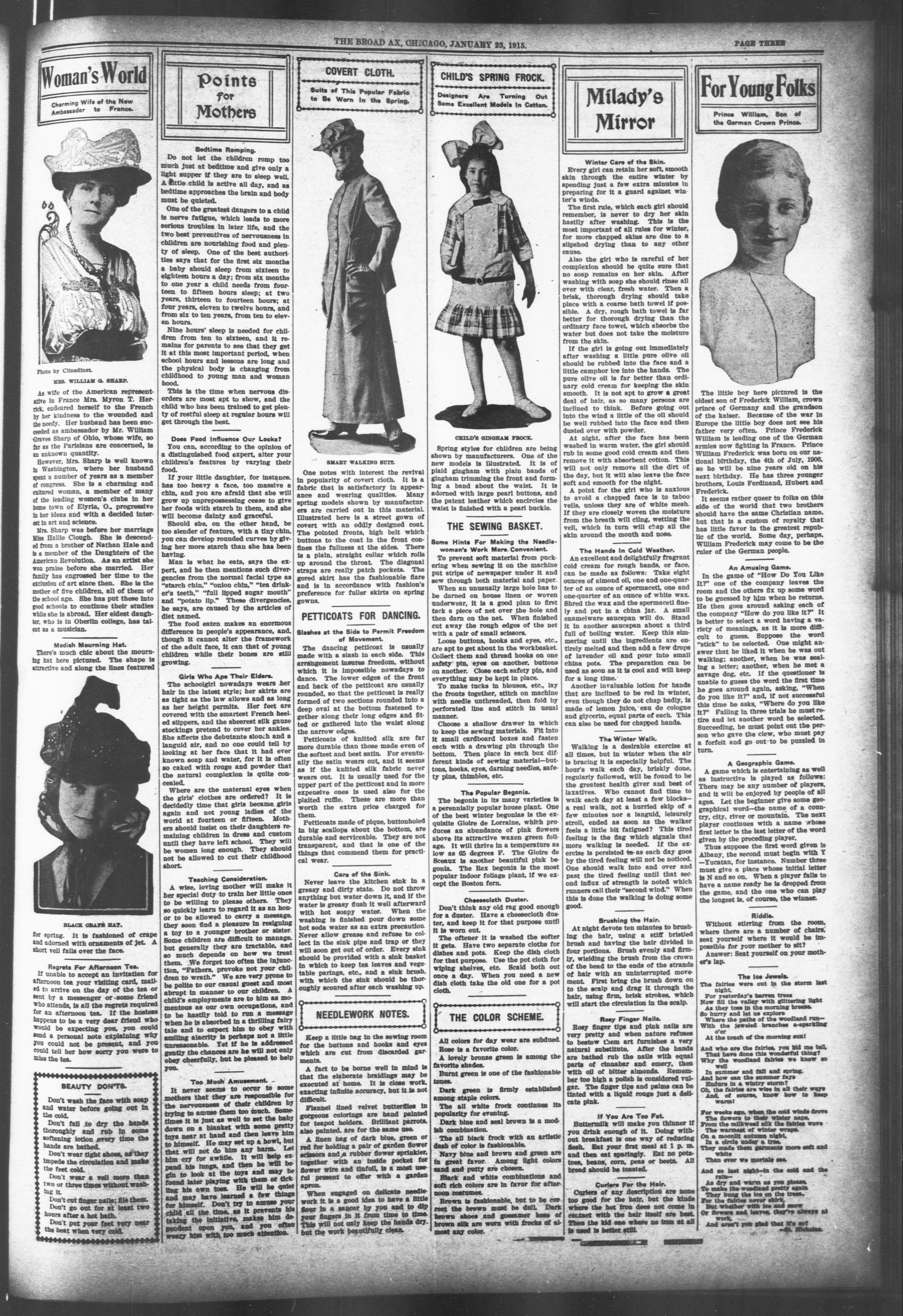
MRS. WILLIAM G. SHARP
As wife of the American representative in France Mrs. Myron T. Herick, endeared herself to the French by her kindness to the wounded and the needy. Her husband has been succeeded as ambassador by Mr. William Graves Sharp of Ohio, whose wife, so far as the Parisians are concerned, is an unknown quantity. However, Mrs. Sharp is well known in Washington, where her husband spent a number of years as a member of congress. She is a charming and cultured woman, a member of many of the leading women's clubs in her home town of Elyria, O., progressive in her ideas and with a decided interest in art and science.
Mrs. Sharp was before her marriage Miss Halle Clough. She is descended from a brother of Nathan Hale and is a member of the Daughters of the American Revolution. As an artist she won praise before she married. Her family has engrossed her time to the exclusion of art since then. She is the mother of five children, all of them the school age. She has put these into good schools to continue their studies while she is abroad. Her eldest daughter, who is in Oberlin college, has talent as a musician.
Medish Mourning Hat.
There's much chic about the mourning hat here pictured. The shape is attractive and along the lines featured
A.
BLACK GRAPE HAT.
for spring. It is fashioned of crape
and adorned with ornaments of jet. A
short vell falls over the face.
Regrets For Afternoon Tea.
If unable to accept an invitation for afternoon tea your visiting card, mailed to arrive on the day of the tea or sent by a messenger or -some friend who attends, all the regrets required for an afternoon tea. If the hostess happens to be a very dear friend who would be expecting you, you could send a personal note explaining why you could not be present, and you could tell her how sorry you were to miss the tea.
BEAUTY DON'TS.
Don't wash the face with soap and water before going out in the cold.
Don't fall to dry the hands thoroughly and rub in some softening lotion every time the hands are bathed.
Don't wear tight shoes, as they impede the circulation and make the feet cold.
Don't wear a veil more than two or three times without washing it.
Don't cut finger nails; file them.
Don't go out for at least two hours after a hot bath.
Don't put your feet very near the heat when very cold.
Points for Mothers
Do not let the children romp too much just at bedtime and give only a light supper if they are to sleep well. A little child is active all day, and as bedtime approaches the brain and body must be quieted.
One of the greatest dangers to a child is nerve fatigue, which leads to more serious troubles in later life, and the two best preventives of nervousness in children are nourishing food and plenty of sleep. One of the best authorities says that for the first six months a baby should sleep from sixteen to eighteen hours a day; from six months to one year a child needs from fourteen to fifteen hours sleep; at two years, thirteen to fourteen hours; at four years, eleven to twelve hours, and from six to ten years, from ten to eleven hours.
Nine hours' sleep is needed for children from ten to sixteen, and it remains for parents to see that they get it at this most important period, when school hours and lessons are long and the physical body is changing from childhood to young man and woman hood. This is the time when nervous disorders are most apt to show, and the child who has been trained to get plenty of restful sleep at regular hours will get through the best.
Does Food Influence Our Looks?
You can, according to the opinion of a distinguished food expert, alter your children's features by varying their food.
If your little daughter, for instance, has too heavy a face, too massive a chin, and you are afraid that she will grow up unprepossessing cease to give her foods with starch in them, and she will become dainty and graceful.
Should she, on the other hand, be too slender of feature, with a tiny chin, you can develop rounded curves by giving her more starch than she has been having.
Man is what he eats, says the expert, and he then mentions such divergencies from the normal facial type as "starch chin," "onion chin," "tea drinker's teeth," "full lipped sugar mouth" and "potato lip." These divergencies, he says, are caused by the articles of diet named.
The food eaten makes an enormous difference in people's appearance, and, though it cannot alter the framework of the adult face, it can that of young children while their bones are still growing.
Girl Who Ape Their Elders.
The schoolgirl nowadays wears her hair in the latest style; her skirts are as tight as the law allows and as long as her height permits. Her feet are covered with the smartest French heeled slippers, and the sheerest silk gauze stockings pretend to cover her ankles. She affects the debutante slouch and a languid air, and no one could tell by looking at her face that it had ever known soap and water, for it is often so caked with rouge and powder that the natural complexion is quite concealed.
Where are the maternal eyes when the girls' clothes are ordered? It is decidedly time that girls became girls again and not young ladies of the world at fourteen or fifteen. Mothers should insist on their daughters remaining children in dress and custom until they have left school. They will be women long enough. They should not be allowed to cut their childhood short.
Teaching Consideration.
A wise, loving mother will make it her special duty to train her little ones to be willing to please others. They so quickly learn to regard it as an honor to be allowed to carry a message, they soon find a pleasure in resigning a toy to a younger brother or sister. Some children are difficult to manage, but generally they are tractable, and so much depends on how we treat them. We forget too often the injunction, "Fathers, provoke not your children to wrath." We are very prone to be polite to our casual guest and most abrupt in manner to our children. A child's employments are to him as momentous as our own occupations, and to be hastily told to run a message when he is absorbed in a thrilling fairy tale and to expect him to obey with smiling alacrity is perhaps not a little unreasonable. Yet if he is addressed gently the chances are he will not only obey cheerfully, but be pleased to help you.
Too Much Amusement
It never seems to occur to some mothers that they are responsible for the nervousness of their children by trying to amuse them too much. Sometimes it is just as well to set the baby down on a blanket with some pretty toys near at hand and then leave him to himself. He may set up a howl, but that will not do him any harm. Let him cry for awhile. It will help expand his lungs, and then he will begin to look at the toys and may be found later playing with them or tickling his own toes. He will be quiet and may have learned a few things for himself. Don't try to amuse your child all the time, as it prevents his taking the initiative, makes him dependent upon you, and you often worry him with too much attention.
THE BROAD AX, CHICAGO, JANUARY 23, 1915
1
SMART WALKING SUIT.
One notes with interest the revival in popularity of covert cloth. It is a fabric that is satisfactory in appearance and wearing qualities. Many spring models shown by manufacturers are carried out in this material. Illustrated here is a street gown of covert with an oddly designed coat. The pointed fronts, high belt which buttons to the coat in the front confines the fullness at the sides. There is a plain, straight collar which rolls up around the throat. The diagonal straps are really patch pockets. The gored skirt has the fashionable flare and is in accordance with fashion's preference for fuller skirts on spring gowns.
PETTICOATS FOR DANCING.
Slashes at the Side to Permit Freedom of Movement.
The dancing petticoat is usually made with a slash in each side. This arrangement insures freedom, without which it is impossible nowadays to dance. The lower edges of the front and back of the petticoat are usually rounded, so that the petticoat is really formed of two sections rounded into a deep oval at the bottom fastened together along their long edges and fitted or gathered into the waist along the narrow edges.
Petticoats of knitted silk are far more durable than those made even of the softest and best satin. For eventually the satin wears out, and it seems as if the knitted silk fabric never wears out. It is usually used for the upper part of the petticoat and in more expensive ones is used also for the plaited ruffle. These are more than worth the extra price charged for them.
Petticoats made of pique, buttonholed in big scallops about the bottom, are durable and serviceable. They are not transparent, and that is one of the things that commend them for practical wear.
Care of the Sink.
Never leave the kitchen sink in a greasy and dirty state. Do not throw anything but water down it, and if the water is greasy flush it well afterward with hot soapy water. When the washing is finished pour down some hot soda water as an extra precaution. Never allow grease and refuse to collect in the sink pipe and trap or they will soon get out of order. Every sink should be provided with a sink basket in which to keep tea leaves and vegetable parings, etc., and a sink brush, with which the sink should be thoroughly scoured after each washing up.
NEEDLEWORK NOTES.
Keep a little bag in the sewing room for the buttons and books and eyes which are cut from discarded garments.
A fact to be borne well in mind is that the elaborate braidings may be executed at home. It is close work, exacting infinite accuracy, but it is not difficult.
Flannel lined velvet butterflies in gorgeous colorings are hand painted for teapot holders. Brilliant parrots, also painted, are for the same use.
A linen bag of dark blue, green or red for holding a pair of garden flower scissors and a rubber flower sprinkler, together with an inside pocket for flower wire and tinfoil, is a most useful present to offer with a garden apron.
When engaged on delicate needlework it is a good idea to have a little flour in a sancer by you and to dip your fingers in it from time to time. This will not only keep the hands dry, but the work beautifully clean.
```markdown
```
CHILD'S GINGHAM FROCK.
Spring styles for children are being shown by manufacturers. One of the new models is illustrated. It is of plaid gingham with plain bands of gingham trimming the front and forming a band about the waist. It is adorned with large pearl buttons, and the patent leather which encircles the waist is finished with a pearl buckle.
THE SEWING BASKET.
Some Hints For Making the Needlewoman's Work More. Convenient.
To prevent soft material from puckering when sewing it on the machine put strips of newspaper under it and sew through both material and paper.
When an unusually large hole has to be darned on house linen or woven underwear, it is a good plan to first tack a piece of net over the hole and then darn on the net. When finished cut away the rough edges of the net with a pair of small scissors.
Loose buttons, hooks and eyes, etc., are apt to get about in the workbasket. Collect them and thread hooks on one safety pin, eyes on another, buttons on another. Close each safety pin, and everything may be kept in place.
To make tucks in blouses, etc., lay the fronts together, stitch on machine with needle unthreaded, then fold by perforated line and stitch in usual manner.
Choose a shallow drawer in which to keep the sewing materials. Fit into it small cardboard boxes and fasten each with a drawing pin through the bottom. Then place in each box different kinds of sewing material—buttons, hooks, eyes, darning needles, safety pins, thimbles, etc.
The Popular Begonia.
The begonia in its many varieties is a perennially popular house plant. One of the best winter begonias is the exquisite Glorie de Lorraine, which produces an abundance of pink flowers above its attractive waxen green foliage. It will thrive in a temperature as low as 65 degrees F. The Glorie de Sceaux is another beautiful pink begonia. The Rex begonia is the most popular indoor foliage plant, if we except the Boston fern.
Cheesecloth Duster:
Don't think any old rag good enough for a duster. Have a cheesecloth duster, and keep it for that purpose until it is worn out. The oftener it is washed the softer it gets. Have two separate cloths for dishes and pots. Keep the dish cloth for that purpose. Use the pot cloth for wiping shelves, etc. Scald both out once a day. When you need a new dish cloth take the old one for a pot cloth.
THE COLOR SCHEME.
All colors for day wear are subdued.
Rose is a favorite color.
A lovely bronze green is among the favorite shades.
Burnt green is one of the fashionable tones.
Dark green is firmly established among staple colors.
The all white frock continues its popularity for evening.
Dark blue and seal brown is a modish combination.
The all black frock with an artistic dash of color is fashionable.
Navy blue and brown and green are in great favor. Among light colors sand and putty are chosen.
Black and white combinations and soft rich colors are in favor for afternoon costumes.
Brown is fashionable, but to be correct the brown must be dull. Dark brown shoes and gossamer hose of brown silk are worn with frocks of almost any color.
Milady's Mirror
Winter Care of the Skin.
Every girl can retain her soft, smooth skin through the entire winter by spending just a few extra minutes in preparing for it a guard against winter's winds.
The first rule, which each girl should remember, is never to dry her skin hastily after washing. This is the most important of all rules for winter, for more chapped skins are due to a slipshod drying than to any other cause.
Also the girl who is careful of her complexion should be quite sure that no soap remains on her skin. After washing with soap she should rinse all over with clear, fresh water. Then a brisk, thorough drying should take place with a coarse bath towel if possible. A dry, rough bath towel is far better for thorough drying than the ordinary face towel, which absorbs the water but does not take the moisture from the skin.
If the girl is going out immediately after washing a little pure olive oil should be rubbed into the face and a little camphor ice into the hands. The pure olive oil is far better than ordinary cold cream for keeping the skin smooth. It is not apt to grow a great deal of hair, as so many persons are inclined to think. Before going out into the wind a little of the oil should be well rubbed into the face and then dusted over with powder. At night, after the face has been washed in warm water, the girl should rub in some good cold cream and then remove it with absorbent cotton. This will not only remove all the dirt of the day, but it will also leave the face soft and smooth for the night.
A point for the girl who is anxious to avoid a chapped face is to taboo vells, unless they are of white mesh. If they are closely woven the moisture from the breath will cling, wetting the vell, which in turn will chap all the skin around the mouth and nose.
The Hands In Cold Weather
An excellent and delightfully fragrant cold cream for rough hands, or face, can be made as follows: Take eight ounces of almond oil, one and one-quarter of an ounce of spermaceti, one and one-quarter of an ounce of white wax. Shred the wax and the spermaceti finely and put in a china jar. A small enamelware saucepan will do. Stand it in another saucepan about a third full of boiling water. Keep this simmering until the ingredients are entirely melted and then add a few drops of lavender oil and pour into small china pots. The preparation can be used as soon as it is cool and will keep for a long time.
Another invaluable lotion for hands that are inclined to be red in winter, even though they do not chap badly, is made of lemon juice, eau de cologne and glycerin, equal parts of each. This can also be used for chapped hands.
The Winter Walk.
Walking is a desirable exercise at all times, but in winter when the air is bracing it is especially helpful. The hour's walk each day, briskly done, regularly followed, will be found to be the greatest health giver and best of laxatives. Who cannot find time to walk each day at least a few blocks—a real walk, not a hurried skip of a few minutes nor a languid, leisurely stroll, ended as soon as the walker feels a little bit fatigued? This tired feeling is the flag which signals that more walking is needed. If the exercise is persisted in as each day goes by the tired feeling will not be noticed. One should walk into and over and past the tired feeling until that second influx of strength is noted which runners call their "second wind." When this is done the walking is doing some good.
Brushing the Hair.
At night devote ten minutes to brushing the hair, using a stiff bristled brush and having the hair divided in four portions. Brush evenly and firmly, wielding the brush from the crown of the head to the ends of the strands of hair with an uninterrupted movement. First bring the brush down on to the scalp and drag it through the hair, using firm, brisk strokes, which will start the circulation in the scalp.
Boss Finger Nails.
Rosy finger tips and pink nails are very pretty and when nature refuses to bestow them art furnishes a very natural substitute. After the hands are bathed rub the nails with equal parts of cinnabar and emery, then with oil of bitter almonds. Remember too high a polish is considered vulgar. The finger tips and palms can be tinted with a liquid rouge just a delicate pink.
If You Are Too Fat
Buttermilk will make you thinner if you drink enough of it. Doing without breakfast is one way of reducing flesh. Eat your first meal at 1 p. m. and then eat sparingly. Eat no potatoes, beans, corn, peas or beets. All bread should be toasted.
Curler For the Hair
Curtlers of any description are none too good for the hair, but the kinds where the hot iron does not come in contact with the hair itself are best. Then the kid one where no iron at all is used is better still.
PAGE THREE
For Young Folks
Prince William, Son of
the German Crown Prince.
```markdown
```
The little boy here pictured is the oldest son of Frederick William, crown prince of Germany and the grandson of the kaiser. Because of the war in Europe the little boy does not see his father very often. Prince Frederick William is leading one of the German armies now fighting in France. Prince William Frederick was born on our national birthday, the 4th of July, 1906, so he will be nine years old on his next birthday. He has three younger brothers, Louis Ferdinand, Hubert and Frederick.
It seems rather queer to folks on this side of the world that two brothers should have the same Christian name, but that is a custom of royalty that has little favor in the greatest republic of the world. Some day, perhaps. William Frederick may come to be the ruler of the German people.
An Amusing Game.
In the game of "How Do You Like It?" one of the company leaves the room and the others fix up some word to be guessed by him when he returns. He then goes around asking each of the company "How do you like it?" It is better to select a word having a variety of meanings, as it is more difficult to guess. Suppose the word "stick" to be selected. One might answer that he liked it when he was out walking; another, when he was sealing a letter; another, when he met a savage dog, etc. If the questioner is unable to guess the word the first time he goes around again, asking, "When do you like it?" and, if not successful this time he asks, "Where do you like it?" Falling in three trials he must retire and let another word be selected. Succeeding, he must point out the person who gave the clew, who must pay a forfeit and go out-to be puzzled in turn.
A Geographic Game.
A game which is entertaining as well as instructive is played as follows: There may be any number of players, and it will be enjoyed by people of all ages. Let the beginner give some geographical word—the name of a country, city, river or mountain. The next player continues with a name whose first letter is the last letter of the word given by the preceding player.
Thus suppose the first word given is Albany, the second must begin with Y—Yucatan, for instance. Number three must give a place whose initial letter is N and so on. When a player fails to have a name ready he is dropped from the game, and the one who can play the longest is, of course, the winner.
Riddle.
Without stirring from the room, where there are a number of chairs, seat yourself where it would be impossible for your mother to sit?
Answer: Seat yourself on your mother's lap.
The Ice Jewels.
Where the paths of the woodland run—
With the jeweled branches a-sparkling
o'er
At the touch of the morning sun!
And who are the fairies, you bid me tell,
That have done this wonderful thing?
Why the woodland fairies we know so
well
Oh, the fairies are wise in all their ways
And, course, know how to keep
warm!
PAGE FOUR
THE BROAD AX
PUBLISHED WEEKLY.
Will promulgate and at all times uphold the true principles of Democracy, but Catholics, Protestants, Princets, Inffidels, Single Taxors, Republicans, or anyone else can have their say, as long as their language is proper and responsibility is fixed.
The Broad AX is a newspaper whose platform is broad enough for all, overclaiming the editorial right to speak its own mind.
Local communications will receive attention. Write only on one side of the paper.
Advertising rates made known on application.
Address all communications to
5027 FEDERAL STREET, CHICAGO, ILL.
PHONE DREXEL 6500.
JULIUS F. TAYLOR, Editor and Publisher
Entered as Second-Class Matter Aug. 18
1908, at the Post Office at Chicago, Illinois
under Act of March 8, 1979.
THE BUDDING OF A SOUTHERN
FLOWER OR RACIAL DISCRIM
INATION IN CHICAGO.
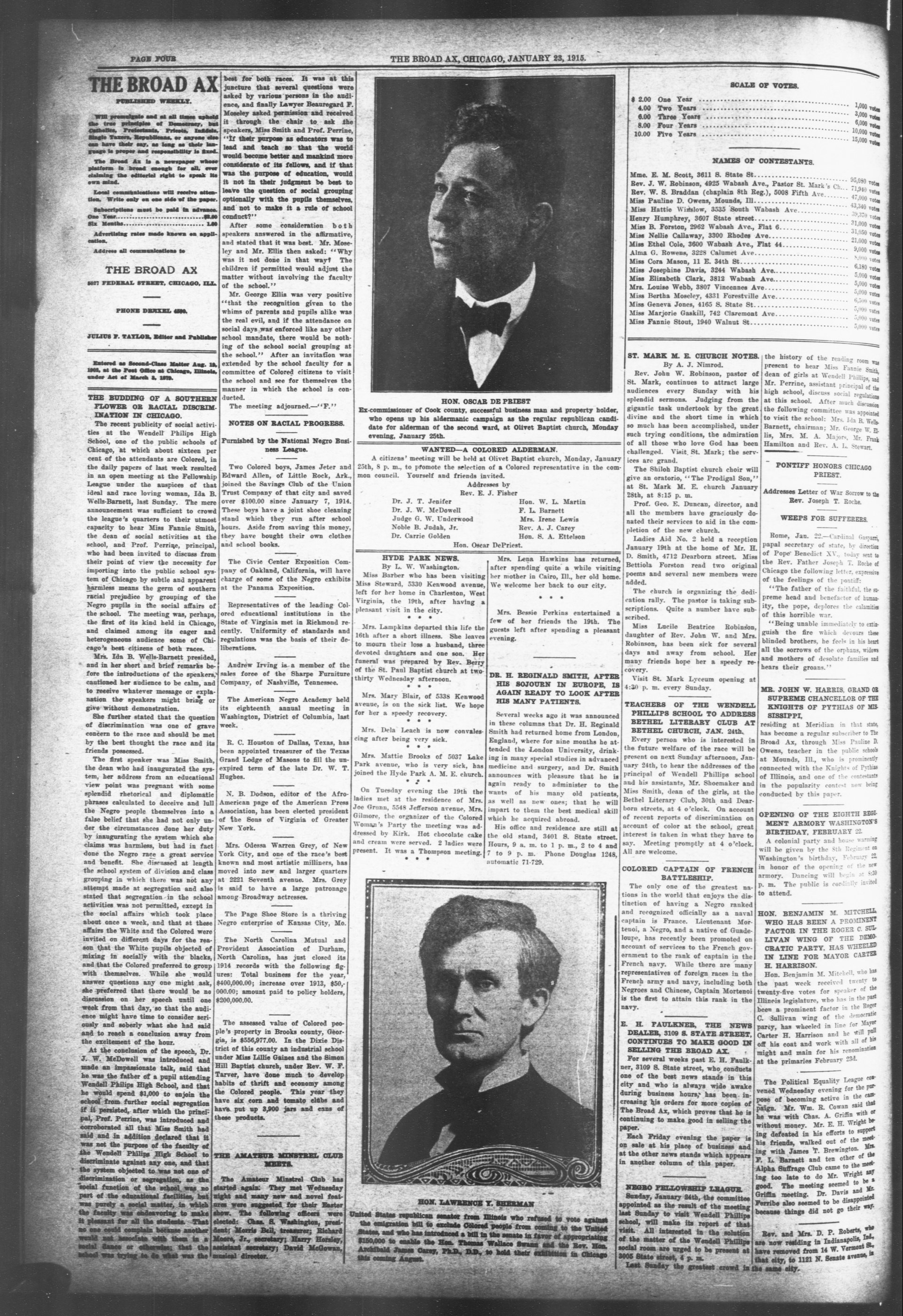
The recent publicity of social activities at the Wendell Phillips High School, one of the public schools of Chicago, at which about sixteen percent of the attendants are Colored, in the daily papers of last week resulted in an open meeting at the Fellowship League under the auspices of that ideal and race loving woman, Ida B. Wells-Barnett, last Sunday. The mere announcement was sufficient to crowd the league's quarters to their utmost capacity to hear Miss Fannie Smith, the dean of social activities at the school, and Prof. Perrine, principal, who had been invited to discuss from their point of view the necessity for importing into the public school system of Chicago by subtle and apparent harmless means the germ of southern racial prejudice by grouping of the Negro pupils in the social affairs of the school. The meeting was, perhaps, the first of its kind held in Chicago, and claimed among its eager and heterogeneous audience some of Chicago's best citizens of both races.
Mri. Ida B. Wells-Barnett presided, and in her short and brief remarks before the introductions of the speakers, cautioned her audience to be calm, and to receive whatever message or explanation the speakers might bring or give without demonstration.
She further stated that the question of discrimination was one of grave concern to the race and should be met by the best thought the race and its friends possessed.
The first speaker was Miss Smith the dean who had inaugurated the system, her address from an educational view point was pregnant with some splendid rhetorical and diplomatic phrases calculated to deceive and lull the Negro people themselves into a false belief that she had not only under the circumstances done her duty by inaugurating the system which she claims was harmless, but had in fact done the Negro race a great service and benefit. She discussed at length the school system of division and class grouping in which there was not any attempt made at segregation and also stated that segregation in the school activities was not permitted, except in the social affairs which took place about once a week, and that at these affairs the White and the Colored were invited on different days for the reason that the White pupils objected of mixing in socially with the blacks, and that the Colored preferred to group with themselves. While she would answer questions any one might ask, she preferred that there would be no discussion on her speech until one week from that day, so that the audience might have time to consider seriously and soberly what she had said and to reach a conclusion away from the excitement of the hour.
At the conclusion of the speech, Dr. J. W. McDowell was introduced and made an impassionate talk, said that he was the father of a pupil attending Wendell Philips High School, and that he would spend $1,000 to enjoin the school from further social segregation if it persisted, after which the principal, Prof. Perrine, was introduced and corroborated all that Miss Smith had said and in addition declared that it was not the purpose of the faculty of the Wendell Philips High School to discriminate against any one, and that the system objected to was not one of discrimination or segregation, as the social function of the school was no part of the educational facilities, but was purely a social matter, in which the faculty was endeavoring to make it pleasant for all the students. That no one could complain because another would not associate with them in a social dance or otherwise; that the school was trying to do what was the
---
best for both races. It was at this juncture that several questions were asked by various persons in the audience, and finally Lawyer Beauregard F. Moseley asked permission and received it through the chair to ask the speakers, Miss Smith and Prof. Perrine, "If their purpose as educators was to lead and teach so that the world would become better and mankind more considerate of its fellows, and if that was the purpose of education, would it not in their judgment be best to leave the question of social grouping optionally with the pupils themselves, and not to make it a rule of school conduct?"
After some consideration both speakers answered in the affirmative, and stated that it was best. Mr. Moseley and Mr. Ellis then asked: "Why was it not done in that way? The children if permitted would adjust the matter without involving the faculty of the school." Mr. George Ellis was very positive "that the recognition given to the whims of parents and pupils alike was the real evil, and if the attendance on social days was enforced like any other school mandate, there would be nothing of the school social grouping at the school." After an invitation was extended by the school faculty for a committee of Colored citizens to visit the school and see for themselves the manner in which the school is conducted.
The meeting adjourned.—"F."
NOTES ON RACIAL PROGRESS.
Furnished by the National Negro Business League.
Two Colored boys, James Jeter and Edward Allen, of Little Rock, Ark., joined the Savings Club of the Union Trust Company of that city and saved over $100.00 since January 7, 1914. These boys have a joint shoe cleaning stand which they run after school hours. Aside from saving this money, they have bought their own clothes and school books.
The Civic Center Exposition Company of Oakland, California, will have charge of some of the Negro exhibits at the Panama Exposition.
Representatives of the leading Colored educational institutions in the State of Virginia met in Richmond recently. Uniformity of standards and regulations was the basis of their deliberations.
Andrew Irving is a member of the sales force of the Sharpe Furniture Company, of Nashville, Tennessee.
The American Negro Academy held its eighteenth annual meeting in Washington, District of Columbia, last week.
R. C. Houston of Dallas, Texas, has been appointed treasurer of the Texas Grand Lodge of Masons to fill the unexpired term of the late Dr. W. T. Hughes.
N. B. Dodson, editor of the Afro-American page of the American Press Association, has been elected president of the Sons of Virginia of Greater New York.
Mrs. Odessa Warren Grey, of New York City, and one of the race's best known and most artistic milliners, has moved into new and larger quarters at 2221 Seventh avenue. Mrs. Grey is said to have a large patronage among Broadway actresses.
The Page Shoe Store is a thriving Negro enterprise of Kansas City, Mo.
The North Carolina Mutual and Provident Association of Durham, North Carolina, has just closed its 1914 records with the following figures: Total business for the year, $400,000.00; increase over 1913, $50,000.00; amount paid to policy holders, $200,000.00.
The assessed value of Colored people's property in Brooks county, Georgia, is $556,977.00. In the Dixie District of this county an industrial school under Miss Lillie Gaines and the Simon Hill Baptist church, under Rev. W. F. Tarver, have done much to develop habits of thrift and economy among the Colored people. This year they have six corn and tomato clubs and have put up 3,900 jars and cans of these products.
THE AMATEUR MINSTREL CLUB MEETS.
The Amateur Minstrel Club has started again: They met Wednesday night and many new and novel features were suggested for their Easter show. The following officers were elected: Chas S. Washington, president; Morris Bell, treasurer; Richard Moore, Jr., secretary; Harry Horslay, assistant secretary; David McGowan, musical director.
THE BROAD AX, CHICAGO, JANUARY 23, 1915.
HON. OSCAR DE PRIEST
Ex-commissioner of Cook county, successor who opens up his aldermanic camp date for alderman of the second w evening, January 25th.
WANTED—A COFFEE
A citizens' meeting will be held at 25th, 8 p. m., to promote the selection mon council. Yourself and friends in
Address
Rev. E.
Dr. J. T. Jenifer
Dr. J. W. McDowell
Judge G. W. Underwood
Noble B. Judah, Jr.
Dr. Carrie Golden
Hon. Oscar
HYDE PARK NEWS.
By L. W. Washington.
Miss Barber who has been visiting Miss Steward, 5330 Kenwood avenue, left for her home in Charleston, West Virginia, the 19th, after having a pleasant visit in the city.
or county, successful business
undermanic campaign as the
the second ward, at Olivev
h.
TED—A COLORED ALDE
will be held at Olivet Baptis
the selection of a Colored
and friends invited.
Addresses by
Rev. E. J. Fisher
Iifer Hon
Dowell F. I.
Underwood Mrs
h, Jr. Rev
Den Hon
Hon. Oscar DePriest.
Ex commissioner of Cook county, successful business man and property holder, who opens up his aldermanic campaign as the regular republican candidate for alderman of the second ward, at Olivet Baptist church, Monday evening, January 25th.
WANTED—A COLORED ALDERMAN.
A citizens' meeting will be held at Olivet Baptist church, Monday, January 25th, 8 p. m., to promote the selection of a Colored representative in the common council. Yourself and friends invited.
Addresses by
Rev. E. J. Fisher
Dr. J. T. Jenifer Hon. W. L. Martin
Dr. J. W. McDowell F. L. Barnett
Judge G. W. Underwood Mrs. Irene Lewis
Noble B. Judah, Jr. Rev. A. J. Carey
Dr. Carrie Golden Hon. S. A. Ettelson
Mrs. Lampkins departed this life the 16th after a short illness. She leaves to mourn their loss a husband, three devoted daughters and one son. Her funeral was prepared by Rev. Berry of the St. Paul Baptist church at two-thirty Wednesday afternoon.
Mrs. Mary Blair, of 5338 Kenwood avenue, is on the sick list. We hope for her a speedy recovery.
Mrs. Dela Leach is now convalescing after being very sick.
Mrs. Mattie Brooks of 5037 Lake Park avenue, who is very sick, has joined the Hyde Park A. M. E. church.
On Tuesday evening the 19th the ladies met at the residence of Mrs. Joe Grunn, 5548 Jefferson avenue, Mrs. Gilmore, the organizer of the Colored Woman's Party the meeting was addressed by Kirk. Hot chocolate cake and cream were served. 2 ladies were present. It was a Thompson meeting.
---
[Name]
HON. LAWRENCE Y. SHERMAN
United States republican senator from Illinois who refused to vote against the emigration bill to exclude Colored people from coming to the United States, and who has introduced a bill in the senate in favor of appropriating $150,000 to enable the Hon. Thomas Wallace Swann and the Rev. Hon. Archibald James Carey, Ph.D., DD, to hold their exhibition in Chicago this coming August.
successful business man and property holder,
campaign as the regular republican candi-
ward, at Olivet Baptist church, Monday
LORED ALDERMAN.
Olivet Baptist church, Monday, January
of a Colored representative in the com-
vited.
passes by
J. Fisher
Hon. W. L. Martin
F. L. Barnett
Mrs. Irene Lewis
Rev. A. J. Carey
Hon. S. A. Ettelson
or DePriest.
Mrs. Lena Hawkins has returned,
after spending quite a while visiting
her mother in Cairo, Ill., her old home.
We welcome her back to our city.
Mrs. Bessie Perkins entertained a few of her friends the 19th. The guests left after spending a pleasant evening.
DR. H. REGINALD SMITH, AFTER HIS SOJOURN IN EUROPE, IS AGAIN READY TO LOOK AFTER HIS MANY PATIENTS.
Several weeks ago it was announced in these columns that Dr. H. Reginald Smith had returned home from London, England, where for nine months he attended the London University, drinking in many special studies in advanced medicine and surgery, and Dr. Smith announces with pleasure that he is again ready to administer to the wants of his many old patients, as well as new ones; that he will impart to them the best medical skill which he acquired abroad.
His office and residence are still at the old stand, 3401 S. State street. Hours, 9 a. m. to 1 p. m., 2 to 4 and 7 to 9 p. m. Phone Douglas 1248, automatic 71-729.
---
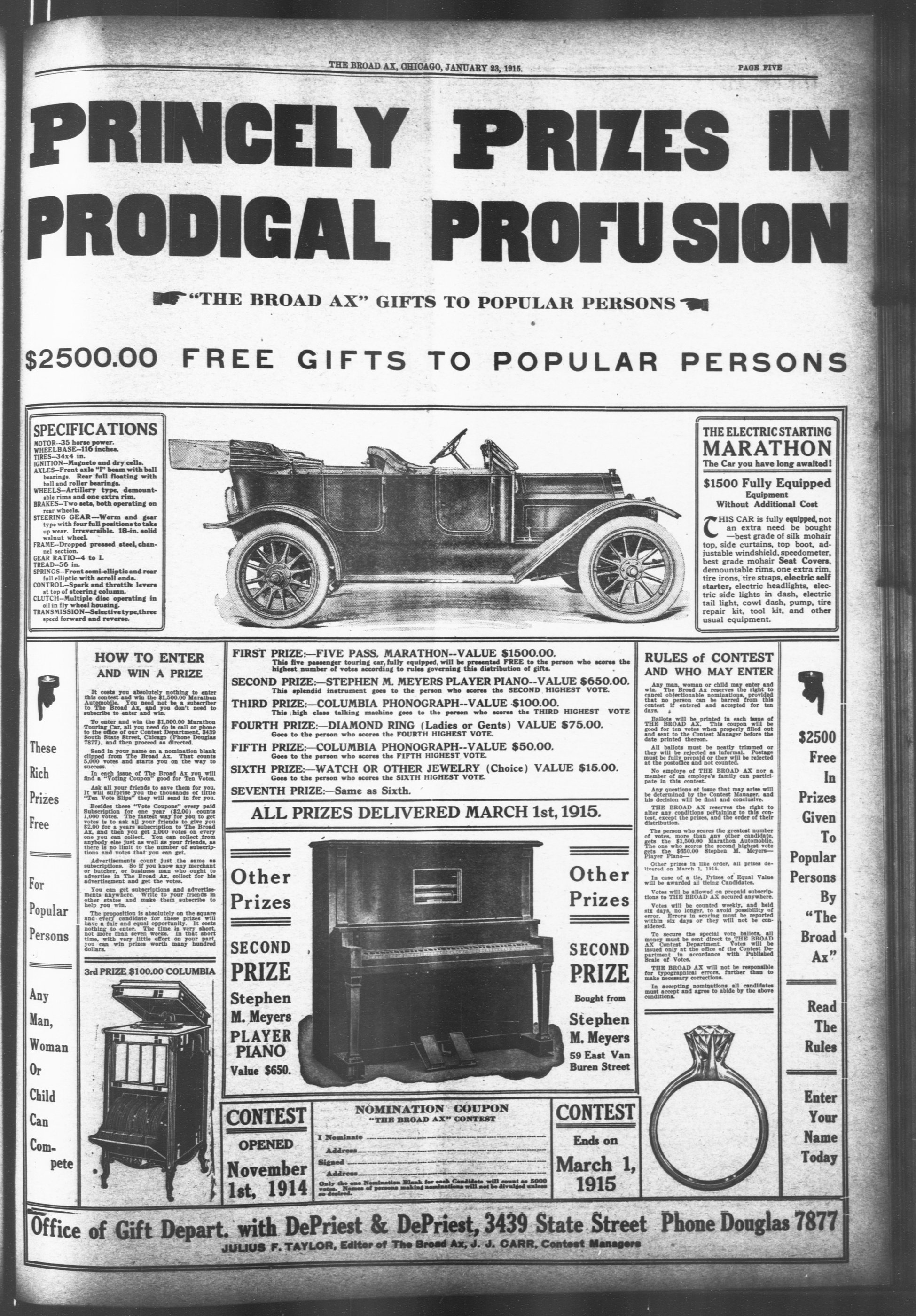
$ 2.00 One Year ..... 1,000 votes
4.00 Two Years ..... 3,000 votes
6.00 Three Years ..... 6,000 votes
8.00 Four Years ..... 10,000 votes
10.00 Five Years ..... 15,000 votes
NAMES OF CONTESTANTS.
Mme. E. M. Scott, 3611 S. State St.
Rev. J. W. Robinson, 4925 Wabash Ave.
Rev. W. S. Braddan (chaplain 8th Rev.
Miss Pauline D. Owens, Mounds, Ill.
Miss Hattie Winslow, 3535 South W
Henry Humphrey, 3607 State street.
Miss B. Forston, 2962 Wabash Ave.,
Miss Nellie Callaway, 3300 Rhodes A.
Miss Ethel Cole, 3600 Wabash Ave.,
Alma G. Rowens, 3228 Calumet Ave.
Miss Cora Mason, 11 E. 34th St.....
Miss Josephine Davis, 3244 Wabash
Miss Elizabeth Clark, 3812 Wabash
Mrs. Louise Webb, 3807 Vinecannes Ave.
Miss Bertha Moseley, 4331 Forestville
Miss Geneva Jones, 4165 S. State St.
Miss Marjorie Gaskill, 742 Claremont
Miss Fannie Stout, 1940 Walnut St....
Mme. E. M. Scott, 3611 S. State St.
Rev. J. W. Robinson, 4925 Wabash Ave., Pastor St. Mark's Ch.
Rev. W. S. Braddan (chaplain 8th Reg.), 5008 Fifth Ave.
Miss Pauline D. Owens, Mounds, Ill.
Miss Hattie Wirlslow, 3535 South Wabash Ave.
Henry Humphrey, 3607 State street.
Miss B. Forston, 2962 Wabash Ave., Flat 6.
Miss Nellie Callaway, 3300 Rhodes Ave.
Miss Ethel Cole, 3600 Wabash Ave., Flat 44.
Alma G. Rowens, 3228 Calumet Ave.
Miss Cora Mason, 11 E. 34th St.
Miss Josephine Davis, 3244 Wabash Ave.
Miss Elizabeth Clark, 3812 Wabash Ave.
Miss Louise Webb, 3807 Vincennes Ave.
Miss Bertha Moseley, 4331 Forestville Ave.
Miss Geneva Jones, 4165 S. State St.
Miss Marjorie Gaskell, 742 Claremont Ave.
Miss Fannie Stout, 1940 Walnut St.
ST. MARK M. E. CHURCH NOTES
By A. J. Nimrod.
Rev. John W. Robinson, pastor of St. Mark, continues to attract large audiences every Sunday with his splendid sermons. Judging from the gigantic task undertook by the great divine and the short time in which so much has been accomplished, under such trying conditions, the admiration of all those who love God has been challenged. Visit St. Mark; the services are grand.
The Shiloh Baptist church choir will give an oratorio, "The Prodigial Son," at St. Mark M. E. church January 28th, at 8:15 p. m.
Prof. Geo. E. Duncan, director, and all the members have graciously donated their services to aid in the completion of the new church.
Ladies Aid No. 2 held a reception January 19th at the home of Mr. H. D. Smith, 4712 Dearborn street. Miss Bettiola Forston read two original poems and several new members were added.
The church is organizing the dedication rally. The pastor is taking subscriptions. Quite a number have subscribed.
Miss Lucile Beatrice Robinson, daughter of Rev. John W. and Mrs. Robinson, has been sick for several days and away from school. Her many friends hope her a speedy recovery.
Visit St. Mark Lyceum opening at 4:30 p. m. every Sunday.
TEACHERS OF THE WENDELL PHILLIPS SCHOOL TO ADDRESS BETHEL LITERARY CLUB AT BETHEL CHURCH, JAN. 24th.
Every person who is interested in the future welfare of the race will be present on next Sunday afternoon, January 24th, to hear the addresses of the principal of Wendell Phillips school and his assistants, Mr. Shoemaker and Miss Smith, dean of the girls, at the Bethel Literary Club, 30th and Dearborn streets, at 4 o'clock. On account of recent reports of discrimination on account of color at the school, great interest is taken in what they have to say. Meeting promptly at 4 o'clock. All are welcome.
COLORED CAPTAIN OF FRENCH
BATTLESHIP.
The only one of the greatest nations in the world that enjoys the distinction of having a Negro ranked and recognized officially as a naval captain is France. Lieutenant Mortenoi, a Negro, and a native of Guadeloupe, has recently been promoted on account of services to the French government to the rank of captain in the French navy. While there are many representatives of foreign races in the French army and navy, including both Negroes and Chinese, Captain Mortenoi is the first to attain this rank in the navy.
E. H. PAULKNER, THE NEWS
DEALER, 3109 S. STATE STREET,
CONTINUES TO MAKE GOOD IN
SELLING THE BROAD AX.
For several weeks past E. H. Faulkner, 3109 S. State street, who conducts one of the best news stands in this city and who is always wide awake during business hours, has been increasing his orders for more copies of The Broad Ax, which proves that he is continuing to make good in selling the paper.
Each Friday evening the paper is on sale at his place of business and at the other news stands which appears in another column of this paper.
NEGRO PELLOWSHIP LEAGUE.
Sunday, January 24th, the committee appointed as the result of the meeting last Sunday to visit Wendell Phillips school, will make its report of that visit. All interested in the solution of the matter of the Wendell Phillips social room are urged to be present at 3005 State street, 4 p. m.
Last Sunday the greatest crowd in
the history of the reading room was present to hear Miss Fannie Smith, dean of girls at Wendell Phillips, and Mr. Perrine, assistant principal of the high school, discuss social regulations at this school. After much discussion the following committee was appointed to visit the school: Mrs. Jda B. Wells Barnett, chairman; Mr. George W. Ellis, Mrs. M. A. Majors, Mr. Frank Hamilton and Rev. A. L. Stewart.
PONTIFF HONORS CHICAGO
PRIEST.
Addresses Letter of War Sorrow to the Rev. Joseph T. Roche.
WEEPS FOR SUFFERERS
Home, Jan. 22.-Cardinal Gasparri, papal secretary of state, by direction of Pope Benedict XV., today sent to the Rev. Father Joseph T. Roche of Chicago the following letter, expressive of the feelings of the pontiff:
"The father of the faithful, the supreme head and benefactor of humanity, the pope, deplores the calamities of this horrible war.
"Being unable immediately to extinguish the fire which devours these blinded brothers, he feels in his heart all the sorrows of the orphans, widows and mothers of desolate families and hears their groans."
MR. JOHN W. HARRIS, GRAND O
SUPREME CHANCELLO OF THE
KNIGHTS OF PYTHIAS OF MIS
SISSIPPI
residing at Meridian in that state has become a regular subscriber to The Broad Ax, through Miss Pauline D. Owens, teacher in the public schools at Mounds, Ill., who is prominently connected with the Knights of Pythias of Illinois, and one of the contestants in the popularity contest now being conducted by this paper.
OPENING OF THE EIGHTH REGIMENT ARMORY WASHINGTON'S BIRTHDAY FEBRIARY 22.
A colonial party and house warming will be given by the 8th Regiment on Washington's birthday, February 22, in honor of the opening of the new armory. Dancing will begin at 8:30 p. m. The public is cordially invited to attend.
HON. BENJAMIN M. MITCHELL
WHO HAS BEEN A PROMINENT FACTOR IN THE ROGER C. SULLIVAN WING OF THE DEMO-CEATIC PARTY, HAS WHEELLED IN LINE FOR MAYOR CARTER H. HARRISON.
Hon. Benjamin M. Mitechell, who has the past week received twenty to twenty-five votes for speaker of the Illinois legislature, who has in the past been a prominent factor in the Roger C. Sullivan wing of the democratic parly, has wheeled in line for Mayor Carter H. Harrison and he will pull off his coat and work with all of his might and main for his renomination at the primaries February 23d.
The Political Equality League convened Wednesday evening for the purpose of becoming active in the campaign. Mr. Wm. R. Cowan said that he was with Chas. A. Griffin with or without money. Mr. E. H. Wright being defeated in his efforts to support his friends, walked out of the meeting with James T. Brewington. Mrs. F. L. Barnett and ten other of the Alpha Suffrage Club came to the meeting too late to do Mr. Wright any good. The meeting seemed to be a Griffin meeting. Dr. Davis and Mr. Ferribe also seemed to be disappointed because things did not go their way.
Rev. and Mrs. D. P. Roberts, who are now residing in Indianapolis, Ind, have removed from 14 W. Vermont St. that city, to 1121 N. Senate avenue, in the same city.
PRINCELY PRIZES IN PRODIGAL PROFUSION
Office of Gift Depart. with DePriest & DePriest, 3439 State Street Phone Douglas 7877 JULIUS F. TAYLOR, Editor of The Broad Ax, J. J. CARR, Contest Managers
SPECIFICATIONS
MOTOR--35 horse power.
WHEELBASE--116 inches.
TIRES--34x4 in.
IGNITION--Magneto and dry cells.
AXLES--Front axle "I" beam with ball bearings. Rear full floating with ball and roller bearings.
WHEELS--Artillery type, demountable rims and one extra rim.
BRAKES--Two sets, both operating on rear wheels.
STEERING GEAR--Worm and gear type with four full positions to take up wear. Irreversible. 18-in. solid walnut wheel.
FRAME-Dropped pressed steel, channel section.
GEAR RATIO--4 to 1.
TREAD--56 in.
SPRINGS--Front semi-elliptic and rear full elliptic with scroll ends.
CONTROL--Spark and throttle levers at top of steering column.
CLUTCH-Multiple disc operating in oil in fly wheel housing.
TRANSMISSION-Selective type, three speed forward and reverse.
HOW TO ENTER AND WIN A PRIZE
It costs you absolutely nothing to enter this contest and win the $1,500.00 Marathon Automobile. You need not be a subscriber to The Broad Ax, and you don't need to subscribe to enter and win.
To enter and win the $1,500.00 Marathon Tour, you need to be a subscriber to the office of our Contest Department, $499 South State Street, Chicago (Phone Douglas 7871), and then proceed as directed.
Send in your name on a nomination blank clipped from The Broad Ax. That counts 5,000 votes and starts you on the way to success.
In each issue of The Broad Ax you will find a "Voting Coupon" good for Ten Votes.
Ask all your friends to save them for you. It will surprise you the thousands of little "Ten Vote Slips" they will send in for you.
Besides these "Vote Coupons" every paid subscription for one ($2.00) counts one vote. You can collect from your friends if there is no limit to the number of subscriptions and votes that you can get.
Advertisements count just the same as subscriptions. So if you know any merchant or butcher, or business man who ought to be in the Bible, collect for his advertisement and get the votes.
You can get subscriptions and advertisements anywhere. Write to your friends in other states and make them subscribe to help you win.
The proposition is absolutely on the square and every candidate for the prize has to compete in the square. Coats nothing to enter. The time is very short, not more than seven weeks. In that short time, with very little effort on your part, you can win prizes worth many hundred dollars.
COLUMBIA
```markdown
```
For Popular Persons
Any
Man,
Woman
Or
Child
Can
Compete
"THE BROAD AX" GIFTS TO POPULAR PERSONS
FIRST PRIZE:—FIVE PASS. MARATHON--VALUE $1500.00.
This five passenger touring car, fully equipped, will be presented FREE to the person who scores the highest number of votes according to rules governing this distribution of gifts.
SECOND PRIZE:—STEPHEN M. MEYERS PLAYER PIANO--VALUE $650.00.
This splendid instrument goes to the person who scores the SECOND HIGHEST VOTE.
FOURTH PRIZE:—DIAMOND RING (Ladies or Gents) VALUE $75.00.
Goes to the person who scores the FOURTH HIGHEST VOTE.
SIXTH PRIZE:—WATCH OR OTHER JEWELRY (Choice) VALUE $15.00.
Goes to the person who scores the SIXTH HIGHEST VOTE.
ALL PRIZES DELIVERED MARCH 1st,1915.
THE BROAD AX, CHICAGO, JANUARY 23, 1915.
FIFTH PRIZE:—COLUMBIA PHONOGRAPH--VALUE $50.00.
Goes to the person who scores the FIETH HIGHEST VOTE.
Other Prizes
SECOND
PRIZE
Stephen
M. Meyers
PLAYER
PIANO
Value $650.
Other
Prizes
SECOND
PRIZE
Bought from
Stephen
M. Meyers
59 East Van
Buren Street
Ends on March 1, 1915
$1500 Fully Equipped
Equipment
Without Additional Cost
CHIS CAR is fully equipped, not
an extra need be bought
—best grade of silk mohair
top, side curtains, top boot, adjustable windshield, speedometer, best grade mohair Seat Covers,
demountable rims, one extra rim,
tire irons, tire straps, electric self starter, electric headlights, electric side lights in dash, electric tail light, cowl dash, pump, tire repair kit, tool kit, and other usual equipment.
RULES of CONTEST AND WHO MAY ENTER
Any man, woman or child may enter and win. The Broad AX reserves the right to cancel objectionable nominations, provided that no person can be barred from this contest if entered and accepted for ten days.
Ballots will be printed in each issue of THE BROAD AX. This coupon will be good for ten votes when properly filled out and sent to the Contest Manager before the date printed thereon.
All ballots must be neatly trimmed or they will be rejected as informal. Postage must be fully prepaid or they will be rejected at the postoffice and not counted.
No employee of THE BROAD AX nor a man employee's family can participate in this contest.
Any questions at issue that may arise will be determined by the Contest Manager, and his decision will be final and conclusive.
THE BROAD AX reserves the right to alter any conditions pertaining to this contest, except the prizes, and the order of their distribution.
The person who scores the greatest number of votes, more than any other candidate, gets the $1,500.00 Marathon Automobile, and the second highest vote gets the $650.00 Stephen M. Meyers—Player Plano—
Other prizes in like order, all prizes delivered on March 1, 1915.
In case of a tie, Prizes of Equal Value will be awarded all tieing Candidates.
Votes will be allowed on prepaid subscriptions TO THE BROAD AX secured anywhere.
tous to THE BROAD AX secured anywhere.
Votes will be counted weekly, and held six days no longer, to avoid possibility of errors in scoring must be reported within six days or they will not be considered.
To secure the special vote ballots, all money must be sent direct to THE BROAD AX Contest Department. Votes will be issued only at the office of the Contest Department in accordance with Published Scale of Votes.
THE BROAD AX will not be responsible for graphical errors, further than to make necessary corrections.
In accepting nominations all candidates must accept and agree to abide by the above conditions.
```markdown
```
I
Read The Rules
Enter Your Name Today
PAGE SIX
Origin of the Trench Work of the Modern Battlefield.
DITCHES DUG BY PEASANTS.
In the Middle Ages Civilians Were Forced to Do the Labor to Which Soldiers Would Not Stoop—Sappers and Miners and Their Successors.
In stories and reports of modern battles the work of the sappers is often mentioned. "To sap" or "sapping" was an early-way of approaching a strongly fortified position by means of a ditch. It was also a very early form of trench work. The fortified positions against which saps were employed were the stone walls of castles or of cities.
When the making of cannon had not progressed so far that solid shot could breach stone walls, but when cannon were powerful enough to keep armed men at bay or to destroy them, it became necessary to make an approach to the walled position in a way which was difficult to attack successfully and for which at that time no way of checkmating had been thought of by the defenders. A narrow ditch was dug in the direction of the wall to be assailed. This ditch, which was wide enough for one man to dig in, was called a sap, the digger a sapper, and the end of the ditch toward the enemy was the saphead. As the leading sapper dug forward he protected himself and the saphead in various ways, usually by pushing a screen ahead of him. This screen was of various forms, a bag of sand or a sheet of metal implined to deflect arrows or gun shots.
When the saphead had reached the desired point the ditch would be widened, the excavated earth forming a parapet on each side, and the guns would be brought so close to the wall that they could not be reached by guns mounted on the wall, for in the times in which these conditions prevailed walls were high and cannon crude and they could not be sufficiently depressed to reach an enemy at the foot of the wall.
Sapping was usually done by peasants impressed or hired for that service, because soldiers in the armies of the middle ages were more skillful with weapons than with tools and the work of digging trenches was beneath their dignity, while it also savored of a disinclination to close with the enemy, even though that enemy was behind stone walls with cannon—cannon at which men armed with modern weapons would smile, but which in their day were weapons of great effect. Vauban, the great military engineer refined sapping and brought it into a system by which any fortified place could be approached, reached, mined and breached.
These saps after awhile were dug in a number of ways. Many forms of the approach trench were devised. Uncovered trenches were cut forward, deflected at right angles and then cut forward to be again deflected further along, each of these deflections from the straight course of the trench forming a transverse for the protection of the trench. Some trenches were roofed in with timber and earth as they were cut forward, thus forming a bombproof covered way. Some saps were cut or dug in the fashion of a tunnel, the surface of the earth not being disturbed at all. Double saps or numerous parallel saps were dug close up to the position to be attacked.
Mining of castle and city walls or city gates is as old as the use of gunpowder in war, and "undermining" of walls was practiced in war before the use of gunpowder. When sapphid had become systematized and generally employed in offensive operations against fortified positions the military work of sapphing and mining was combined and instead of being done by peasants or "civilian" labor was committed to special troops. These troops became adept in this important work, and because of the extra labor involved and the hazard of this duty these, called sappers and miners, were given higher pay than other troops.
As the years and the centuries went by other duties were put upon these troops—erection of field fortifications, erection of many forms of obstacles to impede an aggressive enemy and hold him under fire at a known range, destruction of bridges, construction of bridges, demolition of buildings and many other things. Gradually the sappers and miners' duties became greatly enlarged and refined, and in many armies they came to be called engineers.
In all armies every soldier today does work that formerly fell to the laboring and hard working sappers. Every soldier today knows how to handle a pick and spade as well as to shoot a rifle, pistol, magazine gun or cannon. All soldiers now dig trenches, gun plits and the like, but construction work, requiring higher technical training, is done by the engineers, successors to the sappers of old. In many kinds of construction the engineers may be aided by troops of other branches and by civilians, hired or impressed.—Washington Star.
An Old Story.
Subbus (arriving home)—Well, dear,
anything new happened today? Mrs.
Subbus—The cook's gone. Subbus—
I asked you if there was anything new
happened—Boston Transcript.
The world is a beautiful book, but no
little use to him who cannot read it.
Golden!
SHEEP DOG TRIALS.
Australia's National Pastime, the Malfease Cross Test.
Sheep dog trials may be considered a national pastime if not a national sport in Australia. There is an annual agricultural show in every town and village in the pastoral parts. There are general competitions on the lines of the American county and state fairs. There are horse races, buck jumping, shearing, log chopping and other strenuous competitions. But not one of these excites more interest than the sheep dog trials, and in these tests Australians have set the example of certain of the most serious tasks that a man and a dog may be asked to accomplish with three strange sheep—sheep that had never previously met until they had a moment before been turned out from three separate pens to be packed or gathered together by the dog.
It was the Australians who first put forward, and they still maintain it, the Maltese cross test. The eight six-foot hurdles are set in the shape of a Maltese cross. The passages are of a width that will permit only one sheep to pass through at a time. The animals have to be driven north and south and east and west, all the passes being open at the time. The skill and patience of the dog are here tried to the utmost, and there can be little wonder there is a gasp of satisfaction and a cheer of joy when the sheep have been successfully driven through these narrow wavs.
The Australian sheep dogs are the smallest in use in the world, but are quick and lively in their work. It is no wonder that the Australian gives much thought for his dogs, for it goes without saying that the work of the sheep station could not be accomplished without them. In ordinary cases it is reckoned that one dog can do the work of half a dozen men. In many instances a dog is superior to fifty humans, and where there are such vast flocks of nimble sheep, such as the marmosin in Australia are, it would be impossible to round them up so that they may be examined, counted and duly looked over without the dogs—Argnaut.
LAWS OF THE INCAS.
A Code That Was Remarkable For Its
Beneficial Simplicity.
Among the most remarkable laws of the Incas were those concerning taxation. The principal feature of those laws was that taxes were not paid in money, but in work and in produce, whether manufactured or grown. The Inca emperors thought it unjust to demand that taxes should be paid in any kind of commodity that the people could not produce by their own personal labor.
The people also paid another sort of tribute. They made clothes, shoes and arms for the soldiers and for the poor who could not work themselves owing to age or infirmity. The cloth was made of wool from the flocks of llamas that abounded in the mountains. On the plains of the seacoast, where the climate is warm and they do not dress in woolens, the people made cotton cloths, the cotton being supplied from the crops of the emperor. The shoes were made in the provinces where aloes were most abundant, for they were made of the leaves of a tree called maguye. Each province furnished its own produce, and no province had to supply anything that did not belong to it.
There was a mandate that forbade beggary and destitution; that, of course, followed upon due provision of their laws. Every citizen was provided for theoretically and practically. No man need be idle; no man need lack land or seed or implements for cultivation; therefore no one was permitted to beg. If, any were found doing so it was clear proof of idleness, for the incapable were provided for, and contempt and punishment were meted out on all tramps, vagabonds and idlers.—"The Secret of the Pacific."
"For the Sake of Argument."
"Well, now, for the sake of argument" - Is there a more irritating phrase? Is there any greater bore than the person who habitually employs it? To be asked to assume anything "just for the sake of argument" invariably prejudices us against making that concession. We sit grim lipped while the controversialist assumes and expounds. We feel that to oblige him we, would not even assume that two and two make four-"Youth's Companion.
An Unsolved Problem
"How, sir, is it possible," demanded counsel of a bankrupt who was undergoing his public examination. "to live in the luxurious style you have affected on £40 a year?" "That," replied the bankrupt. "is a problem to which I have devoted considerable time in the interests of social economy, and the results of my humble efforts are now before the court"—London Mail.
Plenty of Collars.
A young man went into a clothing store and asked for a collar. The clerk waited on him and said: "They are 15 cents each, two for 25 cents. Want two?" The young man replied, "No, I have plenty of collars, but they are both in the laundry."—Indianapolis News.
Came Natural.
Bacon—They say that the president of the bank who got away with a lot of the money began his career as janitor of the institution. Egbert—Never forget his early training to clean out the bank, evidently—Konkers States.
THE BROAD AX, CHICAGO, JANUARY 23, 1915
JAPANESE COURT TRIALS.
The Judges, Not the Lawyers, Question the Witnesses.
The defendant in a Japanese court was testifying in his own behalf. He stood directly in front of the presiding judge, not ten feet distant from him, and answered his questions in a clear voice, without any apparent hesitation. The judge seemed conversant with the case, for he put questions rapidly, giving a funny little grunt of acquiescence after every answer. Occasionally one of the associates wrote a suggestion and handed it to the president, and once or twice the defendant's counsel asked the court to put a certain inquiry. The whole proceeding—and the same may be said of those in several other courts I visited—was conducted in a quiet, colloquial way. In every instance I was impressed with the simple, businesslike atmosphere.
Some of the Japanese lawyers with whom I have talked say that they feel that very often the court does not elicit all the facts and that our system of having witnesses questioned by counsel would be better, but, on the other hand, some lawyers maintain that better results are realized by the system, which puts upon the court the duty of getting at the truth, maintaining that the witnesses are more apt to talk frankly to the court than to the lawyer for the opposite side who is engaged, as they think, in trying to make them out liars.
I came away quite favorably impressed with what I saw and wondering whether on the whole in 95 per cent of the cases a decision by three judges trained in the investigation of facts would not be as nearly right as the verdict of twelve citizens casually gathered in from the general community.—George W. Wickersham in Case and Comment.
COAXING THE FURNACE
Try Gentleness and the Uplift and Kindly, Soothing Words.
Treat your furnace kindly. Let your watchwords as a furnace tender be gentleness and uplift. Be firm with your furnace, but always gentle. Some persons imagine that the way to make a furnace behave properly is to first shake it violently and then maul the life out of the remaining coals with the poker. They try chastisement when they should try gentleness and uplift and only succeed in packing the coal harder and destroying ventilation, the secret of successful furnace tending.
Nothing responds more readily to uplift than does a furnace fire. When in the early morning you wish to arouse the furnace fire from its slumbers, you should first shake it gently, then gently tickle the ribs of the grate with the poker to make ventilation more perfect and then crack the top crust with a lever-like uplifting use of the poker. In a minute the fire will be wide awake and in good humor, laughing and sticking out its tongues of flame at you in merriment.
Never swear at your furnace, no matter how it annoys you. That will make it sulky and obstinate. You never saw a furnace which was sworn at often which was not frequently sulky and obstinate. Now, did you? It is advisable to take the directly opposite tack. I know a man who always addresses his furnace as "sweetheart" or "darling," and he assures me the plan works to perfection. "Maybe it doesn't really make the furnace warm up the way it seems to," he frankly admits. "Maybe the mere suggestion just keeps me from losing my temper and hammering my fire to pieces. But, anyway, the results are excellent. Savvy?"—Lee Shippier in Judge.
Aisle on the Car In a Wreck.
A veteran railroad man gave a piece of valuable advice not long ago. "If you ever get into a wreck," he said, "and have time to follow out this suggestion, remember this: Always stand in the aisle. Most of the injuries that are suffered occur because the victim is crushed between the seats. If you are in the aisle you may be thrown forward and brushed a little, but there is much less chance of receiving serious hurts. It isn't always possible to get out of your seat before the crash comes, but if it is follow that advice." -Pittsburgh Press.
Dome of the Rock
The name "Dome of the Rock" is one that has been conferred on the celebrated mosque of Omar, at Jerusalem. It stands on Mount Morish. on the site once occupied by the temple of Solomon. Immediately under its dome an irregular shaped rock projects above the pavement. This rock was the scene of many Scriptural events and has been greatly revered for ages by Jews and Mohammedans.
Tools. Not Toys.
Filmmaker--Met Umson downtown today. He'd just bought a tin horn, a triangle, some blocks, a rattle box, some sleigh bells and a popgun. I didn't know he had a baby. Flamson—He hasn't. He's a vaudeville trap drummer. Those things are part of his outfit--Puck.
They Were Not.
A young clergyman, small of stature, preaching as a candidate in a certain place one Sabbath, peering over the pulpit Bible, announced as his text: "It is I. Be not afraid."
Arab Horse Test.
A good horse, according to an Arab test, is one that can stand perfectly erect upon his legs when drinking from a shallow pool.
As we grow less young the aged grow less old.—Bacon.
A LADY AND A BABY
A LADY AND A BABY
And Uncle Sam's Polite Consult In a City In France.
HOW THEY MET AND PARTED.
And How Light Was Thrown on the Problem That the Woman, Who Was French and Voluble, and the Infant, Who Was American, Presented.
Not very long after having taken charge of one of the consulates in France I was one morning seated at my desk busily engaged in figuring over my quarterly accounts, when suddenly a woman carrying a bundle in her arms appeared before me. I had not resided in France sufficiently long to imbibe the unadulterated French politeness, but I had progressed sufficiently to ask:
"Mudame, what can I have the pleasure of doing for you this morning?"
"Mousleur," she exclaimed, walking toward me, holding out the bundle as if to deposit it on my desk, "this is an American baby. What shall I do with it?" Abashed at the prospect of so suddenly becoming a father with the orange blossoms and rice omitted and knowing that the American government had established no precedent of maintaining orphan asylums either at home or abroad. I hesitated a moment and replied: "Will the madame please be seated over there by the door and tell me why, being a Frenchwoman, she has become possessed of an American baby?"
It never occurred to me to examine the little bundle of humanity. I had in previous times rather prided myself on my ability to distinguish the nationality of people, had even boasted I could tell them by their shoes, but I had never tried my perceptive powers on infant physiognomies.
"Volia!" she said, seating herself. I shall never forget that word volia. It was one of the first French words I ever learned. You know it means—oh, so many things when used exclamatorily, as it generally is. Usually, however, to the beginner in the French language it conveys the meaning of "Here it is." That was about as far as I had progressed in my French education at that time in regard to the many varied meanings of volia, and I determined that if it meant the baby then it would retain its geographical location indefinitely—that is, in the woman's lap over by the door, or preferably outside. But her volia referred not so much to the infant as to the story of how it came to be in her possession.
She talked volubly while I tried to assume the defensive power of silence. But to a Frenchwoman—well, silence simply means what the jockey gives the horse in the last heat—encouragement.
From the verbal French cyclone she hurled at me I gathered a few fragments that enabled me to understand. For three months she had been employed as nurse by an American woman an who had paid her good wages. Four weeks previously, however, the mother had returned to New York, saving she was going over for only two or three days on an urgent business matter and would return at once. She had not seen or heard of her since. Being a woman who had to work for her own living, the baby was a burden on her hands. She could hardly support herself, much less provide for the infant, and as the child was of American parentage she thought the representative of the American government ought to take care of it.
I suggested that I would write to the city authorities in New York asking as to the genuineness of the address that the woman said the mother had left with her.
"And what shall I do during all the time you are waiting for an answer-starve?"
My answer finally was a twenty franc gold piece, with which she departed, saying she would try to take care of the baby until I could hear from the New York authorities.
Now, the reasonable and the unreasonable part of the story is that since her departure, though the sun has risen hundreds of times, she has never returned. It had not risen more than seven times, however, before I learned the reason.
It was just one week later at an informal dinner of the sixteen consuls who resided in the city that in the course of a conversation with my Italian colleague I told him the story of the woman and the baby. What do you suppose he answered?
"Well, well." he laughed, "why, that same woman came to my office, only she had an Italian baby. And I thought I was fortunate to get rid of her for 50 francs."
In the general conversation that followed I discovered that the woman had visited every one of the sixteen consulates in the city, and by her ability to change the baby's nationality from English to German and from Haitian to Japanese and all the other colors of the rainbow she had extracted from the consular corps of that particular French city the sum of 775 francs.
This incident is just one of a series of similar experiences with frauds and fakers a consul has to face in the performance of his duties.—Thornwell Haynes in New York Tribune.
Who hangs himself in the chimney
should not complain of smoke—German
Proverb.
PERSISTENT BEAVERS.
A Battle of Wits Between the Animals and the Engineers.
When the Grand Trunk railway ran its line across a swamp in a game preserve on the line of the Alberta Rockies there was a wonderfully constructed beaver dam holding the water back to flood the swamp.
This in the eyes of the game warden was pure waste, and he ordered the engineers to prevent it without harming the beavers. Of course the dam could have been blown up with dynamite, but that would have meant the death of most of the little animals and death very likely in great pain at that.
So the engineers cut an opening in the dam. The mud had become almost as hard as concrete, and it took the men three days to get the water running out steadily. Then, thinking their troubles with the industrious little fellows over, they started work on the railway through the swamp.
Soon the water began to rise, and the work was stopped in a few hours. The engineers made all haste to the dam and found the animals had repaired the cut and made it tight again. A fresh cut was made, but after the men had gone the beavers busled themselves and made it stronger than ever. Work was again stopped on the railroad within a few hours. Then a deep hole was made in the earth far under the dam. The beavers were much puzzled. Never before had they seen water go down into the ground and come up far away. But they lent their whole attention to the problem, and the work on the railroad was again stopped as a consequence and the foundations soaked with water.
Then followed an engagement of wits between the beavers and the engineers. But every time the men found a way to cut the dam in a new place the beavers found a way to stop it. The road was finally constructed by working a few hours at a time, and the loss to the contractors amounted to more than $5,000.—Detroit Free Press.
DEFIED THE BRAHMANS.
An East Indian Prince Who Did Not Fear Losing Caste.
Mr. Coningsby Dawson, the well known English writer, tells the following anecdote of the East Indian prince Sir Pertab Singh:
A young English lieutenant had died of cholera in his palace. The boy was the son of an English friend. When the body had to be carried out to be placed on a gun carriage Sir Pertab Singh went forward to lift it up. Before he touched it he was stopped by some English officers. They reminded him that, by his religion, were he to touch the dead he would lose all his caste and perhaps, despite his wealth, never be able to buy it back. They advised him to send for the sweepers, who are outcasts. In spite of their protests he picked up the body and carried it down the palace steps to the gun carriage.
A gasp went up at the sight. Every one of his subjects knew what he had done. The next morning, when he rose, 500 Brahman priests were waiting in the courtyard. He came out, a proud figure, to face them. He knew what they had come for—to make him the lowest thing in India, a man without caste. He asked them what was their errand, and they told him. They had come to make him of as little account as the humblest sweeper in his palace.
Sir Pertab Singh laughed. "I belong," he said, "to a higher caste than any of you have ever dreamed of, and you can't take it from me; you're welcome to all the rest. I belong to the same caste as the dead son of my friend—the caste of a soldier."
With that he walked back into his palace, and the Brahman priests went away, one by one, ashamed and puzzled.
Pure Logic.
Liberty commands the highest price of all known things. Its price is so high that nobody can pay it. Proof. Eternal vigilance is the price of liberty. Eternal vigilance is to be ever on the job. To be ever on the job is to have no leisure or vacation. To have no leisure or vacation is to be a slave. To be a slave is not to have liberty. Therefore in order to be free we must enslave ourselves, which is absurd. Q. E. D.—Judge.
Quill Pens.
The quill pen is not quite extinct in London. The legal profession, which is very conservative, clings to it tenaciously, and none of the courts would be completely equipped without a plentiful supply of good goose quills. Have you noticed what an indispensable accessory the quill is to counsel, whether in ostentatiously taking a note, making a speech or in helping to point a warning finger at a hostile witness?- London Standard.
By Internal Evidence
"Where do you suppose we got the saying, 'He laughs best who laughs last?' asked Mrs. Binks of her husband.
"Probably some Englishman first said it," replied Mr. Binks. "He was doubtless trying to set a national falling in a favorable light"—Youth's Companion.
Food For Grain
"To call on Mrs. Wallaby-Wombat. Better come along. I understand there are some very interesting things to be heard."
"How so?"
"She has just quarreled with her best friend."-Pittsburgh Post.
BRAWNY NORWEGIANS
They Are the Longest Lived People in the World Today.
The fine stature and unique physical qualities of the athletic Norsemen are thus described by Price Collier in an article on "Norway and the Norwegians. From an American Point of View," in Scribner's Magazine:
"The so called bonder, or agricultural peasanty, form the very backbone of the nation in Norway. Each is proprietor of his own farm, and they occupy the country from the shore of the sea to the foot of the hills and up every glen or valley as far as corn will grow. They are, as a rule, fine looking, athletic men, as their properties are not so large as to exempt them from work, but large enough to supply them and their families with wholesome food. In the old days they built their own houses, made their own furniture, plows, carts, harness, ironwork, woodwork and basketwork. Probably there are no communities anywhere else in the world so self efficient, so independent and so comfortable.
"Indeed, their size and wholesome aspect prove this, for they are the fairest, tallest, broadest chested and longest lived people in the world today."
"In the streets of the towns, at the farms, on the roads, one seldom sees a fat man or one who looks unwieldy. They are sturdily, sometimes heavily, built, but they are lean in the thick broad of shoulder and thick through, and, though they do not always carry themselves lightly or gracefully, they look to have plenty of room for the working machinery of living, for hearts and lungs and digestive apparatus. Wherever you go in Norway, from Christiansand to the North cape, you cannot go far without going up and down hill, nor can you go far without inhaling the champagne-like mountain air. It is not impossible that the plain food—a necessity in a poor country—the physical training in the schools, the obligatory military training, the sensible temperance legislation, the up and down hill exercise, the almost entire lack of luxury and the fact that they are not hard workers—not lazy, per hape, but certainly leisurely in their toll, seldom making any undue demand upon their nervous energy—have produced what no artificial legislation can copy."
Napoleon and Rousseau
Napoleon on visiting the tomb of Rousseau said:
"It would have been better for the repose of France that this man had never been born."
"Why so, Citizen Consul?"
"It is he who prepared the French revolution."
"I should have thought, Citizen Consul, that it was not for you to complain of the revolution."
"Well," replied Napoleon, "the future will discover whether it was not better for the repose of the world that neither Rousseau nor I had ever been born."
In these words we hear the first clarion of advancing imperialism—The Personality of Napoleon," J. Holland Roe
The Origin of "Hurrah."
The word "hurrah" is pure Slavonian and is commonly heard from the coast of Dalmatia to Bering straits when any of the population living within these limits is called on to give proof of courage and valor. The origin of the word belongs to the primitive idea that every man that dies heroically for his country goes straight to heaven-Hu-ray, to paradise and in the shock and ardor of battle the combatants utter that cry, as the Turks do that of "Alah": each animal himself by the certitude of immediate recompense to forget earth and to contemn death.
Mineral Actions Purified Water
How Indians Purified Water
The Indians had a way of purifying water from a pond or swamp by digging a hole about a foot across and down about six inches below the water level a few feet from the pond. After it was filled with water they bailed it out quickly, repeating the bailing process about three times. After the third balling the hole would be filled with filtered water. Try it—Boy Scout Handbook.
Why Corn Has Silk
A Potato Hill man who is skim-one years old never knew until recently that for every grain on an ear of corn there is a silk running out to the end to light and moisture. These silks run back under the husk. One is attached to each grain on the cob and nourishes it. Everything in nature is more wonderful than any invented story.-Potato Hill Corr. in Atchison Globe.
Culture's Progress
"Our daughter is studying French German, music, dancing and painting," said the fond mother complacently. "Well," replied Mr. Cumrox, "that a good start. But has she set learn not to use back number slang and chew gum?"—Washington Star.
No Longer Company.
"Familiarity breeds contempt."
"True! When I was first invited over to their house to dinner they used to let the dishes go until morning; now they do them right after dinner and call me into the kitchen to help."-Detroit Free Press.
His Definition.
"Pa, what is a demagogue?
"A demagogue, my son, is a person who gives voice to opinions that conflict with your own."—New York Herald.
Peace hath higher tests of manhood than battle ever knew.—Whittier.
CAPITAL, $200,000.00
NICKELS CENTS
This Registering Home Bank
FREE to our Savings Depositors; will start you saving and
keep you at it. A Savings
Account is the first step to
wealth. OPEN one with US.
PROVIDENT SANITARY CO.
Mme. SCOTT, Manager
WE MANUFACTURE THE F
Provident Sanitary High Brown Powder
market to-day, and is highly
IT GIVES THE DESIRE
---
MANUFACTURESTHE FOLLOWING PREPARATION
nitary High Brown Powder is the only real Brown Po
market to-day, and is highly recommended by all that use
IT GIVES THE DESIRED COLOR TO THE SKIN.
WE MANUFACTURE THE FOLLOWING PREPARATIONS:
Provident Sanitary High Brown Powder is the only real Brown Powder on the market to-day, and is highly recommended by all that use it.
IT GIVES THE DESIRED COLOR TO THE SKIN.
PROVIDENT SANITARY COMPANY
Princess Neroli Hair Grower
Pomade and Liquid
Grows Hair on all kinds of Scalps. Cleans the Scalp. Removes Dandruff. Restores Color. Use our Scalp Specifc for Scalp Diseases. This preparation will doubtless grow healthy hair.
Directions—Wash head with our Liquid Shampoo. Dry. If Scalp is diseased use our Scalp Specifc until the disease disappears. Then use Princess Neroli and out comes the hair. There is no mistake, for it comes out. We are the sole owners of this preparation.
PRICE. 50 cts.
e Broad Ax Cont
THIS BALLOT IS GOOD*FOR
The Broad
THIS BALLOT
TEN VOTES
NOT GOOD AFTER
NOT GOOD AFTER FEBRUARY 24, 1918
GOOD FOR TEN VOTES when neatly trimmed
to THE BROAD AX Contest Department, 3
set, before expiration date. No ballot will be al-
tered after being received by THE BROAD AX
Nomination Coupon
The Broad Ax Contest
NOT GOOD AFTER FEBRUARY 24, 1915
GOOD FOR TEN VOTES
out, if sent to THE BROAD AX
State Street, before expiration da
way or transferred after being rece
Nomination
The Broad
GOOD FOR TEN VOTES when neatly trimmed and filled out, if sent to THE BROAD AX Contest Department, 3439 South State Street, before expiration date. No ballot will be altered in any way or transferred after being received by THE BROAD AX!
Nomination Coupon The Broad Ax Contest
GOOD FOR 5,000 VOTES
I Nominate ____
minate _____
888 _____
d _____
888 _____
one nomination for each candidate counts 5,000 votes
making nominations will not be divulged. Addr
Address
Only one nomination for each of persons making nominations with munications to The Broad Ax, Con
Only one nomination for each candidate counts 5,000 votes. Names of persons making nominations will not be divulged. Address all communications to The Broad Ax, Contact Department, 8439 South State St.
For M.
Address
Address
Signed_
SURPLUS, $20,000.00
Commercial Banking
Savings and Checking Accounts
Foreign Exchange
Safety Deposit Vaults
Mortgages and Bonds
3 Per Cent
Interest on Savings
Deposits
Your Patronage Solicited
Depository and Correspondent,
Continental & Commercial
National Bank of Chicago,
Illinois.
SCHOOL OF BEAUTY CULTURE
3611 S. State St. Chicago, Ill.
FOLLOWING PREPARATIONS:
Powder is the only real Brown Powder on the
only recommended by all that use it.
RED COLOR TO THE SKIN.
PROVIDENT SANITARY COMPANY
HELOTROPIC CREAM
HELLO HOPE CREAM
After cleaning the hair, rub the
Cream into the hair freely. This
Cream restores the hair to its
natural bright, glossy color.
PRICE, 50 cts.
PROVIDENT SANITARY COMPANY
QUININE CREAM
QUININE CREAM Wash scalp thoroughly, then rub Cream in vigorously every other night for two weeks. Then wash scalp and repeat it until disease is gone. PRICE, 50 cts.
PROVIDENT SANITARY COMPANY
LIQUID SHAMPOO
Unexcelled for cleaning the scalp.
Prepares it for further treatment.
Removes oily dandruff and promotes the growth of the hair.
PRICE, 25 cts.
Ax Contest
OT IS GOOD FOR
OTES when neatly trimmed and filled
AX Contest Department, 3439 South
date. No ballot will be altered in any
received by THE BROAD AX!
ion Coupon
d Ax Contest
each candidate counts 5,000 votes. Names will not be divulged. Address all com-
THE BROAD AX, CHICAGO, JANUARY 23, 1915
SIRES. AND SONS.
Joseph Hume Cook, prime minister of Australia, is a Methodist lay preacher. Count Zeppelin, inventor of the German dirigible, is "the greatest German of the twentieth century," according to the kaiser. Dr. H. Oliviera Lima, who will teach Latin American history and diplomacy at Harvard university, is a native of Brazil and noted as a diplomat and educator. David Watson Taylor, who will succeed Rear Admiral Richard M. Watt as chief constructor of the navy, graduated from the United States Naval academy in 1885 at the head of his class and excelled the highest record ever made there up to that time.
Max Joseph Baehr, who has been made United States consul at Berne, Switzerland, has for twelve years represented this country at Havana, Cuba. He is a native of Bavaria, but came to America in 1878. In 1898 he began his diplomatic career as American consul at Kehl, Germany.
General Baron Carl von Piettenberg, commander of the German Guards corps, the flower of the kaiser's troops, is also a general adjutant to the kaiser and very high in his favor, their friendship dating back to the days when they served together in the First regiment of foot guards.
The Writers.
Mrs. Corra Harris has gone to Europe to write a series of magazine articles on the woman's side of the war. Hugh Walpole, the author, is a son of the bishop of Edinburgh and a cousin of the Earl of Orford. He lives half the year in a tiny fishing village in Cornwall, where he does most of his work.
Sir Rennell Rodd, whose name appears in the white papers as that of British ambassador at Rome, spent in 1908 some months in America. He greatly distinguished himself at Oxford, where he carried off several honors, including the Newdigate poem prize. He is well known as the author of at least half a dozen volumes of verse, of monographs on Sir Walter Raleigh and Emperor Frederick.
Fashion Frills.
Economy is the order of the day. The ladies have even taken to wearing shorter dresses.—Philadelphia Press.
If the short skirts become much shorter there will be a falling off in the demand for dress goods and burlesque theater tickets.—Chicago News.
In order to increase the sale of cotton why not suggest that the style makers make it fashionable for women to wear more clothes?—Sioux City Tribune.
From some of the hats we've seen it's quite clear that busted sixteen inch shells have suggested ideas to the quick witted designers.—Milwaukee Journal.
Train and Track.
Nearly one-half of Spain's railroads enter Madrid.
The average express locomotive consumes twelve gallons of water for each mile traveled.
Nearly half of the main line of the Canadian Pacific between Fort William and Vancouver is now double tracked. More than 350 miles of double tracking has been completed this year.
The new Union station in Kansas City, Mo., which cost $6,000,000, is the third largest in the United States. All the improvements around it made in connection with its erection cost more than $40,000,000.
That Ruffled Air
The judge made jokes, the witnesses looked weary, the counsel declaimed and cross examined, the twelve good men and true twiddled their thumbs, and the usber usbed whenever necessary. Altogether it was a model court "Now, ma'am," cried the cross examining K. C., "was the defendant's air when, as you allege, he promised to marry you perfectly serious or was it, on the contrary, jocular and full of levity?" "It was all ruffled," replied the plaintiff, "with 'm runnin' is 'ands through it'—London Mail.
Oder of Lodoform.
The odor of iodoform can be removed from the hands by wetting them, taking a pinch of dry mustard, rubbing it well in and washing it off with soap and water. In the same way the odor of iodoform may be removed from utensils that have contained it, only in this case the mustard should be made into a pasta, spread upon them and left for two or three hours.
Evading Responsibilities.
"I promised that girl never to smoke if she would marry me," said the discouraged looking man.
"What did she say?"
"She remarked that she did not care to be utilized as an excuse for any personal economies I might contemplate."
-Washington Star.
"It's the unexpected that always happens."
"Oh, I don't know! Somebody always claims to have predicted it"—Louisville Courier-Journal.
Stale Bread or Fresh Bread. Most persons don't like stale bread so well as fresh, though many consider it more digestible. As a matter of fact fresh bread is just as digestible as stale, if it be chewed as much, but its very softness is a temptation to chew it too little; hence it is swallowed without the admixture of enough saliva to digest its starch. Stale bread, on the other hand, is difficult to swallow unless thoroughly chewed. The difference between fresh and stale bread is merely a matter of water. In bread as it comes from the oven the crust is dry and crisp and the crumb is moist and soft, because all the water is in the crumb. As hours or days pass the crust absorbs water from the crumb and becomes soft, while the crumb becomes dry. A loaf can be made fresh again by slightly moistening it and placing it for a few minutes in a hot oven. The heat drives the water from the crust back into the crumb.-St. Louis Post-Dispatch.
One Phase of Tolstoy.
In the "Reminiscences of Toilstoy" by his son, Count Ilya Toilstoy, are shown many phases of the great man's nature, this one among them:
"All exhibitions of tenderness were entirely foreign to him. I say 'tenderness in contradistinction to 'feeling.' Feeling he had, and in a very high degree. During all his lifetime I never received any mark of tenderness from him whatever. Nearness and dearness with him were never accompanied by any outward manifestations. It would never have come into my head, for instance to walk up to my father and kiss him or to stroke his hand. I was partly prevented also by the fact that I always took up to him with such awe, and his spiritual power, his greatness, prevented me from seeing in him the mere man, the man who was so pliable and weary at times, the feeble old man who so much needed warmth and rest."
Hobart Pasha.
The Turkish navy of the past owed almost its existence to an English sailor, Hobart Pasha, a bold buccaneer of the Elizabethan period, who by some strange perverseness of fate was born into the Victorian age. He retired from the English navy in 1863, and during the American war he became a blockade runner with hairbreadth escapes innumerable. After the war he entered the Turkish service, suppressed the Cretan rebellion by intercepting the supplies from Greece and then reorganized the Turkish fleet so well that the suitan appointed him marshal of the empire. Hobart Pasha also enjoyed the unique distinction of being twice struck off the British navy list for breach of the foreign enlistment act and twice reinstalled there. And he died in 1886 with the rank of a British vice admiral—London Globe.
Tests of Civilization
It is only vulgar minds that mistake bigness for greatness, for greatness is of the soul, not of the body. In the judgment which history will bereafter pass upon the forty centuries of recorded progress toward civilization that now lie behind us, what are the tests it will apply to determine the true greatness of a people? Not population, not territory, not wealth, not military power. Rather will history ask: What examples of lofty character and unselfish devotion to honor and duty has a people given? What has it done to increase the volume of knowledge? What thoughts and what ideals of permanent value and unexhausted fertility has it produced in poetry, music, and the other arts to be an unfalling source of enjoyment to posterity? The small peoples need not fear the application of such tests.-James Bryce.
The Blind Need Windows.
Light has use, even if men cannot or will not see it. Baring-Gould tells of an institution for the blind that was built in England without windows. "Why," argued the committee, "should we provide windows for those that cannot see out of them?" So scientific ventilation and heating were provided, but the walls were left unplierced by any pane of glass. But soon the poor inmates grew pale, and a great languor fell upon them. They fell sick, and one or two died. Then it was that the committee decided to open windows in the walls. In came the healing light, and the human plants responded to it at once in revived spirits, ruddy cheeks and restored healt. Light is good, the Light of the World is good, even for those who shut their eyes.—Christian Gerald.
Conundrums.
Why is a list of musical composers like a saxophan? Because it is incomplete without a Handel.
Why is the letter A like 12 o'clock? Because it comes in the middle of day.
When is a newspaper like a delicate child? When it appears weekly.
In what key should a man propose to his girl? Be mine ah. (B minor).
Why does a conductor punch a hole in your transfer? To let you pass through.
If all the big waters were dried up what would Neptune say? I really haven't an ocean (a notion).
CHICAGO
Phone
tle 44-185
Franklin A. Denison
30 W. Randolph Street, CHICAGO
Suite 708 Delaware Bldg. Tel. Central 3142
Office Phones: Res. 5133 So. Wabash Ave.
Oakland 4662, Auto. 73-058 Phone Dresel 18815
Dr. Theo. R. Mozee
DENTIST
4709 S. STATE STREET
CHICAGO
Hours 9 A. M. to 5 P. M., 7 P. M. to 9 P. M.
Sundays by Appointment
Tel. Wabash 1075
NOTARY PUBLIC
Faustin S. Delany
Attorney and Counselor at Law
312 S. Clark St., Suite 422
CHICAGO
COLLECTIONS A SPECIALTY
Res. 4510 St. Lawrence Ave.
Tel. Drexel 5260
Office Phones: Res. 5133 So. Wabash Ave.
Oakland 6062, Auto. 73-058 Phone Drexel 18815
Dr. Theo. R. Mozee
DENTIST
4709 S. STATE STREET
CHICAGO
Hours 9 A. M. to 5 P. M., 7 P. M. to 9 P. M.
Sundays by Appointment
ATTORNEY-AT-LAW
25 N. Dearborn St.
Union Bank Building
Suite 311
CHICAGO
CHICAGO
---
CARL L. COTTON
All Eye Trouble
SEE
All Eye Troubl
SEE
DR. LOVIE USSELMAN
The Practical Optician
THE MOST COMPLETE OPTICAL ROOMS IN THE CITY
BEST GOODS AT THE LOWEST PRICES
Bo
Boys!
Do you want this dandy
BICYCLE
DOURON TO DAY
"The Bicycle Man"
Boys!
Do you want this dandy BICYCLE?
No Money Needed
This is not a Prize Contest. Every boy who fills out and mails the corner coupon can earn this high-grade Bicycle for very little effort during spare time. ASK "The Bicycle Man." Mail this coupon TO-DAY.
FILL OUT AND MAIL THIS COUPON TO DAY
"The Bicycle Man"
% The McCall Co.
236 W. 37th Street
New York City
Dear "Bicycle Man": Please tell me how to get one of your high-grade Bicycles, without money, and for very little effort.
Name
Address
Phone FRANKLIN 2717
Louis B. Anderson
LAWYER
Room 508 Firmenich Building
184 W. Washington St. :: CHICAGO
Cor. 5th Ave.
PHONES: OFFICE, MAIN 4153
AUTOMATIC 33-736
[RESIDENCE, DREXEL 7990
SUITE 708, 184 WASHINGTON ST.
NOTARY PUBLIC CHICAGO
Good Letters Pay
Consultation or examination FREE. We have 28 different ways of testing the eyes and guarantee to give satisfaction.
PAGE SEVEN
RESIDENCE 1202 MACALISTE PLACE
TELPHONE, MONROE 2714
MILES J. DEVINE
ATTORNEY AT LAW
SUITE 318-309 REAPER BLOCK
CLARK AND WASHINGTON STS.
PHONES
CENTRAL 1200
AUTOMATIC 41-916
ATTORNEY AT LAW
Phone Res. 508 E. 36th St.
FRANKLIN 2727 Phone Douglas 4397
AUTO. 41-543
J. GRAY LUCAS
Phone Main 2017 Automatic 32-395
A. L. WILLIAMS
ATTORNEY AND COUNSELOR AT LAW
Suite 706 Firmenich Bldg.
184 W. Washington St.
Residence 5548 Jefferson Av.
Phone Midway 5515 Chicago
PUBLIC|STENOGRAPHER
Office 3109 S. State Street
DR. LOUIE USSELMANN The Practical Optician
3150 S. STATE ST.
Phone Douglas 5308
CHICAGO
THE MUSEUM
GENERAL BANKING
3 per cent allowed on Savings Acct
Safety Deposit Vaults, $3.00 per
REAL ESTATE DEPARTMENT
As agent buy and sell Real Estate on commission, manages est
dents, including payment of taxes and looking after assessment
on Chicago Real Estate.
Especially Invites the patronage of Chicago business
3 per cent allowed on Savings Accounts Safety Deposit Vaults, $3.00 per Year
As agent buy and sell Real Estate on commission, manages estates for non-residents, including payment of taxes and looking after assessments. Money to loan on Chicago Real Estate. Especially Invites the patronage of Chicago business men.
Phone: Douglas 3256
HENRY JONES
THE
CAFE and
Finest Table d
4 p. m.,
JOHN BLOCKI, Pree.
JOHN BLOCKI
PERF
C. E. Kreys
5057 S. STA
NOT ON T
For high grade Drugs, Chemical
All Prescriptions Co
ALSO CARRY A
Blocki's Ideal &
In Bottle
Established 1890
Tel. Douglas 9069-8222 Automatic 72-109
Office 1370 Douglas
AL. RUSSELL
RETAIL
LIQUORS
CAFE AND CHOP SUE IN CONNECTION
20 YEARS AT THIS CORNER
N. E. Cor. 35th and State Sts., Chicago
Yes, He Was In.
The collector was after a deadbeat, and there were rumors that he was in more serious trouble even than owing debts. The collector was told to get after him at once and run him down before anybody else got hold of him. So he chose a time of day when the deadbeat would be most likely to be at home and went to his house and rang the bell. The man's wife came to the door. "Your husband is in?" he said sternly—he made a statement rather than a question of it. She looked scared and answered, "X-yes, sir." "I want to see him at once," he went on, very severely. "Why, you can't see him," she answered. "He's in, and yet I can't see him? I'd like to know why I can't!" "Because he's in for six months!" she sobbed, and shut the door in his face.—Arzanot
Lyddite, the powder that has enormous explosive force and can be fired from a gun easily carried about, does not, as has been widely supposed, take its name from a man, but from an ancient town near the coast of Kent England, the town of Lydd, where there is a government artillery range, where the tests were made that resulted in the preparation of this explosive. Lyddite has extraordinary qualities aside from its explosive force, since its fumes are so suffocating as sometimes to be intolerable. Lydd shares the notoriety that attaches to the name of Dundum, that other peaceful city in Bengal, where are manufactured the expanding bullets that attract so much unfavorable comment in war.
Penetrated His Disguise.
The last minstrel stopped at a back door and said to the housewife who arrested him:
"Give me something to eat, fair dame, and I will tickle your ears with a merry tale of romance."
"But why not tell me the tale first?" the dame suggested.
"No. I must have the food and drink before I talk."
Thereupon the dame slammed the door with the tart retort:
"You're not a merry minstrel. You're an after dinner speaker."—New York Globe.
3030 State Street
Lvddita.
S. E. Cor. State and 36th Place, Chicago Telephone Douglas 1565
owed on Savings Accounts
at Vaults, $3.00 per Year
ESTATE DEPARTMENT
state on commission, manages estates for non-resi-
tues and locking after assessments. Money to loan
the patronage of Chicago business men.
Automatic 72-379
A. F. CODOZOE
ELITE and BUFFET Table d'Hote in the City p. m., to 1 a. m.
F. W. BLOCKI, Trea.
BLOCKI & SON
PERFUMERS
GO TO
Keyssler, Druggist
ESTATE STREET
IN THE CORNER
Chemicals, and Medicinal Preparations
Options Carefully Compounded
ARRY A FULL LINE OF!
Real & Blocki's Flower
Little Perfumes
A woman's birthday is a fact, but her age is fiction.
The rolling stone acquires a polish along with his bumps.
The industrious man prays for work; the lazy man for a snap.
In the matter of war neither might nor dynamite makes right.
The best lessons a man can learn are from his own mistakes.
People who take themselves too seriously never have any fun.
Cheer up! Sunshine will eventually puncture the thickest cloud.
A woman always wants another woman to help her keep a secret.
War is just as bloody, no matter which side seems to be winning.
No real hustler is satisfied with the things that come to those who wait.
At least the Swiss navy will not do anything to complicate the situation.
If there is anything glorious at all about war it is the Red Cross nurse.
In this war nothing is sure but death in Europe and taxes in America.
China still sits by the "open door" wondering what is going to blow in next.
Some fellows strike out for themselves, while others depend on a pinch hitter.
A man's appetite gives doctors an opportunity to experiment at his expense.
It is easier for a young man to make love to a girl than to make a living for her.
The pen may still be mightier than the sword, but only the pen wielded by the censor.
Paraguay has signed a peace treaty with this country, and, of course, every little helps.
Turkey seems to be getting ready to get it in the neck once more about Thanksgiving time.
d drink
ed the
You're
York
While Europeans are dodging bullets
Americans are dodging the "when I
was in Europe" stories.
The aviation corps of a country's
forces is the only one which can fly
without running away.
Chicago, Ill
THE BROAD AX, CHICAGO, JANUARY 23, 1915.
THE BROAD AX CAN BE FOUND ON SALE AT THE FOLLOWING NEWS STANDS:
From on and after this date The Broad Ax, can be found on sale at the following news stands:
S. Berenbaum, Cigars, Notions and News Stand; 31 W. 51 Street, near Dearborn.
E. H. Faulkner, news agency; 3109 S. State street.
George I Martin, maker of fine cigars and news stand, 18 W. 31st St., near State.
E. M. Harvey's barber shop and news stand, 3924 State street.
CHIPS
Mr. L. W. Washington w
the Ebenezer Sunday Club
February 14th. Subject, "False Leadership."
Miss Smith, dean of the
partment at Wendell Phil
School, and her assistant w
the Bethel Literary Club Su
p. m. in the auditorium.
welcome. A splendid program
rendered. B. W. Fitts, pres
T. A. Smythe, pastor.
William H. Hayman, 323
W. M. Maxwell, notions, cigars, to bucco, confections and news stand, 5244 State St.
Edward Felix, notions, cigars and news stand, 52 W. 30th St.
F. Bishop, cigars, tobacco and news stand, 3 W. 27th St., near State.
Sylvester McGlofin, news stand and laundry office, 4122 State St.
William Gaughan, laundry office, cigars, tobacco and news stand, 2636 State St.
E. M. Oliver, notions, cigars and news stand, 15 W. 36th Street, near State.
A. D. Hayes, cigars, tobacco, notions, stationery and news stand, 3640 S. State St.
George McFaro, shoe shining parlors and news stand. $3800\frac{1}{2}$ State street.
T. B. Hall, Laundry office, cigars, tobacco and news stand. 3618 South State street.
Fred M. Waterfield, cigars, tobacco, notions and news stand, 5202 South State street.
Coleman & Glanton, cigars, tobacco and news stand, 3342 S. State street. Miss E. M. McClain, hair dressing parlor and news stand. 30 W. 39th street. F. M. Diffay, cigars, tobacco, notions and news stand. 3605 State street.
Napoleon a Good Reader
Napoleon not only read a great deal, but read with profit. His memory was extraordinary. Take, for instance, his knowledge of Roman civil law, long passages of which he once reeled off by heart to the astonishment of the state council engaged with him in the production of the Code Napoleon. To one of the councillors he explained how he gained his legal learning. When a young lieutenant he found in the cupboard of a prison room in which he was confined a ponderous tome of Roman law. "You can easily imagine," he said, "what a valuable prize that book was. When, at the end of ten days, I recovered my freedom I was saturated with Justinian and the Roman legal decisions." Napoleon added that the old book was covered with marginal notes—so much so that he could not have been idle if his imprisonment had "lasted a century."
The Country Newspaper
I am ashamed to say that I had entertained a good humored tolerance, mingled with contempt, for country newspapers. They seemed to me the apotheosis of the little, the palladium of the uninteresting. It did not occur to me that anything possessed of such tenacity of life as the country newspaper must have a real meaning and perform a genuine function in our civilization. In this roaring age of efficiency we do not long support any institution that does not set its claws deep into our common life—and hang on.-David Grayson in American Magazine.
Acute Pleasure.
Wife (returning from matinee)—Oh, it was too lovely! She had on a pale nile green silk, with bands of passementerite down the front and the grandest diamonds you ever saw, and when she died, in the last act, she rolled over four times, and every woman in the house was crying. I never enjoyed a play so much in my life—Puck.
Her Nice Little Plan
He-I don't believe your father will give his consent. I haven't got much, you know. She-That doesn't matter. The first month we can live on love, the second I'll begin to borrow things from namma and about the third papa will get tired of it and come to the rescue.-London Telegraph.
Nice Neighbors.
"Tough neighborhood I live in. People steal everything I leave in my shed."
"Why don't you put a padlock on the door?
"I put on a fue one, and somebody got it the first night."—Kansas City Journal.
The Remedy
Aviator—I don't know the air currents up there. Friend—Then why not take a minister up with you? Aviator—A minister? Friend—Yes. Isn't he a sky pilot—Baltimore American.
"Blinks always hits the nail on the head."
The crosses which we make for ourselves by everanxiety about the future are certainly not heaven sent.
Mr. L. W. Washington will address the Ebenezer Sunday Club, Sunday, February 14th. Subject, "True and False Leadership."
Miss Smith, dean of the girls' department at Wendell Phillips High School, and her assistant will address the Bethel Literary Club Sunday at 4 p. m. in the auditorium. Everybody welcome. A splendid program will be rendered. B. W. Fitts, president; Dr. T. A. Smythe, pastor.
William H. Hayman, 3238 Vernon avenue, has been confined in Provident Hospital for the past week under the care of Dr. George C. Hall, who performed a successful operation on him. At this writing he is getting along very nicely.
Mrs. Oliva Ward Bush, of Boston, Mass., is the guest of Dr. and Mrs. William H. Davis, 3226 Prairie avenue. On Monday afternoon, January 25th at 2 o'clock, Mrs. Ward will deliver an address at the Y. M. C. A., 38th street and Wabash avenue, on the "Educational Benefits of Journalism." As Mrs. Ward is a newspaper writer of considerable note, her lecture will be highly interesting. The public are cordially invited. Admission free.
Mrs. Elizabeth McDonald, superintendent of the Louise Training School for Colored Boys, 6130 S. Ada street, will leave this evening on a five weeks' vacation trip to St. Louis, Mo., Hammibal and other points in that state. While absent, Miss Ethel Simpson White, of Princeton, Ind., will be in charge. Mrs. McDonald expects to enjoy a much needed rest, as the board of directors of the home made it possible for her to start on her pleasure trip.
Incidental Music.
One of the most tiresome, not to say exasperating, traditions of the theater is incidental music—particularly the music that is presumably intended to accentuate dialogue. It has been a conviction of mine that the expedient is a confession of actor weakness. No actor worthy of the name needs that kind of help. Some of you graybeards bark back to Edwin Booth and try to imagine him in the fourth act of "Rich elleu," for example, delivering the curse of Rome speech in unison with the performers in the orchestra well!
One difference between theatrical performances in Germany and those in America is in this very incidental music. In our country every actor that holds a prominent relation to the play in hand must have music to bring him on the stage and more music to take him off. The music cue is ridiculously overworked. Many plays are made unintelligible by the obtrusion of untimely music simultaneously with lines that nobody could catch. - Detroit Free Press.
Army of Ancient Rome
Consider the Roman army from the fifth century B. C. onward until the division of the empire. Its fighting organization was as complete as and possibly more practical than that of any army of today. It was based on a territorial system which maintained the comradeship of locality without bringing it into antagonism with that of the corps, for each of the thirty-five Roman "tribes" was required to furnish to each legion four "centuries" of 120 men each, each of which worked together as a local unit. The legion was divided into five cohorts or battalions, of which three were troops of the line, two were a kind of militia and the fifth was a depot battalion. For almost eight centuries the army thus constituted not only conquered the then known world, but acted as explorers beyond its limits and at the same time made and unmade kings and emperors in Rome itself.—London Opinion.
The census has provided us with a definition of "the professions." A good many folk have wondered a good many times what the "professional classes" were. The census has decided. They constitute- Actors. Architects, designers, draftsmen, etc. Artists and teachers of art.
Schoolteachers, professors in colleges, etc.-New York Press.
The Earth's Shadow.
The earth has a shadow, but few ever see it except in eclipses of the moon. Nevertheless, many of us have noticed on fine, cloudless evenings in summer, shortly before sunset, a rosy or pink are on the horizon opposite the sun, with a bluish gray segment under it. As the sun sinks the are rises until it attains the zenith and even passes it. This is the shadow of the earth.
Language Mixed.
Language Mixed.
"That," said the physician, as he examined the lump on the man's neck, "is the remains of an old boll that started to come and then became encysted there."
"Well," said the unlettered patient, "it sure has encysted on stayin' there."
"A STORE FOREVERBODY"
HILLMAN'S
STATE & WASHINGTON STS.
Everything to eat, to wear and for the home. Ready to
wear attire for man, woman and child at lowest prices,
quality and workmanship considered. Make it a point to
visit this store every day and take advantage of the special
bargain offerings that we give in all departments.
The-Cranford Apartment Building. 3600-Wabash Ave.
THE BROADWAY
The finest building ever opened to Colored tenants in Chicago Steam heat, electric light, tile baths, marble entrance. J. W. Casey, Agent, Phone Randolph 803 74 W. WAS INGTON STREET.
新宿駅
If the owner buys that light By Measure He Is Using
GAS ARCS
For a store-full of gas store-full of any other light-softest and most diffusive.
A single Gas Arc actually and burns one cent's worth
A Huge Volt for Little
We RENT these Gas Arc lighted and most economically factories and warehouses in
The Peoples Gas Peoples Gas Building
for a store-full of gas arc light costs far less
full of any other light—and gas arc light is be-
r and most diffusive.
single Gas Arc actually yields a volume of 400
returns one cent's worth of gas an hour.
A Huge Volume of Light
for Little Money
RENT these Gas Arcs—95,000 of them, to
and most economically managed stores, sho-
ses and warehouses in the city.
The Peoples Gas Light & Coke Co.
Gas Building Telephone Ran
JUNN ESTABLISHED TE
HEY 1977 1
ESI
JOHN J. DUNN
For a store-full of gas arc light costs far less than a store-full of any other light—and gas arc light is by far the softest and most diffusive.
A single Gas Arc actually yields a volume of 400 candles and burns one cent's worth of gas an hour—that's
A Huge Volume of Light for Little Money
We RENT these Gas Arcs—95,000 of them, to the best lighted and most economically managed stores, shops, lofts, factories and warehouses in the city.
WHOLESALE COAL RETAIL
FIFTY-FIRST STREET and ARMOUR AVEN
RAILYARDS 51st St. and L. S. & M. S.
51st St. and ARMOUR AVE.
FRANK DUNN
FIFTY-FIRST STREET and ARMOUR AVENUE
RAILYARDS 51et St. and L. S. & M. S.
51et St. and ARMOUR AVE.
Handicapped.
Dr. Curem—You will find your dyspepsia greatly alleviated, Mr. Peck, by cheerful and agreeable conversation at your meals. Mr. Peck—That's good advice, doc, but my income will not permit me to eat away from home—Terre Haute Express.
Rigs in Scotland.
In Scotland the corn and grass fields are divided into spaces twenty to thirty yards wide by a furrow made by a plow. These are termed rigs.
Tropical Medicines.
In the order named quinine, calomel, castor oil, ducture of iron, opium and brandy are the medicines most used in the tropics.
---
---
FRANK DUNN
J. B. MoCAHEY
TRUSTEES!
arc light costs far less than a and gas arc light is by far the yields a volume of 400 candles of gas an hour—that's volume of Light the Money
—95,000 of them, to the best managed stores, shops, lofts, the city.
Light & Coke Co.
Telephone Randolph 4567
. DUNN
Writers who habitually work at night and all night, frequently get strange nervous fancies. Huxley said, "When I am working at night I not only hear burglaries moving about, but I actually see them looking through the crack in the door at me!"
Wilkie Collins was a habitual night worker until he was frightened out of it by the appearance of another Wilkie Collins, who sat down at the table with him and tried to monopolize the deat. There was a struggle, and the inkstand was upset. When the real Wilkie Collins came to himself, sure enough, the ink was running over the writing table, proof enough of a struggle. After that Mr. Collins gave up night work.
TEL. OAKLAND
1550,1551,1562
CHICAGO