The Broad Ax
Saturday, March 6, 1915
Chicago, Illinois
Page text (machine-generated)
THE BROAD AX
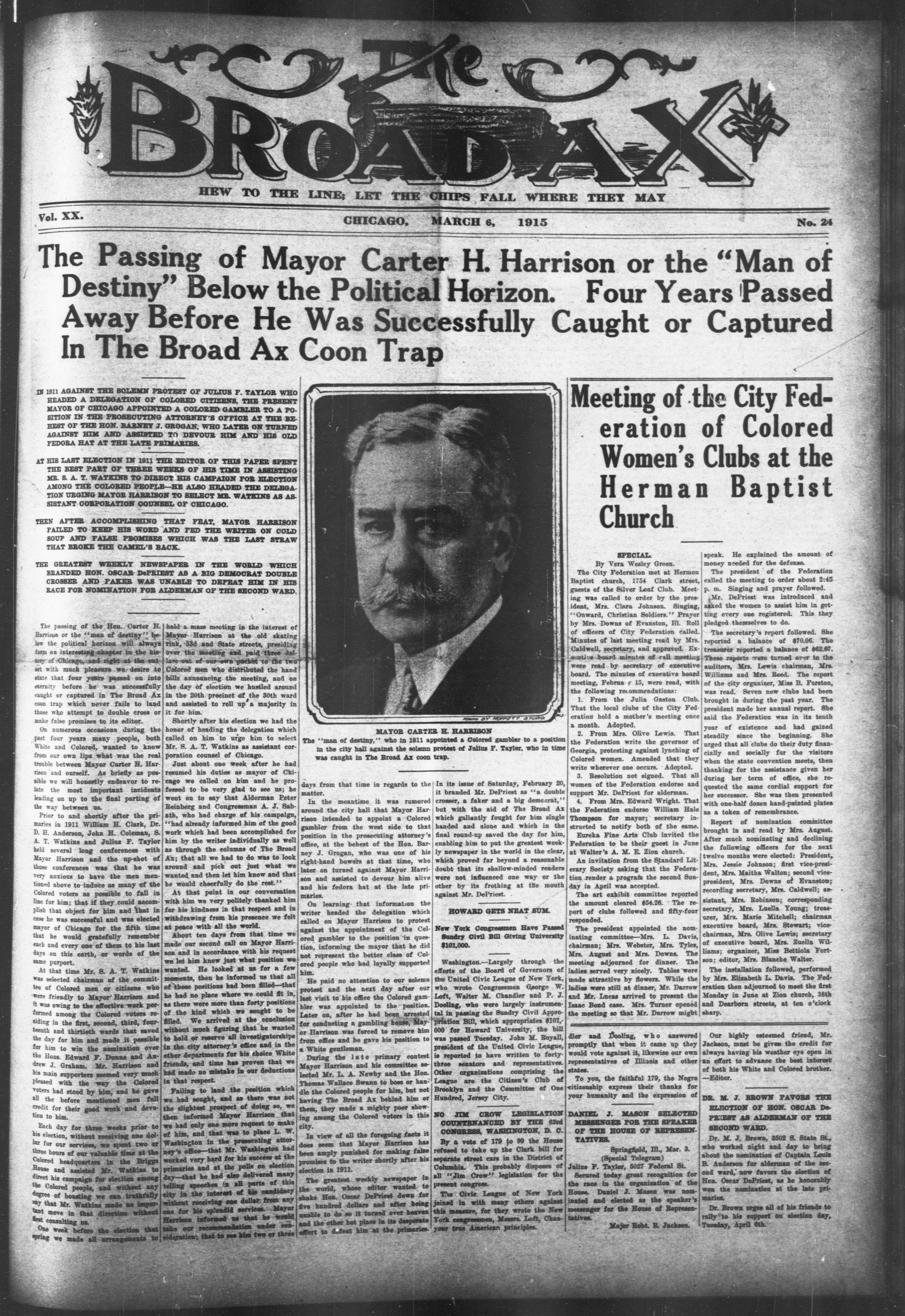
The Passing of Mayor Carter H. Harrison or the "Man of Destiny" Below the Political Horizon. Four Years Passed Away Before He Was Successfully Caught or Captured In The Broad Ax Coon Trap
IN 1911 AGAINST THE SOLEMN PROTEST OF JULIUS P. TAYLOR WHO HEADED A DELEGATION OF COLORED CITIZENS, THE PRESENT MAYOR OF CHICAGO APPPOINTED A COLORED GAMBLER TO A POSITION IN THE PROSECUTING ATTORNEY'S OFFICE AT THE BEHEST OF THE HON. BARNEY J. GROGAN, WHO LATER ON TURNED AGAINST HIM AND ASSISTED TO DEVOURE HIM AND HIS OLD PEDORA HAT AT THE LATE PRIMARIES.
AT HIS LAST ELECTION IN 1911 THE EDITOR OF THIS PAPER SPENT THE BEST PART OF THREE WEEKS OF HIS TIME IN ASSISTING MR. S. A. T. WATKINS TO DIRECT HIS CAMPAIGN FOR ELECTION AMONG THE COLORED PEOPLE—HE ALSO HEADED THE DELEGATION URGING MAYOR HARRISON TO SELECT MR. WATKINS AS ASSISTANT CORPORATION COUNSEL OF CHICAGO.
THEN AFTER ACCOMPLISHING THAT FEAT, MAYOR HARRISON PAILED TO KEEP HIS WORD AND FED THE WRITER ON COLD SOUP AND FALSE PROMISES WHICH WAS THE LAST STRAW THAT BROKE THE CAMEL'S BACK.
THE GREATEST WEEKLY NEWSPAPER IN THE WORLD WHICH BRANDED HON. OSCAR DePRIEST AS A BIG DEMOCRAT DOUBLE CROSSER AND FAKER WAS UNABLE TO DEFRAH HIM IN HIS RACE FOR NOMINATION FOR ALDERMAN OF THE SECOND WARD.
Vol. XX.
The Passion Destiny Away Be In The
IN 1911 AGAINST THE SOLEMN PR
HEADED A DELEGATION OF C
MAYOR OF CHICAGO APPOINTED
SITION IN THE PROSECUTING
HEST OF THE HON. BARNEY J.
AGAINST HIM AND ASSISTED
FEDORA HAT AT THE LATE PRI
AT HIS LAST ELECTION IN 1911 T
THE BEST PART OF THREE W
MR. S. A. T. WATKINS TO DIRE
AMONG THE COLORED PEOPL
TION URGING MAYOR HARRIS
SISTANT CORPORATION COUN
THEN AFTER ACCOMPLISHING
FAILED TO KEEP HIS WORD
SOUP AND FALSE PROMISES
THAT BROKE THE CAMEL'S B
THE GREATEST WEEKLY NEW
BRANDED HON. OSCAR DEPRIL
CROSSER AND PAKER WAS THE
RACE FOR NOMINATION FOR A
The passing of the Hon. Carter H. Harrison or the "man of destiny" below the political horizon will always form an interesting chapter in the history of Chicago, and right at the outset with much pleasure we desire to state that four years passed on into eternity before he was successfully caught or captured in The Broad Axcoon trap which never fails to land those who attempt to double cross or make false promises to its editor. On numerous occasions during the past four years many people, both White and Colored, wanted to know from our own lips what was the real trouble between Mayor Carter H. Harrison and ourselves. As briefly as possible we will honestly endeavor to relate the most important incidents leading on up to the final parting of the way between us.
Prior to and shortly after the primaries in 1911 William H. Clark, Dr. D. H. Anderson, John H. Coleman, S. A. T. Watkins and Julius F. Taylor held several long conferences with Mayor Harrison and the up-shot of those conferences was that he was very anxious to have the men mentioned above to induce as many of the Colored voters as possible to fall in line for him; that if they could accomplish that object for him and that in case he was successful and was elected mayor of Chicago for the fifth time that he would gratefully remember each and every one of them to his last days on this earth, or words of the same purport.
At that time Mr. S. A. T. Watkins was selected chairman of the committee of Colored men or citizens who were friendly to Mayor Harrison and it was owing to the effective work performed among the Colored voters residing in the first, second, third, fourteenth and thirtieth wards that saved the day for him and made it possible for him to win the nomination over the Hons. Edward F. Dunne and Andrew J. Graham. Mr. Harrison and his main supporters seemed very much pleased with the way the Colored voters had stood by him, and he gave all the before mentioned men full credit for their good work and devotion to him.
Each day for three weeks prior to his election, without receiving one dollar for our services, we spent two or three hours of our valuable time at the Colored headquarters in the Briggs House and assisted Mr. Watkins to direct his campaign for election among the Colored people, and without any degree of boasting we can truthfully say that Mr. Watkins made no important move in that direction without first consulting us.
One week before the election that spring we made all arrangements to
```markdown
```
hold a mass meeting in the interest of Mayor Harrison at the old skating rink, 53d and State streets, presiding over the meeting and paid three dollars out of our own pocket to the two Colored men who distributed the hand bills announcing the meeting, and on the day of election we hustled around in the 20th precinct of the 30th ward and assisted to roll up a majority in it for him.
Shortly after his election we had the honor of heading the delegation which called on him to urge him to select Mr. S. A. T. Watkins as assistant corporation counsel of Chicago.
Just about one week after he had resumed his duties as mayor of Chicago we called on him and he professed to be very glad to see us; he went on to say Alderman Peter Reinberg and Congressman A. J. Sabath, who had charge of his campaign, "had already informed him of the good work which had been accomplished for him by the writer individually as well as through the columns of The Broad Ax; that all we had to do was to look around and pick out just what we wanted and then let him know and that he would cheerfully do the rest."
At that point in our conversation with him we very politely thanked him for his kindness in that respect and in withdrawing from his presence we felt at peace with all the world.
About ten days from that time we made our second call on Mayor Harrison and in accordance with his request we let him know just what position we wanted. He looked at us for a few moments, then he informed us that all of those positions had been filled—that he had no place where we could fit in, as there were more than forty positions of the kind which we sought to be filled. We arrived at the conclusion without much figuring that he wanted to hold or reserve all investigatorships in the city attorney's office and in the other departments for his choice White friends, and time has proven that we had made no mistake in our deductions in that respect.
Failing to land the position which we had sought, and as there was not the slightest prospect of doing so, we then informed Mayor Harrison that we had only one more request to make of him, and that was to place L. W. Washington in the prosecuting attorney's office—that Mr. Washington had worked very hard for his success at the primaries and at the polls on election day—that he had also delivered many telling speeches in all parts of this city in the interest of his candidacy without receiving one dollar from any one for his splendid services. Mayor Harrison informed us that he would take our recommendation under consideration; that to see him two or three
PHOTO BY MORFETT STUDIO
MAYOR CARTER H. HARRISON
The "man of destiny," who in 1911 appointed a Colored gambler to a position in the city hall against the solemn protest of Julius F. Taylor, who in time was caught in The Broad Ax coon trap.
days from that time in regards to the matter.
In the meantime it was rumored around the city hall that Mayor Harrison intended to appoint a Colored gambler from the west side to that position in the prosecuting attorney's office, at the behest of the Hon. Barney J. Grogan, who was one of his right-hand bowers at that time, who later on turned against Mayor Harrison and assisted to devour him alive and his fedora hat at the late primaries.
On learning that information the writer headed the delegation which called on Mayor Harrison to protest against the appointment of the Colored gambler to the position in question, informing the mayor that he did not represent the better class of Colored people who had loyally supported him.
He paid no attention to our solemn protest and the next day after our last visit to his office the Colored gambler was appointed to the position. Later on, after he had been arrested for conducting a gambling house, Mayor Harrison was forced to remove him from office and he gave his position to a White gentleman.
During the late primary contest Mayor Harrison and his committee selected Mr. L. A. Newby and the Hon. Thomas Wallace Swann to boss or handle the Colored people for him, but not having The Broad Ax behind him or them, they made a mighty poor showing among the Colored voters in this city.
In view of all the foregoing facts it does seem that Mayor Harrison has been amply punished for making false promises to the writer shortly after his election in 1911.
The greatest weekly newspaper in the world, whose editor wanted to shake Hon. Oscar DePriest down for five hundred dollars and after being unable to do so it turned over heaven and the other hot place in its desperate effort to defend him at the primaries.
In its issue of Saturday, February 20, it branded Mr. DePriest as "a double crosser, a faker and a big democrat," but with the aid of The Broad Ax which gallantly fought for him single handed and alone and which in the final round-up saved the day for him, enabling him to put the greatest weekly newspaper in the world in the clear, which proved far beyond a reasonable doubt that its shallow-minded readers were not influenced one way or the other by its frothing at the mouth against Mr. DePriest.
HOWARD GETS NEAT SUM.
New York Congressmen Have Passed Sundry Civil Bill Giving University $101,000.
Washington.—Largely through the efforts of the Board of Governors of the United Civic League of New York, who wrote Congressmen George W. Loft, Walter M. Chandler and P. J. Dooling, who were largely instrumental in passing the Sundry Civil Appropriation Bill, which appropriates $101,000 for Howard University, the bill was passed Tuesday. John M. Royall, president of the United Civic League, is reported to have written to forty-three senators and representatives. Other organizations comprising the League are the Citizen's Club of Brooklyn and the Committee of One Hundred, Jersey City.
NO JIM CROW LEGISLATION COUNTENANCED BY THE 63rd CONGRESS, WASHINGTON, D. C.
By a vote of 179 to 99 the House refused to take up the Clark bill for separate street cars in the District of Columbia. This probably disposes of all "Jim Crow" legislation for the present congress.
The Civic League of New York joined in with many others against this measure, for they wrote the New York congressmen, Messrs. Loft, Chan-your true American principles.
Meeting of the City Federation of Colored Women's Clubs at the Herman Baptist Church
By Vera Wesley Green.
The City Federation met at Hermon Baptist church, 1754 Clark street, guests of the Silver Leaf Club. Meeting was called to order by the president, Mrs. Clara Johnson. Singing, "Onward, Christian Soldiers." Prayer by Mrs. Downs of Evanston, Ill. Roll of officers of City Federation called. Minutes of last meeting read by Mrs. Caldwell, secretary, and approved. Executive board minutes of call meeting were read by secretary of executive board. The minutes of executive board meeting, February 4, 15, were read, with the following recommendations:
1. From the Julia Gaston Club. That the local clubs of the City Federation hold a mother's meeting once a month. Adopted.
2. From Mrs. Olive Lewis. That the Federation write the governor of Georgia, protesting against lynching of Colored women. Amended that they write wherever one occurs. Adopted.
3. Resolution not signed. That all women of the Federation endorse and support Mr. DePriest for alderman.
4. From Mrs. Edward Wright. That the Federation endorse William Hale Thompson for mayor; secretary instructed to notify both of the same. Eureka Fine Arts Club invited the Federation to be their guest in June at Walter's A. M. E. Zion church. An invitation from the Standard Literary Society asking that the Federation render a program the second Sunday in April was accepted. The art exhibit committee reported the amount cleared $54.26. The report of clubs followed and fifty-four responded. The president appointed the nominating committee—Mrs. L. Davis, chairman; Mrs. Webster, Mrs. Tyles, Mrs. August and Mrs. Downs. The meeting adjourned for dinner. The ladies served very nicely. Tables were made attractive by flowers. While the ladies were still at dinner, Mr. Darrow and Mr. Lucas arrived to present the Isaac Bond case. Mrs. Turner opened the meeting so that Mr. Darrow might
dler and Dooling, who answered promptly that when it came up they would vote against it, likewise our own representatives of Illinois and other states.
To you, the faithful 179, the Negro citizenship express their thanks for your humanity and the expression of
DANIEL J. MASON SELECTED MESSENGER FOR THE SPEAKER OF THE HOUSE OF REPRESENTATIVES.
Springfield, Ill., Mar. 3.
(Special Telegram)
Julius P. Taylor, 5027 Federal St.
Secured today great recognition for the race in the organization of the House. Daniel J. Mason was nominated and elected as the speaker's messenger for the House of Representatives.
speak. He explained the amount of money needed for the defense.
The president of the Federation called the meeting to order about 2:45 p. m. Singing and prayer followed.
Mr. DePriest was introduced and asked the women to assist him in getting every one registered. This they pledged themselves to do.
The secretary's report followed. She reported a balance of $70.06. The treasurer reported a balance of $62.67. These reports were turned over to the auditors, Mrs. Lewis chairman, Mrs. Williams and Mrs. Reed. The report of the city organizer, Miss B. Forston, was read. Seven new clubs had been brought in during the past year. The president made her annual report. She said the Federation was in its tenth year of existence and had gained steadily since the beginning. She urged that all clubs do their duty financially and socially for the visitors when the state convention meets, then thanking for the assistance given her during her term of office, she requested the same cordial support for her successor. She was then presented with one-half dozen hand-painted plates as a token of remembrance.
Report of nomination committee brought in and read by Mrs. August. After much nominating and declining the following officers for the next twelve months were elected: President, Mrs. Jessie Johnson; first vice-president, Mrs. Maitha Walton; second vice-president, Mrs. Downs of Evanston; recording secretary, Mrs. Caldwell; assistant, Mrs. Robinson; corresponding secretary, Mrs. Luella Young; treasurer, Mrs. Marie Mitchell; chairman executive board, Mrs. Stewart; vice-chairman, Mrs. Olive Lewis; secretary of executive board, Mrs. Zuella Williams; organizer, Miss Bettiola Fortson; editor, Mrs. Blanche Walter.
The installation followed, performed by Mrs. Elizabeth L. Davis. The Federation then adjourned to meet the first Monday in June at Zion church, 38th and Dearborn streets, at ten o'clock sharp.
Our highly esteemed friend, Mr. Jackson, must be given the credit for always having his weather eye open in an effort to advance the best interest of both his White and Colored brother. —Editor.
DR. M. J. BROWN FAVORS THE ELECTION OF HON. OSCAR DE-PRIEST AS ALDERMAN OF THE SECOND WARD.
Dr. M. J. Brown, 3502 S. State St., who worked night and day to bring about the nomination of Captain Louis B. Anderson for alderman of the second ward, now favors the election of Hon. Oscar DePriest, as he honorably won the nomination at the late primaries.
Dr. Brown urges all of his friends to rally 'to his support on election day, Tuesday, April 6th.
PAGE TWO
A Monster Iceberg.
"On my journey north," writes Lacey Amy in the Wide World Magazine, "we had striking evidence of the possibilities of the iceberg even before we reached Battle Harbor, the most southward settlement on the Labrador coast. Just before sundown we could see ahead a strangely misty object blending elusively into water and sky in the way that so often takes the heart from a photographer. Its flat horizontal top was its first noticeable feature, but as we approached its great size made us forget everything else. The captain ran as close as he dared, and its mile of length and sixty feet of height rose near us like a magnified block left at the door by the iceman, with the difference that in this gigantic block there was enough ice to stock all America for years. Since the opening of navigation it had been in the same place, stranded two miles outside our course, and at that time it was three miles long and a mile wide. On our return some weeks later it was still there, but in the moonlight we saw three blocks instead of one. The sun was doing its work."
Singing Birds' Deadly Rivalry.
It is well known that caged charfinches are celebrated for their eagerness to compete with one another in singing. They deliver their songs alternately until one is exhausted and unable to take up his turn. So excited do the birds become that it occasionally happens that one of the competitors drops down dead. The originating and directive causes of the particular song of different kinds of birds is not understood. But it is established that they have a great gift of imitation. Parrots, ploping crows, ravens and other such birds are familiar instances, while little birds such as bullfinches can be trained to whistle the melodies which human beings have invented. Even the house sparrow, which, though allied to singing finches, never sings when in natural conditions, has been converted into a songster by bringing it up in company with piping bullfinches.-London Express.
One Way to Sell a Horse
During the Peninsular war, when the British army was in front of the enemy, Colonel Mellish appeared mounted upon a wretched steed, which provoked the derision of his fellow officers.
"It isn't worth £5," one of them remarked.
"I'll bet you £50 I get over £40 for him," said the colonel.
"Done!" exclaimed the other.
The harebrained colonel immediately rode off in the direction of the enemy, who, of course, fired upon him. Nothing daunted, the colonel continued to advance until his horse was killed under him, when he hastily freed himself and returned to the British lines, where he promptly claimed the wager. The money was handed over to him by the other unlucky officer, for the government then allowed a sum of £45 for every officer's horse killed in action—London Globe.
Market For Everything.
"Is there such a thing as secondhand brass band instruments? Why, certainly," said a musical instrument man. "Why shouldn't there be? You can buy secondhand yachts, plane, steam boilers, bricks, secondhand anything on earth-why not secondhand band instruments? How do they come to be offered secondhand? Why, just as anything else does. Somebody gives up using an instrument, and then he sells it; or somebody wants to buy a better instrument and then sells the old one. And for all these secondhand instruments there is a market. They may be sold to beginners or to players, and such a thing has been beard of as a new band equipping itself throughout with secondhand instruments for the sake of economy."-Pittsburgh Press.
With as a Noun.
When Walter Scott was a boy his teacher asked him to give the part of speech of the word "with."
"It's a noun," said young Scott.
"You are very stupid," said the teacher.
"How came you to say such a thing?"
"I got it from the Bible, sir," said the future novelist stoutly.
"There's a verse that says 'they bound Samson with withs.'"
Cave Spiders.
Spiders of several kinds are found in caves. They are uniformly small, weak and of sedentary habits. No wee do they spin save a few irregular threads sometimes. What they live upon is rather a puzzle, though it is supposed that they catch stray mites and other such small fry.
Burns' Poverty.
Robert Burns, writing only fourteen days before his death, implored his friend Cunningham to use his influence with the commissioners of excise in order to get his salary raised from £35 a year to £50, "otherwise if I die not of disease I must perish with hunger."
Very Much So
"What was it? Did he rescue a human derelict or did he help a poor mother?"
"No; he borrowed $5 from father."—Baltimore American.
Draft of a Vessel.
Draft is the distance in feet from the lowest part of the bottom of a vessel to the actual water line at which the vessel is floating.
Who troubles others has no rest but himself—Italian Proverb.
Arabe and Girl Bables.
It is a sad day in an Arab home when a girl is born. The musicians who have come to the house with their drums, their shepherd's pipes and all their strange musical instruments burst into wild wailing if the door is seen to open slowly and a head shake silently and sadly and then withdraw behind the closed door. All the rare food which has been prepared in the hopes that the new arrival is a boy is put away and the walling guests turned from the house. For why, they say, should one feast and have music when another superfluous woman has been brought into the world? Though human nature is what it is, the little girl is not wholly unloved. She is given some pretty name, such as, translated, would be "star," or "dawn," or "pretty," or "pleasant." When a boy is born the rejoicing, on the contrary, is hilarious in the extreme. Welcomes are chanted by stringed instruments, the praises of the family are sung, and a forecast of the great deeds to be done by the son are recited—Exchange.
In a Quandry.
In a foothill California district there is a man who runs a small ferry across one of the rivers, charging twenty-five cents for one transportation of a single team and forty cents for a double one. One afternoon in the early days of automobiling a city man drove up to the ferry in a touring car and attempted to go on to the boat, but was held up by the captain, who told him to wait. Finally, after the boat had crossed the river two or three times, the motorist began to get impatient. "Can't take ye over yet," answered the captain in response to the motorist's demands. "Ter the fust one o' them things that ever crossed here, an' I don't know what ter charge ye." "Don't know what to charge me?" "Nope; I've sized ye up fore and aft, an' I'm durned if I know whether to charge ye as a single rig or a double team."—Argonaut.
Chinese Looks.
The earliest locks known to man were of Chinese make. Although it is impossible to tell the exact date of those still extant, they are wonderfully well made and as strong as any manufactured in Europe to the middle of the eighteenth century. The Chinese locksmith of today uses exactly the same kind of tools that his forefathers had, for they are very simple and primitive. He carries all his impediments in two cabinets, sitting on one and working at the other. When he has finished all the work available in one neighborhood he fastens the two cabinets to a bamboo rod and slings it over his shoulder. He tramps through the towns burdened in this way and stops when he is called, much as a scissors grinder or umbrella mender does in our country—Wide World Magazine.
Ordinary Ventilation
Authorities compute that each adult person in a room requires at least thirty cubic feet of fresh air per minute to maintain a fair standard of purity; hence the air changes required per hour primarily depend upon the number of workmen in the shop, together with its cubical contents. If the rooms are large and the workmen few the necessary air changes per hour are lessened, so that this figure depends for its determination upon local conditions. J. Byers Holbrook allows "One change of air per hour for the average type of city building," increasing this allowance for corridors and first floors. Other engineers designate variously from a fraction of one change to as high as three changes per hour for different sets of conditions.—D. M. Myers in Engineering Magazine.
Story of a Secrease
Grant Duff in his diary tells a curious story of a "secreess." Mile Lenormand was consulted by Robesplierre and Napoleon I. Grant Duff's father had a strange experience with Mile Lenormand. He and a friend went to consult her, and after she had told him what he wanted to know she tried with the friend, but became confused, sald her heart failed her and begged him to leave the house. He persuaded her to try again, and again the same result followed. Then, declaring that this had never happened to her before, she lost all patience and implored him to leave instantly. He did so and as he passed out of her door was knocked down and killed by a heavy wagon.
Forks
Nother the Greeks nor the Romans possessed forks. It was, according to that curious book of travels, "Coryat's Crudities," published in 1611, left to Italy to invent them, because, as the author qualitly observes, "the Italian cannot by any means endure to have his dish touched with hands, seeing that all men's fingers are not alike clean."
A Serious Conclusion
"Is your daughter still taking music lessons?"
"No," replied Mr. Growcher. "After hearing her sing and play lately I have concluded that she doesn't need a teacher any more. What she wants is a censor."-Washington Star.
His Conspition
The ambition of some men is to live long enough to hear of a bride who is not "prominently known in the younger social sat." Cleveland Leader.
Battles in the Show.
One of the most severe winters ever experienced was that of 1812, the year of Napoleon's great Russian campaign. On June 24 of that year he invaded Russia with an army of 000,000 men. Moscow was reached on Sept. 14, and a month later, after the Russians had burned that town to the ground, Napoleon commenced his retreat. The army of 000,000 was almost wiped out. Men froze to death by hundreds as they camped, and when at last the Russian frontier was reached only 130,000 men were left alive.
In the Crimean war England lost altogether 20,656 men. Actual fighting, however, was only responsible for 12 per cent of these deaths. Cold and disease were the causes of the other 88 per cent of deaths.
Human Levers
All man made machinery wheels. Yet there is not a in the human body. And body is the most perfect mechanism in the world. strange that man has de chances along all lines but which his own body works. every motion we make is by the direct operation of living creatures are the one so built. Almost all the levers are of one kind, that called the third. There are of levers: (1) that in which crum is between the power weight, or resistance, as if scissors; (2) that in which or resistance is between and the power, as in an
During the Franco-German campaign of 1870 another severe winter was experienced. To the thousands of Germans investing Paris the cold meant little. They had the whole country to draw on, but to the besieged and starving French it meant terrible suffering. The city surrendered in January after four months' siege—Pearson's.
Listen to Your Conscience.
Listen to Your Conscience.
Almost daily in every breast there is some tragedy enacted. A plot and a counterplot, a hero and a victim, a climax and a catastrophe, remorse and restitution—all these confusedly intermingled with scenes of our inner consciousness. And he who selects out of it all as the type of his dominating thought the morbid and the hateful thus starves and shrivels up his own highest nature and poisons the lives of others. But he who in the midst of these chaotic scenes can listen attentively to the whisperings of the still, small voice thereby nourishes his soul to a degree of bigness and strength that make him a power for righteousness in any community. But the real secret of materializing our highest thoughts in the form of deeds is to act readily and willingly upon the promptings of the inner spirit. To procrastinate, however, is in time to render this inner voice forever silent—Symphony Calendar.
Told to Earn His Own Salary.
Commodore Vanderbilt discovered in James H. Rutter, then in the employ of the Erie railroad, a man he believed the freight department of the Central needed. It is related that some time after he took charge of the Central's traffic office Rutter called on the commodore to submit a plan for improvement. When he had stated the case the president looked at him sharply and asked:
"Rutter, what does the New York Central pay you $15,000 a year for?"
The reply was, "For managing the freight traffic department."
And then the commodore said, "Well, you don't expect me to earn your salary for you, do you?"
Rutter went out and carried through his plan on his own judgment. The result was highly satisfactory. Rutter became president of the Central.
The Likelier One
The late Admiral Mahan was once arguing with a lady at a luncheon about the British navy.
"But, my dear madam," said the admiral, "it is hard to argue with you because you are so—er, pardon me—so ignorant.
"You remind me of the young wife who said to her brother about her volunteer husband:
"Isn't Jack just wonderful? Think He's already been promoted to field marshal."
"From private to field marshal in two months? Impossible!" said the brother.
"Did I say field marshal? murmured the young wife. 'Well, perhaps it's court martial. I know it's one or the other.'"—Washington Star.
Kipling's Tribute to Mark Twain.
Kipling wrote of Mark Twain: "He put his hand upon my shoulder. It was an investiture of the Star of India, blue silk, trumpets and diamond studded jewel, all complete. If hereafter in the changes and chances of this mortal life I fall to cureless ruin I will tell the superintendent of the workhouse that Mark Twain once put his hand on my shoulder and he shall give me a room to myself and a double allowance of tobacco."
Contradicted.
A certain physician told some of his patients that as long as they kept their feet dry they would be safe from an attack of the grip. One day he was surprised to receive a letter from a patient in which the latter said that he had two wooden legs, and yet he had the grip for five consecutive years.
Just Evan.
A Massachusetts candidate for congress after the election filed a beautifully negative account of his campaign expenses. It said, "I received nothing, premised nothing, expected nothing, got nothing." So he would seem to be just even with the game—Browning's Magazine.
He Can Draw.
Human Levers.
All man made machinery runs with wheels. Yet there is not a single wheel in the human body. And the human body is the most perfect piece of mechanism in the world. It seems strange that man has developed mechanics along all lines but those with which his own body works. Practically every motion we make is performed by the direct operation of levers, and living creatures are the only machines so built. Almost all these human levers are of one kind, that commonly called the third. There are three kinds of levers: (1) that in which the fulcrum is between the power and the weight, or resistance, as in a pair of scissors; (2) that in which the weight or resistance is between the fulcrum and the power, as in an oar; (3) that in which the power is between the fulcrum and the weight, as in a pair of grass clippers. It is true that each of these forms of levers is used in mechanics, but no great machine has ever been built on the purely lever principle.—New York World.
Japan's Hokey Pokey Men.
Japanese children are amused by the rice jelly molder, or amezalkuya, as American children are by the hokey pokey ice cream itfnerant. Beating a drum, he goes up and down city streets with a small box on his bamboo pole or on a small cart, paper flags of various colors decorating his outfit. Ame is a kind of jelly made from rice, of which all Japanese children are extremely fond. The ame seller stops when the children gather round him, and he amuses them by molding all kinds of shapes, from a fish to a bird, which he sticks on a piece of bamboo and sells to his audience for a mere nothing. He can blow up the ame like a glass blower, making a globe "or a large sized" animal or fish, as he wills, and each child chooses the object he most fancies. Each object created is painted with a vegetable coloring in lifelike colors, and with each purchase he gives away a paper flag. He is a picturesque feature at all temple festivals.-Bulletin of Japan Society.
Bagdad's Mysterious Source.
An uncanny, pernicious pest called the "date boll" scars the face of every human born in Bagdad. Children invariably have this dreadful sore on their faces. Throughout the middle east this mysterious scourge is known by various names—"Buton d'Alep," "Nile sore," "Delhi button," etc. Its cause and its cure are unknown. First a faint red spot appears, growing larger and running a course often eighteen months long.
White men from foreign lands have lived years in Arabia, only to have this boll appear upon their return to civilization, where its presence is embarrassing and hard to explain. Maybe it was "date bolls" that Job had! Once a British consul at Aleppo lost almost his whole nose from one of these bolis. Nearly every Bagdad native you meet has this "date mark" on his face—National Geographic Magazine.
A Substitute For Spectacles.
At a meeting of the Academy of Medicine in Paris Dr. Lesage recommended a novel Dr. for reading print for the use of those who happen to have forgotten their spectacles. The method is to take a piece of paper and perforate it with a pin, making numerous small holes. This paper must be held close to the eye and the reading matter at a distance from the eyes. A test of this method shows that it slightly enlarges the print to be read and that a book or newspaper can be held further away from the eyes than would ordinarily be possible to a near sighted man who had mislaid his glasses. However, the method is useless for prolonged reading, being valuable only when one must read a few paragraphs.
Neighborhood Melody.
"Please, ma'am," said the little girl from next door, "mother wants to know if you will lend her your new mechanical tune player this afternoon."
"What an extraordinary idea! Is she going to give a dance?"
"No, ma'am. We're tired of dancing to it. She wants to keep it quiet for a couple of hours so that the baby can sleep." - Washington Star.
Sugar Water
Eau sucre is said to dispel thirst more efficaciously than any other drink, and it is simplicity itself. Put three large lumps of sugar in a tumbler with a tablespoonful of water and allow the sugar to dissolve, then fill up with more cold water. The French say that the perfection of this drink consists in letting the sugar first melt slowly in a small quantity of water.
Longest Sentence
"It says here that the longest sentence in the English language contains 140 words," observed the old fogey.
"That's wrong," replied the grouch.
"The longest sentence contains only one word.'
"What is that?" asked the old fogey.
"Life," replied the grouch.
Back to Earth.
Rankin—Have you never been to Niagara falls? Phyle—Yes, but I want to go again some day and see the scenery. The first time I went I was on my honeymoon—Judge.
Early Artillery.
The earliest artillery guns were made from wrought iron bars, bound together like the staves of a cask by the shrinking over them of iron hoops—London Tit-Bits.
The love of pelf increases with the self—Juvenal.
Endorsed by the Regular 2nd Ward
Republican Organization
Residence, 4630 Evans Avenue
Tel. Kenwood 5466
Dr. H. REGINALD SMITH
EYE GLASSES
SCIENTIFICALLY FITTED
Office, 3401 S. State St., Chicago
Office Hours:
9 A.M. to 5 P.M. 7 to 9 P.M.
Phone Douglas 1248 Auto. 77-810
Gift of the Gods.
---
JOHN H.
There are 100,000,000 children in China under ten years of age. One wonders how there are so many remaining, for minitudes of children die off through exposure, ill care, starvation and disease. Hundreds of thousands of these children live in the Chinese campans, which ply the rivers and throng the water fronts of the great cities. For generations these boatmen knew no other home than these boats. In case of babies a rope is attached under their arms and if they slip over the side of the sampon into the water they are fished out the best way possible. But life is plenty and cheap in China. "How much, then, is a man better than a sheep?" Not much better in China. A friend of mine, a Brooklyn judge, who arrived late at the daily public execution in Canton and who could only stay for the day, was told that for $10 they would secure a special victim to satisfy the American's curiosity. And they proceeded to find a man who for the sake of his family was willing to barter his life for $10. Of course he got the $10—and his life—Christian Herald.
Ancient Halbards
Halbard is the arms carry'd by the serjeants of foot and dragoons; the head of the halbard ought to be a foot or fifteen inches long; one end ought to be hollow to receive the staff, but the other broad, ribb'd in the middle, edg'd on both sides and drawing to a point, like the point of a two edged sword. On one side of the head is likewise fixed a piece in form of a half moon or star, and on the other a broad point of four inches long, crooked a little, which is very commodious for drawing fascles, gabions or whatever obstacle happen in the way. The staff of the halbard is about five feet long and an inch and half in diameter, made of ash or other hard wood. Halbards are very useful in determining the ground betwix the ranks, and for dressing the ranks and files of a battalion, and likewise for chastising the soldiers.-Gentleman's Directory. 1705.
Making Clothes Fireproof.
Apropos of fire prevention a doctor in New York told how to make clothes fireproof. They should, he said, he dipped in a solution of ammonium phosphate, one pound to a gallon of cold water. Ammonium phosphate costs only 25 cents a pound, he said. The doctor took an eight inch strip of ordinary cotton gauze, equivalent to the material in the Indian and cowboy suits so popular among children, and ignited it. It was wholly consumed within four seconds. Then he took a similar strip, dipped it in the ammonium phosphate solution, dried it with an electric fan and held it in a flame for thirty seconds, but it did not burn.
"Families should get this solution, keep it in their houses and dip the whole family washing in it," said the doctor. "It would cost about 15 cents a week for an entire family."—New York World.
Gave Napoleon Advice
Napoleon Bonaparte had no more devoted and disinterested friend than Gaspard Monge, the illustrious academician and founder of L'Ecole Polytechnique. On one occasion he demonstrated his regard by giving the great general some unwelcome advice. Napoleon announced his intention of reading a paper to the French institute. Monge frankly expressed his disapproval of the plan.
"You have not time to write a good paper, and you cannot afford to write a poor one. The eyes of the world are upon you. Whatever you write will be severely criticised."
Napoleon was astonished and indignant at this plain speaking, but he never wrote the paper.
Beards In Russia
It is curious to note that in Russia the beard has, always been an object of repute. An ordinance which Yaroslaf, son of Vladimir and legislator of Novgored, then the capital of Russia, published in 1015 exemplifies this. By this law any one plucking a hair from a neighbor's beard was subjected to a punishment four times more severe than that inflicted for cutting off his finger.
A Chinese Superstition
It is a superstition of the Chinese that a sneezes on New Year's eve indicates misfortune for the coming year, and to overcome this he is obliged to go to three families of different surnames and beg from each of them a little cake shaped like a tortoise, which must be eaten before midnight.
Those favored few who by their rank or their riches are exempted from all exertion have no reason to be thankful for the privilege. It was the observation of this necessity that led the ancestors to say that the gods sold us everything but gave us nothing—Charles
A meat packer's wagon rattled over the cobblestones down First avenue. Overhead roared an elevated train, and in the sunshine on the curb sat five boys shooting craps. Suddenly one of them darted out into the street, swung himself up on the passing wagon, seized a ham and jumped off—into the arms of a "white wing."
This agent of the city, after appropriating the ham, gave the boy a vigorous shaking and flung him toward the sidewalk.
Immediately all five boys vanished into the earth.
The "white wing" looked down the street and the wagon had disappeared as completely as the boys, with the driver quite unconscious of any unusual stir.
He looked in every direction; then doubtless thanking the gods for their gift, he wrapped the ham in a news paper and he too disappeared down a side street.—New York Post.
A Novel Craft.
In the harbor of Port Weller, the Ontario entrance of the Welland ship canal, says the Engineering News, the surveying staff uses a flat bottom boat that can lift itself clear of the water. It is a drill boat or sounding scow, of catamaran model, built particularly for the work of finding the elevation of the rock that underlies the bottom of the river. In order to have a steady platform on which to work during rough weather the surveyors had the scow made with a slot at each corner, through which a very heavy spud or post can be raised or lowered. The lifting mechanism consists of a wheel on top of each post, over which a wire cable passes from the side of the scow to an individual engine. When the scow heaves and sways in the water too much workmen start the four engines, and presently the scow is standing firm, with its four stout legs on the bottom of the river.
Slipshod English.
Here are some specimens of very common errors:
Admit for confess. To admit is to concede something affirmed. An unaccused offender cannot admit his guilt.
Adopt. "He adopted a disguse."
One may adopt a child or an opinion, but a disguse is assumed.
Aggravate for irritate. "He aggravated me by his insolence." To aggravate is to augment the disagreeableness of something already disagreeable or the badness of something bad. But a person cannot be aggravated, even if disagreeable or bad.
All of. "He gave all of his property." The words are contradictory. An entire, thing cannot be of itself. Omit the preposition.
At for by. "She was shocked at his conduct." This very common solemnism is without excuse—Exchange.
Trenches In War
The late British general Sir William Butler in the course of an article that appeared in a military magazine nearly forty years ago thus spoke his mind about the use of trenches in time of war: "The spade may be nearly dangerous to the army that uses it as to the one that neglects it. Like every thing else, it is good in its way. That way is given a long way, but its end can be reached. If the infantry soldiers get thoroughly convinced that in the sheltered trench lie his hopes of safety he will doubtless be a hard man to drive out of these trenches. But it may also be a difficult matter to drive him on from them to the front. Digging may save a battle from being lost, but it has never won a decisive victory, and it probably never will."—Manchester Guardian.
Dragcons.
Four centuries ago, when dreamers were in their infancy, soldiers were named from the weapons they bore. Thus infantrymen were called "nike" or "shot," according to their weapons. The "dragon" was a short musket or carbine, and the soldiers who bore them were dragons. The original dragons were mounted infantrymen, being organized as infantry. On this account, being without cavalry training, they were decidedly poor horsemen, but they improved until they were classed as medium cavalry. American Boy.
Woman's World
Mrs. Blatch Thinks We-
men Are Born Diplomats.
MRS. HARRIOT STANTON BLATCH.
Mrs. Harriot Stanton Blatch made a ringing speech at Cooper Union, in New York, when 5,000 women met to protest against war. Her words were rewarded again and again with aplause, but these brought forth tumult: "Men don't go" into powder magazines carrying lighted matches, because they know the nature of powder. But they don't know human nature.
"All the diplomatic posts of the world should be filled with women because they are natural diplomats. The reason for their diplomacy is that they know human nature and, knowing it, have the grace and patience to handle it. Men are blind on the human nature side. When they attempt to handle questions involving men they handle them as they would cattle-by force or terror. With women they have a softer hand, thou' that is under protest. It is a concession to what men have long tolerated, though with a poor grace, woman's 'touchiness.'
"Women provide the curves of human nature, men the angles, and it is a curious comment that the curves understand the angles, but to the angles the curves remain to the last a mystery. Men have a glimmering sense of this extra knowledge of women, but not one of them has been clever enough or gallant enough to give it its right name. They have talked of women's intuition, their strange, half childlike, half animal scent of the true character, but not once have they applied the term that fits that rare and needful character. The word is 'penetration.' "A man and woman stand beside the stream of human nature. Man sees the bright surface of it. He notes the swiftness or slowness of its current. A woman sees the mud and the pebbles at the bottom."
What Are Good Manners?
Many definitions have been given from time to time, but one of the best is the sort of manners which are guided by kindness and consideration for others. If you keep this in mind you need not be afraid of criticism. If you let your actions be guided by motives of kindness, if you consider others before yourself, you are bound to do the right thing—which is the kind thing—at the right time. Of course there are various forms in social usage which can only be acquired by association with refined persons, but if this is denied one the seeker after good manners cannot go very far astray if he or she remembers to let kindness and consideration rule.
In these days when the average person is "out for himself," when selfishness is the predominant note of social and business intercourse, the man or woman who thinks of others and acts according to their wishes will soon be marked for a kindness of manner which cannot be equaled by those who have been called to higher places in life.
Take Care of Shoes
The care of the shoes is an absolute necessity with the new fashion of short dresses. The laced shoe has come in again for both morning and afternoon wear, though the type varies. For morning the vamp has a finish of dull tan or black leather, with a light fawn or tan top. For afternoon the vamp is of patent leather and the top is of paler shade, is trimmed with a bit of the patent leather and is altogether a more decorative type of boot.
Cleaning Marble
Marble is cleaned as follows: Pound together two ounces of washing soda, an ounce of powdered pumice stone and an ounce of whiting. Sift them through muslin. Make these ingredients into a cream with sufficient boiling water. Apply thickly with a brush, allow to dry, then wash off with hot water, dry and rub up with a soft cloth. All porcelain yellowed with iron sediment may be cleaned with muriatic acid.
Using State Road
Brown in oven every scrap of stale bread that is left, but don't scorch. Boll while hot and crisp, and elf. Use the fine crumbs for croquettes, etc.; the coarser for puddings, etc. Keep dry in glass jars or tin cans.
Milady's Mirror
Care of Hairbrush.
Where possible it is very much better to have the hair brushed by a second person, more especially where it is long and heavy. A woman can hardly carry her arm from the scalp to the full length of the hair, and it snarls and tangles until more is pulled out than is right.
There is also a great difference in the sort of brush used. One with bristles that are too stiff will scratch the scalp, often make it very sore and so cause loosening of the hair; one with bristles that are too soft will not be of much use in reaching the skin and stimulating the growth of new hair. A brush that is not perfectly clean will cause dandruff, an oily condition and effectually prevent a healthy growth. So, much attention should be paid to not only the quality, but the cleanliness as well as to the proper setting of the bristles of the brush used.
There is a splendid English brush with black bristles that seems to be almost perfect. The effect is to bring about a healthy glow on the scalp, while the hair is left soft and shining after a thorough brushing. Rather high priced, a good brush of this sort will cost over $2, but lasts for years if washed properly, so the cost may be considered worth paying.
The washing of hair brushes is very simple, yet a certain course must be followed: Tepid water with a good soap, the bristles well rubbed with another brush, a comb passed through and through so the bottom of the rows may be touched; two lathers, rinsing in warm water, then in cold, and a rubbing lightly with a towel that does not leave lint. These are simple rules.
The drying should be done by laying the brushes bristles down in a dry, warm place, but not on a radiator or in a hot sun. The heat of either will loosen the bristles. Where very dusty, as after the hair has been filled with dust from a trip or high winds, a teaspoonful of ammonia may be added to the soapy water. This effectually cuts out the greasy dust.
Reason will show that by laying the brushes down on the bristles the water will run out, whereas if placed on the back it will soak into the wood and in time loosen every bristle.
A little sifted cornmeal dusted into brushes and then brushed out often takes away the daily accumulation of dirt where a hairbrush is used constantly, thus saving too many washings. The very particular woman will be utterly confounded to note the appearance of a cloth used to wipe her hairbrush while she is going through her daily application. Where the dirt comes from is a question that can never be answered, but she will be convinced that the most particular care is needed every day if she wishes her hair to be free from dirt and her toilet appointments as fastidiously neat as she thinks they should be.
Bright Eyes.
Keeping the eyes bright is by no means a difficult matter. Every woman knows the value of bright, sparkling eyes as an asset to beauty. First avoid all eye strain. One of the greatest mistakes many women make is that of putting off the wearing of glasses long after they are needed. If you need glasses use them. There is no need to wear them constantly. Keep them for work.
Don't wake in a bright light or sleep facing the window. Have your bedroom window open, but the room dark.
Every morning and night wash out your eyes with a weak solution of boric acid, about one teaspoonful of boric powder mixed in six ounces of hot water and allowed to get cool. Apply this with an eye cup, and after one week's use the benefit will be felt and seen.
Beauty Hintz.
Nothing restores a tired body and brain more completely than a refreshing bath and a change into fresh, clean clothing.
Get into the habit of keeping several changes of shoes and change your shoes every night when you come home. It is a great rest to tired feet.
Cold water is a splendid preventive of wrinkles, making the skin firm and smooth. The face should be washed in cold water every morning.
If those who perspire freely would use a little ammonia in the water they bathe in every day it would keep the flesh clean and sweet, doing away with any disagreeable odor.
About Wearing Vells.
A good cream applied to the face, carefully wiped off and followed with a good face powder is better than a veil on very cold days. The veil becomes moist from the breath. This causes the skin to chap and roughen, and it takes several days to get the skin back to a normal condition. Repeated chapping will make the skin coarse and florid.
Mousse Cream
Message Cream.
A massage cream may be made as follows: Take three ounces of oil of sweet almonds, an ounce of lanolin, two drams of cucumber juice, two drams of white wax, two drams of spermaceti, thirty drops of tincture of benzoin and ten drops of oil of rose. Combine these and place in a jar for
THE BROAD AX, CHICAGO, MARCH 6. 1915.
SPRING TAILLEUR.
Black and White is a Combina-
tion Which Finds Much Favor.
A NATTY CREATION.
Black and white continually aspires for favor in the feminine sartorial world. The gown here pictured is one of the season's nattiest offerings. The skirt is not strikingly flaring. The cutaway fronts of the coat, the belt and the pockets, arranged in a slanting fashion, are all good style features. The little Tam straw hat is trimmed only with a gay, red coq feather. Buttoned boots are worn with this girlish costume.
NEW SHIRT WAIST.
It Buttons Right Up Under the China
Sleeves Are Long.
The new shirt waist has no longer a
decollete. It buttons up right under
the chin in a high stock collar. The
sleeve is set in either raglan or in a
rather large armhole, and if it is a
blouse model the sleeve attaches to the
lining and not to the little bolero-like
outside blouse.
Georgette crapes, linens, volles and
embroidered batiste all make the most
delightful waists. Little vests of plaited
lingerie, organdle or net are often
set in the front. Odd china buttons
give a new touch to the more tailored
types and Slavic embroideries a bit of
color to the light white and sand colored
volles and linens.
Sleeves are long and in the shirt waists lightly gathered into a tight cuff. In the blouse models some of the imported styles show ruffled sleeves some with a series of small puffs, others with a high puff at the shoulders with a transparent loose sleeve that gathers into the wrist underneath. Tailored morning skirts are of linen, crash and ratine, a corduroy stripe on a net ground. They are about three yards around the hem and cut two or three gored circular. Their style comes in this flare and in the smart way they are belted in at the waist.
Beautiful Tea Tray.
A beautiful tea tray can be made at home by getting from a picture shop the foundation for a glass bottomed tray. Ask him to give you a plain wooden frame with glass and back. The molding should be deep enough to form a good rim on the tray. You can set in this gay little bits of cross stitch embroidery yourself and cover the back of the frame with felt. Put in four little rubber headed tacks for feet, attach brass handles and you have a lovely gift.
Queen Alexandra receives an annuity of $350,000 from the British government. Violet is the color of the clothes of those who are now in mourning in Turkey. There are more negro women than white women in South Carolina and Mississippi. In the rural districts of New Jersey there are only 59,522 females as against 86,273 males. Miss Della C. Torrey, who during President Taft's administration became known as "Aunt Della," has given a valuable piece of land to the town of Milbury, Mass., for a library. As a reward for her valor while under fire Sister Julie Rigard, a nun, acting as a nurse in the Paris Military hospital, has been decorated with the Legion of Honor by President Poincaré of France.
SMART COAT.
High Waisted and With a Flaring Skirt is Girl's Garment.
ATTRACTIVE COAT FOR YOUNG GIRL.
The twelve-year-old girl will find this coat very much to her liking. It is high waisted, with a wide belt of the same material and a covered buckle of blue moire silk. The collar and cuffs are also of moire silk.
White shoes and stockings are worn with this pretty spring creation, which shows also, as does the companion illustration, the liking this season for black and white.
Worn with this coat is a blue silk and straw hat trimmed with cherries.
HOME DECORATION
Lace is Important in House Adornment, So 'Tis Said.
Lace assumes more and more an important place in the domain of home furnishings. It is so important that upholsterers have to employ lacemakers and are obliged to make lace purchases on a considerable scale.
Among other things, pianos and windows are draped with lace.
The renaissance combines with lace of quite modern origin. And combining with all and second to none in fashion or effect is the old fashioned crochet. The present taste for crochet denotes a remarkable revival in this kind of thing.
Another revival besides it and making common cause with house and especially drawing room decorations is the equally old fashioned netting. For long years past this species of handwork has been left almost exclusively to fishermen and their industrious wives.
It served for fishing nets, and that was about all. But now it is coming back as fast as it can to the place it occupied, let us say, a hundred years ago, in the repertoire of fancy work for women.
Then was the time when dainty slipper cased feet were put forward and used in the service of the kind of fancy work known as knitting. Now machinery does a great deal of the work which human fingers, aided by the foot, used to do.
But whether wrought by fingers or machinery, it remains a fact that old fashioned netting is a distinct revival and that its presence in drawing rooms throws an air of fashion around them. The effects of embroidery upon it are now more artistic than of yore, nature as well as pictures often serving as models.
Spider Web Embroidery:
The new spider web embroidery is charming. The webs are used for backgrounds of floral designs, bright colored dragon files and the like and sometimes stand out alone with only the residing spider upon them. The embroidered webs are alarmingly and delightfully natural, being usually of pale gray. They may be made in any color that you prefer, however, and a beautiful effect can be obtained by such a design in different shades of delft blue, the lightest shade being used for the webs. Spider web embroidery is being used upon luncheon sets, bureau sets and occasionally upon sofa pillows.
Dalnty muilin colour, berthes and ruffles, recalling the mid-Victorian days, are among novel neckwear for spring.
New crocheted scarfs are being done with irregular patterns which suggest the art nouveau designs that come from Vienna.
Points for Mothers
Children's Clubs
At about the age of nine or ten the rapidly developing social instinct of the child lights on the "club" idea. This is the beginning of secret societies. If taken in hand and properly treated this demand for social life can be made most educative.
Little girls' clubs are so easy to conduct that it must indeed be a hard hearted mother who, having once had the plan suggested to her, could refuse to give one afternoon a week to her young daughter.
The size of the club may vary as found desirable. Five are enough to have a pleasant time together. Twelve are really all one person can handle.
The club must have a name. The children are full of ideas on this subject. Sunshine Band, Happy Hour club, Busy Bees, Flower society and Helping Hands are a few of the names usually suggested. It may or may not be wise to have a president or club dues. Each individual leader will have to decide this for herself. A club badge, even if it be only a bow of the favorite color ribbon, is a source of great, pleasure to little ones. The object of the club will necessarily vary with the tastes of the children and the possibilities of the locality.
Game circles and dancing classes are always pleasant. Glee clubs are, where the leader is a capable musician, the greatest success of all. The concert which the small members give is an event of which the parents never cease to talk.
When Little Folks Are Ill.
A hot fomentation is the very best of all remedies for a really bad "tummy" ache and is so safe that whatever the cause of the upset it can do no harm.
Put the small patient to bed and give a dose of castor oil.
Take two yards of flannel, a large square of oil silk and some wadding.
square of oil silk and some wadding.
Cut the fannel in half and tear one of the pieces into two strips, joining up the ends to make a long, wide bandage.
Place a towel across a large basin and put the whole yard of fannel, folded in three, into the towel and pour on boiling water.
Get some one to take one end of the towel, wring as dry as possible, lift out the fannel, hold to the air for a moment to cool down slightly, then slowly drop it on to the little sufferer's abdomen; not too quickly, as it may be too hot to bear; put a layer of cotton wool on top, cover with the oil silk and quickly bandage round and round with the long strip of fannel.
This will probably very quickly relieve the pain. It can remain on till the morning (unless the pain continues, when another one should be applied), but great care must be taken not to let the little one get a chill.
If the pain is not very severe you may apply a hot water bottle.
Toys and the Imagination.
When you have put into a child's hands an extremely elaborate toy it cannot and does not satisfy his imagination. He will play for a whole day with a train made of chairs, because imagination enters the game, the armchair is an engine, the sofa is a sleeping car, another armchair is the baggage car.
If you give him a perfect thing his imagination is not exercised; there is no part for it to take in the game, there is nothing to be done with the mechanical model except to break it open and see how it works. Indeed, more summary methods are sometimes attractive. A little boy of four years old, to whom an elaborate working model of a motor car had been presented, after watching it work for a few minutes, took it up in his hand and hurled it to the ground with a smile of satisfaction. It was the only thing he could think of doing with it.
That is why the hoop or the train of chairs or the rough and grotesque toy train will always give more real pleasure than the most elaborate machinery that can be conceived, that is why the rag doll or the woolly lamb will always lie nearer the heart's affections than the most wonderfully equipped and elaborately clothed French doll.
When a Child Should Walk.
Sometimes young mothers are worried because their babies of a year old or more do not seem inclined to walk. There is really nothing to be worried about.
A child will walk directly its legs are strong enough, and when that time comes, short of tying him up, you won't be able to keep him off his legs if he wants to use them.
No young child should be upon its feet before it shows a decided desire to go upon them. To put it on its legs before this time will not strengthen them at all and may result in deformed legs.
If a child a year old makes no effort to walk it is simply because its legs are not yet fit for walking. Let it alone. Give it plenty of fresh air, plenty of good milk, an egg every day or so, a slightly warm bath once a day, using soap sparingly; plenty of sleep, and plenty of opportunity for "kicking exercise" on a rug and it will "find its feet" before long.
PAGE THREE
For the Children
Enjoying the Snow in
Central Park, New York.
Photo by American Press Association
While New York city has not had much snow this winter, there have been several days when the hills in Central park were covered with a hard, icy crust that made coating a delight. You may be assured that the young folks of the great city who live anywhere near that famous playground made the most of the opportunity provided by old King Boreas. Sad to relate, a fatal accident occurred on one of the hills in the park. A little boy in endeavoring to avoid another coaster slid into a tree and was killed. Coasting is not a dangerous sport, but children are often careless at play, and when a hill is long and icy it is not well for very little folks to attempt to coast alone. The accident, of course, was a great shock to the boy's playmates, and perhaps most of them heeded the lesson it taught. The girl in the picture is Miss Betty Pierson, daughter of J. F. Pierson, Jr.
Forfeits.
When the young people are sitting around after the evening dinner here are some things to keep them busy:
Tell the culprit to grasp the right ankle with the right hand while standing on the left foot, bend it until the right knee touches the floor, then slowly rise to a standing position again. Keep the left hand extended, touching nothing. The right foot must not touch the floor nor the ankle be released from the right hand.
Put one hand where the other cannot grasp it. Do this by grasping the right elbow with the left hand.
Place an object on the floor so no one can jump over it. Do this by placing the article in a corner.
Hold the foot in one hand and walk around the room whistling "Yankee Doodle."
Pose as "Liberty Enlightening the World."
Stick a pin in the center of a ball of yarn, allowing it to stand up so that the victim can catch it with his teeth. Black the top of the ball with burnt cork. Play this only on a person who will take the joke without getting angry. Put "Mary" through the keyhole. Write the name on a bit of paper and poke it through.
The Game of Wink.
The boys of the party are seated in a circle of chairs, of which one chair remains vacant. A girl stands behind each chair, her hands on its back. The girl behind the vacant chair selects a boy and literally "gives him a wink." Thereupon he tries to get from his chair to hers. His partner, however (the girl standing behind his chair), must be quick enough to intercept the wink and place her hands on his shoulders to restrain him. If he is successful the girl behind the empty chair must try again and until she has secured a partner. Then, of course, there is another chair to be filled in the same way.
It is a strict rule that the hands of the girls must remain on the backs of the chairs except when restraining a deserting partner. As all girls do not wink with equal facility or grace and no chance for practice is given, you can count on roars of laughter from this very simple game.
Queer Coal Chambers.
Chambers for the safe storage of coal are dug in the bottom of the Panama canal. The deposits of coal placed there will be secure from enemies, and a further advantage lies in the fact that coal is less liable to deteriorate under water than when exposed to air.
A Tongue Twister.
A Tongue Twister.
[This is said to be a certain cure for the hiccups if repeated in one breath.]
When a twister a-twisting, will twist him a twist.
For twisting of his twist he three times doth twist.
But if one of the twines of the twist do twist.
The twine that untwisteth untwisteth the twist.
Untwirting the twine that untwisteth between.
He twirls, with the twister, the two in twine.
Then twiner having twisted the twines of the twine.
He twirthsthe twine he had twined in twain.
The twain that, in twining, before in the twine.
As twines were untwisted, he now doth untwine;
Twirt the twain intertwisting a twine between the twine.
He twirling his twister, makes a twist of the twine.
yom Wax,
‘eee primate
(Cathelies, Protestants, ea eaean
‘Singie Tazers, Republicans, or anyone cise
‘cam Bevo thelr ony, on long as their tan-
(guage is proper and responsibility ts Szed.
‘The Bread Ax ts © newspaper whese
pletferm ts Beesd enough fer all, over
claiming the editerini right te epenk ite
ane,
‘Local cenmanications will receive atten-
‘Gem. ‘Write only om one aide of the paper.
‘Scbecriptions must be paid in edvumes
Gee Weer... eeecceeseseesse renee eee MD
“Advertising rates made knows os appil-
cation,
“Address all communications to
THE BROAD AX
got! FEDERAL STREET, CHICAGO, ILL
« PHONE DREXEL ae.
JULIUS ¥. TAYLOR, Béiter and Publisher
Entered as Seeené-Clase Matter Aug. 19,
1908, at the Pest Odiee at Chieage, Hlineis.
under Act of March 8, 187%.
THE SUPREME COURT OF ILLI
Wor.
Of the seven judges of the Supreme
Court of Llinois five are to be elected
on the first Monday of June of this
year. ‘The nine year terms of Judges
Orrin N. Carter (Seventh District),
James H, Cartwright (Sixth Distriet),
William M. Farmer (Second: District),
and Frank K. Dunn (Third District)
expire and the vacancy caused by the
death of Alonso K. Vickers (First
District) must be filled.
‘A serious situation confronts the
State of Hlinois. Who, for the next
nine years, are to be the final arbiters
im its great judicial department! Are
mew and untried men to be elect ,
or is the state to avail itself of the
service and experience of four of the
Present incumbents?
Surely this question ought not to be
controlled by any political or partisan
consideration. Uf the six elected judges
now on the Supreme bench Cartwright,
Carter and Dunn are republicans and
Warmer, Cooke and. Craig are demo-
eratg. ‘The devisions of the court have
shown nb polifital bias, if the judges
whose terms are about to expire—
three republicans and one democrat—
have served the state faithfully: and
well and have interpreted the law with
au eye single to their sworn duty as
yudges, there is every reason why they
should be re-elected.
It has been said that the remarkable
achievements of the American bench in
the constructive period of our history,
prior to 1850, was in = large measure
ue to the fact that the judges were
appointed for life and in this manner
the service of strong mex, the perma-
nency of whose tenure insured their
independence, could be secured. In
this state we have an elective system
to deal with. If we are to overcome
one of the great weaknesses of this)
system the upright, fearless, and ca-
pable judge must be assured of bis re-
election by the people.
Judicial experience is one of the
most valuable qualifcstions of a judge.
Familiarity with the method of dealing
with cases from the point of view of
the bench, practice and readiness in
the work, acquisition of the impartial
judi¢ial frame of mind, are acquired
only through actual service on the
bench, requiring of the individual
judge the most painstaking labor and
the sccustoming of one’s self to the
perusal day after day of printed rec-
prds and briefs. ¥
{Of the four retiring judges, Cart
wright of Oregon has sat on the Su-
preme bench for twenty years, while
Judges Carter of Chicago, Farmer of
Vandalia, and Dunn of Charleston are
just finishing their first terms of nine
years. Al of these men have developed
and grown bigger on the bench. All
sf them have assiduously applied them-
gelves to the arduous task for which
they Were elected. All of them have
worker in harmonious co-operation and
pave. striven to do the work intrusted
jo them with credit to the state
cea eo aaman te
s com
yination of which tends to make «
trong bench. Cartwright’s ability and
ual vigor, 's industry, 80
yer _ judgment and open mindedness,
Parmer’ sense, fairness and eff-
mtellectoal strength are well known.
Daf then jetges rowght Previa
oficial experizsce to their work on
pas Saket Ss Peay 920
qe wervan ‘Tey. deere
nee tas only te ey ae
| & well established, ¢
EMMETT J. SOOTT HEADS ADVER-
TISING AGENCY.
A National Negro Business Service to
be Organised—Endorsed by Execu-
tive Committee of the National Ne-
gro Press Associstion st Nashville.
Nashville, Tenn—One of the most
constructive of the xessures adopted
by the Executive Committee of the Na
tional Negro Press Association which
recently convened here was the resolu-
[tions endorsing the organization of 2
National Negro Business Service. Mr.
Emmett J. Scott, for fifteen years the
secretary of the National Negro Busi-
jess League, was very wisely selected
ito organize and work out the details
of this movement.
With Mr. Seott’s broad and compre-
hensive knowiedge of business details
and his intimate association with suc-
cessful business as represented by both
races, he is well qualified, it is thought,
to render invaluable assistance to the
race by helping the Negro business
men of the country solve their mer-
lchandising and advertising problems,
‘and at the same time bring these busi-
ness men into intimate relationship
|with Negro newspapers to the end that
they may help each other.
In addition to this, the National Ne-
gro Business Service will undertake to
present the cause of the Negro Press
intelligently, effectively and persist:
‘ently to national advertisers who spend
millions each year for advertising and
‘who overlook the power of the Negro
papers to reach and direct the millions
spent annually by the race for necessi-
‘ties, because it has not been‘brought to
their attention.
With the co-operation of the Negro
Press and the National Negro Business
League and with the location of the
main office at Tuskegee, Mr. Seott and
his associates, through the efforts of
the National Negro Business Service,
ean help the Negro newspapers of the
country secure the standing they de-
serve among advertisers, and also can
help in the movement to secure to the
race, independence and prosperity
through the increased efficiency of its
‘business men.
The following resolution, offered by
Hon. Joseph L. Jones of Cincinnati,
Ohio, at the Executive Committee
meeting of the National Negro Press
Association in mid-winter session as-
sembled February 12, 1915, was, upon
‘being read, referred to the Advertising
Committee with power: °
‘Whereas, The Negro Press represents
the two basic purposes in advertising:
general publicity and direct sales ad-
vertising, and
‘Whereas, With more than two hun-
dren Negro newspapers, magazines,
ete., we receive practically no recogni-
tion at the hands of national adver-
tisers despite the intelligent buying’
clientele represented by this group of
newspapers and other publications, and
‘Whereas, It is important that our
newspapers ‘‘go after’? a proportion-
ate share of this advertising business,
be it
Resolved, That the organization of a
National Negro Business Service be,
and hereby is, endorsd, with Mr. Em-
mett J. Scott, of Tuskegee Institute,
Ala, a member of this Executive Com-
mittee, as president or general man-
ager in connection with his duties as
secretary of the National Negro Busi-
ness League; the idea and purpose of
such National Negro Business Service
being to intelligently direct merchan-
dising and advertising campaigns for
Negro business concerns, promote ad-
verfising in Negro newspapers, and
the influencing of national advertisers
to use Negro publications in reaching
this importantly valuable group of
people with its tremendous purchasing
power, ete., ete.
‘The resolution was approved by the
Advertising Committee and adopted.
W. T. GAINES, ONE OF THE MOST
EXTENSIVE AFEO- AMERICAN
CONTRACTORS IN CHICAGO.
In 1884 W. T. Gaines, the well and
favorably known contractor, 5140
Wentworth avenue, came to this city
from Henderson, Ky, and in s quiet
way, from that time to the present,
be has met with a degree of much suc.
cess in his line of business.
His strongest suit is plain and or
namental plastering, all kinds of hard
plastering = specialty, and rough cast-
ing.
‘Many times Mr. Gaines has three to
five hundred men in his employ and
the payroll runs up to $2,000 or $3,000
per week. He has satisfactorily ex-
ccuted the plastering in many of the
buildings in the down town district;
also he has been the successful bidder
for the same kind of work in connec-
tion with the construction of large fiat
buildings on the south side and in
other sections of the city.
Colored met is an honors’ mem-
ceconeanes reat a
is cat by ates one 8 ft co
1 iene tee
THE BROAD AX, CHICAGO, MARCH 6, 1915.
Sh Bees a ae eh a
es i =
iy ays Rae eS ; ;
Se a
el ee a ees
-—.- Wee
sw me Gee
oer yh eee
og a he Bo See
Ee 3 as a ee
ee
sae Fi Bis ve cs
<a ee
‘ME. FRANK L. HAMILTON
Ex-President of the Appomattox Club, strong republican politician, who favors
the election of William Hale Thompson for mayor of Chicago.
a
‘THE DEATH OF MES. AMANDA |™y mother pray.’’ The Rev. H. E.
—
The death of Mrs. Amanda Smith oc-
curred in the state of Florida, in the
village of Seebring. The funeral was
held at Quinn Chapel A. M. E. church,
24th street and Wabash avenue.
‘Mrs. Smith was born in the State of
Maryland seventy-eight years ago, a
slave, Her father succeeded in pur
‘chasing his own freedom, and later on
‘by making sacrifices and laboring, lib-
‘erated many of the other members of
his family,
Mrs. Smith was one of thirteen chil-
dren, only one of whom, Mrs. Ward,
of Long Island, survives. The deceased
was very early impressed with religious
principles, and after a variety of re-
ligious experiences in her life, received
& very clear and abiding conviction
and spiritual transformation of char-
acter. Along with this experience
came the call to the field of evan-
gelism. She was blessed with a va-
tiety of spiritual gifts and powers, ani!
soon found an almost world-wide Held
of usefulness. After spending a°sum-
ber of years in this country traveling
throughout the length and breadth
practically, she was by Lady Henry
Sommersett of England invited to Lon-
don to spend three months as a temper-
ance lecturer, Having done yoeman
service under the auspices of the W. 0.
T. U. of this country, she at once be-
came so popular in England that in-
stead of spending three months abroad
she stayed twelve years. She at dif-
ferent times spent much time on the
continent of Africa educating and sav-
ing her people; also in India. Multi-
tudes followed and loved her of all
races. Not long after she had returned
to the eastern hemisphere, having gath-
ered and saved something like $10,000,
her deep sympathy was moved to pro-
vide for the orphans and destitute chil-
dren, and she spent her entire savings
to establish the Amanda Smith Orphan-
age in North Harvey, Ill, and the re-
mainder of her life was devoted to the
care of that institution, as long as her
strength would permit. When she be-
came too feeble to longer superintend
that work, a wealthy relative of hers,
Mr. Seebring of Ohio, who had a home
for himself and family in Florida,
samed Sebring after him, built a nice
ittle bungalow for her and made her a
present of it, so that she could spend
ber days in comfort and peace at his
expense.
She died in Sebring, Wednesday,
February 23d. Her remains were for-
warded here and taken in charge by
Undertaker Daniel Jackson at 2974
State street.
She joined Quinn Chapel while at
Harvey. The funeral took place on
ast Monday at Quinn Chapel, attended
Dy prominent representatives of beth
aces, White and Colored. The funeral
ermon was preached by Rev. J. O.
Anderson, D.D., her pastor, who choss|
lor his text Matthew 26: 15, ‘‘ And unto
me he gave five talents.’’ Prominent |
nembers of both Baptist and Method-|
st churches took part in the funeral)
erviees, the Rev. D. H. Harris andj’
thers’ contributing. Remarks were|
nade by Right Bishop O. T. Shaffer, Dr.|
A. J. Carey and others. ‘The Hon. F.|
4 Barnett read the obituary, and Dr. |
. EB. Wilson read resolutions from the
ME. Preachers’ Alliance ‘Mrs.
Martha Anderson sang a solo. The
boir of Quinn Chapel rendered s se-|
et ith’s favorite |
organ ‘the son sway,” saa}
= |
‘st mien of serena
Se ee ee
pea eee eS EMT ee
my mother pray.’’ The Rev. H. E
Stewart, D.D., T. W. Lewis read
the seriptare lessons. The burial took
place at Hazelwood cemetery, Harvey,
‘Miineis.
NATIONAL NEGRO HEALTH WEEK
‘March 21-27, 1915.
‘The program herewith submitted for
the observance of the National Negro
Health Week is only intended to be
suggestive. It is prepared with the
thought that it may contain some ideas
adaptable to various localities. It is
hoped that the sebools, churches, secret
societies, Negro Business Leagues and
other organizations, as already advised
Will take the lead in seeing that Health
Committees are organized for the pur
pose of co-operating in this movement
to secure better health for our people.
4i is hoped that these committees, when
organized, will endeavor to get the
health officers of states, cities and
counties to co-operate with them te
make the Health Week observance ef-
feetive, and also that meetings will be
held from time to time during the
week where health topics will be dis-
cussed. /
* The officers of various organizations
are urgently requested to take the
leadership in this movement. Any
further information, if desired, will be
furnished by:
(Signed)
Booker T, Washington, Pres.
Nat. Negro Business League.
WHAT TO DO DURING CLEAN-UP
WHREK.
1, Move out and burn up all un-
necessary rubbish and all unused old
clothing and waste. Move, dust and
clean well all pictures, furniture
drapery, carpeting, bedding, clothing,
cooking utensils and all household
ware. As far as possible, take all the
furnishings of the house into the open
air and sun them all day. If the day
set aside for cleaning up is cloudy or
rainy, do this on the next bright day.
2 Brush down the walls and ceil-
ings of all rooms; serub and clean
thoroughly all the floors and wood-
work of the house. In scrubbing the
floors, use strong lye and hot water; in
cleaning furniture and painted wood-
work, use warm water and good soap.
Do not use lye on anything that’ is
painted.
3. Paint or whitewash the walls,
ceiling and woodwork. Then thorough-
ly dry, air and sun every room, espe-
cially the bedrooms.
4 Give careful attention to the
front and back yards, and under the
houses, as these menace the health and
comfort of your family as long as they
remain untidy. Serape off the worn
surface dirt, level the walkways and
paint or whitewash the fences and
house. In whitewashing, use plenty of
good lime and, to keep the whitewash
from rabbing off, add one quart of salt
to five gallons of whitewash.
5. Repair the stable, the barn and
the hen-house. Whitewash them if
you ean and see that no filth remains
in which flies camvbreed.
& Look after the springs and wells
and make sanitary the outhouses st
} Attorney William G. Anderson has
‘opened up a branch law office st 3102
8. State strect, suite No. 1, second
floor, with the Lincoin Bond Company,
‘whero be can be found each evening
thronghost the week.
‘The Hyde Park A. M. B is taking
‘om new life. Last Sinday was s day
Jong to be remembered, as eight per.
sons joined the chureh at the evening
service. sa eee ee ee
fin, took for his text the second epistle
of Paul the apostle to Timothy, second
chapter aud third verse, the theme,
“(Thou therefore endure hardness, as
‘good soldier of Jesus Christ.’”
oe
‘Mrs. James Saunders of 5330 Ken-
‘wood avenue, after spending two weeks
at the bedside of her sick father in
‘Kansas City, Kansas, her old home, has
returned, leaving him better. We hope
he will continue to improve.
eee
Mrs. Kate Merrett of 1320 Frederick
Court is home again after a plessant
visit of three weeks with her mother
and sisters in New Orleans, La.
a9 fe
The. Willing Workers’ Club met at
the home of Mrs. Watkins, 5214 Lake
Park avenue. The club was very
pleased to have three new members
added to their roll. Mrs. Birdie Wil-
Tiams, president. Mrs. Stella Davis,
oe is. Cs
The Hyde Park Woman’s Charity
Club met at the home of Mrs. Nettie
Merritt, 5426 Kenwood avenue. The
club was pleased to have so many
members present. On account of the
illness of the president, Mrs, Eva Ray-
more, the club has not done very much
active work this winter.
wes
Mrs. Tubbs, 5528 Ingleside avenue,
is on the sick list and we are in hopes
she will have a speedy recovery.
eee
Mrs. Mary Blair, 5338 Kenwood ave-
nue, is home again much improved,
after undergoing two operations in Post
Graduate Hospital.
8ST. MARK CHURCH.
“Thou shouldst see the glory of
God’? (St. John 11:40) was the text
by the pastor, Rev. John W. Robin-
son, before the congregation that well
might have served as an inspiration to
any man. Just before the pastor took
his text he sang a soulful gospel hymz
entitled, ‘It Will Not Be Long Until
Jesus Calls Me.’’ The sermon om-
phasized the fact that the resurrection
of Lazarus was the finest proof that
in like manner Jesus Christ should
raise all men from the dead at the gen-
eral resurrection. At the conclusion
of the sermon six persons united with
the chureh. Three more persons united
with the church at the close of the
evening service.
In the afternoon at 3 o’elock the
pastor preached the quarterly com-
‘munion sermon at Walters A.M. E.
Zion church from the text, ‘‘ Without
the Shedding of-Blood there is no Re-
mission of sin’? (Hebrews 9: 22).
The address Sunday afternoon by
Mr. A. M. Beckley on temperance at
the Lyceum was well received. Mr.
Beckley is a member of St. Mark, a
member of the board for the advance-
ment of patriotism.
Mrs. E. M. Jackson, 5478 Woodlawn
avenue, has been sick for two weeks.
‘The Lyceum is offering an extra-
ordinary program which should be of
more than passing interest. The ques-
tion for debate is, ‘“Can the Negro
Become a Homogenious Part of the
United Statest’? Opening hour, 4:30
— /
WOMAN BRINGS CHARGE
| AGAINST FUNKHOUSER AID.
; eee
‘Hoyne’s Office Asked to Act Against
& Morals Inspector Alleged to Have
‘Taken Graft.
‘The state’s attorney’s office is inves
tigating charges made by a woman of
the name of Violet Phipps against s
morals inspector working under Second
Deputy Superintendent of Police Funk
houser.
‘That she had visited the prosecutor’
office a week ago and made charges
Tegarding the acceptance of graft
money by the inspector to Assistant
State’s Attorneys James Hickey and
Chief of Investigators Joseph Geary did
not become known until yesterday.
Edward J. Fleming, private secre-
tary to State's Attorney Hoyne, said:
“It is true the woman was here and
made 2 statement, but nothing will be
done about it until Mr. Hoyne returns
to the office.’?
It is said the woman alleged that
she paid the inspector $50 last October
to prevent a disorderly resort she was
conducting from being raided and also
made him a present last Christmas of
an engraved purse valued at $13 and
inelosing a $20 bill.
Seas BAS SUS SEALS FAS ass
OR “MOVIES” DEFAMING
SEOTS.
Springfield, I, Mar. 5—Sueh publi
cations as the Menace and other jour
nals maintained principally to sttack
some other sect. or society, ‘will be
barred.trom the state if s bill intro-
duced in the House by Representative
Frank J. Ryan of Obieage becomes a
the criminal code, which fixes = pen-
ee
alty for the civalation of stay 5
seurrilous books, Papers, veto ae
by extending the Penalty wang
famatory matter,
The Bill adds: “Or aay gy .
ture or film containing, ne a
Fepresenting anything of a a
nature tending to blacken iste,
a8 the dead or impeach the my
of any living person, or any ae
or nationality."*
ree set might be constrned t
elude anything exposing inpre 2
Sons of © man published in ® pt
‘Paper.
————
NEGRO PELLowse:.. .__
con 7, interesting meeting fete
League is to be beld Sunder low
‘Tth, at the Reading Room, song tn
street. Mrs. Lacy Parson, Wile of
anarchist who was hanged, i onag
to make the principal addr, lis
hoped that = large andienee win
Present to hear her. On Soniny Py
Rev. E. L. Stewart delivered an aa
Haat adress on the work of the tae
zens’ Committee, its success anj ite.
forts, Mr. Jones from ost in Towa se
‘also present and told of his Proposed
farm for boys that he tried to mee
Towa and how he gave up the ian
when he found out that the conte
tion of the state would have tp be
changed. Every one cordialy invite
to these meetings each Sunday.
THE NEW GRAND THEATR y
STILL THE POPULAR Pay.
HOUSE ON THE corer
‘The new Grand Theater, State ang
Slst streets, under the managemeat of
Messrs, Horn and Johnston, stil bly
its own as the most popular playtoum
on the south side.
‘The entire program is chan,
Monday night, as well as in a
of the week. By that means fresh nf
attractive features are constantly be
ing disbed up for its patrons all tie
time, and some of the best acts is
vaudeville and s0 on can be obserral
all the time at the new Grand,
MISS MARY BARTELME aT mm
BMA
Miss Mary Bartelme, assictant jaige
of the Juvenile Court, will deliver m
interesting address at the Wabash are
nue ¥. M. C. A. building, Sunday,
Mareh 9th, at 1:30 p.m. sharp. This
meeting will be under the auspices of
the South End Children’s Aid Society
and the ladies and gentlemen of the
city are most cordially invited to be
present. A rare treat is in store for
those who attend. Good music.
Alberta M. Smith, Pres
< Lida Stewart, Chrm.
‘WEDDING ANNOUNCEMENT.
Mr. Joseph H. Hudlun, No. 9 W. Sut
street, corner of Dearborn, wishes
announce the engagement of his st
ter, Mrs. Hattie B. Turner, to Me
Joseph Allen of Waukegan, Il.
The wedding will occur about the
middle of April.
‘Mrs. David Manson, 5816 S. Mice
gan avenue, has for the past week
‘been held in her home by the lagrippe.
At this writing she is improving.
The entertainment committee of the
Appomattox Club, 3441 S. Wabash are
= ‘will give a smoker and cabaret it
‘its parlors this evening from 9 to 2
o'clock.
ra
e Ae
fe. com
ae 4
eg. ae.
* Sait
#]
¥ =
>
ee
Be ¥
hy
MR. JACOB LEDFORD
Composer of the following and mK
other classy and catchy 900s
“4Y Have Searched the World fF"
Girl of My Dreams’? is Mr. is
Ledford’s Intest composition. Beis
high class sentimental song of
type, it has been highly compliments
by some of the best musicians, bet
Colored and White, and is edict
fo take its place in belping t2 1
iesing the mes! tt a
“fap eoling s0 onder st ot %
“at $412 Kenwood sven, 2
-Blealy mms etre, Cress ™
ais
Fixing Up an Election.
A curious incident once occurred at Patton at an election for parliament. Sir Mark Wood, who had been one of its members for several years, had as his colleague in the parliament of 1812 Sir William Congreve, the inventor of the famous "Congreve rocket." The latter resigned in 1816, and the baron wished his own son to fill the vacancy. There were only three voters in the constituency—Sir Mark, his son and his butler, named Jennings—but as the son was away and the butler had quarreled with his master an opportunity was afforded for a singulat revenge. Jennings refused to second Sir Mark's nomination of his son and proposed himself, and a deadlock was averted only by Sir Mark coming to terms with the refractory butler, whose nomination he seconded in order to induce him to act as a seconder to his son. Matters being thus put formally in train, Sir Mark arranged with Jennings that the former's vote should be alone given, and the final state of the poll at Patton's only known contest stood thus: Wood (Tory), 1; Jennings (Whig), 0—Westminster Gazette.
Snow Ice Cream
Snow ice cream—what a joy it used to be to the child heart! Mother used to make it when she had been important to "dis let us have one more cupful, mom." The youth of today, perhaps, does not need that joy, with everything so handy for buying "store" ice cream. But never can such make-shift take away the memory of the earlier dish. It was so easy to make too. Nature kindly furnished the foundation, and all that was necessary was to add sugar and milk. When a new fall of snow came the children watched anxiously until it became deep enough to scoop up cupfuls of the crystals. Then it was carried to mother and milk poured in and more snow added, and then more milk poured in and more snow added, until there was a full cupful. Sugar was added until the taste was just right and the mixture was placed out of doors until it had become a half frozen mass, and there was the ice cream!-Indianapolis News.
Nicked Arteries.
A "nick" in an artery is sometimes more dangerous than its complete severing, for the coats of arteries are formed of muscular tissue, which contracts, and a slight cut at once expands into a round or oval hole through which the hemorrhage continues unless the artery be tied. When an artery is completely severed the cut ends tend to turn in and close the tube. In the case of a small artery this closing sometimes needs no assistance. In the case of a larger artery the surgeon ties it at once and thus closes it for good. The New York Medical Journal reports two cases at Lincoln hospital in which hemorrhages broke out over and over again for several weeks in arteries that had only just been nicked and that were finally healed by being tied just as if they had been severed.
A Question of Numbers
Herbert Spencer did not agree with the scientists who favored the metric system. He said it is artificial and unsatisfactory, ten being divisible by only two numbers—two and five—and in one case the result is fifth, which are practically useless in the everyday life of the people. The decimal system is similarly objectionable, he contended, because it has an imperfect fourth and a more imperfect third, both of which are desirable in ordinary transactions. He regarded twelve as one of the most favorable numbers, as it is easily divisible into groups of units for popular use.
Tracing It Back.
"Iquirer" says: "I am making a collection of the best examples of modern slang. What does 'double cross' mean?"
Glad to oblige you. The slang you mention is modern, but the source is classical.
Caesar crossed the Rubicon. Then he recrossed it. This is called "double crossing the Rube."
Shortly afterward the fighting began—Cleveland Plain Dealer.
His Proposal
"Can you wash clothes?" asked the timid young lover.
"What's that?" asked the surprised malden.
"Can you wash dishes?"
"Say, I thought this was a proposal of marriage? What do you run, anyway—a laundry or a restaurant?"—Yonkers Statesman.
Easier Employment
"I understand," said the letter carrier, "that some of those ancients did all their writing on rocks and bricks." "Yes," well.
repiped the professor.
"Well, these times have their dead-
vantages. But I'd rather be a letter
carrier now than then."—Washington
Star.
It Hit Him.
"Yes," observed the egg, "my theatrical venture was a great success. I was cast for the heavy villain and made a tremendous hit."—St. Louis Post-Dispatch
The Retort Fatherly
The Retort Fatherly.
"I want to marry your daughter. I love her," said the sutor.
"What makes you think I don't replied her dad.—Philadelphia Lodge.
No Trifles.
No Tries.
Gertie—I wish to show you that I don't stand on trilies—Helen (glancing at her feet)—No, dear; I see you don't.
-London Telegraph.
Old Chief Singing Hound was a patriarchal Indian on one of the fur western reservations. Tourists frequently visited the old man. He had the dignity of a king and a tacturn disposition that belied his name.
One day a party of eastern travelers hunted out the old man. Among them was a young woman who was toged out in the latest style. Her neck was bare, as were her arms. Her garments—what there were of them—were skimply cut.
She was fascinated by the chief. Fixing her large, calflike eyes upon him, she stared and stared exactly as though he were a griffin or a unicorn. The chief began to show symptoms of being excessively bored. He eyed the young woman from head to foot in a chilling manner, but it did not do a particle of good.
Finally the young woman spoke.
"What a perfectly lovely blanket!" she exclaimed. "I wish I had it!" She referred to the blanket which enwrapped the chief. Without a word he removed it and tossed it at her feet. He gave her—and her costume—a parting glance.
"You take um," he grunted. "You need um most!" And he stalked away. — Pittsburgh Press.
Frederick's War on Coffee
In a manifesto issued by Frederick the Great in 1779 the mighty monarch deplored "the increased consumption of coffee by my subjects and the amount of money that goes out of the country in consequence. Everybody is using coffee. This must no longer be. My subjects must drink beer. His majesty was brought up on beer, and so were his ancestors. Innumerable battles have been fought and won by soldiers nourished on beer, and the king does not believe that coffee drinking soldiers can be depended upon to endure hardships or to conquer his enemies should another war occur." Coffee roasting was made a government monopoly, and a prohibitive price was charged for the berry. "Coffee smellers" were appointed all over Prussia to check illicit roasting. Coffee was therefore ousted from popular favor.
Throwing Dirty Water
An English legal periodical recently published an inquiry sent to it by a lawyer as to the origin of a queer belief encountered by him—that it is no offense to throw water on a person, provided the water be dirty. A client of his, summoned for assault, had assured him that he had a sufficient defense, because he had taken the precaution of putting a handful of dirt in the water before throwing it. Another correspondent suggested as the solution the ancient practice, before the days of drains and sewers, of throwing waste water into the street. When this practice was prevalent doubtless the fact that the water was dirty instead of clean was a circumstance tending to show that the wetting of the unfortunate passerby was a misadventure rather than by design.
Bridal Chamber Silver
Few places of equal extent in mother earth ever produced as much wealth in ore as the famous "bridal chamber" in the Lake Valley silver mines in southern New Mexico. It yielded over $3,000,000, the silver ore being found twenty feet underground and was taken from a space no larger than a good sized room. One piece of ore weighed 81,000 pounds and returned smelter values of over $82,000. In another nearby shaft fifty feet in depth $116,000 worth of ore of the same character was hoisted with a hand windlass in eight hours.—Argonaut.
First to Strike Oil.
The first man to "strike oil" in the United States was E. L. Drake, a conductor on the New Haven railroad. Employed at Oll Creek, Pa., to drill a well for oil, he accomplished his task on Aug. 27, 1859, and his well went down into history as the first ever drilled for oil in this country.—New York American.
"Pa, Jimmy Green, the toughest fighter in our gang, has reformed. He says it's wrong to fight."
"He never talked that way until he broke his arm."-Detroit Free Press.
Their Five Heavens.
According to the Ptolemaic system of astronomy, there were five heavens, or firmaments, the last of which was the seat of the "pure elemental fire," and the seat of delity. This fifth or highest heaven was called the empyrean, from the Greek "en-ful," which means "in fire."
Seeking the Lost.
"What is the poet gabbling about?"
"His lost Lenore."
"He'd better put an ad in the lost column. By the way, what is a lenore?"—St. Louis Globe-Democrat.
Poor Friends.
When one loses one's reputation it is never necessary to advertise it in the want columns. One's friends will advertise it for one as widely as possible.—Florida Times-Union.
THE BROAD AX, CHICAGO, MARCH 6, 1915
Don't Be a Tortoise.
The tortoise is a testudinate, terrestrial reptile. He is a half brother to the turtle, which so often gets into the soup. The tortoise's motto is "Take It Easy." Next to the sponge and the oyster, which require the hook to be moved at all, he is the slowest animal in the world. A Greek of the name of Aesop, who lived centuries age, told of a race between the tortoise and the hare in which the tortoise got the trophy. The hare, according to Aesop, got so far in the lead that he took a nap, and forgetting to wake up, the tortoise passed him. The truth of the matter is that by the time the tortoise had caught him the hare had died of old age. A tortoise lets the dear old world wag and waddles complacently on. You couldn't speed him up if you built a fire under him, for his shell is so thick that he wouldn't know he was being roasted. Because of his imperturbability and his utter deedness to impressions the tortoise lives to a great age. But, no matter how old or how big he grows, he never improves intellectually, and eventually he lands in a museum, to be viewed as a curiosity. Don't be a tortoise.—Maurice Switzer in Judge.
How Do You Do?
What is your normal attitude toward yourself? Much depends upon this. When you look at the great, wide world and then at yourself in your own little center of it, how does it impress you? That is to say, are you a constant source of surprise and wonderment to yourself, which causes you ever and anton to halt in your tracks, look back over the road you came and marvel that you were ever able to make it?
Or do you take yourself for granted and consider that it is the most natural thing in the world for you to be where you are and doing what you are?
Or have you been so excruciatingly busy trying to get somewhere that you have had no time to take these little mental invoices to discover just where you are and why and for how long—Life.
Nelson and Villeneuve
When Nelson fell at Trafalgar he was only forty-seven years old, and the French commander, Admiral de Villeneuve, was only forty-two. The latter was a brilliant sailor, who had already fought against Nelson, and he thoroughly realized what the English tactics were going to be on this occasion. Indeed, he held a meeting of the captains of the allied fleet and lucidly explained them. Nelson would not, he said, form line of battle parallel with the allied line. "He will seek to pierce our line, surround our rear and overpower with groups of his vessels as many of ours as he can cut off." Still, although prepared for this form of attack, Villeneuve failed to resist it, and he was taken prisoner, bitterly regretting that no shot had dealt him the same fate as Nelson—London Chronicle.
How Words Change
A century and a half ago "fun," a word of Irish origin, was considered "shockingly low." "Mob" too, was a word "no self respecting gentleman would use" till Pope boldly wrote "the mob of gentlemen who write with ease." Of "humbug" a writer in 1750 said: "I will venture to affirm that this 'humbug' is neither an English word nor a derivative from any other language. It is, indeed, a blackguard sound. It is a fine makeweight in conversation, and some great men deceive themselves so egregiously as to think they mean something by it."
A Desperate Charge.
"They charged like demons," said the retired colonel excited. "I never saw anything to touch it. The way they charged positively staggered me." "Whom does he mean?" whispered the man who had just come in to his neighbor. "Is he talking about one of his old battles?" "No," replied the other. "He's talking about the holiday he spent at the Swiss hotel."—Liverpool Mercury.
A Devotee.
She had a vast amount of money, but it had come to her quite recently. One day an acquaintance asked her if she were fond of art.
"Fond of art!" she exclaimed. "Well, I should say I was. If I am ever in a city where there's an artery I never fall to visit it"—Lappincott's.
"There is no use of trying to please everybody," said the ready made philosopher.
"There you are! You blame me for being absolutely harmless!"—Washington Star.
One Brand.
"Mary," queried the teacher, "can you tell me what human nature is?"
"Kee, ma'am," was the reply. "It's people before they get into society."—Chicago News.
Obeying Orders.
"See America first!" didactically quoted the professor.
"I have already done so," replied J. Fuller Gloom. "I was born here."—Judge.
Different Opinions.
"I don't think a college education amounts to a great deal."
"Don't you? Well, you ought to foot my boy's bills and see."—Boston Record.
Away with delay—it always injures those who are prepared—Lucan.
A Blunt Excuse.
There is a stray of an English clergyman who had taken temporary duty for a friend and who had the ill luck to injure his false teeth during the week. The plate was sent to the dentist for repairs, a faithful assurance being given that it should be returned by Sunday's post, but the dentist or the post proved faithless.
With the assistance of the clerk the clergyman managed to stumble through the prayers, but felt it would be useless to attempt to preach. He therefore instructed the clerk to make some excuse for him and dismiss the congregation. But his feelings may be better imagined than described when, in the seclusion of the vestry, he overheard the clerk in impressive tones thus deliver the excuse:
"Parson is very sorry, but it is his misfortune to be obliged to wear a set of artful teeth. They busted last Wednesday, and he ain't got them back from London today, as he was promised. I've helped him all I could through the service, but I can't do more for him. 'Tisn' any use for him going up in the pulpit, for you wouldn't understand a word he said, so he thinks you all may as well go home."
Wagging the Ears
You will rarely find that a man who can wag his ears suffers from deafness. The reason for this is very simple. Wagging one's ears exercises them just as much as walking exercises the muscles of the legs. A great deal of deafness is caused by the muscles of the ears becoming stiff and refusing to respond quickly to the sound waves. Quite a large proportion of children can move their ears, just as they can move the skin on their forehead up and down, but as they grow up they lose their power through want of practice. It is a mistake to let a child lose this power, for it may mean the difference between good and bad hearing in after years. Dr. M. Fernet, the famous Paris doctor, has even gone so far as to suggest that people should be trained to wag their ears, just as they are trained to exercise any other muscles of the body—San Francisco Chronicle.
Illuminative
"This meter," explained the gas company official, "measures the quantity of gas you use."
"And," asked the misanthrope who is present on all gladsome occasions, "where is the meter which measures what you charge for?"—Philadelphia Ledger.
Not Artistic Work.
Footlight—And was the performance artistic? Miss Sue Brette—No; the scenery and the leading lady were both badly painted.—Yonkers Statesman.
Too Much to Bear
Friend—Why are you crying, Bobby! Bobby—Ma whipped me because my face was dirty and then washed it.—Judge.
By the street of By-and-by we arrive at the house of Never.—Cervantes.
The Hague peace tribunal was formed fifteen years ago.
"Effendi" in Turkish has its equivalent in the British "esquire."
Practically all cows used by Manila dalrymen have been imported from Australia and are under the inspection of the bureau of health.
Immigration through the port of New York for 1914 fell off to the extent of 601,410 persons, or 45 per cent, as compared with 1913. Statistics show that the number of departing aliens was greater by 37,818 than in 1913.
The Jitney.
The impression seems to be growing that operating a jitney bus is not all velvet—Detroit Free Press.
Dictionaries of the future will have to pay more attention to the word "jitney" than do the dictionaries of the present, which overlook it altogether.—Chicago News.
Until there was so much in the papers about "jitney" we of Detroit had not realized that all along we have had a jitney ferry, both to Belle Isle and to Windsor—Detroit News.
Industrial Items
In Malaga, Spain, shoemakers get 64 to 72 cents a day.
Factory inspection laws were established in Switzerland in 1877.
Illness among the workers annually involves a loss of $750,000,000 in the United States.
The value of all the gold produced in the United States from 1792 to Jan. 1, 1914, is estimated by the United States geological survey at $3,549,799,400 and the value of the silver at $1,709,517,000.
Charity
It is a great temptation to commanders in wartime to use the white flag as a trick to obtain breathing space when hard pressed by the enemy, and this is often done, although it is against the laws of war.
The old purpose of the white flag is to notify the enemy that their opponents wish to parley, and a commander has a perfect right to refuse such a request if he deems it necessary. Even if he consents he can request that the bearer of the flag of truce be blindfolded so that he may not secure information concerning the camp which he enters. In no circumstances must the white flag be shown to trick an opposing side into relaxing their attack, so that a retreat may be prepared or re-enforcements brought up for a fresh attack. In this connection a common ruse is for a harassed commander to request his enemy for an armistice apparently for the purpose of burying his dead. He then takes advantage of the truce by retreating with his troops under the cover of darkness.—London Tit-Bits.
Floating Docks.
A floating dock may be likened to a box with neither ends nor lid. It is built of steel throughout, the largest type having a length of 680 feet and a width of 144 feet, while the walls are 66 feet in height. The dock is first submerged by admitting water into the ballast tanks or pontoons forming the base of the structure. When it has been sunk to a sufficient depth to receive the vessel the latter is warped into its correct position on the keel blocks of the dock and is then made fast. Powerful pumps are set to work to eject water from the pontoons, causing the structure to rise gradually with its burden. To lift a battleship of the largest size 46,000 tons of water has to be pumped out of the pontoons. So perfectly, however, are these floating docks constructed that one man can control every movement from what is known as the valve house.—London Tit-Bits.
Spiral Nebulae.
It is now an established fact that the majority of the nebulae known to astronomers are spiral nebulae. Their study is very important, and in particular a knowledge of their spectra is capable of furnishing valuable information. The study of the spectra of nebulae is rendered very difficult by the small intrinsic brightness they possess. Nevertheless, some careful experiments made by Slipher on the nebula in Andromeda render it probable that the nebula has a radial velocity of about 186 miles a second, a result which is distinctly greater than the figures formerly obtained for other nebulae. If this nebula in Andromeda approaches the solar system with this velocity—11,100 miles a minute—it suggests that the new star which appeared near its nucleus in 1885 had a dark star which was encountered. Cincinnati Commercial Tribune.
Polish Peasant Girls.
Polish women have been known to fight on the battlefield and die in the cause of their country. And what seemed harder to some they have given up all their worldly goods in the same cause. Many have been exiled, but never has there been a murmur heard from these brave women, who are capable of any sacrifice. The Polish women have ever been noted for their physical charms, their hands and feet being, from an artistic point of view, absolutely perfect. In the field at harvest time far more women are to be seen than men, and the effect of their different colored dress makes an attractive picture. The skirts of their dresses are generally pinned up, leaving bright petticoats exposed to view.—London Express.
Train Times.
A passenger recently entered a railroad depot to take the 2:15 p. m. train. The clock in the waiting room was several minutes faster than the one in the office, and the passenger asked the porter which clock was correct. After scanning the clocks carefully the porter, with much satisfaction to himself, replied: "It don't make any difference which is right. The train goes at 2:15 anyhow."—Everbody's.
One Consolation
"Beauty has vanished from earth," mourned Cholly Litebrane. "The girl I love has refused my hand and made me miserable."
"Well, you ought to think of somebody other than yourself," replied his unsympathetic friend. "The girl probably has made herself happy."—Richmond Times-Dispatch.
Rubbing It In.
He-I don't think much of the way you practice economy. She—Well, you have nothing on me. I don't think much of the way you don't make any money and force me to attempt something when I have no chance of success.—Richmond Times-Dispatch.
Tell Him No Fine Yarns.
"Men never brag to me about how much money they have."
"They don't. Who are you?"
"I'm a bill collector."—Detroit Free Press.
Filling the Bill.
"I want to give a swell luncheon.
What would you suggest as the first article on the menu?"
What concerneth every man is not whether he fail or succeed, but that he do his duty.—Ian MacLaren.
PAGE FIVE
IT is rather interesting in these days of frequent submarine raids to reflect that when Fulton, the American inventor, first propounded his idea for an under water boat and experimented under the auspices of the British and French governments his plans were denounced as "revolting to every noble principle," both French and British admirals declaring that they wished to "fight like gentlemen and not to be drowned like rats."
The method of attack of a submarine is very simple. Seeing an enemy, she blows out the required number of air tanks and by means of hier planes descends until the conning tower is just above water, from which the movements of the distant enemy are observed. Having approached within a distance judged to be safe from discovery, the submarine is submerged completely, her course being conned solely by means of the periscope, and at the chosen moment discharges her torpedo. At night the submarine is blind, and in bad light or rough sea she works with difficulty owing to the obscurity of her vision.
The submarine is still in a way an unknown quantity in international law. While the existing rules of international law provide that all passengers and crew on unarmed belligerent merchant vessels must be taken off before the ship can be sunk, this has been held to apply to war vessels which are able to care for passengers. The fact that a submarine may endanger itself by approaching a belligerent merchantman is a consideration which may necessitate new rules when the subject is taken up by future conferences. In addition to the submarine ship, the submarine mine is playing an important part in the present European war and in the strategy of the fighting
X
Photo by American Press Association.
TOWER, PERISCOPE AND WIRELESS OF A
SUBMARINE (BATTLESHIP AT LEFT).
game, particularly as it relates to the
defense of a country on its seaboard
or to the offense of a nation against
an enemy's navy.
Mines, as they are placed in the sea
and as they have been placed in great
numbers in the North sea, are of three
kinds—harbor defense mines, deep sea
floating mines and moored contact
mines.
Harbor defense mines are part of the armament of a country to keep the vessels of a hostile nation from entering a harbor to occupy a city. They are used to the best effect where the channel to a harbor is somewhat narrow. These mines consist of heavy charges of a high explosive placed in the channel. They are exploded by an electric current sent through a wire connecting them with the shore. The contact that detonates the mine is made from a fort on shore or other point of observation, and the explosive is discharged when the ship of an enemy is close to the hidden mine. These mines are under the control of man, and unless through an accident or by mistake they could not injure the ships of a neutral power or of the power which controlled them.
The other kinds of mines are automatic and make no distinction between friend and foe. If the ship of a friendly power touches the mine it is the same as though the ship of a foeman had touched it. If the proper contact is made the mine is discharged.
The deep sea floating mines are the easiest to place in position, and they are the most easily detected of any of the different classes of mines. As their name indicates, they float on the surface of the sea and can be seen by the vigilant lookout of a vessel in many instances and can be avoided or can be detonated from a distance without danger to the ship sighting them.
The moored mines are invisible from a ship and are the most dangerous to ordinary shipping. They are cast over-board from the mine laying vessel and consist of a globe of light shell which contains the explosive charge and the detonator.
PAGE SIX
There are two distinct and widely separated parties in Turkey—the Committee of Union and Progress, or the Young Turk, and the party of the Old Turks. The Young Turk is no longer the liberal party of 1908, while the Old Turk, formerly associated with the party of Hamid, has become liberal in contrast.
The Young Turk party became reactionary with its overthrow of Abdul Hamid. Its action in the interior is characterized by absolutism.
Enver Bey, Talant, Djemal and Djaid constitute a veritable directory which the sultan has learned to fear.
Enver Bey, however, is the man of the hour and believes himself a man of destiny. He was born in Roumela thirty-five years ago. Minister of war, he holds in his hands all the military
Photo by American Press Association.
ENVER BEY.
and naval resources of Turkey. Enver is mad with ambition, and affects the genius of Napoleon. He dreams in secret of being able to convert the actual Ottoman directory into a consulate. In the role of first consul he would change the consulate into empire! His position as son-in-law of the sultan will help him in his aspirations. Enver is the hero of the Tripolitan war. He assassinated Nazim Pasha, the generalissimo of the Turkish army. Nazim Pasha belonged to the Old Turk party. Honest, patriotic and brave, he represented the very best in the Turk. The atrocious assassination of Nazim was doubtless to open the way of empire to his assassin.
These ambitious dictators have spilled the blood of their adversaries and are known to be the authors of many murders, and the people follow them with terrible hatred. The directory may be assassinated at any moment. The friends and relatives of Nazim are many. Enver is the hero of the retaking and occupation of Adrianople, but even this act, which won him popularity among a few, was not enough to condone the murder of Nazim.
"WOOLEN WEEK" IN GERMANY
Collections of Soldier Comforts Made
In Various Municipalities.
America has had its bundle day, and
in Germany an institution somewhat
similar was recently started under the
name of "woolen week." The object
of this was to collect woolen goods
of all descriptions which might add to
the comfort of the soldiers, especially
blankets and knit goods.
All over Germany women have been
at work knitting for the soldiers. The
Z. W. W. W. W. W.
SCHOOL CHILDREN COLLOSING PACKAGES IN BERLIN.
question has been to get these products to the German ardues. For this reason "woolen week" was inaugurated by the Red Cross society, depots were established in various municipalities and the goods were collected largely by school children and brought to the neutral depots, whence they were forwarded to the soldiers. In Berlin alone 500,000 packages varying from 6 to 500 pounds in weight were brought to the depots and forwarded to the ardues.
Patrick Grant, seventy, has just retired after forty-nine years of service as a policeman in New York. Ernest Houna, former governor general of the French province in East Africa, has been appointed governor general of Indo-China by the cabinet. Marshall Morgan, recently appointed secretary of the American and British claims arbitration commission, has been for the last three years managing editor of the Nashville Tennessee. The Right Hon. Thomas Burt, who rose from pit-boy to privy councilor and who is known as "the father of the house of commons," is to retire on account of his age. He is seventy-seven years old.
In recognition of over twenty-five years' service with the Hamburg-American line Julius P. Meyer of New York has been given the decoration of the Red Eagle of the fourth class by the German emperor, through Ambassador Count Bernstorff.
John M. Carnahan, the telegraph operator who fashed the news of the Ouster massacre to the world in 1876, retired on New Year's day, after active service of more than fifty years. He has entered upon the enjoyment of the pension which the company granted for long service.
Flippant Flings
One thing that bothers us is what a jitney passenger does with his strap arm.—Toledo Blade.
Women have started a movement to conceal their ages when registering. Very few of them look as old as that!—Chicago News.
Adulteration of merchandise has gone so far that rubber is now found in cotton bales and copper in barrels of sugar.—Philadelphia Record.
One of the latter day prophets says the destruction of men by war will ultimately result in a revival of polygamy. Not while the price of bonnets remains at current quotations.—Houston Post.
Town Topics.
Killing bank robbers has become a habit in Cincinnati--Pittsburgh Post.
The perfect man is being sought by Chicago tailors. The only joke in this news consists in the fact that they are looking for him in Chicago—Cleveland Plain Dealer.
There is some complaint in Boston that baseball is interfering with art. Still baseball has given Boston considerable prominence that would have been impossible to art. Philadelphia Boys.
Wireless Whispers.
Test messages of wireless telegrams sent in Peru with five kilowatt power passed the Andes mountains from 14,000 to 20,000 feet high. Japanese electricians were among the first experimenters with wireless telegraphy and have perfected one of the most efficient systems known. Two German wireless experts have succeeded in sending messages through the earth from mines 1,600 feet deep and one and one-half miles anart.
Culinary Capers.
Lamb chops are improved if dipped in lemon juice just before cooking.
In making cake always beat the yolks and whites of the eggs separately.
Instead of boiling beetroots roast them in the oven. The flavor will be much improved.
To successfully bake a pie crust without its filling line it with paraffin paper and fill with uncooked rice.
BRIGHT BRIEFS.
The easiest way to get a living is to earn it.
The more you know the less sure you are.
A stitch in time is worth two needles in a haystack.
A short answer is often followed by a long silence.
Mexico seems to have found the secret of perpetual motion.
Better not try it on the dog—unless you are sure of your dog.
Every time a man picks up a few cents' worth of experience he drops a dollar.
Indeed do we live in a rapid age. A history of the present war is on the market.
It's easier for a young man to make
love to a girl than for him to make a
living for her.
The income tax doesn't bother the
man whose principal holdings consist
of casties in the air.
The only way to tell for sure that
you don't owe more than you can pay
is to go ahead and pay it.
It is all right to speak well of your
enemies, but it is better to give your
friends the first compliments.
If there is anything you haven't seen
now is the time to take a good look.
Manufacturers announce a jump in the
place of eyeglasses.
---
SOCIETY LEADERS
IN RED CROSS
English Noblewoman Subjected
to Much Criticism.
DAMÉS AND DAUGH
Miss Anna B. Crocker is
the Portland (Ore.) Art musi
Dr. Adelaide Brown of Sco
has been named by Gov
son as a member of the
board of health. This is tha
a woman has been on the b
Sister Julie Rigard, a nun
nurse in a military hospital
has received the Legion of
her valor under fire. She s
THERE has been much criticism of English society women who have gone to the war as Red Cross nurses, and some of them have been described as absolutely inefficient and as a menace to the wounded soldiers. As belonging to this class there was considerable criticism of Lady Dorothy Fielding, daughter of the Earl of Denbigh. She was described as very young and frivolous and as one who gave most of her time to carrying firtations with doctors and officers. But in spite of all this talk, and in all probability because she has seriously devoted herself to her duties, Lady Dorothy was recently decorated with the Order of Leopold by King Albert for efficient work performed in the Belgian Red Cross hospitals.
After the Crimean war, when Miss Florence Nightingale revolutionized the whole system of army nursing, Great Britain had no opportunity of applying her doctrines until forty-years afterward in the Boer war. All military campaigns during that period had been conducted in savage countries or in the orient, where it was impossible to admit women nurses. The army medical service at the beginning of the Boer war included eight women nurses and one matron for a hospital of 500 patients, as the sum and substance of the reforms of Miss Nightingale which had been incorporated in the war department. Before the close of the war the Queen Alexandra imperial military nursing service had been organized by royal warrant. The regulations for admittance of women into the new service for army nursing were severe in two respects-
A
Photo by American Press Association.
LADY DOROTHY FIELDING AS BRED CROSS NURSE
that the candidate had to have three years' preliminary training and service combined in a civil general hospital before entering for the special training of the military service and have as well the status of a good social position given by birth and breeding, with sponsors to prove that she was a desirable person to enter a service composed of ladies. When the necessity for additional women nurses arose in the present war the government threw overboard the first regulation for the service—that of three years' preliminary training—but clung with even more tenacity than before to the second regulation—good social position.
The most prominent English society women in army nursing are now Millicent, Duchess of Sutherland, Lady Sarah Wilson, the Duchess of Westminster, and Lady Dorothy Fielding, ladies who a year ago were attending court balls and occupying boxes at the opera as their main occupation in life, the value of their diamond tiaras and the pedigree of their pet dogs filling columns of space in the society papers.
The hour in which war was declared there was an enrollment of 15,000 regularly trained nurses in England, a large majority of whom could have been taken into government service. They have, however, not been able to obtain work at the front at all. Amsturs have been rushed forward, titled ladies who made donations to the hospital work or pretty ones who possessed influence with a member of the government. The most serious cases of army nursing have come under the hands of these amateurs, who have taken perhaps a course of a few weeks cramming at one of the fashionable nursing classes as their sole preparation for service.
DAMES AND DAUGHTERS.
Miss Anna B. Crocker is curator of the Portland (Ore.) Art museum.
Dr. Adelade Brown of San Francisco has been named by Governor Johnson as a member of the California board of health. This is the first time a woman has been on the board.
Sister Julie Rigard, a nun, acting as nurse in a military hospital war zone, has received the Legion of Honor for her valor under fire. She saved a village from burning and secured food for wounded men, who were isolated, under heavy fire.
Mme. Stephan Panaretoff, wife of the Bulgarian minister to the United States, is an American woman, who first met her husband while teaching in Robert college, Constantinople. During the Balkan wars their son was in the bodyguard of King Ferdinand.
Mrs. Inosuke Senno, the first woman bank president in the history of Japan, began her banking career less than two years ago, though over seventy years of age. She lives but a few blocks from the institution itself and is at her desk sharp on time every morning. In the operations of the bank nothing of any financial importance is ever done without her approval and direction.
Current Comment.
"Seeing America first" is considerably interfered with by the 40,000 billboards that garnish the natural scenery.—Chicago News. Flood damage and threats of flood damage we shall have with us perhaps always. It is the price of narrowing river channels, of cultivating bottom lands and of running bridge embankments across flood plains.—Toledo Blade. With a membership gain of 763,000, the churches of America may look upon 1914 with encouragement and 1915 with hope. But in this country of majorities the majority is still outside the churches and the big work is still to be done.—Philadelphia Ledger.
SHORT AND SHARP.
Don't rely on another man's pull to get you to the front.
People will have a good opinion of you if you agree with them.
Talent and genius are akin, but genius is generally a poor relation.
The face of the earth, it may be said, presents just now a fine case of rash.
The fellow who stands in his own light must expect to be thrown in the shade.
Too many of us get the mistaken notion that life is what the other fellow makes it.
At any rate, this war has done wonders in the way of popularizing the American flag.
"All women are kittens," says a New York actress. Most of them, however, have their eyes open.
A woman will forgive a man almost anything, except the fact that he beat her at her own game.
If the war continues long enough North America may become acquainted with South America.
Another probable cause of the high price of food. The railroads kill the cows and the automobiles kill the chickens.
"When does a man attain his prime?" asks an exchange. When he develops the courage to talk back to his wife; but few ever do.
Short Stories.
South Africans are clamoring for a parcel post service with the United States.
It is provided in the tariff law of Spain that the rates of duty shall be revised every five years.
Over 3,300 miles in length, the cable from Lisbon to Pernambuco is the longest crossing the Atlantic.
The only water in Iquique, Chile, for drinking or washing is supplied by a company that has had a monopoly for twenty years and pipes the water from a distance of ninety miles.
German Gleanings.
Over 800 members of the German nobility have thus far fallen in the war. Forbach, Germany, is said to have the most profitable town forest known. It yields an annual net gain of $12.14 an acre. A German's military service has four phases-active service, serving in the reserves, in the landwehr and finally in the landsturm. Germany numbers among her population 39,000,000 Protestants, 23,500,000 Roman Catholics and 288,000 Christians of other denominations.
Servian Maxims
Who does evil will receive worse.
In evil days the man shows what
he is.
What is taken by force or unjustly
is cursed.
It is better not to commence than
not to finish.
The victory is won not by the shin- ing arms, but by the brave hearts.
FIERCE BATTLES OF POLISH BORDERLAND
Region of Masurian Lakes Scene of Gigantic Conflicts.
Ruin and desolation everywhere mark the terrific battlefields of the Polish and East Prussian borderland. The illustration shows a wrecked bridge over the Warte or Warta river on the road from Kalisch to Warsaw. Kalisch is the westernmost city of Russia in Poland and is 130 miles from Warsaw. The bridge was destroyed by the Russians to cover a retreat and was hastily repaired by German pioneers. All about has been the scene of terrific engagements in which the Germans have won some notable victories under the leadership of the redoubtable Von Hindenburg. This is the region of the Masurian lakes, where the Russian general, Renenkampff, received a terrific setback during the latter part of last August, when his army by superior strategy on the part of the Germans was driven into the lakes and swamps with a reported loss of 125,000 killed and
A
Photo by American Press Association. DESTROYED BRIDGE OVER WARTE RIVER wounded, while 70,000 prisoners were taken. This was known as the battle of Tannenherz.
In this region, too, the Russians just recently received a second disastrous defeat at the hands of the Germans. This latter fighting has been described as the February campaign in East Prussia and north Poland, and it is regarded as a second Tannenberg. The Russians, composing the Tenth army, were under the command of General Sievers. It is true that this commander, by a skillful use of the railroads at his disposal and by the sacrifice at times of entire battalions in order to bring off a few guns, succeeded in saving a greater part of his artillery, but no fewer than 60,000 of his 150,000 men were counted among the German prisoners, while his killed and wounded in the four days' battle with which these operations were inaugurated and the subsequent running fights are estimated at not fewer than 30,000 men.
The Russians, however, aver that the last German victory at the frontier has been exaggerated and that the Germans failed to force the extreme flanks of the Russian position.
A MODERN AMAZON.
Society Woman of Vienna Discovered in Ranks of Austrian Army. Fraulein Marie Weissman, a social favorite in Vienna, was discovered serving in the ranks of the Austrian army. She secured the proper equipment and, disguising her sex and name, enlisted as a one year volunteer. This class furnish their own equip-
A.
ment and serve without remuneration. Secondary military training only is necessary for this class. The fraulein served in the campaign in Galicia and was recommended for promotion on account of bravery in action. The discovery of her sex brought about her retirement, but she is now serving with the Austrian Red Cross corps.
PITH AND POINT.
Some people know too much; others know enough net to.
Tell a secret to a friend and you tell it to your friend's friend.
He who stores up revenge is harboring a serpent in his breast.
Victuals and vitals are even more closely combined than usual.
Homemade happiness generally lasts longer than the kind you get outside.
Every family should keep a scrap book in which to record the family scraps.
Thrifty Iceland! When it went dry it sold its whole stock of liquor to Denmark.
The man who thinks he could never be induced to lay aside his dignity slips up now and then.
They can't quiet the Mexican child by telling him that he may live to be president for three days.
Why is it that the last words of the great are so much wiser than any they uttered while in good health?
A cheerful liar is one who can ex-
aggerate a sandwich into a full meal
and make his stomach believe it.
The umpire is hoping that the Amer-
ican spirit of neutrality will be exten-
ed to the bellerigery of baseball.
A new phonoscope enables the dea-
t to see sounds. Nobody experiences
any difficulty in hearing a cubist pleu-
ture.
A physician thinks he has discovered
an antidote for bichloride of mercury.
A better way is not to keep the stuff
in the house.
Pert Personals.
Justice Gerard was another of those good Americans who went into diplomacy for the quiet life—Philadelphia Ledger.
It must be gall and wormwood in Count Bonil de Castellane to be cut out of such a promising career as marriage.—Philadelphia Inquirer.
Andy Carnegie has given away $74,000,000 more than John D. Rockefeller and apparently doesn't care who knows it.—Detroit Free Press.
General Rosalie Jones, the well known leader of the suffragette hikes is learning the automobile business. This looks as if she intended to speed things up a bit.—Indianapolis News.
Cost of Living.
Bread wasn't self rising; the speculators were under it—Atlanta Constitution.
It will be observed from the market quotations that strictly fresh gold is worth its weight in wheat.—Washington Post.
The odor of gasoline as a sure indication of opulence has been succeeded by the egg stain on the vest—Cleveland Leader.
Washington reports that there is no cause for the price of shoes to go upward. Did it ever occur to Washington that perhaps the manufacturers, jobbers and dealers may need the money?—Houston Post.
Fashion Frills.
Somebody says that women are going to wear high silk hats. This will relieve mere man of a crushing responsibility that he never really enjoyed. There are cords of comments on war's influences on new styles; but mix it and twist it as you will, fashion is fashion with the same old bill—Philadelphia Ledger. Fashion certainly does go from one extreme to the other with the most astonishing celerity, and we learn from an authoritative source that the girls are even now engaged in leaping from their present meager surroundings right into three petticoats aplce—Columbus Journal.
Facts. From France.
Income tax has been levied in France for the first time this year. There are only about 100 negroes resident in Paris, and it is estimated that in the whole of France the colored population numbers less than 500. In some parts of France where heavy rains leave the country in a marshy condition the postmen travel on stilts, as do the shepherds and market people. Three vaccination operations are compulsory in France. The first must be made during the first year of infancy, the second in the eleventh year and the third in the twenty-first year.
Echoes of the War.
Belligerents are rapidly coming to the point of "legally if we can, illegally if we must." -Chicago Herald.
If we must. While the length of the war is much in doubt, the breadth of it is very certain. It is all over Europe.—Detroit Free Press.
FREE PRESS
One thing can be said for the people mentioned in the war, and that is they didn't make a close corporation out of it. -Philadelphia Inquirer.
out of it.—Philadelphia
Both sides in the war claim to
"fighting the battle of neutrals." They
can best show it by a considerate regard for neutral interests.—Springfield
Republican.
LINCOLN STATE BANK OF CHICAGO
UNDER STATE SUPERVISION!
3105-07 SOUTH STATE STREET
CHICAGO, ILL.
Douglas 200
CAPITAL, $200,000.00
SURPLUS, $20,000.00
Commercial Banking
Savings and Checking Accounts
Foreign Exchange
Safety Deposit Vaults
Mortgages and Bonds
3 Per Cent
Interest on Savings
Deposits
Your Patronage Solicited
This Registering Home Bank
FREE to our Savings Depositors; will start you saving and keep you at it. A Savings Account is the first step to wealth. OPEN one with US.
Depository and Correspondent,
Continental & Commercial
National Bank of Chicago,
Illinois.
WE MANUFACTURE THE IFOLLOWING GIPREPARATIONS:
Provident Sanitary High Brown Powder is the only real Brown Powder on the market to-day, and is highly recommended by all that use it.
IT GIVES THE DESIRED COLOR TO THE SKIN.
Princess Neroli Hair Grower
Pomade and Liquid
Grows Hair on all kinds of Scalps. Cleans the Scalp. Removes Dandruff. Bestores Color. Use our Scalp Specific for Scalp Diseases. This preparation will doubtless grow healthy hair.
Directions—Wash head with our Liquid Shampoo. Dry. If Scalp is diseased use our Scalp Specific until the disease disappears. Then use Princess Neroli and out comes the hair. There is no mistake, for it comes out. We are the sole owners of this preparation.
PRIOE, 50 cts.
How Dr. Holmes Felt.
Dr. Oliver W. Holmes was small in stature. Upon one occasion he was present at a meeting which happened to be attended by a number of very large men, thus making his diminutive size rather conspicuous in contrast. One of these men—doubtless wishing to make him feel at ease—came up to him and said:
"Well, Dr. Holmes, I should think you would feel rather small among all these fellows."
"I do," replied the doctor; "I feel like a $3 cent piece among a lot of pennies."
Suicides In China
The Chinese look upon all suicides with honor except when the suicide is from trouble caused by gambling. Frequently if a Chinaman insults another the quarrel is followed by the suicide of the insulted man, who thinks he has cast ignominy on his aggressor by taking his own life.
Good Idea.
Little Margie had watched a man tune the piano and was told it was for the purpose of improving the sound. One day when her infant brother was crying she said. "Mamma, can't I telephone for the baby tuner?"—Chicago News.
Passing Judgment.
Producer -The comedians seemed nervous. What they needed was life. Critic-You're too severe! Twenty years would be enough.-Judge.
The Bible.
The Bible has been so called only for the last 700 years. It was formerly called "The Books" or the "Divine Library."
Frugality, when all is spent, comes too late.-Seneca.
The Bible.
PROVIDENT SANITARY ICOMPANY
HELIOTROPE CREAM After cleaning the hair, rub the Cream into the hair freely. This Cream restores the hair to its natural bright, glossy color. PRICE 50 cts.
PROVIDENT [SANITARY COMPANY
QUININE CREAM
Wash scalp thoroughly, then rub
Cream in vigorously every other
night for two weeks. Then wash
scalp and repeat it until disease
is gone. PRICE, 50 cts.
PROVIDENT SANITARY COMPANY
LIQUID SHAMPOO
Unexcelled for cleaning the scalp.
Prepares it for further treatment.
Removes oily dandruff and promotes the growth of the hair.
PRICE, 25 cts.
The Beautiful Cypress.
Of all the trees in America the cypress is in summer the most beautiful. Ever fresh and green, its tiny leaflets resemble the choicest ferns. Young, it is a thing of charm; older, it is inspiring and interesting; mature, it becomes majestic, towering, with a long, straight, thick trunk, which makes the best of durable lumber. It is a tree of rapid growth. It is hardy anywhere in the corn belt, and southward it has no insect enemies or diseases. A man could plant a cypress tree in his lawn, enjoy its wonderful presence during his life, and his son might cut it and with the proceeds send the grandson to college for a year. What other tree will afford shade, add beauty and make fine lumber at the same time?
Cypress trees transplant easily, though they should be mulched the first year and looked after occasionally. Once established, they are able to forage for themselves. Cypress leaves have been found unchanged in blocks of coal deep down in the earth.—Breeder's Gazette.
Fowl Names.
The fat plumber was in a philosophical mood.
"There is simply no understanding woman," he observed.
"Whaddye mean, understand?" the thin carpenter asked, just to start the conversation.
"Well, for instance, a woman doesn't object to being called a duck."
"No."
"And she even smiles if some one happens to refer to her as a chicken."
"Too true."
"And most of them will stand for being called squabs, broilers or turtle doves."
"Yes, yes, but what's the idea?"
"It's just this," the fat plumber exclaimed. "A woman objects to being called a hen, and a hen is the most useful bird of the whole blooming bunch."-Youngstown Telegram.
Constructive Criticism.
He—Is your literary club progressing satisfactorily? She—Indeed it is. At our last meeting we had a perfectly fascinating discussion of style. He—Fine. Shakespeare or Shaw? She—Neither. Skirta.—Richmond Times-Dispatch.
A Good Example.
Father (in a lecturing mood): You never heard of a man getting 'into trouble by following a good example.
Son (incorrigible): Yes, air, I have—the counterfeiter.
THE BROAD AX, CHICAGO, MARCH 6. 1915
Early Uses of Copper. Copper is not a metal of modern utilization. It was mined and manufactured in prehistoric times, when it was utilized as a material for the construction of utensils for domestic use and also for implements of war. It has been generally supposed that the use of copper preceded that of iron, but at present it is believed by students of the subject that iron was first subjected to human use. In many regions, however, where native copper appeared at the surface it is probable that it was worked before iron because of the comparative ease and simplicity of obtaining it, which involved no metallurgy. The Indians of the western United States were acquainted with copper. Many objects fashioned from it have been found in mounds. Indications of early working of the Lake Superior copper mines exist, while in Tennessee there are remains of prehistoric smelting plants. Copper was first mined in this country in Connecticut in 1709.—Engineering Magazine.
Gadsby. Had Nothing to Say.
"Henry," said Mrs. Gadsby, "a poor man came to the house this morning and asked me if I had any old clothes to give away, so I—
"Don't finish, don't finish!" shouted Mr. Gadsby. "I know exactly what you did. You went and gave away one of the best suits of clothes I had and probably a pair of shoes I could have worn for twelve months longer and a hat and there's no telling what else, all at a time when I can't afford to buy anything new."
"Don't be so hasty," said Mrs. Gadsby. "If you had listened to me instead of interrupting you would have saved your breath and kept your temper. The man wanted something for his wife, who is a cripple, he said, and I gave him one of my old skirts that I used to cook in."—Birmingham Age-Herald.
Working Up a Sable Pelt.
Working Up a Sable Pelt.
"A fur dealer told me I wouldn't know a sable if I saw one," said a man who had been inquiring about pelts. "I thought, of course, they'd be soft, fuffy little fellows, but he says they have a hide as flat as a rat's. He says that when the skins are taken from the animals they are so hard that they are placed in a tub and a barefooted man steps in and begins to tread on them to soften them. The tub is tilted so that at each step the man takes the skins slide down the slope and are kept moving. The man treads for hours and hours before any pile appears. When it begins to rise the skins are oiled and the treading begins again. This is continued until the skins are as supple as chamois and the pile has become so high that the fur has that soft depth and beautiful rich gloss for which it is prized."
The Ancient Greek
No greater gift could be made to our modern world than the rediscovery of the Greek physical supremacy. The secret of the method by which, for one brief period, they realized perfection was long since lost, no one knows how. At present so little do we understand the principles of training which guided the Greek in his games, in his battles and his dances, and made the proportions of his figure different from ours of today, that Greek sculpture is in reality a puzzle to us. Certain postures fixed by the Greek sculptor seem to us contortions, bordering on physical impossibilities. There is always a terrific controversy over the restoration of Greek sculpture, and even then the arms and heads and legs we supply never look right--New York Times.
Old Cures.
The antiquary took down a little gray book. "Here is a 'family doctor,'" he said, "that was published as far back as 1561. Talk about your quaint prescriptions." The first prescription, a truly quaint one, ran: "If a man be greved wyth the fallinge sicknesses, let him take a he-wolves harte and make it to powder and use it; but if it be a woman, let her take a she-wolves harte." A 1561 jauceide cure was: "Take earthworms and cut them small, and braye them wyth a little wyne so that ye may swallow it; drinke the same fisting." For toothache: "Seeth as many little frogges sitting upon trees as thou canst get, in water; take the fat flowynge from them, and when nede is, anoynt the ther tethyrth."
The Bright Side
"What is you sorrowful about?"
Brother, Williams asked. "De harrricane ain't blowed yo' roof tree down yit; de land is still here, an' yo' two foots is on it; yo' ain't too deef tear he de dinner bell, an' dar's plenty on de table. De only trouble is yo' is too ungrateful t thank de Lawd fer what yo' got an' ax a blessin' over it!"
-Atlanta Constitution.
Set No Bounds.
We need not be afraid that we shall go too far in serving others. There is no danger that any of us will ever go far in the walk of active love. There is no likelihood that any of us will become too bountiful, too kind, too helpful to his neighbor.-J. C. Hare.
If Caesar Had a Phone.
Julius Caesar missed a great deal in not knowing the telephone or at least in not using it if he knew it. One can see the telephone engineer attached to the Roman postoffice endeavoring, but without avail, to get an instrument installed at the capitol and at the palace. "I am intrusted by the emperor to say that he does not desire these barbarian novelties, and so Thomas Alva Edisonus need not call again with his magician's apparatus." A signal blunder! We can imagine what would have happened. "Hello, 1287 Tiber! Is it thou, Artemidorus? I understand thou rangst me up this morning. What! Details of a plot? Go not to the senate today? Beware of Brutus? Go not near Casca? Right, and I thank thee, Artemidorus. I will have an extra guard put on instantly and the conspirators arrested." And so, although Artemidorus was unable to give his warning in the street, he gave it over the telephone, and Caesar's valuable life and with it the fortune of Rome was saved.—From "If They Had Thought of It" in Strand Magazine.
Funeral Souvenirs.
Weird funeral souvenirs of Dutch origin were called "deed-koecks," or "dead cakes." With a small bottle of wine and a pair of gloves two of these were sent by way of invitation to relatives and friends whom one wanted to attend the funeral. The original recipe for these cakes, which is said to be authentic, called for fourteen pounds of flour, six pounds of sugar, five pounds of butter, one quart of water, two teaspoonfuls of pearl ash, two teaspoonfuls of salt and one ounce of curaway seed. These were baked in four inch squares, then frosted and marked with the initials of the "departed friend." Sometimes they were eaten at the funeral dinner, but usually they were taken away, like wedding cakes, as souvenirs. Many bakers made a specialty of "funeral cookery," one baker in Philadelphia advertising the specialty as recently as 1748.—New York Tribune.
Real Joy of Farm Owning
Real Joy or Farm Owning.
I am not a gentleman farmer, with a great estate over which I ride once in awhile and leave all the real work to my underlings. I cannot think there would be great fun in this. No; I like to take hold with my Portuguese man and plant and spray and trim and prune. To be sure, he does more than his share of the rough work, and much of the year I must be cultivating other kinds of fields than those that grow cabbages and turnips, but the fun of farming comes from being a real farmer while you are one, getting close to the soil, becoming intimate with every living thing, whether it be a plant or animal; loving your tomato vines and raspberry bushes, taking a real pride in your eggplants and your brussels sprouts, whether you get a prize for them at the county fair or not—Rev Dr. Francis E. Clark in Countryside Magazine and magazine Life.
A Recipe For Ghosts
It is generally understood that "seeing ghosts" is the result of indigestion. The following notes may be useful to amateurs anxious to investigate psychological phenomena:
Lobster salad eaten after midnight; one ordinary ghost with chains.
Two Welsh rabbits and a mince pie; one mysterious gray lady emitting groans.
Cold roast pork, mixed pickles and strong tea taken immediately before retiring; a genuine family specter carrying his head under his arm.
A portion of cake, result of daughter's first lesson at cookery school, a troupe of fearsome blood stained hobgoblins with blue lights shining out of empty eye sockets.—New York Journal.
Cleaning a Watch Chain.
Gold or silver watch chains can be cleaned with a very excellent result, no matter whether they be matt or polished, by laying them for a few seconds in pure aqua ammonia. They should then be rinsed in alcohol and finally shaken in clean sawdust, free from sand. Imitation gold and plated chains should be cleaned in benzine, then rinsed in alcohol and afterward shaken in dry sawdust.-St. Louis Republic.
No Late Hours There.
THE MOST COMPLETE OPTICAL ROOMS IN THE CITY
'BEST GOODS AT THE LOWEST PRICES
Boys!
Do you want this dandy BICYCLE?
No Money Needed
This is not a Prize Contest. Every boy who fills out and mails the corner coupon can earn this high-grade Bicycle for very little effort during spare time. ASK "The Bicycle Man." Mail this coupon TO-DAY.
FILL OUT AND MAIL THIS COUPON TO DAY
"The Bicycle Man"
% The McCall Co.
236 W. 37th Street
New York City
Dear "Bicycle Man":
Please tell me how to get one of your high-grade Bicycles, without money, and for very little effort.
Name
Address
NOTARY PUBLIC
Faustin S. Delany
Attorney and Counselor at Law
312 S. Clark St., Suits 422
CHICAGO
COLLECTIONS A SPECIALTY
Res. 4510 St. Lawrence Ave.
Tel. Drexel 5260
Phone FRANKLIN 2717
Louis B. Anderson
LAWYER
Room 508 Firmenich Building
184 W. Washington St. :: CHICAGO
Cor. 5th Ave.
PHONES: C. FICE, MAIN 4183
SAUTOMATIC 33-736
[RESIDENCE, DREXEL 7990
Walter M. Farmer
ATTORNEY AT LAW
SUITE 708, 184 WASHINGTON ST.
NOTARY PUBLIC CHICAGO
THE MOST COMPLETE OPTIC
BEST GOODS AT THE L
Consultation or examination
FREE. We have 28 different
ways of testing the eyes and
guarantee to give satisfaction.
PAGE SEVEN
RESIDENCE 1282 MACALISTY PLACE
TELEPHONE, MONROE 2714
MILES J. DEVINE
ATTORNEY AT LAW
SUITE 313-320 REAPER BLOCK
CLARK AND WASHINGTON STS.
PHONES
CENTRAL 1280
AUTOMATIC 41-910
CHICAGO
Franklin A. Denison
ATTORNEY AT LAW
38 W. Randolph Street, CHICAGO
Suite 708 Delaware Bldg. Tel. Central 3142
Office Phones: Res. 5133 S. Wahsh Ave.
Oakland 4062, Auto. 73-058 Phone Dresel 18155
Dr. Theo. R. Mozee
DENTIST
4709 S. STATE STREET
CHICAGO
Hours 9 A. M. to 5 P. M., 7 P. M. to 9 P.M.
Sundays by Appointment
Phone Res. 508 E. 36th St.
FRANKLIN 2727 Phone Douglas 4397
AUTO. 41-543
J. GRAY LUCAS
ATTORNEY-AT-LAW
25 N. Dearborn St.
Union Bank Building
Suite 311 CHICAGO
Phone Main 2017 Automatic 32-395
A. L. WILLIAMS
ATTORNEY AND COUNSELOR AT LAW
Suite 706 Firmenich Bldg.
184 W. Washington St.
Residence 5548 Jefferson Av.
Phone Midway 5515 Chicago
---
```markdown
```
S. E. Cor. State and 36th Place, Chicago Telephone Douglas 1565 GENERAL BANKING
3 per cent allowed
Safety Deposit Vault
REAL ESTATE
As agent buy and sell Real Estate on co
dents, including payment of taxes and lo
on Chicago Real Estate.
Especially Invites the patre
Phenst: Douglas 3256
owed on Savings Accounts
at Vaults, $3.00 per Year
ESTATE DEPARTMENT
State on commission, manages estates for non-resi-
tues and locking after assessments. Money to loan
the patronage of Chicago business men.
3 per cent allowed on Savings Accounts Safety Deposit Vaults, $3.00 per Year
REAL ESTATE DEPARTMENT
As agent buy and sell Real Estate on commission, manages estates for non-residents, including payment of taxes and looking after assessments. Money to loan on Chicago Real Estate.
HENRY JONES
ELITE
E and BUFFET
table d'Hote in the City
p. m., to 1 a. m.
THE CAFE and Finest Table d 4 p. m.,
JOHN BLOCKI, Pres.
JOHN BLOCKI
PERFECT
C. E. Kreyser
5057 S. STA.
NOT ON TUE
For high grade Drugs, Chemi-
All Prescriptions Co.
ALSO OARRY A
Blocki's Ideal &
In Bottle
Established 1890
Tel. Douglas 9069-9222 Automatic 72-109
Office 12701Douglas
AL. RUSSELL
RETAIL
LIQUORS
CAFE AND CHOP SUE IN CONNECTION
20 YEARS AT THIS CORNER
N. E. Cor. 35th and State Sta., Chicago
CHIPS.
F. W. BLOCKI, Tross.
BLOCKI & SON
PERFUMERS
GO TO
Keyssler, Druggist
STATE STREET
IN THE CORNER
Chemicals, and Medicinal Preparations
Options Carefully Compounded
BARRY A FULL LINE OF
Real & Blocki's Flower
Lettle Perfumes
For high grade Drugs, Chemicals, and Medicinal Preparations All Prescriptions Carefully Compounded ALSO CARRY A FULL LINE OF Blocki's Ideal & Blocki's Flower In Bottle Perfumes
Sunday afternoon, February 14th, at 4 p.m. the Douglass and Lincoln birthday celebration will be held at the Appomattox Club, 3441 Wabash avenue. Miss Maude J. Roberts will render several vocal solos. Address, Hon. Edward H. Morris. Violin solo, Mr. Harrison Emanuel. Address, Hon. Medill McCormick. The public are cordially invited to attend the celebration.
Last Saturday afternoon Mrs. Martha B. Anderson, 6450 Champlain Avenue; entertained the Woodlawn Whist Club, which is composed of 12 lady members and every two weeks, they meet at the home of one of the members of the Club and play whist, simply for the pleasure of playing, as no prizes at no time are awarded to the winners.
SIRES AND SONS
Dr. Stephen Panaretoff, the first Bulgarian minister to the United States, recently entered upon his official duties at Washington. William A. Orr, secretary to Charles S. Whitman, governor of New York, has been city editor of the New York Tribune for the last year. He was born in Wingham, Ont., and is thirty-one years old. Paul Pohret, who is called the "commander in chief of fashion," has given up his task of designing handmade gowns for women and at last reports was serving as an infantryman in the French rank and file. Admiral George Dowey recently celebrated his seventy-seventh birthday. In speaking of his habits he said to naval station, "I have been retiring every night at 10 o'clock, and I am up at 5 o'clock every morning reading the newspapers before anybody else in Washington."
Sir Henry Howard, who has been appointed British ambassador extraordinary at the Vatican, is the first representative Great Britain has sent to the papal court in 400 years, and the English Protestant alliance has lodged a protest with the government against this renewal of policy.
---
3030 State Street
CHIPS.
A. F. CODOZOE
Flippant Flings.
It will be funny to see dignified office seekers tiptoeing around for fear of waking the baby—Atlanta Constitution.
George W. Perkins advises consumers to buy in bulk and save on the cost of living. How would you buy liver by the bulk?—Detroit Free Press.
A Kansas man wants a divorce because his wife snores. Goodbye marriage if he gets it and a precedent is established—Atlanta Constitution.
Since the White House is the traditional goal of every American boy, what is now left for President Wilson's grandson to plug for?—New York Sun.
BRIGHT BRIEFS.
A grievance is never improved by secret nursing.
Industry is the mother of success. Luck is merely a distant relation.
Mexican generals are spectacular in everything except getting killed off.
When a man writes his autobiography many interesting facts are omitted.
Some men are so lucky that they even fall down when nobody is around to see.
Swelled head is the only disease in which the suffering is done by other people.
The greatest mistake is to become discouraged because you have made a mistake.
Kipling insists that the English are the only humorous nation. If they can fathom that joke they are.
Scientists are agreed that the old earth is cooling off. But the process doesn't extend to the firing line.
It is sad to see family relics sold at auction, but the most painful thing under the hammer is generally your thumbnail.
With its armed neutrality, its mounting deficits and its dearth of tourists, Switzerland finds its scenery less satisfactory than usual.
Hussein Kemal, the new khedive of Egypt, has a larger mustache than the former khedive. Otherwise the government is not greatly changed.
A census of the man who have been president of Mexico in the last four years is in order. A census of those who have tried to be president is hopefully impossible.
Automatic 72-379
Chicago, Ill
THE BROAD AX, CHICAGO, MARCH 6, 1915.
THE BROAD AX CAN BE FOUND ON SALE AT THE FOLLOWING NEWS STANDS:
From on and after this date The Broad Ax, can be found on sale at the following news stands:
The Keystone State
There are several theories Pennsylvania came to be Keystone State. The one most accepted and the one most all who own Pennsylvania state, is that Pennsylvania
L. E. Chilton, news stand, S. E. corner 51st and State streets.
S. Berenbaum, Cigars, Notions and News Stand; 31 W. 51 Street, near Dearborn.
E. H. Faulkner, news agency; 3109 S-State street.
George I Martin, maker of fine cigars and news stand, 18 W. 31st St., near State.
E. M. Harvey's barber shop and news stand, 3924 State street.
W. M. Maxwell, notions, cigars, to bacco, confections and news stand, 5244 State St.
Edward Felix, notions, cigars and news stand, 52 W. 30th St.
F. Bishop, cigars, tobacco and news stand. S, W 27th St., near State.
Sylvester McGloffin, news stand and laundry office, 4122 State St.
William Gaughan, laundry office
cigars, tobacco and news stand, 2636 State St.
E. M. Oliver, notions, cigars and news stand, 15 W. 36th Street, near State.
A. D. Hayes, cigars, tobacco, notions, stationery and news stand, 3640 S. State St.
George McFaro, shoe shining parlers and news stand. 3800½ State street.
T. B. Hall, laundry office, cigars, tobacco and news stand. 3618 South State street.
Fred M. Waterfield, cigars, tobacco, notions and news stand, 5202 South State street.
Coleman & Glanton, cigars, tobacco and news stand, 3342 S. State street.
Miss E. M. McClain, hair dressing parlor and news stand. 30 W. 29th street.
F. M. Diffay, cigars, tobacco, notions and news stand. 3605 State street.
Tiny German States.
While it is well known that some of the German states are of illiputian size, few persons are aware that it is quite possible to visit seven of them, including two kingdoms, two duchies and three princepalities in an easy walk of four and a half hours. A good walker, starting from Steinbach, in Bavaria, will arrive in half an hour at Lichtentanne, which is situated in Saxe-Melingen. Thence the road proceeds in one and a half hours to Rauschengesees (Reuss, elder branch), after which in a few minutes Glemai in Schwarzburg-Rudolstadt, is reached. Half an hour's walk brings the pedestrian to Altengeesees (Reuss, younger branch). An hour farther on lies Drognits, on Prusussian soil, and the last stage is another hour's stroll, finishing up at Saalihal, Saxe-Altenburg.—Washington Star.
Over Their Heads.
Lady Southwark, in her "Social and Political Reminiscences," relates this experience of her father, the late Sir Thomas Chamberls, during an election meeting in 1880, when Gladstone was speaking for him in St. Pancreas: "When my father arrived the crowd outside the building was so dense that it seemed physically impossible for him to get in. An inspector, realizing this, suggested that he should go over and not through the crowd. This extraordinary idea was carried out. My father was lifted up with a gentle shove and propelled along on the heads of the people on all fours. This, he said, was not so difficult, as most wore bowler hats. Willing hands assisted, and when he reached the inside of the door he was gently lowered to the g. d."
One Exception.
Mrs. Blanc said to her daughter one day:
"I am certainly easy on shoes. Look at this pair of elastic sides. I've worn them three years, and they're as good as new. I'm easy on clothes too. There's my tweed—just as fresh as the day I bought it seven years ago. And hats, gloves, stockings—in fact, I'm easy on everything."
"Except father, eh?" said the daughter.—Detroit Free Press.
Bomba In Warfare
It is claimed that during the siege of Paris in 1590 the Parisians invented the first bombs ever used. Being short of ammunition with which to reply to the artillery of the Bearnals, they set to fabricating it as best they could. Old nails and bits of wire, copper and other metals were rolled up in leader envelopes, and the cannons were loaded with these improvised projectiles.
Right and Left.
A writer says that probably in every language, as in English, "right" originally signified merely "straight" "straightforward" and thus "normal." "Left" at first was no opposite to "right," but meant "weak," "inefficient."
"Don't worry. Worry affects the ductless glands of the body, thereby causing actual physical alliments."
"Gosh, I'm sorry you told me that. It will make me worry."—Louville Courier-Journal.
The Keystone State.
There are several theories as to how Pennsylvania came to be called the Keystone State. The one most generally accepted and the one most dear to all who own Pennsylvania as their native state, is that Pennsylvania decided the great issue of American independence.
At the meeting of the Continental congress in Philadelphia July 4, 1776, the vote adopting the Declaration was taken by states. Of the thirteen original states six had already voted in the affirmative and six in the negative, when the delegation from Pennsylvania came in, John Morton casting the deciding vote in the affirmative. Thus Pennsylvania, by her vote, decided and was named the Keystone State.
Another reason advanced is that in constructing a bridge between Pennsylvania avenue and Georgetown, Washington, a single arch was erected of stone left from building the walls of the capitol. On the thirteen "voussoirs" or arch stones, the names of the thirteen states were engraved. Pennsylvania, falling in the keystone of the arch, became still more widely known as the Keystone Stata.—Philadelphia Press.
Lubbook and the Bees.
In "Anta, Bees and Waspe" it is related that one summer some fifty years ago Sir John Lubbock became interested in a curious parasite of the bumblebee. He wished to complete his investigations, but as the winter came on did not know where to get the bees, so he advertised.
In reply to his advertisement a man wrote offering him a supply of bees at one and six aplace. The price was high, but in the cause of science Lubbock did not demur, only when he had bought all the bees he required he wrote to the man and said, "Now that I have had the bees, for which I am greatly obliged, would you kindly tell me, to satisfy my curiosity, how you are able to procure them at this time of year?" The man wrote back quite courteously, but quite firmly, saying: "No. Since I can sell the bees at eightenpence each, I think it pays me better to go on doing so than to tell anybody else how to procure them."
The Alaskans.
According to the government statistics, the natives of Alaska are about 26,000 in number, and they are spread over more than 350,000 of the 580,000 square miles of the territory. Their small settlements extend along 10,000 miles of coast and on both sides of the Yukon river and its tributaries, for a distance of more than 2,500 miles. One of the supervision districts contains a full 100,000 square miles. The others average more than 65,000 square miles each. Of the natives of Alaska approximately 11,000 belong to six tribes of Indians in southeastern and southern Alaska and in the valley of the Yukon. About 11,000 are Eskimos on the western and northwestern coasts, along the Bering sea, the Bering strait and the Arctic ocean. Something more than 3,000 are Aleuts and mixed races through the Aleutian islands.—Christian Herald.
The Admirable Towser
"I've got the most wonderful dog in the world—the smartest, I mean," said one of a party camping in Canada last fall. "When I bring out my rifle he knows I'm going after deer, and he never offers to follow me, but if he sees me reach for my shotgun he knows that means partridges, and when I get to the woods I find him there waiting for me. Actually that dog knows the difference between a rifle and a shotgun."
"That's nothing," said another of the party from his place at the other side of the fire. "You fellows have seen my little Towser, haven't you? Well, when I begin to get out my fishing kit Towser runs up behind the barn and begins digging worms."—Saturday Evening Post.
Our Postal Service
The beginning of the postal service in what is now the United States dates from 1639, when a house in Boston was employed for the receipt of letters for and from the old world. In 1672 the government of New York colony established a post to go monthly from New York to Boston. A general post-office was established in Virginia in 1692 and in Philadelphia in 1693. In 1789, when the federal government went into operation, the number of offices in the thirteen states was only about seventy-five.—New York American.
Chinese Language
Where the Chinese language, written or spoken, came from nobody knows any more than they know where the original Chinese themselves came from. But it is probable that the primary Chinese characters existed 5,000 years ago pretty much as they do today.
A Gentle Reminder.
He—Have you decided what you will wear at the next german? She—That depends somewhat on the flowers that are sent me. I have a perfectly dear gown that, with a dozen jack roses, would be just too sweet for anything.—Richmond Times-Dispatch.
What We Remember.
The will governs the memory. We forget what does not concern us; we remember what is of lasting importance to the will.—Friedrich Paulsen in "Introduction to Philosophy."
Enunl perhaps has made more gamblers than avarice, more drunkmakers than thirst and perhaps as many suicides as despair.
TORREY BYBODY
HILLMAN'S
STATE OF WASHINGTON SIS
Everything to eat, to wear and for the home. Ready to
wear attire for man, woman and child at lowest prices,
quality and workmanship considered. Make it a point to
visit this store every day and take advantage of the special
bargain offerings that we give in all departments.
The-Cranford Apartment Building. 3600.Wabash Ave.
THE BROADWAY
The finest building ever opened to Colored tenants in Chicago. Steam heat, electric light, tile baths, marble entrance.
CHEF
Why Not Bake a P
With t
and spend no more
than you spend at
The formula is sim
in the upper oven
A Compo
and bake it at the sa
fire used to cook the
oven. The new Com
—now on display at
or our big sales room
The Peoples Gas
Peoples Gas Building
Why Not Bake a Pie With the Hea
and spend no more time in your kitchen than you spend at present.
The formula is simple—just put the pot in the upper oven of
A Composite Range
and bake it at the same time, with the same fire used to cook the meat roast in the lower oven. The new Composites include 50 shapes—now on display at all branch service-stores or our big sales room downtown.
The Peoples Gas Light & Coke Co. Composes Gas Building Telephone Randolph
JOHN J. DUNN
and spend no more time in your kitchen than you spend at present.
The formula is simple—just put the pie in the upper oven of
A Composite Range
and bake it at the same time, with the same fire used to cook the meat roast in the lower oven. The new Composites include 50 shapes—now on display at all branch service-stores or our big sales room downtown.
The Peoples Gas Light & Coke Co.
Peoples Gas Building Telephone Randolph 4567
WHOLESALE COAL RETAIL
FIFTY-FIRST STREET.and ARMOUR AVEN
RAILYARDS 51st St. and L. S. & M. S.
51st St. and ARMOUR AVE.
FRANK DUNN
FIFTY-FIRST STREET and ARMOUR AVENUE
RAILYARDS Slot St. and L. S. & M. S.
Slot St and ARMOUR AVE.
FRANK DUNN
An Exception.
Bix—No man ever succeeded in business who kept watching the clock.
Dix—Oh, I don't know. There's the train dispatcher—Brooklyn Eagle.
Domestic Harm
Louise—Does Howard go pily with his wife? Julia of his opinions coincide with the others he keeps silent
Skeptical.
Not one man in a thousand who rolls down to the bottom of the hill can make the world believe he did it for exercise—Atlanta Constitution.
---
FRANK BURN
J. B. McCAHEY
TRUSTEESI
J. W. Casey, $ ^{*} $ Agent,
74 W. WAS INGTON STREET.
the Heat You Now Waste?
are time in your kitchen
t present.
ample—just put the pie
of
posite Range
same time, with the same
meat roast in the lower
composites include 50 shapes
all branch service-stores
m downtown.
Us Light & Coke Co.
Telephone Randolph 4567
J. DUNN
and ARMOUR AVENUE
St. and L. B. & M. S.
ARMOUR AVE.
Domestic Harmony.
Louise—Does Howard get along happily with his wife? Julia—Yes. Some of his opinions coincide with hers and the others he keeps silent about—Life.
All Around Him.
"I'm looking for spats."
"You ought to have my job for awhile," commented the weary slow walker—Louisville Courier-Journal.
```markdown
```
TEL. OAKLAND
1850, 1851, 1853