The Broad Ax
Saturday, March 27, 1915
Chicago, Illinois
Page text (machine-generated)
BROAD AX
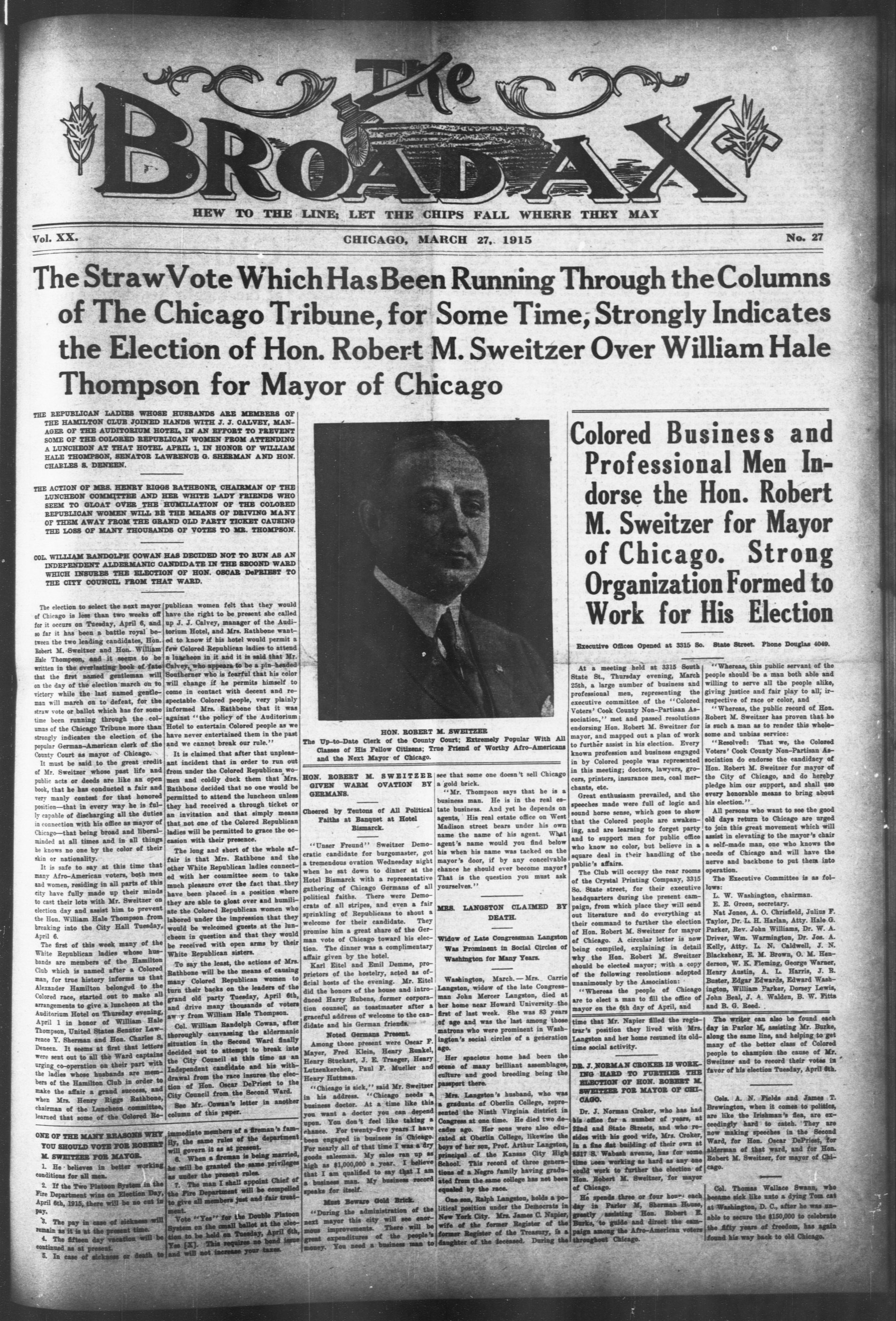
The StrawVote Which Has Been Running Through the Columns of The Chicago Tribune, for Some Time, Strongly Indicates the Election of Hon. Robert M. Sweitzer Over William Hale Thompson for Mayor of Chicago
THE REPUBLICAN LADIES WHOSE HUSBANDS ARE MEMBERS OF
THE HAMILTON CLUB JOINED HANDS WITH J. J. CALVEY, MAN-
AGER OF THE AUDITORIUM HOTEL, IN AN EFFORT TO PREVENT
SOME OF THE COLORED REPUBLICAN WOMEN FROM ATTENDING
A LUNCHBEON AT THAT HOTEL APRIL 1, IN HONOR OF WILLIAM
HALE THOMPSON, SENATOR LAWRENCE G. SHERMAN AND HON.
CHARLES S. DENEEN.
THE ACTION OF MRS. HENRY RIGGS BATHBONE, CHAIRMAN OF THE
LUNCHBEON COMMITTED AND HER WHITE LADY FRIENDS WHO
SEEM TO GLOAT OVER THE HUMILIATION OF THE COLORED
REPUBLICAN WOMEN WILL BE THE MEANS OF DRIVING MANY
OF THEM AWAY FROM THE GRAND OLD PARTY TICKET CAUSING
THE LOSS OF MANY THOUSANDS OF VOTES TO ME. THOMPSON.
COL. WILLIAM RANDOLPH COWAN HAS DECIDED NOT TO RUN AS AN INDEPENDENT ALDERMANIC CANDIDATE IN THE SECOND WARD WHICH INSURES THE ELECTION OF HON. OSCAR DePRIEST TO THE CITY COUNCIL FROM THAT WARD.
Vol. XX.
The Straw of The City the Electr Thomps
THE REPUBLICAN LADIES WHOSE THE HAMILTON CLUB JOINED IN AGER OF THE AUDITORIUM HOSOME OF THE COLORED REPUBLIC A LUNCHEON AT THAT HOTEL HALE THOMPSON, SENATOR LA CHARLES S. DENEEN.
THE ACTION OF MRS. HENRY RIGG LUNCHEON COMMITTEE AND I SEEM TO GLOAT OVER THE REPUBLICAN WOMEN WILL BE OF THEM AWAY FROM THE GRA THE LOSS OF MANY THOUSAND.
COL. WILLIAM RANDOLPH COWAN INDEPENDENT ALDERMANIC COL. WHICH INSURES THE ELECTOR THE CITY COUNCIL FROM THE
The election to select the next mayor of Chicago is less than two weeks off for it occurs on Tuesday, April 6, and so far it has been a battle royal between the two leading candidates, Hon. Robert M. Sweitzer and Hon. William Hale Thompson, and it seems to be written in the everlasting book of fate that the first named gentleman will on the day of the election march on to victory while the last named gentleman will march on to defeat, for the straw vote or ballot which has for some time been running through the columns of the Chicago Tribune more than strongly indicates the election of the popular German-American clerk of the County Court as mayor of Chicago.
It must be said to the great credit of Mr. Sweitzer whose past life and public acts or deeds are like an open book, that he has conducted a fair and very manly contest for that honored position—that in every way he is fully capable of discharging all the duties in connection with his office as mayor of Chicago—that being broad and liberal-minded at all times and in all things he knows no one by the color of their skin or nationality.
It is safe to say at this time that many Afro-American voters, both men and women, residing in all parts of this city have fully made up their minds to cast their lots with Mr. Sweitzer on election day and assist him to prevent the Hon. William Hale Thompson from breaking into the City Hall Tuesday, April 6.
The first of this week many of the White Republican ladies whose husbands are members of the Hamilton Club which is named after a Colored man, for true history informs us that Alexander Hamilton belonged to the Colored race, started out to make all arrangements to give a luncheon at the Auditorium Hotel on Thursday evening, April 1 in honor of William Hale Thompson, United States Senator Lawrence Y. Sherman and Hon. Charles S. Deneen. It seems at first that letters were sent out to all the Ward captains urging co-operation on their part with the ladies whose husbands are members of the Hamilton Club in order to make the affair a grand success, and when Mrs. Henry Riggs Rathbone, chairman of the Luncheon committee, learned that some of the Colored Re-
ONE OF THE MANY REASONS WHY YOU SHOULD VOTE FOR ROBERT M. SWEITZER FOR MAYOR.
1. He believes in better working conditions for all men.
2. If the Two Platoon System in the Fire Department wins on Election Day, April 6th, 1915, there will be no cut in pay.
3. The pay in case of sickness will remain as it is at the present time.
4. The fifteen day vacation will be continued as at present.
5. In case of sickness or death to
publican women felt that they would have the right to be present she called up J. J. Calvey, manager of the Auditorium Hotel, and Mrs. Rathbone wanted to know if his hotel would permit a few Colored Republican ladies to attend a luncheon in it and it is said that Mr. Calvey, who appears to be a pin-headed Southerner who is fearful that his color will change if he permits himself to come in contact with decent and respectable Colored people, very plainly informed Mrs. Rathbone that it was against "the policy of the Auditorium Hotel to entertain Colored people as we have never entertained them in the past and we cannot break our rule." It is claimed that after that unpleasant incident that in order to run out from under the Colored Republican women and coldly duck them that Mrs. Rathbone decided that no one would be permitted to attend the luncheon unless they had received a through ticket or an invitation and that simply means that not one of the Colored Republican ladies will be permitted to grace the occasion with their presence.
The long and short of the whole affair is that Mrs. Rathbone and the other White Republican ladies connected with her committee seem to take much pleasure over the fact that they have been placed in a position where they are able to gloat over and humiliate the Colored Republican women who labored under the impression that they would be welcomed guests at the luncheon in question and that they would be received with open arms by their White Republican sisters.
To say the least, the actions of Mrs. Rathbone will be the means of causing many Colored Republican women to turn their backs on the leaders of the grand old party Tuesday, April 6th, and drive many thousands of voters away from William Hale Thompson.
Col. William Randolph Cowan, after thoroughly canvassing the aldermanic situation in the Second Ward finally decided not to attempt to break into the City Council at this time as an Independent candidate and his withdrawal from the race insures the election of Hon. Oscar DePriest to the City Council from the Second Ward.
See Mr. Cowan's letter in another column of this paper.
immediate members of a fireman's family, the same rules of the department will govern it as at present.
6. When a fireman is being married, he will be granted the same privileges as under the present rules.
7. The man I shall appoint Chief of the Fire Department will be compelled to give all members just and fair treatment.
Vote "Yes"' for the Double Platoon System on the small ballot at the election to be held on Tuesday, April 6th. Yes [X]. This requires no bond issue and will not increase your taxes.
CHICAGO, MARCH 27. 1915
PETER H. HARRIS
HON. ROBERT M. SWEITZER
The Up-to-Date Clerk of the County Court; Extremely Popular With All Classes of His Fellow Citizens; True Friend of Worthy Afro-Americans and the Next Mayor of Chicago.
HON. ROBERT M. SWEITZER GIVEN WARM OVATION BY GERMANS.
Cheered by Teutons of All Political Faiths at Banquet at Hotel Bismarck.
"Unser Freund" Sweitzer Democratic candidate for burgomaster, got a tremendous ovation Wednesday night when he sat down to dinner at the Hotel Bismarck with a representative gathering of Chicago Germans of all political faiths. There were Democrats of all stripes, and even a fair sprinkling of Republicans to shout a welcome for their candidate. They promise him a great share of the German vote of Chicago toward his election. The dinner was a complimentary affair given by the hotel.
see that some one doesn't sell Chicago a gold brick.
"Mr. Thompson says that he is a business man. He is in the real estate business. And yet he depends on agents. His real estate office on West Madison street bears under his own name the name of his agent. What agent's name would you find below his when his name was tacked on the mayor's door, if by any conceivable chance he should ever become mayor? That is the question you must ask yourselves."
MES. LANGSTON CLAIMED BY DEATH.
Widow of Late Congressman Langston Was Prominent in Social Circles of Washington for Many Years.
Karl Eitel and Emil Demme, proprietors of the hostelry, acted as official hosts of the evening. Mr. Eitel did the honors of the house and introduced Harry Rubens, former corporation counsel, as toastmaster after a graceful address of welcome to the candidate and his German friends.
Noted Germans Present.
Among those present were Oscar F. Mayer, Fred Klein, Henry Runkel, Henry Stuckart, J. E. Traeger, Henry Lutzenkerehen, Paul F. Mueller and Henry Huttman.
"Chicago is sick," said Mr. Sweitzer in his address. "Chicago needs a business doctor. At a time like this you want a doctor you can depend upon. You don't feel like taking a chance. For twenty-five years I have been engaged in business in Chicago. For nearly all of that time I was a dry goods salesman. My sales ran up as high as $1,000,000 a year. I believe that I am qualified to say that I am a business man. My business record speaks for itself.
Must Beware Gold Brick.
"During the administration of the next mayor this city will see enormous improvements. There will be great expenditures of the people's money. You need a business man to
see that some one doesn't sell Chicago a gold brick.
"Mr. Thompson says that he is a business man. He is in the real estate business. And yet he depends on agents. His real estate office on West Madison street bears under his own name the name of his agent. What agent's name would you find below his when his name was tacked on the mayor's door, if by any conceivable chance he should ever become mayor? That is the question you must ask yourselves."
MES. LANGSTON CLAIMED BY DEATH.
Widow of Late Congressman Langston Was Prominent in Social Circles of Washington for Many Years.
Washington, March.—Mrs. Carrie Langston, widow of the late Congressman John Mercer Langston, died at her home near Howard University the first of last week. She was 83 years of age and was the last among those matrons who were prominent in Washington's social circles of a generation ago.
Her spacious home had been the scene of many brilliant assemblages, culture and good breeding being the passport there.
Mrs. Langston's husband, who was a graduate of Oberlin College, represented the Ninth Virginia district in Congress at one time. He died two decades ago. Her sons were also educated at Oberlin College, likewise the boys of her son, Prof. Arthur Langton, principal of the Kansas City High School. This record of three generations of a Negro family having graduated from the same college has not been equaled by the race.
One son, Ralph Langston, holds a political position under the Democrats in New York City. Mrs. James C. Napier, wife of the former Register of the former Register of the Treasury, is a daughter of the deceased. During the
Colored Business and Professional Men Indorse the Hon. Robert M. Sweitzer for Mayor of Chicago. Strong Organization Formed to Work for His Election
At a meeting held at 3315 South State St., Thursday evening, March 25th, a large number of business and professional men, representing the executive committee of the "Colored Voters' Cook County Non-Partisan Association," met and passed resolutions endorsing Hon. Robert M. Sweitzer for mayor, and mapped out a plan of work to further assist in his election. Every known profession and business engaged in by Colored people was represented in this meeting; doctors, lawyers, grocers, printers, insurance men, coal merchants, etc.
Great enthusiasm prevailed, and the speeches made were full of logic and sound horse sense, which goes to show that the Colored people are awakening, and are learning to forget party and to support men for public office who know no color, but believe in a square deal in their handling of the public's affairs.
"Whereas, this public servant of the people should be a man both able and willing to serve all the people alike giving justice and fair play to all, in respective of race or color, and
"Whereas, the public record of Hon. Robert M. Sweitzer has proven that he is such a man as to render this whole some and unbias service:
"Resolved: That we, the Colored Voters' Cook County Non-Partisan Association do endorse the candidacy of Hon. Robert M. Sweitzer for mayor of the City of Chicago, and do hereby pledge him our support, and shall us every honorable means to bring about his election."
All persons who want to see the good old days return to Chicago are urged to join this great movement which will assist in elevating to the mayor's chair a self-made man, one who knows the needs of Chicago and will have the nerve and backbone to put them in
The Club will occupy the rear rooms of the Crystal Printing Company, 3315 So. State street, for their executive headquarters during the present campaign, from which place they will send out literature and do everything at their command to further the election of Hon. Robert M. Sweitzer for mayor of Chicago. A circular letter is now being compiled, explaining in detail why the Hon. Robert M. Sweitzer should be elected mayor; with a copy of the following resolutions adopted unanimously by the Association:
"Whereas the people of Chicago are to elect a man to fill the office of mayor on the 6th day of April, and time that Mr. Napier filled the registrar's position they lived with Mrs. Langston and her home resumed its old-time social activity.
DR. J. NORMAN CROKER IS WORKING HARD TO FUELHER THE ELECTION OF HON. ROBERT M. SWEITZER FOR MAYOR OF CHICAGO.
Dr. J. Norman Croker, who has had his office for a number of years, at 22nd and State Streets, and who resides with his good wife, Mrs. Croker, in a fine flat building of their own at 5317 S. Wabash avenue, has for some time been working as hard as any one could work to further the election of Hon. Robert M. Sweitzer, for mayor of Chicago.
He spends three or four hours each day in Parlor M, Sherman House, greatly assisting Hon. Robert E. Burks, to guide and direct the campaign among the Afro-American veterans throughout Chicago.
No.27
"Whereas, this public servant of the people should be a man both able and willing to serve all the people alike, giving justice and fair play to all, irrespective of race or color, and
"Whereas, the public record of Hon. Robert M. Sweitzer has proven that he is such a man as to render this wholesome and unbiased service:
"Resolved: That we, the Colored Voters' Cook County Non-Partisan Association do endorse the candidacy of Hon. Robert M. Sweitzer for mayor of the City of Chicago, and do hereby pledge him our support, and shall use every honorable means to bring about his election."
All persons who want to see the good old days return to Chicago are urged to join this great movement which will assist in elevating to the mayor's chair a self-made man, one who knows the needs of Chicago and will have the nerve and backbone to put them into operation.
The Executive Committee is as follows:
L. W. Washington, chairman.
E. E. Green, secretary.
Nat Jones, A. O. Chrisfield, Julius F. Taylor, Dr. L. H. Harlan, Atty. Hale G. Parker, Rev. John Williams, Dr. W. A. Driver, Wm. Warmington, Dr. Jos. A. Kelly, Atty. L. N. Caldwell, J. N. Blackshear, E. M. Brown, O. M. Henderson, W. K. Fleming, George Warner, Henry Austin, A. L. Harris, J. R. Buster, Edgar Edwards, Edward Washington, William Parker, Dorsey Lewis, John Beal, J. A. Walden, B. W. Fitts and B. G. Reed.
The writer can also be found each day in Parlor M. assisting Mr. Burke, along the same line, and helping to get many of the better class of Colored people to champion the cause of Mr. Sweitzer and to record their votes in favor of his election Tuesday, April 6th.
Cols. A. N. Fields and James T. Brewington, when it comes to politics, are like the Irishman's flea, are exceedingly hard to catch. They are now making speeches in the Second Ward, for Hon. Oscar DePriest, for alderman of that ward, and for Hon. Robert M. Sweitzer, for mayor of Chicago.
Col. Thomas Wallace Swann, who became sick like unto a dying Tom cat at Washington, D. C., after he was unable to secure the $150,000 to celebrate the fifty years of freedom, has again found his way back to old Chicago.
PAGE TWO
Russia's immensity.
The Russian empire is as compact as the British empire is scattered. It is one great mass with no parts, except possibly a few islands along the coast, separated from the main body. There are no distant possessions, no overseas territory, and the cxar claims no domination over any land not in the northern hemisphere.
Its area is what astonishes. It is larger than all of North America from the canal north and with the islands of the Caribbean thrown in. One-sixth of the land area of the globe is under the cxar's flag and within its boundaries a population greater than that of Great Britain, Germany and France combined. And this population of between 160,000,000 and 170,000,000 is increasing at the rate of 2,000,000 a year by birth. The population of the empire has doubled in forty years.
Of the many strange things about Russia perhaps the strangest is that this immense empire has no salt water port which does not freeze up in the winter. No big nation in the world is so circumscribed in this respect—Brooklyn Standard Union.
Why You Wink.
The unconscious act of winking bears a quite important relation to the welfare of the eye. This being the most delicate and sensitive organ of the body exposed to the air, it is in constant need of the protection given by the eyelids, which not only close quickly at the approach of danger, but are employed in washing the surface of the eye. Moistening is required to offset the drying effect of the air and cleaning to prevent the injurious effect of dirt. Every time you wink the eye is washed. Inside the eye is the little tear gland, which, as its name implies, is busy storing up the supply of tears. This gland keeps the inside of the lid moist, and you wink automatically whenever the surface of the eye becomes dry or a particle of dust or anything else strikes it. This work is done as often as necessary, and to realize how often it is necessary try how long you can keep your eyes open without winking.
"Dreary Stuff." Said Gissing.
G. B. Burgin in the Bookman contributes a personal recollection of George Gissing, whom he met many years ago at a garden party in St John's Wood. "He was curiously and I should think unconsciously picturesque," writes Mr. Burgin. "his loose, easy clothes and slouch hat seeming a part of his own personality more than a studied pose, and looking rather at variance with the smart 'getup' of the London crowd which filled the little garden." During conversation Gissing alluded to the fact that many authors wrote with ease and facility, "but," he added, "I grind it out with infinite pain and labor." When Mr. Burgin hinted that most of his material was saddening, "Yes," he said thoughtfully, "it's dreary stuff—dreary stuff!"
Evangelist Who Was an Actor.
George Whitefield qualified as a boy for greatness in more than one direction. The future evangelist enjoyed play acting and performed in girl's clothes before the mayor and corporation of Gloucester, while by the time he was fifteen he had become an expert ale drawer in the family public house. These pursuits, alien to the pulpit, appear, however, to have been converted into aids to evangelism. The youthful love of the stage, says the London Chronicle, no doubt helped to develop the tremendous histrionic gifts which made Lord Chesterfield on hearing Whitefield describe a blind beggar's fall over a precipe spring from his seat and exclaim, "Good heavens, he's gone!"
He Had Found His Specialty
A London contemporary tells the following anecdote: A member of the bar not richly endowed with intellect after years of briefness married a rich widow. She died. Again he sought a bride with a large dower and again became a widower. Then he thought he would return to his long neglected profession. He approached an old friend who had while become a judge of the supreme court and asked what, in his opinion, would be the wisest course for him to pursue. "Stick to the probate and matrimonial," said the judge.
His Revenge.
"Ha, ha!" said the man who had just been elected. "I thought you said you trusted the wisdom of the plain people." "I still believe in it," replied the defeated candidate. "The wisest people want a joke now and then."—St. Louis Post-Dispatch
Tactful Man
He—Do you know, you are so clever and charming and brilliant that I really feel embarrassed in your presence. She—But you mustn't; really you mustn't. He (reassuringly)—Oh, I dare say I'll get over it when I know you better—Life.
The Trouble.
"There seems to be a coolness between them."
"Yes. The trouble is they're both too hot tempered."—Detroit Free Press.
Under Cover.
Parson—Robert, did you know that your mother was looking for you?
Bobby—You bet! That's why she can't find me—Boston Transcript.
"There is some soul of goodness in things evil would men observingly distill it it out." How much evil marked the daily lives of the actors in the following episode is a matter of conjecture, but they were, says a New York newspaper, denizens of what is called the "underworld."
A lodging house in one of the crowded tenement districts in New York caught fire. The lives of the inmates were endangered, and seven of them, all women, were cut off by the flames. They rushed to the windows and shrieked for help.
Then, to quote the newspaper account, "a crowd of Park row human flotsam and jetsam and boys of the neighborhood bunched themselves together to break the force of the women's fall and called to them to jump. The jump was more than thirty feet, but all the women made it safely.
"Only one of them needed attention, but some of the men walked away with heads cut by flying heels and backs strained by the shock of the falling bodies. When the reporter spoke to them most of those who made up this human life net said gruffly that they had no names. When they were asked where they lived they would only say, 'Oh, round here.'"
How to Live One Hundred Years
How to Live One Hundred Years.
Lo and behold, a physician comes forward with the announcement that it is as easy as falling a log to live to be a hundred years old. He says all you have to do is to avoid alcoholic or malt liquors, don't smoke, go to bed at 10 p. m. and get up at 6 a. m., sleep soundly, don't worry about making money (we don't—we worry about not making it), do nothing to excess (don't marry to excess, of course—Mark Twain said that), the simple life all the time, don't get excited (we don't over anything except elections or prizefights), eat only when you feel inclined (or have the price—this has no reference to newspaper men, who never eat a regular meal). With the exception of the parentheses this is really serious advice, and you would do well to heed it if you wish to make the century mark in life's little Marathon. However, as for us, we wouldn't swap one hour of a golden, glittering time on pay day in joyous Jacksonville for a whole century of such a simple and uneventful existence anywhere else—Phil H. Armstrong in Florida Times-Union.
Napier's One Word Dispatch.
Very few commanders have revealed any sense of humor in their campaigning exploits, and it was reserved for the witty Sir Charles Napier to become pre-eminent in this rare accomplishment. His crowning achievement in the realms of humor was coincident with his most brilliant feat of arms. He was deputed to essay the conquest of Scinde, and, after a series of fine exploits in the face of innumerable difficulties, he accomplished his mission. But the authorities at home waited anxiously for his dispatch announcing this momentous event. The days passed, and it added to the tension. At last the long expected missive arrived and it contained one word, "Peeccavil!" A man who knew Latin was sought and he translated it, "I have sinned (Scinde)!"—London Mail.
Land of the Dances
Denmark has almost abolished pauperism and illiteracy among her people. Only one in a thousand of her adult population is unable to read and write. The number of those dependent on charity is extremely small and is lessening each year in spite of a barren soil and a villainous climate. The whole land is prosperous, and its productivity is increasing year by year. The community health is improving, crime is exceedingly rare, and refinements of life as well as its necessaries are growing more abundant and are distributed in wider and wider circles. —Chicago Journal.
What He Had Better Do
Macpherson in talking to his minister told the reverend gentleman that he was going to take a trip to the holy land.
"And whiles I'm there," he said enthusiastically. "T'll read the Ten Commandments aloof free the top of Mount Sinai."
"Nae, Macpherson," said the minister gravely, "tak' my advice. Dinna read them aloof. Bide at home and keep them."
"No," his informant answered. "They did have one, but they abandoned it." "What was the matter?" "Well, the bell rang at 9 o'clock, and almost every one complained that it woke him up"—Chicago News.
"In that case what will you take for the hotel?"-Judge.
Sad Experience.
"It is better to have left something unasked than to have talked too much," observes a philosopher, who has evidently been through a breach of promise suit—Philadelphia Inquirer.
Sacrifice Mit.
She — Would you leave your home for me? He — I'd leave a baseball game in the ninth inning with the score a tie—Philadelphia Ledger.
He is off the wisest man who is not wise at all—Wardworth.
When Tissot Was Satisfied. A charming story is told of Tissot, the great French painter. While in England on one occasion he painted a beautiful religious picture and, meeting a woman from Paris, asked her opinion of his work. Characterizing it as a work of real art, she gave a remarkably just and detailed appreciation of the various merits of the painting.
A Strange Punishin Professor Petrie, the emologist, while exploring a five miles from Cairo, d tomb of the twelfth d thieves had broken into the years ago. A tragedy a robbery, as Professor Pet covered. The Sunday So calls it "a tragedy of provinice."
"Are you satisfied?" asked a friend. The artist answered in the negative. He entirely repainted his picture, working night and day. When it was finished he sent for his fair critic, who pronounced it admirable, and then she remained silently admiring it with smiling criticism.
"Are you satisfied?" once more asked the friend. "No," replied Tissot as he began work on the picture for the third time. When the lady saw the new painting she gazed at it for some moments with evident emotion and then, without a word, sank softly to her knees and began to pray.
"Are you satisfied now?" whispered the friend. "Yes," answered Tissot.
What the Diver Baw.
While serving on a naval vessel stationed at China an old time seaman had an uncanny experience. He says: "Our ship's company had been ashore for a route march, and on returning one of our officers in stepping on the ship's gangway let his sword fall overboard. Being a diver, I was sent down to try and recover it, but as I touched the bottom I saw the corpse of a lady dressed in light material gradually rise from her resting place of mud. She faced me as naturally as if she had been a living person. The disturbing of the water by my descending had no doubt moved the body. It was a sight—and also a fright—which I do not wish to experience again. The sword was eventually recovered by another diver, for I can assure you I made a record trip to the surface without seeking further." — London Globe.
A. Smart Answer
The following episode took place in a country village in the north of England: One morning as a schoolmaster was proclaiming to his school he saw a penny. He picked it up, he placed the penny in his pocket, and after the children had assembled in the school the schoolmaster said: "Has any child lost any money?"
After a few moments a small boy in the front of the class put up his hand. "Well, Robert, what do you want?" asked the master. "Please, sir, I have lost a penny," replied the boy.
"And where did you lose your penny, Robert?" inquired the master.
"Please, sir, where you found it."
Robert got the penny amid the laughter of the master and the whole class. -Philadelphia Record.
Her Knowledge of Music
The names of musical compositions do not always convey the impression that is intended by their composers, as one listener discovered recently at a San Francisco concert. One woman was much interested in the music and sat as close to the orchestra as possible, attentively listening to every note. A popular air had just been played. It was a catchy, melodious bit of music and was received with warm applause. Immediately following it on the program was Dvoraak's "Humoresque," and the attentive listener drew back in disgust. "Just think," she said in tones loud enough to be heard by those near by—"just imagine playing something humorous after that other beautiful piece. It ought not to be allowed."—Argonaut.
Amateur Truce Maker.
Toward the end of the last siege of Paris by the Germans in 1870-71, the custom grew up of observing an informal armistice of about an hour's duration at sundown, when the hungry citizens, or some of them at all events, used to come out and purchase sausages from the Prussians and Bavarians in the advanced trenches at about ten times their normal price. After awhile, however, the custom came to the knowledge of Von Moltke, who effectually and promptly put a stop to it by shooting some half dozen or more of the amateur truce makers. —Pearson's Weekly.
An Easier Task.
"Mamma, do you think it is true, as papa says, that teachers do not have to work as hard now as they did when he went to school?"
"I expect it is."
"What do you suppose the reason is?"
"The teachers of today don't have to teach your father."—Buffalo News.
Puzzling All Right.
"It's a bit puzzling, isn't it?" said one man to another who was striving to hold on to his hat and his umbrella at the same time in a high wind. "Yes," said the man accosted. "It's like a wall paper hanger with the hives." -Leddis' Home Journal.
Overhead Charges.
The Boss—What's this item on your expense account, "Overhead expenses, $47?" The Traveling Salesman—That was an umbrella I bought—Philadelphia Bulletin.
It is our duty to do our best to brighten the lives of the people who live with us or are dependent on us
A Strange Punishment.
Professor Petrie, the eminent Egyptologist, while exploring about thirty-five miles from Cairo, discovered a tomb of the twelfth dynasty that thieves had broken into thousands of years ago. A tragedy attended the robbery, as Professor Petrie also discovered. The Sunday School Times calls it "a tragedy of providential justice."
"It appears," says Professor Petrie, "that the plunderers removed only a few bricks, so that a man could crawl into the tomb. One of the men entered, opened the coffin, lifted the mummy out and laid it across the coffin, so that he could easily unwind the bandages. He first found a collar of beads, which he passed out into the shaft, where we found it. Then he came to the jewel (a beautiful work of gold and colored gems), and took it from the body. Before he could do anything more the roof apparently fell in and crushed him and the mummy. The other robbers, seeing the fate of their accomplice, abandoned the tomb and filled in the shaft to hide their guilt."
The explorers found the skeleton of the robber beside that of the mummy.
Homemade Barometer:
To make a cheap but effective barometer take eight grams of pulverized camphor, four grams of pulverized nitrate of potassium, two grams of pulverized nitrate of ammonia, and dissolve them all in sixty grams of alcohol. Pour the whole lotion in a long and slender bottle, the top of which should be closed with a piece of pig's bladder—which your family butcher will give you gratis—containing a pin hole to admit air. When rain is about to visit you the solid particles of your liquid barometer will tend gradually to mount, little star crystals forming in the liquid, which otherwise would remain clear. Should high winds be approaching your barometer will become thick, as if fermenting, in addition to which a solid film of particles will form on the surface. Fair weather is indicated by the liquid remaining clear, with the solid particles settling into a firm sediment—London Answers.
Beavers as Engineers
In "The Romance of the Beaver" A. R. Dugmore, the author, tells how he watched a colony of beavers in Newfoundland building a dam across a swift stream about forty feet wide: "Before the work was quite finished, so that the dam had not yet settled enough to gain its proper strength, there came a great rain, which continued for several days and flooded the country. The beavers, seeing that their new dam was threatened with immediate destruction, came down during the night and made a large opening by cutting away the sticks. This allowed the water to escape, and so the dam was saved. No sooner had the water resumed its normal level than the little engineers closed the break they had made and continued the structure."
The Habeas Corpus
The substance of habeas corpus was given in the famous Magna Charta of 1215, but as today understood the habeas corpus refers to the act of 1679. This act provides that any man taken to prison can insist on being brought by his accuser before a judge, who shall immediately decide whether or not ball is to be given; that the accused shall have the question of his guilt decided by a jury of twelve men and not by a government agent; that no one can be tried twice on the same charge; that every one may insist on being examined within twenty days of his arrest and tried by jury the next session; that no defendant may be sent out of the county for imprisonment—New York American.
Versta and Miles
Many people know that to multiply any number of French kilometers by five and divide the product by eight is to get an exceedingly close approximation to the number of miles in the same distance, but it is even easier mentally to convert versts to miles, as one of the former is equal to 0.633 of the latter, or almost exactly two-thirds.
Trees and Chimneys
The existence of tall plants and trees depends largely on the wind force. A tree with square trunk and branches would offer so much resistance to the wind that it would be continually having its branches snapped. Engineers build tall chimneys and pliers for bridges round in preference to any other form.
Not Practical.
"Did you attain the hgb ideals you set for yourself when you were young?" asked the friend of his boyhood. "No," replied the millionaire, "and I'm glad I didn't. I see now there was no money in them."—St. Louis Post-Dispatch.
Transparent
The Toucher—I'm going to work next week, but I'll need a few dollars to live on till pay day. Can you see me through? The Wise Guy—No, but I can see through you—New York Globe.
Subconscious Cerebration.
"The bridegroom appeared cool and collected."
"Yes, he didn't seem to realize that he was losing control of himself."—Philadelphia Ledger.
"Yet you tend her your clothes." "Yes, and she has the bad taste to look better in them than I do."—Kansas City Journal.
JOHN H. HARRIS
Endorsed by the Regular 2nd Ward Republican Organization
Citizens
at the Eighth Regi
MONDAY EVENING
the Citizens Committee, wh
raise money to help to entertain
tending the National Medical
will convene in this City Augu
Will give a GRAND C
at the Eighth Regiment Arm
Forest Avenue.
ens Ball
th Regiment Armory
EVENING, APRIL 19th,
committee, which is assisting to
help to entertain the delegates at-
onal Medical Association which
is City August 24, 25 & 26, 1915.
GRAND CITIZENS BALL
Regiment Armory, 35th Street and
Citizens Ball
MONDAY EVENING, APRIL 19th
the Citizens Committee, which is assisting to
raise money to help to entertain the delegates at
attending the National Medical Association which
will convene in this City August 24, 25 & 26, 1915.
Will give a GRAND CITIZENS BALL
at the Eighth Regiment Armory, 35th Street and
Forest Avenue.
Music by the Eighth Regiment Band. Admission 50 c
COL. JOHN R. MARSHALL, Chairman
GEORGE H. WALKER, Secretary
Contented, unambitious people are all very well in their way. They form a neat, useful background for great portraits to be painted against, and they make a respectable if not particularly intelligent audience for the active spirits of the age to play before. But do not, for goodness sake, let them go stalking about, as they are so fond of doing, crying out that they are the true models for the whole species. Why, they are deadheads, the drones, the street crowds that lounge about gaping at those who are working.
Dr. H. REGINALD SMITH
EYE GLASSES
SCIENTIFICALLY FITTED
Office, 3401 S. State St., Chicago
Office Hours:
9 A.M. to 5 P.M. 7 to 9 P.M.
Phone Douglas 1248 Auto. 77-800
Why,
ones, the
t gaping
They never know the excitement of expectation nor the stern delight of accomplished effort, such as stir the pulse of the man who has objects, hopes and plans. To the ambitious man life is a brilliant game—a game that calls forth all his tact and energy and nerve; a game to be won in the long run by the quick eye and the steady hand and yet having sufficient chance about its working out to give it all the glorious zest of uncertainty.
And if he be defeated he wins the grim joy of fighting; if he loses the race he at least had a run. Better to work and fall than to sleep one's life away.-Jerome K. Jerome.
Equestrian Statues
"On the night of the unveiling of General Sherman's statue in New York Mr. Whitelaw Reid suggested that Bishop Potter, Mr. St. Gaudens and myself go to his home in Madison avenue for dinner," said General Francis V. Greene. "I there declared that of all the thousands of equestrian statues that had come to my attention the one of General Sherman was the best. Mr. St. Gaudens then surprised me by saying that doubtless I was not aware that there were not a hundred equestrian statues in the world. Bishop Potter's son-in-law, Mr. J. E. Cowdin, was at the dinner. Some time afterward, on a hot summer night, we were at dinner in the Union club when Mr. Cowdin chanced to refer to the statement of the famous sculptor. 'You were wrong,' Mr. Cowdin told me, 'but Mr. St. Gaudens was not right. I have collected pictures of all the equestrian statues in the world, and I managed to get 111,'"—New York Herald.
Ocean Temperatures
The steamer Albatross, which is used by oceanographers, makes records of deep sea temperatures. These temperature observations prove that the ocean has a far more limited range of heat and cold than the land, its maximum surface temperature being about 85 degrees F., and its minimum about 29 degrees F. in the most frigid depths, the "cold puddles" between Greenland and Norway. The average ocean temperature at a depth of six or seven hundred fathoms is 36 degrees F. One of the mysteries of the sea is a regular nightly temperature rise of half a degree at a depth of 100 fathoms. This unaccountable temperature variation has been observed by the Albatross over and over again.—American Magazine.
Although the muscles which affect the action of the jaws are especially under the control of the brain, the chattering of the teeth is really a spasm caused by chill or fear, and all spasms act independent of the will. The muscles which operate the jaw act in a series of involuntary little contractions which pull the jaw up and permit it to fall of its own weight. This action is quick, and the chattering occurs from frequent repetition. The cold has a similar effect upon the jaw muscles to that which some poisons have in causing spasmodic action in other parts of the body.
---
Ambition.
Why Teeth Chatter
Admission 50 cents
Residence, 4630 Evans Avenue Tel. Kenwood 5466
He Was Unanimously Elected.
When the term of the old nagep preacher had expired he arose and said "Breddren, de time am heah f'o delection ob yo' pastoh for anudder yeah. All dose faborin' me fo' yo' pastoh will please say 'Aye.'"
The old preacher had made himself rather unpopular, and there was no response.
"Ha!" he said. "Silence gibs consent allus. Ise yo' pastoh fo' anudder yeah."—Exchange.
Old Diverse Sure
In old Holland when a couple ap plied for a divorce they were locked up in a one room, trying out cabla with one dish and one spoon. If after a month they had not come to an agreement they got the writ, which was seldom asked for after this treat ment.
Natural Result:
"Mamma," said small Elmer, "let's go in the back yard and play football." "I can't play the game, dear," answered the mother. "Huh!" exclaimed Elmer scornfully. "That is what comes of having a woman for a mother."—Chicago News.
One Is Enough.
"Before she married him, you know, she used to say there wasn't another man like him in the world." "Yes, and now she says she'd hate to think that there was."
Hod on Aim All Right
Cole—I like to see a woman with an alm in life. Now, has your wife any alm? Wood—Rather! Look where she hit me with it—Chicago News.
Sympathy Needed.
"Jiggs' wife speaks ten languages."
"I move we adopt resolutions of sympathy and send them to Jiggs."—Bufalo Express.
Loneliness is an all pervading condition of self.
Solution For Yourself
Speaking For Her
Widow-Mr. Oldboy, my daughter
Maud has set her eyes on you most lovingly. Mr. Oldboy-Has she really
I always considered her a sweet girl
Widow-Yes, only today she said
"that's the sort of a gentleman I should like for my papa."-Chicago News.
Peru's Fog
A remarkable fog on the Peruvian coast is known as the "garua." It occurs in a region where rain is unknown and supplies sufficient moisture to support vegetation.
Evidently.
"There are some very ugly features in this case."
"What case?"
"This photographer's." — Baltimore American.
Keeping It Cool.
"I hear that old Snagsby left a cool million dollars behind."
"How else could he keep it cool?" — London Standard.
Fire is not extinguished by fire—Italian Proverb.
FOUR STATES VOTE ON SUFFRAGE THIS YEAR
Throughout the Union wherever women have not the right to vote the present year is regarded as one of the most important in the history of the woman suffrage movement. In New York, the most populous state, the male voters will register next fall their opinions on the question, according to the terms of a bill passed by the state
M. H. H.
Photo by American Press Association.
legislature. The passage of the bill is considered a victory by the suffragists. Three other states will vote on the question next fall. They are Pennsylvania, Massachusetts and New Jersey. In each case the enactment of a constitutional amendment granting the suffrage is involved. The voting will take place at the regular fall election. In Arkansas the necessary stages for the submission of a suffrage amendment to the voters have been passed through. According to the constitution only three amendments to the constitution can be submitted at one time, and between the action of the senate and house a petition for a third amendment was filed with the secretary of state. This makes it necessary for the suffrage amendment to wait until 1916. In Tennessee the amendment must pass one more legislature before it goes to the people.
OUR HOSPITAL IN FRANCE.
Americans and Foreigners Praise Work of Paris Institution.
"The American hospital at Paris is the most luxuriously equipped hospital in France. It takes men of all ranks, but only wounded; no sick," said an American observer, who returned recently from the French capital. Both Americans and foreigners praise the work being done by the hospital, which is supported by collections in many American cities. Recently the committee collecting funds for the American Ambulance hospital in Paris re-
C
Photos by American Press Association.
AMERICAN HOSPITAL IN PARIS AND WILLIAM G. SHARP, AMERICAN ANBASSADOR,
celved $15,000 for the Philadelphia committee to support a Philadelphia ward of forty beds in the hospital for six months.
Our ambassador to France, William Graves Sharp, is actively interested in the work of the hospital. He is the successor of Myron T. Herrick and is a wealthy retired manufacturer. He was a member of the foreign affairs committee of the house of representatives, where he was serving his third term when selected for the diplomatic post.
SIRES AND SONS.
President Wilson has a passion for Wordsworth's poems.
J. F. Steen has completed forty-six years of service as rector of Ascension Memorial church, New York.
Brigadier General Clarence Ransom Edwards, who will command the Panama canal defenses, was an aid to General Lawton and served with him in the Phillippines. He is a native of Ohio.
Albert S. Janlin, whom the decision of the board of examiners in the patent office at Washington has just credited with the invention of the hydroaeroplane, has never ridden in one, though he conceived the idea of such a machine sixteen years ago. He lives at Rosebank, N. Y.
The Hon. Alfred Deakin, commissioner of Australia to the Panama-Pacific international exposition, is member for Ballarat in the house of representatives, but has held every high office in his country and is recognized as an empire builder, whose name is indissolubly identified with the growth and progress of Australia.
Short Stories
China has an area of 1,500,000 square miles.
Sweden needs 400,000 tons of wheat yearly.
Sugar to the value of $1,600,000 a day is consumed in this country.
In the United States cities there was last year one bank to every 9,700 people.
In Ontario all whitefish and salmon trout less than two pounds in weight must be returned to the water.
It takes twelve seconds for the projectile of a twelve inch naval gun to reach its point of impact when firing at a range of five miles.
Automobile Runs.
You can't very well call a farmer a hayseed when the farmer has an automobile and you haven't—Kansas City Journal.
Fifteen thousand Pennsylvania farmers own automobiles, and more are buying. And the best of it is they don't have to get up before daybreak to feed the critters. — Philadelphia Ledger.
There ought to be a law adjusting the volume of noise generated by the auto horn to the machine that carries it. A road insect has no right to carry a roundhouse whistle—Seattle Post-Intelligencer.
Aviation.
In the Japanese military air service there are twelve aeroplanes and two dirigibles. It is claimed that an absolutely bullet proof aeroplane has been developed in Europe. Fred Sohn of St. Paul has invented a machine which he says will revolutionize aviation. A substantial prize has been offered in France for the aeroplane that can fly the fastest and also the slowest.
English Etchings.
There are twenty-four clubs exclusively for ladies in London. Stocks of gold are held by the Bank of England in both Canada and South Africa. Suffragists in London have formed a volunteer police corps to assist the metropolitan police. Newcastle-on-Tyne takes its name from a castle which was erected on the banks of the Tyne in 1080.
SHORT AND SHARP.
Judicious silence is an eloquent indication of wisdom.
It takes a quick witted man to know when to say nothing.
All things come to the other fellow if you sit down and wait.
Too many men are expecting to catch a ride on the road to success.
Life is a burden to some people, and some others are a burden to life.
True charity consists of opening the purse and keeping the face closed.
It's usually when a man speaks without thinking that he says what he thinks.
Life is made up of ups and downs. A man must get down to business before he can rise.
There are lots of good men in the world—good even while they are away from their home town.
It is the great-grandchildren of the present generation who will still be paying for the European war.
Even a Philadelphia lawyer cannot tell what is meant by "all the rules of civilized warfare." The more the phrase is used the less it signifies.
If inventive genius isn't strained to the cracking point to find a means to circumvent submarine torpedo throwers it will not be because the rewards are not sufficiently great.
According to a naval estimate published at the beginning of the war, this country ranked fourth as a naval power. It would be interesting to know its present standing.
THE BROAD AX, CHICAGO, MARCH 27, 1915.
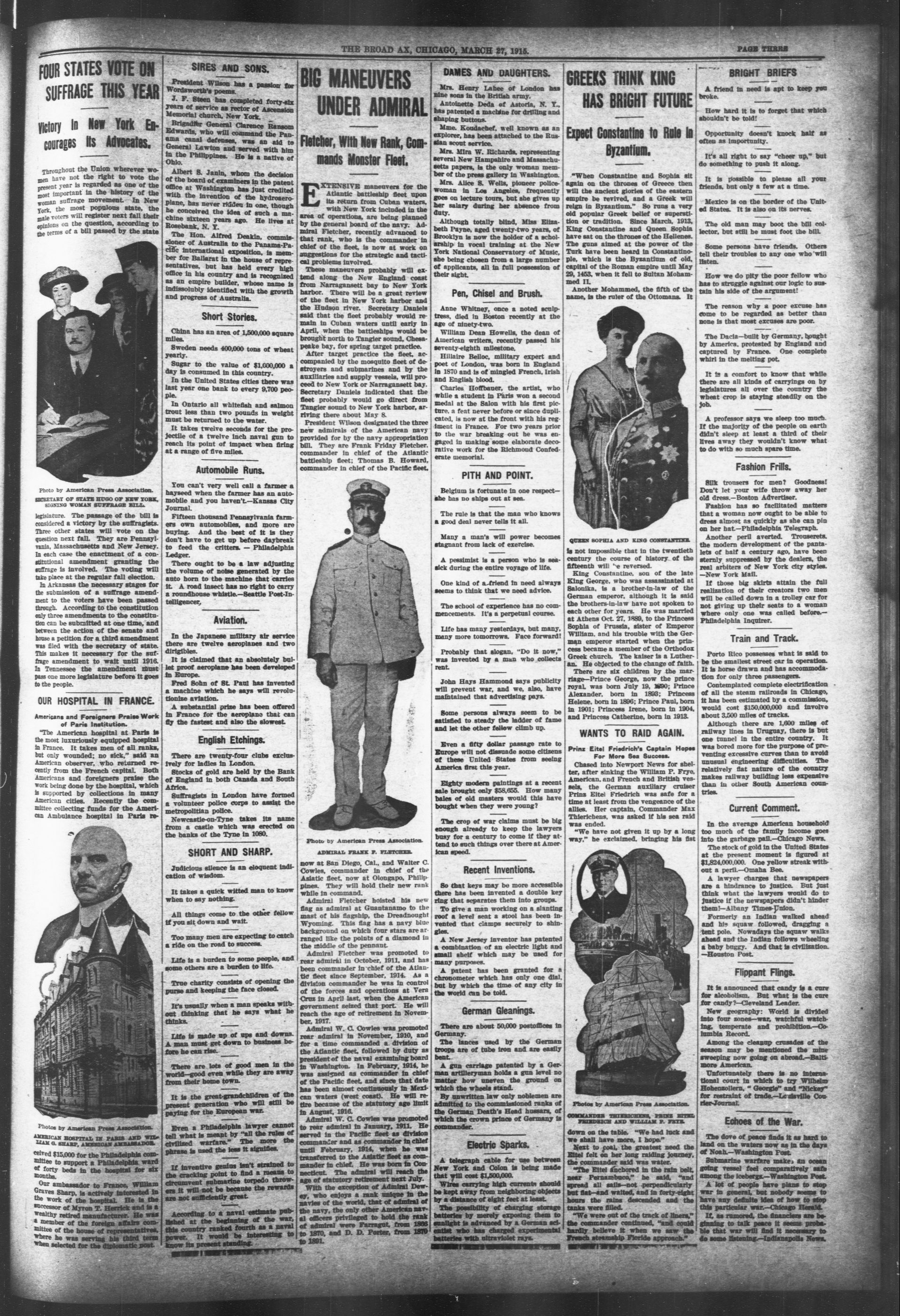
BIG MANEUVERS UNDER ADMIRAL
EXTENSIVE maneuvers for the Atlantic battleship fleet upon its return from Cuban waters,
These maneuvers probably will extend along the New England coast from Narragansett bay to New York harbor. There will be a great review of the fleet in New York harbor and the Hudson river. Secretary Daniels said that the fleet probably would remain in Cuban waters until early in April, when the battleships would be brought north to Tangier sound, Chesapeake bay, for spring target practice. After target practice the fleet, accompanied by the mosquito fleet of destroyers and submarines and by the auxiliaries and supply vessels, will proceed to New York or Narragansett bay. Secretary Daniels indicated that the fleet probably would go direct from Tangier sound to New York harbor, arriving there about May 8.
President Wilson designated the three new admirals of the American navy provided for by the navy appropriation bill. They are Frank Friday Fletcher, commander in chief of the Atlantic battleship fleet; Thomas B. Howard, commander in chief of the Pacific fleet.
Photo by American Press Association.
ADMIRAL FRANK P. FLETCHER.
now at San Diego, Cal., and Walter C. Cowles, commander in chief of the Aslatic fleet, now at Olongapo, Philippines. They will hold their new rank while in command.
Admiral Fletcher hoisted his new flag as admiral at Guantanamo to the mast of his flagship, the Dreadnought Wyoming. This flag has a navy blue background on which four stars are arranged like the points of a diamond in the middle of the pennant.
Admiral Fletcher was promoted to rear admiral in October, 1911, and has been commander in chief of the Atlantic fleet since September, 1914. As a division commander he was in control of the forces and operations at Vera Cruz in April last, when the American government seized that port. He will reach the age of retirement in November, 1917.
Admiral W. C. Cowles was promoted rear admiral in November, 1910, and for a time commanded a division of the Atlantic fleet, followed by duty as president of the naval examining board in Washington. In February, 1914, he was assigned as commander in chief of the Pacific fleet, and since that date has been almost continuously in Mexican waters (west coast). He will retire because of the statutory age limit in August, 1916.
Admiral W. C. Cowles was promoted rear admiral in January, 1911. He served in the Pacific fleet as division commander and as commander in chief until February, 1914, when he was transferred to the Asiatic fleet as commander in chief. He was born in Connecticut. The admiral will reach the age of statutory retirement next July.
With the exception of Admiral Dewey, who enjoys a rank unique in the navies of the world, that of admiral of the navy, the only other American naval officers privileged to hold the rank of admiral were Farragut, from 1866 to 1870, and D. D. Porter, from 1870 to 1881.
DAMES AND DAUGHTERS.
Mrs. Henry Lahee of London has nine sons in the British army.
Antoinette Deda of Astoria, N. Y., has patented a machine for drilling and shaping buttons.
Mme. Koudachef, well known as an explorer, has been attached to the Russian scout service.
Mrs. Mira W. Richards, representing several New Hampshire and Massachusetts papers, is the only woman member of the press gallery in Washington.
Mrs. Alice S. Wells, pioneer policewoman in Los Angeles, frequently goes on lecture tours, but she gives up her salary during her absence from duty.
Although totally blind, Miss Elizabeth Payne, aged twenty-two years, of Brooklyn is now the holder of a scholarship in vocal training at the New York National Conservatory of Music, she being chosen from a large number of applicants, all in full possession of their sight.
Pen, Chisel and Brush.
Anne Whitney, once a noted sculptress, died in Boston recently at the age of ninety-two.
William Dean Howells, the dean of American writers, recently passed his seventy-eighth milestone.
Hillaire Belloc, military expert and poet of London, was born in England in 1870 and is of mingled French, Irish and English blood.
Charles Hoffbauer, the artist, who while a student in Paris won a second medal at the Salon with his first picture, a feat never before or since duplicated, is now at the front with his regiment in France. For two years prior to the war breaking out he was engaged in making some elaborate decorative work for the Richmond Confederate memorial.
PITH AND POINT.
Belgium is fortunate in one respect—she has no ships out at sea.
The rule is that the man who knows a good deal never tells it all.
Many a man's will power becomes stagnant from lack of exercise.
A pessimist is a person who is sea-sick during the entire voyage of life.
One kind of a friend in need always seems to think that we need advice.
The school of experience has no commencements. It's a perpetual course.
Life has many yesterday, but many, many more tomorrows. Face forward!
Probably that slogan, "Do it now," was invented by a man who collects rent.
John Hays Hammond says publicity will prevent war, and we, also, have maintained that advertising pays.
Some persons always seem to be satisfied to steady the ladder of fame and let the other fellow climb up.
Even a fifty dollar passage rate to Europe will not dissuade some citizens of these United States from seeing America first this year.
Eighty modern paintings at a recent sale brought only $58,655. How many bales of old masters would this have bought when they were young?
The crop of war claims must be big enough already to keep the lawyers busy for a century to come if they attend to such things over there at American speed.
Recent Inventions.
So that keys may be more accessible there has been invented a double key ring that separates them into groups. To give a man working on a slanting roof a level sent a stool has been invented that clamps securely to shingles.
A New Jersey inventor has patented a combination of an electric light and small shelf which may be used for many purposes.
A patent has been granted for a chronometer which has only one dial, but by which the time of any city in the world can be told.
German Gleanings
There are about 50,000 postoffices in Germany.
The lances used by the German troops are of tube iron and are easily bent.
A gun carriage patented by a German artilleryman holds a gun level no matter how uneven the ground on which the wheels stand.
By unwritten law only noblemen are admitted to the commissioned ranks of the German Death's head hussars, of which the crown prince of Germany is commander.
Electric Sbarks.
A telegraph cable for use between New York and Colon is being made that will cost $1,500,000.
Wires carrying high currents should be kept away from neighboring objects by a distance of eight feet at least.
The possibility of charging storage batteries by merely exposing them to sunlight is advanced by a German scientist who has charged experimental batteries with ultraviolet rays.
GREEKS THINK KING HAS BRIGHT FUTURE
"When Constantine and Sophia sit again on the thrones of Greece then will the ancient glories of the eastern empire be revived, and a Greek will reign in Byzantium." So runs a very old popular Greek belief or superstition or tradition. Since March, 1913, King Constantine and Queen Sophia have sat on the thrones of the Hellenes. The guns aimed at the power of the Turk have been heard in Constantinople, which is the Byzantium of old, capital of the Roman empire until May 29, 1453, when it fell to Sultan Mohammed II. Another Mohammed, the fifth of the name, is the ruler of the Ottomans. It
M.
QUEEN SOPHIA AND KING CONSTANTINE
Is not impossible that in the twentieth century the course of history, of the fifteenth will 'e reversed.
King Constantine, son of the late King George, who was assassinated at Salonika, is a brother-in-law of the German emperor, although it is said the brothers-in-law have not spoken to each other for years. He was married at Athens Oct. 27, 1889, to the Princess Sophia of Prussia, sister of Emperor William, and his trouble with the German emperor started when the princess became a member of the Orthodox Greek church. The kaiser is a Lutheran. He objected to the change of faith.
There are six children by the marriage—Prince George, now the prince royal, was born July 19, 1890; Prince Alexander, born in 1883; Princess Helene, born in 1896; Prince Paul, born in 1901; Princess Irene, born in 1904, and Princess Catherine, born in 1913.
WANTS TO RAID AGAIN.
Prinz Eitel Friedrich's Captain Hopes For More Sea Success.
Chased into Newport News for shelter, after sinking the William P. Frye, American, and French and British vessels, the German auxiliary cruiser Prinz Eitel Friedrich was safe for a time at least from the vengeance of the allies. Her captain, Commander Max Thierichens, was asked if his sea raid was ended.
"We have not given it up by a long way," he exclaimed, bringing his fist
SIR JOHN HENRY HENRY
Photos by American Press Association.
COMMANDER THIRRICHENS, PRINCE EITEL
FRIENDRICH AND WILLIAM P. FRYE.
down on the table. "We had luck and
we shall have more, I hope."
Next to goal, the greatest need the
Eitel felt on her long raiding journey,
the commander said was water.
"The Eitel anchored in the rain belt,
near Fernambuco," he said, "and
spread all sails—not perpendicularly
but flat—and waited, and in forty-eight
hours the rains descended and the
tanks were filled.
"We were out of the track of liners,
the commander continued, "and could
hardly believe it when we saw the
French sternship Florida approach."
BRIGHT BRIEF'S
A friend in need is apt to keep you broke.
How hard it is to forget that which shouldn't be told!
Opportunity doesn't knock half as often as importunity.
It's all right to say "cheer up," but do something to push it along.
It is possible to please all your friends, but only a few at a time.
Mexico is on the border of the United States. It is also on its nerves.
The old man may boot the bill collector, but still he must foot the bill.
Some persons have friends. Others tell their troubles to any one who 'will listen.
How we do pity the poor fellow who has to struggle against our logic to sustain his side of the argument!
The reason why a poor excuse has come to be regarded as better than none is that most excuses are poor.
The Dacia—built by Germany, bought by America, protested by England and captured by France. One complete whirl in the melting pot.
It is a comfort to know that while there are all kinds of carryings on by legislatures all over the country the wheat crop is staying steadily on the job.
A professor says we sleep too much. If the majority of the people on earth didn't sleep at least a third of their lives away they wouldn't know what to do with so much spare time.
Fashion Frills.
Silk trousers for men? Goodness! Don't let your wife throw away her old dress.—Boston Advertiser.
Fashion has so facilitated matters that a woman now ought to be able to dress almost as quickly as she can pin on her hat.—Philadelphia Telegraph.
Another peril averted. Trouserets, the modern development of the pantallets of half a century ago, have been sternly suppressed by the dealers, the real arbiters of New York style styles.—New York Mall.
If those big skirts attain the full realization of their creators two men will be called down in a trolley car for not giving up their seats to a woman where only one was called before.—Philadelphia Inquirer.
Train and Track.
Porto Rico possesses what is said to be the smallest street car in operation. It is horse drawn and has accommodation for only three passengers. Contemplated complete electrification of all the steam railroads in Chicago, it has been estimated by a commission, would cost $150,000,000 and involve about 3,500 miles of tracks. Although there are 1,600 miles of railway lines in Uruguay, there is but one tunnel in the entire country. It was bored more for the purpose of preventing excessive curves than to avoid unusual engineering difficulties. The relatively flat nature of the country makes railway building less expensive than in other South American countries.
Current Comment.
In the average American household too much of the family income goes into the garbage pail—Chicago News. The stock of gold in the United States at the present moment is figured at $1,824,000,000. One yellow streak without a peril.—Omaha Bee. A lawyer charges that newspapers are a hindrance to justice. But just think what the lawyers would do to justice if the newspapers didn't hinder them!—Albany Times-Union. Formerly an Indian walked ahead and his squaw followed, dragging a tent pole. Nowadays the squaw walks ahead and the Indian follows wheeling a baby buggy. And that is civilization.—Houston Post.
Flippant Flings.
It is announced that candy is a cure for alcoholism. But what is the cure for candy? - Cleveland Leader.
Among the cleanup crusades of the season may be mentioned the mine sweeping now going on abroad.-Baltimore American.
Unfortunately there is no international court in which to try Wilhelm Hohencolllen, "George" and "Nickey" for restraint of trade.-Louisville Courier-Journal.
Echoes of the War.
The dove of peace finds it as hard to land on the waters now as in the days of Noah.—Washington Post.
Submarine warfare make, an ocean going vessel feel comparatively safe among the icebergs.—Washington Post.
A lot of people have plans to stop war in general, but nobody seems to have any definite idea of how to stop this particular war.—Chicago Herald.
If, as rumored, the financiers are beginning to talk peace it seems probable that war will find it necessary to do some listening.—Indianapolis News.
PAGE FOUR
THE BROAD AX
Will promulgate and at all times uphold the true principles of Democracy, but Catholics, Protestants, Friends, Indians, Single Taxes, Republicans, or anyone else can have their say, as long as their language is proper and responsibility is fixed.
The Broad AX is a newspaper whose platform is broad enough for all, over claiming the editorial right to speak its own mind.
Local communications will receive attention. Write only on one side of the paper.
Subscriptions must be paid in advance. One Year.....$3.00
Six Months.....1.00
Advertising rates made known on application.
Address all communications to
THE BROAD AX
5027 FEDERAL STREET, CHICAGO, ILL.
PHONE DREXEL 4100.
JULIUS F. TAYLOR, Editor and Publisher
Entered as Second-Class Matter Aug. 19,
1803, at the Post Office at Chicago, Illinois
under Act of March 3, 1879.
HEALTH AND SCIENCE
By Dr. W. A. Driver, 3300 S. State St.
Phone Douglas 3617.
Science is classified knowledge; the
word is derived from the Latin word,
scio, to know. On account of much
misapprehension real science is not
regarded in some circles; the false is
mistaken for the true; ignorance is
mistaken for knowledge.
In ancient times the doctor of Divinity performed not only the very exacting duties of the man of God but he, being the only cultured or educated man of his section or bailiwick, performed all other duties requiring literary ability or classified knowledge. He was the judge of all differences; he was practically judge and jury. He was the doctor of Law and the doctor of Medicine. English history informs us that the druids, the priests or preachers of their time, were doctors of Medicine as well as doctors of Divinity.
Classified knowledge became so voluminous that no one person could be expected to master the various sciences. The centuries brought more knowledge more responsibilities and more zealousness on the part of conscientious literary men to know, accurately, the various subdivisions of the arts and sciences. It was evident that the doctor of Divinity was overburdened with allied sciences; it was plainly understood that the great department of Theology was sufficient to occupy all the time that any person possessed and true classification of knowledge or scientific classification began. The field or section or subdivision of Medicine was found to be sufficient to occupy all the time that any person could give. And all the other departments of Science were found to be of so great scope or magnitude that mankind now has the preacher, the lawyer, the musician, the literary man (the writer), the editor, the physician, the dentist, and many others, too numerous to mention at this time.
Even the subdivisions mentioned above are further subdivided; the various sciences are so labyrinthine in their ramifications that no person is capable of being master of even a branch or subdivision of a subdivision. We cannot do the work of our fellow sojourners too well. We need more accuracy all along the line of human endeavor. This age demands more definiteness, more exactitude, more accuracy. The subdivision of medicine is gradually subdividing in order that we may render better service to Humanity. Medicine recognizes the great necessity for the "Division of Labor." It seems that a good definition of Science is Division of Labor. You will agree that it is the Evolution of Education. Now let us contrast the idea of the true Science or the Division of Labor or the Evolution of Education with false Science.
False Science denies; true science proves. False Science seeks to eliminate the Bible by substituting another book; true Science seeks to coincide with Truth and the bible is the best exponent of it extant. False Science seeks to eliminate the very fact of our Material Existence; true Science recognizes and seeks to prolong our material existence so that even a fool will have time to obtain Spiritual Longevity. False Science teaches that since you have no physical existence, you can have no disease, no pain; true Science says the reverse. False Science seeks to eliminate the fact of your existence materially, therefore, it can only lead to physical neglect which invites the ravages of disease and physical death. False Science says in effect that "You can not use a Dentist because you have no tooth." "Having no tooth, you cannot have a Toothache." True
---
Science acknowledges Dentistry as a great branch of Science, of the Division of Labor of the Evolution of Education; true Science has discovered the Dentist, the Tooth was discovered by your mother and the Toothache will, like woman, need no eulogy because It Sneaks for Itself.
False Science adopts an adjective to deceive; true Science, like a fact that it is, stands alone. The euphonious adjective, that false Science adopts, has captured the admiration even of its enemies and so, to make the imitation look like the real, the false uses the prop. False Science seeks to eliminate the Doctor of Divinity, the Doctor of Dentistry, the Bible, the Doctor of Medicine and Your Material Existence. If your material existence is not a fact then the spiritual existence could by the same process or argument be dissipated or destroyed. False Science is then not Science. Theologians tell us that it is not Christian. We must leave that labor to the department of Theology. We believe that every department of Science is capable of showing its reason for existence. As a doctor of physic the physician defends his branch of science. He invites criticism, for his work demands a critical mind and criticism sharpens him. He is doctor to the body and to the mind; every doctor of medicine must from time to time consciously or unconsciously use mental suggestion, called psychotherapy. The people who do not understand the scope of the science of medicine, imagine that the physician is limited to material methods of healing. The Great Physician being divine and physical in his practice suggests that the lesser physicians should use combined methods. Water formed a great medium of healing with the greatest of all physicians, Christ. Every physician today would be powerless in his practice without the use of that greatest of all solvents and the greatest of all cleansing agents, namely, Water. So hydrotherapy is—is a branch of the healing art now, as it was in the time of the Man of Sorrows. Many persons not knowing the facts condemn true science but if we did not live to educate and be educated this life would indeed be monotonous.
Let us recapitulate, briefly. True science is, as has been stated by a prominent preacher, the "Division of Labor." May we not consider it an "Evolution of Education? When we shall all know then we must have the peaceful Millenium.
THOMPSON HELD BEFORE VOTERS
AS A "PROMOTER."
Sweitzer Finds a New Class Into Which to Place His Rival.
Robert M. Sweitzer, Democratic nominee for mayor, put his rival forward in a new role Thursday night. He called Mr. Thompson a "promoter," and he mentioned specifically the Lorimer-Lincoln league as one enterprise promoted by the Republican nominee. "Born rich, Mr. Thompson has left the management of his estate to an agent, while his individual efforts have been limited to that field known as 'promotion,'" said Mr. Sweitzer in his speeches. "Has any one of you ever heard the name of William Hale Thompson mentioned in connection with any business enterprise except as a 'promoter'? Have you ever heard it in connection with any undertaking of any kind, political, business, or even social, except as a 'promoter'?
Reckons Telephone Company.
"What were his relations with the telephone monopoly when the Chicago Telephone company sought a new franchise in 1907—those peculiar relations he refuses to tell us about? Has he told you he was anything besides a 'promoter' then?
"When 'Jim' Pugh tried to get the lake front for his private pier and dock, my opponent was on the job 'promoting' it, and now Pugh is reciprocating by promoting the Thompson campaign. In the water carnival of the Associated Yacht and Power Boat Clubs Thompson and Pugh were joint 'promoters.' In the Illinois Athletic Club Thompson was a 'promoter.'
"Do you remember about that club? Do you recall after he had made himself-president of it as its 'promoter,' the crop of lawsuits that grew up? And do you know how the club has grown and prospered since Thompson was out of the presidency? Ask the members. They will tell you."
Lincoln League "Promoter." "Mr. Thompson also was one of the 'promoters' of the Lincoln-Lorimer league. Do the Republicans recall that institution? Who were its moving spirits? William Lorimer, William Hale Thompson, Fred Lundin, 'Fire Escape Gus' Nohe, John Dill Robertson, 'Billy Cooke, Jim' Pugh, Dexter Burke, Jim' Monaghan, Joe Bidwell—all the old crowd. Where are those members of that same old crowd now? In Thompson's headquarters, the most of them living there—cating, sleeping, and having their whole beings in the Thompson rooms.
"In his own campaign Mr. Thompson has been nothing but a 'promoter.' He has worked at it for almost two years; doing nothing else but hunt for votes while other men worked for their livings."
THE BROAD AX, CHICAGO, MARCH 27, 1915.
[Name]
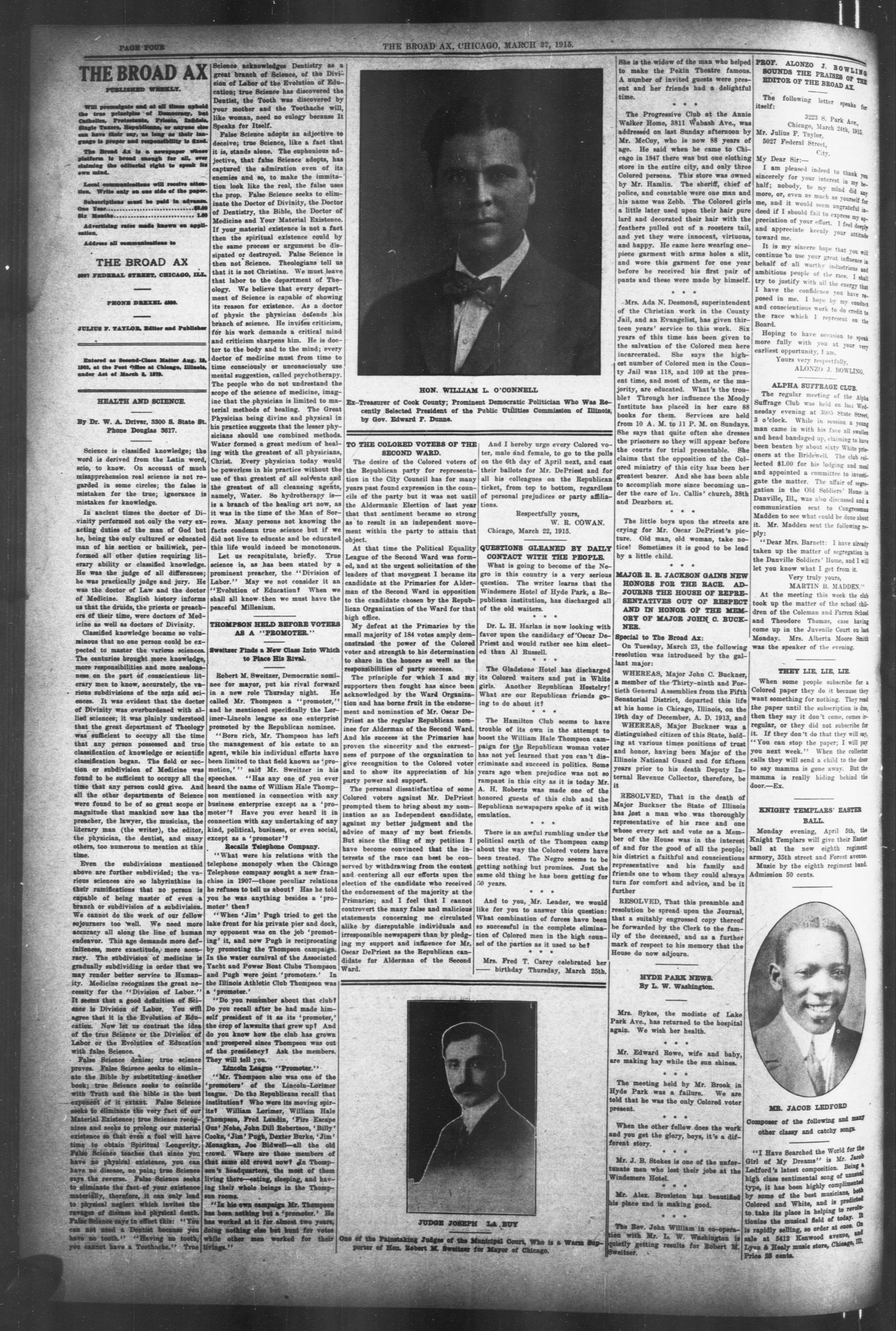
HON. WILLIAM L. O'CONNELL
Ex-Treasurer of Cook County; Prominent Democratic Politician Who Was Recently Selected President of the Public Utilities Commission of Illinois; by Gov. Edward F. Dunne.
TO THE COLORED VOTERS OF THE SECOND WARD.
The desire of the Colored voters of the Republican party for representation in the City Council has for many years past found expression in the councils of the party but it was not until the Aldermanic Election of last year that sentiment became so strong as to result in an independent movement within the party to attain that object.
At that time the Political Equality League of the Second Ward was formed, and at the urgent solicitation of the leaders of that movement I became its candidate at the Primaries for Alderman of the Second Ward in opposition to the candidate chosen by the Republican Organization of the Ward for that high office.
My defeat at the Primaries by the small majority of 184 votes amply demonstrated the power of the Colored voter and strength to his determination to share in the honors as well as the responsibilities of party success. The principle for which I and my supporters then fought has since been acknowledged by the Ward Organization and has borne fruit in the endorsement and nomination of Mr. Oscar DePriest as the regular Republican nominee for Alderman of the Second Ward. And his success at the Primaries has proven the sincerity and the earnestness of purpose of the organization to give recognition to the Colored voter and to show its appreciation of his party power and support.
The personal dissatisfaction of some Colored voters against Mr. DePriest prompted them to bring about my nomination as an Independent candidate against my better judgment and the advice of many of my best friends. But since the filing of my petition I have become convinced that the interests of the race can best be conserved by withdrawing from the contest and centering all our efforts upon the election of the candidate who received the endorsement of the majority at the Primaries; and I feel that I cannot controvert the many false and malicious statements concerning me circulated alike by disreputable individuals and irresponsible newspapers than by pledging my support and influence for Mr, Oscar DePriest as the Republican candidate for Alderman of the Second Ward.
M. B.
JUDGE JOSEPH LA.BUY
And I hereby urge every Colored voter, male and female, to go to the polls on the 6th day of April next, and cast their ballots for Mr. DePriest and for all his colleagues on the Republican ticket, from top to bottom, regardless of personal prejudices or party affiliations.
Respectfully yours,
W. R. COWAN.
Chicago, March 22, 1915.
QUESTIONS GLEANED BY DAILY CONTACT WITH THE PEOPLE
What is going to become of the Negro in this country is a very serious question. The writer learns that the Windemere Hotel of Hyde Park, a Republican institution, has discharged all of the old waiters.
Dr. L. H. Harlan is now looking with favor upon the candidacy of 'Oscar DePriest and would rather see him elected than Al Russell.
The Gladstone Hotel has discharged its Colored waiters and put in White girls. Another Republican Hostelry! What are our Republican friends going to do about it?
The Hamilton Club seems to have trouble of its own in the attempt to boost the William Hale Thompson campaign for the Republican woman voter has not yet learned that you can't discriminate and succeed in politics. Some years ago when prejudice was not so rampant in this city as it is today Mr. A. H. Roberts was made one of the honored guests of this club and the Republican newspapers spoke of it with emulation.
There is an awful rumbling under the political earth of the Thompson camp about the way the Colored voters have been treated. The Negro seems to be getting nothing but promises. Just the same old thing he has been getting for 50 years.
And to you, Mr. Leader, we would like for you to answer this question: What combination of forces have been so successful in the complete elimination of Colored men in the high counsel of the parties as it used to be?
Mrs. Fred T. Carey celebrated her — birthday Thursday, March 25th.
Municipal Court, Who is a Warm Sup-
for Mayor of Chicago.
She is the widow of the man who helped to make the Pekin Theatre famous. A number of invited guests were present and her friends had a delightful time.
The Progressive Club at the Annie Walker Home, 3811 Wabash Ave., was addressed on last Sunday afternoon by Mr. McCoy, who is now 88 years of age. He said when he came to Chicago in 1847 was but one clothing store in the entire city, and only three Colored persons. This store was owned by Mr. Hamlin. The sheriff, chief of police, and constable were one man and his name was Zebb. The Colored girls a little later used upon their hair pure lard and decorated their hair with the feathers pulled out of a roosters tail, and yet they were innocent, virtuous, and happy. He came here wearing one-piece garment with arms holes a slit, and wore this garment for one year before he received his first pair of pants and these were made by himself.
. . .
Mrs. Ada N. Desmond, superintendent of the Christian work in the County Jail, and an Evangelist, has given thirteen years' service to this work. Six years of this time has been given to the salvation of the Colored men here incarcerated. She says the highest number of Colored men in the County Jail was 118, and 109 at the present time, and most of them, or the majority, are educated. What's the trouble? Through her influence the Moody Institute has placed in her care 88 books for them. Services are held from 10 A. M. to 11 P. M. on Sundays. She says that quite often she dresses the prisoners so they will appear before the courts for trial presentable. She claims that the opposition of the Colored ministry of this city has been her greatest bearer. And she has been able to accomplish more since becoming under the care of Dr. Callis' church, 38th and Dearborn st.
. . .
The little boys upon the streets are crying for Mr. Oscar DePriest's picture. Old man, old woman, take notice! Sometimes it is good to be lead by a little child.
MAJOR B. E. JACKSON GAINS NEW HONORS FOR THE RACE. ADJOURNS THE HOUSE OF REPRESENTATIVES OUT OF RESPECT AND IN HONOR OF THE MEMORY OF MAJOR JOHN C. BUCK-NER.
Special to The Broad Ax:
On Tuesday, March 23, the following resolution was introduced by the gallant major:
WHEREAS, Major John C. Buckner, a member of the Thirty-ninth and Fortieth General Assemblies from the Fifth Senatorial District, departed this life at his home in Chicago, Illinois, on the 19th day of December, A. D. 1913, and WHEREAS, Major Buckner was a distinguished citizen of this State, holding at various times positions of trust and honor, having been Major of the Illinois National Guard and for fifteen years prior to his death Deputy Internal Revenue Collector, therefore, be it
RESOLVED, That in the death of Major Buckner the State of Illinois has lost a man who was thoroughly representative of his race and one whose every act and vote as a Member of the House was in the interest of and for the good of all the people; his district a faithful and conscientious representative and his family and friends one to whom they could always turn for comfort and advice, and be it further
RESOLVED, That this preamble and resolution be spread upon the Journal, that a suitably engrossed copy thereof be forwarded by the Clerk to the family of the deceased, and as a further mark of respect to his memory that the House do now adjourn.
HYDE PARK NEWS.
By L. W. Washington
Mrs. Sykes, the modiste of Lake Park Ave., has returned to the hospital again. We wish her health.
PROF. ALONZO J. BOWLING
SOUNDS THE PRAISES OF THE
EDITOR OF THE BROAD AX.
The following letter speaks for
itself:
3223 S. Park Ave.
Chicago, March 24th, 1915.
Mr. Julius F. Taylor.
5027 Federal Street
My Dear Sir:—
I am pleased indeed to thank you sincerely for your interest in my behalf; nobody, to my mind did any more, or, even as much as yourself for me, and it would seem ungrateful indeed if I should fail to express my appreciation of your effort. I feel deeply and appreciate keenly your attitude toward me.
It is my sincere hope that you will continue to use your great influence in behalf of all worthy industrious and ambitious people of the race. I shall try to justify with all the energy that I have the confidence you have reposed in me. I hope by my conduct and conscientious work to do credit to the race which I represent on the Board.
Hoping to have occasion to speak more fully with you at your very earliest opportunity, I am.
Yours very respectfully,
ALONZO J. BOWLING
ALPHA SUFFRAGE CLUB
The regular meeting of the Alpha Suffrage Club was held on last Wednesday evening at 3005 State Street, 3 o'clock. While in session a young man came in with his face all swollen and head bandaged up, claiming to have been beaten by about sixty White prisoners at the Bridewell. The club collected $1.00 for his lodging and meal and appointed a committee to investigate the matter. The affair of segregation in the Old Soldiers' Home in Danville, Ill., was also discussed and a communication sent to Congressman Madden to see what could be done about it. Mr. Madden sent the following reply:
"Dear Mrs. Barnett: I have already taken up the matter of segregation in the Danville Soldiers' Home, and I will let you know what I get from it.
At the meeting this week the club took up the matter of the school children of the Coleman and Farren School and Theodore Thomas, case having come up in the Juvenile Court on last Monday. Mrs. Alberta Moore Smith was the speaker of the evening.
THEY LIE. LIE. LIE.
When some people subscribe for a Colored paper they do it because they want something for nothing. They read the paper until the subscription is due, then they say it don't come, comes irregular, or they did not subscribe for it. If they don't do that they will say, "You can stop the paper; I will pay you next week." When the collector calls they will send a child to the door to say mamma is gone away. But the mamma is really hiding behind the door—Ex.
KNIGHT TEMPLARS' EASTER BALL.
Monday evening, April 5th, the Knight Templars will give their Easter ball at the new eighth regiment armory, 35th street and Forest avenue. Music by the eighth regiment band. Admission 50 cents.
[Name]
MR. JACOB LEDFORD
Composer of the following and many other classy and catchy songs.
"I Have Searched the World for the Girl of My Dreams" is Mr. Jacob Ledford's latest composition. Being a high class sentimental song of unusual type, it has been highly complimented by some of the best musicians, both Colored and White, and is predicted to take its place in helping to revolutionize the musical field of today. It is rapidly selling, so order at once. On sale at 5412 Kenwood avenue, and Lyon & Healy music store, Chicago, III. Price 25 cents.
ST. MARK CHURCH
50th and Wabash Ave
The Fourth Quarterly meeting occasion of the Conference year, 1914-1915, will be remembered in St. Mark as one of the greatest in its history. The love feast on Friday night and the Sunday services were each characterized by deep Spirituality. The sermon by the Rev. Dr. Gloster R. Bryant, delivered at both the morning and evening services were masterpieces of religious eloquence. Large and appreciative audiences filled both auditorium and gallery at each service. Six persons united with the church. The Rev'. Dr. H. J. Callis of Walters A. M. E. Zion church, assisted by his excellent choir, preached the Communion Sermon at 3 P. M. We were delighted to have with us Rev. H. M. Carroll, Fulton St. M. E. Church; Rev. E. R. Lewis, St. Luke M. E. Church; Rev. J. A. Winters, St. Paul C. M. E. Church; Rev Jas. Higgins, St. Mary A. M. E. Church The total collections for the day were $205.00. At the Quarterly Conference there was reported a total raised for the year of $16,339,220. The pastor was unanimously invited to return for another year. Complimentary resolutions were passed to the Pastor and Dr. Bryant. The church invites the Lexington Conference to hold its 1916 session in "The New St. Mark." Dr. Burgin, president of Walden University, will preach at St. Mark next Sunday morning. The Lyceum of St. Mark offers an unusual attraction for Sunday afternoon. Madame Clara Jackson Hutchinson, Chicago's favorite soprano, will render "With Verdure Clad," from Haydns "The Creation." Miss Alpha Bratton will sing "That Sweet Story of Old." Mr. A. W. Merriweather will play a cello solo, assisted by J. Merriweather.
NEGRO FELLOWSHIP LEAGUE.
A musical and literary program will be rendered Sunday afternoon, March 28th, at the Negro Fehowship League, 3005 State Street, 4 o'clock, by the Tuskegee Club. This is one of the leading literary clubs in the city, and there is no doubt that these talented young people will have an A-one program. On last Sunday Dr. George Prince, one of the founders of the League and the first treasurer, delivered a splendid address telling of some of his experiences while abroad. The League noted with pleasure the development made by Dr. Prince as shown in the excellent manner he delivered his speech, that part pertaining to the European war from a German point of view, being especially interesting.
CALL MEETING TO AID COLORED
FOLK.
The annual meeting of the Chicago branch of the National Association for the Advancement of Colored People will be held Sunday evening, March 28 at Abraham Lincoln Center. Among the speakers will be Judge Edward O. Brown and Robert McMurdy. Some of the directors are Miss Jane Addams, Julius Rosenwald and Rev. Jenkin Lloyd Jones.
CHIPS
Col. Franklin A. Denison spent several days last week in Springfield, III, on official business, in connection with the Eighth Regiment.
The Citizens' Committee will give a grand ball and reception at the Eighth Regiment Armory, 35th and Forest Ave., Monday evening, April 19. See announcement in another column of this paper.
Mrs. Elizabeth McDonald, superintendent of the Louise Juvenile Home for Colored boys, 6130 So. Ada street, has returned home from her vacation trip, to Hannibal and St. Louis, Mo. She is somewhat improved in health. Mrs. Lulu Chilton, who resides near Lexington, Ky., is visiting her daughter, Mrs. James H. Johnson, 3650 Prairie avenue. She arrived in this city last Wednesday morning, and will remain for some time, in order to receive medical treatment from Dr. Daniel H. Williams
The Twelfth Regiment Patriarchie Grand United Order of Odd Fellows, Adjt. General B. H. Johnson, commanding, will give an entertainment at the new Eighth Regiment Armory, 35th street and Forest avenue on Tuesday evening, May 11. One feature of the entertainment will be a grand concert rendered by the Augmented Twelfth Regiment Band, at the same time a popularity contest, and the three most popular ladies belonging to the various fraternal organizations and clubs will receive handsome prizes.
The regular Republican candidate for Alderman of the Second Ward, who will beat or defeat all comers at the election Tuesday, April 6.
Sickroom Clothing:
Clothing used in the sickroom never should be put in the laundry bag after it is used. Place it in a clothes boiler at once and cover with boiling water and soap solution and allow to come to the boiling point. Clothing used in infectious diseases should be treated this way for three successive days. This not only kills matured bacteria, but any undeveloped spores as well. When the sickroom clothing is of thin, delicate fabric one washing in the soap solution and hot water, followed by rinsing in hot water, will be sufficient. In such material the heat of the iron in ironing will complete the sterilization. It is advisable always to have some of the soap solution ready for use. Cut the soap in small pieces, cover with cold water and set on the back of the stove to dissolve. For one boiler of clothes use enough solution to make a thick suds—Today's Magazine.
Sulphuric Acid and Civilization.
Liebig said that we might gauge the civilization of a country by the quantity of sulphuric acid it consumed. The total output of this acid is now about 5,000,000 tons, according to the fourth edition of Professor G. Lunge's treatise on its manufacture. At least 1,000,000 tons a year have been made in Germany, and that country has been importing about 100,000 tons besides. Sulphuric acid is made principally from iron pyrites, but also from zincblende. It is essential in the manufacture of high explosives, but there is scarcely a process of manufacture into which it does not enter. It is said that there is no branch of chemical technology that has been more thoroughly developed than that of the manufacture of sulphuric acid, but so keen is the competition that improvements are taking place all the time.
The Sneazewood Tree.
The remarkable sneezewood tree is a native of Natal and other parts of South Africa. Its funny name was given to it because one cannot saw it without sneezing violently. The dust of its wood has just the same effect as the strongest snuff and is so irritating to the nose that workmen are obliged to sneeze even when they are planing it. If a piece of the wood of this tree is put in the mouth it is found to have a very bitter taste, and no doubt it is this bitterness which prevents insects of any kind from attacking the timber of the sneezewood tree. The fact that insects find it so disagreeable makes its wood very valuable for work that is required to last a long time.
Paper Bullets
Bullets of paper or tallow have been found to be productive of far greater damage than metal ones when used for short distance firing. During some experiments in this direction it was proved that, whereas a metal bullet penetrated a deal plank an inch in thickness and left a neat hole, a pasteboard bullet had a far greater destructive effect upon the target. A paper bullet passing through six pieces of tin placed at a distance of a foot apart buckled them up completely, whereas a metal bullet merely left a small round hole.
A Bound of Curve
"My son," said the family man, "is anxious to become a pugillist. I'm doing my best to prevent him."
"Let him go ahead," said the friend of the family. "and have some one pound him. You'll find a pound of cure worth more than an ounce of prevention."—Philadelphia Record.
Soiled Photographs.
Photographs which have not been protected with glass and have become soiled either by dust or fly specks may be cleaned very easily by wiping them off with absorbent cotton dampened with pure alcohol—Woman's Home Companion.
THE BROAD AX. CHICAGO. MARCH 27. 1915
The use of mules is being urged for cavalry puposes. If they could talk the horses would support the motion.
Hereafter belligerent nations will best be geographically located by saying they are bound on all sides by misery.
All the world now is turning a regrettful glance back to the bread which mother used to make, with plenty of dough in it.
After a man gets property he is afraid the people are not as honest as they were when he didn't have anything to lose.
In Cincinnati a court has limited telephone gossip on a party line to five minutes. A first class gossiper, however, can do a lot of damage in that time.
The Writers.
Miss Marie Corelli is a skilled performer on the mandolin.
Mr. J. M. Barrie lives at 3 Adelphi Terrace house, London, in a six room flat. Immediately underneath him lives Mr. John Galsworthy, and on the floor below that is Mr. Granville Barker, while just across the way, at No. 10, resides Mr. Bernard Shaw.
Rita, whose real name is Mrs. Desmond Humphreys, never dictates. She writes everything in her own hand and it is afterward typewritten. She writes for five hours a day—three in the morning and two in the evening—and can produce a book of 90,000 or 100,000 words in two months if she is put to it.
Pert Personals.
In England it would have been Goe
thals of Panama.—New York Tribune.
Dr. Sun Yat Sen has been pardoned by the Chinese republic, which is a bit like saying that George Washington has been forgiven by the United States.—Chicago News. Some one has called Margaret Foley the "pioneer suffragist." Wonder what Lucy Stone, Julia Ward Howe and a few others, more or less well known, would say to that.—Lowell Courier-Citizen.
Town Topics
Columbia announces that she will have a football team this year. Now, can't Cleveland announce that she will have a baseball team? -Cleveland Plain Dealer. The city of New York disbursed for its maintenance in 1914 the sum of $39,941,157. Father Knickerbocker can outspend whole nations without himself becoming the least bit spent.-New York Sun. Detroit has been considering the purchase of the street car lines at $24,000,000. Why should there be street car lines in a city where even the baby carriages have eight cylinders?-Philadelphia Ledger.
The Royal Box.
Victor Emmanuel, king of Italy, is a keen fisherman and spends hour after hour with his rod.
The German empress practices the most rigid economy, while her famous husband, the kaiser, spends money freely.
Prince Ranjitsinhjh, now the jam of Nawanagar and serving with the British forces at the front, rules over 3,791 square miles of territory in India.
The German crown prince will be thirty-three years of age next May. He married the Princess Occlie of Mecklenburg-Schwerin in 1905 and has four sons.
---
SIRES AND SONS
Lord Kitchener is a keen collector of old china.
Charles David Marx, who has just been installed as president of the American Society of Civil Engineers, is head of the civil engineering department at Stanford university.
Ambrose Swasey, who recently gave $200,000 to engineering societies to promote research in that field, designed and built the Lick, Yerkes and United States naval observatories. He is sixty-nine years old.
General Jan Christian Smuts, minister of finance and defense in the Union government of South Africa, graduated from Cambridge, England, and became attorney general under the Paul Kruger regime at the age of twenty-eight. During the Boer war he fought against the British. He is now in his forty-fourth year.
While his work and responsibility are as great as those of any of the commanders of the German army corps, Dr. von Schjerning, general staff surgeon of the army, is almost never heard of. He it is who is held directly responsible for the work performed by the surgical division of the army all along the lines of action.
Flippant Flings
Some former congressmen won't miss the call roll, but, oh, you cloakroom!—Washington Post.
Life is just one swat after another. First it is candidates for office and then it is carpets and flies—Chicago News.
A Boston physician says that music makes the hair grow. Some of the new music makes it stand on end.—Providence Journal.
Do you know Adam and Eve's telephone number? No? Mr. John L Swayze of the New York Telephone company says it was "281 Apple."—Chicago Post.
We are beset by a horrible thought: How is American neutrality to be maintained when the time comes to root for Hans Wagner and Napoleon Lajoie'—Manchester Union.
Echoes of the War.
No nation can be said to be too cowardly to fight, but after the close of the present conflict it is likely that some will be too poor to do so.-Detroit News.
Those who go down in submarines appear to have about the same chance of coming up alive as those who go up in airships have of coming down and living.-Philadelphia Press.
The cost of firing one of the monster guns employed in modern warfare makes the necessity of economizing in the use of meat and potatoes quite clear to the plain citizen.-Washington Star.
Short Stories.
It is estimated that the government's Grand Canyon game refuge in Arizona now contains about 10,000 deer. The world's most active volcano is Mount Sangay, in South America, which has been in constant eruption since 1728. One of the most luxurious private cars in the world has been built in England for the use of an official of a Chinese railroad. No metal coffins are made in Peru, but the law prescribes metal linings for wooden coffins where death resulted from contagious disease.
SHORT AND SHARP.
The longer the war the shorter the means.
See America first is also a matter of safety first.
Wonder who loses all the fault everybody seems to find.
Silver and gold don't rime, but they make a pleasant jingle.
As a general thing it is easier to point to a good example than to set one.
Taking a trench now and then appears to be the routine of the fighting men.
Most of us can plainly hear the echo of the knock of opportunity after it is too late.
It appears that war has done what chance could never do—spoil the business at Monte Carlo.
Those who have tested it find that the epigram "Revenge is sweet" is the most misleading of all.
SIRES AND SONS
Patrick Grant, seventy, has just retired after forty-nine years of service as a policeman in New York. Ernest Roume, former governor general of the French province in East Africa, has been appointed governor general of Indo-China by the cabinet. Marshall Morgan, recently appointed secretary of the American and British claims arbitration commission, has been for the last three years managing editor of the Nashville Tennesseean. The Right Hon. Thomas Burt, who rose from pit boy to privy councilor and who is known as "the father of the house of commons," is to retire on account of his age. He is seventy-seven years old.
In recognition of over twenty-five years' service with the Hamburg American line Julius P. Meyer of New York has been given the decoration of the Red Eagle of the fourth class by the German emperor, through Ambassador Count Bernstorff. John M. Carnahan, the telegraph operator who fashed the news of the Custer massacre to the world in 1870, retired on New Year's day, after active service of more than fifty years. He has entered upon the enjoyment of the pension which the company granted for long service.
Flippant Flings.
One thing that brothers us is what a jitney passenger does with his strap arm.—Toledo Blade.
Women have started a movement to conceal their ages when registering. Very few of them look as old as that!—Chicago News.
Adulteration of merchandise has gone so far that rubber is now found in cotton bales and copper in barrels of sugar.—Philadelphia Record.
One of the latter day prophets says the destruction of men by war will ultimately result in a revival of polygamy. Not while the price of bonnets remains at current quotations.—Houston Post.
Town Topics.
Killing bank robbers has become a habit in Cincinnati—Pittsburgh Post. Cleveland police are forbidden to wear wrist watches. But are they permitted spats?—Detroit Free Press. The perfect man is being sought by Chicago tailors. The only joke in this news consists in the fact that they are looking for him in Chicago.—Cleveland Plain Dealer. There is some complaint in Boston that baseball is interfering with art. Still baseball has given Boston considerable prominence that would have been impossible to art.—Philadelphia Press.
Wireless Whispers.
Test messages of wireless telegrams sent in Peru with five kilowatt power passed the Andes mountains from 14,000 to 20,000 feet high. Japanese electricians were among the first experimenters with wireless telegraphy and have perfected one of the most efficient systems known. Two German wireless experts have succeeded in sending messages through the earth from mines 1,600 feet deep and one and one-half miles anpst.
Culinary Capers.
Lamb chops are improved if dipped in lemon juice just before cooking.
In making cake always beat the yolks and whites of the eggs separately.
Instead of boiling beetroots roast them in the oven. The flavor will be much improved.
To successfully bake a pie crust without its filling line it with paraffin paper and fill with uncooked rice.
BRIGHT BRIEFS.
The easiest way to get a living is to earn it. _____
The more you know the less sure you are. _____
A stitch in time is worth two needles in a haystack. _____
A short answer is often followed by a long silence. _____
Mexico seems to have found the secret of perpetual motion. _____
Better not try it on the dog—unless you are sure of your dog. _____
Every time a man picks up a few cents' worth of experience he drops a dollar. _____
Indeed do we live in a rapid age. A history of the present war is on the market. _____
It's easier for a young man to make love to a girl than for him to make a living for her.
The income tax doesn't bother the man whose principal holdings consist of castles in the air.
The only way to tell for sure that you don't owe more than you can pay is to go ahead and pay it.
It is all right to speak well of your enemies, but it is better to give your friends the first compliments.
If there is anything you haven't seen now is the time to take a good look. Manufacturers announce a jump in the price of eyeglasses.
Improving the Family Tree.
"Look at this, my dear," said Mr. Newrich to his wife, displaying a fine case of jewels.
"Oh, you have bought them for me, haven't you?" she exclaimed. "How sweet of you!"
"No, my love; I have bought them for my grandmother."
"Your grandmother?"
"Yes, dear."
"But she is a bedridden nonagenarian. She can't appreciate them."
"True, dear. And she need never know anything about them."
"What in the world do you mean?"
"Simply this, dear: It is always advisable to have some heirlooms in a family that makes any social pretensions. These jewels now belong to my grandmother. When our daughter Ethel comes out in a year or two she shall have them, and when it is understood that they were once the gems of her great-grandmother just see the antiquity which our family will develop and all on account of my having a great head."
And Mr. Newrich threw mental bouquets at himself with supreme lavishness.
The Profession of Mayer.
In Germany, where efficiency has become a national passion, the profession of mayor of cities has been established. The people of the German cities reason in this fashion: "We have here a big corporation. It is a big business corporation and more. It is a big social organization as well. On its efficient management much of our comfort, our health, our success depends. Therefore we will get the best manager we can find. If he does not happen to be in the city we will go outside to get him."
The cities pay well and employ the mayor-manager for a long term of years. After a preliminary trial he is retained indefinitely. In the larger Prussian cities his ability is so esteemed that he is usually made a member of the Prussian upper house. If he shows unusual qualifications he may be chosen a minister of state. The mayoralty in Germany really offers a career.-Kansas City Star.
Left Over Roast Lamb.
To use left over roast lamb take it and cut away all the bone and gristle and grind through a food chopper or chop fine in hash bowl; then mix with six sprigs of parsley and two stalks of celery. Add crumbled soda crackers, one tablespoonful of softened butter, a little salt and pepper, one spoonful of minced onion and enough milk or water to make molst and then beat in one egg and form into a steak. Put in a buttered pan, place in a moderate oven and roast for twenty-five minutes, basting with melted butter or good drippings. Just before the last five minutes is up spread a generous layer of fine breadcrumbs mixed with egg yolk over the top and sides to brown, serve on a hot platter and garnish with sliced lemon or parsley.—Cleveland Plain Dealer.
Table Manners.
The good people of the church gave the poor children of the parish a bountiful New Year's dinner, and the delight of the youngsters was much more manifest than their table manners. One little fellow was discovered clutching a doughnut in one fist and a lump of steak in the other. He was reproved for his breach of etiquette and took the reproach very meekly. But a moment later he turned to the dinner next him and remarked regretfully, "The trouble about these here table manners is that they was invented by somebody who wasn't never really hungry!"—Argonaut.
Just Let Her Talk
"How did you happen to marry that man, Imra? Did he please you so well?" "Oh, on the contrary! But when I told him the reasons why I wouldn't marry him he listened to me without interrupting me for two hours, so at last I accepted him."
An Exe to Business
Drummer—And so our friend, your husband, is gone! He dealt with me for twenty years. Weeping Widow—Yes, and if you had come a fortnight earlier you would have found him still among the living. Drummer—Do you think he left any order for me?—Flegende Blatter.
Great Bridges.
The largest suspension bridge in the world is the Manhattan, between New York city and Brooklyn. The longest railroad bridge over navigable water is the one on the Norfolk and Southern line at Edinton, N. C., connecting Edinton with Mackayn.—New York American.
True to His Profession
Physician—I'm sorry, sir, but we can't quite be sure as to what is wrong with your arterial system unless we put you under the X ray machine. Publisher—That's all right. I never made any secret of my circulation—Judge.
The Remedy.
Doctor—You must go away for a long rest. Overworked Merchant—But, doctor, I'm too busy to go away. Doctor—Well, then, you must stop advertising. —St. Louis Times.
What It Was.
"What's that loud talking going on up in your flat, Willie?"
"Oh, that's just pa, losing another argument to ma."—Detroit Free Press.
Ignorance is the dominion of absurdity.—Froude.
Woman's World
State Senator Who Says She
Is an Ordinary Home Woman.
SENATOR KATHRYN CLARKER
To an interviewer State Senator Kathryn Clarke of Oregon said: "I was born at Gardner, Douglas county, Ore. I usurp a woman's right of not telling the date--but I was the first white child ever baptized in the little town. There being no local minister one was imported for the occasion, so you see I really got a very good start in the right direction. I have lived in Douglas county practically all my life. My home is in Glendale, southern Oregon.
"From the position I now occupy one would think me a politician. Such is not the case. I am just an ordinary home woman, and when one quiet Sunday afternoon I was called to the phone and received the news that Governor West had seen fit to appoint me to fill the vacancy in the state senate no one could have been more surprised than I. When asked if I would accept I most emphatically said 'No,' but after consulting some friends and thinking it over could find no good reason why I shouldn't take this opportunity and break the ice for women to enter the senate even though I would perhaps not be able to do more than this. After accepting the appointment the senators, having the privilege of seating me or otherwise, chose otherwise, so it was necessary to hold a special election, and with three candidates in the field I was elected by a good majority. As this election took place on Jan. 20 and the legislature convened Jan. 11 I came into the august body just two weeks late. This fact made it rather difficult, as I had never even visited the legislature and knew absolutely nothing of the details or workings of the body in any respect, but after a busy few days I began to see the light, and after four weeks am free to say there is nothing in lawmaking that any woman of ordinary intellect cannot easily comprehend and be able to vote intelligently upon; also that women are not the only talkers, and if the women as legislators talk more than our Oregon senators have at this session the future generation may not expect much lawmaking in our future legislatures."
DAINTY BOUDOIR CAP.
Pretty Lingerie Creation of Dotted Net and Lace. Nothing adds so much of beauty to milady's "morning face" as a pretty beribboned and beruffed cap. Tousled locks can be discreetly covered until
FOR MILADY'S ROOM.
such time as she or her maid can give them the required attention. Pictured here is a very simple but pretty boud尔 cap of dotted net with an edging of val and ribbon rosettes.
Comfort For the Tourist.
For the tourist planning to go to the California exposition a very suitable parting gift is a utility case. These come in all sorts of practical designs. One of the most unusual is of Roman stripe ribbon outside. It folds over in half to be carried by a leather handle, so that it closely resembles a hand bag, as the silk is also bound around the edge with leather. Inside the case is lined and fitted with thin black rubber and contains pockets for every conceivable toilet amenid.
Of course shapes and covers vary with the price, but all are attractive. One case folds up quite small and contains only two pockets, one for a face cloth, the other for comb and toothbrush.
Good form
There is probably nothing half so baffling as the innocent bit of white cardboard called by common courtesy the personal visiting card. It is more often anything but a visiting card, having fallen into dubious uses as a means of sending regrets, apologies and introductions, or of representing the sender herself. It is so easy to send a card, much easier than going oneself or writing a note. It is just correct enough to let one out of a situation without criticism, but there is no surplus courtesy. A card, like charity, covereth a multitude of social sins.
But since cards are a necessary evil or blessing, if you choose to call them so, it is well to know what is absolutely correct. There are variations in cards from season to season, as in stationery, but the conservative card does not change in essentials. It should be engraved, either in script or old English lettering and should bear only the name of the owner, the address, if desired and the day at home, if one follows such a custom. A married woman uses Mrs. and her husband's full name on her visiting card; if a widow, Mrs., her maiden Christian name and the surname of her deceased husband. An unmarried woman uses Miss and her Christian names written out, no initials. If she is the eldest member of her family, and there is no danger of confusion, she may use just the Miss and her surname. A husband and wife may have a joint card for use in sending gifts, regrets or announcing change of residence. Otherwise it is safer for a man and wife to use separate cards. Never make the mistake of using a business card for social purposes.
About Invitations.
Notes of invitations to dinners, dances, "at homes," garden parties, etc., are generally written in the third person and must be answered in similar style. Sometimes between intimate friends and for a small dinner party the note of invitation would be written in the first person and, of course, the reply would be worded accordingly. Luncheon invitations are, as a rule, sent by notes written in the first person.
Invitations to dinner or luncheon should always be replied to as soon as received, whether accepted or refused. It is usual to state a reason for refusal, such as indisposition, previous engagement etc.
From five to ten days' notice is usually given when sending invitations for friendly dinner parties, but for a large dinner party quite three or four weeks' notice is given, so that time is thus allowed to ask others should any of the first invited guests refuse.
Guests arrive ten to fifteen minutes in advance of the actual dinner hour, and punctuality is most important.
Invitations to balls, dances and garden parties are issued on ordinary "at home" cards, the form of entertainment provided being written or printed in the left hand corner of the card. "R. S. V. P." (meaning an answer is expected) does not appear so frequently on invitations as formerly, but when it does an answer should be sent as early as possible.
When You Go Visiting.
When on a visit to friends it is essential that you make yourself very agreeable and fall in with the ways of the house, so that you give no extra trouble to hostess or servants.
Visitors shake hands with the host and hostess morning and night and can do so with any other guests that may be staying at the house.
Always leave your bedroom as tidy as possible and so save the housemaid unnecessary work. Letters can be written in the bedroom, and if the hostess rests after lunch then visitors may retire to their own room or go for a walk, as they may prefer.
On the conclusion of a visit it is usual to "tip" the servant who has shown you any special attention. A lady would "tip" the housemaid a sum from $1 to $5, according to length of stay and attention given. A gentleman "tips" the manservant who valets him, the butler and also the coachman if he drives him from and to the station.
Fees are never given by guests to servants after any entertainment, not even after a private dinner given at a restaurant or hotel.
Thimble Party
If you have a girl friend who is to be married and wish to entertain in her honor, why not give a thimble party? Take your card and write on it "Thursday from 3 to 5 (give date), in honor of Miss Browne. Thimbles." After all have arrived you can produce towels on which an initial is to be emboldened, dish towels to be hemmed of cheesecloth from which to make dusters. In this way you make it a personal party for the honored guest, but avoid the "shower" part by your providing the gift.
Chewing Gum.
Gum contests in public have gone out of fashion. No more unlucky habit can be formed, and it outrages all the canons of good form. Though at times gum chewing may be necessary or may be thought to be necessary as an assistant to good digestion, it is doubtful if it is ever anything more than a bad habit when done in public.
THE BROAD AX, CHICAGO, MARCH 27, 1915
A
PRETTY UNDERWAIST.
Nothing is more desired by the feminine heart in the springtime than handsome new "undies," as our English cousins call them. One department of underwear which the spring maid and matron cannot supply too lavishly is the brassiere department. One handsome illustration of these very necessary adjuncts to milady's toilet is shown in the illustration. Hand embroidered linen with real clancy lace is used in its development, and ribbon bows are used to further beautify it. A feature of this waist is the neatly beaded seams, which do away with the usual bulk where a seam occurs.
HER SHOES.
What the Woman Who Is Well Dressed Will Not Do.
The woman who is really well dressed does not wear a smart frock and a becoming hat and then ruln her whole appearance by clothing her feet in a pair of shoddy shoes, run down at the heel and perhaps unpilished. And yet many women who are fastidious as to their appearance, who would not think of going out of the house without their suits being well pressed, their blouses being fresh and dainty, their veils adjusted in just the right way, will forget entirely to look at the condition of their shoes. Perhaps these will be worn and dusty and will be made still uglier by being worn with a pair of solled and crumpled snats.
There is nothing prettier than well shod feet, nothing uglier than a pair of neglected, rundown, soiled shoes. And now that abbreviated skirts are fashionable the girl who wants to be well dressed will take great pains in selecting her shoes, and once she has purchased an appropriate and pretty pair she will take still greater pains to keep them in good condition. Never take off a pair of shoes without putting a pair of trees in them immediately. This will help them to keep their shape and also will help to prolong the life of the boots. When there is the least suspicion of the heels becoming run down send them to the bootmaker's immediately and have them straightened. Nothing looks so shabby as a pair of crooked heels.
Now as to some of the novelties to be seen this spring. In the first place the light top boot, which has made such a favorable impression this winter, remains in vogue for spring, all the smartest shoes having either light tan or light gray uppers. Gun metal leather and dark gray tops are also considered smart, while a tan shoe with a tan upper is very chic.
Common Sense Creed.
Almost twenty-five years ago, when life was less strenuous than it is now, the following "common sense creed" was formulated. If its need was felt then how much more will it be appreciated today!
Don't worry.
Don't hurry. "Too swift arrives as tardy as too slow."
Sleep and rest abundantly. Sleep is nature's benediction.
Spend less nervous energy each day than you make.
Be cheerful. "A light heart lives long."
Think only beautiful thoughts. "As a man thinketh in his heart so is he."
Work like a man, but don't be worked to death.
Avoid passion and excitement. A moment's anger may be fatal.
Never despair. "Lost hope is a fatal disease."
"If ye know these things, happy are ye if ye do them."
Three Excellent Hints.
If boiled frosting has been cooked too long it may be rendered smooth again by adding a piece of butter the size of a walnut before beating it.
A fine bit of emery board, such as comes for manicuring, makes a good substitute for an eraser when you make an ink spot on paper.
When one buys a child's dress, otherwise good, but with poor machine scallops on it, one can regard the scallops as padding and work over them with excellent effect.
Valenciennes Lace Profusely Trims Dress Made of Dotted Muslim.
g
LINGERIE CREATION.
The little kiddle has her inning in the little frock shown here. Nothing is ever more charming than dotted muslin and when combined with val is irrisistible. The gown has a jacket effect bodice with an underlining of sheer butiste, to which the skirt is attached. The skirt is full, with insets of val insertion, outlined by ruffles of val edging.
A blue satin sash and a blue satin hair ribbon contribute the touch of color to the costume, with which are worn white silk stockings and white kid buttoned boots.
SASH CURTAINS.
Materials For Making Them and Their Fashioning.
Sash curtains should be measured from the top of the inside of the window casement to the sill, allowing two inches at the top and bottom. The top is turned and stiffened through the center, which allows for a small heading and the casing for the brass rod. The hem is turned in at the bottom, so that the curtains just escape the sill.
The curtains may be perfectly plain or finished with a lace edging. A narrow gimp braid is sometimes used as a finish for sash curtains. The French striped net or brussels net is always nice.
Scrim and a quality of volle made for curtain purposes are also used, especially where a less transparent material than net is desired.
Is Meat a Fighting Diet?
Circumstances have brought to light again the question of man's need of red meat diet to make him a fighting warrior. An advocate of meat diet declared some time ago that the Belgians were losing their vital efficiency because they are a race of non-meat eaters. But, although they had done no fighting for a hundred years, they have given a good account of themselves of late.
Modern scientists assert that meat makes a dog or a man irritable, but gives neither courage nor endurance, both of which are essential fighting qualities. Attention is called to the fruit eating gorilla as the most dreaded fighter of the African forest. Not a lion is found in all the region where this great forest man reigns, untamed and untamable, a real king of beasts.
The lion, the traditional king of beasts, fights when brought to bay only because he is short winded and cannot run away. Every experienced hunter has borne testimony to the ability of the grass eating blison as a most courageous fighter with few equals.
Cookery Points
English Hot Cross Buns.
The following recipe, while claiming to possess absolutely no supernatural properties, nevertheless is guaranteed to turn out of the oven delicious hot cross buns. They not only will be the original sugar coated, hot and delicious cross bun, but will also contain "sugar and spice and everything nice." It is important, however, that the recipe be most carefully followed.
Scald one cupful of milk, add to it half a teaspoonful of salt and beat together until light one egg and one tablespoonful of sugar and add to the milk. When lukewarm add a quarter of a cupful of yeast or a quarter of a cake of compressed yeast. Beat thoroughly and set to rise until light. Then add enough flour to make a stiff dough. Knead with the hands for fifteen minutes. Set again to rise until light, then add a quarter of a cupful of butter softened, half a cupful of currants, a saltspoonful of nutmeg and a saltspoonful of cinnamon. Let rise again. Shape into small round cakes, put close together in a pan, cover and set to rise. When light bake in a moderate oven. Glaze with sugar and milk or white of egg beaten stiff with sugar. Just before placing in the oven take a sharp knife and cut two deep gashes like a cross on top of each.
Some Coffee Pointers.
Not long ago there was published a coffee making recipe which said, "Follow directions for making which accompany each style of coffeepot." This is good advice and necessary for all but boiled coffee, and people regardful of health do not make boiled coffee. The aroma, the flavor, the cheer of coffee are very dear to thousands of people at the breakfast hour. From the true safety first standpoint, which means at the railroad crossing that you may cross nine times without injury, but the tenth you lose your life, perhaps no one should drink coffee. The strength of the habit of coffee drinking is an argument against it. No human being who prizes his self control will allow any habit to dominate him, and bad food habits often have as fatal results as real vices. But millions drink coffee all their lives, some of which are long.
It is easy now to get the circular coffee rosters, but not so easy as formerly to get the finest green coffee to roast in them and grind while hot. There is great economy of aroma and flavor by this method.
Cafe au Lait.
A large part of the cosmopolitan world drink the French "cafe an lait," or coffee made with milk. In lunch rooms this is called Boston coffee and in many cases is made probably with about half water and half milk and is often served with cream. The essential utensil outside of some good enameled vessel is the asbestos mat. Not for one minute must the milk and coffee be allowed over the straight fire—nay, not for a second. Take the usual allowance of coffee per cup—many people take a very large tablespoon, but some use a small one—add a cup of cold milk for each person, putting in a little first and wetting the coffee thoroughly, then set over the asbestos mat with a small fire under and very slowly raise just to the boiling point, stirring once or twice if the coffee is all on top, as it should not be. Strain into a hot pot for serving. Add a little cream to each cup to give food value.
Delicious Potato Rolls.
Take one cupful of flour, one cupful of warm mashed potatoes, three-fourths cupful of lard, one cupful of scalded milk, two well beaten eggs, one-half cupful of sugar, one-half teaspoonful of salt, one cake of compressed yeast and one-half cupful of lukewarm water. Mix the lard with the potatoes, flour, sugar and salt. Add the eggs well beaten, and the milk and yeast cake dissolved in the water. Set to rise for two hours, then add six cupfuls of flour and let rise for one and one-half hours. Knead, roll out and cut with a biscuit cutter. Fold over like Parker house rolls. Lay on a buttered baking tin and let rise for one and one-half hours. Bake in a hot oven for twenty minutes.
Whole Wheat Bread.
Dissolve a yeast cake in two tablespoonfuls of tepid water. Add a pint of milk to a pint of boiling water and let stand until lukewarm; then add the dissolved yeast, a teaspoonful of salt and enough whole wheat flour to make a thick batter. Beat this batter for about fifteen minutes. It will become quite soft and liquid. Add enough flour to make a dough. Turn it on to a board and knead a few minutes. Return to the pan and let rise until it is light. About three hours is correct.
Cut the remains of the steak left from dinner into cubes, boil the bones for half an hour with very little water, add a little kitchen bouquet or a beef cube to this broth and season highly. Place a layer of rice remaining from boiled rice on the bottom of a greased dish, cover with a layer of beef, then another layer of rice, then beef, until the ingredients are used, pour the broth over all, cover with a thin layer of breadcrumbs and bake till brown.
Photo by American Press Association.
On Easter morning Esther found more than her usual supply of eggs, chicks and bunnies and was pleased.
"Grandma," said Esther, taking wee nibble of a chocolate egg, "grandma, will you please tell me how the rabbit came to be associated with Easter."
"They are lovely gifts, indeed, my dear, for they are gifts of love" answered the old lady, setting down her cup. "The rabbit is good because he is the expression of friends' love to ward one another at this glad season, when all the earth rejoices at the meaning of Easter day. Hope has risen in every heart, and no one cherishes ill will or hatred toward his neighbor. And so the rabbit comes with gifts to children to remind them of the plenty and bounty of the earth."
Game of Acid Drops.
Let the company sit in two rows facing each other, the ladies in one row and the gentlemen opposite them. Two leaders must be nominated, of whom one, a lady, walks along behind the row of gentlemen, and whispers to each a serious question, which they must in turn address later to their vis-a-vis.
The gentleman leader walks behind the row of ladies and to each whisper something of a perfectly absurd, or very blitting character, which each must repeat in answer to the question asked of her by her opposite. Neither leader must know anything of the questions or answers proposed.
The gentleman at the head of his row, then, at a given signal, asks with due gravity of the lady opposite to him the question that was given to him. She will reply, with equal gravity, in the exact words of the answer that has been given her. Question and answer must be repeated thrice without the shadow of a smile.
The next couple then take up the task, and so on until every couple has gone through the ordeal. Failure is any respect whatever puts the person out of the game.
This game is so popular that an encore is sometimes demanded. In that case the ladies will ask the questions given by the gentleman leader and the gentlemen give the answers prompted by the lady leader.
The Easter Rabbit.
A symbol of Easter quite as familiar is the Easter hare, which is closely associated with the moon. There have been all sorts of fancies concerning the moon, from the phases of which the time of Easter is fixed, and among many nations the hare is the symbol of the moon itself. The Hindu and Japanese artists painted the hare across the moon itself, while the Chinese represent the moon as a rabbit pounding rice in a mortar. An old, old Hindu moon legend says that once when Indra, disguised as a famishing pilgrim, was praying for food the hare, having nothing else to offer, threw itself into the fire that it might be cooked for his benefit, and the grateful Indra transported the animal to the moon, where those who have good imaginations declare that it is still to be seen.
Bay Scouts Growing.
Boy Scouts Growing.
The ratio of increase of the Boy Scouts of America is indicated by a striking paragraph from the chief scout executive's report: From Oct. 1, 1914 to Feb. 5, 1915, 45,330 boys were enrolled, as compared with 32,928 for the same period of 1913 and 1914; 838 new troops were organized, as compared with 533 for the same period last year. Commissions were granted to 4,118 men to serve as scoutmasters and assistants as compared with 2,251 for the same period of last year.
Transposition.
What in winter you feel,
When the frost's on the ground
Transposed it will reveal
(And it is truth I'll be bound).
A name that to rusties we write.
Who in clownish simplicity live.
Answer—Cold, clod.
LINCOLN STATE BANK OF CHICAGO
This Registering Home Bank FREE to our Savings Depositors; will start you saving and keep you at it. A Savings Account is the first step to wealth. OPEN one with US.
Chimneys and Potatoes.
The greatest hindrance to a chimney drawing as it should is the accumulations of soot which cling to the interior of chimneys and flues and clog up stovepipes. Many fires have been caused by the burning out of the soot which accumulates, and disagreeable odors and an unhealthy atmosphere are frequently produced in houses where soot is burning in chimneys. All this danger and unpleasantness may be avoided by the use of small pots, which are, as a rule, almost worthless for any other purpose. If burned a few at a time every day or two, these will prevent soot collecting in the flues. Even the potato peelings, which are usually cast into the garbage, can be burned in a stove or furnace and will help keep the pipes and flues free from the usual accumulations of soot. Try this plan if you want to enjoy better health and protect your property from fire.-New York American.
The Pansy.
Plant historians have never yet settled to their satisfaction just how the pansy originated. It was known as a garden flower in England fully three centuries ago, and the probability is that it was developed from a certain species of violet with tricolored petals, which is still to be found growing wild along British waysides and in other parts of northern Europe.
The old herbalist Gerade, describing the "pansie, or heart's ease," as he knew it, says quantify that it has "flowers in form and figure like the violet and for the most part of the same bignesse, of three sundry colors—that is to say, purple, yellow and white or blue—by reason of the beautie and bravery of which colors they are pleasing to the eye. For smell they have little or none at all. The root is nothing else but, as it were, a bundle of threddy strings."—London Graphic.
Clever Gainsborough
The father of Thomas Gainsborough, the great Suffolk painter, added as much to the wealth of Sudbury as the son increased its fame, says the London Tatler, for the father introduced more than one new industry into the town from Coventry. The Gainsboroughs were indeed a remarkable family. One brother of the painter, known as "Scheming Jack," was clever enough to make himself a pair of copper wings, but not clever enough to fly with them; to make a cradle which rocked itself and a cuckoo which sang all the year round. Thomas himself at an early age started his father by forging his signature to a message addressed to the local schoolmaster, "Give Tom a holiday," a message which provoked the parental prophecy, "Tom will be hanged one day." Tom was hanged in the Royal academy.
Not a Square Desk
Not a Square Deal.
Miss Mason was explaining to her Sunday school class the lesson for the day, the subject being the tares and the wheat.
"Now, remember, children, the tares represent the bad people and the wheat the good ones."
"Why, Miss Mason!" exclaimed a rosy cheeked boy, who had been listening through the lesson with deep interest. "Did you say the tares are the bad folks and the wheat the good ones?"
"Yes, James," replied the teacher, pleased at the lad's interest.
"Well, that's funny, I think," remarked the matter of fact child. "It's the wheat that gets thrashed; the tares don't."-Country Gentleman.
Are You Crazy?
"How do you know that you are not crazy?" was asked the accused in a lunacy investigation. A prize might well be offered for a convincing answer to the question from one's personal knowledge. Lombrose and other eminent alienists have held that there is a taint of insanity upon some subject in every human mind; that no mind is absolutely and correctly balanced. No man sane upon several subjects will admit that he is crazy at all. How, as a matter of fact, does any man know, of his own knowledge, that he is not insane?—Exchange
SURPLUS, $20,000.00
Commercial Banking
Savings and Checking Accounts
Foreign Exchange
Safety Deposit Vaults
Mortgages and Bonds
3 Per Cent Interest on Savings Deposits Your Patronage Solicited
One of the most famous "flat archies" in the world is to be found in the ruin of the church of Santo Domingo, Panama City, and has stood for nearly three centuries. The arch has an unsupported span of thirty-six feet five inches and stands twenty feet from the ground. Tradition has it that the Dominican monks planned and built their own church. This arch was near the front of the entrance and supported the organ loft, and it fell down three times as soon as the supports were taken away. Then a monk who was neither an architect nor an engineer "dreamed" an arch and drew up a plan according to his vision. When the arch was for the fourth time completed the designer stood beneath it while the supports were removed, staking his life on his inspired work. It stood and still stands. The church was destroyed by fire in 1787, and now nothing remains but this marvelous arch.—Wide World Magazine.
Burning Byron's Autobiography
Burning Byron's Autobiography.
May 17, 1824, witnessed a famous literary bonfire—the solemn burning of Byron's autobiography. The manuscript had been given by the poet to Thomas Moore on the sole condition that it should not be published until after his death. Moore sold the MS. to John Murray for 2,000 guineas, but after Byron's death in the spring of 1824 he and others began to doubt the propriety of printing it. Lord John Russell and Washington Irving, to whom it was submitted, declared it too gross and libelous for publication, and Murray, generously foregoing his claim to the money advanced to Moore, called a council of Byron's friends, which met in the publisher's drawing room at Albemarle street on the evening of May 17, and committed the manuscript to the fames—London Chronicle.
Snake's Sixth Sense
That the snake has a real sixth sense by which it finds its mate in the woods and unerringly trails its prey is the belief of a man who is a special student of snakes. The seat of this sense of direction is supposed to be the curious forked tongue, which can have none of the uses to which the tongue is usually applied, but is a feeler and more and is incessantly darting about as the snake travels. A lizard was seen to come from beneath a house in the woods, take a zigzag course and disappear under a box ten feet away. Two minutes later a black snake appeared, passed over the lizard's exact course, keeping the tongue constantly seeking the trail, and, darting under the box, quickly emerged with the lizard in its jaw. Many other observations seem to prove that the tip of the tongue's the guide-Exchange.
Sandy's Test.
A country parson in Scotland on first going to his parish resolved to farm his glebe for himself, and a neighboring farmer kindly offered to send a man to plow one of his fields. "If ye're goin' aboot," said the farmer to the clergyman. "Sandy will be unco weel pleased if you speak to hm and say it's a fine day or the o' that, but dinaa say onythin' to him aboot plowin' and sowin', for Sandy is a stoopd body, but he's been plowin' and sowin' all his life, and he'll see in a minute that ye ken naethin' aboot plowin' and sowin'. And then," added the old farmer, with extreme earnestness, "if he comes to think that ye ken naethin' aboot plowin' and sowin' he'll think that ye ken naethin' aboot onythin'."
When Cocoa Was Gain.
Cocoa once figured very prominently in the war history of the nation of its birth, Mexico. We know that Montezuma levied his tribute upon the nations round in loads of cocoa, and on occasions his treasure houses were bursting with the accumulated mountains. Prescott assures us that the currency of Mexico consisted of "transparent quills of gold dust, of bits of tin cut in the form of a T, and bags of cacao containing a specified number of grains." So that in ancient Mexico to export cocoa was to deprive the empire of both food and cash—London Stockade.
Houses of Driftwood.
Port Stanley, the capital of the Falkland islands, is a small, clean town, very much resembling some of the villages in the Orkneys and Shetlands. The houses occupied by the government officials and the chief employees of the Falkland Islands company are stone built, with slate roofs, but most of the others are built of driftwood and old ships' timbers. The country round Port Stanley is a huge peat moors, more or less impassable, according to the time of year, and there are no roads fit for vehicular traffic leading out of the town. Throughout the whole of the islands there are no trees indigenous to the soil, and the tallest plants, except a species known as tussock grass, which grows from six to ten feet high, do not exceed the height of the common English furze. Agriculture is virtually impossible, for wheat will never ripen and oats, rye and barley but seldom. Potatoes are unknown as a crop, and the ordinary English vegetables will not mature—Pall Mall Gazette.
Everybody loves a quitter, has been talking a little long enough.
A silencer for party telephons would contribute greatly to a gossip.
The man who starts sometime right and a desirable citizen good sense.
The man who plays cards often finds that the other is the same thing.
It does not do much good some of the Ten Commandments smash the others.
Letters and articles that treat the brighter side of war a cause there isn't any.
Maxim Gorky has made p the czar, which is the first p from Europe in some time.
Science and Discoveries
"There is a widespread but erroneous belief in official circles and among wealthy philanthropists," writes Sir Ray Lankester in the London Telegraph, "to the effect that you can hire a scientific discoverer and then say to him 'Discover me this' or 'Discover me that' (naming to him a possible and greatly desired piece of new knowledge) and that he will thereupon proceed right away to make the discovery which you want. But a valuable and important scientific discovery cannot be produced directly in response to orders given and money expended. "You cannot manufacture scientific discovery like soap. The great difficulty, in the first place, is to catch that rare and evasive creature—a scientific discoverer—and when you have found him you have to humor him and let him do as he fancies. Then he will discover things, but probably not the things which either you or he wanted or expected."
"Dollar" Comes From Dutch.
"Dollar" Comes From Dutch.
The abbreviation "Ps." to signify pesos, was the origin of the American dollar mark, according to a Spanish-American scientist. When America was first settled the Dutch and the Spanish were strong competitors for the trade of the world. The word dollar is but a corruption of the Dutch "thaler" or "thaller," a coin much used in commerce at that period and which superseded the "pieces of eight" of Spanish coinage. The peso or plaster, which was the Spanish name for "pieces of eight," was worth approximately the same as the thaler, and as the Dutch name was easier to say it found a place in our language in the corrupted form, while the abbreviation for the peso remained as the sole reminder of the Spanish mintage in our financial records. -Indianapolis News.
People and People.
One of the worst things about people is that they are ashamed of their estate. So far as we know, this is true of no other biological specimen. Dogs have no objection to being dogs, cats are quite satisfied to be cats, and so on, but people constantly are trying to get away from the fact that they are people, and, therefore, that they are like everybody else. They are constantly seeking to be magnates and bosses and representatives and professors and bachelors of this and doctors of that and masters of the other. Sometimes we can find a fellow who will admit that he is a "real man," but never one who will admit that he is just a man. Boys will be boys, and girls will be girls, but people simply will not be people—Life.
The Weight of Crowds.
In the building of theater galleries and grand stands the supporting strength of the structure has to be carefully worked out. This is done by multiplying the area in square feet by the pressure which it is estimated a crowd exerts per square foot and making the supports proportionately strong. At one time the weight of a crowd was determined at between S2 and 102 pounds per square foot, but experiments have shown this to be a great underestimation and that the weight exerted is now calculated at from 123 to 133 pounds.—Exchange.
Got Her Answer.
A meddlesome woman in a street car began sneering at a young mother's awkwardness with her baby and said, "I declare a woman ought never to have a baby until she knows how to hold it!" "Nor a tongue either," quietly responded the young mother.
"All I want is a good plain cook, and that wish seems too fantastic to ever be grilled."—Kansas City Journal.
"Is your wife a careful housekeeper?"
"Oh, very! Puts bows of ribbons on the lamb chops and pinks the edges of her buckwheat cakes."—Louisville Courier-Journal
A man is very apt to complain of the ingratitude of those who have risen very far above him—Samuel Johnson.
Everybody loves a quitter when he has been talking a little longer than enough.
A silencer for party telephone lines would contribute greatly to a decrease in gossip.
The man who starts something is all right and a desirable citizen if he has good sense.
The man who plays cards for money often finds that the other fellow did the same thing.
It does not do much good to keep some of the Ten Commandments and smash the others.
Letters and articles that try to show the brighter side of war all fall because there isn't any.
Maxim Gorky has made peace with the czar, which is the first peace news from Europe in some time.
International law is something which all civilized nations highly respect and uphold—in times of profound peace.
The high cost of living should bring a fletcheristic revival. Horace's dictum was "if you chew more you won't eat so much."
If variety is the spice of life Mexico City must be about the spicied place on earth just now. It changes hands almost every day.
Echoes of the War.
The greater truth is not that the United States is unprepared, but that it is unwilling for war—New York World.
Between bombs dropped from the air and torpedoes shot beneath the sea neutral commerce does not seem to have much to encourage it. Philadelphia Press.
Making history is an interesting process, but we can't help feeling glad it is being made in Poland instead of in South Carolina. Charleston News and Courrier.
The announcement is made by each nation in turn that renewed arrangements have been made to push the war. In the meantime The Hague continues to issue no bulletins whatever—Washington Star.
Flippant Flings.
Sometimes we feel as if we didn't care whether we ever speak to Europe again.-Toledo Globe.
A Massachusetts specialist says he can live on 10 cents a day. He has our permission.-Detroit Free Press.
Speaker Clark advises a proportional elimination of all the armies. Well, ain't they doin' it?-Washington Post.
In view of what is going on, one is disposed to lquire what has become of the old fashioned gayety of nations.-Chicago News.
Seattle physicians are puzzled over a woman who hasn't slept in seven years. Perhaps her husband talks in his sleep.-Washington Post.
The Royal Box.
Kalser Wilhelm has been German emperor for twenty-seven years.
Queen Alexandra of England receives an annuity of £70,000 from the state.
The king of Spain is said to be the only monarch who does not sign his name to documents and edicts. His signature is simply "To. el Rey" ("I, the King.")
About four years previous to his ascending the throne King Emmanuel of Italy fell in love with Princess Helen of Montenegro while on a visit to Russia, and the marriage took place in October, 1896.
Short Stories.
The salary of a general in the Russian army varies from $1,500 to $2,500 a year.
The Dover strait is only twenty-one miles wide at Calais, which has been connected with Dover by cable since 1851.
A system is in vogue in Italy by means of which mulberry leaves are preserved in cold storage as food for silkworms.
Peru is considering a tax on business earnings because the country's revenues for 1915 are estimated at $12,500,000 and the expenses $20,000,-000.
Fashion Frills.
Spring straws show which way fashion blows itself—Baltimore American. Silk trousers this summer, announce the tailors. Fickle fashion, indeed!—New York Sun.
Women's hats are to be costlier, according to reports. They usually are—Pittsburgh Dispatch.
Here comes the low crowned derby again, as if men were not funny enough already—Chicago News.
Wasp shaped gowns announced in the near future should be named for the mosquito—the sting is in the bill—Washington Post.
THE MOST COMPLETE OPTICAL ROOMS IN THE CITY
!BEST GOODS AT THE LOWEST PRICES
Boys!
Do you want this dandy BICYCLE?
No Money Needed
This is not a Prize Contest. Every boy who fills out and mails the corner coupon can earn this high-grade Bicycle for very little effort during spare time. ASK "The Bicycle Man." Mail this coupon TO-DAY.
"The Bicycle Man"
% The McCall Co.
238 W. 37th Street
New York City
Dear "Bicycle Man": Please tell me how to get one of your high-grade Bicycles, without money, and for very little effort.
Name
Address
Room 40, 143 North Dearborn Street
Cnr. Randolph St. CHICAGO McCormick Bldg.
Evening Office, 3458 State Street
Phone Automatic 77-574
NOTARY PUBLIC
Faustin S. Delany
Attorney and Counselor at Law
312 S. Clark St., Suite 422
CHICAGO
COLLECTIONS A SPECIALTY
Res. 4510 St. Lawrence Ave.
Tel. Drexel 5280
Louis B. Anderson
LAWYER
Room 508 Firmenich Building
184 W. Washington St. :: CHICAGO
Cor. 5th Ave.
PHONES: OFFICE, MAIN 4153
AUTOMATIC 33-736
RESIDENCE, DREXEL 7990
Walter M. Farmer
ATTORNEY AT LAW
SUITE 708, 184 WASHINGTON ST.
NOTARY PUBLIC CHICAGO
Consultation or examination FREE. We have 28 different ways of testing the eyes and guarantee to give satisfaction.
RESIDENCE 1262 MACALISTE PLACE
TELEPHONE, MONROE 3714
MILES J. DEVINE
ATTORNEY AT LAW
SUITE 318-328 REAPER BLOCK
CLARK AND WASHINGTON STS.
PHONES
CENTRAL 1280
AUTOMATIC 41-818
CHICAGO
Franklin A. Denison
ATTORNEY AT LAW
36 W. Randolph Street, CHICAGO
Suite 708 Delaware Bldg.
Tel. Central 3142
Office Phone: Res. 5133 S. Wabash Ave.
Oakland 6062, Auto. 73-058 Phone Dresel 18815
Dr. Theo. R. Mozee
DENTIST
4709 S. STATE STREET
CHICAGO
Hours 9 A. M. to 5 P. M., 7 P. M. to 9 P. M.
Sundays by Appointment
Phone Res. 508 E. 36th St.
FRANKLIN 2727 Phone Douglas 4397
AUTO. 41-543
J. GRAY LUCAS
ATTORNEY-AT-LAW
25 N. Dearborn St.
Union Bank Building
Suite 311 CHICAGO
Phone Main 2017 Automatic 32-395
A. L. WILLIAMS
ATTORNEY AND COUNSELOR AT LAW
Suite 706 Firmenich Bldg.
184 W. Washington St.
Residence 5548 Jefferson Av.
Phone Midway 5515 Chicago
All Eye Trouble
SEE
DR. LOUIE USSELMANN
The Practical Optician
OPTICAL ROOMS IN THE CITY
AT THE LOWEST PRICES
3150 S. STATE ST.
Phone Douglas 5308]
CHICAGO
Boys!
THE BANK OF THE UNITED STATES OF AMERICA
GENERAL BANKING
3 per cent allowed on Savings Ac
Safety Deposit Vaults, $3.00 per
REAL ESTATE DEPARTMENT
As agent buy and sell Real Estate on commission, manages est
dents, including payment of taxes and locking after assessment
on Chicago Real Estate.
Especially Invites the patronage of Chicago business
Recent allowed on Savings Acct.
Deposit Vaults, $3.00 per
REAL ESTATE DEPARTMENT
and sell Real Estate on commission, manages est-
payment of taxes and locking after assessment
Estate.
Specially Invites the patronage of Chicago business
3256
JONES
A. F. C
THE ELIT
CAFE and BUFFET
Finest Table d'Hote in the City
4 p. m., to 1 a. m.
Street
BLOCKI, Pres.
F. W. BLOCK
N BLOCKI & S
PERFUMERS
GO TO
S. Kreyssler, Dru
1957 S. STATE STREET
NOT ON THE CORNER
Grade Drugs, Chemicals, and Medicinal Pro-
All Prescriptions Carefully Compounded
ALSO CARRY A FULL LINE OF
I's Ideal & Blocki's F
In Bottle Perfumes
Topics.
Flippant F
3 per cent allowed on Savings Accounts Safety Deposit Vaults, $3.00 per Year
As agent buy and sell Real Estate on commission, manages estates for non-residents, including payment of taxes and locking after assessments. Money to loan on Chicago Real Estate.
Especially Invites the patronage of Chicago business men.
HENRY JONES
THE
CAFE an
Finest Table d
4 p. m.,
JOHN BLOCKI, Pres.
JOHN BLOOM
PERFECT
C. E. Kreys
5057 S. STA
NOT ON T
For high grade Drugs, Chemical
All Prescriptions C
ALSO CARRY A
Blocki's Ideal &
In Bottle
Blocki's Ideal & Blocki's Flower In Bottle Perfumes
Town Topics.
Having its river terminal system complete, New Orleans is getting all the advertising, to say nothing of the business.—St. Louis Republic.
Talk of making St. Paul and Minneapolis one city is liable to precipitate internecine strife as to which shall stand in front of the hyphen.—Washington Post.
It has taken a Detroit man seventeen years to get a divorce. Detroit is not so big as Cleveland, but in some of these little details she has it all over us.—Cleveland Plain Dealer.
There is some complaint in Boston that baseball is interfering with art. Still baseball has given Boston considerable prominence that would have been impossible to art.—Philadelphia Press.
PITH AND POINT.
The only way to be a neutral is to talk about something else.
An explosive mine has no sense of discrimination or of safety first.
Cotton is vainly waiting for fashionable philanthropy to boom the calico dress.
He who relies on posterity to do him justice will not feel the pain of disappointment.
When a fellow puts on the gloves with old habit he is in for an interesting bout.
All the nations want peace with "honor." The trouble will arise over defining the latter word.
We shall not surely know whose ocean it's going to be probably until it is settled who wins the war.
Mines and submarines, it would seem to a landlubber, are about enough to blow the romance out of the sailor's life.
Iceland has had an earthquake. The country that has not had something in the way of trouble is, indeed, a lonely one on the map.
He who lives much out of doors is seldom out of sorts, and the only weatherwise are those who do not mind the weather.
With so much wealth being shot away every day, the dollar's purchasing power shows only a middling to poor recuperative power.
Evidently the man who takes a cold bath every morning isn't repaid by the resulting benefit; he has to talk about it to get his money's worth.
---
Phone: Douglas S256
3030 State Street
JESSE BINGA BANKER
S. E. Cor. State and 36th Place, Chicago Telephone Douglas 1565
owed on Savings Accounts
at Vaults, $3.00 per Year
ESTATE DEPARTMENT
Estate on commission, manages estates for non-resi-
tates and locking after assessments. Money to loan
the patronage of Chicago business men.
Automatic 72-379
A. F. CODOZOE
ELITE
and BUFFET
table d'Hote in the City
p. m., to 1 a. m.
F. W. BLOCKI, Treas.
LOCKI & SON
PERFUMERS
GO TO
eyssler, Druggist
STATE STREET
ON THE CORNER
Chemicals, and Medicinal Preparations
Options Carefully Compounded
ARRY A FULL LINE OF
al & Blocki's Flower
tle Perfumes
Flippant Flings.
It will be funny to see dignified office seekers tiptoeing around for fear of waking the baby.-Atlanta Constitution.
George W. Perkins advises consumers to buy in bulk and save on the cost of living. How would you buy liver by the bulk?-Detroit Free Press.
A Kansas man wants a divorce because his wife snores. Goodbye marriage if he gets it and a precedent is established.-Atlanta Constitution.
Since the White House is the traditional goal of every American boy, what is now left for President Wilson's grandson to plug for?-New York Sun.
BRIGHT BRIEFS.
A grievance is never improved by secret nursing.
Industry is the mother of success. Luck is merely a distant relation.
Mexican generals are spectacular in everything except getting killed off.
When a man writes his autobiography many interesting facts are omitted.
Some men are so lucky that they even fall down when nobody is around to see.
Swelled head is the only disease in which the suffering is done by other people.
The greatest mistake is to become discouraged because you have made a mistake.
Kilping insists that the English are only humorous nation. If they can fathom that joke they are.
It is sad to see family relics sold at auction, but the most painful thing under the hammer is generally your thumbnail.
With its armed neutrality, its mounting deficits and its dearth of tourists, Switzerland finds its scenery less satisfactory than usual.
Husselm Kemal, the new khedive of Egypt, has a larger mustache than the former khedive. Otherwise the government is not greatly changed.
A census of the men who have been president of Mexico in the last four years is in order. A census of those who have tried to be president is hopefully impossible.
---
Automatic 72-379
Chicago, Ill
THE BROAD AX CAN BE FOUND ON SALE AT THE FOLLOWING NEWS STANDS:
From on and after this date The Broad Ax, can be found on sale at the following news stands:
N. B. Jones, magazines, cigars, tobacco and news stand, 248 E. 35th St.
N. C. Chalmers, cigars, tobacco, notion store and news stand, 5012 S. State street.
L. E. Chilton, news stand, S. E. corner 51st and State streets.
S. Berenbaum, Cigars, Notions and News Stand; 31 W. 51 Street, near Dearborn.
E. H. Faulkner, news ageney; 3109 S. State street.
George I Martin, maker of fine cigars and news stand, 18 W. 31st St. near State.
R. M. Harvey's barber shop and news stand, 3924 State street.
W. M. Maxwell, notions, cigars, bacco, confections and news stand, 5244 State St.
Edward Felix, notions, cigars and news stand, 52 W. 30th St.
F. Bishop, cigars, tobacco and news stand, 3 W. 27th St., near State.
Sylvester McGlofin, news stand and laundry office, 4122 State St.
William Gaughan, laundry office cigars, tobacco and news stand, 2636 State St.
E. M. Oliver, notions, cigars and news stand, 15 W. 36th Street, near State.
A. D. Hayes, cigars, tobacco, notions, stationery and news stand, 3640 S. State St.
George McFaro, shoe shining parlors and news stand. 3800½ State street.
T. B. Hall, Laundry office, cigars, tobacco and news stand. 3618 South State street.
Fred M. Waterfield, cigars, tobacco, notions and news stand, 5202 South State street.
Coleman & Glanton, cigars, tobacco and news stand, 3342 S. State street.
Miss E. M. McClain, hair dressing parlor and news stand. 30 W. 39th street.
F. M. Diffay, cigars, tobacco, notions and news stand. 3605 State street.
Tiny German States.
While it is well known that some of the German states are of illipillut size, few persons are aware that it is quite possible to visit seven of them, including two kingdoms, two duchies and three principallities in an easy walk of four and a half hours. A good walker, starting from Steinbach, in Bavaria, will arrive in half an hour at Lichtentanne, which is situated in Saxe-Melningen. Thence the road proceeds in one and a half hours to Rauschengesees (Reuss, elder branch), after which it is a few minutes Glemania in Schwarzburg-Rudolstadt, is reached. Half an hour's walk brings the pedestrian to Altengesees (Reuss, younger branch). An hour farther on lies Drognitz, on Prussian soil, and the last stage is another hour's stroll, finishing up at Saalthal, Saxe-Altenburg.—Washington Star.
Over Their Heads
Lady Southwark, in her "Social and Political Reminiscences," relates this experience of her father, the late Sir Thomas Chambers, during an election meeting in 1880, when Gladstone was speaking for him in St. Pancras: "When my father arrived the crowd outside the building was so dense that it seemed physically impossible for him to get in. An inspector, realizing this, suggested that he shout go over and not through the crowd. This extraordinary idea was carried out. My father was lifted up with a gentle shove and propelled along on the heads of the people on all fours. This, he said, was not so difficult, as most wore bowler hats. Willing hands assisted, and when he reached the inside of the door he was gently lowered to the g. d."
One Exception.
"I am certainly easy on shoes. Look at this pair of elastic sides. I've worn them three years, and they're as good as new. I'm easy on clothes too. There's my tweed—just as fresh as the day I bought it seven years ago. And hats, gloves, stockings—in fact, I'm easy on everything."
"Except father, eh!" said the daughter.—Detroit Free Press.
Bombs In Warfare
It is claimed that during the siege of Paris in 1560 the Parisians invented the first bombe ever used. Being short of ammunition with which to reply to the artillery of the Bearnals, they set to fabricating it as best they could. Old nails and bits of wire, copper and other metals were rolled up in leaden envelopes, and the cannons were loaded with these improvised projectiles.
Right and Left
A writer says that probably in every language, as in English, "right" originally signified merely "straight," "straightforward" and thus "normal." "Left" at first was no opposite to "right" but meant "weak," inefficient."
More Worry.
"Don't worry. Worry affects the duckless glands of the body, thereby causing actual physical ailments." "Gosh, I'm sorry you told me that. It will make me worry."—Louisville Courrier-Journal.
CONSTANTINOPLE MAY BE CZARGRAD
If Russians Rule There Name WILL Be Changed.
NAPOLEON THE GREAT once said, "Constaintinople means the empire of the world." Western Europe, England above all, accepted the dictum for a century and acted upon it. The theory of the supreme importance of Constaintinople was the controlling feature of the British foreign policy for generations.
Yet ever since the present war broke out. British public opinion has been educating itself to an abandonment of Constaintinople to Russia, and it seems within the bounds of possibility that the czar will reign in ancient Byzantium and change its name to Czarggrad, "fortress of the czar."
To appreciate conditions in Constantinople it is necessary to understand the place. To come upon it by boat up the sea of Marmora and to catch a first glimpse of St. Sophia over the hill and then, after rounding the Golden Horn, to come upon Stamboul and Pera, white in the sunlight, is to see one of the truly artistic vistas of the world. The black and white shadows of the oriental mosques and their minarets hung upon the cypress covered slopes of the Bosporus pattern a rare picture for the eye of any man.
The Turk always has loved that which is beautiful, and wherever he has builtled he has selected the most attractive site for his city. Sloping hillside, blue sky and sun kissed stretch of semi-tropic sea, a silhouette of dark trees against the sky line, the mystic hush which is found only in this land, and you have what should be the true spirit of the place. Under all this there are avarice, passion, stealthy crime, intrigue and cringing servitude. In a place which to the eye is beautiful and in which we expect to find things worth while there are mas-
華南縣
MUTINHERS IN CONSTANTINOPLE STREET.
sacre, disease and flith, due mainly to
misgovernment and the corruption of the Ottoman officials of high and low degree.
In Pera, the city on the hill; in Galata, which is reached by the most wonderful bridge in the world, and in Stamboul, the old city, under normal conditions there are more people of different races than in any other place on the globe. Greeks, Germans, English, French, immigrants from the Balkan lands, Jews, wealthy Armenians, orientals from Asia, each with his own religion, each with his own motive, each with his own deep rooted fear, dislike and distrust of the other man, live in fear of their very lives.
Picture to yourself a city with streets so narrow that the bay windows of the overhanging houses fairly touch each other and shut out the sky above the narrow roadway below. Picture this street rising sheer from the sea, flagged with stones centuries old and ending abruptly at its upper extremity in a veritable desert, and you have a fair idea of the thouroughtures of the congested section which rise from the water front in old Stamboul. Picture these streets teeming with people so close one upon another that they touch as they pass and you have some idea of the compactness of the place.
The movement of people in Constantinople is as ceaseless as the fluttering wavelets of the Bosporus. The flow of humanity back and forth across the Galata bridge has no counterpart on the globe. Across this ancient and historic bridge, touching elbows, are the rich and the bitterly poor, the great and the small of almost every nation of the earth. Beside a Turkish officer in uniform laden with gold lace mumbles the ragged, crouching beggar. Trotting behind a Parisian equipage of the latest pattern is a turbaned Arab, hustling and bustling along the countless throng of water venders, fresh meat venders, runners, children, veiled women, Europeans, sailors of every nation, a weird composition of men who mingle and who yet will not mix.
Picture to yourself a city, if one may call such a quaint group of "Arabian Nights" buildings people with such a rainbow people a city, wherein anything is possible, from the tenderest of romance to the most fandish act of brutality, and you have Constandinople.
"A STORE FOR EVERYBODY"
HILLMAN'S
STATE & WASHINGTON STS.
Everything to eat, to wear and for the home. Ready to
wear attire for man, woman and child at lowest prices,
quality and workmanship considered. Make it a point to
visit this store every day and take advantage of the special
bargain offerings that we give in all departments
THE FORTY-FOURTH STREET
The finest building ever opened to Colored tenants in Chicago Steam heat, electric light, tile baths, marble entrance. J. W. Casey, Agent, Phone Randolph 803 74 W. WAS INSTON STREET.
A WOMAN IN A WORKSHOP
The Way to "N"
Put the cake stuff, but the brand—flaky, crispy—filled with lots of berries—to be crowned "finishing touch" of my berries. COOK FOR ning short-cake, in the
Compos
—at the same time the heat you now want the COMPOSITE and an ancient, worn-out story. Then take him fifty shapes and st Monthly payments with
The Peoples Gas
Peoples Gas Building
The Way to "Hubby's" Here
Put the short-cake
in the upper oven
At any of that new-fangled, tasteless sponge
like stuff, but the good, old-time Mother
and—flaky, crispy-crusted, biscuit short-cake
bed with lots of butter and luscious crush-
ries—to be crowned when served, with
wishing touch" of more and still more crush-
ries. COOK FOR HIM, just such a mow-
ing short-cake, in the upper oven of your
Composite Range
At the same time you cook the meat—wit-
heat you now waste. In case you haver
COMPOSITE and are handicapped with
ancient, worn-out range, tell Hubby the
try. Then take him with you to inspect
shapes and styles—at all our store-
monthly payments with your gas bills.
The Peoples Gas Light & Coke Co.
Gas Building Telephone Randolph
ESTABLISHED TEL.
1877 1860
JOHN J. DUNN
HOLESALE COAL RETAIL
TY-FIRST STREET and ARMOUR AVENUE
RAILYARDS 51st St. and L. S. & M. S.
51st St. and ARMOUR AVE.
The Way to "Hubby's" Heart
Not any of that new-fangled, tasteless sponge cake stuff, but the good, old-time Mother's brand—flaky, crispy-crusted, biscuit short-cake, filled with lots of butter and luscious crushed berries—to be crowned when served, with a "finishing touch" of more and still more crushed berries. COOK FOR HIM, just such a munching short-cake, in the upper oven of your
Composite Range
—at the same time you cook the meat—with the heat you now waste. In case you haven't the COMPOSITE and are handicapped with an ancient, worn-out range, tell Hubby the story. Then take him with you to inspect the fifty shapes and styles—at all our stores. Monthly payments with your gas bills.
The Peoples Gas Light & Coke Co. Peoples Gas Building Telephone Randolph 4567
JOHN J
WHOLESALE
FIFTY-FIRST STREET
RAILYARDS Slot
Slot St. and A
FRANK DUNN
FIFTY-FIRST STREET and ARMOUR AVENUE
RAILYARDS Slot St. and L. S. & M. S.
Slot St. and ARMOUR AVE.
An exception.
Bix—No man ever succeeded in business who kept watching the clock. Dix—Oh, I don't know. There's the train dispatcher.—Brooklyn Eagle.
Skeptical.
Not one man in a thousand who rolls down to the bottom of the hill can make the world believe he did it for exercise.—Atlanta Constitution.
---
FRANK DUNN
J. B. McCAHEY
TRUSTEES!
J. W. Casey, Agent,
74 W. WASHINGTON STREET
Hubby's" Heart
short-cake
upper oven
f-fangled, tasteless sponge-
good, old-time Mother's
crusted, biscuit short-cake,
bitter and luscious crushed
med when served, with a
more and still more crushed
HIM, just such a man win-
the upper oven of your
ite Range
you cook the meat—with
taste. In case you haven't
and are handicapped with
it range, tell Hubby the
m with you to inspect the
styles—at all our stores.
with your gas bills.
S Light & Coke Co.
Telephone Randolph 4567
J. DUNN
GOAL RETAIL
and ARMOUR AVENUE
St. and L. S. & M. S.
ARMOUR AVE.
OM16A00
Domestic Harmony.
Louise—Does Howard get along happily with his wife? Julia—Yes. Some of his opinions coincide with hers and the others he keeps silent about—Life
All Around Him.
"I'm looking for spats."
"You ought to have my job for awhile," commented the weary footwalker.—Louisville Courier-Journal.
TEL. OAKLAND
1860, 1891, 1892