The Broad Ax
Saturday, May 1, 1915
Chicago, Illinois
Page text (machine-generated)
THE BROAD AX
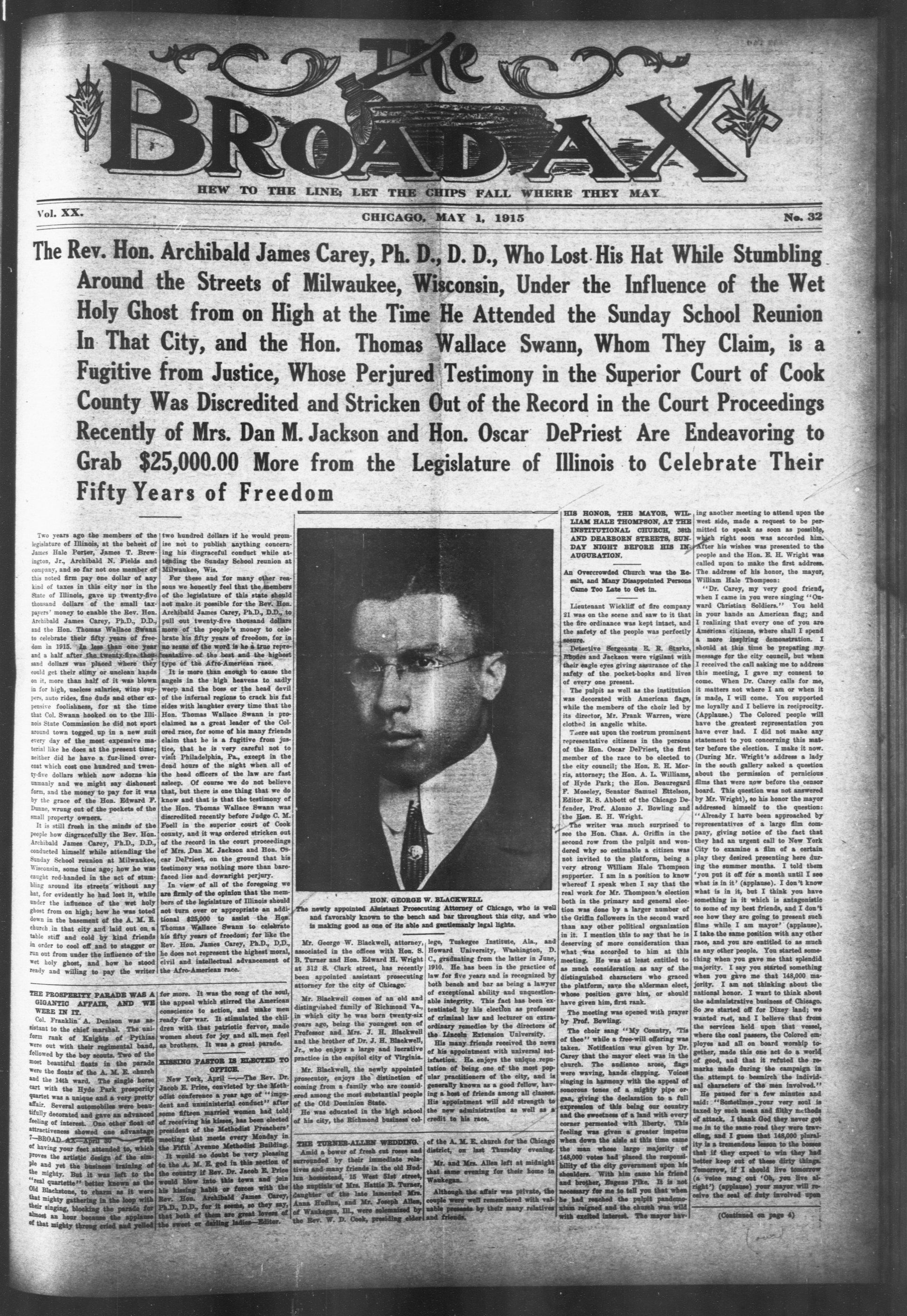
The Rev. Hon. Archibald James Carey, Ph. D., D. D., Who Lost His Hat While Stumbling Around the Streets of Milwaukee, Wisconsin, Under the Influence of the Wet Holy Ghost from on High at the Time He Attended the Sunday School Reunion In That City, and the Hon. Thomas Wallace Swann, Whom They Claim, is a Fugitive from Justice, Whose Perjured Testimony in the Superior Court of Cook County Was Discredited and Stricken Out of the Record in the Court Proceedings Recently of Mrs. Dan M. Jackson and Hon. Oscar DePriest Are Endeavoring to Grab $25,000.00 More from the Legislature of Illinois to Celebrate Their Fifty Years of Freedom
Two years ago the members of the legislature of Illinois, at the behest of James Hale Porter, James T. Brewington, Jr., Archibald N. Fields and company, and so far not one member of this noted firm pay one dollar of any kind of taxes in this city nor in the State of Illinois, gave up twenty-five thousand dollars of the small taxpayers' money to enable the Rev. Hon. Archibald James Carey, Ph.D., D.D., and the Hon. Thomas Wallace Swann to celebrate their fifty years of freedom in 1915. In less than one year and a half after the twenty-five thousand dollars was placed where they could get their slim or uneasy hands on it, more than half of it was blown in for high, useless salaries, wine suppers, auto rides, fine duds and other expensive foolishness, for at the time that Col. Swann hooked on to the Illinois State Commission he did not sport around town toged up in a new suit every day of the most expensive material like he does at the present time; neither did he have a fur-lined overcoat which cost one hundred and twenty-five dollars which now adorns his manly and we might say dishonest form, and the money to pay for it was by the grace of the Hon. Edward F. Dunne, wrung out of the pockets of the small property owners.
It is still fresh in the minds of the people how disgracefully the Rev. Hon. Archibald James Carey, Ph.D., D.D., conducted himself while attending the Sunday School reunion at Milwaukee, Wisconsin, some time ago; how he was caught red-handed in the act of stumbling around its streets without any hat, for evidently he had lost it, while under the influence of the wet holy ghost from on high; how he was toled down in the basement of the A. M. E. church in that city and laid out on a table stiff and cold by kind friends in order to cool off and to stagger or run out from under the influence of the wet holy ghost, and how he stood ready and willing to pay the writer
THE PROSPERITY PARADE WAS A
GIGANTIC AFFAIR, AND WE
WERE IN IT.
Col. Franklin A. Denison was assistant to the chief marshal. The uniform rank of Knights of Pythias were out with their regimental band, followed by the boy scouts. Two of the most beautiful floats in the parade were the floats of the A. M. E. church and the 14th ward. The single horse cart with the Hyde Park prosperity quartet was a unique and a very pretty affair. Several automobiles were beautifully decorated and gave an advanced feeling of interest. One other float of attractiveness showed one advantage 7-BROAD AX—April 30
Pets of having your feet attended to, which proves the artistic design of the simple and yet the business training of the mighty. But it was left to the "real quartette" better known as the Old Blackstone, to charm as it were that mighty gathering in the loop with their singing, blocking the parade for almost an hour because the applause of that mighty throne erred and relied
two hundred dollars if he would promise not to publish anything concerning his disgraceful conduct while attending the Sunday School reunion at Milwaukee, Wis. For these and for many other reasons we honestly feel that the members of the legislature of this state should not make it possible for the Rev. Hon. Archibald James Carey, Ph.D., D.D., to pull out twenty-five thousand dollars more of the people's money to celebrate his fifty years of freedom, for in no sense of the word is he a true representative of the best and the highest type of the Afro-American race.
It is more than enough to cause the angels in the high heavens to sadly weep and the boss or the head devil of the infernal regions to crack his fat sides with laughter every time that the Hon. Thomas Wallace Swann is proclaimed as a great leader of the Colored race, for some of his many friends claim that he is a fugitive from justice, that he is very careful not to visit Philadelphia, Pa., except in the dead hours of the night when all of the head officers of the law are fast asleep. Of course we do not believe that, but there is one thing that we do know and that is that the testimony of the Hon. Thomas Wallace Swann was discredited recently before Judge C. M. Foell in the superior court of Cook county, and it was ordered stricken out of the record in the court proceedings of Mrs. Dan M. Jackson and Hon. Oscar DePriest, on the ground that his testimony was nothing more than bare-faced lies and downright perjury.
In view of all of the foregoing we are firmly of the opinion that the members of the legislature of Illinois should not turn over or appropriate an additional $25,000 to assist the Hon. Thomas Wallace Swann to celebrate his fifty years of freedom; for like the Rev. Hon. James Carey, Ph.D., D.D., he does not represent the highest moral, civil and intellectual advancement of the Afro-American race.
for more. It was the song of the soul, the appeal which stirred the American conscience to action, and make men ready for war. It stimulated the children with that patriotic fervor, made women shout for joy and all men feel as brothers. It was a great parade.
KISSING PASTOR IS ELECTED TO OFFICE.
New York, April ——The Rev. Dr. Jacob E. Price, convicted by the Methodist conference a year ago of "impudent and unministerial conduct" after some fifteen married women had told of receiving his kisses, has been elected president of the Methodist Preachers' meeting that meets every Monday in the Fifth Avenue Methodist Building. It would no doubt be very pleasing to the A. M. E. god in this section of the country if Rev. Dr. Jacob E. Price would blow into this town and join his kissing habit or forces with the Rev. Hon. Archibald James Carey, Ph.D., D.D., for it seems, so they say, that both of them are great lovers of the sweet or darling ladies—Editor.
THE NEW YORK TIMES
The newly appointed Assistant Prosecuting Attorney of Chicago, who is well and favorably known to the bench and bar throughout this city, and who is making good as one of its able and gentlemanly legal lights.
Mr. George W. Blackwell, attorney, associated in the offices with Hon. S. B. Turner and Hon. Edward H. Wright at 312 S. Clark street, has recently been appointed assistant prosecuting attorney for the city of Chicago.
Mr. Blackwell comes of an old and distinguished family of Richmond Va., in which city he was born twenty-six years ago, being the youngest son of Professor and Mrs. J. H. Blackwell, and the brother of Dr. J. H. Blackwell, Jr., who enjoys a large and lucrative practice in the capital city of Virginia.
Mr. Blackwell, the newly appointed prosecutor, enjoys the distinction of coming from a family who are considered among the most substantial people of the Old Dominion State.
He was educated in the high school of his city, the Richmond business col-
THE TURNER-ALLEN WEDDING.
Amid a bower of fresh cut roses and surrounded by their immediate relatives and many friends in the old Hudhun homestead, 15 West 51st street, the nuptials of Mrs. Hattie B. Turner, daughter of the late lamented Mrs. Anna Hudun, and Mr. Joseph Allen, of Waukegan, Ill., were solemnized by the Rev. W. D. Cock, presiding elder
lege, Tuskegee Institute, Ala., and Howard University, Washington, D.C., graduating from the latter in June, 1910. He has been in the practice of law for five years and is recognized by both bench and bar as being a lawyer of exceptional ability and unquestionable integrity. This fact has been extentiated by his election as professor of criminal law and lecturer on extraordinary remedies by the directors of the Lincoln Extension University. His many friends received the news of his appointment with universal satisfaction. He enjoys the unique reputation of being one of the most popular practitioners of the city, and is generally known as a good fellow, having a host of friends among all classes. His appointment will add strength to the new administration as well as a credit to his race.
of the A. M. E. church for the Chicago district, on last Thursday evening. Mr. and Mrs. Allen left at midnight that same evening for their home in Waukean. Although the affair was private, the couple were well remembered with valuable presents by their many relatives and friends.
HIS HONOR, THE MAYOR, WILLIAM HALE THOMPSON, AT THE INSTITUTIONAL CHURCH, 38TH AND DEARBORN STREETS, SUNDAY NIGHT BEFORE HIS IN-AUGURATION.
An Overcrowded Church was the Result, and Many Disappointed Persons Came Too Late to Get in.
Lieutenant Wickliff of fire company 21 was on the scene and saw to it that the fire ordinance was kept intact, and the safety of the people was perfectly secure.
Detective Sorgeants E. R. Starks, Rhodes and Jackson were vigilant with their eagle eyes giving assurance of the safety of the pocket-books and lives of every one present.
The pulpit as well as the institution was decorated with American flags, while the members of the choir led by its director, Mr. Frank Warren, were clothed in angelic white.
There sat upon the rostrum prominent representative citizens in the persons of the Hon. Oscar DePriest, the first member of the race to be elected to the city council; the Hon. E. H. Morris, attorney; the Hon. A. L. Williams, of Hyde Park; the Hon. Beauregard F. Moseley, Senator Samuel Etelson, Editor R. S. Abbott of the Chicago Defender, Prof. Alonzo J. Bowling and the Hon. E. H. Wright.
The writer was much surprised to see the Hon. Chas. A. Griffin in the second row from the pulpit and wondered why so estimable a citizen was not invited to the platform, being a very strong William Hale Thompson supporter. I am in a position to know whereof I speak when I say that the real work for Mr. Thompson's election both in the primary and general election was done by a larger number of the Griffin followers in the second ward than any other political organization in it. I mention this to say that he is deserving of more consideration than what was accorded to him at this meeting. He was at least entitled to as much consideration as any of the distinguished characters who graced the platform, save the alderman elect, whose position gave him, or should have given him, first rank.
The meeting was opened with prayer by Prof. Bowling.
The choir sang "My Country, 'Tis of thee" while a free-will offering was taken. Notification was given by Dr. Carey that the mayor elect was in the church. The audience arose, flags were waving, hands clapping. Voices singing in harmony with the appeal of sonorous tones of a mighty pipe organ, giving the declaration to a full expression of this being our country and the sweetness of a land with every corner permeated with liberty. This feeling was given a greater impetus when down the aisle at this time came the man whose large majority of 148,000 votes had placed the responsibility of the city government upon his shoulders. With him came his friend and brother, Eugene Pike. It is not necessary for me to tell you that when he had reached the pulpit pandemic reigned and the church was wild with excited interest. The mayor hav-
ing another meeting to attend upon the west side, made a request to be permitted to speak as soon as possible, which right soon was accorded him. After his wishes was presented to the people and the Hon. E. H. Wright was called upon to make the first address. The address of his honor, the mayor, William Hale Thompson:
"Dr. Carey, my very good friend, when I came in you were singing "Onward Christian Soldiers." You hold in your hands an American flag; and I realizing that every one of you are American citizens, where shall I spend a more inspiring demonstration. I should at this time be preparing my message for the city council, but when I received the call asking me to address this meeting, I gave my consent to come. When Dr. Carey calls for me, it matters not where I am or when it is made, I will come. You supported me loyally and I believe in reciprocity. (Applause.) The Colored people will have the greatest representation you have ever had. I did not make any statement to you concerning this matter before the election. I make it now. (During Mr. Wright's address a lady in the south gallery asked a question about the permission of pernicious films that were now before the censor board. This question was not answered by Mr. Wright), so his honor the mayor addressed himself to the question: "Already I have been approached by representatives of a large film company, giving notice of the fact that they had an urgent call to New York City to examine a film of a certain play they desired presenting here during the summer months. I told them 'you put it off for a month until I see what is in it' (applause). I don't know what is in it, but I think you have something in it which is antagonistic to some of my best friends, and I don't see how they are going to present such films while I am mayor' (applause). I take the same position with any other race, and you are entitled to as much as any other people. You started something when you gave me that 148,000 majority. I am not thinking about the national honor. I want to think about the administrative business of Chicago. So we started off for Dixey land; we wanted rest, and I believe that from the services held upon that vessel, where the coal passers, the Colored employees and all on board worship together, made this one act do a world of good, and that it refuted the remarks made during the campaign in the attempt to besmirch the individual characters of the men involved."
He paused for a few minutes and said: "Sometimes your very soul is taxed by such mean and filthy methods of attack. I thank God they never got me in to the same road they were traveling, and I guess that 148,000 plurality is a tremendous lesson to the bosses that if they expect to win they had better keep out of these dirty things. Tomorrow, if I should live tomorrow (a voice rang out 'Oh, you live right') (applause) your mayor will receive the seal of duty involved upon
Bowser,
He Putters
Of Course He Is a Failure.
By M. QUAD.
Copyright, 1915, by the Belfure
Newspaper Syndicate.
"Do you pass a carpenter shop on your way downtown?" asked Mira. Bowser the other morning as Mr. Bowser was ready to leave the house.
"Why?" he cautiously asked in reply.
"We ought to have a screen door to the kitchen. There's where all the files will come in. We can use the same old door we had last year, but we'll have to have a carpenter to hang it."
"We will, eh? I beg to differ. I don't propose to pay no carpenter $3 or $4 for doing what I can do in half an hour. I'll fit it myself."
"But don't you remember, Mr. Bowser—don't you remember, that you"—"That I what?"
"You tried to hang a screen door last summer and you got so mad you nearly tore the house down!"
"I did, eh? That's a pretty yarn for you to stand up there and spin! In the first place I never tried to hang a screen door, and in the second I never got mad."
"But you—you"—she stammered.
"Nothing of the sort. I don't even remember that we had a screen door. I never tried to hang one. I never got mad. I never even saw a fly around
cary.
TUMBLING OVER HIMSELF.
our house in summer. Change of climate seems to have had a very queer effect on you."
"But won't you send a carpenter?"
"Not by a jugful! I shan't have anything to do at the office this afternoon, and if there's a bit of tinkering around the house it will be fun for me."
He returned at noon, having a heavy parcel with him, and when Mrs. Bowyer asked about the contents he cut the string and replied:
"Just a few tools; come handy to tinker with. Every man ought to keep a few tools and do his own repairing. I think I saved us at least $200 last year."
"Well, I hope you won't fly mad over your work. A screen door is a very particular thing to hang."
"Oh, it is! You've hung lots of 'em, I presume."
"I know that it takes a skilled workman."
"You'd better write a book and call it 'What I Know About Screen Doors.' I ought to feel awful proud to think I've got such a smart wife. Run right in now and begin the first chapter."
Mr. Bowser descended to the cellar, where he found four screen doors of different sizes. He selected one he thought would fit and carried it up. It was six inches too high. The next was four inches too short. The third was almost long enough to make two such doors as he wanted. He had the fourth one, which was almost a fit, in the back yard when Mrs. Bowser came out to say:
"If you had first measured the opening and then measured your doors you wouldn't have had to lug up but this one."
"Wouldn't I? Perhaps you understand my object in bringing up the extra ones? Perhaps it is the duty of a husband to explain every little move he makes?"
The door had to be sawed off about an inch at the top. Mr. Bowser brought out a couple of kitchen chairs, made a scratch on the door with a nail and was about to use the saw when she asked:
"Aren't you going to strike a line across there?"
"For what reason?"
"If you don't you can't saw straight."
"Can't I. Perhare I am blind!"
When he finished sawing off the strip and held the frame up to the opening it was plain that he had run his saw at an angle.
"I told you so!" she quietly observed.
"Told me what?" he replied as he turned on her. "Do you suppose I don't know what I'm about? Do you imagine I wanted a straight top on that door? If you know so much go ahead and finish the job!"
Mrs. Bowser went into the house, and Mr. Bowser held up the frame again to see that he would be obliged to tack on a strip or leave an opening for nearly all the dies in the state. He was sawing a piece off one of the
other doors to make the strip when
Mau. Bowler appeared and said:
"You'll spoil that door, too. Mr. Bowser. Why don't you take a place from this box? If you had put a straight edge on the other and marked it you would have been all right."
"Mm. Bowser," he began as he laid down the saw, "am I a purblind child five or six years old who must be brought in when it sails, or am I the man of the house, forty years old and generally supposed to have some enough not to sit down under a pile-driver to eat my lunch?"
"But you'll never make that door fit!" she protested.
"If I don't no other man on earth need try!"
She went in again, and he sawed off a strip and nailed it on the other door. Then he held it up to find the frame half an inch too long. Mrs. Bowser reappeared and was about to say something, but he glared at her so savagely that she went back without a word.
"Those infernal old kitchen chairs are either lifting up or sitting down!" he growled as he held the door up. "I've got to saw a piece off the bottom to make it fit, and she'll either fit or down comes the whole shanty!"
He sawed off a piece and got what he called a fit. He smiled and chuckled over his success and had the hinges on when Mrs. Bowser came out to ask:
"What good is a door there if you leave all those cracks?"
"Cracks? Cracks? You can't find one!"
"Look here—and here—and here. Mr. Bowser. Even the bumblebees would have no trouble in flying in there. And how are you putting that spring on?"
Mr. Bowser laid down the hammer, the gimlet and the screwdriver, and, after wiping off his flushed face, he stood erect and pointed into the kitchen. Mrs. Bowser disappeared without a word. Then he inspected and found cracks.
"Confounded old doorway is out of plumb, and that's the matter!" he growled as he set to work to unhinge it. When he got the door off he racked it this way and that and tried it again. More cracks than before! He took it off and sprang on the top with all his might, and this time as he held it up there was a crevice through which a sparrow could have flown. He started to lay it flat on the ground, but fell forward, tumbling over himself, and sprawled on his back.
"What's the matter?" asked Mrs. Bowser from the back door. Mr. Bowser slowly arose, looked all around for the ax, and, not seeing it, he jumped with both feet on the screen doors and kicked until they were reduced to strings and strips. Then he went up to Mrs. Bowser, panting and perspiring and pale faced, and hoarsely whispered:
"This is the last time—the very last! Next time you coax me into doing any such infernal puttering work around the house I'll go-go, never to return!" "When did I coax you?" "Never you mind! It's all right!" "But I say!" "Just keep quiet! I am neither blind nor daff! If we live together ten billion years longer don't you ask me to even bore a hole in a table leg for a caster! This is the limit! I'm dangerous from this on!"
Welfare Work
"Have you any parts of an automobile that you don't want?"
"I have an old tire. What's the idea?"
"You know how our grandmothers used to make crazy quilts for the needy?"
"Yes."
"On the same principle I am trying to assemble an automobile for a poor woman who has none."—Louisville Courier-Journal.
"Lady," said the pilot of the club members who had assisted Horatio Hangover to get home, "here is your husband."
"But why," she ejaculated as she opened the door—"why did you bring him up the back way?"
The pilot answered, "Because there's a sign out there that says, 'Deliver All Packages In the Rear.'"—Detroit News.
The First Shall Be Last.
Miss Gushington—I think your novel has a perfect ending, Mr. Scribbler.
Scribbler—How do you like the opening chapter?
Miss Gushington—Oh, I have not come to that yet—Judge.
"We can't take this house. It has no attic."
"We can get along without an attic."
"We cannot. Where else could we keep the portraits of your relatives?"—Detroit Free Press.
Mrs. A.-How often do your house-
maids dust?
Mrs. B.-Which, fan the furniture or
skip out?-Boston Transcript.
Professor—Your answer is as clear as mud.
Student—Well, that covers the ground, doesn't it?—Purple Cow.
He went and bought an aeroplane,
And then he asked the maid.
If she would take a fly with him;
She said she was afraid.
"Oh, very well; that settles it."
He said in manner tart;
"If you're afraid to fly with me
We must forever part."
"All right, if that's the case," she said,
With just a touch of mirr:
"If we must have a falling set
Let's have it here on earth."
THE BROAD AX CHICAGO, MAY 1, 1915.
Her Long Kept Secret
She Told It Frankly and Was Glad That She Did.
By BYRON H. KELLEY.
Virginia sat down before the glass and took stock of herself in minute and critical fashion. When a woman has reached her twenty-eighth year she is either at her worst or her best, and Virginia was at her best. Her glass told her that and the faces of her friends of her own age who had faded about her until she was left like the one perfect flower in a cluster, conspicuous by her brightness. Her little sister had just announced that Mr. Bridges had driven up in front of the house and was waiting to take her driving. But Virginia sat still. She had just been making a resolution never to go driving with him again, and here he was. She clinched her hands tight.
"Just this once!" she pleaded to her conscience. Her eyes met the longing ones in the glass. "Just this once, and I'll tell him. I will be honest. His heart shan't break even if mine does." She turned to her sister. "Dorothy, dear, tell Mr. Bridges I'll be right down," she said gently. Then she rose and put on her hat. It did seem so good to be sitting beside him again—if only it were not for that miserable thing which she had promised herself she would make known to him before the drive was ended. She looked at his face. It was such a strong, good face. Oh, it would be bitterly hard to tell him! He seemed to have something on his mind too, he was so grave and silent, and whenever he looked at her it was with quiet penetration.
Virginia leaned back against the thick cushion, trying to steady herself. She did not notice that Plume had stopped trotting and was walking slowly, but when a hand fell over hers she started and looked, into the eyes of the man whose face had come suddenly near to hers.
"Virginia! Dear little girl!"
She knew what must come after those words, but she could not speak.
"Virginia"—his eyes held hers—"I love you!" Then he smiled his swift, gentle smile, as if her silence had reassured him.
That smile seemed to break the spell. Virginia remembered that she drew her hand from his and began to say something wildly, what she did not know until his changed, white face stopped her.
"Virginia, what are you saying? Promised—you? I will not believe it." His stern voice braced her.
"Oh, but you must—you must!" she said.
"I will not believe it. I will not believe that you do not care for me—that you have led me on just for pastime. It isn't true, is it, dear?" His voice had softened again. He put his arm about her and drew her against him until her cheek touched his.
"Tell me all about it," he urged. "I must know it all. There is some mistake somewhere, I am sure. Tell me, Virginia."
He released her gently and waited. Virginia gathered herself together desperately.
"I'll tell you everything, Arthur," she said. "I promised myself that I would before this drive was ended. I should have told you before only I could not somehow. I shall begin at the beginning and tell it all, and then you may think what you please of me.
"It happened ten years ago, when I was about eighteen and Andrew two years older. We had known each other always. He lived in that little gray house next to ours until his father got into some financial difficulty and lost what property he had. Mr. Hall never could get along somehow. I always liked Andrew better than any other boy; he was so good hearted and gentle. One night when we were walking home from church he asked me to marry him." Virginia hurried a little. "It was June, and there was beautiful moonlight. I had never dreamed of marrying him or anybody then, but he looked so handsome and he seemed so much in earnest that I promised before I thought. Then I was frightened, because I knew my people would never consent to it. My mother always said she was afraid Andrew would be just like his father and never amount to anything. So we decided to keep our engagement a secret.
"Just after that Mr. Hall was taken with a great desire to go west. He knew he could do something out there. I think he had an idea that gold nuggets could be picked up like acorns. Anyway he was perfectly crazy to go, and he went and took Andrew with him. We wrote back and forth pretty steadily for awhile. Andrew didn't like the west very well, and his father was disappointed, but they would have to stay there until they had earned money enough to get back home with. Well. I don't know—I was in school, and there were so many things to take my time that I guess I grew careless about writing, and Andrew seemed to grow just as careless himself. Besides, he and his father were constantly on the move. I think they must have traveled the west over pretty thoroughly. The last time I heard from Andrew was three years ago. He said he was still trying to get rich and
blessed of going to the Klondike. "I answered the letter, but perhaps he never got it.
"You are the best person I ever told this to," she said, looking earnestly at Arthur.
"I see," he said quietly. He thought he could understand what manner of man it was that would keep a girl to a foolish promise in this way for eleven years.
"You really think, Virginia. That Andrew will come back?" he asked.
"Yes, I really think so."
"And you will marry him if he does?" Virginia turned very pale.
"You see, Virginia." Bridges went on gently, "I have some old fashioned notions about these things. Unless you love him you have no business to marry him were you twenty times promised to him. It would not be fair to him, and it would be most unjust to yourself."
Virginia never had thought of that.
"Now, I'll tell you what I shall do, for I think I have something to say in this matter. I will wait just one more year for Andrew to put in his appearance—just one year, not a day more or less—and if he doesn't come then I shall take you for myself. Do you understand me, Virginia?"
She looked at him with a brightening face. But the brightness quickly faded like the light from a sunset cloud. "And if he does come"—she gasped. "Why, then, that's a matter for your own deciding. If you love him enough to marry him, marry him. But if you don't," he smiled, "you'd better marry some one you do."
During the rest of the drive Virginia sat trying to realize things. She could not be thankful enough that she had told him and he did not despise her. It was 6 by the clock when Plume trotted down the long street and left Virginia at her own door. She ran into the house, unpinning her hat as she ran. Her mother came in from the dining room with a dish in her hand. "Virginia, guess who has come while you've been gone," she said.
"Andrew Hall! Would you believe it? I thought I knew him when I saw him go by in the bus. Afterward Mrs. Ward came in and told me. He wasn't dressed any better than he was when he went away. I guess he hasn't brought much back with him except his wife. He's married."
"Married!"
Virginia sank trembling into a chair.
"So Mrs. Ward says. She's been over to the hotel to see them."
Dorothy danced in from the kitchen.
"Mamma," she called, "the tea is boiling over!"
Mrs. Swift hurried out, and Virginia, her hands pressed to her throbbing heart, understood the situation.
A few minutes later Arthur Bridges drove up to the house. He entered the library, where Virginia sat weeping softly from joy.
"My own sweetheart!" he exclaimed as he took her in his arms. "There is no one between us now. Andrew Hall has just come back with his wife." "I know. Mamma just told me, and—and I am so glad, Arthur!"
War Stops Unique Paper
One of the most extraordinary little newspapers in Europe has been forced out of existence by the war. It was published at Eberswalde, Germany, and issued twice a week, printing the local news of the little community in which it circulated. Its unique feature lay in the fact that it was printed on one side of the paper only and carried an announcement that this was done so that it could be used for wrapping up provisions without contaminating the food by contact with the printers' ink. The war has occasioned a shortage in paper, resulting in so high a price that the Eberswalde Lokal Anzeiger has had to discontinue.-Chicago Post.
Long Tunnels.
The Hoosac tunnel, at North Adams, Mass., which is four and three-quarter miles long, has hitherto claimed the distinction of being the longest tunnel in America, but the Roger pass tunnel, now in course of construction on the Rocky mountain division of the Canadian Pacific railway, will, it seems, with a length of about five miles, claim precedence in future.—Exchange.
PRACTICAL HEALTH HINT.
Boils, Felons and Carbuncles. The location of the boll or carbuncle determines the amount of danger it may be to the patient. A boll can become a carbuncle, and pus from a carbuncle inoculated into a healthy person may cause either a boll or carbuncle. If a boll or carbuncle occurs in a locality where there is a rich blood and lymphatic area it at once becomes a source of danger, because the vessels spread the infection. Boils, carbuncles and felons are all due to infection by the streptococcus microbe. This means there are inflammation and pus present in these affections. Unless active treatment is instituted at the very beginning of inflammation there will be grave constitutional involvement which cannot be checked. To avoid serious results there should be impressed upon every one suffering from boils, carbuncles or felons the imperative need of having treatment by a physician at the first appearance of the affection. Delay will cause destruction of tissue, bone, deformity of a part or systemic infection, which results in loss of life.
PRACTICAL HEALTH HINT.
Fever Sore or Cold Sore. For this disfiguring labial affection there is no remedy better than taking several times a day with a borne acid solution—one teaspoonful of borne acid dissolved in a tumblerful of hot water. At bedtime the crusts may be dusted with dry borne acid. Children having cold sore are disposed to pick the lip with the fingers. This procedure may infect the sore. It always delays the healing. To protect the lips from being picked children should wear mittens to bed.
A MIGHTY FLAGPOLE
The Tallest in the World—It Floats Old Glory at San Francisco.
A fitting symbol of the mighty forests of the west is Astoria's flagpole, the tallest in the world, which floats the stars and stripes 241 feet above the Panama-Pacific exposition sea wall at the corner of the Oregon building.
The stick, for it is a single stick of timber, is actually 251 feet long, but ten feet of its butt is imbedded in a 200 ton block of solid concrete, which, without other stays, holds the pole upright against the wind.
The pole was shaped from the trunk of a Douglas fir which as it originally stood in the Oregon forest towered 347 feet in the air and might have matched its height, though not in girth, against any but the loftiest of the California sequoias.
Looking up at the great dagstaff it is hard to realize that it weighs upward of forty-six tons and that there is lumber enough in it to build five ordinary eight room houses. Its great height gives it an appearance of slenderness and lightness.
Just to transport this pole and set it up Russell Hawkins and citizens of Astoria spent nearly enough thousands of dollars to build several of the houses its lumber might construct.—San Francisco Chronicle.
THE PASSENGER PIGEON
A Beautiful and Useful Bird That Is Now Extinct.
There are men still alive who have shot not dozens, but hundreds, of passenger pigeons in a single day. Sixty years ago this bird was far more common in the United States than wild ducks are today.
When it migrated the flights darkened the sky. A single flight has been estimated to number over 2,000,000 of birds.
A few weeks ago the last passenger pigeon died in Chicago at the age of twenty-seven years.
A passenger pigeon is quite a different looking bird from any other kind of pigeon. It has a long tail and is in all nearly three-quarters of a yard long. It is so called because of its migratory habits, it being a bird of passage.
For the past fifteen years there had been a standing reward of $1,000 for a mate for this last survival of her race. This was several times its weight in gold, yet the offer produced no response. The passenger pigeon is absolutely extinct, and one of the most beautiful and useful of birds has been wiped out, as it were, under our very eyes.—New York Press.
Our National Debt
At the beginning of the second quarter of the present fiscal year the public debt stood as follows:
Interest bearing debt, $968,825,550.
Debt on which interest has ceased, $1,544,620.26.
Debt bearing no interest (mostly "greenbacks"), $369,353,079.40.
Total, $1,339,723,249.66.
There were outstanding, in addition to the above, $1,469,538,869 of coin certificates and treasury notes, making a total gross debt of $2,809,262,118.66.
The debt, less cash in the treasury, was $1,061,752,097.48, or about $10 for each man, woman and child in the United States.
Hospital For Fishermen.
Equipped with the most modern facilities for the care of the sick and wounded, the United States revenue cutter Androsocoggin is now in service as a hospital ship and will operate among the fishermen working on the Grand Banks of Newfoundland. This is said to be the first hospital ship ever outfitted by the United States government for service with a fishing fleet, although the plan is not a new one with other countries. $ \rightarrow $Popular Mechanics Magazine.
Asleep Indeed.
From the French trenches in Alsace comes a tale of a soldier who awoke one morning after a sound sleep, complained of a cramp in his thigh and said that he could not get up. At first his superiors asked that he do so, but as he steadfastly refused they sent for a doctor. The latter found that a bullet had come through the roof of the soldier's shelter during the night and had lodged in his thigh. It had not even waked him up!
"Tinpears" In a New Role
The vogue of "Tipperary" has spread to Denmark, but so strict is that country's sense of neutrality that a sort of unwritten decree went forth in Copenhagen not long ago that, in view of its being "the national anthem of one of the warring powers" the "Tipperary" song must not be sung in music balls or theaters, not may small boys be encouraged to whistle it in the
A Pretty Good Reason Why the Foul Wouldn't Lay Any.
Young Adolphus de Millyans was out driving his own car. He was a scorner and believed in going straight ahead. Suddenly a terrified clucking under the wheels told him some accident had happened. He pulled up and glanced back. Two towels lay dead in his truck, while another two were feeling, screeching, back to home and safety.
"That'll be 14 shillings, please," remaired a burly man in corduroy, who appeared on the scene promptly.
"That's three and six aplece for the four."
"Four!" gasped Adolphus. "But I only killed two."
"That's right," agreed the fowls owner, "but them other two will never lay a blessed egg after this."
"I'm sorry," said the motorist as he handed over the money. "Due to the fright, I suppose."
The countryman shook his head as he slammed the silver into his pocket. "Partly fright," he agreed slowly, "but mainly I reckon it's because they ain't hens!"—London Answers.
Trotting Versus Walking. "I loved you once," the maden said. "But now I love you not. All bets are off—we cannot wed, You've never learned to trot."
Said he. "Tis true, I cannot trot. But bankrolls always talk." He showed her his, and on the spot. He won out in a walk.
—St. Louis Post-Dispatch
Same Old Friend
Some time ago a young woman married the second time, and it chanced that while on the honeymoon she stopped at the same hotel where she was a guest on her first wedding trip.
"Charles," remarked the bride, adressing the waiter as she sat at the table, "please pass me the butter."
"Yes, ma'am," obediently answered the waiter, shoving along the dish. "But my name is not Charles."
"Excuse me, Charles." smiled the bride. "It is my mistake," and then, tasting her bread, she reflectively added, "You may not be the same old waiter, but this is certainly the same old butter." -Philadelphia Telegraph.
Modern Epitaphs
Oh, shed a tear, Bill Hanks lies here;
We'll inform you, should you ask it.
That he stopped in front of a touring
And they took him home in a basket.
Beneath this stone lies Amos Brown.
He tried to be a poet
Law Abiding.
The Customer—Why don't you keep bunion plasters?
The Druggist — I'm afraid I'd be pinched for harboring footpads.—Boston Globe.
Association of ideas brings some eccentric notions.
For instance, 'tis a fact to which there can be no objection;
That tickle up our risibles with very funny motions.
A Jersey cow don't use cold cream to freshen her complexion.
A Base Libel.
She—I gave Rover one of my dough
nuts today, and what do you suppose
he did with it?
He—I don't know. Did he eat it?
She—He took it out into the garten
and buried it.
He—No! Really? And yet they say
dogs have no reasoning powers!—Judge.
The Song of Songs.
It's nice to be good,
And slich!
But believe me, it
Pays to be rich!
—Philadelphia Ledger.
As It Is Bound to Be.
The feminist was sitting in her club.
"What makes you so blue?" asked the
second ditto
"My father-in-law has come to stay at the house, and he and James sit knitting all day, crying over my treatment of James."-Philadelphia Ledger.
Tit For Tat.
"Twill pay one to keep poultry, They're profitable, you bet; For every grain you give to them- They give you back a peck.
Siren
pitcher gets a good salary.
Stubbs—Not particularly. There are
several bank presidents in town who
make more money.—Richmond Times-
Dispatch.
Maybe.
New Yorkers who see America
This season, by the way.
Perhaps may like it well enough
To stay.
-Kansas City Journal
Some Crawfish.
Knicker—What sort of a man is
Jones?
Bocker—Well, he could eat his words
on the ecd and do it gracefully—New
York Sun.
---
TO END ALL WARS BY A WORLD COURT Supreme Tribunal For Softling International Disputes.
Ways and means for establishing a "supreme court of the world" for setting international disputes and avoiding war will be discussed at a congress of representatives of peace societies, educational institutions, chambers of commerce and civic organizations, to be held in Cleveland, O., May 12, 13 and 14. Announcement of the plans for the congress was made by the world court committee, composed of 100 prominent citizens, including the governors of most of the states.
"It is not the thought of the committee nor the purpose of the congress to deal with the present war situation."
A. B.
JOHN HATS HAMMOND.
says the committee's announcement. "The movement contemplates the establishment of judicial machinery at the close of the war as the one necessary means of preventing future wars.
"Its exceptional character is found in the fact that it is not a peace congress. Peace is the ultimatum, but the object of the congress will be thoroughly to discuss and decide upon the organization of the peace sentiment of the world into a practical and rational method of securing peace. The congress will devote itself to the method indorsed at the last Hague conference and reaffirmed by the committee of one hundred—namely, the judicial settlement of international disputes, which procedure necessitates the organization of a world court."
John Hays Hammond is chairman of the committee, and among those who have accepted invitations to speak at the congress are former President Taft, Governor Willis of Ohio, Alton B. Parker, Senator Harding of Ohio and Senator Sherman of Illinois. John Hays Hammond is peculiarly well fitted for his position of chairman by reason of his practical business sense, his diplomatic temperament and his personal acquaintance with most of the rulers of the world.
HANDS ACROSS THE CHANNEL
Tommy Atkins Has Leisure Moments
From His Serious Work In France.
There are little incidents in war that
have a human interest besides the ter-
rible records of carnage that are her-
alded abroad. Every now and then a
photographer snaps a picture that tells
THE FIELD
Photo by American Press Association.
FRENCH PEASANT GIRL SELLING SWEETS TO ENGLISH SOLDIERS.
its own story and one that perhaps would not appeal to the regular newspaper correspondent. In the illustration a little French peasant girl is selling sweets to a party of British soldiers, just an illuminating sidekick upon Tommy Akins at play in France
Mr. John Redmond was "suspended" on the very first day he sat in parliament.
As president of the French republic M. Poincaré receives a salary of $120,000 per annum.
Baron Burian, minister of foreign affairs for Austro-Hungary, has had a long and honorable career as a statesman and a diplomat.
John Fowler, who has been in the consular service of this country in China for the past quarter of a century, will henceforth be stationed at Rimouski, Quebec. He is a native of New Hampshire and entered the government service in 1879.
Brigadier General William Luther Silbert, whom the war department has named as commanding officer of the Pacific coast defense district, with headquarters at Fort Miley, San Francisco, was a conspicuous figure in the construction of the Panama canal.
Dugald Christie, missionary doctor, who has labored in bleak Manchuria for thirty-three years, is the only man in civil life who has ever been decorated by four rulers—those of China, Japan, Russia and Great Britain. He is a native of Scotland, a veteran of the United Free church of his home land and has lived to devote himself to the work at hand.
Town Topics.
Now that Detroit is to have a speedway here's hoping the joy riders can be confined to it.-Detroit Free Press.
There's a movement on foot to make Chicago a city of gardens. Beer, vegetable, summer or Mary?-Washington Post.
The man who enunciated that axiom, "What goes up must come down," never studied the career of the New York tax rate.-New York Press.
Philadelphia justifies its title of the City of Brotherly Love by ignoring the war long enough to seek the Olympic games for 1916.-Chicago News.
Train and Track
There are 39,000 miles of railway in Germany.
Traveling at sixty miles an hour continuously a train would cover the circumference of the earth in seventeen days.
There is an electric railway ten miles long in the south Tyrol which is operated entirely by adhesion, though the maximum gradient is 6.2 per 100.
By authority of the Brazilian government the railways of that country and Paraguay will be connected, providing another transcontinental line for South America.
Tales of Cities.
New York has become the world's greatest seaport.
Seattle now has a club of former residents of Buffalo.
Boston's chief exports are leather manufactures, meats, printing paper and wheat.
Toledo this year has planned new buildings calling for expenditures aggregating over $1,000,000.
St. Louis estimates that 27,000 tons of soot yearly fall in its streets and on its roofs from the 9,000,000 tons of soft coal annually burned in city limits.
Industrial Items.
There are 180 shoe factories in Canada, employing 16,150 persons. In Chicago there is an electric pie making machine with which six girls can turn out 23,000 pies a day. In numerous cases women are taking the places of their husbands as officers in the labor unions in Germany. It takes a woman twenty years to reach a maximum wage of $15 a week in many New York department stores.
SHORT AND SHARP.
The vacant lot league has also opened its season.
Too many of the things we wait for are not worth the delay.
Little things console us because most of our afflictions are little ones.
It costs $25 to tip anybody in Wisconsin now—if you are found out.
A cruiser in a snug harbor is worth two on the bottom of the cruel sea.
No man has been known to climb down from the ladder of fame gracefully.
Why do some men look so startled when their wives call them "dear" in public?
Satan seldom collects pay in advance, but he never neglects the accounts at the windup.
Best let sleeping dogs lie, is an old aphorism whose value has been proved many times.
China finds that being a republic does not free it from the kind of troubles to which it has been accustomed.
Prophets who predicted that the war would soon be all over now hasten to explain that they meant all over Europe.
One trouble about starting the day with a laugh is that a laugh sounds so capulchrally mocking at 6 o'clock in the morning.
THE BROAD AX CHICAGO, MAY 1, 1915
VISIT to the French trenches—and not merely to "model" trenches, but over a long line front—shows how carefully a new development of modern warfare has been studied and how successfully the dangers (typhoid, rheumatism and half a dozen others) and the draw-backs of trench life have been overcome, writes Brian Phillips. The real science of intrenching was known only to the Germans when the war began, but the French have learned their lesson so well that their trenches are said by their prisoners to be far more healthy than the German ones at present.
They run not in straight lines, but with twists and turns, until with their "boyaux," or connecting trenches, they form a maze in which the stranger can easily lose himself, which may be why the humorists in the ranks put up such signs at the corners as "Unter den Linden," "Wilhelmstrasse," "a Potsdam" and "a Berlin." Where the soil admits of its ordinary drains will keep them dry, but where that is impossible the old fashioned manual fire engines, with two handled pumps, have been introduced, and relays of men work on these. Where the buildings have been sufficiently ruined in the neighborhood bricks and stones have been brought to pave the trenches, and where there is no better material they are paved with logs of wood or even with bundles of twigs or hurdles. From the pavement there is a step up to the loopholes, which are carefully shaped of wood and curtained or at the worst filled with lumps of turf or handfuls of straw, so that anybody passing between them and the light behind may not offer himself as an easy mark where the range is short.
Photo by American Press Association.
FRENCH SOLDIERS IN THE TRENCHES.
The mud caverns within them that may be a colonel's headquarters or an officers' mess room have doors and are furnished. The rest shelters are only a few feet high, but they have raised wooden platforms, covered with straw, for the men to lie on and wood fires burning brightly, at which everybody seems to manage to have something to cook and the ability to cook in an appetizing way.
Even where there is "nothing to report" bullets are flying overhead and shells bursting around all day, except that, apparently by common consent of both sides, there is usually a lull between 11 o'clock and noon, apparently for lunch, and it is a very dull trench indeed in which every section does not have four or five men picked off in the course of a day, even in the quietest times. Always two or three yards behind a trench there are newly made graves to be seen, and these are always neatly arranged, surmounted by a rough cross of wood and, with a pleasant sentiment, planted with a few spring flowers. Where these are wanting even a few roots from the nearest field in which a crop has been left growing are made to serve the purpose of adorment.
The French troops, as a whole, are perfectly healthy. A distinguished general, in calling particular attention to this fact, pointed out that they have two hot meals a day, that they get two large glasses of wine and a practically unlimited supply of hot coffee, that even if their uniforms get torn and mud stained and disreputable they are always warmly clad, and there is never a man in the whole army who is not absolutely well shod. In this, as in many other respects, the French have many made many advances since 1870-1. German thoroughness, of course, is to it that the men of the kaiser's army in the trenches are well fed, well clad and well shod. The line of supply from the German bases to the front has been continuous and well maintained.
A correspondent of the New York Times cabled recently from the French branches and said: Daytime in the trenches is usually quiet beyond an occasional artillery bombardment. The real work is at night. So men during the day sleep in dugouts or lazze about playing cards and writing letters, all except the sentinels on duty.
Mrs. Maud M. Randall of Houston earned $100 the first week she ran a fitney bus.
Miss Kathryn Clarke of Oregon, Mrs. Helen Ring Robinson of Colorado and Mrs. Frances Willard Munds of Arizona are the three women state senators in this country.
Colonel Alexandra Koudasheva, commanding the Sixth Ural Cossack regiment, is the only woman who actually commands such a body of men at the front. She has seen exceptional service since the war began and has twice been wounded in encounters in East Prussia.
Miss Constance Vauclain of Philadelphia, although only yet in her teens, has been elected a member of the National Horse society, a distinction that rarely falls to one of her sex. She is noted for her abilities as a horse show exhibitor and has hundreds of ribbons and prizes won by her horses.
Echoes of the War.
Whoever first selected the site of Constantinople as a good place to build a city knew what is meant by the term "strategic situation."—Chicago News.
The voice of European leaders is still for war, but it is safe to assume that in all the belligerent nations there are "fruitful silences" that are making for peace.—Chicago Herald.
Peace talk is plentiful, but without evident substantial basis. The prevalence of such rumors, however, is encouraging testimony that Europe is wearying of its tragedy.—Chicago Post.
It should be remembered that China is too big for any of them. They might bite out a piece now and then, but China remains and in the course of events will regain all that is taken from her.—Cincinnati Times-Star.
PITH AND POINT.
Some people manage to see their duty just in time to dodge it.
Something appears to be taking the "broke" out of stock broker.
The biggest fool above ground is the man who tries to fool himself.
Luckily the president hasn't asked us to be neutral in the baseball war.
The best way to get along with some people is to get along without them.
A mouse can scare an elephant, but that doesn't help him any with a cat.
Men who say marriage is a failure would have found single life just as much so.
The average fellow who demands justice only wants it, as a rule, for the other fellow.
It is natural that the cheerful loser should be admired by the gang that has secured his wad.
Further complications of the Mexican situation would seem to be much like further scrambling a scrambled egg.
One of the universities has lengthened the course embryo dentists must take before they get a diploma. A longer drill, as it were.
It is to be hoped that the Plutes as losers got a safe percentage of the moving picture rights. General Scott gets all the glory otherwise.
A Canadian editor hails the peace of Canada and the United States as a world ideal. The problem is to make Europe see the ideal and live up to it.
The Royal Box.
All the kings of Prussia have been called Frederick or William. King George's beard is termed a "torpedo beard" in the British navy. The crown which the reigning king of Roumania wears was made of the iron of a Turkish gun taken at Plevna. Should the shah of Persia be deprived of his income he would still be one of the richest persons in the world. He would only have to sell his ornaments, gems and precious stones to become possessed of about $35,000,000.
Three Strikes.
Basketball neutrality, according to an ardent fan, consists in attending all the games that do not conflict.—Chicago News.
Talking about the massacres abroad, they are nothing to the annual slaughter of the grandmothers of the land now due.—Baltimore American.
Into each ball park some rain must fall at inopportune times, but, of course, the weather man will be as careful as possible about it.—Indianapolis News.
Fashion Frills.
What's that, knickerbockers for men? Speaking of the fatted calves, etc.—Los Angeles Times. Do not laugh at the young man in the funny clothes. He is not paying an election bet. That is the new style.—Chicago News. We wonder what kind of straw hats the young men with small time mustaches will wear this year. — Albany Knickerbocker Press.
There are powers behind the throne in Europe today which at times put a check upon the wishes and aspirations of the throne itself. King Constantine of Greece has all along outwardly been for neutrality and against joining the allies, but it is said that this is not his real feeling, but it is a case of "my wife won't let me."
The Greek queen, who is a sister of the kaiser, declares she will leave King Constantine and shake the dust of Greece from her shoes if Greece johns
M.
KING CONSTANTINE AND QUEEN SOPHIA OF GREECE
the allies. She has declared that she will return to Germany, and it is said that her Potsdam apartments already are prepared for her.
King Constantine, it is reported, was inclined to support the Venizelos attack on Turkey, but the queen induced him to remain neutral. The queen, who is of a tenacious and strong willed disposition, is now credited with scoring several big German triumphs in the court, where many of the princes and statesmen have come under her imperious sway.
NEW DIRECTOR OF CENSUS.
Samuel L. Rogers Recently Selected by President Wilson. Samuel L. Rogers of Franklin, N. C., recently selected by President Wilson for director of the census, has had experiences which eminently well fit him for his new appointment. As a young man he was elected clerk of the superior court of the county of which he was a resident in North Carolina, where he first gave evidence of his fidelity to public trust. Later, during the second administration of President Cleveland.
SANTEE R. BOSTER
SAMUEL L. BOGERS.
he was appointed chief clerk to the collector of internal revenue for the western district of North Carolina, and when the collector died Mr. Rogers, on account of his recognized fitness and experience, succeeded to the office of collector.
For twelve years he was a member of the corporation commission of North Carolina. This is one of the important public agencies of the state having control of common carriers, state banks and other public service corporations. During his incumbency of this position Mr. Rogers had immediate charge of the state banks, and through his initiative a system of examination and supervision was organised which in a large degree raised the standard of credit and public confidence of all the banks in the
PAGE THREE
BRIGHT BRIEFS
Peace continues to be an increasing long felt want.
The one who hesitates may lose a good opportunity.
The man who is too proud to ask for favors doesn't get many.
The world owes every man a living, but doesn't furnish a collector.
To be content with what you have imagine how you would feel if you had lost it.
Stock Exchange seats are about to be listed once more among the seats of the mighty.
It is never easy to find a good excuse for not doing something that should have been done.
It is better to live within your pay envelope, even at the risk of being known as a cheap skate.
Apparently a man never gets to be so old that he ceases to be surprised when women's fashions change.
Do not allow the making of plans for tomorrow to interfere with doing what you planned yesterday to do today.
One dollar spent on the prevention of disease will bring bigger dividends to any town than $10 spent on relief or cure.
The figuring of war indemnities will represent one of the biggest tasks the expert accountants have had to undertake.
Warmbad has just appeared on the war map. As it is located in equatorial Africa the name can't be ascribed to inefficient heating.
Garrett Serviss says the latest aeroplane is like a winged lobster. If he'll now tell us what a winged lobster is like our stock of information will be complete.
Timely Tips.
Now comes the season when the Sunday automobile accidents crowd the Monday morning papers.—Philadelphia Ledger.
The American spirit of restlessness is typified by impatient search for last year's rod and line.—Baltimore American.
It is time to clean up back yards and front yards. In fact it is always time to clean up yards.—Albany Knickerbocker Press.
Swat the files before they are born. You can do that by swatting the filth places where the files are hatched and brought into existence by the hundred thousand to torment humanity.—Pittsburgh Dispatch.
Animal Oddities
The queen bee lays 200 eggs a day. The swallow has a larger mouth in proportion to its size than any other bird. The sea elephant uses its trunk to seize its prey and to transfer food to its mouth. Just as does its brother which roams the land. A hawk can spy a lark on earth almost exactly the same color at twenty times the distance at which it is perceptible to a man or dog. The roar of a lion can be heard farther off than the sound of any other creature. Next come the cries of the hyena, the screech owl, the panther and the jackal in succession.
Flippant Flings.
Sherman omitted to go on record about neutrality.-Wall Street Journal
Philadelphia is to teach geography by moving pictures. That is about the only way to keep up with European geography.-Indianapolis News. We shall miss having to listen to people who have been to Europe this summer, but already people who have seen the San Francisco fair are returning.-Detroit Free Press.
Short Stories.
Reindeer are more numerous in Norway than horses.
The services of about 70,000 are required to take a census of this country.
In the United States there are 6,361.502 farms, with a total acreage of 378.198,325.
There are now sixty-seven bird reserves in the United States where wild fowl may live unmolested.
A law in Montreal compels the bakers of that city to stamp on each loaf its weight and their initials.
Recent Inventions
Paper clubs for policemen, practically indestructible, have been invented by an Englishman.
A cone shaped adjustable cover has been invented that will fit any ordinary sized cooking utensil.
A gas meter has been invented that automatically prints bills for the gas that has passed through it when a lever is pressed.
Two Wisconsin inventors have patented a kerosene lamp that is automatically extinguished if upset or even lifted from a support.
PAGE FOUR
* yrun premtgate nd at all thmes upheld
the true principles ef Democmey, but
‘Saagis Tisera Bapublieuns, or anroae coe
aus beve their-say, os long as thelr ee
“guage ls preper and responsibility is xed.
“Zhe Bread Ax ts 6 sewspaper whose
pattern: te Dresd enough for al, over
Gaiming the eGitertal right to spesk tts
on
‘Lecnl communications will ressive atten-
den, Write only om ene side of the paper.
‘Subsertptieas mest be paid in advances
Ome Wane... .-eeseeeeeeneeeneeees ee AD
Bix Momths.....-.-.0-serscereresseenes AMD
‘Advertising sates made news = apll-
cotton. :
“Address ali commeuntontions be
THE BROAD AX
gett FEDERAL STREET, CHICAGO, ILL.
PMONE DREXEL ame.
‘JULIUS F. TAYLOR, Rélter and Publisher
‘Entered as Second-Class Matter Aug. 18,
1902, at the Pest Oice at Chicage, Uitnels,
ander Act of Macch & 1873.
REMOVAL NOTICE.
‘From on and after this date, all
letters or other mail matter intended
for Jolius F. Taylor or Mrs. Annie E.
Taylor or The Broad Ax, should be
addressed to 6532 St. Lawrence Ave,
Jackson Park station. Phone Went-
‘worth 2597.
HEALTH NOTES.
Ob, yes, what about those fy
screens? Axe they all in good shape
and ready to-be put in? If not, bet-
ter look them over now.
One clean-up day does not make a
neighborhood clean any more than one
swallow makes a summer. In other
words, it is the clean-up habit more
than the clean-up day that counts for
Permanent cleanliness.
‘Lots of people over-eat, but very
few over-bresthe. In other words, we
‘often get more food than is good for
us, but it would be difficult for any
‘of us to get too much good air,
‘Time now to begin thinking about
‘the lawn aba garden. A very small
Patch of ground properly cultivated
will produce an amazing quantity of
the smaller table vegetables. Then,
too, the outdoor exercise one gets in
tending even a little backyard garden
is as good for your health as the vege-
tables you get are good for your table.
MAYOR SHOMPSON AT THE INSTI.
TUTIONAL CHURCH.
(Concleded from page 1)
I ean to help the unfortunate and the
poor. You want prosperity and you
the republican party of the “nation.
‘Last ‘year the east came together solid
for the republican party. Pennsyiva-
nia with Penrose beat his two oppo-
nents; 90 did Virginia; so did Missouri.
But no contest was watched with more
imterest than the political contest of
‘Chicago. Then the eyes of the mation
became jubilant over the signs that the
future would give us » republican con-
gress, = republican state and a repub-
lies nation, with ‘a protective tariff.
But the big men will not wait for 1916,
for the already confidence established
by the unity of the republican prin-
cipals will start the wheels of industry
with added prosperity. I say this be-
eause before the election only 200,000
shares of stock were sold upon the
stock exchange of New York, which is
the nervous pulse of the nation, and
the very day after the election when
that large majority of 148,000 became
known, over 1,200,000 shares wore sold.
I do reiterate-to. what I said to you
in the campaign, I shall not be un-
grateful to you for your loyal support.
‘We have got our peg of ambition
driven very high, and if we don’t get
to it we will have accomplished some-
‘thing. You have indicated to the peo-
ple that you were on the square, and
I promise you that you will find Bill
Thompson om the square with you.’?
(Applanse.)
Other addresses were made by the
Hon, Edward H. Morris, Hon. 8. A. T.
Watkins, a prominent Colored demo-
erat, the Hon. alderman elect Oscar
DePriest and Senator Samuel Ettelsbn.
The main feature of the entire pro-
coeding was the statutory pose of big
Bill the mayor and the splendid phy-
sigue of Oscar DePriest, both athletic
in their manly development, clasping
hands"in the grasp of friends made so
by these historical words, ‘‘I have told
you of the greatest mayor we ever
had. Now, Commodore, I want you be-
fore you go to grasp the hand of the
best alderman we ever bad.’ It
would have taken an artist to have
portrayed vividly to you this scene. I
leave it to your imagination.
Sy Denjamin A. Drowning.
No matter-what we undertake to do
in life, we have to first fit ourselves
for the occasion. A musician has to
Practice. An athlete has to train, and
1 teacher has to lear Although every
‘one cannot be a professional, or does
‘not eare-to be, nevertheless they have
certain duties and responsibilities rest-
ing on their shoulders; each citizen
owes some time and effort to his state.
Some of life’s burdens are tremen-
dous and difficult to handle, but the
people who are idle dreamers and in-
different to their career and destiny
and void of energy, ambition, physical
and moral courage will never master
the obstacles and vicissitudes that eon-
fromt them. But he who is master of
his own destiny and framer of his own
career is one who has realized the re-
quirements of peace and comfort and
has acted according to those laws by
preparing himself for the duties of life.
One of the things we have to look
out for is that we do not fall victims
of discouragement. Do not give up
hope. Cling to the spirit of progrees-
iveness.
‘One is often confronted with such
statements, ‘“Why should = Colored
person try to do this and be that; go
through college, then have to do porter
work or not even get a good job, so
one might as well not try.”? This is
entirely the wrong attitude to take.
We are told in the Bible to ‘‘Be pre-
pated for we knoweth not the day’ nor
the hour that the Son of Man cometh,”’
and I say, Be prepared, for we knoweth
not the’day nor the hour nor to whom.
opportunity cometh first, for it knows
no Face, no creed, nor is it prejudice;
it is blind and knows only human be-
ings, 20 be ready to receive it when it
comes. It is to be reslized that the
various dissdvantages of the Negro are
sufficient to dishearten the young peo-
ple, and it is to them that I make my
plea, fight hard. Those who. ars not.
fighting, enlist, beeanse the future of
the Negro depends upon the young peo-
ple af today, and the only hope of ric-
‘ory is for the young people of this day
jo start, if not already, preparing to
champion the cause of the Black race.
Tt is © glorious thing to be able to
stand before the universe after one has
itted himself for life’s duties through
preparation and trathfully say, ‘“My
ponscienee is my shepherd; I shall not
meena ae siesta ms
vigor; it leadeth mo through |
he tealms of righteousness for my fel-|
ow being 'senbee
jeere ee Bn way f
paneten's wil keey
wo aay fr my vi
ee ene ee
Cie OL
yaw ree eed
i > SPE ome
THE BROAD AX-CHICAGO, MAY 4, 1915.
2 oe ne eee
Po Oa te te ene
PSS : ees:
ae x an :
bs se ee
oe Pees: p
poe eee 5
ae be ‘ ce
- = ae.
Bcc ,
ee
aa i ot Teac. a
HON. CHARLES M FOELL
One of the square and honorable judges of the Superior Court, who is held in
the highest estimation by his fellow citizens throughout this city and Cook
County. : <
FREED WOMAN PASSES AWAY.|JOURNAL OF THE PROCEEDINGS
= OF THE CITY COUNCIL OF THE
Mrs. Louisa McWilliams, Once s Siave,| CTTY OF CHICAGO, ILLINOIS.
‘Answers Death Call. ie ee ee
‘Mrs. Louisa M. Williams, aged eighty
years, born in slavery at Louisville,
Kentucky, but freed formally by ber
master fifty-three years ago, died at
her home, 914 Foster street, at 10 a. m.
Sunday from infirmities ineident to her
advaneed age.
Mrs, Williams, whose maiden name
was Louisa Rudd, spent her ehildhood
and early womanhood in the south, but
after the war came north and had lived
in Youngstown ever stnee. Mrs. Wil-
Yims and her husband, the Inte Wes-
ley P. Williams, were the first Colored
people of the Catholic faith’ in Youngs
town and for more than forty years
Mrs. Williams was a faithful member
of St. Columba’s church. She was
widely known throughout the city: but
it was in the neighborhood where she
resided for so many years that her ex-
treme kindness and true worth could
be the most highly appreciated. She
was always a helpful friend and neigh-
bor and her passing is sincerely
mourned by a large number of friends.
Mrs, Williams is survived by four
children, Wesley P. Williams of Balti-
more, Mrs. Margaret Honesty, Mrs.
Elizabeth Johnson of this city, and
William Williams of Seattle, Washing-
ton. Robért A. Williams, formerly of
the local police force, died seven years
ago in Chicago. = - ¢
‘The funeral was held at 9 a m
Wednesday in St. Oolumba’s church
with initerment in Calvary cemetery —|
The Daily Vindicator, Youngstown,
Ohio, April 20, 1915.
HYDE PARK NEWs.
‘By I. W. Waskhinctan
me are sorry to hear of the Very
rites physical ailment of Mr. Julius
Leach “6f'.6836 Kenwood avenue.
see
‘Two of our young men last week
who were working at the Hyde Park
‘Hotel became very ill. One of them
died and the other went home and is
some better at this writing ¢ ~
Mr, and Mrs. John Webb, of Kiar
dark avenue, gave a residence. social
which was = very pretty affair for the
benefit of the. Hyde Park Baptist
church. «
eve
Mr. E. H.-Brown, of 5526 Ingle
side avenue, has been elected president
of the C. E. society of the Hyde Park
A. ME. church. She is determined
to make it one of the most active re
ligious bodies in the -eity. Suecees-to
her endeavors.
tae
A morai—A lady about forty-five,
years of age was addressing a little gir!|
about four or five years of age thns:
“Mary, tall your mother T say for her
Soe eee os ae ok
heard fhe" request and told
to tell her “it is none of ber best
Ls te oe
gig serecry mee:
tor Abbott of the Chicago
lessnde iat as
Tore teen ae: ay it
JOURNAL OF THE PROCEEDINGS
| OF THE CITY COUNCIL OF THE
CITY OF CHICAGO, ILLINOIS.
Regular Meeting, Monday, April 12,
1915.
Page 4404.
Ald. Harding presented the follow-
ing order, which was, on motion, duly
passed:
Ordered, That the Commissioner of
Public Works be and he is hereby di-
reeted to issue 2 permit to Smith Bros.
to erect and maintain a wooden sign
in front of the premises known as 3435-
3437 Indiana avenue. Said sign shall
be erected and maintained in accord-
‘ance with all rules and regulations of
the Department of Public Works. This
privilege shall be subject to termina-
tion by the Mayor at any time in his
diseretion.
Ald. Harding and Norris presented
the following resolution, which was, on
motion, duly passed:
Whereas, It is earnestly desired that
the Lincoln Jubilee and Half Century
Anniversary of Negro Freedom shail
be a fitting Exposition of the splendid
progress of the Negro race since its
emancipation; and,
Wheteas, The selection of the city of
Chicago as the place for holding this
Exposition of such national and inter-
national importance, it is deemed by
the City Council of Chicago to be a
great honor to the city and to the
state to pay this tribute to Abraham
Lineoln,
Whereas, The City Council is anxious
to assist and co-operate in every possi-
ble way to make the Lincoln Jubilee
and the Exposition a success; there-
fore be it
Resolved, That we urge upon the
state legislature of Llinois in express-
ing its earnest efforts of the Illinois
Commission to make the Lincoln Jubi-
lee and the Exposition a fitting one to
its every purpose and thereby again
extend to the City Council and to all
others similarly interested, thé prom-
ise of every assistance within the
power of said City Council; be it
turther :
Resolved, That the City Council in
ts regular session, do urge upon the
egisiature of the State of Illinois, the
passage of House Bill 132, introduced
by RB. B. Jackson. :
“That & copy of these résolutions be,
forwarded at once to the governor, to
he speaker of the house snd to the
hairman of the appropriation comiit-
ee.
‘Second Ward—Alderman
= ae. |
National Half Century Anniversary’
Exposition of Negro Freedom will be|
id in the city of Chicago tia year
luring months of August and |
amber, and : pers
Whereas, his celebration isto al
wdinary advancement achieved by 1
ace freed pe eee
paramount object being to cofitribute |.
ward -edueation of the :
= of and to demon-|
ato t 4 ‘
eee — ri
Bagh eet seg rok Ma 9
Talks on
Health,
Cleanliness
. Proper Living
Sanitation, Ete.
by
Dr.W. A. DRIVER
3300 So. State St.
Phone Douglas 3617
By Dr. W. A. Driver.
‘Twilight sleep is the euphonious
name by which painless childbirth is
called in the lay press of today. While
the medical profession in America has
a large number of wide-awake, pro
gressive doctors who have been using
combinations of drugs for ten years
to produce-painless childbirth, it re
mained for a German to get the credit
It is the old, old story that a prophet
is not without honor except in his own
country and among his own people.
The great numbers of doctors using
the painless method here for years
were modest and consequently were as-
tounded when the enterprising Frei-
burg doctor named a domification of
our well known painless childbirth—
dimmerschlaf, meaning twilight sleep.
It is not necessary to go to Ger-
many (as many of the rich prospective
mothers were doing prior to the great
war now raging) to seeure painless Ia.
bor. Most of our physicians at home
have been aware of the excellent and
safe and sane method which has been
used all over this country for a de-
cade; not only have they been aware
of its existence, but I believe most of
them have been using the triple com-
bination known to all who read the
medieal journals. And it might be re-
assuring to a patient public to say no
doctor ean escape reading the medical
journals. The publishers are too en-
terprising to permit a doctor to be
without the light of medical literature.
Tie method of producing painless
motherhood, as American doctors have
practiced it for over ten years, is s0
simple that it requires no instrument
to administer it, It does not even re-
quire a hypodermic needle; the patient
holds the medicine in the mouth from
whence it is absorbed by the mucous
membrane. This is a boon to the poor
who cannot afford the expense of hos-
pital accommodation or the expense in-
cident to the use of cumbersome para-
phernalia.
‘The press has heralded the fact far
and wide that this advance in medicine
is one of the greatest in the whole
grand array of medical achievement
Childbirth has verily been robbed of
its sting and science has the victory.
But itis an effort to make the public
believe it. Mothers who have tried it
say they will always have the doctor
apply the painless method, because it
is perfectly safe and eminently better
than the old way of intense and inde-
scribable suffering which has often left
insanity and death in its path. Women
who have had both the old and the
new way of obstetrics, say they regard
pwilight sleep as one of the greatest
blessings to womankind and that it
must be the method of any obstetrician
whom they employ in future. The
President of the United States has ac-
cepted the invitation to be present and
open the Exposition, therefore be it.
Resolved, That said council set aside
Monday, August 234, as Chicago day
for said Exposition and that same be
declared legal holiday.
The first resolution introduced by
Alderman DePriest of the second ward
Passed unanimously last night.
Alderman DePriest is the first mem-
ber of his race to be elected to the
city couneil in Chieago, and graciously
recognizes the debt of gratitude his
race feels toward the great emanci-
pator, Abraham Lincoln.
This ordinance is to reeeive the first
signature of the official acts of Mayor
‘Thompson’s administration, and will
‘be signed with the pen used by Gover-
‘or Dunne in signing the Dill renting
the Lincoln Century Anniversary
Exposition —Aav.
DUNN & HHT WIN IN APPEL
LATE cour.
Mach ortt Dow aitanee Wee
. and Anderson. 5
An important decision was handed
down by the Branch Appellate Court,
composed of Judges Duncan, Graves
and Baume, last Wednesday in the case
of-Dunn & Hight against The Empire
Distillery Company and B. K. Block,
per bp ae tac
people of the city of Chicago.
‘About © year ago The Empire Dis:
tneiy Gumieny- of Now och seting
thfough RB. K. Block, induced | :
-
- \
Proof of the pudding is in
thereof. The women, who as
Doth methods should be considers
most eapable juiizes of the metioys
Method of
choice.
We have some who claim
is too much danger in wtp
Jor painless chilibirth. We came
‘agree with them, but we will ape
that there is danger if the obsttntag
tries to secure too much nareoi af
Fight here we must remind yoo tig
there is always danger in ondary
€ases of the old method of drogen
midwifery even if the acchouchew
not eautious. The chief difference
tween the American method and the
Freiburg method is that the Aneta
method is a safer method, because
does not seek to produce absolte um.
cosis. The patient is able st all ting
to converse with the doctor and sy
others present ‘and is even able toad
Jn the second and even thind stage a
delivery. The patient knows nothing
about the matter until informed that
she has been delivered, if the Fi
burg method is usei.
Safety first is the watchword inthe
Ameriean method. For that reas, t
is the method of choice. No wom
should engage an accoucheur who die
regards her estimate of pain. Sie
alone is eapable of juiging whes and
how pain she suffers. In the be
guage of a noted contemporary, we
have a thermometer to <ietermine the
amount of temperature, but we have
no aesthesiometer to determine pain
We must then gavze the amout &
drug necessary for each by the partie
ular susceptibility of the woman wim
we are attepding. We are not lf
equal in the presence of pain. Esch
case is a law unto itself. We mut mt
let them suffer pain but we must at
overdo the narcosis for various re
sons. Safety first demands the sinple
old method that we have used for yam
and remember that no woman need sf
fer the pangs of the excruciating pains
of childbirth, because twilight sep
also called painless childbirth bas reve
iutionized the branch of meicim
called obstetrics or midwifery.
The drugs used in the process mt
gnly remove all pain and anxiety tht
women used to suffer, but they cam
yhat restful condition of the wide
musculature called relaxation. All th
generative organs are aided in the pet
formance of the process of parturtims
No woman need fear to become *
mother. We do not have the disasroa
secidents now that were the term
yefore we adopted painless deliver
The relaxation of the musculatare of
he cervix uteri prevents tears of tht
tructure and that alone will overcoat
he tendency to many diseases wtih
wre the result thereof, such as wee
ions, cancer, etc.
Hight to execute nearly $1,500 jie
‘ment notes in their favor, on the ™F
resentation that they would rst?
whisky certificates under which
could draw out from the goveranet
warehouse an amount of whisky eit”
alent to the amount of the judgnett
notes. Dunn & Hight signed the init
ment notes and when they west
draw out the whisky they found tem
was = string attached to the transe
tion and only could they draw out
whisky upon payment of the govew
ment tax. In other words, the whist?
dertifientes were valucless. The BF
pire Distillery Company entered
judgment on one of the notes and"
about to close up Dunn & Hight oe
Attorneys E. H. Wright and we
Anderson were appealed to. These 5
yers got out an injunction before Zeige
Windes, the ease was ably ariel
fore Judge Windes and the whisky P*
ple. were beaten in Judge Wines?
court. ‘The Empire Distillery Cores
with millions of dollars debind he
then took an appeal to the Appeliste
Court, where the matter was 2¢3i2 67
oe Attorneys Wright “S
‘and now the Appellate
fands down their decision sossishé
fudge Windes.
ALPHA SUFFRAGE CLUS
tate evenl
Last Wednesday evening 1 ty
cant esi Smeoting was beld by 8
Bufage nh. Pans Teese
’ Tbeneflt to bo given next TS
7 tates. Out of toma Ol
The 12th Regiment May Ball and Band Concert
The 12th Reg't Patriarchie G. U. O. of O. F. will give their annual Entertainment and Popularity Contest at the 8th Reg't Armory, 35th street and Forest avenue, Tuesday evening, May 11, 1915. The following ladies are contesting for a handsome pair of diamond ear-rings and opera shawl:
Gentlemen purchasing admission tickets will receive at the door a numbered coupon. He who holds the lucky number will be awarded a gentleman's smoking cabinet complete.
Exhibition drills will be given by company of K. of P. and company of Patriarchs.
All prizes awarded at 10 o'clock p. m.
12th Reg't Band will render a concert of exceptional music during the evening. Admission, 50 cents.
All prizes awarded at 10 o'clock p. m.
12th Reg't Band will render a concert o
ning. Admission, 50 cents.
GEC
CAP
COL. B. H. JOHNSON,
Comm. 12th Reg't.
ST. MARK M. B. CHURCH
St. Mark congregation greeted their new pastor with keen delight last Sunday morning, packing the main auditorium and gallery almost to its utmost capacity. The pastor responded with a splendid sermon. His text was, "She hath done what she could."
In the afternoon at 3:30 the Woman's Home Missionary Society celebrated "Woman's Day" under the auspices of St. Mark Lyceum, and rendered a good program, Mrs. Martha Walton presiding. Mrs. Juanetta Robinson, wife of the Rev. Dr. J. W. Robinson, delivered the welcome address and was received warmly. The pastor was present to greet the officers and members of the society and gave an instructive responsive address at the close of the program. Mrs. L. A. Davis, national organizer of the Woman's Home Missionary Society, spoke and other members were received gladly. Miss Gladys Keggler and Miss Lucille Beatrice Robinson sang well.
Rev. Dr. Abbott, D.D., Union Memorial church, St. Louis, was a guest at the parsonage this week. Dr. Abbott will preach Sunday morning at St. Mark. Dr. G. W. Arnold, Atlanta, Ga., is attending the meeting of the board of conference claimants at Hotel LaSalle, representing our conference in the Ten Million Dollar Convention. Dr. A. R. Bryant will be with us in our monthly communion service Sunday morning. All members are urged to be present. Dr. J. Frank Armstrong and our pastor represented our conference in the Ten Million Dollar Convention Tuesday, Wednesday and Thursday in the interest of widows and retired ministers.
St. Mark Lyceum offers a good program Sunday afternoon, May 2. All are cordially invited. Opening hour is 4:30 p. m.
The program at the Negro Fellowship League Sunday afternoon, April 25th, was rendered by the University Society, one of the leading literary clubs of the city. The meeting was held at the Reading Room, 3005 State street, at 4 o'clock.
Last Sunday Mr. R. W. Bell, the Pullman conductor who lost his job for trying to organize the Colored porters into a union, was present and gave an interesting account of his efforts along this line. This was followed by a discussion. The Day Book contained a very interesting account of same. The vice-president of the union, Mr. Benedict, was also present. He, as well as Mr. Bell, showed the advantages in having the Colored porters organized, and said he did not care if the porters took charge of it themselves after it was established, as long as the work progressed.
IDA WELLS BARNETT,
President.
CHIPS
Mr. Windby, a deacon of the same church, is still very sick.
Capt. and Mrs. O. L. Hill have removed from 3858 South Dearborn street to 3607 Forest avenue.
The Hon. Oscar DePriest, alderman, has returned from Springfield. The writer's attention was attracted by the new white fedora hats they wore.
Mr. Heizer, one of the trustees of Bethel, was taken sick a few days ago and has not been able to eat anything for two days.
The Colored people are very much concerned about the political future of that true and honest friend of the common people. We say have no fear, he's all right.
Mrs. Minnie Quarles,
Mrs. E. S. Daniels,
Mrs. Anna Jefferson,
Mrs. Hattie Sawyer,
artha James.
ickets will receive at the door a numbered
er will be awarded a gentleman's smoking
y company of K. of P. and company of
p. m.
cert of exceptional music during the event
GEO. E. DULF, Band Master.
CAPT. WM. A. ROBINSON,
Chairman Committee.
CAPT. P. W. JOHNSON,
Secretary.
CHIPS.
CHIPS.
Dr. E. J. Fisher, pastor of Olivet Baptist church, is out of the hospital and is now convalescing rapidly. He will leave soon for his old state, Georgia, to fully recover.
Rev. T. A. Smythe, pastor of Bethel A. M. E. church, was taken to Atlantic City Wednesday in the care of his physician, Dr. M. O. Bousfield. He is a very sick man. His fever Monday was 104; Tuesday, 103; Wednesday, 102.
The Rev. J. C. Anderson, pastor of Quinn chapel A. M. E. church, and the Hon. Geo. W. Ellison, attorney, of this city, have just returned from Washington, D. C., where they met the Board of Finance of the A. M. E. church.
Mrs. Feebie Whitley, one of our fashionable dress and gown makers of this city, was called to Yankton, S. D., where she will for the next three months be engaged in making gowns for the wives of the president of the First National Bank and the mayor of that city. This is a creditable honor, one worthy of her ability, and a high recommendation of her profession.
Asst. Adj. General of the I. N. G., Col. Shann of the state mustered in two companies of the 8th regiment, companies E and H, formerly of Springfield and Bloomington. Lieutenants Stokes and Holmes were made captains respectively of these two companies. This regiment now has eight of its companies located here.
Mrs. Robert A. Williams, 3544 South Dearborn street, returned home Saturday morning from Youngstown, Ohio, where she was called to attend the funeral of her mother-in-law, Mrs. Louisa M. Williams, who was eighty years old at the time of her death.
Mr. and Mrs. Alfred Unger announce the marriage of their youngest daughter, Miss Rose Unger, to Mr. Clarence Earl Miller, manager and director of the Peerless Orchestra. The out of town guest was the bride's aunt, Mrs. Ada Hughes, of Ottumwa, Iowa. Their home is at 5027 Federal street, first flat.
Hannibal Lodge No. 6 Knights of Pythias will celebrate their 23d anniversary at Masonie Hall, 3956 S. State street, Thursday evening, May 6th. A fine time is in store for all those who will attend the affair. Attorney Albert B. George, who is one of the shining lights of Hannibal Lodge, will be on hand to greet the many friends and its members.
The annual sermon and parade of Hannibal Lodge No. 6 K. of P.'s will take place on the west side this coming Sunday afternoon, May 2d. Friendship Baptist church, North Ada street between Lake and Fulton streets, will be the headquarters and where the annual sermon will be preached by its pastor at 2 o'clock after the parade.
The Hon. Geo. W. Ellis of this city becomes a member of the Board of Finance of the Gen. Dept. of the great African Methodist Episcopal church. The Hon. Geo. W. Ellis, a prominent lawyer, author and literary scribe, was elected representative delegate by the electoral college of Monrovia, Liberia, Africa, which met at _____. He was elected member of the Financial Board of the great A. M. E. church. There arose, however, some contentions as to the claim of legality of membership, which was finally settled in his favor, and his right to sit upon that board accepted. Quite an honor to be cherished by a layman of any connexion.
I am sure.
THE BROAD AX CHICAGO, MAY 1, 1915
San Francisco and Its Harbor.
San Francisco proper is on the narrow neck of land lying to the south of the Golden Gate opening. A similar neck, though less narrow, rises abruptly at the north. Behind these two strips, running generally parallel to the ocean, is the bay of San Francisco, the northern extremities of which bear the names San Pablo bay and Salsuim bay. This combined body of water has a total area of 420 square miles and a shore line of 850 miles. The area exceeding thirty feet of depth at low water is approximately 190 square miles. The entrance to the bay is a mile wide, and six miles outside this entrance in a half circle is a narrow bar over which at low tide there is a uniform depth of thirty feet and two crossings of over thirty feet. Around this bay is grouped the population of the metropolitan San Francisco, embracing Oakland, Alameda, Berkeley, Richmond and smaller centera—Engineering Magazine.
Polite Rebuke
On the boat from Kiel to Copenhagen the son of Bjorn Bjornson, the famous Norwegian man of letters, wandered up to the top deck of the steamer, from whence ran a small companion ladder to the captain's bridge. On the stairway was a conspicuous placard with the legend "Eingang Verboten." But, conscious of special privilege as his great father's son, Mr. Bjornson ascended and was strutting around on the bridge when an officer appeared and politely but peremptorily ordered him down. Bjornson's indignation was unbounded. "Why, my man, what do you mean? Don't you know who I am? Why, sir, I am the son of the greatest Norwegian poet of all times." The officer was visibly impressed. He bowed, all humility and admiration. "I beg your pardon. Herr Ibsen," he apologized.—Everybody's.
Walking For Joy
I walk out into a nature such as the old prophets and poets—Manu, Moses, Homer, Chaucer—walked in. You may name it America, but it isn't America. Neither Americus Vespucius nor Columbus nor the rest were the discoverers of it. There is a truer account of it in mythology than any history of America, so called, that I have seen. At present in this vicinity the best part of the land is not private property. The landscape is not owned, and the walker 'enjoys comparative freedom. But possibly the day will come when it will be partitioned off into so called pleasure grounds, in which a few will take a narrow and exclusive pleasure only. To enjoy a thing exclusively is commonly to exclude yourself from the true enjoyment of it. Let us improve our opportunities, then, before the evil days come—Thorean.
Webster and Turkeya
Senator Daniel Webster at his farms in New Hampshire and at Marshfield, Mass., seems to have been one of the earliest advocates of improving the turkey. He did a great deal in that way himself and sent many fine gobblers and hens from Marshfield to friends at home and in Europe who were engaged in improving breeds of poultry. A downtown hotel in this city made for years a special feature of serving prime turkeys from Webster's Marshfield farm. The "godlike Daniel" used to stay at that hotel, and at times when in good humor he would take the head of a table and carve one of his own raised turkeys, a saddle of mutton from his New Hampshire place or a haunch of a deer shot by himself in Plymouth woods.—New York Sun.
Private Care of Babia.
In the town of Bahia, on the east coast of Brazil, the private car question has been settled to the satisfaction of every white resident by providing a private street car for each of them. The cars are pushed by a native black and are small. They are fitted with a wide seat which will hold two persons. The tracks of this private road lead through the main streets of the town, with switches to the stores and clubs. Each owner of a car has a switch to his yard and boards his car in the same manner as an automobile. The road is financed by each car owner, who pays a certain sum each year for upkeep. The road is used for no other purpose than to carry the owners on their outing or calling expeditions.—Wall Street Journal.
The Refrigerator Lid.
Refrigerator and icebox lids have a way of banging down upon the head of the person who is seeking victuals or ice in the top compartment. This may easily be prevented by fastening to the wall a curved piece of springy brass, projecting in such a way that it will catch the refrigerator lid when this is pushed up, but will not hold it so tightly that the lid cannot be closed again without effort.
It Glanced Off.
Mrs. Wickleigh looked over the room which the maid had pronounced finished.
"Mary Aun," she said. "if you will take a sweeping glance around this room I think you will find that you have given it a very glancing sweep." -Ladies' Home Journal.
In Defense or the Mule.
In what is described by Justice Henry Lamm of the supreme court of Missouri as a "celebrated case" the court handed down a decision exonerating the Missouri mule. Some years ago one Lyman sued one Dale for damages done to the plaintiff's buggy by "the aforesaid wild and unruly mule." After being considered by justices of the peace, one circuit judge, three judges of the court of appeals and four supreme court justices the mule is exonerated by Judge Lamm as follows:
"There are sporadic instances of mules behaving badly. That one that Absalom rode and 'went from under' him at a crisis in his fate, for instance. 'The mule don't kick according to no rule,' saith the American negro. His voice has been a matter of derision, and there are those who put their tongue in their cheek when speaking of it.
"However, the faithfulness, surefoot, odness and good sense of the mule, all matters of common knowledge, may be allowed to stand against his faults and create a preponderance in the scale in his favor." - New York Sun.
Grief of a Rhinoceros
A rhinoceros is capable of grief, according to a Paris writer who wrote this anecdote years ago: "The animal had been in the collection at the Jar des Plantes for twenty-two years, but was of an unusable and irascible temper, and not even his keepers ventured to take any liberties with him. One day, however, the little lap dog of the wife of the director got into his house by squeezing in between the bars. Instead of killing the intruder, as expected, the rhinoceros allowed the little creature to play with him, scampering over his back, biting his neck and playing off all manner of sportive tricks. The two became great friends, the 'wee doggie' passing several hours each day with his undemonstrative acquaintance, who put up patiently with all its tessions. One day the rhinoceros inadvertently set his foot on his little pet, killing it instantly. The poor brute's grief at the catastrophe was pitiable. For two days he did not eat a particle of food."
Verhaaren's Love of Finery
A love of gorgeous raiment, such as characterized Emile Verhaeren, the noted Belgian author, in his youth, has been common to many famous writers. Disraeli as a young man startled the town by an evening dress comprising green velvet trousers, a canary colored waistcoat and a coat with lace cuffs. Dickens, likewise, was fond of a certain bright green waistcoat, which he wore in accompaniment with a vivid scarlet tie, and he turned up at Frith's studio one day in a sky blue overcoat with red cuffs. Even more fearful and wonderful was Dumas' appearance at an ambassador's reception in "a shirt on which were depicted a number of little red demons disporting themselves until flames of yellow fire." "My costume was a great success," he wrote. "Every one thronged round and made much of me."-London Graphic.
Hold Change His Wooing
"if you had it to do over again, would you?"
"Then you have no regrets whatever?"
"I wouldn't say that exactly. If I had it to do over again, I shouldn't be so reckless during my courtship days with promises of the things I would buy for her after marriage. I'd have more common sense and fewer electric motorcars and fur coats and servants and unlimited charge accounts in my wooing."-Detroit Free Press.
Cynical.
Two actors were discussing their ideas of marriage. At the seventh wedding breakfast of the first actor the other, who had himself been married six times, said:
"Well, old man, I thought you had learned by this time that a marriage is nothing but a sentence of hard labor for life."
"Yes," said the other actor, "but it's a sentence that you can get commuted by bad behavior."—Exchange.
We Remember:
Bacon—It is said that tin is used to weight silk to such an extent that many a woman's dress would assay as highly as what often is considered good tin ore. Egbert—Yes, and then the woman get a lot of "tin" out of our clothes, too. you must remember. Yonkers Statesman.
"I have tribute to my powers as an actor. I can draw tears from men and women alike any time by working on their feelings."
"Humph! I can do that too."
"On the stage?"
"No, in my office. I'm a dentist."—New York American.
His Bread and Butter.
"I met Biffers' wife yesterday. Talks all the time, doesn't she?"
"Yes."
"I have never heard Biffers complain about it."
Wanted Her to Have the Best.
Nell—Rather conceited, isn't he? Bells
—I should say. He said the best was
none too good for me, and then he pro-
posed.—Philadelphia Record.
Innocence is better than repentance,
an unsuilled life better than pardon.—
Binney.
Locating a Cabinet Leak.
Once years ago, when Daniel Webster was secretary of state, there was an important foreign matter up for discussion before the cabinet, and the utmost secrecy was of course maintained, but the whole thing was blazoned about in a few hours after the cabinet meeting. So the president hastily sent for his cabinet to talk over this leak. Each man had a different idea of it.
Finally Mr. Webster arose, saying, "You, gentlemen, go on with your discussion, and I'll be back in a minute." In a few minutes be returned and repeated every word that had been spoken in the room in his absence. He explained that if by standing close to the door outside the cabinet room you held your ear to it you could not distinguish one intelligible word, but if, moving back from the door and a little to one side upon a certain spot in the carpet, you kept an attentive ear every word could be plainly heard as though whispered. Some enterprising eavesdropper had been experimenting with the door and had found that upon that exact spot there was some acoustic property of the door or room that conveyed the sound in perfect entirety.
A Lesson For Nellie
Mrs. Washington was a strict disciplinarian about certain matters and among other things always required the members of the household to follow the example of her husband and dress for dinner, which was at 3 o'clock. On one occasion Nellie Custis and her cousin, Martha Dandridge, appeared at the table in their morning gowns, but no comment was made upon it until a coach was seen approaching and the visitors, some French officers of high rank and Charles Carroll, Jr., of Carrollton, one of Miss Custis' ardent suitors, were announced. Instantly the girls, in a flutter of excitement, begged to be excused in order to change their gowns, but Mrs. Washington shook her head. "No," she said. "Remain as you are. A costume good enough for President Washington is good enough for any guest of his." Needless to say, Miss Nellie never overlooked her proper garb for dinner again.
Rise of the Sap.
The cause of the sap rising to the tops of trees and plants is one of the many mysterious operations of nature which cannot be definitely explained. What we call sap in trees is the water which they draw for their nourishment by means of their wide branching roots in the soil and which by some beautiful mechanism is distilled and distributed through every part of the tree. The water is absorbed into the plant by delicate hairs attached to the roots and ascends by capillary attraction or a sort of root pressure remotely resembling the circulation of the blood in the human body. Even scientists, however, cannot explain the mode of action, and they find the furnishing of sap to the smallest plant or single blade of grass as great a mystery as the more powerful current that pervades the tallest tree.
Good Tasta.
I do not call taste a species of judgment, although it is actually that part of judgment whose objects are the sublime, beautiful and affecting; because this kind of judgment is not the issue of reason and comparison, like a mathematical inference, but is perceived instantaneously and obtruded upon the mind, like sweet and bitter upon the sense, from which analogy it has borrowed the name of taste. Good taste is the inward light or intelligence of universal beauty. True taste discovers with delight the image of nature and pursues it with a faithful passion—James Usber.
Remembered.
"Mother, you must have known our principal when you went to school."
"Why, yes, I guess I did."
"He seemed to remember you today. He told me what a bright girl I was, and then he said, 'It doesn't seem possible that you can be Amy Jones' daughter.'"—Cleveland Plain Dealer.
Made It Very Clear.
"How do you suppose she manages to keep up appearances on her husband's income?"
"What is her husband's income?"
What's her indubitable second?
She can't be as big as it would have to be if they could afford to live as they do."—Chicago Herald.
Sensation.
Young Actress—I am going to get married and I would like you to make a big story about it. Dramatic Editor—I don't see just how I can. Young Actress—Oh, yes, you can. You can have a great headline saying, "Actress Marries For the First Time in Her Life."—Puck.
Not to Be Outzone
"Ms. Belle says the repartee at Mrs. Smartleigh's tea the other afternoon was simply delicious."
"Well, deary, find out where she gets it, and then we'll order some of it for our next reception."—Baltimore American.
An Epitaph.
In a rural cemetery in south Florida there is a tombstone upon which a widow has had inscribed these words: "Rest in peace—until we meet again."—Florida Times Union.
PAGE FIVE
A Nice Point in Law.
Of Sir Thomas Egerton, who was gifted with quick perception, this story is told: "A poor woman had been intrusted with the care of a large sum of money by three farmers who told her to keep it safely until they appeared together to claim it. Shortly afterward one of them went to her and, representing that he came at the direction of the other two, he received the money and forthwith disappeared. The other two brought action to recover the whole deposit. Egerton happened to be in court during the trial, in which an intimate friend defended the woman. Seeing that the case was going against his friend, Egerton volunteered to speak as amicus curse, Permission was granted. Emphasising the condition on which the money was left in the woman's care, Egerton said: 'It is clear that the plaintiffs cannot recover because it is to the three appearing together that the defendant agreed to deliver the money. Where is the third? Let him be produced.' Thus Egerton saved the day for his friend."
Kilowatt Formula
Here is what a kilowatt is and the formula for computing it:
First, multiply the current by the conscience of the proprietor of the electric light plant; divide this by the meter on the wall and add whatever you can't multiply. The answer will come in dollars and cents. Just divide these by the price you pay per kilowatt and multiply again to find out what a kilowatt is. It is something you can feel, but can't see; something that you pay for according to what some one tells you who doesn't know what he is talking about, and he proves it by the meter that runs by guess and by thunder and is attached to a wall by a hired man with machine grease on his nose. You know just how many kilowatts you have had, just what they cost you apiece, but you don't know what they are, what they look like, who made them or what shape they are. - St. Louis Post-Dispatch.
The Curious Palican
The pelican is as large as a swan, has white feathers tinged with red, while the breasts of the old ones are yellow. The breast feathers end in narrow points, and all the plumage is very coarse. But the remarkable point about the pelican is its beak. The upper jaw is long, large and flat and has a hook at the end, which curves over the lower jaw. The lower jaw has attached to it a great pouch, which the pelican can make small when empty or can expand so as to carry all the fish which it catches in a hunt. This pouch is the pelican's game bag. When the pelican goes into the water of a stream or lake it catches all the fish it can, but does not swallow them. It carries them in its pouch. When it reaches the land it can eat the fish at its leisure. But more important is the fact that from the pouch the pelican can feed its young ones.—Kansas City Star.
Hymns and Longevity.
The practice of hymn writing appears to be conducive to longevity. Charlotte Elliott, who wrote "Just as I Am," was eighty-two at the time of her death; Bishop Bickersteth, who wrote "Peace, Perfect Peace," was eighty-one, as also was Charles Wesley. Bishop Walsham How, author of some of the most popular of the hymns, ancient and modern; John Keble and Bishop Kerr, the writer of the famous "Evening Hymn," were seventy-four. Fanny Crosby, the famous blind hymn writer, was ninety-four. And in compiling such a list as this, one ought not to forget the name of W. E. Gladstone, who narrowly escaped becoming a nonagenarian. One of Mr. Gladstone's hymns—"Oh, Lead My Blindness by the Hand"—is to be found in the English Hymnal—London Chronicle.
Perilous Experiments
Even fungi collectors seem generally agreed that there is really no trustworthy test for distinguishing wholesome from dangerous mushrooms beyond the old Baconian method of observation and experiment. Toward the end of the eighteenth century Curtis, the original compiler of "Flora Londinensis," adopted an ingenious device for determining whether fungi were edible or poisonous. He tried every suspected fungus, "on the dog," but upon his gardeners! What happened to those unhappy horticulturists is not recorded.—London Family Hersald.
Not to Be Desired
"How artificial we have grown since the good old days!"
"Maybe," replied Mr. Growcher, "but no argument is going to get me longing very seriously for the good old days when the women used to come down to breakfast with their hair in curl papers."—Washington Star.
All rocks contain some water, but some, such as the granites, carry only an inappreciable amount. Sandstone, on the other hand, has an absorptive capacity of a gallon or more of water to the cubic foot of rock and is the best water bearer of the solid rocks.
"Oh, hubby, I'm happy!"
"What's the good news? Somebody left you a fortune?"
"Oh, better! The new cook has sent for her trunk."—Philadelphia Ledger.
Color Change.
"Your new assistant is blue over his work."
"I guess that is because he is so green about it."—Exchange.
One has no protecting power save prudence.—Juvenal.
Woman's World It is Women's Business to Look After Europe's Civilization.
M.
Photo by American Press Association.
MISS JANE ADDAMS.
Miss Jane Addams of Hull House, Chicago, who is now giving so much of her time to promoting the work of the woman's peace party, was interviewed recently in regard to our responsibility in the present war.
"This war," said Miss Addams,"seems to me to be the most primitive war imaginable. It is as though the nations of the world had gone completely around the cycle of wars for freedom, for religion and all such causes and were now come back to the most primitive of all wars—the war for self defense.
"Each nation in the present struggle claims to be fighting for self defense. Each one shows a sort of tribal patriotism." It must defend its own tribe, its own property. And that is by far the lowest kind of patriotism. It harks back to the days when there were no courts of justice; when men settled difficulties by physical force; when tribes were separate units, each continually on the watch to defend itself from aggression or injury on the part of others.
"In those primeval days there was a distinct tribal appeal to women. They were not merely to stay at home and be protected: it was their business to bear children. The edicts of Europe's warring rulers today and the hosts of 'war brides' hark back to those early centuries when the chief duty of man was to fight and die and that of women to replace the dead.
"Now by this primitive warfare the work of long, long years is being destroyed. In France, for instance, the women were just beginning to get some improvements in the laws which concerned them, coguardianship of children, for one thing. The whole social fabric is distorted, the long years of struggle and sacrifice to attain a better civilization, to unite men and women and children, are gone for naught. It is our business to see that all the civilization of Europe shall not be destroyed.
"It's difficult to say what the reconstruction will be," continued Miss Addams. "We can none of us prophesy that. But I'm inclined to think that it will be in many ways not unlike the reconstruction which followed the Napoleonic wars in France. Just traveling about there casually one is surprised at the many and varied things that women do, what an important part they play in industry and petty commerce, how they run hotels and keep shops and often act as cashiers for their husbands.
"Women will be in relatively the same position when this war is over, I believe, in political life. After all that they are doing now it will be possible for them to go into public affairs, semipolitical affairs at least."
CHIC MILITARY EFFECTS
Smart New Belts Are Extremely Warlike In Their Appearance. Military to an extreme degree are the smart new belts of the season, being built in cartridge effect or with
SUPER FANCY.
shoulder straps in knapsack fashion.
There are also perfectly straight belts with buckles showing a spread eagle or a floating flag. The materials may be either suede or heavy linen.
Milady's Mirror
A good toothbrush if used conscientiously should not be in use more than two weeks at a time, and it is better to keep two in use so that each may have a period of drying out and airing. It never pays to buy too cheap a brush if the price is at the expense of the bristles. In the first place, a poor set of bristles will not do their work well, and, in the second place, loosely fastened bristles are very dangerous if they slip down the throat, where they may catch and decay or penetrate the walls of the digestive tract. Always wash out the brush thoroughly after each application, and, by the way, a new brush should be soaked in a weak solution of bicarbonate of soda for two hours both to disinfect it from shop handling and to set the bristles so that they will not fall out so readily.
The teeth should be brushed at night, after each meal and upon rising. It is particularly important to clean them the last thing before retiring, so that food particles will not remain in the teeth crevices to decay overnight when the mouth saliva is not active enough to prevent it.
During a long illness the teeth should be carefully cleaned when they cannot receive attention from a dentist. If this were done fewer teeth troubles would be laid to the alliment, which is not much more to blame than neglect of the mouth. See that the mouth is constantly washed out with a little bicarbonate of soda, which can be prepared by dissolving a teaspoonful of the bicarbonate (ordinary baking soda) in a pint of water and bottling it for use. Most authorites consider this better than too frequent a use of the hydrogen peroxide solutions which are not always good for the teeth.
Take Care of the Mouth.
Some fortunate girls are born to pretty mouths. A very few have with the much sung Cupid's bow, with perhaps the added charm of a dimple. Others have a smile which transforms an otherwise plain face. A great many have very commonplace mouths, with no redeeming dimples. And some few, fortunately comparatively very few, have large mouths or distorted mouths. But no mouth is hopelessly ugly. Sometimes the teeth may be crooked, distorting the mouth, and here the dentist can give relief. But, oftentimes of all, the mouth is made homely by facial contortions, the habit of screwing up the lips when talking, of drawing the mouth up on one side when laughing. The mother of growing children cannot be too careful of their appearance.
Whatever the shape of the mouth, its defects can be balanced in a large measure by good teeth, healthy gums and red lips. There is absolutely no excuse in this age of successful dental surgery for misshapen or protruding teeth and similar mouth defects. With comparatively little pain the teeth can be straightened, and in case they must be removed because of their bad individual shape new ones will be inserted on a bridge, not on an unsightly plate. Another advance in surgery which adds greatly to the beauty of the mouth is the invention of porcelain fillings, which are rapidly replacing the gold ones.
About Climbing Stairs
Climbing stairs always has been thought to be very injurious to a woman, yet in many cases, if it is rightly done, it may be of real benefit and gradually strengthen the heart and shoulders instead of doing actually the reverse. Mount the stairs slowly with the body erect, the head and chest high, and allow the leg muscles to do the work. Try this for a week instead of the old way of bending the back and depressing the chest and see how it improves the general carriage.
A physical culture exercise that is unrivaled for giving one an erect and graceful carriage, straightening the shoulders and making them as level as those of a West Point cadet is done by this same stair climbing, only in this case with the arms hanging at full length. The hands should be clasped behind the back, with the fingers interlaced and the hands turned as nearly to back as possible.
Then, standing very erect, mount the stairs slowly, and before half the ascent is made every cell in the lungs will have been expanded many times. These exercises are excellent for any one whose heart is in good condition, but when this organ is in a diseased state it is well to avoid stair climbing whenever possible.
If You Wish the Bloom of Youth.
If you wish to have rosy cheeks be careful of your diet. Eat simple, nourishing foods; avoid pastries, sweets, all rich and spicy foods and olly meats, such as pork and veal. Drink milk, cocoa and chocolate instead of tea and coffee. Pure air, pure water and pure food are the first essentials to a pure complexion. So are sunlight, out of door exercises and sleep. A cheerful disposition has much to do with the health. There is a story told of a husband who objected to his wife using cosmetics. He told her that the best way to give the face a good color was to get a pot of rouge and one rabbit's foot, bury them two miles from home and then walk out and back once a day to see if they were still there. She is said to have tried it and found it to be all her husband claimed.
THE BROAD AX CHICAGO, MAY 1, 1915.
1
BEAUTIFUL IMPORTED GARMENT.
Is spite of the war Paris finds time to make wonderful frocks for the American importers, though Dame Rumor says her women are not wearing many gorgeous frocks during this terrible war. However, here is a sample of the handiwork of one great Parisian couturier who designs frocks even in the trenches.
Wavy goldenrod satin is draped in this instance with silk net which has an elaborate braiding of tan soutache. A girdle of the satin shows beneath the bolero bodice, which is also made of net and braided. Smart boots of two shades of tan leather are worn with this dress, and a parasol in blue and tan is carried. A hat of blue is trimmed with daisies, completing this interesting costume.
DOMESTIC KINKS
New Methods Used In the Household Learned From Professionals.
Window washing is one of the tasks dreaded by many women, especially the outside of the windows, which are hard to reach. Notice the men who make a profession of window washing, who wash the windows of large stores, and see that they have developed several excellent washers, chief of them being the type which utilizes the so called rubber "squeegee" for drying the panes of glass.
This consists of a galvanized container of triangular box shape which will hold over a quart of water. At one edge of this box is fitted a pad of absorbent felt. At another edge is a rubber squeegee. The whole is equipped with a short metal handle, into which a long wooden handle is to be fitted. When in use the container is filled with water, to which are added a few drops of ammonia or alcohol. The pad is then allowed to soak and the whole device moved vertically up and down the window. When the window has been so washed the other edge of the device is turned toward the glass and the rubber squeegee used, which practically dries the panes of glass. This is the first device of the kind which adapts the commercial washer to the home.
Another kind of washer with points of advantage is a tonglike device fitted with bunches of chamols at each end. These are dampened and the tong fitted over the window casing so that one chamols operates on the outside, the other on the inside pane. This is particularly good in the upper stories, where it is dangerous to sit outside or impossible to reach the windows by any handled device. In cold weather either alcohol or kerosene will prevent water freezing as it is used on the windows.
GUEST ROOM FANCY.
While the careful hostess will not overload her guest room with a hordes of useless trifles that will not fit any other place in the house, she will appreciate this latest novelty in a dainty guest room accessory and may hang it with a free conscience on the dressing table for her next feminine visitor. It is a light tinted chiffon bag, a shapeless affair gathered on to a ribbon covered embroidery hoop. In it are plied perhaps a dozen individual powder puffs of softest cotton. Each bit of suffiness is tied with a piece of narrow ribbon of the color chosen for the bag, and a jaunty bow offers a comfortable way of holding the diminutive puff when in operation. The real practical value of such a dainty bag lies, of course, in the fact that a guest returning from various pleasure jantra more or less soiled as to face and fatigued as to body will relish a clean bit of cotton for applying the refreshing bit of alcohol, powder or rouge.
1
CHIC AND SMART TOILET.
Never in one season has there been such a diversity of fashions. The frock shown in the illustration has many new and striking style points, most salient of which are the pockets. Everything this year has pockets. Belts, separate skirts, shirt waists and sports coats revel in them, and the dressier garments have adopted them also.
This gown is of blue gabardine, a fabric and color which are very popular this season. The waist is in semi-coat effect, and the sleeves are the new and very popular bell shape. A beaded belt confines the front, and the back of the bodice is rather intricately draped. The tunic is full and is finished by a hem, while the narrow underskirt, which shows all the way up the front, has a corded French hem as a finish.
AMERICAN UNIFORM
What Milady Would Wear Were She to Take Up Arms.
If the American woman is suddenly called upon to take up arms in defense of her native land she will be prepared in so far as an attractive uniform is concerned. Blue, of course, the prevailing color in feminine uniforms. The material is gabardine of the spring weight, which readily lends itself to plaiting schemes. The plaits are found chiefly in the skirts, always very full and nearly always of ankle length, for the high topped shoe goes with the military uniform walking costume, and that shoe is so trim that to conceal any part of it would be a pity. One of the plainest of these models has a skirt so severely cut that, while it fits without a wrinkle over the hips, it falls in loose pleats below them. They do not drop inward about the ankles, however, although there is no apparent scheme for making them stand out.
Hata and Parasola Match.
Throughout the past winter we became accustomed to the sets consisting of matching toque, muff and collar—of fur, chiffon, velvet and satin. Now we shall see matching hats and parasols to use with thin frocks. They are very pretty, and often figured chiffon is employed in their making—over silk for the parasol, over straw for the hat.
JEWELRY CHANGES.
Since so many of the spring fashions boast of peasant origin the jewelers have bethought themselves to put out copies of peasant antique brooches suitable to accompany the quaint frocks and blouses of the period. Many of these introduce a note of color, and the design is unusual in its metal combinations. Much of this jewelry has come direct from Europe, and others represent domestic copies of the same. Quite new are the pearl and jet neckties represented in long, single strings of pearl beads not larger than the size of seed pearls and finished with cut jet beads or fringe or double twisted chains of alternate black and white with dainty pendant.
These neckties are designed to be fastened in front with a double twist like a man's cravat; hence the name. These are of unusual interest just now because of the dominant vogue of all manner of white and black things.
Points for Mothers
Regarding Environment. A study of sound educational principles shows that the greatest perils as well as the greatest opportunities present themselves largely during A B C age and that therefore a careful study must be made of all requirements when providing a child's environment.
Specialists point out that at the start every child is greatly handicapped. Therefore he should be so nourished that every part of him works with a minimum amount of friction. We must rid ourselves of the idea that the youngest child requires the teacher of the least ability and skill. This is a viciously harmful idea. If children are wisely directed in the beginning there will be less cause for complaint afterward, less cause for men like Herbert Spencer to condemn the method upon which the advancement of the community rests.
Seguin tells us that we must educate the study of the senses, train the faculty of speech, the art of receiving, storing and expressing impressions, which is the natural gift of infants, and then we shall not need books to fill up the emptiness of our teaching until the child is at least seven years old.
If the education of the senses is neglected all after education partakes of a haziness, an insufficiency, which it is impossible to cure. Here, then, is a chain of reasoning that mothers and teachers of the very young child cannot escape. Examine the Montessori plan or Hillyer's or any one of the methods based upon the fundamental principles advanced by Froebel, Seguin–indeed by educators that reach back to the beginning of all things—and you will find in every instance that the greatest reliance is placed upon the sense training accompanying these methods. These students of education grasped the underlying principles and then worked out their own methods for action.
Night Terrors Are Serious.
Night terrors are due to fault in the nervous system which makes it easily excited by any slight irritation, even though that irritation be in some remote part of the body. The child awakens suddenly with violent screaming and gives abundant evidence of great fear. This may be repeated night after night or at less frequent intervals. Night terrors usually attack children between the ages of three and eight years, and in nearly every instance the attack comes on within two or three hours after the child has retired.
The face of the child shows the extreme terror which he is in. His eyes are widely opened and generally fixed upon one object. Sometimes a clew is given to what frightened the child by his crying out the name of the thing or person. During the attack the child will cling to others for protection. This period of extreme terror lasts usually only a few minutes, but it may be prolonged to nearly half an hour. Following this is a period during which the child recognizes persons and his surroundings, but for a considerable time he remains in a state of mild fear and dreads to be left alone. Night terrors should never be allowed to continue untreated. They are indications that there is a serious fault in the nervous system, and this should receive the most careful and thorough consideration.
American Tova
To take the place of the lead soldier made in Germany one firm has made a steel soldier very durable and quite neutral, his breeches Magyar, his coat English, his helmet German. He is cheap, too, the little set of fifteen infantrymen and three cavalrymen costing 25 cents as against the price for the imported pewter set of soldiers of $1. The sale of the paper and wooden soldier has gone up from the rate of 3,000,000 a year before the war to 5,000,000 since.
The sales of toy shotguns have also increased. In one firm the employees have been increased from 60 to 180, and they work in day and night shifts. This firm made not only guns, but war games. Their history is interesting because it is so recent. They are an adaptation of the peaceful map game made by the firm before the war, a game of the shortest routes for parcel post or a game to be won by locating the capitals of the states or by naming rivers and harbors.
Cruelty a Trying Fault.
Cruelty a Trying Fault.
One of the most trying faults to combat in nervous children is cruelty. Fortunately it is not a common one. The difficulties of its early eradication are made possible by the many examples that the child sees of what is apparently deliberate cruelty carried on by adults. He cannot see why it is not wrong to trap and kill mice, to kill fowl, to use worms as bait or to catch files. He justifies his own acts by these of others. This is what makes the problem a particularly hard one to solve, and it requires the most patient handling to set the child right. Single acts of cruelty in the child need not be a cause for alarm, but persistence in such acts or their occurrence in later childhood should attract attention to both moral and physical needs.
A. E.
Probably not many American children will feel envious of Princess Marie, daughter of the king and queen of the Belgians. Until last August she was a care free, joyous little girl, but since the dreadful war broke out the people of Belgium have suffered greatly, as all little folks who are old enough to read already know. King Albert and Queen Elizabeth were forced to die from their native land, and of course the royal children went with them. Princess Marie is the youngest of the family. She is only eight. She has two brothers, Princess Leopold, who is fourteen years of age, and Prince Charles, who is twelve. Prince Leopold, heir apparent to the throne, has recently joined the Twelfth Belgian infantry as a soldier. King Albert is fighting with his troops, while Princess Marie and her mother and other brother are living in France.
Trade Pantomimes
This is a variation of the old game of "dumb crambo." The players divide themselves into two parties, called "the masters" and "the men."
After consultation the men agree upon some trade or occupation which they are to illustrate in dumb show. The masters must guess from their motions what trade they have chosen, and to help them in this they are told the first and last letters of the word describing it.
For instance, the men decide upon the word "gardener," and, giving the letters "g" and "r." they stand in line, and each performs a gardener's work—planting seeds, mowing with a scythe, digging with a spade, weeding, watering, etc. Not a word is spoken and but one guess allowed to each master. If one guesses correctly the men "lose their job." If no one discovers the trade the word is told and they proceed to act something else. If the masters fall twice to guess the word the men "strike" and "quit work." The masters then become the men and must take their turn at pannimine.
"What Am I Doing?"
Six, seven, eight or more players take their seats in a straight row. Behind them the person chosen to lead the game takes his stand. Placing him self exactly behind the player seated on the top chair, he then begins to conduct himself in the most absurd manner possible-for instance, making some ridiculous grimace, shaking his fist or any other comical antic that may suggest itself to him. After doing this for a minute or two he says to the player seated before him. "What am I doing?" Should the unfortunate individual be unable to answer correctly he must stand up and, until permission be given him to assist, must imitate in silence the antics the nature of which he was unable to discover. More frequently than not the guesses are quite wide of the mark; consequently the spectacle is most laughable when five or six of the company are all occupying the enviable position above described.
To Take Impressions of Plants.
Heard In the Nursery.
"I thought you were very much attached to the book," said he stuled dog to the picture that had once orn-
mented the cover of the book.
"I was," said the picture, "but Dove cut me out."
LINCOLN STATE BANK OF CHICAGO
UNDER STATE SUPERVISION
[3105-07 SOUTH STATE STREET
CHICAGO, IL.
Douglas 200
CAPITAL, $200,000.00
SURPLUS, $30,000.00
Commercial Banking
Savings and Checking Accounts
Foreign Exchange
Safety Deposit Vaults
Mortgages and Bonds
3 Per Cent
Interest on Savings
Deposits
Your Patronage Solicited
This Registering Home Bank
FREE to our Savings Depositors; will start you saving and keep you at it. A Savings Account is the first step to wealth. OPEN one with US.
Depository and Correspondent,
Continental & Commercial
National Bank of Chicago,
Illinois.
Boom of Big Guns.
Early in April, 1912, a man living at Hambledon, near Godalming, wrote to the Spectator, saying: "As I sat reading the other afternoon I heard, or, rather felt, a long vibrating boon several times repeated. I thought at first it was a motor van maneuvering behind the house, but found nothing there. Then I guessed what it might be and forthwith wrote to the chief gunnery officer of his majesty's ship Orion to make sure. I am therefore able to state that the discharge of the Orion's guns was distinctly audible ninety-seven statute miles from the ship, the sound taking somewhere about eleven minutes to travel the distance."
An even more remarkable instance of the immense distance at which gun fire can be heard was afforded at the time of the French victory at Steinbach. The booming of the guns was distinctly heard on the northern slopes of the Bernese Alps far down in Switzerland. The distance is just eighty miles as the crow flies, and in this case it must be remembered that the guns were not the 13.5 naval giants, but merely field artillery.-London Opinion.
Ravenous Eaters
Gibbon tells of Soliman, a caliph in the eighth century, who died of acute indigestion in his camp near Chalcis, in Syria, just as he was about to lead an army of Arabs against Constantinople. He had emptied two baskets of eggs and figs, which he swallowed alternately, and the repast was finished with marrow and sugar. In a pilgrimage tr. Mecca the same caliph had eaten with impunity at a single meal seventy pomegranates, a kid, six fowls and a huge quantity of the grapes of Taref.
Such a statement would defy belief were not others of a similar character well avouched. Louis XVI, could hardly boast of an appetite as ravenous as Soliman's, but he would eat at a sitting four platefuls of different soups, a whole pleasant, a partridge, a plateful of salad, mutton hashed with garlic, two good sized slices of ham, a dish of pastry and finish this ample repast with fruit and sweetmeats—London Saturday Review.
Fighting a Forest Fire
Fighting a Forest Fire.
The combat with fire in the woods is usually as tense and as exciting as a confaguration in a city. From the instant smoke is discerned ascending into the blue above there is action. Upon reaching the scene the racing squads of fighters begin work by undertaking the tasks as outlined by the system. First one group starts with the cutting tools and rakes, clearing up a streak of ground several feet wide in the pathway of the fire. The men with water bags follow, wetting down this strip. Then come the back fireers, who start fires from this point back into the main confagration. When the fires meet they extinguish for want of material to burn. When the atmospheric conditions materially assist the fames the work of back firing is best done at night or when the air is stillest.-L. R. Perry in Countryside Magazine.
Proved His Case
A teacher was holding an oral examination in an intermediate geography class one day and asked, "What is the difference between the people of a state and those of a territory?" Only one hand was raised. But a radiant smile illuminated the face of little Donald as he rose and said, "The people of a territory cannot sing." This answer was puzzling to all, so the teacher asked him to explain. Whereupon he said:
"The geography says that the people of a territory have no voice, so how could they sing?"—Cleveland Leader.
Making it Clear to Him.
He (bitterly)—Before we were married you never found my social deficiencies so annoying. She (sweetly)—Perhaps not, but you must allow something for the broadening influence of time. The very fact that I married you revealed my own callow inexperience.—Richmond Times, Dorset.
One of the most dramatic holdups in congress was made in 1901 by Senator Thomas H. Carter of Montana, who talked to death a $80,000,000 rivers and harbors bill chiefly because the house had refused to appropriate money to frigate the dry lands of the west.
"I shall do what lies in my power to prevent this bill from passing," the senator shouted. "It will not pass if my strength does not fall to such an extent that I can no longer occupy this floor, and I am in a pretty fair state of health."
To the laughter of the senate and the galleries Carter then described the clam flats and the mud banks of unbeard of places for which large appropriations had been made in the present bill. He discussed the draft and tonnage of the scows and the lobster pots. He lasted for more than thirteen hours. When he was through the congress was dead, the senator's own term was ended, and it was time to inaugurate Vice President Roosevelt—New York Herald.
Boxing With the Feet.
The form of boxing known as "in savate," in which the feet are used as well as the fists and kicks are as legitimate as blows, has for a long time been a popular exercise in French gymnastics and schools of arms. The first principle is that the whole weight of the body shall be placed on one leg and that the farthest from the adversary. The disengaged leg is used as an adjunct to the fists and files out with astonishing swiftness and accuracy of alm. The "coup de savate" proper is the "chasse" off the right foot or "shin hit," a dangerous blow, but one that is easily avoided by raising the left knee to the level of the waist. Formidable as this method of assault and others, such as the "coup d'arret," or straight stop hit, and the "coup de figure," or swinging face kick, may be and undoubtedly are with an expert. the parries and guards are simple and sure if properly used - Washington Star.
Commas
The French do not as a rule employ inverted commas to indicate a dialogue, but they employ the dash to indicate a change of speakers, which is just as bad. Certainly many punctuation marks are sadly misused or overused. Dickens flung unnecessary commas all over his pages—whole battalions of them. Walter Pater also employed them with extraordinary prodigality, frequently before the word "and" where the conjunction rendered them superfluous. Pater was also overfond of the mark of exclamation, so that when he drops a "Yes" into his measured style it must needs appear as "Yes!". But, though the Bible does without inverted commas, there is real art in its punctuation. How admirably it marks the cadence and helps the drama in that great story of the prodigal son—London Tit-Bits.
Wash All Fruit
Incoming carcasses of fruits should be closely observed for traces of poisonous insecticides. Growers are not always careful to remove all traces of sprays before marketing their fruit. Housekeepers can protect themselves from danger from this source by washing all fruit in several waters before serving it. It would be advisable and insure greater safety to wash the fruit before placing it in the storeroom or ice chest. Sprays and powders of sufficient strength to kill insects which feed upon and destroy fruit trees and fruit would prove fatal to life if partaken of by human beings.
Necessitarians.
The philosophic term "necessitarians" is used to denote those persons that deny the freedom of will and assert that in human conduct all volitions are determined by motives that obey the law of causation as invariably as do the forces of nature. The word "determinists" was suggested as a substitute by John Stuart Mill and has been very generally adopted - New York American.
THE BROAD AX CHICAGO, MAY 1, 1915
Ancient Surgical instruments.
A complete set of surgical instruments was found not long ago by men digging in a scrap pile in Cholophon, an ancient Greek city. In spite of the fact that they were used about 2,000 years ago, there is not much difference between them and the implements that are poked into the anatomy of a modern man. In the set are small kalvies with handles of decorated bronze, a metal which the Greeks thought was especially healing. There are also several pairs of forceps, one of them used to extract the heads of arrows and lances from wounded warriors. Another instrument is for the drilling of holes in the bones of the skull; another for cauterizing the flesh. Besides these are vessels for cupping and bleeding, a small covered bronze box for delicate instruments, a slab of stone for mixing certain drugs and a pair of scales which still balance perfectly. In addition to these there is a handsome purple glass beaker, probably the drinking cup of the unknown surgeon who made use of all these instruments.
Kite Flying Contests
The Japanese are devoted to their national sport of kite flying. At contests there are two unpipes, at whose command two kites of the same size are sent up together. As the kites attain a sufficient height the men try to play the kites against each other. Each party wants to bring its kite into touch with its opponent and to bring the latter down. The kite that stays up till the wind ceases or until all the others are vanquished is victorious. This requires the strength of many men working a long time. And the art of fighting one's kite well is not easily acquired. Thus fifty or sixty men labor until exhausted. Some of the kites used in the contest are things to see—huge circular structures about ninety feet in length, including the tail, and having a width of fifty or sixty feet. The ropes for the fighting kites are made of strong hemp and are more than 2,000 feet long and above one inch in thickness—London Globe.
How Eskimo Women Die
On her first entrance to her new but of snow an Eskimo woman is buoyed by hope of welcoming a son. What of her last incoming to those narrow confines? She knows that the medicine man has decided that her sickness is mortal when she is iaid upon her bed of snow. She gazes upon the feebly burning lamp beside her, upon food and drink set close at her hand. She sees her loved ones pass out of the doorway that needs no tunnel entrance to keep chill airs away, for presently the door is sealed with snow. The chill of death pierces through her enveloping furs. Her tomb insures that no long tarrying will be hers. The soul, companioning with her, may refresh itself with food; but, starving and freezing, her feeble body will witness even that soul's departure, and know that its hour has come to perish alone.—Harper's.
A Bed For Seventeen.
Probably there is no bed capable of holding so many as seventeen in this country. But such a bed is to be found in the Mount Tet but (10,000 feet above the sea), one of the Swiss mountain cabins belonging to the Alpine club. The bed is really constructed to hold only fourteen, but the day on which a party visited the hut was so exceptionally clear and the conditions for climbing were so favorable that twenty-one members and friends, besides the guides accompanying them, turned up at the cabin to stay the night. The guides took possession of the kitchen, and the twenty-one sorted themselves out as follows: Seventeen "slept" on the bed, three on the floor and the remaining one in a chair.
The Suave Oriental.
Admiral Sab. the Chinese naval expert, once had the misfortune to lose a cruiser. On his reporting the wreck to the Chinese admiralty he received a letter thanking him for doing so and pointing out that as the cruiser was getting somewhat wormout a replice cruiser would be much more useful. Would he, therefore, at his private expense, buy the new cruiser as quickly as possible!
Putting Him Wise
"I'd like to make you my wife," said the practical young man, "but they tell me you can't keep house." "Don't you believe I tell you," rejoined the girl in. "You get the house and put it in name, and I'll prove to you that I can keep it."—Exchange.
An Economy.
"No money, no trunks," said the state landlord. "If you don't pay your board bill we hold your trunks till you do." "Splendid!" said Dedbroke. "That'll save me the expense of storage on these things of mine until next season. By-by, old man!"—Judge.
Evening Things Up.
"Going to stretch your legs?" we asked the man who supports thirteen relatives.
The Fire Bag.
The "fire bag" is a relic of the old days of wooden ships. Every whaler and sealer used to carry such a bag. It was of tauruilin, about one foot in length and six inches in width. It was lined with waterproof material, with interlinings of oilcloth and thick flannel. In this was placed the flint and tinderbox for kindling fire. The bag was then securely fastened with double flaps and tied in such a manner as to keep its contents dry.
It was the duty of the second mate to look after the fire bag, and in case of shipwreck to attach it at once to his person by means of stout straps provided for the purpose. So, if officers and crew were cast away on some deserted shore, the means of obtaining a fire were not wanting so long as the precious fire bag was safe.
The modern steam whalers and sealers carry a fire bag stowed in the life-boats with the breed and water, but it is of rubber, and contains half a dozen water tight tin boxes of matches. Philadelphia Press.
How a Siphon Acts
The main principle of the siphon is the same as that of a suction pump—viz. that if a vacuum be created in a tube inserted in water the normal pressure of the atmosphere will cause the water to rise in the vacuum to a height of about thirty-three feet. The siphon is a bent tube, one side or leg of which is longer than the other, and the conditions of its successful operation are, first, that the shorter side or leg be placed in the water; second, the longer side or leg to hang freely over the edge of the vessel; third, a vacuum to be created throughout the length of the tube by sucking the air from the longer side. This will be immediately followed by a flow of water, which will continue as long as the mouth of the shorter side or leg of the tube remains under the surface of the water. In transferring water from a lower level care should be taken not to remove the short side from the water, as that would destroy the vacuum and cause the flow to stop.
English Conservatism
Day and night, winter and summer, in all weathers, a tug with steam up is stationed on the Thames at the Tower bridge. It is a floating illustration of the fact that parliament is sometimes—only sometimes, of course—necessely fussy. When the bill empowering the corporation of London to build the bridge was passing through the house of commons a provision was inserted requiring the stationing of this tug as aforesaid, so as to be handy "in case of wreck." The promoters protested that the cost of the tug would far exceed any benefit to be derived from it. The commons thought they knew better and insisted. The bridge was opened about sixteen years ago, and the tug has cost the city of London £11 per week ever since. Yet its services "in case of wreck" or any other emergency have never once been required—London Express.
Earthquake Shocks.
There are such things as earth waves as well as ether waves. But while the ether waves have, by the genius of a Marconi, been harnessed into the service of mankind, no scientist has yet discovered any uses for earth waves or even any means of utilizing them. The shock of a seismic disturbance travels in waves at the rate of two miles a second in the actual vicinity of the disturbance, and this rate rapidly diminishes as the distance traveled by the earth waves increases. The deeper the originating movement happens to be the farther the shock travels, but the deeper the movement, on the other hand, the less extensive and usually the less serious, from the point of view of loss of life, is the visible effect on the earth's surface.
A Retiary.
A retiary was the name of a Roman gladiator armed in a peculiar way. He was furnished with a trident and net, with no more covering than a short trunic, and with these implements he endeavored to entangle and dispatch his adversary, who was called a secutor (from sequi, to follow) and was armed with a helmet, a shield and a sword. The name of the first is pronounced as if spelled re-shi-a-ry, the accent on the first syllable.
Tactful Man
"I must say these are fine biscuits!" exclaimed the young husband. "How could you say those are fine biscuits?" inquired the young wife's mother in a private interview. "I didn't say they were fine. I merely said I must say so."—Washington Star.
Beloium's Military Cross.
The croix militaire of Belgium is an award founded in 1885 by Leopold II. It consists of two classes; the first is awarded to officers of twenty-five years' service, the second to noncommissioned officers and men who have served a similar period.
An Unhappy Client
"Prioner, have you anything to say?"
"Only this, your honor: I'd be mighty sorry if th' young lawyer you assigned to me was ever called upon to defend an innocent man." — Cleveland Plain Dealer.
A. D. GASH
ATTORNEY AT LAW
11 8 North La Salle St. Chicago
Suite 615 to 615
Telephone Main 3077
NOTARY PUBLIC
Office Phone
Automatic 44-105
W. G. ANDERSON
ATTORNEY-AT-LAW
Room 40, 143 North Dearborn Street
Cer, Randolph St. CHICAGO McCormick Blvd.
Evening Office, 3458 State Street
Phone Automatic 77-874
RESIDENCE 1262 MACALISTE PLACE
TELPHONE, NOVEMBER 8714
MILES J. DEVINE
ATTORNEY AT LAW
SUITE 810-820 REVERE BLOCK
CLARK AND WASHINGTON ST.
PHONES
CORRELLE AND
AUTOMATIC 61-828
CHICAGO
Franklin A. Denison
ATTORNEY AT LAW
36 W. Randolph Street, CHICAGO
Suite 708 Delaware Blvd.
Tel. General 3142
All Eye Trouble
SEE
Dr. LOUIE USSELMANN
The Practical Optician
THE MOST COMPLETE OPTICAL ROOMS IN THE CITY
BEST GOODS AT THE LOWEST PRICES
Consultation or examination
FREE. We have 28 different
ways of testing the eyes and
guarantee to give satisfaction.
3150 S. STATE ST.
Phone Douglas 5308
CHICAGO
Boys!
Do you want this dandy BICYCLE?
No Money Needed
This is not a Prize Contest. Every boy who fills out and mails the corner coupon can earn this high-grade Bicycle for very little effort during spare time. ASK "The Bicycle Man." Mail this coupon TO-DAY.
FILL OUT AND MAIL THIS COUPON TO DAY
"The Bicycle Man"
% The McCall Co.
238 W. 37th Street
New York City
Dear "Bicycle Man": Please tell me how to get one of your high-grade Bicycles, without money, and for very little effort.
Name:
Address:
NOTARY PUBLIC
Faustin S. Delany
Attorney and Counselor at Law
312 S. Clark St., Suits 422
CHICAGO
COLLECTIONS A SPECIALTY
Res. 4510 St. Lawrence Ave.
Tel. Drexel 5260
Phone FRANKLIN 2717
Louis B. Anderson
LAWYER
Room 508 Firmenleh Building
184 W. Washington St. :: CHICAGO
Cor. 5th Ave.
IPHONES: OFFICE, MAIN 4183
AUTOMATIC 32-736
RESIDENCE, DREXEL 7090
Walter M. Farmer
ATTORNEY AT LAW
SUITE 708, 184 WASHINGTON ST.
NOTARY PUBLIC CHICAGO
THE MOST COMPLETE OPTION
BEST GOODS AT THE
Consultation or examination FREE. We have 28 different ways of testing the eyes and guarantee to give satisfaction.
No Money Needed
This is not a Prize Contest. Every who fills out and mails the corner pon can earn this high-grade Bicycle for very little effort during spare time. ASK "The Bicycle Man." Mail this coupon TO-DAY.
Appreciated.
Tubb—Old boy. I want to congratulate you on your speech at the banquet last night. O'Dudds (after waiting a moment)—I know you do, pard, and you're awfully sorry you can't do it truthfully I appreciate the effort, just the same. Nasty weather, isn't it?—Chicago Tribune.
Fishing de Luxe.
"Come on and go fishing with me."
"Aw. fishing is too rough sport. There's mud and briders and rocks and damp boats."
"I see. Your idea of fishing is to sit in a hotel lobby and angle for goldfish in a fountain."—Louisville Courier Journal.
in The I
Office Phones: Res. 1539 S. Webb Ave.
Oakland 4082, Auto. 73-658 Phone Drusel 18215
Dr. Theo. R. Mozee
DENTIST
4709 S. STATE STREET
CHICAGO
Hours 9 A. M. to 5 P. Mp. 7 P. M. to 9 P.M.
Sundays by Appointment
Phone Res. 508 E. 36th St.
FRANKLIN 2727 Phone Douglas 4397
AUTO. 41-543
J. GRAY LUCAS
ATTORNEY-AT-LAW
25 N. Dearborn St.
Union Bank Building
Suite 311 CHICAGO
Phone Main 2017 Automatic 32-395
A. L. WILLIAMS
ATTORNEY AND COUNSELOR AT LAW
Suite 706 Firmenich Bldg.
184 W. Washington St.
Residence 5548 Jefferson Av.
Phone Midway 5515 Chicago
All Eye Trouble
SEE
DR. LOUIE USSELMANN
The Practical Optician
TICAL ROOMS IN THE CITY
THE LOWEST PRICES
150 S. STATE ST.
Phone Douglas 5308
CHICAGO
boys!
Do you want
this dandy
BICYCLE?
FILL OUT AND WAIL THIS COUPON TO DAY
"The Bicycle Man"
% The McCall Co.
238 W. 37th Street
New York City
Dear "Bicycle Man";
Please tell me how to
get one of your high-grade
Bicycles, without money, and
for very little effort.
Name:
Address:
Horrified.
Harrified.
"Oh, let me tell you the scandal about the first secretary's wife, Mrs. Leichtinger!"
"I've already been told of it by the comptroller's wife, Mrs. Zanglein."
"What! You associate with that old gossip!" - Munkh Fleigende Blaetter.
Wind and Rain.
The wind blows in a circle around a storm, and when it blows from the north the heaviest rain is east of you; from the south, the heaviest rain is west; from the east, the heaviest rain is south; from the west, the heaviest rain is north of you.
Broad Ax
THE MUSEUM OF THE WEST
GENERAL
BANKING
3 per cent allowed on Savings Ac
Safety Deposit Vaults, $3.00 per
REAL ESTATE DEPARTMENT
As agent buy and sell Real Estate on commission, manages est
dents, including payment of taxes and locking after assessment
on Chicago Real Estate.
Especially Invites the patronage of Chicago business
Phone: Douglas 3256
3 per cent allowed on Savings Accounts Safety Deposit Vaults, $3.00 per Year
REAL ESTATE DEPARTMENT
As agent buy and sell Real Estate on commission, manages estates for non-residents, including payment of taxes and looking after assessments. Money to loan on Chicago Real Estate.
Especially Invites the patronage of Chicago business men.
HENRY JONES
THE
CAFE and
Finest Table d'
4 p. m.,
JOHN BLOCKI, Pres.
JOHN BLOCK
PERF
C. E. Kreys
5057 S. STA
NOT ON T
For high grade Drugs, Chemical
All Prescriptions C
ALSO CARRY A
Blockl's Ideal &
In Bottle
For high grade Drugs, Chemicals, and Medicinal Preparations All Prescriptions Carefully Compounded ALSO CARRY A FULL LINE OF Blocki's Ideal & Blocki's Flower In Bottle Perfumes
Strategy in Tongue inspection. Every one who has ever tried to get a very small child to "put out your tongue" for inspection or to open her mouth wide that the suspected tongue might be viewed knows how hard a matter it is to really see either the condition of the tongue or tonsils because the baby will not straighten out her tongue or open her mouth wide enough. I have got around this difficulty by putting a drop of honey or molasses on the tip end of the child's chin and asking her to lick it off. The process of licking off gives me a good, unhurried view of a straight extended tongue. It also causes her to open her mouth so wide that I can see her tonsils and the back of her throat, and all this without worrying the baby, for she thinks it is a game. Good Housekeeping Magazine.
Pottery of Guatemala.
Remarkably good pottery is made by the natives of Guatemala. Many of the pieces show a high degree of skill and real artistic feeling, even in the making of the more useful pieces. This pottery is very palpably different from those pieces which are obvious imitations, yet are offered for sale in this country as indian pottery. From the mounds and ruins of Guatemala, in cities and in ancient townsites, mady very fine specimens of pottery have been found, and these show that back in the dawn of life on this continent the residents of what is now Guatemala were most cunning artisans with the clay and kiln. They have not forgotten the art by any means, as the latter day work demonstrates very clearly.
Barometers In Mines
A little known phase of the anthracite mining industry is the use of barometers at the principal coileries of all the big companies, especially where the mines are gaseous. When the atmospheric pressure is decreasing gas is released more easily, and the fire bosses all look at the barometers before going into the mines to make their morning inspections. When the barometer is going down they look and test with extra care for gas.
"Does Benedick still stick to his theory that a man should be master in his own house?"
"With certain modifications. He still thinks his theory expresses the general rule, but he regards his own establishment as the exception that proves it."—Richmond Times-Dispatch.
Oh, the Worm!
"Last night my wife told me what she thought of me."
"And what did you do?"
"Let her."—Philadelphia Ledger.
3030 State Street
S. E. Cor. State and 36th Place, Chicago Telephone Douglas 1565
owed on Savings Accounts
at Vaults, $3.00 per Year
ESTATE DEPARTMENT
State on commission, manages estates for non-resi-
tives and locking after assessments. Money to loan
the patronage of Chicago business men.
Automatic 72-379
A. F. CODOZOE
ELITE and BUFFET Table d'Hote in the City p. m., to 1 a. m.
F. W. BLOOKI, Trees.
BLOCKI & SON
PERFUMERS
GO TO
Keyssler, Druggist
STATE STREET
IN THE CORNER
Chemicals, and Medicinal Preparations
Options Carefully Compounded
BARRY A FULL LINE OF
Real & Blocki's Flower
Bottle Perfumes
Flippant Flings.
It will be funny to see dignified office seekers tiptoeing around for fear of waking the baby.—Atlanta Constitution.
George W. Perkins advises consumers to buy in bulk and save on the cost of living. How would you buy liver by the bulk?—Detroit Free Press.
A Kansas man wants a divorce because his wife snores. Goodbye marriage if he gets it and a precedent is established.—Atlanta Constitution.
Since the White House' is the traditional goal of every American boy, what is now left for President Wilson's grandson to plug for?—New York Sun.
BRIGHT BRIEFS
A grievance is never improved by secret nursing.
Industry is the mother of success. Luck is merely a distant relation.
Mexican generals are spectacular in everything except getting killed off.
When a man writes his autobiography many interesting facts are omitted.
Some men are so lucky that they even fall down when nobody is around to see.
Swelled head is the only disease in which the suffering is done by other people.
The greatest mistake is to become discouraged because you have made a mistake.
Kipling insists that the English are the only humorous nation. If they can in hom that joke they are.
Scientists are agreed that the old earth is cooling off. But the process doesn't extend to the firing line.
It is sad to see family relics sold at auction, but the most painful thing under the hammer is generally your thumbnail.
With its armed neutrality, its mounting deficits and its dearth of tourists, Switzerland finds its scenery less satisfactory than usual.
Hussein Kemal, the new khedive of Egypt, has a larger mustache than the former khedive. Otherwise the government is not greatly changed.
A census of the men who have been president of Mexico in the last four years is in order. A census of those who have tried to be president is hopefully impossible.
Automatic 72-379
Chicago, Ill
THE BROAD AX CAN BE FOUND ON SALE AT THE FOLLOWING NEWS STANDS:
From on and after this date The Broad Ax, can be found on sale at the following news stands:
N. B. Jones, magazines, cigars, tobacco and news stand, 248 E. 35th St.
N. C. Chalmers, cigars, tobacco, notion store and news stand, 5012 S. State street.
S. Berenbaum, Cigars, Notions and
News Stand; 31 W. 51 Street, near
Dearborn.
E. H. Faulkner, news agency; 3109 S.
State street.
George I Martin, maker of fine cigars and news stand, 18 W. 31st St.,
near State.
R. M. Harvey's barber shop and news stand, 3924 State street.
W. M. Marwell, notions, cigars, bacco, confections and news stand,
5244 State St.
Edward Felix, notions, cigars and news stand, 52 W. 30th St.
F. Bishop, cigars, tobacco and news stand, 3 W. 27th St., near State.
Sylvester McGloffin, news stand and laundry office, 4123 State St.
William Gaughan, laundry office
cigars, tobacco and news stand, 2636
State St.
E. M. Oliver, notions, cigars and news stand, 15 W. 36th Street, near State.
A. D. Hayes, cigars, tobacco, notions, stationery and news stand, 3640 S. State St.
George McFaro, shoe shining parlors and news stand. 3800 $ State street.
T. B. Hall, Laundry office, cigars, tobacco and news stand. 3618 South State street.
Fred M. Waterfield, cigars, tobacco, notions and news stand, 5202 South State street.
Coleman & Glanton, cigars, tobacco and news stand. 3342 S. State street.
F. M. Difay, cigars, tobacco, notions and news stand. 3605 State street.
Tiny German States.
While it is well known that some of the German states are of illipidian size, few persons are aware that it is quite possible to visit seven of them, including two kingdoms, two duchies and three principlalities in an easy walk of four and a half hours. A good walker, starting from Steinbach, in Bavaria, will arrive in half an hour at Lichtentanne, which is situated in Saxe-Melingen. Thence the road proceeds in one and a half hours to Rauschengeses (Reuss, elder branch), after which it, a few minutes Glemsa, in Schwarzburg-Rudolstadt, is reached. Half an hour's walk brings the pedestrian to Altengeses (Reuss, younger branch). An hour farther on lies Drognitz, on Prussian soil, and the last stage is another hour's stroll, finishing up at Saalthal, Saxe-Altenburg—Washington Star.
Over Their Heads.
Lady Southwark, in her "Social and Political Reminiscences," relates this experience of her father, the late Sir Thomas Chamberlain, during an election meeting in 1880, when Gladstone was speaking for him in St. Pancras:
"When my father arrived the crowd outside the building was so dense that it seemed physically impossible for him to get in. An inspector, realizing this, suggested that he should go over and not through the crowd. This extraordinary idea was carried out. My father was lifted up with a gentle shove and propelled along on the heads of the people on all fours. This, he said, was not so difficult, as most were bowler hats. Willing hands assisted, and when he reached the inside of the door he was gently lowered to the g. d."
One Exception.
"I am certainly easy on shoes. Look at this pair of elastic sides. I've worn them three years, and they're as good as new. I'm easy on clothes too. There's my tweed—just as fresh as the day I bought it seven years ago. And hate, gloves, stockings—in fact, I'm easy on everything."
"Except father, oh!" said the daughter.—Detroit Free Press.
Bombs in Warfare.
It is claimed that during the siege of Paris in 1600 the Parisians invented the first bombs ever used. Being short of ammunition with which to reply to the artillery of the Bearnals, they set to fabricating it as best they could. Old nails and bits of wire, copper and other metals were rolled up in leaden envelopes, and the cannons were loaded with these improvised projectiles.
Right and Left.
Right and Left.
A writer says that probably in every language, as in English, "right" originally signified merely "straight." "straightforward" and thus "normal." "Left" at first was no opposition to "right," but meant "weak," inefficient."
More Worry.
"Don't worry. Worry affects the faculties glands of the body, thereby causing actual physical ailments."
"Gooh. I'm sorry you told me that it will make me worry."—Louisville University.
CONSTANTINOPLE MAY BE CZARGRAD
NAPOLEON THE GREAT once said, "Constantinople means the empire of the world." Western Europe, England above all, accepted the dictum for a century and acted upon it. The theory of the supreme importance of Constantinople was the controlling feature of the British foreign policy for generations. Yet ever since the present war broke out British public opinion has been educating itself to an abandonment of Constantinople to Russia, and it seems within the bounds of possibility that the caer will reign in ancient Bysantium and change its name to Ozarggrad, "fortress of the caer."
To appreciate conditions in Constantinople it is necessary to understand the place. To come upon it by boat up the sea of Marmora and to catch a first glimpse of St. Sophia over the hill and then, after rounding the Golden Horn, to come upon Stamboul and Pera, white in the sunlight, is to see one of the truly artistic vistas of the world. The black and white shadows of the oriental mosques and their minarets hung upon the cypress covered slopes of the Bosporus pattern a rare picture for the eye of any man.
The Turk always has loved that which is beautiful, and wherever he has builted he has selected the most attractive site for his city. Sloping hillside, blue sky and sun kissed stretch of semi-tropic see, a silhouette of dark trees against the sky line, the mystic hash which is found only in this land, and you have what should be the true spirit of the place. Under all this there are avarice, passion, stealthy crime, intrigue and cringing servitude. In a place which to the eye is beautiful and in which we expect to find things worth while there are mas-
A
macro, disease and filth, due mainly to misgovernment and the corruption of the Ottoman officials of high and low degree.
In Pera, the city on the hill; in Galata, which is reached by the most wonderful bridge in the world, and in Stamboul, the old city, under normal conditions there are more people of different races than in any other place on the globe. Greeks, Germans, English, French, immigrants from the Balkan lands, Jews, wealthy Armenians, orientals from Asia, each with his own religion, each with his own motive, each with his own deep rooted fear, dislike and distrust of the other man, live in fear of their very lives.
Picture to yourself a city with streets so narrow that the bay windows of the overhanging houses fairly touch each other and shut out the sky above the narrow roadway below. Picture this street rising sheer from the sea, sagged with stones centuries old and ending abruptly at its upper extremity in a veritable desert, and you have a fair idea of the thorounghtrees of the congested section which rise from the water front in old Stamboul. Picture these streets teaming with people so close one upon another that they touch as they pass and you have some idea of the compactness of the place.
The movement of people in Constantinople is as ceaseless as the fluttering wavesets of the Bosporus. The flow of humanity back and forth across the Galata bridge has no counterpart on the globe. Across this ancient and historic bridge, touching elbows, are the rich and the bitterly poor, the great and the small of almost every nation of the earth. Beside a Turkish officer in uniform laden with gold face mugs the ragged, crouching beggar. Trotting behind a Parisian equipage of the latest pattern is a turbaned Arab, hustling and bustling along the countless throng of water vendors, fresh meat vendors, runners, children, veiled women. Europeans, sailors of every nation, a weird composition of men who mingle and who set will not mutter.
Picture to yourself a city, if one may call such a quant group of "American Nights" buildings people with such a rainbow people a city, wherein anything is possible, from the tender set of romance to the most flambant set of brutality, and you have Constantine
"A STORE FOR EVERYBODY"
HILLMAN'S
STATE & WASHINGTON STS.
Everything to eat, to wear and for the home. Ready to
wear attire for man, woman and child at lowest prices,
quality and workmanship considered. Make it a point to
visit this store every day and take advantage of the special
bargain offerings that we give in all departments.
THE BROADWAY
The finest building ever opened to Colored tenants in Chicago Steam heat, electric light, tile baths, marble entrance. J. W. Casey, Agent, Phone Randolph 803 74 W.WAS. INGTON STREET.
TABLE
When Betty Cooks
She can sit in mo
of the table and an
science of cooking in
the famous
Compos
For with the aid of
POSITE" Range, most
can today rival a chef.
"COMPOSITE" Range
Their features include
of over fifty thousand
laboratories.
The new "COMPOS
are now on display at a
sell them on liberal mo
no charge for deliveries
A street car will take
store in a few minutes.
The Peoples Gas
Peoples Gas Building
She can sit in mother's place and of the table and and tell how the science of cooking has been simi- the famous
Composite Range
For with the aid of a cook-book and POSITE" Range, most any 12-year old can today rival a chef.
"COMPOSITE" Ranges are built to their features include those we have of over fifty thousand tests made in laboratories.
The new "COMPOSITES"—some fax are now on display at all of our salesre sell them on liberal monthly payment no charge for deliveries and connection.
A street car will take you to our near store in a few minutes.
The Peoples Gas Light & Coal Peoples Gas Building Telephone Ran
K DUNN ESTABLISHED
O CAHEY 1877
STEES
JOHN J. DUNN
WHOLESALE COAL RSTA
FIFTY-FIRST STREET and ARMOUR AVE.
RAILYARDS 51st St. and L. S. & M. S.
51st St. and ARMOUR AVE.
She can sit in mother's place at the head of the table and and tell how much the science of cooking has been simplified by the famous
Composite Range
For with the aid of a cook-book and a "COMPOSITE" Range, most any 12-year old school girl can today rival a chef.
"COMPOSITE" Ranges are built to our order. Their features include those we have sifted out of over fifty thousand tests made in our own laboratories.
The new "COMPOSITES"—some fifty styles—are now on display at all of our salesrooms. We sell them on liberal monthly payment terms, with no charge for deliveries and connections.
A street car will take you to our nearest service store in a few minutes.
The Peoples Gas Light & Coke Co.
Peoples Gas Building Telephone Randolph 4567
JOHN J
WHOLESALE CO
FIFTY-FIRST STREET
RAILYARDS 51st
51st St. and A
FRANK DUNN
An Exception.
Bix—No man ever succeeded in business who kept watching the clock.
Dix—Oh, I don't know. There's the train dispatcher—Brooklyn Eagle.
Skeptical. Not one man in a thousand who roll down to the bottom of the hill can make the world believe he did it for exercise.—Atlanta Constitution.
Skeptical.
A man in a thousand who rolls
to the bottom of the hill can
the world believe he did it for
—Atlanta Constitution.
All Around
"I'm looking for
"You ought to
awhile." comment
walker—Louisville
FRANK DUNN
J. B. MoCAHEY
TRUSTERS
J. W. Casey, Agent,
74 W. W. INGTON STREET
The Dinner—
other's place at the head
and tell how much the
has been simplified by
Site Range
a cook-book and a "COM-
any 12-year old school girl
anges are built to our order.
those we have sifted out
tests made in our own
ITES"—some fifty styles—
all of our salesrooms. We
monthly payment terms, with
and connections.
we you to our nearest service
Light & Coke Co.
Telephone Randolph 4567
J. DUNN
GOAL RETAIL
and ARMOUR AVENUE
St. and L. S. & M. S.
ARMOUR AVE.
CHIAGO
Domestic Harmony.
Louise—Does Howard get along help
pily with his wife? Julia—Yes. Some
of his opinions coincide with hers and
the others he keeps silent about—Life
All Around Him.
"I'm looking for spats."
"You ought to have my job for awhile." commented the weary floor walker.—Louisville Courier-Journal.
TEL. OAKLAND
1930, 1691, 165