The Broad Ax
Saturday, May 8, 1915
Chicago, Illinois
Page text (machine-generated)
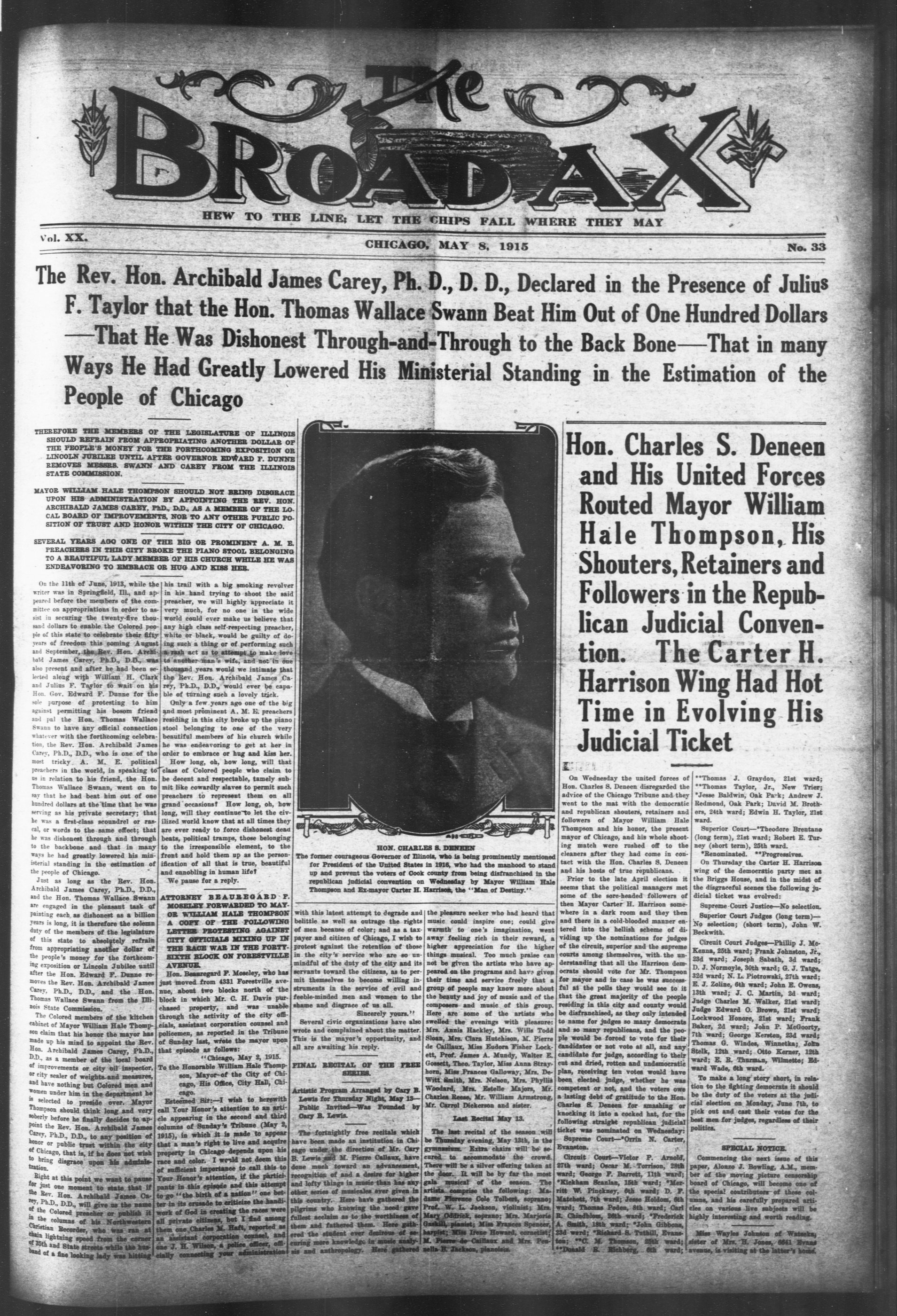
THE BROAD AX
HEW TO THE LINE; LET THE CHIPS FALL WHERE THEY MAY
The Rev. Hon. Archibald James Carey, Ph. D., D. D., Declared in the Presence of Julius F. Taylor that the Hon. Thomas Wallace Swann Beat Him Out of One Hundred Dollars That He Was Dishonest Through-and-Through to the Back Bone-That in many Ways He Had Greatly Lowered His Ministerial Standing in the Estimation of the People of Chicago
THEREFORE THE MEMBERS OF THE LEGISLATURE OF ILLINOIS SHOULD REFRAIN FROM APPROPRIATING ANOTHER DOLLAR OF THE PEOPLE'S MONEY FOR THE FORTHCOMING EXPOSITION OR LINOOLN JUBILEE UNTIL AFTER GOVERNOR EDWARD P. DUNNE REMOVES MESSERS. SWANN AND CAREY FROM THE ILLINOIS STATE COMMISSION.
MAYOR WILLIAM HALE THOMPSON SHOULD NOT BRING DISGRACE UPON HIS ADMINISTRATION BY APPOINTING THE REV. HON. ARCHIBALD JAMES CAREY, P.D., D.D., AS A MEMBER OF THE LOCAL BOARD OF IMPROVEMENTS, NOR TO ANY OTHER PUBLIC POSITION OF TRUST AND HONOR WITHIN THE CITY OF CHICAGO.
SEVERAL YEARS AGO ONE OF THE BIG OR PROMINENT A. M. E. PREACHERS IN THIS CITY BROKE THE PIANO STOOL BELONGING TO A BEAUTIFUL LADY MEMBER OF HIS CHURCH WHILE HE WAS ENDEAVORING TO EMBRACE OR HUG AND KISS HER.
Vol. XX.
The Rev. Hon. F. Taylor the
—That He Ways He People of
THEREFORE THE MEMBERS OF SHOULD REFRAIN FROM APPETHE THE PEOPLE'S MONEY FOR THE LINCOLN JUBILEE UNTIL AFTE REMOVES MESSRS. SWANN STATE COMMISSION.
MAYOR WILLIAM HALE THOMPSON UPON HIS ADMINISTRATION ARCHIBALD JAMES CAREY, PRACTICAL BOARD OF IMPROVEMENT SITION OF TRUST AND HONOR.
SEVERAL YEARS AGO ONE OF THE PREACHERS IN THIS CITY BRID TO A BEAUTIFUL LADY MEMBER ENDEAVORING TO EMBRACE
On the 11th of June, 1913, while the writer was in Springfield, III., and appeared before the members of the committee on appropriations in order to assist in securing the twenty-five thousand dollars to enable the Colored people of this state to celebrate their fifty years of freedom this coming August and September, the Rev. Hon. Archibald James Carey, Ph.D., D.D., was also present and after he had been selected along with William H. Clark and Julius F. Taylor to wait on his Hon. Gov. Edward F. Dunne for the sole purpose of protesting to him against permitting his bosom friend and pal the Hon. Thomas Wallace Swann to have any official connection whatever with the forthcoming celebration, the Rev. Hon. Archibald James Carey, Ph.D., D.D., who is one of the most tricky. A. M. E. political preachers in the world, in speaking to us in relation to his friend, the Hon. Thomas Wallace Swann, went on to say that he had beat him out of one hundred dollars at the time that he was serving as his private secretary; that he was a first-class secondrel or rascal, or words to the same effect; that he was dishonest through and through to the backbone and that in many ways he had greatly lowered his ministerial standing in the estimation of the people of Chicago.
Just as long as the Rev. Hon. Archibald James Carey, Ph.D., D.D., and the Hon. Thomas Wallace Swann are engaged in the pleasant task of painting each as dishonest as a billion years is long, it is therefore the solemn duty of the members of the legislature of this state to absolutely refrain from appropriating another dollar of the people's money for the forthcoming exposition or Lincoln Jubilee until after the Hon. Edward F. Dunne removes the Rev. Hon. Archibald James Carey, Ph.D., D.D., and the Hon. Thomas Wallace Swann from the Illinois State Commission.
The Colored members of the kitchen cabinet of Mayor William Hale Thompson claim that his honor the mayor has made up his mind to appoint the Rev Hon. Archibald James Carey, Ph.D. D.D., as a member of the local board of improvements or city oil inspector, or city sealer of weights and measures, and have nothing but Colored men and women under him in the department he is selected to preside over. Mayor Thompson should think long and very soberly before he finally decides to appoint the Rev Hon. Archibald James Carey, Ph.D., D.D., to any position of honor or public trust within the city of Chicago, that is, if he does not wish to bring disgrace upon his administration.
Right at this point we want to pause for just one moment to state that if the Rev Hon. Archibald James Carey, Ph.D., D.D., will give us the name of the Colored preacher or publish it in the columns of his Northwestern Christian Recorder, who was ran at chain lightning speed from the corner of 35th and State streets while the husband of a fine looking lady was hitting
---
HEW TO THE LINE; LET THE CHIPS FALL WHERE THEY MAY
his trail with a big smoking revolver in his hand trying to shoot the said preacher, we will highly appreciate it very much, for no one in the wide world could ever make us believe that any high class self-respecting preacher, white or black, would be guilty of doing such a thing or of performing such a rash act as to attempt to make love to another man's wife, and not in one thousand years would we intimate that the Rev. Hon. Archibald James Carey, Ph.D., D.D., would ever be capable of turning such a lovely trick.
Only a few years ago one of the big and most prominent A. M. E. preachers residing in this city broke up the piano stool belonging to one of the very beautiful members of his church while he was endeavoring to get at her in order to embrace or hug and kiss her.
How long, oh, how long, will that class of Colored people who claim to be decent and respectable, tamely submit like cowardly slaves to permit such preachers to represent them on all grand occasions? How long, oh, how long, will they continue to let the civilized world know that at all times they are ever ready to force dishonest dead beats, political tramps, those belonging to the irresponsible element, to the front and hold them up as the personification of all that is true, beautiful and ennobling in human life!
We pause for a reply.
ATTORNEY BEAUREGARD P. MOSSELEY FORWARDED TO MAYOR WILLIAM HALE THOMPSON A COOPY OF THE FOLLOWING LETTER PROTESTING AGAINST CITY OFFICIALS MIXING UP IN THE RAGE WAR IN THE PORTY-SLTH BLOCK ON FORESTVILLE AVENUE.
Hon. Bennregard F. Moseley, who has just moved from 4331 Forestville avenue, about two blocks north of the block in which Mr. C. H. Davis purchased property, and was unable through the activity of the city officials, assistant corporation counsel and policemen, as reported in the Tribune of Sunday last, wrote the mayor upon that episode as follows:
"Chicago, May 2, 1915.
To the Honorable William Hale Thompson, Mayor of the City of Chicago, His Office, City Hall, Chicago,
Esteemed Sir:—I wish to herewith call Your Honor's attention to an article appearing in the second and third columns of Sunday's Tribune (May 2, 1915), in which it is made to appear that a man's right to live and acquire property in Chicago depends upon his race and color. I would not deem this of sufficient importance to call this to Your Honor's attention, if the participants in this episode and this attempt to go "the birth of a nation" one better in its crusade to criticize the handiwork of God in creating the races were all private citizens, but I find among them one Charles M. Haft, reported as an assistant corporation counsel, and one J. H. Wilson, a police officer, officially connecting your administration
496
HON. CHARLES S. DENEEN
The former courageous Governor of Illinois for President of the United States up and prevent the voters of Cool republican judicial convention on Thompson and Ex-mayor Carter H.
The former courageous Governor of Illinois, who is being prominently mentioned for President of the United States in 1916, who had the manhood to stand up and prevent the voters of Cook county from being disfranchised in the republican judicial convention on Wednesday by Mayor William Hale Thompson and Ex-mayor Carter H. Harrison, the "Man of Destiny."
with this latest attempt to degrade and belittle as well as outrage the rights of men because of color; and as a tax-payer and citizen of Chicago, I wish to protest against the retention of those in the city's service who are so unmindful of the duty of the city and its servants toward the citizens, as to permit themselves to become willing instruments in the service of evil and feeble-minded men and women to the shame and disgrace of us all.
Sincerely yours.'
Several civic organizations have also wrote and complained about the matter. This is the mayor's opportunity, and all are awaiting his reply.
FINAL RECITAL OF THE FREE SERIES.
Artistic Program Arranged by Cary B. Lewis for Thursday Night, May 13—Public Invited—Was Founded by Cary B. Lewis.
the pleasure seeker who had heard that music could inspire one; could give warmth to one's imagination, went away feeling rich in their reward, a higher appreciation for the higher things musical. Too much praise can not be given the artists who have appeared on the programs and have given their time and service freely that a group of people may know more about the beauty and joy of music and of the composers and music of this group. Here are some of the artists who swelled the evenings with pleasure: Mrs. Annis Hackley, Mrs. Wills Todd Sloan, Mrs. Clara Hutchison, M. Pierre de Caillaux, Miss Eudora Fisher Lockett, Prof. James A. Mundy, Walter E. Gossett, Theo Taylor, Miss Anna Strayhorn, Miss Frances Galloway, Mrs. De-Witt Smith, Mrs. Nelson, Mrs. Phyllis Woodard, Mrs. Estelle Majors, Mr. Charles Reese, Mr. William Armstrong, Mr. Carrol Dickerson and sister.
Last Recital May 13.
The fortnightly free recitals which have been made an institution in Chicago under the direction of Mr. Cary B. Lewis and M. Pierre Callaux, have done much toward an advancement, recognition of and a desire for higher and lofty things in music than has any other series of musicales ever given in this country. Here have gathered the pilgrims who knowing the need gave fullest acclaim as to the worthiness of them and fathered them. Here gathered the student ever desirous of securing more knowledge in music analysis and anthropology. Here gathered
nois, who is being prominently mentioned in 1916, who had the manhood to stand in county from being distranchised in the Wednesday by Mayor William Hale Harrison, the "Man of Destiny."
the pleasure seeker who had heard that music could inspire one; could give warmth to one's imagination, went away feeling rich in their reward, a higher appreciation for the higher things musical. Too much praise can not be given the artists who have appeared on the programs and have given their time and service freely that a group of people may know more about the beauty and joy of music and of the composers and music of this group. Here are some of the artists who swelled the evenings with pleasure: Mrs. Annis Hackley, Mrs. Wills Todd Sloan, Mrs. Clara Hutchison, M. Pierre de Caillaux, Miss Eudora Fisher Lockett, Prof. James A. Mundy, Walter E. Gossett, Theo. Taylor, Miss Anna Strayhorn, Miss Frances Galloway, Mrs. De Witt Smith, Mrs. Nelson, Mrs. Phyllis Woodard, Mrs. Estelle Majors, Mr. Charles Reese, Mr. William Armstrong, Mr. Carrol Dickerson and sister.
cleaners at tact with and his hoo. Prior to seems that some of the then Mayor where in and there is intered into viding up of the circu courts among derstanding orcats show for mayor's ful at the that the gr residing in be disfranchise to name for and so many ple would be candidates candidate for cut and drill plan, receive elecctive competent of a lasting deser Charles S.
Last Recital May 13.
The last recital of the season will be Thursday evening, May 13th, in the gymnasium. Extra chairs will be secured to accommodate the crowd. There will be a silver offering taken at the door. It will be by far the most gals musical of the season. The artists comprise the following: Madame Florence Cole Tolbert, soprano; Prof. W. L. Jackson, violinist; Mrs. Mary Oddrick, soprano; Mrs. Marjorie Gaskell, pianist; Miss Frances Spencer, harpist; Miss Irene Howard, cornetist; M. Pierre de Caillaux and Mrs. Penella H. Jackson, pianoist.
On Wednesday the united forces of Hon. Charles S. Deneen disregarded the advice of the Chicago Tribune and they went to the mat with the democratic and republican shouters, retainers and followers of Mayor William Hale Thompson and his honor, the present mayor of Chicago, and his whole shooting match were rushed off to the cleaners after they had come in contact with the Hon. Charles S. Deneen and his hosts of true republicans.
Prior to the late April election it seems that the political managers met some of the sore-headed followers of then Mayor Carter H. Harrison some where in a dark room and they then and there in a cold-blooded manner entered into the hellish scheme of dividing up the nominations for judges of the circuit, superior and the supreme courts among themselves, with the understanding that all the Harrison democrats should vote for Mr. Thompson for mayor and in case he was successful at the polls they would see to it that the great majority of the people residing in this city and county would be disfranchised, as they only intended to name for judges so many democrats and so many republicans, and the people would be forced to vote for their candidates or not vote at all, and any candidate for judge, according to their cut and dried, rotten and undemocratic plan, receiving ten votes would have been elected judge, whether he was competent or not, and the voters owe a lasting debt of gratitude to the Hon. Charles S. Deneen for smashing or knocking it into a cocked hat, for the following straight republican judicial ticket was nominated on Wednesday: Supreme Court—*Orrin N. Carter, Evanston.
Circuit Court—Victor P. Arnold, 27th ward; Oscar M. Torrison, 28th ward; George F. Barrett, 11th ward; *Kickham Scanlan, 15th ward;* *Merritt W. Pinkinch, 6th ward; D. F. Machett, 7th ward; Jesse Holdom, 6th ward; Thomas Peden, 8th ward; Carl R. Chindblom, 26th ward;* *Frederick A. Smith, 18th ward;* *John Gibbons, 23d ward;* *Richard S. Tuthill, Evanston;* **C. C. M. Thomson, 25th ward;** *Donald E. Bichberg, 6th ward;*
Hon. Charles S. Deneen and His United Forces Routed Mayor William Hale Thompson, His Shouters, Retainers and Followers in the Republican Judicial Convention. The Carter H. Harrison Wing Had Hot Time in Evolving His Judicial Ticket
No.33
**Thomas J. Graydon, 21st ward;
**Thomas Taylor, Jr., New Trier;
*Jesse Baldwin, Oak Pa'k; Andrew J.
Redmond, Oak Park; David M. Brothers,
24th ward; Edwin H. Taylor, 21st ward.
Superior Court—*Theodore Brentano
(long term), 21st ward; Robert E. Turney
(short term), 25th ward.
*Renominated. **Progressives.
On Thursday the Carter H. Harrison
wing of the democratic party met at
the Briggs House, and in the midst of
the disgraceful scenes the following
judicial ticket was evolved:
Supreme Court—No selection.
Superior Court Judges (long term)—
No selection; (short term), John W.
Beckwith.
Circuit Court Judges—Phillip J. McKenna, 25th ward; Frank Johnston, Jr., 23d ward; Joseph Sabath, 3d ward; D. J. Normoyle, 30th ward; G. J. Tatge, 32d ward; N. L. Piotrowski, 27th ward; E. J. Zoline, 6th ward; John E. Owens, 13th ward; J. C. Martin, 2d ward; Judge Charles M. Walker, 21st ward; Judge Edward O. Brown, 21st ward; Lockwood Honore, 21st ward; Frank Baker, 2d ward; John P. McGorty, 7th ward; George Kersten, 23d ward; Thomas G. Windes, Winnetka; John Stelk, 12th ward; Otto Kerner, 12th ward; E. R. Thurman, Wilmette; Edward Wade, 6th ward.
To make a long story short, in relation to the lightning democrats it should be the duty of the voters at the judicial election on Monday, June 7th, to pick out and cast their votes for the best men for judges, regardless of their politics.
SPECIAL NOTICE.
Commencing the next issue of this paper, Alonzo J. Bowling, A.M., member of the moving picture censorship board of Chicago, will become one of the special contributors of these columns, and his carefully prepared articles on various live subjects will be highly interesting and worth reading.
Miss Wayles Johnson of Watsuka, sister of Mr. H. Jones, 6641 Bryan avenue, is visiting at the latter's home.
PAGE TWO
A Museum of Crime.
Professor Hans Gross of the University of Gratz, Austria, has the credit of establishing the first museum of criminology and a criminalistic laboratory, where the weapons, tools and other paraphernalia and materials used by criminals are assembled to assist in the analysis of the workings of criminal minds and a study of methods and systems for dealing with this large and dangerous class of every community. This museum was established in 1885, and since then other establishments of the same character have been organized.
One of the most important of these is the Society of Criminology and Social Defense in Paris, which has a membership of more than 200, including many prominent representatives of the law, the police and medical profession, and it was organized to concentrate and centralize the scattered efforts of individuals who were studying this disquieting social problem and to make the results of their work available for mutual information.
Fasting and Health.
"The practice of fasting," states a medical man, "is, when wisely followed, most beneficial. I am convinced that many people never feel the sensation of natural hunger. All they have is a morbid craving for food which comes of habit rather than from any actual need felt by the stomach. Natural hunger stimulates the palate and is felt in the mouth as well as in the internal organs. It makes the plainest food seem delicious. Some unfortunate people suffer, it is true, from insufficient food, but not so many as those whose ills arise from overnutrition, their digestions being continually over strained. A habit of judicious fasting would do wonders for them. The system would recover its lost tone, and—in the case of mental workers—the brain would work with an ease and lightness that would surprise them, for the brain is one of the chief sufferers from the practice of overeating."
Origin of the Lone Star.
If a place name is often crystallized history, how much more a nickname! Witness the flowery synonym for Texas, which orators mouth as the Lone Star State. To most minds this symbolizes concretely the fact that the state was first an independent nation. Behind the fact is this story, vouchered for by tradition more or less authentic. At the outset, after achieving independence, Texas lacked pretty well everything but men. The leaders knew state papers required a great seal to validate them, and in default of anything better they improvised one from a coat button which happened to bear a single star. A document so sealed fell under the eye of an imaginative journalist. He straightway exploited "The Lone Star Republic" in print so fervid as to persuade Texas here was the device most apposite for her seal and her flag—New York Press.
Mother Brook
After nearly three centuries of usefulness Mother brook, the first canal dug in this country, still finds itself utilised to some extent, though the requirements which brought it about have long since passed. Its construction was undertaken and completed by the hardy citizens of Dedham, Mass., in 1630, to provide water for mill purposes. The artificial waterway was constructed to connect the Charles river with East brook, covering a distance of about a mile. It was a great undertaking for those days, when every foot had to be excavated laboriously by hand, but the work was carried out with the usual determination marking the settlers of the day. The canal winds round the highlands of the town, and on both sides, extending almost to its border, may be seen well kept gardens—Exchange.
Poetry of Words.
When I feel inclined to read poetry I take down my dictionary. The poetry of words is quite as beautiful as that of sentences. The author may arrange the gems effectively, but their shape and luster have been given by the attrition of ages. Bring me the finest simile from the whole range of imaginative writing and I will show you a single work which conveys a more profound, a more accurate and a more eloquent analogy.-Holmes.
They Know Castor Oil.
The oldest medical book in the world was found in a rock tomb by the Nile, dating from about 2000 B. C. It is a roll about sixty-six feet long and carries prescriptions for all sorts of ailments. Castor oil is one of the remedies prescribed. It has been used pretty steadily ever since.
Now They Don't Speak.
Belle—How silly men act when they propose! Why, my husband acted like a perfect fool. Nelle—That's what everybody thought when your engagement was announced—Exchange.
"Well, he holds the family record for running up a bill."—Baltimore American.
Earthquakes.
The loss of life occasioned by earthquake generally depends upon the density of population rather than the severity of the shocks.
"Don't you have trouble getting a sufficient variety of food?" she asked. "No," said the woman who runs a boarding house; "that's the easiest part of it. You see, I make up a series of menus for breakfast, dinner, etc., at the beginning of the season and then they go on steadily till the end of it. The cook knows just what to prepare each day, and I am not at all bothered." "But don't your boarders get tired of having the same thing each week on the same day?"
"Ah," said the landlady, "that's where I fool 'em! They don't have the same thing on the same day of the week. There are ten separate menus. If we begin, say, with hash on Monday, the next time they have hash is a week from Thursday and the next time a week from the following Sunday. Nobody can tell what he's going to have on any given day without working it out with a pencil and paper, and as nobody is likely to go to that trouble just for the sake of finding his meals monotonous, the result is, in fact, as pleasantly varied as if the menu for the day was composed every morning."—New York Post.
Prismatic Lake.
Prismatic lake, in Yellowstone park, is the most perfect spring of its kind in the world. It rests on the summit of a self built mound, sloping gently in all directions. Down this slope the overflow from the spring descends in tiny rivulets, everywhere interlaced with one another. A map of the mound resembles a spider web with the spider (the spring) in the center. The pool is 250 by 800 feet in size. Over the lake hangs an ever present cloud of steam, which itself often bears a crimson tinge, reflected from the waters below. The steam unfortunately obscures the surface of the lake, and one involuntarily wishes for a rowboat in which to explore its unseen portions. Whenever visible there is a varied and wonderful play of colors, which fully justifies the name. — "The Yellowstone National Park," by Hiram Martin Chittenden, Brigadier General, U. S. A., Retired.
Making Tin.
The tin of trade is not pure, but has in it a little iron, lead or arsenic. Tin is a metal of chemistry. Its principal ore is called tin stone or tin oxide and is made up of tin and oxygen. To obtain the tin the ore is heated in furnaces with charcoal. The carbon of the charcoal unites with the oxygen of the ore, forming carbonic acid gas, which passes off into the air, leaving the tin, which melts and is drawn off and cooled in iron molds. This is called block tin. Tin ore is chiefly found in Cornwall, England; Banca, in Dutch East Indies; Malacca and Queensland and New South Wales, in Australia. Tin was used by the ancients. The Phoenicians obtained most of their tin from the British isles. When the Romans conquered Britain they worked the tin mines in Cornwall by means of slaves.
What After Safety?
Everybody from Dan to Beersheba is now thoroughly convinced that "safety first" is the proper thing. It may not always be possible to agree upon whose safety it shall be, but considered wholly in the abstract anybody caught putting anything ahead of safety in these enlightened days of peace and good will would have to dodge anathema the rest of his life.
Indeed, so amicably and universally settled is this problem of "safety first" that many are wondering if we shouldn't now stop talking about it and commence to consider what shall come after safety. Safety, although the first thing, is not the only thing. What shall we have for second? Any suggestion, however foolish, will be welcome—Life.
Inner Life In Constantinople
Constantinople has a deleterious effect upon Europeans. So at least declared a "great and highly gifted lady," mentioned by Grant Duff. She had the honor of being received by the sultan. "I hope you like Constantinople!" inquired the monarch. "Yes," said she, "but I find great difficulty in leading my inner life here." The sultan started, but, recovering himself, said savely, "Ah, no one should drink water here without having it previously boiled."-London Chronicle.
This Player "Quick Study."
For remarkable memory it would be hard to outdo a strolling player of the eighteenth century, of whom Sir William Robertson Nicoll has written. For a wager he once undertook to memorize the whole of the next day's Daily Advertiser and accomplished his task by repeating every line in the journal, news, headings, advertisements and all in perfect order and without a slip—London Tatier.
Gentlemen Didn't Answer.
"Will the gentlemen please move up forward a little?" called out the polite conductor of the trolley car.
"I won't." growled Mr. Grouch, who hung to a strap near the door.
Talking is like playing on the harp. There is as much in laying the hands on the strings to stop their vibrations as in twanging them to bring out their music—Holmes.
THE BROAD AX. CHICAGO, MAY 8, 1915
The Slay Caterpillar.
The caterpillar, though a sociable creature, tries to keep out of everybody's way. Some species hide on the under surface of leaves, others on the stems or blades of grass, which serve them as food; others, again, build little nests for concealment or he snugly hidden between the curled edges of leaves, which they draw close together until the opposite edges meet. The caterpillar is a sociable creature in his own family. He knows that there is safety in numbers, and you will find whole companies feeding side by side while keeping a sharp lookout for their bird enemies, but when a caterpillar is by himself he scarcely dares to move for fear of attracting attention. Even when he is obliged to change his skin he doesn't venture to leave his old coat lying around. The moment that he takes it off he eats it. The caterpillars that live in companies shed their skin boldly. Only the poor solitary fellows feel forced to swallow their old clothes—London Mall.
Chivalry In Battle
There was some chivalry in a naval fight in the good old days of Blake and Van Tromp, when sneaking submarines and barbarous torpedoes were unknown and naval commanders "courted war like a mistress."
When the Spanish Admiral Oquendo declined to come out of the shallow waters of Goodwin sands to fight be because he had no powder Van Tromp said, "I have powder enough for both. I will give him half mine."
"It is not only powder I need, but masts for my ships," replied Oquendo. To which Van Tromp replied, "I have plenty of masts, a whole shipload of them, and you can have them if you will only come out and meet me."
The result justified the caution of Oquendo, for when the two fleets did meet the Spaniards were so terribly beaten by the Dutch that of sixty-seven ships only eighteen reached Dunkirk in safety.—Army and Navy Journal.
Scotland and Cakes
Scotland came to be known centuries ago as the "Land o' Cakes" and as such has been celebrated in prose and poetry. One may yet in traveling through that northern land come upon country inns and herders' huts, see women who never attended a "cooking school" and who, over a peat fire in the great chimney place, a griddle swung by a crane over the slow coals, baking a cake more than a foot in diameter, savory and promising of a meal for the gods, and who, when the big cake is ready for the turning, will seize the griddle by the handle, give it a toss in the air and turn that cake with an art motion—not to be seen in any other place on earth, the big, round slab turning a loop the loop and alighting with the other side down in the same place as before to the breadth of a slender stem of the heather—Exchange.
Yeast In Bread.
In the dough from which bread is made there is a lot of sugar, which contains carbon, hydrogen and oxygen. It is necessary to ferment this sugar to make bread edible, and yeast is used because it has the power to do this. It is made from a plant having this quality. Fermenting sugar is equivalent to burning it, and there are two results. One is the formation of carbonic acid gas. A great deal of this gas is caught in the dough in the form of large or small bubbles, and some of it escapes into the air. The part that cannot escape causes the dough to rise and makes the bread light. The holes in bread are the little pockets which held the carbonic acid gas. The effect of the bubbles is to lift the body of dough so that the heat can penetrate readily and bake it properly.-Boston Herald.
A. Morbid Desire.
Two octogenarian darkies at White Sulphur Springs, having been employed by one hotel management since old time war days, are now retained as pensioners, though they occasionally do light and pottering jobs about the place.
One day not long ago they were languidly raking leaves on the lawn. As a lady passed she heard them quarrelling and stopped to listen.
"Nigger," stated the older of the pair, "does you know what I wish? I wish't dat hotel yonder had a thousand" rooms in it and you wuz laid out daid in ev'ry room!"—Saturday Evening Post.
Overcharged.
In a western town the attorney for the gas company was making a popular address.
"Think of the good the gas company has done," he cried. "If I were permitted a pun 1 would say in the words of the immortal poet. 'Honor the light brigade!'"
Whereupon a shrill voice came from the rear, "Oh, what a charge they made!"—New York Times.
Doing His Best.
Teacher—Is there no way I can induce you, Johnny, to take some interest in your algebra? Johnny—Certainly, Miss Jinks. In fact, I do take an interest, but somehow I don't seem to be able to get hold of the principle—Richmond Times-Dispatch.
Almanace
Almanacs are in existence that were compiled in the fourteenth century, but they are only in manuscript. The first printed almanac was issued about the year 1475.
Men of loftier mind manifest themselves in their equitable dealings, small minded men in their going after gain.
—Confucius.
An Artista impromptu Solo.
Pierre Garner, the singer and exquisite of Napoleonic France, was not merely a glass of fashion and a wonderful, self instructed singer, but an artist devoted to his art. "But is the following," asks Bernard Mall in his biography, "an example of sincerity in art or of love of attracting attention?"
Coupligny had supplied him with a "romance" to be set to music. Whenever the two met Garat replied, "I have not hit upon an idea as yet." One day Coupligny was walking down the Rue Neuve des Petits Champs. Hearing a sound of some one running up behind him, he turned. It was Garat, who seized him by the arm, dragged him up the stairs of a neighboring house and, halting on the first landing, exclaimed, "Tve got it!" At once he began to sing the romance through at the top of his voice. The inhabitants of the house began to open their doors, heads were projected over the bannisters, finally they began to approach. But Garat, having finished, tore down the stairs like a monkey, dragging the bewildered poet with him.—Youth's Companion.
Thrive Without Sunshine.
The doctrine that sunshine is necessarily helpful and beneficial to the health is not always true. The Turkish men and women upset this theory completely. Across every window in a Turkish home are lattices to keep out curiosity and sunlight. The Turkish women get as little sunlight outside of their homes as they do inside.
At the age of twelve the Moslem woman takes the veil and she is never seen without it. The only chance she gets to let the wind blow on her face is when she is seated in the courtyard and within the walls of her own home.
In spite of the fact that the men and women get so little exercise and fresh air they are strapping big and hardy people. Few Americans can match them in physique or powers of endurance—St. Louis Republic.
Horses on the Simplon Pass.
Horses on the Simplon post diligence—the coach which carries mall and passengers to the villages on the Simplon pass between Italy and Switzerland—are particularly well cared for. The road to the top is a steady pull of fifteen miles over a macadamized track. The horses are driven at a fast walk. Five miles up they are watered. At the ten mile station they are fed about a peck of black bread (rye or barley) cut into mouthfuls; this makes a light lunch, sustaining but not as difficult of digestion as oats. At the top of the pass, at noon, the horses are given an hour and a half to rest and are well fed and watered. The return trip of fifteen miles is made with a brake on the wheels most of the way, so that the horses trot freely and without the strain of holding back—Our Dumb Animals.
He Got the Apples
"Once upon a time," began the teacher, "two little brothers started to Sunday school one Sunday morning. Their way led past a fine orchard, where the trees were bending down with ripe, luscious apples. One of the brothers proposed going into the orchard and getting some fruit, but the other refused and sped away, leaving his companion greedily devouring the apples.
"Now, it happened that the owner of the orchard saw them, and the next day rewarded the good boy who refused to steal his apples by giving him a shilling. He got a prize for his honesty, and what do you suppose the other boy got for his dishonesty?
"He got the apples!" yelled every member of the class.—Exchange.
Gallinoli
Gallipoli is the door through which in 1858 the Turks first entered into their European possessions. And the entrance came about in a surprising manner. In that year an earthquake shattered all the walls of Thrace and overthrew the walls of Gallipoli. The inhabitants fled, while the Turks, for whom earthquakes had no terror, crossed the Hellespont and marched upon the deserted city. Emperor Cantacuzenus protested, but Sultan Orkhan calmly replied that "Providence had opened a way to his troops, and he could not disregard so clear an indication of divine interposition." Thus was taken the first plunge that kept the near east bathed in blood for centuries.—London Standard.
Cornmeal For the Feet
Men as well as women are finding cormeal very beneficial to aching and sore feet. Simply soak the feet in warm water into which a handful of meal has been thrown, and the meal when rubbed over the feet opens up the pores in such a manner as to stop the very disagreeable annoyance of painful feet. It is far superior to salt baths for the feet—Philadelphia North American.
On the Safe Side.
Traveler—Walter, get me a lamp chop, quick. My train goes in eighteen minutes. Walter—Yes, sr. Fifty cents. Traveler—What! Do you expect me to pay in advance! Walter—If you please, sr. You may be gone before it's ready.—Boston Transcript.
Foul Blow.
Alice—Trust her! You surely don't think she could keep a secret? Marie—Well, I've trusted her with other things, and she kept them—Boston Transcript.
Hope is the principle of activity. Without holding out hope, to desire one to advance is absurd and senseless—Edmund Burke.
London's Bridges.
London bridge
At a time when the population of London was well over a million and her houses lay for miles on each side of the river she was apparently well content with her one London bridge. At length in 1734 Westminster was seized with the desire to have a bridge of her own. Application was made to parliament for powers only to encounter the fiercest opposition from the city, the 40,000 watermen, the inhabitants of Southwark and the west country bargemen, all of whom implored the commons to protect them against this new enemy. The result was that the bridge was not built till 1750. Blackfriars, at first called Pitt's bridge, was finished in 1769 at a cost of £280,000, defrayed by tolls. Waterloo was opened on the second anniversary of the famous battle with great pomp by the prince regent in person, accompanied by his royal brother, the Duke of York, the Duke of Wellington and many distinguished people.—London Answers.
"No Quarter Given."
"It is forbidden to declare that no quarter shall be given." So say The Hague regulations. That is a more modern rule than you would think. The Duke of Wellington said that he understood that the defenders of a fortress taken by storm had no right to quarter, although he himself did not, as a rule, adopt such a cruel practice. A century ago, when a feeble garrison stubbornly held out in a feebly fortified place against a force manifestly superior and apparently able to take it eventually, it was usually refused quarter. There was an attempt to justify the refusal by a doctrine of "futile resistance"—that he who uselessly resisted and caused assaulting or besieging forces unnecessary loss of life did not deserve to have his own life spared. But that doctrine has been rejected. Carried to its logical conclusion it would mean that every member of a weaker force in any kind of armed contest could be killed.—William M. Collier in Forum.
A Troublesome Garge
"An elephant's shoulder is never still" is a Hindu saying with reference to the restlessness of the animal. An Englishman tells how the elephant's passion for moving about once came near wrecking a ship.
A number of elephants were taken on board a vessel at Calcutt, and the steamer went down the Hugil river. At night it anchored off Sngor point. The sea was as still as oll, but the ship rolled so much that she was in danger of going over. The elephants had found that by swaying to and fro all together they could produce a pleasant rocking motion. As the ship had no other cargo and rode light the captain was much frightened. The mishouts, or keepers, were hurried down into the hold, and each one, seated on his own beast, made him "break step," but they had to stay there for a long time.
Why Milk Sours.
We are told by those who study the ways and ravages of the mischievous microbe that he is very, fond of sugar and that he delights to gratify this liking by turning the supply in milk into an acid which sours the milk. These microbes are constantly in the air, alive though invisible, and ready to drop into the milk when they can. If it were possible to keep the milk from the air after the cow is milked it would not turn sour. Warm milk is particularly inviting to the microbe and favorable to his operations. He does not get along well under chilling conditions, and that is why the sweetness of milk can be preserved if it is kept cold. Bolling fresh milk changes the sugar in such a way that the microbe cannot feed upon it—Baltimore American.
Precious Manuscripts
Considered one of the finest manuscripts in this country, the "Evangelistarium sive Lectiones ex Evangelis," illuminated and of French-Carlovian an origin, may be seen in the New York Public library. The manuscript is of vellum and consists of 200 leaves. Its date is set in the neighborhood of 870 A. D. The late twelfth and thirteenth centuries are also represented, and among the works from the fourteenth century is the oldest extant complete manuscript of the Wyclifite version of the New Testament in English—Argonaut.
There's a Reason For Everything
There a Reason for Everything.
"Wouldn't you try to get a divorce from a woman who abused you and neglected your home and thought more of her club than she did of you?" thundered the big man.
"I don't think I would," replied Henry Peck.
"I am afraid Henrietta would not let me."-Philadelphia Ledger.
Coral Builders.
Coral reefs and islands are formed by the coral building polyp. These animals only live in clear water, the depth of which is not greater than twenty-five fathoms, and the temperature of which does not sink below 68 degrees F.
The Extreme Limit.
"How did your cake turn out, my dear?"
"Pretty badly, I fear. Even the children wouldn't have a second piece."—Louisville Courler-Journal.
"This is very confidential, Merian."
"Yes, dear. I shall be most careful to whom I repeat it."—Philadelphia Ledger.
He who did well in war just earns the right to begin doing well in peace.—Browning.
Fly Rod For Trout Fisherman. Rods of split bamboo are produced by cementing together a number of triangular strips split from the whole cane to form each joint; the rod of six strips is the choice of most anglers. Weight for weight-and, of course, within reason, the lighter the rod the better-split bamboo rods are stronger and have more casting power and better action than rods of any other material. Very properly conceding that the choice of a fly rod is practically limited to the rod of split bamboo, you cannot go far wrong in selecting one nine feet in length. Such a rod for the light work of our average trout streams should not weigh over five and a quarter ounces. Any rod seriously worth consideration has snake guides, german silver reel seat and ferrules and a solid cork hand grasp.
It is very well when making your selection to try out several rods answering to the above specifications in order to avoid, if possible, getting a rod that is either too stiff or too flexible.-Outing.
Strength In Hollowness
The stems of bamboos, grasses, wheat and oats are hollow, although they grow to great heights in comparison to their thickness. It might naturally be supposed that to gain strength as they grew the stems ought to be solid at the base, but it is not so. Careful experiments have proved that a solid column subject to bending strains is no stronger than a hollow one. Consequently all iron shafts are made hollow, and the steel shafts which drive the screws of steamships have a hole bored down the center to reduce the weight. But this does not reduce the strength. The thickness of the branches of trees is in proportion to the weight to be borne. Horizontal branches, such as those of the cedar and elm, are much thicker than the almost vertical branches of the poplar. The average natural factor in breaking is about one in ten, exclusive of wind pressure, and engineers employ a factor of six in building with timber.
Cases at the National M
A collection of canes made of practically every kind of suitable material and representing forty-five foreign countries, as well as twenty-one states of the Union, forms one of the most interesting exhibits at the National museum at Washington. Forty different kinds of wooden canes are on exhibition, as well as canes made of ivory, bone, horn, skin, paper, tin, wire and other substances. In this collection are many canes that are artistic and others that are merely curious in shape, as well as some made for emergency uses. Among the latter are a sketching cane with drawing materials stored in the handle, a number equipped with match safes, mountain climbing canes with sharp spiked ferruginous an officer's "swagger stick" and sword and gun canes of various types. The most interesting feature of the exhibit perhaps is the historical element. -Popular Mechanics.
Xerox and the Hellespont
Xerxes was furious when a storm wrecked his bridge of boats in the Hellespont from Abydos to Sestos. Not content with having the engineers decapitated, he ordered the infliction of 300 lashes upon the strait and the letting down into it of a set of fetters. Herodotus discredits the story that Xerxes also sent irons to brand the strait. But the historian does give the "non-Hellenic and blasphemous terms" which the scourgers were ordered to use: "Thou bitter water, this is the penalty which our master inflicts upon thee because thou has wronged him though he has never wronged thee. King Xerxes will cross thee, whether thou武 or not, but thou deservest not sacrifice from any man, because thou art a treacherous river of salt water."
Bookplates.
No book collector should be without a bookplate, and a bookplate once inserted in a volume should never be removed. When the plate is that of a good collector it constitutes an indorsement and adds a certain interest and value to the volume. I was once going through the collection of a friend, and observing the absence of a bookplate. I asked him why it was. He replied, "The selection of a bookplate is such a sorrow matter." Atlantic.
Knitting.
Knitting is a Scotch invention of the fifteenth century. Soon after its invention a guild of stocking knitters was formed, with St. Fliacre as its patron saint. Hand knitting was supplemented by machinery as early as 1580, when William Lee invented the knitting
Times Change.
tween modern and ancient
"One of the main points was that the
modern earn their living, while the ancient urned their dead."
Specifications Furnished.
"What does our party stand for?"
asked the machine senator.
"You, for one thing," replied a raucous voice from the rear of the hall—Philadelphia Record.
A Gentle Request.
Jessie—PLEASE, auntie, the new lady next door says, her compliments and will you play very low, because her husband is extremely musical—Sydney Bulletin.
Cynical.
Payton—A bachelor is a man who has been crossed in love. Parker—Yeah, and a married man has been double crossed. Life.
GERMAN HOARD STORED IN TOWER
WHERE all the money is to come from with which the great war in Europe is being conducted is a mystery to many. Yet for just such a conflict as the present Germany has been preparing financially for years. And this hoard, which was known as the war chest, or war fund, was watched over carefully, but never spent. It is reported that the fund has been liberally drawn upon of late.
The beginning of the fund was in 1871, when Bismarck, having conquered the French, compelled them to pay a sum of many millions in gold to Germany. Thirty million dollars of this was laid aside for a nest egg, not to be touched until the next war came. In the meantime Germany went on accumulating money as well as training her army and building big guns.
In the Julius tower in the citadel of Spandau, in the province of Brandenburg. Prussia, this treasure is stored. Spandau is a town of several thousand people not far from Berlin, on the banks of the river Spree. It is full of powder factories, military schools, artillery bureaus and many other enterprises connected with the army and was once the home of one of the ancestors of the present kaiser.
In Spandau and about twelve miles from the Palace of Potsdam—the kaiser's residence—is the great fortress or citadel of which the most conspicuous part is the huge and massively built tower of Julius. It is made of solid blocks of basalt stone and its foundations lie far below the bed of the river. Grim and frowning, it rears itself far above the water, its gray stone walls of vast strength holding within their keep the purse of the Teuton.
The guarding of the tower is given over to the Fourth Grenadier regiment and a battery of the Third grenadiers, while stationed within the citadel is
MILITARIA
Photo by American Press Association.
THE JULIUS TOWER OF SPANDAU.
the Third train battalion, on duty in case there should occur a need of hastily moving it in case of emergency.
It is impossible for the outside world to know the exact amount, but it is variously stated at from $00,000,000 to $100,000,000 and is said to be in coins of 10 and 20 mark pieces, besides money in gold from France, England and Russia mainly. It is kept in iron chests on which are written the names and addresses of the generals and admirals of the nation. Certain sums are set aside for the commanders on certain frontiers, and also some are designed for secret spy service. In case of war, as at present, these packages can be immediately sent by military force to each commander, who knows at once just the amount to be expended in a certain time by his troops.
At specified periods during the year all this treasure is counted and weighed as well. This performance is undertaken with great ceremony in the presence of several army officers, each one being from a different part of the country and each being required to take an oath that he does not know his brother officers. These huge chests are also in the charge of a special officer, who is called upon to check up the accounts of the examining men, but this officer is not informed, in advance of the coming of the counters, whose advent may be at an unexpected time.
The chests are in an immense stone chamber below the level of the river, so that in case of any danger of looting the place could be flooded. Entrance to the treasure room is by means of tunnels which open into a guardroom in which soldiers are ever on duty. Before each tunnel is a guard. Other sentinels walk up and down the halls constantly. Soldiers pass up and down the stairs.
Behind the entrance is a second guardroom, and there is a third on the roof, which keeps an outlook over the country. At different times during the night unexpected inspections are made of every part of the building. Nothing on earth, unless it is the ear, is as well watched as this treasure of Williams', the war chest of the German empire.
DAMES AND DAUGHTERS
The Duchess of Wellington is president of the National Women's League to Prevent Esplage, recently formed in London. There is a women's court in Los Angeles, Cal., for which a woman judge has just been appointed. She is Mrs. Georgia P. Bullock. Dr. Gertrude A. Walker of the Woman's College of Philadelphia is urging the study of medical work by students on leaving the colleges. Miss Oki Yama, who has come to this country to complete her education in theology, is said to be the first woman Japanese Christian missionary to take this step. Mrs. Guido Melsel has established in New York city a photographic studio devoted largely to impressionistic work. In two years she has made quite a name for herself.
Mrs. H. H. Jenkins, director and donor of the Slavonic home in New York city, has been awarded the Order of the Red Cross by Servin, making the third decoration she has received
Fashion Frills.
The word "stylish" covers a multitude of offenses against good taste.—Albany Journal.
Isn't it strange that a little wad of hay, with a few tissue paper flowers attached, costs so much?—Macon Telegraph.
Milliners charge as much for modern styles as if they had made them instead of merely resurrecting them.—Chicago News.
Here's hoping it is true that the women are about to adopt the plug hat. Then, perhaps, the men will quit wearing them.—Cleveland Leader.
A great deal of needless sorrow is caused in this old vale of tears not so much by trying to get a 42 figure into a 36 corset, but by succeeding.—Ohio State Journal.
BRIGHT BRIEFS
The time to swat the fly is before the fly rush is on. _____
Too many mistake a "hunch" for heavy thinking. _____
Everything becomes new as soon as it becomes old enough. _____
Some of the war correspondents, like Italy, lie beyond the Alps. _____
The odor of the rose never seems so sweet when the thorn jabs you first. _____
The most unappreciated valuable service is that rendered by the alarm clock. _____
A defeated Mexican general is about as popular as the bull that fell in yesterday's fight.
The most fortunate men in the world are those who can get paid for doing what they like to do.
If the air men destroy Greenwich we shall have to find some new place from which to reckon time.
Peace talk may not settle the war, but it at least shows that there are people in favor of peace.
Perhaps you have noticed that it is mighty hard to make both ends meet when the financial end is short.
A scientist has traced the income tax to ancient Rome. Time to quit thinking you've struck a new brand of trouble.
It seems probable that if Mexico is ever ruled it will be, as Senor Huerta declares, by a Mexican, as nobody else would want the job.
Pert Personals
So it seems that Mr. Jess Willard will spend the next year or two in taking up a collection—Columbia State. By this time Judge Ben Lindsey has about the largest souvenir collection of vindications on record—Pittsburgh Gazette-Times.
It is creditable to get Laureate Robert Bridges that, unlike William Watson, he isn't producing a poem every little while, to add to the horrors of the war—Boston Globe.
Short Stories
Russian officers when addressing soldiers call them "little brother," "friend" or "little pigeon." It is estimated that 760,000,000,000 cubic feet of illuminating gas are burned in the world annually. It is the custom in Turkey for a hostess to put her entire wardrobe at the disposal of her feminine guests. A Japanese porter carries his teapot with him when he goes to his day's work, as an American workman carries a dinner pail.
German Gleanings
Germany prohibits domestic stock
quotations.
Dachsbunds are used in Germany for catching badgers. The German army has at its disposal 200 hospital trains.
Germany's Navy league has a mem
upon
barship of a million. Punishment of noncommissioned officers for dereliction of duty in the German army never takes the form of reduction to the ranks.
THE BROAD AX, CHICAGO, MAY 8, 1915
In a land and sea of romance and tragedy, encompassing almost more of those elemental and emotional atmospheres than any other of similar radius, is the strait of the Dardanelles, otherwise the Hellespont. The forty-five miles of the strait connecting the sea of Marmora with the Aegean sea are not only protected by old, but also by new forts and by those more modern and Satanic inventions, floating and submarine mines. Not only is the Hellespont strongly fortified with big guns both on the European and Asiatic shores, but east of
THE CITY OF BOSTON
Photos by American Press Association.
FORTS AT THE ENTRANCE TO DARDA-NELLES AND SECTION OF CONSTANTINOLE.
the sea of Marmora is the yet narrower strait of the Bosporus, seventeen miles long, connecting the Turkish sea of Marmora with the big Black sea, which the Russians practically control. The Bosporus is also imposingly fortified and mined, and vessels forcing the Dardanelles would be compelled to force the strait to make an opening from the waters of the Grecian arch-pelago or of the Aegean sea to the Black sea and to lay siege to Constantinople on the European side and the twin city of Scutari on the Asiatic side.
The entrance of the allied British and French fleets into the Dardanelles reopened the long disputed question of the relative strength of fleets and fortifications. The allies evidently expected to settle this question earlier, and considerable criticism has been aimed at Winston Churchill, first lord of the admiralty, by the London press for the conduct of the Dardanelles operations. It is asserted that the earlier attempt to force the strait without the assistance of land forces should never have been attempted. It is also pointed out that even should the narrows be forced unless there was a powerful army ready to occupy the Gallipol peninsula the moment the fleet passed into the sea of Marmora the Turks and Germans would immediately close the strait behind it, and thus the warships would find it difficult to fight their way out again. Hence the tactics have been changed, and a powerful army has been landed at the Dardanelles.
KITCHENER A BUSY MAN.
He Is Constantly Sending Newly Made Soldiers to the Front.
Perhaps the very busiest man in England today is Lord Kitchener. He is assembling a magnificent army and is constantly sending new and newly made troops to the front which are making themselves felt along the front.
THE
LORD KITCHENER AND GEORGE V.
tellers of France and at the Dardaneilles.
Only latey he delivered an address before the house of commons in which he severely criticised the treatment of British prisoners by Germans. The illustration shows him accompanied by King George reviewing a highland treatment before sending it abroad.
SIRES AND SONS
Like Caruso, Sir Edward Elgar, the famous musician, is gifted with the pencil and is an excellent caricaturist. Rene Vidal, a French reserve soldier, received 138 distinct wounds from the explosion of a shrapnel shell. He is living.
Gustav Lindenthal, who is building the Hell Gate bridge at New York, the greatest structure of the kind in the world, which will have a length of three and one-half miles, is an Austrian by birth.
General von Schubert, of whom little is heard, has won great honors in the present war. His official title is general of the artillery of the German army, and to him more than to any other one person is due the credit for the manner in which the German artillery has performed the work mapped out for it in the war thus far.
Thomas Benton Howard, who has just attained the rank of admiral under the operation of the new law creating this rank, graduated from the United States Naval academy in 1878. He took part in the battle of Manila Bay as navigator of the Concord and later served with the Charleston and the Monadnock during the Philippine insurrection.
English Etchings.
Altogether seven Englishmen have been knighted for acting.
There are 17,000,000 acres of waste land in the United Kingdom.
The ribbon of the Victoria cross is crimson for the army and dark blue for the navy.
No foreigners have ever been admitted to the freedom of the city of London, as they are unable to declare allegiance to the sovereign.
The largest single dock inclosed by artificial walls in Great Britain is at Newport, Monmouthshire. Its total water area is 110 acres and its dimensions 4,000 feet long by about 1,000 feet wide.
Household Hints.
Every cellar should be aired and sunned often.
Use paper bags for covering pitchers with food in them.
When you paste labels on glass jars that are used for spices or cereals put the labels on the inside. They will stay more securely.
To put a new wick in any lamp burner quickly thread a needle first, run the thread across the wick and pass needle through burner.
Use no soap on window glass. Use old muslin and clean soft water. A cotton cloth dipped in a little alcohol will add brilliance to the final rub.
Timely Topics.
Grade crossing disasters ought to be made impossible.—Detroit Free Press.
In these jitney days nobody has any pity for the old street car.—Philadelphia Ledger.
Nearly time for the first story of the "fool who rocks the boat."—Albany Knickerbocker Press.
Uncle Sam has ruled that the prizefight film is an undestrable citizen. Not a shadow of a doubt, says he.—Detroit News.
The Royal Box.
Sultans of Turkey never marry. Champagne, Chablis wine and cider are the kaiser's favorite drinks. The emperor of Japan is the representative of a dynasty which claims to have possessed the throne since 660 B. C. King Albert of Belgium in his younger days just for a lark tried to get a job in New York as a newspaper reporter. He was unanimously rejected.
SHORT AND SHARP.
The best sort of trench digging is for a rose garden.
Lovers who are afraid to propose are found only in stories.
Not many persons keep busy heaping coals of fire on other people's heads.
Mexico seems to have solved the problem of perpetual motion. It's it.
No young man looks perfect to the mother of the girl he wants to marry.
Notwithstanding the shortage of dye-stuffs, the grass has come out a bright green.
Europe does not apparently realize what a beautiful year this is in which not to fight.
If anybody thinks it is easy to be neutral let him go to a baseball game and watch the umpire.
Some men unconsciously become humorists when they proceed to take themselves very seriously.
After a woman becomes the wife of a great man she wonders what causes his greatness to evaporate.
The fellow who starts out to find a new home always discovers that somebody is living in the house he wants to rent.
Statisticians announce that on April 4 the population of the United States reached an even 100,000,000. Those who doubt it are privileged to count
To Improve Monetary and Trade Relations With Latin America.
Secretary McAdoo and officials of the treasury department, as well as John Barrett, director of the Pan-American union, and Henry White, president of the Pan-American society, are busy making preparations for the coming pan-American financial congress, which will convene in Washington on May 24 and continue for a
THE BROADWAY CINEMAS
Photos by American Press Association.
HENRY WHITE, SECRETARY M'ADOO, JOHN BARRETT AND THE PAN-AMERICAN BUILDING.
fortnight. The sessions of the congress will be held in the beautiful Pan-American building in Washington. Eighteen of the Latin American nations have formally accepted invitations to join the conference. The congress is the first of its kind and is expected to have a most important influence upon our financial relations and trade with the Latin American republics. The principal purpose of the conference is not only to discuss and consider carefully the financial relations of the United States with the Latin American republics, but to devise practical ways and means of permanently improving these and trade relations along lines which will be for the good of all countries concerned.
A WOMAN MAYOR
First of Her Sex to Hold Such an Office in Illinois. On May 1 the first woman mayor in Illinois assumed the duties of her office. Her name is Mrs. A. R. Canfield. She has reached the mature age of seventy-four and was elected mayor of Warren. Ill., in the later part of April.
1930
Warren has a population of 1,500, and the salary paid to the mayor is not munificent, only $12 per annum. Mrs. Canfield has long been an advocate of women's rights, and she declares that the long ambition of her Life has been realized by witnessing in her particular instance the triumph of the suffrage cause. She was born in New York state in 1840 and claims to be a direct descendant of John Quinny Adams.
PAGE THREE
PITH AND POINT.
It is easier to forgive an enemy than to wish him good luck.
"Love just happens," says a woman writer. So do mistakes.
Only those who hesitate can have the benefit of second thought.
Swimming the English channel is not a very popular sport just now.
It is better to take up another line of work than to remain in the "has been" class.
While a man knows that he pays high for experience, he keeps on buying it.
Sometimes a man just pays you a compliment when he owes you real money.
Huerta says this is a great nation. It was a trifle too great for Huerta's own good.
Every young man should understand that his dead ancestors cannot hold his job for him.
Fools not only rush in where angels fear to tread, but they sometimes get away with it.
Possibly a cleanup week in the Balkans would go far toward dispelling the typhus plague.
Another queer turn of fate fixes things so that those who need friends the most usually have the least.
It may be that increasing wealth is attended with care, but man is willing to be a caretaker in the matter of coin.
The Writers.
Mr. Hall Calne began life as an architect.
St. Clair McKelway, editor of the Brooklyn Eagle, is now seventy years old.
As a young man Mr. William Watson, like many of his craft, had some difficulty in making his way. His first volume of poems was published at his father's expense, and ten years later not twenty copies had been sold.
Mrs. Mary Gaunt, explorer and author, recently returned to London after long and arduous travels in Asia. Her most remarkable feat was the journey up the river Amur a distance of nearly 2,000 miles, during which she visited the former convict colony of Saghalien, being the first Englishwoman to make the visit.
The Cookbook.
For a small cake or cookies have a hot oven; for a large, rich cake, a slow oven.
In making a plain omelet it is better to add hot water than milk, as it makes it much more tender.
Put a handful of raisins on top of apples when baking your apple pies. This gives them a fine flavor.
A steaming hot dish of baked or boiled macaroni dressed with cream and grated cheese is a very good substitute for meat.
Overboiled potatoes, placed in a cloth and squeezed hard, can be mixed with flour or barley meal and made into scones. They should be toasted and eaten with butter.
Flippant Flings.
Thank goodness, Switzerland is not laying in a stock of submarines!—Philadelphia Record.
Congress is going to have an electrical device for use in recording votes taken at the sessions. Time thus saved can be devoted to talking—Detroit News.
Now it is declared that Mrs. Christopher Columbus discovered America. They'll be telling us next that Mrs. Noah built the ark—Detroit Free Press.
China may have a few diplomatic cards up her sleeve, but the advantages afforded by a Japanese kimoon are not to be overlooked.—Washington Post.
Echoes of the War.
Each party is willing to make peace at once-on its own terms—Philadelphia Record.
Neutrality might now be defined as an attitude that is equally offensive to all the belligerents—Chicago News.
Possibly more peace talk would be audible if the warring nations would still their cannon fire for a few moments—Detroit News.
There are a good many authorities telling us what is going to happen after the war. But wouldn't it be more to the point if somebody could say when after the war will be?—Philadelphia Press.
Town Topics.
With fifty murders since the first of the year New York city is greatly horrified over the lawlessness of Mexico. —Philadelphia Ledger.
San Francisco has brought forward something brand new. It has an exposition that is not only paying its way, but promises to make money.—Philadelphia Press.
In her proclamation of war against sleep disturbing noises is not Philadelphia trying to make the rest of us believe that her sleep can be disturbed?—Cleveland Leader.
PAGE FOUR
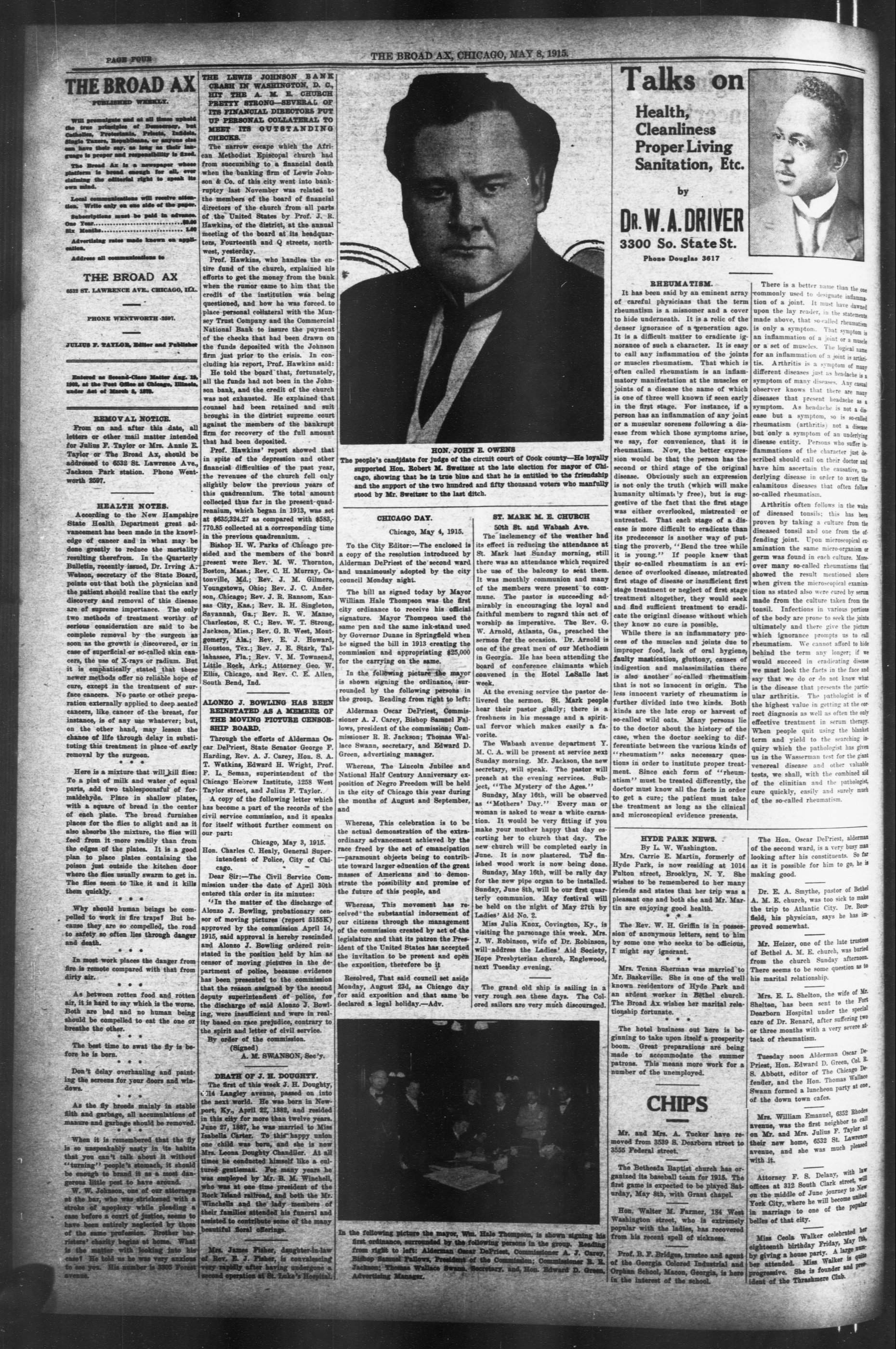
THE BROAD AX
PUBLISHED WEEKLY.
Will promulgate and at all times uphold the true principles of Democracy, but Catholics, Protestants, Palestine, Indies, Single Taxes, Republicans, or anyone else can have their say, as long as their language is proper and responsibility is fixed.
The Broad Ax is a newspaper whose platform is broad enough for all, ever claiming the editorial right to speak its own mind.
Local communications will receive attention. Write only on one side of the paper.
Subscriptions must be paid in advance.
One Year.....$3.00
Six Months.....1.40
Advertising rates made known on application.
Address all communications to
THE BROAD AX
6532 ST. LAWRENCE AVE., CHICAGO, IL.
PHONE WENTWORTH-3597.
JULIAUS F. TAYLOR, Editor and Publisher
Entered as Second-Class Matter Aug. 18,
1908, at the Post Office at Chicago, Illinois,
under Act of March 8, 1908.
REMOVAL NOTICE.
From on and after this date, all letters or other mail matter intended for Julius F. Taylor or Mrs. Annie E. Taylor or The Broad Ax, should be addressed to 6532 St. Lawrence Ave. Jackson Park station. Phone Wentworth 2597.
HEALTH NOTES.
According to the New Hampshire State Health Department great advancement has been made in the knowledge of cancer and in what may be done greatly to reduce the mortality resulting therefrom. In the Quarterly Bulletin, recently issued, Dr. Irving A. Watson, secretary of the State Board, points out that both the physician and the patient should realize that the early discovery and removal of this disease are of supreme importance. The only two methods of treatment worthy of serious consideration are said to be complete removal by the surgeon as soon as the growth is discovered, or in case of superficial or so-called skin cancers, the use of X-rays or radium. But it is emphatically stated that these newer methods offer no reliable hope of cure, except in the treatment of surface cancers. No paste or other preparation externally applied to deep seated cancers, like cancer of the breast, for instance, is of any use whatever; but, on the other hand, may lessen the chance of life through delay in substituting this treatment in place of early removal by the surgeon.
Here is a mixture that will kill flies: To a pint of milk and water of equal parts, add two tablespoonsful of formaldehyde. Place in shallow plates, with a square of bread in the center of each plate. The bread furnishes places for the flies to alight and as it also absorbs the mixture, the flies will feed from it more readily than from the edges of the plates. It is a good plan to place plates containing the poison just outside the kitchen door where the flies usually swarm to get in. The flies seem to like it and it kills them quickly.
Why should human beings be compelled to work in fire traps? But because they are so compelled, the road to safety so often lies through danger and death.
In most work places the danger from fire is remote compared with that from dirty air.
As between rotten food and rotten air, it is hard to say which is the worse. Both are bad and no human being should be compelled to eat the one or breathe the other.
The best time to swat the fly is before he is born.
Don't delay overhauling and painting the screens for your doors and windows.
As the fly breeds mainly in stable flitch and garbage, all accumulations of manure and garbage should be removed.
When it is remembered that the fly is so unspeakably nasty in its habits that you can't talk about it without "turning" people's stomach, it should be enough to brand it as a most dangerous little nest to have around.
THE LEWIS JOHNSON BANK CRASH IN WASHINGTON, D. C., HIT THE A. M. E. CHURCH PRETTY STRONG—SEVERAL OF ITS FINANCIAL DIRECTORS PUT UP PERSONAL COLLATERAL TO MEET ITS OUTSTANDING CHECKS.
The narrow escape which the African Methodist Episcopal church had from succumbing to a financial death when the banking firm of Lewis Johnson & Co. of this city went into bankruptcy last November was related to the members of the board of financial directors of the church from all parts of the United States by Prof. J. R. Hawkins, of the district, at the annual meeting of the board at its headquarters, Fourteenth and Q streets, northwest, yesterday.
Prof. Hawkins, who handles the entire fund of the church, explained his efforts to get the money from the bank when the rumor came to him that the credit of the institution was being questioned, and how he was forced to place personal collateral with the Munsey Trust Company and the Commercial National Bank to insure the payment of the checks that had been drawn on the funds deposited with the Johnson firm just prior to the crisis. In concluding his report, Prof. Hawkins said: He told the board that, fortunately, all the funds had not been in the Johnson bank, and the credit of the church was not exhausted. He explained that counsel had been retained and suit brought in the district supreme court against the members of the bankrupt firm for recovery of the full amount that had been deposited.
Prof. Hawkins' report showed that in spite of the depression and other financial difficulties of the past year, the revenues of the church fell only slightly below the previous years of this quadrennium. The total amount collected thus far in the present quadrennium, which began in 1913, was set at $635,324.27 as compared with $583,770.85 collected at a corresponding time in the previous quadrennium.
Bishop H. W. Parks of Chicago presided and the members of the board present were Rev. M. W. Thornton, Boston, Mass.; Rev. C. H. Murray, Catonville, Md.; Rev. J. M. Gilmere, Youngstown, Ohio; Rev. J. C. Anderson, Chicago; Rev. J. R. Ransom, Kansas City, Kas.; Rev. R. H. Singleton, Sayannah, Ga.; Rev. R. W. Manse, Charleston, S. C.; Rev. W. T. Strong, Jackson, Miss.; Rev. G. B. West, Montgomery, Ala.; Rev. E. J. Howard, Houston, Tex.; Rev. J. E. Stark, Tallahassee, Fla.; Rev. V. M. Townsend, Little Rock, Ark.; Attorney Geo. W. Ellis, Chicago, and Rev. C. E. Allen, South Bend, Ind.
ALONZO J. BOWLING HAS BEEN REINSTATED AS A MEMBER OF THE MOVING PICTURE CENSORSHIP BOARD.
Through the efforts of Alderman Oscar DePriest, State Senator George F. Harding, Rev. A. J. Carey, Hon. S. A. T. Watkins, Edward H. Wright, Prof. F. L. Seman, superintendent of the Chicago Hebrew Institute, 1258 West Taylor street, and Julius F. Taylor.
A copy of the following letter which has become a part of the records of the civil service commission, and it speaks for itself without further comment on our part:
Chicago, May 3, 1915.
Hon. Charles C. Healy, General Superintendent of Police, City of Chicago.
Dear Sir:—The Civil Service Commission under the date of April 30th entered this order in its minutes:
"In the matter of the discharge of Alonzo J. Bowling, probationary censor of moving pictures (report 5155K) approved by the commission April 14, 1915, said approval is hereby rescinded and Alonzo J. Bowling ordered reinstated in the position held by him as censor of moving pictures in the department of police, because evidence has been presented to the commission that the reason assigned by the second deputy superintendent of police, for the discharge of said Alonzo J. Bowling, were insufficient and were in reality based on race prejudice, contrary to the spirit and letter of civil service. By order of the commission
DEATH OF J. H. DOUGHTY.
The first of this week J. H. Doughty, 1014 Langley avenue, passed on into the next world. He was born in Newport, Ky., April 22, 1882, and resided in this city for more than twelve years. June 27, 1887, he was married to Miss Isabella Carter. To this happy union one child was born, and she is now Mrs. Leona Doughty Chandler. At all times he conducted himself like a cultured gentleman. For many years he was employed by Mr. B. M. Winchell, who was at one time president of the Rock Island railroad, and both the Mr. Winchell and the lady members of their families attended his funeral and assisted to contribute some of the many beautiful floral offerings.
Mrs. James Fisher, daughter-in-law of Rev. E. J. Fisher, is convalescing very rapidly after having undergone a second operation at St. Lukes's Hospital.
THE BROAD AX, CHICAGO, MAY 8, 1915.
M.
The people's candidate for judge of the circuit court of Cook county—He loyalty supported Hon. Robert M. Sweitzer at the late election for mayor of Chicago, showing that he is true blue and that he is entitled to the friendship and the support of the two hundred and fifty thousand voters who manfully stood by Mr. Sweitzer to the last ditch.
[Image of a group of men in formal attire, seated around a table with maps and documents, suggesting a meeting or negotiation.]
In the following picture the mayor, Wm. Hale Thompson, is shown signing his first ordinance, surrounded by the following persons in the group. Reading from right to left: Alderman Oscar DePriest, Commissioner A. J. Carey, Bishop Samuel Pallows, President of the Commission; Commissioner B. E. Jackson; Thomas Wallace Swann, Secretary, and Hon. Edward D. Green, Advertising Manager.
CHICAGO DAY.
To the City Editor:—The enclosed is a copy of the resolution introduced by Alderman DePriest of the second ward and unanimously adopted by the city council Monday night.
The bill as signed today by Mayor William Hale Thompson was the first city ordinance to receive his official signature. Mayor Thompson used the same pen and the same ink-stand used by Governor Dunne in Springfield when he signed the bill in 1913 creating the commission and appropriating $25,000 for the carrying on the same.
In the following picture the mayor is shown signing the ordinance, surrounded by the following persons in the group. Reading from right to left:
Alderman Oscar DePriest, Commissioner A. J. Carey, Bishop Samuel Fallows, president of the commission; Commissioner R. R. Jackson; Thomas Wallace Swann, secretary, and Edward D. Green, advertising manager.
Whereas, The Lincoln Jubilee and National Half Century Anniversary exposition of Negro Freedom will be held in the city of Chicago this year during the months of August and September, and
Whereas, This celebration is to be the actual demonstration of the extraordinary advancement achieved by the race freed by the act of emancipation—paramount objects being to contribute toward larger education of the great masses of Americans and to demonstrate the possibility and promise of the future of this people, and
Whereas, This movement has received the substantial indorsement of our citizens through the management of the commission created by act of the legislature and that its patron the President of the United States has accepted the invitation to be present and open the exposition, therefore be it
Resolved, That said council set aside Monday, August 23d, as Chicago day for said exposition and that same be declared a legal holiday.—Adv.
ST. MARK M. E. CHURCH
50th St. and Wabash Ave.
The inclemency of the weather had its effect in reducing the attendance at St. Mark last Sunday morning, still there was an attendance which required the use of the balcony to seat them. It was monthly communion and many of the members were present to commune. The pastor is succeeding admirably in encouraging the loyal and faithful members to regard this act of worship as imperative. The Rev. G. W. Arnold, Atlanta, Ga., preached the sermon for the occasion. Dr. Arnold is one of the great men of our Methodism in Georgia. He has been attending the board of conference claimants which convened in the Hotel LaSalle last week.
At the evening service the pastor delivered the sermon. St. Mark people hear their pastor gladly; there is a freshness in his message and a spiritual fervor which makes easily a favorite. The Wabash avenue department Y. M. C. A. will be present at service next Sunday morning. Mr. Jackson, the new secretary, will speak. The pastor will preach at the evening services. Subject, "The Mystery of the Ages." Sunday, May 16th, will be observed as "Mothers' Day." Every man or woman is asked to wear a white carnation. It would be very fitting if you make your mother happy that day escorting her to church that day. The new church will be completed early in June. It is now plastered. The finished wood work is now being done.
Sunday, May 16th, will be rally day for the new pipe organ to be installed. Sunday, June 8th, will be our first quarterly communion. May festival will be held on the night of May 27th by Ladies' Aid No. 2.
Miss Julia Knox, Covington, Ky., is visiting the parsonage this week. Mrs. J. W. Robinson, wife of Dr. Robinson, will address the Ladies' Aid Society, Hope Presbyterian church, Englewood, next Tuesday evening.
The grand old ship is sailing in a very rough sea these days. The Colored sailors are very much discouraged.
RHEUMATISM.
It has been said by an eminent array of careful physicians that the term rheumatism is a misnomer and a cover to hide underneath. It is a relic of the denser ignorance of a generation ago. It is a difficult matter to eradicate ignorance of such a character. It is easy to call any inflammation of the joints or muscles rheumatism. That which is often called rheumatism is an inflammatory manifestation at the muscles or joints of a disease the name of which is one of three well known if seen early in the first stage. For instance, if a person has an inflammation of any joint or a muscular soreness following a disease from which those symptoms arise, we say, for convenience, that it is rheumatism. Now, the better expression would be that the person has the second or third stage of the original disease. Obviously such an expression is not only the truth (which will make humanity ultimately free), but is suggestive of the fact that the first stage was either overlooked, mistreated or untreated. That each stage of a disease is more difficult to eradicate than its predecessor is another way of putting the proverb, "Bend the tree while it is young." If people knew that their so-called rheumatism is an evidence of overlooked disease, mistreated first stage of disease or insufficient first stage treatment or neglect of first stage treatment altogether, they would seek and find sufficient treatment to eradicate the original disease without which they know no cure is possible.
While there is an inflammatory process of the muscles and joints due to improper food, lack of oral hygiene, faulty mastication, gluttony, causes of indigestion and malaximilation there is also another so-called rheumatism that is not so innocent in origin. The less innocent variety of rheumatism is further divided into two kinds. Both kinds are the late crop or harvest of so-called wild oats. Many persons lie to the doctor about the history of the case, when the doctor seeking to differentiate between the various kinds of "rheumatism" asks necessary questions in order to institute proper treatment. Since each form of "rheumatism" must be treated differently, the doctor must know all the facts in order to get a cure; the patient must take the treatment as long as the clinical and microscopical evidence presents.
Mrs. Carrie E. Martin, formerly of Hyde Park, is now residing at 1014 Fulton street, Brooklyn, N. Y. She wishes to be remembered to her many friends and states that her trip was a pleasant one and both she and Mr. Martin are enjoying good health.
The Rev. W. H. Griffin is in possession of anonymous letters, sent to him by some one who seeks to be officious, I might say ignorant.
Mrs. Tenna Sherman was married to Mr. Baskeville. She is one of the well known residentors of Hyde Park and an ardent worker in Bethel church. The Broad Ax wishes her marital relationship fortunate.
The hotel business out here is beginning to take upon itself a prosperity boom. Great preparations are being made to accommodate the summer patrons. This means more work for a number of the unemployed.
CHIPS
Mr. and Mrs. A. Tucker have removed from 3539 S. Dearborn street to 3555 Federal street.
The Bethesda Baptist church has organized its baseball team for 1915. The first game is expected to be played Saturday, May 8th, with Grant chapel.
Prof. B. F. Bridges, trustee and agent of the Georgia Colored Industrial and Orphan School, Macon, Georgia, is here in the interest of the school.
[Name]
There is a better name than the one commonly used to designate inflammation of a joint. It must have dawned upon the lay reader, in the statements made above, that so-called rheumatism is only a symptom. That symptom is an inflammation of a joint or a muscle or a set of muscles. The logical name for an inflammation of a joint is arthritis. Arthritis is a symptom of many different diseases just as headache is a symptom of many diseases. Any casual observer knows that there are many diseases that present headache as a symptom. As headache is not a disease but a symptom, so is so-called rheumatism (arthritis) not a disease but only a symptom of an underlying disease entity. Persons who suffer inflammations of the character just described should call on their doctor and have him ascertain the causative, underlying disease in order to avert the calamitous diseases that often follow so-called rheumatism.
Arthritis often follows in the wake of diseased tonsils; this has been proven by taking a culture from the diseased tonsil and one from the of fending joint. Upon microsecopical examination the same micro-organism or germ was found in each culture. Moreover many so-called rheumatisms that showed the result mentioned above when given the microscopical examination as stated also were cured by serum made from the culture taken from the tonsil. Infections in various portions of the body are prone to seek the joints ultimately and there give the picture which ignorance prompts us to call rheumatism. We cannot afford to hide behind the term in any longer; if we would succeed in eradicating disease we must look the faeces in the face and say that we do or do not know what is the disease that presents the particular arthritis. The pathologist is of the highest value in getting at the correct diagnosis as well as often the only effective treatment in serum therapy. When people quit using the blanket term and yield to the searching inquiry which the pathologist has given us in the Wasserman test for the giant venereal disease and other valuable tests, we shall, with the combined aid of the clinitian and the pathologist, cure quickly, easily and surely much of the so-called rheumatism.
The Hon. Oscar DePriest, alderman of the second ward, is a very busy man looking after his constituents. So far as it is possible for him to go, he is making good.
Dr. E. A. Smythe, pastor of Bethel A. M. E. church, was too sick to make the trip to Atlantic City. Dr. Bonsfield, his physician, says he has improved somewhat.
Mr. Heizer, one of the late trustees of Bethel A. M. E. church, was buried from the church Sunday afternoon. There seems to be some question as to his marital relationship.
Mrs. E. L. Shelton, the wife of Mr. Shelten, has been sent to the Fort Darborn Hospital under the special care of Dr. Renard, after suffering two or three months with a very severe attack of rheumatism.
Tuesday noon Alderman Oscar DePriest, Hon. Edward D. Green, Col R. S. Abbott, editor of The Chicago Defender, and the Hon. Thomas Wallace Swann formed a luncheon party at one of the down town cafes.
Mrs. William Emanuel, 6352 Rhodes avenue, was the first neighbor to call on Mr. and Mrs. Julius F. Taylor at their new home, 6532 St. Lawrence avenue, and she was much pleased with it.
Attorney F. S. Delany, with law offices at 312 South Clark street, will on the middle of June journey to New York City, where he will become united in marriage to one of the popular belles of that city.
Miss Ceola Walker celebrated her eighteenth birthday Friday, May 7th, by giving a house party. A large number attended. Miss Walker is quite progressive. She is founder and president of the Thrashmere Club.
The 12th Regiment Band Concert
The 12th Reg't Patriarchie G. U. O. of O. F. will give their annual Entertainment and Popularity Contest at the 8th Reg't Armory, 35th street and Forest avenue, Tuesday evening, May 11, 1915. The following ladies are contesting for a handsome pair of diamond car-rings and opera shawl;
Gentlemen purchasing admission tickets will receive at the door a numbered coupon. He who holds the lucky number will be awarded a gentleman's smoking cabinet complete.
Exhibition drills will be given by company of K. of P. and company of Patriarchs. All prizes awarded at 10 o'clock p. m. 12th Reg't Band will render a concert of exceptional music during the evening. Admission, 50 cents.
COL. B. H. JOHNSON,
Comm. 12th Reg.
CHIPS
The Lincoln Athletic Club will hold their first annual track meet Decoration day, May 31st, at 33rd street and Wentworth avenue. Medals will be awarded to first, second and third places. Entry blanks can be secured at the Y. M. C. A.
Dr. E. J. Fisher is feeling some better at this writing and looks forward to a complete recovery, where he will rest and breathe that southern air, perfumed with its fragrant vines and flowers. Olivet does him the honor of sending him on this trip at her expense.
Dr. Redmond, M.D., republican national committeeman of Mississippi, who is now a barrister of law receiving his degrees from the University of Chicago, after spending several weeks in this city has returned to his home town, Jackson, Mississippi. It is estimated that he is worth $100,000.
---
H. W. Rhea, associate editor of the Chicago Illinois Idea, made a pleasant call Thursday evening on Mr. and Mrs. Julius F. Taylor, 6532 St. Lawrence avenue, and we wish to heartily thank him for the kind mention in reference to it which appeared in the columns of that paper last Saturday.
Mr. Willie Warfield has been employed by the Chicago Telephone Company, we are told. Another door open to the Negro, and why not? Are we not in truth citizens of this country, and do we not spend our thousands with the same? Let reciprocity bring prosperity.
On Monday last Mr. and Mrs. Beau-
regard F. Moseley and their daughter,
Miss Bertha L. Moseley, with Mrs. Jane
Hammond, Mrs. Moseley's mother,
moved back into their home at 6248
Sangamon St., which Mr. Mosely had
remodeled and wired for electric lights
during their year of absence on Forest-
ville avenue. They are at home on and
after this week, and will be glad to
receive their many friends.
Mr. A. O. Chrisfield said to the writer that he knew a Colored woman who had bought fourteen novels, each of them costing fifty cents apiece, and yet she did not know what county she lived in, or where the capitol of her state was located or its name. She did not know that The Idea, The Defender and The Broad Ax were published weekly. Can you beat it?
Mrs. Edward Fields, the wife of Edward, both of whom have been in the employ of Mr. Edward Clark, 5229 Calumet avenue, for forty-two years, died while spending her vacation in the city of Washington, D.C. Young Clark was so bereaved by her death and so watchful of the care over Mr. Fields until he has taken him to the Thousand Islands to pacify him. This kind of metal is stronger than the weaver's chain of steel.
Mr. John J. Arnold, vice-president of the First National Bank, will address the Star Literary of Ebenazer Baptist church Sunday afternoon at 4:30 p. m. Let the Colored people hear him. His subject will be, "The Normal Man." Mr. Humphrey, the president, and the committee on program deserve much credit for the characters noted for their constructive ability they have Sunday after Sunday invited to address its members.
We would like to know why our Colored officers will stand around and parley with these tough women who will curse and swear, chase these young Negroes across the streets, snatching off their hats, as was done Tuesday night in front of the Mecca building, becoming a laughing stock to public law and decency. Their delight seems to be to belittle some Negro who keeps the law and allow these rufians to do as they please. Why!
GEO. E. DULF, Band Master.
CAPT. WM. ROBINSON,
Chairman Committee.
CAPT. P. W. JOHNSON,
Secretary.
Mr. W. A. Wallace, president of the
Wallace Bakery Company, has been
elected president of the Colored Political
Equality League. Dr. Davis retires
after serving that organization faith-
fully for one year.
The Lady Elliot Circle, companion to the Forester 199 gave a very fine entertainment for the benefit of increasing their benevolent treasury. It was the best behaved entertainment given on the south side. It was held at the Masonic Temple, 39th and State streets. It was under the management of Mrs. Meechem, who deserves great credit. Likewise the committee who so faithfully assisted her. It was a financial success.
Mr. David B. Peyton, leader of the Grand orchestra, musical arranger and prominent musician, and Miss Gertie Dawson, one of Louisville's prominent belles, and sister to Mr. Clarence Dawson, the dentist, of that city, were united in wedlock Saturday, May 1st, at the residence of Mrs. Maud Stewart, 36th street and Wabash avenue, in the Cranford building. They are receiving congratulations from their many friends. Likewise The Broad Ax.
ANNUAL MAY BALL
Eighth Regiment Ill. National Guard New Armory, 35th St. and Forest Ave.
Presentation of long and honorable service medals and rifle decorations.
DANCING.
Admission.....50 cts.
A. E.
MR. JACOB LEDFORD
Composer of the following and many other classy and catchy songs.
"I Have Searched the World for the Girl of My Dreams" is Mr. Jacob Ledford's latest composition. Being a high class sentimental song of unusual type, it has been highly complimented by some of the best musicians, both Colored and White, and is predicted to take its place in helping to revolutionise the musical field of today. It is rapidly selling, so order at once. On sale at 5412 Kenwood avenue, and Lyon & Healy music store, Chicago, III. Price $4.00 cents.
# E T R
THE BROAD AX, CHICAGO, MAY 8, 1915
San Francisco and Its Harbor.
San Francisco proper is on the narrow neck of land lying to the south of the Golden Gate opening. A similar neck, though less narrow, rises abruptly at the north. Behind these two strips, running generally parallel to the ocean, is the bay of San Francisco, the northern extremities of which bear the names San Pablo bay and Sulsun bay. This combined body of water has a total area of 420 square miles and a shore line of 350 miles. The area exceeding thirty feet of depth at low water is approximately 190 square miles. The entrance to the bay is a mile wide, and six miles outside this entrance in a half circle is a narrow bar over which at low tide there is a uniform depth of thirty feet and two crossings of over thirty feet. Around this bay is grouped the population of the metropolitan San Francisco, embracing Oakland, Alameda, Berkeley, Richmond and smaller centers—Engineering Magazine.
Polite Rebuke
On the boat from Klei to Copenhagen the son of Bjorn Bjornson, the famous Norwegian man of letters, wandered up to the top deck of the steamer, from whence ran a small companion ladder to the captain's bridge. On the stairway was a conspicuous placard with the legend "Eingang Verboten." But, conscious of special privilege as his great father's son, Mr. Bjornson ascended and was strutting around on the bridge when an officer appeared and politely but peremptorily ordered him down.
Bjornson's indignation was unbounded. "Why, my man, what do you mean? Don't you know who I am? Why, sir, I am the son of the greatest Norwegian poet of all times!"
The officer was visibly impressed. He bowed, all humility and admiration. "I beg your pardon, Herr Ibsen," he apologized—"Everybody's."
Walking For Joy
I walk out into a nature such as the old prophets and poets—Manu, Moses, Homer, Chaucer—walked in. You may name it America, but it isn't America. Neither Americus Vespucius nor Columbus for the rest were the discoverers of it. There is a truer account of it in mythology than any history of America, so called, that I have seen. At present in this vicinity the best part of the land is not private property. The landscape is not owned, and the walker enjoys comparative freedom. But possibly the day will come when it will be partitioned off into so called pleasure grounds, in which a few will take a narrow and exclusive pleasure only. To enjoy a thing exclusively is commonly to exclude yourself from the true enjoyment of it. Let us improve our opportunities, then, before the evil days come—Thoreau.
Webster and Turkeya
Senator Daniel Webster at his farms in New Hampshire and at Marshfield, Mass., seems to have been one of the earliest advocates of improving the turkey. He did a great deal in that way himself and sent many fine gobblers and hens from Marshfield to friends at home and in Europe who were engaged in improving breeds of poultry. A downtown hotel in this city made for years a special feature of serving prime turkeys from Webster's Marshfield farm. The "godlike Daniel" used to stay at that hotel, and at times when in good humor he would take the head of a table and carve one of his own raised turkeys, a saddle of mutton from his New Hampshire place or a haunch of a deer shot by himself in Plymouth woods—New York Sun.
Private Cam of Bahla
In the town of Bahia, on the east coast of Brazil, the private car question has been settled to the satisfaction of every white resident by providing a private street car for each of them. The cars are pushed by a native black and are small. They are fitted with a wide seat which will hold two persons. The tracks of this private road lead through the main streets of the town, with switches to the stores and clubs. Each owner of a car has a switch to his yard and boards his car in the same manner as an automobilist. The road is financed by each car owner, who pays a certain sum each year for upkeep. The road is used for no other purpose than to carry the owners on their outing or calling expeditions.—Wall Street Journal
Refrigerator and icebox lids have a way of banging down upon the head of the person who is seeking victuals or ice in the top compartment. This may easily be prevented by fastening to the wall a curved piece of springy brass, projecting in such a way that it will catch the refrigerator lid when this is pushed up, but will not hold it so tightly that the lid cannot be closed again without effort.
Mrs. Wickleigh looked over the room which the maid had pronounced finished.
FLUNKED ON EGGS
A Pretty Good Reason Why the Fowl Wouldn't Lay Any.
Young Adolphus de Millyuns was out driving his own car. He was a scorcher and believed in going straight ahead. Suddenly a terrified clucking under the wheels told him some accident had happened. He pulled up and glanced back. Two fowls lay dead in his track, while another two were fleeing, screeching, back to home and safety.
"That'll be 14 shillings, please," remarked a burly man in corduroys, who appeared on the scene promptly.
"That's three and six aplece for the four."
"Four!" gasped Adolphus. "But I only killed two."
"That's right," agreed the fowls' owner, "but them other two will never lay a blessed egg after this."
"I'm sorry," said the motorist as he handed over the money. "Due to the fright, I suppose."
The countryman shook his head as he slammed the silver into his pocket. "Partly fright," he agreed slowly, "but mainly I reckon it's because they ain't hens!"—London Answers.
Trotting Versus Walking.
"I loved you once," the naiden said, "But now I love you not. All bets are off—we cannot wed. You've never learned to trot."
Said he, "Tis true, I cannot trot. But bankrocks always talk." He showed her his, and on the spot,
Same Old Friend
Some time ago a young woman married the second time, and it chanced that while on the honeymoon she stopped at the same hotel where she was a guest on her first wedding trip.
"Charles," remarked the bride, addressing the waiter as she sat at the table, "please pass me the butter."
"Yes, ma'am," obediently answered the waiter, shoving along the dish. "But my name is not Charles."
"Excuse me, Charles," smiled the bride. "It is my mistake," and then, tasting her bread, she reflectively added, "You may not be the same old waiter, but this is certainly the same old butter."—Philadelphia Telegraph.
Modern Epitapha
Oh, shed a tear, Bill Hanks lies here;
We'll inform you, should you ask it.
That he stopped in front of a touring car.
And they took him home in a basket.
Beneath this stone lies Amos Brown.
He tried to be a poet
Law Abiding.
The Customer—Why don't you keep bunion plasters?
The Druggist — I'm afraid I'd be pinched for harboring footpads.—Boston Globe.
The Quaint Cow
Association of ideas brings some eccentric notions.
For instance, 'tis a fact to which there can be no objection:
**question:**
That tickle up our risibles with very
fuzzy motions.
A Base Libel.
She-I gave Rover one of my doughnuts today, and what do you suppose he did with it?
He-I don't know. Did he eat it?
She-No. He took it out into the garden and buried it.
He-No! Really? And yet they say dogs have no reasoning powers!-Jud..
The Song of Songs.
It's nice to be good,
And sich!
But believe me, it
Pays to be rich!
-Philadelphia Ledger.
As It Is Bound to Be.
The feminist was sitting in her club.
"What makes you so blue?" asked the second ditto.
"My father-in-law has come to stay at the house, and he and James sit knitting all day, crying over my treatment of James."—Philadelphia Ledger.
Tit For Tat.
"Twil pay one to keep poultry, They're profitable, you bet:
For every grain you give to them—They give you back a peck. —Siren.
A Second Rater.
Grubbs—I suppose that baseball pitcher gets a good salary.
Stubbs—Not particularly. There are several bank presidents in town who make more money—Richmond Times-Dispatch.
Maybe.
New Yorkers who see America
This season, by the way,
Perhaps may like it well enough
To stay.
-Kansas City Journal.
Some Crawfish.
Khlicker-What sort of a man is
Jones?
Bocker-Well, he could eat his words
on the cob and do it gracefully.-New
York Sun.
Once years ago, when Daniel Webster was secretary of state, there was an important foreign matter up for discussion before the cabinet, and the utmost secrecy was of course maintained, but the whole thing was blazoned about in a few hours after the cabinet meeting. So the president hastily sent for his cabinet to talk over this leak. Each man had a different idea of it.
Finally Mr. Webster arose, saying, "You, gentlemen, go on with your discussion, and I'll be back in a minute." In a few minutes he returned and repeated every word that had been spoken in the room in his absence. He explained that if by standing close to the door outside the cabinet room you held your ear to it you could not distinguish one intelligible word, but if moving back from the door and a little to one side upon a certain spot in the carpet, you kept an attentive ear every word could be plainly heard as though whispered. Some enterprising eavesdropper had been experimenting with the door and had found that upon that exact spot there was some acoustic property of the door or room that conveyed the sound in perfect entirety.
A Lesson For Nellie
Mrs. Washington was a strict disciple in parlinaar about certain matters and among other things always required the members of the household to follow the example of her husband and dress for dinner, which was at 3 o'clock. On one occasion Nelle Custis and her cousin, Martha Dandridge, appeared at the table in their morning gowns, but no comment was made upon it until a coach was seen approaching and the visitors, some French officers of high rank and Charles Carroll, Jr., of Carrollton, one of Miss Custis' ardent suitors, were announced. Instantly the girls, in a flutter of excitement, begged to be excused in order to change their gowns, but Mrs. Washington shook her head. "No," she said. "Remain as you are. A costume good enough for President Washington is good enough for any guest of his." Needless to say, Miss Nelle never overlooked her proper garb for dinner again.
Rise of the Sap:
The cause of the sap rising to the tops of trees and plants is one of the many mysterious operations of nature which cannot be definitely explained. What we call sap in trees is the water which they draw for their nourishment by means of their wide branching roots in the soil and which by some beautiful mechanism is distilled and distributed through every part of the tree. The water is absorbed into the plant by delicate hairs attached to the roots and ascends by capillary attraction or a sort of root pressure remotely resembling the circulation of the blood in the human body. Even scientists, however, cannot explain the mode of action, and they find the furnishing of sap to the smallest plant or single blade of grass as great a mystery as the more powerful current that pervades the tallest tree.
Good Taste
I do not call taste a species of judgment, although it is actually that part of judgment whose objects are the sublime, beautiful and affecting; because this kind of judgment is not the issue of reason and comparison, like a mathematical inference, but is perceived instantaneously and obtruded upon the mind, like sweet and bitter upon the sense, from which analogy it has borrowed the name of taste. Good taste is the inward light or intelligence of universal beauty. True taste discovers with delight the image of nature and pursues it with a faithful passion—James Usher.
Remembered
"Mother, you must have known our principal when you went to school." "Why, yes, I guess I did." "He seemed to remember you today. He told me what a bright girl I was, and then he said, 'It doesn't seem possible that you can be Amy Jones' daughter."—Cleveland Plain Dealer.
Made It Very Clear
"How do you suppose she manages to keep up appearances on her husband's income?"
"What is her husband's income?"
"I don't know; but, of course, it can't be as big as it would have to be if they could afford to live as they do."—Chicago Herald.
Sensation.
Young Actress—I am going to get married and I would like you to make a big story about it. Dramatic Editor—I don't see just how I can. Young Actress—Oh, yes, you can. You can have a great headline saying, "Actress Martes For the First Time in Her Life!"—Puck.
Not to Be Outshon
"Mr. Belle says the repartee at Mrs. Smartleigh's tea the other afternoon was simply delicious."
"Well, deary, find out where she gets it, and then we'll order some of it for our next reception."—Baltimore American.
An Epitaph.
In a rural cemetery in south Florida there is a tombstone upon which a widow has had inscribed these words: "Rest in peace—until we meet again." —Florida Times-Union.
PAGE FIVE
A Nice Point in Law.
Of Sir Thomas Egerton, who was gifted with quick perception, this story is told: "A poor woman had been intrusted with the care of a large sum of money by three farmers who told her to keep it safely until they appeared together to claim it. Shortly afterward one of them went to her and, representing that he came at the direction of the other two, he received the money and forthwith disappeared. The other two brought action to recover the whole deposit. Egerton happened to be in court during the trial, in which an intimate friend defended the woman. Seeing that the case was going against his friend, Egerton volunteered to speak as amicus curiae. Permission was granted. Emphasizing the condition on which the money was left in the woman's care, Egerton said: "It is clear that the plaintiffs cannot recover because it is to the three appearing together that the defendant agreed to deliver the money. Where is the third? Let him be produced." Thus Egerton saved the day for his friend."
Kilowatt Formula
Here is what a kilowatt is and the formula for computing it:
First, multiply the current by the conscience of the proprietor of the electric light plant; divide this by the meter on the wall and add whatever you can't multiply. The answer will come in dollars and cents. Just divide these by the price you pay per kilowatt and multiply again to find out what a kilowatt is. It is something you can feel, but can't see; something that you pay for according to what some one tells you who doesn't know what he is talking about, and he proves it by the meter that runs by guess and by thunder and is attached to a wall by a hired man with machine grease on his nose. You know just how many kilowatts you have had, just what they cost you apiece, but you don't know what they are, what they look like, who made them or what shape they are. - St. Louis Post-Dispatch.
The Curious Policeman
The pelican is as large as a swan, has white feathers tinged with red, while the breasts of the old ones are yellow. The breast feathers end in narrow points, and all the plumage is very coarse. But the remarkable point about the pelican is its beak. The upper jaw is long, large and flat and has a hook at the end, which curves over the lower jaw. The lower jaw has attached to it a great pouch, which the pelican can make small when empty or can expand so as to carry all the fish which it catches in a hunt. This pouch is the pelican's game bag. When the pelican goes into the water of a stream or lake it catches all the fish it can, but does not swallow them. It carries them in its pouch. When it reaches the land it can eat the fish at its leisure. But more important is the fact that from the pouch the pelican can feed its young ones.—Kansas City Star.
The practice of hymn writing appears to be conducive to longevity. Charlotte Ellott, who wrote "Just as I Am," was eighty-two at the time of her death; Bishop Bickersteth, who wrote "Peace, Perfect Peace," was eighty-one, as also was Charles Wesley. Bishop Walsham How, author of some of the most popular of the hymns, ancient and modern; John Keble and Bishop Kerr, the writer of the famous "Evening Hymn." were seventy-four. Fanny Crosby, the famous blind hymn writer, was ninety-four. And in compiling such a list as this, one ought not to forget the name of W. E. Gladstone, who narrowly escaped becoming a nonagenarian. One of Mr. Gladstone's hymns="Oh, Lead My Blindness by the Hand"—is to be found in the English Hymnal—London Chronicle.
Perilous Experiments
Even fungi collectors seem generally agreed that there is really no trustworthy test for distinguishing wholesome from dangerous mushrooms beyond the old Baconian method of observation and experiment. Toward the end of the eighteenth century Curtis, the original compiler of "Flora Londinensis," adopted an ingenious device for determining whether fungi were edible or poisonous. He tried every suspected fungus, not "on the dog," but upon his gardeners! What happened to those unhappy horticulturists is not recorded.—London Family Herald.
Not to Be Desired.
"How artificial we have grown since the good old days"
"Maybe," replied Mr. Growcher, "but no argument is going to get me longing very seriously for the good old days when the women used to come down to breakfast with their hair in curl papers."—Washington Star.
All rocks contain some water, but some, such as the granite, carry only an inappreciable amount. Sandstone, on the other hand, has an absorptive capacity of a gallon or more of water to the cubic foot of rock and is the best water bearer of the solid rocks.
Decided to Stay
"What's the good news? Somebody left you a fortune?"
PAGE SIX
Woman's World Spirit of Human Kindliness Be ing Born In Spite of War.
PRINCESS PIERRE TROUBETZKOY (AMELIE RIVES).
"Human beings are growing kinder. A new spirit of brotherly love is being born within us. We are beginning to realize more than it was ever felt before that the woes of our neighbors are our woes and that he who would seek happiness must give happiness. It sounds old, doesn't it? But I tell you it is new. We are just beginning to feel our responsibilities to others."
Here is one who dares sound a note of hope in the face of the great world catastrophe, and the optimist who sees promise for humanity at even such a time is a woman and a novelist, the Princess Pierre Troubetzkoy (Amelie Rives).
But the war has not been the pyre out of which the princess' phoenix of brotherly love has risen. She believes that the great spirit of kindliness becoming more manifest in the world was being felt before that.
"The war has made some of us feel for others, but this great new spirit of kindness was being felt before that." she explained. "The activities of the women of our country show that. The women here have been interesting themselves in all sorts of legislation to bring about better conditions for other women and other children than their own. We are beginning to understand the old philosophies of the east. I remember reading in ancient Hindu lore the belief that all human beings were part of a great whole and that instead of looking upon ourselves as separate individuals we should regard the whole."
The effect of this transitory stage which precedes a new social order is shown in the literature of our day, the princess believes. "There are no definite tendencies in literature today," she said, "because our books reflect a chaotic state." And then she went on to deplore the attitude of some American writers who are willing to "write for the market."
"I think that is the trouble with much of our literature," she deprecated. "It is written to order, just as clothes are made to order. Our plays, our novels, show this tendency. There are always people who are willing to sell their birthright for the mess of potriage. I couldn't write, however, if I were ordered to write such and such a thing for so much money.
"And money means something to me. We are not rich," she confided. "I am a breadwinner, too, you see, my husband's helpmate. I believe in women working. That is the only way to be happy. Of course it is not right for some women to work so hard and so long as they do, and it isn't right either for some of them to do nothing. I think the proper adjustment will come."
KIDDIE'S OUTFIT.
Cute Little Blouse With Trousers Attached by Buttons.
Comfortable and stylish suit for the small boy of tan poplin. Patch pockets of the material are placed very near the waist line on the trousers.
COMFORTABLE AND STYLISH SUITE
The blouse is of a lighter shade of poplin, with embroidered collar and cuffs and colored buttons of the trouser material. Tan cord forms the button-hole loops.
Good form
Etiquette of Games.
The subject of games—that is, games that are played for the purpose of entertaining invited guests or even as a means of relaxation in the home—is one that may readily come under the control of those "laws of social usage" defined in the one word, "etiquette."
In the heat of a game, unless this habit is really part of the personality of the players, argument is very likely to assume a decided turn toward abuse. Right there is where the really courteous man or woman shows the value of good breeding. Even if the fault is glaring in his partner's play the man who is a gentleman in every sense of the word will pass it over with a pleasant manner, whether it is felt within him or not. To show violent temper at a failure of one's own or of one's partner is to appear excessively disagreeable, and perhaps it is still worse to show great triumph over a victory over an opponent.
The latter is in the worst possible taste; it evinces a mean disposition outright and therefore outrages all the tenets of etiquette. Because, no matter how pleased such a happening makes a player, it is always better to put the face on it of having had to do a little more than the possible to overcome such an opponent. In any game, no matter what, it is poor policy to claim an easy victory; better far, if a player wishes to enhance his own success and also claim the praise, even unwillingly given, perhaps of those opposing, is to declare that only by strenuous and the very best work could the victory be won.
Like everything that is called "proper" this has its deeper meaning; no one is humiliated in the least and to that end etiquette teaches the advantages of true politeness and consideration.
What Would You Do?
What will you do when an obliging but awkward young man drops a glass of sorbet on the front panel of your best frock, or a misguided acquaintance comes to an afternoon function in evening dress, or when one of your guests makes scathing remarks about a certain religion of which you know another one of your guests is a strict adherent, or when a friend breaks a highly priced vase or topples over the lighted dinner candles on your most expensive damask?
To be sure, every woman who makes a pretense at good manners knows in theory what to do, on these and similarly trying occasions, but if you want to be sure to be able to meet the emergency when it comes sit down right now and make up your mind what you would do to lessen the embarrassment of the offender and to minimize the general disquieting results.
There is a rule of hospitality that demands loyalty on the part of the hostess to any guest. She may regret having extended hospitality to this guest but so long as the relation of guest and hostess exists the greatest loyalty and courtey must be preserved. So when one of your guests makes a great blunder swallow your amazement and your pride and make the best of it.
We have heard the story of the tactful Washington hostess whose guest broke a priceless wineglass at dinner. The guest was uncomfortable until a few seconds later the hostess, as if by accident, pushed another one of the set from the table, with merely a passing exclamation of surprise, although her heart must have been playing a tattoo, for each one cost a small fortune.
The Fine Art of Hospitality
No hostess should invite friends to stay at her home unless she thoroughly understands how to make them comfortable. The art of hospitality may be acquired, however, even when the natural aptitude is wanting.
The perfect hostess does not overentertain her guests. She makes it her duty to study the preferences of those whom she has invited. She does not ask them to drive, walk or play tennis when they prefer, perhaps, to read, write or do other things. Nor does she ask them to arise at unusual hours. At English country homes the custom of visiting is systematic. Guests are asked for a certain number of days, and they are expected to leave on the last morning. A guest arriving after the luncheon hour seldom sees the hostess until the dinner assemblage. A well trained maid conducts the guest to a well arranged room, serves tea or some simple refreshment and informs the newcomer of the dinner hour. The American hostess manages her establishment in a less ceremonious manner. She frequently drives to meet the guest and, though she may have a retinue of servants, often personally conducts her friends to her
THE BROAD AX, CHICAGO, MAY 8, 1915.
SMART ACCESSORY.
There has never been a season when the shops have been so deluged with pretty neck "fixings." There are collars and jabots and kerchiefs, things smart, things quant and things just handsome. There is another lot which would be classified as chic, and such a one is pictured in the illustration. It is a high standing collar of black satin, with pointed tabs, faced with white plique. A flat bow of black satin adorns the front.
CONCERNING GRAY.
Well Liked but Trying Color, Which Should Be Cautiously Chosen.
There is always a revival of gray when spring comes. It has been a feature of new spring frocks since the days of the last century novelists, who raved over herolines garbed in "sober gray" and "dove gray" and "silver gray."
Beyond a doubt all shades of gray are lovely in the piece, and it is almost impossible to keep from buying them unless you have wit enough to lay the material against your shoulder and look in the glass before purchasing.
As a matter of fact, gray is a very difficult color to wear unless you have a very pink and white skin. If you are a wee bit colorless or sallow avoid dove gray as you would putty. Sometimes a sallow complexion will stand a steel gray, or, better yet, a taupe, but the colorless woman will do better to avoid gray if she must go into neutral tints at all.
A soft pink gray is the most generally becoming, but the lavender grays must be carefully tried, lovely as they are. "Battleship gray" is, of course, the popular color this spring, and this taupe are being much sought after, both in clothes and in the corded silks, such as faille or silk poplin.
The woman who cannot wear true gray must also be careful how she selects blue, as a blue of the color that turns slate under artificial light is apt to be unbecoming to her. It is a strange thing, but the colorless woman with hair of no decided hue usually looks well in rather intense shades of blue, such as peacock or even the new Joffre blue, whereas she will look faded in the pale true blues. In other words, she needs something to add tone to her rather colorless personality and she can often strike a becoming color that would be trying on anybody else. It should be remembered, however, that a vivid color should always be chosen cautiously if one cannot afford many clothes. A vivid hue in silk or a summer fabric is always a wiser purchase than in an expensive cloth, which must be worn more than one season.
Leghorns For Summer
Leghorn straw hats are a pleasant revival. Nothing could be lovelier for the warm weather hat with thin frocks than a leghorn at its best. And this summer's hats in leghorn are at their best. They are soft, with undulating crowns, and they are trimmed with velvet, flowers and chiffon in a charming way. One milliner manipulates flat leghorn plaques into smart little tricorns that sit with especial jauntiness above some of the new frocks.
In line with the craze for things black and white are the new hand bags of silk, which have striped linings to match, or in direct contrast are gayly lined with flowered satins or silks. The handles are of the black and white silk or of black moore, as when the bag is all black, ornamented with gilt clasps. The newest clasp has a knob of cut glass, ivory, jet, enamel, pearl, jade, amber, moonstones or other imitation stones. Some are set alone to reflect their own glory, while others have gold or silver filigree or cloisonne decorations. Vachette is the stylish name for what we have known as patent leather and is much fancied just at the minute for practical use. Dull bags of pin seal are ever modish, enlivened with gold or silver clasps and fancy knobs and filled up with the inevitable coin purse and vanity accessories. Square or melon shapes are deigner. One's monogram in gold, silver or colored enamel in the form of a clasp to fasten the envelope shaped bag is another idea favored.
WHITE STRAW HAT.
Smart in the extreme are the outing hats shown this year for the smaller fry. Take the one in the illustration, for example. This hat is of white flexible straw, built with a hexagonal crown and a flexible brim, which may be worn turned either up or down. A band of white grosgrain ribbon ends in a faunty bow at the side.
HOW TO DRESS.
The Advice of a Famous Actress Not to Be Followed Too Closely.
"Dress your character, not your figure," is the advice of a famous actress—and rather surprising this advice seems at first hearing. But think it over well and the excellence of the idea will appeal to you. Every woman has a certain individuality of her own—a temperament, if you will—that makes her a little, or perhaps a good deal, different from all other women. It is this individuality—this temperament—that woman should dress up to, according to the actress, in order to make the personality more marked and convincing.
But an instinctive carrying out of this advice with no heed to the promptings of reason may result in disaster. For example, there is always the woman who weighs 200 pounds or thereabouts, but whose personality is distinctly kittlenish. Is she to dress her character—or her figure? There is also the little woman who ought to belong to the cuddly, appealing class, who yearns to be impressive and stately. If she insists upon wearing the garments of the grenadier woman she may spoil her chances of being fascinatingly charming.
The actress in her part always is dressed in conformity with the character she is portraying, but her costumes—and here is an important point—are made to suit her figure lines while expressing a special sort of personality. Therefore if the delightful flouences of the 1830 period suit your type exactly, but are a bit trying to your too solid figure, adopt the flouences, but see to it that they are so cut and so arranged that the lines of the silhouette are right. This is true also of pert millinery styles, of classic draperies or oriental modes. They all may be worn, when they suit the personality, if their lines are cleverly adapted to the figure that is to sustain them.
LOOK UPON THE BRIGHT SIDE.
Pollyanna is the girl in a story who helped others to look on the bright side of things, however dark they seemed to be, and when she discovered how well her plans had worked realized that she had taught others to play her own game better than she could play it herself. How easy that is for most persons, even those who have not the spiritual insight of such a girl as Pollyanna! A mother teaches her child to be brave and to strive for high ideals. All the time she may be sure that she is herself a moral and physical coward and that she often falls below the average in her acceptance of ideals.
"I am not fit to do this work," a man or woman may say on whom devolves something that presupposes not only intelligence, but high moral purpose. The very fact that he questions himself indicates that he is fit in a way and that understanding what is required of him he may at least approximate it.
Those who have not the ability to persuade themselves to look for the bright things of life may at least help others to do it and in the doing may profit by the experience.
Very reverently a mother looks upon the task of leading her children in the right way. "What am I," she asks herself, "vain and frivolous as I am, to be intrusted with the uphiring of a child?" But no doubt the very fact that she does not preach, but leads her children in a sweet, human way, makes better children of them.
Life to be perfect must be well balanced, and the grave must not be allowed to outweigh the gay. A child playing marbles or spinning a top can be taught to be careful and considerate, to play fair and respect the rights of others and many other things, just as well as in his Sunday school class. Moral education is not a matter of a few hours one day in the week, but every day, from morning until night. a mother must lead her child by threads of precept and example, so strong that he cannot go astray and so light that they are not irksome.
Cookery Points
There are more than twenty new vegetables that show a likelihood of coming into general use on the American dinner table within the next ten years. The choice of the housewife is going to be considerably more than doubled. She will have forty different vegetables from which to plan her meals instead of twenty. There is nothing of the "fad" proposition about any of these new vegetables. All have been and are being grown and already have some market.
All have been popular wherever they have been tried, and all can now be grown at a profit. In addition, over and above the forty, there are five or six other vegetables not so new, but still uncommon as foods because they have never been put widely upon the market. These latter have passed the public verdict of approval, but in most cities and towns it is difficult to obtain them. But all the new vegetables, the experts say, are going to be possible for the slimmest pocketbook.
The aquatic potato, which jokers, when they get wind of it, are going to designate as a "submarine" because it really grows, so to speak, under water, is one of the most spectacular of the new vegetables. The scientists and the progressive farmers who have looked into it say that the aquatic potato has a very fair chance of becoming one of the great American food products all by itself. It is good to the taste, and it grows where no potato worthy of the name could ever be induced to grow before—in very moist and marshy ground.
Along with the aquatic potato is the roselle. The roselle is almost the star among the new vegetables, for even now it has a brilliant record and has become a distinct commercial success. It is a substitute for cranberry, or really not a substitute at all, but something new and capable of making a jelly that can meet cranberry on its own ground and—some day—of surpassing that delicacy.
It will grow in southern climates impossible for cranberries and, best of all, a market for it is now established; Texas, California, Florida and South Carolina have all become roselle states. One advantage it has over the cranberry is that it is very easy of culture and can be grown in any garden.—Harper's Weekly.
About Spinach.
In the early spring days, when the weather turns suddenly very mild or warm, the appetite craves something cold, crisp and green. This is perfectly natural, for in the first green vegetables, although the nutritive value is small, there is a tonic quality that is invigorating and healthful.
Of all the greens, spinach is the most wholesome. A famous physician has declared that "it is the broom of the stomach." Its value, however, can only be obtained by proper cooking. Use a very small quantity of water, just enough to keep it from burning, and cook in an uncovered kettle for fifteen or twenty minutes. Be sure that the water is actually boiling before placing the greens in it, as that is most important not only with spinach, but with all other spring greens, such as dandelions, mustard, etc.
French Dressing.
When you make French dressing how do you do it? Do you pour first the oil and then the vinegar over the salad and then sprinkle on the seasonings?
Or do you pour a little oil in a big spoon and then pour in enough vinegar to overflow it and repeat this process, beating the oil and vinegar with a fork until the salad is dressed?
You do neither of these things if you are really up to date in your salad making. Instead you use one of the little French dressing sets. It consists of a tray containing a cut glass jug for vinegar and one for oil and three shakers—one for salt, one for pepper and one for cayenne pepper or paprika. Then there is a little silver dish about five inches in diameter, in which the dressing is thoroughly and conveniently mixed before it is poured on the salad.
Small Green Onions
When the tiny green onions appear try cooking and serving them as you would asparagus. Wash them well, tie in bunches, drop in boiling salted water and cook for ten minutes. This time allowance is for very young vegetables, about the size of lead pencils. Drain, place on toast and pour over them a hot cream sauce flavored with chopped parsley. These will be found delicious, as they do not retain the onion flavor to which so many persons object. Young onions are excellent in almost all spring salads and are especially good with fresh tomatoes, cucumbers and green peppers.
Baked Salmon.
One-half cupful salmon (fresh or canned), one-half cupful stale bread-crumbs, one beaten egg, one-half cupful milk, one-half teaspoonful lemon juice, one-half teaspoonful onion juice. Salt and pepper to taste. Mix all the above together, put in a buttered baking dish or any buttered tins or custard cups and bake in a moderate even for about twenty minutes.
Photo by American Press Association.
The handsome and wholesome little boy shown in the picture is Jess Willard, Jr., son of the famous athlete, champion prizefighter of the world. Prizefighting is a sport that is aborbed by many thinking persons, because it is regarded as brutal and has a tendency to lower those who engage in it. Boxing, however, is considered an excellent exercise and is practiced in gymnasiums and at the various colleges. Boxing is said to teach self reliance, quickness of eye and brain and when indulged in with soft gloves for points of skill only is healthful and beneficial. To become a champion requires steady nerves and great stamina as well as mighty strength. Only those succeed who live clean lives that is, avoid the use of alcohol, tobacco and excesses of any sort. This is true of almost any undertaking. The boy who wishes to reach the top might follow the example of Jess Willard in his mode of life. He neither drinks nor smokes. Little Jess is only a baby yet. He is but two years of age.
Catching Monkeys.
In the Philippines islands the natives catch monkeys in such a funny way!
The monkeys are very fond of the meat of coconut nuts, which grow as plentifully there as apples do in our country. They are very lazy, though, about gnawing through the outer bar and will only do so when very hungry. The natives take advantage of their greed and indulence by cutting a small opening through the shell, just large enough for Mr. Monkey's long, thin hand to penetrate. When he once gets inside he gets his hands full of delicious, dainty meat, and his hand is naturally wider in this act than when it entered. Finding his hand will not come out, the monkey chatters and scolds, plainly showing his indignation at the way he has been trapped, but never thinks of loosening his hold on the coconut and withdrawing his hand as easily as he put it. There he stands, an angry monkey, until the man who set the coconut tree comes and takes him captive.
Pure Drinking Water
There is a common belief that clear water is pure water. Boy scouts who are going out camping during the present summer should be very careful over their drinking supply.
While water which looks dirty is sometimes harmless (peat colors water considerably, but does not harm it to any great extent), danger may exist although the water is sparkling and clear.
As it is often impossible to carry a filter, scouts should always bear in mind that a very simple and effective safeguard is to boil the liquid for from 5 to 10 minutes before using it for drinking purposes.
Conundrums
What is the difference between a funny fellow and a butcher? One deals out wit, the other wilt-ties (treats).
mass.
Why have turkeys no fear of a future state? Because they have their next world chews twisted in this
next_world (necks twisted)
Why is a deceased poor doctor like
a dead duck? Because they both have
done quacking.
Why was Shakespeare a good broker?
Because he furnished many stock quotations.
rations.
What instrument of war does an angry lover resemble? A cross-bow (beam).
United States.
The first, in a great flood, saved many.
While two, just try—is part of any.
The next leads always in stripes and is
LINCOLN STATE BANK OF CHICAGO
(UNDER STATE SUPERVISION)
[3105-07 SOUTH STATE STREET
CHICAGO, ILL.
Douglas 200
CAPITAL, $200,000.00
SURPLUS, $20,000.00
Commercial Banking
Savings and Checking Accounts
Foreign Exchange
Safety Deposit Vaults
Mortgages and Bonds
3 Per Cent
Interest on Savings
Deposits
Your Patronage Solicited
This Registering Home Bank
FREE to our Savings Depositors; will start you saving and keep you at it. A Savings Account is the first step to wealth. OPEN one with US.
Depository and Correspondent,
Continental & Commercial
National Bank of Chicago,
Illinois.
Early in April, 1912, a man living at Hambledon, near Godalming, wrote to the Spectator, saying: "As I sat reading the other afternoon I heard, or, rather felt, a long vibrating boom several times repeated. I thought at first it was a motor van maneuvering behind the house, but found nothing there. Then I guessed what it might be and forthwith wrote to the chief gunnery officer of his majesty's ship Orion to make sure. I am therefore able to state that the discharge of the Orion's guns was distinctly audible ninety-seven statute miles from the ship, the sound taking somewhere about eleven minutes to travel the distance."
An even more remarkable instance of the immense distance at which gun fire can be heard was afforded at the time of the French victory at Steinbach. The booming of the guns was distinctly heard on the northern slopes of the Bernese Alps far down in Switzerland. The distance is just eighty miles as the crow files, and in this case it must be remembered that the guns were not the 13.5 naval giants, but merely field artillery—London Opinion.
Ravenous Eastern
Gibbon tells of Solilman, a caliph in the eighth century, who died of acute indigestion in his camp near Chalcls, in Syria, just as he was about to lead an army of Arabs against Constantinople. He had emptied two baskets of eggs and figs, which he swallowed alternately, and the repast was finished with marrow and sugar. In a pilgrimage to Mecca the same caliph had eaten with impunity at a single meal seventy pomegranates, a kid, six fowls and a huge quantity of the grapes of Tawf.
Such a statement would defy belief were not others of a similar character well avouched. Louis XVI. could hardly boast of an appetite as ravenous as Soliman's, but he would eat at a sitting four platefuls of different soups, a whole pheasant, a partridge, a plateful of salad, mutton hashed with garlic, two good sized slices of ham, a dish of pastry and finish this ample repeat with fruit and sweetmeats—London Saturday Review.
Fighting a Forest Fire
The combat with fire in the woods is usually as tense and as exciting as a conflagration in a city. From the instant smoke is discerned ascending into the blue above there is action. Upon reaching the scene the racing squads of fighters begin work by undertaking the tasks as outlined by the system. First one group starts with the cutting tools and rakes, clearing up a streak of ground several feet wide in the pathway of the fire. The men with water bags follow, wetting down the strip. Then come the back fireers, who start fires from this point back into the main conflagration. When the fire meets extinguish for want of material to burn. When the atmospheric conditions materially assist the flames the work of back firing is best done at night or when the air is stillest—L. R. Perry in Countryside Magazine.
Proved His Case.
A teacher was holding an oral examination in an intermediate geography class one day and asked, "What is the difference between the people of a state and those of a territory?" Only one hand was raised. But a radiant smile illuminated the face of little Donald as he rose and said, "The people of a territory cannot sing."
"The geography says that the people of a territory have no voice, so how could they sing?"—Cleveland Leader.
Making It Clear to Him.
He (bitterly)—Before we were married you never found my social deficiencies so annoying. She (sweetly)—Perhaps not, but you must allow something for the broadening influence of time. The very fact that I married you revealed my own callow inexperience—Richmond Times, Dismatch.
Talked the Bill to Death.
One of the most dramatic holupus in congress was made in 1901 by Senator Thomas H. Carter of Montana, who talked to death a $60,000,000 rivers and harbors bill chiefly because the house had refused to appropriate money to irrigate the dry lands of the west.
"I shall do what lies in my power to prevent this bill from passing," the senator shouted. "It will not pass if my strength does not fall to such an extent that I can no longer occupy this floor, and I am in a pretty fair state of health."
To the laughter of the senate and the galleries Carter then described the clam flats and the mud banks of unheard of places for which large appropriations had been made in the present bill. He discussed the draft and tonnage of the scows and the lobster pots. He lasted for more than thirteen hours. When he was through the congress was dead, the senator's own term was ended, and it was time to inaugurate Vice President Roosevelt—New York Herald.
Boxing With the Feet.
The form of boxing known as "la savate," in which the feet are used as well as the fists and kicks are as legitimate as blows, has for a long time been a popular exercise in French gymnasia and schools of arms. The first principle is that the whole weight of the body shall be placed on one leg and that the farthest from the adversary. The disengaged leg is used as an adjunct to the fists and flies out with astonishing swiftness and accuracy of aim. The "coup de savate" proper is the "chasse" off the right foot or "shin hit," a dangerous blow, but one that is easily avoided by raising the left knee to the level of the waist. Formidable as this method of assault and others, such as the "coup d'arret," or straight stop hit, and the "coup de figure," or swinging face kick, may be and undoubtedly are with an expert, the parries and guards are simple and sure if properly used. — Washington Star.
Commas.
The French do not as a rule employ inverted commas to indicate a dialogue, but they employ the dash to indicate a change of speakers, which is just as bad. Certainly many punctuation marks are sadly misused or overused. Dickens flung unnecessary commas all over his pages—whole battalions of them. Walter Pater also employed them with extraordinary prodigality, frequently before the word "and" where the conjunction rendered them superfluous. Pater was also overfond of the mark of exclamation, so that when he drops a "Yes" into his measured style it must needs appear as "Yes!" But, though the Bible does without inverted commas, there is real art in its punctuation. How admirably it marks the cadence and helps the drama in that great story of the prodigal son!—London Tit-Bits.
Wash All Fruit-
Incoming cargoes of fruits should be closely observed for traces of poisonous insecticides. Growers are not always careful to remove all traces of sprays before marketing their fruit. Housekeepers can protect themselves from danger from this source by washing all fruit in several waters before serving it. It would be advisable and insure greater safety to wash the fruit before placing it in the storeroom or ice chest. Sprays and powders of sufficient strength to kill insects which feed upon and destroy fruit trees and fruit would prove fatal to life if partaken of by human beings.
The philosophic term "necessitarians" is used to denote those persons that deny the freedom of will and assert that in human conduct all volitions are determined by motives that obey the law of causation as invariably as do the forces of nature. The word "determinists" was suggested as a substitute by John Stuart Mill and has been very generally adopted.—New York American.
THE BROAD AX, CHICAGO, MAY 8, 1915
Ancient Surgical Instruments.
A complete set of surgical instruments was found not long ago by men digging in a scrap pile in Cholophon, an ancient Greek city. In spite of the fact that they were used about 2,000 years ago, there is not much difference between them and the implements that are poked into the anatomy of a modern man. In the set are small knives with handles of decorated bronze, a metal which the Greeks thought was especially healing. There are also several pairs of forceps, one of them used to extract the heads of arrows and lances from wounded warriors. Another instrument is for the drilling of holes in the bones of the skull; another for cauterizing the flesh. Besides these are vessels for cupping and bleeding, a small covered bronze box for delicate instruments, a slab of stone for mixing certain drugs and a pair of scales which still balance perfectly. In addition to these there is a handsome purple glass beaker, probably the drinking cup of the unknown surgeon who made use of all these instruments.
Kite Flying Contests
Kite Flying Contests.
The Japanese are devoted to their national sport of kite flying. At contests there are two umpires, at whose command two kites of the same size are sent up together. As the kites attain a sufficient height the men try to play the kites against each other. Each party wants to bring its kite into touch with its opponent and to bring the latter down. The kite that stays up till the wind ceases or until all the others are vanquished is victorious. This requires the strength of many men working a long time. And the art of fighting one's kite well is not easily acquired. Thus fifty or sixty men labor until exhausted. Some of the kites used in the contest are things to see—huge circular structures about ninety feet in length, including the tail, and having a width of fifty or sixty feet. The ropes for the fighting kites are made of strong hemp and are more than 2,000 feet long and above one inch in thickness—London Globe.
How Eskimo Women Die.
On her first entrance to her new hut of snow an Eskimo woman is buoyed by hope of welcoming a son. What of her last incoming to those narrow confines? She knows that the medicine man has decided that her sickness is mortal when she is laid upon her bed of snow. She gazes upon the feebly burning lamp beside her, upon food and drink set close at her hand. She sees her loved ones pass out of the doorway that needs no tunnel entrance to keep chill airs away, for presently the door is sealed with snow. The chill of death pierces through her enveloping furs. Her tomb insures that no long tarrying will be hers. The soul, companioning with her, may refresh itself with food; but, starving and freezing, her feeble body will witness even that soul's departure and know that its hour has come to perish alone.—Harper's.
A Bed For Seventeen
Probably there is no bed capable of holding so many as seventeen in this country. But such a bed is to be found in the Mount Tet hut (10,000 feet above the sea), one of the Swiss mountain cabins belonging to the Alpine club. The bed is really constructed to hold only fourteen, but the day on which a party visited the hut was so exceptionally clear and the conditions for climbing were so favorable that twenty-one members and friends, besides the guides accompanying them, turned up at the cabin to stay the night. The guides took possession of the kitchen, and the twenty-one sorted themselves out as follows: Seventeen "slept" on the bed, three on the floor and the remaining one in a chair.
The Suave Oriental.
Admiral Sah, the Chinese naval expert, once had the misfortune to lose a cruiser. On his reporting the wreck to the Chinese admiralty he received a letter thanking him for doing so and pointing out that as the cruiser was getting somewhat wormout a replace cruiser would be much more useful. Would he, therefore, at his private expense, buy the new cruiser as quickly as possible!
Putting Him Wise
"I'd like to make you my wife," said the practical young man, "but they tell me you can't keep house." "Don't you believe all they tell you," rejoined the girl in the case. "You get the house and put it in my name, and I'll prove to you that I can keep it"—Exchange.
An Economy.
The Fire Bag.
The "fire bag" is a relic of the old days of wooden ships. Every whaler and sealer used to carry such a bag. It was of tarpaulin, about one foot in length and six inches in width. It was lined with waterproof material, with interlinings of oilcloth and thick flannel. In this was placed the flint and tinderbox for kindling fire. The bag was then securely fastened with double flaps and tied in such a manner as to keep its contents dry.
It was the duty of the second mate to look after the fire bag, and in case of shipwreck to attach it at once to his person by means of stout straps provided for the purpose. So, if officers and crew were cast away on some deserted shore, the means of obtaining a fire were not wanting so long as the precious fire bag was safe. The modern steam whalers and sealers carry a fire bag stowed in the lifeboats with the bread and water, but it is of rubber, and contains half a dozen water tight tin boxes of matches. Philadelphia Press.
How a Siphon Acts
The main principle of the siphon is the same as that of a suction pump—viz, that if a vacuum be created in a tube inserted in water the normal pressure of the atmosphere will cause the water to rise in the vacuum to a height of about thirty-three feet. The siphon is a bent tube, one side or leg of which is longer than the other, and the conditions of its successful operation are, first, that the shorter side or leg be placed in the water; second, the longer side or leg to hang freely over the edge of the vessel; third, a vacuum to be created throughout the length of the tube by sucking the air from the longer side. This will be immediately followed by a flow of water, which will continue as long as the mouth of the shorter side or leg of the tube remains under the surface of the water. In transferring water from a lower level care should be taken not to remove the short side from the water, as that would destroy the vacuum and cause the flow to stop.
English Conservatism.
Day and night, winter and summer, in all weathers, a tug with steam up is stationed on the Thames at the Tower bridge. It is a floating illustration of the fact that parliament is sometimes—only sometimes, of course—needslessly fussy. When the bill empowering the corporation of London to build the bridge was passing through the house of commons a provision was inserted requiring the stationing of this tug as aforesaid, so as to be handy "in case of wreck." The promoters protested that the cost of the tug would far exceed any benefit to be derived from it. The commons thought they knew better and insisted. The bridge was opened about sixteen years ago, and the tug has cost the city of London $31 per week ever since. Yet its services "in case of wreck" or any other emergency have never once been required—London Express.
Earthquake Shocks
There are such things as earth waves as well as ether waves. But while the ether waves have, by the genius of a Marconi, been harnessed into the service of mankind, no scientist has yet discovered any uses for earth waves or even any means of utilizing them. The shock of a seismic disturbance travels in waves at the rate of two miles a second in the actual vicinity of the disturbance, and this rate rapidly diminishes as the distance traveled by the earth waves increases. The deeper the originating movement happens to be the farther the shock travels, but the deeper the movement, on the other hand, the less extensive and usually the less serious, from the point of view of loss of life, is the visible effect on the earth's surface.
A. Retiary.
A retiary was the name of a Roman gladiator armed in a peculiar way. He was furnished with a trident and net, with no more covering than a short trunic, and with these implements he endeavored to entangle and dispatch his adversary, who was called a secutor (from sequi, to follow) and was armed with a helmet, a shield and a sword. The name of the first is pronounced as if spelled re-shl-a-ry, the accent on the first syllable.
Tactful Man
"I must say these are fine biscuits!" exclaimed the young husband. "How could you say those are fine biscuits?" inquired the young wife's mother in a private interview. "I didn't say they were fine. I merely said I must say so."—Washington Star.
Belgium's Military Cross.
The croft militaire of Belgium is an award founded in 1885 by Leopold II. It consists of two classes; the first is awarded to officers of twenty-five years' service, the second to noncommissioned officers and men who have served a similar period.
An Unhappy Client.
"Prisoner, have you anything to say?"
"Only this, your honor: I'd be mighty sorry if th' young lawyer you assigned to me was ever called upon to defend an innocent man." — Cleveland Plain Dealer.
NOTARY PUBLIC
Faustin S. Delany
Attorney and Counselor at Law
312 S. Clark St., Suits 422
CHICAGO
COLLECTIONS A SPECIALTY
Res. 4510 St. Lawrence Ave.
Tel. Drexel 5260
Office Phones: Res. 5153 So. Wabash Ave.
Oakland 4082, Auto. 73-688 Phone Dreszel 10815
Dr. Theo. R. Mozee
DENTIST
4709 S. STATE STREET
CHICAGO
Hours 9 A. M. to 5 P. M., 7 P. M. to 9 P. M.
Sundays by Appointment
Boys!
Do you want this dandy BICYCLE?
No Money Needed
This is not a Prize Contest. Every boy who fills out and mails the corner coupon can earn this high-grade Bicycle for very little effort during spare time. ASK "The Bicycle Man." Mail this coupon TO-DAY.
"The Bicycle Man"
% The McCall Co.
236 W. 37th Street
New York City
Dear "Bicycle Man": Please tell me how to get one of your high-grade Bicycles, without money, and for very little effort.
Name
Address
Louis B. Anderson
LAWYER
Room 508 Firmenich Building
184 W. Washington St. :: CHICAGO
Cor. 58 Ave.
PHONES: OFFICE, MAIN 4188
AUTOMATIC 33-736
RESIDENCE, DREXEL 7980
Walter M. Farmer
ATTORNEY AT LAW
SUITE 708, 184 WASHINGTON ST.
NOTARY PUBLIC CHICAGO
Eye
THE MOST COMPLETE OPTION
BEST GOODS AT THE L
Consultation or examination FREE. We have 28 different ways of testing the eyes and guarantee to give satisfaction.
No Money Needed
This is not a Prize Contest. Every who fills out and mails the corner coupon can earn this high-grade Bicycle for very little effort during spare time. ASK "The Bicycle Man." Mail this coupon TO-DAY.
Appreciated.
Tubb—Old boy, I want to congratulate you on your speech at the banquet last night. O'Sudds (after waiting a moment)—I know you do, pard, and you're awfully sorry you can't do it truthfully. I appreciate the effort, just the same. Nasty weather, isn't it?—Chicago Tribune.
Fishing de Luxe.
"Come on and go fishing with me."
"Aw, fishing is too rough sport. There's mud and briers and rocks and damp boats."
"I see. Your idea of fishing is to sit in a hotel lobby and angle for goldfish in a fountain."—Louisville Courier Journal.
e in The B
PAGE SEVEN
RESIDENCE 1262 MACALISTE PLACE
TELEPHONE, MONROE 3716
MILES J. DEVINE
ATTORNEY AT LAW
SUITE 319-329 REAPER BLOCK
CLARK AND WASHINGTON STS.
PHONE
CENTRAL 1290
AUTOMATIC 41-918
CHICAGO
Franklin A. Denison
ATTORNEY AT LAW
36 W. Randolph Street, CHICAGO
Suite 708 Delaware Bldg.
Tel. Central 3142
Office Phones: Res. 5153 So. Wahah Ave.
Oakland 40622, Auto. 73-658 Phone Druzel 18815
Dr. Theo. R. Mozee
DENTIST
4709 S. STATE STREET
CHICAGO
Hours 9 A. M. to 5 P. M., 7 P. M. to 9 P. M.
Sundays by Appointment
Phone
FRANKLIN 2727
AUTO. 41-543
Res. 508 E. 36th St.
Phone Douglas 4397
J. GRAY LUCAS
ATTORNEY-AT-LAW
25 N. Dearborn St.
Union Bank Building
Suite 311
CHICAGO
Phone Main 2017 Automatic 32-395
A. L. WILLIAMS
ATTORNEY AND COUNSELOR AT LAW
Suite 706 Firmenich Bldg.
184 W. Washington St.
Residence 5548 Jefferson Av.
Phone Midway 5515 Chicago
All Eye Trouble
SEE
DR. LOUIE USSELMANN
The Practical Optician
ICAL ROOMS IN THE CITY
LOWEST PRICES
50 S. STATE ST.
Phone Douglas 5308
CHICAGO
boys!
o] you want
his dandy
BICYCLE.
FILL OUT AND MAIL THIS COUPON TO DAY
"The Bicycle Man"
% The McCall Co.
236 W. 37th Street
New York City
Dear "Bicycle Man":
Please tell me how to
get one of your high-grade
Bicycles, without money, and
for very little effort.
Name:
Address:
Horrified.
"Oh, let me tell you the scandal
about the first secretary's wife, Mrs.
Leichtinger."
"I've already been told of it by the
comptroller's wife, Mrs. Zanglein."
"What! You associate with that old
gossip!"—Munich Fliegende Blaetter.
Harrified.
Wind and Rain.
The wind blows in a circle around a storm, and when it blows from the north the heaviest rain is east of you; from the south, the heaviest rain is west; from the east, the heaviest rain is south; from the west, the heaviest rain is north of you.
Broad Ax
PAGE EIGHT
S. E. Cor. State and 36th Place, Chicago
GENERAL BANKING
3 per cent allowed on
Safety Deposit Vault
REAL ESTATE
As agent buy and sell Real Estate on cond
dents, including payment of taxes and loc
on Chicago Real Estate.
Especially Invites the patron
Phone: Douglas 3256
HENRY JONES
THE
CAFE and
Finest Table d'L
4 p. m.,
owed on Savings Accounts
it Vaults, $3.00 per Year
ESTATE DEPARTMENT
estate on commission, manages estates for non-resi-
xes and locking after assessments. Money to loan
the patronage of Chicago business men.
3 per cent allowed on Savings Accounts Safety Deposit Vaults, $3.00 per Year
As agent buy and sell Real Estate on commission, manages estates for non-residents, including payment of taxes and looking after assessments. Money to loan on Chicago Real Estate. Especially Invites the patronage of Chicago business men.
E ELITE
E and BUFFET
Table d'Hote in the City
p. m., to 1 a. m.
THE ELITE CAFE and BUFFET
3030 State Street
F. W. BLOCKI, Treas.
BLOCKI & SON
PERFUMERS
GO TO
Keyssler, Druggist
ON STATE STREET
IN THE CORNER
Chemicals, and Medicinal Preparations
Scripts Carefully Compounded
CARRY A FULL LINE OF
Real & Blocki's Flower
Bottle Perfumes
JOHN BLOCKI, Pres.
JOHN BLOCK
PERFU
GO
C. E. Kreyss
5057 S. STA
NOT ON TH
For high grade Drugs, Chemical
All Prescriptions Can
ALSO CARRY A
Blocki's Ideal &
In Bottle
For high grade Drugs, Chemicals, and Medicinal Preparations All Prescriptions Carefully Compounded ALSO CARRY A FULL LINE OF Blocki's Ideal & Blocki's Flower In Bottle Perfumes
DAMES AND DAUGHTERS.
Minerva Gillies, 102, of New York, is the daughter of a valet of George Washington.
Mrs. Maud M. Randall of Boston earned $100 the first week she ran a ltney bus.
Miss Kathryn Clarke of Oregon, Mrs. Helen Ring Robinson of Colorado and Mrs. Frances Willard Munds of Arizona are the three women state senators in this country.
Colonel Alexandra Koudasheva, commanding the Sixth Ural Cossack regiment, is the only woman who actually commands such a body of men at the front. She has seen exceptional service since the war began and has twice been wounded in encounters in East Prussia.
Miss Constance Vauclain of Philadelphia, although only yet in her teens, has been elected a member of the National Horse society, a distinction that rarely falls to one of her sex. She is noted for her abilities as a horse show exhibitor and has hundreds of ribbons and prizes won by her horses.
Echoes of the War.
Whoever first selected the site of Constantinople as a good place to build a city knew what is meant by the term "strategic situation." — Chicago News.
The voice of European leaders is still for war, but it is safe to assume that in all the belligerent nations there are "fruitful silences" that are making for peace. — Chicago Herald.
Peace talk is plentiful, but without evident substantial basis. The prevalence of such rumors, however, is encouraging testimony that Europe is wearying of its tragedy. — Chicago Post.
It should be remembered that China is too big for any of them. They might bite out a piece now and then, but China remains and in the course of events will regain all that is taken from her. — Chicago Times-Star.
PITH AND POINT.
Some people manage to see their duty just in time to dodge it.
Something appears to be taking the "broke" out of stock broker.
The biggest foot above ground is the man who tries to fool himself.
Lockity the president hasn't asked us to be neutral in the baseball war.
The best way to get along with some people is to get along without them.
A mouse can scare an elephant, but that doesn't help him any with a cat.
```markdown
```
---
BANKER
A. F. CODOZOE
The average fellow who demands justice only wants it, as a rule, for the other fellow.
It is natural that the cheerful loser should be admired by the gang that has secured his wad.
Further complications of the Mexican situation would seem to be much like further scrambling a scrambled egg.
One of the universities has lengthened the course embryo dentists must take before they get a diploma. A longer drill, as it were.
It is to be hoped that the Plutes as losers got a safe percentage of the moving picture rights. General Scott gets all the glory otherwise.
A Canadian editor hails the peace of Canada and the United States as a world ideal. The problem is to make Europe see the ideal and live up to it.
The Royal Box.
All the kings of Prussia have been called Frederick or William. King George's beard is termed a "forpedo beard" in the British navy. The crown which the reigning king of Roumania wears was made of the iron of a Turkish gun taken at Plevna. Should the shah of Persia be deprived of his income he would still be one of the richest persons in the world. He would only have to sell his ornaments, gems and precious stones to become possessed of about $35,000,000.
Three Strikes.
Baseball neutrality, according to an ardent fan, consists in attending all the games that do not conflict.-Chicago News.
Talking about the massacres abroad, they are nothing to the annual slaughter of the grandmothers of the land now due.-Baltimore American.
Into each ball park some rain must fall at inopportune times, but, of course, the weather man will be as careful as possible about it.-Indianaapolis News.
Fashion Frills
What's that, knickerbockers for men? Speaking of the fatted calves, etc—Los Angeles Times. Do not laugh at the young man in the funny clothes. He is not paying an election bet. That is the new style. —Chicago News. We wonder what kind of straw hats the young men with small time musitches will wear this year. —Albany Knickerbockers-Press.
Automatic 72-379
Chicago, Ill
THE BROAD AX CAN BE FOUND ON SALE AT THE FOLLOWING NEWS STANDS:
From on and after this date The Broad Ax, can be found on sale at the following news stands:
N. B. Jones, magazines, cigars, tobacco and news stand, 248 E. 35th St.
N. C. Chalmers, cigars, tobacco, notion store and news stand, 5012 S. State street.
PRACTICAL HEALTH
Fever Sore or Cold
For this disfiguring lfection there is no remitter than bathing severa a day with a boric acid—one teaspoonful of be dissolved in a tumblerftr water. At bedtime the may be dusted with d acid. Children having c
L. E. Chilton, news stand, S. E. corner 51st and State streets.
S. Berenbaum, Cigars, Notions and News Stand; 31 W. 51 Street, near Dearborn.
E. H. Faulkner, news agency; 3109 S. State street.
George I Martin, maker of fine cigars and news stand, 18 W. 31st St., near State.
R. M. Harvey's barber shop and news stand, 3924 State street.
W. M. Maxwell, notions, cigars, bacoce, confections and news stand, 5244 State St.
Edward Felix, notions, cigars and news stand, 52 W. 30th St.
F. Bishop, cigars, tobacco and news stand, 3 W. 27th St., near State.
Sylvester McGloffin, news stand and laundry office, 4122 State St.
William Gaughan, laundry office, cigars, tobacco and news stand, 2636 State St.
E. M. Oliver, notions, cigars and news stand, 15 W. 36th Street, near State.
A. D. Hayes, cigars, tobacco, notions, stationery and news stand, 3640 S. State St.
George McFaro, shoe shining parlors and news stand. 3800½ State street.
T. B. Hall, Laundry office, cigars, tobacco and news stand. 3618 South State street.
Fred M. Waterfield, cigars, tobacco, notions and news stand, 5202 South State street.
Coleman & Glanton, cigars, tobacco and news stand, 3342 S. State street.
Miss E. M. McClain, hair dressing parlor and news stand. 30 W. 39th street. F. M. Diffay, cigars, tobacco, notions and news stand. 3605 State street.
To Help Him Meet the Cost.
"So you are contemplating marriage?"
"That's what?"
"Have you paused to consider the high cost of living?"
"Nary pause. I considered it on the way to propose and then I put on more speed. Her father has money."—Houston Post
Its Complaint.
One day small Sadie was watching the lid of the teakettle rise and fall, emitting at the same time tiny puffs of steam. Finally she said: "Mamma, you'd better call in the doctor. The teakettle's got the asthma."—Chicago News.
Retiring Before the Enemy.
Owens—My tailor will be here in half an hour. Elevator Boy—Yes, sir; shall I ask him to wait? Owens—Certainly not, you idiot! What do you suppose I'm going out for?—Boston Transcript
Domestic Bliss.
"Does your husband ever speak harshly to you?"
"No. Thank heaven, my husband and I are not on speaking terms!"—Chicago Herald.
Reversible.
If the hat is becoming the girl is pretty, and if the girl is pretty the hat is becoming. It's easy.—Galveston News.
Love, that seldom gives us happiness, at least makes us dream of it.—Senancourt.
Welfare Work.
"Have you any parts of an automobile that you don't want?"
"I have an old tire. What's the idea?"
"You know how our grandmothers used to make crazy quilts for the needy?"
"Yes."
"On the same principle I am trying to assemble an automobile for a poor woman who has none."—Louisville Courrier Journal.
"Lady," said the pilot of the club members who had assisted Horatio Hangover to get home, "here is your husband."
"But why," she ejaculated as she opened the door—why did you bring him up the back way?
The pilot answered, "Because there's a sign out there that says 'Deliver All Packages in the Rear.'"—Detroit News.
The First Shall Be Last.
Miss Gushington—I think your novel has a perfect ending, Mr. Scribbler.
Scribbler—How do you like the opening chapter?
Miss Gushington—Oh, I have not come to that yet—Judge.
Need an Attic.
"We can't take this house. It has no attic."
"We can get along without an attic."
"We cannot. Where else could we keep the portraits of your relatives?"—Detroit Free Press.
Ambiguous.
Mrs. A.—How often do your house-mals dust?
Mrs. B.—Which, fan the furniture or skip out?—Boston Transcript.
Fever Sore or Cold Sore.
For this disfiguring labial affection there is no remedy better than bathing several times a day with a boric acid solution—one teaspoonful of boric acid dissolved in a tumblerful of hot water. At bedtime the crusts may be dusted with dry boric acid. Children having cold sores are disposed to pick the lip with the fingers. This procedure may infect the sore. It always delays the healing. To protect the lips from being picked children should wear mittens to bed.
A MIGHTY FLAGPOLE
The Tallest in the World—It Floats Old Glory at San Francisco.
A fitting symbol of the mighty forests of the west is Astoria's flaggole, the tallest in the world, which floats the stars and stripes 241 feet above the Panama-Pacific exposition sea wall at the corner of the Oregon building.
The stick, for it is a single stick of timber, is actually 251 feet long, but ten feet of its butt are imbedded in a 200 ton block of solid concrete, which, without other stays, holds the pole upright against the wind.
The pole was shaped from the trunk of a Douglas fir which as it originally stood in the Oregon forest towered 347 feet in the air and might have matched its height, though not in girth, against any but the loftiest of the California sequoias.
Looking up at the great flagstaff it is hard to realize that it weighs upward of forty-six tons and that there is lumber enough in it to build five ordinary eight room houses. Its great height gives it an appearance of slenderness and lightness.
Just to transport this pole and set it up Russell Hawkins and citizens of Astoria spent nearly enough thousands of dollars to build several of the houses its lumber might construct.—San Francisco Chronicle.
THE PASSENGER PIGEON.
A Beautiful and Useful Bird That Is Now Extinct.
There are men still alive who have shot not dozens, but hundreds, of passenger pigeons in a single day. Sixty years ago this bird was far more common in the United States than wild ducks are today.
When it migrated the flights darkened the sky. A single flight has been estimated to number over 2,000,000 of birds.
A few weeks ago the last passenger pigeon died in Chicago at the age of twenty-seven years.
A passenger pigeon is quite a different looking bird from any other kind of pigeon. It has a long tail and is in all nearly three-quarters of a yard long. It is so called because of its migratory habits, it being a bird of passage.
For the past fifteen years there had been a standing reward of $1,000 for a mate for this last survival of her race. This was several times its weight in gold, yet the offer produced no response. The passenger pigeon is absolutely extinct, and one of the most beautiful and useful of birds has been wiped out, as it were, under our very eyes. -New York Press.
At the beginning of the second quarter of the present fiscal year the public debt stood as follows:
Interest bearing debt, $968,825,550.
Debt on which interest has ceased, $1,544,620.26.
Debt bearing no interest (mostly "greenbacks"), $369,358,079.40.
Total, $1,339,723,249.40.
There were outstanding, in addition to the above, $1,460,383,869 of coin certificates and treasury notes, making a total gross debt of $2,800,262,118.66.
The debt, less cash in the treasury, was $1,061,752,097.48, or about $10 for each man, woman and child in the United States.
Hospital For Fishermen.
Equipped with the most modern facilities for the care of the sick and wounded, the United States revenue cutter Androscoggin is now in service as a hospital ship and will operate among the fishermen working on the Grand Banks of Newfoundland. This is said to be the first hospital ship ever outfitted by the United States government for service with a fishing fleet, although the plan is not a new one with other countries—Popular Mechanics Magazine.
From the French trenches in Alsace comes a tale of a soldier who awoke one morning after a sound sleep, complained of a cramp in his thigh and said that he could not get up. At first his superiors asked that he do so, but as he steadfastly refused they sent for a doctor. The latter found that a bullet had come through the root of the soldier's shelter during the night and had lodged in his thigh. It had not even waked him up!
The vogue of "Tipperary" has spread to Denmark, but so strict is that country's sense of neutrality that a sort of unwritten decree went forth in Copenhagen not long ago that, in view of its being "the national anthem of one of the warring powers," the "Tipperary" song must not be sung in music halls or theaters, nor may small boys be encouraged to whistle it in the
"A STORE FOR EVERYBODY"
HILLMAN'S
STATE & WASHINGTON STS.
Everything to eat, to wear and for the home. Ready to
wear attire for man, woman and child at lowest prices,
quality and workmanship considered. Make it a point to
visit this store every day and take advantage of the special
bargain offerings that we give in all departments.
THE NEW YORK MUSEUM
The finest building ever opened to Colored tenants in Chicago Steam heat, electric light, tile baths, marble entrance.
J. W. Casey, Agent,
74 W. WASHINGTON STREET.
House Cleaning Time
Calls Attention to the fact
that your worn-out range should be gently escorted to the alley - to make room for a brand new
House Cleaning Time Calls Attention to the fact that your worn-out range should be shorted to the alley - to make room a brand new
House Cleaning Time Calls Attention to the fact
that your worn-out range should be gently escorted to the alley - to make room for a brand new
Composite
You don't have
the old range is a
and trouble - a con-
comfort and health
who cooks your me
We will be glad to
some new catalogue
descriptions of all our
fifty different types.
pare your selection
- at any of our br
big showroom down
And Right Now is
the big May rush star
is full of cooking
keep for all time. Dr
The Peoples Gas
Peoples Gas Building
You don't have to be reminded that the old range is a source of annoying trouble - a constant menace to comfort and health of the good cooks your meals.
We will be glad to send you our new catalogue - with pictures descriptions of all our newest range of different types. Then you can make your selection with all the items at any of our branch stores in the showroom downtown.
And Right Now is the time to act up big May rush starts. The new catalog full of cooking lore you will want for all time. Drop us a postal,
The Peoples Gas Light & Coke Co. Peoples Gas Building Telephone Randolph
JOHN J. DUNN
You don't have to be reminded that the old range is a source of annoyance and trouble-a constant menace to the comfort and health of the good woman who cooks your meals.
We will be glad to send you our handsome new catalogue-with pictures and descriptions of all our newest ranges-the fifty different types. Then you can compare your selection with all the others at any of our branch stores or our big showroom downtown.
And Right Now is the time to act - before the big May rush starts. The new catalogue is full of cooking lore you will want to keep for all time. Drop us a postal,
The Peoples Gas Light & Coke Co. Peoples Gas Building Telephone Randolph 4567
WHOLESALE COAL RETAIL
FIFTY-FIRST STREET and ARMOUR AVEN
RAILYARDS Slot St. and L. S. & M. S.
Slot St. and ARMOUR AVE.
FRANK DUNN
FIFTY-FIRST STREET and ARMOUR AVEN
RAILYARDS 51st St. and L. S. & M. S.
51st St. and ARMOUR AVE.
UNN
FIFTY-FIRST STREET and ARMOUR AVENUE RAILYARDS Slot St. and L. S. & M. S.
An Exception.
Biz—No man ever succeeded in business, who kept watching the clock.
Diz—Oh, I don't know. There's the train dispatcher—Brooklyn Eagle.
Skeptical.
Not one man in a thousand who rolls down to the bottom of the hill can make the world believe he did it for exercise—Atlanta Constitution.
---
FRANK DUNN
J. B. McCAHEY
TRUSTEES
J. W. Casey, Agent,
74 W. WASHINGTON STREET.
cleaning Time
tion to the fact
It range should be gently
ey - to make room for
and new
to be reminded that
a source of annoyance
constant menace to the
birth of the good woman
meals.
to send you our hand-
ue - with pictures and
our newest ranges - the
. Then you can com-
on with all the others
branch stores or our
downtown.
is the time to act - before
arts. The new catalogue
lore you will want to
Drop us a postal,
as Light & Coke Co.
Telephone Randolph 4567
J. DUNN
GOAL RETAIL
T and ARMOUR AVENUE
St. and L. S. & M. S.
ARMOUR AVE.
@HIGA39
Domestic Harmony.
Louise—Does Howard get along happily with his wife? Julia—Yes. Some of his opinions coincide with him and the others he keeps silent about—Life.
All Around Him. "I'm looking for spata." "You ought to have my job for awhile," commented the weary footwalker.—Louisville Courier-Journal.
TEL. OAKLAND
1590, 1631, 1658
@HIGA30