The Broad Ax
Saturday, May 15, 1915
Chicago, Illinois
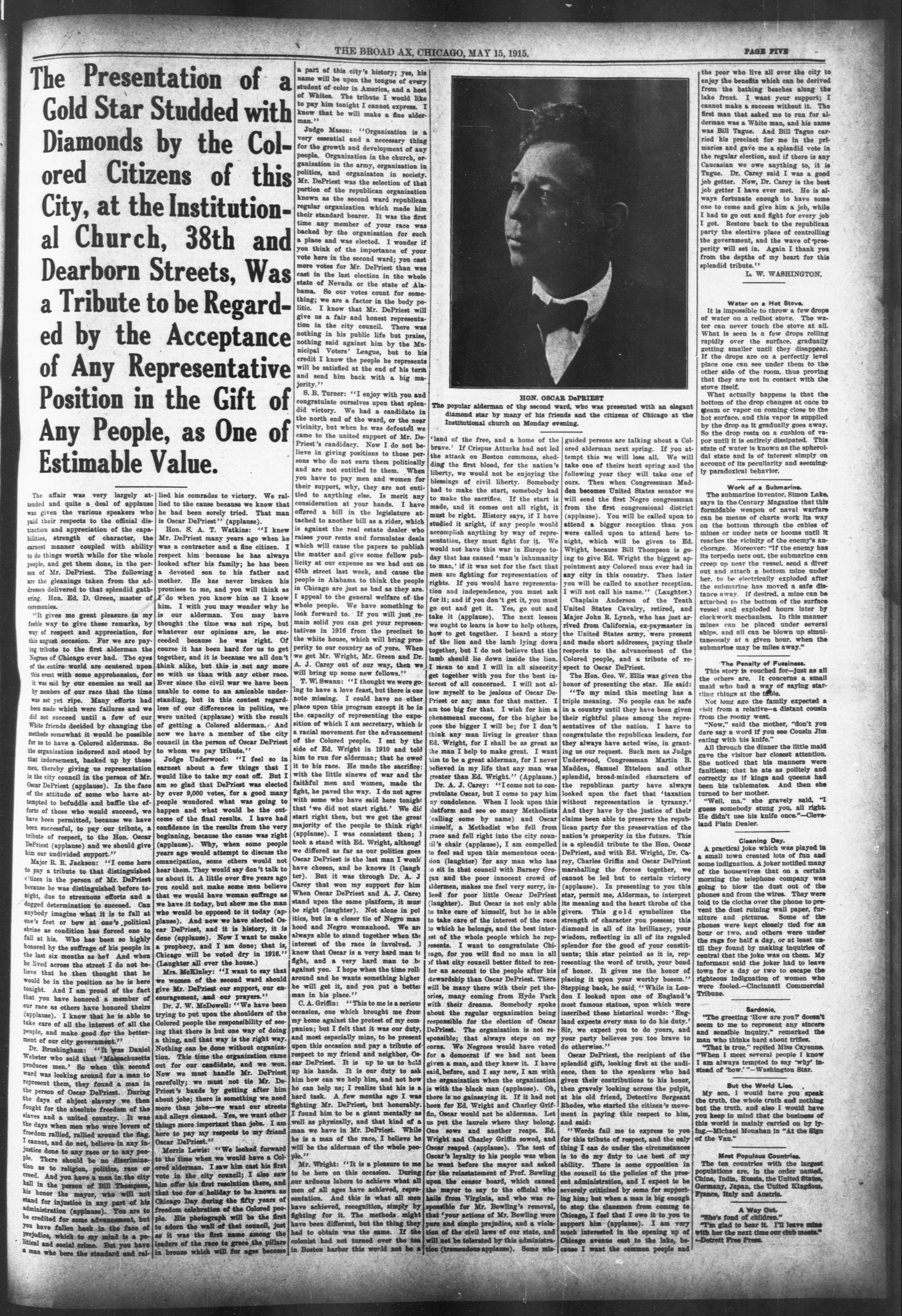
Page text (machine-generated)
BROAD AX
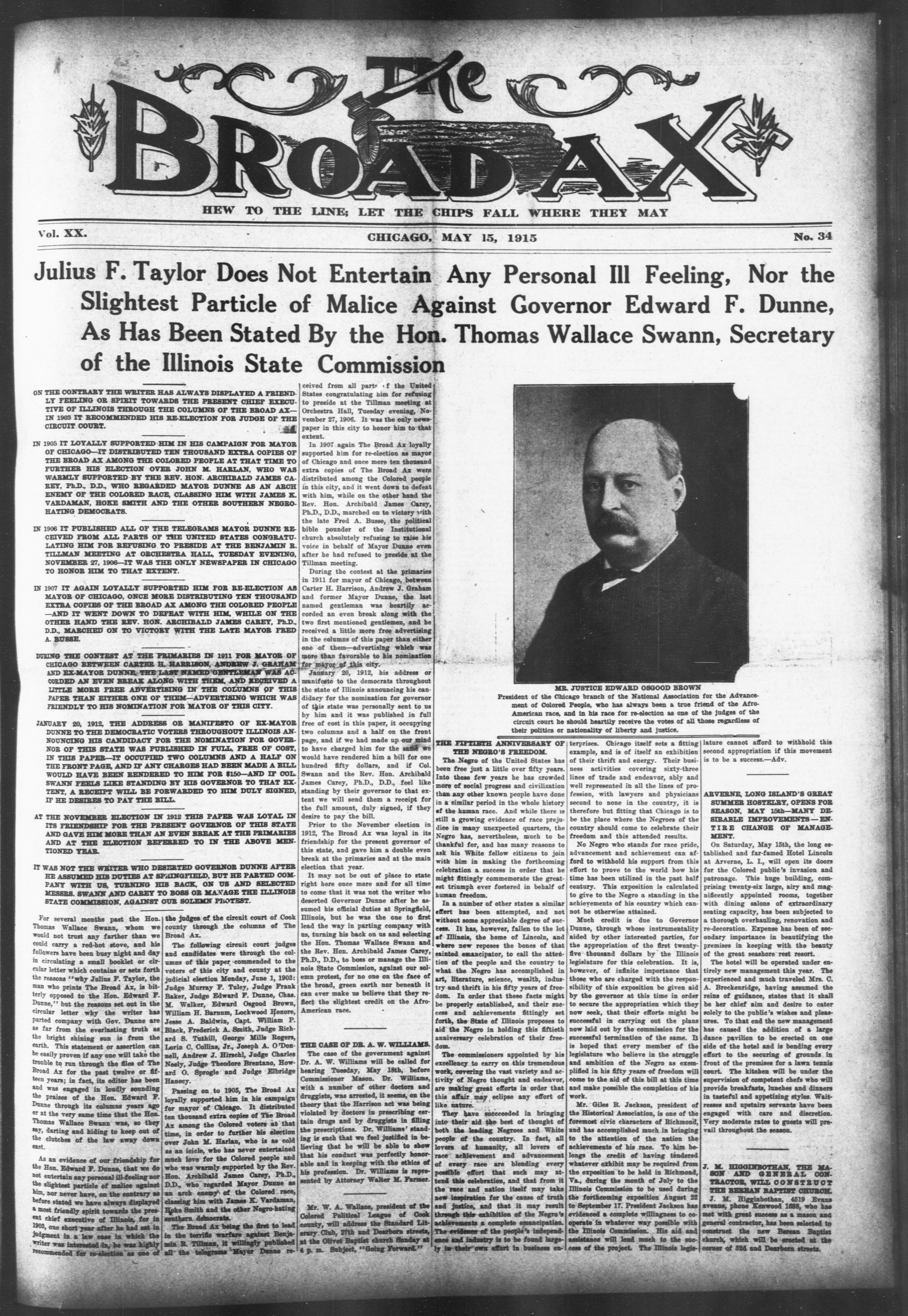
Julius F. Taylor Does Not Entertain Any Personal Ill Feeling, Nor the Slightest Particle of Malice Against Governor Edward F. Dunne, As Has Been Stated By the Hon. Thomas Wallace Swann, Secretary of the Illinois State Commission
ON THE CONTRARY THE WRITER HAS ALWAYS DISPLAYED A FRIENDLY FEELING OR SPIRIT TOWARDS THE PRESENT CHIFF EXECUTIVE OF ILLINOIS THROUGH THE COLUMNS OF THE BROAD AX—IN 1903 IT RECOMMENDED HIS RE-ELECTION FOR JUDGE OF THE CIRCUIT COURT.
IN 1905 IT LOYALLY SUPPORTED HIM IN HIS CAMPAIGN FOR MAYOR OF CHICAGO—IT DISTRIBUTED TEN THOUSAND EXTRA COPIES OF THE BROAD AX AMONG THE COLORED PEOPLE AT THAT TIME TO FURTHER HIS ELECTION OVER JOHN M. HABLAN, WHO WAS WARMLY SUPPORTED BY THE REV. HON. ARCHIBALD JAMES CAREY, Ph.D., D.D., WHO REGARDED MAYOR DUNNE AS AN ARCH ENEMY OF THE COLORED RACE, CLASSING HIM WITH JAMES K. VARDAMAN, HOKE SMITH AND THE OTHER SOUTHERN NEGRO-HATING DEMOCRATS.
IN 1906 IT PUBLISHED ALL OF THE TELEGRAMS MAYOR DUNNE RECEIVED FROM ALL PARTS OF THE UNITED STATES CONGRATULATING HIM FOR REFUSING TO PRESIDE AT THE BENJAMIN B. TILLMAN MEETING AT ORCHESTRA HALL, TUESDAY EVENING, NOVEMBER 27, 1906—IT WAS THE ONLY NEWSPAPER IN CHICAGO TO HONOR HIM TO THAT EXTENT.
IN 1907 IT AGAIN LOYALLY SUPPORTED HIM FOR RE-ELECTION AS MAYOR OF CHICAGO, ONCE MORE DISTRIBUTING TEN THOUSAND EXTRA COPIES OF THE BROAD AX AMONG THE COLORED PEOPLE—and IT WENT DOWN TO DEFEAT WITH HIM, WHILE ON THE OTHER HAND THE REV. HON. ARCHIBALD JAMES CAREY, Ph.D., D.D., MARCHED ON TO VICTORY WITH THE LATE MAYOR FRED A. BUSSE.
DURING THE CONTEST AT THE PRIMARIES IN 1911 FOR MAYOR OF CHICAGO BETWEEN CARTER H. HARRISON, ANDREW J. GRAHAM AND EX-MAYOR DUNNE, THE LAST NAMED GENTLEMAN WAS ACCORDED AN EVEN BREAK ALONG WITH THEM, AND RECEIVED A LITTLE MORE FREE ADVERTISING IN THE COLUMNS OF THIS PAPER THAN EITHER ONE OF THEM—ADVERTISING WHICH WAS FRIENDLY TO HIS NOMINATION FOR MAYOR OF THIS CITY.
JANUARY 20, 1912, THE ADDRESS OR MANIFESTO OF EX-MAYOR DUNNE TO THE DEMOCRATIC VOTERS THROUGHOUT ILLINOIS ANNOUNCING HIS CANDIDACY FOR THE NOMINATION FOR GOVERNOR OF THIS STATE WAS PUBLISHED IN FULL, FREE OF COST, IN THIS PAPER—IT OCCUPIED TWO COLUMNS AND A HALF ON THE FRONT PAGE, AND IF ANY CHARGES HAD BEEN MADE A BILL WOULD HAVE BEEN RENDERED TO HIM FOR $150—AND IF COL SWANN FEELS LIKE STANDING BY HIS GOVERNOR TO THAT EXTENT, A RECEIPT WILL BE FORWARDED TO HIM DULY SIGNED, IF HE DESIRES TO PAY THE BILL.
AT THE NOVEMBER ELECTION IN 1912 THIS PAPER WAS LOYAL IN ITS FRIENDSHIP FOR THE PRESENT GOVERNOR OF THIS STATE AND GAVE HIM MORE TEAN AN EVEN BREAK AT THE PRIMARIES AND AT THE ELECTION REPEEDED TO IN THE ABOVE MENTIONED YEAR.
IT WAS NOT THE WRITER WHO DESERTED GOVERNOR DUNNE AFTER HE ASSUMED HIS DUTIES AT SPRINGFIELD, BUT HE PARTED COMPANY WITH US, TURNING HIS BACK, ON US AND SELECTED MESSRS. SWANN AND CAREY TO BOSS OR MANAGE THE ILLINOIS STATE COMMISSION, AGAINST OUR SOLEMN PROTEST.
Vol. XX.
Julius F. Tay
Slighter
As Hass
of the
ON THE CONTRARY THE WRITER BE
LY FEELING OR SPIRIT TOW
TIVE OF ILLINOIS THROUGH T
IN 1903 IT RECOMMENDED HIS
CIRCUIT COURT.
IN 1905 IT LOYALLY SUPPORTED ALL OF CHICAGO—IT DISTRIBUTED THE BROAD AX AMONG THE O
FURTHER HIS ELECTION OVER
WARMLY SUPPORTED BY THE
REY, Ph.D., D.D., WHO REGARD
ENEMY OF THE COLORED RAC
VARDAMAN, HOKE SMITH AND
HATING DEMOCRATS.
IN 1906 IT PUBLISHED ALL OF THE
CEIVED FROM ALL PARTS OF
LATING HIM FOR REFUSING
TILLMAN MEETING AT ORCH
NOVEMBER 27, 1906—IT WAS T
TO HONOR HIM TO THAT EXT
IN 1907 IT AGAIN LOYALLY SUPP
MAYOR OF CHICAGO, ONCE MORE
EXTRA COPIES OF THE BROAD
—and IT WENT DOWN TO DIE
OTHER HAND THE REV. HON
D.D., MARCHED ON TO VICTOR
A. BUSSE.
DURING THE CONTEST AT THE I
CHICAGO BETWEEN CARTER B
AND EX-MAYOR DUNNE, THE
CORDED AN EVEN BREAK ALO
LITTLE MORE FREE ADVERT
PAPER THAN EITHER ONE OF
FRIENDLY TO HIS NOMINATION.
JANUARY 20, 1912, THE ADDRESS
DUNNE TO THE DEMOCRATIC W
NOUNCING HIS CANDIDACY P
NOR OF THIS STATE WAS PUT
IN THIS PAPER—IT OCCUPIED
THE FRONT PAGE, AND IF ANY
WOULD HAVE BEEN RENDERED
SWANN FEELS LIKE STANDING
TENT, A RECEPT WILL BE F
IF HE DESIRES TO PAY THE B
AT THE NOVEMBER ELECTION IN
ITS FRIENDSHIP FOR THE PR
AND GAVE HIM MORE THAN A
AND AT THE ELECTION RE
TIONED YEAR.
IT WAS NOT THE WRITER WHO DE
HE ASSUMED HIS DUTIES AT S
PANY WITH US, TURNING H
MESSRS. SWANN AND CAREY T
STATE COMMISSION, AGAINST
For several months past the Hon. Thomas Wallace Swann, whom we would not trust any farther than we could carry a red-hot stove, and his followers have been busy night and day in circulating a small booklet or circular letter which contains or sets forth the reasons "why Julius F. Taylor, the man who prints The Broad Ax, is bitterly opposed to the Hon. Edward F. Dunne," but the reasons set out in the circular letter why the writer has parted company with Gov. Dunne are as far from the everlasting truth as the bright shining sun is from the earth. This statement or assertion can be easily proven if any one will take the trouble to run through the files of The Broad Ax for the past twelve or fifteen years; in fact, its editor has been and was engaged in loudly sounding the praises of the Hon. Edward F. Dunne through its columns years ago or at the very same time that the Hon. Thomas Wallace Swann was, so they say, darting and hiding to keep out of the clutches of the law away down east.
As an evidence of our friendship for the Hon. Edward F. Dunne, that we do not entertain any personal ill-feeling nor the slightest particle of malice against him, nor never have, on the contrary as before stated we have always displayed a most friendly spirit towards the present chief executive of Illinois, for in 1903, one short year after he had sat in judgment in a law case in which the writer was interested in, he was highly recommended for re-election as one of
HEW TO THE LINE; LET THE CHIPS FALL WHERE THEY MAY
the judges of the circuit court of Cook county through the columns of The Broad Ax.
The following circuit court judges and candidates were through the columns of this paper commended to the voters of this city and county at the judicial election Monday, June 1, 1903: Judge Murray F. Tuley, Judge Frank Baker, Judge Edward F. Dunne, Chas. M. Walker, Edward Osgood Brown, William H. Barnum, Lockwood Honore, Jesse A. Baldwin, Capt. William P. Black, Frederick A. Smith, Judge Richard S. Tuthill, George Mills Rogers, Lorin C. Collins, Jr., Joseph A. O'Donnell, Andrew J. Hirschl, Judge Charles Neely, Judge Theodore Brentano, Howard O. Sproogle and Judge Elbridge Haney.
Passing on to 1905, The Broad Ax loyally supported him in his campaign for mayor of Chicago. It distributed ten thousand extra copies of The Broad Ax among the Colored voters at that time, in order to further his election over John M. Harlan, who is as cold as an icicle, who has never entertained much love for the Colored people and who was warmly supported by the Rev. Hon. Archibald James Carey, Ph.D., D.D., who regarded Mayor Dunne as an arch enemy of the Colored race, classing him with James K. Vardaman, Hoke Smith and the other Negro-hating southern democrats.
The Broad Ax being the first to lead in the terrific warfare against Benjamin B. Tillman, it willingly published all the tolerances Mr Dunne re-
CHICAGO, MAY 15, 1915
ceived from all parts of the United States congratulating him for refusing to preside at the Tillman meeting at Orchestra Hall, Tuesday evening, November 27, 1906. It was the only newspaper in this city to honor him to that extent. In 1907 again The Broad Ax loyally supported him for re-election as mayor of Chicago and once more ten thousand extra copies of The Broad Ax were distributed among the Colored people in this city, and it went down to defeat with him, while on the other hand the Rev. Hon. Archibald James Carey, Ph.D., D.D., marched on to victory with the late Fred A. Buse, the political bible pounder of the Institutional church absolutely refusing to raise his voice in behalf of Mayor Dunne even after he had refused to preside at the Tillman meeting.
During the contest at the primaries in 1911 for mayor of Chicago, between Carter H. Harrison, Andrew J. Graham and former Mayor Dunne, the last named gentleman was heartily accorded an even break along with the two first mentioned gentlemen, and he received a little more free advertising in the columns of this paper than either one of them—advertising which was more than nomination to his nomination for mayor of this city.
January 20, 1912, his address or manifesto to the democrats throughout the state of Illinois announcing his candidacy for the nomination for governor of this state was personally sent to us by him and it was published in full free of cost in this paper, it occupying two columns and a half on the front page, and if we had made up our mind to have charged him for the same we would have rendered him a bill for one hundred fifty dollars, and if Col. Swann and the Rev. Hon. Archibald James Carey, Ph.D., D.D., feel like standing by their governor to that extent we will send them a receipt for the full amount, duly signed, if they desire to pay the bill.
Prior to the November election in 1912, The Broad Ax was loyal in its friendship for the present governor of this state, and gave him a double even break at the primaries and at the main election that year.
It may not be out of place to state right here once more and for all time to come that it was not the writer who deserted Governor Dunne after he assumed his official duties at Springfield, Illinois, but he was the one to first lead the way in parting company with us, turning his back on us and selecting the Hon. Thomas Wallace Swann and the Rev. Hon. Archibald James Carey, Ph.D., D.D., to boss or manage the Illinois State Commission, against our solemn protest, for no one on the face of the broad, green earth nor beneath it can ever make us believe that they reflect the slightest credit on the Afro-American race.
THE CASE OF DR. A. W. WILLIAMS.
The case of the government against Dr. A. W. Williams will be called for hearing Tuesday, May 18th, before Commissioner Mason. Dr. Williams, with a number of other doctors and druggists, was arrested, it seems, on the theory that the Harrison act was being violated by doctors in prescribing certain drugs and by druggists in filling the prescriptions. Dr. Williams' standing is such that we feel justified in believing that he will be able to show that his conduct was perfectly honorable and in keeping with the ethics of his profession. Dr. Williams is represented by Attorney Walter M. Farmer.
Mr. W. A. Wallace, president of the Colored Political League of Cook county, will address the Standard Literary Club, 27th and Dearborn streets, at the Olivet Baptist church Sunday at 4 p.m. Subject, "Going Forward."
[Name]
President of the Chicago branch of the National Association for the Advancement of Colored People, who has always been a true friend of the Afro-American race, and in his race for re-election as one of the judges of the circuit court he should heartily receive the votes of all those regardless of their politics or nationality of liberty and justice.
THE NEGRO'S FREEDOM
The Negro of the United States has been free just a little over fifty years. Into these few years he has crowded more of social progress and civilization than any other known people have done in a similar period in the whole history of the human race. And while there is still a growing evidence of race prejudice in many unexpected quarters, the Negro has, nevertheless, much to be thankful for, and has many reasons to ask his White fellow citizens to join with him in making the forthcoming celebration a success in order that he might fittingly commemorate the greatest triumph ever fostered in behalf of human freedom.
In a number of other states a similar effort has been attempted, and not without some appreciable degree of success. It has, however, fallen to the lot of Illinois, the home of Lincoln, and where now reposes the bones of that sainted emancipator, to call the attention of the people and the country to what the Negro has accomplished in art, literature, science, wealth, industry and thrift in his fifty years of freedom. In order that these facts might be properly established, and their success and achievements fittingly set forth, the State of Illinois proposes to aid the Negro in holding this fiftieth anniversary celebration of their freedom.
The commissioners appointed by his excellency to carry on this tremendous work, covering the vast variety and activity of Negro thought and endeavor, are making great efforts in order that this affair may eclipse any effort of like nature.
They have succeeded in bringing into their aid the best of thought of both the leading Negroes and White people of the country. In fact, all lovers of humanity, all lovers of race achievement and advancement of every race are blending every possible effort that such may attend this celebration, and that from it the race and nation itself may take new inspiration for the cause of truth and justice, and that it may result through this exhibition of the Negro's achievements a complete emancipation. The evidence of the people's independence and industry is to be found largely in their own effort in business en-
MR. JUSTICE EDWARD OSGOOD BROWN
terprises. Chicago itself sets a fitting example, and is of itself an exhibition of their thrift and energy. Their business activities covering sixty-three lines of trade and endeavor, ably and well represented in all the lines of profession, with lawyers and physicians second to none in the country, it is therefore but fitting that Chicago is to be the place where the Negroes of the country should come to celebrate their freedom and this attended results. No Negro who stands for race pride, advancement and achievement can afford to withhold his support from this effort to prove to the world how his time has been utilized in the past half century. This exposition is calculated to give to the Negro a standing in the achievements of his country which cannot be otherwise attained.
Much credit is due to Governor Dunne, through whose instrumentality aided by other interested parties, for the appropriation of the first twenty-five thousand dollars by the Illinois legislature for this celebration. It is, however, of infinite importance that those who are charged with the responsibility of this exposition be given aid by the governor at this time in order to secure the appropriation which they now seek, that their efforts might be successful in carrying out the plans now laid out by the commission for the successful termination of the same. It is hoped that every member of the legislature who believe in the struggle and ambition of the Negro as exemplified in his fifty years of freedom will come to the aid of this bill at this time and make possible the completion of his work.
Mr. Giles B. Jackson, president of the Historical Association, is one of the foremost civic characters of Richmond, and has accomplished much in bringing to the attention of the nation the achievements of his race. To him belongs the credit of having tendered whatever exhibit may be required from the exposition to be held in Richmond, Va., during the month of July to the Illinois Commission to be used during the forthcoming exposition August 22 to September 17. President Jackson has evidenced a complete willingness to cooperate in whatever way possible with the Illinois Commission. His aid and assistance will lend much to the success of the project. The Illinois legis-
No.34
ng, Nor the
d F. Dunne,
n, Secretary
for the Advance-
friend of the Afro-
the judges of the
those regardless of
lature cannot afford to withhold this second appropriation if this movement is to be a success.—Adv.
ARVEERNE, LONG ISLAND'S GREAT SUMMER HOSTELRY, OPENS FOR SEASON, MAY 15th—MANY DESIRABLE IMPROVEMENTS—ENTIRE CHANGE OF MANAGEMENT.
On Saturday, May 15th, the long established and far-famed Hotel Lincoln at Arverne, L. L., will open its doors for the Colored public's invasion and patronage. This huge building, comprising twenty-six large, airy and magnificently appointed rooms, together with dining salons of extraordinary seating capacity, has been subjected to a thorough overhauling, renovation and re-decoration. Expense has been of secondary importance in beautifying the premises in keeping with the beauty of the great seashore rest resort.
The hotel will be operated under entirely new management this year. The experienced and much traveled Mrs. C. A. Breckenridge, having assumed the reins of guidance, states that it shall be her chief aim and desire to cater solely to the public's wishes and pleasures. To that end the new management has caused the addition of a large dance pavilion to be erected on one side of the hotel and is bending every effort to the securing of grounds in front of the premises for a lawn tennis court. The kitchen will be under the supervision of competent chefs who will provide breakfasts, lunches and dinners in tasteful and appetizing styles. Waitresses and upstairs servants have been engaged with care and discretion. Very moderate rates to guests will prevail throughout the season.
J. M. HIGGINEBOTHAN, THE MASON AND GENERAL CONTRACTOR, WILL CONSTRUCT THE BEREAN BAPTIST CHURCH. J. M. Higginbothan, 4519 Evans avenue, phone Kenwood 1688, who has met with great success as a mason and general contractor, has been selected to construct the new Berean Baptist church, which will be erected at the corner of 52d and Dearborn streets.
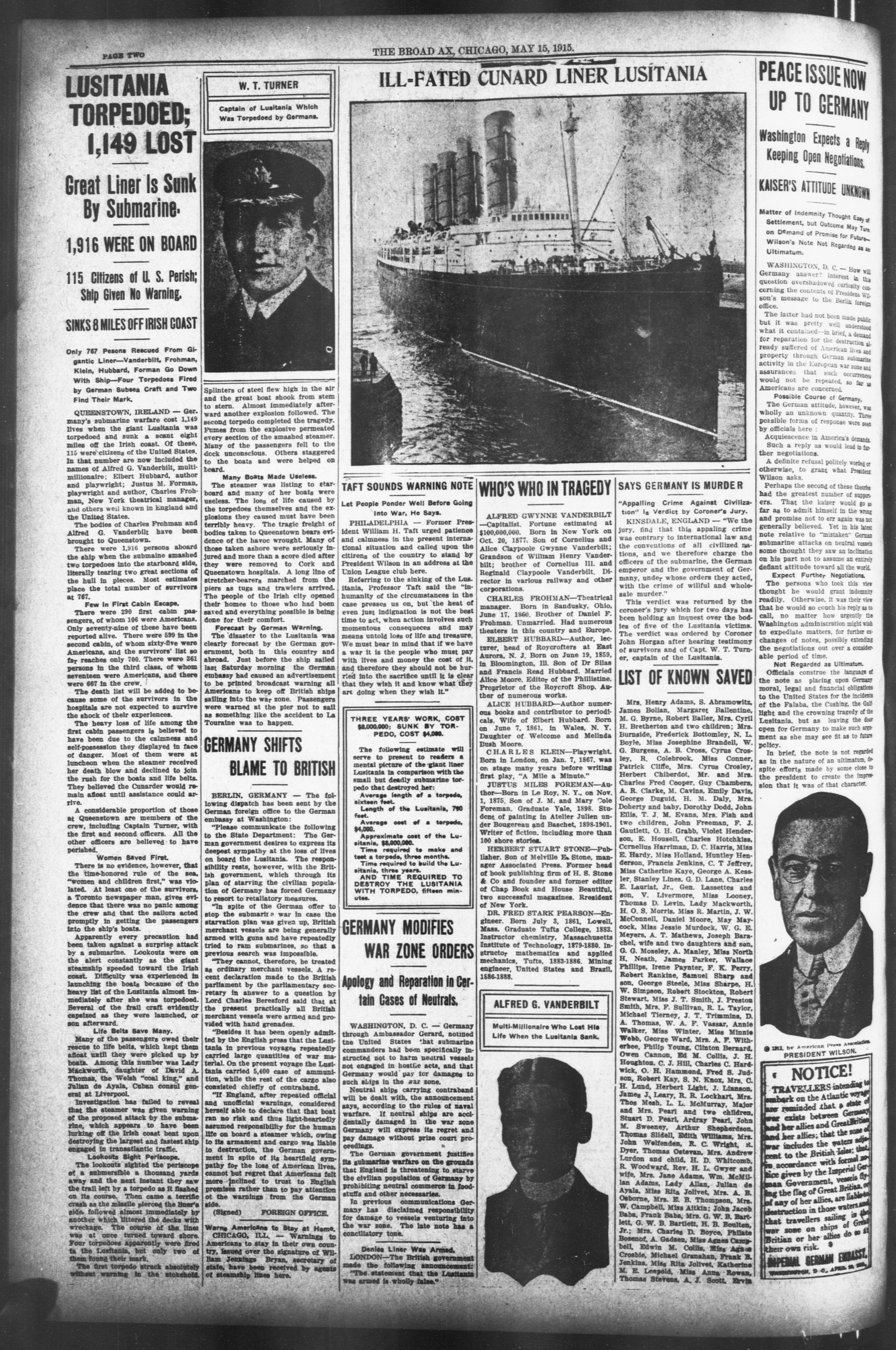
LUSITANIA TORPEDOED; 1,149 LOST
1,916 WERE ON BOARD
115 Citizens of U. S. Perish; Ship Given No Warning.
SINKS 8 MILES OFF IRISH COAST
Only 767 Pesons Rescued From Giantic Liner—Vanderbilt, Frohman, Klein, Hubbard, Forman Go Down With Ship—Four Torpedoes Fired by German Subsea Craft and Two Find Their Mark.
QUEENSTOWN, IRELAND — Ger-
man's submarine warfare cost 1,149 lives when the giant Lusitania was torpedoed and sunk a scant eight miles off the Irish coast. Of these, 115 were citizens of the United States. In that number are now included the names of Alfred G. Vanderbilt, multimillionaire; Elbert Hubbard, author and playwright; Justus M. Forman, playwright and author, Charles Frohman, New York theatrical manager, and others well known in England and the United States.
The bodies of Charles Frohman and Alfred G. Vanderbilt have been brought to Queenstown. There were 1,916 persons aboard the ship when the submaine smashed two torpedoes into the starboard side, literally tearing two great sections of the hull in pieces. Most estimates place the total number of survivors at 767.
Few In First Cabin Escape.
There were 290 first cabin passengers, of whom 106 were Americans. Only seventy-nine of these have been reported alive. There were 599 in the second cabin, of whom sixty-five were Americans, and the survivors' list so far reaches only 700. There were 361 persons in the third class, of whom seventeen were Americans, and there were 667 in the crew.
The death list will be added to because some of the survivors in the hospitals are not expected to survive the shock of their experiences.
The heavy loss of life among the first cabin passengers is believed to have been due to the calmness and self-possession they displayed in face of danger. Most of them were at luncheon when the steamer received her death blow and declined to join the rush for the boats and life belts. They believed the Cunarder would remain afloat until assistance could arrive.
A considerable proportion of those at Queenstown are members of the crew, including Captain Turner, with the first and second officers. All the other officers are believed to have perished.
Women Saved First.
There is no evidence, however, that the time-honored rule of the sea, "women and children first," was violated. At least one of the survivors, a Toronto newspaper man, gives evidence that there was no panic among the crew and that the sailors acted promptly in getting the passengers into the ship's boats.
Apparently every precaution had been taken against a surprise attack by a submarine. Lookouts were on the alert constantly as the giant steamship speeded toward the Irish coast. Difficulty was experienced in launching the boats because of the heavy list of the Lusitania almost immediately after she was torpedoed. Several of the frail craft evidently capsized as they were launched, or son afterward.
Life Belts Save Many.
Many of the passengers owed their rescue to life belts, which kept them afloat until they were picked up by boats. Among this number was Lady Mackworth, daughter of David A. Thomas, the Welsh "coal king," and Julian de Ayala, Cuban consul general at Liverpool.
Investigation has failed to reveal that the steamer was given warning of the proposed attack by the submarine, which appears to have been lurking off the Irish coast bent upon destroying the largest and fastest ship engaged in transatlantic traffic.
Lookouts Sight Periscope.
The lookouts sighted the periscope of a submersible a thousand yards away and the next instant they saw the trail left by a torpedo as it flashed on its course. Then came a terrific crash as the missile pierced the liner's side, followed almost immediately by another which littered the decks with wreckage. The course of the liner was at once turned toward shore. Four torpedoes apparently were fired to the Lusitania, but only two of them found their mark
The first torpedo struck absolutely without warning in the stockhold.
Captain of Lusitania Which Was Torpeded by Germans.
O
Splinters of steel flew high in the air and the great boat shook from stem to stern. Almost immediately afterward another explosion followed. The second torpedo completed the tragedy. Fumes from the explosive permeated every section of the smashed steamer. Many of the passengers fell to the dock unconscious. Others staggered to the boats and were helped on board.
Many Boats Made Useless.
The steamer was listing to starboard and many of her boats were useless. The loss of life caused by the torpedoes themselves and the explosions they caused must have been terribly heavy. The tragic freight of bodies taken to Queenstown bears evidence of the havoc wrought. Many of those taken ashore were seriously injured and more than a score died after they were removed to Cork and Queenstown hospitals. A long line of stretcher-bearers marched from the piers as tugs and trawlers arrived. The people of the Irish city opened their homes to those who had been saved and everything possible is being done for their comfort.
Forecast by German Warning.
The disaster to the Lusitania was clearly forecast by the German government, both in this country and abroad. Just before the ship sailed last Saturday morning the German embassy had caused an advertisement to be printed broadcast warning all Americans to keep off British ships sailing into the war zone. Passengers were warned at the pier not to sail as something like the accident to La Touraine was to happen.
GERMANY SHIFTS BLAME TO BRITISH
BERLIN, GERMANY — The following dispatch has been sent by the German foreign office to the German embassy at Washington:
"Please communicate the following to the State Department: The German government desires to express its deepest sympathy at the loss of lives on board the Lusitania. The responsibility rests, however, with the British government, which through its plan of starring the civilian population of Germany has forced Germany to resort to retaliatory measures.
"In spite of the German offer to stop the submarine war in case the starvation plan was given up, British merchant vessels are being generally armed with guns and have repeatedly tried to ram submarines, so that a previous search was impossible.
"They cannot, therefore, be treated as ordinary merchant vessels. A recent declaration made to the British parliament by the parliamentary secretary in answer to a question by Lord Charles Beresford said that at the present practically all British merchant vessels were armed and provided with hand grenades. "Besides it has been openly admitted by the English press that the Lustania in previous voyage repeatedly carried large quantities of war material. On the present voyage the Lustania carried 5,400 case of ammunition, while the rest of the cargo also consisted chiefly of contraband.
"If England, after repeated official and unofficial warnings, considered herself able to declare that that boat ran no risk and thus light-heartedly assumed responsibility for the human life on board a steamer which, owing to its armament and cargo was liable to destruction, the German government in spite of its heartfelt sympathy for the loss of American lives, cannot but regret that Americans felt more inclined to trust to English promises rather than to pay attention to the warnings from the German side.
Warns Americans to Stay at Home,
CHICAGO, ILL. — Warnings to
Americans to stay in their own
country, issued over the signature of
William Jennings Bryan, secretary of
state, have been received by agents
of steamship lines here.
THE BROAD AX, CHICAGO, MAY 15, 1915.
ILL-FATED CUNARD LINER LUSITANIA
TITANIC
TAFT SOUNDS WARNING NOTE
Let People Ponder Well Before Going Into War, He Says.
PHILADELPHIA — Former President William H. Taft urged patience and calmness in the present international situation and called upon the citizens of the country to stand by President Wilson in an address at the Union League club here.
Referring to the sinking of the Lusitania, Professor Taft said the "inhumanity of the circumstances in the case presses us on, but the heat of even just indignation is not the best time to act, when action involves such momentous consequeces and may means untold loss of life and treasure. We must bear in mind that if we have a war it is the people who must pay with lives and money the cost of it, and therefore they should not be hurried into the sacrifice until it is clear that they wish it and know what they are doing when they wish it."
THREE YEARS' WORK, COST
$8,000,000; SUNK BY TOR-
PEDO, COST $4,000.
The following estimate will serve to present to readers a mental picture of the giant liner Lusitania in comparison with the small but deadly submarine torpedo that destroyed her: Average length of a torpedo, sixteen feet.
Approximate cost of the Lusitania, $8,000,000.
Time required to make and test a torpedo, three months.
Time required to build the Lusitania, three years.
AND TIME REQUIRED TO DESTROY THE LUSITANIA WITH TORPEDO, fifteen minutes.
GERMANY MODIFIES WAR ZONE ORDERS Apology and Reparation in Certain Cases of Neutrals.
WASHINGTON, D. C. — Germany through Ambassador Gerard, notified the United States that submarine commanders had been specifically instructed not to harm neutral vessels not engaged in hostile acts, and that Germany would pay for damages to such ships in the war zone. Neutral ships carrying contraband will be dealt with, the announcement says, according to the rules of naval warfare. If neutral ships are accidentally damaged in the war zone Germany will express its regret and pay damage without prize court proceedings. The German government justifies its submarine warfare on the grounds that England is threatening to sturve the civilian population of Germany by prohibiting neutral commerce in foodstuffs and other necessaries.
In previous communications Germany has disclaimed responsibility for damage to vessels venturing into the war zone. The late note has a conciliatory tone.
Denies Liner Was Armed.
LONDON—The British government made the following announcement:
"The statement that the Lusitania was armed is wholly false."
WHO'S WHO IN TRAGEDY
ALFRED GWYNNE VANDERBILT
—Capitalist. Fortune estimated at
$100,000,000. Born in New York on
Oct. 20, 1877. Son of Cornelius and
Alice Claypoole Gwynne Vanderbilt;
Grandson of William Henry Vanderbilt;
brother of Cornelius III. and
Reginald Claypoole Vanderbilt. Director in various railway and other corporations.
CHARLES FROHMAN—Theatrical manager. Born in Sandusky, Ohio, June 17, 1860. Brother of Daniel F. Frohman. Unmarried. Had numerous theaters in this country and Europe.
ELBERT HUBBARD—Author, lecturer, head of Roycrofters at East Aurora, N. J. Born on June 19, 1859, in Bloomington, Ill. Son of Dr Silas and Francis Read Hubbard. Married Alice Moore. Editor of the Phillistine. Proprietor of the Roycroft Shop. Author of numerous works.
ALICE HUBBARD—Author numerous books and contributor to periodicals. Wife of Elbert Hubbard. Born on June 7, 1861, in Wales, N. Y. Daughter of Welcome and Melinda Bush Moore.
CH.AARLES KLEIN—Playwright. Born in London, on Jan. 7, 1867, was on stage many years before writing first play, "A Mile a Minute."
JUSTUS MILES FOREMAN—Author—Born in Le Roy, N. Y., on Nov. 1, 1875. Son of J. M. and Mary Cole Foreman. Graduate Yale, 1898. Student of painting in Atelier Julien under Bougereau and Baschet, 1898-1901. Writer of fiction, including more than 100 shore stories.
HERBERT STUART STONE—Publisher. Son of Melville E. Stone, manager Associated Press. Former head of book publishing firm of H. S. Stone & Co and founder and former editor of Chap Book and House Beautiful, two successful magazines. Resident of New York.
DR. FRED STARK PEARSON—Engineer. Born July 3, 1861, Lowell, Mass. Graduate Tufts College, 1883. Instructor chemistry, Massachusetts Institute of Technology, 1879-1880. Instructor mathematics and applied mechanics, Tufts, 1883-1886. Mining engineer, United States and Brazil, 1886-1888.
Multi-Millionaire Who Lost His
Life When the Lusitania Sank.
```markdown
```
SAYS GERMANY IS MURDER
"Appalling Crime Against Civilization" Is Verdict by Coroner's Jury.
KINSDALE, ENGLAND — "We the jury, find that this appalling crime was contrary to international law and the conventions of all civilized nations, and we therefore charge the officers of the submarine, the German emperor and the government of Germany, under whose orders they acted, with the crime of willful and wholesale murder."
This verdict was returned by the coroner's jury which for two days has been holding an inquest over the bodies of five of the Lusitania victims. The verdict was ordered by Coroner John Horgan after hearing testimony of survivors and of Capt. W. T. Turner, captain of the Lusitania.
LIST OF KNOWN SAVED
Washington Expects a Reply Keeping Open Negotiations.
Matter of Indemnity Thought Easy of Settlement, but Outcome May Turn on Demand of Promise for Future—Wilson's Note Not Regarded as an Ultimatum.
WASHINGTON, D. C. — How will Germany answer? Interest in this question overshadowed curiosity concerning the contents of President Wilson's message to the Berlin foreign office.
The latter had not been made public but it was pretty well understood what it contained—in brief, a demand for reparation for the destruction all ready suffered of American lives and property through German submarine activity in the European war zone and assurances that such occurrences would not be repeated, so far as Americans are concerned.
Possible Course of Germany
The German attitude, however, was wholly an unknown quantity. Three possible forms of response were seen by officials here:
Acquiescence in America's demands.
Such a reply as would lead to further negotiations.
A definite refusal politely worded or otherwise, to grant what President Wilson asks.
Perhaps the second of these theories had the greatest number of supporters. That the kaiser would go so far as to admit himself in the wrong and promise not to er again was not generally believed. Yet in his latest note relative to "mistaken" German submarine attacks on neutral vessels some thought they saw an inclination on his part not to assume an entirely defiant attitude toward all the world.
Expect Further Negotiations.
The persons who took this view thought he would grant indemnity readily. Otherwise, it was their view that he would so couch his reply as to call, no matter how urgently the Washington administration might wish to expediate matters, for further exchanges of notes, possibly extending the negotiations out over a consider able period of time.
Not Regarded as Ultimatum.
Officials construe the language of the note as placing upon Germany moral, legal and financial obligations to the United States for the incidents of the Falaba, the Cushing, the Gullight and the crowning tragedy of the Lusitania, but as leaving the door open for Germany to make such argument as she may see fit as to future policy. In brief, the note is not regarded as in the nature of an ultimatum, despite efforts made by some close to the president to create the impression that it was of that character.
[Image of a man in a suit with a tie and glasses].
1912, bv American Press Annu
PRESIDENT WILSON.
NOTICE!
TRAVELLERS intending to embark on the Atlantic voyage are reminded that a state of war exists between Germany, and her allies and Great Britain, and her allies; that the zone of war includes the waters adjacent to the British Isles; that, in accordance with formal notice given by the Imperial German Government, vessels flying the flag of Great Britain, or of any of her allies, are liable to destruction in those waters and that travellers sailing in the war zone on ships of Great Britain or her allies do so at their own risk.
IMPENAL GERMAN ENRASST,
WASHINGTON, D. O., APRIL 28, 1841.
Two Members of the Woodpecker Family.
Woodpecker
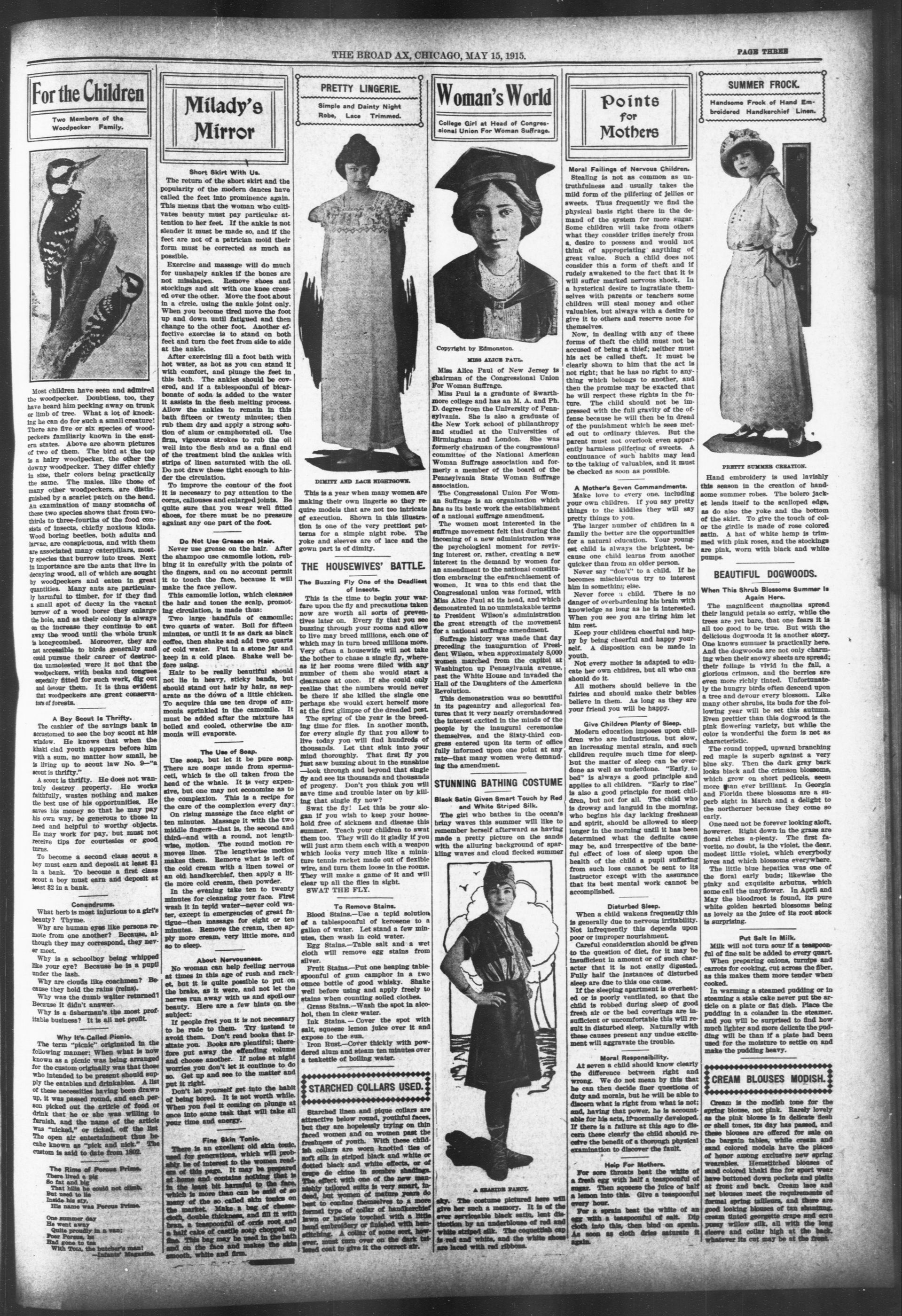
Most children have seen and admired the woodpecker. Doubtless, too, they have heard him pecking away on trunk or limb of tree. What a lot of knocking he can do for such a small creature! There are five or six species of woodpeckers familiarly known in the eastern states. Above are shown pictures of two of them. The bird at the top is a hairy woodpecker, the other the downy woodpecker. They differ chiefly in size, their colors being practically the same. The males, like those of many other woodpeckers, are distinguished by a scarlet patch on the head. An examination of many stomachs of these two species shows that from two-thirds to three-fourths of the food consists of insects, chiefly noxious kinds. Wood boring beetles, both adults and larvae, are conspicuous, and with them are associated many caterpillars, mostly species that burrow into trees. Next in importance are the ants that live in decaying wood, all of which are sought by woodpeckers and eaten in great quantities. Many ants are particularly harmful to timber, for if they find a small spot of decay in the vacant burrow of a wood borer they enlarge the hole, and as their colony is always on the increase they continue to eat away the wood until the whole trunk is honeycombed. Moreover, they are not accessible to birds generally and could pursue their career of destruction unmolested were it not that the woodpeckers, with beaks and tongues especially fitted for such work, dig out and devour them. It is thus evident that woodpeckers are great conservators of forests.
A Boy Scout Is Thrifty.
The cashier of the savings bank is accustomed to see the boy scout at his window. He knows that when the khaki clad youth appears before him with a sum, no matter how small, he is living up to scout law No. 9—"a scout is thrifty."
A scout is thrifty. He does not wantonly destroy property. He works faithfully, wastes nothing and makes the best use of his opportunities. He saves his money so that he may pay his own way, be generous to those in need and helpful to worthy objects. He may work for pay, but must not receive tips for courtesies or good turns.
To become a second class scout a boy must earn and deposit at least $1 in a bank. To become a first class scout a boy must earn and deposit at least $2 in a bank.
Conundrum
What herb is most injurious to a girl's beauty? Thyme.
Why are human eyes like persons remote from one another? Because, although they may correspond, they never meet.
Why is a schoolboy being whipped like your eye? Because he is a pupil under the lash.
Why are clouds like coachmen? Because they hold the rains (relax).
Why was the dumb waiter returned?
Because it didn't answer.
Why is a fisherman's the most profitable business? It is all net profit.
Why It's Called Picnic.
Why is it Cautious
The term "picnic" originated in the following manner: When what is now known as a picnic was being arranged for the custom originally was that those who intended to be present should supply the eatables and drinkables. A list of these necessities having been drawn up, it was passed round, and each person picked out the article of food or drink that he or she was willing to furnish, and the name of the article was "nicked," or ticked, off the list. The open air entertainment thus became known as "pick and nick." The custom is said to date from 1802.
The Rime of Porcus Prime.
There lived a pig
So fat and big
But used to lie
Inside his sty,
His name was Porcus Prime.
One summer day
He went away
Girl, groundly in a van:
Poor Porcus, he
Had gone to tea
With Tora, the butcher's man!
— Infants' Magazine.
Milady's Mirror
Short Skirt With Us.
The return of the short skirt and the popularity of the modern dances have called the feet into prominence again. This means that the woman who cultivates beauty must pay particular attention to her feet. If the ankle is not slender it must be made so, and if the feet are not of a patrician mold their form must be corrected as much as possible.
Exercise and massage will do much for unshapely ankles if the bones are not misshapen. Remove shoes and stockings and sit with one knee crossed over the other. Move the foot about in a circle, using the ankle joint only. When you become tired move the foot up and down until fatigued and then change to the other foot. Another effective exercise is to stand on both feet and turn the feet from side to side at the ankle.
After exercising fill a foot bath with hot water, as hot as you can stand it with comfort, and plunge the feet in this bath. The ankles should be covered, and if a tablespoonful of bicarbonate of soda is added to the water it assists in the flesh melting process. Allow the ankles to remain in this bath fifteen or twenty minutes; then rub them dry and apply a strong solution of alum or camphorated oil. Use firm, vigorous strokes to rub the oil well into the flesh and as a final end of the treatment bind the ankles with strips of linen saturated with the oil. Do not draw these tight enough to hinder the circulation.
To improve the contour of the foot it is necessary to pay attention to the corns, callouses and enlarged joints. Be quite sure that you wear well fitted shoes, for there must be no pressure against any one part of the foot.
Do Not Use: Grease on Hair
Never use grease on the hair. After the shampoo use camomile lotion, rubbing it in carefully with the points of the fingers, and on no account permit it to touch the face, because it will make the face yellow.
This camomile lotion, which cleanses the hair and tones the scalp, promoting circulation, is made thus:
Two large handfuls of camomile; two quarts of water. Boll for fifteen minutes, or until it is as dark as black coffee, then shake and add two quarts of cold water. Put in a stone jar and keep in a cold place. Shake well before using.
Hair to be really beautiful should not lie in heavy, sticky bands, but should stand out hair by hair, as separate as the down of a little chicken. To acquire this use ten drops of ammonia sprinkled in the camomile. It must be added after the mixture has boiled and cooled, otherwise the ammonia will evaporate.
The Use of Soap.
Use soap, but let it be pure soap. There are soaps made from spermaceti, which is the oil taken from the head of the whale. It is very expensive, but one may not economize as to the complexion. This is a recipe for the care of the complexion every day: On rising massage the face eight or ten minutes. Massage it with the two middle fingers—that is, the second and third—and with a round, not lengthwise, motion. The round motion removes lines. The lengthwise motion makes them. Remove what is left of the cold cream with a linen towel or an old handkerchief, then apply a little more cold cream, then powder.
In the evening take ten to twenty minutes for cleansing your face. First wash it in tepid water—never cold water, except in emergencies of great fatigue—then massage for eight or ten minutes. Remove the cream, then apply more cream, very little more, and so to sleep.
About Nervousness.
No woman can help feeling nervous at times in this age of rush and racket, but it is quite possible to put on the brake, as it were, and not let the nerves run away with us and spoil our beauty. Here are a few hints on the subject:
If people fret you it is not necessary to be rude to them. Try instead to avoid them. Don't read books that irritate you. Books are plentiful; therefore put away the offending volume and choose another. If noise at night worries you don't let it continue to do so. Get up and see to the matter and put it right.
Don't let yourself get into the habit of being bored. It is not worth while. When you feel it coming on plunge at once into some task that will take all your time and energy.
Fine Skin Tonic.
There is an excellent old skin tone, used for generations, which will probably be of interest to the women readers of this page. It may be prepared at home and contains nothing that is in the least bit harmful to the face, which is more than can be said of so many of the so called skin touches on the market. Make a bag of cheese cloth, double thickness, and fill it with bean, a teaspoonful of orchid root and a half cake of castle soap chopped up fine. This bag may be used in the bath and on the face and makes the skin smooth, white and firm.
THE BROAD AX, CHICAGO, MAY 15, 1915.
O
DIMITY AND LACE NIGHTGOWN.
This is a year when many women are making their own lingerie so they require models that are not too intricate of execution. Shown in this illustration is one of the very prettiest patterns for a simple night robe. The yoke and sleeves are of lace and the gown part is of dimity.
THE HOUSEWIVES' BATTLE.
The Buzzing Fly One of the Deadliest of Insects.
This is the time to begin your warfare upon the fly and precautions taken now are worth all sorts of preventives later on. Every fly that you see buzzing through your rooms and allow to live may breed millions, each one of which may in turn breed millions more. Very often a housewife will not take the bother to chase a single fly, whereas if her rooms were filled with any number of them she would start a clearance at once. If she could only realize that the numbers would never be there if she killed the single one perhaps she would exert herself more at the first glimpse of the dreaded pest
The spring of the year is the breeding time for files. In another month, for every single fly that you allow to live today you will find hundreds of thousands. Let that sink into your mind thoroughly. That first fly you just saw buzzing about in the sunshine—look through and beyond that single fly and see its thousands and thousands of progeny. Don't you think you will save time and trouble later on by killing that single fly now?
Swat the fly! Let this be your slogan if you wish to keep your household free of sickness and disease this summer. Teach your children to swat them too. They will do it gladly if you will just arm them each with a weapon which looks very much like a miniature tennis racket made out of flexible wire, and turn them loose in the rooms. They will make a game of it and will clear up all the files in sight.
SWAT THE FLY.
To Remove Stains.
Blood Stains.—Use a tepid solution of a tablespoonful of kerosene to a gallon of water. Let stand a few minutes, then wash in cold water.
Egg Stains.—Table salt and a wet cloth will remove egg stains from silver.
Fruit Stains.—Put one heaping tablespoonful of gum camphor in a two ounce bottle of good whisky. Shake well before using and apply freely to stains when counting soiled clothes.
Grass Stains.—Wash the spot in alcohol, then in clear water.
Ink Stains.—Cover the spot with salt, squeeze lemon juice over it and expose to the sun.
Iron Rust.—Cover thickly with powdered alum and steam ten minutes over a teakettle of boiling water.
STARCHED COLLARS USED.
Starched linen and pique collars are attractive below round, youthful faces, but they are hopelessly trying on thin faced women and on women past the freshness of youth. With these childish collars are worn knotted ties of soft silk in striped black and white or dotted black and white effects, or of enpe de chine in sombre shading. The effect with one of the new manishly tailored suits is very smart, indeed, but women of mature years do best to confine themselves to a more formal type of collar of handkerchief lawn or bristle touched with a little hand embroidery or finished with hem-stitching. A collar of some sort, however, must turn over on the dark tinted coat to give it the correct air.
College Girl at Head of Congressional Union For Woman Suffrage.
1911
Miss Alice Paul of New Jersey is chairman of the Congressional Union For Woman Suffrage.
Miss Paul is a graduate of Swarthmore college and has an M. A. and Ph. D. degree from the University of Pennsylvania. She is also a graduate of the New York school of philanthropy and studied at the Universities of Birmingham and London. She was formerly chairman of the congressional committee of the National American Woman Suffrage association and formerly a member of the board of the Pennsylvania State Woman Suffrage association.
The Congressional Union For Woman Suffrage is an organization which has as its basic work the establishment of a national suffrage amendment.
The women most interested in the suffrage movement felt that during the incoming of a new administration was the psychological moment for reviving interest or, rather, creating a new interest in the demand by women for an amendment to the national constitution embracing the enfranchisement of women. It was to this end that the Congressional union was formed, with Miss Alice Paul at its head, and which demonstrated in no unmistakable terms to President Wilson's administration the great strength of the movement for a national suffrage amendment.
Suffrage history was made that day preceding the inauguration of President Wilson, when approximately 8,000 women marched from the capitol at Washington up Pennsylvania avenue, past the White House and invaded the Hall of the Daughters of the American Revolution.
This demonstration was so beautiful in its pageantry and allegorical features that it very nearly overshadowed the interest excited in the minds of the people by the inaugural ceremonies themselves, and the Sixty-third congress entered upon its term of office fully informed upon one point at any rate—that many women were demanding the amendment.
STUNNING BATHING COSTUME
Black Satin Given Smart Touch by Red and White Striped Silk. The girl who bathes in the ocean's briny waves this summer will like to remember herself afterward as having made a pretty picture on the sands with the alluring background of sparkling waves and cloud flecked summer
A SHADDER RANGE
sky. The costume pictured here will give her such a memory. It is of the ever serviceable black satin, lent distinction by an underhouse of red and white striped silk. The coquettish cap is red and white, and the white shoes are laceed with red ribbons.
sky. The costume pictured here will give her such a memory. It is of the ever serviceable black satin, lent distinction by an underhouse of red and white striped silk. The coquettish cap is red and white, and the white shoes are laceed with red ribbons.
Points for Mothers
Moral Failings of Nervous Children. Stealing is not as common as untruthfulness and usually takes the mild form of the pliering of jellies or sweets. Thus frequently we find the physical basis right there in the demand of the system for more sugar. Some children will take from others what they consider trifles merely from a desire to possess and would not think of appropriating anything of great value. Such a child does not consider this a form of theft and if rudely awakened to the fact that it is will suffer marked nervous shock. In a hysterical desire to ingratiate themselves with parents or teachers some children will steal money and other valuables, but always with a desire to give it to others and reserve none for themselves.
Now, in dealing with any of these forms of theft the child must not be accused of being a thief; neither must his act be called theft. It must be clearly shown to him that the act is not right; that he has no right to anything which belongs to another, and then the promise may be exacted that he will respect these rights in the future. The child should not be impressed with the full gravity of the offense because he will then be in dread of the punishment which he sees meted out to ordinary thieves. But the parent must not overlook even apparently harmless pilfering of sweets. A continuance of such habits may lead to the taking of valuables, and it must be checked as soon as possible.
A Mother's Seven Commandments.
Make love to every one, including your own children. If you say pretty things to the kiddies they will say pretty things to you.
The larger number of children in a family the better are the opportunities for a natural education. Your youngest child is always the brightest, because one child learns from another quicker than from an older person.
Never say "don't" to a child. If he becomes mischievous try to interest him in something else.
Never force a child. There is no danger of overburdening his brain with knowledge as long as he is interested.
When you see you are tiring him let him rest.
Keep your children cheerful and happy by being cheerful and happy yourself. A disposition can be made in youth.
Not every mother is adapted to educate her own children, but all who can should do it.
All mothers should believe in the fairies and should make their babies believe in them. As long as they are your friend you will be happy.
Give Children Plenty of Sleep
Modern education imposes upon children who are industrious, but slow, an increasing mental strain, and such children require much time for sleep, but the matter of sleep can be overdone as well as underdone. "Early to bed" is always a good principle and applies to all children. "Early to rise" is also a good principle for most children, but not for all. The child who is drowsy and languid in the morning, who begins his day lacking freshness and spirit, should be allowed to sleep longer in the morning until it has been determined what the definite cause may be, and irrespective of the benefict effect of loss of sleep upon the health of the child a pupil suffering from such loss cannot be sent to its instructor except with the assurance that its best mental work cannot be accomplished.
Disturbed Sleep.
When a child wakes frequently this is generally due to nervous irritability. Not infrequently this depends upon poor or improper nourishment. Careful consideration should be given to the question of diet, for it may be insufficient in amount or of such character that it is not easily digested. Fully half the instances of disturbed sleep are due to this one cause. If the sleeping apartment is overheated or is poorly ventilated, so that the child is robbed during sleep of good fresh air or the bed coverings are insufficient or uncomfortable this will result in disturbed sleep. Naturally with these causes present any undue excitement will aggravate the trouble.
Moral Responsibility.
At seven a child should know clearly the difference between right and wrong. We do not mean by this that he can then decide finer questions of duty and morals, but he will be able to discern what is right from what is not; and, having that power, he is accountable for his acts, if normally developed. If there is a failure at this age to discern these clearly the child should receive the benefit of a thorough physical examination to discover the fault.
Help For Mothers.
For sore throats beat the white of a fresh egg with half a teaspoonful of sugar. Then squeeze the juice of half a lemon into this. Give a teaspoonful every hour.
For a sprain beat the white of an egg with a teaspoonful of salt. Dip cloth into this, then bind on sprain. As soon as cloth dries saturate it again.
PAGE THREE
I
PRETTY SUMMER CREATION.
Hand embroidery is used lavishly this season in the creation of hand-some summer robes. The bolero jacket lends itself to the scalloped edge, as do also the yoke and the bottom of the skirt. To give the touch of color the girdle is made of rose colored satin. A hat of white hemp is trimmed with pink roses, and the stockings are pink, worn with black and white pumps.
BEAUTIFUL DOGWOODS.
When This Shrub Blossoms Summer Is Again Here.
The magnificent magnolias spread their languid petals so early, while the trees are yet bare, that one fears it is all too good to be true. But with the delicious dogwoods it is another story. One knows summer is practically here. And the dogwoods are not only charming when their snowy sheets are spread; their foliage is vivid in the fall, a glorious crimson, and the berries are even more richly tinted. Unfortunately the hungry birds often descend upon a tree and devour every blossom. Like many other shrubs, its buds for the following year will be set this autumn. Even prettier than this dogwood is the pink flowering variety, but while the color is wonderful the form is not as characteristic.
The round topped, upward branching red maple is superb against a very blue sky. Then the dark gray bark looks black and the crimson blossoms, which grow on short pedicels, seem more than ever brilliant. In Georgia and Florida these blossoms are a superb sight in March and a delight to the northerner because they come so early.
One need not be forever looking aloft, however. Right down in the grass are floral riches a-plenty. The first favorite, no doubt, is the violet, the dear, modest little violet, which everybody loves and which blossoms everywhere.
The little blue hepatica was one of the floral early buds; likewise the pinky and exquisite arbutus, which some call the mayflower. In April and May the bloodroot is found, its pure white golden hearted blossoms being as lovely as the juice of its root stock is surprising.
Put Salt In Milk.
Milk will not turn sour if a teaspoonful of fine salt be added to every quart. When preparing onions, turnips and carrots for cooking, cut across the fiber, as this makes them more tender when cooked.
In warming a steamed pudding or in steaming a stale cake never put the article on a plate or flat dish. Place the pudding in a colander in the steamer, and you will be surprised to find how much lighter and more delicate the pudding will be than if a plate had been used for the moisture to settle on and make the pudding heavy.
CREAM BLOUSES MODISH.
Cream is the modish tone for the spring blouse, not pink. Rarely lovely as the pink blouse is in delicate flesh or shell tones, its day has passed, and these blouses are offered for sale on the bargain tables, while cream and sand colored models have the places of honor among exclusive new spring wearables. Hemstitched blouses of sand colored khaki fine for sport wear have buttoned down pockets and plains at front and back. Cream lace and not blouses meet the requirements of formal spring tailleurs, and there are good looking blouses of tan shunting, cream tinted georgette crape and ecru pussy willow silk, all with the long sleeve and collar high at the back, whatever its cut may be at the front.
PAGE FOUR
THE BROAD AX
PUBLISHED WEEKLY.
Will promulgate and at all times uphold the true principles of Democracy, but Cathellos, Protestants, Prices, Infidels, Single Taxes, Repubilianes, or anyone else can have their say, as long as their language is proper and responsibility is fixed.
The Broad Ax is a newspaper whose platform is broad enough for all, ever claiming the editorial right to speak its own mind.
Local communications will receive attention. Write only on one side of the paper.
Subscriptions must be paid in advance. One Year.....$3.00
Six Months.....1.00
Advertising rates made known on application.
Address all communications to
THE BROAD AX
6532 ST. LAWRENCE AVE., CHICAGO, ILL.
PHONE WENTWORTH 2507.
JULIUS F. TAYLOR, Editor and Publisher
Entered on Second-Class Matter Aug. 18,
1903, at the Post Office at Chicago, Illinois,
under Act of March 8, 1879.
REMOVAL NOTICE.
From on and after this date, all letters or other mail matter intended for Julius F. Taylor or Mrs. Annie E. Taylor or The Broad Ax, should be addressed to 6532 St. Lawrence Ave. Jackson Park station. Phone Wentworth 2597.
HYDE PARK NEWS.
Mr. Leach is in the county hospital. His companion of 5336 Kenwood avenue, and a few of her lady friends visited him Thursday.
The granddaughter of Mrs. Lucy Coleman is also in the county hospital.
Miss Lucy Gibson of 5210 Lake Park avenue, was the lucky person to win the quilt at the St. Paul Baptist church entertainment.
```markdown
```
The concert given by the Mason Jubilee Singers at the Hyde Park A. M. E. church was a financial as well as a social success. All of Hyde Parkers were very much pleased to see and hear the once familiar Joe Miles. All that was done was splendid. Of course the Mason Jubilee Company needs no introduction from us. They have already made their reputation.
It would pay some of our young women around 56th street and Lake avenue to be more careful about their manners on the public streets. If they have no respect for themselves, they should at least have some for others and the race to which they belong.
A horrible crime has been committed by a woman at 5548 Harper avenue. The young man, about 22 years of age, was a waiter. He is now sleeping with the dead, waiting for the coming of the judgment, there to pay the penalty for the misdeeds done in the body. The criminal is now waiting punishment. We learn that the coroner's verdict was that she was insane, and I am compelled to believe they were right in reaching their conclusions, for when I visited Bilger's morgue and looked upon the hacked face of her victim, I could not believe but none but an insane maniac could have committed such a dastardly deed. But should not this be a warning to our young men, and our old ones as well, that to flirt with sin is dangerous, and to be deceived by a woman of an immoral nature is sure death. This young man was very highly respected when he first came to this city, but today he lies in a hopeless grave, disgraced. Young men, beware of the woman who smiles that deceptive smile that ensnares, injures and destroys the youth of the nation, which is the arsenic powder of death.
Last Sunday evening was medical day at the Hyde Park A. M. E. church, 5626 Lake Park avenue. Dr.'s M. O. Bousfield and Dr. Mozee, dentist, were the principal speakers. Mrs. Dr. Bousfield officiated at the piano, while Miss Townsend sang several solos. The services were most instructive for good. Bev. W. H. Griffin, pastor.
EDITOR B. L. VANN OF THE COURIER OF PITTSBURGH, PA, CONFINED TO HIS HOME WITH ILLNESS.
(Special to The Broad Ax.)
Attorney B. L. Vann, editor of the Pittsburgh Courier, is seriously sick at his home in Monticello street, suffering with congestion of the kidneys. His physicians have prohibited any one seeing him. He is the youngest and most successful Negro member of the Allegheny county bar. Attorney Vann is a native of North Carolina and received his legal training at the University of Pittsburgh. He is married and owns an elegant home.
NEGRO FELLOWSHIP LEAGUE. The Chicago branch of the National Independent Equal Rights' League will hold a meeting Sunday afternoon, May 16th, at the Reading Room of the Negro Fellowship League, 3005 State St., at 4 o'clock. All members and friends are urged to be present. The president, Mr. George W. Ellis, the vice-president, Mrs. Ida Wells-Barnett, and the secretary, Mrs. Irene Gaines, have some important plans to present to the body.
Last Sunday the Negro Fellowship League discussed the Davis affair on Forestville avenue. Letters from Messrs. Wallace Clark and Charles Haft were read relative to the matter. Both of them claimed that they had been misquoted in statements published in the papers, and that they believed that everything would be satisfactorily adjusted. The members voted to send a letter to each of them inviting them to come and tell the true facts of the case
ALPHA SUFFRAGE CLUB.
At the meeting of the Alpha Suffrage Club last Wednesday evening, held at 3005 State street, plans were completed for an entertainment at which Mrs. Lucy Parsons, whose husband lost his life in the Haymarket riot, will be the chief speaker. The club had as guests the Republican Club of the second ward. Many of the members joined the Alpha Suffrage Club.
CHIPS
Major John R. Lynch, ex-paymaster in the United States army, has returned from a successful trip in California.
Attorney D. H. Hardin, who up until three or four months ago had his law offices at 3522 South State street, died Tuesday at the Oak Forest Infirmary. Tuberculosis was the cause of his death.
Dr. and Mrs. W. A. Driver have removed from 3536 Prairie avenue into their own new home which they recently purchased at 3344 Calumet avenue, and they are now at home to their many friends.
Miss Anna Schulman, stenographer for Attorney Walter M. Farmer, 184 W. Washington street, who fell down the rear stairway in her home several months ago, breaking one of her ankles, to the extreme regret of her many friends, is again able to be out and to follow her line of work.
J. W. Casey, agent and manager of the Cranford apartment building, 3600 South Wabash avenue, has removed his real estate office from the Reaper Block, Clark and Washington streets, to suite 403 Chamber of Commerce Building, 133 W. Washington street. Phone Main 263.
Col. and Mrs. Franklin A. Denison, their four children and their maid, including one or two dogs, all left for their summer home near Benton Harbor, Michigan, last Saturday. The family will remain until the close of the summer season. The colonel will make week end trips each week.
Homer Lewis, the Colored star light weight football player and track athlete, broke the high school record in the broad jump last week at Elmhurst by jumping 22 ft. 3 in. He sprained his ankle, but in spite of the fact he finished second in the quarter mile Wednesday, May 12th. Lewis leaves the city to compete in a meet to be held at Urbana.
Mrs. Martha B. Anderson, 6450 Champlain avenue, won the handsome pair of diamond ear-rings in the popularity contest at the 12th Regiment Patriarchie G. U. O. of O. F., held at the eighth regiment armory Tuesday evening as the most popular person among the Afro-Americans in this city. Mrs. Anderson received one thousand three hundred five votes, while the highest vote received by her nearest competitor was eight hundred ten votes.
George H. Walker, member of the Appomattox Club, who has been connected with Col. William R. Cowan in the real estate business for some time, has become one of the solicitors for the Central Trust Company of Illinois, 125 W. Monroe street and 111 South LaSalle street. Mr. Walker is making good and he is getting all kinds of new business for that solid financial institution. Mr. Walker is the first Afro-American to be employed in that capacity by that bank.
NEW CONSTITUTIONS—Ex Senator Elihu Root spoke at a luncheon in New York on the constitutional convention over which he is to preside. His words as to the New York constitution apply with peculiar force to the constitution of Illinois. "We are running a railroad with a stage coach organisation"
THE BROAD AX, CHICAGO, MAY 15, 1915.
BRIGHT BRIEFS.
Peace continues to be an increasing long felt want. _____
The one who besitates may lose a good opportunity. _____
The man who is too proud to ask for favors doesn't get many. _____
The world owes every man a living, but doesn't furnish a collector. _____
To be content with what you have imagine how you would feel if you had lost it. _____
Stock Exchange seats are about to be listed once more among the seats of the mighty. _____
It is never easy to find a good excuse for not doing something that should have been done. _____
It is better to live within your pay envelope, even at the risk of being known as a cheap skate.
Apparently a man never gets to be so old that he ceases to be surprised when women's fashions change.
Do not allow the making of plans for tomorrow to interfere with doing what you planned yesterday to do today.
One dollar spent on the prevention of disease will bring bigger dividends to any town than $10 spent on relief or cure.
The figuring of war indemnities will represent one of the biggest tasks the expert accountants have had to under take.
Warmbad has just appeared on the war map. As it is located in equatorial Africa the name can't be ascribed to inefficient heating.
Garrett Serviss says the latest aeroplane is like a winged lobster. If he'll now tell us what a winged lobster is like our stock of information will be complete.
Timely Tips.
Now comes the season when the Sunday automobile accidents crowd the Monday morning papers.—Philadelphia Ledger.
The American spirit of restlessness is typified by impatient search for last year's rod and line.—Baltimore American.
It is time to clean up back yards and front yards. In fact it is always time to clean up yards.—Albany Knickerbocker Press.
Swat the files before they are born. You can do that by swatting the filth places where the files are hatched and brought into existence by the hundred thousand to torment humanity.—Pittsburgh Dispatch.
Animal Oddities
The queen bee lays 200 eggs a day.
The swallow has a larger mouth in proportion to its size than any other bird.
The sea elephant uses its trunk to seize its prey and to transfer food to its mouth, just as does its brother which roams the land.
A hawk can spy a lark on earth almost exactly the same color at twenty times the distance at which it is perceptible to a man or dog.
The roar of a lion can be heard farther off than the sound of any other creature. Next come the cries of the hyena, the screech owl, the panther and the jackal in succession.
Flippant Flings.
Sherman omitted to go on record about neutrality.—Wall Street Journal. The highest ambition of the Panama canal seems to be to act as much like a folding bed as a canal can act—Chicago Herald. Philadelphia is to teach geography by moving pictures. That is about the only way to keep up with European geography.—Indianapolis News. We shall miss having to listen to people who have been to Europe this summer, but already people who have seen the San Francisco fair are returning.—Detroit Free Press.
Short Stories
Reindeer are more numerous in Norway than horses.
The services of about 70,000 are required to take a census of this country.
In the United States there are 6,861,502 farms, with a total acreage of 878,798,325.
There are now sixty-seven bird reserves in the United States where wild fowl may live unmolested.
A law in Montreal compels the bakers of that city to stamp on each loaf its weight and their initials.
Recent Inventions.
Paper clubs for policemen, practically indestructible, have been invented by an Englishman.
A cone shaped adjustable cover has been invented that will fit any ordinary sized cooking utensil.
A gas meter has been invented that automatically prints bills for the gas that has passed through it when a lever is pressed.
Two Wisconsin inventors have patented a kerosene lamp that is automatically extinguished if upset or even lifted from a support.
SIRES AND SONS.
Mr. John Redmond was "suspended" on the very first day he sat in parliament.
As president of the French republic M. Poincare receives a salary of $120,000 per annum.
Baron Burian, minister of foreign affairs for Austro-Hungary, has had a long and honorable career as a statesman and a diplomat.
John Fowler, who has been in the consular service of this country in China for the past quarter of a century, will henceforth be stationed at Rimouksi, Quebec. He is a native of New Hampshire and entered the government service in 1879.
Brigadier General William Luther Sibert, whom the war department has named as commanding officer of the Pacific coast defense district, with headquarters at Fort Miley, San Francisco, was a conspicuous figure in the construction of the Panama canal. Dugald Christie, missionary doctor, who has labored in bleak Manchuria for thirty-three years, is the only man in civil life who has ever been decorated by four rulers—those of China, Japan, Russia and Great Britain. He is a native of Scotland, a veteran of the United Free church of his home land and has lived to devote himself to the work at hand.
Town Topics.
Now that Detroit is to have a speedway here's hoping the joy riders can be confined to it.-Detroit Free Press.
The man who enunciated that axiom, "What goes up must come down," never studied the career of the New York tax rate—New York Press. Philadelphia justifies its title of the City of Brotherly Love by ignoring the war long enough to seek the Olympic games for 1916—Chicago News.
Train and Track.
There are 39,000 miles of railway in Germany.
Traveling at sixty miles an hour continuously a train would cover the circumference of the earth in seventeen days.
There is an electric railway ten miles long in the south Tyrol which is operated entirely by adhesion, though the maximum gradient is 6.2 per 100.
By authority of the Brazilian government the railways of that country and Paraguay will be connected, providing another transcontinental line for South America.
Tales of Cities.
New York has become the world's greatest seaport. Seattle now has a club of former residents of Buffalo. Boston's chief exports are leather manufactures, meats, printing paper and wheat. Toledo this year has planned new buildings calling for expenditures aggregating over $1,000,000. St. Louis estimates that 27,000 tons of soot yearly fall in its streets and on its roofs from the 9,000,000 tons of soft coal annually burned in city limits.
Industrial Items.
There are 180 shoe factories in Canada, employing 16,150 persons. In Chicago there is an electric pie making machine with which six girls can turn out 23,000 pies a day. In numerous cases women are taking the places of their husbands as officers in the labor unions in Germany. It takes a woman twenty years to reach a maximum wage of $15 a week in many New York department stores.
SHORT AND SHARP.
The vacant lot league has also opened its season.
Too many of the things we wait for are not worth the delay.
Little things console us because most of our afflictions are little ones.
It costs $25 to tip anybody in Wisconsin now—if you are found out.
A cruiser in a snug harbor is worth two on the bottom of the cruel sea.
No man has been known to climb down from the ladder of fame gracefully.
Why do some men look so startled when their wives call them "dear" in public?
Satan seldom collects pay in advance, but he never neglects the accounts at the windup.
Best let sleeping dogs lie, is an old aphorism whose value has been proved many times.
China finds that being a republic does not free it from the kind of troubles to which it has been accustomed.
Prophets who predicted that the war would soon be all over now hasten to explain that they meant all over Europe.
One trouble about starting the day with a laugh is that a laugh sounds so sepulchrally mocking at 6 o'clock in the morning.
---
THE WILLIAM H. WILLIAMS
The people's candidate for judge of the circuit court of Cook county—He loyalty supported Hon. Robert M. Swetzer at the late election for mayor of Chicago, showing that he is true blue and that he is entitled to the friendship and the support of the two hundred and fifty thousand voters who manfully stood by Mr. Swetzer to the last ditch.
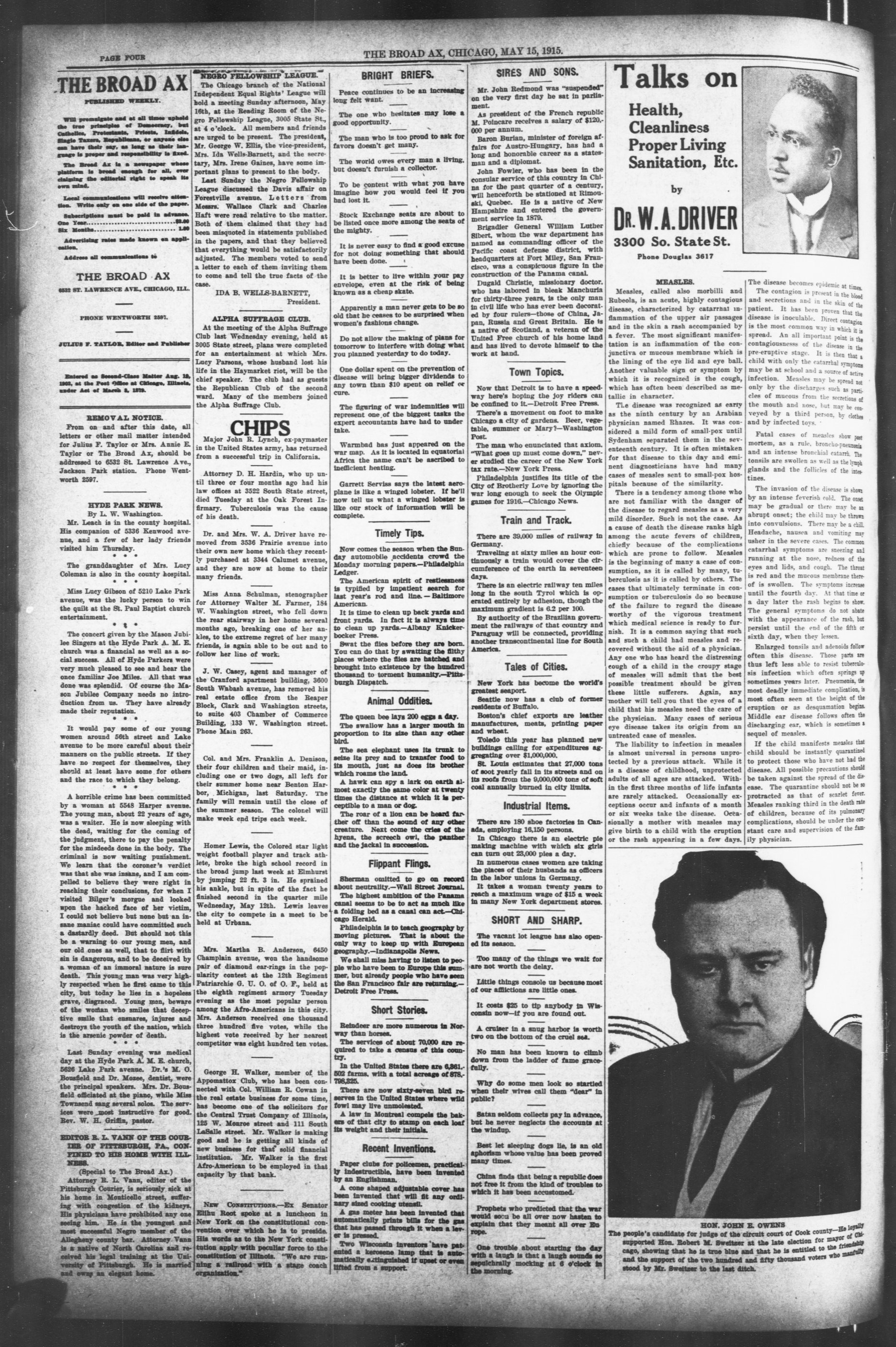
Talks on
Health, Cleanliness Proper Living Sanitation, Etc.
3300 So. State St.
Phone Douglas 3617
MEASLES.
Measles, called also morbilli and Rubeola, is an acute, highly contagious disease, characterized by catarrhal inflammation of the upper air passages and in the skin a rash accompanied by a fever. The most significant manifestation is an inflammation of the conjunctiva or mucous membrane which is the lining of the eye lid and eye ball. Another valuable sign or symptom by which it is recognized is the cough, which has often been described as metallic in character.
The disease was recognized as eary as the ninth century by an Arabian physician named Rhazes. It was considered a mild form of small-pox until Sydenham separated them in the seventeenth century. It is often mistaken for that disease to this day and eminent diagnosticians have had many cases of measles sent to small-pox hospitals because of the similarity.
There is a tendency among who are not familiar with the danger of the disease to regard measles as a very mild disorder. Such is not the case. As a cause of death the disease ranks high among the acute fevers of children, chiefly because of the complications which are prone to follow. Measles is the beginning of many a case of consumption, as it is called by many, tuberculosis as it is called by others. The cases that ultimately terminate in consumption or tuberculosis do so because of the failure to regard the disease worthy of the vigorous treatment which medical science is ready to furnish. It is a common saying that such and such a child had measles and recovered without the aid of a physician. Any one who has heard the distressing cough of a child in the croupy stage of measles will admit that the best possible treatment should be given these little sufferers. Again, any mother will tell you that the eyes of a child that his measles need the care of the physician. Many cases of serious eye disease takes its origin from an untreated case of measles.
The liability to infection in measles is almost universal in persons unprotected by a previous attack. While it is a disease of childhood, unprotected adults of all ages are attacked. Within the first three months of life infants are rarely attacked. Occasionally exceptions occur and infants of a month or six weeks take the disease. Occasionally a mother with measles may give birth to a child with the eruption or the rash appearing in a few days.
[Picture of a man in a suit].
The disease becomes epidemic
The disease becomes epidemic at times. The contagion is present in the blood and secretions and in the skin of the patient. It has been proven that the disease is inoculable. Direct contagion is the most common way in which it is spread. An all important point is the contagiousness of the disease in the pre-cruptive stage. It is then that a child with only the catarral symptoms may be at school and a source of active infection. Measles may be spread not only by the discharges such as particles of mucous from the secretions of the mouth and nose, but may be conveyed by a third person, by clothes and by infected toys.
Fatal cases of measles show post mortem, as a rule, broncho-pneumonia and an intense bronchial catarrh. The tonsils are swollen as well as the lymph glands and the follicles of the intestines.
The invasion of the disease is shown by an intense feverish cold. The onset may be gradual or there may be an abrupt onset; the child may be thrown into convulsions. There may be a chill. Headache, nausea and vomiting may usher in the severe cases. The common catarrhal symptoms are sneezing and running at the nose, redness of the eyes and lids, and cough. The throat is red and the mucous membrane there of is swollen. The symptoms increase until the fourth day. At that time or a day later the rash begins to show. The general symptoms do not abate with the appearance of the rash, but persist until the end of the fifth or sixth day, when they lessen.
Enlarged tonsils and adenoids follow often this disease. Those parts are thus left less able to resist tuberculosis infection which often springs up sometimes years later. Pneumonia, the most deadly immediate complication, is most often seen at the height of the eruption or as desquamation begins. Middle ear disease follows often the discharging ear, which is sometimes a sequel of measles.
If the child manifests measles that child should be instantly quarantined to protect those who have not had the disease. All possible precautions should be taken against the spread of the disease. The quarantine should not be so protracted as that of scarlet fever. Measles ranking third in the death rate of children, because of its pulmonary complications, should be under the constant care and supervision of the family physician.
The Presentation of a Gold Star Studded with Diamonds by the Colored Citizens of this City, at the Institutional Church, 38th and Dearborn Streets, Was a Tribute to be Regarded by the Acceptance of Any Representative Position in the Gift of Any People, as One of Estimable Value.
The affair was very largely attended and quite a deal of applause was given the various speakers who paid their respects to the official distinction and appreciation of the capabilities, strength of character, the earnest manner coupled with ability to do things worth while for the whole people, and get them done, in the person of Mr. DePriest. The following are the gleanings taken from the addresses delivered to that splendid gathering. Hon. Ed. D. Green, master of ceremonies.
"It gives me great pleasure in my feeble way to give these remarks, by way of respect and appreciation, for this august occasion. For we are paying tribute to the first alderman the Negroes of Chicago ever had. The eyes of the entire world are centered upon this event with some apprehension, for it was said by our enemies as well as by members of our race that the time was not yet ripe. Many efforts had been made which were failures and we did not succeed until a few of our White friends decided by changing the methods somewhat it would be possible for us to have a Colored alderman. So the organization indorsed and stood by that indorsement, backed up by these men, thereby giving us representation in the city council in the person of Mr. Oscar DePriest (applause). In the face of the attitude of some who have attempted to befuddle and baffle the efforts of those who would succeed, we have been permitted, because we have been successful, to pay our tribute, a tribute of respect, to the Hon. Oscar DePriest (applause) and we should give him our undivided support."
Major R. B. Jackson: "I come here to pay a tribute to that distinguished citizen in the person of Mr. DePriest because he was distinguished before tonight, due to strenuous efforts and a dogged determination to succeed. Can anybody imagine what it is to fall at one's feet or bow at one's political shrine as condition has forced one to fall at his. Who has been so highly honored by the suffrage of his people in the last six months as he? And when he lived across the street I do not believe that he then thought that he would be in the position as he is here tonight. And I am proud of the fact that you have honored a member of our race as others have honored theirs (applause). I know that he is able to take care of all the interest of all the people, and make good for the betterment of our city government."
Dr. Brushingham: "It was Daniel Webster who said that 'Massachusetts produces men.' So when the second ward was looking around for a man to represent them, they found a man in the person of Oscar DePriest. During the days of abject slavery we then fought for the absolute freedom of the slaves and a united country. It was the days when men who were lovers of freedom rallied, rallied around the flag. I cannot, and do not, believe in any injustice done to any race or to any people. There should be no discrimination as to religion, politics, race or creed. And you have a man in the city hall in the person of Bill Thompson, his honor the mayor, who will not stand for injustice in any part of his administration (applause). You are to be credited for some advancement, but you have fallen back in the face of prejudice, which to my mind is a political and social crime. But you have a man who bore the standard and ra-
lied his comrades to victory. We rallied to the cause because we know that he had been sorely tried. That man is Oscar DePriest'' (applause).
Hon. S. A. T. Watkins: "I knew Mr. DePriest many years ago when he was a contractor and a fine citizen. I respect him because he has always looked after his family; he has been a devoted son to his father and mother. He has never broken his promises to me, and you will think as I do when you know him as I know him. I with you may wonder why he is our alderman. You may have thought the time was not ripe, but whatever our opinions are, he succeeded because he was right. Of course it has been hard for us to get together, and it is because we all don't think alike, but this is not any more so with us than with any other race. Ever since the civil war we have been unable to come to an amicable understanding, but in this contest regardless of our differences in politics, we were united (applause) with the result of getting a Colored alderman. And now we have a member of the city council in the person of Oscar DePriest to whom we pay tribute."
Judge Underwood: "I feel so in earnest about a few things that I would like to take my coat off. But I am so glad that DePriest was elected by over 9,000 votes, for a good many people wondered what was going to happen and what would be the outcome of the final results. I have had confidence in the results from the very beginning, because the cause was right (applause). Why, when some people years ago would attempt to discuss the emancipation, some others would not hear them. They would say don't talk to us about it. A little over five years ago you could not make some men believe that we would have woman suffrage as we have it today, but show me the man who would be opposed to it today (applause). And now we have elected Oscar DePriest, and it is history, it is done (applause). Now I want to make a prophecy, and I am done; that is, Chicago will be voted dry in 1916." (Laughter all over the house.)
Mrs. McKinley: "I want to say that we women of the second ward should give Mr. DePriest our support, our encouragement, and our prayers." Dr. J. W. McDowell: "We have been trying to put upon the shoulders of the Colored people the responsibility of seeing that there is but one way of doing a thing, and that way is the right way. Nothing can be done without organization. This time the organization came out for our candidate, and we won. Now we must handle Mr. DePriest carefully; we must not tie Mr. DePriest's hands by getting after him about jobs; there is something we need more than jobs—we want our streets and alleys cleaned. Yes, we want other things more important than jobs. I am here to pay my respects to my friend Oscar DePriest."
Morris Lewis: "We looked forward to the time when we would have a Colored alderman. I saw him cast his first vote in the city council; I also saw him offer his first resolution there, and that too for a holiday to be known as Chicago Day during the fifty years of freedom celebration of the Colored people. His photograph will be the first to adorn the wall of that council, just as it was the first name among the leaders of the race to grace the pillars in bronze which will for ages become
a part of this city's history; yes, his name will be upon the tongue of every student of color in America, and a host of Whites. The tribute I would like to pay him tonight I cannot express. I know that he will make a fine alderman."
Judge Mason: "Organization is a very essential and a necessary thing for the growth and development of any people. Organization in the church, organization in the army, organization in politics, and organization in society. Mr. DePriest was the selection of that portion of the republican organization known as the second ward republican regular organization which made him their standard bearer. It was the first time any member of your race was backed by the organization for such a place and was elected. I wonder if you think of the importance of your vote here in the second ward; you cast more votes for Mr. DePriest than was cast in the last election in the whole state of Nevada or the state of Alabama. So our votes count for something; we are a factor in the body politic. I know that Mr. DePriest will give us a fair and honest representation in the city council. There was nothing in his public life but praise, nothing said against him by the Municipal Voters' League, but to his credit I know the people he represents will be satisfied at the end of his term and send him back with a big majority."
S. B. Turner: "I enjoy with you and congratulate ourselves upon that splendid victory. We had a candidate in the north end of the ward, or the near vicinity, but when he was defeated we came to the united support of Mr. DePriest's candidacy. Now I do not believe in giving positions to those persons who do not earn them politically and are not entitled to them. When you have to pay men and women for their support, why, they are not entitled to anything else. Is merit any consideration at your hands. I have offered a bill in the legislature attached to another bill as a rider, which is against the real estate dealer who raises your rents and formulates deals which will cause the papers to publish the matter and give some fellow publicity at our expense as we had out on 45th street last week, and cause the people in Alabama to think the people in Chicago are just as bad as they are. I appeal to the general welfare of the whole people. We have something to look forward to. If you will just remain solid you can get your representatives in 1916 from the precinct to the white house, which will bring prosperity to our country as of yore. When we get Mr. Wright, Mr. Green and Dr. A. J. Carey out of our way, then we will bring up some new fellows."
T. W. Swann: "I thought we were going to have a love feast, but there is one note missing. I could have no other place upon this program except it be in the capacity of representing the exposition of which I am secretary, which is a racial movement for the advancement of the Colored people. I sat by the side of Ed. Wright in 1910 and told him to run for alderman; that he owed it to his race. He made the sacrifice with the little sinews of war and the faithful men and women, made the fight, he paved the way. I do not agree with some who have said here tonight that 'we did not start right.' We did start right then, but we get the great majority of the people to think right (applause). I was consistent then; I took a stand with Ed. Wright, although we differed as far as our politics goes Oscar DePriest is the last man I would have chosen, and he knows it (laughter). But it was through Dr. A. J Carey that won my support for him When Oscar DePriest and A. J. Carey stand upon the same platform, it must be right (laughter). Not alone in politics, but in a closer tie of Negro manhood and Negro womanhood. We are always able to stand together when the interest of the race is involved. I know that Oscar is a very hard man to fight, and a very hard man to be against you. I hope when the time roll around and he wants something higher he will get it, and you put a better man in his place."
C. A. Griffin: "This to me is a serious occasion, one which brought me from my home against the protest of my companion; but I felt that it was our duty, and most especially mine, to be present upon this occasion and pay a tribute of respect to my friend and neighbor, Oscar DePriest. It is up to us to build up his hands. It is our duty to ask him how can we help him, and not how he can help us; I realize that his is a hard task. A few months ago I was fighting Mr. DePriest, but honorably, I found him to be a giant mentally as well as physically, and that kind of a man we have in Mr. DePriest. While he is a man of the race, I believe he will be the alderman of the whole people."
Mr. Wright: "It is a pleasure to me to be here on this occasion. During our arduous labors to achieve what all men of all ages have achieved, representation. And this is what all men have achieved, recognition, simply by fighting for it. The methods might have been different, but the thing they had to obtain was the same. If the colonist had not turned over the tea in Boston harbor this would not be a
HON. OSCAR DEPRIEST The popular alderman of the second ward, who was presented with an elegant diamond star by many of his friends and the citizens of Chicago at the Institutional church on Monday evening.
The popular alderman of the second ward, who was presented with an elegant diamond star by many of his friends and the citizens of Chicago at the Institutional church on Monday evening.
'land of the free, and a home of the brave.' If Crispus Attucks had not lee the attack on Boston commons, sheding the first blood, for the nation's liberty, we would not be enjoying the blessings of civil liberty. Somebody had to make the start, somebody had to make the sacrifice. If the start is made, and it comes out all right, it must be right. History says, if I have studied it aright, if any people would accomplish anything by way of representation, they must fight for it. We would not have this war in Europe today that has caused 'man's inhumanity to man,' if it was not for the fact that men are fighting for representation of rights. If you would have representation and independence, you must ask for it; and if you don't get it, you must go out and get it. Yes, go out and take it (applause). The next lesson we ought to learn is how to help others, how to get together. I heard a story of the lion and the lamb lying down together, but I do not believe that the lamb should lie down inside the lion. I mean to and I will in all sincerity get together with you for the best interest of all concerned. I will not allow myself to be jealous of Oscar DePriest or any man for that matter. I am too big for that. I wish for him a phenomenal success, for the higher he goes the bigger I will be; for I don't think any man living is greater than Ed. Wright, for I shall be as great as the man I help to make great. I want him to be a great alderman, for I never believed in my life that any man was greater than Ed. Wright." (Applause.) Dr. A. J. Carey: "I come not to congratulate Oscar, but I come to pay him my condolence. When I look upon this platform and see so many Methodists (calling some by name) and Oscar himself, a Methodist who fell from grace and fell right into the city council's chair (applause). I am compelled to feel sad upon this momentous occasion (laughter) for any man who has to sit in that council with Barney Grogan and the poor innocent crowd of aldermen, makes me feel very sorry, inleed for poor little Oscar DePriest (laughter). But Oscar is not only able to take care of himself, but he is able to take care of the interest of the race to which he belongs, and the best interest of the whole people which he represents. I want to congratulate Chicago, for you will find no man in all of that city council better fitted to render an account to the people after his stewardship than Oscar DePriest. There will be many there with their pet theories, many coming from Hyde Park with their dreams. Somebody spoke about the regular organization being responsible for the election of Oscar DePriest. The organization is not responsible; that always steps on my corn. We Negroes would have voted for a democrat if we had not been given a man, and they knew it. I have said before, and I say now, I am with the organization when the organization is with the black man (applause). Oh, there is no gainsaying it. If it had not been for Ed. Wright and Charley Griffin, Oscar would not be alderman. Let us put the laurels where they belong. One sows and another reaps. Ed. Wright and Charley Griffin sowed, and Oscar reaped (applause). The test of Oscar's loyalty to his people was when he went before the mayor and asked for the reinstatement of Prof. Bowling upon the censor board, which caused the mayor to say to the official who hails from Virginia, and who was responsible for Mr. Bowling's removal, that 'your actions of Mr. Bowling were pure and simple prejudice, and a violation of the civil laws of our state, and will not be tolerated by this administration (tremendous applause). Some min-
guided persons are talking about a Colored alderman next spring. If you attempt this we will lose all. We will take one of theirs next spring and the following year they will take one of ours. Then when Congressman Madden becomes United States senator we will send the first Negro congressman from the first congressional district (applause). You will be called upon to attend a bigger reception than you were called upon to attend here tonight, which will be given to Ed. Wright, because Bill Thompson is going to give Ed. Wright the biggest appointment any Colored man ever had in any city in this country. Then later you will be called to another reception. I will not call his name." (Laughter.) Chaplain Anderson of the Tenth United States Cavalry, retired, and Major John R. Lynch, who has just arrived from California, ex-paymaster in the United States army, were present and made short addresses, paying their respects to the advancement of the Colored people, and a tribute of respect to Oscar DePriest.
The Hon. Geo. W. Ellis was given the honor of presenting the star. He said: "To my mind this meeting has a triple meaning. No people can be safe in a country until they have been given their rightful place among the representatives of the nation. I have to congratulate the republican leaders, for they always have acted wise, in granting us our request. Such men as Judge Underwood, Congressman Martin B. Madden, Samuel Ettelson and other splendid, broad-minded characters of the republican party have always looked upon the fact that 'taxation without representation is tyranny.' And they have by the justice of their claims been able to preserve the republican party for the preservation of the nation's prosperity in the future. This is a splendid tribute to the Hon. Oscar DePriest, and with Ed. Wright, Dr. Carey, Charles Griffin and Oscar DePriest marshalling the forces together, we cannot be led but to certain victory (applause). In presenting to you this star, permit me, Alderman, to interpret its meaning and the heart robs of the givers. This gold symbolizes the strength of character you possess; this diamond in all of its brilliancy, your wisdom, reflecting in all of its regaled splendor for the good of your constituents; this star pointed as it is, representing the word of truth, your bond of honor. It gives me the honor of placing it upon your worthy bosom." Stepping back, he said: "While in London I looked upon one of England's most famous statues, upon which were inscribed these historical words: 'England expects every man to do his duty.' Sir, we expect you to do yours, and your party believes you too brave to do otherwise."
Oscar DePriest, the recipient of the splendid gift, looking first at the audience, then to the speakers who had given their contributions to his honor, then gravely looking across the pulpit, at his old friend, Detective Sergeant Rhodes, who started the citizen's movement in paying this respect to him, and said:
"Words fail me to express to you for this tribute of respect, and the only thing I can do under the circumstances is to do my duty to the best of my ability. There is some opposition in the council to the policies of the present administration, and I expect to be severely criticized by some for supporting him; but when a man is big enough to stop the clammen from coming to Chicago, I feel that I owe it to you to support him (applause). I am very much interested in the opening up of Chicago avenue east to the lake, because I want the common people and
PAGE FIVE
the poor who live all over the city to enjoy the benefits which can be derived from the bathing beaches along the lake front. I want your support; I cannot make a success without it. The first man that asked me to run for alderman was a White man, and his name was Bill Tague. And Bill Tague carried his precinct for me in the primaries and gave me a splendid vote in the regular election, and if there is any Caucasian we owe anything to, it is Tague. Dr. Carey said I was a good job getter. Now, Dr. Carey is the best job getter I have ever met. He is always fortunate enough to have some one to come and give him a job, while I had to go out and fight for every job I got. Restore back to the republican party the elective place of controlling the government, and the wave of prosperity will set in. Again I thank you from the depths of my heart for this splendid tribute."
L. W. WASHINGTON.
Water on a Hot Stove.
It is impossible to throw a few drops of water on a redhot stove. The water can never touch the stove at all. What is seen is a few drops rolling rapidly over the surface, gradually getting smaller until they disappear. If the drops are on a perfectly level place one can see under them to the other side of the room, thus proving that they are not in contact with the stove itself.
What actually happens is that the bottom of the drop changes at once to steam or vapor on coming close to the hot surface, and this vapor is supplied by the drop as it gradually goes away. So the drop rests on a cushion of vapor until it is entirely dissipated. This state of water is known as the spheroidal state and is of interest simply on account of its peculiarity and seemingly paradoxical behavior.
Work of a Submarine
The submarine inventor, Simon Lake, says in the Century Magazine that this formidable weapon of naval warfare can be means of charts work its way on the bottom through the cables of mines or under nets or booms until it reaches the vicinity of the enemy's anchorage. Moreover: "If the enemy has its torpedo nets out, the submarine can creep up near the vessel, send a diver out and attach a bottom mine under her, to be electrically exploded after the submarine has moved a safe distance away. If desired, a mine can be attached to the bottom of the surface vessel and exploded hours later by clockwork mechanism. In this manner mines can be placed under several ships, and all can be blown up simultaneously at a given hour, when the submarine may be miles away."
The Penalty of Fussiness
This story is vouchered for—just as all the others are. It concerns a small maid who had a way of saying starting things at the table.
Not long ago the family expected a visit from a relative—a distant cousin from the roomy west.
"Now," said the mother, "don't you dare say a word if you see Cousin Jim eating with his knife."
All through the dinner the little maid gave the visitor her closest attention. She noticed that his manners were faultless; that he ate as politely and correctly as if kings and queens had been his tablemates. And then she turned to her mother.
"Well, ma." she gravely said, "I guess somebody stung you, all right. He didn't use his knife once."—Cleveland Plain Dealer.
Cleaning Day.
A practical joke which was played in a small town created lots of fun and some indignation. A joker notified many of the housewives that on a certain morning the telephone company was going to blow the dust out of the phones and from the wires. They were told to the clothes over the phone to prevent the dust ruining wall paper, furniture and pictures. Some of the phones were kept closely tied for an hour or two, and others were under the rags for half a day, or at least until they found by making inquiries of central that the joke was on them. My informant said the joker had to leave town for a day or two to escape the righteous indignation of women who were fooled.—Cincinnati Commercial Tribune.
Sardonic
"The greeting 'How are you?' doesn't seem to me to represent any sincere and sensible inquiry," remarked the man who thinks hard about trifles.
"That is true," replied Miss Cayenne.
"When I meet several people I know I am always tempted to say 'why' instead of 'how.'" - Washington Star.
But the World Lies
My son, I would have you speak the truth, the whole truth and nothing but the truth, and also I would have you keep in mind that the business of this world is mainly carried on by lying.—Michael Monahan in "At the Sign of the Van."
Most Populous Countries
The ten countries with the largest populations are, in the order named, China, India, Russia, the United States, Germany, Japan, the United Klagdom, France, Italy and Austria.
A Way Out.
"She's fond of children."
"I'm glad to hear it. I'll leave mine with her the next time our club meets."
-Detroit Free Press.
PAGE SIX
The term "Bohemian," applied to those who lead a certain style of life originated in France, where it was first applied to the gypsies, who were erroneously supposed to be natives of Bohemia. At some time early in the nineteenth century the name came to be applied to persons of unsettled habits who did not observe the conventional rules of society. "Bohemia," the haunt of artists and students with little money, was in the Latin quarter of Paris and flourished, especially in the period of 1830. The classical description of it is contained in Henri Murger's "Scenes of the Life of Bohemia." which is published in several translations. Puccini's opera, "La Boheme," is founded on this famous book. As James Anthony Froude explains, the term Bohemian is not necessarily uncomplimentary. Speaking of Bohemians, he says, "I mean merely a class of persons who prefer adventure and speculation to settled industry and who do not work well in the harness of ordinary life."—Philadelphia Press.
Hard Times.
Ernest was very big and very black, and when it came to sleeping and eating fully justified his name. Ernest did not fancy steady work, but he was apt to be available when spring came for odd jobs at a dollar a day and his dinner.
One spring he came in with a sheepish grin.
"Miss Sally, I been hearin' in de lodge meetin' 'bout dese hard times, an' I low I better raise my sal'ry to a dollar an' a quarter a day."
"You're not worth that, Ernest, and you know it. Besides, I can't afford to pay more."
Ernest scratched his head; this was a matter for more thought than he had anticipated.
"I figgered out when dey wuz takin' 'bout dem hard times dat I couldn't 'ford to work for no less. But"-his black face gleamed with a sudden thought—"I won' eat so much."—New York Post.
Eastern Scrub Pine
A Lazarus of the forest is the eastern scrub pine, also called Jersey pine, a small, puny tree of poor and pitiful form, willing to subsist on the "crumbs" that fall from the table of others. It grows in New Jersey, Maryland, Virginia, West Virginia and farther south and west. It creeps into open spaces and is the companion of sassafras and huckleberry bushes. Old, worn out, gullied fields appeal to this pine, because little else will grow there, and it is not obliged to fight for room. In course of time, however, as the impoverished soil begins to recover broad leaf seedlings come in. As these increase in size the scrub pines die and finally disappear. Though they have been in full possession of the ground, they are unable to hold it against competitors.
The Bashful Lover
The girl who has a bashful suitor should cease lamenting the inconveniences of the situation and thank Providence for him. He will be very, very faithful. No need for heartburnings, no cause for jealousies, will arise in this connection. For not only have the other girls no time for him (a fact which taken alone, is hardly a recommendation to the average woman, by the way), but he himself—oh, joy of joys—will have no time for the other girls. And so the maiden who has a very bashful lover should cease repining. Once she has secured that eminently suitable person, it is up to her to train him and educate him in the way, he should go. And there is no fear that he will ever depart from her.—Ellen Adair in Philadelphia Ledger.
And That's the Reason
"Don't you want your nice bread and butter, Anne?" asked her father. Anne shook her head. "It's a shame to waste such nice bread and butter." continued her father. "I'll eat it myself." Anne watched the process with big eyes and a look of expectancy on her face.
Finally, when the last mouthful had disappeared, Anne asked, "Papa, did it tickle?" "Tickle!" said her father. "Why, no. What do you mean?" "I thought it would tickle," said Anne. "It had a long hair on it."-Delineator.
May Have Started Him.
"I wonder how Columbus got the idea that the world was round?"
"I don't know that there is anything remarkable about his deductions. Any man along in middle age begins to get the idea that the world is not exactly square." - Louisville Courter-Journal.
Perfume
When you use perfume and call it such, do you think how the name came about? It means, in Latin, "from smoke," and the name proves that the first perfumes were only aromatic woods or gums that scented the air when burned.
Natural Result.
"What has become of your nephew?"
"The one who was so fond of books?"
"Yes."
"Oh, he became a page in the legislature."—St. Louis Post-Dispatch.
"These pampered dogs of the rich are rather listless, it seems to me."
"Yes; you never see one of them burying a marshmallow or worrying a chocolate drop." - Judge.
Evaniva.
"Do you always receive a warm welcome at home?"
"Oh, yes; I'm always in hot water there." - Waldman, Amurrau.
Young Conquerors.
Napoleon said that a man ages quickly on battlefields. Speaking of one of his generals, he said at Austerlitz that Ordener was worn out, adding: "One has a short time for war. I am good for another six years, and then I shall have to stop."
"Strangely enough," says Lord Rosebery in "The Last Phase," "his judgment was exactly verified. Six years and a month from Austerlitz (which was fought on Dec. 2, 1805) would have brought him to 1812, to the Russian campaign, which, if he had observed his own rule, he would have avoided."
When his "star" was eclipsed for ever at Waterloo he was but forty-six years of age, but he had been a broken man in body, and to an increasing extent in mental power, long before. Wellington fought his last battle at forty-six, Ney at forty-five, Nelson at forty-seven. Alexander the Great was only thirty-three when death ended his career of conquest. Hannibal was in his forty-six year when he was finally defeated at Zama by Sclpio.
A Pair of Eminent Grave Diggers.
The profession have a saying that parts make actors. When the $20,000 benefit to Lester Wallack was given in New York, with one of the historic "Hamlet" casts of the century, the public, of course, expected to see a performance that could never be forgotten because of its all round greatness. There was disappointment for the expectant innocents. All star casts want proportion, and this particular performance of the sublime tragedy was "queer." For example, Joseph Jefferson and William J. Florence played the gravediggers, and in their dressing room after Horatio's "there crack'd a noble heart." Mr. Jefferson said to his companion: "Billy, whose lines were you speaking, anyway?" "Bacon's, I guess," Florence replied. "Perhaps," mused gentle Joe. "I knew they weren't Shakespeare's."—Detroit Free Press.
The Eirlinfoens.
At Brianza, in Lombardy, there flourishes a very curious sort of band, all the members of which play the same kind of instrument, known as the "frilinfoens." This corresponds to what we know as "panpipes" and is constructed of reeds fastened side by side, the bass pipes being often several feet long, while the others gradually decrease in size.
The "frilinfoens," as the players are called, after their instruments, are as a rule ignorant of music and they learn their tunes by ear, often from a phonograph. It is said that the panipipe players experience all the sensations of intoxication after a march due to the energetic blowing and the constant wagging of the head to and fro. The music, although conveying to the stranger at first a most curious effect, is said to be not unpleasant—Washington Star.
The March to Mecca.
The great caravan which every year sets out from Cairo for Mecca has a conductor on a camel leading the way. Day and night, whatever the weather is, he remains without any covering, naked to the waist. With him march men with large torches, which are kept alight during the night and illuminate the column of smoke above them, so that it appears a pillar of fire. During the day, when the head of the caravan is difficult to see on account of intervening hills and mounds of sand, the torches are kept burning, so that instead of the light which served during the night a column of smoke indicates to the straggling caravan from afar the direction of the march and the time and place of a hait.
The Professor's Proof.
During a certain athletic event at a big university the students of a certain professor's class, well aware that their studies had been neglected, were prepared for reproof, but not for just the way in which it came.
At the end of the hour the professor slammed down his book on the desk and exclaimed:
"That's the worst recitation I ever listened to. Why, I've actually done nine-tenths of it myself." - Exchange.
Repudiated.
"I'm a self made man," said Mr. Cumrox.
"Didn't your wife have something to do with your career?"
"She used to say so. But after seeing how I behave in society she refuses to take any of the blame."—Brooklyn Citizen.
Two Definitions.
Bobby—Pop, what is reason? Fond Parent—Reason, my boy, is that which enables a man to determine what is right. Bobby—And what is instinct? Fond Parent—Instinct is that which tells a woman she is right whether she is or not—Exchange.
Reciprocity.
"When you come in the house does your wife watch for your step on the stair?"
"She does, and I have to be very careful how I walk, for I watch for her stare on my step."—Baltimore American.
Wanted Proof.
Nephew (to the returning aunt)—And did you' think of me when you were away? Aunt—Certainly. Nephew. Then open your trunk and let me see it.—Filegende Blatter.
There is no wind of March which cuts half so deep as the unkind word of a friend.
THE BROAD AX. CHICAGO. MAY 15. 1915.
Failures of Soldiers Armed
Many years ago several inventors developed bullet proof cloths or breastplates, and in spite of much advertising their suggestions were never adopted, much to the surprise of civilians. The reason is very simple. If the bullet is stopped its energy is transmitted to the shield, which in turn delivers a blow to the soldier's body. The severity of the blow depends upon the velocity of the bullet, and if the shield is very light the chest wall receives more or less injury. In order to be effective the shield must weigh at least ten pounds.
It is a repetition of the old circus trick of striking with a sledgehammer an anvil on a man's chest. If in place of the anvil we substitute a thin metal plate the blow would be fatal, and the sledgehammer has about the same energy as a bullet at high velocity. If the shield weighs but six or eight pounds the blow of the bullet almost knocks a man down. Soldiers are not to wear armor, but to get behind it, as in armored ships, forts and motorcars. —London Tatler.
California Roads.
In his book "At the End of the Trail" E. A. Powell, F. R. G. S. pays the following tribute to California road building:
"I am convinced that if the several thousand Americans who go on annual motor trips through Europe, either taking their cars with them or hiring them on the other side, could only be made to realize that on the edge of the western ocean they can find roads as smooth and well built as the English highways or the routes nationales of France, and mountains as high and sublimely beautiful as the Alps or the Pyrenees, and scenery more varied and lovely than is to be found between Christiania and Capri, and vegetation as luxurant and hotels more luxurious than on the Cote d'Azur, and a milder, sunnier, more equable climate than anywhere else on the globe, they would come pouring out in such numbers that there wouldn't be garages enough to hold their cars."
"Kicked Into Literature."
Son of an adventurous naval captain, Rolf Boldrewood, or, to give him his real name, Thomas Alexander Browne, the author, had one of the most romantic careers in the annals of literature. Pioneer squatter in early life in Victoria, he made such good use of his opportunities that while still in the twenties his check was good for a quarter of a million. Then, if unfortunately for himself, luckily for novel readers, a long drought killed off his flocks and herds and compelled him to enter the government service as a stipendiary magistrate. Shortly after this he happened to be kicked by a horse. This led to his being laid up, and to while away the tedious hours he wrote an Australian sketch called "The Kangaroo Rush." He sent it to the Cornhill, which accepted it, and as he used to say merrily, "he was kicked into literature."—London Opinion.
Spinning a Web.
A patient Englishman, who last summer watched a garden spider spin its nest from start to finish, has told what he saw in Knowledge. At half past 9 o'clock in the evening the spider, a half grown female, began work by dropping from one branch of a pine tree to another below and there making fast a line, which eventually formed two of the perpendicular radiating lines of the web. From that time it continued to work without interruption until twenty-five minutes after 1 the next morning. The network and the radial lines were done by half past 12, and the spiral part of the web was consequently made in less than an hour. He says the finished web was one of the most perfect he has ever seen.
The Cruel Schoolmaster
An indignant mother wrote thus to the principal of an academy:
Dear Sir--My son writes me that he has to study too hard. He says he has to translate hexameters of Latin a day. I looked "hexameter" up in the dictionary and find it a poetio in one feet. Now, that makes 300 feet, or 100 yards of poetry for my poor son to translate each day. I think about half a hexameter or six inches of this Latin is enough for a boy of his age. Yours truly.
MRS. BLANK
—Woman's Home Companion.
Insinuating.
"Yes," boasted Sloway, "I have bought an automobile now, but I will pay you that $5 I borrowed six years ago."
"Better be careful," responded Binks, with fine sarcasm. "You might be apprehended for speeding."—Chicago News.
Cedars Gone From Lebanon
The cedars are almost all gone from Lebanon, according to John D. Whiting of Jerusalem, writing in the National Geographical Magazine. There are far more of these majestic trees in Europe and America than on their native mountain.
Real Power.
Nodd—Do you think it is true that a great, nay, a gigantic force like the press of this country, is controlled by the advertisers? Todd—Why not the press? My wife is—Yale Record.
A House Party
Mrs. Church—Didn't you have a house party yesterday at your home? Mrs. Gotham—Yes; the landlord called for his rent—Yonkers Statesman.
Stranger—Did you ever reveal your fishing hole to a friend? Angler—Once I did to a friend on his deathbed—Er change.
Sleep Without Drugs.
"Doc, how can I get to sleep without using dope?" asked a man troubled with insomnia of a noted physician
"On going to bed assume a comfortable attitude in which every muscle is relaxed," said the doctor, "but not the attitude in which you are accustomed to go to sleep, though something resembling it. Every movement, even coughing and yawning, must be strictly repressed, especially the desire to turn over. Maintain the same attitude without change, constantly resisting the longing to move or turn over. As a rule, by the end of fifteen or twenty minutes of this you will find yourself growing very drowsy and then, just as the desire to roll over becomes absolutely uncontrollable turn with the least possible effort and assume the position in which you habitually go to sleep. Natural sleep should follow at once. This method seldom falls. Give it a thorough trial at least before resorting to a drug to bring sleep."—Buffalo Express.
Heated Bearings
Sometimes when a bearing becomes heated and requires oil it will be found that the oil will not flow down in the oil hole. Either the hole is clogged with dirt or the heat may cause the air to rise and prevent the oil from entering. Where a wire cannot be used effectively the following remedy, although it is not infallible, is almost sure to make the oil reach the bearing.
Fill the hole with oil and quickly place the thumb over it to prevent the air from escaping, and if the oil cup does not leak the heated air inside will rise above the oil, and in two or three minutes it will be forced into the bearing, even if it has to pass considerable dirt.
When a bearing cannot be reached in this way and when light oils, such as kerosene, are ineffective, try placing a little mercury in the oil hole and allow it to remain a few minutes, then use oil—World's Advance.
After All His Trouble
Two men were hurrying along Park row when the wind seemed to be blowing from all directions to the peril of umbrellas and anything not firmly anchored. One of them noticed the handle of a wrecked umbrella which had been thrown into the street along with many others and, stopping to pick it up, remarked to his companion that it was too good to pass. As he stooped a gust of wind captured his hat, and it went spinning along toward St. Paul's chapel, he after it. He ran into a man, slipped, fell in the mud and arose in time to see his hat run over by a truck. At a nearby restaurant where he was drying his clothes, he said: "I lost a five dollar hat and spoiled a suit of clothes for the handle of a thirty cent umbrella. That would not be so bad, but I see the handle is broken." New York Tribune.
A Painting.
What is a painting? It is the language of the artist in which he expresses his thought, conception of mind or emotion of heart. Where a writer expresses himself in words, the artist expresses himself in colors, light and shadows. An author's description of a place, person or object is but a word picture, while the artist's canvas stares us in the face, so to speak, flashing the subject continually before our eyes until we can grasp its every meaning without so much as turning a page. Thanks to our own Gilbert Stuart and his wonderful conception of the portrait of George Washington, it would take a paragraph or more to describe George Washington's mouth or nose, where Gilbert Stuart tells it to us in a few strokes of his masterful brush.—Elliot A. Haaseman in National Magazine.
Ideal Politics.
What I wish first to insist upon is the essential worth, nobility, primary indeed, of the liberal pursuit of politics. It is simply the highest, the most dignified, the most important of all earthly objects of human study. Next to the relations of man with his maker there is nothing so deserving his best attention as his relation to his fellow men. The welfare of the community is always more important than the welfare of any individual or number of individuals, and the welfare of the community is the highest object of the study of politics—Whitelaw Reid.
Two Master Writers
It was an odd coincidence, but a striking one, that the greatest genius of England and the most masterful mind in Spain passed from earth on the same day. Shakespeare and Cervantes both died April 23, 1616, the former being only fifty-two years old, and the latter sixty-nine.
The Ladder.
"Yes, he's one of our leading citizens. He certainly has climbed high in a few years. Why, he holds our best federal job."
"There are some things about life that I don't understand."
"What now?"
"A man is looked up to if he moves in a circle and frowned down on if he belongs to a ring."—Louisville Courier-Journal.
"He was positively burning with love for her."
A Pickpocket's Trick.
"What puzzles me," said a well dressed man to a police captain to whom he had complained that a roll of bills had been taken from his trousers pocket in a subway car, "is how the thief got the money, since I never felt his hand in my pocket."
To which the official replied: "Let me explain. As soon as the thief had completed his preliminary work to satisfy himself that you had some money in your pocket he set to work to get it out. But he didn't put his hand in your pocket. This is what he did. He took hold of the lining of your pocket with his thumb and index finger, and when the car lurched or jolted he pulled the lining up a little more until finally the edge of the bill came in sight. As soon as enough of the bill had appeared to enable him to get a grip on it he carefully plucked it out of your pocket, and you never knew it the difference. It appears simple, but it requires considerable skill."—New York Sun.
Babylonians Feared Ghosts
In a lecture on "Burial Customs In Mesopotamia and Egypt" Dr. L. W. King, F. S. A., said the spirit which animated the Egyptians in their varied and changing practices toward the dead was based on affection and reverence, but the Babylonian, in the main, was prompted by fear. The Babylonians were probably more spook ridden than any other nation of antiquity, and their magical texts made it clear that the most terrible class of spirits were the ghosts of the dead, who for some reason had been unable to enter the underworld. Driven by hunger and thirst, such a ghost might roam about and fasten on any one with whom it had relations in this life, and it would plague him until he performed the rites that could give it peace. It was mally to lay the ghost and prevent it from "haunting" that the Babylonians were scrupulous in performing the due burial rites.—London Times.
Georgians of the Caucasus.
Though the Russians are the dominant race in the Caucasus, the aristocrats of the very mixed population of that region are the Georgians. A people of mysterious antecedents—their race, according to some ethnologists, being older even than the Egyptians—they stand upon a higher plane of civilization and culture than any of their neighbors. Formerly Georgia was an independent kingdom, and its people, converted to Christianity in the fourth century, have never relapsed into the Mohammedanism of the surrounding tribes. Their golden age was the twelfth century, in the days of the great Queen Thamara. Now there are no more kings in Georgia, but an amazing number of princes. It is a Russian joke that every Georgian, whatever his occupation, boasts a title. It might be added, with more truth, that every Georgian is a poet—Pall Mall Gazette.
Reason and Instinct.
A certain north country miner was particularly proud of a clever little dog he possessed. At times he was apt to claim a little too much for his pet, and one morning a neighbor was endeavoring to point out the difference between instinct and reason when an amusing interruption occurred. A seedy looking tramp turned the corner, and the dog, without so much as a word from his master, sprang into the road and offered battle.
"There you are," laughed the miner as the dog snapped and snarled around the heels of the tramp. "E don't like the looks of the chap. That's instinct." Suddenly the tramp turned and kicked the dog into an adjacent field.
"There you are," ejaculated the miner's friend grimly. "The chap don't like the looks of the dog. An' that's reason."—London Tit-Bits.
A Priceless Idol
It is a part of the creed of Mohammedans to smash the noses of all idols they may come across. When they invaded India they defaced in this way every Hindu god. A figure of Vishnu cut in green jade was buried in the bed of the Ganges during this invasion and is now preserved in a temple in Benares. It is the only perfect image left of all the old idols, and its sanctity is such that the priests at Allahabad have offered for it its weight in gold, together with two magnificent rubles, formerly the eyes of Buddha. But they cannot buy it.
Wasted Effort
At a fire recently a brave fireman came gasping and panting from the burning building with his eyebrows singed in the flames. Under one arm he carried a small but heavy box, which he deposited in a place of safety with the air of a man who had saved a box of government bonds from destruction. On opening the box it was found to contain six bottles of a new patent fire extinguisher—Argonaut.
A Striking Comparison
Church-I see the chances of being struck by lightning are four times greater in the country than they are in the city. Gotham-Perhaps, but the chances of being struck by something else are twenty times greater in the city.-Yonkers Statesman.
A Bad Scare.
Small Harry—Our baby swallowed a penny this morning. The Neighbor—Were your folks scared? Small Harry—Pa was. He thought at first it was a five dollar gold piece. Chicago News.
"That's why women love him for the enemies he has made, I suppose."—Philadelphia Ledger.
Salm's present military organization dates from 1902 and is the outflow of two years' study of the various military organizations of Europe. It embodies the militia system, with a Dash of universal service. Every citizen is liable to serve for two years in the line and then for five years in the first and ten years in the second reserve, but only so many are called up as are required to keep up a strength of about 30,000 men on a peace footing. Those who are then called up receive as compensation certain abatements of taxes. The rest of those liable to serve pass straight into the reserve, which is called out at certain intervals for from fifteen to thirty days' training.
Besides his arms and his clothes, the Siamese soldier receives 4 items in each equals about 35 cents a month, besides 25 satutings about 8 cents a day, half of which latter sum, however, is stopped to pay for the single meal of that the state "provides." The soldier has to buy his own footwear and the rest of his food. No wonder the majority of the army goes barefoot—"for the Lands of the Sun."
Where President Obama
Alexander Hamilton was defeated in his attempt to give the president of the United States the power to appoint the governors of the states. In Spanish, American countries his ideal is generally realized.
The president of Colombia appoints the governor of each department, and the governor appoints the prefects and mayors. The president of Peru appoints the prefects, these the sub-prefects, and the latter name the governors. Reports flow up this official stance, and orders flow down, so that the whole administration dances to Lima's piping.
In Chile there is a complete chain from president through attendant, governor and subdelegate to inspector. There are municipal councils for cities, but nowhere is there a place for the county, as we know it, electing its own prosecutor, judge and sheriff.-Edward Alsworth Ross in Century Magazine
The Bulbs Went Astray
The growth of bulbs is an important industry to Holland, as from Haarsen the markets of the world obtain their supply.
It is told of Said Pasha, who had a great love for flowers, that he placed an order in Holland for a choice assortment of these bulbs, for which he paid $5,000. When the bulbs arrived his "secretary of the interior," who received them, not knowing of the bulb order, sidetracked them to the kitchen. Soon after their arrival the pasha was to give an important banquet, and his chief cook, wishing to serve an especial treat, grilled the new variety of onions and served them hot. Evidently as an article of food they did not prove a success since the only comment the recorder of the incident made of the result was that pasha's interest in grinding received a severe body blow—National Geographic Magazine.
Gold Plated Doorknobs
In some of the $25,000 a year flats on Fifth avenue, New York, the hardware is gold plated. Hinges, window brackets, fixtures, door handles, key plates are all treated with gold before being placed in position. All that is required to keep gold in fine condition is a light rubbing with a piece of dry leather. No polish is necessary, and the woodwork near this yellow hardware is never tarnished. Silver plating on white metal is used on the trim in the dining room. Nine coats of paint are spread on the walls of the dining rooms in these magnificent flats, the same care being used as with the paneling of a motorcar. The walls, instead of being highly glazed, have a soft, silky finish. —Pittsburgh Press.
Two of Them.
Miss Paull was one of the teachers at the mission Sunday school. One Sunday the subject of the lesson was "The Second Commandment," and Miss Paull began by asking little Adelbert Dugan the question:
"Now, Adelbert, have we any kids in this country?"
For a moment the boy hesitated and then replied:
"Yes, ma'am. Me dad's kid and me uncle too."—Household Journal
On Tick.
Buying "on tick" is not new slang, but goes back to the seventeenth century. It is stated in a letter dated 1661, "The Mermail tavern is lately broke, our ticks amounting to £1,500." And in another document a little later it is said, "Every one runs upon tick"
Placing the Blame
Placing the
"Young lady, that young man who
comes to see you stays outrageously
late."
"Well, it's your fault, papa."
"My fault?"
"Yes; mamma told him he need not
go until you came."—Houston Post.
A More Important Question.
"Darling," he said, "would you continue to love me if I were to be poor all my life?"
my life?
"My dear." she asked him, "would you continue to love me if you should chance to become a millionaire?"—Detroit Free Press.
Advice.
"My boy," said the successful merchant, "never let your capital lie ill. Remember that money talks, but it doesn't talk in its sleep." - Boston Transcript.
The great minds are those with a wide span, which couple truths related to, but far removed from each other - Holmes
LINCOLN STATE BANK OF CHICAGO
CAPITAL, $200,000.00
This Registering Home Bank FREE to our Savings Depositors; will start you saving and keep you at it. A Savings Account is the first step to wealth. OPEN one with US.
Boom of Big Guns.
Early in April, 1912, a man living at Hambledon, near Godalming, wrote to the Spectator, saying: "As I sat reading the other afternoon I heard, or, rather felt, a long vibrating boom several times repeated. I thought at first it was a motor van maneuvering behind the house, but found nothing there. Then I guessed what it might be and forthwith wrote to the chief gunnery officer of his majesty's ship Orion to make sure. I am therefore able to state that the discharge of the Orion's guns was distinctly andible ninety-seven statute miles from the ship, the sound taking somewhere about eleven minutes to travel the distance."
An even more remarkable instance of the immense distance at which gun fire can be heard was afforded at the time of the French victory at Steinbach. The booming of the guns was distinctly heard on the northern slopes of the Bernese Alps far down in Switzerland. The distance is just eighty miles as the crow files, and in this case it must be remembered that the guns were not the 13.5 naval giants, but merely field artillery.-London Oulion
Ravenous Estera.
Gibbon tells of Soliman, a caliph in the eighth century, who died of acute indigestion in his camp near Chaicis, in Syria, just as he was about to lead an army of Arabs against Constantinople. He had emptied two baskets of eggs and figs, which he swallowed alternately, and the repast was finked with marrow and sugar. In a pilgrimage to Mecca the same caliph had eaten with impunity at a single meal seventy pomegranates, a kid, six fowls and a huge quantity of the grapes of Trefet.
Such a statement would defy belief were not others of a similar character well avowed. Louis XVI could hardly boast of an appetite as ravenous as Soliman's, but he would eat at a sitting four platefuls of different soups, a whole pleasant, a partridge, a plateful of salad, mutton hashed with garlic, two good sized slices of ham, a dish of pastry and finish this ample repast with fruit and sweetmeats—London Saturday Review.
Fighting a Forest Fire
Fighting a Forest Fire
The combat with fire in the woods is usually as tense and as exciting as a confaguration in a city. From the instant smoke is discerned ascending into the blue above there is action. Upon reaching the scene the racing squads of fighters begin work by undertaking the tasks as outlined by the system. First one group starts with the cutting tools and rakes, clearing up a streak of ground several feet wide in the pathway of the fire. The men with water bags follow, wetting down this strip. Then come the back firera, who start fires from this point back into the main confaguration. When the fires meet they extinguish for want of material to burn. When the atmospheric conditions materially assist the flames the work of back firing is best done at night or when the air is stillest—L. R. Perry in Countryside Magazine.
Proved His Case
A teacher was holding an oral examination in an intermediate geography class one day and asked, "What is the difference between the people of a state and those of a territory?"
Only one hand was raised. But a radiant smile illuminated the face of little Donald as he rose and said, "The people of a territory cannot sing."
This answer was puzzling to all, so the teacher asked him to explain. Whereupon he said:
"The geography says that the people of a territory have no voice, so how could they sing?"—Cleveland Leader.
He (hitterly)—Before we were married you never found my social deficiencies so annoying. She (sweetly)—Perhaps not, but you must allow something for the broadening influence of time. The very fact that I married you revealed my own callow inexperience—Richmond Times District
SURPLUS, $20,000.00
Commercial Banking
Savings and Checking Accounts
Foreign Exchange
Safety Deposit Vaults
Mortgages and Bonds
3 Per Cent Interest on Savings Deposits Your Patronage Solicited
Depository and Correspondent, Continental & Commercial National Bank of Chicago, Illinois.
One of the most dramatic holdups in congress was made in 1901 by Senator Thomas H. Carter of Montana, who talked to death a $00,000,000 rivers and harbors bill chiefly because the house had refused to appropriate money to irrigate the dry lands of the west.
"I shall do what lies in my power to prevent this bill from passing," the senator shouted. "It will not pass if my strength does not fall to such an extent that I can no longer occupy this floor, and I am in a pretty fair state of health."
To the laughter of the senate and the galleries Carter then described the clam flats and the mud banks of unheard of places for which large appropriations had been made in the present bill. He discussed the draft and tonnage of the scows and the lobster pots. He lasted for more than thirteen hours. When he was through the congress was dead, the senator's own term was ended, and it was time to inaugurate Vice President Roosevelt—New York Herald.
Boxing With the Feet.
The form of boxing known as "la savate," in which the feet are used as well as the fists and kicks are as legitimate as blows, has for a long time been a popular exercise in French gymnasia and schools of arms. The first principle is that the whole weight of the body shall be placed on one leg and that the farthest from the adversary. The disengaged leg is used as an adjunct to the fists and flies out with astonishing swiftness and accuracy of aim. The "coup de savate" proper is the "chasse" off the right foot or "shin hit," a dangerous blow, but one that is easily avoided by raising the left knee to the level of the waist. Formidable as this method of assault and others, such as the "coup d'arret," or straight stop hit, and the "coup de figure," or swinging face kick, may be and undoubtedly are with an expert, the parries and guards are simple and sure if properly used. — Washington Star.
Commas.
The French do not as a rule employ inverted commas to indicate a dialogue, but they employ the dash to indicate a change of speakers, which is just as bad. Certainly many punctuation marks are sadly misused or overused. Dickens flung unnecessary commas all over his pages—whole battalions of them. Walter Pater also employed them with extraordinary prodigality, frequently before the word "and" where the conjunction rendered them superfluous. Pater was also overfond of the mark of exclamation so that when he drops a "Yes" into his measured style it must needs appear as "Yes!". But, though the Bible does without inverted commas, there is real art in its punctuation. How admirably it marks the cadence and helps the drama in that great story of the prodigal son!—London Tit-Bits.
Wash All Fruit
Incoming cargoes of fruits should be closely observed for traces of poisonous insecticides. Growers are not always careful to remove all traces of sprays before marketing their fruit. Housekeepers can protect themselves from danger from this source by washing all fruit in several waters before serving it. It would be advisable and insure greater safety to wash the fruit before placing it in the storeroom or ice chest. Sprays and powders of sufficient strength to kill insects which feed upon and destroy fruit trees and fruit would prove fatal to life if partaken of by human beings.
Necessitarians
The philosophic term "necessitarians" is used to denote those persons that deny the freedom of will and assert that in human conduct all volleions are determined by motives that obey the law of causation as invariably as do the forces of nature. The word "determinists" was suggested as a substitute by John Stuart Mill and has been very generally adopted.—New York American.
THE BROAD AX, CHICAGO, MAY 15, 1915
Ancient Surgical Instruments
Ancient Surgical instruments.
A complete set of surgical instruments was found not long ago by men digging in a scrap pile in Cholophon, an ancient Greek city. In spite of the fact that they were used about 2,000 years ago, there is not much difference between them and the implements that are poked into the anatomy of a modern man. In the set are small knives with handles of decorated bronze, a metal which the Greeks thought was especially healing. There are also several pairs of forceps, one of them used to extract the heads of arrows and lances from wounded warriors. Another instrument is for the drilling of holes in the bones of the skull; another for cauterizing the flesh. Besides these are vessels for cupping and bleeding, a small covered bronze box for delicate instruments, a slab of stone for mixing certain drugs and a pair of scales which still balance perfectly. In addition to these there is a handsome purple glass beaker, probably the drinking cup of the unknown surgeon who made use of all these instruments.
Kite Flying Contests
The Japanese are devoted to their national sport of kite flying. At contests there are two uplifts, at whose command two kites of the same size are sent up together. As the kites attain a sufficient height the men try to play the kites against each other. Each party wants to bring its kite into touch with its opponent and to bring the latter down. The kite that stays up till the wind ceases or until all the others are vanquished is victorious. This requires the strength of many men working a long time. And the art of fighting one's kite well is not easily acquired. Thus fifty or sixty men labor until exhausted. Some of the kites used in the contest are things to see—huge circular structures about ninety feet in length, including the tail, and having a width of fifty or sixty feet. The ropes for the fighting kites are made of strong hemp and are more than 2,000 feet long and above one inch in thickness—London Globe.
How Eskimo Women Die.
On her first entrance to her new but of snow an Eskimo woman is buoyed by hope of welcoming a son. What of her last incoming to those narrow confines? She knows that the medicine man has decided that her sickness is mortal when she is laid upon her bed of snow. She gazes upon the feebly burning lamp beside her, upon food and drink set close at her hand. She sees her loved ones pass out of the doorway that needs no tunnel entrance to keep chill airs away, for presently the door is sealed with snow. The chill of death pierces through her enveloping furs. Her tomb insures that no long tarrying will be hers. The soul, companioning with her, may refresh itself with food; but, starving and freezing, her feeble body will witness even that soul's departure and know that its hour has come to perish alone.—Harper's.
A. Bed For Seventeen.
Probably there is no bed capable of holding so many as seventeen in this country. But such a bed is to be found in the Mount Tet hut (10,000 feet above the sea), one of the Swiss mountain cabins belonging to the Alpine club. The bed is really constructed to hold only fourteen, but the day on which a party visited the hut was so exceptionally clear and the conditions for climbing were so favorable that twenty-one members and friends, besides the guides accompanying them, turned up at the cabin to stay the night. The guides took possession of the kitchen, and the twenty-one sorted themselves out as follows: Seventeen "slept" on the bed, three on the floor and the remaining one in a chair.
The Suave Oriental
Admiral Sah, the Chinese naval expert, once had the misfortune to lose a cruiser. On his reporting the wreck to the Chinese admiralty he received a letter thanking him for doing so and pointing out that as the cruiser was getting somewhat woutorn a replace cruiser would be much more useful. Would he, therefore, at his private expense, buy the new cruiser as quickly as possible!
Putting Him Wise
"I'd like to make you my with," said the practical young man, "but they tell me you can't keep house." "Don't you believe all they tell you," rejoined the girl in the case. "You get the house and put it in my name, and I'll prove to you that I can keep it"—Exchange.
An Economy.
"No money, no trunks," said the brate landlord. "If you don't pay your board bill we hold your trunks till you do." "Splendid!" said Dedbroke. "That'll save me the expense of storage on these things of mine until next season. By-by, old man!"—Judge.
Evening Things Up.
"Going to stretch your legs?" we asked the man who supports thirteen relatives.
"Only the other one," he replied in explanation—Exchange.
The "fire bag" is a relic of the old days of wooden ships. Every whaler and sealer used to carry such a bag. it was of tarpaulin, about one foot in length and six inches in width. It was lined with waterproof material, with interlinings of oilcloth and thick flannel. In this was placed the flint and tinderbox for kindling fire. The bag was then securely fastened with double flaps and tied in such a manner as to keep its contents dry.
It was the duty of the second mate to look after the fire bag, and in case of shipwreck to attach it at once to his person by means of stout straps provided for the purpose. So, if officers and crew were cast away on some deserted shore, the means of obtaining a fire were not wanting so long as the precious fire bag was safe.
The modern steam whalers and sealers carry a fire bag stowed in the lifeboats with the bread and water, but it is of rubber, and contains half a dozen water tight tin boxes of matches. Philadelphia Press.
How a Siphon Acts
The main principle of the siphon is the same as that of a suction pump-viz, that if a vacuum be created in a tube inserted in water the normal pressure of the atmosphere will cause the water to rise in the vacuum to a height of about thirty-three feet. The siphon is a bent tube, one side or leg of which is longer than the other, and the conditions of its successful operation are, first, that the shorter side or leg be placed in the water; second, the longer side or leg to hang freely over the edge of the vessel; third, a vacuum to be created throughout the length of the tube by sucking the air from the longer side. This will be immediately followed by a flow of water, which will continue as long as the mouth of the shorter side or leg of the tube remains under the surface of the water. In transferring water from a lower level care should be taken not to remove the short side from the water, as that would destroy the vacuum and cause the flow to stop.
English Conservatism.
Day and night, winter and summer, in all weathers, a tug with steam up is stationed on the Thames at the Tower bridge. It is a floating illustration of the fact that parliament is sometimes—only sometimes, of course—necessely fussy. When the bill empowering the corporation of London to build the bridge was passing through the house of commons a provision was inserted requiring the stationing of this tug as aforesaid, so as to be handy "in case of wreck." The promoters protested that the cost of the tug would far exceed any benefit to be derived from it. The commons thought they knew better and insisted. The bridge was opened about sixteen years ago, and the tug has cost the city of London £31 per week ever since. Yet its services "in case of wreck" or any other emergency have never once been required—London Express.
Earthquake Shocks.
There are such things as earth waves as well as ether waves. But while the ether waves have, by the genius of a Marconi, been harnessed into the service of mankind, no scientist has yet discovered any uses for earth waves or even any means of utilizing them. The shock of a seismic disturbance travels in waves at the rate of two miles a second in the actual vicinity of the disturbance, and this rate rapidly diminishes as the distance traveled by the earth waves increases. The deeper the originating movement happens to be the farther the shock travels, but the deeper the movement, on the other hand, the less extensive and usually the less serious, from the point of view of loss of life, is the visible effect on the earth's surface.
A Retiary.
A retiary was the name of a Roman gladiator armed in a peculiar way. He was furnished with a trident and net, with no more covering than a short tunic, and with these implements he endeavored to entangle and dispatch his adversary, who was called a secutor (from sequi, to follow) and was armed with a helmet, a shield and a sword. The name of the first is pronounced as if spelled re-shi-a-ry, the accent on the first syllable.
Tactful Man
"I must say these are fine biscuits!" exclaimed the young husband. "How could you say those are fine biscuits?" inquired the young wife's mother in a private interview. "I didn't say they were fine. I merely said I must say so."—Washington Star.
Belgium's Military Cross.
The croix militaire of Belgium is an award founded in 1885 by Leopold II. It consists of two classes; the first is awarded to officers of twenty-five years' service, the second to noncommissioned officers and men who have served a similar period.
An Unhappy Client
"Prisoner, have you anything to say?"
"Only this, your honor: I'd be mighty sorry if th' young lawyer you assigned to me was ever called upon to defend an innocent man" — Cleveland Plain Dealer.
Boys!
Do you want this dandy BICYCLE?
No Money Needed
This is not a Prize Contest. Every boy who fills out and mails the corner coupon can earn this high-grade Bicycle for very little effort during spare time. ASK "The Bicycle Man." Mail this coupon TO-DAY.
FILL OUT AND MAIL THIS COUPON TO DAY
"The Bicycle Man"
% The McCall Co.
236 W. 37th Street
New York City
Dear "Bicycle Man":
Please tell me how to get one of your high-grade Bicycles, without money, and for very little effort.
Name:
Address:
11 8 North La Salle St. Chicago
Suite 615 to 616
Telephono Main 3077
NOTARY PUBLIC Office Phone Automatic 44-185
W. G. ANDERSON
ATTORNEY-AT-LAW
Room 40, 143 North Dearborn Street
Cor. Randolph St. CHICAGO McCormick Bldg
Evening Office, 3458 State Street
Phone Automatic 77-574
NOTARY PUBLIC
Faustin S. Delany
Attorney and Counselor at Law
312 S. Clark St., Suite 422
CHICAGO
GOLLECTIONS A SPECIALTY
Res. 4510 St. Lawrence Ave.
Tel. Drexel 5260
Phone FRANKLIN 2717
Louis B. Anderson
LAWYER
Room 508 Firmenich Building
184 W. Washington St. :: CHICAGO
Cor. St. Ave.
PHONES: OFFICE, MAIN 4153
AUTOMATIC 33-736
RESIDENCE, DREXEL 7990
Walter M. Farmer
ATTORNEY AT LAW
SUITE 708, 184 WASHINGTON ST.
NOTARY PUBLIC CHICAGO
Eye
THE MOST COMPLETE OPTIC
BEST GOODS AT THE L
Consultation or examination
FREE. We have 28 different
ways of testing the eyes and
guarantee to give satisfaction.
No
Money
Needed
This is not a Prize Contest. Every b
who fills out and mails the corner cou
pon can earn this high-grade Bicycle
for very little effort during spare
time. ASK "The Bicycle Man."
Mail this coupon TO-DAY.
Appreciated.
Tubb—Old boy. I want to congratulate you on your speech at the banquet last night. O'Sudds (after waiting a moment)—I know you do, pard, and you're awfully sorry you can't do it truthfully. I appreciate the effort. just the same. Nasty weather, isn't it?—Chicago Tribune.
Fishing de Luxe.
"Come on and go fishing with me." "Aw, fishing is too rough sport. There's mud and briers and rocks and damp boats." "I see. Your idea of fishing is to sit in a hotel lobby and angle for goldfish in a fountain."—Louisville Courier-Journal
e in The B
PAGE SEVEN
RESIDENCE 1282 MACALISTE PLACE
TELEPHONE, HONOR 2714
MILES J. DEVINE
ATTORNEY AT LAW
SUITE 318-320 REAPER BLOCK
CLARK AND WASHINGTON STS.
PHONE
CENTRAL 1230
AUTOMATIC 41-916
CHICAGO
Franklin A. Denison
ATTORNEY AT LAW
36 W. Randolph Street, CHICAGO
Suite 708 Delaware Bldg. Tel. General 3142
Office Phones: Res. 5133 So. Wabash Ave.
Oakland 4662, Auto. T3-058 Phone Dresel 18815
Dr. Theo. R. Mozee
DENTIST
4709 S. STATE STREET
CHICAGO
Hours 9 A. M. to 5 P. M., 7 P. M. to 9 P. M.
Sundays by Appointment
Phone Res. 508 E. 36th St.
FRANKLIN 2727 Phone Douglas 4397
AUTO. 41-543
J. GRAY LUCAS
ATTORNEY-AT-LAW
25 N. Dearborn St.
Union Bank Building
Suite 311
CHICAGO
Phone Main 2017 Automatic 32-395
A. L. WILLIAMS
ATTORNEY AND COUNSELOR AT LAW
Suite 706 Firmenich Bldg.
184 W. Washington St.
Residence 5548 Jefferson Av.
Phone Midway 5515 Chicago
All Eye Trouble
SEE
Dr. Louie Usselmann
The Practical Optician
MICAL ROOMS IN THE CITY
THE LOWEST PRICES
150 S. STATE ST.
Phone Douglas 5308j
CHICAGO
boys!
o you want
his dandy
BICYCLE •
?
FILL OUT AND MAIL THIS COUPON TO DAY
"The Bicycle Man"
% The McCall Co.
238 W. 37th Street
New York City
Dear "Bicycle Man": Please tell me how to get one of your high-grade Bicycles, without money, and for very little effort.
Name
Address
Horrified.
Horrified.
"Oh, let me tell you the scandal about the first secretary's wife, Mrs. Lelchinger."
"I've already been told of it by the comptroller's wife, Mrs. Zanglein."
"What! You associate with that old gossip!"—Munich Fliegenle Blaetter.
Wind and Rain.
The wind blows in a circle around a storm, and when it blows from the north the heaviest rain is east of you: from the south, the heaviest rain is west; from the east, the heaviest rain is south; from the west, the heaviest rain is north of you.
Broad Ax
PAGE EIGHT
GENERAL BANKING
3 per cent allowed on Savings Ac
Safety Deposit Vaults, $3.00 per
REAL ESTATE DEPARTMENT
As agent buy and sell Real Estate on commission, manages est
dents, including payment of taxes and looking after assessment
on Chicago Real Estate.
Especially Invites the patronage of Chicago business
3 per cent allowed on Savings Accounts Safety Deposit Vaults, $3.00 per Year
As agent buy and sell Real Estate on commission, manages estates for non-residents, including payment of taxes and looking after assessments. Money to loan on Chicago Real Estate.
Especially Invites the patronage of Chicago business men.
HENRY JONES THE CAFE an
THE ELITE CAFE and BUFFET
Finest Table d'Hote in the City
JOHN BLOCKI, Pres.
JOHN BLO
PERF
C. E. Kreys
5057 S. STA
NOT ON T
For high grade Drugs, Chemical
All Prescriptions Co
ALSO CARRY A
Blocki's Ideal &
In Bottle
For high grade Drugs, Chemicals, and Medicinal Preparations All Prescriptions Carefully Compounded ALSO CARRY A FULL LINE OF Blocki's Ideal & Blocki's Flower In Bottle Perfumes
DAMES AND DAUGHTERS
Minerva Gillies, 102, of New York, is the daughter of a valet of George Washington.
Mrs. Maud M. Randall of Boston earned $100 the first week she ran a fittine bus.
Miss Kathryn Clarke of Oregon, Mrs. Helen Ring Robinson of Colorado and Mrs. Frances Willard Munds of Arizona are the three women state senators in this country.
Colonel Alexandra Koudasheva, commanding the Sixth Ural Cossack regiment, is the only woman who actually commands such a body of men at the front. She has seen exceptional service since the war began and has twice been wounded in encounters in East Prussia.
Miss Constance Vauclain of Philadelphia, although only yet in her teens, has been elected a member of the National Horse society, a distinction that rarely falls to one of her sex. She is noted for her abilities as a horse show exhibitor and has hundreds of ribbons and prizes won by her horses.
Echoes of the War.
Whoever first selected the site of Constantinople as a good place to build a city knew what is meant by the term "strategic situation."—Chicago News.
The voice of European leaders is still for war, but it is safe to assume that in all the belligerent nations there are "fruful silences" that are making for peace.—Chicago Herald.
Peace talk is plentiful, but without evident substantial basis. The prevalence of such rumors, however, is encouraging testimony that Europe is wearying of its tragedy.—Chicago Post.
It should be remembered that China is too big for any of them. They might bite out a piece now and then, but China remains and in the course of events will regain all that is taken from her.—Cincinnati Times-Star.
PITH AND POINT.
Some people manage to see their duty just in time to dodge it.
Something appears to be taking the "broke" out of stock broker.
The biggest fool above ground is the man who tries to fool himself.
Luckily the president hasn't asked us to be neutral in the baseball war.
The best way to get along with some people is to get along without them.
A mouse can scare an elephant, but that doesn't help him any with a cat.
Phone: Douglas 3256
3030 State Street
S. E. Cor. State and 36th Place, Chicago Telephone Douglas 1565
owed on Savings Accounts
at Vaults, $3.00 per Year
ESTATE DEPARTMENT
Estate on commission, manages estates for non-resi-
tues and looking after assessments. Money to loan
the patronage of Chicago business men.
Automatic 72-379
A. F. CODOZOE
ELITE and BUFFET
F. W. BLOCKI, Treas.
BLOCKI & SON
PERFUMERS
GO TO
Keyssler, Druggist
ESTATE STREET
IN THE CORNER
Chemicals, and Medicinal Preparations
tions Carefully Compounded
BERRY A FULL LINE OF
Real & Blocki's Flower
Little Perfumes
The average fellow who demands justice only wants it, as a rule, for the other fellow.
It is natural that the cheerful loser should be admired by the gang that has secured his wad.
Further complications of the Mexican situation would seem to be much like further scrambling a scrambled egg.
One of the universities has lengthened the course embryo dentists must take before they get a diploma. A longer drill, as it were.
It is to be hoped that the Plutes as losers got a safe percentage of the moving picture rights. General Scott gets all the glory otherwise.
A Canadian editor hails the peace of Canada and the United States as a world ideal. The problem is to make Europe see the ideal and live up to it.
The Royal Box.
King George's beard is termed a "torpedo beard" in the British navy. The crown which the reigning king of Roumania wears was made of the iron of a Turkish gun taken at Plevna. Should the shah of Persia be deprived of his income he would still be one of the richest persons in the world. He would only have to sell his ornaments, gems and precious stones to become possessed of about $25,000,000.
Three Strikes.
Baseball neutrality, according to an ardent fan, consists in attending all the games that do not conflict.-Chicago News.
Talking about the massacres abroad, they are nothing to the annual slaughter of the grandmothers of the land now due.-Baltimore American.
Into each ball park some rain must fall at inopportune times, but, of course, the weather man will be as careful as possible about it.-Indianapolis News.
Fashion Frills.
What's that, knickerbockers for men? Speaking of the fatted calves, etc.—Los Angeles Times. Do not laugh at the young man in the funny clothes. He is not paying an election bet. That is the new style. —Chicago News. We wonder what kind of straw hats the young men with small time mus-taches will wear this year. — Albany Knickerbocker-Press.
Automatic 72-379
Chicago, Ill
THE BROAD AX CAN BE FOUND ON SALE AT THE FOLLOWING NEWS STANDS:
From on and after this date The Broad Ax, can be found on sale at the following news stands:
N. B. Jones, magazines, cigars, tobacco and news stand, 248 E. 35th St.
N. C. Chalmers, cigars, tobacco, notion store and news stand, 5012 S. State street.
L. E. Chilton, news stand, S. E. corner 51st and State streets.
S. Berenbaum, Cigars, Notions and News Stand; 31 W. 51 Street, near Dearborn.
E. H. Faulkner, news agency; 3109 S. State street.
PRACTICAL HEALTH
Fever Sore or Cold Sore
For this disfiguring infection there is no remission than bathing several a day with a boric acid—one teaspoonful of boric dissolved in a tumblerful water. At bedtime they may be dusted with acid. Children having colds are disposed to pick the the fingers. This procedure infect the sore. It always lays the healing. To provide lips from being picked should wear mittens to be
George I Martin, maker of fine cigars and news stand, 18 W. 31st St. near State.
R. M. Harvey's barber shop and news stand, 3924 State street.
W. M. Marwell, notions, cigars, to bacco, confections and news stand, 5244 State St.
Edward Felix, notions, cigars and news stand, 52 W. 30th St.
Sylvester McGlofin, news stand and laundry office, 4122 State St.
William Gaughan, laundry office, cigars, tobacco and news stand, 2636 State St.
E. M. Oliver, notions, cigars and news stand, 15 W. 36th Street, near State.
A. D. Hayes, cigars, tobacco, notions, stationery and news stand, 3640 S. State St.
George McFare, shoe shining parlors and news stand. 3800 $ \frac{1}{2} $ State street.
T. B. Hall, Laundry office, cigars, tobacco and news stand. 3618 South State street.
Fred M. Waterfield, cigars, tobacco, notions and news stand, 5202 South State street.
Coleman & Glanton, cigars, tobacco and news stand, 3342 S. State street.
Miss: E. M. McClain, hair dressing parlor and news stand. 30 W. 39th street. F. M. Diffay, cigars, tobacco, notions and news stand. 3605 State street.
To Help Him Meet the Cost.
"So you are contemplating marriage?"
"That's what!"
"Have you paused to consider the high cost of living?"
"Nary pause. I considered it on the way to propose and then I put on more speed. Her father has money."—Houston Post
Its Complaint.
One day small Sadie was watching the lid of the teakettle rise and fall, emitting at the same time tiny puffs of steam. Finally she said: "Mamma, you'd better call in the doctor. The teakettle's got the asthma."—Chicago News.
Retiring Before the Enemy.
Owens—My tailor will be here in half an hour. Elevator Boy—Yes, sir; shall I ask him to wait? Owens—Certainly not, you idiot! What do you suppose I'm going out for?—Boston Transcript.
"No. Thank heaven, my husband and I are not on speaking terms!"—Chicago Herald.
If the hat is becoming the girl is pretty, and if the girl is pretty the hat is becoming. It's easy.—Galveston News.
Love, that seldom gives us happiness, at least makes us dream of it—Semancourt.
Welfare Work.
"Have you any parts of an automobile that you don't want?"
"I have an old tire. What's the idea?"
"You know how our grandmothers used to make crazy quilts for the needy?"
"Yes."
"On the same principle I am trying to assemble an automobile for a poor woman who has none."—Louisville Courrier-Journal.
"Lady," said the pilot of the club members who had assisted Horatio Hangover to get home, "here is your husband."
"But why," she ejaculated as she opened the door—"why did you bring him up the back way?"
The pilot answered, "Because there's a sign out there that says, 'Deliver All Packages In the Rear.'"—Detroit News.
The First Shall Be Last.
Miss Gushington—I think your novel has a perfect ending, Mr. Scribbler.
Scribbler—How do you like the opening chapter?
Miss Gushington—Oh, I have not come to that yet—Judge.
"We can get along without an attic."
"We cannot. Where else could we keep the portraits of your relatives?"—Detroit Free Press.
Ambiguous.
Mrs. A.—How often do your housemaids dust?
Mrs. B.—Which, fan' the furniture or skip out?—Boston Transcript.
PRACTICAL HEALTH HINT.
Fever Sore or Cold Sore.
For this disfiguring labial affection there is no remedy better than bathing several times a day with a boric acid solution—one teaspoonful of boric acid dissolved in a tumblerful of hot water. At bedtime the crusts may be dusted with dry boric acid. Children having cold sores are disposed to pick the lip with the fingers. This procedure may infect the sore. It always delays the healing. To protect the lips from being picked children should wear mittens to bed.
A MIGHTY FLAGPOLE.
The Tallest in the World—It Floats Old Glory at San Francisco.
A fitting symbol of the mighty forests of the west is Astoria's flagpole, the tallest in the world, which floats the stars and stripes 241 feet above the Panama-Pacific exposition sea wall at the corner of the Oregon building.
The stick, for it is a single stick of timber, is actually 251 feet long, but ten feet of its butt is imbedded in a 200 ton block of solid concrete, which, without other stays, holds the pole upright against the wind.
The pole was shaped from the trunk of a Douglas fir which as it originally stood in the Oregon forest towered 347 feet in the air and might have matched its height, though not in girth, against any but the loftiest of the California sequoia.
Looking up at the great flagstaff it is hard to realize that it weighs upward of forty-six tons and that there is lumber enough in it to build five ordinary eight room houses. Its great height gives it an appearance of slenderness and lightness.
Just to transport this pole and set it up Russell Hawkins and citizens of Astoria spent nearly enough thousands of dollars to build several of the houses its lumber might construct.—San Francisco Chronicle.
THE PASSENGER PIGEON.
A Beautiful and Useful Bird That Is Now Extinct.
There are men still alive who have shot not dozens, but hundreds, of passenger pigeons in a single day. Sixty years ago this bird was far more common in the United States than wild ducks are today.
When it migrated the flights darkened the sky. A single flight has been estimated to number over 2,000,000 of birds.
A few weeks ago the last passenger pigeon died in Chicago at the age of twenty-seven years.
A passenger pigeon is quite a different looking bird from any other kind of pigeon. It has a long tail and is in all nearly three-quarters of a yard long. It is so called because of its migratory habits, it being a bird of passage.
For the past fifteen years there had been a standing reward of $1,000 for a mate for this last survival of her race. This was several times its weight in gold, yet the offer produced no response. The passenger pigeon is absolutely extinct, and one of the most beautiful and useful of birds has been wiped out, as it were, under our very area. -New York Press.
At the beginning of the second quarter of the present fiscal year the public debt stood as follows:
Interest bearing debt, $968,825,550.
Debt on which interest has ceased, $1,544,620.26.
Debt bearing no interest (mostly "greenbacks"), $369,353,079.40.
Total, $1,339,723,249.66.
There were outstanding, in addition to the above, $1,469,538,889 of coin certificates and treasury notes, making a total gross debt of $2,809,262,118.60.
The debt, less cash in the treasury, was $1,061,752,097.48, or about $10 for each man, woman and child in the United States.
Hospital For Fishermen.
Equipped with the most modern facilities for the care of the sick and wounded, the United States revenue cutter Androscoggin is now in service as a hospital ship and will operate among the fishermen working on the Grand Banks of Newfoundland. This is said to be the first hospital ship ever outfitted by the United States government for service with a fishing fleet, although the plan is not a new one with other countries.-Popular Mechanics Magazine.
Asleep Indeed.
From the French trenches in Alsace comes a tale of a soldier who awoke one morning after a sound sleep, complained of a cramp in his thigh and said that he could not get up. At first his superiors asked that he do so, but as he steadfastly refused they sent for a doctor. The latter found that a bullet had come through the roof of the soldier's shelter during the night and had lodged in his thigh. It had not even waked him up!
"Tipperary" In a New Role.
The vogue of "Tipperary" has spread to Denmark, but so strict is that country's sense of neutrality that a sort of unwritten decree went forth in Copenhagen not long ago that, in view of its being "the national anthem of one of the warring powers," the "Tipperary" song must not be sung in music halls or theaters, not may small boys be encouraged to whistle it in the streets.
"A STORE FOR EVERYBODY"
HILLMAN'S
STATE & WASHINGTON STS.
Everything to eat, to wear and for the home. Ready to
wear attire for man, woman and child at lowest prices,
quality and workmanship considered. Make it a point to
visit this store every day and take advantage of the special
bargain offerings that we give in all departments.
The-Cranford Apartment Building. 3600.Wabash Ave.
THE BROADWAY
The finest building ever opened to Colored tenants in Chicago Steam heat, electric light, tile baths, marble entrance. J. W. Casey, Agent, Phone Randolph 803 74 W. WAZINGTON STREET
A Prosperity Boost
Three Car Loads
Composite
One Dollar and
One Dollar
$21.2
prosperity Booster—
The Car Loads of This Rail
Composite Acorn No. 450
Dollar and a Quarter L
One Dollar a Month
$21.25 in all
CENTRAL
40259
THE SAME range we show on page 42 of our new 1915 Catalog, and sell at $26.00. We never carried a more popular style. While it is exceptionally small and compact, it is a complete composite in every respect with all the essential features of the higher priced styles.
On display at all our branch stores and our big salesroom down town.
The Peoples Gas Peoples Gas Building
Peoples Gas Light & Coke Gas Building Telephone Randolp
The Peoples Gas Light & Coke Co.
Peoples Gas Building Telephone Randolph 4567
INK DUNN ESTABLISHED TEL. OAKLAND
McCAHEY 1877 1893, 1891, 1890
BUSTERS
JOHN J. DUNN
WHOLESALE COAL RETAIL
FIFTY-FIRST STREET and ARMOUR AVENUE
RAILYARDS 51st St. and L. S. & M. S.
51st St. and ARMOUR AVE.
INK DUNN @H16A00
JOHN J.
WHOLESALE CO.
FIFTY-FIRST STREET and
RAILYARDS 51st St.
51st St. and AR
FRANK DUNN
An Exception.
Bix—No man ever succeeded in busi-
ness who kept watching the clock.
Bix—Oh, I don't know. There's the
train dispatcher.—Brooklyn Eagle.
Not one man in a thousand who rolls down to the bottom of the hill can make the world believe he did it for exercise.—Atlanta Constitution.
---
FRANK DUNN
J. B. McCANEY
TRUSTEES
J. W. Casey, Agent,
74 W. W. BINGTON STREET
Master—
ends of This Range—
Acorn No. 450
d a Quarter Down
lar a Month
25 in all
OWING to the fact that we have ordered three car loads of this particular range, we are able to make this unprecedented low price, divided into minimum monthly payments, so that everybody may enjoy the advantages of a modern, up-to-date gas range. The three car loads are for this sale only, and this offer holds good while they last.
Light & Coke Co.
Telephone Randolph 4567
J. DUNN
GOAL RETAIL
and ARMOUR AVENUE
St. and L. S. & M. S.
ARMOUR AVE.
@M16A99
Domestic Harmony.
Louise—Does Howard get along hap
pity with his wife? Julia—Yes. Some
of his opinions coincide with hers and
the others he keeps silent about—Life
All Around Him.
"I'm looking for spats."
"You ought to have my job as
avhile," commented the weary four
walker.—Louisville Courier-Journal.
TEL. OAKLAND
1893, 1891, 1888