The Broad Ax
Saturday, June 5, 1915
Chicago, Illinois
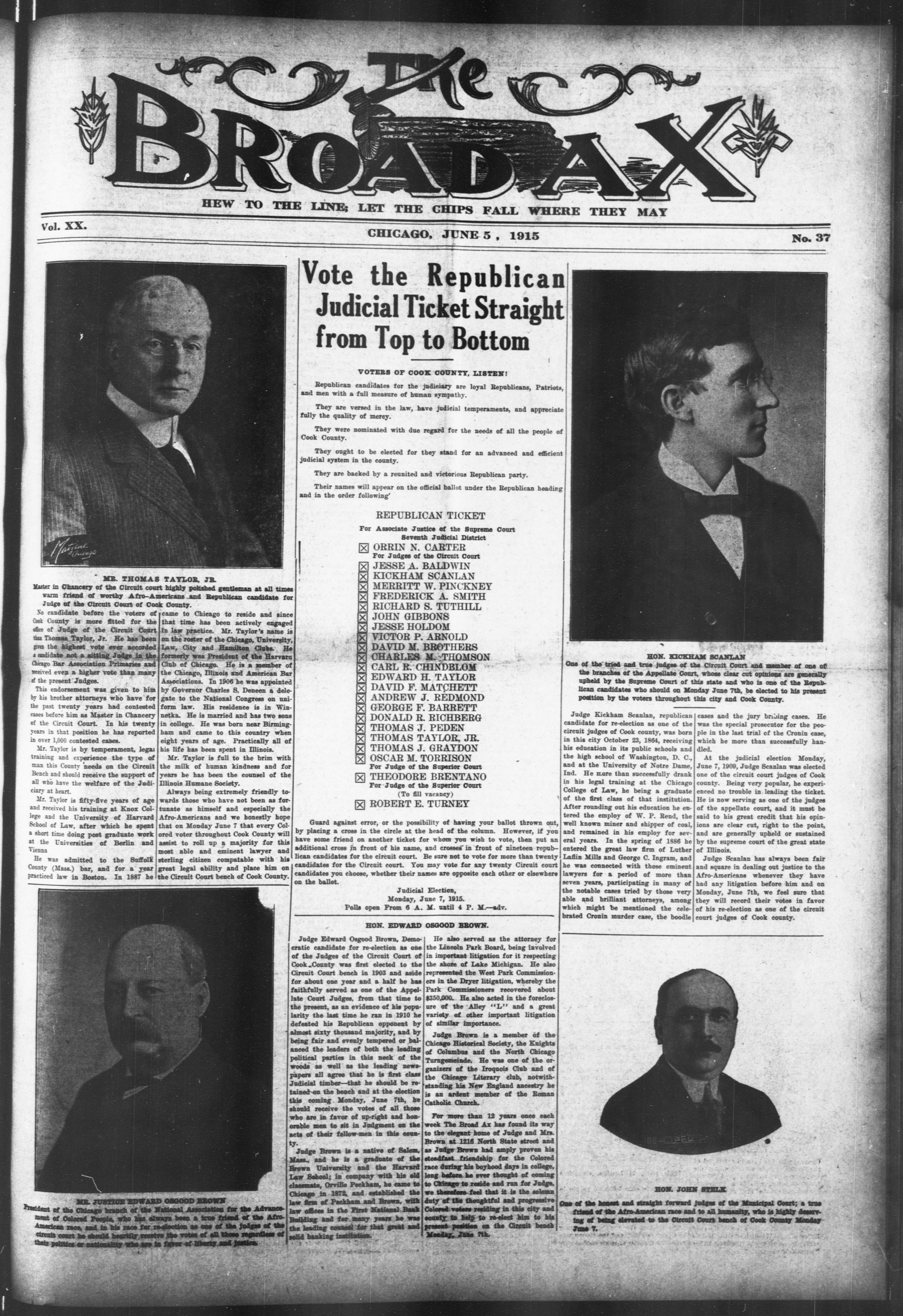
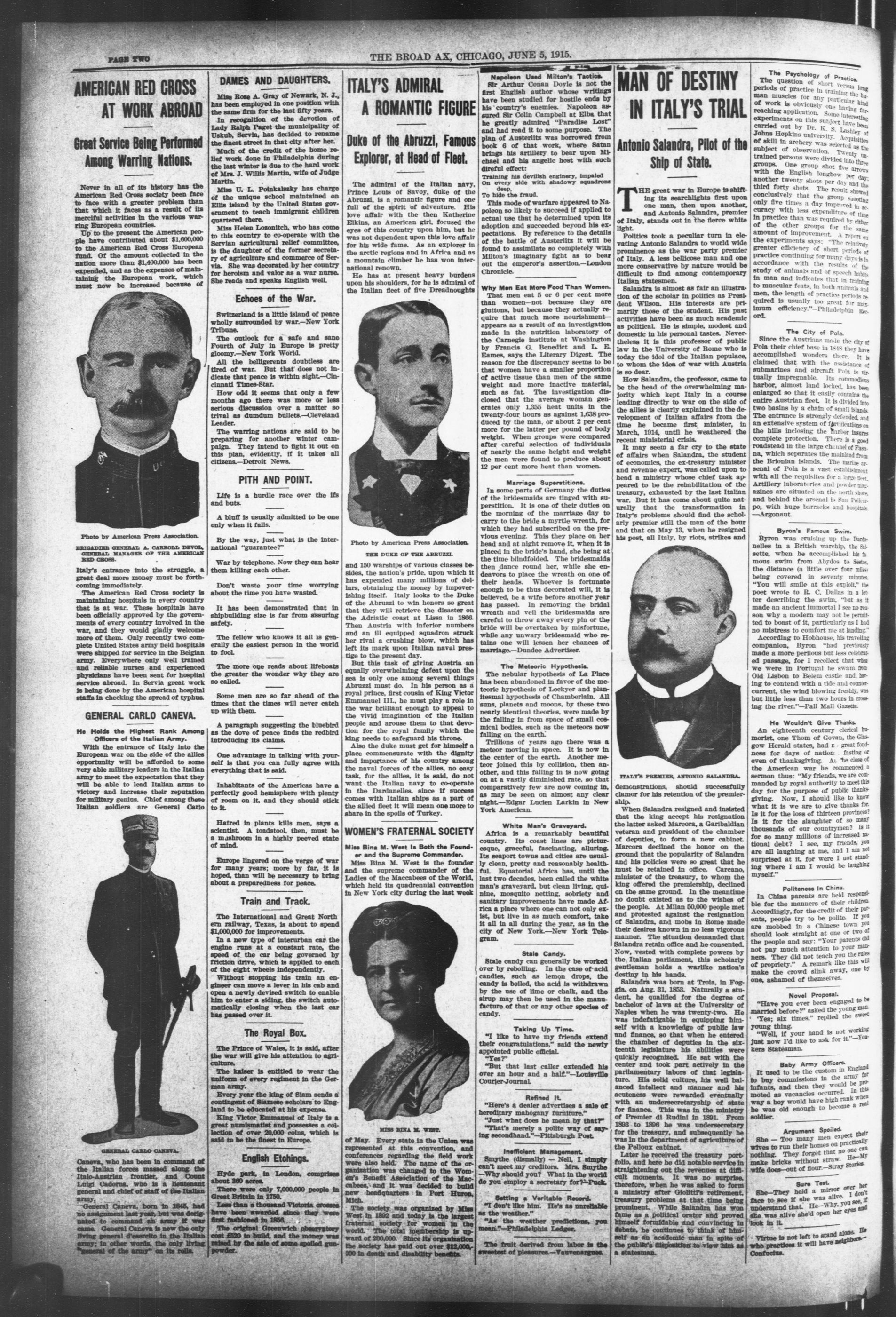
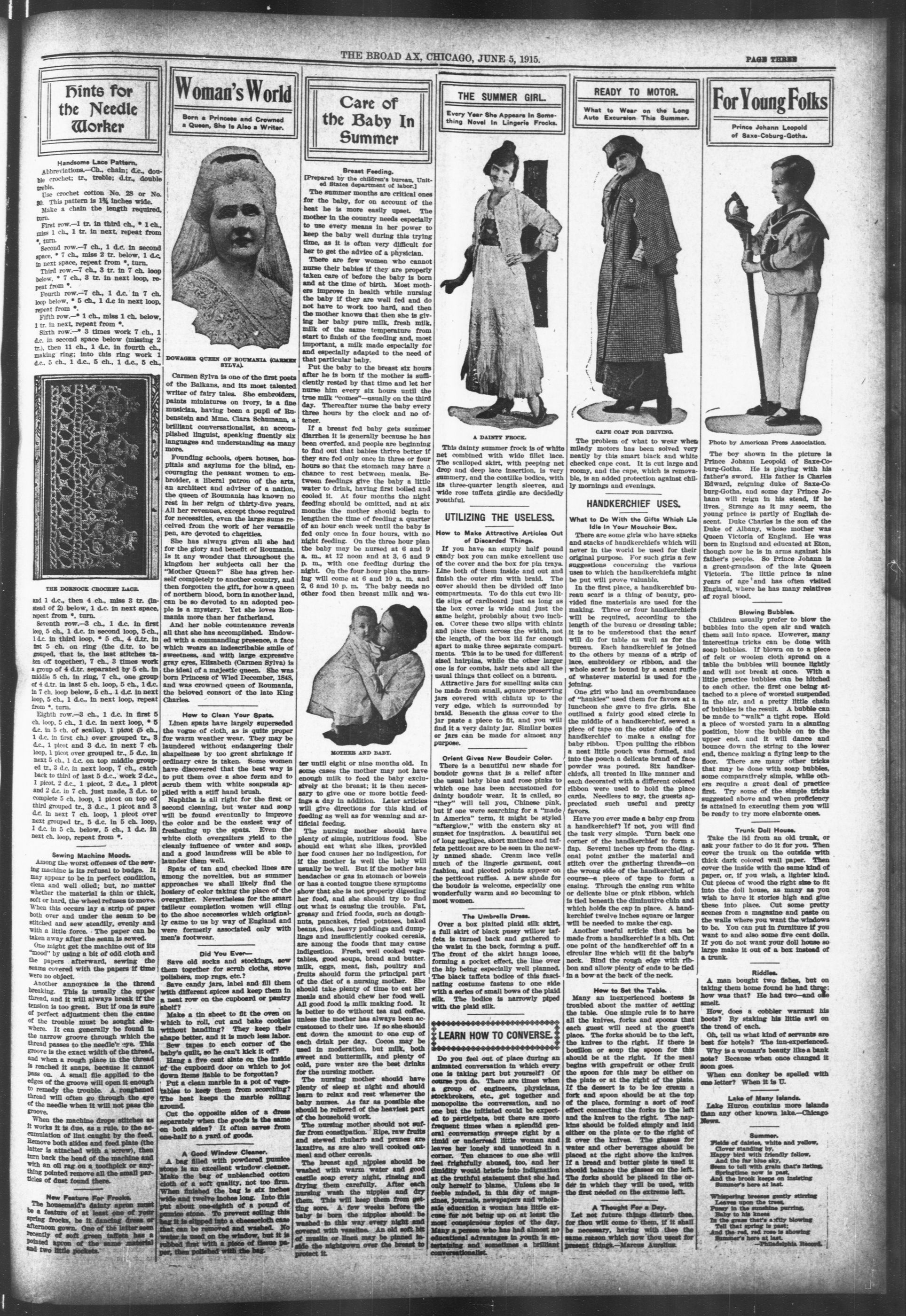
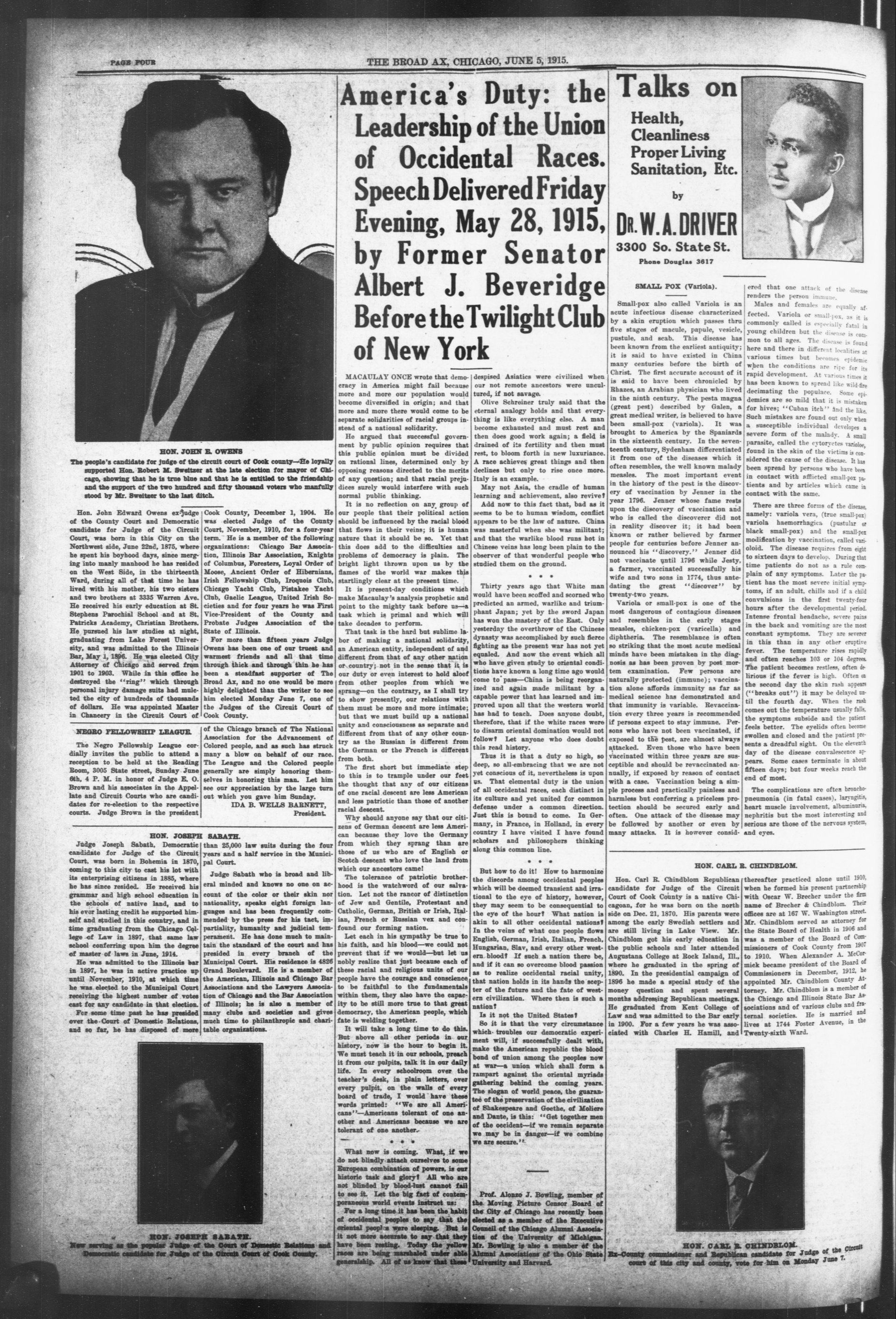
Page text (machine-generated)
THE BROAD AX
Mussini
Ninjao
Mustin
Cruzago
MR. THOMAS TAYLOR, JB.
Master in Chancery of the Circuit court highly polished gentleman at all times warm friend of worthy Afro-Americans and Republican candidate for Judge of the Circuit Court of Cook County.
No candidate before the voters of Cook County is more fitted for the office of Judge of the Circuit Court than Thomas Taylor, Jr. He has been given the highest vote ever accorded a candidate not a sitting Judge in the Chicago Bar Association Primaries and received even a higher vote than many of the present Judges.
This endorsement was given to him by his brother attorneys who have for the past twenty years had contested cases before him as Master in Chancery of the Circuit Court. In his twenty years in that position he has reported in over 1,000 contested cases.
Mr. Taylor is by temperament, legal training and experience the type of man this County needs on the Circuit Bench and should receive the support of all who have the welfare of the Judiciary at heart.
Mr. Taylor is fifty-five years of age and received his training at Knox College and the University of Harvard School of Law, after which he spent a short time doing post graduate work at the Universities of Berlin and Vienna.
He was admitted to the Suffolk County (Mass.) bar, and for a year practiced law in Boston. In 1887 he
---
[Name not visible]
MR. JUSTICE EDWARD OSGOOD BROWN
President of the Chicago branch of the National Association for the Advancement of Colored People, who has always been a true friend of the Afro-American race, and in his race for rejection as one of the judges of the circuit court he should heartily receive the votes of all those regardless of their politics or nationality who are in favor of liberty and justice.
Vol. XX.
came to Chicago to reside and since that time has been actively engaged in law practice. Mr. Taylor's name is on the roster of the Chicago, University, Law, City and Hamilton Clubs. He formerly was President of the Harvard Club of Chicago. He is a member of the Chicago, Illinois and American Bar Associations. In 1906 he was appointed by Governor Charles S. Deneen a delegate to the National Congress on uniform law. His residence is in Winnetka. He is married and has two sons in college. He was born near Birmingham and came to this country when eight years of age. Practically all of his life has been spent in Illinois.
Mr. Taylor is full to the brim with the milk of human kindness and for years he has been the counsel of the Illinois Humane Society.
Always being extremely friendly towards those who have not been as fortunate as himself and especially the Afro-Americans and we honestly hope that on Monday June 7 that every Colored voter throughout Cook County will assist to roll up a majority for this most able and eminent lawyer and sterling citizen compatable with his great legal ability and place him on the Circuit Court bench of Cook County.
CHICAGO, JUNE 5, 1915
Vote the Republican Judicial Ticket Straight from Top to Bottom
VOTERS OF COOK COUNTY, LISTEN!
Republican candidates for the and men with a full measure of hum
They are versed in the law, h fully the quality of mercy.
They were nominated with due Cook County.
They ought to be elected for judicial system in the county.
They are backed by a reunited
Their names will appear on the and in the order following'
Republican candidates for the judiciary are loyal Republicans, Patriots, and men with a full measure of human sympathy.
They are versed in the law, have judicial temperaments, and appreciate fully the quality of merey.
They were nominated with due regard for the needs of all the people of Cook County.
They ought to be elected for they stand for an advanced and efficient judicial system in the county.
They are backed by a reunited and victorious Republican party.
Their names will appear on the official ballot under the Republican heading and in the order following'
REPUBLICAN TICKET
Seventh Judicial District
ORRIN N. CARTER
For Judges of the Circuit Court
JESSE A. BALDWIN
KICKHAM SCANLAN
MERRITT W. PINCKNEY
FREDERICK A. SMITH
RICHARD S. TUTHILL
JOHN GIBBONS
JESSE HOLDOM
VICTOR P. ARNOLD
DAVID M. BROTHERS
CHARLES M. THOMSON
CARL R. CHINDBLOM
EDWARD H. TAYLOR
DAVID F. MATCHETT
ANDREW J. REDMOND
GEORGE F. BARRETT
DONALD R. RICHBERG
THOMAS J. PEDEN
THOMAS TAYLOR, JR.
THOMAS J. GRAYDON
OSCAR M. TORRISON
For Judge of the Superior Court
THEODORE BRENTANO
For Judge of the Superior Court
(To fill vacancy)
ROBERT E.
Guard against error, or the possi-
by placing a cross in the circle at tha
have some friend on another ticket t
additional cross in front of his name,
lican candidates for the circuit court.
candidates for the Circuit court. You
candidates you choose, whether their n
on the ballot.
Guard against error, or the possibility of having your ballot thrown out, by placing a cross in the circle at the head of the column. However, if you have some friend on another ticket for whom you wish to vote, then put an additional cross in front of his name, and crosses in front of nineteen republican candidates for the circuit court. Be sure not to vote for more than twenty candidates for the Circuit court. You may vote for any twenty Circuit court candidates you choose, whether their names are opposite each other or elsewhere on the ballot.
Judicial Election,
Monday, June 7, 1915.
Polls open From 6 A. M. until 4 P. M.—adv.
HON. EDWARD OSGOOD BROWN.
Judge Edward Osgood Brown, Democratic candidate for re-election as one of the Judges of the Circuit Court of Cook County was first elected to the Circuit Court bench in 1903 and aside for about one year and a half he has faithfully served as one of the Appellate Court Judges, from that time to the present, as an evidence of his popularity the last time he ran in 1910 he defeated his Republican opponent by almost sixty thousand majority, and by being fair and evenly tempered or balanced the leaders of both the leading political parties in this neck of the woods as well as the leading newspapers all agree that he is first class Judicial timber—that he should be retained on the bench and at the election this coming Monday, June 7th, he should receive the votes of all those who are in favor of up-right and honorable men to sit in Judgment on the acts of their fellow-men in this county.
Judge Brown is a native of Salem, Mass., and he is a graduate of the Brown University and the Harvard Law School; in company with his old classmate, Orville Peckham, he came to Chicago in 1872, and established the law firm of Peckham and Brown, with law offices in the First National Bank Building and for many years he was the leading counsel for that great and solid banking institution.
judiciary are loyal Republicans, Patriotic man sympathy.
have judicial temperaments, and appreciates
regard for the needs of all the people
they stand for an advanced and efficient
and victorious Republican party.
official ballot under the Republican headi
I. TURNEY
ability of having your ballot thrown out
the head of the column. However, if you
or whom you wish to vote, then put an
and crosses in front of nineteen repub-
Be sure not to vote for more than twenty
may vote for any twenty Circuit court
names are opposite each other or elsewhere
He also served as the attorney for the Lincoln Park Board, being involved in important litigation for it respecting the shore of Lake Michigan. He also represented the West Park Commissioners in the Dryer litigation, whereby the Park Commissioners recovered about $350,000. He also acted in the foreclosure of the Alley "L" and a great variety of other important litigation of similar importance.
Judge Brown is a member of the Chicago Historical Society, the Knights of Columbus and the North Chicago Turngemeinde. He was one of the organizers of the Iroquois Club and of the Chicago Literary club, notwithstanding his New England ancestry he is an ardent member of the Roman Catholic Church.
For more than 12 years once each week The Broad Ax has found its way to the elegant home of Judge and Mrs. Brown at 1216 North State street and as Judge Brown had amply proven his steadfast friendship for the Colored race during his boyhood days in college, long before he ever thought of coming to Chicago to reside and run for Judge, we therefore feel that it is the solemn duty of the thoughtful and progressive Colored voters residing in this city and county to help to reelect him to his present position on the Circuit bench Monday, June 7th.
1910
HON. KICKHAM SCANLAN
One of the tried and true judges of the Circuit Court and member of one of the branches of the Appellate Court, whose clear cut opinions are generally upheld by the Supreme Court of this state and who is one of the Republican candidates who should on Monday June 7th, be elected to his present position by the voters throughout this city and Cook County.
One of the tried and true judges of of the branches of the Appellate Court upheld by the Supreme Court of the American candidates who should on Monday position by the voters throughout
Judge Kickham Scanlan, republican candidate for re-election as one of the circuit judges of Cook county, was born in this city October 23, 1864, receiving his education in its public schools and the high school of Washington, D. C., and at the University of Notre Dame, Ind. He more than successfully drank in his legal training at the Chicago College of Law, he being a graduate of the first class of that institution. After rounding out his education he entered the employ of W. P. Rend, the well known miner and shipper of coal, and remained in his employ for several years. In the spring of 1886 he entered the great law firm of Luther Ladin Mills and George C. Ingram, and he was connected with those eminent lawyers for a period of more than seven years, participating in many of the notable cases tried by those very able and brilliant attorneys, among which might be mentioned the celebrated Cronin murder case, the booole
---
HON. JOHN STELK
One of the honest and straight forward judges of the Municipal Court; a true friend of the Afro-American race and to all humanity, who is highly deserving of being elevated to the Circuit Court bench of Cook County Monday June 7.
the Circuit Court and member of one of t, whose clear cut opinions are generally his state and who is one of the Republ- day June 7th, be elected to his present this city and Cook County.
cases and the jury bringing cases. He was the special prosecutor for the people in the last trial of the Cronin case, which he more than successfully handled.
At the judicial election Monday, June 7, 1909, Judge Scanlan was elected one of the circuit court judges of Cook county. Being very popular, he experienced no trouble in leading the ticket. He is now serving as one of the judges of the appellate court, and it must be said to his great credit that his opinions are clear cut, right to the point, and are generally upheld or sustained by the supreme court of the great state of Illinois.
Judge Scanlan has always been fair and square in dealing out justice to the Afro-Americans whenever they have had any litigation before him and on Monday, June 7th, we feel sure that they will record their votes in favor of his re-election as one of the circuit court judges of Cook county.
---
No.37
PAGE TWO
Never in all of its history has the American Red Cross society been face to face with a greater problem than that which it faces as a result of its merciful activities in the various warring European countries.
Up to the present the American people have contributed about $1,600,000 to the American Red Cross European fund. Of the amount collected in the nation more than $1,400,000 has been expended, and as the expenses of maintaining the European work, which must now be increased because of
U.
Photo by American Press Association.
BRIGADIER GENERAL A. CARROLL DEVOL.
GENERAL MANAGER OF THE AMERICAN
RED CROSS.
Italy's entrance into the struggle, a great deal more money must be forthcoming immediately.
The American Red Cross society is maintaining hospitals in every country that is at war. These hospitals have been officially approved by the governments of every country involved in the war, and they would gladly welcome more of them. Only recently two complete United States army field hospitals were shipped for service in the Belgian army. Everywhere only well trained and reliable nurses and experienced physicians have been sent for hospital service abroad. In Servia great work is being done by the American hospital staffs in checking the spread of typhus.
GENERAL CARLO CANEVA.
He Holds the Highest Rank Among Officers of the Italian Army. With the entrance of Italy into the European war on the side of the allies opportunity will be afforded to some very able military leaders in the Italian army to meet the expectation that they will be able to lead Italian arms to victory and increase their reputation for military genius. Chief among these Italian soldiers are General Carlo
GENERAL CARLO CANEVA.
Caneva, who has been in command of the Italian forces massed along the Italo-Austrian frontier, and Count Luigi Cadorna, who is a lieutenant general and chief of staff of the Italian army.
General Caneva, born in 1845, had no assignment last year, but was designated to command all army if war came. General Caneva is now the only living general 'desereto' in the Italian army; in other words, the only living "general of the army" on its rolls.
DAMES AND DAUGHTERS.
Miss Rose A. Gray of Newark, N. J., has been employed in one position with the same firm for the last fifty years.
Much of the credit of the home relief work done in Philadelphia during the last winter is due to the hard work of Mrs. J. Willis Martin, wife of Judge Martin.
Miss U. L. Poinkalszky has charge of the unique school maintained on Ellis island by the United States government to teach immigrant children quartered there.
Miss Helen Lozonitch, who has come to this country to co-operate with the Servian agricultural relief committee, is the daughter of the former secretary of agriculture and commerce of Servia. She was decorated by her country for herloism and valor as a war nurse. She reads and speaks English well.
Echoes of the War.
Switzerland is a little island of peace wholly surrounded by war.—New York Tribune.
The outlook for a safe and sane Fourth of July in Europe is pretty gloomy.—New York World.
All the belligerents doubtless are tired of war. But that does not indicate that peace is within sight.—Cincinnati Times-Star.
How odd it seems that only a few months ago there was more or less serious discussion over a matter so trivial as dumdum bullets.—Cleveland Leader.
The warring nations are said to be preparing for another winter campaign. They intend to fight it out on this plan, evidently, if it takes all citizens—Detroit News.
PITH AND POINT.
Life is a hurdle race over the ifs and buts.
A bluff is usually admitted to be one only when it fails.
By the way, just what is the international "guarantee?"
War by telephone. Now they can hear them killing each other.
Don't waste your time worrying about the time you have wasted.
It has been demonstrated that in shipbuilding size is far from assuring safety.
The fellow who knows it all is generally the easiest person in the world to fool.
The more one reads about lifeboats the greater the wonder why they are so called.
Some men are so far ahead of the times that the times will never catch up with them.
A paragraph suggesting the bluebird as the dove of peace finds the redbird introducing its claims.
One advantage in talking with yourself is that you can fully agree with everything that is said.
Inhabitants of the Americas have a perfectly good hemisphere with plenty of room on it, and they should stick to it.
Hatred in plants kills men, says a scientist. A toadstool, then, must be a mushroom in a highly peeved state of mind.
Europe lingered on the verge of war for many years; more by far, it is hoped, than will be necessary to bring about a preparedness for peace.
Train and Track.
The International and Great North ern railway, Texas, is about to spend $1,000,000 for improvements.
In a new type of interurban car the engine runs at a constant rate, the speed of the car being governed by friction drive, which is applied to each of the eight wheels independently.
Without stopping his train an engineer can move a lever in his cab and open a newly devised switch to enable him to enter a sliding, the switch automatically closing when the last car has passed over it.
The Royal Box
The Prince of Wales, it is said, after the war will give his attention to agriculture. The kalser is entitled to wear the uniform of every regiment in the German army. Every year the king of Siam sends a contingent of Siamese scholars to England to be educated at his expense. King Victor Emmanuel of Italy is a great numismatist and possesses a collection of over 20,000 coins, which is said to be the finest in Europe.
English Etchings
Hyde park, in London, comprises about 360 acrea.
There were only 7,000,000 people in Great Britain in 1750.
Less than a thousand Victoria crosses have been awarded since they were first fashioned in 1886.
The original Greenwich observatory cost £220 to build, and the money was raised by the sale of some spoiled gunpowder.
THE BROAD AX. CHICAGO, JUNE 5, 1915.
Duke of the Abruzzi, Famous Explorer, at Head of Fleet.
The admiral of the Italian navy, Prince Louis of Savoy, duke of the Abruzzi, is a romantic figure and one full of the spirit of adventure. His love affair with the then Katherine Elkins, an American girl, focused the eyes of this country upon him, but he was not dependent upon this love affair for his wide fame. As an explorer in the arctic regions and in Africa and as a mountain climber he has won international renown.
He has at present heavy burdens upon his shoulders, for he is admiral of the Italian fleet of five Dreadnoughts
P.
Photo by American Press Association
THE DUKE OF THE ABRUZZI
and 150 warships of various classes besides, the nation's pride, upon which it has expended many millions of dollars, obtaining the money by impoverishing itself. Italy looks to the Duke of the Abruzzi to win honors so great that they will retrieve the disaster on the Adriatic coast at Lissa in 1866. Then Austria with inferior numbers and an ill equipped squadron struck her rival a crushing blow, which has left its mark upon Italian naval prestige to the present day.
But this task of giving Austria an equally overwhelming defeat upon the sea is only one among several things Abruzzi must do. In his person as a royal prince, first cousin of King Victor Emmanuel III, he must play a role in the war brilliant enough to appeal to the vivid imagination of the Italian people and arouse them to that devotion for the royal family which the king needs to safeguard his throne.
Also the duke must get for himself a place commensurate with the dignity and importance of his country among the naval forces of the allies, no easy task, for the allies, it is said, do not want the Italian navy to co-operate in the Dardanelles, since if success comes with Italian ships as a part of the allied fleet it will mean one more to share in the spoils of Turkey.
WOMEN'S FRATERNAL SOCIETY
Miss Bina M. West Is Both the Founder and the Supreme Commander. Miss Bina M. West is the founder and the supreme commander of the Ladies of the Maccabees of the World, which held its quadrennial convention in New York city during the last week
Mary
MISS BINA M. WEST.
of May. Every state in the Union was represented at this convention, and conferences regarding the field work were also held. The name of the organization was changed to the Women's Benefit Association of the Maccaebes, and it was decided to build new headquarters in Port Huron, Mich.
The society was organized by Miss West in 1892 and today is the largest fraternal society for women in the world. The total membership is upward of 200,000. Since its organization the society has paid out over $12,000,000 in death and disability benefits.
Napoleon Used Milton's Tactics.
Sir Arthur Conan Doyle is not the first English author whose writings have been studied for hostile ends by his country's enemies. Napoleon assured Sir Colin Campbell at Elba that he greatly admired "Paradise Lost" and had read it to some purpose. The plan of Austerlitz was borrowed from book 6 of that work, where Satan brings his artillery to bear upon Michael and his angelic host with such direful effect:
Training his devilish enginery, impaled
On every side with shadowy squadrons
deep.
To hide the fraud.
This mode of warfare appeared to Napoleon so likely to succeed if applied to actual use that he determined upon its adoption and succeeded beyond his expectations. By reference to the details of the battle of Austerlitz it will be found to assimilate so completely with Milton's imaginary fight as to bear out the emperor's assertion.—London Chronicle.
Why Men Eat More Food Than Women.
That men eat 5 or 6 per cent more than women—not because they are gluttons, but because they actually require that much more nourishment—appears as a result of an investigation made in the nutrition laboratory of the Carnegie institute at Washington by Francis G. Benedict and L. E. Eames, says the Literary Digest. The reason for the discrepancy seems to be that women have a smaller proportion of active tissue than men of the same weight and more inactive material, such as fat. The investigation disclosed that the average woman generates only 1,355 heat units in the twenty-four hours as against 1,638 produced by the man, or about 2 per cent more for the latter per pound of body weight. When groups were compared after careful selection of individuals of nearly the same height and weight the men were found to produce about 12 per cent more heat than women.
Marriage Superstitions.
In some parts of Germany the duties of the bridesmaids are tinged with superstition. It is one of their duties on the morning of the marriage day to carry to the bride a myrtle wreath, for which they had subscribed on the previous evening. This they place on her head and at night remove it, when it is placed in the bride's hand, she being at the time blindfolded. The bridesmaids then dance round her, while she endeavors to place the wreath on one of their heads. Whoever is fortunate enough to be thus decorated will, it is believed, be a wife before another year has passed. In removing the bridal wreath and vell the bridesmaids are careful to throw away every pln or the bride will be overtaken by misfortune, while any unwary bridesmaid who retains one will lessen her chances of marriage—Dundee Advertiser.
The Meteoric Hypothesis
The nebular hypothesis of La Place has been abandoned in favor of the meteoric hypothesis of Lockyer and planitesmal hypothesis of Chamberlain. All suns, planets and moons, by these two nearly identical theories, were made by the falling in from space of small cosmic bodies, such as the meteors now falling on the earth.
Trillions of years ago there was a meteor moving in space. It is now in the center of the earth. Another meteor joined this by collision, then another, and this falling in is now going on at a vastly diminished rate, so that comparatively few are now coming in, as may be seen on almost any clear night—Edgar Lucen Larkin in New York American.
White Man's Graveyard.
Africa is a remarkably beautiful country. Its coast lines are picturesque, graceful, fascinating, alluring. Its seaport towns and cities are usually clean, pretty and reasonably healthful. Equatorial Africa has, until the last two decades, been called the white man's graveyard, but clean living, quinine, mosquito netting, sobriety and sanitary improvements have made Africa a place where one can not only exist, but live in as much comfort, take it all in all during the year, as in the city of New York—New York Telegram.
Stale Candy.
Stale candy can generally be worked over by rebolling. In the case of acid candies, such as lemon drops, the candy is boiled, the acid is withdrawn by the use of lime or chalk, and the sirup may then be used in the manufacture of that or any other species of candy.
"I like to have my friends extend their congratulations," said the newly appointed public official.
"Yes?"
"But that last caller extended his over an hour and a half"—Louisville Courier-Journal.
"Here's a dealer advertises a sale of hereditary mahogany furniture."
"Just what does he mean by that?"
"That's merely a polite way of saying secondhand."-Pittsburgh Post.
Inefficient Management
Smythe (dismally) — Nell, I simply can't meet my creditors. Mrs. Smythe —Why should you? What in the world do you employ a secretary for?—Puck.
Setting a Veritable Record.
"I don't like him. He's as unreliable as the weather."
"As the weather predictions, you mean."—Philadelphia Ledger.
The fruit derived from labor is the sweetest of pleasures.—Vauvenargues.
MAN OF DESTINY IN ITALY'S TRIAL
THE great war in Europe is shifting its searchlights first upon one man, then upon another, and Antonio Salandra, premier of Italy, stands out in the fierce white light. Politics took a peculiar turn in elevating Antonio Salandra to world wide prominence as the war party premier of Italy. A less bellicose man and one more conservative by nature would be difficult to find among contemporary Italian statesmen.
Salandra is almost as fair an illustration of the scholar in politics as President Wilson. His interests are primarily those of the student. His past activities have been as much academic as political. He is simple, modest and domestic in his personal tastes. Nevertheless it is this professor of public law in the University of Rome who is today the idol of the Italian populace, to whom the idea of war with Austria is so dear.
How Salandra, the professor, came to be the head of the overwhelming majority which kept Italy in a course leading directly to war on the side of the allies is clearly explained in the development of Italian affairs from the time he became first minister, in March, 1014, until he weathered the recent ministerial crisis.
It may seem a far cry to the state of affairs when Salandra, the student of economics, the ex-treasury minister and revenue expert, was called upon to head a ministry whose chief task appeared to be the rehabilitation of the treasury, exhausted by the last Italian war. But it has come about quite naturally that the transformation in Italy's problems should find the scholarly premier still the man of the hour and that on May 13, when he resigned his post all Italy, by riots, strikes and
---
ITALY'S PREMIER, ANTONIO SALANDRA demonstrations, should successfully clamor for his retention of the premiership.
When Salandra resigned and insisted that the king accept his resignation the latter asked Marcora, a Garibaldian veteran and president of the chamber of deputies, to form a new cabinet. Marcora declined the honor on the ground that the popularity of Salandra and his policies were so great that he must be retained in office. Carcano, minister of the treasury, to whom the king offered the premiership, declined on the same ground. In the meantime no doubt existed as to the wishes of the people. At Milan 50,000 people met and protested against the resignation of Salandra, and mobs in Rome made their desires known in no less vigorous manner. The situation demanded that Salandra retain office and he consented. Now, vested with complete powers by the Italian parliament, this scholarly gentleman holds a warlike nation's destiny in his hands.
Salandra was born at Trota, in Foglia, on Aug. 31, 1853. Naturally a student, he qualified for the degree of bachelor of laws at the University of Naples when he was twenty-two. He was indefatigable in equipping himself with a knowledge of public law and finance, so that when he entered the chamber of deputies in the sixteenth legislature his abilities were quickly recognized. He sat with the center and took part actively in the parliamentary labors of that legislature. His solid culture, his well balanced intellect and manner and his acuteness were rewarded eventually with an undersecretaryship of state for finance. This was in the ministry of Premier di Rudini in 1891. From 1893 to 1896 he was undersecretary for the treasury, and subsequently he was in the department of agriculture of the Pelloux cabinet.
Later he received the treasury portfolio, and here he did notable service in straightening out the revenues at difficult moments. It was no surprise, therefore, when he was asked to form a ministry after Glolitti's retirement, treasury problems at that time being prominent. While Salandra has won fame as a political orator and proved himself formidable and convincing in debate, he continues to think of himself as an academic man in spite of the public's disposition to view him as
The Psychology of Psychology
Physiology of Practice.
The question of short versus long periods of practice in training the human muscles for any particular kind of work is obviously one having far-reaching application. Some interesting experiments on this subject have been carried out by Dr. K. S. Lashley of Johns Hopkins university. Acquisition of skill in archery was selected as the subject of observation. Twenty untrained persons were divided into three groups. One group shot five arrows with the English longbow per day, another twenty shots per day and the third forty shots. The result showed conclusively that the group shooting only five times a day improved in accuracy with less expenditure of time in practice than was required by either of the other groups for the same amount of improvement. A report on the experiments says: "The relatively greater efficiency of short periods of practice continuing for many days is in accordance with the results of the study of animals and of speech habits in man and indicates that in training to muscular feats, in both animals and men, the length of practice periods required is usually too great for maximum efficiency."-Philadelphia Record.
The City of Pola
Since the Austrians made the city of Pola their chief base in 1848 they have accomplished wonders there. It is claimed that with the assistance of submarines and aircraft Pola is virtually impregnable. Its commodo harbor, almost land locked, has been enlarged so that it easily contains the entire Austrian fleet. It is divided into two basins by a chain of small islands. The entrance is strongly defended, and an extensive system of fortifications on the hills including the harbor insures complete protection. There is a good roadstead in the large channel of Fassna, which separates the mainland from the Brionian islands. The marine arsenal of Pola is a vast establishment with all the requisites for a large fleet. Artillery laboratories and powder magazines are situated on the north shore, and behind the arsenal is San Policarpo, with huge barracks and hospitals. —Argonaut.
Byron's Famous Swim.
Byron was cruising up the Dana-nelles in a British warship, the Salette, when he accomplished his famous swim from Abydos to Sestos, the distance (a little over four miles) being covered in seventy minutes. "You will smile at this exploit," the poet wrote to R. C. Dallas in a letter describing the swim, "but as it made an ancient immortal I see no reason why a modern may not be permitted to boast of it, particularly as I had no mistress to comfort me at landing." According to Hobhouse, his traveling companion, Byron "had previously made a more perilous but less celebrated passage, for I recollect that when we were in Portugal he swam from Old Lisbon to Belem castle and, having to contend with a tide and countercurrent, the wind blowing freshly, was but little less than two hours in crossing the river."—Pall Mall Gazette.
He Wouldn't Give Thanks.
An eighteenth century clerical humourist, one Thom of Govan, the Glasgow Herald states, had a great fondness for days of nation, fasting or even of thanksgiving. At the close of the American war he commenced a sermon thus: "My friends, we are commanded by royal authority to meet this day for the purpose of public thanksgiving. Now, I should like to know what it is we are to give thanks for. Is it for the loss of thirteen provinces? Is it for the slaughter of so many thousands of our countrymen? Is it for so many millions of increased national debt? I see, my friends, you are all laughing at me, and I am not surprised at it, for were I not standing where I am I would be laughing myself."
Politeness In China
In China parents are held responsible for the manners of their children. Accordingly, for the credit of their parents, people try to be polite. If you are mobbed in a Chinese town you should look straight at one or two of the people and say: "Your parents did not pay much attention to your manners. They did not teach you the rules of propriety." A remark like this will make the crowd slink away, one by one, ashamed of themselves.
Novel Proposal.
"Have you ever been engaged to be married before?" asked the young man. 'Yes; six times,' replied the sweet young thing.
young thing.
"Well, if your hand is not working just now I'd like to ask for it."—Yorkers Statesman.
Baby Army Officers
Baby Army Officer It used to be the custom in England to buy commissions in the army for infants, and then they would be promoted as vacancies occurred. In this way a boy would have high rank when he was old enough to become a real soldier.
Argument Spoiled
Argument Spoken
She — Too many men expect their wives to run their homes on practically nothing. They forget that no one can make bricks without straw. He-My wife does—out of flour.—Stray Stories.
Sure Test.
She—They held a mirror over her face to see if she was alive. I don't understand that. He—Why, you see, if she was alive she'd open her eyes and look in it.
Virtue is not left to stand alone. He who practices it will have neighbor—Confucius.
Hints for the Needle Worker
Handsome Lace Pattern.
Abbreviations.—Ch., chain; d.c., double crochet; tr., treble; d.tr., double treble.
Use crochet cotton No. 28 or No. 30. This pattern is 1% inches wide.
Make a chain the length required, turn.
First row.—1 tr. in third ch., * 1 ch., miss 1 ch., 1 tr. in next, repeat from 4 turn.
Second row.—* 7 ch., 1 d.c. in second space, * 7 ch., miss 2 tr. below, 1 d.c. in next space, repeat from *, turn.
Third row.—* 7 ch., 3 tr. in 7 ch. loop below, * 7 ch., 3 tr. in next loop, repeat from *.
Fourth row.—* 7 ch., 1 d.c. in 7 ch. loop below, * 5 ch., 1 d.c in next loop, repeat from *.
Fifth row.—* 1 ch., miss 1 ch. below, 1 tr. in next, repeat from *.
Sixth row.—* 3 times work 7 ch., 1 d.c. in second space below (missing 2 tr.), then 11 ch., 1 d.c. in fourth ch., making ring; into this ring work 1 d.c. 5 ch., 1 d.c. 5 ch., 1 d.c. 5 ch.
```markdown
```
THE DORNOCK CROCHET LAGE.
and 1 d.c., then 4 ch., miss 3 tr. (instead of 2) below, 1 ch. in next space, repeat from *, turn.
Seventh row,—3 ch., 1 d.c. in first loop, 5 ch., 1 d.c. in second loop, 5 ch., 1 d.c. in third loop, * 5 ch., 4 d.t., in first 5 ch. on ring (the d.t. to be grouped, that is, the last stitches taken off together), 7 ch., 3 times work a group of 4 d.t. separated by 5 ch. in middle 5 ch. in ring, 7 ch., one group of 4 d.t. in last 5 ch. loop, 5 ch., 1 d.c. in 7 ch. loop below, 5 ch., 1 d.c. in next loop, 5 ch., 1 d.c. in next loop, repeat from *. turn.
Eighth row.—3 ch., 1 d.c. in first 5 ch. loop, 5 ch., 1 d.c. in next loop, * 5 d.c. in 5 ch. of scallop, 1 pictor (5 ch., 1 d.c. in first ch.) over grouped tr., 3 d.c. 1 pictor and 3 d.c. in next 7 ch. loop, 1 pictor over grouped tr., 5 d.c. in next 5 ch., 1 d.c. on top middle grouped tr., 3 d.c. in next loop, 7 ch., catch back to third of last 5 d.c., work 2 d.c., 1 pictor, 2 d.c., 1 pictor, 2 d.c. in 7 ch. just made, 3 d.c. to complete 5 ch. loop, 1 pictor on top of third grouped tr., 3 d.c., 1 pictor and 3 d.c. in next 7 ch. loop, 1 pictor over next grouped tr., 5 d.c. in 5 ch. loop, 1 d.c. in 5 ch. below, 5 ch., 1 d.c. in next ch. loop, repeat from *.
Sewing Machine Moods.
Among the worst offenses of the sewing machine is its refusal to budge. It may appear to be in perfect condition, clean and well oiled; but, no matter whether the material is thin or thick, soft or hard, the wheel refuses to move. When this occurs lay a strip of paper both over and under the seam to be stitched and sew steadily, evenly and with a little force. The paper can be taken away after the seam is sewed.
One might get the machine out of its "mood" by using a bit of odd cloth and the papers afterward, sewing the seams covered with the papers if time were no object.
Another annoyance is the thread breaking. This is usually the upper thread, and it will always break if the tension is too great. But if one is sure of perfect adjustment then the cause of the trouble must be sought elsewhere. It can generally be found in the narrow groove through which the thread passes to the needle's eye. This groove is the exact width of the thread, and when a rough place in the thread is reached it snaps, because it cannot pass on. A small file applied to the edges of the groove will open it enough to remedy the trouble. A roughened thread will often go through the eye of the needle when it will not pass the groove.
When the machine drops stitches as it works it is due, as a rule, to the accumulation of lint caught by the feed. Remove both slides and feed plate (the latter is attached with a screw), then turn back the head of the machine and with an oil rag on a toothpick or anything pointed remove all the small particles of dust found there.
New Feature For Frocks.
The housemaid's dainty apron must be a feature of at least one of your spring frocks, be it dancing dress or afternoon gown. One of the latter seen recently of soft green taffeta has a pointed apron of the same material and two little pockets.
Born a Princess and Crowned a Queen, She Is Also a Writer
[Image of a woman with long hair and a veil, wearing a decorative dress with intricate patterns.]
DOWAGER QUEEN OF ROUMANIA (CARMEN SYLVA)
Carmen Sylva is one of the first poets of the Balkans, and its most talented writer of fairy tales. She embroiderers, paints miniatures on ivory, is a fine musician, having been a pupil of Rubenstein and Mme. Clara Schumann, a brilliant conversationalist, an accomplished linguist, speaking fluently six languages and understanding as many more.
Founding schools, opera houses, hospitals and asylums for the blind, encouraging the peasant women to embroider, a liberal patron of the arts, an architect and adviser of a nation, the queen of Roumania has known no rest in her reign of thirty-five years. All her revenues, except those required for necessities, even the large sums received from the work of her versatile pen, are devoted to charities.
She has always given all she had for the glory and benefit of Roumania. Is it any wonder that throughout the kingdom her subjects call her the "Mother Queen?" She has given herself completely to another country, and then forgotten the gift, for how a queen of northern blood, born in another land, can be so devoted to an adopted people is a mystery. Yet she loves Roumania more than her fatherland.
And her noble countenance reveals all that she has accomplished. Endowed with a commanding presence, a face which wears an indescribable smile of sweetness, and with large expressive gray eyes, Elizabeth (Carmen Sylva) is the ideal of a majestic queen. She was born Princess of Wied December, 1848, and was crowned queen of Roumania, the beloved consort of the late King Charles.
How to Clean Your Spate.
Linen spats have largely superseded the vogue of cloth, as is quite proper for warm weather wear. They may be laundered without endangering their shapeliness by too great shrinkage if ordinary care is taken. Some women have discovered that the best way is to put them over a shoe form and to scrub them with white soapsuds applied with a stiff hand brush. Naphtha is all right for the first or second cleaning, but water and soap will be found eventually to improve the color and be the easiest way of freshening up the spats. Even the white cloth overgaiters yield to the cleanly influence of water and soap, and a good laudress will be able to launder them well.
Spats of tan and checked lines are among the novelties, but as summer approaches we shall likely find the hosiery of color taking the place of the overgaiter. Nevertheless for the smart tailleur completion women will cling to the shoe accessories which originally came to us by way of England and were formerly associated only with men's footwear.
Did You Ever—
Save old socks and stockings, sew them together for scrub cloths, stove polishers, mop rags, etc.?
Save candy jars, label and fill them with different spices and keep them in a neat row on the cupboard or pantry shelf?
Make a tin sheet to fit the oven on which to roll, cut and bake cookies without handling? They keep their shape better, and it is much less labor.
Sew tapes to each corner of the baby's quilt, so he can't kick it off?
Hang a five cent slate on the inside of the cupboard door on which to jot down items liable to be forgotten?
Put a clean marble in a pot of vegetables to keep them from scorching?
The heat keeps the marble rolling around.
Cut the opposite sides of a dress separately when the goods is the same on both sides? It often saves from one-half to a yard of goods.
A. Good Window Cleaner.
A bag filled with powdered pumice stone is an excellent window cleaner. Make the bag of unbleached cotton cloth of a soft quality, not too firm. When finished the bag is six inches wide and twelve inches long. Into this put about one-eighth of a pound of pumice stone. To prevent selling this bag it is slipped into a cheesecloth case that can be removed and washed. No water is used on the window, but it is rubbed first with a piece of tissue paper, then polished with the bag.
Care of the Baby In Summer
THE SUMMER GIRL
Every Year She Appears In S thing Novel In Lingerie F
Breast Feeding.
[Prepared by the children's bureau, United States department of labor.]
The summer months are critical ones for the baby, for on account of the heat he is more easily upset. The mother in the country needs especially to use every means in her power to keep the baby well during this trying time, as it is often very difficult for her to get the advice of a physician. There are few women who cannot nurse their babies if they are properly taken care of before the baby is born and at the time of birth. Most mothers improve in health while nursing the baby if they are well fed and do not have to work too hard, and then the mother knows that then she is giving her baby pure milk, fresh milk, milk of the same temperature from start to finish of the feeding and, most important, a milk made especially for and especially adapted to the need of that particular baby.
Put the baby to the breast six hours after he is born if the mother is sufficiently rested by that time and let her nurse him every six hours until the true milk "comes"—usually on the third day. Thereafter nurse the baby every three hours by the clock and no often.
If a breast fed baby gets summer diarrhea it is generally because he has been overfed, and people are beginning to find out that babies thrive better if they are fed only once in three or four hours so that the stomach may have a chance to rest between meals. Between feedings give the baby a little water to drink, having first bolled and cooled it. At four months the night feeding should be omitted, and at six months the mother should begin to lengthen the time of feeding a quarter of an hour each week until the baby is fed only once in four hours, with no night feeding. On the three hour plan the baby may be nursed at 6 and 9 a.m., at 12 noon and at 3, 6 and 9 p.m., with one feeding during the night. On the four hour plan the nursing will come at 6 and 10 a.m. and 2, 6 and 10 p.m. The baby needs no other food then breast milk and wa-
MOTHER AND BABY.
ter until eight or nine months old. In some cases the mother may not have enough milk to feed the baby exclusively at the breast; it is then necessary to give one or more bottle feedings a day in addition. Later articles will give directions for this kind of feeding as well as for weaning and artificial feeding.
The nursing mother should have plenty of simple, nutritious food. She should eat what she likes, provided her food causes her no indigestion, for if the mother is well the baby will usually be well. But if the mother has headaches or gas in stomach or bowels or has a coated tongue these symptoms show that she is not properly digesting her food, and she should try to find out what is causing the trouble. Fat, greasy and fried foods, such as doughnuts, pancakes, fried potatoes, baked beans, plies, heavy puddings and dumplings and insufficiently cooked cereals, are among the foods that may cause indigestion. Fresh, well cooked vegetables, good soups, bread and butter. milk, eggs, meat, fish, poultry and fruits should form the principal part of the diet of a nursing mother. She should take plenty of time to eat her meals and should chew her food well. All good food is milk making food. It is better to do without tea and coffee, unless the mother has always been accustomed to their use. If so she should cut down the amount to one cup of each drink per day. Cocoa may be used in moderation, but milk, both sweet and buttermilk, and plenty of cold, pure water are the best drinks for the nursing mother.
The nursing mother should have plenty of sleep at night and should learn to relax and rest whenever the baby nurses. As far as possible she should be relieved of the heaviest part of the household work.
The nursing mother should not suffer from constipation. Ripe, raw fruits and stewed rhubarb and prunes are laxative, as are also well cooked oatmeal and other cereals.
The breast and nipples should be washed with warm water and good castile soap every night, rinsing and drying them carefully. After each nursing wash the nipples and dry them. This will keep them from getting sore. A few weeks before the baby is born the nipples should be washed in this way every night and covered with vaseline. An old soft bit of muslin or linen may be pinned inside the nightgown over the breast to protect it.
THE SUMMER GIRL.
Every Year She Appears In Some-
thing Novel In Lingerie Frocks.
A DAINTY FROCK.
This dainty summer frock is of white net combined with wide fillet lace. The scalloped skirt, with peeping net drop and deep lace insertion, is very summery, and the coatlike bodice, with its three-quarter length sleeves, and wide rose taffeta girdle are decidedly youthful.
UTILIZING THE USELESS
How to Make Attractive Articles Out of Discarded Things.
If you have an empty half pound candy box you can make excellent use of the cover and the box for pin trays. Line both of them inside and out and finish the outer rim with braid. The cover should then be divided off into compartments. To do this cut two little slips of cardboard just as long as the box cover is wide and just the same height, probably about two inches. Cover these two slips with chintz and place them across the width, not the length, of the box lid far enough to make three separate compartments. This is to be used for different sized hairpins, while the other larger one is for combs, hair nets and all the usual things that collect on a bureau.
Attractive jars for smelling salts can be made from small, square preserving jars covered with chintz up to the very edge, which is surrounded by braid. Beneath the glass cover to the jar paste a piece to fit, and you will find it a very dalty jar. Similar boxes or jars can be made for almost any purpose.
Orient Gives New Boudoir Color
Orient gives New Boudier Color.
There is a beautiful new shade for boudoir gowns that is a relief after the usual baby blue and rose pinks to which one has been accustomed for dainty boudoir wear. It is called, so "they" will tell you, Chinese pink, but if one were searching for a "made in America" term, it might be styled "afterglow," with the eastern sky at sunset for inspiration. A beautiful set of long negligence, short matinee and tafeta petticoat are to be seen in the newly named shade. Cream lace veils much of the lingerie garment, coat fashion, and picoted points appear on the petticoat ruffles. A new shade for the boudoir is welcome, especially one wonderfully warm and so becoming to most women.
The Umbrella Press
Over a box plaited plaid silk skirt,
a full skirt of black pussy willow tarfeta is turned back and gathered to
the waist in the back, forming a puff.
The front of the skirt hangs loose,
forming a pocket effect, the line over
the hip being especially well planned.
The black taffeta bodice of this fascin-
nating costume fastens to one side
with a series of small bows of the plaid
silk. The bodice is narrowly piped
with the plaid silk.
LEARN HOW TO CONVERSE.
Do you feel out of place during an animated conversation in which every one is taking part but yourself? Of course you do. There are times when a group of engineers, physicians, stockbrokers, etc., get together and monopolize the conversation, and no one but the initiated could be expected to participate, but there are more frequent times when a splendid general conversation sweeps right by a timid or underread little woman and leaves her lonely and unnoticed in a corner. Ten chances to one she will feel rightfully abused, too, and her timidity would bristle into indignation at the truthful statement that she had only herself to blame. Unless she is feeble minded, in this day of magazines, journals, newspapers and wholesale education a woman has little excuse for not being up on at least the most conspicuous topics of the day. Many a person who has had almost no educational advantages in youth is entertaining and sometimes a brilliant
READY TO MOTOR.
What to Wear on the Long
Auto Excursion This Summer.
CAPE COAT FOR DRIVING.
The problem of what to wear when milady motors has been solved very neatly by this smart black and white checked cape coat. It is cut large and roomy, and the cape, which is removable, is an added protection against chilly mornings and evenings.
HANDKERCHIEF USES
What to Do With the Gifts Which Lie Idle In Your Mouchoir Box.
There are some girls who have stacks and stacks of handkerchiefs which will never in the world be used for their original purpose. For such girls a few suggestions concerning the various uses to which the handkerchiefs might be put will prove valuable.
In the first place, a handkerchief bureau scarf is a thing of beauty, provided fine materials are used for the making. Three or four handkerchiefs will be required, according to the length of the bureau or dressing table; it is to be understood that the scarf will do for table as well as for the bureau. Each handkerchief is joined to the others by means of a strip of lace, embroidery or ribbon, and the whole scarf is bound by a scant ruffle of whatever material is used for the joining.
One girl who had an overabundance of "hankles" used them for favors at a luncheon she gave to five girls. She outlined a fairly good sized circle in the middle of a handkerchief, sewed a piece of tape on the outer side of the handkerchief to make a casing for baby ribbon. Upon pulling the ribbon a neat little pouch was formed, and into the pouch a delicate brand of face powder was poured. Six handkerchiefs, all treated in like manner and each decorated with a different colored ribbon were used to hold the place cards. Needless to say, the guests appreciated such useful and pretty favors.
Have you ever made a baby cap from a handkerchief? If not, you will find the task very simple. Turn back one corner of the handkerchief to form a flap. Several inches up from the diagonal point gather the material and stitch over the gathering threads—on the wrong side of the handkerchief, of course—a piece of tape to form a casing. Through the casing run white or delicate blue or pink ribbon, which is tied beneath the diminutive chin and which holds the cap in place. A handkerchief twelve inches square or larger will be needed to make the cap.
Another useful article that can be made from a handkerchief is a bib. Cut one point of the handkerchief off in a circular line which will fit the baby's neck. Bind the rough edge with ribbon and allow plenty of ends to be tied in a bow at the back of the neck.
How to Set the Table.
Many an inexperienced hostess is troubled about the matter of setting the table. One simple rule is to have all the knives, forks and spoons that each guest will need at the guest's place. The forks should be to the left, the knives to the right. If there is boulton or soup the spoon for this should be at the right. If the meal begins with grapefruit or other fruit the spoon for this may be either on the plate or at the right of the plate. If the dessert is to be ice cream a fork and spoon should be at the top of the place, forming a sort of roof effect connecting the forks to the left and the knives to the right. The napkins should be folded simply and laid either on the plate or to the right of it over the knives. The glasses for water and other beverages should be placed at the right above the knives. If a bread and butter plate is used it should balance the glasses on the left. The forks should be placed in the order in which they will be used, with the first needed on the extreme left.
A Thought For a Day.
Let not future things disturb thee,
for thou wilt come to them, if it shall
be necessary, having with thee thee
the same reason which now thou usest for
mresent things—Marcus Angelius.
PAGE THREE
Prince Johann Leopold of Saxe-Coburg-Gotha.
```markdown
```
Photo by American Press Association.
The boy shown in the picture is Prince Johann Leopold of Saree-Coburg-Gotha. He is playing with his father's sword. His father is Charles Edward, reigning duke of Saree-Coburg-Gotha, and some day Prince Johann will reign in his stead, if he lives. Strange as it may seem, the young prince is partly of English descent. Duke Charles is the son of the Duke of Albany, whose mother was Queen Victoria of England. He was born in England and educated at Eton, though now he is in arms against his father's people. So Prince Johann is a great-grandson of the late Queen Victoria. The little prince is nine years of age and has often visited England, where he has many relatives of royal blood.
Blowing Bubbles
Children usually prefer to blow the bubbles into the open air and watch them sail into space. However, many interesting tricks can be done with soap bubbles. If blown on to a piece of felt or woolen cloth spread on a table the bubbles will bounce lightly and will not break at once. With a little practice bubbles can be hitched to each other, the first one being attached to a piece of worsted suspended in the air, and a pretty little chain of bubbles is the result. A bubble can be made to "walk" a tight rope. Hold a piece of worsted yarn in a slanting position, blow the bubble on to the upper end, and it will dance and bounce down the string to the lower end, then making a flying leap to the floor. There are many other tricks that may be done with soap bubbles, some comparatively simple, while others require a great deal of practice first. Try some of the simple tricks suggested above and when proficiency is attained in executing them you will be ready to try more elaborate ones.
Trunk Doll House.
Take the lid from an old trunk, or ask your father to do it for you. Then cover the trunk on the outside with thick dark colored wall paper. Then cover the inside with the same kind of paper, or, if you wish, a lighter kind. Cut pieces of wood the right size to fit into the doll house, as many as you wish to have it stories high and glue these into place. Cut some pretty scenes from a magazine and paste on the walls where you want the windows to be. You can put in furniture if you want to and also some five cent dolls. If you do not want your doll house so large make it out of a box instead of a trunk.
Riddles.
A man bought two fishes, but on taking them home found he had three: how was that? He had two—and one smelt.
1
M.
HON. JOHN E. OWENS
The people's candidate for judge of the supported Hon. Robert M. Swetzer cago, showing that he is true blue and the support of the two hundred stood by Mr. Swetzer to the last d
The people's candidate for judge of the circuit court of Cook county—He loyalty supported Hon. Robert M. Sweitzer at the late election for mayor of Chicago, showing that he is true blue and that he is entitled to the friendship and the support of the two hundred and fifty thousand voters who manfully stood by Mr. Sweitzer to the last ditch.
Hon. John Edward Owens exjudge of the County Court and Democratic candidate for Judge of the Circuit Court, was born in this City on the Northwest side, June 22nd, 1875, where he spent his boyhood days, since merging into manly manhood he has resided on the West Side, in the thirteenth Ward, during all of that time he has lived with his mother, his two sisters and two brothers at 3335 Warren Ave. He received his early education at St. Stephens Parochial School and at St. Patricks Academy, Christian Brothers. He pursued his law studies at night, graduating from Lake Forest University, and was admitted to the Illinois Bar, May 1, 1896. He was elected City Attorney of Chicago and served from 1901 to 1903. While in this office he destroyed the "ring" which through personal injury damage suits had muted the city of hundreds of thousands of dollars. He was appointed Master in Chancery in the Circuit Court of
NEGRO FELLOWSHIP LEAGUE
The Negro Fellowship League cordially invites the public to attend a reception to be held at the Reading Room, 3005 State street, Sunday June 6th, 4 P. M. in honor of Judge E. O. Brown and his associates in the Appellate and Circuit Courts who are candidates for re-election to the respective courts. Judge Brown is the president
HON. JOSEPH SABATH.
Judge Joseph Sabath, Democratic candidate for Judge of the Circuit Court, was born in Bohemia in 1870, coming to this city to cast his lot with its enterprising citizens in 1885, where he has since resided. He received his grammar and high school education in the schools of native land, and to his ever lasting credit he supported himself and studied in this country, and in time graduating from the Chicago College of Law in 1897, that same law school conferring upon him the degree of master of laws in June. 1914.
He was admitted to the Illinois bar in 1897, he was in active practice up until November, 1910, at which time he was elected to the Municipal Court receiving the highest number of votes cast for any candidate in that election. For some time past he has presided over the Court of Domestic Relations, and so far, he has disposed of more
P.
HON. JOSEPH
New serving as the popular Judge of
Democratic candidate for Judge of
HON. JOSEPH SABATH:
New serving as the popular Judge of the Court of Domestic Relations and Democratic candidate for Judge of the Circuit Court of Cook County.
PAGE POUR
Cook County, December 1, 1904. He was elected Judge of the County Court, November, 1910, for a four-year term. He is a member of the following organizations: Chicago Bar Association, Illinois Bar Association, Knights of Columbus, Foresters, Loyal Order of Moose, Ancient Order of Hibernians, Irish Fellowship Club, Iroquois Club, Chicago Yacht Club, Pistakee Yacht Club, Gaelic League, United Irish Societies and for four years he was First Vice-President of the County and Probate Judges Association of the State of Illinois.
For more than fifteen years Judge Owens has been one of our truest and warmest friends and all that time through thick and through thin he has been a steadfast supporter of The Broad Ax, and no one would be more highly delighted than the writer to see him elected Monday June 7, one of the Judges of the Circuit Court of Cook County.
of the Chicago branch of The National Association for the Advancement of Colored people, and as such has struck many a blow on behalf of our race. The League and the Colored people generally are simply honoring themselves in honoring this man. Let him see our appreciation by the large turn out which you gave him Sunday.
IDA B. WELLS BARNETT,
President.
than 25,000 law suits during the four years and a half service in the Municipal Court.
Judge Sabath who is broad and liberal minded and knows no one on account of the color or their skin non nationality, speaks eight foreign languages and has been frequently commended by the press for his tact, impartiality, humanity and judicial temperament. He has done much to maintain the standard of the court and has presided in every branch of the Municipal Court. His residence is 4826 Grand Boulevard. He is a member of the American, Illinois and Chicago Bar Associations and the Lawyers Association of Chicago and the Bar Association of Illinois; he is also a member of many clubs and societies and gives much time to philanthropic and charitable organizations.
THE BROAD AX, CHICAGO, JUNE 5, 1915
America's Duty: the Leadership of the Union of Occidental Races. Speech Delivered Friday Evening, May 28, 1915, by Former Senator Albert J. Beveridge Before the Twilight Club of New York
MACAULAY ONCE wrote that democracy in America might fail because more and more our population would become diversified in origin; and that more and more there would come to be separate solidarities of racial groups instead of a national solidarity. He argued that successful government by public opinion requires that this public opinion must be divided on rational lines, determined only by opposing reasons directed to the merits of any question; and that racial prejudices surely would interfere with such normal public thinking.
It is no reflection on any, group of our people that their political action should be influenced by the racial blood that flows in their veins; it is human nature that it should be so. Yet that this does add to the difficulties and problems of democracy is plain. The bright light thrown upon us by the flames of the world war makes this startlingly clear at the present time.
It is present-day conditions which make Macaulay's analysis prophetic and point to the mighty task before us—a task which is primal and which will take decades to perform.
That task is the hard but sublime labor of making a national solidarity, an American entity, independent of and different from that of any other nation or country; not in the sense that it is our duty or even interest to hold aloof from other peoples from which we sprang—on the contrary, as I shall try to show presently, our relations with them must be more and more intimate; but that we must build up a national unity and consciousness as separate and different from that of any other country as the Russian is different from the German or the French is different from both.
The first short but immediate step to this is to trample under our feet the thought that any of our citizens of one racial descent are less American and less patriotic than those of another racial descent.
Why should anyone say that our citizens of German descent are less American because they love the Germany from which they sprang than are those of us who are of English or Scotch descent who love the land from which our ancestors came!
The tolerance of patriotic brotherhood is the watchword of our salvation. Let not the rancor of distinction of Jew and Gentile, Protestant and Catholic, German, British or Irish, Italian, French or Russian vex and confound our forming nation.
Let each in his sympathy be true to his faith, and his blood—we could not prevent that if we would—but let us nobly realize that just because each of these racial and religious units of our people have the courage and conscience to be faithful to the fundamentals within them, they also have the capacity to be still more true to that great democracy, the American people, which fate is welding together.
It will take a long time to do this. But above all other periods in our history, now is the hour to begin it. We must teach it in our schools, preach it from our pulpits, talk it in our daily life. In every schoolroom over the teacher's desk, in plain letters, over every pulpit, on the walls of every board of trade, I would have these words printed: 'We are all Americans'—Americans tolerant of one another and Americans because we are tolerant of one another.
What now is coming. What, if we do not blindly attach ourselves to some European combination of powers, is our historic task and glory? All who are not blinded by blood-lust cannot fail to see it. Let the big fact of contemporaneous world events instruct us: For a long time it has been the habit of occidental peoples to say that the oriental people were sleeping. But it is not more accurate to say that they have been resting. Today the yellow races are being marshaled under able generalship. All of us know that these
despised Asiatics were civilized when our not remote ancestors were uncultured, if not savage.
Olive Schreiner truly said that the eternal analogy holds and that everything is like everything else. A man become exhausted and must rest and then does good work again; a field is drained of its fertility and then must rest, to bloom forth in new luxuriance. A race achieves great things and then declines but only to rise once more. Italy is an example.
May not Asia, the cradle of human learning and achievement, also revive! Add now to this fact that, bad as it seems to be to human wisdom, conflict appears to be the law of nature. China was masterful when she was militant; and that the warlike blood runs hot in Chinese veins has long been plain to the observer of that wonderful people who studied them on the ground.
---
Thirty years ago that White man would have been scoffed and scorned who predicted an armed, warlike and triumphant Japan; yet by the sword Japan has won the mastery of the East. Only yesterday the overthrow of the Chinese dynasty was accomplished by such fierce fighting as the present war has not yet equaled. And now the event which all who have given study to oriental conditions have known a long time ago would come to pass—China is being reorganized and again made militant by a capable power that has learned and improved upon all that the western world has had to teach. Does anyone doubt, therefore, that if the white races were to disarm oriental domination would not follow? Let anyone who does doubt this read history.
Thus it is that a duty so high, so deep, so all-embracing that we are not yet conscious of it, nevertheless is upon us. That elemental duty is the union of all occidental races, each distinct in its culture and yet united for common defense under a common direction. Just this is bound to come. In Germany, in France, in Holland, in every country I have visited I have found scholars and philosophers thinking along this common line.
---
But how to do it! How to harmonize the discords among occidental peoples which will be deemed transient and irrational to the eye of history, however, they may seem to be consequential to the eye of the hour? What nation is akin to all other occidental nations! In the veins of what one people flows English, German, Irish, Italian, French, Hungarian, Slav, and every other western blood? If such a nation there be, and if it can so overcome blood passion as to realize occidental racial unity, that nation holds in its hands the scepter of the future and the fate of western civilization. Where then is such a nation!
Is it not the United States?
So it is that the very circumstance which troubles our democratic experiment will, if successfully dealt with, make the American republic the blood bond of union among the peoples now at war—a union which shall form a rampart against the oriental myriads gathering behind the coming years. The slogan of world peace, the guarantee of the preservation of the civilization of Shakespeare and Goethe, of Moliere and Dante, is this: "Get together men of the occident—if we remain separate we may be in danger—if we combine we are secure."2
Prof. Alonzo J. Bowling, member of the Moving Picture Censor Board of the City of Chicago has recently been elected as a member of the Executive Council of the Chicago Alumni Association of the University of Michigan. Mr. Bowling is also a member of the Alumni Associations of the Ohio State University and Harvard.
SMALL POX (Variola)
Small-pox also called Variola is an acute infectious disease characterized by a skin eruption which passes thru five stages of macule, papule, vesicle, pustule, and seab. This disease has been known from the earliest antiquity; it is said to have existed in China many centuries before the birth of Christ. The first accurate account of it is said to have been chronicled by Rhazes, an Arabian physician who lived in the ninth century. The pesta magna (great pest) described by Galen, a great medical writer, is believed to have been small-pox (variola). It was brought to America by the Spaniards in the sixteenth century. In the seventeenth century, Sydenham differentiated it from one of the diseases which it often resembles, the well known malady measles. The most important event in the history of the pest is the discovery of vaccination by Jenner in the year 1796. Jenner whose fame rests upon the discovery of vaccination and who is called the discoverer did not in reality discover it; it had been known or rather believed by farmer people for centuries before Jenner announced his "discovery." Jenner did not vaccinate until 1796 while Jesty, a farmer, vaccinated successfully his wife and two sons in 1774, thus antedating the great "discover" by twenty-two years.
Variola or small-pox is one of the most dangerous of contagious diseases and resembles in the early stages measles, chicken-pox (varicella) and diphtheria. The resemblance is often so striking that the most acute medical minds have been mistaken in the diagnosis as has been proven by post mortem examination. Few persons are naturally protected (immune); vaccination alone affords immunity as far as medical science has demonstrated and that immunity is variable. Revaccination every three years is recommended if persons expect to stay immune. Persons who have not been vaccinated, if exposed to the pest, are almost always attacked. Even those who have been vaccinated within three years are susceptible and should be revaccinated annually, if exposed by reason of contact with a case. Vaccination being a simple process and practically painless and harmless but conferring a priceless protection should be secured early and often. One attack of the disease may be followed by another or even by many attacks. It is however consid-
HON. CARL R. CHINDBLOM
Hon. Carl R. Chindblom Republican candidate for Judge of the Circuit Court of Cook County is a native Chicagoan, for he was born on the north side on Dec. 21, 1870. His parents were among the early Swedish settlers and are still living in Lake View. Mr. Chindblom got his early education in the public schools and later attended Augustana College at Rock Island, III., where he graduated in the spring of 1890. In the presidential campaign of 1896 he made a special study of the money question and spent several months addressing Republican meetings. He graduated from Kent College of Law and was admitted to the Bar early in 1900. For a few years he was associated with Charles H. Hamill, and
DA. PECK
HON. CARL R. CHINDELOM.
Ex-County commissioner and Republican candidate for Judge of the Circuit
court of this city and county, vote for him on Monday June 7.
[Picture of a man in a suit and tie].
ered that one attack of the disease renders the person immune.
Males and females are equally affected. Variola or small-pox, as it is commonly called is especially fatal in young children but the disease is common to all ages. The disease is found here and there in different localities at various times but becomes epidemic when the conditions are ripe for its rapid development. At various times it has been known to spread like wild-fire decimating the populace. Some epidemies are so mild that it is mistaken for hives; "Cuban itch" and the like. Such mistakes are found out only when a susceptible individual develops a severe form of the malady. A small parasite, called the cytorytes varioloe, found in the skin of the victims is considered the cause of the disease. It has been spread by persons who have been in contact with afflicted small-pox patients and by articles which came in contact with the same.
There are three forms of the disease, namely: variola vera, (true small-pox) variola haemorrhagica (pustular or black small-pox) and the small-pox modification by vaccination, called varioloid. The disease requires from eight to sixteen days to develop. During that time patients do not as a rule complain of any symptoms. Later the patient has the most severe initial symptoms, if an adult, chills and if a child convulsions in the first twenty-four hours after the developmental period. Intense frontal headache, severe pains in the back and vomiting are the most constant symptoms. They are severe in this than in any other eruptive fever. The temperature rises rapidly and often reaches 103 or 104 degrees. The patient becomes restless, often delirious if the fever is high. Often on the second day the skin rash appears ("breaks out") it may be delayed until the fourth day. When the rash comes out the temperature usually falls, the symptoms subside and the patient feels better. The eyelids often become swollen and closed and the patient presents a dreadful sight. On the eleventh day of the disease convalescence appears. Some cases terminate in about fifteen days; but four weeks reach the end of most.
The complications are often bronchus pneumonia (in fatal cases), laryngitis, heart muscle involvement, albuminuria, nephritis but the most interesting and serious are those of the nervous system and eyes.
thereafter practiced alone until 1910,
when he formed his present partnership with Oscar W. Brecher under the firm
name of Brecher & Chindblom. Their
offices are at 167 W. Washington street.
Mr. Chindblom served as attorney for
the State Board of Health in 1906 and
was a member of the Board of Commis-
sioners of Cook County from 1907
to 1910. When Alexander A. McCormick became president of the Board of Commissioners in December, 1912, he appointed Mr. Chindblom County Attorney. Mr. Chindblom is a member of the Chicago and Illinois State Bar Associations and of various clubs and fraternal societies. He is married and lives at 1744 Foster Avenue, in the Twenty-sixth Ward.
CULD
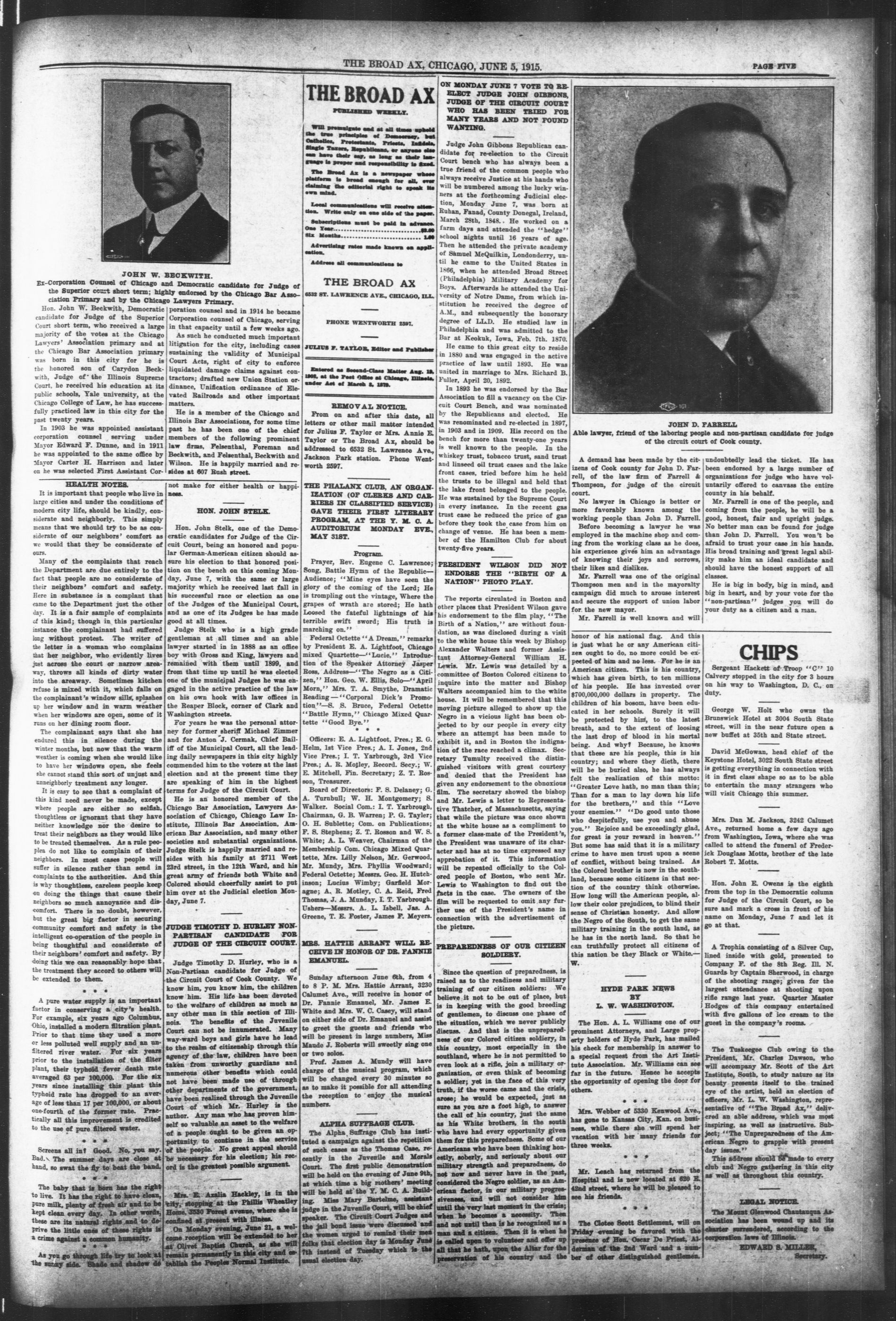
JOHN W. BECKWITH.
Ex-Corporation Counsel of Chicago and Democratic candidate for Judge of the Superior court short term; highly endorsed by the Chicago Bar Association Primary and by the Chicago Lawyers Primary.
Hon. John W. Beckwith, Democratic candidate for Judge of the Superior Court short term, who received a large majority of the votes at the Chicago Lawyers' Association primary and at the Chicago Bar Association primary was born in this city for he is the honored son of Carydon Beckwith, Judge of the Illinois Supreme Court, he received his education at its public schools, Yale university, at the Chicago College of Law, he has successfully practiced law in this city for the past twenty years. In 1903 he was appointed assistant corporation counsel serving under Mayor Edward F. Dunne, and in 1911 he was appointed to the same office by Mayor Carter H. Harrison and later on he was selected First Assistant Cor-
HEALTH NOTES.
It is important that people who live in large cities and under the conditions of modern city life, should be kindly, considerate and neighborly. This simply means that we should try to be as considerate of our neighbors' comfort as we would that they be considerate of ours.
Many of the complaints that reach the Department are due entirely to the fact that people are no considerate of their neighbors' comfort and safety. Here in substance is a complaint that came to the Department just the other day. It is a fair sample of complaints of this kind; though in this particular instance the complainant had suffered long without protest. The writer of the letter is a woman who complains that her neighbor, who evidently lives just across the court or narrow areaway, throws all kinds of dirty water into the areaway. Sometimes kitchen refuse is mixed with it, which falls on the complainant's window sills, splashes up her window and in warm weather when her windows are open, some of it runs on her dining room floor.
The complainant says that she has endured this in silence during the winter months, but now that the warm weather is coming when she would like to have her windows open, she feels she cannot stand this sort of unjust and unneighborly treatment any longer.
It is easy to see that a complaint of this kind need never be made, except where people are either so selfish, thoughtless or ignorant that they have neither knowledge nor the desire to treat their neighbors as they would like to be treated themselves. As a rule people do not like to complain of their neighbors. In most cases people will suffer in silence rather than send in complaints to the authorities. And this is why thoughtless, careless people keep on doing the things that cause their neighbors so much annoyance and discomfort. There is no doubt, however, but the great big factor in securing community comfort and safety is the intelligent co-operation of the people in being thoughtful and considerate of their neighbors' comfort and safety. By doing this we can reasonably hope that the treatment they accord to others will be extended to them.
A pure water supply is an important factor in conserving a city's health. For example, six years ago Columbus, Ohio, installed a modern filtration plant. Prior to that time they used a more or less polluted well supply and an unfiltered river water. For six years prior to the installation of the filter plant, their typhoid fever death rate averaged 63 per 100,000. For the six years since installing this plant this typhoid rate has dropped to an average of less than 17 per 100,000, or about one-fourth of the former rate. Practically all this improvement is credited to the use of pure filtered water.
Screens all inf. Good. No, you say, Bad. The summer days are close at hand, so swat the fly to beat the band.
The baby that is born has the right to live. It has the right to have clean, pure milk, plenty of fresh air and to be kept clean every day. In other words, these are its natural rights and to deprive the little ones of these rights is a crime against a common humanity.
As you go through life try to look at the sunny side. Shade and shadow do
poration counsel and in 1914 he became Corporation counsel of Chicago, serving in that capacity until a few weeks ago. As such he conducted much important litigation for the city, including cases sustaining the validity of Municipal Court Acts, right of city to enforce liquidated damage claims against contractors; drafted new Union Station ordinance, Unification ordinance of Elevated Railroads and other important matters.
He is a member of the Chicago and Illinois Bar Associations, for some time past he has been one of the chief members of the following prominent law firms, Felsenthal, Foreman and Beckwith, and Felsenthal, Beckwith and Wilson. He is happily married and resides at 607 Rush street.
not make for either health or happi
ness.
HON. JOHN STELK
Hon. John Stelk, one of the Democratic candidates for Judge of the Circuit Court, being an honored and popular German-American citizen should assure his election to that honored position on the bench on this coming Monday, June 7, with the same or large majority which he received last fall in his successful race or election as one of the Judges of the Municipal Court, and as one of its Judges he has made good at all times.
Judge Stelk who is a high grade gentleman at all times and an able lawyer started in in 1888 as an office boy with Gross and King, lawyers and remained with them until 1899, and from that time up until he was elected one of the municipal Judges he was engaged in the active practice of the law on his own hook with law offices in the Reaper Block, corner of Clark and Washington streets.
For years he was the personal attorney for former sheriff Michael Zimmer and for Anton J. Cermak, Chief Bailliff of the Municipal Court, all the leading daily newspapers in this city highly commended him to the voters at the last election and at the present time they are speaking of him in the highest terms for Judge of the Cireuit Court.
He is an honored member of the Chicago Bar Association, Lawyers Association of Chicago, Chicago Law Institute, Illinois Bar Association, American Bar Association, and many other societies and substantial organizations. Judge Stelk is happily married and resides with his family at 2711 West 23rd street, in the 12th Ward, and his great army of friends both White and Colored should cheerfully assist to put him over at the Judicial election Monday, June 7.
JUDGE TIMOTHY D. HUBLEY NON-
PARTISAN CANDIDATE FOR
JUDGE OF THE CIRCUIT COURT
Judge Timothy D. Hurley, who is a Non-Partisan candidate for Judge of the Circuit Court of Cook County. We know him, you know him, the children know him. His life has been devoted to the welfare of children as much as any other man in this section of Illinois. The benefits of the Juvenile Court can not be innumerated. Many way-ward boys and girls have he lead to the realm of citizenship through this agency of the law, children have been taken from unworthy guardians and numerous other benefits which could not have been made use of through other departments of the government, have been realized through the Juvenile Court of which Mr. Hurley is the author. Any man who has proven himself so valuable an asset to the welfare of a people ought to be given an opportunity to continue in the service of the people. No great appeal should be necessary for his election; his record is the greatest possible argument.
Mrs. E. Azalia Hackley, is in the city, stopping at the Phillis Wheatley Home, SS30 Forest avenue, where she is confined at present with illness.
On Monday evening, June 21, a welcome reception will be extended to her at Olivet Baptist Church, as she will remain permanently in this city and establish the People's Normal Institute.
THE BROAD AX, CHICAGO, JUNE 5, 1915
THE BROAD AX
PUBLISHED WEEKLY.
Will promulgate and at all times uphold the true principles of Democracy, but Catholics, Protestants, Priests, Incldea Single Taxes, Republicans, or anyone else can have their say, as long as their language is proper and responsibility is fixed. The Broad Ax is a newspaper whose platform is broad enough for all, ever claiming the editorial right to speak its own mind.
Local communications will receive attention. Write only on one side of the paper.
Subscriptions must be paid in advance. One Year. $8.00
Six Months. 1.00
Advertising rates made known on application.
Address all communications to
THE BROAD AX
6532 ST. LAWRENCE AVE. CHICAGO, IL
PHONE WENTWORTH 2597
JULIUS F. TAYLOE, Editor and Publisher
Entered as Second-Class Matter Aug. 19,
1902, at the Post Office at Chicago, Illinois
under Act of March 8, 1879.
REMOVAL NOTICE
From on and after this date, all letters or other mail matter intended for Julius F. Taylor or Mrs. Annie E. Taylor or The Broad Ax, should be addressed to 6532 St. Lawrence Ave., Jackson Park station. Phone Wentworth 2597.
THE PHALANX CLUB, AN ORGANIZATION (OF CLERKS AND CARRIERS IN CLASSIFIED SERVICE) GAVE THEIR FIRST LITERARY PROGRAM, AT THE Y. M. C. A. AUDITORIUM MONDAY EVE, MAY 31ST.
Program.
Prayer, Rev. Eugene C. Lawrence; Song, Battle Hymn of the Republic—Audience; "Mine eyes have seen the glory of the coming of the Lord; He is tromping out the vintage, Where the grapes of wrath are stored; He hath Loosed the fateful lightnings of his terrible swift sword; His truth is marching on."
Federal Octette "A Dream," remarks by President E. A. Lightfoot, Chicago mixed Quartette—"Lucie," Introduction of the Speaker Attorney Jasper Ross, Address—"The Negro as a Citizen," Hon. Geo. W. Ellis, Solo—"April Morn," Mrs. T. A. Smythe, Dramatic Reading—"Corporal Dick's Promotion"—S. S. Bruce, Federal Octette "Battle Hymn," Chicago Mixed Quartette "Good Bye."
Officers: E. A. Lightfoot, Pres.; E. G. Helm, 1st Vice Pres.; A. I. Jones, 2nd Vice Pres.; I. T. Yarbrough, 3rd Vice Pres.; A. R. Motley, Record. Seey; W. E. Mitchell, Fin. Secretary; Z. T. Rosson, Treasurer.
Board of Directors: F. S. Delaney; G. A. Turnbull; W. H. Montgomery; S. Walker. Social Com.: I. T. Yarbrough, Chairman, G. B. Warren; P. G. Tayler; O. H. Sublette; Com. on Publications; F. S. Stephens; Z. T. Rosson and W. S. White; A. L. Weaver, Chairman of the Membership Com. Chicago Mixed Quartette, Mrs. Lilly Nelson, Mr. Gerwood, Mr. Mundy, Mrs. Phyllis Woodward; Federal Octette; Messrs. Geo. H. Hutchinson; Lucius Wimby; Garfield Morge; A. R. Motley, C. A. Reid, Freed Thomas, J. A. Munday, I. T. Yarbrough. Ushers—Messrs. A. L. Isbell, Jas. A. Greene, T. E. Foster, James F. Meyers.
MRS. HATTIE ARBANT WILL RECEIVE IN HONOR OF DR. FANNIE EMANUEL.
Sunday afternoon June 6th, from 4 to 8 P. M. Mrs. Hattie Arrant, 3230 Calumet Ave., will receive in honor of Dr. Fannie Emanuel, Mr. James E. White and Mrs. W. C. Casey, will stand on either side of Dr. Emanuel and assist to greet the guests and friends who will be present in large numbers, Miss Maude J. Roberts will sweetly sing one or two solos.
Prof. James A. Mundy will have charge of the musical program, which will be changed every 30 minutes so as to make it possible for all attending the reception to enjoy the musical numbers.
ALPHA SUFFRAGE CLUB
ALPHA SUFFrage CLUB.
The Alpha Suffrage Club has instituted a campaign against the repetition of such cases as the Thomas Case, recently in the Juvenile and Morals Court. The first public demonstration will be held on the evening of June 9th, at which time a big roothers' meeting will be held at the Y. M. C. A. Building. Miss Mary Bartelme, assistant judge in the Juvenile Court, will be chief speaker. The Circuit Court Judges and the jail bond issue were discussed and the women urged to remind their men folks that election day is Monday June 7th instead of Tuesday which is the usual election day.
---
ON MONDAY JUNE 7 VOTE TO REELECT JUDGE JOHN GIBBONS,
JUDGE OF THE CIRCUIT COURT
WHO HAS BEEN TRIED FOR
MANY YEARS AND NOT FOUND
WANTING.
Judge John Gibbons Republican candidate for re-election to the Circuit Court bench who has always been a true friend of the common people who always receive Justice at his hands who will be numbered among the lucky winners at the forthcoming Judicial election, Monday June 7, was born at Ruhan, Fanad, County Donegal, Ireland, March 28th, 1848. He worked on a farm days and attended the "hedge" school nights until 16 years of age. Then he attended the private academy of Samuel McQuilkin, Londonderry, until he came to the United States in 1866, when he attended Broad Street (Philadelphia) Military Academy for Boys. Afterwards he attended the University of Notre Dame, from which institution he received the degree of A.M., and subsequently the honorary degree of LLD. He studied law in Philadelphia and was admitted to the Bar at Keokuk, Iowa, Feb. 7th, 1870. He came to this great city to reside in 1880 and was engaged in the active practice of law until 1893. He was united in marriage to Mrs. Richard B. Fuller, April 20, 1892.
In 1893 he was endorsed by the Bar Association to fill a vacancy on the Circuit Court Bench, and was nominated by the Republicans and elected. He was renominated and re-elected in 1897, in 1903 and in 1909. His record on the bench for more than twenty-one years is well known to the people. In the whiskey trust, tobacco trust, sand trust and linseed oil trust cases and the lake front cases, tried before him he held the trusts to be illegal and held that the lake front belonged to the people. He was sustained by the Supreme Court in every instance. In the recent gas trust case he reduced the price of gas before they took the case from him on change of venue. He has been a member of the Hamilton Club for about twenty-five years.
PRESIDENT WILSON DID NOT ENDORSE THE "BIRTH OF A NATION" PHOTO PLAY.
The reports circulated in Boston and other places that President Wilson gave his endorsement to the film play, "The Birth of a Nation," are without foundation, as was disclosed during a visit to the white house this week by Bishop Alexander Walters and former Assistant Attorney-General William H. Lewis. Mr. Lewis was detailed by a committee of Boston Colored citizens to inquire into the matter and Bishop Walters accompanied him to the white house. It will be remembered that this moving picture alleged to show up the Negro in a vicious light has been objected to by our people in every city where an attempt has been made to exhibit it, and in Boston the indignation of the race reached a climax. Secretary Tumulty received the distinguished visitors with great courtesy and denied that the President has given any endorsement to the obnoxious film. The secretary showed the bishop and Mr. Lewis a letter to Representative Thatcher, of Massachusetts, saying that while the picture was once shown at the white house as a compliment to a former class-mate of the President's, the President was unaware of its character and has at no time expressed any approbation of it. This information will be repeated officially to the Colored people of Boston, who sent Mr. Lewis to Washington to find out the facts in the case. The owners of the film will be requested to omit any further use of the President's name in connection with the advertisement of the picture.
PREPAREDNESS OF OUR CITIZEN
SOLDIERY.
Since the question of preparedness, is raised as to the readiness and military training of our citizen soldiers: We believe it not to be out of place, but is in keeping with the good breeding of gentlemen, to discuss one phase of the situation, which we never publicly discuss. And that is the unpreparedness of our Colored citizen soldiery, in this country, most especially in the southland, where he is not permitted to even look at a rifle, join a military organization, or even think of becoming a soldier; yet in the face of this very truth, if the worse came and the crisis, arose; he would be expected, just as sure as you are a foot high, to answer the call of his country, just the same as his White brothers, in the south who have had every opportunity given them for this preparedness. Some of our Americans who have been thinking honestly, soberly, and seriously about our military strength and preparedness, do not now and never have in the past, considered the Negro soldier, as an American factor, in our military progressiveness, and will not consider him until the very last moment in the crisis; when he becomes a necessity. Then and not until then is he recognized as a man and a citizen. Then it is when he is called upon to volunteer and offer up all that he hath, upon the Altar for the preservation of his country and the
101
A demand has been made by the citizens of Cook county for John D. Farrell, of the law firm of Farrell & Thompson, for judge of the circuit court.
No lawyer in Chicago is better or more favorably known among the working people than John D. Farrell.
Before becoming a lawyer he was employed in the machine shop and coming from the working class as he does, his experience gives him an advantage of knowing their joys and sorrows, their likes and dislikes.
Mr. Farrell was one of the original Thompson men and in the mayoralty campaign did much to arouse interest and secure the support of union labor for the new mayor.
undoubtedly lead the ticket. He has been endorsed by a large number of organizations for judge who have voluntarily offered to canvass the entire county in his behalf.
Mr. Farrell is one of the people, and coming from the people, he will be a good, honest, fair and upright judge. No better man can be found for judge than John D. Farrell. You won't be afraid to trust your case in his hands. His broad training and great legal ability make him an ideal candidate and should have the honest support of all classes.
He is big in body, big in mind, and big in heart, and by your vote for the "non-partisan" judges you will do your duty as a citizen and a man.
Mr. Farrell is well known and will
honor of his national flag. And this is just what he or any American citizen ought to do, no more could be expected of him and no less. For he is an American citizen. This is his country, which has given birth, to ten millions of his people. He has invested over $700,000,000 dollars in property. The children of his bosom, have been educated in her schools. Surely it will be protected by him, to the latest breath, and to the extent of loosing the last drop of blood in his mortal being. And why? Because, he knows that these are his people, this is his country; and where they dieth, there will he be buried also, he has always felt the realization of this motto: "Greater Love hath, no man than this; Than for a man to lay down his life for the brethren," and this "Love your enemies." "Do good unto those who despitefully, use you and abuse you." Rejoice and be exceedingly glad, for great is your reward in heaven." But some has said that it is a military crime to have men trust upon a scene of conflict, without being trained. As the Colored brother is now in the southland, because some citizens in that section of the country think otherwise. How long will the American people, allow their color prejudices, to blind their sense of Christian honesty. And allow the Negro of the South, to get the same military training in the south land, as he has in the north land. So that he can truthfully protect all citizens of this nation be they Black or White.—W.
HYDE PARK NEWS BY
L. W. WASHINGTON.
The Hon. A. L. Williams one of our prominent Attorneys, and Large property holders of Hyde Park, has mailed his check for membership in answer to a special request from the Art Institute Association. Mr. Williams can see far in the future. Hence he accepts the opportunity of opening the door for others.
Mrs. Webber of 5330 Kenwood Ave., has gone to Kansas City, Kan. on business, while there she will spend her vacation with her many friends for three weeks.
Mr. Leach has returned from the Hospital and is now located at 620 E. 42nd street, where he will be pleased to see his friends.
The Clotee Scott Settlement, will on Friday evening be favored with the presence of Hon. Oscar De Priest, Alderman of the 2nd Ward and a number of other distinguished gentlemen.
PAGE FIVE
FARRELL
ple and non-partisan candidate for judge
rt of Cook county.
undoubtedly lead the ticket. He has been endorsed by a large number of organizations for judge who have voluntarily offered to canvass the entire county in his behalf.
Mr. Farrell is one of the people, and coming from the people, he will be a good, honest, fair and upright judge. No better man can be found for judge than John D. Farrell. You won't be afraid to trust your case in his hands. His broad training and great legal ability make him an ideal candidate and should have the honest support of all classes.
He is big in body, big in mind, and big in heart, and by your vote for the "non-partisan" judges you will do your duty as a citizen and a man.
CHIPS
Sergeant Hackett of Troop "C" 10 Calvery stopped in the city for 3 hours on his way to Washington, D. C., on duty.
George W. Holt who owns the Brunswick Hotel at 3004 South State street, will in the near future open a new buffet at 35th and State street.
David McGowan, head chief of the Keystone Hotel, 3022 South State street is getting everything in connection with it in first class shape so as to be able to entertain the many strangers who will visit Chicago this summer.
Mrs. Dan M. Jackson, 3242 Calumet Ave., returned home a few days ago from Washington, Iowa, where she was called to attend the funeral of Frederick Douglass Motts, brother of the late Robert T. Motts.
Hon. John E. Owens is the eighth from the top in the Democratic column for Judge of the Circuit Court, so be sure and mark a cross in front of his name on Monday, June 7 and let it go at that.
A Trophia consisting of a Silver Cup, lined inside with gold, presented to Company F. of the 8th Reg. Ill. N. Guards by Captain Sherwood, in charge of the shooting range; given for the largest attendance at shooting upon rifle range last year. Quarter Master Hodges of this company entertained with five gallons of ice cream to the guest in the company's rooms.
The Tuskegee Club owing to the President, Mr. Charles Dawson, who will accompany Mr. Scott of the Art Institute, South, to study nature as its beauty presents itself to the trained eye of the artist, held an election of officers, Mr. L. W. Washington, representative of "The Broad Ax," delivered an able address, which was most inspiring, as well as instructive. Subject; "The Unpreparedness of the American Negro to grapple with present day issues." This address should be made to every club and Negro gathering in this city as well as throughout this country.
LEGAL NOTICE
The Mount Glenwood Chautauqua Association has been wound up and its charter surrendered, according to the corporation laws of Illinois.
EDWAED S. MILLEE,
Secretary.
PAGE SIX
SIRES AND SONS.
General Joffre's father was a cooper.
General B. F. Tracy of New York,
former secretary of the navy, is now
eighty-five years old.
Levi P. Morton, ex-vice president of
the United States, ex-governor of New
York and ex-minister to France, is
ninety-one years of age.
Otto H. Tittmann, retiring superintendent of the coast and geodetic survey, a position which he has held since
1900, has served for forty-eight years
in that branch of the government. He
entered the survey at the age of seventeen.
Douglas Mawson, author and Antarctic explorer, has been awarded the founder's medal by the Royal Geographical society for his conduct of the Australian Antarctic expedition of
1911-14, which achieved highly important results in several departments of science.
Dr. Armin Otto Leuschner, director of the students' observatory at the University of California, has just been awarded the highest honor which an astronomer may hope to gain—the Watson medal. The award was made by the National Academy of Sciences, and the medal, it may be said, has been conferred on only seven scientists.
Recent Inventions
A coat hanger to which is attached a clothes brush has been patented by a Denver resident. A solder has been invented which holds rimless lenses against the metal parts of eyeglasses without screws. A tumbler with a compartment that can be filled with ice or hot water to keep its contents cold or warm has been invented. Flies can enter a garbage can that a New York man has patented, but as they try to get out they are caught in a wire trap, which can be detached and the insects destroyed.
Current Comment.
It isn't a Mexican "crisis" now. They just call it any old thing and let it go at that—Atlanta Constitution. It took the revolution to remind the world that Portugal has been calling itself a republic—Boston Herald. Working for a safe and sane Fourth is worth while even this year, when gunshot and other wounds are so plentiful elsewhere—Chicago News. Only a year from now it will be time for the conventions to be held to nominate the next president. Why not begin to get excited?—Boston Globe.
Short Stories.
Luxemburg covers 1,000 square miles and has a population of 260,000.
The total circulation of money in the United States last year was $3,419,168,368.
Uruguay has suspended specie payments until the close of the European war.
The bayonets used at the battle of Waterloo were about a foot longer than the modern weapons.
On the island of Romblon, one of the Philippines, an immense body of limestone is attracting attention.
Fashion Frills.
Even the shoemakers are realizing that something is wrong with the prevailing types of last. There is hope!—Chicago News. Fall skirts are to show the ankles, according to the fashion reports. Well, what are the spring and summer skirts doing?—Pittsburgh Dispatch. The old time fear of sun spots is rapidly disappearing. Some girls now wear them on their faces and call them blushes.—Albany Knickerbocker Press.
BRIGHT BRIEFS
Keeping out of trouble is enough to keep every man busy.
Another big item in the war budget is that deadly gas bill.
An old man has as much use for advice as a young man hasn't.
You have to make some men talk, but most women are self starters.
The way of the transgressor is not only hard, but blamed slippery.
Before starting on the right track be you are headed the right way.
Most of the things postponed until tomorrow could have been done today.
Opportunity makes the man, but only when the man knows what to do with it.
Mankind is not half as proud of itself now as it was in the middle of last July.
At sixty man knows that he didn't know what he thought he know at
SHORT AND SHARP.
Old age is the most effective reformer of all. _____
The man who has more money than brains needs it. _____
The Nobel peace prize might be given to Yuan Shih Kai. _____
A woman's theory of arbitration is to have her own way. _____
And China thought all along that she was too old to need a guardian. _____
A few months in school teaches some children how little their parents know. _____
Some persons always seem to be groping in the darkness that precedes dawn.
Lots of men are satisfied to follow the crowd, no matter which way it is going.
A man without ambition is like a pan of dough without any yeast to raise it.
Excesses in youth are drafts upon old age, payable about thirty years after date.
If it is true that the world owes every man a living it will never get out of debt.
Some men are never satisfied to taste the cup of joyfulness. They must splash it all over themselves.
A boom in the cork leg industry directs attention to the high cost of prosperity along certain lines.
We can't remember a year that has gone before when it was so easy to give up a trip to Europe as this year.
All the statistics showing how the average human life on earth has been lengthened by science are also among the things ruined by this war.
Pert Personals.
Jane Addams fights for suffrage, but in everything else she is for peace, bless her.—Philadelphia Press.
As Jess Willard is tired of being an actor already, this comes pretty near making it unanimous. — Washington Post.
Long silence on the part of Rabindranath Tagore leads to the dreadful suspicion that the war will be followed by a peace sonnet 78,453 stanzas long.—Exchange.
Correspondents report that Vincent Astor eats cornbeef hash. This shows the genuine democracy of our richest men. Young Astor could easily afford to eat fried diamonds.—Chicago News.
Flippant Flings.
Still, Venice can introduce submarine gondolas and make its social calls as usual—Washington Post.
Boston is debating whether a woman is old at thirty. As a matter of fact, no woman is thirty until she is fifty.—Baltimore American.
Reports from many cities show that the jitneys have beaten the street car and are now after the sardine record for packing 'em in.—Buffalo Enquirer.
"It is a poor comet these days that has not at least two tails," says Professor Barnard. "Often they have five or six." Comets ought to moderate their passion for adornment—Chicago News.
The Writers.
Mrs. Havelock Ellis, wife of the noted English scientist, is herself a lecturer and author of recognized ability. Ruth Kedzie Wood, author of many travel books on Russia, Spain and Portugal, has been elected a fellow of the American Geographical society. The honor is an unusual one for the institution to bestow. Constance D'Arcy Mackay entered Boston university in 1903 and the following year began journalistic work in New York. She is a contributor of plays, verse, articles and short stories to magazines and newspapers. But it is in the writing and producing of pageants that she finds her widest field.
Laundry Lines.
Wash and dry fannels as quickly as possible if you want them to be soft.
Tatting will look like new if when being laundered it is basted to a bath towel. Otherwise it is nearly always ruined.
Cornstarch is the best for starching cuffs and collars—wheat starch for delicate dresses, rice starch for fine French lingerie.
To set delicate colors in an embroidered handkerchief, soak ten minutes previous to washing in a pail of tepid water in which a dessertspoonful of turpentine has been stirred.
Town Topics.
Portland's rose crop this year will be the greatest on record. Nature never goes back on us out this way.—Portland Oregonian.
New York is to have a new courthouse that will cost "perhaps $25,000,000." That's a poor way to contract for a new courthouse—Detroit Free Press.
St. Paul's new commission government is junketing around the country seeking to profit by the mistakes of other city administrations. It should not omit Pittsburgh—Pittsburgh Dispatch.
THE BROAD AX. CHICAGO. JUNE 5. 1915.
Submarine Badge.
As a crown is the badge of kings, as three balls are the badge of pawnbrokers, so the badge of a submarine officer is a handful of cotton waste. When the half dozen officers of a modern submarine, clad in their black leather waterproof suits, come aboard a sailor stands on the tiny gangway to receive them, and to each he hands his waste rolled in a neat ball. The reason is that the steel doors and steel walls of a submarine sweat oil eternally. The steel seats sweat oil. The submarine officer before opening a door or before sitting down wipes the oil from the knob or from the seat with an unconscious gesture like that of pulling up the trousers to keep them from bagging. Jovial submarine lieutenants say that even the dishes sweat oil on a submarine trip. They say that before filling their plates with meat they mechanically wipe the oil from them with their balls of oily waste.—Cinchnaiti Enquailer.
A. Sharp Distinction
A merited retort is not always a retort courteous. The rebuke that was administered to a party of intruding tourists by the old watchman who was set to guard the ruins of College hall at Wellesley not long after the great fire conveyed a keen but subtle reproach.
"Ye've got to keep out!" he ordered gruffly when he caught them trying to slip under the ropes that surrounded the crumbling walls.
The inquisitive visitors paused and eyed first the ruins and then their determined guardian.
"See here," a callow youth accosted him; "we're willing to risk it, and we'll take all the responsibility. What do you care if we lose our lives?"
"Ye've got to keep out. I ain't thinkin' of your lives; I'm thinkin' of me job." - Youth's Companion.
Nothing to Wear
There are women who live to dress, and the more frequent and radical the changes are the better they like it. If their pocketbooks can stand it, no great harm is done. But the great majority of women can't afford to keep up with this pace. The result is that some stay at home because their clothes are not in the latest style, many are made unhappy, and others keep up with the procession, it matters not what may be the cost.
If a man can wear the same dress suit for eight or ten years and not look like a freak, why is it not possible to design an evening gown for women that will be in good style as long as it may be worn? It is absurd to hear a woman say, "I haven't a thing to wear," when she may have a half dozen gowns all in good condition.—Frances Frear in Leslie's.
Highland Mary.
Small as is the number of statues of women in Britain, there are two of one woman, concerning whom very little is actually known save that she was of humble origin and was associated with the life of Scotland's greatest poet. Passengers by the Clyde steamboats are familiar with the statue of Mary Campbell, whom Burns immortalized as Highland Mary, which overlooks the pier at Dunoon. There was a good deal of controversy about the memorial at the time of its erection, and the late Mr. Henley referred to it in his famous "Essay on Burns" as a "fantasy in bronze." Liverpool, with which Mary Campbell had no association whatsoever, has also chosen to commemorate her, and a marble statue stands in the palm house at Sefon park, encircled with choicest blooms all the year round—London Mall.
Lost Votes.
A parliamentary candidate lost quite a number of votes by making a generous promise to his own wife. He promised his better half that if he were successful at the poll he would buy her a new sealskin coat and hat to match. His wife was so pleased with this kindly offer that she at once went and told all her lady friends about it. Every lady to whom this piece of news was imparted, of course, said to the candidate's wife at once, "Oh, how very nice, dear!" but equally, of course, immediately went off home to her husband and said: "Take care you don't vote for Mr. A., dear. Fancy that stuck up Mrs. A. in a new sealskin while my old one is so shabby!"—London Express.
Kipling Wouldn't Talk
Invited in 1899 to speak at a public dinner in London in aid of an orphan saylum Rudyard Kipling wrote: "I simply can't make a speech in public. It isn't in my power—not for all the orphans in the world. I have experimented on grownup people, and the result wasn't pretty. I'd sooner thrash an orphan or give it its bottle than speak to the orphans' well wishers after a heavy meal."
For Permanent Peace
"I have told you over and over, Tommy, not to fight with that little Jimson boy."
"If you'd let me finish the job just one time, ma, I wouldn't have to fight with him any more."—Birmingham Age-Herr
"Why do you insist on singing?"
"Because I love music."
"The way you shg sounds as if you hated it."—Washington Star.
Woman's Superiority.
With suitable special scenery a woman invalid may show to advantage, but a sick man always looks like the Old Harry.—Atchison Globe.
Philosophy should be in one's conduct, not conversation.
It Had a Farreaching Effect.
It Had a Perreaching Effect.
Two hundred and fifty years ago a peddler selling books gave a pamphlet to one who was supposed to be an ordinary young man, but he was Richard Baxter, and under the influence of that pamphlet he wrote "The Saints' Everlasting Rest." This fell into the hands of Philip Doddridge, and he wrote "The Rise and Progress of Religion in the Soul." This book fell into the hands of Wilberforce, and he wrote "A Practical View of Christianity." This book came to Leigh Richmond, and under the power of it he was led to write "The Dairman's Daughter." This in turn fell into the hands of Thomas Chalmers, the mightiest Scotch preacher of his day, and after he became a minister it was the means of his conversion and of his mighty spiritual transformation. A peddler on the one side and Thomas Chalmers on the other—what a marvelous story!-Christian Herald.
Shad and Cod.
Shad are distributed along the entire east coast of the United States and northward and eastward to the gulf of St. Lawrence. Shad abound in nearly every river of the Atlantic coast. Its migrations from the sea are in quite a regular succession of time from relation to latitude. It first appears in the St. Johns river, Florida, about Nov. 15; in Georgia and South Carolina rivers in January, in the Potomac in February. In the Delaware the maximum run is about May 1, in Maine rivers about a month later, etc. Cod are widely distributed in the north Atlantic ocean. To the north they range far beyond the arctic circle and to the south as far as Cape Hatteras, although they are not common south of New Jersey. The cod in the Pacific ocean is found from Bering sea south to Oregon. The largest cod are found along the Massachusetts coast and from that north.-Philadelphia Press.
"Let Her Go. Gallagher!"
Judge Beaver of Morgan county, Ky., had a trotting mare of which he was very proud. The animal was always driven at the race meets by a man named Gallagher, who was at that time city marshal of Harrodsburg. On one occasion the judge entered his mare at a trotting meeting in Tipton county. Some sports there, knowing of the judge's pride in the animal, thought they would lower his colors for once, so they entered against her a noted fast trotter. At the end of the first mile the two trotters passed under the wire neck and neck at a 2:40 pace, and the judge grew wildly excited. "Let her go, Gallagher! Let her go!" he shouted. And Gallagher, hearing, loosened the lines. The mare pluckily responded and finished more than a dozen lengths ahead amid the wild cheering of the crowd--Pittsburgh Dispatch.
Racing In Mongolia
Horse racing is taken seriously in Mongolia, where it is carried on under the auspices of the Buddhist priests. The races are rarely less than ten miles long, and the chief event of the Mongolian racing year is a contest over thirty miles of rough steppe. When C.W. Campbell visited Mongolia he attended a race meeting, at which most of the competing horses were owned by lamas.
"The great races which take place yearly at Urga," he writes, "are held under the direct patronage of the lama pope of Mongolia, who becomes the owner of all the winners. A horse race with a bishop in the judges' box, a public chiefly clerical, no bookmakers or betting and nominal prizes is a phenomenon in its way."
Why He Failed.
"I understand Jinks has found it necessary to close up his electrical business. What was the matter?" "Well, as nearly as I can make out, when he failed to spark properly, his banking connections became short circuited, and his customers failed to supply the necessary current. These misfortunes tore the insul tion from his lines of credit and he became afraid he was no longer a live wire. "The poor fellow had to shut up shop. As a matter of fact," said the narrator, dodging a blow. "he didn't know what else to do." -Richmond Times-Dispatch
Over the Mark
"Does he aim at realism in the stories he writes?"
"He may aim at it, but he doesn't hit within a million miles of it."
"How's that?"
"The hero of his last story is a 'spendthrift Scotchman.'" — Houston Post.
West Point Graduates
It will doubtless surprise most Americans to learn that out of the small total of 4,121 graduates during the first century of the existence of the Military academy, from 1802 to 1902, 2,731 entered civil life at some period of their career—National Magazine.
Salt Money.
Your salary is your "salt money." Soldiers once received salt as part of their pay. When the salt was commuted for cash the latter was called "salerium," salt money, or "salary."
Too Risky.
Officer—Did you get the number of the car? Victim—Yes; but never mind. It was my cook's machine. I don't want any trouble with her—New York Globe.
Ruinous
Madge—Gossip doesn't pay. Marjorie—I'm beginning to agree with you, my dear. The last secret I heard cost me over $2 for extra telephone tolls—Judge.
Aeroplane Raids.
There is nothing that I know of more hideous than an aerial bombardment. It requires an entire mental readjustment. The sky, which has always symbolized peace, suddenly spells death. Bombardment by the big guns of an advancing army is not unexpected. There is time for flight, a chance, too, for a reprisal. But against these raiders of the sky there is nothing. One sits and waits, and no town is safe. One moment there is a peaceful village with war twenty, fifty miles away. The next minute hell breaks loose. Houses are destroyed, sleeping children die in their cradles, the streets echo and re-echo with the din of destruction. The reply of the anti-aircraft guns is feeble, and at night furtile. There is no bustle of escape. The streets are empty and dead, and in each house people, family groups, non-combatants, folk who ask only the right to work and love and live, sit and wait with blanched faces.—Mary Roberts Rinehart in Saturday Evening Post.
Insure Pigs In Sweden.
Though it is commonly known that there is scarcely anything in the world that cannot be insured, the layman would probably hesitate before he hastened to Lloyd's to insure his pigs. In Sweden, however, no difficulties stand in his way. In fact, there are several competing companies all anxious to insure the lives of pigs belonging to the small farmer. But as yet the industry has not developed as much as it might, since out of the 700 Swedish institutions which insure live stock there are only forty which insure pigs. These societies are most numerous in the thickly populated districts, where they insure pigs only. The pigs insured must be at first in good condition, and the agencies refuse to pay if the animals die in consequence of ill treatment or neglect.-Boston Transcript.
How to Treat a Fracture
Be very careful with a single fracture to prevent it from becoming compound. The proper treatment is to pad and bandage the limb with splints and anything else which can be improvised, so as to hold it steadily in position until your injured man can be carried comfortably to the camp or nearest doctor. Don't get jolting him or handling him with anything but the greatest tenderness. If there are no chances of getting a doctor, cut all the clothing away from the injured limb, and when you have it bare get some one else to help you, if you can. Pull straight on the end of the injured limb farthest away from the body, and as gently and firmly as possible manipulate the broken bone into position. You will know when this is done by the shape of the limb—Outing.
Business Advertising In 1748
Judging from many advertisements in the early New York newspapers, the numbers of buildings were very little used. Business houses were usually designated by a characteristic sign or by the locality to other well known residents. An example of the latter is seen in the following from the New York Gazette of December, 1748. Smith's Fly was at the foot of Maiden Lane.
"Henry Hansen, who lately kept his store next Door to Mr. John Groesbeeck's, is now removed to Capt. Richard Langdon's, in Smith's Fly opposite to Col. De Peyster's, Treasurer, where he now keeps his Store. He has likewise imported in the last Ships from London, a fresh Assortment of European Goods."
Mother's Constancy.
There is an enduring tenderness in the love of a mother for a son that transcends all other affections of the heart. It is neither to be chilled by selflessness nor daunted by danger nor weakened by worthlessness nor stiffened by ingratitude. She will sacrifice every comfort to his convenience; she will surrender every pleasure to his enjoyment; she will glory in his fame and exult in his prosperity, and if misfortune overtakes him he will be the dearer to her through his misfortunes, and if disgrace settles upon his name she will still love and cherish him in spite of his disgrace, and if all the rest of the world casts him off she will be all the world to him—New York Weekly.
Hite and Misses
A brilliant after dinner speaker said in one of his speeches at a banquet in New York:
"I have learned two things in my time—I have learned to run an automobile and I have learned to golf.
"While learning to run an automobile I hit everything, whereas while learning to golf I hit nothing."—Exchange.
Dodging a Task
"I hate shopping. I got out of having to match some puffs for my wife today in rather a neat manner." "How was that?" "Reminded her that I had always insisted her beautiful tresses were matchless."—Kansas City Journal.
Hard Job.
Matrimonial Agent—Really, when I see those two whom I am going to introduce to each other I don't know to which I shall break it gently. Filegende Blatter.
Not the Same.
She--You said when we were married we'd live like two turtles, doves. He--Yes, but you want to like like a millionaire's wife--Chicago News.
Wiggs—How mighty exclusive Uppish is getting of late, Biggs—Exclusive! Why; he refuses even to meet his bills.—Exchange.
The Glad Hand
We are not isolated units in this universe of ours. We are all of us members of a great world community. All of us are so constituted that our welfare and our happiness depend on the maintenance of good will with others. To a great extent, however, we always have it in our power to determine just what the attitude of others toward us shall be. We have this power by virtue of the fact that the human mind tends to be swayed in its critical judgments by the character of the emotional moods experienced. People usually think exactly as they feel. Hence the value of the glad hand. The cordial greeting, the cheery smile, the display of genuine interest—all these help to create pleasurable moods in other persons, and consequently prepossess them in our favor.
Whereas the cold, indifferent approach, the flabby handsake and the languid air arouse feelings of antagonism, if not of suspicion and aversion.—H. Addington Bruce in Kansas City Star.
Perfect Pitch
A fairly large number of people are gifted with a good ear for music, and their friends think it quite wonderful that they are able to play or whistle tunes which they have heard only once. But this gift, however remarkable it may seem, is by no means extraordinary or exceptional, especially when compared with the possession of what is called an "ear of absolute pitch". This means that the person possessing it is able to stand away from the piano and tell you what note you are playing or in what key. One well known lady pianist is able to read over the score of a piece of music in the train or omnibus, leave the book behind her and yet play the whole piece through by memory when she reaches home.
Perfect pitch is a gift to some people, but it can be acquired. Indeed, many authorities say that to be a really great musician this power must be possessed—London Answers.
Signatures and Signs.
Walter Crane's signature—a crane impaled on a W—reminds us that other English artists have adopted queen "beasties" to form their signature. There was Richard Doyle, for instance, who among his friends and in his sigature pretended only to be "Dicky," for you will find in the corner of many of his Punch drawings a "D" with a very perky looking bird standing thereon. But Whistler's was the most famous, though somewhat incongruous. His sign manual often took the shape of a butterfly, though a wasp would have expressed him better, for he was not only an artist, but the author of "The Gentle Art of Making Enemies." And there are many who cherish envelopes from Professor Blackie with the Greek scrawl meaning "Tell the truth in love."-London Spectator.
A. Land Without Flies
It should be refreshing and a bit encouraging to the fatigued, hopeless fly fighters to know that there is in the world a country in which there are no flies. The place is the British West Indies. This interesting fact—that there are no flies in British West Indies—starts up a number of questions and curious conjectures. Why is it that they have no flies? Is it that they have lost the seed, or is it that they have some active parasite or animal that feeds on flies, like the South American anter, for instance? Certainly it is not that they have no filth. They have heat and moisture, and, if rumor has it true, they have all the filth that is necessary. That these three conditions can exist without any files is what we do not understand—North Carolina Health Board Report.
Replimentary Frontiers
On either side of the commons chamber of Great Britain's parliament house there is a distinct line along the floor, and any member who when speaking steps outside the line on his side is liable to be called to order. These lines are supposed to be scientific frontiers, and the neutral zone between is beyond the length of a sword thrust, and although members no longer wear swords, except those who are selected to move and second addresses to the throne on certain occasions, the old precaution still lingers on.-Westminster Gazette.
Still In Doubt.
"Why don't you marry, old chap?"
"Do you think a man could procure all the necessaries of life on $1,900 a year?"
"Of course, but not the luxuries."
"Well, I haven't decided yet whether a wife is a necessity or a luxury." Boston Transcript.
Rigeon English.
The expression "pigeon English" arose from the Chinese attempt to pronounce the word "business," which through various forms became "pligh" and then "pigeon." "Pigeon English" is a strange jarson of many languages, but "business" is carried on by it.
Described.
Described.
"What kind of a guy is jigs."
"Oh, he's the type that says, 'Lend me a couple of dollars for a couple of hours,' and then he loses his watch."—Buffalo Express.
He Blundered.
Mr. Dubb—I've saved that rose you gave me last month. Miss Anteek, for though it is withered it still reminds me of you. Miss Anteek—Str!—Boston Transcript.
The man who sells need have but one eye, but he who buys two—Florida—Times-Union.
, we ne tee ht, Oe
LINGOLN STATE, BANK. OF CHICAGO
{3105-07 SOUTH STATE STREET
CHICAGO, ILL.
CAPITAL, $200,000,00 cue ee
a Savings and Checking Accounts
ie) tn Foreign Exchange
‘ ese ¥ la Safety Deposit Vaults
i ie = | Mortgages and Bonds
. & 3 Per Cent
tea Interest on Savings |
| Bal E Deposits eg
s | 4 H Your Patronage Solicited
ee a
FREE te our Sovines Depo Depository and Correspondent,
uatreas | eoeenad $e
eth OPEN one with US. Hlinois.
Boom eof Bia Guna
Early in April, 1912, a man living at
Hambledon, near Godalming, wrote to
the Spectator, saying: “As I sat read-
tmg the other afternoon I heard, or,
rather felt, @ long vibrating boom sev-
emi times repeated. I thought at first
it was a motor van maneuvering be-
hind the house, but found nothing
there. ‘Then I guessed what it might
be and forthwith wrote to the chief
gunnery officer of bis majesty’s ship
Orion to make sure. 1 am therefore
able to state that the discharge of the
Orion's guns was distinctly audible
uinetyseven statute miles from the
sip, the sound taking somewhere
about eleven minutes to travel the dis-
tance.”
An even more remarkable instance
of the immense distance at which gun
fre can be beard was afforded at the
time of the Freneh victory at Stein-
tech, ‘The booming of the guns was
Gstinctly beard on the northern slopes
ot the Bernese Alps far down in
Switzerland. The distance is just
dgbty miles as the crow fies, and in
this case it must be remembered that
the guns were not the 135 naval
fants, but merely field artillery—Lon-
é2 Opinion.
Revencus Eaters.
@bbon’ tells of Soliman, a caliph in
tte eighth century, who died of acute
fadigestion in his camp near Chalcis,
im Syria, just as he was about to lead
smerny of Arabs against Constantino-
ple. He bad emptied two baskets of
qq: and figs, which be swallowed al-
temately, and the repast was finished
with marrow and sugar. In a pil
(image to Mecca the same caliph had
‘eaten with impunity at a single meal
seventy pomegranates, a kid, six fowis
and a huge quantity of the grapes of
‘Teyet.
Boch a statement would defy belief
‘Were not others of @ similar character
‘well evouched. Louis XVI. could bard-
ly boast of an appetite as ravenous as
Soliman's, but be would eat at a sit
ting four platefuls of different soups, 8
‘whole pheasant, a partridge, a plate
fal of salad, mutton hashed with gar
le, two good sized slices of ham, a
Gish of pastry and finish this ample
Tepast with fruit and sweetmests—
London Saturday Review.
Fichtinn « Earest Fire.
‘The combat with fre in the weet
ts usually as tense and as exciting as
& conflagration in a city. From the
instant smoke is discerned ascending
juto the bine above there is action.
Upon reaching the scene the racing
squads of fighters begin work by un-
dertaking the tasks as outlined by the
eyetem. First one group starts with
the cutting tools and rakes, clearing up
4 streak of ground several feet wide
im the pathway of the fre The men
with water bags follow, wetting down
this strip. ‘Then come the back firers,
‘who start fires from this point back
{into the main conflagration. When the
fires meet they extinguish for want of
Material to burn, When the atmos-
pberic conditions materially assist the
fames the work of back firing is best
Gone at night or when the air is still
ott. R. Peery ta Countryside Mase
RProved Mic Case.
A teacher was holding an oral exam
{nation in an intermediate geography
class one day and asked, “What is the
difference between the people of @ state
4nd those of @ territory?”
Only one hand was raised. But a
Tadiant smile illuminated the face of
Utde Donald as he rose and said, “The
People of a territory cannot sing.”
This answer was puzzling to all, so
the teacher asked him to explain
Whereupon he said:
“The geography says that the people
of @ territory have no voice, 80 bow
‘Could they sing ?"—Cieveland Leader.
Mekine i Cleese te Mim. ”
beer margnen tps
Tied you never found my social
clencies so annoying. She (sweetly
Perhaps not, but yoo mast allow some
thing for the’ broadening Induence <f
time. The -very fact that. -married
700 revenisd my- own callow: tnexpert
2c0—Richmond Times-Dispatch, _ -
a
Talked the G.il to Death.
One of the wost dramatic holdups tn
congress was made 1u 1901 by Senator
Thomas H. Carter of Montana, “who
talked to death a $00,000,000 rivers and
harbors bill chiefly because the house
had refused to appropriate money te
irrigate the dry lands of the west.
“I shall do what lies in my power te
Prevent this bill from passing.” the
Senator shouted. “It will not pass if
my strength does not fail to such an
extent that I can no longer occupy this
floor, and I am in a pretty fair state
of health.”
‘To the laughter of the senate and the
galleries Carter then described the
clam fiats and the mud banks of un-
heard of places for which large appro-
priations had been made in the present
bill. He discussed the draft and ton-
nage of the scows and the lobster pots.
He lasted for more than thirteen hours.
When be was through the congress
was dead. the senator's own term was
ended, and.it was time to inaugurate
Vice President Roosevelt—New York
Herald.
ee Sentai i
‘The form of boxing known es “Ia
savate.” in which the feet are used ai
well as the fists and kicks are as legiti
mate as blows, has for a long time
been a popalar exercise in French gym-
nasia and schools of arms. The firs
principle is that the whole weight of
the body shall be placed on one leg
and that the farthest from the adver:
sary. The disengaged leg 1s used as
an adjunct to the fists and fies out
with astonishing swiftness and accura-
cy of aim. The “coup de xavate” prop-
er is the “chasse” off the right foot of
“shin hit.” a dangerous blow, but one
that is easily avoided by raising the
left knee to the level of the waist
Formidable as this method of assault
and others, such as the “coup d’arret.”
or straight stop hit. and the “coup de
figure.” or swinging face kick. may be
and undoubtedly are with an expert.
the parries and guards are simple and
sare if properly used. — Washington
Star.
Mie 8
‘The French do not as a rule employ
inverted commas to indicate a dis
logue, but they employ the dash to in-
dicate a change of speakers, which is
fust as bad. Certainly many punctua-
tion marks are sadly misused or over-
used. Dickens flung unnecessary com-
mas all over his pages—whole bat
talions of them Walter Pater also
employed them’ with extraordinary
prodigallty, frequently before the word
“and” where the conjunction rendered
them superffuous. Pater was also
overfond of the mark of exclamation
80 that when he drops a “Yes” into
his measured style it must needs ap-
pear as “Yes!” But. though the Bible
Goes without inverted commas, there
fs real art tn its punctuation. How ad-
mirably ft marks the cadence and helps
the drama in that great story of the
prodigal son!—London Tit-Bits,
‘Week All Fruit.
Incoming cargoes of fruits shoul i
closely observed for traces of poison-
ous insecticides. Growers. are not ab
‘ways careful to remove all traces of
sprays before marketing their fruit
Housekeepers can protect themselves
from danger from this source by wash-
ing all froit in several waters before
serving it’ It would be advisable and
insure greater safety to wash the fruii
before placing tt in the storeroom 07
ice chest. Sprays and powders of suf
ficient strength to Kill insects which
feed upon and destroy fruit trees and
fruit would prove fatal to life if par
taken of by human beings
Necessitarians.
‘The philosophic term “necessitarians”
fs used to denote those persons that
Geng the freedom of will and assert
that im boman conduct all volitions
are. determined by motives that obe7
the law of causation as tuvariably 23
do the forces of nature. ‘The word
“determinists” was suggested ss 8
it Jobn 34t and bes
been very _ Sdlopted. — New
THE BROAD AX, CHICAGO, JUNE 5, 1915.
~ “The Fire Bag.
The “fire beg” is a relic of
‘ARS days of wooden ships. Every
And sealer used to carry such
It was of tarpaulin, about one
NI length and six inches in width.
lined with waterproof materis
ome ieterlinings of ollcloth and thi
nel. In this was placed the @
Ship Will Take In San Franciseo | tnserox tor'tindias tre 1
Was then securely fastened with
Fair Via Panama Canal, | 22" a2¢.sea i goch «mann
keep its contents dry.
Esa It was the duty of the secon
to look after the fire bag, and
Just recently the New York state| of shipwreck to attach it at |
Rautical schoolship sailed away for| his person by means of stout
peepee apes ike toes ano | et ows on tree
crew were
have logged’ 15385 mice before abe | Sted shore, the meaue of ob
enix fire were not wanting eo long
Tree are ett Ve7- | precious fre bag was sate
ae et tee Fhe 110. ‘The modern steam whalers ar
pa ave, then ‘soon many palate <f/ ans carey a fire bag stowed tn t
Seats tee mnmncn. Remiagha=e. | beats with the brond aed wate
Heretofore the cruiser has been to Bv-| is of rubber, and contains half 1
Fopean waters, This time the scbool-| water tight ths ‘beces of we
ship will touch at West Indian points, | phic
then pass through the Panama canal a eras
and head for Honolulu. On the return etka ame
from Hawall the Newport will touch| a. __'@w ® Siphon Acts. —
a er hee ~~
Sa 3
: oo
2 meme |
=
i 1 te
i aa, eae
i e 7s |
| | |
ie -
Photo by American Press Association.
YAREWELIS AT THE START OF THE CRUISE
‘at San Francisco so the eadets can
visit the exposition. She will arrive
‘back in New York about the middle of
October.
On the return of the ship the first
class will be graduated. The gradu.
ates will have had two years of
thorough training and also the prac-
tical knowledge of a cruise to Euro-
ean waters, which was taken, last
year, as well as the experience gained
in the present cruise.
‘The officer instructors are furnished
by the navy department. The cadets
must be upon entrance between the
‘ages of sixteen and twenty and must
have had the equivalent of two years
high school education.
A HERO OF THE LUSITANIA.
Lindon W. Bates, Jr, of Belgian Relief
Committee Gave Life Belt to Woman.
Im the Geath of Lindon Bates, Jr,
one of the victims of the Lusitania dis-
‘aster, the commission for relief in Bel-
gium has sustained a great loss. Lin-
don Bates, Jr., was from the beginning
a member of the active executive com-
mittee of the commission in New York
and London. He started and personal-
ly administrated through all the early
crucial months the organization depart-
ment, for which his political expert
ences preeminently fitted him. The
basic forms, mechanism and methods
of the commission in America were his.
Reha
PAs )
oe eee ee }
ie
an
- ri
Yen F
Se rea
eae ‘
be .
-
“euiebe a-coueuein. ins
‘They have proved their great efficiency
and elasticity at all times to suddenly
care for the vital emergency of saving
& nation of seven millions.
His last mission was to study in Lon-
on and on the spot in Belgium how
Dest to meet the greatest crisis sure to
Defall next autumn. He gave himeelf
freely in large things and in amall, to
the very last minute of his life, to the
services of others with simple and
modest heroism. He took his life belt
from around him and gave it to 2 wo-
man, and hervically went to his doom.
He was but thirty-two years old.
‘His parents have received many mes-
sages of sympathy, emong them the
following from King Albert of Belgtum:
- rane bed ae
death of your son. our
Gistressful people. and express to you
Advertise in The Broad Ax
“Fhe Fire Bac.
‘The “fire bag” is a relic of the old
days of wooden ships. Every whaler
‘And sealer used to carry such a bag.
1t was of tarpaulin, about one foot in
Jength and six inches in width. It was
Mined with waterproof material, with
ieterlinings of olicioth and thick flan-
Bel. In this was placed the dint and
Underbox for kindling fire. The bag
‘Was then securely fastened with double
flaps and tied in such a manner as to
keep its contents dry.
It was the duty of the second mate
to look after the fire bag, and in case
of shipwreck to attach it at once to
‘his person by means of stout straps
Provided for the purpose. So, if officers
and crew were cast away on some de-
serted shore, the means of obtaining a
fire were not wanting so long as the
Precious fire bag was safe.
‘The modern steam whalers and seal-
ers carry a fire bag stowed in the life-
boats with the bread and water, but it
is of rubber, and contains half a dozen
Water tight tin ‘boxes of matches. —
Philadelphia Press.
lies tei ei dee
‘The main principle of the siphon ts
the same as that of a suction pump—
vig, that if a vacuum be created in a
tube inserted in water the normal pres
sure of the atmosphere will cause the
water to rise in the vacuum to a
height of about thirty-three feet. The
Sipbou ts a bent tube, one side or leg
of which is louger than the other, and
the conditions of its successful opera-
tion sre, trst, that the shorter side or
‘ex he placed in the water; second, the
lonzer side or leg to hang freely over
the edge of the vessel; third. a vacuum
te be created throughout the length of
the tube by sucking the air from the
tonzer side This will be immediately
followed by a flow of water. which
will continge as long as the mouth of
the shorter side or leg of the tube re
mains under the surface of the water.
In transferring water from a lower
level care should be taken not to re
move the sbort’side from the water. as
that would destroy the vacuum and
cause the ow to stop.
Qiitid Otome
Day and night, winter and summer,
in all weathers, a tug with steam up
4s stationed on the Thames at the Tow-
er bridge It is a floating fIlustration
of the fact that parliament is some
times—only sometimes, of course—
needlessly fussy. When the bill em-
powering the corporation of London to
build the bridge was passing through
the house of commons a provision was
inserted requiring the stationing of this
tug as aforesaid. so as to be handy “in
case of wreck.” The promoters pro-
tested that the cost of the tug would
tar exceed any benefit to be derived
from it. ‘The commons thought they
knew better and insisted. The bridge
was opened about sixteen years ago.
‘and the tug has cost the city of Lon-
don £31 per week ever since. Yet its
services “in case of wreck” or any
other emergency have never once been
required —London Express.
Berthauake Shocks.
‘There are such things as earth waves
as well as ether waves. But while the
ether waves have, by the genius of
Marconi, been harnessed into the serv-
ice of mankind, no scientist has yet
discovered any uses for earth waves
‘or even any means of utilizing them.
‘The shock of a seismic disturbance
‘travels in waves at the rate of two
miles @ second in the actual vicinity of
the disturbance. and this rate rapidly
diminishes as the distance traveled by
the earth waves increases. The deeper
the originating movement happens to
be the farther the shock travels, but
the deeper the movement, on the other
band, the less extensive and usually
the less serious. from the point of view
of loss of life. is the visible effect on
the earth's surface.
A Retiary.
A retiary was the name of a Roman
gladiator armed in » peculiar way. He
was furnished with « trident and net,
with no more covering than a short
tunic, and with these implements be
eodeavored to entangle and dispatch
his adversary, who was called a secu-
tor (from sequi, to follow) and was
armed with a belmet, a shield and a
word. The name of the first ts pro-
nounced as if spelled reshia-ty, the
accent on the Grst syllable.
asehih dice
| “I must say these are fine biscuitst”
exclaimed the young busband.
“How could you say those are fine
biscuits?” inquired the young wife's
‘mother in a private interview.
“I didn’t say they were fine. 1 mere-
ly said I must say so.”—Washington
Star.
Belgium’s Military Cross.
‘The croix militaire of Belgium ts
an award founded in 1885 by Leopold
IL It consists of two classes; the first
is awarded to officers of twenty-five
years’ service, the second to noncom-
missioned officers and men who have
served a similar period.
‘An Unhappy Client.
“Prisoner, have you anything t
“Only this, your honor: I'd be mighty
sorry if th’ young lawyer you assigned
to me was ever called upon to defend
‘an tanocent man.” — Cleveland Plain
Dealer. b,
— All Eye Trouble
-- EF 3
al
Zale «8. LOUIE USSELMANN
Lee ies ~The Practical Optician —
THE MOST enna OPTICAL ROOMS IN THE CITY :
Seer 0008 AY THE LOWEST PRIGES |
Consultation or examination | 3150 S. STATE ST. |
- if fe
Speich Coastal oseaad | Phone Douglas 5308)
guarantee to give satisfaction. | CHICAGO
QA Boys! 2
Aa e 4A
Ci ey
5 Do' you want wey
No’ KYA this dandy | toys
_Money (7)\J BICYCLE - 27, Mn".
Zi 9 L/ 228 'W. 31te Street
Needed tee
-¢ . 0 Piewe tll me bow ©
Sho fil cnt and tale the corm Cour // Wav ma ad
on can eare this high-grade Bicycle ,£0/ 7 Mieco:
for very litle, effort during spare ,/ Name
time. ASK “The Bicycle Man” ,“°/ sues
Mail this coupon TO-DAY.
_ A.D. GASH
_ ATTORNEY AT LAW
1:18 North La Salle St. Chicago
Sates 619 we 616
Telephese Main 3677
NOTARY PUBLIC (Office Phone
Automatic 44-185
W. G. ANDERSON
ATTORNEY-AT-LAW
Room 40, 143 North Dearborn Street
Ges aeddgh 8.” OMIORGO. Mecormich Ste
Evening Office, 3458 Stats Street
Phone Automatic 77.574
NOTARY PUBLIC
Faustin S. Delany
Attorney and Counselor at Law
‘312 S. Clark St., Suite 422
CHICAGO
SOLLEGTIONS A SPECIALTY
Res. 4510 St. Lawrence Ave.
Tek woceet eee
Phone FRANKLIN 2717 4
Louis B. Anderson
LAWYER
Room $08 Firmenich Building
184 W. Washington St. :: CHICAGO
Cor. Sth Ave.
; PHONES: OFFICE. MAIN 4153
| murchantic. soso
Walter M. Farmer
ATTORNEY AT LAW
SUITE 708, 184 WASHINGTON ST.
NOTARY PUBLIC CHICAGO
women apptying for positions on the
Chicago polier force must be not less
than thirty nor more than forty years
of age. That ace was long ago recor:
nized as the one at which women are
most dangeruax, and doubtless - the
peril applies tu lawbreakers as well as
others.
G. K. Chesterton derides all the talk
about “good old times.” He says there
never were any. Nevertheless it seems
to be establiahed that the Greeks also
Ganced the tango and that the turkey
trot was not outiawed in Corinth antil
the reformers got control of the eity
‘eouncil
PAGE SEVEN
See
| - RESIDENCE 1262 MACALISTE PLACE
; TELEPHONE, MONROE 1114
MILES J. DEVINE
ATTORNEY aT LAW
_ sa Eres.
SEE Pan
Franklin A. Denison
ATTORNEY AT LAW
‘36 W. Remdelph Street. CHICAGO
Sule 706 Deleware Bide, ‘Tol. Gensead 3142
Office Phones: Res, S133 So. Wabash Ave.
Oakland 4862, Aste. 13-053 Phone Drexel 18815,
Dr. Theo. R. Mozee
DENTIST
4709 S. STATE STREET
CHICAGO
| Hours 9 A.M. toS P.M. 7 P.M. too P.M
Sundays by Appointment:
— ieeaae
FRANKLIN 2727 Phone Douglas 4397
coemaress
| J. GRAY LUCAS
; ATTORNEY-AT-LAW
‘25 N. Dearborn St.
aes CHICAGO
Phone Main 2017 Automatic 32-995
A. L. WILLIAMS
ATTORNEY AND COUNSELOR AT LAW
Suite 706 Firmenich Bldg.
184 W. Washington St.
Residence 5548 Jefferson Av.
+ PRone Midway 5515 Chicage
As there are more thao ainety mil-
Bon peuple in thin cvuntry, somebody
was sure to be slighted when the invi-
tations to the White House wedding
were sent out.
According to a Washington corre
spondent. not one man tn 10,000 ander
stands the curreacy problem. But one
seldom meets a map who does not
know all about ft
Prominent and charming suffragette
‘asserts that she disposes of ber bouse-
keeping work in ten minutes a day.
Probably calls ber cook and says,
‘“Shan’t be home to dinner tonight”
PAGE EIGHT
S. E. Cor. State and 36th Place, Chicago Telephone Douglas 1565 GENERAL BANKING
3 per cent allowed on Savi
Safety Deposit Vaults, $3.
REAL ESTATE DEPART
As agent buy and sell Real Estate on commission, m
dents, including payment of taxes and looking after
on Chicago Real Estate.
Especially Invites the patronage of Chics
owed on Savings Accounts
it Vaults, $3.00 per Year
ESTATE DEPARTMENT
estate on commission, manages estates for non-resi-
xes and looking after assessments. Money to loan
the patronage of Chicago business men.
Automatic 72-379
3 per cent allowed on Savings Accounts Safety Deposit Vaults, $3.00 per Year
As agent buy and sell Real Estate on commission, manages estates for non-residents, including payment of taxes and looking after assessments. Money to loan on Chicago Real Estate.
Employees Invites the patronage of Chicago business men.
HENRY JONES
E ELITE
E and BUFFET
Table d'Hote in the City
p. m., to 1 a. m.
THE EL
CAFE and BUF
Finest Table d'Hote in
4 p. m., to 1 a. m
3030 State Street
F. W. BLOCKI, Treas.
BLOCKI & SON
PERFUMERS
GO TO
Heyssler, Druggist
STATE STREET
ON THE CORNER
Chemicals, and Medicinal Preparations
Scriptions Carefully Compounded
CARRY A FULL LINE OF
Real & Blocki's Flower
Bottle Perfumes
L LINCOLN
European Plan)
UNDER NEW
JOHN BLOCKI, Pres.
JOHN BLOCKI
PERFUMERS
GO TO
C. E. Kreyssler,
5057 S. STATE S.
NOT ON THE C
For high grade Drugs, Chemicals, and M
All Prescriptions Carefully Co
ALSO CARRY A FULL L
Blocki's Ideal & Block
In Bottle Perf
HOTEL LIN
JOHN BLOCKI, Pres. F. W. BLOCKI, Treas.
JOHN BLOCKI & SON
PERFUMERS
GO TO
C. E. Kreyssler, Druggist
5057 S. STATE STREET
NOT ON THE CORNER
For high grade Drugs, Chemicals, and Medicinal Preparations
All Prescriptions Carefully Compounded
ALSO CARRY A FULL LINE OF
Blocki's Ideal & Blocki's Flower
In Bottle Perfumes
HOTEL LINCOLN
(American or European Plan)
Arverne, L. I. Phone 1417 Hammel
ne, L. I. Phone 1417 C. A. B. Hammel Porn Epitaphe. Timely
Modern Epitaphs
Oh, shed a tear, Bill Hanks lies here;
We'll inform you, should you ask it.
That he stopped in front of a touring car
And they took him home in a basket.
Beneath this stone lies Amos Brown.
He tried to be a poet
And make his living by his verse.
He starved to death, by his hunger.
Dallas News
Uncle Sam has ruled that the prize-fight film is an undesirable citizen. Not a shadow of a doubt, says he.—Detroit News.
AN AN
The Customer—Why don't you keep bunion plasters?
The Druggist — I'm afraid I'd be pinched for harboring footpads—Boston Globe
The Qualit Cow.
Association of Ideas brings some economic notions.
For instance, 'tie a fact to which there can be no objection;
That takes up our rickets with very funny emotions.
A Jersey cow don't use cold cream to frost her complexion.
-Judson
barboring footpads—Bor-
Qualit Cow.
These brings some eccentric
tale a fast to which there
objection;
in our rumbles with very
dont use cold steam to
completion.
—Judge.
SHORT ANSWER
The best sort of t
a rose garden.
Lovers who are al
found only in stories.
Not many persons
coals of fire on other
SHORT AND SHARP.
The best sort of trench digging is for a rose garden.
Lovers who are afraid to propose are found only in stories.
Not many persons keep busy hanging coals of fire on other people's heads.
Phone: Douglas 3256
A. F. CODOZOE
Combines the restful quiet of the country and seashore with the galeties of a great city. Only a few minutes' ride by train separates New York City from this delightful spot. Hotel Lincoln is within three minutes' walk of the Beach, where there is boating, bathing and fishing; 26 magnificently appointed rooms, single or en suite. Every convenience to suit the most exacting
Timely Topics.
Grade crossing disasters ought to be made impossible—Detroit Free Press. In these fictitious nobody has any pity for the old street car—Philadelphia Ledger. Nearly time for the first story of the "fool who rocks the boat."—Albany Knickerbocker Press.
The Royal Box.
The emperor of Japan is the representative of a dynasty which claims to have possessed the throne since 660 B. C.
King Albert of Belgium in his younger days just for a lark tried to get a job in New York as a newspaper reporter. He was unanimously rejected.
Automatic 72-379
Chicago, Ill
C. A. BRECKENRIDGE
Proprietor
THE BROAD AX CAN BE FOUND ON SALE AT THE FOLLOWING NEWS STANDS:
From on and after this date The Broad Ax, can be found on sale at the following news stands:
N. B. Jones, magazines, cigars, tobacco and news stand, 248 E. 35th St.
N. C. Chalmers, cigars, tobacco, notion store and news stand, 5012 S. State street.
L. E. Chilton, news stand, S. E. corner 51st and State streets.
S. Berenbaum, Cigars, Notions and News Stand; 31 W. 51 Street, near Dearborn.
E. H. Faulkner, news agency; 3109 S. State street.
SIRE'S AND SONS
Mr. John Redmond was "say on the very first day he sat ment.
As president of the French M. Poincare receives a salary 000 per annum.
Baron Burlan, minister of fairs for Austro-Hungary, a long and honorable career a man and a diplomat.
John Fowler, who has be consular service of this country for the past quarter of a will henceforth be stationed ski, Quebec. He is a native Hampshire and entered the ment service in 1879.
Brigadier General William
George I Martin, maker of fine cigars and news stand, 18 W. 31st St., near State.
R. M. Harvey's barber shop and news stand, 3924 State street.
W. M. Marwell, notions, cigars, tobacco, confections and news stand, 5244 State St.
Edward Felix, notions, cigars and news stand, 52 W. 30th St.
William Gaughan, laundry office
cigars, tobacco and news stand, 2636
State St.
E. M. Oliver, notions, cigars and
news stand, 15 W. 36th Street, near
State.
A. D. Hayes, cigars, tobacco, notions,
stationery and news stand, 3640 S.
State St.
George McFaro, shoe shining parlor
and news stand. 3800½ State street.
T. B. Hall, Laundry office, cigars,
tobacco and news stand. 3618 South
State street.
Fred M. Waterfield, cigars, tobacco,
notions and news stand, 5202 South
State street.
Coleman & Glanton, cigars, tobacco
and news stand, 3342 S. State street.
Miss E. M. McClain, hair dressing
parlor and news stand. 30 W. 39th
street.
F. M. Difay, cigars, tobacco, notions and news stand. 3605 State street.
To Help Him Meet the Cost.
"So you are contemplating marriage?"
"That's what!"
"Have you paused to consider the high cost of living?"
"Nary pause. I considered it on the way to propose and then I put on more speed. Her father has money."—Honston Post.
Its Complaint.
One day small Sadie was watching the lid of the teakettle rise and fall, emitting at the same time tiny puffs of steam. Finally she said: "Mamma, you'd better call in the doctor. The teakettle's got the asthma."—Chicago News.
Retiring Before the Enemy.
Owens—My tailor will be here in half an hour. Elevator Boy—Yea, sir; shall I ask him to wait? Owens—Certainly not, you idiot! What do you suppose I'm going out for?—Boston Transcript
"No. Thank heaven, my husband and I are not on speaking terms!"—Chicago Herald.
Reversible.
If the hat is becoming the girl is pretty, and if the girl is pretty the hat is becoming. It's easy.—Galveston News.
Love, that seldom gives us happiness, at least makes us dream of it—Semancourt.
Welfare Work.
"Have you any parts of an automobile that you don't want?"
"I have an old tire. What's the idea?"
"You know how our grandmothers used to make crazy quilts for the needy?"
"Yes."
"On the same principle I am trying to assemble an automobile for a poor woman who has none."—Louisville Courier-Journal.
Obeying the Sign.
"Lady," said the pilot of the club members who had assisted Horatio Hangover to get home, "here is your husband."
"But why," she ejaculated as she opened the door—"why did you bring him up the back way?"
The pilot answered, "Because there's a sign out there that says, Deliver All Packages In the Bear."—Detroit News.
The First Shall Be Last.
Miss Gushington—I think your novel has a perfect ending, Mr. Scribbler.
Scribbler—How do you like the opening chapter?
SIRES AND SONS.
Mr. John Redmond was "suspended" on the very first day he sat in parliament.
As president of the French republic M. Polnarec receives a salary of $120,000 per annum.
Baron Burian, minister of foreign affairs for Austro-Hungary, has had a long and honorable career as a statesman and a diplomat.
John Fowler, who has been in the consular service of this country in China for the past quarter of a century, will henceforth be stationed at Rimouski, Quebec. He is a native of New Hampshire and entered the government service in 1879.
Brigadier General William Luther Sibert, whom the war department has named as commanding officer of the Pacific coast defense district, with headquarters at Fort Miley, San Francisco, was a conspicuous figure in the construction of the Panama canal. Dugald Christie, missionary doctor, who has labored in bleak Manchuria for thirty-three years, is the only man in civil life who has ever been decorated by four rulers—those of China, Japan, Russia and Great Britain. He is a native of Scotland, a veteran of the United Free church of his home land and has lived to devote himself to the work at hand.
Town Topics.
Now that Detroit is to have a speedway here's hoping the joy riders can be confined to it—Detroit Free Press. There's a movement on foot to make Chicago a city of gardens. Beer, vegetable, summer or Mary?—Washington Post. The man who enunciated that axiom, "What goes up must come down," never studied the career of the New York tax rate—New York Press. Philadelphia justifies its title of the City of Brotherly Love by ignoring the war long enough to seek the Olympic games for 1916—Chicago News.
Train and Track.
There are 39,000 miles of railway in Germany.
Traveling at sixty miles an hour continuously a train would cover the circumference of the earth in seventeen days.
There is an electric railway ten miles long in the south Tyrol which is operated entirely by adhesion, though the maximum gradient is 6.2 per 100.
By authority of the Brazilian government the railways of that country and Paraguay will be connected, providing another transcontinental line for South America.
Tales of Cities.
New York has become the world's greatest seaport.
Seattle now has a club of former residents of Buffalo.
Boston's chief exports are leather manufactures, meats, printing paper and wheat.
Toledo this year has planned new buildings calling for expenditures aggregating over $1,000,000.
St. Louis estimates that 27,000 tons of soot yearly fall in its streets and on its roofs from the 9,000,000 tons of soft coal annually burned in city limits.
Industrial Items.
There are 180 shoe factories in Canada, employing 16,150 persons. In Chicago there is an electric pie making machine with which six girls can turn out 23,000 pies a day. In numerous cases women are taking the places of their husbands as officers in the labor unions in Germany. It takes a woman twenty years to reach a maximum wage of $15 a week in many New York department stores.
SHORT AND SHARP.
The vacant lot league has also opened its season.
Too many of the things we wait for are not worth the delay.
Little things console us because most of our afflictions are little ones.
"A STORE FOR EVERYBODY"
HILLMAN'S
STATE & WASHINGTON STS.
Everything to eat, to wear and for the home. Ready to
wear attire for man, woman and child at lowest prices,
quality and workmanship considered. Make it a point to
visit this store every day and take advantage of the special
bargain offerings that we give in all departments.
The Cranford Apartment Building. 3600-Wabash Ave.
LAKE
The finest building ever opened to Colored tenants in Chicago Steam heat, electric light, tile baths, marble entrance. J. W. Casey, Agent, Phone Randolph 803 74 W. WAS-INGTON STREET.
*Phone Randolph 803
ster—
ds of This Range—
A Prosperity Booster—
Three Car Loads of
e Car Loads of This Ran
CIMA
Composite Acorn No. 450
One Dollar and a Quarter
One Dollar a Mon
$21.25 in all
Dollar and a Quarter D One Dollar a Month $21.25 in all
d a Quarter Downollar a Month 25 in all
One Dollar and a Quarter Down One Dollar a Month $21.25 in all
THE SAME range we show on page 42 of our new 1915 Catalog, and sell at $26.00. We never carried a more popular style. While it is exceptionally small and compact, it is a complete composite in every respect with all the essential features of the higher priced styles.
On display at all our branch stores and our big salesroom down town.
The Peoples Gas Light
Peoples Gas Building Tele
ANK DUMN ESTABLISHED
B. McCAHEY 1977
The Peoples Gas Light & Coke Co.
Gas Building Telephone Randolp
ESTABLISHED TEL
KEY 1877
JOHN J. DUNN
HOLESALE COAL RETAIL
TY-FIRST STREET and ARMOUR AVENUE
RAILYARDS 51st St. and L. S. & M. S.
51st St. and ARMOUR AVE.
Sas Light & Coke Co.
Telephone Randolph 4567
ABLISHED
1877
TEL OAKLAND
1880, 1591, 15
J. DUNN
COAL RETAIL
ET and ARMOUR AVENUE
Lot St. and L. S. & M. S.
and ARMOUR AVE.
CHICAGO
The Peoples Gas Light & Coke Co.
Peoples Gas Building Telephone Randolph 4567
Exceptional.
In a thousand who roll
bottom of the hill can
believe he did it for
the Constitution.
All Around Hill
"I'm looking for spat
"You ought to have
swallow," commented the
walker—Louisville Cou
All Around Him.
"I'm looking for spats."
"You ought to have my job for awhile," commented the weny four walker—Louisville Courier-Journal.
OWING to the fact that we have ordered three car loads of this particular range, we are able to make this unprecedented low price, divided into minimum monthly payments, so that everybody may enjoy the advantages of a modern, up-to-date gas range. The three car loads are for this sale only, and this offer holds good while they last.
Domestic Harmony.
Louise—Does Howard get along hap-
ply with his wife? Julia—Yes. Some
of his opinions coincide with hers
and the others he keeps silent about—Life