The Broad Ax
Saturday, June 12, 1915
Chicago, Illinois
Page text (machine-generated)
BROAD AX
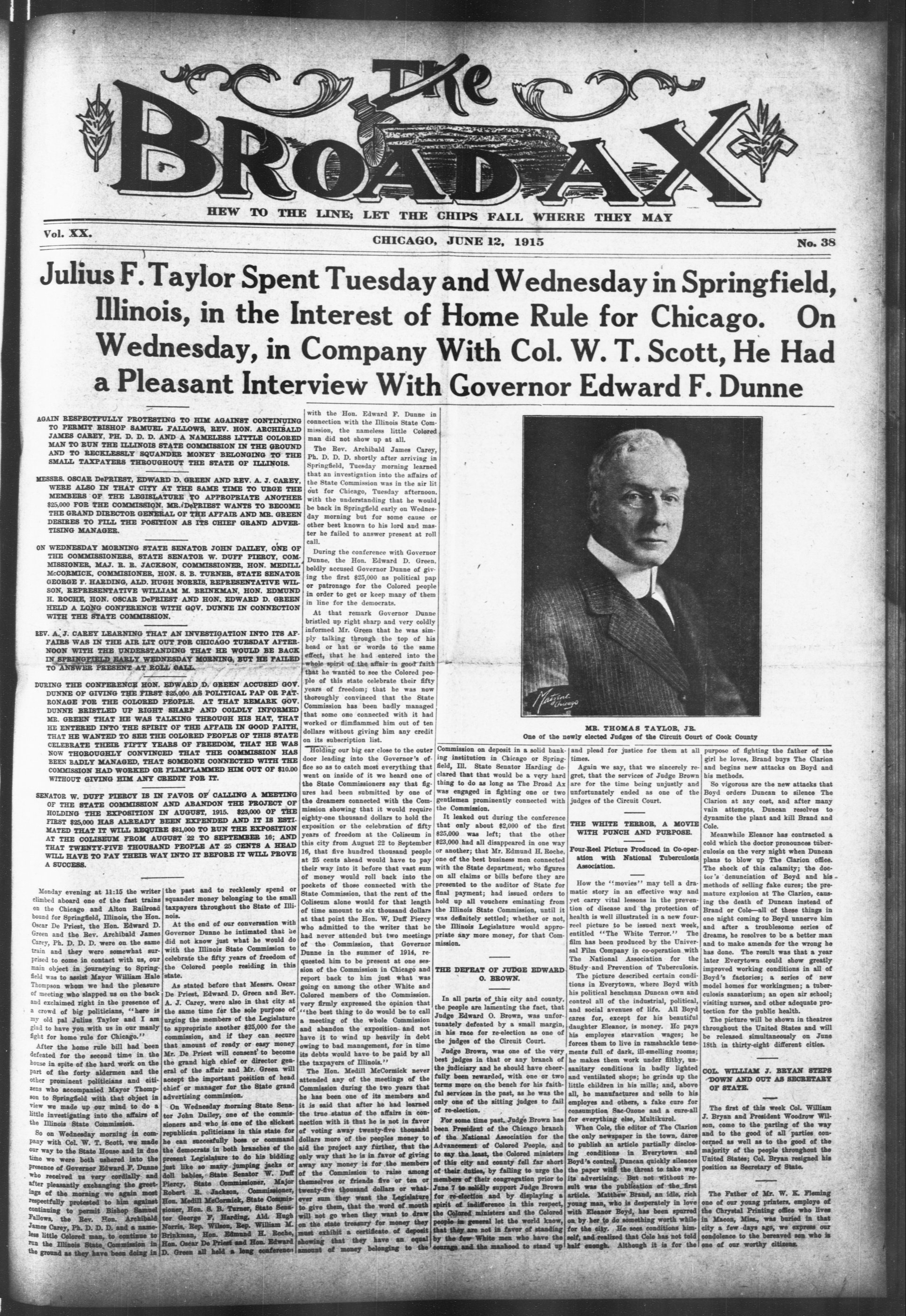
Julius F. Taylor Spent Tuesday and Wednesday in Springfield, Illinois, in the Interest of Home Rule for Chicago. On Wednesday, in Company With Col. W. T. Scott, He Had a Pleasant Interview With Governor Edward F. Dunne
AGAIN RESPECTFULLY PROTESTING TO HIM AGAINST CONTINUING TO PERMIT BISHOP SAMUEL FALLOWS, REV. HON. ARCHIBALD JAMES CAREY, PH. D. D. D. AND A NAMELESS LITTLE COLORED MAN TO RUN THE ILLINOIS STATE COMMISSION IN THE GROUND AND TO RECKLESSLY SQUANDER MONEY BELONGING TO THE SMALL TAXPAYERS THROUGHOUT THE STATE OF ILLINOIS.
MESSRS. OSCAR DEPRIEST, EDWARD D. GREEN AND REV. A. J. CAREY, WERE ALSO IN THAT CITY AT THE SAME TIME TO URGE THE MEMBERS OF THE LEGISLATURE TO APPROPRIATE ANOTHER $25,000 FOR THE COMMISSION. MR. DePRIEST WANTS TO BECOME THE GRAND DIRECTOR GENERAL OF THE AFFAIR AND MR. GREEN DESIRES TO FILL THE POSITION AS ITS CHIEF GRAND ADVERTISING MANAGER.
ON WEDNESDAY MORNING STATE SENATOR JOHN DAILEY, ONE OF THE COMMISSIONERS, STATE SENATOR W. DUFF PIERCY, COMMISSIONER, MAJ. R. B. JACKSON, COMMISSIONER, HON. MEDILD McCORMICK, COMMISSIONER, HON. S. B. TURNER, STATE SENATOR GEORGE F. HARDING, ALD. HUGH NOBRIES, REPRESENTATIVE WILSON, REPRESENTATIVE WILLIAM M. BRINKMAN, HON. EDMUND H. ROCHE, HON. OSCAR DEPRIEST AND HON. EDWARD D. GREEN HELD A LONG CONFERENCE WITH GOV. DUNNE IN CONNECTION WITH THE STATE COMMISSION.
REV. A. J. CAREY LEARNING THAT AN INVESTIGATION INTO ITS AFFAIRS WAS IN THE AIR LIT OUT FOR CHICAGO TUESDAY AFTERNOON WITH THE UNDERSTANDING THAT HE WOULD BE BACK IN SPRINGFIELD EARLY WEDNESDAY MORNING, BUT HE FAILED TO ANSWER PRESENT AT ROLL GALL.
DURING THE CONFERENCE HON. EDWARD D. GREEN ACCUSED GOV
DUNNE OF GIVING THE FIRST $25,000 AS POLITICAL PAP OR PAT-
RONAGE FOR THE COLORED PEOPLE. AT THAT REMARK GOV
DUNNE BRISTLED UP RIGHT SHARP AND COLDLY INFORMED
MR. GREEN THAT HE WAS TALKING THROUGH HIS HAT, THAT
HE ENTERED INTO THE SPIRIT OF THE AFPAIR IN GOOD PAITH,
THAT HE WANTED TO SEE THE COLORED PEOPLE OF THIS STATE
CELEBRATE THEIR FIFTY YEARS OF FREEDOM, THAT HE WAS
NOW THOROUGHLY CONVINCED THAT THE COMMISSION HAS
BEEN BADLY MANAGED, THAT SOMEONE CONNECTED WITH THE
COMMISSION HAD WORKED OR FLIMFLAMMED HIM OUT OF $10.00
WITHOUT GIVING HIM ANY CREDIT FOR IT.
SENATOR W. DUFF PIERCY IS IN PAVOR OF CALLING A MEETING
OF THE STATE COMMISSION AND ABANDON THE PROJECT OF
HOLDING THE EXPOSITION IN AUGUST, 1915. $23,000 OF THE
FIRST $25,000 HAS ALREADY BEEN EXPENDED AND IT IS ESTI-
MATED THAT IT WILL BEQUIRE $81,000 TO BUN THE EXPOSITION
AT THE COLISEUM FROM AUGUST 22 TO SEPTEMBER 16; AND
THAT TWENTY-FIVE THOUSAND PEOPLE AT 25 CENTS A HEAD
WILL HAVE TO PAY THEIR WAY INTO IT BEFORE IT WILL PROVE
A SUCCESS.
Vol. XX.
Julius F. T.
Illinois
Wed
a Plea
AGAIN RESPECTFULLY PROTESTED
TO PERMIT BISHOP SAMUEL
JAMES CAREY, PH. D. D. D. D.
MAN TO RUN THE ILLINOIS
AND TO RECKLESSLY SQUARE
SMALL TAXPAYERS THROUGH
MESSRS. OSCAR DePRIEST, EDWARDS
WERE ALSO IN THAT CITY
MEMBERS OF THE LEGISLATURE
$25,000 FOR THE COMMISSION
THE GRAND DIRECTOR GENERAL
DESIRES TO FILL THE POSITIVE
TISING MANAGER.
ON WEDNESDAY MORNING STATE
THE COMMISSIONERS, STATE
MISSIONER, MAJ. R. B. JACKEY
MCORMICK, COMMISSIONER, M.
GEORGE F. HARDING, ALD. HU
WILSON, REPRESENTATIVE WILSON
H. ROCHE, HON. OSCAR DePRIEST
HELD A LONG CONFERENCE
WITH THE STATE COMMISSIONER
REV. A. J. CAREY LEARNING THAT
FAIRS WAS IN THE AIR LIT
NOON WITH THE UNDERSTAIR
IN SPRINGFIELD EARLY WED
TO ANSWER PRESENT AT ROUND
DURING THE CONFERENCE HONORING
DUNNE OF GIVING THE FIRST
RONAGE FOR THE COLORED
DUNNE BRISTLED UP RIGHT
MR. GREEN THAT HE WAS TO
HE ENTERED INTO THE SPIRIT
THAT HE WANTED TO SEE THE
CELEBRATE THEIR FIFTY YEARS
NOW THOROUGHLY CONVINCING
BEEN BADLY MANAGED, THAT
COMMISSION HAD WORKED ON
WITHOUT GIVING HIM ANY CHOICE
SENATOR W. DUFF PIERCY IS IN
OF THE STATE COMMISSIONER
HOLDING THE EXPOSITION TO
FIRST $25,000 HAS ALREADY
MATED THAT IT WILL REQUIRED
AT THE COLISEUM FROM AUSTRIA
THAT TWENTY-FIVE THOUSAND
WILL HAVE TO PAY THEIR WAIT
A SUCCESS.
Monday evening at 11:15 the writer climbed aboard one of the fast trains on the Chicago and Alton Railroad bound for Springfield, Illinois, the Hon. Oscar De Priest, the Hon. Edward D. Green and the Rev. Archibald James Carey, Ph. D. D. D. were on the same train and they were somewhat surprised to come in contact with us, our main object in journeying to Springfield was to assist Mayor William Hale Thompson whom we had the pleasure of meeting who slapped us on the back and exclaimed right in the presence of a crowd of big politicians, "here is my old pal Julius Taylor and I am glad to have you with us in our manly fight for home rule for Chicago." After the home rule bill had been defeated for the second time in the house in spite of the hard work on the part of the forty aldermen and the other prominent politicians and citizens who accompanied Mayor Thompson to Springfield with that object in view we made up our mind to do a little investigating into the affairs of the Illinois State Commission.
So on Wednesday morning in company with Col. W. T. Scott, we made our way to the State House and in due time we were both ushered into the presence of Governor Edward F. Dunne who received us very cordially and after pleasantly exchanging the greetings of the morning we again most respectfully protested to him against continuing to permit Bishop Samuel Fallows, the Rev. Hon. Archibald James Carey, Ph. D. D. D. and a nameless little Colored man, to continue to run the Illinois State Commission in the ground as they have been doing in
the past and to recklessly spend or squander money belonging to the small taxpayers throughout the State of Illinois.
At the end of our conversation with Governor Dunne he intimated that he did not know just what he would do with the Illinois State Commission to celebrate the fifty years of freedom of the Colored people residing in this state.
As stated before that Messrs. Oscar De Priest, Edward D. Green and Rev. A. J. Carey, were also in that city at the same time for the sole purpose of urging the members of the Legislature to appropriate another $25,000 for the commission, and if they can secure that amount of ready or easy money Mr. De Priest will consent to become the grand high chief or director general of the affair and Mr. Green will accept the important position of head chief or manager for the State grand advertising commission.
On Wednesday morning State Senator John Dailey, one of the commissioners and who is one of the slickest republican politicians in this state for he can successfully boss or command the democrats in both branches of the present Legislature to do his bidding just like so many jumping jacks of doll babies, State Senator W. Duff Piercy, State Commissioner, Major Robert R. Jackson, Commissioner, Hon. Medill McCormick, State Commissioner, Hon. S. B. Turner, State Senator George F. Harding, Ald. Hugh Norris, Rep. Wilson, Rep. William M. Brinkman, Hon. Edmund H. Roche, Hon. Oscar De Priest and Hon. Edward D. Green all hold a long conference
CHICAGO, JUNE 12, 1915
with the Hon. Edward F. Dunne in connection with the Illinois State Commission, the nameless little Colored man did not show up at all.
The Rev. Archibald James Carey, Ph. D. D. D. shortly after arriving in Springfield, Tuesday morning learned that an investigation into the affairs of the State Commission was in the air lit out for Chicago, Tuesday afternoon, with the understanding that he would be back in Springfield early on Wednesday morning but for some cause or other best known to his lord and master he failed to answer present at roll call.
During the conference with Governor Dunne, the Hon. Edward D. Green, boldly accused Governor Dunne of giving the first $25,000 as political pap or patronage for the Colored people in order to get or keep many of them in line for the democrats.
At that remark Governor Dunne bristled up right sharp and very coldly informed Mr. Green that he was simply talking through the top of his head or hat or words to the same effect, that he had entered into the whole spirit of the affair in good faith that he wanted to see the Colored people of this state celebrate their fifty years of freedom; that he was now thoroughly convinced that the State Commission has been badly managed that some one connected with it had worked or flimflammed him out of ten dollars without giving him any credit on its subscription list.
Holding our big ear close to the outer door leading into the Governor's office so as to catch most everything that went on inside of it we heard one of the State Commissioners say that figures had been submitted by one of the dreamers connected with the Commission showing that it would require eighty-one thousand dollars to hold the exposition or the celebration of fifty years of freedom at the Coliseum in this city from August 22 to September 16, that five hundred thousand people at 25 cents ahead would have to pay their way into it before that vast sum of money would roll back into the pockets of those connected with the State Commission, that the rent of the Coliseum alone would for that length of time amount to six thousand dollars at that point the Hon. W. Duff Pierce who admitted to the writer that he had never attended but two meetings of the Commission, that Governor Dunne in the summer of 1914, requested him to be present at one session of the Commission in Chicago and report back to him just what was going on among the other White and Colored members of the Commission, very firmly expressed the opinion that "the best thing to do would be to call a meeting of the whole Commission and abandon the exposition and not have it to wind up heavily in debt owing to bad management, for in time its debts would have to be paid by all the taxpayers of Illinois."
The Hon. Medill McCormick never attended any of the meetings of the Commission during the two years that he has been one of its members and it is said that after he had learned the true status of the affairs in connection with it that he is not in favor of voting away twenty-five thousand dollars more of the peoples money to aid the project any further, that the only way that he is in favor of giving any money is for the members of the Commission to raise among themselves or friends five or ten or twenty-five thousand dollars or whatever sum they want the Legislature to give them, that the word of mouth will not go when they want to draw on the state treasury for money they must exhibit a certificate of deposit showing that they have an equal amount of money belonging to the
Matsint Chuago
MR. THOMAS TAYLOR, JR.
One of the newly elected Judges of the Circuit Court of Cook County
Commission on deposit in a solid bank- ing institution in Chicago or Spring- field, III. State Senator Harding de- clared that that would be a very hard thing to do as long as The Broad Ax was engaged in fighting one or two gentlemen prominently connected with the Commission.
It leaked out during the conference that only about $2,000 of the first $25,000 was left; that the other $23,000 had all disappeared in one way or another; that Mr. Edmund H. Roche, one of the best business men connected with the State department; who figures on all claims or bills before they are presented to the auditor of State for final payment; had issued orders to hold up all vouchers eminating from the Illinois State Commission, until it was definitely settled; whether or not, the Illinois Legislature would appropriate any more money, for that Commission.
THE DEFEAT OF JUDGE EDWARD
O. BROWN.
In all parts of this city and county, the people are lamenting the fact, that Judge Edward O. Brown, was unfortunately defeated by a small margin, in his race for re-election as one of the judges of the Circuit Court.
Judge Brown, was one of the very best judges in that or any branch of the judiciary and he should have cheerfully been rewarded, with one or two terms more on the bench for his faithful services in the past, as he was the only one of the sitting judges to fail of re-election.
For some time past, Judge Brown has been President of the Chicago branch of the National Association for the Advancement of Colored People, and to say the least, the Colored ministers of this city and county fell far short of their duties, by failing to urge the members of their congregation prior to June 7 to solidly support Judge Brown for re-election and by displaying a spirit of indifference in this respect, the Colored ministers and the Colored people in general let the world know, that they are not in favor of standing by the few White men who have the courage and the manhood to stand up
MR. THOMAS TAYLOR. JB.
and plead for justice for them at all times.
Again we say, that we sincerely regret, that the services of Judge Brown are for the time being unjustly and unfortunately ended as one of the judges of the Circuit Court.
THE WHITE TERBOR, A MOVIE
WITH PUNCH AND PURPOSE.
Four-Reel Picture Produced in Co-operation with National Tuberculosis Association.
How the "movies" may tell a dramatic story in an effective way and yet carry vital lessons in the prevention of disease and the protection of health is well illustrated in a new fourreel picture to be issued next week, entitled "The White Terror." The film has been produced by the Universal Film Company in co-operation with The National Association for the Study and Prevention of Tuberculosis. The picture described certain conditions in Everytown, where Boyd with his political henchman Duncan own and control all of the industrial, political, and social avenues of life. All Boyd cares for, except for his beautiful daughter Eleanor, is money. He pays his employees starvation wages; he forces them to live in ramshackle tenements full of dark, ill-smelling rooms; he makes them work under filthy, unsanitary conditions in badly lighted and ventilated shops; he grinds up the little children in his mills; and, above all, he manufactures and sells to his employees and others, a fake cure for consumption Sac-Ozone and a cure-all for everything else. Multikulur.
When Cole, the editor of The Clarion the only newspaper in the town, dares to publish an article partially disclosing conditions in Everytown and Boyd's control, Duncan quickly silences the paper with the threat to take way its advertising. But not without result was the publication of the first article. Matthew Brand, an idle, rich young man, who is desperately in love with Eleanor Boyd, has been spurred on by her to do something worth while for the city. He sees conditions himself, and realized that Cole has not told half enough. Although it is for the
No.38
purpose of fighting the father of the girl he loves, Brand buys The Clarion and begins new attacks on Boyd and his methods. So vigorous are the new attacks that Boyd orders Duncan to silence The Clarion at any cost, and after many vain attempts, Duncan resolves to dynamite the plant and kill Brand and Cole.
Meanwhile Eleanor has contracted a cold which the doctor pronounces tuberculosis on the very night when Duncan plans to blow up The Clarion office. The shock of this calamity; the doctor's denunciation of Boyd and his methods of selling fake cures; the premature explosion at The Clarion, causing the death of Duncan instead of Brand or Cole—all of these things in one night coming to Boyd unnerve him and after a troublesome series of dreams, he resolves to be a better man and to make amends for the wrong he has done. The result was that a year later Everytown could show greatly improved working conditions in all of Boyd's factories; a series of new model homes for workingmen; a tuberculosis sanatorium; an open air school; visiting nurses, and other adequate protection for the public health.
The picture will be shown in theatres throughout the United States and will be released simultaneously on June 18th in thirty-eight different cities.
COL. WILLIAM J. BRYAN STEPS
DOWN AND OUT AS SECRETARY
OF STATE.
The first of this week Col. William J. Bryan and President Woodrow Wilson, come to the parting of the way and to the good of all parties concerned as well as to the good of the majority of the people throughout the United States; Col. Bryan resigned his position as Secretary of State.
The Father of Mr. W. K. Fleming one of our young printers, employee of the Chrystal Printing office who lives in Macon, Miss., was buried in that city a few days ago, we express our condolence to the bereaved son who is one of our worthy citizens.
ENGLAND AWAKES
TO HER WAR TASK
Change In Cabinet Evidences
a New Regime.
To appreciate the real meaning of the recent cabinet crisis in England it is necessary to go back to the history of the months, indeed the years, that preceded the outbreak of the present war and recognize the central fact that for some years Great Britain had been governed by a party or a coalition of parties whose leaders utterly misunderstood the Europe in which they lived.
For years Lord Roberts and a number of the most eminent of British statesmen asserted loudly that the
Joseph B. Browne
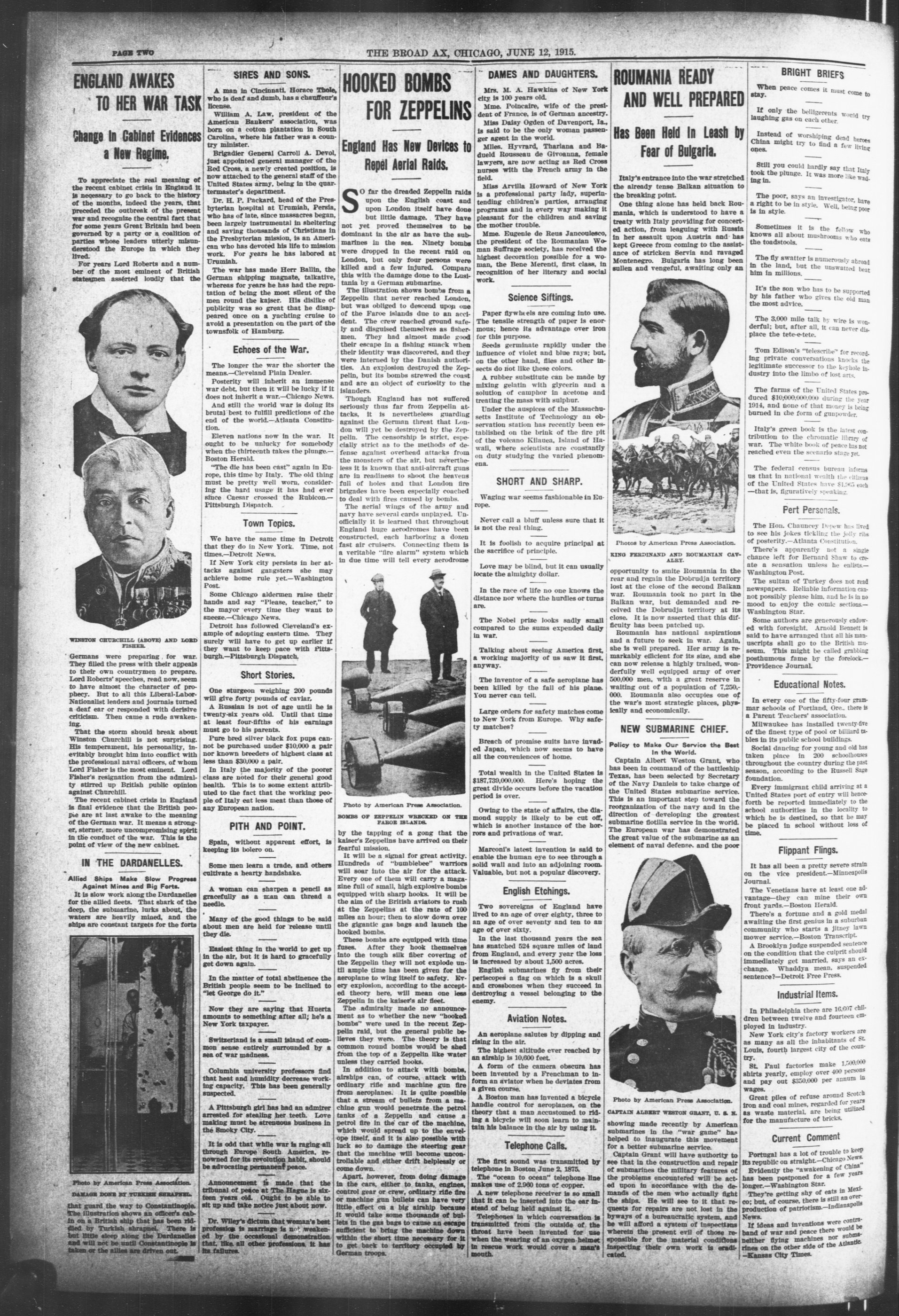
WINSTON CHURCHILL (ABOVE) AND LORD FISHER.
Germans were preparing for war. They filled the press with their appeals to their own countrymen to prepare. Lord Roberts' speeches, read now, seem to have almost the character of prophecy. But to all this Liberal-Labor Nationalist leaders and journals turned a deaf ear or responded with derisive criticism. Then came a rude awakening.
That the storm should break about Winston Churchill is not surprising. His temperament, his personality, inevitably brought him into conflict with the professional naval officers, of whom Lord Fisher is the most eminent. Lord Fisher's resignation from the admiralty stirred up British public opinion against Churchill.
The recent cabinet crisis in England is final evidence that the British people are at last awake to the meaning of the German war. It means a stronger, sterner, more uncompromising spirit in the conduct of the war. This is the point of view of the new cabinet.
IN THE DARDANELLES.
Allied Ships Make Slow Progress Against Mines and Big Forts.
It is slow work along the Dardanelles for the allied fleets. That shark of the deep, the submarine, lurks about, the waters are heavily mined, and the ships are constant targets for the forts
A man stands behind a large, weathered wooden door, partially obscured by a large, irregularly shaped hole. The door is made of wood and has a metal handle. The man is wearing a dark shirt and pants. The background is a plain, light-colored wall.
that guard the way to Constantinople. The illustration shows an officer's cab in on a British ship that has been riddled by Turkish shrapnel. There is but little sleep along the Dardanelles and will not be until Constantinople is taken or the allies are driven out.
SIRES AND SONS.
A man in Cincinnati, Horace Tble, who is deaf and dumb, has a chauffeur's license.
William A. Law, president of the American Bankers' association, was born on a cotton plantation in South Carolina, where his father was a country minister.
Brigadier General Carroll A. Devol, just appointed general manager of the Red Cross, a newly created position, is now attached to the general staff of the United States army, being in the quartermaster's department.
Dr. H. P. Packard, head of the Presbyterian hospital at Urumiah, Persia, who has of late, since massacres began, been largely instrumental in sheltering and saving thousands of Christians in the Presbyterian mission, is an American who has devoted his life to mission work. For years he has labored at Urumiah.
The war has made Herr Ballin, the German shipping magnate, talkative, whereas for years he has had the reputation of being the most silent of the men round the kaiser. His dislike of publicity was so great that he disappeared once on a yachting cruise to avoid a presentation on the part of the townfolk of Hamburg.
Echoes of the War.
The longer the war the shorter the means.—Cleveland Plain Dealer. Posterity will inherit an immense war debt, but then it will be lucky if it does not inherit a war.—Chicago News. And still the world war is doing its brutal best to fulfill predictions of the end of the world.—Atlanta Constitution.
Eleven nations now in the war. It ought to be unlucky for somebody when the thirteenth takes the plunge.—Boston Herald.
"The die has been cast" again in Europe, this time by Italy. The old thing must be pretty well worn, considering the hard usage it has had ever since Caesar crossed the Rubicon.—Pittsburgh Dispatch.
Town Topics.
We have the same time in Detroit that they do in New York. Time, not times.—Detroit News.
If New York city persists in her attacks against gangsters she may achieve home rule yet.—Washington Post.
Some Chicago aldermen raise their hands and say "Please, teacher," to the mayor every time they want to squeeze.—Chicago News.
Detroit has followed Cleveland's example of adopting eastern time. They surely will have to get up earlier if they want to keep pace with Pittsburgh.—Pittsburgh Dispatch.
Short Stories.
One sturgeon weighing 200 pounds will give forty pounds of caviar.
A Russian is not of age until he is twenty-six years old. Until that time at least four-fifths of his earnings must go to his parents.
Pure bred silver black fox pups cannot be purchased under $10,000 a pair nor known breeders of highest class at less than $30,000 a pair.
In Italy the majority of the poorer class are noted for their general good health. This is to some extent attributed to the fact that the working people of Italy eat less meat than those of any European nation.
PITH AND POINT.
Spain, without apparent effort, is keeping its bolero on.
Some men learn a trade, and others cultivate a hearty handshake.
A woman can sharpen a pencil as gracefully as a man can thread a needle.
Many of the good things to be said about men are held for release until they die.
Easiest thing in the world to get up in the air, but it is hard to gracefully get down again.
In the matter of total abstinence the British people seem to be inclined to "let George do it."
Now they are saying that Huerta amounts to something after all; he's a New York taxpayer.
Switzerland is a small island of common sense entirely surrounded by a sea of war madness.
Columbia university professors find that heat and humidity decrease working capacity. This has been generally suspected.
A Pittsburgh girl has had an admirer arrested for stealing her teeth. Love making must be strenuous business in the Smoky City.
It is odd that while war is raging all through Europe South America, renowned for its revolution habit, should be advocating permanent peace.
Announcement is made that the tribunal of peace at The Hague is sixteen years old. Ought to be able to sit up and take notice just about now.
Dr. Wiley's dictum that woman's best profession is marriage is not weakened by the occasional demonstration that, like all other professions, it has its failures.
THE BROAD AX. CHICAGO. JUNE 12. 1915.
England Has New Devices to Repel Aerial Raids.
So far the dreaded Zeppelin raids upon the English coast and upon London itself have done but little damage. They have not yet proved themselves to be dominant in the air as have the submarines in the sea. Ninety bombs were dropped in the recent raid on London, but only four persons were killed and a few injured. Compare this with the damage done to the Lusitania by a German submarine.
The illustration shows bombs from a Zeppelin that never reached London, but was obliged to descend upon one of the Faroe islands due to an accident. The crew reached ground safely and disguised themselves as fishermen. They had almost made good their escape in a fishing smack when their identity was discovered, and they were intermed by the Danish authorities. An explosion destroyed the Zeppelin, but its bombs strewed the coast and are an object of curiosity to the islanders.
Though England has not suffered seriously thus far from Zeppelin attacks, it is nevertheless guarding against the German threat that London will yet be destroyed by the Zeppelin. The censorship is strict, especially strict as to the methods of defense against overhead attacks from the monsters of the air, but nevertheless it is known that anti-aircraft guns are in readiness to shoot the heavens full of holes and that London fire brigades have been especially coached to deal with fires caused by bombs. The aerial wings of the army and navy have several cards unplayed. Unofficially it is learned that throughout England huge aerodromes have been constructed, each harboring a dozen fast air cruisers. Connecting them is a veritable "fire alarm" system which in due time will tell every aerodrome
THE BOMB
BOMBS OF ZEPPELIN WRECKED ON THE FAROE IBLANDS.
by the tapping of a gong that the kaiser's Zeppelins have arrived on their fearful mission.
It will be a signal for great activity. Hundreds of "bumblebee" warriors will soar into the air for the attack. Every one of them will carry a magazine full of small, high explosive bombs equipped with sharp hooks. It will be the aim of the British aviators to rush at the Zeppelins at the rate of 100 miles an hour; then to slow down over the gigantic gas bags and launch the hooked bombs.
These bombs are equipped with time fuses. After they hook themselves into the tough silk fiber covering of the Zeppelin they will not explode until ample time has been given for the aeroplane to wing itself to safety. Every explosion, according to the accepted theory here, will mean one less Zeppelin in the kaiser's air fleet. The admiralty made no announcement as to whether the new "hooked bombs" were used in the recent Zeppelin raid, but the general public believes they were. The theory is that common round bombs would be shed from the top of a Zeppelin like water unless they carried hooks.
In addition to attack with bombs, alarms can, of course, attack with ordinary rifle and machine gun fire from aeroplanes. It is quite possible that a stream of bullets from a machine gun would penetrate the petrol tanks of a Zeppelin and cause a petrol fire in the car of the machine, which would spread up to the envelope itself, and it is also possible with luck so to damage the steering gear that the machine will become uncontrollable and either drift helplessly or come down.
Apart, however, from doing damage in the cars, either to tanks, engines, control gear or crew, ordinary rifle fire or machine gun bullets can have very little effect on a big airship because it would take some thousands of bullets in the gas bags to cause an escape sufficient to bring the machine down within the short time necessary for it to get back to territory occupied by German troops.
DAMES AND DAUGHTERS.
Mrs. M. A. Hawkins of New York city is 100 years old. Mme. Polcaina, wife of the president of France, is of German ancestry.
Miss Daisy Ogden of Davenport, Ia., is said to be the only woman passenger agent in the world. Miles. Hyvard, Tharlana and Badueld Rousseau de Givoanna, female lawyers, are now acting as Red Cross nurses with the French army in the field. Miss Arrilla Howard of New York is a professional party lady, superintending children's parties, arranging programs and in every way making it pleasant for the children and saving the mother trouble. Mme. Eugenie de Reus Jancoulesco, the president of the Roumanian Woman Suffrage society, has received the highest decoration possible for a woman, the Beren Merenti, first class, in recognition of her literary and social work.
Science Siftings
Paper dywheels are coming into use. The tensile strength of paper is enormous; hence its advantage over iron for this purpose. Seeds germinate rapidly under the influence of violet and blue rays; but, on the other hand, files and other insects do not like these colors. A rubber substitute can be made by mixing gelatin with glycerin and a solution of camphor in acetone and treating the mass with sulphur. Under the auspices of the Massachusetts Institute of Technology an observation station has recently been established on the brink of the fire pit of the volcano Kilauea, Island of Hawaii, where scientists are constantly on duty studying the varied phenomena.
SHORT AND SHARP.
Waging war seems fashionable in Europe.
Never call a bluff unless sure that it is not the real thing.
It is foolish to acquire principal at the sacrifice of principle.
Love may be blind, but it can usually locate the almighty dollar.
In the race of life no one knows the distance nor where the hurdles or turns are.
The Nobel prize looks sadly small compared to the sums expended daily in war.
Talking about seeing America first, a working majority of us saw it first, anyway.
The inventor of a safe aeroplane has been killed by the fall of his plane. You never can tell.
Large orders for safety matches come to New York from Europe. Why safety matches?
Breach of promise suits have invaded Japan, which now seems to have all the conveniences of home.
Total wealth in the United States is $187,730,000,000. Here's hoping the great divide occurs before the vacation period is over.
Owing to the state of affairs, the diamond supply is likely to be cut off, which is another instance of the horrors and privations of war.
Marconi's latest invention is said to enable the human eye to see through a solid wall and into an adjoining room. Valuable, but not a popular discovery.
English Etchings.
Two sovereigns of England have lived to an age of over eighty, three to an age of over seventy and ten to an age of over sixty.
In the last thousand years the sea has snatched 524 square miles of land from England, and every year the loss is increased by about 1,500 acres.
English submarines fly from their periscopes a flag on which is a skull and crossbones when they succeed in destroying a vessel belonging to the enemy.
Aviation Notes.
An aeroplane salutes by dipping and rising in the air.
The highest altitude ever reached by an airship is 10,600 feet.
A form of the camera obscura has been invented by a Frenchman to inform an aviator when he deviates from a given course.
A Boston man has invented a bicycle handle control for aeroplanes, on the theory that a man accustomed to riding a bicycle will soon learn to maintain his balance in the air by using it.
Telephone Calls.
The first sound was transmitted by telephone in Boston June 2, 1875.
The "ocean to ocean" telephone line makes use of 2,900 tons of copper.
A new telephone receiver is so small that it can be inserted into the ear instead of being held against it.
Telephones in which conversation is transmitted from the outside of the throat have been invented for use when the wearing of an oxygen-helmet in rescue work would cover a man's mouth.
ROUMANIA READY AND WELL PREPARED
Has Been Held In Leash by Fear of Bulgaria.
Italy's entrance into the war stretched the already tense Balkan situation to the breaking point.
One thing alone has held back Romania, which is understood to have a treaty with Italy providing for concerted action, from leaguing with Russia in her assault upon Austria and has kept Greece from coming to the assistance of stricken Servia and ravaged Montenegro. Bulgaria has long been sullen and vengeful, awaiting only an
Photos by American Press Association.
KING FERDINAND AND ROUMANIAN CAVALRY.
opportunity to suite Roumania in the rear and regain the Dobrudja territory lost at the close of the second Balkan war. Roumania took no part in the Balkan war, but demanded and received the Dobrudja territory at its close. It is now asserted that this difficulty has been patched up.
Roumania has national aspirations and a future to seek in war. Again, she is well prepared. Her army is remarkably efficient for its size, and she can now release a highly trained, wonderfully well equipped army of over 500,000 men, with a great reserve in waiting out of a population of 7,250,000. Roumania also occupies one of the war's most strategic places, physically and economically.
NEW SUBMARINE CHIEF.
Policy to Make Our Service the Best In the World.
Captain Albert Weston Grant, who has been in command of the battleship Texas, has been selected by Secretary of the Navy Daniels to take charge of the United States submarine service. This is an important step toward the reorganization of the navy and in the direction of developing the greatest submarine fotilla service in the world. The European war has demonstrated the great value of the submarine as an element of naval defense, and the poor
M.
Photo by American Press Association.
CAPTAIN ALBERT WESTON GRANT, U. S. N.
showing made recently by American submarines in the "war game" has helped to inaugurate this movement for a better submarine service.
Captain Grant will have authority to see that in the construction and repair of submarines the military features of the problems encountered will be acted upon in accordance with the demands of the men who actually fight the ships. He will see to it that requests for repairs are not lost in the byways of a bureaucratic system, and he will afford a system of inspections wherein the present evil of those responsible for the material conditions inspecting their own work is eradicated.
BRIGHT BRIEFS
When peace comes it must come to stay.
If only the belligerents would try laughing gas on each other.
Instead of worshiping dead heroes China might try to find a few living ones.
Still you could hardly say that Italy took the plunge. It was more like wading in.
The poor, says an investigator, have a right to be in style. Well, being poor is in style.
Sometimes it is the fellow who knows all about mushrooms who eats the toadstools.
The fly swatter is numerously abroad in the land, but the unswatted beat him in millions. _____
It's the son who has to be supported by his father who gives the old man the most advice. _____
The 3,000 mile talk by wire is wonderful; but, after all, it can never displace the tete-e-tete. _____
Tom Edison's "telescribe" for recording private conversations knocks the legitimate successor to the keyhole industry into the limbo of lost arts. _____
The farms of the United States produced $10,000,000,000 during the year 1914, and none of that money is being burned in the form of gunpowder. _____
Italy's green book is the latest contribution to the chromatic library of war. The white book of peace has not reached even the scenario stage yet.
The federal census bureau informs us that in national wealth the citizens of the United States have $1,955 each—that is, figuratively speaking.
Pert Personals.
The Hon. Chaucey Depew has lived to see his jokes tickling the jolly ribs of posterity.—Atlanta Constitution.
There's apparently not a single chance left for Bernard Shaw to create a sensation unless he enlists.—Washington Post.
The sultan of Turkey does not read newspapers. Reliable information cannot possibly please him, and he is in no mood to enjoy the comic sections.—Washington Star.
Some authors are generously endowed with foresight. Arnold Bennett is said to have arranged that all his manuscripts shall go to the British museum. This might be called grabbing posthumous fame by the forelock.—Providence Journal.
Educational Notes
In every one of the fifty-four grammar schools of Portland, Ore., there is a Parent Teachers' association. Milwaukee has installed twenty-five of the finest type of pool or billiard tables in its public school buildings. Social dancing for young and old has taken place in 200 schoolhouses throughout the country during the past season, according to the Russell Sage foundation. Every immigrant child arriving at a United States port of entry will henceforth be reported immediately to the school authorities in the locality to which he is destined, so that he may be placed in school without loss of time.
Flippant Flings.
It has all been a pretty severe strain on the vice president.-Minneapolis Journal. The Venetians have at least one advantage—they can mine their own front yards.-Boston Herald. There's a fortune and a gold medal awaiting the first genius in a suburban community who starts a jitney lawn mower service.-Boston Transcript. A Brooklyn judge suspended sentence on the condition that the culprit should immediately get married, says an exchange. Whaddya mean, suspended sentence?-Detroit Free Press.
Industrial Items.
In Philadelphia there are 16,007 children between twelve and fourteen employed in industry.
New York city's factory workers are as many as all the inhabitants of St. Louis, fourth largest city of the country.
St. Paul factories make 1,500,000 shirts yearly, employ over 400 persons and pay out $350,000 per annum in wages.
Great piles of refuse around Scotch iron and coal mines, regarded for years as waste material, are being utilized for the manufacture of bricks.
Current Comment
Portugal has a lot of trouble to keep its republic on straight.-Chicago News. Evidently the "awakening of China" has been postponed for a few years longer.-Washington Star.
They're getting shy of sights in Mexico; but, of course, there is still an overproduction of patriotism.—Indianspolis News.
If ideas and inventions were contraband of war and peace there would be neither flying machines nor submarines on the other side of the Atlantic. -Kansas City Times.
A Woman Who Believes In Universal Suffrage.
Mary
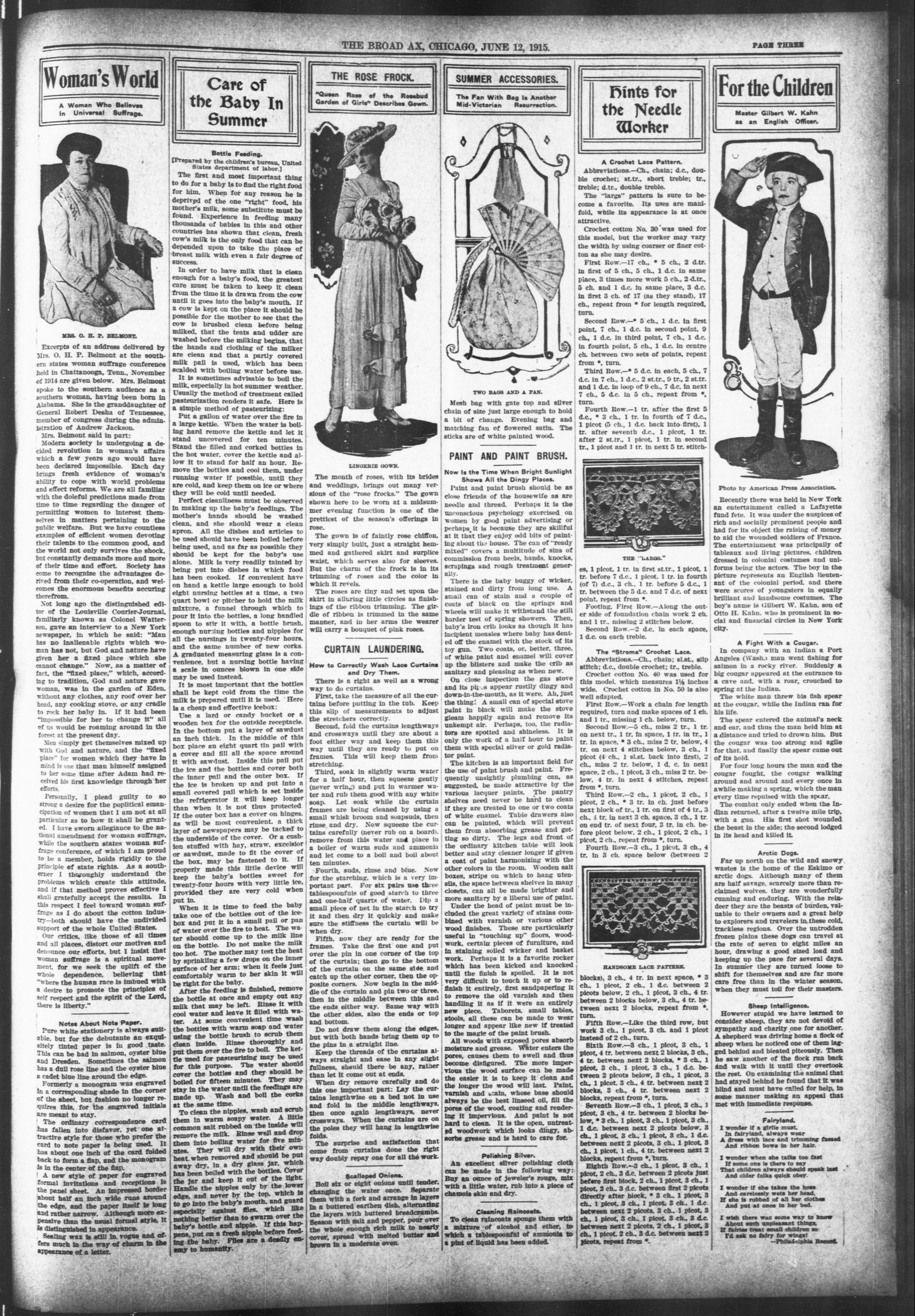
MRS. O. H. P. BELMONT.
Excerpts of an address delivered by Mrs. O. H. P. Belmont at the southern states woman suffrage conference held in Chattanooga, Tenn., November of 1914 are given below. Mrs. Belmont spoke to the southern audience as a southern woman, having been born in Alabama. She is the granddaughter of General Robert Desha of Tennessee, member of congress during the administration of Andrew Jackson.
Modern society is undergoing a decided revolution in woman's affairs which a few years ago would have been declared impossible. Each day brings fresh evidence of woman's ability to cope with world problems and effect reforms. We are all familiar with the doleful predictions made from time to time regarding the danger of permitting women to interest themselves in matters pertaining to the public welfare. But we have countless examples of efficient women devoting their talents to the common good, and the world not only survives the shock, but constantly demands more and more of their time and effort. Society has come to recognize the advantages derived from their co-operation, and welcomes the enormous benefits accuring therefrom.
Not long ago the distinguished editor of the Louisville Courier-Journal, familiarly known as Colonel Watterson, gave an interview to a New York newspaper, in which he said: "Man has no inalienable rights which woman has not, but God and nature have given her a fixed place which she cannot change." Now, as a matter of fact, the "fixed place", which, according to tradition, God and nature gave woman, was in the garden of Eden, without any clothes, any roof over her head, any cooking stove, or any crablet to rock her baby in. If it had been "impossible for her to change it" all of us would be roaming around in the forest at the present day.
Men simply get themselves mixed up with God and nature, and the "fixed place" for women which they have in mind is one that man himself assigned to her some time after Adam had received his first knowledge through her efforts.
Personally, I plead guilty to so strong a desire for the populist emancipation of women that I am not at all particular as to how it shall be granted. I have sworn allegiance to the national amendment for woman suffrage, while the southern states woman suffrage conference, of which I am proud to be a member, holds rigidly to the principle of state rights. As a southerner I thoroughly understand the problems which create this attitude, and if that method proves effective I shall gratefully accept the results. In this respect I feel toward woman suffrage as I do about the cotton industry—both should have the undivided support of the whole United States.
Our critics, like those of all times and all places, distort our motives and denounce our efforts, but I insist that woman suffrage is a spiritual movement, for we seek the uplift of the whole dependence, believing that "where the human race is imbued with a desire to promote the principles of self respect and the spirit of the Lord, there is liberty."
Notes About Note Paper.
Pure white stationery is always suitable, but for the debutante an exquisitely tinted paper is in good taste. This can be had in salmon, oyster blue and Dresden. Sometimes the salmon has a dull rose line and the oyster blue a cadet blue line around the edge.
Formerly a monogram was engraved in a corresponding shade in the corner of the sheet, but fashion no longer requires this, for the engraved initials are meant to stay.
The ordinary correspondence card has fallen into disfavor, yet one attractive style for those who prefer the card to note paper is being used. It has about one inch of the card folded back to form a flap, and the monogram is in the center of the flap.
A new style of paper for engraved formal invitations and receptions is the panel sheet. An impressed border about half an inch wide runs around the edge, and the paper itself is long and rather narrow. Although more expensive than the usual formal style, it is distinguished in appearance.
Sealing wax is still in vogue and offers much in the way of charm in the appearance of a letter.
Care of the Baby In Summer
Bottle Feeding.
[Prepared by the children's bureau, United States department of labor.]
The first and most important thing to do for a baby is to find the right food for him. When for any reason he is deprived of the one "right" food, his mother's milk, some substitute must be found. Experience in feeding many thousands of babies in this and other countries has shown that clean, fresh cow's milk is the only food that can be depended upon to take the place of breast milk with even a fair degree of success.
In order to have milk that is clean enough for a baby's food, the greatest care must be taken to keep it clean from the time it is drawn from the cow until it goes into the baby's mouth. If a cow is kept on the place it should be possible for the mother to see that the cow is brushed clean before being milked, that the teats and udder are washed before the milking begins, that the hands and clothing of the milker are clean and that a partly covered milk pall is used, which has been scalded with boiling water before use. It is sometimes advisable to boll the milk, especially in hot summer weather. Usually the method of treatment called pasteurization renders it safe. Here is a simple method of pasteurizing:
Put a gallon of water over the fire in a large kettle. When the water is bolling hard remove the kettle and let it stand uncovered for ten minutes. Stand the filled and corked bottles in the hot water, cover the kettle and allow it to stand for half an hour. Remove the bottles and cool them, under running water if possible, until they are cold, and keep them on ice or where they will be cold until needed.
Perfect cleanliness must be observed in making up the baby's feedings. The mother's hands should be washed clean, and she should wear a clean apron. All the dishes and articles to be used should have been boiled before being used, and as far as possible they should be kept for the baby's use alone. Milk is very readily tainted by being put into dishes in which food has been cooked. If convenient have on hand a kettle large enough to hold eight nursing bottles at a time, a two quart bowl or pitcher to hold the milk mixture, a funnel through which to pour it into the bottles, a long handled spoon to stir it with, a bottle brush, enough nursing bottles and nipples for all the nursings in twenty-four hours, and the same number of new corks. A graduated measuring glass is a convenience, but a nursing bottle having a scale in ounces blown in one side may be used instead.
It is most important that the bottles shall be kept cold from the time the milk is prepared until it is used. Here is a cheap and effective icebox:
Use a lard or candy bucket or a wooden box for the outside receptacle. In the bottom put a layer of sawdust an inch thick. In the middle of this box place an eight quart tin pail with a cover and fill all the space around it with sawdust. Inside this pail put the ice and the bottles and cover both the inner pail and the outer box. If the ice is broken up and put into a small covered pail which is set inside the refrigerator it will keep longer than when it is not thus protected. If the outer box has a cover on hinges, as will be most convenient, a thick layer of newspapers may be tacked to the underside of the cover. Or a cushion stuffed with hay, straw, excelsior or sawdust, made to fit the cover of the box, may be fastened to it. If properly made this little device will keep the baby's bottles sweet for twenty-four hours with very little ice, provided they are very cold when put in.
When it is time to feed the baby take one of the bottles out of the icebox and put it in a small pail or pan of water over the fire to heat. The water should come up to the milk line on the bottle. Do not make the milk too hot. The mother may test the heat by sprinkling a few drops on the inner surface of her arm; when it feels just comfortably warm to her skin it will be right for the baby.
After the feeding is finished, remove the bottle at once and empty out any milk that may be left. Rinse it with cool water and leave it filled with water. At some convenient time wash the bottles with warm soap and water using the bottle brush to scrub them clean inside. Rinse thoroughly and put them over the fire to boil. The kettle used for pasteurizing may be used for this purpose. The water should cover the bottles and they should be boiled for fifteen minutes. They may stay in the water until the feedings are made up. Wash and boll the corks at the same time.
To clean the nipples, wash and scrub them in warm soapy water. A little common salt rubbed on the inside will remove the milk. Rinse well and drop them into boiling water for five minutes. They will dry with their own heat when removed and should be put away dry, in a dry glass jar, which has been boiled with the bottles. Cover the jar and keep it out of the light. Handle the nipples only by the lower edge, and never by the top, which is to go into the baby's mouth, and guard especially against files, which like nothing better than to swarm over the baby's bottle and nipple. If this happens, put on a fresh nipple before feeding the baby. Flies are a deadly enemy to humanity.
THE BROAD AX, CHICAGO, JUNE 12, 1915
LINGERIE GOWN.
The month of roses, with its brides and weddings, brings out many versions of the "rose frocks." The gown shown here to be worn at a midsummer evening function is one of the prettiest of the season's offerings in rose.
The gown is of faintly rose chiffon, very simply built, just a straight hemmed and gathered skirt and surplice waist, which serves also for sleeves. But the charm of the frock is in its trimming of roses and the color in which it revels.
The roses are tiny and set upon the skirt in alluring little circles as finishings of the ribbon trimming. The girdle of ribbon is trimmed in the same manner, and in her arms the weaver will carry a bouquet of pink roses.
CURTAIN LAUNDERING.
How to Correctly Wash Lace Curtains and Dry Them.
There is a right as well as a wrong way to do curtains.
First, take the measure of all the curtains before putting in the tub. Keep this slip of measurements to adjust the stretchers correctly.
Second, fold the curtains lengthways and crossways until they are about a foot either way and keep them this way until they are ready to put on frames. This will keep them from stretching.
Third, soak in slightly warm water for a half hour, then squeeze gently (never wrin<sub>5</sub>) and put in warmer water and rub them good with any white soap. Let soak while the curtain frames are being cleaned by using a small whisk broom and soapsuds, then rinse and dry. Now squeeze the curtains carefully (never rub on a board), remove from this water and place in a boiler of warm suds and ammonia and let come to a boil and boil about ten minutes.
Fourth, suds, rinse and blue. Now for the starching, which is a very important part. For six pairs use three tablespoonfuls of good starch to three and one-half quarts of water. Dip a small piece of net in the starch to try it and then dry it quickly and make sure the stiffness the curtain will be when dry.
Fifth, now they are ready for the frames. Take the first one and put over the pin in one corner of the top of the curtain; then go to the bottom of the curtain on the same side and catch up the other corner, then the opposite corners. Now begin in the middle of the curtain and pin two or three, then in the middle between this and the ends either way. Same way with the other sides, also the ends or top and bottom.
Do not draw them along the edges, but with both hands bring them up to the pins in a straight line.
Keep the threads of the curtains always straight and ease in any slight fullness, should there be any, rather than let it come out at ends.
When dry remove carefully and do this one important part: Lay the curtains lengthwise on a bed not in use and fold in the middle lengthways, then once again lengthways, never crossways. When the curtains are on the poles they will hang in lengthwise folds.
The surprise and satisfaction that come from curtains done the right way doubly repay one for all the work.
Scalloped Onions.
Boll six or eight onions until tender, changing the water once. Separate them with a fork and arrange in layers in a buttered earthen dish, alternating the layers with buttered breadcrumbs. Season with salt and pepper, pour over the whole enough rich milk to nearly cover, spread with melted butter and brown in a moderate oven.
I
TWO BAGS AND A FAN.
Mesh bag with gate top and silver chain of size just large enough to hold a bit of change. Evening bag and matching fan of flowered satin. The sticks are of white painted wood.
PAINT AND PAINT BRUSH.
Now Is the Time When Bright Sunlight Shows All the Dingy Places.
Paint and paint brush should be as close friends of the housewife as are needle and thread. Perhaps it is the unconscious psychology exercised on women by good paint advertising or perhaps it is because they are skillful at it that they enjoy odd bits of painting about the house. The can of "ready mixed" covers a multitude of sins of commission from beels, hands, knocks, scrapings and rough treatment generally.
There is the baby buggy of wicker, stained and dirty from long use. A small can of stain and a couple of coats of black on the springs and wheels will make it withstand the still harder test of spring showers. Then, baby's iron crib books as though it has incipient measles where baby has dented off the enamel with the stock of its toy gun. Two coats, or, better, three, of white paint and enamel will cover up the blisters and make the crib as sanitary and pleasing as when new.
On close inspection the gas stove and its plims appear rustily dingy and down-in-the-mouth, as it were. Ah, just the thing! A small can of special stove paint in black will make the stove gleam happily again and remove its unkempt air. Perhaps, too, the radiators are spotted and shineless. It is only the work of a half hour to paint them with special silver or gold radiator paint.
The kitchen is an important field for the use of paint brush and paint. Frequently unsightly plumbing can, as suggested, be made attractive by the various lacquer paints. The pantry shelves need never be hard to clean if they are treated to one or two coats of white enamel. Table drawers also can be painted, which will prevent them from absorbing grease and getting so dirty. The legs and front of the ordinary kitchen table will look better and stay cleaner longer if given a coat of paint harmonizing with the other colors in the room. Wooden salt boxes, strips on which to hang utensils, the space between shelves in many closets, can all be made brighter and more sanitary by a liberal use of paint.
Under the head of paint must be included the great variety of stains combined with varnish or various other wood finishes. These are particularly useful in "touching up" floors, woodwork, certain pieces of furniture, and in staining soiled wicker and basket work. Perhaps it is a favorite rocker which has been kicked and knocked until the finish is spilled. It is not very difficult to touch it up or to refinish it entirely, first sandpapering it to remove the old varnish and then handling it as if it were an entirely new piece. Taborets, small tables, stools, all these can be made to wear longer and appear like new if treated to the mangle of the paint brush.
All woods with exposed pores absorb moisture and grease. Water enters the pores, causes them to swell and thus become disfigured. The more impervious the wood surface can be made the easier it is to keep it clean and the longer the wood will last. Paint, varnish and stain, whose base should always be the best linseed oil, fill the pores of the wood, coating and rendering it impervious. And paint is not hard to clean. It is the open, untreated woodwork which looks dingy, absorbs grease and is hard to care for.
Polishing Silver
An excellent silver polishing cloth can be made in the following way: Buy an ounce of jeweler's rouge, mix with a little water, rub into a piece of chamols skin and dry.
Cleaning Raincoats.
To clean raincoats sponge them with a mixture of alcohol and ether, to which a tablespoonful of ammonia to a pint of liquid has been added.
Hints for the Needle Worker
A Crochet Lace Pattern.
Abbreviations.-Ch., chain; d.c., double crochet; st.tr., short treble; tr., treble; d.tr., double treble.
The "largs" pattern is sure to become a favorite. Its uses are manifold, while its appearance is at once attractive.
Crochet cotton No. 30' was used for this model, but the worker may vary the width by using coarser or finer cotton as she may desire.
First Row.—17 ch., * 5 ch., 2 d.tr. in first of 5 ch., 5 ch., 1 d.c. in same place, 3 times more work 5 ch., 2 d.tr. 5 ch. and 1 d.c. in same place, 3 d.c. in first 3 ch. of 17 (as they stand), 17 ch., repeat from * for length required, turn.
Second Row.—* 5 ch., 1 d.c. in first point, 7 ch., 1 d.c. in second point, 9 ch., 1 d.c. in third point, 7 ch., 1 d.c. in fourth point, 5 ch., 1 d.c. in centre ch. between two sets of points, repeat from *, turn.
Third Row.—* 5 d.c. in each, 5 ch., 7 d.c. in 7 ch., 1 d.c., 2 st.tr., 9 tr., 2 st.tr. and 1 d.c. in loop of 9 ch., 7 d.c. in next 7 ch., 5 d.c. in 5 ch., repeat from *, turn.
Fourth Row.—1 tr. after the first 5 d.c., * 3 ch., 1 tr. in fourth of 7 d.c., 1 picot (5 ch., 1 d.c. back into first), 1 tr. after seventh d.c., 1 picot, 1 tr. after 2 st.tr., 1 picot, 1 tr. in second tr., 1 picot and 1 tr. in next 5 tr. stitch-
THE "LARGS."
es, 1 picot, 1 tr. in first st.tr., 1 picot, 1 tr. before 7 d.c., 1 picot, 1 tr. in fourth (of 7) d.c., 3 ch., 1 tr. before 5 d.c., 1 tr. between the 5 d.c. and 7 d.c. of next point, repeat from *.
Footing, First Row.—Along the outer side of foundation chain work 2 ch. and 1 tr., missing 2 stitches below.
Second Row.—2 d.c. in each space, 1 d.c. on each treble.
The "Stroma" Crochet Lace.
Abbreviations—Ch., chain; slst., slip stitch; d.c., double crochet; tr., treble.
Crochet cotton No. 40 was used for this model, which measures 1½ inches wide. Crochet cotton in No. 50 is also well adapted.
First Row.—Work a chain for length required, turn and make spaces of 1 ch, and 1 tr, missing 1 ch below, turn.
Second Row.—5 ch, miss 2 tr, 1 tr, on next tr, 1 tr, in space, 1 tr, in tr, 1 tr, in space * 3 ch, miss 2 tr, below, 4 tr, on next 4 stitches below, 3 ch, 1 plot (4 ch, 1 slst. back into first), 2 ch, miss 2 tr, below, 1 d. c. in next space, 2 ch, 1 plot (3 ch, miss 2 tr, below, 4 tr, in next 4 stitches, repeat from *, turn.
Third Row.—2 ch, 1 plot, 2 ch, 1 plot, 2 ch, * 3 tr, in just before next block of tr, 1 tr, on first of 4 tr, 3 ch, 4 tr, in next 3 ch, space, 3 ch, 1 tr, on end tr, of next four, 3 tr, in ch. before plot below, 2 ch, 1 plot, 2 ch, 1 plot, 2 ch, repeat from *, turn.
Fourth Row.—3 ch, 1 plot, 3 ch, 4 tr, in 3 ch, space below (between 2
HANDSOME LACE PATTERN.
blocks), 3 ch., 4 tr. in next space, * 3
ch., 1 picot, 2 ch., 1 d.c. between 2
picots below, 2 ch., 1 picot, 3 ch., 4 tr.
between 2 blocks below, 3 ch., 4 tr. between next 2 blocks, repeat from *.
turn.
Fifth Row.—Like the third row, but
work 3 ch., 1 picot, 3 ch. and 1 picot
instead of 2 ch. turn.
Eighth Row. -3 ch, 1 plocet, 3 ch, 1
plocet, 2 ch, 3 d.c. between 2 plocets just
before first block, 2 ch, 1 plocet, 3 ch, 1
plocet, 2 ch, 3 d.c. between first 2 plocets
directly after block, * 3 ch, 1 plocet, 3
ch, 1 plocet, 3 ch, 1 plocet, 3 ch, 1 d.c.
between next 2 plocets, 3 ch, 1 plocet, 3
ch, 1 plocet, 3 ch, 1 plocet, 3 ch, 3 d.c.
between next 2 plocets, 2 ch, 1 plocet, 3
ch, 1 plocet, 2 ch, 3 d.c. between next 2
plocets, repeat from *.
PAGE THREE
For the Children
Master Gilbert W. Kahn
as an English Officer.
e
Photo by American Press Association.
Recently there was held in New York an entertainment called a Lafayette fund fete. It was under the auspices of rich and socially prominent people and had for its object the raising of money to aid the wounded soldiers of France. The entertainment was principally of tableaux and living pictures, children dressed in colonial costumes and uniforms being the actors. The boy in the picture represents an English lieutenant of the colonial period, and there were scores of youngsters in equally brilliant and handsome costumes. The boy's name is Gilbert W. Kahn, son of Otto H. Kahn, who is prominent in social and financial circles in New York city.
A Fight With a Cougar.
In company with an Indian a Port Angeles (Wash.) man went fishing for salmon in a rocky river. Suddenly a big cougar appeared at the entrance to a cave and, with a roar, crouched to spring at the Indian. The white man threw his fish spear at the cougar, while the Indian ran for his life. The spear entered the animal's neck and ear, and thus the man held him at a distance and tried to drown him. But the cougar was too strong and agile for that, and finally the spear came out of its hold. For four long hours the man and the cougar fought, the cougar walking around and around and every once in a while making a spring, which the man every time repulsed with the spear.
The combat only ended when the Indian returned, after a twelve mile trip, with a gun. His first shot wounded the beast in the side; the second lodged in its head and killed it.
Arctic Dogs.
Far up north on the wild and snowy wastes is the home of the Eskimo or arctic dogs. Although many of them are half savage, scarcely more than reclaimed wolves, they are wonderfully cunning and enduring. With the reindeer they are the beasts of burden, valuable to their owners and a great help to explorers and travelers in these cold, trackless regions. Over the untridden frozen plains these dogs can travel at the rate of seven to eight miles an hour, drawing a good sized load and keeping up the pace for several days. In summer they are turned loose to shift for themselves and are far more care free than in the winter season, when they must toil for their masters.
Sheep Intelligence.
However stupid we have learned to consider sheep, they are not devoid of sympathy and charity one for another. A shepherd was driving home a flock of sheep when he noticed one of them lagged behind and bleated piteously. Then he saw another of the flock run back and walk with it until they overtook the rest. On examining the animal that had stayed behind he found that it was blind and must have called for help, in some manner making an appeal that met with immediate response.
I wonder if a girl must
In fairyland, always wear
A dress with lace and trimming fussed
And ribbon bows in her hair.
I wonder when she talks too fast
If some one is there to see
That children always should speak last
And older folks quick obey.
I wonder if she takes the hose
And carelessly wets her head.
If she is robbed of all her clothes
And put at once in her bed.
I wish there was some way to know
About such unpleasant things.
If she is robbed of all children so
I'd ask no fairy for wings!
—Philadelphia Record.
PUBLISHED WEEKLY.
(Will promulgate and et all times upheld
the tres principles ef Democracy, bet
Catholics, Protestants, Priests, Infidels,
Single Taxere, Republicans, or anyone cise
‘ean have thelr ony, es long as thelr lan-
guage ts proper and responsibility ls Axed.
‘The Brod Ax ts = newspaper whose
Distform is breed enough for all, ever
aiming the edlterial right to epeak its
own mind.
Local communications ill recelve atten-
tion. Write, only on ene cide of the paper.
Subscriptions must be paid in advance.
Advertising rates made known en appli-
cation.
Address all communications to
THE BROAD AX
sa ST. LAWRENCE AVE. CHICAGO, ILL.
PHONE WENTWORTH 2507.
JULIUS ¥. TAYLOR, Editor and Publisher
‘Entered as Second-Clase Matter Aug. 19
‘1908, at the Pest Ofitce at Chicage, Lilinels
under Act of March 3, 1873.
(a
REMOVAL NOTICE.
‘From on and after this date, al
letters or other mail matter intended
for Julius F. Taylor or Mrs. Annie E.
Taylor or The Broad Ax, should be
addressed to 6532 St. Lawrence Ave,
Jackson Park station. Phone Went-
worth 2597.
CALIFORNIA INVITES THE
WORLD.
By Prof. Charles Alexander.
‘Bpecial to The Broad Ax.
On the western edge of the North
American Continent, lashed by the
restless waves of the great Pacific
Ocean on one side and an immense is-
land dotted bay almost surrounding it
on the other, in a remarkably con-
genial climate, a veritable garden-spot
‘ of enchanting loveliness, is located San
Francisco, the city of hills, In the
most favored section of this city has
been planted the Panama-Pacifie In-
ternational Exposition. A visit to this
Exposition is caleulated to broaden the
minds of visitors, creating greater so-
cial sympathies among them, harmon-
izing geographical and international
view points and rendering it easy to
realize the brotherhood of man
among men.
It would be a serious misfortune to
the Colored people of the United States
if they should for any reason be de
terred from visiting this magnificent
Exposition; and especially on account
of the misleading and erroneous report
cireulated recently that the attitude
of the citizens of San Francisco and
the Exposition is unfriendly, hostile
and antagnostic toward him.
Knowing a sensitive nature of our
people and realizing how easy it is
to create the timorous spirit among
them on questions of discrimination
and prejudice, I have thought it wise
to send forth this frank statement
concerning the situation here in San
Franeiseo. Nearly everywhere in this
country questions of segregation. dis-
erimination and prejudice are engrose-
ing the attention of leaders, and I
would gave our people embarrassment
and humiliation wherever it is pos
sible. To those who have decided to
visit the Exposition and to those whe
have ngt yet fully contemplated that
pleasure, be it understood: That Sar
Francisco is a big cosmopolitan city
‘A city msde up of all sorts and condi
tions of men. It is more liberal ix
sentiment, and less provincial in racial
matters than either Chicago or New
‘York. Representatives of a great
mumber of races are seen daily on the
streets. Little racial antipathy or ani.
mosity is observable in the conduct of
the people in public places, notwith
standing the incongroous, dissimila:
‘hd heterogeneous character of the
population. Indeed, San Francisco, is
‘singularly free from racial friction a:
compared with other cities. On the
Exposition grounds the most generou:
and cordial spirit prevails among the
‘Visitors and natives; and bere one sees
seem Se eeees Sone
many strange people, arrayed in
turesque garbs, speaking uafamilia:
anguages and betraying peculiar trait
“of character. This wonderful sight in
_spirés the Delicf that the time is not
penton melee Sie eS
| realized, es . terrible
ee at aie oh eek po
“common ‘ground, in order to arrive =!
meena eet a
? or eonfer and
get ated with 1 ‘other, and
$So apes pring sto
Semi mess 5 oS
ages cy ee
Now as fo aceon Peete
“ eine mots 8
ee ee
nated against as bas been stated in
the Eastern newspapers. Let all who
will, come, and you will be given a
hearty welcome. First class accommo-
dations st reasonable rates can be se-
cured in all parts of the city. If any
of our readers contemplate the trip
to the Exposition it would be well to
write to Prof. Charles Alexander, 1299
for literature and full information. He
is prepared to answer all questions re-
lating to the Exposition and aecommo-
dations.
Our educators and leaders every-
where should avail themselves of the
benefits of this wonderful display of
the skill und genius of the world. The
educational value of this Exposition is
inestimable. The arrangement of the
spacious palaces in which the exhibits
are installed and the tower of Jewels,
scintillating day and night with a
wealth of unsurpassing beauty, fur-
nishes a feast for the mind and soul
as helpful and inspiring as anything
that has ever happened in the history
of our country.
SOCIETY.
By Benjamin Browning.
In the broadest sense this term in-
eludes all mankind, but with a littl
more limitation it involves only a cer
tain country or section or perhaps a
state and restricting it to its narrow
est sense it implies to only a clas:
that is a social class, oftimes, in tak
ing a scientific view, in order to dis
tinguish between the lower animal and
man, the term Human to deal with the
lower branch of animal life, but the
highest or man, in his elevated and cul-
tured stage.
I pieture society as a house, whose
object of being is; To promote the so-
cial welfare in the highest moral sense.
Now the next question that arises in
my mind is; What kind of a house is
this societal house and how is it built?
Wealth is the ground on which the
house stands. I think all will con-
cur on the facts that: when one has
wealth he has commanding power and
in view of the fact that one has wealth
the accessibilities for obtaining friends
are facilitated. Although, wealth is
not everything; it is a powerful factor
and most things we get sprouts from
wealth. Intellect is the stone founda-
tion and any house will stand as long
8 its foundation remains substantial.
Is there any one who does not agree!
that an ignorant person is not only
not wanted in society but is a bad
stone in the foundation and if sufi
cient number is placed in the founda-
tion, it will collapse. The ignorant
cannot regulate and prolong society so
the intellectual will have to uphold it.
Thus far the idea is that the degree
of intelligence or learning one gets de-
pends upon the amount of wealth, that
one can put forth toward it. Morals
are the walls of the house, low morals
are rejected because they will not
make the roof high enough, the alti-
tude of prominence of any society de-
pends upo the heighth of its morals
and the degree of intellect will decide
the elevation of the morals. Now we
‘see the ground on which the foundation
is constructed with the walls extend-
ing upward. Culture is the floor; its
width is measured by the seope of the
intellect and protruding no farther
than the walls of morals. Supported
by all of the aforesaid parts of the
societal house is the roof of Reputa-
tion, no house is built, or considered
complete without any one of these
parts, neither can the societal house
‘be absolitely destituted of any one of
the parts mentioned although all parts
may not be perfect in quality; they
must be there nevertheless. The socie-
tal house is ealeimined with Purity and
the steps leading into it is opportu-
nity. é
In all cases theoretically, if not prac
tieal the people rule; they are the an-
thority having power to grant any one
whom they chose admission to the
house, Under true democracy whoso-
ever meet the requirement are not held
back om account of prejudice or per
sonal grudges. Is the society of today
governed by the true spirit of demoe.
racy? I’m afraid not if we believe the
testimonies that have been given us
through the newspapers, magazines and
drama’s to say nothing of the rumor:
recently spread concerning certair
members of our own society. Ther
‘are people within ‘the borders. of ou
city who can stand the test of noble
character; I have in mind two young
whose names I am not going to dis
pose, as far as intelligence, beauty
‘and means sre concerned will stand
[the test. Until the selfishness and fail
‘ure of society to recognize those whe
‘are worthy of recognition are exter
ee
ed with impurity. It seems s
mystery that in this advanced ae of
siviliantion that people would act wit
sue } and telerate
|nearted” aud” believer in the Lofty
co of Man and. supporters
jot imxuring justice to. extin
hse he cc. ovte a onlin
ee er Ss Sere es
Pe Pe ef Sa crn ys >
THE BROAD AX, CHICAGO, JUNE 12, 1915.
:
v : :
; acres
; . wy
ce” ~ ;
ao. a
“4 ;
YS oo
\ oa
. f
y es
;
:
|
| :
1
|
ee 2
eu
, Sa eer =
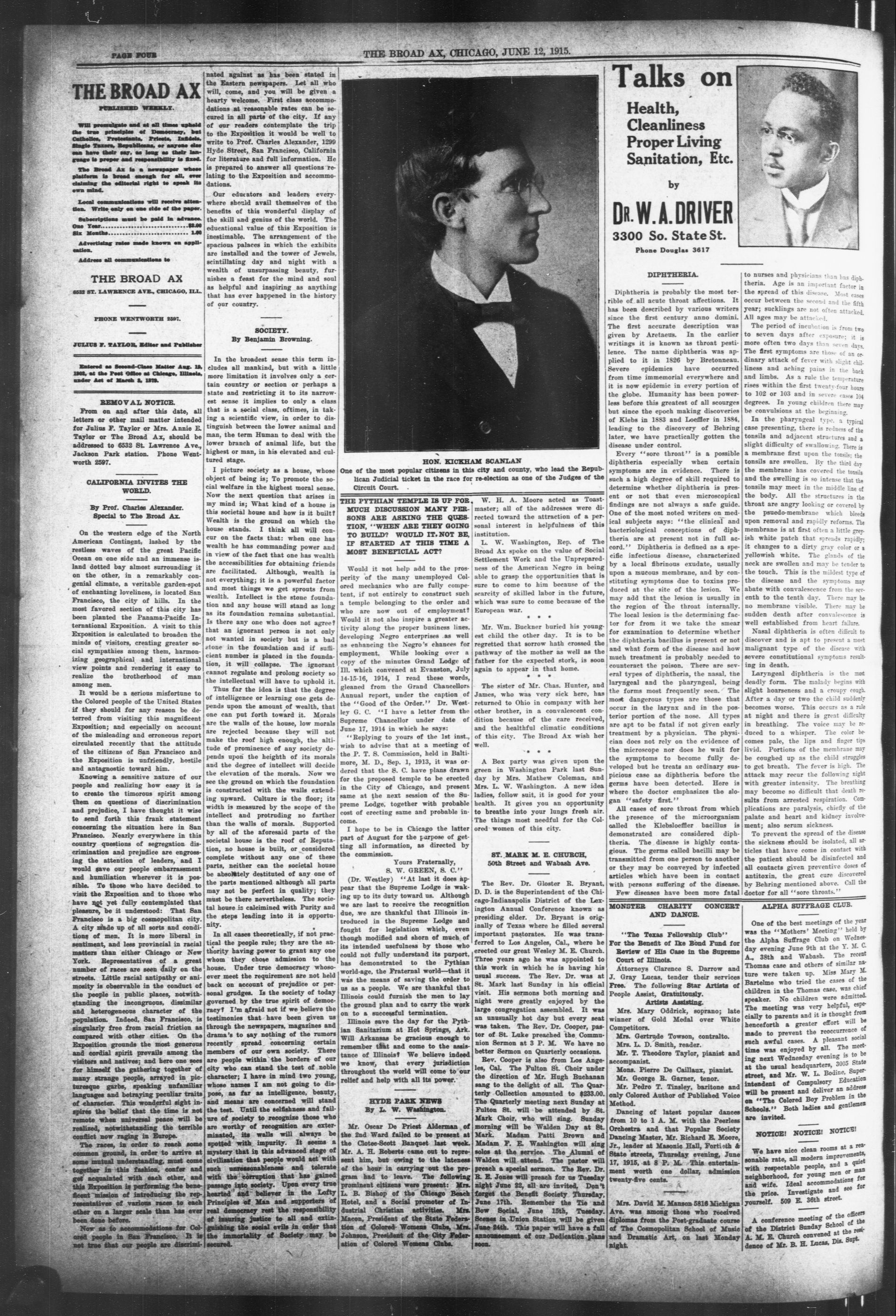
HON. KICKHAM SCANLAN
One of the most popular citizens in this city and county, who lead the Repub
Uican Judicial ticket in the race for re-election as one of the Judges of the
Circuit Court. - 7
ee
THE PYTHIAN TEMPLE I8 UP FOR, W. H. A. Moore acted as Toast
MUCH DISCUSSION MANY sails ‘all of the addresses were di
SONS ARE ASKING THE QUES-|rected toward the attraction of s per
TION, ‘‘WHEN ARE THEY GOING |sonal interest in helpfulness of thi
TO BUILD? WOULD IT.NOT BE, institution.
IP STARTED AT THIS TIME A| L. W. Washington, Rep. of Thi
‘MOST BENEFICIAL ACT? | Broad Ax spoke on the value of Socia
Would it not help add to the pros
perity of the many unemployed Col
ored mechanics who are fully compe
tent, if not entirely to construct such
a temple belonging to the order and
who are now out of employment!
Would it not also inspire a greater ac
tivity along the proper business lines
developing Negro enterprises .as well
as enhancing the Negro’s chances for
employment, While looking over a
copy of the minutes Grand Lodge of
Ill. which convened at Evanston, July
14-15-16, 1914, I read these words
gleaned from the Grand Chancellors
Annual report, under the caption of
the ‘Good of the Order.’? Dr. West
ley G. C. ‘I have a letter from the
Supreme Chancellor under date of
June 17, 1914 in which he says:
“Replying to yours of the Ist inst.
wish to advise that at a meeting of
the P. T. S. Commission, held in Balti
more, M. D., Sep. 1, 1913, it was or
dered that the S. C. have plans drawn
for the proposed temple to be erected
in the City of Chicago, and present
same at the next session of the Su.
preme Lodge, together with probable
cost of erecting same and probable in
come.
I hope to be in Chicago the latte
part of August for the parpose of get
ting all information, as directed by
lien -deeteinaliiie
Yours Fraternally,
& W. GREEN. &. C.”’
(Dr. Westley) ‘‘At last it does ap-
pear that the Supreme Lodge is wak-
ing up to its duty toward us. Although
we are last to receive the recognition
due, we are thankful that Illinois in-
troduced in the Supreme Lodge and
fought for legislation which, even
though modified and shorn of much of
its intended usefulness by those who
could not fully understand its porport,
has demonstrated to the Pythian
world-age, the Fraternal world—that it
was the means of saving the order to
us as a people. We are thankful that
Tlinois could furnish the men to lay
the ground plan and to carry the work
on to a successful termination.
Illinois save the day for the Pyth-
ian Sanitarium at Hot Springs, Ark.
Will Arkansas be gracious enough tc
remember tHht and come to the assis
tance of Ilinois? We believe indeed
we know, that every jurisdiction
throughout the world will come to’ our
relief and help with all its power.”
HYDE PARK NEWB *
By I. W. Washington.
Mr. Osear De Priest Alderman , of
the 2ud Ward failed to be present at
the Clotes-Seott Banquet last week
Mr. A. H. Roberts came out to repre-
sent him, but owing to the lateness
of the hour in carrying out the pro
gram had to leave. The following
prominent citizens were present: Mrs
L. B. Bishop of the Ohicago Bench
Hotel, and s Socisl promoter of. In
Macon, President of the State Feders-
tion of Colored- Womens Clubs, Mrs
Johnson, President of the City Feder
ation of Colored Womens Clubs,
‘W. H. A. Moore acted as Toast-
master; all of the addresses were di-
rected toward the attraction of a per-
sonal interest in helpfulness of this
institution.
L. W. Washington, Rep. of The
Broad Ax spoke on the value of Social
Settlement Work and the Unprepared-
ness of the American Negro in being
able to grasp the opportunities that is
sure to come to him because of the
searcity of skilled labor in the future,
which was sure to come because of the
European war.
Mr. Wm. Buckner buried his young:
est child the other day. It is to be
regretted that sorrow hath crossed the
pathway of the mother as well as the
father for the expected stork, is soon
‘again to appear in that home.
‘The sister of Mr. Chas. Hunter, and
James, who was very sick here, has
returned to Ohio in company with her
other brother, in a convalescent con-
dition because of the care received,
and the healthful climatic conditions
of this city. ‘The Broad Ax wish her
well.
‘A Box party was given upon the
green in Washington Park last Sun-
day by Mrs. Mathew Coleman, and
Mrs. L. W. Washington. A new idea
ladies, follow suit, it is good for your
health. It gives you an opportunity
to breathe into your lungs fresh air.
The things most needful for the Col-
ored: women of this city.
ST. MARK M. E. CHURCH,
‘50th Street and Wabash Ave.
The Rev. Dr. Gloster R. Bryant,
D. D. is the Superintendent of the Chi-
cago-Indianspolis District of the Lex-
ington Annual Conference known as
presiding elder. Dr. Bryant is orig-
inally of Texas where he filled several
important pastorates. He was trans-
ferred to Los Angeles, Cal., where he
erected our great Wesley M. E. Church.
‘Three years ago he was appointed to
this work in which he is having his
usual success. The Rev. Dr. was at
St. Mark last Sunday in his official
visit. His sermons both morning and
night were greatly enjoyed by the
‘large congregation assembled. It was
an unusually hot day but every seat
was taken. The Rev. Dr. Cooper, pas-
tor of St. Luke preached the Commu-
nion Sermon at 3 P. M. We have no
better Sermon on Quarterly occasions.
Bev. Cooper is also from Los Ange-
les, Cal. The Fulton St. Choir under
the direction of Mr. Hugh Buchanan
sang to the delight of all. The Quar.
terly Collection amounted to $233.00.
‘The Quarterly meeting next Sunday at
Fulton St. will be attended by St.
‘Mark Choir, who will sing. Sunday
morning will be Walden Day at St.
‘Mark, Madam Patti Brown and
Madam F. E. Washington will sing
solos at the service. The Alumni of
‘Walden will.attend. The pastor will
preach s special sermon. Tho Rey. Dr.
B. E. Jones will preach for us Tuesday
Ps eae oe
the Benefit Socisty f
June 17th. Remember the Tie and
Bow Social, June 15th, Tuesday.
oe nate Se ps ae
i " eee re a fall
Talks on
Health, _
Cleanliness
Proper Living
Sanitation, Etc.
by
Dr.W. A. DRIVER
3300 So. State St.
Diphtheria is probably the most ter-
rible of all acute throat affections. It
has been deseribed by various writers
sinee the first century anno domini.
The first accurate deseription was
given by Aretaeus, In the earlier
writings it is known as throat pesti-
lence. The name diphtheria was ap-
plied to it in 1826 by Bretonneau.
Severe epidemies have occurred
from time immemorial everywhere and
it is now epidemic in every portion of
‘the globe. Humanity has been power-
less before this greatest of all scourges
but sinee the epoch making discoveries
of Klebs in 1883 and Loefiler in 1884,
leading to the discovery of Behring
later, we have practically gotten the
disease under control.
Every ‘‘sore throat’? is a possible
diphtheria especially when certain
symptoms are in evidence. There is
such a high degree of skill required to
determine whether diphtheria is pres
ent or not that even microscopical
findings are not always a safe guide.
One of the most noted writers on med
jeal subjects says: ‘‘the clinieal and
bacteriological conceptions of diph
theria are at present not in full ac-
cord.’” Diphtheria is defined as a spe
cifie infectious disease, characterized
by a local fibrinous exudate, usually
upon a mucous membrane, and by con-
stituting symptoms due to toxins pro:
duced at the site of the lesion. We
may add that the lesion is usually in
the region of the throat internally.
‘The loeal lesion is the determining fae-
tor for from it we take the smear
for examination to determine whether
the diphtheria bacillus is present or not
and what form of the disease and how
Ss treatment is probably needed to
counteract the poison. There are sev-
eral types of diphtheria, the nasal, the
laryngeal and the pharyngeal, being
the forms most frequently seen.“ The
most dangerous types are those that
occur in the larynx and in the pos
terior portion of the nose. All types
are apt to be fatal if not given early
treatment by a physician. The physi-
cian does not rely on the evidence of
the microscope nor does he wait for
the symptoms to become fully de-
veloped but he treats an ordinary sus-
Picious ease as diphtheria before the
germs have been detected. Here is
where the doctor emphasizes the alo-
gum: “‘uatelyfaet.”?
All cases of sore throat from which
the presence of the microorganism
called the Klebsloefiler bacillus is
demonstrated are considered diph-
theria. The disease is highly conta-
gious. The germs called bacilli may be
transmitted from one person to another
or they may be conveyed by infected
articles which have been in contact
with persons suffering of the disease.
Few diseases have been more fatal
MONSTER CHARITY CONCERT
AND DANCE.
“The Texas Fellowship Club’’
For the Benefit of Ike Bond Fund for
Review of His Case in the Supreme
Court of Ilinois.
Attorneys Clarence 8. Darrow and
J. Gray Lucas, tender their services
Free. The following Star Artists of
People Assist, Gratuitously.
Artists Assisting.
Mrs. Mary Odarick, soprano; late
winner of Gold Medal over White
Competitors.
‘Mrs. Gertrade Towson, contralto.
‘Mrs. L. D. Smith, reader.
| Mr. 'T. Theodore Taylor, pianist and
accompanist.
| Mons. Pierre De Caillaux, pianist.
Mr, George B. Garner, tenor.
‘Mr. Pedro T. Tinsley, baritone and
only Colored Author of Published Voice
‘Method.
Dancing of latest popular dances
from 10 to 1 A. M. with the Peerless
Orchestra and that Popular Society
Daneing Master, Mr. Richard E. Moore
Jr., leader at Masonic Hall, Fortisth 4
State ‘streets, Thursday evening, June
11, 1915, at § Py M. This. entertain.
ment worth one dollar, admission
‘twenty-five cents.
‘Mrs. David M. Manson 5816 Michigan
Ave. was among those who received
diplomas from the Post-graduate course
‘af The Cosmopolitan School of Music
ae Seems Art, on last Monday
ae
Pee ,
A al a
ce fy
\ Mes
. ' ee
1if =
a
SO BAESSS ABS Parysicians than bas diph.
theria. Age is an important factor ig
the spread of this disease. Most cases
occur between the seron and the Sth
Year; sucklings are not often attacked,
All ages may be attache,
The period of incuhstion is from two
to seven days after exposure: it ig
more often two days thon secon days,
‘The first symptoms are those of an on
dinary attack of fever with slizit chil
ines and aching pains in the acy
and limbs. As a rule the temperature
rises within the first twenty-four hours
to 102 or 103 and in severe cases 104
degrees. In young children there may
be convulsions at the beginning.
In the pharyngeal type. 2. typical
‘case presenting, there is rellness of the
tonsils and adjacent structures and
slight difficulty of swallowing. There ig
& membrane first upon the tonsils; the
tonsils are swollen. By the third day
the membrane has covered the tonsils
and the swelling is so intense that the
tonsils may meet in the middle line of
the body. All the structures in the
throat are angry looking or covered by
the psuede-membrane which bleeds
upon removal and rapidly reforms. The
membrane is at first often a little grey-
ish white pateh that spreads rapidly,
it changes to a dirty gray color or a
yellowish white. The glands of the
neck are swollen and may be tender to
the touch. This is the mildest tspe of
the disease and the symptoms may
abate with convalescence from the ser-
enth to the tenth day. There may be
no membrane visible. There may be
sudden death after convalescence is
well established from heart failure.
Nasal diphtheria is often ditiealt to
discover and is apt to present a most
malignant type of the diseave with
severe constitutional symptoms result
ing in death.
Laryngeal diphtheria is the mot
deadly form. The malady begins with
slight hoarseness and a croupy cough.
After a day or two the child sudienly
becomes worse. This occurs as a rule
at night and there is great difiealty
im breathing. The voice may be te
duced to a whisper. The color be
comes pale, the lips and finger tis
livid. Portions of the membrane may
be coughed up as the child strugzles
to get breath. The fever is high. The
‘attack may recur the following night
with greater intensity. The breathing
may become so difficult that death re
sults from arrested respiration. Cox:
plications are paralysis, chie‘ly of the
palate and heart and kidney involve
ment; also serum sickness.
To prevent the spread of the diseas
the sickness should be isolated, all at
ticles that have come in contact with
the patient should be disinfected a2d
all contacts given preventive doses of
‘antitoxin, the great cure discovered
by Behring mentioned above. Call th
|doetor for all ‘‘sore throats.’”
ALPHA SUFFRAGE CLUB.
One of the best meetings of the yeat
was the “‘Mothers’ Meeting’? held by
the Alpha Suffrage Club on Wednes
aay evening June 9th at the Y. MC
‘A. 38th and Wabash. The recent
‘Thomas case and others of similar 1
ture were taken up. Miss Mary M
Bartelme who tried the cases of the
ehildren in the Thomas case, was chief
speaker. No children were admitted.
‘The meeting was very helpful, espe
cially to parents ‘and it is thought from
henceforth a greater effort will be
made to prevent the reoccurrence of
sech awfal cases. A pleasant socisl
‘time was enjoyed by all. The meet
ing next Wednesday evening is to b
‘at the usual headquarters, 3005 State
street, and Mr. W. L. Bodine, Supe
intendent of Compulsory Edvestion
‘will be present and deliver sn addres
‘om ‘The Colored Boy Problem in the
Schools.’? Both ladies and gestlene®
‘are invited.
NOTICE! NOTICE! NOTICE!
‘We have nico clean rooms sf *
sonable rate, all modern improvements
swith respectable people, ands Tt
‘neighborhood, for young men o* "10
Tad wite. deal secommodationt 1°
the price. Investigate sz se°
yourself, 509 H. 36th street.
‘< ting of the ofits
the District Sunday Sehool of UP
Se Church convened at te TH
oe ee Ms, B. H. Lacas, Dis. Ser
NEGRO FELLOWSHIP LEAGUE
"What Can The Negro Do About 'The Birth of The Nation,'" the moving picture film which is at present being shown in Chicago, claiming wide spread attention of the public and press, and much concern to the Negro, will be the subject of the discussion led by Mr. Walter M. Farmer, well known attorney of this city, Sunday afternoon June 20th, and Mrs. Irene McCoy Gaines, at the Negro Fellowship League, 3005 State street, 4 o'clock sharp. Everyone cordially invited to come and take part. Last Sunday Judges E. O. Brown and Frederick A. Smith of the Appellate Court made very fine talks to a crowded house. Mrs. Ida B. Wells Barnett, President.
NEGRO GETS SALARY $10,000.
Joseph Ray is the name of the Colored man who was in California with Cha. Schwab, the steel magnate, and his party, for a few hours last week. Mr. Ray is the right hand man of the magnate and receives a salary of $10,000 per year. He signs Mr. Schwab's name to checks, pays all bills and arranges all details of the trip. Before visitors can see Mr. Schwab, they must first state their business to Mr. Ray, then it is up to him to decide whether or not they will be admitted. Mr. Ray has been with Mr. Schwab for many years and is rated a wealthy man.
QUINN CHAPEL
A special musical program will be rendered by the Choir at Quinn Chapel 24th St. cor. Wabash Ave., Sunday, June 13th, 11 A. M. and 7:30 P. M. under direction of Professor Edward F. Morris, organist. Appropriate numbers will be sung by Madam Rose Lee Tyler, and Mrs. Laura Williams, sopranos. Messrs. Gerwood, Maiolo, Hawaiian Tenor, and W. C. Buekner, Basso propodo. Sermon by Rev. Joseph C. Anderson, pastor.
CHIPS
Mrs. Carrie Warner, 5223 South Dearborn street spent last Sunday at Pictney, Illinois where one of the institutions belonging to the Roman Catholic Church is located.
Mr. A. C. Clark, who has traveled and lectured in several countries gave a splendid address at Salem Baptist Church Sunday on the subject "Africa our Fatherland."
Mr. and Mrs. Dan M. Jackson, 3242 Calumet avenue last evening, very quietly celebrated their second wedding anniversary by enjoying a play at one of the downtown theatres and a luncheon which followed later. Many of their friends in this city and in other parts of the country, sent them letters and telegrams of congratulations; others remembering them with choice flowers and presents.
The reception tendered to Doctor Fannie Emanuel, last Sunday afternoon by Mrs. Hattie Arrant, 3230 Calumet avenue was largely attended. The musical program under the direction of Prof. James A. Mundy, was highly interesting, well onto two hundred friends and wellwishers of Dr. Emanuel, were present to congratulate her and to wish her unbounded success in the field of medicine.
The Colored Citizens Political Equality League by its contention for the rights of the Colored people caused the doors of the city council to open to a Colored man. In it are some of the most loyal members of the race who will fight for whatever they think is right, and under the leadership of its new president, W. A. Wallace it bids fair to accomplish much along the industrial lines. The cabinet of officers elected with him are earnest men and women like himself interested in the progress of the race.
To Create a Vacuum.
If you have ever worked in a physical laboratory you probably have seen a vacuum receiver and learn how difficult it is to create a perfect vacuum even with this instrument.
A vacuum can be created in a single way by using two drinking glasses, a small candle end and a piece of blotting paper. The glasses must be the same size and of the thin glass kind. The candle end is lighted and put into one glass, the blotting paper is well dampened and placed on top of the glass, the other glass inverted and its rim placed exactly over the lower one and pressed down tightly. The candle will burn up all the oxygen in the glass and go out.
The air in the glass, being heated, will expand, and some of it will be forced out from under the moist paper, then as the portion remaining cools it will contract and draw the upper glass on the paper and create an air tight Joint. The upper glass can be taken up and the lower will cling to it—Kansas City Journal.
What color is a dandelion? What color is a dandelion? That question led Richard Jeffries a search through science, art and nature, and his essay ends with the dismal wall. "There are a million books, and yet with all their aid I cannot tell the color of the May dandelion." The nearest he could come to it was to say "yellow-gold-orange" which string of words suggests the grysp name for this flower, "Queen's great hairy dog flower." It is sensitive in its coloring, absorbing from its neighbor and changing with climatic conditions. But no matter what one calls its color it is emblazoned on the minds of the majority as "golden," and in this case the majority rules. It is spring's larges, scattered with lavish hand to rich and poor, as welcome in many cases as if it were the real five dollar piece which it so nearly resembles, and the first dandelion will always touch the heart in much the same manner as the first robin's notes.-Sarah Graham Morrison in Countryside Magazine.
His First Taste of Discipline
Admiral Jouett, probably one of the jolliest seadogs our navy ever knew, once told an anusing story of his early days as a cadet.
"I was a sociable youngster," he says, "and when I went to my first assignment, the Independence, and saw the stars and stripes floating over it I remembered my mother had taught me that my first duty was to the flag, so I attempted some conversation on this line with the executive officer who had received me when I came on board and who was one of the strictest disciplinarians in the navy of that day.
"Silence, sir! he roared at my first question, his face red with anger. 'Silence, sir! Who gave you permission to speak? Let me hear only six words from you, sir, while you are on this ship—"port," "starboard," "yes, sir," and "no, sir.""
"And this was my first discipline in the navy."
German Color
The German flag would be a rainbow if it included all the colors of the various kingdoms, principalities or states of the German empire. The black and white and the eagle in the German flag are Prussian, and in the staff head corner is the canton, black, white and red representative of the North German confederacy, which was established in 1867. The colors of Bavaria are blue and white; Hanover, yellow and white; Saxony, white and green; Wurttemburg, black and red; Mecklenburg-Strelitz, red and yellow and blue; Brunswick, blue and yellow; Saxe-Coburg Gotha, green and white; Schaumburg-Lippe, blue, red and white. The colors of Waldeck are red, red and yellow; Pomerania, blue and white; Baden, red and yellow; Hesse, red and white; Hanover, yellow and white—Washington Star.
Light and the Skin.
When rays of light fall upon the skin of our bodies, which is translucent, the greater part of them are arrested, some by one layer of the skin, some by another, and still others are not stopped until they have penetrated the subcutaneous tissues. This arrest of the light rays produces radiant heat, which has a higher penetrating power than convection heat as generated by a hot water bag or poultice, for instance. E. C. Titus in an address before the Illuminating Engineering society said that such heat penetrated two inches or more, while convection heat was excited principally on the surface. This is why electric light baths and sun baths are so stimulating to the organs of elimination, especially the skin and kidneys, and so beneficial in so many diseases.-New York World.
King Charles' Mace.
During the late Lord Peel's tenure of the speakership he was informed that the mace ordered out of the house of commons by Cromwell had been discovered in Jamaica. On inquiry the information proved to be false, but it was found that Jamaica at one time possessed a mace presented by Charles IL, which, like the earlier maces used at Westminster, has vanished. In 1677 Jamaica was overwhelmed by an earthquake, and among many public buildings engulfed at Port Royal was parliament house. With the wreck disappeared King Charles' mace—London Spectator.
The Clarity of Macaulay.
"Macaulay never wrote an obscure sentence in his life," said John Morley, and this is partly due to his exact use of words. There is never any doubt about his meaning. Macaulay began the use of Latin words at an early age. When four and a half years old he was asked if he had got over the toothache, to which question came this reply: "The agony is abated." J. F. Rhodes in "Historical Essays."
- His Luck.
Tom—I wish that I had Alfred's good luck. Dick—So he's generally lucky? Tom—Lucky! If he walked out of the window 1:4 his sleep at dead of night there would be another man going by below carrying a feather bed. —Exchange.
A Hint.
Stupid Professor—Miss Clara, decline the noun matrimony. Pretty Pupil—How can I decline it, professor, until I have had some proposals?—Baltimore American.
THE BROAD AX. CHICAGO. JUNE 12. 1915
Anne of Russia's ice Palace. Probably the most remarkable building constructed wholly of ice was the palace built on the Neva by the Carina Anne of Russia. Large blocks of ice were cut and squared with great care and laid on one another by skillful masons, who cemented the joints with water, which immediately froze. The building, when completed, was fifty-six feet long, seventeen and one half feet broad and twenty-one feet high. It was of but one story. The facade contained a door surmounted by an ornamental pediment and six windows, the frames and panes of which were all of ice. An elaborate balustrade, adorned with statues, ran along the top of the facade and another balustrade surrounded the building at the level of the ground. The grounds were further adorned with a life size figure of an elephant, with his mahout on his back. A stream of water was thrown from the elephant's trunk by day and a flame of naphtha by night.
A tent of ice contained a hot bath, in which persons actually bathed. There were also several cannons and mortars of ice, which were loaded with bullets of ice and iron and discharged.
Bullet Stopping Tricks.
Five feet of clay, three feet of loose earth, or two and a half feet of sand will stop a modern rifle bullet at the closest range; but, curiously enough, as the layman may think, ramming earth hard reduces its resisting power, and high velocity bullets have less penetration in sand at short than at medium range. Eighteen inches of sand between boards is bullet proof, also nine inches of well built brick work. Soft wood, like fir, across the grain is bullet proof at point blank range if forty-eight inches thick, or at 500 yards if half as thick. Similarly, twenty-seven inches of hard wood, like oak, is point blank proof, or fifteen inches at 500 yards. Half an inch of wrought iron or mild steel, a quarter of an inch of hard steel, or a fifth of an inch of special steel is bullet proof. So are six inches of shingle, fifteen inches of coal, or, as some people may be surprised to know, eight feet of snow.—London Express.
Napkin Rings.
But for the napkin rings. They are relics of a departed age, reminders of the era of the Saturday night bath, the old folks' concerts and the painted panoramas of the Nile. They abide now in out of the way corners, tarnished and forgotten, bands of old silver, often affectionately inscribed at the command of givers long since turned to dust. They are the sort of reminders of a gentler but less fastidious generation that we do not like to part with except for some good reason and have no desire to keep. The serial napkin went long ago. To the melting pot, by all means, with the rings, and that they may melt up into millions of dollars' worth of silver is our sincere wish.—New York Times.
The Cigarmakers' Luxury.
Besides the privilege of having newspapers and novels read to him while he works, the Cuban cigarmaker demands another indulgence—that of cheering his labors with cigars provided by the firm. Every morning six high grade wrappers are handed to him for his own use, and in these he folds as much as he likes of the tobacco supplied him for the day's work. The cigars thus made and consumed are said to cost the Havana tobacco industry a sum of close on $250,000 a year. The head of one great firm once declared that he would willingly make over his factory and plantations to his employees if in return they undertook to give him the cigars they rolled for themselves.
The Slay Race
History has contributed to separate the two masses of Slavs. The Mongol yoke for two centuries introduced Asiatic customs among the Russian Slavs. The Turkish yoke for many centuries and down to our own times influenced the character and customs of the Bulgars and Serbs. On the other hand, the Latin Slavs followed the historical evolutions of the occident—they were with Godfrey de Bonillon at the crusades, they were touched with the flame of the renalance, they have had their part in the development of modern thought—Literary Digest.
The Loan a Good Diver
As a diver the loon excels, and naturally, for it is his sole means of livelihood. Not only is he marvelously quick, but he can remain under water for a seemingly endless time. In swimming under water he uses both wings and feet and can go for several hundred yards in this fashion. The loon, like many other waterfowl, sleeps on the water with his head tucked under his wing.
Mostly Himself.
"I hear he brought back some interesting views of foreign places."
ecting views of foreign places
"Yes; he has photos of himself standing on London bridge, himself leaning against the leaning tower of Pisa and himself in front of the pyramid"—Louisville Courier-Journal.
"No, ma'm; it got some ink split on it." Baltimore American.
Looking Backward.
Do you remember the time when you wanted a girl's picture more than anything else in the world? — Pittsburgh Post.
No man ever wetted clay and then left it, as if there would be bricks by chance and fortune—Platarch.
Origin of "Editor."
One of the most interesting verbal or philological trails that scholars now are following into the past for light on origins is that which has the word "editor" stamped upon it. Yale's authority on evolution of English speech, Professor Lounsbury, could find no earlier use of the term as applied to the chief writer and director of a periodica than in 1768, but there is evidence in the superb collection of British and American newspapers owned by the Antiquarian society, Worcester, Mass., that it was so used in 1761. The alleged use of the title in the Boston Newsletter of 1728 proves, on examination of the file in the Boston public library, to be inaccurate. Undoubtedly Isaiah Thomas, in 1773, spoke of himself as editor of the Royal American Magazine. The interesting point to be noted, while the hunters are busy on the trail, is that, relatively speaking, "editor" is a new word in journalism, "Printer" and "publisher" preceded it. —Christian Science Monitor.
Way of the Bluejay
The bluejay-Cyanocitta cristan—a purely an American bird. He is about twelve inches long, is light purplish blue above and graying below. The collar and frontlet are black and the wings and tall ultramarine, barred, the outer tail feathers being tipped with white. What a graceful, beautiful bird this is, impertinent and noisy, his raucous scream followed by a chorie that sounds much like a mocking "Ha, ha, ha, oh, my." He is accused of robbing the farmer's corn crib, of sucking the eggs of other birds and even of tearing to pieces their young. The sportsman as he goes through the woods, gun in hand, thoroughly hates the jay, which is a kind of game warden, sounding an alarm to the other birds as their enemy approaches. Naturalists have placed him in the crow family despite his beautiful plumage, but his manners and his morals are more like those of the sparrow hawk—Indianapolis News.
The Darkness Before Dawn.
It is proverbial that "the darkest hour precedes the dawn." W. F. Denning, the English authority on meteors, has recently called attention to the literal accuracy of this proverb, as established by his own observations on thousands of nights. He says: "Before dawn a greater darkness seems to drop down like a mantle upon the immediate surroundings. Objects which were plainly observable during the previous hours of the night are blotted out, and a nervous feeling is sometimes induced by the dense opacity of the air."
He claims to have noticed this phenomenon when the subject was far from his thoughts, so that it could not have been purely subjective. He is unable to state the exact interval before sunrise when the remarkable darkness comes on nor whether it is common to each season and sky conditions.
Wellington's Wounded.
It is difficult to realize the callousness toward the sick and wounded against which Wellington struggled in the peninsula. One evening at dinner he heard that at a post several miles away a large number of sick soldiers were lying in the open, exposed to the weather. He rode promptly to the place, found the sick in the plight described, while the healthy officers were in comfortable houses, and was told by the commanding officer that there was no accommodation for the sick. He instantly arranged in detail for the billeting of the sick in those houses, but, suspecting what might follow, paid a surprise visit the next night and found that the invalids had again been turned out into the open. Wellington immediately reinstated them, arrested the officers and had them tried and dismissed for disobedience.
A Little Problem:
If the telephone company charges 15 cents to carry your voice across the Hudson river, and if the telegraph company charges 25 cents to carry ten words across, and if the ferryboat charges 3 cents to carry your body across, and if the tunnels charge 7 cents for carrying your body under the Hudson river, and if the express companies charge 28 cents for carrying a 20 pound parcel across, and if the government charges 15 cents for carrying a 20 pound parcel across, compute the amount of logic in a square inch of modern civilization.—Life.
The Cheapest Paper
London used to possess the cheapest journal ever published. It was called the Six-a-Penny; or, Penny-a-Week Town and Country Daily Newspaper, and subscribers of 1 penny weekly had the paper delivered to them every day, while single copies were a farthing.
Unhappiness.
They who have never known prosperity can hardly be said to be unhappy. It is from the remembrance of joys we have lost that the arrows of affliction are pointed.—Emile Zola.
Bix—Who do you consider your best friend, the one who would do the most for you?
Dix—My wife's husband. —Boston Transcript.
Mabel—Marry him! Why, his grandfather kept pigs! Edith—I know. He told me that your grandfather stole two of them—New York Globe.
No Hints For Her.
Crawford—Has your wife hinted yet about a new bonnet? Crabsbaw—Hinted? Why, she's issued an ultimatum—Buffalo Courier.
Tagore's Fame in India. As showing something of Rubindranath Tagore's fame in his native India, Ernest Rhys tells the following story in his biography of Tagore:
"Mr. Montague, the undersecretary of state for India, was on one occasion riding through an Indian forest at night when he came upon a clearing where two or three men sat around the fire. Not being certain of the road," says Mr. Rhys. "he was glad to discount and rest his tired horse. Shortly after he had joined the group a poor looking, ill clothed lad came out of the forest and sat down also at the fire. First one of the men sang a song and then another. The boy's turn came, and he sang a song more beautiful both in words and music than the rest. When asked who had made the song he said that he did not know, 'they were singing these songs everywhere.' Awhile after Mr. Montague heard the words that he had used again, this time in a very different place, and when he asked for the name of the maker of the song he heard for the first time the name of Rabindranath Tagore."
Care of the Mouth.
The use of a tooth wash does not approach the conditions of a laboratory test, though there can be little doubt that a good deal of germicidal work in the mouth is done by the vigorous application of the toothbrush, and it may be pointed out that the tongue may well be included in the process. To be effective, however, the action of all antiseptics takes time, according to the vitality of the organisms they encounter, and usually the tooth brushing process does not occupy many seconds. This question of time exposure is important, but it is very generally overlooked and consequently the antiseptic treatment of the teeth falls short of that effectiveness which is shown to be the case in laboratory experiments. The tooth washing process should be more prolonged and the antiseptic wash allowed to remain in contact with the teeth and gums for some minutes instead of seconds before finally washing the mouth clear of antiseptic with plain water.-London Lancet.
His Yallerweed.
Many persons are under the impression that America has few, if any, native plants worthy of cultivation in the home garden. They have been accustomed to look upon them as weeds and wild things, and so unfamiliar are they with native flowers that they fall to recognize them when they meet them outside their native haunts. A writer tells how he transplanted a stalk of goldenrod from a fence corner in the outside to a place in his garden. It flourished luxuriously and sent up many stalks as high as a man's head, each crowned with a great plume of brilliant flowers. A neighbor was attracted by the beauty of the plant and declared it must have cost its owner some dollars. When told, however, that numbers of the same plant were flourishing behind his barn he exclaimed: "What! You mean to tell me it's paurierweed!" And he went away with the air of one who had been imposed upon.—Country Gentleman.
Thievery In Chile.
The Chilean masses have a bad name for larceny. In Chilean ports ship passengers are warned to lock their cabin doors, and loaded lighters have to be guarded at night. Chilean stokers will saw through the bulkhead into the vessel's hold, steal goods and hide them in the coal bunkers till the night after they arrive in port, when they find opportunity to lower them overside to a confederate in a boat under cover of darkness. Harbor thieves will even cut a hole in the bow of a vessel and make off with boatloads of freight. The Germans of southern Chile have the worst opinion of Chilean honesty, and in Santiago I was bidden notice the high walls and grated windows of the houses of the better class. —Professor Edward Alsworth Ross in "South of Panama."
Defining a Batman
What is a batman? The term seems to be a military one. It apparently means the driver or manager of pack horses. A bat horse is a pack horse which carries officers' luggage. "Bat" is a pack saddle and, like so many military words, it is French. There is a common French proverb, "Cest la que le bat le blesse"—"That is where the saddle hurts," or, as we say, "where the shoe pinches."—Manchester Guardian.
Great Name.
"Who is that long haired fellow at the other table?"
"That is Bzxxvynskczitz, the famous Russian pianist. He has made a great name for himself."
"Must have made it out of barbed wire, didn't he?"—Exchange.
Anxious Waiting.
Detective (2 a. m.)—Hey, yousel Wotcher hanging around this 'ere front door fer? Supposed Burglar—I'm waiting for th' lady inside to git asleep. We're married.—Philadelphia Bulletin.
Getting It Right.
"Mrs. Clinnick thinks a great deal of her husband."
"You've got the wrong preposition. Make it 'for' instead of 'of.'"—Browning's Magazine.
A Musical Opinion.
"What selection is that the orchestra has just finished?"
"I don't know. Sounded to me like
neuralgia expressed in music."—Lon-
don Tit-Bits.
A long, slow friendship is the best;
a long, slow enmity the deadliest—
Mortar.
PAGE FIVE
Little is really known about his whaleship. This is surprising, considering he is such an interesting subject. The blue or sulphur bottom whale is the largest animal living today. Specimens have measured eighty-seven feet in length, which in all probability weighed about seventy-five tons. Oddly enough, although the mouth will permit twelve men to stand in it the throat is only nine inches in diameter. These particular whales feed on minute shrimps—about three-quarters of an inch in length—and they probably never touch fish while they can obtain these. From the inside of one of these whales five barrels of shrimps were taken. The sperm whale possesses spermaceti in liquid form in the upper portion of its head. From one of these whales twenty barrels of spermaceti were taken out of the "case." This same type of whale also yields ambergris, that valuable substance used so extensively in the manufacture of our best perfumes.
A Lost Sea.
"One of the most curious experiences I ever had," says James Oliver Curwood, the author, "occurred on my first trip to James bay, the southern portion of Hudson bay. We reached the bay just at sunset. It happened that I was the first to awaken in the morning, and when I crawled out of my tepee I gave a yell that roused the camp. The sea was gone! Not a sign of that vast grass grown dip in which it had been. My first thought, and a natural one, was that I was out of my head. Where had the sea gone? Had we really camped on its shore the night before? I strained my eyes, but could see nothing but that dip speckled with pools of water. I was in the company of a Hudson bay factor at the time, and I turned to find him laughing. Then the explanation came. At this point James bay was unusually shallow, and at low tide the sea dropped back seven miles! During the night it had actually left us seven miles inland."
Japan First With Japanese.
Japan First with Japanese
Every Japanese is a Japanese first,
whatever else he may be second. In
this unified patriotism they are incomparable. It extends even to the minor
affairs of life. There is no Japanese,
of high or low degree, who will admit
any fault of his country to a foreigner,
however strict his censure may be
when talking to his friends. If there
are faults the Japanese conceal them.
They never volunteer any information
as to drawbacks, and they always have
an excuse for failures. No condition
can arise in Japan whereby a foreigner
can learn from a Japanese of anything
to the detriment of the country. The
statesmen will not tell you anything.
The coolies will not tell you anything.
They are units of concealment. They
put the good face on everything. It is
Japan first with them, Japan first always,
and always a super-Japan.—Samuel G. Blythe in Saturday Evening Post.
Chinese Names of Places
Chinese names of places often define their character. Thus the terminal "yang" means fortress, Pingyang the "fortress of peace." "Cheng" means a "walled city." "Shan" is a mountain, "hal" the sea, "Kuan" a camp; thus Shankalkuan is the "mountain sea camp." A "ling" is a mountain pass; Motienling, near Mukden, is the "heaven scraping pass."
The suffixes "tao" and "to" indicate islands; "po" or "pho," a harbor; "wan" a bay; "kiang" and "ho," a river; "kow," a port; "fu" a first class city; "ju," a provincial capital. "Pel" is north, "nan" is south. "king" is capital. These suffixes help to explain such familiar names in these days as Sanshantao. Chemulmo, Tallenwan, Yangtsekiang, Hoangho, Yinkow, Chefu, Anju, Peking and Nanking.
Macaulay and His Razors.
Macaulay was a self shaver—though not with a safety—and the woeful results are recorded in his biography. When he sailed for India and his chambers were cleared there were found between fifty and sixty strops, hacked into strips and splinters, and innumerable razors in every stage of disrepair. At one time he hurt his hand and had to go to the barber. After the operation he asked the charge. "Oh, whatever you usually give the person who shaves you," was the answer. "In that case," said Macauley, "I should give you a great gash on either cheek."—London Mirror.
The Alpaca.
In spite of attempts to introduce the alpaca into countries away from its native habitat, failure has attended them. It is rarely found below s altitude of 5,000 feet. Its wool is of an exceedingly fine luster and quality and occasionally attains a length of six inches.
"Good Morning."
It is customary in most countries to say "Good morning" as a greeting even when it isn't true. But the Englishman says "Beastly morning," and it generally is—New York Independent.
Shaping the Head
In New Caledonia heads of infants are squeezed into different shapes, the faces of boys being lengthened to look like warriors and the girls' faces made oval by pressing up the chin.
The first infant speech is the use of the consonants "m" and "r;" "g" or "i" and the first words "mum" and "goo."
Unless what we do is useful our glory is vain - Phasdrus.
PAGE SIX
Economical Mr. Bowser
He Is Always Looking Out to Save a Dollar.
By M. QUAD.
Mr. Bowser intended to perform a performance.
He had been thinking of it all the afternoon.
He might as well lead up to it softly, however, and prepare Mrs. Bowser for it.
He therefore threw away the stump of his cigar and said:
"Green was telling me today that he never fixes anything around the house."
"No?" replied Mrs. Bowser.
"He can't even putty in a pane of glass."
"I see."
"Nor fix a doorknob."
"But you know"—
"Yes, I can fix anything and thereby save several hundred dollars a year."
"But there's nothing to fix just now."
"Well, dear, there's nothing to be done except that I am going to save $100 in cash and indulge in a little beneficial exercise at the same time," he replied.
"You are not going to—to tear any of the walls down or remove the roof of the house?"
"No, ma'am. Our house is heated by a furnace. That furnace naturally has
carey.
FIVE OB SIX JOINTS FELL APARE.
a smoke pipe. That smoke pipe must be cleaned out before we start a fire this fall."
"But why don't you get a man to do it?"
"For several reasons. First, I need the physical exercise; second, I don't propose to pay a stove man a hundred dollars to come up here and fool around for four weeks over what will take me about twenty minutes, and, thirdly and lastly, I am a domestic man and like to be doing little odd jobs around my own house."
"Mr. Bowser, please don't do it!" gasped Mrs. Bowser as she turned pale. "You'll get the pipe apart, and then—and then"—
"And then clean out a barrel or two of soot and put it together again," he finished. "I'm going to slip on my old clothes and have the job over in half an hour. You just sit down with the newspaper, and you won't hear a sound."
"If you'll let it alone I'll get a man and pay him out of my weekly allowance!" she called to him as he was halfway up the stairs.
"Half an hour—easy as rolling off a log—save a hundred dollars—sit right down!" he replied as he disappeared.
Ten minutes later he came down with an old suit on, and he had in his hands a gimlet, a screwdriver, a monkey wrench, a hammer, a cold chisel, a pot of glue, a glass cutter and a coll of wire.
"Why not let it go until November?" she asked as he was ready to go down.
"And let the first cold wave catch us unprepared and freeze all the water pipes!" he exclaimed in answer.
"Mrs. Bowser, you sit right down, and don't worry. I was cleaning out smoke pipes before you were born, and there's nothing in this job to get excited over."
He had scarcely disappeared down cellar when Mrs. Bowser went to her room upstairs and locked the door. Mr. Bowser lighted up the cellar and took a good look at that smoke pipe. It was twenty feet long, with one end at the furnace and the other in the chimney, and was supported at intervals by wires attached to the ceiling.
"Save just a hundred dollars and have all the physical exercise to boot!" he muttered as he began at the wires.
"There are men who run to the glazier, the plumber and the stove man whenever a little job wants to be done, and there are other men who save time and money by taking a hand themselves. The idea of my getting a man to putter around here for a month or six weeks."
When the wires had been loosened Mr. Bowser knew just what to do next, and he did it. He pulled the end of the pipe out of the chimney. As soon as that had been done the dye or six joints fell apart with a great clatter, and he was instantly enveloped in a cloud of soot and ashes. As the
joints fell one of them struck his foot, and as he made a jump to evade the soot he stumbled over another and came down on the hard bottom of the cellar and rolled over on his back.
"Woman, I see how it is!" he jelled out in his first surprise, but the words were hardly uttered before he got up and rubbed his knees and elbows and the back of his head and whispered to himself:
"It's all right—all right. I intended to take the joints apart anyhow, and this has saved me a lot of trouble. It would have taken a stove man just two weeks to do what I have done in tep minutes. It's a wonder the old lady isn't down here to ask if there has been an earthquake."
Mr. Bowser cautiously picked up each joint of the pipe and played a tattoo on it with a hammer. That's the proper way to clean 'em, and he did as well as a stove man could have done. When a smoke pipe has been taken apart it must be put together again to be made useful. Fully realizing this fact, Mr. Bowser began work. He picked up two joints and fitted them together No, he didn't. To his surprise, they wouldn't fit. They were made to fit, had fitted and ought by natural philosophy to fit again, but he turned them over and over and over and end for end and failed to make a go of it. He suddenly made a discovery.
"One wants pounding out and the other pounding in," he chuckled as he reached for his hammer. "I don't claim to be the smartest man in America, but if I can't put two joints of pipe together"—
He couldn't. The hammering had not improved them. He took two other joints, but they were just as obstinate. All of a sudden Mr. Bowser got mad and jumped for the ax, but his feet slipped in the soot, and he went down and saw millions of stars as the back of his head whacked the cement.
"Some one shall suffer for this!" he said as he finally sat up, and he was on the point of going upstairs and bringing Mrs. Bowser's perfidious conduct home to her when the resolution came to have one more trial. Only an hour before he had read in his newspaper the saying "What man has done can be done again," and he picked up all the joints, stood them on end in a row and surveyed them in a critical way. None were missing. The end of each and every joint had been made to fit into another. All he had to do was to exercise patience and press and squeeze and tap with the hammer. Mr. Bowser pressed. He also squeezed. He likewise tapped. He was just on the point of success when the joints fell apart and banged around over his feet and rolled away. With a wild warwoop he grabbed the ax and began to pound and batter and destroy, but as he raised the weapon for a fell swoop it hit the ceiling and rebounded on his head, and Mr. Bowser knew no more for ten minutes. Then he realized that Mrs. Bowser and the cook were bending over him with camphor, brandy, porous plasters, Jamaica ginger, ammonia, porous sticking salve, and in a faraway voice he heard the cook saying:
"Is it a naygur, Mrs. Bowser, who was sent up here to clean the pipe, and if so why didn't I see him?" "No; it's Mr. Bowser himself. He wanted to save $100 and have the benefit of the physical exercise besides, and I guess he's done it! While you are going for the doctor you'd better stop four or five men and ask 'em to come in and help get him upstairs, and you can stop at the grocery and order six bars of soap sent down at once." "Woman"—began Mr. Bowser, but then the lights went out, and he could not finish by announcing that his lawyer would see her lawyer in the morning. Mr. Bowser was brought to life that evening by the clatter of the doctor, a policeman and three or four other men on the cellar stairs. They gathered around him and looked from him to the smoke pipe and burst into a roar of laughter.
"Is he colored?" asked the policeman of the doctor.
"Why, this is Mr. Bowser!" exclaimed Mrs. Bowser.
"And beggin' your pardon, ma'am, what has he been doin' to himself?"
"Why, he has been getting some physical exercise and saving $100 in cash."
"I should say," dryly remarked the doctor, "that he has had a circus here all by himself and played the clown to it the same as usual."
With that the gang gave another roar and passed upstairs and went out of the house, and Mrs. Bowser turned to the "clown" and solicitiously asked:
His grunt and his glare in reply gave her a chill, and she stepped back while he managed to draw himself up and reach the stairs. He pansed in the kitchen long enough to pick up three bars of laundry soap, and after he had toled along to the bathroom he drew 1,400 gallons of hot water and fell into it.
At the end of two long hours Mr. Bowser was a cleaner and wise man, and next day a stove man had that pipe up in fifteen minutes.
Professor (to co-ed reciting at board in geometry)—Miss Smith, you have a very poor figure.
Co-ed (angrily) Mind your own business!—Pennsylvania Punch Bowl
Her house fern was alling and barely alive.
THE BROAD AX. CHICAGO. JUNE 12, 1915.
At the beginning of the war in Europe the United States navy ranked third among the great ones of the world, Great Britain being far to the front and Germany second. At that time we had thirty first class battleships, with a displacement of 408,932 tons, and Germany had thirty-five ships of the first class with a displacement of 522,570 tons. The total number of vessels of all classes in service in the German navy at that time, excluding ships of 1,500 tons or less, was 246, and in our navy 153, the difference being mainly in the far greater number of small cruisers and destroyers owned by the Germans. We had a few more submarines then than they and have added three new battleships. It will be seen that in first class battleships, which form the primary standard of comparison between navies, there is not much difference between our navy and that of Germany in number and size of ships. Our largest ships carry heavier and more powerful guns than those of the largest German ships, but are not so fast. This lack of speed is one of the chief causes of criticism by "better navy" champions, who ask. What use are heavy guns if an enemy battleship can keep out of range?
If there was any idea in German councils that the action of the United States government would be paralyzed by the presence in this country of a large population of German origin it must have been dispelled by the hearty assurances of loyalty from the German-Americans which followed the president's note on the Lusitania case. Nobody here had any doubt where the people of German birth or descent would stand in any case where the United States was concerned. But there has been miscomprehension in Berlin regarding the loyalty of Great Britain's subjects in Ireland, India and the colonies, and it is possible that there was miscomprehension regarding the attitude of those of our citizens to whom Germany is the fatherland. There can be as little doubt now in Berlin as there is in Washington.
The Italian people and government have been very frank in stating the reasons for engaging in war. The government says for "the fulfillment of national aspirations," and the people say that this means expansion of national area. The universal peace cult has led to the elevation of the doctrine of "moral ideas" to a high place in war talk, but Italy, as might be expected of a nation in the making, avoids such cant and avows that she rights in order to grow big. Still, if national aspirations are to justify war, what is the use of that costly peace palace at The Hague?
While praising Vanderbilt for saving children on the Lustania it is well to remember that overpraise is a reflection on Vanderbilt's class. It intimates that his conduct was exceptional. Besides, there were sailors and men in the steerage to whom life was just as dear and who did the same thing. This happens, too, in sea catastrophes less picturesque than that of the torpedoed Cunarder without a word of praise being given to the humble heroes:
Switzerland is a bright and peaceful oasis in the desert of the war zones, but the war zones are not offering special facilities to tourists. Discussion of Peary's discovery of the north pole is on the scientific program. Peace hath her victories, but the prelude to this victory will probably suggest a "state of war."
College statistics show that 52 per cent of the women graduates are married eight years after graduation. There is no difference in the marriage rate among graduates of coeducational colleges and of women's colleges.
Admiral Dewey's opinion that our navy is all right, what there is of it, is assuring. But the admiral and the rest of us have a think coming when the vessels of our class have had a real tryout in war.
Those 96,000 acres, of watermelon vines in the United States ought to yield five melons to every man, woman and child in the land, with the black boy coming out on top in the shuffle.
Fortunately for the aspirants, the $40,000 Nobel peace prize goes to the one who does the most for universal peace, not solely to one who keeps U. P. on the job a whole year.
If China and Japan should fall out after all must we split that neutrality or double it, to cover both the European and Asiatic scraps?
Former Vice President Levi P. Morton passed the ninety-first milestone of life without boasting how young he was or felt.
For a prize to "the most popular in town" a trip to Europe seems to have lost its charm.
No contempt of court to call that China-Jap agreement "a scrap of paper."
The educational effects of a tour in Europe will not be missed now that the great show on the continent is cut out of the annual program for Americans. Said effects were largely overrated by industrious press agents of steamship companies and tour promoters. Time was when the continent directly contributed to culture on this side of the water. That was before the days of great universities here, and almost every wideawake community had a representative in some foreign school. Young literary men went to Europe for a sojourn, learned one country well and came home to write and talk about it. Among these were Irving and Longfellow. Bayard Taylor traveled much in Europe, but also made his home there for a period. Advocates of European tours for young Americans then advised a residence there for two or more years. Living was cheap, and the growing man could not make a better investment than a short residence in Europe. To such the continent was a school, not a show place.
Exporters of wheat from the Argentine ports ship about 5,000,000 bushels of wheat weekly, sometimes a little more and sometimes a little less, and the exports since Aug. 1, 1914, have been 3,000,000 bushels more than a year ago, but 40,000,000 bushels less than two years ago. India is beginning to get into the wheat export process, having shipped 96,000 bushels in the week ending May 1, and 440,000 in the week ending May 8. Our exports were nearly 2,000,000 bushels less in the week of May 8 than in the previous week. In the southwest our wheat harvest is at hand or soon due. There is no present prospect of any serious shortage in the world's supply of wheat, but there is every indication that the United States wheat growers will market a surplus even larger than that of last year at good prices.
Railroad accident statistics show casualties in 1914 were fewer than ever before under circumstances at all comparable. The exhibit shows a gradual reduction, the casualties in 1914 being fewer than in 1913, and those in the latter year less than in 1912. And yet wooden coaches are in general use, light and imperfect rails are common, the block system signal is far from universal, and an automatic train stop that never falls is yet to be introduced. While there is much room for improvement in safety appliances, improvement is in sight.
With all the Dreadnoughts and super-Dreadnoughts hiding in landlocked home ports the good old days of the United States navy in 1812 are recalled. The naval board wanted to lay up the wooden sloops and frigates for fear England would send them all to the bottom. But the commodores said: "What's the use of having ships if we don't use them? Send us to sen, and if we have got to be sunk we'll give a good account of ourselves first." They went to sen, and history tells how they made good and nearly drove England from the western seas.
Every American who likes civilized progress will be pleased at the new commercial move of Iceland establishing a trade line with our ports. There is a romantic sentiment for the hardy Norseman who fights for a living against ice and snow, as our pioneers battled against savages and beasts Needless to say, the Icelanders can use about everything we can offer, and we can use their fish, mutton and wool. "Skoal to the northland! 'Skoal!"
No one of the contending nations of Europe can escape the charge of warfare against noncombatants. Air craft of practically all have dropped explosives upon city and village homes, and women and children have been the most frequent victims.
The first order for Huerta's family of thirty mouths, when it reached the Long Island bungalow, was forty-five steaks and fifty chickens. If the dealer takes Huerta Mexican bonds in payment he's in for the biggest gamble of his life.
Another grievance due to the war is that Americans will be expected to tour the new battlefields after it's over and pay big tips to guides who were in the thick of it.
Victoriano Huerta is now a commuter, and when Senora Huerta calls him down for forgetting that errand to the notion shop he'll wish he'd saluted the flag.
Some of the doings in New York high life tend to prove that the old adage might also read. "A fool and her money are soon parted."
The South American habit of revolting against a revolution crossed the Atlantic and struck Portugal.
No nation need worry about having God on its side so long as it stays on God's side.
Every man's hand is against the fly, but he seems to thrive on it.
AERIAL SPIRAL FLIGHT.
A Trip In the Aeroscope at the Panama
Pacific Exposition.
One of the striking amusement devices at the Panama-Pacific exposition is the aeroscope, an enormous inverted pendulum, built much like a bascule bridge and having suspended at its free end a car in which passengers are lifted to a height of 250 feet above the exposition grounds.
One of the most novel features of this device is that the arm is lifted to a vertical position by two aerial propellers placed twenty-seven feet from the swinging end and operated by electric motors. After lifting to a point where it will clear the neighboring structures the arm swings horizontally around the supporting tower as it lifts, so that the sensation is much like that of ascending an enormous spiral stairway that has a constantly narrowing diameter as the top is approached.
The car is capable of carrying 118 passengers and two attendants and is so connected with the arm that it is impossible for it to take any but an upright position. The arm itself is 242 feet $9\%$ inches long and is carried on steel trunnions fifteen inches in diameter on a tower forty-eight feet high. It is counterbalanced by a monolithic concrete block supported on the short end of the arm and placed thirty-eight and a half feet from the trunnions. The tower in turn revolves on a vertical axis, being supported on eight four wheel trucks that work on a circular track—Popular Mechanics.
Rain Alarms.
Rain alarms are now made for people who wish to leave the windows of their homes open all night, yet fear that a rainstorm may come up in the night and the drops blow in. The alarm is a little buzzer inlaced in a wooden box, which is to be placed on the window sill. When rain blows in the first drops on the top of the box switch on an electric current from a battery in the box, and the alarm begins to sound. At the same time a tiny electric light appears on the side of the box, so that any person who is awakened by the buzzer may quickly discover into which window the rain is blowing.-Saturday Evening Post.
World's Strongest Cable.
All records for cable strength are said to have been surpassed when a three inch steel cable withstood a pulling test of 751,000 pounds, or practically 376 tons. This cable is to form part of the longest and strongest hoisting cable in the world and is to be used in a mine in Cuba. It weighs 15.7 pounds to the foot and is made in lengths of 8,000 feet. This cable has a hemp center, around which are wound six strands, consisting of nineteen steel wires each.
The Ski Jumping Record.
The world's record for ski jumpers has passed from America to Norway, Ragnar Omtveedt, the Chicago professional, whose jump of 166 feet at Ironwood, Mich., established a world's record in 1913, was outjumped by Amble Omundsen of Christiana awhile ago, when he jumped 177 feet on the Eker Ski club slide, an especially steep slide made by the Norwegians with the idea of winning the record.
Egypt's New Flag.
The new Egyptian flag consists of three white crescents with their backs to the staff, each with a five pointed white star between the horns on a red field. This flag was the personal standard of the khedive and now takes the place of the former national flag, which was distinguished from the Turkish by having a star of five instead of six points.
A Clock of Straw.
A clock has recently been completed in Switzerland made entirely of straw and willow withes. There is not a single piece of metal in it. The chimes are made of straw, put through a special process to give them a ringing tone. Thirty months were required to build the clock, which is nine feet high.
Only Four Tailors.
I am aware that if you search the world over you will only find four tailors' cutters who can turn out a satisfactory pair of trousers and that these four are resident in the administrative county of London—Ford Madox Hueffer in London Outlook.
PRACTICAL HEALTH HINT.
Left Handed Children. No attempt should be made to teach naturally left handed children to use their right hands, according to P. B. Ballard, London county council inspector of schools, as it is likely to make them stammerers. Lecturing recently before the Child Study society in London, Mr. Ballard adduced the following statistics: Out of one group of 545 left handed children 1 per cent of pure left handers stammered, against 4.3 per cent of 309 being taught to use the right hand. In another group of 207 the figures were 4.2 per cent and 21.8 per cent respectively. Six out of ten left handed children who had been taught to use the right hand were practically cured of stammering after being allowed to use the left hand exclusively for eighteen months. There were twice as many left handed boys as left handed girls, and stammering was twice as prevalent among boys.
---
PRACTICAL HEALTH HINT
Irritated Skin
A bran bath is of great value in conditions of irritability of the skin. If the skin is very itchy it is a soothing treatment for this most uncomfortable condition. If the skin seems to be irritated by the use of plain water—this is frequently the case with infants—a bran bath then will prove very acceptable. If there should be patches of eczema on the skin—or any excoriations—plain water increases the irritation, and a bran bath heals. To prepare a bran bath put a quart of ordinary wheat bran in a bag made of coarse muslin or cheese-loth and place this in four or five gallons of water. The bran bag should be frequently squeezed and moved about until the bath water resembles a thin porridge.
BOILED DOWN.
Two Little Stories Brief In Speech and Light In Plot.
We present today, says the Detroit Free Press, the following "shortest stories" alleged to be by the author of "Every Horse Has His Neigh." "Crosseyed Christopher." "The Tragedy of a Sausage, or Whose Dog Was He?" "Always Room at the Top, or Bald at Thirty." "Peeping Thomases, or The Dreadful Rubber Band." "Lost in the Dye Works," etc., of which nobody has ever heard.
Bong! Bong! Bong!
The fire engines changed down the street and around the corner.
"My goodness," remarked Leslie Lightsome. "I must run and see whose house is afire!"
It was his own!
(The end.)
II.
THE LIAR.
The trolley car was crowded.
"If my nose is shiny I will get out my vanity set and powder it. Is it?" she asked.
No Idle Tears.
"Tears, idle tears," a poet says, "I know not what they mean."
The man who wrote the line we quote was surely far from keen.
For when a man like you or me sees wife begin to cry.
He knows it means some fifty beans for something she must buy.
-Kansas City Journal
Tellit—Why should I lend you $2?
Asker—Because I didn't ask for $10.
Have you no sense of gratitude?—Boston Globe.
Quite Melodramatic.
The family of Joseph Sinclair.
For dinner had rabbit, quite rare.
A leg went to May.
And then right away.
The girl began tearing her hair.
-St. Louis Post-Dispatch.
Easy to Please.
Big Sister (who wants to be left alone a moment with her sweetheart—Fritz, the house feels stuffy. Go into the next room and open the window, will you? Fritz—The window is open. Big Sister—Oh, well, shut it again, will you?—Fllegende Blatter.
Up Near the Front.
Miss Rougeandpower ought to lead Dame Fashion's bright array.
For everybody knows she wears A new coat every day.
Richmond Times-Dispatch
A Severe Test.
"I think the bookkeeper was out on a bat last night."
"I accused him of it, but he swears not."
"Well, it is easy to tell if he is shaky this morning. Tell him to fill this fountain pen."—Louisville Courier-Journal.
Strange.
It really almost makes me smile.
So wonderful the treat.
To see an athlete run a mile
And only move two feet.
—New York Times.
A Heart Drama In Three Reels.
First.—Arthur Brown loved Gladiola Jinks
Second.—Arthur Brown was poor.
Third.—Gladiola Jinks is now Mrs.
De Puy Puyster Robinson.—Michigan
Gargoyle.
Rimed.
The poet sighed, for he'd tried and tried
To find a word to rime with month.
When a mathematical friend of his
Suggested X (n plus 1) th.
—Cornell Widow.
Its Nature.
"Why do you want to send for a
chiropodist?
"Because they tell me it's toe-maine poisoning I've got."-Baltimore, Ameri- ran.
LWGOLN STATE. BANK OF Chicago
(3105-07 SOUTH STATE STREET
CHICAGO, ILL.
CAPITAL, $200,000.00 — SURPLUS, $20,000.00
eet Commercial Banking
fare ae Savings and Checking Accounts
+ = is Foreign Exchange
é
BS te I] || Safety Deposit Vaults
ei £ Mortgages and Bonds
. a 3 Per Cent
ee Interest on Savings
| =al Deposits
ae il : Your Patronage Solicited
SSS POM
This Registering Home Bank
FREE to our Savings Depos- Depository and Correspondent,
tors; will start yousavingand Continental & Commercial
keep you at it, A Savings Bank of
aca t
The City of Pota.
Since the Austrians made the city of
Pola their ebief base in 1848 they have
accomplished wonders there. It is
claimed that with the assistance of
submarines and qireraft Pola is vir-
wally impregnable. Its commodious
harbor, almost land locked, has been
ealarzed so that it easily contains the
catire Austrian fleet. It is divided into
two basins by @ chain of small islands.
The entrance is strongly defended, and
sn extensive system of fgrtifications on
the bills inclosing the Rarbor insures
complete protection. There is a good
redstead in the large chunnel of Fasa-
ni, which separates the mainland from
the Brionian islands, The marine ar-
senal of Pola 1s @ vast establishment
ith all the requisites for a large fleet.
artillery laboratories and powder mag:
szines are situated on the north shore,
sod behind the arsenal is San Policar-
po, with huge barracks und hospitals.
—Argonant.
Sects iin Hien
Byron was cruising up the Darda-
wiles in a British warship, the Sal-
ste, when he accomplished his fa-
nous swim from Abydos to Sestos,
te distance (a little over four miles)
beng covered in seventy minutes.
“You will smile at this exploit,” the
Peet wrote to R. C. Dallas in a let-
ter describing the swim, “but as it
made an ancient immortal I see no rea-
son why a modern may not be permit-
ted to boast of it, particularly as I had
no mistress to comfort me at landing.”
According to Hobhouse, his traveling
companion, Byron “had previously
made a more perilous but less celebrat-
€d passage, for I recollect that when
‘We were in Portugal he swam from
O14 Liston to Belem castle and, hav-
ing to contend with a tide and counter-
current, the wind blowing freshly, was
bat little less than two hours in cross-
‘ing the river.”"—Pall Mall Gazette.
He Wouldnt Give Thanks.
An eighteenth century clerical bu
Marist, ove Thom of Govan, the Glas-
gow Herald states, had x - great fond-
‘Bess for days of nation. . fasting or
ven of thanksgiving. A. che close of
the American war he commenced &
‘sermon thus: “My friends, we are com-
manded by royal authority to meet this
sy for the purpose of public thanks-
giving. Now, I should lke to know
What it is we are to give thanks for.
1s tt for the loss of thirteen provinces?
1s it for the slaughter of so many
thousands of our countrymen? Is ‘it
for so many millions of increased na-
tional debt? I see, my friends, you
are all laughing at me, and I am not
Surprised at it, for were I not stand-
ing where I am I would be laughing
myself.”
Politeness In China.
In China parents are held responst-
ble for the manners of their children.
Accordingly, for the credit of thelr par-
xts, people try to be polite. If you
“me mobbed in a Chinese town you
Lould look straight at one or two of
the people and say: “Your parents did
Rot pay much attention to Your man-
Bers. They did not teach you the rules
of propriety.” A remark like this will
wske the crowd slink away, one by
ove, ashamed of themselves.
SEES Se
“Have you ever been engaged to be
nurried before?” asked the young man.
“Yes; six times,” replied the sweet
Young thing.
“Well, if your hand is not working
Just now I'd like to ask for it”—Yon-
kers Statesman,
Baby Army Officers.
It used to be the custom im England
to buy commissions in the army for
fofants, and then they would be pro-
hoted as vacaneles oceurred. In this
ay a boy would have high rank when
he ‘was old enongh to become « real
Soldier,
Argument Spoiled.
She — Too many men expect their
‘ies to run their homes on practi
Rothing. ‘They forget oan
Sake treks without aay. -Be_ak7
~~ ¢
Recent Inventions.
A coat hanger to which is attached a
clothes brush has been patented by a
Denver resident.
A solder has been invented which
holds rimless lenses against the metal
Parts of eyeglasses without screws.
A tumbler with a compartment that
can be filled with ice or hot water to
keep its contents cold or warm has been
invented.
Flies can enter a garbage can that a
New York man has patented, but as
they try to get out they are caught in
a wire trap, which can be detached and
the insects destroyed.
Current Comment.
It isn’t a Mexican “crisis” now. They
just call it any old thing and let it go
at that—Atlanta Constitution.
It took the revolution to remind the
world that Portugal has been calling
itself a republic.—Boston Herald.
‘Working for a safe and sane Fourth
is worth while even this year, when
gunshot and other wounds are so plen-
tiful elsewhere.—Chicago News.
‘Only a year from now It will be time
for the conventions to be held to nomi-
nate the next president. Why not be-
gin to @t excited ?—Boston Globe.
Short Stories.
Laxemburg covers 1,000 square miles
and has a population of 250,000.
‘The total circulation of money in the
Kisteed Beates last your was $4,628.30,
Uruguay has suspended specie pay-
ments until the close of the European
war.
The bayonets used at the battle of
Waterloo were about a foot longer than
the modern weapons.
On the island of Romblon, one of the
Philippines, an immense body of lime-
stone is attracting attention.
Fashion Frills.
Even the sbocmakers are realizing
that something is wrong with the pre-
vailing types of last’ ‘There is hope}
Chicago News.
Fall skirts are to show the ankles,
according to the fashion reports. Well,
what are the spring and summer skirts
doing }—Pittsburgh Dispatch.
‘The old time fear of sun spots is
rapidly disappearing. Some giris now
wear them on their faces and call them
blushes. —Albany Knickerbocker Press.
BRIGHT BRIEFS.
Keeping out of trouble is enough to
keep every man busy.
Another big item in the war budget
is that deadly gas bill.
An old man has as much use for ad-
vice as a young man hasn't
You have to make some men talk, but
most women are self starters.
‘The way of the transgressor is not
only hard, but blamed slippery.
Before starting on the right track be
sure you are headed the right way.
‘Most of the things postponed until to-
morrow could have been done today.
Opportunity makes the man, but only
‘when the man knows what to do with tt
‘Mankind is not half as proud of itself
now a it was in the middle of lest
July.
At eixty man knows that be didn't
know what he thought he knew at
twenty. _
Az optimist ts a person who smiles at
knocks; a pessimist fs a person who
mocks at smiles,
an exercise 2 lot’ patience when
‘holding the end of a fish Selre
THE BROAD AX, CHICAGO, JUNE 12, 1915.
Bae asthe Cana tans Testice. | as a crown tothe badge of kh
ret English author whose writings | pure® Dall are the badge of pe
hare been studied for hostile ends by | ters, the badge of a
‘Ms country’s enemies. Napoleon aw.| O° 1° ins cre ae
sured Sir Colin Campbell at Elba that Ss
be greatly admirea “P: Lost” marine, clad in their black leath
‘and had read it to ‘The terproof suits, come aboard a
play at nebeciite wearee P fr stands on the tiny gangway to }
them, and to each he hands his
book 6 of that work, where Satan rolled in
a neat ball. The rea
brings his artillery to bear upon Mi
chael and his angelic host with such | ‘#t the steel doors and steel w
awe: & submarine sweat oil eternally
. steel seats sweat ofl. The subi
‘Training his devilish enginery, impaled officer before openin;
every 1g & door or
ee ee ens Coma sitting down wipes the oll fro
‘To hide the fraud. knob or from the seat with an
‘This mode of warfare appeared to Na- scious gesture like that of pull
poleon so likely to succeed if applied to the trousers to Keep them fror
actual use that he determined upon its | ging. Jovial young submarine 1
adoption and succeeded beyond his ex- ants say that even the dishes sw
pectations. By reference to the details | on a submarine trip. They sa
of the ‘battle of Austerlits it will be before filling their plates with
Milton’s imaginary fight as to bear | them with their balls of oily w
out the emperor's assertion. —London | Cincinnati Enquirer.
Chronicle. | PS Se ee ee,
‘Why Men Eat More Food Than Women.
‘That men eat 5 or 6 per cent more
than women—not because they are
‘gluttons, but because they actually re-
quire that much more nourishment—
‘appears as a result of an investigation
made in the nutrition laboratory of
‘the Carnegie institute at Washington
by Francis G. Benedict and L. EB.
‘Eames, says the Literary Digest. The
‘Feason for the discrepancy seems to be
‘that women have a smaller proportion
of active tissue than men of the same
weight and more inactive material,
such as fat. The investigation dis-
closed that the average woman gen-
erates only 1,355 heat units in the
twenty-four hours as against 1,638 pro-
duced by the man, or about 2 per cent
more for the latter per pound of body
weight. When groups were compared
after careful selection of individuals
‘vf nearly the same height and weight
the men were found to produce about
12 per cent more heat than women.
Merriace Sunerttitions.
In some parts of Germany the duties
of the bridesmaids are tinged with su-
perstition. It is onc of their duties on
the morning of the marriage day to
carry to the bride a myrtle wreath, for
which they had subscribed on the pre-
vious evening. This they place on her
head and at night remove it, when it is
placed in the bride's hand, she being at
the time blindfolded. ‘The bridesmaids
then dance round her, while she en-
eavors to place the wreath on one of
their heads. Whoever is fortunate
enough to be thus decorated will, it is
believed, be a wife before another year
has passed. In removing the bridal
wreath and vell the bridesmaids are
careful to throw away every pin or the
bride will be overtaken by misfortune,
‘while any unwary bridesmaid who re-
tains one will lessen ber chances of
marriage—Dundee Advertiser.
ik Otieie Cities
| The nebular hypothesis of La Place
has been abandoned in favor of the me-
teoric hypothesis of Lockyer and plan-
itesmal hypothesis of Chamberlain. Al
suns, planets and moons, by these two
nearly identical theories, were made by
‘the falling in from space of small cos-
mical bodies, such as the meteors now
falling on the earth.
Trillions of years ago there was a
meteor moving in space. It is now in
the center of the earth. Another me-
teor joined this by collision, then an-
other, and this falling in is now going
on at a vastly diminished rate, so that
comparatively few are now coming in,
as may be seen on almost any clear
night—Edgar Lacien Larkin in New
‘York American.
White Man's Graveyard.
Africa is a remarkably beautiful
country. Its coast lines are pictur
esque, graceful, fascinating, alluring.
Its seaport towns and cities are usual-
ly clean, pretty and reasonably health-
fal. Equatorial Africa has, until the
last two decades, been called the white
man's graveyard, but clean living, qu
nine, mosquito netting, sobriety and
sanitary improvements have made Af-
rica a place where one can not only ex-
ist, but live in as much comfort, take
it all in all during the year, as in the
city of New York—New York Tele
ng
‘Stale Candy.
Stale candy can generally be worked
over by rebolling. In the case of acid
candies, such as lemon drops, the
candy is boiled, the acid is withdrawn
by the use of lime or chalk, and the
sirup may then be used’ in the manu-
facture of that or any other species of
fea ag eS
Taking Up Time.
“I Uke to have my friends extend
their congratulations,” said the newly
appointed public official.
“Yes?”
“But that last caller extended his
over an hour and a half.”—Louisville
Courier-Journal.
Refined It
“Here's a dealer advertises a sale of
hereditary mahogany furniture.”
“Just what does he mean by that?”
“That's merely # polite way of say-
ing secondhand.”—Pittsburgh Post.
Inefficient Management. ‘
Smythe (dismally) — Nell, I simply
|ean't meet my creditors. Mrs. Smythe
Why should you? What in the world
(Go you employ a secretary for?—Puck.
Setting = Veritable Record.
“1 don't like him. He's as unreliable
jas the weather.”
“as the weather predictions, you
mean."—Philadelphia Ledger, >
‘The fruit derived from jabor is the
sweetest of pleasures.—Vauvenargues,
Advertise in The Broad Ax
Submarine Badge.
As a crown is the badge of kings, as
‘three balls are the badge of pawnbro-
kers, so the badge of a submarine off-
cer is a handful of cotton waste. When
the half dozen officers of a modern sub-
marine, clad in their black leather wa-
terproof suits, come aboard a sailor
stands on the tiny gangway to receive
them, and to each he hands his waste
rolled in a neat ball. The reason is
that the steel doors and steel walls of
2 submarine sweat oil eternally. The
steel seats sweat oll. The submarine
officer before opening a door or before
sitting down wipes the oll from the
knob or from the seat with an uncon-
selous gesture like that of pulling up
the trousers to keep them from bag-
ging. Jovial young submarine lieuten-
‘ants say that even the dishes sweat oll
on a submarine trip. They say that
before ailing their plates with meat
they mechanically wipe the oil from
them with their balls of olly waste—
Cincinnati Enquirer.
‘a i a
A merited retort is not always & re-
tort courteous. ‘The rebuke that was
administered to a party of intruding
tourists by the old watchman who was
set to cuard the ruins of College hall
at Wellesley not long after the great
fire conveyed a keen but subtle re-
proach.
“Ye've got to keep out!” he ordered
grufly when be caught them trying
to slip under the ropes that surround.
ed the crumbling walls.
The inquisitive visitors paused and
ered first the ruins and then thelr de-
termined guardian.
“See bere.” a callow youth accosted
him; “we're willing to risk it, and we'll
ike oll the responsibility. What do
you core if we lose our lives?” x
“Yeve got to keep out. I ain't
thinkin” of your ves; I'm thinkin’ of
me job."—Youth's Companion.
Nothina te Wear.
There are women who live to dress,
and the more frequent and radical the
changes are the better they like it. If
their pocketbooks can stand it, no great
harm is done. But the great majority
of women can't afford to keep up with
this pace. The result is that some
stay at home because their clothes are
not in the latest style, many are made
unhappy, and others keep up with the
procession, It matters not what may be
the cost.
If a man can wear the same dress
suit for eight or ten years and not look
like a frenk, why fs ft not possible to
design an evening gown for women
that will be in good style as long as ft
may be worn? It is absurd to hear a
women say. “I haven't a thing to
wear.” when she may have a half
dozen gowns all in good condition. —
Frances Frear in Leslie's.
i
‘Small as is the number of statues of
women in Britain, there are two of
one woman, concerning whom very
iittle ts actually known save that she
was of humble origin and was asso-
ciated with the life of Scotland's great-
est poet. Passengers by the Clyde
‘steamboats are familiar with the statue
of Mary Campbell, whom Burns im-
mortalized as Highland Mary, which
overlooks the pier at Dunoon. There
was a good deal of controversy about
the memoria at the thme of its erec-
tion, and the late Mr. Henley referred
to it in bis famous “Essay on Burns”
ag a “fantasy in bronze.” Liverpool,
with which Mary Campbell had no as-
sociation whatsoever, has also chosen
to commemorate her, and a marble
statue stands in the palm house at Sef-
ton park, encircled with choicest blooms
all the year round.—London Mall.
cae Cnt.
A parliamentary candidate lost quite
a number of votes by making a gen-
erous promise to his own wife. He
promised his better half that if he
were successful at the poll be would
buy her a new sealskin coat and hat
to match. His wife was so pleased
with this kindly offer that she at once
went and told all her lady friends
about it Every lady to whom this
plece of news was imparted, of course,
said to the candidate's wife at once,
“Ob, how very nice, dear!” but equal-
ly, Of course, immediately went off
home to her husband and said: “Take
care you don't vote for Mr. A., dear.
Fancy that stuck up Mrs. A in a new
seaiskin while my old one is so shab-
by!"—London Express.
* Kipling Wouldn't Talk.
Invited in 1800 to speak at a public
@inner in London in aid of an orphan
asylum Rudyard Kipling wrote:
“I simply can’t make a speech in
public. It isn't in my power—not for
all the orphans in the world. I have
experimented on grownup people, and
the result wasn't pretty. I'd sooner
thrash an orphan or give it its bottle
than speak to the orphans’ well wish-
ers after a heavy meal.”
po yp aS ey a
| “T have told you over and over, Tom-
my, not to fight with that little Jimson
doy.”
“If you'd let me finish the Job just
‘one time, ma, I wouldn't have to fight
with him any more."—Birmingham
Age-Herald.
Libelous Demonstration.
“Why do you insist on singing?”
“Because I love music.”
“The way you sing sounds as if you
bated 1t"—Washington Star.
SS All Eye Trouble |
oe SEE |
oo
cee OA, LOUIE USSELMANN
—— | ne . ne
ee. ee The Practical Optician |
? Cre ee
‘THE MOST COMPLETE OPTICAL ROOMS IN THE CITY
Best o0008 AY THE LOWEST PRICES |
Consultation or examination | 3150 S. STATE ST. |
FREE. We have 28 different |
waft Of testing the eyes and Phone Douglas 5308 |
guarantee to give satisfaction. CHICAGO |
“fA\|
CA Boys!) 7
INS 7
“iS |S iene A Co
Pigs : J
ee ; Do} you want &
No KYA this dandy Sam
SIS 7 Max’
.Money \ ANS, BICYCLE - we = a
/\ ? KS, san'w. sa oes
Needed Shenk ces
This is not a Prize Com b/w rn
ates tia ce Mest nae
[Foe ay te eaten Bowe f/m
ete AS un a
Mail, this coupon TODAY, ie 2
Al OR Set es A ee 6 a ie a ee Ae ele
A. D. GASH
ATTORNEY AT LAW
118 North La Salle St. Chicago
tee 61 we
Telephone Main 3677
WOTARY PUBLIC Office ware os
W. G. ANDERSON
ATTORNEY-AT-LAW
Room 40, 3 North Dearborn Street
Evening Ofties, 3458 State Strest
Phone Automatic 77.574
————
NOTARY PUBLIC
Faustin S. Delany
Attorney and Counselor at Law
312 S. Clark St., Seite 422
CHICAGO
COLLEGTIONS A SPECIALTY
Res. 4510 St. Lawrence Ave.
Tel. Drexel 5260
Phone FRANKLIN 2717
Louis B. Anderson
LAWYER
Room S08 Firmenich Buldiog
184 W. Washington St. =: CHICAGO
Cor. Sth Ave.
PHONES: OFFICE. MAIN 4153
- AUTOMATIC ani aeee
Walter M. Farmer
ATTORNEY AT LAW
SUITE 708, 184 WASHINGTON ST.
NOTARY PUBLIC CHICAGO
Laundry Lines.
Wash and dry flannels as quickly as
possible if you want them to be soft.
Tatting will Jook like new if when
being laundered it is basted to a bath
towel. Otherwise it is nearly always
ruined.
Cornstarch is the best for starching
cuffs and collars—wheat starch for del-
feate dresses. rice starch for fine
French lingerie.
‘To set delicate colors in an embroid-
ered handkerchief. soak ten minutes
previous to washing in a pail of tepid
‘water in which a dessertspoonful of
turpentine has been stirred.
PAGE SEVEN
‘RESIDENCE 1262 MACALISTE PLACE
‘TELEPEOME, MONROE 714
MILES J. DEVINE
ATTORNEY aT LAW
fe a
astomatic ans
* cuicaco
Franklin A. Denison
asveuay! at Law
ob wi eaedkieen ouuees
Suite 708 Deleware Big, Tal. Genwenl 3142
‘Ottice Phones: Res. S139 So. Wabash Ave.
unio to hon. 68 Fe ris
Dr. Theo. R. Mozee
DENTIST
4709 S. STATE STREET
CHICAGO
Hoare 9 A.M.toSP.M.7 F-36109 P.A8
Premio ale
ae Bes. 8005. 200k 2
veamanenz? Passa eases abet?
AUTO. 41-543,
J. GRAY LUCAS
axroasEy.arzaw
‘25 N. Dearborn St.
‘Union Bank Building
Suite 311 CHICAGO
Phone Mais 2017 Automatie 32-395
A. L. WILLIAMS
ATTORNEY AND COUNSELOR AT LAW
Suite 706 Firmenich Bldg.
184 W, Washington St.
Residence 5548 Jefferson Av.
* Phone Midway 5515 Chicago
Described.
“What kind of a guy is Jiggs?”
“Ob. he’s the type that says, ‘Lend
me a couple of dollars for a couple of
hours,’ and then he loses his wateh.”—
Buffalo Express.
460 Sienteied,
Mr. Dubb—I've saved that rose you
gave me last month, Miss Anteek, for
though it ts withered it stfil reminds
me of you. Miss Anteek—Sir!—Boston
‘Transcript.
‘The man who sells need have but
one eye, but he who buys two.—Fiert
a Times-Union.
SNaicee SRL
SILT ae
a
es
2 age . seals bole . ,
(A> JESSE BINGA
= BANKER
: Telephone Douglas 1565
GENERAL
BANKING
3 per cent allowed on Savings Accounts
Safety Deposit Vaults, $3.00 per Year
- mere pera
Asagent buy and sell Real Estate on commission, manages estates for non-resi-
nmap or ere after assessments. Money to loam
Especially Invites the patronage of Chicago business men,
HENRY JONES A. F. CODOZOE
THE ELITE
CAFE and BUFFET
Finest Table d’ Hote in the City
4p.m.,te1la.m.
3030 State Street Chicago, Ill
JOHN BLOCKI & SON
PERFUMERS
C. E. Kreyssler, Druggist
5057 S. STATE STREET
NOT ON THE CORNER
For Brg Te Cota Medicinal Preparations
cae aes talesie:
In Bottle Perfumes
(American or European Plan)
UNDER NEW
(oe aac aisesamenr
P| Combines the _restf
| aulet of the country” an
seashore with the galeti
i} of a great city. Only
GG] few minutes’ ride by trai
H| separates New York Cit
i] from this delightful spo
Hotel Lincoln is with!
- | three minutes’ walk of th
Beach, where there
| boating, bathing and fis
ing; 26 magnificently
pointed rooms, single ¢
en suite. Every conven
ence to suit the mo
exacting.
‘Excellent Cuisine, Mo
oe Rates, Best of &
= For information wri
Phone 1417 C. A. BRECKENRIDG!
Arverne, L. I. ni, pcnitoier
Xour salary is your “salt money.”
Soldiers once received salt as part of
their pay. When the salt was com-
muted for cash the latter was called
“salertum,” salt money, or “salary.”
PAGE SIGHT
SHORT AND SHARP.
Old age is the most effective re-
former of all.
‘The man who bas more money than
brains needs it
‘The Nobel peace prize might be giv-
@ to Yuan Shih Kai
A woman's theory of ‘arbitration is
to have her own way.
And China thought all along that she
‘Was too old to need a guardian
A few months in school teaches some
‘children how little their parents know.
Some persons always seem to be
‘groping in the darkness that precedes
awn ee
Lots of men are satisfied to follow
‘the crowd, no matter which way it is
A man without amfbtion Uke a
pan of dough without any yeast to
-Eixcenses in youth are drafts upon
Sere ea &
SE is true on
Sea eeet
~ ) ot joytuinens. They must
Fetes
UNDER NEW
MANAGEMENT
Combines the _ restful
quiet of the country and
seashore with the galeties
of a great city. Only a
few minutes’ ride by train
separates New York City
from this delightful spot.
Hotel Lincoln is within
three minutes’ walk of the
Beach, where there is
boating, bathing and fish-
ing; 26 magnificently ap-
pointed rooms, single or
en suite. Every convent
acting. oe ee
Excellent Cuisine, Mod-
spt Bates, Best of Sore
For information write
C. A. BRECKENRIDGE
Why He Failed.
“I understand Jinks bas found tt nec
essary to close up his electrical bust-
ness, What was the matter?”
“Well, as nearly as I can make out,
when he failed to spark properly, his
banking connections became short cir
culted, and bis customers failed to sup
ply the necessary current. These mis-
fortunes tore the insulation from his
Unes of credit and he became afraid
he was no longer a live wire.
“The poor fellow had to shut up shop.
Asa miter of fact,” said the narrator,
dodging a blow, “he didn't know what
else to do.”—Richmond Times-Dispatch.
‘Over the Mark.
“Does he aim at realism in the sto-
les be writes?”
“He may aim at At, but he doesn't
‘it within a million miles of it.”
“How's that?’
“The hero of his last story is a
‘spendthrift Scotchman.’” — Houston
Post. oe
‘It will doubtless surprise most Amer-
Scans to learn that out of the small to-
tal of 4:121 graduates during the first
century of the existence of the Military
academy, from 1802 to 1902, 2,781 en-
tered civil Ife at some period of thelr
career.—National Magazine
Belt Banc
THE BROAD AX, OHICAGO, JUNE 12, 1915.
i
THE BBOAD AX CAN BB FOUND
NEWS STANDS: x ‘Mr. John Redmond was “susp
‘From om and after this date The| on the very first day he sat in
Broad Ax, can be found on sale at the | ment. _
following news stands: As president of the French r
N. B. Jones, magazines, cigars, to
bacco and news stand, 248 EB. 35th St
N. C. Chalmers, cigars, tobacco, no
tion store and news stand, 5012 8
State street.
L. E. Chilton, news stand, & E. cor
ner Sist and State streets.
8. Berenbaum, Cigars, Notions and
News Stand; $1 W. 51 Strest, near
Dearborn.
E, H. Faulkner, news agency; 3109 8
State street.
George I Martin, maker of fine cig
are and news stand, 18 W. Slst 8t.
near State.
BR. M. Harvey’s barber shep and
news stand, 3924 State street.
W. M. Maxwell, notions, cigars, to
bacco, confections and news stand,
5244 Btate Bt.
Edward Felix, notions, cigars anc
news stand, 52 W. 30th St.
F. Bishop, cigars, tobacco and news
stand, 3 W. 27th St, near State.
Sylvester MeGlofin, news stand and
laundry office, 4122 State St.
William Gaughan, laundry office
cigars, tobacco and news stand, 2636
State St.
E. M. Oliver, notions, cigars and
news stand, 15 W. 36th Street, near
State.
A. D. Hayes, cigars, tobacco, notions
stationery and news stand, 3640 8.
State St.
George MeFaro, shoe shining parlor
and news stand. 3800% State street.
T. B. Hall, Laundry office, cigars,
tobacco and news stand. 3618 South
‘State street.
Fred M. Waterfield, cigars, tobacco
notions and news stand, 5202 Soutb
State street.
Coleman & Glanton, cigars, tobacco
and news stand, 3342 8. State street.
‘Miss E. M. McClain, hair dressing
parlor and news stand. 30 W. 39th
street.
F. M. Diffay, cigars, tobacco, notions
and news stand. 3605 State street.
DAMES AND DAUGHTERS.
Miss Rose A. Gray of Newark, N. J.,
bas been employed in one position with
the same firm for the last fifty years.
In recognition of the devotion of
Lady Ralph Paget the municipality of
Uskub, Servis, has decided to rename
the finest street in that city after her.
Much of the credit of the home re
Met work done in Philadelphia during
the last winter is due to the hand work
of Mrs. J. Willis Martin, wife of Judge
Martin.
‘Miss U. L. Poinkalszky has charge
of the unique school maintained on
Ellis island by the United States gov-
ernment to teach immigrant children
quartered there.
Miss Helen Lozonitch, who has come
to this country to co-operate with the
Servian agricultural relief committee,
4s the daughter of the former secreta-
Fy of agriculture and commerce of Ser-
via. She was decorated by her country
for heroism and valor as a war nurse.
She reads and speaks English well.
apnabitants of the Americas have a
Perfectly good hemisphere with plenty
of room on it, and they should stick
Hatred in plants kills men, says a
scientist. A toadstool, then, must be
& mushroom in a highly peeved state
of mind.
Burope lingered on the verge of war
for many years; more by far, it is
‘hoped, than will be necessary to bring
about a preparedness for peace.
| Train and Track.
‘The International and Great North
ern railway, Texas, is about to spend
$1,000,000 for improvements.
In @ new type of taterurban car the
engine runs at a constant rate, ‘the
‘speed of the car being governed by
friction drive, which 1s applied to each
of the eight wheels independently.
+ Without stopping his train an en-
gineer can move a lever in his cab and
pen a newly devised switch to enable
him to enter a siding, the switch anto-
matically closing when the last car
‘has passed over it
The Royal Box.
‘The Prince of Wales, it is said, after
the war will give his attention to agrt-
culture.
‘The kaiser is entitled to wear the
uniform of every regiment in the Ger-
‘man army.
Every year the king of Siam sends 2
contingent of Siamese scholars to Eng-
land to be educated at his expense,
King Victor Emmanuel of Italy is «
great numismatist and possesses a col-
lection of over 20,000 coins, which is
‘said to be the finest in Europe.
English Etchings.
| Hyde park, in London, comprises
about 360 acres,
There were only 7,000,000 people in
‘Great Britain in 1750,
‘Less than a thousand Victoria crosses
‘bave been swarded since they were
first fashioned in 1856.
‘The Greenwich observatory
ee Seid alte
‘Siteed ly the sale Of come spetied. gus
SIRES AND SONS.
‘Mr. John Redmond was “suspended”
on the very frst day he sat in parila
ment. _
As president of the French republic
‘M. Poincare receives a salary of $120,
000 per annum.
Baron Burian, minister of foreign af
fairs for Austro-Hungary, bas had «
Jong and honorable career as a states
man and a diplomat.
John Fowler, who has been in the
consular service of this country in Cht-
na for the past quarter of a century,
‘will henceforth be stationed at Rimov-
ski, Quebec. He is a native of New
Hampshire and entered the govern
ment service in 1879.
| Brigadier General William Lather
‘Sibert, whom the war department has
| Bamed es commending oficer of the
Pacific coast defense district, with
-beadquarters at Fort Miley, San Fran-
cisco, was a conspicuous figure in the
construction of the Panama canal.
Dugald Christie, missionary doctor,
‘who bas labored in bleak Manchuria
for thirty-three years, is the only man
in civil life who has ever been decorat-
ed by four rulers—those of China, Ja-
pan, Russia and Great Britain. He ts
a native of Scotland, a veteran of the
United Free church of his home land
and bas lived to devote himself to the
‘work at band.
Town Topics.
Now that Detroit is to have a speed
way here's hoping the joy riders car
be confined to it—Detroit Free Press.
‘There's a movement on foot to make
Chicago a city of gardens. Beer, vege
table, summer or Mary?—Washington
Post.
The man who enunciated that axiom.
“What goes up must come down,” nev-
er studied the career of the New York
tax rate.—New York Pre~.
Philadelphia justifies it title of the
City of Brotherly Love by ignoring the
war long enough to seek the Olympic
‘games for 1916.—Chicago News.
Train and Track.
‘There are 39,000 miles of railway in
Germany.
‘Traveling at sixty miles an hour con-
tinuously @ train would cover the cir
eumference of the earth in seventeen
days.
‘There is an electric railway ten miles
Jong in the south Tyrol which ts op
erated entirely by adhesion, though the
maximum gradient is 6.2 per 100.
By authority of the Brazilian govern.
ment the railways of that country and
Paraguay will be connected, providing
another transcontinental line for South
acme.
| Tales of Cities.
| New York has become the world's
greatest seaport
| Seattle now has a club of former
residents of Buffalo.
Boston's chief exports are leather
manufactures, meats, printing paper
and wheat
‘Toledo this year has planned new
buildings calling for expenditures ag-
gregating over $1,000,000.
St. Louis estimates that 27,000 tons
of soot yearly fall in its streets and on
its roofs from the 9,000,000 tons of soft
coal annually burned in city limita
Industrial Items.
‘There are 180 shoe factories tm Can-
ada, employing 16,150 persons,
In Chicago there is an electric pie
making machine with which six girls
can tarn out 23,000 pies a day.
‘In numerous cases women are taking
the places of their husbands as officers
im the labor unions in Germany.
It takes a woman twenty years to
reach maximum wage of $15 a week
tm many New York department stores.
SHORT AND SHARP.
The vacant lot league bas also open-
ed its season.
‘Too many of the things we wait for
ate not worth the delay.
Little things console us because most
of our affictions are little ones.
It costs $25 to tip anybody 2 Wis
consin now—if you are found out.
A cruiser in a snug harbor is worth
two on the bottom of the cruel sea.
No man has been known to climb
Gown from the ladder of fame grace-
tally.
Why do some men look so startied
when their wives call them “dear” in
public?
/_ Satan seldom collects pay in advance,
‘but be never neglects the accounts at
the windup.
| Best let sleeping dogs lie, is an old
aphorism whose value has been proved
‘many times.
China finds that being a repubiic does
‘Rot free it from the kind of troubles to
‘whieh ft has been accustomed.
eg ‘
predicted that the war
Be types
explain that they meant all over Bo
rope. . é
_Ono trouble sbout starting the
with « laugh |s that « langh sounds #9
‘A STORE LMAN'
HILLMA}
—$—————
The- Cranford Apartmeit
Building, 3600. Wabash Ave
ee ee
Lp S h:
ace a rn a ce ies
pe Yai a
I ya A Ai bat . i
i mas fe et raed /
a jis eC Eee
Ges ae |
: 2 He eet Aa es
Lj r thi oe
bi a4 i | i
te i am
ers oes Sy
Se ae ee
Ener fae ae
The finest building ever opened to Colored tenants in Chicago
Steam heat, electric light, tile baths, marble entrance.
~ J. W. Casey,’ Agent,
“Phone Randolph 803 74 W. WAS=ANGTON STREET.
A Prosperity Booster—
Three Car Loads of This Range—
= =a ==
Cen ea
Te ee ‘AX
SU ILE AE y pul & i
WRENS. f
Conigetes! Aston tta:<00
One Dollar and a Quarter Down
One Dollar a Month
$21.25 in all
Ts SAME range we WING to the fact that
show on page 42 of our Qe tave onieres tire
new 1915 Catalog, and car loads of this partic-
* sell at $26.00. Looe leis ela
‘, make this unprecedented
ee ase Jow price, divided into mini
exceptionally small and Stone as aoe
compact, it is a complete ‘modern,
fea ial ova the advantages of a a
—with all the essential yiciaabarkengerrs
features of the higher priced sale only, and this offer
styles. holds good while they last.
On display at all our branch stores
and our big salesroom down town.
The Peoples Gas Light & Coke Co.
Peoples Gas Building Telephone Randolph 4567
RANK DUNN ~~ keTAmLswep~—~=~*SELL OAKLAND:
J.B. MoCAHEY 1677 ‘380, 1584.16
‘TRUSTEES
JOHN J. DUNN
WHOLESALE COAL RaeTAiL
FIFTY-FIRS STREET and ARMOUR AVENUE
RAILYARDS Gilet St. aed LS 2 B.S.
[mam Ol wm ‘Stet St. end ARMOUR AVE @nieaee
PITH AND.POINT.
Life isa hurdle race over the ifs
and bute ,
4 Bint? is
See ee
By the way, just what te the inter-
ae way, just s nt
ome men are so tar ahead of the
times that the times will never cst=
up with them.
A paragraph suggesting the binetint
‘es the dove of peace finds the redbird
introducing its claims.
‘One advantage in talking with 70
eit tw that you can fully agree TS
Cf ‘that is said.