The Broad Ax
Saturday, June 19, 1915
Chicago, Illinois
Page text (machine-generated)
THE BROAD AX
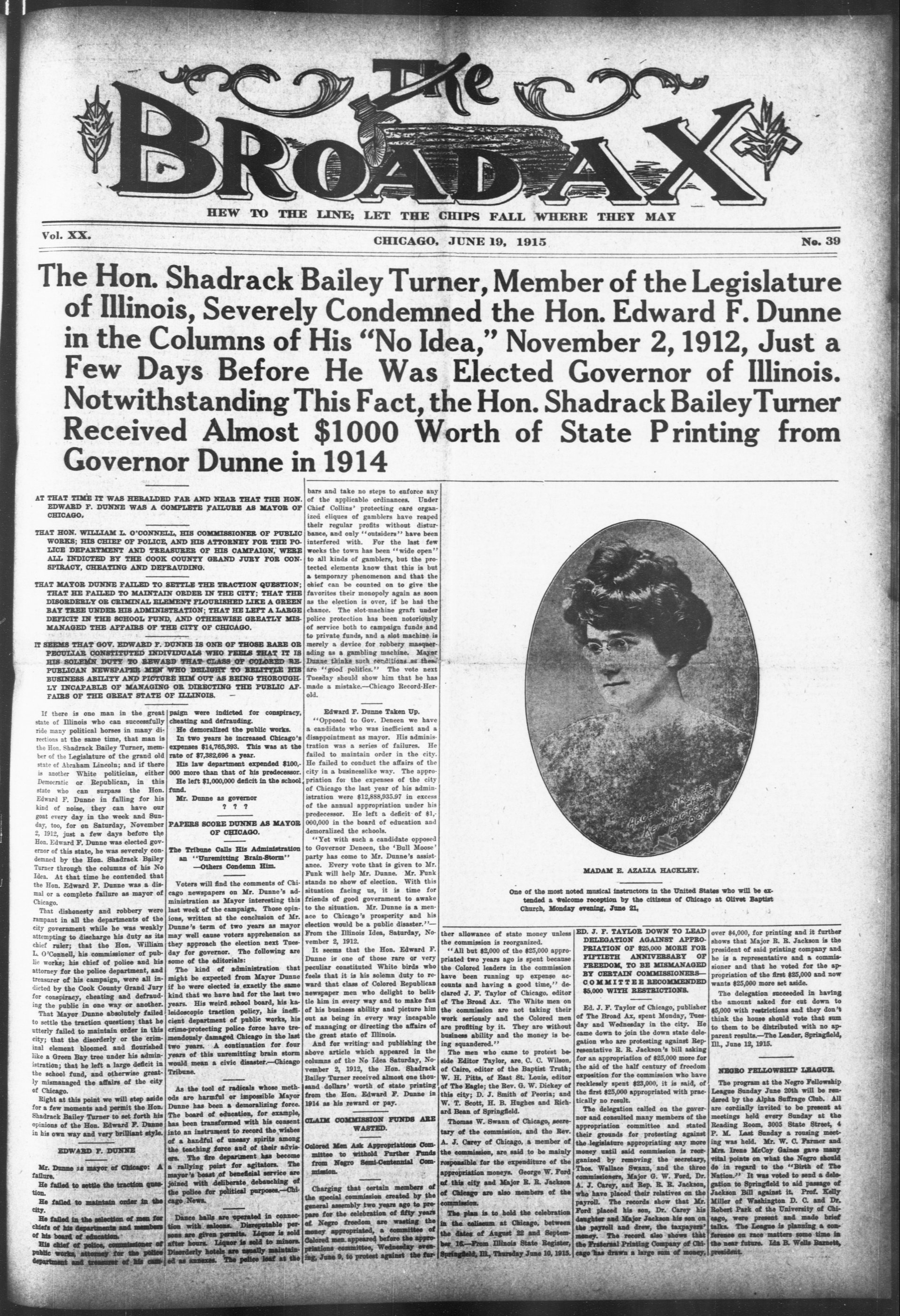
The Hon. Shadrack Bailey Turner, Member of the Legislature of Illinois, Severely Condemned the Hon. Edward F. Dunne in the Columns of His "No Idea," November 2, 1912, Just a Few Days Before He Was Elected Governor of Illinois. Notwithstanding This Fact, the Hon. Shadrack Bailey Turner Received Almost $1000 Worth of State Printing from Governor Dunne in 1914
AT THAT TIME IT WAS HERALDED FAR AND NEAR THAT THE HON.
EDWARD P. DUNNE WAS A COMPLETE FAILURE AS MAYOR OF
CHICAGO.
THAT HON. WILLIAM L. O'CONNELL, HIS COMMISSIONER OF PUBLIC
WORKS; HIS CHIEF OF POLICE, AND HIS ATTORNEY FOR THE POL
ICE DEPARTMENT AND TREASURER OF HIS CAMPAIGN, WERE
ALL INDICTED BY THE COOK COUNTY GRAND JUBY FOR CONS
SPIRACY, CHEATING AND DEFRAUDING.
THAT MAYOR DUNNE FAILED TO SETTLE THE TRACTION QUESTION;
THAT HE FAILED TO MAINTAIN ORDER IN THE CITY; THAT THE
DISORDERLY OR CRIMINAL ELEMENT FLOURISHED LIKE A GREEN
BAY TREE UNDER HIS ADMINISTRATION; THAT HE LEFT A LARGE
DEFICIT IN THE SCHOOL FUND, AND OTHERWISE GREATLY MIS-
MANAGED THE AFFAIRS OF THE CITY OF CHICAGO.
IT SEEMS THAT GOV. EDWARD P. DUNNE IS ONE OF THOSE BARE OR
PECULIAR CONSTITUTED INDIVIDUALS WHO FEELS THAT IT IS
HIS SOLEMN DUTY TO BEARD THAT CLASS OF COLORED RE-
PUBLIC NEWSPAPER MEN WHO DELIVER TO BELITTLE HIS
BUSINESS ABILITY AND PICTURE HIM OUT AS BEING THOROUGHLY
INCAPABLE OF MANAGING OR DIRECTING THE PUBLIC AFFAIRS
OF THE GREAT STATE OF ILLINOIS.
Vol. XX.
The Hon. of Illinois in the C Few Day Notwith Receive Governe
AT THAT TIME IT WAS HERALDE EDWARD F. DUNNE WAS A O CHICAGO,
THAT HON. WILLIAM L. O'CONNE WORKS; HIS CHIEF OF POLICE LICE DEPARTMENT AND TREE ALL INDICTED BY THE COOR SPIRACY, CHEATING AND DEFICIT
THAT MAYOR DUNNE FAILED TO THAT HE FAILED TO MAINTAIN DISORDERLY OR CRIMINAL ELBAY TREE UNDER HIS ADMINISTRATION IN THE SCHOOL FUN MANAGED THE AFFAIRS OF T
IT SEEMS THAT GOV. EDWARD F. PECULIAR CONSTITUTED INDIES HIS SOLEMN DUTY TO REWAR PUBLICAN NEWSPAPER MEN BUSINESS ABILITY AND PICTURE INCAPABLE OF MANAGING FAIRS OF THE GREAT STATE
If there is one man in the great state of Illinois who can successfully ride many political horses in many directions at the same time, that man is the Hon. Shadrack Bailey Turner, member of the Legislature of the grand old state of Abraham Lincoln; and if there is another White politician, either Democratic or Republican, in this state who can surpass the Hon. Edward F. Dunne in falling for his kind of noise, they can have our goat every day in the week and Sunday, too, for on Saturday, November 2, 1912, just a few days before the Hon. Edward F. Dunne was elected governor of this state, he was severely condemned by the Hon. Shadrack Bailey Turner through the columns of his No Idea. At that time he contended that the Hon. Edward F. Dunne was a dismal or a complete failure as mayor of Chicago.
That dishonesty and robbery were rampant in all the departments of the city government while he was weakly attempting to discharge his duty as its chief ruler; that the Hon. William L. O'Connell, his commissioner of public works; his chief of police and his attorney for the police department, and treasurer of his campaign, were all indicted by the Cook County Grand Jury for conspiracy, cheating and defrauding the public in one way or another. That Mayor Dunne absolutely failed to settle the traction question; that he utterly failed to maintain order in this city; that the disorderly or the criminal element bloomed and flourished like a Green Bay tree under his administration; that he left a large deficit in the school fund, and otherwise greatly mismanaged the affairs of the city of Chicago. Right at this point we will step aside for a few moments and permit the Hon. Shadraek Bailey Turner to set forth his opinions of the Hon. Edward F. Dunne in his own way and very brilliant style.
EDWARD F. DUNNE
Mr. Dunne is mayor of Chicago: A failure.
He failed to settle the traction question.
He failed to maintain order in the city.
He failed in the selection of men for chiefs of his departments and members of his board of education.
His chief of police, commissioner of public works, attorney for the police department and treasurer of his cam-
paign were indicted for conspiracy,
cheating and defrauding.
He demoralized the public works.
In two years he increased Chicago's
expenses $14,765,393. This was at the
rate of $7,382,696 a year.
His law department expended $100,
000 more than that of his predecessor.
He left $1,000,000 deficit in the school
fund.
Mr. Dunne as governor
PAPERS SCORE DUNNE AS MAYOR OF CHICAGO.
The Tribune Calls His Administration an "Unremitting Brain-Storm" —Others Condemn Him.
Voters will find the comments of Chicago newspapers on Mr. Dunne's administration as Mayor interesting this last week of the campaign. Those opinions, written at the conclusion of Mr. Dunne's term of two years as mayor may well cause voters apprehension as they approach the election next Tuesday for governor. The following are some of the editorials:
The kind of administration that might be expected from Mayor Dunne if he were elected is exactly the same kind that we have had for the last two years. His weird school board, his kaleidoscopic traction policy, his inefficient department of public works, his crime-protecting police force have tremendously damaged Chicago in the last two years. A continuation for four years of this unremitting brain storm would mean a civic disaster.—Chicago Tribune.
As the tool of radicals whose methods are harmful or impossible Mayor Dunne has been a demoralizing force. The board of education, for example, has been transformed with his consent into an instrument to record the wishes of a handful of uneasy spirits among the teaching force and of their advisers. The fire department has become a rallying point for agitators. The mayor's boast of beneficial service are joined with deliberate debauching of the police for political purposes.—Chicago News.
Dance halls are operated in connection with calons. Disreputable persons are given permits. Liquor is sold after hours. Liquor is sold to minors. Disorderly hotels are usually maintained as annexes. The police leaf at the
CHICAGO, JUNE 19, 1915
bars and take no steps to enforce any of the applicable ordinances. Under Chief Collins' protecting care organized eliques of gamblers have reaped their regular profits without disturbance, and only "outsiders" have been interfered with. For the last few weeks the town has been "wide open" to all kinds of gamblers, but the protected elements know that this is but a temporary phenomenon and that the chief can be counted on to give the favorites their monopoly again as soon as the election is over, if he has the chance. The slot-machine graft under police protection has been notoriously of service both to campaign funds and to private funds, and a slot machine is merely a device for robbery masquerading as a gambling machine. Mayor Dunne thinks such conditions as these are "good politics." The vote next Tuesday should show him that he has made a mistake.—Chicago Record-Herold.
Edward F. Dunne Taken Up.
"Opposed to Gov. Deneen we have a candidate who was inefficient and a disappointment as mayor. His administration was a series of failures. He failed to maintain order in the city. He failed to conduct the affairs of the city in a businesslike way. The appropriation for the expenses of the city of Chicago the last year of his administration were $12,888,935.97 in excess of the annual appropriation under his predecessor. He left a deficit of $1,000,000 in the board of education and demoralized the schools.
"Yet with such a candidate opposed to Governor Deneen, the 'Bull Moose' party has come to Mr. Dunne's assistance. Every vote that is given to Mr. Funk will help Mr. Dunne. Mr. Funk stands no show of election. With this situation facing us, it is time for friends of good government to awake to the situation. Mr. Dunne is a menace to Chicago's prosperity and his election would be a public disaster."—From the Illinois Idea, Saturday, November 2, 1912.
It seems that the Hon. Edward F. Dunne is one of those rare or very peculiar constituted White birds who feels that it is his solemn duty to reward that class of Colored Republican newspaper men who delight to belittle him in every way and to make fun of his business ability and picture him out as being in every way incapable of managing or directing the affairs of the great state of Illinois.
And for writing and publishing the above article which appeared in the columns of the No Idea Saturday, November 2, 1912, the Hon. Shadrack Bailey Turner received almost one thousand dollars' worth of state printing from the Hon. Edward F. Dunne in 1914 as his reward or pay.
CLAIM COMMISSION FUNDS ARE WASTED.
Colored Men Ask Appropriations Committee to withhold Further Funds from Negro Semi-Centennial Commission.
Charging that certain members of the special commission created by the general assembly two years ago to prepare for the celebration of fifty years of Negro freedom are wasting the money appropriated, a committee of Colored men appeared before the appropriations committee, Wednesday evening, June 9, to protest against the fur-
ARGENT ARRISER
KENSINGTON
LONDON
One of the most noted musical instructors in the United States who will be extended a welcome reception by the citizens of Chicago at Olivet Baptist Church. Monday evening, June 21.
ther allowance of state money unless the commission is reorganized.
"All but $2,000 of the $25,000 appropriated two years ago is spent because the Colored leaders in the commission have been running up expense accounts and having a good time," declared J. F. F. Taylor of Chicago, editor of The Broad Ax. The White men on the commission are not taking their work seriously and the Colored men are profiting by it. They are without business ability and the money is being squandered."
The men who came to protest beside Editor Taylor, are, C. C. Wilson, of Cairo, editor of the Baptist Truth; W. H. Pitts, of East St. Louis, editor of The Eagle; the Rev. G. W. Dickey of this city; D. J. Smith of Peoria; and W. T. Scott, H. B. Hughes and Richard Bean of Springfield.
Thomas W. Swann of Chicago, secretary of the commission, and the Rev. A. J. Carey of Chicago, a member of the commission, are said to be mainly responsible for the expenditure of the appropriation moneya. George W. Ford of this city and Major R. R. Jackson of Chicago are also members of the commission.
The plan is to hold the celebration in the coliseum at Chicago, between the dates of August 22 and September 16.—From Illinois State Register, Springfield, Ill., Thursday June 10, 1915.
ED. J. F. TAYLOR DOWN TO LEAD
DELEGATION AGAINST APPRO-
PRIATION OF $25,000 MORE FOR
FIFTIETH ANNIVERSARY OF
FREEDOM, TO BE MISMANAGED
BY CERTAIN COMMISSIONERS
COMMITTEE RECOMMENDED
$5,000 WITH RESTRICTIONS.
Ed. J. F. Taylor of Chicago, publisher
of The Broad Ax, spent Monday, Tuesday
and Wednesday in the city. He
came down to join the down state delegation who are protesting against Rep-
resentative R. R. Jackson's bill asking
for an appropriation of $25,000 more for
the aid of the half century of freedom
exposition for the commission who have
recklessly spent $23,000, it is said, of
the first $25,000 appropriated with
practically no result.
The delegation called on the governor and consulted many members of the appropriation committee and stated their grounds for protesting against the legislature appropriating any more money until said commission is reorganized by removing the secretary, Thos. Wallace Swann, and the three commissioners, Major G. W. Ford, Dr. A. J. Carey, and Rep. B. R. Jackson, who have placed their relatives on the payroll. The records show that Mr. Ford placed his son, Dr. Carey his daughter and Major Jackson his son on the payroll and drew, the taxpayers' money. The record also shows that the Fraternal Printing Company of Chicago has drawn a large sum of money,
No.39
legislature
al F. Dunne
1912, Just a
of Illinois.
Hiley Turner
ting from
over $4,000, for printing and it further shows that Major R. R. Jackson is the president of said printing company and he is a representative and a commissioner and that he voted for the appropriation of the first $25,000 and now wants $25,000 more set aside. The delegation succeeded in having the amount asked for cut down to $5,000 with restrictions and they don't think the house should vote that sum to them to be distributed with no apparent results.—The Leader, Springfield, Ill. June 12, 1915.
NEGRO PELLOWSHIP LEAGUE.
The program at the Negro Fellowship League Sunday June 20th will be rendered by the Alpha Suffrage Club. All are cordially invited to be present at meetings held every Sunday at the Reading Room, 3005 State Street, 4 P. M. Last Sunday a rousing meeting was held. Mr. W. C. Farmer and Mrs. Irene McCoy Gaines gave many vital points on what the Negro should do in regard to the "Birth of The Nation." It was voted to send a delegation to Springfield to aid passage of Jackson Bill against it. Prof. Kelly Miller of Washington D. C. and Dr. Robert Park of the University of Chicago, were present and made brief talks. The League is planning a conference on race matters some time in the near future. Ida B. Wells Barnett, president.
Page TWO
=——
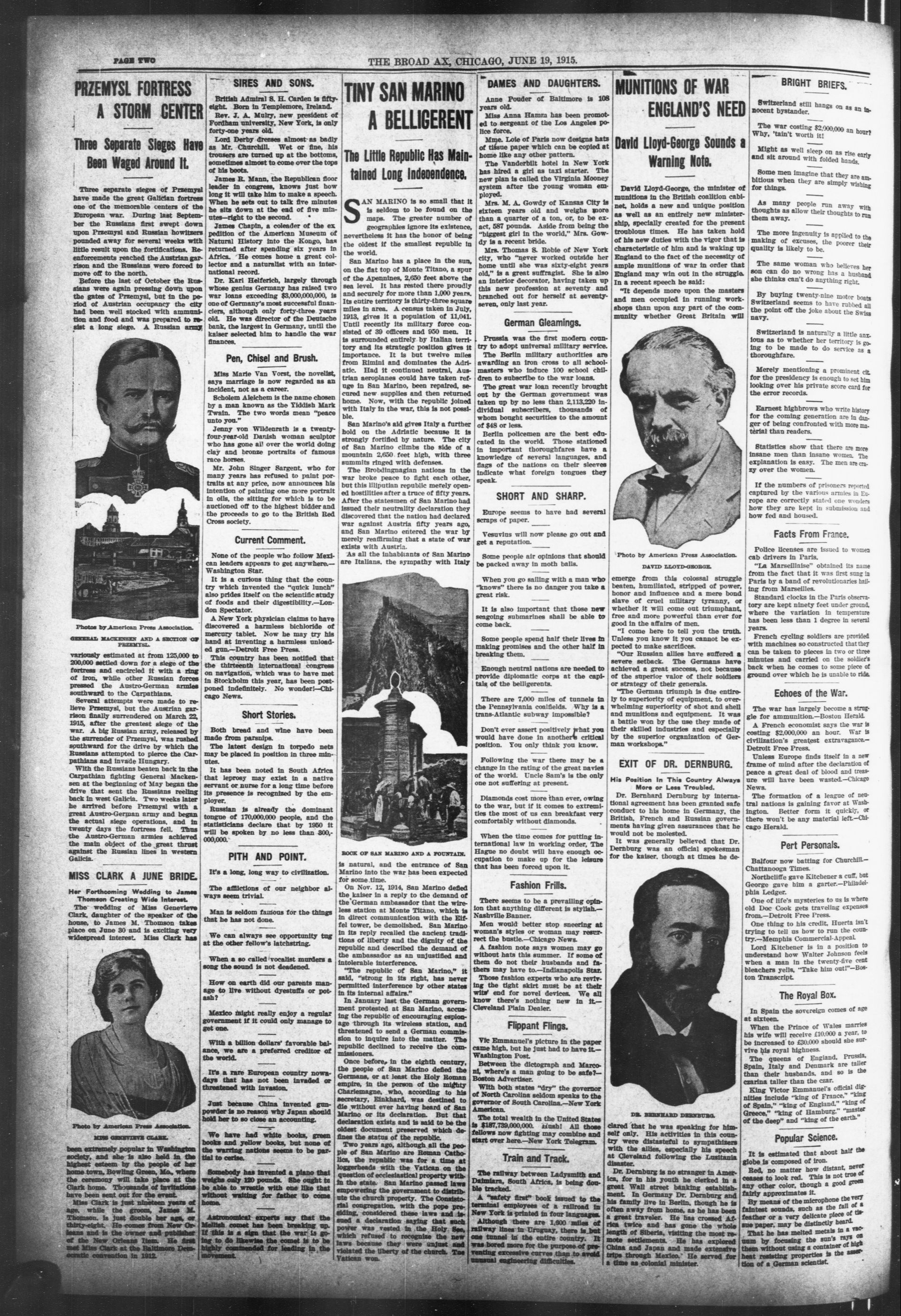
, A STORM CENTER
}
, Been Waged Around It
‘Three separate sieges of Preemysl
have made the great Gali¢ian fortress
‘one of the memorable centers of the
Buropean war. During lest Septem-
Der the Russians first swept down
upon Prsemysi and Russian howitzers
pounded away for several weeks with
little result upon the fortifications, Re-
enforcements reached the Austrian gar-
ison and the Russians were forced to
move off to the north.
Before the last of October the Rus-
sians were again pressing down upon
the gates of Preemysl, but in the pe-
wiod of Austrian occupancy the city
had been well stocked with ammunt
tion and food and was prepared to re
sist a long siege. A Russian army
“
Pe ne
GEEEEAL MACKENGEX AXD A SROTION GF
‘PREEMYSL.
variously estimated at from 125,000 to
200,000 settled down for # siege of the
fortress and encircled it with a ring
‘of tron, while other Russian forces
Dressed the AustroGerman armies
southward to the Carpathians.
Several attempts were made to re
Neve Preemysi, but the Austrian gar-
ison finally surrendered on March 2%
1915, after the greatest slege of the
war. A big Russian army, released by
the surrender of Przemysi, was rushed
sputhward for the drive by which the
‘Russians attempted to pierce the Car-
pathians and invade Hungary.
With the Russians beaten back in the
Carpathian fighting General Macken-
sen at the beginning of May began the
@rive that sent the Russians reeling
back in west Galicia. Two weeks later
he arrived before Preemys! with a
great Austro-German army and begun
the actual siege operations, and in
twenty days the fortress fell, Thus
the AustroGerman armies achieved
the main object of the great thrust
against the Russian lines in western
Galicia.
MISS CLARK A JUNE BRIDE.
Her Forthcoming Wedding to James
‘Thomson Creating Wide Interest.
‘The wedding of Miss Genevieve
Clark, danghter of the speaker of the
house, to James M. Thomson takes
place on June 30 and is exciting very
‘widespread interest. Miss Clark has
{ £
i a F
i ee
; \\aeoar
eee
t A
| Photo by American Press Association.
‘MISS GEXEVIEVE CLARK. °
een extremely popular in Washington
society, and she is also held in the
highest esteem by the people of her
home town, Bowling Green, Ma, where
‘the ceremony will take place at the
Glark home. Thousands of tuvitations
bave been sent out for the event.
Miss Clark is just nineteen years of
age, while the groom, James M
‘Thomson. is just Gouble her aga, or.
‘thirty-cight, He comes from New Or
S the Mer Otews Toe He fret
Set Gt inn Dew
in paige f2
SIRES AND SONS.
British Admiral 8. H. Carden is fifty:
eight. Born in Templemore, Ireland.
Rev. J. A. Mulry, new president of
Fordham university, New York, is only
forty-one years old.
Lord Derby dresses almost-as badly
as Mr. Churchill Wet or fine, his
trousers are turned up at the bottoms,
sometimes almost to come over the tops
of his boots.
James R. Mann, the Republican floor
leader in congress, knows just how
long it will take him to make a speech.
When he sets out to talk five minutes
he sits down at the end of five min-
utes—right to the second. *
James Chapin, a coleader of the ex
pedition of the American Museum of
Natural History into the Kongo, has
returned after spending six years in
Africa. “He comes home a great col-
lector and a naturalist with an inter-
national record.
Dr. Kari Helferich, largely through
whose genius Germany has raised two
war loans exceeding $3,000,000,000, is
one of Germany's most successful finan-
clers, although only forty-three. years
old. He was director of the Deutsche
bank, the largest in Germany, until the
kaiser selected him to handle the war
@nences
Pen, Chisel and Brush.
‘Miss Marie Van Vorst, the novelist,
says marriage is now regarded as an
incident, not as a career.
‘Scholem Aleichem ts the name chosen
by a man known as the Yiddish Mark
‘Twain. The two words mean “peace
‘unto you.”
Jenny von Wilklenrath is a twenty-
four-year-old Danish woman sculptor
who has gone al! over the world doing
clay and bronze portraits of famous
race horses.
Mr, John Singer Sargent, who for
many years has refused to paint por-
traits at any price, now announces his
intention of painting one more portrait
in oils, the sitting for which is to be
auctioned off to the highest bidder and
the proceeds to go to the British Red
Cross society.
Current Comment.
None of the people who follow Mert
can leaders appears to get anywhere.—
‘Washington Star.
It 4s a curious thing that the coun-
try which invented the “quick lunch”
also prides itself on the scientific study
of foods and thelr digestibility —Lon-
don Spectator.
A New York physician claims to have
Giscovered a harmless bichloride of
mereury tablet. Now be may try his
hand at inventing a harmless unload-
ed gun—Detroit Free Press.
This country has been notified that
the thirteenth international congress
on navigation, which was to have met
in Stockholm this year, has been post-
poned indefinitely. No wonder!—Cht-
cago News.
Short Stories.
Both bread and wine have been
made from parsnips.
‘The latest design in torpedo nets
may be placed in position in three min-
utes.
It bas been noted in South Africa
that leprosy may exist in a native
servant or nurse for a long time before
its presence is recognized by the em-
ployer, .
Russian is already the dominant
tongue of 170,000,000 people, and the
statisticians declare that by 1960 tt
will be spoken by no less than 300,-
000,000."
PITH AND POINT.
| ‘It's a long, long way to civilization.
| The afflictions of our neighbor al-
ways seem trivial.
. ees
‘Man is seldom famious for the things
iam hs tentet boos
‘We can always see opportunity tug
at the other fellow’s iatchstring.
‘When 2 so called vocalist murders a
song the sound ts not deadened
How on earth did our parents man-
‘age to live without dyestuffs or pot-
ash?
Mexico tight really enjoy a regular
government if it could only manage to
get one.
With a billion dollars’ favorable bal-
‘ance, we afe a preferred creditor of
the world.
Its a rare European country nowa-
Gays that has not been invaded or
‘threatened with invasion.
Just because China invented gun-
powder is no reason why Japan should
‘hold her to so close an accounting.
—
‘We have had white books, green
books and yellow books, but none of
the warring nations seems to be par-
tal to cerise,
ody has invented a plano that
eaeaee 120 pounds. She ought ta
be able to wrestle with one like that
without waiting Zor father to come
home
Astron experts say that the
Mellish comet bas SD
ing to, €0 itkewiee the comet is to.
oeeoe! fon econ Ee eeeet A 8
THE BROAD AX, CHICAGO, JUNE 19, 1915.
TINY SAN MARINO | DSS te. owown
‘Anne Pouder of Baltimore
years old.
Miss Anna Hamm has been
A BELLIGERENT |..'.sss.tsra.sos,
lice force,
a cc thoes pupae obich can 8 6
The Little Republic Has Main- | some xe any omer pattern.
x The Vanderbilt hotel in Ne
tained Long Independence, |>ss Bred,s st! 20 taxi stars
AN MARINO fs so small that it
1s seldom to be found on the
maps. The greater number of
geographies ignore its existence,
nevertheless it has the honor of being
the oldest if the smallest republic tn
the world.
San Marino bas a place in the sun,
on the fit top of Monte Titano, a spur
of the Apennines, 2,650 feet above the
Sea level. It has rested there proudly
and securely for more than 1,000 year.
Its entire territory is thirty-three square
miles in area. A census taken in July,
1913, gives it a population of 11,041.
Until recently its military force con-
sisted of 39 officers and 950 men. It
is surrounded entirely by Italian terri-
tory and its strategic position gives it
importance. It is but twelve miles
from Rimini and dominates the Adri-
atic. Had it continued neutral, Aus-
trian aeroplanes could have taken ref-
uge in San Marino, been repaired, se-
cured new supplies and then returned
home. Now, with the republic joined
with Italy in the war, this is not possi-
ble.
San Marino's aid gives Italy a further
hold on the Adriatic because it is
strongly fortified by nature. The city
of San Marino climbs the side of a
mountain 2,650. feet high, with three
summits ringed with defenses.
‘The Brobdingnagian nations in the
war broke peace to fight each other,
but this liliputian repubile merely open-
ed hostilities after a truce of fifty years.
After the statesmen of San Marino had
issued their neutrality declaration they
discovered that the nation had declared
war against Austria fifty years ago,
and San Marino entered the war by
merely reaffirming that a state of war
exists with Austria.
‘As all the inhabitants of San Marino
are Italians, the sympathy with Italy
re
FP aaa aes ee oe
- al
a ee
PAR acer
erat | ic
ie ata ;
giabdste
® ~é ,
rae
=
| we
aah
ae
SB
ae Odd Fs a
eh Tee
Se ee a &
ee eee
ae Oe eS AS CEA
is natural, and the entrance of San
ince ints te oat ne tone ocae
for some time.
On Nov. 12, 1914, San Marino defied
the kaiser in a reply to the demand of
‘the'German ambassador that the wire-
less station at Monte Titano, which is
in direct communication with the Eit-
fel tower, be demolished. San Marino
in its reply recalled the ancient tradi-
tions of liberty and the dignity of the
republic and described the demand of
the ambassador as an unjustified and
intolerable interference.
“The republic of San Marino,” it
said, “strong in its right, has never
ermitted interference by other states
fm its internal affairs.”
In January last the German govern-
ment protested at San Marino, accus-
ing the republic of encouraging espion-
age through its wireless station, and
threatened to send a German commis-
sion to inquire into the matter. The
republic declined to receive the com-
missioners.
Once before, in the eighth century,
the people of San Marino defied the
Germans, or at least the Holy Roman
empire, in the person of the mighty
Charlemagne, who, according to his
secretary, Einkhard, was destined to
die without ever having heard of San
Marino or its declaration. But that
declaration exists and is said to be the
oldest document preserved which de-
fines the status of the republic.
‘Two years ago, although all the peo-
ple of San Marino are Roman Catho-
lics, the republic was for a time at
loggerheads with the Vatican on the
question of ecclesiastical property withy
in the state San Marino passed laws
empowering the government to distrib
congregation. with the pope pre-
sued @ deciaration saying
ra tes pp |
ee eee ad | Sas ae
Yetiean wn ti “‘(‘sé‘SC:SCS
- *,
DAMES AND DAUGHTERS.
Anne Pouder of Baltimore ts 108
‘years old.
Miss Anna Hamm has been promot-
ed to sergeant of the Los Angeles po-
Hee force,
Sage, Late teats now cele hots
of paper which can be copied at
home like any other pattern.
‘The Vanderbilt hotel in New York
has hired a girl as taxi starter. The
new plan is called the Virginia Mooney
system after the young woman en:
ployed.
Mrs. M. A. Gowdy of Kansas City is
sixteen years old and weighs more
than a quarter of a ton, or, to be ex-
act, 587 pounds. Aside from being the
“biggest girl in the world,” Mrs. Gow-
dy is a recent bride.
Mrs. Thomas 8 Robie of New York
city, who “never worked outside her
home until she was sixty-eight years
old,” is a great suffragist. She is also
an interior decorator, having taken up
this new profession at seventy and
branched out for herself at seventy-
seven, only last year.
German Gleamings.
Prussia was the frst modern coun-
try to adopt untversal military service.
‘The Berlin military authorities are
awarding an fron cross to all school-
masters who induce 100 school chil-
ren to subscribe to the war loans.
‘The great war loan recently brought
out by the German government was
taken up by no less than 2,113,220 in-
dividual subscribers, thousands of
‘whom bought securities to the amount
of $48 oF less.
Berlin policemen are the best edu-
cated in the world. Those stationed
in important thoroughfares have a
knowledge of several languages, and
flags of the nations on their sleeves
indicate what foreign tongues they
speak
SHORT AND SHARP.
Enrope seems to have bad several
scraps of paper.
Vesuvius will now please go out and
get a reputation.
Some people air opinions that should
be packed away in moth balls.
‘When you go sailing with a man who
“knows” there is no danger you take a
great risk. a
It fs also important that those new
seagoing submarines shall be able to
‘come back.
Some people spend half thelr ives in
making promises and the other half in
breaking them.
Enough neutral nations are needed to
Provide diplomatic corps at the capt
tals of the belligerents.
There are 7,000 miles of tunnels in
the Pennsylvania coalfields. Why is a
trans-Atlantic subway impossible?
Don’t ever assert positively phat you
Secuhd ured Gus Sn’ aeethoct arian
position. You only think you know.
Following the war there may be &
change in the rating of the great navies
of the world. Uncle Sam's Is the only
one not suffering at present.
Diamonds cost more than ever, owing
to the war, but if it comes to extremi-
ties the most of us can breakfast very
comfortably without diamonds. S
‘When the time comes for putting in-
ternational law in working order, The
Hague no doubt will have enough oc-
cupation to make up for the leisure
that has been forced upon It.
Fashion Frills.
‘There seems to be a prevailing opin-
fon that anything different is stylish —
Nashville Banner.
Men would better stop sneering at
woman's styles or woman may resvr-
rect the bustle.—Chicago News.
A fashion note says women may go
without hats this summer. If some of
them do not their husbands and fa-
‘thers may have to.—Indianapolis Star.
‘Those fashion experts who are reviv-
ing the tight skirt must be at thelr
wit’ end for novel devices. We all
know there's nothing new in it—
new meee
Flippant Flings.
‘Vie Emmanuel's picture in the paper
came high, but he just had to have it—
‘Washington Post.
Between the dictograph and Marco-
ni, where's a man going to be safe?—
Boston Advertiser.
‘With both states “dry” the governor
of North Carolina seldom speaks to the
governor of South Carolina —New York
American.
‘The total wealth in the United States
ts $187,739,000,000. iush! All those
fellows now fighting may combine and
start over here —New York Telegram.
Train and Track.
‘The railway between Ladysmith and
Datmiara, South Africs, is being dou-
ble tracked.
A “safety first” book issued to the
terminal employees of a railroad tn
New York is printed in four languages,
Although "there are 1,900 ‘miles of
railway lines-to-Urogusy, there is bat
one tunnel in the entire country. It
was bored more for the yurpose of pre-
eenttas coneertve corres Sand
- ENGLAND'S NEED
David Lloyd-George Sounds a
Warning. Noto,
David Lioyd-George, the minister of
munitions in the British coalition cabi-
net, holds a new and unique position
as well as an entirely new minister-
ship, specially created for the present
troublous times. He has taken hold
of his new duties with the vigor that is
characteristic of him and is waking up
England to the fact of the necessity of
ample munitions of war in order that
England may win out in the struggle
In a recent speech he said:
“It depends more upon the masters
and men occupied in running work-
shops than upon any part of the com-
munity whether Great Britain will
Eg
ae % -_
St ae Ne
ae IP
. if
af
a he aoe
Bas >
Photo by American Press Association.
DAVID LLOTD-GuoncE,
emerge from this colossal struggle
beaten, humiliated, stripped of power,
honor and influence and a mere bond
slave of cruel military tyranny, of
whether it will come out triumphant,
free and more powerful than ever for
good in the affairs of men.
“I come bere to tell you the truth
Unless you know it you cannot be ex-
pected to make sacrifices.
“Our Russian allies have suffered a
severe setback. The Germans have
achieved a great success, not because
of the superior valor of their soldiers
or strategy of their generals.
“The German triumph is due entire-
ly to superiority of equipment, to over-
whelming superiority of shot and shell
and munitions and equipment. It was
a battle won by the use they made of
their skilled industries and especially
by the superior organization of Ger
man workshops.”
EXIT OF DR. DERNBURG.
His Position In Thie Country Always
More or Less Troubled.
Dr. Bernhard Dernburg by interna-
tional agreement has been granted safe
conduct to his home in Germany, the
British, French and Russian govern-
ments having given assurances that he
would not be molested.
It was generally believed that Dr.
Dernburg was an official spokesman
for the kaiser, though at times he de-
= 3
AN 4
4 A
Gared that be was speaking for him-
self only. His activities in this coun-
try were distasteful to sympathizers
with the allies, especially his speech
at Cleveland following the Lusitania
disaster.
Dr. Dernburg is no stranger in Amer-
fea, for in his youth he clerked in a
great Wall street banking establish-
ment. In Germany Dr. Dernburg and
his famfly live in Bertin, though he is
often away fram home, as he has been
& great traveler. He fas crossed Af
length of Siberia, visiting ‘most re-
mote settiements. He has explored
China and Japan and made extensive
tiga though Merino nerve fer
time as colonial minister. —
es ee
BRIGHT BRIEFS, ~ ~-
Switzerland sti hangs on ag
‘Rocent bystander, an ie
‘The war costing $2,900,000 an
Why, "tain’t worth itt —
Might as well sicep on us tise earty
‘4nd sit around with folded hands.
Sor ag ua
bitious wi Fare simply
for things. eine
As many people run away with
thoughts as allow their thoughts to me
them away.
‘The more ingenuity ts appiied to the
making of excuses, the poorer thelp
quality is likely to be.
| The same woman who believes her
son can do no wrong bas a husband
‘she thinks can’t do anything right,
buying twenty-nine motor boats
aan have rubbed all
the point off the joke about the Swiss
navy.
| Switzerland is natura'iy a little anx.
fous as to whether her territory {s gp.
Ang to be made to do service as
‘thoroughfare.
Merely mentioning a prominent cit
for the presidency 1s enouzh to set him
looking over his private score card for
the error records.
Earnest highbrows who write history
for the coming generation are in dan-
Ser of being confronted with more ms.
than readers.
Statistics show that there are more
insane men than insane women. The
explanation is easy. ‘The men sreen-
zy over the women.
If the numbers of prisoners reported
captured by the various armies in Es-
rope are correctly stated one wonders
how they are kept in submission and
how fed and housed.
Facts From France.
Police licenses are issued to women
cab drivers in Paris.
“La Marseiliaise” obtained its name
from the fact that it was first sung in
Paris by a band of revolutionaries hail-
ing from Marseilles.
Standard clocks in the Paris observa-
tory are kept ninety feet under ground,
where the variation in temperature
bas been less than 1 degree in several
years.
French cycling soldiers are provided
with machines so constructed that they
can be taken to pieces in two or three
minutes and carried on the soldier's
back when he comes to some piece of
ground over which he is unable to ride
Echoes of the War.
‘The war has largely become a strug:
gle for ammunition.—Boston Herald.
‘A French economist says the war is
costing $2,000,000 an hour. War &
civilization’s greatest extravagance—
Detroit Free Press.
‘Unless Europe finds itself in a new
frame of mind after the declaration of
Peace a great deal of blood and tress
ure will have been wasted—Chictso
News.
‘The formation of a league of net
tral nations is gaining favor at Wash-
ington. Better form it quickly, of
there won't be any material left—Cht
cago Herald.
Pert Personals.
Balfour now batting for Churehill—
Chattanooga Times.
Northeliffe gave Kitchener a cuff, bat
George gave bim a garter.—Philadel
phia Ledger.
One of life’s mysteries to us Is where
01d Doe Cook gets traveling expenses
from.—Detroit Free Press.
One thing to his credit, Huerta isn’t
trying to tell us how to run the coun
try.—Memphis Commercial-Appeal
Lord Kitchener is in a position to
understand how Walter Johnson feels
when a man In the twenty-five cent
bleachers yells, “Take him out!"—Bos-
ton Transcript.
The Royal Box.
In Spain the sovereign comes of age
at sixteen.
When the Prince of Wales marries
‘his wife will receive £10,000 a year,
‘be increased to £30,000 should she sof
vive bis royal highness.
The queens of England, Prussia,
Spain, Italy and Denmark are taller
than their husbands, and so is the
czarina taller than the czar.
‘King Victor Emmanuel’s official dis-
nities include “king of France,” “King
of Spain,” “king of England.” “king of
Greece,” “king of Hamburg.” “master
Of the deep” and “king of the earth.”
s Popular Science.
Tt ts estimated that about balf the
globe is composed of iron.
Red, no matter how distant, neve
ceases to look red. ‘This is not true of
any other color, though « good sree®
fairly approximates it.
By means of the microphone the Yer7
faintest sounds, such as the fall of
feather or'a very delicate piece of OF
sue paper; may be distinctly beard
‘That he bas melted metals in * 9
focusing the sun's T375 0S
‘osing « container of Bish
‘properties is the ssa
‘selentist. :
9
HELENE BERG.
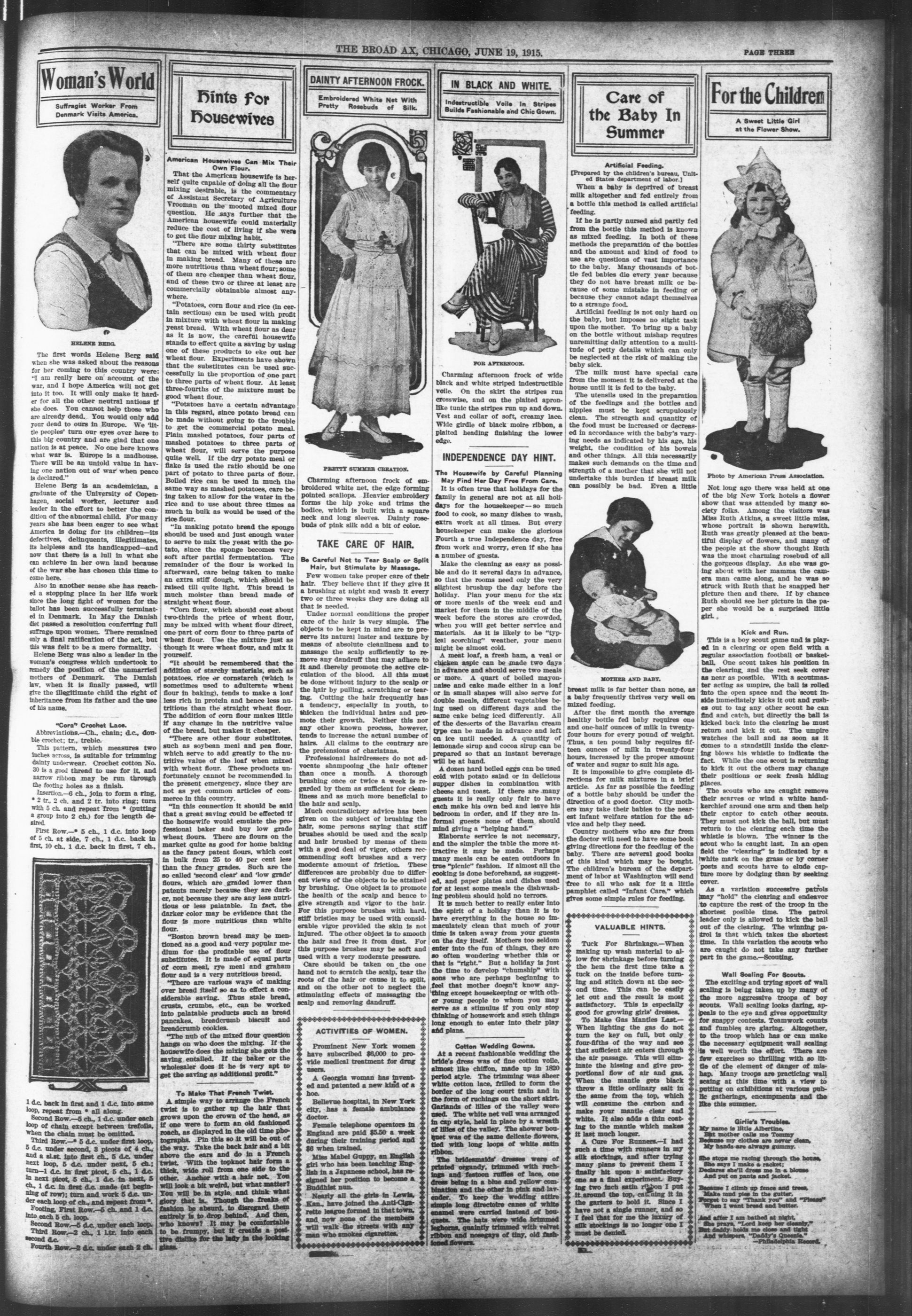
The first words Helene Berg said when she was asked about the reasons for her coming to this country were: "I am really here on account of the war, and I hope America will not get into it too. It will only make it harder for all the other neutral nations if she does. You cannot help those who are already dead. You would only add your dead to ours in Europe. We 'little peoples' turn our eyes over here to this big country and are glad that one nation is at peace. No one here knows what war is. Europe is a madhouse. There will be an untold value in having one nation out of war when peace is declared."
Helene Berg is an academician, a graduate of the University of Copenhagen, social worker, lecturer and leader in the effort to better the condition of the abnormal child. For many years she has been eager to see what America is doing for its children—its defectives, delinquents, illegitimates, its helpless and its handicapped—and now that there is a lull in what she can achieve in her own land because of the war she has chosen this time to come here.
Also in another sense she has reached a stopping place in her life work since the long fight of women for the ballot has been successfully terminated in Denmark. In May the Danish diet passed a resolution conferring full suffrage upon women. There remained only a final ratification of the act, but this was felt to be a mere formality.
Helene Berg was also a leader in the woman's congress which undertook to remedy the position of the unmarried mothers of Denmark. The Danish law, when it is finally passed, will give the illegitimate child the right of inheritance from its father and the use of his name.
"Cora" Crochet Lace.
Abbreviations.—Ch., chain; d.c., double crochet; tr., treble.
This pattern, which measures two inches across, is suitable for trimming dalty underwear. Crochet cotton No. 30 is a good thread to use for it, and narrow ribbon may be run through the footing holes as a finish.
Insertion—6 ch., join to form a ring, * 2 tr., 2 ch. and 2 tr. into ring; turn with 5 ch. and repeat from * (putting a group into 2 ch.) for the length desired.
First Row.—* 5 ch., 1 d.c. into loop of 5 ch. at side, 7 ch., 1 d.c. back in first 10 ch. 1 d.c. back in first 7 ch.
X
1 d.c. back in first and 1 d.c. into same loop, repeat from * all along.
Second Row.—5 ch., 1 d.c. under each loop of chain except between trefoils, when the chain must be omitted.
Third Row.—5 d.c. under first loop, 5 d.c. under second, 3 plocts of 4 ch., and a slst. into first ch., 5 d.c. under next loop, 5 d.c. under next, 5 ch; turn—1 d.c. in first plocet, 5 ch., 1 d.c. in next plocet, 5 ch., 1 d.c. in next, 5 ch., 1 d.c. in first d.c. made (at beginning of row); turn and work 5 d.c. under each loop of ch., and repeat from *.
Footing, First Row.—5 ch. and 1 d.c. into each 5 ch. loop.
Second Row.—5 d.c. under each loop.
Third Row.—2 ch., 1 ltr. into each second d.c.
Fourth Row.—2 d.c. under each 2 ch.
Hints for Housewives
American Housewives Can Mix Their Own Flour.
That the American housewife is herself quite capable of doing all the flour mixing desirable, is the commentary of Assistant Secretary of Agriculture Vroman on the mooted mixed flour question. He says further that the American housewife could materially reduce the cost of living if she were to get the flour mixing habit.
"There are some thirty substitutes that can be mixed with wheat flour in making bread. Many of these are more nutritious than wheat flour; some of them are cheaper than wheat flour, and of these two or three at least are commercially obtainable almost anywhere.
"Potatoes, corn flour and rice (in certain sections) can be used with profit in mixture with wheat flour in making yeast bread. With wheat flour as dear as it is now, the careful housewife stands to effect quite a saving by using one of these products to eke out her wheat flour. Experiments have shown that the substitutes can be used successfully in the proportion of one part to three parts of wheat flour. At least three-fourths of the mixture must be good wheat flour.
"Potatoes have a certain advantage in this regard, since potato bread can be made without going to the trouble to get the commercial potato meal. Plain mashed potatoes, four parts of mashed potatoes to three parts of wheat flour, will serve the purpose quite well. If the dry potato meal or flake is used the ratio should be one part of potato to three parts of flour. Boiled rice can be used in much the same way as mashed potatoes, care being taken to allow for the water in the rice and to use about three times as much in bulk as would be used of the rice flour.
"In making potato bread the sponge should be used and just enough water to serve to mix the yeast with the potato, since the sponge becomes very soft after partial fermentation. The remainder of the flour is worked in afterward, care being taken to make an extra stiff dough, which should be raised till quite light. This bread is much molester than bread made of straight wheat flour.
"Corn flour, which should cost about two-thirds the price of wheat flour, may be mixed with wheat flour direct, one part of corn flour to three parts of wheat flour. Use the mixture just as though it were wheat flour, and mix it yourself.
"It should be remembered that the addition of starchy materials, such as potatoes, rice or cornstarch (which is sometimes used to adulterate wheat flour in baking), tends to make a loaf less rich in protein and hence less nutrients than the straight wheat flour. The addition of corn flour makes little if any change in the nutritive value of the bread, but makes it cheaper.
"There are other flour substitutes, such as soybean meal and pea flour, which serve to add greatly to the nutritive value of the loaf when mixed with wheat flour. These products unfortunately cannot be recommended in the present emergency, since they are not as yet common articles of commerce in this country.
"In this connection it should be said that a great saving could be effected if the housewife would emulate the professional baker and buy low grade wheat flours. There are flours on the market quite as good for home baking as the fancy patent flours, which cost in bulk from 25 to 40 per cent less than the fancy grades. Such are the so called 'second clear' and 'low grade' flours, which are graded lower than patents merely because they are darker, not because they are any less nutritious or less palatable. In fact, the darker color may be evidence that the flour is more nutritious than white flour.
"Boston brown bread may be mentioned as a good and very popular medium for the profitable use of flour substitutes. It is made of equal parts of corn meal, rye meal and graham flour and is a very nutritious bread.
"There are various ways of making over bread itself so as to effect a considerable saving. Thus stale bread, crusts, crumbs, etc., can be worked into palatable products such as bread pancakes, breadcrumb biscuit and breadcrumb cookies.
"The nub of the mixed flour question hangs on who does the mixing. If the housewife does the mixing she gets the saving entailed. If the baker or the wholesaler does it he is very apt to get the saving as additional profit."
To Make That French Twist.
To Make That French Twist.
A simple way to arrange the French twist is to gather up the hair that grows upon the crown of the head, as if one were to form an old fashioned roach, as displayed in the old time photographs. Pin this so it will be out of the way. Take the back hair and a bit above the ears and do in a French twist. With the topknot hair form a thick, wide roll from one side to the other. Anchor with a hair net. You will look a bit weird, but what matter? You will be in style, and think what glory that is. Though the freaks of fashion be abused, to disregard them entirely is to drop behind. And then, who knows? It may be comfortable to be frumpy, but it creates a positive dislike for the lady in the looking class.
THE BROAD AX, CHICAGO, JUNE 19, 1915
Embroidered White Net With
Pretty Rosebuds of Silk.
e
PRETTY SUMMER CREATION.
Charming afternoon frock of embroidered white net, the edge forming pointed scallops. Heavier embroidery forms the hip yoke and trims the bodice, which is built with a square neck and long sleeves. Dainty rosebuds of pink slik add a bit of color.
TAKE CARE OF HAIR
Be Careful Not to Tear Scalp or Split Hair, but Stimulate by Massage.
Few women take proper care of their hair. They believe that if they give it a brushing at night and wash it every two or three weeks they are doing all that is needed.
Under normal conditions the proper care of the hair is very simple. The objects to be kept in mind are to preserve its natural luster and texture by means of absolute cleanliness and to massage the scalp sufficiently to remove any dandruff that may adhere to it and thereby promote the active circulation of the blood. All this must be done without injury to the scalp or the hair by pulling, scratching or tearing. Cutting the hair frequently has a tendency, especially in youth, to thicken the individual hairs and promote their growth. Neither this nor any other known process, however, tends to increase the actual number of hairs. All claims to the contrary are the pretensions of charlatans.
Professional hairdressers do not advocate shampooing the hair oftener than once a month. A thorough brushing once or twice a week is regarded by them as sufficient for cleanliness and as much more beneficial to the hair and scalp.
Much contradictory advice has been given on the subject of brushing the hair, some persons saying that stiff brushes should be used and the scalp and hair brushed by means of them with a good deal of vigor, others recommending soft brushes and a very moderate amount of friction. These differences are probably due to different views of the objects to be attained by brushing. One object is to promote the health of the scalp and hence to give strength and vigor to the hair. For this purpose brushes with hard, stiff bristles may be used with considerable vigor provided the skin is not injured. The other object is to smooth the hair and free it from dust. For this purpose brushes may be soft and used with a very moderate pressure.
Care should be taken on the one hand not to scratch the scalp, tear the roots of the hair or cause it to split, and on the other not to neglect the stimulating effects of massaging the scalp and removing dandruff.
ACTIVITIES OF WOMEN.
Prominent New York women have subscribed $6,000 to provide medical treatment for drug users.
A Georgia woman has invented and patented a new kind of a hoe.
Bellevue hospital, in New York city, has a female ambulance doctor.
Female telephone operators in England are paid $5.50 a week during their training period and $6 when trained.
Miss Mabel Guppy, an English girl who has been teaching English in a Japanese school, has resigned her position to become a Buddhist nun.
Nearly all the girls in Lewk, Kan., have joined the Anti-Cigarette league formed in that town, and now none of the members will walk the streets with any man who smokes cigarettes.
Indestructible Voile In Stripes
Builds Fashionable and Chic Gown.
福
FOR AFTERNOON.
Charming afternoon frock of wide black and white striped indestructible voile. On the skirt the stripes run crosswise, and on the plaited onlike tunic the stripes run up and down. Vest and collar of soft, creamy lace. Wide girdle of black moire ribbon, a plaited heading finishing the lower edge.
INDEPENDENCE DAY HINT.
The Housewife by Careful Planning
May Find Her Day Free From Cases
May Pid Her Day Free From Care
It is often true that holidays for the family in general are not at all holidays for the housekeeper—so much food to cook, so many dishes to wash, extra work at all times. But every housekeeper can make the glorious Fourth a true Independence day, free from work and worry, even if she has a number of guests.
Make the cleaning as easy as possible and do it several days in advance, so that the rooms need only the very slightest brushup the day before the holiday. Plan your menu for the six or more meals of the week end and market for them in the middle of the week before the stores are crowded, when you will get better service and materials. As it is likely to be "typical scorching" weather, your menu might be almost cold.
A meat loaf, a fresh ham, a veal or chicken aspie can be made two days in advance and should serve two meals or more. A quart of boiled mayonnaise and cake made either in a loaf or in small shapes will also serve for double meals, different vegetables being used on different days and the same cake being ice differently. All of the desserts of the Bavarian cream type can be made in advance and left on ice until needed. A quantity of lemonade sirup and cocoa sirup can be prepared so that an instant beverage will be at hand. A dozen hard boiled eggs can be used cold with potato salad or in delicious supper dishes in combination with cheese and toast. If there are many guests it is really only fair to have each make his own bed and leave his bedroom in order, and if they are informal guests none of them should mind giving a "helping hand."
Elaborate service is not necessary, and the simpler the table the more attractive it may be made. Perhaps many meals can be eaten outdoors in true "picnic" fashion. If almost all the cooking is done beforehand, as suggested, and paper plates and dishes used for at least some meals the dishwashing problem should hold no terrors.
It is much better to really enter into the spirit of a holiday than it is to have everything in the house so immaculately clean that much of your time is taken away from your guests on the day itself. Mothers too seldom enter into the fun of things, they are so often wondering whether this or that is "right." But a holiday is just the time to develop "chumship" with sons who are perhaps beginning to feel that mother doesn't know anything except housekeeping or with other young people to whom you may serve as a stimulus if you only stop thinking of housework and such things long enough to enter into their play add plans.
Cotton Wedding Gowns.
At a recent fashionable wedding the bride's dress was of fine cotton volle, almost like chiffon, made up in 1820 period style. The trimming was sheer white cotton lace, frilled to form the border of the long court train and in the form of ruchings on the short skirt. Gariands of lilies of the valley were used. The white net veil was arranged in cap style, held in place by a wreath of lilies of the valley. The shower bouquet was of the same delicate flowers, tied with long loops of white satin ribbon.
The bridesmaids' dresses were of printed organdy, trimmed with ruchings and festoon ruffles of lace, one dress being in a blue and yellow combination and the other in pink and lavender. To keep the wedding attire simple long directoire canes of white enamel were carried instead of bouquets. The hats were wide brimmed leghorns, quaintly trimmed with velvet ribbon and nosegays of tiny, old fashioned flowers.
Care of the Baby In Summer
[Prepared by the children's bureau, United States department of labor.]
When a baby is deprived of breast milk altogether and fed entirely from a bottle this method is called artificial feeding.
If he is partly nursed and partly fed from the bottle this method is known as mixed feeding. In both of these methods the preparation of the bottles and the amount and kind of food to use are questions of vast importance to the baby. Many thousands of bottle fed babies die every year because they do not have breast milk or because of some mistake in feeding or because they cannot adapt themselves to a strange food.
Artificial feeding is not only hard on the baby, but imposes no slight task upon the mother. To bring up a baby on the bottle without mishap requires unremitting daily attention to a multitude of petty details which can only be neglected at the risk of making the baby slick.
The milk must have special care from the moment it is delivered at the house until it is fed to the baby.
The utensils used in the preparation of the feedings and the bottles and nipples must be kept scrupulously clean. The strength and quantity of the food must be increased or decreased in accordance with the baby's varying needs as indicated by his age, his weight, the condition of his bowels and other things. All this necessarily makes such demands on the time and strength of a mother that she will not undertake this burden if breast milk can possibly be bad. Even a little
MOTHER AND BABY.
breast milk is far better than none, as a baby frequently thrives very well on mixed feeding.
After the first month the average healthy bottle fed baby requires one and one-half ounces of milk in twenty-four hours for every pound of weight.
Thus, a ten pound baby requires fifteen ounces of milk in twenty-four hours, increased by the proper amount of water and sugar to suit his age.
It is impossible to give complete directions for milk mixtures in a brief article. As far as possible the feeding of a bottle baby should be under the direction of a good doctor. City mothers may take their babies to the nearest infant welfare station for the advice and help they need.
Country mothers who are far from the doctor will need to have some book giving directions for the feeding of the baby. There are several good books of this kind which may be bought. The children's bureau of the department of labor at Washington will send free to all who ask for it a little pamphlet called "Infant Care," which gives some simple rules for feeding.
VALUABLE HINTS.
Tuck For Shrinkage.—When making up wash material to allow for shrinkage before turning the hem the first time take a tuck on the inside before turning and stitch down at the second time. This can be easily let out and the result is most satisfactory. This is especially good for growing girls' dresses. To Make Gas Mantles Last.—When lighting the gas do not turn the key on full, but only four-fifths of the way and see that sufficient air enters through the air passage. This will eliminate the hissing and give proportional flow of air and gas. When the mantle gets black throw a little ordinary salt in the same from the top, which will consume the carbon and make your mantle clear and white. It also adds a thin coating to the mantle which makes it last much longer.
A Cure For Runners—I had such a time with runners in my silk stockings, and after trying many plans to prevent them I finally hit upon a satisfactory one as a final experiment. Buying two inch satin ribbon I put it around the top, catching it in the garters to hold it. Since I have not a single runner, and so I feel that for me the luxury of silk stockings is no longer one I must be denied.
PAGE THREE
For the Children A Sweet Little Girl at the Flower Show.
A
Photo by American Press Association.
Not long ago there was held at one of the big New York hotels a flower show that was attended by many society folks. Among the visitors was Miss Ruth Atkins, a sweet little miss, whose portrait is shown herewith. Ruth was greatly pleased at the beautiful display of flowers, and many of the people at the show thought Ruth was the most charming rosebud of all the gorgeous display. As she was going about with her mamma the camera man came along, and he was so struck with Ruth that he snapped her picture then and there. If by chance Ruth should see her picture in the paper she would be a surprised little girl.
Kick and Run.
This is a boy scout game and is played in a clearing or open field with a regular association football or basketball. One scout takes his position in the clearing, and the rest seek cover as near as possible. With a scoutmaster acting as ampire, the ball is rolled into the open space and the scout inside immediately kicks it out and rushes out to tag any other scout he can find and catch, but directly the ball is kicked back into the clearing he must return and kick it out. The ampire watches the ball and as soon as it comes to a standstill inside the clearing blows his whistle to indicate the fact. While the one scout is returning to kick it out the others may change their positions or seek fresh hiding places.
The scouts who are caught remove their scarves or wind a white handkerchief around one arm and then help their captor to catch other scouts. They must not kick the ball, but must return to the clearing each time the whistle is blown. The winner is the scout who is caught last. In an open field the "clearing" is indicated by a white mark on the grass or by corner posts and scouts have to elude capture more by dodging than by seeking cover. As a variation successive patrols may "hold" the clearing and endeavor to capture the rest of the troop in the shortest possible time. The patrol leader only is allowed to kick the ball out of the clearing. The winning patrol is that which takes the shortest time. In this variation the scouts who are caught do not take any further part in the game—Scouting.
Wall Soaling For Scouts.
The exciting and trying sport of wall scaling is being taken up by many of the more aggressive troops of boy scouts. Wall scaling looks daring, appeals to the eye and gives opportunity for snappy contests. Teamwork counts and fumbles are glaring. Altogether, to the troop which has or can make the necessary equipment wall scaling is well worth the effort. There are few exercises so thrilling with so little of the element of danger of mishap. Many troops are practicing wall scaling at this time with a view to putting on exhibitions at various public gatherings, encampments and the like this summer.
She stops me racing through the house,
She says I make a racket;
Declarates she shed me in a blouse
And put on pants and jacket.
Because I climb up fence and trees,
Make mud pies in the gutter,
Forget to say "Thank you" and "Please"
When I want bread and butter.
And after I am bathed at night,
She says, "Lord keep her cleanly."
But daddy holds me close and tight
And whisper, "Daddy's Queenie."
—Philadelphia Record.
PAGE FOUR
THE BROAD AX
PUBLISHED WEEKLY.
Will promulgate and at all times uphold the true principles of Democracy, but Catholics, Protestants, Priests, Inhabitants, Single Taxes, Republicans, or anyone else can have their say, as long as their language is proper and responsibility is fixed.
The Broad Ax is a newspaper whose platform is broad enough for all, over claiming the editorial right to speak its own mind.
Local communications will receive attention. Write only on one side of the paper.
Subscriptions must be paid in advance.
One Year.....$8.00
Six Months.....1.00
Advertising rates made known on application.
Address all communications to
6532 ST. LAWRENCE AVE., CHICAGO, ILL
PHONE WENTWORTH 2597.
JULIUS P. TAYLOR, Editor and Publisher
Entered on Second-Class Matter Aug. 18,
1908, at the Post Office at Chicago, Illinois,
under Act of March 8, 1879.
REMOVAL NOTICE.
From on and after this date, all letters or other mail matter intended for Julius F. Taylor or Mrs. Annie E. Taylor or The Broad Ax, should be addressed to 6532 St. Lawrence Ave., Jackson Park station. Phone Wentworth 2597.
MARCHING ON BOSTON.
The Fifteenth Anniversary of the founding of the National Negro Business League will be celebrated at Boston, Massachusetts, Wednesday, Thursday and Friday, August 18th, 19th, and 20th, 1915.
The Boston Local Negro Business League, as well as the Local Negro Business League of Cambridge, is hard at work perfecting arrangements for the reception and entertainment of the delegates who are planning to be present. Aside from the regular business sessions of the League, the social side of the convention will not be neglected. A Guarantee Fund has already been secured for the purpose of financing every feature of the entertainment and reception of the delegates.
Historical Traditions.
Historic Boston, with its many traditions intimately connected with the life and history of the Negro people, and particularly with the movement which led to their freedom and enfranchisement, is a Mecca toward which our race should from time to time turn.
It was in Boston that the first meeting of the League was held August 23rd and 24th, 1900; and in holding the meeting there this year, it will fittingly celebrate the Fifteenth Anniversary of the founding of the League, afford an opportunity for "taking stock"—an inventory, as it were—of racial progress and development since the organization of the League; and fortified by the accumulated knowledge and experiences of these years, the business men and women of the race may face the future with greater inspiration and a firmer grasp of the complex problems of modern business.
Gains by the Race in Fifteen Years.
In 1900, when the National Negro Business League was organized, there were about 20,000 Negro business enterprises; now there are 45,000.
In 1900 there were two Negro Banks; now there are 51.
In 1900 Negroes were running 250 drug stores; now they have 695.
In 1900 there were 450 undertaking businesses operated by Negroes; now there are about 1,000.
In 1900 there were 149 Negro merchants engaged in wholesale businesses; now there are 240.
In 1900, fifteen years ago, there were 10,000 Negro retail merchants; now there are 25,000.
Further Economic Progress.
In the fifteen years since the National Negro Business League was organized, farm property owned by Negroes has made a remarkable increase. From 1900 to 1910, the value of domestic animals owned by Negro farmers increased from $85,216,337 to $177,273,785, or 107 per cent; poultry from $3,788,792 to $5,113,756 or 36 per cent; implements and machinery from $18,586,225 to $36,861,418, or 98 per cent; land and buildings from $69,636,420 to $273,501,665, or 293 per cent. In ten years the total value of farm property owned by Negroes increased from $177,404,688 to $492,892,218, or 177 per cent.
Arrangements are already being made for the comfort of delegates who intend to attend the meetings. A National Negro Business League special train, which will carry delegates from the far South to the Boston meeting, is already being planned for and, in addition, arrangements will also be made for our friends from the West, with Chicago as the center, to make the trip
to Boston in a body. Further details with reference to these arrangements will be published shortly.
The officers of the affiliated organizations of the National Negro Business League, including the National Negro Press Association, the National Negro Banker's Association, the National Negro Funeral Directors' Association, the National Negro Bar Association and the National Association of Negro Insurance Men are each individually planning their several programs so as to add interest and to make them constructively worth while.
Further information as to detailed plans for the coming meeting etc., may be secured from.
Booker T. Washington, President.
J. C. Napier, Chairman Executive Committee, or from
Emmett J. Scott, Secretary Tuske
gee Institute, Alabama.
HEALTH NOTES.
The pupils in the Curtis School under the leadership of Miss Meta Wellers have organized for a clean up and swat the fly campaign and are already doing effective work.
Miss Wellers composed a song and drill for the boys and girls in costume, which is being sung and practised with much enthusiasm. Here is the song:
THE FLY BRIGADE.
(Air—Tramp! Tramp!)
Girls—
In our homes we watch and work
To exterminate the fly
That is bringing death and sickness to our door,
And with footsteps firm and light,
Swatting to the left and right,
We will rid our homes of flies forever.
Swat! Swat! Swat! the girls are coming!
Cheer up! Soon the victory's won.
And within our city's gates
We shall breathe a purer air
When the last of all the filthy flies is gone.
Boys—
In the battle front we stand
Ready for the fiercest charge
On the alleys filled with dirt and broken
cans,
And we'll pour on garbage piles
And the stagnant water round,
Oil that stills the festive 'skeeters'
buzzing clans.
Chorus—
Clank! Clank! Clank! the boys are
marching!
Forward, comrades, join the fray!
Charge upon the deadly germs,
Breeding in the reeking filth,
Ere we fall to them a helpless, hopeless
prey.
Boys and Girls—
So we form a willing band
Charging at our Chief's command
On the pests and plagues that fill the
summer air;
And we'll fight with all our might,
Doing all that we can do,
As we help to make our city free and fair.
Tramp! Tramp! Tramp! together marching.
Till the last of all the pesky flies is gone.
Girls, aprons, dust-caps and flyswatters.
Boys, overalls, straw hats, bandanna handkerchiefs and oil cans.
It is a great deal easier to do the things that will prevent flies from breeding than it is to kill them after they are born.
If all the flies that are born each summer lived two years or more and were permitted to continue their wonderful reproductive capacity, they would become a worse plague to humanity than any of the terrible visitations of the seven year locusts have ever been, not excepting the one told of in Holy Writ in the days of Moses.
ALPHA SUFFRAGE CLUB
ALPHA SUFFRAGE CLUB.
The Alpha Suffrage Club arranged a program for the meeting Sunday afternoon, June 20th at the League. The Club is very much elated over the success of the Mother's Meeting at the Y. M. C. A., at which time Judge Mary M. Bartelme was chief speaker to three hundred women. An invitation is hereby extended for all interested persons to come and hear Mr. W. L. Bedine, superintendent of compulsory education, speak on "The Colored Boy Problem in the Public Schools" on Wednesday evening June 23rd. Mr. Bedine was expected on this Wednesday evening, but sent word that on account of another important meeting he could not be present. Meetings held every Wednesday evening at 8005 State Street, 8
```markdown
```
THE BROAD AX, CHICAGO, JUNE 19, 1915.
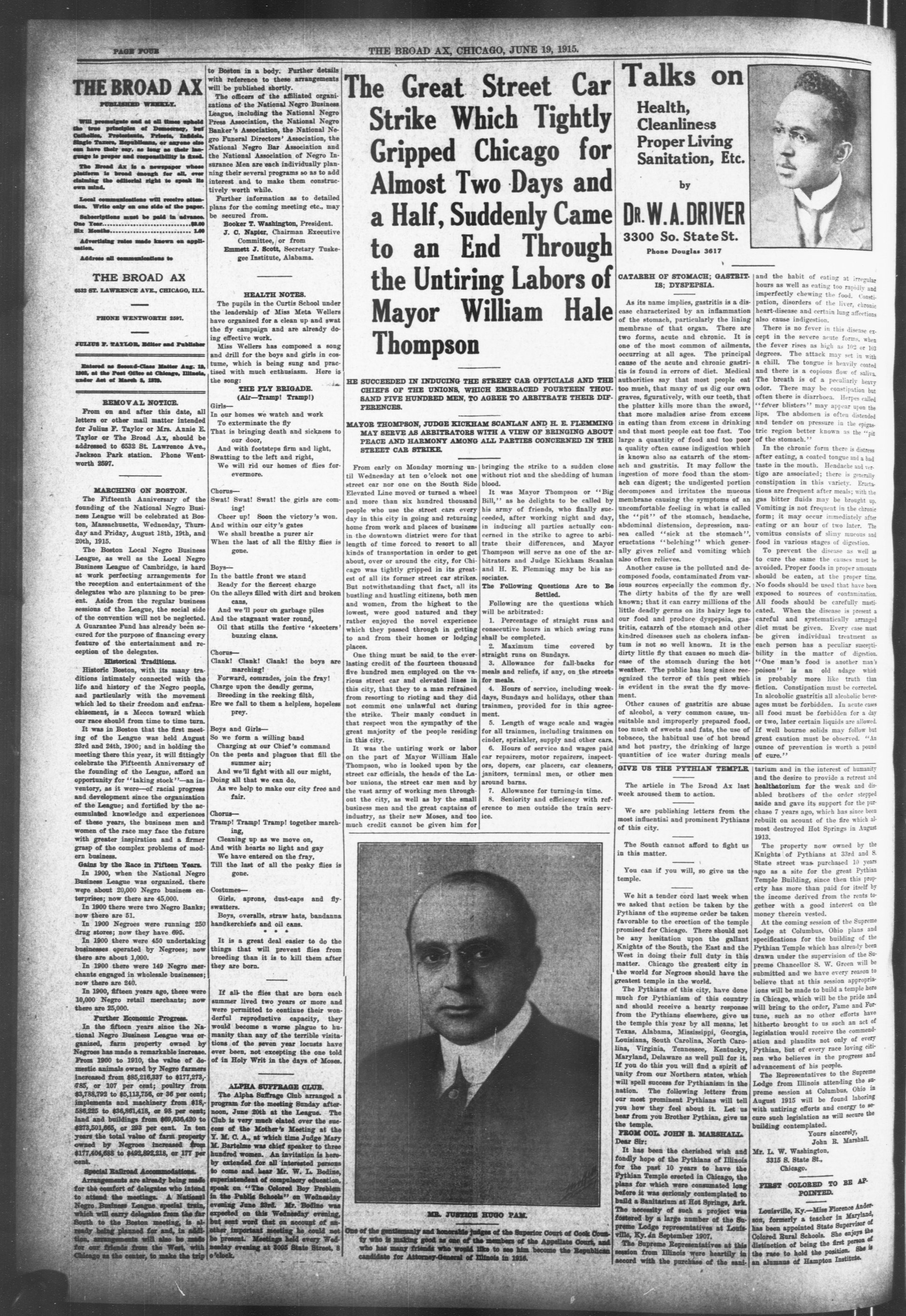
The Great Street Car Strike Which Tightly Gripped Chicago for Almost Two Days and a Half, Suddenly Came to an End Through the Untiring Labors of Mayor William Hale Thompson
HE SUCCEEDED IN INDUCING THE STREET CAR OFFICIALS AND THE CHIEFS OF THE UNIONS, WHICH EMBRACED FOURTEEN THOUSAND FIVE HUNDRED MEN, TO AGREE TO ARBITRATE THEIR DIFFERENCES.
MAYOR THOMPSON, JUDGE KICKHAM SCANLAN AND H. E. FLEMMING MAY SERVE AS ARBITRATORS WITH A VIEW OF BRINGING ABOUT PEACE AND HARMONY AMONG ALL PARTIES CONCERNED IN THE STREET CAR STRIKE.
M. M.
One of the gentlemanly and honorable judges of the Superior Court of Cook County who is making good as one of the members of the Appellate Court, and who has many friends who would like to see him become the Republican candidate for Attorney-General of Illinois in 1916.
From early on Monday morning until Wednesday at ten o'clock not one street car nor one on the South Side Elevated Line moved or turned a wheel and more than six hundred thousand people who use the street cars every day in this city in going and returning home from work and places of business in the downtown district were for that length of time forced to resort to all kinds of transportation in order to get about, over or around the city, for Chicago was tightly gripped in its greatest of all its former street car strikes. But notwithstanding that fact, all its bustling and hustling citizens, both men and women, from the highest to the lowest, were good natured and they rather enjoyed the novel experience which they passed through in getting to and from their homes or lodging places.
One thing must be said to the everlasting credit of the fourteen thousand five hundred men employed on the various street car and elevated lines in this city, that they to a man refrained from resorting to rioting and they did not commit one unlawful act during the strike. Their manly conduct in that respect won the sympathy of the great majority of the people residing in this city.
It was the untiring work or labor on the part of Mayor William Hale Thompson, who is looked upon by the street car officials, the heads of the Labor unions, the street car men and by the vast army of working men throughout the city, as well as by the small business men and the great captains of industry, as their new Moses, and too much credit cannot be given him for
bringing the strike to a sudden close without riot and the shedding of human blood.
It was Mayor Thompson or "Big Bill," as he delights to be called by his army of friends, who finally succeeded, after working night and day, in inducing all parties actually concerned in the strike to agree to arbitrate their differences, and Mayor Thompson will serve as one of the arbitrators and Judge Kickham Scanlan and H. E. Flemming may be his associates.
The Following Questions Are to Be Settled.
Following are the questions which will be arbitrated:
1. Percentage of straight runs and consecutive hours in which swing runs shall be completed.
2. Maximum time covered by straight runs on Sundays.
3. Allowance for fall-backs for meals and reliefs, if any, on the streets for meals.
4. Hours of service, including weekdays, Sundays and holidays, other than trainmen, provided for in this agreement.
5. Length of wage scale and wages for all trainmen, including trainmen on cinder, sprinkler, supply and other cars.
6. Hours of service and wages paid car repairers, motor repairers, inspectors, dopers, car placeers, car cleaners, janitors, terminal men, or other men around barns.
7. Allowance for turning-in time.
8. Seniority and efficiency with reference to men outside the train service.
Health, Cleanliness Proper Living Sanitation, Etc.
3300 So. State St.
Phone Douglas 3617
CATARRH OF STOMACH; GASTBIT
IS; DYSPEPSIA.
As its name implies, gastritis is a disease characterized by an inflammation of the stomach, particularly the lining membrane of that organ. There are two forms, acute and chronic. It is one of the most common of ailments, occurring at all ages. The principal cause of the acute and chronic gastritis is found in errors of diet. Medical authorities say that most people eat too much, that many of us dig our own graves, figuratively, with our teeth, that the platter kills more than the sword, that more maladies arise from excess in eating than from excess in drinking and that most people eat too fast. Too large a quantity of food and too poor a quality often cause indigestion which is known also as catarrh of the stomach and gastritis. It may follow the ingestion of more food than the stomach can digest; the undigested portion decomposes and irritates the mucous membrane causing the symptoms of an uncomfortable feeling in what is called the "pit" of the stomach, headache, abdominal distension, depression, nausea called "sick at the stomach". eructations "belching" which generally gives relief and vomiting which also often relieves.
Another cause is the polluted and decomposed foods, contaminated from various sources especially the common fly. The dirty habits of the fly are well known; that it can carry millions of the little deadly germs on its hairy legs to our food and produce dyspepsia, gastritis, catarrh of the stomach and other kindred diseases such as cholera infantum is not so well known. It is the dirty little fly that causes so much disease of the stomach during the hot weather. The public has long since recognized the terror of this pest which is evident in the swat the fly movement.
Other causes of gastritis are abuse of alcohol, a very common cause, unsuitable and improperly prepared food, too much of sweets and fats, the use of tobacco, the habitual use of hot bread and hot pastry, the drinking of large quantities of ice water during meals
GIVE US THE PYTHIAN TEMPLE
The article in The Broad Ax last week aroused them to action.
We are publishing letters from the most influential and prominent Pythians of this city.
The South cannot afford to fight us in this matter.
You can if you will, so give us the temple.
We hit a tender cord last week when we asked that action be taken by the Pythians of the supreme order be taken favorable to the erection of the temple promised for Chicago. There should not be any hesitation upon the gallant Knights of the South, the East and the West in doing their full duty in this matter. Chicago the greatest city in the world for Negroes should have the greatest temple in the world.
The Pythians of this city, have done much for Pythianism of this country and should receive a hearty response from the Pythians elsewhere, give us the temple this year by all means, let Texas, Alabama, Mississippi, Georgia, Louisiana, South Carolina, North Carolina, Virginia, Tennessee, Kentucky, Maryland, Delaware as well pull for it. If you do this you will find a spirit of unity from our Northern states, which will spell success for Pythianism in the nation. The following letters from our most prominent Pythians will tell you how they feel about it. Let us hear from you Brother Pythian, give us the temple.
PROM OOL JOHN B. MAESHALL.
Dear Sir:
It has been the cherished wish and fondly hope of the Pythians of Illinois for the past 10 years to have the Pythian Temple erected in Chicago, the plans for which were consumed long before it was seriously contemplated to build a Sanitarium at Hot Springs, Ark. The necessity of such a project was fostered by a large number of the Supreme Lodge representatives at Louisville, Ky. in September 1907. The Supreme Representatives at this session from Illinois were heartily in accord with the purchase of the santi-
A. E.
and the habit of eating at irregular hours as well as eating too rapidly and imperfectly chewing the food. Constipation, disorders of the liver, chronic heart-disease and certain lung affections also cause indigestion.
There is no fever in this disease except in the severe acute forms, when the fever rises as high as 102 or 103 degrees. The attack may set in with a chill. The tongue is heavily coated and there is a copious flow of saliva. The breath is of a peculiarly heavy odor. There may be constipation but often there is diarrhoea. Herpes called "fever blisters" may appear upon the lips. The abdomen is often distended and tender on pressure in the epigastric region better known as the "pit of the stomach."
In the chronic form there is distress after eating, a coated tongue and a bad taste in the mouth. Headache and vertigo are associated; there is generally constipation in this variety. Eruptations are frequent after meals; with the gas bitter fluids may be brought up. Vomiting is not frequent in the chronic form; it may occur immediately after eating or an hour of two later. The vomitus consists of slimy mucous and food in various stages of digestion.
To prevent the disease as well as to cure the same the causes must be avoided. Proper foods in proper amounts should be eaten, at the proper time. No foods should be used that have been exposed to sources of contamination. All foods should be carefully masticated. When the disease is present a careful and systematically arranged diet must be given. Every case must be given individual treatment as each person has a peculiar susceptibility in the matter of digestion. “One man's food is another man's poison” is an old adage which is probably more like truth than fiction. Constipation must be corrected. In alcoholic gastritis all alcoholic beverages must be forbidden. In acute cases all food must be forbidden for a day or two, later certain liquids are allowed. If well bourne solids may follow and great caution must be observed. “An ounce of prevention is worth a pound of cure.”
tarium and in the interest of humanity and the desire to provide a retreat and healthatorium for the weak and disabled brothers of the order stepped aside and gave its support for the purchase 7 years ago, which has since been rebuilt on account of the fire which almost destroyed Hot Springs in August 1913.
The property now owned by the Knights of Pythians at 33rd and 8 State street was purchased 10 years ago as a site for the great Pythian Temple Building, since then this property has more than paid for itself by the income derived from the rents together with a good interest on the money therein vested.
At the coming session of the Supreme Lodge at Columbus, Ohio plans and specifications for the building of the Pythian Temple which has already been drawn under the supervision of the Supreme Chancellor S. W. Green will be submitted and we have every reason to believe that at this session appropriations will be made to build a temple here in Chicago, which will be the pride and will bring to the order, Fame and Fortune, such as no other efforts have hitherto brought to us such an act of legislation would receive the commendation and plaudits not only of every Pythian, but of every race loving citizen who believes in the progress and advancement of his people.
The Representatives to the Supreme Lodge from Illinois attending the supreme session at Columbus, Ohio in August 1915 will be found laboring with untiring efforts and energy to secure such legislation as will secure the building contemplated.
Yours sincerely,
John R. Marshall.
Mr. L. W. Washington.
FIRST COLORED TO BE AP-
POINTED.
Louisville, Ky.—Miss Florence Anderson, formerly a teacher in Maryland, has been appointed State Supervisor of Colored Rural Schools. She enjoys the distinction of being the first person of the race to hold the position. She is an alumnus of Hampton Institute.
HYDE PARK NEWS
By L. W. Washington
We were certainly glad to see the cars in route again, because, it operated both against our physics, and our pocket books as well. After a cessation of 36 hours, it was a pleasant sensation, to look these common carriers in the face once more.
Miss Ada Franklin has returned from her trip in company with a Jubilee company.
We are very sorry to hear that the Hunter Brothers have lost the last sister of the family. We reported her leaving the city last week. We now learn that she became worse after arriving at her home in Ohio; died and was buried the other day. Mr. Chas. Hunter, attended the funeral.
Mr. Leach is worse at this writing
The Rev. White preached Sunday evening at the A. M. E. Church. His subject was "The Shepherd, The Leader."
The Christian Endeavor was lead by the Sunday School Supt. while the members were called upon to discuss the topic "The Call to Young Men." The pastor addressed himself to the subject so did the writer. Afterwards we remained for Church services, and by special request of the pastor, we assisted in taking up the collection. This church has the youngest organist in the world, Miss Victoria Raymore.
The Rev. Williams, Pastor of St. Paul Baptist Church is quietly, but surely getting things in shape financially to build a new church. We get this message from the little newspaper bird which keeps us posted on all up to date news matter.
The Hyde Park Colored waiters have organized a Benevolent Society. Mr. Fred Manning, Pres. Mr. Webb, secretary.
QUIN CHAPEL
---
A splendid musical program was rendered by the choir last Sunday morning and evening under direction of Prof. Edward Morris, organist. "Soul's Awakening" was impressively sung by Madam Rosa Lee Tyler, Mrs. Laura Williams sang "O Divine Redeemer," "Sanctus" was aby rendered by Mr. A. Gerwood-Maiolo, the Hawaiian Tenor, Mr. W. C. Buckner sang beautifully, A Basso Solo, Rev. Joseph C. Anderson preached on the insurance against trouble with adequate scripture references.
THE HOTEL LINCOLN IS RUNNING
AT FULL, BLAST.
Last Saturday, June 12, the Hotel Lincoln, Long Island, N. Y., which is under the management of Mrs. C. A. Breckenridge, held its formal grand opening. The leading new features of the Hotel Lincoln are first-class service, ocean boating, Sunday concerts, delightful music, new tennis court and dancing afternoons and evenings. (See ad in another column of this paper.)
MACBETH GETS APPOINTMENT
Special to The Broad Ax.
Los Angeles, June 14.—Hugh E. Macbeth, who formerly edited a newspaper in Baltimore and who is now practicing law here, has been appointed a deputy prosecuting attorney by District Attorney Thomas Lee Woolwine, a Southern Democrat.
NOTICE! NOTICE! NOTICE!
We have nice clean rooms at a reasonable rate, all modern improvements, with respectable people, and a quiet neighborhood, for young men or man and wife. Ideal accommodations for the price. Investigate and see for yourself. 509 E. 36th street.
CHIPS
Mrs. Phil Green, 243 W. 47th street, is home again after a pleasant visit with relatives and friends in Lexington and in other parts of Kentucky.
Mr. W. A. Wallace, Pres. of the Equality League has called a meeting of the officers of that league to take some action on the Birth of the Nation.
Mrs. Pauline McBride, last week, secured a divorce from her husband, Mr. A. L. McBride, who is one of the head members of the Appomattox Club.
Mrs. Priscilla Leggons has removed from Highland Park, III, to 3628 Vernon avenue, this city, and she is now enjoying a short vacation trip to Grand Haven, Mich.
Mrs. Laura Jackson, wife of Charles S. Jackson, the funeral director for the Western Casket and Undertaking Company, at $249 S. State street, is by mutual consent suing her husband for divorce.
D. B. Peyton, one of the oldest Afro-American residents of Chicago who is well known to all the older inhabitants, passed away this week. Funeral services were held over his remains at Bethel Church on Thursday.
Mrs. Eva Monroe, head of the Old Folks Home at Springfield, Ill., has for the past two weeks been the guest of Mrs. Teresa Macon, 506 W. 56th street. She will leave for her home on Sunday morning.
The members of the Colored Business Men's League of Chicago will hold forth at Olivet Baptist Church, Sunday afternoon, June 20. Mr. Anthony Overton, president. A splendid program will be rendered. Subject for discussion will be "Patriotism of the Negro in Business."
Mrs. Elizabeth Lindsay Davis, 3226 Prairie avenue, left last week for an extended trip through the South, in the interest of the New Citizens Magazine of Boston, Mass. She will visit Nashville and Chatanooga, Tenn.; Atlanta, Ga.; Jacksonville, Fla., and the Exposition at Richmond, Va. in July, after which she will return to her home.
Miss Adelphia Boger, who has been instructor of music for several years at the Colored State College, Orangeburg, S. C., the first of this week, returned to her former home, Aurora, Ill., where she will remain until after July 1. Then she will go to Boston, Mass., to resume her studies of music and engage in concert work.
The writer called upon Mrs. Bodise of 507 E. 36th St., upon learning that she had in her possession a cup which contains the picture of Abraham Lincoln. And, I must say, that is very strange incident indeed; about two weeks before the election of Wm. Hale Thompson she being an ardent supporter of his, was sitting at the table without taking thought she turned her cup up side down in the saucer. On getting ready to wash the dishes, turning it up again, she became impressed with this picture, since that time she has shown this cup to about 75 persons, and every one of them except 1 person recognized it without being told. The face is still visible in this cup. Anyone is at liberty to see it. It is very strange indeed.
The Street Car strike is ended; thanks, to reason and arbitration, both employee and employer are to be congratulated, on their ability to get together, and most assuredly do we take off our hat to his Hon. the mayor Wm. Hale Thompson of doing the best things at the right time, and holding the confidence in his tireless efforts, in justice and discretion of bringing out a great conflict, peace, to all Employee, Employer, and Citizen, alike. The over coming of this gigantic rock, put another feather in his cap.
We congratulate the union men because of the peaceful manner in which they conducted the same, and the city council, for raising the city's flag out of the dust, and making it by example possible for home rule. If out-siders had been permitted to interfere, the condition by this time would have been worse and neither side would have yielded a point believing that the arbitration board will do its full duty, in adjusting the whole matter without prejudice. We again congratulate citizens and contestants.
Crack of a Bullet:
That bullets neither whine, hiss, howl, hum nor whisper, novelists to the contrary notwithstanding, is information given by Edward C. Crossman in Outing. With one possible exception—when in certain conditions of open country modern military bullets hiss to those standing back of the firing line—nothing is audible except a sharp crash of air closing around the bullet's base when it travels at high speed. At a velocity of 1,500 feet a second, or more, the noise is "like nothing so much as a long and very violently cracked snakehawk whip." Those who stand far enough from the rifle hear the bullet's crack and later the dull, thudding noise of the rifle itself, which has been outspeeded. Jack London makes a soldier hit at 600 yard range first hear the sound of the modern rifle and then feel the blow of the bullet. But the bullet would have killed him half a second before the sound from the rifle reached him.
Recon on Sea Power.
It was Francis Bacon, after the ships of England had destroyed "the invincible armada," who in a chapter entitled "Of the True Greatness of Kingdomes and Estates," proclaimed his idea that sea power is world power. He said:
er. He said.
"We see the great Effects of Battles by Sea. The Battille of Actium decided the Empire of the World. The Battille of Lepanto arrested the Greatnesse of the Turke. There be many Examples, where Sea-Fights have been Final to the Warre; But this is, when Princes or States, have set up their Rest, upon the Battilles. But thus much is certain; That hee who Commands the Sea, is at great Liberty, and may take as much, as little of the Warre, as he will. Whereas those, that be strongest by land, are many times nevertheless in great Straights."
THE BROAD AX, CHICAGO, JUNE 19, 1915.
Anne of Russia's ice Palace. Probably the most remarkable building constructed wholly of ice was the palace built on the Neva by the Ossarina Anne of Russia. Large blocks of ice were cut and squared with great care and laid on one another by skillful masons, who cemented the joints with water, which immediately froze. The building, when completed, was fifty-six feet long, seventeen and one half feet broad and twenty-one feet high. It was of but one story. The facade contained a door surmounted by an ornamental pediment and six windows, the frames and panes of which were all of ice. An elaborate balustrade, adorned with statues, ran along the top of the facade and another balustrade surrounded the building at the level of the ground. The grounds were further adorned with a life size figure of an elephant, with his mahout on his back. A stream of water was thrown from the elephant's trunk by day and a flame of naphtha by night.
A tent of ice contained a hot bath, in which persons actually bathed. There were also several cannons and mortars of ice, which were loaded with bullets of ice and iron and discharged.
Bullet Stopping Tricks.
Five feet of clay, three feet of loose earth, or two and a half feet of sand will stop a modern rifle bullet at the closest range; but, curiously enough, as the layman may think, ramming earth hard reduces its resisting power, and high velocity bullets have less penetration in sand at short than at medium range. Eighteen inches of sand between boards is bullet proof, also nine inches of well bulled brick work. Soft wood, like fir, across the grain is bullet proof at point blank range if forty-eight inches thick, or at 500 yards if half as thick. Similarly, twenty-seven inches of hard wood, like oak, is point blank proof, or fifteen inches at 500 yards. Half an inch of wrought iron or mild steel, a quarter of an inch of hard steel, or a fifth of an inch of special steel is bullet proof. So are six inches of shingle, fifteen inches of coal, or, as some people may be surprised to know, eight feet of snow.—London Express.
Napkin Rings.
But for the napkin rings. They are relics of a departed age, reminders of the era of the Saturday night bath, the old folks' concerts and the painted panoramas of the Nile. They abide now in out of the way corners, tarnished and forgotten, bands of old silver, often affectionately inscribed at the command of givers long since turned to dust. They are the sort of reminders of a gentler but less fastidious generation that we do not like to part with except for some good reason and have no desire to keep. The serial napkin went long ago. To the melting pot, by all means, with the rings, and that they may melt up into millions of dollars worth of silver is our sincere wish—New York Times.
The Cigarmakers' Luxury.
Besides the privilege of having newspapers and novels read to him while he works, the Cuban cigarmaker demands another indulgence—that of cheering his labors with cigars provided by the firm. Every morning six high grade wrappers are handed to him for his own use, and in these he folds as much as he likes of the tobacco supplied him for the day's work. The cigars thus made and consumed are said to cost the Havana tobacco industry a sum of close on $250,000 a year. The head of one great firm once declared that he would willingly make over his factory and plantations to his employees if in return they undertook to give him the cigars they rolled for themselves.
The Slay Race.
History has contributed to separate the two masses of Slavs. The Mongol yoke for two centuries introduced Asiatic customs among the Russian Slavs. The Turkish yoke for many centuries and down to our own times influenced the character and customs of the Bulgars and Serbs. On the other hand, the Latin Slavs followed the historical evolutions of the occident—they were with Godfrey de Bouillon at the crusades, they were touched with the flame of the renalsance, they have had their part in the development of modern thought—Literary Direct.
The Loon a Good Diver
As a diver the loon excels, and naturally, for it is his sole means of livelihood. Not only is he marvelously quick, but he can remain under water for a seemingly endless time. In swimming under water he uses both wings and feet and can go for several hundred yards in this fashion. The loon, like many other waterfowl, sleeps on the water with his head tucked under his wing.
Mostly Himself:
"I hear he brought back some interesting views of foreign places." "Yes; he has photos of himself standing on London bridge, himself leaning against the leaning tower of Pisa and himself in front of the pyramids"—Louisville Courier-Journal.
Not Spotless
"No, me'am; it got some ink split on it." *Baltimore American.*
Origin of "Editor."
One of the most interesting verbal or philological trails that scholars now are following into the past for light on origins is that which has the word "editor" stamped upon it. Yale's authority on evolution of English speech, Professor Lourbury, could find no earlier use of the term as applied to the chief writer and director of a periodica than in 1768, but there is evidence in the superb collection of British and American newspapers owned by the Antiquarian society. Worcester, Mass., that it was so used in 1761. The alleged use of the title in the Boston Newsletter of 1728 proves, on examination of the file in the Boston public library, to be inaccurate. Undoubtedly Isaiah Thomas, in 1773, spoke of himself as editor of the Royal American Magazine. The interesting point to be noted, while the hunters are busy on the trail, is that, relatively speaking, "editor" is a new word in journalism, "Printer" and "publisher" preceded it — Christian Science Monitor.
Way of the Bluejay
The bluejay-Cyanocitta cristan—a purely an American bird. He is about twelve inches long, is light purplish blue above and graying below. The collar and frontlet are black and the wings and tall ultramarine, barred, the outer tail feathers being tipped with white. What a graceful, beautiful bird this is, impertinent and noisy, his raucous scream followed by a chorie that sounds much like a mocking "Ha, ha, ha, oh, my." He is accused of robbing the farmer's corn crib, of sucking the eggs of other birds and even of tearing to pieces their young. The sportsman as he goes through the woods, gun in hand, thoroughly hates the jay, which is a kind of game warden, sounding an alarm to the other birds as their enemy approaches. Naturalists have placed him in the crow family despite his beautiful plumage but his manners and his morals are more like those of the sparrow hawk—Indianapolis News.
The Darkness Before Dawn.
It is proverbial that "the darkest hour precedes the dawn." W. F. Denning, the English authority on meteors, has recently called attention to the literal accuracy of this proverb, as established by his own observations on thousands of nights. He says: "Before dawn a greater darkness seems to drop down like a mantle upon the immediate surroundings. Objects which were plainly observable during the previous hours of the night are blotted out, and a nervous feeling is sometimes induced by the dense opacity of the air."
He claims to have noticed this phenomenon when the subject was far from his thoughts, so that it could not have been purely subjective. He is unable to state the exact interval before sunrise when the remarkable darkness comes on nor whether it is common to each season and sky conditions.
Wellington's Wounded.
It is difficult to realize the callousness toward the sick and wounded against which Wellington struggled in the peninsula. One evening at dinner he heard that at a post several miles away a large number of sick soldiers were lying in the open, exposed to the weather. He rode promptly to the place, found the sick in the plight described, while the healthy officers were in comfortable houses, and was told by the commanding officer that there was no accommodation for the sick. He instantly arranged in detail for the billeting of the sick in those houses, but, suspecting what might follow, paid a surprise visit the next night and found that the invalids had again been turned out into the open. Wellington immediately reinstated them, arrested the officers and had them tried and dismissed for disobedience.
A Little Problem.
If the telephone company charges 15 cents to carry your voice across the Hudson river, and if the telegraph company charges 25 cents to carry ten words across, and if the ferryboat charges 3 cents to carry your body across, and if the tunnels charge 7 cents for carrying your body under the Hudson river, and if the express companies charge 28 cents for carrying a 20 pound parcel across, and if the government charges 15 cents for carrying a 20 pound parcel across, compute the amount of logic in a square inch of modern civilization.-Life.
The Cheapest Paper.
London used to possess the cheapest journal ever published. It was called the Six-a-Penny; or, Penny-a-Week Town and Country Dally Newspaper, and subscribers of 1 penny weekly had the paper delivered to them every day, while single copies were a farthing.
Unhappiness.
They who have never known prosperity can hardly be said to be unhappy. It is from the remembrance of joys we have lost that the arrows of affliction are pointed.—Emile Zola.
His Own Sweet Self.
Bix—Who do you consider your best
friend, the one who would do the most
for you?
Mabel—Marry him! Why, his grand-
father kept pigs! Edith—I know. He
told me that your grandfather stole
two of them—New York Globe.
No Hints For Her.
Crawford—Has your wife hinted yet
about a new bonnet? Crabsaw—
Histed? Why, she's issued an ultimat-
mum—Buffalo Courier.
Tagore's Fame in India. As showing something of Rubindranath Tagore's fame in his native India, Ernest Rhys tells the following story in his biography of Tagore:
"Mr. Montague, the undersecretary of state for India, was on one occasion riding through an Indian forest at night when he came upon a clearing where two or three men sat around the fire. Not being certain of the road," says Mr. Rhys. "he was glad to discount and rest his tired horse. Shortly after he had joined the group a poor looking, ill clothed lad came out of the forest and sat down also at the fire. First one of the men sang a song and then another. The boy's turn came, and he sang a song more beautiful both in words and music than the rest. When asked who had made the rest he said that he did not know, they were singing these songs everywhere. Awhile after Mr. Montague heard the words that he had used again, this time in a very different place, and when he asked for the name of the maker of the song he heard for the first time the name of Rabindranath Tagore."
Care of the Mouth.
The use of a tooth wash does not approach the conditions of a laboratory test, though there can be little doubt that a good deal of germicidal work in the mouth is done by the vigorous application of the toothbrush, and it may be pointed out that the tongue may well be included in the process. To be effective, however, the action of all antiseptics takes time, according to the vitality of the organisms they encounter, and usually the tooth brushing process does not occupy many seconds. This question of time exposure is important, but it is very generally overlooked and consequently the antiseptic treatment of the teeth falls short of that effectiveness which is shown to be the case in laboratory experiments. The tooth washing process should be more prolonged and the antiseptic wash allowed to remain in contact with the teeth and gums for some minutes instead of seconds before finally washing the mouth clear of antiseptic with plain water—London Lancet.
His Yallerweed.
Many persons are under the impression that America has few, if any, native plants worthy of cultivation in the home garden. They have been accustomed to look upon them as weeds and wild things, and so unfamiliar are they with native flowers that they fall to recognize them when they meet them outside their native haunts. A writer tells how he transplanted a stalk of goldenrod from a fence corner in the pasture to a place in his garden. It flourished luxuriously and sent up many stalks as high as a man's head, each crowned with a great plume of brilliant flowers. A neighbor was attracted by the beauty of the plant and declared it must have cost its owner some dollars. When told, however, that numbers of the same plant were flourishing behind his barn he exclaimed: "What! You mean to tell me it's yallerweed!" And he went away with the air of one who had been imposed upon.—Country Gentleman.
Thievery In Chile
The Chilean masses have a bad name for larceny. In Chilean ports ship passengers are warned to lock their cabin doors, and loaded lighters have to be guarded at night. Chilean stokers will saw through the bulkhead into the vessel's hold, steal goods and hide them in the coal bunkers till the night after they arrive in port, when they find opportunity to lower them overside to a confederate in a boat under cover of darkness. Harbor thieves will even cut a hole in the bow of a vessel and make off with boatloads of freight. The Germans of southern Chile have the worst opinion of Chilean honesty, and in Santiago I was bidden notice the high walls and grated windows of the houses of the better class.—Professor Edward Alsworth Ross in "South of Panama."
Defining a Batman
What is a batman? The term seems to be a military one. It apparently means the driver or manager of pack horses. A bat horse is a pack horse which carries officers' luggage. "Bat" is a pack saddle and, like so many military words, it is French. There is a common French proverb, "Cest la que le bat le blesse"—"That is where the saddle hurts," or, as we say, "where the shoe pinches."—Manchester Guardian.
Great Name.
"Who is that long haired fellow at the other table?"
"That is Bzzxvynskcitz, the famous Russian pianist. He has made a great name for himself."
"Must have made it out of barbed wire, didn't he?"—Exchange.
Anxious Waiting.
Detective (2 a. m.)—Hey, youseil Wotcher hanging around this 're ear front door ferr.? Supposed Burglar—I'm waiting for 'th' lady inside to git asleep. We're married.—Philadelphia Bulletin.
"You've got the wrong preposition. Make it 'for' instead of 'of'."—Browning's Magazine.
"I don't know. Sounded to me like neuralgia expressed in music."—London Tit-Bits.
PAGE FIVE
Whale Curiosities
Little is really known about his whaleshake. This is surprising, considering he is such an interesting subject. The blue or sulphur bottom whale is the largest animal living today. Specimens have measured eighty-seven feet in length, which in all probability weighed about seventy-five tons. Oddly enough, although the mouth will permit twelve men to stand in it the throat is only nine inches in diameter. These particular whales feed on minute shrimps—about three-quarters of an inch in length—and they probably never touch fish while they can obtain these. From the inside of one of these whales five barrels of shrimps were taken. The sperm whale possesses spermaceti in liquid form in the upper portion of its head. From one of these whales twenty barrels of spermaceti were taken out of the "case." This same type of whale also yields ambergris, that valuable substance used so extensively in the manufacture of our best perfumes.
A Lost Sea.
"One of the most curious experiences I ever had," says James Oliver Curwood, the author, "occurred on my first trip to James bay, the southern portion of Hudson bay. We reached the bay just at sunset. It happened that I was the first to awaken in the morning, and when I crawled out of my tepee I gave a yell that roused the camp. The sea was gone! Not a sign of that vast grass grown dip in which it had been. My first thought, and a natural one, was that I was out of my head. Where had the sea gone? Had we really camped on its shore the night before? I strained my eyes, but could see nothing but that dip speckled with pools of water. I was in the company of a Hudson bay factor at the time, and I turned to find him laughing. Then the explanation came. At this point James bay was unusually shallow, and at low tide the sea dropped back seven miles! During the night it had actually left us seven miles inland."
Japan First With Japanese.
Japan First with Japan.
Every Japanese is a Japanese first, whatever else he may be second. In this unified patriotism they are incomparable. It extends even to the minor affairs of life. There is no Japanese, of high or low degree, who will admit any fault of his country to a foreigner, however strict his censure may be when talking to his friends. If there are faults the Japanese conceal them. They never volunteer any information as to drawbacks, and they always have an excuse for failures. No condition can arise in Japan whereby a foreigner can learn from a Japanese of anything to the detriment of the country. The statesmen will not tell you anything. The coolies will not tell you anything. They are units of concealment. They put the good face on everything. it is Japan first with them. Japan first always, and always a super-Japan.—Samuel G. Blythe in Saturday Evening Post.
Chinese Names of Places
Chinese names of places often define their character. Thus the terminal "yang" means fortress, Pingyang the "fortress of peace." "Cheng" means a "walled city." "Shan" is a mountain, "haf" the sea, "Kuan" a camp; thus Shankalkuan is the "mountain sea camp." A "ling" is a mountain pass; Motionling, near Mukden, is the "heaven scraping pass."
The suffixes "tao" and "to" indicate islands; "po" or "pho," a harbor; "wan" a bay; "kiang" and "ho," a river; "kow," a port; "fu" a first class city; "ju," a provincial capital. "Pel" is north, "nan" is south, "king" is capital. These suffixes help to explain such familiar names in these days as Sanshantao, Chemulpo, Talleuwan, Yangtsekiang, Hoangho, Yinkow, Chefu, Anju, Peking and Nanking.
Maculay and His Razors
Macaulay was a self shaver—though not with a safety—and the woeful results are recorded in his biography. When he sailed for India and his chambers were cleared there were found between fifty and sixty strops, hacked into strips and splinters, and innumerable razors in every stage of disrepair. At one time he hurt his hand and had to go to the barber. After the operation he asked the charge. "Oh, whatever you usually give the person who shaves you," was the answer. "In that case," said Macaulay, "I should give you a great gash on either cheek."—London Mirror.
The Alpaca.
In spite of attempts to introduce the alpaca into countries away from its native habitat, failure has attended them. It is rarely found below an altitude of 5,000 feet. Its wool is of an exceedingly fine luster and quality and occasionally attains a length of six inches.
"Good Morning."
It is customary in most countries to say "Good morning" as a greeting even when it isn't true. But the Englishman says "Beastly morning," and it generally is—New York Independent.
Sharing the Head
In New Caledonia heads of infants are squeezed into different shapes, the faces of boys being lengthened to look like warriors and the girls' faces made oval by pressing up the chin.
Baby Talk.
The first infant speech is the use of the consonants "m" and "r" "g" or "t" and the first words "mum" and "goo."
Unless what we do is useful our glory is vain.—Pheadrus.
PAGE NEXT
Self Denis, Is Rare.
"The average human being does not want to live hygienically!" exclaims the editor of Clinical Medicine. And he backs up his assertion with the following:
"Once we published an account of a case of diabetes we had treated with some success. A distinguished retired army officer read it and as a consequence called upon us. We began to explain the regimen necessary when he interrupted to say: 'I don't want any diet. I want you to give me a treatment that will allow me to eat anything I want, in any quantity!' We resigned.
"Mr. Man doesn't want to stop drinking or smoking or working or playing too much. What he wants of us is the means to keep on as he has been living. Madam does not relish our advice to cut down her bridge parties, loosen her corsets and quit goring. She wants medicine to restore her youth, take off her fat and enable her to keep it up until she has had enough.
"They all come to us, not for reform, but to be enabled to go on sinning."
Sea Water Salt.
The salt industry of San Francisco bay is one of farreaching importance, and the method of production is simple in its operations since the finished article is the result of evaporating the sea water. Claim is made that more salt is thus made here than anywhere else in the world. Water is collected in prepared shallow ponds, where, after evaporation has been completed, the salt is shoveled into small railway cars, taken to the refining works, remelted and crystallized out in vacuum pans. It is washed and cleaned. About a year elapses from the time the sea water goes into the ponds until the product is ready for the market, because the evaporation from the surface of the ponds is only about twenty-eight inches a year, over and above the natural rainfall. The process usually starts in May or June of each year, so as to take as much advantage as possible of the warm period of the summer.—Argonaut.
Degress of Pain.
There are degrees of pain, as degrees of faultfulness, which are altogether conquerable and which seem to be merely forms of wholesome trial or discipline. Your fingers tingle when you go out on a frosty morning and are all the warmer afterward; your limbs are weary with wholesome work and lie down in the pleasant rest; you are tried for a little while by having to wait for some promised good, and it is all the sweeter when it comes. But you cannot carry the trial past a certain point. Let the cold fasten on your hand in an extreme degree, and your fingers will molder from their sockets. Fatigue yourself but once to utter exhaustion, and to the end of life you shall not recover the former vigor of your frame. Let heartickness pass beyond a certain bitter point and the heart loses its life forever.—Ruskin.
Mark Twain on Genders
Our ability to personify a sea ship by using the pronoun "she" and to keep the Zeppelin in place as "it" brings out one strong point of our language. It is impossible to be so subtle in French, which has no neuter, or in German, with its arbitrary scattering of genders. Mark Twain gave as a typical instance of good German: "Wilhelm, where is the turnip?" "She has gone to the kitchen." "Where is the accomplished and beautiful English maiden?" "It has gone to the opera." Mark went on to observe that in Germany a tree is male, its buds female, its leaves neuter; horses are sexless, dogs male, cats female; including tomcats. "By some oversight of the inventor of the language a woman is a female, but a wife (welb) is not."—London Mall.
The Right Door and Another
A junk dealer in an Indiana town had been persistently suspected of acting as a "fence" for stolen goods and finally was arrested on a charge of that kind. However, after a jury trial he was acquitted on a technicality. Commenting soon afterward with a friend on his acquittal, the junk dealer said, "A long experience in the junk business leads me to believe that the door of success is might close to the door of the penitentiary, and if a man is not careful he is likely to take the wrong door."-Indianapolis News.
Better Still.
"But," said a student of one college to a friend who was attending a rival institution, "your college never turns out gentlemen."
"Of course it doesn't," replied the other. "It allows gentlemen to go right on and graduate."—Providence Tribune.
Grubbs—Why does young Litebrane insist on wearing his hair pompadour? Stubbs—He can't help it. His hair, following the rule that prevails throughout nature, abhors a vacuum and seeks constantly to make its escape.—Richmond Times-Dispatch
Great Triumph
"Well, how did you come through that afternoon tea?"
"Came through all right. Didn't spill anything on anybody but myself?"—Kansas City Journal.
Meking Him Wise.
Jones—Do you know, I fancy I have quite a literary bent. Friend—All right, my boy. Keep on and you'll be worse than bent; you'll be broke—Stray Spoiler.
Minds are not conquered by arms, but by love and sensibility.
Accidental Inventions.
Abcidental inventions
The ancients believed that there was a certain kind of mineral substance in existence by means of which all the common metals could be turned into gold. This supposed substance was called the philosopher's stone, and the alchemists of classic times and during the middle ages spent much time and labor in search of this wonderful substance.
Of course, since nothing of the kind ever existed, it was never found, but it is worth remembering that some of the most notable inventions were discovered in this wide search. It was in looking for the philosopher's stone that the German chemist, Botticher, stumbled upon the secret of making the beautiful Dresden porcelain. Roger Bacon, in the same way, discovered the composition of gunpowder. Geber found the properties of acids; Van Helmont discovered the nature of gas, and Dr. Glauber found the secret of making the salts which now bear his name.—Columbus Dispatch.
Printers and High Hats
In no trade, writes a correspondent, has the fall from favor of the top hat been more marked than among printers. The old time compositor—the "case hand," as he is now termed to distinguish him from the linotype operator—never forgot that he was the aristocrat of the labor world, entitled, as he proudly claimed, among old time craftsmen to wear a sword, the mark of the gentleman. A quarter of a century back top hats were common wear in printing offices. They are found still in quiet backwaters of the trade. But what would happen if the linotype operator came to his "mangle" nowadays wearing one? He would probably be pelted to death with "slugs." If he owns one he keeps it for funerals, christenings and weddings. One hat I know of has already committed polygamy, having been freely loaned to bridegrooms whose wardrobe was minus the hat of state—London Chronicle.
Voices of Animals.
There is a chapter in the natural history of animals that has hardly been touched upon as yet and that will be especially interesting with reference to families. The voices of animals have a family character not to be mistaken. All the canidae bark and howl—the fox, the wolf, the dog—have the same kind of utterances, though on a somewhat different pitch. All the bears growl, from the white bear to the small black bear of the Andes. All the cats meow, from our quiet fireside companion to the lions and tigers and panthers of the forest and jungle. This last may seem a strange assertion, but to any one who has listened critically to their sounds and analyzed their voices the roar of the lion is but a gigantic meow, bearing about the same proportion to that of a cat as its stately and majestic form does to the smaller, softer, more peaceful aspect of the cat—Agassiz.
Photo Enlarging Idea.
A simple enlarging machine may be made of an oak board seven-eighths of an inch thick, and a little wider than the camera with which it is to be used. A box is built on one end of the board, with an opening the size of the camera in that side of the box which faces the other end of the board. A thirty-two candle power bulb backed with a reflector is mounted in the box behind the opening. A slot is made in the baseboard, running from the box to the other end, and a moving upright, with a block and set screw running in the slot, is provided to hold the printing paper on which the enlargement is to be made. In order to make an enlargement of a negative the plate (or film inclosed between two pieces of glass) is mounted in the usual place in the camera, the lens is opened and the light turned on—Technical World.
Telling the Age of a Fish.
The age of a fish can be determined with accuracy by inspection of the otoliths, or bony concretions, which are found in the auditory apparatus. These otoliths increase in size during the entire life of the fish, each year adding two layers, a light colored layer formed in summer and a dark layer formed in autumn and winter. The alternate layers are sharply contrasted and very distinct, so that there is no difficulty in counting them. The number of pairs of layers is equal to the number of years the fish has lived.—Scientific American.
His Meanness
"Why the dissatisfaction, girlie?"
"My husband has such a small income."
"You knew he had a small income when you married him."
"Yes, but I didn't think he'd be mean enough to insist on my living within it"—Kansas City Journal.
Hopeless Case.
Mrs. Hemmandhaw—I was just reading in the paper about a man who was driven to suicide by the third degree. Mrs. Shimmerpate—Mercy! John just told me he expets to take the thirty-second degree at his lodge tonight—Youngtown Telegram.
All He Wanted.
"Money, my boy, won't buy everything."
"I know, pa, but if you'd let loose a little of it you could get me a bicycle."
-Detroit Free Press.
Visitor-I don't see how you can rec
encile yourself to being a farmer. Si
Seeder-I couldn't if I didn't see one
of you city men once in awhile-Phil
adelphia Bulletin.
THE BROAD AX. CHICAGO, JUNE 19, 1915
A Cure That Faltered.
A Cure That Faltered.
Samuel L. Clemens used to relate on the lecture platform a comedy of courtship that might well have served to illustrate his dictum that there are three kinds of funny stories—the witty story, which is French; the comic story, which is English, and the humorous story, which is American—and that the latter is the only hard kind to tell. He recounted how a young swain was rejected simply because of his embarrassing impediment of speech, and how a friend counseled his taking the whistling cure—whenever he felt a disposition to stutter just whistle. He tried it, and with such surprising success that in a very few weeks he sought his lady to announce his complete recovery. Unfortunately the excitement of the occasion proved too much, and those who have heard Mark Twain will recall how he would stand trembling on the platform, earnestly stuttering out of one side of his mouth and conscientiously whistling out of the other, until his audience fairly grooved in mirth.—Washington Star.
Husks of the Prodigal Son.
It appears that the "husks" (siliquee in Latin) which were fed to swine in the east and to which the prodigal son was finally reduced were nothing more nor less than the large, podlike fruit of the carob tree, whose botanical name is Ceratonia siliqua. This plant pertains to the pea family, and the husks are sometimes nearly a foot in length. These husks contain very hard seeds resembling beans, which may be eaten with relish, although one would soon tire of them as a sole article of diet. Occasionally these husks are to be found in England and this country in confectioners' shops, where they are known as "St. John's bread."
In the east in the old days the plant was regarded with disfavor, not because it was thought to be unpalatable, but because of its association with swine. Together with the acorns of a species of oak called Quercus aegilops, it served as the principal food of pigs and hogs.—Every Week.
Ape the Three Monkeys.
In Japan almost every house has a statue of three monkeys. The hands of one are over his eyes, those of another are over his ears, and those of the third are over his mouth. See no evil, hear no evil, speak no evil, is the interpretation of them.
There are great men in the world, but there are few great men who talk much. When they do talk they do not utter idle words, hence little evil creeps into their speech. There are loved men in the world, generous and pitying, but they have no time to listen to gossip and evil communications. There are other men who see evil, not through morbid curiosity, but with an eye to its correction; nor do they impute evil and view with suspicion all human actions except their own.
Evil communications, seeing evil, hearing evil, speaking evil, corrupt humanity. There are many who can afford to ape the three monkeys.-Philadelphia Ledger.
Tell Hats of the Past
In spite of statements made to the contrary, tail hats were invented long before 1813. A Mr. Toft of Tottenham, who died in 1767, left £50 to the governors of the Tottenham free grammar school, the interest of which was to be devoted to the purchase of three tall hats as prizes for the three best boys. The hats used to be purchased from a hatter in Bishopsgate street named Greenway for 24 shillings. But in 1811 he informed the governor that a duty of 1 shilling each had been imposed and the cost raised to 27 shillings. The duty was again raised to 2 shillings each and in 1813 to 2s. 6d. The duty was afterward repealed, but by that time the governors were purchasing Bibles instead of hats for the boys.—Pall Mall Gazette.
His Qualifications
"So," said the old general, "you think you would make a good valet for an old wreck like me, do you? I have a glass eye, a wooden leg and a wax arm that need looking after, not to mention false teeth, etc."
"Oh, that's all right, general," replied the applicant enthusiastically. "I've had lots of experience. I worked six years in the assembling department of an automobile factory."—Ladies' Home Journal.
What We All Think
"I'm glad to know that you liked my sermon," said the minister to an enthusiastic member of his flock.
"Indeed I did. It was so true and so to the point. I wish a neighbor of mine could have heard it. I know it was intended just for him."—Detroit Free Press.
"This poem of mine," declared the poet proudly, "is strictly and entirely original."
"It is kind of you to say that," said the editor. "It relieves somebody else from a great responsibility."—Somerville Journal.
First Chauffeur—Who was that feller you ran over? Second Ditto—I guess it must o' been th' glass eater at the vodyville theater. Look at that tirel-Cleveland Plain Dealer.
What punishes a lie almost immediately is the necessity of defending it by other lies.—Emile Audier.
How Many Years Left?
If you want to know how many more years you are likely to live—according to the law of average, that is—study the following formula: Take the figure 80. Deduct your present age. Two-thirds of the result will equal the number of years you have to look forward to.
Let us suppose, for example, that you are 26. Take 26 from 80 and you have 54. Two-thirds of 54 equals 36, which is the answer.
Of course this formula is only approximate. It makes no allowance for people who are already over 80—and a man of 80 has still five years to his credit—nor does it differentiate between the saxes, but in comparing its results with the actual figures which have been worked out by statisticians it is very near the mark in all the ages between 10 and 70, though the ladies may take an additional couple of years, their expectation of life averaging two years more than that of men.—London Answers.
Moon Signs.
The moon plays an important part in sign telling. I know several old ladies who regulate all their household affairs, and even the conduct of life, by this luminary. All kinds of weather hang upon the changes of the moon. As a matter of fact, you and I rather like to see the new moon over the right shoulder. To be sure, we have no faith in the baneful influence of this sign. Still, it is just as well to be cautious about offending her ladyship. Farmers study the shape of the new moon to determine if the month is to be wet or dry. The Indians used to say that if you could hang a powder horn upon the curve of the new moon the month would be generally pleasant. A circle about the moon means a storm approaching. The number of stars within the circle tell the number of days which will elapse before the storm begins. Farmers tell about planting corn in the old of the moon—Margaret Woodward in Countryside Magazine.
Reforming a King.
King Victor Emmanuel of Italy is extremely democratic, and it was the remark of a workingman that first led him to be so. Formerly he was very reserved and was not often to be found mixing among his people. One day, however, he granted a private audience to a prominent workman. His majesty discussed many subjects with his guest, including the latter's work in a glass factory.
At last the king hinted that he might visit the factory himself one day, to which the workman replied: "Your people have been a very long time without seeing your face, sire—except on stamps."
The king did not say anything at the time, but he thought the man's words over very carefully, and henceforth no Itallans had cause for complaint that his majesty kept himself aloof from them in the seclusion of his palace.
Swiss Have Mercantile Navy.
Swiss Have Mercantile Navy.
Long before Germany was to be reckoned with as a sea power Switzerland possessed a fleet equipped for warfare. Eight hundred years ago on all the larger Swiss lakes armed galleries were maintained by the rival cantons Skilled shipwrights had to be imported from Genoa for the construction of these vessels, some of which carried crews of 500 men. The largest Swiss flotilla was maintained on the lake of Geneva when the inhabitants of Geneva were at war with Savoy. Since the neutrality of Switzerland has been guaranteed by the powers there has been no need for warships on the lakes. The Swiss, however, possess a mercantile navy, which carries a considerable amount of trade over the 342 miles of navigable waterways in the republic.—London Spectator.
What She Had She'd Hold.
It was the happiest moment of their lives. He had just proposed, and she had grab—er—accepted him. Then he took a tiny leather case from his pocket and slipped a sparkling circle on her finger, while she beamed with pride. "I'm afraid it's rather loose, darling," he murmured. "Shall I take it back and have it made smaller?" The damsel shook her head decidedly. "No, Rupert," she said calmly. "An engagement ring is an engagement ring, even if I have to wear it around my neck."—London Telegraph.
The Other Way.
A compositor once set up the word "doughnut" so that it read "donut." "Don't you know how to spell better than that?" asked the foreman. "Well," said the compositor thoughtfully, "do you know it didn't look just right to me. I had a 'w' in there once and took it out." -Kansas City Star.
Distressed Him.
"You called me a boneheaded jelly-fish!"
"Yes."
"Well, I don't care about your opinion; but, for heaven's sake, don't mix your metaphors!"—Louisville Courier Journal.
A Woman's Prerogative.
"Willie, did you see my new shaving brush?"
"Yep; mom is using it to repaint the birdcage."—Columbia Jester.
Right.
You probably look all right to your own friends, and the rest of the world doesn't care how you look—Chicago News.
"Beads of perspiration are the jewels of honest labor," saith the proverb.
How Plants Breathe.
Plants have two experiences common to all living things, although they have none of the senses possessed by animals. They breathe the air and perspire. The leaves and stems of plants correspond to the respiratory organs of animals, and it is by this means the plants take in the air. Plants are chiefly water absorbed from the earth. Of the 25 per cent solid matter the principal constituent is carbon, nearly all of which is absorbed from the atmosphere by the action of minute bodies contained in the green leaves. Plants also absorb oxygen, hydrogen and nitrogen from the atmosphere through their leaves and also through their roots. All contribute to building up the organic structure of the plant. Used up moisture is given off by plants through their leaves, just as animals perspire through the pores of their skins. Calculations made as to the amount of water thus perspired by plants show that the sunflower, only three and one-half feet high, gives off as much moisture as a man.
How the Flow of a River Is Measured.
How the Flow of a River Is Measured.
If you see a man leaning over the railing of a bridge intently watching the river with a telephone receiver at his ear do not think that the man is trying to talk to the fishes or to a diver below the surface. He is probably one of the government's engineers measuring the amount of water passing under the bridge. This is done by lowering an instrument known as a current meter into the water at several points under the bridge to determine the speed of the water and by measuring the depths of the water at the same points. From such information the flow of the river at that particular time and height can be computed, and when such measurements have been made at a number of different heights the flow of the stream at any height can be determined. Then if a record of the height of the river is obtained each day from a river gauge the flow for each day can be computed.
How to Be an Orator
was congratulated for his oratory.
"What is your recipe for good oratory?" a reporter asked.
"I am afraid oratory comes natural," was the reply. "There is, though, one recipe for it—old Job Walmby's, but it is hardly satisfactory. Tha wants to be a public skeyker, dos tha, lad? Job in his Yorkshire dialect would say, 'an' tha thinks Aw'm the chep to put tha up to a wrinkle aboot it? Tha's right; Aw awm. Now, hark tha! When tha rises to meek thy speych hit taable an' oppen thy mawth. If nowt comes tak' a sup o' water an' hit taable again. Thin oppen thy mawth wider than afoor. Thin. if nowt comes, tak' thy sen off an' leave public spekin' to such as me!" —London Tit-Bits.
Our Schools and Our Flag.
The national pledge for our flag was recommended by the American Flag Day association. The pupils, standing with right hand uplifted, palm upward, to a line with the forehead, in the attitude of salute, repeat the pledge in these words: "I pledge allegiance to my flag and to the republic for which it stands. One nation, indivisible, with liberty and justice for all." At the words "to my flag" each one extends the right hand gracefully, palm upward, toward the flag until the end of the pledge; then the hand is dropped to the side.
Children in the primary grades are taught to repeat a shorter pledge in these words: "I give my head and my heart to God and my country. One country, one language, one flag."—Philadelphia Press.
Bombay's Huge Road Mirror
Road mirrors are not rare in England, where they are set at dangerous turns or crossings to warn drivers of vehicles or pedestrians just around the corner. Their success was immediate; and some American cities are showing an interest in the device. Bombay, however, has led the world with the largest road mirror on record as well as the first in India. It is set at the corner of Gamdevi road and Hughes road, a dangerous point, and measures 5 by 10 feet, which is seven times as large as the average English road mirror.—New York Independent.
Consolation.
"You were not at the theater yesterday when the first representation of your new piece took place."
"I was kept away by an important engagement."
"Indeed! (Kindly) Well, you didn't miss anything!" — Munich Fliegende Blatter.
A Vague Meaning
"Now," said the doctor, "you take this medicine just as I told you, and you will sleep like a baby." The patient surveyed the medicine doubtfully. "Well, doctor," he said, "if you mean like our baby I guess I won't take it."—Ladies' Home Journal.
Discounted.
Elsie—When Betty married old Moneybags she gave her age as twenty-five. She's older than that. Flo-Oh, I suppose she allowed one-third off for cash—Dallas News.
In a Big Hurry.
Benham—I believe in taking time by the forelock. Mrs. Benham—I notice that you tear a sheet off the calendar before the month is over—New York Press.
Relieving Her Mind.
Mother—Why don't you save some of your candy till tomorrow, dear? Helen—I'd rather eat it now, mother, and get it off my hands—Judge.
In the early days when Tolstoy adopted manual labor as a religious duty he took lessons in bootmaking to occupy him during the long winter evenings. He was at work diligently hammering the wooden pegs into the red sole, an art he had just mastered, says the "Reminiscences of Tolstoy," by his son, when Prince Obolenski came in. "Look, isn't that grand?" said my father exultantly, "notbing out his work for the visitor to see.
"It doesn't seem so very difficult," said Obolenski, half in joke.
"Well, you try."
"Right you are."
"Very good, but on one condition—every peg you drive in I'll pay you a rouble, and every one you break you'll pay me 10 copecks. Agreed."
Obolenski took the boot, awl and hammer and broke eight pegs, one after the other; then he laughed with his good humored laugh and amid general hilarity paid 80 copecks, which went to the shoemaker.
Lawrence Barrett's Romeo
Irving contributed to the gagery of a supper a story about Lawrence Barrett. One night Barrett and his old friend, Edwin Booth, met at their club in New York. Barrett, after a brief greeting, bustled toward the door with every appearance of remembering a pressing engagement. "Halloa! Where are you off to?" Booth asked. "To a rehearsal," said Barrett.
"What's the play?"
Barrett said it was "Romeo and Juliet."
"And what part do you take?" Booth asked in sudden access of interest.
"There is only one part for me in the play," Barrett said, drawing himself up in lofty indignation.
"Oh, ah, yes," said Booth; "I know—the nurse."
The angered tragedian stood forth in haughty silence and did not speak to Booth for two days—Strand Magazine.
The Caged Emperor
After Elba Napoleon became a bogy to the whole world as well as to the British government, which had the guarding of him. "Lord Bathurst believed," says Norwood Young in "Napoleon In Exile: St. Helena (815-1821)," "that Napoleon spent his time in concocting plans for escape." But, said the outlaw to O'Meara, "Where could I go to, allowing that I got out of the island? Every place I could arrive at I would find enemies to seize me." This panicky dread of Napoleon's escape from St. Helena led to England's annexation of the uninhabited island of Ascension, 700 miles distant. The even more distant island of Tristan A'cunha was similarly taken possession of the following year, because it was thought to be too dan gerously near the Napoleonic influence.
Thrifty Turks.
The Turk is invariably a brave man when he is in a subordinate capacity. Directly, however, he becomes one having authority he turns to peculation. There is a true story of a Turkish warship which had a wooden propeller shaft, her captain having sold the original shaft at scrap iron prices. There is also the story, equally true, of a battleship laid down many years ago which, when nearly ready for launch, had her construction suspended for lack of funds. A few years later the kaiser, in his capacity of the friend of Islam, having arranged a German loan, it was decided to complete the ship. But when they came to look for her no trace remained. Everything had been stolen—London Mirror.
Sidestepping a Query.
"When dat upply colld man tried to staht a "spute wild me" stated old Brother Cuddyhump, "by axin' if de world is round, like some folks say 'tis, why de doose don't de people on de dunder drap drap off. I says to him: 'Putt it in writin', sah: dess putt it in writin', and I'll consider yo' distention.' And dat sho' took de gas out' his b'loon! Uck, dat ignunt nigger kain't write, and I kain't read if he could. If he could write and I could read I wouldn't uh instigated him to put it in writin', uhkaze I don't know de answer no mo'丹 he does!"-Pittsburgh Press.
Piano and Violin.
It is undoubtedly true that between the piano and the violin the latter is the harder instrument to master. The piano is much more of a machine than the violin, and its technique as compared with that of the violin is much easier to get hold of. The most human of all instruments, the violin is almost boundless in its demands upon the skill of the performer—New York Amateur.
The Psychological Moment.
The Psychological Moment.
"Now's the time to spring that new gown on pa."
"Why? Is he in a good mood?"
"The best. I just heard him bragging that he played the best golf of his life yesterday afternoon."—Detroit Free Press.
Delayed Knowledge.
When a bride begins to meet her husband's relations she is astonished that a man like him came from a family like that. Galveston News.
"The man I marry must have common sense," she said haughtily.
"He won't." replied he bitterly.—Denver Clarion.
A cow is a very good animal in the field, but we turn her out of a garden.—Johnson.
LINCOLN STATE BANK OF CHICAGO
CAPITAL, $200,000.00
NICKELS CENTS
This Registering Home Bank FREE to our Savings Depositors; will start you saving and keep you at it. A Savings Account is the first step to wealth. OPEN one with US.
The City of Pola.
Since the Austrians made the city of Pola their chief base in 1848 they have accomplished wonders there. It is claimed that with the assistance of submarines and aircraft Pola is virtually impregnable. Its commodious harbor, almost land locked, has been enlarged so that it easily contains the entire Austrian fleet. It is divided into two basins by a chain of small islands. The entrance is strongly defended, and an extensive system of fortifications on the hills inclosing the harbor insures complete protection. There is a good roadstead in the large channel of Fasana, which separates the mainland from the Brionian islands. The marine arsenal of Pola is a vast establishment with all the requisites for a large fleet. Artillery laboratories and powder magazines are situated on the north shore, and behind the arsenal is San Polcarpe, with huge barracks and hospitals. - Argonaut.
44
Byron's Famous Swim
Byron was cruising up the Dardanelles in a British warship, the Salette, when he accomplished his famous swim from Abydos to Sestos, the distance (a little over four miles) being covered in seventy minutes. "You will smile at this exploit," the poet wrote to R. C. Dallas in a letter describing the swim, "but as it made an ancient immortal I see no reason why a modern may not be permitted to boast of it, particularly as I had no mistress to comfort me at landing." According to Hobhouse, his traveling companion, Byron "had previously made a more perilous but less celebrated passage, for I recollect that when we were in Portugal he swam from Old Lisbon to Belem城 and, having to contend with a tide and countercurrent, the wind blowing freshly, was but little less than two hours in crossing the river."—Pall Mall Gazette
He Wouldn't Give Thanks
An eighteenth century clerical humorist, one Thom of Govan, the Glasgow Herald states, had a great fondness for days of nation fasting or even of thanksgiving. At the close of the American war he commenced a sermon thus: "My friends, we are commanded by royal authority to meet this day for the purpose of public thanksgiving. Now, I should like to know what it is we are to give thanks for. Is it for the loss of thirteen provinces? Is it for the slaughter of so many thousands of our countrymen? Is it for so many millions of increased national debt? I see, my friends, you are all laughing at me, and I am not surprised at it, for were I not standing where I am I would be laughing myself."
Politeness In China
In China parents are held responsible for the manners of their children. Accordingly, for the credit of their parents, people try to be polite. If you are mobbed in a Chinese town you should look straight at one or two of the people and say: "Your parents did not pay much attention to your manners. They did not teach you the rules of propriety." A remark like this will make the crowd slink away, one by one, ashamed of themselves.
Novel Proposal.
"Have you ever been engaged to be married before?" asked the young man. "Yes; six times," replied the sweet young thing. "Well, if your hand is not working just now I'd like to ask for it."—Yonkers Statesman.
Baby Army Officers
It used to be the custom in England to buy commissions in the army for infants, and then they would be promoted as vacancies occurred. In this way a boy would have high rank when he was old enough to become a real soldier.
Argument Spoiled.
She - Too many men expect their wives to run their homes on practically nothing. They forget that no one can make bricks without straw. He-My farm out of four-Stray Stories.
SURPLUS, $20,000.00
Commercial Banking
Savings and Checking Accounts
Foreign Exchange
Safety Deposit Vaults
Mortgages and Bonds
3 Per Cent Interest on Savings Deposits Your Patronage Solicited
Depository and Correspondent, Continental & Commercial National Bank of Chicago, Illinois.
Recent Inventions
A coat hanger to which is attached a clothes brush has been patented by a Denver resident. A solder has been invented which holds rimless lenses against the metal parts of eyeglasses without screws. A tumbler with a compartment that can be filled with ice or hot water to keep its contents cold or warm has been invented. Flies can enter a garbage can that a New York man has patented, but as they try to get out they are caught in a wire trap, which can be detached and the insects destroyed.
Current Comment.
It isn't a Mexican "crisis" now. They just call it any old thing and let it go at that—Atlanta Constitution.
It took the revolution to remind the world that Portugal has been calling itself a republic—Boston Herald.
Working for a safe and sane Fourth is worth while even this year, when gunshot and other wounds are so plentiful elsewhere—Chicago News.
Only a year from now it will be time for the conventions to be held to nominate the next president. Why not begin to get excited?—Boston Globe.
Short Stories.
Luxemburg covers 1,000 square miles and has a population of 200,000.
The total circulation of money in the United States last year was $3,419,168,-368.
Uruguay has suspended specie payments until the close of the European war.
The bayonets used at the battle of Waterloo were about a foot longer than the modern weapons.
On the island of Romblon, one of the Philippines, an immense body of limestone is attracting attention.
Fashion Frills.
Even the shoemakers are realizing that something is wrong with the prevailing types of last. There is hope—Chicago News.
Fall skirts are to show the ankles, according to the fashion reports. Well, what are the spring and summer skirts doing?—Pittsburgh Dispatch.
The old time fear of sun spots is rapidly disappearing. Some girls now wear them on their faces and call them blushes.—Albany Knickerbocker Press.
BRIGHT BRIEFS.
Keeping out of trouble is enough to keep every man busy.
Another big item in the war budget is that deadly gas bill.
An old man has as much use for advice as a young man hasn't.
You have to make some men talk, but most women are self starters.
The way of the transgressor is not only hard, but blamed slippery.
Before starting on the right track be sure you are headed the right way.
Most of the things postponed until tomorrow could have been done today.
Opportunity makes the man, but only when the man knows what to do with it.
Mankind is not half as proud of itself now as it was in the middle of last July.
At sixty man knows that he didn't know what he thought he knew at twenty.
An optimist is a person who smiles at knocks; a pessimist is a person who knocks at smiles.
The man who is irritable about home can exercise a lot of patience when holding the end of a fishing rod.
Napoleon Used Milton's Tactics.
Sir Arthur Conan Doyle is not the first English author whose writings have been studied for hostile ends by his country's enemies. Napoleon assured Sir Colin Campbell at Elba that he greatly admired "Paradise Lost" and had read it to some purpose. The plan of Austerlitz was borrowed from book 6 of that work, where Satan brings his artillery to bear upon Michael and his angelic host with such direful effect:
Training his devilish enginery, impaled On every side with shadowy squadrons
Submarine Badge.
As a crown is the badge of k three balls are the badge of pkers, so the badge of a submarine is a handful of cotton wastes the half dozen officers of a modi marine, clad in their black leather terproof suits, come aboard a stands on the tiny gangway to them, and to each he hands his rolled in a neat ball. The rea that the steel doors and steel in a submarine sweat oil eternally steel seats sweat oil. The sub officer before opening a door on
To hide the fraud.
This mode of warfare appeared to Napoleon so likely to succeed if applied to actual use that he determined upon its adoption and succeeded beyond his expectations. By reference to the details of the battle of Austerlitz it will be found to assimilate so completely with Milton's imaginary fight as to bear out the emperor's assertion.—London Chronicle.
Why Men Eat More Food than Women.
That men eat 5 or 6 per cent more than women—not because they are gluttony, but because they actually require that much more nourishment—appears as a result of an investigation made in the nutrition laboratory of the Carnegie institute at Washington by Francis G. Benedict and L. E Eames, says the Literary Digest. The reason for the discrepancy seems to be that women have a smaller proportion of active tissue than men of the same weight and more inactive material, such as fat. The investigation disclosed that the average woman generates only 1,355 heat units in the twenty-four hours as against 1,638 produced by the man, or about 2 per cent more for the latter per pound of body weight. When groups were compared after careful selection of individuals of nearly the same height and weight the men were found to produce about 12 per cent more heat than women.
Marriage Superstitions
In some parts of Germany the duties of the bridesmaids are tinged with superstition. It is one of their duties on the morning of the marriage day to carry to the bride a myrtle wreath, for which they had subscribed on the previous evening. This they place on her head and at night remove it, when it is placed in the bride's hand, she being at the time blindfolded. The bridesmaids then dance round her, while she endeavors to place the wreath on one of their heads. Whoever is fortunate enough to be thus decorated will, it is believed, be a wife before another year has passed. In removing the bridal wreath and veil the bridesmaids are careful to throw away every pin or the bride will be overtaken by misfortune, while any unwary bridesmaid who retains one will lessen her chances of marriage—Dundee Advertiser.
The Meteoric Hypothesis
The nebular hypothesis of La Place has been abandoned in favor of the meteoric hypothesis of Lockyer and planitesmal hypothesis of Chamberlain. All suns, planets and moons, by these nearly identical theories, were made by the falling in from space of small cosmic bodies, such as the meteors now falling on the earth.
Trillions of years ago there was a meteor moving in space. It is now in the center of the earth. Another meteor joined this by collision, then another, and this falling in is now going on at a vastly diminished rate, so that comparatively few are now coming in, as may be seen on almost any clear night—Edgar Lucien Larkin in New York American.
White Man's Graveyard.
Africa is a remarkably beautiful country. Its coast lines are picturesque, graceful, fascinating, alluring. Its seaport towns and cities are usually clean, pretty and reasonably healthful. Equatorial Africa has, until the last two decades, been called the white man's graveyard, but clean living, quinine, mosquito netting, sobriety and sanitary improvements have made Africa a place where one can not only exist, but live in as much comfort, take it all in all during the year, as in the city of New York—New York Telegram.
Stale Candy.
Stale candy can generally be worked over by reboiling. In the case of acid candies, such as lemon drops, the candy is boiled, the acid is withdrawn by the use of lime or chalk, and the sirup may then be used in the manufacture of that or any other species of
Taking Up Time.
"I like to have my friends extend their congratulations," said the newly appointed public official.
"Yes"
"But that last caller extended his over an hour and a half."—Louisville Courier-Journal.
Refined It
"Here's a dealer advertises a sale of hereditary mahogany furniture."
"Just what does he mean by that?"
"That's merely a polite way of saying secondhand."—Pittsburgh Post.
Inefficient Management.
Smythe (dismally) — Nell, I simply can't meet my creditors. Mrs. Smythe —Why should you? What in the world do you employ a secretary for?—Puck.
Setting a Veritable Record.
"I don't like him. He's as unreliable as the weather."
"As the weather predictions, you mean."—Philadelphia Ledger.
The fruit derived from labor is the sweetest of pleasures.—Vauvenargus.
Submarine Badge
Submarine Badge.
As a crown is the badge of kings, as three balls are the badge of pawnbrokers, so the badge of a submarine officer is a handful of cotton waste. When the half dozen officers of a modern submarine, clad in their black leather waterproof suits, come aboard a sailor stands on the tiny gangway to receive them, and to each he hands his waste rolled in a neat ball. The reason is that the steel doors and steel walls of a submarine sweat oil eternally. The steel seats sweat oil. The submarine officer before opening a door or before sitting down wipes the oil from the knob or from the seat with an unconscious gesture like that of pulling up the trousers to keep them from bagging. Jovial young submarine lieutenants say that even the dishes sweat oil on a submarine trip. They say that before filling their plates with meat they mechanically wipe the oil from them with their balls of oily waste.—Cincinnati Enquirer.
A. Sharp Distinction.
A merited retort is not always a retort courteous. The rebuke that was administered to a party of intruding tourists by the old watchman who was set to guard the ruins of College hall at Wellesley not long after the great fire conveys a keen but subtle reproach.
"We've got to keep out!" he ordered gruffly when he caught them trying to slip under the ropes that surrounded the crumbling walls.
The inquisitive visitors paused and eyed first the ruins and then their determined guardian.
"See here," a callow youth accosted him; "we're willing to risk it, and we'll take all the responsibility. What do you care if we lose our lives?"
"We've got to keep out. I ain't thinkin' of your lives; I'm thinkin' of me job." Youth's Companion.
Nothing to Wear.
There are women who live to dress, and the more frequent and radical the changes are the better they like it. If their pocketbooks can stand it, no great harm is done. But the great majority of women can't afford to keep up with this pace. The result is that some stay at home because their clothes are not in the latest style, many are made unhappy, and others keep up with the procession, it matters not what may be the cost.
If a man can wear the same dress suit for eight or ten years and not look like a freak, why is it not possible to design an evening gown for women that will be in good style as long as it may be worn? It is absurd to hear a woman say, "I haven't a thing to wear." when she may have a half dozen gowns all in good condition—Frances Frear in Leslie's.
Highland Mary.
Small as is the number of statues of women in Britain, there are two of one woman, concerning whom very little is actually known save that she was of humble origin and was associated with the life of Scotland's greatest poet. Passengers by the Clyde steamboats are familiar with the statue of Mary Campbell, whom Burns immortalized as Highland Mary, which overlooks the pier at Dunoon. There was a good deal of controversy about the memorial at the time of its erection, and the late Mr. Henley referred to it in his famous "Essay on Burns" as a "fantasy in bronze." Liverpool, with which Mary Campbell had no association whatsoever, has also chosen to commemorate her, and a marble statue stands in the palm house at Sefon park, encircled with choicest blooms all the year round—London Mall.
Lost Votes.
A parliamentary candidate lost quite a number of votes by making a generous promise to his own wife. He promised his better half that if he were successful at the poll he would buy her a new sealskin coat and hat to match. His wife was so pleased with this kindly offer that she at once went and told all her lady friends about it. Every lady to whom this piece of news was imparted, of course, said to the candidate's wife at once, "Oh, how very nice, dear!" but equally, of course, immediately went off home to her husband and said: "Take care you don't vote for Mr. A., dear. Fancy that stuck up Mrs. A. in a new sealskin while my old one is so shabby"—London Express.
Kipling Wouldn't Talk
Invited in 1890 to speak at a public dinner in London in aid of an orphan asylum Rudyard Kipling wrote: "I simply can't make a speech in public. It isn't in my power—not for all the orphans in the world. I have experimented on grownup people, and the result wasn't pretty. I'd sooner thrash an orphan or give it its bottle than speak to the orphans' well wishers after a heavy meal."
For Permanent Peace
"I have told you over and over, Tommy, not to fight with that little Jimson boy."
"If you'd let me finish the job just one time, ma, I wouldn't have to fight with him any more."—Birmingham Age-Herald.
"The way you sing sounds as if you hit it"—Washington Star.
THE MOST COMPLETE OPTICAL ROOMS IN THE CITY
BEST GOODS AT THE LOWEST PRICES
Boys!
Do you want this dandy BICYCLE?
No Money Needed
This is not a Prize Contest. Every boy who fills out and mails the corner coupon can earn this high-grade Bicycle for very little effort during spare time. ASK "The Bicycle Man." Mail this coupon TO-DAY.
"The Bicycle Man"
% The McCall Co.
236 W. 37th Street
New York City
Dear "Bicycle Man": Please tell me how to get one of your high-grade Bicycles, without money, and for very little effort.
Name
Address
Office Phone
Automatic 44-185
Room 40, 143 North Dearborn Street
Corr. Randolph St. CHICAGO McCormick Blds
Evening Office, 3458 State Street
Phone Automatic 77-574
NOTARY PUBLIC
Faustin S. Delany
Attorney and Counselor at Law
312 S. Clark St., Suits 422
CHICAGO
COLLECTIONS A SPECIALTY
Res. 4510 St. Lawrence Ave.
Tel. Drexel 5260
Phone FRANKLIN 2217
Louis B. Anderson
LAWYER
Room 508 Firmenich Building
184 W. Washington St. :: CHICAGO
Cor. 5th Ave.
PHONES: OFFICE, MAIN 4153
AUTOMATIC 33-736
RESIDENCE, DREXEL 7990
Walter M. Farmer
ATTORNEY AT LAW
SUITE 708, 184 WASHINGTON ST.
NOTARY PUBLIC CHICAGO
Eye
Consultation or examination FREE. We have 28 different ways of testing the eyes and guarantee to give satisfaction.
Bo
Do this
BIC
No
Money
Needed
This is not a Prize Contest. Every b
who fills out and mails the corner cou
pon can earn this high-grade Bicycle
for very little effort during spare
time. ASK "The Bicycle Man."
Mail this coupon TO-DAY.
Laundry Lines.
Wash and dry fannels as quickly as possible if you want them to be soft.
Cornstarch is the best for starching cuffs and collars—wheat starch for delicate dresses. rice starch for fine French lingerie.
To set delicate colors in an embroidered handkerchief, soak ten minutes previous to washing in a pail of tepid water in which a dessertspoonful of turpentine has been stirred.
e in The B
PAGE SEVEN
RESIDENCE 1262 MACALIBTE PLACE
TELEPHONE, MONROE 2714
MILES J. DEVINE
ATTORNEY AT LAW
SUITE 518-320 REAPER BLOCK
CLARK AND WASHINGTON STS.
PHONES
CENTRAL 220
AUTOMATIC 41-980
CHICAGO
Franklin A. Denison
ATTORNEY AT LAW
36 W. Randolph Street, CHICAGO
Suites 708 Delaware Bldg. Tel. General 3142
Office Phones: Res. 5133 So. Wabash Ave.
Oakland 4662, Auto. 73-058 Phone Dresel 18815
Dr. Theo. R. Mozee
DENTIST
4709 S. STATE STREET
CHICAGO
Hours 9 A. M. to 5 P. M., 7 P. M. to 9 P. M.
Sundays by Appointment
Res. 508 E. 36th St.
Phone Douglas 4397
Phone Res. 508 E. 36th St.
FRANKLIN 2727 Phone Douglas 4397
AUTO. 41-543
J. GRAY LUCAS
ATTORNEY-AT-LAW
25 N. Dearborn St.
Union Bank Building
Suite 311 CHICAGO
Phone Main 2017 Automatic 32-395
A. L. WILLIAMS
ATTORNEY AND COUNSELOR AT LAW
Suite 706 Firmenich Bldg.
184 W. Washington St.
Residence 5548 Jefferson Av.
Phone Midway 5515 Chicago
All Eye Trouble
SEE
DR. LOUIE USSELMANN
The Practical Optician
OPTICAL ROOMS IN THE CITY
THE LOWEST PRICES
3150 S. STATE ST.
Phone Douglas 5308]
CHICAGO
Boys!
Do you want this dandy BICYCLE?
FILL OUT AND MAIL THIS DOUBTON TODAY
"The Bicycle Man"
% The McCall Co.
236 W. 37th Street
New York City
Dear "Bicycle Man":
Please tell me how to get one of your high-grade Bicycles, without money, and for very little effort.
Name
Address
Described.
Described.
"What kind of a guy is Jiggs?"
"Oh, he's the type that says, 'Lend me a couple of dollars for a couple of hours,' and then he loses his watch."—Buffalo Express.
Mr. Dubb—I've saved that rose you gave me last month, Miss Anteek, for though it is withered it still reminds me of you. Miss Anteek—Sir!—Boston Transcript.
The man who sells need have but one eye, but he who buys two. Florida Times Union.
Broad Ax
PAGE EIGHT
JESSE BINGA BANKER
S. E. Cor. State and 36th Place, Chicago Telephone Douglas 1565 GENERAL BANKING 3 per cent allowed on Savings Accounts Safety Deposit Vaults, $3.00 per Year
cent allowed on Savings Acc Deposit Vaults, $3.00 per
owed on Savings Accounts at Vaults, $3.00 per Year
3 per cent allowed on Savings Accounts Safety Deposit Vaults, $3.00 per Year
REAL ESTATE DEPARTMENT
As agent buy and sell Real Estate on commission, manages estates for non-residents, including payment of taxes and looking after assessments. Money to loan on Chicago Real Estate.
As agent buy and sell Real Estate on commission, dents, including payment of taxes and looking after on Chicago Real Estate.
Especially Invites the patronage of Chi
Phone: Douglas 3256
HENRY JONES
THE EL
CAFE and BUR
Finest Table d'Hote in
4 p. m., to 1 a. n
d sell Real Estate on commission, manages estate
payment of taxes and looking after assessments
Estate.
Specially Invites the patronage of Chicago business
as 3256
AU
JONES
A. F. C.
THE ELITE
CAFE and BUFFET
Finest Table d'Hote in the City
4 p. m., to 1 a. m.
Street
BLOCKI, Pres.
F. W. BLOCKI & S.
PERFUMERS
GO TO
S. Kreyssler, Dru-
057 S. STATE STREET
NOT ON THE CORNER
Grade Drugs, Chemicals, and Medicinal Pre-
All Prescriptions Carefully Compounded
ALSO CARRY A FULL LINE OF
I's Ideal & Blocki's F
In Bottle Perfumes
TEL LINCO
(an or European Plan)
UNDER
state on commission, manages estates for non-resi- xes and looking after assessments. Money to loan the patronage of Chicago business men.
Especially Invites the patronage of Chicago business men.
A. F. CODOZOE
E ELITE
E and BUFFET
table d'Hote in the City
p. m., to 1 a. m.
F. W. BLOCKI, Trees.
BLOCKI & SON
PERFUMERS
GO TO
Keyssler, Druggist
ON STATE STREET
IN THE CORNER
Chemicals, and Medicinal Preparations
Options Carefully Compounded
BARRY A FULL LINE OF
Real & Blocki's Flower
Little Perfumes
L. LINCOLN
(Bean Plan)
JOHN BLOCKI, Pres.
JOHN BLOCKI
PERFUMERS
GO TO
C. E. Kreyssler,
5057 S. STATE S
NOT ON THE O
For high grade Drugs, Chemicals, and M
All Prescriptions Carefully Co
ALSO CARRY A FULL L
Blocki's Ideal & Bloo
In Bottle Perf
HOTEL LIN
(American or European Plan)
JOHN BLOCKI, Press. F. W. BLOCKI, Treas.
JOHN BLOCKI & SON
PERFUMERS
GO TO
C. E. Kreyssler, Druggist
5057 S. STATE STREET
NOT ON THE CORNER
For high grade Drugs, Chemicals, and Medicinal Preparations
All Prescriptions Carefully Compounded
ALSO CARRY A FULL LINE OF
Blocki's Ideal & Blocki's Flower
In Bottle Perfumes
HOTEL LINCOLN
HOTEL LINCOLN
Arverne, L. I. Phone 1417 Hammel
SHORT AND SHARP.
Old age is the most effective reformer of all.
"Well, as nearly as I can make out, when he failed to spark properly, his banking connections became short circuited, and his customers failed to supply the necessary current. These misfortunes tore the insulation from his lines of credit and he became afraid he was no longer a live wire.
The man who has more money than brains needs it. _____
The Nobel peace prize might be given to Yuan Shih Kai. _____
A woman's theory of arbitration is to have her own way.
"The poor fellow had to shut up shop.
As a matter of fact," said the narrator,
dodging a blow, "he didn't know what
else to do."—Richmond Times-Dispatch
And China thought all along that she was too old to need a guardian.
Over the Mark.
"Does he aim at realism in the stories he writes?"
"He may aim at it, but he doesn't hit within a million miles of it."
"How's that?"
A few months in school teaches some children how little their parents know.
Some persons always seem to be groping in the darkness that precedes dawn.
Lots of men are satisfied to follow the crowd, no matter which way it is going.
A man without ambition is like a pan of dough without any yeast to raise it.
Excesses in youth are drafts upon old age, payable about thirty years after date.
If it is true that the world owes every man a living it will never get out of debt.
"The hero of his last story is a 'spendthrift Scotchman.'" — Houston Post.
It will doubtless surprise most Americans to learn that out of the small total of 4,121 graduates during the first century of the existence of the Military academy, from 1802 to 1902, 2,781 entered civil life at some period of their career—National Magazine.
Your salary is your "salt money." Holders once received salt as part of their pay. When the salt was commuted for cash the latter was called "salerium." salt money, or "salary."
```markdown
```
3030 State Street
UNDER NEW MANAGEMENT
Combines the restful quiet of the country and seashore with the galeties of a great city. Only a few minutes' ride by train separates New York City from this delightful spot. Hotel Lincoln is within three minutes' walk of the Beach, where there is boating, bathing and fishing; 26 magnificently appointed rooms, single or en suite. Every convenience to suit the most exacting.
Excellent Cuisine, Moderate Rates, Best of Service.
For information write
C. A. BRECKENRIDGE
Proprietor
"I understand Jinks has found it necessary to close up his electrical business. What was the matter?"
West Point Graduates
Automatic 72-379
Chicago, Ill
MANAGEMENT
THE BROAD AX CAN BE FOUND ON SALE AT THE FOLLOWING NEWS STANDS:
From on and after this date The Broad Ax, can be found on sale at the following news stands:
N. B. Jones, magazines, cigars, tobacco and news stand, 248 E. 35th St.
N. C. Chalmers, cigars, tobacco, notion store and news stand, 5012 S. State street.
L. E. Chilton, news stand, S. E. corner 51st and State streets.
S. Berenbaum, Cigars, Notions and News Stand; 31 W. 51 Street, near Dearborn.
E. H. Faulkner, news agency; 3109 S. State street.
SIRES AND SONS
Mr. John Bedmond was "sw on the very first day he sat ment.
As president of the French M. Polincare receives a salary 000 per annum.
Baron Burian, minister of fairs for Austro-Hungary, h long and honorable career as man and a diplomat.
John Fowler, who has been consular service of this country na for the past quarter of a will henceforth be stationed a ski. Quebec. He is a native Hampshire and entered the ment service in 1879.
Brigadier General William
George I Martin, maker of fine cigars and news stand, 18 W. 31st St. near State.
B. M. Harvey's barber shop and news stand, 3924 State street.
W. M. Maxwell, notions, cigars, tobacco, confections and news stand, 5244 State St.
Edward Felix, notions, cigars and news stand, 52 W. 30th St.
F. Bishop, cigars, tobacco and news stand, 3 W. 27th St., near State.
Sylvester McGloffon, news stand and laundry office, 4122 State St.
William Gaughan, laundry office cigars, tobacco and news stand, 2636 State St.
E. M. Oliver, notions, cigars and news stand, 15 W. 36th Street, near State.
A. D. Hayes, cigars, tobacco, notions, stationery and news stand, 3640 S. State St.
George McFaro, shoe shining parlors and news stand. 3800½ State street.
T. B. Hall, Laundry office, cigars, tobacco and news stand. 3618 South State street.
Fred M. Waterfield, cigars, tobacco, notions and news stand, 5202 South State street.
Coleman & Glanton, cigars, tobacco and news stand, 3342 S. State street.
Miss E. M. McClain, hair dressing parlor and news stand. 30 W. 39th street.
F. M. Diffay, cigars, tobacco, notions and news stand. 3605 State street.
DAMES AND DAUGHTERS.
Miss Rose A. Gray of Newark, N. J., has been employed in one position with the same firm for the last fifty years. In recognition of the devotion of Lady Ralph Paget the municipality of Uskup, Servia, has decided to rename the finest street in that city after her. Much of the credit of the home relief work done in Philadelphia during the last winter is due to the hard work of Mrs. J. Willis Martin, wife of Judge Martin. Miss U. L. Poinkalszky has charge of the unique school maintained on Ellis island by the United States government to teach immigrant children quartered there.
Miss Helen Lozonitch, who has come to this country to co-operate with the Servian agricultural relief committee, is the daughter of the former secretary of agriculture and commerce of Servia. She was decorated by her country for heroism and valor as a war nurse. She reads and speaks English well.
Inhabitants of the Americas have a perfectly good hemisphere with plenty of room on it, and they should stick to it.
Hatred in plants kills men, says a scientist. A toadstool, then, must be a mushroom in a highly peeved state of mind.
Europe lingered on the verge of war for many years; more by far, it is hoped, than will be necessary to bring about a preparedness for peace.
Train and Track
The International and Great North
ern railway, Texas, is about to spend
$1,000,000 for improvements.
In a new type of interurban car the
engine runs at a constant rate, the
speed of the car being governed by
friction drive, which is applied to each
of the eight wheels independently.
Without stopping his train an engineer can move a lever in his cab and open a newly devised switch to enable him to enter a siding, the switch automatically closing when the last car has passed over it.
The Royal Box.
The Prince of Wales, it is said, after the war will give his attention to agriculture. The kaiser is entitled to wear the uniform of every regiment in the German army. Every year the king of Siam sends a contingent of Siamese scholars to England to be educated at his expense. King Victor Emmanuel of Italy is a great numismatist and possesses a collection of over 20,000 coins, which is said to be the finest in Europe.
English Etchings
Ryde park, in London, comprises about 860 acres.
There were only 7,000,000 people in Great Britain in 1750.
Less than a thousand Victoria crosses have been awarded since they were first fashioned in 1850.
The original Greenwich observatory cost £520 to build, and the money was raised by the sale of some spoiled gunpowder.
SIRES AND SONS.
Mr. John Redmond was "suspended" on the very first day he sat in parliament.
As president of the French republic M. Poincare receives a salary of $120,000 per annum.
Baron Burian, minister of foreign affairs for Austro-Hungary, has had a long and honorable career as a statesman and a diplomat.
John Fowler, who has been in the consular service of this country in China for the past quarter of a century, will henceforth be stationed at Rimousek, Quebec. He is a native of New Hampshire and entered the government service in 1879.
Brigadier General William Luther Sibert, whom the war department has named as commanding officer of the Pacific coast defense district, with headquarters at Fort Miley, San Francisco, was a conspicuous figure in the construction of the Panama canal. Dugal Christie, missionary doctor, who has labored in bleak Manchuria for thirty-three years, is the only man in civil life who has ever been decorated by four rulers—those of China, Japan, Russia and Great Britain. He is a native of Scotland, a veteran of the United Free church of his home land and has lived to devote himself to the work at hand.
Town Topics.
Now that Detroit is to have a speedway here's hoping the joy riders can be confined to it.-Detroit Free Press.
There's a movement on foot to make Chicago a city of gardens. Beer, vegetable, summer or Mary?-Washington Post.
The man who enunciated that axiom, "What goes up must come down," never studied the career of the New York tax rate.-New York Press.
Philadelphia justifies its title of the City of Brotherly Love by ignoring the war long enough to seek the Olympic games for 1916.-Chicago News.
Train and Track.
There are 39,000 miles of railway in Germany.
Traveling at sixty miles an hour continuously a train would cover the circumference of the earth in seventeen days.
There is an electric railway ten miles long in the south Tyrol which is operated entirely by adhesion, though the maximum gradient is 6.2 per 100.
By authority of the Brazilian government the railways of that country and Paraguay will be connected, providing another transcontinental line for South America.
Tales of Cities.
New York has become the world's greatest seaport.
Seattle now has a club of former residents of Buffalo.
Boston's chief exports are leather manufactures, meats, printing paper and wheat.
Toledo this year has planned new buildings calling for expenditures aggregating over $1,000,000.
St. Louis estimates that 27,000 tons of soot yearly fall in its streets and on its roofs from the 9,000,000 tons of soft coal annually burned in city limits.
Industrial Items.
There are 180 shoe factories in Canada, employing 16,150 persons. In Chicago there is an electric pie making machine with which six girls can turn out 23,000 pies a day. In numerous cases women are taking the places of their husbands as officers in the labor unions in Germany. It takes a woman twenty years to reach a maximum wage of $15 a week in many New York department stores.
SHORT AND SHARP.
The vacant lot league has also opened its season.
Too many of the things we wait for are not worth the delay.
Little things console us because most of our afflictions are little ones.
It costs $25 to tip anybody in Wisconsin now—if you are found out.
A cruiser in a saug harbor is worth two on the bottom of the cruel sea.
No man has been known to climb down from the ladder of fame gracefully.
Why do some men look so startled when their wives call them "dear" in public?
Best let sleeping dogs lie, is an old aphorism whose value has been proved many times.
China finds that being a republic does not free it from the kind of troubles to which it has been accustomed.
Prophets who predicted that the war would soon be all over now hasten to explain that they meant all over Europe.
One trouble about starting the day with a laugh is that a laugh sounds so sepulchrally mocking at 6 o'clock in the morning.
"A STORE FOR EVERYBODY"
HILLMAN'S
STATE & WASHINGTON STS.
Everything to eat, to wear and for the home. Ready to
wear attire for man, woman and child at lowest prices,
quality and workmanship considered. Make it a point to
visit this store every day and take advantage of the special
bargain offerings that we give in all departments.
The Cranford Apartment Building. 3600. Wabash Ave.
THE MASTER'S HOUSE
The finest building ever opened to Colored tenants in Chicago Steam heat, electric light, tile baths, marble entrance.
J. W. Casey, Agent,
*Phone Randolph 803
74 W. WASHINGTON STREET.
*Phone Randolph 803
Master—
Beds of This Range—
e Acorn No. 450
d a Quarter Down
dollar a Month
25 in all
A Prosperity Booster—
Three Car Loads of
Composite Acorn
One Dollar and a
One Dollar a
$21.25 i
The Car Loads of This Rail
Composite Acorn No. 450
Dollar and a Quarter L
One Dollar a Month
$21.25 in all
Three Car Loads of This Range —
THE SAME range we show on page 42 of our new 1915 Catalog, and sell at $26.00. We never carried a more popular style. While it is exceptionally small and compact, it is a complete composite in every respect with all the essential features of the higher priced styles.
On display at all our branch stores and our big salesroom down town.
The Peoples Gas Light
Peoples Gas Building Tele
NK DUMN ESTABLISHED
B. McCAHEY 1877
The Peoples Gas Light & Coke Co.
Gas Building Telephone Randolph
ESTABLISHED TEL
KEY 1977
JOHN J. DUNN
HOLESALE COAL RSTAIL
TY-FIRST STREET and ARMOUR AVENUE
RAILYARDS 51st St. and L. S. & M. S.
51st St. and ARMOUR AVE.
as Light & Coke Co.
Telephone Randolph 4567
The Peoples Gas Light & Coke Co.
Peoples Gas Building Telephone Randolph 4567
J. DUNN
COAL RETAIL
F and ARMOUR AVENUE
St. and L. S. & M. S.
ARMOUR AVE.
CHICAGO
Just what is the inter-
unteer?" One advantage in talk
self is that you can ful-
everything that is said.
One advantage in talking with yourself is that you can fully agree with everything that is said.
OWING to the fact that we have ordered three car loads of this particular range, we are able to make this unprecedented low price, divided into minimum monthly payments, so that everybody may enjoy the advantages of a modern, up-to-date gas range. The three car loads are for this sale only, and this offer holds good while they last.
some men are so far ahead of the times that the times will never catch up with them. _____
A paragraph suggesting the bluebird as the dove of peace finds the redbird introducing its claims.
TEL. OAKLAND
1880, 1584, 18