The Broad Ax
Saturday, June 26, 1915
Chicago, Illinois
Page text (machine-generated)
BROAD AX
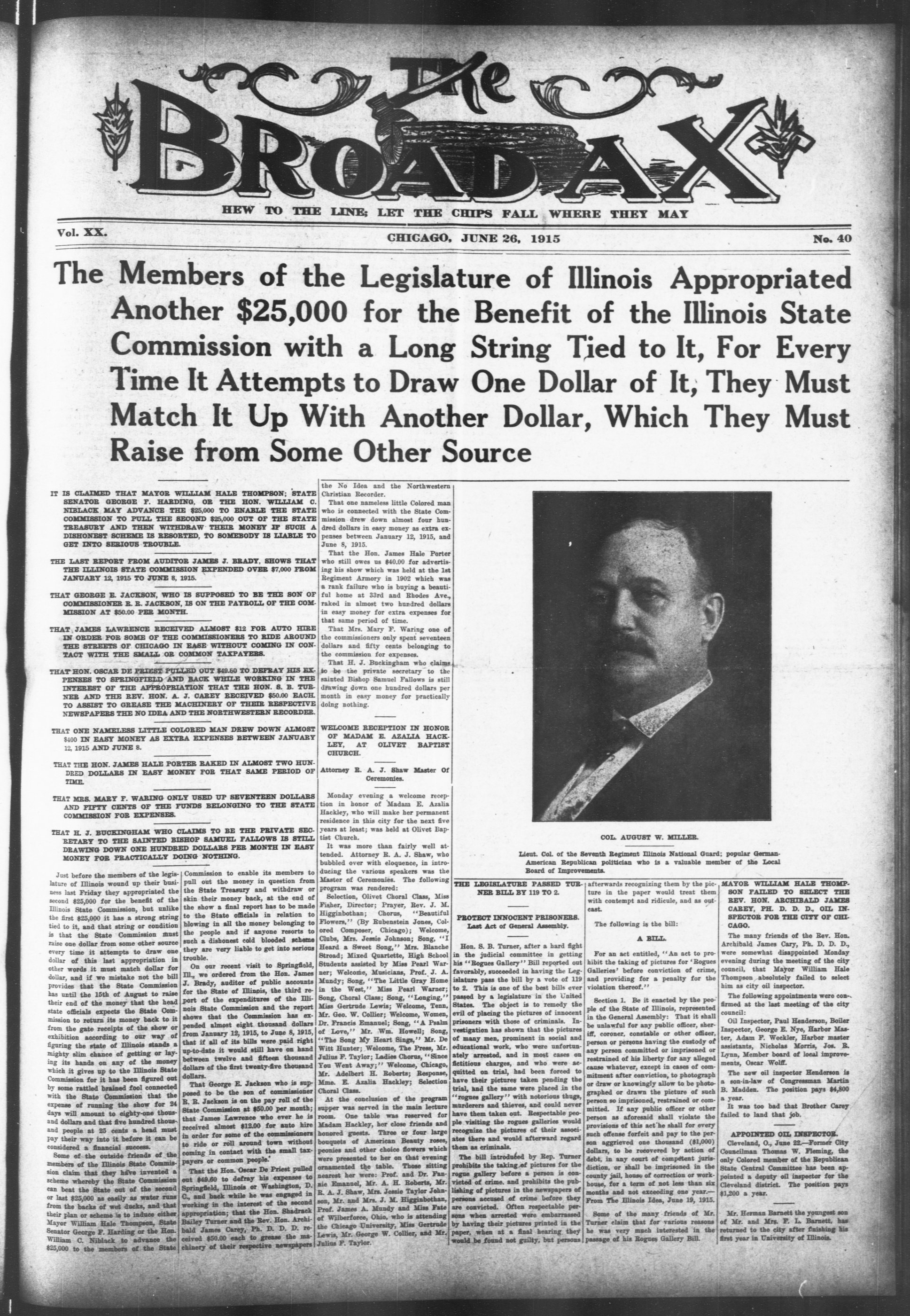
The Members of the Legislature of Illinois Appropriated Another $25,000 for the Benefit of the Illinois State Commission with a Long String Tied to It, For Every Time It Attempts to Draw One Dollar of It, They Must Match It Up With Another Dollar, Which They Must Raise from Some Other Source
IT IS CLAIMED THAT MAYOR WILLIAM HALE THOMPSON; STATE SENATOR GEORGE F. HARDING, OR THE HON. WILLIAM C. NIBLACK, MAY ADVANCE THE $25,000 TO ENABLE THE STATE COMMISSION TO PULL THE SECOND $25,000 OUT OF THE STATE TREASURY AND THEN WITHDRAW THEIR MONEY IF SUCH A DISHONEST SCHEDULE IS RESORTED, TO SOMEBODY IS LIABLE TO GET INTO SERIOUS TROUBLE.
THE LAST REPORT FROM AUDITOR JAMES J. BRADY, SHOWS THAT THE ILLINOIS STATE COMMISSION EXPENDED OVER $7,000 FROM JANUARY 12, 1915 TO JUNE 8, 1915.
THAT GEORGE E. JACKSON, WHO IS SUPPOSED TO BE THE SON OF COMMISSIONER E. B. JACKSON, IS ON THE PAYBOLL OF THE COMMISSION AT $50.00 PER MONTH.
THAT JAMES LAWRENCE RECEIVED ALMOST $12 FOR AUTO HIRE IN ORDER FOR SOME OF THE COMMISSIONERS TO RIDE AROUND THE STREETS OF CHICAGO IN EASE WITHOUT COMING IN CONTACT WITH THE SMALL OR COMMON TAXPAYEES.
THAT HON. OSCAR DE PRIEST PULLED OUT $49.50 TO DEFRAY HIS EXPENSES TO SPRINGFIELD AND BACK WHILE WORKING IN THE INTEREST OF THE APPROPRIATION THAT THE HON. S. B. TURNER AND THE REV. HON. A. J. CAREY RECEIVED $50.00 EACH TO ASSIST TO GREASE THE MACHINERY OF THEIR RESPECTIVE NEWSPAPERS THE NO IDEA AND THE NORTHWESTERN RECORDER.
THAT ONE NAMELESS LITTLE COLORED MAN DREW DOWN ALMOST $400 IN EASY MONEY AS EXTRA EXPENSES BETWEEN JANUARY 12, 1915 AND JUNE 8.
THAT THE HON. JAMES HALE PORTER BAKED IN ALMOST TWO HUNDRED DOLLARS IN EASY MONEY FOR THAT SAME PERIOD OF TIME.
THAT MRS. MARY F. WARING ONLY USED UP SEVENTEEN DOLLARS AND FIFTY CENTS OF THE FUNDS BELONGING TO THE STATE COMMISSION FOR EXPENSES.
THAT H. J. BUCKINGHAM WHO CLAIMS TO BE THE PRIVATE SECRETARY TO THE SAINTED BISHOP SAMUEL FALLOWS IS STILL DRAWING DOWN ONE HUNDRED DOLLARS PER MONTH IN EASY MONEY FOR PRACTICALLY DOING NOTHING.
Vol. XX.
The Member Another Comm Time Match Raises
IT IS CLAIMED THAT MAYOR W SENATOR GEORGE F. HARDY NIBLACK MAY ADVANCE THE COMMISSION TO PULL THE S TREASURY AND THEN WITHE DISHONEST SCHEME IS RESO GET INTO SERIOUS TROUBLE.
THE LAST REPORT FROM AUDITI THE ILLINOIS STATE COMMISSION JANUARY 12, 1915 TO JUNE 8.
THAT GEORGE E. JACKSON, WHO COMMISSIONER B. E. JACKSON MISSION AT $50.00 PER MONTH.
THAT JAMES LAWRENCE RECIEV IN ORDER FOR SOME OF THE THE STREETS OF CHICAGO IN TACT WITH THE SMALL OR
THAT HON. OSCAR DE PRIEST PUNSES TO SPRINGFIELD AND INTEREST OF THE APPROPRIER NER AND THE REV. HON. A TO ASSIST TO GREASE THE NEWSPAPERS THE NO IDEA A
THAT ONE NAMELESS LITTLE CO $400 IN EASY MONEY AS EXT 12, 1915 AND JUNE 8.
THAT THE HON. JAMES HALE POND DRED DOLLARS IN EASY MONE TIME.
THAT MRS. MARY F. WARING ONE AND FIFTY CENTS OF THE COMMISSION FOR EXPENSES.
THAT H. J. BUCKINGHAM WHO C RETRAY TO THE SAINTED B DRAWING DOWN ONE HUNDRE MONEY FOR PRACTICALLY D
Just before the members of the legislature of Illinois wound up their business last Friday they appropriated the second $25,000 for the benefit of the Illinois State Commission, but unlike the first $25,000 it has a strong string tied to it, and that string or condition is that the State Commission must raise one dollar from some other source every time it attempts to draw one dollar of this last appropriation in other words it must match dollar for dollar, and if we mistake not the bill provides that the State Commission has until the 15th of August to raise their end of the money that the head state officials expects the State Commission to return its money back to it from the gate receipts of the show or exhibition according to our way of figuring the state of Illinois stands a mighty slim chance of getting or laying its hands on any of the money which it gives up to the Illinois State Commission for it has been figured out by some rattled brained fool connected with the State Commission that the expense of running the show for 24 days will amount to eighty-one thousand dollars and that five hundred thousand people at 25 cents a head must pay their way into it before it can be considered a financial success.
Some of the outside friends of the members of the Illinois State Commission claim that they have invented a scheme whereby the State Commission can beat the State out of the second or last $25,000 as easily as water runs from the backs of wet ducks, and that their plan or scheme is to induce either Mayor William Hale Thompson, State Senator George F. Harding or the Hon. William C. Niblack to advance the $25,000 to the members of the State
Commission to enable its members to pull out the money in question from the State Treasury and withdraw or skin their money back, at the end of the show a final report has to be made to the State officials in relation to blowing in all the money belonging to the people and if anyone resorts to such a dishonest cold blooded scheme they are very liable to get into serious trouble.
On our recent visit to Springfield, Ill., we ordered from the Hon. James J. Brady, auditor of public accounts for the State of Illinois, the third report of the expenditures of the Illinois State Commission and the report shows that the Commission has expended almost eight thousand dollars from January 12, 1915, to June 8, 1915, that if all of its bills were paid right up-to-date it would still have on hand between twelve and fifteen thousand dollars of the first twenty-five thousand dollars.
That George E. Jackson who is supposed to be the son of commissioner R. E. Jackson is on the pay roll of the State Commission at $50.00 per month; that James Lawrence who ever he is received almost $12.00 for auto hire in order for some of the commissioners to ride or roll around town without coming in contact with the small taxpayers or common people.
That the Hon. Oscar De Priest pulled out $49.00 to defray his expenses to Springfield, Illinois or Washington, D. C., and back while he was engaged in working in the interest of the second appropriation; that the Hon. Shadrack Bailey Turner and the Rev. Hon. Archibald James Carey, Ph. D. D. D. received $50.00 each to grease the machinery of their respective newspapers.
CHICAGO, JUNE 26, 1915
the No Idea and the Northwestern Christian Recorder.
That one nameless little Colored man who is connected with the State Commission drew down almost four hundred dollars in easy money as extra expenses between January 12, 1915, and June 8, 1915.
That the Hon. James Hale Porter who still owes us $40.00 for advertising his show which was held at the 1st Regiment Armory in 1902 which was a rank failure who is buying a beautiful home at 33rd and Rhodes Ave., raked in almost two hundred dollars in easy money for extra expenses for that same period of time.
That Mrs. Mary F. Waring one of the commissioners only spent seventeen dollars and fifty cents belonging to the commission for expenses.
That H. J. Buckingham who claims to be the private secretary to the sainted Bishop Samuel Fallows is still drawing down one hundred dollars per month in easy money for practically doing nothing.
WELCOME RECEPTION IN HONOR OF MADAM E. AZALIA HACKLEY, AT OLIVET BAPTIST CHURCH.
Attorney E. A. J. Shaw Master Of Ceremonies.
Monday evening a welcome reception in honor of Madam E. Azalia Hackley, who will make her permanent residence in this city for the next five years at least; was held at Olivet Baptist Church.
It was more than fairly well attended. Attorney R. A. J. Shaw, who bubbled over with eloquence, in introducing the various speakers was the Master of Ceremonies. The following program was rendered:
Selection, Olivet Choral Class, Miss Fisher, Director, Prayer, Rev. J. M. Higginbothan; Chorus, "Beautiful Flowers," (By Rubenstein Jones, Colored Composer, Chicago); Welcome, Clubs, Mrs. Jessie Johnson; Song, "I Heard a Sweet Song," Mrs. Blanche Stroad; Mixed Quartette, High School Students assisted by Miss Pearl Warner; Welcome, Musicians, Prof. J. A. Mundy; Song, "The Little Gray Home in the West," Miss Pearl Warner; Song, Choral Class; Song, "Longing," Miss Gertrude Lewis; Welcome, Tenn, Mr. Geo. W. Collier; Welcome, Women, Dr. Francis Emanuel; Song, "A Psalm of Love," Mr. Wm. Howell; Song, "The Song My Heart Sings," Mr. De Witt Hunter; Welcome, The Press, Mr. Julius F. Taylor; Ladies Chorus, "Since You Went Away," Welcome, Chicago, Mr. Adelbert H. Roberts; Response, Mme. E. Azalia Hackley; Selection Choral Class.
At the conclusion of the program supper was served in the main lecture room. One table was reserved for Madam Hackley, her close friends and honored guests. Three or four large bouquets of American Beauty roses, peonies and other choice flowers which were presented to her on that evening ornamented the table. Those sitting nearest her were: Prof. and Dr. Fannie Emmannel, Mr. A. H. Roberts, Mr. R. A. J. Shaw, Mrs. Jessie Taylor Johnson, Mr. and Mrs. J. M. Higginbothan, Prof. James A. Mundy and Miss Fate of Wilberforce, Ohio, who is attending the Chicago University, Miss Gertrude Lewis, Mr. George W. Collier, and Mr. Julius F. Taylor.
Lieut. Col. of the Seventh Regiment Illinois National Guard; popular German-American Republican politician who is a valuable member of the Local Board of Improvements.
THE LEGISLATURE PASSED TURNEVER BILL BY 119 TO 2. afterwards recognizing them by the picture in the paper would treat them MAYOR WILLIAMSON PAILED
PROTECT INNOCENT PRISONERS. Last Act of General Assembly.
Hon. S. B. Turner, after a hard fight in the judicial committee in getting his "Rogues Gallery" Bill reported out favorably, succeeded in having the Legislature pass the bill by a vote of 119 to 2. This is one of the best bills ever passed by a legislature in the United States. The object is to remedy the evil of placing the pictures of innocent prisoners with those of criminals. Investigation has shown that the pictures of many men, prominent in social and educational work, who were unfortunately arrested, and in most cases on fictitious charges, and who were acquitted on trial, had been forced to have their pictures taken pending the trial, and the same were placed in the "rogues gallery" with notorious thugs, murderers and thieves, and could never have them taken out. Respectable people visiting the rogues galleries would recognize the pictures of their associates there and would afterward regard them as criminals.
The bill introduced by Rep. Turner prohibits the taking of pictures for the rogue gallery before a person is convicted of crime, and prohibits the publishing of pictures in the newspapers of persons accused of crime before they are convicted. Often respectable persons when arrested were embarrassed by having their pictures printed in the paper, when at a final hearing they would be found not guilty, but persons
COL. AUGUST W. MILLER.
seventh Regiment Illinois National Guard
ican politician who is a valuable mem-
ents.
afterwards recognizing them by the picture in the paper would treat them with contempt and ridicule, and as outcast.
The following is the bill:
A BILL
For an act entitled, "An act to prohibit the taking of pictures for 'Bogues Galleries' before conviction of crime, and providing for a penalty for the violation thereof."
Section 1. Be it enacted by the people of the State of Illinois, represented in the General Assembly: That it shall be unlawful for any public officer, sheriff, coroner, constable or other officer, person or persons having the custody of any person committed or imprisoned or restrained of his liberty for any alleged cause whatever, except in cases of commitment after conviction, to photograph or draw or knowingly allow to be photographed or drawn the picture of such person so imprisoned, restrained or committed. If any public officer or other person as aforesaid shall violate the provisions of this act he shall for every such offense forfeit and pay to the person aggrieved one thousand ($1,000) dollars, to be recovered by action of debt, in any court of competent jurisdiction, or shall be imprisoned in the county jail, house of correction or workhouse, for a term of not less than six months and not exceeding one year.—From The Illinois Ideas, June 19, 1915.
Some of the many friends of Mr. Turner claim that for various reasons he was very much interested in the passage of his Rogues Gallery Bill.
No.40
propriated
inois State
For Every
They Must
They Must
d; popular German-
member of the Local
MAYOR WILLIAM HALE THOMPSON FAILED TO SELECT THE REV. HON. ARCHIBALD JAMES CAREY, PH. D. D. D., OIL INSPECTOR FOR THE CITY OF CHICAGO.
The many friends of the Rev. Hon. Archibald James Cary, Ph. D. D. D., were somewhat disappointed Monday evening during the meeting of the city council, that Mayor William Hale Thompson absolutely failed to select him as city oil inspector.
The following appointments were confirmed at the last meeting of the city council:
Oil Inspector, Paul Henderson, Boiler Inspector, George E. Nye, Harbor Master, Adam F. Weckler, Harbor master assistants, Nicholas Morris, Jos. E. Lynn, Member board of local improvements, Oscar Wolff.
The new oil inspector Henderson is a son-in-law of Congressman Martin B. Madden. The position pays $4,800 a year.
It was too bad that Brother Carey failed to land that job.
APPOINTED OIL INSPECTOR
Cleveland, O., June 22.—Former City Councilman Thomas W. Fleming, the only Colored member of the Republican State Central Committee has been appointed a deputy oil inspector for the Cleveland district. The position pays $1,200 a year.
Mr. Herman Barnett the youngest son of Mr. and Mrs. F. L. Barnett, has returned to the city after finishing his first year in University of Illinois.
PAGE TWO
WILLIAM J. BRYAN'S SILVER TONGUE
Retired Secretary of State Has Great Earning Capacities.
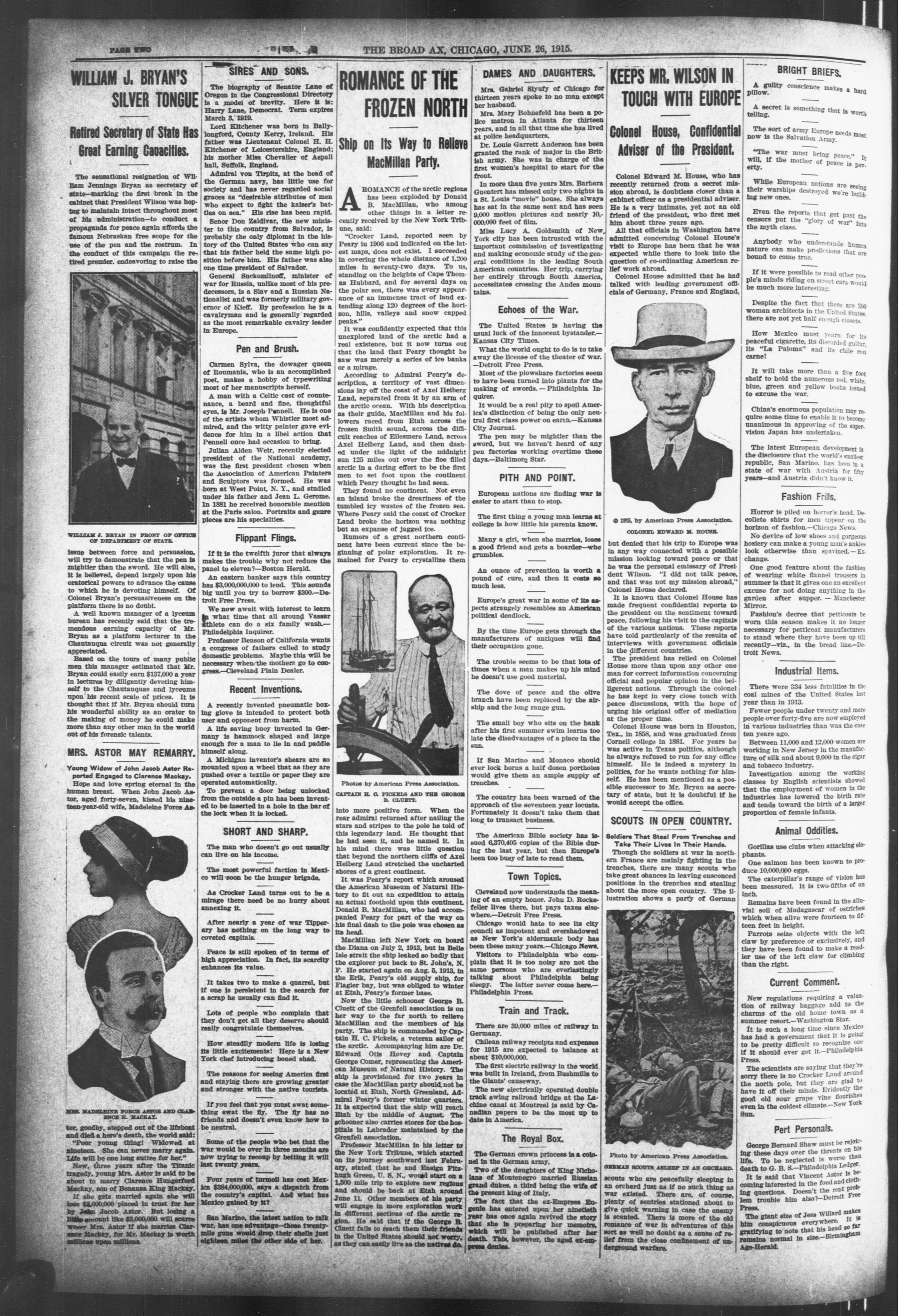
The sensational resignation of William Jennings Bryan as secretary of state—marking the first break in the cabinet that President Wilson was hoping to maintain intact throughout most of his administration—to conduct a propaganda for peace again affords the famous Nebraskan free scope for the use of the pen and the rostrum. In the conduct of this campaign the retired premier, endeavoring to raise the
M.
WILLIAM J. BRYAN IN FRONT OF OFFICE OF DEPARTMENT OF STATE.
issue between force and persuasion, will try to demonstrate that the pen is mightier than the sword. He will also, it is believed, depend largely upon his oratorical powers to advance the cause to which he is devoting himself. Of Colonel Bryan's persuasiveness on the platform there is no doubt.
A well known manager of a lyceum bureau has recently said that the tremendous earning capacity of Mr. Bryan as a platform lecturer in the Chautauqua circuit was not generally appreciated.
Based on the tours of many public men this manager estimated that Mr. Bryan could easily earn $137,000 a year in lectures by diligently devoting himself to the Chautauquas and lyceums upon his recent scale of prices. It is thought that if Mr. Bryan should turn his wonderful ability as an orator to the making of money he could make more than any other man in the world out of his forensic talents.
MRS. ASTOR MAY REMARRY.
Young Widow of John Jacob Astor Reported Engaged to Clarence Mackay. Hope and love spring eternal in the human breast. When John Jacob Astor, aged forty-seven, kissed his nineteen-year-old wife, Madeleine Force As-
M.
MRS. MADELEINE FORCE ASTOR AND CHARDENCE H. MACKAY.
tor, goodby, stepped out of the lifeboat and died a hero's death, the world said: "Poor young thing! Widowed at nineteen. She can never marry again. Life will be one long suture for her."
SIRES AND SONS.
The biography of Senator Lane of Oregon in the Congressional Directory is a model of brevity. Here it is: Harry Lane, Democrat. Term expires March 3, 1919.
Lord Kitchener was born in Ballylongford, County Kerry, Ireland. His father was Lieutenant Colonel H. H. Kitchener of Leicestershire, England; his mother Miss Chevallier of Aspall hall, Suffolk, England.
Admiral von Tirpitz, at the head of the German navy, has little use for society and has never regarded social graces as "desirable attributes of men who expect to fight the kaiser's battles on sea." His rise has been rapid.
Senor Don Zaldivar, the new minister to this country from Salvador, is probably the only diplomat in the history of the United States who can say that his father held the same high position before him. His father was also one time president of Salvador.
General Suckomilinoff, minister of war for Russia, unlike most of his predecessors, is a Slav and a Russian Nationalist and was formerly military governor of Kieff. By profession he is a cavalryman and is generally regarded as the most remarkable cavalry leader in Europe.
Pen and Brush.
Carmen Sylva, the dowager queen of Roumania, who is an accomplished poet, makes a hobby of typewriting most of her manuscripts herself.
A man with a Celtic cast of countenance, a beard and fine, thoughtful eyes, is Mr. Joseph Pennell. He is one of the artists whom Whistler most admired, and the witty painter gave evidence for him in a libel action that Pennell once had occasion to bring.
Julian Alden Weir, recently elected president of the National academy, was the first president chosen when the Association of American Painters and Sculptors was formed. He was born at West Point, N. Y., and studied under his father and Jean L. Gerome. In 1831 he received honorable mention at the Paris salon. Portraits and genre pieces are his specialties.
Flippant Flings.
If it is the twelfth juror that always makes the trouble why not reduce the panel to eleven?—Boston Herald.
An eastern banker says this country has $3,000,000 to lend. This sounds big until you try to borrow $300—Detroit Free Press.
We now await with interest to learn in what time that all around Vassar athlete can do a six family wash.—Philadelphia Inquirer.
Professor Benson of California wants a congress of fathers called to study domestic problems. Maybe this will be necessary when the mothers go to congress.—Cleveland Plain Dealer.
Recent Inventions.
A recently invented pneumatic boxing glove is intended to protect both user and opponent from harm.
A life saving buoy invented in Germany is hammock shaped and large enough for a man to lie in and paddle himself along.
A Michigan inventor's shears are so mounted upon a wheel that as they are pushed over a textile or paper they are operated automatically.
To prevent a door being unlocked from the outside a pln has been invented to be inserted in a hole in the bar of the lock when it is locked.
SHORT AND SHARP
The man who doesn't go out usually can live on his income.
The most powerful faction in Mexico will soon be the hunger brigade.
As Crocker Land turns out to be a mirage there need be no hurry about annexing it.
After nearly a year of war Tipperary has nothing on the long way to coveted capitals.
Peace is still spoken of in terms of high appreciation. In fact, its scarcity enhances its value.
It takes two to make a quarrel, but if one is persistent in the search for a scrap he usually can find it.
Lots of people who complain that they don't get all they deserve should really congratulate themselves.
How steadily modern life is losing its little excitements! Here is a New York chef introducing boned shad.
The reasons for seeing America first and staying there are growing greater and stronger with the native tourists.
If you feel that you must swat something swat the fly. The fly has no friends and doesn't even know how to be neutral.
Some of the people who bet that the war would be over in three months are now trying to recoup by betting it will last twenty years.
Four years of turmoil has cost Mexico $284,000,000, says a dispatch from the country's capital. And what has Mexico gained by it?
San Marino, the latest nation to talk war, has one advantage—those twenty-mile guns would drop their shells just eighteen miles the other side of her.
THE BROAD AX. CHICAGO. JUNE 26, 1915.
ROMANCE OF THE FROZEN NORTH
Ship on Its Way to Relieve MacMillan Party.
ROMANCE of the arctic regions has been exploded by Donald B. MacMillan, who among other things, in a letter re
A ROMANCE of the arctic regions has been exploded by Donald B. MacMillan, who among other things in a letter recently received by the New York Tribune, said:
"Crocker Land, reported seen by Peary in 1906 and indicated on the latest maps, does not exist. I succeeded in covering the whole distance of 1,200 miles in seventy-two days. To us, standing on the heights of Cape Thomas Hubbard, and for several days on the polar sea, there was every appearance of an immense tract of land extending along 120 degrees of the horizon, hills, valleys and snow capped peaks."
It was confidently expected that this unexplored land of the arctic had a real existence, but it now turns out that the land that Peary thought he saw was merely a series of ice banks or a mirage.
According to Admiral Peary's description, a territory of vast dimensions lay off the coast of Axel Helberg Land, separated from it by an arm of the arctic ocean. With his description as their guide, MacMillan and his followers raced from Etah across the frozen Smith sound, across the difficult reaches of Ellesmere Land, across Axel Helberg Land, and then dashed under the light of the midnight sun 125 miles out over the floe filled arctic in a daring effort to be the first men to set foot upon the continent which Peary thought he had seen. They found no continent. Not even an island broke the dreariness of the tumbled icy wastes of the frozen sea. Where Peary said the coast of Crocker Land broke the horizon was nothing but an expanse of jagged ice.
Rumors of a great northern continent have been current since the beginning of polar exploration. It remained for Peary to crystallize them
SAMUEL H. BURKE
Photos by American Press Association.
CAPTAIN H. G. PICKELS AND THE GEORGE B. CLUETT.
into more positive form. When the rear admiral returned after nailing the stars and stripes to the pole he told of this legendary land. He thought that he had seen it, and he named it. In his mind there was little question that beyond the northern cliffs of Axel Helberg Land stretched the uncharted shores of a great continent.
It was Peary's report which aroused the American Museum of Natural History to fit out an expedition to attain an actual foothold upon this continent. Donald B. MacMillan, who had accompanied Peary for part of the way on his final dash to the pole was chosen as its head.
MacMillan left New York on board the Diana on July 2, 1913, but in Belle Isle strait the ship leaked so badly that the explorer put back to St. John's, N. F. He started again on Aug. 5, 1913, in the Erk, Peary's old supply ship, for Flagger bay, but was obliged to winter at Etah. Peary's former base.
Now the little schooner George B. Cluett of the Grenfell association is on her way to the far north to relieve MacMillan and the members of his party. The ship is commanded by Captain H. C. Pickels, a veteran sailor of the arctic. Accompanying him are Dr. Edward Otis Hovey and Captain George Comer, representing the American Museum of Natural History. The ship is provisioned for two years in case the MacMillan party should not be located at Etah, North Greenland, Admiral Peary's former winter quarters. It is expected that the ship will reach Etah by the middle of August. The schooner also carries stores for the hospitals in Labrador maintained by the Grenfell association.
Professor MacMillan in his letter to the New York Tribune, which started on its journey southward last February, stated that he and Ensign Fitzhugh Green, U. S. N., would start on a 1,500 mile trip to explore new regions and should be back at Etah around June 11. Other members of his party will engage in more exploration work in different sections of the arctic region. He said that if the George B. Cinnett fails to reach their friends in the United States should not worry, as they can easily live as the natives do.
DAMES AND DAUGHTERS.
Mrs. Gabriel Slyufy of Chicago for thirteen years spoke to no man except her husband.
Mrs. Mary Bohnefeld has been a police matron in Atlanta for thirteen years, and in all that time she has lived at police headquarters.
Dr. Louie Garrett Anderson has been granted the rank of major in the British army. She was in charge of the first women's hospital to start for the front.
In more than five years Mrs. Barbara Guentert has missed only two nights in a St. Louis "movie" house. She always has sat in the same seat and has seen 9,000 motion pictures and nearly 10,000,000 feet of film.
Miss Lucy A. Goldsmith of New York city has been intrusted with the important commission of investigating and making economic study of the general conditions in the leading South American countries. Her trip, carrying her entirely through South America, necessitates crossing the Andes mountains.
Echoes of the War.
The United States is having the usual luck of the innocent bystander.—Kansas City Times. What the world ought to do is to take away the license of the theater of war.—Detroit Free Press. Most of the plowshare factories seem to have been turned into plants for the making of swords.—Philadelphia Inquirer. It would be a real pity to spoil America's distinction of being the only neutral first class power on earth.—Kansas City Journal. The pen may be mightier than the sword, but we haven't heard of any pen factories working overtime these days.—Baltimore Star.
PITH AND POINT.
European nations are finding war is easier to start than to stop.
The first thing a young man learns at college is how little his parents know.
Many a girl, when she marries, loses a good friend and gets a boarder—who grumbles.
An ounce of prevention is worth a pound of cure, and then it costs so much less.
Europe's great war in some of its aspects strangely resembles an American political deadlock.
By the time Europe gets through the manufacturers of antiques will find their occupation gone.
The trouble seems to be that lots of times when a man makes up his mind he doesn't use good material.
The dove of peace and the olive branch have been replaced by the airship and the long range gun.
The small boy who sits on the bank after his first summer swim learns too late the disadvantages of a place in the sun.
If San Marino and Monaco should ever lock horns a half dozen portholes would give them an ample supply of trenches.
The country has been warned of the approach of the seventeen year locusts. Fortunately it doesn't take them that long to transact business.
The American Bible society has issued 6,370,405 copies of the Bible during the last year, but then Europe's been too busy of late to read them.
Town Topics.
Cleveland now understands the meaning of an empty honor. John D. Rockefeller lives there, but pays taxes elsewhere.—Detroit Free Press.
Chicago would hate to see its city council as impotent and overshadowed as New York's aldermanic body has been these many years.—Chicago News.
Visitors to Philadelphia who complain that it is too noisy are not the same persons who are everlastingly talking about Philadelphia being sleepy. The latter never come here.—Philadelphia Press.
Train and Track.
There are 39,000 miles of railway in Germany. Chilean railway receipts and expenses for 1915 are expected to balance at about $10,000,000. The first electric railway in the world was built in Ireland, from Bushmills to the Glants' causeway. The new electrically operated double track swing railroad bridge at the Lachine canal at Montreal is said by Canadian papers to be the most up to date in America.
The Royal Box.
The German crown princess is a colonel in the German army.
Two of the daughters of King Nicholans of Montenegro married Russian grand dukes, a third being the wife of the present king of Italy.
The fact that the ex-Empress Eugenie has entered upon her ninetieth year has once again revived the story that she is preparing her memoirs, which will be published after her death. This, however, the aged ex-empress denies.
KEEPS MR. WILSON IN TOUCH WITH EUROPE
Colonel House, Confidential Adviser of the President.
Colonel Edward M. House, who has recently returned from a secret mission abroad, is doubtless closer than a cabinet officer as a presidential adviser. He is a very intimate, yet not an old friend of the president, who first met him about three years ago. All that officials in Washington have admitted concerning Colonel House's visit to Europe has been that he was expected while there to look into the question of co-ordinating American relief work abroad. Colonel House admitted that he had talked with leading government officials of Germany, France and England.
[Picture of a man in a suit and hat].
© 1915, by American Press Association.
COLONEL EDWARD M. HOUSE
but denied that his trip to Europe was in any way connected with a possible mission looking toward peace or that he was the personal emissary of President Wilson. "I did not talk peace, and that was not my mission abroad," Colonel House declared.
It is known that Colonel House has made frequent confidential reports to the president on the sentiment toward peace, following his visit to the capitals of the various nations. These reports have told particularly of the results of interviews with government officials in the different countries.
The president has relied on Colonel House more than upon any other one man for correct information concerning official and popular opinion in the belligerent nations. Through the colonel he has kept in very close touch with peace discussions, with the hope of urging his original offer of mediation at the proper time. Colonel House was born in Houston, Tex., in 1888, and was graduated from Cornell college in 1881. For years he was active in Texas politics, although he always refused to run for any office himself. He is indeed a mystery in politics, for he wants nothing for himself. He has been mentioned as a possible successor to Mr. Bryan as secretary of state, but it is doubtful if he would accept the office.
SCOUTS IN OPEN COUNTRY.
Soldiers That Steal From Trenches and Take Their Lives In Their Hands. Though the soldiers at war in northern France are mainly fighting in the trenches, there are many scouts who take great obances in leaving ensconced positions in the trenches and stealing about the more open country. The illustration shows a party of German
A man rests in a hammock in a wooded area. He is lying on his back with his head resting on a pillow. The ground is covered with mud and debris. There are trees in the background.
Photo by American Press Association.
scouts who are peacefully sleeping in an orchard just as if no such thing as war existed. There are, of course, plenty of sentries stationed about to give quick warning in case the enemy is scented. There is more of the old romance of war in adventures of this sort as well no doubt as a sense of relief from the close confinement of underground warfare.
BRIGHT BRIEFS
A guilty conscience makes a hard pillow.
A secret is something that is worth telling.
The sort of army Europe needs most now is the Salvation Army.
"The war must bring peace." It will, if the mother of peace is poverty.
While European nations are seeing their warships destroyed we're building new ones.
Even the reports that get past the censors put the "glory of war" into the myth class.
Anybody who understands human nature can make predictions that are bound to come true.
If it were possible to read other people's minds riding on street cars would be much more interesting.
Despite the fact that there are 300 woman architects in the United States there are not yet half enough closets.
How Mexico must yearn for its peaceful cigarette, its discarded guitar, its "La Paloma" and its chile con carne!
It will take more than a five foot shelf to hold the numerous red, white, blue, green and yellow books issued to excuse the war.
China's enormous population may require some time to enable it to become unanimous in approving of the supervision Japan has undertaken.
The latest European development is the disclosure that the world's smallest republic, San Marino, has been in a state of war with Austria for fifty years—and Austria didn't know it.
Fashion Frills.
Horror is piled on horror's head. Decollete shirts for men appear on the horizon of fashion.—Chicago News.
No device of low shoes and gorgeous hosiery can make a young man's ankles look otherwise than spavined.—Exchange.
One good feature about the fashion of wearing white flannel trousers in summer is that it gives one an excellent excuse for not doing anything in the garden after supper. — Manchester Mirror.
Fashion's decree that petticoats be worn this season makes it no longer necessary for petticoat manufacturers to stand where they have been up till recently—viz., in the bread line—Detroit News.
Industrial Items.
There were 334 less fatalities in the coal mines of the United States last year than in 1913. Fewer people under twenty and more people over forty-five are now employed in various industries than was the case ten years ago. Between 11,000 and 12,000 women are working in New Jersey in the manufacture of silk and about 9,000 in the cigar and tobacco industry. Investigation among the working classes by English scientists showed that the employment of women in the industries has lowered the birth rate and tends toward the birth of a larger proportion of female infants.
Animal Oddities.
Gorillas use clubs when attacking elephants.
One salmon has been known to produce 10,000,000 eggs.
The caterpillar's range of vision has been measured. It is two-fifths of an inch.
Remains have been found in the alluvial soil of Madagascar of ostriches which when alive were fourteen to fifteen feet in height.
Parrots seize objects with the left claw by preference or exclusively, and they have been found to make a reader use of the left claw for climbing than the right.
Current Comment.
New regulations requiring a valuation of railway baggage add to the charms of the old home town as a summer resort—Washington Star.
It is such a long time since Mexico has had a government that it is going to be pretty difficult to recognize one if it should ever get it—Philadelphia Press.
The scientists are saying that they're sorry there is no Crocker Land around the north pole, but they are glad to have it off their minds. Evidently the good old sour grape vine flourishes even in the coldest climate—New York Sun.
Pert Personals.
George Bernard Shaw must be rejoicing these days over the threats on his life. To be neglected is worse than death to G. B. S.—Philadelphia Ledger. It is said that Vincent Astor is becoming interested in the food and clothing questions. Doesn't the rent problem trouble him also?—Detroit Free Press. The giant size of Jess Willard makes him conspicuous everywhere. It is gratifying to note that his head so far remains normal in size.—Birmingham Age-Herald.
The quick brown fox jumps over the lazy dog.
QUEEN MILENA.
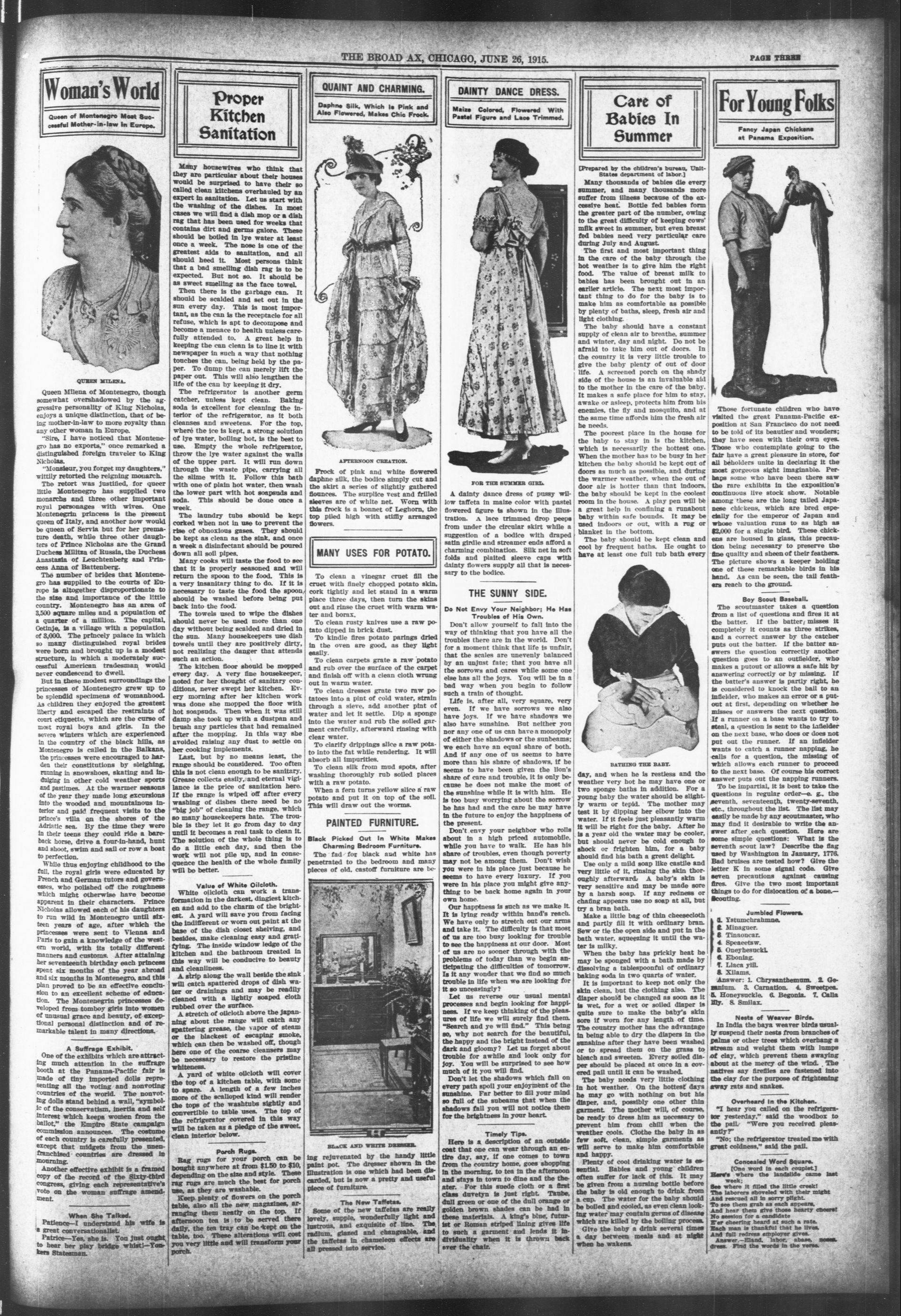
Queen Milena of Montenegro, though somewhat overshadowed by the aggressive personality of King Nicholas, enjoys a unique distinction, that of being mother-in-law to more royalty than any other woman in Europe.
"Sire, I have noticed that Montenegro has no exports," once remarked a distinguished foreign traveler to King Nicholas.
"Monsieur, you forget my daughters," wittily retorted the reigning monarch.
witty retorted the reigning monarch. The retort was justified, for queer little Montenegro has supplied two monarchs and three other important royal personages with wives. One Montenegro princess is the present queen of Italy, and another now would be queen of Servia but for her premature death, while three other daughters of Prince Nicholas are the Grand Duchess Militza of Russia, the Duchess Anastasia of Leuchtenberg and Princess Anna of Battenberg.
The number of brides that Montenegro has supplied to the courts of Europe is altogether disproportionate to the size and importance of the little country. Montenegro has an area of 3,500 square miles and a population of a quarter of a million. The capital, Cetinje, is a village with a population of 3,000. The princely palace in which so many distinguished royal brides were born and brought up is a modest structure, in which a moderately successful American tradesman would never descend to dwell.
But in these modest surroundings the princesses of Montenegro grew up to be splendid specimens of womanhood. As children they enjoyed the greatest liberty and escaped the restraints of court etiquette, which are the curse of most royal boys and girls. In the severe winters which are experienced in the country of the black hills, as Montenegro is called in the Balkans, the princesses were encouraged to harden their constitutions by sleighing, running in snowshoes, skating and indulging in other cold weather sports and pastimes. At the warmer seasons of the year they made long excursions into the wooded and mountainous interior and paid frequent visits to the prince's villa on the shores of the Adriatic sea. By the time they were in their teens they could ride a barbecue horse, drive a four-in-hand, hunt and shoot, swim and sail or row a boat to perfection.
While thus enjoying childhood to the full, the royal girls were educated by French and German tutors and governesses, who polished off the roughness which might otherwise have become apparent in their characters. Prince Nicholas allowed each of his daughters to run wild in Montenegro until sixteen years of age, after which the princesses were sent to Vienna and Paris to gain a knowledge of the western world, with its totally different manners and customs. After attaining her seventeenth birthday each princess spent six months of the year abroad and six months in Montenegro, and this plan proved to be an effective conclusion to an excellent scheme of education. The Montenegrin princesses developed from tomboy girls into women of unusual grace and beauty, of exceptional personal distinction and of remarkable talent in many directions.
A Suffrage Exhibit.
One of the exhibits which are attracting much attention in the suffrage booth at the Panama-Pacific fair is made of tiny imported dolls representing all the voting and nonvoting countries of the world. The nonvoting dolls stand behind a wall, "symbolic of the conservatism, inertia and self interest which keeps women from the ballot," the Empire State campaign commission announces. The costume of each country is carefully presented, except that midgets from the unenfranchised countries are dressed in mourning.
Another effective exhibit is a framed copy of the record of the Sixty-third congress, giving each representative's vote on the woman suffrage amendment.
When She Talked.
When She Talked.
Patience—I understand his wife is a great conversationist.
Patrice—Yes, she is. You just ought to hear her play bridge whist!—Yonkea Statsenov.
Proper Kitchen Sanitation
Many housewives who think that they are particular about their houses would be surprised to have their so called clean kitchens overhauled by an expert in sanitation. Let us start with the washing of the dishes. In most cases we will find a dish mop or a dish rag that has been used for weeks that contains dirt and germs galore. These should be boiled in lye water at least once a week. The nose is one of the greatest aids to sanitation, and all should heed it. Most persons think that a bad smelling dish rag is to be expected. But not so. It should be as sweet smelling as the face towel.
Then there is the garbage can. It should be scalded and set out in the sun every day. This is most important, as the can is the receptacle for all refuse, which is apt to decompose and become a menace to health unless carefully attended to. A great help in keeping the can clean is to line it with newspaper in such a way that nothing touches the can, being held by the paper. To dump the can merely lift the paper out. This will also lengthen the life of the can by keeping it dry.
The refrigerator is another germ catcher, unless kept clean. Baking soda is excellent for cleaning the interior of the refrigerator, as it both cleanses and sweetens. For the top, where the ice is kept, a strong solution of lye water, boiling hot, is the best to use. Empty the whole refrigerator, throw the lye water against the walls of the upper part. It will run down through the waste pipe, carrying all the slime with it. Follow this bath with one of plain hot water, then wash the lower part with hot soapsuds and soda. This should be done once a week.
The laundry tubs should be kept corked when not in use to prevent the rise of obnoxious gases. They should be kept as clean as the sink, and once a week a disinfectant should be poured down all soil pipes.
Many cooks will taste the food to see that it is properly seasoned and will return the spoon to the food. This is a very insanitary thing to do. If it is necessary to taste the food the spoon should be washed before being put back into the food.
The towels used to wipe the dishes should never be used more than one day without being scalded and dried in the sun. Many housekeepers use dish towels until they are positively dirty, not realizing the danger that attends such an action.
The kitchen floor should be mopped every day. A very fine housekeeper, noted for her thought of sanitary conditions, never swept her kitchen. Every morning after her kitchen work was done she mopped the floor with hot soapsuds. Then when it was still damp she took up with a dustpan and brush any particles that had remained after the mopping. In this way she avoided raising any dust to settle on her cooking implements.
Last, but by no means least, the range should be considered. Too often this is not clean enough to be sanitary. Grease collects easily, and eternal vigilance is the price of sanitation here. If the range is wiped off after every washing of dishes there need be no "big job" of cleaning the range, which so many housekeepers hate. The trouble is they let it go from day to day until it becomes a real task to clean it. The solution of the whole thing is to do a little each day, and then the work will not pile up, and in consequence the health of the whole family will be better.
Value of White Oilcloth.
White oilcloth can work a transformation in the darkest, dingiest kitchen and add to the charm of the brightest. A yard will save you from facing the indifferent or worn out paint at the base of the dish closet shelving, and besides, make cleaning easy and gratifying. The inside window ledge of the kitchen and the bathroom treated in this way will be conducive to beauty and cleanliness. A strip along the wall beside the sink will catch spattered drops of dish water or drainings and may be readily cleaned with a lightly soaped cloth rubbed over the surface. A stretch of oilcloth above the japanning about the range will catch any spattering grease, the vapor of steam or the blackest of escaping smoke, which can then be washed off, though here one of the coarse cleansers may be necessary to restore the pristine whiteness.
A yard of white oilcloth will cover the top of a kitchen table, with some to spare. A length of a few inches more of the scalloped kind will render the tops of the washbuns slightly and convertible to table uses. The top of the refrigerator covered in this way will be taken as a pledge of the sweet, clean interior below.
Porch Rugs.
Rag rugs for your porch can be bought anywhere at from $1.50 to $10, depending on the size and style. These rag rugs are much the best for porch use, as they are washable.
Keep plenty of flowers on the porch table, also all the new magazines, arranging them neatly on the top. If afternoon tea is to be served there daily, the tea tray can be kept on the table, too. These alterations will cost you very little and will transform your porch.
THE BROAD AX, CHICAGO, JUNE 26, 1915
AFTERNOON CREATION.
Frock of pink and white flowered daphne silk, the bodice simply cut and the skirt a series of slightly gathered flouces. The surplice vest and frilled sleeves are of white net. Worn with this frock is a bonnet of Leghorn, the top piled high with stiffly arranged flowers.
MANY USES FOR POTATO.
To clean a vinegar cruet fill the cruet with finely chopped potato skin, cork tightly and let stand in a warm place three days, then turn the skins out and rinse the cruet with warm water and borax.
To clean rusty knives use a raw potato dipped in brick dust.
To kindle fires potato parings dried in the oven are good, as they light easily.
To clean carpets grate a raw potato and rub over the surface of the carpet and finish off with a clean cloth wrung out in warm water.
To clean dresses grate two raw potatoes into a pint of cold water, strain through a sieve, add another pint of water and let it settle. Dip a sponge into the water and rub the soiled garment carefully, afterward rinsing with clear water.
To clarify drippings slice a raw potato into the fat while rendering. It will absorb all impurities.
To clean silk from mud spots, after washing thoroughly rub soiled places with a raw potato.
When a fern turns yellow slice a raw potato and put it on top of the soil.
This will draw out the worms.
PAINTED FURNITURE
Black Picked Out In White Makes Charming Bedroom Furniture. The fad for black and white has penetrated to the bedroom and many pieces of old, castoff furniture are be-
5
BLACK AND WHITE DRESSER.
ing rejuvenated by the handy little paint pot. The dresser shown in the illustration is one which had been discarded, but is now a pretty and useful piece of furniture.
The New Taffetas
Some of the new taffetas are really lovely, supple, wonderfully light and lustrous, and exquisite of line. The radium, glazed and changeable, and the taffetas in chameleon effects are all pressed into service.
9
FOR THE SUMMER GIRL.
A dainty dance dress of pussy willow taffeta in maize color with pastel flowered figure is shown in the illustration. A lace trimmed drop peeps from under the circular skirt while a suggestion of a bodice with draped satin girdle and streamer ends afford a charming combination. Silk net in soft folds and platted sleeve caps with dainty flowers supply all that is necessary to the bodice.
THE SUNNY SIDE.
Do Not Envy Your Neighbor; He Has Troubles of His Own.
Don't allow yourself to fall into the way of thinking that you have all the troubles there are in the world. Don't for a moment think that life is unfair, that the scales are unevenly balanced by an unjust fate; that you have all the sorrows and cares while some one else has all the joys. You will be in a bad way when you begin to follow such a train of thought.
Life is, after all, very square, very even. If we have sorrows we also have joys. If we have shadows we also have sunshine. But neither you nor any one of us can have a monopoly of either the shadows or the sunbeams; we each have an equal share of both. And if any one of us seems to have more than his share of shadows, if he seems to have been given the lion's share of care and trouble, it is only because he does not make the most of the sunshine while it is with him. He is too busy worrying about the sorrow he has had and the care he may have in the future to enjoy the happiness of the present.
Don't envy your neighbor who rolls about in a high priced automobile, while you have to walk. He has his share of troubles, even though poverty may not be among them. Don't wish you were in his place just because he seems to have every luxury. If you were in his place you might give anything to be back home again in your own home.
Our happiness is such as we make it. It is lying ready within hand's reach. We have only to stretch out our arms and take it. The difficulty is that most of us are too busy looking for trouble to see the happiness at our door. Most of us are no sooner through with the problems of today than we begin anticipating the difficulties of tomorrow. Is it any wonder that we find so much trouble in life when we are looking for it so unseasonably?
Let us reverse our usual mental processes and begin looking for happiness. If we keep thinking of the pleasures of life we will surely find them, "Search and ye will find." This being so, why not search for the beautiful, the happy and the bright instead of the dark and gloomy? Let us forget about trouble for awhile and look only for joy. You will be surprised to see how much of it you will find.
Don't let the shadows which fall on every path spoil your enjoyment of the sunshine. Far better to fill your mind so full of the submeans that when the shadows fall you will not notice them for the brightness in your heart.
Timely Tips.
Here is a description of an outside coat that one can wear through an entire day, say, if one comes to town from the country home, goes shopping in the morning, to tea in the afternoon and stays in town to dine and the theater. For this suede cloth or a first class duvety is just right. Taube, dull green or one of the dull orange or golden brown shades can be had in these materials. A king's blue, futurist or Roman striped lining gives life to such a garment and lends it individuality when it is thrown back over the chair.
Care of Babies In Summer
[Prepared by the children's bureau, Unit-
States department of labor.]
Many thousands of babies die every summer, and many thousands more suffer from illness because of the excessive heat. Bottle fed babies form the greater part of the number, owing to the great difficulty of keeping cows' milk sweet in summer, but even breast fed babies need very particular care during July and August.
The first and most important thing in the care of the baby through the hot weather is to give him the right food. The value of breast milk to bables has been brought out in an earlier article. The next most important thing to do for the baby is to make him as comfortable as possible by plenty of baths, sleep, fresh air and light clothing. The baby should have a constant supply of clean air to breathe, summer and winter, day and night. Do not be afraid to take him out of doors. In the country it is very little trouble to give the baby plenty of out of door life. A screened porch on the shady side of the house is an invaluable aid to the mother in the care of the baby. It makes a safe place for him to stay, awake or asleep, protects him from his enemies, the fly and mosquito, and at the same time affords him the fresh air he needs.
The poorest place in the house for the baby to stay in is the kitchen, which is necessarily the hottest one. When the mother has to be busy in her kitchen the baby should be kept out of doors as much as possible, and during the warmer weather, when the out of door air is hotter than that indoors, the baby should be kept in the coolest room in the house. A play pen will be a great help in confining a runabout baby within safe bounds. It may be used indoors or out, with a rug or blanket in the bottom.
The baby should be kept clean and cool by frequent baths. He ought to have at least one full tub bath every
A woman in a black dress is sitting on a mat, holding a baby in her hands.
BATHING THE BABY.
day, and when he is restless and the weather very hot he may have one or two sponge baths in addition. For a young baby the water should be slightly warm or tepid. The mother may test it by dipping her elbow into the water. If it feels just pleasantly warm it will be right for the baby. After he is a year old the water may be cooler, but should never be cold enough to shock or frighten him, for a baby should find his bath a great delight.
Use only a mild soap like castile and very little of it, rinsing the skin thoroughly afterward. A baby's skin is very sensitive and may be made sore by a harsh soap. If any redness or chafing appears use no soap at all, but try a bran bath.
Make a little bag of thin cheesecloth and partly fill it with ordinary bran. Sew or tie the open side and put in the bath water, squeezing it until the water is milky.
When the baby has prickly heat he may be sponged with a bath made by dissolving a tablespoonful of ordinary baking soda in two quarts of water. It is important to keep not only the skin clean, but the clothing also. The diaper should be changed as soon as it is wet, for a wet or soiled diaper is quite sure to make the baby's skin sore if worn for any length of time. The country mother has the advantage in being able to dry the diapers in the sunshine after they have been washed or to spread them on the grass to bleach and sweeten. Every soiled diaper should be placed at once in a covered pad until it can be washed.
The baby needs very little clothing in hot weather. On the hottest days he may go with nothing on but his diaper, and, possibly one other thin garment. The mother will, of course, be ready to dress him as necessary to prevent him from chill when the weather cools. Clothe the baby in as few soft, clean, simple garments as will serve to make him comfortable and happy.
Plenty of cool drinking water is essential. Babies and young children often suffer for lack of this. It may be given from a nursing bottle before the baby is old enough to drink from a cup. The water for the baby should be boiled and cooled, as even clean looking water may contain germs of disease which are killed by the boiling process.
Give the baby a drink several times a day between meals and at night when he wakes.
PAGE THREE
Fancy Japan Chickens at Panama Exposition.
A
Those fortunate children who have visited the great Panama-Pacific exposition at San Francisco do not need to be told of its beauties and wonders; they have seen with their own eyes. Those who contemplate going to the fair have a great pleasure in store, for all beholders unite in declaring it the most gorgeous sight imaginable. Perhaps some who have been there saw the rare exhibits in the exposition's continuous live stock show. Notable among these are the long tailed Japanese chickens, which are bred especially for the emperor of Japan and whose valuation runs to as high as $2,000 for a single bird. These chickens are housed in glass, this precaution being necessary to preserve the fine quality and sheen of their feathers. The picture shows a keeper holding one of these remarkable birds in his hand. As can be seen, the tail feathers reach to the ground.
Boy Scout Baseball.
The scoutmaster takes a question from a list of questions and fires it at the batter. If the batter misses it completely it counts as three strikes, and a correct answer by the catcher puts out the batter. If the batter answers the question correctly another question goes to an outfielder, who makes a putout or allows a safe hit by answering correctly or by missing. If the batter's answer is partly right, he is considered to knock the ball to an infielder, who makes an error or a putout at first, depending on whether he misses or answers the next question. If a runner on a base wants to try to steal, a question is sent to the infielder on the next base, who does or does not put out the runner. If an infielder wants to catch a runner napping, he calls for a question, the missing of which allows each runner to proceed to the next base. Of course his correct answer puts out the napping runners.
To be impartial, it is best to take the questions in regular order—e. g., the seventh, seventeenth, twenty-seventh, etc., throughout the list. The list may easily be made by any scoutmaster, who may find it desirable to write the answer after each question. Here are some simple questions: What is the seventh scout law? Describe the flag used by Washington in January, 1776. Bad bruises are tested how? Give the letter K in some signal code. Give seven precautions against causing fires. Give the two most important things to do for dislocation of a bone.—Scouting.
Answer: 1. Chrysanthemum. 2. Gemium. 3. Carnation. 4. Sweetpea. 5. Honeysuckle. 6. Begonia. 7. Calla
Lily. 8. Smilax.
Nests of Weaver Birds.
In India the baya weaver birds usually suspend their nests from branches of palms or other trees which overhang a stream and weight them with lumps of clay, which prevent them swaying about at the mercy of the wind. The natives say fireflies are fastened into the clay for the purpose of frightening away rats and snakes.
Overheard In the Kitchen.
"I hear you called on the refrigerator yesterday," said the woodbox to the pail. "Were you received pleasantly?"
"No; the refrigerator treated me with great coldness," said the pail.
Concealed Word Square.
[One word in each couplet]
Here's where the landslide came last week;
See where it filled the little creek!
The laborers shoved with their might. And rescued all in sorry plight.
To see them grab as each appears. And hear them give those hearty cheers! No session for a candidate.
For sheering it such a rate. Each he was thankful that he lives. And full redress employer gives.
Answer.—Eland, labor, abase, ness, dress. Find the words in the verse.
PAGE FOUR
THE BROAD AX
PUBLISHED WEEKLY.
Will promulgate and at all times uphold the true principles of Democracy, but Catholics, Protestants, Priests, Infidels, single Tutors, Republicans, or anyone else can have their say, as long as their language is proper and responsibility is fixed.
The Broad AX is a newspaper whose platform is broad enough for all, ever claiming the editorial right to speak its own mind.
Local communications will receive attention. Write only on one side of the paper.
Advertising rates made known on application.
Address all communications to
6532 ST. LAWRENCE AVE., CHICAGO, ILL.
PHONE WENTWORTH 2597.
JULIUS F. TAYLOR, Editor and Publisher
Entered as Second-Class Matter Aug. 18,
1902, at the Post Office at Chicago, Illinois,
under Act of March 8, 1870.
REMOVAL NOTICE
From on and after this date, all letter, or other mail matter intended for Julius F. Taylor or Mrs. Annie E. Taylor or The Broad Ax, should be addressed to 6532 St. Lawrence Ave., Jackson Park station. Phone Wentworth 2597.
THOUSANDS DIE NEEDLESSLY
IN SEARCH OF HEALTH.
National Tuberculosis Association Tells Who should Go West.
From 10,000 to 15,000 consumptives go West in search of health every year. Such is an estimate made by the National Association for the Study and Prevention of Tuberculosis in a statement issued today based on recent investigations of the United States Public Health Service. The Association concludes that there are at present between 100,000 and 200,000 consumptives in the States of California, Arizona, New Mexico, Texas and Colorado.
Investigations were made during the past year by Surgeons of the United States Public Health Service, P. M. Carrington in California, E. A. Sweet in Texas and New Mexico, and A. D. Foster in North and South Carolina. The National Association draws the following conclusions from these studies:
(1) Thousands of consumptives attracted by the climate migrate every year to the West and Southwest. While no definite figures can be procured, the facts ascertained would indicate an annual migration of at least 10,000 and possible 15,000 into the States of California, Arizona, Colorado, New Mexico and Texas.
(2) From 30 to 50 per cent of these consumptives are hopeless cases and die within six months after their arrival, the percentage of those dying within 30 days running as high as 15.
(3) A large, but unknown percentage die in almshouses or are the recipients of charity and the great majority of these could have been made comfortable in their last days if they had stayed at home among friends and relatives.
(4) From 40 to 90 per cent of all deaths from tuberculosis in the West and Southwest are of natives of other states, nearly 50 per cent coming from Illinois, Missouri, Ohio, Kentucky, Tennessee and New York.
(5) People who can afford it and who are not in too far advanced stages of tuberculosis will find the climate of the West and Southwest an aid in the treatment of tuberculosis.
(6) No one should think of going West or Southwest for his health unless he has at least $1,000 above his railroad fare, and can leave his family in comfortable circumstances; and no one should go who is in an advanced stage of tuberculosis or who has not taken careful medical advice.
(7) Tuberculosis can be cured in any part of the United States, and it is far better for a consumptive of moderate means, such as the average workingman, to go to a sanatorium near at home, than to go West and live in a more favorable climate without proper food or medical care.
(8) Finally, there may be plenty of jobs in the West and Southwest for able-bodied men, but the consumptive will find the greatest difficulty in getting work, and no one should go West therefore in the hope of getting a job. The National Association for the Study and Prevention of Tuberculosis will send free literature or give information about sanatoria and hospitals to any one inquiring at its office, 105 East 22d Street, New York City.
One man said that when the law was on your side, why it was alright; but when the law was against you; it was all wrong.
---
HEALTH NOTES
There is not very much talk yet about a "Sane Fourth" of July. However, it may be taken for granted that the people of Chicago do not intend to go back to the old fashioned day of noise and din, destruction and death. We can certainly show our patriotism in other ways that are safe, sane and satisfactory.
For six years prior to the introduction of anti-typhoid vaccine in the army in 1910, our soldiers lost time on account of sickness from typhoid at the rate of over 71 days every day for an army of 100,000. In 1910 when anti-typhoid vaccination was offered the soldiers, if they cared to take it, enough of them took it to reduce this daily loss of time or sick leave in the army from 71 to 49. In March, 1911, anti-typhoid vaccination became compulsory and for that year the rate was still further reduced from 49 to 20. In 1912 with vaccination compulsory, the sick leave from typhoid dropped to 8 days per 100,000 soldiers and in 1913 to one-third of a day. In other words, by applying the efficiency idea, the time loss in our army from typhoid was reduced from 71 days to one-third of a day.
A pupil of the 7th grade, Scanlan School, has composed the following songlet as her contribution to the fly campaign. It may be sung to the tune of Tramp! Tramp! and is as follows:
SWAT! SWAT! SWAT!
In the dining room I sit,
And the flies around me flit,
They are in the soup, the hash, the
milk, the tea,
They are in the sugar too,
On my face and on my shoe,
They're as busy as the busy, busy
CHORUS
Swat! Swat! Swat! them as they fly,
If you don't you'll have to face
Fifty Billion in their place,
And it may be one will make you
sick and die.
* * *
Also in the same school one of the
boys in the 7th grade sends in the
following on.
THE FLY.
I am a fly. I generally take my breakfast in a restraurant, which is the garbage can in the back yard. After I am full I like to have some fun, so I go into the house and tickle the baby's head and make him cry. The people in this house where I live have screens and it is hard for me to go from the garbage can to the house, but there is a little hole in the back door screen and I get in there. I had a narrow escape the other day. The boy that lives in the house caught me coming in through the hole and he tried to hit me with his cap, but I got away. I think I shall move because it is too dangerous in this house and I am afraid of getting killed. This is certainly war times for the flies.
THE EDITOR.
Consider the editor. He wearth purple and fine linen. His abode is amongst the mansions of the rich. His wife hath her limousine and his first born sporteth a racing car that can hit her up in forty flat.
Lo! All the people breaketh their necks to hand him money. A child is born unto the wife of a merchant in the bazaar. The physician getteth ten golden plunks. The editor writeth a stick and a half and telleth the multitude that the child tippeth the beam at nine pounds. Yes, he lieth even as a centurion, and the proud father giveth him a cremo.
Behold, the young one groweth up and graduateeth, and the editor putteth into his paper a swell notice. Yes, a peach of a notice. He tellleth of the wisdom of the young woman, and of her exceeding comeliness. Like unto the roses of Sharon is she and her gown is played up to beat the band. And the dressmaker getteth two score and four iron men. And the editor getteth a note of thanks from the S. G. G.
The daughter goeth a journey and the editor throweth himself on the story of the farewell party. It runneth column, solid. And the fair one remembereth him from afar with a picture postal card that costeth six for a jitney.
Behold, she returneth and the youth of the city fall down and worship. She picketh one and lo, she picketh a lemon. But the editor calleth him one of our promising young men and getteth away with it. And they send unto him a bid to the wedding feast and behold, the bids are fashioned by Muntgummery Hawbuck, in a far city. Flowery and long is the wedding notice which the editor printeth. The minister getteth ten bones. The groom standeth the editor off for a twelve-month subscription.
All flesh is grass and in time the wife gathered into the silo. The minister getteth his bit. The editor printeth a death notice, two columns of obituary, three lodge notices, a cubit of poetry and a card of thanks. And he forgetteth to read proof on the head, and the darned thing cometh out "Gone to Her Lest Roosting Place."
THE BROAD AX. CHICAGO, JUNE 26, 1915.
Chief Justice White of the United States Supreme Court, Who Is Dyed in the Wool, Southern Democrat, a Devoted and Highly Honored Member of the Roman Catholic Church, Handed Down the Opinion Knocking Out the "Grandfather Clause" In the Oklahoma Constitution
DECLARING THAT IT IS UNCONSTITUTIONAL TO DEPRIVE THE COLORED MEN OF THE VOTE IN THAT STATE.
SHOWING CONCLUSIVELY THAT THOSE SAME PROVISIONS IN THE CONSTITUTIONS IN MANY OF THE OTHER SOUTHERN STATES CAN BE SUCCESSFULLY KNOCKED OUT AND DECLARED NULL AND VOID BY THE HIGHEST COURT IN THE LAND IF THE COLORED PEOPLE RESIDING IN THEM WILL COMBAT OR FIGHT THEM TO THE BITTER END.
The first of this week, the United States Supreme Court at Washington, D. C., handed down a sweeping and far reaching opinion annulling as unconstitutional the Oklahoma constitutional amendment and the Annapolis, Md., voters qualification law restricting the suffrage rights of those who could not vote or whose ancestors would not vote prior to the ratification of the fifteenth amendment to the federal constitution.
standard from the inclusion in the literacy test.
The court had difficulty, he said, in finding words to more clearly demonstrate its conviction that this action of the state re-created and perpetuated the conditions which the fifteenth amendment was intended to destroy, than the language used in the amendment.
Says Intent Was Apparent.
“It is true,” continued the chief
Mr. Chief Justice White, who is a native of La., an ex-confederate soldier, a dyed in the wool Southern Democrat who is devoted and a highly honored member of the Roman Catholic Church announced the decision or the findings of the court, which was unanimous.
By holding that conditions that existed before the fifteenth amendment, which provides that the right to vote shall not be denied or abridged on account of race, color, or previous condition of servitude, could not be brought over to the present day in regard of this self-executing amendment, it is generally believed that the court went a long way toward invalidating much of the so-called "grandfather clause" legislation of southern states.
Applies to All Elections.
The court held that election officials could not ignore the potency of the fifteenth amendment in wiping out of state constitutions the word "White" as a qualification for voting. In the Maryland case the court's decision established the point that the fifteenth amendment applies alike to municipal as well as to federal elections.
Discussing the Oklahoma cases, Chief Justice White said the suffrage amendment to the state constitution first fixed a literacy standard and then followed it with a provision creating a standard based upon the condition existing on Jan. 1, 1866, prior to the adoption of the fifteenth amendment, and eliminated those coming under that
And all that are akin to the deceased jumpeth on the editor with exceeding great jumps. And they pulleth out their ads and cancelleth their subscriptions and they swing the hammer unto the third and fourth generations. Cant thou beat it?—Exchange.
BOOM BROWN FOR U. S. BENCH.
Friends of Defeated Jurist Hope to
See Him Named to Fill Vacan-
cy on Court of Appeals.
Since the recent election, in which
Judge Edward O. Brown was defeated,
lawyers and others interested in fed-
eral court practice are wondering
whether the Washington administration will not consider the desirability of filling the vacancy in the United States Court of Appeals by his appointment. It is understood that friends of the administration here, including Senator Lewis would be pleased at such an appointment. The fact that Judge Brown is over 60 years old should not, his friends say, be an objection to his appointment because of his physical and mental vigor.
standard from the inclusion in the literacy test. The court had difficulty, he said, in finding words to more clearly demonstrate its conviction that this action of the state re-created and perpetuated the conditions which the fifteenth amendment was intended to destroy, than the language used in the amendment.
Says Intent Was Apparent.
"It is true," continued the chief justice "that it contains no express words of an exclusion from the standard which it establishes of any person on account of race, color, or previous conditions of servitude prohibited by the fifteenth amendment, but the standard itself inherently brings that result into existence, since it is based purely upon a period of time before the enactment of the fifteenth amendment and makes that period the controlling and dominant test of the right of suffrage.
"We say this because we are unable to discover how, unless the prohibitions of the fifteenth amendment were considered, the slightest reason was afforded for basing the classification upon a period of time prior to the fifteenth amendment."
It is clearly evident to our mind that if the Colored people residing in the Southern States would stand together like unto one man that all the "Jim Crow" legislation which have been enacted by the legislatures of those states for the past 25 years which have no other object in view than to strike at the manhood rights of the Colored people, would if they were properly presented to the United States Supreme Court declared null and void by it.
Lastly the Colored people throughout this broad land must learn this one great and undying lesson namely, that those who would be free must themselves strike the first blow—fight and contend to the bitter end for Liberty and Justice.
NEGEO FELLOWSHIP LEAGUE.
A race conference has been called to meet at the Reading Room of the Negro Fellowship League, 3005 State Street, Sunday June 27th at 4 P. M. Each club and organization is asked to send two delegates to see what can be done about the alarming increase of race prejudice and the seeming indifference of our people. All who are interested are cordially invited to be present and take part in the discussion. Last Sunday the League was entertained by the Alpha Suffrage Club. Many were present. Several joined the League and the Alpha Suffrage Club. Mrs. M. E. Jackson gave an interesting account of the work of the club, telling of the splendid work of the women during registration and Mr. Oscar De Priests campaign also of their work as judges and clerks of election and the organization of auxiliary suffrage clubs in Hyde Park and the West Side. Misses Clanton and Strayhorn rendered very beautifully an instrumental duet, "The Poet and Peasant" Mrs. Clanton and Mrs. Rosa Jackson recited; each one most accem-
Health,
Cleanliness
Proper Living
Sanitation, Etc.
by
DR. W.A. DRIVER
3300 So. State St.
Phone Douglas 3617
SLEEP.
Sleep has been called by one of the master minds "nature's sweet restorer." During our hours of wakefulness every organ of the body undergoes a process of waste. In order to restore that waste sleep has been given by a wise provision of nature. The need of sleep is so evident that it is not questioned. Loss of sleep is one of the common causes of ill health. The tissues of the body, the muscles and nerves and especially the brain are in full activity during the waking hours, thus causing destruction of energy and tissue which must be restored by rest which is at its best sleep. During sleep the most important organs of the body run at their lowest rate of speed in order that repair may be consummated. The vital organs such as the heart by beating, the lungs by breathing and the stomach by its digestive process, carry on only the necessary amount of work to sustain life during sleep; they rest by reducing their work to a minimum when the body is in that state called sleep. Those vital organs are never absolutely at rest from the time of physical birth to physical death; they are during sleep relatively at rest.
The brain, the eye, the ear, and the nerves are rested by quietude, darkness, silence and unconsciousness. The exhausted body, and the tired brain are thus refreshed. The deeper the sleep the more the body and mind are refreshed. Sleep is more or less sound according to many factors. Worry inter-
tably. The president of the League announced that Sunday will be the twentieth anniversary of her marriage. She gave a cordial invitation to any friends who wished to do so, to join with herself and husband in celebrating the event, Sunday evening June 27th at her home, 3234 Rhodes Ave., 8 to 10 o'clock. Ida B. Wells Barnett. President.
HYDE PARK NEWS.
By L. W. Washington
The republicans of East End of the sixth ward are beginning to wake up, under the present administration Colored Americans are receiving a fair and just consideration. Mr. Joe Gunn whose activity in politics is known for the last six months; has two wagons on the streets. Ed. Davis, is now working for the city, so is, James Campbell, Scott Johnson, Bill Clemens, and young Henry Knox. We congratulate these successful gentlemen, and wish to say, that it is more than the democratic party has done for us in the whole city, county, and state, in the whole four years. I can recall Colored men, who have been supporting the democratic cause in season and out of season out here, for the last 17 years. And have neither received thanks nor gratitude; this is a hard pill to swallow, but the medicine will have to be taken if the patient hopes to get well. Why shouldn't the Negroes be sick of such a party. It is nauseating when we think about it.
Mrs. Sykes of 5037 Lake Park Ave. is now very sick, and wishes to see her many friends.
Mr. Leach of Hyde Park died Monday at the home of his wife's brother, Mr. Gus Hendricks. He leaves a wife, daughter, and relatives to mourn his loss. He has been ill for some time. Many Hyde Parkers will attend the funeral Sunday. We learn from the house.
Colored women and their children should spend most of their summer in the parks. Let them have the fresh air. You will not regret it. Others are taking advantage of these blessings. Why not you? You will save doctor bills as well as reserve the health of your children.
The bottom of the Colored waiters out here, as far as being useful and helpful to public interest, seemingly has dropped out. They do not attend church, pay little attention to society, care less for the advancement of the Negro, lost all hope for humanity, and are now going in to decline on "Let me get Mine."
[Picture of a man]
feres with sleep; anxious thought and pain and other emotions interfere with sleep and even prevent sleep. One of the most distressing conditions is the disease known as insomnia or sleeplessness. Moderate fatigue aids sleep. Fatigue if too great prevents sleep or lessens it. Idleness lessons or prevents sleep.
Night workers suffer because they are not in harmony with nature that has decreed that the best time to sleep is at night. Nature gives the silence and darkness of night that the soundest and best sleep might then be obtained. Adults require about eight hours of sleep out of twenty four; elderly persons require less than the young and children require less sleep than adults. Children need more rest because their bodies are undergoing the process of growth. For the same reason infants sleep most of the time. Little children should be put to bed early at night and allowed to sleep until they awaken in the morning of their own accord. During hot weather the little child should be undressed, bathed, and put to bed in the middle of the day for a good nap.
In order to secure restful sleep do not go to bed with the brain too active or excited. Lay aside business cares and worries of every description. Put your mental potentialities in an attitude of quiescence. To avoid that dread disease insomnia "let the cares that infest the day fold their tests like the arabs and as silently steal away."
BUT A DREAM, BUT FOOD FOR
THOUGHT AND REFLECTION
The servant of the house arose up early, just about twilight, unconscious in his night dress, followed on by some unseen power in a straight and narrow path, surrounded by nature's beautiful green, until he reached the temple of spotless white, before he gained consciousness or awoke to the revelation of this picture. On reaching his destination, he walked up one; two; three steps, the very likeness of the building attached the church, whose door was locked; while standing in amazement at its simplicity and its beauty, he heard a familiar voice snoring within, Yea! he was not deceived, it was his brother; he turned toward the north east, as if directed by this same spiritual force, and gradually the glimmer of a light, becoming brighter and brighter each moment which had told him that the day had dawned, because of the presence of the sun. He turned again and found the church door closed. Then he said, "the doors are closed, the sun is present; and the people within, or sleeping. He awoke and found it but a dream, analyze it."
QUILLAR T. SMITH'S FREE FOOT DISPENSARY.
Located at 509 East 36th St.
A new tuing in chiropodist line, founded by Mr. Quillar T. Smith at 509 E. 36th St. A free dispensary, where you can get your feet examined, for nothing. Mr. Smith is a member of the International Chiropodist Association. He has practiced for a good number of years in Indiana and this state. His office is neatly furnished, and the accommodation of the best. His business is conducted with deceney and order. Mrs. Quillar T. Smith, his wife, is his assistant. Mr. Smith is sole owner of the residence where his Institution is, I must confess that this is the only office of its kind, among our people. It would pay you to visit his place, while there if you wish, you can get your feet examined free.
FENTON JOHNSON HAS NOT BEEN
CONFINED IN A SANITARIUM IN
NEW YORK CITY.
The following night letter speaks for
itself.
6532 St. Lawrence Av., Chicago, Ill.
Just read sensational story about myself in Chicago Defender please inform the public it is nothing more than yellow journalism, have never seen a Long Island Sanitarium merely had a mild form of influenza and was up in a couple of days. Am as well as usual.
FENTON JOHNSON.
ALPHA SUFFRAGE CLUB
A crowded house was out to hear Mr. W. L. Bodine speak on "The Colored Boy Problem in the Public Schools." Mr. Bodine as superintendent of compulsory education in Chicago, is well versed on this subject and delivered an instructive address. Good programs are given each week at the meeting of the Alpha Suffrage Club, 3005 State Street, Wednesday evening. All ladies are cordially invited to attend and become members. The club has been invited by the president to assist in celebrating her twentieth anniversary of her marriage, Sunday evening June 27th, at her home, 3234 Rhodes Ave., 8 to 10 o'clock.
REMOVAL NOTICE
From 31st Street to 35th and State Street.
The Porter drug stores have moved to the new building made of white tile brick, located at number 3510 State Street. Mr. Geo. M. Porter, PH. G. has now not only the most reliable, but one of the finest and well stocked drug stores in this city. A large soda fountain, with the best cream, and the most delicious flavors, pure fruit juices, served to his patrons. For your convenience we have a U. S. Postal Station, (Sub).
CITY JOB FOR B. E. CROWE.
Former Aid of Wayman Named Po-
tential Trial Board Attorney.
by Folsom.
Robert E. Crowe has been selected by Mayor Thompson to succeed Miles J. Devine as police trial board attorney, a position in which he will defend policemen brought before the board on charges. The appointment was announced yesterday by Corporation Counsel Folsom, Mr. Crowe was formerly an assistant state's attorney under the late John E. W. Wayman.
NOTICE! NOTICE! NOTICE!
We have nice clean rooms at a reasonable rate, all modern improvements, with respectable people, and a quiet neighborhood, for young men or man and wife. Ideal accommodations for the price. Investigate and see for yourself. 509 E. 36th Street.
CHIPS
Mrs. Sherry Bunch, wife of Mrs. Henry Bunch, 4719 Dearborn Street is convalescent after a severe illness. She was attended by Dr. W. A. Driver.
I
Mr. and Mrs. Sandy W. Trice, who own a nice two flat building at 6438 Eberhart avenue made a pleasant call on Mr. and Mrs. Julius F. Taylor on Sunday Evening.
Mrs. Ed. Nixon, 2827 Wabash Ave., is getting her house nicely decorated and she will have everything in apple pie order to make it pleasant for the many strangers who will visit Chicago this coming summer.
The ladies of the United Industrial League, will on Wednesday evening June 30, give a social entertainment at 1408 N. Wells Street, Major John R. Lynch, will furnish the oratory for the occasion.
The Hon. Edward F. Dunne, should without delay sign the bill for the second appropriation of thirty-five thousand dollars in order to complete the Eighth Regiment Armory for no money could be wiser expended than in that direction.
William H. Hayman, 3238 Vernon avenue; who lately underwent two serious operations, the first at Provident Hospital and the second at St. Luke's. He is at present to the great delight of his many friends gradually recovering from their effects.
Mr. Seth Weeks one of our famous musicians has just returned from a 15 years trip in Europe, where he played before kings. He expects to remain with us for a while. Miss Joan Sawyer of Sawyers Persian Garden's Orchestra is also in the city, quite an asset to the musical world of this city we are sure.
The newspaper men of the Colored press were special guests of the Y. M. C. A. 3763 Wabash Ave. Mr. Abbott, and Mr. Alfred Anderson representing the Chicago Defender-and Mr. I. W. Washington representing The Broad Ax. The meeting means much for the good of Chicago as well as a boost for the Y. M. C. A.
Mrs. Florence Woodard, 3242 Calumet avenue; departed the first of this week for New York city, to be present at the marriage on June 30, of her sister Miss Hazel W. Thompson, to Mr. H. P. Davis, of that city. One of her other sisters Mrs. Harry Stanton Brown, was unable to be present on that occasion. The many friends of Miss Hazel Thompson, in this city who was an understudy for some time, of the late Adia Overton Walker, all wish her much happiness.
Dr. Edward S. Miller 3101 S. State street, left last Saturday evening for St. Louis, Mo., where on Wednesday he attended the wedding of his niece, Miss Susie Pearl Williams, to Mr. David Jones, who is the Secretary of the Y. M. C. A. in that city. Dr. Miller was much pleased with his short pleasure trip to old Missouri.
Two Colored men were discussing the wave of crime which seems to sweep over the blackbelt. One of them seemingly was trying to paliate the condition and make excuse for it, when the ear of the other gentleman was raised which caused these remarks, sir, "If we could lose a hundred thousand (100-000) of these low, dirty, lazy, unscrupulous Negroes every-week, and they went to——" the race would be better off."
The true story in relation to the horrible and revolting murder of Mrs. E. M. Allen in her private apartment in the Pen. at Joliet, last Sunday morning will never be known it seems very strange that Mrs. Allen would permit the most desperate men in that prison, cold blooded murderers to serve her as private maids and that she returned on Saturday night all alone with all the doors leading into her rooms wide open or unlocked. It appears that she failed to take into consideration that she was sleeping in the midst of white and black criminals.
Miles Brooks, watchman for Rudolph Wurtillstein's Music Co. 329 Wabash Ave., and a prominent member of the Olivet Baptist Church, was found this week, by his employer lying on the floor inside the building shot by some unknown hand to death three shots seemed to have been fired. Two revolvers were laying by his side one with three chambers empty. The case is in the hands of the officers of the law. May they find the assassins who committed the deed, where a just punishment awaits them.
Mrs. Yancey of 251 E. 35th St. the wife of Mr. Yancey an employee of the Post-Office departed this life Tuesday morning at 6 A. M. eight hours before, she was singing, playing the piano and spending a pleasant evening in her home. When she retired she felt healthy, vigorous and strong. But about 3 A. M. in the morning, she called her husband and asked him to open up the windows, that she could not get any air. He took her out upon the back porch, this did not relieve her. She returned to bed again, and died at the hour above mentioned. Does it pay to be ready? You may answer.
---
A horrible murder was committed on 35th St. and Prairie Ave., by Henry Garrett, jealousy as far as we could learn was the cause. The young woman 24 years of age was named Miss Hazel Luker, she lived at 3551 Prairie Ave., she was the daughter of Mrs. Amelia Luker who worked for the Chicago Defender. She was in the drugstore with a young man by the name of Mr. James Carr when Garrett accosted her, and asked her "who is that you are with." Of course he ran, and left this young woman to die alone. She screamed time and again. Many were standing by but none of those who were near had the manly courage to assist her and allowed this man to raise her arm and shoot her four times. At the inquest he sat thinking silently, but gravely upon his crime. The deed is committed, she is dead. He is bound over to the grand jury and is now awaiting trial for murder. Young men, young men, let me recall to your minds her last words. "There were many around, but none could help me."
Domestic Diplomat
Mrs. Crossdyke lived in the country.
"Why do you insist on your new servants arriving Saturdays now?" a friend asked her one day.
"Well, I have had some experience with these modern girls," replied Mrs. C. "Previously I used to engage them Mondays, but now I get them to come Saturdays."
"But why?" asked her neighbor.
"There's no train back to the city until Monday afternoon," said Mrs. C. shrewdly, "and hubby is extremely partial to his Sunday dinner!"—London Answers.
Timing the Laugh.
The old colored man had climbed into the dentist's chair of torture.
"Shall I give you laughing gas, uncle?" queried the tooth carpenter.
"Not till after de toof am out, boss," replied the old man. "Beckon mebby Ah'll feel mo' lak laffin" den.
Beyond Him.
Miss Sweetthing—When we are married we must have no secret from each other. You must tell me everything.
Mr. Saphedge—But—er—really, I don't know everything—Puck.
Association:
"That newly rich family have such stiff manners." "Of course. Don't you know they made their money in starch?"—Baltimore American.
THE BROAD AX. CHICAGO. JUNE 26. 1915
Anne of Russia's Ice Palace. Probably the most remarkable building constructed wholly of ice was the palace built on the Neva by the Ossarina Anne of Russia. Large blocks of ice were cut and squared with great care and laid on one another by skillful masons, who cemented the joints with water, which immediately froze. The building, when completed, was fifty-six feet long, seventeen and one half feet broad and twenty-one feet high. It was of but one story. The facade contained a door surmounted by an ornamental pediment and six windows, the frames and panes of which were all of ice. An elaborate balustrade, adorned with statues, ran along the top of the facade and another balustrade surrounded the building at the level of the ground. The grounds were further adorned with a life size figure of an elephant, with his mahout on his back. A stream of water was thrown from the elephant's trunk by day and a flame of naphtha by night. A tent of ice contained a hot bath, in which persons actually bathed. There were also several cannons and mortars of ice, which were loaded with bullets of ice and iron and discharged.
Bullet Stopping Tricks.
Five feet of clay, three feet of loose earth, or two and a half feet of sand will stop a modern rifle bullet at the closest range; but, curiously enough, as the layman may think, ramming earth hard reduces its resisting power, and high velocity bullets have less penetration in sand at short than at medium range. Eighteen inches of sand between boards is bullet proof, also nine inches of well built brick work. Soft wood, like fir, across the grain is bullet proof at point blank range if forty-eight inches thick, or at 500 yards if half as thick. Similarly, twenty-seven inches of hard wood, like oak, is point blank proof, or fifteen inches at 500 yards. Half an inch of wrought iron or mild steel, a quarter of an inch of hard steel is bullet proof. So are six inches of shingle, fifteen inches of coal, or, as some people may be surprised to know, eight feet of snow.—London Express.
Napkin Rings.
But for the napkin rings. They are relics of a departed age, reminders of the era of the Saturday night bath, the old folks' concerts and the painted panoramas of the Nile. They abide now in out of the way corners, tarnished and forgotten, bands of old silver, often affectionately inscribed at the command of givers long since turned to dust. They are the sort of reminders of a gentler but less fastidious generation that we do not like to part with except for some good reason and have no desire to keep. The serial napkin went long ago. To the melting pot, by all means, with the rings, and that they may melt up into millions of dollars worth of silver is our sincere wish—New York Times.
The Cigarmakers' Luxury.
Besides the privilege of having newspapers and novels read to him while he works, the Cuban cigarmaker demands another indulgence—that of cheering his labors with cigars provided by the firm. Every morning six high grade wrappers are handed to him for his own use, and in these he folds as much as he likes of the tobacco supplied him for the day's work. The cigars thus made and consumed are said to cost the Havana tobacco industry a sum of close on $250,000 a year. The head of one great firm once declared that he would willingly make over his factory and plantations to his employees if in return they undertook to give him the cigars they rolled for themselves.
The Slav Races.
History has contributed to separate the two masses of Slavs. The Mongol yoke for two centuries introduced Asiatic customs among the Russian Slavs. The Turkish yoke for many centuries and down to our own times influenced the character and customs of the Bulgars and Serba. On the other hand, the Latin Slavs followed the historical evolutions of the occident—they were with Godfrey de Bouillon at the crusades, they were touched with the flame of the renaissance, they have had their part in the development of modern thought—Literary Digest.
The Loon a Good Diver
As a diver the loon excels, and naturally, for it is his sole means of livelihood. Not only is he marvelously quick, but he can remain under water for a seemingly endless time. In swimming under water he uses both wings and feet and can go for several hundred yards in this fashion. The loon, like many other waterfowl, sleeps on the water with his head tucked under his wing.
Mostly Himself.
"I hear he brought back some interesting views of foreign places." "Yes; he has photos of himself standing on London bridge, himself leaning against the leaning tower of Pisa and himself in front of the pyramids"—Louisville Courier-Journal.
Net Spotless
"No, ma'am; it got some ink split on it"—Baltimore American.
Looking Backward.
Do you remember the time when you wanted a girl's picture more than anything else in the world? — Pittsburgh Post.
No man ever wetted clay and then left it, as if there would be bricks by chance and fortune—Plutarch.
Origin of "Editor"
Origin of "Editor."
One of the most interesting verbal or philological trails that scholars now are following into the past for light on origins is that which has the word "editor" stamped upon it. Yale's authority on evolution of English speech, Professor Lounsbury, could find no earlier use of the term as applied to the chief writer and director of a periodica than in 1768, but there is evidence in the superb collection of British and American newspapers owned by the Antiquarian society, Worcester, Mass., that it was so used in 1761. The alleged use of the title in the Boston Newsletter of 1728 proves, on examination of the file in the Boston public library, to be inaccurate. Undoubtedly Isaiah Thomas, in 1773, spoke of himself as editor of the Royal American Magazine. The interesting point to be noted, while the hunters are busy on the trail, is that, relatively speaking, "editor" is a new word in journalism, "Printer" and "publisher" preceded it. —Christian Science Monitor.
Way of the Bluejay
The bluejay—Cyanocitta cristan—a purely an American bird. He is about twelve inches long, is light purplish blue above and graying below. The collar and frontlet are black and the wings and tall ultramarine, barred, the outer tail feathers being tipped with white. What a graceful, beautiful bird this is, impertinent and noisy, his raucous scream followed by a chorde that sounds much like a mocking "Ha, ha, ha, oh, my." He is accused of robbing the farmer's corn crib, of sucking the eggs of other birds and even of tearing to pieces their young. The sportsman as he goes through the woods, gun in hand, thoroughly hates the jay, which is a kind of game warden, sounding an alarm to the other birds as their enemy approaches. Naturalists have placed him in the crow family despite his beautiful plumage, but his manners and his morals are more like those of the sparrow hawk—Indianapolis News.
The Darkness Before Dawn:
It is proverbial that "the darkest hour precedes the dawn." W. F. Denning, the English authority on meteors, has recently called attention to the literal accuracy of this proverb, as established by his own observations on thousands of nights. He says: "Before dawn a greater darkness seems to drop down like a mantle upon the immediate surroundings. Objects which were plainly observable during the previous hours of the night are blotted out, and a nervous feeling is sometimes induced by the dense opacity of the air."
He claims to have noticed this phenomenon when the subject was far from his thoughts, so that it could not have purely subjective. He is unable to state the exact interval before sunrise when the remarkable darkness comes on nor whether it is common to each season and sky conditions.
Wellington's Wounded
It is difficult to realize the callousness toward the sick and wounded against which Wellington struggled in the peninsula. One evening at dinner he heard that at a post several miles away a large number of sick soldiers were lying in the open, exposed to the weather. He rode promptly to the place, found the sick in the plight described, while the healthy officers were in comfortable houses, and was told by the commanding officer that there was no accommodation for the sick. He instantly arranged in detail for the billeting of the sick in those houses, but, suspecting what might follow, paid a surprise visit the next night and found that the invalids had again been turned out into the open. Wellington immediately reinstalled them, arrested the officers and had them tried and dismissed for disobedience.
A Little Problem:
If the telephone company charges 15 cents to carry your voice across the Hudson river, and if the telegraph company charges 25 cents to carry 50 words across, and if the ferryboat charges 3 cents to carry your body across, and if the tunnels charge 7 cents for carrying your body under the Hudson river, and if the express companies charge 28 cents for carrying a 20 pound parcel across, and if the government charges 15 cents for carrying a 20 pound parcel across, compute the amount of logic in a square inch of modern civilization.—Life.
The Cheapest Paper
London used to possess the cheapest journal ever published. It was called the Six-a-Penny; or, Penny-a-Week Town and Country Daily Newspaper, and subscribers of 1 penny weekly had the paper delivered to them every day, while single copies were a farthing.
Unhappiness.
They who have never known prosperity can hardly be said to be unhappy. It is from the remembrance of joys we have lost that the arrows of affliction are pointed.—Emile Zola.
His Own Sweet Self.
Bix—Who do you consider your best friend, the one who would do the most for you?
Dix—My wife's husband. —Boston Transcript.
Get Even.
Mabel—Marry him! Why, his grandfather kept pigs! Edith—I know. He told me that your grandfather stole two of them—New York Globe.
No Hints For Her.
Crawford—Has your wife hinted yet about a new bonnet? Crabshaw—Hinted? Why, she's issued an ultimatum—Buffalo Court.
Tagore's Fame in India. As showing something of Rubindrath Tagore's fame in his native India, Ernest Rhys tells the following story in his biography of Tagore:
"Mr. Montague, the undersecretary of state for India, was on one occasion riding through an Indian forest at night when he came upon a clearing where two or three men sat around the fire. Not being certain of the road," says Mr. Rhys. "he was glad to discount and rest,his tired horse. Shortly after he had joined the group a poor looking, ill clothed lad came out of the forest and sat down also at the fire. First one of the men sang a song and then another. The boy's turn came, and he sang a song more beautiful both in words and music than the rest. When asked who had made the song he said that he did not know, 'they were singing these songs everywhere.' Awhile after Mr. Montague heard the words that he had used again, this time in a very different place, and when he asked for the name of the maker of the song he heard for the first time the name of Rabindranath Tagore."
Care of the Mouth:
The use of a tooth wash does not approach the conditions of a laboratory test, though there can be little doubt that a good deal of germicidal work in the mouth is done by the vigorous application of the toothbrush, and it may be pointed out that the tongue may well be included in the process. To be effective, however, the action of all antiseptics takes time, according to the vitality of the organisms they encounter, and usually the tooth brushing process does not occupy many seconds. This question of time exposure is important, but it is very generally overlooked and consequently the antiseptic treatment of the teeth falls short of that effectiveness which is shown to be the case in laboratory experiments. The tooth washing process should be more prolonged and the antiseptic wash allowed to remain in contact with the teeth and gums for some minutes instead of seconds before finally washing the mouth clear of antiseptic with plain water—London Lancet.
His Vallerweed.
Many persons are under the impression that America has few, if any, native plants worthy of cultivation in the home garden. They have been accustomed to look upon them as weeds and wild things, and so unfamiliar are they with native flowers that they fall to recognize them when they meet them outside their native haunts. A writer tells how he transplanted a stalk of goldenrod from a fence corner in the place to a place in his garden. It flourished luxuriantly and sent up many stalks as high as a man's head, each crowned with a great plume of brilliant flowers. A neighbor was attracted by the beauty of the plant and declared it must have cost its owner some dollars. When told, however, that numbers of the same plant were flourishing behind his barn he exclaimed: "What! You mean to tell me it's pastureweed!" And he went away with the air of one who had been imposed upon.—Country Gentleman.
Thievery In Chile.
The Chilean masses have a bad name for larceny. In Chilean ports ship passengers are warned to lock their cabin doors, and loaded lighters have to be guarded at night. Chilean stokers will saw through the bulkhead into the vessel's hold, steal goods and hide them in the coal bunkers till the night after they arrive in port, when they find opportunity to lower them overside to a confederate in a boat under cover of darkness. Harbor thieves will even cut a hole in the bow of a vessel and make off with boatloads of freight. The Germans of southern Chile have the worst opinion of Chilean honesty, and in Santiago I was bidden notice the high walls and grated windows of the houses of the better class.—Professor Edward Alsworth Ross in "South of Panama."
Defining a Batman.
What is a batman? The term seems to be a military one. It apparently means the driver or manager of pack horses. A bat horse is a pack horse which carries officers' luggage. "Bat" is a pack saddle and, like so many military words, it is French. There is a common French proverb, "C'est la que le bat le blesse"—"That is where the saddle hurts," or, as we say, "where the shoe pinches."—Manchester Guardian.
Great Name.
"Who is that long haired fellow at the other table?"
"That is Bazxvynskalitz, the famous Russian pianist. He has made a great name for himself."
"Must have made it out of barbed wire, didn't he?"—Exchange.
Anxious Waiting
Detective (2 a. m.)—Hey, yousel Wotcher hanging around this 'ere front door door? Supposed Burglar—I'm waiting for th' lady inside to git asleep. We're married.—Philadelphia Bulletin.
Getting It Right
"Mrs. Clinnick thinks a great deal of her husband."
"You've got the wrong preposition. Make it 'for' instead of 'of.'"—Browning's Magazine.
A Musical Opinion.
"What selection is that the orchestra has just finished?"
"I don't know. Sounded to me like neuralgia expressed in music."—London Tit-Bits.
A long, slow friendship is the best; a long, slow enmity the deadliest—Merrim.
PAGE FIVE
What Curricular
Little is really known about his whaleship. This is surprising, considering he is such an interesting subject. The blue or sulphur bottom whale is the largest animal living today. Specimens have measured eighty-seven feet in length, which in all probability welghed about seventy-five tons. Oddly enough, although the mouth will permit twelve men to stand in it the throat is only nine inches in diameter. These particular whales feed on minute shrimps—about three-quarters of an inch in length—and they probably never touch fish while they can obtain these. From the inside of one of these whales five barrels of shrimps were taken. The sperm whale possesses spermaceti in liquid form in the upper portion of its head. From one of these whales twenty barrels of spermaceti were taken out of the "case." This same type of whale also yields ambergris, that valuable substance used so extensively in the manufacture of our best perfumes.
A Lost Sea.
"One of the most curious experiences I ever had," says James Oliver Curwood, the author, "occurred on my first trip to James bay, the southern portion of Hudson bay. We reached the bay just at sunset. It happened that I was the first to awaken in the morning, and when I crawled out of my tepee I gave a yell that roused the camp. The sea was gone! Not a sign of that vast grass grown dip in which it had been. My first thought, and a natural one, was that I was out of my head. Where had the sea gone? Had we really camped on its shore the night before? I strained my eyes, but could see nothing but that dip speckled with pools of water. I was in the company of a Hudson bay factor at the time, and I turned to find him laughing. Then the explanation came. At this point James bay was unusually shallow, and at low tide the sea dropped back seven miles! During the night it had actually left us seven miles inland."
Japan First With Japanes.
Japan First with Japanese.
Every Japanese is a Japanese first, whatever else he may be second. In this unified patriotism they are incomparable. It extends even to the minor affairs of life. There is no Japanese, of high or low degree, who will admit any fault of his country to a foreigner, however strict his censure may be when talking to his friends. If there are faults the Japanese conceal them. They never volunteer any information as to drawbacks, and they always have an excuse for failures. No condition can arise in Japan whereby a foreigner can learn from a Japanese of anything to the detriment of the country. The statesmen will not tell you anything. The coolies will not tell you anything. They are units of concealment. They put the good face on everything. It is Japan first with them, Japan first always, and always a super-Japan.—Samuel G. Blythe in Saturday Evening Post.
Chinese Names of Places.
Chinese names of places often define their character. Thus the terminal "yang" means fortress, Pingyang the "fortress of peace." "Cheng" means a "walled city." "Shan" is a mountain, "hal" the sea, "Kuan" a camp; thus Shankalkuan is the "mountain sea camp." A "ling" is a mountain pass; Motlenleng, near Mukden, is the "heaven scraping pass."
The suffixes "tao" and "to" indicate islands; "po" or "pho," a harbor; "wan," a bay; "kiang" and "ho," a river; "kow," a port; "fu" a first class city; "ju," a provincial capital "Pel" is north, "man" is south, "king" is capital. These suffixes help to explain such familiar names in these days as Sanshantao, Chemulpo, Tallenwan, Yangtsekiang, Hoangho, Yinkow, Chefu, Anju, Peking and Nanking.
Macauley and His Razors
Macauley was a self shaver—though not with a safety—and the woeful results are recorded in his biography. When he sailed for India and his chambers were cleared there were found between fifty and sixty strops, hacked into strips and splinters, and innumerable razors in every stage of disrepair. At one time he hurt his hand and had to go to the barber. After the operation he asked the charge. "Oh, whatever you usually give the person who shaves you," was the answer. "In that case," said Macauley, "I should give you a great gash on either cheek."—London Mirror.
The Alpaca.
In spite of attempts to introduce the alpaca into countries away from its native habitat, failure has attended them. It is rarely found below an altitude of 5,000 feet. Its wool is of an exceedingly fine luster and quality and occasionally attains a length of six inches.
"Good Morning."
It is customary in most countries to say "Good morning" as a greeting even when it isn't true. But the Englishman says "Beastly morning," and it generally is—New York Independent.
Shaping the Head
In New Caledonia heads of infants are squeezed into different shapes, the faces of boys being lengthened to look like warriors and the girls' faces made oval by pressing up the chin.
Baby Talk.
The first infant speech is the use of the consonants "m" and "r" "u" or "i" and the first words "mum" and "goo."
Unless what we do is useful our glory is vain - Pheadran.
The Vanishing Road.
We are all treading the vanishing road of a song in the air, the vanishing road of the spring flowers and the winter snows, the vanishing roads of the winds and the streams, the vanishing road of beloved faces. But in this great company of vanishing things we feel that there is a reassuring comradeship. We feel that we are the units in a vast ever moving army, the vanguard of which is in eternity. The road still stretches ahead of us. For a little while yet we shall experience all the zest and bustle of marching feet. The swift running seasons, like couriers bound for the front, shall still find us on the road, and shower on us in passing their blossoms and their snows. For a while the murmur of the running stream of time shall be our fellow wayfarer—till, at last, up there against the sky line, we, too, turn and wave our hands, and know for ourselves where the road wends as it goes to meet the stars. And others will stand as we today and watch us as we disappear, and wonder how it seemed to us to turn that radiant corner and vanish with the rest along the vanishing road.—From "Vanishing Roads," by Richard Le Gallienne.
Siberian Signal Men.
It is probable that nowhere save in Siberia are convicts employed in any service pertaining to the operation of railways. In that place of exile there are many "good conduct" men, who spend their lives in little huts along the line of railway, always a verst apart, whose duty it is to signal with green flags that the road is clear. At night they signal with a green lamp. If the traveler stands between the railway cars at midnight he may tick off the green lights as the train spins along. Away down the black avenue will appear a tiny green speck. As the cars proceed this speck will become larger and larger, and finally the figure of a man holding up the lamp is distinguishable in the darkness. And there are thousands of these men along the line. A signal started today in Moscow runs for eleven days, until it is broken on the banks of Lake Baikal, beyond Irkutsk—Minneapolis Journal.
Hard Water.
Do you realize how hard water is when a boat sails through it at full speed? Water passing at fifty miles an hour is not the limpid liquid we are accustomed to bathe in. If you put your arm overboard from a hydroplane running fifty miles an hour and strike a wave arest the probability is that you will break your arm or wrist, because at that speed the water has not time to give or even to change shape, and striking it is like striking so much metal.
If a swordman should enter one of the great hydraulic quarries, where a stream of water under enormous head is used to wash down hillsides, and attempt to cut into one of those streams his sword would fly in pieces without being able to penetrate the water. The stream is like a bar of iron.
Queer Postage Rates.
The city of Christobal, in the canal zone, is separated from the city of Colon, in the republic of Panama, by a street only. One side of the street is in one city, the other side in the other city. A boy or girl living in Christobal can for 2 cents send a letter all the way to New York, or, farther yet, to San Francisco. Or if he wants to send it a long, long way a two cent stamp will carry a letter from Christobal to Alaska or Hawaii or Guam or even halfway around the world to the Philippine Islands. But suppose that boy or girl wants to send a letter across the street to some friend in Colon. How much postage must he use? Why, 5 cents, of course! It doesn't seem quite right, does it? -St. Nicholas.
It Certainly Was.
"But there's nothing in the dark to hurt you."
"Well, what's pop limping around for?"
The Graser's Euphemism
"Why is it that the berries at the bottom of your boxes are always so much smaller than those at the top?" asked Mrs. Newlywed.
"Ah, madam," said the grocer, "you don't put it quite correctly. You should ask why the berries at the top of the box are so much larger than those at the bottom."—Judre.
The Waso.
It is said that the male wasp does not sting, but as the male and female wasp wear the same kind of pollenise and look as much alike as twins the only way to distinguish their sex is to catch one. If it stings it is a female; if not it is a gentleman wasp.
When crossing rivers the Corsacks, to avoid getting wet, throw the left stirrup leather across the saddle and the right stirrup leather in the opposite direction. Then, placing their feet in the reversed stirrups, they stand upright.
Better Stay at Home.
A married man may better stay at home in the evening and agree with his wife's opinions than go upstown and me-too to all the fool theories men advance—Toledo Blade.
Doing is the great thing, for if resolutely people do what is right in time they come to like doing it—Ruskin.
No Lenses "Corn Belt R
The "corn belt" used to be a strip of country running generally from Pennsylvania to Kansas, and including Ohio, Indiana, Illinois, Missouri and the southern half of Iowa.
But the fashion in belts is changing, as all fashions are liable to do. The corn belt is spreading itself out. It goes further east and further west, and most emphatically it is moving to the north and south. Michigan, Wisconsin, Minnesota and even the Dakotas and Montana are now in the corn belt. The southern states are knocking at the door. Georgia, Alabama and the Carolinas are showing that a hundred bushels to the acre is nothing to them.
The corn belt in the future will extend from Canada to the Gulf of Mexico, and it will reach to the Rocky mountains, if not beyond. It is no longer a belt, but a section, comprising almost the entire arable portion of the United States, and may even include the deserts and the mountains to a limited extent—Farm Life.
Age of Granite
It used to be thought that granite was the oldest of all rocks and that it formed the globe's first crust. Now, however, geologists believe that granite may be of any age or epoch. The granites found in Germany and the Vosges mountains of France date from one period of the world's history, those found in the British Isles from an entirely different period and those found in the United States from still other periods. Enormous pressure, combined with heat and water, must have been necessary to produce granite. Some scientists declare that the granites in the highlands of Scotland must have been formed when 60,000 feet of overlying rocks were piled above them and that those of Cornwall required 40,000 feet of rock pressure. In other localities it is estimated that the pressures under which granite consolidated must have been equal to that of an overlying mass of rock nine miles in thickness—New York American.
Investment and Speculation.
When any one is buying a coat or a fishing rod or a rose tree or laying down a cellar or setting up a library either he knows what he wants, where to get it and what to pay for it or else he takes earnest counsel with his friends and with the most trustworthy professional advisers that he can find and uses all the wits that he and others can bring to bear on the subject in order to make sure that his purchase is prudently conducted. He attends sales, rummages in shops and discusses the matter in his club until he and it are voted a nuisance. If only half as much time and trouble were devoted to the careful selection of investments there would be fewer bad companies, unscrupulous promoters and ornamental directors, the world would be very much richer, and its riches would show less tendency to gravitate into questionable hands.—Cornhill Magazine.
A Curious Wish.
I want to be sick! I want to lie in bed and be fussed over and petted and nursed. So far in my life I have had but one disease—health. It sticks out all over me. It runs swiftly through me. It yanks me up in the morning. It tucks me up in bed at night and shoves me off into unexcited sleep not even to dream. It stands by my chair at meals and gives me an appetite for just the right food in just the right quantities.
I want symptoms. I want to be put to bed and petted. I want to come back to convalescence with brews and potions and soft cool fingers and dark rooms and sweet flowers to beguile me. I want to be sick!-H. S. Haskins in Smart Set.
The Other Way Round.
Mrs. Sourspite—When I gave you that solemn warning against marrying I said that some day you would regret it. That time will come, mark my words!
Mrs. Newed—The time has come.
Mrs. Sourspite (gleefully)—I thought so. Then you regret your marriage?
Mrs. Newed—Oh, no! I regret the warning you gave me. It kept me from marrying for nearly a year.—Pittsburgh Press.
The Poet's Lighting.
Samuel Rogers gave a dinner and had the room recorated with candles placed high up in order to show off the pictures, says T. P.'s London Weekly. At dinner he asked Sydney Smith how he liked the plan. "Not at all," he replied. "Above there is a blaze of light and below nothing but darkness and grashing of teeth."
Deduction
"How can you tell that the conductor is married?" gasped the diminutive man. "Didn't you hear the way that woman roasted him and he never even batted an eyelash?" retorted the great detective, Buffalo Express.
The name "Siam" is supposed by some pretty good authorities to be derived from a Malay word, "sajam," brown. Both Siamese and Shans call themselves "Thai"—that is, the "free."
A. Real Wank
Clerk—This is the best burglar alarm made. The burglar no sooner enters the house than it alarms the residents. Customer—Haven't you got one that will alarm the burglar?—Exchange.
Hardly Ever.
"Mamma, is 'man' a noun?"
"Yes, my dear."
"A proper noun?"
"Hardly ever, dear."—Honston Post.
THE BROAD AX. CHICAGO. JUNE 26. 1915
A Caustic Lawyer.
At Bodmin assizes once a barrister while pleading was interrupted by the judge:
"Mr. Carter, you are wasting the time of the court."
"Time of the court!" retorted the truculent veteran, glaring fiercely at the bench. "Your lordship means--your lordship's dinner!"
The judge threw up his hands in despair, and Carter continued his harangue in peace.
The same redoubtable advocate was on another occasion defending a man charged with obtaining money under false pretenses.
"False pretenses!" said he, with fine scorn. "Why, we all make them every day, barristers and solicitors and judges—the whole lot of us! Talk about the purity of the judicial armen! Here he pointed derisively to the learned judge, who sat cowering on the bench. "Why, it's only rabbit skin!" Shouts of laughter greeted this irreverent statement, which investigation would probably show to be literally true—London Tit-Bits.
Spots on the Sun.
Strictly speaking, spots on the sun are not spots, because they are shifting in form and of changing duration in particular localities. Scientists do not account for them definitely, but they are supposed to be floating masses of gaseous matter, enough lighter than the main body of the sun to form obscuring shadows on its surface. Of whatever material they are composed they belong to the sun. They are never entirely stationary or quiescent, but form and reform continually. "The length of their life," says a scientist, "is difficult to assign, because there is some tendency for a new group to arise where an old one has disappeared, but one is recorded which appeared on the same place for eighteen months. The average is perhaps two months. They play some part in the magnetic action of the sun, but it is not known what." —Philadelphia Press.
A Hint to Golfers.
If there is one part of the game more than another that is likely to try the golfer's patience to the utmost it is putting. When we consider that half of the game of golf is on the putting green is not this a good reason why we should be proficient at it? But how are we to overcome this weakness on the greens?
The only real sound theory that is known for putting is to swing your putter on a dead straight line through the ball toward the hole. You can practice this method by putting the end of the putter head close up to a wall and practice swinging your putter back and forth. A pendulum movement is best, keeping the end of the putter close to the wall. Try it and see if it does not help your holing out—Outing.
Good For Something.
He called the waitress over to his table and in a whisper said:
"Excuse me, miss, but it seems almost a crime."
"What do you mean, sir?"
"Why should I, a big, strong man, in robust health, with the glow of youth pervading my system—why should I attack this venerable couple?"
"Do you mean those eggs ain't good?"
"Oh, no, no! Far be it from me to make such an accusation. They may be good. I trust they are, but not for eating purposes. Do you get me?"
She did, and she also got an order of real eggs.—Boston Record.
Dogs of War.
The "dogs of war" have been more than a figure of speech for thousands of years. They were used in Egypt 400 B. C. The Romans, the Teutons and other fighting nations of antiquity depended much on them for sentinel and defense purposes. In the middle ages they are said to have even worn armor. The Spanish discoverers used bloodhounds in tracking the Indians in this country.
Bare Modesty
"Bilkins has been a passenger on some of the largest ships afloat." "Is that his sole claim to distinction?" "No, indeed. What makes Bilkins unique is the fact that he didn't apparently become an intimate friend of all the prominent people on board those ships." -Birmingham Age-Herald.
Sycamora.
One of the most durable woods is sycamore. A statue made from it, now in the museum of Gizeh, at Cairo, is believed to be nearly 6,000 years old. Notwithstanding this great age, it is asserted that the wood itself is entirely sound and natural in appearance.
There Are Others
"I thought I was brave, but I had an experience this morning with a man that made me lose my nerve."
"Dear me! Who was he?"
"My dentist."—Baltimore American.
Just a Query.
Reggie—What's the time, old chap? I've an invitation to dinner at 7, and my watch isn't going. Gussie—Wasn't your watch invited, too, deah boy?—Boston Transcript.
The Dramatic Uplift.
Magistrate—Why are you so certain that the prisoners threw dead eggs at you? The Tragedian—I caught them in the act.—Philadelphia Ledger.
There is no greater power than to be conscious of sincerity on self examination—Mencius.
Speed of Waterfowl.
Waterfowl have great powers of flight. The canvasback duck covers from 130 to 100 feet a second. The blue winged teal and the green winged teal, the bluebill and the redheads are only a little slower. Mallards, pinnails, wood ducks, black ducks and others can easily fly faster than a mile a minute. Even such large birds as cranes, swans, pelicans and geese can fly at a speed of more than 100 feet a second.
The speed of waterfowl has often been measured with great accuracy. Two men take positions on a duck pass a measured distance apart. The first man carries a stop watch and a gun, the second a gun only. As the fowl pass the first blind the timer shoots in order to frighten the birds into full speed and starts his watch. As the ducks pass the second blind the man there fires a shot, and the timer stops his watch. The usual length of the course is a quarter of a mile, although a mile "track" is sometimes used. Youth's Companion.
A Lasting Window Polish:
There is an art in washing windows, and if they are properly polished the operation need not be repeated for a long time. A really good polish will survive several rainstorms and will only require the dust to be removed occasionally with a dry cloth. The inside of the windows should be washed with tepid water, without soap or powder of any kind, rubbed dry with chamols and polished with cheesecloth. A solution for cleaning the outside should be made from one ounce of pulverized whiting, one ounce of grain alcohol, one of liquid ammonia and a pint of water. Spray the window with clear water to remove surface dirt, and apply the solution with a soft cloth. Let this dry on. Afterward polish with cheesecloth or tissue paper. If the glass has been badly scratched a filling may be applied. This consists of an ounce of white wax dissolved in turpentine. It should be applied before the polishing.—Washington Star.
Questions.
There are many different kinds of questions, but, roughly speaking, they all may be included in the following three divisions; first, those which can be answered; second, those which may be answered; third, those which should not be answered. Illustrating the first division are those questions which others never ask of you and those which you never care to hear others answer; the second includes questions which are pointed, private, public, perplexing and political; in fact, any questions which simpletons assert cannot be answered; the third division, questions which should not be answered, includes what? Well, that is a question which should not be asked.
Some people ask questions because they wish to know more; some ask them because they desire to show what they already know, and some ask them because they want to show what others do not know.—Life
A Matter of Temperature.
Hospitality is a good deal a matter of latitude. I suspect. The shade of a palm tree serves an African for a hut. His dwelling is all door and no walls. Everybody can come in. To make a morning call on an Eskimo acquaintance one must creep through a long tunnel. His house is all walls and no door except such a one as an apple with a worm hole his. One might very probably trace a regular graduation between these two extremes. In cities where the evenings are generally hot the people have porches at their doors, where they sit, and this is, of course, a provocative to the interchange of civilities. A good deal which in colder climates is ascribed to mean dispositions belongs really to mean temperature.-Holmes.
Soap Substitutes In Japan
Soap is a comparatively recent importation into Japan. However, what the Japanese lacked in substance for loosening the dirt they made up in "elbow grease." Most often they used a powder or flour, among the most common cleansers being the bean, rice and bran. The women of old Japan used a kind of seaweed for shampooing the hair. They gathered it from the rocks and dissolved it in warm water.
"Did you tell that man at the door
that I was not at home?"
"Yes, ma'am."
"What did he say?"
"He asked me when you would be."
"And what did you say then?"
"I told him to wait and I'd come up
and ask you."—Detroit Free Press.
Curbing the Kickers
"Do you think pretty girls get along better in business?"
"I find one useful at the complaint desk, anyhow," replied the merchant.
"A pair of fine eyes will go a long ways toward making a man think that his complaint was badly founded."—Louisville Courier-Journal
Modesty.
He—Why are you always reminding me that you might have married some one else? She—I don't recall that early error of judgment so much on your account as on my own. I want to preserve in myself a proper intellectual humility.—Richmond Times-Dispatch
A Fair Return
Grocer—Your bill's up to $20. Hank.
Hank Jones—Well, here's a dollar.
Grocer—What! Only a dollar? Hank
—Only a dollar! And ain't that 5 per
cent on your investment?—Puck.
The most common secret of want of
success in life is a tendency to let
things drift.
Squaring the Account.
The Central Law Journal says that a Philadelphia tailor was shocked over the size of the bill rendered by a lawyer he engaged to sue a customer, and later when the lawyer bought a suit of clothes the tailor retaliated by sending him a bill in the following legal terms: "To measuring and taking order for one suit, $4.50; warrant and instructions to foreman for executing same, $3.35; going twice to cloth merchant, $2.25; fees to cloth merchant, $2; cutting the cloth, $8.75; materials for working, $5.50; sundries for working, $9; trying on of the suit, $2.75; alterations and amendments, $4.50; entering transaction in day book, $2; posting same in ledger, $2; engrossing same, $3.50; writing to the button dealer, $1.25; filling his declaration—eight sheets, $8; fees to button merchant, $9.75; removing the suit by certiorari to your residence, $2.25; writing receipt, $1.75; filing same, $12.25; service of same, $1.50; ditto, $1.50; total, $100.25."
Climate Variety In Chile.
Chile has a coast line of 2,000 miles and the breadth of the country varies from only 100 to 250 miles. The crest of the Andes marks the eastern boundary and the Pacific ocean the western. The coast chain and the principal cordillera of the Andes traverse the country longitudinally. Between them lies the central valley, the great agricultural section of the country. In the north are the arid deserts which contain the nitrates. In the south is the Chilos archipelago and the mainland where the rains are frequent and constant. The long stretch of coast and the variations due to the mountain chains afford every variety of climate, but the greater section of the country may be said to have a temperate climate. The mineral resources are the natural wealth which furnish the major part of the purchasing power—New York Sun.
Did She Say It?
The fair maid gnawed fiercely at the handle of her pen. Then she bent again over the sheet of note paper and wrote rapidly.
"You are no gentleman," the letter ran, "if you think I said such a thing as she said you said I said I had said."
Next day came the reply.
"Dear girl," wrote the man—"You must not think I think you think you must be that kind of girl I think you must be if you said such a thing as you said she said I said you said you had said."
It seems he knew she knew he knew she said just what she said she heard he had heard her friends had heard him say he had heard her say, but, with infinite feminine tact, she accepted his apology.—London Mall.
The Bore.
Some student of the relatively unimportant but nevertheless entertaining side lines of literary history has been investigating the origin of the term by which we characterize the man who habitually blockades the channels of agreeable human intercourse. He has decided that the word "bore" made its first appearance in the letters of Lord Carlisle and of Selwyn, but that they used it with reference not to a creature, but to a state or condition. Thus in 1767 Carlisle wrote: "I enclose a package of letters, which, if they are French, the Lord deliver you from the bore." It was not until the beginning of the last century that the word was applied to the person who wearies and worries.—Boston Herald.
Why Steam Casts a Shadow
Why does water cast no shadow, while steam, which is invisible, does cast a shadow? Pure water in a state of rest is of uniform density, and the rays of light, although they may be refracted, pass through it almost unimpeded in parallel lines. Steam is composed of vapor of different degrees of density, intermingled usually with some air, so that the rays of light entering it are not uniformly refracted and therefore interfere with and neutralize each other to a considerable degree, as counter or cross waves strike each other down and tend to create a smooth sea.-Chicago Herald.
The Sextant.
the sextant, an instrument which has been so necessary to polar exploration, was used by Arabian astronomers as far back as 995. The Arabian instrument had a radius of fifty-nine feet nine inches. The modern instrument, which is small enough to be conveniently held in the hand, was invented in 1730 by Thomas Godfrey of Philadelphia and Captain Hadley of the British navy.
Just For Tonight
"My dear, do me a favor tonight, will you?" "Certainly. What is it?" "When we are dining with the Browns kindly refrain from calling my attention to how beautifully Mr. Brown carves."-Detroit Free Press.
Myth of the Red Rose
The Greeks held that the red rose derived its color from the blood of Venus when she trod on a thorn of the white rose while going to the assistance of the dying Adonis.
The Perfect Cure!
Mother--Ella, what has happened to your doll? Ella--The doctor says it's nervous breakdown, and he has prescribed mucilage--Judge.
One Way.
Young Catch-I don't know how to take that girl. Old Batch-Hadn't you thought of your arms?-Browning's Magazine.
The Primary Fact About War.
We sometimes think that the distinguishing characteristic of war is the killing and malming of men, but it is evident that this is not the real distinction, for men are killed and malmed in time of peace. The essential and the one marked difference is this, that during war a nation is a society, whereas in peace it is an aggregate of individuals. So true is this, indeed, that if a denizen from some other world acquainted with our normal activities during peace should visit us when we are at war he would have difficulty in recognizing in this smoothly moving, harmonious unit the disorganized wetter of yesterday. Compared with the spirit that animates a society at war, the disintegration that inevitably ensues when the sword is laid aside is in all practical respects like the dissolution which sets in in the body of a man when the spirit has taken its flight.—"The World Storm—and Beyond," by Edwin Davies Schoonmaker, in Century Magazine.
The Black Hole of Calcutta
If the prisoners in the famous "black hole" had been as well informed as modern scientists there would have been no such death rate as actually occurred. The men died of suffocation and panic. Modern discovery has shown that air can support life if it be kept in motion, even though it has but a small amount of oxygen in it.
If the prisoners in the notorious dungeon had therefore formed a mass and revolved around and around at a pace that would have been easy to keep up not only would the contained air have been stirred up, but each man on the outside of the revolving mass would have had his face presented periodically to the small window.
In fact, in the light of recent discovery the same incarceration could now take place without the loss of a single life—that is, provided the men were reasonably strong and healthy.—Every Week.
Thackeray's Twopenny Tort
Thackeryay's Twopenny Tart.
This Thackeryay story is told by the late Charles Brookfield in his "Random Reminiscences." "Early in their married life," he writes, "my father and mother lived in lodgings in Jemyn street (he was curate at St James' church at the time). One evening he unexpectedly brought home Thackeryay for dinner and introduced him to my mother. She was rather overwhelmed by the knowledge that there was nothing in the house but a cold shoulder of mutton. It was too late to contrive anything more elaborate, so to 'give an air' to the table she sent her maid to a neighboring pastry cook's for a dozen tartlets of various kinds. 'Which of these may I give you?' she inquired in due course of Thackeryay. "Thank you, Mrs Brookfield," said he; "I'll have a twopenny one."
The Listener.
Years ago one said that "a good listener is preferred to a poor talker." And every one who has observed good listeners or listened to poor talkers have come to the conclusion that the fellow knew what he was saying.
There is quite as much art in listening as there is in talking. Simply to remain quiet does not signify that one is listening. To listen means to pay attention. It implies that one is learning something. It is in line with the words of the wag concerning the owl, which runs something like this:
A wise old owl lived in an oak,
The more he heard the less he spoke;
The less he spoke the more he heard.
Why are we not like that wise old bird?
Fathoms Deep.
The boy yawned over his geography,
"How deep is the ocean?" he inquired,
pointing to the center of the Pacific.
"Thousands of fathoms, my son-
thousands."
"Well, how much is a fathom?"
"A fathom is—er—er—are you looking at the Pacific? Well, your Uncle Karl years ago was shipwrecked in the Pacific, and the pirates came out after him, and the cannibals—but I'm too busy now to tell you the story. Run along to bed." — St. Louis Post-Dispatch.
Goats In Switzerland.
In Switzerland if a boy plagues a goat he may be fined and sent to jail. If a person meets a goat on a path and drives the animal aside he may be arrested. If a goat enters the yard of a person not its owner and is lit with a club or stone the person guilty of the offense must pay 20 cents. If the engineer of a railroad train sees a goat on the track he must stop the train until the animal can be coaxed away.
Double Feature
Movie Operator—What shall I do with this film? There is a tear in it that cuts right through the hero's pose?
Clever Manager—Ha. Just the thing!
Bill it as a feature in two parts.—Sun
Dial.
She Knows Her Worth.
From his better half Benedict got
this advice early in the course of mat-
rimoity, "When in doubt listen to me;
when not in doubt listen to me any-
way."—Atlanta Journal.
Self Help.
Self Help.
Voice—Is this the weather bureau?
How about a shower tonight? Prophet
-Don't ask me. If you need one take
it-Chaparral.
Knowledge, and timber shouldn't be
much used until they are seasoned-
Holmes.
LINCOLN STATE BANK OF CHICAGO
CAPITAL, $200,000.00
NICHELS
CENTS
This Registering Home Bank FREE to our Savings Depositors; will start you saving and keep you at it. A Savings Account is the first step to wealth. OPEN one with US.
The City of Pola.
Since the Austrians made the city of Pola their chief base in 1848 they have accomplished wonders there. It is claimed that with the assistance of submarines and aircraft Pola is virtually impregnable. Its commodious harbor, almost land locked, has been enlarged so that it easily contains the entire Austrian fleet. It is divided into two basins by a chain of small islands. The entrance is strongly defended, and an extensive system of fortifications on the hills inclosing the harbor insures complete protection. There is a good roadstead in the large channel of Fasana, which separates the mainland from the Brionian islands. The marine arsenal of Pola is a vast establishment with all the requisites for a large fleet. Artillery laboratories and powder magazines are situated on the north shore, and behind the arsenal is San Policarpo, with huge barracks and hospitals.—Arganaut.
Byron's Famous Swim
Byron was cruising up the Dardanelles in a British warship, the Salette, when he accomplished his famous swim from Abydos to Sestos, the distance (a little over four miles) being covered in seventy minutes. "Ten will smile at this exploit," the poet wrote to R. C. Dallas in a letter describing the swim, "but as it made an ancient immortal I see no reason why a modern may not be permitted to boast of it, particularly as I had no mistress to comfort me at landing." According to Hobhouse, his traveling companion, Byron "had previously made a more perilous but less celebrated passage, for I recollect that when we were in Portugal he swam from Old Lisbon to Belem castle and, having to contend with a tide and countercurrent, the wind blowing freshly, was but little less than two hours in crossing the river."—Pall Mall Gazette.
He Wouldn't Give Thanks
An eighteenth century clerical humorist, one Thom of Govan, the Glasgow Herald states, had a great fondness for days of nation, fasting or even of thanksgiving. At the close of the American war he commenced a sermon thus: "My friends, we are commanded by royal authority to meet this day for the purpose of public thanksgiving. Now, I should like to know what it is we are to give thanks for. Is it for the loss of thirteen provinces? Is it for the slaughter of so many thousands of our countrymen? Is it for so many millions of increased national debt? I see, my friends, you are all laughing at me, and I am not surprised at it, for were I not standing where I am I would be laughing myself."
Politeness In China.
In China parents are held responsible for the manners of their children. Accordingly, for the credit of their parents, people try to be polite. If you are mobbed in a Chinese town you should look straight at one or two of the people and say: "Your parents did not pay much attention to your manners. They did not teach you the rules of propriety." A remark like this will make the crowd slink away, one by one, ashamed of themselves.
Novel Proposal
"Have you ever been engaged to be married before?" asked the young man. "Yes; six times," replied the sweet young thing. "Well, if your hand is not working just now I'd like to ask for it."—Yonkers Statesman.
Baby Army Officers
It used to be the custom in England to buy commissions in the army for infants, and then they would be promoted as vacancies occurred. In this way a boy would have high rank when he was old enough to become a real soldier.
Argument Spoiled.
She — Too many men expect their wives to run their homes on practically nothing. They forget that no one can make bricks without straw. He—My wife out of flour—Stray Stories.
SURPLUS, $20,000.00
Commercial Banking
Savings and Checking Accounts
Foreign Exchange
Safety Deposit Vaults
Mortgages and Bonds
3 Per Cent Interest on Savings Deposits Your Patronage Solicited
Depository and Correspondent, Continental & Commercial National Bank of Chicago, Illinois.
Recent Inventions
A coat hanger to which is attached a clothes brush has been patented by a Denver resident. A solder has been invented which holds rimless lenses against the metal parts of eyeglasses without screws. A tumbler with a compartment that can be filled with ice or hot water to keep its contents cold or warm has been invented. Flies can enter a garbage can that a New York man has patented, but as they try to get out they are caught in a wire trap, which can be detached and the insects destroyed.
Current Comment.
It isn't a Mexican "crisis" now. They just call it any old thing and let it go at that.-Atlanta Constitution.
It took the revolution to remind the world that Portugal has been calling itself a republic.-Boston Herald.
Working for a safe and sane Fourth is worth while even this year, when gunshot and other wounds are so plentiful elsewhere.-Chicago News.
Only a year from now it will be time for the conventions to be held to nominate the next president. Why not begin to get excited.-Boston Globe.
Short Stories.
Luxemburg covers 1,000 square miles and has a population of 260,000.
The total circulation of money in the United States last year was $3,419,168,368.
Uruguay has suspended specie payments until the close of the European war.
The bayonets used at the battle of Waterloo were about a foot longer than the modern weapons.
On the island of Romblon, one of the Philippines, an immense body of limestone is attracting attention.
Fashion Frills.
Even the shoemakers are realizing that something is wrong with the prevailing types of last. There is hope!—Chicago News.
Fall skirts are to show the ankles, according to the fashion reports. Well, what are the spring and summer skirts doing?—Pittsburgh Dispatch.
The old time fear of sun spots is rapidly disappearing. Some girls now wear them on their faces and call them blushes—Albany Knickerbocker Press.
BRIGHT BRIEFS.
Keeping out of trouble is enough to keep every man busy.
Another big item in the war budget is that deadly gas bill.
An old man has as much use for advice as a young man hasn't.
You have to make some men talk, but most women are self starters.
be
man.
set
ing
on-
and for
pro-
his
men
real
Before starting on the right track be sure you are headed the right way.
Most of the things postponed until tomorrow could have been done today.
Opportunity makes the man, but only when the man knows what to do with it.
Mankind is not half as proud of itself now as it was in the middle of last July.
At sixty man knows that he didn't know what he thought he knew at twenty.
An optimist is a person who smiles at knocks; a pessimist is a person who knocks at smiles.
The man who is irritable about home can exercise a lot of patience when holding the end of a fishing rod.
Napoleon Milton's Tactics. Sir Arthur Conan Doyle is not the first English author whose writings have been studied for hostile ends by his country's enemies. Napoleon assured Sir Colin Campbell at Elba that he greatly admired "Paradise Lost" and had read it to some purpose. The plan of Austerlitz was borrowed from book 6 of that work, where Satan brings his artillery to bear upon Michael and his angelic host with such direct effect:
Training his devilish enginery, impaled On every side with shadowy squadrons deep.
Submarine Badge. As a crown is the badge of k three balls are the badge of pkers, so the badge of a submariner is a handful of cotton wastes the half dozen officers of a model marine, clad in their black leather terproof suits, come aboard a stands on the tiny gangway to them, and to each he hands his rolled in a neat ball. The rei that the steel doors and steel in a submarine sweat oll eternally steel seats sweat oil. The sub officer before opening a door on sitting down wines the oil fr
To hide the fraud.
This mode of warfare appeared to Napoleon so likely to succeed if applied to actual use that he determined upon its adoption and succeeded beyond his expectations. By reference to the details of the battle of Austerlitz it will be found to assimilate so completely with Milton's imaginary fight as to bear out the emperor's assertion.—London Chronicle.
Why Men Eat More Food than Women.
That men eat 5 or 6 per cent more than women—not because they are gluttony, but because they actually require that much more nourishment—appears as a result of an investigation made in the nutrition laboratory of the Carnegie institute at Washington by Francis G. Benedict and L E Eames, says the Literary Digest. The reason for the discrepancy seems to be that women have a smaller proportion of active tissue than men of the same weight and more inactive material, such as fat. The investigation disclosed that the average woman generates only 1,355 heat units in the twenty-four hours as against 1,638 produced by the man, or about 2 per cent more for the latter per pound of body weight. When groups were compared after careful selection of individuals of nearly the same height and weight the men were found to produce about 12 per cent more heat than women.
Marriage Superstitions
In some parts of Germany the duties of the bridesmaids are tinged with superstition. It is one of their duties on the morning of the marriage day to carry to the bride a myrle wreath, for which they had subscribed on the previous evening. This they place on her head and at night remove it, when it is placed in the bride's hand, she being at the time blindfolded. The bridesmaids then dance round her, while she endeavors to place the wreath on one of their heads. Whoever is fortunate enough to be thus decorated will, it is believed, be a wife before another year has passed. In removing the bridal wreath and vell the bridesmaids are careful to throw away every pin or the bride will be overtaken by misfortune, while any unwary bridesmaid who retains one will lessen her chances of marriage—Dundee Advertiser.
The Meteoric Hypothesis
The nebular hypothesis of La Place has been abandoned in favor of the meteoric hypothesis of Lockyer and, planitesmal hypothesis of Chamberlain. All suns, planets and moons, by these two nearly identical theories, were made by the falling in from space of small cosmic bodies, such as the meteors now falling on the earth.
Trillions of years ago there was a meteor moving in space. It is now in the center of the earth. Another meteor joined this by collision, then another, and this falling in is now going on at a vastly diminished rate, so that comparatively few are now coming in, as may be seen on almost any clear night. Edgar Lucien Larkin in New York American.
White Man's Graveyard.
Africa is a remarkably beautiful country. Its coast lines are picturesque, graceful, fascinating, alluring. Its seaport towns and cities are usually clean, pretty and reasonably healthful. Equatorial Africa has, until the last two decades, been called the white man's graveyard, but clean living, quinine, mosquito netting, sobriety and sanitary improvements have made Africa a place where one can not only exist, but live in as much comfort, take it all in all during the year, as in the city of New York—New York Telegram.
Stale Candy.
Stale candy can generally be worked over by reboiling. In the case of acid candies, such as lemon drops, the candy is boiled, the acid is withdrawn by the use of lime or chalk, and the stirup may then be used in the manufacture of that or any other species of
Taking Up Time
"I like to have my friends extend their congratulations," said the newly appointed public official.
"Yes."
"But that last caller extended his over an hour and a half."—Louisville Courier-Journal.
Refined It.
"Here's a dealer advertises a sale of hereditary mabogany furniture."
Inefficient Management
Smythe the (dismally) — Nell, I simply can't meet my creditors. Mrs. Smythe —Why should you? What in the world do you employ a secretary for?—Puck.
Setting a Veritable Record.
"I don't like him. He's as unreliable as the weather."
"As the weather predictions, you mean."—Philadelphia Ledger.
The fruit derived from labor is the sweetest of pleasures. Vauvenargues.
Submarine Badge.
As a crown is the badge of kings, as three balls are the badge of pawnbrokers, so the badge of a submarine officer is a handful of cotton waste. When the half dozen officers of a modern submarine, clad in their black leather waterproof suits, come aboard a sailor stands on the tiny gangway to receive them, and to each he hands his waste rolled in a neat ball. The reason is that the steel doors and steel walls of a submarine sweat oil eternally. The steel seats sweat oil. The submarine officer before opening a door or before sitting down wipes the oil from the knob or from the seat with an unconscious gesture like that of pulling up the trousers to keep them from bagging. Jovial young submarine lieutenants say that even the dishes sweat oil on a submarine trip. They say that before filling their plates with meat they mechanically wipe the oil from them with their balls of oily waste.—Cinchnati Enquirer.
A Sharp Distinction.
A merited retort is not always a retort courteous. The rebuke that was administered to a party of intruding tourists by the old watchman who was set to guard the ruins of College hall at Wellesley not long after the great fire conveyed a keen but subtle reproach.
"We've got to keep out!" he ordered grully when he caught them trying to slip under the ropes that surrounded the crumbling walls.
The inquisitive visitors paused and asked first the ruins and then their determined guardian.
"See here," a callow youth accosted him; "we're willing to risk it, and we'll take all the responsibility. What do you care if we lose our lives?"
"We've got to keep out. I ain't thinkin' of your lives; I'm thinkin' of me job." Youth's Companion.
Nothing to Wear
There are women who live to dress, and the more frequent and radical the changes are the better they like it. If their pocketbooks can stand it, no great harm is done. But the great majority of women can't afford to keep up with this pace. The result is that some stay at home because their clothes are not in the latest style, many are made unhappy, and others keep up with the procession, it matters not what may be the cost.
If a man can wear the same dress suit for eight or ten years and not look like a freak, why is it not possible to design an evening gown for women that will be in good style as long as it may be worn? It is absurd to hear a woman say, "I haven't a thing to wear," when she may have a half dozen gowns all in good condition—Frances Frear in Leslie's.
Highland Mary
Small as is the number of statues of women in Britain, there are two of one woman, concerning whom very little is actually known save that she was of humble origin and was associated with the life of Scotland's greatest poet. Passengers by the Clyde steamboats are familiar with the statue of Mary Campbell, whom Burns immortalized as Highland Mary, which overlooks the pier at Dunoon. There was a good deal of controversy about the memorial at the time of its erection, and the late Mr. Henley referred to it in his famous "Essay on Burns" as a "fantasy in bronze." Liverpool, with which Mary Campbell had no association whatsoever, has also chosen to commemorate her, and a marble statue stands in the palm house at Sefon park, encircled with choicest blooms all the year round.-London Mall.
Lost Votes.
A parliamentary candidate lost quite a number of votes by making a generous promise to his own wife. He promised his better half that if he were successful at the poll he would buy her a new sealskin coat and hat to match. His wife was so pleased with this kindly offer that she at once went and told all her lady friends about it. Every lady to whom this piece of news was imparted, of course, said to the candidate's wife at once, "Oh, how very nice, dear!" but equally, of course, immediately went off home to her husband and said: "Take care you don't vote for Mr. A., dear. Fancy that stuck up Mrs. A. in a new sealskin while my old one is so shabby!" -London Express.
Kipling Wouldn't Talk
Invited in 1890 to speak at a public dinner in London in aid of an orphan asylum Rudyard Kipling wrote:
"I simply can't make a speech in public. It isn't in my power—not for all the orphans in the world. I have experimented on grownup people, and the result wasn't pretty. I'd sooner thrash an orphan or give it its bottle than speak to the orphans' well-wishers after a heavy meal."
For Permanent Peace.
"I have told you over and over, Tommy, not to fight with that little Jimson boy."
"If you'd let me finish the job just one time, ma, I wouldn't have to fight with him any more."—Birmingham Age-Herald.
Libelous Demonstration.
"Why do you insist on singing?"
"Because I love music."
"The way you sing sounds as if you hated it."—Washington Star.
THE MOST COMPLETE OPTICAL ROOMS IN THE CITY
BEST GOODS AT THE LOWEST PRICES
Boys!
Do you want this dandy BICYCLE?
No Money Needed
This is not a Prize Contest. Every boy who fills out and mails the corner coupon can earn this high-grade Bicycle for very little effort during spare time. ASK "The Bicycle Man." Mail this coupon TO-DAY.
FILL OUT AND MAIL THIS COUPON TO DAY
"The Bicycle Man"
% The McCall Co.
236 W. 37th Street
New York City
Dear "Bicycle Man":
Please tell me how to get one of your high-grade Bicycles, without money, and for very little effort.
Name
Address
ATTORNEY AT LAW
118 North La Salle St. Chicago
Suite 615 to 616
Telephone Main 3077
NOTARY PUBLIC
NOTARY PUBLIC Office Phone
Automatic 44-185
W. G. ANDERSON
ATTORNEY-AT-LAW
Room 40, 143 North Dearborn Street
Cur, Randolph St. CHICAGO McCormick Bldg
Evening Office, 3458 State Street
Phone Automatic 77-574
NOTARY PUBLIC
Faustin S. Delany
Attorney and Counselor at Law
312 S. Clark St., Suite 422
CHICAGO
COLLECTIONS A SPECIALTY
Res. 4510 St. Lawrence Ave.
Tel. Drexel 5260
Phone FRANKLIN 2217
Louis B. Anderson
LAWYER
Room 508 Firmenich Building
184 W. Washington St. :: CHICAGO
Cor. St. Ave.
PHONES: OFFICE, MAIN 4183
AUTOMATIC 33-736
RESIDENCE, DREXEL 7990
Walter M. Farmer
ATTORNEY AT LAW
SUITE 708, 184 WASHINGTON ST.
NOTARY PUBLIC CHICAGO
10000000000000000000000000000000000000000000000000000000000000000000000000000000000000000000000000000
Consultation or examination FREE. We have 28 different ways of testing the eyes and guarantee to give satisfaction.
No Money Needed
This is not a Prize Contest. Every who fills out and mails the corner coupon can earn this high-grade Bicycle for very little effort during spare time. ASK "The Bicycle Man." Mail this coupon TO-DAY.
Laundry Lines.
Wash and dry fannels as quickly as possible if you want them to be soft.
Cornstarch is the best for starching cuffs and collars—wheat starch for delicate dresses, rice starch for fine French lingerie.
To set delicate colors in an embroidered handkerchief, soak ten minutes previous to washing in a pail of tepid water in which a dessertspoonful of turpentine has been stirred.
e in The B
PAGE SEVEN
RESIDENCE 1282 MACALISTE PLACE
TELEPHONE, MONROE 2714
MILES J. DEVINE
ATTORNEY AT LAW
SUITE 318-230 REAPER BLOCK
CLARK AND WASHINGTON STS.
PHONES
CENTRAL 128
AUTOMATIC 41-916
CHICAGO
Franklin A. Denison
ATTORNEY AT LAW
36 W. Rapidolph Street, CHICAGO
Suite 708 Delaware Bldg. Tel. General 3142
Office Phones: Res. 5133 So. Wabash Ave.
Oakland 4662, Auto. 73-058 Phone Dresel 18815
Dr. Theo. R. Mozee
DENTIST
4709 S. STATE STREET
CHICAGO
Hours 9 A. M. to 5 P. M., 7 P. M. to 9 P. M.
Sundays by Appointment
Res. 508 E. 36th St.
Phone Douglas 4397
Phone Res. 508 E. 36th St.
FRANKLIN 2727 Phone Douglas 4397
AUTO. 41-543
J. GRAY LUCAS
ATTORNEY-AT-LAW
'25 N. Dearborn St.
Union Bank Building
Suite 311 CHICAGO
Phone Main 2017 Automatic 32-395
A. L. WILLIAMS
ATTORNEY AND COUNSELOR AT LAW
Suite 706 Firmenich Bldg.
184 W. Washington St.
Residence 5548 Jefferson Av.
Phone Midway 5515 Chicago
All Eye Trouble
SEE
DR. LOUIE USSELMANN The Practical Optician
3150 S. STATE ST.
Phone Douglas 5308]
CHICAGO
Boys!
Do you want this dandy BICYCLE?
FILL OUT AND MAIL THIS COUPON TO DAY
"The Bicycle Man"
% The McCall Co.
236 W. 37th Street
New York City
Dear "Bicycle Man":
Please tell me how to get one of your high-grade Bicycles, without money, and for very little effort.
Name
Address
Described.
Described.
"What kind of a guy is Jiggs?"
"Ob, he's the type that says, 'Lend me a couple of dollars for a couple of hours,' and then he loses his watch."—Buffalo Express.
Mr. Dubb—I've saved that rose you gave me last month, Miss Anteek, for though it is withered it still reminds me of you. Miss Anteek—Sir!—Boston Transcript.
The man who sells need have but one eye, but he who buys two. Florida Times-Union.
Broad Ax
PAGE EIGHT
S. E. Cor. State and 36th Place, Chicago Telephone Douglas 1565 GENERAL BANKING
3 per cent allowed on Sav
Safety Deposit Vaults, $3
REAL ESTATE DEPART
As agent buy and sell Real Estate on commission,
dents, including payment of taxes and looking after
on Chicago Real Estate.
Especially Invites the patronage of Chi
Recent allowed on Savings Acct
by Deposit Vaults, $3.00 per
REAL ESTATE DEPARTMENT
and sell Real Estate on commission, manages est
payment of taxes and looking after assessment
Estate.
Specially Invites the patronage of Chicago business
as 3256
JONES
A. F. C
THE ELIT
CAFE and BUFFET
owed on Savings Accounts
at Vaults, $3.00 per Year
ESTATE DEPARTMENT
State on commission, manages estates for non-resi-
tives and looking after assessments. Money to loan
the patronage of Chicago business men.
3 per cent allowed on Savings Accounts Safety Deposit Vaults, $3.00 per Year
As agent buy and sell Real Estate on commission, manages estates for non-residents, including payment of taxes and looking after assessments. Money to loan on Chicago Real Estate.
Especially Invites the patronage of Chicago business men.
HENRY JONES THE EL CAFE and BUI
ELITE and BUFFET
THE ELITE CAFE and BUFFET
Finest Table d'Hote in the City 4 p. m., to 1 a. m.
BLOCKI, Pres. F. W. BLOCKI & S.
PERFUMERS
GO TO
S. Kreyssler, Drugs
1057 S. STATE STREET
NOT ON THE CORNER
Grade Drugs, Chemicals, and Medicinal Pr
All Prescriptions Carefully Compounded
ALSO CARRY A FULL LINE OF
It's Ideal & Blocki's F
In Bottle Perfumes
TEL LINCO
JOHN BLOCKI, Pres.
JOHN BLOCKI
PERFUMERS
GO TO
C. E. Kreyssler
5057 S. STATE S
NOT ON THE C
For high grade Drugs, Chemicals, and M
All Prescriptions Carefully C
ALSO CARRY A FULL L
Blocki's Ideal & Bloo
In Bottle Perf
HOTEL LIN
F. W. BLOCKI, Treas.
BLOCKI & SON
PERFUMERS
GO TO
Keyssler, Druggist
STATE STREET
IN THE CORNER
Chemicals, and Medicinal Preparations
Options Carefully Compounded
HARRY A FULL LINE OF
Real & Blocki's Flower
Little Perfumes
L. LINCOLN
(Sean Plan)
JOHN BLOCKI, Pres. F. W. BLOCKI, Treas.
JOHN BLOCKI & SON
PERFUMERS
GO TO
C. E. Kreyssler, Druggist
5057 S. STATE STREET
NOT ON THE CORNER
For high grade Drugs, Chemicals, and Medicinal Preparations
All Prescriptions Carefully Compounded
ALSO CARRY A FULL LINE OF
Blocki's Ideal & Blocki's Flower
In Bottle Perfumes
HOTEL LINCOLN
(American or European Plan)
Arverne, L. I. Phone 1417 Hammel
e, L. I. Phone 1417 C. A. BR Hammel Pro
SHORT AND SHARP.
Old age is the most effective reformer of all.
"Well, as nearly as I can make out, when he failed to spark properly, his banking connections became short circuited, and his customers failed to supply the necessary current. These misfortunes tore the insulation from his lines of credit and he became afraid he was no longer a live wire.
The man who has more money than brains needs it. _____
The Nobel peace prize might be given to Yuan Shih Kai. _____
A woman's theory of arbitration is to have her own way.
"The poor fellow had to shut up shop.
As a matter of fact," said the narrator,
dodging a blow, "he didn't know what
else to do." -Richmond Times-Dematch
And China thought all along that she was too old to need a guardian.
A few months in school teaches some children how little their parents know.
"Does he aim at realism in the stories he writes?"
Some persons always seem to be groping in the darkness that precedes dawn.
"He may aim at it, but he doesn't hit within a million miles of it."
"How's that?"
"The hero of his last story is a 'spendthrift Scotchman.'" — Houston Post.
Lots of men are satisfied to follow the crowd, no matter which way it is going.
A man without ambition is like a pan of dough without any yeast to raise it.
It will doubtless surprise most Americans to learn that out of the small total of 4,121 graduates during the first century of the existence of the Military academy, from 1802 to 1902, 2,781 entered civil life at some period of their career—National Magazine.
If it is true that the world owes every man a living it will never get out of debt.
Your salary is your "salt money." Soldiers once received salt as part of their pay. When the salt was commuted for cash the latter was called "salerium," salt money, or "salary."
Some men are never satisfied to taste the cup of joyfulness. They must splash it all over themselves.
themselves.
---
Phone: Douglas 3256
3030 State Street
A. F. CODOZOE
UNDER NEW
MANAGEMENT
Combines the restful
quiet of the country and
seashore with the galeties
of a great city. Only a
few minutes' ride by train
separates New York City
from this delightful spot.
Hotel Lincoln is within
three minutes' walk of the
Beach, where there is
boating, bathing and fishing;
26 magnificently appointed
rooms, single or
en suite. Every convenience
to suit the most
exacting.
Excellent Cuisine, Moderate Rates, Best of Service.
For information write
C. A. BRECKENRIDGE
Proprietor
Why He Failed.
"I understand Jinks has found it necessary to close up his electrical business. What was the matter?"
West Point Graduates
Salt Money.
Automatic 72-379
Chicago, Ill
MANAGEMENT
THE BROAD AX CAN BE FOUND ON SALE AT THE POLLOWING NEWS STANDS:
From on and after this date The Broad Ax, can be found on sale at the following news stands:
N. B. Jones, magazines, cigars, tobacco and news stand, 248 E. 35th St.
N. C. Chalmers, cigars, tobacco, notion store and news stand, 5012 S. State street.
L. E. Chilton, news stand, S. E. corner 51st and State streets.
S. Berenbaum, Cigars, Notions and News Stand; 31 W. 51 Street, near Dearborn.
E. H. Faulkner, news agency; 3109 S. State street.
SIRE'S AND SONS
Mr. John Redmond was "sir" on the very first day he sat ment.
As president of the French M. Polocare receives a salary 000 per annum.
Baron Burian, minister of fairs for Austro-Hungary, h long and honorable career as man and a diplomat.
John Fowler, who has been consular service of this county na for the past quarter of a will henceforth be stationed a ski, Quebec. He is a native Hampshire and entered the m ent service in 1879.
Brigadier General William
George I Martin, maker of fine cigars and news stand, 18 W. 31st St. near State.
R. M. Harvey's barber shop and news stand, 3924 State street.
W. M. Maxwell, notions, cigars, tobacco, confections and news stand, 5244 State St.
Edward Felix, notions, cigars and news stand, 52 W. 30th St.
F. Bishop, cigars, tobacco and news stand, 3 W. 27th St., near State.
Sylvester McGlofin, news stand and laundry office, 4122 State St.
William Gaughan, laundry office cigars, tobacco and news stand, 2636 State St.
E. M. Oliver, notions, cigars and news stand, 15 W. 36th Street, near State.
A. D. Hayes, cigars, tobacco, notions, stationery and news stand, 3640 S. State St.
George McFaro, shoe shining parlors and news stand. 38001½ State street.
T. B. Hall, Laundry office, cigars, tobacco and news stand. 3618 South State street.
Fred M. Waterfield, cigars, tobacco, notions and news stand, 5202 South State street.
Coleman & Glanton, cigars, tobacco and news stand, 3342 S. State street.
Miss E. M. McClain, hair dressing parlor and news stand. 30 W. 39th street.
F. M. Diffay, cigars, tobacco, notions and news stand. 3605 State street.
DAMES AND DAUGHTERS.
Miss Rose A. Gray of Newark, N. J., has been employed in one position with the same firm for the last fifty years. In recognition of the devotion of Lady Ralph Paget the municipality of Uskub, Servia, has decided to rename the finest street in that city after her. Much of the credit of the home relief work done in Philadelphia during the last winter is due to the hard work of Mrs. J. Willis Martin, wife of Judge Martin. Miss U. L. Poinkalszky has charge of the unique school maintained on Ellis island by the United States government to teach immigrant children quartered there.
Miss Helen Lozonitch, who has come to this country to co-operate with the Servian agricultural relief committee, is the daughter of the former secretary of agriculture and commerce of Servia. She was decorated by her country for heroism and valor as a war nurse. She reads and speaks English well.
Inhabitants of the Americas have a perfectly good hemisphere with plenty of room on it, and they should stick to it.
Hatred in plants kills men, says a scientist. A toadstool, then, must be a mushroom in a highly peeved state of mind.
Europe lingered on the verge of war for many years; more by far, it is hoped, than will be necessary to bring about a preparedness for peace.
Train and Track
The International and Great North
ern railway, Texas, is about to spend
$1,000,000 for improvements.
In a new type of interurban car the
engine runs at a constant rate, the
speed of the car being governed by
friction drive, which is applied to each
of the eight wheels independently.
Without stopping his train an engineer can move a lever in his cab and open a newly devised switch to enable him to enter a siding, the switch automatically closing when the last car has passed over it.
The Royal Box
The Prince of Wales, it is said, after the war will give his attention to agriculture.
The kalser is entitled to wear the uniform of every regiment in the German army.
Every year the king of Siam sends a contingent of Siamese scholars to England to be educated at his expense.
King Victor Emmanuel of Italy is a great numismatist and possesses a collection of over 20,000 coins, which is said to be the finest in Europe.
English Etchings.
Hyde park, in London, comprises about 380 acres.
There were only 7,000,000 people in Great Britain in 1750.
Less than a thousand Victoria crosses have been awarded since they were first fashioned in 1856.
The original Greenwich observatory cost 4520 to build, and the money was raised by the sale of some spoiled gunpowder.
SIRES AND SONS.
Mr. John Redmond was "suspended" on the very first day he sat in parliament.
As president of the French republic M. Poincaré receives a salary of $120,000 per annum.
Baron Burian, minister of foreign affairs for Austro-Hungary, has had a long and honorable career as a statesman and a diplomat.
John Fowler, who has been in the consular service of this country in China for the past quarter of a century, will henceforth be stationed at Rimouski, Quebec. He is a native of New Hampshire and entered the government service in 1879.
Brigadier General William Luther Silbert, whom the war department has named as commanding officer of the Pacific coast defense district, with headquarters at Fort Miley, San Francisco, was a conspicuous figure in the construction of the Panama canal.
Dugald Christie, missionary doctor, who has labored in bleak Manchuria for thirty-three years, is the only man in civil life who has ever been decorated by four rulers—those of China, Japan, Russia and Great Britain. He is a native of Scotland, a veteran of the United Free church of his home land and has lived to devote himself to the work at hand.
Town Topics.
Now that Detroit is to have a speedway here's hoping the joy riders can be confined to it.-Detroit Free Press. There's a movement on foot to make Chicago a city of gardens. Beer, vegetable, summer or Mary?-Washington Post. The man who enunciated that axiom, "What goes up must come down," never studied the career of the New York tax rate.-New York Press. Philadelphia justifies its title of the City of Brotherly Love by ignoring the war long enough to seek the Olympic games for 1916.-Chicago News.
Train and Track
There are 38,000 miles of railway in Germany.
Traveling at sixty miles an hour continuously a train would cover the circumference of the earth in seventeen days.
There is an electric railway ten miles long in the south Tyrol which is operated entirely by adhesion, though the maximum gradient is 6.2 per 100.
By authority of the Brazilian government the railways of that country and Paraguay will be connected, providing another transcontinental line for South America.
Tales of Cities.
New York has become the world's greatest seaport.
Seattle now has a club of former residents of Buffalo.
Boston's chief exports are leather manufactures, meats, printing paper and wheat.
Toledo this year has planned new buildings calling for expenditures aggregating over $1,000,000.
St. Louis estimates that 27,000 tons of soot yearly fall in its streets and on its roofs from the 9,000,000 tons of soft coal annually burned in city limits.
Industrial Items
There are 180 shoe factories in Canada, employing 16,150 persons. In Chicago there is an electric pie making machine with which six girls can turn out 23,000 pies a day. In numerous cases women are taking the places of their husbands as officers in the labor unions in Germany. It takes a woman twenty years to reach a maximum wage of $15 a week in many New York department stores.
SHORT AND SHARP.
The vacant lot league has also opened its season.
Too many of the things we wait for are not worth the delay.
Little things console us because most of our afflictions are little ones.
It costs $25 to tip anybody in Wisconsin now—if you are found out.
A cruiser in a snug harbor is worth two on the bottom of the cruel sea.
No man has been known to climb down from the ladder of fame gracefully.
Why do some men look so startled when their wives call them "dear" in public?
Satan seldom collects pay in advance, but he never neglects the accounts at the windup.
Best let sleeping dogs lie, is an old aphorism whose value has been proved many times.
China finds that being a republic does not free it from the kind of troubles to which it has been accustomed.
Prophets who predicted that the war would soon be all over now hasten to explain that they meant all over Europe.
One trouble about starting the day with a laugh is that a laugh sounds so sepulchrally mocking at 6 o'clock in the morning.
"A STORE FOR EVERYBODY"
HILLMAN'S
STATE & WASHINGTON STS.
Everything to eat, to wear and for the home. Ready to
wear attire for man, woman and child at lowest prices,
quality and workmanship considered. Make it a point to
visit this store every day and take advantage of the special
bargain offerings that we give in all departments.
The Cranford Apartment Building. 3600. Wabash Ave.
THE FORTY-FOURTH STREET
The finest building ever opened to Colored tenants in Chicago Steam heat, electric light, tile baths, marble entrance. J. W. Casey, Agent, Phone Randolph 803 74 W. WASHINGTON STREET.
A Prosperity Booster—
Three
One
Three Car Loads of
Composite Acorn
One Dollar and a
One Dollar a
$21.25 i
Three Car Loads of This Range—
THE SAME range we show on page 42 of our new 1915 Catalog, and sell at $26.00. We never carried a more popular style. While it is exceptionally small and compact, it is a complete composite in every respect with all the essential features of the higher priced styles.
The
Peoples G
The Peoples Gas Light Peoples Gas Building Tele
The Peoples Gas Light & Coke Co.
Peoples Gas Building Telephone Randolph 4567
FRANK DUNN ESTABLISHED TEL. OAKLAND
J. B. MOCAHEY 1977 1950, 1581
TRUSTEES
JOHN J. DUNN
WHOLESALE COAL RETAIL
FIFTY-FIRST STREET and ARMOUR AVENUE
RAILYARDS 51st St. and L. S. & M. S.
JOHN J. D
WHOLESALE COAL
FIFTY-FIRST STREET and AR
RAILYARDS 51st St. and
By the way, just what is the inter- one advantage In talking with your self is that you can fully agree with national "guarantee?" everything that is said.
e Car Loads of This Rail
Composite Acorn No. 450
Dollar and a Quarter I
One Dollar a Month
$21.25 in all
On display at all our branch stores and our big salesroom down town.
Peoples Gas Light & Coke Co
Gas Building Telephone Randolp
ESTABLISHED TEL
KEY 1877
OWING to the fact that we have ordered three car loads of this particular range, we are able to make this unprecedented low price, divided into minimum monthly payments, so that everybody may enjoy the advantages of a modern, up-to-date gas range. The three car loads are for this sale only, and this offer holds good while they last.
Light & Coke Co.
Telephone Randolph 4567
MED TEL. OAKLAND
7 1880, 1564, 15