The Broad Ax
Saturday, July 3, 1915
Chicago, Illinois
Page text (machine-generated)
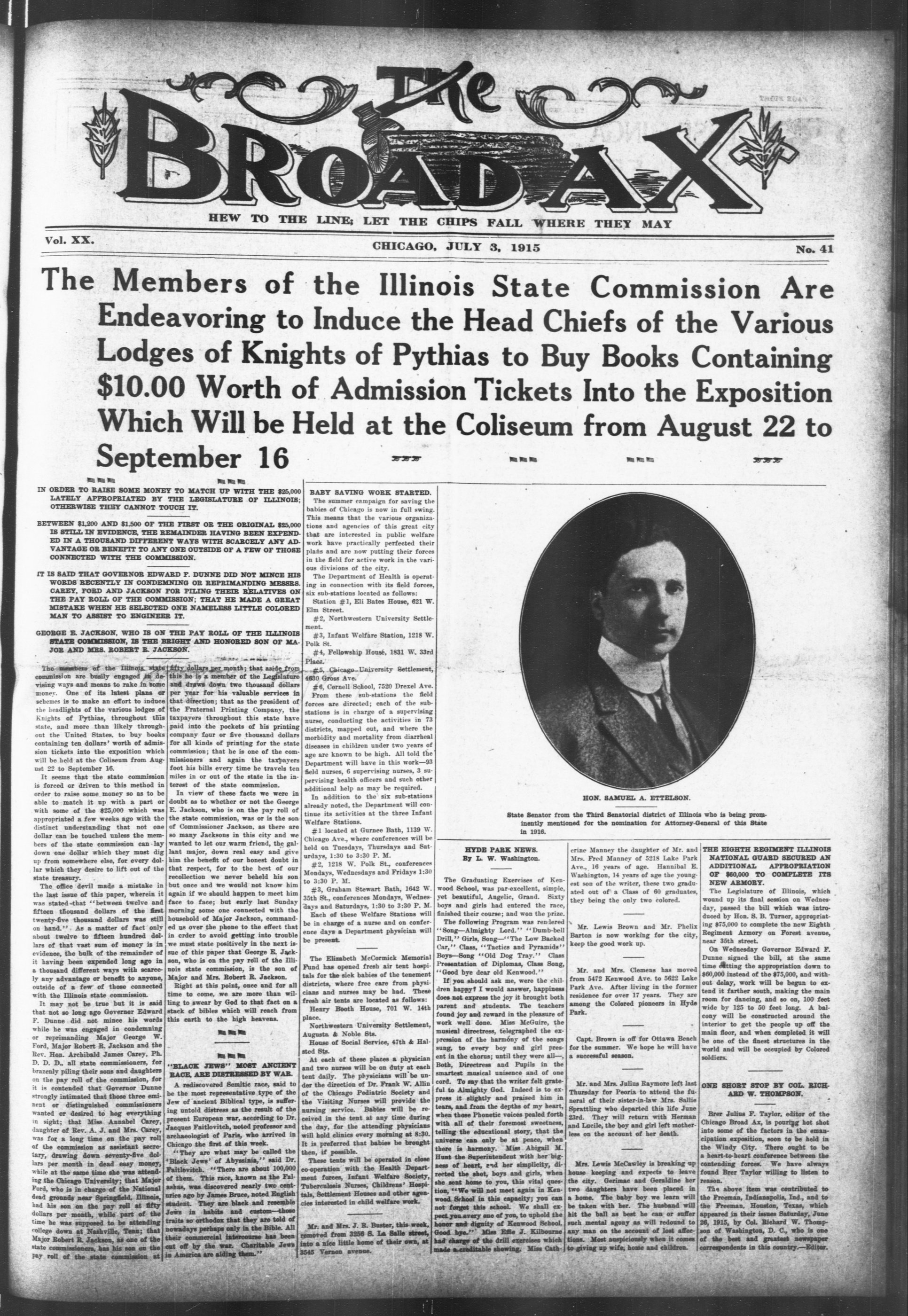
The Members of the Illinois State Commission Are Endeavoring to Induce the Head Chiefs of the Various Lodges of Knights of Pythias to Buy Books Containing $10.00 Worth of Admission Tickets Into the Exposition Which Will be Held at the Coliseum from August 22 to September 16
IN ORDER TO RAISE SOME MONEY TO MATCH UP WITH THE $25,000 LATELY APPROPRIATED BY THE LEGISLATURE OF ILLINOIS; OTHERWISE THEY CANNOT TOUCH IT.
BETWEEN $1,200 AND $1,500 OF THE FIRST OR THE ORIGINAL $25,000 IS STILL IN EVIDENCE, THE REMAINDER HAVING BEEN EXPENDED IN A THOUSAND DIFFERENT WAYS WITH SCARCELY ANY ADVANTAGE OR BENEFIT TO ANY ONE OUTSIDE OF A FEW OF THOSE CONNECTED WITH THE COMMISSION.
IT IS SAID THAT GOVERNOR EDWARD F. DUNNE DID NOT MINCE HIS WORDS RECENTLY IN CONDEMNING OR REPRIMANDING MESSRS. CAREY, FORD AND JACKSON FOR FILING THEIR RELATIVES ON THE PAY ROLL OF THE COMMISSION; THAT HE MADE A GREAT MISTAKE WHEN HE SELECTED ONE NAMELESS LITTLE COLORED MAN TO ASSIST TO ENGINEER IT.
GEORGE E. JACKSON, WHO IS ON THE PAY ROLL OF THE ILLINOIS STATE COMMISSION, IS THE BRIGHT AND HONORED SON OF MAJOR AND MRS. ROBERT E. JACKSON.
Vol. XX.
The Men's Ende Lodge $10.00 Which September
IN ORDER TO RAISE SOME MONEY LATELY APPROPRIATED BY OTHERWISE THEY CANNOT T
BETWEEN $1,200 AND $1,500 OF THE IS STILL IN EVIDENCE, THE BE ED IN A THOUSAND DIFFERENT VANTAGE OR BENEFIT TO ANY CONNECTED WITH THE COMM
IT IS SAID THAT GOVERNOR EDWARD WOODS RECENTLY IN CONDEM CAREY, FORD AND JACKSON THE PAY ROLL OF THE COMMISTAKE WHEN HE SELECTED MAN TO ASSIST TO ENGINEER
GEORGE E. JACKSON, WHO IS ON STATE COMMISSION, IS THE B JOB AND MES. ROBEET E. JAC
```markdown
```
The members of the Illinois state commission are busily engaged in devising ways and means to rake in some money. One of its latest plans or schemes is to make an effort to induce the headlights of the various lodges of Knights of Pythias, throughout this state, and more than likely throughout the United States, to buy books containing ten dollars' worth of admission tickets into the exposition which will be held at the Coliseum from August 22 to September 16.
It seems that the state commission is forced or driven to this method in order to raise some money so as to be able to match it up with a part or with some of the $25,000 which was appropriated a few weeks ago with the distinct understanding that not one dollar can be touched unless the members of the state commission can lay down one dollar which they must dig up from somewhere else, for every dollar which they desire to lift out of the state treasury.
The office devil made a mistake in the last issue of this paper, wherein it was stated that "between twelve and fifteen thousand dollars of the first twenty-five thousand dollars was still on hand." As a matter of fact only about twelve to fifteen hundred dollars of that vast sum of money is evidence, the bulk of the remainder of it having been expended long ago in a thousand different ways with scarcely any advantage or benefit to anyone, outside of a few of those connected with the Illinois state commission.
It may not be true but it is said that not so long ago Governor Edward F. Dunn did not mince his words while he was engaged in condemning or reprimanding Major George W. Ford, Major Robert R. Jackson and the Rev. Hon. Archibald James Carey, Ph. D. D. D., all state commissioners, for brazenly pilling their sons and daughters on the pay roll of the commission, for it is contended that Governor Dunne strongly intimated that those three eminent or distinguished commissioners wanted or desired to hog everything in sight; that Miss Annabel Carey, daughter of Rev. A. J. and Mrs. Carey, was for a long time on the pay roll of the commission as assistant secretary, drawing down seventy-five dollars per month in dead easy money, while at the same time she was attending the Chicago University; that Major Ford, who is in charge of the National dead grounds near Springfield, Illinois, had his son on the pay roll at fifty dollars per month, while part of the time he was supposed to be attending college down at Nashville, Tennessee; that Major Robert R. Jackson, as one of the state commissioners, has his son on the pay roll of the state commission at
---
---
fifty dollars per month; that aside from this he is a member of the Legislature and draws down two thousand dollars per year for his valuable services in that direction; that as the president of the Fraternal Printing Company, the taxpayers throughout this state have paid into the pockets of his printing company four or five thousand dollars for all kinds of printing for the state commission; that he is one of the commissioners and again the taxpayers foot his bills every time he travels ten miles in or out of the state in the interest of the state commission.
In view of these facts we were in doubt as to whether or not the George E. Jackson, who is on the pay roll of the state commission, was or is the son of Commissioner Jackson, as there are so many Jacksons in this city and we wanted to let our warm friend, the gallant major, down real easy and give him the benefit of our honest doubt in that respect, for to the best of our recollection we never beheld his son but once and we would not know him again if we should happen to meet him face to face; but early last Sunday morning some one connected with the household of Major Jackson, commanded us over the phone to the effect that in order to avoid getting into trouble we must state positively in the next issue of this paper that George E. Jackson, who is on the pay roll of the Illinois state commission, is the son of Major and Mrs. Robert R. Jackson. Right at this point, once and for all time to come, we are more than willing to swear by God to that fact on a stack of bibles which will reach from this earth to the high heavens.
---
---
A rediscovered Semitic race, said to be the most representative type of the Jew of ancient Biblical type, is suffering untold distress as the result of the present European war, according to Dr. Jacques Faitlovitch, noted professor and archaeologist of Paris, who arrived in Chicago the first of this week.
"They are what may be called the 'Black Jews' of Abyssinia," said Dr. Faitlovitch. "There are about 100,000 of them. This race, known as the Falashas, was discovered nearly two centuries ago by James Bruce, noted English student. They are black and resemble Jews in habits and custom—those traits so orthodox that they are told of nowadays perhaps only in the Bible. All their commercial intercourse has been cut off by the war. Charitable Jews in America are aiding them."
CHICAGO, JULY 3, 1915
BABY SAVING WORK STARTED.
The summer campaign for saving the babies of Chicago is now in full swing. This means that the various organizations and agencies of this great city that are interested in public welfare work have practically perfected their plans and are now putting their forces in the field for active work in the various divisions of the city.
The Department of Health is operating in connection with its field forces, six sub-stations located as follows:
Station #1, Eli Bates House, 621 W. Elm Street.
#2, Northwestern University Settlement.
#3, Infant Welfare Station, 1218 W. Polk St.
#4, Fellowship House, 1831 W. 33rd Place.
#5, Chicago University Settlement, 4630 Gross Ave.
#6, Cornell School, 7520 Drexel Ave.
From these sub-stations the field forces are directed; each of the substations is in charge of a supervising nurse, conducting the activities in 73 districts, mapped out, and where the morbidity and mortality from diarrheal diseases in children under two years of age are known to be high. All told the Department will have in this work—33 field nurses, 6 supervising nurses, 3 supervising health officers and such other additional help as may be required.
In addition to the six sub-stations already noted, the Department will continue its activities at the three Infant Welfare Stations.
#1 located at Gurnee Bath, 1139 W. Chicago Ave., where conferences will be held on Tuesdays, Thursdays and Saturdays; 1:30 to 3:30 P. M.
#2, 1218 W. Polk St., conferences Mondays, Wednesdays and Fridays 1:30 to 3:30 P. M.
#3, Graham Stewart Bath, 1642 W. 35th St., conferences Mondays, Wednesdays and Saturdays; 1:30 to 3:30 P. M.
Each of these Welfare Stations will be in charge of a nurse and on conference days a Department physician will be present.
The Elizabeth McCormick Memorial Fund has opened fresh air tent hospitals for the sick babies of the tenement districts, where free care from physicians and nurses may be had. These fresh air tents are located as follows: Henry Booth House, 701 W. 14th place. Northwestern University Settlement, Augusta & Noble Sts. House of Social Service, 47th & Halsted Sts. At each of these places a physician and two nurses will be on duty at each tent daily. The physicians will be under the direction of Dr. Frank W. Allin of the Chicago Pediatric Society and the Visiting Nurses will provide the nursing service. Babies will be received in the tent at any time during the day, for the attending physicians will hold clinics every morning at 8:30. It is preferred that babies be brought then, if possible. These tents will be operated in close co-operation with the Health Department forces, Infant Welfare Society, Tuberculosis Nurses, Childrens' Hospitals, Settlement Houses and other agencies interested in child welfare work.
Mr. and Mrs. J. R. Buster, this week, removed from 3256 S. Le Salle street, into a nice little home of their own, at 3545 Vernon avenue.
[Picture of a man in a suit with a tie and a white shirt. The background is a solid black oval.]]
State Senator from the Third Senatorial district of Illinois who is being prominently mentioned for the nomination for Attorney-General of this State in 1916.
---
HYDE PARK NEWS.
By L. W. Washington
The Graduating Exercises of Kenwood School, was par-excellent, simple, yet beautiful, Angelic, Grand. Sixty boys and girls had entered the race, finished their course; and won the prize.
The following Program was rendered "Song—Almighty Lord." "Dumb-bell Drill," Girls, Song—"The Low Backed Car," Class, "Tactics and Pyramids" Boys—Song "Old Dog Tray." Class Presentation of Diplomas, Class Song, "Good bye dear old Kenwood."
If you should ask me, were the children happy? I would answer, happiness does not express the joy it brought both parent and students. The teachers found joy and reward in the pleasure of work well done. Miss McGuire, the musical directress, telegraphed the expression of the harmony of the songs sung, to every boy and girl present in the chorus; until they were all—Both, Directress and Pupils in the smartest musical unisence and of one cord. To say that the writer felt grateful to Almighty God. Indeed is to express it slightly and praised him in tears, and from the depths of my heart, when those Phonetic voices披ed forth with all of their foremost sweetness, telling the educational story, that the universe can only be at peace, when there is harmony. Miss Abigail M. Hunt the Superintendent with her bigness of heart, and her simplicity, directed the shot, boys and girls, when she sent home to you, this vital question, "We will not meet again in Kenwood School in this capacity; you can not forget this school. We shall expect you every one of you, to uphold the honor and dignity of Kenwood School. Good hye." Miss Effle J. Kilbourne had charge of the drill exercises which made a exudable showing. Miss Cath-
```markdown
```
HON. SAMUEL A. ETTELSON.
in the Third Senatorial district of Illinois
oned for the nomination for Attorney-
erine Manney the daughter of Mr. and
Mrs. Fred Manney of 5218 Lake Park
Ave., 16 years of age. Hannibal E
Washington, 14 years of age the youngest
son of the writer, these two gradu-
ated out of a Class of 60 graduates,
they being the only two colored.
Mr. Lewis Brown and Mr. Phelix Barton is now working for the city, keep the good work up.
Mr. and Mrs. Clemens has moved from 5472 Kenwood Ave. to 5622 Lake Park Ave. After living in the former residence for over 17 years. They are among the Colored pioneers in Hyde Park.
Capt. Brown is off for Ottawa Beach for the summer. We hope he will have a successful season.
Mr. and Mrs. Julius Raymore left last Thursday for Peoria to attend the funeral of their sister-in-law Mrs. Sallie Sprattling who departed this life June 23rd. They will return with Herman and Lucile, the boy and girl left motherless on the account of her death.
Mrs. Lewis McCawley is breaking up house keeping and expects to leave the city. Gerimac and Geraldine her two daughters have been placed in a home. The baby boy we learn will be taken with her. The husband will hit the ball as best he can or suffer such mental agony as will redound to any man on the account of lost affections. Most auspiciously when it comes to giving up wife, home and children.
No.41
THE EIGHTH REGIMENT ILLINOIS NATIONAL GUARD SECURED AN ADDITIONAL APPROPRIATION OF $60,000 TO COMPLETE ITS NEW ARMORY.
The Legislature of Illinois, which wound up its final session on Wednesday, passed the bill which was introduced by Hon. S. B. Turner, appropriating $75,000 to complete the new Eighth Regiment Armory on Forest avenue, near 35th street.
On Wednesday Governor Edward F. Dunne signed the bill, at the same time getting the appropriation down to $60,000 instead of the $75,000, and without delay, work will be begun to extend it farther south, making the main room for dancing, and so on, 100 feet wide by 125 to 50 feet long. A balcony will be constructed around the interior to get the people up off the main floor, and when completed it will be one of the finest structures in the world and will be occupied by Colored soldiers.
ONE SHORT STOP BY COL. RICH
ARD W. THOMPSON.
Brer Julius F. Taylor, editor of the Chicago Broad Ax, is pouring hot shot into some of the factors in the emancipation exposition, soon to be held in the Windy City. There ought to be a heart-to-heart conference between the contending forces. We have always found Brer Taylor willing to listen to reason. The above item was contributed to the Freeman, Indianapolis, Ind., and to the Freeman, Houston, Texas, which appeared in their issues Saturday, June 26, 1915, by Col. Richard W. Thompson of Washington, D. C., who is one of the best and greatest newspaper correspondents in this country--Editor.
PAGE TWO
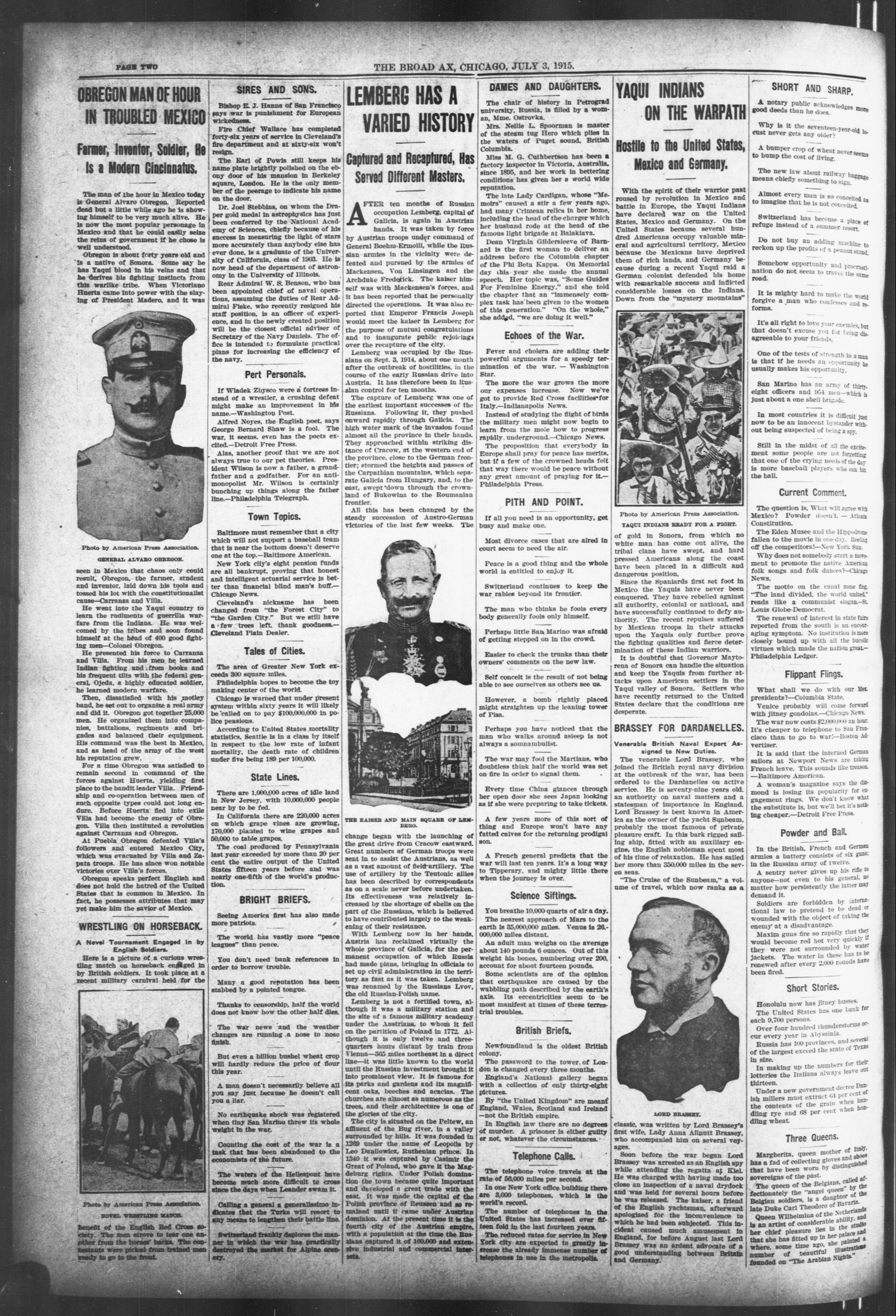
OBREGON MAN OF HOUR IN TROUBLED MEXICO
The man of the hour in Mexico today is General Alvaro Obregon. Reported dead but a little while ago he is showing himself to be very much alive. He is now the most popular personage in Mexico and that he could easily seize the reins of government if he chose is well understood. Obregon is about forty years old and is a native of Sonora. Some say he has Yaqui blood in his veins and that he derives his fighting instincts from this warlike tribe. When Victoriano Huerta came into power with the slaying of President Madero, and it was
1914
Photo by American Press Association.
GENERAL ALVARO OBREGON.
seen in Mexico that chaos only could result, Obregon, the farmer, student and inventor, laid down his tools and tossed his lot with the constitutionalist cause—Carranza and Villa.
He went into the Yaqui country to learn the rudiments of guerrilla warfare from the Indians. He was welcomed by the tribes and soon found himself at the head of 400 good fighting men—Colonel Obregon.
He presented his force to Carranza and Villa. From his men he learned Indian fighting and from books and his frequent tilts with the federal general, Ojeda, a highly educated soldier, he learned modern warfare.
Then, dissatisfied with his motley band, he set out to organize a real army and did it. Obregon got together 25,000 men. He organized them into companies, battalions, regiments and brigades and balanced their equipment. His command was the best in Mexico, and as head of the army of the west his reputation grew.
For a time Obregon was satisfied to remain second in command of the forces against Huerta, yielding first place to the bandit leader Villa. Friendship and co-operation between men of such opposite types could not long endure. Before Huerta fled into exile Villa had become the enemy of Obregon. Villa then instituted a revolution against Carranza and Obregon.
At Puebla Obregon defeated Villa's followers and entered Mexico City, which was evacuated by Villa and Zapata troops. He has since won notable victories over Villa's forces.
Obregon speaks perfect English and does not hold the hatred of the United States that is common in Mexico. In fact, he possesses attributes that may yet make him the savior of Mexico.
WRESTLING ON HORSEBACK.
A Novel Tournament Engaged In by English Soldiers. Here is a picture of a curious wrestling match on horseback engaged in by British soldiers. It took place at a recent military carnival held for the
THE RACE
benefit of the English Red Cross society. The men strove to tear one another from the horses' backs. The contestants were picked from trained men ready to go to the front.
SIRES AND SONS.
Bishop E. J. Hanna of San Francisco says war is punishment for European wickedness.
Fire Chief Wallace has completed forty-six years of service in Cleveland's fire department and at sixty-six won't resign.
The Earl of Powis still keeps his name plate brightly polished on the ebony door of his mansion in Berkeley square, London. He is the only member of the peerage to indicate his name on the door.
Dr. Joel Stebbins, on whom the Draper gold medal in astrophysics has just been conferred by the National Academy of Sciences, chiefly because of his success in measuring the light of stars more accurately than anybody else has ever done, is a graduate of the University of California, class of 1903. He is now head of the department of astronomy in the University of Illinois.
Rear Admiral W. S. Benson, who has been appointed chief of naval operations, assuming the duties of Rear Admiral Fiske, who recently resigned his staff position, is an officer of experience, and in the newly created position will be the closest official adviser of Secretary of the Navy Daniels. The office is intended to formulate practical plans for increasing the efficiency of the navy.
Pert Personals.
If Wiladek Zhusco were a fortress instead of a wrestler, a crushing defeat might make an improvement in his name—Washington Post.
Alfred Noyes, the English poet, says George Bernard Shaw is a fool. The war, it seems, even has the poets excited.—Detroit Free Press.
Alas, another proof that we are not always true to our pet theories. President Wilson is now a father, a grandfather and a godfather. For an antimonopolist Mr. Wilson is certainly bunching up things along the father line.—Philadelphia Telegraph.
Town Topics.
Baltimore must remember that a city which will not support a baseball team that is near the bottom doesn't deserve one at the top.-Baltimore American.
New York city's eight pension funds are all bankrupt, proving that honest and intelligent actuarial service is better than financial blind man's buff.-Chicago News.
Cleveland's nickname has been changed from "the Forest City" to "the Garden City." But we still have a few trees left, thank goodness.-Cleveland Plain Dealer.
Tales of Cities.
The area of Greater New York exceeds 300 square miles.
Philadelphia hopes to become the toy making center of the world.
Chicago is warned that under present system within sixty years it will likely be called on to pay $100,000,000 in police pensions.
According to United States mortality statistics, Seattle is in a class by itself in respect to the low rate of infant mortality, the death rate of children under five being 189 per 100,000.
State Lines.
There are 1,000,000 acres of idle land in New Jersey, with 10,000,000 people near by to be fed. In California there are 220,000 acres on which grape vines are growing, 170,000 planted to wine grapes and 50,000 to table grapes. The coal produced by Pennsylvania last year exceeded by more than 20 per cent the entire output of the United States fifteen years before and was nearly one-fifth of the world's production
BRIGHT BRIEFS.
Seeing America first has also made more patriots.
The world has vastly more "peace leagues" than peace.
You don't need bank references in order to borrow trouble.
Many a good reputation has been stabbed by a pointed tongue.
Thanks to censorship, half the world does not know how the other half dies.
The war news and the weather changes are running a nose to nose finish.
But even a billion bushel wheat crop will hardly reduce the price of flour this year.
A man doesn't necessarily believe all you say just because he doesn't call you a liar.
No earthquake shock was registered when tiny San Marino threw its whole weight in the war.
Counting the cost of the war is a task that has been abandoned to the economists of the future.
The waters of the Hellespont have become much more difficult to cross since the days when Leander swam it.
Calling a general a generalissimo indicates that the Turks will resort to any means to lengthen their battle line.
Switzerland frankly deplores the manner in which the war has practically destroyed the market for Alpine scenery.
THE BROAD AX, CHICAGO, JULY 3, 1915
LEMBERG HAS A VARIED HISTORY
---
Captured and Recaptured, Has Served Different Masters.
AFTER ten months of Russian occupation Lemberg, capital of Galicia, is again in Austrian hands. It was taken by force by Austrian troops under command of General Boehm-Ermolli, while the Russian armies in the vicinity were defeated and pursued by the armies of Mackensen, Von Linsingen and the Archduke Frederick. The kaiser himself was with Mackensen's forces, and it has been reported that he personally directed the operations. It was also reported that Emperor Francis Joseph would meet the kaiser in Lemberg for the purpose of mutual congratulations and to inaugurate public rejoicing over the recapture of the city.
Lemberg was occupied by the Russians on Sept. 3, 1914, about one month after the outbreak of hostilities, in the course of the early Russian drive into Austria. It has therefore been in Russian control for ten months.
The capture of Lemberg was one of the earliest important successes of the Russians. Following it, they pushed onward rapidly through Galichia. The high water mark of the invasion found almost all the province in their hands. They approached within striking distance of Cracow, at the western end of the province, close to the German frontier; stormed the heights and passes of the Carpathian mountains, which separate Galichia from Hungary, and, to the east, swept down through the crownland of Bukowina to the Roumanian frontier.
All this has been changed by the steady succession of Austro-German victories of the last few weeks. The
1890
THE KAISER AND MAIN SQUARE OF LEMBER.
change began with the launching of the great drive from Cracow eastward. Great numbers of German troops were sent in to assist the Austrians, as well as a vast amount of field-artillery. The use of artillery by the Teutonic allies has been described by correspondents as on a scale never before undertaken. Its effectiveness was relatively increased by the shortage of shells on the part of the Russians, which is believed to have contributed largely to the weakening of their resistance.
With Lemberg now in her hands, Austria has reclaimed virtually the whole province of Galicia, for the permanent occupation of which Russia had made plans, bringing in officials to set up civil administration in the territory as fast as it was taken. Lemberg was renamed by the Russians Lvov, the old Russian-Polish name.
Lemberg is not a fortified town, although it was a military station and the site of a famous military academy under the Austrians, to whom it fell on the partition of Poland in 1772. Although it is only twelve and threequarters hours distant by train from Vienna—365 miles northeast in a direct line—it was little known to the world until the Russian investment brought it into prominent view. It is famous for its parks and gardens and its magnificent oaks, beeches and acacias. The churches are almost as numerous as the trees, and their architecture is one of the glories of the city.
The city is situated on the Peltew, an affluent of the Bug river, in a valley surrounded by hills. It was founded in 1200 under the name of Leopolis by Leo Dänilowicz, Ruthenian prince. In 1340 it was captured by Casimir the Great of Poland, who gave it the Magdeburg rights. Under Polish domination the town became quite important and developed a great trade with the east. It was made the capital of the Polish province of Reussen and so remained until it came under Austrian dominion. At the present time it is the fourth city of the Austrian empire, with a population at the time the Russians captured it at 100,000 and extensive industrial and commercial inter-
DAMES AND DAUGHTERS.
The chair of history in Petrograd university, Russia, is filled by a woman, Mme. Ostrovka.
Mrs. Nellie L. Spoorman is master of the steam tug Hero which plies in the waters of Puget sound, British Columbia.
Miss M. G. Cuthbertson has been a factory inspector in Victoria, Australia, since 1895, and her work in bettering conditions has given her a world wide reputation.
The late Lady Cardigan, whose "Memotrs" caused a stir a few years ago, had many Crimean relics in her home, including the head of the charger which her husband rode at the head of the famous light brigade at Balakaya.
Dean Virgilha Glidersleeve of Barnard is the first woman to deliver an address before the Columbia chapter of the Phi Beta Kappa. On Memorial day this year she made the annual speech. Her topic was, "Some Guides For Feminine Energy," and she told the chapter that an "immensely complex task has been given to the women of this generation." "On the whole," she added, "we are doing it well."
Echoes of the War.
Fever and cholera are adding their powerful arguments for a speedy termination of the war. — Washington Star.
The more the war grows the more our expenses increase. Now we've got to provide Red Cross facilities* for Italy. — Indianapolis News.
Instead of studying the flight of birds the military might now begin to learn from the mole how to progress rapidly. underground. — Chicago News.
The proposition that everybody in Europe shall pray for peace has merits, but if a few of the crowned heads felt that way there would be peace without any great amount of praying for it. — Philadelphia Press.
PITH AND POINT.
If all you need is an opportunity, get busy and make one.
Most divorce cases that are aired in court seem to need the air.
Peace is a good thing and the whole world is entitled to enjoy it.
Switzerland continues to keep the war rabies beyond its frontier.
The man who thinks he fools every body generally fools only himself.
Perhaps little San Marino was afraid of getting stepped on in the crowd.
Easier to check the trunks than their owners' comments on the new law.
Self conceit is the result of not being able to see ourselves as others see us.
However, a bomb rightly placed might straighten up the leaning tower of Pisa.
Perhaps you have noticed that the man who walks around asleep is not always a somnambulist.
The war may fool the Martians, who doubtless think half the world was set on fire in order to signal them.
Every time China glances through her open door she sees Japan looking as if she were preparing to take tickets.
A few years more of this sort of thing and Europe won't have any fatted calves for the returning prodigal son.
A French general predicts that the war will last ten years. It's a long way to Tipperary, and mighty little there when the journey is over.
Science Siftings.
You breathe 10,000 quarts of air a day. The nearest approach of Mars to the earth is 35,000,000 miles. Venus is 28,000,000 miles distant. An adult man weighs on the average about 140 pounds 6 ounces. Out of this weight his bones, numbering over 200, account for about fourteen pounds. Some scientists are of the opinion that earthquakes are caused by the wabbling path described by the earth's axis. Its eccentricities seem to be most manifest at times of these terrestrial troubles.
British Briefs.
Newfoundland is the oldest British colony. The password to the tower. of London is changed every three months. England's National gallery began with a collection of only thirty-eight pictures. By "the United Kingdom" are meant England, Wales, Scotland and Ireland—not the British empire. In English law there are no degrees of murder. A prisoner is either guilty or not, whatever the circumstances.
Telephone Calls.
The telephone voice travels at the rate of 56,000 miles per second. In one New York office building there are 3,000 telephones, which is the world's record. The number of telephones in the United States has increased over fifteen fold in the last fourteen years. The reduced rates for service in New York city are expected to greatly increase the already immense number of telephones in use in the metropolis.
Hostile to the United States Mexico and Germany.
With the spirit of their warrior past roused by revolution in Mexico and battle in Europe, the Yaqui Indians have declared war on the United States, Mexico and Germany. On the United States because several hundred Americans occupy valuable mineral and agricultural territory, Mexico because the Mexicans have deprived them of rich lands, and Germany because during a recent Yaqui raid a German colonist defended his home with remarkable success and inflicted considerable losses on the Indians. Down from the "mystery mountains"
of gold in Sonora, from which no white man has come out alive, the tribal clans have swept, and hard pressed Americans along the coast have been placed in a difficult and dangerous position.
Since the Spaniards first set foot in Mexico the Yaquls have never been conquered. They have rebelled against all authority, colonial or national, and have successfully continued to defy authority. The recent repulses suffered by Mexican troops in their attacks upon the Yaquls only further prove the fighting qualities and fierce determination of these Indian warriors.
It is doubtful that Governor Mayorena of Sonora can handle the situation and keep the Yaquls from further attacks upon American settlers in the Yaqui valley of Sonora. Settlers who have recently returned to the United States declare that the conditions are desperate.
BRASSEY FOR DARDANELLES
Venerable British Naval Expert Assigned to New Duties.
The venerable Lord Brassey, who joined the British royal navy division at the outbreak of the war, has been ordered to the Dardanelles on active service. He is seventy-nine years old, an authority on naval matters and a statesman of importance in England. Lord Brassey is best known in America as the owner of the yacht Sunbeam, probably the most famous of private pleasure craft. In this bark rigged sailing ship, fitted with an auxiliary engine, the English nobleman spent most of his time of relaxation. He has sailed her more than 350,000 miles in the seven seas.
"The Cruise of the Sunbeam," a volume of travel, which now ranks as a
A. H.
LORD BRASSEY.
classic, was written by Lord Brassey's first wife, Lady Anna Allnutt Brassey, who accompanied him on several voyages.
Soon before the war began Lord Brassey was arrested as an English spy while attending the regatta at Kiel. He was charged with having made too close an inspection of a naval drydock and was held for several hours before he was released. The kalser, a friend of the English yachtman, afterward apologized for the inconvenience to which he had been subjected. This incident caused much amusement in England, for before August last Lord Brassey was an ardent advocate of a good understanding between Britain and Germany.
SHORT AND SHARP
A notary public acknowledges more good deeds than he does.
Why is it the seventeen-year-old locust a bumper crop of wheat never seems to bump the cost of living.
The new law about railway baggage means chiefly something to sign.
Almost every man is so conceived as to imagine that he is not conceived.
Switzerland has become a place of refuge instead of a summer resort.
Do not buy an adding machine to reckon up the profits of a peanut stand.
Somehow opportunity and procrastination do not seem to travel the same road.
It is mighty hard to make the world forgive a man who confesses and reforms.
It's all right to love your enemies, but that doesn't excuse you for being disagreeable to your friends.
One of the tests of strength in a man is that if he needs an opportunity he usually makes his opportunity.
San Marino has an army of thirty-eight officers and 644 men—which is just about a one shell brigade.
In most countries it is difficult just now to be an innocent bystander without being suspected of being a spy.
Still in the midst of all the excitement some people are not forgetting that one of the crying needs of the day is more baseball players who can hit the ball.
Current Comment
The question is, What will agree with Mexico? Powder doesn't. — Atlanta Constitution.
The Eden Musee and the Hippodrome fallen to the movie in one day. Reeling off the competitors!—New York Sun.
Why does not somebody start a movement to promote the native American folk songs and folk dances?—Chicago News.
The motto on the canal zone flag. "The land divided, the world united." reads like a communist slogan—St Louis Globe-Democrat.
The renewal of interest in state fairs reported from the south is an encouraging symptom. No institution is more closely bound up with all the bucolic virtues which made the nation great—Philadelphia Ledger.
Flippant Flings.
What shall we do with our Mer. presidents?—Columbia State.
Venice probably will come forward with jitney gondolas.—Chicago News.
The war now costs $2,000,000 an hour.
It's cheaper to telephone to San Francisco than to go to war!—Boston Advertiser.
It is said that the interned German sailors at Newport News are taking French leave. This sounds like treason.—Baltimore American.
A woman's magazine says the diamond is losing its popularity for engagement rings. We don't know what the substitute is, but we'll bet it's nothing cheaper.—Detroit Free Press.
Powder and Ball.
In the British, French and German armies a battery consists of six guns, in the Russian army of twelve.
A sentry never gives up his rifle to anyone—not even to his general, no matter how persistently the latter may demand it.
Soldiers are forbidden by international law to pretend to be dead or wounded with the object of taking the enemy at a disadvantage.
Maxim guns fire so rapidly that they would become red hot very quickly if they were not surrounded by water jackets. The water in these has to be renewed after every 2,000 rounds have been fired.
Short Stories.
Honolulu now has jitney buses.
The United States has one bank for
each 9,700 persons.
Over four hundred thunderstorms occur
every year in Abyssinia.
Russia has 100 provinces, and several
of the largest exceed the state of Texas
in size.
In making up the numbers for their
lotteries the Italians always leave out
thirteen
Under a new government decree Danish millers must extract 64 per cent of the contents of the grain when handling rye and 68 per cent when handling wheat.
Three Queens.
Margheritin, queen mother of Italy has a bad of collecting gloves and shoes that have been worn by distinguished women of the past.
sovereigns of the palace
The queen of the Belgians, called
affectionately the "angel queen" by the
Belgian soldiers, is a daughter of the
late Duke Carl Theodore of Bavaria.
Queen Wilhelmina of the Netherlands
is an artist of considerable ability, and
her chief pleasure lies in the studio
that she has fitted up in her palace and
where, some time ago, she painted a
number of beautiful illustrations
founded on "The Arabian Nights."
P. A.
MRS. FRANK M. ROESSING:
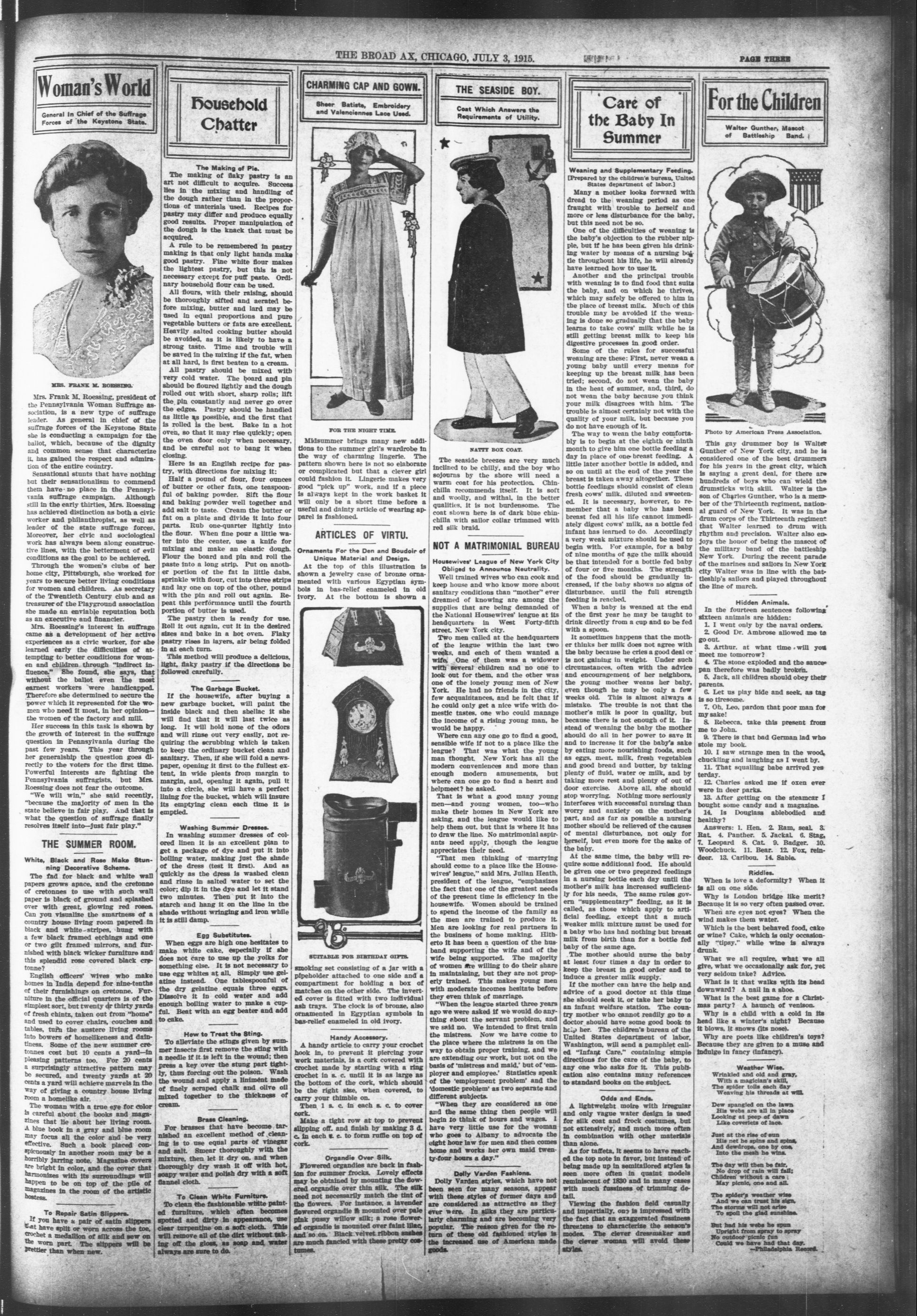
Mrs. Frank M. Roessing, president of the Pennsylvania Woman Suffrage association, is a new type of suffrage leader. As general in chief of the suffrage forces of the Keystone State she is conducting a campaign for the ballot, which, because of the dignity and common sense that characterize it, has gained the respect and admiration of the entire country.
Sensational stunts that have nothing but their sensationalism to commend them have no place in the Pennsylvania suffrage campaign. Although still in the early thirties, Mrs. Roessing has achieved distinction as both a civil worker and philanthropist, as well as leader of the state suffrage forces. Moreover, her civic and sociological work has always been along constructive lines, with the betterment of evil conditions as the goal to be achieved.
Through the women's clubs of her home city, Pittsburgh, she worked for years to secure better living conditions for women and children. As secretary of the Twentieth Century club and as treasurer of the Playground association she made an enviable reputation both as an executive and financier.
Mrs. Roessing's interest in suffrage came as a development of her active experiences as a civic worker, for she learned early the difficulties of attempting to better conditions for women and children through "indirect influence." She found, she says, that without the ballot even the most earnest workers were handicapped. Therefore she determined to secure the power which it represented for the women who need it most, in her opinion—the women of the factory and mill.
Her success in this task is shown by the growth of interest in the suffrage question in Pennsylvania during the past few years. This year through her generalship the question goa directly to the voters for the first time. Powerful interests are fighting the Pennsylvania suffragists, but Mrs. Roessing does not fear the outcome.
"We will win," she said recently, "because the majority of men in the state believe in fair play. And that is what the question of suffrage finally resolves itself into—just fair play."
THE SUMMER ROOM.
White, Black and Rose Make Stunning Decorative Scheme.
The fad for black and white wall papers grows apace, and the cretonne of cretonnes to use with such wall paper is black of ground and splashed over with great, glowing red roses. Can you visualize the smartness of a country house living room papered in black and white-stripes, hung with a few black framed etchings and one or two gilt framed mirrors, and furnished with black wicker furniture and this splendid rose covered black cretonne?
English officers' wives who make homes in India depend for nine-tenths of their furnishings on cretonne. Furniture in the official quarters is of the simplest sort, but twenty dr thirty yards of fresh chintz, taken out from "home" and used to cover chairs, couches and tables, turn the austere living rooms into bowers of homelikeness and daintiness. Some of the new summer cretonnes cost but 10 cents a yard—in pleasing patterns too. For 20 cents a surprisingly attractive pattern may be secured, and twenty yards at 20 cents a yard will achieve marvels in the way of giving a country house living room a homelike air.
The woman with a true eye for color is careful about the books and magazines that lie about her living room. A blue book in a gray and blue room may focus all the color and be very effective. Such a book placed conspicuously in another room may be a horribly jarring note. Magazine covers are bright in color, and the cover that harmonizes with its surroundings will happen to be on top of the pile of magazines in the room of the artistic hostess.
To Repair Satin Slippers.
If you have a pair of satin slippers that have split or worn across the toe, crochet a medallion of silk and sew on the worn part. The slippers will be prettier than when new.
Household Chatter
The Making of Pie.
The making of flaky pastry is an art not difficult to acquire. Success lies in the mixing and handling of the dough rather than in the proportions of materials used. Recipes for pastry may differ and produce equally good results. Proper manipulation of the dough is the knack that must be acquired.
A rule to be remembered in pastry making is that only light hands make good pastry. Fine white flour makes the lightest pastry, but this is not necessary except for puff paste. Ordinary household flour can be used. All flours, with their raising, should be thoroughly sifted and aerated before mixing, butter and lard may be used in equal proportions and pure vegetable butters or fats are excellent. Heavily salted cooking butter should be avoided, as it is likely to have a strong taste. Time and trouble will be saved in the mixing if the fat, when at all hard, is first beaten to a cream.
All pastry should be mixed with very cold water. The board and plin should be floured lightly and the dough rolled out with short, sharp rolls; lift the plin constantly and never go over the edges. Pastry should be handled as little as possible, and the first that is rolled is the best. Bake in a hot oven, so that it may rise quickly; open the oven door only when necessary, and be careful not to bang it when closing. Here is an English recipe for pastry, with directions for mixing it:
Half a pound of flour, four ounces of butter or other fats, one teaspoonful of baking powder. Sift the flour and baking powder well together and add salt to taste. Cream the butter or fat on a plate and divide it into four parts. Rub one-quarter lightly into the flour. When fine pour a little water into the center, use a knife for mixing and make an elastic dough. Flour the board and pin and roll the paste into a long strip. Put on another portion of the fat in little dabs, sprinkle with flour, cut into three strips and lay one on top of the other, pound with the pin and roll out again. Repeat this performance until the fourth portion of butter is used.
The pastry then is ready for use. Roll it out again, cut it in the desired sizes and bake in a hot oven. Flaky pastry rises in layers, air being folded in at each turn.
This method will produce a delicious, light, flaky pastry if the directions be followed carefully.
The Garbage Bucket.
If the housewife, after buying a new garbage bucket, will paint the inside black and then shell it she will find that it will last twice as long. It will hold none of the odors and will rinse out very easily, not requiring the scrubbing which is taken to keep the ordinary bucket clean and sanitary. Then, if she will fold a newspaper, opening it first to the fullest extent, in wide pleats from margin to margin, and, opening it again, pull it into a circle, she will have a perfect lining for the bucket, which will insure its emptying clean each time it is emptied.
Washing Summer Dresses.
In washing summer dresses of colored linen it is an excellent plan to get a package of dye and put it into boiling water, making just the shade of the dress (test it first). And as quickly as the dress is washed clean and rinse in salted water to set the color; dip it in the dye and let it stand two minutes. Then put it into the starch and hang it on the line in the shade without wringing and iron while it is still damp.
Egg Substitutes
When eggs are high one hesitates to make white cake, especially if she does not care to use up the yolks for something else. It is not necessary to use egg whites at all. Simply use gelatine instead. One tablespoonful of the dry gelatine equals three eggs. Dissolve it in cold water and add enough boiling water to make a cupful. Beat with an egg beater and add to cake.
How to Treat the Sting.
To alleviate the stings given by summer insects first remove the sting with a needle if it is left in the wound; then press a key over the stung part tightly, thus forcing out the poison. Wash the wound and apply a limiment made of finely scraped chalk and olive oil mixed together to the thickness of cream.
Brass Cleaning.
For brasses that have become tarnished an excellent method of cleaning is to use equal parts of vinegar and salt. Smear thoroughly with the mixture, then let it dry on, and when thoroughly dry wash it off with hot, soapy water and polish dry with a soft flannel cloth.
To Clean White Furniture
To clean the fashionable white painted furniture, which often becomes spotted and dirty in appearance, use clear turpentine on a soft cloth. This will remove all of the dirt without taking off the gloss, as soap and water always are sure to do.
THE BROAD AX, CHICAGO, JULY 3, 1915
9
FOR THE NIGHT TIME
Midsummer brings many new additions to the summer girl's wardrobe in the way of charming lingerie. The pattern shown here is not so elaborate or complicated but that a clever girl could fashion it. Lingerie makes very good "pick up" work, and if a piece is always kept in the work basket it will only be a short time before a useful and dainty article of wearing apparel is fashioned.
ARTICLES OF VIRTU.
Ornaments For the Den and Boudoir of
Unique Material and Design.
At the top of this illustration is shown a jewelry case of bronze ornamented with various Egyptian symbols in bas-relief enameled in old ivory. At the bottom is shown a
1
SUTTABLE FOR BIRTHDAY GIFTS.
smoking set consisting of a jar with a pipeholder attached to one side and a compartment for holding a box of matches on the other side. The inverted cover is fitted with two individual ash trays. The clock is of bronze, also ornamented in Egyptian symbols in bas-relief enameled in old ivory.
Handy Accessory.
A handy article to carry your crochet hook in, to prevent it piercing your work materials, is a cork covered with crochet made by starting with a ring crochet in s. c. until it is as large as the bottom of the cork, which should be the right size, when covered, to carry your thimble on.
Then 1 s. c. in each s. c. to cover cork.
Make a tight row at top to prevent slipping off, and finish by making 3 d. c. in each s. c. to form ruffle on top of cork.
Organdie Over Silk
Flowered organdies are back in fashion for summer frocks. Lovely effects may be obtained by mounting the flowered organdie over thin silk. The silk need not necessarily match the tint of the flowers. For instance, a lavender flowered organdie is mounted over pale pink pussy willow silk; a rose flowered organdie is mounted over faint lilac, and so on. Black velvet ribbon sashes are much fancied with these pretty costumes.
★
NATTY BOX COAT.
The seaside breezes are very much inclined to be chilly, and the boy who sojourns by the shore will need a warm coat for his protection. Chinchilla recommends itself. It is soft and woolly, and withal, in the better qualities, it is not burdensome. The coat shown here is of dark blue chinchilla with sailor collar trimmed with red silk braid.
NOT A MATRIMONIAL BUREAU
Housewives' League of New York City
Obliged to Announce Neutrality.
Well trained wives who can cook and
keep house and who know more about
sanitary conditions than "mother" ever
dreamed of knowing are among
supplies that are being demanded of
the National Housewives' league at its
headquarters in West Forty-fifth
street, New York city.
Two men called at the headquarters
of the league within the last two
weeks, and each of them wanted a
wife. One of them was a widower
with several children and no one to
look out for them, and the other was
one of the lonely young men of New
York. He had no friends in the city,
few acquaintances, and he felt that if
he could only get a nice wife with
domestic tastes, one who could manage
the income of a rising young man, he
would be happy.
Where can any one go to find a good, sensible wife if not to a place like the league? That was what the young man thought. New York has all the modern conveniences and more than enough modern amusements, but where can one go to find a heart and helpmeet? he asked.
That is what a good many young men—and young women, too—who make their homes in New York are asking, and the league would like to help them out, but that is where it has to draw the line. No matrimonial aspirants need apply, though the league appreciates their need.
"That men thinking of marrying should come to a place like the Housewives' league," said Mrs. Julian Heath, president of the league, "emphasizes the fact that one of the greatest needs of the present time is efficiency in the housewife. Women should be trained to spend the income of the family as the men are trained to produce it. Men are looking for real partners in the business of home making. Hitherto it has been a question of the husband supporting the wife and of the wife being supported. The majority of women are willing to do their share in maintaining, but they are not properly trained. This makes young men with moderate incomes hesitate before they even think of marriage.
"When the league started three years ago we were asked if we would do anything about the servant problem, and we said no. We intended to first train the mistress. Now we have come to the place where the mistress is on the way to obtain proper training, and we are extending our work, but not on the basis of 'mistress and maid,' but of 'employer and employee.' Statistics speak of the 'employment problem' and the 'domestic problem' as two separate and different subjects.
"When they are considered as one and the same thing then people will begin to think of hours and wages. I have very little use for the woman who goes to Albany to advocate the eight hour law for men and then comes home and works her own maid twenty-four hours a day."
Dolly Varden Fashions.
Dolly Varden styles, which have not been seen for many seasons, appear with these styles of former days and are considered as attractive as they ever were. In silks they are particularly charming and are becoming very popular. The reason given for the return of these old fashioned styles is the increased use of American made goods.
Care of the Baby In Summer
Weaning and Supplementary Feeding. [Prepared by the children's bureau, United States department of labor.]
Many a mother looks forward with dread to the weaning period as one fraught with trouble to herself and more or less disturbance for the baby, but this need not be so.
One of the difficulties of weaning is the baby's objection to the rubber nipple, but if he has been given his drinking water by means of a nursing bottle throughout his life, he will already have learned how to use it.
Another and the principal trouble with weaning is to find food that suits the baby, and on which he thrives, which may safely be offered to him in the place of breast milk. Much of this trouble may be avoided if the weaning is done so gradually that the baby learns to take cows' milk while he is still getting breast milk to keep his digestive processes in good order.
Some of the rules for successful weaning are these: First, never wean a young baby until every means for keeping up the breast milk has been tried; second, do not wean the baby in the heat of summer, and, third, do not wean the baby because you think your milk disagrees with him. The trouble is almost certainly not with the quality of your milk, but because you do not have enough of it.
The way to wean the baby comfortably is to begin at the eighth or ninth month to give him one bottle feeding a day in place of one-breast feeding. A little later another bottle is added, and so on until at the end of the year the breast is taken away altogether. These bottle feedings should consist of clean fresh cows' milk, diluted and sweetened. It is necessary, however, to remember that a baby who has been breast fed all his life cannot immediately digest cows' milk, as a bottle fed infant has learned to do. Accordingly a very weak mixture should be used to begin with. For example, for a baby of nine months of age the milk should be that intended for a bottle fed baby of four or five months. The strength of the food should be gradually increased, if the baby shows no signs of disturbance, until the full strength feeding is reached.
When a baby is weaned at the end of the first year he may be taught to drink directly from a cup and to be fed with a scoon.
It sometimes happens that the mother thinks her milk does not agree with the baby because he cries a good deal or is not gaining in weight. Under such circumstances, often with the advice and encouragement of her neighbors, the young mother weans her baby, even though he may be only a few weeks old. This is almost always a mistake. The trouble is not that the mother's milk is poor in quality, but because there is not enough of it. Instead of weaning the baby the mother should do all in her power to save it and to increase it for the baby's sake by eating more nourishing foods, such as eggs, meat, milk, fresh vegetables and good bread and butter, by taking plenty of fluid, water or milk, and by taking more rest and plenty of out of door exercise. Above all, she should stop worrying. Nothing more seriously interferes with successful nursing than worry and anxiety on the mother's part, and as far as possible a nursing mother should be relieved of the causes of mental disturbance, not only for herself, but even more for the sake of the baby.
At the same time, the baby will require some additional food. He should be given one or two prepared feedings in a nursing bottle each day until the mother's milk has increased sufficiently for his needs. The same rules govern "supplementary" feeding, as it is called, as those which apply to artificial feeding, except that a much weaker milk mixture must be used for a baby who has had nothing but breast milk from birth than for a bottle fed baby of the same age.
The mother should nurse the baby at least four times a day in order to keep the breast in good order and to induce a greater milk supply.
If the mother can have the help and advice of a good doctor at this time she should seek it, or take her baby to an infant welfare station. The country mother who cannot readily go to a doctor should have some good book to help her. The children's bureau of the United States department of labor, Washington, will send a pamphlet called "Infant Care," containing simple directions for the care of the baby, to any one who asks for it. This publication also contains many references to standard books on the subject.
Odds and Ends
A lightweight moore with irregular and only vague water design is used for silk coat and frock costumes, but not extensively, and much more often in combination with other materials than alone.
As for taffeta, it seems to have reached the top note in favor, but instead of being made up in semitallored styles is seen more often in quint models reminiscent of 1830 and in many cases with much fussiness of trimming detail.
Viewing the fashion field casually and impartially, onl$^2$ is impressed with the fact that an exaggerated fussiness threatens to characterize the season's modes. The clever dressmaker and the clever woman will avoid these styles.
For the Children
Walter Gunther, Mascot
of Battleship Band.
U.S.
Photo by American Press Association.
This gay drummer boy is Walter Gunther of New York city, and he is considered one of the best drummers for his years in the great city, which is saying a great deal, for there are hundreds of boys who can wield the drumsticks with skill. Walter is the son of Charles Gunther, who is a member of the Thirteenth regiment, national guard of New York. It was in the drum corps of the Thirteenth regiment that Walter learned to drum with rhythm and precision. Walter also enjoys the honor of being the mascot of the military band of the battleship New York. During the recent parade of the marines and sailors in New York city Walter was in line with the battleship's sailors and played throughout the line of march.
Hidden Animals
In the fourteen sentences following sixteen animals are hidden:
1. I went only by the naval orders.
2. Good Dr. Ambrose allowed me to go out.
3. Arthur, at what time will you meet me tomorrow?
4. The stone exploded and the sauce pan therefore was badly broken.
5. Jack, all children should obey their parents.
6. Let us play hide and seek, as tag is so tiresome.
7. Oh, Leo, pardon that poor man for my sake!
8. Rebecca, take this present from me to John.
9. There is that bad German lad who stole my book.
10. I saw strange men in the wood, chuckling and laughing as I went by.
11. That squalling babe arrived yes terday.
12. Charles asked me if oxen ever were in deer parks.
13. After getting on the steamcar I bought some candy and a magazine.
14. Is Douglass ablebodied and healthy?
Answers: 1. Hen. 2. Ram. seal. 3. Rat. 4. Puncher. 5. Jackal. 6. Stag. 7. Leopard 8. Cat. 9. Badger. 10. Woodchuck. 11. Bear. 12. Fox, reindeer. 13. Caribou. 14. Sable.
Riddles.
When is love a deformity? When it is all on one side.
Why is London bridge like merit? Because it is so very often passed over.
When are eyes not eyes? When the wind makes them water.
Which is the best behaved food, cake or wine? Cake, which is only occasionally "tipy," while wine is always drunk.
What we all require, what we all give, what we occasionally ask for, yet very seldom take? Advice.
What is it that walks with its head downward? A nail in a shoe.
What is the best game for a Christmas party? A haunch of venison.
Why is a child with a cold in its head like a winter's night? Because it blows, it snows (its nose).
Why are poets like children's toys? Because they are given to a muse and indulge in fancy (infancy).
Weather Wise.
Wrinkled old and gray,
With a magician's skill,
The spider toils each day
Weaving his threads at will.
Dew spangled on the lawn
His webs are all in place
Looking at peep of dawn
Like coverlets of lace.
Just at the rise of sun
His net he spins and spins,
And dewdrops, one by one,
Into the mesh he wins.
The day will then be fair,
No drop of rain will fall;
Children without a care!
May picnic, one and all.
The spider's weather wise
And we can trust his sign.
The storms will not arise
To spoil the glad sunshine.
But had his webs he spun
Upright from spray to spray
No outdoor picnic fun
Could we have had that day.
—Philadelphia Record.
PAGE FOUR
THE BROAD AX
Will promulgate and at all times uphold the true principles of Democracy, but Catholics, Protestants, Priests, Infidels, Single Taxes, Republians, or anyone else can have their say, as long as their language is proper and responsibility is fixed.
The Broad Ax is a newspaper whose platform is broad enough for all, ever claiming the editorial right to speak its own mind.
Local communications will receive attention. Write only on one side of the paper.
Subscriptions must be paid in advance. One Year.....$2.00
Six Months.....L.00
Advertising rates made known on application.
Address all communications to
THE BROAD AX
6533 ST. LAWRENCE AVE., CHICAGO, ILL.
PHONE WENTWORTH 2597.
JULIUS F. TAYLOR, Editor and Publisher
Entered as Second-Class Matter Aug. 18,
1902, at the Post Office at Chicago, Illinois,
under Act of March 8, 1879.
REMOVAL NOTICE.
From on and after this date, all letters or other mail matter intended for Julius F. Taylor or Mrs. Annie E. Taylor or The Brond Ax, should be addressed to 6532 St. Lawrence Ave., Jackson Park station. Phone Wentworth 2597.
MR. AND MRS. P. L. BARNETT CEL-
EBRATED THEIR TWENTIETH
WEDDING ANNIVERSARY.
Chicago, June 30, 1915.
Editor The Broad Ax,
6532 St. Lawrence ave.
Dear Sir:
Owing to a discussion which arose in the Alpha Suffrage Club a week or two ago relative to my length of service in club work, I made the remark that I had organized the I. B. W. Club two years before my marriage and it was that club which gave me such a magnificent wedding reception. I also said that my twentieth wedding anniversary would be June 27th. Some one asked if I was going to celebrate it and I said the only way I could do so would be to announce that my husband and I would be at home to any friends who wished to call in and offer their congratulations. Some one wanted to know the time and I replied that the only time we were "At Home," even on Sunday, would be between 8 and 10 P. M.
Accordingly that statement was made in the papers and members of the I. B. W. and Alpha Suffrage clubs and the Negro Fellowship League, and other friends called and we spent a very pleasant evening, but there was no formal announcement or invitations and that is why I wanted this notice published, because so many of my friends since then have said they were slighted by not receiving an invitation or notification.
Although there was no formal invitation or any expectation of presents, both Mr. Barnett and myself are very glad to acknowledge the receipt of two beautiful and costly pieces of china. The I. B. W. Club gave a beautiful hand painted china pitcher and the Alpha Suffrage Club a dozen hand painted plates to match a tea set which we already own. Both of these works of art were entirely unexpected and all the more appreciated. For another reason they are valuable to us, because the artistic work on them was done by Mrs. Margaret Anderson, one of the old members of the I. B. W. and one of the finest china painters in the city of Chicago. For this reason and because of the love and appreciation of the club members, they are especially valuable.
Very truly yours,
IDA B. WELLS BARNETT.
ATTORNEY C. J. WARING IS RECOVERING FROM THE EFFECTS OF THE ASSAULT AND BEATING-UP BY THREE ROBBERS WHO SEURED TEN DOLLARS FROM HIM THE SAME TIME OVERLOOKING $125 WHICH HE HAD SECRETED IN HIS INSIDE VEST POCKET.
Last Wednesday afternoon, Attorney C. J. Waring, who resides in Crawford, in the southwestern part of the city, had occasion to call on Mrs. Nevels, one of his Irish-American clients, who resides near 38th street and Spaulding avenue, and who at the present time has a suit pending against the Chicago and Alton Railroad Company, which is being looked after for her by Mr. Waring.
Leaving her home that evening for his home, he was attacked by three White gentlemen, one of them striking him a blow from the rear on the head which completely stunned him for a few moments; another dealt him a blow with full force on the nose, breaking it, and the third blow from one of the
---
robbers knocked out several of his teeth. At that point he managed to free his right hand from the grip of the first robber who attacked him. He struck out blindly and dealt two of them several terrific upper-cuts, as Mr. Waring is an expert athlete; and after they had succeeded in securing $10 from him, they broke away and made their escape, at the same time overlooking $125 which he had secreted in his inside vest pocket and which he had collected that day for one of his many White clients.
At the time he was attacked he was several blocks away from the home of Mrs. Nevels. He called for help, but no one came forth to assist him. He was finally conveyed to his home by one of the sons of Mrs. Nevels, who had been called up from a near-by drug store.
Mr. Waring states that "he was right up to death's door," and he and his many friends feel that it was really a miracle that he managed to free himself from the robbers.
---
NEGRO FELLOWSHIP LEAGUE.
Sunday July 4th will be Independence Day at the Negro Fellowship League, 3005 State Street. Rev. W. M. Bennett will deliver the principal address. Subject, "The Negro and Patriotism." Everyone is cordially invited to be present. Meeting begins promptly at 4 o'clock. Last Sunday the League had a race conference. Ten organizations sent delegates and others pledged themselves to do so at the next meeting. Addresses were made by Rev. E.P. Robinson of the Progressive Negro League, Mr. W. A. Wallace of the Political Equality League, F. L. Barnett of the Frederic Douglass Center, Mrs. John Guy of the North Side Woman's Club, Miss Davis of the Alpha Suffrage Club and others. A committee of five was appointed to confer with organizations, looking to the cooperation of all Negro organizations in race matters. The committee will consist of Mr. W. A. Wallace, chairman, Mr. Robinson, Mr. Barnett, Mrs. Guy and Miss Davis. They will report probably Sunday July 11th. All organizations desiring to participate are earnestly requested to send representatives to this meeting. Mrs. Hawkins from Detroit Michigan was introduced and spoke of her efforts to have a new trial for a Colored man who has been falsely accused and found guilty of kidnapping a little White girl.-Ida B. Wells Barnett, President.
万万
ST MARK M E CHURCH
ST. MARK M. E. CHURCH.
All interest centers in coming dedication of the new Auditorium. The appeal for subscriptions to be paid on Dedication Day, July 18, were taken Sunday morning after brief addresses by Messrs. Odneal, Grace, Crolley and the pastor. Preparation for the dedication anticipates the presence of Bishop Isaiah B. Scott, Nonroocia Liberia Africa. The trip to the Panama Exposition offered to the most popular minister or fraternity man or woman is creating interest. The plans have proposed one week of denominational and one of fraternity nights. The pipe organ has arrived. The news are being installed. The old church is being decorated. Everybody smiles while they work. The third sermon of the series on "Modern Evils" was preached last Sunday night; Subject "The Gossip Evil" Next Sunday night the subject is "The Liquor Traffic." These addresses are popular. You should hear them. The addresses of Mr. W. H. Higgins before the Epworth League of 1st M. E. Church Englewood was excellent. Monthly Communion Sunday morning, Miss Lucile Robinson has gone to the country for her summer vacation. She is senior at Wendell Phillips.
ALPHA SUFFRAGE CLUB
Men members and friends gathered at 3005 State Street on last Wednesday evening at the meeting of the Alpha Suffrage Club to hear Miss Sophie Boaz, Juvenile officer, speak on "The Mothers' Pension Bill." Much interest was manifested especially in view of the fact that very few Colored mothers are getting the benefit of this pension law. Several of them spoke of having made application for the same and that they were turned down for first one reason and then another. Out of some three hundred mothers who received aid from the pension law which enables them to stay home and take care of their children, only fifteen of them were Colored. It was pointed out by the president that the reason Colored people fared so badly in the distribution of city and county patronage, is because they have not one strong central organization representing the Colored people. On next Wednesday the club will have a musical and social. Summer vacation begins.
Miss Catherine Tikalsky of royal German blood is to marry Enoch Lawrence, Colored, 455-7th St. A marriage license was issued Thursday. After a short wedding trip Mr. and Mrs. Lawrence will make their home in this city—The Defender, Milwaukee, Wis. June 26, 1915.
THE BROAD AX, CHICAGO, JULY 3, 1915
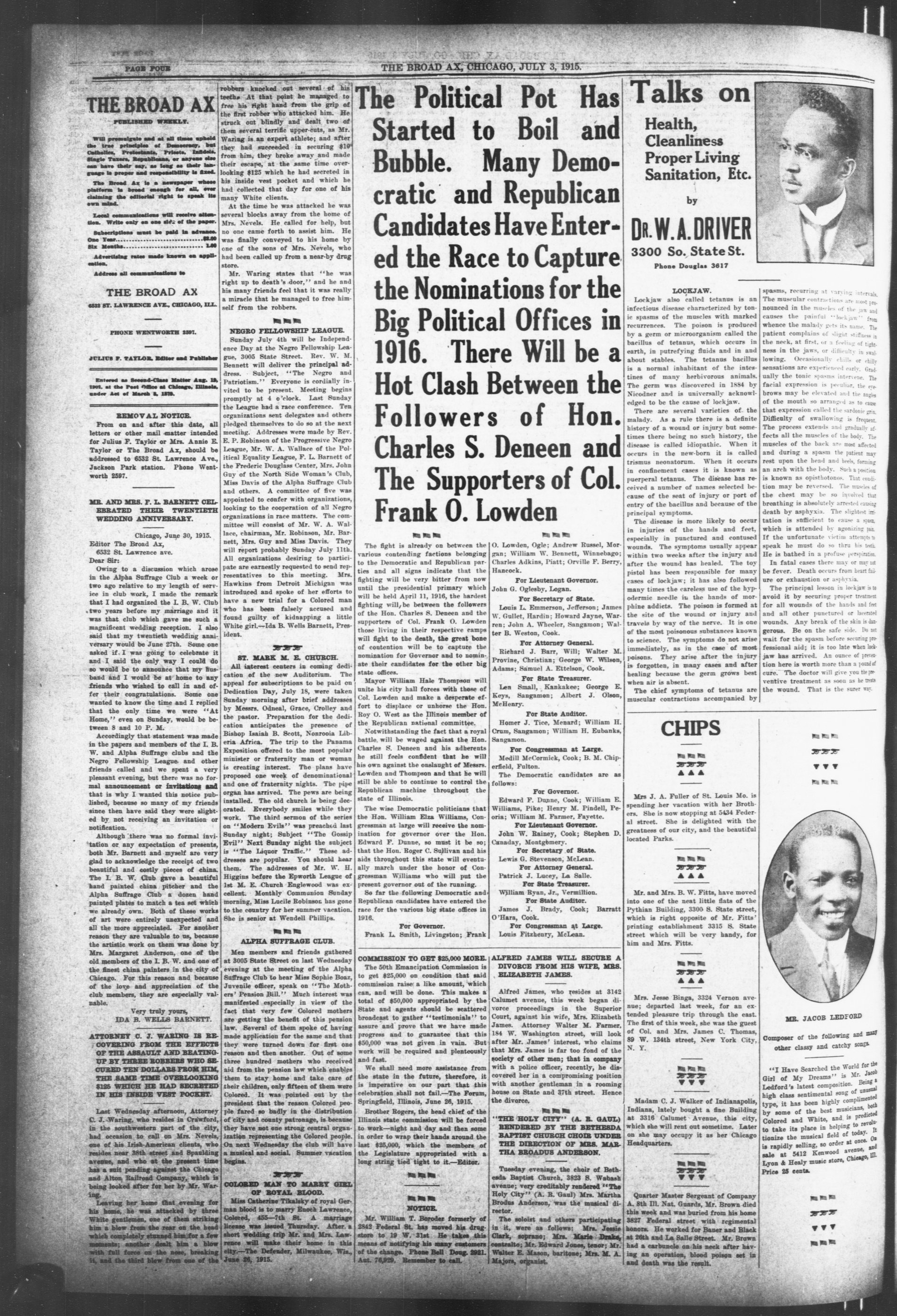
The Political Pot Has Started to Boil and Bubble. Many Democratic and Republican Candidates Have Entered the Race to Capture the Nominations for the Big Political Offices in 1916. There Will be a Hot Clash Between the Followers of Hon. Charles S. Deneen and The Supporters of Col. Frank O. Lowden
The fight is already on between the various contending factions belonging to the Democratic and Republican parties and all signs indicate that the fighting will be very bitter from now until the presidential primary which will be held April 11, 1916, the hardest fighting will be between the followers of the Hon. Charles S. Deneen and the supporters of Col. Frank O. Lowden those living in their respective camps will fight to the death, the great bone of contention will be to capture the nomination for Governor and to nominate their candidates for the other big state offices.
Mayor William Hale Thompson will unite his city hall forces with those of Col. Lowden and make a desperate effort to displace or unhorse the Hon. Roy O. West as the Illinois member of the Republican national committee.
Notwithstanding the fact that a royal battle, will be waged against the Hon. Charles S. Deneen and his adherents he still feels confident that he will his own against the onslaught of Messrs. Lowden and Thompson and that he will still be able to continue to control the Republican machine throughout the state of Illinois.
The wise Democratic politicians that the Hon. William Elza Williams, Congressman at large will receive the nomination for governor over the Hon. Edward F. Dunne, so must it be so; that the Hon. Roger C. Sullivan and his aids throughout this state will eventually march under the honor of Congressman Williams who will put the present governor out of the running. So far the following Democratic and Republican candidates have entered the race for the various big state offices in 1916.
For Governor.
Frank L. Smith, Livingston; Frank
COMMISSION TO GET $25,000 MORE.
The 50th Emancipation Commission is to get $25,000 on condition that said commission raise a like amount, which can, and will be done. This makes a total of $50,000 appropriated by the State and agents should be scattered broadcast to gather "testimonials" to assure and prove that we have made progress and to guarantee that this $50,000 was not given in vain. But work will be required and plenteously and fast.
We shall need more assistance from the state in the future, therefore, it is imperative on our part that this celebration shall not fail—The Forum, Springfield, Illinois, June 26, 1915.
Brother Rogers, the head chief of the Illinois state commission will be forced to work—night and day and then some in order to wrap their hands around the last $25,000, which the members of the Legislature appropriated with a long string tied tight to it—Editor.
```markdown
```
NOTICE
Mr. William T. Bororer formerly of 2842 Federal St. has moved his drugstore to 19 W. 31st. He takes this means of notifying his many customers of the change. Phone Bell Doug. 2921. Ant. 76,929. Remember to call.
O. Lowden, Ogle; Andrew Russel, Morgan; William W. Bennett, Winnebago; Charles Adkins, Piatt; Orville F. Berry, Hancock.
For Lieutenant Governor.
John G. Oglesby, Logan.
For Secretary of State.
Louis L. Emmerson, Jefferson; James W. Gullet, Hardin; Howard Jayne, Warren; John A. Wheeler, Sangamon; Walter B. Weston, Cook.
For Attorney General.
Riehard J. Barr, Will; Walter M. Provine, Christian; George W. Wilson, Adams; Samuel A. Ettelson, Cook.
For State Treasurer.
Len Small, Kankakee; George E. Keys, Sangamon; Albert J. Olson, McHenry.
For State Auditor.
Homer J. Tice, Menard; William H. Crum, Sangamon; William H. Eubanks, Sangamon.
For Congressman at Large.
Medill McCormick, Cook; B. M. Chipperfield, Fulton.
The Democratic candidates are as follows:
For Governor.
Edward F. Dunne, Cook; William E. Williams, Pike; Henry M. Pindell, Peoria; William M. Farmer, Fayette.
For Lieutenant Governor.
John W. Rainey, Cook; Stephen D. Canaday, Montgbmery.
For Secretary of State.
Lewis G. Stevenson, McLean.
For Attorney General.
Patrick J. Lucey, La Salle.
For State Treasurer.
William Ryan, Jr., Vermillion.
For State Auditor.
For State Auditor.
James J. Brady, Cook; Barratt
O'Hara, Cook.
For Congressman at Large.
Louis Fitzhenry, McLean.
ALFRED JAMES WILL SECURE A
DIVORCE FROM HIS WIFE, MBS.
ELIZABETH JAMES.
Alfred James, who resides at 3142 Calumet avenue, this week began divorce proceedings in the Superior Court, against his wife, Mrs. Elizabeth James. Attorney Walter M. Farmer, 184 W. Washington street, will look after Mr. James' interest, who claims that Mrs. James is far too fond of the society of other men; that in company with a police officer, recently, he discovered her in a compromising position with another gentleman in a rooming house on State and 37th street. Hence the divorce.
---
"THE HOLY CITY" (A. R. GAUL) RENDERED BY THE BETHESDA BAPTIST CHURCH CHOIR UNDER THE DIRECTION OF MRS. MARTHA BROADUS ANDESON.
Tuesday evening, the choir of Bethesda Baptist Church, 3823 S. Wubash avenue; very creditably rendered "The Holy City" (A. R. Gaul) Mrs. Martha Brodus Anderson, was the musical director.
The soloist and others participating in it, were as follows: Mrs. Jessie Clark, soprano; Mrs. Marie Drake, contraitc; Mr. Edward Jones, tenor; Mr. Walter E. Mason, baritone; Mrs. M. A. Majors, organist.
---
Health,
Cleanliness
Proper Living
Sanitation, Etc.
by
DR. W.A. DRIVER
3300 So. State St.
Phone Douglas 3617
LOCKJAW.
Lockjaw also called tetanus is an infectious disease characterized by tonic spasms of the muscles with marked recurrences. The poison is produced by a germ or microorganism called the bacillus of tetanus, which occurs in earth, in putrefying fluids and in and about stables. The tetanus bacillus is a normal inhabitant of the intestines of many herbivorous animals. The germ was discovered in 1884 by Nicodner and is universally acknowledged to be the cause of lockjaw.
There are several varieties of the malady. As a rule there is a definite history of a wound or injury but sometimes there being no such history, the disease is called idiopathic. When it occurs in the new-born it is called trismus neonatorum. When it occurs in confinement cases it is known as puerperal tetanus. The disease has received a number of names selected because of the seat of injury or port of entry of the bacillus and because of the principal symptoms.
The disease is more likely to occur in injuries of the hands and feet, especially in punctured and contused wounds. The symptoms usually appear within two weeks after the injury and after the wound has healed. The toy pistol has been responsible for many cases of lockjaw; it has also followed many times the careless use of the hypodermic needle in the hands of morphine addicts. The poison is formed at the site of the wound or injury and travels by way of the nerve. It is one of the most poisonous substances known to science. The symptoms do not arise immediately, as in the case of most poisons. They arise after the injury is forgotten, in many cases and after healing because the germ grows best when air is absent. The chief symptoms of tetanus are muscular contractions accompanied by
CHIPS
```markdown
```
Mrs J. A. Fuller of St. Louis Mo. is spending her vacation with her Brothers. She is now stopping at 5434 Federal street. She is delighted with the greatness of our city, and the beautiful located Parks.
Cannon
Mr. and Mrs. B. W. Pitts, have moved into one of the neat little flats of the Pythian Building, 3300 S. State street, which is right opposite of Mr. Pitts' printing establishment 3315 S. State street which will be very handy, for him and Mrs. Pitts.
```markdown
```
Mrs. Jesse Binga, 3324 Vernon avenue; departed last week, for an extended pleasure trip through the east. The first of this week, she was the guest of Col. and Mrs. James C. Thomas, 89 W. 134th street, New York City, N. Y.
```markdown
```
Madam C. J. Walker of Indianapolis, Indiana, lately bought a fine Building at 3316 Calumet Avenue, this city, which she will rent out sometime. Later on she may occupy it as her Chicago Headquarters.
♥ ♥ ♥
Quarter Master Sergeant of Company A. 8th Ill. Nat. Guards, Mr. Brown died this week and was buried from his home 3827 Federal street with regimental honors. He worked for Bauer and Black at 26th and La Salle Street. Mr. Brown had a carbuncle on his neck after having an operation, blood poison set in and death was the result.
[Picture of a man]
spasms, recurring at varying intervals. The muscular contractions are most pronounced in the muscles of the jaw and causes the painful "lock jaw" from whence the malady gets its name. The patient complains of slight stiffness in the neck, at first, or a feeling of tightness in the jaws, or difficulty in swallowing. Occasionally chills or chilly sensations are experienced early. Gradually the tonic spasms intervene. The facial expression is peculiar, the eyebrows may be elevated and the angles of the mouth so arranged as to cause that expression called the sartonic grin. Difficulty of swallowing is frequent. The process extends and gradually affects all the muscles of the body. The muscles of the back are most affected and during a spasm the patient may rest upon the head and heels, forming an arch with the body. Such a position is known as opisthotonos. That condition may be reversed. The muscles of the chest may be so involved that breathing is absolutely arrested causing death by asphyxia. The slightest irritation is sufficient to cause a spasm, which is attended by agonizing pain. If the unfortunate victim attempts to speak he must do so thru his teeth. He is bathed in a profuse perspiration. In fatal cases there may or may not be fever. Death occurs from heart failure or exhaustion or asphyxia.
The principal lesson in lockjaw is to avoid it by securing proper treatment for all wounds of the hands and feet and all other punctured or lacerated wounds. Any break of the skin is dangerous. Be on the safe side. Do not wait for the spasm before securing professional aid; it is too late when lock jaw has arrived. An ounce of preservation here is worth more than a pound of cure. The doctor will give you the preventive treatment as soon as he treats the wound. That is the surer way.
কোড কোড
কোড কোড
```markdown
```
[Name]
MR. JACOB LEDFORD
Composer of the following and many other classy and catchy songs.
"I Have Searched the World for the Girl of My Dreams" is Mr. Jacob Ledford's latest composition. Being a high class sentimental song of unusual type, it has been highly complimented by some of the best musicians, both Colored and White, and is predicted to take its place in helping to revolutionize the musical field of today. It is rapidly selling, so order at once. On sale at 5412 Kenwood avenue, and Lyon & Healy music store, Chicago, III. Price 25 cents.
```markdown
```
```markdown
```
‘The down upon
ious sale Dsly sof teat oa
cannot touch the fruit with a needles
point without breaking the tender
stalk, and yet the dew of the night
covers the whole surface of the fruit
‘and disappears in the morning, Jeav-
jng the gossamer growth more orderly
and beautiful than before. The dew
covers every leaf of the giant oak, and
the mighty tree drinks in the refresb-
ing moisture to its thirsty heart
through millions of pores, and the iron
trank that bas withstood a thousand
storms is made stronger by the gentle
strength of the dew. ‘The silent fall of
the dew {8 caused and controlled by
agencies of the most tremendous pow.
ex. The same power which shakes a
whole continent with its subterranean
thunder is the Same as that which en
circles the finest filament of thistle
down with a coronet of dewy gems so
small that they do not bend the deli
cate stalks with their weight—London
Globe.
Pert Arthurs Downfall.
One of the most dramatic surrenders
in military history was that of Port
Arthur during the Russo-Japanese war.
For five months the Russians, under
General Stoessel, defended the city into
which they had been forced by the
fierce onslaughts of the Japanese. It
was expected that the czar’s troops,
25,000 strong and well provisioned.
would safely hold Port Arthur until
relief came. After twenty weeks of
siege, bowever, Stoessel raised the
white flag and the Japanese marched
into the city. General Stoessel was
tried for treason in connection with the
surrender, and be was sentenced to
death, for it was stated that the Rus-
sians bad sufficient food and ammuni-
tion in Port Arthur ta have continued
their defense for some time. The czar
commuted the sentence on Stoessel to
one of ten years’ imprisonment, but
the disgrace broke his health and be
died, paralyzed and dumb.
Aa Uniepecinn Quien.
‘Those who imagine there is some
necessary connection between literary
genius and inches will have to explain
away the case of Alexander Pope.
Pope was exactly four feet six inches
high, He was humpbacked and de
formed. According to one of Lord Ox-
ford’s servants, he was “so weak as
to stand in perpetual need of female
attendance; extremely sensible of cold.
so that he wore a kind of fur doub-
let under a skirt of very coarse, warm
linen, with fine sleeves. When be rose
be was invested in a bodice made of
‘stiff canvas, being hardly able to stand
erect till it was laced, and he then put
on a fiannel waistcoat’ One side was
contracted. His legs were so slender
that he enlarged their bulk with three
Pairs of stockings, which were drawn
on and eff by the maid. for he was
not able to dress or undress himself.” —
London Chronicle.
res eee
Bishop Sanford Olmsted said at a
dinner party in Denver:
“The charge that the church is gov.
ered by mercenary motives is an in
sidious one. I think this charge was
best answered by the prison chaplain.
“A chaplain was addressing a con-
gregation of prisoners. many of whom
had given more than one proof tha
they were profiting by bis visits. But
there was a certain rough, brutal look
ing fellow, who always scoffed and
sneered. And today this fellow, wher
the chaplain greeted iim, said:
“‘No, I don’t want to shake hands
with you, parson. You only preach
for money.’
“Very good, my friend; have it 80,
the chaplain answered. ‘I preach for
money. You steal for money Let God
choose between us’” — Washington
Star.
No Sunset For Five Days.
At the head of the guif of Bothnia
there is a mountain on the summit of
which the sun shines perpetually dur-
ing the five days of June 19, 20, 21, 22
and 23. Every six bours during this
scason of continual sunshine a steamer
leaves Stockholm crowded with visi
tors anxions to witness the phenome-
non. At the same place during winter
the sun disappears and is not seen for
weeks, Then it comes in sight again
for ten, fifteen or twenty minutes,
gradually lengthening its stay until
finally # stays in sight continuously
tor upward of 120 hours.
(No Case For Sympathy.
“You didn't award any damages
worth mentioning in that breach of
promise case.”
“No” explained the foreman of the
jury. “We decided that the plaintiff
was lucky to get rid of » man who
would write the fool letters her lawyer
read to us.”—Washington Star.
‘The Voice of Experience.
‘The new minister was holding forth.
“It seems to me,” he said, “we should
do more to bring the people together.”
“Huh!” snorted the deacon. “If you'd
been here as long as I have you'd know
that what we need is something to
keep ‘em apart.”"—Puck.
He Got It.
Eva—As we strolled along be wager-
€4 8 bor of chocolates that I couldn't
say the word “kiss” Belinds—And
id you try? Eva—Yes, but he took
the word from my very lps.
Persevere.
Make the best of everything, think
the best of every one, hope the best for
‘Yourself, do as I have done—persevere-
George Stephenson. ‘ ¢
‘Trust men will be true to
Houses In 8. ein
‘No building tn'Bueuos Altres ts per
mitted to Ue bigher than the width of
the “street upon which ‘it i erected;
hence the skyscraper will never become
popular there, despite the splendid
growth and wideawakeness of the city.
Much as this metropotis Is known, tt
{s not generally thought of in the light
of age. However, it is one of the old-
est cities in the new world. The frst
white settlement was made Just forty-
two years after the discovery of Amer.
fea by Columbus, and the Grst build-
ings were mud huts thatched with
straw. Then a brick kiln was made
and later tiles and bricks were import.
ed from Spain. The first city was of
Spanish architecture, and that style
prevailed for more than 200 years. De-
spite the many great changes which
have come through the passage of time
"nd the general building advance in
the world, four-ffths of the houses of
Buenos Aires are still of one story, al-
though there are streets lined with six-
‘story palaces —Exchange
A Uniaue Lichtchic.
Of the island of Islay, on the west
coast of Scotland, there is stationed at
the Otter rock a unique lightship. It
4s unmanned, yet tt can be relied on
to display the warning light to guide
the mariner on this dangerous coast.
It ts a most ingeniously constructed
‘esse and the only one of its kind
In its two ste! tanks a sufficient quan-
tity of gas can be stored to supply the
lantern for several months. Expert-
ments have shown that the light may
be depended upon to burn continuously
for months at a time. The approxt-
mate duration of the light can be pre-
determined, and there is no danger
‘whatever of its being extinguished by
wind or spray. The light is visible at
@ distance of from eight to twelve
miles. The lightship also bas a bell,
which is made to ring automatically
‘by means of an ingenious device that
Utilizes the gas as it passes from the
tanks to the lantern to work the bell
clapper.—Every Week.
ees ee
Everyone has heard of Stonehenge,
@ prehistoric monument In England
which ts almost as much of a puzzle
as the sphinx in Egypt or the mounds
erected by the mound butlders in Amer.
ica. Stonehenge is about ten miles
north of Salisbury. The name comes
from two Saxon words meaning “bang:
ing stones.”
‘The eariler Celtic name was Cor
Gawr, or giants’ temple. There are in
many localities in the northwest of
‘Europe prehistoric remains in the form
of huge stone monuments or “tumuli”
or “barrows"—that is, bowl shaped
mounds or hills of earth. in the neigh-
borhood of Stonehenge there are hun-
reds of these mounds. Coins, etc.,
found in them seem to date them back
about three centuries before Christ.
It must have taken an immense
amount of work to make them, and
there must have been some profound
and serious purpose behind them—
Pathfinder.
i i a ite
To guard the million books in the
New York public Mbrary against the
ravages of bookworms and other in-
sects which feed upon the paper, the
give on the backs and the cloth and
leather bindings, @ constant care 1s
exercised, and a Keen watch kept for
any evidence of their activities. One
woman {s assigned exclusively to this
work. When treating the books she
wears a huge apron which completely
covers ber gown. A cheesecloth vell
protects her face against the germs
whieh lurk in the musty documents.
and even the air she breathes is screen-
ed against contagion. Close touch ts
Kept with the health department, and
books which have been returned from
infected areas are fumigated before
being restored to circulation —Ex-
einen 6 ge
Granite and Lime.
Granite is the lowest rock fn the
earth's crust. It ts the bedrock of the
world and shows no evidence of ant
mal or vegetable life. It is the parent
rock from which all the other rocks
have been either directly or indirectly
derived. It is claimed by scientists
that all the Ime in the world has at
some time no doubt been a portion of
many different animals and possibly
of human beings also.
Art of Shoopins.
“What are you down for?”
“To buy myself a box of face pow-
Ger, Will you help me select it?"
“Certainly,” assented the other Indy.
“Suppose we begin by looking at re
‘frigerators and lace curtains.”—Louls-
Ville Courier Journal.
| Stage Fright
Statesmen are said frequently to suf-
‘fer from stage fright. John Stuart MIlI
‘utterly collapsed on one uccasion when
‘asked to speak in public. The late
“Mgr. Benson was another who was se-
Tiously affticted whenever he had to
preach
Ambiguous.
Artist (showing latest picture)}—My
object was to try to express all the
horrors of war. Friend—I have never
seen anything more borrible—Boston
‘Transcript
Foresight.
‘Bix~You used to walk in your sleep.
Do. you still do so? Dix—No, I take
entfare to bed with me now-—Boston
‘Transcript.
Po
is tae oP
““Tv’s what your mother thought she
-martied when she got me."—Detrett
THE BROAD AX, CHICAGO, JULY 3, 1915.
“Sis etal ts Oe Lae Ge
Probably the most remarkable build-
ing constracted wholly of ice ‘was the
Palace built on the Neva by the Czart
‘ta Anne of Russia. Large blocks of
ice were cut and squared with great
care and inid on one another by skill
fal masons, who cemented the joints
with water, which tfumediately frose.
The building, when completed, was
Gtty-six feet long, seventeen and one-
half feet broad and twenty-one feet
bigh. It was of but one story. The
facade contained a door surmounted by
&n oruamental pediment and six win-
dows, the frames and panes of which
were all of ice. An elaborate balus-
trade, adorned with statues, ran along
the top of the facade and another bal
astrade surrounded the building at the
level of the ground. The grounds were
farther adorned with a life size figure
of an elephant, with his mahout on
his back. A stream of water was
thrown from the elephant's trunk by
day and a flame of naphtha by night.
A tent of ice contained a hot bath,
In which persons actually bathed. There
Were also several cannons and mortars
of ice, which were loaded with bullets
of ice and iron and discharged.
Seiliet Gtconien Teicin.
Five feet of clay, three feet of loose
earth, or two and a half feet of sand
will stop a modern rifle bullet at the
closest range; but, curiously enough, as
the layman may think, ramming earth
hard reduces its resisting power, and
high velocity bullets have less pene-
tration in sand at short than at me-
dium range. Eighteen inches of sand
between boards 4s bullet proof, also
nine inches of well built brick work.
Soft wood. like fir. across the grain is
ballet proof at point blank range if
forty-eight inches thick, or at 50° yards
if half as thick. Similarly, twenty-
seven inches of hard wood, like oak,
is point blank proof, or fifteen inches
at 500 yards. Half an inch of wrought
fron or mild steel, a quarter of an inch
of hard steel. or a fifth of an inch of
special steel is bullet proof. So are
six inches of shingle, Sfteen inches of
coal, of, a8 some people may be sur
prised to know, eight feet of snow—
London Express.
Neckin Rince
But for the napkin rings. They are
relics of a departed age, reminders of
the era of the Saturday night bath. the
old folks’ concerts and the painted pan-
oramas of the Nile. They abide now in
out of the way corners, tarnished and
forgotten, bands of old silver, often af-
fectionately inscribed at the command
of givers long since turned to dust
‘They are the sort of reminders of a
gentler but less fastidious generation
that we do not like to part with ex-
cept for some good reason and have no
desire to keep. The serial napkin went
long ago. To the melting pot, by all
means, with the rings, and that they
may melt up into millions of dollars’
worth of silver is our sincere wish—
New York Times.
The Clanrmaher’ tanure.
Besides the privilege of having news
papers and novels read to him while he
works, the Cuban cigarmaker demands
another indulgence—that of cheering
his labors with cigars provided by the
firm. Every morning six high grade
wrappers are handed to him for his
own use, and in these he folds as much
2 he likes of the tobacco supplied bim
for the Gay's work. The cigars thus
made and consumed are said to cost
the Havana tobacco industry & sam of
Close on $250,000 a year. The head of
one great firm once declared that he
would willingly make over his factory
and plantations to his employees if in
return they undertook to give him the
cigars they rolled for themselves.
‘The Siav Race.
History has. contributed to sp
arate the two masses of Slavs. The
‘Mongol yoke for two centuries intro
duced Asiatic customs among the Rus
sian Slava. The Turkish yoke for
many centuries and down to our ows
times influenced the character and cus
toms of the Bulgars and Serba. On
the other hand, the Latin Slavs fol
lowed the historical evolutions of the
occident—they were with Godfrey de
Bouillon at the crusades, they were
touched with the flame of the rensis
sance, they have had their part in the
evelopment of modern thought —Lit
exary Digest.
‘The Loon a Good Diver.
As a diver the loon excels, and nato~
rally, for it is his sole means of livell-
ood. Not only is he marvelously quick,
but be can remain under water for
@ seemingly endless time, In swim
ming under water be uses both wings
and feet and can go for several bum
red yards in this fashion. The loon,
Uke many other waterfowl, sleeps on
the water with his head tucked under
Dis wing.
Mostly Himself.
“1 bear be brought back some tuter-
eating views of foreign places.”
“Yes; be has photos of himself stand-
tng on London bridge. bimeeif leaning
agninst the leaning tower of Pisa and
Dbimeeif im front of the pyramids”—
‘Louisville Courier-Journal,
Not Spotices.
“1 will have no coe in my employ
‘who fs pot above suspicion. Can you
offer me a spotless character?”
“Mo, ma'am: it got some ink apilt en
‘2"—Baltimore American.
Looking Backward.
Do you remember the time when
you wanted 2 girf's picture more than
‘enything else in the world? — Pitts
‘tareh Post.
Ko men ever wetted clay and then
loft tt, os if there would be bricks by
chance and fortune —Piutarch,
‘of the most interesting verbal
‘or phological trails that scholars now
are followinz tutu the past for light on
‘origins is that which bas the word
“editor” stamped upon it Yale's au-
pedi areniy iv mw peepee
Professor Lounsbury, ‘Sind no ear
fer use of the term as appled to the
chief writer and director of a period-
fea than in 1768, but there is evidence
in the superb collection of British and
‘American newspapers owned by the
Antiquarian society, Worcester, Mass.,
that it was so used in 1761. The al
leged use of the title tn the Boston
Newsletter of 1723 proves, on examt-
nation of the file in the Boston public
Ubrary, to be inaccurate. Undoubtedly
Isaiah Thomas, tn 1773, spoke of him-
self as editor of the Royal American
Magazine. The interesting point to be
noted, while the huaters are busy on
the trail, is that, relatively speaking,
“editor” is a new word in journalism.
“Printer” and “publisher” preceded it
—Christian Science Monitor.
‘han of tha Siditen,
The binejay—Cyanocitta cristan—e
purely an American bird He is about
twelve inches long, 1s light purplish
blue above and graying below. The
collar and frontiet are black and the
wings and tall ultramarine, barred,
the outer tail feathers being tipped
with white. What a graceful. beautt-
fal bird this ts, impertinent and noisy,
his raucous scream followed by a chor
tle that sounds much like a mocking
“Ha, ha, ba, ob, my.” He is accused
of robbing the farmer's corn crib, of
sucking the eggs of other birds and
even of tearing to pieces thelr young.
‘The sportsman as be goes through the
woods, gun in band, thoroughly hates
the jay, which is a kind of game war
den, sounding an alarm to the other
birds as their enemy approaches. Nat
uralista have placed him in the crow
family despite his beautiful plumage.
but his manners and his morals are
more like those of the sparrow bawk.—
Indianapolis News.
‘The Darkness Before Dawn.
It ts proverbial that “the darkest
hour precedes the dawn.” W. F. Den-
Ring. the English authority on me-
teors, has recently called attention to
the literal accuracy of this proverb. as
established by his own observations
on thousands of nizhts. He says:
“Before dawn a greater darkness
seems to drop down Ike a mantle upon
the immediate surroundings. Objects
‘which were plainly observable daring
the previous hours of the night are
Dlotted ont, and a nervous feeling ts
‘sometimes induced by the dense opac
ity of the air.”
He claims to have noticed this
phenomenon when the subject was far
from his thoughts. so that it could not
have been purely subjective He is
‘unable to state the exact interval be
‘fore sunrise when the remarkable dark.
‘ness comes on nor whether it is com
‘mon to each season and sky conditions
: Weltinsten’s Weunded,
Tt & dificult to realize the callous
ness toward the sick and wounded
against which Wellington struggied in
the peminsula. One evening at dinner
be beard that at a post several miles
away a large number of sick soldiers
were lying in the open, exposed to the
weather. He rode promptly to the
place, found the sick in the plight de-
scribed, while the healthy officers were
fm comfortable houses, and was told
by the commanding officer that there
was no accommodation for the sick.
‘He instantly arranged in detail for the
Dilleting of the sick in those houses,
but, suspecting what might follow,
paid 2 surprise visit the next night
and found that the invalids bed again
been turned out into the open. Well-
ington immediately reinstated them,
arrested the officers and had them
tried and dismissed for disobedience.
@ Rein Sie
-If the telepbone company charges 15
cents to carry your voice across the
Hodson river, and if the telegraph
company charges 25 cents to carry ten
words across, and if the ferryboat
charges 8 cents to carry your body
across, and if the tunnels charge 7
cents for carrying your body under the
Hadson river, and if the express com-
panies charge 28 cents for carrying &
20 pound parcel across, and if the gov-
‘ernment charges 15 cents for carrying
‘a 20 pound parcel across, compute the
amount of logic in a square inch of
modern civilization —Life.
‘The Cheapest Paper.
London used to possess the cheapest
Journal ever published. It was called
the Six--Penny; or, Penny-a-Week
‘Down and Country Daily Newspaper,
‘and subscribers of 1 penny weekly had
the paper delivered to them every day,
while single copies were a farthing.
Unhappiness.
They who have never known pros-
perity ean hardly be said to be unbap-
py. It ts from the remembrance of
Joys we bave lost that the arrows of
‘@Miiction are pointed. —Emile Zola.
Bie Quen Sueet Solf.
‘Biz—Who do you consider your best
friend, the one who would do the most
for you?
‘Diz—My wife's busband.— Boston
‘Transcript.
ent Bue.
‘Mabel—Marry bim! Why, his grand-
father kept pigs! Editb—I know. He
told me that your’ grandfather stole
two of them.—New York Globe.
No Hints Fer Her.
Crawford—Hias your wife hinted yet
aboot. # new bonnet? Crabshew—
Hinted? Why. she’s issued an ultima
tum.—Bauffalo Courter.
‘Tagore’s Fame in india. ~~
As showing someting of Rubindra-
‘path Tagore’s fame in bis native India,
Ernest Rhys telis the following story
in his blograpby of Tagore: ‘
“Mr. Montague, the undersecretary
of state for india, was on one occasion
riding through an Indian forest at
night when be came upon a clearing
where two or three men xat around the
fire. Not being certain of the road.”
says Mr. Rhys, “he was glad to dis
‘mount and rest his tired horse. Shortly
after be had joined the group a poor
‘looking, {ll clothed lad came out of the
forest and sat down also at the fire
‘First cne of the men sang a song and
then another. The boy's turn came.
and he sang a song more beautiful both
in ‘corde and music than the rest
When asked who had made the song
he said that he did not know, ‘they
were singing these songs everywhere.
Awhile after Mr. Montague heard the
‘words that he had used again. this
time in a very different place, and
‘when he asked for the name of the
maker of the song he heard for the
first time the name of Rabindranath
Tagore”
; Gioia.
| The use of a tooth wash does not
‘approach the conditions of a laboratory
test, though there can be little doubt
that a good deal of germicidal work tn
the mouth 1s done by the vigorous ap-
plication of the toothbrush, and it may
be pointed out that the tongue may
‘well be included in the process. To be
effective, however, the action of all an-
tiseptics takes time, according to the
vitality of the organisms they encount-
ee, and casually the tooth brushing
Process Goes not occupy many seconds.
‘This question of time exposure is im-
portant, but it is very generally over
looked and consequently the antiseptic
treatment of the teeth falls short of
that effectiveness which is shown to
be the case in laboratory experiments.
The tooth washing process should be
more prolonged and the antiseptic wash
allowed to remain tn contact with the
teeth and gums for some minutes in-
stead of seconds before finally washing
‘the mouth clear of antiseptic with
‘plain water—London Lancet.
reed
Many persons are under the impres-
sion that America has few, if any, na-
tive plants worthy of cultivation in the
home garden. They have been accus-
tomed to look upon them as weeds and
wild things, and so unfamiliar are they
with native flowers that they fail to
recognize them when they meet them
outside their native haunts. A writer
tells how he transplanted a stalk of
goldenrod from a fence corner in the
pasture toa piace in his garden. It
Souriabed luxuriantiy and sent up
many stalks as high as a man's head,
each crowned with a great plume of
brilliant flowers. A neighbor was at-
tracted by the beauty of the plant and
declared it must have cost its owner
some dollars. When told, bowever,
that numbers of the same plant were
flourishing bebind his barn he exciaim.
ed: “What! You mean to tell me it's
yallerweed!” And he went away with
the air of one who had been imposed
‘upon.—Country Gentleman.
Thievery tn Chile.
‘The Chilean masses have = bed
name for larceny. In Chilean ports
abip passengers are warned to lock
their cabin doors, and loaded lighters
have to be guarded at night Chilean
stokers will saw through the bulkhead
into the vessel's hold, steal goods and
hide them in the coal bunkers till the
night after they arrive in port, when
they find opportunity to lower them
overside to « confederate in 2 boat un-
der cover of darkness. Harbor thieves
‘will even cut a hole in the bow of a
Yessel and make off with boatloads of
freight. The Germans of southern
Chile have the worst opinion of Chilean
honesty, and in Santiago I was bidden
notice the high walls and grated win-
ows of the houses of the better class.
—Professor Edward Alsworth Ross in
“South of Panama.”
Defining a Batman.
What is a batman? The term seems
to be a military one. It apparently
means the driver or manager of pack
horses. A bat horse is a pack horse
‘which carries officers’ luggage. “Bat”
is @ pack saddle and, like so many milt-
tary words, it is French. There is a
common French proverb, “Cest la que
le bat le blesse”—“That is where the
saddle hurts,” or, as we say, “where
‘the aboe pinches.”—Manchester Guar
dian
neal lien.
“Who is that long haired fellow at
‘the other table?" :
“That is Basxvaynskesits, the fa-
mous Russian pianist. He bas made
/& great name for himself.”
“Must have made it out of barbed
wire, didn't be?"—Exchange.
Anxious Waiting.
Detective (2 a. m.)—Hey, youse! Wot-
cher hanging around this ‘ere front
oor fer? Supposed Burgiar—I'm wait-
ing for th’ indy inside to git asleep.
‘We're married.—Philadelphia Bulletin.
Getting It Right.
“Mrs. Ciinnick thinks a great deal ot
her husband.”
“You've got the wrong preposition.
‘Make it *for’ instead of ‘of.’"—Brown-
‘ing’s Magazine.
A Musical Opinion.
“What selection is that the orchestra
bas just Gnished?*
“I don't know. Sounded to me like
neuralgia expressed in music.”—Lon-
don Tit-Bits,
‘A long. slow friendship fe the best;
2 long. slow enmity the deadllest—
PAGE FIVE
‘Whale Curiceities.
Little ts really “knowm about bis
whaleship. This is surprising, consid-
ering he is such an interesting subject.
‘The blue or sulphur bottom whale ts
the largest animal iiving today. Spec
tmens have measured eighty-seven feet
tm length, which in all probability
weighed about seventy-five tous. Odd-
ly enough. although the mouth will
Permit twelve men to stand in ft the
throat is oaly nine inches in diameter.
‘These particular whales feed on mb
nute sbrimp+—about three-quarters of
an inch in lengtb—and they probably
never touch fish while they can obtain
these. From the inside of one of these
whales five barrels of shrimps were
taken. The sperm whale possesses
spermacet! in lquid form tm the up-
per portion of its head. From one of
these whales twenty barrels of sper
macet! were taken out of the “case”
This same type of whale also yields
ambergris, that valuable substance
used so extensively in the manufac
ture of our best perfumes.
A Lost Sea.
“One of the most curious experiences
1 ever had.” says James Oliver Cur-
‘wood, the author, “occurred on my first
trip to James bay. the southern por
tion of Hudson bay. We reached the
bay just at sunset. It happened that
I was the first to awaken in the morn-
ing. and when I crawled ont of my
tepee I gave a yell that roused the
camp. The sea was gone! Not a sign
of that vast grass grown dip in which
it had been. My first thought, and a
natural one, was that I was out of my
head. Where had the sea gone? Had
we really camped on its shore the night
before? I strained my eyes. but could
see nothing but that dip speckled with
pools of water. I was in the company
of @ Hudson bay factor at the time,
and I turned to find him laughing.
‘Then the explanation came. At this
point James bay was unusually shal-
low, and at low tide the sea dropped
back seven miles! During the night it
had actually left us seven miles in-
land.”
ee een
Every Japanese is a Japanese first,
whatever else he may be second. In
this unified patriotism they are incom-
parable. It extends even to the minor
affairs of life. There is no Japanese,
of bigh or low degree, who will admit
any fault of bis country to a foreigner,
however strict his censure may be
when talking to bis friends. If there
are faults the Japanese conceal them.
‘They never volunteer any information
‘as to drawbacks, and they always have
an excuse for failures. No condition
can arise in Japan whereby a foreigner
ean learn from a Japanese of anything
to the detriment of the country. ‘The
statesmen will not tell you anything.
‘The coolies will not tell you anything.
They are units of concealment. They
pat the good face on everything. It ts
Japan frst with them, Japan first al-
ways, and always a super-Japan.—Sam-
uel G Blythe in Saturday Evening
Post.
Chinese Names of Places.
Chinese names of places often define
their character. Thus the terminal
“yang” means fortress, Pingyang the
“fortress of peace.” “Cheng” means a
“walled city.” “Shan” is a mountain.
“bat” the sea, “Kuan” a camp; thus
Shankaikuan ts the “mountain sea
camp.” A “ling” is 2 mountain pass;
Motienling, near Mukden, is the
“heaven scraping pass.”
‘The suffixes “tao” and “to” indicate
islands; “po” or “pho.” a harbor;
“wan.” a bay; “kiang™ and “bo,”
river; “kow.” a port; “fu,” a first class
city; “ju.” « provincial capital. “Pei”
is north, “nan” is south. “king” is cap-
ftal These suffixes help to explain
such familiar names in these days as
Senshantac, Chemulpo, Talienwan,
Yangtsekiang. Hoangho, Yinkow, Che
fu, Anju, Peking and Nanking.
Bacaulew and Mie Rarzers.
Macaulay was a self shaver—though
not with a safety—and the woeful re-
sults are recorded in his biography.
‘When he sailed for India and his cham-
bers were cleared there were found
between fifty and sixty strops, hacked
into strips and splinters, and innumer-
able razors in every stage of disrepair.
At one time be hurt his hand and had
to go to the barber. After the opera-
ton he asked the charge. “Ob, what-
ever you usually give the person who
shaves you.” was the answer. “In that
case” said Macaulay, “I should give
you a great gash on elther cheek.”"—
London Mirror.
‘The Alpaca.
In spite of attempts to introduce the
alpaca into countries away from its
native habitat. failure has attended
them. It is rarely found below an al
titade of 5,000 feet. Its wool is of an
‘exceedingly fine luster and quality and
occasionally attains a length of six
OR vt eee Pr
“Good Morning.”
It ts customary tn most countries to
say “Good morning” as a greeting even
when it isn’t true. But the English-
man says “Beastly morning.” and it
generally s.—New York Independent.
lt ee ie ie
In New Caledonia heads of infants
are squeezed into different shapes, the
faces of boys being lengthened to look
Mke warriors and the girls’ faces made
oval by pressing up the chin.
Baby Talk.
The first infant speech is the use of
the consonants “m” and “r,” “g” of
“f° and the Grst words “mum” and
PN acgeedioes
‘Unies what we do is asefd our gio
ee Se
PAGE SIX
But He Does Not Catch Even a Whale
Bowser had been at the office about five minutes the other morning when his friend, Mr. Skill, came in. After talking a few minutes about the sudden rise in the price of prunes Mr. Skill said:
"Bowser, I am all in."
"So'm I," was the reply.
"I should judge from the looks of you that you are. We have both worked hard during a long, hot spell.
"We have that."
"Unless we take a day off we are on the way to the graveyard. Let's have one day off tomorrow."
"And go out into the country?" queried Mr. Bowser.
"Country? Not much. We will go down the bay fishing, and breathe in some of that ozone which blows in from mid-Atlantic, and we will both come back as fit as fiddles."
"That's it—that's it, hooray! Have you got a boat?"
"A friend of mine will lend me his motorboat, but the trouble is to find some one to run it. I never tried one."
"But I have," replied Bowser. "I can run a motor boat from here to Texas and back as slick as grease."
"Then that settles it, old man. Our party will be composed of us two, my
FOUND THE REST OF THE PARTY ALREADY THERE.
wife, your wife and two jolly good fellows. We will start early, take a big lunch and be gone all day."
"Bully for us!" exclaimed Mr. Bowser. "We will fish and fish and fish. We will catch bass and pike and pickerel and dolphins and sharks and whales and anything else that comes around. By George, I am glad that you suggested it! What time do you want to start?" "We ought to get away by 7 o'clock in the morning, and Morton's wharf will be a handy place for all of us to meet for the start." Mr. Bowser had hardly entered his house that evening when Mrs. Bowser knew that something was up. She did not ask what it was, however, nor did he volunteer any information. He was somewhat abstracted during the meal, but when they had reached the sitting room and he had got his cigar alight and was walking to and fro she said: "I hope you are not thinking of start-
"I hope you are not thinking of starting out for the north pole?"
"Mrs. Bowser," he replied, "your sour face shows that you are billions. The dark circles under your eyes show that you are not well. Your dragging step shows weariness. I am not going to suggest a tonic, however."
"It would do no good if you did," she answered. "I was looking in the glass ten minutes before you came, and I have neither a sallow complexion nor have I dark circles. Nobody else seems to have noticed that I drag my feet. Perhaps they have increased in size and weight during the last two or three days."
"If you are feeling well I am sure I am not," said Mr. Bowser in solemn tones. "The fact is I am all run down, and I have neither strength nor ambition to continue my work without at least a brief play spell."
"Well, why don't you take one?"
"That's what I'm going to do, and tomorrow is the day."
And he told her about Mr. and Mrs. Skill, the motorboat, the jolly good fellows, the ozone and the fish and wound up with adding:
"It will be like beginning a new life."
"Who is going to run the motorboat?" cautiously asked Mrs. Bowser.
"Why, I am, to be sure!"
"Then that settles it; I don't go."
"But why, woonan—why?"
"Because you know nothing whatever about running a boat of any sort, and I don't want to be drowned." "I can run a motorboat as easily and safely as you can run a broom across the floor!" shouted Mr. Bowser as his face grew very red.
"But I don't go." persisted Mrs. Bowser.
She was right. Mr. Bowser had never even rowed a skiff about on rock bottom. At a motorboat exhibition he had stood within fire inches and a nifft
of a fine looking motorboat and had been told that the price was $450, but that was the limit of his experience. After chewing the rag for three or four minutes he growled:
"You can stay home if you like, but I am going. You would probably spoil our day for us if you went along. Tell the cook to have me a bit of breakfast ready soon after 6 o'clock."
At 7 o'clock next morning Mr. Bowser was at Morton's wharf and found the rest of the party already there. During the night he had dreamed of being drowned in each of the seven beats, but this fact had not lessened his assurance that he could run a motorboat. The owner of the boat may have had his doubts on that point, for he asked of him:
"Have you had much experience?"
"Only about fifteen years," was the reply.
"That ought to be plenty. You see you manage the engine from the wheel."
"Sure I see. Don't waste any breath on me."
All got into the boat, Mr. Bowser took the wheel, and the owner started up the engine. Mr. Skill's wife was a large, portly woman with a squint in one eye. The other eye hadn't a squint, but a ferocious glare. She didn't like the looks of Mr. Bowser at first sight, and she was ready to pick a fuss with him on the slightest excuse. She got that excuse within five minutes. A ferryboat came out of a slip and whistled for the motorboat to get out of her way. Mr. Bowser was willing enough to do so. He turned the wheel to port and then to starboard and was still turning back and forth when Mrs. Skill cried out:
"See what the idiot is doing! He'll have us under the bow of that ferryboat in a minute more. Take him away from the wheel, some of you!"
Before he had released the wheel Bowser had escaped a collision by a margin of about two feet and the captain of the ferryboat had told him what he thought of him and also of his father and grandfather. When the danger had been averted Mr. Bowser smilingly said in excuse:
"I got a cinder in my eye and could not see for a moment."
"If another cinder comes along it may mean a broken neck for you," replied the woman with the ferocious eye.
Mr. Bowser wabbled the boat along in a tolerably straight course for about a quarter of a mile. Then he had to look out for an ocean liner coming in from the sea. Should he pass to port or starboard of her? He didn't know. The fact that he didn't know put him in a sweat. He finally decided to go to port of her. Then he decided on the contrary. In the midst of his perturbation Mrs. Skill screamed out:
"He's at it again. We'll be drowned this time for sure!"
The three men jumped for Mr. Bowser as before, and there was another struggle to wrench the wheel from him. In the midst of it the engine stopped working, and if the big liner hadn't altered her course by two or three points there would have been a smash and five people drowned. As it was the motorboat was half filled with water from the wash of the steamship's propeller.
"You old, liar, but you told me you could run a motorboat!" exclaimed Mr. Skill.
"He couldn't run a plank," added Mrs. Skill.
"We ought to throw him overboard," said the two men in chorus: Mr. Bowser rose up from the bottom of the boat where he had been floating around and said:
"Ladies and Gentlemen—I told you that I could run a motorboat. I think I got the thing mixed up. I should have told you that I could run a Mississippi river steamboat, and I'll stick to it that I can. I do not ask to take the wheel again."
"But if you are to go along with us this is the end of the trip for me," half shrieked the owner of the ferocious eye.
"Our lunch is all water soaked," announced one of the men.
"And the tackle and bait have been washed overboard," added the other.
After staring at each other for a moment Mr. Skill solemnly said:
"Bowser, you have got to go. I think I can start the engine, and we will land you over there."
Mr. Bowser hadn't a word in reply, and ten minutes later was landed in the woods of Staten Island. He didn't get away, however, without something more from Mrs. Skill. She scrambled ashore after him, saying.
"That half baked idiot has spilled the day for all of us and I don't propose to let him go so mighty. Come on, the rest of you."
Mr. Bowser started on the run as Mrs. Skill picked up a club and before she could administer justice he was lost to sight amid the trees and bushes.
"Didn't the party go fishing?" asked Mrs. Bowser as Mr. Bowser reached home about noon, having a forlorn and abject appearance.
"It has been postponed for two weeks," he calmly lied as he wandered out into the back yard to see if his sun flowers were still living.
Who's Who.
Who's who.
You say that Mrs. Green is coarse and Mrs. Green is plain?
Their kid is quite impossible, especially Aunt Jane.
You say they've never traveled and they all have shocking taste?
You wonder why we called upon those people in such haste?
Why, Mrs. Green knows Mrs. Brown, whose mother was a White.
And she was nearest neighbor, once, to Mrs. Edward Knight.
Whose sister married Jackson Jones—his And they've been in society for years and years and years!
—Grace McKinsey in Judge.
THE Scope of the Bryan peace treaties, which are similar, is indicated in article 1 of the British treaty signed in September, 1914, as follows: "The high contracting parties agree that all disputes between them, of every nature whatsoever, other than disputes the settlement of which is provided for and in fact achieved under existing agreements between the high contracting parties, shall, when diplomatic methods of adjustment have failed, be referred for investigation and report to a permanent international commission, to be constituted in the manner prescribed in the next succeeding article, and they agree not to declare war or begin hostilities during such investigation and before the report is submitted."
The national census report farms, operated by owners for $1,750,000,000. A this mortgaged farms are in f. Illinois, Iowa, Wisconsin and Those in Ohio, Indiana, Mississippi and Nebraska, added to constitute considerably over total. These are almost w ment loans, with a wide m curity, the mortgage seldon 50 or, at most, 60 per cent of the property. They are proved, prosperous agricu tory, and investors readily at a moderate rate of interest. But nearly two-fifths of a of the country are operated in the south more than her terrifying tenant usually w
The permanent international commission provided for in this article shall be composed of five members, each government to designate two, only one of these two to be of its own nationality. The fifth member is to be chosen by common consent of the governments or by the four commissioners or under article 45 of The Hague convention and shall not be of the nationality of either party to the treaty.
The contracting parties reserve liberty of action upon the report of the commission.
The hardihood of American women in the backwoods and the endurance of the sex who have gone to war in other times are sometimes cited as argument that our wives and sisters are capable of bearing arms. Peasant women of Europe have always done rough farm work and doubtless could bear up under the hardships of war as well as the average man, but not alone would motherhood be imperiled and the birth rate undermined—the purely idealistic side would have to bear a penalty too great for civilization to pay. Conceding that woman's place is not exclusively the home, it certainly is not to be found amid scenes of bloodshed and violence of all forms except when fulfilling the noble and heroic mission of humanizing war.
A great wheat crop is always important even if the prices are low. It is unprecedentedly important now that much of Europe is unable to raise wheat and the Russian crop for 1914 was not exported, and it is yet uncertain whether that for 1915 will be. If the season should be poor the yield would be less than the present estimates, but a continuance of excellent growing conditions would carry the spring wheat up to a point at which the aggregate wheat harvest might exceed 1,000,000,000 bushels.
People who speak of the smallness of our standing army forget the fact that it could be increased more rapidly by men who already know how to shoot and to live in the open than the forces of any European country. The present British army has been trebled in size during the progress of the war, and most of the recruits are men who never before saw a gun except in a shop window or in a moving picture.
Every one of the Mexican generals agrees offhand with Presidest Wilson's suggestion that rival parties should agree upon one man and support him through thick and thin, then he hies to the nearest looking glass.
Oriental punctillo is seen in the Japan-China deal where the mikado "approved" the demands on China after his ultimatum had forced China to accept them without modification.
It is proposed to organize another "peace league." If the numerous leagues now working would organize and get into a pull altogether league peace might get on some.
The department of agriculture is experimenting to turn grape juice into sipup. Isn't this a case for paternalism to let well enough alone?
When each of several warring nations calls upon the Almighty to aid its cause because of the righteousness of that cause the ironist smiles.
War is revolution also. Who could have predicted that American skilled workmen would be tempted to emigrate to Europe?
The society fad of buckling down to yeoman's work, will, of course, set the tango dancers and golfers to building our railroads.
In the consumption of sugar per capita this country leads the world. Now, who says liberty isn't sweet?
England can drive her laborers to the gun and powder mills, but she can't make them work.
Conscripted farm help would be on the job at meal time, but would it hoe corn?
England's boasted mastery of the seas seems to stop at the waterline.
The national census reports a million farms, operated by owners, mortgaged for $1,750,000,000. A third of these mortgaged farms are in four states—Illinois, Iowa, Wisconsin and Missouri. Those in Ohio, Indiana, Michigan, Kansas and Nebraska, added to the above, constitute considerably over half of the total. These are almost wholly investment loans, with a wide margin of security, the mortgage seldom exceeding 50 or, at most, 60 per cent of the value of the property. They are in well proved, prosperous agricultural territory, and investors readily take them at a moderate rate of interest. But nearly two-fifths of all the farms of the country are operated by tenants; in the south more than half. An enterprising tenant usually wishes to buy the farm he works, paying down about a quarter of the purchase price. If he is capable he should be encouraged to buy. There is no doubt a field for the extension of farm credits to those who are not in a position to compete in the investment market.
Tyrus Cobb is probably the most talked of man in the world of athletic sports today. His resourcefulness is such that in the season he springs something new—either a new trick or an old trick turned a new way, to the surprise of his opponents. But Cobb has not arrived as a baseball star by the luck of natural gifts. He achieved the status which he holds and improves on by steady application to the work. He studied while winning recognition as a player and kept studying and improving year after year to hold the place he had gained. The harder one star works the more the general game improves, and with Cobb the more the game improved the harder he worked to keep ahead of it. That is the spirit for all of life's games.
The Chicago Daily News laments the decay of vagrant minstrelsy and the midnight serenade. The editor puts the blame on the passing of the barber shop cult before the march of the safety razor. The old time barber shop, the editor thinks, was a training school for budding minnesingers. Perhaps, however, machine music is chiefly responsible for the change. Some of this is so good as to discourage amateur effort, while much of it wearies and disgusts the auditor and thus reacts upon young musical genius.
One phase of the present state of affairs can be accepted as proof of substantial and permanent bettering of business, and that is the demand in nearly every state for good agricultural lands at generally advancing prices. Farmers have the money to buy lands for themselves and their children and also have the confidence in agriculture. Real estate in manufacturing districts is being sold at considerably higher prices than it was possible to obtain the last three or four years.
The practice of selling abroad at a low profit or no profit or even a substantial loss, at any price necessary to get the business away from somebody else, has been carried further by German manufacturers under the sanction and even assistance of their government than anywhere else, and it accounts in great part for the enormous expansion of the German foreign trade in the period preceding the war.
Watermelons are reported unusually large in size this year. That's a boon to the boy who gets away with it on a dark night, but the most of us will find no more juiciness to the square inch.
The quarrelling Mexican generals promptly discovered that they could feed the starving people the moment the United States turned its humanity flashlight across the border.
If but a fraction of the time which bathing crowds devote to tommooly were given to swimming lessons the fool who rocks the boat would soon lose his importance.
Dr. Wiley would call us back to the simple life of grinding our flour at home. Does that mean revive the "mortar, pestle, pounder" of our grand-daddies?
Public money devoted to vocational training would be well invested if vocational training in the neglected art of swimming were part of the curriculum.
Washington reports that this country could raise 20,000,000 soldiers if it were forced to do so, and nobody hopes it will be.
War as "made in Germany" calls for a bigger man than old Sherman to invent a fitting definition.
There is a large and growing job at rewriting international law looking for the right man.
In not a few cases the only rule for "safety first" is to walk.
After all the ultimatum crop is still unharvested.
SUBMARINE TORPEDOES.
They Can Play Only a Small Part In Long Range Naval Battles.
Torpedoes will play a very small part in great actions in which only battleships take part. Their principal function in a battleship is that they be fired defensively when the ship's big guns are disabled and the enemy is approaching to complete the destruction. Then a torpedo might be fired as a last hope. All future naval battles will be fought at such extreme ranges that the torpedoes at present in use would be unable to reach the enemy.
It is in destroyers and submarines that the torpedo plays its important part in modern warfare. The torpedo boat or destroyer runs in on the enemy's fleet at high speed, under cover of darkness or a screen of smoke, and fires her torpedoes. Then, if it is quick enough and clever enough, it gets away practically unharmed.
But it remains for the submarine to bring the torpedo into the most effective use, to bring the unseen, unexpected death, and the fact that rules regulating the use of this weapon have not been established as yet does not alter the fact that torpedoes and submarines have come to stay, and are a most valuable arm of the service. The United States is building new submarines that will have a cruising radius of 3,000 miles and a greater efficiency than any yet attempted by a foreign navy.—Rush M. Hong in Leslie's.
Our Vacant Public Lands.
Persons who have gained the impression that the United States is becoming thickly settled, and that pioneering possibilities are ended, may be surprised to learn that there yet remain in the United States upward of 300,000,000 acres of vacant public lands, to say nothing of an even greater unoccupied area in Alaska, where the government is planning a $35,000,000 railway, 1,000 miles in length, which will do for the big peninsula what the transcontinental railroads have done for our own West.—Christian Herald.
Rifles of the Armies.
Each army now fighting in Europe uses a rifle different from that used by each of the others. The Russians have the longest rifle, the French the longest bayonet, while the Austrians use the heaviest bullet. The rifles with the largest calibers are those of the French and the Austrians. The German rifle attains the greatest muzzle velocity. The British have the shortest rifle, but with the bayonet added the weapon is longer than the rifle and bayonet of the Belgians and Austrians.
Alfonso of Spain.
Few of those who read in the papers awhile ago that King Alfonso of Spain had celebrated his twenty-ninth birthday realized that this young monarch has reigned longer than any other European sovereign, with the exception of the king of Montenegro and the emperor of Austria. This is accounted for by the fact that King Alfonso was born a king and has thus reigned for just over twenty-nine years.
Curious Batfish.
Among the new fish in New York's aquarium is the batfish, with a head like a bat and two large fins it uses for walking on the bottom of the sea; also a gagfish which gasps so for breath that it seems as though every moment would be its last. It is said that heretofore few sober men have beheld either of these creatures.
Makes Aeroplanes Invisible.
To make aeroplanes invisible is the object of a recent invention described by the Scientific American. The wings are covered with a transparent, noninflammable celluloid, and the machine is said to be invisible when flying a few hundred feet in the air.
---
PRACTICAL HEALTH HINT.
Cataract.
Cataract is a disease of the eye that most people regard with horror. To them it is irremediable blindness. As the disease progresses and the vision decreases they become alarmed and are quite positive they are going blind for life. The trouble is they do not know the nature of the disease. What they should know is that the disease is such that there will be a progressive loss of sight until a certain stage is reached, after which it will be possible by a delicate, but not especially dangerous, operation to restore the sight. In only a very small percentage of cases does the eye become blind. In the great majority of cases a high degree of useful sight is obtained, and in some a condition approaching normal vision results. In fact, cataract is one of the most favorable eye diseases which cause loss of sight, and a patient whose failing sight cannot be remedied by glasses should hall this diagnosis with relief instead of horror. Persons suffering from cataract should pay no attention to quack doctors and "cataract cures." Glasses will do no good, while lotions may do great harm. They should early consult a reputable occultist and should put their case into his hands. They should not by any means delay treatment, as the success of the operation depends much on this point.
PRACTICAL HEALTH HINT
Yawning as a Stimulant.
Dr. Naegell, professor of medicine at Liege university, commends the practice of yawning as a physical reviver. A good yawn, the professor maintains, is excellent for the lungs and for all the breathing organs as well. But there is an art in yawning, he says, just as there is an art in breathing. Every yawn should be as deep as possible, so as to bring all the muscles of the throat and chest into action, and also to fill the lungs with a current of fresh air. Dr. Naegell has known of many cases in which a sore throat has been alleviated by persistent yawning.
HEZEKIAH'S MEMORY
It Waa Subjected to a Severe Test, but
It Stood the Strain.
I once heard of an old negro named Hezekiah, who, it was said, had the most wonderful memory ever known to man. Indeed, it was so great that the devil, it is said, was envoy of it and often dreamed of how much better he could conduct the affairs of his dominion at home and abroad if he only had Hezekiah's memory.
Hezekiah had let it be known that if at any time anybody should ever catch him forgetting anything that somebody could have his power of memory. This is where the devil saw his chance and laid his plans. So one day the "old scratch" dressed himself in citizen's clothes and approached Hezekiah where he was plowing in his field. Each greeted the other and passed the compliments of the day; then presently the devil said:
"Hezekiah, of all the good things that there are in the world to eat, what one thing do you like best."
After a moment of reflection Hezekiah replied, "Chicken."
Without further words the devil turned and walked away. He stayed away from Hezekiah for twenty years. Then one morning somewhat as before he approached him as he was there at work in his field. He looked at him for a moment and said, "How?"
Hezekiiah looked up, scratched his head, smiled a little and replied, "Fried."—Birmingham News.
Wasted Knowledge.
He speaks a dozen languages
With grace and fluency;
He is a court of last resort
On etymology.
Yet when it is his fate to miss
A simple little putt,
The only words that he can speak
Are "Fiddle!" or "Tut tut!"
—Peoria Journal.
Wanted the Music.
Uncle—Here's a nickel, Bobbie.
Bobbie—Haven't you got 5 pennies.
Uncle Dick, something I could rattle
all the way to the store?—New York Globe.
What Followed Aughter.
A lady much given to laughter.
Each day her friends thought became daughter.
For when she'd begin
She could raise such a din
It was echoed from raughtor to raughtor.
-Newark (O.) Advocate.
Couldn't Eaze Her
"Some one played a dirty trick on Widow Jenkins."
"Zasso?"
"Yes. They turned out the lights in the church at her third wedding and then gave her the laugh when she found her way up to the pulpit in the dark."—Michigan Gargoyle.
The Hundred Eyed.
When Argus was a baby
His parents' woes were deep;
It must have been some problem
To put the kid to sleep.
—New York Times.
Language Mixed.
"That." said the physician, as he examined the lump on the man's neck. "Is the remains of an old boil that started to come and then became encysted there." "Well." said the unlettered patient. "it sure has encysted on stayin' there." —Chicago Post.
Of Course!
Oh, e'en the meekest man will say
When speaking of bad people "they"
And then contrariwise will be,
When speaking of the good, say "we"
When speaking of the bad, say "they"
She Didn't Understand
"Have you ever read Thanatopsis?"
"Sis?" exclaimed the young lady indignantly.
"How dare you address me so familiarly?" — Louisville Courier Journal.
Brevity.
Oh, brevity's the soul of wit.
It beats all verbal blustering.
But brevity is not a bit
Of good for filibustering.
—Pittsburgh Press.
George Washington Outdone.
"Pop," said Little Rollo, "why are parlor ornaments called ornaments?"
"My son," replied Rollo Senior. "I cannot lie; I don't know."—Philadelphia Ledger.
LINCOLN STATE BANK OF CHICAGO
CAPITAL, $200,000.00
NICKELS
CENTS
This Registering Home Bank FREE to our Savings Depositors; will start you saving and keep you at it. A Savings Account is the first step to wealth. OPEN one with US.
Farragut's Way.
While preparations were being made for the attack on New Orleans, the navy department came into possession of a complete set of plans of the defenses of that city. Not only were the positions of the forts laid down, but, also, the submarine mines, as well as the system of torpedoes, and the reserve of war vessels which were to cooperate with the land batteries. No time was lost in sending it to Admiral Farragut, but no acknowledgment ever reached the navy department. Meanwhile the passage of the forts was effected. New Orleans captured, Admiral Farragut in due time went north. Proceeding to Washington, he at once called at the navy department, where he received hearty congratulations upon his brilliant successes. While he was in the department a prominent official referred to the plans of the defenses of New Orleans and asked the admiral if he had ever received them. "Yes," he replied, "I received the plans, but on examination I found out that, according to them, New Orleans could never be taken. So I tore them up and threw them into the waste basket."—Argonaut.
The Camel's Stomach
The stomach of a camel is divided into four compartments, and the walls of these are lined with large cells, every one of which can be opened and closed at will by the means of powerful muscles. When a camel drinks it drinks for such a long time you really think it never meant to leave off. The fact is that it is not satisfying its thirst, but is filling up its cistern as well. One after another the cells of its stomach are filled with water, and as soon as each is quite full it is tightly closed. Then, when a few hours later the animal becomes thirsty, all it has to do is to open one of the cells and allow the water to flow out. Next day it opens one or two more cells, and so it goes on day after day until the whole supply is exhausted. In this curious way a camel can live five or even six days without drinking 'at all, and so is able to travel quite easily through the desert, where the wells are often hundreds of miles apart—Exchange.
The "Fins" of a Submarine
The "fins" or a submarine. There are few persons outside of the navy who have ever seen a submarine's "fins" in action. The modern submersible craft built for the United States navy are all provided with these lateral rudders, but when the vessels are at the surface or moving in a level plane under water the fins are folded back into recesses in the sides of the hull. The purpose of these plans is to aid the submarine to rise or sink on an even keel. "Porpoising," or rising and diving at an angle, is avoided in submarine practice as much as possible. The lateral fins are attached to the hull by ball and socket joints, so that they may be rotated to give a planing effect either upward or downward at any angle and folded away when not in use.-Popular Mechanics.
Live Stock Was Cheap In 1194. The high cost of living lends an interest to a volume issued by the London Pipe Roll society. From the introduction one gathers an idea of prices in 1194. Certain land was to be stocked and a price for each class of stock was fixed. Oxen figure at four shillings, cows a shilling less. Farm horses were also four shillings a head, pigs were a shilling and sheep stood at sixpence. Incidentally, the book proves the antiquity of the familiar fine in London of 40 shillings, for it records its imposition as long ago as 1185 on one who had overthrown a pillory.
Good Reply.
The teacher was drilling the class in mental arithmetic.
"Now, boys." he said, "here is an easy one. A man desiring to go into business borrows $1,000,000 at 15 per cent for four years. What's the result? Quick!"
Fifteen hands shot up and fifteen voices shouted in chorus:
"The man goes broke."—St. Louis Post-Dispatch.
SURPLUS. $20,000.00
Commercial Banking
Savings and Checking Accounts
Foreign Exchange
Safety Deposit Vaults
Mortgages and Bonds
3 Per Cent Interest on Savings Deposits Your Patronage Solicited
Depository and Correspondent,
Continental & Commercial
National Bank of Chicago,
Illinois.
Food Value of Cheese.
Cheese is wholesome and a very valuable food. It is rich in proteld and can be used as a substitute for meat. One pound of cheese is equal in proteld to two pounds of beef. Cheese is indigestible if eaten raw. This may be somewhat overcome by cooking it and adding a small amount of bicarbonate of sodium. An admirable way of eating cheese is by combining it with macaroni. It is enjoyable served in the form of Welsh rabbit. To prepare Welsh rabbit use the following ingredients: One tablespoonful of butter, one teaspoonful, of cornstarch, half a cupful of thin cream, half a pound of sharp or mild cheese (as may be preferred) cut in small pieces, one-fourth teaspoonful of salt, one-fourth teaspoonful of mustard, a few grains of cayenne and toast. Melt the butter, add the cornstarch, stir until well mixed, then add the cream gradually, cook slowly for ten minutes, season and serve poured over toasted bread.
Ancient Diamonds.
The discoverer of diamonds is unknown. From references in Exodus it is apparent that the diamond was a precious stone in Egypt in those early times, and even before that it was known in India, where probably it was first obtained. The name is derived from the Greek word "adamas," meaning "unsubduable."
From Pliny, a writer of the first century, we learn that the diamond was regarded as the most valuable of all things and only a few kings ever could afford to buy them. But as no means of artificial polishing had been discovered the stone depreciated in value, so that the ruby and the emerald became more precious. The discovery by Ludwig van Berquen in 1476 of a mode of polishing and cutting it at once returned this gem to the first place among precious stones.—Chicago Herald.
A Curious Beetle.
The little bombardier beetle because preyed upon by larger beetles of its own family has been armed by nature with what is practically a miniature cannon. When attacked the bombardier beetle turns and makes off, but if overtaken by the larger insect—bang!—and an acid fluid is shot from glands situated in the tip of its tail onto the enemy beetle. The acid when ejected vaporizes upon reaching the air and thus gives the effect of a puff of smoke from a gun, while at the same time a small but distinct report, like a tiny cannon, is heard. The bombardier beetle is a rapid fireer, too, for the discharge can be repeated in quick succession, and thus the little insect keeps off his larger foes until he can scurry into a convenient hole in the soil or find shelter under a stone—Atlanta Journal.
This Happened In New York.
"No spik English." gesticulated Hafiz with rising excitement, looking rather wildly about for an interpreter, down at the Seamen's Church institute on South street. Arab translators are not frequent about the institute, and the man behind the desk down in the savings department was distinctly mystified, says the Lookout.
"He won't take this money; it's interest on the gold he deposited with us a year ago," he explained at last to a glittering eyed man from Bagdad who finally came to the rescue.
"On, no, he can't: Mohammedans—they can't—any of them. It is against their religion to take interest. Hafiz, he very good, very devout." protested the interpreter. And Hafiz went away, virally content.
Antimony.
The use of antimony is to harden the softer metals, such as tin and lead, in the manufacture of shrapnel shells, lambitt for machinery bearings, type metal and castings of all kinds. In its pure state it cannot be employed for any useful purpose, owing to its extreme brittleness. Its value in alloying, however, is great not only because it hardens metal, but because of its low melting point.
THE BROAD AX, CHICAGO, JULY 3, 1915
Miss Bayley told me that Mr. Phipps, the oculist, told a gentleman, who told her, the following anecdote of the late Duchess of Devonshire: Mr. Phipps was sent for to Chatsworth to operate upon the duchess' eye. He stayed there some time and at parting received from the duke a fee of £1,000. Just before he stepped into his carriage a message from the duchess brought him to her chamber. She hoped the duke had done what was handsome by Mr. Phipps. The gentleman protested:
"Yes, and more than handsome."
He, and more than handsome.
"It is an awful thing," continued her grace, "to ask, but really I am at this moment in immediate want of such a sum, and if you could, Mr. Phipps"—What could the oculist do? He produced his £1,000, took his leave and never heard of his money from that day to this—From "Recollections of a Long Life," by Lord Broughton.
A Joke on the Lynx
Frequently during the winter nature plays a joke on the lynx. Mr. Lynx does his hunting at night and lies outstretched on some horizontal limb during the day. Some day, while the lynx is dreaming, the sun comes out bright and warm and softens the surface of the snow to such extent that when the animal climbs down and starts in search of his supper the soft snow collects in Great clumsy balls on the long foot hairs. The lynx sits down and with his sharp teeth gnaws away the accumulated snow, gets up and starts on, only to find that the balls have collected again. Again he sits down, a little less patiently this time, and gnaws the snow away. In a short time it has accumulated once more. The infuriated animal tears at the persistent snow with his sharp teeth and wounds his feet until they bleed. You can often track the animal by the bloodstains on the snow. Youth's Companion.
Oldest Bridge In England.
Odent Bridge in England.
Harold's bridge, said to be the oldest bridge in England, is near Waltham Abbey, which the Saxon King Harold founded. It consists of a single arch of sandstone surmounting stone foundations and spans a little stream, the river Lea. Across this bridge King Harold is said to have been borne to his grave in the abbey churchyard after having been slain by an arrow at the battle of Hastings in 1066. The sides of the arch have crumbled away, but the central portion is intact and seemingly as secure as it was when constructed. more than 850 years ago. The bridge is not in use today, but stands in a pasture adjoining the grounds of the ancient abbey, of which the chapel, now used as the parish church, and portions of the brick wall surrounding the grounds alone remain.
—Springfield Republican.
A Gramophone Trick
The neatest thing in gramophone tricks is to offer a bet to any member of the company that you can play a record without the machine. It is a perfectly straightforward matter, says the Strand Magazine. Take a lead pencil and a piece of note paper and explain that this is all you are going to use. Then fix the lead pencil into the hole of the disk so that it can be set spinning on the point like a child's teetotum. Fold a piece of paper, which should be thin and crisp, and hold the sharp point of the paper in the groove of the record very lightly, so as not to disturb the equilibrium of the spinning disk. The record will be distinctly played, only very faintly, of course, as you are substituting a somewhat primitive "producer" instead of the patent sound box.
Frohman's Generosity.
Mr. Heyman said to Charles Frohman one day:
"Do you know you are not doing right in sending money to all the people who write and tell you they are in hard luck? They may be imposing on you."
"There may be some that are imposing," Frohman answered, "but I know that there are others in want, so I can't afford to make a mistake."—New York World.
Patriotic James
In some school not located—locate it to please yourself—the teacher was hearing the history lesson. Turning to one of the scholars, she asked:
"James. what was Washington's farewell address?"
The new boy rose with a promptitude that promised well for his answer.
"Heaven, ma'am," he said.—Current Opinion.
Old English Customs
The ladies of Edward IV.'s time dined at 11 in the morning and were in bed shortly after 8 at night. Perhaps none of the old English customs has undergone such a change as the number of meals taken a day and the times of retiring to rest.
Poisonous Fish
Poisonous fish are rare here, but common in the tropics. A Japanese fish, fugu, has deadly poisonous roe. Roe of pike and meat of sturgeons are poisonous when spawning. The bile and liver of many fish are poisonous. But most fish poison is due to decay.
Domestic Bliss
Madame—I don't know where our son gets all his faults from. I'm sure he doesn't get them from me. Monsieur—No, you're right there; you haven't lost any of yours.
Man's chief wisdom consists in knowing his follies—Rochefoucauld.
Advertise in The Broad Ax
Mrs. Grant's Retort.
Mrs. Grant's Retort.
The Grant administration brought a brilliant throng of military officers to the capital, and the young people of the president's family—he had a daughter and several sons—made the White House gay. Mrs. Grant was plain in appearance, unpretentious in manner, but genuinely hospitable and quicker witted than she was generally given credit for being.
Addressed in French by a young diplomat at one of her receptions, she responded in English.
"Ah!" said the bumptious foreigner, attempting to be facetious. "Madame does not speak French? How surprising! In Europe all the ladies of the upper class speak French and generally two or three other languages besides."
"I know," said Mrs. Grant dryly, "and can understand why this must be on a continent divided into so many small kingdoms, some of them smaller than our smallest states, each speaking a different language, but in our great, united country, one language only is spoken from end to end of it. We need no other." The abashed foreigner retired.—Exchange.
The "Dominion" of Canada
We are accustomed to take the expression of the "Dominion" of Canada for granted, but the original of that somewhat unusual word is known to very few. When at length the great scheme of Sir John Macdonald was realized, and the nine provinces grouped themselves together into one great confederation, a serious difficulty was presented by the choice of a suitable name. For a time almost a deadlock ensued. At length one old member of parliament rose from his seat and told his colleagues that he had read in his Bible that very morning the words, "His dominion shall be from the one sea to the other." Accordingly he suggested that Canada should be known as the Dominion, or God's Land. The suggestion seized upon the hearts and imaginations of those present, and it was promptly acted upon—Pall Mall Gazette.
In the Stocks.
In England the punishment of the stocks has been inflicted within the memory of men now living. In the Manchester Guardian of June 14, 1872, there is an account of a man enduring this form of punishment at Newbury. He was a raag and bone dealer of temperate habits and was fixed in the stocks for drunkenness and disorderly conduct. "Twenty-six years had elapsed since the stocks were last used." states this account, "and their reappearance created no little sensation and amusement, several hundreds of persons being attracted to the spot where they were fixed." The "amusement" does not appear to have been shared by the prisoner, who was released after four hours and "seemed anything but pleased with the laughter and derision of the crowd."
Truth Persists.
The prejudices of one age are condemned even by the prejudice of the succeeding ages. The truth haters of every future generation will call the truth haters of another generation by their true names—for even these the stream of time carries onward. In fine, truth, considered in itself and in the effects natural to it, may be considered as a gentle spring or water course, warm from the genial earth and breathing up into the snowdrift that is piled up and around its outlet. It turns the obstacle into its own form and character and as it makes its way increases its stream. And should it be arrested in its course by a chilling season it suffers delay, not loss, and walts only for a change in the wind to awaken again and roll onward—Taylor Coleridge.
Painting and Music
Whereas, while polish, refinement, culture and breeding are in no way arguments for artistic result, it is also no reproach to the most finished scholar or greatest gentleman in the land that he be absolutely without eye for painting or ear for music—that in his heart he prefer the popular print to the scratch of Rembrandt's needle, or the songs of the hall to Beethoven's Minor symphony. - James MacNeill Whistler.
Badly Shrunk
The loser of an election bet in Baltimore one time had to wheel the winner several miles in a wheelbarrow, with the provision that every time the man stopped to rest five inches were to be cut off the legs of his trousers. He stopped four times.
Yonkers.
Patroton Van der Donck, in the years after 1642, lived such a serene and robust life on his Hudson river estate that the Dutch villagers called his manor farm "De jonkheer's landt"—the gentleman's land, later compressed by the frugal English into Yonkers.
A Mighty Splash.
When a 12-inch shell strikes the water it throws up a "splash" higher than a battleship's mast. This "splash" weighs about 2,000 tons, enough to drown a small ship.
A. D. GASH
ATTORNEY AT LAW
118 North La Salle St. Chicago
Suite 615 to 616
Telephono Main 3077
W. G. ANDERSON
ATTORNEY-AT-LAW
Room 40, 143 North Dearborn Street
Cur. Randolph St. CHICAGO McCormick Bldg
Evening Office, 3458 State Street
Phone Automatic 77-574
NOTARY PUBLIC
Faustin S. Delany
Attorney and Counselor at Law
312 S. Clark St., Suits 422
CHICAGO
COLLECTIONS A SPECIALTY
Res. 4510 St. Lawrence Ave.
Tel. Drexel 5260
Louis B. Anderson
LAWYER
Room 508 Firmenich Building
184 W. Washington St. :: CHICAGO
Cor. 5th Ave.
PHONES: OFFICE, MAIN 4152
AUTOMATIC 33-736
RESIDENCE, DREXEL 7990
Walter M. Farmer
ATTORNEY AT LAW
SUITE 708, 184 WASHINGTON ST.
NOTARY PUBLIC CHICAGO
TELEPHONE DOUGLAS 518
WILLIAM ADAMS
TAILOR
THE MOST COMPLETE OPTION
BEST GOODS AT THE
Consultation or examination FREE. We have 28 different ways of testing the eyes and guarantee to give satisfaction.
No Money Needed
This is not a Prize Contest. Every who fills out and mails the corner pon can earn this high-grade Bicycle for very little effort during spare time. ASK "The Bicycle Man." Mail this coupon TO-DAY.
All Eye Trouble
SEE
Dr. LOUIE USSELMANN
The Practical Optician
THE MOST COMPLETE OPTICAL ROOMS IN THE CITY
BEST GOODS AT THE LOWEST PRICES
Consultation or examination
FREE. We have 28 different
ways of testing the eyes and
guarantee to give satisfaction.
3150 S. STATE ST.
Phone Douglas 5308,
CHICAGO
Boys!
Do you want this dandy BICYCLE?
No Money Needed
This is not a Prize Contest. Every boy who fills out and mails the corner coupon can earn this high-grade Bicycle for very little effort during spare time. ASK "The Bicycle Man." Mail this coupon TO-DAY.
FILL OUT AND MAIL THIS COUPON TO-DAY
"The Bicycle Man"
% The McCall Co.
236 W. 37th Street
New York City
Dear "Bicycle Man": Please tell me how to get one of your high-grade Bicycles, without money, and for very little effort.
Name
Address
Why Is the Sky Blue?
Why is the Sky Blue?
When a piece of iron is slowly heated in a flame it at first radiates heat, and as the frequency of the wave motions becomes greater it radiates light—first red rays, then yellow and finally, if the heat is very intense, a white light is emitted. The red rays are longer and of less frequency than the blue. When white-light is passed through a prism the waves are acted upon and are separated. The red rays are diverted less from their previous direction than the violet. This is exemplified by light from a clear sky. Refracted by suspended particles in the air, the blue rays are diverted more than the others and give a blue appearance to the otherwise colorless clear sky.—Samuel S. Saddler, S. B., in "Chemistry of Familiar Things."
e in The E
Phone FRANKLIN 2717
PAGE SEVEN
RESIDENCE 1262 MACALISTE PLACE
TELPHONE, MONROE 3716
MILES J. DEVINE
ATTORNEY AT LAW
SUITE 218-200 REAPER BLOCK
CLARK AND WASHINGTON STS.
PHONES
CENTRAL 220
AUTOMATIC 41-916
Franklin A. Denison
ATTORNEY AT LAW
38 W. Randolph Street, CHICAGO
Suite 708 Delaware Bldg. Tel. Central 3142
Office Phone: Res. 5133 So. Wabash Ava.
Oakland 6682, Auto. 73-058 Phone Dresel 18815
Dr. Theo. R. Mozee
DENTIST
4709 S. STATE STREET
CHICAGO
Hours 9 A. M. to 5 P. M., 7 P. M. to 9 P. M.
Sundays by Appointment
Phone Res. 508 E. 36th St.
FRANKLIN 2727 Phone Douglas 4397
AUTO. 41-543
J. GRAY LUCAS
ATTORNEY-AT-LAW
'25 N. Dearborn St.
Union Bank Building
Suite 311 CHICAGO
Phone Main 2017 Automatic 32-395
A. L. WILLIAMS
ATTORNEY AND COUNSELOR AT LAW
Suite 706 Firmenich Bldg.
184 W. Washington St.
Residence 5548 Jefferson Av.
Phone Midway 5515 Chicago
All Eye Trouble
SEE
Dr. LOUIE USSELMANN
The Practical Optician
TICAL ROOMS IN THE CITY
THE LOWEST PRICES
150 S. STATE ST.
Phone Douglas 5308
CHICAGO
boys!
Do you want this dandy BICYCLE?
FILL OUT AND MAIL THIS DUOPON TO DAY
"The Bicycle Man"
% The McCall Co.
236 W. 37th Street
New York City
Dear "Bicycle Man":
Please tell me how to get one of your high-grade Bicycles, without money, and for very little effort.
Name
Address
On the last day of school prizes were distributed at Peter's school. When the little boy returned home the mother was entertaining callers.
"Well, Peter," asked one of the callers, "did you get a prize?"
"No," replied Peter, "but I got horrible mention."—New York Times.
Bluff.
"Bah!" sneered the blustery man. "Bluff is the thing. A man can bluff his way through life."
"But," said the conservative, "if you couldn't swim and fell in you couldn't bluff the river for a second."—Livingston Lance.
Broad Ax
CHICAGO
PAGE MIGHT
S. E. Cor. State and 36th Place, Chicago Telephone Douglas 1565 GENERAL BANKING 3 per cent allowed on Savings Accounts Safety Deposit Vaults, $3.00 per Year
cent allowed on Savings Acc Deposit Vaults, $3.00 per
owed on Savings Accounts
t Vaults, $3.00 per Year
3 per cent allowed on Savings Accounts Safety Deposit Vaults, $3.00 per Year
REAL ESTATE DEPARTMENT
As agent buy and sell Real Estate on commission, manages estates for non-residents, including payment of taxes and looking after assessments. Money to loan on Chicago Real Estate.
As agent buy and sell Real Estate on commission, dents, including payment of taxes and locking after on Chicago Real Estate.
Especially Invites the patronage of Ch
and sell Real Estate on commission, manages estate
payment of taxes and looking after assessments
Estate.
Specially Invites the patronage of Chicago business
class 3256
JONES A. F. C
THE ELITE
CAFE and BUFFET
state on commission, manages estates for non-resi- kes and locking after assessments. Money to loan the patronage of Chicago business men.
Especially Invites the patronage of Chicago business men.
A. F. CODOZOE ELITE E and BUFFET
HENRY JONES A. F. C THE ELITE CAFE and BUFFET Finest Table d'Hote in the City
4 p. m., to 1 a. m.
Street
BLOCKI, Pres. F. W. BLOCK
IN BLOCKI & S
PERFUMERS
GO TO
S. Kreyssler, Drugs
1057 S. STATE STREET
NOT ON THE CORNER
Grade Drugs, Chemicals, and Medicinal Pres.
All Prescriptions Carefully Compounded
ALSO CARRY A FULL LINE OF
I's Ideal & Blocki's F
In Bottle Perfumes
TEL LINCO
JOHN BLOCKI, Pres.
JOHN BLOCK
PERFUMERS
GO TO
C. E. Kreyssler
5057 S. STATE S
NOT ON THE C
For high grade Drugs, Chemicals, and M
All Prescriptions Carefully C
ALSO CARRY A FULL L
Blocki's Ideal & Bloo
In Bottle Perf
HOTEL LIN
F. W. BLOCKI, Tresas.
BLOCKI & SON
PERFUMERS
GO TO
Heyssler, Druggist
STATE STREET
IN THE CORNER
Chemicals, and Medicinal Preparations
Options Carefully Compounded
ARRY A FULL LINE OF
Real & Blocki's Flower
Little Perfumes
LINCOLN
(Sean Plan)
UNDER NEW
For high grade Drugs, Chemicals, and Medicinal Preparations All Prescriptions Carefully Compounded ALSO CARRY A FULL LINE OF Blocki's Ideal & Blocki's Flower In Bottle Perfumes
HOTEL LINCOLN
(American or European Plan)
Arverne, L. I. Phone 1417 Hammel SHORT AND SHARP.
e, L. I. Phone 1417 Hammel C. A. BREG Prop
Phone 1417
Hammel
Old age is the most effective reformer of all.
"Well, as nearly as I can make out, when he failed to spark properly, his banking connections became short circuited, and his customers failed to supply the necessary current. These misfortunes tore the insulation from his lines of credit and he became afraid he was no longer a live wire.
The Nobel peace prize might be given to Yuan Shih Kai.
A woman's theory of arbitration is to have her own way.
"The poor fellow had to shut up shop.
As a matter of fact," said the narrator,
dodging a blow, "he didn't know what
else to do." -Richmond Times-Dispatch
And China thought all along that she was too old to need a guardian.
A few months in school teaches some children how little their parents know.
"Does he aim at realism in the stories he writes?"
Some persons always seem to be groping in the darkness that precedes dawn. _____
"He may aim at it, but he doesn't hit within a million miles of it."
"How's that?"
"The herb of his last story is a 'spendthrift Scotchman.'" — Houston Post.
A man without ambition is like a pan of dough without any yeast to raise it.
It will doubtless surprise most Americans to learn that out of the small total of 4,121 graduates during the first century of the existence of the Military academy, from 1802 to 1902, 2,781 entered civil life at some period of their career—National Magazine.
Excesses in youth are drafts upon old age, payable about thirty years after date.
If it is true that the world owes every man a living it will never get out of debt.
Some men are never satisfied to taste the cup of joyfulness. They must splash it all over themselves.
Your salary is your "salt money." Soldiers once received salt as part of their pay. When the salt was commuted for cash the latter was called "salerium," salt money, or "salary."
---
Phene: Douglas 3256
3030 State Street
---
-
Combines the restful quiet of the country and seashore with the galeties of a great city. Only a few minutes' ride by train separates New York City from this delightful spot. Hotel Lincoln is within three minutes' walk of the Beach, where there is boating, bathing and fishing; 26 magnificently appointed rooms, single or en suite. Every convenience to suit the most exacting. Excellent Cuisine, Moderate Rates, Best of Service.
For information write
C.A. BRECKENRIDGE
Proprietor
Why He Failed.
"I understand Jinks has found it necessary to close up his electrical business. What was the matter?"
Over the Mark
Salt Money.
Automatic 72-379
Chicago, Ill
```markdown
```
MANAGEMENT
THE BROAD AX CAN BE FOUND ON SALE AT THE POLLOWING NEWS STANDS:
From on and after this date The Broad Ax, can be found on sale at the following news stands:
N. B. Jones, magazines, cigars, tobacco and news stand, 248 E. 35th St.
N. C. Chalmers, cigars, tobacco, notion store and news stand, 5012 S. State street.
L. E. Chilton, news stand, S. E. corner 51st and State streets.
S. Berenbaum, Cigars, Notions and News Stand; 31 W. 51 Street, near Dearborn.
E. H. Faulkner, news agency; 3109 S. State street.
SIRE'S AND SONS
Mr. John Redmond was "say on the very first day he sat ment.
As president of the French M. Poincare receives a salary 000 per annum.
Baron Burian, minister of fairs for Austro-Hungary, b long and honorable career and man and a diplomat.
John Fowler, who has been consular service of this country for the past quarter of a will henceforth be stationed ski. Quebec. He is a native Hampshire and entered the ment service in 1879.
Brigadier General William
George I Martin, maker of fine cigars and news stand, 18 W. 31st St. near State.
B. M. Harvey's barber shop and news stand, 3924 State street.
W. M. Maxwell, notions, cigars, tobacco, confections and news stand, 5244 State St.
Edward Felix, notions, cigars and news stand, 52 W. 30th St.
F. Bishop, cigars, tobacco and news stand, 3 W. 27th St., near State.
Sylvester McGlofson, news stand and laundry office, 4122 State St.
William Gaughan, laundry office cigars, tobacco and news stand, 2636 State St.
E. M. Oliver, notions, cigars and news stand, 15 W. 36th Street, near State.
A. D. Hayes, cigars, tobacco, notions stationery and news stand, 3640 S. State St.
George McFaro, shoe shining parlors and news stand. 3800½ State street.
T. B. Hall, Laundry office, cigars, tobacco and news stand. 3618 South State street.
Fred M. Waterfield, cigars, tobacco, notions and news stand, 5202 South State street.
Coleman & Glanton, cigars, tobacco and news stand, 3342 S. State street.
Miss E. M. McClain, hair dressing parlor and news stand. 30 W. 39th street.
F. M. Diffay, cigars, tobacco, notions and news stand. 3605 State street.
DAMES AND DAUGHTERS
Miss Rose A. Gray of Newark, N. J., has been employed in one position with the same firm for the last fifty years. In recognition of the devotion of Lady Ralph Paget the municipality of Uskub, Servia, has decided to rename the finest street in that city after her. Much of the credit of the home relief work done in Philadelphia during the last winter is due to the hard work of Mrs. J. Willis Martin, wife of Judge Martin. Miss U. L. Poinkalszky has charge of the unique school maintained on Ellis island by the United States government to teach immigrant children quartered there.
Miss Helen Losonitch, who has come to this country to co-operate with the Servian agricultural relief committee, is the daughter of the former secretary of agriculture and commerce of Servia. She was decorated by her country for heroism and valor as a war nurse. She reads and speaks English well.
Inhabitants of the Americas have a perfectly good hemisphere with plenty of room on it, and they should stick to it.
Hatred in plants kills men, says a scientist. A toadstool, then, must be a mushroom in a highly peeved state of mind.
Europe lingered on the verge of war for many years; more by far, it is hoped, than will be necessary to bring about a preparedness for peace.
Train and Track
The International and Great North
ern railway, Texas, is about to spend
$1,000,000 for improvements.
In a new type of interurban car the
engine runs at a constant rate, the
speed of the car being governed by
friction drive, which is applied to each
of the eight wheels independently.
Without stopping his train an
engineer can move a lever in his cab and
open a newly devised switch to enable
him to enter a siding, the switch auto-
matically closing when the last car
has passed over it.
The Royal Box.
The Prince of Wales, it is said, after the war will give his attention to agriculture.
The kalser is entitled to wear the uniform of every regiment in the German army.
Every year the king of Siam sends a contingent of Siamese scholars to England to be educated at his expense.
King Victor Emmanuel of Italy is a great numismatist and possesses a collection of over 20,000 coins, which is said to be the finest in Europe.
English Etchings.
Hyde park, in London, comprises about 800 acres.
There were only 7,000,000 people in Great Britain in 1750.
Less than a thousand Victoria crosses have been awarded since they were first fashioned in 1856.
The original Greenwich observatory cost £20 to build, and the money was raised by the sale of some spoiled gunpowder.
SIRES AND SONS.
Mr. John Redmond was "suspended" on the very first day he sat in parliament.
As president of the French republic M. Poincaré receives a salary of $120,000 per annum.
Baron Burian, minister of foreign affairs for Austro-Hungary, has had a long and honorable career as a statesman and a diplomat.
John Fowler, who has been in the consular service of this country in China for the past quarter of a century, will henceforth be stationed at Rimousk, Quebec. He is a native of New Hampshire and entered the government service in 1879.
Brigadier General William Luther Sibert, whom the war department has named as commanding officer of the Pacific coast defense district, with headquarters at Fort Miley, San Francisco, was a conspicuous figure in the construction of the Panama canal. Dugald Christie, missionary doctor, who has labored in bleak Manchuria for thirty-three years, is the only man in civil life who has ever been decorated by four rulers—those of China, Japan, Russia and Great Britain. He is a native of Scotland, a veteran of the United Free church of his home land and has lived to devote himself to the work at hand.
Town Topics.
Now that Detroit is to have a speedway here he's hoping the joy riders can be confined to it.-Detroit Free Press.
There's a movement on foot to make Chicago a city of gardens. Beer, vegetable, summer or Mary?-Washington Post.
The man who enunciated that axiom, "What goes up must come down," never studied the career of the New York tax rate.-New York Press.
Philadelphia justifies its title of the City of Brotherly Love by ignoring the war long enough to seek the Olympic games for 1916.-Chicago News.
Train and Track
There are 39,000 miles of railway in Germany.
Traveling at sixty miles an hour continuously a train would cover the circumference of the earth in seventeen days.
There is an electric railway ten miles long in the south Tyrol which is operated entirely by adhesion, though the maximum gradient is 6.2 per 100.
By authority of the Brazilian government the railways of that country and Paraguay will be connected, providing another transcontinental line for South America.
Tales of Cities.
New York has become the world's greatest seaport.
Beattle now has a club of former residents of Buffalo.
Beavers chief exports are leather manufactures, meats, printing paper and wheat.
Toledo this year has planned new buildings calling for expenditures aggregating over $1,000,000.
St. Louis estimates that 27,000 tons of soot yearly fall in its streets and on its roofs from the 9,000,000 tons of soft coal annually burned in city limits.
Industrial Items.
There are 180 shoe factories in Canada, employing 16,150 persons. In Chicago there is an electric pie making machine with which six girls can turn out 23,000 pies a day. In numerous cases women are taking the places of their husbands as officers in the labor unions in Germany. It takes a woman twenty years to reach a maximum wage of $15 a week in many New York department stores.
SHORT AND SHARP.
The vacant lot league has also opened its season.
Too many of the things we wait for are not worth the delay.
Little things console us because most of our afflictions are little ones.
It costs $25 to tip anybody in Wisconsin now—if you are found out.
A cruiser in a snug harbor is worth two on the bottom of the cruel sea.
No man has been known to climb down from the ladder of fame gracefully.
Why do some men look so startled when their wives call them "dear" in public?
Satan seldom collects pay in advance, but he never neglects the accounts at the windup.
Best let sleeping dogs lie, is an old aphorism whose value has been proved many times.
China finds that being a republic does not free it from the kind of troubles to which it has been accustomed.
Prophets who predicted that the war would soon be all over now hasten to explain that they meant all over Europe.
One trouble about starting the day with a laugh is that a laugh sounds so appalachially mocking at 6 o'clock in the morning.
"A STORE FOR EVERYBODY"
HILLMAN'S
STATE & WASHINGTON STS.
Everything to eat, to wear and for the home. Ready to
wear attire for man, woman and child at lowest prices,
quality and workmanship considered. Make it a point to
visit this store every day and take advantage of the special
bargain offerings that we give in all departments.
THE BROADWAY
The finest building ever opened to Colored tenants in Chicago Steam heat, electric light, tile baths, marble entrance. J. W. Casey, Agent, Phone Randolph 803 74 W. WA$INGTON STREET
A Prosperity Booster—
Three Car Loads of
Composite Acorn
One Dollar and a C
One Dollar a
$21.25 in
One Car Loads of This Rail
Composite Acorn No. 450
Dollar and a Quarter I
One Dollar a Month
$21.25 in all
CITY OF NEW YORK
One Dollar and a Quarter Down One Dollar a Month $21.25 in all
THE SAME range we show on page 42 of our new 1915 Catalog, and sell at $26.00. We never carried a more popular style. While it is exceptionally small and compact, it is a complete composite in every respect with all the essential features of the higher priced styles.
On display at all our branch stores and our big salesroom down town.
The Peoples Gas Light Peoples Gas Building Telep
The Peoples Gas Light & Coke Co.
Gas Building Telephone Randolp
ESTABLISHED TEL
KEY 1977
JOHN J. DUNN
HOLESALE COAL RETAIL
Y-FIRST STREET and ARMOUR AVENUE
RAILYARDS 51st St. and L. S. & M. S.
51st St. and ARMOUR AVE.
The Peoples Gas Light & Coke Co. Peoples Gas Building Telephone Randolph 4567
JOHN J. D
WHOLESALE COAL
FIFTY-FIRST STREET and ARCH
RAILYARDS 61st St. and
---
FRANK DUNN
J. B. MoCAHEY
TRUSTEES
J. W. Casey. Agent,
74 W. WAS INSTON STREET.
Master—
Beds of This Range—
a Acorn No. 450
d a Quarter Down
dlar a Month
25 in all
OWING to the fact that we have ordered three car loads of this particular range, we are able to make this unprecedented low price, divided into minimum monthly payments, so that everybody may enjoy the advantages of a modern, up-to-date gas range. The three car loads are for this sale only, and this offer holds good while they last.
as Light & Coke Co.
Telephone Randolph 4567
J. DUNN
OAL RETAIL
and ARMOUR AVENUE
St. and L. S. & M. S.
ARMOUR AVE.
CHICAGO
Some men are so far ahead of the
times that the times will never catch
up with them.
A paragraph suggesting the bluebird
as the dove of peace finds the redbird
introducing its claims.
One advantage in talking with yourself is that you can fully agree with everything that is said.
TEL. OAKLAND
1560, 1551, 15