The Broad Ax
Saturday, July 10, 1915
Chicago, Illinois
Page text (machine-generated)
THE BROAD AX
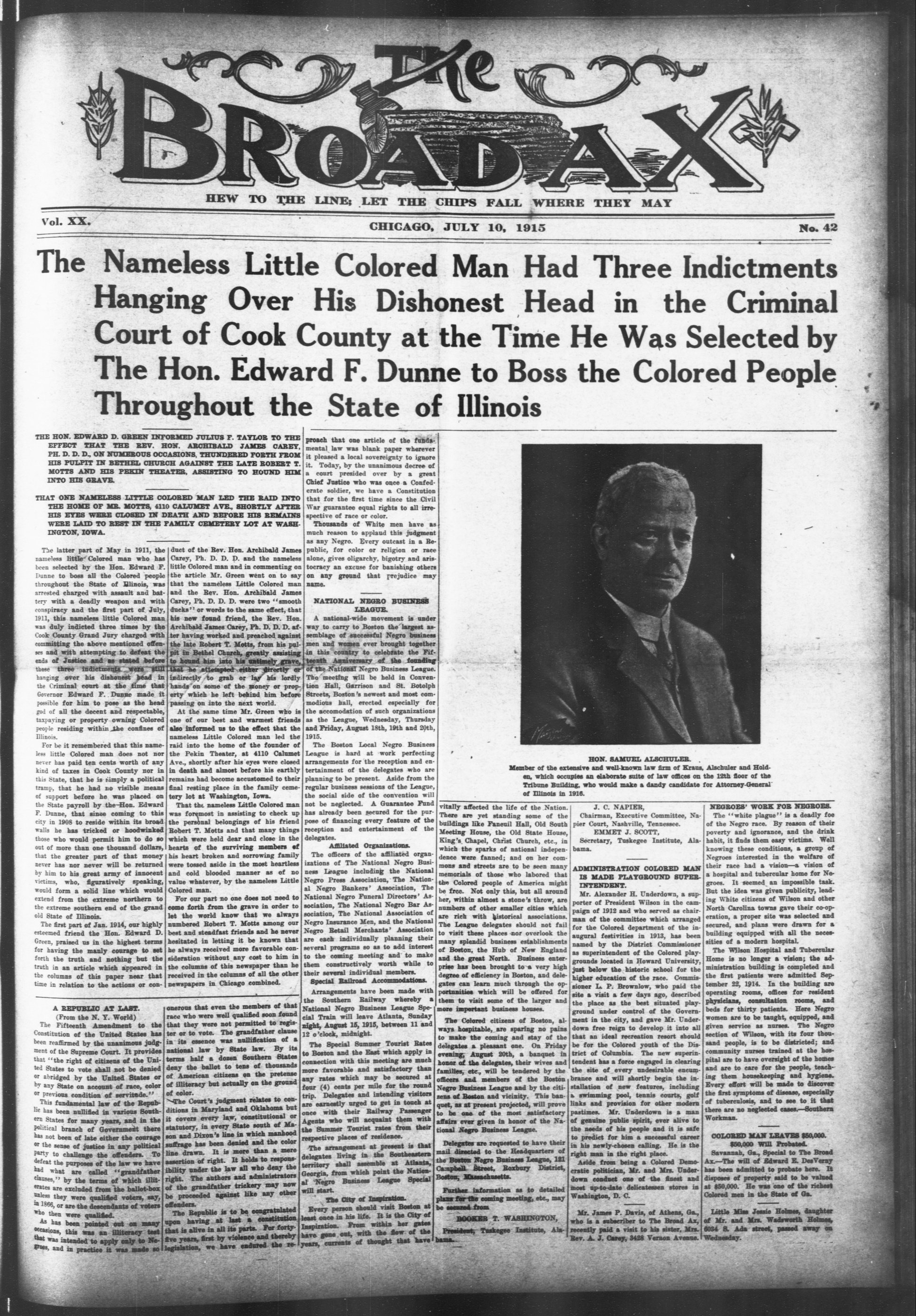
The Nameless Little Colored Man Had Three Indictments Hanging Over His Dishonest Head in the Criminal Court of Cook County at the Time He Was Selected by The Hon. Edward F. Dunne to Boss the Colored People Throughout the State of Illinois
THE HON. EDWARD D. GREEN INFORMED JULIUS F. TAYLOB TO THE EFFECT THAT THE REV. HON. ARCHIBALD JAMES CAREY, PH. D. D. D., ON NUMEROUS OCCASIONS, THUNDERED FORTH FROM HIS PULPIT IN BETHEL CHURCH AGAINST THE LATE ROBERT T. MOTTS AND HIS PEKIN THEATER, ASSISTING TO HOUND HIM INTO HIS GRAVE.
THAT ONE NAMELESS LITTLE COLORED MAN LED THE RAID INTO THE HOME OF MR. MOTTS, 4110 CALUMET AVE., SHORTLY AFTER HIS EYES WERE CLOSED IN DEATH AND BEFORE HIS REMAINS WERE LAID TO REST IN THE FAMILY CEMETERY LOT AT WASHINGTON, IOWA.
Vol. XX.
The Name
Hang
Court
The I
Throw
THE HON. EDWARD D. GREEN INFECTION EFFECT THAT THE REV. I PH. D. D. D., ON NUMEROUS OCCUPANTS PULPIT IN BETHEL CHURCH MOTTS AND HIS PEKIN THE INTO HIS GRAVE.
THAT ONE NAMELESS LITTLE COUNTRY THE HOME OF MR. MOTTS, 411 HIS EYES WERE CLOSED IN HIS WERE LAID TO REST IN THE INGTON, IOWA.
The latter part of May in 1911, the nameless little Colored man who has been selected by the Hon. Edward F. Dunne to boss all the Colored people throughout the State of Illinois, was arrested charged with assault and battery with a deadly weapon and with conspiracy and the first part of July, 1911, this nameless little Colored man was duly indicted three times by the Cook County Grand Jury charged with committing the above mentioned offenses and with attempting to defeat the ends of Justice and as stated before those three indictments were still hanging over his dishonest head in the Criminal court at the time that Governor Edward F. Dunne made it possible for him to pose as the head god of all the decent and respectable, taxpaying or property owning Colored people residing within the confines of Illinois.
For be it remembered that this nameless little Colored man does not nor never has paid ten cents worth of any kind of taxes in Cook County nor in this State, that he is simply a political tramp, that he had no visible means of support before he was placed on the State payroll by the Hon. Edward F. Dunne, that since coming to this city in 1908 to reside within its broad walls he has tricked or hoodwinked those who would permit him to do so out of more than one thousand dollars, that the greater part of that money never has nor never will be returned by him to his great army of innocent victims, who, figuratively speaking, would form a solid line which would extend from the extreme northern to the extreme southern end of the grand old State of Illinois.
The first part of Jan. 1914, our highly esteemed friend the Hon. Edward D. Green, praised us in the highest terms for having the manly courage to set forth the truth and nothing but the truth in an article which appeared in the columns of this paper near that time in relation to the actions or con-
A REPUBLIC AT LAST
The Fifteenth Amendment to the Constitution of the United States has been reaffirmed by the unanimous judgment of the Supreme Court. It provides that "the right of citizens of the United States to vote shall not be denied or abridged by the United States or by any State on account of race, color or previous condition of servitude." This fundamental law of the Republic has been nullified in various Southern States for many years, and in the political branch of Government there has not been of late either the courage or the sense of justice in any political party to challenge the offenders. To defeat the purposes of the law we have had what are called "grandfather clauses," by the terms of which illiterates are excluded from the ballot-box unless they were qualified voters, say, in 1866, or are the descendants of voters who then were qualified. As has been pointed out on many occasions, this was an illiteracy test that was intended to apply only to Negroes, and in practice it was made so
1
duct of the Rev. Hon. Archibald James Carey, Ph. D. D. D. and the nameless little Colored man and in commenting on the article Mr. Green went on to say that the nameless Little Colored man and the Rev. Hon. Archibald James Carey, Ph. D. D. D. were two "smooth ducks" or words to the same effect, that his new found friend, the Rev. Hon. Archibald James Carey, Ph. D. D. D. after having worked and preached against the late Robert T. Motts, from his pulpit in Bethel Church, greatly assisting to hound him into his untimely grave, that he attempted either directly or indirectly to grab or lay his lordly hands on some of the money or property which he left behind him before passing on into the next world.
At the same time Mr. Green who is one of our best and warmest friends also informed us to the effect that the nameless Little Colored man led the raid into the home of the founder of the Pekin Theater, at 4110 Calumet Ave., shortly after his eyes were closed in death and almost before his earthly remains had become accustomed to their final resting place in the family cemetery lot at Washington, Iowa.
That the nameless Little Colored man was foremost in assisting to check up the personal belongings of his friend Robert T. Motts and that many things which were held dear and close in the hearts of the surviving members of his heart broken and sorrowing family were tossed aside in the most heartless and cold blooded manner as of no value whatever, by the nameless Little Colored man.
For our part no one does not need to come forth from the grave in order to let the world know that we always numbered Robert T. Motts among our best and steadfast friends and he never hesitated in letting it be known that he always received more favorable consideration without any cost to him in the columns of this newspaper than he received in the columns of all the other newspapers in Chicago combined.
onerous that even the members of that race who were well qualified soon found that they were not permitted to register or to vote. The grandfather clause in its essence was nullification of a national law by State law. By its terms half a dozen Southern States deny the ballot to tens of thousands of American citizens on the pretense of illiteracy but actually on the ground of color.
The Court's judgment relates to conditions in Maryland and Oklahoma but it covers every law, constitutional or statutory, in every State south of Mason and Dixon's line in which manhood suffrage has been denied and the color line drawn. It is more than a mere assertion of right. It holds to responsibility under the law all who deny the right. The authors and administrators of the grandfather trickery may now be proceeded against like any other offenders.
The Republic is to be congratulated upon having at last a constitution that is alive in all its parts. For forty-five years, first by violence and thereby legislation, we have endured the re-
CHICAGO, JULY 10, 1915
proach that one article of the fundamental law was blank paper wherever it pleased a local sovereignty to ignore it. Today, by the unanimous decree of a court presided over by a great Chief Justice who was once a Confederate soldier, we have a Constitution that for the first time since the Civil War guarantee equal rights to all irrespective of race or color.
Thousands of White men have as much reason to applaud this judgment as any Negro. Every outcast in a Republic, for color or religion or race alone, gives oligarchy, bigotry and aristocracy an excuse for banishing others on any ground that prejudice may name.
NATIONAL NEGRO BUSINESS
LBAGUE
A national-wide movement is under way to carry to Boston the largest assemblage of successful Negro business men and women ever brought together in this country to celebrate the Fifteenth Anniversary of the founding of the National Negro Business League. The meeting will be held in Convention Hall, Garrison and St. Botolph Streets, Boston's newest and most commodious hall, erected especially for the accomodation of such organizations as the League, Wednesday, Thursday and Friday, August 18th, 19th and 20th, 1915.
The Boston Local Negro Business League is hard at work perfecting arrangements for the reception and entertainment of the delegates who are planning to be present. Aside from the regular business sessions of the League, the social side of the convention will not be neglected. A Guarantee Fund has already been secured for the purpose of financing every feature of the reception and entertainment of the delegates.
Affiliated Organizations.
The officers of the affiliated organizations of The National Negro Business League including the National Negro Press Association, The National Negro Bankers' Association, The National Negro Funeral Directors' Association, The National Negro Bar Association, The National Association of Negro Insurance Men, and the National Negro Retail Merchants' Association are each individually planning their several programs so as to add interest to the coming meeting and to make them constructively worth while to their several individual members. Special Railroad Accommodations. Arrangements have been made with the Southern Railway whereby a National Negro Business League Special Train will leave Atlanta, Sunday night, August 15, 1915, between 11 and 12 o'clock. midnight.
The Special Summer Tourist Rates to Boston and the East which apply in connection with this meeting are much more favorable and satisfactory than any rates which may be secured at four (4) cents per mile for the round trip. Delegates and intending visitors are earnestly urged to get in touch at once with their Railway Passenger Agents who will acquaint them with the Summer Tourist rates from their respective places of residence.
The arrangement at present is that delegates living in the Southeastern territory shall assemble at Atlanta, Georgia, from which point the National Negro Business League Special will start.
The City of Inspiration.
Every person should visit Boston at least once in his life. It is the City of Inspiration. From within her gates have gone out, with the flow of the years currents of thought that have
M. J. M.
Member of the extensive and well-known law firm of Kraus, Alschuler and Holden, which occupies an elaborate suite of law offices on the 12th floor of the Tribune Building, who would make a dandy candidate for Attorney-General of Illinois in 1916.
vitally affected the life of the Nation. There are yet standing some of the buildings like Faneuil Hall, Old South Meeting House, the Old State House, King's Chapel, Christ Church, etc., in which the sparks of national independence were fanned; and on her commons and streets are to be seen many memorials of those who labored that the Colored people of America might be free. Not only this, but all around her, within almost a stone's throw, are numbers of other smaller cities which are rich with historical associations. The League delegates should not fail to visit these places nor overlook the many splendid business establishments of Boston, the Hub of New England and the great North. Business enterprise has been brought to a very high degree of efficiency in Boston, and delegates can learn much through the opportunities which will be offered for them to visit some of the larger and more important business houses.
The Colored citizens of Boston, always hospitable, are sparing no pains to make the coming and stay of the delegates a pleasant one. On Friday evening, August 20th, a banquet in honor of the delegates, their wives and families, etc., will be tendered by the officers and members of the Boston Negro Business League and by the citizens of Boston and vicinity. This banquet, as at present projected, will prove to be one of the most satisfactory affairs ever given in honor of the National Negro Business League.
Delegates are requested to have their mail directed to the Headquarters of the Boston Negro Business League, 121 Campbell Street, Roxbury District, Boston, Massachusetts.
Further information as to detailed plans for the coming meeting, etc., may be secured from
BOOKER T. WASHINGTON,
President, Tuskegee Institute, Ala-
J. C. NAPIER,
Chairman, Executive Committee, Napier Court, Nashville, Tennessee.
EMMET J. SCOTT,
Secretary, Tuskegee Institute, Alabama.
ADMINISTRATION COLORED MAN
IS MADE PLAYGROUND SUPER-
INTENDENT.
Mr. Alexander H. Underdown, a supporter of President Wilson in the campaign of 1912 and who served as chairman of the committee which arranged for the Colored department of the inaugural festivities in 1913, has been named by the District Commissioner as superintendent of the Colored playgrounds located in Howard University just below the historic school for the higher education of the race. Commissioner L. P. Brownlow, who paid the site a visit a few days ago, described the place as the best situated playground under control of the Government in the city, and gave Mr. Underdown free reign to develop it into all that an ideal recreation resort should be for the Colored youth of the District of Columbia. The new superintendent has a force engaged in clearing the site of every undesirable encumbrance and will shortly begin the installation of new features, including a swimming pool, tennis courts, golf links and provision for other modern pastimes. Mr. Underdown is a man of genuine public spirit, ever alive to the needs of his people and it is safe to predict for him a successful career in his newly-chosen calling. He is the right man in the right place.
Aside from being a Colored Democratie politician, Mr. and Mrs. Underdown conduct one of the finest and most up-to-date delicatessen stores in Washington, D. C.
Mr. James P. Davis, of Athens, Ga., who is a subscriber to The Broad Ax, recently paid a visit to his sister, Mrs. Rev. A. J. Carey. 3428 Vernon Avenue.
No.42
NEGROES' WORK FOR NEGROES. The "white plague" is a deadly foe of the Negro race. By reason of their poverty and ignorance, and the drink habit, it finds them easy victims. Well knowing these conditions, a group of Negroes interested in the welfare of their race had a vision—a vision of a hospital and tubercular home for Negroes. It seemed an impossible task. But the idea was given publicity, leading White citizens of Wilson and other North Carolina towns gave their co-operation, a proper site was selected and secured, and plans were drawn for a building equipped with all the necessities of a modern hospital.
The Wilson Hospital and Tubercular Home is no longer a vision; the administration building is completed and the first patients were admitted September 22, 1914. In the building are operating rooms, offices for resident physicians, consultation rooms, and beds for thirty patients. Here Negro women are to be taught, equipped, and given service as nurses. The Negro section of Wilson, with its four thousand people, is to be districted; and community nurses trained at the hospital are to have oversight of the homes and are to care for the people, teaching them housekeeping and hygiene. Every effort will be made to discover the first symptoms of disease, especially of tuberculosis, and to see to it that there are no neglected cases.—Southern Workman.
COLORED MAN LEAVES $50,000
$50,000 WILL Probated
Savannah, Ga., Special to The Broad Ax.—The will of Edward E. DesVerny has been admitted to probate here. It disposes of property said to be valued at $50,000. He was one of the richest Colored men in the State of Ga.
Little Miss Jessie Holmes, daughter of Mr. and Mrs. Wadsworth Holmes, 6034 S. Ada street, passed away on Wednesday
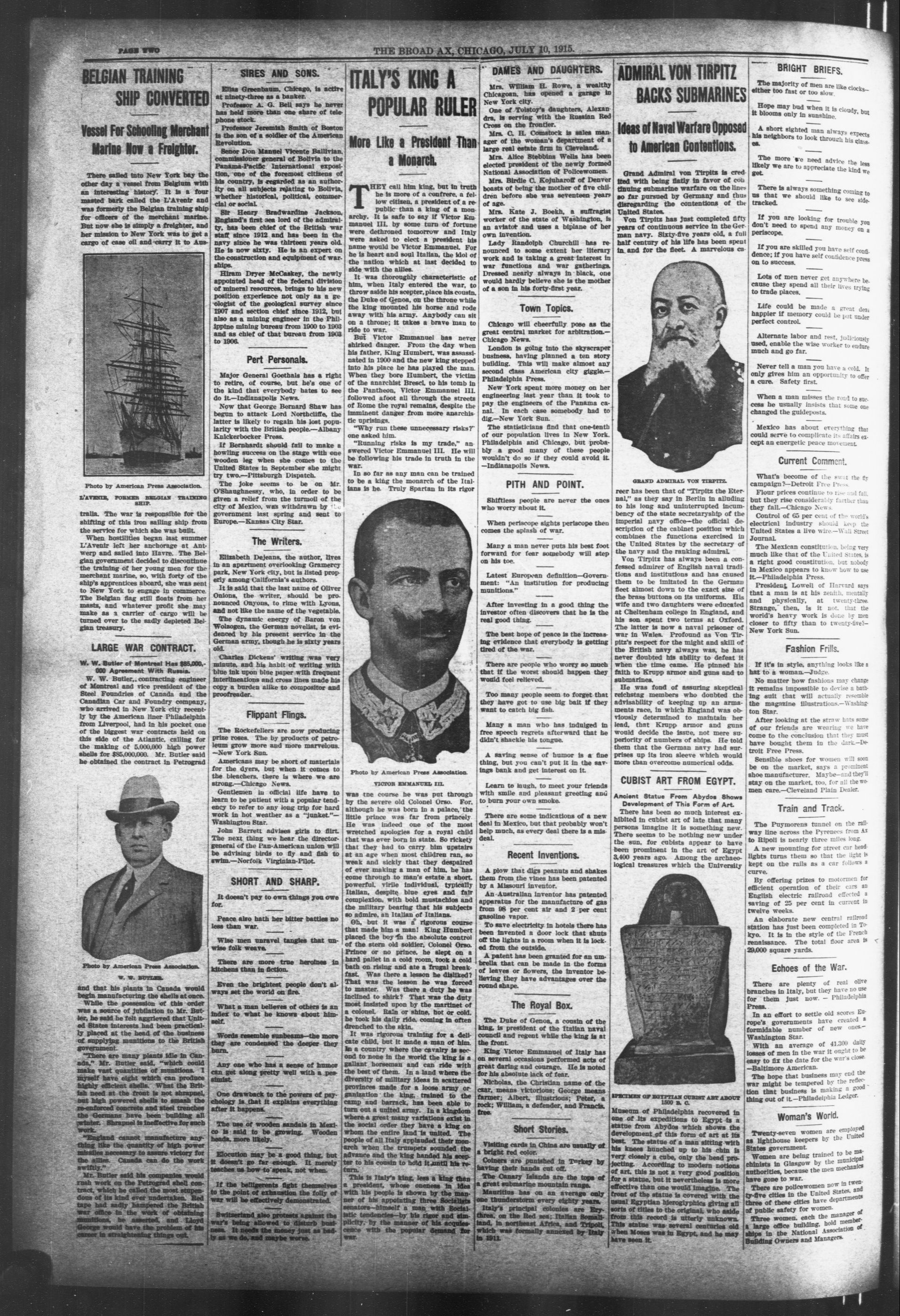
There sailed into New York bay the other day a vessel from Belgium with an interesting history. It is a four masted bark called the L'Avenir and was formerly the Belgian training ship for officers of the merchant marine. But now she is simply a freighter, and her mission to New York was to get a cargo of case oil and carry it to Aus-
SAMSUNG
Photo by American Press Association.
L'AVENIER, FORMER BELGIAN TRAINING SHIP.
tralia. The war is responsible for the shifting of this iron sailing ship from the service for which she was built.
When hostilities began last summer L'Avenir left her anchorage at Antwerp and sailed into Havre. The Belgian government decided to discontinue the training of her young men for the merchant marine, so, with forty of the ship's apprentices aboard, she was sent to New York to engage in commerce. The Belgian flag still floats from her masts, and whatever profit she may make as a carrier of cargo will be turned over to the sadly depleted Belgian treasury.
LARGE WAR CONTRACT.
W. W. Butler of Montreal Has $5,500,000 Agreement With Russia. W. W. Butler, contracting engineer of Montreal and vice president of the Steel Foundries of Canada and the Canadian Car and Foundry company, who arrived in New York city recently by the American liner Philadelphia from Liverpool, had in his pocket one of the biggest war contracts held on this side of the Atlantic, calling for the making of 5,000,000 high power shells for $5,000,000. Mr. Butler said he obtained the contract in Petrotrad
Photo by American Press Association
and that his plants in Canada would begin manufacturing the shells at once. While the possession of this order was a source of jubilation to Mr. Butler, he said he felt aggrieved that United States interests had been practically placed at the head of the business of supplying munitions to the British government.
"There are many plants idle in Canada," Mr. Butler said, "which could make vast quantities of munitions. I myself have eight which can produce highly efficient shells. What the British need at the front is not shrapnel, but high powered shells to smash the re-enforced concrete and steel trenches the Germans have been building all winter. Shrapnel is ineffective for such work.
"England cannot manufacture anything like the quantity of high power missiles necessary to assure victory for the allies. Canada can do the work swiftly."
Mr. Butler said his companies would rush work on the Petrograd shell contract, which he called the most strenuous of its kind ever undertaken. Red tape had badly hampered the British war office in the work of obtaining munitions, he asserted, and Lloyd George would have the problem of his cancer in straightening things out.
SIRES AND SONS.
Elias Greenbaum, Chicago, is active at ninety-three as a banker.
Professor A. G. Bell says he never has held more than one share of telephone stock.
Professor Jeremiah Smith of Boston is the son of a soldier of the American Revolution.
Senor Don Manuel Vicente Ballivian, commissioner general of Bolivia to the Panama-Pacific International exposition, one of the foremost citizens of his country, is regarded as an authority on all subjects relating to Bolivia, whether historical, political, commercial or social.
Sir Henry Bradwardine Jackson, England's first sea lord of the admiralty, has been chief of the British war staff since 1912 and has been in the navy since he was thirteen years old. He is now sixty. He is an expert on the construction and equipment of warships.
Hiram Dryer McCaskey, the newly appointed head of the federal division of mineral resources, brings to his new position experience not only as a geologist of the geological survey since 1907 and section chief since 1912, but also as a mining engineer in the Philippine mining bureau from 1900 to 1903 and as chief of that bureau from 1903 to 1906
Pert Personals.
Major General Goethals has a right to retire, of course, but he's one of the kind that everybody hates to see do it—Indianapolis News. Now that George Bernard Shaw has begun to attack Lord Northcliffe, the latter is likely to regain his lost popularity with the British people—Albany Knickerbocker Press. If Bernhardt should fail to make a howling success on the stage with one wooden leg when she comes to the United States in September she might try two—Pittsburgh Dispatch. The joke seems to be on Mr. O'Shaughnessy, who, in order to be given a relief from the turmoil of the city of Mexico, was withdrawn by the government last spring and sent to Europe—Kansas City Star.
The Writers.
Elizabeth Dejeans, the author, lives in an apartment overlooking Gramercy park, New York city, but is listed properly among California's authors. It is said that the last name of Oliver Onions, the writer, should be pronounced Onyons, to rime with Lyons, and not like the name of the vegetable. The dynamic energy of Baron von Wolzogen, the German novelist, is evidenced by his present service in the German army, though he is sixty years old. Charles Dickens' writing was very minute, and his habit of writing with blue ink upon blue paper with frequent interlineations and cross lines made his copy a burden alike to compositor and proofrender.
Flippant Flings.
The Rocketfellers are now producing prize roses. The by products of petroleum grow more and more marvelous. -New York Sun.
Americans may be short of materials for the dyers, but when it comes to the bleachers, there is where we are strong. -Chicago News.
Gentlemen in official life have to learn to be patient with a popular tendency to refer to any long trip for hard work in hot weather as a "junket." -Washington Star.
John Barrett advises girls to flirt. The next thing we hear the director-general of the Pan-American union will be advising birds to fly and fish to swim. -Norfolk Virginian-Pilot.
SHORT AND SHARP
It doesn't pay to own things you owe for.
Peace also hath her bitter battles no less than war.
Wise men unravel tangles that unwise folk weave.
There are more true heroes in kitchens than in fiction.
Even the brightest people don't always set the world on fire.
What a man believes of others is an index to what he knows about himself.
THE BROAD AX, CHICAGO, JULY 10, 1915.
ITALY'S KING A POPULAR RULER
THEY call him king, but in truth he is more of a confreer, a fellow citizen, a president of a republic than a king of a monarchy. It is safe to say if Victor Emmanuel III, by some turn of fortune were dethroned tomorrow and Italy were asked to elect a president his name would be Victor Emmanuel. For he is heart and soul Italian, the idol of the nation which at last decided to side with the allies. It was thoroughly characteristic of him, when Italy entered the war, to throw aside his scepter, place his cousin, the Duke of Genoa, on the throne while the king mounted his horse and rode away with his army. Anybody can sit on a throne; it takes a brave man to ride to war.
But Victor Emmanuel has never shirked danger. From the day when his father, King Humbert, was assassinated in 1900 and the new king stepped into his place he has played the man. When they bore Humbert, the victim of the anarchist Brescl, to his tomb in the Pantheon, Victor Emmanuel III followed afoot all through the streets of Rome the royal remains, despite the imminent danger from more anarchistic uprisings.
"Why run these unnecessary risks?" one asked him.
"Running risks is my trade," answered Victor Emmanuel III. He will be following his trade in truth in the war.
In so far as any man can be trained to be a king the monarch of the Italians is he. Truly Spartan in its rigor
M.
was the course he he was put through by the severe old Colonel Orso. For, although he was born in a palace, the little prince was far from princely. He was indeed one of the most wretched apologies for a royal child that was ever born in state. So rickety that they had to carry him upstairs at an age when most children ran, so weak and sickly that they despaired of ever making a man of him, he has come through to man's estate a short, powerful, virile individual, typically Italian, despite blue eyes and fair complexion, with bold mustachios and the military bearing that his subjects so admire, an Italian of Italians.
Oh, but it was a rigorous course that made him a man! King Humbert placed the boy in the absolute control of the stern old soldier, Colonel Orso. Prince or no prince, he slept on a hard pallet in a cold room, took a cold bath on rising and ate a frugal breakfast. Was there a lesson he disliked? That was the lesson he was forced to master. Was there a duty he was inclined to shirk? That was the duty most insisted upon by the martinet of a colonel. Rain or shine, hot or cold, he took his daily ride, coming in often drenched to the skin.
It was rigorous training for a delicate child, but it made a man of him. In a country where the cavalry is second to none in the world the king is a gallant horseman and can ride with the best of them. In a land where the diversity of military ideas in scattered provinces made for a loose army organization the king, trained to the camp and barrack, has been able to turn out a united army. In a kingdom where a great many variations exist in the social order they have a king on whom the entire land is united. The people of all Italy applauded their monarch when the trumpets sounded the advance and the king handed his scepter to his cousin to hold it until his return.
This is Italy's king, less a king than a president, whose oneness in idea with his people is shown by the manner of his appointing three Socialist senators—himself a man with Socialistic tendencies—by his rigor and simplicity, by the manner of his acquiescence with the popular demand for war.
DAMES AND DAUGHTERS.
Mrs. William H. Rowe, a wealthy Chicagoan, has opened a garage in New York city.
One of Tolstoy's daughters, Alexandra, is serving with the Russian Red Cross on the frontier.
Mrs. C. H. Comstock is sales manager of the woman's department of a large real estate firm in Cleveland.
Mrs. Alice Stebbins Wells has been elected president of the newly formed National Association of Policewomen.
Mrs. Birdie C. Kojuharoff of Denver boasts of being the mother of five children before she was seventeen years of age.
Mrs. Kate J. Boekh, a suffragist worker of the state of Washington, is an aviator and uses a biplane of her own invention.
Lady Randolph Churchill has renounced to some extent her literary work and is taking a great Interest in war functions and war gatherings. Dressed nearly always in black, one would hardly believe she is the mother of a son in his forty-first year.
Town Topics.
Chicago will cheerfully pose as the great central market for arbitration.—Chicago News.
London is going into the skyscraper business, having planned a ten story building. This will make almost any second class American city giggle.—Philadelphia Press.
New York spent more money on her engineering last year than it took to pay the engineers of the Panama canal. In each case somebody had to dig.—New York Sun.
The statisticians find that one-tenth of our population lives in New York. Philadelphia and Chicago, but probably a good many of these people wouldn't do so if they could avoid it.—Indianapolis News.
PITH AND POINT.
Shiftless people are never the ones who worry about it.
When periscope sights periscope then comes the splash of war.
Many a man never puts his best foot forward for fear somebody will step on his toe.
Latest European definition—Government: "An institution for producing munitions."
After investing in a good thing the investor often discovers that he is the real good thing.
The best hope of peace is the increasing evidence that everybody is getting tired of the war.
There are people who worry so much that if the worst should happen they would feel relieved.
Too many people seem to forget that they have got to use big bait if they want to catch big fish.
Many a man who has indulged in free speech regrets afterward that he didn't shackle his tongue.
A saving sense of humor is a fine thing, but you can't put it in the savings bank and get interest on it.
Learn to laugh, to meet your friends with smile and pleasant greeting and to burn your own smoke.
There are some indications of a new deal in Mexico, but that probably won't help much, as every deal there is a misdeal.
Recent Inventions
A plow that digs peanuts and shakes them from the vines has been patented by a Missouri inventor.
An Australian inventor has patented apparatus for the manufacture of gas from 98 per cent air and 2 per cent gasoline vapor.
To save electricity in hotels there has been invented a door lock that shuts off the lights in a room when it is locked from the outside.
A patent has been granted for an umbrella that can be made in the forms of leaves or flowers, the inventor believing they have advantages over the round shape.
The Royal Box.
The Duke of Genoa, a cousin of the king, is president of the Italian naval council and regent while the king is at the front.
King Victor Emmanuel of Italy has on several occasions performed acts of great daring and courage. He is noted for his absolute lack of fear.
Nicholas, the Christian name of the czar, means victorious; George means farmer; Albert, illustrious; Peter, a rock; William, a defender, and Francis, free.
Short Stories
Visiting cards in China are usually of a bright red color.
Coloners are punished in Turkey by having their hands cut off. The Canary Islands are the tope of a great submarine mountain range. Mauritius has on an average only one thunderstorm every eighty years. Italy's principal colonies are Brythea, on the Red sea; Italian Somaliland, in northeast Africa, and Tripoli, which was formally annexed by Italy in 1911.
ADMIRAL VON TIRPITZ BACKS SUBMARINES
Grand Admiral von Tirpitz is credited with being fatly in favor of continuing submarine warfare on the lines so far pursued by Germany and thus disregarding the contentions of the United States. Von Tirpitz has just completed fifty years of continuous service in the German navy. Sixty-five years old, a full half century of his life has been spent in and for the fleet. A marvelous ca
GRAND ADMIRAL VON TIRPITZ.
reer has been that of "Tirpitz the Eternal," as they say in Berlin in alluding to his long and uninterrupted incumbency of the state secretaryship of the imperial navy office—the official description of the cabinet position which combines the functions exercised in the United States by the secretary of the navy and the ranking admiral.
Von Tirpitz has always been a confessed admirer of English naval traditions and institutions and has caused them to be imitated in the German fleet almost down to the exact size of the brass buttons on its uniforms. His wife and two daughters were educated at Cheltenham college in England, and his son spent two terms at Oxford. The latter is now a naval prisoner of war in Wales. Profound as Von Tirpitz's respect for the might and skill of the British navy always was, he has never doubted his ability to defeat it when the time came. He pinned his faith to Krupp armor and guns and to submarines.
He was fond of assuring skeptical rechastag members who doubted the advisability of keeping up an armaments race, in which England was obviously determined to maintain her lead, that Krupp armor and guns would decide the issue, not mere superiority of numbers of ships. He told them that the German navy had surprises up its iron sleeve which would more than overcome numerical odds.
CUBIST ART FROM EGYPT.
Ancient Statue From Abydos Shows Development of This Form of Art. There has been so much interest exhibited in cubist art of late that many persons imagine it is something new. There seems to be nothing new under the sun, for cubists appear to have been prominent in the art of Egypt 3,400 years ago. Among the archaeological treasures which the University
E
PRESENTMEN OF EGYPTIAN CURIST ART ABOUT
1500 B. C.
Museum of Philadelphia recovered in one of its expeditions to Egypt is a statue from Abydos which shows the development of this form of art at its best. The statue of a man sitting with his knees hunched up to his chin is very closely a cube, only the head projecting. According to modern notions of art, this is not a very good position for a statue, but it nevertheless is more effective than one would imagine. The front of the statue is covered with the usual Egyptian hieroglyphics giving all sorts of titles to the original, who aside from this record is utterly unknown. This statue was several centuries old when Moses was in Egypt, and he may have seen it.
BRIGHT BRIEFS
The majority of men are like clocks—
either too fast or too slow.
Hope may bud when it is cloudy, but
it blooms only in sunshine.
A short sighted eye.
A short sighted man always expects his neighbors to look through his glasses.
The more we need advice the less likely we are to appreciate the kind we get.
There is always something coming to us that we should like to see side-tracked.
If you are looking for trouble you don't need to spend any money on a periscope.
If you are skilled you have self confidence; if you have self confidence press on to success.
Lots of men never get anywhere because they spend all their lives trying to trade places.
Life could be made a great dear happier if memory could be put under perfect control.
Alternate labor and rest, judiciously used, enable the wise worker to endure much and go far.
Never tell a man you have a cold. It only gives him an opportunity to offer a cure. Safety first.
When a man misses the road to success he usually insists that some one changed the guideposts.
Mexico has about everything that could serve to complicate its affairs except an energetic peace movement.
Current Comment
What's become of the swat the fly campaign?—Detroit Free Press.
Flour prices continue to rise and fall, but they rise considerably farther than they fall—Chicago News.
Control of 65 per cent of the world's electrical industry should keep the United States a live wire—Wall Street Journal.
The Mexican constitution, being very much like that of the United States, is a right good constitution, but nobody in Mexico appears to know how to use it—Philadelphia Press.
President Lowell of Harvard says that a man is at his zenith, mentally and physically, at twenty-three Strange, then, is it not, that the world's heavy work is done by men closer to fifty than to twenty-five—New York Sun.
Fashion Frills.
If it's in style, anything looks like a hat to a woman—Judge.
No matter how fashions may change it remains impossible to devise a bathing suit that will actually resemble the magazine illustrations—Washington Star.
After looking at the straw hats some of our friends are wearing we have come to the conclusion that they must have bought them in the dark—Detroit Free Press.
Sensible shoes for women will soon be on the market, says a prominent shoe manufacturer. Maybe—and they'll stay on the market, too, for all the women care—Cleveland Plain Dealer.
Train and Track.
The Puymorens tunnel on the railway line across the Pyrenees from Asko to Ripoll is nearly three miles long. A new mounting for street car headlights turns them so that the light is kept on the rails as a car follows a curve. By offering prizes to motormen for efficient operation of their cars an English electric railroad effected a saving of 25 per cent in current in twelve weeks. An elaborate new central railroad station has just been completed in Tokyo. It is in the style of the French renaissance. The total floor area is 29,000 square yards.
Echoes of the War.
There are plenty of real olive branches in Italy, but they have no use for them just now. - Philadelphia Press.
In an effort to settle old scores Europe's governments have created a formidable number of new ones—Washington Star.
With an average of 41,300 daily losses of men in the war it ought to be easy to fix the date for the war's close—Baltimore American.
The hope that business may end the war might be tempered by the reflection that business is making a good thing out of it—Philadelphia Ledger.
Woman's World.
Twenty-seven women are employed as lighthouse keepers by the United States government.
Women are being trained to be machinists in Glasgow by the municipal authorities, because the men mechanics have gone to war.
There are policewomen now in twenty-five cities in the United States, and three of these cities have departments to serve women.
or public safety for women. Three women, each the manager of a large office building, hold membership in the National Association of Building Owners and Managers.
```markdown
```
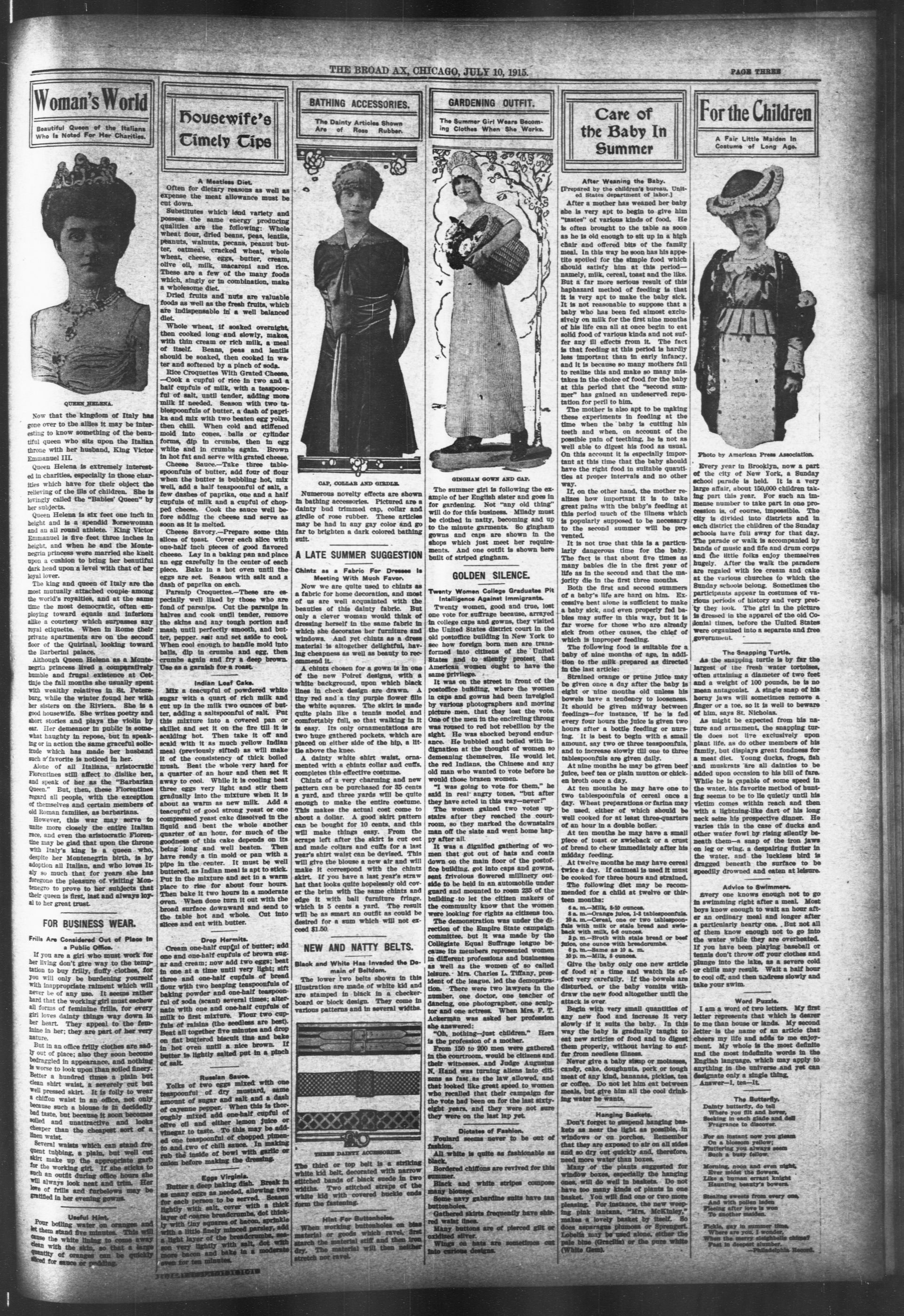
QUEEN HELENA.
Now that the kingdom of Italy has gone over to the allies it may be interesting to know something of the beautiful queen who sits upon the Italian throne with her husband, King Victor Emmanuel III.
Queen Helena is extremely interested in charities, especially in those charities which have for their object the relieving of the lills of children. She is lovingly called the "Babies' Queen" by her subjects.
Queen Helena is six feet one inch in height and is a spendid Horsewoman and an all round athlete. King Victor Emmanuel is five feet three inches in height, and when he and the Monte-negrin princess were married she knelt upon a cushion to bring her beautiful dark head upon a level with that of her loyal lover.
The king and queen of Italy are the most mutually attached couple among the world's royalties, and at the same time the most democratic, often employing toward equals and inferiors alike a courtesy which surpasses any royal etiquette. When in Rome their private apartments are on the second floor of the Quirinal, looking toward the Barberini palace. Although Queen Helena as a Montenegrin princess lived a comparatively humble and frugal existence at Cetinje the fall months she usually spent with wealthy relatives in St. Petersburg, while the winter found her with her sisters on the Riviera. She is a good housewife. She writes poetry and short stories and plays the violin by ear. Her demeanor in public is somewhat haughty in repose, but in speaking or in action the same graceful solicitude which has made her husband such a favorite is noticed in her.
Alone of all Italians, aristocratic Florentines still affect to dislike her, and speak of her as the "Barbarian Queen." But, then, these Florentines regard all people, with the exception of themselves and certain members of old Roman families, as barbarians. However, this war may serve to unite more closely the entire Italian race, and even the aristocratic Florentine may be glad that upon the throne with Italy's king is a queen who, despite her Montenegrit birth, is by adoption all Italian, and who loves Italy so much that for years she has foregone the pleasure of visiting Montenegro to prove to her subjects that their queen is first, last and always loyal to her great trust.
FOR BUSINESS WEAR.
Frills Are Considered Out of Place in a Public Office.
If you are a girl who must work for her living don't give way to the temptation to buy frilly, fluffy clothes, for you will only be burdening yourself with inappropriate raiment which will never be of any use. It seems rather hard that the working girl must eschew all forms of feminine frills, for every girl loves dainty things way down in her heart. They appeal to the feminine in her; they are part of her very nature.
But in an office frilly clothes are sadly out of place; also they soon become bedraggled in appearance, and nothing is worse to look upon than soiled finery. Better a hundred times a plain but clean shirt waist, a severely cut but well pressed skirt. It is folly to wear a chiffon waist in an office, not only because such a blouse is in decidedly bad taste, but because it soon becomes soled and unattractive and looks cheaper than the cheapest sort of a linen waist.
Several waists which can stand frequent tubbing, a plain, but well cut skirt make up the appropriate garb for the working girl. If she sticks to such an outfit during office hours she will always look neat and trim. Her love of frills and furbelows may be grafted in her evening gown.
Pour boiling water on oranges and let them stand five minutes. This will cause the white lining to come away clean with the skin, so that a large quantity of oranges can be quickly sliced for sauce or pudding.
Housewife's
Timely Tips
A Meatless Diet.
Often for dietary reasons as well as
expense the meat allowance must be
cut down.
Substitutes which lend variety and possess the same energy producing qualities are the following: Whole wheat flour, dried beans, peas, lentils, peanuts, walnuts, pecans, peanut butter, oatmeal, cracked wheat, whole wheat, cheese, eggs, butter, cream, olive oil, milk, macaroni and rice. These are a few of the many foods which, singly or in combination, make a wholesome diet. Dried fruits and nuts are valuable foods as well as the fresh fruits, which are indispensable in a well balanced diet. Whole wheat, if soaked overnight, then cooked long and slowly, makes, with thin cream or rich milk, a meal of itself. Beans, peas and lentils should be soaked, then cooked in water and softened by a pinch of soda.
Hice Croquettes With Grated Cheese.
—Cook a cupful of rice in two and a half cupfuls of milk, with a teaspoonful of salt, until tender, adding more milk if needed. Season with two tablespoonfuls of butter, a dash of paprika and mix with two beaten egg yolks, then chill. When cold and stiffened mold into cones, balls or cylinder forms, dip in crumbs, then in egg white and in crumbs again. Brown in hot fat and serve with grated cheese.
Cheese Sauce.—Take three tablespoonfuls of butter, add four of flour when the butter is bubbling hot, mix well, add a half teaspoonful of salt, a few dashes of paprika, one and a half cupfuls of milk and a cupful of chopped cheese. Cook the sauce well before adding the cheese and serve as soon as it is melted.
Cheese Savory.—Prepare some thin slices of toast. Cover each slice with one-half inch pieces of good flavored cheese. Lay in a baking pan and place an egg carefully in the center of each piece. Bake in a hot oven until the eggs are set. Season with salt and a dash of paprika on each.
Parsnip Croquettes.—These are especially well liked by those who are fond of parsnips. Cut the parsnips in halves and cook until tender, remove the skins and any tough portion and mash until perfectly smooth, and butter, pepper, salt and set aside to cool. When cool enough to handle mold into balls, dip in crumbs and egg, then crumbs again and fry a deep brown. Use as a garnish for a roast.
Indian Leaf Cake.
Mix a teacupful of powdered white sugar with a quart of rich milk and cut up in the milk two ounces of butter, adding a saltspoonful of salt. Put this mixture into a covered pan or skillet and set it on the fire till it is scalding hot. Then take it off and scald with it as much yellow Indian meal (previously sifted) as will make it of the consistency of thick boiled mush. Beat the whole very hard for a quarter of an hour and then set it away to cool. While it is cooling beat three eggs very light and stir them gradually into the mixture when it is as about warm as new milk. Add a teacupful of good strong yeast or one compressed yeast cake dissolved in the liquid and beat the whole another quarter of an hour, for much of the goodness of this cake depends on its being long and well beaten. Then have ready a tin mold or pan with a pipe in the center. It must be well buttered, as Indian meal is apt to stick. Put in the mixture and set in a warm place to rise for about four hours. Then bake it two hours in a moderate oven. When done turn it out with the broad surface downward and send to the table hot and whole. Cut into slices and eat with butter.
Drop Hermits.
Cream one-half cupful of butter; add one and one-half cupfuls of brown sugar and cream; now add two eggs; beat in one at a time until very light; stiff three and one-half cupfuls of bread flour with two heaping teaspoonfuls of baking powder and one-half teaspoonful of soda (scant) several times; alternate with one and one-half cupfuls of milk to first mixture. Flour two cupfuls of raisins (the seedless are best). Beat all together five minutes and drop on flat buttered biscuit tins and bake in hot oven until a nice brown. If butter is lightly put in a pinch of salt.
Russlan Sauce
Volks of two eggs mixed with one teaspoonful of dry mustard, same amount of sugar and salt and a dash of cayenne pepper. When this is thoroughly mixed add one-half cupful of olive oil and either lemon juice or vinegar to taste. To this may be added one teaspoonful of chopped pimento and two of chili sauce. In making rub the inside of bowl with garlic or onion before making the dressing.
Egga Virginia.
Butter a deep baking dish. Break in as many eggs as needed, allowing two for each person to be served. Season lightly with salt, cover with a thick layer of coarse breadcrumbs, dot thickly with tiny squares of bacon, sprinkle with a little finely minced parsley, add a light layer of the breadcrumbs, season very lightly with salt, dot with more bacon and bake in a moderate oven for ten minutes.
THE BROAD AX, CHICAGO, JULY 10, 1915.
BATHING ACCESSORIES.
The Dainty Articles Shown
Are of Rose Rubber.
CAP, COLLAR AND GIRDLER
Numerous novelty effects are shown in bathing accessories. Pictured are a dainty bud trimmed cap, collar and girdle of rose rubber. These articles may be had in any gay color and go far to brighten a dark colored bathing suit.
A LATE SUMMER SUGGESTION
Chintz as a Fabric For Dresses is Meeting With Much Favor.
Now we are quite used to chintz as a fabric for home decoration, and most of us are well acquainted with the beauties of this dainty fabric. But only a clever woman would think of dressing herself in the same fabric in which she decorates her furniture and windows. And yet chintz as a dress material is altogether delightful, having cheapness as well as beauty to recommend it.
A chintz chosen for a gown is in one of the new Potret designs, with a white background, upon which black lines in check design are drawn. A tiny red and a tiny purple flower fill the white squares. The skirt is made quite plain like a tennis model and comfortably full, so that walking in it is easy. Its only ornamentations are two huge gathered pockets, which are placed on either side of the hip, a little above the knee.
A dainty white shirt waist, ornamented with a chintz collar and cuffs, completes this effective costume.
Chintz of a very charming and new pattern can be purchased for 35 cents a yard, and three yards will be quite enough to make the entire costume. This makes the actual cost come to about a dollar. A good skirt pattern can be bought for 10 cents, and this will make things easy. From the scraps left after the skirt is cut out and made collars and cuffs for a last year's shirt waist can be devised. This will give the blouse a new air and will make it correspond with the chintz skirt. If you have a last year's straw hat that looks quite hopelessly old cover the brim with the same chintz and edge it with ball furniture fringe, which is 5 cents a yard. The result will be as smart an outfit as could be desired for a sum which will not exceed $1.50.
NEW AND NATTY BELTS.
Black and White Has Invaded the Domain of Beidom. The lower two belts shown in this illustration are made of white kid and are stamped in black in a checkerboard or block design. They come in various patterns and in several widths.
```markdown
```
The third or top belt is a striking white kid belt, decorated with narrow stitched bands of black suede in two widths. Two stitched straps of the white kid with covered buckle ends form the fastening.
Hint For Buttenholes.
When working buttonholes on bias material or goods which ravel, first starch the material stiff and then iron dry. The material will then neither stretch nor ravel.
A
GINGHAM GOWN AND CAP.
The summer girl is following the example of her English sister and goes in for gardening. Not "any old thing" will do for this business. Milady must be clothed in natty, becoming and up to the minute garments. So gingham gowns and caps are shown in the shops which just meet her requirements. And one outfit is shown here built of striped gingham.
GOLDEN SILENCE
Twenty Women College Graduates Pit Intelligence Against Immigrants. Twenty women, good and true, lost one vote for suffrage because, arrayed in college caps and gowns, they visited the United States district court in the old postoffice building in New York to see how foreign born men are transformed into citizens of the United States and to silently protest that American women ought to have the same privilege.
It was on the street in front of the postoffice building, where the women in caps and gowns had been invigled by various photographers and moving picture men, that they lost the vote. One of the men in the encircling throng was roused to red hot rebellion by the sight. He was shocked beyond endurance. He bubbled and boiled with indignation at the thought of women so demeaning themselves. He would let the red Indians, the Chinese and any old man who wanted to vote before he would those brazen women. "I was going to vote for them," he said in real angry tones, "but after they have acted in this way—never!" The women gained two votes upstairs after they reached the courtroom, so they marked the downstairs man off the slate and went home happy after all.
It was a dignified gathering of women that got out of hats and coats down on the main floor of the postoffice building, got into caps and gowns, sent frivolous flowered millinery outside to be held in an automobile under guard and mounted to room 235 of the building to let the citizen makers of the community know that the women were looking for rights as citizens too. The demonstration was under the direction of the Empire State campaign committee, but it was made by the Collegiate Equal Suffrage league because its members represented women in different professions and businesses as well as the women of so called leisure. Mrs. Charles L. Tiffany, president of the league, led the demonstration. There were two lawyers in the number, one doctor, one teacher of dancing, one photographer, one sculptor and one actress. When Mrs. F. T. Ackermann was asked her profession she answered:
"Oh, nothing—just children." Here is the profession of a mother. From 150 to 200 men were gathered in the courtroom, would be citizens and their witnesses, and Judge Augustus N. Hand was turning aliens into citizens as fast as the law allowed, and that looked like great speed to women who recalled that their campaign for the vote had been on for the last sixty-eight years, and they were not sure they were on the last lap yet.
After Weaning the Baby.
[Prepared by the children's bureau. Unit
After a mother has weaned her baby she is very apt to begin to give him "tastes" of various kinds of food. He is often brought to the table as soon as he is old enough to sit up in a high chair and offered bits of the family meal. In this way he soon has his appetite spoiled for the simple food which should satisfy him at this period—namely, milk, cereal, toast and the like. But a far more serious result of this haphazard method of feeding is that it is very apt to make the baby sick. It is not reasonable to suppose that a baby who has been fed almost exclusively on milk for the first nine months of his life can all at once begin to eat solid food of various kinds and not suffer any ill effects from it. The fact is that feeding at this period is hardly less important than in early infancy, and it is because so many mothers fail to realize this and make so many mistakes in the choice of food for the baby at this period that the "second summer" has gained an undeserved reputation for peril to him.
The mother is also apt to be making these experiments in feeding at the time when the baby is cutting his teeth and when, on account of the possible pain of teething, he is not as well able to digest his food as usual. On this account it is especially important at this time that the baby should have the right food in suitable quantities at proper intervals and no other way.
If, on the other hand, the mother realizes how important it is to take great palms with the baby's feeding at this period much of the illness which is popularly supposed to be necessary to the second summer will be prevented.
It is not true that this is a particularly dangerous time for the baby. The fact is that about five times as many babies die in the first year of life as in the second and that the majority die in the first three months.
Both the first and second summers of a baby's life are hard on him. Excessive heat alone is sufficient to make a baby sick, and even properly fed babies may suffer in this way, but it is far worse for those who are already sick from other causes, the chief of which is improper feeding.
The following food is suitable for a baby of nine months of age, in addition to the milk prepared as directed in the last article:
Strained orange or prune juice may be given once a day after the baby is eight or nine months old unless his bowels have a tendency to looseness. It should be given midway between feedings—for instance, if he is fed every four hours the juice is given two hours after a bottle feeding or nursing. It is best to begin with a small amount, say two or three teaspoonfuls, and to increase slowly till one to three tablespoonfuls are given daily.
At nine months he may be given beef juice, beef tea or plain mouton or chicken broth once a day.
At ten months he may have one to two tablespoonfuls of cereal once a day. Wheat preparations or farina may be used, either of which should be well cooked for at least three quarters of an hour in a double boiler.
At ten months he may have a small piece of toast or zwieback or a crust of bread to chew immediately after his midday feeding.
At twelve months he may have cereal twice a day. If oatmeal is used it must be cooked for three hours and strained. The following diet may be recommended for a child at twelve or thirteen months:
6 a. m.-Milk. 8-10 ounces.
8 a.m.—Orange juice, 1-8 tablespoonfuls
10 a.m.—Cereal, one or two tablespoonfuls with milk or stale bread and swie-
back with milk, 6-8 ounces.
2 p.m.-Broth with stale bread or beef juice, one ounce with breadcrumbs.
6 p.m.-Same as 10 a. m.
10 p.m.-Milk, 8 ounces.
Give the baby only one new article of food at a time and watch its effect very carefully. If the bowels are disturbed, or the baby vomits withdraw the new food altogether until the attack is over.
Begin with very small quantities of any new food and increase it very slowly if it suits the baby. In this way the baby is gradually taught to eat new articles of food and to digest them properly, without having to suffer from needless illness.
Never give a baby simp or molasses, candy, cake, doughnuts, pork or tough meat of any kind, bananas, pickles, tea or coffee. Do not let him eat between meals, but give him all the cool drinking water he wants.
Don't forget to suspend hanging baskets as near the light as possible, in windows or on porches. Remember that they are exposed to air on all sides and no dry out quickly and, therefore, need more water than boxes.
Many of the plants suggested for window boxes, especially the hanging ones, will do well in baskets. Do not have too many kinds of plants in one basket. You will find one or two more pleasing. For instance, the new weeping pink iantana, "Mrs. McKinley," makes a lovely basket by itself. So does asparagus plumosus or Sprengell. Lobelia may be used alone, either the pale bino (Gracilis) or the pure white (White Gem).
For the Children
A Fair Little Maiden In
Costume of Long Age.
A
Photo by American Press Association
Every year in Brooklyn, now a part of the city of New York, a Sunday school parade is held. It is a very large affair, about 150,000 children taking part this year. For such an immense number to take part in one procession is, of course, impossible. The city is divided into districts and in each district the children of the Sunday schools have full sway for that day. The parade or walk is accompanied by bands of music and life and drum corps and the little folks enjoy themselves hugely. After the walk the paraders are regaled with ice cream and cake at the various churches to which the Sunday schools belong. Sometimes the participants appear in costumes of various periods of history and very pretty they look. The girl in the picture is dressed in the apparel of the old Colonial times, before the United States were organized into a separate and free government.
The Snapping Turtle.
As the snapping turtle is by far the largest of the fresh water tortoises, often attaining a diameter of two feet and a weight of 100 pounds, he is no mean antagonist. A single snap of his horny jaws will sometimes remove a finger or a toe, so it is well to beware of him, says St. Nicholas.
As might be expected from his nature and armament, the snapping turtle does not live exclusively upon plant life, as do other members of his family, but displays great fondness for a meat diet. Young ducks, frog, fish and muskrats are all dainty to be added upon occasion to his bill of fare. While be is capable of some speed in the water, his favorite method of hunting seems to be to lie quietly until his victim comes within reach and then with a lightning-like dart of his long neck seize his prospective dinner. He varies this in the case of ducks and other water fowl by rising silently beneath them—a snap of the iron jaws on leg or wing, a despairing flutter in the water, and the luckless bird is dragged beneath the surface to be speedily drowned and eaten at leisure.
Advice to Swimmers
every one knows enough not to go in swimming right after a meal. Most boys know enough to wait an hour after an ordinary meal and longer after a particularly hearty one. But not all of them know enough not to go into the water while they are overheated. If you have been playing baseball or tennis don't throw off your clothes and plunge into the lake, as a severe cold or chills may result. Wait a half hour to cool off, and then undress slowly and take your swim.
Word Puzzle
I am a word of two letters. My first letter represents that which is dearer to me than house or lands. My second letter is the name of an article that cheers my life and adds to me enjoyment. My whole is the most definite and the most indefinite words in the English language, which may apply to anything in the universe and yet can designate only a single thing.
PAGE FOUR
THE BROAD AX
PUBLISHED WEEKLY.
Will promulgate and at all times uphold the true principles of Democracy, but Catholism, Protestantism, Priests, Infidels, Single Titans, Republiances, or anyone else can have their say, as long as their language is proper and responsibility is fixed.
The Broad Ax is a newspaper whose pictorm is broad enough for all, ever claiming the editorial right to speak its own mind.
Local communications will receive attention. Write only on one side of the paper.
Subscriptions must be paid in advance One Year. $0.06 Six Months. $1.00
Advertising rates made known on application.
Address all communications to
6532 ST. LAWRENCE AVE., CHICAGO, ILL.
PHONE WENTWORTH 2597.
JULIUS F. TAYLOR, Editor and Publisher
Entrusted as Second-Class Matter Aug. 18
1902, at the Post Office at Chicago, Illinois,
under Act of March 8, 1878.
REMOVAL NOTICE.
From on and after this date, all letters or other mail matter intended for Julius F. Taylor or Mrs. Annie E. Taylor or The Broad Ax, should be addressed to 6532 St. Lawrence Ave., Jackson Park station. Phone Wentworth 2597.
PLANS FOR BABY SAVING WEEK
Mayor Thompson has issued his proclamation giving official sanction to the setting apart of the week of July 17th to July 24th as a Baby Welfare Week. This action came following the gathering of the representatives of the leading welfare organizations of the city at a luncheon at the Sherman House on Wednesday, June 30th.
Plans for the Baby Week Campaign were discussed at length and among other things, arrangements were made for a wide-spread publicity movement throughout the city through the medium of the daily papers and the neighborhood papers, and with advertising and illuminating signs on the principal thoroughfares. The big department stores were also invited to participate in the movement and to assist in the distribution of educational matter, by enclosing slips regarding the proper clothing of babies in the summer in all goods sold containing infant wear. Drug stores asked also to aid in distributing suggestions as to the care of baby's nursing bottle in drug store packages.
It was also decided to urge the ministers of all faiths throughout the city to preach on child saving in their pulpits on Sunday, July 18th, and the Jewish rabbis throughout the city on Saturday, the 17th. On Monday and Tuesday it is planned that delegations of civic and newspaper committees in autos will visit the Infant Welfare Stations; also the hospitals, linies and dispensaries throughout the city where babies are cared for. Wednesday will be nursing and demonstration day.
There will also be a baby day rally meeting of all of the child welfare forces held in the Council Chambers at the City Hall at 9:30 Thursday, July 15th. Representatives from all of the philanthropic, civic and municipal agencies will be present, including the Department of Health's field forces, nurses and medical officers, nurses from the Visiting Nurses' Association, various settlement houses and nurses doing infant welfare work from representative private hospitals throughout the city. Mayor Thompson will be asked to preside at this meeting. Good speakers will be present to give five-minute talks and it is expected that this meeting will be the leading send-off movement for the week that is to follow.
Arrangements are also being made with the various milk dealers throughout the city that on a certain day, each bottle of milk delivered will be accompanied by a card containing suggestions on the care of milk and the need of co-operation in baby saving week.
Requests to the clerymen of the city to speak on the subject of child saving on Saturday, the 17th, and Sunday, the 18th, have already been sent out, together with statistical data and information that will be of aid in suggesting to the ministers material for the talks they may desire to give.
The fly season is here. All of the conditions that are favorable for the breeding of the fly are present. A good many thousand babies are also here. The babies and the flies are not good friends. Babies do not understand that the flies are their natural enemies. It is quite possible that the flies do not understand that they are enemies of the baby; but they are just the same.
Let us continue the work of exterminating the fly by abolishing the places where it breeds. Where there is a baby in the home and a manure pile in the alley, the baby is not going to have a fair chance. Let us remove the manure pile and give the baby its chance.
HYDE PARK NEWS By L. W. Washington.
Mrs. Leach wishes to thank her many friends through the columns of The Broad Ax, for the expressions of sympathy given during her bereavement.
Leroy Walker and Mr. Frank Fields have been added to the list of workers for the city, Mr. Black is keeping his word with the boys, and is making good as a ward leader.
Mrs. Wm. Buckner of 5508 Engleside Ave., is the proud mother of a fine boy. Also Mrs. L. Green of 5528 Engleside, has a fine baby boy. Both mothers and babies are doing fine. Upon the encouragement of our numerical strength, The Broad Ax congratulates these mothers.
---
The Hyde Park Women's Charity Club met at the home of Mrs. Sarah Washington, 5465 Kimbark Ave. A good many of the members were present. The business of the Club was transacted in regular order and a luncheon followed. Everybody went to their several homes praising the hostess.
Miss Catherine Manney of 5218 Lake Park Ave., one of our late graduates, has left the city for a short visit.
Mr. John Lowe, Jr., 5210 Lake Park Ave., was so elated over the graduation of Hannibal E. Washington, he took him down in the city and made him a present of the best suit of clothes in the store. Such duds, the young will appreciate and leads to much encouragement and hard study. Of course Hannibal expresses his thanks to the donor.
Mr. E. H. Brown of this city has left for Indiana Harbor to take charge of the Indiana Harbor Club.
§ 1. What officers and propositions in State, cities, villages and towns.
§ 2. What township officers, etc.
§ 3. Separate ballot boxes and ballots—canvas—registration
(Senate Bill No. 63. Approved June 26 1913.)
An Act granting women the right to vote for presidential electors and certain other officers, and to participate and vote in certain matters and elections.
Section 1. Be it enacted by the People of the State of Illinois, represented in the General Assembly: That all women, citizens of the United States, above the age of 21 years, having resided in the State one year, in the county ninety days, and in the election district thirty days next preceding any election therein, shall be allowed to vote at such election for presidential electors, member of the State Board of Equalization, clerk of the appellate court, county collector, county surveyor, members of board of assessors, members of board of review, sanitary district trustees, and for all officers of cities, villages and towns (except police magistrates), and upon all questions or propositions submitted to a vote of the electors of such municipalities or other political divisions of this State.
Sec. 2. All such women may also vote for the following township officers: supervisors, town clerk, assessor, collector and highway commissioner, and may also participate and vote in all annual and special town meetings in the township in which such election district shall be.
Sec. 3. Separate ballot boxes and ballots shall be provided for women, which ballots shall contain the names of the candidates for such offices which are to be voted for and the special questions submitted as aforesaid, and the ballots cast by women shall be canvassed with the other ballots-cast for such officers and on such questions. At any such election where registration is required, women shall register in the same manner as male voters.
"SPECTACLE PEDDLERS"
KNOCKED OUT IN FLORIDA
ENCOURSED OUT IN ILLINOIS.
The last legislature of this State, placed on the Statute books a new law, which will do away or knock out eye glass or "spectacle peddlers" and all kind of "fakers" and "fakers" in general.
Hereafter all those dealing in eye glasses must exhibit a license or certificate, showing that they have been empowered after passing an examination from a college or medical institution to ply their trade or profession.
THE BROAD AX, CHICAGO, JULY 10, 1915
House Bill No.132, Introduced by Major Robert R. Jackson, Fully Explains Just How the Illinois State Commission Can Draw on the Second $25,000 Recently Appriated by the Legislature of Illinois
△ △ △
Two years ago, or more properly speaking, on Tuesday, June 11, 1913, the writer more than cheerfully and willingly made a trip to Springfield, Illinois, at his own expense, in order to appear before the committee on appropriations where we made a talk before it urging it to appropriate twenty-five thousand dollars to enable the Colored people residing in this State to fittingly celebrate their fifty years of freedom in 1915. At the same time we warned the members of the committee on appropriations that if they appropriated that sum of money for that purpose that it would be up to them to assist the good Governor of this State, the Hon. Edward F. Dunne, to select the best Colored men, the best Colored women, the best White men and the best White women, to assist to manage the affair; that we would never be in favor of permitting the worst or the disinterested element in either the White or the Colored race of grabbing the money thus appropriated and blowing it in for nothing or using it for their own personal gain.
The members of the committee on appropriations utterly failed to heed our warnings in that direction, for we had informed them that unless the best class of Colored men were selected to have charge of the celebration, that we would fight those to the bitter end whose very presence is a stench in the nostrils of decent and respectable people. So the members of that committee washed their hands clean of the whole affair and turned it over to the Hon. Edward F. Dunne to act in that direction, and more than five hundred thousand people who have read this paper during the past two years know the result.
Those whom the Hon. Edward F. Dunne finally selected to boss or run the Illinois State Commission were all loud in declaring that "Old Taylor" and his little "Nigger" newspaper have no influence, for no one reads nor pays any attention to its vipards at the mouth; so we laid real low and kept on fighting just the same, and the latter part of May, 1914, Congressman Martin B. Madden introduced a bill in the Lower House of Congress, asking for one hundred and fifty thousand dollars for the head chiefs of the Illinois State Commission. At that time we rushed to Springfield, Illinois, and secured a report of the expenditures of the Illinois State Commission from State Auditor James J. Brady, from July 1, 1913, to June 1, 1914, and on June 6, 1914, twenty-five hundred extra copies of The Broad Ax were printed containing the report, which were sent broadcast throughout the State of Illinois, especially to all of its public officials, including the members of the Legislature, and marked copies were sent to each member of Congress and United States Senators, and the up-shot was that Congressman Madden's bill was killed as dead as a door nail.
It will be recalled that the Rev. Hon. Archibald James Carey, Ph. D. D. D., made a special trip to Washington, D.C., at the expense of the taxpayers and delivered one of his spreadeagle speeches in favor of its passage, but to no avail.
It will also be recalled that shortly after the 1st of Jan., 1915, that the Hon. L. Y. Sherman introduced a bill in the United States Senate asking for one hundred and fifty thousand dollars for the members of the Illinois State Commission, and one nameless little Colored man made his way to Washington, D. C., at the expense of the taxpayers and he had the brass and the nerve to endeavor to have himself selected as national grand director so that he could absolutely direct just how that vast sum of money should be expanded, but on Feb. 6, 1915, the second report in relation to the money blown in by the Illinois State Commission appeared in these columns and a marked copy of the paper containing it was sent to each United States senator, and after they had read the report they refused to turn over one hun-
dred and fifty thousand dollars of the people's money to the Illinois State Commission.
On or about April 15, 1915, the Hon. Robert R. Jackson introduced a bill in the Legislature asking for the second twenty-five thousand dollars for the Illinois State Commission, and as we had stored away more than one thousand copies of this paper containing the two reports and each week after he had introduced his bill, all the members of both branches of the Legislature received free copies of The Broad Ax, and on June 10, just before his bill came forth from the committee on appropriation, we happened to blow into Springfield with copies of the reports in our pockets, and after doing considerable talking with many members of the Legislature, Major Jackson's bill passed both the House and the Senate with the following strings tied tight to the money:
House Bill No. 132
Passed by House, June 10, 1915.
Passed by Senate, June 18, 1915.
"That the sum of twenty-five thousand ($25,000) dollars be and hereby is appropriated under the terms of this Act to be expended as herein provided by the commission authorized and appointed under the Act entitled, "An Act providing for an exhibition and celebration to commemorate the fiftieth anniversary of the emancipation of the negro, creating a commission to conduct same, and making an appropriation therefor," approved June 27, 1913. Sec. 2. "Only so much of the said appropriation of $25,000 to the Negro Emancipation Celebration Commission shall be paid from the State treasury as shall equal the sum raised by subscriptions, leases, concessions and from other sources, and paid in cash to the treasurer of the commission by said commission up to August 15, 1915, and the question as to the amount so raised shall be determined and certified by the Governor. And the commission shall in no manner create or incur an indebtedness or obligation on behalf of the State of Illinois, nor expend any funds of the State other than in the manner provided herein."
Arproved June 30, 1915.
So it would seem to a blind man up a tree that after all "Old Taylor" and The Broad Ax are able to exert a little influence, even on the members of the Legislature of Illinois.
SPRINGFIELD, ILL.-SPECIAL TO
THE BROAD AX.
Mr. Henry Farmer, of Peoria, was in the city this week, being a delegate to W. T. Scott, Personal Liberty League Convention. Among the other delegates present were: L. A. Newby, Chicago, Mr. Macan, Cairo. The session was held at Masonic Hall on Tuesday, a reception was tendered. The waiters picnic was a grand affair. Our popular barber and enterprising citizen Mr. Jas. W. Grady, who has been ill for several weeks, is at this date, July 6, critically ill. He was taken to St. John's hospital July 4, (Sunday). It is hoped that he will recover. His father and sister of Evansville, Ind., are here attending him.
The Tent meetings which were carried on at 18 and Stuart Sts. by Rev. Chappelle, have closed and great results were accomplished. The Woodriver Baptist S. S. Convention was held at Zion Church here July 6 to 10th. Parties desiring The Broad Ax see E. L. Rogers or Tel. 2720x.
The St. Louis aggregation defeated the Union Giants, July 4, in a close game, score: St. Louis 3, Union Giants 2. Battery for St. Louis; Steele and Adams, for Union Giants; Jones and Cansler. Sunday July 11, the Garfield team of St. Louis will attract attention. Well, crops are good any way.
This is awful cool weather. Summer resorts are everywhere.
L. Williams and Chapman have returned to the Leland Hotel.
Phone Douglas 3617
HYDROPHORIA.
Rabies called also lyssa and hydrophobia is an acute disease of warm blooded animals, communicated by means of a specific poison found in the saliva of subjects. It is communicated by the bites of animals and has been inoculated experimentally. Most animals are susceptible but dogs are especially liable to the disease. It is spread chiefly by the dog and occurs in the cat, horse, cow and others. It has been produced experimentally in the pig, horse, rabbit and other animals.
The poison is contained chiefly in the brain and nervous system of affected animals. It is also found in the secretions, particularly in the saliva from whence it finds it's way into other animals. It has been shown that the poison reaches the salivary glands of the dog by way of the nerves and not thru the blood stream as it would be supposed.
The onset of the symptoms is variable in different cases. After the poison is introduced into the body of a man, it may be from six weeks to three months before any evidence of the disease is productive of symptoms. It has been stated that three years is not too long for the development of the symptoms, but that is not definitely determined.
Children are more often attacked than adults because they are more often the victims of the bites of animals, especially the bites of dogs. The incubation period is shorter in children that in adults. Wounds of the face and head are more likely to result in hydrophobia than other wounds because such wounds are more difficult to cauterize, being less accessible. Wounds of the hands are next in order of liability. The clothing evidently absorbs the salivary secretion and the contained poison when persons are bitten in other portions of the body. The hands and the face and head being naked give unhindered access to the teeth, the saliva and the poison of the rabid animal. The nerves, being the vulnerable point of the virus, make those
ROBERT LINCOLN HALL IS AN HONOR TO THE AFRO-AMERICAN RACE.
Robert Lincoln Hall, who resides with his family at 455 E. 32nd street, is in every way an honor to the Afro-American race. For more than 24 years he has been shipping clerk for Berriman Brothers, manufacturers of clear Havana cigars, their Chicago headquarters being located in the First National Bank Building, where they conduct one of the finest retail cigar stores in America.
As an evidence of Berriman Brothers ranking among the largest cigar makers in the world, they employ almost one thousand men in one of their cigar factories at Tampa, Fla., and many hundreds of those are Colored men, and in fact, they prefer the Colored men in that capacity.
Berriman Brothers are Danish-Americans, free from race prejudice and some of their ancestors fought on the Northern side in the War of the Rebellion. They were the first to originate the idea of selling cigars in bond and they have Government revenue inspectors stationed in all of their cigar factories throughout the country.
POPULAR ENTERTAINERS AT THE
DE LUXE CAPE.
The De Luxe Cafe, 3503 S. State Street possess the most popular entertainers than any of the cafes along the stroll. They are Charles Young, Ollie Powers, Schiller Emerson, Miss Lucile Hagerman and Miss Alice Moore. Their popular and up-to-date songs and the piano playing by Emerson and Young, are the hit of the season.
NOTICE
Mr. William T. Bowden formerly of 2842 Federal St. has moved his drug-store to 19 W. 31st. He takes this means of notifying his many customers of the change. Phone Bell Doug. 2921. Aut. 76,929. Remember to call.
Mrs. Annie W. Fitts, 3315 State St., is secretary of the Endowment Board of the Court of Calonthas, which convenes at Love Joy, Illinois. Quite a number of delegates will leave on a special.
[Name]
parts most susceptible that are rich in nerve supply.
A certain and trustworthy means of determining if an animal that is suspected of having the disease hasn't is to examine the brain of such microscopically. If certain bodies called after the discoverer Negri bodies are found, hydrophobia is present and any animal or person bitten by such will develop the disease. Hence all so exposed should have the wounds cauterized by a physician and given the Pasteur treatment.
As in lockjaw so in this disease, it is wise not to wait for symptoms. After the symptoms have developed it is usually too late. Prophylaxis or the prevention of the disease is the most important course to pursue. Since the dog is the most frequent means of spreading rabies, all dogs should be muzzled. All persons bitten should seek a physician at once. There are three stages of hydrophobia, the premonitory, the exciting and the paralytic. In the first or premontory stage, the patient is depressed and melancholy. There is pain and numbness at the bite. There is loss of appetite. The subject is irritable and has sleeplessness. There is a constant feeling of impending danger.
The second stage is the stage of excitement. Any sound or a light or a draught of air will cause a violent spasm. The breathing is greatly embarrassed. Any attempt to drink is followed by an intense spasm which makes the patient dread the very sight of water. It is this fact that gives the disease the name of hydrophobia. The third stage is the paralytic stage. In it the patient becomes quiet. The spasms disappear; the heart becomes enfeebled; unconsciousness follows and death closes the scene.
Remember to have all bites of animals cauterized. After that find out if rabies was present in the offender, by having its brain examined. If the diagnosis is positive get the Pasteur treatment and be on the safety first side.
CHIPS
Mrs. Stella Parker, of Washington, D. C., has for the past week been the house guest of Mrs. Dan M. Jackson, 3242 Calumet Avenue. Mrs. Parker has been very much pleased with her short visit to this city and left for her home in the last evening.
Miss Anna M. Jones, principal of one of the schools of Kansas City, Mo., is visiting this city. She is the house guest of Mr. and Mrs. Samuel Evans, 417 E. 42nd street. Friday, she enjoyed a pleasant visit to Gary, Ind., in company with her old friend and pupil, Attorney Walter M. Farmer.
Attorney Brown S. Smith, one of the leading Afro-American lawyers of Minneapolis, Minn., spent a few days in this city, this week, on legal business, and in visiting with his old friend, Attorney Walter M. Farmer, 184 W. Washington street.
Rev. E. J. Fisher, pastor of Olivet Baptist church, is still confined to his home, 2940 South Park avenue, with illness. His physicians feel that it will be considerable time yet, before he will be able to resume his ministerial duties. His vast army of friends wish for him a speedy recovery.
Col. and Mrs. Dan Moriarty and their family, who have for a number of years resided at 4406 S. Fifth Avenue; have moved into a new home of their own at 11722 Longwood Avenue, Morgan Park. Col. Moriarty is head of the 7th Regiment Illinois National Guard and he was one of the best Commissioners Cook County has ever had.
The Hotel Lincoln, under the able management of Mrs. C. A. Breckenridge, at Arverne, Long Island, has been doing very nicely so far this season and it is the most popular place to stop near the seashore in that section of the East. It is conducted either on the American or European plan. See advertisement in another column of this paper.
Capt. Louis B. Anderson, who was a strong supporter of Mayor William Hale Thompson, prior to the primaries last February and at his election in April, who is backed up by State Senator George F. Harding, was the first of this week selected as one of the assistant Corporation Counsels of Chicago and it is claimed by his friends, that he will pull down $3,600 per year for his legal services.
Dan M. Jackson, head of the Emanuel Jackson Undertaking Company, 2959 S. State Street, while assisting his men to lower a cofin last week from the third floor of an apartment building which contained the body of a large sized person, strained his muscles to the fullest extent and came very near rupturing several blood vessels, compelling him to give up business for one week and recline in bed for that length of time. Mr. Jackson expects to be out again soon and be able to tend to business.
William Herd, his wife and baby boy, are here with us on a three-month furough. Mr. Herd belongs to the Mounted Service School Detachment, U. S. A., located at Fort Biley, Kansas. This is a school of equitation and horse training for U. S. A. officers. In his detachment are 142 men. This branch of the service is somewhat of an independent body in the line of duty. These young men receive special training in horse sheeing, farriery, cooking and baking. The latter training is for enlisted men as well as officers. The Colored men pass just as high on the honor roll as the White; they get the same grading, and there is no partiality shown.
Aroused His Curiosity.
"I'm sorry I told the boss that he couldn't get along without me. I just aroused his curiosity."
"Aroused his curiosity?"
"Yes. He was curious to know if what I said was so and decided to make the experiment."—Detroit Free Press.
Encouraging.
Doctor—Well, Casey, are the eyes improving? Patient—Sure they are, sir. Doctor—Can you see better; can you see the nurse now? Patient—Sure I can thot, sir. Faith, she gets plainer and plainer every day.—London Opinion.
His Role
"I suppose since the baby came your husband is no longer the hero of your domestic drama."
"Oh, no; he's merely the walking gentleman."—Baltimore American.
Net Quita.
Higgs—Crooke is a criminal lawyer, isn't he? Diggs—He's a lawyer, but as to his being criminal, I think he's too careful to quite overstep the line.—New York Globe
Took Her Part
"Oh, Tommy, that was too bad of you to eat your sister's share of the cake!" "Why, mamma, didn't you always tell me to take her part?"—Exchange.
Chinese Sugar Cane
One variety of Chinese sugar cane is raised for chewing in its natural state and is kept in good condition for months by being buried in the ground.
Professional deafness.
"Guess I'll have to get rid of one of my household treasures."
"How so?"
"The parrot is jealous of the phonegraph."-Puck.
Knowledge is proud that he has learned so much. Wisdom is humble that he knows no more.-Cowper.
And No Wonder
"What made that stout woman so
farious?"
"Just as she was getting on the sub-
way train the gateman said 'Both
gates, lady.'"—Philadelphia Ledger.
Our Neighbor
What is meant by our neighbor we cannot doubt. It is every one with whom we are brought into contact, whoever it be, whom we have any means of helping—been Stanley.
Senseless Zeal.
Zeal without sense usually goes plumb to waste. A dog digging for an imaginary cat in a flower bed has plenty of zeal.—Pittsburgh Post.
Never mind ridicule, never mind defeat, there is victory yet for justice.—Emerson.
Domestic Diplomat.
Mrs. Crossdyke lived in the country. "Why do you insist on your new servants arriving Saturdays now?" a friend asked her one day. "Well, I have had some experience with these modern girls," replied Mrs. C. "Previously I used to engage them Mondays, but now I get them to come Saturdays." "But why?" asked her neighbor. "There's no train back to the city until Monday afternoon," said Mrs. C. shrewdly, "and hubby is extremely partial to his Sunday dinner!"—London Answer.
Timing the Laugh
old colored man had chinned into the dentist's chair of torture. "Shall I give you laughing gas, uncle?" queried the tooth carpenter. "Not till after de toof am out, boss," replied the old man. "Beckon mebhy Ah'll feel mo' laffa laffa, den."
Houses In Buenos Aires
No building in Buenos Aires is permitted to be higher than the width of the street upon which it is erected; hence the skyscraper will never become popular there, despite the splendid growth and widestakness of the city. Much as this metropolis is known, it is not generally thought of in the light of age. However, it is one of the oldest cities in the new world. The first white settlement was made just forty-two years after the discovery of America by Columbus, and the first buildings were mud huts thatched with straw. Then a brick kiln was made and later tiles and bricks were imported from Spain. The first city was of Spanish architecture, and that style prevailed for more than 800 years. Despite the many great changes which have come through the passage of time and the general building advance in the world, four-fifths of the houses of Buenos Aires are still of one story, although there are streets lined with six-story palaces—Exchange.
A Unique Lightship
Off the island of Islay, on the west coast of Scotland, there is stationed at the Otter rock a unique lightship. It is unmanned, yet it can be relied on to display the warning light to guide the mariner on this dangerous coast. It is a most ingeniously constructed vessel and the only one of its kind. In its two steel tanks a sufficient quantity of gas can be stored to supply the lantern for several months. Experiments have shown that the light may be depended upon to burn continuously for months at a time. The approximate duration of the light can be predetermined, and there is no danger whatever of its being extinguished by wind or spray. The light is visible at a distance of from eight to twelve miles. The lightship also has a bell, which is made to ring automatically by means of an ingenious device that utilizes the gas as it passes from the tanks to the lantern to work the bell clapper.—Every Week.
Wonder of Stonehenge.
Everyone has heard of Stonehenge, a prehistoric monument in England which is almost as much of a puzzle as the sphinx in Egypt or the mounds erected by the mound builders in America. Stonehenge is about ten miles north of Salisbury. The name comes from two Saxon words meaning "hanging stones."
The earlier Celtic name was Cor Gawr, or giants' temple. There are in many localities in the northwest of Europe prehistoric remains in the form of huge stone monuments or "tumul" or "barrows" that is, bowl shaped mounds or hills of earth. In the neighborhood of Stonehenge there are hundreds of these mounds. Coins, etc., found in them seem to date them back about three centuries before Christ.
It must have taken an immense amount of work to make them, and there must have been some profound and serious purpose behind them—Pathfinder.
How Bookworms Are Tracked.
How Bookworms Are Tracked.
To guard the million books in the New York public library against the ravages of bookworms and other insects which feed upon the paper, the glue on the backs and the cloth and leather bindings, a constant care is exercised, and a keen watch kept for any evidence of their activities. One woman is assigned exclusively to this work. When treating the books she wears a huge apron which completely covers her gown. A cheesecloth veil protects her face against the germs which lurk in the musty documents, and even the air she breathes is screened against contagion. Close touch is kept with the health department, and books which have been returned from infected areas are fumigated before being restored to circulation.—Exchange.
Granite and Lime
Granite is the lowest rock in the earth's crust. It is the bedrock of the world and shows no evidence of animal or vegetable life. It is the parent rock from which all the other rocks have been either directly or indirectly derived. It is claimed by scientists that all the lime in the world has at some time no doubt been a portion of many different animals and possibly of human belens also.
Art of Shopping
What are you to do?
"To buy myself a box of face powder. Will you help me select it?"
"Certainly," assented the other lady.
"Suppose we begin by looking at refrigerators and lace curtains."—Louisville Courier Journal.
Stage Fright
Statesmen are said frequently to suffer from stage fright. John Stuart Mill utterly collapsed on one occasion when asked to speak in public. The late Mgr. Benson was another who was seriously afflicted whenever he had to peach.
Ambiguous.
Artist (showing latest picture)—My object was to try to express all the horrors of war. Friend—I have never seen anything more horrible—Boston Transcript.
Foresight.
Bix—You used to walk in your sleep. Do you still do so? Dix—No, I take carfare to bed with me now.—Boston Transcript.
Modest Pa.
"Pa, what is an ideal?"
"It's what your mother thought she married when she got me."—Detroit Free Press.
THE BROAD AX, CHICAGO, JULY 10, 1915
Anne of Russia's Ice Palace.
Probably the most remarkable building constructed wholly of ice was the palace built on the Neva by the Omarina Anne of Russia. Large blocks of ice were cut and squared with great care and laid on one another by skillful masons, who cemented the joints with water, which immediately froze. The building, when completed, was fifty-six feet long, seventeen and one half feet broad and twenty-one feet high. It was of but one story. The facade contained a door surmounted by an ornamental pediment and six windows, the frames and panes of which were all of ice. An elaborate balustrade, adorned with statues, as along the top of the facade and another balustrade surrounded the building at the level of the ground. The grounds were further adorned with a life size figure of an elephant, with his mahout on his back. A stream of water was thrown from the elephant's trunk by day and a flame of naphtha by night.
A tent of ice contained a hot bath, in which persons actually bathed. There were also several cannons and mortars of ice, which were loaded with bullets of ice and iron and discharged.
Bullet Stopping Tricks
Five feet of clay, three feet of loose earth, or two and a half feet of sand will stop a modern rifle bullet at the closest range; but, curiously enough, as the layman may think, ramming earth hard reduces its resisting power, and high velocity bullets have less penetration in sand at short than at medium range. Eighteen inches of sand between boards is bullet proof, also nine inches of well built brick work. Soft wood, like fir, across the grain is bullet proof at point blank range if forty-eight inches thick, or at 500 yards if half as thick. Similarly, twenty-seven inches of hard wood, like oak, is point blank proof, or fifteen inches at 500 yards. Half an inch of wrought iron or mild steel, a quarter of an inch of hard steel, or a fifth of an inch of special steel is bullet proof. So are six inches of shingle, fifteen inches of coal, or, as some people may be surprised to know, eight feet of snow.—London Express.
Napkin Rings.
But for the napkin rings. They are relics of a departed age, reminders of the era of the Saturday night bath, the old folks' concerts and the painted panoramas of the Nile. They abide now in out of the way corners, tarnished and forgotten, bands of old silver, often affectionately inscribed at the command of givers long since turned to dust. They are the sort of reminders of a gentler but less fastidious generation that we do not like to part with except for some good reason and have no desire to keep. The serial napkin went long ago. To the melting pot, by all means, with the rings, and that they may melt up into millions of dollars worth of silver is our sincere wish—New York Times.
The Cigarmakers' Luxury.
Besides the privilege of having newspapers and novels read to him while he works, the Cuban cigarmaker demands another indulgence—that of cheering his labors with cigars provided by the firm. Every morning six high grade wrappers are handed to him for his own use, and in these he folds as much as he likes of the tobacco supplied him for the day's work. The cigars thus made and consumed are said to cost the Havana tobacco industry a sum of close on $250,000 a year. The head of one great firm once declared that he would willingly make over his factory and plantations to his employees if in return they undertook to give him the cigars they rolled for themselves.
The Slay Race.
History has contributed to separate the two masses of Slavs. The Mongol yoke for two centuries introduced Assatic customs among the Russian Slava. The Turkish yoke for many centuries and down to our own times influenced the character and customs of the Bulgars and Serbs. On the other hand, the Latin Slavs followed the historical evolutions of the occident—they were with Godfrey de Bouillon at the crusades, they were touched with the flame of the renaissance, they have had their part in the development of modern thought—Literary Digest.
The Loen a Good Diver
As a diver the loon execs, and naturally, for it is his sole means of livelihood. Not only is he marvelously quick, but he can remain under water for a seemingly endless time. In swimming under water he uses both wings and feet and can go for several hundred yards in this fashion. The loon like many other waterfowl, sleeps on the water with his head tucked under his wing.
Mostly Himself
"I hear he brought back some interesting views of foreign places." "Tex; he has photos of himself standing on London bridge, himself leaning against the leaning tower of Pisa and himself in front of the pyramids"—Louisville Courier Journal.
Not Scotless
"No, ma'm; it got some ink split on
it." Bulkmore American.
Looking Backward
No man ever wetted clay and then
left it, as if there would be bricks by
chance and fortune - Pintach.
Origin of "Editor."
Origin of "Editor."
One of the most interesting verbal or philological trails that scholars now are following into the past for light on origins is that which has the word "editor" stamped upon it. Yale's authority on evolution of English speech, Professor Lounsbury, could find no earlier use of the term as applied to the chief writer and director of a periodica than in 1768, but there is evidence in the superb collection of British and American newspapers owned by the Antiquarian society, Worcester, Mass., that it was so used in 1761. The alleged use of the title in the Boston Newsletter of 1728 proves, on examination of the file in the Boston public library, to be inaccurate. Undoubtedly Isaiah Thomas, in 1773, spoke of himself as editor of the Royal American Magazine. The interesting point to be noted, while the hunters are busy on the trail, is that, relatively speaking, "editor" is a new word in journalism, "Printer" and "publisher" preceded it.—Christian Science Monitor.
Way of the Blue Jay
The bluejay—Cyanocitta cristan—a purely an American bird. He is about twelve inches long, is light purplish blue above and graying below. The collar and frontlet are black and the wings and tail ultramarine, barred, the outer tail feathers being tipped with white. What a graceful, beautiful bird this is, impertinent and nolisy, his raucous scream followed by a chortle that sounds much like a mocking "Ha, ha, ha, oh, my." He is accused of robbing the farmer's corn crib, of sucking the eggs of other birds and even of tearing to pieces their young. The sportsman as he goes through the woods, gun in hand, thoroughly hates the jay, which is a kind of game warden, sounding an alarm to the other birds as their enemy approaches. Naturalists have placed him in the crow family despite his beautiful plumage, but his manners and his morals are more like those of the sparrow hawk—Indianapolis News.
The Darkness Before Dawn.
It is proverbial that "the darkest hour precedes the dawn." W. F. Denning, the English authority on meteors, has recently called attention to the literal accuracy of this proverb, as established by his own observations on thousands of nights. He says: "Before dawn a greater darkness seems to drop down like a mantle upon the immediate surroundings. Objects which were plainly observable during the previous hours of the night are blotted out, and a nervous feeling is sometimes induced by the dense opacity of the air."
He claims to have noticed this phenomenon when the subject was far from his thoughts, so that it could not have been purely subjective. He is unable to state the exact interval before sunrise when the remarkable darkness comes on nor whether it is common to each season and sky conditions.
Wellington's Wounded.
It is difficult to realize the callousness toward the sick and wounded against which Wellington struggled in the peninsula. One evening at dinner he heard that at a post several miles away a large number of sick soldiers were lying in the open, exposed to the weather. He rode promptly to the place, found the sick in the plight described, while the healthy officers were in comfortable houses, and was told by the commanding officer that there was no accommodation for the sick. He instantly arranged in detail for the billeting of the sick in those houses, but, suspecting what might follow, paid a surprise visit the next night and found that the invalids had again been turned out into the open. Wellington immediately reinstated them, arrested the officers and had them tried and dismissed for disobedience.
A. Little Problem.
If the telephone company charges 15 cents to carry your voice across the Hudson river, and if the telegraph company charges 25 cents to carry ten words across, and if the ferryboat charges 3 cents to carry your body across, and if the tunnels charge 7 cents for carrying your body under the Hudson river, and if the express companies charge 28 cents for carrying a 20 pound parcel across, and if the government charges 15 cents for carrying a 20 pound parcel across, compute the amount of logic in a square inch of modern civilization.—Life.
The Cheapest Paper
London used to possess the cheapest journal ever published. It was called the Six-a-Penny; or, Penny-a-Week Town and Country Dally Newspaper, and subscribers of 1 penny weekly had the paper delivered to them every day, while single copies were a farthing.
Unhappiness
They who have never known prosperity can hardly be said to be unhappy. It is from the remembrance of joys we have lost that the arrows of affliction are pointed.—Emilie Zola.
His Own Sweet Self.
Bix—Who do you consider your best friend, the one who would do the most for you?
Dix—My wife's husband. — Boston Transcript.
Got Even.
Mabel—Marry him! Why, his grand-
father kept pigs! Edith—I know. He
told me that your grandfather stole
two of them—New York Globe.
No Hints For Her.
Crawford—Has your wife hinted yet
about a new bonnet? Crabshaw—Hinted? Why, she's issued an ultimat-
mium—Buffalo Courter.
Tagore's Fame in India. As showing something of Rubindranath Tagore's fame, in his native India, Ernest Rhys tells the following story in his biography of Tagore:
"Mr. Montague, the undersecretary of state for India, was on one occasion riding through an Indian forest at night when he came upon a clearing where two or three men sat around the fire. Not being certain of the road," says Mr. Rhys. "he was glad to dismount and rest his tired horse. Shortly after he had joined the group a poor looking, ill clothed lad came out of the forest and sat down also at the fire. First one of the men sang a song and then another. The boy's turn came, and he sang a song more beautiful both in words and music than the rest. When asked who had made the song he said that he did not know, they were singing these songs everywhere." Awhile after Mr. Montague heard the words that he had used again, this time in a very different place, and when he asked for the name of the maker of the song he heard for the first time the name of Rabindranath Tagore."
Care of the Mouth.
The use of a tooth wash does not approach the conditions of a laboratory test; though there can be little doubt that a good deal of germicidal work in the mouth is done by the vigorous application of the toothbrush, and it may be pointed out that the tongue may well be included in the process. To be effective, however, the action of all antiseptics takes time, according to the vitality of the organisms they encounter, and usually the tooth brushing process does not occupy many seconds. This question of time exposure is important, but it is very generally overlooked and consequently the antiseptic treatment of the teeth falls short of that effectiveness which is shown to be the case in laboratory experiments. The tooth washing process should be more prolonged and the antiseptic wash allowed to remain in contact with the teeth and gums for some minutes instead of seconds before finally washing the mouth clear of antiseptic with plain water—London Lancet.
His Yellerweed.
Many persons are under the impression that America has few, if any, native plants worthy of cultivation in the home garden. They have been accustomed to look upon them as weeds and wild things, and so unfamiliar are they with native flowers that they fall to recognize them when they meet them outside their native haunts. A writer tells how he transplanted a stalk of goldenrod from a fence corner in the pasture to a place in his garden. It flourished luxuriantly and sent up many stalks as high as a man's head, each crowned with a great plume of brilliant flowers. A neighbor was attracted by the beauty of the plant and declared it must have cost its owner some dollars. When told, however, that numbers of the same plant were flourishing behind his barn he exclaimed: "What! You mean to tell me its yallerweed!" And he went away with the air of one who had been imposed upon—Country Gentleman.
Thievery In Chile.
The Chilean masses have a bad name for larceny. In Chilean ports ship passengers are warned to lock their cabin doors, and loaded lighters have to be guarded at night. Chilean stokers will saw through the bulkhead into the vessel's hold, steal goods and hide them in the coal bunkers till the night after they arrive in port, when they find opportunity to lower them overside to a confederate in a boat under cover of darkness. Harbor thieves will even cut a hole in the bow of a vessel and make off with boatloads of freight. The Germans of southern Chile have the worst opinion of Chilean honesty, and in Santiago I was bidden notice the high walls and grated windows of the houses of the better class.—Professor Edward Alsworth Ross in "South of Panama."
Defining a Batman
What is a batman? The term seems to be a military one. It apparently means the driver or manager of pack horses. A bat horse is a pack horse which carries officers' luggage. "Bat" is a pack saddle and, like so many military words, it is French. There is a common French proverb, "C'est la que le bat le blesses"—"That is where the saddle hurts," or, as we say, "where the shoe pinches."—Manchester Guardian.
Great Name.
"Who is that long haired fellow at the other table?"
"That is Bzxxvynskcitz, the famous Russian pianist. He has made a great name for himself."
"Must have made it out of barbed wire, didn't he?"—Exchange.
Anxious Waiting.
Detective (2 a. m.)—Hey, yousel Wetcher hanging around this 'ere front door for? Supposed Burglar—I'm waiting for 'th' lady inside to git asleep. We're married.—Philadelphia Bulletin.
Getting it Right.
Mrs. Clinnick thinks a great deal of her husband."
"You've got the wrong proposition. Make it 'for' instead of 'of.'"—Browning's Magazine.
A Musical Opinion.
"What selection is that the orchestra has just finished?"
"I don't know. Sounded to me like neuralgia expressed in music."—London Tit-Bita.
A long, slow friendship is the best; a long, slow enmity the deadliest—Merriam.
PAGE FIVE
Little is really known about his whalehail. This is surprising, considering he is such an interesting subject. The blue or sulphur bottom whale is the largest animal living today. Specimens have measured eighty-seven feet in length, which in all probability weighted about seventy-five tons. Oddly enough, although the mouth will permit twelve men to stand in it the throat is only nine inches in diameter. These particular whales feed on minute shrimps—about three-quarters of an inch in length—and they probably never touch fish while they can obtain these. From the inside of one of these whales five barrels of shrimps were taken. The sperm whale possesses spermaceti in liquid form in the upper portion of its head. From one of these whales twenty barrels of spermaceti were taken out of the "case". This same type of whale also yields ambergris, that valuable substance used so extensively in the manufacture of our best perfumes.
A Lost Sea.
"One of the most curious experiences I ever had," says James Oliver Curwood, the author, "occurred on my first trip to James bay, the southern portion of Hudson bay. We reached the bay just at sunset. It happened that I was the first to awaken in the morning, and when I crawled out of my teepee I gave a yell that roused the camp. The sea was gone! Not a sign of that vast grass grown dip in which it had been. My first thought, and a natural one, was that I was out of my head. Where had the sea gone? Had we really camped on its shore the night before? I strained my eyes, but could see nothing but that dip speckled with pools of water. I was in the company of a Hudson bay factor at the time, and I turned to find him laughing. Then the explanation came. At this point James bay was unusually shallow, and at low tide the sea dropped back seven miles! During the night it had actually left us seven miles inland."
Japan First With Japanes.
Japan First With Japanese
Every Japanese is a Japanese first, whatever else he may be second. In this unified patriotism they are incomparable. It extends even to the minor affairs of life. There is no Japanese, of high or low degree, who will admit any fault of his country to a foreigner, however strict his censure may be when talking to his friends. If there are faults the Japanese conceal them. They never volunteer any information as to drawbacks, and they always have an excuse for failures. No condition can arise in Japan whereby a foreigner can learn from a Japanese of anything to the detriment of the country. The statesmen will not tell you anything. The coolies will not tell you anything. They are units of concealment. They put the good face on everything. It is Japan first with them, Japan first always, and always a super-Japan—Samuel G. Blythe in Saturday Evening Post.
Chinese Names of Places.
Chinese names of places often define their character. Thus the terminal "yang" means fortress, Pingyang the "fortress of peace." "Cheng" means a "walled city." "Shan" is a mountain, "had" the sea, "Kuan" a camp; thus Shankalkuan is the "mountain sea camp." A "ling" is a mountain pass; Motienling, near Mukden, is the "heaven scraping pass." The suffixes "tao" and "to" indicate islands; "po" or "pho," a harbor; "wan" a bay; "kiang" and "ho," a river; "kow," a port; "fu," a first class city; "ju," a provincial capital. "Pei" is north, "nan" is south, "king" is capital. These suffixes help to explain such familiar names in these days as Sanshantao, Chemulpo, Tallenwan, Yangtsekiang, Hoangho, Yinkow, Chefu, Anju, Peking and Nanking.
Maculay and His Razors
Macaulay was a self shaver—though not with a safety—and the woeful results are recorded in his biography. When he sailed for India and his bammers were cleared there were found between fifty and sixty strops, hacked into strips and splinters, and innumerable razors in every stage of disrepair. At one time he hurt his hand and had to go to the barber. After the operation he asked the charge. "Oh, whatever you usually give the person who shaves you," was the answer. "In that case," said Macaulay. "I should give you a great gash on either cheek."—London Mirror.
The Alpaca.
In spite of attempts to introduce the alpaca into countries away from its native habitat, failure has attended them. It is rarely found below an altitude of 5,000 feet. Its wool is of an exceedingly fine luster and quality and occasionally attains a length of six inches.
"Good Morning."
It is customary in most countries to say "Good morning" as a greeting even when it isn't true. But the Englishman says "Beastly morning", and it generally is—New York Independent.
Shaping the Head.
In New Caledonia heads of infants are squeezed into different shapes, the faces of boys being lengthened to look like warriors and the girls' faces made oval by pressing up the chin.
Baby Talk:
The first infant speech is the use of the consonants "m" and "r," "g" or "f" and the first words "mum" and "goo."
Unless what we do is useful our gibby is vain—Pheidrus.
He Had Seen the Play.
While acting in Sir James Barrie's play, "The Little Minister," at a suburban theater Miss Grace Lane was told at the end of the first act that a gentleman, whose name she did not catch, would like to speak to her.
Miss Lane supposed that it was a reporter on a local paper who desired an interview, and she wearily gave permission for the visitor to be brought into her presence.
When, a little later, the manager brought a small, delicate looking man up to her in the wings she smiled upon him condescendingly and opened the conversation by saying she hoped he liked the play.
"Yes," answered the stranger quietly, "I've no very grave faults to find with it."
"I suppose," continued Miss Lane, "that you saw it when it was produced at the Haymarket?"
"Yes, I saw it there more than once," was the reply.
"You seem to have taken a great interest in the play," was Miss Lane's next remark, as she began to show signs of moving off.
"Well, you see," said the quiet little man apologetically, "I wrote it."
The stranger, whose name she had not caught, was James Matthew Barrie. —London Mall.
The Round Robin
William Henry P. Fyfe in "Five Thousand Facts and Fancies" says that round robin is the name given to a remonstrance or petition signed by a number of persons, generally in a circular form, so as to avoid giving prominence to any single name. He continues:
"This device is said to have been first used by the officials of the French government as a means of making known their grievances. The most celebrated 'round robin' in the English language is the one signed by Burke, Gibbon, Sir Joshua Reynolds and others and sent to Dr. Samuel Johnson, requesting him to amend the epitaph to Oliver Goldsmith in Westminster abbey and suggesting that it be written in English and not in Latin. Johnson accepted the 'round robin' in a kindly spirit, but told Sir Joshua Reynolds, the bearer of the missive, that he would 'never consent to disgrace the walls of Westminster abbey with an English inscription.'
Great Men and Doubles
It is said that there is a French soldier who is the living image of Napoleon I. Other instances have been found of persons born many years apart bearing a striking likeness to one another. Mr. Winston Churchill is the "double" of the Emperor Titus, at least according to the bust of the latter at the British museum. "Dion Boucleault," writes George Augustus Sala, "was the very image of Sir Kerenel Digy as he appears in the frontpiece to his 'Choice and Experimental Receipts in Physics and Chirurgery.' Douglas Jerrold was the ikon of Montgolfier, the discoverer of the fire balloon, and the late Montagu Williams, Q. C., if he had donned a flowing black periwig, might well have sat to a Sir Peter Lely of our times for a portrait of Charles II."-London Tatler.
Kinsale.
Kinsale keeps a modest place in the history of Ireland. It was here that Don Juan's deet landed 3,000 men to join hands with O'Nell, out of which landing grew the story that the cottages at World's End are "still inhabited by the descendants of Spaniards." It was from Kinsale that James II, on March 2, 1689, landed and from Kinsale he sailed after his defeat at the battle of the Boyne. Thirty years ago the house in which he spent the night before his departure was still in existence. Kinsale was greater in the past than now, for we read that "of all the Irish ports it was the best situated for intercourse with France and that in the town Marlborough found a thousand barrels of wheat and eighty pipes of claret."-London Spectator.
A Woman's Way
"Sir, we are starting a new railroad and want your daughter to drive the first spike."
"I have no doubt she will consider it an honor to officiate."
"One minute. I don't think she could drive a spike with a hammer. Better provide a haibrush." — Louisville Courter Journal.
"Yes, ma'am," replied the little fellow. "Imagination is what makes a fellow think a bee's stinger is three feet long after he gets stung."—Pittsburgh Press.
One Way.
Customer—But your competitors, the Skimm Mining company, have offices twice as large as yours. Promoter—That only shows our superior business organization. We have concentrated our business twice as much as they have—Boston Journal.
Deeply Hurt.
"Am I the first girl you ever kissed?"
"Well," said he. "I knew I bungled it, but I didn't think I made that poor a job of it."—Louisville Courier-Journal
The Way to Conquer.
"I'll master it," said the ax, and his blow fell heavily on the iron.
But every blow made his edge more blunt till he ceased to strike.
"Leave it to me," said the saw, and with his relentless teeth he worked backward and forward on its surface till they were all worn down and broken, and he fell aside.
"Ha, ha!" said the hammer. "I knew you wouldn't succeed. I'll show you the way."
But at the first fierce stroke off flew his head, and the iron remained as before.
"Shall I try?" asked the soft, small flame.
They all despised the flame, but he curled gently round the iron and embraced it, and never left it till it melted under his irresistible influence.
There are hearts hard enough to resist the force of wrath. the malice of persecution and the fury of pride so as to make their acts recoil on their adversaries; but there is a power stronger than any of those, and hard indeed is the heart that can resist love. -St. Joseph News Press.
Peru.
Peru in the abundance of her minerals is the real treasure chest of South America. The country has a territorial extension of upward of 600,000 square miles. Callao, the chief port, by the ocean route through the Panama canal is within 200 miles as near to New York as is the City of Mexico by rail. The Amazon port of Iquitos, 2,100 miles from Fara, is reached in shorter time by steamers from New York than by the overland journey from Lima, the capital. The country, which has about 4,000,000 inhabitants, is divided into three distinct zones, with as many varieties of climate, products and soil. These are the coast zone, the sierra or mountain zone, which includes the great tablelands and valleys of the Andes, and the montanic or forest region, which stretches from the eastern slopes of the Andes to the vast river basin of the interior. Peru's resources are both agricultural and mineral. The principal agricultural export products are rubber, cotton, cane sugar and alpaca wool—Exchange.
The Venerable Microbe
Just to think, the microbe has been in this terrestrial sphere twenty millions of years! Disease germs that now afflict humanity have been discovered in the fossils of the earliest life on earth. There was a belief that bacteria were a modern pest, and they came just in time to plague mankind. But why should they exist before? What was the object of their insignificant lives? This question science answers by saying that they first came to assist in the decomposition of the calcareous rocks. This certainly was a more honorable mission than to scare people in later days into the use of special drinking cups and to set up great government bulwarks to resist their imaginary fury. The microbe was formerly an honorable and useful citizen, but now he has fallen from his high estate. —Columbus Journal.
What Vinegar Will Do
Vinegar works like magic in cleaning dirt and smoke from walls and woodwork. Put some in a basin, wet a fannel cloth in it and wipe the article that needs cleaning. When the cloth becomes soiled wash it out in clear water before putting it in the vinegar again. It will remove fly specks from woodwork, picture frames, windows and so forth. It will soften an old paint brush on which paint has been allowed to dry. Heat some vinegar to the boiling point and allow the brush to simmer in it for a few minutes. Remove and wash well in strong soapsuds and the brush will be like new. If the hands become chapped or roughened after having them in water for a long time rinse them well and apply a little vinegar, letting it dry on—Washington Star.
New England Ple
Some poor dweller in the benighted beyond of Chicago pleas what a real New England ple is like. It probably will not help him to be told, but if he means apple it is like an essay by Emerson liquefied with the music of Massenet and spiced with the cynicism of Shaw. If he means pumpkin it is like some of Gounod's music heard in a landscape all sun and flowers, and if he means mince pie, why, it is like an increase in salary and a present from home arriving on the day when one's conscience was behaving itself—Boston Globe.
Mining in the Sea. Among the sights on the island of Martinique is the mining of material for the manufacture of lime from the bottom of the sea. The bulk of the lime used on the island is manufactured from madreporic stone or reef coral so mined.
"Tennil. Do you want something to warn 'em or something to scare 'em?" —Louisville Courier-Journal.
Some Cyniel
Tencher — Waldo, name one of the best known characters of fiction. Waldo (aged five), superciliously — Santa Clara — Puck.
THE BROAD AX. CHICAGO. JULY 10, 1915.
China's Great River.
The Yangtze kiang, or Yangtze river, is as long as the Mississippi and is far more important as a highway of commerce. From the great port of Shanghai as far inland as the important city of Hankow, a distance of 600 miles, the Yangtze is navigable for ocean going vessels. For the greater portion of this distance the river is very broad, and for some of the journey a passenger in a boat in midstream would be unable to see either shore distinctly. From Hankow to Ichang, 280 miles further, the Yangtze is navigable for small river steamers, and from Ichang up to Pingshansheng, nearly 1,000 miles, it is in great part navigable. Some of the passenger steamers plying between Shanghai and Hankow are exceedingly modern and comfortable. Thousands of sailing craft are seen on the river daily on a trip between these two points and numbers of huge rafts which require each a whole village to bring them and their contents to the distant market. The Yangtze has many important tributaries. One of these, the Hanho, which flows into the Yangtze at Hankow, is itself navigable for 600 miles.
The President's Title.
In spite of our traditions and our pretenses Americans dearly love a title. It's a fair guess that a larger part of the mail that goes to the White House is addressed to "His Excellency" or "His Eminence" or "His Honor." As a matter of fact his title is The President of the United States. That is title so great that the fathers decided that to add to it would be to detract from it The fathers were wise. Taking their cue from the federal practice the constitution makers nor the statute makers of New York ever gave the chief executive of this commonwealth other title than the governor of New York. Every governor of the state has been content with that. Address him so in letter or in speech and you are right. Decorate him with an "excellency" or an "honor" and you are wrong. The governor of Massachusetts is His Excellency by warrant of the constitution of 1780, but he is the only excellence we have in America—New York Sun.
Buffoonery In "Hamlet."
The buffoonery once tolerated in provincial theaters is illustrated in an anecdote set forth in the memoirs of Barry Sullivan. Wright, who was the first gravedigger, prepared himself to take the house by storm by having incased his person within a dozen or more waistcoats of all sorts of shapes and patterns. When about to commence the operation of digging the grave for the fair Ophelia Wright began to unwind by taking off waistcoat after waistcoat, which caused uproarious laughter among the audience. But as fast as he relieved himself of one waistcoat Paul Bedford, the second gravedigger, incased himself in the castoff vests, which increased the salves of laughter, for as Wright was getting thinner Paul grew fatter and fatter. Wright, seeing himself outdone, kept on the remainder of the waistcoats and went on with his part quite crestfallen.
His Best.
A small boy, who had been allowed to run much in the streets, had so improved his opportunities that before he was five years old it was commonly said by the neighbors that he swore like a little pirate. Parental discipline did not avail to break him of the habit. One day when he was to visit his grandmother in the next street he was implored by his mother to behave himself properly, and especially not to indulge in bad language. He promised to try to remember. On his return at night the anxious mother asked if he had been a good boy. He replied emphatically that he had, clinching the statement by adding : "I only called gramma an old devil twice all day."-New York Post.
The French, Spanish, Italian and Portuguese languages (known as the "romance" languages) are offshoots of the old Latin and are to a considerable extent founded upon it, while the German and English tongues grew up quite apart from the Latin. That is why the Scandinavian, Dutch, German and English languages (which, like the peoples themselves, are closely related) are so scant in Latin words and derivations—New York American.
"Yes, she rejected me, but she did it in a most encouraging way."
"How was that?"
"As I went away she pointed to the footprints that I had made on the carpet and said, 'The next time you come to propose to me I want you to wipe your shoes clean!'—Der Guckkasten.
China's Tea and Rice.
China has three crops of tea—the spring crop in April, the second in May and the "even flower" crop about the 1st of July. The export season is throughout the year. Three crops of rice are harvested. Export of this product is prohibited.
"Oh, have your own sweet way, as usual, dear," replied the husband.—Yonkers Statesman.
An old miner, a bachelor, had a pretty niece, who kept his house, and at his death he bequeathed all his earnings to her on condition that she married Tom J., a young miner in whom he had always taken a deep interest. But the pretty niece had no wish to marry Tom and put herself out of his reach by wedding a hard working factory lad. The heir at law was not at all displeased with the niece for marrying another, as he thought that now the old miner's wealth would come to him.
"That siller belongs to me now, I reckon," he said to the trustee, a white haired old collier, who had ideas of his own. "Susan's lost it by marryn' the wrong man. So you'd better hand it ower."
"Not so fast, lad," replied the trustee. "You'll have to be patient for awhile. Susan may marry and bury a dozen husbands and still come doon to you in the end." And the heir at law is wondering whether this is really so.—London Tit-Bita.
His Fine Contract.
Glorio Polacco's brilliance as revealed in music does not extend to the domain of business if one may judge by a story told by Algernon St. John Brenon. Mr. Polacco was approached on one occasion by a Milanese agent offering him an engagement at Lisbon. Mr. Polacco named a certain price as resumination. The engagement, however, fell through, as Mr. Polacco had to go elsewhere. The next season the same agent asked Mr. Polacco his terms again and for the same city. Mr. Polacco named them. The agent, acting with a certain celerity, asked Mr. Polacco to sign then and there. This was done, and Mr. Polacco took his contract home to his wife. The latter read it. Then she folded it up and looked straight at her husband. "Glorio," she said, very tranquilly, "you have made a great contract." "Ah," said Mr. Polacco delightedly, "I know I have." "Yes, Glorio," resumed his wife. "you have asked and accepted less than last year—and—also the season is a month longer."
Circles.
Circles are things in which people move and reason.
Those who move in circles imagine that they make the world go round, and those who reason in circles are positive of it. However, a wheel is really the only thing that can move in a circle and get anywhere.
The periphery of the face makes a circle, every part of which is equally distant from a point within, called the scenter.
Society has circles, especially under its eyes. Those who move in social circles move because they are so uneasy they cannot keep still.
Marital jars and connubual pugilism influence the belief that the family circle might frequently be termed a ring with equal appropriateness.
The girl who has many graceful curves generally has a large circle of admirers.—Life.
A Prose Poem on Mackerel.
I can't overemphasize the beauty of these fish. You must see them for yourself to grasp the reason for my enthusiasm.
Examine them. Look at the shape of them.
See their graceful lines, built like a torpedo for speed.
Look at that fine, solid nose, that beautiful firm back, that powerful two blade propeller shaped tail.
Study the stripes and dots.
Like the human finger print, each mackerel possesses an individualistic design.
No two were ever seen alike. The variations are simply infinite. The flesh is fit for the gods!
What a thing of beauty a mackerel is!- New York Globe.
A Warm Invitation.
The supreme court of Illinois in Aulger versus the people of Illinois, 34 Ill., 486, held that the following was not a challenge to fight a duel, but seemed rather to invite one:
"Sir—It appears that a nife is your favorite of settling fuses and if so bea the case you can consider that it will sute me you are a Cowerd and darsent to except of my offer. I want the same chanse of sharpenl' mi nife you can set the day and I will be on hans * * * come uplike a man chuse your man an I will chuse mine this thing must be settled lam not a cowerd."—Chicago Tribune.
Juvenile Definitions
Respect—The feeling one kid has for anoder wot klin lick him.
Fauna—One who comes to any country to live from another country.
Asked to state the difference between "results" and "consequences," a youngster replied. "Results is what you expect; consequences is what you get."—Boston Transcript.
A Contented People.
Famous for its fish, the little island of Marken, on the Zuyder Zee, is inhabited by a sturdy folk who have no desire to travel. Indeed, so satisfied are the people with their little island home that many of them die without ever having seen any other part of the world.
Being asked one day what one should do in order to become an efficient piano player, Lissat replied laconically, "One must eat well and walk much."
The secret of success is constancy to purpose—Disraeli.
My first experience with professionals was at the Empire theater. The dressing rooms there were all on the right side of the stage, with the exception of one in a remote corner which was given me. I had been told that in a regular company the actors were notified at the half hour, the quarter hour and the overture; but, as it happened, there was no overture on that occasion. I didn't want to go on without being called and seem to be an amateur, and they forgot all about me until I was missing from the scene, and I was sent for in what might be mildly termed a hurry. It was a very hot afternoon in May, and I was sitting "made up" with my hat on and a negligee instead of a dress. Distractedly throwing on a skirt and setting a feather boa and a jacket I dashed for the stage and entered through the lake, much to the amusement of the audience and the consternation of the manager, who told me what he thought of me, and I was ill for a week with mortification and decided to abandon forever a profession fraught with such perils—Margaret Angin in American Magazine.
New York's Volunteer Firemen
New York Volunteer Primer.
Before the paid fire department system was installed in New York there were among the volunteers some of the most powerful politicians in the city. Richard Croker belonged to the "big six," of which William M. Tweed was the organizer and foreman. Success in fire fighting opened upon a career in politics. No body of men had more social affairs than the volunteer firemen. There were parades of fire companies, chowder parties, picnics, annual balls, water throwing contests and at times bitter fights between the rival organizations. So intense was the political feeling at times that it was related that when Chief of Engineers James Gulick was removed from office for political reasons men who received the news when they were fighting a fire quit their work and could only be induced to return when they were deceived into believing that the rumor was false.
the legislature passed the law creating the paid fire department on March 30. 1863—New York Times.
Shooting Civilians.
According to the laws of war, any civilian who is found with arms in his possession is liable to be shot without mercy. Although this seems a very severe rule, it is absolutely necessary for the safeguarding of the whole civilian population.
The rules of war say that no men will be recognized as combatants unless they wear a distinguishing badge, which can be easily recognized. If it were not for this any number of men could at any time band themselves together and say they were belligerents. If this were allowed therefore invading troops would safeguard themselves against surprises by killing every man in villages through which they marched.
This particular rule is so stringent that even a noncombatant who took up arms to defend his wife against some drunken soldier would be liable to be shot—London Opnion.
Just Once.
It was Charley's first game of golf. His patient friend had taken him sadly around the eighteen holes and watched him hack the ball into small bits and cut up the green as though it had been plowed by shrapnel. After the game Charley and his patient friend were talking to a few of the golfers on the clubhouse veranda.
"That was a beautiful shot you made this afternoon, Charley," said his patient friend.
Charley brightened up and flushed happily, while the young woman looked at him admiringly. "Which one?" he asked eagerly.
"Why," said the patient friend, "the time you hit the ball."—Chicago Tribune.
The First Patent on Mathews
Before 1838, when wooden matches with phosphorus were made in Vienna, people were dependent upon filmt and steel to secure a light. The first patient for a phosphorus match in the United States was taken out in 1836 by A. D. Philippe of Springfield, Mass. For many years people refused to use them, but by 1845 the ill smelling and clumsy old tinder boxes were generally discarded and are preserved, like smuff-boxes, as curiosities.
Rainbow Currency
The most striking paper currency in the world is the 100 ruble note of Russia, which is barred from top to bottom with all the colors of the rainbow, blended as when a sun ray passes through a prism. In the center in bold relief is a finely executed vignette in black. The remainder of the engraving on the note is in dark and light brown ink.
No Empty Compliment.
Miss Phortes-I told Mr. Beach I was twenty-eight, and he said I didn't look it. Her Brother—Well, you don't; you haven't looked it for twelve years.
—Boston Transcript.
He'd Had Experience.
Her (heading)—And so they were married, and that was the last of their trouble. Him (sotto vote)—Last, but not least—Exchange.
Instinct Versus Reason
There has been current in England of recent years a reaction against reason, an avowed worship of instinct and tradition and even prejudice. The doctrines of this reaction are in themselves fascinating, and they have been preached by fascinating writers. The way of instinct and old habit is so full of ease, so facile and strong and untroubled! Look at the faces of men who are wrapped up in some natural and instinctive purpose. Look at a dog chasing his prey, a lover pursuing his beloved, a band of vigorous men advancing to battle, a crowd of friends drinking and laughing. That shows us, say the writers aforesaid, what life can be and what it ought to be. "Let us not think and question," they say. "Let us be healthy and direct, not free against the main current of instinctive feeling and tradition."
In matters of art such a habit of mind may be valuable. In matters of truth or of conduct it is. I believe, as disastrous as it is alluring — Gilbert Murray in Atlantic.
Dangerous Nitroglycerin
Nitroglycerin is a fearfully dangerous explosive and at a temperature of only 100 degrees—that is, very L. It is more than the warmth of the human body—it begins to decompose.
Tons of nitroglycerin are turned out every day, for it is the explosive from which guncotton is made. But all the mixing vats are artificially cooled by coils of cold water pipes.
The cleaner nitroglucerin is made the less the danger. Consequently it undergoes any number of washings before it is fit for use. In the earlier days of its manufacture nitroglucerin waste water was allowed to run away through open drains, or into streams. It was not realized that this waste constituted a source of danger until one day, a flash of lightning, striking ground near a factory, which was soaked with this compound, caused a fearful explosion. A cavity twenty feet deep was blown in the earth, and the factory itself, although fully 200 yards away, was practically demolished. London Answers.
Destroying Guns
It may be necessary to destroy guns to prevent them falling into the hands of the enemy, or to make captured guns useless. If a small amount of dynamite or other explosive is available, of course this can be done very effectively. If not, the breech of the gun is closed and the hinge joints smashed as much as possible with a handspike or plick. If there is time a few rifle shots fired at the vital points of the gun effectively jam the mechanism so as to make it useless. With rifles, the butts are broken off and the barrels destroyed as much as possible. To do this the rifles are well heated over a fire and smashed up with heavy hammers. Ammunition is destroyed by placing it in a deep pit and setting it on fire. Telegraph wires are cut up into small pieces and the poles cut down and broken up. — London Express.
Let Them Hunt For It
A minister in a local church known for his absent mindedness by the members of his own family, but not to his congregation, saved himself from complete exposure at a recent service by his quick wit.
He had studied his sermon carefully, but had neglected to make any notations of the number of the chapter and verse from which the text was taken. In the pulpit he announced the text and then stopped short while the congregation waited to hear from what place in the Bible it was taken.
As he noticed absence of notes to this fact he quickly announced, "I'm going to give you a week to find from what chapter and verse this phrase was taken." So was exposure averted—Columbus Dispatch.
Titles of Victor Emmanuel.
The author of "Rejected Addresses" preserved the name of a certain Mr. Pole, as the longest imaginable, in the well known lines: Bless every man possessed of aught to give. Long may Long Wellesley Tynley Long Pole live. but Mr. Pole's name was as nothing to the titles of the king of Italy, many of which are derived from the older kingdom of Sardinia. Where his titles end it might be difficult to say, but they begin, king of Italy, Sardinia, France, Spain, England, Jerusalem, Greece, Alexandria and Hamburg, ruler of the midway sea, master of the deep and king of the earth.—Christian Science Monitor
The Word Bible.
The word Bible is derived from the Latin name Biblia, which was treated as a singular, although it comes from the Greek neuter plural meaning "little books." This Greek diminutive was derived from byblus, or papyrus, the famous material on which ancient books were written. The title "Bible" was first used about the middle of the second Christian century in the so-called second epistle of Clement, xiv, 2.
Little Children.
The influence of little children is to develop goodness in men and women. Their example teaches love, hope, faith, trust, contentment, joy, delight and cheerfulness, and quickly to forgive and forget unkindness, injustice and injury received from others.
Demonstrated.
"Here's where I show my class," said the professor as he demonstrated the problem on the blackboard. Dartmouth Jack o' Lantern.
It is difficulties which show what men are—Epictetus.
This Registering Home Bank FREE to our Savings Depositors will start you saving and keep you at it. A Savings Account is the first step to wealth. OPEN one with US.
While preparations were being made for the attack on New Orleans, the navy department came into possession of a complete set of plans of the defenses of that city. Not only were the positions of the forts laid down, but, also, the submarine mines, as well as the system of torpedoes, and the reserve of war vessels which were to cooperate with the land batteries. No time was lost in sending it to Admiral Farragut, but no acknowledgment ever reached the navy department. Meanwhile the passage of the forts was effected. New Orleans captured, Admiral Farragut in due time went north. Proceeding to Washington, he at once called at the navy department, where he received hearty congratulations upon his brilliant successes. While he was in the department a prominent official referred to the plans of the defenses of New Orleans and asked the admiral if he had ever received them. "Yes" he replied, "I received the plans, but on examination I found out that, according to them, New Orleans could never be taken. So I tore them up and threw them into the waste basket"—Argonauts.
The Camel's Stomach
The stomach of a camel is divided into four compartments, and the walls of these are lined with large cells, every one of which can be opened and closed at will by the means of powerful muscles. When a camel drinks it drinks for such a long time you really think it never meant to leave off. The fact is that it is not satisfying its thirst, but is filling up its cistern as well. One after another the cells of its stomach are filled with water, and as soon as each is quite full it is tightly closed. Then, when a few hours later the animal becomes thirsty, all it has to do is to open one of the cells and allow the water to flow out. Next day it opens one or two more cells, and so it goes on day after day until the whole supply is exhausted. In this curious way a camel can live five or even six days without drinking at all, and so is able to travel quite easily through the desert, where the wells are often hundreds of miles apart—Exchange.
The "Fine" of a Submarine
The "Fins" of a Submarine. There are few persons outside of the navy who have ever seen a submarine's "fins" in action. The modern submersible craft built for the United States navy are all provided with these lateral rudders, but when the vessels are at the surface or moving in a level plane under water the fins are folded back into recesses in the sides of the hull. The purpose of these plans is to aid the submarine to rise or sink on an even keel. "Porpoising," or rising and diving at an angle, is avoided in submarine practice as much as possible. The lateral fins are attached to the hull by ball and socket joints, so that they may be rotated to give a planing effect either upward or downward at any angle and folded away when not in use—Popular Mechanics.
Live Stock Was Cheap in 1194. The high cost of living lends an interest to a volume issued by the London Pipe Roll society. From the introduction one gathers an idea of prices in 1194. Certain land was to be stocked and a price for each class of stock was fixed. Oxen figure at four shillings, cows a shilling less. Farm horses were also four shillings a head, pigs were a shilling and sheep stood at skpence. Incidentally, the book proves the antiquity of the familiar fine in London of 40 shillings, for it records its imposition as long ago as 1185 on one who had overthrown a pillory.
Good Reply
The teacher was drilling the class in mental arithmetic. "Now, boys," he said, "here is an easy one. A man desiring to go into business borrows $10,000 at 15 per cent for four years. What's the result? Quick!"
Fifteen hands shot up and fifteen voices shouted in chorus:
"The man goes broke"—St. Louis Post-Dispatch
Commercial Banking Savings and Checking Foreign Exchange Safety Deposit Vanuls Mortgages and Bonds
3 Per Cent Interest on Savings Deposits Your Patronage Solicited
Depository and Correspondent. Continental & Commercial National Bank of Chicago, Illinois.
Food Value of Cheese.
Cheese is wholesome and a very valuable food. It is rich in protid and can be used as a substitute for meat. One pound of cheese is equal in protid to two pounds of beef. Cheese is indigestible if eaten raw. This may be somewhat overcome by cooking it and adding a small amount of bicarbonate of sodium. An admirable way of eating cheese is by combining it with macaroni. It is enjoyable served in the form of Welsh rabbit. To prepare Welsh rabbit use the following ingredients: One tablespoonful of butter, one teaspoonful of cornstarch, half a cupful of thin cream, half a pound of sharp or mild cheese (as may be preferred) cut in small pieces, one-fourth teaspoonful of salt, one-fourth teaspoonful of mustard, a few grains of cayenne and toast. Melt the butter add the cornstarch, stir until well mixed, then add the cream gradually, cook slowly for ten minutes, season and serve poured over toasted bread.
Ancient Diamonds.
The discoverer of diamonds is unknown. From references in Exodus it is apparent that the diamond was a precious stone in Egypt in those early times, and even before that it was known in India, where probably it was first obtained. The name is derived from the Greek word "adamás," meaning "unsubduable."
From Pliny, a writer of the first century, we learn that the diamond was regarded as the most valuable of all things and only a few kings ever could afford to buy them. But as no means of artificial polishing had been discovered the stone depreciated in value, so that the ruby and the emerald became more precious. The discovery by Ludwig van Berquen in 1470 of a mode of polishing and cutting it at once returned this gem to the first place among precious stones—Chicago Herald.
A Curious Beetle
The little bombardier beetle because preyed upon by larger beetles of its own family has been armed by nature with what is practically a miniature cannon. When attacked the bombardier beetle turns and makes off, but if overtaken by the larger insect—banglal and an acid fluid is shot from giants situated in the tip of its tail onto the enemy beetle. The acid when ejected vaporizes upon reaching the air and thus gives the effect of a puff of smoke from a gun, while at the same time a small but distinct report, like a tiny cannon, is heard. The bombardier beetle is a rapid fireer, too, for the discharge can be repeated in quick succession, and thus the little insect keeps off his larger foes until he can scurry into a convenient hole in the soil or find shelter under a stone—Atlanta Journal.
This Happened In New York
This Happened in New York
"No spik English," gesticulated Haiz
with rising excitement, looking rather
wildly about for an interpreter, down
at the Seamen's Church institution on
South street. Arab translators are not
frequent about the institute, and the
man behind the desk down in the sav-
ings department was distinctly mystified
over the Lookout.
ned, says the man. "He won't take this money; it's interest on the gold he deposited with us a year ago," he explained at last to a glittering eyed man from Bagdad who finally came to the rescue.
nally came to me.
"On, no, he can't; Mohammedans—
they can't—any of them. It is against
their religion to take interest. Hafiz,
he very good, very devout," protested
the interpreter. And Hafiz went away,
virtually content.
Antimony.
The use of antimony is to harden the softer metals, such as tin and lead, in the manufacture of shrapnel shells, babbitt for machinery bearings, type metal and castings of all kinds. In its pure state it cannot be employed for any useful purpose, owing to its extreme brittleness. Its value in alloying, however, is great, not only because it hardens metal, but because of its low melting point.
A Costly Client.
Miss Bayley told me that Mr. Phipps, the oculist, told a gentleman, who told her, the following anecdote of the late Duchess of Devonshire: Mr. Phipps was sent for to Chatsworth to operate upon the duchess' eye. He stayed there some time and at parting received from the duke a fee of £1,000. Just before he stepped into his carriage a message from the duchess brought him to her chamber. She hoped the duke had done what was handsome by Mr. Phipps. The gentleman protested:
"Yes, and more than handsome."
"It is an awful thing," continued her grace, "to ask, but really I am at this moment in immediate want of such a sum, and if you could, Mr. Phipps"
Mrs. Grant's Retort.
The Grant administration be brilliant throng of military of the capital, and the young p the president's family—he daughter and several sons—White House gay. Mrs. Grant in appearance, unpretentious, but genuinely hospit quicker witted than she was given credit for being.
Addressed in French by a young atone at one of her reception sponed in English.
"Ah!" said the bumptious f attempting to be facetious. "does not speak French? How! In Europe all the ladie upper class speak French and by two or three other languages."
What could the oculist do? He produced his £1,000, took his leave and never heard of his money from that day to this—From "Recollections of a Long Life," by Lord Broughton.
A Joke on the Lynx
Frequently during the winter nature plays a joke on the lynx. Mr. Lynx does his hunting at night and lies outstretched on some horizontal limb during the day. Some day, while the lynx is dreaming, the sun comes out bright and warm and softens the surface of the snow to such extent that when the animal climbs down and starts in search of his supper the soft snow collects in great clumsy balls on the long foot hairs. The lynx sits down and with his sharp teeth gnaws away the accumulated snow, gets up and starts on, only to find that the balls have collected again. Again he sits down, a little less patiently this time, and gnaws the snow away. In a short time it has accumulated once more. The infuriated animal tears at the persistent snow with his sharp teeth and wounds his feet until they bleed. You can often track the animal by the bloodstains on the snow.—Youth's Companion.
Oldest Bridge In England.
Harold's bridge, said to be the oldest bridge in England, is near Waltham Abbey, which the Saxon King Harold founded. It consists of a single arch of sandstone surmounting stone foundations and spans a little stream, the river Lea. Across this bridge King Harold is said to have been borne to his grave in the abbey churchyard after having been slain by an arrow at the battle of Hastings in 1066. The sides of the arch have crumbled away, but the central portion is intact and seemingly as secure as it was when constructed, more than 850 years ago. The bridge is not in use today, but stands in a pasture adjoining the grounds of the ancient abbey, of which the chapel, now used as the parish church, and portions of the brick wall surrounding the grounds alone remain. - Springfield Republican.
A Gramophone Trick
A Gramophone Trick.
The nearest thing in gramophone tricks is to offer a bet to any member of the company that you can play a record without the machine. It is a perfectly straightforward matter, says the Strand Magazine. Take a lead pencil and a piece of note paper and explain that this is all you are going to use. Then fix the lead pencil into the hole of the disk so that it can be set spinning on the point like a child's teetotum. Fold a piece of paper, which should be thin and crisp, and hold the sharp point of the paper in the groove of the record very lightly, so as not to disturb the equilibrium of the spinning disk. The record will be distinctly played, only very faintly, of course, as you are substituting a somewhat primitive "producer" instead of the patent sound box.
Frohman's Generosity.
Mr. Heyman said to Charles Frohman one day:
"Do you know you are not doing right in sending money to all the people who write and tell you they are in hard luck? They may be imposing on you."
"There may be some that are imposing." Frohman answered, "but I know that there are others in want, so I can't afford to make a mistake."—New York World.
Patriotic James
In some school not located—locate it to please yourself—the teacher was hearing the history lesson. Turning to one of the scholars, she asked: "James, what was Washington's farewell address?" The new boy rose with a promptitude that promised well for his answer.
"Heaven, ma'am," be said.—Current Opinion.
Old English Customs.
The ladies of Edward IV.'s time dined at 11 in the morning and were in bed shortly after 8 at night. Perhaps none of the old English customs has undergone such a change as the number of meals taken a day and the times of retiring to rest.
Poisonous Fish.
Poisonous fish are rare here, but common in the tropics. A Japanese fish, fugu, has deadly poisonous roe. Roe of pike and meat of sturgeon are poisonous when spawning. The bile and liver of many fish are poisonous. But most fish poison is due to decay.
Domestic Blies.
Madame—I don't know where our son gets all his faults from. I'm sure he doesn't get them from me. Monsieur—No, you're right there; you haven't lost any of yours.
Mrs. Grant's Retort.
The Grant administration brought a brilliant throng of military officers to the capital, and the young people of the president's family—he had a daughter and several sons—made the White House gay. Mrs. Grant was plain in appearance, unpretentious in manner, but genuinely hospitable and quicker witted than she was generally given credit for being.
Addressed in French by a young diplomat at one of her receptions, she responded in English.
"Ah" said the bumptious foreigner, attempting to be facetious. "Madame does not speak French? How surprising! In Europe all the ladies of the upper class speak French and generally two or three other languages besides."
"I know," said Mrs. Grant dryly, "and can understand why this must be on a continent divided into so many small kingdoms, some of them smaller than our smallest states, each speaking a different language, but in our great, united country, one language only is spoken from end to end of it. We need no other." The abashed foreigner retired.—Exchange.
The "Dominion" of Canada.
The "Dominion" of Canada.
We are accustomed to take the expression of the "Dominion" of Canada for granted, but the original of that somewhat unusual word is known to very few. When at length the great scheme of Sir John Macdonald was realized, and the nine provinces grouped themselves together into one great confederation, a serious difficulty was presented by the choice of a suitable name. For a time almost a deadlock usured.
At length one old member of parliament rose from his seat and told his colleagues that he had read in his Bible that very morning the words, "His dominion shall be from the one sea to the other." Accordingly he suggested that Canada should be known as the Dominion, or God's Land. The suggestion seized upon the hearts and imaginations of those present, and it was promptly acted upon—Pall Mall Gazette.
In the Stocks.
In England the punishment of the stocks has been inflicted within the memory of men now living. In the Manchester Guardian of June 14, 1872, there is an account of a man enduring this form of punishment at Newbury. He was a rag and bone dealer of intemperate habits and was fixed in the stocks for drunkenness and disorderly conduct. "Twenty-six years had elapsed since the stocks were last used." states this account, "and their reappearance created no little sensation and amusement, several hundreds of persons being attracted to the spot where they were fixed." The "amusement" does not appear to have been shared by the prisoner, who was released after four hours and "seemed anything but pleased with the laughter and derision of the crowd."
Truth Persists
The prejudices of one age are condemned even by the prejudiced of the succeeding ages. The truth haters of every future generation will call the truth haters of another generation by their true names—for even these the stream of time carries onward. In fine, truth, considered in itself and in the effects natural to it, may be considered as a gentle spring or water course, warm from the genial earth and breathing up into the snowdrift that is piled up and around its outlet. It turns the obstacle into its own form and character and as it makes its way increases its stream. And should it be arrested in its course by a chilling season it suffers delay, not loss, and waits only for a change in the wind to awaken again and roll onward.—Taylor Colidge.
Painting and Music.
Whereas, while polish, refinement, culture and breeding are in no way arguments for artistic result, it is also no reproach to the most finished scholar or greatest gentleman in the land that he be absolutely without eye for painting or ear for music—that in his heart he prefer the popular print to the scratch of Rembrandt's needle, or the songs of the hall to Beethoven's C minor symphony. — James MacNeill Whistler.
Badly Shrunk.
The loser of an election bet in Baltimore one time had to wheel the winner several miles in a wheelbarrow, with the provision that every time the man stopped to rest five inches were to be cut off the legs of his trousers. He stopped four times.
Yonkers.
Patrono Van der Donck, in the years after 1642, lived such a serene and robust life on his Hudson river estate that the Dutch villagers called his manor farm "De jonkheer's landt"—the gentleman's land, later compressed by the frugal English into Yonkers.
A Mighty Splash-
A mighty ship. When a 12-inch shell strikes the water it throws up a "splash" higher than a battleship's mast. This "splash" weighs about 2,000 tons, enough to drown a small ship.
ATTORNEY AT LAW
118 North Lt Salle St. Chicago
State 615 to 616
Telephone Make 3077
W. G. ANDERSON
ATTORNEY-AT-LAW
Room 40, 143 North Dearborn Street
Corr. Randolph St. CHICAGO McCormick Blvd
Evening Office, 3458 State Street
Phone Automatic 77-574
NOTARY PUBLIC
Faustin S. Delany
Attorney and Counselor at Law
312 S. Clark St., Sults 422
CHICAGO
COLLECTIONS A SPECIALTY
Res. 4510 St. Lawrence Ave.
Tel. Drexel 5260
Phone FRANKLIN 2717
Louis B. Anderson
LAWYER
Room 508 Firmenich Building
184 W. Washington St. :: CHICAGO
Cor. 5th Ave.
Phone FRANKLIN 2727
AUTO. 41-543
J. GRAY LUCAS
ATTORNEY-AT-LAW
'25 N. Dearborn St.
Union Bank Building
Suite 311
CHICAGO
Phone Main 2017 Automatic 32-395
PHONES: OFFICE, MAIN 4183
AUTOMATIC 33-736
RESIDENCE, DREXEL 7990
Walter M. Farmer
ATTORNEY AT LAW
SUITE 708, 184 WASHINGTON ST.
NOTARY PUBLIC CHICAGO
A. L. WILLIAMS
ATTORNEY AND COUNSELOR AT LAW
Suite 706 Firmenich Bldg.
184 W. Washington St.
Residence 5548 Jefferson Av.
Phone Midway 5515 Chicago
TELEPHONE DOUGLAS 518
TELEPHONE DOUGLAS 518
WILLIAM ADAMS
TAILOR
3101 S. STATE STREET
All Eye Trouble
SEE
DR. LOUIE USSELMANN
The Practical Optician
COMPLETE OPTICAL ROOMS IN THE CITY
BEST GOODS AT THE LOWEST PRICES
or examination
have 28 different
ing the eyes and
give satisfaction.
3150 S. STATE ST.
Phone Douglas 5308
CHICAGO
Boys!
Do you want
this dandy
BICYCLE?
FILL OUT AND MAIL THIS COUPON TO DAY
"The Bicycle Man"
% The McCall Co.
226 W. 37th Street
New York City
Dear "Bicycle Man"'
Please tell me how to
get one of your high-grade
Bicycles, without money, and
for very little effort.
A Prize Contest. Every boy
and mails the corner cou-
this high-grade Bicycle
effort during spare
"The Bicycle Man."
Coupon TO-DAY.
Name
Address
THE MOST COMPLETE OPTICAL ROOMS IN THE CITY BEST GOODS AT THE LOWEST PRICES
Consultation or examination FREE. We have 28 different ways of testing the eyes and guarantee to give satisfaction.
3150 S. STATE ST
Phone Douglas 5308
CHICAGO
No Money Needed
This is not a Prize Contest. Every who fills out and mails the corner coupon can earn this high-grade Bicycle for very little effort during spare time. ASK "The Bicycle Man." Mail this coupon TO-DAY.
Boys!
Do you want this dandy BICYCLE?
No Money Needed
This is not a Prize Contest. Every boy who fills out and mails the corner coupon can earn this high-grade Bicycle for very little effort during spare time. ASK "The Bicycle Man." Mail this coupon TO-DAY.
"The Bicycle Man"
% The McCall Co.
236 W. 37th Street
New York City
Dear "Bicycle Man": Please tell me how to get one of your high-grade Bicycles, without money, and for very little effort.
Name
Address
Why Is the Sky Blue?
Why is the Sky Blue When a piece of iron is slowly heated in a flame it at first radiates heat, and as the frequency of the wave motions becomes greater it radiates light—first red rays, then yellow and finally, if the heat is very intense, a white light is emitted. The red rays are longer and of less frequency than the blue. When white light is passed through a prism the waves are acted upon and are separated. The red rays are diverted less from their previous direction than the violet. This is exemplified by light from a clear sky. Refracted by suspended particles in the air, the blue rays are diverted more than the others and give a blue appearance to the otherwise colorless clear sky—Samuel S. Sadlier, S. B., in "Chemistry of Familiar Thinners."
e in The B
The Broad Ax
Phone FRANKLIN 2717
PAGE SEVEN
RESIDENCE 1232 MACALISTE PLACE
TELPHONE: 205-802-1714
MILES J. DEVINE
ATTORNEY AT LAW
SUITE 810-320 REAPER MASK
CLARK AND WASHINGTON ST.
PHONES
CENTRAL 320
AUTOMATIC 41-910
CHICAGO
Franklin A. Denison
ATTORNEY AT LAW
36 W. Randolph Street, CMCAGO
Office Phones: Res. 5133 S. Wabash Ave.
Oakland 4062, Auto. 73-058 Phone Drcal 18815
Dr. Theo. R. Mozee
DENTIST
4709 S. STATE STREET
CHICAGO
Hours 9 A. M. to 5 P. M., 7 P. M. to 9 P. M.
Sundays by Appointment
Res. 508 E. 36th St.
Phone Douglas 4397
Phone Res. 508 E. 36th St.
FRANKLIN 2727 Phone Douglas 4397
AUTO. 41-543
J. GRAY LUCAS
ATTORNEY-AT-LAW
'25 N. Dearborn St.
Union Bank Building
Suite 311 CHICAGO
A. L. WILLIAMS
ATTORNEY AND COUNSELOR AT LAW
Suite 706 Firmenich Bldg.
184 W. Washington St.
Residence 5548 Jefferson Av.
Phone Midway 5515 Chicago
CHICAGO
On the last day of school prizes were distributed at Peter's school. When the little boy returned home the mother was entertaining callers.
"But," said the conservative, "if you couldn't swim and fall in you couldn't bluff the river for a second." -Livingston Lance.
THE BROADWAY
S. E. Cor. State and 36th Place, Chicago Telephone Douglas 1565 GENERAL BANKING
3 per cent allowed on Sa
Safety Deposit Vaults, $3
REAL ESTATE DEPA
As agent buy and sell Real Estate on commission,
dents, including payment of taxes and looking after
on Chicago Real Estate.
Especially Invites the patronage of Ch
Phone: Douglas 3256
Recent allowed on Savings Acct.
Deposit Vaults, $3.00 per
REAL ESTATE DEPARTMENT
and sell Real Estate on commission, manages est-
payment of taxes and looking after assessment
Estate.
Specially Invites the patronage of Chicago business
3256 AU
JONES A. F. C
THE ELIT
CAFE and BUFFET
Finest Table d'Hote in the City
4 p. m., to 1 a. m.
Street
BLOCKI, Pres. F. W. BLOCKI & S
PERFUMERS
GO TO
S. Kreyssler, Drugs
1057 S. STATE STREET
NOT ON THE CORNER
Trade Drugs, Chemicals, and Medicinal Pro-
All Prescriptions Carefully Compounded
ALSO CARRY A FULL LINE OF
I's Ideal & Blocki's F
In Bottle Perfumes
TEL LINCO
(an or European Plan)
UNDER
owed on Savings Accounts
at Vaults, $3.00 per Year
ESTATE DEPARTMENT
estate on commission, manages estates for non-real-
tives and looking after assessments. Money to loan
the patronage of Chicago business men.
3 per cent allowed on Savings Accounts Safety Deposit Vaults, $3.00 per Year
HENRY JONES
E ELITE
E and BUFFET
table d'Hote in the City
p. m., to 1 a. m.
THE EL
CAFE and BU
Finest Table d'Hote in
4 p. m., to 1 a.
JOHN BLOCKI, Pres.
JOHN BLOCKI
PERFUMERS
GO TO
C. E. Kreyssler
5057 S. STATE S
NOT ON THE C
For high grade Drugs, Chemicals, and M
All Prescriptions Carefully C
ALSO CARRY A FULL L
Blockl's Ideal & Bloo
In Bottle Perf
HOTEL LIN
(American or European Plan)
F. W. BLOCKI, Treas.
BLOCKI & SON
PERFUMERS
GO TO
Heyssler, Druggist
STATE STREET
IN THE CORNER
Chemicals, and Medicinal Preparations
Options Carefully Compounded
BARRY A FULL LINE OF
Real & Blocki's Flower
Little Perfumes
LINCOLN
(mean Plan)
UNDER NEW
For high grade Drugs, Chemicals, and Medicinal Preparations
All Prescriptions Carefully Compounded
ALSO CARRY A FULL LINE-OF
HOTEL LINCOLN
HISTORICAL MUSEUM
I. Phone 1417 C. A. BRECKENRIDGE Hammel Proprietor Why He Failed.
SHORT AND SHARP.
"I understand Jinks has found it necessary to close up his electrical business. What was the matter?"
Old age is the most effective reformer of all.
The man who has more money than brains needs it.
The Nobel peace prize might be given to Yuan Shih Kai.
A woman's theory of arbitration is to have her own way.
And China thought all along that she was too old to need a guardian.
A few months in school teaches some children how little their parents know.
"I underessary to ness. When "Well, a when he a banking cuited, and ply the new fortunes the lines of c he was no "The poo As a matter dodging a else to do."
"Well, as nearly as I can make out, when he failed to spark properly, his banking connections became short circuited, and his customers failed to supply the necessary current. These misfortunes tore the insulation from his lines of credit and he became afraid he was no longer a live wire.
"The poor fellow had to shut up shop. As a matter of fact," said the narrator, dodging a blow, "he didn't know what else to do." -Richmond TimesDispatch.
"He may aim at it, but he doesn't hit within a million miles of it."
"How's that?"
"The hero of his last story is a 'spendthrift Scotchman.'" — Houston Post.
West Point Graduates.
It will doubtless surprise most Americans to learn that out of the small total of 4,121 graduates during the first century of the existence of the Military academy, from 1802 to 1902, 2,731 entered civil life at some period of their career.—National Magazine.
Salt Money.
Your salary is your "salt money." Soldiers once received salt as part of their pay. When the salt was commuted for cash the latter was called "salerum," salt money, or "salary."
```markdown
```
---
3030 State Street
A. F. CODOZOE
Combines the restful quiet of the country and seashore with the galeties of a great city. Only a few minutes' ride by train separates New York City from this delightful spot Hotel Lincoln is within three minutes' walk of the Beach, where there is boating, bathing and fishing; 26 magnificently appointed rooms, single or en suite. Every convenience to suit the most exacting.
Automatic 72-379
Chicago, Ill
THE BROAD AX CAN BE FOUND ON SALE AT THE FOLLOWING NEWS STANDS:
From on and after this date The Broad Ax, can be found on sale at the following news stands:
N. B. Jones, magazines, cigars, tobacco and news stand, 248 E. 35th St.
N. C. Chalmers, cigars, tobacco, notion store and news stand, 5012 S. State street.
L. E. Chilton, news stand, S. E. corner 51st and State streets.
S. Berenbaum, Cigars, Notions and News Stand; 31 W. 51 Street, near Dearborn.
E. H. Faulkner, news agency; 3109 S. State street.
SIRES AND SONS
Mr. John Redmond was "say on the very first day he sat ment.
As president of the French M. Polincare receives a salary, 000 per annum.
Baron Burlan, minister of fairs for Austro-Hungary, long and honorable career as man and a diplomat.
John Fowler, who has been consular service of this country for the past quarter of a will henceforth be stationed ski, Quebec. He is a native Hampshire and entered the ment service in 1879.
Brigadier General William
George I Martin, maker of fine cigars and news stand, 18 W. 31st St. near State.
R. M. Harvey's barber shop and news stand, 3924 State street.
W. M. Maxwell, notions, cigars, tobacco, confections and news stand, 5244 State St.
Edward Felix, notions, cigars and news stand, 52 W. 30th St.
F. Bishop, cigars, tobacco and news stand, 3 W. 27th St. near State.
Sylvester McGloffin, news stand and laundry office, 4123 State St.
William Gaughan, laundry office cigars, tobacco and news stand, 2636 State St.
E. M. Oliver, notions, cigars and news stand, 15 W. 36th Street, near State.
A. D. Hayes, cigars, tobacco, notions stationery and news stand, 3640 S. State St.
George McFaro, shoe shining parlors and news stand. 3800½ State street.
T. B. Hall, Laundry office, cigars, tobacco and news stand. 3618 South State street.
Fred M. Waterfield, cigars, tobacco, notions and news stand, 5202 South State street.
Coleman & Glanton, cigars, tobacco and news stand, 3342 S. State street.
Miss E. M. McClain, hair dressing parlor and news stand. 30 W. 39th street.
F. M. Diffay, cigars, tobacco, notions and news stand. 3605 State street.
DAMES AND DAUGHTERS.
Miss Rose A. Gray of Newark, N. J., has been employed in one position with the same firm for the last fifty years. In recognition of the devotion of Lady Ralph Paget the municipality of Uskuh, Servia, has decided to rename the finest street in that city after her. Much of the credit of the home relief work done in Philadelphia during the last winter is due to the hard work of Mrs. J. Willis Martin, wife of Judge Martin. Miss U. L. Pointkalszky has charge of the unique school maintained on Ellis island by the United States government to teach immigrant children quartered there.
Miss Helen Lonotitch, who has come to this country to co-operate with the Servian agricultural relief committee, is the daughter of the former secretary of agriculture and commerce of Servia. She was decorated by her country for heroism and valor as a war nurse. She reads and speaks English well.
Inhabitants of the Americas have a perfectly good hemisphere with plenty of room on it, and they should stick to it.
Hatred in plants kills men, says a scientist. A toadstool, then, must be a mushroom in a highly peved state of mind.
Europe lingered on the verge of war for many years; more by far, it is hoped, than will be necessary to bring about a preparedness for peace.
Train and Track
The International and Great North ern railway, Texas, is about to spend $1,000,000 for improvements.
In a new type of interurban car the engine runs at a constant rate, the speed of the car being governed by friction drive, which is applied to each of the eight wheels independently.
Without stopping his train an engineer can move a lever in his cab and open a newly devised switch to enable him to enter a siding, the switch automatically closing when the last car has passed over it.
The Royal Box
The Prince of Wales, it is said, after the war will give his attention to agriculture.
The kaiser is entitled to wear the uniform of every regiment in the German army.
Every year the king of Siam sends a contingent of Siamese scholars to England to be educated at his expense.
King Victor Emmanuel of Italy is a great numismatist and possesses a collection of over 20,000 coins, which is said to be the finest in Europe.
English Etchings
Hyde park, in London, comprises about 800 acres.
There were only 7,000,000 people in Great Britain in 1750.
The original Greenwich observatory cost £500 to build, and the money was raised by the sale of some spoiled gum-nowder.
SIRES AND SONS.
Mr. John Redmond was "suspended" on the very first day he sat in parliament.
As president of the French republic M. Poincare receives a salary of $120.000 per annum.
Baron Burian, minister of foreign affairs for Austro-Hungary, has had a long and honorable career as a statesman and a diplomat.
John Fowler, who has been in the consular service of this country in China for the past quarter of a century, will henceforth be stationed at Rimouski, Quebec. He is a native of New Hampshire and entered the government service in 1879.
Brigadier General William Luther Sibert, whom the war department has named as commanding officer of the Pacific coast defense district, with headquarters at Fort Miley, San Francisco, was a conspicuous figure in the construction of the Panama canal. Dugal Christie, missionary doctor, who has labored in bleak Manchuria for thirty-three years, is the only man in civil life who has ever been decorated by four rulers—those of China, Japan, Russia and Great Britain. He is a native of Scotland, a veteran of the United Free church of his home land and has lived to devote himself to the work at hand.
Town Topics.
Now that Detroit is to have a speedway here's hoping the joy riders can be confined to it.-Detroit Free Press. There's a movement on foot to make Chicago a city of gardens. Beer, vegetable, summer or Mary?-Washington Post. The man who enunciated that axiom, "What goes up must come down," never studied the career of the New York tax rate.-New York Press. Philadelphia justifies its title of the City of Brotherly Love by ignoring the war long enough to seek the Olympic games for 1916.-Chicago News.
Train and Track.
There are 39,000 miles of railway in Germany.
Traveling at sixty miles an hour continuously a train would cover the circumference of the earth in seventeen days.
There is an electric railway ten miles long in the south Tyrol which is operated entirely by adhesion, though the maximum gradient is 6.2 per 100.
By authority of the Brazilian government the railways of that country and Paraguay will be connected, providing another transcontinental line for South America.
Tales of Cities.
New York has become the world's greatest seaport.
Seattle now has a club of former residents of Buffalo.
Desson's chief exports are leather manufactures, meats, printing paper and wheat.
Toledo this year has planned new buildings calling for expenditures aggregating over $1,000,000.
St. Louis estimates that 27,000 tons of soot yearly fall in its streets and on its roofs from the 9,000,000 tons of soft coal annually burned in city limits.
Industrial Items.
There are 180 shoe factories in Canada, employing 16,150 persons. In Chicago there is an electric pie making machine with which six girls can turn out 23,000 pies a day. In numerous cases women are taking the places of their husbands as officers in the labor unions in Germany. It takes a woman twenty years to reach a maximum wage of $15 a week in many New York department stores.
SHORT AND SHARP.
The vacant lot league has also opened its season.
Too many of the things we wait for are not worth the delay.
Little things console us because most of our afflictions are little ones.
It costs $25 to tip anybody in Wisconsin now—if you are found out.
No man has been known to climb down from the ladder of fame gracefully.
Satan seldom collects pay in advance, but he never neglects the accounts at the windup.
Best let sleeping dogs lie, is an old aphorism whose value has been proved many times.
China finds that being a republic does not free it from the kind of troubles to which it has been accustomed.
Prophets who predicted that the war would soon be all over now hasten to explain that they meant all over Europe.
One trouble about starting the day with a laugh is that a laugh sounds so sepulchrally mocking at 6 o'clock in the morning.
"A STORE FOR EVERYBODY"
HILLMAN'S
STATE & WASHINGTON STS.
Everything to eat, to wear and for the home. Ready to
wear attire for man, woman and child at lowest prices,
quality and workmanship considered. Make it a point to
visit this store every day and take advantage of the special
bargain offerings that we give in all departments.
The Cranford Apartment Building. 3600. Wabash Ave.
THE FORTY-FOURTH STREET
The finest building ever opened to Colored tenants in Chicago. Steam heat, electric light, tile baths, marble entrance. J. W. Casey, Agent, Phone Randolph 803 74 W. WASHINGTON STREET.
A Prosperity Booster—
Three Car Loads of
Composite Acorn
One Dollar and a C
One Dollar a
$21.25 in
ee Car Loads of This Rail
Composite Acorn No. 450
One Dollar and a Quarter I
One Dollar a Month
$21.25 in all
Three Car Loads of This Range—
THE SAME range we show on page 42 of our new 1915 Catalog, and sell at $26.00.
We never carried a more popular style. While it is exceptionally small and compact, it is a complete composite in every respect with all the essential features of the higher priced styles.
On display at all our branch stores and our big salesroom down town.
The Peoples Gas Light
Peoples Gas Building Telep
NK DUNN ESTABLISHED
B. McCAHEY 1877
Peoples Gas Light & Coke Co.
Gas Building Telephone Randolp
ESTABLISHED TEL.
1877
JOHN J. DUNN
HOLESALE COAL RETAIL
Y-FIRST STREET and ARMOUR AVENUE
RAILYARDS Slot St. and L. S. & M. S.
Slot St. and ARMOUR AVE.
The Peoples Gas Light & Coke Co. Peoples Gas Building Telephone Randolph 4567
ly admitted to be one
just what is the inter-
cee?"
A paragraph suggesting
as the dove of peace find
introducing its claims.
One advantage in talkh
self is that you can ful-
everything that is said.
OWING to the fact that we have ordered three car loads of this particular range, we are able to make this unprecedented low price, divided into minimum monthly payments, so that everybody may enjoy the advantages of a modern, up-to-date gas range. The three car loads are for this sale only, and this offer holds good while they last.
Light & Coke Co.
Telephone Randolph 4567
N. DUNN
DAL RETAIL
and ARMOUR AVENUE
t. and L. S. & M. S.
ARMOUR AVE.
CHICAGO
some men are so far ahead of the
times that the times will never catch
up with them.
A paragraph suggesting the bluesbnd as the dove of peace finds the redbnd introducing its claims.
One advantage in talking with yourself in that you can fully agree with
TEL. OAKLAND
1880, 1581, 16