The Broad Ax
Saturday, August 21, 1915
Chicago, Illinois
Page text (machine-generated)
BROAD AX
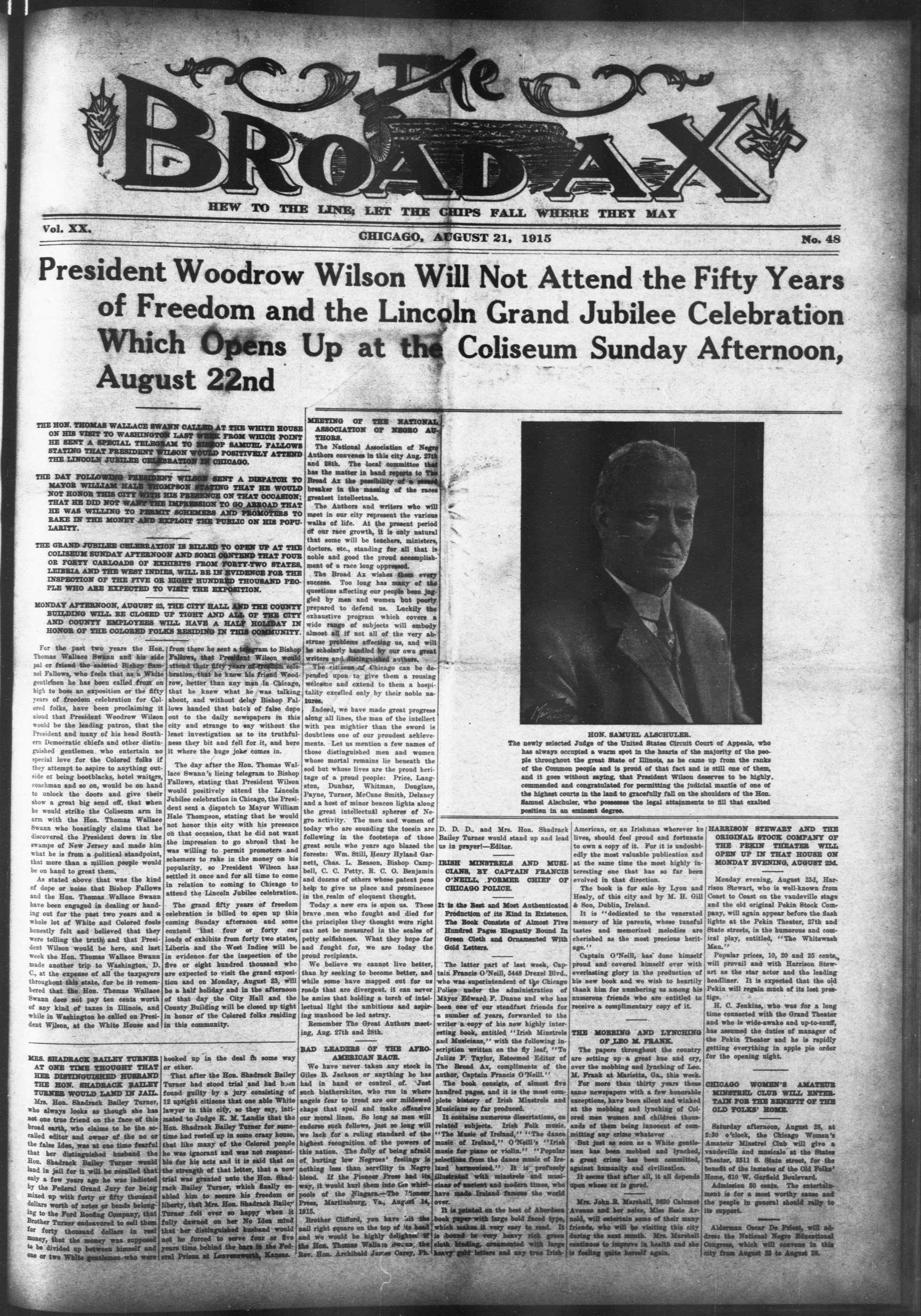
President Woodrow Wilson Will Not Attend the Fifty Years of Freedom and the Lincoln Grand Jubilee Celebration Which Opens Up at the Coliseum Sunday Afternoon, August 22nd
THE HON. THOMAS WALLACE SWANN CALLED AT THE WHITE HOUSE ON HIS VISIT TO WASHINGTON LAST WEEK FROM WHICH POINT HE SENT A SPECIAL TELEGRAM TO BISHOP SAMUEL FALLOWS STATING THAT PRESIDENT WILSON WOULD POSITIVELY ATTEND THE LINCOLN JUBILEE CELEBRATION IN CHICAGO.
THE DAY FOLLOWING PRESIDENT WILSON SENT A DISPATCH TO MAYOR WILLIAM HALE THOMPSON SCATING THAT HE WOULD NOT HONOR THIS CITY WITH HIS PRESENCE ON THAT OCCASION; THAT HE DID NOT WANT THE IMPRESSION TO GO ABROAD THAT HE WAS WILLING TO PERMIT SCHMERES AND PROMOTERS TO BAKE IN THE MONEY AND EXPLOIT THE PUBLIC ON HIS POPULARITY.
THE GRAND JUBILEE CELEBRATION IS BILLED TO OPEN UP AT THE COLISEUM SUNDAY AFTERNOON AND SOME CONTEND THAT FOUR OR PORTY CARLOADS OF EXHIBITS FROM PORTY-TWO STATES, LEIBRIA AND THE WEST INDIES, WILL BE IN EVIDENCE FOR THE INSPECTION OF THE FIVE OR EIGHT HUNDRED THOUSAND PEOPLE WHO ARE EXPECTED TO VISIT THE EXPOSITION.
MONDAY AFTERNOON, AUGUST 23, THE CITY HALL AND THE COUNTY BUILDING WILL BE CLOSED UP TIGHT AND ALL OF THE CITY AND COUNTY EMPLOYEES WILL HAVE A HALF HOLIDAY IN HONOR OF THE COLORED FOLKS RESIDING IN THIS COMMUNITY.
For the past two years the Hon. Thomas Wallace Swann and his side pal or friend the sainted Bishop Samuel Fallows, who feels that as a White gentlemen he has been called from on high to boss an exposition or the fifty years of freedom celebration for Colored folks, have been proclaiming it aloud that President Woodrow Wilson would be the leading patron, that the President and many of his head Southern Democratic chiefs and other distinguished gentlemen who entertain no special love for the Colored folks if they attempt to aspire to anything outside or being bootblacks, hotel waiters, coachman and so on, would be on hand to unlock the doors and give their show a great big send off, that when he would strike the Coliseum arm in arm with the Hon. Thomas Wallace Swann who boastingly claims that he discovered the President down in the swamps of New Jersey and made him what he is from a political standpoint, that more than a million people would be on hand to great them.
As stated above that was the kind of dope or noise that Bishop Fallows and the Hon. Thomas Wallace Swann have been engaged in dealing or handing out for the past two years and a whole lot of White and Colored fools honestly felt and believed that they were telling the truth and that President Wilson would be here, and last week the Hon. Thomas Wallace Swann made another trip to Washington, D.C., at the expense of all the taxpayers throughout this state, for be it remembered that the Hon. Thomas Wallace Swann does not pay ten cents worth of any kind of taxes in Illinois, and while in Washington he called on President Wilson, at the White House and
MRS. SHADRACK BAILEY TURNER
AT ONE TIME THOUGHT THAT
HER DISTINGUISHED HUSBAND
THE HON. SHADRACK BAILEY
TURNER WOULD LAND IN JAIL
Mrs. Hon. Shadrack Bailey Turner,
who always looks as though she has
not one true friend on the face of this
broad earth, who claims to be the so-
called editor and owner of the no or
the false Idea, was at one time fearful
that her distinguished husband the
Hon. Shadrack Bailey Turner would
land in jail for it will be recalled that
only a few years ago he was indicted
by the Federal Grand Jury for being
mixed up with forty or fifty thousand
dollars worth of notes or bonds belong-
ing to the Ford Roofing Company; that
Brother Turner endeavored to sell them
for forty thousand dollars in real
money, that the money was supposed
to be divided up between himself and
one or two White gentlemen who were
from there he sent a telegram to Bishop Fallows, that President Wilson would attend their fifty years of freedom celebration, that he knew his friend Woodrow, better than any man in Chicago, that he knew what he was talking about, and without delay Bishop Fallows handed that batch of false dope out to the daily newspapers in this city and strange to say without the least investigation as to its truthfulness they bit and fell for it, and here it where the huge joke comes in.
The day after the Hon. Thomas Wallace Swann's lieing telegram to Bishop Fallows, stating that President Wilson would positively attend the Lincoln Jubilee celebration in Chicago, the President sent a dispatch to Mayor William Hale Thompson, stating that he would not honor this city with his presence on that occasion, that he did not want the impression to go abroad that he was willing to permit promoters and schemers to rake in the money on his popularity, so President Wilson has settled it once and for all time to come in relation to coming to Chicago to attend the Lincoln Jubilee celebration.
The grand fifty years of freedom celebration is billed to open up this coming Sunday afternoon and some contend that four or forty car loads of exhibits from forty two states, Liberia and the West Indies will be in evidence for the inspection of the five or eight hundred thousand who are expected to visit the grand exposition and on Monday, August 23, will be a half holiday and in the afternoon of that day the City Hall and the County Building will be closed up tight in honor of the Colored folks residing in this community.
That after the Hon. Shadrack Bailey Turner had stood trial and had been found guilty by a jury consisting of 12 upright citizens that one able White lawyer in this city, so they say, intimated to Judge K. M. Landis that the Hon. Shadrack Bailey Turner for sometime had rested up in some crazy house, that like many of the Colored people he was ignorant and was not responsible for his acts and it is said that on the strength of that letter, that a now trial was granted unto the Hon. Shadrack Bailey Turner, which easily enabled him to secure his freedom or liberty, that Mrs. Hon. Shadrack Bailey Turner felt ever so happy when it fully dawned on her No Idea mind that her distinguished husband would not be forced to serve four or five years time behind the bars in the Federal Prison at Leavenworth, Kansas.
CHICAGO, AUGUST 21, 1915
MEETING OF THE NATIONAL ASSOCIATION OF NEGRO AUTHORS.
The National Association of Negro Authors convenes in this city Aug. 27th and 28th. The local committee that has the matter in hand reports to The Broad Ax the possibility of a record breaker in the massing of the races greatest intellectuals.
The Authors and writers who will meet in our city represent the various walks of life. At the present period of our race growth, it is only natural that some will be teachers, ministers, doctors, etc., standing for all that is noble and good the proud accomplishment of a race long oppressed.
The Broad Ax wishes them every success. Too long has many of the questions affecting our people been juggled by men and women but poorly prepared to defend us. Luckily the exhaustive program which covers a wide range of subjects will embody almost all if not all of the very abstruse problems affecting us, and will be scholarly handled by our own great writers and distinguished authors. The citizens of Chicago can be depended upon to give them a rousing welcome and extend to them a hospitality excelled only by their noble natures.
Indeed, we have made great progress along all lines, the man of the intellect with pen mightier than the sword is doubtless one of our proudest achievements. Let us mention a few names of those distinguished men and women whose mortal remains lie beneath the sod but whose lives are the proud heritage of a proud people: Price, Langston, Dunbar, Whitman, Douglass, Payne, Turner, McCune Smith, Delaney and a host of minor beacon lights along the great intellectual spheres of Negro activity. The men and women of today who are sounding the tocsin are following in the footsteps of those great souls who years ago blazed the forests: Wm. Still, Henry Hyland Garnett, Cass. L. Beason, Bishop Campbell, C. C. Petty, R. C. O. Benjamin and dozens of others whose patent pens help to give us place and prominence in the realm of eloquent thought. Today a new era is upon us. These brave men who fought and died for the principles they thought were right can not be measured in the scales of petty selfishness. What they hope for and fought for, we are today the proud recipients.
We believe we cannot live better, than by seeking to become better, and while some have mapped out for us roads that are divergent, it can never be amiss that holding a torch of intellectual light the ambitious and aspiring manhood be led astray. Remember The Great Authors meeting, Aug. 27th and 28th.
BAD LEADERS OF THE AFRO-
AMERICAN RACE
We have never taken any stock in Giles B. Jackson or anything he has had in hand or control of. Just such blatherskites, who run in where angels fear to tread are our mildewed chaps that spoil and make offensive our moral linen. So long as men will endorse such fellows, just so long will we lack for a ruling standard of the highest recognition of the powers of this nation. The folly of being afraid of hurting low Negroes' feelings is nothing less than servility in Negro blood. If the Pioneer Press had its way, it would hurl them into the whirlpools of the Niagara—The 'Jioneer Press, Martinsburg, Va., August 14, 1915.
Brother Clifford, you have 'lit the nail right square on the top of his head and we would be highly delighted if the Hon. Thomas Walla is Swans, the Roy Hon. Archibald Jawes Carey, Ph.
M. J. M.
The newly selected Judge of the United States Circuit Court of Appeals, who has always occupied a warm spot in the hearts of the majority of the people throughout the great State of Illinois, as he came up from the ranks of the Common people and is proud of that fact and is still one of them, and it goes without saying, that President Wilson deserves to be highly commended and congratulated for permitting the judicial mantle of one of the highest courts in the land to gracefully fall on the shoulders of the Hon. Samuel Alschuler, who possesses the legal attainments to fill that exalted position in an eminent degree.
D. D. D., and Mrs. Hon. Shadrack Bailey Turner would stand up and lead us in prayer!—Editor.
IRISH MINSTRELS AND MUSICIANS, BY CAPTAIN FRANCIS O'NEILL, FORMER CHIEF OF CHICAGO POLICE.
It is the Best and Most Authenticated Production of its Kind in Existence. The Book Consists of Almost Five Hundred Pages Elegantly Bound In Green Cloth and Ornamented With Gold Letters.
The latter part of last week, Captain Francis O'Neill, 5448 Drexel Blvd., who was superintendent of the Chicago Police under the administration of Mayor Edward F. Dunne and who has been one of our steadfast friends for a number of years, forwarded to the writer a copy of his new highly interesting book, entitled "Irish Minstrels and Musicians," with the following inscription written on the fly leaf, "To Julius F. Taylor, Esteemed Editor of The Brond Ax, compliments of the author, Captain Francis O'Neill." The book consists, of almost five hundred pages, and it is the most complete history of Irish Minstrels and Musicians so far produced.
It contains numerous dissertations, on related subjects. Irish Folk music. "The Music of Ireland," "The dance music of Ireland," O'Neill's "Irish music for piano or violin." "Popular selections from the dance music of Ireland harmonized." It is profusely illustrated with minstrels and musicians of ancient and modern times, who have made Ireland famous the world over.
It is printed on the best of Aberdeen book paper with large bold faced type, which makes it very easy to read. It is bound in very heavy rich green cloth binding, ornamented with large heavy gold letters and any true Irish-
HON. SAMUEL ALSCHULER.
Judge of the United States Circuit Court occupied a warm spot in the hearts of the city at the great State of Illinois, as he came on people and is proud of that fact and without saying, that President Wilson deed and congratulated for permitting the judicature in the land to gracefully fall on the scler, who possesses the legal attainments eminent degree.
American, or an Irishman wherever he lives, should feel proud and fortunate to own a copy of it. For it is undoubtedly the most valuable publication and at the same time the most highly interesting one that has so far been evolved in that direction.
The book is for sale by Lyon and Healy, of this city and by M. H. Gill & Son, Dublin, Ireland.
It is "dedicated to the venerated memory of his parents, whose tuneful tastes and memorized melodies are cherished as the most precious heritage."
Captain O'Neill, has done himself proud and covered himself over with everlasting glory in the production of his new book and we wish to heartily thank him for numbering us among his numerous friends who are entitled to receive a complimentary copy of it.
THE MOEBING AND LYNCHING
OF LEO M. FRANK
The papers throughout the country are setting up a great hue and cry, over the mobbing and lynching of Leo M. Frank at Marietta, Ga., this week. For more than thirty years these same newspapers with a few honorable exceptions, have been silent and winked at the mobbing and lynching of Colored men women and children thousands of them being innocent of committing any crime whatever. But just as soon as a White gentlemen has been mobbed and lynched, a great crime has been committed, against humanity and civilization.
It seems that after all, it all depends upon whose ox is gored.
Mrs. John B. Marshall, 3630 Calumet Avenue and her niece, Miss Essie Arnold, will entertain some of their many friends, who will be visiting this city during the next month. Mrs. Marshall continues to improve in health and she is feeling quite herself again.
No.48
HARRISON STEWART AND THE ORIGINAL STOCK COMPANY OF THE PEKIN THEATER WILL OPEN UP IN THAT HOUSE ON MONDAY EVENING, AUGUST 23d.
Monday evening, August 23d, Harrison Stewart, who is well-known from Coast to Coast on the vaudeville stage and the old original Pekin Stock Company, will again appear before the flash lights at the Pekin Theater, 27th and State streets, in the humorous and comical play, entitled, "The Whitewash Man."
Popular prices, 10, 20 and 25 cents, will prevail and with Harrison Stewart as the star actor and the leading headliner. It is expected that the old Pekin will regain much of its lost prestige.
H. C. Jenkins, who was for a long time connected with the Grand Theater and who is wide-awake and up-to-snuff, has assumed the duties of manager of the Pekin Theater and he is rapidly getting everything in apple pie order for the opening night.
OHICAGO WOMEN'S AMATEUR
MINSTREL CLUB WILL ENTER
TAIN FOR THE BENEFIT OF THE
OLD POLKS' HOME.
Saturday afternoon, August 28, at 2:30 o'clock, the Chicago Women's Amateur Minstrel Club will give a vaudeville and musicale at the States Theater, 3511 S. State street, for the benefit of the inmates of the Old Folks' Home, 610 W. Garfield Boulevard. Admission 50 cents. The entertainment is for a most worthy cause and the people in general should rally to its support.
Alderman Oscar De Priest, will address the National Negro Educational Congress, which will convene in this city from August 23 to August 23.
ce eee
‘AS. SOLDIERS
f —_
sai Ley
At’ Piattsburg, N. ¥., on the westera
shore of Lake Champlain, more than
‘2 thousand representative Ameri¢an
citizens have been in military training
to fit them to serve as officets of vol-
unteers in the event of 2 national eri
as. < Picked officers of the United
States army bave been undertaking the
task of training these men-of many
professions, bankers, lawyers, brokers,
public officials, diplomats, artists,
Bewspaper men, doctors and mer-
‘chants and to give them a taste of and
for military life. It is 2 unique ex-
be: ae eee
‘ .
eee Ba
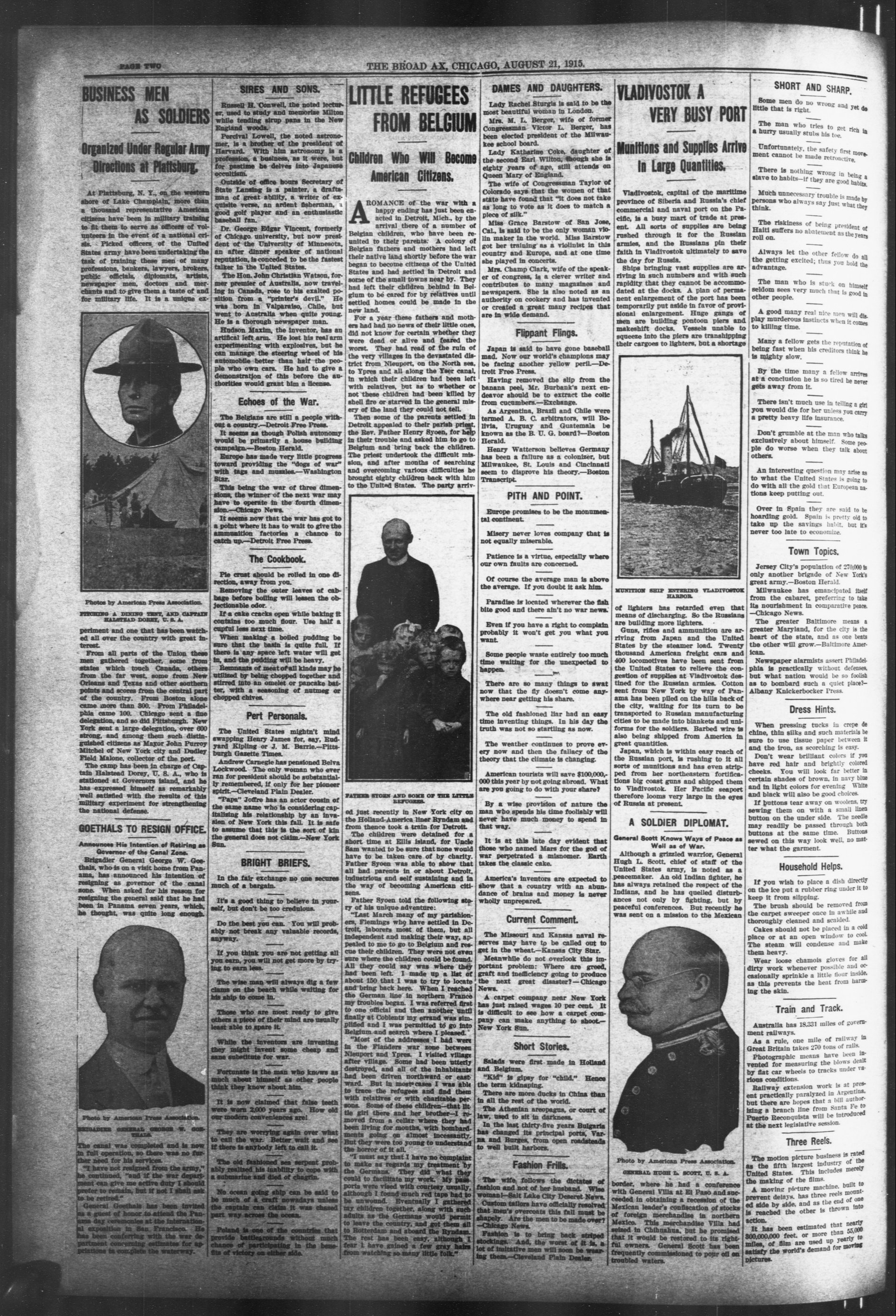
‘Photos by American Press Association.
‘PIECHING 4 DIXING TENT, AXD CAPTAIN
‘BALSTEAD DOREY, U. 8. 4.
periment and one that bas been watch-
ed all over the country with great in-
‘terest.
From all parts of the Union these
men gathered together, some from
‘States which touch Canada, other
from the fer west, some from New
‘Orleans and Texas and other southern
‘potnts and scores from the central part
of the country. From Boston alone
came more than 300. From Philadel-
‘phia came 100. Chicago sent = fine
delegation, and so did Pittsburgh. New
‘York sent a large delegation, over 600
strong, and among them such distin-
guished citizens as Mayor John Purroy
‘Mitchel of New York city and Dudley
Field Malone, collector of the port.
‘The camp has been in charge of Cap-
tain Halstead Dorey, U. 8. A. who ts
stationed at Governors island, and he
bas expressed himself as remarkably
well satisfied with the results of this
military experiment for strengthening
the national defense.
GOETHALS TO RESIGN OFFICE.
Announces His Intention of Retiring
‘Governor of the Canal Zone.
‘Brigadier General George W. Goe-
thais, who 4s on a visit home from Pan-
ama, has announced his intention of
resigning es governor of the canal
sone. When asked for his reason for
resigning the general said that he had
Deen in Panama seven years, which,
be thought, wes quite long enough.
-
3
; 5
:
SSS”
NT See
on eet
‘Tess
The cana! was completed and is now
full operation, so thee was no fur-
ther sbed for his services
‘“E have not resigned from the army,”
continned, “and if the war depart
ag ener ees
‘to remain, but if pot I shail ast
De retired“ eg
) & guest of honor to.atteud the Pan-
L <n nega «
oe ent inn a
“SIRES AND SONS.
Lcateapy ether aon ae sete wc
‘while tending sirup pans in the New
Engiand woods
Percival Lowell, the noted astrono-
‘Mer, is 2 Drother of the president of
‘Harvard. With him astronomy is a
eee tears, tas eee
r pastime be delves into Japanese
occultism.
~ Qutalde of office hours Secretary of
State Lansing is x painter, a drafts
‘an of greet ability, a writer of ex-
quisite verse, an ardent Ssherman, :
good golf player and an enthusiastic
‘Daseball fan.
‘Dr. George Bagar Vincent, formerly
‘of Chicago. university, but now prest
Gent ofthe University of Minnesota,
an after dinner speaker of national
reputation, ts conceded to be the fastest
talker in the United States.
‘The Hon. John Christin Watson, for
mer premier of Australia, now travel-
ing in Canada, rose to his exalted po-
ition ‘froma “printer’s devil.” He
was born tn Valparaiso, Chile, but
‘went to Anstraiia when quite young.
He ts a thorough newspaper man.
Hndson Maxim, the inventor, bas an
artifical left. arm. He lost his real arm
experimenting with explosives, but he
‘can “manage the steering wheel of bis
‘automobile-better than half the peo-
ple who own cars. He had to give 2
demonstratjon of this before the au-
thorities would grant him a license.
~ — Echoes of the War.
‘The Belgians are still a people with-
Out @ country.—Detroit Free Press.
Tt seems as though Polish eutonomy
‘would be primarily a house building
campaign —Boston Herald.
Burope bas made very little progress
toward providing the “dogs of war”
‘with tags and muzzles— Washington
‘his being the war of three dimen-
‘sous, the winner of the next war may
have te operate in the fourth dimen-
ston. —Chicago News.
‘It seems now that the war has got to
& point where it has to wait to give the
ammunition factories 2 chance to
catch up—Detroit Free Press.
‘The Cookbook.
‘Pie crust abould be rolied in one dt
rection, away from you.
Removing the outer leaves of cab-
bage before boiling will lessen the ob-
Jectionabie odor.
Ete cake cracks open While baking ft
contains too much flour. Use half a
Cupful less next time.
When making 2 boiled pudding be
‘sure that the basin is quite full If
there. is ‘any- space left water will got
in, and the pudding will be heavy.
~ Remnants of meat ofall kinds may be
‘Utilized by belng chopped together and
stirred tnto‘an omelet or pancake bat-
ter, with 2 seasoning of nutmeg or
chopped chives,
Pert Personals.
‘The United States mightn't mind
swapping Henry James for, say, Rud-
yard Kipling or J. M. Barrie—Pitts-
burgh Gazette Times.
Andrew Carnegie has pensioned Belva
Lockwood. The only woman who ever
1p remembered, it only for ber blonee
phoneer
‘spirit.—Cleveland Plain Dealer.
“Papa” Joffre has an actor cousin of
the same name who is considering cap-
italiaing his relationship by an inva-
sion of New York this fall. It ts safe
to assume that this is the sort of kin
the general does not claim —New York
BRIGHT BRIEFS.
In the fair exchange no one secures
much of « bargain.
It's @ good thing to believe in your-
‘self, but don’t be too credulous.
Do the best you ean. -You will prob-
ably not break any valuable records,
If you think you are not getting all
You earn, you will not get more by try-
ing to earn less. es
eager anh mat le
clams on ‘beach while waiting
ia abip to come in.
eS
Those who are most ready to give
others a piecé of thelr mind are usually
While the Snventors are inventing
they might invent some cheap and
‘They are worrying again over what
to call the war. Better wait and see
Sf there is anybody left to call it.
‘The old fashioned sea serpent prob-
Realized his inability to cope with
andepcheried ane st eae
No ocean going ship'can be exid to
captain can Claim it was chased
me Sooene st
Brovide battlegrounds ele mach
Sine of prt > fo
BHOAD AX, CHICAGO, AUGUST 21, 1915.
LITTLE REFUGEES | mms = oe
7 - Lady Rachel Sturgis is sald tc
most beautiful worban in Lond
FROM BELGIUM |=: ==
Congréssman Victor L. Bers’
been elected president of the }
kee schoo! board.
Children Who Will Become tn stoed art Won
American Citizens. Steyn
whe atfe of Concressman Ts
ROMANCE of-the war with a
‘happy ending has just been en-
acted in Detroit, Mieh., by the
arrival there of a number of
Belgian children, who have been te-
united to thelr parents: A colony of
Belgian fathers and mothers had left
thelr native land shortly before the war
began to become citizens of the United
States and had settled im Detroit and
some of the small towns near by. They
had left thelr children behind in Bel-
gium to bé cared for by relatives until
settled homes could be made in the
new land.
For a year these fathers ‘and moth-
ers had had no news of thelr little ones,
4id not know for certain whether they
wore Geel. ot_plive sed asted the
worst. They had read of fhe ruin of
the very villages in the devastated dis-
trict from Nieuport, on the North sea,
to Ypres an¢ all along the Yeer canal,
in which thelr children had been left
with relatives, but as to whether or
not these children had been killed by
shell fire or starved in the general mis-
ery of the land they could not tell.
‘Then some of the parents vettled in
Dota napesiel 06 Ck: See ela.
the Rev. Father Henry Syoen, for
in thetr trouble and asked him to go to
Belgium and ‘bring back the children.
The priest undertook the difficult mis-
sion, and after months of searching
and overcoming various difficulties he
brought eighty children back with him
to the United States. The party arriv-
ae
Ta
— cn
ae
FATHER SYOEN AND SOME OF THE LITTLE
‘REyvaREs
ed just recently in New York city on
the Holland-America liner Ryndam and
from thence took a train for Detroit.
‘The children were detained for s
short time at Ellis island, for Uncle
Sam wanted to be sure that none would
have to be taken care of by charity.
Father Syoen was able to show that
all bad parents in or about Detrott,
industrious and self sustaining and in
the way of becoming American citt-
ens.
Father Syoen told the following sto-
ty of his unique adventure:
“Last March many of my parishion-
ers, Flemings who have settled in De-
trolt, laborers most. of them, but all
independent and making thelr way, ap-
Dealed to me to go to Beiginm and res-
cue their children. They were not even
sure where the children could be found.
All they could say was where théy
had been left. I made up a lst of
about 150 that I was to try to locate
and" bring back here. When I reached
the German. line in northern France
my troubles began. I was referred first
to one official and then another Until
finally et Coblents my errand was sim.
plified and I was permitted t6 go into
Belgium and search where I pleased.”
“Most of the addresses I had were
im the Flatders war zone between
Nieuport and Ypres. I visited viliage
after village. Some bad been utterly
destroyed, and all of the inbabitanty
had been driven northward or east
we ins eek ere
trace the refugees them
Wis naatowes or with, cheulinbte. pen
sons. Some of these - ie
oot es,
from a cellar where they had
been 1 oe ee ee
young to understand
OMA Eo
_*T must ea} ve no Compl
Es ar oe
eee ee
na en ~
cis % te ioe oe y.uraally,
SY eiacnag: Meter Yona
Set omy Vat
tults. an thé Germans would permit.
i feuibe tha coldatins aah acre on.
Muck tell Cheer eee
se Pest ‘bas Bech -pety; Siena I.
be nae nan rs L
‘DAMES AND DAUGHTERS.
Lady Rachel Sturgis is sald to be the
most beautiful wotban in London.”
Mrs. M. L. Berger, wife of former
Congressman Victor L. Berger, has
been elected president of the Milwau-
kee schoo! board.
Lady Supe -Coe oan
the second Earl Wilton; hough she is
eighty years of age, still attends on
Queen Mary of England.
‘The wife of Congressman Taylor of
Colorado says that the women of that
state have found that “it does not take
as long to vote as it does to match a
piece of silk.”
Miss Grace Barstow of San Jose,
Cal, is said to be the only woman vio-
lin maker in the world. Miss Barstow
got her training” as a violinist in this
country and Europe, and at one time
she played in concerts.
‘Mrs. Champ Clark, wife of the speak-
er of congress, ig a clever writer and
contributes to many magazines and
newspapers. She is also noted as an
authority on cookery and has invented
or created a great many recipes that
are in Wide demand.
Flippant Flings.
Japan ts said to have gone baseball
mad. Now our world’s champions may
be facing another yellow peril—De-
trott Free Press.
Having removed the slip from the
banana peel, Mr. Burbank's next en-
deavor should be to extract the colic
from cucumbers.—Exchange.
As Argentina, Brazil and Chile were
termed A. B. C. arbitrators, will Bo
livia, Uruguay and Guatemala be
known as the B. U. G. board?—Boston
Herald.
Henry Watterson believes Germany
bas been a failure as a colonizer, but
Milwaukee, St. Louis and Cincinnati
seem to disprove his theory.—Boston
Transcript.
PITH AND POINT. .
Europe promises to be the monumen-
tal continent.
Misery never loves company that is
not equally miserable,
Patience is a virtue, especially where
our own faults are concerned.
Of course the average man is above
the average. If you doubt it ask him.
Paradise is located wherever the fish
bite good and there ain't no war news:
Even if you have a right to complain
probably it won't get you what you
want.
| Some people waste entirely too much
‘time waiting for the unexpected to
happen.
‘There are so many things to swat
now that the fly doesn't come any-
where near getting his share.
‘The old fashioned lar had an easy
time inventing things. In his day the
truth was not so startling as now.
‘The weather continues to prove ev-
ery now and then the fallacy of the
theory that the climate ts changing.
American tourists will save $100,000,-
000 this yeer by not going abroad. What
are you going to do with your share?
By & wise provision of nature the
man who spends his time foolishly will
Revert have much money to spend in
that way.
Tt is at this late day evident that
those who named Mars for the god of
War perpetrated a misnomer. Earth
takes the classic cake.
America’s inventors are expected to
show that a country with an abun-
dance of brains and money is never
wholly unprepared.
Current Comment.
‘The Missouri and Kansas naval re-
serves may have to be called out to
get in the wheat—Kansas City Star.
Meanwhile do not overlook this im-
portant problem: Where are greed,
graft and tnefficiency going to produce
the next great disaster? — Chicago
News.
A carpet company near New York
bas just raised wages 10 per cent. It
is difficult to see bow a carpet com-
pany can make anything to shoot—
New York Sun. :
Short Stories.
Salads were frst-made in Holland
and Belgium
“Kid" {8 gipsy for “child.” Hence
the term kidnaping.
‘There are more ducks in China than
im all the rest of the world.
_-The Athenian areopagus, or court of
law, used to sit in darkness,
_In the last thirty-five years Bulgaria
has changed its principal ports, Var
ma and Burges, from open rondsteads
to well built harbors. .
esac epee
“ses ~ Fashion Frills... ... _
‘The- wife, follows the dictates of
fashion and not of her husband. Wise
woman!—Sait Lake City Deseret News.
. Custom tatlors have officially resolved
that men’s overcoats this full must be
Saeay, Are the men tobe made owes
Fashion 1s to bring back striped
stockings: Asd, the wotet of it ia, a
lot of imitative men will soon be wear
‘Viadivostok, capital of the maritime
Province of Siberia and Russia’s chief
commercial and naval port on the Pa-
cific, is a busy mart of trade at pres-
ent. All sorts of supplies are being
rushed through it for the Russian
armies, and the Russians pin their
faith in Viadtvostok ultimately to save
‘the day for Russia.
Ships bringing vast supplies are ar-
‘iving in such numbers and with such
rapidity that they cannot be accommo-
Gated at the docks. A plan of perma-
nent enlargement of the port has been
temporarily put aside in favor of provi-
sional enlargement. Huge gangs of
ten are building pontoon piers and
makeshift docks, Vessels unable to
squeeze into the piers are transhipping
their cargoes to lighters, but a shortage
\
db
ae . ;
MUNTTION SHIP ENTERING VLADIVOSTOK
HARBOR.
of lighters bas retarded even that
means of discharging. So the Russians
are building more lighters.
Guns, rifles and ammunition are ar-
riving from Japan and the United
States by the steamer load. Twenty
thousand American freight cars and
400 locomotives have been sent from
the United States to relieve the con-
gestion of supplies at Viadivostok des-
tined for the Russian armies. Cotton
sent from New York by way of Pan-
ama has been piled on the hills back of
the city, waiting for its turn to be
transported to Russian manufacturing
cities to be made into blankets and unt-
forms for the soldiers. Barbed wire is
also being shipped from America in
great quantities.
‘Japan, which is within easy reach of
the Russian port, is rushing to it all
sorts of munitions and has even strip-
Ped from her northeastern fortifica-
tions big coast guns and shipped them
to Viadivostok. Her Pacific seaport
therefore looms very large in the eyes
of Russia at present. |
A SOLDIER DIPLOMAT.
General Scott Knows Ways of Peace as
Well as of War.
Although a grizzled warrior, General
Hugh L. Scott, chief of staf of the
United States army, is noted as a
peacemaker. An old Indian fighter, he
has always retained the respect of the
Indians, and he has quelled disturb-
ances not only by fighting, but by
Peaceful conferences. But recently he
was sent on a mission to the Mexican
Fn
‘ Ye
ss
Photo by American Press Association.
GENERAL mUGH 1 SCOFT, U. 8. 4
border, where he hed a conference
with General Villa at Ei Paso and sue-
ceeded in obtaining a recession of the
Mexican leader's confiscation of stocks
of foreign merchandise in northern
Mexico. This merchandise Villa had
Ga wea be rot tbs Sg
Jt would be restored to its right-
trequesly commiononed to poh faa
- to popr off en
troubled waters.
SHORT AND sHapp
Some men do no wrong
Mttle that is right. And Tet do,
‘The man who tries to get
@ burry usually stubs his toe. <=
Unfortunately, the satety test my
‘Ment cannot be made retroactive
There ts nothing wrovg in being g
ave to habits—it they are good tatie
‘Much oe pe trouble is made by,
Persons who always say Just wha
‘think. a
‘The riskiness of being presen
2 suffers no abatement as the yee
roll on.
| Always let tho other fellow do ay
the getting excited; thus sou hold the
a
The man who 1s stuck on tinsap
seldom sees very mivch that ls goodie
other people.
A good many rea! nice mon wit
play murderous instincts when jt come
to killing time.
‘Many a fellow gets the reputation of
being fast when his creditors think be
is mighty slow.
By the time many a fellow arines
at’a conclusion he is so tired he never
gets away from it.
‘There isn't much use in telling a get
you would die for her unless yon carry
& pretty heavy life insurance.
Don’t grumble at the man who talky
exclusively about himself. Some pen
ple do worse when they talk about
others.
An interesting question ‘May arise as
to what the United States is going to
do with all the gold thot European na-
tions keep putting out.
Over in Spain they are said to be
hoarding gold. Spain is pretty old t»
take up the savings habit. but it
never too late to economize.
Town Topics.
Jersey City’s population of 270,000 is
only another brigude of New York's
great army.—Boston Herall.
Milwaukee has emancipated ttelf
from the cabaret, preferring to take
its nourishment in comparative peace.
—Chicago News.
‘The greater Baltimore means a
greater Maryland, for the city is the
heart of the state, and as one beats
the other will grow.—Baltimore Amer-
ican.
‘Newspaper alarmists assert Philadel
phia is practically without defenses
but what nation would be so foolish
as to bombard such a quiet place
Albany Knickerbocker Press.
Dress Hints.
‘When pressing tucks in crepe de
chine, thin silks and such materials be
sure to use tissue paper between it
‘and the fron, as scorching is easy.
Don’t wear brilliant colors if you
have red hair and brightly colored
cheeks. You will look far better ia
certain shades of brown, in navy blue
and in light colors for evening White
‘and black will also be good choices.
If buttons tear away on woolens, ty
sewing them on with a small linen
button on the under side. The needle
may readily be passed throush both
Duttons at the same time. Buttons
sewed on this way look well, no mat
ter what the garment.
Household Helps.
If you wish to place a dish directly
on the ice put a rubber ring under it to
Keep it from slipping.
‘The brush should be removed from
the carpet sweeper once In awhile and
thoroughly cleaned and scalded.
‘Cakes should not be places! in 2 cold
place or at an open window to cool
The steam will condense and make
‘them heavy.
‘Wear loose chamois gloves for all
dirty work whenever possible and 0
easionally sprinkle a little flour inside,
as this prevents the heat from baru
ing the skin.
Train and Track.
Australia bas 18.331 miles of govern”
ment railways.
As a rule, one mile of railway
Great Britain takes 270 tons of rails.
Photographic means have been im
vented for measuring the blows dealt
by fiat car wheels to tracks under ¥#
ious conditions.
pee varat work is at pres
ly paralyzed in Argentina,
Dut there are hopes that a bill author-
faing @ branch line from Santa Fe to
Pusrto Reconquista will be introduced
At the next lecislative session
Three Reels.
‘Whe motion picture business 's rated
a en a Co
States. ‘This includes merely
tho making of the Sims.
A moving picture machine. bailt to
Dpeevent delays. has three reels moun
— ‘and as the end of 00¢
Is reached the other % tives BY
Tat has been eatimated that Dewy
feet. or more than 35,000
‘of fim are used UP yearly *@
‘the world’s demand for movies
Woman's World
The Exquisite "Little Lady"
Who Interprets Barrie's Plays.
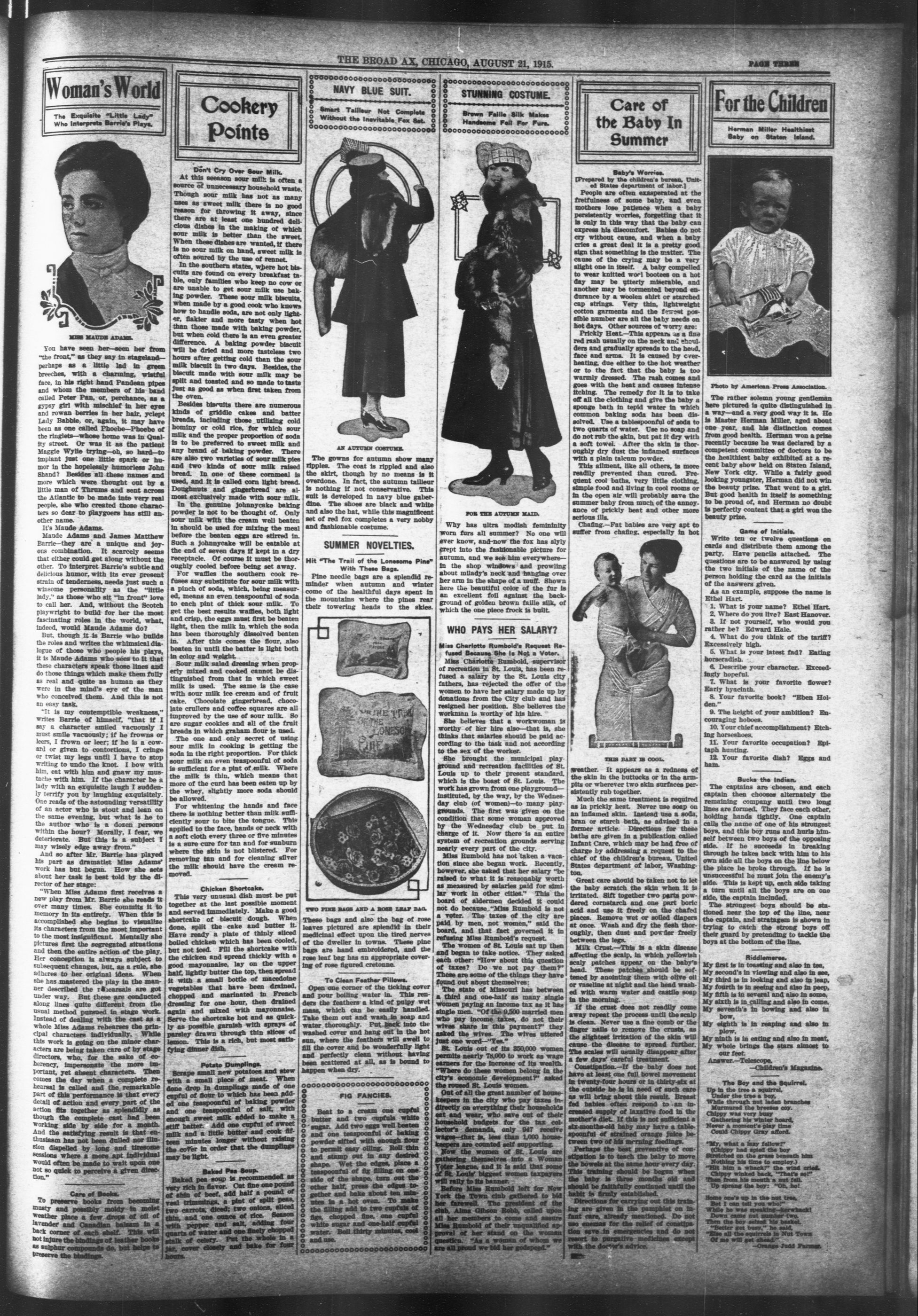
MISS MAUDE ADAMS.
You have seen her—seen her from "the front," as they say in stageland—and perhaps as a little lad in green hreeches, with a charming, wistful face, in his right hand Pandean pipes and whom the members of his band called Peter Pan, or, perchance, as a gypsy girl with mischief in her eyes and rowan berries in her hair, yclept Lady Babble, or, again, it may have been as one called Phoebe—Phoebe of the ringlets—whose home was in Quality street. Or was it as the patient Maggle Wylie trying—oh, so hard—to implant just one little spark or humor in the hopelessly humorless John Shand? Besides all these names and more which were thought out by a little man of Thryms and sent across the Atlantic to be made into very real people, she who created those characters so dear to playgoers has still another name.
It's Maude Adams.
Maude Adams and James Matthew Barrie—they are a unique and joyous combination. It scarcely seems that either could get along without the other. To interpret Barrie's subtle and delicious humor, with its ever present strain of tenderness, needs just such a winsome personality as the "little lady," as those who sit "in front" love to call her. And, without the Scotch playwright to build for her the most fascinating roles in the world, what, indeed, would Maude Adams do?
But, though it is Barrie who builds the roles and writes the whimsical dialogue of those who people his plays, it is Maude Adams who sees to it that these characters speak those lines and do those things which make them fully as real and quite as human as they were in the mind's eye of the man who conceived them. And this is not an easy task.
"It is my contemptible weakness," writes Barrie of himself, "that if I say a character smiled vacuously I must smile vacuously; if he frowns or leers, I frown or leer; if he is a coward or given to contortions, I cringe or twist my legs until I have to stop writing to undo the knot. I bow with him, eat with him and gnaw my mustache with him. If the character be a lady with an exquisite laugh I suddenly terrify you by laughing exquisitely. One reads of the astounding versatility of an actor who is stout and lean on the same evening, but what is he to the author who is a dozen persons within the hour? Morally, I fear, we deteriorate. But this is a subject I may wisely edge away from."
And so after Mr. Barrie has played his part as dramatist Miss Adams' work has begun. How she works about her task is best told by the director of her stage:
"When Miss Adams first receives a new play from Mr. Barrie she reads it over many times. She commits it to memory in its entirety. When this is accomplished she begins to visualize its characters from the most important to the most insignificant. Mentally she pictures first the segregated situations and then the entire action of the play. Her conception is always subject to subsequent changes, but, as a rule, she addresses to her original ideas. When she has mastered the play in the manner described the rehearsals are got under way. But these are conducted along lines quite different from the usual method pursued in stage work. Instead of dealing with the cast as a whole Miss Adams rehearses the principal characters individually. While this work is going on the minor characters are being taken care of by stage directors, who, for the sake of coherency, impersonate the more important, yet absent characters. Then comes the day when a complete rehearsal is called and the remarkable part of this performance is that every detail of action and every part of the action fits together as splendidly as though the complete cast had been working side by side for a month. And the satisfying result is that enthusiasm has not been dulled nor illusion dispelled by long and tiresome sessions where a more apt individual would often be made to wait upon one not so quick to perceive a given direction."
To preserve books from becoming musty and possibly moldy in moist weather place a few drops of oil of lavender and Canadian beaum in a back corner of each shelf. This will not injure the bindings of leather books as sulphur compounds do, but helps to preserve the bindings.
Cookery Points
Don't Cry Over Sour Milk.
At this season sour milk is often a source of unnecessary household waste. Though sour milk has not as many uses as sweet milk there is no good reason for throwing it away, since there are at least one hundred delicious dishes in the making of which sour milk is better than the sweet. When these dishes are wanted, if there is no sour milk on hand, sweet milk is often soured by the use of rennet.
In the southern states, where hot biscuits are found on every breakfast table, only families who keep no cow or are unable to get sour milk use baking powder. These sour milk biscuits, when made by a good cook who knows how to handle soda, are not only lighter, flakier and more tasty when hot than those made with baking powder, but when cold there is an even greater difference. A baking powder biscuit will be dried and more tasteless two hours after getting cold than the sour milk biscuit in two days. Besides, the biscuit made with sour milk may be split and toasted and so made to taste just as good as when first taken from the oven.
Besides biscuits there are numerous kinds of griddle cakes and batter breads, including those utilizing cold hominy or cold rice, for which sour milk and the proper proportion of soda is to be preferred to sweet milk and any brand of baking powder. There are also two varieties of sour milk pies and two kinds of sour milk raised bread. In one of these cornmeal is used, and it is called corn light bread. Doughnuts and gingerbread are almost exclusively made with sour milk. In the genuine johnnycake baking powder is not to be thought of. Only sour milk with the cream well beaten in should be used for mixing the meal before the beaten eggs are stirred in. Such a johnnycake will be eatable at the end of seven days if kept in a dry receptacle. Of course it must be thoroughly cooled before being set away.
For waffles the southern cook refuses any substitute for sour milk with a pinch of soda, which, being measured, means an even teaspoonful of soda to each pint of thick sour milk. To get the best results waffles, both light and crisp, the eggs must first be beaten light, then the milk in which the soda has been thoroughly dissolved beaten in. After this comes the flour, also beaten in until the batter is light both in color and weight.
Sour milk salad dressing when properly mixed and cooked cannot be distinguished from that in which sweet milk is used. The same is the case with sour milk ice cream and of fruit cake. Chocolate gingerbread, chocolate crullers and coffee squares are all improved by the use of sour milk. So are sugar cookies and all of the fruit breads in which graham flour is used.
The one and only secret of using sour milk in cooking is getting the soda in the right proportion. For thick sour milk an even teaspoonful of soda is sufficient for a pint of milk. Where the milk is thin, which means that more of the curd has been eaten up by the whey, slightly more soda should be allowed. For whitening the hands and face there is nothing better than milk sufficiently sour to bite the tongue. This applied to the face, hands or neck with a soft cloth every three or five minutes is a sure cure for tan and for sunburn where the skin is not blistered. For removing tan and for cleaning silver the milk should have the cream removed.
Chicken Shortcake.
This very unusual dish must be put together at the last possible moment and served immediately. Make a good shortcake of biscuit dough. When done, split the cake and butter it. Have ready a plate of thinly sliced boiled chicken which has been cooled, but not iceed. Fill the shortcake with the chicken and spread thickly with a good mayonnaise, lay on the upper half, lightly butter the top, then spread it with a small bottle of macedone vegetables that have been drained, chopped and marinated in French dressing for one hour, then drained again and mixed with mayonnaise. Serve the shortcake hot and as quickly as possible garnish with sprays of parsley drawn through thin slices of lemon. This is a rich, but most satisfying dinner dish.
Potato Dumplings.
Scrape small new potatoes and stew with a small piece of meat. When done drop in dumplings made of one cupful of flour to which has been added one teaspoonful of baking powder and one teaspoonful of salt, with enough sweet milk added to make a stiff batter. Add one cupful of sweet milk and a little butter and cook fifteen minutes longer without raising the coover in order that the dumplings may be light.
Baked Pea Soup.
Baked pea soup is recommended as very rich in flavor. Cut fine one pound of shin of beef, add half a pound of veal trimmings, a pint of split pens, two carrots, diced; two onions, sliced thin, and one ounce of rice. Season with pepper and salt, adding four quarts of water and one finely chopped stalk of celery. Put the whole in a jar, cover closely and bake for four
1
AN AUTUNN COSTUME.
The gowns for autumn show many ripples. The coat is rippled and also the skirt, though by no means is it overdone. In fact, the autumn tailleur is nothing if not conservative. This suit is developed in navy blue gaberdine. The shoes are black and white and also the hat, while this magnificent set of red fox completes a very nobby and fashionable costume.
SUMMER NOVELTIES.
Hit "The Trail of the Lonesome Pine"
With These Bags.
Pine needle bags are a splendid reminder when autumn and winter come of the healthful days spent in the mountains where the pines rear their towering heads to the skies.
THE TRAD
OF THE
LONESON
PINE
TWO PINE BAGS AND A ROSE LEAF BAG.
These bags and also the bag of rose leaves pictured are splendid in their medicinal effect upon the tired nerves of the dweller in towns. These pine bags are hand embroidered, and the rose leaf bag has an appropriate covering of rose figured cretonne.
To Clean Feather Pillows.
Open one corner of the ticking cover and pour boiling water in. This renders the feathers a kind of pulpy wet mass, which can be easily handled. Take them out and wash in soap and water thoroughly. Put back into the washed cover and hang out in the hot sun, where the feathers will swell to fill the cover and be wonderfully light and perfectly clean without having been scattered at all, as is bound to happen when dry.
FIG FANCIES.
Beat to a cream one cupful butter and two cupfuls white sugar. Add two eggs well beaten and one teaspoonful of baking powder sifted with enough flour to permit easy oilling. Roll thin and stamp in any desired shape. Wet the edges, place a teaspoonful of fig filling on one side of the shape, turn out the other half, press the edges together and bake about ten minutes in a hot oven. To make the filling add to two cupfuls of figs, chopped fine, one cupful white sugar and one-half cupful water. Bake thirty minutes, cool and use.
THE FASHION WEEKLY
FOR THE AUTUMN MAID.
Why has ultra modish femininity worn furs all summer? No one will ever know, and now the fox has slyly crept into the fashionable picture for autumn, and we see him everywhere—in the shop windows and prowling about milady's neck and hanging over her arm in the shape of a muff. Shown here the beautiful color of the fur is an excellent foll against the background of golden brown fallie silk, of which the one piece frock is built.
WHO PAYS HER SALARY?
Miss Charlotte Rumbold's Request Refused Because She is Not a Voter.
Miss Charlotte Rumbold, supervisor of recreation in St. Louis, has been refused a salary by the St. Louis city fathers, has rejected the offer of the women to have her salary made up by donations from the City club and has resigned her position. She believes the workman is worthy of his hire.
She believes that a workwoman is worthy of her hire—also that is, she thinks that salaries should be paid according to the task and not according to the sex of the worker.
She brought the municipal playground and recreation facilities of St Louis up to their present standard, which is the boast of St. Louis. The work has grown from one playground—instituted, by the way, by the Wednesday club (of women)—to many playgrounds. The first was given on the condition that some woman approved by the Wednesday club be put in charge of it. Now there is an entire system of recreation grounds serving nearly every part of the city.
Miss Rumbold has not taken a vacation since she began work. Recently, however, she asked that her salary "be raised to what it is reasonably worth as measured by salaries paid for similar work in other cities." This the board of aldermen decided it could not do because "Miss Rumbold is not a voter. The taxes of the city are paid by men, not women," said the board, and that fact governed it in refusing Miss Rumbold's request.
The women of St. Louis sat up then and began to take notice. They asked each other: "How about this question of taxes? Do we not pay them?" These are some of the things they have found out about themselves:
The state of Missouri has between a third and one-half as many single women paying an income tax as it has single men. "Of the 9,500 married men who pay income taxes, do not their wives share in this payment?" they asked the wives. The wives uttered just one word—"Yes."
St. Louis out of its 350,000 women permits nearly 78,000 to work as wage earners for the increase of its wealth.
"Where do these women belong in the city's economic development?" asked the roused St. Louis women.
Out of all the great number of housekeepers in the city who pay taxes indirectly on everything their household's eat and wear, who save out of their household budgets for the tax collector's demands, only 947 receive wages—that is, less than 1,000 housekeepers are counted self supporting.
Now the women of St. Louis are gathering themselves into a Woman Voter league, and it is said that some of St. Louis' biggest women taxpayers will rally to its banner.
Before Miss Rumbold left for New York the Town club gathered to bid her farewell. The president of the club, Alma Gibson Robb, called upon all her members to come and assure Miss Rumbold of their unqualified approval of her stand on the woman question. "As a woman of whom we are all proud we bid her godsend."
Care of the Baby In Summer
Baby's Worries.
[Prepared by the children's bureau, United States department of labor.]
ed States department of labor. People are often exasperated at the freewellness of some baby, and even mothers lose patience when a baby persistently worries, forgetting that it is only in this way that the baby can express his discomfort. Babies do not cry without cause, and when a baby cries a great deal it is a pretty good sign that something is the matter. The cause of the crying may be a very slight in itself. A baby compelled to wear knitted work bootes on a hot day may be utterly miserable, and another may be tormented beyond endurance by a woolen shirt or starched cap strings. Very thin, lightweight cotton garments and the lowest possible number are all the baby needs on hot days. Other sources of worry are:
Prickly Heat.—This appears as a fine red rash usually on the neck and shoulders and gradually spreads to the head, face and arms. It is caused by overheating, due either to the hot weather or to the fact that the baby is too warmly dressed. The rash comes and goes with the heat and causes intense itching. The remedy for it is to take off all the clothing and give the baby a sponge bath in tepid water in which common baking soda has been dissolved. Use a tablespoonful of soda to two quarts of water. Use no soap and do not rub the skin, but pat it dry with a soft towel. After the skin is thoroughly dry dust the inflamed surfaces with a plain talcum powder.
This aliment, like all others, is more readily prevented than cured. Frequent cool baths, very little clothing, simple food and living in cool rooms or in the open air will probably save the summer baby from much of the annoyance of prickly heat and other more serious ills. Chafing.-Fat babies are very apt to suffer from chafing, especially in hot
I
THIS BABY IS COOL.
weather. It appears as a redness of the skin in the buttocks or in the armpits or wherever two skin surfaces persistently rub together.
Much the same treatment is required as in prickly heat. Never use soap on an inflamed skin. Instead use a soda, bran or starch bath, as advised in a former article. Directions for these baths are given in a publication called Infant Care, which may be had free of charge by addressing a request to the chief of the children's bureau, United States department of labor, Washington.
Great care should be taken not to let the baby scratch the skin when it is irritated. Sift together two parts powdered cornstarch and one part boric acid and use it freely on the chafed places. Remove wet or dry diapers at once. Wash and dry the flesh thoroughly, then dust and powder freely between the lees.
Milk Crust—This is a skin disease affecting the scalp, in which yellowish scaly patches appear on the baby's head. These patches should be softened by anointing them with olive oil or vaseline at night and the head washed with warm water and castile soap in the morning.
If the crust does not readily come away repeat the process until the scalp is clean. Never use a fine comb or the finger nails to remove the crust, as the slightest irritation of the skin will cause the disease to spread further. The scales will usually disappear after a few days' careful treatment.
Constipation.—If the baby does not have at least one full bowel movement in twenty-four hours or in thirty-six at the outside he is in need of such care as will bring about this result. Breast fed babies often respond to an increased supply of laxative food in the mother's diet. If this is not sufficient a six-months-old baby may have a table-spoonful of strained orange juice between two of his morning feedings. Perhaps the best preventive of constipation is to teach the baby to move the bowels at the same hour every day. This training should be begun when the baby is three months old and should be faithfully continued until the habit is firmly established.
Directions for carrying out this training are given in the pamphlet on infant care, already mentioned. Do not use enemas for the relief of constipation save in emergencies and do not resort to purgative medicines except with the doctor's advice.
For the Children
Herman Miller Healthiest
Baby on Staten Island.
1910
Photo by American Press Association.
The rather solemn young gentleman here pictured is quite distinguished in a way—and a very good way it is. He is Master Herman Miller, aged about one year, and his distinction comes from good health. Herman won a prize recently because he was declared by a competent committee of doctors to be the healthiest baby exhibited at a recent baby show held on Staten Island, New York city. While a fairly good looking youngster, Herman did not win the beauty prize. That went to a girl. But good health in itself is something to be proud of, and Herman no doubt is perfectly content that a girl won the beauty prize.
Game of Initials.
Write ten or twelve questions on cards and distribute them among the party. Have pencils attached. The questions are to be answered by using the two initials of the name of the person holding the card as the initials of the answers given.
As an example, suppose the name is Ethel Hart.
1. What is your name? Ethel Hart.
2. Where do you live? East Hanover.
3. If not yourself, who would you rather be? Edward Hale.
4. What do you think of the tariff? Excessively high.
5. What is your latest fad? Eating horseradish.
6. Describe your character. Exceedingly hopeful.
7. What is your favorite flower?
Early hyacinth.
8. Your favorite book? "Eben Holden."
9. The height of your ambition? Encouraging hoboes.
10. Your chief accomplishment? Etching horseshoes.
11. Your favorite occupation? Epti-
taph hunting.
12. Your favorite dish? Eggs and
ham.
Bucks the Indian.
The captains are chosen, and each captain then chooses alternately the remaining company until two long lines are formed. They face each other, holding hands tightly. One captain calls the name of one of his strongest boys, and this boy runs and hurls himself between two boys of the opposing side. If he succeeds in breaking through he takes back with him to his own side all the boys on the line below the place he broke through. If he is unsuccessful he must join the enemy's side. This is kept up, each side taking a turn until all the boys are on one side, the captain included. The strongest boys should be stationed near the top of the line, near the captain, and stratagam is shown in trying to catch the strong boys off their guard by pretending to tackle the boys at the bottom of the line.
Riddlemeres
My first is in toasting and also in tea,
My second's in viewing and also in see,
My third is in looking and also in leap,
My fourth is in seeing and also in peep,
My fifth is in several and also in some,
My sixth is in calling and also in come,
My seventh's in bowing and also in bow,
Will promulgate and at all times uphold
the true principles of Democracy, but
Catholic, Protestant, Palestine, Indo-
land, Single Exemption, Repubilian, or anyone else
can have their say, as long as their
language is proper and responsibility is fixed.
The Broad AX is a newpaper whose
platform is broad enough for all, even
claiming the editorial right to speak its
own mind.
Local communications will receive attention. Write only on one side of the paper.
Subscriptions must be paid in advance
One Year.....$5.00
Six Months.....1.00
Advertising rates made known on appli-
cation.
Address all communications to
THE BROAD AX
6532 ST. LAWRENCE AVE., CHICAGO, IDL.
PHONE WENTWORTH 2597.
SULIUS P. TAYLOR, Editor and Publisher
Entered on Second-Class Matter Aug. 18,
1908, at the Post Office at Chicago, Illinois,
under Act of March 3, 1908.
REMOVAL NOTICE
REMOVAL NOTICE.
From on and after this date, all letters or other mail matter intended for Julius F. Taylor or Mrs. Annie E. Taylor or The Broad Ax, should be addressed to 6532 St. Lawrence Ave., Jackson Park station. Phone Wentworth 3597.
HYDE PARK NEWS
By J. W. Washington
"When is a man a wise farmer, when he puts his harvest in the bank,"
Mr. Patterson one of our Hyde Park Tonsorial Artists, and a prominent member of the Spanish American War Veterans attended the banquet given in their honor at their hall Wed. Aug. 3rd, East Adams Street, and noted that only seven out of about 350 Colored Veterans were present.
There is something wrong, somewhere, and with somebody, and this time it was with the Colored Brothers, we hope this will not occur again.
Hyde Park contributed its portion to the famous 8th Ill. National Guards. In making their encampment at Springfield last week, an honor to the Negro. By the Presence of Private Gerald Cecil, Private Howard Paris, Private Garrett A. Washington and Corporal Robert N. Piggott. These young men have returned to us, none the worse for their trip. Hyde Park is proud of them, for we learn that they, deported themselves well.
Mr. Stanley McCanley of Nashville, Tenn., is here visiting his mother and brother and friends.
Mrs. Sarah Kirkman of 5642 Ken-
wood Ave., has gone to Rosmo, Michigan, to spend her two weeks vacation
on her farm before returning home, she will visit friends in Indianapolis, Ind.
The Broad Ax wish her a special favor in rest and health.
Mrs. S. H. Kinebrew of Nashville,
Tenn., is in the city visiting her daughter and her son-in-law Mr. Lewis
Friend of 5624 Lake Park Ave.
R. G. Demey of St. Louis, Mo., is here visiting Mrs. D. L. Harding of 5622 Lake Park Ave., his cousin. He is perfectly delighted over our Park System in Hyde Park, and thinks it leads the world.
Mrs. Carrie Baxter of Detroit, Mich. is visiting Mr. and Mrs. Burrell of 5624 Lake Park Ave.
If the strangers and visitors, who will come to our city in the next 30 days and do not see our Parks and Bathing beaches, will go away a much disappointed people, for it is one of the most beautiful sceneries in the world.
Mr. A. T. Hall of Pittsburgh, Penn. is visiting Aurora relatives. He was accompanied by his daughter Amy.
Miss Bessie Strong of Aurora is visiting Chicago friends.
Miss Malge Hall is the guest of her sister Mrs. E. Mozon.
Mrs. John Mostan is spending the week in Chicago, attending the Federation of Women.
Dr. C. I. Agnew was called to Louisville, Ky., last week to attend his niece who was stricken with illness.
Two Colored women were sentenced to serve 51 days in the County Jail for accosting White men on the streets of Aurora. They were Mrs. Hill and
M150.
Mr. Lester Henderson spent the week end, the guest of Mrs. Ole Barton, of Batavia.
During the last two weeks of the month of August, several receptions will be given for visitors in the city.
Miss Ruth Parks the daughter of Bishop Parks returned to Chicago after spending a week the guest of Miss Addie Moore of East Ave.
Dr. Thomas A. Boger spent a few days in Aurora last week with his parents, Mr. and Mrs. C. T. Boger.
The Phyliss Wheatly Charity Club has a beautiful tennis court on East Ave., and Main Streets open to the public. Instructions given free of charge.
Misses Ruth and Delpha Boger and Adelino Moore spent the week end with friends in Batavia, the guests of Mr. and Mrs. Richard Chandler.
Mr. John and Paul Cooper of Milwaukee, Wis., are visiting with their parents, Mr. and Mrs. Thomas Cooper.
L. N. Johnson returned from Love Joy where he has been visiting several days.
Messrs. Ed. and Charles Hall of Oregon, Ill., visited Aurora friends last week.
GRAND OFFICERS ELECTED OF
THE UNITED BROTHERS OF
FRIENDSHIP, THURSDAY, IN
THE MASONIC HALL, ARE AS
POLLOWS:
John W. Monroe of Quincy, Illinois,
Grand M.; J. B. Street of Chicago, Deputy Grand M.; C. E. Plackman, Chicago, Grand Secty.; J. W. Tutt of Quincy, Asst. Grand Secty.; J. C. Steele of Mound City, Corp. Grand Secty.; Rev. T. L. Smith of Quincy, Grand Chaplain; T. L. Scott, Chicago, Grand S. M.; G. W. Watts of Springfield, Grand J. M.; Matt Williamson of Monmouth, Grand R. E.; J. W. Hall of Chicago, Grand L. S.; Clem Bassell of Rock Island, Grand R. S.; T. W. Woodson of Peoria, Grand O. S.
Grand Trustee—J. S. Saunders of Cairo, Ill.; J. W. Lucas, Detroit, Ill.; C. A. Chaplain of Chicago, Ill.
Grand Organizer—R. R. Hocker of Chicago.
Member of the Board—C. W. Warring, Springfield, Ill.
Grand Atty.—C. B. Clanton, Springfield.
Grand Medical Director—Dr. S. A. Ware of Springfield, Ill.
SIX ROOM BRICK COTTAGE FOR SALE AT A BARGAIN ON EASY PAYMENTS.
Beautiful six room and bath, cement basement, furnace heat, hardwood floors and trimmings, one and a half story brick cottage located on St. Lawrence avenue, near Marquette Road, 66th street Boulevard at a bargain, if purchased at once, small amount of money required.
For further particulars, address Julius F. Taylor, 6532 St. Lawrence avenue. Phone Wentworth 2597, no agents wanted.
FIVE BRICK HOUSES FOR SALE
AT A GREAT BARGAIN
AT A GREAT BARGAIN.
We have for sale a group of five brick houses that are offered at a bargain, they are to be sold all at once, and on easy payments, three to five hundred dollars down and the balance the same as rent, they are located on South Park Boulevard near Thirty fourth street. Do you want to be a member of a syndicate that will purchase these houses! If so address X care this paper.
FOR SALE
A 2 story 7 room frame house with hardwood floors, brick and stone foundation. All in good condition with fine lawn in front and rear, with good garage, cement floor and running water in garage. For further information call at 639 East 63rd St. Phone Englewood 1748.
CHIPS
THE BROAD AX, CHICAGO, AUGUST 21, 1915.
The Thirty-Seventh Annual Session of The United Brothers of Friendship of Illinois Held Forth this Week at Masonic Hall, 3956 South State Street
[Name]
The 37th session of the United Brothers of Friendship and the 17th annual session of the Sisters of Mysterious Tens of Illinois and Jurisdiction convened in the Masonic Hall, 40th and State Street at 10 o'elock, a.m. Tuesday, August 17th, 1915. The assembly was called to order by the Grand Master, J. W. Monroe of Quincy and the following Grand Officers in their station: J. B. Streets, Deputy Grand Master, W. E. Reed, Grand Secretary, C. H. Blackman, Grand Assistant Secretary, J. C. Steele, Grand Treasurer, Rev. T. L. Smith, Grand Chapain, W. A. Chapman, Grand Senior Marshall, William H. Shelby, Grand Junior Marshall, Arthur Jefferson, Grand Left Supporter, Levi Matthews, I. S., G. W. Watts, S. O. Outside, Dr. S. A. Ware, Grand Medical Director. Members of the Mutual Aid Board: Captain R. A. Byrd, Secretary, J. M. Mosby, Treasurer, T. W. Warrick of Springfield.
The Grand Secretary called the roll of officers and absentees. There were over 100 delegates present. The Grand Lodge call was ready and adopted as their official call of the Grand Session of the U. R. F. and S. M. T. of Illinois and Jurisdiction. Whereupon the Grand Master declared the Grand Lodge duly assembled and proceeded with the above ceremony. The Grand Master appointed the following committees on rules, credentials and dedication. The Committee on dedication: Reverend H. T. Jameson, Reverend J. B. Streets, Reverend K. T. Steele, Reverend T. L. Smith and Rev. T. L. Scott. They proceeded to perform their duties after which they went upstairs where the Grand Temple was in session with a large number of sisters where the following officers presided: Sisters Hattie Sawyer, W. S. G. B., Emma Peoples, U. S. G. P., Lillian Mitchell, W. G., W. Rebecca Johnson, A. G., Jennie Jones, G. T., Eliza Jackson, G. S., Lucy Steele, Grand J., Daisy Green, G. Z., Alice M. Albriton, G. P.
Mr. and Mrs. Edward Carter, have removed from 5834 Wabash Avenue, into a new two flat brick building of their own at 5423 S. Wabash Avenue.
The Baptist Minister's Conference met at the Bethesda Baptist Church 38th and Wabash Ave., Rev Martin Pres.
P. S. G. P.'s.: Della Warner Carey, Chicago, Illinois, Frances P. Monroe, Quiney, Katie L. Cosby, Chicago, Illinois.
The National Worthy S. G. P. Admonia Watkins of Cairo was present and the dedicating Committee saluted her with the honors that were due.
Committee on rules: R. R. Hocker, H. B. Hall, Dr. Samuels.
Committee on Credentials. The National Deputy Grand Master. The National Deputy Grand Master was present, Reverend Henry T. Jameson of Decatur, and was introduced to the Grand Session by G. P. G. S., B. H. Lucas of this city. The honors due were given him and he was seated. He responded in his usual dignified manner and aroused the entire house. B. H. Lucas, J. E. Bish, the present Grand Master, J. W. Monroe and Major Duncan it is rumored will be candidates for Grand Master. They are all able candidates and if either one of them is elected the members of the Order will make no mistake. W. T. Scott, editor of the Springfield Leader was unanimously elected official reporter for the session after the remarks of R. A. Byrd, endowment secretary, H. B. Lucas and J. E. Bish. The Grand Session took place last night at the Institutional Church.
Visiting Delegates: Col. W. T. Scott,
P. G. O., H. C. Walkup, Flend Bassett,
George S. Samueles, Henry Chatman,
Geo. Montgomery, W. A. Chatman, Arthur
Greeer, B. G. Clanton, Otis B. Dunkin,
G. W. Watts, P. G. M., I. W. Woodson,
E. L. Westbrooks, D. M. Randalls,
John W. Hall, Harvey Shaw, Warren
Brown, George E. Montgomery, Richard
E. Westbrooks, D. W. Thompson, Geo.
M. Williams, J. T. Peoples, E. F. Birtette,
I. T. C. G. Davis, I. B. (Wileson)
Wilkerson, M. T. Bailey, John W.
Isam, Rev. E. L. Scott, Dr. M. R. Bibbs,
H. S. Sanders, Luther H. Bundy, I. W.
Ewing, J. W. Tutt, W. M. Miller, J.
C. Steele, John W. Lucas.
Chas. A. Griffin, wife and baby have returned to the city after spending one month on their farm in Michigan.
Miss Ruby Overton a teacher of the public schools at Clarksville, Tenn., arrived Sunday for a four weeks visit with Mr. and Mrs. S. L. Makle, 4832 Langley Ave.
LATE MANIFESTATIONS.
It often happens that a certain disease will show but little evidence in the first stage. It is possible for the first stage to show no symptoms of any description, yet the disease is of a fatal character. It is so fatal that it has a mortality that is startling. It has been called the modern plague, notwithstanding the fact that it's record extends from time immemorial. It is a disease of slow evolution and hence does not reveal it's deadly action early. It is insidious in it's nature but decidedly destructive ultimately. No other disease has such a variety of symptoms in the late stages. It has been commonly supposed to have three stages; some writers claim that four stages exist. What has been called the fourth stage by some writers is called General Paralysis of the Insane and Locomotor Ataxia or other significant name by others. All authorities admit that when the disease does not receive proper and sufficient treatment the logical conclusion is that it will manifest itself by disastrous symptoms that often mislead the most careful physicians.
The disease has been called the greatest actor on account of it's multiplicity of manifestations. It has been mistaken for all the various well known diseases; such a mistake in diagnosis is fatal for obvious reasons. The moral is: Do not take the opinion of any one except a duly qualified physician, for even he will often need the aid of the pathologist to differentiate it from other diseases. If a mistake is made in diagnosis in the first stage the disease gains a comfortable lead over the treatment. It is possible to cure the disease if it is discovered early but if the fact of it's presence in the body is not known until it has developed certain pathological phenomena, it cannot be eradicated. The patient will have certain manifestations, few or many, which may deceive the best diagnosticians. It is not wise to let the disease reach a state that will prevent it's recognition and hence lead
Meat In Middle Ages.
Much of the medieval meat, which Cobbett says was plentiful and cheap, must have been poor stuff. Until the introduction of root crops in the eighteenth century cattle and sheep did not become even moderately plump till the end of summer, while lack of fodder made it impossible to keep much live stock during the winter. On St. Martin's day (Nov. 11) arrangements were usually made for slaughtering on a large scale, and for the next six months fresh meat worth eating was practically unobtainable. Until the spring grass was again ready there was a run on salted beef and salted mutton. Salted beef is excellent—for a change. But have you ever tried salted mutton?—London Graphic.
Futility of Flattery.
Nothing is ever gained by flattery. To the serious man flattery in the form of sincere praise makes him more responsible and only sadder because he knows how much he falls below what is expected of him and what he expects of himself. Lip flattery makes a real man feel as though his sex had been mistaken. He feels as though he had been given curling tongs instead of a razor for his morning toilet—New York Telegram.
His Name Was In It.
Lender-I've been told that Rivers' name is in old Rocksworthy's will. Friend-Yes, his name is in it. He signed it as a witness, that's all. And—good gracious! What's the matter? Lender-Nothing, only I've lent him £50 on the strength of it—London Express.
Not Necessary.
"When you are at a loss for a suitable word do you ever apply to your wife?"
"No," replied the writer; "I don't have to. Her entire vocabulary is coming my way most of the time."—Chicago Post
The discovery that treckles are caused by too much iron in the system may explain why some girls won't go within a mile of the kitchen range.—Washington Post.
Holding Back.
"Me a tramp? No, sir. I'm a member of de army of toll."
"I never see you toll."
"I belong to de reserves."—Kansas City Journal.
[Name]
to the most dreadful consequences. The first stage lasts about a month. The second stage begins after an intermission of from six to twelve weeks. It is possible for this stage to fail of manifestation. The disease can be transmitted in this stage as well as in the initial stage. The evidence of this stage is generally greater than that of any stage but it may be so meager that the disease is not recognized. That is unfortunate because it leaves the way open for the more deadly third stage or the most unfortunate disasters called by various names, such as mentioned in the early part of this article.
The whole body is the field of attack of this terror; but the central nervous system is attacked more than any other part of the anatomy. Of four thousand cases the brain was affected in two thousand individuals, while the lungs, the heart, the eye, the throat, the liver and other organs showed late manifestations. Late manifestations in the lungs are easily mistaken for pulmonary tuberculosis, commonly called consumption. Certain late manifestations when located in the joints are erroneously called rheumatism; the consequences are awful. Hereditary types of the disease show in many children. The eyes and the teeth bear unmistakeable evidence to the trained eye of the doctor.
It is very evident to those who are thoughtful that the doctor is powerless in this disease, often unless he can obtain a trustworthy history. Since much history is false, the reliance must be symptoms, which are often misleading, combined with laboratory findings, which are not conclusive. Treatment sometimes proves the diagnosis; it is called the therapeutic test. But how useless this must be in the latest manifestations is evident. When chronic incurable degenerations have sealed the doom of the unfortunate sufferer confinement in a mad-house or some other fatal syndrome has made it's appearance it is too late. "A stitch in time saves nine."
What Is a Placer?
A placer is an unconsolidated deposits accumulated by mechanical processes, carrying one or more minerals in commercial quantities. All placer are secondary deposits—that is, the material of which they are composed was originally derived by erosion of bedrock. Although it is undoubtedly true that under certain conditions nuggets of placer gold have been enlarged through chemical precipitation, yet this action is a negligible quantity in placer. Placers may be derived solely by rock weathering without water sorting, but more commonly are the result of water transportation, sorting and deposition. Many of the richest placer are those formed by the erosion of older placer and the reconcentration of their gold.
George's Father
Augustine Washington, the father of George Washington, was engaged in 1732 in making pig iron at Atacockeek furnace, in Stafford county, Va., about fifteen miles from Fredericksburg, when his famous son was born. This furnace had been built by the Principio company, composed of English capitalists, as early as 1726 on land owned by Augustine Washington, aggregating about 1,600 acres and containing iron ore, Mr. Washington becoming the owner of one-sixth of the furnace property in consideration of the transfer of his land to the company.
A Chinese Gutenberg
There is pretty good evidence of a Chinese Gutenberg, one Pi Ching, who in 1041 carved cubes of porcelain paste with Chinese characters, afterward baked them and "set" the porcelain type by help of parallel wires on a plate of iron in a cement bed. It is certain that the art of printing was known in the Celestial empire for centuries before it came to light in Europe.
Feminine "Short and Ugly."
"You say Mrs. Gadders and Mrs. Plimly exchanged the short and ugly word."
Paradoxical Condition.
Mrs. Exe.-Your malt is too familiar.
You should make her keep her place.
Mrs. Wye-If I made her keep has
place she'd quit her job-Boston
Transcript.
The Following Business Places Are Highly Deserving of the Patronage of the Visiting Elks Who Will Meet in Convention in This City from Sunday, August 29th to Saturday, September 4th
The Lincoln Gardens, 12 E. 29th, near State; centrally located; surface and elevated cars adjacent; largest available hall for seniors of the Grand Lodge; donated through the courtesy of several Grand Lodge officers.
Mr. Henry Weiss, Mngr. Bottling Dept., Edelweiss Brewing Co., extends a cordial invitation to all visiting Elks to inspect their mammoth establishment—Just a case of good judgment.
Kaplan Buffets, I. S. Kaplan, prop, at 18 E. 28th St. You will meet Grant Frazier and Clarence Mitchell dispensing refreshments and good cheer. Also 2000 State St., where Leroy Brown and Charlie Powell greet you with their golden smile.
Max J. Schmidt, at 2001 State St
Fine wines, liquors and cigars. A geni
al, jovial good fellow.
The Douglas Wine and Liquor House
2006 State St.; Wolfson Bros., props.
John (Dugan) Baker and Jeff R. Smith
eater to you. Hotel in connection; ac
ccommodations for 100 men only.
Base Ball Headquarters, 2936 State
St., Mrs. A. Jackson, prop. Wines, liqu
uors and cigars; cabaret in connection.
C. (Buster) Henderson, tonsorial par
lour and baths, 2903 State St. Modern
in every respect; courteous attendants.
Mrs. A. Stephens, 2911 State St., restaurant and good old Southern cooking; all delicacies of the season always on hand.
Jackson's Hall, 2959 State St., headquarters of Morning Star Lodge No. 40, Wash., D. C., 2nd largest lodge numerically operating under our jurisdiction. Donated by the United Negro Voters' League, 2971 State St., Robert Vance Ridley, pres.; headquarters of Ind. Delegation.
The Brunswick, 3004 State St., Geo. W. Holt, prop. Fine wines, liquors and cigars; Hotel (Stag) in connection. Fred Holt, mnrgr. Calif. Delegation.
P. Shannon, wines, liquors and cigars,
2969 State. E. M. Shoecraft (Old Shoe)
mngr.
The Keystone Hotel, 3022 State St.
Fine wines, liquors and cigars. David
McGowan, prop; James (Boston) Clax-
ton, mngr. Headquarters of Ky. Dele-
gation.
The LaVerdo, 3100 State St. Fine
wines, liquors and cigars. Harry J.
Kelly, prop.
The Elite Cafe, 3030 State St. Fine
wines, liquors and cigars. Codozoe
Whiston (Lovie Joe) prop. Cabaret in
connection. Headquarters Tenn. Deleg.
When in need of drugs and toilet articles visit the Crown Pharmacy, 31st and State St. The largest and best stocked pharmacy south of the Loop.
Salks Lunch Room, 3102 State St., Jack Salk, prop. A modern, sanitary place to eat; courteous attendants.
The Pullman Restaurant, Mrs, Barnett, prop. The finest things in the city to eat.
Visit the Grand Theatre, State St., near 31st. The coolest and most up-to-date vaudeville house south of the Loop.
3119 State St. Fine wines, liquors and cigars. Wm. Barr, prop.
Iowa Headquarters, 3161 State St,
Hugh Hoskins, prop. Fine wines, liquors and cigars; cabaret in connection.
Goodman Bros., 3358-60 State St,
wholesale and retail wines, liquors and cigars in the Mecca Bldg., the largest apartment building in the U. S. occupied by Colored people.
The Elite No. 2, 3445 State St., Henry (Tenan) Jones, prop. The most elaborate emporium on the stroll. Fine wines, liquors and cigars; cafe and cabaret in connection. Chas. (Givadarn) Fowler, mngr.
The Minion Buffet and Billiard Hall, 3504 State St., Geo. W. Holt, prop. and mngr. Fine wines, liquors and cigars. Headquarters of St. Louis Delegation.
The Colony, 35th St., near Forest Ave. H. Sneed, prop. Fine wines, liquors and cigars. The cosiest cabaret in the city in connection. Headquarters Tenn. Deleg.
The Chateau, E. 35th St., Harry Boju, prop. Fine wines, liquors and cigars. Summer garden and cabaret in connection. The coolest place to spend an evening in the city.
The Mineral Springs Buffet, 3517 State, Bill McCullough, prop. Fine wines, liquors and cigars; billiard parlour in connection. Headquarters Ky. Delegation.
To have your clothes cleaned and pressed correctly take them to Weber, "The Man Who Knows," 3523 to 3531 State St.
Your visit to the city would not be complete unless you see the home of the American Giants Baseball Team, 39th and Wentworth Ave.; John Schorling, owner; Rube Foster, mngr.
Harrisons Lunch Room, 3515 State St., Walter Harrison, prop. The best place to eat while in the city.
Sam Brauer's buffet, 2644 S. State St., corner of 27th St., opposite the Pekin Theater. Mr. Brauer takes this occasion to extend greetings to his many friends and he will be on hand to welcome the visiting Elks to his place of business.
Dunn and Hight's buffet and cafe, 5050 South State street, will be the headquarters for many of the Elks who will flock to this city.
The ever popular Joe Gorman, 29th and State, will entertain many of the Elks while they are engaged in walking up and down the State street stroll.
Nathan Kaplan, who conducts the best five and ten-cent store at 2974 State street, will be pleased to meet the visiting Elks and sell them all the goods that they would feel like lugging to their homes.
Mr. and Mrs. C. L. Makle, 4832 Langley Ave., entertained at dinner Prof. and Mrs. Young of Covington, Ky., Thursday evening the 12th inst. Music and whist followed after a beautiful
Old English Customs,
Old English
The ladies of Edward IV's time dined at 11 in the morning and were in bed shortly after 8 at night. Perhaps none of the old English customs has undergone such a change as the number of meals taken a day and the number of retiring to rest.
Poisonous Fish
Poisonous fish are rare here, but common in the tropics. A Japanese fish, fugu, has deadly poisonous roe. Roe of pike and meat of sturgeons are poisonous when spawning. The bile and liver of many fish are poisonous. But most fish poison is due to decay.
Domestic Blisa.
Madame—I don't know where our son gets all his faults from. I'm sure he doesn't get them from me. Monsieur—No, you're right there; you haven't lost any of you.
Man's chief wisdom consists in knowing his follies—Bochefoucauld.
THE BROAD AX, CHICAGO, AUGUST 21, 1915
dta
A White House Fate.
I know nothing more impressive in its dignity, more complete in its way, than the White House en fete. It embodies all our best tradition of hospitality and cordiality—of perfection without ostentation. Then there is something in the atmosphere which hangs about it—especially during the days of a closing administration—which makes one think of that serenity that seems to cling around the woods of Mount Vernon and which appears there almost like a material reflex from the calm and tempered ripeness of its owner's soul. There is, I imagine, an affinity, a certain likeness in the magnanimity of all generous, wise and simple men whether of ancient or modern times. Alas, too hard for our generation of egotists to follow or even respect! The only ideal which is preached nowadays is "one's duty to oneself"—"Pieces of the Game."
Hia Real Victory.
The writer has seldom witnessed deeper feeling or more enthusiastic applause from a student audience than that which greeted the confession of a southern student who arose before the men of his university and confessed dishonesty in debate. The young man had recently won the sophomore-junior prize debate, but later in chapel he asked permission to make a statement to the student body, saying: "I overheard my opponent rehearsing his debate in an adjoining room, and, although I stopped my ears and refused to listen, my roommate took down the points. Afterward the temptation was so subtle and strong that I took the notes and arranged my debate accordingly and won. But," said the student, with feeling, "I stole it, and I have come to plead the forgiveness of the student body."-Christian Herald.
Mother Remembers.
A hall bedroom, a battered suit case
a single bed, a cheap washstand, plaster falling from the walls, loneliness
and—
A post card from mother!
Your birthday! Huh! Almost forgot.
Funny that mother didn't forget.
No-o, she didn't forget. It isn't a mother's way.
mother a yellow over hair
And then sit down and write—well,
write just the kind of letter she's been
waiting to receive from her boy—
Cleveland Press.
Napoleon's Ocean Prison.
The iron duke was responsible for Napoleon's exile to St. Helena. Returning from India in 1806, Wellington's ship touched at St. Helena, and the soldier was heard to remark upon the utter barrenness and desolation of the place. Upon getting into the ship's gig after taking leave of the civil and military authorities of the island Wellington said to the governor, "If I had an enemy whom I wished to bury alive I send him to this island." The overthrow of Napoleon gave him the "enemy" and the wish, and he did not forget the place.
Would Waste Nothing.
A woman was engaging a cook, and, having almost brought the interview to a successful termination, said:
"There is one thing, Mary; I do hope you are not wasteful."
The name of France is derived from the Franck, or Franka, a people of Germany who seized that part of the country nearest the Rhine and settled there. Later on they subdued Paris and made that the royal seat of their increasing empire.
SIRES AND SONS.
Sir Edward Grey is the only commoner who is a Knight of the Garter.
Henry Petter of Washington has made a collection of 100 varieties of woods grown in Panama.
Vincent Astor owns more dwellings than any other man in New York, but nevertheless rents a place in which to live. He has recently leased the house at 122 East Seventy-eighth street for the coming season.
Harold McCormick, son-in-law of John D. Rockefeller, takes his rest by means of vigorous exercise. He is a skilled racket player and was one time an American champion. He has a hydroplane with which he skims over Lake Michigan.
Adolphus Robert Talbot, who was appointed by ex-Secretary of State Bryan as peace commissioner to represent this country in any litigation which may arise between this country and Bolivia, is a lawyer of Lincoln, Neb., and head consul of the Modern Woodmen of America.
Secretary of State Robert Lansing was born at Wetertown, N. Y., on Oct. 17, 1864, and is a collateral descendant of that John Lansing who represented New York in the constitutional convention of 1787 at Philadelphia and who later became chancellor of the state of New York.
Pen. Chisel and Brush
Mr. Israel Zangwill began his literary career by winning a prize in a short story competition.
Miss Neysa McMeln, an illustrator of front covers for magazines, earns over $15,000 a year from her own work.
Rabindranath Tagore, the poet of India who was awarded the Nobel prize for literature, has been knighted by King George of England.
Miss Mary E. B. Langman, Miss Abastena St. L. Eberle and Mrs. Harry Payne Whitney, three of the best known women sculptors in New York, have received commissions from the navy department to model three bronzes that are to serve as athletic trophies for the Atlantic, Pacific and Asiatic fleets.
Short Stories.
Spain's national emblem is the pomegranate.
Originally a yard meant the circumference of the body.
The necklaces worn by the native women of the Kongo are large metal collars, welging as much as thirty pounds.
Tides on the east coast of Central America are so low as to be practically negligible. There are violent tides at many points along the west coast.
The last census, that of 1910, gives the German population of the United States as 2,501,333, or 2.7 of the total population. These figures apply to Germans of foreign birth.
Wireless Whispers.
With wireless stations powerful enough to reach vessels in all Chinese waters, the government of that nation will establish a typhoon warning service.
Whiteless apparatus that weighs but eight pounds yet will transmit messages twenty-one miles and has received signals more than 300 miles, has been invented by a New Jersey man.
The National Medical Association Will Meet in This City Tuesday, Wednesday and Thursday, Aug. 24th, 25th and 26th
Coming of the National Medical Association to Chicago, Dr. T. S. Officer, President Local Medical Association, Dr. U. G. Dailey, Chairman Management Committee, Dr. M. R. Bibb, Chairman Entertainment Committee have made complete arrangements to have the greatest convention in the history of the National Medical Association. Aside from the regular Program there will be health meetings at each large church in this city on Sunday Aug. 22, by some noted visiting M. D. DD. Aug. 24, 8 P. M., Welcome Addresses at Coliseum Annex delivered by Mayor Thompson, Governor Dunne, Hon. Martin B. Madden, Hon. Oscar De Priest, Geo. Ellis and others.
There are more than a dozen different offenses for which a soldier may be sentenced to death while on active service. The first on the list of death offenses applies to a commanding officer and reads, "Sbamefully delivering up a garrison when in command of troops, without due necessity—punishment, death." A soldier can be shot for throwing away his rifle or sword in the presence of the enemy, for cowardice or for leaving his commanding officer in order to plunder. If he forces his way past a sentry on active service he may be sentenced to death or for assaulting any one bringing up provisions for the troops. A soldier is expressly forbidden while on active service to commit any offense against a resident of the country in which he is fighting under pain of death, nor may he break into any house in search of plunder or discharge his rifle intentionally to create a false alarm on the march. A soldier while acting as sentry who is found sleeping at his post may be shot. Any man causing or joining in a mutiny is liable to be shot. Desertion or attempt at desertion while on active service is naturally a death offense—London Opinion.
Dreams.
What is the purpose of dreams? Dr. Isador H. Corlat answers the question thus in "The Meaning of Dreams."
It can be shown through dream analysis that dreams subserve a definite function in our mental life in that they really act as protectors and not as disturbers of sleep. This guardianship of sleep by means of dreams is due to the persistent dynamic action of the censor. In sleep the censor is exceedingly active, and its function is to protect sleep from the mass of repressed emotions which threaten to overwhelm the sleeper in the shape of a dream. This is done by means of the dream mechanisms, in which the dream thoughts are fused and displayed, thus undergoing such disguise and symbolization as to be unrecognizable to the sleeper and consequently not disturbing to him. When the censor nods or is evaded, when the literal dream thoughts bombard and invade consciousness in an undisguised form, sleep is disturbed and insomnia results.
"Do you think," Benjamin Harrison once asked Louis T. Michener, his campaign manager, "that I am a cold man?"
"I don't think so," General Michener answered, emphasizing the pronoun, "because I am acquainted with you, but persons do say that I am the only living man who hasn't been chilled by a Harrison cold blast. I understand your habits and your moods, and when you pass me in the street and don't speak to me I know the reason."
"Well," Harrison replied, "I do get into a subject when I am thinking about it and at such times may seem a little blind and distant."
"But Benjamin Harrison," General Michener told the writer of this article, "was not a cold man. No man is cold whom children and dogs love, and all the children and dogs of Indianapolis knew Benjamin Harrison. He saw them always, and they saw him." New York Sun.
Agate and Onyx
The distinction between agate and onyx is not apparent to every one, as is indicated by the samples of the two minerals received by the United States geological survey with requests for information. Onyx marble, or Mexican onyx, is composed of calcium carbonate or banded limestone. True agate is a variety of silica. Onyx marble is much softer than agate and is rarely used for gems, but when onyx is obtained in pieces of sufficient size it is cut and polished for small ornamental objects like inkstones and paper weights, as well as for table tops and soda water fountains.
PAGE FIVE
nal Medical on Will Meet City Tuesday, day and Thurs-. 24th, 25th
Reception at Dreamland Hall, 3520 S. State St., Thursday afternoon for visiting ladies given by the Auxiliaries. On Wednesday evening at Institutional Church there will be a public meeting on conservation of vision by the best known M. D., in this country. Last but not least the greatest Ball of the season, Drs. Ball, 8th Regiment Armory, Aug. 26, 5000 to 6000 Doctors Dentists, Druggists and visitors will be there. Come and see your relatives and friends from east west north south. They are here now and will expect you there, bid them all welcome. Music by the Peerless Orchestra, Floor Manager, Prof. Clark.
The phrase "fire lands" originated in a passage of early history, which also gave rise to the term "western reserve." After the Revolutionary war, when the colonies consented to cede their claims to western lands to congress, Connecticut reserved from her cession a tract embracing a large part of northern Ohio. The tract thus reserved included the present counties of Trumbull, Geauga, Portage and Ashtabula and became known as the western reserve. It was settled chiefly by emigrants from Connecticut and was sometimes called New Connecticut. In promoting the settlement of the land Connecticut reserved half a million acres from the western end of the tract for bestowal upon her citizens who had suffered losses during the war, and the lands embraced in this special reserve were called "sufferers' lands" and later "fire lands," because most of the sufferers had been losers by fire. In early times the phrase "fire lands" was sometimes used in deeds in describing the location of land in the tract referred to. — Philadelphia Press.
Love of Money.
The love of money can hardly be the root of all evil, for it is only one perverse passion out of many. But there is a kind of decorum about money which makes the love of it peculiarly dangerous, since it conceals from the lover the nature and effects of his passion. If a man wants too much food, he is evidently greedy. If a woman wants too many clothes, she is evidently vain. But money is not a thing, like clothes or food, that can be enjoyed by itself. It is only a means of getting things that can be enjoyed, and so greed for money is not a direct greed, but indirect. It is a civilized means of conducting the struggle for life, which to a great extent conceals from those who use it the ugliness and the animal nature of that struggle. It is, in fact, a kind of diplomacy, politely conducted, behind which there is war. But the diplomats often do not see the war—London Times.
Chesterfield on Toothbrushes
Chesterfield on toothbrushes.
When did the English first adopt the toothbrush habit? In "Esmond" Thackeray makes Lord Castlewood spend "a tenth part of his day in the brushing of his teeth and the oiling of his hair," and in doing so the novelist commits a double anachronism. During the first half of the eighteenth century all fine gentlemen wore wigs and had no use for oil on their hair, while the toothbrush was so late as 1754 unknown to Lord Chesterfield. Writing to his son, Chesterfield says: "I hope you take great care of your mouth and teeth, and that you clean them well every morning with a sponge and tepid water, with a few drops of arquebuside water dropped into it. I do insist upon your never using those sticks, or any hard substance whatever, which always rub away the gums and destroy the varnish of the teeth."-London Graphic.
Porpoise Jaw Oil.
Practically all the porpoise oil used in this country, even if not in the world, for lubricating watches and other delicate instruments is made near New Bedford, Mass., which many years ago was important as a whaling port. The product is taken from the jaw and certain other parts of the animal, which is caught especially for this purpose. When the industry was in its infancy whalers were depended upon to supply the porpoise, but now the manufacturers maintain a fishing department, which follows the schools of porpoise migrating along the coast and furnishes a continual supply of them. The history of the New Bedford industry reaches back to the early part of the nineteenth century to a watch tinker who regulated and cleaned the timepieces of the whalers—Popular Mechanics.
```markdown
```
PAGE SIX
Holland and Herrings.
To the sea the Dutch owe most of their wealth. The art of curing herring was discovered by a poor Dutch fisherman, William Bekkens, in 1830, who found that the fish which they caught in great abundance could be smoked and salted away in kegs and then transported to the ends of the world in good condition. Such a trade resulted that it was said that "Amsterdam is built on herring bones." Several hundred years after the death of Bekkens the emperor, Charles V., went to the tomb of the fisherman and there ate a herring in gratitude for the invention. And in a church in Biervillet today may be seen a stained glass window in honor of this man. Herring have been one of the chief means of trade to the Hollanders, so that even at the present day the first catch is taken to the royal palace in a coach and six.
The fact that the two dominant political parties of Holland for hundreds of years were called the "Cods" and the "Fishhooks" shows that maritime matters were the uppermost in the people's thoughts.—Exchange.
Concerning the Delemites.
The fairyland about Cortina is familiar to thousands of tourists as "The Dolomites." Dolomite, a rock compound of carbonate of lime and carbonate of magnesia, takes its name from the French geologist Deodat de Gratet, Marquis de Dolomieu, who spent his time in 1789 and the following years, while his countrymen were busy with revolution and war, in visiting this and other Alpine districts. He first mentions this kind of rock in 1791, and the word "Dolomite" first occurs in a pamphlet of 1802 describing a tour of his in the Alps about the St. Gothard and the Simplon. The curious point, noted by Mr. Coolidge, is that the marquis seems to have paid no attention to the dolomite rocks in the neighborhood of his own home. Dolomieu, near Grenoble.—London Mirror.
The Families Unknown
Things you see every day and never notice form a favorite topic with those who probe curiously into our deficiencies. The watch trick is perhaps an open secret by now, and yet you may fall in reproducing the Roman figures that you confront in all moods many times a day. Can you describe the aspect of a shilling, which I hope you see as many times a day, or a penny postage stamp? I am sure that any postal malden could sell me a dozen penny scamps with the wrong head on them and send me away contented. And yesterday I met a man who had lived for years in happiness on Haverstock hill and couldn't tell me the number of steps that led to the front door of his own house—London Spectator.
The Rise of Newfoundland.
Newfoundland has had a curious history. Cabot, sailing from Eustol, discovered it in 1497, and in 1583 Sir Humphrey Gilbert annexed its wild and rocky shores for Queen Elizabeth. Yet until 130 years ago it was illegal to build a permanent house there. The island was held by "merchant adventurers" for the sake of the fisheries. They hired their fishermen in England, took them across the Atlantic each spring and brought them back at the commencement of winter. Newfoundland's importance in the cod fishery arises to a great extent from the fact that it is only within her waters that the small fish desirable as bait can be obtained in the necessary quantities—London Telegraph.
A Curious Royal Custom.
When any Spanish sovereign dies the body is at once submitted to the process of fossilization, nor can it be placed in the royal pantheon until the body has been absolutely turned into stone. Curiously enough, the period required for fossilization varies considerably. Some royal bodies have become solidified in a very short period, while others have taken years before the fossilization took place.
Net Much.
"Is it true, mamma," asked Ethel, "that the ostrich hides its head in the sand?"
"Yes, dear; they say that is the case."
"Well, mamma, when you wear an ostrich feather you never hide your head, do you?"—Yonkers Stateman.
As early as 1788 the French government granted a sum of money to establish a balloon service between Paris and Marselles with what were known as the Montgolfer air balloons, though the project never became more than a project.
Oranges.
Oranges are a most valuable fruit. Orange juice allays thirst and with few exceptions is well borne by the weakest stomach. It is also a laxative, and if taken at night or before breakfast it will be found most beneficial.
Knew His Business.
Mr. Platt (angrily)—Oh, you think you know a lot, don't you? Mr. Platt (calmly)—Well, I ought to, my dear. I've been in the real estate business for nearly thirty years—Indianapolis Star.
All Money Good in Canada.
There is no place in the world where money is under less supervision than in Canada. The coins in circulation there are not confined to the Dominion. British halfpennies and pennies circulate as freely as the cents, and United States coins of all descriptions are accepted as equal in value to the Canadian coins, though the United States refuses to handle the coins of the Dominion on its own side of the border. In the course of a busy day in Canada you are not surprised to meet coinage of many nations. Sometimes you get finds. A correspondent who is an amateur coin collector tells me he got among his change a beautiful specimen of a farthing of the reign of George III., and an hour or two afterward he became the possessor of an old Irish halfpenny over 100 years old, with the harp on one side. Probably these two coins had been carefully preserved, but poverty induced the proprietors to part with them.—London Chronicle.
Then There Was a Shakeup.
Some years ago the Italian minister of foreign affairs, Signor Primetti, asked his majesty King Victor Emmanuel to sign a decree for the augmentation of the staff of the foreign office. The king promised to think the matter over and the next morning set out alone on foot to pay a visit to the office. Arriving at 9 o'clock, he found no one there. A long search unearthed a solitary clerk who was smoking cigarettes.
"What are the hours of this office?" asked the king.
"From 8 to 12," was the reply.
"And when may I expect to see your colleagues?"
"They generally turn up about 11."
"Very well. When your chief comes tell him the king has been here."
And then his majesty sent for Signor Prinetti and suggested that instead of asking for more clerks he should make it his business to see that those already on the staff attended to their duties.
The Inguitive Japan
The Japanese have a lively desire to know all about you. They are actively interested in your health, your business, your habits, your wealth, your personal affairs, how you like your eggs for breakfast, what your clothes cost, where you are going, when you are going and why you are going; what you intend to do after you get there, what your excuse for existing is, how often you get your hair cut, how many children you have or have not and why, what your watch cost, who is your tailor, how often you wash your teeth, how much you owe, whether you have any birthmarks and what was the occupation of your grandfather. These and all other topics that are personal to you they are anxious to discover. Their curiosity is unbounded; but, my sakes, how polite they are about it!-Samuel G. Blythe in Saturday Evening Post.
Hunting Trouble.
When a man just naturally wants trouble it is mighty easy to find an excuse for making it. According to Mike Hogan, Casey and O'Brien were having a personal argument of their own. It had progressed to the extent that each had forgotten what it was about originally, and they were wholly oblivious of the gathering crowd until an urbane and genteel person in a frock coat put in.
"Come, come, my man," he said, gently plucking Casey by the sleeve. "You don't want to fight. I can tell it by your looks. Your face is too bengn"—"Two be nine! Two be nine, is ut, ye scut?" bellowed Casey. "Me face is two be nine, is ut?" And there was where the real trouble began—Louisville Times.
Longings.
A well known essayist and connolseur of New York attended recently an artistic tea in Washington square.
Near artists of all sorts—near poets, near sculptors, near painters and near novelists—attended the tea. The ladies wore djibbals of green burlap. The gentlemen wore sandals. The collation was vegetarian. Lovely calm, at that moment.
Looking calmly at that mass of freaks, he said, with a smile: "Artistic longings consist invariably, it seems, of long hair, long teeth and long faces—everything but long purses, in fact."—Washington Star.
Trenches in War.
The Romans, who were the first to make war a real art (if one forgets a certain Alexander), were in consequence the first to use trenches. Their main line of infrenchment ran across southern Germany from the east bank of the Rhine to near the present Stuttgart.
THE BROAD AX. CHICAGO. AUGUST 21, 1915.
At Balaklava.
The total Russian forces, infantry, cavalry and artillery, at Balaklava has been variously estimated at from 30,000 to 50,000 men, while the English force was much smaller in numbers. The two famous charges of that day were that of the heavy brigade of about 900 men against 3,000 Russians and the still more renowned charge of the light brigade of about 600 men against the Russian guns. No accurate figures seem to be recorded, as those given by various authorities differ greatly. The result of the first charge was the break of the Russian cavalry, which fed back to the protection of their artillery and were not pursued very far by the British. The second charge was unsuccessful as a military measure, for, though the Russian gunners were momentarily driven from their guns, they returned and fired upon friend and foe alike, while a superior force of cavalry engaged the British. It is said that evening parade saw only ten men mounted out of the 600 who had ridden in the charge.
Sights in Italian Cities
Sights in Italian Cities
Genoa and Rome are the most beautifully lighted cities in Europe because their streets are narrow enough to allow of the slinging of white electric globes across from house to house. There are no disfiguring lampposts, but at intervals down the middle of the street swing the globes of light of the tint of moonlight. Venice, on the contrary, is terribly overlighted and glitters distressingly and inappropriately. Ruskin complained that the gas in the great plaza had grown so dazzling in his day that walking or sitting there he could no longer see moon or stars. What would he have thought of the horrid exaggeration of the clusters of electric lights? Without being a Ruskin one longed to switch off nine out of every ten.—London Globe.
How Very Annexing!
Just as the young man raised his hat in response to a bow and a smile from the beautiful girl who was passing by his foot struck a banana peel and flew out from under him. He landed on the back of his neck, his hat flying in one direction and his cane in another. "Are you hurt?" asked a friendly policeman as the victim of the accident sat up and began to swear volubly. "Hurt!" he exclaimed. "No, I'm not hurt. I'm dead sore; that's what I am. That bonehead camera man across the street forgot to turn the crank, and now I've got to do that fall all over again." Then the policeman realized that he had been privileged to see a moving picture comedy in the making. — St. Louis Post-Dispatch.
Putting Off.
When the ship Central America sprung aleak in midocean a steamer, seeing her signal, drew near and asked, "What is amiss?" "We are in bad repair. Lie by till morning," was the answer. "Better let me take your passengers on board now." "No," said the captain; "He by till morning." In an hour the lights of the ill faded steamer were not visible. She had gone down, and all had perished. Mr. Moody once closed a meeting in Chicago, saying, "Think this matter over till next Sunday." On their way home from church that evening a light suddenly flashed across the sky. It was the beginning of the great Chicago fire. That congregation never assembled again—Christian Herald.
Melancholy Aunt Clara from the country had the habit of listening to the big clock on the town hall in the village where she was visiting and exclaiming every time it struck:
"Eternity draws one hour nearer." Clarence was very much impressed with that solemn reflection. One day the big clock got out of order. While repairing it the workmen made it strike every few minutes. Clarence heard it with bulging eyes.
His Excuse.
Justice of Peace—Your wife says you
struck her. Have you any excuse to
offer, uncle?
The Prisoner—Ah suitily has, judge.
While I was prayin' fo' rain fo' mah
gyardin she starts in prayin' fo' fair
wedder 'case she was gwine to wash.
Boston Journal.
Swiss Cowbells.
The cowbells used in Switzerland
have a peculiar sound, rather mournful
in its dringing prolongation. It has been
discovered that tigers fear it and run
when they hear it. Therefore Swiss
cowbells have been introduced into the
Himalayas as a protection for cattle.
An old, steady going farmer was accustomed to ride to the market town upon a rather bad tempered horse. One day his man Bob brought the animal, which was especially vicious that morning, to the door, the horse trying to bite and kick and giving a good deal of trouble. The farmer mounted the horse with some difficulty and began to walk it out of the yard when Bob, who still entertained ill feeling against the animal, picked up a stone and dung it at him with all his force; but, alas, his alm was erratic, and the missile struck his master on the head.
Half dazed for a moment, the farmer turned slowly in his saddle, and not suspecting the real cause of the blow, he measured with his eye the horse's hind hoofs and his own head and, settling himself in the saddle again, started off with the remark, "Well, he alus was an okard beggar."—London Mail.
Karlsruhe's First Family.
Sleepy Karlsruhe is amusingly depicted by Sir Horace Rumbold, who passed a dull part of his diplomatic career there. He found Karlsruhe society entirely composed of half a dozen families of long descent and small means, who had intermarried for generations. Whoever was not a Gemmingen was a Hardenberg or a Duerckheim or an Amenongen. Talleyrand had a tale of his first visit to the Karlsruhe theater. "Who is that lady in the third box on the first tier?" "That is a Gemmingen," said the young native who accompanied him. "And that general in the stalls?" "Also a Gemmingen." At last Talleyrand exclaimed, "Why, you all seem to be Gemmingens!" "Yes," said the youth in German-French, "but all are not good Gemmingens. I am a good Gemmingen—Gemmingen-Gemmingen-Gutenberl!" -London Standard.
Ben Franklin's Chair
In his old age Benjamin Franklin's health failed him to a considerable extent. He suffered from gout and the stone, which, with complications, eventually carried him off. But he was always exceedingly cheerful, even when suffering, and, as one of his friends has recorded, "full of anecdotes and learning." Even at this time in his life he added to the already extensive list of his inventions, contriving among other things a most curious chair which, when desired, could be converted into a stepladder for the purpose of reaching the higher shelves in a library. As far as known, only one of these chairs was ever actually constructed for his own particular use, and this is owned at present by the Philosophical society of Philadelphia.
Rain.
There are so many things worse than rain that we refuse to fret about it. If we had the toothache every other day for two months straight we might growl. If an amateur cornetist lived next door and practiced regularly we should complain; if bills were sent in once a week instead of once a month; if bores never went home; if all friendship were mercenary and false in adversity; if sickness visited us oftener and stayed longer than health; if malicious people were many and the kind few we might justifiably be miserable and remain so.
But so long as so many worse things that could be don't arrive it can rain every day if it wants to. Most of our joy is weather proof.—Detroit Free Press.
Copernicus.
Nicholas Copernicus was the founder of modern astronomy. He was born in Poland in 1473. His father was a Pole, and his mother was a German. He went to the university at Cracow, where he studied medicine, theology, mathematics and astronomy. Later he devoted his whole attention to astronomy and developed the "Copernican" system, which is the one now universally accepted. It regards the sun as the center of the solar system and the planets, of which the earth is one, as revolving around it, while around the majority of these primary, one or more secondary orbs, known as moons, revolve. The first stars are regarded as suns, each with its own planetary system.
The Vatican.
The Vatican was not originally intended as a place of residence. Comparatively a small-part of it is now residential; the remainder serves the purposes of science, art and the administration of the Catholic church. Of the 1,000 rooms in the great palace 200 serve as residences for the pope, secretary of state and the other high officials of the church.
Among the most inaccessible of decorations is the Grand Cross of the Russian Order of St. George, founded by Catherine the Great in 1769. In all its history of more than 150 years there have been but four Russians to receive the grand cross. The first was the Empress Catherine herself, who assumed it ex officio. The late Grand Duke Michael Nicholaevitch, having received the inferior grades in the Crimean and Caucasus wars, was awarded the grand cross for his achievements as commander in chief of the Russian army in Asia Minor during the war with Turkey in 1877. His brother, Grand Duke Nicholas Nicholaevitch, was on the same occasion elected a knight grand cross of the order for his victorious leadership of the Russian forces in Europe to San Stefano, within sight of the walls of Constantinople, while Ozar Alexander II. was persuaded by the knights of the order to don its grand cross on the occasion of the celebration of the centennial of its foundation.
Giraffes and Telephone Wires.
At a recent meeting of the Institution of Electrical Engineers in London W. L. Preece told of the damage done to telephone systems in the tropics by animals. The giraffes in East Africa, he said, have not sense enough to duck their heads when they find a telephone or telegraph wire across their tracks, but push on and carry the wires and sometimes the poles with them. White ants eat the telegraph poles if these are of any wood but teak. He showed a telephone instrument that had been used as a hive by bees, which entered by the slot for the switch hook and formed inside a comb that was renewed as often as it was cleared away by the engineers. Sipiders also destroy the insulation by spinning over the wires webs that when saturated by dew reduce the insulation resistance to a few ohms.
Ancient Iceland.
Iceland was founded A. D. 874 by men from Norway. In the words of John Fiske, "it was such a wholesale colonization of picked men as had not been seen since ancient Greek times and was not to be seen again until Winthrop sailed into Massachusetts bay. It was not long before the population of Iceland was 50,000. Their sheep and cattle flourished, hay crops were heavy, a lively trade—with fish, oil, butter and skins in exchange for meal and malt—was up with Norway, Denmark and the British isles. Political freedom was unimpaired, justice was fairly well administered, naval superiority kept all foes at a distance, and under such conditions the growth of the new community—in wealth and culture was surprisingly rapid."
Disliked Egotism.
"What's the matter with you?" asked his wife.
"I'm feeling lonely," was the reply.
"Don't you like this town?"
"People are too egotistical. If there is anything I hate it's egotism. And when I see kings going about confidently and doing things wrong, and diplomats trying all sorts of insincore tricks with complete effrontery, and lawyers seeking applause for arguing on the wrong side of a case, and everybody displaying utter selfishness without a blush, I am forced to the conviction that I am the only consistently moral gentleman on this globe. And it makes me feel lonely."—Exchange
Ebony.
Ebony of the best quality comes from India, Ceylon and other tropical countries, where it is obtained in logs sometimes fifteen and twenty feet long. The darkness of the wood increases with the age of the tree. It is a very hard wood, and hence it is desirable for furniture making. Its unique color, too, makes it always worthy of notice, and it was combined with ivory by the Greeks to bring out its color.
Not For Her.
"I don't see how you can tolerate that man."
"Oh, but he is a foreign nobleman, my dear."
"I don't care," said the other girl. "I'll be jiggered if I'd marry a man who does his courting with a bored air."—Louisville Courier-Journal.
A. Detail.
Enthusiastic Aviator (after long explanation of principle and workings of his biplane)—Now you understand it, don't you? Young Lady—All but one thing. Aviator—and that is? Young Lady—What makes it stay up?—New York Times.
Business.
Madge—Why don't you tell him frankly that you don't like him as well as you do Charlie? Marjorie—How can I, dear? I'm not just sure that Charlie will propose—Judge.
The Curious Pair.
Mrs. Rubba—I wonder why that woman keeps watching me so? Mr. Rubba—Perhaps she's trying to find out why you are staring at her—Philadelphia Press.
Peking Observatory.
It is believed that the observatory at
Peking is the oldest in the world, having
been founded in 1279 by Kublai
Khan, the first emperor of the Mogul
dynasty. _____
In the Scotch parish where the savings bank originated a great majority of the inhabitants were poor cottagers. Their average wages did not run over 8 shillings (about $2) a week.
"It seemed," wrote Samuel Smiles, "a very unlikely place in which to establish a bank for savings, where the poor people were already obliged to strain every nerve to earn a bare living, to provide the means of educating their children—for, however small his income, the Scottish peasant almost invariably contrives to save something wherewith to send his children to school—and to pay their little control buttons to the friendly society of the parish."
In four years this unpromising field yielded to the Rev. Henry Duncan's bank at Ruthwell nearly $5,000. The bank became self sustaining, and all over Scotland and England the new savings bank idea spread. - Chicago News.
England's First Scientist
The first great English scientist was Roger Bacon, who died in 1294. The exact date of his birth is unknown, but it is believed that this year marks the seven hundredth anniversary. He was persecuted and condemned and much of his work destroyed, so that the extent of his discoveries cannot be definitely known. It is certain that he was centuries ahead of his ignorant and credulous times in chemistry, mechanics and mathematics. Branded as a magician, he was thrown into prison. From 1277 until a short time before his death Bacon was immured in a fithy cell. He is said to have invented the camera obscura, the air pump and the diving bell, and he was acquainted with the uses of optical lenses and the nature of gunpowder, although the projectile power of gunpowder appears not to have been discovered until the following century. It is said that during a war Bacon set fire to the chief buildings in a town by using burning lenses.
Flexible Stone.
Ihacolumite is a peculiar stone which is found in Brazil. When flexible ihacolumite is cut into thin plates, and when examined with a microscope it is found to be composed almost entirely of fine grains of sand of peculiar shape, with indented edges which interlock like the fingers of clasped hands. The flexibility of the material results from this interlocking of the grains of sand, of which it is chiefly composed. Although but few persons know that this stone can be anything but hard, the flexible stone is not so much of a curiosity as it seems, for it is found in North Carolina, and there are specimens of it in a case at the Philadelphia collection. The sensation of handling a piece of stone which bends like a piece of rubber is a strange experience. If handled too roughly the stone breaks--Indian apolis News.
A Museum's Worst Enemy.
One of the worst enemies curators of museums have to contend with is a tiny beetle, which works so neatly that there is no evidence of its woeful work until the specimen is found dismembered or otherwise ruined. Neither in America or England has any effectual remedy been found. The tiny mischief worker is the Anthrenus museorum. The adult measures only or even less than one-eighth of an inch in length and is convex in form. The female lays eggs in specimens, and the larvae feed on them—the valued butterfly and the magnificent beetle—brought from afar. These larvae are small, plump, hairy grubs, and the sole sign of their presence, likely to be overlooked by the amateur, is a few specks of brown dust in the case—Scientific American.
Next Door to It.
An acquaintance of the late Josh Billings was one day talking with him about the remarkable increase of imitations and substitutes for original articles, as oleomargarine for butter, celluloid for ivory, and so forth, "and," said he "many of the substitutes go ahead of the real thing. I guess in time there will be a substitute for everything, though I don't know about wisdom."
"No," replied the humorist, "up to the present time at least there is no really good substitute for wisdom. But silence is the best that has so far been discovered."
Slow Fathers.
"Mamma, I'm afraid papa was pret
slow, when he was a young man."
"Perhaps he was. He always paid his debts and used good English, and knew nothing about cigarettes, and never saw a taxcab, and hadn't any clubs, and was able to support a wife before he married. I guess he was pretty slow." -Cleveland Plain Dealer.
His Handicap.
"My most disturbing thought is that I may die and leave my son unprovided for."
"But won't he be able to make his own living?"
"No; the poor fellow is too sadly handicapped. He is a genius."—Houston Post.
A Disgusted Lover.
When James IV. of Scotland went to London to propose for the hand of Margaret, the daughter of Henry VII. he was somewhat disgusted to find her at their first meeting so busily engaged in a game of cards that she was scarcely able to give him any attention.
A Germ Crank.
The Author (describing his play)—And then the villain is made to bite the dust. The Lady—How very insanitary—Boston Transcript.
For all the disorders of the tongue the remedy must begin in the heart.
LINCOLN STATE BANK OF CHICAGO
UNDER STATE SUPERVISION
3105-07 SOUTH STATE STREET
CHICAGO, ILL.
Douglas 200
CAPITAL, $200,000.00
SURPLUS, $20,000.00
Commercial Banking
Savings and Checking Accounts
Foreign Exchange
Safety Deposit Vaults
Mortgages and Bonds
3 Per Cent
Interest on Savings
Deposits
Your Patronage Solicited
This Registering Home Bank
FREE to our Savings Depositors; will start you saving and keep you at it. A Savings Account is the first step to wealth. OPEN one with US.
Depository and Correspondent,
Continental & Commercial
National Bank of Chicago,
Illinois.
Auto Hearse, Two Limousines carrying twelve persons, black-broad cloth casket, or any color in plush, Grave, Out Side Box and Embalming.
TELEPHONE KENWOOD 1233
J. B. Clithero & Co.
Real Estate
RENTING, INSURANCE
MORTGAGE LOANS
7 West 51st Street .. Chicago, Ill.
Angleworms and Rain.
Just why the angleworm comes out of the ground after a soaking rain when its natural tendency is to see) the deep, moist part of the earth 4 times of drought was long a puzzle to the naturalists. The enthusiastic fisherman will tell you that the only way to find any fishing worms when the soil is very dry is by digging down to where it is damp or by sprinkling the ground thoroughly the night before you intend to dig. It is evident that the Lumbricidae like water. The other recently discovered fact about them is that they also like air and cannot live without it. When it has rained until the earth is thoroughly saturated Mr. Angleworm has to crawl out of the ground in order to keep from drowning. -St. Louis Globe-Democrat
PITH AND POINT.
Remember the longer you live the older you get.
The polite term "casualties" covers a multitude of horrors.
World's Finest Equestrian Group. London's statues are generally the laughing stock of foreign visitors. They are called "jokes in stone" and other rude names. It is all the more gratifying to find one at least of these generally despised objects gaining the applause of qualified judges. A party of Belgian sculptors and artists on a recent visit were moved to proclaim their conviction that the quadriga of "Victory" on the arch at the top of Constitution hill was not only the finest equestrian group in England, but in the whole world! The sculptor, Captain Adrian Jones, once told the writer that it was twenty years after the first sketch was made that the group was finally put in position.—London Standard.
News: That Crossed a Mountain.
Navy That Crossed a Mountain. In 1489, when the Venetians were at war with the Milanese they brought half a dozen war galleys with twenty-five smaller craft up the Adige river as far as Morl, some miles above Ala. Then came a feat which reminds us of the Turk's extraordinary achievement fourteen years later at Constantinople. By means of rollers and 2,000 men the Venetians hauled these ships up to the mountain saddle and lowered them on the other side to the Lake of Garda. "It was a task of fourteen days," says J. J. Stoddard, "and cost an enormous sum of money, but the result justified the boldness and extravagance of the undertaking, for in the following year the Venetians, aided by their imported galleys, vanquished their opponents and gained possession of the lake."—London Chronicle.
The Ideal Soup Kettle
One of the woeful aspects of soup making in the pre-enameled ware days was the cleansing of the heavy iron kettle, for washing a kettle big enough to hold a shin bone of beef with trimming was no joke.
Today, however, one can have the trim enameled kettle in any size, light yet strong, and all it needs is hot suds and a good rinsing to make it beautifully clean and sanitary. If, in addition, there is a collander of enameled ware for the straining of the soup into a pan to match the equipment is ideal for cleanliness, quickness and results—St. Louis Post-Dispatch.
An Athletic Heart
The use of the term "athletic heart" has led to more misunderstandings than probably any other one expression. Laymen or parents, provided they are not of the medical profession, get a picture from this expression which is anything but correct. If they were told that their boy's thigh had increased half an inch in girth under the exercise that he had been doing in the gymnasium they would be pleased, but when they are told that the size of his heart is increased they are at once very much alarmed. Active participation in almost any sport which causes the heart to beat more rapidly will produce an increase of size of that muscle as in any other muscle, and a certain amount of this is unquestionably nature's normal and proper way of taking care of her economy. Some people, it is true, believe that any enlargement is abnormal, but Dr. Meylan and most of the physicians who have followed the athlete closely would not agree with this.-Outing.
Erratic Record In Golf
The world's record for unsteadiness probably goes to a certain California golfer. There was a team match scheduled between two clubs, each club picking its five best men. When the match started it was discovered that only four men had reported for one of the teams. The captain of the team that had a missing man saw standing by a club member with a handicap somewhere around sixteen or eighteen strokes. His average game was about 98. As a rule he could be counted upon to go out in 50 and come back in 48. That day, to his own amusement and to the confusion of his opponent, he was out in 34, eleven strokes better than he had ever played the course before for the first nine holes. This was an upset, but no worse than the upset that followed, for, after being out in 34, he was back in 63. He got his 97, but as no 97 was ever got before.—Jerome D. Travers in American Magazine.
Turtle and Farina
Turtle and farina taken together represent to those who live on the Amazon, be they white, negro or Indian or one of the numerous crossbreeds, what the salmon does to the Alaska Indian, the cocoant to the south sea islander and rice to the Mongolian. A short run of salmon in the Alaska rivers, a crop failure in the paddy fields of China, a hurricane in the south sea islands, all reduce to the same thing—famine. On the Amazon a shortage of turtles may be tided over by a plentitude of farina, or vice versa. A failure of both turtles and farina in the same year brings great and widespread distress. Farina is a crude, locally made product of the root of the manico, a further refinement of which results in the tapioca of commerce. Farina under a number of different names is more or less of a staple with the natives in all of tropical America from the West Indies to Paraguay.
Colora and Heat
In an attempt to illustrate graphically the relative values for summer and winter wear of different colors in dress materials an interesting experiment was recently conducted, says Popular Mechanics. Four strips of cloth made of the same material and weight, but of different colors, were placed on a cake of ice and exposed to the sun. The fabrics were white, yellow, red and black. The result showed in a striking way how white reflects the sun's rays, while black absorbs them. The ice covered by the piece of white cloth was not melted to any appreciable degree during the test, that under the yellow strip was slightly depressed, a deep cut was formed beneath the red cloth and a groove approximately twice as deep as that covered by the latter was melted under the black fabric.
Pinched.
Perhaps the origin of our slang term "pinched," meaning arrested, is in Defoe's poem "Hymn to the Pillory." Immured in 1703 in Newgate, Defoe cooled himself with the reflection that, having meant well, he suffered unjustly. This is the passage: The first intent of laws Was to correct the effect and check the
cause,
And all the ends of punishment
Were only future mischiefs to prevent.
"But justice is inverted when
Those engines of the law,
Instead of pinching vicious men,
Keep honest ones in awe."
The Earliest Lens.
The Earliest Lens. The earliest known lens is one made of rock crystal unearthied by Layard at Nineveh. This lens, the age of which is to be measured by thousands of years, now lies in the British museum with its surface as bright as when it left the maker's hands. By the side of it are very recent specimens of lenses which have been ruined by exposure to London's fogs and smoke.
Following - Principles
"Dm you see Bibbles disappear as soon as he saw his wife come without even waiting to see what she wanted"
Mrs. Grant's Retort.
The Grant administration brought a brilliant throng of military officers to the capital, and the young people of the president's family—he had a daughter and several sons—made the White House gay. Mrs. Grant was plain in appearance, unpretentious in manner, but genuinely hospitable and quicker witted than she was generally given credit for being.
Addressed in French by a young diplomat at one of her receptions, she responded in English.
"Ah!" said the bumptious foreigner, attempting to be facetious. "Madame does not speak French? How surprising! In Europe all the ladies of the upper class speak French and generally two or three other languages besides."
"I know," said Mrs. Grant dryly, "and can understand why this must be on a continent divided into so many small kingdoms, some of them smaller than our smallest states, each speaking a different language, but in our great, united country, one language only is spoken from end to end of it. We need no other."
The absurd foreigner retired:—Exchange.
The "Dominion" of Canada
We are accustomed to take the expression of the "Dominion" of Canada for granted, but the original of that somewhat unusual word is known to very few. When at length the great scheme of Sir John Macdonald was realized, and the nine provinces grouped themselves together into one great confederation, a serious difficulty was resented by the choice of a suitable name. For a time almost a deadlock ensued.
At length one old member of parliament rose from his seat and told his colleagues that he had read in his Bible that very morning the words, "His dominion shall be from the one sea to the other." Accordingly he suggested that Canada should be known as the Dominion, or God's Land. The suggestion seized upon the hearts and imaginations of those present, and it was promptly acted upon—Pall Mall Gazette.
In the Stocks.
In England the punishment of the stocks has been inflicted within the memory of men now living. In the Manchester Guardian of June 14, 1872, there is an account of a man enduring this form of punishment at Newbury. He was a rag and bone dealer of temperate habits and was fixed in the stocks for drunkenness and disorderly conduct. "Twenty-six years had elapsed since the stocks were last used," states this account, "and their reappearance created no little sensation and amusement, several hundreds of persons being attracted to the spot where they were fixed." The "amusement" does not appear to have been shared by the prisoner, who was released after four hours and "seemed anything but pleased with the laughter and derision of the crowd."
Truth Persists.
The prejudices of one age are condemned even by the prejudiced of the succeeding ages. The truth haters of every future generation will call the truth haters of another generation by their true names—for even these the stream of time carries onward. In fine, truth, considered in itself and in the effects natural to it, may be considered as a gentle spring or water course, warm from the genial earth and breathing up into the snowdrift that is piled up and around its outlet. It turns the obstacle into its own form and character and as it makes its way increases its stream. And should it be arrested in its course by a chilling season it suffers delay, not loss, and waits only for a change in the wind to awaken again and roll onward—Taylor Colidge.
Painting and Music
Whereas, while polish, refinement, culture and breeding are in no way arguments for artistic result, it is also no reproach to the most finished scholar or greatest gentleman in the land that he be absolutely without eye for painting or ear for music—that in his heart he prefer the popular print to the scratch of Rembrandt's needle, or the songs of the hall to Beethoven's O minor symphony. — James MacNeill Whistler.
Badly Shrunk
The loser of an election bet in Baltimore one time had to wheel the winner several miles in a wheelbarrow, with the provision that every time the man stopped to rest five inches were to be cut off the legs of his trousers. He stopped four times.
Yonkers.
Patroton Van der Donck, in the years after 1642, lived such a serene and robust life on his Hudson river estates that the Dutch villagers called his manor farm "De jonkheer's land"—the gentleman's land, later compressed by the frugal English into Yonkers.
A Mighty Splash.
When a 12-inch shell strikes the water it throws up a "splash," higher than a battleship's mast. This "splash" weighs about 2,000 tons, enough to drown a small ship.
NOTARY PUBLIC
Faustin S. Delany
Attorney and Counselor at Law
312 S. Clark St., Suite 422
CHICAGO
COLLECTIONS A SPECIALTY
Res. 4510 St. Lawrence Ave.
Tel. Dresel 5260
Office Phones: Res. 5138 So. Wabash Ave.
Oakland 6062, Auto. 73-058 Phone Dresel 18815
Dr. Theo. R. Mozee
DENTIST
4709 S. STATE STREET
CHICAGO
Hours 9 A. M. to 8 P. M. 7 P. M. to 9 P. M.
Sundays by Appointment
Louis B. Anderson
LAWYER
I.Room 508 Firmenlech Building
184 W. Washington St. :: CHICAGO
Cor. 5th Ave.
PHONES: OFFICE, MAIN 4183
AUTOMATIC 33-736
RESIDENCE, DREKEL 7990
Walter M. Farmer
ATTORNEY AT LAW
SUITE 708, 184 WASHINGTON ST.
NOTARY PUBLIC CHICAGO
TELEPHONE DOUGLAS 5184
OUGLAS 5181
WILLIAM ADAMS
TAILOR
3101 S. STATE STREET
THE MOST COMPLETE OPTION
BEST GOODS AT THE
Consultation or examination
FREE. We have 28 different
ways of testing the eyes and
guarantee to give satisfaction.
No
Money
Needed
This is not a Prize Contest. Even
who fills out and mails the corner
pon can earn this high-grade Bicycle
for very little effort during spare
time. ASK "The Bicycle Man."
Mail this coupon TO-DAY.
All Eye
SEE
Dr. LOUIE U.
The Practic
OF COMPLETE OPTICAL ROOMS IN THE
BEST GOODS AT THE LOWEST PRICES
for examination
have 28 different
g the eyes and
have satisfaction.
3150 S. STA
Phone Douglas
CHICAGO
Boys!
Do you want
this dandy
BICYCLE •
Prize Contest. Every boy
and mails the corner cou-
this high-grade Bicycle
effort during spare
The Bicycle Man."
upon TO-DAY.
De
get on
Bicycles,
for very little
Name
Address
All Eye Trouble
SEE
Dr. LOUIE USSELMANN
The Practical Optician
THE MOST COMPLETE OPTICAL ROOMS IN THE CITY
BEST GOODS AT THE LOWEST PRICES
Consultation or examination
FREE. We have 28 different
ways of testing the eyes and
guarantee to give satisfaction.
3150 S. STATE ST.
Phone Douglas 5308
CHICAGO
Boys!
Do you want this dandy BICYCLE?
No Money Needed
This is not a Prize Contest. Every boy who fills out and mails the corner coupon can earn this high-grade Bicycle for very little effort during spare time. ASK "The Bicycle Man." Mail this coupon TO-DAY.
"The Bicycle Man"
V. The McCall Co.
236 W. 37th Street
New York City
Dear "Bicycle Man":
Please tell me how to get one of your high-grade Bicycles, without money, and for very little effort.
Name:
Address:
NOW READY
Colored People
PEOPLE you ought to
PLACES you
SIGH
25c on News Stand
3640 STATE ST
SHOWING
you ought to know
PLACES you ought to visit.
SIGHTS you ought
on News Stands or at Headqu
3640 STATE ST. Phone Douglas
Phone Main 2017 Automatic 32-395
A. L. WILLIAMS
ATTORNEY AND COUNSELOR AT LAW
Suite 706 Firmenich Bldg.
184 W. Washington St.
Residence 5548 Jefferson Av.
Phone Midway 5513 Chicago
All Eye Trouble
SEE
Dr. LOUIE USSELMANN
The Practical Optician
RAL ROOMS IN THE CITY
LOWEST PRICES
50 S. STATE ST.
Phone Douglas 5308
CHICAGO
ys!
If you want
is dandy
CYCLE •
?
FILL OUT AND MAIL THIS COUPON TO DAY
"The
Bicycle
Man"
% The McCall Co.
236 W. 37th Street
New York City
Dear "Bicycle Man": Please tell me how
get one of your high-grade
Bicycles, without money, and
for very little effort.
Name
Address
75 Guide Book
ING
now
right to visit.
S you ought to see.
or at Headquarters,
Phone Douglas 7586
CHICAGO
S. E. Cor. State and 36th Place, Chicago Telephone Douglas 1565 GENERAL BANKING
3 per cent allowed on
Safety Deposit Vault
REAL ESTATE
agent buy and sell Real Estate on com-
ments, including payment of taxes and loo-
n in Chicago Real Estate.
Especially Invites the patron
THE ELIT
cent allowed on Savings Acco
y Deposit Vaults, $3.00 per
REAL ESTATE DEPARTMENT
and sell Real Estate on commission, manages estat
payment of taxes and looking after assessments,
Real Estate.
especially Invites the patronage of Chicago business n
owed on Savings Accounts
it Vaults, $3.00 per Year
ESTATE DEPARTMENT
state on commission, manages estates for non-resi-
zies and looking after assessments. Money to loan
the patronage of Chicago business men.
3 per cent allowed on Savings Accounts Safety Deposit Vaults, $3.00 per Year
As agent buy and sell Real Estate on commission, manages estates for non-residents, including payment of taxes and looking after assessments. Money to loan on Chicago Real Estate. Especially Invites the patronage of Chicago business men.
THE ELITE NO.2
3445 SOUTH STATE STREET
Telephone Douglas 4591
The finest and most UP-TO
BUFFET and CAFE on the
side. First-Class Entertainers
HENRY "TEENAN" JONES, Prop
Phone Douglas 1360
" 2349
a finest and most UP-TO
ET and CAFE on the
First-Class Entertainers
Y "TEENAN" JONES, Prop
elas 1360
2349
and most UP-TO-DATE CAFE on the South class Entertainers. NAN" JONES, Proprietor.
The finest and most UP-TO-DATE BUFFET and CAFE on the South Side. First-Class Entertainers. HENRY "TEENAN" JONES, Proprietor.
KEYSTONE HOTEL
BILLIARD PARLOR
NICELY FURNISHED ROOMS FOR GENTLEMEN
3022 S. STATE STREET
DAVID McGOWAN, Prop. CHIC
A. F. CODOZOE. DOU
J. H. WHISTON, Proprietors Phones DOU
CHAS. HARRIS, Manager AUT
FURNISHED ROOMS FOR GENTLEMEN
3022 S. STATE STREET
D. McGOWAN, Prop. CHICAGO
ZOE.
TON, Proprietors
RIS, Manager
DOU
Phones DOU
AUT
ROOMS FOR GENTLEMEN ONLY
S. STATE STREET
Prop. CHICAGO
NICELY FURNISHED ROOMS FOR GENTLEMEN ONLY
3022 S. STATE STREET
DAVID McGOWAN, Prop. CHICAGO
The Elite Cafe AND BUFFET
3030 STATE STREET
JOHN BLOOKI, Pres.
JOHN BLOO
PERFU
BLOCKI, Pres. P. W. BLOCKI
HN BLOCKI & S
PERFUMERS
GO TO
F. W. BLOOKI, Trees.
BLOCKI & SON
PERFUMERS
Blockl's Ideal & Blockl's Flower In Bottle Perfumes
Accounts
Super Year
estates for non-n-
ments. Money to be
business men.
NO. 2
SET
1591
TO-DATE
the South
ers.
Proprietor.
Automatic 73-277
LEMEN ONLY
T
CHICAGO
DOUGLAS 5971
DOUGLAS 3256
AUTO. 72-379
CHICAGO
LOCKI, Tress.
SON
THE BROAD AX CAN BE FOUND ON SALE AT THE FOLLOWING NEWS STANDS:
From on and after this date The Broad AX, can be found on sale at the following news stands:
N. B. Jones, magazines, cigars, tobacco and news stand, 248 E. 35th St.
N. C. Chalmers, cigars, tobacco, news store and news stand, 5012 S. State street.
L. E. Chilton, news stand, S. E. corner 51st and State streets.
S. Berenbaum, Cigars, Notions and News Stand; 31 W. 51 Street, near Dearborn.
R. H. Faulkner, news agency; 3109 S. State street.
SHORT AND SHARP
When you undertake to study nature begin on yourself.
Some people who ask for a c variably want it over a ple.
A man can always find time thing if he has the inclination.
Hope is all right in its way, but who try to live on it are hopeless.
The Liberty bell has a crack but fortunately its ring is no needed.
The easiest way to commit involuntarily is to walk upon road trunk.
George I Martin, maker of fine cigars and news stand, 18 W. 31st St. near State.
B. M. Harvey's barber shop and news stand, 3924 State street.
W. M. Marwell, notions, cigars, to bacon, confections and news stand, 5244 State St.
Edward Felix, notions, cigars and news stand, 52 W. 30th St.
F. Bishop, cigars, tobacco and news stand, 8 W. 27th St., near State.
Sylvester McGloffin, news stand and laundry office, 4122 State St.
William Gaughan, laundry office cigars, tobacco and news stand, 2636 State St.
E. M. Oliver, notions, cigars and news stand, 15 W. 36th Street, near State.
A. D. Hayes, cigars, tobacco, notions,
stationery and news stand, 3640 S.
State St.
George McFaro, shoe shining parlers
and news stand, 3800½ State street.
T. B. Hall, Laundry office, cigars,
tobacco and news stand. 3618 South
State street.
Fred M. Waterfield, cigars, tobacco,
notions and news stand, 5202 South
State street.
P. M. Difay, cigars, tobacco, notions and news stand. 3605 State street.
DAMES AND DAUGHTERS.
Miss Rose A. Gray of Newark, N. J., has been employed in one position with the same firm for the last fifty years. In recognition of the devotion of Lady Ralph Paget the municipality of Uskub, Servia, has decided to rename the finest street in that city after her. Much of the credit of the home relief work done in Philadelphia during the last winter is due to the hard work of Mrs. J. Willis Martin, wife of Judge Martin. Miss U. L. Poinkalszky has charge of the unique school maintained on Ellis island by the United States government to teach immigrant children quartered there.
Miss Helen Lozonitch, who has come to this country to co-operate with the Servian agricultural relief committee, is the daughter of the former secretary of agriculture and commerce of Servia. She was decorated by her country for heroism and valor as a war nurse. She reads and speaks English well.
maintants of the Americas have a perfectly good hemisphere with plenty of room on it, and they should stick to it.
Hatred in plants kills men, says a scientist. A toadstool, then, must be a mushroom in a highly peeved state of mind.
Europe lingered on the verge of war for many years; more by far, it is hoped, than will be necessary to bring about a preparedness for peace.
Train and Track
The International and Great North
on railway, Texas, is about to spend
$1,000,000 for improvements.
In a new type of interurban car the
engine runs at a constant rate, the
speed of the car being governed by
friction drive, which is applied to each
of the eight wheels independently.
Without stopping his train an
engineer can move a lever in his cab
and open a newly devised switch to enable
him to enter a sitting, the switch
automatically closing when the last car
has passed over it.
The Royal Box
The Prince of Wales, it is said, after the war will give his attention to agriculture.
The kaiser is entitled to wear the uniform of every regiment in the German army.
Every year the king of Siam sends a contingent of Siamese scholars to England to be educated at his expense.
King Victor Emanuel of Italy is a great numismatist and possesses a collection of over 20,000 coins, which is said to be the finest in Europe.
English Etchings
When you undertake to study human nature begin on yourself.
Some people who ask for a crust invariably want it over a ple.
A man can always find time to do a thing if he has the inclination.
Hope is all right in its way, but men who try to live on it are hopeless.
The Liberty bell has a crack in it, but fortunately its ring is no longer needed.
The easiest way to commit suicide involuntarily is to walk upon a railroad track.
"Safety first" is a good motto, but too many people wait until it's too late to be careful.
A lot of men expect the bread they throw on the water to come back to them in the form of cake.
During lulls in the fighting the belligerents ought to be able to think of some good excuse for quitting.
If Uncle Sam ever has occasion to do so he will issue a red, white and blue book, and it is likely to be the final word.
The changed national boundaries announced in Southwest Africa are manifestly subject to confirmation by the treaty of peace.
When one notes how much food has been exported to Europe during the last eleven months one wonders what would have become of it all if there had been no war.
The Royal Box.
Prince Henry of Prussia, brother of the German emperor, has just received a patent for an apparatus for cleaning the wind shields of automobiles.
King George V. must be the most widely traveled monarch in history. Beginning with a trip to Ireland at the age of eight, his majesty has visited Canada, the United States, Palestine, Egypt, the Crimea, Constantinople, Russia, France, Germany, Scandinavia, Australasia, South Africa and India.
The Empress Carlotta, as the Princess Charlotte was known after her husband was made emperor of Mexico, became insane after a mental breakdown in 1866. In 1879 she was pronounced incurable and confined by her family near Brussels, where she has been kept ever since. She is the aunt of King Albert of the Belgians.
Educational Notes.
There are 18,600,040 pupils in United States public schools. A million and a quarter of dollars is on deposit in school savings banks in the United States, according to the national bureau of education. This money is distributed among 217,000 pupils, who thereby learn lessons of thrift for use in later life. Two out of every thousand public high school boys receive military instruction in school as compared with five in every thousand fifteen years ago. While the total number of boys in public high schools has increased since 1900 from 216,207 to 541,486, the number of boys taking military drill has decreased from 10,455 to 9,532.
Wireless Whispers.
Regular wireless business is daily handled between Long Island and Germany and between Boston and Norway.
Massachusetts students of wireless have had good success with experiments in sending and receiving messages with aerials laid on the ground.
The United States navy will establish a wireless station on Cape Cod especially equipped to guide vessels along the Atlantic coast in time of fog.
Within a few months wireless messages have been sent from a station in this country to Paris. They are sent direct and not relayed from ships at sea.
Short Stories
Biscuit comes from the Latin words "plis coctus" (twice cooked).
Perfect eyebrows are found in no animals other than mankind.
Of the 3,000 or more islands comprising the Philippines only about 400 are inhabited.
Costa Rica is nominally on a gold basis, but nearly all its gold has either been collected by a few financiers or shipped out of the country.
The Italian government has made strict regulations concerning the width of wheels on wagons and carriages. The breadth of its wheel depends on the gross weight of the vehicle.
Shot and Shell.
German soldiers carry small tin whistles to blow for medical aid should they be wounded.
It is claimed that half an hour of the goose step does as much for the muscles of the legs as half a day's route marching.
When shells are filled with shrapnel bullets there is poured in about a pint of boiling rain, which keeps all fixed until the discharge.
Guns with a bore of twelve inches or more can only fire ninety full charges. They are then considered to be worn out and have to be sent to the foundry to have a new core inserted.
"A STORE FOR EVERYBODY"
HILLMAN'S
STATE & WASHINGTON STS.
Everything to eat, to wear and for the home. Ready to
wear attire for man, woman and child at lowest prices,
quality and workmanship considered. Make it a point to
visit this store every day and take advantage of the special
bargain offerings that we give in all departments.
The Cranford Apartment Building. 3600. Wabash Ave.
THE HOTEL
The finest building ever opened to Colored tenants in Chicago Steam heat, electric light, tile baths, marble entrance. J. W. Casey, Agent, Phone Randolph 803 74 W. WASHINGTON STREET.
*Phone Randolph 803
TEL LINCO
(American or European Plan) UNDER
LINCOLN Plan UNDER NEW
HOTEL LIN
(American or European Plan)
HOTEL LINCOLN
HOTEL LINCOLN
HOTEL WOODLAND
Arverne, L. I. Phone 1417 Hammel
ne, L. I. Phone 1417 C. A. BREW
Hammel Prop
N ESTABLISHED TEL
KEY 1877
Arverne, L. I. Phone 1417 Hammel
---
JOHN J. DUNN
WHOLESALE COAL
FIFTY-FIRST STREET and ARMO
RAILYARDS Ulet St. and L
Ulet St. and ARMOUR
HOLESALE COAL RETAIL
TY-FIRST STREET and ARMOUR AVENUE
RAILYARDS 81st St. and L. S. & M. S.
81st St. and ARMOUR AVE.
OAL RETAIL
T and ARMOUR AVENUE
St. and L. S. & M. S.
ARMOUR AVE.
CHICAGO
WHOLESALE COAL RETAIL
FIFTY-FIRST STREET and ARMOUR AVENUE
RAILYARDS Slot St. and L. S. & M. S.
Slot St. and ARMOUR AVE.
FRANK DUNN CHICAGO
SHORT AND SHARP.
A great many men avoid doing wrong by being so lazy.
War is another thing that ought to be taken out of politics.
The Royal Box.
Emperor William possesses 324 decorations.
King Constantine of Greece is known as Tine in his family.
War is another thing that ought to be taken out of politics.
Queen Mary of England, writing in a confession album, records that the quality she most admires in a man is that of modesty.
The rule is that a good deal is taught and mighty little learned.
King Victor Emmanuel of Italy as a youth was a weakling, but he has grown to be a fairly strong man, although he is the smallest living monarch, his height being five feet three inches in his boots.
Of course blowing up the capitol would be an obvious way of ending the war.
So far the submarines haven't put the floating national debts out of business.
The successful man is one who is on the job when the main chance comes along.
Comets will have to develop more than two tails to attract the notice of a world on fire.
The railroads of the United States carry more than 1,000,000,000 passengers a year.
An all steel caboose, the first of its kind ever built, has been put into use by the Pennsylvania railroad. China has almost 6,000 miles of railroads open to traffic and more than 2,000 miles under construction.
limb up in the world, remain at the bottom visitor isn't running. The projected government railway for Alaska is to run from Seward to Fairbanks, a distance of 412 miles.
---
FRANK DUNN
J. S. McCAHEY
TRUSTEE
FRANK DUNN
Combines the restful quiet of the country and seashore with the galacties of a great city. Only a few minutes' ride by train separates New York City from this delightful spot. Hotel Lincoln is within three minutes' walk of the Beach, where there is boating, bathing and fishing; 26 magnificently appointed rooms, single or en suite. Every convenience to suit the most exacting. Excellent Cuisine, Moderate Rates, Best of Service.
For information write
C. A. BRECKENRIDGE
Proprietor
The Royal Box.
Emperor William possesses 324 decorations.
Train and Track.
TEL OAKLAND
1590, 1591, 15
CHICAGO