The Broad Ax
Saturday, September 18, 1915
Chicago, Illinois
Page text (machine-generated)
THE BROAD AX
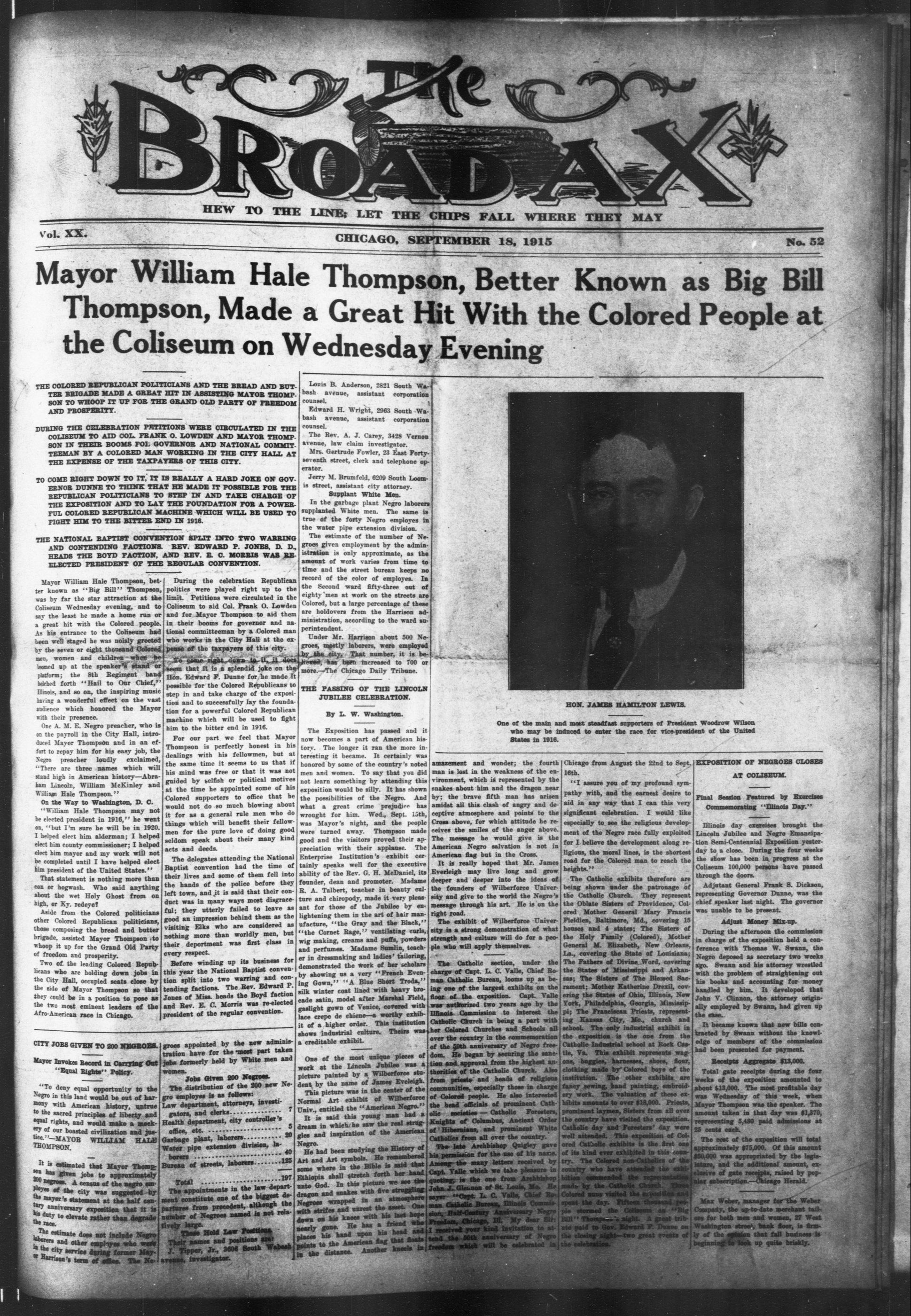
Mayor William Hale Thompson, Better Known as Big Bill Thompson, Made a Great Hit With the Colored People at the Coliseum on Wednesday Evening
THE COLORED REPUBLICAN POLITICIANS AND THE BREAD AND BUTTER BRIGADE MADE A GREAT HIT IN ASSISTING MAYOR THOMPSON TO WHOOP IT UP FOR THE GRAND OLD PARTY OF FREEDOM AND PROSPERITY.
DURING THE CELEBRATION PETITIONS WERE CIRCULATED IN THE COLISEUM TO AID COL. FRANK O. LOWDEN AND MAYOR THOMPSON IN THEIR BOOMS FOR GOVERNOR AND NATIONAL COMMITTEEMAN BY A COLORED MAN WORKING IN THE CITY HALL AT THE EXPENSE OF THE TAXPAYERS OF THIS CITY.
TO COME RIGHT DOWN TO IT, IT IS REALLY A HARD JOKE ON GOV.ERNOR DUNNE TO THINK THAT HE MADE IT POSSIBLE FOR THE REPUBLICAN POLITICIANS TO STEP IN AND TAKE CHARGE OF THE EXPOSITION AND TO LAY THE FOUNDATION FOR A POWERFUL COLORED REPUBLICAN MACHINE WHICH WILL BE USED TO FIGHT HIM TO THE BITTER END IN 1916.
THE NATIONAL BAPTIST CONVENTION SPLIT INTO TWO WARRING AND CONTENDING FACTIONS. REV. EDWARD P. JONES, D. D., HEADS THE BOYD FACTION, AND REV. E. C. MOERIS WAS RE-ELECTED PRESIDENT OF THE REGULAR CONVENTION.
Vol. XX.
Mayor W
Thomps
the Coli
THE COLORED REPUBLICAN POLITI-
TER BRIGADE MADE A GREAT
SON TO WHOOP IT UP FOR THE
AND PROSPERITY.
DURING THE CELEBRATION PETE
COLISEUM TO AID COL. FRAN-
SON IN THEIR BOOMS FOE GO
TEEMAN BY A COLORED MAN
THE EXPENSE OF THE TAXPA
TO COME RIGHT DOWN TO IT, IT
ERNOR DUNNE TO THINK THE
REPUBLICAN POLITICIANS TO
THE EXPOSITION AND TO LAW
FUL COLORED REPUBLICAN M
FIGHT HIM TO THE BITTER E
THE NATIONAL BAPTIST CONVE-
AND CONTENDING FACTIONS,
HEADS THE BOYD FACTION,
ELECTED PRESIDENT OF THE
Mayor William Hale Thompson, better known as "Big Bill" Thompson, was by far the star attraction at the Coliseum Wednesday evening, and to say the least he made a home run or a great hit with the Colored people. As his entrance to the Coliseum had been well staged he was noisily greeted by the seven or eight thousand Colored men, women and children when he loomed up at the speaker's stand or platform; the 8th Regiment band beled forth "Hail to Our Chief," Illinois, and so on, the inspiring music having a wonderful effect on the vast audience which honored the Mayor with their presence.
One A. M. E. Negro preacher, who is on the payroll in the City Hall, introduced Mayor Thompson and in an effort to repay him for his easy job, the Negro preacher loudly exclaimed, "There are three names which will stand high in American history—Abraham Lineol, William McKinley and William Hale Thompson."
On the Way to Washington, D. C. "William Hale Thompson may not be elected president in 1916," he went on, "but I'm sure he will be in 1920. I helped elect him alderman; I helped elect him county commissioner; I helped elect him mayor and my work will not be completed until I have helped elect him president of the United States." That statement is nothing more than con or hogwash. Who said anything about the wet Holy Ghost from on high, or Ky. reedeye? Aside from the Colored politicians other Colored Republican politicians, those composing the bread and butter brigade, assisted Mayor Thompson to whoop it up for the Grand Old Party of freedom and prosperity. Two of the leading Colored Republicans who are holding down jobs in the City Hall, occupied seats close by the side of Mayor Thompson so that they could be in a position to pose as the two most eminent leaders of the Afro-American race in Chicago.
CITY JOBS GIVEN TO 200 NEGROES.
Mayor Invokes Record in Carrying Out "Equal Rights" Policy.
"To deny equal opportunity to the Negro in this land would be out of harmony with American history, untrue to the sacred principles of liberty and equal rights, and would make a meekery of our boasted civilization and justice."—MAYOR WILLIAM HALE THOMPSON.
It is estimated that Mayor Thompson has given jobs to approximately 200 negroes. A census of the negro employees of the city was suggested by the mayor's statement at the half century anniversary exposition that it is his duty to elevate rather than degrade the race.
The estimate does not include Negro laborers and other employees who were in the city service during former Mayor Harrison's term of office. The Ne
---
During the celebration Republican politics were played right up to the limit. Petitions were circulated in the Coliseum to aid Col. Frank O. Lowden and for Mayor Thompson to aid them in their booms for governor and national committeeman by a Colored man who works in the City Hall at the expense of the taxpayers of this city.
No come right down to it, it does seem that it is a splendid joke on the Hon. Edward F. Dunne for he made it possible for the Colored Republicans to step in and take charge of the exposition and to successfully lay the foundation for a powerful Colored Republican machine which will be used to fight him to the bitter end in 1916.
For our part we feel that Mayor Thompson is perfectly honest in his dealings with his fellowmen, but at the same time it seems to us that if his mind was free or that it was not guided by selfish or political motives at the time he appointed some of his Colored supporters to office that he would not do so much blowing about it for as a general rule men who do things which will benefit their fellowmen for the pure love of doing good seldom speak about their many kind acts and deeds.
The delegates attending the National Baptist convention had the time of their lives and some of them fell into the hands of the police before they left town, and it is said that their conduct was in many ways most disgraceful; they utterly failed to leave as good an impression behind them as the visiting Elks who are considered as nothing more than worldly men, but their deportment was first class in every respect.
Before winding up its business for this year the National Baptist convention split into two warring and contending factions. The Rev. Edward P. Jones of Miss. heads the Boyd faction and Rev. E. C. Morris was re-elected president of the regular convention.
groes appointed by the new administration have for the most part taken jobs formerly held by White men and women.
CHICAGO, SEPTEMBER 18, 1915
Louis B. Anderson, 2821 South Wabash avenue, assistant corporation counsel.
Edward H. Wright, 2963 South Wabash avenue, assistant corporation counsel.
The Rev. A. J. Carey, 3428 Vernon avenue, law claim investigator.
Mrs. Gertrude Fowler, 23 East Forty-seventh street, clerk and telephone operator.
Jerry M. Brumfeld, 6209 South Loomis street, assistant city attorney.
Supplant White Men.
In the garbage plant Negro laborers supplanted White men. The same is true of the forty Negro employees in the water pipe extension division.
The estimate of the number of Negroes given employment by the administration is only approximate, as the amount of work varies from time to time and the street bureau keeps no record of the color of employees. In the Second ward fifty-three out of eighty'men at work on the streets are Colored, but a large percentage of these are holdovers from the Harrison administration, according to the ward superintendent.
Under Mr. Harrison about 500 Negres, mostly laborers, were employed by the city. That number, it is beware, has been increased to 700 or more. The Chicago Daily Tribune.
THE PASSING OF THE LINCOLN
JUBILEE CELEBRATION.
By L. W. Washington.
The Exposition has passed and it now becomes a part of American history. The longer it ran the more interesting it became. It certainly was honored by some of the country's noted men and women. To say that you did not learn something by attending this exposition would be silly. It has shown the possibilities of the Negro. And what a great crime prejudice has wrought for him. Wed., Sept. 15th was Mayor's night, and the people were turned away. Thompson made good and the visitors proved their appreciation with their applause. The Enterprise Institution's exhibit certainly speaks well for the executive ability of the Rev. G. H. McDaniel, its founder, dean and promoter. Madame R. A. Talbert, teacher in beauty culture and chiropody, made it very pleasant for those of the Jubilee by enlightening them in the art of hair manufacture, "the Gray and the Black," "the Cornet Rage," ventilating curls, wig making, creams and puffs, powders and perfumes. Madame Sumlin, teacher in dressmaking and ladies' tailoring, demonstrated the work of her scholars by showing us a very "French Evening Gown," "A Blue Short Troda," silk winter coat lined with heavy brocade satin, model after Marshal Field, gaslight gown of Venice, covered with lace crepe de chiene—a worthy exhibit of a higher order. This institution shows industrial culture. Theirs was a creditable exhibit.
One of the most unique pieces of work at the Lincoln Jubilee was a picture painted by a Wilberforce student by the name of James Eveleigh. This picture was in the center of the Normal Art exhibit of Wilberforce Univ., entitled the "American Negro." It is said this young man had a dream in which/he saw the real struggles and inspiration of the American Negro.
He had been studying the History of Art and Art symbols. He remembered some where in the Bible is said that Ethiopia shall stretch forth her hand unto God. In this picture we see the dragon and snakes with five struggling Negroes wrapped in an atmosphere with stifles and unrest the asset. One down on his knees with his last hope nearly gone. He has a friend who places his hand upon his head and points to the American flag that floats in the distance. Another knels in
M.
One of the main and most steadfast supporters of President Woodrow Wilson who may be induced to enter the race for vice-president of the United States in 1916.
amazement and wonder; the fourth man is lost in the weakness of the environment, which is represented by the snakes about him and the dragon near by; the brave fifth man has arisen amidst all this clash of angry and deceptive atmosphere and points to the Cross above, for which attitude he receives the smiles of the anger above. The message he would give is the American Negro salvation is not in American flag but in the Cross. It is really hoped that Mr. James Everleigh may live long and grow deeper and deeper into the ideas of the founders of Wilberforce University and give to the world the Negro's message through his art. He is on the right road. The exhibit of Wilberforce University is a strong demonstration of what strength and culture will do for a people who will apply themselves.
The Catholic section, under the charge of Capt. L. C. Valle, Chief Roman Catholic Bureau, looms up as being one of the largest exhibits on the floor of the exposition. Capt. Valle was authorized two years ago by the Illinois Commission to interest the Catholic Church in being a part with her Colored Churches and Schools all over the country in the commemoration of the 50th anniversary of Negro freedom. He began by securing the sanction and approval from the highest authorities of the Catholic Church. Also from priests and heads of religious communities, especially those in charge of Colored people. He also interested the head officials of prominent Catholic societies — Catholic Foresters, Knights of Columbus, Ancient Order of Hibernians, and prominent White Catholics from all over the country.
The late Archbishop Quigley gave his permission for the use of his name. Among the many letters received by Capt. Valle which we take pleasure in quoting, is the one from Archbishop John L. Glennon of St. Louis, Mo. He says: "Capt. I. C. Valle, Chief Roman Catholic Bureau, Illinois Commission, Half-Century Anniversary Negro Freedom, Chicago, Ill. My dear Sir: I received your kind invitation to attend the 26th anniversary of Negro freedom which will be celebrated in
Chicago from August the 22nd to Sept 16th.
"I assure you of my profound sympathy with, and the earnest desire to aid in any way that I can this very significant celebration. I would like especially to see the religious development of the Negro race fully exploited for I believe the development along religious, the moral lines, is the shortest road for the Colored man to reach the heights."
The Catholic exhibits therefore are being shown under the patronage of the Catholic Church. They represent the Oblate Sisters of Providence, Colored Mother General Mary Francis Fieldien, Baltimore, Md., covering 15 houses and 4 states; The Sisters of the Holy Family (Colored), Mother General M. Elizabeth, New Orleans, La., covering the State of Louisiana; The Fathers of Divine Word, covering the States of Mississippi and Arkansas; The Sisters of The Blessed Sacrament; Mother Katherine Dresxil, covering the States of Ohio, Illinois, New York, Philadelphia, Georgia, Mississippi; The Franciscan Priests, representing Kansas City, Mo., church and school. The only industrial exhibit in the exposition is the one from the Catholic Industrial school at Rock Castle, Va. This exhibit represents wagons, buggies, harnesses, shoes, flour, clothing made by Colored boys of the institution. The other exhibits are fancy sewing, hand painting, embroidery work. The valuation of these exhibits amounts to over $18,000. Priests, prominent laymen, Sisters from all over the country have visited the exposition. Catholic day and Foresters' day were well attended. This exposition of Colored Catholic exhibits is the first one of its kind ever exhibited in this country. The Colored non-Catholics of the country who have attended the exhibition commended the representation made by the Catholic Church. Three Colored mugs visited the exposition and spent the day. Fifteen thousand people stormed the Colleen on "Big Bill" Thompson's night. A great tribute paid to Gov. Edward P. Duane on the closing night—two great events of the celebration.
Illinois day exercises brought the Lincoln Jubilee and Negro Emancipation Semi-Centennial Exposition yesterday to a close. During the four weeks the show has been in progress at the Coliseum 100,000 persons have passed through the doors.
Adjustant General Frank S. Dickson, representing Governor Dunne, was the chief speaker last night. The governor was unable to be present.
Adjust Money Mix-up.
During the afternoon the commission in charge of the exposition held a conference with Thomas W. Swann, the Negro deposed as secretary two weeks ago. Swann and his attorney wrestled with the problem of straightening out his books and accounting for money handled by him. It developed that John V. Cinnon, the attorney originally employed by Swann, had given up the ease.
It became known that new bills contracted by Swann without the knowledge of members of the commission had been presented for payment.
Receipts Aggregate $13,000
Total gate receipts during the four weeks of the exposition amounted to about $13,000. The most profitable day was Wednesday of this week, when Mayor Thompson was the speaker. The amount taken in that day was $1,370, representing 5,480 paid admissions at 25 cents each.
The cost of the exposition will total approximately $75,000. Of this amount $50,000 was appropriated by the legislature, and the additional amount, exclusive of gate receipts, raised by popular subscription—Chicago Herald.
Max Weber, manager for the Weber Company, the up-to-date merchant tailors for both men and women, 27 West Washington street, bank floor, is firmly of the opinion that fall business is beginning to look up quite briskly.
Woman's World
The Woman Who Can Both
Can and Make a Good Speech.
MRS. EDNA BUCKMAN HEARN.
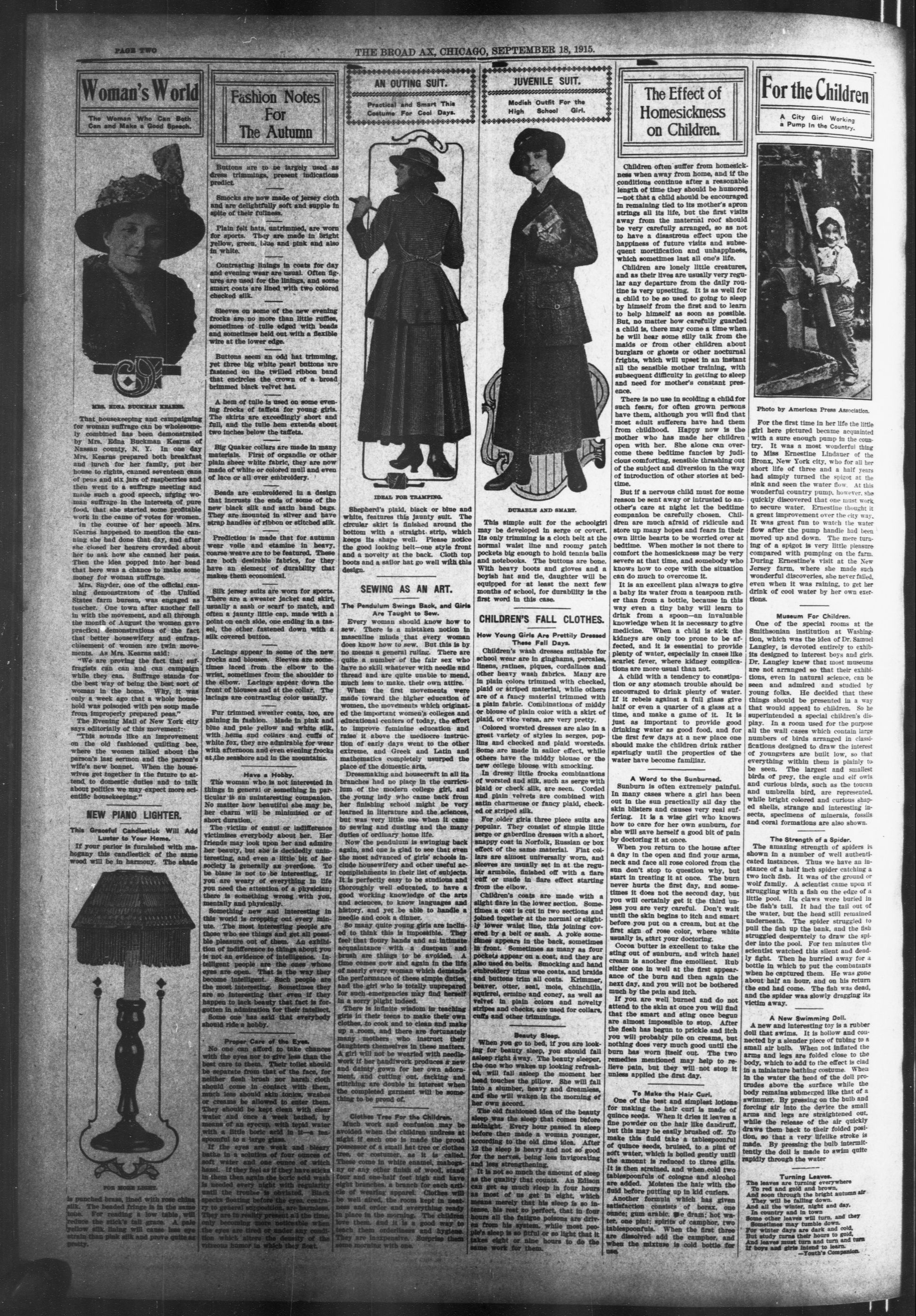
That housekeeping and campaigning for woman suffrage can be wholesomely combined has been demonstrated by Mrs. Edna Buckman Kearns of Nassau county, N. Y. In one day Mrs. Kearns prepared both breakfast and lunch for her family, put her house to rights, canned seventeen cans of peas and six jars of raspberries and then went to a suffrage meeting and made such a good speech, urging woman suffrage in the interests of pure food, that she started some profitable work in the cause of votes for women. In the course of her speech Mrs. Kearns happened to mention the canning she had done that day, and after she closed her hearers crowded about her to ask how she canned her peas. Then the idea popped into her head that here was a chance to make some money for woman suffrage.
Mrs. Snyder, one of the official canning demonstrators of the United States farm bureau, was engaged as teacher. One town after another fell in with the movement, and all through the month of August the women gave practical demonstrations of the fact that better housewifery and enfranchisement of women are twin movements. As Mrs. Kearns said:
"We are proving the fact that suffragists can can and can campaign while they can. Suffrage stands for the best way of being the best sort of woman in the home. Why, it was only a week ago that a whole household was poisoned with pea soup made from improperly prepared peas."
The Evening Mall of New York city says editorially of this movement::
"This sounds like an improvement on the old fashioned quilting bee, where the women talked about the parson's last sermon and the parson's wife's new bonnet. When the housewives get together in the future to attend to domestic duties and to talk about politics we may expect more scientific housekeeping."
NEW PIANO LIGHTER.
This Graceful Candlestick Will Add Luster to Your Home.
If your parlor is furnished with mahogany this candlestick of the same wood will be in harmony. The shade
Buttons are to be largely used as dress trimmings, present indications predict.
Smocks are now made of jersey cloth and are delightfully soft and supple in spite of their fulness.
Plain felt hats, untrimmed, are worn for sports. They are made in bright yellow, green, blue and pink and also in white.
Contrasting linings in coats for day and evening wear are usual. Often figures are used for the linings, and some smart coats are lined with two colored checked silk.
Sleeves on some of the new evening frocks are no more than little ruffles, sometimes of tulle edged with beads and sometimes held out with a flexible wire at the lower edge.
Buttons seem an odd hat trimming, yet three big white pearl buttons are fastened on the twilled ribbon band that encircles the crown of a broad brimmed black velvet hat.
A hem of tulle is used on some evening frocks of taffeta for young girls. The skirts are exceedingly short and full, and the tulle hem extends about two inches below the taffeta.
Big Quaker collars are made in many materials. First of organdle or other plain sheer white fabric, they are now made of white or colored mull and even of lace or all over embroidery.
Beads are embroidered in a design that incrusts the ends of some of the new black silk and satin band bags. They are mounted in silver and have strap handles of ribbon or stitched silk.
Prediction is made that for autumn wear volle and etamine in heavy, coarse weave are to be featured. These are both desirable fabrics, for they have an element of durability that makes them economical.
Silk jersey suits are worn for sports. There are a sweater jacket and skirt, usually a sash or scarf to match, and often a jaunty little cap, made with a point on each side, one ending in a tasel, the other fastened down with a silk covered button.
Lacings appear in some of the new frocks and blouses. Sleeves are sometimes laced from the elbow to the wrist, sometimes from the shoulder to the elbow. Lacings appear down the front of blouses and at the collar. The lacings are contrasting color usually.
Fur trimmed sweater coats, too, are gaining in fashion. Made in pink and blue and pale yellow and white silk, with hems and collars and cuffs of white fox, they are admirable for wear with afternoon and even evening frocks at the seashore and in the mountains.
Have a Hobby.
The woman who is not interested in things in general or something in particular is an uninteresting companion. No matter how beautiful she may be, her charm will be minimized or of short duration.
The victim of ennui or indifference victimizes everybody about her. Her friends may look upon her and admire her beauty, but she is decidedly uninteresting, and even a little bit of her society is generally an overdose. To be blase is not to be interesting. If you are weary of everything in life you need the attention of a physician; there is something wrong with you, mentally and physically.
Something new and interesting in this world is cropping out every minute. The most interesting people are those who see things and get all possible pleasure out of them. An exhibition of indifference to things about you is not an evidence of intelligence. Intelligent people are the ones whose eyes are open. That is the way they become intelligent. Such people are the most interesting. Sometimes they are so interesting that even if they happen to lack beauty that fact is forgotten in admiration for their intellect. Some one has said that everybody should be richer.
Preper Care of the Eyes.
No one can afford to take chances with the eyes nor to give less than the best care to them. Their toilet should be separate from that of the face, for neither flesh brush nor harsh cloth should come in contact with them, much less should skin tonics, washes or creams be allowed to enter them. They should be kept clean with clear water and once a week bathed, by means of an eyecup, with tepid water with a little boric acid in it—a teapooful to a large glass.
If the eyes are weak and bleary bathe in a solution of four ounces of soft water and one ounce of witch hazel. If they feel as if they have sticks in them then again the boric acid wash is needed every night with regularity until the troubles are obviated. Black specks floating before the eyes, centrally to general supposition, are harmless. They are in reality present all the time, only becoming more delicate when the eyes are tired or under any condition which alters the density of the vitisina humor in which they float.
1
IDEAL FOR TRAMPING.
Shepherd's plaid, black or blue and white, features this jaunty suit. The circular skirt is finished around the bottom with a straight strip, which keeps its shape well. Please notice the good looking belt—one style front and a novelty at the back. Cloth top boots and a sailor hat go well with this design.
SEWING AS AN ART.
The Pendulum Swings Back, and Girls Are Taught to Sew.
Every woman should know how to sew. There is a mistaken notion in masculine minds that every woman does know how to sew. But this is by no means a general ruling. There are quite a number of the fair sex who have no skill whatever with needle and thread and are quite unable to mend, much less to make, their own attire.
When the first movements were made toward the higher education of women, the movements which originated the important women's colleges and educational centers of today, the effort to improve feminine education and raise it above the mediocre instruction of early days went to the other extreme, and Greek and Latin and mathematics completely usurped the place of the domestic arts.
Dressmaking and housecraft in all its branches had no place in the curriculum of the modern college girl, and the young lady who came back from her finishing school might be very learned in literature and the sciences, but was very little use when it came to sewing and dusting and the many duties of ordinary home life. Now the pendulum is swinging back again, and one is glad to see that even the most advanced of girls' schools include housewifery and other useful accomplishments in their list of subjects. It is perfectly easy to be studious and thoroughly well educated, to have a good working knowledge of the arts and sciences, to know languages and history, and yet be able to handle a needle and cook a dinner.
So many quite young girls are inclined to think this is impossible. They feel that floury hands and an intimate acquaintance with a dustpan and brush are things to be avoided. A time comes now and again in the life of nearly every woman which demands the performance of these simple duties, and the girl who is totally unprepared for such emergencies may find herself in a sorry plight indeed.
There is infinite wisdom in teaching girls in their teens to make their own clothes, to cook and to clean and make up a room, and there are fortunately many mothers who instruct their daughters themselves in these matters. A girl will not be weared with needlework if her handiwork produces a new and dainty gown for her own adornment, and cutting out, tacking and stitching are double in interest when the completed garment will be something to be proud of.
Clothes Tree For the Children.
Much work and confusion may be avoided when the children undress at night if each one is made the proud possessor of a small hat tree or clothes tree, or costumer, as it is called.
These come in white enamel, mahogny or any other finish of wood, stand four and one-half feet high and have eight branches, a branch for each article of wearing apparel. Clothes will be well aired the room kept in neatness and order and everything ready in place in the morning. The children love them, and it is a good way to teach them orderliness and hygiene. They are inexpensive. Surprise them some morning with one.
M
DURABLE AND SMART.
This simple suit for the schoolgirl may be developed in serge or covert. Its only trimming is a cloth belt at the normal waist line and roomy patch pockets big enough to hold tennis balls and notebooks. The buttons are bone. With heavy boots and gloves and a boyish hat and tie, daughter will be equipped for at least the next few months of school, for durability is the first word in this case.
CHILDREN'S FALL CLOTHES.
How Young Girls Are Prettily Dressed These Fall Days.
Children's wash dresses suitable for school wear are in ginghamms, percales, linens, ratines, pliques, cordalines and other heavy wash fabrics. Many are in plain colors trimmed with checked, plaid or striped material, while others are of a fancy material trimmed with a plain fabric. Combinations of middy or blouse of plain color with a skirt of plaid, or vice versa, are very pretty.
Colored worsted dresses are also in a great variety of styles in serges, poplins and checked and plaid worsteds. Some are made in sailor effect, while others have the middy blouse or the new college blouse with smocking.
In dressy little frocks combinations of worsted and silk, such as serge with plaid or check silk, are seen. Corded and plain velvets are combined with satin charmeuse or fancy plaid, checked or striped silk.
For older girls three piece suits are popular. They consist of simple little serge or gaberdine dresses with a short, snappy coat in Norfolk, Russian or box effect of the same material. Flat collars are almost universally worn, and sleeves are usually set in at the regular armhole, finished off with a flare cuff or made in flare effect starting from the elbow.
Children's coats are made with a slight dare in the lower section. Sometimes a coat is cut in two sections and joined together at the normal or slightly lower waist line, this joining covered by a belt or sash. A yoke sometimes appears in the back, sometimes in front. Sometimes as many as four pockets appear on a coat, and they are also used on belts. Smocking and hand embroidery trims wee coats, and braids and buttons trim all coats. Krimmer, beaver, otter, seal, mole, chinchilla, squirrel,ermine and coney, as well as velvet in plain colors and novelty stripes and checks, are used for collars, cuffs and other trimmings.
Beauty Sleep.
When you go to bed, if you are looking for beauty sleep, you should fall asleep right away. The beauty sleeper, the one who wakes up looking refreshed, will fall asleep the moment her head touches the pillow. She will fall into a slumber, heavy and dreamless, and she will waken in the morning of her own accord.
The old fashioned idea of the beauty sleep was the sleep that comes before midnight. Every hour passed in sleep before then made a woman younger, according to the old time idea. After 12 the sleep is heavy and not so good for the nerves, being less invigorating and less strengthening.
It is not so much the amount of sleep as the quality that counts. An Edison can get as much sleep in four hours as most of us get in eight, which means merely that his sleep is so intense, his rest so perfect, that in four hours all the fatigue poisons are driven from his system, while most people's sleep is so fitful or so light that it takes eight or nine hours to do the same work for them.
Children often suffer from homesickness when away from home, and if the conditions continue after a reasonable length of time they should be humored—not that a child should be encouraged in remaining tied to its mother's apron strings all its life, but the first visits away from the maternal roof should be very carefully arranged, so as not to have a disastrous effect upon the happiness of future visits and subsequent mortification and unhappiness, which sometimes last all one's life.
Children are lonely little creatures, and as their lives are usually very regular any departure from the daily routine is very upsetting. It is as well for a child to be so used to going to sleep by himself from the first and to learn to help himself as soon as possible. But, no matter how carefully guarded a child is, there may come a time when he will hear some silly talk from the maids or from other children about burglars or ghosts or other nocturnal frights, which will upset in an instant all the sensible mother training, with subsequent difficulty in getting to sleep and need for mother's constant presence.
There is no use in scolding a child for such fears, for often grown persons have them, although you will find that most adult sufferers have had them from childhood. Happy now is the mother who has made her children open with her. She alone can overcome these bedtime fancies by judicious comforting, sensible thrashing out of the subject and diversion in the way of introduction of other stories at bedtime.
But if a nervous child must for some reason be sent away or intrusted to another's care at night let the bedtime companion be carefully chosen. Children are much afraid of ridicule and store up many hopes and fears in their own little hearts to be worried over at bedtime. When mother is not there to comfort the homesickness may be very severe at that time, and somebody who knows how to cope with the situation can do much to overcome it.
It is an excellent plan always to give a baby its water from a teaspoon rather than from a bottle, because in this way even a tiny baby will learn to drink from a spoon—an invaluable knowledge when it is necessary to give medicine. When a child is sick the kidneys are only too prone to be affected, and it is essential to provide plenty of water, especially in cases like scarlet fever, where kidney complications are more usual than not. A child with a tendency to constipation or any stomach trouble should be encouraged to drink plenty of water. If it rebels against a full glass give half or even a quarter of a glass at a time, and make a game of it. It is just as important to provide good drinking water as good food, and for the first few days at a new place one should make the children drink rather sparingly until the properties of the water have become familiar.
A Word to the Sunburned.
Sunburn is often extremely painful. In many cases where a girl has been out in the sun practically all day the skin blisters and causes very real suffering. It is a wise girl who knows how to care for her own sunburn, for she will save herself a good bit of pain by doctoring it at once.
When you return to the house after a day in the open and find your arms, neck and face all rose colored from the sun don't stop to question why, but start in treating it at once. The burn never hurts the first day, and sometimes it does not the second day, but you will certainly get it the third unless you are very careful. Don't wait until the skin begins to itch and smart before you put on a cream, but at the first sign of rose color, where white usually is, start your doctoring.
Cocoa butter is excellent to take the sting out of sunburn, and witch hazel cream is another fine emollient. Rub either one in well at the first appearance of the burn and then again the next day, and you will not be bothered much by the pain and itch. If you are well burned and do not attend to the skin at once you will find that the smart and sting once begun are almost impossible to stop. After the flesh has begun to prickle and itch you will probably pile on creams, but nothing does very much good until the burn has worn itself out. The two remedies mentioned may help to relieve pain, but they will not stop it unless applied the first day.
To Make the Hair Curl
TO MAKE THE Hair Curl.
One of the best and simplest lotions for making the hair curl is made of quince seeds. When it dries it leaves a fine powder on the hair like dandruff, but this may be easily brushed off. To make this fluid take a tablespoonful of quince seeds, bruised, to a pint of soft water, which is boiled gently until the amount is reduced to three gills. It is then strained, and when cold two tablespoonfuls of cologne and alcohol are added. Molsten the hair with the fluid before putting up in kid curlers.
Another formula which has given satisfaction consists of borax, one ounce; gum arabic. Be dram; hot water, one pint; spirits of camphor, two tablespoonfuls. When the first three are dissolved add the camphor, and when the mixture is cold bottle for use.
A boy holding a stick
Photo by American Press Association
For the first time in her life the little girl here pictured became acquainted with a sure enough pump in the country. It was a most wonderful thing to Miss Ernestine Lindauer of the Bronx, New York city, who for all her short life of three and a half years had simply turned the spigot at the sink and seen the water flow. At this wonderful country pump, however, she quickly discovered that one must work to secure water. Ernestine thought it a great improvement over the city way. It was great fun to watch the water flow after the pump handle had been moved up and down. The mere turning of a spigot is very little pleasure compared with pumping on the farm. During Ernestine's visit at the New Jersey farm, where she made such wonderful discoveries, she never failed, even when it was raining, to get her drink of cool water by her own exertions.
Museum For Children.
One of the special rooms at the Smithsonian institution at Washington, which was the idea of Dr. Samuel Langley, is devoted entirely to exhibits designed to interest boys and girls. Dr. Langley knew that most museums are not arranged so that their exhibitions, even in natural science, can be seen and admired and studied by young folks. He decided that these things should be presented in a way that would appeal to children. So he superintended a special children's display. In a room used for the purpose all the wall cases which contain large numbers of birds arranged in classifications designed to draw the interest of youngsters are built low, so that everything within them is plainly to be seen. The largest and smallest birds of prey, the eagle and elf owls and curious birds, such as the toucan and umbrella bird, are represented, while bright colored and curious shaped shells, strange and interesting insects, specimens of minerals, fossils and coral formations are also shown.
The Strength of a Spider
The amazing strength of spiders is shown in a number of well authenticated instances. Thus we have an instance of a half inch spider catching a two inch fish. It was of the ground or wolf family. A scientist came upon it struggling with a fish on the edge of a little pool. Its claws were buried in the fish's tail. It had the tail out of the water, but the head still remained underneath. The spider struggled to pull the fish up the bank, and the fish struggled desperately to draw the spider into the pool. For ten minutes the scientist watched this silent and deadly fight. Then he hurried away for a bottle in which to put the combatants when he captured them. He was gone about half an hour, and on his return the end had come. The fish was dead, and the spider was slowly dragging its victim away.
A New Swimming Doll.
A new and interesting toy is a rubber doll that swims. It is hollow and connected by a slender piece of tubing to a small air bulb. When not inflated the arms and legs are folded close to the body, which to add to the effect is clad in a miniature bathing costume. When in the water the head of the doll protrudes above the surface while the body remains submerged like that of a swimmer. By pressing on the bulb and forcing air into the device the small arms and legs are straightened out, while the release of the air quickly draws them back to their folded position, so that a very lifelike stroke is made. By pressing the bulb intermittently the doll is made to swim quite rapidly through the water
Turning Leaves.
The leaves are turning everywhere
To red and gold and brown.
And soonough in autumn aird
They will be falling down.
And all the winter, night and day.
In country and in town
Some other leaves will turn, and they
Sometimes may tumble down.
For winter days are dark and cold.
But study turns their hours to gold.
And leaves must turn and turn and turn
If boys and girls intend to competition.
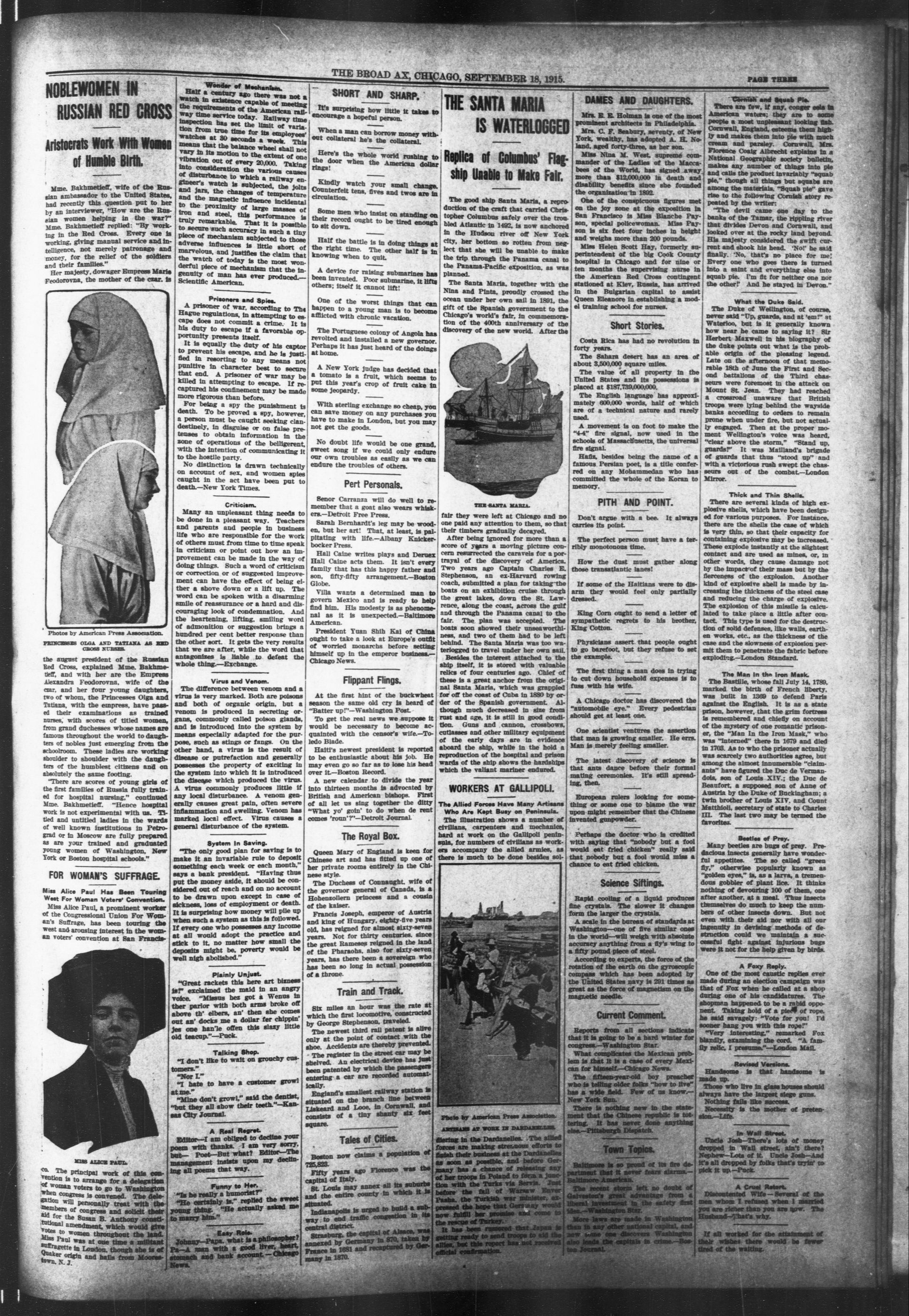
Mme. Bakhmetieff, wife of the Russian ambassador to the United States, had recently this question put to her by an interviewer, "How are the Russian women helping in the war?" Mme. Bakhmetieff replied: "By working in the Red Cross. Every one is working, giving manual service and intelligence, not merely patronage and money, for the relief of the soldiers and their families." Her majesty, dowager Empress Marie Feodorovna, the mother of the czar, is
```markdown
```
Photos by American Press Association.
PRINCESSES OLGA AND TATIANA AS RED CROSS NURSES.
the august president of the Russian Red Cross, explained Mme. Bakhmetteff, and with her are the Empress Alexandra Feodorovna, wife of the czar, and her four young daughters, two of whom, the Princesses Olga and Tatiana, with the empress, have passed their examinations as trained nurses, with scores of titled women, from grand duchesses whose names are famous throughout the world to daughters of nobles just emerging from the schoolroom. These ladies are working shoulder to shoulder with the daughters of the humblest citizens and on absolutely the same footing.
"There are scores of young girls of the first families of Russia fully trained for hospital nursing." continued Mme. Bakhmetieff. "Hence hospital work is not experimental with us. Titled and untitled ladies in the wards of well known institutions in Petrograd or in Moscow are fully prepared as are your trained and graduated young women of Washington, New York or Boston hospital schools."
FOR WOMAN'S SUFFRAGE
Miss Alice Paul Has Been Touring West For Women Voters' Convention. Miss Alice Paul, a prominent worker of the Congressional Union For Woman's Suffrage, has been touring the west and arousing interest in the woman voters' convention at San Francisco.
1900
co. The principal work of this convention is to arrange for a delegation of woman voters to go to Washington when congress is convened. The delegation will personally treat with the members of congress and solicit their aid for the Susan B. Anthony constitutional amendment, which would give votes to women throughout the land. Miss Paul was at one time a militant suffragette in London, though she is of Quaker origin and hails from Moorstown, N. J.
co. The principal work of this convention is to arrange for a delegation of woman voters to go to Washington when congress is convened. The delegation will personally treat with the members of congress and solicit their aid for the Susan B. Anthony constitutional amendment, which would give votes to women throughout the land. Miss Paul was at one time a militant suffragette in London, though she is of Quaker origin and hails from Moorcottown, N. J.
Wonder of Mechanism
Half a century ago there was not a watch in existence capable of meeting the requirements of the American railway time service today. Railway time inspection has set the limit of variation from true time for its employees' watches at 30 seconds a week. This means that the balance wheel shall not vary in its motion to the extent of one vibration out of every 20,000. Taking into consideration the various causes of disturbance to which a railway engineer's watch is subjected, the joists and jars, the changes of temperature and the magnetic influence incidental to the proximity of large masses of iron and steel, this performance is truly remarkable. That it is possible to secure such accuracy in such a tiny piece of mechanism subjected to those adverse influences is little short of marvelous, and justifies the claim that the watch of today is the most wonderful piece of mechanism that the ingenuity of man has ever produced.—Scientific American.
Prisoners and Spies
A prisoner of war, according to The Hague regulations, in attempting to escape does not commit a crime. It is his duty to escape if a favorable opportunity presents itself.
It is equally the duty of his captor to prevent his escape, and he is justified in resorting to any means not punitive in character best to secure that end. A prisoner of war may be killed in attempting to escape. If recaptured his confinement may be made more rigorous than before.
For being a spy the punishment is death. To be proved a spy, however, a person must be caught seeking clandestinely, in disguise or on false pretenses to obtain information in the zone of operations of the belligerent, with the intention of communicating it to the hostile party.
No distinction is drawn technically on account of sex, and women spies caught in the act have been put to death—New York Times.
Criticism
Many an unpleasant thing needs to be done in a pleasant way. Teachers and parents and people in business life who are responsible for the work of others must from time to time speak in criticism or point out how an improvement can be made in the way of doing things. Such a word of criticism or correction or of suggested improvement can have the effect of being either a shove down or a lift up. The word can be spoken with a disarming smile of reassurance or a hard and discouraging look of condemnation. And the heartening, lifting, smiling word of admonition or suggestion brings a hundred per cent better response than the other sort. It gets the very results that we are after, while the word that antagonizes is liable to defeat the whole thing—Exchange.
Virus and Venom.
The difference between venom and a virus is very marked. Both are poisons and both of organic origin, but a venom is produced in secreting organs, commonly called poison glands, and is introduced into the system by means especially adapted for the purpose, such as stings or fangs. On the other hand, a virus is the result of disease or putrefaction and generally possesses the property of exciting in the system into which it is introduced the disease which produced the virus. A virus commonly produces little if any local disturbance. A venom generally causes great pain, often severe inflammation and swelling. Venom has marked local effect. Virus causes a general disturbance of the system.
System In Saving.
"The only good plan for saving is to make it an invariable rule to deposit something each week or each month," says a bank president. "Having thus put the money aside, it should be considered out of reach and on no account to be drawn upon except in case of sickness, loss of employment or death. It is surprising how money will pile up when such a system as this is followed. If every one who possesses any income at all would adopt the practice and stick to it, no matter how small the deposits might be, poverty would be well nigh abolished."
Plainly Unjust.
"Great rackets this here art blizzess is!" exclaimed the maid in an angry voice. "Missus hez got a Wenus in their parlor with both arms broke off above th' elbers, an' then she comes out an' docks me a dollar fer chippin' jes one han'le offen this slazy little old teacup."-Fuck.
Talking Shop.
"I don't like to wait on grouchy customers."
"Mine don't growl," said the dentist,
"but they all show their teeth."—Kansas City Journal.
A Real Regret.
Editor—I am obliged to decline your poem with thanks. I am very sorry, but—Poet—But what? Editor—The management insists upon my declining all poems that way.
"Is he really a humble
"He certainly is," replied the sweet
young thing. "He actually asked me
to marry him."
Easy Role.
Johnny—Papa, what is a philosopher?
Pa—a man with a good liver, heart,
stomach and bank account. —Chicago
flows.
THE BROAD AX, CHICAGO, SEPTEMBER 18, 1915
It's surprising how little it takes to encourage a hopeful person.
When a man can borrow money without collateral he's the collateral.
Here's the whole world rushing to the door when the American dollar rings!
Kindly watch your small change. Counterfeit tens, fives and twos are in circulation.
Some men who insist on standing on their record ought to be tired enough to sit down.
Half the battle is in doing things at the right time. The other half is in knowing when to quit.
A device for raising submarines has been invented. Poor submarine, it lifts others; itself it cannot lift!
One of the worst things that can happen to a young man is to become afflicted with chronic vacation.
The Portuguese colony of Angola has revolted and installed a new governor. Perhaps it has just heard of the doings at home.
A New York judge has decided that a tomato is a fruit, which seems to put this year's crop of fruit cake in some jeopardy.
With sterling exchange so cheap, you can save money on any purchases you have to make in London, but you may not get the goods.
No doubt life would be one grand, sweet song if we could only endure our own troubles as easily as we can endure the troubles of others.
Pert Personals.
Senor Carranza will do well to remember that a goat also wears whiskers.—Detroit Free Press.
Sarah Bernhardt's leg may be wooden, but her art! That, at least, is palpitating with life.—Albany Knickerbocker Press.
Hall Caine writes plays and Deruex Hall Caine acts them. It isn't every family that has this happy father and son, fifty-fifty arrangement.—Boston Globe.
Villa wants a determined man to govern Mexico and is ready to help find him. His modesty is as phenomenal as it is unexpected.—Baltimore American.
President Yuan Shib Kai of China ought to take a look at Europe's outfit of worried monarchs before setting himself up in the emperor business.—Chicago News.
Flippant Flings.
At the first hint of the buckwheat season the same old cry is heard of "Batter up!"—Washington Post.
To get the real news we suppose it would be necessary to become acquainted with the censor's wife.—Toledo Blade.
Haiti's newest president is reported to be enthusiastic about his job. He may even go so far as to lose his head over it.—Boston Record.
A new calendar to divide the year into thirteen months is advocated by British and American bishops. First of all let us sing together the ditty "What yo' goin' to do when de rent comes 'room?"—Detroit Journal.
The Royal Box
Queen Mary of England is keen for Chinese art and has fitted up one of her private rooms entirely in the Chinese style.
The Duchess of Connaught, wife of the governor general of Canada, is a Hohenzollern princess and a cousin of the kaiser.
Francis Joseph, emperor of Austria and king of Hungary, eighty-five years old, has reigned for almost sixty-seven years. Not for thirty centuries, since the great Ramesses reigned in the land of the Pharaohs, also for sixty-seven years, has there been a sovereign who has been so long in actual possession of a throne.
Train and Track.
Six miles an hour was the rate at which the first locomotive, constructed by George Stephenson, traveled. The newest third rail patent is alive only at the point of contact with the shoe. Accidents are thereby prevented. The register in the street car may be shelved. An electrical device has just been patented by which the passengers entering a car are recorded automatically.
England's smallest railway station is situated on the branch line between Liskeard and Looe, in Cornwall, and consists of a tiny shanty six feet square.
Tales of Cities.
Boston now claims a population of 725,823.
Fifty years ago Florence was the capital of Italy.
St. Louis may annex all its suburbs and the entire county in which it is situated.
Indianapolis is urged to build a subway to end traffic congestion in its central district.
Strasburg, the capital of Alance, was annexed by Germany in 870, taken by France in 1631 and recaptured by Germany in 1870.
THE SANTA MARIA IS WATERLOGGED
Replica of Columbus' Flags ship Unable to Make Fair.
The good ship Santa Maria, a reproduction of the craft that carried Christopher Columbus safely over the troubled Atlantic in 1492, is now anchored in the Hudson river off New York city, her bottom so rotten from neglect that she will be unable to make the trip through the Panama canal to the Panama-Pacific exposition, as was planned.
The Santa Maria, together with the Nina and Pinta, proudly crossed the ocean under her own sail in 1891, the gift of the Spanish government to the Chicago's world's fair, in commemoration of the 400th anniversary of the discovery of the new world. After the
THE SANTA MARIA.
fair they were left at Chicago and no one paid any attention to them, so that their timbers gradually decayed. After being ignored for more than a score of years a moving picture concern resurrected the caravels for a portrayal of the discovery of America. Two years ago Captain Charles E. Stephenson, an ex-Harvard rowing coach, submitted a plan for taking the boats on an exhibition cruise through the great lakes, down the St. Lawrence, along the coast, across the gulf and through the Panama canal to the fair. The plan was accepted. The boats soon showed their unseaworthiness, and two of them had to be left behind. The Santa Maria was too waterlogged to travel under her own sail.
Besides the interest attached to the ship itself, it is stored with valuable relics of four centuries ago. Chief of these is a great anchor from the original Santa Maria, which was grappled for off the coast of Cuba in 1880 by order of the Spanish government. Although much decreased in size from rust and age, it is still in good condition. Guns and cannon, crossbows, cutlasses and other military equipment of the early days are in evidence aboard the ship, while in the hold a reproduction of the hospital and prison wards of the ship shows the hardships which the valiant mariner endured.
WORKERS AT GALLIPOLI.
The Allied Forces Have Many Artisans
Who Are Krieg Runes on Bergenia
Who Are Kept Bury on Peninsula.
The illustration shows a number of civilians, carpenters and mechanics, hard at work on the Gallipoli peninsula, for numbers of civilians as workers accompany the allied armies, as there is much to be done besides sol-
THE FISHING
Photo by American Press Association.
ARTISANS AT WORK IN DARDANELLE,
fliering in the Dardanelle. The ailed
forces are making strentuous efforts to
finish their business at the Dardanelle
as soon as possible, and before Germany
has a chance of releasing any of her troops in Poland to form a junction with the Turks via Servia. Just before the fall of Warsaw Enver Panha, the Turkish war minister, expressed the hope that Germany would now fulfill her promise and come to the rescue of Turkey.
It has been announced that Japan is getting ready to send troops to aid the allies, but this report has not received official confirmation.
---
DAMES AND DAUGHTERS.
Mrs. E. E. Holman is one of the most prominent architects in Philadelphia.
Mrs. C. F. Seabury, seventy, of New York, wealthy, has adopted A. H. Noland, aged forty-three, as her son.
Miss Nina M. West, supreme commander of the Ladies of the Maccabees of the World, has signed away more than $12,000,000 in death and disability benefits since she founded the organization in 1892.
One of the conspicuous figures met on the joy zone at the exposition in San Francisco is Miss Blanche Payson, special policewoman. Miss Payson is six feet four inches in height and weighs more than 200 pounds.
Miss Helen Scott Hay, formerly superintendent of the big Cook County hospital in Chicago and for nine or ten months the supervising nurse in the American Red Cross contingent stationed at Klev, Russia, has arrived in the Bulgarian capital to assist Queen Eleanore in establishing a model training school for nurses.
Short Stories
Costa Rica has had no revolution in forty years.
The Sahara desert has an area of about $3,500,000 square miles.
The value of all property in the United States and its possessions is placed at $187,739,000,000.
The English language has approximately 600,000 words, half of which are of a technical nature and rarely used.
A movement is on foot to make the "4-4" fire signal, now used in the schools of Massachusetts, the universal fire signal.
Hafz, besides being the name of a famous Persian poet, is a title conferred on any Mohammedan who has committed the whole of the Koran to memory.
PITH AND POINT.
Don't argue with a bee. It always carries its point.
The perfect person must have a terribly monotonous time.
How the dust must gather along those transatlantic lanes!
If some of the Haitians were to disarm they would feel only partially dressed.
King Corn ought to send a letter of sympathetic regrets to his brother, King Cotton.
Physicians assert that people ought to go barefoot, but they refuse to set the example.
The first thing a man does in trying to cut down household expenses is to fuss with his wife.
A Chicago doctor has discovered the "automobile eye." Every pedestrian should get at least one.
One scientist ventures the assertion that man is growing smaller. He errs. Man is merely feeling smaller.
The latest discovery of science is that ants dance before their formal mating ceremonies. It's still spreading, then.
European rulers looking for something or some one to blame the war upon might remember that the Chinese invented gunpowder.
Perhaps the doctor who is credited with saying that "nobody but a fool would eat fried chicken" really said that nobody but a fool would miss a chance to eat fried chicken.
Science Siftings
Rapid cooling of a liquid produces fine crystals. The slower it changes form the larger the crystals. A scale in the bureau of standards at Washington—one of five similar ones in the world—will weigh with absolute accuracy anything from a fly's wing to a fifty pound piece of steel. According to experts, the force of the rotation of the earth on the gyroscopic compass which has been adopted by the United States navy is 291 times as great as the force of magnetism on the magnetic needle.
Current Comment.
Reports from all sections indicate that it is going to be a hard winter for congress.—Washington Star. What complicates the Mexican problem is that it is a case of every Mexican for himself.—Chicago News.
There is nothing new in the statement that the Chinese republic is totering. It has never done anything else—Pittsburgh Dispatch.
Baltimore is so proud of its fire department that it never fears alarm—Baltimore American.
The recent storm left no doubt of Galveston's great advantage from a liberal investment in the safety hint idea—Washington Star.
More laws are made in Washington than in any other national capital, and now some one discovers Washington also leads the capitals in crime—Boston Journal.
PAGE THREE
Cornish and Squab Ple.
There are few, if any, conger cola in American waters; they are to some people a most unpleasant looking fish. Cornwall, England, esteems them highly and makes them into pie with much cream and parley. Cornwall, Mrs. Florence Coalg Albrecht explains in a National Geographic society bulletin, makes any number of things into pie and calls the product invariably "squab ple," though all things but squabs are among the materials. "Squab ple" gave rise to the following Cornish story repeated by the writer:
"The devil came one day to the banks of the Tamar, the ripping river that divides Devon and Cornwall, and looked over at the rocky land beyond. His majesty considered the swift current and shook his head. 'No!' he said finally. 'No, that's no place for me!' Every one who goes there is turned into a saint and everything else into squab pie. I'm fit for neither one nor the other!' And he stayed in Devon."
What the Duke Said.
The Duke of Wellington, of course, never said "Up, guards, and at 'em!" at Waterloo, but is it generally known how near he came to saying it? Sir Herbert Maxwell in his biography of the duke points out what is the probable origin of the pleasing legend. Late on the afternoon of that memorable 18th of June the First and Second battalions of the Third chasseurs were foremost in the attack on Mount St. Jean. They had reached a crossroad unaware that British troops were lying behind the wayside banks according to orders to remain prone under fire, but not actually engaged. Then at the proper moment Wellington's voice was heard, "clear above the storm," "Stand up, guards!" It was Mailland's brigade of guards that thus "stood up" and with a victorious rush swept the chasseurs out of the combat—London Mirror.
Thick and Thin Shells.
There are several kinds of high explosive shells, which have been designed for various purposes. For instance, there are the shells the case of which is very thin, so that their capacity for containing explosive may be increased. These explode instantly at the slightest contact and are used as mines, or, in other words, they cause damage not by the impact of their mass but by the fierceness of the explosion. Another kind of explosive shell is made by increasing the thickness of the steel case and reducing the charge of explosive. The explosion of this missile is calculated to take place a little after contact. This type is used for the destruction of solid defenses, like walls, earthen works, etc., as the thickness of the case and the slowness of explosion permit them to penetrate the fabric before exploding.—London Standard.
The Man In the Iron Mask
The Bastille, whose fall July 14, 1789, marked the birth of French liberty, was built in 1369 to defend Paris against the English. It is as a state prison, however, that the grim fortress is remembered and chiefly on account of the mystery of one romantic prisoner, the "Man In the Iron Mask," who was "interned" there in 1679 and died in 1703. As to who the prisoner actually was scarcely two authorities agree, but among the almost innumerable "claimants" have figured the Duc de Vermandols, son of Louis XIV.; the Duc de Beaufort, a supposed son of Anne of Austria by the Duke of Buckingham; a twin brother of Louis XIV, and Count Matthioll, secretary of state to Charles III. The last two may be termed the favorites.
Beatles of Pray.
Many beetles are bugs of prey. Predacious insects generally have wonderful appetites. The so called "green fly," otherwise popularly known as "golden eyes," is, as a larva, a tremendous gobbler of plant lice. It thinks nothing of devouring 100 of them, one after another, at a meal. Thus insects themselves do much to keep the numbers of other insects down. But not even with their aid nor with all our ingenuity in devising methods of destruction could we maintain a successful fight against injurious bugs were it not for the help given by birds.
A Foxy Reply.
One of the most caustic replies ever made during an election campaign was that of Fox when he called at a shop during one of his candidatures. The shopman happened to be a rabid opponent. Taking hold of a piece of rope, he said savagely: "Vote for you! I'd sooner hang you with this rope!" "Very interesting," remarked Fox blandly, examining the cord. "A family relic, I presume"—London Mail.
In Wall Street.
Uncle Josh—There's lots of money dropped in Wall street, ain't there? Nephew—Lots of it. Uncle Josh—and it's all dropped by folks that's tryin' to pick it up.—Puck.
A Cruel Retort.
Discontented Wife—Several of the men whom I refused when I married you are richer than you are now. The Husband—That's why.
If all worked for the attainment of their wishes there would be fewer tired of the waiting.
Entered on Second-Class Matter Aug. 18,
1905, at the Post Office at Chicago, Illinois
under Act of March 8, 1879.
REMOVAL NOTICE.
From on and after this date, all
letters or other mail matter intended
for Julius F. Taylor or Mrs. Annie E.
Taylor or The Broad Ax, should be
addressed to 6532 St. Lawrence Ave.
Jackson Park station. Phone Went-
worth 3597.
HEALTH NOTES.
"A Carrier" is a person who has recovered from typhoid fever, scarlet fever, diphtheria, tuberculosis or other communicable diseases, but still carries active germs of the disease in his nose, throat, intestinal or urinary tract, etc. Or, he may not have had the disease and yet harbors the germs as noted. The latter is specially dangerous because no one suspects him. The patient who has had the disease may be more easily followed up, tested and treated. Here the co-operation of the medical profession is most important. Such human carriers are constant sources of danger to the people with whom they associate, because they are apt to infect them through their hands, clothing, or other articles of contact—there is special danger that carriers may pollute food.
It should not be forgotten in this connection that flies, fleas, mosquitoes, bed bugs, cockroaches and other insects as well as rats and other animals, often act as carriers of contagious disease germs.
The Health Department is making a strenuous effort to discover human carriers so that they may be properly isolated and freed from the germs by which they menace their fellows. If not so treated, especially the typhoid cases, frequently carry about the germs for months or years. They are undoubtedly the means by which the contagious diseases reappear in epidemic form from time to time. If they could all be located and sterilized the great problem of contagious disease would be speedily solved. Our city population in going to and coming from other localities where infection exists, and thousands of visitors from far and wide, sojourn with us for days or weeks. Some of them are carriers. About one third of Chicago's cases of typhoid fever are contracted outside of the city and imported. This fact complicates the situation and makes a constant fight necessary. It also demands wide co-operation of municipal state and national health officers and wide education of the people. This fight is for the safety of yourself and family. It is your fight. Lend a hand.
The mouth is the seat of many of the communicable diseases. For this reason mouth sanitation is important. A clean mouth and sound teeth are big factors in protecting physical health. Oral hygiene, as it is called, in becoming an important and recognized branch of medical school inspection. It is well understood that proper care and attention given to the mouth means that the child will be healthier, better able to assimilate its food, make better progress in its studies and be less liable to attack from the usual epidemic diseases of childhood.
There is a wrong way and a right way for one to use a bubbling drinking fountain. Every person should bear in mind that the object of this sanitary device is to prevent the interchange of mouth secretions. When mucous and other matter becomes attached to metal, it sometimes requires considerable force to remove it, and this is not always accomplished by a slowly moving current of water. In using the bubbling fountain the rule should be "Bite the Bubbles." The line should not touch any part of the fountain and under no condition should
the fountain be used for rinsing the mouth or for expectorating.
Do not tolerate the typhoid fly in or about your home.
PREJUDICE AND VIOLENCE.
A White man, named Shufeldt, has published a book entitled "America's Greatest Problem: The Negro." We do not know who Shufeldt is; we never heard of him. Perhaps he weighs but little, and knows less. That he is prejudiced against Colored Americans is plain, and that his prejudice merges into hate his violent language attests. How a White man claiming to be intelligent can write what Shufeldt wrote is a mystery, unless he meant to make money by appealing to race-hate sentiment. That the readers of this paper may grasp the mould of mind and the feeling of Shufeldt a few of his expressions are given:
"Men like Booker T. Washington and W. E. B. Du Bois are traitors to their race in this country, and are the worst enemies the Negroes in the United States have today." According to this man we have not "contributed a single line to literature worth the printing; a single cog in the machine of invention; an idea to any science; or, in short, advanced civilization a single millimeter since the first Congo pair was placed on this soil."
Shufeldt says the Negro is descendant of cannibal tribes, that they are "a seething mass of black bestiality," extremely sensual, swayed by "sex madness," and that their presence is a daily terror to the White woman of the South. Colored Americans are not only immoral, they are non-moral according to this would-be-writer, for he says, "It is impossible to improve the morals of a people when they have no morals to improve." For "the complete separation of the two races," Shufeldt wants "the enactment of a Federal law to the effect that all Negroes and descendants of Negroes within the boundaries of the United States of America shall leave this country for all time within ten years after the passage of said law."
He would by force deport us all to the Phillippines, South America, Mexico, the West Indies and to Hayti. $150,000,000 should be appropriated for that purpose. Shufeldt says to do that would "entail no hardship whatever." Shufeldt says because the lower element of White people co-mingle with Blacks in 4,000,000 Negroes some White blood is found. He says the only way to prevent complete absorption of the Black race by the White is complete separation. We recall that President Wilson told a delegation of Colored men "entire independence of the races is best." or words to that effect.
We see nothing new in the book. It is of the Dixon type of writings, and like Shufeldt received his inspiration from Dixon. Dixon got his from the devil. How any man can view the progress made by our people in fifty years and write as Shufeldt has written can only be explained as we have indicated. We are not at all alarmed over such satanic fulminations. The truth is marching on, and historical facts everywhere refute such slanders. It is too early to predict absorption of Colored people by White through mescegination. We know leading scientists have declared that after a thousand years no trace of color will be found. Shufeldt admits more, perhaps, than he cared to say when he wrote on an outcome he declares will be a "lasting degradation." Shufeldt belongs to a diminishing element of White people, and thank God, the element is without facts to substantiate their violent utterances. The first-class White people do not endorse Shufeldt and his tribe.—Ex.
Plans for a national Medical Examination Day, a Children's Health Crusade Day, and a Tuberculosis Sunday, all to be held in Tuberculosis Week December 6th to 12th, were announced today by The National Association for the Study and Prevention of Tuberculosis.
of health. This will also be the occasion for launching the Red Cross Christmas Seal sale in the schools.
The culmination of the campaign will be the sixth annual celebration of Tuberculosis Sunday. Last year on Tuberculosis Day over 100,000 churches gave attention to the subject of tuberculosis by sermons, talks, and announcements. The Governors of all of the states will be asked to issue proclamations calling attention to the importance of increasing the knowledge of the public on how to avoid consumption. Clubs, lodges, and societies will also be asked to consider the subject at a meeting either on Tuberculosis Sunday or some other day of Tuberculosis Week.
HYDE PARK NEWS.
By L. W. Washington.
Mrs. Chas. Hunter, 56th and bark ave., has for her guest this her sister and daughter, and her herer, Rev. John Ford of Ala., Mrs. la Edwards of St. Paul, Minn.
Mrs. Lena Hawkins is very sick wish for her a speedy recovery.
Mrs. John Webb of 5535 Kis ave., entertained Mrs. Rev. Thomas daughter, Sunday, of Ind., Ind. brother, Rev. Madison, who pre at the Armory Sunday night to delegates of the Baptist convention.
CITY PEDERATION NOTES.
The City Federation was in session last Monday at Hope Pres. Church as guests of the Ideal Woman's Club.
The Fed. was called to order at 10 A. M. by President Mrs. Jessie T. Johnson.
The attendance was excellent.
The work of the Federation was divided into departments such as civic, charity, art, mothers, etc., and a number of clubs assigned to each department. This is a new feature devised by the president and she hopes it will meet the approval of all clubs.
After routine business the Federation had the honor of listening to addresses from a number of distinguished persons.
The Hon. S. B. Turner, State Representative, gave an exhaustive talk of his work in interest of his people.
Mrs. Elvira Steele of Chattanooga, Tenn., told of her work among the neglected children of the South.
Reverends Jefferson, Wilson, Alexander, paid glowing tributes to womanhood.
The authors of three new race books were present: Mr. Ford S. Black presented his Colored People's Guide Book; Mrs. Mozelle of Philadelphia, Work of Afro-American Women.
Miss Bettiola Fortson favored the audience with two selections from her Mental Pearls.
President Johnson, being first delegate to State Federation, gave a complete report of the above meeting which was received enthusiastically and a rising vote of thanks given to her.
The Federation will be the guest of Dearborn Center Monday, Dec. 8, 1915.
"To labor is honorable; to be able to work, and not to work is ignoble. To labor means working honorably with your hands? yes; with your brains? yes."
From the many labor organizations created in this city in the last four months tells the story of dissatisfaction of the common workman and the common working women with the men in the past who have promised them that they would take care of their interests and failed. So they have come to the conclusion "that if you want any thing done well, do it yourself." So they have decided to perfect their own organizations, look after their own interests and fight their own battles and get the credit for their own work and not be sold like so many sheep by the other fellows.
The Business and Working Men's Protective Association have their headquarters at their hall, 3802 Dearborn st. A. Green, gen'l manager; C. B. Russell, pres.; C. P. Ford, vice-pres.; J. E. Penn, corresponding secy.; W. A. James, financial secy.; J. C. Adams, treasurer; S. A. Hunt, auditor; Al. Brown, chairman of the executive committee.
The Hotel Employees' Association have their headquarters at the Hyde Park A. M. E. church. F. D. Manney of Chicago Beach Hotel, pres.; C. M. White of the Del Prado Hotel, vice-pres.; J. H. Webb of the Chicago Beach Hotel, seey.; J. I. Cross of the Del Prado, treasurer. They have issued a pamphlet called "The Solution."
EX-ALDERMAN MICHAEL McNEIN-
NEY HAS BID FAREWELL TO
THE 30TH WARD AND THE
STOCK YARDS DISTRICT.
Former Alderman Michael McNein-
ney, who for a number of years re-
presented the 30th and the old 29th
wards in the City Council and who
since 1879 was the undisputed Democ-
ratic boss of the Stock Yards district,
better known as the Stock Yards'
Statesman, has forever bid farewell to
his old stamping ground and he has
become a resident of the 7th Ward,
residing with his family at 72nd and
Merrill avenue.
The old-time politicians in the Stock Yards district and the Town of Lake were completely dembubbled when they learned that they had been deserted by their former leader or political boss.
Mrs. Chas. Hunter, 56th and Kimbark ave., has for her guest this week her sister and daughter, and her brother, Rev. John Ford of Ala., Mrs. Luella Edwards of St. Paul, Minn.
Mrs. Lena Hawkins is very sick. We wish for her a speedy recovery.
Mrs. John Webb of 5535 Kimbark ave., entertained Mrs. Rev. Thomas and daughter, Sunday, of Ind., Ind. Her brother, Rev. Madison, who preached at the Armory Sunday night to the delegates of the Baptist convention, is visiting her.
Miss Lucy Gibson has returned to our city with her mother, who is sick. She felt that it would be better for her to be with her here during, her illness.
Mr. Johnson of Hyde Park was run over by an automobile and injured badly.
One of our Colored police officers came in for quite a scolding by the Chief last week for over stepping his bounds, according to the Daily Press.
It was rumored that a man got shot at 29th street, near State, Friday evening. Some say he was a preacher, and some say he was one of the Hyde Park waiters, but we have been unable to have the statement verified as yet.
It is hard for us to understand why the Colored people of Hyde Park will continue to patronize the Jefferson Theater, 55th and Lake Park ave., and be constantly to the gallery when the admission is 10 cents all over the house. It certainly does not show much intelligence for any people to be treated this way and still spend their money with the men who insult you. You can find good treatment in other theaters. Why not spend your money where it is wanted? You can go to the gallery in Miss. or Ala.; you don't have to do so in Chicago. Will you answer the question?
Mrs. D. L. Hardden of 5622 Lake Park ave., is visiting her mother, sister and son in St. Louis, Mo.
Mrs. Dorsey Lewis of 5220 Lake Park ave., entertained several visitors last week with a very elaborate dinner. It was a very pretty affair.
LABORERS' FEUD RESULTS
SHOOTING OF A NEGRO.
John Sposito Arrested Following Battle Among Workers on Grand Avenue Water Main.
A feud between Italian and Negro laborers laying water pipe in Grand avenue, east of Seneca street, resulted yesterday in the shooting of William Hall of 955 Carroll avenue, a Negro. He was taken to Passavant Hospital, and John Sposito of 640 South Sangamon street was arrested. John P. Allen, foreman, said he heard two shots, then saw ten or twelve Negroes chasing Sposito. The latter ran to Allen's automobile. Hall reached the machine a few seconds later and grabbed a revolver from under the cushion. Allen restrained him from firing. He believes Sposito put the weapon there, he says. Hall was shot through the stomach.—From The Chicago Daily Tribune.
Springfield, Ill.-The color line was drawn at the session of the Illinois Methodist conference here today when a resolution was introduced petitioning the general conference to elect a Colored bishop to represent the Negro race in the South. The resolution was defeated by a vote of 41 to 114. Governor Dunne, in response to an invitation from Bishop W. F. McDowell, appeared at the conference session and was received with enthusiastic applause.
A resolution was passed by the conference, directing the delegates to the general conference to petition the return of Bishop McDowell to Chicago. Talk had been heard of Bishop McDowell's removal to Washington, D. C. The conference passed resolutions praising President Wilson's war stand and urging neutrality—From The Chicago Examiner.
One thousand dollars to Mrs. Coleridge-Taylor, widow of the great composer; one hundred dollars to his mother, and two hundred dollars to each of the children until they reach the age of twenty-one. These pensions are the estimate the British Government sets upon the work of a great man. But Coleridge-Taylor did not write "Tipperary."
Mrs. Marritt will leave the city to live for a while in Racine, Wis.
CANCER.
I. Recent statistics show cancer is on the increase; there is a reason. Is it ignorance?
II. The cause of cancer is some local irritant, such as pipe stem irritation of lip or irritation from instrumentation or disease process at site of cervix or breast.
III. Cancer is curable in the early stage; it cannot be cured in the later stages. There is a deplorable habit of procrastination on the part of the patient who is the unfortunate possessor of a cancer; sometimes the physician is particeps criminis in the process of delay. Cancer in its early stage can be cured by a radical operation, because in that stage it is a local disease. If it is allowed to spread to the neighboring tissues it forms off-shoots or cancer colonies called metastases; then it is practically incurable and hence often inoperable. It should be borne in mind that all tumors may at any time become cancerous. That being a fact, it is obvious that all tumors should be removed.
IV. Women are more often attacked by cancer than men. When men are attacked it is usually easily determined that the disease is present, because the
CLARANCE M. HEARD CONTINUES TO BOOM THE BROAD AX. IT CAN BE FOUND ON SALE AT 35TH AND STATE STREETS.
Clarance M. Heard, who has for some time conducted a newspaper agency at 3159 S. State street, lately established a news stand at the southeast corner of 35th and State streets, where he handles all the leading Colored newspapers throughout the country including The Broad Ax.
Each Saturday the paper can be found on sale not only at his stand there, but also at 3159 S. State street, and in front of the Grand Theater, 31st and State streets.
Mr. Heard is a wide-awake hustler and he is bound to make business.
MR. AND MRS. JULIUS N. AVEN-DORPH WILL CELEBEATE THEIR FIFTEENTH WEDDING ANNIVERSARY.
Wednesday evening, September 22,
Mr. and Mrs. Julius N. Avendorph will
celebrate their fifteenth wedding anniversary from 7:30 to 11 o'clock, at the Ogden Park Assembly Hall, Racine avenue and 65th street.
Dancing will be in order and the favor of no presents is requested.
JOSEPH H. HUDLUN ENTERTAINED THE AGED LADIES AT THE OLD POLKS' HOME.
Tuesday evening, this week, Joseph H. Hudlun, who has been in charge of the Board of Trade building for many years, entertained the aged ladies at the Old Folks' Home with a nice repast and outing and with a visit to the Coliseum, where they witnessed the exposition and the fifty years of freedom celebration.
MODERN BRICK TWO-FLAT BUILDING FOR SALE AT A BARGAIN ON EASY PAYMENTS.
FOR SALE—Modern two-flat building; five and six rooms; hardwood floors and finish; furnace heat; separate furnace for each flat; cement basement. Located on Eberhart avenue, near Marquette Road, Sixty-sixth street Boulevard. Small amount of money required. No agents. Phone Wentworth 3907.
AT A GREAT BARGAIN.
We have for sale a group of five brick houses that are offered at a bargain, they are to be sold all at once, and on easy payments, three to five hundred dollars down and the balance the same as rent, they are located on South Park Boulevard near Thirty fourth street. Do you want to be a member of a syndicate that will purchase these houses! If so address X care this paper.
A. E.
lip is generally the seat of cancer in them. But with women the disease is not so easily detected, because it attacks generally the womb. The next most frequent seat of attack in women is the breast. The widest publicity should be given the signs of cancer so that all women will know when to call on the family doctor and insist on a vaginal examination.
V. Every woman should know that cancer is not hereditary and that it can be cured only by early recognition and operation. Some women through ignorance of the signs or symptoms of cancer and on account of a delicacy do not consult the physician until too late for a cure.
Cancer of the womb occurs most frequently in women from thirty-five to fifty-five years of age. It occurs most often in the period about five years before the change of life to about five years after that change. It may occur as early as the 20th year. The signs of cancer of the womb are here given to help women to know so that they will not procrastinate while the severe and dreadful disease steals upon them. There are three signs of early cancer of the womb. Learn them! Don't wait for advanced cancer!
FOR SALE—A first-class music store and cigar est. at 3511 State st. $100 license paid; everything in good shape. Apply to Steve. Don't apply unless you have the cash.
SIX ROOM BRICK COTTAGE FOR SALE AT A BARGAIN ON EASY PAYMENTS.
Beautiful six room and bath, cement basement, furnace heat, hardwood floors and trimmings, one and a half story brick cottage located on St. Lawrence avenue, near Marquette Road, 66th street Boulevard at a bargain, if purchased at once, small amount of money required.
For further particulars, address Julius F. Taylor, 6532 St. Lawrence avenue. Phone Wentworth 2397, no agents wanted.
CHIPS
Rev. David S. Tyesi, Miss Jennie Somleeroyi and Robt. Sissusa had charge of the African exhibits at the Coliseum.
Mrs. Mary A. Gardner of Muskegon, Mich., spent the past week in this city visiting with many of her old friends. She was the guest of Mrs. Mary Lyles, at 3665 S. Wabash avenue.
Mr. James Finch, the leading clubman of Peoria, Ill., was in the city last week and he was under the protective wings of his friend, Attorney B. F. Moseley.
Mrs. Shepperd of Peoria, Ill., who is quite a factor in the women's clubs in that city, was the guest this week of Mrs. James H. Johnson, 3650 Prairie avenue.
Sister Antonnetta, Sister Inez, Rev. Mother Francis Fieldien, Mother General of Oblate, Sisters of Providence, Baltimore, Md., paid visit to the exposition.
Mrs. Langston and Miss Marshall of Detroit, Mich., returned to their home in that city the first part of this week. While visiting this city they were the guests of Mr. and Mrs. Winbish, 3558 Calumet avenue.
A card from our old friend, Attorney Frank J. Wheaton, states that he arrived home in New York City safe and sound after his pleasant visit to Chicago at the time that the Elks had possession of this city.
Frank L. Hamilton, Ex-President of the Appomattox Club, is making good as president of the Old Folks' Home, being recently elevated to that position at a meeting of a board of directors of that institution.
Judge Honore granted an injunction to the National Baptist Convention against the Unincorporated National Baptist Convention from removing any of their exhibits until the 21st day of Sept. from city. The Unincorporated National Convention was in charge of Atty, James Scott and Atty, Jaffie. The National B. C. was in charge of Atty S. A. Watkins. This proceeding is but a side issue of the big contest which will take place Oct. 4th, 1915.
Self Sacrifice.
No man has ever sacrificed himself in the common meaning of that phrase, which is self sacrifice for another alone. Men make daily sacrifice for others, but it is for their own sake first. They must content their own spirit first. A man must feel better for doing a duty than he would for shaking it.
Take the case of the Berkeley Castle, a British troopship crowded with soldiers and their wives and children. There was room in the boats for the women and children only. The colonel lined up his regiment on the deck and said, "It is our duty to die that they may be saved." There was no murmur, ne protest. The boats carried away the women and children. When the death moment was come the colonel and his officers took their several posts, the men stood at "present," and so, as on dress parade, with their flag flying and the drums, beating, they went down, a sacrifice to duty for duty's sake. They were soldiers with a soldier's pride—a soldier's self respect. They had to content a soldier's spirit—Mark Twain.
Brush Your Tongue.
Brush your teeth. By all means brush your teeth religiously and well, but for pity's sake brush your tongue too. Wield your brush backward and forward, under and over, to the north, to the south, to the east and west, scour it with fervor, for it is in truth a tiny forest of dense foliage wherein lurks the unseen enemy.
Every time you open your mouth a whole regiment of little microbes charge through the aperture and take up quarters somewhere in the confines of your chewing apparatus. Seek them out and annihilate them before sleep enfolds you, for, fortified with an enormous capacity for work, they rest not, neither do they weary, and you may awaken in the morning to find whole companies firmly intrenched in the middle of your tongue. If you can't conceive of your own particular organ being so invaded take a microscope and mirror and get busy.-Philadelphia Ledger.
A Terrible Abyss.
The greatest ocean depth yet sounded is 31,200 feet, near the island of Guam. If Mount Everett, the world's highest mountain, were plucked from its seat and dropped into this spot the waves would roll, 2,000 feet about its crest. Into this terrible abyss the waters press down with a force more than 10,000 pounds to the square inch. The stanchest ship ever built would be crumbled under this awful pressure like an egg shell under a steam roller. A pine beam fifteen feet long which hold open the mouth of the trawl used in making a cast at a depth of more than 18,000 feet was crushed flat as if it had been passed between rollers. The body of the man who should attempt to venture to such depths would be compressed until the flesh was forced into the interstices of the bone and his trunk was no larger than a rolling pln. Still the body would reach the bottom—Pearson's Weekly.
How Plants Die.
That plants die like animals we all know, but we do not know the exact moment when they die. For hours a dead plant seems alive. There is no twitch, no death spasm. A scientist has, however, succeeded not only in noting the precise moment when a plant gives up its life, but in recording its death spasm. The plant is heated very gradually so as to avoid all excretion. This is done by placing the plant in a water bath the temperature of which is continuously raised by the application of a gas or spirit flame. At 60 degrees C. a spasmic extraction takes place. All attempts to obtain response after this fall, even though the plant is cooled down to its normal temperature. This death temperature of 60 degrees is constant for all plants.
Eyes of a Bird.
Fishes and birds have an advantage over human beings in their ability to see on both sides of them. Their eyes are set not for looking straight ahead, but for looking out on each side. That is because they balance their bodies to right or to left, while we balance forward and backward. A bird can watch the tips of both wings at once. The pilot of an aeroplane has to turn his head from side to side to see his wing tips.
Formshadowed
Madge — Why did you throw him over?
Mabel — He would have been a very parsimonious husband. Madge — But he fairly availed money on you during the engagement. Mabel — Yes; but as soon as we began to talk honey-moon the first thing he did was to look up excursion rates — Judge.
Inconsistency.
Mrs. Egbert—Indeed?
"Yes. Why, he tried to break his boy of being left handed, and he could only punish the little fellow with his left hand."—Konkary Steuerman
France's National Museum
The Musee Carnavalet of Paris is also known as the National museum, for it contains objects pertaining to the history of France and especially of the French revolution. The sacredness of antiquity clings to the building itself, which was begun in 1544 and enlarged in 1600 by Mansart, the famous architect of Louis XIV. In 1677 it became the home of Mme. de Sevigne, who lived there for eighteen years and after whom the street is named that faces the principal entrance. Among the contents of this museum are fragments and statues from noted old buildings which no longer exist. There are also a wired portrait done in wax of Henry IV., made the day after his assassination, and an autograph order from Louis XVI, for the defenders of the Tulleries to cease firing. Things of historic interest are numerous, but none more sanguinary than the copy of the constitution of 1798 bound in human skin
De Lisle's Tragedy
An affair of the youth of Rouget de Lisle, author of the "Marseillale," is told by a French journal. In 1870, when he was about twenty years old, Rouget de Lisle, a pupil of the military school, was deeply smitten with the charms of a young girl of Courbevole, Mile, Camille, whose father was a captain on half pay. The betrothal was made the occasion of a family fete, in the course of which some fireworks were to be set off.
The future officer could not leave to others the care of touching off the powder. When the moment came to fire the principal piece, which showed the figure of his well beloved, he approached with a light in his hand, the guests meanwhile taking their places on a terrace opposite him. The piece was lighted, but a rocket badly directed struck the young girl on the forehead, and she died some days after in consequence of her burns.
A Queer Fish
One of the queerest of odd creatures is the mud skipper, or jumping fish, which inhabits the large rivers of India and the neighboring seacoasts. At ebb tide these little fishes leave the water to hunt for tiny crabs, files, etc. and their strong pectoral and ventral fins, albed by their tail, enable them to move about easily and to climb upon trees, grass and leaves.
With their huge eyes, seeming to project far out of their sockets, they can see as well on land as in the water. They progress in short, quick leaps, effected by sharply bending the rear third of the body to the left and suddenly straightening it. In color they are usually light brown, with dark bands, though they sometimes appear light green. They are easily caught and are much used in Burma.
Long Words.
While our language does not contain such long words as are found in some other tongues nor so many words of unusual length, still we have several that are awkwardly long for conversational purposes. We have "philoprogenitiveness," with twenty letters; "interconvertibilities," with twenty-one; "intercommunicableities," with twenty-two; "disproportionableness," with twenty-three, and transsubstantiationists" and "contradistinguishability," each containing twenty-four letters. An effective little word is "synacategorometric" as it manages to compress eight syllables into seventeen letters.
The longest monosyllables contain nine letters, and there are four examples, "splotched," "squelched," "strengths" and "stretched."
When Coins Were First Made
Certain passages in the "Iliad" of Homer would lead to the inference that coins of brass were struck as early as 1184 B. C. Tradition affirms that the Chinese had bronze coins as early as 1120 B. C. But Herodotus, "the father of history," ascribes the "invention" of coins to the Lydians, about nine centuries B. C., and there is no satisfactory evidence that coins were known prior to that date.
Optimistic
Hall—Blythe is a pretty optimistic character I hear. Well—I should say so! If he failed in business he'd thank heaven he had his health; if he failed in health he'd be glad he had his business, and if he failed in both he'd say there was no use having one without the other—London Telegraph.
Asiatic Turkey had a civilization thousands of years ago. The interior of that country is populated today by farmers to whom modern knives and forks are unknown. The spoons they use are of wood, and each family makes its own.
A Narrow Escape.
"What! You a widow, dear cousin?"
"Yes."
Take Your Choice
Take Your Choice.
From Sir John Lubbock we take this enobling thought: "You may see in a shallow pool either the mud lying at the bottom or the image of the blue sky above."
One Sure Outlist.
Strawber—Why do you think you will have any trouble in keeping the engagement secret? Singely—I had to tell the girl, didn't I1—Puck.
THE BROAD AX, CHICAGO, SEPTEMBER 18, 1915
Harvest Time in Shantung.
Now, come and see a harvest in Shantung. Here, too, it is the time of supreme interest to the whole family. Life in the country is practically measured by so many wheat harvests, and every old man and woman hopes to live to see one more. For weeks before all plans are made with reference to it. Carpentry, masonry, work of every kind must either be finished before "pulling wheat time" or laid aside at that time to wait until the harvest is over. No matter how important in the eyes of a foreign resident the work in hand may become, be cannot beg or buy his workmen to continue when once the wheat is ripe. In the hospitals all the patients want to get well by wheat pulling time. Some must stay on, but many a one incapacitated in hand or foot for real work goes home to take his or her place in "watching the gate," that all the rest of the family may go to the field and thrashing floor.-Christian Herald.
The Irish of the Balkans
The Servians are the Irish of southeastern Europe, with all the virtues and some of the weaknesses of the Irish people. They are especially proud of their national poetry, which they possess as no other nation possesses in modern times, for they still have their national bards—men who live by making national song, not highly cultured poets, but men in the street. They do not go to a newspaper to report what they hear, but to the next inn or coffee house, and there take up their instruments to recite what they have to say. Virtually our bards are ancient reporters. The old ones sing. Those of the present day stenograph. The Servian language is the richest and most musical of the Slav dialects. The Russian language has that reputation, but it is not so musical and clear and rich—Miyatovitch, Servian minister to England, in the Manchester Guardian.
Clouded Windows
Many people have a window or a part of one which they would like barred to the too curious gaze of passersby or, possibly, of neighbors.
This can be managed by prettily crystallizing the window glass as follows: Fill a jam pot one-third full of gum arabic and add a little hot water. Let this soak for some hours and when the gum has quite dissolved add the same quantity of epsom salts. Then stand the jam pot in a basin of hot water and stir well until the salt has quite dissolved. Apply the mixture to the glass quickly with a camel's hair brush.
The effect is like crystallized ground glass, and, while light is admitted, no one can see through it. The effect of plain ground glass is obtained by using a linen rag instead of a brush and putting the preparation on thinly—Exchange.
It Was a Nice Stone.
General Sir John Younghusband, the well known writer on military subjects, was once cleverly victimized by some Indian natives. At a village where he was encamping the dusky inhabitants brought to his tent a number of sapphire-like stones which they stated had been dug up at a spot some distance from the village. Sir John was convinced that he had luckily hit on a treasure mine. He bought every stone the natives possessed.
"I had dreams of boundless wealth," said Sir John when relating the story, "and on my arrival at Calcutta I hastened to have the stones valued. 'Lovely color, light, perfect, not a flaw, worth 50 gulneas apiece—if they were not made of Birmingham paste' was the expert's crushing criticism."—London Tatler.
Story of a Postal Card.
Don't despise the badly written postal card, moralizes a writer in Business. He received a card that was written in a scrawl and showed signs of having been in the writer's pocket for some time after he had signed it. But it was answered just as if it had been written by a reputable business man. And it was. It seemed that the card had been hastily written on this cars, put into the merchant's pocket, discovered several days later and then mailed. "We have since," concludes the writer, "done a very nice business with this man."
His Music Room.
ments in it?"
"No. It's so constructed that I can't
hear any of the surrounding music that
may be turned on from time to time."
—Violin World.
A Lesson In English.
A LESSON.
Teacher—Now, Clarence, can you tell me what "can't" is the abbreviation of? Clarence—It's the abbreviation of "cannot." Teacher—That's right. Now, Edgar, what is "don't" the abbreviation of? Edgar—"Doughnut."—Chicago News.
Try to Deserve It.
Contentment in old age is deserved by him alone who has not lost faith in what is good, his persevering strength of will and his desire for active employment—Turglenleff.
Splendid Scheme.
Mother (of her son)—He has a beautiful voice, and we have had him taught the futo so that he can accompany himself—Exchange.
Are You a Book Borrower?
Have you borrowed a book? Read and return it. If you cannot read it soon return it and trust to your being able to borrow it again. In keeping it an unreasonable time you may be keeping some one else from the pleasure reading it may afford. Look over your shelves and see what you have there that should be returned. The man who should borrow so little as a quarter of a dollar from a neighbor and fail to return it would not invite respect. Yet it is quite as bad not to return a book or magazine. Who has not had anguish of heart to have some choice, dearly prized volume returned, solled or torn, with pages lacking? That "Tom upset his inkstand" or "the baby got hold of it" or similar excuse does not mend the matter. The borrowed book should be protected from such accidents. What was worth borrowing is certainly worth returning. Certainly it should be clear in your mind that it is not yours, but the property of another.-Milwaukee Journal.
Rapid Pie Making.
The fastest machine devised for making pies is operated by a foreman and six assistants and will turn out 1,800 pies an hour, according to the World's Work. The machine is provided with eighteen revolving pie holders which move around an oblong table or platform; two crust rollers, one for the lower and the other for the upper crust; a set of four automatic moistening brushes and a pie trimming wheel. The six operators of the machine place the crusts, fill the pies and remove them from the table when the operation of moistening and trimming has been automatically completed. A smaller machine, the working principle of which is similar, except that the table is round instead of oblong, will turn out 600 pies an hour when operated by three pie makers.
Modern Sea: Fighting
A favorite theme of the artist—the sea battle—is spoiled forever. Modern vessels fight at from ten to seventeen miles, if they fight at all, and thrilling pictures such as Jones, Perry, Farragut, Nelson and Dewey have inspired probably will not be painted again.
Marine warfare has become very largely a matter of hide and seek anyway. So far has the gunmaker outstripped the armor plate builder that were equally matched vessels to engage, a few seconds' firing would reduce millions of dollars' worth of ships to scrap iron shambles.
And when the skulking menace of the submarine is considered we can understand how completely the traditions of sea fighting have been upset.—Detroit News.
Numbered Teaspoons
In the early days of tea drinking, when the brew was rare and costly, numbered spoons were used. It was not etiquette for a guest to ask for a second cup until all the company had finished the first. The numbered spoons therefore insured each getting his own cup back again. As a sign to the hostess that no more tea was wanted the spoon was placed in the cup. Even when etiquette was a fetish teapot spouts sometimes got choked up, so the long handle of the spoon with a pleured bowl that succeeded the silver strainer was thrust down the spout to disperse the leaves. "Etiquette," remarks Arthur Hydden in "Chats on Old Silver," "forbade the hostess to blow down the spout."
Crippled Feet In China
Grippled Feet in China. According to Chinese history, the custom of small feet among the females of China originated several centuries back, when a large body of women rose against the government and tried to overthrow it. To prevent the recurrence of such an event the use of wooden shoes so small as to disable them from making any effective use of their feet was enforced on all female infants.
Close Resamblance
"Isn't that a Bourgereau?" asked Mrs. Oldcastle as they stopped for a moment to look at the new pictures. "Oh, my, not!" replied the hostess. "It's a lion. But I told Josiah when he brought it home that it looked a good deal more like one of them things you mention."-Chicago Herald.
To Our Patrons
A. F. CODOZOE,
J. H. WHISTON, Proprietors
CHAS. HARRIS, Manager
DOUGLAS 6971
Phones DOUGLAS 3256
AUTO. 72-379
The Elite Cafe
AND BUFFET
3030 STATE STREET
CHICAGO
Kindly take notice, that we operate one store only at
3218 STATE ST. 3218
any other statement rumored around is merely for the purpose of misleading the public, the name of our establishment has been built up on honorable dealings, and at all times our values are given to the public at the lowest of prices, therefore don't be mislead and let us continue to serve you with the latest styles and for the least money.
LINCOLN M
3218 So. S
We trim and deliver
When Passing By Take a
[Name]
A. F. CODOZOE,
J. H. WHISTON, Proprietors
CHAS. HARRIS, Manager
The Elite
AND BU
3030 STATE STREET
TELEPHONE KENWOOD 1233
J. B. Clithen
Real Estate
RENTING, INS
MORTGAGE
7 West 51st Street
Nobody can know how many lives that new sea wall saved Galveston.
A self made man generally thinks that he has accomplished a real work of art.
In the confusion of greater clashes the dumdum bullet seems to have been lost sight of.
It is an easy thing for a man to resist temptation if he has something better in sight.
Some people never put off till tomorrow what they can get somebody else to do for them today.
When a man is old enough to know better doing a foolish thing won't make him look young.
Do not blame the ass for being stubborn. He would not be a perfect ass if he were otherwise.
When you have to take back things that you have said you are likely to find the goods somewhat damaged.
Our system of education makes children wiser than their parents. But the children are no wiser than their parents were at their age.
It is hard for a talkative person to understand that another may be silent for no other reason than that he has nothing to say.
---
Patrons
Congio 115
Società B. Q.
Chiusa
MILLINERY
State St.
deliver hats free
a Peek at Our Windows
MRS. A. STEPHEN'S CAFE AND RESTAURANT.
There is no better and no more up-to-date business woman in Chicago, who is more widely and feverably known than Mrs. A. Stephens, whose place of business is at 2913 S. State Street.
All of her patrons receive the very best and most courteous treatment and are served with wholesome food, at the lowest and most popular prices. Home cooking a specialty. She also successfully conducts a furnished roaming house for men only at 2927 S. State Street and her places of business are worthy of the patronage of the public.
DOUGLAS 5971
Phones DOUGLAS 3256
AUTO. 72-379
ite Cafe
BUFFET
T CHICAGO
mero & Co.
Estate
INSURANCE
GE | LOANS
Chicago, Ill.
Any time somebody walks in triumph somebody else's neck is hurt.
One way to become a satisfactory guest is to postpone the visit.
China's experience is showing that republics are developed, not made.
What is called killing time is, in fact, neglecting opportunity for useful activity.
Keep at it. There is only the difference of one letter between rest and rust.
If your conversation is of the heavy kind be careful where you drop your remarks.
The things that we need the least are usually the things that we try the hardest to get.
About the time a fellow begins to think he is a budding genius along comes the frost.
Too many persons are unable to distinguish the difference between argument and assertion.
The meek may inherit the earth, but if the strong keep at it much longer the heritage will not be worth much.
Man was made to mount, but probably it was never intended that he should spend much of his time at it.
---
PAGE SIX
PREMIER VENIZELOS MAN OF THE HOUR
In the very center of the huge kaleidoscope which the war god is moving before the paze of the world stands at present the Greek statesman, Eleutherios Yenielos. He is in the completeest sense the man of the hour. His recent recall, after five months of voluntary exile, to the premiership has fixed the eyes of the world upon him.
During the past months the psychological moment for all the Balkan states has been approaching with a continual growth of its own importance, not to the Balkans alone, but to the world. Now it seems to have come. A steady stream of propositions has flowed to Bukharest, Sofia and Athens from the Tentons on one side and the entente powers on the other, all striving to induce the governments seated in the three capitals to abandon their policy of hesitation and to adopt one
EXLUERTHIOS VENIZELOS.
of definite action, be that a formal promise of enduring neutrality or participation in the world struggle. The world has been looking to Venizelos to cast the die, to bring about a solution of the problem.
Cabled dispatches from Europe state that Venizelos agreed to resume his position as head of the Greek government and director of his country's foreign policy on condition that the king should not oppose armed intervention when it might become opportune nor eventual territorial concessions, if adequately compensated, that might be demanded by Servia, Bulgaria or the entente powers; also that Constantine use his influence for the re-establishment of the Balkan league, which Venizelos so well organized in 1912, after the Balkan war, and which he considers absolutely essential for the welfare of all the Balkan states—as opposed to the Mohammedan empire—for their future peace and for their economic development.
Venicles therefore has practically the power of deciding the plan of governmental conduct. So the fate of Greece, of the Balkans and, to a degree, of Europe is in his hands.
The illustration shows a Turkish soldier, a prisoner of war, trimming the scalp of a British "Tommy" in the Dardanelles. The allies now appear to be quite optimistic over their operations in the Gallipoli peninsula and
grophey that they will enter Constantinople before long. Perhaps the British "Tummy" is getting spread up in the belief that he will shortly march into Constantinople. Anyway, he locks chestful of his locks are shorn, and the barber also seems to enjoy the op-
SIRES AND SONS.
George H. McFadden of Philadelphia, the famous cotton broker, who sells as high as 1,000,000 bales of cotton a year, is blind.
Glen L. Martin, who has been made a member of the government aviation board, is planning an aerial "torpedo boat" to destroy the submarine.
Cardinal Gibbons recently reached his eighty-first year. Despite his years he is still very active, but there is an apparent letting up in the regular routine of his daily life.
Guy Coudert, who stands only three feet six inches, is the shortest of all French soldiers. He is, however, higher than when war broke out, having been made a corporeal.
The Duke of the Abruzzi, commander in chief of Italy's navy, comes of a famous fighting house—the house of Savoy. He is forty-two years old and is mainly known to the world as an intrepid explorer, particularly as a mountaineer. Sir Robert Hadfield, who has been selected by the British government to assume charge of the engineering works that it has obtained power to take over for the manufacture of war material, is one of the greatest living authorities on the production of steel.
Pen, Chisel and Brush.
Cowper wrote "John Gliphn's Ride" when under a fit of depression. Macmonnies, the famous sculptor, resides in France. He was born in Brooklyn in 1883 and established his studio in Paris in 1887. Edward W. Bok, editor of the Ladies' Home Journal, earned his first money selling water to the passengers on the Coney Island horse cars. Frederic Carl Frieseke, winner of the grand prix in the department of fine arts at the Panama-Pacific International exposition, is a native of Michigan and comparatively young. He studied at the Art institute of Chicago, the Art Students' league of New York, the Julien academy and the Whistler school in Paris.
Echoes of the War.
Instead of the music of the spheres we have the screech of the projectiles.—Detroit Free Press.
All the war books will be blue after the war, and so will be most of the nations engaged in the fight—Philadelphia Press.
Now another expert predicts that the war's crisis will arrive next spring. If there is anything of less value than the official war reports it must be the predictions of the experts. Pittsburgh Dispatch.
There is no visible diminution in the supply of returned Americans who, having breakfasted in Berlin, are convinced that Germany is going to win or lose the war, as the case may be.—New York Post.
Fashion Frilis
There is nothing like a few clothes to cause a lot of talk.—Nashville Banner.
One must concede that those sport shirts for men would be beautiful on women.—Chicago News.
Obviously the new knee watches for ladies are to take the place of the clock at the ankle.—New York Tribune.
All kinds of dyes, it is now said, are being produced in this country. So you can order them any color you like, girls.—Indianapolis News.
Skin tight trousers and bobtail coats are prescribed for the winter attire of the American man. Peace hath its horrors no less terrible than war.—Philadelphia Press.
BRIGHT BRIEFS
THE BROAD AX, CHICAGO, SEPTEMBER 18, 1915.
Character forming In Youth.
It was a saying of Froebel's that the character of a man or woman is fixed at six years of age, thus putting the formative period very early in the development of the child.
HAITI, LAND OF OPPORTUNITI
Its History One of Incess Revolutions.
PRESIDENT WILSON has that there must be peace Haiti; that the wars
Most mothers do not believe this dictum or ignore it, as they intrust their children to nurses more during those first six years than at any other time. There are, however, an increasing number of women who realize that good habits are more easily formed and good impressions more easily made in very early childhood than later on. So now careful mothers are arranging to supervise as thoroughly as possible the nurseries of their babies and to take an active share in the training of the little ones.
One modern mother, though possessed of ample means, refuses to employ a regular nurse. She takes entire charge of her two little children, a girl of four and a boy of two. This is not the result of theory on her part, but an outgrowth from her own experience. Brought up in a luxurious household, waited on "hand and foot" by an attentive nurse, she was suddenly sent off to boarding school at the age of fourteen.
"I shall never forget," she says, "my terrible mortification at not being able to dress myself properly or even to comb my own hair. I used to cry myself to sleep at night and dread getting up in the morning to encounter that awful problem of getting neatly into my clothes."
Determined that her children shall never be helpless, she has taught these little mites to look after themselves in quite a wonderful way.
Some years ago Punch had a picture of two small boys and a young lady asking one of them. "How old is your little friend, Tommy?" To which Tommy replies, "I do not know, but I think he must be pretty old, because he can blow his own nose."
Judged by this standard, the boy of two referred to above would be "pretty old," while the girl would be positively aged. It has taken an infinity of patience to get these children to the point of efficiency which they now enjoy, but it has certainly paid the mother for all her trouble. It is much easier to take a child and dress it than it is to sit by and see it fumble itself into its garments. These two children are still bathed in the tub, but otherwise, as the Scotch say, they "sort" themselves.
There are many practical details to be considered in such work. Clothes must be made simple, so as to offer as few difficulties to little fingers as may be. The faucets in the bathroom are not only an obstacle to a child, but also a temptation to play with water and mess clean frocks, so a washing apparatus must be arranged.
The particular mother whose methods are quoted above obtained a kindergarten table such as that on which the children play their games. It has the advantage of being exactly the right height and at the same time of being both solid and stable. Painted white this answered for a washstand. Then came the question of utensils. Stoneware was too heavy, and China, though light enough to be easily handled, was quickly broken by inexpert little hands.
The answer to this problem came from enameled ware, which is made nowadays in a number of attractive colors. Pretty enameled basins and pitchers, not too large to be lifted even when full, make implements the children can safely manage. Soap dish, toothbrush mug and slop pail complete the outfit. Nothing can be broken, nothing is heavy, and yet all is clean, fresh and inviting.
The little girl worked her initials on her little face cloths in cross stitch, and "brother" will do the same when sufficiently advanced. Supper is always eaten in the nursery, and these tots set their own table, another kindergarten table, and their table utensils are also enameled ware in attractive colors, so that cups and saucers, plates and pitchers can be manipulated without risk.
They are very earnest about this task of setting table, and woe betide the child whose dishes are not set in the proper order by the waitress or waiter of the day!
Visitors say, "How cunning, how clever the dear little things are!" but not one in a dozen realizes the work and the patience that are put in the training.
Rich will be the reward when the children are older. The independence they have acquired will be more valuable to them than a fortune, for it will be a fortune that cannot be lost.
For the Houskeeper's File.
According to the September Woman's Home Companion September is the month for all housekeepers:
"To make the acquaintance of your
HAITI, LAND OF OPPORTUNITIES
PRESIDENT WILSON has said that there must be peace in Halft; that the wars there which have extended through more than 100 years must stop.
The order meant much to the few hundred foreigners who are interested in Halft and to about 1,400,000 Haitians. It was an order which had been expected by the foreigners on the island and by the Halitians, and it has been followed by something which Haitian politicians and dwellers along the Port au Prince water front have said would never come as long as a white soldier stood on Halitan soil—peace in the towns which were occupied by the American marines and blueclots.
American bluejackets took Port au Prince on July 28 without firing a shot. They were greeted as they marched through the streets of the city by the glad shouts of foreigners. The better class of Haitians stood in the streets or on the balconies of their homes and watched the troops go by. On their faces was a look of gladness that at last an end had come to more than a century of misrule, anarchy and murder. Any kind of change—even a white man's rule—is to them better than a continuation of the things that have been in the negro republic.
Since the termination of the French rule in 1803, previous to which there were several bloody revolutions, the history of the black republic has been one of continuous misrule and of continuous revolutions, and if left to its own devices this history would undoubtedly repeat itself in future.
The revolutionists have in many instances been aided by foreign money lenders, Haitians declare. They declared that the money lenders would
MAIN STREET IN PORT AU PRINCE.
advance the amount of money the leader would require to enable him to overthrow the government. In almost every instance such revolutions have triumphed and the foreigner who advanced the money received in return from the Haitian treasury many times the amount of money that he advanced. This and graft have made Haiti a bankrupt.
If the charge of the Haitians is true the financial backers of these revolutions are responsible for the deaths of many thousands of persons and at least six srulers during the last fifteen years.
The history of the past fifteen years illumines Halit's earlier history. Since the overthrow in 1908 of the dictator Alexis Nord, who ruled Halit for six years and who was deposed a year before his term of office expired, Halit has had seven presidents, four of whom have been killed. Anton Simon, Nord's successor, kept his head above the flood of revolution for two years, abdicating in 1910. He was succeeded by President Leconte, who was killed and his palace blown up on Aug. 8, 1911. Tanned succeeded Leconte and was polished within a year of becoming president. Michael Oreste then got hold of the government and was proclaimed president. After holding the office for two years he was forced to abdicate. Oreste Zamor then marched into Port au Prince at the head of his troops.
Zamor's government, like those before him, was of few days and full of trouble. The revolution continued every day throughout his rule. Davilmar Theodore forced him to abdicate on Oct. 30, 1914, when the Zamor government was eight months old. Zamor returned to Haiti soon afterward, however, to start another revolution. He was arrested and imprisoned. President Guillaume had him shot when 160 prisoners were massacred on July 26. Theodore held the office for four months, and on Feb. 13 he was forced to flee from Haiti. He, with many other Haitian rulers, is now in exile. Vilbrun Guillaume was proclaimed president after Theodore. His government was overthrown on July 27. The following day he was dragged from the French legation, where he had taken refuge, and shot to death by a mob.
Agriculturally Haiti is perhaps the richest of the Caribbean countries. It has been said by competent observers that the coffee, cotton and tobacco which are now grown there were planted by the French and that no effort has been made by the negro population to increase the productiveness of the land or to plant new crops. Haiti is a land of wasted opportunities. The wonder that a settled government may work in this rich and distracted country the future alone can divulge.
Lace that is too delicate to be washed in the usual way can be cleaned in this way: Make a strong soapsuds of some good soap and allow the lace to remain in it for several hours at least, although it is well to shake it out occasionally. A wide mouthed bottle is most convenient to handle. When the lace is thoroughly soaked let the soapy water out of the bottle and keep adding clean water until the soap has all been removed from the lace. Do not handle the lace at all; shaking the bottle will rinse it thoroughly.
If the lace is narrow wind it round a bottle that has been covered with a piece of soft flannel, and do not remove it until it is dry. If it is too wide to care for in that way dry it on a large cushion. First cover the cushion with a heavy towel, then pn the points of the lace in place and allow it to dry. It is better not to use steel pins on account of the danger from rust. When dry the lace will look like new—Youth's Companion.
Famous Temple and Status.
Pamous Temple and Statue
Since about the year 752 the grand ceremony of Kalgen, or "opening the spiritual eye of the statue," has been celebrated but five times at the temple commonly known as the Dalbutsu of Nara, at Tokyo. The original statue has suffered grievously since 752. Once, in 855, the head dropped off. Since then it has suffered twice from fire, and upon each occasion the head was destroyed. The statue in its sitting posture measures fifty-three and a half feet, the length of the face being sixteen feet. The two Bodhisattvas flanking the Dalbutsu are as high as thirty feet. The temple is 188 feet in frontage and 166 feet in depth and is known as the largest wooden building in Japan, though it is much smaller than the original, built 1,100 years ago. It was not built to protect the statue from being exposed to the weather, but the statue was made to enshrine as the chief figure of the temple.
Tool Chest Courtship
"It is 'plane' that I love you," he began.
"Is that on the 'level?' " she asked.
"Haven't I always been on the 'square' with you?"
"What made you 'brace' up?" she queried coquettish.
"I ought to 'hammer' you for that," she answered saucily.
"Come and sit by me on the 'bench,'" he urged.
"Suppose the other should 'file' in?"
she murmured. "You shouldn't let your arms 'compass' me."
"I know a preacher who is a good 'joiner,'" he suggested. And they rushed off for the license.—Building Age.
Moral "Risks."
It is pointed out by a modern thinker that there is no such thing as a moral risk, for when we talk about a "risk" we mean that there is a possibility, but not a certainty, that harm will result. A boy takes a physical risk when he goes skating on that part of the river where the ice is thin. He may fall through and injure his health or lose his life. But when we venture on thin ice in our moral life there is no risk in the matter at all. There is assured catastrophe from the moment we start in that direction. No one can do anything which he knows involves possible moral danger without thereby definitely passing beyond the line of mere danger into positive injury to his character.
Three Classes.
Henry Thomas Buckle's thoughts and conversation were always on a high level. Once he remarked:
"Men and women range themselves into three classes or orders of intelligence. You can tell the lowest class by their habit of always talking about persons, the next by the fact that their habit is always to converse about things, the highest by their preference for the discussion of ideas."
Almost Sensational
"I have a ripping idea for a moving picture film." "Let's have it. Ripping ideas are scarce." "Show a young woman doing the housework while her mother is sitting on the porch manicuring her nails."—New York American.
The Welsh Language.
Welsh is taught in the public schools of Wales, is universally spoken there and is extensively spoken in this country. The language is not closely related to the Irish and highland Gaelic, but is of the same branch as the ancient Cornish and Breton languages.
Gold In the Bible
The earliest book which mentions gold is the Bible. In the second chapter of Genesis, eleventh verse, occur the words, "the whole land of Havilah, where there is gold."
A Dilemma.
Doctor (who is not feeling well, to himself)—What shall I do? I haven't any confidence in any of those other doctors, and, as for myself, my charges are too high.
The Double Standard.
Knicker—How big is your boy? Bocker—He takes a four-year-old street car and a ten-year-old suit—New York Sun.
The noblest part of our existence is based upon
Opening Voices
Sailing across the bay of Naples, past the spot where the notable city of the present day is situated, our travelers came to Puteoli, or Pozzuoli, as it is now called, at present a decadent suburb of Naples.
This miserable and dirty town of some 16,000 inhabitants, as it now is, is connected by trolley and steam railway with Naples and is often visited by the modern tourist who wishes to see the remains of the ancient temples and amphitheater and the mighty mole, which still tell of the ancient glories of Puteolu.
Near by, too, is the volcanic field of Solfatara, not a mountain, but a flat plain, the crater of a low volcano, into which one can thrust his cane in many places and find smoke and sulphurous vapor issuing from the hole as he withdraws it. Probably there are few more dreary or disreputable places in Italy than this modern suburb of Naples. It has not the ragged picture esqueney which somewhat resembles the worst slums of Naples, but is a squallid, unwholesome town of the worst type—Christian Herald.
Big Gun Range Finders
Said a man who knows mechanics as an open book, "The acme of precision and the perfection of all mechanism known to the human race is devoted to the art of killing men."
He was talking about the extreme exactness of range finders for big guns, "I know of no other thing in the wide domain of mechanics," said he, "that is worked out with so great care as these range finders."
He said that with that instrument it is possible to plant a shot within one yard of the desired target ten miles away. When I remarked that that required unusual delicacy this scientific replied, "No, not delicate, because one of these finders weighs 100 pounds, but they must be mechanically exact and perfect."
One might almost be tempted to say that killing men in war has become an exact science.—Philadelphia Leder
Wouldn't Be Bullied
Lord Kitchener, celebrated for his stern and exacting manner, met his match on one occasion and proved the fine quality of his nature by acknowledging the fact.
It was in the days when the railway was being driven across the desert to Khartum. A young Canadian officer of engineers was in charge of the work, which was progressing satisfactorily, when one morning the sirdar (as Kitchener then was) appeared on the scene and expressed his disapproval of certain features of the work with his usual bluntness.
The young officer listened until his chief had finished and then quietly inquired:
"Am I bossing this railway, sir, or are you?"
Kitchener gave him a quick glance, recognized him as one of his own sort, nodded approval and went away.
Self Help In Case of Fire
As a house is never attacked by fire at the top and bottom at once, if there is a safe and ready exit at both top and bottom very little danger to life is to be feared. It is important that all exits should be so known as to be easily found by day or night by every inmate of the house. If the clothes you have on catch fire a blanket, rug or some such woolen article should be quickly and tightly wrapped around you. Air is thus excluded, and the fire goes out. A small fire in a room can often be put out in the same way in preference to pouring water on it. In case of fire keep all doors shut as far as possible. If a room is full of smoke keep low or crawl, because smoke and hot air both rise.
Build Up From Within
If a psychologist can contribute anything to the progress of mankind he must first of all offer the advice not to rely on plans by which the attention is focused on the disasters which are to be avoided. Education by forbidding the wrong action instead of awaking the impulses toward the right one is as unpromising for peoples as it is for individuals. We must truly build up from within.-Hugo Muensterberg.
His Luck.
"Brown never spends a cent for street car fare."
"Rides on passes, eh?"
"Oh, no. Three years ago he was kicked in the face by a horse." "Well?" "Now he has a horse scar of his own." -St Louis Post-Dispatch.
His Size
He-Often when I look up at the stars in the firmament I cannot help thinking how small, how insignificant. I am, after all. She-Gracious! Doesn't that thought ever strike you except when you look at the stars in the firmament?
Extremes In Ages.
The gibbon is the smallest of the manlike apes. Its arms are so long that it can touch its ankles when walking. The gorilla, which is often six feet high, is the largest of the apes.
"Dear me: What is it that they have the measles there, and all the prisoners have broken out?"—Baltimore American.
The youth who does not look up will look down and the spirit that does not soar is destined perhaps to grovel.—Darrell.
LINCOLN STATE BANK OF CHICAGO
This Registering Home Bank FREE, to our Savings Depositors will start you saving and keep you at it. A Savings Account is the first step to wealth. OPEN one with US.
Beautiful Auto
FUNER
Auto Hearse, Two
persons, black-broad
plush, Grave, Out S
Tiful Automobile $65
MINERALS
to Hearse, Two Limousines carrying
black-broad cloth casket, or any
Grave, Out Side Box and Embalmi
Beautiful Automobile $65.00 FUNERALS
Auto Hearse, Two Limousines carrying twelve persons, black-broad cloth casket, or any color in plush, Grave, Out Side Box and Embalming. Calls answered at any hour, day or night, to any part of city or suburbs
F. A. RAWLINS, Under
JAMES DAUC
4821 S. Sta
Phone Oakland 1328
Arthur
WLINS, Undertaker and Funeral Director
JAMES DAUGHERTY, Assistant Funeral
821 S. State Street, Chicago
Oakland 1328 Automatic
F. A. RAWLINS, Undertaker and Funeral Director
JAMES DAUGHERTY, Assistant Funeral Director.
4821 S. State Street, Chicago
Phone Oakland 1328 Automatic 72-185
Arthur's $2 Hats
Set This Season's Styles
I AM celebrating my
Hats that are rema-
stores, with their
consequent small man
MY
I keep the hats you buy
to all parts of the city.
questions. I have an ex-
rush occasions—for today
service your money right
MY
are practically unlimited
size or shape with the po-
your selection—GUARAN
If celebrating my fifteenth season selling Merchants that are remarkable values even for my therres, with their large selling organizations and frequent small margin of profit on each sale.
AM celebrating my fifteenth season selling Men's Fall Hats that are remarkable values even for my three hat stores, with their large selling organizations and their consequent small margin of profit on each sale.
the hats you buy from me in good condition. parts of the city. I cheerfully refund money with us. I have an extra force of experienced salesmen casions—for today, for instance. This means the your money rightfully deserves.
I keep the hats you buy from me in good condition. I deliver to all parts of the city. I cheerfully refund money without any questions. I have an extra force of experienced salesmen for all rush occasions—for today, for instance. This means the kind of service your money rightfully deserves.
are practically unlimited, so you can buy a fall hat of any color, size or shape with the positive assurance that you are going to like your selection—GUARANTEED BY ME, PERSONALLY.
ARTHUR'S
3 L
34 West
109 So. Dearborn
3 LOOP STORES
34 West Van Buren Street
(Main Store)
Do. Dearborn St. 11 W. Madis
Commercial Banking Savings and Checking Accounts Foreign Exchange Safety Deposit Vaults Mortgages and Bonds
3 Per Cent
Interest on Savings
Deposits
Your Patronage Solicited
Depository and Correspondent,
Continental & Commercial
National Bank of Chicago,
Illinois.
mobile
ALS $65.00
Limousines carrying twelve
loth casket, or any color in
the Box and Embalming.
iver and Funeral Director
ERTY, Assistant Funeral Director,
Street, Chicago
Automatic 72-185
fifteenth season selling Men's Fallable values even for my three hat e selling organizations and their of profit on each sale.
MY SERVICE
from me in good condition. I deliver cheerfully refund money without any force of experienced salesmen for all or instance. This means the kind ofly deserves.
MY STOCKS
TOP STORES
Van Buren Street
(Main Store)
11 W. Madison St.
THE BROAD AX, CHICAGO, SEPTEMBER 18, 1915
DAMES AND DAUGHTERS.
Dr. Anna Howard Shaw, the veteran national suffrage leader, is sixty-eight years of age.
Miss U. L. Poinkalsky has charge of a school on Ellis island to teach immigrant children quartered there by the government.
Paris has many women physicians of distinction, and the greatest among them is Mme. Klumpke-Dejerine, celebrated for her researches in neurology.
Mrs. Ella Flagg Young, Helen Keller, Jane Addams and Winnifred Holt are the women vice presidents of the new national committee for the prevention of blindness.
One of the ablest woman specialists in the government service is Miss L. Bernie Gallaher, who for some thirty years has been doing expert work in photography for the United States National museum.
Besides being one of the greatest emotional actresses, Sarah Bernhardt is also a sculptor and painter, having received a silver medal for the former in 1900 and having exhibited paintings at the Paris salon. She has written several books and plays.
Industrial Items.
St. Paul factories turn out all the grass carpet and rugs made in the United States. The wages for skilled laborers in Norway, working fifty-five and a half hours a week, average $7.50. Eighty-two per cent of the brass industry of this country is in the territory in and around Waterbury, Conn. The United States brass industry comprises nearly 60 per cent of the world. There are 2,723 foreign firms, employing 52,799 persons, in China. Japanese naturally predominate, with the British in second place, with 606 firms and 10,265 employees. Germany is fourth in rank.
PITH AND POINT.
The more money a man has the more he can refuse to lend.
If the war continues to drag it will be "an old man's war" for all of them.
How rapidly a man loses all interest in politics when he shuts the door on his own thumb!
Life is one continuous hurdle race to the people who make a habit of jumping at conclusions.
There are times when a 42 centimeter mouth can do more harm than a gun of the same caliber.
Japan's reputation for idealistic devotion to its government is somewhat marred by the current reports of grafting.
That Chinese girl who is looking for the perfect man and came to this country to find him knows where to seek him.
A Chicago psychologist says men are crazier than women, which provokes a crabbed male to remark that there's a reason.
Leadership in Mexico is as uncertain and transitory a distinction as the possession of a baseball pennant in this country.
That husband who bet his bride she couldn't live with him for six months and wasn't sued for divorce until twenty-two months later evidently underated his charms.
The model husband is being discussed again rather extensively, or perhaps it's a continuation of the same old discussion, just as if there were such a thing as a model husband.
Town Topics.
Chicago had a "better babies" week. But how can a baby hope to be any better if it has to grow up in Chicago?—Boston Advertiser.
Davenport, Ia., beat Cincinnati out for the next convention of the Knights of Columbus, which is quite an achievement for a young fellow like Davenport—Indianapolis News.
The Boston Globe calls pie the "gastronomic poem of the ages." If Bostonians think that much of pie how can words be found to describe what they think of beans?—Albany Argus.
Pert Personals
Justice Hughes has now ten Lt. D.'s. Nobody will ever be able to accuse him of doctoring laws without a license—Cleveland Plain Dealer.
Henry James has become so pro-British lately that it is understood he may decide to do all his writing in the future in the English language—Boston Transcript.
Miss Marlowe declares she doesn't want condolences on her retirement. But these may be safely showered on the public that knows her so well—New York Tribune.
Woman's World.
United States policewomen have formed a national organization.
Every Swedish girl who is not born to wealth is taught a trade of some kind.
Women are not allowed to work at night in Massachusetts, Indiana and Nebraska.
Several St. Louis girls, all daughters of wealthy parents, have gone into various trades in preference to the social whirl.
Although Josef Lbivnne, the Russian pianist, is held in Germany a virtual prisoner, he nevertheless has ample opportunities to keep up his practice and even to fill a few concert engagements.
Sylvester Long Lance, who has been appointed to West Point, is the first full blooded Cherokee Indian who has been so honored. He is a graduate of the Carlsle Indian school, which he entered when he was twelve years old.
Henry William Blair, author of the first prohibition amendment in congress, in 1876, is still practicing law at the advanced age of eighty-one years. His offices are in Washington. He is a native of New Hampshire and has represented his state in both houses of congress.
The Earl of Norbury, one of England's well known citizens, has taken work at 14 cents an hour as a fitter in an aeroplane factory in Surrey. He takes his meals with the other workmen in the factory and is in all respects on the same footing in the works as they. Lord Norbury is fifty-one years old.
Fashion Frills.
It is also hard to remain neutral on those decollete shirts for men.—Boston Herald.
It is announced that gowns will button up the back next year, thus saving a new lease of life to a well worn wheeze.—Birmingham Age-Herald.
Though women have sternly emancipated themselves from tyrannically tight skirts, many of them still totter around on skyscraper heels. —Chicago News.
Clothing experts announce the return of the velvet collar for men's overcoats this fall. Incidentally the return of the overcoat for a new velvet collar about six weeks later.—Cleveland Plain Dealer.
Pen and Brush.
James Lane Allen, the novelist, is a confirmed bachelor and lives down near old Washington square, in New York city. Millais, the painter, earned about £5,000 a year by his magic brush, and one year, at any rate, he exceeded that amount by £5,000. Sir Gilbert Parker was the recipient of one of the six baronetics conferred by King George on his birthday, June 8. His services to the empire are not only those he renders as a member of parliament, but he may be said to be one of the writers who have helped to crystallize imperial sentiment by means of his novels.
Tales of Cities.
Chicago now has a booster association.
Constantinople fairly swarms with beggars.
There are about a million houses in London.
Apartments in Buenos Aires cost 50 per cent more than in New York, Chicago or Washington.
The "Queen of the Adriatic," as Venice has been called, is built on seventy or eighty islets. Its Grand canal is two miles long and is connected with 146 lesser canals, a railway viaduct just over two miles long connecting Venice with the mainland.
BRIGHT BRIEFS.
In guarding his reputation every man should be his own watchman.
Who's who in Mexico is yet one of the unsolved puzzles of the times.
Cheer up! Probably next summer somebody will invent a substitute for the "sport shirt."
There are no old malds in Turkey. No wonder, then, that country has so many unhappy men.
Chicago women fought a duel with fathoms. We take it that each of them was hard pressed.
If a Haitian president were really sure of a single term that sort of a plank would be good enough for him.
That Christmas toy famine will not worry young Americans, most of whom want Uncle Sam to bring them an automobile.
A Johns Hopkins doctor asserts that there is no such thing as rheumatism. This is going to make a lot of people awfully mad.
Japan is to have a coronation in November. It is luker than most of the nations in knowing what it is going to have about that time.
A newly invented electrical device measures off the ten millionth part of a second accurately. But after you have it measured it's too late to utilize it.
The government says that we are going to have the greatest wheat crop that ever happened, and everybody knows that there is going to be the greatest need for it.
NOTARY PUBLIC
Faustin S. Delany
Attorney and Counselor at Law
312 S. Clark St., Suite 422
CHICAGO
COLLECTIONS A SPECIALTY
Res. 4510 St. Lawrence Ave.
Tel. Drexel 5260
Office Phones: Res. 5133 So. Wahnah Ave.
Oakland 4662, Auto. 73-658 Phone Drexel 18815
Dr. Theo. R. Mozee
DENTIST
4709 S. STATE STREET
CHICAGO
Hours @ A. M. to 5 P. M., 7 P. M. to 9 P. M.
Sundays by Appointment
SUITS TO ORDER
LADIES WORK A SPECIALTY.
JAMES W. LEE
TAILOR
CLEANING, DYEING, PRESSING & REPAIRING
Work called for and Delivered.
SPECIAL FOR ONE MONTH
Suits to Order with Extra Trousers,
$25.00
3313 S. State St. Chicago.
Boys!
Do you want this dandy BICYCLE?
No Money Needed
This is not a Prize Contest. Every boy who fills out and mails the corner coupon can earn this high-grade Bicycle for very little effort during spare time. ASK "The Bicycle Man." Mail this coupon TO-DAY.
"The Bicycle Man"
% The McCall Co.
238 W. 37th Street
New York City
Dear "Bicycle Man":
Please tell me how to get one of your high-grade Bicycles, without money, and for very little effort.
Name
Address
All Eye Trouble
SEE
Dr. LOUIE USSELMANN
The Practical Optician
THE MOST COMPLETE OPTICAL ROOMS IN THE CITY
BEST GOODS AT THE LOWEST PRICES
Consultation or examination
FREE. We have 28 different
ways of testing the eyes and
guarantee to give satisfaction.
3150 S. STATE ST.
Phone Douglas 5308
CHICAGO
Advertise in the Broad Ax
WILLIAM ADAMS TAILOR
CHICAGO
3 per cent allowed on Savings Accounts Safety Deposit Vaults, $3.00 per Year
TEENAN JONES' PLACE
3445 SOUTH STATE STREET
Telephone Douglas 4591
The finest and most UP-TO-DATE BUFFET and CAFE on the South Side. First-Class Entertainers.
HENRY "TEENAN" JONES, Proprietor.
Karleruhe's First Family.
Sleepy Karleruhe is amusingly depicted by Sir Horace Bunbold, who passed a dull part of his diplomatic career there. He found Karleruhe society entirely composed of half a dozen families of long descent and small means, who had intermarried for generations. Whoever was not a Gemmingen was a Hardenberg or a Duerskhelm or an Amerongen. Talleyrand had a tale of his first visit to the Karleruhe theater. "Who is that lady in the third box on the first tier?" "That is a Gemmingen," said the young native who accompanied him. "And that general in the stalls?" "Also a Gemmingen." At last Talley, rand exclaimed, "Why, you all seem to be Gemmingens!" "Yes," said the youth in German-French, "but all are not good Gemmingens. I am a good Gemmingen—Gemmingen-Gemmingen-Gutenberg—London Standard.
BUDWEISER GAFE AND BUFFET
Ben Franklin's Chain.
In his old age Benjamin Franklin's health failed him to a considerable content. He suffered from gout and the stone, which, with complications, eventually carried him off. But he was always exceedingly cheerful, even when suffering, and, as one of his friends has recorded, "full of sneedotes and learning." Even at this time in his life he added to the already extensive list of his inventions, contriving among other things a most curious chair which, when desired, could be converted into a stepladder for the purpose of reaching the higher shelves in a library. As far as known, only one of these chairs was ever actually constructed for his own particular use, and this is owned at present by the Philosophical society of Philadelphia.
JOHN BLOCKI, Pres. F. W. BLOCKI, Treas.
JOHN BLOCKI & SON
PERFUMERS
GO TO
C. E. Kreyssler, Druggist
5057 S. STATE STREET
NOT ON THE CORNER
For high grade Drugs, Chemicals, and Medicinal Preparations
All Prescriptions Carefully Compounded
ALSO CARRY A FULL LINE OF
Blocki's Ideal & Blocki's Flower
In Bottle Perfumes
There are so many things worse than rain that we refuse to fret about it. If we had the toothache every other day for two months straight we might grow! If an amateur cornetist lived next door and practiced regularly we should complain; if bills were sent in once a week instead of once a month; if bores never went home; if all friendship were mercenary and false in adversity; if sickness visited us oftener and stayed longer than health; if malicious people were many and the kind few we might justifiably be miserable and remain so.
Copernicus.
Nicholas Copernicus was the founder of modern astronomy. He was born in Poland in 1473. His father was a Pole, and the mother was a German. He went to the university at Oracow, where he studied medicine, theology, mathematics and astronomy. Later he devoted his whole attention to astronomy and developed the "Copernican" system, which is the one now universally accepted. It regards the sun as the center of the solar system and the planets, of which the earth is one, as revolving around it, while around the majority of these primary, one or more secondary orbits, known as moons, revolve. The first stars are regarded as sun, each with its own planetary system.
Town Topics.
Jersey City's population of 270,000 is only another brigade of New York's great army.-Boston Horald.
Milwaukee has emancipated itself from the cabaret, preferring to take its nourishment in comparative peace.-Chicago News.
The greater Baltimore means a greater Maryland, for the city is the heart of the state, and as one beats the other will grow.-Baltimore American.
Newspaper alarmists assert Philadelphia is practically without defenses, but what nation would be so foolish as to bombard such a quiet place?-Albany Knickerbocker Press.
Dress Hints.
When pressing tucks in crepe de chine, thin silks and such materials be sure to use tissue paper between it and the iron, as scorching is easy.
Don't wear brilliant colors if you have red hair and brightly colored cheeks. You will look far better in certain shades of brown, in navy blue and in light colors for evening White and black will also be good choices.
If buttons tear away on woolens, try sewing them on with a small linen button on the under side. The needle may readily be passed through both buttons at the same time. Buttons sewed on this way look well, no matter what the garment.
Household Helps.
If you wish to place a dish directly on the ice put a rubber ring under it to keep it from slipping.
The brush should be removed from the carpet sweeper once in awhile and thoroughly cleaned and scalded.
Cakes should not be placed in a cold place or at an open window to cool. The steam will condense and make them heavy.
Wear loose chamois gloves for all dirty work whenever possible and occasionally sprinkle a little flour inside, as this prevents the heat from harming the skin.
Train and Track.
Australia has 18,331 miles of government railways.
As a rule, one mile of railway in threat Britain takes 270 tons of rails.
Photographic means have been invented for measuring the blows dealt by fat car wheels to tracks under various conditions.
Railway extension work is at present practically paralyzed in Argentina, but there are hopes that a bill authorizing a branch line from Santa Fe to Puerto Reconquista will be introduced at the next legislative session.
Three Reels.
The motion picture business is rated as the fifth largest industry of the United States. This includes merely the making of the films.
A moving picture machine, built to prevent delays, has three reels mounted side by side, and as the end of one is reached the other is thrown into action.
It has been estimated that nearly 800,000,000 feet, or more than 55,000 miles, of film are used up yearly to satisfy the world's demand for moving pictures.
"A STORE FOR EVERYBODY"
HILLMAN'S
STATE & WASHINGTON STS.
Everything to eat, to wear and for the home. Ready to
wear attire for man, woman and child at lowest prices,
quality and workmanship considered. Make it a point to
visit this store every day and take advantage of the special
bargain offerings that we give in all departments.
THE BROADWAY
The finest building ever opened to Colored tenants in Chicago. Steam heat, electric light, tile baths, marble entrance.
Will It Always Deliver—in the Tub—One Warm, Invigorating, Refreshing Bath While You Shed Your Shirt?
BATHROOM CLEANER
A live, active Hot Water Faucet is worth more than a Jap valet—a dead one is an irritating nuisance.
To go without a daily bath for lack of hot water is to deprive yourself of nature's greatest tonic and stimulant. That's why some 100,000 Chicago bath-tub faucets are connected with
The Brunswick Hotel & Buffet
Phone Douglas 8629
The Mission Buffet & Billiards