The Broad Ax
Saturday, September 25, 1915
Chicago, Illinois
Page text (machine-generated)
One Thousand Copies of the Next Issue of "The Broad Ax" Will Be Sent to Booker T. Washington's School, Tuskegee, Alabama 2324
THE BROAD AX
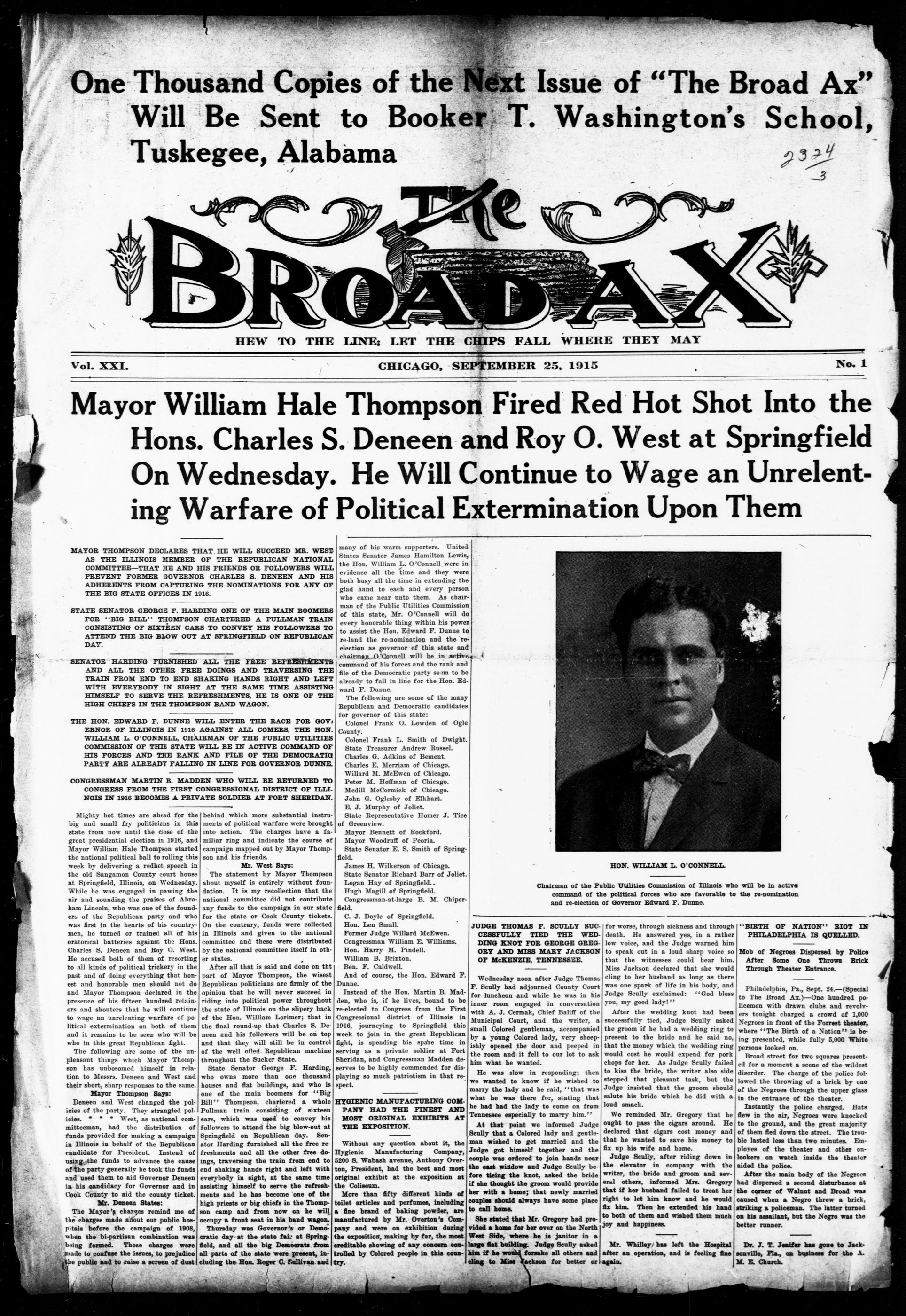
Mayor William Hale Thompson Fired Red Hot Shot Into the Hons. Charles S. Deneen and Roy O. West at Springfield On Wednesday. He Will Continue to Wage an Unrelenting Warfare of Political Extermination Upon Them
MAYOR THOMPSON DECLARES THAT HE WILL SUCCEED MR. WEST AS THE ILLINOIS MEMBER OF THE REPUBLICAN NATIONAL COMMITTEE—THAT HE AND HIS FRIENDS OR FOLLOWERS WILL PREVENT FORMER GOVERNOR CHARLES S. DENEEN AND HIS ADHERENTS FROM CAPTURING THE NOMINATIONS FOR ANY OF THE BIG STATE OFFICES IN 1916.
STATE SENATOR GEORGE F. HARDING ONE OF THE MAIN BOOMERS FOR "BIG BILL" THOMPSON CHARTERED A PULLMAN TRAIN CONSISTING OF SIXTEEN CARS TO CONVEY HIS FOLLOWERS TO ATTEND THE BIG BLOW OUT AT SPRINGFIELD ON REPUBLICAN DAY.
SENATOR HARDING FURNISHED ALL THE FREE REFRESHMENTS AND ALL THE OTHER FREE DOINGS AND TRAVERSING THE TRAIN FROM END TO END SHAKING HANDS RIGHT AND LEFT WITH EVERYBODY IN SIGHT AT THE SAME TIME ASSISTING HIMSELF TO SERVE THE REFRESHMENTS, HE IS ONE OF THE HIGH CHIEFS IN THE THOMPSON BAND WAGON.
THE HON. EDWARD F. DUNNE WILL ENTER THE RACE FOR GOV. ERNON OF ILLINOIS IN 1916 AGAINST ALL COMMERS, THE HON. WILLIAM L. O'CONNELL, CHAIRMAN OF THE PUBLIC UTILITIES COMMISSION OF THIS STATE WILL BE IN ACTIVE COMMAND OF HIS FORCES AND THE RANK AND FILE OF THE DEMOCRATIC PARTY ARE ALREADY FALLING IN LINE FOR GOVERNOR DUNNE.
CONGRESSMAN MARTIN B. MADDEN WHO WILL BE RETURNED TO CONGRESS FROM THE FIRST CONGRESSIONAL DISTRICT OF ILLINOIS IN 1916 BECOMES A PRIVATE SOLDIER AT FORT SHERIDAN.
Vol. XXI.
Mayor Wife
Honor
On Wing
ing W
MAYOR THOMPSON DECLARES THAT AS THE ILLINOIS MEMBER COMMITTEE—THAT HE AND PREVENT FORMER GOVERNOR ADHERENTS FROM CAPTURING THE BIG STATE OFFICES IN STATE SENATOR GEORGE F. HARDY FOR "BIG BILL" THOMPSON CONSISTING OF SIXTEEN CARE ATTEND THE BIG BLOW OUT DAY.
SENATOR HARDING FURNISHED AND ALL THE OTHER FREE TRAIN FROM END TO END S WITH EVERYBODY IN SIGHT HIMSELF TO SERVE THE RE HIGH CHIEFS IN THE THOMPSON.
THE HON. EDWARD F. DUNNE VERNOR OF ILLINOIS IN 1916 WILLIAM L. O'CONNELL, CHA COMMISSION OF THIS STATE HIS FORCES AND THE RANE PARTY ARE ALREADY FALLING.
CONGRESSMAN MARTIN B. MADDE CONGRESS FROM THE FIRST NOIS IN 1916 BECOMES A PRIVILEGED
Mighty hot times are ahead for the big and small fry politicians in this state from now until the close of the great presidential election in 1916, and Mayor William Hale Thompson started the national political ball to rolling this week by delivering a redhet speech in the old Sangamon County court house at Springfield, Illinois, on Wednesday. While he was engaged in pawing the air and sounding the praises of Abraham Lincoln, who was one of the founders of the Republican party and who was first in the hearts of his countrymen, he turned or trained all of his oratorical batteries against the Hons. Charles S. Deneen and Roy O. West. He accused both of them of resorting to all kinds of political trickery in the past and of doing everything that honest and honorable men should not do and Mayor Thompson declared in the presence of his fifteen hundred retainers and shouters that he will continue to wage an unrelenting warfare of political extermination on both of them and it remains to be seen who will be who in this great Republican fight. The following are some of the unpleasant things which Mayor Thompson has unbosomed himself in relation to Messrs. Deneen and West and their short, sharp responses to the same.
Mayor Thompson Says:
Deneen and West changed the policies of the party. They strangled policies. * * * West, as national committeeman, had the distribution of funds provided for making a campaign in Illinois in behalf of the Republican candidate for President. Instead of using the funds to advance the cause of the party generally he took the funds and used them to aid Governor Deneen in his candidacy for Governor and in Cook County to aid the county ticket.
Mr. Deneen States:
The Mayor's charges remind me of the charges made about our public hospitals before the campaign of 1908, when the bi-partisan combination was being formed. Those charges were made to confuse the issues, to prejudice the public and to raise a screen of dust
behind which more substantial instruments of political warfare were brought into action. The charges have a familiar ring and indicate the course of campaign mapped out by Mayor Thompson and his friends.
Mr. West Says:
The statement by Mayor Thompson about myself is entirely without foundation. It is my recollection that the national committee did not contribute any funds to the campaign in our state for the state or Cook County tickets. On the contrary, funds were collected in Illinois and given to the national committee and these were distributed by the national committee itself in other states. After all that is said and done on the part of Mayor Thompson, the wisest Republican politicians are firmly of the opinion that he will never succeed in riding into political power throughout the state of Illinois on the slipery back of the Hon. William Lorimer; that in the final round-up that Charles S. Deneen and his followers will be on and that they will still be in control of the well oiled. Republican machine throughout the Sucker State.
State Senator George F. Harding, who owns more than one thousand houses and flat buildings, and who is one of the main boomers for "Big Bill" Thompson, chartered a whole Pullman train consisting of sixteen cars, which was used to convey his followers to attend the big blow-out at Springfield on Republican day. Senator Harding furnished all the free refreshments and all the other free doings, traversing the train from end to end shaking hands right and left with everybody in sight, at the same time assisting himself to serve the refreshments and he has become one of the high priests or big chiefs in the Thompson camp and from now on he will occupy a front seat in his band wagon. Thursday was Governor's or Democratic day at the state fair at Springfield, and all the big Democrats from all parts of the state were present, including the Hon. Roger C. Sullivan and
CHICAGO, SEPTEMBER 25, 1915
many of his warm supporters. United States Senator James Hamilton Lewis, the Hon. William L. O'Connell were in evidence all the time and they were both busy all the time in extending the glad hand to each and every person who came near unto them. As chairman of the Public Utilities Commission of this state, Mr. O'Connell will do every honorable thing within his power to assist the Hon. Edward F. Dunne to re-land the re-nomination and the re-election as governor of this state and chairman O'Connell will be in active command of his forces and the rank and file of the Democratic party seem to be already to fall in line for the Hon. Edward F. Dunne.
The following are some of the many Republican and Democratic candidates for governor of this state:
Colonel Frank O. Lowden of Ogle County.
Colonel Frank L. Smith of Dwight.
State Treasurer Andrew Russel.
Charles G. Adkins of Bement.
Charles E. Merriam of Chiego.
Willard M. McEwen of Chiego.
Peter M. Hoffman of Chiego.
Medill McCormick of Chicago.
John G. Golesby of Elkhart.
E. J. Murphy of Joliet.
State Representative Homer J. Tice of Greenview.
Mayor Bennett of Rockford.
Mayor Woodruff of Peoria.
State Senator E. S. Smith of Springfield.
James H. Wilkerson of Chicago.
State Senator Richard Barr of Joliet.
Logan Hay of Springfield..
Hugh Magill of Springfield.
Congressman-at-large B. M. Chiperfield.
C. J. Doyle of Springfield.
Hon. Len Small.
Former Judge Willard McEwen.
Congressman William E. Williams.
Hon. Harry M. Pindell.
William B. Brinton.
Ben. F. Caldwell.
And of course, the Hon. Edward F. Dunne.
Instead of the Hon. Martin B. Madden, who is, if he lives, bound to be-elected to Congress from the First Congressional district of Illinois in 1916, journeying to Springfield this week to join in the great Republican fight, is spending his spare time in serving as a private soldier at Fort Sheridan, and Congressman Madden deserves to be highly commended for displaying so much patriotism in that respect.
HYGIENIC MANUFACTURING COMPANY HAD THE FINEST AND MOST ORIGINAL EXHIBITS AT THE EXPOSITION.
Without any question about it, the Hygienic Manufacturing Company, 5200 S. Wabash avenue, Anthony Overton, President, had the best and most original exhibit at the exposition at the Coliseum. More than fifty different kinds of toilet articles and perfumes, including a fine brand of baking powder, are manufactured by Mr. Overton's Company and were on exhibition during the exposition, making by far, the most creditable showing of any concern controlled by Colored people in this country.
[Name]
Chairman of the Public Utilities Commission of Illinois who will be in active command of the political forces who are favorable to the re-nomination and re-election of Governor Edward F. Dunne.
JUDGE THOMAS F. SCULLY SUCCESSFULLY TIED THE WEDDING KNOT FOR GEORGE GREGORY AND MISS MARY JACKSON OF MCKENZIE, TENNESSEE.
Wednesday noon after Judge Thomas F. Scully had adjourned County Court for luncheon and while he was in his inner room engaged in conversation with A. J. Cermak, Chief Baliff of the Municipal Court, and the writer, a small Colored gentleman, accompanied by a young Colored lady, very sheepish opened the door and peeped in the room and it fell to our lot to ask him what he wanted.
He was slow in responding; then we wanted to know if he wished to marry the lady and he said, "that was what he was there for, stating that he had had the lady to come on from Tennessee especially to marry him."
At that point we informed Judge Scully that a Colored lady and gentleman wished to get married and the Judge got himself together and the couple was ordered to join hands near the east window and Judge Scully before ticing the knot, asked the bride if she thought the groom would provide her with a home; that newly married couples should always have some place to call home.
She stated that Mr. Gregory had provided a home for her over on the North West Side, where he is janitor in a large flat building. Judge Scully asked him if he would forsake all others and cling to Miss Jackson for better or
public Utilities Commission of Illinois who the political forces who are favorable to of Governor Edward F. Dunne.
for worse, through sickness and through death. He answered yes, in a rather low voice, and the Judge warned him to speak out in a loud sharp voice so that the witnesses could hear him. Miss Jackson declared that she would cling to her husband as long as there was one spark of life in his body, and Judge Scully exclaimed: "God bless you, my good lady!"
After the wedding knot had been successfully tied, Judge Scully asked the groom if he had a wedding ring to present to the bride and he said no, that the money which the wedding ring would cost he would expend for pork chops for her. As Judge Scully failed to kiss the bride, the writer also side stepped that pleasant task, but the Judge insisted that the groom should salute his bride which he did with a loud smack.
We reminded Mr. Gregory that he ought to pass the cigars around. He declared that cigars cost money and that he wanted to save his money to fix up his wife and home.
Judge Scully, after riding down in the elevator in company with the writer, the bride and groom and several others, informed Mrs. Gregory that if her husband failed to treat her right to let him know and he would fix him. Then he extended his hand to both of them and wished them much joy and happiness.
Mr. Whilley has left the Hospital after an operation, and is feeling fine again.
No.1
"BIRTH OF NATION" RIOT IN PHILADELPHIA IS QUELLED.
Mob of Negroes Dispersed by Police After Some One Throws Brick Through Theater Entrance.
Philadelphia, Pa., Sept. 24.—(Special to The Broad Ax.)—One hundred policemen with drawn clubs and revolvers tonight charged a crowd of 1,000 Negroes in front of the Forrest theater, where "The Birth of a Nation" is being presented, while fully 5,000 White persons looked on.
Broad street for two squares presented for a moment a scene of the wildest disorder. The charge of the police followed the throwing of a brick by one of the Negroes through the upper glass in the entrance of the theater.
Instantly the police charged. Hats flew in the air, Negroes were knocked to the ground, and the great majority of them fled down the street. The trouble lasted less than two minutes. Employes of the theater and other onlookers on watch inside the theater aided the police.
After the main body of the Negroes had dispersed a second disturbance at the corner of Walnut and Broad was caused when a Negro threw a brick, striking a policeman. The latter turned on his assailant, but the Negro was the better runner.
Dr. J. T. Jenifer has gone to Jacksonville, Fla., on business for the A. M. E. Church.
PAGE TWO
A Suffragist Refugee Tells of
Woman's Position In Poland.
Mary
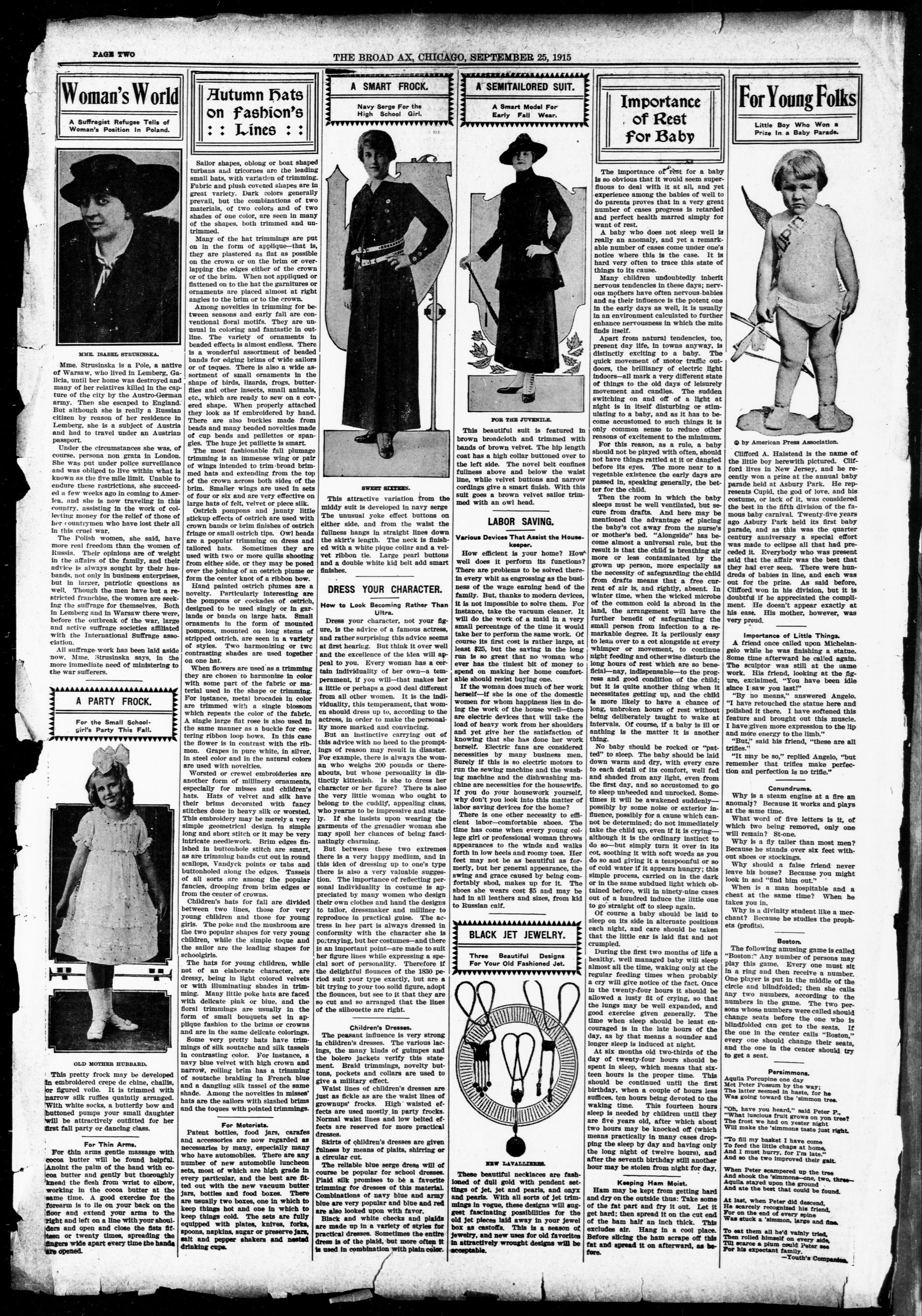
MME. ISABEL STRUSINSKA.
Mme. Strusinska is a Pole, a native of Warsaw, who lived in Lemberg, Galicia, until her home was destroyed and many of her relatives killed in the capture of the city by the Austro-German army. Then she escaped to England. But although she is really a Russian citizen by reason of her residence in Lemberg, she is a subject of Austria and had to travel under an Austrian passport.
Under the circumstances she was, of course, persona non grata in London. She was put under police surveillance and was obliged to live within what is known as the five mile limit. Unable to endure these restrictions, she succeeded a few weeks ago in coming to America, and she is now traveling in this country, assisting in the work of collecting money for the relief of those of her countrymen who have lost their all in this cruel war.
The Polish women, she said, have more real freedom than the women of Russia. Their opinions are of weight in the affairs of the family, and their advice is always sought by their husbands, not only in business enterprises, but in larger, patriotic questions as well. Though the men have but a restricted franchise, the women are seeking the suffrage for themselves. Both in Lemberg and in Warsaw there were, before the outbreak of the war, large and active suffrage societies affiliated with the International Suffrage association.
All suffrage-work has been laid aside now. Mime, Strusinska says, in the more immediate need of ministering to the war sufferers.
H
OLD MOTHER HUBBARD.
This pretty frock may be developed in embroidered crepe de chine, challis, or figured volle. It is trimmed with narrow silk ruffles quantitly arranged. With white socks, a butterfly bow and buttoned pumps your small daughter will be attractively outfitted for her first fall party or dancing class.
For Thin Arms.
For thin arms gentle massage with cocoa butter will be found helpful. Anoint the palm of the hand with cocoa butter and gently but thoroughly knead the flesh from wrist to elbow, working in the cocoa butter at the same time. A good exercise for the forearm is to lie on your back on the floor and extend your arms to the right and left on a line with your shoulders and open and close the fists fifteen or twenty times, spreading the fingers wide apart every time the hands are opened.
Autumn Hats on fashion's Lines
Sailor shapes, oblong or boat shaped turbans and tricornes are the leading small hats, with variation of trimming. Fabric and plush covered shapes are in great variety. Dark colors generally prevail, but the combinations of two materials, of two colors and of two shades of one color, are seen in many of the shapes, both trimmed and untrimmed.
Many of the hat trimmings are put on in the form of applique—that is, they are plastered as flat as possible on the crown or on the brim or overlapping the edges either of the crown or of the brim. When not appliqued or flattened on to the hat the garnitures or ornaments are placed almost at right angles to the brim or to the crown.
Among novelties in trimming for between seasons and early fall are conventional floral motifs. They are unusual in coloring and fantastic in outline. The variety of ornaments in beaded effects is almost endless. There is a wonderful assortment of beaded bands for edging brims of wide sailors or of teques. There is also a wide assortment of small ornaments in the shape of birds, lizards, frogs, butterflies and other insects, small animals, etc., which are ready to sew on a covered shape. When properly attached they look as if embroidered by hand. There are also buckles made from beads and many beaded novelties made of cup beads and paillettes or spangles. The huge jallet palette is smart.
The most fashionable fall plumage trimming is an immense wing or pair of wings intended to trim broad brimmed hats and extending from the top of the crown across both sides of the brim. Smaller wings are used in sets of four or six and are very effective on large hats of felt, velvet or piece plum. Ostrich pompons and jaunty little stickup effects of ostrich are used with crown bands or brim finishes of ostrich fringe or small ostrich tips. Owl heads are a popular trimming on dress and tailored hats. Sometimes they are used with two or more quills shooting from either side, or they may be posed over the joining of an ostrich plume or form the center knot of a ribbon bow.
Hand painted ostrich phumes are a novelty. Particularly interesting are the pompons or cockades of ostrich designed to be used singly or in garlands or bands on large hats. Small ornaments in the form of mounted pompons, mounted on long stems of stripped ostrich, are seen in a variety of styles. Two harmonizing or two contrasting shades are used together on one hat.
When flowers are used as a trimming they are chosen to harmonize in color with some part of the fabric or material used in the shape or trimming. For instance, metal brocades in color are trimmed with a single blossom which repeats the color of the fabric. A single large flat rose is also used in the same manner as a buckle for centering ribbon loop bows. In this case the flower is in contrast with the ribbon. Grapes in pure white, in silver, in steel color and in the natural colors are used with novelties.
Worsted or crewel embroideries are another form of millinery ornaments, especially for misses and children's hats. Hats of velvet and silk have their brims decorated with fancy stitches done in heavy silk or worsted. This embroidery may be merely a very simple geometrical design in simple long and short stitch or it may be very intricate needlework. Brim edges finished in buttonhole stitch are smart, as are trimming bands cut out in round scallops, Vandyk points or tabs and buttonholed along the edges. Tassels of all sorts are among the popular fancies, drooping from brim edges or from the center of crowns.
Children's hats for fall are divided between two lines, those for very young children and those for young girls. The poke and the mushroom are the two popular shapes for very young children, while the simple toque and the sailor are the leading shapes for schoolgirls. The hats for young children, while not of an elaborate character, are dressy, being in light colored velvets or with illuminating shades in trimming. Many little poke hats are faced with delicate pink or blue, and the floral trimmings are usually in the form of small bouquets set in appliqué fashion to the brims or crowns and are in the same delicate colorings.
Some very pretty hats have trimmings of silk soutache and silk tassels in contrasting color. For instance, a navy blue velvet with high crown and narrow, rolling brim has a trimming of soutache braiding in French blue and a dangling silk tassel of the same shade. Among the novelties in misses' hats are the sailors with slashed brims and the toques with pointed trimmings.
For Motorists.
Patent bottles, food jars, carafes and accessories are now regarded as necessaries by many, especially many who have automobiles. There are any number of new automobile luncheon sets, most of which are high grade in every particular, and the best are fitted out with the new vacuum butter jars, bottles and food boxes. There are usually two boxes, one in which to keep things hot and one in which to keep things cold. The sets are fully equipped with plates, knives, forks, spoons, napkins, sugar or preserve jars, salt and pepper shakers and nested drinking cups.
THE BROAD AX. CHICAGO. SEPTEMBER 25. 1915
---
01
SWEET SIXTEEN.
This attractive variation from the middy suit is developed in navy serge. The unusual yoke effect buttons on either side, and from the waist the fullness hangs in straight lines down the skirt's length. The neck is finished with a white pique collar and a velvet ribbon tie. Large pearl buttons and a double white kid belt add smart finishes.
DRESS YOUR CHARACTER.
How to Look Becoming Rather Than Ultra.
Dress your character, not your figure, is the advice of a famous actress, and rather surprising this advice seems at first hearing. But think it over well and the excellence of the idea will appeal to you. Every woman has a certain individuality of her own—a temperament, if you will—that makes her a little or perhaps a good deal different from all other women. It is the individuality, this temperament, that women should dress up to, according to the actress, in order to make the personality more marked and convincing.
But an instinctive carrying out of this advice with no heed to the promptings of reason may result in disaster. For example, there is always the woman who weighs 200 pounds or thereabouts, but whose personality is distinctly kittenish. Is she to dress her character or her figure? There is also the very little woman who ought to belong to the cuddly, appealing class, who yearns to be impressive and stately. If she insists upon wearing the garments of the grenadier woman she may spoil her chances of being fascinatingly charming.
But between these two extremes there is a very happy medium, and in this idea of dressing up to one's type there is also a very valuable suggestion. The importance of reflecting personal individuality in costume is appreciated by many women who design their own clothes and hand the designs to tailor, dressmaker and milliner to reproduce in practical guise. The actress in her part is always dressed in conformity with the character she is portraying, but her costumes—and there is an important point—are made to suit her figure lines while expressing a special sort of personality. Therefore if the delightful flouces of the 1830 period suit your type exactly, but are a bit trying to your too solid figure, adopt the flouces, but see to it that they are so cut and so arranged that the lines of the silhouette are right.
Children's Dresses.
The peasant influence is very strong in children's dresses. The various lacings, the many kinds of gulmpes and the bolero jackets verify this statement. Braid trimmings, novelty buttons, pockets and collars are used to give a military effect.
Waist lines of children's dresses are just as fickle as are the waist lines of grownups' frocks. High waisted effects are used mostly in party frocks. Normal waist lines and low belted effects are reserved for more practical dresses.
Skirts of children's dresses are given fulness by means of plaits, shirring or a circular cut.
The reliable blue serge dress will of course be popular for school dresses. Plaid silk promises to be a favorite trimming for dresses of this material. Combinations of navy blue and army blue are very popular and blue and red are also looked upon with favor.
Black and white checks and plaids are made up in a variety of styles for practical dresses. Sometimes the entire dress is of the plaid, but more often it is used in combination with plain color.
---
A
FOR THE JUVENILE.
This beautiful suit is featured in brown broadcloth and trimmed with bands of brown velvet. The hip length coat has a high collar buttoned over to the left side. The novel belt confines fullness above and below the waist line, while velvet buttons and narrow cordings give a smart finish. With this suit goes a brown velvet sailor trimmed with an owl head.
LABOR SAVING.
Various Devices That Assist the House- keeper.
How efficient is your home? How well does it perform its functions? There are problems to be solved there in every whit as engrossing as the business of the wage earning head of the family. But, thanks to modern devices, it is not impossible to solve them. For instance, take the vacuum cleaner. It will do the work of a maid in a very small percentage of the time it would take her to perform the same work. Of course its first cost is rather large, at least $25, but the saving in the long run is so great that no woman who ever has the tiniest bit of money to spend on making her home comfortable should resist buying one.
If the woman does much of her work herself—if she is one of the domestic women for whom happiness lies in doing the work of the house well—there are electric devices that will take the load of heavy work from her shoulders and yet give her the satisfaction of knowing that she has done her work herself. Electric fans are considered necessities by many business men. Surely if this is so electric motors to run the sewing machine and the washing machine and the dishwashing machine are necessities for the housewife. If you do your housework yourself, why don't you look into this matter of labor saving devices for the home?
There is one other necessity to efficient labor—comfortable shoes. The time has come when every young college girl or professional woman throws appearances to the winds and walks forth in low heels and roomy toes. Her feet may not be as beautiful as formerly, but her general appearance, the swing and grace caused by being comfortably shod, makes up for it. The shoes she wears cost $5 and may be had in all leathers and sizes, from kld to Russian calf.
NEW LAYALLINER
These beautiful necklaces are fashioned of dull gold with pendent settings of jet, jet and pearls, and onyx and pearls. With all sorts of jet trimmings in vogue, these designs will suggest fascinating possibilities for the old jet pieces laid away in your jewel box as castoffs. This is a season of jewelry, and new uses for old favorites in attractively wrought designs will be acceptable.
Importance of Rest for Baby
The importance of rest for a baby is so obvious that it would seem superfluous to deal with it at all, and yet experience among the babies of well to do parents proves that in a very great number of cases progress is retarded and perfect health marred simply for want of rest.
A baby who does not sleep well is really an anomaly, and yet a remarkable number of cases come under one's notice where this is the case. It is hard very often to trace this state of things to its cause.
Many children undoubtedly inherit nervous tendencies in these days; nervous mothers have often nervous babies and as their influence is the potent one in the early days as well, it is usually in an environment calculated to further enhance nervousness in which the mite finds itself.
Apart from natural tendencies, too, present day life, in towns anyway, is distinctly exciting to a baby. The quick movement of motor traffic outdoors, the brilliance of electric light indoors—all mark a very different state of things to the old days of leisurely movement and candles. The sudden switching on and off of a light at night is in itself disturbing or stimulating to a baby, and as it has to become accustomed to such things it is only common sense to reduce other reasons of excitement to the minimum. For this reason, as a rule, a baby should not be played with often, should not have things rattled at it or dangled before its eyes. The more near to a vegetable existence the early days are passed in, speaking generally, the better for the child.
Then the room in which the baby sleeps must be well ventilated, but secure from drafts. And here may be mentioned the advantage of placing the baby's cot away from the nurse's or mother's bed. "Alongside" has become almost a universal rule, but the result is that the child is breathing air more or less contaminated by the grown up person, more especially as the necessity of safeguarding the child from drafts means that a free current of air is, and rightly, absent. In winter time, when the wicked microbe of the common cold is abroad in the land, the arrangement will have the further benefit of safeguarding the small person from infection to a remarkable degree. It is perilously easy to lean over to a cot alongside at every whimper or movement, to continue night feeding and otherwise disturb the long hours of rest which are so beneficial—nay, indispensable—to the progress and good condition of the child; but it is quite another thing when it necessitates getting up, and the child is more likely to have a chance of long, unbroken hours of rest without being deliberately taught to wake at intervals. Of course, if a baby is ill or anything is the matter it is another thing.
No baby should be rocked or "patted" to sleep. The baby should be laid down warm and dry, with every care to each detail of its comfort, well fed and shaded from any light, even from the first day, and so accustomed to go to sleep unheeded and unrocked. Sometimes it will be awakened suddenly—possibly by some noise or exterior influence, possibly for a cause which cannot be determined; do not immediately take the child up, even if it is crying—although it is the ordinary instinct to do so—but simply turn it over in its cot, soothing it with soft words as you do so and giving it a teaspoonful or so of cold water if it appears hungry; this simple process, carried on in the dark or in the same subdued light which obtained before, will in ninety-nine cases out of a hundred induce the little one to go straight off to sleep again.
Of course a baby should be laid to sleep on its side in alternate positions each night, and care should be taken that the little ear is laid flat and not crumpled. During the first two months of life a healthy, well managed baby will sleep almost all the time, waking only at the regular feeding times when probably a cry will give notice of the fact. Once in the twenty-four hours it should be allowed a lusty fit of crying, so that the lungs may be well expanded, and good exercise given generally. The time when sleep should be least encouraged is in the late hours of the day, as by that means a sounder and longer sleep is induced at night.
At six months old two-thirds of the day of twenty-four hours should be spent in sleep, which means that sixteen hours is the proper time. This should be continued until the first birthday, when a couple of hours less suffices, ten hours being devoted to the waking time. This fourteen hours sleep is needed by children until they are five years old, after which about two hours may be knocked off (which means practically in many cases dropping the sleep by day and having only the long night of twelve hours), and after the seventh birthday still another hour may be stolen from night for day.
Keeping Ham Moist
Ham may be kept from getting hard and dry on the outside thus: Take some of the fat part and fry it out. Let it get hard; then spread it on the cut end of the ham half an inch thick. This excludes air. Hang in a cool place. Before slicing the ham scrape off this fat and spread it on afterward, as before.
For Young Folks
Little Boy Who Won a
Prize In a Baby Parade.
UPIN
© by American Press Association.
Clifford A. Halstead is the name of the little boy herewith pictured. Clifford lives in New Jersey, and he recently won a prize at the annual baby parade held at Asbury Park. He represents Cupid, the god of love, and his costume, or lack of it, was considered the best in the fifth division of the famous baby carnival. Twenty-five years ago Asbury Park held its first baby parade, and as this was the quarter century anniversary a special effort was made to eclipse all that had preceded it. Everybody who was present said that the affair was the best that they had ever seen. There were hundreds of babies in line, and each was out for the prize. As said before, Clifford won in his division, but it is doubtful if he appreciated the compliment. He doesn't appear exactly at his ease. His mother, however, was very proud.
Importance of Little Things.
A friend once called upon Michelangelo while he was finishing a statue. Some time afterward he called again. The sculptor was still at the same work. His friend, looking at the figure, exclaimed, "You have been idle since I saw you last!" "By no means," answered Angelo. "I have retouched the statue here and polished it there. I have softened this feature and brought out this muscle. I have given more expression to the lip and more energy to the limb." "But," said his friend, "these are all trifles." "It may be so," replied Angelo, "but remember that trifles make perfection and perfection is no trifle."
Conundrums.
Why is a steam engine at a fire an anomaly? Because it works and plays at the same time.
What word of five letters is it, of which two being removed, only one will remain? St-one.
Why is a fly taller than most men? Because he stands over six feet without shoes or stockings.
Why should a false friend never leave his house? Because you might look in and "find him out."
When is a man hospitable and a cheat at the same time? When he takes you in.
Why is a divinity student like a merchant? Because he studies the prophets (profits).
Boston
The following amusing game is called "Boston." Any number of persons may play this game. Every one must sit in a ring and then receive a number. One player is put in the middle of the circle and blindfolded; then she calls any two numbers, according to the numbers in the game. The two persons whose numbers were called should change seats before the one who is blindfolded can get to the seats. If the one in the center calls "Boston," every one should change their seats, and the one in the center should try to get a seat.
Persimmons
Aquila Porcupine one day
Met Peter Possum by the way;
The latter seemed in haste, for he
Was going toward the 'simmon tree.
"Oh, have you heard," said Peter P.,
"What luscious fruit grows on you tree?
The frost we had on yester night
Will make the 'simmons taste just right.
Heart Instead of Fist.
Praise a boy for his good deeds rather than spank him for his bad ones. Many a parent has tried it, with successful results, as well as pleasant ones for the boy. Hardheaded business has made a similar discovery. A Pennsylvania railroad superintendent found that posting in public places the faults of his employees failed to reduce the number of delinquencies. "Till try a new game," he said. "The failures I shall keep to myself, but the particularly good bits of work done by the men I shall paste upon a bulletin board where all may read."
And the result of this scheme of heart instead of fist? A quick drop of two-thirds in the number of men who required discipline. That was pure gain, and a big one, for the railroad, but the men profited even more. There was a decrease of more than 70 per cent in loss of wages through suspensions.—Philadelphia Ledger.
Watch Your Step.
Science can tell what sort of a person you are from your step. Physicians diagnose locomotor ataxia, paresis, palsy, lumbago and other diseases by the gait. One expert says:
"Watch the man who drags his feet along as if it were an effort. He would be the first into a lifeboat from a sinking ship because he has no heart. The woman with the dragging feet is a whiner.
"Watch the woman who hurries along as if she were anxious to part company with the pavement. Her steps are quick and snappy. She has plenty of vim.
"When you see a woman planting her feet firmly on the ground and walking with a free swing you may be sure she is wholesome, to be depended upon and capable. She will be your friend on rainy days just as much as or more than when the sun shines."
—Philadelphia North American.
The Invincible Yagui.
Against all assaults upon his stronghold the Yaqui Indian of Mexico has proved invincible. For more than a century relentless war has been waged against him by the Mexicans, but they have neither subdued him nor named him, and as for conquering him, that, it is generally admitted, will come only with his extermination. In the campaigns against him the Yaqui's most effective weapon is the poisoned arrow. His body is made of black palm wood, and the arrows are long, sharp and so poisoned as to cause certain but not immediate death. Horrible suffering follows a scratch from the point, the victim dying in from three to seven days. No ididote has been discovered, although the Yaqui themselves possess the secret of one.—Boston Herald
Nails.
A rule to a common article of manufacture which is turned out by thousands every hour in the factory and is always absent in every household when it is not needed. Every house is full of rails. The walls bristle with them. The doors and ceilings are full of them. But if you need one to drive into a wall or to help dispatch a box going by express you might as well look for a gold nugget in an ash heap. When by some miracle a nail permits itself to be discovered it is always crooked. The art of placing it on your wife's best muhogany table and straightening it out with a poker in place of the hammer you cannot locate is an art yet in its infancy. Some centuries hence it may reach a development hitherto undreamed of. -Life.
The Oyster's Diet
Some interesting facts concerning the diet of the oyster have been discovered by the investigations of the English board of fisheries. The experts have found, for instance, that the oyster is an exceptionally dainty feeder, living almost exclusively on a vegetable diet. Seaweed and the minute pine pollen of the water are its staples. It dines, moreover, only between 12 o'clock noon and 2 in the afternoon. During those hours the oyster opens his shell, permits the water to flow through the feeding gill and expels it. The gill extracts the food desired.—Philadelphia Record.
A Reconstructed Man Costs $500.
With exhibitions and catalogues of artificial limbs now brought to notice one gets to calculating the cost of a reconstructed man. Seemingly a little more than $500 would suffice. A pair of artificial legs costs about $150 and a pair of arms about $100. Ears, with drums, etc., cost $75 each; eyes $30 a pair, and so on. Without heart and brain a man is worth about $500. With them—the price might change. London Chronicle.
Nothing to Be Said.
Judge—You admit, then, that you stole the loaf of bread? Woman Prisoner—Yes, your honor. Judge—What have you to say for yourself? Woman—Nothing, your honor. If it was lace or jewelry I might plead kleptomania, but we can't try that when it's bread.—Chicago Herald.
In the Station.
"I want to take a train to New York."
"But, my dear sir, we pay our engineers to do that."—Baltimore American.
Harah Cure.
Hubby (at breakfast)—I've got a bad head this morning. Wife—I'm sorry, dear. I do hope you'll be able to shake it off.—Boston Transcript.
The scandal monger is the submarine of the human race.—Life.
Paintings That Last.
One of the great problems that presents itself to the modern painter is to keep his canvas from cracking when it ages. Many of the most prized of the old masterpieces have been marred because their creators did not understand the art of insuring them against time and weathering. A careful investigation of those that have come down intact shows that in some cases the sheet of paint is remarkably thin, so thin, indeed, that the texture of the canvas can be clearly seen through the face of the picture. Further experimenting shows that the life of a picture is inversely proportional to the thickness of its color layers. Canvas contracts with moisture and cold, and paint generally is affected in the same way. If the paint layer is too thick it gives way, and the cracking is the result. All of the old paintings that have come to us uncracked are painted very thin. This was the method of such early masters as Van Dyck, Raphael and his pupils.—Atlanta Constitution.
Mouths on the Bias.
"Of course it's nice to have a beautiful voice, but I'm glad I don't sing," said a pretty woman as she applauded after the soprano solo at a Broadway restaurant. "Yes, I'm fond of music, but that is sufficient. If I could be tempted to sing, what would happen to my good looks? I think it is, not silly for a woman to wish to look well all the time. A woman never looks pretty or beautiful when she sings. She invariably twists her mouth to one side and makes her face appear crooked. I have keenly observed the last ten singers I have heard, and every one of them opened her mouth on a blas. I haven't the slightest idea why they do it unless the muscles of one side of the face are stronger than the other. There is something disturbing about a pretty woman deliberately making herself a fright by stretching her mouth in song."—New York Letter in Pittsburgh Dispatch.
Locust Eaters.
While the locust is essentially a plant devourer and famine breeder, says the Christian Herald, there are many well authenticated cases in history showing that populations reduced to the last extremity have utilized the destructive insect as food. Diodorus Siculus relates that an Ethiopian tribe was known as Acridophaga ("eaters of locusts"), while Aristotle writes of a certain part of Greece where the people regarded them as delicacies. Layard, the explorer, found on the engraved monuments pictures of dried and preserved locusts on rods, presumably indicating their use as food. It is not believed that any race today eats them. They are regarded everywhere in the east as an abhorrent calamity, and the presence of vast swarms in Palestine is held to be a forerunner of complete crop failure, both of fruits and cereals.
The First Telegraph Line
After the formal opening of the first telegraph line built for commercial purposes between Washington and Baltimore Professor Morse and his associates offered to sell the invention to the United States government for $100,000, but the price was considered too high. The government had appropriated $30,000 toward the construction of the Washington-Baltimore line, but after a short period of operation the postmaster general, to whom President Polk had referred the matter, wrote, "Although the invention is an agent vastly superior to any other devised by the genius of man, yet the operation between Washington and Baltimore has not satisfied me that under any rate of postage that can be adopted its revenues can be made to cover its expenditures."
The Sound of Shrapnel.
Have you ever heard shrapnel by any chance? No? Well, it sounds as much as anything else like a winter gale howling through the branches of a pine tree. It is a moan, a groan, a shriek and a wail rolled into one, and when the explosion comes it sounds as though some one had touched off a stick of dynamite under a grand piano, and it is not particularly cheering to know that the ones you hear do not harm you and that it is the ones you do not have time to hear that send you to the cemetery.—E. Alexander Powell in Scribler's.
The Lacebark Tree
The lacebark tree grows in the West Indies. It is a lofty tree, with oval, smooth leaves and white flowers. It is remarkable for the tenacity of its inner bark and the readiness with which the inner bark may be separated—after maceration in water—into layers resembling lace. A governor of Jamaica is said to have presented to Charles II. a cravat, frill and ruffles made of it.
A Dog and a King.
William the Silent was once saved by a spaniel, which scratched his face and awakened him just in time to flee Spanish soldiers who intended murder. A sculptured effigy of the dog lies at the foot of William's statue at Delft, Holland.
Something on Him:
"You haven't got anything on my husband," said the woman in the drug store.
"Oh, yes I have," replied the druggist; "he's wearing a porous plaster he hasn't paid me' for yet." — Yonkers Statesman.
Looking Well.
Bigson—How well you're looking this morning, Jigson! Jigson! Yes; I never looked better in my life. I'm looking for a man who owes me $10.
THE BROAD AX. CHICAGO. SEPTEMBER 25. 1915
The River Through Paris. Small two decked steamers ply on the Seine as it twists its way through Paris. You can catch one every fifteen minutes, and it costs 2 sous (2 cents) to go from one end of the city to the other, a distance of perhaps eight miles, and then once outside the city walls you pay 2 sous more. The Seine river is narrow, dull green and slow moving; not majestic at all, but made picturesque by the life that is upon it. In Paris it is commerce and artistic beauty combined that border its banks. Within the boats that are moored to its palings are so many different kinds of existence—baths, hospitals, washhouses, homes, restaurants and lodgings. People live half above, half under the water, and in some places on the Seine for long distances these boats are moored four abreast and following in line like soldiers on march. These are the flattest of boats. When they come up the river freighted their tops are just at the water's edge. The Seine seldom rises or falls very much, as it is held in its banks by concrete walls.—Cleveland Plain Dealer.
Military Retreats
Once at an evening reception in Berlin some one drew the attention of Moltke to a magazine writer who had compared him, after the manner of Plutarch, to all the world's greatest commanders—Alexander, Caesar, Hanibal, Turenne, Marlborough, Frederick, Napoleon, etc. "No," said the great "battle thinker," "I have no right to be compared to such great commanders, for I have never in all my life had to conduct a retreat"—at once the most honorable and difficult operation of war, as the Duke of Wellington himself well knew. The hero of a hundred fights who never lost an English gun, the duke nevertheless knew—none better—what is was to conduct a retreat from Burgos and other places and even to withdraw behind the lines of Torres Vedras till his opportunity again came for making another thrust.—London Illustrated News.
Japanese Economy
Among the Japanese economy is held to be a high virtue. Two old misers of Tokyo were one day discussing ways and means of saving.
"I manage to make a fan last about twenty years," said one, "and this is my system: I don't wastefully open the whole fan and wave it carelessly. I open only one section at a time. That is good for about a year. Then I open the next, and so on until the fan is eventually used up."
"Twenty years for a good fan!" exclaimed the other. "What sinful extravagance! In my family we use a fan for two or three generations, and this is how we do it: We open the whole fan, but we don't wear it out by waving it. Oh, no! We hold it still, like this, under our nose, and wave our face!"—Everybody's.
Simple Air Pressure Test.
Any one can demonstrate the pressure of the atmosphere by the simple experiment which follows: On the flat of an iron lay a thin sheet of rubber—part of an old tobacco pouch will do. Place a small, thin lid containing some wadding soaked in spirits of wine on the rubber and ignite the spirits. Then press a wineglass down tightly over the flame. When the flame dies out it will be found that the two articles are firmly united and may be suspended by a wire, and some time will elapse before they separate. The explanation is that the flame consumes the oxygen in the glass and lowers the pressure when the greater pressure of the atmosphere squeezes the articles together—Exchange.
The Carding Bee.
The carding bee lives in holes among stones and roots, making nests of moss lined with wax to keep the wet out, with a long gallery to approach it. The bees find a bit of moss, and several of them get in a row, with their backs toward the nest. The foremost bee then lays hold of the moss, pulls it up with her jaws and drives it with her forefeet under her body and as far toward the next as possible, when the next bee does the same thing. By this means many tiny heaps of prepared moss are got to the nest, where other bees weave it into the structure.
A Study In Bears
In Yellowstone park the brown bears retreat hastily from the hotel garbage piles when black bears heave in sight, and the latter in turn promptly get themselves gone at the approach of the silvertips. It is an interesting little social system, established on the primordial basis of fear.
Only Room For One.
Lady—How could you be so foolish as to put anything on that newly painted table? Maid—But I saw Mr. Jones lay several articles there. Lady—What of that? If my husband makes a jackass of himself he has a right to, but you haven't, you stupid creature!
Managing a Woman.
Napoleon, statesman and hero of a hundred battlefields, once remarked, "To bring a chit of a woman of my own family to reason I must needs deliver harangues as long as if she were the senate and the council of the state together."
It Might Be Worse
Poet—I fear I haven't written anything that will live. Friend—Look on the bright side of it. Be thankful that you are alive in spite of what you have written—London Opinion.
"The barriers are not erected that can say to aspiring talents and industry, "Thus far and no farther."—Beethoven.
The Law of Habeas Corpus.
The enactment of the law of habeas corpus marks an important epoch in the progress of civil liberty in England and is regarded as one of the great achievements of Charles II's reign. Charles himself did not want the law, but just at the time he was very anxious to curry favor with the people and was afraid to oppose so popular a measure. The friends and foes of the act were pretty evenly divided in parliament, but in the final vote it was carried. The manner of its passage, however, was both comical and illegal. While the voting was going on a very fat lord arose and asked that his vote be recorded in the affirmative. In a spirit of fun the clerk announced ten votes for him to accord with his great size. They were so recorded, and for some unexplained reason the "error" was never corrected. The strangest part of it is the majority for the measure was less than ten; hence it would have failed of passage without the fat lord's extra votes.—Argonaut.
When Texas Branded Thieves
When Texas Branded Thieves.
Adam was the first man, the very first, to be indicted by a grand jury in Houston. His name, to be more specific, was James Adam. The charge was that he stole, the indictment larceny. He was convicted. This was the sentence: To return to the rightful owner the sum of $295, to be given thirty-nine lashes on the bare back in a public place and to be branded with the letter T on the back of the right hand. This all happened in Houston in the spring of 1837. The first book of the records of the legal doings of Harris county is a yellowed and old thing. The first matter written in it is a statement signed by Sam Houston giving authority for the court. It announces that he has appointed Benjamin Franklin judge of the court. The place is given as "the town of Houston, county of Harrisburg, republic of Texas."—Houston Chronicle.
"Homemade."
When the baker or confectioner advertises that his bread or his cake is "homemade" he hopes to attract customers, but many things "homemade" come not quite up to the market standard. There is the skirt, so labored over, so taken apart and put together again, so pulled and pressed, yet rarely with quite the air that "store clothes" have, and the hat or bonnet, call it which you will, it, too, falls short of public promenade styles. There likewise is the "hair cut" for Billy—really it does suggest the guidance of a hollowed out pumpkin, but how about Billy himself and Jenny? Are they "homemade" or "schoolmade"? Do they bear marks of the mother touch and the father guidance? We hope so. Nothing so good as a homemade boy or girl—stronger in character, richer in nature, than any product of any institution—Christian Register.
Dominion of Canada.
Canadians are accustomed to take expression of the "Dominion" of Canada for granted, but the origin of that somewhat unusual term is known to very few. When the great scheme of Sir John Macdonald was finally realized and the nine provinces grouped themselves together into one great confederation a serious difficulty was presented by the choice of a suitable name. For a time almost a deadlock ensued. At length one old member of parliament rose from his seat and told his colleagues that he had read in his Bible that very morning the words, "His dominion shall be from the one sea to the other." Accordingly he suggested that Canada should be known as the Dominion, or God's Land. The suggestion seized upon the hearts and imaginations of those present, and it was promptly acted upon.—Toronto Globe.
How Pausanius Died
Pausanius, the Greek general, died by self administered poison. When hotly pursued by those sent to apprehend him on a charge of treason and sacrilege he took refuge in the sanctuary of a temple. Unable to remove him by force and also unwilling to violate the sanctuary, the officers walled up the entrance and began to unroof the building. When he could be seen they noticed that he was chewing something which proved to be a quill filled with poison. By the time the work had sufficiently advanced to admit of their entrance he was in a dying condition.
Sick Eggs.
Examine an egg, a perfectly fresh egg, and see how easily and quickly it comes out of its shell. Now, an egg that does not come out of the shell readily, that sticks together and the yolk, when forced, breaks and rolls around—that egg has had an attack of a disease similar to peritonitis. It is an infected egg. Conditions are present that show conclusively the presence of disease—Good Health.
Tactless.
A woman who took refuge in a London shop during a heavy rain and remarked how quiet trade was with the owner was annoyed because his explanation of dull business was: "But just look at the weather! What respectable lady would venture outdoors in it?"
Veracity.
Honest, now, did you ever sit down and calculate your veracity batting average? Try it sometimes and then take a square look at the percentage column—Memphis Commercial Appeal.
No Objection.
Voice—Is this the weather bureau?
How about a shower tonight? Prophet
—Don't ask me. If you need one, take it
—Chaparral.
Benefits of Water.
In the New York Medical Record Dr. S. A. Knopf of New York advocates a liberal use of water in the prevention and cure of tuberculosis. He advances a plea for public baths for old and young and also for swimming pools in connection with the schools. He holds that a glass of clear, cool water taken half an hour before meals is the best appetizer and stimulant for the gastric secretions and that this is a gospel to be spread and practiced a little more freely by the medical profession. He says: "The money a municipality invests in public baths, floating baths, seaside baths and swimming pools will give splendid returns in the saving of lives, directly and indirectly—indirectly, by making people clean physically and morally, by preventing disease through the cultivation of cleanliness and by making the people more vigorous and thus resistant to the invasion of disease; directly, by teaching every future citizen, man or woman, how to swim and to save his life in the event of accident."
Garlic.
Garlic is one of the most wholesome herbs that can be eaten.
It stimulates all secretions, and its effect is strong upon the liver and kidneys.
A teaspoonful of garlic juice and sugar will generally ward off an oncoming cold.
Garlic eaters have good skins, for garlic is excellent in treating eruptions of all sorts.
Those races that use much garlic in their food are those that are least susceptible to tuberculosis. Many doctors in Europe treat tuberculosis with garlic, giving it internally in the form of a sip, externally in the form of poultices or making their patients inhale an infusion.
The essential principle of garlic, that which acts upon the system, is allyl sulphide. This also causes the characteristic and to many persons disagreeable smell—New York World.
Sickness In Metals
Metals, like human beings, suffer a condition which may be termed "disease." Morbid changes, so to speak, occur in the pieces of metal once in awhile, and frequently these conditions are beyond control. Scientists are at a loss to explain exactly what it is that causes a perfectly sound appearing piece of metal to change its structural strength when not under apparent pressure or action of either mechanical, physical or chemical character. Deficiencies in metal are often overcome by getting a happy medium between sufficient pressure to cause the metal to flow uniformly and a pressure not so great that it will cause complete rupture. But these are mechanical changes. The other changes might be called pathological. The illness of a piece of metal often continues progressively and ends seriously.—New York World.
The Mattress.
Some one has been hunting up the history of the mattress. Its beginning was the collection of rags, husks or reeds which were bound together and thrown anywhere to form a resting place for the hinds and serfs of the rich. It is suggested that their names of shakedown and makeshift were derived originally from the Arabic word "matrah." In the middle ages feather beds found favor with the wealthy and the mattress was not used by them. Inventories of estates owned by the American colonists show that mattresses were then worth $200 each, being made of hair. In England mattresses of rabbits' hair were once used, and vegetable fibers of various kinds have served their turn.
The "Basin" of an Apple.
One end of the apple bears the name of "basin" and contains the remnants of the blossom, sometimes called the eye of the fruit. This part of the apple is deep in some varieties and shallow and open in others. This is the weakest point in the whole apple as concerns the question of the keeping quality of the fruit. If the basin is shallow and the canal to the core firmly closed there is much less likelihood of the fruit decaying than when it is deep, and the evident opening connects the center of the fruit with the surface.
Festal Gifts In Spain.
It is the custom in Madrid for friends and acquaintances to send presents of bonbons on birthdays, name days and festivals. A large silver tray is piled with sweets of various kinds, with a cake made of eggs in the center. This is often surmounted with a silk flag or a pretty porcelain figure. Well known people receive as many as fifty of these trays on their birth and name days.
An Old Balloon Project
As early as 1786 the French government granted a sum of money to establish a balloon service between Paris and Marseilles with what were known as the Montgolfier air balloons, though the project never became more than a project.
Her Favorite Sport
"Is there any outdoor sport she is fond of?"
"I should say so. She's dead in love with a baseball player."—Browning's Magazine.
Steel In Threads.
By the modern process of spinning metal threads it is possible to make a single pound of steel stretch a distance of seventy miles.
Brief is sorrow, and endless is joy—Schiller.
PAGE THREE
Napoleon Had Nine Lives.
The surrender of Napoleon to the captain of the Bellerophon, when that event became known in England, was discredited by many, for at least eight times previously he had been reported dead. The list of his deaths published in a contemporary journal is interesting. He lost the first of his nine lives in a battle on the Dnieper, where he received "five mortal wounds, and expired as he gave his sword to Prince Kutusoff." Later he was twice drowned, once "while crossing the Mosqua" and again in Moscow, "where he lost his way and fell into a reservoir." During the retreat from Moscow he was suffocated in his tent and a few days later buried 5,000 fathoms deep in a fall of snow. Finally he reached Paris, where his exasperated subjects immediately lynched him. These were some of the many fables concerning Napoleon which found their way into the newspapers a century ago.—Westminster Gazette.
Proving the Proposition.
A young real estate man met an acquaintance of his wife who was in the lumber business Monday afternoon. After greetings the real estater said to the wood salesman, just to make conversation, "Well, how's the lumber business?"
"I don' know. The fact is I resigned from my job Saturday."
"Is that so? Didn't you like the work?"
"Well, I liked it pretty well."
"Wasn't the salary big enough?"
"Well, it was a pretty good salary. But the boss insulted me."
"Huh! How did he insult you?"
"He said I was a fool."
"And you quit just for that? Didn't get fired or requested to resign? The boss called you a fool and you up and left a good job?"
"Yes."
"Well, by gosh, the boss was right!" —Cleveland Plain Dealer.
Elizabethan Dyes.
So far back as the days of Elizabeth concerted measures were taken to improve the dyes employed in England. In 1759 a dyer named Morgan Hubblethorne was sent to Persia, "to the end that the arte of dyeing may be brought into the realme in the greatest excellency, for thereof will follow honour to the realme and great and ample vent of our clothes." He was instructed to "have knowledge of all the materials that may be used in dyeing, be they hearts, weeds, barks, gummes, earths or what els soever. * * * If any dyer of China be found in Persa, acquaint yourself with him and learne what you may of him. Set downne in writing whatsoever you shall learne from day to day, lest you forget or lest God should call you; that come life or death, your country may enjoy the thing that you go for."—London Mirror.
The Difference.
He loved his fellow men with a deep, abiding, self sacrificing affection and wore off his excess adiposity, ruined his eyesight and at last caused himself to be inserted into an intimately grave by digging deeply into the whys and wherefores of life, seeking ways and means whereby he might make those around him better and happier, and everybody called him Old What's his name, laughed merrily at his quaint, absentminded eccentricities and rudely opined that his intellectual belfry was infected with bats almost as large as condors, the while they respectfully designated as "professor" a low browed, wedge shaped man who made a business of smiling indifferently while a fifty pound rock was smashed on his constitution with a sledge hammer. Thus runneth the average mind, my children—Pittsburgh Press.
They Never See White Men.
Both explorer and hunter, it seems, have overlooked a wonderfully promising spot in Borneo. Practically the whole of the island is an unknown jungle and game of all kinds, both big and little, abounds on every hand. Twenty miles inland from Sandakan, the largest coast settlement, are natives who have never seen a white man. They live, as did their forbears, by the spear and the blowpipe. Elephant, rhinoceros, wild boar, buffalo, bear, panther, tiger, iguana, anteater, sloth and armadillo are plentiful. Few whites are resident on the island.—Detroit Free Press.
Emblems.
There is no recognized emblem for "progress," although a hand holding a torch has sometimes been used as a symbol for it. The early Christians used a closed book as an emblem for "knowledge" and an open book for "perfect knowledge." The owl, the bird of Minerva, goddess of wisdom, was the symbol of wisdom among the Greeks. A perfect circle is sometimes used as a symbol for unity.—New York Times.
The Modern Idea.
"Young people nowadays aren't satisfied to begin life as their parents did."
"Indeed not. My own daughter insists on having a living room three feet longer than ours and a sleeping porch, which we haven't got yet."—Detroit Free Press.
Protected by Art.
Mrs. Horse—I can see that we are losing prestige daily. Mr. Horse—Nonsense! What would an equestrian statue on an automobile look like?—Boston Journal.
This being called me, whatever it is, consists of a little flesh, a little breath and the part which governs.—Marcus Aurelius.
PAGE FOUR
THE BROAD AX
PUBLISHED WEEKLY.
Will promulgate and at all times uphold the true principles of Democracy, but Catholics, Protestants, Priests, Infidels, Single Taxes, Republicans, or anyone else can have their say, as long as their language is proper and responsibility is fixed.
The Broad Ax is a newspaper whose platform is broad enough for all, ever claiming the editorial right to speak its own mind.
Local communications will receive attention. Write only on one side of the paper.
Subscriptions must be paid in advance. One Year. $3.00.
Six Months. 1.00
Advertising rates made known on application.
Address all communications to
6532 ST. LAWRENCE AVE., CHICAGO, ILL.
PHONE WENTWORTH 2597.
JULIUS F. TAYLOR, Editor and Publisher
Entered as Second-Class Matter Aug. 19,
1902, at the Post Office at Chicago, Illinois,
under Act of March 8, 1872.
REMOVAL NOTICE.
From on and after this date, all letters or other mail matter intended for Julius F. Taylor or Mrs. Annie E. Taylor or The Broad Ax, should be addressed to 6532 St. Lawrence Ave., Jackson Park station. Phone Wentworth 2597.
GIVE YOUR CHILD A CHANCE.
Medical school inspection work is a public service rendered by the Department of Health and a service for which the taxpayers pay, but unless the parents themselves do their share, the time, labor and money expended practically have been wasted. Herewith are presented some figures showing the work of the Division of Child Hygiene for the year 1914, that, while interesting, are not as encouraging as the Department would like to see them. For example, during the year 1914, 119,402 physical examinations were made; of this number 45,176 were found defective and 35,425 advised by the medical school officers to seek treatment. This means that children so affected were sent home with a note from the medical school officer, informing the parents of the nature of the ailment from which the child was suffering and suggesting that treatment be given. The tabulation figures, however, show that responses to these suggestions were few compared to what they should have been, had the parents been keenly alive to looking after the physical welfare of their children. This is evident by the fact that out of the 35,425 cases in which treatment was advised, only 9,244 corrections, or less than forty per cent, were secured.
Taking the figures in a more detailed way, we find the following: of 4,054 cases of adenoids and tonsils only 737, or about eighteen per cent. were treated and corrections secured. Diseased tonsils, 5,754; treatments secured, 223, being only a little over four per cent. Cases of discharging ears, 1,254; cases treated 118, little over ten per cent. Defective vision, 9,364; corrections secured, 1,826, or a little over twelve per cent. Cases of diseased eyes, 7,449; treatment secured, 138, or a little less than two per cent.
When it is remembered that eyesight is counted as one of the most precious of human possessions, it is difficult to conceive how parents will ignore medical advice and neglect to give their children the treatment that may save them from eventual blindness.
The records of the Department contain many hundreds of cases that might be cited showing the splendid results from the work of medical school inspection, where it has been supplemented by the prompt and willing co-operation of the parents. Many children have been thus taken from the subnormal class and placed in the normal class where they properly belong. It often happens that a child seems stupid, ill-tempered and incorrigible and is regarded by the teacher as being entirely so, when the trouble is that the child is suffering from some of these ailments that place it in the defective class.
It may be that some parents are opposed to medical school inspection, for the reason that it seems to them an objectionable form of municipal parentalism. This, however, is not the proper view to hold. Few parents have any expert knowledge of medicine or hygiene and this is why the state or the city assumes the right to look after and protect the health of the people. No one thinks of objecting to the supervision of public health by the constituted authorities, so long as it applies only to adults; but because school welfare work is comparatively a new field in the administration of public health service and, therefore, many do not understand its real function, there
---
is lack of that co-operation, which,
when once obtained, will make medical
school inspection one of the most valu-
able of the public services rendered by
the city.
THE FINISHING TOUCHES OF THE
LINCOLN JUBILEE CELEBRATION. SOME PATCHES IN THE
GARMENT THAT AT TIMES WAS
BADLY WORN.
By L. W. Washington.
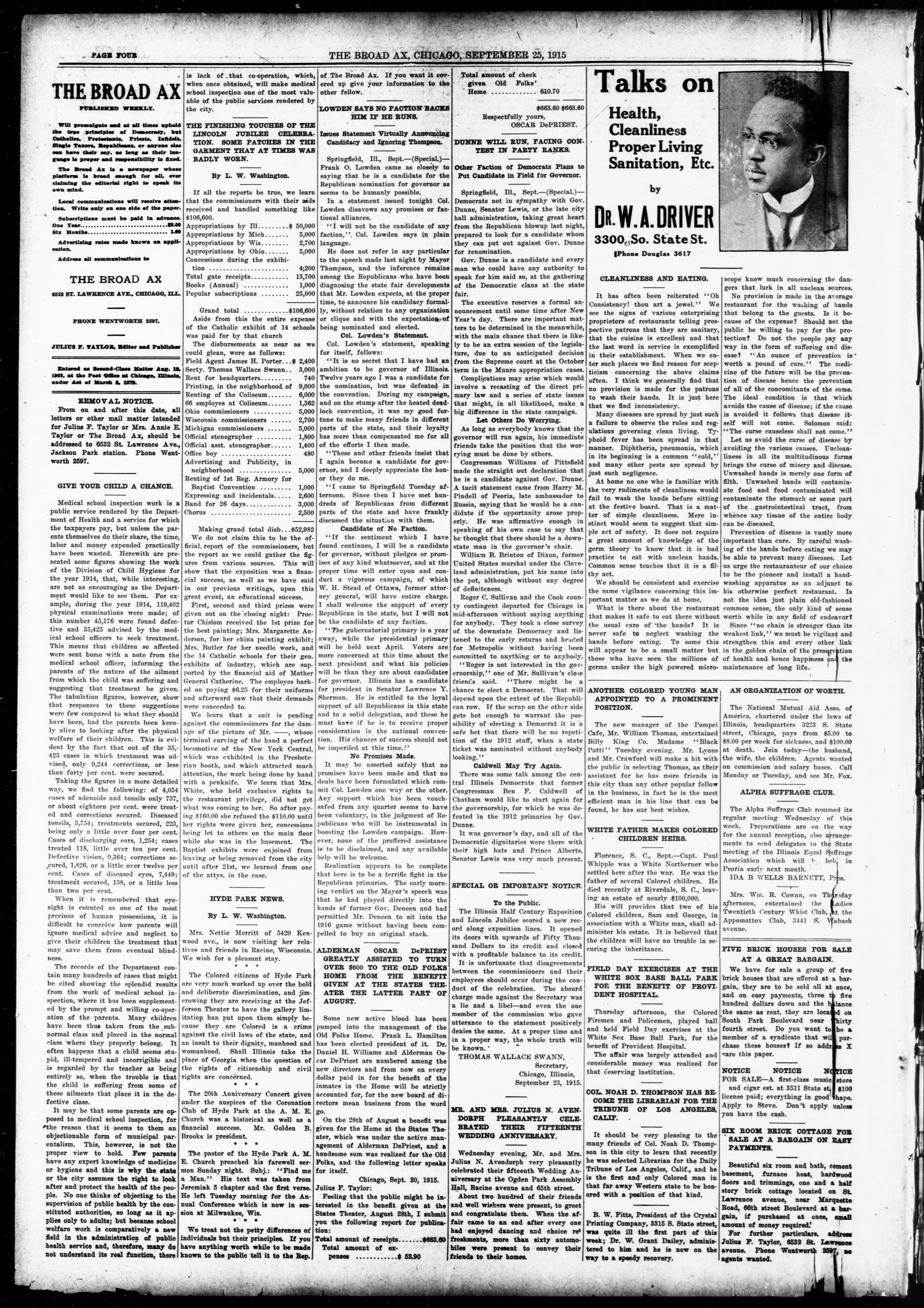
If all the reports be true, we learn
that the commissioners with their aids
received and handled something like
$106,600.
Appropriations by Ill.....$ 50,000
Appropriations by Mich.....5,000
Appropriations by Wis.....2,700
Appropriations by Ohio.....5,000
Concessions during the exhibi-
tion.....4,200
Total gate receipts.....13,700
Books (Annual).....1,000
Popular subscriptions.....25,000
Grand total
Grand total ..... $106,600
Aside from this the entire expense of the Catholic exhibit of 14 schools was paid for by that church
The disbursements as near as we could glean, were as follows:
Field Agent James H. Porter... $ 2,400
Seety. Thomas Wallace Swann... 3,000
Rent for headquarters... 740
Printing, in the neighborhood of 9,000
Renting of the Coliseum... 6,000
66 employes at Coliseum... 1,362
Ohio commissioners... 5,000
Wisconsin commissioners... 2,700
Michigan commissioners... 5,000
Official stenographer... 1,800
Official asst. stenographer... 1,400
Office boy... 480
Advertising and Publicity, in neighborhood... 5,000
Renting of 1st Reg. Armory for Baptist Convention... 1,000
Expressing and incidentals... 2,600
Band for 26 days... 3,000
Chorus... 2,500
Making grand total disb...$52,982
We do not claim this to be the official report of the commissioners, but the report as we could gather the figures from various sources. This will show that the exposition was a financial success, as well as we have said in our previous writings, upon this great event, an educational success.
First, second and third prizes were given out on the closing night: Proctor Chismil received the 1st prize for the best painting; Mrs. Margarette Anderson, for her china painting exhibit; Mrs. Butler for her needle work, and the 14 Catholic schools for their gen. exhibits of industry, which are supported by the financial aid of Mother General Catherine. The employees barked on paying $6.25 for their uniforms and afterward saw that their demands were conceded to.
We learn that a suit is pending against the commissioners for the damage of the picture of Mr. ——, whose terminal carving of the hand a perfect locomotive of the New York Central, which was exhibited in the Presbeterian booth, and which attracted much attention, the work being done by hand with a penknife. We learn that Mrs. White, who held exclusive rights to the restaurant privilege, did not get what was coming to her. So after paying $160.00 she refused the $110.00 until her rights were given her, concessions being let to others on the main floor while she was in the basement. The Baptist exhibits were enjoined from leaving or being removed from the city until after 21st, we learned from one of the attys, in the case.
HYDE PARK NEWS
By L. W. Washington.
Mrs. Nettie Merritt of 5420 Kenwood ave., is now visiting her relatives and friends in Racine, Wisconsin. We wish for a pleasant stay.
* * * *
The Colored citizens of Hyde Park are very much worked up over the bold and deliberate discrimination, and jimcrowing they are receiving at the Jefferson Theater to have the gallery limitation ban put upon them simply because they are Colored is a crime against the civil laws of the state, and an insult to their dignity, manhood and womanhood. Shall Illinois take the place of Georgia when the question of the rights of citizenship and civil rights are concerned.
The 20th Anniversary Concert given under the auspices of the Coronation Club of Hyde Park at the A. M. E. Church was a historical as well as a financial success. Mr. Golden B. Brooks is president.
* * *
The pastor of the Hyde Park A. M. E. Church preached his farewell sermon Sunday night. Subj.: "Find me a Man." His text was taken from Jeremiah 5 chapter and the first verse. He left Tuesday morning for the Annual Conference which is now in session at Milwaukee, Wis.
* * *
We treat not the petty differences of individuals but their principles. If you have anything worth while to be made known to the public tell it to the Rep.
---
THE BROAD AX, CHICAGO, SEPTEMBER 25, 1915
of The Broad Ax. If you want it covered up give your information to the other fellow.
Total amount of check given Old Folks'
Home ..... 610.70
LOWDEN SAYS NO FACTION BACKS
HIM IF HE RUNS.
Issues Statement Virtually Announcing Candidacy and Ignoring Thompson.
Springfield, Ill., Sept.—(Special.)—Frank O. Lowden came as closely to saying that he is a candidate for the Republican nomination for governor as seems to be humanly possible.
In a statement issued tonight Col. Lowden disavows any promises or factional alliances.
"I will not be the candidate of any faction," Col. Lowden says in plain language.
He does not refer in any particular to the speech made last night by Mayor Thompson, and the inference remains among the Republicans who have been diagnosing the state fair developments that Mr. Lowden expects, at the proper time, to announce his candidacy formally, without relation to any organization or clique and with the expectation of being nominated and elected.
Col. Lowden's Statement.
Col. Lowden's statement, speaking for itself, follows:
"It is no secret that I have had an ambition to be governor of Illinois. Twelve years ago I was a candidate for the nomination, but was defeated in the convention. During my campaign, and on the stump after the heated deadlock convention, it was my good fortune to make many friends in different parts of the state, and their loyalty has more than compensated me for all of the efforts I then made.
"These and other friends insist that I again become a candidate for governor, and I deeply appreciate the honor they do me.
"I came to Springfield Tuesday afternoon. Since then I have met hundreds of Republicans from different parts of the state and have frankly discussed the situation with them.
Candidate of No Faction.
"If the sentiment which I have found continues, I will be a candidate for governor, without pledges or promises of any kind whatsoever, and at the proper time will enter upon and conduct a vigorous campaign, of which W. H. Stead of Ottawa, former attorney general, will have entire charge. I shall welcome the support of every Republican in the state, but I will not be the candidate of any faction."
"The gubernatorial primary is a year away, while the presidential primary will be held next April. Voters are more concerned at this time about the next president and what his policies will be than they are about candidates for governor. Illinois has a candidate for president in Senator Lawrence Y. Sherman. He is entitled to the loyal support of all Republicans in this state and to a solid delegation, and these he must have if he is to receive proper consideration in the national convention. His chances of success should not be imperiled at this time."
No Promises Made.
It may be asserted safely that no promises have been made and that no deals have been formulated which commit Col. Lowden one way or the other. Any support which has been vouched for from any quarter seems to have been voluntary, in the judgment of Republicans who will be instrumental in boosting the Lowden campaign. However, none of the proffered assistance is to be disclaimed, and any available help will be welcome.
Realization appears to be complete that here is to be a terrific fight in the Republican primaries. The early morning verdict on the Mayor's speech was that he had played directly into the hands of former Gov. Deneen and had permitted Mr. Deneen to sit into the 1916 game without having been compelled to buy an original stack.
ALDERMAN OSCAR DePRIEST GREATLY ASSISTED TO TURN OVER $600 TO THE OLD FOLKS HOME FROM THE BENEFIT GIVEN AT THE STATES THEATER THE LATTER PART OF AUGUST.
Some new active blood has been pumped into the management of the Old Folks Home. Frank L. Hamilton has been elected president of it. Dr. Daniel H. Williams and Alderman Oscar DePriest are numbered among the new directors and from now on every dollar paid in for the benefit of the inmates in the Home will be strictly accounted for, for the new board of directors mean business from the word go.
On the 28th of August a benefit was given for the Home at the States Theater, which was under the active management of Alderman DePriest, and a handsome sum was realized for the Old Folks, and the following letter speaks for itself.
Chicago, Sept. 20, 1915.
Julius F. Taylor:
Feeling that the public might be interested in the benefit given at the States Theater, August 28th, I submit you the following report for publication:
Total amount of receipts.....$663.60
Total amount of ex-
DUNNE WILL BUN, FACING CON
TEST IN PARTY RANKS.
Other Faction of Democrats Plans to Put Candidate in Field for Governor.
Springfield, Ill., Sept.—(Special.)—Democrats not in sympathy with Gov. Dunne, Senator Lewis, or the late city hall administration, taking great heart from the Republican blowup last night, prepared to look for a candidate whom they can put out against Gov. Dunne for renomination.
Gov. Dunne is a candidate and every man who could have any authority to speak for him said so, at the gathering of the Democratic clans at the state fair.
The executive reserves a formal announcement until some time after New Year's day. There are important matters to be determined in the meanwhile, with the main chance that there is likely to be an extra session of the legislature, due to an anticipated decision from the Supreme court at the October term in the Munro appropriation cases. Complications may arise which would involve a recasting of the direct primary law and a series of state issues that might, in all likelihood, make a big difference in the state campaign.
Let Others Do Worrying.
As long as everybody knows that the governor will run again, his immediate friends take the position that the worrying must be done by others.
Congressman Williams of Pittsfield made the straight out declaration that he is a candidate against Gov. Dunne. A tacit statement came from Harry M. Pindell of Peoria, late ambassador to Russia, saying that he would be a candidate if the opportunity arose properly. He was affirmative enough in speaking of his own case to say that he thought that there should be a downstate man in the governor's chair.
William B. Brinton of Dixon, former United States marshal under the Cleveland administration, put his name into the pot, although without any degree of definiteness.
Roger C. Sullivan and the Cook county contingent departed for Chicago in mid-afternoon without saying anything for anybody. They took a close survey of the downstate Democracy and listened to the early returns and headed for Metropolis without having been committed to anything or to anybody. "Roger is not interested in the governorship," one of Mr. Sullivan's close friends said. "There might be a chance to elect a Democrat. That will depend upon the extent of the Republican row. If the scrap on the other side gets hot enough to warrant the possibility of electing a Democrat it is a safe bet that there will be no repetition of the 1912 stuff, when a state ticket was nominated without anybody looking."
Caldwell May Try Again.
There was some talk among the central Illinois Democrats that former Congressman Ben F. Caldwell of Chatham would like to start again for the governorship, for which he was defeated in the 1912 primaries by Gov. Dunne.
It was governor's day, and all of the Democratic dignitaries were there with their high hats and Prince Alberts. Senator Lewis was very much present.
SPECIAL OR IMPORTANT NOTICE
To the Public.
The Illinois Half Century Exposition and Lincoln Jubilee scored a new record along exposition lines. It opened its doors with upwards of Fifty Thousand Dollars to its credit and closed with a profitable balance to its credit. It is unfortunate that disagreements between the commissioners and their employees should occur during the conduct of the celebration. The absurd charge made against the Secretary was a lie and a libel—and even the one member of the commission who gave utterance to the statement positively denies the same. At a proper time and in a proper way, the whole truth will be known.
THOMAS WALLACE SWANN,
Secretary,
Chicago, Illinois,
September 23, 1915.
MR. AND MRS. JULIUS N. AVEN-
DOPH PLEASANTLY CELE-
BRATED THEIR FIFTEENTH
WEDDING ANNIVERSARY.
Wednesday evening, Mr. and Mrs. Julius N. Avendorch very pleasantly celebrated their fifteenth Wedding Anniversary at the Ogden Park Assembly Hall, Racine avenue and 65th street. About two hundred of their friends and well wishers were present, to greet and congratulate them. When the affair came to an end after every one had enjoyed dancing and choice refreshments, more than sixty automobiles were present to convey their friends to their homes.
CLEANLINESS AND EATING.
It has often been reiterated "Oh Consistency! thou art a jewel." We see the signs of various enterprising proprietors of restaurants telling prospective patrons that they are sanitary, that the cuisine is excellent and that the last word in service is exemplified in their establishment. When we enter such places we find reason for scepticism concerning the above claims often. I think we generally find that no provision is made for the patrons to wash their hands. It is just here that we find inconsistency.
Many diseases are spread by just such a failure to observe the rules and regulations governing clean living. Typhoid fever has been spread in that manner. Diphtheria, pneumonia, which in its beginning is a common "cold," and many other pests are spread by just such negligence.
At home no one who is familiar with the very rudiments of cleanliness would fail to wash the hands before sitting at the festive board. That is a matter of simple cleanliness. Mere instinct would seem to suggest that simple act of safety. It does not require a great amount of knowledge of the germ theory to know that it is bad practice to eat with unclean hands. Common sense teaches that it is a filthy act.
We should be consistent and exercise the same vigilance concerning this important matter as we do at home.
What is there about the restaurant that makes it safe to eat there without the usual care of the hands? It is never safe to neglect washing the hands before eating. To some this will appear to be a small matter but those who have seen the millions of germs under the high powered micro-
ANOTHER COLORED YOUNG MAN
APPOINTED TO A PROMINENT
POSITION.
The new manager of the Pompei Cafe, Mr. William Thomas, entertained Billy King Co. Madame "Black Patti" Tuesday evening. Mr. Lyons and Mr. Crawford will make a hit with the public in selecting Thomas, as their assistant for he has more friends in this city than any other popular fellow in the business, in fact he is the most efficient man in his line that can be found, he has our best wishes.
WHITE FATHER MAKES COLORED
CHILDREN HEIRS.
Florence, S. C., Sept.—Capt. Paul Whipple was a White Northerner who settled here after the war. He was the father of several Colored children. He died recently at Riverdale, S. C., leaving an estate of nearly $100,000. His will provides that two of his Colored children, Sam and George, in association with a White man, shall administer his estate. It is believed that the children will have no trouble in securing the inheritance.
FIELD DAY EXERCISES AT THE WHITE SOX BASE BALL PARK FOR THE BENEFIT OF PROVIDENT HOSPITAL.
Thursday afternoon, the Colored Firemen and Policemen, played ball and held Field Day exercises at the White Sox Base Ball Park, for the benefit of Provident Hospital.
The affair was largely attended and considerable money was realized for that Deserving institution.
COL. NOAH D. THOMPSON HAS BE-COME THE LIBRARIAN FOR THE TRIBUNE OF LOS ANGELES, CALIF.
It should be very pleasing to the many friends of Col. Noah D. Thompson in this city to learn that recently he was selected Librarian for the Daily Tribune of Los Angeles, Calif., and he is the first and only Colored man in that far away Western state to be honored with a position of that kind.
B. W. Pitts, President of the Crystal Printing Company, 3315 S. State street, was quite ill the first part of this week; Dr. W. Grant Dailey, administered to him and he is now on the way to a speedy recovery.
[Name]
scope know much concerning the dangers that lurk in all unclean sources. No provision is made in the average restaurant for the washing of hands that belong to the guests. Is it because of the expense? Should not the public be willing to pay for the protection? Do not the people pay any way in the form of suffering and disease? "An ounce of prevention is worth a pound of cure." The medicine of the future will be the prevention of disease hence the prevention of all of the concomitants of the same. The ideal condition is that which avoids the cause of disease; if the cause is avoided it follows that disease itself will not come. Solomon said: "The curse causeless shall not come." Let us avoid the curse of disease by avoiding the various causes. Uncleanliness in all its multitudinous forms brings the curse of misery and disease. Unwashed hands is merely one form of filth. Unwashed hands will contaminate food and food contaminated will contaminate the stomach or some part of the gastrointestinal tract, from whence any tissue of the entire body can be diseased.
Prevention of disease is vastly more important than cure. By careful washing of the hands before eating we may be able to prevent many diseases. Let us urge the restaurateur of our choice to be the pioneer and install a hand-washing apparatus as an adjunct to his otherwise perfect restaurant. Is not the idea just plain old-fashioned common sense, the only kind of sense worth while in any field of endeavor Since "no chain is stronger than its weakest link," we must be vigilant and strengthen this and every other link in the golden chain of the preservation of health and hence happiness and the maintenance of long life.
AN ORGANIZATION OF WORTH.
The National Mutual Aid Asso. of America, chartered under the laws of Illinois, headquarters 3223 S. State street, Chicago, pays from $5.00 to $8.00 per week for sickness, and $100.00 at death. Join today—the husband, the wife, the children. Agents wanted on commission and salary bases. Call Monday or Tuesday, and see Mr. Fox.
ALPHA SUFFRAGE CLUB
The Alpha Suffrage Club resumed its regular meeting Wednesday of this week. Preparations are on the way for the annual reception, also arrangements to send delegates to the State meeting of the Illinois Equal Suffrage Association which will be held in Peoria early next month.
FIVE BRICK HOUSES FOR SALE
AT A GREAT BARGAIN.
We have for sale a group of five brick houses that are offered at a bargain, they are to be sold all at once, and on easy payments, three to five hundred dollars down and the balance the same as rent, they are located on South Park Boulevard near thirty fourth street. Do you want to be a member of a syndicate that will purchase these houses? If so address X care this paper.
NOTICE NOTICE NOTICE
FOR SALE—A first-class music store and cigar est. at 3511 State st. $100 license paid; everything in good shape. Apply to Steve. Don't apply unless you have the cash.
SIX ROOM BRICK COTTAGE FOR SALE AT A BARGAIN ON EASY PAYMENTS.
Beautiful six room and bath, cement basement, furnace heat, hardwood floors and trimmings, one and a half story brick cottage located on St. Lawrence avenue, near Marquette Road, 66th street Boulevard at a bargain, if purchased at once, small amount of money required.' For further particulars, address Julius F. Taylor, 6532 St. Lawrence avenue. Phone Wentworth 2597, no agents wanted.
Mrs. J. P. Faulkner is spending a pleasant visit in Washington, D. C. she will remain for two weeks
McKinley Emanuel, the youngest son of Prof. and Mrs. William Emanuel, 6352 Rhodes avenue, is attending the Fisk University, Nashville, Tenn.
Attorney Richard E. Westbrooks, 3000 S. State street, spent Tuesday of this week in Springfield, Ill., on legal business.
Attorney Alva L. Bates, late of Washington, D. C., has come to Chicago to reside and he has opened a law office at 3102 S. State street, suite No. 1.
Attorney A. L. William, 184 West Washington street, was one of the shouters for the Hon. Charles S. Deneen at Springfield, Ill., on Wednesday.
Dr. George C. Hall, 3408 South Park avenue, is on a ten days vacation trip to Mobile, Ala. He may visit his friend Dr. Booker T. Washington, at Tuskegee Institute, Ala., before returning home.
J. Hockley Smiley, one of the ablest newspaper men in this country is still confined to his home at 5422 S. Dearborn street with a severe spell of sickness. It is hoped by his many friends that he will soon be himself again and discharge his duties as managing editor of The Chicago Defender.
Attorney Taylor G. Ewing, of Nashville, Tenn., has spent the past week in Chicago, in company with Attorney S. A. T. Watkins, in relation to the great fight, between the contending factions of the National Baptist Convention.
Mrs. Edmund Merritt of 1310 Frederick Ct. and Mrs. Wilson Merritt is the guest of their father-in-law and mother, Rev. J. T. Merritt, of Racine, Wis., and is expecting to be joined by Miss Estella Davis of 5622 Lake Park Ave. Where they will, attend the Conference in Milwaukee, Wis.
Estella Davis was entertained by her father, Mr. R. H. Hyde of Demoines, Iowa, Tuesday evening. He has been very busy attending the C. A. Exposition of which he had an exhibit of Little Ollie Cleaner and other soaps. He returned home Wednesday morning saying he was very tired but well pleased over the Exposition.
---
Messrs. Alex. Taylor, Exalted Ruler. S. H. Brooks, Past Dist. Deputy and Trustee, F. C. Payne, Trustee and Past Exalted Ruler and John Lawson Past Esquire, Delagates of Morning Star Lodge, No. 40 of Washington, D.C., Wm. J. Niles, Capt. Hood Lodge 139, Westchester, Pa. and Wm. E. Walker, are being entertained and feted at the residence of Mrs. Louise Hayden, 3916 Dearborn St. Mrs. Hayden nee Spencer was formerly of Washington, D.C.
WANTED
Demonstrators or salesmen and women for the Baker Friction Heater for Houses or Garages; those who saw it operate at the Exposition preferable; others may apply. Call or address. C. S. L. BAKER, 3852 Vincennes avenue, Chicago, Ill. Phone 4132 Douglas
Nobody can know how many lives that new sea wall saved Galveston.
A self made man generally thinks that he has accomplished a real work of art.
In the confusion of greater clashes the dumdum bullet seems to have been lost sight of.
It is an easy thing for a man to resist temptation if he has something better in sight.
Some people never put off till tomorrow what they can get somebody else to do for them today.
When a man is old enough to know better doing a foolish thing won't make him look young.
Do not blame the ass for being stubborn. He would not be a perfect ass if he were otherwise.
When you have to take back things that you have said you are likely to find the goods somewhat damaged.
Our system of education makes children wiser than their parents. But the children are no wiser than their parents were at their age.
It is hard for a talkative person to understand that another may be silent for no other reason than that he has nothing to say.
France's National Museum.
The Musee Carnayet of Paris is also known as the National museum, for it contains objects pertaining to the history of France and especially of the French revolution. The sacredness of antiquity clings to the building itself, which was begun in 1544 and enlarged in 1600 by Mansart, the famous architect of Louis XIV. In 1677 it became the home of Mme. de Sevigne, who lived there for eighteen years and after whom the street is named that faces the principal entrance. Among the contents of this museum are fragments and statues from noted old buildings which no longer exist. There are also a weird portrait done in wax of Henry IV, made, the day after his assassination, and an autograph order from Louis XVI, for the defenders of the Tulleries to cease firing. Things of historic interest are numerous, but none more sanguinary than the copy of the constitution of 1798 bound in human skin.
De Lisle's Tragedy
An affair of the youth of Rouget de Lisle, author of the "Marseillaise," is told by a French journal. In 1870, when he was about twenty years old, Rouget de Lisle, a pupil of the military school, was deeply smitten with the charms of a young girl of Courbevoie, Mile. Camille, whose father was a captain on half pay. The betrothal was made the occasion of a family fete, in the course of which some fireworks were to be set off. The future officer could not leave to others the care of touching off the powder. When the moment came to fire the principal piece, which showed the figure of his well beloved, he approached with a light in his hand, the guests meanwhile taking their places on a terrace opposite him. The piece was lighted, but a rocket badly directed struck the young girl on the forehead, and she died some days after in consequence of her burns.
A. Queer Fish.
One of the queerest of odd creatures is the mud skipper, or jumping fish, which inhabits the large rivers of India and the neighboring seacoasts. At ebb tide these little fishes leave the water to hunt for tiny crabs, files, etc., and their strong pectoral and ventral fins, aided by their tail, enable them to move about easily and to climb upon trees, grass and leaves.
With their huge eyes, seeming to project far out of their sockets, they can see as well on land as in the water. They progress in short, quick leaps, effected by sharply bending the rear third of the body to the left and suddenly straightening it. In color they are usually light brown, with dark bands, though they sometimes appear light green. They are easily caught and are much used in Burma.
Long Words.
While our language does not contain such long words as are found in some other tongues nor so many words of unusual length, still we have several that are awkwardly long for conversational purposes. We have "philoprogenitiveness," with twenty letters; "interconvertibilities," with twenty-one; "intercommunicabilities," with twenty-two; "disproportionableness," with twenty-three, and transsubstantiationals" and "contradistinguishability," each containing twenty-four letters. An effective little word is "synacategoromatic" as it manages to compress eight syllables into seventeen letters. The longest monosyllables contain nine letters, and there are four examples, "splotched," "squelched," "strengths" and "stretched."
When Coins Were First Made
Certain passages in the "Iliad" of Homer would lead to the inference that coins of brass were struck as early as 1184 B. C. Tradition affirms that the Chinese had bronze coins as early as 1120 B. C. But Herodotus, "the father of history," ascribes the "invention" of coins to the Lydians, about nine centuries B. C. and there is no satisfactory evidence that coins were known prior to that date.
Optimistic.
Hall-Blythe is a pretty optimistic character I hear. Well-I should say so! If he failed in business he'd thank heaven he had his health; if he failed in health he'd be glad he had his business, and if he failed in both he'd say there was no use having one without the other.—London Telegraph.
Asiatic Turkey:
Asiatic Turkey had a civilization thousands of years ago. The interior of that country is populated today by farmers to whom modern knives and forks are unknown. The spoons they use are of wood, and each family makes its own.
A. Narrow Escape
"What! You a widow, dear cousin?"
"Yes."
"Well, that's a lucky escape for me. Do you know, I nearly married you once."-Exchange.
Take Your Choice
From Sir John Lubbock we take this ennobling thought: "You may see in a shallow pool either the mud lying at the bottom or the image of the blue sky above."
One Sure Outlet.
Strawber—Why do you think you will have any trouble in keeping the engagement secret? Singerly—I had to tell the girl, didn't I?—Puck.
What one has that one ought to use, and whatever we take in hand we ought to do with all our might.—Cheese.
THE BROAD AX. CHICAGO. SEPTEMBER 25. 1915
Harvest Time In Shantung.
Now, come and see a harvest in Shantung. Here, too, it is the time of supreme interest to the whole family. Life in the country is practically measured by so many wheat harvests, and every old man and woman hopes to live to see one more. For weeks before all plans are made with reference to it. Carpentry, masonry, work of every kind must either be finished before "pulling wheat time" or laid aside at that time to wait until the harvest is over. No matter how important in the eyes of a foreign resident the work in hand may become, he cannot beg or buy his workmen to continue when once the wheat is ripe. In the hospitals all the patients want to get well by wheat pulling time. Some must stay on, but many a one incapacitated in hand or foot for real work goes home to take his or her place in "watching the gate," that all the rest of the family may go to the field and thrashing floor.—Christian Herald.
The Irish of the Balkans.
The Servians are the Irish of southeastern Europe, with all the virtues and some of the weaknesses of the Irish people. They are especially proud of their national poetry, which they possess as no other nation possesses in modern times, for they still have their national bards—men who live by making national song, not highly cultured poets, but men in the street. They do not go to a newspaper to report what they hear, but to the next inn or coffee house, and there take up their instruments to recite what they have to say. Virtually our bards are ancient reporters. The old ones sing. Those of the present day stenograph. The Servian language is the richest and most musical of the Slav dialects. The Russian language has that reputation, but it is not so musical and clear and rich—Miyatovitch, Servian minister to England, in the Manchester Guardian.
Clouded Windows.
Many people have a window or a part of one which they would like barred to the too curious gaze of passersby or, possibly, of neighbors.
This can be managed by prettily crystallizing the window glass as follows: Fill a jam pot one-third full of gum arabic and add a little hot water. Let this soak for some hours and when the gum has quite dissolved add the same quantity of epsom salts. Then stand the jam pot in a basin of hot water and stir well until the salt has quite dissolved. Apply the mixture to the glass quickly with a camel's hair brush.
The effect is like crystallized ground glass, and, while light is admitted, no one can see through it. The effect of plain ground glass is obtained by using a linen rag instead of a brush and putting the preparation on thinly—Exchange.
It Was a Nice Stone
General Sir John Younghusband, the well known writer on military subjects, was once cleverly victimized by some Indian natives. At a village where he was encamping the dusky inhabitants brought to his tent a number of sapphire-like stones which they stated had been dug up at a spot some distance from the village. Sir John was convinced that he had luckily hit on a treasure mine. He bought every stone the natives possessed.
"I had dreams of boundless wealth," said Sir John when relating the story, "and on my arrival at Calcutta I hastened to have the stones valued. 'Lovely color, light, perfect, not a flaw, worth 50 guineas apiece if they were not made of Birmingham paste'" was the expert's crushing criticism."—London Tatler.
Story of a Postal Card
Don't despise the badly written postal card, moralizes a writer in Business. He received a card that was written in a scrawl and showed signs of having been in the writer's pocket for some time after he had signed it. But it was answered just as if it had been written by a reputable business man. And it was. It seemed that the card had been hastily written on the cars, put into the merchant's pocket, discovered several days later and then mailed. "We have since," concludes the writer, "done a very nice business with this man."
His Music Room.
"And you call this your music room?"
"Yes."
"But there are no musical instruments in it?"
"No. It's so constructed that I can't hear any of the surrounding music that may be turned on from time to time."
—Volin World.
A Lesson In English
Teacher—Now, Clarence, can you tell me what "can't" is the abbreviation of? Clarence—It's the abbreviation of "cannot." Teacher-That's right. Now, Edgar, what is "don't" the abbreviation of? Edgar—"Doughnut."—Chicago News.
Try to Reserve It.
Contentment in old age is deserved by him alone who has not lost faith in what is good, his persevering strength of will and his desire for active employment—Turrenleff.
Solendid Scheme
Mother (of her son)—He has a beautiful voice, and we have had him taught the flute so that he can accompany himself.—Exchange.
He Did.
"Did Simkins get any damages in that assault case?"
"Did he? My dear fellow, you ought to see his face."
Are You a Book Borrower?
Have you borrowed a book? Read and return it. If you cannot read it soon return it and trust to your being able to borrow it again. In keeping it an unreasonable time you may be keeping some one else from the pleasure reading it may afford. Look over your shelves and see what you have there that should be returned. The man who should borrow so little as a quarter of a dollar from a neighbor and fall to return it would not invite respect. Yet it is quite as bad not to return a book or magazine. Who has not had anguish of heart to have some choice, dearly prized volume returned, soiled or torn, with pages lacking? That "Tom upset his inkstand" or "the baby got hold of it" or similar excuse does not mend the matter. The borrowed book should be protected from such accidents. What was worth borrowing is certainly worth returning. Certainly it should be clear in your mind that it is not yours, but the property of another—Milwaukee Journal.
Rapid Pie Making
The fastest machine devised for making pies is operated by a foreman and six assistants and will turn out 1,800 pies an hour, according to the World's Work. The machine is provided with eighteen revolving pie holders which move around an oblong table or platform; two crust rollers, one for the lower and the other for the upper crust; a set of four automatic moistening brushes and a pie trimming wheel. The six operators of the machine place the crusts, fill the pies and remove them from the table when the operation of moistening and trimming has been automatically completed. A smaller machine, the working principle of which is similar, except that the table is round instead of oblong, will turn out 600 pies an hour when operated by three pie makers.
Modern Sea Fighting.
A favorite theme of the artist—the sea battle—is spoiled forever. Modern vessels fight at from ten to seventeen miles, if they fight at all, and thrilling pictures such as Jones, Perry, Farragut, Nelson and Dewey have inspired probably will not be painted again.
Marine warfare has become very largely a matter of hide and seek anyway. So far has the gunmaker outstripped the armor plate builder that were equally matched vessels to engage, a few seconds' firing would reduce millions of dollars' worth of ships to scrap iron shambles.
And when the skulking menace of the submarine is considered we can understand how completely the traditions of sea fighting have been upset.—Detroit News.
Numbered Teaspoons
In the early days of tea drinking, when the brew was rare and costly, numbered spoons were used. It was not etiquette for a guest to ask for a second cup until all the company had finished the first. The numbered spoons therefore insured each getting his own cup back again. As a sign to the hostess that no more tea was wanted the spoon was placed in the cup. Even when etiquette was a fetish teapot spouts sometimes got choked up, so the long handle of the spoon with a pierced bowl that succeeded the silver strainer was thrust down the spout to disperse the leaves. "Etiquette," remarks Arthur Hayden in "Chats on Old Silver," "forbade the hostess to blow down the spout."
Crippled Feet In China.
According to Chinese history, the custom of small feet among the females of China originated several centuries back, when a large body ofomen rose against the government and tried to overthrow it. To prevent the recurrence of such an event the use of wooden shoes so small as to disable them from making any effective use of their feet was enforced on all female infants.
Close Resemblance:
"Isn't that a Bourgereau?" asked Mrs. Oldcastle as they stopped for a moment to look at the new pictures. "Oh, my, no." replied the hostess, "It's a lion. But I told Josiah when he brought it home that it looked a good deal more like one of them things you mention."—Chicago Herald.
Not Anxious to Meet Him
"Inks has had a burglar alarm put in his house with a gong in every room."
"He wants to be sure to know about the burglarars?"
"No. He wants the burglar to be sure to be alarmed."
Shakespeare's Heroines.
In Shakespeare's time the parts of heriones were taken by boys, there being no female actors. That is why the poet makes so many of his heriones disguise themselves in male attire.
She Was Busy.
"Your wife seems busy these days."
"Yes; she is to address a woman's club."
"Ah, working on her address!"
"No; on her dress."—Exchange.
A Great Thinker
"Bliggins puts a great deal of thought into his work."
"Yes; he works ten minutes and then thinks about it for an hour and a quarter."
Caged Birds.
The old notion that caged birds, upon being set free, are immediately set upon and killed by wild birds has been found to be untrue by experiments.
To Our Patrons
Kindly take notice, that we operate one store only at
3218 STATE ST. 3218
any other statement rumored around is merely for the purpose of misleading the public, the name of our establishment has been built up on honorable dealings, and at all times our values are given to the public at the lowest of prices, therefore don't be mislead and let us continue to serve you with the latest styles and for the least money.
LINCOLN M
3218 So. S
LINCOLN MILLINERY 3218 So. State St.
When Passing By Take a Peek at Our
When Passing By Take a Peek at Our Windows
A. E.
Moral "Risks."
It is pointed out by a modern thinker that there is no such thing as a moral risk, for when we talk about a "risk" we mean that there is a possibility, but not a certainty, that harm will result. A boy takes a physical risk when he goes skating on that part of the river where the ice is thin. He may fall through and injure his health or lose his life. But when we venture on thin ice in our moral life there is no risk in the matter at all. There is assured catastrophe from the moment we start in that direction. No one can do anything which he knows involves possible moral danger without thereby definitely passing beyond the line of mere danger into positive injury to his character.
Henry Thomas Buckle's thoughts and conversation were always on a high level. Once he remarked: "Men and women range themselves into three classes or orders of intelligence. You can tell the lowest class by their habit of always talking about persons, the next by the fact that their habit is always to converse about things, the highest by their preference for the discussion of ideas."
Almost Sensational.
"I have a ripping idea for a moving picture film."
"Let's have it. Ripping ideas are scarce."
"Show a young woman doing the housework while her mother is sitting on the porch manicuring her nails."—New York American.
The Welsh Language.
Welsh is taught in the public schools of Wales, is universally spoken there and is extensively spoken in this country. The language is not closely related to the Irish and highland Gaelic, but is of the same branch as the ancient Cornish and Breton languages.
Gold In the Bible
The earliest book which mentions gold is the Bible. In the second chapter of Genesis, eleventh verse, occur the words, "the whole land of Havillah, where there is gold."
Doctor (who is not feeling well, to himself)—What shall I do? I haven't any confidence in any of those other doctors, and, as for myself, my charges are too high.
The Double Standard
Knicker—How big is your boy? Bocker—He takes a four-year-old street car seat and a ten-year-old suit—New York Sun.
The noblest part of our existence is based upon sentiment.
Three Classes.
A Dilemma.
Patrons
Copyright 1915
Sage Bridges & Co.
Chicago
MILLINERY
State St.
deliver hats free
a Peek at Our Windows
MRS. A. STEPHEN'S CAFE AND RESTAURANT.
There is no better and no more up-to-date business woman in Chicago, who is more widely and favorably known than Mrs. A. Stephens, whose place of business is at 2913 S. State Street.
All of her patrons receive the very best and most courteous treatment and are served with wholesome food, at the lowest and most popular prices. Home cooking a specialty. She also successfully conducts a furnished rooming house for men only at 2927 S. State Street and her places of business are worthy of the patronage of the public.
Lace that is too delicate to be washed in the usual way can be cleaned in this way: Make a strong soapsuds of some good soap and allow the lace to remain in it for several hours at least, although it is well to shake it out occasionally. A wide mouthed bottle is most convenient to handle. When the lace is thoroughly soaked let the soapy water out of the bottle and keep adding clean water until the soap has all been removed from the lace. Do not handle the lace at all; shaking the bottle will rinse it thoroughly.
If the lace is narrow wind it round a bottle that has been covered with a piece of soft flannel, and do not remove it until it is dry. If it is too wide to care for in that way dry it on a large cushion. First cover the cushion with a heavy towel, then pin the points of the lace in place and allow it to dry. It is better not to use steel pins on account of the danger from rust. When dry the lace will look like new.-Youth's Companion.
Famous Temple and Statue
Famous Temple and Statue.
Since about the year 752 the grand ceremony of Kalgen, or "opening the spiritual eye of the statue," has been celebrated but five times at the temple commonly known as the Daibatsu of Nara, at Tokyo. The original statue has suffered grievously since 752. Once, in 855, the head dropped off. Since then it has suffered twice from fire, and upon each occasion the head was destroyed. The statue in its sitting posture measures fifty-three and a half feet, the length of the face being sixteen feet. The two Bodhisattavas flanking the Daibatsu are as high as thirty feet. The temple is 188 feet in frontage and 166 feet in depth and is known as the largest wooden building in Japan, though it is much smaller than the original, built 1,100 years ago. It was not built to protect the statue from being exposed to the weather, but the statue was made to enshrine as the chief figure of the temple.
Tool Chest Courtship.
"It is 'plane' that I love you," he began.
"I is that on the 'level?'" she asked.
"Haven't I always been on the 'square' with you?"
"But you have many 'vises,'" she remonstrated.
"Not a 'bit' of it," he asserted.
"What made you 'brace' up?" she queried coquettish.
"The fact that I 'saw' you," he replied, with a bow.
"I ought to 'hammer' you for that," she answered saucily.
"Come and sit by me on the 'bench,'" he urged.
"Suppose the other should 'file' in?"
she murmured. "You shouldn't let your arms 'compass' me."
"I know a preacher who is a good 'joiner,'" he suggested. And they rushed off for the license—Building
---
PAGE FIVE
PAGE SIX
One of the greatest surprises of the war was the recent taking over of the leadership of the Russian forces by the czar and the transfer of the erstwhile commander in chief, the Grand Duke Nicholas, to the Caucasus. Many have been the conjectures as to why this change was made, for the Grand Duke Nicholas is generally regarded as the greatest of the Russian generals and one of the greatest soldiers produced by the war, whose masterly retreat owing to shortage of ammunition has aroused even greater admiration among military experts than
Photo by American Press Association. CZAR (LEFT) AND GRAND DUKE NICHOLAS, his invasion of Germany, his seizure of Galicia and his destruction of the Austrian strongholds. The power behind the throne that appears to have brought about the shelving of Grand Duke Nicholas is the same power that shelved General Sukomiloff, the late minister of war. This power is the national council of defense organized by the duma. This marked the inauguration of a new era in Russia, perhaps an era of legislative supremacy and control, although the duma has since been dismissed. Hitherto the duma has had but little power, but the war has changed this, and the duma has secured the ear of the czar, who, it is asserted, has really always been in favor of parliamentary forms of government.
It is not believed that the czar will be the de facto generalissimo of the Russian forces, for he lacks the qualities that such a position demands as well as the experience. It will be difficult indeed for the czar to find a real successor to Grand Duke Nicholas, for the present war has not brought to the foreground any Museovite officer qualified to take his place.
ELSIE JANIS BUYS OLD MANOR
She Will Reft Famous Colonial Place Near Tarrytown, N. Y.
Miss Elsie Janis, the popular actress, has purchased Phillipse Manor, the famous colonial place near Tarrytown, N. Y. It was one of the first of the old manor houses erected in that locality. It has the old doors with wide boards, the fireplaces of other days and is of the qualit architecture of the period in which it was built.
Miss Janis' intention is to preserve the house as it stands, adding whatever restorations may be necessary to restore the ravages caused by decay
Mary
MISS ELSIE JANIS.
and a fire which damaged the mansion in recent years. She and her mother will select the furniture. The manor is now being prepared for occupancy. Phillipse Manor was built about 1684 and is one of the oldest houses standing in the state of New York. It was erected by Frederic Fillipse, one of the wealthiest resident patentees on the Hudson. In the latter part of the seventeenth century it was known as the Fillipse-His-Castle. The Fillipse or Phillipse (as the name was anglicized) family were Tories during the Revolutionary period, and the manor was confiscated and has since passed through several hands.
SIRES AND SONS.
Hans Pfitzner, the well known German composer and conductor, has gone to the front.
William Allan Pinkerton, the famous detective, is the most ardent baseball fan in Chicago.
Colonel William H. Crook, chief disbursing officer, has been at the White House in some official capacity or other for fifty years.
Professor Gail Cleveland, who has just been decorated by the emperor of Japan with the Fifth Order of the Sacred Treasure for his services in the Tohoku Imperial university, is a graduate of the University of California, class of 1909.
Nathan Straus has presented his steam yacht, the Sisillina, to the provisional executive committee for general Zionist affairs of the Federation of American Zionists to relieve the general distress prevailing as a result of the war, particularly in the Holy Land.
Ambrose Swasey, who recently gave $250,000 to start an engineering foundation, which he hopes will do for the allied engineering professions what the Cleveland, Carnegie, Rockefeller and Sage foundations are doing, lives in Cleveland, O., and has an international reputation as a builder of telescopes.
Flippant Flings.
At least there is plenty of opportunity now in Europe for the complaining man who "only wants a fighting chance."—Cleveland Leader.
An ad. in a paper calls for a woman to play second violin. If they get one who'll consent to do that we'd like to look at her.—Detroit Free Press.
A New York judge says no woman should be allowed to run an auto. Evidently he is not one of those who look for universal suffrage soon, else he would be more cautious.—Cleveland Plain Dealer.
When the women get the votes in Pennsylvania there will just have to be a change in the registration laws. Voters will not be required to tell how old they are, just see if they are.—Philadelphia Press.
Echoes of the War.
Many tides will ebb and flow over the wrecks before there is an end to the submarine controversy. — Boston Herald.
The outlook for Christmas toys is said to be brighter. Europe, however, has no outlook for Christmas joys. — Detroit Free Press.
Piercing a battle front of 500 miles constitutes the toughest problem in long division yet tackled by military students. — Washington Post.
Figuring the cost of the war in money is easy, but some day they will have to figure the cost in human life, and then it will be different. — Philadelphia Press.
Pen and Brush.
Years ago Jack London rode on freight cars with the famous hobo A-No-1 to get local color for his fiction.
George Meredith, in spite of the dictionaries, always insisted on spelling "judgment" with an "e"—"judgement."
Miss Ina Coolbrith, who was associated with Bret Harte in the Overland Magazine, has been crowned poet laureate of California.
August Benziger, who has painted the portraits of Cardinal Farley and Charles M. Schwab, is the son of a Switzerland publisher. His father was much disappointed when the boy studied art.
BRIGHT BRIEFS.
Funny, isn't it, how a man heats up
when he gets a cold shoulder?
The banks are being embarrassed by
too much money, but nobody else is.
When we kick ourselves we never do
it as effectively as some one else
would.
The war game of the Atlantic fleet
will be under no perfunctory scrutiny
this year.
People usually find it easier to pay
a duty to society than to pay one to
humanity.
The man who is always blowing his
own horn in nine cases out of ten
knows only one tune.
Life is like a ball game. It isn't every fellow who makes a hit that can bring a run over the plate.
Attempts to make hay the day before the sun shines are as apt to be failures as those of the morning after.
A Brooklyn man bequeathed 98 cents to his daughter. Wonder what the bequest was marked down from.
If the average man would only keep a well controlled mouth the rest of his faults might be endured without unusual difficulty.
Science invents new ways to kill in battle, and surgery exhausts its ingenuity to save the wounded. War is at best an inconsistency.
It's only in golf championship tournaments that the poor players are eliminated. The rest of the year they clutter up the links frightfully.
The handkerchief is now being added to the wash rag and the common towel and the street car strap as a peril to health. But there are some risks we just have to take.
THE BROAD AX, CHICAGO, SEPTEMBER 25, 1915
IMPREGNABLE KIEL GREAT WAR HARBOR
Premier Naval Station of the German Empire.
BUILT up around the deep pocket of the Kieler Foehde, a narrow arm of the Baltic sea that cuts its way back into the province of Holstein, the city of Kiel lies well shielded from all hostile attacks and is centrally placed for the use of the fleet, either upon the open ocean or upon the inland sea, says a bulletin prepared by the National Geographic society. This ancient port city is headquarters for German sea strength, the first naval station of the empire.
The great war harbor of Kiel is one of the finest and most powerfully protected harbors in the world. The sea arm, whose base is inclosed by the port, has a narrow entrance and a long, irregular surface. The entrance and the strategic points along the bank are heavily fortified. Fort Falkenstein and Fort Stosch guard the narrows about three and one-half miles above the town. Flanking the northern termination of the new Kiel suburbs, the Kaiser Wilhelm canal, a triumph of patience and engineering, cuts its way into the sheltered bay. By means of this canal Kiel is in close communication with the North sea, and units of the kaiser's navy can be transferred rapidly and safely from the war theater of the open ocean to that of the Baltic.
The Kaiser Wilhelm canal, or the Baltic ship canal, is the product of an idea which ripened through centuries. Projects for connecting the Baltic and North seas by a water route through the northern peninsula which should
[Image of a cityscape with a large building and a river in the foreground].
VIEW IN THE CITY OF KIEL
avoid the dangerous voyage around Jutland were considered spasmodically from 1300 on, but it remained to the military necessities of a great empire to bring about the realization of this advantageous waterway for trade. Any number of bashful beginnings of the projected way were made before the construction of the present canal was undertaken by the first German emperor. Kaiser Wilhelm I. laid the foundation stone of the canal in 1887, and the costly avenue was formally declared open by the present emperor in 1895. The original canal has been extensively improved.
The canal crosses the peninsula from Holtenau just beyond the northern suburbs of Kiel to Brunsbuettel at the mouth of the Elbe, at sea level, the locks at either end merely serving to neutralize the tides. It is sixty miles long, with a depth of more than thirty feet, and a width sufficient to pass the largest men-of-war. A steamer takes between eight and nine hours to pass through the canal, thus bringing the advance German naval base at Helgoland within easy reach of the Kiel headquarters. The whole way at night is lighted by electricity. The first cost of the Baltic ship canal was $39,000,000. Other millions have been expended in its improvement.
Great imperial docks, arsenals and navy yards are located at Kiel, as are also admiralty headquarters and the Imperial Navy academy. Foreigners were not admitted to the docks and yards. Many thousands of visitors regularly attended Kieler Woche (Kiel week), the great German regatta held each year during the latter part of June. This regatta was an event of first importance in the world of international sport, and yachts from all nations interested in water sports were annually entered in its famous races. The yacht Hohenzollern, housing the emperor and the imperial family, builted each year the central point of the gay, rich, cosmopolitan throng of sportsmen.
Kiel is one of the oldest towns in Holstein. The older parts of the town are badly built, having twisting, narrow, indifferently paved streets and being flanked by gnarled, time tortured buildings. The new town, however, is filled with handsome structures and is well planned. The city has grown in every way, industrially, commercially, socially, artistically, since becoming naval headquarters for the empire and of the greatest sport event upon the German sport calendar.
DAMES AND DAUGHTERS.
Duchess of Manchester will build a hospital in London to cost $1,000,000.
Mrs. Fiske was born with a desire for acting. As a child she built a miniature stage on a dirt floor underneath her porch and acted for her playmates.
Margaret Anglin is a business woman as well as an actress. In addition to financing her own enterprises, she owns a large block of Canadian Pacific railway stock.
Dr. Lucy L. W. Wilson, wife of Dr. William P. Wilson, director of the commercial museums in Philadelphia, has gone to Mexico, where she will trace the Indians' ancestors to the stone age.
Dr. Yamei Kin, who has come to this country to study American hospital methods, is head of the women's government hospital at Tientsin, China. She will remain a year, conducting her investigations with a view to the introduction of the best features of American hospitals into the institution at Tientsin.
Fashion Frills.
With ankle watches, of course, skirts have to be shorter, and that is the authentic fashion report from Paris.—Philadelphia Press.
How is a near-sighted woman going to tell the time if she adopts the new fashion fad and wears an ankle watch?—Albany Knickerbocker Press.
Whatever the new styles, it stands to reason they will be so radically different in the interest of art that she who attempts to wear last season's hat will be as alien in her own land.—Baltimore American.
Our memory goes back to the time, strumice as it may seem in the light of the present situation, when one of our main reasons for being glad we weren't a girl was because girls had to wear so many clothes.—Houston Post.
PITH AND POINT.
If you want to forget your troubles get a pair of tight shoes.
You must cultivate magnetism if you expect to get things coming your way.
The something that we get for nothing is usually worth about what it costs.
The pessimist thinks that if man did want but little here below he wouldn't get it.
World is full of people who think it is going to rain every time they see a cloud.
Don't carry your neighbor until you find out how much of a battle he has to run the show.
Speaking of easy jobs, how about the taxicab driver in Venice or the coat room boy in the Fiji islands?
All the different nations avow that they will kill to the "bitter end," and no doubt the end will be bitter.
A politician is a genius who has discovered the secret of nanking other men take him at his own valuation.
Receptionary tenants has haven't thus far induced the Chinese republic to speak of its new submarines as Q boats.
Europe is preparing for another winter of war. This is the cue for Sister Susie to resume sewing shirts for soldiers.
The bigger the steamship, it seems, the quicker the sinking when a submarine sends a torpedo to its mark. Vessels of moderate size often float a long time.
Current Comment.
Soon the banks will have so much money they will have trouble to get their safe doors shut.—Philadelphia Press.
For the first time in his history Uncle Sam assumes the position of being the greatest export nation in the world. His coat fits a little snug across the chest.—Detroit News.
Now that the San Francisco fair has set the example by burning $1,200,000 of its mortgages, let us hope that mortgage burning will become one of the popular home pastimes.—New York Sun.
Short Stories.
In Japan children are served first at meals.
Italy consumes less tobacco per capita than any other civilized nation.
The average Mexican family lives on the produce of less than ten acres of land.
Australia's public debt is $278 for each person; that of the United States is only $11 a person.
A billion tons of coal are consumed annually throughout the world in industry and in the homes.
Recent Inventions.
A can opener of German invention slices off the entire top of a can.
To teach children how to use electricity for cooking is the purpose of a recently invented miniature range.
An Ohio inventor's screwdriver is provided with jaws to hold a screw and can be adjusted to several sizes and positions.
A two faced doll's head has been patented, each having a different expression, one being covered with the hair when the other is exposed to view.
The 7th of October will be a red letter day in the city of Indianapolis and the state of Indiana and for the popular Hoosier poet, James Whitcomb Riley. It is the sixty-sixth anniversary of the birth of the poet, and it is going to be celebrated all over the state. Indiana's governor, Samuel Ralston, has issued a proclamation setting aside the 7th of October as Riley day and urging that all the people of the state arrange in their respective communities, in their own way, appropriate pub-
M. B.
JAMES WHITCOMB RILEY.
He exercises in their schools and at their other public meeting places and that they display the American flag in their homes and places of business on that day in honor of James Whitcomb Riley, Indiana's most beloved citizen. Besides the celebrations throughout the state, a great banquet in honor of Mr. Riley has been arranged by a committee of over a hundred citizens of Indianapolis. To this banquet are to be invited many of the most distinguished persons in literature throughout the country, as well as men of distinction in public life. It is believed that this banquet will be the most remarkable affair of the kind ever held in this country. Similar ones have been tendered to Mark Twain and William Dean Howells.
About four years ago word went out that the Indiana singer had written his last rime; that he was paralyzed and near the grave. The news cast a pall over the country, for Riley has hosts of admirers. At the time the poet was so weak that he was scarcely able to carry on a conversation and said faintly, "My work is finished, and my end is come." But he recovered and today is in excellent health. "I feel like a boy," he said recently, "I haven't felt so strong for years."
DR. CONSTANTIN DUMBA
Ambassador to Whom Objection Is
Made Has Been True Years
Made Has Been Here Two Years.
Dr. Constantine the Dorum Dobma, now persona non gratia at Washington, has heretorefa be a singularly successful diplomat and one generally regarded as remarkably keen and able. He has been the Austrian ambassador to the United States a little more than two years, succeeding Baron Hengelmuller in March, 1913. He had served as minister to Sweden for several years
A. M.
Photo by American Press Association
before coming to Washington and was regarded as eminently well fitted for promotion to larger responsibilities. He has taken a lively interest in labor matters in the United States and looked after the conditions of Austrian and Hungarian laborers in the mines and mills with great care. For days he attended the sessions of the industrial commission when labor questions were considered, and he listened with interest to the testimony of the witnesses of his own nationality. The ambassador's wife followed him to the United States a month after his arrival here, and in the Yule mansion, on Connecticut avenue, just opposite the British embassy, they have entertained in brilliant fashion on many occasions
SHORT AND SHARP.
A loss of appetite can generally be cured by work. _____
When well nursed a grouch becomes like a upas tree. _____
Opportunity taps lightly, but you can always hear the knock of temptation. _____
In most cases the clouds that hang in your heaven are of your own making. _____
The shot that never hits the mark makes as much noise as the one that pierces the bullseye. _____
How frankly each of the European powers admits the heavy losses of its enemies! _____
As we journey through life we find that gold bricks are not all presented in the same kind of wrappers. _____
Pegoud was a trick flier, but he couldn't find any trick that would fool the eternal attraction of gravitation.
A contemporary says it "is impossible for a fellow to nail his hat on his head." Depends on the kind of head.
The trouble with some people is that they continually try to get even with some one instead of attempting to get ahead.
Forty-two tons of gold would sound like a good deal in ordinary times, but when it comes to paying for war supplies it is a mere bagatelle.
Time was when the wise man refused to buy a horse that would not stand without hitching. Now he buys an automobile that is self starting.
Ninety millions of dollars lost to the animal industry of this country in one year because of the cattle tick! Too much tick in any line of business is unprofitable.
Town Topics.
Pittsburgh has decided she wants to be the fourth city in 1920. Too late, sister. Cleveland spoke first.-Cleveland Plain Dealer. Still, it scarcely requires more than a brief holiday trip to ascertain that New York city is the world's money scener.-Washington Post. Chicago is ahead of New York in building progress. And yet a few dwellers by the lakes will design to come and spend a night in our old fashioned architecture now and then.-New York Sun. It is more jealousy, of course, that prompts a Boston contemporary to suggest that Plymouth rock be sent to expositions as the Liberty bell is. It would be easier to send around the sacred codish.-Philadelphia Press.
Pert Personals.
Reason Curranza can't hear the voice of the people is because he's too busy admiring his own—Atlanta Constitution.
D'Annunzio is not only a great poet, but a great advertiser. Who but he in the big war has been able to get Austria or any other nation to set a price on his head—Pittsburgh Press.
Isadora Duncan doesn't like the clothes our women wear. Well, to tell the truth, we're not so much stuck on some of them ourselves, but at that they strike us as being a little more appropriate than the ones Isadora doesn't wear—Philadelphia Inourier.
Submarines.
The submarine's deadliest enemy is the destroyer, which at its best can run forty-six miles per hour.
An automatic device prevents submarines from descending to a depth where the pressure of water would be dangerous.
The eye of the submarine is the periscope, which is a tube not much thicker than a man's arm, with reflecting prisms at each end.
Modern submarines can travel on the surface about 4,000 miles without replenishing fuel. The limit of a continuous underwater run is about 150 miles.
Science Siftings.
It is possible to determine by means of X rays whether a picture is an original, a restoration or a fraud.
The candle power of the sun is represented by a string of figures beginning with 18 and followed by twenty-seven noughts.
Blowholes and pinholes in castings are caused by overheating the metal while melting. Pinholes are nothing but small blowholes.
By means of a microphone the very faintest sounds, such as the fall of a feather or of a very delicate piece of tissue paper, may be heard distinctly.
The Royal Box.
King Nicholas of Montenegro cannot be induced to buy a new hat. He thinks his old hats are the best friends he has.
Queen Victoria in the early part of her reign was presented with a bed-stead made of gold by the maharaja of Kashmir.
The czar is probably the best whist player to be found on any throne. When times are normal a game of cards is a constant recreation of his. He plays with cards specially made from linen, with a watermark of the imperial eagle and crown.
LINCOLN STATE BANK OF CHICAGO
CAPITAL, $200,000.00
A BOLTER DECIMAL BANK
A MONTH TIME TICKET DECIMAL
NICKELS
CENTS
10
15
20
25
30
This Registering Home Bank FREE to our Savings Depositors; will start you saving and keep you at it. A Savings Account is the first step to wealth. OPEN one with US.
Beautiful Auto
FUNER
Auto Hearse, T
persons, black-broa
plush, Grave, Out S
tiful Automobile $65
GENERALS
to Hearse, Two Limousines carrying
black-broad cloth casket, or any
brave, Out Side Box and Embalm
Beautiful Automobile $65.00 FUNERALS
Beautiful Automobile $65.00 FUNERALS
Auto Hearse, Two Limousines carrying twelve persons, black-broad cloth casket, or any color in plush, Grave, Out Side Box and Embalming.
Calls answered at any hour, day or night,
to any part of city or suburbs
F. A. RAWLINS, Under
JAMES DAU
4821 S. Sta
Phone Oakland 1328
Arthur
WLINS, Undertaker and Funeral Director
JAMES DAUGHERTY, Assistant Funeral
321 S. State Street, Chicago
Oakland 1328 -:- Automat
F. A. RAWLINS, Undertaker and Funeral Director
JAMES DAUGHERTY, Assistant Funeral Director.
4821 S. State Street, Chicago
Phone Oakland 1328 -:- Automatic 72-185
THE MEN'S WEEKLY
Arthur's $2 Hats
Set This Season's Styles
I AM celebrating my
Hats that are reman
stores, with their l
consequent small mark
MY
I keep the hats you buy
to all parts of the city.
questions. I have an exte
rush occasions—for today
service your money right
MY
are practically unlimited,
size or shape with the pos
your selection—GUARANTEE
ART
3 LO
celebrating my fifteenth season selling MMs that are remarkable values even for my tues, with their large selling organizations and small margin of profit on each sale.
AM celebrating my fifteenth season selling Men's Fall Hats that are remarkable values even for my three hat stores, with their large selling organizations and their consequent small margin of profit on each sale.
MY SERVICE
me hats you buy from me in good condition. Parts of the city. I cheerfully refund money when I have an extra force of experienced salesmansions—for today, for instance. This means that our money rightfully deserves.
I keep the hats you buy from me in good condition. I deliver to all parts of the city. I cheerfully refund money without any questions. I have an extra force of experienced salesmen for all rush occasions—for today, for instance. This means the kind of service your money rightfully deserves.
MY STOCKS
Cically unlimited, so you can buy a fall hat of a shape with the positive assurance that you are going institution—GUARANTEED BY ME, PERSONALLY ARTHUR'S
are practically unlimited, so you can buy a fall hat of any color, size or shape with the positive assurance that you are going to like your selection-GUARANTEED BY ME, PERSONALLY.
3 LOOP STORES
34 West Van Buren Street
(Main Store)
109 So. Dearborn
Dearborn St. 11 W. Madison
SJRPLUS. $20,000.00
Commercial Banking
Savings and Checking Accounts
Foreign Exchange
Safety Deposit Vaults
Mortgages and Bonds
3 Per Cent Interest on Savings Deposits Your Patronage Solicited
Depository and Correspondent, Continental & Commercial National Bank of Chicago, Illinois.
mobile
ALS $65.00
Limousines carrying twelve
both casket, or any color in
Box and Embalming.
and Funeral Director
ERTY, Assistant Funeral Director,
Street, Chicago
:-- Automatic 72-185
$2 Hats
seventh season selling Men's Fall
value values even for my three hat
selling organizations and their
of profit on each sale.
SERVICE
on me in good condition. I deliver
carefully refund money without any
force of experienced salesmen for all
instance. This means the kind of
deserves.
you can buy a fall hat of any color, assurance that you are going to like TO BY ME, PERSONALLY. HUR'S
11 W. Madison St.
THE BROAD AX. CHICAGO. SEPTEMBER 25. 1915
DAMES AND DAUGHTERS.
Dr. Anna Edward Shaw, the veteran national suffrage leader, is sixty-eight years of age.
Miss U. L. Poinkalsky has charge of a school on Ellis island to teach immigrant children quartered there by the government.
Paris has many women physicians of distinction, and the greatest among them is Mme. Klumpke-Dejerine, celebrated for her researches in neurology.
Mrs. Ella Flagg Young, Helen Keller, Jane Addams and Winifred Holt are the women vice presidents of the new national committee for the prevention of blindness.
One of the ablest woman specialists in the government service is Miss L. Bernie Gallaher, who for some thirty years has been doing expert work in photography for the United States National museum.
Besides being one of the greatest emotional actresses, Sarah Bernhardt is also a sculptor and painter, having received a silver medal for the former in 1900 and having exhibited paintings at the Paris salon. She has written several books and plays.
Industrial Items.
St. Paul factories turn out all the grass carpet and rugs made in the United States.
The wages for skilled laborers in Norway, working fifty-five and a half hours a week, average $7.50.
Eighty-two per cent of the brass industry of this country is in the territory in and around Waterbury, Conn.
The United States brass industry comprises nearly 60 per cent of the world.
There are, 2,723 foreign firms, employing 52,709 persons, in China. Japanese naturally predominate, with the British in second place, with 606 firms and 10,265 employees. Germany is fourth in rank.
PITH AND POINT.
The more money a man has the more he can refuse to lend.
If the war continues to drag it will be "an old man's war" for all of them.
How rapidly a man loses all interest in politics when he shuts the door on his own thumb!
Life is one continuous hurdle race to the people who make a habit of jumping at conclusions.
There are times when a 42 centimeter mouth can do more harm than a gun of the same caliber.
Japan's reputation for idealistic devotion to its government is somewhat marred by the current reports of grafting.
That Chinese girl who is looking for the perfect man and came to this country to find him knows where to seek him.
A Chicago psychologist says men are crazier than women, which provokes a crabbed male to remark that there's a reason.
Leadership in Mexico is as uncertain and transitory a distinction as the possession of a baseball pennant in this country.
That husband who bet his bride she couldn't live with him for six months and wasn't sued for divorce until twenty-two months later evidently underrated his charms.
The model husband is being discussed again rather extensively, or perhaps it's a continuation of the same old discussion, just as if there were such a thing as a model husband.
Town Topics.
Chicago had a "better babies" week. But how can a baby hope to be any better if it has to grow up in Chicago?—Boston Advertiser. Davenport, Ia., beat Cincinnati out for the next convention of the Knights of Columbus, which is quite an achievement for a young fellow like Davenport.—Indianapolis News. The Boston Globe calls pie the "gastronomic poem of the ages." If Bostonians think that much of pie how can words be found to describe what they think of beans?—Albany Argus.
Pert Personals.
Justice Hughes has now ten LL. D.'s. Nobody will ever be able to accuse him of doctoring laws without a license.—Cleveland Plain Dealer.
Henry James has become so pro-British lately that it is understood he may decide to do all his writing in the future in the English language.—Boston Transcript.
Miss Marlowe declares she doesn't want condolences on her retirement. But these may be safely showered on the public that knows her so well.—New York Tribune.
Woman's World.
United States policewomen have formed a national organization. Every Swedish girl who is not born to wealth is taught a trade of some kind. Women are not allowed to work at night in Massachusetts, Indiana and Nebraska. Several St. Louis girls, all daughters of wealthy parents, have gone into various trades in preference to the social whirl.
SIRES AND SONS.
John McClanahan of Louisville, Ky., has twenty living children.
Lieutenant Wirtico of the Austrian army, having lost half his face in battle, refuses again to see the girl he was engaged to marry.
Although Josef Lhevinne, the Russian planist, is held in Germany a virtual prisoner, he nevertheless has ample opportunities to keep up his practice and even to fill a few concert engagements.
NOTARY PUBLIC
Sylvester Long Lance, who has been appointed to West Point, is the first full blooded Cherokee Indian who has been so honored. He is a graduate of the Carlisle Indian school, which he entered when he was twelve years old. Henry William Blair, author of the first prohibition amendment in congress, in 1876, is still practicing law at the advanced age of eighty-one years. His offices are in Washington. He is a native of New Hampshire and has represented his state in both houses of congress. The Earl of Norbury, one of England's well known citizens, has taken work at 14 cents an hour as a fitter in an aeroplane factory in Surrey. He takes his meals with the other workmen in the factory and is in all respects on the same footing in the works as they. Lord Norbury is fifty-one years old.
Fashion Frills.
It is also hard to remain neutral on those decollate shirts for men.—Boston Herald.
It is announced that gowns will button up the back next year, thus saving a new lease of life to a well worn wheeze.—Birmingham Âge-Herald.
Though women have sternly emancipated themselves from tyrannically tight skirts, many of them still totter around on skyscraper heels.—Chicago News.
Clothing experts announce the return of the velvet collar for men's overcoats this fall. Incidentally the return of the overcoat for a new velvet collar about six weeks later.—Cleveland Plain Dealer.
Pen and Brush.
James Lane Allen, the novelist, is a confirmed bachelor and lives down near old Washington square, in New York city. Millais, the painter, earned about £25,000 a year by his magic brush, and one year, at any rate, he exceeded that amount by £5,000. Sir Gilbert Parker was the recipient of one of the six baronetics conferred by King George on his birthday, June 3. His services to the empire are not only those he renders as a member of parliament, but he may be said to be one of the writers who have helped to crystallize imperial sentiment by means of his novels.
Tales of Cities.
Chicago now has a booster association.
Constantinople fairly swarms with beggars.
There are about a million houses in London.
Apartments in Buenos Aires cost 50 per cent more than in New York, Chicago or Washington.
The "Queen of the Adriatic," as Venice has been called, is built on seventy or eighty islets. Its Grand canal is two miles long and is connected with 146 lesser canals, a railway viaduct just over two miles long connecting Venice with the mainland.
BRIGHT BRIEFS.
In guarding his reputation every man should be his own watchman.
Who's who in Mexico is yet one of the unsolved puzzles of the times.
Cheer up! Probably next summer somebody will invent a substitute for the "sport shirt."
There are no old maids in Turkey. No wonder, then, that country has so many unhappy men.
Chicago women fought a duel with fatirons. We take it that each of them was hard pressed.
If a Haitian president were really sure of a single term that sort of a plank would be good enough for him.
History has not been kind to Warsaw, as this is the seventh time the city has fallen since the middle ages.
That Christmas toy famine will not worry young Americans, most of whom want Uncle Sam to bring them an automobile.
A Johns Hopkins doctor asserts that there is no such thing as rheumatism. This is going to make a lot of people awfully mad.
Japan is to have a coronation in November. It is luckier than most of the nations in knowing what it is going to have about that time.
A newly invented electrical device measures off the ten millionth part of a second accurately. 'But after you have it measured it's too late to utilise it.
The government says that we are going to have the greatest wheat crop that ever happened, and everybody knows that there is going to be the greatest need for it.
PAGE SEVEN
RESIDENCE 1262 MACALIBYE PLACE
TEXTOIRE MONTREY 214
ATTORNEY AT LAW
118 North La Salle St. Chicago
Suite 615 to 616
Telephone Main 3077
Office Phone
Automatic 44-185
Franklin A. Denison
W. G. ANDERSON
ATTORNEY-AT-LAW
ATTORNEY AT LAW
Room 40, 143 North Dearborn Street
Cor. Randolph St. CHICAGO McCormick Blds
Evening Office, 3458 State Street
Phone Automatic 77-574
36 W. Randolph Street, CHICAGO
Suite 708 Delaware Bkdg. Tel. Central 3142
NOTARY PUBLIC
Faustin S. Delany
Attorney and Counselor at Law
312 S. Clark St., Suite 422
CHICAGO
Dr. Theo. R. Mozee
DENTIST
4709 S. STATE STREET
CHICAGO
COLLECTIONS A SPECIALTY
Res. 4510 St. Lawrence Ave.
Tel. Drexel 5260
Hours 9 A. M. to 5 P. M., 7 P. M. to 9 P. M.
Sundays by Appointment
Res. 508 E. 36th St.
Phone Douglas 4397
Phone
FRANKLIN 2727
AUTO. 41-543
Phone FRANKLIN 2717
J. GRAY LUCAS
ATTORNEY-AT-LAW
'25 N. Dearborn St.
Union Bank Building
Suite 311
CHICAGO
Louis B. Anderson
LAWYER
Room 508 Firmenich Building
184 W. Washington St. :: CHICAGO
Cor. St. Ave.
Phone Main 2017 Automatic 32-395
A. L. WILLIAMS
ATTORNEY AND COUNSELOR AT LAW
Suite 706 Firmenich Bldg.
184 W. Washington St.
Residence 5548 Jefferson Av.
Phone Midway 5515 Chicago
PHONES: OFFICE, MAIN 4183
AUTOMATIC 33-736
RESIDENCE, DREXEL 7990
Walter M. Farmer
ATTORNEY AT LAW
SUITE 708, 184 WASHINGTON ST.
NOTARY PUBLIC CHICAGO
TELEPHONE DOUGLAS 518
WILLIAM ADAMS
3101 S. STATE STREET
CHICAGO
PHONE DOUGLAS 6807
SUITS TO ORDER
LADIES WORK A SPECIALTY.
JAMES W. LEE
TAILOR
CLEANING, DYEING, PRESSING & REPAIRING
Work called for and Delivered.
SPECIAL FOR ONE MONTH
Suits to Order with Extra Trousers,
$25.00
CLEANING. DYEING. PRESSING & REPAIRING
3313 S. State St.
Chicago
Boys!
Do you want this dandy BICYCLE?
No Money Needed
This is not a Prize Contest. Every boy who fills out and mails the corner coupon can earn this high-grade Bicycle for very little effort during spare time. ASK "The Bicycle Man." Mail this coupon TO-DAY.
"The Bicycle Man"
% The McCall Co.
238 W. 37th Street
New York City
Dear "Bicycle Man": Please tell me how to get one of your high-grade Bicycles, without money, and for very little effort.
Name
Address
All Eye Trouble
SEE
Dr. Louie Usselmann
The Practical Optician
THE MOST COMPLETE OPTICAL ROOMS IN THE CITY
BEST GOODS AT THE LOWEST PRICES
Boys!
Do you want this dandy BICYCLE?
No Money Needed
This is not a Prize Contest. Every boy who fills out and mails the corner coupon can earn this high-grade Bicycle for very little effort during spare time. ASK "The Bicycle Man." Mail this coupon TO-DAY.
FILL OUT AND MAIL THIS COUPON TO-DAY
"The Bicycle Man"
% The McCall Co.
236 W. 37th Street
New York City
Dear "Bicycle Man": Please tell me how to get one of your high-grade Bicycles, without money, and for very little effort.
Name
Address
THE MOST COMPLETE OPTICAL ROOMS IN THE CITY BEST GOODS AT THE LOWEST PRICES
Consultation or examination FREE. We have 28 different days of testing the eyes and guarantee to give satisfaction.
3150 S. STATE ST.
Phone Douglas 5308
CHICAGO
Consultation or examination FREE. We have 28 different ways of testing the eyes and guarantee to give satisfaction.
3150 S. STATE ST.
Phone Douglas 5308
CHICAGO
Advertise in the Broad Ax
Advertise in the Broad Ax
PAGE EIGHT
JESSE BINGA BANKER
S. E. Cor. State and 36th Place, Chicago
GENERAL BANKING
3 per cent allowed on
Safety Deposit Vault
REAL ESTATE
As agent buy and sell Real Estate on con-
dents, including payment of taxes and loca-
tion Chicago Real Estate.
Especially Invites the patron
TEENAN JO
cent allowed on Savings Acco-
ly Deposit Vaults, $3.00 per
REAL ESTATE DEPARTMENT
and sell Real Estate on commission, manages estate
payment of taxes and looking after assessments,
real Estate.
Specially Invites the patronage of Chicago business
NAN JONES' PL
owed on Savings Accounts
it Vaults, $3.00 per Year
ESTATE DEPARTMENT
State on commission, manages estates for non-resi-
tues and looking after assessments. Money to loan
the patronage of Chicago business men.
JONES' PLACE
3 per cent allowed on Savings Accounts Safety Deposit Vaults, $3.00 per Year
As agent buy and sell Real Estate on commission, manages estates for non-residents, including payment of taxes and looking after assessments. Money to loan on Chicago Real Estate.
Especially Invites the patronage of Chicago business men.
TEENAN JONES' PLACE
The finest and most UP-TO BUFFET and CAFE on the Side. First-Class Entertainer HENRY "TEENAN" JONES, Prop
finest and most UP-TO
ET and CAFE on the
First-Class Entertainers
BY "TEENAN" JONES, Prop
and most UP-TO-DATE CAFE on the South class Entertainers. NAN" JONES, Proprietor.
The finest and most UP-TO-DATE BUFFET and CAFE on the South Side. First-Class Entertainers. HENRY "TEENAN" JONES, Proprietor.
KEYSTONE HOTEL
BILLIARD PARLOR
NICELY FURNISHED ROOMS FOR GENTLEMEN
3022 S. STATE STREET
DAVID McGOWAN, Prop. CHIC
FURNISHED ROOMS FOR GENTLEMEN
3022 S. STATE STREET
D McGOWAN, Prop. CHICAGO
ROOMS FOR GENTLEMEN ONLY
S. STATE STREET
Prop. CHICAGO
NICELY FURNISHED ROOMS FOR GENTLEMEN ONLY
3022 S. STATE STREET
DAVID McGOWAN, Prop. CHICAGO
A. F. CODOZOE,
J. H. WHISTON, Proprietors
CHAS. HARRIS, Manager
The Elite Cafe AND BUFFET
3030 STATE STREET
JOHN BLOCKI, Pres.
JOHN BLO
PERFU
GO
BLOCKI, Pres. F. W. BLOCK
HN BLOCKI & S
PERFUMERS
GO TO
F. W. BLOCKI, Treas.
BLOCKI & SON
PERFUMERS
GO TO
For high grade Drugs, Chemicals, and Medicinal Preparations All Prescriptions Carefully Compounded ALSO CARRY A FULL LINE OF Blocki's Ideal & Blocki's Flower In Bottle Perfumes
Cleaning, Pressing and Repairing
27 W. WASHINGTON STREET, Bank Floor
TEL. CENTRAL 6757 MAX WEBER, MQR.
Phone Douglas 1360
" 2349
Telephone Douglas 1565
DOUGLAS 5971
Phones DOUGLAS 3256
AUTO. 72-379
Automatic 73-277
CHICAGO
THE BROAD AX, CHICAGO, SEPTEMBER 25, 1915
THE BROAD AX CAN BE FOUND ON SALE AT THE POLLOWING NEWS STANDS:
From on and after this date The Broad Ax, can be found on sale at the following news stands:
N. B. Jones, magazines, cigars, tobacco and news stand, 248 E. 35th St.
N. C. Chalmers, cigars, tobacco, notion store and news stand, 5012 S. State street.
L. E. Chilton, news stand, S. E. corner 51st and State streets.
S. Berenbaum, Cigars, Notions and News Stand; 31 W. 51 Street, near Dearborn.
E. H. Faulkner, news agency; 3109 S. State street.
SHORT AND SHARP.
Some men do no wrong and you little that is right.
The man who tries to get rid of a hurry usually stubs his toe.
Unfortunately, the safety first ment cannot be made retroactive.
There is nothing wrong in being slave to habits—if they are good hus.
Much unnecessary trouble is made persons who always say just what think.
The riskiness of being president Haiti suffers no abatement as they roll on.
George I Martin, maker of fine cigars and news stand, 18 W. 31st St., near State.
R. M. Harvey's barber shop and news stand, 3924 State street.
W. M. Maxwell, notions, cigars, tobacco, confections and news stand, 5244 State St.
Edward Felix, notions, cigars and news stand, 52 W. 30th St.
F. Bishop, cigars, tobacco and news stand, 3 W. 27th St., near State.
Sylvester McGlofin, news stand and laundry office, 4122 State St.
William Gaughan, laundry office, cigars, tobacco and news stand, 2636 State St.
E. M. Oliver, notions, cigars and news stand, 15 W. 36th Street, near State.
A. D. Hayes, cigars, tobacco, notions, stationery and news stand, 3640 S. State St.
George McFaro, shoe shining parlors and news stand. $3800 \frac{1}{2}$ State street.
T. B. Hall, Laundry office, cigars, tobacco and news stand. 3618 South State street.
Fred M. Waterfield, cigars, tobacco, notions and news stand, 5202 South State street.
Coleman & Glanton, cigars, tobacco and news stand, 3342 S. State street.
Miss E. M. McClain, hair dressing parlor and news stand. 30 W. 39th street.
F. M. Diffay, cigars, tobacco, notions and news stand. 3605 State street.
Karlsruhe'e First Family.
Sleepy Karlsrueh is amusingly depicted by Sir Horace Rumbold, who passed a dull part of his diplomatic career there. He found Karlsrueh society entirely composed of half a dozen families of long descent and small means, who had intermarried for generations. Whoever was not a Gemingen was a Hardenberg or a Duerckheim or an Amerongen. Talleyrand had a tale of his first visit to the Karlsrueh theater. "Who is that lady in the third box on the first tier?" "That is a Gemmingen," said the young native who accompanied him. "And that general in the stalls?" "Also a Gemmingen." At last Talleyrand exclaimed, "Why, you all seem to be Gemmingens!" "Yes," said the youth in German-French, "but all are not good Gemmingens. I am a good Gemmingen-Gemmingen-Gemmingen-Gutenberg."—London Standard.
Ben Franklin's Chair
In his old age Benjamin Franklin's health failed him to a considerable extent. He suffered from gout and the stone, which, with complications, eventually carried him off. But he was always exceedingly cheerful, even when suffering, and, as one of his friends has recorded, "full of anecdotes and learning." Even at this time in his life he added to the already extensive list of his inventions, contriving among other things a most curious chair which, when desired, could be converted into a stepladder for the purpose of reaching the higher shelves in a library. As far as known, only one of these chairs was ever actually constructed for his own particular use, and this is owned at present by the Philosophical society of Philadelphia.
Rain.
There are so many things worse than rain that we refuse to fret about it. If we had the toothache every other day for two months straight we might growl. If an amateur cornetist lived next door and practiced regularly we should complain; if bills were sent in once a week instead of once a month; if bores never went home; if all friendship were mercenary and false in adversity; if sickness visited us offender and stayed longer than health; if malicious people were many and the kind few we might justifiably be miserable and remain so.
But so long as so many worse things that could be don't arrive it can rain every day if it wants to. Most of our joy is weather proof.—Detroit Free Press.
Copernicus.
Nicholas Copernicus was the founder of modern astronomy. He was born in Poland in 1473. His father was a Pole, and his mother was a German. He went to the university at Cracow, where he studied medicine, theology, mathematics and astronomy. Later he devoted his whole attention to astronomy and developed the "Copernican" system, which is the one now universally accepted. It regards the sun as the center of the solar system and the planets, of which the earth is one, as revolving around it, while around the majority of these primary, one or more secondary orbs, known as moons, revolve. The first stars are regarded as suns, each with its own planetary system.
SHORT AND SHARP.
Some men do no wrong and yet do little that is right.
The man who tries to get rich in a hurry usually stubs his toe.
Unfortunately, the safety first movement cannot be made retroactive.
There is nothing wrong in being a slave to habits—if they are good habits.
Much unnecessary trouble is made by persons who always say just what they think.
The riskiness of being president of Haiti suffers no abatement as the years roll on.
Always let the other fellow do all the getting excited; thus you hold the advantage.
The man who is stuck on himself seldom sees very much that is good in other people.
A good many real nice men will display murderous instincts when it comes to killing time.
Many a fellow gets the reputation of being fast when his creditors think he is mighty slow.
By the time many a fellow arrives at a conclusion he is so tired he never gets away from it.
There isn't much use in telling a girl you would die for her unless you carry a pretty heavy life insurance.
Don't grumble at the man who talks exclusively about himself. Some people do worse when they talk about others.
An interesting question may arise as to what the United States is going to do with all the gold that European nations keep putting out.
Over in Spain they are said to be hoarding gold. Spain is pretty old to take up the savings habit, but it's never too late to economize.
Town Topics.
Jersey City's population of 270,000 is only another brigade of New York's great army.-Boston Herald.
Milwaukee has emancipated itself from the cabaret, preferring to take its nourishment in comparative peace.-Chicago News.
The greater Baltimore means a greater Maryland, for the city is the heart of the state, and as one beats the other will grow.-Baltimore American.
Newspaper alarmists assert Philadelphia is practically without defenses, but what nation would be so foolish as to bombard such a quiet place?-Albany Knickerbocker Press.
Dress Hints.
When pressing tucks in crepe de chine, thin silks and such materials be sure to use tissue paper between it and the iron, as scorching is easy.
Don't wear brilliant colors if you have red hair and brightly colored cheeks. You will look far better in certain shades of brown, in navy blue and in light colors for evening White and black will also be good choices.
If buttons tear away on woolens, try sewing them on with a small linen button on the under side. The needle may readily be passed through both buttons at the same time. Buttons sewed on this way look well, no matter what the garment.
Household Helps.
If you wish to place a dish directly on the ice put a rubber ring under it to keep it from slipping.
The brush should be removed from the carpet sweeper once in awhile and thoroughly cleaned and scalded.
Cakes should not be placed in a cold place or at an open window to cool. The steam will condense and makes them heavy.
Wear loose chamols gloves for all dirty work whenever possible and occasionally sprinkle a little flour inside, as this prevents the heat from harming the skin.
Train and Track.
Australia has 18,331 miles of government railways.
As a rule, one mile of railway in Great Britain takes 270 tons of rails.
Photographic means have been invented for measuring the blows dealt by flat car wheels to tracks under various conditions.
Railway extension work is at present practically paralyzed in Argentina, but there are hopes that a bill authorizing a branch line from Santa Fe to Puerto Reconquista will be introduced at the next legislative session.
Three Reels.
The motion picture business is rated as the fifth largest industry of the United States. This includes merely the making of the films.
A moving picture machine, built to prevent delays, has three reels mounted side by side, and as the end of one is reached the other is thrown into action.
It has been estimated that nearly 300,000,000 feet. or more than 55,000 miles. of film are used up yearly to satisfy the world's demand for moving pictures.
"A STORE FOR EVERYBODY"
HILLMAN'S
STATE & WASHINGTON STS.
Everything to eat, to wear and for the home. Ready to
wear attire for man, woman and child at lowest prices,
quality and workmanship considered. Make it a point to
visit this store every day and take advantage of the special
bargain offerings that we give in all departments.
The Cranford Apartment Building. 3600. Wabash Ave.
THE NEW YORK MUSEUM
The finest building ever opened to Colored tenants in Chicago. Steam heat, electric light, tile baths, marble entrance. J. W. Casey, $ ^{*} $ Agent, Phone Randolph 803 74 W. WAS-INGTON STREET.
TELEPHONE KENWOOD 1233 J. B. Cli Rea
J. B. Clithero & C Real Estate RENTING, INSURANCE MORTGAGE LOANS 7 West 51st Street Ch
On a Chilly Fall Day
Some folks tune up the wait for an hour or more two dollars' worth of amount of heat required.
Other folks—wise and rely on Little Gas Heater. A twist of the wrist tucks but a few minutes and cosy at a fuel cost.
Little Gas Heater For Fall Heater
The newest models, for payments if you like or our big salesroom
The Peoples C Peoples Gas Building
in a
hilly
ill
ay
the folks tune up the Big Furnace — then shift
it for an hour or more, while the said furnace
dollars' worth of coal and generates ten t
ount of heat required.
the folks—wise and thrifty—let the furnace sit
on Little Gas Heaters until real winter com-
mist of the wrist turns a gas-heater fire on
it but a few minutes to make the dampest roo-
cosy at a fuel cost of pennies instead of dollars.
Little Gas Heaters Are Idea
For Fall Heating Requirement
newest models, from $4.50 to $15.00 —
ments if you like — at any of our branch
our big salesroom downtown.
The Peoples Gas Light & Coke
Peoples Gas Building Telephone Wabas
ANN
AHEY
1877
JOHN J. DUNN
On a Chilly Fall Day
Some folks tune up the Big Furnace — then shiver and wait for an hour or more, while the said furnace eats two dollars' worth of coal and generates ten times the amount of heat required.
Other folks—wise and thrifty—let the furnace sleep and rely on Little Gas Heaters until real winter comes along. A twist of the wrist turns a gas-heater fire on or off—takes but a few minutes to make the dampest room warm and cosy at a fuel cost of pennies instead of dollars.
Little Gas Heaters Are Ideal For Fall Heating Requirements
The newest models, from $4.50 to $15.00 — monthly payments if you like — at any of our branch stores or our big salesroom downtown.
The Peoples Gas Light & Coke Co.
Peoples Gas Building Telephone Wabash 6000
WHOLESALE COAL RETAIL
FIFTY-FIRST STREET and ARMOUR AVEN
RAILYARDS 81st St. and L. S. & W. S.
51st St. and ARMOUR AVE.
FRANK DUNN
FIFTY-FIRST STREET and ARMOUR AVENUE
RAILYARDS Slot SL and L. S. & W. S.
Slot SL and ARMOUR AVE.
DUNN
FIFTY-FIRST STREET and ARMOUR AVENUE
RAILYARDS Slot St. and L. S. J& M. S.
Slot St. and ARMOUR AVE.
FRANK DUNN
J. B. MoCAMEY
TRUSTEESI
J. W. Casey, Agent,
74 W. WASHINGTON STREET.
hero & Co.
Estate
Biog Furnace — then shiver and
fire, while the said furnace eats
al and generates ten times the
rifty—let the furnace sleep and
ars until real winter comes along.
Is a gas-heater fire on or off—
make the dampest room warm
pennies instead of dollars.
Heaters Are Ideal
ing Requirements
from $4.50 to $15.00 — monthly
at any of our branch stores
downtown.
Coke Light & Coke Co.
Telephone Wabash 6000
T and ARMOUR AVENUE
at St. and L. S. & W. S.
ARMOUR AVE.
CHICAGO
Co.
E
S
Chicago, Ill.
shiver and
armace eats
a times the
sleep and
comes along.
on or off—
room warm
dollars.
deal
events
monthly
branch stores
Co.
bash 6000
TEL. OAKLAND
1550, 1851, 15
N
L
ENUE
S.