The Broad Ax
Saturday, October 16, 1915
Chicago, Illinois
Page text (machine-generated)
THE BROAD AX
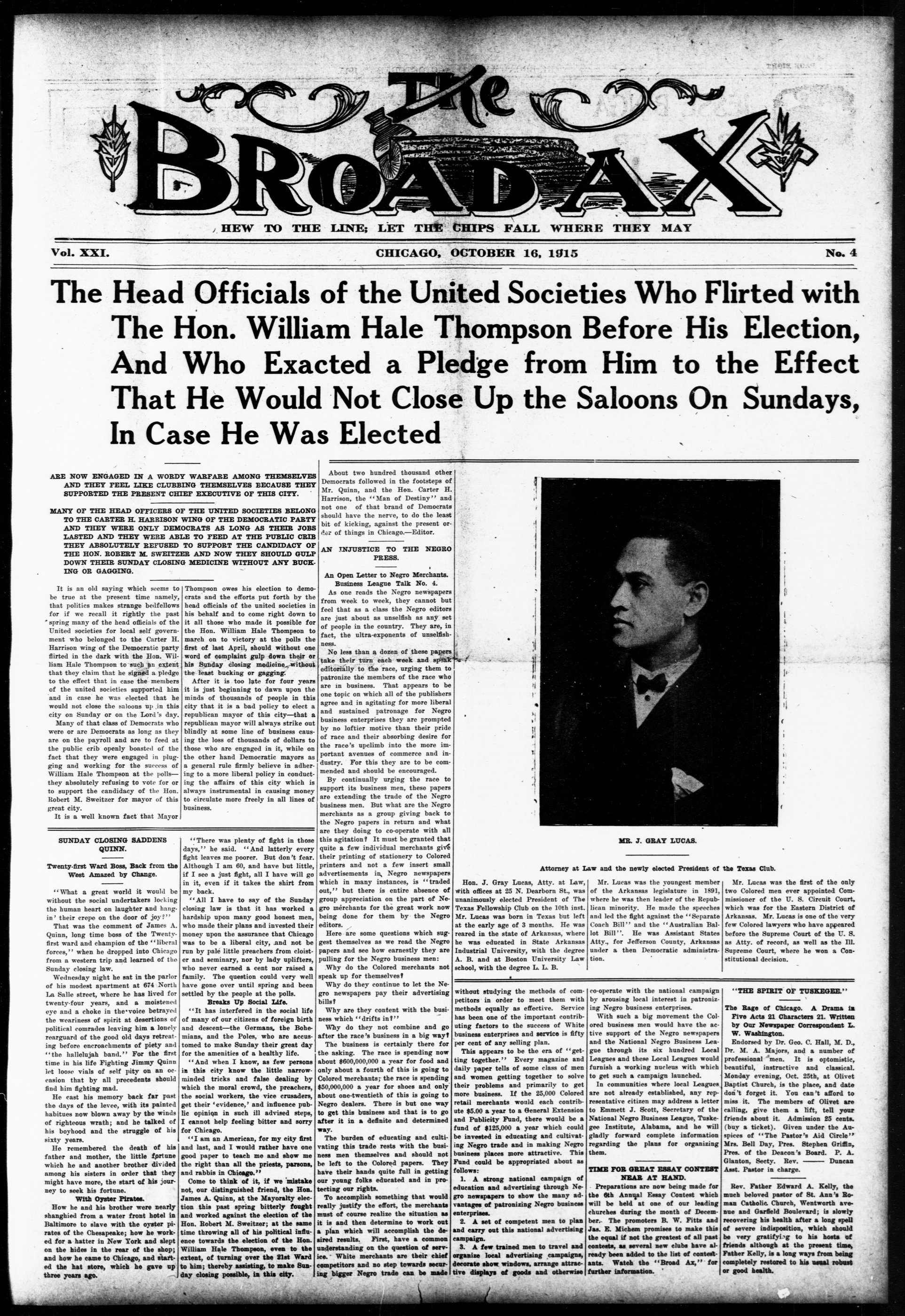
The Head Officials of the United Societies Who Flirted with The Hon. William Hale Thompson Before His Election, And Who Exacted a Pledge from Him to the Effect That He Would Not Close Up the Saloons On Sundays, In Case He Was Elected
ARE NOW ENGAGED IN A WORDY WARFARE AMONG THEMSELVES AND THEY FEEL LIKE CLUBBING THEMSELVES BECAUSE THEY SUPPORTED THE PRESENT CHIEF EXECUTIVE OF THIS CITY.
MANY OF THE HEAD OFFICERS OF THE UNITED SOCIETIES BELONG TO THE CARTER H. HARRISON WING OF THE DEMOCRATIC PARTY AND THEY WERE ONLY DEMOCRATS AS LONG AS THEIR JOBS LASTED AND THEY WERE ABLE TO FEED AT THE PUBLIC CRIB THEY ABSOLUTELY REFUSED TO SUPPORT THE CANDIDACY OF THE HON. ROBERT M. SWEITZER AND NOW THEY SHOULD GULP DOWN THEIR SUNDAY CLOSING MEDICINE WITHOUT ANY BUCKING OR GAGGING.
Vol. XXI.
The Head
The I
And
That
In Ca
ARE NOW ENGAGED IN A WORD
AND THEY FEEL LIKE CLUBE
SUPPORTED THE PRESENT CH
MANY OF THE HEAD OFFICERS O
TO THE CARTER H. HARRISON
AND THEY WERE ONLY DEM
LASTED AND THEY WERE AB
THEY ABSOLUTELY REFUSED
THE HON. ROBERT M. SWEITZ
DOWN THEIR SUNDAY CLOSING
ING OR GAGGING.
It is an old saying which seems to be true at the present time namely, that politics makes strange bedfellows for if we recall it rightly the past spring many of the head officials of the United societies for local self government who belonged to the Carter H. Harrison wing of the Democratic party flirted in the dark with the Hon. William Hale Thompson to such an extent that they claim that he signed a pledge to the effect that in case the members of the united societies supported him and in case he was elected that he would not close the saloons up in this city on Sunday or on the Lord's day. Many of that class of Democrats who were or are Democrats as long as they are on the payroll and are to feed at the public crib openly boasted of the fact that they were engaged in plugging and working for the success of William Hale Thompson at the polls—they absolutely refusing to vote for or to support the candidacy of the Hon. Robert M. Sweitzer for mayor of this great city.
It is a well known fact that Mayor
SUNDAY CLOSING SADDENS QUINN.
Twenty-first Ward Boss, Back from the West Amazed by Change.
"What a great world it would be without the social undertakers locking the human heart on laughter and hangin' their crepe on the door of joy?"
That was the comment of James A. Quinn, long time boss of the Twenty-first ward and champion of the "liberal forces," when he dropped into Chicago from a western trip and learned of the Sunday closing law.
Wednesday night he sat in the parlor of his modest apartment at 674 North La Salle street, where he has lived for twenty-four years, and a moistened eye and a choke in the voice betrayed the weariness of spirit at desertions of political comrades leaving him a lonely rearguard of the good old days retreating before encroachments of piety and "the hallelujah band." For the first time in his life Fighting Jimmy Quinn let loose vials of self pity on an occasion that by all precedents should find him fighting mad.
He cast his memory back far past the days of the levee, with its painted habitues now blown away by the winds of righteous wrath; and he talked of his boyhood and the struggle of his sixty years.
He remembered the death of his father and mother, the little fortune which he and another brother divided among his sisters in order that they might have more, the start of his journey to seek his fortune.
With Oyster Pirates.
How he and his brother were nearly shanglied from a water front hotel in Baltimore to slave with the oyster pirates of the Chesapeake; how he worked for a hatter in New York and slept on the hides in the rear of the shop; and how he came to Chicago, and started the hat store, which he gave up three years ago.
Thompson owes his election to democrats and the efforts put forth by the head officials of the united societies in his behalf and to come right down to it all those who made it possible for the Hon. William Hale Thompson to march on to victory at the polls the first of last April, should without one word of complaint gulp down their or his Sunday closing medicine without the least bucking or gagging. After it is too late for four years it is just beginning to dawn upon the minds of thousands of people in this city that it is a bad policy to elect a republican mayor of this city—that a republican mayor will always strike out blindly at some line of business causing the loss of thousands of dollars to those who are engaged in it, while on the other hand Democratic mayors as a general rule firmly believe in adhering to a more liberal policy in conducting the affairs of this city which is always instrumental in causing money to circulate more freely in all lines of business.
"There was plenty of fight in those days," he said. "And latterly every fight leaves me poorer. But don't fear. Although I am 60, and have but little, if I see a just fight, all I have will go in it, even if it takes the shirt from my back.
"All I have to say of the Sunday closing law is that it has worked a hardship upon many good honest men, who made their plans and invested their money upon the assurance that Chicago was to be a liberal city, and not be run by pale little preachers from cloister and seminary, nor by lady uplifters, who never earned a cent nor raised a family. The question could very well have gone over until spring and been settled by the people at the polls.
Breaks Up Social Life.
"It has interfered in the social life of many of our citizens of foreign birth and descent—the Germans, the Bohemians, and the Poles, who are accustomed to make Sunday their great day for the amenities of a healthy life.
"And when I know, as few persons in this city know the little narrow-minded tricks and false dealing by which the moral crowd, the preachers, the social workers, the vice crusaders, get their 'evidence,' and influence public opinion in such ill advised steps, I cannot help feeling bitter and sorry for Chicago.
"I am an American, for my city first and last, and I would rather have one good paper to teach me and show me the right than all the priests, parsons, and rabbis in Chicago."
Come to think of it, if we mistake not, our distinguished friend, the Hon. James A. Quinn, at the Mayoralty election this past spring bitterly fought and worked against the election of the Hon. Robert M. Sweitzer; at the same time throwing all of his political influence towards the election of the Hon. William Hale Thompson, even to the extent, of turning over the 21st Ward to him; thereby assisting, to make Sunday closing possible, in this city.
CHICAGO, OCTOBER 16, 1915
About two hundred thousand other Democrats followed in the footsteps of Mr. Quinn, and the Hon. Carter H. Harrison, the "Man of Destiny" and not one of that brand of Democrats should have the nerve, to do the least bit of kicking, against the present order of things in Chicago.—Editor.
AN INJUSTICE TO THE NEGRO
PRESS.
An Open Letter to Negro Merchants. Business League Talk No. 4. As one reads the Negro newspapers from week to week, they cannot but feel that as a class the Negro editors are just about as unselfish as any set of people in the country. They are, in fact, the ultra-exponents of unselfishness. No less than a dozen of these papers take their turn each week and speak editorially to the race, urging them to patronize the members of the race who are in business. That appears to be one topic on which all of the publishers agree and in agitating for more liberal and sustained patronage for Negro business enterprises they are prompted by no loftier motive than their pride of race and their absorbing desire for the race's upclimb into the more important avenues of commerce and industry. For this they are to be commended and should be encouraged.
By continually urging the race to support its business men, these papers are extending the trade of the Negro business men. But what are the Negro merchants as a group giving back to the Negro papers in return and what are they doing to co-operate with all this agitation? It must be granted that quite a few individual merchants give their printing of stationery to Colored printers and not a few insert small advertisements in Negro newspapers which in many instances, is "traded out," but there is entire absence of group appreciation on the part of Negro merchants for the great work now being done for them by the Negro editors.
Here are some questions which suggest themselves as we read the Negro papers and see how earnestly they are pulling for the Negro business men:
Why do the Colored merchants not speak up for themselves?
Why do they continue to let the Negro newspapers pay their advertising bills?
Why are they content with the business which "drifts in?"
Why do they not combine and go after the race's business in a big way?
The business is certainly there for the asking. The race is spending now about $600,000,000 a year for food and only about a fourth of this is going to Colored merchants; the race is spending $50,000,000 a year for shoes and only about one-twentieth of this is going to Negro dealers. There is but one way to get this business and that is to go after it in a definite and determined way.
The burden of educating and cultivating this trade rests with the business men themselves and should not be left to the Colored papers. They have their hands quite full in getting our young folks educated and in protecting our rights.
To accomplish something that would really justify the effort, the merchants must of course realize the situation as it is and then determine to work out a plan which will accomplish the desired results. First, have a common understanding on the question of service. White merchants are their chief competitors and no step towards securing bigger Negro trade can be made
THE NEW YORK TIMES
Attorney at Law and the newly elected President of the Texas Club.
Hon. J. Gray Lucas, Atty. at Law, with offices at 25 N. Dearborn St., was unanimously elected President of The Texas Fellowship Club on the 10th inst. Mr. Lucas was born in Texas but left at the early age of 3 months. He was reared in the state of Arkansas, where he was educated in State Arkansas Industrial University, with the degree A. B. and at Boston University Law school, with the degree L. L. B.
without studying the methods of competitors in order to meet them with methods equally as effective. Service has been one of the important contributing factors to the success of White business enterprises and service is fifty per cent of any selling plan. This appears to be the era of "getting together." Every magazine and daily paper tells of some class of men and women getting together to solve their problems and primarily to get more business. If the 25,000 Colored retail merchants would each contribute $5.00 a year to a General Extension and Publicity Fund, there would be a fund of $125,000 a year which could be invested in educating and cultivating Negro trade and in making Negro business places more attractive. This Fund could be appropriated about as follows:
1. A strong national campaign of education and advertising through Negro newspapers to show the many advantages of patronizing Negro business enterprises.
2. A set of competent men to plan and carry out this national advertising campaign.
3. A few trained men to travel and organize local advertising campaigns, decorate show windows, arrange attractive displays of goods and otherwise
MR. J. GRAY LUCAS.
Mr. Lucas was the youngest member of the Arkansas legislature in 1891, where he was then leader of the Republican minority. He made the speeches and led the fight against the "Separate Coach Bill" and the "Australian Ballot Bill". He was Assistant States Atty., for Jefferson County, Arkansas under a then Democratic administration.
co-operate with the national campaign by arousing local interest in patronizing Negro business enterprises. With such a big movement the Colored business men would have the active support of the Negro newspapers and the National Negro Business League through its six hundred Local Leagues and these Local Leagues would furnish a working nucleus with which to get such a campaign launched. In communities where local Leagues are not already established, any representative citizen may address a letter to Emmett J. Scott, Secretary of the National Negro Business League, Tuskegee Institute, Alabama, and he will gladly forward complete information regarding the plans for organizing them.
TIME FOR GREAT ESSAY CONTEST
NEAR AT HAND.
Preparations are now being made for the 6th Annual Essay Contest which will be held at one of our leading churches during the month of December. The promoters B. W. Fitts and Jas. E. Michem promises to make this the equal if not the greatest of all past contests, as several new clubs have already been added to the list of contestants. Watch the "Broad Ax," for further information.
No. 4
Mr. Lucas was the first of the only two Colored men ever appointed Commissioner of the U. S. Circuit Court, which was for the Eastern District of Arkansas. Mr. Lucas is one of the very few Colored lawyers who have appeared before the Supreme Court of the U. S. as Atty. of record, as well as the Ill Supreme Court, where he won a Constitutional decision.
"THE SPIRIT OF TUSKEGEE."
The Bage of Chicago. A Drama in Five Acts 21 Characters 21. Written by Our Newspaper Correspondent L. W. Washington.
Endorsed by Dr. Geo. C. Hall, M. D., Dr. M. A. Majors, and a number of professional men. It is optimistic, beautiful, instructive and classical. Monday evening, Oct. 25th, at Olivet Baptist Church, is the place, and date don't forget it. You can't afford to miss it. The members of Olivet are calling, give them a lift, tell your friends about it. Admission 25 cents. (buy a ticket). Given under the Auspices of "The Pastor's Aid Circle" Mrs. Bell Day, Pres. Stephen Griffin, Pres. of the Deacon's Board. P. A. Glanton, Secty. Rev. Duncan Asst. Pastor in charge.
Rev. Father Edward A. Kelly, the much beloved pastor of St. Ann's Roman Catholic Church, Wentworth avenue and Garfield Boulevard; is slowly recovering his health after a long spell of severe indisposition, which should be very gratifying to his hosts of friends although at the present time, Father Kelly, is a long ways from being completely restored to his usual robust or good health.
PAGE TWO
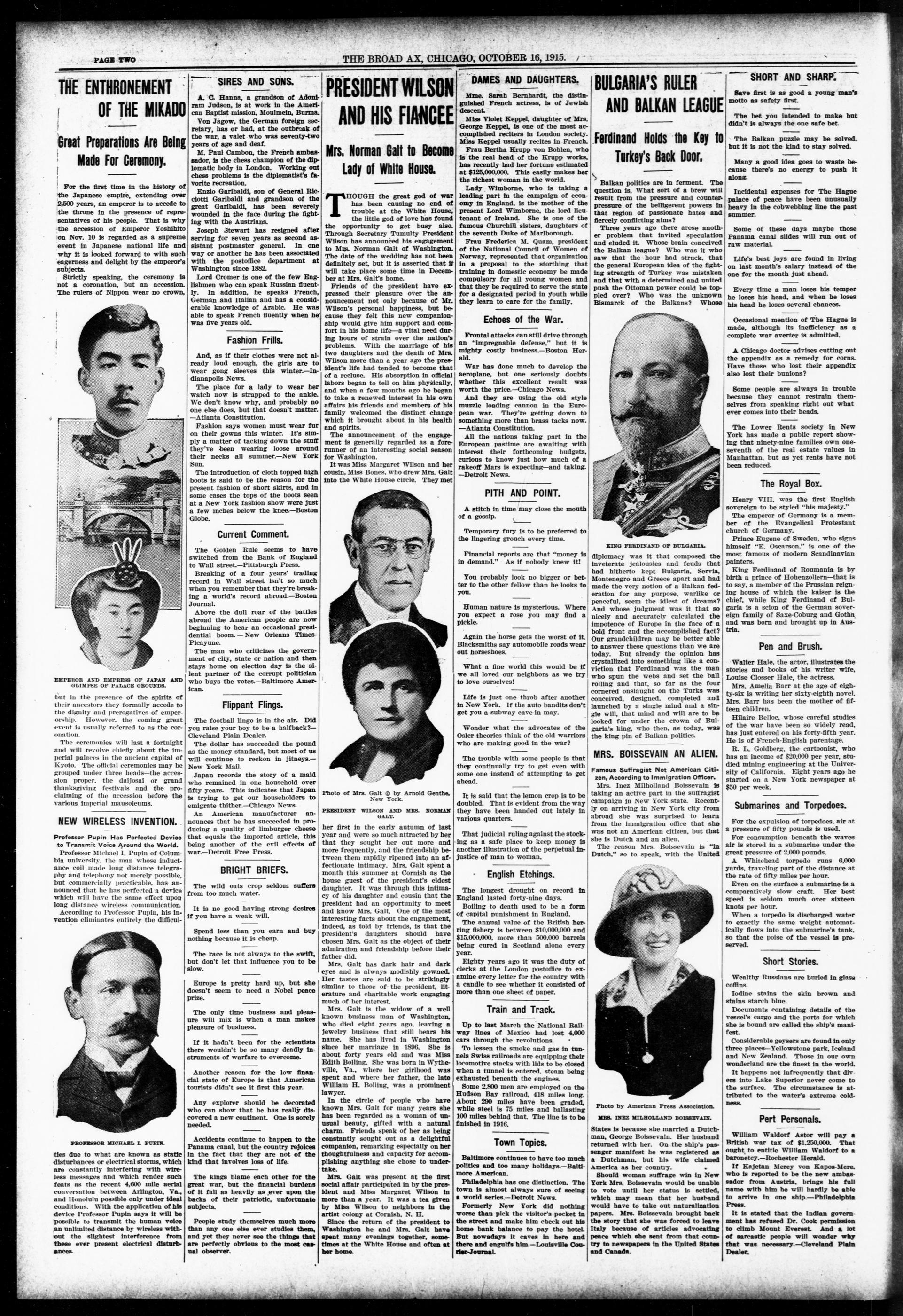
THE ENTHRONEMENT OF THE MIKADO Great Preparations Are Being Made For Ceremony.
For the first time in the history of the Japanese empire, extending over 2,500 years, an emperor is to accede to the throne in the presence of representatives of his people. That is why the accession of Emperor Yoshihito on Nov. 10 is regarded as a supreme event in Japanese national life and why it is looked forward to with such eagerness and delight by the emperor's subjects. Strictly speaking, the ceremony is not a coronation, but an accession. The rulers of Nippon wear no crown.
BROOKLYN
EMPEROR AND EMPRESS OF JAPAN AND GLIMPSE OF PALACE GROUNDS.
but in the presence of the spirits of their ancestors they formally accede to the dignity and prerogatives of emperorship. However, the coming great event is usually referred to as the coronation.
The ceremonies will last a fortnight and will revolve chiefly about the imperial palaces in the ancient capital of Kyoto. The official ceremonies may be grouped under three heads—the accession proper, the daljosal or grand thanksgiving festivals and the proclaiming of the accession before the various imperial mausoleums.
NEW WIRELESS INVENTION.
Professor Pupin Has Perfected Device to Transmit Voice Around the World. Professor Michael I. Pupin of Columbia university, the man whose inductance coil made long distance telegraphy and telephony not merely possible, but commercially practicable, has announced that he has perfected a device which will have the same effect upon long distance wireless communication. According to Professor Pupin, his invention eliminates entirely the difficult
J. B.
PROFESSOR MICHAEL I. PUPIN. ties due to what are known as static disturbances or electrical storms, which are constantly interfering with wireless messages and which render such feats as the recent 4,000 mile aerial conversation between Arlington, Va., and Honolulu possible only under ideal conditions. With the application of his device Professor Pupin says it will be possible to transmit the human voice an unlimited distance by wireless without the slightest interference from these ever present electrical disturbances.
SIRES AND SONS.
A. C. Hanna, a grandson of Adonilram Judson, is at work in the American Baptist mission, Moulmein, Burma. Von Jagow, the German foreign secretary, has or had, at the outbreak of the war, a valet who was seventy-two years of age and deaf.
M. Paul Cambon, the French ambassador, is the chess champion of the diplomatic body in London. Working out chess problems is the diplomatist's favorite recreation.
Enzio Garibaldi, son of General Ricciotti Garibaldi and grandson of the great Garibaldi, has been severely wounded in the face during the fighting with the Austrians.
Joseph Stewart has resigned after serving for seven years as second assistant postmaster general. In one way or another he has been associated with the postoffice department at Washington since 1882.
Lord Cromer is one of the few Englishmen who can speak Russian fluently. In addition, he speaks French, German and Italian and has a considerable knowledge of Arabic. He was able to speak French fluently when he was five years old.
Fashion Frills.
And, as if their clothes were not already loud enough, the girls are to wear gong sleeves this winter.—Indianapolis News.
The place for a lady to wear her watch now is strapped to the ankle. We don't know why, and probably no one else does, but that doesn't matter.—Atlanta Constitution.
Fashion says women must wear fur on their gowns this winter. It's simply a matter of tacking down the stuff they've been wearing loose around their necks all summer.—New York Sun.
The introduction of cloth topped high boots is said to be the reason for the present fashion of short skirts, and in some cases the tops of the boots seen at a New York fashion show were just a few inches below the knee.—Boston Globe.
Current Comment.
The Golden Rule seems to have switched from the Bank of England to Wall street.—Pittsburgh Press. Breaking of a four years' trading record in Wall street isn't so much when you remember that they're breaking a world's record abroad.—Boston Journal. Above the dull roar of the battles abroad the American people are now beginning to hear an occasional presidential boom.—New Orleans Times-Picayune. The man who criticizes the government of city, state or nation and then stays home on election day is the silent partner of the corrupt politician who buys the votes.—Baltimore American.
Flippant Flings.
The football lingo is in the air. Did you raise your boy to be a halfback?—Cleveland Plain Dealer. The dollar has succeeded the pound as the money standard, but most of us will continue to reckon in jitneys.—New York Mall. Japan records the story of a maid who remained in one household over fifty years. This indicates that Japan is trying to get our householders to emigrate thither.—Chicago News. An American manufacturer announces that he has succeeded in producing a quality of limburger cheese that equals the imported article, this being another of the evil effects of war.—Detroit Free Press.
BRIGHT BRIEFS.
The wild oats crop seldom suffers from too much water.
It is no good having strong desires if you have a weak will.
Spend less than you earn and buy nothing because it is cheap.
The race is not always to the swift, but don't let that influence you to be slow.
Europe is pretty hard up, but she doesn't seem to need a Nobel peace prize.
The only time business and pleasure will mix is when a man makes pleasure of business.
If it hadn't been for the scientists there wouldn't be so many deadly instruments of warfare to overcome.
Another reason for the low financial state of Europe is that American tourists didn't see it first this year.
Any explorer should be decorated who can show that he has really discovered a new continent. One is sorely needed.
Accidents continue to happen to the Panama canal, but the country rejoices in the fact that they are not of the kind that involves loss of life.
The kings blame each other for the great war, but the financial burdens of it fall as heavily as ever upon the backs of their patriotic, unfortunate subjects.
People study themselves much more than any one else ever studies them, and yet they never see the things that are perfectly obvious to the most casual observer.
THE BROAD AX. CHICAGO. OCTOBER 16, 1915.
PRESIDENT WILSON AND HIS FIANCEE
Mrs. Norman Galt to Become Lady of White House.
THOUGH the great god of war has been causing no end of trouble at the White House, the little god of love has found the opportunity to get busy also. Through Secretary Tumulty President Wilson has announced his engagement to Mrs. Norman Galt of Washington. The date of the wedding has not been definitely set, but it is asserted that if will take place some time in December at Mrs. Galt's home.
Friends of the president have expressed their pleasure over the announcement not only because of Mr. Wilson's personal happiness, but because they felt this new companionship would give him support and comfort in his home life—a vital need during hours of strain over the nation's problems. With the marriage of his two daughters and the death of Mrs. Wilson more than a year ago the president's life had tended to become that of a recluse. His absorption in official labors began to tell on him physically, and when a few months ago he began to take a renewed interest in his own affairs his friends and members of his family welcomed the distinct change which it brought about in his health and spirits.
The announcement of the engagement is generally regarded as a forerunner of an interesting social season for Washington.
It was Miss Margaret Wilson and her cousin, Miss Bones, who drew Mrs. Galt into the White House circle. They met
Mary E.
Photo of Mrs. Galt © by Arnold Genthe, New York.
Photo of Mrs. Galt © by Arnold Genthe, New York.
PRESIDENT WILSON AND MRS. NORMAN GALT.
her first in the early autumn of last year and were so much attracted by her that they sought her out more and more frequently, and the friendship between them rapidly ripened into an affectionate intimacy. Mrs. Galt spent a month this summer at Cornish as the house guest of the president's eldest daughter. It was through this intimacy of his daughter and cousin that the president had an opportunity to meet and know Mrs. Galt. One of the most interesting facts about the engagement, indeed, as told by friends, is that the president's daughters should have chosen Mrs. Galt as the object of their admiration and friendship before their father did.
Mrs. Galt has dark hair and dark eyes and is always modishly gowned. Her tastes are said to be strikingly similar to those of the president, literature and charitable work engaging much of her interest.
Mrs. Galt is the widow of a well known business man of Washington, who died eight years ago, leaving a jewelry business that still bears his name. She has lived in Washington since her marriage in 1896. She is about forty years old and was Miss Edith Bolling. She was born in Wytheville, Va., where her girlhood was spent and where her father, the late William H. Bolling, was a prominent lawyer.
In the circle of people who have known Mrs. Galt for many years she has been regarded as a woman of unusual beauty, gifted with a natural charm. Friends speak of her as being constantly sought out as a delightful companion, remarking especially on her thoughtfulness and capacity for accomplishing anything she chose to undertake.
Mrs. Galt was present at the first social affair participated in by the president and Miss Margaret Wilson in more than a year. It was a tea given by Miss Wilson to neighbors in the artist colony at Cornish, N. H.
Since the return of the president to Washington he and Mrs. Galt have spent many evenings together, sometimes at the White House and often at her home.
DAMES AND DAUGHTERS.
Mme. Sarah Bernhardt, the distinguished French actress, is of Jewish descent.
Miss Violet Keppel, daughter of Mrs. George Keppel, is one of the most accomplished reciters in London society.
Miss Keppel usually recites in French.
Frau Bertha Krupp von Bohlen, who is the real head of the Krupp works, has recently had her fortune estimated at $125,000,000. This easily makes her the richest woman in the world.
Lady Wimborne, who is taking a leading part in the campaign of economy in England, is the mother of the present Lord Wimborne, the lord lieutenant of Ireland. She is one of the famous Churchill sisters, daughters of the seventh Duke of Marlborough.
Frau Frederica M. Quam, president of the National Council of Women of Norway, represented that organization in a proposal to the storthing that training in domestic economy be made compulsory for all young women and that they be required to serve the state for a designated period in youth while they learn to care for the family.
Echoes of the War.
Frontal attacks can still drive through an "impregnable defense," but it is mighty costly business.—Boston Herald.
War has done much to develop the aeroplane, but one seriously doubts whether this excellent result was worth the price.—Chicago News.
And they are using the old style muzzle loading cannon in the European war. They're getting down to something more than brass tacks now.—Atlanta Constitution.
All the nations taking part in the European pastime are awaiting with interest their forthcoming budgets, curious to know just how much of a rakeoff Mars is expecting—and taking.—Detroit News.
PITH AND POINT.
A stitch in time may close the mouth of a gossip.
Temporary fury is to be preferred to the lingering grouch every time.
Financial reports are that "money is in demand." As if nobody knew it!
You probably look no bigger or better to the other fellow than he looks to you.
Human nature is mysterious. Where you expect a rose you may find a pickle.
Again the horse gets the worst of it. Blacksmiths say automobile roads wear out horseshoes.
What a fine world this would be if we all loved our neighbors as we try to love ourselves!
Life is just one throb after another in New York. If the auto bandits don't get you a subway cave-in may.
Wonder what the advocates of the Osler theories think of the old warriors who are making good in the war?
The trouble with some people is that they continually try to get even with some one instead of attempting to get ahead.
It is said that the lemon crop is to be doubled. That is evident from the way they have been handed out lately in various quarters.
That judicial ruling against the stocking as a safe place to keep money is another illustration of the perpetual injustice of man to woman.
English Etchings.
The longest drought on record in England lasted forty-nine days.
Boiling to death used to be a form of capital punishment in England.
The annual value of the British herring fishery is between $10,000,000 and $15,000,000, more than 500,000 barrels being cured in Scotland alone every year.
Eighty years ago it was the duty of clerks at the London postoffice to examine every letter for the country with a candle to see whether it consisted of more than one sheet of paper.
Train and Track.
Up to last March the National Railway lines of Mexico had lost 4,000 cars through the revolutions.
To lessen the smoke and gas in tunnels Swiss railroads are equipping their locomotive stacks with lids to be closed when a tunnel is entered, steam being exhausted beneath the engines.
Some 2,800 men are employed on the Hudson Bay railroad, 418 miles long. About 290 miles have been graded, while steel is 75 miles and ballasting 100 miles behind that. The line is to be finished in 1916.
Town Topics.
Baltimore continues to have too much politics and too many holidays.—Baltimore American.
Philadelphia has one distinction. The town is almost always sure of seeing a world series.—Detroit News.
Formerly New York did nothing worse than pick the visitor's pocket in the street and make him check out his home bank balance to pay the hotel. But nowadays it caves in here and there and engulfs him.—Louisville Courier-Journal.
BULGARIA'S RULER AND BALKAN LEAGUE
Ferdinand Holds the Key to Turkey's Back Door.
Balkan politics are in ferment. The question is, What sort of a brew will result from the pressure and counter-pressure of the belligerent powers in that region of passionate hates and fiercely conflicting aims?
Three years ago there arose another problem that invited speculation and eluded it. Whose brain conceived the Balkan league? Who was it who saw that the hour had struck, that the general European idea of the fighting strength of Turkey was mistaken and that with a determined and united push the Ottoman power could be toppled over? Who was the unknown Bismarck of the Balkans? Whose
P.
KING FERDINAND OF BULGARIA.
diplomacy was it that composed the inveterate jealousies and feuds that had hitherto kept Bulgaria, Servia, Montenegro and Greece apart and had made the very notion of a Balkan federation for any purpose, warlike or peaceful, seem the idlest of dreams? And whose judgment was it that so nicely and accurately calculated the impotence of Europe in the face of a bold front and the accomplished fact? Our grandchildren may be better able to answer these questions than we are today. But already the opinion has crystallized into something like a conviction that Ferdinand was the man who spun the webs and set the ball rolling and that, so far as the four cornered onslaught on the Turks was conceived, designed, completed and launched by a single mind and a single will, that mind and will are to be looked for under the crown of Bulgaria's king, who then, as today, was the king pin of Balkan politics.
MRS. BOISSEVAIN AN ALIEN.
Famous Suffragist Not American Citizen
According to Immigration Officer
zen, According to Immigration Officer.
Mrs. Inez Millholland Boissevain is taking an active part in the suffragett campaign in New York state. Recently on arriving in New York city from abroad she was surprised to learn from the immigration office that she was not an American citizen, but that she is Dutch and an alien.
The reason Mrs. Boissevain is "in Dutch," so to speak, with the United
A. E.
Photo by American Press Association.
MRS. INEZ MILHOLLAND BOISSEVAIN.
States is because she married a Dutchman, George Bolsevain. Her husband returned with her. On the ship's passenger manifest he was registered as a Dutchman, but his wife claimed America as her country.
Should woman suffrage win in New York Mrs. Bolsevain would be unable to vote until her status is settled, which may mean that her husband would have to take out naturalization papers. Mrs. Bolsevain brought back the story that she was forced to leave Italy because of articles advocating peace which she sent from that country to newspapers in the United States and Canada.
SHORT AND SHARP.
Save first is as good a young man's motto as safety first.
The bet you intended to make but didn't is always the one safe bet.
The Balkan puzzle may be solved, but it is not the kind to stay solved.
Many a good idea goes to waste because there's no energy to push it along.
Incidental expenses for The Hague palace of peace have been unusually heavy in the cobwebbing line the past summer.
Some of these days maybe those Panama canal slides will run out of raw material.
Life's best joys are found in living on last month's salary instead of the one for the month just ahead.
Every time a man loses his temper he loses his head, and when he loses his head he loses several chances.
Occasional mention of The Hague is made, although its inefficiency as a complete war averter is admitted.
A Chicago doctor advises cutting out the appendix as a remedy for corns. Have those who lost their appendix also lost their bunions?
Some people are always in trouble because they cannot restrain themselves from speaking right out what ever comes into their heads.
The Lower Rents society in New York has made a public report showing that ninety-nine families own one-seventh of the real estate values in Manhattan, but as yet rents have not been reduced.
The Royal Box.
Henry VIII, was the first English sovereign to be styled "his majesty." The emperor of Germany is a member of the Evangelical Protestant church of Germany. Prince Eugene of Sweden, who signs himself "E. Oscarson," is one of the most famous of modern Scandinavian painters. King Ferdinand of Roumania is by birth a prince of Hohenzollern—that is to say, a member of the Prussian reigning house of which the kaiser is the chief, while King Ferdinand of Bulgaria is a sconn of the German sovereign family of Saxe-Coburg and Gotha and was born and brought up in Austria.
Pen and Brush.
Walter Hale, the actor, illustrates the stories and books of his writer wife, Louise Closser Hale, the actress.
Mrs. Amelia Barr at the age of eighty-six is writing her sixty-eighth novel. Mrs. Barr has been the mother of fifteen children.
Hillaire Belloc, whose careful studies of the war have been so widely read, has just entered on his forty-fifth year. He is of French-English parentage.
R. L. Goldberg, the cartoonist, who has an income of $20,000 per year, studied mining engineering at the University of California. Eight years ago he started on a New York newspaper at $50 per week.
Submarines and Torpedoes.
For the expulsion of torpedoes, air at a pressure of fifty pounds is used.
For consumption beneath the waves air is stored in a submarine under the great pressure of 2,000 pounds.
A Whitehead torpedo runs 6,000 yards, traveling part of the distance at the rate of fifty miles per hour.
Even on the surface a submarine is a comparatively slow craft. Her best speed is seldom much over sixteen knots per hour.
When a torpedo is discharged water to exactly the same weight automatically flows into the submarine's tank, so that the poise of the vessel is preserved.
Short Stories.
Wealthy Russians are buried in glass coffins.
Iodine stains the skin brown and stains starch blue.
Documents containing details of the vessel's cargo and the ports for which she is bound are called the ship's manifest.
Considerable geysers are found in only three places—Yellowstone park, Iceland and New Zealand. Those in our own wonderland are the finest in the world.
It happens not infrequently that divers into Lake Superior never come to the surface. The circumstance is attributed to the water's extreme coldness.
Pert Personals.
William Waldorf Astor will pay a British war tax of $1,250,000. That ought to entitle William Waldorf to a baronetcy.-Rochester Herald.
If Kajetan Merey von Kapos-Mere, who is reported to be the new ambassador from Austria, brings his full name with him he will hardly be able to arrive in one ship.-Philadelphia Press.
It is stated that the Indian government has refused Dr. Cook permission to climb Mount Everest. And a lot of sarcastic people will wonder why that was necessary.-Cleveland Plain Dealer.
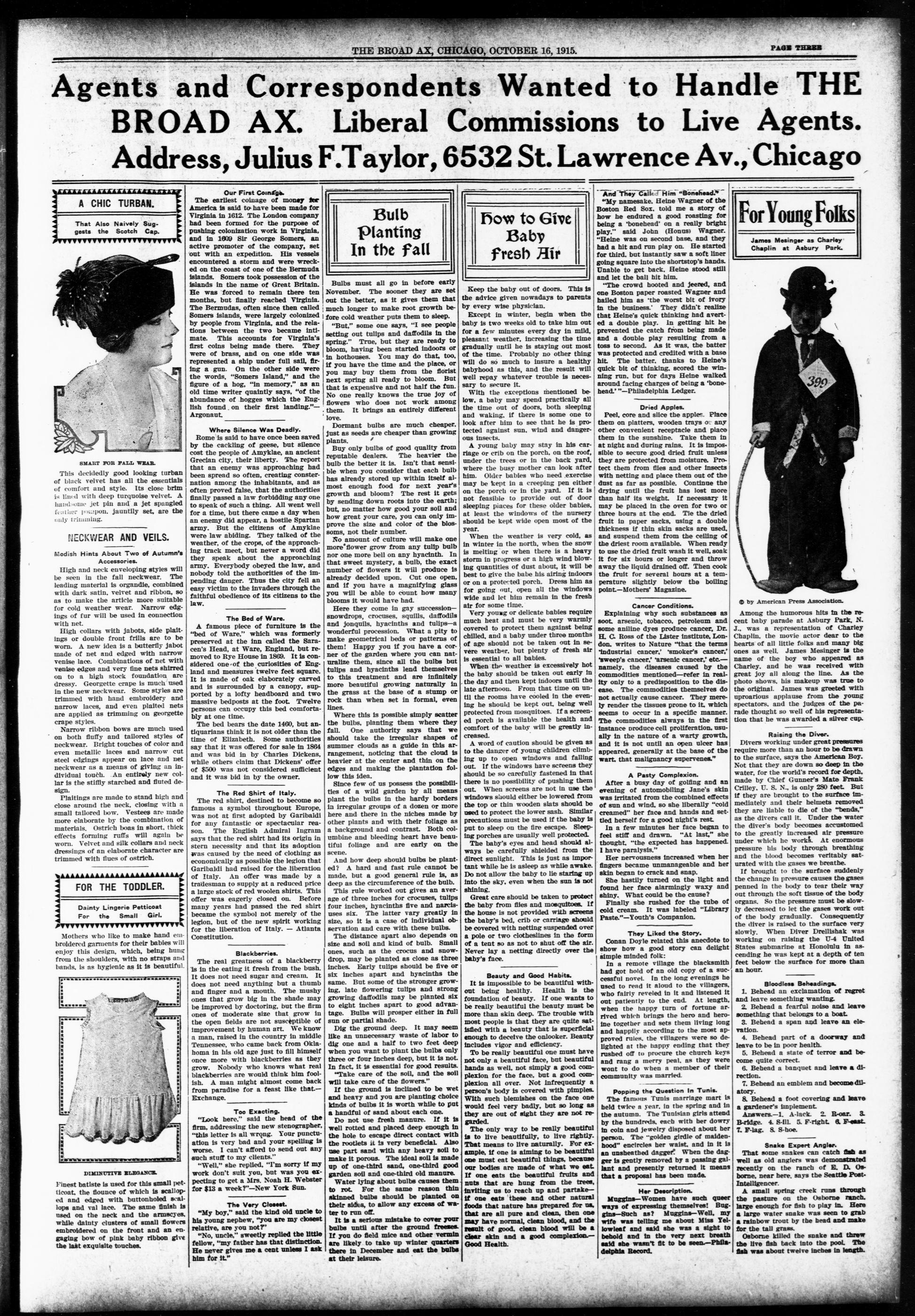
Agents and Correspondents Wanted to Handle THE BROAD AX. Liberal Commissions to Live Agents. Address, Julius F.Taylor, 6532 St. Lawrence Av., Chicago
SMART FOR FALL WEAR.
This decidedly good looking turban of black velvet has all the essentials of comfort and style. Its close brim is lined with deep turquoise velvet. A handsome jet pin and a jet spangled feather pompon, jauntily set, are the only trimming.
NECKWEAR AND VEILS.
Modish Hints About Two of Autumn's Accessories.
High and neck enveloping styles will be seen in the fall neckwear. The leading material is organdie, combined with dark satin, velvet and ribbon, so as to make the article more suitable for cold weather wear. Narrow edgings of fur will be used in connection with net.
High collars with jabots, side plaitings or double front frills are to be worn. A new idea is a butterfly jabot made of net and edged with narrow venise lace. Combinations of net with venise edges and very fine nets shirred on to a high stock foundation are dressy. Georgette crape is much used in the new neckwear. Some styles are trimmed with hand embroidery and narrow laces, and even plaited nets are applied as trimming on georgette crape styles.
Narrow ribbon bows are much used on both fluffy and tailored styles of neckwear. Bright touches of color and even metallic laces and narrow cut steel edgings appear on lace and net neckwear as a means of giving an individual touch. An entirely new collar is the stiffly starched and fluted design.
Plaitings are made to stand high and close around the neck, closing with a small tailored bow. Vestees are made more elaborate by the combination of materials. Ostrich boas in short, thick effects forming ruffs will again be worn. Velvet and silk collars and neck dressings of an elaborate character are trimmed with flues of ostrich.
FOR THE TODDLER.
Dainty Lingerie Petticoat
For the Small Girl.
Mothers who like to make hand embroidered garments for their babies will enjoy this design, which, being hung from the shoulders, with no straps and bands, is as hygienic as it is beautiful.
```markdown
```
DIMINUTIVE ELEGANCE
Fineest batiste is used for this small petitcoat, the flounce of which is scalloped and edged with buttonholed scallops and val lace. The same finish is used on the neck and the armscyes, while dainty clusters of small flowers embroidered on the front and an engaging bow of pink baby ribbon give the last exquisite touches.
Our First Coinage
The earliest colony of money for America is said to have been made for Virginia in 1612. The London company had been formed for the purpose of pushing colonization work in Virginia, and in 1609 Sir George Somers, an active promoter of the company, set out with an expedition. His vessels encountered a storm and were wrecked on the coast of one of the Bermuda islands. Somers took possession of the islands in the name of Great Britain. He was forced to remain there ten months, but finally reached Virginia. The Bermudas, often since then called Somers islands, were largely colonized by people from Virginia, and the relations between the two became intimate. This accounts for Virginia's first coins being made there. They were of brass, and on one side was represented a ship under full sail, firing a gun. On the other side were the words, "Somers Island," and the figure of a hog, "in memory," as an old time writer quantily says, "of the abundance of hogges which the English found on their first landing."—Argonaut.
Where Silence Was Deadly.
Where silence Was Beautiful.
Rome is said to have once been saved by the cackling of geese, but silence cost the people of Amyklae, an ancient Greclan city, their liberty. The report that an enemy was approaching had been spread so often, creating consternation among the inhabitants, and as often proved false, that the authorities finally passed a law forbidding any one to speak of such a thing. All went well for a time, but there came a day when an enemy did appear, a hostile Spartan army. But the citizens of Amyklae were law abiding. They talked of the weather, of the crops, of the approaching track meet, but never a word did they speak about the approaching army. Everybody obeyed the law, and nobody told the authorities of the impending danger. Thus the city fell an easy victim to the invaders through the faithful obedience of its citizens to the law.
The Bed of Ware.
A famous piece of furniture is the "bed of Ware," which was formerly preserved at the inn called the Saracen's Head, at Ware, England, but removed to Rye House in 1869. It is considered one of the curiosities of England and measures twelve feet square. It is made of oak elaborately carved and is surrounded by a canopy, supported by a lofty headboard and two massive bedposts at the foot. Twelve persons can occupy this bed comfortably at one time. The bed bears the date 1460, but antiquarians think it is not older than the time of Elizabeth. Some authorities say that it was offered for sale in 1864 and was bid in by Charles Dickens, while others claim that Dickens' offer of $500 was not considered sufficient and it was bid in by the owner.
The Red Shirt of Italy.
The red shirt, destined to become so famous a symbol throughout Europe, was not at first adopted by Garibaldi for any fantastic or spectacular reason. The English Admiral Ingram says that the red shirt had its origin in stern necessity and that its adoption was caused by the need of clothing as economically as possible the legion that Garibaldi had raised for the liberation of Italy. An offer was made by a tradesman to supply at a reduced price a large stock of red woolen shirts. This offer was eagerly closed on. Before many years had passed the red shirt became the symbol not merely of the legion, but of the new spirit working for the liberation of Italy. — Atlanta Constitution.
Blackberries.
The real greatness of a blackberry is in the eating it fresh from the bush. It does not need sugar and cream. It does not need anything but a thumb and finger and a mouth. The mushy ones that grow big in the shade may be improved by doctoring, but the firm ones of moderate size that grow in the open fields are not susceptible of improvement by human art. We know a man, raised in the country in middle Tennessee, who came back from Oklahoma in his old age just to fill himself once more with blackberries as they grow. Nobody who knows what real blackberries are would think him foolish. A man might almost come back from paradise for a feast like that—Exchange.
Too Exacting.
"Look here," said the head of the firm, addressing the new stenographer, "this letter is all wrong. Your punctuation is very bad and your spelling is worse. I can't afford to send out any such stuff to my clients." "Well," she replied, "I'm sorry if my work don't suit you, but was you expecting to get a Mrs. Noah H. Webster for $13 a week?"—New York Sun.
The Very Closest.
"My boy," said the kind old uncle to his young nephew, "you are my closest relative, are you not?" "No, uncle," sweetly replied the little fellow, "my father has that distinction. He never gives me a cent unless I ask him for it."
THE BROAD AX. CHICAGO. OCTOBER 16. 1915.
Bulb Planting In the fall
Bulbs must all go in before early November. The sooner they are set out the better, as it gives them that much longer to make root growth before cold weather puts them to sleep.
"But," some one says, "I see people setting out tullips and daffodils in the spring." True, but they are ready to bloom, having been started indoors or in hothouses. You may do that, too, if you have the time and the place, or you may buy them from the florist next spring all ready to bloom. But that is expensive and not half the fun. No one really knows the true joy of flowers who does not work among them. It brings an entirely different love. Dormant bulbs are much cheaper, just as seeds are cheaper than growing plants.
Buy only bulbs of good quality from reputable dealers. The heavier the bulb the better it is. Isn't that sensible when you consider that each bulb has already stored up within itself almost enough food for next year's growth and bloom? The rest it gets by sending down roots into the earth; but, no matter how good your soil and how great your care, you can only improve the size and color of the blossoms, not their number.
No amount of culture will make one more'flower grow from any tulip bulb nor one more bell on any hyacinth. In that sweet mystery, a bulb, the exact number of flowers it will produce is already decided upon. Cut one open, and if you have a magnifying glass you will be able to count how many blooms it would have had.
Here come in gay succession—snowdrops, crocuses, squills, daffodils and jonquils, hyacinths and tulips—a wonderful procession. What a pity to make geometrical beds or patterns of them! Happy you if you have a corner of the garden where you can naturalize them, since all the bulbs but tulips and hyacinths lend themselves to this treatment and are infinitely more beautiful growing naturally in the grass at the base of a stump or rock than when set in formal, even lines.
Where this is possible simply scatter the bulbs, planting them where they fall. One authority says that we should take the irregular shapes of summer clouds as a guide in this arrangement, noticing that the cloud is heavier at the center and thin on the edges and making the plantation follow this idea.
Since few of us possess the possibilities of a wild garden by all means plant the bulbs in the hardy borders in irregular groups of a dozen or more here and there in the niches made by other plants and with their foliage as a background and contrast. Both columbine and bleeding heart have beautiful foliage and are early on the scene.
And how deep should bulbs be planted? A hard and fast rule cannot be made, but a good general rule is, as deep as the circumference of the bulb.
This rule worked out gives an average of three inches for crocuses, tulips four inches, hyacinths five and narcissuses six. The latter vary greatly in size, so it is a case of individual observation and care with these bulbs.
The distance apart also depends on size and soil and kind of bulb. Small ones, such as the crocus and snowdrop, may be planted as close as three inches. Early tulips should be five or six inches apart and hyacinths the same. But some of the stronger growing, late flowering tulips and strong growing daffodils may be planted six to eight inches apart to good advantage. Bulbs will prosper either in full sun or partial shade.
Dig the ground deep. It may seem like an unnecessary waste of labor to dig one and a half to two feet deep when you want to plant the bulbs only three or four inches deep, but it is not. In fact, it is essential for good results.
"Take care of the soil, and the soil will take care of the flowers."
If the ground is inclined to be wet and heavy and you are planting choice kinds of bulbs it is worth while to put a handful of sand about each one.
Do not use fresh manure. If it is well rotted and placed deep enough in the hole to escape direct contact with the rootlets it is very beneficial. Also use part sand with any heavy soil to make it porous. The ideal soil is made up of one-third sand, one-third good garden soil and one-third old manure. Water lying about bulbs causes them to rot. For the same reason thin skinned bulbs should be planted on their sides, to allow any excess of water to run off.
It is a serious mistake to cover your bulbs until after the ground freezes. If you do field mice and other vermin are likely to take up winter quarters there in December and eat the bulbs at their leisure.
How to Give Baby Fresh Air
Keep the baby out of doors. This is the advice given nowadays to parents by every wise physician.
Except in winter, begin when the baby is two weeks old to take him out for a few minutes every day in mild, pleasant weather, increasing the time gradually until he is staying out most of the time. Probably no other thing will do so much to insure a healthy babyhood as this, and the result will repay whatever trouble is necessary to secure it.
With the exceptions mentioned below, a baby may spend practically all the time out of doors, both sleeping and waking, if there is some one to look after him to see that he is protected against sun, wind and dangerous insects.
A young baby may stay in his carriage or crib on the porch, on the roof, under the trees or in the back yard, where the busy mother can look after him. Older babies who need exercise may be kept in a creeping pen either on the porch or in the yard. If it is not feasible to provide out of door sleeping places for these older babies, at least the windows of the nursery should be kept wide open most of the year.
When the weather is very cold, as in winter in the north, when the snow is melting or when there is a heavy storm in progress or a high wind blowing quantities of dust about, it will be best to give the babe his airing indoor or on a protected porch. Dress him as for going out, open all the windows wide and let him remain in the fresh air for some time.
Very young or delicate babies require much heat and must be very warmly covered to protect them against being chilled, and a baby under three months of age should not be taken out in severe weather, but plenty of fresh air is essential to all babies.
When the weather is excessively hot the baby should be taken out early in the day and then kept indoors until the late afternoon. From that time on until the rooms have cooled in the evening he should be kept out, being well protected from mosquitoes. If a screened porch is available the health and comfort of the baby will be greatly increased.
A word of caution should be given as to the danger of young children climbing up to open windows and falling out. If the windows have screens they should be so carefully fastened in that there is no possibility of pushing them out. When screens are not in use the windows should either be lowered from the top or thin wooden slats should be used to protect the lower sash. Similar precautions must be used if the baby is put to sleep on the fire escape. Sleeping porches are usually well protected. The baby's eyes and head should always be carefully shielded from the direct sunlight. This is just as important while he is asleep as while awake. Do not allow the baby to lie staring up into the sky, even when the sun is not shining.
Great care should be taken to protect the baby from flies and mosquitoes. If the house is not provided with screens the baby's bed, crib or carriage should be covered with netting suspended over a pole or two clotheslines in the form of a tent so as not to shut off the air. Never lay a netting directly over the baby's face.
Beauty and Good Habits
It is impossible to be beautiful without being healthy. Health is the foundation of beauty. If one wants to be really beautiful the beauty must be more than skin deep. The trouble with most people is that they are quite satisfied with a beauty that is superficial enough to deceive the onlooker. Beauty includes vigor and efficiency.
To be really beautiful one must have not only a beautiful face, but beautiful hands as well, not simply a good complexion for the face, but a good complexion all over. Not infrequently a person's body is covered with pimples. With such blemishes on the face one would feel very badly, but so long as they are out of sight they are not regarded.
The only way to be really beautiful is to live beautifully, to live rightly. That means to live naturally. For example, if one is aiming to be beautiful one must eat beautiful things, because our bodies are made of what we eat. If one eats the beautiful fruits and nuts that are hung from the trees, inviting us to reach up and partake—if one eats these and other natural foods that nature has prepared for us, that are all pure and clean, then one may have normal, clean blood, and the result of good, clean blood will be a clear skin and a good complexion.—Good Health.
And They Called Him "Bonehead."
"My namesake, Heine Wagner of the Boston Red Sox, told me a story of how he endured a good roasting for being a 'bonehead' on a really bright play." said John (Honus) Wagner. "Heine was on second base, and they had a hit and run play on. He started for third, but instantly saw a soft liner going square into the shortstop's hands. Unable to get back, Heine stood still and let the ball hit him.
"The crowd booted and jeered, and one Boston paper roasted Wagner and hailed him as 'the worst bit of ivory in the business.' They didn't realize that Heine's quick thinking had averted a double play. In getting hit he prevented the catch from being made and a double play resulting from a toss to second. As it was, the batter was protected and credited with a base hit. The batter, thanks to Heine's quick bit of thinking, scored the winning run, but for days Heine walked around facing charges of being a 'bone-head.'"—Philadelphia Ledger.
Dried Apples.
Peel, core and slice the apples. Place them on platters, wooden trays or any other convenient receptacle and place them in the sunshine. Take them in at night and during rains. It is impossible to secure good dried fruit unless they are protected from moisture. Protect them from files and other insects with netting and place them out of the dust as far as possible. Continue the drying until the fruit has lost more than half its weight. If necessary it may be placed in the oven for two or three hours at the end. Tie the dried fruit in paper sacks, using a double thickness if thin skin sacks are used, and suspend them from the ceiling of the driest room available. When ready to use the dried fruit wash it well, soak it for six hours or longer and throw away the liquid drained off. Then cook the fruit for several hours at a temperature slightly below the boiling point—Mothers' Magazine.
Cancer Conditions.
Explaining why such substances as soot, arsenic, tobacco, petroleum and some ariline dyes produce cancer, Dr. H. C. Ross of the Lister institute, London, writes to Nature "that the terms 'industrial cancer,' 'smoker's cancer,' 'sweep's cancer,' 'arsenic cancer,' etc. namely, the diseases caused by the commodities mentioned—refer in reality only to a predisposition to the disease. The commodities themselves do not actually cause cancer. They merely render the tissues prone to it, which seems to occur in a specific manner. The commodities always in the first instance produce cell proliferation, usually in the nature of a warty growth, and it is not until an open ulcer has appeared, generally at the base of the wart, that malignancy supervenes."
A Pasty Complexion.
After a busy day of golfing and an evening of automobiling Jane's skin was irritated from the combined effects of sun and wind, so she liberally "cold creamed" her face and hands and settled herself for a good night's rest.
In a few minutes her face began to feel stiff and drawn. "At last," she thought, "the expected has happened. I have paralysis."
Her nervousness increased when her fingers became unmanageable and her skin began to crack and snap.
She hastily turned on the light and found her face alarmingly waxy and shiny. What could be the cause?
Finally she rushed for the tube of cold cream. It was labeled "Library Paste."-Youth's Companion.
They Liked the Story.
Conan Doyle related this anecdote to show how a good story can delight simple minded folk:
In a remote village the blacksmith had got hold of an old copy of a successful novel. In the long evenings he used to read it aloud to the villagers, who fairly reveled in it and listened it out patiently to the end. At length, when the happy turn of fortune arrived which brings the hero and heroine together and sets them living long and happily according to the most approved rules, the villagers were so delighted at the happy ending that they rushed off to procure the church keys and rang a merry peal, as they were wont to do when a member of their community was married.
Penning the Question In Tunis.
Popping this Tunis marriage mart is held twice a year, in the spring and in the autumn. The Tunisian girls attend by the hundreds, each with her dowry in coin and jewelry disposed about her person. The "golden girdle of maldenhood" encircles her waist, and in it is an unheated dagger. When the dagger is gently removed by a passing gallant and presently returned it means that a proposal has been made.
Her Description.
Muggins—Women have such queer ways of expressing themselves! Buggins—Such as? Muggins—Well, my wife was telling me about Miss Yellowleaf and said she was a sight to behold and in the very next breath said she wasn't fit to be seen. Philadelphia Record.
dle THE Agents. ., Chicago
For Young Folks
James Mesinger as Charley
Chaplin at Asbury Park.
399
© by American Press Association.
Among the humorous hits in the recent baby parade at Asbury Park, N.J., was a representation of Charley Chaplin, the movie actor dear to the hearts of all little folks and many big ones as well. James Mesinger is the name of the boy who appeared as Charley, and he was received with great joy all along the line. As the photo shows, his makeup was true to the original. James was greeted with upoarious applause from the young spectators, and the judges of the parade thought so well of his representation that he was awarded a silver cup
Raising the Diver.
Divers working under great pressures require more than an hour to be drawn to the surface, says the American Boy. Not that they are down so deep in the water, for the world's record for depth, made by Chief Gunner's Mate Frank Crilley, U. S. N., is only 290 feet. But if they are brought to the surface immediately and their helmets removed they are liable to die of the "bends," as the divers call it. Under the water the diver's body becomes accustomed to the greatly increased air pressure under which he works. At enormous pressure his body through breathing and the blood becomes veritably saturated with the gases we breathe.
If brought to the surface suddenly the change in pressure causes the gases penned in the body to tear their way out through the soft tissue of the body organs. So the pressure must be slowly decreased to let the gases work out of the body gradually. Consequently the diver is raised to the surface very slowly. When Diver Drellishak was working on raising the U-4 United States submarine at Honolulu in ascending he was kept at a depth of ten feet below the surface for more than an hour.
Bloodless Beheadings.
1. Behead an exclamation of regret and leave something wanting.
3. Behead a span and leave an elevation.
4. Behead part of a doorway and leave to be in poor health.
5. Behead a state of terror and become quite correct.
6. Behead a banquet and leave a direction.
7. Behead an emblem and become dilatory.
8. Behead a foot covering and leave a gardener's implement.
Answers.—1. A-lack. 2. B-oar. 3. B-ridge. 4. S-lill. 5. F-right. 6. F-east. 7. F-lag. 8. S-boe.
Snake Expert Angler.
That some snakes can catch fish as well as old anglers was demonstrated recently on the ranch of E. D. Osborne, near here, says the Seattle Post-Intelligencer.
A small spring creek runs through the pasture on the Osborne ranch, large enough for fish to play in. Here a large water snake was seen to grab a rainbow trout by the head and make for the tall grass.
Osborne killed the snake and threw the live fish back into the pool. The fish was about twelve inches in length.
PAGE FOUR
THE BROAD AX
PUBLISHED WEEKLY.
Will promulgate and all times uphold the true principles of Democracy, but Catholics, Protestants, Priests, Inclides, Single Tanners, Republicans, or anyone else can have their say, as long as their language is proper and responsibility is fixed.
The Broad Ax is a newspaper whose platform is broad enough for all, ever claiming the editorial right to speak its own mind.
Local communications will receive attention. Write only on one side of the paper.
Advertising rates made known on application.;
Address all communications to
THE BROAD AX
6533 ST. LAWRENCE AVE., CHICAGO, ILL.
PHONE WENTWORTH 2597.
JULIUS F. TAYLOR, Editor and Publisher
Entered as Second-Class Matter Aug. 18
1902, at the Post Office at Chicago, Illinois
under Act of March 8, 1879.
REMOVAL NOTICE.
From on and after this date, all letters or other mail matter intended for Julius F. Taylor or Mrs. Annie E. Taylor or The Broad Ax, should be addressed to 6532 St. Lawrence Ave., Jackson Park station. Phone Wentworth 2597.
HEALTH NOTES
Tell people how good you feel, but don't bother them with a recital of your aches and pains; they won't be interested anyhow.
* * *
A grouch is a barnacle on the hull of happiness and good health. If you have one, scrape it off and get under way at your proper speed.
* * *
Exercising in the open air serves to open the drafts and stir the fires of bodily health and vigor.
Health week movements are splendid things for a community. But why not make it a continuous performance?
It would be interesting to know just how many people in Chicago have learned that consumption, if taken in the early stages, is curable.
Cultivate the fresh air habit; walk in it, sleep in it, work in it, live in it; and when you ride, ride this hobby, it is cheaper than a jitney and has no tire trouble. It will put bloom in your cheek, fire in your eye and sharpen your wits; it will put spring in your step, laughter in your heart and money in your pocket. Be known as a fresh air crank and turn your crankiness to good purpose.
Why more fresh air? Your blood needs the oxygen in it, of course, to feed the hungry cells in every part of your body. Your tissues need it to withstand the hostile attacks of fierce germ enemies. Your disposition needs it, for oxygen and optimism are in the same part of the alphabet.
Your lungs give off poison with every expiration. To rebreathe this devitalized, befouled stuff again and again for the sake of saving coal in heating your house is expensive economy and a custom that smells bad. Cut down your useless and expensive habits, if you please, but lay not a scrimping hand upon pure air.
Now is the time for all good men to get together for the good—the health good—of Chicago.
We eat three times a day and breathe eighteen times a minute. And the air supply should be fresh and good all the time.
Dust is always a dangerous foe to health. In many of the industrial trades it is so harmful that even with the best and most up-to-date protective devices, those who work in them usually die from the diseases peculiar to such trades.
HYDE PARK NEWS.
Bv I. W. Washington
Mrs. Mary McQuary, of 56th and Harper Ave., is very happy this week because of the visit of her sister. She is wearing the smile that won't come off.
The A. M. E. Church, held a social conference the other night, everybody was given ice cream and cake without cost. They are making plans to build a new church on their property which they have bought on Kenwood Ave., and 54th St. Rev. W. H. Griffin is Pastor.
The Waiters Benevolent Association is becoming a very live organization. They are working as if they mean business, there is no reason why, they
---
should not have the largest fraternal body of men in Chicago, because; they have more men employed in their profession than any other except the Railroad Porters, they have a splendid staff of officers, intelligent, honest and sincere.
* * *
Don't spend your money where it is not wanted, better that you take the ear, pay 10 cents extra and come down to 35th St, where young Colored men are in charge of moving picture shows, use common sense, learn to promote and make the business that are helping the race.
We learn from good authority that quite a great deal of underground work is going on out here to get Colored women and Colored men fired, as a matter of revenge to get even as they say with Mayor William Hale Thompson for appointing Negroes to positions in the city. We hope the landlords will not countenance such Rot, several have been dismissed from a certain building because the White janitor, encouraged by some White women, made the owner believe that these Colored people were not fit to be on the place and was barred. It is wrong for the owners of these department buildings to make these lose their positions because another person of Color got a better one.
DEATH AND FUNERAL OF J. HOCK.
LEY SMILEY.
On Sunday morning, October 10 at 10 o'clock, at the home of Mr. and Mrs. Anderson, 5422 South Dearborn street where he had resided with them for the past eight years as one of the family, John Hockley Smiley, who was born in Philadelphia, Pa., June 30th, 1874, very peacefully closed his eyes in death after a long spell of sickness tuberculosis was the immediate cause of his death, for several years prior to his death he was managing editor of The Chicago Defender and he was by far one of the best Afro-American newspaper men in this country.
It is said that "he died in full triumph of faith in the Lord that he was ready and willing to go and conscious up to the end; that his favorite hymn was my Faith Looks up to Thee."
Funeral services were held over his remains, Wednesday morning from his late home, Rev. W. D. Cook officiating Charles S. Jackson in charge, Rev. Cook paid a high tribute to the worth and high standing of Mr. Smiley, whom he had known in Philadelphia, Pa., where he was raised and educated more than twenty years ago, at the end of his consoling remarks the members of the John C. Buckner Lodge of Odd Fellows of which Mr. Smiley was an honored member took charge of his remains further holding solemn services over them; Mrs. D. P. Peyton very softly and very sweetly sang his favorite song "My Faith Looks up to Thee."
The floral display was very beautiful and they completely covered the elegant and elaborate maroon plush and richly silver trimmed casket, which held his remains which were laid to rest in Mount Glenwood Cenetery.
With all of the unsurmountable troubles which fell thick and fast across his pathway towards the end of his short journey through life, Mr. Smiley always wore a bright or sunny smile on his more than genial face.
Mr. Smiley leaves one brother, two aunts and many warm friends in this city and in Philadelphia, Pa., to mourn his death.
Therefore, let us all earnestly hope that from heneeforth that he will be permitted to peacefully sleep that death of sleep which knows no awakening throughout the coming ages.
JOSEPH H. DOUGLASS' IN MUSICAL ARTIST RECITAL AT THE ABRAHAM LINCOLN CENTRE MONDAY EVENING OCTOBER 18 UNDER THE DIRECTION OF PROF. B. EMMANUEL JOHNSON.
Monday evening, October 18, Mr. Joseph H. Douglass, the noted violinist of Washington, D. C., will appear in a musical artist recital at the Abraham Lincoln Centre, Langley avenue and Oakwood Boulevard.
He will be assisted by the following artists, Mrs. Florence Cole-Talbert, Lyric Soprano; Mrs. Fannie H. Douglass, accompanist; Miss Grace Galloway, Mr. Ernst Green, assisting at the piano. Prof. B. Emmanuel Johnson, director; Mr. William James Kelley, manager. Dancing will follow the recital, William B. Hrowne's Orchestra will furnish the dance music.
The following young ladies will serve as ushers and attendants.
Misses Inez Colins, Katie Fowler, Jeanette Triplett, Cora Bowman, Arah Brown, Naomah Bunn, Gertrude Perry, Ruth Scott, Mildrgd Trevan, Theressa Dunn, Arnetta Turner, Mary McDougal.
LOST A FOUR LEAF CLOVER WITH
DIAMOND SETTING.
On October 12, 1915, at the Old Folks Meeting at the Y. M. C. A., 3763 S. Wabash avenue, a four leafed clover with diamond setting was lost by the undersigned and a suitable reward will be paid if found and returned to its owner Joseph H. Hudlun, Room 29 Board of Trade Building.
THE BROAD AX, CHICAGO, OCTOBER 16, 1915
Charles E. Stump, the Kansas Farmer Newspaper Writer, Will Soon Leave the Land of Grasshoppers for a Long Tour of the Southern States, Where He Will Travel in Jim Crow Cars
HE IS FIRMLY CONVINCED; THAT REV. W. SAMPSON BROOKS OF ST. LOUIS, MISSOURI, IS CONSTRUCTED OF THE RIGHT KIND OF MATERIAL TO BECOME A BISHOP IN THE A. M. E. CHURCH.
St. Louis, Mo.—When I took my pen in hand to write to you last week I was in Lawrence, Kansas as I told you attending a big Baptist convention, and I tell you it was a big one, perhaps not in size but in influence and work, and there were to be found a lot of big hearted men.
dress. He was interrupted with outbursts of amen and many other expressions from the ministers. What his position and the position of the ministers on the National Baptist convention there can be no question. Kansas to a man is with the Old Convention and declared that they are not going
I have been caused to ask in my mind if the Lord made all heart's the same size, and to hold the same amount of good things. I have not attempted to answer the question and think it would be out of place for me to try it. Lawrence is the capital of learning for Kansas. There is located there the great Kansas University, and they like it there, because it does not draw the color line, but all are admitted and permitted to take the same studies under the same teachers.
I was glad to see that among the people there was peace and harmony. Rev. G. N. Jackson was pastor of the Ninth Street Baptist church where the meeting was held, and he was some preacher. He is as tall as men grow to be in this world, being about 7 feet from the ground to the top of his head.
The convention was called to order by the women. I mean to say that the women had a convention first. It was the meeting of the Baptist women, presided over by Mrs. Emma Gaines, of Topeka, Kans. She was a great woman as was shown by her report and the manner in which she presided. There were many women around her, and they seemed to love her just like something to eat. Of course they did not attempt to eat her.
It seemed that the local committee gathered in all the chickens in the country. They had so much chicken to eat, that it looked to me like I was going to turn to a chicken myself, but I did not. I just got on the outside of more chicken, until I am now a light stepper. But then that will not make any change, but I will continue to try to write for the paper, and see just how I look in print. The world was not made in a day and I am sure that you will not expect to get perfect in two or three letters.
This writing business is a little more than I thought it would be; but I am not going to back down yet, but continue to say all I can in this way and let you do the reading. The Lord will take care of me if I trust him. So being on the Lord's side Dr. Jackson sent me to one of his choice homes to stay while I was there, Miss L. McWilliams. I took in many things there.
But now coming back to the convention. After the meeting of women was over, then the big convention was pulled off with Rev. W. A. Bowren in the chair. He is some presiding officer. His home is in Kansas City. He called the convention to order and the Mayor of the city was there to deliver the address of welcome. He made some address too. He turned over to the preachers the key of the city, and told them if there was anything wanted just ask for it and it would come.
Rev. D. A. Holmes, of Kansas City, Kans., the man I told you about who was building a church to cost $22,500 responded to the address. Dr. Holmes was in a position to respond because he is a well trained man and then in addition to this he is a man who is doing something, and all this will give a fellow inspiration. You need not expect much from a man who is not doing, because there is not much for him to say. The Lord hath done great things for us all.
When the addresses were over then the convention got down to business. I will not attempt to tell you what took place every day, but I will say to you that the president delivered a big ad-
The bachelor members of the Appomattox Club, gave their first formal dancing party last evening in the special parlor of the club house. Dancing was in full force from 8:30 to 12:30 o'clock. The affair was largely attended and very pleasant in every way.
dress. He was interrupted with outbursts of amen and many other expressions from the ministers. What his position and the position of the ministers on the National Baptist convention there can be no question. Kansas to a man is with the Old Convention and declared that they are not going to be hoodwinked off any other way. This is considered a good thing.
"We are going to follow Dr. Morris," said President Bowren "because he is a safe leader. He has never split anything, and I wish that I could say that about other people." He flayed Dr. E. P. Jones, handling him without gloves from start to finish. I am not prepared to tell you all the things he said about this man the stealer of the National Convention. But then when he was through, Rev. E. Arlington Wilson, of Muskogee, one of the secretaries came along and had his say, and when he got through there was nothing left to be said.
I had the pleasure of visiting our University. It is a great thing to be a citizen of Kansas, although you may only be a farmer like me. That will not make any change in the affairs. Kansas is a peculiar state. In some places we have mixed schools and in some other places we have separate schools. They all go together in Lawrence and there is no difference made. I am told this it is in Chicago. They paid off the mortgage of the Old Folks' Home which has been purchased and is now supported by the Baptists of Kansas and then they took on just a few more things for the people. I am so glad that I had the pleasure of being there to see it and to crown it Lord of all.
Getting through with the city of Lawrence, and bidding the convention good by after speaking to the students, I thought I would just step out of the state for a little bit. I made my way back to Kansas City, Mo., then over to Kansas. I had the pleasure of meeting one of the stars of Kansas City, Kans. A young woman of thought and ability, Miss Ruth Bradley, the daughter of the leading lawyer of our race in Kansas City, Kans. She is a literary star in this section of the country. Her work stands for itself. I had the pleasure of talking with her.
Last Saturday night I left in company with Rev. Reverdy C. Ransom, in a bed car for St. Louis. I have been hearing about these bed cars for years, and at last I have been in one of them. They turn the seats into beds, and put up a big curtain. You have a light right in your bed. You undress and go to bed just like you do in the house, and you can do some sleeping. They have a place there for you to wash your face and hands, even a place to eat.
I slept and Dr. Ransom slept, until we reached this city of St. Louis, and found our way to the parsonage of St. Paul A. M. E. church. In this is to be found Dr. W. Sampson Brooks, and his wife. Dr. Brooks is at present pastor of the church, and will entertain the conference which is now in session. He will be followed by others if he is elevated to the episcopacy. I have met him for the first time, although I have heard much about him. He is a refined polished Christian gentleman and his church would do well to make him a bishop. He is just the kind of man that would make a good bishop I am sure.
We are all getting along well. I have a few things to say to you about St. Louis in my next letter. I am going right into the south next. Look out for me. I will tell you my impression of the South and the Jim Crow business.
Charles E. Morrison, special messenger to Mayor William Hale Thompson, has been confined to his home with sickness the past week and some of his friends are cruel enough to intimate that the Sunday closing laid him out low.
BISHOP SAMUEL PALLOWS HITE
BACK AT THE HON. J. GRAY LUCAS.
The following letter speaks for itself.
Chicago, October 11, 1915.
Julius F. Taylor,
Editor of The Broad Ax,
6532 St. Lawrence Ave.,
Chicago.
Dear Sir:
In answer to the letter and statement in your last issue evidently given you by Mr. J. Gray Lucas, I desire to state on behalf of the Illinois Commission that the account of Mr. Lucas had been assigned by him to one William H. Clark before the Commission had a final opportunity to adjust its account with Mr. Lucas.
This statement is furnished you for the benefit of the public and for all those who may have contracts with Mr. Lucas for their services during the life of the Exposition.
The amount, if any that may be due Mr. Lucas is a very small sum indeed. Trusting you will give space to this letter which concerns the public, I am
THE ALPHA SUFFRAGE CLUB.
The Alpha Suffrage Club meeting this week consisted largely of preparation for the first annual reception and dance to be given at the Douglas Club House on 35th St. and Ellis Av., Thursday, October 21. Over five hundred invitations have been issued, and indications are that the affair will be the swellest one of the season. There will be dancing, whist playing, billiards in addition to the reception.
The delegates to the state meeting of the Illinois Equal Suffrage Association to be 'held in Peoria are: Mrs. Ida B. W. Barnett, President, Dr. Fannie Emanuel, alternates are Mrs. Ella S. Powell, and Mrs. Franklin Collins. All women interested in the suffrage and civic matters are cordially invited to join the club which meets every Wednesday evening at 8 o'clock.
IDA B. WELLS-BARNETT.
PHYLLIS WHEATLEY CLUB NOTES
PHYLLIS WHEATLEY CLUB NOTES.
The regular monthly meeting will be held at the Home 3256 Rhodes Ave. Wednesday, Oct. 20, 2 P. M. Mrs. Elizabeth Bell, Chairman of Program Committee has arranged an excellent array of musical and literary talent with readings from Colored authors.
Visitors are welcome. The social and educational meetings, Thursday at 8 P. M. Sundays 5 to 6:30 P. M., are very interesting and well attended. The public is cordially invited, Mrs. Olivivia W. Bush-Bants, Ch.
ELIZABETH LINDSAY DAVIS,
Pres.
BERTHA HENSLEY,
Sec.
ALL STAR CONCERT AT INSTITUTIONAL CHURCH.
Tuesday evening, an All Star concert, will be given at Institutional church, 3825 S. Dearborn street.
Mr. Clarence Cameron White, Mrs. Gertrude Towson, Miss Mattie B. Miller, are the artists who participated in it. Walter E. Gossette and T. Theodore Taylor accompanist. C. A. Reid, manager.
It was in every way, the concert was a very creditable affair.
CHIPS
Mrs. Mable Powell, 3228, Calumet Ave., returned home Friday morning from St. Louis, Mo., where she spent one week in visiting with friends.
Mrs. Geneva Smith, 5363 S. Dearborn street; is feeling well and looking extremely well, after recovering from the effects of a severe cold.
Mr. and Mrs. Childress, have removed from 5310 S. Wabash avenue; into their two flat building which they recently bought at 6504 St. Lawrence avenue.
Mr. Franklin A. Denison, 451 E. 42nd street, on Tuesday evening of this week arrived home safe and sound with all the children from their summer home near Benton Harbor, Mich.
Mrs. Anna Driver and Mr. W. A. Driver, Jr., wife and son of Dr. W. A. Driver have been in Memphis, Tennessee, for three weeks. Mrs. Driver has returned but the son will remain for a fortnight perhaps.
Dr. and Mrs. Theo. R. Mozee, have removed from 5133 S. Wabash avenue; to 5131 S. Wabash avenue, into the elegant two flat building which belongs to Mr. and Mrs. David McGowan, who are now occupying the flat of the late Mrs. Arthur Gorham, sister of Mrs. McGowan, at 6515 Langley avenue.
Major R. R. Jackson took the Central Y. M. C. A. Banquet by storm. He represented the 38th St. Branch in the grand membership rally, they having selected him as their leader. The daily papers failed to mention anything about it. His speech was the talk of the evening. His advice was received with enthusiasm. His was a wise selection.
The Family Look.
No eloquence of tongue, nothing that stands written in any book, may sway the heart as does that elusive quality—the race mark in a face. And this is true less of the obvious physical aspect than of its thousand secret connotations. All the world knows the Hapsburg lip, the jaw line of the Bonapartes, the subtler marks of clanship keep their eloquence for their own. Consciously or not, each family group stands before these symbols as the small company of the learned might before some inscription on a desert ruin. Mere strokes and scratches to you and me. To the few who understand here is the key that unlocks the past.
So the family look. In the arch of an eye orbit, the curve of chin, we read the signature of race. Chance imprint maybe, maybe seal of some struggle so profound as to have set our lips at this particular angle, or through dimming attenuations to perpetuate a gesture born a thousand years ago in joy or in some stark agony of body or of soul.
The family look. The first we remember; the last we shall forget.—Elizabeth Robins in Harper's Magazine.
Fathers and Children
"In the earlier years," says Pastor Charles E. Jefferson in the Woman's Home Companion, "children can be controlled by their mother, but by and by there comes a time when they begin to note the conduct of the father. No eyes are keener than the eyes of a child. He sees everything the father does. He reflects on what the father does not do. His logic is inexorable. He argues his way to conclusions which cannot be shaken.
"If his father does not pray, prayer must be unnecessary. Grown men surely know what is needed. If his father never reads the Bible then the big book can be dispensed with. Fathers know what books are most worth reading. If he does not go to church then church attendance is a pastime and not a duty, for men so old and wise as father is would not neglect church if church were of value to them."
Sea Toll of Sailors.
Intercourse between Russia and England began in the middle of the sixteenth century by the White sea. It was a hazardous and costly voyage. The crews of two of the three ships with which Richard Chancellor made his first trip in 1553 were frozen to death, Sir Hugh Willoughby among them. On his second centure, in 1550, Chancellor brought back with him a Russian ambassador, Osip Nejea. Two of the ships were never heard of again, and Edward Bonaventure, after four months at sea, was wrecked on the Scottish coast. Chancellor, many of his crew and seven Russians perished, but Osip Nejea was among the survivors, and the English lords and merchants went out in state beyond Shoreditch to welcome this "Duke of Muscovia."—London Chronicle.
Interval.
The twenty-year-old daughter of the president of one bank, director of two others and a railroad or two stood before her dressing table in a brown study. Meenwhile—
Three men, each one of whom wanted to make a loan of $100,000, paced the floor.
Her father sat inwardly fuming in the auto while a hundred business letters remained unread.
Twenty clerks paused until the work of a day could be given out.
Six cylinders, accomplishing nothing, buzzed on.
Four servants, leaving their morning's routine, rushed almighty about. And the girl called: "Oh, papa, it isn't my fault. I cannot find my gloves!"-Life.
Silent Enthusiasm
Charles Rowley, in his book, "Fifty Years of Work Without Wages," tells a story against himself. A nature enthusiast, he was climbing Snowdon and overtook an old gypsy woman. He began to dilate upon the sublimity of the scenery in somewhat gushing phrases. The woman paid no attention to him. Provoked by her irresponsiveness, he said: "Yōu don't seem to care for this magnificent scenery?" She took the pipe from her mouth and delivered this settler: "I enjies it; I don't jabber."
Proof Positive.
Mr. X., the subeditor, was asked to write an article on superstition and imbecility. When the article was printed the opening sentence was found to be as follows:
"That imbecility is not on the wane perusal of the following lines will amply demonstrate."-London Telegraph.
How to Treat a Wife
An ancient Egyptian moralist, writing to his son, said: "If thon takest a wife try to make her happier than any of her women friends. She will be doubly bound to thee if the tie is sweet to her. Accord her what pleases her. She will appreciate the effort."
Like the Bee
Hokus—Why do you liken Harduppe to the busy bee? He isn't particularly industrious, is he? Pokus—Oh, no; it isn't that! But nearly every one he touches gets stung—Town Topics.
Could Handle Both Sides
Simmons—Isn't Barker always willing to hear both sides of a question? Kimmons—Not unless you let him do all the talking.—Judge.
Most of our misfortunes are more supportable than the comments of our friends upon them.—C. C. Colton.
MEAT A DISEASE CAUSE
Life is padded with compromise. We compromise with wrong. We compromise most with our appetite. We wink at what we know is wrong because of a temporary gain. Does it pay? At a recent meeting of the Tristate Medical Society of Iowa, Illinois and Missouri, in this city, it was stated that appendicitis is caused by the eating of meat. It was further stated that appendicitis is virtually unknown among people subsisting largely on vegetable diet and that it is a modern outgrowth in this country of "refined foods."
It is probable that cancer is caused by the translating of cancer cells into the human economy by the process of meat eating. We have had many cancer research workers to demonstrate that cancer can be translated. Mice have been used extensively in the study of cancer and cancer cells have been transplanted from one to the other experimentally. Since mouse cancer is transmitted from one mouse to the other it is reasonable to suppose that other animals can likewise infect one another with cancer.
There will doubtless be those who will say that the cancer cells are killed in the process of cooking the meats eaten. Fire will destroy cancer cells if applied directly and sufficiently but that is not possible by our cooking methods. The center of the meat will not be thoroughly reached by the fire hence the possibility of planting cancer cells into our bodies by eating meat.
In India the sense of justice, exact justice is said to be so highly developed that they refuse to kill and eat the faithful cow and the sheep. Those animals are considered sacred because they furnish milk, butter, cheese and wool. It appears to be the basest ingratitude to slaughter the animal and its mate and progeny for our lust for flesh after it has furnished with food and raiment the slaughter. It looks like killing the goose that lays the golden egg. It is indeed wrong to kill such a benefactor as the cow just because of our desire for meat. Such a procedure would be necessary if nature did not provide lavishly fish, fruits and vegetables. The commandment "Thou shalt not kill" seems to have a wider application than is commonly accepted. Christ fed the multitude with loaves and fishes not with flesh of the faithful and uncomplaining cow nor of the defenseless sheep. The part that the hog species played was to receive the
THE WEBER COMPANY, THE UP-
TO-DATE TAILORS.
merchant tailors at 27 West Washing ton street, bank floor, Max Weber, manager, make to order all kinds of fine clothes which they will turn over to their regular customers on easy payments, see their ad in another column of this paper.
Somebody says that you can't play golf unless you have the nerve. Many men display a lot of nerve in thinking they can play it.
It would seem to be high time for the goosebone man to speak, or is the machinery of his magic ossification disarranged by the crash of war?
The Coffee Cup in Persia.
The expression "to give a cup of coffee" has in Persia a somewhat omnious significance. This is due to the fact that the coffee cup is one recognized medium for conveying poison. Some years ago the governor of Aspadana, having long been at daggers drawn with the chief of a powerful mountain tribe, determined in this way to put an end to all trouble. He professed to entertain a great degree of friendship and esteem for the chieffain and invited him to visit him at his palace. The chief unsuspiciously came, accompanied by his two young sons. For a week they were royally entertained. But at last one morning when the chief came into his host's presence he was coldly received, and an attendant soon stepped forward with a single cup of coffee in his hand, which he offered to the guest. The latter could not fall to understand that he was doomed. Preferring, however, steel to poison, he declined the cup and was thereupon, at a signal from his host, stabbed to death.
J. E. H.
unclean spirit not to enter the mouths of the earthly tabernacles of clay called the bodies of the people.
In poor Europe the people not only lust for meat but they want it raw, not rare, but absolutely raw meat. The meat of the cow, the sheep and the hog does not satisfy the desire for blood; Europe also eats the horse in spite of his service. It appears to be the reason for Europe's bellicosity and belligerency if we reason correctly. For instance those animals which eat meat are vicious while those that do not eat meat are not so. If carnivorous animals are vicious and herbivorous animals are not so, if the tiger, the lion, and other carnivora are dangerous and the cow, the sheep and other herbivora are benevolent, the logical inference is that the vegetarians are safer than meat eaters, safer from the diseases of the carcasses they devour not, safer in every way, safer from the exorbitant prices of the packers, safer from the abnormal appetite, safer because of self control, safer from the unjust demand of the packers, the money lords who insist that we force Europe to take their meat now.
If we reap what we sow our harvest from the seed sown by killing our benefactors the defenseless and faithful cow, the provident sheep, the scavenger called the hog and other friendly animals, should be and doubtless is cancer, appendicitis, pyrrohea, gall bladder disease, typhoid and other disturbances, principally in the gastro-intestinal tract. Flesh eating people avoid the food of flesh eating animals. There is a reason. If flesh eating animals are unworthy what about their imitators, the flesh eating people? All disease must come from cause. All cause is a violation of natural law. Those who would escape the aches, pains, and miseries of this existence must sacrifice abnormal appetites for blood for meat and all uncleaniness.
A wit remarks that to rob a robber is not to rob. When we cheat our benefactors by eating their meat when we have surfeited of their productions we place ourselves in a dangerous position. We must reap the harvest. If cancer, appendicitis, insomnia, and a host of named diseases cheat us, in the end, we will remember that 'tis not a cheat to cheat a cheat.
In the end does it pay to compromise? Does it pay in the middle of the journey? Does it pay all along the way? Does it pay?
The Test of Education.
The test of a good education is the degree of mental culture which it imparts, for education, so far as its object is scientific, is the discipline of the mind. The reader must not overlook what is meant by the word mind when used in reference to education. That some dumb animals are possessed of a sort of understanding is admitted, but it has never been asserted that they enjoy the use of reason. Man, however, has the faculty called reason in addition to his understanding. Accordingly what we mean by saying that the object of education is the cultivation of our minds or that the goodness of an education varies with the degree of mental culture amounts simply to this—that we better perform our functions as rational creatures in proportion as we carry further the distinction between ourselves and the brute creation—that is, in proportion as we are better fitted for the discourse of reason.—John William Donaldson.
Floorwalking and Spelling
The worst thing about the following is that it is true and, what's more, that it happened in one of Pittsburgh's stores. The girl, stylishly attired, stepped up to the still more stylishly attired floorwalker and inquired where she would find the chiffon. The floorwalker consulted a notebook. Her surprise came when he gravely told her that they did not keep chiffon. "Why," she gasped, "you cannot possibly mean that!"
In her eagerness she stepped closer to the stylishly attired man than Eleanor Gale says a stylishly attired woman should, and looked over his shoulder at the notebook.
"Oh, I see!" she said flatly as she moved off to ask for the girl at the glove counter about the chiffons. The man had been looking under the s'a—Baltimore Star.
THE BROAD AX. CHICAGO: OCTOBER 16, 1915
Travels of a Chimney Swift
On June 7, 1911, an adult chimney swift fluttered down a chimney into the study of Ernest Harold Baynes in Meriden, N. H., and was promptly banded and released. The band was of the old style and bore the number 3226. At 8 o'clock p. m. on June 15, 1912, two chimney swifts flew from the chimney into the same room of Mr. Baynes house where the bird had been caught a year and eight days before. And to when these birds were taken in hand and examined one of them proved to be 3226. Remarkable as this may seem, this diminutive creature, less than six inches in length, had traveled hundreds of miles to Central America or elsewhere in the tropics where he spent the winter and then had made the long return journey at the approach of summer and found again the chimney of his choice in a village in faroff New Hampshire. And throughout his journeying the little aluminum ring had traveled with him and had produced not the least effect on the bird's leg.
One wonders if the swift lived always in the same hollow tree in South America.—New York Post.
A Youthful Speculator
Senator John Sherman made his first speculation when he was a boy of sixteen, and it turned out badly. At the age of fourteen he was working for the Muskegum Improvement company at $25 a month and at the age of sixteen was superintendent of an important part of the work and had been advanced to $40. During the winter he was idle, as the canal was closed. It was at this time that he attempted his speculation. Salt was very low on the Muskegum river and very high at Cincinnati. So John bought a lot of salt, loaded it on a scow and started it down the river. All went well until within one day's float of the Ohio river, when the thermometer went down to zero, and the scow remained right there for two long months. Everybody had a great laugh over the youthful speculator, but he lived long enough to return the laugh with interest. — St. Louis Globe-Democrat.
The Horse Chestnut
Why the horse chestnut is so called is a debatable point, but at least one possible explanation of the name may be found in a peculiar characteristic of the tree. If, when it is mature, a leaf be broken off cleanly at the point where its stem joins the branch, it will be discovered that the base of the stem is the exact shape of a horse's hoof, and if one looks further one will see plainly marked upon the "hoof" the nail marks of the horse's shoe. The similitude of hoof and nails is at least remarkable. It might be supposed, in reference to the name of this tree, that horses were fond of the fruit, but one believes that this is not the case, nor does any other creature, except perhaps the rat or mouse, attempt to eat this natural and abundant product.
"Curing" Married Couples.
If every wife who is trying to cure her husband and every husband who is trying to cure his wife would stop the operation and all the husbands would devote their energies to curing themselves and all the wives devote their energies to curing themselves the homes would be a great deal happier than they are today. There are scolding wives who are beheading all of their energies to the task of curing their husbands of habits far less detrimental to the happiness of the home than the habit of scolding. There are husbands who have set themselves the task of curing their wives of imperfections of so much less consequence than the infirmities of character and temper possessed by the husband himself.—Edinburgh Scotsman.
Unappreciated Wit.
Sir Henry Wotton, for twenty years England's ambassador to the court of Venice, discovered, to his sorrow, that it is not always wise to be witty, even in so simple a matter as writing in an autograph album. Once when visiting at the house of a friend his host brought out the visitors' book and requested Sir Henry to inscribe his name in it, together with some appropriate sentiment. Willing to oblige and wishing to say something at once neat, witty and wise, he wrote the following and appended his name to it: "An ambassador is an honest man, sent abroad to lie for his country." But King James I. did not appreciate the effort of his ambassador. It was five long years before he received another appointment at the royal hands.
Weighing the Baby
"I have so often been amazed to hear people trying to devise a way to weigh the baby—tying him in a towel and using various devices," says a contributor to the Woman's Home Companion. "Why not step on the scales with the baby in your arms and then without him? The difference is the baby's weight. Like many other things, 'it is easy when you know how.'"
Precocious Talent.
Proud Father—That boy of mine is going to be a great financier some day. Sympathetic Friend—What makes you think so? P. F.-Why, he is only four years old and already has acquired coupon thumb from clipping the pictures of bank buildings out of the magazines.—Richmond Times-Dispatch
Testing Fountain Pens
Fountain pens are tested by an instrument called a micrometer. If one piece of the mechanism is out even a six-hundredth part of an inch, the micrometer reflects it as faulty.
Sarcastic.
Wife—All that you are you owe to me, John. John—If that was all I owed I could quit work tomorrow.—Dallas News.
Soup Without a Spoon.
Soup without, a spoon seems even harder to negotiate than meat without a fork, and we can sympathize with the complaint recorded in the diary of Felix Platter, a young Swiss, who went to Montpellier in 1552 in order to study medicine. He lodged in the house of his professor, Catealan, one of the greatest doctors of his time, and yet, writes Platter, "we were compelled to eat our stew in the usual French fashion—that is to say, plecking the meat out with our fingers and then drinking the broth. In vain we begged our hostess to let us have spoons, but not a single one was to be found in the house, the only implement on the table being a large knife fastened with an iron chain. No one here seems to have ever heard of spoons, which we at home find so useful." Montigne was astonished when he visited Switzerland in 1580 to find that "at all meals they put on the table as many spoons as there are people present."—Westminster Gazette.
King Strang's Rise and Fall
A kingdom was once set up on Beaver island, in northern Lake Michigan, and flourished for some years. James Jesse Strang, a prominent Mormon, had quarreled with the leaders of his church and in 1846 withdrew with a few followers to that island. Other Mormons joined the colony from time to time, and by the winter of 1848 they were sufficiently numerous to threaten control of the island. On July 8, 1850, Strang was crowned king with elaborate ceremonies. There was much controversy between the Mormons and the other inhabitants of the island, mostly fishermen. While on a visit to Detroit President Fillmore heard of this little kingdom within the domain of the United States. He sent an armed vessel to Beaver island, and King Strang was captured and tried for treason. He conducted his own defense and made such an eloquent plea that he was acquitted. In 1856 he was assassinated, and his kingdom fell with him.
The Oldest Seguioia.
The oldest sequoia is over 3,150 years of age. A family of five could have picnicked under this tree when the Greeks were building their wooden horse under the walls of Troy and Pharaoh and his army were being engulfed in the waters of the Red sea. It has been the contemporary of every famous man and event since the foggy dawn of history. While innumerable multitudes of men and women fretted their way through the dreadfully important wink or two of time that they called life this tree contented itself with getting a little thicker in the trunk and wreathed its top in more majestic foliage. Nowadays people who have made their piles, possibly in the lumber business, often motor down to look at it, and their wives gaze up among its awful branches and say, "My, how pretty!"—San Francisco Bulletin.
Buying Army Discharges.
A discharge may be purchased by a soldier who has served at least one year in the army if he is stationed within the confines of the United States. If he is serving in Alaska or anywhere outside the continental limits of the United States or if his organization has been ordered to take station outside the continental limits he cannot obtain a discharge.
The price at which a soldier may purchase his discharge, as taken from general orders No. 4, war department, Washington, D. C., Jan. 8, 1906, is as follows: "After one year's service, $120; two years, $100; three years, $00; four years, $85; five years, $80; six years, $65; seven years, $60; eight years, $55; nine years, $40; ten years, $35; eleven years, $30."-Philadelphia Press.
The Child at the Window:
Oftener than not we may tell a child's sex from the time the child spends at the window on a rainy day. Whatever the years make a woman, she is born domesticated. The little girl looks out of the window chiefly because something is happening outside, not because she wishes something would happen, and returns contentedly to her indoor interests. But, however the years thin a man's blood, he is born an open air adventurer. The little boy tires of carpet play and remains gazing at the rain and gray skies, wearying for the sun to shine—J. J. Bell.
Do You Remember?
Remember when you used to pull your boiled shirts over your head?—Buffalo News.
And hooked on your bow tie at the back of your celluloid collar?—Pittsburgh Post.
And went out buggy riding Sunday afternoons?—Boston Globe.
Hogge's Horse.
Hogge's Horse, at Buxed, Sussex, England, in the center of the old iron district, was formerly the residence of Ralph Hogge, an ironmaster. He is celebrated as having been the first to cast a cannon in one piece. This occurred in 1543.
Queen Death Customs
The Egyptians, believing that dead people needed the things they used when alive, sometimes killed the favorite slave and horse of the dead man. In India, for the same reason, widows were burned with the corpses of their husbands.
Clever Answer.
She—This is the fourth time you have proposed to me. How many times do you want me to refuse you? He—Personally, I think three times quite sufficient—London Mall.
Many men owe the grandeur of their lives to their tremendous difficulties.—Spurgeon.
Elijah's Altar. Obadiah hid "one hundred of the Lord's prophets in a cave." On the west end of Carmel, below the monastery, is a large cavern, partly artificial, where, to increase its sanctity, the holy family are said to have reposed on their return from Egypt. The "Place of Sacrifice" is some eight miles inland along the crest of the mountain, overlooking the Kishon, the whole plain of Esdraelon, Jezreel and the mountains of Galilee. Many churches and nationalities, not to mention individuals, have searched the slopes of Carmel for the exact spot where Elijah "repaired the altar of the Lord," selecting twelve stones from the ruins of the neglected altar. At the urgent request of an English lady who thought of purchasing the site I once made a careful study of the location suggested. While we may never know the exact spot, there is a lovely little plateau not far from the summit which would fulfill every necessity of the narrative and provide a matchless natural theater for this matchless event in history.—Christian Herald.
Wonders of Naval Gunnery.
Wonders of Naval Gunnery.
The fire of a naval gun is directed from the fire control station, a small box on the masts. Here is the range finder, a large telescope pointed at right angles to its object. This telescope consists of a series of mirrors of various sizes and curves, which catch the ships all around and fix them before the eyes of the officer, who can set his lenses so that he can gauge the correct angle by a small calculation and can reckon almost the exact space separating him from his opponent. The information is telephoned to the gunner, who directs the telescopic sight attached to his gun on the desired object. This sight magnifies the size of the opponent and brings its characteristics close to the eye. In the meantime the expert officers in the fire control watch the fall of the shot. Should it miss delicate instruments tell how far the shell was off the target. The correction is made, and the second shot, if not on the spot, comes unpleasantly near—Pearson's.
No Invulnerable Forts.
It will continue to be physically possible no doubt to build a fort so strong that no shell could penetrate it, whether fired directly at high angles or to fall upon it vertically from the clouds. It would require merely to calculate the force of explosives and the resistance of steel and concrete and make the steel and concrete thick enough. But it may have ceased to be worth while. A fort would still be vulnerable from below ground. Its foundation could not be laid so deep that an enemy might not drive a tunnel under it, and then it would be necessary only to put enough high explosive there to blow the fort away. So perhaps in the future military strategy will adjust itself to the idea that fortifications cannot be permanent, wherefore they had better be even more impermanent, serving only as temporary bulwarks against an oncoming enemy.—New York Times.
No Cause For Worry.
"It's sure enough strange how marriage changes some men," commented a Washington heights dweller to a friend who stood with him on a corner. "Now, see that chap entering my apartment house? He's been married only two weeks, and yet—say, do you see what he's carrying? Well, it's a garbage pail for their new flat. Why, if any one had told him three months ago that he'd carry a garbage pail through the street he'd have been ready to fight. I never saw such a"— "All right—all right," the friend interrupted. "Tell me about him next year."
"Why?"
"Because he'll be changed back again by that time. Don't worry about the case."—New York Globe.
All the Latest Improvements
There is a certain dear old lady who owns a little farm and takes a few boarders in summer.
Recently an anxious young mother who has been industriously delving into medical literature of late inquired of the old lady whether or not the milk that was served at her table was pasteurized.
"Of course!" was the old lady's indignant reply. "Don't we keep all the cows we've got in the pasture all summer long?"—Youth's Companion.
Washing Velveteen.
White velveten and most colored ones, too, will wash beautifully. Just knead and squeeze quickly in a warm—not hot—lather, rinse in tepid, then cold water. Wring carefully and shake well. While still damp iron on the wrong side on a thick felt or blanket covered with a clean sheet.
Kept Happy.
"Yes, we went to California." "Did your wife enjoy the scenery in her trip access the continent?" "I don't think she looked at much scenery. But she enjoyed herself, all right. She looked at hats in eleven different states."-Louisville Courier-Journal.
Similar Result.
"Hubby, if you had never met me would you have loved me?"
"I don't know about that. But I suppose I would have been just as deeply in debt."--Kansas City Journal.
Rubber Tubing.
To preserve rubber tubing when not in use, coll it neatly in vessels of water carrying a small quantity of common salt in solution.
He that wants money, means and content is without three good friends.—Shakespeare.
PAGE TITLE
Trick of a Collector.
Collectors are—in short, they are collectors. It was a dealer in antiques not long ago who was, or professed to be, in search of new quarters. He inspected an oldtime mansion fallen upon evil days. In one room was a carved marble mantel, an imported piece, and he opened negotiations to lease the room which contained it. The lease signed, he told the landlord that he desired a new mantelpiece put in in place of the old one. The landlord, of course, demurred.
"If you don't want to put in a new mantelpiece I will at my own expense," replied the collector.
That satisfied the landlord.
The fine marble mantelpiece was accordingly replaced by a cheap and showy horror and the carved antique carefully taken down and carted to the collector's shop, set up there to admirable advantage and eventually sold to somebody who could afford to pay the very stiff price asked for it. As for the room with its new chimney decoration, the collector cannily contrived to sublet it.—New York Post.
An Unearned Assist
"One day while I was catching for the Dallas (Tex.) team," said Claude Berry recently, "a runner on first started to steal second. I pegged toward the base, but our pitcher—Walker—had moved out of the box after he delivered the ball and walked right into the throw.
"The ball hit Walker on top of the head, and as Walker dropped to the ground the ball bounded high in the air. The runner had reached second by that time and, not seeing the ball in play, raced for third. But our shortstop saw the ball, caught it as it came down and whipped it to third in time to put out the runner.
"The official scorer credited three men with an assist. He gave me an assist because I had made the original throw, he gave one to the pitcher because his head had deflected the ball to the shortstop, and, of course, he gave one to the shortstop for making the throw to third."—Exchange.
Two Ways to Put It.
This is how Johnny wrote his composition in the public school class:
"The cow is a good animal. She has two horns and two eyes and gives milk, which is good to drink. She has four legs and eats grass and hay. Some of them are red, and they have long tails."
And this is how the teacher says he ought to have written it:
"The female of the bovine genus is a beneficent mammal. This ruminant quadruped is possessed of corneous protuberances, projecting from the occiput. Her vision is binocular, and she yields an edible and nutritious lacteal exudation. She is quadrupedal and herbivorous, assimilating her food in both the succulent and exciated states. Some of them chromatically correspond to the seventh color of the spectrum, and they are endowed with caudal appendages of exaggerated longitudinality."—Pittsburgh Press.
Sensitive Measurement
Minute bendings of a steel bar three feet long and three and one-half feet in diameter are accurately measured by a curious but very sensitive device of the United States bureau of standards. The bar, supported at each end, has a small mirror fixed at its center, and above this is a frame holding another mirror partially silvered. As the light of a sodium burner is reflected in each mirror the lower mirror shows a series of black and yellow concentric rings. A very small weight, even that of a pin, deflects the bar and causes the circles to expand outward. Each circle indicates a movement of one hundred-thousandth of an inch, the pressure of a finger, forming five or more new circles, showing a bending of one twenty-thousandth of an inch.
The Kangaroo
In the course of a long stay in the interior of Victoria, Australia, J. G. O'Donohue gathered conclusive evidence, which he presents in the Victorian Naturalist, that the mother kangaroo, when hard pressed on a long pursuit, throws her young one out of her pouch. He says the young kangaroo is "sent spinning from the pouch as the mother, by her enormous leaps, imparts to it a more or less vertical motion."
Deadlock and Wedlock.
"The compositor has made it 'deadlock' instead of 'wedlock.' Shall I stop the press?"
"Naw; let it go at that. Maybe the compositor was right. He is married, and we are two bachelors. Why should we set ourselves up in judgment over him?" - Louisville Courier-Journal
Good Advice:
"You state your case very well," said the eminent attorney to the young man who sought his daughter's hand. "Suppose you take it to the court of last resort." "What do you mean by that, sir?"
"What do you mean by that, sir?"
"the girl; man ask the girl!"
"Bring me."
A Good Imitation of Pride
Osmond—Guy struts like a man in his first dress suit. Desmond—Well, hardly that: he struts like a man in his first rented dress suit.—Boston Journal.
Natural Conclusion
"Why do descriptive writers speak so often of the angry flames?"
"I suppose because the flames are usually put out."-Baltimore American.
Easy Boss.
"In that case, there's no hurry. I find myself a very lenient creditor."— Louisville Courler-Journal.
PAGE SIX
M.
MISS MABEL T. BOARDMAN.
In a recent interview Miss Mabel T. Boardman states:
"I should like every American woman to understand elementary hygiene, home care of the sick and first aid to the injured. I should like her to have a reliable teacher, however.
"In their relief work American women need discipline and organization more than they need impulse and enthusiasm. We had examples of this so repeatedly when the war first broke out. Women came to us for work; they wanted to help. 'Will you go to the register's office and do this or that?' we would ask. 'Oh, I don't think I am suited for that.' 'Will you go here or there?' 'No; I don't care for that.' And so it went. The women had no idea of doing what was needed to be done, no idea of obeying orders, as it were, and this in spite of the fact that they meant to be helpful.
"Then also the women have been so apt to want to push the personal note to its limits. They prepare boxes for a particular family in a particular country and never stop to think that the delivery of such a specialized parcel would be practically impossible. The case of the women who made pajamas and put molasses candy in the pockets illustrates my point. The candy melted and ruined the pajamas, of course, and all the fine fervor that prompted the act was offset by the utter inefficiency.
"The Red Cross aims at perfect organization. It is the only official organization for relief that the government has and therefore the only one that the foreign countries respect. For that reason American women can do their best relief work in connection with the Red Cross. Private enterprise doesn't get very far. Women can start their little bands for European relief, but they can't get their supplies through. Being unofficial, their passports come twice as hard, if at all.
"The Red Cross is absolutely respected, though there have been reports that Red Cross ambulances have been fired at. This has never been true except when the cross could not be seen at a distance. Of course ambulance drivers and nurses at the front take their chances. That is the fortune of war, not the deliberate attack of fighting ranks.
"The Red Cross wants American women to learn how to obey instructions, to follow orders, to be helpful in the right way, which is in any way that comes to hand.
"In time of peace," says Miss Boardman, "women have patriotic duty, and that is again concerned with the health of the nation. This time women's work is preventive, however, not curturative."
```markdown
```
A CHRISTMAS HINT.
This attractive workbasket is of straw in its natural color, and the linings are of heavy gobelin silk. The quaint scissors are of the best steel, and the other fixtures—bodkin, thimble, needlecase and ribbon shuttle—are of hand carved ivory. The silk top drawn up with a handsome silk cord will keep dust out of the interior.
Children's School Luncheons
During recent years the problem of the proper feeding of school children has come to be recognized by educators as a very grave one. The child of school age must grow and must also work.
It is costly to educate a child, and the cost is largely wasted if the child is so improperly nourished as to be unit for mental effort. Certainly a hungry child is in no condition to turn his undivided attention toward the work of the schoolroom.
Another important factor is play. There is a direct connection between the muscular activity involved in play and the food elements necessary for the building of a strong body.
As it has been proved in many instances, particularly in the large cities, that many children are actually hungry the greater portion of the time, it is obvious that such children are not receiving the full benefit from the money being spent for their education.
The question of feeding the child in the school is therefore receiving more and more consideration as time goes on, and in several instances where various methods have been tried the results have been very marked. In one girls' school in New York city each child is given a cup of milk or cocoa during the morning, and at noon soup is sold by the school at 1 cent. Here also, as the year wanes, greater progress is noted. This instance is not cited as an exceptional case, but as an example to show that when children are fed at school the results are apparent, even though the children may not actually be underfed in their homes. In the schools for backward children the results of feeding in the school have been more apparent.
It is said that in France, where a system of serving meals to school children was most carefully worked out, the effect is to simplify the relief work, as no parent can bring a hungry child in order to gain sympathy.
As the question of food for school children is so important educationally, and at the same time is not entirely an educational problem, it offers an opportunity for co-operation between the educators, social organizations and parents.
The domestic science classes afford another good opportunity for the serving of nourishing food to the children throughout the school. The class prepares one hot dish daily, which is served with the cold luncheons brought from home. Each girl pays 10 cents a week, which pays for the food.
In the rural school a very simple equipment will answer all the purposes of cooking and serving. If the school is able to have a fireless cooker a soup or stew can be prepared at some one's home, taken to the school and kept hot until lunchtime. As in the rural districts many children live a long way from the school, it is almost a necessity that a hot dish be prepared for them.
In one rural school a plan was put into operation whereby a hot dish was served at a cost of 2 cents. Where the parent was not able to pay this amount the food was served free, or the parent was allowed to contribute vegetables or other farm products. Each week one of the larger girls was appointed as chef, with three smaller girls as assistants. The preparing of the lunch was completed before 9 o'clock in the morning and was put on the oil store in the entry at the proper time. Each child brought a cup, plate, knife, fork, spoon and two napkins from home, one mapkin being used as a tablecloth.
Not only did this plan work out well from a standpoint of proper nutrition for the children, but the lunch hour became a lesson in table manners. In this way many children who receive little training at home are enabled to see how other people behave at meals, and the tactful teacher can do a great deal of good in imparting lessons in table deportment.
There have been enough experiments made to prove the value of nutritious food served at the school, and it is doubledess but a question of a short time now before educators generally will come to see the responsibilities and opportunities lying dormant in this field. As the teacher is likely to be more or less overworked, too much should not be expected of her in this line, but if the parents will become interested in this subject much good can be accomplished. Clubwomen all over the country are beginning to realize that here is a work close at hand and in conjunction with the school officials can do a great deal toward insuring the proper amount of nutritious food for each child of school age, and thus help to bring up a generation of healthy bodies as well as trained minds, for without the one the attaining of the other is doubly hard.
To Reduce.
The following exercise is an excellent one to practice if you wish to reduce an extended abdomen. Place the right foot forward about eighteen inches and raise the arms above the head. Bend the body to the left, to the front and to the right, endeavoring to reach the floor with the finger tips. Keep the left knee rigid, but bend the right just a little. Inhale deeply when rising and exhale when bending. Continue this exercise until you are fairly tired, alternating feet.
THE BROAD AX. CHICAGO. OCTOBER 16, 1915.
1
A SMART TROTTEUR.
Except for the choker and cuffs of sealskin and a row of black novelty buttons, which stop at the waist line, this neat suit is devoid of trimming. The woolen is of the best quality, and both the skirt and the coat's peplum have a marked flare. Please note how patent leather boots and the black satin toque with its natty little brush accentuate the dark note of the sealskin.
1920
THE TEN-YEAR-OLD.
Sage green grete de chine is used for this pretty gown. The skirt is corded to simulate a miniature hoopskirt and finished around the bottom with walls of Troy instead of the conventional scallops. The blouse falls over more walls of Troy and is finished with a tasseled tie. Finest cream colored embroidery affords the turnover collar and V shaped chemisette, and the butterfly bow on the child's Dutch cut hair is wide cream satin ribbon.
Beware of Rust.
When relaying carpets after scrubbing the floor be sure that the boards are thoroughly dry, or the tacks will rust and stain the carpet.
H
REAL ELEGANCE.
Velvet striped georgette crape in a midnight blue shade is used to fashion this frock. Please note how cleverly the velvet stripe has been arranged to form the bodice and part of the skirt, even the flare, which is cut off by a band of Russian squirrel and ends in a deep flounce of plain crape. This material furnishes the sleeves, which are cuffed with a patch of velvet stripe. The collar is of squirrel, while the vest is white georgette crape fastened with ball crochet buttons. With this gorgeous gown goes a midnight blue velvet hat of tall crown and wide brim that gives just the hint of a poke in front, while a huge pink rose accentuates the heavy ribbon band.
FALL HOUSECLEANING.
Suggestions That Will Make This Nightmare a Little Easier.
To clean wicker chairs wash with salt and water, then rub as dry as possible and place in the open air to finish drying.
To clean enameled bathtubs rub with salt moistened with lemon juice. Then wash with hot water and soapsuds.
To clean marble basins make a paste of whiting and soft soap and apply it with a soft cloth. Rinse with cold water and rub dry.
To polish steel fenders, etc., after cleaning with emery paper sprinkle powdered bath brick on the surface and polish with a chamois leather.
To clean white paint wring a cloth out in hot water, then dip it in bran and gently rub the paint. Sponge off with cold water and polish with a white rag dipped in whiting.
To destroy moths in carpets or curtains spread a damp cloth over the part and iron till dry with a hot iron. The steam will destroy any eggs, and the moths will not attack the place again.
To clean brass cut a lemon in half, dip it in kitchen salt and rub over the brass till the stains disappear. Then rinse in warm water and polish with a duster dipped in powdered whiting.
Cloudy decanters can be cleaned with vinegar and salt. Put a handful of salt and half a cupful of vinegar in the decanter and shake well, then empty and rinse with warm water.
To clean oriental rugs first beat the rug thoroughly, then brush to remove all dirt. Rub over with a stiff brush dipped in warm soapsuds to which a little ammonia has been added and rub dry with a soft rag.
To clean linoleum rub well with soap, then wipe off with a flannel wring out in hot water. Allow to get quite dry, then polish with any floor polish. After this treatment the linoleum will keep clean and bright for quite a long time. Keep a lump of kitchen salt in the sink. It will dissolve slowly and keep the pipe clean and the sink fresh and wholesome. Sprinkle carpets before sweeping with salt instead of tea leaves. It keeps the dust down more effectively, and the carpets look fresher and wear better, as salt prevents moths attacking them. Oil stains can be removed from linen and cotton goods by rubbing the material on both sides with talcum powder. The powder should be left on for a few hours and then brushed off.
A Pretty Economy.
Instead of buying expensive jardinieres for your plants, paint the ordinary flowerpots and saucers with an oil paint to harmonize with the color scheme of the room. Pots painted a soft leaf green or chinese blues are very unaint and decorative.
The Art of Putting On a Hat
Women might be divided into two classes, according to the way in which they put on their hats. There is the class that looks on a hat as something to cover the head, and there is the class that looks on a hat as an added crown to woman's crowning glory.
Watch different women put their hats on. It is not the time they take in doing the trick that counts. Look at the clever young stenographer who dresses smartly on a surprisingly small sum a week. When the office clock strikes 5 she grabs her hat firmly by the crown, puts it on a little at the back of her head and pushes it defy forward so that her hair slips softly about her face, thrusts in a couple of well chosen pins and in three minutes is ready to start home and, moreover, to vie in smartness with the woman of fashion she passes in the street.
Watch the woman who has more money to buy clothes than knack of wearing them. Perhaps she spends fifteen minutes before her mirror putting on her hat. But she takes the hat by the brim to begin with. Then she begins to put it on at the front, not the back. She pulls it over her forehead, knowing that the hat should be tilted over the face, and what is left of it covers the back of the head. She pulls a few strands of hair from under the hat to cover her forehead. And then she gazes at the front of the hat and her face in the mirror. Then she jabs a couple of ineffectual hatpins into the crown of her hat, and the fifteen minute task is finished.
The smart woman goes about the work of putting her hat on properly with her eyes open. She never depends on random effects, but even if she does spend only two minutes in the task she works systematically to get her hat on the right way.
To begin with, the hat must fit. Milliners will tell you that a hat, especially a small one, should really be fitted to the head as carefully as gloves or shoes are fitted, respectively, to the hands or feet.
The smart woman always puts her hat on from the back forward. You know how milliners, when they are trying a hat on you, always grasp it firmly and press it over the back of the head, then bring it forward. This pushes the loose hair forward naturally. If you put the hat on from the front and press it back it draws the front hair in, and it has to be fluffed out later.
The smart woman seldom shows much of her forehead when she has her hat on, even in these days, when the forehead dares show itself, because the smart woman knows she looks better in this way than with her forehead bare.
The smart woman has mirrors arranged so that she can see her hat on her head from every angle. Perhaps the hat that looks well from the front looks anything but well from the back, and often one side of a hat is becoming and the other is decidedly ugly.
Moreover, the smart woman never buys a hat without seeing how it looks in relation to her whole figure. The very tall woman with a small face may look well enough in a very small hat when you see only her head. But the tiny hat perched atop her long figure looks quite ridiculous. So, too, the short, fat woman with a small face may look well, so far as her head is concerned, in the broad, drooping hat, but the broad and drooping hat emphasizes the broad and drooping lines of her figure most unbecomingly. The smart woman uses plenty of pins.
Baby Specifications
The Indianapolis Medical Journal gives in a digest from a recent magazine article the following requirements to guarantee an ideal baby:
At birth he should weigh at least six pounds; at a year about twenty-one pounds.
At birth he should measure twenty inches; his sister may be slightly shorter.
The first year he should increase seven inches, the second three more, and from the third to the tenth year two inches each year.
The fontanelle or soft spot on the head should close about the nineteenth month.
Three to Four and a Half Months.—Grasp an object that is placed before him. Hold his head erect, alone.
Seven Months.—Sit alone, unsupported, and reach for toys.
Eight to Ten Months.—Start to creep.
Some babies never creep, but start to walk instead.
Ten Months.—Should start to stand,
holding some object.
Eleven Months.—Stand entirely alone.
Twelve to Fourteen Months.—Start to walk.
One Year.—Say mamma and papa.
One Year.-Say mamma and papa.
Two Years.-Talk quite plainly, know names of animals, persons and objects and put two words together.
Should distinguish one object from another at four months. He must hear well, and his teeth must make their appearance at from five to seven months.
Use For Old Waists
Make use of your embroidered waistst that are out of style by making them into slip-over corset covers. Cut out the sleeves and open underarm seams, sew up the back or front, finish with small tucks or strips of lace. Cut out the neck large enough to slip over the head. Cut in shape from shoulder to underarm, finish with lace and put a draw ribbon around the waist.
12
Photo by American Press Association.
Five hundred babies and little boys and girls took part in the baby parade held recently at Yonkers, N. Y. And, to make the event of more than usual interest, the parade was reviewed by Governor Whitman of New York state and Mrs. Whitman. The governor placed the crown of roses upon the head of Miss Gladys Sutherland, who was the queen of the day, and then the queen sat by the governor's side while the procession went by—quite an honor for a little miss of eight years. The judges had a difficult task to select the winners, so uniformly handsome were the little paraders. The little girl here pictured won a prize. She is Miss Ruth Ryder, and she rode in a beautiful flower decorated carriage constructed to represent a seashell.
The Pinefish's Pocket.
The kangaroo has always seemed to have the monopoly of that convenient way of carrying its babies in a pouch, but it has been discovered that a fish has the same useful receptacle, which it uses for precisely the same purpose. The pipefish, as it is called from the length of its jaws, has a pocket on the underside of its body nearly half its length. It is found in the male fish only and is the only part of its body not covered with large flat plates, which take the place of scales in its protective arm.
If a pipefish is taken from the water and its little ones shaken from the pouch they seem either unable or disinclined to swim away. But if the father is placed back in the water again all the little ones immediately swim back into the pocket. These curious little creatures have prehensile tails to use to hold on to seaweed and prevent themselves from being carried away by the tide.
Shut Your Eyes.
This is a funny little game, enjoyed by every one. If one has never tried it is very amusing to find anything with your eyes shut or to guess distance.
First place a piece of paper on the floor in front of you, shut your eyes, take two steps backward, then try to walk to the paper and pick it up. Then stick a pin in the wall about four feet up and try to pick it off blindfolded. Stand about four to six feet from the table, shut your eyes and then try to walk up to it without knocking against it.
Many other tricks may be devised to show how much we depend on our sight.
A Fighting Monkey.
"In one of the Belgian regiments is a perky little monkey mascot," says Home Notes of London. "He wears a jersey and cap, and his wrinkled face is very wise and sad. He looks as if he could tell us far more than the newspapers know about this terrible war! He has been through some of the hottest of the fighting, and the men of his regiment are very proud of their mascot."
The Squirrel.
See the squirrel in the tree.
Pleasant quarters he has;
His home is a knothole, convenient and free.
How he runs on the limb.
Then sits up straight and trim—
The rascal! He knows we are talking of him.
Here he comes, nose in air,
To partake of your fare.
He's found you have nuts and expects you to share.
Now he holds up his paws,
And with teeth and with claws
He soon has a goodie bestowed in his jaws.
Catch him? Well, you may try,
But I fear he's too sly.
He sees everything with that bright little eye.
There! I knew you would fail.
With a flirt of his tail
He's up and away like a leaf on the gale.
Never mind; let him stay
In the treetop and play.
We'll find him again when we're walking this way.
SIX BOOM BRICK COTTAGE FOR SALE AT A BARGAIN ON EASY PAYMENTS.
Beautiful six room and bath, cement basement, furnace heat, hardwood floors and trimming, one and a half story brick cottage located on St. Lawrence avenue, near Marquette Road, 66th street Boulevard at a bargain, if purchased at once, small amount of money required.
For further particulars, address Julius F. Taylor, 6532 St. Lawrence avenue. Phone Wentworth 2597, no agents wanted.
FIVE BRICK HOUSES FOR SALE
AT A GREAT BARGAIN
We have for sale a group of five brick houses that are offered at a bargain, they are to be sold all at once, and on easy payments, three to five hundred dollars down and the balance the same as rent, they are located on South Park Boulevard near Thirty fourth street. Do you want to be a member of a syndicate that will purchase these houses! If so address X care this paper.
THE BROAD AX CAN BE FOUND ON SALE AT THE FOLLOWING NEWS STANDS:
From on and after this date The Broad Ax, can be found on sale at the following news stands:
N. B. Jones, magazines, cigars, tobacco and news stand, 248 E. 35th St.
N. C. Chalmers, cigars, tobacco, notion store and news stand, 5012 S. State street.
L. E. Chilton, news stand, S. E. corner 51st and State streets.
S. Berenbaum, Cigars, Notions and News Stand; 31 W. 51 Street, near Dearborn.
E. H. Faulkner, news agency; 3109 S. State street.
George I Martin, maker of fine cigars and news stand, 18 W. 31st St., near State.
R. M. Harvey's barber shop and news stand, 3924 State street.
W. M. Maxwell, notions, cigars, tobacco, confectione and news stand, 5244 State St.
Edward Felix, notions, cigars and news stand, 52 W. 30th St.
F. Bishop, cigars, tobacco and news stand, 3 W. 27th St., near State.
Sylvester McGlofin, news stand and laundry office, 4122 State St.
William Gaughan, laundry office, cigars, tobacco and news stand, 2636 State St.
E. M. Oliver, notions, cigars and news stand, 15 W. 56th Street, near State.
A. D. Hayes, cigars, tobacco, notions, stationery and news stand, 3640 S. State St.
George McFaro, shoe shining parlors and news stand. $ 3800 \frac{1}{2} $ State street.
T. B. Hall, Laundry office, cigars, tobacco and news stand. 3618 South State street.
Fred M. Waterfield, cigars, tobacco, notions and news stand, 5202 South State street.
Coleman & Glanton, cigars, tobacco and news stand, 3342 S. State street.
Miss E. M. McClain, hair dressing parlor and news stand. 30 W. 39th street.
F. M. Diffay, cigars, tobacco, notions and news stand. 3605 State street.
Lincoln's Fees.
As a rule, Abraham Lincoln's fees were less than those of other lawyers of his circuit. Justice Davis once demonstrated with him and insisted that he was doing a grave injustice to his associates at the bar by charging so little for his services. From 1850 to 1860 his income varied from $2,000 to $3,000, and even when he was recognized as one of the ablest lawyers of the state his fee book frequently shows charges of $3, $5 and $1 for advice, although he never went into court for less than $10. During that period he was at the height of his power and popularity, and lawyers of less standing and talent charged several times those amounts.—"The True Abraham Lincoln."
Couldn't Tell.
Saturday afternoon a woman rushed up to one of the gatemen at the South station and asked:
"Will I have time to catch my train if I wait for my husband?"
"Where is he?" said the gateman.
"I don't know," she replied.
"Well, neither do I." said the gateman.
She walked away. The incident was closed—Boston Record.
A Drop.
In the new British pharmacopeia a "drop" is defined as coming from a tube of which the external diameter is exactly three millimeters, twenty such drops of water at 15 degrees C. being equivalent to one millimeter or cubic centimeter.
Society.
Mrs. Climber-You will find society is made up of two classes, my child. Daughter-What are they, mother! Mrs. Climber-Undesirables and people we don't know.-Life.
Women and Wills
Some women break their husband's will long before he dies. And it isn't the kind you put on paper, either.—Macon News.
Higher Than Pikes Peak
Ask any schoolboy to give the highest point in the state of Colorado, and nine out of ten will name Pikes peak. Pikes peak is 14,110 feet above sea level, but there are many higher peaks in Colorado. Massive mountain, in Lake county, is one of the two highest points in the state, whose height has been determined by the United States geological survey and is 14,402 feet above sea level. Elbert mountain, in the same county, has the same elevation. Blanca peak, in Costilla, Heurano and Saguache counties, is 14,300 feet high; Castle peak, in Gunnison and Pitkin counties, is 14,259 feet high; Evans mountain, in Clear Creek county, 14,260 feet; La Plata peak, in Chaney county, 14,332 feet; Quandary peak, in Summit county, 14,256 feet; San Luis mountain, triangulation station, in Mineral and Saguache counties, 14,149 feet; Uncompahgre peak triangulation station, in Hinsdale county, 14,306 feet, and Wilson mountain triangulation station, in Dolores county, 14,250 feet—all higher than Pikes peak—Geological Survey Bulletin.
Sunset and Twilight
Twilight is a phenomenon caused by atmospheric refraction. When the sun gets below the horizon we are not immediately plunged into the darkness of night. Although the sun is below our horizon, rays of solar light are bent or refracted by the terrestrial atmosphere and continue to furnish some slight illumination. The process continues with diminishing intensity until the sun is so far below the horizon that the refracting power of the atmosphere is no longer able to bend the rays enough to produce a visible effect. The time after sunset that the sun reaches such a position varies with the latitude of the place. There is less twilight at the tropic zone than at the temperature or frigid zone. This is due to less time taken by the sun's rays to pass through the atmosphere, at the tropic zone the sun's rays being perpendicular and at the temperate and frigid zones oblique.
Aeroplane Wings.
Various kinds of material including linen, silk, cotton, celluloid films and aluminum foli, have been tried for covering the wings of aeroplanes, but none has proved so satisfactory so far as linen covered with several coats of a rubber solution. This coating increases the strength of the linen about 5 per cent, makes it more enduring under varying weather conditions and causes it to stretch to an absolutely smooth surface, a feature that is of the utmost advantage in fast flights. Silk, which would seem to make an ideal covering on account of its lightness and strength, has been found unsatisfactory, as it does not withstand exposure to sun and rain and does not lend itself readily to the application of coating compounds.-London Answers.
Dumas' Last Jest.
Dumas the elder was the son of a general of Napoleon Bonaparte, who would take his soldiers by the breeches and fling them over the palasades to an assault.
Dumas inherited much of that same spirit. It is said that Dumas left Paris for the last time taking with him a single gold piece, which he solemnly laid on the mantelpiece of his room at Puys. Toward the end his eye wandered across the sickroom to this coin, and pointing to he, he said to his son:
"See there! Fifty years ago when I came to Paris I had one louis in my possession. Why am I accused of being a prodigal? I have preserved and possess it still. See! There it is!"
This was Dumas's last jest.
When Jackson Dined.
When Colonel Davy Crockett was a member of congress and was at his home in Tennessee some one asked him about the dinner hour in Washington. He said the common people ate dinner at 12, the next above them at 1, the merchants at 2, the representatives at 3, the senators at 4, members of the cabinet at 5 and the vice president at 6. "But when does the president dine?" "What! Old Hickory?" said Crockett, anxious to fix a time that would suit his idea of Jackson's greatness. "Well, he doesn't eat till next day!"
Removing Stumps.
The German method of removing stumps is simpler and less dangerous than our way. They bore a hole in the stump and pour into it equal parts of nitric and sulphuric acids. After a few weeks the largest stumps of hard wood are eaten by the acid and easily crumbled with a pick.-New York Times.
Kept His Word.
Condemned Murderer (to lawyer)—You said you could get me off with a life sentence, and here I am to be electrocuted in a week. Lawyer—That's all right. You will be imprisoned for life, won't you? And only a month, instead of long, weary years. Be reasonable, man.—Boston Traveler.
His Cure.
A man who married a widow has invented a device to cure her of eternally praising her former husband. Whenever she begins to descent on his noble qualities, this ingenious No. 2 merely says, "Poor, dear man—how I do wish he had not died!"
A. Waiting Mansion
Perhaps there is a mansion in heaven that will always be empty—a mansion waiting to receive those who in their youth never snubbed their anxious parents.—J. J. Bell.
Naturally.
Teacher—In the sentence I have just read tongue is a noun. Why? Observant Pupil—Because it is a part of speech. Baltimore American.
THE BROAD AX, CHICAGO, OCTOBER 16, 1915.
TICKETS
WILLA TAILORING CO.
Willa Tailoring Co.,
Telephone Kenwood 2757,
4834 Wabash Ave.
Special rates and suits made to order.
Watch these styles of the latest
designs. Our agents will call and
STATES MILLINERY
LADIES' ATTENTION:—
The next time you are to call in and SEE our LA millinery, designed and trim RECENTLY FROM PARI
The next time you are out, it will pay you to call in and SEE our LATEST MODELS in millinery, designed and trimmed by Miss Roberts RECENTLY FROM PARIS.
Scott's Romantic Home.
Scott's Romantic Home.
If any other literary man ever owned a home more magnificent than Abbotsford, the romantic palace of Sir Walter Scott, the globe trotters haven't heard of it. From everywhere in Scotland came stones and carvings and metals to adorn it, and the construction of Abbotsford went on slowly and fantastically, after the fashion of a rambling cathedral. Scott became the sheriff of the county, the king's local representative, and delighted to have the place always crowded with guests. The armory and the drawing room are so rich in curios that many visitors describe Abbotsford as the most interesting museum in Scotland. The novelist's study and his library are just as he left them. The 20,000 books which bank the walls of these two rooms from the floors to the beams of the cellings did not lose their usefulness at his death. To persons with the proper credentials they are available for circulation—C. P. Cushing in Travel.
Immensity of Alaska
Alaska's immensity impresses one beyond belief. It embraces the picturesque, the sublime, the material and the beautiful. It reveals to the visitor, multiplied one hundred fold, the beautiful Thousand Island region of the St Lawrence, the snow covered Alps, the flords of Norway and the volcanic and glacial wonders of Iceland. It has the sweetest flowers, the most luxuriant vegetables, the finest grazing and timber lands, the richest fisheries and mineral deposits and a most healthful climate, with the warmth of the middle states in winter along southern and western Alaska and the dry, healing cold of the arctic in the highest latitude of the territory. Extending from our Pacific coast 3,000 miles toward the orient, Alaska is the glittering diamond of America's diadem.—John A. Sleicher in Leslie's
How Yeast Makes Bread Rise
In the dough from which bread is made there is a lot of sugar, which contains carbon, hydrogen and oxygen. It is necessary to ferment this sugar to make bread edible, and yeast is used because it has the power to do this. It is made from a plant having this quality. Fermenting sugar is equivalent to burning it, and there are two results. One is the formation of carbonic acid gas. A great deal of this gas is caught in the dough in the form of large or small bubbles, and some of it escapes into the air. The part that cannot escape causes the dough to rise and makes the bread light. The holes in bread are the little pockets which held the carbonic acid gas. The effect of the bubbles is to lift the body of dough so that the heat can penetrate readily and bake it properly.
Perception Outruns Talent.
Our perception far outruns our talent. We bring a welcome to the highest lessons of religion and poetry out of all proportion beyond our skill to teach, and, further, the great hearing and sympathy of men is more true and wise than their speaking is wont to be. A deep sympathy is what we require for any student of the mind, for the chief difference between man and man is a difference of impressionability. Aristotle or Bacon or Kant propound some maxim which is the keynote of philosophy thenceforward. But I am more interested to know that, when at last they have hurled out their grand word, it is only some familiar experience of every man on the street. If it be not it will never be heard of again.—Emerson.
---
serve you at once. It matters not where your location may be. Don't forget the place; let us hear from you today.
A. W. KNIGHT, Mgr.
J. E. CHESMAN, Ass't.
State Street
IGER, Prop.
N:—
are out, it will pay you
for LATEST MODELS in
trimmed by Miss Roberts
ARIS.
Greased the Wheels.
Some years ago an American bustness man, wishing to get freight through a Russian port, approached the government agent with a request for expedition. He was told delivery might be made in some weeks. The American protested that he must have those goods immediately.
"Have a cigar," said the Russian official, pushing a box toward the American and leaving the room. The American opened the box, found it empty and dropped in fifty rubles. The Russian came back, looked at the box, pushed it toward the visitor and, as he again left the room, remarked, "Have another cigar."
The American dropped fifty more rubles in the box. The Russian official returned, looked at the cigar box and politely remarked, "Your goods will be delivered tomorrow, sir."—Wall Street Journal.
A Famous Statue.
The great temple of Zeus Olympus at Olympia, Greece, was 354 feet long and 171 wide. The columns of this famous shrine were sixty feet in height and six and a half feet in diameter and are the largest which now remain of ancient architecture in marble. Sixteen of the wonderful columns are still standing and are among the most imposing in the world. In this temple stood the colossal statue of Zeus, forty feet high, on a pedestal of twenty. This statue was the masterpiece of Philidas, the world's greatest artist, and so famous was it that it was considered a calamity to die without seeing it. The immortal work was removed to Constantinople by Theodosius I. and was destroyed by fire in the year 475 A.D.
Blackwell's Island.
The price of Blackwell's island when it was purchased by New York city was $50,000, paid to Robert Blackwell, the owner, who had married the daughter of the English captain Manning, who in 1673 surrendered New York city to the Dutch. When the English resumed control Manning retired to Blackwell's island, then known as Hog island, and after his death it became the property of his daughter and son-in-law. It was sold in 1838 to New York city and since has been in use for various correctional and charitable institutions.
Ventilation.
Changing of the air in a room once or twice a day is not sufficient. Ventilating a room while it is not occupied is not sufficient either. Two or three occupants of a closed room will vitate the air in it in a few minutes. Ventilation should be most active while a room is occupied by people.
An Important Consideration.
"Poverty," said Mr. Dustin Stax, "is no distress."
"No," replied Mr. Growcher. "Poverty is like wealth in one way. The amount of respect attached to it depends entirely on how you came by it."
—Washington Star.
Exceptions.
"A soft answer turns away wrath."
"Don't you believe it. My wife asked me yesterday how I liked her biscuits, and I said they were mush."—Baltimore American.
Follow One Another
Things always bring with them their own philosophy—that is, prudence. No man acquires property without acquiring with it also a little arithmetic.—Emerson.
LINCOLN STATE BANK OF CHICAGO
THE MOST COMPLETE OPTICAL ROOMS IN THE CITY BEST GOODS AT THE LOWEST PRICES
Boys!
Do you want this dandy BICYCLE?
No Money Needed
This is not a Prize Contest. Every boy who fills out and mails the corner coupon can earn this high-grade Bicycle for very little effort during spare time. ASK "The Bicycle Man." Mail this coupon TO-DAY.
FILL OUT AND MAIL THIS COUPON TO DAY
"The Bicycle Man"
% The McCall Co.
236 W. 37th Street
New York City
Dear "Bicycle Man":
Please tell me how to get one of your high-grade Bicycles, without money, and for very little effort.
Name
Address
This Registering Home Bank FREE to our Savings Depositors; will start you saving and keep you at it. A Savings Account is the first step to wealth. OPEN one with US.
A. D. GASH
ATTORNEY AT LAW
118 North La Salle St. Chicago
Suite 615 to 616
Telephone Main 3077
NOTARY PUBLIC Office Phone
Automatic 44-185
W. G. ANDERSON
ATTORNEY-AT-LAW
Room 40, 143 North Dearborn Street
Corr. Randolph St. CHICAGO McCormick Bldg
Evening Office, 3458 State Street
Phone Automatic 77 574
NOTARY PUBLIC
Faustin S. Delany
Attorney and Counselor at Law
312 S. Clark St., Suite 422
CHICAGO
COLLECTIONS A SPECIALTY
Res. 4510 St. Lawrence Ave.
Tel. Drexel 5260
FRANK DUNN
J. B. McCAHEY
Trustees
Established 1877
JOHN J. DUNN
WHOLESALE COAL RETAIL
Fifty-First and Armour Avenue
RAILYARDS
51st St. and L. S. & M. S.
51st St. and Armour Ave.
CHICAQO
PHONES: OFFICE, MAIN 4153
AUTOMATIC 33-736
RESIDENCE, DREXEL 7990
Walter M. Farmer
ATTORNEY AT LAW
SUITE 708, 184 WASHINGTON ST.
NOTARYPUBLIC CHICAGO
Eye
Consultation or examination FREE. We have 28 different ways of testing the eyes and guarantee to give satisfaction.
PAGE SEVEN
BANK OF CHICAGO
(STATE SUPERVISION)
(TH STATE STREET)
CHICAGO, ILL.
douglas 200
SURPLUS, $20,000.00
Commercial Banking
Savings and Checking Accounts
Foreign Exchange
Safety Deposit Vaults
Mortgages and Bonds
3 Per Cent Interest on Savings Deposits Your Patronage Solicited
Depository and Correspondent Continental & Commercial National Bank of Chicago, Illinois.
RESIDENCE 1262 MACALISTE PLACE
TELEPHONE, MONROE 2114
MILES J. DEVINE
ATTORNEY AT LAW
SUITE 318-329 REAPER BLOCK
CLARK AND WASHINGTON STS.
PHONES
CENTRAL 230
AUTOMATIC 41-916
CHICAGO
Franklin A. Denison
ATTORNEY AT LAW
36 W. Randolph Street, CHICAGO
Suite 708 Delaware Bldg. Tel. Central 3142
Office Phones: Res. 5133 So. Wabash Ave.
Oakland 4662, Auto. 73-058 Phone Drexel 18815
Dr. Theo. R. Mozee
DENTIST
4709 S. STATE STREET
CHICAGO
Hours 9 A. M. to 5 P. M., 7 P. M. to 9 P. M.
Sundays by Appointment
Phone
FRANKLIN 2727
AUTO 41-543
Res. 508 E. 36th St.
Phone Douglas 4397
J. GRAY LUCAS
ATTORNEY-AT-LAW
25 N. Dearborn St.
Union Bank Building
Suite 311 CHICAGO
Phone Main 2017 Automatic 32-395
A. L. WILLIAMS
ATTORNEY AND COUNSELOR AT LAW
Suite 706 Firmenich Bldg.
184 W. Washington St.
Residence 5548 Jefferson Av.
Phone Midway 5515 Chicago
All Eye Trouble
SEE
DR. LOUIE USSELMANN
The Practical Optician
OPTICAL ROOMS IN THE CITY
THE LOWEST PRICES
3150 S. STATE ST.
Phone Douglas 5308
CHICAGO
Boys!
Do you want this dandy
BICYCLE
TALK THIS DOUFON TO DAY
"The Bicycle Man"
% The McCall Co.
236 W. 37th Street
New York City
PAGE EIGHT
S. E. Cor. State and 36th Place, Chicago
Telephone Douglas 1565
GENERAL
BANKING
3 per cent allowed on Savings Accounts
Safety Deposit Vaults, $3.00 per Year
REAL ESTATE DEPARTMENT As agent buy and sell Real Estate on commission, manages estates for non-residents, including payment of taxes and looking after assessments. Money to loan on Chicago Real Estate. Especially Invites the patronage of Chicago business men.
TEENAN JONES' PLACE
3445 SOUTH STATE STREET
Telephone Douglas 4591
The finest and most UP-TO-DATE BUFFET and CAFE on the South Side. First-Class Entertainers.
HENRY "TEENAN" JONES, Proprietor.
KEYSTONE HOTEL BILLIARD PARLOR
3022 S. STATE STREET
DAVID McGOWAN, Prop. CHICAGO
A. F. CODOZOE, DOUGLAS 5971
J. H. WHISTON, Proprietors Phones DOUGLAS 3256
CHAS. HARRIS, Manager AUTO. 72-379
The Elite Cafe
AND BUFFET
3030 STATE STREET CHICAGO
JOHN BLOCKI, President F. W. BLOCKI, Treasurer
JOHN BLOCKI & SON
PERFUMERS
C. E. KREYSSLER, Druggist
5057 South State Street
NOT ON THE CORNER
FOR HIGH GRADE DRUGS, CHEMICALS AND
MEDICINAL PREPARATIONS
All Prescriptions Carefully Compounded
ALSO CARRY A FULL LINE OF
BLOCKI'S IDEAL & BLOCKI'S FLOWER
IN BOTTLE PERFUMES
$1.00 PER WEEK $1.00 PER WEEK
WEBER COMPANY
CASH OR
EASY
PAYMENTS
TAILORS
MEN'S AND WOMEN'S
SUITS AND COATS
MADE TO ORDER AND READY TO WEAR
Cleaning, Pressing and Repairing
27 W. WASHINGTON STREET, Bank Floor
TEL. CENTRAL 6757 MAX WEBER, MQR.
$1.00 PER WEEK $1.00 PER WEEK
---
THE BROAD AX, CHICAGO, OCTOBER 16, 1915.
ERNEST WILLIAMSON
26-Passenger Auto Funeral Coaches
Carries Complete Funeral to Any Local Cemetery and Return
Greater Elegance, Half the Cost
My Funeral Department Auto-Scars are Revolutionizing Funeral Services in Chicago. They Are Vastly
Preferred to Single Carriages and Autos, as they Insure For Greater Elegance and Comfort, and Besides
Save More than Half the High Cost of Carriages and Automobiles
Tel. Kenwood 455 Calls Promptly Answered Day or Night Auto. 73-867
ERNEST H. WILLIAMSON
PRIVATE CHAPEL UNDERTAKER NOTARY PUBLIC
5028-5030 S. State St. Automobiles for All Occasions Chicago, Ill.
Beautiful Automobile $65.00 FUNERALS
Auto Hearse, Two Limousines carrying twelve persons, black-broad cloth casket, or any color in plush, Grave, Out Side Box and Embalming.
Calls answered at any hour, day or night,
to any part of city or suburbs
F. A. RAWLINS, Undertaker and Funeral Director
JAMES DAUGHERTY, Assistant Funeral Director
4821 S. State Street, Chicago
Phone Oakland 1328 -:- Automatic 72-185
W
Arthur's $2 Hats
Set This Season's Styles
AM celebrating my fifteenth season selling Men's Fall Hats that are remarkable values even for my three hat stores, with their large selling organizations and their consequent small margin of profit on each sale.
MY SERVICE
I keep the hats you buy from me in good condition. I deliver to all parts of the city. I cheerfully refund money without any questions. I have an extra force of experienced salesmen for all rush occasions—for today, for instance. This means the kind of service your money rightfully deserves.
MY STOCKS
are practically unlimited, so you can buy a fall hat of any color, size or shape with the positive assurance that you are going to like your selection—GUARANTEED BY ME, PERSONALLY.
ARTHUR'S
3 LOOP STORES
34 West Van Buren Street
(Main Store)
109 So. Dearborn St. 11 W. Madison St.
Advertise in the Broad Ax
"A STORE FOR EVERYBODY"
HILLMAN'S
STATE & WASHINGTON STS.
Everything to eat, to wear and for the home. Ready to
wear attire for man, woman and child at lowest prices,
quality and workmanship considered. Make it a point to
visit this store every day and take advantage of the special
bargain offerings that we give in all departments.
The Cranford Apartment Building. 3600 Wabash Ave.
THE NEW YORK MUSEUM
The finest building ever opened to Colored tenants in Chicago. Steam heat, electric light, tile baths, marble entrance.
J. W. Casey, Agent,
'Phone Randolph 803
74 W. WASHINGTON STREET.
000
How About Your Kitchen—Does "The Heat" Reach It In Cold Weather? If Not How Would You Like to Have
A Little Kitchen Heater Like The One In The Picture
These little kitchen heaters are but 14 inches wide—they set right alongside the gas range—they eat an insignificant amount of fuel and are built to burn all sorts of sweepings, wrappings and refuse.
We sell hundreds of these little heaters at this season of the year and install them in the best built homes in Chicago.
Order yours at any of our branch stores or our big salesroom downtown.
If you have a coal stove now in use in your kitchen (four hole or larger) we will take it in exchange for a kitchen heater, allowing $5.00 on the purchase price.
The Peoples Gas Light & Coke Company
TELEPHONE KÉNWOOD 1233
J. B. Clithero & Co.
Real Estate
RENTING, INSURANCE
MORTGAGE LOANS
7 West 51st Street .. Chicago, Ill.
---