The Broad Ax
Saturday, October 23, 1915
Chicago, Illinois
Page text (machine-generated)
THE BROAD AX
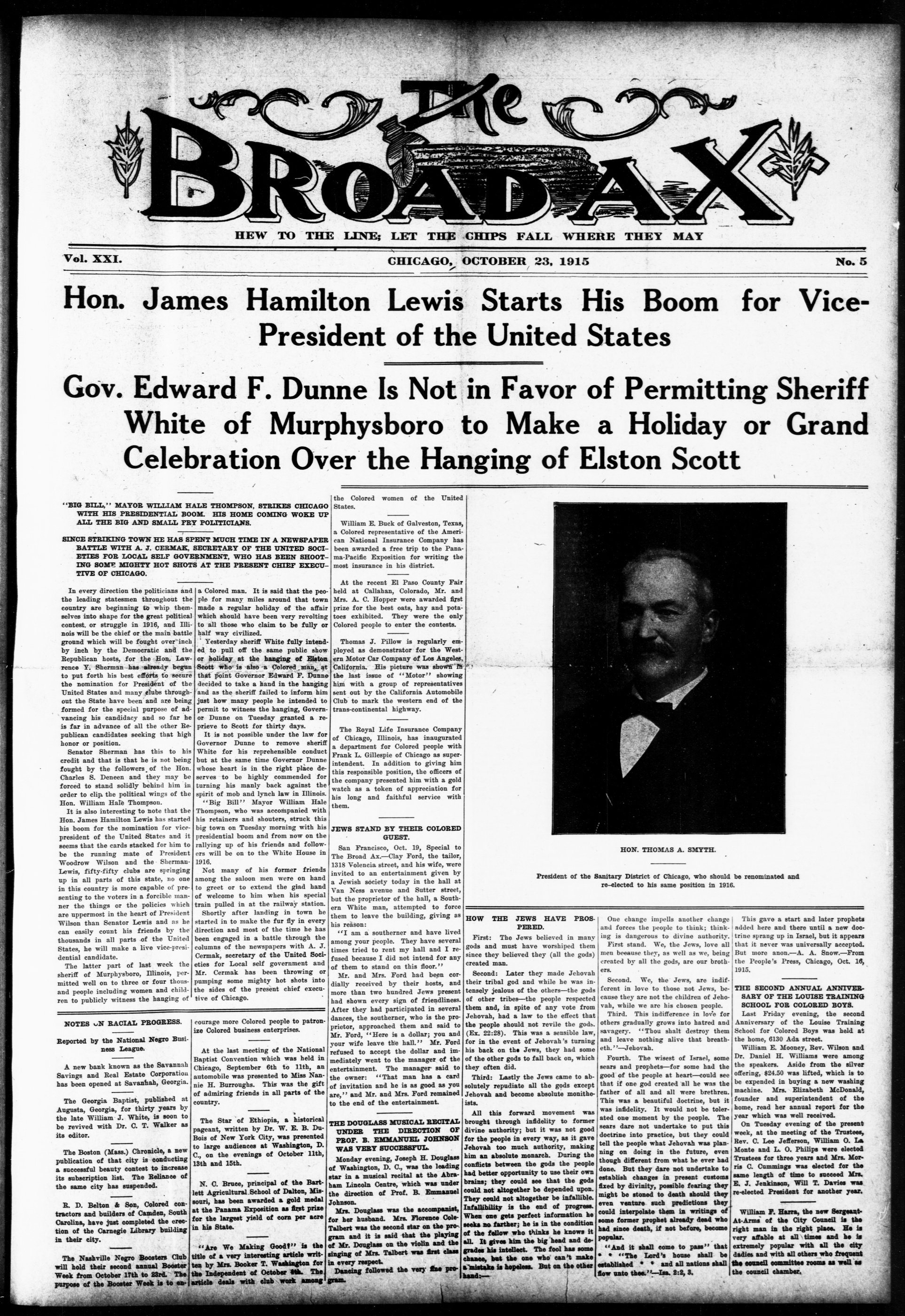
Hon. James Hamilton Lewis Starts His Boom for Vice President of the United States
Gov. Edward F. Dunne Is Not in Favor of Permitting Sheriff White of Murphysboro to Make a Holiday or Grand Celebration Over the Hanging of Elston Scott
"BIG BILL," MAYOR WILLIAM HALE THOMPSON, STRIKES CHICAGO WITH HIS PRESIDENTIAL BOOM. HIS HOME COMING WOKE UP ALL THE BIG AND SMALL FRY POLITICIANS.
SINCE STRIKING TOWN HE HAS SPENT MUCH TIME IN A NEWSPAPER BATTLE WITH A J. J. CERMAK, SECRETARY OF THE UNITED SOCIETIES FOR LOCAL SELF GOVERNMENT, WHO HAS BEEN SHOOTING SOME MIGHTY HOT SHOTS AT THE PRESENT CHIEF EXECUTIVE OF CHICAGO.
Vol. XXI.
Hon. Jam
Gov. Edw
White
Celeb
"BIG BILL," MAYOR WILLIAM H.
WITH HIS PRESIDENTIAL BOO
ALL THE BIG AND SMALL FRE
SINCE STRIKING TOWN HE HAS S
BATTLE WITH A. J. CERMAK,
ETIES FOR LOCAL SELF GOV
ING SOME MIGHTY HOT SHOT
TIVE OF CHICAGO.
In every direction the politicians and the leading statesmen throughout the country are beginning to whip themselves into shape for the great political contest, or struggle in 1916, and Illinois will be the chief or the main battle ground which will be fought over inch by inch by the Democratic and the Republican hosts, for the Hon. Lawrence Y. Sherman has already begun to put forth his best efforts to secure the nomination for President of the United States and many clubs throughout the State have been and are being formed for the special purpose of advancing his candidacy and so far he is far in advance of all the other Republican candidates seeking that high honor or position.
Senator Sherman has this to his credit and that is that he is not being fought by the followers of the Hon. Charles S. Deneen and they may be forced to stand solidly behind him in order to clip the political wings of the Hon. William Hale Thompson.
It is also interesting to note that the Hon. James Hamilton Lewis has started his boom for the nomination for vice-president of the United States and it seems that the cards stacked for him to be the running mate of President Woodrow Wilson and the Sherman-Lewis, fifty-fifty clubs are springing up in all parts of this state, no one in this country is more capable of presenting to the voters in a forcible manner the things or the policies which are uppermost in the heart of President Wilson than Senator Lewis and as he can easily count his friends by the thousands in all parts of the United States, he will make a live vice-presidential candidate.
The latter part of last week the sheriff of Murphysboro, Illinois, permitted well on to three or four thousand people including women and children to publicly witness the hanging of
NOTES ON RACIAL PROGRESS
Reported by the National Negro Busi ness League.
A new bank known as the Savannah Savings and Real Estate Corporation has been opened at Savannah, Georgia.
The Georgia Baptist, published at Augusta, Georgia, for thirty years by the late William J. White, is soon to be revived with Dr. C. T. Walker as its editor.
The Boston (Mass.) Chronicle, a new publication of that city is conducting a successful beauty contest to increase its subscription list. The Reliance of the same city has suspended.
R. D. Belton & Son, Colored contractors and builders of Camden, South Carolina, have just completed the erection of the Carnegie Library building in their city.
The Nashville Negro Boosters Club will hold their second annual Booster Week from October 17th to 23rd. The purpose of the Booster Week is to en-
HEW TO THE LINE; LET THE CHIPS FALL WHERE THEY MAY
a Colored man. It is said that the people for many miles around that town made a regular holiday of the affair which should have been very revolting to all those who claim to be fully or half way civilized.
Yesterday sheriff White fully intended to pull off the same public show or holiday at the hanging of Elston Scott who is also a Colored man, at that point Governor Edward F. Dunne decided to take a hand in the hanging and as the sheriff failed to inform him just how many people he intended to permit to witness the hanging, Governor Dunne on Tuesday granted a reprieve to Scott for thirty days.
It is not possible under the law for Governor Dunne to remove sheriff White for his reprehensible conduct but at the same time Governor Dunne whose heart is in the right place deserves to be highly commended for turning his manly back against the spirit of mob and lynch law in Illinois.
"Big Bill" Mayor William Hale Thompson, who was accompanied with his retainers and shouters, struck this big town on Tuesday morning with his presidential boom and from now on the rallying up of his friends and followers will be on to the White House in 1916.
Not many of his former friends among the saloon men were on hand to greet or to extend the glad hand of welcome to him when his special train pulled in at the railway station. Shortly after landing in town he started in to make the fur fly in every direction and most of the time he has been engaged in a battle through the columns of the newspapers with A. J. Cermak, secretary of the United Societies for Local self government and Mr. Cermak has been throwing or pumping some mighty hot shots into the sides of the present chief executive of Chicago.
courage more Colored people to patronize Colored business enterprises.
At the last meeting of the National Baptist Convention which was held in Chicago, September 6th to 11th, an automobile was presented to Miss Nannie H. Burroughs. This was the gift of admiring friends in all parts of the country.
The Star of Ethiopia, a historical pageant, written by Dr. W. E. B. DuBois of New York City, was presented to large audiences at Washington, D. C., on the evenings of October 11th, 13th and 15th.
N. C. Bruce, principal of the Bartlett Agricultural School of Dalton, Missouri, has been awarded a gold medal at the Panama Exposition as first prize for the largest yield of corn per acre in his State.
"Are We Making Good?" is the title of a very interesting article written by Mrs. Booker T. Washington for the Independent of October 18th. The article deals with club work among
CHICAGO, OCTOBER 23, 1915
the Colored women of the United States.
William E. Buck of Galveston, Texas, a Colored representative of the American National Insurance Company has been awarded a free trip to the Panama-Pacific Exposition for writing the most insurance in his district.
At the recent El Paso County Fair held at Callahan, Colorado, Mr. and Mrs. A. C. Hopper were awarded first prize for the best oats, hay and potatoes exhibited. They were the only Colored people to enter the contests.
Thomas J. Pillow is regularly employed as demonstrator for the Western Motor Car Company of Los Angeles, California. His picture was shown in the last issue of "Motor" showing him with a group of representatives sent out by the California Automobile Club to mark the western end of the trans-continental highway.
The Royal Life Insurance Company of Chicago, Illinois, has inaugurated a department for Colored people with Frank L. Gillespie of Chicago as superintendent. In addition to giving him this responsible position, the officers of the company presented him with a gold watch as a token of appreciation for his long and faithful service with them.
JEWS STAND BY THEIR COLORED GUEST.
San Francisco, Oct. 19, Special to The Broad Ax.—Clay Ford, the tailor, 1318 Volenia street, and his wife, were invited to an entertainment given by a Jewish society today in the hall at Van Ness avenue and Sutter street, but the proprietor of the hall, a Southern White man, attempted to force them to leave the building, giving as his reason:
"I am a southerner and have lived among your people. They have several times tried to rent my hall and I refused because I did not intend for any of them to stand on this floor."
Mr. and Mrs. Ford had been cordially received by their hosts, and more than two hundred Jews present had shown every sign of friendliness. After they had participated in several dances, the southerner, who is the proprietor, approached them and said to Mr. Ford, "Here is a dollar; you and your wife leave the hall." Mr. Ford refused to accept the dollar and immediately went to the manager of the entertainment. The manager said to the owner: "That man has a card of invitation and he is as good as you are," and Mr. and Mrs. Ford remained to the end of the entertainment.
THE DOUGLASS MUSICAL RECITAL UNDER THE DIRECTION OF PROF. B. EMMANUEL JOHNSON WAS VERY SUCCESSFUL.
Monday evening, Joseph H. Douglass of Washington, D. C., was the leading star in a musical recital at the Abraham Lincoln Centre, which was under the direction of Prof. B. Emmanuel Johnson.
Mrs. Douglass was the accompanist, for her husband. Mrs. Florence Cole-Talbert was the second star on the program and it is said that the playing of Mr. Douglass on the violin and the singing of Mrs. Talbert was first class in every respect.
Dancing followed the very fine pro
M. H.
President of the Sanitary District of Chicago, who should be renominated and re-elected to his same position in 1916.
President of the Sanitary District of Chicago, who should be renominated and re-elected to his same position in 1916.
HOW THE JEWS HAVE PROS
PERED.
First: The Jews believed in many gods and must have worshiped them since they believed they (all the gods) created man.
Second: Later they made Jehovah their tribal god and while he was intensely jealous of the others—the gods of other tribes—the people respected them and, in spite of any vote from Jehovah, had a law to the effect that the people should not revile the gods. (Ex. 22:28). This was a sensible law, for in the event of Jehovah's turning his back on the Jews, they had some of the other gods to fall back on, which they often did.
Third: Lastly the Jews came to absolutely repudiate all the gods except Jehovah and become absolute monotheists.
All this forward movement was brought through infidelity to former divine authority; but it was not good for the people in every way, as it gave Jehovah too much authority, making him an absolute monarch. During the conflicts between the gods the people had better opportunity to use their own brains; they could see that the gods could not altogether be depended upon. They could not altogether be infallible. Infallibility is the end of progress. When one gets perfect information he seeks no farther; he is in the condition of the fellow who thinks he knows it all. It gives him the big head and degrades his intellect. The fool has some chance, but the one who can't make a mistake in hopeless. But on the other hand—
One change impells another change and forces the people to think; thinking is dangerous to divine authority. First stand. We, the Jews, love all men because they, as well as we, being created by all the gods, are our brothers. Second. We, the Jews, are indifferent in love to those not Jews, because they are not the children of Jehovah, while we are his chosen people. Third. This indifference in love for others gradually grows into hatred and savagery. "Thou shalt destroy them and leave nothing alive that breatheth."—Jehovah.
Fourth. The wisest of Israel, some sears and prophets—for some had the good of the people at heart—could see that if one god created all he was the father of all and all were brethren. This was a beautiful doctrine, but it was infidelity. It would not be tolerated one moment by the people. The sears dare not undertake to put this doctrine into practice, but they could tell the people what Jehovah was planning on doing in the future, even though different from what he ever had done. But they dare not undertake to establish changes in present customs fixed by divinity, possible fearing they might be stoned to death should they even venture such predictions they could interpolate them in writings of some former prophet already dead who had since death, if not before, become popular.
"And it shall come to pass" that * * "The Lord's house shall be established * * and all nations shall flow unto thee." -Isa. 2:2, 3.
No. 5
This gave a start and later prophets added here and there until a new doctrine sprang up in Israel, but it appears that it never was universally accepted. But more anon.—A. A. Snow.—From the People's Press, Chicago, Oct. 16, 1915.
THE SECOND ANNUAL ANNIVERSARY OF THE LOUISE TRAINING SCHOOL FOR COLORED BOYS.
Last Friday evening, the second Anniversary of the Louise Training School for Colored Boys was held at the home, 6130 Ada street.
William E. Mooney, Rev. Wilson and Dr. Daniel H. Williams were among the speakers. Aside from the silver offering, $24.50 was lifted, which is to be expended in buying a new washing machine. Mrs. Elizabeth McDonald, founder and superintendent of the home, read her annual report for the year which was well received.
On Tuesday evening of the present week, at the meeting of the Trustees, Rev. C. Lee Jefferson, William O. La Monte and L. O. Phillips were elected Trustees for three years and Mrs. Morris Cummings were elected for the same length of time to succeed Mrs. E. J. Jenkinson, Will T. Davies was re-elected President for another year.
William F. Harra, the new Sergeant-At-Arms of the City Council is the right man in the right place. He is very affable at all times and he is extremely popular with all the city dades and with all others who frequent the council committee rooms as well as the council chamber.
PAGE TWO
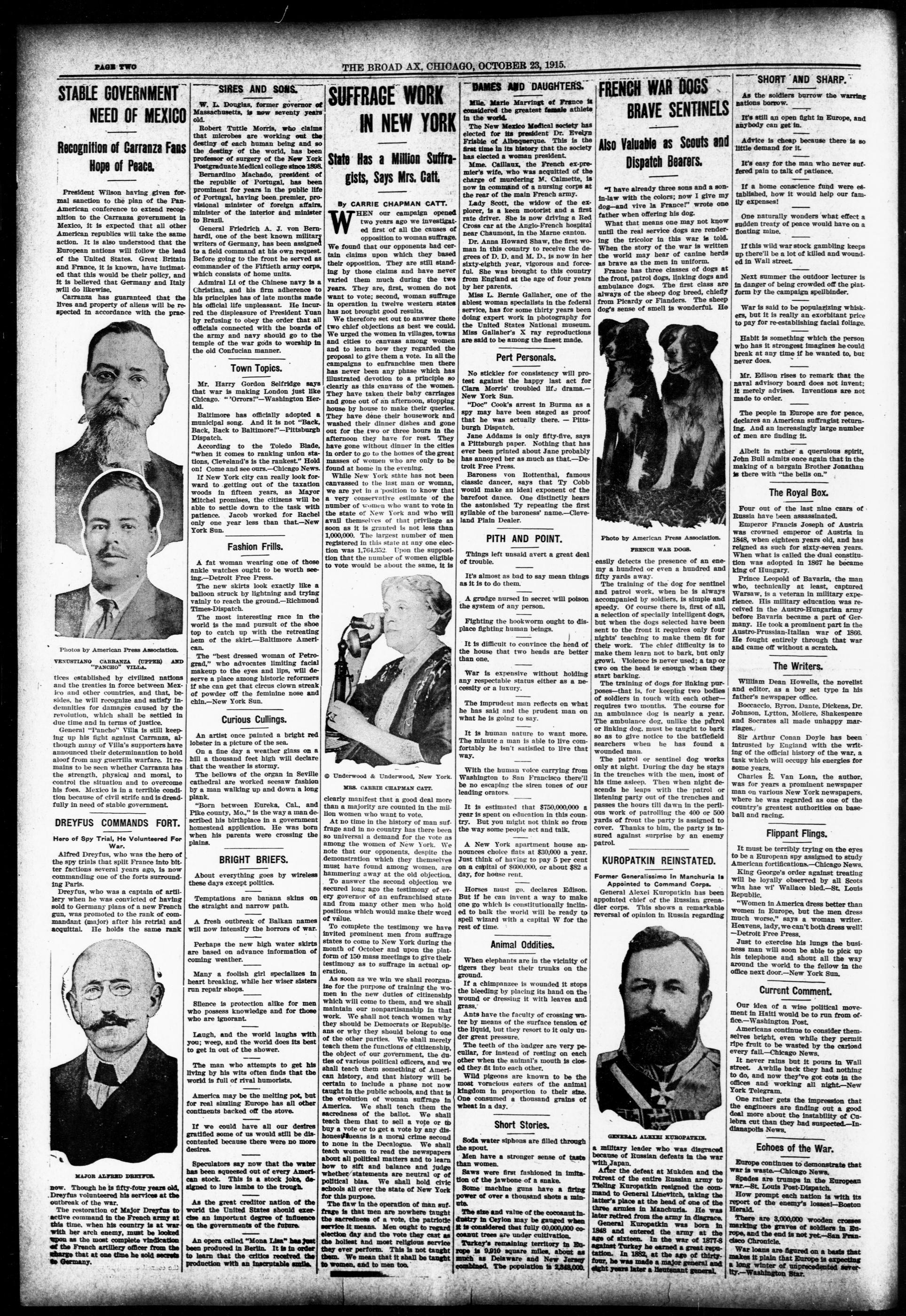
STABLE GOVERNMENT NEED OF MEXICO
Recognition of Carranza Fans Hope of Peace.
President Wilson having given formal sanction to the plan of the Pan-American conference to extend recognition to the Carranza government in Mexico, it is expected that all other American republics will take the same action. It is also understood that the European nations will follow the lead of the United States. Great Britain and France, it is known, have intimated that this would be their policy, and it is believed that Germany and Italy will do likewise. Carranza has guaranteed that the lives and property of aliens will be respected in accordance with the prac
M. B. B.
Photos by American Press Association.
VENUSTIANO CARRANZA (UPPER) AND "PANCHO" VILLA.
tices established by civilized nations and the treaties in force between Mexico and other countries, and that, besides, he will recognize and satisfy indemnities for damages caused by the revolution, which shall be settled in due time and in terms of justice.
General "Pancho" Villa is still keeping up his fight against Carranza, although many of Villa's supporters have announced their determination to hold aloof from any guerrilla warfare. It remains to be seen whether Carranza has the strength, physical and moral, to control the situation and to overcome his foes. Mexico is in a terrible condition because of civil strife and is dreadfully in need of stable government.
DREYFUS COMMANDS FORT.
Hero of Spy Trial, He Volunteered For War.
Alfred Dreyfus, who was the hero of the spy trials that split France into bitter factions several years ago, is now commanding one of the forts surrounding Paris.
Dreyfus, who was a captain of artillery when he was convicted of having sold to Germany plans of a new French gun, was promoted to the rank of commandant (major) after his retrial and acquittal. He holds the same rank
[Image of a man with a bald head, a mustache, and a suit with a tie].
MAJOR ALFRED DENEFFU.
now. Though he is fifty-four years old, Dreyfus volunteered his services at the outbreak of the war.
The restoration of Major Dreyfus to active command in the French army at this time, when his country is at war with her arch enemy, must be looked upon as the most complete vindication of the French artillery officer from the charge that at one time he sold secrets to Germany.
SIRES AND SONS
W. L. Douglas, former governor of Massachusetts, is now seventy years old.
Robert Tuttle Morris, who claims that microbes are working out the destiny of each human being and so the destiny of the world, has been professor of surgery of the New York Postgraduate medical college since 1898.
Bernardino Machado, president of the republic of Portugal, has been prominent for years in the public life of Portugal, having been premier, provisional minister of foreign affairs, minister of the interior and minister to Brazil.
General Friedrich A. J. von Bernhardl, one of the best known military writers of Germany, has been assigned to a field command at his own request.
Before going to the front he served as commander of the Fiftieth army corps, which consists of home units.
Admiral LI of the Chinese navy is a Christian, and his firm adherence to his principles has of late months made his official life unpleasant. He incurred the displeasure of President Yuan by refusing to obey the order that all officials connected with the boards of the army and navy should go to the temple of the war gods to worship in the old Confucian manner.
Town Topics.
Mr. Harry Gordon Selfridge says that war is making London just like Chicago. "Orrors!"—Washington Herald.
Baltimore has officially adopted a municipal song. And it is not "Back, Back, Back to Baltimore!"—Pittsburgh Dispatch.
According to the Toledo Blade, "when it comes to ranking union stations, Cleveland's is the rankest." Hold on! Come and see ours.—Chicago News.
If New York city can really look forward to getting out of the taxation woods in fifteen years, as Mayor Mitchel promises, the citizens will be able to settle down to the task with patience. Jacob worked for Rachel only one year less than that.—New York Sun.
Fashion Frills.
A fat woman wearing one of those ankle watches ought to be worth seeing.-Detroit Free Press.
The new skirts look exactly like a balloon struck by lightning and trying vainly to reach the ground.-Richmond Times-Dispatch.
The most interesting race in the world is the mad pursuit of the shoe top to catch up with the retreating hem of the skirt.-Baltimore American.
The "best dressed woman of Petrograd," who advocates limiting facial makeup to the eyes and lips, will deserve a place among historic reformers if she can get that circus clown streak of powder off the feminine nose and chin.-New York Sun.
Curious Cullings.
An artist once painted a bright red lobster in a picture of the sea.
On a fine day a weather glass on a hill a thousand feet high will declare that the weather is stormy.
The bellows of the organ in Seville cathedral are worked seesaw fashion by a man walking up and down a long plank.
"Born between Eureka, Cal., and Pike county, Mo.," is the way a man described his birthplace in a government homestead application. He was born when his parents were crossing the plains.
BRIGHT BRIEFS.
About everything goes by wireless these days except politics.
Temptations are banana skins on the straight and narrow path.
A fresh outbreak of Balkan names will now intensify the horrors of war.
Perhaps the new high water skirts are based on advance information of coming weather.
Many a foolish girl specializes in heart breaking, while her wiser sisters run repair shops.
Silence is protection allike for men who possess knowledge and for those who are ignorant.
Laugh, and the world laughs with you; weep, and the world does its best to get in out of the shower.
The man who attempts to get his living by his wits often finds that the world is full of rival humorists.
America may be the melting pot, but for real sizzling Europe has all other continents backed off the stove.
If we could have all our desires gratified some of us would still be discontented because there were no more desires.
Speculators say now that the water has been squeezed out of every American stock. This is a stock joke, designed to lure lambs to the trough.
As the great creditor nation of the world the United States should exercise an important degree of influence on the governments of the future.
An opera called "Mona Lisa" has just been produced in Berlin. It is in order to learn that the critics received the production with an inscrutable smile.
THE BROAD AX, CHICAGO, OCTOBER 23, 1915.
SUFFRAGE WORK IN NEW YORK
State Has a Million Suffra-gists, Says Mrs. Catt.
BY CARRIE CHAPMAN CATT.
WHEN our campaign opened two years ago we investigated first of all the causes of opposition to woman suffrage. We found that our opponents had certain claims upon which they based their opposition. They are still standing by those claims and have never varied them much during the two years. They are, first, women do not want to vote; second, woman suffrage in operation in twelve western states has not brought good results.
We therefore set out to answer these two chief objections as best we could.
We urged the women in villages, towns and cities to canvass among women and to learn how they regarded the proposal to give them a vote. In all the campaigns to enfranchise men there has never been any phase which has illustrated devotion to a principle so clearly as this canvass of the women. They have taken their baby carriages and gone out of an afternoon, stopping house by house to make their queries. They have done their housework and washed their dinner dishes and gone out for the two or three hours in the afternoon they have for rest. They have gone without dinner in the cities in order to go to the homes of the great masses of women who are only to be found at home in the evening.
While New York state has not been canvassed to the last man or woman, we are yet in a position to know that a very conservative estimate of the number of women who want to vote in the state of New York and who will avail themselves of that privilege as soon as it is granted is not less than 1,000,000. The largest number of men registered in this state at any one election was 1,764,352. Upon the supposition that the number of women eligible to vote would be about the same, it is
A. E.
© Underwood & Underwood, New York.
MRS. CARRIE CHAPMAN CATT.
clearly manifest that a good deal more than a majority are counted in the million women who want to vote.
At no time in the history of man suffrage and in no country has there been so universal a demand for the vote as among the women of New York. We note that our opponents, despite the demonstration which they themselves must have found among women, are hammering away at the old objection.
To answer the second objection we secured long ago the testimony of every governor of an enfranchised state and from many other men who hold positions which would make their word of value.
To complete the testimony we have invited prominent men from suffrage states to come to New York during the month of October and upon the platform of 150 mass meetings to give their testimony as to suffrage in actual operation.
As soon as we win we shall reorganize for the purpose of training the women in the new duties of citizenship which will come to them, and we shall maintain our nonpartisanship in that work. We shall not teach women why they should be Democrats or Republicans or why they should belong to one of the other parties. We shall merely teach them the functions of citizenship, the object of our government, the duties of various political officers, and we shall teach them something of American history, and that history will be certain to include a phase not now taught in the public schools, and that is the evolution of woman suffrage in America. We shall teach them the sacredness of the ballot. We shall teach them that to sell a vote or to buy a vote or to get a vote by any dishonest means is a moral crime second to none in the Decalogue. We shall teach women to read the newspapers about all political matters and to learn how to sift and balance and judge whether statements are neutral or of political bias. We shall hold civic schools all over the state of New York for this purpose.
The flaw in the operation of man suffrage is that men are nowhere taught the sacredness of a vote, the patriotic service it means. Men ought to regard election day and the vote they cast as the hooliest and most religious service they ever perform. This is not taught them. We mean that it shall be taught to women, and to men too.
DAMES AND DAUGHTERS.
Mile, Marie Marvingt of France is considered the greatest female athlete in the world.
The New Mexico Medical society has elected for its president Dr. Evelyn Frisleyn of Albuquerque. This is the first time in its history that the society has elected a woman president.
Mme. Caillaux, the French pre-mier's wife, who was acquitted of the charge of murdering M. Calmette, is now in command of a nursing corps at the rear of the main French army.
Lady Scott, the widow of the explorer, is a keen motorist and a first rate driver. She is now driving a Red Cross car at the Anglo-French hospital near Chaumont, in the Marne canton.
Dr. Anna Howard Shaw, the first woman in this country to receive the degrees of D. D. and M. D., is now in her sixty-eighth year, vigorous and forceful. She was brought to this country from England at the age of four years by her parents.
Miss L. Bernie Gallaher, one of the ablest woman specialists in the federal service, has for some thirty years been doing expert work in photography for the United States National museum. Miss Gallaher's X ray reproductions are said to be among the finest made.
Pert Personals.
No stickler for consistency will protest against the happy last act for Clara Morris' troubled life. drama.—New York Sun.
"Doc" Cook's arrest in Burma as a spy may have been staged as proof that he was actually there. — Pittsburgh Dispatch.
Jane Addams is only fifty-five, says a Pittsburgh paper. Nothing that has ever been printed about Jane probably has annoyed her as much as that.—Detroit Free Press.
Baroness von Rottenthal, famous classic dancer, says that Ty Cobb would make an ideal exponent of the barefoot dance. One distinctly hears the astonished Ty repeating the first syllable of the baroness' name.—Cleveland Plain Dealer.
PITH AND POINT.
Things left unsaid avert a great deal of trouble.
It's almost as bad to say mean things as it is to do them.
A grudge nursed in secret will poison the system of any person.
Fighting the hookworm ought to displace fighting human beings.
It is difficult to convince the head of the house that two heads are better than one.
War is expensive without holding any respectable status either as a necessity or a luxury.
The imprudent man reflects on what he has said and the prudent man on what he is going to say.
It is human nature to want more. The minute a man is able to live comfortably he isn't satisfied to live that way.
With the human voice carrying from Washington to San Francisco there'll be no escaping the siren tones of our leading orators.
It is estimated that $750,000,000 a year is spent on education in this country. But you might not think so from the way some people act and talk.
A New York apartment house announces choice flats at $30,000 a year. Just think of having to pay 5 per cent on a capital of $600,000, or about $2 a day, for house rent.
Horses must go, declares Edison. But if he can invent a way to make one go which is constitutionally inclined to balk the world will be ready to spell wizard with a capital W for the rest of time.
Animal Oddities.
When elephants are in the vicinity of tigers they beat their trunks on the ground.
If a chimpanzee is wounded it stops the bleeding by placing its hand on the wound or dressing it with leaves and grass.
Ants have the faculty of crossing water by means of the surface tension of the liquid, but they resort to it only under great pressure.
The teeth of the badger are very peculiar, for instead of resting on each other when the animal's mouth is closed they fit into each other.
Wild pigeons are known to be the most voracious eaters of the animal kingdom in proportion to their size. One consumed a thousand grains of wheat in a day.
Short Stories.
Soda water siphons are filled through the spout.
Men have a stronger sense of taste than women.
Saws were first fashioned in imitation of the jawbone of a snake.
Some machine guns have a firing power of over a thousand shots a minute.
The size and value of the coconut industry in Ceylon may be gauged when it is considered that fully 60,000,000 coconut trees are under cultivation.
Turkey's remaining territory in Europe is 9,910 square miles, about as much as Delaware and New Jersey combined. The population is 2,348,000.
FRENCH WAR DOGS BRAVE SENTINELS
Also Valuable as Scouts and Dispatch Bearers.
"I have already three sons and a son-in-law with the colors; now I give my dog—and vive la France!" wrote one father when offering his dog. What that means one may not know until the real service dogs are rendering the tricolor in this war is told. When the story of the war is written the world may hear of canine herds as brave as the men in uniform. France has three classes of dogs at the front, patrol dogs, linking dogs and ambulance dogs. The first class are always of the sheep dog breed, chiefly from Picardy or Flanders. The sheep dog's sense of smell is wonderful. He
```markdown
```
Photo by American Press Association.
FRENCH WAR DOGS.
easily detects the presence of an enemy a hundred or even a hundred and fifty yards away.
The training of the dog for sentinel and patrol work, when he is always accompanied by soldiers, is simple and speedy. Of course there is, first of all, a selection of specially intelligent dogs, but when the dogs selected have been sent to the front it requires only four nights' teaching to make them fit for their work. The chief difficulty is to make them learn not to bark, but only growl. Violence is never used; a tap or two on the head is enough when they start barking.
The training of dogs for linking purposes—that is, for keeping two bodies of soldiers in touch with each other—requires two months. The course for an ambulance dog is nearly a year. The ambulance dog, unlike the patrol or linking dog, must be taught to bark so as to give notice to the battlefield searchers when he has found a wounded man.
The patrol or sentinel dog works only at night. During the day he stays in the trenches with the men, most of his time asleep. Then when night descends he leaps with the patrol or listening party out of the trenches and passes the hours till dawn in the perilous work of patrolling the 400 or 500 yards of front the party is assigned to cover. Thanks to him, the party is insured against surprise by an enemy patrol.
KUROPATKIN REINSTATED.
Former Generalissimo In Manchuria is Appointed to Command Corps.
General Alexei Kuropatkin has been appointed chief of the Russian grenade corps. This shows a remarkable reversal of opinion in Russia regarding
[Name]
GENERAL ALKKEI KUROPATKIN.
a military leader who was disgraced because of Russian defeats in the war with Japan.
After the defeat at Mukden and the retreat of the entire Russian army to Tieling Kuropatkin resigned the command to General Linevitch, taking the latter's place at the head of one of the three armies in Manchuria. He was later retired from the army in disgrace. General Kuropatkin was born in 1848 and entered the army at the age of sixteen. In the war of 1877-8 against Turkey he earned a great reputation. In 1882, at the age of thirty-four, he was made a major general and eight years later a Heutenian general.
SHORT AND SHARP.
As the soldiers burrow the warring nations borrow.
It's still an open fight in Europe, and anybody can get in.
Advice is cheap because there is so little demand for it.
It's easy for the man who never suffered pain to talk of patience.
If a home conscience fund were established, how it would help our family expenses!
One naturally wonders what effect a sudden treaty of peace would have on a floating mine.
If this wild war stock gambling keeps up there'll be a lot of killed and wounded in Wall street.
Next summer the outdoor lecturer is in danger of being crowded off the platform by the campaign spellbinder.
War is said to be popularizing whiskers, but it is really an exorbitant price to pay for re-establishing facial foliage.
Habit is something which the person who has it strongest imagines he could break at any time if he wanted to, but never does.
Mr. Edison rises to remark that the naval advisory board does not invent; it merely advises. Inventions are not made to order.
The people in Europe are for peace, declares an American suffragist returning. And an increasingly large number of men are finding it.
Albeit in rather a querulous spirit, John Bull admits once again that in the making of a bargain Brother Jonathan is there with "the bells on."
The Royal Box.
Four out of the last nine czars of Russia have been assassinated.
Emperor Francis Joseph of Austria was crowned emperor of Austria in 1848, when eighteen years old, and has reigned as such for sixty-seven years. When what is called the dual constitution was adopted in 1867 he became king of Hungary.
Prince Leopold of Bavaria, the man who, technically at least, captured Warsaw, is a veteran in military experience. His military education was received in the Austro-Hungarian army before Bavaria became a part of Germany. He took a prominent part in the Austro-Prussian Italian war of 1866. He fought entirely through that war and came off without a scratch.
The Writers.
William Dean Howells, the novelist and editor, as a boy set type in his father's newspaper office.
Boccacello, Byron, Dante, Dickens, Dr. Johnson, Lytton, Moliere, Shakespeare and Socrates all made unhappy marriages.
Sir Arthur Conan Doyle has been intrusted by England with the writing of the official history of the war, a task which will occupy his energies for some years.
Charles E. Van Loan, the author, was for years a prominent newspaper man on various New York newspapers, where he was regarded as one of the country's greatest authorities on baseball and racing.
Flippant Flings.
It must be terribly trying on the eyes to be a European spy assigned to study American fortifications.-Chicago News. King George's order against treating will be loyally observed by all Scots who hae wi' Wallace bled.-St. Louis Republic. "Women in America dress better than women in Europe, but the men dress much worse," says a woman writer. Heavens, lady, we can't both dress well!-Detroit Free Press. Just to exercise his lungs the business man will soon be able to pick up his telephone and shout all the way around the world to the fellow in the office next door.-New York Sun.
Current Comment.
Our idea of a wise political movement in Haiti would be to run from office.—Washington Post. Americans continue to consider themselves bright, even while they permit ripe fruit to be wasted by the carload every fall.—Chicago News. It never rains but it pours in Wall street. Awhie back they had nothing to do, and now they've got cots in the offices and working all night.—New York Telegram. One rather gets the impression that the engineers are finding out a good deal more about the instability of Culebra cut than they had suspected.—Indianapolis News.
Echoes of the War.
Europe continues to demonstrate that war is waste.-Chicago News.
Spades are trumps in the European war.-St. Louis Post-Dispatch.
How prompt each nation is with its report of the enemy's losses!-Boston Herald.
There are 3,000,000 wooden crosses marking the graves of soldiers in Europe, and the end is not yet.-San Francisco Chronicle.
War loans are figured on a basis that makes it plain that Europe is expecting a long winter of unprecedented severity.-Washington Star.
Our First Canal.
The first canal opened in the United States for the transportation of passengers and merchandise was the Middlesex canal, from Boston to Lowell, in 1804. Colonel L. Baldwin, the engineer, removed the first turf Sept. 10, 1794. The canal was thirty feet wide and four feet deep, had twenty locks, seven aqueducts and fifty bridges. The route was from the Merrimac river, near what is now Middlesex village, through the Billerica and Concord rivers to the Shawsheen river, through Wilmington and Woburn to the Mystic river and through Medford to Charlestown.
Until 1836 the canal flourished, but with the building of the Lowell and Boston and the Lowell and Nashua railroads about two-thirds of the business of the canal was diverted to the railroads, and the canal never paid afterward. It was built for $130,000, but in 1859 the supreme court of Massachusetts issued a decree declaring the franchise forfeited through disuse. The ruins of the locks and aqueducts are still to be seen along the route.
Crab Locomotives
the queerest locomotives are the types used in mining and called "crabs." Gliding into the black galleries of coal mines and halting at a crevice in the wall from which issues the distant ring of pick and shovel, the crab lets out a flexible tentacle (a steel cable) for perhaps 200 or 300 feet, drawing it back presently with a car of coal in tow. Feeling into the holes, first on one side, then on the other, it moves along and never falls to secure its prey. Finally, with a dozen or more cars in its wake, it proceeds to the shaft or outlet and delivers its booty to the crusher.
These crabs operate by trolley conductors. They run through the main passages of the mine. Each crab is furnished with an electrically operated drum, on which are carried 200 or 300 feet of steel cable. This is hauled into the side passages or drifts by a man who couples the end to a loaded car, then gives a signal, and the crab does the rest.—George Frederick Stratton in St. Nicholas.
Tubular Chimes
Tubes instead of bells for chimes came into use in England half a century ago for three reasons—they have a mellower, more musical tone; they take up much less space than bells, and they weigh much less. The subject of tubular chimes has all the interest that pertains to bells generally. In making a bell the most expert founder cannot predetermine with exactitude the tone of the bell. Generally bells and tubes have to undergo nice modifications after they are finished, and it is much easier to alter the tube delicately to get just the pitch and tone quality sought than to modify the bell. Tubular chimes used in tower clocks, organs and elsewhere are fundamentally identical with the dangling gold tubes upon which the gifted vaudville performer plays "Home, Sweet Home."—New York Sun.
Solar Heat.
M. A. Veronnet has attempted to calculate the time the sun's activity could be maintained by (1) chemical action, (2) intra-atomic energy (radium) and (3) the work of gravitational contraction. For the first he gets 2,000 years, for the second only 170 years, while for the third he finds that gravitational contraction, according to the well known theory of Helmholtz, would account for several millions of years of solar heat, as demanded by the geological record. The fall of meteorites into the sun could account, at most, for only the four hundredth part of the sun's heat.
He Knew All About It.
"Your sheostring's untied, ma'am," cried the little boy to the stout woman who was moving majestically up the street. "I'll tie it for you." The stout lady smilingly thanked him and drew back her skirt in acceptance of his offer. The small boy drew the string tight and smiled back at her. "You see," he explained, "I know all about it. My mother's fat too."—Ladies' Home Journal.
Incomplete Expositions
"Some of those old Roman triumphs must have been magnificent exhibitions."
"Yes," replied the Philadelphia citizen. "But none of them could be quite complete. Circumstances, you know, didn't permit them to borrow our Liberty bell."—Washington Star.
The True Intent
Irate Patient (after the agony)—What do you mean by proclaiming on your sign, "Teeth extracted without pain?" Suave Dentist—Exactly what I say. I assure you the operation doesn't distress me at all. One dollar, please—Richmond Times-Dispatch.
What Happened.
"What is the cause of the rumpus over there?"
"A promising young playwright held the mirror up to Nature. Nature took one look and fell in a fit."-Judge.
An Old Punishment
David Leyes, a Scotchman, for striking his father was sentenced in 1754 to appear "bairheddit and bairfutttit" in church with an apologetic placard attached to his cranium.
Own Up.
A man should never be ashamed to own he has been in the wrong, which is but saying, in other words, that he is wiser today than he was yesterday. — Pope.
Good reasons must, of course, give place to better — Shakespeare.
Smokeless Powder
A great advance in firearms was made when smokeless powder came into the field. Many kinds of the smokeless variety have come and gone, and from the elimination of the unfittest the nitrocellulose and the nitroglycerin powders have survived. The nitrocellulose type is used by the United States army and navy, by the French and German army. Nitroglycerin is used by the British army and navy and by the German navy. The principal ingredient in both kinds of powder is guncotton.
The smokeless powder needed by the United States army and navy is in part manufactured by government plants and in part purchased from private manufacturers. The smokeless powder is made at all plants, both government and private, in accordance with specifications prepared by a joint board of army and navy officers. The highest grade materials and the most rigorous tests are employed in all stages of the manufacture to insure a high grade product-Brooklyn Eagle.
His Redeeming Trait
A young man was sitting in a barber's shop looking at a magazine when an old farmer, with little knowledge or appreciation of literary people, stepped up behind his chair and looked over his shoulder.
"Who's them? he inquired, pointing to a group of portraits.
"Well known authors and playwrights," was the reply.
"Humph!" ejaculated the farmer contemptuously. "Jist writin' fellers, eh?" Then he caught sight of an author with a long, solemn face, and his eyes sparkled. "That's the one I like," he said, with decision, putting his finger on the writer's mournful countenance.
"Oh, yes; nearly every one likes him!" agreed the young man. "His humorous writings are"—
"Don't know nothing 'bout his writin', but I like his face."
"Cause he's the only feller that looks like he was sorry for what he'd done."-Chicago Herald.
Big Trees.
People generally associate ideas of the California big trees with the Mariposa grove, near the Yosemite, and yet it appears that there are in the Sequoia National park 1,163,000 trees, 12,100 of which exceed ten feet in diameter. Some idea of the immensity of one of these big trees can be gathered from the statement that "3,000 fenceposts, sufficient to support a wire fence around 8,000 or 9,000 acres, have been made from one of these giants, and that was only the first step toward using its huge carcass. Six hundred and fifty thousand shingles, enough to cover the roofs of seventy or eighty houses, formed the second item of its product. Finally, there still remained hundreds of cords of firewood which no one could use because of the prohibitive expense of hauling the wood out of the mountains."—Manufacturers' Record.
A Memorable Ride
The most memorable ride in English history was that of Sir Arthur Owen, which placed the Hanoverian dynasty on the throne of Great Britain. The act of settlement by which in 1701 parliament elected the house of Hanover to the British throne was passed by only one vote, and this casting vote was given by Sir Arthur Owen, the member of parliament for Pembrokeshire. He arrived at Westminster, dusty and travel worn, only just in time to record his vote, having ridden with furious haste from Wales for the purpose on relays of horses kept at all the posting houses along the route. To that ride Britain owes its Georgian era; hence its Queen Victoria and her descendants.
Home of Musical Fish
Lake Batticaloa, Ceylon, has the probably unique distinction of being the home of musical fish. The sounds emitted by these are said to be as sweet and melodious as those which would be produced by a series of aeolian harps. Crossing the lake in a boat one can plainly distinguish the pleasant sounds. If an oar is dipped in the water the melody becomes louder and more distinct.
Books.
For the greater part of its life a book is an article of furniture and stands upon the shelf to decorate the library with its patch of color and glow of kindly associations, but from time to time there occur those crises of its existence when it is taken down and read.-London Athenaeum.
Her Notion of Finance
"Charley, dear," said young Mrs. Torkins, "do you ever buy on a margin?" "Never."
"Well, why don't you? It seems to me much safer to dabble around the edge and avoid getting in too deep."—Washington Star.
The Proper Tree
Curious Charley—Do nuts grow on trees, father? Father—They do, my son. Curious Charley—Then what tree does the doughnut grow on? Father—The "pantree," my son—Purple Cow.
Insurance No Excuse
Ignorance of the law excuses no man—not that all men know the law, but because 'tis an excuse every man will plead, and no man can tell how to refute him.—John Selden.
Some Wisdom Left
"You didn't tell the barber you went to a burry."
"No. I didn't want him to know it"
-Pittsburgh Post
THE BROAD AX, CHICAGO, OCTOBER 23, 1915
Right Word, but What Was It?
It had been a hard day, and Mr. K. smoked in silence one cigar after another. Mrs. K. was wondering how long it would be until her husband would say something. Jim is rather quiet for the most part, she will tell you. "I'll give him five more minutes," she agreed mentally, with her usual generosity.
"I'd give a hundred dollars to know," Jim remarked abstractedly.
His wife clapped her hands in delight. Jim never disappointed her.
"What?" she asked
The Calavera Skull.
Of interest in connection with tary gold bearing river gravy California is the story of the Cala skull. For a time this skull attests much attention not only to the ple in California, but from schm men the world over. It was rep to have been found in 1886 near town of Angels, Calaveras county a depth of 120 feet, in tertiary els underlying tertiary lava. The ing of a human skull embedded in deposits was for a time believ indicate that man had been in
"Well, you see, it was this way: I was talking over a business deal with the head of the firm, and I got pretty enthusiastic, I guess. I must have used some big words. Suddenly the boss' hand came down on the table with a crash. 'You used the right word that time, my boy. That's my idea exactly, he exclaimed."
"Well?" questioned his wife.
"Nothing, only I'd give a hundred dollars to know what I said."—Indianapolis News.
Three Streets
In the world as known to Baedeker there are only two streets that can compare with Fifth avenue, and these are both on Manhattan Island. From its source in the asphalt bottoms of Washington-square to where it loses itself in the coal middens of the Harlem river at One Hundred and Forty-fifth street the avenue runs a course of almost exactly seven miles. It runs true to the North star, without a turn, with only a single pause, grimly bent on its business in a way calculated to make the dowager metropolises of Europe lift their eyebrows and say, "How American!" Its rivals are Eighth avenue, a half mile to the west, which may be some 900 feet longer, and still farther west Tenth or Amsterdam avenue, the titan of all urban highways, nine miles up hill and down, as determined in the primeval blueprint shaped by the city fathers some time about the year 1800. All three streets have character as well as length, but Fifth avenue alone has significance.-Simeon Strunsky in Harper's Magazine.
China's Majestic Altar
No altar on earth vies in marble majesty with the Altar' of Heaven—Tien Tan—in the south of the Chinese city of Peking, which Emperor Yung Le of the Ming dynasty reared in A. D. 1420 with its triple balustrades, stairs and platforms of pure white marble carved miraculously, its great circle covering a wide area in the midst of a vast inclosure. Standing alone, deserted under the blue Chinese sky, it is a dream of majesty and beauty. As the great setting of a scene of ritual pomp that calls for thousands and thousands of robed celebrants, with music, incense, sacrifice, it is transcendently imposing and impressing. There the emperor knelt once a year and worshiped "the only being in the universe he could look up to"—Shang Tl—the emperor of the world above, whose court was in the sky and the spear tips of whose soldiers were the stars.
Losses From Consumption.
The economic loss due to tuberculosis is stupendous. Some years ago I made a careful estimate and was astonished to find that, counting the earnings lost, the cost of medical attendance and nursing, special foods, institutional care and, above all, the capitalized value of the lives cut off in their prime (for tuberculosis kills at thirty or thirty-five), the total annual cost in this country alone from tuberculosis is over a billion of dollars. This is merely the cold cash cost and takes no account, of course, of sentimental or emotional losses from the death of loved ones.—Good Health.
Grabs In Conflict
The most savage specimen of the crab species is found in Japan. As soon as he spies another of his kind he scrapes his claws together in rage, challenging him to combat. Not a moment is wasted in preliminaries. The sand files as the warriors push each other hither and thither, until at last one of them stretches himself out in the throes of death, still feebly rubbing his claws in defiance of the foe.
Hard to Bear.
Mrs. de Style (fond of novels)—Did you do as I directed, and tell everybody who called that I was engaged? Domestic—No one called, mum. "What! Not one?"
"Not a soul." "Mercy! Such heartless neglect is outrageous!"—New York Weekly.
In Society.
"Well, I am forty-five years old today."
"My dear lady, years mean nothing to a beautiful woman."
"I know. Still, I guess I'll have to really move out of the younger set."—Louisville Courter-Journal.
She Certainly Was.
Her eyes were not exactly straight, and some one commented upon it and asked Smith if he had noticed it. "Noticed it, man?" he replied. "Why, she is so crosseyed that recently when I sat next to her at a dinner she ate off my plate!"—Exchange.
Bamboo Trees
the bamboo tree does not blossom until its thirtieth year, when it produces seed profusely and then dies. A famine was prevented in India in 1512 by the sudden flowering of the trees, when 50,000 people gathered the seed for food.
The path of success in business is invariably the path of common sense—Samuel Smiles.
The Calavera Skull
Of interest in connection with tertiary gold bearing river gravels of California is the story of the Calaveras skull. For a time this skull attracted much attention not only from the people in California, but from scientific men the world over. It was reported to have been found in 1866 near the town of Angels, Calaveras county, at a depth of 130 feet, in tertiary gravels underlying tertiary lava. The finding of a human skull embedded in such deposits was for a time believed to indicate that man had been in existence in North America longer than had been supposed. Strange to say, the skull is of a higher type than skulls which, although known to antedate historic times, are known also to be much younger than the tertiary. Although Professor J. D. Whitney, then state geologist, accepted the skull as a bit of genuine scientific evidence, it is generally believed by students of the antiquity of man that the Calaveras skull, while undoubtedly old, probably did not come from the auriferous gravels at all.—Argonaut.
A Grim Cathedral
Once the capital of the kingdom of Portugal, Coimbra possesses a number of interesting monuments. Its cathedral dates from the early period when it upon the west, Toledo in the center and Saragossa to the east were the Christian outposts against the infidel. Its color, a deep golden brown, is like that of an old warrior tanned by the wars. Squarely seated upon its platform, its walls pierced only by narrow windows that resemble loopholes, its roofs and parapets embattled, it recalls the day when praying and fighting went hand in hand, and its rough hewn stones sheathe it as in a bronze culrass chased with the delicate tracery of its south door added at a later epoch. Its interior, too, is severely plain, though adorned with the only fine reredos that I saw in Portugal, and with side chapels that contain a notable array of old blue tiles.—Ernest Peixotto in Scrillner's.
Hiding Behind Smoke
The accuracy of modern naval gunnery is so marvelous that the only hope for a ship to escape being sunk when within range of the guns is to hide itself. That is easier said than done, however, and there is only one way in which it can be done, and that is by means of a "smoke screen." It is hard for one ship to hide herself behind her own smoke unless the wind is favorable, but for a number of ships to put a huge fog of black smoke between them and their pursuers is comparatively easy. The smoke is caused by oil fuel, and it can be turned off or on at will by supplying more or less air to the furnaces. It is so dense and black that it is quite impossible to see more than a few yards through it—Pearson's Magazine.
Hawking In the Old Days.
Falconry, or hawking, was a favorite sport with the nobility and gentry of Europe down to the first half of the seventeenth century. Hawks were trained to mount and pursue game and bring it to their masters and mistresses, coming and going to the call of the latter with marvelous docility. The hawks were tricked out with gay hoods and held until ordered to pursue the quarry, or game, by leather straps fastened with rings of leather about each leg just above the talons, and with silken cords called "jesses" to each of these leather straps, or "hewets," was attached a small bell. In the flight of hawks it was often so arranged that the bells made "a consort of sweet sounds."
Still Has Friends
Two retired tradesmen residing in the country were discussing matters generally, when one asked:
"How is your son doing in the city?"
"Oh, he doesn't say much about his business." was the reply, "but he writes me that he's got a lot of friends."
"That's very encouraging," remarked the other, "for it shows that he hasn't had to borrow money yet!"—Pearson's Weekly.
A Much Needed Best.
"Does your boy take kindly to farm life now that he has finished college?" "Oh, yes!" replied Farmer Cobbles. "He says that after the strenuous four years he's been through it's a pleasure to loaf around home and watch the hired men at work."—Birmingham Age-Herald.
Silvar.
The handle of a silver spoon gets hot more quickly than that of a pewter spoon when thrust into a cup of hot coffee. In fact, this is an easy and quick way of detecting imitation silver. Silver itself has been found to be the best conductor of heat known.
His Ambition.
"How would you feel if the end of the world came tomorrow?"
"T'd be glad of it. I always wanted to be present at a great historical event."-Detroit Saturday Night.
Happiness.
Mankind is always happier for having been happy. So that if you make men happy now you make them happy twenty years hence by the memory of it—Sydney Smith.
Norway's Clear Waters.
In the flords on the Norway coast the clearness of the water is wonderful. Objects the size of half a dollar may be seen at a depth of twenty-five to thirty fathoms.
We think a happy life consists in tranquillity of mind.—Clecero.
Early Coal Discoveries
The first mention of coal in the territory which afterward became the United States has heretofore been credited to Father Louis Hennepin, who showed on a map published in 1859 the location of a "cole mine" along Illinois river near the site of the present city of Ottawa. According to S. O. Andres of the Illinois state geological survey, the credit for this first mention of coal does not belong to Hennepin, as the discovery of coal in the United States by Europeans was made by Joliet and Marquette in 1673. However, nearly a century and a half elapsed after the discovery of coal in Illinois before mining began. The Journal of the Franklin institute for 1836 states that the first mining operations conducted by white men were at the Mount Carbon mines, in Jackson county, Ill. These mines were opened in 1810 and worked to a small extent for many years. The earliest recorded production was in 1833, when 6,000 tons of coal is said to have been mined—Detroit Free Press.
A Kindly Human Touch.
How rapidly nature repairs and beautifies the torn places! The gash left by the uprooted tree is soon covered with green, and moss and vines are quick to make the old stump into a thing of beauty. Humanity might well learn a lesson thereby, to its own great advantage. Sympathy may easily transform the unsightly and give it beauty. If earth's soil responds to the touch of nature in such a way it is reasonable to suppose that human life would not be less responsive. Hundreds of lives at present harsh and repulsive are within reach of every one, and they might be wholly changed by a little sympathetic seeding and kindly culture. After all, what more is needed than the persuasion of the kindly human touch? There is no greater miracle than that which is wrought by love, and there is no man who may not work it if he will—Christian Register.
Tinted Polygamy.
The old negro had been arrested for "having more than one wife," the last woman being the complainant. He happened to be well known locally and an orderly character.
"How many wives have you had?" demanded the judge.
"Six, yo' honor." was the reply.
"Why couldn't you get along with them?" the judge insisted.
"Well, suh, de fust two sp'lled de white folks' clothes when dey washed 'um, de thud worn no cook, de fo'th was des natcherly lazy en' de dif'—I'll tell yo', jegde, de dif' she"—
"Incompatibility?" the court suggested.
"No, yo' honor," said the old negro slowly. "It wornn't nothin' ilk' dat. Yo' jez' couldn't get along wid her onless yo' wuz somewhats else."—Case and Comment.
Grease Spots on Books.
To remove grease spots from the pages of books, gently warm the soiled page of the book, which should have a piece of thick paper under it, by holding a hot iron at a little distance from the paper. Next press upon the spots pieces of clean blotting paper, one after another, so as to absorb as much of the grease as possible. Have ready some clear essential oil of turpentine heated almost to boiling point, warm the soiled leaf again a little, and then with a camel's hair brush apply the heated turpentine to both sides of the spotted part. If this application is repeated the stain will shortly disappear. Finally, take a clean brush, dip it in rectified spirits of wine and paint over the place.
Charles Lamb and May
Charles Lamb did not like May. Here is a fling of his against the merry month:
"I do not mind the utmost rigor of real winter," he wrote to Bernard Barton, "but these smiling hypocrites of May wither me to death. * * * What lies you poets tell about the May! It is the most unengal part of the year, cold crouses and cold promises; you take your blossoms in ice—a painted sun—
"Unmeaning joy around appears, And nature smiles as if she sneers."
-Westminster Gazette.
Evidently He Was.
"Larceny" was the word given out, and one man taking the examination tried to peep at the next man's paper to see how he spelled it.
"What are you up to?" demanded the examiner sharply.
"I don't quite understand the word, slr."
"I think you did understand it. And, furthermore, I think you are trying to use it."—Louisville Courier-Journal.
One Way to Eat Bananas.
It is said that the best way to eat bananas, which are now so common a diet, is to crush them with a fork, squeeze a lime or lemon over them and sprinkle them with sifted sugar. They are often eaten this way in the tropics and found to be delicious.—Pittsburg Press.
Color Combinations
Nickler—The novelist dresses his heroine in some clinging white stuff. Bocker—But doesn't mention the cost in some vanishing green stuff.—New York Sun.
Just For a Joke
"You should crack a few jokes occasionally. Ask her to marry you or something like that."—Puck.
Take life as you find it, but don't leave it an—Anon.
PAGE THREE
Refraction of Light
Refraction plays many magical tricks with men's eyes. It is responsible for the extraordinary phenomenon called mirage, which has excited the wonder of mankind in every age. Owing to differences of temperature, barometric pressure, etc., in adjacent parts of the atmosphere, the refraction is sometimes capriciously varied so that the most abnormal sights are seen. Parts of the earth seem detached and set afloat. Ships are visible, upside down, in the sky; objects lying behind hills are beheld apparently lifted above them; lakes of gleaming water, surrounded by palm trees and refreshing vegetation, spring into view in the midst of sandy deserts; unknown cities, with towers and pinnacles, make their appearance suspended in the air; aerial animals appear, browsing in illusory pastures; processions of men and horses are seen, marching or galloping where no foot has ever trod—such are some of the recorded marvels that the mirage has produced.—New York Journal.
In Old Porto Rico.
In the vicinity of Mayaguez, Porto Rico, are several historically interesting places. The little village of Rio Guanroba, near Anasco, was the scene of the unique experiment by which the Indians in 1511 endeavored to discover whether the Spaniards were immortal. After holding a Spanish nobleman under water six hours they were assured that those intruders were just as subject to death as themselves. About seven miles from Mayaguez, across a rough mountainous country, is the famous sanctuary of Montserrat, which is visited every year by many pilgrims. Situated conspicuously among its wild surroundings, its large stone church is visible for many miles. From the mountain top we obtained a delightful view of the beautiful plain through which flow the Boqueron and Guanajoba rivers.—New York Telegram
Carried It Through:
A teacher was one day explaining to her class the degrees of comparison of adjectives. To make sure she was understood she called on each pupil in turn to give comparatives and superlatives of adjectives which she named and got good answers until she asked one little fellow to name the comparative degree of "sick."
After thinking a moment he said, "Worse."
The answer puzzled the teacher, because, although it was not the one she wanted, the pupil had given a comparative. She decided she could best show him his error by letting him go on and asked sweetly, "Well, if 'worse' is the comparative of 'sick' what would you give as the superlative?"
"Dead," came the answer without a moment's hesitation—New York Times.
The Things That Count
What, when our time comes, does it matter whether we have fared daintily or not, whether we have worn soft raiment or not, whether we have a great fortune or nothing at all, whether we shall have reaped honors or been despised, have been counted learned or ignorant as compared with how we may have used that talent which has been intrusted to us for the Master's service? What shall it matter, when eyeballs glaze and ears grow dull, if out of the darkness may stretch a hand and into the silence may come a voice: "Well done, thou good and faithful servant. Thou hast been faithful over a few things. I will make the ruler over many things. Enter thou into the joy of thy Lord."—Henry George in Social Problems.
No Alleviation.
A belted earl was in the habit of playing golf daily at Musselburgh. This gentleman had contracted some ailment which made his head always shake a little. Frequently he had had occasion to rebuke his caddie for excessive indulgence in alcoholic liquors, and one day he spoke to him very sharply. "Robert, you are drunk today. It is a disgrace. You are very drunk!" "Drunk!" replied the caddie. "I know I am drunk, but I'll be sober tomorrow. You're daft, and you'll never be right!" —Dundee Advertiser.
Right Up to Date.
Mother—Are you sure you can give my daughter all the luxuries and privileges enjoyed by the married women of her set? Suitor—I can give her town and country houses, motorcars, a string of polo ponies and dancing lessons at once, and a divorce and alimony within two years.—Life.
The Inexitable Thing.
"Did you get any stock in that balloon line project?"
"Yes, but I think I-pald for it more than it was worth."
"That is what was to be expected. An air line would naturally have inflated stock."-Baltimore American.
A Change Yet.
Tom—Is it true that you proposed to Alice and were rejected? Jack—Not exactly rejected. She said when she felt like making a fool of herself she'd let me know.—Boston Transcript.
Those Uncaught Fish
Maud—Don't you think there are just as good fish in the sea as ever were caught? Marle—Well, they're certainly smarter.
All He Has.
"He has a fortune in his own name."
"Worth a lot, eh?"
"No. But his name is Rich."—Detroit
Free Press.
Agents and Correspondents Wanted to Handle THE BROAD AX. Liberal Commissions to Live Agents. Address, Julius F.Taylor, 6532 St. Lawrence Av., Chicago
Agents a BRO Addr
THE BROAD AX
PUBLISHED WEEKLY
Will promulgate and at all times uphold the true principles of Democracy, but Catholics, Protestants, Priests, Infidels, single Taxes, Republicans, or anyone else can have their say, as long as their language is proper and responsibility is fixed. The Broad Ax is a newspaper whose platform is broad enough for all, even claiming the editorial right to speak its own mind. Local communications will receive attention. Write only on one side of the paper.
Advertising rates made known on application.
Address all communications to
6532 ST. LAWRENCE AVE., CHICAGO, ILL
PHONE WENTWORTH 2597.
JULIUS F. TAYLOR, Editor and Publisher
Entered as Second-Class Matter Aug. 18,
1902, at the Post Office at Chicago, Illinois,
under Act of March 8, 1879.
REMOVAL NOTICE
From on and after this date, all letters or other mail matter intended for Julius F. Taylor or Mrs. Annie E. Taylor or The Broad Ax, should be addressed to 6532 St. Lawrence Ave., Jackson Park station. Phone Wentworth 2597.
HEALTH NOTES
Crowded conditions create community dangers.
* * *
Plain food, good cooks and hard work will save doctor bills.
* * *
The best time for you to take care of your health is before you get sick.
* * *
The pneumonia season is at hand. To escape it, don't hibernate—ventilate. And don't dissipate.
* * *
When the windows go down the death rate from the bad air diseases goes up.
* * *
Fresh air, sunshine and a cheerful disposition are good tonics; no drug store sells them.
Chew your food until you can taste it. Thorough mastication is both a pleasing and important part of right eating.
* * *
If you are not hungry, don't eat. When appetite calls, eat. Few people in this land die from starvation, but thousands die every year from over-eating.
---
Dirt and filth accumulate all the time; and if neglected soon become ugly, unsightly and dangerous. Cleanliness and beauty can only be maintained by constant vigilance and labor.
***
It pays to have clean, attractive surroundings. It pays in dollars and cents for the reason that a tidy and well-kept property will sell for more money than will the property that is dirty, untidy and neglected. It pays in comfort and satisfaction; in pride, joy and self-respect.
---
Eyesight is one of the most precious of human possessions. Many children have defective eyesight. The wise and loving parent will see to it that his children's eyes are not neglected. Impaired vision is a serious handicap in any calling. Consult your family physician; if he recommends the oculist, see him without delay.
. . .
The human body is a most wonderful piece of mechanism. No machine, however complicated or intricate in its parts, can be compared with the most marvelous of all machines, the human body. And as the skilled workman operating a machine in the workshop or factory is careful to keep it always in good repair and in perfect working order, so we should take the best of care of our bodies. If we allow them to get out of repair we cannot expect to be able to use them to best advantage in our daily life and work. In other words, take care of your machine.
Mr. Dennis Williams of 63rd and Langley ave, also has a fine boy. The race will not become extinct if such men and women as these survive.
GRAND-DAUGHTER OF ONCE SLAV- ERY FOE, BECOMES BRIDE.
Miss Myra Bradwell Helmer was married Thursday evening to Dr. J. Stewart Pritchard, of Ontario, Canada. The nuptial service, elegantly exclusive and very rich in its setting of palms and chrysanthemums, took place in the gold and white ball room of the Virginia Hotel. Dr. William P. Merrill, cousin of the bride and pastor of the Fifth Avenue Presbyterian Church in New York officiated.
Only the relatives and a few immediate friends witnessed the ceremony; but there was an aftermath of gayety in the elaborate supper followed by a series of dancing numbers in which 400 guests participated.
Gifts came to this pretty bride from every point of the compass. The surpassing feature of the wedding presents was a large piece of marble statuary, "The Slave," from a distant relative in the East, whose father was a friend of the bride's late maternal grandfather, Judge Bradwell, of Chicago, whose name has gone down in history for the stand he always took on the question of slavery. The Judge, too, was a close friend of President Lincoln and it was from Mrs. Lincoln he received an autograph letter of the martyr President on his definition of Democracy. The missive had come into the possession of an acquaintance of Judge Bradwell and after a sort of "endless chain" trip, the valuable lost letter came to light and was "bowed" with a piece of white ribbon to "The Slave" gift for the bride. It reads:
"To Judge Bradwell, Chicago, Ill.: "As I would not be a slave, so I would not be a master. This expresses my idea of Democracy. Whatever differs from this to the extent of the difference, is no Democracy.
A. LINCOLN."
The bride's grandfather, James B. Bradwell went down in history by personal views expressed on African slavery in the South. In 1861 he was elected County Judge of Cook County and it was while in that capacity he decided one very important question presented in his Court; and that was the question whether a marriage made during slavery between slaves was valid upon emancipation. He expressed himself in a way that was characteristic. He said: "Were there a thousand of these decisions made under this influence in favor of slavery and against the conclusions I have come to in this case I would brush them aside as I would a spider's web and decide this case upon what I consider to be the first principles of law, justice and humanity."
The Bradwell's have always been friendly to the Colored people, the head of that name which will continue to be written on the pages of the history of the State of Illinois for many years to come, Judge James B. Bradwell, was the head and the front of the under ground railway station in this section of the country and many a runaway slave owed his liberty to him.
THE GRAND SYMPHONY ORCHESTRA ENTERTAINED MANY OF THE MUSICAL LOVERS AT THE GRAND THEATRE TUESDAY AFTERNOON.
Messrs. Horn and Johnston managers of the Grand Theatre delighted many of its patrons Tuesday afternoon which was something new in the way of the Grand Symphony Orchestra, which was conducted by Mr. David B. Peyton, Jr.
Miss Josephine De Vance, made the hit of the afternoon. She was called back four times to fascinately sing "Sympathizing Moon," which was composed by Henry (Teenan) Jones, editor of his famous night book and the head boss of his cafe, 3445 S. State street and Miss De Vance at the end of her fourth encore, was presented with a large bunch of American Beauty Roses.
The next recital will be Wednesday afternoon, November 3. William Foster, is the business manager for the orchestra.
The following was the program:
a March—Thunder Cloud, Alford, b Overture—Bridal Rose, Lanareau, c Hungarian Rag, Lenzberg, Vocal Solo, Selected. Mr. Isaac H. Young, a Spring, Beautiful Spring, Lincke, b Delicioso—An Indian Serenade, Dixon, Bass Solo. Mr. John Turner, a Novelette—Spooks, Alford, b Overture—Light Calvary, Suppe. Intermission 10 minutes, a Marsh—Old Leather; b Overture—Poet and Peasant, by special request, Vocal Solo, Selected. Mr. Hugh Buchanan, a Selection—The Glow Worm, Lincke, b Operatic Rag, Remick, Vocal Solo, Selected. Miss Josephine De Vance, a Overture—Zampa, Suppe, b March—Flumed Knight, Lung.
THE BROAD AX, CHICAGO, OCTOBER 23, 1915.
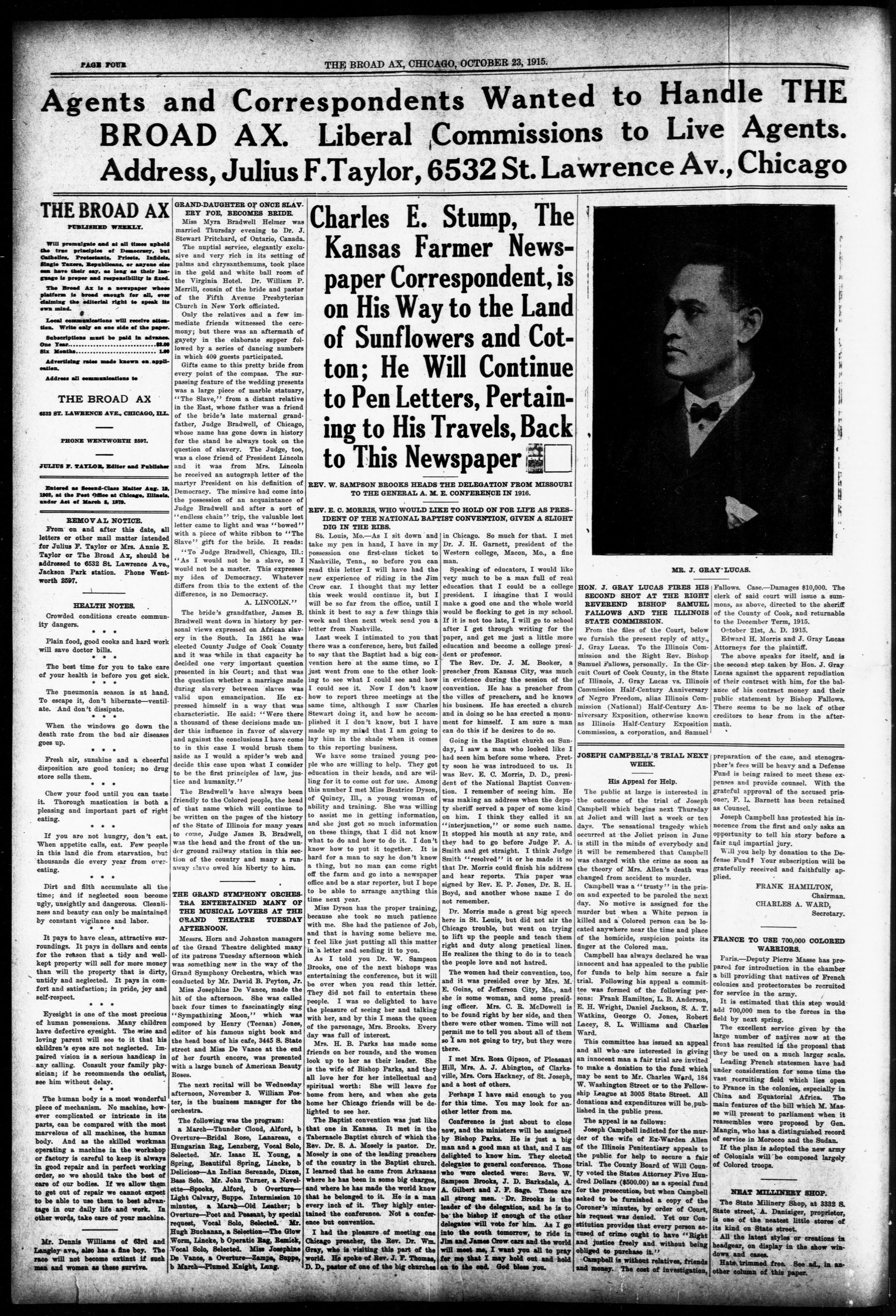
Charles E. Stump, The Kansas Farmer Newspaper Correspondent, is on His Way to the Land of Sunflowers and Cotton; He Will Continue to Pen Letters, Pertaining to His Travels, Back to This Newspaper
REV. W. SAMPSON BROOKS HEADS THE DELEGATION FROM MISSOURI TO THE GENERAL A. M. E. CONFERENCE IN 1916.
REV. E. C. MORRIS, WHO WOULD LIKE TO HOLD ON FOR LIFE AS PRESIDENT OF THE NATIONAL BAPTIST CONVENTION, GIVEN A SLIGHT DIG IN THE RIBS.
St. Louis, Mo.—As I sit down and take my pen in hand, I have in my possession one first-class ticket to Nashville, Tenn., so before you can read this letter I will have had the new experience of riding in the Jim Crow car. I thought that my letter this week would continue it, but I will be so far from the office, until I think it best to say a few things this week and then next week send you a letter from Nashville.
in Chicago. So much for that. I met Dr. J. H. Garnett, president of the Western college, Macon, Mo., a fine man.
Speaking of educators, I would like very much to be a man full of real education that I could be a college president. I imagine that I would make a good one and the whole world would be flocking to get in my school. If it is not too late, I will go to school after I get through writing for the
Last week I intimated to you that there was a conference, here, but failed to say that the Baptist had a big convention here at the same time, so I just went from one to the other looking to see what I could see and how I could see it. Now I don't know how to report three meetings at the same time, although I saw Charles Stewart doing it, and how he accomplished it I don't know, but I have made up my mind that I am going to lay him in the shade when it comes to this reporting business.
We have some trained young people who are willing to help. They got education in their heads, and are willing for it to come out for use. Among this number I met Miss Beatrice Dyson, of Quiney, Ill., a young woman of ability and training. She was willing to assist me in getting information, and she just got so much information on these things, that I did not know what to do and how to do it. I don't know how to put it together. It is hard for a man to say he don't know a thing, but no man can come right off the farm and go into a newspaper office and be a star reporter, but I hope to be able to arrange anything this time next year.
Miss Dyson has the proper training, because she took so much patience with me. She had the patience of Job, and that is having some believe me. I feel like just putting all this matter in a letter and sending it to you. As I told you Dr. W. Sampson Brooks, one of the next bishops was entertaining the conference, but it will be over when you read this letter. They did not fail to entertain these people. I was so delighted to have the pleasure of seeing her and talking with her, and by this I mean the queen of the parsonage, Mrs. Brooks. Every day was full of interest.
Mrs. H. B. Parks has made some friends on her rounds, and the women look up to her as their leader. She is the wife of Bishop Parks, and they all love her for her intellectual and spiritual worth: She will leave for home from here, and when she gets home her Chicago friends will be delighted to see her.
The Baptist convention was just like that one in Kansas. It met in the Tabernacle Baptist church of which the Rev. Dr. S. A. Mosely is pastor. Dr. Mosely is one of the leading preachers of the country in the Baptist church. I learned that he came from Arkansas where he has been in some big charges, and where he has made the world know that he belonged to it. He is a man every inch of it. They highly entertained the conference. Not a conference but convention.
I had the pleasure of meeting one Chicago preacher, the Rev. Dr. Wm. Gray, who is visiting this part of the world. He spoke of Rev. J. F. Thomas, D. D. pastor of one of the big churches
in Chicago. So much for that. I met Dr. J. H. Garnett, president of the Western college, Macon, Mo., a fine man.
Speaking of educators, I would like very much to be a man full of real education that I could be a college president. I imagine that I would make a good one and the whole world would be flocking to get in my school. If it is not too late, I will go to school after I get through writing for the paper, and get me just a little more education and become a college president or professor.
The Rev. Dr. J. M. Booker, a preacher from Kansas City, was much in evidence during the session of the convention. He has a preacher from the villes of preachers, and he knows his business. He has erected a church and in doing so he has erected a monument for himself. I am sure a man can do this if he desires to do so.
Going in the Baptist church on Sunday, I saw a man who looked like I had seen him before some where. Pretty soon he was introduced to us. It was Rev. E. C. Morris, D. D., president of the National Baptist Convention. I remember of seeing him. He was making an address when the deputy sheriff served a paper of some kind on him. I think they called it an "interjunction," or some such name. It stopped his mouth at any rate, and they had to go before Judge F. A. Smith and get straight. I think Judge Smith "resolved" it or he made it so that Dr. Morris could finish his address and hear reports. This paper was signed by Rev. E. P. Jones, Dr. R. H. Boyd, and another whose name I do not remember.
Dr. Morris made a great big speech here in St. Louis, but did not air the Chicago trouble, but went on trying to lift up the people and teach them right and duty along practical lines. He realizes the thing to do is to teach the people love and not hatred.
The women had their convention, too, and it was presided over by Mrs. M. E. Goins, of Jefferson City, Mo., and she is some woman, and some presiding officer. Mrs. C. R. McDowell is to be found right by her side, and then there were other women. Time will not permit me to tell you about all of them so I am not going to try, but they were there.
I met Mrs. Rosa Gipson, of Pleasant Hill, Mrs. A. J. Abington, of Clarksville, Mrs. Cora Hackney, of St. Joseph, and a host of others.
Perhaps I have said enough to you for this time. You may look for another letter from me.
Conference is just about to close now, and the ministers will be assigned by Bishop Parks. He is just a big man and a good man at that, and I am delighted to know him. They elected delegates to general conference. Those who were elected were: Revs. W. Sampson Brooks, J. D. Barksdale, A. A. Gilbert and J. F. Sage. These are all strong men. Dr. Brooks is the leader of the delegation, and he is to be the bishop if enough of the other delegates will vote for him. As I go into the south tomorrow, to ride in Jim and James Crow cars and the world will meet me, I want you all to pray for me that I may hold out and hold on to the end. God bless you.
M.
MR. J. GRAY·LUCAS.
HON. J. GRAY LUCAS FIRES HIS SECOND SHOT AT THE RIGHT REVEREND BISHOP SAMUEL FALLOWS AND THE ILLINOIS STATE COMMISSION.
From the files of the Court, below we furnish the present reply of atty., J. Gray Lucas. To the Illinois Commission and the Right Rev. Bishop Samuel Fallows, personally. In the Circuit Court of Cook County, in the State of Illinois, J. Gray Lucas vs. Illinois Commission Half-Century Anniversary of Negro Freedom, alias Illinois Commission (National) Half-Century Anniversary Exposition, otherwise known as Illinois Half-Century Exposition Commission, a corporation, and Samuel
JOSEPH CAMPBELL'S TRIAL NEXT WEEK
The public at large is interested in the outcome of the trial of Joseph Campbell which begins next Thursday at Joliet and will last a week or ten days. The sensational tragedy which occurred at the Joliet prison in June is still in the minds of everybody and it will be remembered that Campbell was charged with the crime as soon as the theory of Mrs. Allen's death was changed from accident to murder. Campbell was a "trusty" in the prison and expected to be paroled the next day. No motive is assigned for the murder but when a White person is killed and a Colored person can be located anywhere near the time and place of the homicide, suspicion points its finger at the Colored man.
Campbell has always declared he was innocent and has appealed to the public for funds to help him secure a fair trial. Following his appeal a committee was formed of the following persons: Frank Hamilton, L. B. Anderson, E. H. Wright, Daniel Jackson, S. A. T. Watkins, George O. Jones, Robert Lacey, S. L. Williams and Charles Ward.
This committee has issued an appeal and all who are interested in giving an innocent man a fair trial are invited to make a donation to the fund which may be sent to Mr. Charles Ward, 184 W. Washington Street or to the Fellowship League at 3005 State Street. All donations and expenditures will be, published in the public press.
Joseph Campbell indicted for the murder of the wife of Ex-Warden Allen of the Illinois Penitentiary appeals to the public for help to secure a fair trial. The County Board of Will County voted the States Attorney Five Hundred Dollars ($500.00) as a special fund for the prosecution, but when Campbell asked to be furnished a copy of the Coroner's minutes, by order of Court, his request was denied. Yet our Constitution provides that every person accused of crime ought to have "Right and justice freely and without being obliged to purchase it." Campbell is without relatives, friends and money. The cost of investigation
His Appeal for Help.
The appeal is as follows:
Fallows. Case.—Damages $10,000. The clerk of said court will issue a summons, as above, directed to the sheriff of the County of Cook, and returnable to the December Term, 1915. October 21st, A. D. 1915. Edward H. Morris and J. Gray Lucas Attorneys for the plaintiff. The above speaks for itself, and is the second step taken by Hon. J. Gray Lucas against the apparent repudiation of their contract with him, for the balance of his contract money and their public statement by Bishop Fallows. There seems to be no lack of other creditors to hear from in the aftermath.
preparation of the case, and stenographer's fees will be heavy and a Defense Fund is being raised to meet these expenses and provide counsel. With the grateful approval of the accused prisoner, F. L. Barnett has been retained as Counsel. Joseph Campbell has protested his innocence from the first and only asks an opportunity to tell his story before a fair and impartial jury. Will you help by donation to the Defense Fund? Your subscription will be gratefully received and faithfully applied.
FRANCE TO USE 700,000 COLORED
WARRIORS
Paris.—Deputy Pierre Masse has prepared for introduction in the chamber a bill providing that natives of French colonies and protectorates be recruited for service in the army. It is estimated that this step would add 700,000 men to the forces in the field by next spring. The excellent service given by the large number of natives now at the front has resulted in the proposal that they be used on a much larger scale
Leading French statesmen have had under consideration for some time the vast recruiting field which lies open to France in the colonies, especially in China and Equatorial Africa. The main features of the bill which M. Masse will present to parliament when it reassembles were proposed by Gen. Mangin, who has a distinguished record of service in Morocco and the Sudan. If the plan is adopted the new army of Colonials will be composed largely of Colored troops.
NEAT MILLINERY SHOP.
The State Milinery Shop, at 3332 S. State street, A. Daniziger, proprietor, is one of the neatest little stores of its kind on State street. All the latest styles or creations in headgear, on display in the show windows and cases. Hats trimmed free. See ad, in another column of this paper.
FRANK HAMILTON,
Chairman.
CHARLES A. WARD,
Secretary.
IS DISEASE DUE TO SIN?
One of our able contemporaries expresses a desire to find the stimulus that will move mankind to action so as to get them to put into practice the knowledge they possess. He informs us that the need is not knowledge but the execution of what they know. He said, all doctors are agreed that tobacco is a potential cause of nervousness, blindness and heart disturbance and although they say tobacco is a poison they do not practice what they preach. That is quite an indictment against the medical profession. If we confess that we play with a poison, we also confess that we wilfully sin. How can we expect the layman to heed our warnings under such circumstances? How can we expect to advance the cause of health with such conduct? Small wonder the so-called "Christian Science" decries the people into believing that matter is a misconception. Small wonder is it that the conscious mind is argued out of existence and the subconscious mind alone is taken as the only one. Is it sin to mislead the precious people?
When the leprosy was bestowed upon the servant of Elisha it was for his sin, and it was the curse put upon his descendants for the same reason. A certain Healer who used various therapeutic measures, such as hydrotherapy, psychotherapy and the like, having more success than any other recorded
HYDE PARK NEWS
Mrs. Leach of 620 East 42nd St. entertained a few of her lady friends Sunday, seventeenth inst., at a six course dinner in honor of Mrs. Patterson of Salem, Ala. The guests present were: Mrs. Price, Mrs. Emma Coleman, Mrs. Wingate, Mrs. Bryant, Mrs. Hendricks, Mrs. Wella Webb, Mrs. Sarah Washington and Miss Marie Brooks. The ladies expressed themselves as having spent a pleasant time and voted Mrs. Leach a splendid hostess.
The Willing Worker's Club meet at Mrs. Louis French's, 5622 Lake Park ave., they had a very pleasant meeting, this is indeed the most wide awake club in Hyde Park. They are planning to give several entertainments during the winter season. Miss Birdie Williams, president, Mrs. Hendrickson, secretary.
Mrs. Clarence Kennet of 5624 Lake Park ave., is having a lot of trouble with her eyes. We hope for her a complete recovery.
The Hotel boys are getting ready for another entertainment, watch for it.
· The St. Paul Baptist Church on Harper ave., is becoming active, aggressive and lively again under their new pastor.
The people of Maywood, Englewood and Hyde Park are going to Olivet Monday night to see the spirit of Tuskegee. Go early if you want a good seat.
"THE SPIRIT OF TUSKEGEE."
The Rage of Chicago. A Drama in Five Acts 21 Characters 21. Written by Our Newspaper Correspondent L. W. Washington.
Endorsed by Dr. Geo. C. Hall, M. D. Dr. M. A. Majors, and a number of professional men. It is optimistic, beautiful, instructive and classical. Monday evening, Oct. 25th, at Olivet Baptist Church, is the place, and date don't forget it. You can't afford to miss it. The members of Olivet are calling, give them a lift, tell your friends about it. Admission 25 cents. (buy a ticket). Given under the Auspices of "The Pastor's Aid Circle" Mrs. Bell Day, Pres. Stephen Griffin, Pres. of the Deacon's Board. P. A. Glanton, Secty.
Mr. L. W. Washington addressed the Christian Endeavor Society at Bethel Church last Sunday on the subject of "Citizenship." Next Sunday he will address the Star Literary Society on "Can we learn any thing from our Inferiors."
A. E. H.
in the history of all time, often dismissed the cured patient with the warning "Go in peace and sin no more!" Only one instance does the writer recall that the patient was afflicted that the word of God might be made manifest. The contemporaries knew that sin played a great part in sickness and hence asked the Master "Who did sin?" We instinctively look for the cause or causes of our indispositions, disabilities and our diseases. We know that we are either guilty of sins of commission or sins of omission. We instinctively know that laws of nature can not be broken with impunity. When we feel pain or other evidence of bodily discomfort, we try to recall the particular infraction of the great law of nature and nature's God, called sin. If for any reason we cannot recall the exact breaking of the law, we keep trying to fix responsibility in order to be on the safe side in the future.
The truth is we all have a good general idea of what is right and what is wrong as regards the natural law. The able contemporary is right, we do not act in accord with our knowledge. Europe knows the beatitudes but it does not harmonize knowledge with action. Hence the disease of Europe and it must be due to sin. Nations are like individuals in many respects. We are not proud of our diseases; "sin is a reproach to any people."
COLERIDGE TAYLOR PROGRAM AT
THE APOMATTOX CLUB.
Sunday afternoon, October 4, at 4 P. M., Coleridge Taylor day at the Appomattox Club.
Dr. Charles E. Bentley will be the leading speaker. Mrs. Willa M. Sloan, Dr. William C. Williams and William Henry Hackney will furnish the singing. Harrison Emanuel, violinist; T. Theodore Taylor, pianist.
On Monday evening, October 25, Halloween party will be given in the parlors of the Club, for its members and their families.
$6,500 PURCHASE UPSETS WHITES
Leonia, N. J.—Whites here are exercised because George S. Mills, a well-to-do Colored man, bought a residence in the exclusive residential section for which he paid $6,500. Rumor has it that two blocks on Grand avenue, where Mills' new home stands may be given over to well to do Colored tenants or buyers. A Colored real estate dealer of New York city is said to be behind this project.
$25,000 FOR NEGRO Y. M. C. A.
Julius Rosenwald Sends Check to Be Applied to Cincinnati Building.
L. Wilbur Messer, general secretary of the Young Men's Christian Association of Chicago, received the first of this week from Julius Rosenwald a check for $25,000 as his contribution to the Cincinnati Young Men's Christian Association building in Cincinnati for Negroes. The building is in progress of erection and more than $50,000 contributed in Cincinnati already has been applied to its cost.
COLORED ATTORNEY DECLINES
JOB
Columbus, O. — Former Assistant Prosecuting Attorney Wilbur E. King, has declined the position of head of the loan shark department under the State Banking Superintendent. It pays $2,500 a year, and is one of the new positions created by the recent Assembly. He is rated as one of the most able lawyers in Columbus.
NEGRO HONORED.
Colored Student is Elected to Class Office—First Time in School's
Columbus, O., Oct.—For the first time in the history of Ohio State University, it is believed a Colored student was elected to a class office, last Friday. He is Daniel Ferguson of Columbus who has won laurels as a half-miler on the university track team. Ferguson had no opposition to his candidacy for orator of the senior class
THE BROAD AX. CHICAGO. OCTOBER 23. 1915
THE WEBER COMPANY, THE UP TO-DATE TAILORS.
The Weber Company the up-to-date merchant tailors at 27 West Washing ton street, bank floor, Max Weber, manager, make to order all kinds of fine clothes which they will turn over to their regular customers on easy payments, see their ad in another column of this paper.
CHIPS
Rev. J. C. Anderson, pastor of Quinn Chapel, 3362 Calumet avenue; spent several days this week in St. Paul, Minn., returning home last evening.
Hon. Chas. A. Griffin is the proud father of a 12 lb. baby boy. Both mother and son is doing fine at this writing.
The spirit of Tuskegee is on for Monday night at Olivet Baptist Church. It is the talk of Chicago. It is the rage, it is written by our correspondent Mr. L. W. Washington.
Mr. Cary B. Lewis after having spent two weeks in Louisville, Ky., his home city with his dear mother has just received a telegram calling him home again on the seriousness of the attack of diabetes, we hope he will find her illness slight and that she will be permanently restored to health again.
Mrs. M. L. Clinkscale, 5652 S. State street, continues to meet with success in the catering business and Mrs. Clinkscale, is full of business and she always pays her bills without any humming or hawing and without getting into a long argument in reference to the bill of being too much and so on.
James Hale Porter, who was the advance or field agent for the Fifty years of Freedom Commission of Illinois, claims that he collected together well on to seven thousand different articles for the exhibit, during the late exposition and Lincoln Celebration at the Coliseum and that everything was returned to its owners without any loss to any one which was a very good record indeed considering the loose manner in which the whole affair was conducted.
Harrison Emanuel, 6352 Rhodes avenue, was the first of this week for the second time freed or acquitted in the Criminal Court of all wrong doings in relation to any young girl or woman residing in this county or state; which was very gratifying to his parents, Mr. and Mrs. William Emanuel and their many friends. Attorney B. F. Moseley, very ably represented Mr. Emanuel in all his troubles and successfully secured for him a clean bill of health against the crime or charge of bastardy.
Col. Cary B. Lewis is again back at his post of duty, as Chicago correspondent of the Indianapolis Freeman and as one of the head chiefs of The Chicago Defender after spending a week with his parents at Louisville, Ky. Mr. Lewis had a fine comment in the last issue of The Freeman on the 20th Anniversary edition of The Broad Ax and we wish to thank him for the same.
The Hon. Oscar De Priest has returned from the coast after spending his time visiting friends. He denies having any trouble on the coast on account of his color. He claims that on the other hand, the treatment he received was more than he could hope for from a grateful people. Delegations of his people met him at the various stations and presented him with many tokens of respect.
Pert Personals.
One thing to be thankful for is that nobody as yet has sent Henry James to report a battle.
Miss Farrar has told us herself that marriage is not for the artist. If she marries now will that be the end of her art, or is she simply defying consistency?—New York Sun.
Ambassador Morgenthau, at Constantinople, representing eight nations besides his own, would like the name and address of the person who says American diplomats don't earn their salaries—Pittsburgh Gazette-Times.
Inquisitive.
Edgar, aged six, was recently sent to school for the first time, and upon his return home he asked, "Papa, who taught Adam the alphabet?"
Lobster a la Newburg.
Lobster a la Newburg is a famous dish and a very popular one. Melt a tablespoonful of butter and stir in a tablespoonful of flour. When these ingredients bubble stir in a cupful of cream or rich milk. When this has cooked till nice and smooth add the lobster meat, previously cut into neat pieces, and cook till well heated. Add salt to taste and a very little cayenne pepper, the beaten yolk of one egg and two tablespoonfuls of sherry. Take care that the mixture does not curdle after the egg has been added and serve as quickly as possible.
Higher Than Pikes Peak
Higher Than Pikes Peak.
Ask any schoolboy to give the highest point in the state of Colorado, and nine out of ten will name Pikes peak. Pikes peak is 14.110 feet above sea level, but there are many higher peaks in Colorado. Massive mountain, in Lake county, is one of the two highest points in the state, whose height has been determined by the United States geological survey and is 14.402 feet above sea level. Elbert mountain, in the same county, has the same elevation. Blanca peak, in Costilla, Heurfano and Saguache counties, is 14,390 feet high; Castle peak, in Gunnison and Pitkin counties, is 14,259 feet high; Evans mountain, in Clear-Creek county, 14,260 feet; La Plata peak, in Chaney county, 14,332 feet; Quandary peak, in Summit county, 14,256 feet; San Luis mountain, triangulation station, in Mineral and Saguache counties, 14,149 feet; Uncompahgre peak triangulation station, in Hinsdale county, 14,306 feet, and Wilson mountain triangulation station, in Dolores county, 14,250 feet-all higher than Pikes peak.-Geological Survey Bulletin.
Sunset and Twilight.
Twilight is a phenomenon caused by atmospheric refraction. When the sun gets below the horizon we are not immediately plunged into the darkness of night. Although the sun is below our horizon, rays of solar light are bent or refracted by the terrestrial atmosphere and continue to furnish some slight illumination. The process continues with diminishing intensity until the sun is so far below the horizon that the refracting power of the atmosphere is no longer able to bend the rays enough to produce a visible effect. The time after sunset that the sun reaches such a position varies with the latitude of the place. There is less twilight at the tropic zone than at the temperature or frigid zone. This is due to less time taken by the sun's rays to pass through the atmosphere, at the tropic zone the sun's rays being perpendicular and at the temperate and frigid zones oblique.
Aeroplane Wings
Various kinds of material including linen, silk, cotton, celluloid films and aluminum foli, have been tried for covering the wings of aeroplanes, but none has proved so satisfactory so far as linen covered with several coats of a rubber solution. This coating increases the strength of the linen about 5 per cent, makes it more enduring under varying weather conditions and causes it to stretch to an absolutely smooth surface, a feature that is of the utmost advantage in fast flights. Silk, which would seem to make an ideal covering on account of its lightness and strength, has been found unsatisfactory, as it does not withstand exposure to sun and rain and does not lend itself readily to the application of coating compounds.-London Answers.
Dumas' Last Jest.
Dumas the elder was the son of a general of Napoleon Bonaparte, who would take his soldiers by the breeches and fling them over the palasades to an assault.
Dumas inherited much of that same spirit. It is said that Dumas left Paris for the last time taking with him a single gold piece, which he solemnly laid on the mantelpiece of his room at Puys. Toward the end his eye wandered across the sickroom to this coin, and, pointing to it, he said to his son: "See there! Fifty years ago when I came to Paris I had one louis in my possession. Why am I accused of being a prodigal? I have preserved and possess it still. See! There it is!"
When Jackson Dined.
When Colonel Davy Crockett was a member of congress and was at his home in Tennessee some one asked him about the dinner hour in Washington. He said the common people ate dinner at 12, the next above them at 1, the merchants at 2, the representatives at 3, the senators at 4, members of the cabinet at 5 and the vice president at 6. "But when does the president diner?" "What! Old Hickory?" said Crockett, anxious to fix a time that would suit his idea of Jackson's greatness. "Well, he doesn't eat till next day!"
Removing Stumps
The German method of removing stumps is simpler and less dangerous than our way. They bore a hole in the stump and pour into it equal parts of nitric and sulphuric acids. After a few weeks the largest stumps of hard wood are eaten by the acid and easily crumbled with a pick—New York Times.
Kent His Word.
Condemned Murderer (to lawyer)—
You said you could get me off with a
life sentence, and here I am to be
electrocuted in a week. Lawyer—That's all
right. You will be imprisoned for life,
won't you? And only a month, instead
of long, weary years. Be reasonable,
man—Boston Traveler.
His Cure.
A man who married a widow has invented a device to cure her of eternally praising her former husband. Whenever she begins to descent on his noble qualities, this ingenious No. 1 merely says, "Poor, dear man—how I do wish he had not died!"
A. Waiting Mansion
Perhaps there is a mansion in heaven that will always be empty—a mansion waiting to receive those who in their youth never snubbed their anxious parents—J. J. Bell.
Naturally.
Teacher—In the sentence I have just read tongue is a noun. Why? Observant Pupil—Because it is a part of speech—Raltimore American.
L
MME. HELENE PADEREWSKI
One of the most popular exhibits in New York city may be seen at the headquarters of the Polish Victims' Relief fund, 33 West Forty-second street, where thirty-one Polish dolls hold out beseechful hands to America in behalf of their compatriots, war refugees in Paris.
Godmothered by Mme. Helene Paderewski, wife of the pianist, these waffles are undoubtedly doing the greatest service to mankind of all the inhabitants of dolom. Designed by refugee Polish artists and sculptors and dressed by Polish seamstresses who are paid for their work by the fund, these dolls actually incorporate the characteristics and even the expressions of Polish peasants, while their raiment, fashioned of bits of silk, ribbon, satin
```markdown
```
Copyright, 1915, by E. B. Lyman,
HALKA OF WARSAW.
and real lace, charmingly typify the quaint costumes worn in every province of Poland. These interesting, droll, wistful little people of all toyland now laid waste in Europe are the only dolls that promise to cross the Atlantic in time for Christmas. The tariff on each one is only $5, and they are delighting the hearts of American children all over the country while giving food to thousands of hungry Polish children.
Torn from her playmates, Halka of Warsaw greets you and hopes you will like to get acquainted with others of her friends. Halka is doing such a wonderful work that it seems almost unkind to remark that coming over the salt water took the curl out of her bang.
VELVETS FOR WINTER.
Any material with a pile will be most acceptable for the development of the winter modes. It may be argued that the materials in demand for the bouffant effects that are to be the winter's vogue should have more body than the velvets we know. This is true, but Rodier has taken care that his velvets meet all these requirements. They have not only had the approval of the leading couturiers of Paris, but large orders have been given for these very materials, and many gowns to be shown at the very earliest openings are fashioned of velvet. Not only are the velvets to be striped and checked, but they are made up in charming color combinations. Other materials are a combination of velvet and faille or taffeta, and many are further enriched with metal threads. It is said that never have novelties shown by Rodier been as marvelous as they are for the coming season.
PAGE FIVE
Pottary and Sacracy.
In the royal manufactory of pottery at Melsen, Saxony, the work was formerly carried on with the utmost secrecy to prevent the processes from becoming known elsewhere. The establishment was a complete fortress, the portcullis of which was not raised day or night, no stranger being permitted to enter for any purpose whatever. Every workman, even the chief inspector, was sworn to silence. This injunction was formally repeated every month to the superior officers employed, while the workmen had constantly before their eyes in large letters the warning motto, "Be Secret Unto Death." It was well known that any person divulging the process would be imprisoned for life in the castle of Koenigstein. Even the king himself when he took strangers of distinction to visit the works was enjoined to secrecy. One of the foremen, however, escaped and assisted in establishing a manufactory in Vienna, from which the secrets spread all over Germany.
Light and Sound and Glass.
Why doesn't the closed window shut out light just as much as it shuts out sound? Both light and sound travel through the air, and their waves come in contact with the glass. The light, after it has gone through the window, seems just as strong or stronger, while the sound seems ever so much weaker. Why is it? Many of us have wondered. The reason is that light is not a wave of air, while sound is. Light is a wave in the ether which is in the glass as well as in the air, so that light in passing through glass still has its natural path of ether. But when sound waves strike the window glass they must put the glass into vibration, and the glass in turn must make the air inside vibrate. All this lessens the strength of the sound waves, and they reach our ears capable of producing a less startling effect than are the light waves which reach our eyes.
The Measure of a Man.
At a meeting at which a prominent modern statesman, who is short in stature, was to speak the local chairman, endeavoring to be witty, observed that he was somewhat disappointed about the politician's physical proportions. "I had heard so much about this gentleman," he said, "that I naturally expected to meet a big man in every sense, but, as you see for yourselves, he is very small." Many an orator would have been upset by such an unfortunate beginning to the proceedings, but not so this one. "I am grieved to find," he said, with mock seriousness, "that your chairman is disappointed in my size, but this is owing to the way you have here of measuring a man. In my part of the kingdom we measure a man from his chin up, but you evidently measure him from his chin down."
Feared Premature Burial
The doctor who left instructions that a bell watch should be fixed to his wrist after death as a precaution against premature burial may have heard of the similar safeguards prescribed by Meyerbeer. Two men were to watch over him night and day for five days, he directed, and bells were to be hung from his hands and feet to give warning of the slightest movement. Finally, incisions were to be made in his throat.
Harriet Martineau also had a fear of burial alive and left directions for her body to be decapitated, while Lady Burton stipulated for a post mortem examination of her remains. Which, we may ask, is greater, the fear of death or the fear of life?-London Standard.
Ducks and Mosquitoes.
According to experiments reported by S. G.-Dixon, the most formidable animal enemy of the mosquito is the duck, and the introduction of this bird is recommended for eliminating mosquitoes and the diseases which these insects spread from marshy regions, where draining would be too costly. Two artificial poools were constructed of equal area, ducks being placed in one and fish in the other. The former pool was quickly freed from mosquito pupae and larvae, while in the other they continued to abound. Wild ducks are said to prefer mosquitoes to all other food.—Indianapolis News.
Natural Pottery.
Excellent natural pottery is manufactured by nature in the case of a certain cactus. Woodpeckers are apt to excavate nests in the trunk and branches, and in order that it may protect itself against these incursions the plant exudes a sticky juice, which hardens, forming a woody lining to the hole made by the birds. Eventually the cactus dies and withers, but the wooden bowl remains.
Dodging Trouble.
"My wife says I don't know how to handle the baby."
"I wouldn't get muffed over that, son," said the older man. "Take my advice and don't learn."—Louisville Courier-Journal.
A. Pertinent Question.
The Fond Mother—Nice girls never put themselves forward before the men. The Wise Daughter—Then how do the men find out that they're nice? —Judge.
Shading.
Belle—And when you went into her room you say she was shading her eyes with her hand? Beulah—No, only the eyebrows.—Yonkers Statesman.
There is one thing that can never turn into suffering, and that is the good we have done.
PAGE SIX
M.
QUEEN ELEONORE OF BULGARIA.
Queen Eleonore was head of one of the most efficient Red Cross units in the Russo-Japanese war, as well as of the Bulgarian Red Cross in the Balkan wars.
Her work in the field hospitals brought her in conflict with one of King Ferdinand's peculiarities. His fear of infection amounts to an obsession, and when the queen was engaged in nursing and after she had returned from the hospitals she was by the king's order placed in what amounted to quarantine, so far as the royal family was concerned.
King Ferdinand is very fond of pomp and ceremony, but Queen Eleonore is reported to have the air of disliking display and to prefer a simplicity not to the liking of her lord.
But her labors have been appreciated by her adopted countrymen.
A princess of Reuss, she came to the throne of Bulgaria in 1908, then forty-eight years old, and has since mothered King Ferdinand's four children while carrying on her efficient charity works. Now that Bulgaria goes to war she will be the head of the Bulgarian Red Cross.
In an interview granted recently Queen Eleonore stated:
"Red Cross supplies are almost impossible to get in Bulgaria. In the case of need we shall be very short of such supplies, and it is necessary for me to do all I can now to increase the stock. I used every influence I could to obtain supplies from Austria—our usual source—but except for a few small packages bought as if for my personal use I have been able to get nothing."
Tips on House Plants
Palms are much used for interior decorations where there is no direct sunlight. Regular watering is essential, with especial care not to overwater. It is better with most palms to keep them a little dry than too wet. While small, wash the foliage occasionally with soap suds made from a good soap. Immediately follow with a thorough rinsing. When too large for this, spray the tops frequently with clear water.
Browning at the tips usually comes from overwatering at the roots. Trim off the brown tips, as they will never recover. If the leaves turn yellow look for scale on the underside and be sure you are not overwatering. Wash the scale off or spray with kerosene emulsion or whale oil oil or some nicotine preparation. Do not repeat too often. If a palm grows three new leaves a year it does well. Use the same treatment for oleanders.
Rubber plants are especially satisfactory to grow where there is a good light without direct sunlight. Water often enough to keep the soil moist, but do not under any circumstances permit water to stand about the roots nor allow it to become bone dry. A potted plant set in a jardiniere needs especial care not to overwater. Wash the foliage frequently with soapsuds and rinse at once. Repot occasionally, as the pot becomes full of roots. Feed once in two to four weeks with dilute solution of nitrate of soda, a heaping teaspoonful dissolved in water, or ammonia water.
Your Shoes and Gloves
Good shoes, fresh gloves, a becoming hat, neat and fresh neckwear of good quality—these are extravagances which any woman who makes a pretense to being well dressed should indulge in. Good shoes do not simply mean expensive shoes once bought. It means shoes provided with an endowment fund that they may be always kept up at the heel, always kept clean and black. The same is true about gloves. Nothing is poorer economy than to wear solled white gloves, no matter how good their quality.
A hint for the Needleworker
Crocheted buttons are extensively used this season, and those that are handmade have a distinctive charm all their own. When you are clever enough to make these buttons yourself you solve the difficulty of shopping for unusual shades to match gowns and coats, for twisted silk or skeins of silk come in almost every color, as do wool and mercerized cotton.
The crocheting is put over wooden molds, and these molds come in various shapes and sizes—square, round, oblong or oval—and silk, wool or merized cotton can be employed with equal success, the material used depending upon the use to which the buttons are to be put. Those that are covered with silk can be used for ornamentation, as well as for pure utility, but, handmade sweaters this season are showing buttons covered with the same material of which the sweater itself is made, either wool or silk. Buttons covered with mercerized cotton have infinite possibilities, for they can be used on all wash fabrics, as they launder beautifully. These buttons are quite simple to make, the main secret being to crochet tightly, so there will be no spaces between the stitches, revealing the wooden mold beneath.
Start with a chain of three stitches, join, and into this ring put eight single crochet. Into every second stitch of these eight stitches put three single crochet. This will start the four corners. On the next row put three single crochet into every fourth stitch, which will bring it to the middle stitch of the three stitches in the row below. Continue around, increasing two stitches on each side, until you have made a square large enough to cover the top of the mold. Then crochet two rows without increasing at the corners. Put in the mold and begin to decrease by skipping every fourth stitch. Do this for several rows. Then skip every third stitch, then every second one, until you reach the center. A row of single crochet around the central stitch forms a fine shank and makes it easier to sew on, as well as to button.
For round buttons start with a chain of three stitches, join, and into the ring put eight single crochet. Into each of these eight stitches put two single crochet. On the next row put two single crochet into every second stitch, then into every third stitch, regulating this by keeping the circle perfectly flat. When you have crocheted enough to cover the top of the mold crochet two rows plain without adding any stitches. Fit this on the mold and begin to take off, skipping first every fourth, then every third and then every second stitch until you reach the center. The covering should fit the mold very closely, so this may have to be modified somewhat.
To make oval buttons start with a chain of four sitches, turn and work a single crochet into each stitch of the chain. In the last stitch put three single crochet and continue on around on the other side of the chain, working three single crochet into the middle stitch on the other end. Work on around, putting three single crochet into the middle stitch of each end. If it does not lie smooth put in four stitches instead of three on each end. When you have worked enough to cover the top of the mold make two plain rows all around. Insert mold and begin to take off by skipping every fourth stitch, then every third and every second stitch until it is finished. Then work one row around the middle stitch as a shank. Of course these directions may vary a little, according to the size of the button, but a little experience helps to overcome any difficulties.
Belts In Favor.
Belts are in high favor again, which is probably due to the fact that most of the frocks and skirts have the trim normal waist line. The leather belts are more varied and beautiful than ever before. They range in width from two to six inches and in many cases are much wider. Patent leather is much in favor for the new belts, and it is shown in various colorings combined with black or white. One beautiful wide belt of soft crushable white kid had a shaped inset piece of blue patent leather at each side. There was a long narrow buckle of white kid. Another wide belt of white kid had a large buckle of white kid and red patent leather trimmings. Another wide belt of white kid had trimmings of brown suede.
Pineapple Shortcake.
One cupful of butter, two cupfuls of powdered sugar, three cupfuls of flour, one cupful of milk, the whites of four eggs and a little salt. Cream butter and sugar, add milk and beat hard before putting in the whites of the eggs. Sift two teaspoonfuls of cream of tartar and one of soda in the flour, beating lightly.
Filling and Icing.—Boll one cupful of granulated sugar and one-quarter of a cupful of pineapple juice, strained, for six minutes, after adding one teaspoonful of lemon juice. Beat the white of an egg to a stiff froth, add the boiled stirrup gradually to it, whipping the mixture as the stirup is added with the egg whip. Beat six minutes longer and ice the cake thickly. For filling add enough finely chopped pineapple to the ice to make it moist and thick.
THE BROAD AX, CHICAGO, OCTOBER 23, 1915.
1
A RICH EFFECT.
Navy blue velvet makes this ultra effect. The skirt is rather straight under a redingote of three-quarters length. The redingote has a back cut on princess lines, and the front is a basque effect with a peplum of extreme fullness. The deep collar is of beaver, which also bands the peplum. Small metal buttons light up the sleeves and belt.
THE CHIMNEY POT.
Behold the Wide Brimmed Flat Sailor Evolved to This.
Modish as possible, this fall hat is of beautiful silk beaver, a navy blue, with a narrow velvet brim and a band
MARY
A JAUNITY TILL. of wide grosgrain navy ribbon run through a slender steel buckle. This shape shares popularity with the postillon silk beaver and the regular "topper."
The Stylish Woman:
A stylish woman has a good poise. She stands well, and she walks well, and she carries her head well, and her clothes take on the right swing. Put the same clothes on the woman who stands on her heels instead of on the balls of her feet, the woman who sinks down in her corset and by so doing throws her abdomen outward, her hips forward, lets her chest sink in and her shoulders round forward, while her back hollows below the waist line—any amount of style in the costume worn by this woman is swallowed up by the lack of style in the woman herself.
The lines of a woman's gown or cloak are altered to their ruin when by incorrect carriage of her body they are turned and twisted out of place.
The woman who is admired for her style in dressing looks—no matter what the time or the occasion—as if what she wears at that time, upon that occasion, had been planned with reference to that time, that place and to her.—Good Health.
Label the Boxes
Every household has large boxes at least for hats, sometimes for furs and waists and other articles of dress and many small boxes for other belongings. In the hunt for something almost forgotten the housekeeper often squanders precious moments in searching through every likely depository and probably comes upon the object of her quest in the last box of the selected group.
All this waste of time and energy can be saved by the use of labels which record the contents of each box. Some recently noted captions of this kind were "Blue Velvet Hat," "J. B.'s Panama Hat," "Small Tacks and Nails," "Empty Bottles," "Corks."
1
A DAPPER EFFECT.
Trimness is the first word about this suit, and the snug military collar and metal buttons are its points of interest. Black velvet is used to re-enforce the cuffs and collar, which are outlined by blas bands, as is the front. The irregular skirt of the coat hangs in a graceful flare, and the skirt itself is a good walking length.
ALMA INSERTION.
An Easy Pattern For Towels and Bureau Scarfs.
Abbreviations: Ch, chain; slst, slip stitch; d.c., double crochet; tr, treble; ltr, long treble.
Work the middle strip first.
Begin with 22 ch, 1 tr. in fourth from needle, 18 tr. in the following 18 ch, 3 ch, turn (this 3 ch. forms 1 tr. at the beginning of every row throughout).
First Row.—One tr. in second tr., 2 tr. in next 2, 2 ch, miss 2 tr., 8 tr. in next 8, 2 ch, miss 2 tr., 4 tr. in last 4 tr., turn with 3 ch.
Second Row.—One tr. in second tr., 2 tr. in next 2, 2 tr. under 2 ch., 8 tr. in next 8 tr., 2 tr. under 2 ch., 4 tr. in end 4 tr., turn with 3 ch.
Third Row.—One tr. in second tr., 7 tr. in next 7 tr., 2 ch, miss 2 tr., 9 tr. in next 9 tr., turn with 3 ch.
Fourth Row.—One tr. in second tr.,
2 tr. in next 2, 2 ch., miss 2 tr., 3 tr. in
next 3 tr., 2 tr. under 2 ch., 3 tr. in
next 3 tr., 2 ch., miss 2 tr., 4 tr. in end
4 tr., turn with 3 ch.
Fifth Row.—Like the second.
Sixth Row.—One tr. in second tr.,
2 tr. in next 2 tr., 6 ch., 1 l.tr. between
sixth and seventh tr., 6 ch., miss 6 tr., 4
tr. in next 4, 3 ch., turn.
Seventh Row.—One tr. in second tr.,
2 tr. in next 2 tr., 6 ch., miss 5 ch., 1
d.c. in next, 1 d.c. in 1 l.tr., 1 d.c. in
next ch., 6 ch., 4 tr. in next 4 tr., 3 ch,
turn.
Eighth Row.—One tr. in second tr.,
2 tr. in next 2 tr., 5 ch., miss 5 ch.,
1 d.c. in next 3 d.c. in 3 d.c., 1 d.c. in
SUITABLE FOR CURTAINS.
next ch., 5 ch., 4 tr. in last 4 tr., 3 ch.,
turn.
Ninth Row.—One tr. in second tr., 2
tr. in next 2 tr., 6 ch., miss 1 d.c., 3 d.c.
in next 3, 6 ch., 4 tr. in next 4 tr., 3 ch.,
turn.
Tenth Row.-One tr. in second tr., 2 tr. in next 2 tr., 6 ch., 1 l.tr. in middle stitch of 3 d.c., 6 ch., 4 tr. in 4 end tr., 3 ch., turn.
Eleventh Row.-One tr. in second tr., 2 tr. in next 2 tr., 6 tr. in next loop, tr. in 4 tr., 3 ch., turn.
Repeat from first row for length required.
The following rows are worked along each side of the strip:
First Row.-Two tr. in tr. loop at the end of a row–draw, the stitch of second tr. through the first throughout this row, * 7 ch., miss 1 ch., turn, 1 alst., 1 d.c., 1 short tr., 1 tr., 1 l.tr. and 1 triple tr. respectively into 6 ch., miss 1 tr. loop on strip, 2 tr. in next, and repeat from *.
Second Row.-One d.c. in point of first group, * 4 ch., 1 d.c. in point of next, and repeat from *.
Third Row.—Three tr. in 1 d.c. of last row. * 1 ch., 3 tr. in next d.c., and repeat from *
A Chintz Room for Daughter
In the average home the only room which the daughter of the house can claim as her own is her bedroom.
This should be as dainty as possible, signifying girlhood in all its freshness and beauty. Unfortunately many girls believe that daintiness costs money and pass it by on the plea of a small pocketbook. Daintiness, as a matter of fact, can be achieved for a very small amount of money, provided one is willing to spend some time and not a little thought on the decoration of one's bedroom. Pink and blue have been the colors long honored as the young girl's, but the young person of decided character who feels that these pale tints do not reflect her vivid personality may choose in these very modern times cubist and futurist colorings, and with the aid of some of the new and artistic chintzes, may achieve a very stunning effect.
The furniture par excellence for the girl's room is finished in white enamel, and if you are not fortunate enough to possess this sort you can easily change what you have at hand by a can of white paint and one of white enamel. Painting is by no means easy work, but it is work which many a girl has accomplished successfully at home. It will be necessary first to purchase a can of paint remover so as to take off as much as possible of the original stain. Then give the pieces of furniture two or even three coats of white or cream paint and finally one of white or cream enamel. This should be allowed to dry thoroughly before an attempt to use it is made.
Now, if your bed is a wooden one you can produce a very quaint effect by pasting over the head and base boards chintz in a pretty design. This should be cut to fit the boards exactly and edged with braid to match the chintz, the whole being glued flat on to the head and base boards, or brass headed tacks placed at one inch intervals can be used to hold the chintz. Some girls have created a very pretty effect by cutting out flowers or birds from chintz and pasting these designs at conventional intervals on the base and head boards.
The dressing table can be made very pretty by the aid of chintz, and if you want a dressing table don't despair. Just make one. "How?" perhaps you ask. It is really the easiest thing in the world. If there is a fair sized table somewhere in the house which is not used for any particular purpose claim it as your own and use this as the foundation for your dressing table. First it must be coated with white or cream paint or enamel. Then fit a cover of the chintz over the top and sew a ruffle of the same around this flat cover. The ruffle should be only three or four inches long and should be quite full, so that it will frill prettily. Over the top of the table should be placed a thick piece of glass, which you can purchase and have cut to fit at any glazier's. This will be the most expensive item in the making of the dressing table—it will probably cost $4 or $3—but this money will be well expended, for it saves the top of the table and the chintz from dirt and wear. Now comes the question of the mirror over the table. In the basement of any of the big department stores a cheap mirror can be purchased for $1.50 or $2. This will have a brown or imitation mahogany frame and will not be a thing of beauty. But the glass will be fairly good, and the frame can be covered. Remove the nails which hold the back of the glass and the front of it together, take off the frame and cover neatly with the chintz, gluing it flat to the surface and allowing an inch or two to overlap to the back on either side. When this is quite dry put back on the glass and fasten the back to the front with the nails which were removed previously. Hang over the mirror and complete the charming effect by purchasing two white enamel candlesticks which should be topped by dainty shades made from the chintz.
To carry out the color scheme drape the windows with thin silk mull in a white or cream shade, at 25 cents a yard, and sew a band of chintz to the edge of the curtains, or use the mull curtains plain, edging with a bit of lace, and introduce the chintz effect in a short valance at the top of the window. Do not, however, leave over curtains of the chintz. They shut out out too much light and air, and a bedroom needs as much of these as possible.
Egg Values.
American cooks use the egg white more than the egg yolk, but how true is the instinct of the European cook in preferring the yolk even if the white cannot be utilized (he generally makes lady fingers or some of the other so called "biscuits" with it) can be seen by studying some of our most recent scientific books on foods.
An expert says of the egg yolk, "The yolk is a much more concentrated food material than the white, containing in a given weight about seven times as much energy, as well as larger amounts of protein and of the chief mineral matter."
A great European doctor who recommends yolks of eggs with oatmeal porridge has wonderful things to say about the food and curative value of eggs and especially recommends for anemia spinach and eggs, instead of "taking expensive medicaments and artificial preparations of iron."
A
Photo @ by American Press Association.
New York society folks recently held a circus on Long Island, New York, to raise funds for charity. Piping Rock, where the entertainment was held, is a most exclusive place, and only the most select are welcome. The circus was a pronounced success, and a large sum of money was raised. Among the many interesting exhibits was a group of young girls who posed as cowboys and performed in a most daring and skillful manner the feats of horsemanship commonly attributed to the cowpunchers of the plains. They rode their ponies in races, jumped hurdles and threw the lasso in real cowboy fashion. The young girl here pictured is Miss Helen Leeming, a daughter of Mr. and Mrs. Woodruff Leeming of New York city. She is standing on the back of her pony, the stirrup straps crossed over the back of her horse. She was saluting the grand stand occupants when the camera man snapped her.
Penny For Your Thoughts
Provide each player with pencil and paper and a penny. The hostess explains that the answers to the following questions are things which are found on each penny. An old fashioned cent, not a Lincoln penny, must be used. A prize may be awarded to the person guessing the greatest number of correct answers.
An emblem of victory (laurel wreath).
An emblem of royalty (crown).
An Arabian fruit (date).
A spring flower (tulip—two lipe).
A portion of a hill (brow).
A portion of a river (mouth).
A messenger (one cent—sent).
A piece of armor (shield).
Mode of ancient punishment (stripes).
Means of inflicting it (lashes).
Something to be found in school (pupil).
Three weapons (three arrows).
An animal (hare—hair).
A part of a store (lid).
Plenty, of assurance (cheek).
The first American settler (Indian).
Part of a duck (feathers).
A place of worship (temple).
Two sides of a vote (eyes and nose—eyes and noes).
Music Puzzle
In each sentence a term used in music or the name of a musical instrument may be found. The letters spelling the names are in order. 1. When was the club organized?
2. Violetts have an exquisite odor.
3. The boy must be careful after his knife is sharpened.
6. Pro and con certify whether you are for or against the measure.
7. He sped altogether too fast for such a busy street.
8. The lamb and the dog were companions.
Answers: 1, organ; 2, viol; 3, harp; 4, castanet; 5, lute; 6, concert; 7, pedal; 8, band.
Weatherwise Birds
The seagull makes a splendid living barometer. If a covey of seagulls fly seaward early in the morning sailors and fishermen know that the day will be fine and the wind fair, but if the birds keep inland, though there be no haze hanging out toward the sea to denote unpleasant weather, interested folk know that the elements will be unfavorable.
When Willie Minds the Baby.
I betcha Skipin, Martin
An' Patty Wilson, too,
An' Walter Gray, his 'Oscar Ayer
An' even Sissy Pugh
Are out there plannin' somethin'
I haven't ever done.
I don't know what, but ennwyh
They're gonta have some fun.
I guess they're all a-sayin':
"I wonder where he's at?
He ain't been out this afternoon"
Or somewhere else like that.
But let 'em keep 'whistin';
I guess it's just as well.
If things keeps up th' way they go
A feller shouldn't tell.
Wisht I'd been borned a orphan
Without no kn a' tail;
I wouldn't have t' stick around
'n' hear a youngen squall.
That ain't much use a-bain'
A boy, as Ihn see.
If you have always not t' have
Too many folks--like me.
—New York Three
SIX BOOM BRICK COTTAGE FOR SALE AT A BARGAIN ON EASY PAYMENTS.
Beautiful six room and bath, cement basement, furnace heat, hardwood floors and trimmings, one and a half story brick cottage located on St. Lawrence avenue, near Marquette Road, 66th street Boulevard at a bargain, if purchased at once, small amount of money required. For further particulars, address Julius F. Taylor, 6532 St. Lawrence avenue. Phone Wentworth 2597, no agents wanted.
FIVE BRICK HOUSES FOR SALE
AT A GREAT BARGAIN.
We have for sale a group of five brick houses that are offered at a bargain, they are to be sold all at once, and on easy payments, three to five hundred dollars down and the balance the same as rent, they are located on South Park Boulevard near Thirty fourth street. Do you want to be a member of a syndicate that will purchase these houses! If so address X care this paper.
THE BROAD AX CAN BE FOUND ON SALE AT THE FOLLOWING NEWS STANDS:
From on and after this date The Broad Ax, can be found on sale at the following news stands:
N. B. Jones, magazines, cigars, tobacco and news stand. 248 E. 35th St.
bacco and news stand, 248 E, 35th St.
N. C. Chalmers, cigars, tobacco, notion store and news stand, 5012 S. State street.
L. E. Chilton, news stand, S. E. corner 51st and State streets.
S. Berenbaum, Cigars, Notions and News Stand; 31 W. 51 Street, near Dearborn.
E. H. Faulkner, news agency; 3109 S. State street.
George I Martin, maker of fine cigars and news stand, 18 W. 31st St., near State.
R. M. Harvey's barber shop and news stand, 3924 State street.
W. M. Maxwell, notions, cigars, tobacco, confections and news stand, 5244 State St.
Edward Felix, notions, cigars and news stand, 52 W. 30th St.
F. Bishop, cigars, tobacco and news stand, 3 W. 27th St., near State.
Sylvester McGlofin, news stand and laundry office, 4122 State St.
William Gaughan, laundry office cigars, tobacco and news stand, 2636 State St.
E. M. Oliver, notions, cigars and news stand, 15 W. 36th Street, near State.
A. D. Hayes, cigars, tobacco, notions, stationery and news stand, 3640 S. State St.
George McFaro, shoe shining parlors and news stand, 3800½ State street.
T. B. Hall, Laundry office, cigars, tobacco and news stand. 3618 South State street.
Fred M. Waterfield, cigars, tobacco, notions and news stand, 5202 South State street.
Coleman & Glanton, cigars, tobacco and news stand, 3342 S. State street. Miss E. M. McClaim, hair dressing parlor and news stand. 30 W. 39th street. F. M. Diffay, cigars, tobacco, notions and news stand. 3605 State street.
Can You Go Straight?
The above question is not intended to be personal. We are quite sure that you are a good, steady going citizen; but, all the same, we are equally sure that you cannot walk straight without the help of your eyes. Naturally your tendency is to walk in a circle, and you would do this if your eyes were not constantly correcting the tendency. You may easily test this. Place two stakes in your garden about eight feet apart, take up a position some sixty feet away, get some one to blindfold you and then try to walk between the two stakes. You will find that you are going in a circle.
Why? The explanation is very simple. You walk faster with one foot than with the other. Everybody does One leg always takes a longer stride, with the result that you naturally walk more to one side than the other. Men who have been lost in the Australian bush have marked the trees they passed and found that they again and again returned to their starting tree after describing a complete circle—Dundee Advertiser.
Unique Bible Character
One of the few men in the Bible who have nothing recorded against them is Joseph of Arimathea. Every one of the evangelists has a good word to say for Joseph. One says he "was an honorable counselor," another that he "was a just man," another that he was "a rich man," another that he was a "secret disciple." Only one of the evangelists speaks of the birth of Christ, but all four of them erect a monument to Joseph of Arimathea. When he became a disciple we are not told. Dr. Andrew Bonar of Scotland says he can just imagine that Nicodemus may have been moved by Joseph of Arimathea to believe in Christ. At all events, Nicodemus didn't come out very boldly himself. He didn't get his discipleship out very clean. They were both members of the sandbed, but it is evident that none knew that Joseph was a secret disciple until a certain night—Christian Herald.
THE FASHION OF THE TIME
IDEAL FOR CALLING.
This charming gown is developed in navy pussy willow silk, with a "cuffed" skirt and deep embroidered yoke. The simple long sleeved bodice has a georgette crape yoke and cuffs. Please note how the girdle is laced with a blue velvet ribbon, finished with ball tassels. With this smart frock go white topped button boots and a navy velours felt hat set off with a jaunty white ostrich plume.
For Dripping Candles.
Everybody who has watched candles in a draft knows what troublesome things dripping candles are.
If they stand on the dinner table they make pools of melted wax on the cloth that later hardens. But unless it is very carefully removed after it has become absolutely cold it leaves a stain on the cloth for many days—perhaps forever.
If the burning candles stand on a wooden surface the inconvenience of splotches of melted wax, hardening into fantastic shapes, is equally great.
There are little disks of glass, pierced in the center with a hole the size of the ordinary candle, made to catch this melting grease. They are perhaps two and a half inches or three inches across, and they are made with edges slanting slightly upward, so that they serve as sancers.
To adjust them slip them over the candle after it is firmly secured in the candlestick or else thrust the lower end of the candle through them before putting it in the stick.
They come in several different designs—some with scalloped edges, some with a Roman key engraved as a border, some with a tiny star sprinkled over their surface. They cost from a dollar a dozen up and can be used on glass or silver candlesticks.
LONG WAISTED COATS.
The average woman is more interested in her autumn coat suit than she is in evening frocks, although the changes in fashions for the latter should enable her to alter whatever she has, if that is possible, in order that they may meet the social life of the early fall, when people come together in town again and one wants informal evening clothes, if no other kind.
Nothing is settled here in the way of any clothes until models are received from Paris, so far as the winter is concerned.
But some of the advance styles are belted exactly at the waist line, as they were in the late spring; others have an exaggerated point in the fronts somewhat after the manner of an Elizabethan bodice with a faring peplum attached and running high at the sides. This is a novelty, and whether or not it will be repeated frequently one cannot tell. There are many women to whom it will be very becoming. At least it is a decided change from what we have had, and there are rumors that it will usher in a variety of coats that run down to a point either in the front or back with high side lines. For the woman who is over fifty and whose hips have broadened the point will be good, and the side shaping can be managed accordingly to her requirements.
---
THE BROAD AX, CHICAGO, OCTOBER 23, 1915.
BROOKLYN
WILLA TAILORING CO.
Willa Tailoring Co.,
Telephone Kenwood 2757,
4834 Wabash Ave.
Special rates and suits made to prder. Watch these styles of the latest designs. Our agents will call and
STATES MILLINERY
3332 South
A. DANIZI
LADIES' ATTENTION
The next time you
to call in and SEE our
millinery, designed and t
●RECENTLY FROM PA
The next time you are out, it will pay you to call in and SEE our LATEST MODELS in millinery, designed and trimmed by Miss Roberts RECENTLY FROM PARIS.
HATS TRIMMED FREE
Da Vinci's Career
Leonardo da Vinci was a great Italian painter and sculptor, architect and civil and military engineer, a scientific inventor and a man of universal genius. He was born in Vinci, near Florence. in 1452. Two of his earlier productions are still extant-"The Adoration of the Magli," in the gallery of the Uffizi at Florence, and "The Virgin of the Rocks," in the British National gallery. His great painting of the "Lord's Supper" was finished in 1499. The original has been wholly defaced; but, judging from copies, this work is universally regarded as one of the greatest ever produced. In 1499 he painted his celebrated portrait of Mona Lisa del Glocondo. in 1507 he painted a Madonna and child. His extant works are few, and some of those attributed to him are believed to have been executed by his pupils. He died May 2, 1519.
Moths That Eat Your Clothes.
THE little clothes moth is grayish-yellow. It is not the winged moth that eats up clothing. The caterpillar is the real perpetrator of all the damage done to garments. All the flying moth does is lay eggs, for it has no mouth for food. But the winged moth is the source of mischief "higher up," for its eggs hatch hungry little worms. They are fancy little worms that eat our clothes, for each lives in a little case or jacket adapted to its growth in a curious way. Without leaving its case the clothes moth makes silts and inserts gores on the sides and also lengthens its jacket to meet its needs. The fresh material needed comes from the clothing wool, fur or feathers on or near which the crafty moth has laid its almost invisible eggs for this very purpose—Exchange.
His Handicap.
On his first visit he looked around for a possible partner at a game and approached a stout gentleman whose deportment suggested social standing. "Certainly, sir," replied the latter in answer to the newcomer's invitation. Then, as they approached the first tee, he went on: "By the way, I'm a four man. What are you?" The novice was startled, but after a minute's consideration he said: "Foreman, are ye? Well, I'm a straw hat manufacturer."—Bek's Weekly.
Giving Credit.
"Poor Tompkins never gets credit for what he does."
"That's the fate of some men."
"His secretary gets the credit for all the speeches he makes, his wife gets the credit for his manners, and his daughters get the credit for his ability to dance."-Baltimore Sun.
Between Girls.
"What are you reading so intently?"
"Balzac. I have to post up on Balzac because my beau is interested in Balzac. Don't you ever post up on the things which interest your beau?"
"I don't have to," answered the other girl. "My beau is interested in me."
—Buffalo News.
An Ancient Custom.
"I wonder if men have always complained about the food their wives prepared for them," said one woman.
"I guess so," replied the other; "Adam started it."
The New Cook.
Wifey—This pudding is a sample of the new cook's work. What do you think of it? Hub—I'd call it medicine. Wifey—No, dear; it's tapioca. — Excuse.
serve you at once. It matters not where your location may be. Don't forget the place; let us hear from you today.
A. W. KNIGHT, Mgr.
J. E. CHESMAN, Ass't.
State Street
AGER, Prop.
:—
are out, it will pay you
LATEST MODELS in
trimmed by Miss Roberts
PARIS.
Who Discovered the Kangaroo?
W. B. Alexander of the Western Australian museum at Perth, W. A., has recently corrected a popular mistake in the history of natural history. The discovery of the kangaroo family is generally credited to Sir Joseph Banks and is supposed to have occurred during Captain Cook's first voyage in 1770. This date, it appears, is nearly 150 years too late. When the Dutch East India company's ship, the Batavia, under command of Captain Pelsart, was wrecked on the Abrolhos islands in 1629 the survivors encountered among other strange things the Dama wallaby, the first member of the kangaroo family known to Europeans. Captain Pelsart described it as a species of cat about the size of a hare, noted its remarkable hind legs and described in considerable detail the abdominal pouch for the young and the use of it.
An Ancient English Inn.
Among the inns that put forward a claim to antiquity place must be found for "Ye Old King James and Ye Tinker," which still "carries on" its business at White Webb's Lane, near Waltham Cross. It claims to have been established well over a thousand years ago and came by its present unique title through King James I, visiting it during a royal hunt in Enfield Chase and meeting with a tinker imbibing his modest cup of malt who desired to see a king. His majesty promised his wish should be granted and took him on his horse to where his nobles were assembled, throwing off his incognito at the proper dramatic moment, to the great confusion of the tinker, whose embarrassment was solved by a knighthood and commemorated in a ballad.—London Chronicle.
We Should Not Worry.
"Worry would kill a horse," says Mrs. Clara Z. Moore, health expert. "There is no sickness more insidious, no drug more poisonous, than the continued effects of worry. "Proper physical exercise will remove the worry and the tired out condition that causes it. A sick body often produces a sick mind, and the opposite is also true that a sick mind causes a sick body. "The moral is, 'If you do not want to be sick do not worry.'"—Chautauqua News
Drunken Elephants.
The fruit of the umganu tree of South Africa yields a strong intoxicating drink. Elephants are said to be very fond of it, becoming quite tipsy, staggering about, playing antics, screaming so as to be heard for a mile and sometimes having tremendous and sometimes fatal fights.
Went Unnoticed.
"What is your opinion of Boston?"
"I was agreeably surprised on my first visit to that town."
"Yes?"
"Just for an experiment I split an infinitive, but there was nothing like a riot precipitated."—Birmingham Age-Herald.
Cross of St. Andrew.
Russia's cross of St. Andrew has a remarkable peculiarity attaching to it. All who are decorated with it have the right once to demand a pardon for a Russian subject condemned to death.
The Outlook.
"That's first rate. How is it served?"
"In the shell."
LINCOLN STATE BANK OF CHICAGO
Boys!
Do you want this dandy BICYCLE?
No Money Needed
This is not a Prize Contest. Every boy who fills out and mails the corner coupon can earn this high-grade Bicycle for very little effort during spare time. ASK "The Bicycle Man." Mail this coupon TO-DAY.
TILL OUT AND MAIL THIS COUPON TO DAY
"The Bicycle Man"
% The McCall Co.
236 W. 37th Street
New York City
Dear "Bicycle Man": Please tell me how to get one of your high-grade Bicycles, without money, and for very little effort.
Name
Address
CAPITAL, $200,000.00
A DOLLAR BANK
IN BROADWAY, NEW YORK
NICKELS CENTS
This Registering Home Bank FREE to our Savings Depositors; will start you saving and keep you at it. A Savings Account is the first step to wealth. OPEN one with US.
NOTARY PUBLIC
Faustin S. Delany
Attorney and Counselor at Law
312 S. Clark St., Suite 422
CHICAGO
Res. 4510 St. Lawrence Ave.
Tel. Drexel 5260
PHONES: OFFICE, MAIN 415
AUTOMATIC 33-736
RESIDENCE, DREXEL 7990
Walter M. Farmer
ATTORNEY AT LAW
SUITE 708, 184 WASHINGTON ST.
NOTARYPUBLIC
CHICAGO
Office Phones: Res. 5133 So. Wabash Ave.
Oakland 4662, Auto. T3-058 Phone Drexel 18815
Dr. Theo. R. Mozee
DENTIST
4709 S. STATE STREET
CHICAGO
Hours 9 A.M. to 5 P.M., 7 P.M. to 9 P.M.
Sundays by Appointment
Phone Main 2017 Automatic 32-395
A. L. WILLIAMS
ATTORNEY AND COUNSELOR AT LAW
Suite 706 Firmenich Bldg.
184 W. Washington St.
Residence 5548 Jefferson Av.
Phone Midway 5515 Chicago
B
BANK OF CHICAGO
STATE SUPERVISION
WITH STATE STREET,
CHICAGO, ILL.
Douglas 200
SURPLUS. $20,000.00
Commercial Banking
Savings and Checking Accounts
Foreign Exchange
Safety Deposit Vaults
Mortgages and Bonds
3 Per Cent Interest on Savings Deposits Your Patronage Solicited
Depository and Correspondent,
Continental & Commercial
National Bank of Chicago,
Illinois.
A. D. GASH
ATTORNEY AT LAW
118 North La Salle St., Chicago
Suite 615 to 616
PHONE MAIN 2214
Residence 1262 Macalister Place
Telephone Monroe 2714
MILES J. DEVINE
ATTORNEY AT LAW
Suite 313-329 Reaper Block
Clark & Washington Sts.
Phones Central 239
Auto. 41-916
CHICAGO
Franklin A. Denison
ATTORNEY AT LAW
36 West Randolph St., Chicago
Suite 708 Delaware Building
Tel. Central 3142
Phone Res. 508 E. 36th St.
FRANKLIN 2727 Phone Douglas 4397
AUTO. 41-543
J. GRAY LUCAS
ATTORNEY-AT-LAW
25 N. Dearborn St.
Union Bank Building
Suite 311 CHICAGO
FRANK DUNN Trustees Established 1877
J. B. McCAHEY
TEL. OAKLAND 1550, 1551, 1552
JOHN J. DUNN
WHOLESALE COAL RETAIL
Fifty-First and Armour Avenue
RAILYARDS
PAGE EIGHT
JESSE BINGA BANKER
S. E. Cor. State and 36th Place, Chicago
Telephone Douglas 1565
GENERAL
BANKING
3 per cent allowed on Savings Accounts
Safety Deposit Vaults, $3.00 per Year
REAL ESTATE DEPARTMENT
As agent buy and sell Real Estate on commission, manages estates for non-residents, including payment of taxes and looking after assessments. Money to loan on Chicago Real Estate.
Especially Invites the patronage of Chicago business men.
TEENAN JONES' PLACE
3445 SOUTH STATE STREET
Telephone Douglas 4591
The finest and most UP-TO-DATE BUFFET and CAFE on the South Side. First-Class Entertainers.
HENRY. "TEENAN" JONES, Proprietor.
Automatic 73-277
KEYSTONE HOTEL BILLIARD PARLOR
3022 S. STATE STREET
DAVID McGOWAN, Prop. CHICAGO
A. F. CODOZOE, DOUGLAS 5971
J. H. WHISTON, Proprietors Phones DOUGLAS 3256
CHAS. HARRIS, Manager AUTO. 72-379
A. F. CODOZOE,
J. H. WHISTON, Proprietors
CHAS, HARRIS, Manager
The Elite Cafe
AND BUFFET
3030 STATE STREET CHICAGO
JOHN BLOCKI, President F. W. BLOCKI, Treasurer
JOHN BLOCKI & SON
PERFUMERS
GO TO
C. E. KREYSSLER, Druggist
5057 South State Street
NOT ON THE CORNER
FOR HIGH GRADE DRUGS, CHEMICALS AND
MEDICINAL PREPARATIONS
All Prescriptions Carefully Compounded
ALSO CARRY A FULL LINE OF
BLOCKI'S IDEAL & BLOCKI'S FLOWER
IN BOTTLE PERFUMES
$1.00 PER WEEK $1.00 PER WEEK
WEBER COMPANY
CASH OR
EASY
PAYMENTS
TAILORS
CASH OR
EASY
PAYMENTS
MEN'S AND WOMEN'S
SUITS AND COATS
MADE TO ORDER AND READY TO WEAR
Cleaning, Pressing and Repairing
27 W. WASHINGTON STREET, Bank Floor
TEL. CENTRAL 6757 MAX WEBER, MGR.
$1.00 PER WEEK $1.00 PER WEEK
THE BROAD AX, CHICAGO, OCTOBER 23, 1915.
26-Passenger Auto Funeral Coaches
Carries Complete Funeral to Any Local Cemetery and Return
Greater Elegance, Half the Cost
My Funeral Compartment Auto-Scar Are Revolutionizing Funeral Service in Ohio. They Are Tactfully Preferred to Single Carriages and Antes, as They Insure For Greater Elegance and Gentle, and Saddles
Save More than Half the High Cost of Carriages and Automobiles
Tel. Kenwood 455 Calls Promptly Answered Day or Night Auto. 73-867
ERNEST H. WILLIAMSON
PRIVATE CHAPEL UNDERTAKER NOTARY PUBLIC
5028-5030 S. State St. Automobiles for All Occasions Chicago, Ill.
Beautiful Automobile FUNERALS $65.00
Auto Hearse, Two Limousines carrying twelve persons, black-broad cloth casket, or any color in plush, Grave, Out Side Box and Embalming.
Calls answered at any hour, day or night,
to any part of city or suburbs
F. A. RAWLINS, Undertaker and Funeral Director
JAMES DAUGHERTY, Assistant Funeral Director.
4821 S. State Street, Chicago
Phone Oakland 1328 -- Automatic 72-185
W
Arthur's $2 Hats
Set This Season's Styles
AM celebrating my fifteenth season selling Men's Fall Hats that are remarkable values even for my three hat stores, with their large selling organizations and their consequent small margin of profit on each sale.
MY SERVICE
I keep the hats you buy from me in good condition. I deliver to all parts of the city. I cheerfully refund money without any questions. I have an extra force of experienced salesmen for all rush occasions—for today, for instance. This means the kind of service your money rightfully deserves.
MY STOCKS
are practically unlimited, so you can buy a fall hat of any color, size or shape with the positive assurance that you are going to like your selection—GUARANTEED BY ME, PERSONALLY.
ARTHUR'S
3 LOOP STORES
34 West Van Buren Street
(Main Store)
109 So. Dearborn St. 11 W. Madison St.
"A STORE FOR EVERYBODY"
HILLMAN'S
STATE & WASHINGTON STS.
Everything to eat, to wear and for the home. Ready to
wear attire for man, woman and child at lowest prices,
quality and workmanship considered. Make it a point to
visit this store every day and take advantage of the special
bargain offerings that we give in all departments.
The Cranford Apartment Building. 3600 Wabash Ave.
THE NEW YORK MUSEUM
The finest building ever opened to Colored tenants in Chicago. Steam heat, electric light, tile baths, marble entrance. J. W. Casey, Agent, Phone Randolph 803 74 W. WASHINGTON STREET.
0000
How About Your Kitchen—Does "The Heat" Reach It In Cold Weather? If Not How Would You Like to Have
A Little Kitchen Heater Like The One In The Picture
These little kitchen heaters are but 14 inches wide—they set right alongside the gas range—they eat an insignificant amount of fuel and are built to burn all sorts of sweepings, wrappings and refuse.
We sell hundreds of these little heaters at this season of the year and install them in the best built homes in Chicago.
Order yours at any of our branch stores or our big salesroom downtown.
If you have a coal stove now in use in your kitchen (four hole or larger) we will take it in exchange for a kitchen heater, allowing $5.00 on the purchase price.
All Eye Trouble
SEE
DR. LOUIE USSELMANN
The Practical Optician
THE MOST COMPLETE OPTICAL ROOMS IN THE CITY
BEST GOODS AT THE LOWEST PRICES
Consultation or examination
FREE. We have 28 different
ways of testing the eyes and
guarantee to give satisfaction.
3150 S. STATE ST.
Phone Douglas 5308
CHICAGO