The Broad Ax
Saturday, October 30, 1915
Chicago, Illinois
Page text (machine-generated)
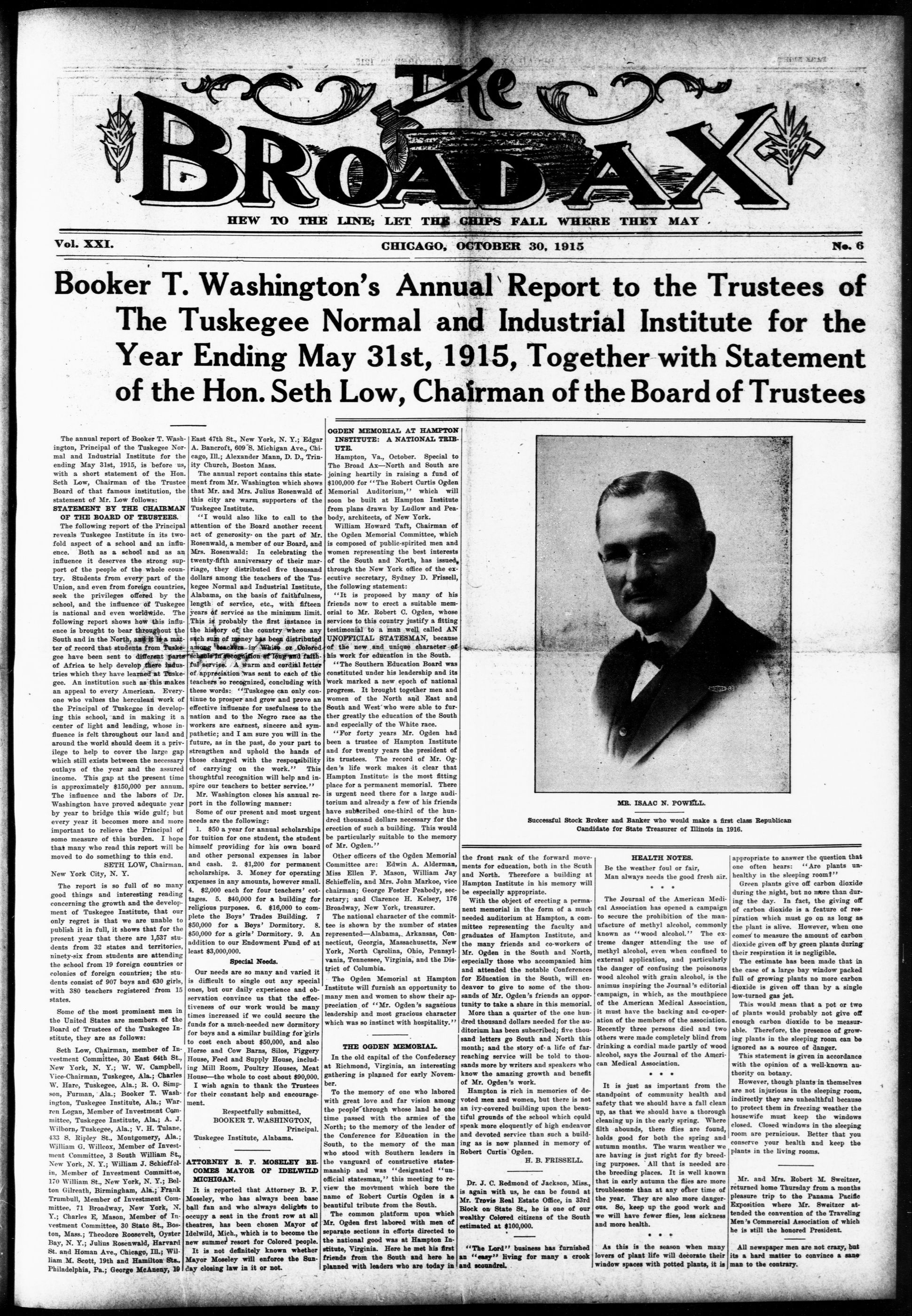
Booker T. Washington's Annual Report to the Trustees of The Tuskegee Normal and Industrial Institute for the Year Ending May 31st,1915,Together with Statement of the Hon. Seth Low, Chairman of the Board of Trustees
Booker T.
The T
Year
of the
The annual report of Booker T. Washington, Principal of the Tuskegee Normal and Industrial Institute for the ending May 31st, 1915, is before us, with a short statement of the Hon. Seth Low, Chairman of the Trustee Board of that famous institution, the statement of Mr. Low follows:
STATEMENT BY THE CHAIRMAN
OF THE BOARD OF TRUSTEES
THE following report of the Principal reveals Tuskegee Institute in its twofold aspect of a school and an influence. Both as a school and as an influence it deserves the strong support of the people of the whole country. Students from every part of the Union, and even from foreign countries, seek the privileges offered by the school, and the influence of Tuskegee is national and even worldwide. The following report shows how this influence is brought to bear throughout the South and in the North, and it is a matter of record that students from Tuskegee have been sent to different parts of Africa to help develop there industries which they have learned at Tuskegee. An institution such as this makes an appeal to every American. Everyone who values the herculean work of the Principal of Tuskegee in developing this school, and in making it a center of light and leading, whose influence is felt throughout our land and around the world should deem it a privilege to help to cover the large gap which still exists between the necessary outlays of the year and the assured income. This gap at the present time is approximately $150,000 per annum. The influence and the labors of Dr. Washington have proved adequate year by year to bridge this wide gulf; but every year it becomes more and more important to relieve the Principal of some measure of this burden. I hope that many who read this report will be moved to do something to this end.
SETH LOW, Chairman
New York City, N. Y.
The report is so full of so many good things and interesting reading concerning the growth and the development of Tuskegee Institute, that our only regret is that we are unable to publish it in full, it shows that for the present year that there are 1,537 students from 32 states and territories, ninety-six from students are attending the school from 19 foreign countries or colonies of foreign countries; the students consist of 907 boys and 630 girls, with 380 teachers registered from 15 states.
Some of the most prominent men in the United States are members of the Board of Trustees of the Tuskegee Institute, they are as follows:
East 47th St., New York, N. Y.; Edgar A. Bancroft, 609 S. Michigan Ave., Chicago, Ill.; Alexander Mann, D. D., Trinity Church, Boston Mass.
The annual report contains this statement from Mr. Washington which shows that Mr. and Mrs. Julius Rosenwald of this city are warm supporters of the Tuskegee Institute.
"I would also like to call to the attention of the Board another recent act of generosity on the part of Mr. Rosenwald, a member of our Board, and Mrs. Rosenwald: In celebrating the twenty-fifth anniversary of their marriage, they distributed five thousand dollars among the teachers of the Tuskegee Normal and Industrial Institute, Alabama, on the basis of faithfulness, length of service, etc., with fifteen years of service as the minimum limit. This is probably the first instance in the history of the country where any such sum of money has been distributed among teachers in White or Colored schools in recognition of long and faithful service. A warm and cordial letter of appreciation was sent to each of the teachers so recognized, concluding with these words: "Tuskegee can only continue to prosper and grow and prove an effective influence for usefulness to the nation and to the Negro race as the workers are earnest, sincere and sympathetic; and I am sure you will in the future, as in the past, do your part to strengthen and uphold the hands of those charged with the responsibility of carrying on the work." This thoughtful recognition will help and inspire our teachers to better service." Mr. Washington closes his annual report in the following manner:
Some of our present and most urgent needs are the following:
1. $50 a year for annual scholarships for tuition for one student, the student himself providing for his own board and other personal expenses in labor and cash. 2. $1,200 for permanent scholarships. 3. Money for operating expenses in any amounts, however small. 4. $2,000 each for four teachers' cottages. 5. $40,000 for a building for religious purposes. 6. $16,000 to complete the Boys' Trades Building. 7. $50,000 for a Boys' Dormitory. 8. $50,000 for a girls' Dormitory. 9. An addition to our Endowment Fund of at least $3,000,000.
Special Needs.
Our needs are so many and varied it is difficult to single out any special ones, but our daily experience and observation convince us that the effectiveness of our work would be many times increased if we could secure the funds for a much-needed new dormitory for boys and a similar building for girls to cost each about $50,000, and also Horse and Cow Barns, Silos, Piggery House, Feed and Supply House, including Mill Room, Poultry Houses, Meat House—the whole to cost about $90,000. I wish again to thank the Trustees for their constant help and encouragement.
Respectfully submitted,
BOOKER T. WASHINGTON,
Principal.
Tuskegee Institute, Alabama.
ATTORNEY B. F. MOSELEY BE COMES MAYOR OF IDELWILD MICHIGAN.
It is reported that Attorney B. F. Moseley, who has always been base ball fan and who always delights to occupy a seat in the front row at all theatres, has been chosen Mayor of Idelwild, Mich., which is to become the new summer resort for Colored people. It is not definitely known whether Mayor Moseley will enforce the Sunday closing law in it or not.
CHICAGO, OCTOBER 30, 1915
OGDEN MEMORIAL AT HAMPTON INSTITUTE: A NATIONAL TRIBUTE.
Hampton, Va., October. Special to The Broad Ax—North and South are joining heartily in raising a fund of $100,000 for "The Robert Curtis Ogden Memorial Auditorium," which will soon be built at Hampton Institute from plans drawn by Ludlow and Peabody, architects, of New York.
William Howard Taft, Chairman of the Ogden Memorial Committee, which is composed of public-spirited men and women representing the best interests of the South and North, has issued through the New York office of the executive secretary, Sydney D. Frissell, the following statement:
"It is proposed by many of his friends now to erect a suitable memorial to Mr. Robert C. Ogden, whose services to this country justify a fitting testimonial to a man well called AN UNOFFICIAL STATESMAN, because of the new and unique character of his work for education in the South.
"The Southern Education Board was constituted under his leadership and its work marked a new epoch of national progress. It brought together men and women of the North and East and South and West who were able to further greatly the education of the South and especially of the White race.
"For forty years Mr. Ogden had been a trustee of Hampton Institute and for twenty years the president of its trustees. The record of Mr. Ogden's life work makes it clear that Hampton Institute is the most fitting place for a permanent memorial. There is urgent need there for a large auditorium and already a few of his friends have subscribed one-third of the hundred thousand dollars necessary for the erection of such a building. This would be particularly suitable to the memory of Mr. Ogden."
Other officers of the Ogden Memorial Committee are: Edwin A. Alderman, Miss Ellen F. Mason, William Jay Schieffelin, and Mrs. John Markkoe, vice chairman; George Foster Peabody, secretary; and Clarence H. Kelsey, 176 Broadway, New York, treasurer.
The national character of the committee is shown by the number of states represented—Alabama, Arkansas, Connecticut, Georgia, Massachusetts, New York, North Carolina, Ohio, Pennsylvania, Tennessee, Virginia, and the District of Columbia.
The Ogden Memorial at Hampton Institute will furnish an opportunity to many men and women to show their appreciation of "Mr. Ogden's sagacious leadership and most gracious character which was so instinct with hospitality."
THE OGDEN MEMORIAL.
In the old capital of the Confederacy at Richmond, Virginia, an interesting gathering is planned for early November.
To the memory of one who labored with great love and far vision among the people through whose land he one time passed with the armies of the North; to the memory of the leader of the Conference for Education in the South, to the memory of the man who stood with Southern leaders in the vanguard of constructive statesmanship and was "designated "unofficial statesman," this meeting to review the movement which bore the name of Robert Curtis Ogden is a beautiful tribute from the South.
The common platform upon which Mr. Ogden first labored with men of separate sections in efforts directed to the national good was at Hampton Institute, Virginia. Here he met his first friends from the South and here he planned with leaders who are today in
[Portrait of a man in a suit with a bow tie, facing forward. The background is plain white. There are no other discernible elements or text.]]
Successful Stock Broker and Banker who would make a first class Republican Candidate for State Treasurer of Illinois in 1916.
the front rank of the forward movements for education, both in the South and North. Therefore a building at Hampton Institute in his memory will be especially appropriate.
With the object of erecting a permanent memorial in the form of a much needed auditorium at Hampton, a committee representing the faculty and graduates of Hampton Institute, and the many friends and co-workers of Mr. Ogden in the South and North, especially those who accompanied him and attended the notable Conferences for Education in the South, will endeavor to give to some of the thousands of Mr. Ogden's friends an opportunity to take a share in this memorial.
More than a quarter of the one hundred thousand dollars needed for the auditorium has been subscribed; five thousand letters go South and North this month; and the story of a life of farreaching service will be told to thousands more by writers and speakers who know the amazing growth and benefit of Mr. Orden's work.
Hampton is rich in memories of devoted men and women, but there is not an ivy-covered building upon the beautiful grounds of the school which could speak more eloquently of high endeavor and devoted service than such a building as is now planned in memory of Robert Curtis' Ogden. H. B. FRISSELL.
Dr. J. C. Redmond of Jackson, Miss., is again with us, he can be found at Mr. Trovis Real Estate Office, in 33rd Block on State St., he is one of our wealthy Colored citizens of the South estimated at $100,000.
"The Lord" business has furnished an "easy" living for many a crook and secondrel.
MR. ISAAC N. POWELL.
broker and Banker who would make a first aidate for State Treasurer of Illinois in
HEALTH NOTES.
Be the weather foul or fair,
Man always needs the good fresh air.
* * *
The Journal of the American Medical Association has opened a campaign to secure the prohibition of the manufacture of methyl alcohol, commonly known as "wood alcohol." The extreme danger attending the use of methyl alcohol, even when confined to external application, and particularly the danger of confusing the poisonous wood alcohol with grain alcohol, is the animus inspiring the Journal's editorial campaign, in which, as the mouthpiece of the American Medical Association, it must have the backing and co-operation of the members of the association. Recently three persons died and two others were made completely blind from drinking a cordial made partly of wood alcohol, says the Journal of the American Medical Association.
---
It is just as important from the standpoint of community health and safety that we should have a fall clean up, as that we should have a thorough cleaning up in the early spring. Where filth abounds, there flies are found, holds good for both the spring and autumn months. The warm weather we are having is just right for fly breeding purposes. All that is needed are the breeding places. It is well known that in early autumn the flies are more troublesome than at any other time of the year. They are also more dangerous. So, keep up the good work and we will have fewer flies, less sickness and more health.
---
As this is the season when many lovers of plant life will decorate their window spaces with potted plants, it is
No. 6
appropriate to answer the question that one often hears: "Are plants unhealthy in the sleeping room?"
Green plants give off carbon dioxide during the night, but no more than during the day. In fact, the giving off of carbon dioxide is a feature of respiration which must go on as long as the plant is alive. However, when one comes to measure the amount of carbon dioxide given off by green plants during their respiration it is negligible.
The estimate has been made that in the case of a large bay window packed full of growing plants no more carbon dioxide is given off than by a single low-turned gas jet.
This would mean that a pot or two of plants would probably not give off enough carbon dioxide to be measurable. Therefore, the presence of growing plants in the sleeping room can be ignored as a source of danger.
This statement is given in accordance with the opinion of a well-known authority on botany.
However, though plants in themselves are not injurious in the sleeping room, indirectly they are unhealthful because to protect them in freezing weather the housewife must keep the windows closed. Closed windows in the sleeping room are pernicious. Better that you conserve your health and keep the plants in the living rooms.
Mr. and Mrs. Robert M. Sweitzer, returned home Thursday from a months pleasure trip to the Panama Pacific Exposition where Mr. Sweitzer attended the convention of the Traveling Men's Commercial Association of which he is still the honored President.
All newspaper men are not crazy, but its a hard matter to convince a sane man to the contrary.
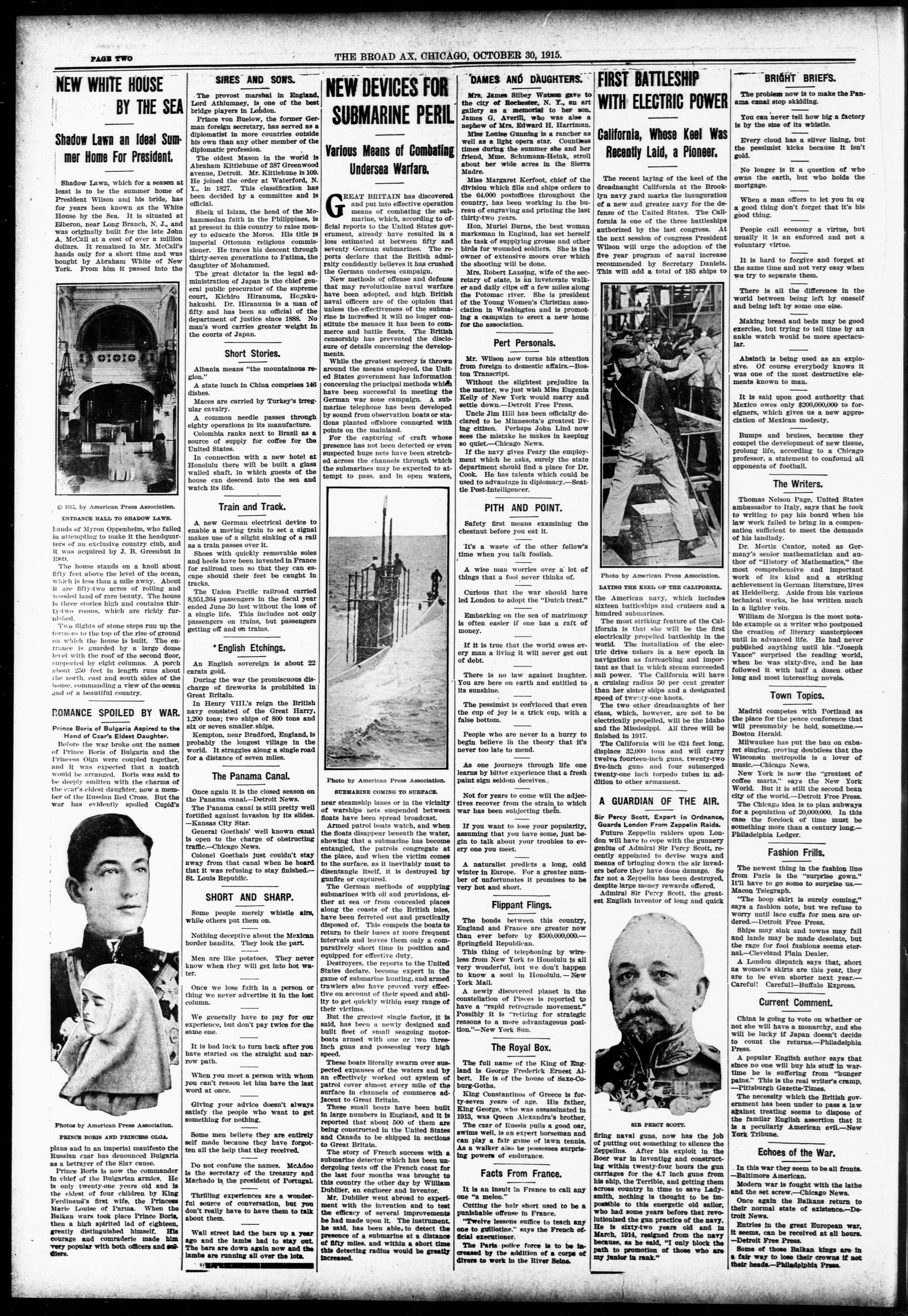
PAGE TWO
NEW WHITE HOUSE BY THE SEA
Shadow Lawn an Ideal Summer Home For President.
Shadow Lawn, which for a season at least is to be the summer home of President Wilson and his bride, has for years been known as the White House by the Sea. It is situated at Elberon, near Long Branch, N. J., and was originally built for the late John A. McCall at a cost of over a million dollars. It remained in Mr. McCall's hands only for a short time and was bought by Abraham White of New York. From him it passed into the
101010
ENTRANCE HALL TO SHADOW LAWN.
Lands of Myron Oppenheim, who failed in attempting to make it the headquarters of an exclusive country club, and it was acquired by J. B. Greenhut in 1909.
The house stands on a knoll about fifty feet above the level of the ocean, which is less than a mile away. About it are fifty-two acres of rolling and wooded land of rare beauty. The house is three stories high and contains thirty-two rooms, which are richly furnished.
Two flights of stone steps run up the terraces to the top of the rise of ground on which the house is built. The entrance is guarded by a large dome level with the roof of the second floor, supported by eight columns. A porch about 250 feet in length runs about the north, east and south sides of the house, commanding a view of the ocean and of a beautiful country.
COMANCE SPOILED BY WAR.
Prince Boris of Bulgaria Aspired to the Hand of Czar's Eldest Daughter. Before the war broke out the names of Prince Boris of Bulgaria and the Princess Olga were coupled together, and it was expected that a match would be arranged. Boris was said to be deeply smitten with the charms of the czar's eldest daughter, now a member of the Russian Red Cross. But the war has evidently spoiled Cunild's
The quick brown fox jumps over the lazy dog.
PRINCE BORIS AND PRINCESS OLGA.
plans and in an imperial manifesto the
Russian czar has denounced Bulgaria
as a betrayer of the Slav cause.
Prince Boris is now the commander
in chief of the Bulgarian armies. He
is only twenty-one years old and is
the oldest of four children by King
Ferdinand's first wife, the Princess
Marie Louise of Parma. When the
Balkan wars took place Prince Boris,
then a high spirited lad of eighteen,
greatly distinguished himself. His
courage and comraderie made him
very popular with both officers and
soldiers.
SIRES AND SONS.
the provost marshal in England, Lord Athunney, is one of the best bridge players in London. Prince von Buelow, the former German foreign secretary, has served as a diplomatist in more countries outside his own than any other member of the diplomatic profession. The oldest Mason in the world is Abraham Kittlehune of 387 Greenwood avenue, Detroit. Mr. Kittlehune is 109. He joined the order at Waterford, N. Y., in 1827. This classification has been decided by a committee and is official. Sheik ul Islam, the head of the Mohammedan faith in the Philippines, is at present in this country to raise money to educate the Moros. His title is imperial Ottoman religious commissioner. He traces his descent through thirty-seven generations to Fatima, the daughter of Mohammed.
The great dictator in the legal administration of Japan is the chief general public procurator of the supreme court, Kichiro Hiranuma, Hogakuhakushi. Dr. Hiranuma is a man of fifty, and has been an official of the department of justice since 1888. No man's word carries greater weight in the courts of Japan.
Short Stories.
Albania means "the mountainous region."
A state lunch in China comprises 146 dishes.
Maces are carried by Turkey's irregular cavalry.
A common needle passes through eighty operations in its manufacture.
Colombia ranks next to Brazil as a source of supply for coffee for the United States.
In connection with a new hotel at Honolulu there will be built a glass walled shaft, in which guests of the house can descend into the sea and watch its life.
Train and Track.
A new German electrical device to enable a moving train to set a signal makes use of a slight sinking of a rail as a train passes over it.
Shoes with quickly removable soles and heels have been invented in France for railroad men so that they can escape should their feet be caught in tracks.
The Union Pacific railroad carried 8,951,364 passengers in the fiscal year ended June 30 last without the loss of a single life. This includes not only passengers on trains, but passengers getting off and on trains.
*English Etchings.
An English sovereign is about 22 carats gold.
During the war the promiscuous discharge of fireworks is prohibited in Great Britain.
In Henry VIII.'s reign the British navy consisted of the Great Harry, 1,200 tons; two ships of 800 tons and six or seven smaller ships.
Kempton, near Bradford, England, is probably the longest village in the world. It straggles along a single road for a distance of seven miles.
The Panama Canal.
Once again it is the closed season on the Panama canal.—Detroit News.
The Panama canal is still pretty well fortified against invasion by its slides.
—Kansas City Star.
General Goethals' well known canal is open to the charge of obstructing traffic.—Chicago News.
Colonel Goethals just couldn't stay away from that canal when he heard that it was refusing to stay finished.—St. Louis Republic.
SHORT AND SHARP.
Some people merely whistle airs, while others put them on.
Nothing deceptive about the Mexican border bandits. They look the part.
Men are like potatoes. They never know when they will get into hot water.
Once we lose faith in a person or thing we never advertise it in the lost column.
We generally have to pay for our experience, but don't pay twice for the same one.
It is bad luck to turn back after you have started on the straight and narrow path.
When you meet a person with whom you can't reason let him have the last word at once.
Giving your advice doesn't always satisfy the people who want to get something for nothing.
Some men believe they are entirely self made because they have forgotten all the help that they received.
Do not confuse the names. McAdoo is the secretary of the treasury and Machado is the president of Portugal.
Thrilling experiences are a wonderful source of conversation, but you don't really have to have them to talk about them.
Wall street had the bars up a year ago and the lambs had to stay out. The bars are down again now and the lambs are running all over the lot.
---
THE BROAD AX. CHICAGO, OCTOBER 30, 1915.
NEW DEVICES FOR SUBMARINE PERIL
Various Means of Combating Undersea Warfare.
GREAT BRITAIN has discovered and put into effective operation means of combating the submarine, which, according to official reports to the United States government, already have resulted in a loss estimated at between fifty and seventy German submarines. The reports declare that the British admiralty confidently believes it has crushed the German undersea campaign. New methods of offense and defense that may revolutionize naval warfare have been adopted, and high British naval officers are of the opinion that unless the effectiveness of the submarine is increased it will no longer constitute the menace it has been to commerce and battle fleets. The British censorship has prevented the disclosure of details concerning the developments.
While the greatest secrecy is thrown around the means employed, the United States government has information concerning the principal methods which have been successful in meeting the German war zone campaign. A submarine telephone has been developed by sound from observation boats or stations planted offshore connected with points on the mainland.
For the capturing of craft whose presence has not been detected or even suspected huge nets have been stretched across the channels through which the submarines may be expected to attempt to pass, and in open waters,
THE SUBMARINE
Photo by American Press Association.
SUBMARINE COMING TO SURFACE.
near steamship lanes or in the vicinity of warships nets suspended between floats have been spread broadcast.
Armed patrol boats watch, and when the floats disappear beneath the water, showing that a submarine has become entangled, the patrols congregate at the place, and when the victim comes to the surface, as it inevitably must to disentangle itself, it is destroyed by gunfire or captured.
The German methods of supplying submarines with oil and provisions, either at sea or from concealed places along the coasts of the British isles, have been ferreted out and practically disposed of. This compels the boats to return to their bases at more frequent intervals and leaves them only a comparatively short time in position and equipped for effective duty.
Destroyers, the reports to the United States declare, become expert in the game of submarine hunting, and armed trawlers also have proved very effective on account of their speed and ability to get quickly within easy range of their victims.
But the greatest single factor, it is said, has been a newly designed and built fleet of small seagoing motor-boats armed with one or two three-inch guns and possessing very high speed.
These boats literally swarm over suspected expanses of the waters and by an effectively worked out system of patrol cover almost every mile of the surface in channels of commerce adjacent to Great Britain.
These small boats have been built in large numbers in England, and it is reported that about 500 of them are being constructed in the United States and Canada to be shipped in sections to Great Britain.
The story of French success with a submarine detector which has been undergoing tests off the French coast for the last four months was brought to this country the other day by William Dubilier, an engineer and inventor.
Mr. Dubilier went abroad to experiment with the invention and to test the efficacy of several improvements he had made upon it. The instrument, he said, has been able, to detect the presence of a submarine at a distance of fifty miles, and within a short time this detecting radius would be greatly increased.
DAMES AND DAUGHTERS.
Mrs. James Silby Watson gave to the city of Rochester, N. Y., an art gallery as a memorial to her son, James G. Averill, who was also a nephew of Mrs. Edward H. Harriman. Miss Louise Gunning is a rancher as well as a light opera star. Countless times during the summer she and her friend, Mme. Schumann-Heink, stroll about her wide acres in the Sierra Madre.
Miss Margaret Kerfoot, chief of the division which fills and ships orders to the 64,000 post offices throughout the country, has been working in the bureau of engraving and printing the last thirty-two years.
Hon. Muriel Burns, the best woman marksman in England, has set herself the task of supplying grouse and other birds for wounded soldiers. She is the owner of extensive moors over which the shooting will be done.
Mrs. Robert Lansing, wife of the secretary of state, is an inveterate walker and daily clips off a few miles along the Potomac river. She is president of the Young Women's Christian association in Washington and is promoting a campaign to erect a new home for the association.
Pert Personals.
Mr. Wilson now turns his attention from foreign to domestic affairs.—Boston Transcript.
Without the slightest prejudice in the matter, we just wish Miss Eugenia Kelly of New York would marry and settle down.—Detroit Free Press.
Uncle Jim Hill has been officially declared to be Minnesota's greatest living citizen. Perhaps John Lind now sees the mistake he makes in keeping so quiet.—Chicago News.
If the navy gives Peary the employment which he asks, surely the state department should find a place for Dr. Cook. He has talents which could be used to advantage in diplomacy.—Seattle Post-Intelligenz.
PITH AND POINT.
Safety first means examining the chestnut before you eat it.
It's a waste of the other fellow's time when you talk foolish.
A wise man worries over a lot of things that a fool never thinks of.
Curious that the war should have led London to adopt the "Dutch treat."
Embarking on the sea of matrimony is often easier if one has a raft of money.
If it is true that the world owes every man a living it will never get out of debt.
There is no law against laughter. You are here on earth and entitled to its sunshine.
The pessimist is convinced that even the cup of joy is a trick cup, with a false bottom.
People who are never in a hurry to begin believe in the theory that it's never too late to mend.
As one journeys through life one learns by bitter experience that a fresh paint sign seldom deceives.
Not for years to come will the adjectives recover from the strain to which war has been subjecting them.
If you want to lose your popularity, assuming that you have some, just begin to talk about your troubles to every one you meet.
A naturalist predicts a long, cold winter in Europe. For a greater number of unfortunates it promises to be very hot and short.
Flippant Flings.
The bonds between this country, England and France are greater now than ever before by $500,000,000.—Springfield Republican. This thing of telephony by wireless from New York to Honolulu is all very wonderful, but we don't happen to know a soul in Honolulu.—New York Mail. A newly discovered planet in the constellation of Pisces is reported to have a "rapid retrograde movement." Possibly it is "retiring for strategic reasons to a more advantageous position."—New York Sun.
The Royal Box.
The full name of the King of England is George Frederick Ernest Albert. He is of the house of Saxe-Coburg-Gotha. King Constantinos of Greece is forty-seven years of age. His father, King George, who was assassinated in 1913, was Queen Alexandra's brother. The czar of Russia pulls a good oar, swims well, is an expert horseman and can play a fair game of lawn tennis. As a walker also he possesses surprising powers of endurance.
Facts From France.
It is an insult in France to call any one "a melon."
Cutting the hair short used to be a punishable offense in France.
"Twelve lessons suffice to teach any one to guillotine," says the French official executioner.
The Paris police force is to be increased by the addition of a corps of divers to work in the River Seine.
FIRST BATTLESHIP WITH ELECTRIC POWER
The recent laying of the keel of the dreadnaught California at the Brooklyn navy yard marks the inauguration of a new and greater navy for the defense of the United States. The California is one of the three battleships authorized by the last congress. At the next session of congress President Wilson will urge the adoption of the five year program of naval increase recommended by Secretary Daniels. This will add a total of 185 ships to
A
Photo by American Press Association.
LAYING THE KEEL OF THE CALIFORNIA.
the American navy, which includes sixteen battleships and cruisers and a hundred submarines.
The most striking feature of the California is that she will be the first electrically propelled battleship in the world. The installation of the electric drive ushers in a new epoch in navigation as farreaching and important as that in which steam succeeded sail power. The California will have a cruising radius 50 per cent greater than her sister ships and a designated speed of twenty-one knots.
The two other dreadnaughts of her class, which, however, are not to be electrically propelled, will be the Idaho and the Mississippi. All three will be finished in 1917.
The California will be 624 feet long, displace 32,000 tons and will carry twelve fourteen-inch guns, twenty-two five-inch guns and four submerged twenty-one inch torpedo tubes in addition to other armament.
A GUARDIAN OF THE AIR.
Sir Percy Scott, Expert in Ordnance, Guards London from Zeppelin Raids. Future Zeppelin raiders upon London will have to cope with the gunnery genius of Admiral Sir Percy Scott, recently appointed to devise ways and means of bringing down the air invaders before they have done damage. So far not a Zeppelin has been destroyed, despite large money rewards offered. Admiral Sir Percy Scott, the greatest English inventor of long and quick
[Name]
SIR PERCY SCOTT.
firing naval guns, now has the job of putting out something to silence the Zeppellins. After his exploit in the Boer war in inventing and constructing within twenty-four hours the gun carriages for the 4.7 inch guns from his ship, the Terrible, and getting them across country in time to save Ladysmith, nothing is thought to be impossible to this energetic old sailor, who had some years before that revolutionized the gun practice of the navy. He is sixty-two years old and in March, 1914, resigned from the navy because, as he said, "I only block the path to promotion of those who are my junior in rank."
BRIGHT BRIEFS.
The problem now is to make the Panama canal stop skidding.
You can never tell how big a factory is by the size of its whistle.
Every cloud has a silver lining, but the pessimist kicks because it isn't gold.
No longer is it a question of who owns the earth, but who holds the mortgage.
When a man offers to let you in or a good thing don't forget that it's his good thing.
People call economy a virtue, but usually it is an enforced and not a voluntary virtue.
It is hard to forgive and forget at the same time and not very easy when we try to separate them.
There is all the difference in the world between being left by oneself and being left by some one else.
Making bread and beds may be good exercise, but trying to tell time by an ankle watch would be more spectacular.
Absinth is being used as an explosive. Of course everybody knows it was one of the most destructive elements known to man.
It is said upon good authority that Mexico owes only $200,000,000 to foreigners, which gives us a new appreciation of Mexican modesty.
Bumps and bruises, because they compel the development of new tissue, prolong life, according to a Chicago professor, a statement to confound all opponents of football.
The Writers.
Thomas Nelson Page, United States ambassador to Italy, says that he took to writing to pay his board when his law work failed to bring in a compensation sufficient to meet the demands of his landlady.
Dr. Mortiz Cantor, noted as Germany's senior mathematician and author of "History of Mathematics," the most comprehensive and important work of its kind and a striking achievement in German literature, lives at Heidelberg. Aside from his various technical works, he has written much in a lighter vein.
William de Morgan is the most notable example of a writer who postponed the creation of literary masterpieces until in advanced life. He had never published anything until his "Joseph Vance" surprised the reading world, when he was sixty-five, and he has followed it with half a dozen other long and most interesting novels.
Town Topics.
Madrid competes with Portland as the place for the peace conference that will presumably be held sometime.—Boston Herald.
Milwaukee has put the ban on cabaret singing, proving doubtless that the Wisconsin metropolis is a lover of music.—Chicago News.
New York is now the "greatest of coffee marts," says the New York World. But it is still the second bean city of the world.—Detroit Free Press.
The Chicago idea is to plan subways for a population of 20,000,000. In this case the forelock of time must be something more than a century long.—Philadelphia Ledger.
Fashion Frills.
The newest thing in the fashion line from Paris is the "surprise gown." It'll have to go some to surprise us.—Macon Telegraph.
"The hoop skirt is surely coming," says a fashion note, but we refuse to worry until lace cuffs for men are ordered.—Detroit Free Press.
Ships may sink and towns may fall and lands may be made desolate, but the rage for fool fashions seems eternal.—Cleveland Plain Dealer.
A London dispatch says that, short as women's skirts are this year, they are to be even shorter next year.—Careful! Careful!—Buffalo Express.
Current Comment.
China is going to vote on whether or not she will have a monarchy, and she will be lucky if Japan doesn't decide to count the returns.—Philadelphia Press.
A popular English author says that shince no one will buy his stuff in wartime he is suffering from "hunger pains." This is the real writer's cramp.—Pittsburgh Gazette-Times.
The necessity which the British government has been under to pass a law against treating seems to dispose of the familiar English assertion that it is a peculiarly American evil.—New York Tribune.
Echoes of the War.
In this war they seem to be all fronts.—Baltimore American.
Modern war is fought with the lathe and the set screw.—Chicago News.
Once again the Balkans return to their normal state of existence.—Detroit News.
Entries in the great European war, it seems, can be received at all hours.—Detroit Free Press.
Some of those Balkan kings are in a fair way to lose their crowns if not their heads.—Philadelphia Press.
Homing Instinct of Crabs. Who would believe that among creatures having well developed domestic instincts we must include the humble crabs, the "spiders of the sea," as Victor Hugo calls them? Once under water, we might expect one part of the sea to be as homelike as another, but that only shows how little the average human being understands a crab's point of view. Some one, however, suspected them of the homing instinct and so tried the experiment of catching a pair of them on the Yorkshire coast, in England, and, after marking them, carrying them south fifty miles or more, returning first one and then the other to the water at different points on the shore. Then the Yorkshire crabbers carefully searched their traps as they made each haul, on the lookout for the possible return of the wanderers. Strange to relate, one day not one, but both of the crabs were caught a second time, having made their way back across the intervening miles of sea bottom to their Yorkshire home.-St. Nicholas.
Waterspouts.
the waterspout at sea and the tornado on land are manifestations of great instability of the atmosphere in a vertical direction, caused either by an abnormally warm surface layer of air or an abnormally cold layer at the cloud level, says Nature. The former cause is common in summer; the latter occurs both in summer and winter and is usually associated with a "line squall" or V shaped barometric depression. The waterspout shows the track along which surface air passes spirally upward to restore equilibrium. The commotion of the sea is due to the exceedingly violent character of the phenomenon. The funnel itself is probably composed partly of moisture condensed out of air by the sudden diminution of pressure which occurs and partly of sea water in the form of spray. Sometimes the middle portion of the visible funnel is absent, but there must in that case be a corresponding complete funnel of rotating air from the surface of the cloud.
Melancholia.
Melancholia does not mean depression of spirits. A man may be as depressed as it is possible to be and still not have melancholia. Melancholia is despondency on account of painful delusions. One of the two typical delusions of melancholia is that the unparalleled sin has been committed, that God has been offended beyond redemption and that hell is to be the ultimate goal; the other is that of impending poverty. Everything is lost or is about to be. The patient and his family are going to end up in the poorhouse. His acts alone have brought about this terrible calamity from which there is no escape. It can be readily seen that a person having delusions of this type must be necessarily depressed. There is probably no form of insanity in which the anguish of the patient equals that of the melancholiac. Life is one continuous horror.-Exchange.
Pan-America.
The combined area of pan-America, exclusive of Canada, is 12,000,000 square miles, of which the Latin American countries occupy approximately 9,000,000 and the United States 3,000,000. This physical extent of pan-America is better realized when it is compared with that of Europe, which has 3,750,600 square miles, with Africa, which has 11,500,000, and with Asia, which has 17,000,000. Pan-America's real greatness, significance and power in world relationship are emphasized by appreciation of its present population and the future possibilities for a vast increase. Its twenty-one nations can now boast of a population of 180,000,000, of which 100,000,000 are living in United States territory and 80,000,000 in Latin America.—John Barrett in North American Review.
Defining an Art Patron.
"Is your husband so very fond of art?"
"Art! He doesn't know a Raphael from a hair cut."
"Why. I understood him to say that he was an art patron."
"Patron! That man wouldn't trade a club sandwich for a Bouguereau! What does he mean by calling himself an art patron?"
"Why, he says it costs him ten thousand a year to pay for the bogus masters the smooth dealers cox you to buy—and that makes him an art patron."-Cleveland Plain Dealer.
Obeying Directions
"Good heavens, John, what made you pick out such an ugly woman to send home? She scared the baby almost into fits."
"Just did what you told me, Maria. You said you wanted a plain cook, and I got the plainest one to be had."—Baltimore American.
A: Strenuous Singer
It is possible for a singer to be too strenuous. All students of musical history know that the famous tenor, Rubini, actually fractured his collarbone while singing a double forte on B flat.
Explained.
Proud Father—That is a sunset my daughter painted. She studied painting abroad, you know. Friend—Ah, that explains it. I never saw a sunset like that in this country.—Puck.
Those Girls Again
Edith—Miss Oldgirl says she has just reached the marriageable age. Marle—You don't say! I wonder what delayed her!—Boston Transcript.
Thrift is not a virtue of tomorrow, but of today.
Ruskin in the Kitchen.
In her book of reminiscences, "Thirteen Years of a Busy Woman's Life," Mrs. Alec Tweedie says that her father, Dr. Harley, a well known London physician, was a great friend of Ruskin and often stayed at Brantwood. One night Ruskin asked Dr. Harley whether he liked tea or coffee before he got up.
"A cup of tea," he replied.
"Why don't you choose coffee?"
"Well, to tell the truth, I have lived so much abroad that I don't fancy English coffee. It is generally so badly made."
His host said nothing. The next morning Dr. Harley was awakened, and a strong smell of coffee permeated the room. Turning to a servant, he asked, "Is that my cup of tea?"
"No, sir; it is Mr. Ruskin's coffee."
"Mr. Ruskin's coffee! What do you mean?"
"The master was up early. He roasted the coffee himself, he ground the coffee himself, and he made the coffee himself, and he hopes you will like it."
Growth of Wealth
The wealth of the world grows very slowly, and the amount of real saving is amazingly small. If, for example, the wealth of the United States when George Washington became president was equivalent to a billion dollars—and that perhaps is not a bad guess—and this amount could have steadily earned a little over 5 per cent every year since, this gain, compounded, would exceed the present estimated wealth of this country. This means that all the rest of the saving and the gains from new enterprises and a rapidly increasing population have only just about balanced the annual waste and loss. True, more than two-thirds of the wealth of nations is still the human machine and not the visible taxable property, but the fact serves to show how slight is the annual gain even in the premier get rich quick country of the world, the United States.—Carl Snyder in Collier's Weekly.
No Simple Life at Avr.
The "simple life" finds no sympathetic atmosphere in Scotland and above all, not in the "Auld Ayr" of Robert Burns—Auld Ayr, wham ne'er a town surpasses For honest men and bonnie lasses.
George Ferguson Munro is a newspaper person who writes articles for a Scottish newspaper. Munro wanted to live a free, untrammeled, outdoor life. He began last spring. He wandered over hill and dale, doing nothing, finding enough to eat and drink, lying on a shaded hillside reading a good book. He interfered with no one. The earth was his bed, the starry sky his roof. When it rained he went into a barn. Yet for leading this simple life he was taken by the rough hand of the law as a vagabond and sentenced by the magistrate of Ayr to three months' hard labor—Indianapolis News.
Dumas an Enigma.
The elder Dumas was the greatest enigma in the literary world of Paris, for who has ever been able to explain just how and when all the books that bear his name were written? He loved the mysterious for its own sake. He told me how he had dabbled in magnetic and mesmeric experiments. He spoke with absolute conviction of the power of magnetism and declared that the whole of life and society was, to his way of thinking, nothing but a manifestation of magnetic force.
His talk was like the man himself, calm, nonchalant, without a trace of emotion. He was so far above discussion as to ignore it. When he was speaking he seemed to imply by his look and manner that it made no difference to him whether you believed what he was saying or not.—Francis Grierson in Century Magazine.
Simply Separated.
The janitor of a hall in a country place was asked by an entertainer from the city if there wasn't a piano that he could use for the evening's entertainment.
"Waal, yes, there is a piano down in the cellar," said the janitor, "but you couldn't play on it—leastways, not as it is, for it's full of books."
Then the janitor bawled to his wife: "Susan, where's the works of that plano?"
And Susan's voice floated down from upstairs: "Ain't they out in the garden?"—Washington Star.
Largest Star Known
Canopus, the largest star known, with a luminosity of 47,000 times that of the sun, is invisible from the northern hemisphere. O. R. Walkley, an English astronomer, adduces testimony at great length to prove it the central sun of the universe about which all other orbs revolve.
Appearances Decentive
"Thompson has made a discovery."
"Indeed?"
"Yes. He says that he has discovered that the more buttons there are on a woman's coat the greater the probability that it really fastens with hooks and eyes." - Puck.
Garbage For the Dogs
Instead of throwing her kitchen refuse into a garbage receptacle the poor Constantinople housewife puts it into a sort of kennel outside her door for the wandering dogs of the city.
Notable Exceptions.
Mrs. Bloobumper—Yes, everybody is always ready to give advice.
Bloobumper—There are exceptions.
"Are there?"
"Yes, doctors and lawyers."
Let them obey that know not how to rule—Shakespeare.
Both Trumpeters. Among the quiet old epitaphs collected in England by an American with a fancy for odd verse and ancient brasses are two commemorating trumpeters. The first is often quoted: Till Angels' trumpets on the Final Day Shall Blow and Graves shall Ope
Ancient Gardens. Statues were a decorative element which the Florentine garden arch made expensive use. At first a antique busts were placed along parapet of the terrace or under central loggia, but are long Greek and heroes, fauns and palads
Here Abram Crumpett in his Tomb doth
Lay
And Walts the Call-in Hope.
The second is less known and, with all its quaintness, has a fine, bold swing to it. Moreover, the deceased, as a prose addition to the inscription makes clear, was a gallant soldier as well as a musician and had served through many campaigns, civil and foreign. Thus it runs:
When Gabriel, Angell, shall hys Trumpett blow
Une from the Sod command all be
Uppe from the Sod commanding all below.
Vaster than Armys when those Millions rise
Ansring that Summons from the Pealing Skyes.
Theres One lyes Here will joyful Rouse at last
in manful maneuol Echo to the Blast-
John Petres, Trumpetter, who All his Days
Blew for the Kynge his Wars and God
his Praise
-Youth's Companion.
Both Far Away.
A prominent Kentucky lawyer had been in Jackson during the hearing of a big land case and after the strain of several weeks in the courtroom had decided to take a trip up in the mountains and enjoy the quieting influences of the hills. He traveled the paths and narrow mountain roads till he found himself, at the end of several days' journey, about forty or fifty miles from the railroad. It was about noon, the lawyer judged, for his watch had run down and he could not be exact. But in the midst of this deep contemplation the lawyer came upon an old darky sitting upon a bowler alongside the road. "What time have you?" he asked of the old darky. "Well, suh, boss, the old watch says she's about ten minutes to 12," was the reply. "Is that sun time or railroad time?" again questioned the lawyer. "What difference at make? One's nigh as fur frum heah as de yudder."—Argonaut.
Scotch Breakfasts
Dr. Redgill, in Susan Ferrier's "Destiny," dwells on Scotch breakfasts with gusto. After proclaiming that Scotland in general is "a perfect mass of rubbish" and the cookery not fit for dogs he adds: "But the breakfasts! That's what redeems the land, and every county has its own peculiar excellence. In Argyllshire you have the Lochfine herring—fat, luscious and delicious, just out of the water, falling to pieces with its own richness, melting away like butter in your mouth. In Aberdeenshire you have the finnan haddock, with a flavor all its own, vastly relishing, just salt enough to be plquant without parching you up with thirst. In Perthshire there is the Tay salmon, kippered, crisp and juicy—a very magnificent morsel. In other places you have the exquisite mutton of the country made into hams of a most delicious flavor."
Judges' Gowns.
The London Law Times points out that the silk gown of the bench and bar owes its original use to its having been adopted as a form of mourning at the death of an English sovereign. On the death of Queen Mary in 1694 the present silk gown was introduced as mourning and, having been found more convenient and less troublesome than the regular dress then worn, has since been continued. The late Sir Frederick Pollock is said to have expressed an opinion in reference to the ordinary costume of the bar that the bench and bar went into mourning at the death of Queen Anne and have so remained ever since. American courts adopted the gown along with the English common law.
Bad Handwriting.
Sometimes the worst of handwriting becomes intelligible when one grasps the rules, for a man's script—particularly an author's—is frequently made difficult chiefly by his deliberate or unconscious inversion of the accepted rules of calligraphy. Henry Ward Beecher had a daughter who acted as copyist, and she read him with ease simply by remembering three principles—that in her father's manuscript no dotted letter was meant for an "i," no crossed letter stood for "t," and that no capital letter ever began a sentence—Indianapolis News.
Where the Trouble Was.
"Mamma," said small Edmund, "I'm very sorry I ate the cake after you told me not to."
"So your conscience is troubling you, is it?" said his mother.
"I don't know," answered Edmund.
"I thought it was my stomach."—Chicago News.
Chinese Junks.
Although there is no written history of the earliest bulk oil carrier, the Chinese Newchang junk, originally built for the carriage of water in bulk and afterward used for oil, must be among the earliest examples of this class of vessel—Exchange.
A. Rebuff.
Said one Indianapolis jokesmith to another: "How's your stuff selling now? Been getting any checks lately?" "Not exactly, but I received a couple of repulses today." - Indianapolis News.
Three Vitriola.
The "three vitriols" are green vitriol (sulphate of iron), blue vitriol (sulphate of copper) and white vitriol (sulphate of zinc).
In life's small things be resolute and great—Lowell.
Statues were a decorative element of which the Florentine garden architect made expensive use. At first a few antique busts were placed along the parapet of the terrace or under the central loggia, but are long Greek gods and heroes, fauns and nalads were seen at the end of every alley, while giants and caryatides were introduced to support walls and porticoes. One great charm of renissance gardens was the skillful manner in which nature and art were blended together. The formal design of the giardino segreto agreed with the straight lines of the house, and the walls, with their clipped hedges, led on to the wilder, freer growth of woodland and meadow, while the dense shade of the bosco supplied an effective contrast to the sunny spaces of lawn and flower bed.
The ancient practice of cutting box trees into fantastic shapes, known to the Romans as the toliary art, was largely restored in the fifteenth century and became an essential part of Italian gardens—New York Telegram.
Curious Telegraph Lines.
The most original telegraph line in the world once extended from La Plaz, the capital of Bolivia, to the neighboring town of Oruro, a distance of about 156 miles. There are no growing trees in this part of the world, and wood of any kind is so rare that the telegraph poles were made of the same material as the natives' household furniture—dried mud. The pillars were built on stone foundations and measured about five feet square at the base, with a tapering height of fifteen feet. They were placed about 360 feet apart. Another curious telegraph line was constructed in Uganda by a British engineer, who transported growing trees to the roadside and used them as poles because he could not find any "dead" wood that would withstand the ravages of the white ants. In Dutch East India growing trees are also turned to account in this manner, but there a wire is stretched across the road between the trees on either side and the actual telegraph line suspended down the center.
Fleas as Jumpers
The jumping powers of fleas have been much exaggerated, according to a bulletin on these insects issued by the department of agriculture. The species known as the human flea (Pulex irritans) is probably the best jumper. According to Mitzmain, the maximum horizontal distance this species can jump is thirteen inches and the maximum vertical distance less than eight inches.
The question of the flea's jumping powers is of importance in connection with the spread of bubonic plague and other diseases of which this insect is the carrier. The Indian plague commission, which has investigated the habits of the Indian rat flea, finds its maximum horizontal jump to be only five inches, while Mitzmain records the maximum height to which it can jump as three and one-eighth inches. One species of flea, the "strictlight," is nearly incapable of jumping.
Limitations of Science
Johnny was sent to study mathematics, and the teacher told him that it was a true science.
"For instance," she said, "if it takes one man twelve days to build a house, then twelve men can build it in one day."
Johnny replied: "And 288 men will build it in an hour, 17,280 in a minute, 1,036,800 men will put it up in a second. Now, I don't believe they could build even a single brick in that time. Again, if one ship can cross the Atlantic in twelve days, twelve ships should be able to cross it in one day. I don't believe that either, so I'm not going to study mathematics." And Johnny left the teacher studying it herself—Exchange.
Her Word of Honor:
"Don't you love me?"
"Yes, but I'm already engaged."
"Then break your engagement."
"Oh, Jack, that wouldn't be honorable! An engagement is a sacred thing, not lightly to be entered into or broken off. Besides"—
"Well?"
"Well, I'm engaged to two men, and that makes it even worse." — Boston Transcript
Anxious to Help.
He (after the honeymoon)—Has your father said anything about helping to provide a home for us? She—Oh, yes indeed! He said that when we had a home of our own he would buy me a cookbook and allow mother to come and teach me how to use it, even if it took a year—New York Weekly.
Nautical.
"Father." wired the young yachtsman,
"please advance me some money. My
boat is entered in tomorrow's race and
I'm sure she will win."
And father promptly replied, "Not
with a time allowance from me."—St.
Louis Post-Dispatch.
A Better Way.
"Keep on the watch. Opportunity may knock at your door." "I'm not going to wait for that. I'm going to pound on Opportunity's door." -Louisville Courier-Journal.
Roor Product
"I'm a self made man. I am."
"Well, there is one thing you needn't worry about."
"What is that?"
"Taking out a patent."
Actinic Rays.
The ultra violet ray is of all light elements the hardest on the eye. It is also called the actinic ray and is described as "like a light barbed arrow."
He Didn't Sprout Horns
The first Japanese to drink milk did so with misgivings lest he sprout horns like a cow. That was in 1861. The man that took that big chance is Mr. Tsubol, who is still alive and absolutely free from horns. At that time Mr. Tsubol was an apprentice. He became ill of a disease that baffled the skill of the Japanese physicians, so his master called in Dr. Hepburn, an American physician, who then lived in that district. Dr. Hepburn prescribed milk, one bottle to be "taken" every morning. The poor boy, believing that the growth of horns was inevitable if one drank cow's milk, begged his master not to make him take the doctor's prescription, but his frantic pleas were denied.
There was considerable difficulty about getting milk then because, as there was no demand for milk—the greater part of the population sharing the boy's belief that its consumption was sure to raise horns—there was no dairy or milkmen. Finally some was obtained from a Japanese who cared for a cow kept by a foreigner.—Japan Advertiser.
The Horned Lark:
Looks like Satan, the horned lark does, with his two black horns of feathers sticking out on top of his head. He wears a suit of a grayish brown touched with pink. A black curve over his eyes and another black crescent under his chin help give him a wicked aspect. His satanic top knot, the two tiny tufts of black feathers on the back of his head, gives him the name. He's the horned lark.
But really he's not so bad as he looks. You know that the minute you see his brown eyes and hear him sing. The farmer knows he isn't such a wicked bird too. The horned lark eats all kinds of wild seeds, beetles, weevils and bugs. If he gets tired of his diet he will start in and clean up the grasshopper and cutworm crop.
Sometimes he will visit an oat field, but he doesn't cause enough damage to get his picture in the rogues' gallery as a dangerous thief. — Philadelphia North American.
Nursing a Grouch.
What a dissatisfied bunch of mortals we are! Three hundred and sixty-five days of the year we grumble about the weather. It's either too hot or too cold, too wet or too dry. You meet a friend who says, "It's a fine day today!" You answer, "Delightful!" The next one you meet says, "Ain't this beastly weather?" You answer, "The foulest ever!" You're always ready to agree with and join the knoeker. Even the poor, innocent weather cannot escape your hammer. Everything in this world was made wrong—except yourself, I mean. You are the quintessence of perfection in your own mind. When you're invited to a party you are mad because you are invited, and if you are ignored you're mad again just because that condition fits your disposition. Why don't you, for a change, look at the bright side of things and maybe your "disgustion" will improve.—Cartoons Magazine.
Some Kinds of Talking Women.
The woman who tells you all about something in such a way as to leave you in complete ignorance of the essential things which you wanted to know about.
The woman who flatters you about yourself as a screen to give herself the opportunity to talk about herself.
The woman who is silent when she has nothing to say. This woman talks incessantly.
The woman who asks you what you think about something and then heads you off from telling by keeping on talking herself.
The woman you marry—Life.
Temperament In Folly:
The fool in his heart saith a number of things. Suppose he happens to be a phlegmatic fool with a fondness for luxury.
"I do not care," saith he, in that case, "to go out into the damp, chill woods and mistake a toadstool for a mushroom. I much prefer to get up in the night, in my comfortable flat, and drink out of the wrong bottle."—Boston Journal.
Good Prospects
"What, you want to marry my daughter? Why, you haven't a cent in the world! How do you expect to support her?" "That will be easy enough. As soon as I'm known to be your son-in-law I can get all the credit I want."—Pittsburgh Press.
A One Sided Rule
Once when P. T. Barnum was taking tickets at the entrance of his circus a man asked him if he could go in without paying.
"You can pay without going in," said Barnum, "but you can't go in without paying. The rule doesn't work both ways."
Hydrofluoric Acid.
Hydrofluoric acid is the best agent to use for removing sand from castings, particularly those of iron and steel, as it attacks the sand and dissolves it, while other acids attack the metal and only loosen the sand so that it falls off.
Alaaska.
Alaska has an area of 600,000 square miles. one-fifth the size of the United States, which means that it will make fourteen New Yorks and nearly 500 Rhode Islands.
Tempering Steel.
It is significant that in the matter of tempering steel we are no further advanced than our ancestors of some 5,000 years ago.
PAGE THREE
"Certain cartoonists," says a writer in Cartoons Magazine, "have been taken to task for picturing with too alluring a pencil the joys of going barefoot in summer, of hunting Indians, of climbing apple trees, when they should have been in school studying. Their work is an invitation to the small boy to play truant, especially when the birds are singing and the sun is shining and a dog companion clamors for an excursion over hill and dale. Enter the plea 'Gullity.'
"Who would care to be the owner of a small boy who when the red gods called wouldn't follow, who wouldn't occasionally steal away from school and come back bramble scratched and sunburned? Any boy whose name is Johnnie and not Archibald or Ferdinand will need no invitation to run after the pied piper of happiness and seek relief from the eternal three R's under the willows or in forbidden apple orchards. Given a golden day, the smell of summer in the air, a south wind, a schoolroom, no more than iron bars, can a prison make. Nobody but an old fashioned schoolmaster would expect a 'feller to be proper—always."
Storks.
We have no true stork in this country, but we have the ibis, which belongs to the stork family. This bird, which breeds in the far southern states, often goes as far north as Indiana, for it is a bird of long and easy flight, standing thirty or thirty-one inches in its length of body. Its plumage is white, but wings and tail are black. It is considered a bird of gentleness and good nature, associating with ducks, geese and other water fowl on pleasant terms.
The white stork of Europe migrates to Africa in winter. It comes and goes in great flocks, returning year after year to Denmark, Germany and other parts of central Europe, where the birds are welcomed and protected on account of their value as scavengers. The common name for the stork in Holland means "the bringer of good," and in that country, as well as in Denmark, the people believe that good luck will attend the house on which the stork has built its nest.-Savannah News.
The Machete.
Because it is as useful in peace as in war the Spanish American machete has a distinction of its own as a weapon. It is a sword, spade, hedging bill, ax, hatchet and pruning knife. It is first cousin to the United States cavalry saber, and almost every male in Spanish American countries above the age of childhood carries one. The laborer carries it to cut sugar cane, prepare firewood and trench ground for his crop. The horseman wears it to cut his way through woodlands during journeys over rough country. The haldago wears it with silvered hilt and tasseled scabbard. His humber neighbor is content to carry it bare and hilted with horn, wood or leather. The machete is made in about thirty different forms, and the blade varies in length from ten to twenty inches. It may be blunt, pointed, curved or straight, broad or narrow. The favorite with the laborer is of medium length, with unornamented handle and broad, straight blade.-Boston Herald,
Tonsils and Rheumatism.
Rheumatism in its many forms is according to Dr. Seymour Taylor, the famous British specialist, the most dangerous disease with which physicians have to deal, more dangerous than even tuberculosis, cancer or blood disease. He notes that 75 per cent of young patients who are the victims of acute rheumatism also suffer from diseased tonsils and asserts that "rheumatism affecting young children or adolescents leaves mitral stenosis (contraction of the mitral valve of the heart) as its most frequent and crippling valvular affection."—New York World.
A. Possible Retraction
"I hear you are having a 'take it back' campaign in this town."
"Yes," admitted the Plunkville citizen. "Have you borrowed something that you have failed to return?"
"Oh, no. I want to see a man who called me a liar about three years ago." -Pittsburgh Post.
Vain Conceit.
"The only fault I have to find with Kippers is that he has an exaggerated idea of his own importance."
"I hadn't noticed it."
"But it's a fact. Why, he thinks he's the only man on earth who could have married Mrs. Kippers."—Birmingham Age-Herald.
His Misfortune.
"So you were driven out of the theatrical profession by the movies?" asked the sympathetic old lady. "How did that happen?"
"You see, ma'am," replied the truthful tramp. "there ain't much of a demand for stage hands these days."—Buffalo Express.
The Doctrine of Change.
He—Was your father very angry when you told him of our engagement? She—Not particularly. He said he had been rather fortunate in the stock market of late and figured it was about time for his luck to turn.—Richmond Times-Dispatch.
Unusual.
"Jiggs is a rather unusual character."
"He certainly is. For a fact, his relatives are as welcome at his house as his friends."—Buffalo Express.
The only knowledge that a man has is the knowledge that he can use.—Lord Macanulay.
Agents and Correspondents Wanted to Handle THE BROAD AX. Liberal Commissions to Live Agents. Address, Julius F.Taylor, 6532 St. Lawrence Av., Chicago
Agents a
BRO
Addr
THE BROAD AX
PUBLISHED WEEKLY.
Will premulgate and at all times uphold the true principles of Democracy, but Catholics, Protestants, Priests, Infidels, Single Taxes, Republicans, or anyone else can have their say, as long as their language is proper and responsibility is fixed.
The Broad Ax is a newspaper whose platform is broad enough for all, ever claiming the editorial right to speak its own mind.
Local communications will receive attention. Write only on one side of the paper.
Advertising rates made known on application.
Address all communications to
THE BROAD AX
6532 ST. LAWRENCE AVE., CHICAGO, ILL.
PHONE WENTWORTH 2597.
JULIUS F. TAYLOR, Editor and Publisher
Entered as Second-Class Matter Aug. 18,
1922, at the Post Office at Chicago, Illinois,
under Act of March 2, 1879.
REMOVAL NOTICE.
From on and after this date, all letters or other mail matter intended for Julius F. Taylor or Mrs. Annie E. Tayler or The Broad Ax, should be addressed to 6532 St. Lawrence Ave. Jackson Park station. Phone Wentworth 2597.
HYDE PARK NEWS.
Bv W. L. Washington.
Hyde Park was well represented at the Olivet Monday night, showing their appreciation of the effort of one of its citizens, which we appreciate. So well pleased were they with the 5 act drama written by the writer, they have asked for a future date in one of our White churches out here.
The Musical and Dramatic Recital under the auspices of The Hotel Employees Benefit Association at the Hyde Park A. M. E. Church was a splendid success. It was aly directed by the noted musical director Prof. Oscar Javoid Buckner. The following program was rendered: Organ Voluntary, Invocation, Rev. Griffin, Welcome Address, Vice-President, Instrumental Duet, Vocal Solo—"Mother Machree," Young, Mr. J. W. Webb, Address—Total Abstinence, Mr. W. S. Grant, Piano Selection, Miss Nannie Huggins, Reading—Dunbar, Mr. W. S. Caysey, Piano Selection, Prof. O. J. Buckner, Vocal Solo—"At Dawning," Cadman, Miss Ruth Boyd, Instrumental Solo—"Wedding Day," Edward Greig, Miss Katherine Mauney, Vocal Solo, Mrs. O. J. Buckner, Dramatic Reading, Mr. F. D. Mauney, Vocal Solo—"Parted," Paolo Totsi, Mrs. Chas. Matson, Piano Solo, Miss Ruby Clark. Program Committee: O. J. Buckner, Chairman, C. M. White, P. Lancelin, Ushers, Frank Duckett, J. B. Kelly, Rev. W. H. Griffin, Pastor Officers: F. D. Mauney, Pres., C. M. White, Vice-Pres., J. H. Webb, Secty, J. J. Cross, Treas.
Mrs. Alexander of 5606 Lake Park Ave., won the gold watch for selling the largest number of tickets for Dr. Richerson's movie show, which was given at St. Paul Baptist church.
Mrs. Anna Shelby was united in marriage to Mr. Wilis Phenox, the 22nd inst., at the residence of Mr. and Mrs. Thomas Woodward, 5435 Kimbark Ave. Rev. W. H. Griffin performed the ceremony. A few of her friends were present, refreshments served and a very pleasant evening was spent. We wish the couple much happiness.
Mr. John Fountain departed this life 22nd inst., at his residence 5202 State St. He was willing and ready to go. He leaves to mcurn his loss, a devoted wife, four sisters and one brother, other relatives and a host of friends. His funeral was held Sunday at 2 P. M. at St. Marks M. E. Church. Rev Roberson preached the sermon, he was a member of Cicero Lodge, K. P., also the uniform ranks K. P. Mr. Rowlings had charge of the remains, interment at Oak Woods Cemetery.
The writer desires to thank the editor of the Wisconsin Defender, for the kindly mention in its issue of October 16, of the 20th Anniversary edition of The Broad Ax.
---
COLORED MEN IN U. S. DEPENSE. An Organization known as the Knights of the Constitution has Organized to Form a War Reserve in New York City, With the Hope of Extending It Over the Country. Preparedness Is Good for the Colored Man, as Well as the White.
New York, Oct. 27.—A national movement to enlist Colored men of the United States in a reserve force for use in time of war was launched here today when the Knights of the Constitution were organized, with Derby D. Shirley of this city as president. The first step was taken a few days ago, when resolutions were adopted declaring that "the lessons of history and trend of human events indicate that there is a possibility. that the United States will be involved in war at no distant date." It was declared to be the duty of every citizen, regardless of nationality, to be prepared to respond to the call of his country.
Organizers of the movement, who assert that Colored men fought valiantly in previous American wars, say that steps have been taken to organize camps in all states. They hope that 75,000 Colored men in New York state will join the movement.-The Daily News, by The Associated Press.
PHYLLIS WHEATLEY HOME
NOTES.
Mr. Joseph Douglas, the celebrated violinist and his talented wife Mrs. Fannie Howard Douglas of Washington, D. C. Prof. Chas. Vanburen the noted Shakespearian reader, Mrs. Vanburen, Rochester, New York, and Mrs. Geraldine Withers, a prominent club woman of Oakland, Cal., were the guests of honor at the regular monthly Club Meeting, Wed. Oct. 20.
Readings from Dunbar and quotations from Colored authors were rendered.
Mr. Douglas expressed his high appreciation of the work being done by the Phyllis Wheatley women.
Mrs. Douglas gave a piano solo.
Prof. Vanburen and Mrs. Olivia Bush Banks of Boston read selections from their own writings. Mrs. Withers gave an interesting talk on Club life in California.
The public is cordially invited to attend the Social afternoons and evenings on Thursdays and the Educational meetings, Sundays from 5 to 6:30 P. M.
THE ALPHA SUFFRAGE CLUB.
The Suffrage Club was well attended Wednesday evening at 3005 State St. Reports were received from the First Annual Reception Committees, and the opinion was expressed that while we failed to make the money we hoped for, it was a wonderful opportunity to meet in a social way the members and friends. It has been decided to hold a public meeting at the Reading Room the first Wednesday in every month, and for the other meetings in the month, the members will hold a social at their homes, for the purpose of increasing the treasury. Mrs. Barnett has offered a prize to the member making the largest amount of money at their home between now and February 1. Mrs. Emanuel left Wednesday morning as a delegate for the Alpha Suffrage Club to the meeting of the Federation of Woman's Suffrage held in Peoria. Mrs. Barnett arrived in Peoria in time to deliver her address Saturday morning.
IDA B. WELLS-BARNETT,
President
FAVORITE POEM—JUST KEEP ON.
Just keep on a livin'
And keep on a givin'
An' keep on a tryin' to smile;
Just keep on a singin',
A-trustin' an' a-clingin'
To the promise of an afterwhile.
For the sun comes up
An' the sun goes down,
An' the morning follows night;
There's a place to rest,
Like a mother's breast,
And a time when things come right
Just keep on believin'
An' a-hidin' all your grievin'
An' keep on tryin' to smile;
Just keep on a prayin',
A-lovin' an' a-sayin'
The things we love to hear;
For the Tide comes in
An' the tide goes out,
An' the dark will all turn bright;
There's a rest from the load,
An' an end to the road,
An' a place where things come right
CLIFTON ABBOT.
THE BROAD AX, CHICAGO, OCTOBER 30, 1915
The Spirit of Tuskegee, a Five Act Drama, Written by L.W.Wash ington, Was for the First Time Staged at Olivet Baptist Church; It Was Well Received and Witnessed by Well Onto Four Hundred People
On Monday evening the spirit of Tuskegee, a five act drama which was written by L. W. Washington was for the first time staged at the Olivet Baptist Church, under the auspices of Pastor's Aid Circle, all in it it was well received by the three or four hundred people who witnessed it. The following was the cast of characters:
Mr. Lovelace, Shelly Jones; Mrs. Lovelace, Ida W. Thomas; Miss Lovelace, Elvie Richardson; Sara Jenkins (Maid), Madam L. B. Graves; Rachael Thompson, Evelyn Eakin Dunham; Farmer Hightower, Wm. O. R. Bourne; Isadore Lovelace, Floyd F. White; Thomas Henry, Mack E. Ward; Nancy Hanks, Evelyn Johnson; Grandma Johnson, Mrs. Lovelace's mother, Auntie Rastus, Hannah Jones, (Medium) Mother Hightower, Jennie Richardson; Prof. Doosenberry, Farmer Jackson, Nat Jones; Uncle Rastus, Wm. Parker; Editor Cranshow, Felix Johnson; Editor Jenkins Sarah's father, Farmer Johnson, Chas. C. Taylor; Farmer Brown, E. H. Faulkner.
Students—Clifford Hodges, Samuel Hodges, James Govern, Garrett Washington, Vivian Lyma Eakin, Florence Jackson, Ella May Hendricks and Mrs. O. J. Buckner.
Servants and Chorus
Scenes—Act I. Parlor Scene, Loveace Residence. Act II. Scene 1, Hannah Jones' (medium) Mansion, Scene 2. Street. Act III. Same as Act I.
NOTES ON THE LITERARY CON-TEST.
Great Essay Contest to be held at Olivet Baptist Church, Dec. 19.
The Sixth Annual Essay Contest will be held this year at Olivet Baptist church, 27th and Dearborn Sts., Sunday afternoon, Dec. 19th at 3 o'clock, in the beautiful auditorium of the church. For several years the Baptist churches of the city have loyally supported this great contest movement that has done so much by way of enlightening our people along various lines, but the contest have never been held at a Baptist church. Hence this one will be held at the above named church preparations are still going on and in a few days the names of clubs and participants also prizes will appear. Watch the "Broad Ax" for particulars.
THE RECEPTION AND BANQUET
AT QUINN CHAPEL.
On Thursday evening a grand reception and banquet was given at Quinn chapel in honor of Major Robert B. Jackson and S. B. Turner, representatives of the Legislature of Illinois. Col Franklin A. Denison, Lieut. William F. Childs and Alderman Oscar De Priest. Mr. George T. Kersey, served as Master of Ceremonies. He was assisted by Mrs. Dora Elbert, Mrs. Ella Davis, Mrs. Moore, Mrs. B. A. Townsend, Mrs. L. B. Miller, Mrs. Laura Williams and by its pastor Rev. J. C. Anderson.
It was a very pleasant affair and many eloquent speeches were delivered by those occupied seats around the festive board.
Act IV. Depot Scene. Act V. The Home of Farmer Hightower.
Considerable dramatic talent of real merit was displayed by some of those who took part in the play; that was most especially true on the part of Miss Elvie Richardson who could not be excelled as Miss Violet Lovelace, in rendering her part she displayed a great deal of rare culture and downright refinement and she was easily the star of the evening, if Miss Richardson will only continue to study and retains a level head she has a very bright future before her on the dramatic stage.
Her mother Mrs. Jennie Richardson was equally as good as Hannah Jones, the medium and fortune teller, Wm. O. R. Bourne as farmer Hightower was alright, Madam L. B. Graves was just the card as Sara Jenkins, Nat B. Jones played his part well as Prof. Doosenberry, Floyd F. White was splendid as Isadore Lovelace.
There was much room for improvement on the part of the majority of the others who took part in the play, but they will grow better and better as they continue to rehearse their several parts of the play.
The spirit of Tuskegee is chuck full of real merit from its beginning to the end and with a little trimming down here and there and with a little touching or polishing up at other points it will make a drama worth producing on almost any stage in this country.
MME. CLIFFORD JOHNSON RE-
CEIVES.
Mme. Clifford Johnson was at home to the women of Blue Island and the Women's Improvement Club of which Mrs. T. C. Kellar is Pres. Friday Oct., 22nd from 2 to 5 at her beautiful Bungalow on Clare Blvd., Blue Island, about 50 women were present and all voted Mme. Johnson a charming hostess. Mme. Johnson who is one of our leading undertakers deserves great credit. Her beautiful bungalow which she built recently is all modern improved, with telephone and is elegantly furnished with electric lights from front to back. Blue Island's leading Caterer served. Music was furnished by a large Victrola. Mrs. Annie W. Pitts and Mrs. Marion Johnson assisted in receiving.
THE WEBER COMPANY, THE UP-
TO-DATE TAILORS.
The Weber Company the up-to-date merchant tailors at 27 West Washington street, bank floor, Max Weber, manager, make to order all kinds of fine clothes which they will turn over to their regular customers on easy payments, see their ad in another column of this paper.
Sunday afternoon from 2 to 6 o'clock a reception was given in honor of Mr. and Mrs. Joseph H. Douglass of Washington, D. C., at the home of Prof. B. Emmanuel Johnson, 3747 Vincennes avenue. Many socially prominent men and women were present to meet Mr. and Mrs. Douglass.
Talks on
Health, Cleanliness Proper Living Sanitation, Etc.
DR. W.A.DRIVER
3300 So. State St.
Phone Douglas 3617
MENTAL.
The course taken by the smoke gives the observer a sign to tell which way the wind is blowing. By observing the news items in the lay and medical publications any one will readily reach the conclusion that the people are advancing in mental science, that mind culture is more popular today than at any time in the history of the earth and that mental therapeutics is a real serviceable branch of the healing art. Such signs of the times are evidenced by such announcements as the following article which appeared in a leading publication devoted to the health of the people, to-wit:
"Mental Hygiene Society Organized.—The Alabama Society for Mental Hygiene was organized at the Alabama State Hospital, Tuscaloosa, June 21st, and the following permanent officers were elected: President, Dr. John W. Abercrombie, vice-presidents, Mrs. S. B. Locey and Prof. Charles A. Brown, secretary, Mrs. R. D. Thompson, Birmingham, and treasurer, Dr. William D. Partlow, Tuscaloosa." The noble purpose of such an organization is evident in the very name of the society. It does not require much of a stretch of the imagination to realize what real advancement such a society can give to the individual and hence to the community as well to humanity everywhere. Another evidence that psychopathic hospitals and psychotherapeutic insti-
CHIPS
CHIPS
Mrs. S. J. Carter, who lately has been residing in Madam C. J. Walker's home, 3316 Calumet avenue, this week removed to the home of her sister, Miss Lizzie Kizee, 3344 South Park avenue
Mrs. J. C. Anderson, 3362 Calumet avenue, has returned home from attending the Parent Mite Missionary Society, of the A. M. E. Church, which met at Detroit, Mich.
Miss Brown, 3247 Forest avenue is again serving as stenographer for Attorney William G. Anderson, 36 W. Randolph street, the Deleware Building.
Mr. and Mrs. John Parish, 6528 St. Lawrence avenue, spent Saturday afternoon and Sunday at South Haven, Mich., where in the near future they may purchase a small farm.
It seems so strange that God, who is represented as being so rich he has the streets paved with gold up in heaven, has such a large army begging for him here below.
Daniel J. Summons, 6752 S. Ada street, after a long illness arrived to the end of life's journey last week. He was an old and honored member of Bethel Church, and he was a charter member of Hannibal Lodge, No. 6, Knights of Pythias.
Mrs. A. M. Smith, Mrs. J. C. Snowden and Mrs. Thomas, the latter part of last week attended the State Convention of Probation Officers of the Juvenile Court at Danville, Ill., and they were royally treated by all those who were delegates to the convention.
J. E. H.
tutes will eventually take the place of our penal institutions is the work of the Chicago Psychopathic propagandists. We are beginning to realize that each of us is responsible for the general condition of all of us. We are beginning to try to find out the mental needs of the people. The mentally strong have in all ages sought to aid those less fortunate; but the Psychopathic institutions are finishing the unfinished business of the schools, colleges, universities, hospitals and churches. Mental defectives are no longer absolutely neglected.
The Anticapital Punishment Societies are absolutely in accord with modern thought on mental hygiene. They have the same class of oppositions as had the abolitionists. They are determined, and they will ultimately win.
We are informed that the lessons of the Russo-Japanese War taught the French such a lesson that the French have established centers for the mental treatment of the soldiers crazed in war. The condition is variously described as mental confusion, mental dyspepsia, brain storm, hallucinations, etcetera. Our antisuicide bureaus of the charitable organizations show us that the mental side is coming into its own. That the public is in need of a mental anchor is evidenced by the fact that expensive buildings are being erected by teaching that physical existence is a misapprehension.
New York's Municipal Library.
New York's Municipal Library. There is one library owned and managed by the city of New York about which there is probably less known outside of the circles of the legal profession and students of municipal affairs than any other library in that town. And this, curiously enough, in spite of the fact that the volumes on its shelves are subpoenaed in court more than the general public knows anything about. This institution is the city library, in the city hall, and it has on its shelves 10,000 volumes. The official reason for this library's being is to furnish a complete and official record of the municipal affairs and history of the city of New York. From the viewpoint of the bibliophile or the historian the most valuable books in the library are the records of the town in the days when the Dutch ruled Manhattan and it was known as New Amsterdam. The old Dutch records consist of seven fat volumes covering the period between 1647 and 1674—Pittsburgh Dispatch.
Life and Its Creations.
Creation is the way life's records of experience look from the outside. Every cell in your body is a moving picture film of life's experience. The soul of the film is indestructible life itself, and life knows it without eyes or ears. The body of this movie film self of you is the mere outward appearance of it. Bergson calls it the "scum" around the edges of the stream of life, and he says this "scum" grows thicker and thicker until finally the stream of life is choked and the cell is sloughed off. Then something happens to the body as a whole.
Life flows through its organized channels until it loses interest and slows down, the channels eventually accumulating enough scum to keep life from playing freely. Thereupon life drops the body, and goes playing somewhere else, while the body itself disintegrates to its original thought-ions, the "building blocks" of the eternal child which is life—Nautilus.
Chinese Language.
The Chinese language is very difficult to learn, for, although there is no alphabet, it is necessary to master about 20,000 sylvile characters.
"He denies his wife nothing." "Well, that's one way of avoiding trouble if you can afford it."—Betreft Free Press
Charles E. Stump Continues His Travels Through the South Land; He Sets Forth His Experience While Riding on the "Jim Crow" Cars; His Weekly Letters Become More Interesting as His Journey Increases
Nashville, Tenn.—I was with Bishop Parks in St. Louis when I wrote to you last, but now he is in Chicago and I am in Nashville, Tenn., and I have enjoyed getting down here and some of the things I have seen since I have been here.
In St. Louis, I had the pleasure of meeting Rev. William Gray, from Chicago. I was informed that he is one of the old Chicago preachers, or one of the best known preachers in the Baptist church. I enjoyed looking into his face and talking with him about some of the things I saw while I was in that big city of Chicago.
Conference closed out Monday afternoon, and I spent a little time with Bishop and Mrs. Parks, before they left for Chicago, and I took occasion to leave for another part of the world. I looked into their faces and bade them good bye. Mrs. Parks seemed like a sister to me. She is indeed a kind good woman.
Tuesday morning I was up at 6:30 o'clock and at 7 Mr. Woods was at the door with his wagon to tote me and my things to the station. You see I have been doing some riding since I left Chicago and thought I was getting used to that iron horse. F. A. Adams, a young man in East St. Louis met me at the stable with some lunch, and I certainly did enjoy having it too. He is some kind of an officer in the city, I have told you about him before. I must not forget to inform you that Dr. R. C. Ransom, was my companion on this trip. He had an engagement to stop in Evansville and lecture so I just got off there with him.
Getting in town, I went to the home of the high school there. I took off my hat in the yard, and told the head man that I wanted to vesitate his school, and he informed me that they would be out in five minutes, but that made no change in my business, and sought all the harder to get in there.
Up stairs to the high school, and met with a cordial reception from Prof. Best. He took my hat, had me seated in a few seconds listening to them boys and girls sing. He looked at me as if he thought I was some kind of animal or something that had broken away from some institution. But that was their business for thinking so.
Evansville is one of the hustling towns and right on the line for "James Crowism." You will find a White public library in town and one for my people. I had the pleasure of meeting J. T. Roberts, dealing in new and second handed furniture and almost everything else you might need. He is a worker in the National Negro Business League. He is just some busy man. Was delighted to have met him.
I know you have heard of Dr. G. W. Buckner, who was sent as minister to Liberia by President Wilson. He has resigned his post and is now in Evansville, Ind., his former home, and he is kept busy all the time looking after the sick and the dead, getting them well except those who die. He is a real first-class doctor, and is busy all the time. I met Dr. J. H. Wilson one of the leading physicians, and next door was J. M. Holt, lawyer.
I suppose you have heard of W. A. Gaines, from Kentuck. He is now conducting an undertaking establishment, one of the largest in the country operated by our people. He was out of town, but his wife received me and told me that she knew her husband would be glad to see me if he were at home, and I wish you could have just seen my head getting bigger. Mr. Gaines has a good farm and every foot of it is at work.
I would mention Prof. M. A. Davis and wife. They are the practical teachers in the public school. He has the department known as manual training, and his wife has the mestic and domestic science at the same time and the
same place. They are two busy persons. Both have been in the schools for a long time and have a fine home in Evansville. I did not tell you that Mr. Gaines was in Kentuck, but his wife was in charge. She is a woman well trained, having taught in the public schools of Covington, Ky., for a long time.
Getting around in the city, I met many people, including the teachers, and at night heard Dr. Ransom deliver his able lecture, "What time is the Clock Striking Now?" It is fine. I was indeed delighted to hear it.
I went home with Prof. and Mrs. Davis, while Dr. Ransom went to the home of Mr. and Mrs. W. A. Gaines. It was about 1:45 when a taxi sounded his noise, reminding me that he was for me to go to the stable to take the iron wagon for Nashville. Dr. Ransom was on hand. I was soon ready and we started for the L. & N.
Going to the stable, it was not long before the wagon pulled in, and when we went to get on, were shown to the front end of the smoker, where we were informed we would have to ride. Of course, we could have gone in the other, but it was not long before we crossed the river and were saved of the trouble of moving. It was indeed a contrast from our morning ride.
Several ladies who had been to California and other places took their seats in there too, and one of them started a protest with the conductor. She said the car was dirty, and he told her if she would show him any dirt, he would have it cleaned. "You have not a chair car, that's all," he said to her, "and I am sorry that you do not have these things. Your people should protest at the proper place, for I am without power or authority in this matter."
Now I am in a Jim Crow car, but when I got in it, I refused to call it a James Crow or any other kind of crow, because I was in there I felt that I should bring it up to where I was. I was a first-class Kansas farmer gentleman, and nothing less than that would do me. We soon crossed the Ohio river into Kentucky. I remember when they got to Henderson, and then some other station down the road, the thing filled up, and we were crowded for a short time, and the lively passengers got off, and we remained into it until we reached Nashville.
When we stepped off, who but Rev. J. C. Caldwell to meet and greet us here. We went out home with him, and I sent my outfit to the home of Bishop Evans Tyree where I am staying during my stop over in Nashville.
I had in my mind that I would have to walk in the middle of the streets here, because I have heard so much talk about the south. I really thought I was going to find the White folks down here with horns, and I was expecting every minute to be lynched. For the first few hours in Nashville, my mouth was in my heart. But I am normal now and getting around just like I do in Kansas.
I have never seen anything like Nashville. All the street cars go under one big house, and there you transfer. You look until your car comes and you get on it without any ticket or anything else.
All that is necessary for you to do is to get on. In the car you will see two signs one in front and the other behind. "This end for White passengers." "This end for Colored Passengers." They start from the ends and fill up. If the Colored fills up the car first then they have it, and if the White fills up first they have it. The question hinges on who gets there first. Sometimes you find the cars equally divided. They all mingle together in this big house I was telling you about, except they will not sell us any soda in there, but we can look at the White folks drink it.
I have spent some time with Bishop Joshua A. Jones, of the A. M. E. church, and will tell you about it in my next letter. I am going to talk more about Nashville, and this section of the country. The Baptists are in session here, and have split. That same injunction crowd was here, and got out an injunction against the regular convention. I will tell you about it in my next. I am in the south for a little while, and will keep my eyes open, and tell you what I see. Give my love to all the people.
Early Coal Discoveries. The first mention of coal in the history which afterward became United States has heretofore been credited to Father Louis Henry who showed on a map publish 1689 the location of a "cole mine" Illinois river near the site of the ent city of Ottawa. According to Andres of the Illinois state geo survey, the credit for this first mine of coal does not belong to Henry as the discovery of coal in the U States by Europeans was made Juliet and Marquette in 1673.
The Calavera's Skull.
Of interest in connection with tertiary gold bearing river gravels of California is the story of the Calaveras skull. For a time this skull attracted much attention not only from the people in California, but from scientific men the world over. It was reported to have been found in 1866 near the town of Angels, Calaveras county, at a depth of 130 feet, in tertiary gravels underlying tertiary lava. The finding of a human skull embedded in such deposits was for a time believed to indicate that man had been in existence in North America longer than had been supposed. Strange to say, the skull is of a higher type than skulls which, although known to antedate historic times, are known also to be much younger than the tertiary. Although Professor J. D. Whitney, then state geologist, accepted the skull as a bit of genuine scientific evidence, it is generally believed by students of the antiquity of man that the Calaveras skull, while undoubtedly old, probably did not come from the auriferous gravels at all.—Argonaut.
A Grim Cathedral
Once the capital of the kingdom of Portugal, Colmba possesses a number of interesting monuments. Its cathedral dates from the early period when it upon the west, Toledo in the center and Saragossa to the east were the Christian outposts against the infidel. Its color, a deep golden brown, is like that of an old warrior tanned by the wars. Squarely seated upon its platform, its walls pierced only by narrow windows that resemble loopholes, its roofs and parapets embattled, it recalls the day when praying and fighting went hand in hand, and its rough hewn stones sheathe it as in a bronze culrass chased with the delicate tracery of its south door added at a later epoch. Its interior, too, is severely plain, though adorned with the only fine reredos that I saw in Portugal, and with side chapels that contain a notable array of old blue tiles.—Ernest Peixotto in Scrillber's.
Hiding Behind Smoke
The accuracy of modern naval gunnery is so marvelous that the only hope for a ship to escape being sunk when within range of the guns is to hide itself. That is easier said than done, however, and there is only one way in which it can be done, and that is by means of a "smoke screen." It is hard for one ship to hide herself behind her own smoke unless the wind is favorable, but for a number of ships to put a huge fog of black smoke between them and their pursuers is comparatively easy. The smoke is caused by oil fuel, and it can be turned off or on at will by supplying more or less air to the furnaces. It is so dense and black that it is quite impossible to see more than a few yards through it—Pearson's Magazine.
Hawking In the Old Day
Falconry, or hawking, was a favorite sport with the nobility and gentry of Europe down to the first half of the seventeenth century. Hawks were trained to mount and pursue game and bring it to their masters and mistresses, coming and going to the call of the latter with marvelous docility. The hawks were tricked out with gay hoods and held until ordered to pursue the quarry, or game, by leathern straps fastened with rings of leather about each leg just above the talons, and with silken cords called "jesses" to each of these leathern straps, or "hewets," was attached a small bell. In the flight of hawks it was often so arranged that the bells made "a consort of sweet sounds."
Still Has Friends.
Two retired tradesmen residing in the country were discussing matters generally, when one asked:
"How is your son doing in the city?" "Oh, he doesn't say much about his business," was the reply, "but he writes me that he's got a lot of friends!"
"That's very encouraging," remarked the other, "for it shows that he hasn't had to borrow money yet!"—Pearson's Weekly.
A Much Needed Best.
"Does your boy take kindly to farm life now that he has finished college?" "Oh, yes!" replied Farmer Cobbles. "He says that after the strenuous four years he's been through it's a pleasure to loaf around home and watch the hired men at work."—Birmingham Age-Herald.
Silver.
The handle of a silver spoon gets hot more quickly than that of a pewter spoon when thrust into a cup of hot coffee. In fact, this is an easy and quick way of detecting imitation silver. Silver itself has been found to be the best conductor of heat known.
His Ambition.
"How would you reef if the end of the world came tomorrow?"
"I'd be glad of it. I always wanted to be present at a great historical event."-Detroit Saturday Night.
Early Coal Discoveries.
Early Coal Discoveries.
The first mention of coal in the territory which afterward became the United States has heretofore been credited to Father Louis Hennepin, who showed on a map published in 1689 the location of a "cole mine" along Illinois river near the site of the present city of Ottawa. According to S. O. Andres of the Illinois state geological survey, the credit for this first mention of coal does not belong to Hennepin, as the discovery of coal in the United States by Europeans was made by Jollet and Marquette in 1673. However, nearly a century and a half elapsed after the discovery of coal in Illinois before mining began. The Journal of the Franklin institute for 1836 states that the first mining operations conducted by white men were at the Mount Carbon mines, in Jackson county, Ill. These mines were opened in 1810 and worked to a small extent for many years. The earliest recorded production was in 1833, when 6,000 tons of coal is said to have been mined—Detroit Free Press.
A Kindly Human Touch.
How rapidly nature repairs and beautifies the torn places! The gash left by the uprooted tree is soon covered with green, and moss and vines are quick to make the old stump into a thing of beauty. Humanity might well learn a lesson thereby, to its own great advantage. Sympathy may easily transform the unsightly and give it beauty. If earth's soil responds to the touch of nature in such a way it is reasonable to suppose that human life would not be less responsive. Hundreds of lives at present harsh and repulsive are within reach of every one, and they might be wholly changed by a little sympathetic seeding and kindly culture. After all, what more is needed than the persuasion of the kindly human touch? There is no greater miracle than that which is wrought by love, and there is no man who may not work it if he will—Christian Register.
Tinted Polygamy.
The old negro had been arrested for "having more than one wife," the last woman being the complainant. He happened to be well known locally and an orderly character.
"How many wives have you had?" demanded the judge.
"Slx. yo' honor," was the reply.
"Why couldn't you get along with them?' the judge insisted.
"Well, suh, de fust two sp'illed de white folks' clothes when dey washed 'um, de thud won't no cook, de fo'th was des nacherly lazy en' de fif'—I'll tell yo, jegde, de fif' she"—
"Incompatibility?' the court suggested.
"No, yo' honor," said the old negro slowly, "it won't nothin' lik' dat. Yo'jes' could not get along wid her onless yo' wuz somewhars else."—Case and Comment.
Grease Spots on Books.
To remove grease spots from the pages of books, gently warm the soiled page of the book, which should have a piece of thick paper under it, by holding; a hot iron at a little distance from the paper. Next press upon the spots pieces of clean blotting paper, one after another, so as to absorb as much of the grease as possible. Have ready some clear essential oil of turpentine heated almost to boiling point, warm the soiled leaf again a little, and then with a camel's hair brush apply the heated turpentine to both sides of the spotted part. If this application is repeated the stain will shortly disappear. Finally, take a clean brush, dip it in rectified spirits of wine and paint over the place.
Charles Lamb and May.
Charles Lamb did not like May. Here is a fling of his against the merry month:
"I do not mind the utmost rigor of real winter," he wrote to Bernard Barton, "but these smiling hypocrites of May wither me to death. * * * What lies you poets tell about the May! It is the most unengal part of the year, cold crouses and cold promises; you take your blossoms in ice—a painted sun—
"Unmeaning joy around appears, And nature smiles as if she sneers."
-Westminster Gazette.
Evidently He Was
"Larceny" was the word given out, and one man taking the examination tried to peep at the next man's paper to see how he spelled it.
"What are you up to?" demanded the examiner sharply.
"I don't quite understand the word, sir."
"I think you did understand it. And, furthermore, I think you are trying to use it."—Louisville Courier-Journal.
One Way to Eat Bananas.
It is said that the best way to eat bananas, which are now so common a diet, is to crush them with a fork, squeeze a lime or lemon over them and sprinkle them with sifted sugar. They are often eaten this way in the tropics and found to be delicious.-Pittsburg Press
Color Combinations.
Nickler—The novelist dresses his heroline in some clinging white stuff. Bocker—But doesn't mention the cost in some vanishing green stuff.—New York Sun.
"You should crack a few jokes occasionally. Ask her to marry you or something like that."—Puck.
"Take life as you find it. but don't leave it so. Anon.
Ask any schoolboy to give the highest point in the state of Colorado, and nine out of ten will name Pikes peak. Pikes peak is 14,110 feet above sea level, but there are many higher peaks in Colorado. Massive mountain, in Lake county, is one of the two highest points in the state, whose height has been determined by the United States geological survey and is 14,402 feet above sea level. Elbert mountain, in the same county, has the same elevation. Blanca peak, in Costilla, Heurano and Saguache counties, is 14,390 feet high; Castle peak, in Gunnison and Pitkin counties, is 14,259 feet high; Evans mountain, in Clear Creek county, is 14,200 feet; La Plata peak, in Chaney county, is 14,332 feet; Quandary peak, in Summit county, is 14,256 feet; San Luis mountain, triangulation station, in Mineral and Saguache counties, is 14,149 feet; Uncompahgre peak triangulation station, in Hinsdale county, is 14,306 feet, and Wilson mountain triangulation station, in Dolores county, is 14,250 feet—all higher than Pikes peak—Geological Survey Bulletin.
Sunset and Twilight
Twilight is a phenomenon caused by atmospheric refraction. When the sun gets below the horizon we are not immediately plunged into the darkness of night. Although the sun is below our horizon, rays of solar light are bent or refracted by the terrestrial atmosphere and continue to furnish some slight illumination. The process continues with diminishing intensity until the sun is so far below the horizon that the refracting power of the atmosphere is no longer able to bend the rays enough to produce a visible effect. The time after sunset that the sun reaches such a position varies with the latitude of the place. There is less twilight at the tropic zone than at the temperature or frigid zone. This is due to less time taken by the sun's rays to pass through the atmosphere, at the tropic zone the sun's rays being perpendicular and at the temperate and frigid zones oblique.
Aeroplane Wings
Various kinds of material including linen, silk, cotton, celluloid films and aluminum foli, have been tried for covering the wings of aeroplanes, but none has proved so satisfactory so far as linen covered with several coats of a rubber solution. This coating increases the strength of the linen about 5 per cent, makes it more enduring under varying weather conditions and causes it to stretch to an absolutely smooth surface, a feature that is of the utmost advantage in fast flights. Silk, which would seem to make an ideal covering on account of its lightness and strength, has been found unsatisfactory, as it does not withstand exposure to sun and rain and does not lend itself readily to the application of coating compounds. -London Answers.
Dumas' Last Jest.
Dumas the elder was the son of a general of Napoleon Bonaparte, who would take his soldiers by the breeches and fling them over the palasades to an assault.
Dumas inherited much of that same spirit. It is said that Dumas left Paris for the last time taking with him a single gold piece, which he solemnly laid on the mantelpiece of his room at Puys. Toward the end his eye wandered across the sickroom to this coin, and, pointing to it, he said to his son: "See there. Fifty years ago when I came to Paris I had one louls in my possession. Why am I accused of being a prodigal? I have preserved and possess it still. See! There it is!"
When Jackson Dined.
When Colonel Davy Crockett was a member of congress and was at his home in Tennessee some one asked him about the dinner hour in Washington. He said the common people ate dinner at 12, the next above them at 1, the merchants at 2, the representatives at 3, the senators at 4, members of the cabinet at 5 and the vice president at 6. "But when does the president diner?" "What! Old Hickory?" said Crockett, anxious to fix a time that would suit his idea of Jackson's greatness. "Well, he doesn't eat till next day!"
Removing Stumps.
The German method of removing stumps is simpler and less dangerous than our way. They bore a hole in the stump and pour into it equal parts of nitric and sulphuric acids. After a few weeks the largest stumps of hard wood are eaten by the acid and easily crumbled with a pick—New York Times.
Kent His Word.
Condemned Murderer (to lawyer)—You said you could get me off with a life sentence, and here I am to be electrocuted in a week. Lawyer—That's all right. You will be imprisoned for life, won't you? And only a month, instead of long, weary years. Be reasonable, man—Boston Traveler.
His Cure.
A man who married a widow has invented a device to cure her of eternally praising her former husband. Whenever she begins to descent on his noble qualities, this ingenious No. 2 merely says, "Poor, dear man—how I do wish he had not died!"
A. Waiting Mansion
Perhaps there is a mansion in heaven that will always be empty—a mansion waiting to receive those who in their youth never snubbed their anxious parents—I. J. Bell.
Naturally.
Teacher—In the sentence I have just read tongue is a noun. Why? Observer Pupil—Because it is a part of speech. Baltimore American.
PAGE FIVE
In the royal manufactory of pottery, at Meissen, Saxony, the work was formerly carried on with the utmost secrecy to prevent the processes from becoming known elsewhere. The establishment was a complete fortress, the portcullis of which was not raised day or night, no stranger being permitted to enter for any purpose whatever. Every workman, even the chief inspector, was sworn to silence. This injunction was formally repeated every month to the superior officers employed, while the workmen had constantly before their eyes in large letters the warning motto, "Be Secret Unto Death." It was well known that any person divulging the process would be imprisoned for life in the castle of Koenigstein. Even the king himself when he took strangers of distinction to visit the works was enjoined to secrecy. One of the foremen, however, escaped and assisted in establishing a manufactory in Vienna, from which the secrets spread all over Germany.
Light and Sound and Glass.
Why doesn't the closed window shut out light just as much as it shuts out sound? Both light and sound travel through the air, and their waves come in contact with the glass. The light, after it has gone through the window, seems just as strong or stronger, while the sound seems ever so much weaker. Why is it? Many of us have wondered. The reason is that light is not a wave of air, while sound is. Light is a wave in the ether which is in the glass as well as in the air, so that light in passing through glass still has its natural path of ether. But when sound waves strike the window glass they must put the glass into vibration, and the glass in turn must make the air inside vibrate. All this lessens the strength of the sound waves, and they reach our ears capable of producing a less startling effect than are the light waves which reach our eyes.
The Measure of a Man:
At a meeting at which a prominent modern statesman, who is short in stature, was to speak the local chairman, endeavoring to be witty, observed that he' was somewhat disappointed about the politician's physical proportions. "I had heard so much about this gentleman," he said, "that I naturally expected to meet a big man in every sense, but, as you see for yourselves, he is very small." Many an orator would have been upset by such an unfortunate beginning to the proceedings, but not so this one. "I am grieved to find," he said, with mock seriousness, "that your chairman is disappointed in my size, but this is owing to the way you have here of measuring a man. In my part of the kingdom we measure a man from his chin up, but you evidently measure him from his chin down."
Feared Premature Burial.
The doctor who left instructions that a bell watch should be fixed to his wrist after death as a precaution against premature burial may have heard of the similar safeguards prescribed by Meyerbeer. Two men were to watch over him night and day for five days, he directed, and bells were to be hung from his hands and feet to give warning of the slightest movement. Finally, incisions were to be made in his throat.
Harriet Martineau also had a fear of burial alive and left directions for her body to be decapitated, while Lady Burton stipulated for a post mortem examination of her remains. Which, we may ask, is greater, the fear of death or the fear of life?-London Standard.
Ducks and Mosquitoes
According to experiments reported by S. G. Dixon, the most formidable animal enemy of the mosquito is the duck, and the introduction of this bird is recommended for eliminating mosquitoes and the diseases which these insects spread from marshy regions, where draining would be too costly. Two artificial pools were constructed of equal area, ducks being placed in one and fish in the other. The former pool was quickly freed from mosquito pupae and larvae, while in the other they continued to abound. Wild ducks are said to prefer mosquitoes to all other food.—Indianapolis News.
Natural Pottery.
Excellent natural pottery is manufactured by nature in the case of a certain cactus. Woodpeckers are apt to excavate nests in the trunk and branches, and in order that it may protect itself against these incursions the plant exudes a sticky juice, which hardens, forming a woody lining to the hole made by the birds. Eventually the cactus dies and withers, but the wooden bowl remains.
Dodging Trouble.
"My wife says I don't know how to handle the baby."
"I wouldn't get muffed over that, son," said the older man. "Take my advice and don't learn."—Louisville Courier-Journal.
A. Partinent Question.
The Fund Mother—Nice girls never put themselves forward before the men. The Wise Daughter—Then how do the men find out that they're nice?—Judge.
Shading.
Belle—And when you went into her room you say she was shading her eyes with her hand? Beulah—No, only the eyebrows.—Yonkers Statesman.
There is one thing that can never turn into suffering, and that is the good we have done.
PAGE SIX
Mrs. Norman Galt, Future Mistress of Summer White House.
M.
© 1915. by Arnold Genthe.
Mrs. Galt will be the future hostess of Shadow Lawn, the beautiful estate at Elberon, N. J., which has been offered to the president as a summer home.
It is understood that the president consulted his fiancee before deciding to accept the offer of his New Jersey friends. He is going to pay for the house the same rental he paid for his former summer home in New Hampshire.
Shadow Lawn was built by James Carly of Long Branch in 1902 for John A. McCall, the insurance company president, at a cost of more than $500,000.
The house stands on a knoll about fifty feet above the level of the ocean, which is less than a mile away. About it are fifty-two acres of rolling and wooded land of rare beauty.
Mrs. Galt has returned the calls of the Cabinet ladies who called upon her. Mrs. Lansing made a call immediately after the announcement of the engagement, as did Mrs. Lane, who has enjoyed a personal acquaintance with Mrs. Galt for several years. All the Cabinet matrons in Washington have now paid their respects to the future mistress of the White House, as have most of the women of the congressional set already in town.
One of the first of the congressional matrons to pay this compliment to the president's bride-elect was Mrs. Nicholas Longworth on her recent short visit to Washington.
The suit which it is understood that Mrs. Galt intends to wear on the wedding journey is a striking model in dull green duvety with a chin-chin collar and cuffs of beaver. The top of the coat is cut to fit the figure rather closely. There is a flare measuring four yards and a half about the bottom of the coat, edged with a wide band of the beaver. The coat buttons straight down the front and is worn with a very simple slightly flared skirt.
The prettier of the two afternoon frocks which Baltimore is contributing to the trousseau is a model in crepe georgette and taffeta of the same rich dull green as the suit. The model shows a strong Chinese influence. The skirt has five narrow flouncees of crepe georgette, banded in taffeta, finely plaited and mounted on a crape underskirt. There is an underbodice of taffeta, flowered in dull rose, over which falls a Chinese sleeveless jacket of crape georgette exquisitely embroidered in self colored beads. The lower edge of the jacket is cut with several points which are weighted with tassels of the green beads. There are sheer sleeves of crape to the model.
A delicious recipe for pumpkin pie consists of a pumpkin cut into small pieces in which the soft part and seeds have been removed. Cover and cook slowly in its own skin until tender; then remove the cover and reduce it to almost dryness, being careful that it does not burn. Press it through a colander. To two and a half cupfuls of pulp add two cupfuls of milk, one teaspoonful each of salt, butter, cinnamon, ginger and one tablespoonful of molasses, two eggs and sugar to taste. Add the beaten eggs last and after the mixture is cold. Pour it into an open crust, bake slowly forty to fifty minutes.
Even if a mince pie is not served for Thanksgiving dinner, the provident housewife will now prepare her mincemeat, that it may be well seasoned for the Christmas dinner. An ancient recipe for mincemeat calls for two pounds of lean boiled beef chopped fine, one and a half pounds of suet chopped fine, three quarts of apples chopped fine, one quart of stoned ralsins, two cupfuls of cloaked currants, a cupful of candied orange and lemon peel shredded, a teaspoonful each of cloves, allspice and cinnamon, the grated rind and juice of two oranges and two lemons, two nutmegs grated, a tablespoonful of salt, a cupful of molasses, three cupfuls of sugar, three of brandy, one of sherry and one of cider. Mix the meat and suet together, then add all the dry ingredients and then the liquid. Pack in an earthen jar. The meat should stand several days before using and will keep an indefinite time. The pie should be made of good puff paste and bake for one hour and a quarter after being filled with the mincemeat.
How to Dress Children
It is the worst of mistaken pride to overdress a baby. If ever simplicity needs to be thrust upon any one the baby is the proper object. The clothes may be as dainty as you please, but they must be simple and the fewer the better. Babies feel the cold and heat more than adults, and they need free play for their rapidly growing bodies.
Layette garments are no longer elaborate and are provided in small numbers. Not more than six dresses nor more than three nightgowns are in the first outfit. The dresses are made without yokes, but the material is neat, plain and hemstitched. If lace is used it is mostly a very narrow edging, almost as fragile as the goods. Hand sewing counts for much in the beauty of such articles. Baby's first short clothes may reach to the soles of his little shoes, as usually by the time he is able to stand he will have grown so that the dresses will be short enough not to be in the way. When he is ready to take the first steps turn the dresses up at the shoe tops, and as he grows taller gradually make the length of the dresses shorter until they are just about to the bend of the knee.
Clothes lie much nearer to character than many of us suspect, and no mother does her full duty by her children who does not make their clothing a matter of careful study and scrupulous attention. Dress a child conspicuously every day with bright colors, ribbons and fancy frocks and you will surely develop in the child a display loving disposition, vanity, forwardness and self consciousness.
A child's wardrobe does not call for great variety. It should comprise no more garments than are consistent with comfort and tidiness. Why buy more dresses or suits than are needed when they are sure to be outgrown? Instead of making an endless number of garments to be outgrown instead of outworn, make your little daughter four each of petticoats, drawers, plain and afternoon dresses and two white, laced trimmed batiste ones for dress occasions. Do not permit her to wear in the morning the half soiled dress worn the previous afternoon, but instead put on her a dark one-piece dress with bloomers to match.
Many mothers wisely dress their little girls in cotton frocks all winter. With leggings, sweaters, bloomers and warm coats for outdoor life this custom makes for comfort in steam heated homes. Little serge gowns with bloomers to match and one-piece frocks over pretty gumplims may take the place of thin ones, but suitable clothing next the skin make ginghams, piques and such materials useful even during cold months.
Fancy footwear is attractive, but grimy little knees and solled socks are not, while good quality stockings and black or tan leather shoes are always presentable and with leggings are comfortable all winter.
For wear with afternoon dresses make two waist petticoats of cambridge, tucked and trimmed with effective but durable embroidery. The other two, for wear with her best dresses, make of nainsook and trim them with fine linen torchon. For the afternoon dresses use muslin for the four. Trim one with embroidery, another with lace, a third with bands and the fourth with hand embroidery.
No two of the dresses will look alike, yet when they are too much worn for further use you can easily make from the portions still in good condition two dresses which will look as well as entirely new ones. Make them simply, cutting them, if possible, by a one piece pattern. A dress made in this fashion and opened down the back from the neck to hem is ironed in half the time it takes for one which must be slipped over the ironing board. You can frequently make the gulps from your own partly worn lingerie waists.
When Your Sweater Is Soiled.
Knitted or crocheted sweaters or scarfs can be washed to look like new. If the sweater is folded as flat as possible, placed carefully in a pillowcase and run through at intervals with basting thread to keep it in position it can be washed with the ordinary flannels. But if it is a very delicate sweater it is best to wash it separately in soapsuds made by dissolving a cake of shaved white soap in enough boiling water to make a gallon and to this adding a tablespoonful of ox gall. Souse it up and down with the hands, but do not rub it. Squeeze out the water by patting between the hands and rinse in three waters. Then wring it, place between two dry sheets and twist lightly. Press while still hot with a warm iron.
That Petticoat Flounce.
This season the petticoat flounce is usually meant to distend the bottom of the dress skirt with which it is worn—usually, but not always. The favorite flounce is deep, but it is handled in various ways, sometimes being simply gathered and having from one to several tiny ruffles atop of it to obtain a desired bouffant effect. A pretty model is that flounce which is accordion plaited and which has about its edge, run through the hem as through a casing, a cable cord to distend it. The smocked flounce is of course lovely and a beautiful garment which the girl who has plebty of leisure may make.
THE BROAD AX. CHICAGO. OCTOBER 30, 1915.
AN ENGLISH EFFECT.
A Beautiful Quality of Bottle
Green Broadcloth Is Used Here.
1
A SMART STREET SUIT.
This rather juvenile trotterue has a box coat with interesting buttons grouped in a novel way as fasteners. A harmonious effect is gained by the uniform way opossum fur is banded around the bottom of the skirt, coat, sleeves and collar. The velvet hat takes new lines and is finished with a moire ribbon and a smart jet hatpin.
A HANDSOME FROCK.
Becoming to the Woman Who Can Wear Rather Severe Effects
Sage green worsted, with a blouse that has set-on box plaits seemingly continued down the skirt, makes this good looking costume. The full skirt
1
COMFORT AND STYLE has brass trimming at the bottom of the plaits, the same effect being gained at the waist line, which is set off with a smart black patent leather belt. The tilted silk beaver sailor that completes this correctness has two fly-away white wings as trimming.
Cup Custards (Boiled).
Heat a quart of milk in a double boiler, but do not bring it quite to the boil. Beat five eggs light and stir into them half a cupful of sugar. On this mixture pour the scalding milk very gradually, beating steadily all the time. Return to the double boiler and cook, stirring constantly until the custard is thick enough to coat the spoon. If boiled longer than this it will curdle and separate. Remove the custard from the fire, season with two teaspoonfuls of vanilla and set aside to cool. When cold nearly fill glasses or cups with the mixture and heap with a meringue made by whipping the whites of the eggs stiff with two table-spoonfuls of sugar.
Deep Shades of Dahlia Are Used to Fashion This Gown.
```markdown
```
FOR DRESSY OCCASIONS.
This artistic afternoon frock is made of dahlia colored crape banded with a deeper shade of taffeta. The long tunic dips at the back and is also banded. The simple bodice has touches of hand embroidery and shadow lace to enliven it, and taffeta buttons are extended down an inset tab. The soft felt hat completing this pretty costume is trimmed with a band of six big velvet dahilas.
AN ULTRA HAT.
This Chapeau is Both Smart and Serviceable For Winter Wear. Black velvet, a beaded bird and an ostrich tip are the materials that fashion this beautiful hat. Over a narrow, titting brim mount folds of the velvet
THE FILM OF "THE MISSING WOMAN" BY JOHN BURTON.
FOR MATINEES.
intersected by beaded wings, while a jaunty white plume in the rear falls gracefully over the left side. This is the kind of hat that has both wear and style.
Simple Home Remedies
For Chapped Hands.—Five tablespoonfuls of lemon juice, two tablespoonfuls of glycerin and two tablespoonfuls of alcohol.
For Sore Throat.—One teaspoonful each of salt, sugar and turpentine in a pint of water. Use as a gargle.
When giving a sick person an alcohol bath make a mitten for your hand out of an old bath towel. It will hold more moisture and be better for rubbing purposes.
A mustard plaster mixed with the white of an egg or vinegar instead of water will not leave a blister.
Velvet Blouses.
Among the dressier blouses those made of velvet are holding a very prominent place. As the material is very heavy, it is usually combined with chiffon, lace or georgette crape. In some instances the velvet is used to form bb effects. Other blouses are all velvet except for the sleeves. Many chiffon blouses are trimmed with bands of velvet in harmonizing or contrasting color. At any rate, one's wardrobe will not be complete this season unless one has a blouse showing some signs of velvet about it somewhere.
The Day
and
The Bird
Thanksgiving day is a festival for home going, for a reunion of families. It is interesting to have as many old fashioned dishes as practicable, with some modern ones.
In the center of the table place a rose bowl, filled loosely with roses, or if these are not available the bowl can be filled with carnations, which are inexpensive. A few pots of chrysanthemums, which are in their prime, arranged in the dining room add much to the pleasure of the guests. A few trailing vines cut from the garden before injured by the frosts can be kept fresh several weeks by putting the ends in deep dishes of water. Use them to decorate the table.
Raw Oysters on Half Shell.
Slicees of Brown Bread and Butter.
Cream of Asparagus Soup.
Olives. Pickles. Salted Almonds.
Fish Souffle. Parisienne Potatoes.
Roast Turkey, Oyster Dressing.
Cranberry Jelly. Celery.
Mashed Potatoes. Creamed Onions.
Baked Sweet Potatoes.
Graham Bread. White Bread.
Butter Pats.
Pumpkin Pie. Mince Pie. Cheese.
Fruit Cakes. Doughnuts.
Coffee.
Apples. Grapes. Nuts.
Raisins.
Oysters on the Half Shell.—Wash the shells and wipe dry. Just before serving open them carefully and remove the upper shell; serve half a dozen on an oyster plate for each person, with a quarter of a lemon in the center of the plate. Spread thin slices of brown bread with a little butter, cut the slices in fancy shapes and serve with the oysters.
Roast Turkey—Clean and stuff turkey with soft bread or cracker crumbs highly seasoned with sage, thyme, salt and pepper. Moisten the stuffing with half a cupful of melted butter and hot water enough to make it quite moist. Add a beaten egg, a dozen oysters and half a cupful of chopped celery. Put the turkey on a rack in a pan, rub well with butter and dredge with salt, pepper and flour. Put in a hot oven, and when the flour is browned reduce the heat and add a pint of water. Baste with butter until nicely browned, then with the fat in the pan. Baste often and dredge with salt and flour after every basting. Allow three hours for an eight pound turkey. Cook till the legs will separate from the body. Prepare the gravy and garnish the turkey with parsley or celery leaves.
Fish Souffle. — Any good fresh fish which has white meat makes a good souffle. Trout are very nice and easy to prepare, as they have no scales. Dress one which weighs about two pounds without the head, wrap in a cloth and cook in boiling salted water twenty minutes. When done take out and set away to cool; then pick the fish into flakes with a fork, rejecting the skin, and be careful not to get any bones in. Put half a pint of milk in a double kettle, add half a cupful of fine breadcrumbs without any crust, mix together two tablespoonfuls of butter and one and a half of flour until smooth, stir into the milk, stirring constantly until smooth and thick. Take it off the fire, season with a teaspoonful of salt and a little pepper if you wish, then stir in the fish and the well beaten yolks of three eggs, butter shells and set them into the dripping pan, fill them with the mixture and bake in a quick oven twenty-five minutes. Serve in the shells.
Parisienne Potatoes.—Peel and boil ten large potatoes fifteen minutes, take out with a vegetable scoop and cool, cut out tiny balls which are perfectly round, fry in a wire basket in a kettle of very hot fat, drain on a piece of cheesecloth thrown over a colander.
Fruit Cake.—Two cupfuls of sugar, one cupful of butter, one pint of bread dough when first kneaded, two eggs, one teaspoonful of soda wet with hot water, one cupful of chopped raisins after they are seeded, one-fourth nutmeg grated, two teaspoonfuls of cinnamon, half teaspoonful of ground cloves, flour enough to make it of the consistency of fruit cake; let it rise, after being put in a greased tin, before baking. This cake and all which are made of yeast are better after they are a week old.
Doughnuts.—Scald one pint of milk and add two heaping tablespoonfuls of butter, set in a pan of water to cool. When nearly cold add half a cupful of sugar, half a cupful of soft yeast and sifted flour enough to make a batter, beat three minutes and cover, set in a warm room until morning. The first thing beat three eggs with egg beater and add to the batter, with flour enough to make a soft dough, not as stiff as bread dough; mix in a little cinnamon, knead a little and cover until light, then take part at a time and roll out on molding board; cut with tin cutter, then with a very small cutter take out the center; lay a large cloth on the board and place the cakes on it, cover and let them rise twenty minutes. Have a kettle of hot suet or lard, try fat with small piece of dough which you cut out of center. If the dough browns a little and rises to the top the fat is hot enough. Drop in carefully, watching them, turn with a fork; when done take out and drain. Cook only a few at one frying. It is not wise to leave the room while frying cakes, as the fat is likely to get too hot and scorch the cakes and sometimes cook over. When turning them put the fork through the hole in the center and do not make holes in the cakes.
For the Children
Crown Prince Humbert,
Heir to Italian Throne.
1950
Photo by American Press Association.
Crown Prince Humbert of Italy, King Victor Emmanuel's son, was eleven years old Sept. 15 last. Recently the prince has been very happy because he was permitted to become a member of the boy scouts. Last July at a fete given to raise money for the Red Cross he was guarded by an escort of boy scouts.
At the close of the afternoon he complained to his mother that he had been made to act just like a girl. He wanted to be a boy, like other boys, and nothing would satisfy him but permission to don the boy scouts' uniform, exchange his handsome trimmed sailor cap for their broad brimmed brown hat and carry the staff.
A few days later the prince was initiated in the gardens of the Villa Savoy when Queen Elena received the chief officers of the scouts and then reviewed a detachment of the boys, her son taking up a proud position in the middle of the first line, his black eyes bubbling over with delight as he gave the salute and went through the movements. It was explained that his tutor, Commander Bonaldi, had been training him in the meantime and that the boy had been assiduously practicing so as to be able to show as much skill in the maneuvers as his comrades.
Boy Policemen
America has one city wherein boy policemen are doing real work. The city is New York, and the organization is known as the Junior Police Force of the City of New York. Good results have already come from the union of these 300 or more youngsters, who are banded together to uphold the law, maintain order and keep clean the streets near the Bowery. Captain John Sweeny of the regulars, who heads this force, says that bonfires have been reduced 98 per cent in the district, complaints of disorderly street gatherings have been cut to less than half, street cleaning has been made lighter, fire escapes cleared, garbage cans put in order and cigarette smoking made unpopular. The boy policemen are all working toward good citizenship.
"Judge and Jury."
An enjoyable game for a party is judge and jury. The players or jury form up two rows facing each other. The judge sits at one end and asks questions. These may be of any description. Perhaps he will say, "Miss A., do you think it will rain tomorrow?" Now, although the judge addresses Miss A. and looks at her, it is not she who must answer, but the player opposite to her. And he, in his answer, is not allowed to say either "Yes," "No," "Black," "White," or "Gray." If the player who was addressed answers she becomes judge, and the judge takes her seat, or, if the opposite player does not answer before the judge has counted ten, he becomes judge, and the judge takes his seat.
Jumping Letters.
Jump the first letter backward to the end of the word.
3. Jump a swift bird and have to roll in the mud.
4. Jump to trip and have falls.
Answers: 1, heart-earth; 2, smother-mothers; 3, swallow-wallows; 4, stumble-tumbles.
Riddle.
My first natural position is a lowly one, but I rise to great heights. Unable to hold to the higher place, I gradually fall. In that very weakness you discover my strength. I do more good by falling than by rising. All bless me, and yet at times I spoil all pleasure.
Answer.—Rain.
The Bumblebee.
Last night Jack Frost came round with nips
For Dotty's nose and finger tips.
He spolied, with a few short hours, mother's flowers
And blackened every bud and blossom.
When Dotty went outdoors "to see," She found a "poor dead bumblebee"
And took it from the frosty grass—Alas, alas!
That "bumblebee" was "playing poorn."
SIX BOOM BRICK COTTAGE FOR SALE AT A BARGAIN ON EASY PAYMENTS.
Beautiful six room and bath, cement basement, furnace heat, hardwood floors and trimming, one and a half story brick cottage located on St. Lawrence avenue, near Marquette Road, 66th street Boulevard at a bargain, if purchased at once, small amount of money required. For further particulars, address Julius F. Taylor, 6532 St. Lawrence avenue. Phone Wentworth 2597, no agents wanted.
FIVE BRICK HOUSES FOR SALE
AT A GREAT BARGAIN
We have for sale a group of five brick houses that are offered at a bargain, they are to be sold all at once, and on easy payments, three to five hundred dollars down and the balance the same as rent, they are located on South Park Boulevard near Thirty fourth street. Do you want to be a member of a syndicate that will purchase these houses? If so address X care this paper.
THE BROAD AX CAN BE FOUND ON SALE AT THE FOLLOWING NEWS STANDS:
From on and after this date The Broad Ax, can be found on sale at the following news stands:
N. B. Jones, magazines, cigars, tobacco and news stand. 248 E. 35th St.
N. C. Chalmers, cigars, tobacco, notion store and news stand, 5012 S. State street.
L. E. Chilton, news stand, S. E. corner 51st and State streets.
S. Berenbaum, Cigars, Notions and News Stand; 31 W. 51 Street, near Dearborn.
E. H. Faulkner, news agency; 3109 S. State street.
George I Martin, maker of fine cigars and news stand, 18 W. 31st St., near State.
R. M. Harvey's barber shop and news stand, 3924 State street.
W. M. Maxwell, notions, cigars, tobacco, confections and news stand, 5244 State St.
Edward Felix, notions, cigars and news stand, 52 W. 30th St.
F. Bishop, cigars, tobacco and news stand, 3 W. 27th St., near State.
Sylvester McGloffin, news stand and laundry office, 4122 State St.
William Gaughan, laundry office, cigars, tobacco and news stand, 2636 State St.
E. M. Oliver, notions, cigars and news stand, 15 W. 36th Street, near State.
A. D. Hayes, cigars, tobacco, notions, stationery and news stand, 3640 S. State St.
George McFaro, shoe shining parlors and news stand. $ 3800 \frac{1}{2} $ State street.
T. B. Hall, Laundry office, cigars, tobacco and news stand. 3618 South State street.
Fred M. Waterfield, cigars, tobacco, notions and news stand, 5202 South State street.
Coleman & Glanton, cigars, tobacco and news stand, 3342 S. State street.
Miss E. M. McClain, hair dressing parlor and news stand. 30 W. 39th street. F. M. Diffay, cigars, tobacco, notions and news stand. 3605 State street.
Can You Go Straight?
The above question is not intended to be personal. We are quite sure that you are a good, steady going citizen; but, all the same, we are equally sure that you cannot walk straight without the help of your eyes. Naturally your tendency is to walk in a circle, and you would do this if your eyes were not constantly correcting the tendency. You may easily test this. Place two stakes in your garden about eight feet apart, take up a position some sixty feet away, get some one to blindfold you and then try to walk between the two stakes. You will find that you are going in a circle.
Why? The explanation is very simple. You walk faster with one foot than with the other. Everybody does One leg always takes a longer stride, with the result that you naturally walk more to one side than the other. Men who have been lost in the Australian bush have marked the trees they passed and found that they again and again returned to their starting tree after describing a complete circle—Dundee Advertiser.
Unique Bible Character.
One of the few men in the Bible who have nothing recorded against them is Joseph of Arimathea. Every one of the evangelists has a good word to say for Joseph. One says he "was an honorable counselor," another that he "was a just man," another that he was "a rich man," another that he was a "secret disciple." Only one of the evangelists speaks of the birth of Christ, but all four of them erect a monument to Joseph of Arimathea. When he became a disciple we are not told. Dr. Andrew Bonar of Scotland says he can just imagine that Nicodemus may have been moved by Joseph of Arimathea to believe in Christ. At all events, Nicodemus didn't come out very boldly himself. He didn't get his discipleship out very clear. They were both members of the sandhedrin, but it is evident that none knew that Joseph was a secret disciple until a certain night—Christian Herald.
Refraction of Light.
Refraction plays many magical tricks with men's eyes. It is responsible for the extraordinary phenomenon called mirage, which has excited the wonder of mankind in every age. Owing to differences of temperature, barometric pressure, etc., in adjacent parts of the atmosphere, the refraction is sometimes capriciously varied so that the most abnormal sights are seen. Parts of the earth seem detached and set afloat. Ships are visible, upside down, in the sky; objects lying behind hills are beheld apparently lifted above them; lakes of gleaming water, surrounded by palm trees and refreshing vegetation, spring into view in the midst of sandy deserts; unknown cities, with towers and pinnacles, make their appearance suspended in the air; aerial animals appear, browsing in illusory pastures; processes of men and horses are seen, marching or galloping where no foot has ever trod—such are some of the recorded marvels that the mirage has produced.—New York Journal.
In Old Porto Rico
In the vicinity of Mayaguez, Porto Rico, are several historically interesting places. The little village of Rio Guanroba, near Anasco, was the scene of the unique experiment by which the Indians in 1511 endeavored to discover whether the Spaniards were immortal. After holding a Spanish nobleman under water six hours they were assured that those intruders were just as subject to death as themselves. About seven miles from Mayaguez, across a rough mountainous country, is the famous sanctuary of Montserrat, which is visited every year by many pilgrims. Situated conspicuously among its wild surroundings, its large stone church is visible for many miles. From the mountain top we obtained a delightful view of the beautiful plain through which flow the Boqueron and Guanajoba rivers.—New York Telegram
Carried It Through.
A teacher was one day explaining to her class the degrees of comparison of adjectives. To make sure she was understood she called on each pupil in turn to give comparatives and superlatives of adjectives which she named and got good answers until she asked one little fellow to name the comparative degree of "sick."
After thinking a moment he said, "Worse."
The answer puzzled the teacher, because, although it was not the one she wanted, the pupil had given a comparative. She decided she could best show him his error by letting him go on and asked sweetly, "Well, if 'worse' is the comparative of 'sick' what would you give as the superlative?"
"Dead," came the answer without a moment's hesitation—New York Times.
The Things That Count.
The Things That Count
What, when our time comes, does it matter whether we have fared daintily or not, whether we have worn soft raiment or not, whether we have a great fortune or nothing at all, whether we shall have reaped honors or been despised, have been counted learned or ignorant as compared with how we may have used that talent which has been intrusted to us for the Master's service? What shall it matter, when eyeballs glaze and ears grow dull, if out of the darkness may stretch a hand and into the silence may come a voice: "Well done, thou good and faithful servant. Thou hast been faithful over a few things. I will make the ruler over many things. Enter thou into the joy of thy Lord."—Henry George in Social Problems.
No Alleviation
A belted earl was in the habit of playing golf daily at Musselburgh. This gentleman had contracted some ailment which made his head always shake a little. Frequently he had had occasion to rebuke his caddle for excessive indulgence in alcoholic liquors, and one day he spoke to him very sharply. "Robert, you are drunk today. It is a disgrace. You are very drunk!"
"Drunk!" replied the caddle. "I know I am drunk, but I'll be sober tomorrow. You're daft, and you'll never be right"
—Dundee Advertiser
Right Up to Date.
Mother—Are you sure you can give my daughter all the luxuries and privileges enjoyed by the married women of her set? Suitor—I can give her town and country houses, motorcars, a string of polo ponies and dancing lessons at once, and a divorce and alimony within two years—Life.
The Inexitable Thing
"Did you get any stock in that balloon line project?"
"Yes, but I think I paid for it more than it was worth."
"That is what was to be expected. An air line would naturally have inflated stock."—Baltimore American.
A Chance Yet.
Tom—Is it true that you proposed to Alice and were rejected? Jack—Not exactly rejected. She said when she felt like making a fool of herself she'd let me know.—Boston Transcript.
Those Uncaught Fish
Maud—Don't you think there are just as good fish in the sea as ever were caught? Marle—Well, they're certainly smarter.
All He Has.
"He has a fortune in his own name."
"Worth a lot, eh?"
"No. But his name is Rich."—Detroit
Free Press.
THE BROAD AX, CHICAGO, OCTOBER 30, 1915
B
WILLA TAILORING CO.
Willa Tailoring Co.,
Telephone Kenwood 2757,
4834 Wabash
Special rates and suits made to order. Watch these styles of the latest designs. Our agents will call and
STATES MILLINERY
3332 South State Street
A. DANIZIGER, Prop.
LADIES' ATTENTION:—
The next time you are
to call in and SEE our LA
millinery, designed and trim
•RECENTLY FROM PARI
The next time you are out, it will pay you to call in and SEE our LATEST MODELS in millinery, designed and trimmed by Miss Roberts RECENTLY FROM PARIS.
HATS TRIMMED FREE
Da Vinci's Career.
Leonardo da Vinci was a great Italian painter and sculptor, architect and civil and military engineer, a scientific inventor and a man of universal genius. He was born in Vinci, near Florence, in 1452. Two of his earlier productions are still extant: "The Adoration of the Magi," in the gallery of the Uffizi at Florence, and "The Virgin of the Rocks," in the British National gallery. His great painting of the "Lord's Supper" was finished in 1499. The original has been wholly defaced; but, judging from copies, this work is universally regarded as one of the greatest ever produced. In 1499 he painted his celebrated portrait of Mona Lisa del Giocondo. In 1507 he painted a Madonna and child.
His extant works are few, and some of those attributed to him are believed to have been executed by his pupils. He died May 2, 1519.
Moths That Eat Your Clothes
Moths That Eat Four Clothes
The little clothes moth is grayish-yellow. It is not the winged moth that eats up clothing. The caterpillar is the real perpetrator of all the damage done to garments. All the flying moth does is lay eggs, for it has no mouth for food. But the winged moth is the source of mischief "higher up," for its eggs hatch hungry little worms. They are fancy little worms that eat our clothes, for each lives in a little case or jacket adapted to its growth in a curious way. Without leaving its case the clothes worm makes slits and inserts gores on the sides and also lengthens its jacket to meet its needs.
The fresh material needed comes from the clothing wool, fur or feathers on or near which the crafty moth has laid its almost invisible eggs for this very purpose—Exchange.
His Handicap.
On his first visit he looked around for a possible partner at a game and approached a stout gentleman whose deportment suggested social standing. "Certainly, sir," replied the latter in answer to the newcomer's invitation. Then, as they approached the first tee, he went on: "By the way, I'm a four man. What are you?" The novice was startled, but after a minute's consideration he said: "Foreman, are ye? Well, I'm a straw hat manufacturer."—Beck's Weekly.
Giving Credit.
"Poor Tompkins never gets credit for what he does."
"That's the fate of some men."
"His secretary gets the credit for all the speeches he makes, his wife gets the credit for his manners, and his daughters get the credit for his ability to dance." -Baltimore Sun.
Between Girls
"What are you reading so intently?"
"Balzac. I have to post up on Balzac because my beau is interested in Balzac. Don't you ever post up on the things which interest your beau?"
"I don't have to," answered the other girl. "My beau is interested in me."
—Buffalo News.
An Ancient Custom.
"I wonder if men have always complained about the food their wives prepared for them," said one woman.
"I guess so," replied the other; "Adam started it."
The New Cook.
Wifey—This pudding is a sample of the new cook's work. What do you think of it? Hub—I'd call it mediocre. Wifey—No, dear; it's tapioca. — Ex. change.
serve you at once. It matters not where your location may be. Don't forget the place; let us hear from you today.
A. W. KNIGHT, Mgr.
J. E. CHESMAN, Ass't.
are out, it will pay you LATEST MODELS in trimmed by Miss Roberts PARIS.
Who Discovered the Kangaroo?
W. B. Alexander of the Western Australian museum at Perth, W. A., has recently corrected a popular mistake in the history of natural history. The discovery of the kangaroo family is generally credited to Sir Joseph Banks and is supposed to have occurred during Captain Cook's first voyage in 1770. This date, it appears, is nearly 150 years too late. When the Dutch East India company's ship, the Batavia, under command of Captain Pelsart, was wrecked on the Abrolhos islands in 1629 the survivors encountered among other strange things the Dama wallaby, the first member of the kangaroo family known to Europeans. Captain Pelsart described it as a species of cat about the size of a hare, noted its remarkable hind legs and described in considerable detail the abdominal pouch for the young and the use of it.
An Ancient English Inn.
Among the inns that put forward a claim to antiquity place must be found for "Ye Old King James and Ye Tinker," which still "carries on" its business at White Webb's Lane, near Waltham Cross. It claims to have been established well over a thousand years ago and came by its present unique title through King James I. visiting it during a royal hunt in Enfield Chase and meeting with a tinker imbibing his modest cup of malt who desired to see a king. His mfjesty promised his wish should be granted and took him on his horse to where his nobles were assembled, throwing off his incognito at the proper dramatic moment, to the great confusion of the tinker, whose embarrassment was salved by a knighthood and commemorated in a ballad—London Chronicle.
We Should Not Worry.
"Worry would kill a horse," says Mrs. Clara Z. Moore, health expert. "There is no sickness more insidious, no drug more poisonous, than the continued effects of worry.
"Proper physical exercise will remove the worry and the tired out condition that causes it. A sick body often produces a sick mind, and the opposite is also true that a sick mind causes a sick body.
"The moral is, If you do not want to be sick do not worry."—Chautauqua News
Drunken Elephants
The fruit of the umgani tree of South Africa yields a strong intoxicating drink. Elephants are said to be very fond of it, becoming quite tipsy, staggering about, playing antics, screaming so as to be heard for a mile and sometimes having tremendous and sometimes fatal fights.
Went Unnoticed.
"What is your opinion of Boston?"
"I was agreeably surprised on my first visit to that town."
"Yes?"
"Just for an experiment I split an infinitive, but there was nothing like a riot precipitated."—Birmingham Age-Herald.
Cross of St. Andrew.
Russia's cross of St. Andrew has a remarkable peculiarity attaching to it. All who are decorated with it have the right once to demand a pardon for a Russian subject condemned to death.
The Outlook.
New Boarder—How's the fare here?
Old Boarder—Well, we have chicken
every morning.
"That's first rate. How is it served?"
"In the shell."
LINCOLN STATE BANK OF CHICAGO
3105-07 SOUTH STATE STREET
CHICAGO, ILL.
Douglas 200
CAPITAL, $200,000.00
A CENTER FOR THE FUND
NICKELS CENTS
10 20 30 40 50 60 70 80 90 100
This Registering Home Bank FREE to our Savings Depositors; will start you saving and keep you at it. A Savings Account is the first step to wealth. OPEN one with US.
---
NOTARY PUBLIC
Faustin S. Delany
Attorney and Counselor at Law
312 S. Clark St., Suite 422
CHICAGO
COLLECTIONS A SPECIALTY
Res. 4510 St. Lawrence Ave.
Tel. Drexel 5260
PHONES: OFFICE. MAIN 4153
AUTOMATIC 33-736
RESIDENCE, DREXEL 7990
Walter M. Farmer
ATTORNEY AT LAW
SUITE 708, 184 WASHINGTON ST.
NOTARYPUBLIC CHICAGO
Office Phones: Res. 5133 So. Wabash Ave.
Oakland 4662, Auto. T3-058 Phone Drexel 18815
Dr. Theo. R. Mozee
DENTIST
4709 S. STATE STREET
CHICAGO
Hours 9 A.M. to 5 P.M., 7 P.M. to 9 P.M.
Sundays by Appointment
---
---
A. L. WILLIAMS
ATTORNEY AND COUNSELOR AT LAW
Suite 706 Firmenich Bldg.
184 W. Washington St.
Residence 5548 Jefferson Av.
Phone Midway 5515 Chicago
Boys!
Boys!
Do you want this dandy BICYCLE?
No Money Needed
This is not a Prize Contest. Every boy who fills out and mails the corner coupon can earn this high-grade Bicycle for very little effort during spare time. ASK "The Bicycle Man." Mail this coupon TO-DAY.
FILL OUT AND MAIL THIS COUPON TODAY
"The Bicycle Man"
% The McCall Co.
236 W. 37th Street
New York City
Dear "Bicycle Man": Please tell me how to get one of your high-grade Bicycles, without money, and for very little effort.
Name
Address
Phone Main 2017
BANK OF CHICAGO
ATE SUPERVISION
SURPLUS. $20,000.00
Commercial Banking
Savings and Checking Accounts
Foreign Exchange
Safety Deposit Vaults
Mortgages and Bonds
3 Per Cent Interest on Savings Deposits Your Patronage Solicited
Depository and Correspondent,
Continental & Commercial
National Bank of Chicago,
Illinois.
A. D. GASH
ATTORNEY AT LAW
118 North La Salle St., Chicago
Suite 615 to 616
PHONE MAIN 2214
Residence 1262 Macalister Place
Telephone Monroe 2714
MILES J. DEVINE
ATTORNEY AT LAW
Suite 313-329 Reaper Block
Clark & Washington Sts.
Phones Central 239
Auto. 41-916
CHICAGO
Franklin A. Denison
ATTORNEY AT LAW
36 West Randolph St., Chicago
Suite 708 Delaware Building
Tel. Central 3142
Phone Res. 508 E. 36th St.
FRANKLIN 2727 Phone Douglas 4397
AUTO. 41-543
J. GRAY LUCAS
ATTORNEY-AT-LAW
25 N. Dearborn St.
Union Bank Building
Suite 311 CHICAGO
FRANK DUNN} Trustees Established 1877
J. B. McCAHEY
TEL. OAKLAND 1550 1551 1552
WHOLESALE COAL RETAIL
Fifty-First and Armour Avenue
RAILYARDS
51st St. and L. S. & M. S.
81st St. and Armour Ave.
CHICAGO
Boys!
PAGE EIGHT
BANKER
S. E. Cor. State and 36th Place, Chicago Telephone Douglas 1565 GENERAL BANKING 3 per cent allowed on Savings Accounts Safety Deposit Vaults, $3.00 per Year
As agent buy and sell Real Estate on commission, manages estates for non-residents, including payment of taxes and looking after assessments. Money to loan on Chicago Real Estate.
Especially Invites the patronage of Chicago business men.
TEENAN JONES' PLACE
3445 SOUTH STATE STREET Telephone Douglas 4591 The finest and most UP-TO-DATE BUFFET and CAFE on the South Side. First-Class Entertainers. HENRY "TEENAN" JONES, Proprietor.
Phone Douglas 1360
" 2349
Automatic 73-277
KEYSTONE HOTEL
BILLIARD PARLOR
NICELY FURNISHED ROOMS FOR GENTLEMEN ONLY
3022 S. STATE STREET
DAVID McGOWAN, Prop.
CHICAGO
A. F. CODOZOE,
J. H. WHISTON, Proprietors
CHAS. HARRIS, Manager
DOUGLAS 5971
Phones DOUGLAS 3256
AUTO. 72-379
The Elite Cafe
AND BUFFET
3030 STATE STREET
CHICAGO
JOHN BLOCKI, President F. W. BLOCKI, Treasurer
JOHN BLOCKI & SON
PERFUMERS
GO TO
C. E. KREYSSLER, Druggist
5057 South State Street
NOT ON THE CORNER
FOR HIGH GRADE DRUGS, CHEMICALS AND MEDICINAL PREPARATIONS
All Prescriptions Carefully Compounded
ALSO CARRY A FULL LINE OF
BLOCKI'S IDEAL & BLOCKI'S FLOWER
IN BOTTLE PERFUMES
$1.00 PER WEEK $1.00 PER WEEK
WEBER COMPANY
CASH OR
EASY
PAYMENTS
TAILORS
CASH OR
EASY
PAYMENTS
MEN'S AND WOMEN'S
SUITS AND COATS
MADE TO ORDER AND READY TO WEAR
Cleaning, Pressing and Repairing
27 W. WASHINGTON STREET, Bank Floor
TEL. CENTRAL 6757 MAX WEBER, MQR.
$1.00 PER WEEK $1.00 PER WEEK
THE BROAD AX, CHICAGO, OCTOBER 30, 1915. ERNEST WILLIAMSON
26-Passenger Auto Funeral Coaches
Carries Complete Funeral to Any Local Cemetery and Return
Greater Elegance, Half the Cost
My Funeral Compartment Auto-Sara Are Revolutionizing Funeral Service in Chicago. They Are Virtually Preferred to Single Carriages and Articles, as They Ensure For Greater Elegance and Confort, and Benefits
Save More than Half the High Cost of Carriages and Automobiles
Tel. Kenwood 455 Calls Promptly Answered Day or Night Auto. 73-867
ERNEST H. WILLIAMSON
PRIVATE CHAPEL UNDERTAKER NOTARY PUBLIC
5028-5030 S. State St. Automobiles for All Occasions Chicago, Ill.
Beautiful Automobile $65.00 FUNERALS
Auto Hearse, Two Limousines carrying twelve persons, black-broad cloth casket, or any color in plush, Grave, Out Side Box and Embalming.
Calls answered at any hour, day or night,
to any part of city or suburbs
F. A. RAWLINS, Undertaker and Funeral Director
JAMES DAUGHERTY, Assistant Funeral Director
4821 S. State Street, Chicago
Phone Oakland 1328 - - Automatic 72-185
W
Arthur's $2 Hats
Set This Season's Styles
AM celebrating my fifteenth season selling Men's Fall Hats that are remarkable values even for my three hat stores, with their large selling organizations and their consequent small margin of profit on each sale.
MY SERVICE
I keep the hats you buy from me in good condition. I deliver to all parts of the city. I cheerfully refund money without any questions. I have an extra force of experienced salesmen for all rush occasions—for today, for instance. This means the kind of service your money rightfully deserves.
MY STOCKS
are practically unlimited, so you can buy a fall hat of any color, size or shape with the positive assurance that you are going to like your selection—GUARANTEED BY ME, PERSONALLY.
ARTHUR'S
3 LOOP STORES
34 West Van Buren Street
(Main Store)
109 So. Dearborn St. 11 W. Madison St.
Advertise in the Broad Ax
---
"A STORE FOR EVERYBODY"
HILLMAN'S
STATE & WASHINGTON STS.
Everything to eat, to wear and for the home. Ready to
wear attire for man, woman and child at lowest prices,
quality and workmanship considered. Make it a point to
visit this store every day and take advantage of the special
bargain offerings that we give in all departments.
The Cranford Apartment Building. 3600 Wabash Ave.
THE HOTEL
The finest building ever opened to Colored tenants in Chicago. Steam heat, electric light, tile baths, marble entrance.
J. W. Casey, Agent,
*Phone Randolph 803 74 W. WASHINGTON STREET.
Phone Randolph 803 J. W. Casey, Agent, 74 W. WASHINGTON STREET.
CHEF'S OVEN
They Burn Gas or Coal
COMBINATION RANGES
Two New Styles—Just From the Factory
All the conveniences of a gas range for every day cooking—with an ever-ready coal range for below-zero emergencies.
The gas section has practically the capacity of a standard Composite Range, while the coal section has a large "two-hole" top surface.
You can inspect these Combination Ranges at any of our branch stores or our big salesroom downtown. Ask about monthly payment terms.
All Eye Tr
SEE
DR. LOUIE USSE
The Practical O
All Eye Trouble
SEE
DR. LOUIE USSELMANN
The Practical Optician
THE MOST COMPLETE OPTICAL ROOMS IN THE CITY
BEST GOODS AT THE LOWEST PRICES
Consultation or examination FREE. We have 28 different ways of testing the eyes and guarantee to give satisfaction.
---