The Broad Ax
Saturday, November 20, 1915
Chicago, Illinois
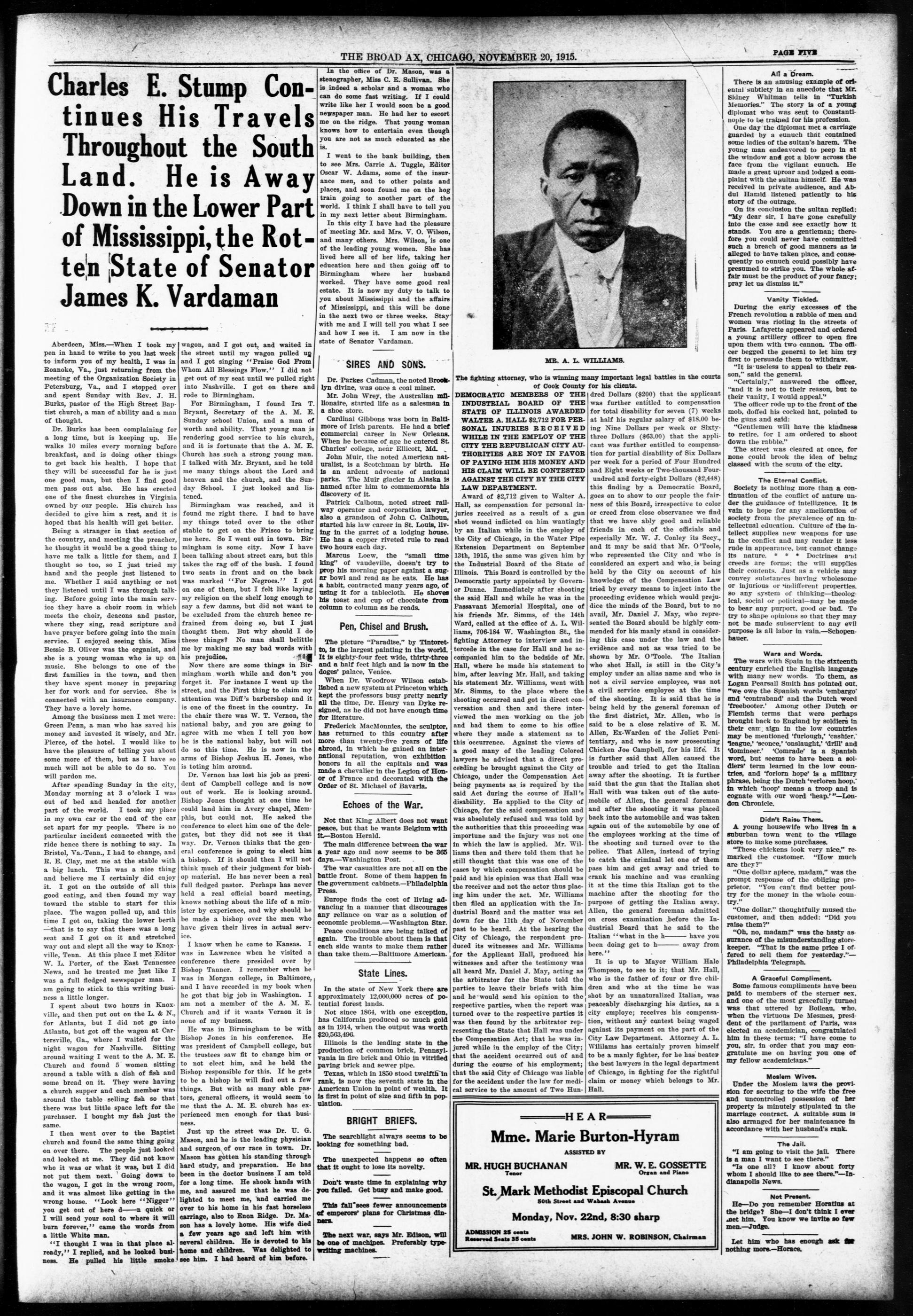
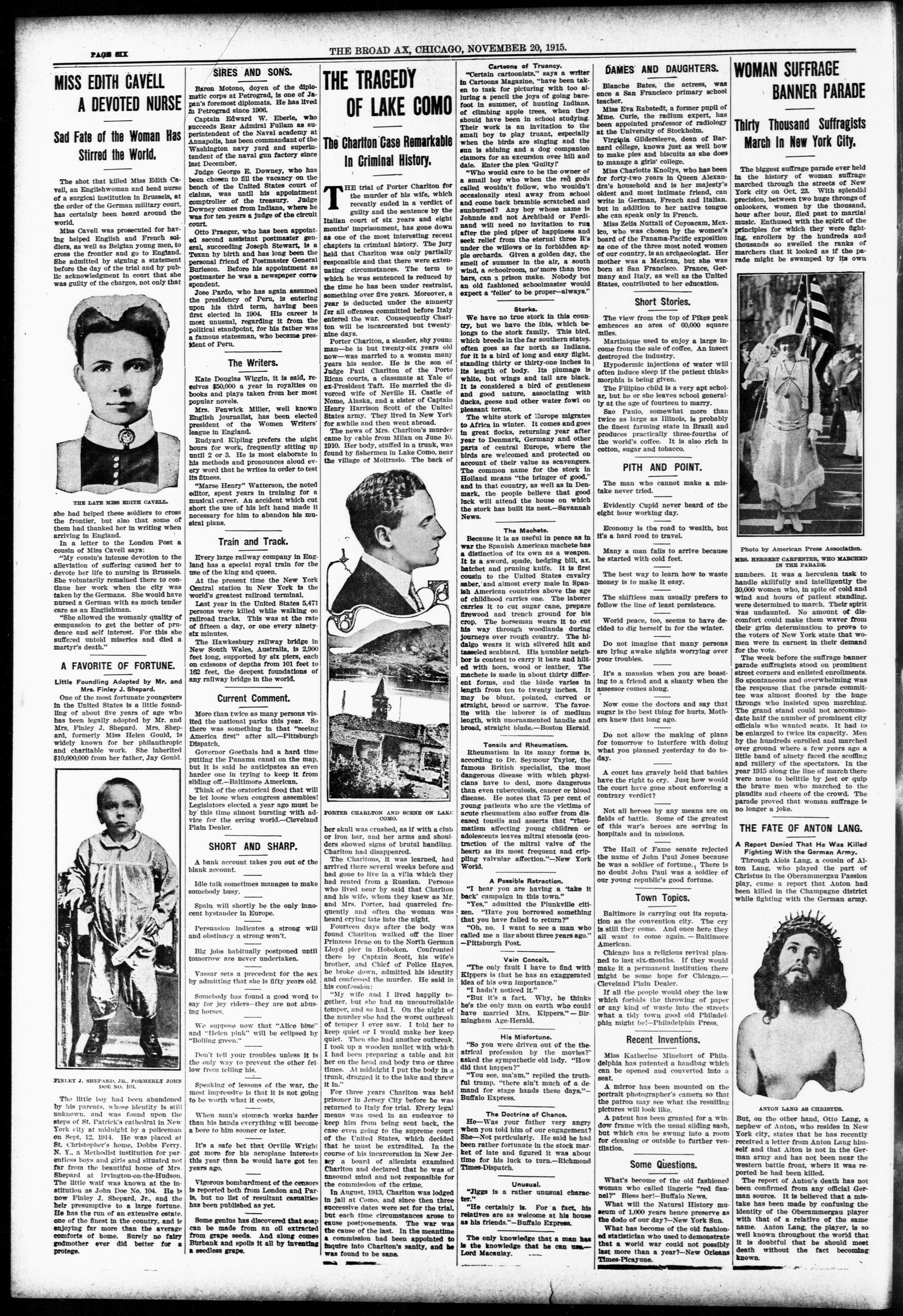
Page text (machine-generated)
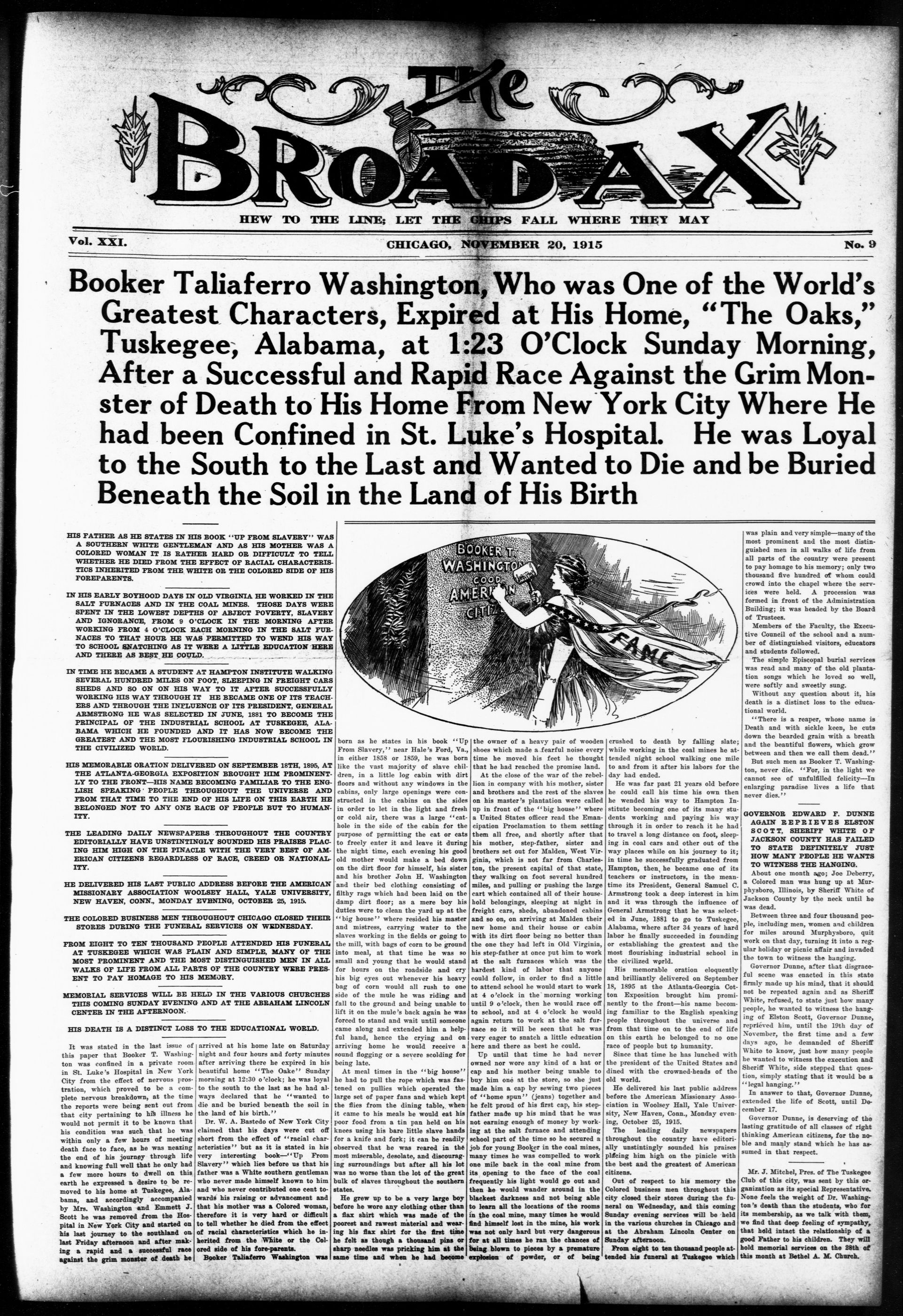
Booker Taliaferro Washington, Who was One of the World's Greatest Characters, Expired at His Home, "The Oaks," Tuskegee, Alabama, at 1:23 O'Clock Sunday Morning, After a Successful and Rapid Race Against the Grim Monster of Death to His Home From New York City Where He had been Confined in St. Luke's Hospital. He was Loyal to the South to the Last and Wanted to Die and be Buried Beneath the Soil in the Land of His Birth
HIS FATHER AS HE STATES IN HIS BOOK "UP FROM SLAVERY" WAS A SOUTHERN WHITE GENTLEMAN AND AS HIS MOTHER WAS A COLORED WOMAN IT IS RATHER HARD OR DIFFICULT TO TELL WHETHER HE DIED FROM THE EFFECT OF RACIAL CHARACTERISTICS INHERITED FROM THE WHITE OR THE COLORED SIDE OF HIS FOREPARENTS.
IN HIS EARLY BOYHOOD DAYS IN OLD VIRGINIA HE WORKED IN THE SALT FURNACES AND IN THE COAL MINES. THOSE DAYS WERE SPENT IN THE LOWEST DEPTHS OF ABJECT POVERTY, SLAVERY AND IGNORANCE, FROM 9 O'CLOCK IN THE MORNING AFTER WORKING FROM 4 O'CLOCK EACH MORNING IN THE SALT FURNACES TO THAT HOUR HE WAS PERMITTED TO WEND HIS WAY TO SCHOOL SNATCHING AS IT WERE A LITTLE EDUCATION HERE AND THERE AS BEST HE COULD.
IN TIME HE BECAME A STUDENT AT HAMPTON INSTITUTE WALKING SEVERAL HUNDRED MILES ON FOOT, SLEEPING IN FREIGHT CARS SHEEDS AND SO ON ON HIS WAY TO IT AFTER SUCCESSFULLY WORKING HIS WAY THROUGH IT HE BECAME ONE OF ITS TEACHERS AND THROUGH THE INFLUENCE OF ITS PRESIDENT, GENERAL ARMSTRONG HE WAS SELECTED IN JUNE, 1881 TO BECOME THE PRINCIPAL OF THE INDUSTRIAL SCHOOL AT TUSKEGEE, ALABAMA WHICH HE FOUNDED AND IT HAS NOW BECOME THE GREATEST AND THE MOST FLOURISHING INDUSTRIAL SCHOOL IN THE CIVILIZED WORLD.
HIS MEMORABLE ORATION DELIVERED ON SEPTEMBER 18TH, 1895, AT THE ATLANTA-GEORGIA EXPOSITION BROUGHT HIM PROMINENTLY TO THE FRONT—HIS NAME BECOMING FAMILIAR TO THE ENGLISH SPEAKING PEOPLE THROUGHOUT THE UNIVERSE AND FROM THAT TIME TO THE END OF HIS LIFE ON THIS EARTH HE BELONGED NOT TO ANY ONE RACE OF PEOPLE BUT TO HUMANITY.
THE LEADING DAILY NEWSPAPERS THROUGHOUT THE COUNTRY EDITORIALLY HAVE UNSTINTINGLY SOUNDED HIS PRAISES PLACING HIM HIGH ON THE PINACLE WITH THE VERY BEST OF AMERICAN CITIZENS REGARDLESS OF RACE, CREED OR NATIONALITY.
HE DELIVERED HIS LAST PUBLIC ADDRESS BEFORE THE AMERICAN MISSIONARY ASSOCIATION WOOLSEY HALL, YALE UNIVERSITY, NEW HAVEN, CONN., MONDAY EVENING, OCTOBER 25, 1915.
THE COLORED BUSINESS MEN THROUGHOUT CHICAGO CLOSED THEIR STORES DURING THE FUNERAL SERVICES ON WEDNESDAY.
FROM EIGHT TO TEN THOUSAND PEOPLE ATTENDED HIS FUNERAL AT TUSKEGEE WHICH WAS PLAIN AND SIMPLE, MANY OF THE MOST PROMINENT AND THE MOST DISTINGUISHED MEN IN ALL WALKS OF LIFE FROM ALL PARTS OF THE COUNTRY WERE PRESENT TO PAY HOMAGE TO HIS MEMORY.
MEMORIAL SERVICES WILL BE HELD IN THE VARIOUS CHURCHES THIS COMING SUNDAY EVENING AND AT THE ABRAHAM LINCOLN CENTER IN THE AFTERNOON.
HIS DEATH IS A DISTINCT LOSS TO THE EDUCATIONAL WORLD.
Vol. XXI.
Booker The Greater Tuskegee After aster of had been to the Beneath
HIS FATHER AS HE STATES IN HA SOUTHERN WHITE GENTLE COLORED WOMAN IT IS RATHER WHETHER HE DIED FROM THE TICS INHERITED FROM THE WOREFAREPARENTS.
IN HIS EARLY BOYHOOD DAYS IN SALT FURNACES AND IN THE SPENT IN THE LOWEST DEPT AND IGNORANCE, FROM 9 O'WORKING FROM 4 O'CLOCK IN NACES TO THAT HOUR HE WOULD TO SCHOOL SNATCHING AS IT AND THERE AS BEST HE COULD.
IN TIME HE BECAME A STUDENT SEVERAL HUNDRED MILES ON SHEDS AND SO ON HIS WORKING HIS WAY THROUGH ERS AND THROUGH THE INFLUENCE ARMSTRONG HE WAS SELECT PRINCIPAL OF THE INDUSTRY BAMA WHICH HE FOUNDED GREATEST AND THE MOST FLAT THE CIVILIZED WORLD.
HIS MEMORABLE ORATION DELIVER THE ATLANTA-GEORGIA EXPORT TO THE FRONT—HIS NAME LISH SPEAKING PEOPLE THROUGH FROM THAT TIME TO THE ENBELONGED NOT TO ANY ONE ITY.
THE LEADING DAILY NEWSPAPER EDITORIALLY HAVE UNSTINTING HIM HIGH ON THE PINACERICAN CITIZENS REGARDLES ITY.
HE DELIVERED HIS LAST PUBLIC MISSIONARY ASSOCIATION WNEW HAVEN, CONN., MONDAY.
THE COLORED BUSINESS MEN THE STORES DURING THE FUNERAL.
FROM EIGHT TO TEN THOUSAND AT TUSKEGEE WHICH WAS MOST PROMINENT AND THE MWALKS OF LIFE FROM ALL PAYMENT TO PAY HOMAGE TO HIS MEMORIAL SERVICES WILL BE IN THIS COMING SUNDAY EVENING CENTER IN THE AFTERNOON.
HIS DEATH IS A DISTINCT LOSS.
It was stated in the last issue of this paper that Booker T. Washington was confined in a private room in St. Luke's Hospital in New York City from the effect of nervous prostration, which proved to be a complete nervous breakdown, at the time the reports were being sent out from that city pertaining to his illness he would not permit it to be known that his condition was such that he was within only a few hours of meeting death face to face, as he was nearing the end of his journey through life and knowing full well that he only had a few more hours to dwell on this earth he expressed a desire to be removed to his home at Tuskegee, Alabama, and accordingly accompanied by Mrs. Washington and Emmett J. Scott he was removed from the Hospital in New York City and started on his last journey to the southland on last Friday afternoon and after making a rapid and a successful race against the grim monster of death he
arrived at his home late on Saturday night and four hours and forty minutes after arriving there he expired in his beautiful home "The Oake" Sunday morning at 12:30 o'clock; he was loyal to the south to the last as he had always declared that he "wanted to die and be buried beneath the soil in the land of his birth." Dr. W. A. Bastedo of New York City claimed that his days were cut off short from the effect of "racial characteristics" but as it is stated in his very interesting book—"Up From Slavery" which lies before us that his father was a White southern gentleman who never made himself known to him and who never contributed one cent towards his raising or advancement and that his mother was a Colored woman, therefore it is very hard or difficult to tell whether he died from the effect of racial characteristics which he inherited from the White or the Colored side of his fore-parents.
CHICAGO, NOVEMBER 20, 1915
BOOKER T.
WASHINGTON
GOOD
AMERICAN
CITI
FAME
born as he states in his book "Up From Slavery," near Hale's Ford, Va. in either 1858 or 1859, he was born like the vast majority of slave children, in a little log cabin with dirt floors and without any windows in the cabins, only large openings were constructed in the cabins on the sides in order to let in the light and fresh or cold air, there was a large "cathole in the side of the cabin for the purpose of permitting the cat or cats to freely enter it and leave it during the night time, each evening his good old mother would make a bed down on the dirt floor for himself, his sister and his brother John H. Washington and their bed clothing consisting of filthy rags which had been laid on the damp dirt floor; as a mere boy his duties were to clean the yard up at the "big house" where resided his master and mistress, carrying water to the slaves working in the fields or going to the mill, with bags of corn to be ground into meal, at that time he was so small and young that he would stand for hours on the roadside and cry his big eyes out whenever his heavy bag of corn would all rush to one side of the mule he was riding and fall to the ground and being unable to lift it on the mule's back again he was forced to stand and wait until someone came along and extended him a helpful hand, hence the crying and on arriving home he would receive a sound flogging or a severe scolding for being late.
At meal times in the "big house" he had to pull the rope which was fastened on pullies which operated the large set of paper fans and which kept the flies from the dining table, when it came to his meals he would eat his poor food from a tin pan held on his knees using his bare little slave hands for a knife and fork; it can be readily observed that he was reared in the most miserable, desolate, and discouraging surroundings but after all his lot was no worse than the lot of the great bulk of slaves throughout the southern states.
He grew up to be a very large boy before he wore any clothing other than a flax shirt which was made of the poorest and rarest material and wearing his flax shirt for the first time he felt as though a thousand pins or sharp needles was pricking him at the same time and when he had become
the owner of a heavy pair of wooden shoes which made a fearful noise every time he moved his feet he thought that he had reached the promise land.
At the close of the war of the rebellion in company with his mother, sister and brothers and the rest of the slaves on his master's plantation were called up in front of the "big house" where a United States officer read the Emancipation Proclamation to them setting them all free, and shortly after that his mother, step-father, sister and brothers set out for Malden, West Virginia, which is not far from Charleston, the present capital of that state, they walking on foot several hundred miles, and pulling or pushing the large cart which contained all of their household belongings, sleeping at night in freight cars, sheds, abandoned cabins and so on, on arriving at Malden their new home and their house or cabin with its dirt floor being no better than the one they had left in Old Virginia, his step-father at once put him to work at the salt furnaces which was the hardest kind of labor that anyone could follow, in order to find a little to attend school he would start to work at 4 o'clock in the morning working until 9 o'clock, then he would race off to school, and at 4 o'clock he would again return to work at the salt furnace so it will be seen that he was very eager to snatch a little education here and there as best he could.
Up until that time he had never owned nor wore any kind of a hat or cap and his mother being unable to buy him one at the store, so she just made him a cap by sewing two pieces of "home spun" (jeans) together and he felt proud of his first cap, his stepfather made up his mind that he was not earning enough of money by working at the salt furnace and attending school part of the time so he secured a job for young Booker in the coal mines, many times he was compelled to work one mile back in the coal mine from its opening to the face of the coal frequently his light would go out and then he would wander around in the blackest darkness and not being able to learn all the locations of the rooms in the coal mine, many times he would find himself lost in the mine, his work was not only hard but very dangerous for at all times he ran the chances of being blown to pieces by a premature explosion of powder, or of being
crushed to death by falling slate; while working in the coal mines he attended night school walking one mile to and from it after his labors for the day had ended.
He was far past 21 years old before he could call his time his own then he wended his way to Hampton Institute becoming one of its many students working and paying his way through it in order to reach it he had to travel a long distance on foot, sleeping in coal cars and other out of the way places while on his journey to it; in time he successfully graduated from Hampton, then he became one of its teachers or instructors, in the meantime its President, General Samuel C. Armstrong took a deep interest in him and it was through the influence of General Armstrong that he was selected in June, 1881 to go to Tuskegee, Alabama, where after 34 years of hard labor he finally succeeded in founding or establishing the greatest and the most flourishing industrial school in the civilized world.
His memorable oration eloquently and brilliantly delivered on September 18, 1895 at the Atlanta-Georgia Cotton Exposition brought him prominently to the front—his name becoming familiar to the English speaking people throughout the universe and from that time on to the end of life on this earth he belonged to no one race of people but to humanity.
Since that time he has lunched with the president of the United States and dined with the crowned-heads of the old world.
He delivered his last public address before the American Missionary Association in Woolsey Hall, Yale University, New Haven, Conn., Monday evening, October 25, 1915.
The leading daily newspapers throughout the country have editorially unstintingly sounded his praises placing him high on the piniece with the best and the greatest of American citizens.
Out of respect to his memory the Colored business men throughout this city closed their stores during the funeral on Wednesday, and this coming Sunday evening services will be held in the various churches in Chicago and at the Abraham Lincoln Center on Sunday afternoon.
From eight to ten thousand people attended his funeral at Tuskegee which
No. 9
was plain and very simple—many of the most prominent and the most distinguished men in all walks of life from all parts of the country were present to pay homage to his memory; only two thousand five hundred of whom could crowd into the chapel where the services were held. A procession was formed in front of the Administration Building; it was headed by the Board of Trustees.
Members of the Faculty, the Executive Council of the school and a number of distinguished visitors, educators and students followed.
The simple Episcopal burial services was read and many of the old plantation songs which he loved so well, were softly and sweetly sung.
Without any question about it, his death is a distinct loss to the educational world.
“There is a reaper, whose name is Death and with sickle keen, he cuts down the bearded grain with a breath and the beautiful flowers, which grow between and then we call them dead.” But such men as Booker T. Washington, never die. “For, in the light we cannot see of unfulfilled felicity—In enlarging paradise lives a life that never dies.”
GOVERNOR EDWARD F. DUNNE AGAIN REPRIEVES ELSTON SCOTT, SHERIFF WHITE OF JACKSON COUNTY HAS FAILED TO STATE DEFINITELY JUST HOW MANY PEOPLE HE WANTS TO WITNESS THE HANGING.
About one month ago; Joe Deberry, a Colored man was hung up at Murphysboro, Illinois, by Sheriff White of Jackson County by the neck until he was dead.
Between three and four thousand people, including men, women and children for miles around Murphysboro, quit work on that day, turning it into a regular holiday or picnic affair and invaded the town to witness the hanging.
Governor Dunne, after that disgraceful scene was enacted in this state firmly made up his mind, that it should not be repeated again and as Sheriff White, refused, to state just how many people, he wanted to witness the hanging of Elston Scott, Governor Dunne, reprieved him, until the 19th day of November, the first time and a few days ago, he demanded of Sheriff White to know, just how many people he wanted to witness the execution and Sheriff White, side stepped that question, simply stating that it would be a "legal hanging."
In answer to that, Governor Dunne, extended the life of Scott, until December 17.
Governor Dunne, is deserving of the lasting gratitude of all classes of right thinking American citizens, for the noble and manly stand which he has assumed in that respect.
Mr. J. Mitchel, Pres. of The Tuskegee Club of this city, was sent by this organization as its special Representative. None feels the weight of Dr. Washington's death than the students, who for its membership, as we talk with them, we find that deep feeling of sympathy, that hold intact the relationship of a good Father to his children. They will hold memorial services on the 28th of this month at Bethel A. M. Church.
PAGE TWO
oO
~~ England's Gredt Seal.
‘The great seal of England is, say*
the London Chronicle, a more elabo-
rate article than most people imagine.
It costs about $3,500 to make it, and it
consists of two heavy silver plates, in
one of which is cut the die for the
front of the seal and in the other that
for the back. When the seal is to be
affixed to a document a lump of wax
fs softened in hot water and cooled in
cold water, after which it is placed be-
tween the two plates and pressed. It
comes out in the shape of a disk, with
‘an impression on each side.
Formerly there was an official attach
ed to the seal who was quite as proud
of his office as the lord chancellor was
of his. ‘That was “Chaffwax,” whose
sole business was to melt the wax and
to take the impressions of the great
seal as often as required. ‘The writer
remembers the last of the “Chaffwar-
es,” a rosy cheeked old gentleman who
lived long to enjoy the pension that 2
grateful country granted him for his
important services. ‘Those services are
now performed by an unnamed subor
dinate in the chancellor's office.
Italy’s Ancestral Glories.
‘Three times has Italy ruled over Eu
rope. She has sat on the political
throne under the Caesars, on the ec
clesiastical throne under the popes
from Gregory the Great to Leo X. and
on the intellectual throne of the renais.
sance. These things every Italian fam.
fly remembers. Augustus Caesar and
‘Trajan, Hildebrand and Innocent III.
Dante and Petrarch, Michelangelo and
Raphael, Galilel and Bruno are in his
mouth like household words. ‘The Ital
fan does not consider himself and us as
equals; he accepts, he believes in, mod.
ern democracy, but deep in his heart
he is an aristocrat, haughtily proud of
his long descent and his ancestral glo
ries When thinking of Italians one
must always bear in mind that they,
out of all the peoples of Europe, have
the most glorious past and that they
are conscious of it to the quick.—Henry
Dwight Sedgwick in Yale Review.
tte ae
Jules Sandeau related that one time
while living in Paris Balzae locked
himself up in his room for twenty-two
days and twenty-two nights, refusing
to see any one and keeping the cur-
tains closed and the lights continually
burning even in broad daylight. The
only lnman being he saw during this
time was his servant, whom he rang
for when he felt the need of food.
which he wished down with numerous
cups of colfee. He would throw him-
self on his bed only when entirely ex-
hausted from lack of sleep, and he re-
mained in complete ignorance of what
was transpiring outside, the state of
the weather and even of the time and
day of the week. He only freed him-
self from this voluntary captivity
when he had written the word “End”
on the lust page of the manuseript he
bezin when he entered his prison.
After Death.
It ts irrational to think death ends
all, for then fife 18 gone and annihi-
lated. and it is just as though it had
never been life ean in nowlse be
destroyed by death. What has once
been experienced is an eternal and in-
dclible constituent of reality never
more to be erased or altered. It is a
foolish doubt which Karl Moor ex-
presses with the pistol in bis hand, “If
the paltry pressure of this paltry thing
takes the wise man and the fool, the
coward and the hevo, the noble and the
villain, equal”— ‘That eannot be. Death
severs the thread of the earthly life,
but the content of life can neither be
altered nor annihilated by it. Reality
fs eternal in its essence. Nothing that
ts real can, to quote Angelus Silesius,
ever perish and cease to be.—Professor
Friedrich Maulsen, University of Ber
fin, in “A System of Ethics.”
Boiled Nettles.
‘The countryman knows more about
economy than the townsman when it
comes to a matter of vegetables. A
correspondent reports a conversation
overheard ina village inn in Hertford-
shire in this present year of grace.
Vexetables were under discussion, and
spinach was mentioned. “Not bad,”
one gourmet admitted, “but give me
nettles,” and inquiry has shown that
the two are not dissimilar in taste.
Another forgotten “vegetable” 1s the
Primrose. I’rimrose pasties were once
@ popular dish in Laneashire.—London
Standard.
Same, but Different.
Visitor — Are old Stecbauer and
Schattliebner still carrying on that
everlasting lawsuit of theirs about the
Voundary? Native—Not those two any
longer, but their lawyers are. Visitor—
How's that? Native—Ob, the farm be
longs to them now.—Meggendorfer
Blaetter.
The True Enthusiast.
“Does your motorear give you much
trouble?”
“Trouble!” exclaimed Mr. Chuggins
enthusiastically. “I should say it did!
‘Why. repairing that car when it gets
out of order is about the only real fun
I get out of life."—Washington Star.
S:paitente Grant Bice,
The great fire of London in 1668
started in a house on Pudding lane and
ended at Piecrust alley. Thirteen thou-
sand two hundred houses were burned,
Including eizbty-nine churches.
Highly Rated.
‘She—She died worth $25,000 and left
‘ber husband $5. He—Well, some hus-
bands are “one man in a thousand”—
hers was one in five thousand.—Judge.
A Good Break.
‘The Shopper (in china shop to sales-
man)—You don't break these seta, 1
presume. ‘The Salesman—No'm, bat
our errand boy does sometimes,
gooddsooocccccesso0000000
8 A SMART TOPCOAT. :
Gane nnn nnen
8 Of White Chinchilla, Set Of |
° With Huge Pearl Buttons. :
$c00cce000c00000000000000'
CD bd
Oe.
(2 ae
ee a
Me
| Ce
Ww. 4
a Se
7 yo. e
ee ... fF
yay AY v
[| PAL Oe
Pho + os
ab — S
ce . -:
oe 4
Ef : a
re) : be
& 4 3
=
‘
te >
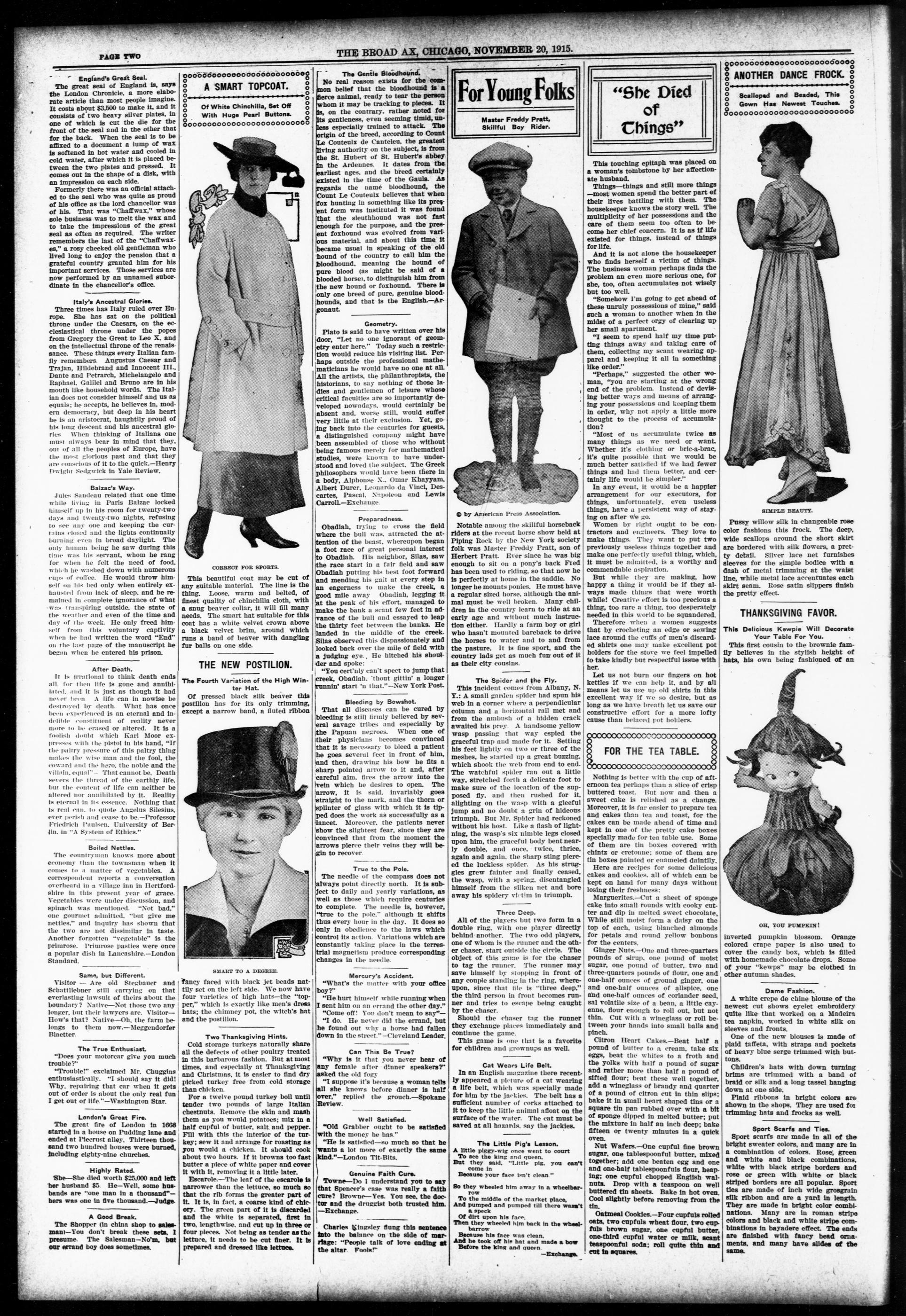
CORRECT FOR SPORTS.
‘This beautiful coat may be cut of
any suitable material. ‘The line is the
thing. Loose, warm and belted, of
finest quality of chinchilla cloth, with
a snug beaver collar, it will fill many
needs. The smart hat suitable for this
coat has a white velvet crown above
a black velvet brim, around which
runs a band of beaver with dangling
fur balls on one side.
THE NEW POSTILION.
‘The Fourth Variation of the High Win-
ter Hat.
Of pressed black silk beaver this
postilion has for its only trimming,
except a narrow band, a fluted ribbon
“yf
oo
s a
ae nceneser sone
= OEM
: \ ‘4... SS
_ al /
< Bee
tg ie
Fancy faced with black jet beads nat-
tily set on the left side. “We now have
four varieties of high hats—the “top-
per,” which is exactly like men’s dress
hats; the chimney pot, the witch's hat
and the postilion.
‘Two Thanksgiving Hints.
Cold storage turkeys naturally share
all the defects of other poultry treated
in this barbarous fashion. But at most
times, and especially at Thanksgiving
and Christmas, it 1s easter to find dry
picked turkey free from cold storage
than chicken.
For a twelve pound turkey boll until
tender two pounds of large Italian
chestnuts. Remove the skin and mash
them as you would potatoes; mix in a
half cupful of butter, salt. and pepper.
Fill with this the interior of the tur.
key; sew it and arrange for roasting as
you would a chicken. It should cook
about two hours. If it browns too fast
butter a plece of white paper and cover
‘it with it, removing it a little later.
Escarole.—The leaf of the escarole
narrower than the lettuce, so much 80
that the rib forms the greater part of
ft. It ts, in fact, a coarse kind of chic.
ory. The green part of it is discarded
and the white is separated, first fr
two, lengthwise, and cut up in three o1
four pieces. Not being as tender as the
lettuce, ft needs to be cut finer. It ls
prepared and dressed like lettuce.
THE BROAD CHICAGO, NOVEMBER 20, 191:
OO ee
ee
No real reason exists for the ‘com
non belief that the bloodhound is s
erce animal, ready to tear the person
hom it may be tracking to pieces. It
‘on the contrary. rather noted for
lits gentleness, even seeming timid, un-
hess especially trained to attack. The
origin of the breed, according to Count
e Couteulx de Canteleu, the greatest
fliving authority on the subject, is from
Ithe St. Hubert of St. Hubert’s abbey
lin the Ardennes. It dates from the
earliest ages, and the breed certainly
existed in the time of the Gauls. As
regards the namé bloodhound, the
Count Le Couteulx believes that when
lfox hunting in something like its pres-
ent form was instituted it was found
bat the sleuthhound was not fast
enough for the purpose, and the pres-
nt foxhound was evolved from vart
ous material. and about this time it
became usual in speaking of the old
hound of the country to call him the
loodhound, meaning the hound of
‘pure blood (as might be said of a
blooded horse), to distinguish him from
jthe new hound or foxhound. There is
jonly one breed of pure, genuine blood-
jhounds, and that is the English—Ar
jgonaut.
@inanere:
| Plato is said to have written over his
(door, “Let no one ignorant of geom
‘enter here.” ‘Today such a restric
Kfoa wou reduce his visiting list. Per-
‘haps outside the professional mathe-
Imaticians he would have no one at all
|All the artists, the philanthropists, the
historians, to say nothing of those la
dies and gentlemen of leisure whose
critical facuities ure so importantly de-
‘veloped nowadays, would certainly be
jabeent and. worse still, would suffer
‘very little at their exclusion. Yet, go-
jing back into the centuries for guests,
fa distinguished company might have
‘been assembled of those who without
being famous merely for mathematical
studies, were known to bave under-
‘stood and loved te subject. The Greek
philosophers would bave been there in
a body, Alphonse X.. Omar Khayyam,
‘Albert Durer. Leonardo da Vinel, Des:
cartes, Pascal, Nnpoleon and Lewis
Carroll.—Exchanse.
| Preparedness.
| Obadiah, tryinz to cross the field
jwhere the bull was. attracted the at-
tion of the beast, whereupon began
foot race of xreat personal interest
Obadiah. His neighbor, Silas, saw
race start in a fair field and saw
badiah putting his best foot forward
mending his gait at every step in
eagerness to make the creek, a
mile away Obadiah, legging it
it the peak of his effort, managed to
vane the bank a scant few feet in ad-
rance of the bull and essayed to leap
ithe thirty feet between the banks. He
Janded in the middle of the creek.
Silas observed thix dispassionately and
looked back over the mile of field with
a judging eye., He hitched his shout-
der and spoke:
| “You cert'nly can't spect to jump that
eset, Obadiah. ‘chout gittin’ a longer
y’ start "n that.”—New York Post.
pa ee oe
‘That all diseases can be cured by
(bleeding is still firmly believed by sev-
savage tribes and especially by
ithe Papuan nezroes. When one of
itheir physicians becomes convinced
‘that it is necessary to bleed a patient
the goes several feet in front of him,
land then, drawinz bis bow he fits a
sharp pointed arrow to it and, after
careful aim, fires the arrow into the
lvein which be desires to open. The
jarrow, it is said. invariably goes
‘straight to the mark, and the thorn or
plinter of glass with which it is tip-
‘ped does the work as successfully as a
lancet. Moreover. the patients never
‘show the slizhtest fear, since they are
—— that from the moment the
larrows pierce their veins they will be-
to recover
True to the Pole.
The needle of the compass does not
ays point directly north. It is sab-
ject to daily and yearly variations, as
iwell as those which require centuries
complete. The needle is, however,
“true to the pole.” although it shifts
thus every hour In the day. It does so
I¥ in obedience to the laws which
trol its action. Variations which are
tantly taking place in the terres
magnetism produce corresponding
hanges in the neeile
Blercurv’s Ancident.
“What's the matter with your office
Iboy?*
“He hurt himself while running when
I sent him on an errand the other day.”
“Come off! You don't mean to say”—
“Ido. He never did the errand, but
Ihe found out why a horse had fallen
in the street.”—Cleveland Leader,
Can This Be True?
“Why 1s it that you never hear of
female after dinner speakers?”
iked the old fozy
“I suppose it's because a woman tells
she knows before dinner is half
"replied the grouch.—Spokane
'Review.
‘Well Satisfied.
“Old Grabber ought to be satisfied
lwith the mones he has.”
“He is satixtied—so much so that he
wants a lot more of exactly the same
jkind."—London Tit-Bits.
Genuine Faith Cure.
‘Towne—Do | understand you to say
that Spencer's case was really a faith
jcure? Browne—Yes. You see, the doc-
‘tor and the drogxist both trusted him.
ve
Charles ingsley flung this sentence
tuto the balance on the side of mar
riage: “People talk of love ending at
the altar Fools!
pao Folks
er.
Co
af
| =
ee ees ‘ 7 Le
Gaye
© by American Press Association.
Notable awong the skillful horseback
riders at the recent horse show held at
Piping Rock by the New York society
folk was Master Freddy Pratt, son of
Herbert Pratt. Ever since he was big
enough to sit on a pony’s back Fred
has been used to riding, so that now he
is perfectly at home in the saddle. No
longer he mounts ponies. He must have
‘a regular sized horse. although the ani-
mal must be well broken. Many chil-
dren in the country learn to ride at an
early age and without much instruc-
tion either. Hardly a farm boy or girl
who hasn't mounted bareback to drive
the horses to water and to and from
the pasture, It is fine sport, and the
country lads get as much fum out of it
as their elty cousins.
‘The Svider and the Fly.
‘This incident comes from Albany, N.
¥.: A small garden spider had spun his
web in a corner where a perpendicular
column and a horizontal rail met and
from the ambush of a hidden crack
awaited his prey. A handsome yellow
wasp passing that way espied the
graceful trap and made for it. Setting
his feet lightly on two or three of the
meshes, he started up a great buzzing,
which shook the web from end to end.
The watchful spider ran out a little
way, stretched forth a delicate foot to
make sure of the location of the sup-
posed fiy. and then rushed for it,
alighting on the wasp with a gleeful
Jump and no doubt a grin of hideous
triumph. But Mr. Spider had reckoned
without his host. Like a flash of light-
ning, the wasps six nimble legs closed
‘upon him, the graceful body bent near-
ly double, and once, twice, thrice,
again and again. the sharp sting piere
ed the luckless spider. As his strug-
gles grew fainter and finally ceased,
the wasp, with a sprinz, disentangled
himseif from the silken net and bore
away his spiders victim in triumph.
Tisee Maen:
All of the players but two form in a
double ring, with one player directly
behind another. The two odd players,
one of whom is the runner and the oth-
er chaser, start outside the circle. ‘The
object of this cume is for the chaser
to tag the runner. The runner may
save himself by stopping in front of
any couple standing in the ring, where-
upon, since that tile is “three deep,”
the third person in front becomes run-
ner and tries to escape being caught
by the chaser.
Should the chaser tag the runner
they exchange places immediately and
continue the game.
This game is one that is a favorite
for children and <rownups as well.
Cat Wears Life Belt.
In an English mazazine there recent-
ly appeared a picture of a cat wearing
& life beit, which was specially made
for him by the jackies. The belt has a
sufficient number of corks attached to
tt to keep the little animal afloat on the
surface of the water. The cat must be
saved at all hazanis, say the jackies.
The Little Pig’s Lesson.
A Mttle piggy-wig once went to court
‘To see the king and queen,
But they said, “Little pig. you can't
come in
Because your face isn't clean"
Bo they wheeled him away in a wheelbar
row
‘To the middle of the market place,
And pumped and pumped till there wasm'
& speck
Of dirt upon his face.
‘Then they wheeled him back in the wheel
barrow
_aDgomute his tace was clean,
he took off his hat and made a bow
Before the king and queen
a —Eusheom,
“She Died
of
Things”
‘This touching epitaph was placed on
@ woman's tombstone by her affection-
ate husband.
‘Things—things and still more things
—most women spend the better part of
their lives battling with them. The
housekeeper knows the story well. The
multiplicity of her possessions and the
care of them seem too often to be
come her chief concern. It is as if life
existed for things. instead of things
for life.
‘And it is not alone the housekeeper
who finds herself a victim of things.
‘The business woman perhaps finds the
problem an even more serious one, for
she, too, often accumulates not wisely
but too well.
“Somehow I'm going to get ahead of
these unruly possessions of mine,” said
such a woman to another when in the
midst of a perfect orgy of clearing up
her small apartment.
“I seem to spend half my time put-
ting things away and taking care of
them, collecting my scant wearing ap-
parel and keeping it all in something
like order.”
“Perhaps,” suggested the other wo-
man, “you are starting at the wrong
end of the problem. Instead of devis-
ing better ways and means of arrang-
ing your possessions and keeping them
in order, why not apply a little more
thought to the process of accumula-
tion?
“Most of us accumulate twice as
many things as we need or want
Whether it’s clothing or bric-a-brac,
it’s quite possible that we would be
much better satisfied if we had fewer
things and had them better, and cer-
tainly life would be simpler.”
In any event, it would be a happier
arrangement for our executors, for
things, unfortunately, even useless
things, have a persistent way of stay-
ing on after we xo.
Women by rizht ought to be con-
tractors and enzineers. They love to
make things. They want to put two
previously useless things together and
make one perfectly useful thing, which,
it must be admitted, is a worthy and
commendable aspiration.
But while they are making, how
happy a thing it would be if they al-
ways made things that were worth
while! Creative effort is too precious a
thing, too rare a thing, too desperately
needed in this world to be squandered.
Therefore when a women suggests
that by crocheting an edge or sewing
Jace around the cuffs of men's discard-
ed shirts one may make excellent pot
holders for the stove we feel impelled
to take kindly but respectful issue with
her.
Let us not burn our fingers on hot
kettles if we can help it, and by all
‘Means let us use up old shirts in this
excellent way if we so desire, but as
long as we have breath let us save our
constructive effort for a more lofty
cause than belaced pot holders.
FOR THE TEA TABLE.
Nothing is better with the cup of aft-
ernoon tea perhaps than a slice of crisp
buttered toast. But now and then a
sweet cake is relished as a change.
Moreover, it is far easier to prepare tea
and cakes than tea and toast, for the
cakes can be made ahead of time and
kept in one of the pretty cake boxes
specially made for tea table use. Some
of them are tin boxes covered with
ehintz or cretonne; some of them are
tin boxes painted or enameled daintily.
Here are recipes for some delicious
cakes and cookies. all of which can be
kept on hand for many days without
losing their fresiness:
Marguerites—Cut a sheet of sponge
cake into small rounds with cooky cut
ter and dip in melted sweet chocolate,
While still moist form a daisy on the
top of each, using blanched almonds
for petals and round yellow bonbons
for the centers.
Ginger Nuts.—One and three-quarters
Pounds of sirup. one pound of moist
sugar, one pound of butter, two and
three-quarters pounds of flour, one and
one-half ounces of ground ginger, one
and one-half ounces of allspice, one
and one-half ounces of coriander seed,
sal volatile size of a bean, a little cay.
enne, flour enough to roll out, but not
thin. Cut with a wineglass or roll be.
tween your hands into small balls and
pinch.
Citron Heart Cakes.—Beat half s
Pound of butter to a cream, take sls
eggs, beat the whites to a froth and
the yolks with half a pound of suga
and rather more than half a pound o
sifted flour; beat these well together
add a wineglass of brandy and quartet
of @ pound of citron cut in thin slips
bake it in small heart shaped tins or :
square tin pan rubbed over with a bi
of sponge dipped in melted butter; pu
the mixture in half an inch deep; bak:
fifteen or twenty minutes in a quiet
oven.
Nut Wafers.—One cupful fine brow:
sugar, one tablespoonful butter, mixe
together; add one beaten egg and on
and one-half tablespoonfuls flour, heap
ing; one cupful chopped English wal
nuts. Drop with a teaspoon on wel
buttered tin sheets. Bake in hot oven
Geol slightly before removing from th
‘Oatmeal Cookles.—Four cupfuls rolle
oats, two cupfuls wheat flour, two cup
fuls brown sugar, one cupful butter
one-third cupfal water or milk, sean
teaspoonful soda; roll quite thin an
! eut in squares.
eae SO Ss
Sewennee ree nennemeeneeenes
8 Scallopad and Beaded, This §
© Gown Has Newest Touches. ¢
So00ccccccccccca0c00000008
: <i
[2 Be Ag
fe Ase |
ee oT oa
7 — Se
ee st
oo a
si sy
; oo
a
SIMPLE BEAUTY.
Pussy willow silk in changeable rose
color fashions this frock. The deep,
wide scallops around the short skirt
are bordered with silk flowers, a pret-
ty detail. Silver lace net furnishes
sleeves for the simple bodice with a
dash of metal trimming at the waist
line, while metal lace accentuates each
skirt seam. ose satin slippers finish
the pretty effect.
THANKSGIVING FAVOR.
This Delicious Kewpie Will Decorate
Your Table For You.
‘This first cousin to the brownie fam-
fly believes in the stylish height of
hats, his own being fashioned of an
Ase eas
ee Raed ,
PR MA Sa
Ga wes ween
inverted pumpkin blossom. Orange
colored crape paper is also used to
cover the candy box, which 1s filled
‘with homemade chocolate drops. Some
of your “kewps” may be clothed in
other autumn shades.
Dame Fashion.
A white crepe de chine blouse of the
newest cut shows eyelet embroidery
quite like that worked on a Madeira
tea napkin, worked in white silk on
sleeves and fronts,
‘One of the new biouses is made of
Plaid taffeta, with straps and pockets
of heavy blue serge trimmed with but-
tons.
Children’s hats with down turning
brims are trimmed with a band of
braid or silk and a long tassel hanging
down at one side.
Plaid ribbons in bright colors are
shown in the shops. They are used for
trimming hats and frocks as well.
Sport Scarfa and Ties.
Sport scarfs are made in all of the
bright sweater colors, and many are in
a combination of colors. Rose, green
and white and black combinations,
white with black stripe borders and
rose or green with white or black
striped borders are all popular. Sport
tles are made of inch wide grosgrain
silk ribbon and are a yard in length.
They are made in bright color combi-
nations. Many are in roman stripe
colors and black and white stripe com-
binations in bayadere effect. The ends
are finished with fancy bead oma-
ments, and many have slides of the
ame.
BRIGHT BRIEFS.
Envy has torpeded many a friendship.
Railroad men certainly have their own trials.
It's getting about time for father to intrench for Christmas.
The worst use that can be made of success is to boast of it.
And when the canal is open again how long will it stay open?
The last straw couldn't break the camel's back without a great deal of assistance.
The first step toward being a politician is learning to call strangers by their first names.
Here and there some little nation on the outer edge of things has not yet entered the big war.
Discovery of a new planet is announced, but it's no recompense for tearing this one to pieces.
If wishing is praying some people are praying nearly all the time and without getting their knees dusty.
Few things are necessary for the wants of this life, but it takes an infinite number to satisfy the demands of opinion.
Yale university is almost a million dollars richer than a year ago, says an exchange, again illustrating the power of knowledge.
At least they were good enough to wait until the American doctors cleaned up the typhus in Servia before they resumed fighting. _____
Spain has submitted a bid for the peace conference, but it may be barred by the statute of limitations before the date for opening the bids arrives.
Echoes of the War.
The sights of many famous European cities are now spelled "sites."—Memphis Commercial Appeal.
The declarations of war since the first one in August, 1914, are now twenty-five.—Boston Herald.
Why not put Europe's trenches to some good use? They would be an excellent place to bury the hatchet.—Chicago News.
"War is a disguised blessing," says a preacher. There may be two opinions about the blessing, but only one on the effectiveness of the disguise.—Wall Street Journal.
Lord Kitchener now says that it is a struggle between Birmingham and the Krupps. The man behind the guns has given way to the man who makes the gun—Detroit Free Press.
Fashion Frills.
Some women wear comfortable clothes, while others dress in style.—Macon News.
Short skirts for general wear are still cutting in upon the business of the burlesque shows.—Chicago News.
But, at that, perhaps with the women going in for trouserettes the men can't be blamed if they turn to near corsets.—Pittsburgh Dispatch.
"Women in America dress better than men." remarks a woman writer. Uh, huh, and at last accounts water was still running downhill.—Philadelphia Inquirer.
"Fashion," says an authority, "is a state of mind." What horrible mental disorders some of those designers of late styles must be suffering from!—Detroit Free Press.
Indian Statistics.
Canada's Indians number about 100,000, or, including Eskimos, 107,221, a decrease of 2,716 compared with 1913. Since 1800 the Indian population of this country has increased materially. There are now 300,000 members of various tribes compared with 254,300 in 1800. They own lands valued roughly at $600,000,000. Over 3,000 students have been fully graduated from government Indian schools and several hundred from mission schools of various denominations. The majority of these are well known and respected citizens in their respective communities.
Flippant Flings.
At any rate, this administration may go down as the weddingest administration in our history.—Chicago News.
If this war keeps on for another year we'll probably find out how far a kilometer is.—New York Evening Sun.
Possibly it would be the correct engineering thing to roof over the Panama canal and make it a subway.—Cleveland Plain Dealer.
A flag for the vice president being demanded, we suggest an emblem with that imperishable device, "Hope springs eternal."—Washington Post.
Pert Personals.
Schwab has bought another steel company. Charley believes in doing his early.—Cleveland Plain Dealer.
Just as though the president did not have troubles enough, his daughter has told the reporters that he has a "really beautiful tenor voice."—Boston Herald.
Rudyard Kipling must be the greatest of modern poets, since he is the only one for whose works a glossary and concordance have been issued.—Chicago News
He Didn't Sprout Horns
The first Japanese to drink milk did so with misgivings lest he sprout horns like a cow. That was in 1861. The man that took that big chance is Mr. Tsubol, who is still alive and absolutely free from horns. At that time Mr. Tsubol was an apprentice. He became ill of a disease that baffled the skill of the Japanese physicians, so his master called in Dr. Hepburn, an American physician, who then lived in that district. Dr. Hepburn prescribed milk, one bottle to be "taken" every morning. The poor boy, believing that the growth of horns was inevitable if one drank cow's milk, begged his master not to make him take the doctor's prescription, but his frantic pleas were denied.
There was considerable difficulty about getting milk then because, as there was no demand for milk—the greater part of the population sharing the boy's belief that its consumption was sure to raise horns—there was no dairy or milkmen. Finally some was obtained from a Japanese who cared for a cow kept by a foreigner. Japan Advertiser.
The Horned Lark
Looks like Satan, the horned lark does, with his two black horns of feathers sticking out on top of his head. He wears a suit of a grayish brown touched with pink. A black curve over his eyes and another black crescent under his chin help give him a wicked aspect. His satanic topknot, the two tiny tufts of black feathers on the back of his head, gives him the name. He's the horned lark.
But really he's not so bad as he looks. You know that the minute you see his brown eyes and hear him sing. The farmer knows he isn't such a wicked bird too. The horned lark eats all kinds of wild seeds, beetles, weevils and bugs. If he gets tired of his diet he will start in and clean up the grasshopper and cutworm crop.
Sometimes he will visit an oat field, but he doesn't cause enough damage to get his picture in the rogues' gallery as a dangerous thief. — Philadelphia North American.
Nursing a Grouch:
What a dissatisfied bunch of mortals we are! Three hundred and sixty-five days of the year we grumble about the weather. It's either too hot or too cold, too wet or too dry. You meet a friend who says, "It's a fine day today!" You answer, "Delightful!" The next one you meet says, "Ain't this beastly weather?" You answer, "The foulest ever!" You're always ready to agree with and join the knocker. Even the poor, innocent weather cannot escape your hammer. Everything in this world was made wrong—except yourself, I mean. You are the quintessence of perfection in your own mind. When you're invited to a party you are mad because you are invited, and if you are ignored you're mad again just because that condition fits your disposition. Why don't you, for a change, look at the bright side of things and maybe your "disgustion" will improve—Cartoons Magazine.
Some Kinds of Talking Women
The woman who tells you all about something in such a way as to leave you in complete ignorance of the essential things which you wanted to know about.
The woman who flatters you about yourself as a screen to give herself the opportunity to talk about herself.
The woman who is silent when she has nothing to say. This woman talks incessantly.
The woman who asks you what you think about something and then heads you off from telling by keeping on talking herself.
The woman you marry—Life.
Temperament In Folly.
The fool in his heart saith a number of things. Suppose he happens to be a phlegmatic fool with a fondness for luxury.
"I do not care," saith he, in that case, "to go out into the damp, chill woods and mistake a toadstool for a mushroom. I much prefer to get up in the night, in my comfortable flat, and drink out of the wrong bottle."—Boston Journal.
Good Prospects.
"What, you want to marry my daughter? Why, you haven't a cent in the world! How do you expect to support her?" "That will be easy enough. As soon as I'm known to be your son-in-law I can get all the credit I want."—Pittsburgh Press.
A. One Sided Rule
Once when P. T. Barnum was taking tickets at the entrance of his circus a man asked him if he could go in without paying.
"You can pay without going in," said Barnum, "but you can't go in without paying. The rule doesn't work both ways."
Hydrofluoric Acid
Hydrofluoric acid is the best agent to use for removing sand from castings, particularly those of iron and steel, as it attacks the sand and dissolves it, while other acids attack the metal and only loosen the sand so that it falls off.
Alaska.
Alaska has an area of 600,000 square miles, one-fifth the size of the United States, which means that it will make fourteen New Yorks and nearly 500 Rhode Islands.
Tempering Steel.
It is significant that in the matter of tempering steel we are no further advanced than our ancestors of some 5,000 years ago.
THE BROAD AX. CHICAGO. NOVEMBER 20. 1915
Homing Instinct of Crabs. Who would believe that among creatures having well developed domestic instincts we must include the humble crabs, the "spiders of the sea," as Victor Hugo calls them? Once under water, we might expect one part of the sea to be as homelike as another, but that only shows how little the average human being understands a crab's point of view. Some one, however, suspected them of the homing instinct and so tried the experiment of catching a pair of them on the Yorkshire coast, in England, and, after marking them, carrying them south fifty miles or more, returning first one and then the other to the water at different points on the shore. Then the Yorkshire crabbers carefully searched their traps as they made each haul, on the lookout for the possible return of the wanderers. Strange to relate, one day not one, but both of the crabs were caught a second time, having made their way back across the intervening miles of sea bottom to their Yorkshire home—St. Nicholas.
Waterapouts.
The waterspout at sea and the tornado on land are manifestations of great instability of the atmosphere in a vertical direction, caused either by an abnormally warm surface layer of air or an abnormally cold layer at the cloud level, says Nature. The former cause is common in summer; the latter occurs both in summer and winter and is usually associated with a "line squall" or V shaped barometric depression. The waterspout shows the track along which surface air passes spirally upward to restore equilibrium. The commotion of the sea is due to the exceedingly violent character of the phenomenon. The funnel itself is probably composed partly of moisture condensed out of air by the sudden diminution of pressure which occurs and partly of sea water in the form of spray. Sometimes the middle portion of the visible funnel is absent, but there must in that case be a corresponding complete funnel of rotating air from the surface of the cloud.
Melancholia.
Melancholia does not mean depression of spirits. A man may be as depressed as it is possible to be and still not have melancholia. Melancholia is despondency on account of painful delusions. One of the two typical delusions of melancholia is that the unparalleled sin has been committed, that God has been offended beyond redemption and that hell is to be the ultimate goal; the other is that of impending poverty. Everything is lost or is about to be. The patient and his family are going to end up in the poorhouse. His acts alone have brought about this terrible calamity from which there is no escape. it can be readily seen that a person having delusions of this type must be necessarily depressed. There is probably no form of insanity in which the anguish of the patient equals that of the melancholia. Life is one continuous horror—Exchange.
Pan-America.
The combined area of pan-America, exclusive of Canada, is 12,000,000 square miles, of which the Latin American countries occupy approximately 9,000,000 and the United States 3,000,000. This physical extent of pan-America is better realized when it is compared with that of Europe, which has 3,750,000 square miles, with Africa, which has 11,500,000, and with Asia, which has 17,000,000. Pan-America's real greatness, significance and power in world relationship are emphasized by appreciation of its present population and the future possibilities for a vast increase. Its twenty-one nations can now boast of a population of 180,000,000, of which 100,000,000 are living in United States territory and 80,000,000 in Latin America.—John Barrett in North American Review.
Defining an Art Patron
"Is your husband so very fond of art?"
"Art! He doesn't know a Raphael from a hair cut."
"Why. I understood him to say that he was an art patron."
"Patron! That man wouldn't trade a club sandwich for a Bouguereau! What does he mean by calling himself an art patron?"
"Why, he says it costs him ten thousand a year to pay for the bogus masters the smooth dealers coax you to buy—and that makes him an art patron."-Cleveland Plain Dealer.
Obeying Directions
"Good heavens, John, what made you pick out such an ugly woman to send home? She scared the baby almost into fits."
"Just did what you told me, Maria. You said you wanted a plain cook, and I got the plainest one to be had."—Baltimore American.
It is possible for a singer to be too strenuous. All students of musical history know that the famous tenor, Rubini, actually fractured his collarbone while singing a double forte on B flat.
Explained.
Proud Father—That is a sunset my daughter painted. She studied painting abroad, you know. Friend—Ah that explains it. I never saw a sunset like that in this country—Puck.
Those Girls Again.
Edith—Miss Oldgirl says she has just reached the marriageable age. Marie—You don't say! I wonder what delayed her!—Boston Transcript.
Thrift is not a virtue of tomorrow, but of today.
"A friend of mine," says a clever needlewoman, "had occasion to open my shirtwaxist the other day. She came to me, saying, 'My, but you are extravagant! You have eleven pretty silk waists in that one box. How did you happen to buy so much wash silk? My answer surprised her. My husband works in a bank and must wear clean linen. He is partial to silk shirts, but as soon as there is the least break near the collar they are thrown away.
"Shortly afterward I appear in a new silk waist, for the rest of the shirt is perfectly good. He is a large man, and there is not the least trouble in getting the waist from the shirt. Sometimes I vary them by putting on a plain collar and cuffs.
"You will find that when using this idea you do not mind at all how many new shirts the man of the house chooses to buy. You will even suggest at times that a certain shirt in the window would look well on him—and, incidentally, on you."—Pittsburgh Dispatch
Dog Hero of Austerlitz.
In the annals of the French army Mustache is still a celebrity. Mustache was one of the dogs used in the Italian campaign when Napoleon was first consul. He saved the French army from a night surprise and annihilation. Later he tracked and captured a spy who had secured valuable information. But this dog's crowning achievement was at the battle of Austerlitz. The standard bearer of the regiment had just fallen dead. Mustache's teeth and an Austrian soldier's hand grasped the tattered banner simultaneously. Mustache flew at his enemy's throat and bore him down. Then, seizing the flag, he carried it back to the regiment. Napoleon gave Mustache the highest decoration for his valor. He met a soldier's death not long after this, racing forward beside the flag, leading the regiment in a furious charge—New York Sun.
Curious Street Names.
The list of curious street names is inexhaustible. Bermondsey possesses a Pickle Herring street. Near Gray's inn there is to be found a Cold Bath square. Most of the Nightingale lanes and Love lanes are hidden ironically enough in the slums of the east end. But for really bizarre street names one should go to Brussels. The Short Street of the Long Charlot, the Street of the Red Haired Woman and the Street of Sorrows are remarkable enough to catch the least observant eye. The Street of the One Person is, as one might guess, considerably narrower than Whitehall. But the cream of Brussels street names surely belongs to the Street of the Uncracked Silver Cocoanat. This in the original appears as one ponderous thirty-six letter word.—London Chronicle.
An Artist's Struggles.
Professor von Herkomer, the famous painter, had such a struggle to gain a living in his early days that had it not been for his inexhaustible stock of patience and self confidence he would probably have abandoned art entirely. He sold his first picture for 2 guineas and later on earned for a short time a couple of pounds weekly for a woodcut which he supplied to a comic paper. This modest salary coming to a stop, he was at his wits' end to know what to do. He applied to a troupe of minstrels for an engagement as zither player, but in vain, and then took to designing carpets. For some years he battled with poverty, achieving no success until he obtained employment on a weekly illustrated journal—London Globe.
Ownership of Deserts
The national government virtually owns all our deserts, although in Texas the state owns all the public lands. It is probable that eventually the desert lands will pass from public ownership into the hands of private owners by allotment of areas, the size of which will be relative to their productiveness. For it must be realized that whereas in a well watered region five acres may be enough to support a family, anywhere from 500 to 10,000 acres may be needed to support a family in the desert. It is all a matter of water supply, for water is primarily the basis of land utility and value, as it is the prime means of subsistence of all living things, whether plants or animals. Youth's Companion.
Tropical Snake Killer
Among the rare reptiles in the Bronx zoo, in New York, is the mussarama, or snake killer. It is nonpolsonous itself, but attacks, conquers and kills such deadly reptiles as the tropical viper and the fer-de-lance. To their poison it is altogether immune. The snake kills by colling about its victim and squeezing it to death. Against the coral snake's poison, however, the snake killer has no protection and quickly sucumbs to the paralyzing effects of a coral snake bite.
The Difference
Mrs. Dash—The idea of Mrs. Rash having society aspirations! Why, her father was a peddler! Mr. Dash—Yes, she's entirely too forward. She ought to hang back until people have forgritten it. Now, in your case, my dear, it was your grandfather who was a peddler.
Libel
Libel once meant any little book, but as many small tracts in the early days of printing were personal and offensive in character the word acquired its present significance.
The Skeptics
Harvey's theory of the circulation of the blood was considered so ridiculous at the time of the discovery that for ten years not a single patient consulted him.
A Young Pioneer In a New Field For Women.
Mary
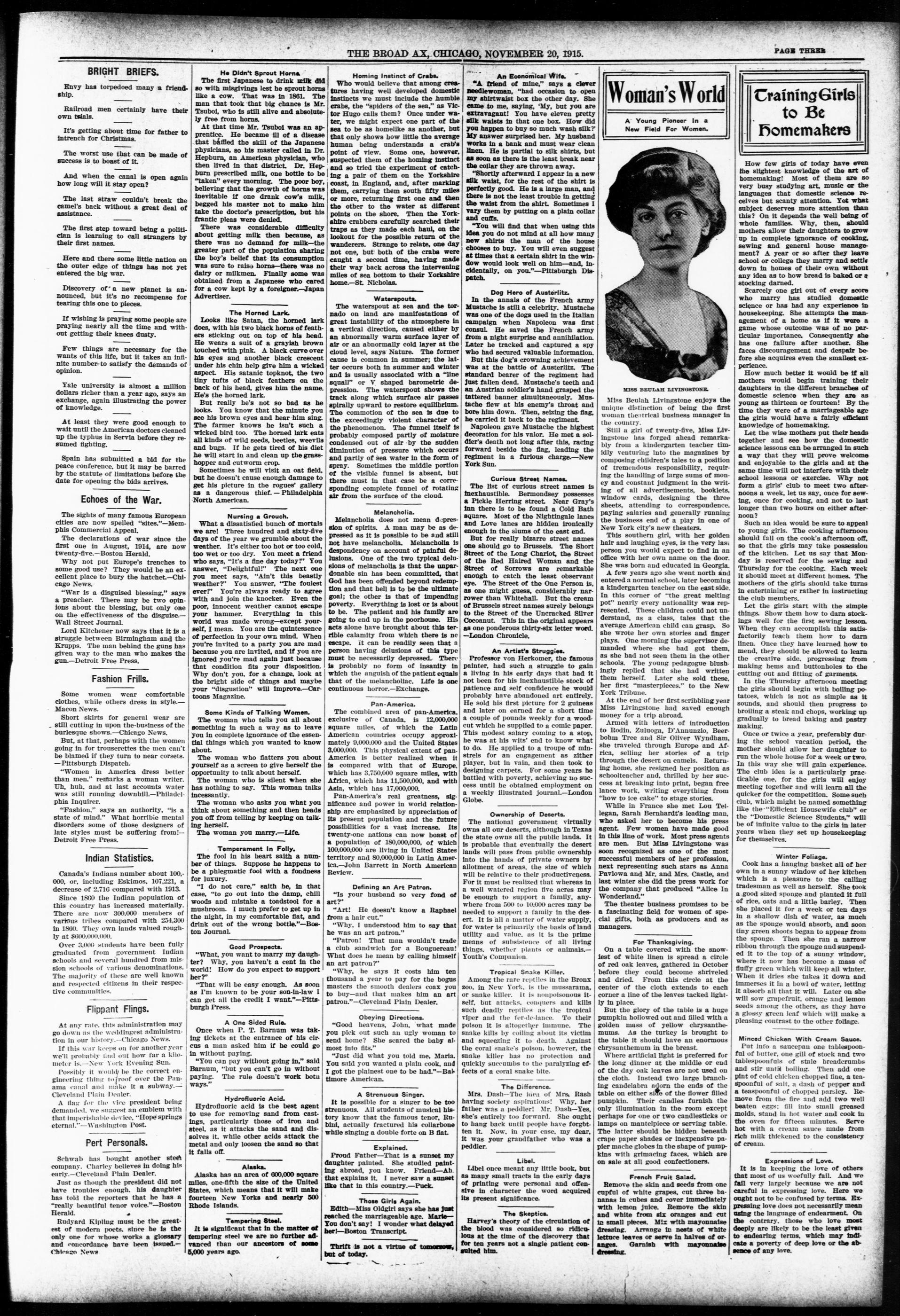
MISS BEULAH LIVINGSTONE.
Miss Beulah Livingstone enjoys the unique distinction of being the first woman theatrical business manager in the country.
Still a girl of twenty-five, Miss Livingstone has forged ahead remarkably from a kindergarten teacher timidly venturing into the magazines by composing children's tales to a position of tremendous responsibility, requiring the handling of large sums of money and constant judgment in the writing of all advertisements, booklets, window cards, designing the three sheets, attending to correspondence, paying salaries and generally running the business end of a play in one of New York city's new theaters.
This southern girl, with her golden hair and laughing eyes, is the very last person you would expect to find in an office with her own name on the door. She was born and educated in Georgia.
A few years ago she went north and entered a normal school, later becoming a kindergarten teacher on the east side. In this corner of "the great melting pot" nearly every nationality was represented. These children could not understand, as a class, tales that the average American child can grasp. So she wrote her own stories and finger plays. One morning the supervisor demanded where she had got them, as she had not seen them in the other schools. The young pedagogue blushingly replied that she had written them herself. Later she sold these, her first "masterpieces," to the New York Tribune.
At the end of her first scribbling year Miss Livingstone had saved enough money for a trip abroad.
Armed with letters of introduction to Rodin, Zuluoga, D'Annunzlo, Beerbohm Tree and Sir Oliver Wyndham, she traveled through Europe and Africa, selling her stories of a trip through the desert on camels. Returning home, she resigned her position as schoolteacher and, thrilled by her success at breaking into print, began free lance work, writing everything from "how to ice cake" to stage stories. While in France she met Lou Telegan, Sarah Bernhardt's leading man, who asked her to become his press agent. Few women have made good in this line of work. Most press agents are men. But Miss Livingstone was soon recognized as one of the most successful members of her profession, next representing such stars as Anna Pavlowa and Mr. and Mrs. Castle, and last winter she did the press work for the company that produced "Alice In Wonderland."
The theater business promises to be a fascinating field for women of special gifts, both as producers and as managers.
For Thanksgiving:
On a table covered with the snowiest of white linen is spread a circle of red oak leaves, gathered in October before they could become shriveled and dried. From this circle at the center of the cloth extends to each corner a line of the leaves tacked lightly in place. But the glory of the table is a huge pumpkin hollowed out and filled with a golden mass of yellow chrysanthemums. As the turkey is brought to the table it should have an enormous chrysanthemum in the breast.
Where artificial light is preferred for the long dinner at the middle or end of the day oak leaves are not used on the cloth. Instead two large branching candelabra adorn the ends of the table on either side of the flower filled pumpkin. Their candles furnish the only illumination in the room except perhaps for one or two candlesticks or lamps on mantelpiece or serving table. The latter should be hidden beneath crape paper shades or inexpensive papier mache globes in the shape of pumpkins with grimacing faces, which are on sale at all good confectioners.
French Fruit Salad.
Remove the skin and seeds from one cupful of white grapes, cut three bananas in cubes and cover immediately with lemon juice. Remove the skin and white from six oranges and cut in small pieces. Mix with mayonnaise dressing. Arrange in nests of white lettuce leaves or serve in halves of oranges. Garnish with mayonnaise dressing.
Training Girls to Be Homemakers
How few girls of today have even the slightest knowledge of the art of homemaking! Most of them are so very busy studying art, music or the languages that domestic science receives but scanty attention. Yet what subject deserves more attention than this? On it depends the well being of whole families. Why, then, should mothers allow their daughters to grow up in complete ignorance of cooking, sewing and general house management? A year or so after they leave school or college they marry and settle down in homes of their own without any idea as to how bread is baked or a stocking darned.
Scarcely one girl out of every score who marry has studied domestic science or has had any experience in housekeeping. She attempts the management of a home as if it were a game whose outcome was of no particular importance. Consequently she has one failure after another. She faces discouragement and despair before she acquires even the smallest experience. How much better it would be if all mothers would begin training their daughters in the different branches of domestic science when they are as young as thirteen or fourteen! By the time they were of a marriageable age the girls would have a fairly efficient knowledge of homemaking.
Let the wise mothers put their heads together and see how the domestic science lessons can be arranged in such a way that they will prove welcome and enjoyable to the girls and at the same time will not interfere with their school lessons or exercise. Why not form a girls' club to meet two afternoon a week, let us say, once for sewing, once for cooking, and not to last longer than two hours on either afternoon?
Such an idea would be sure to appeal to young girls. The cooking afternoon should fall on the cook's afternoon off, so that the girls may take possession of the kitchen. Let us say that Monday is reserved for the sewing and Thursday for the cooking. Each week it should meet at different homes. The mothers of the girls should take turns in entertaining or rather in instructing the club members.
Let the girls start with the simple things. Show them how to darn stockings well for the first sewing lesson. When they can accomplish this satisfactorily teach them how to darn linen. Once they have learned how to mend, they should be allowed to learn the creative side, progressing from making hems and buttonholes to the cutting out and fitting of garments. In the Thursday afternoon meeting the girls should begin with boiling potatoes, which is not as simple as it sounds, and should then progress to broiling a steak and chops, working up gradually to bread baking and pastry making.
Once or twice a year, preferably during the school vacation period, the mother should allow her daughter to run the whole house for a week or two. In this way she will gain experience. The club idea is a particularly practicable one, for the girls will enjoy meeting together and will learn all the quicker for the competition. Some such club, which might be named something like the "Efficient Housewife club" or the "Domestic Science Students," will be of infinite value to the girls in later years when they set up housekeeping for themselves.
Winter Foliage
Cook has a hanging basket all of her own in a sunny window of her kitchen which is a pleasure to the calling tradesman as well as herself. She took a good sized sponge and planted it full of rice, oats and a little barley. Then she placed it for a week or ten days in a shallow dish of water, as much as the sponge would absorb, and soon tiny green shoots began to appear from the sponge. Then she ran a narrow ribbon through the sponge and suspended it to the top of a sunny window, where it now has become a mass of fuzzy green which will keep all winter. When it dries she takes it down and immerses it in a bowl of water, letting it absorb all that it will. Later on she will sow grapefruit, orange and lemon seeds among the others, as they have a glossy green leaf which will make a pleasing contrast to the other foliage.
Minced Chicken With Cream Sauce.
Put into a saucepan one tablespoonful of butter, one gill of stock and two tablespoonfuls of stale breadcrumbs and stir until boiling. Then add one pint of cold chicken chopped fine, a teaspoonful of salt, a dash of pepper and a teaspoonful of chopped parsley. Remove from the fire and add two well beaten eggs; fill into small greased molds, stand in hot water and cook in the oven for fifteen minutes. Serve hot with a cream sauce made from rich milk thickened to the consistency of cream.
Expressions of Love.
It is in keeping the love of others that most of us woefully fall. And we fall very largely because we are not careful in expressing love. Here we ought not to be confused by terms. Expressing love does not necessarily mean using the language of endearment. On the contrary, those who love most deeply are likely to be the least given to endearing terms, which may indicate a poverty of deep love or the absence of any love.
Agents and Correspondents Wanted to Handle THE BROAD AX. Liberal Commissions to Live Agents. Address, Julius F.Taylor, 6532 St. Lawrence Av., Chicago
Agents a BRO Addr
THE BROAD AX
PUBLISHED WEEKLY.
Will promulgate and at all times uphold the true principles of Democracy, but Criticize, Protestants, Priests, Infidels, Single Taxes, Republicans, or anyone else can have their say, as long as their language is proper and responsibility is fixed.
The Broad Ax is a newspaper whose platform is broad enough for all, even claiming the editorial say to speak its own mind.
Local communications will receive attention. Write only on one side of the paper.
Auditising rates made known on application.
Address all communications to
6532 SR. LAWRENCE AVE., CHICAGO, ILL.
PHONE WENTWORTH 2597.
JULIUS F. TAYLOR, Editor and Publisher
Entered as Second-Class Matter Aug. 19,
1902, at the Post Office at Chicago, Illinois,
under Act of March 8, 1879.
REMOVAL NOTICE.
From on and after this date, all letters or other mail matter intended for Julius F. Taylor or Mrs. Annie E. Taylor or The Broad Ax, should be addressed to 6532 St. Lawrence Ave., Jackson Park station. Phone Wentworth 2597.
THE ORDER OF EASTERN STAR
BUYS FINE HOME FOR ITS DECREPIT MEMBERS AT NORTH
HARVEY, ILLINOIS.
Contributed by Mrs. Louise V. Webb,
G. M.
Eastern Star Property "Out of Debt" and all proper documents pertaining to the purchase, which were in the hands of Mrs. Louise V. Webb Worthy Grand Matron of the state, placed in the hands of the Worthy Grand Treasurer, Mrs. Mollie H. Green.
"We take pleasure in announcing to our members and friends that the property purchased by the Order of The Eastern Star Chapters of the Illinois jurisdiction, located at 14630 Clinton St., North Harvey, Ill., is completely out of debt. The property purchased by the order for the purpose of establishing an Eastern Star Home for the decropit members of the order in the Illinois jurisdiction was secured by a Committee of Ladies of the Order, appointed by the late Mrs. Blanch Charleston now deceased, who was then Worthy Grand Matron of the jurisdiction. The property which cost the order Three Thousand Dollars—but is now valued at Thirty-five hundred dollars was secured by the committee making the first payment July 19, 1911. Almost every dollar paid on the property was paid by the Ladies of the Order. The annual payments the interest takes, tales and all other incumbrances have been kept up by the ladies of the order paying a small annual assessment with the rent collected on the place. Mrs. Louise V. Webb, now Worthy Grand Matron and Mrs. Mary E. Davenport, Past Grand Matron of the Order, have had full control of the renting of the property, and every dollar paid on the property has passed through their hands. At the last Grand Session of the Eureka Grand Chapter which convened in the City of Rock Island, Ill. An accurate account was submitted of all moneys collected on the "Home Fund" and disbursements in full on the property. It was then decided that the order would continue to rent the property and place their decrepit members in the Prince Hall Masonic Home at Rock Island, Ill. Mrs. Louise Webb who was elected Grand Matron at the session appointed the following trustees to confer with the Prince Hall Home Trustees—namely, Mrs. Kittie Terrell, chairman, Mrs. Jesse Thomas, Mrs. C. D. Lewis and Mrs. Emma Kennedy.
Mrs. Mary E. Davenport was appointed agent of the property which is now rented and in good condition. Sister Kittie Terrell, Chairman of the Board arrived in Chicago recently and in company-with Mrs. L. Webb, Grand Matron, M. E. Davenport, agent and Mrs. Mollie Green, Grand Treasurer met, and made the final payment on the property securing all proper documents of the purchase. Mrs. Terrell before returning to St. Paul called the board together and plans were made
to confer with the Prince Hall Home Board to arrange in having a joint home for the decrepit members of the two masonic bodies.
ELKS OPEN FACED GOLD WATCH DIAMOND SETTING IN THE EMBLEM LOST THE FINDER WILL BE HANDSOMELY REWARDED BY RETURNING IT OR BY GIVING INFORMATION LEADING TO ITS RECOVERY.
I want to call your attention to a pitiful case in which a young man in poor health, who at times has aberrations while in one of these unfortunate states of mind, on Thursday night, September 2, 1915, lost a precious gold open-face size 12, Elks Watch, with embossed Elk, and diamond setting in the Elk's head, gold plated chain and Elks emblem, and sterling silver gold plated cigar cutter, Movement of watch was No. 1103206. Case No. 171901. Waltham-Riverside-Maxine movement. The time piece was his constant companion and because of its associations he moans its loss almost constantly, and it is felt by his relatives that if the person who has this watch knew of the peculiar distress in which this young man has been plunged by its loss, he would return it. He will lie or sit by the hour lamenting the absence of this mute companion, which has been with him for several years. His family will be glad to give a handsome reward for its return.
If you will kindly print this we hope that this page which is scanned by so many eyes will be read by some one who knows where the watch is and that mercifully and kindly they may take steps to return it or give some information leading to its recovery. Information may be sent to the un-
Information may be sent to the undersigned.
JULIUS F. TAYLOR,
6532 St. Lawrence Ave.
Phone Wentworth 2597
INSTITUTIONAL A. M. E. CHURCH
3825 Dearborn St.
Last Sunday was a Grand Day. The morning service was up to the usual high standard. In the absence of Dr. A. J. Carey, the Assistant Minister, the Rev. Alonzo J. Bowling, conducted the service.
Rev. P. H. Lewis preached in the morning, and the Rev. N. B. Jones, Chicago Conference Evangelist preached in the evening.
The Sunday School, in its World Temperance exercises, was favored with an excellent address from Judge George W. Underwood and Attorney Walter M. Farmer. There is an increasing attendance at both church and Sunday School
Sunday, November the 21st, will be spent in honor of Dr. Washington. In the morning, the Assistant Pastor will preach. Subject: "The Meaning of the Life of Dr. B. T. Washington". In the evening, beginning at 7:30, there will be a symposium to do honor to the memory of the late Dr. B. T. Washington. Speakers for the evening, are as follows: Dr. Jenkin Lloyd Jones, Hons. Edward H. Wright, Oscar DePriest, Louis B. Anderson, A. E. Patterson, George W. Ellis, Adelbert Roberts, Robert R. Jackson, and Dr. Julian H. Lewis, Fellow of the University of Chicago and Mr. A. L. Jackson, secretary of the Y. M. C. A. Soloist, Mrs. Martha Broadus Anderson, Mrs. Marie Burton Hyram, Miss Maude Roberts, and Mr. H. T. Jackson.
We extend you a hearty welcome.
HYDE PARK NEWS
BY
L. W. WASHINGTON
Owing to the Death of Dr. Booker
T. Washington, "The Spirit of Tuskegee" has changed the time of present-
ing the drama from Thursday,
Nov. 18th to Monday night Nov. 22,
1915 at the Pekin Theatre.
* * *
Miss Victoria Raymore The young
pianist of Hyde Park honored the Ray
School Thursday and Friday afternoon
by performing at the piano.
* * *
Mrs. Chas. Hunter and son, Billie,
has left the city to visit her Brother,
Rev. John Ford of Jacksonville, Fla.
there to remain until next June. The
Broad Ax wishes for them a pleasant
stay.
The Board of Stewards of the Hyde Park A. M. E. Church gave a House social at the residence of Mr. and Mrs. Perkins, 5330 Kenwood Ave., which was quite a success.
The A. U. K. and D. of Africa gave an Apron and Necktie social at the
THE BROAD AX, CHICAGO, NOVEMBER 20, 1915.
P. E. H.
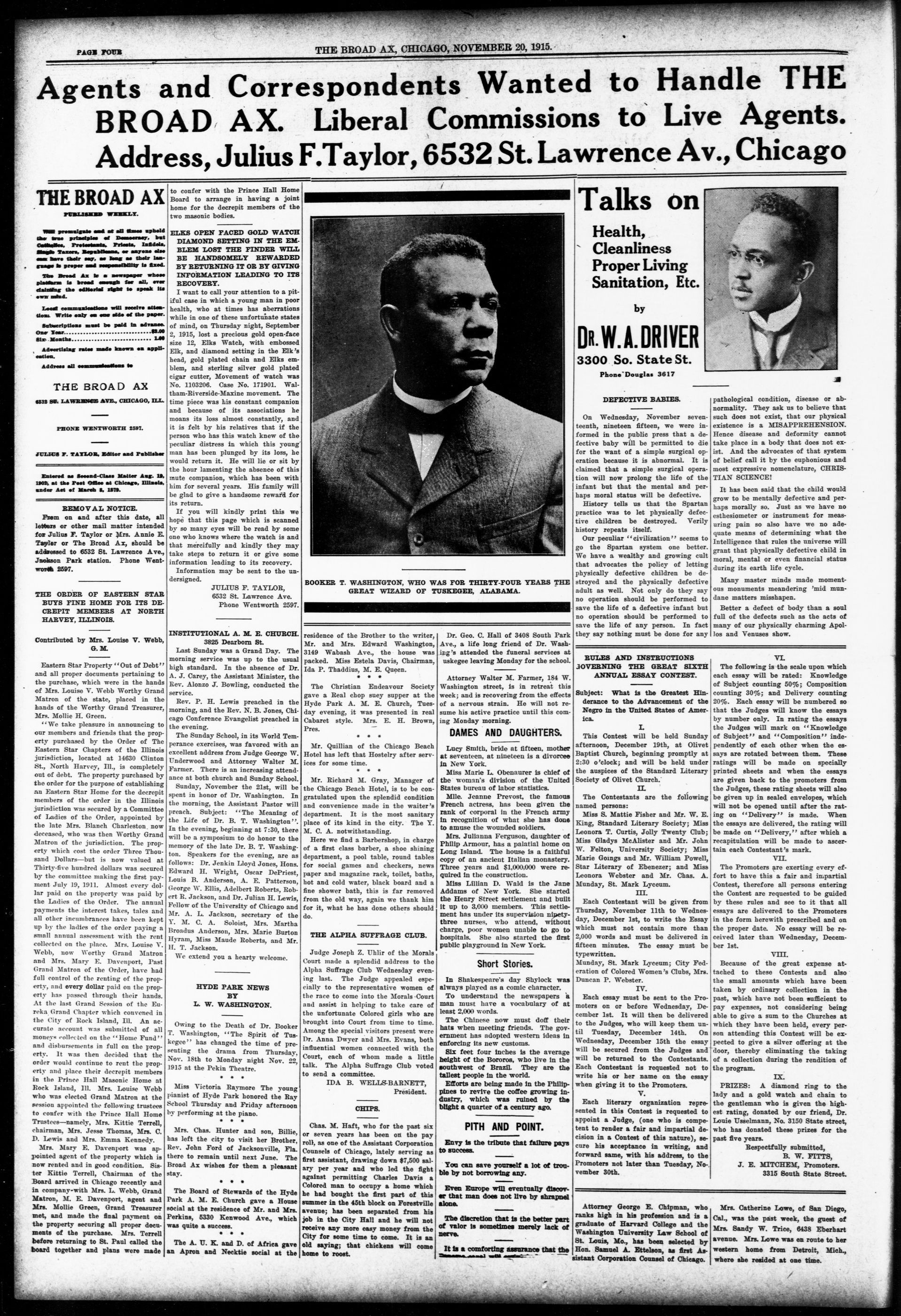
BOOKER T. WASHINGTON, WHO WAS FOR THIRTY-FOUR YEARS THE GREAT WIZARD OF TUSKEGEE, ALABAMA.
BOOKER T. WASHINGTON, WHO WAS FOR THIRTY-FOUR YEARS THE GREAT WIZARD OF TUSKEGEE, ALABAMA.
residence of the Brother to the writer,
Mr. and Mrs. Edward Washington,
3149 Wabash Ave., the house was
packed. Miss Estela Davis, Chairman,
Ida P. Thaddius, M. E. Queen.
* * *
The Christian Endeavour Society
gave a Real chop suey supper at the
Hyde Park A. M. E. Church, Tuesday
evening, it was presented in real
Cabaret style. Mrs. E. H. Brown,
Pres.
* * *
Mr. Quillian of the Chicago Beach
Hotel has left that Hostelry after services
for some time.
Mr. Richard M. Gray, Manager of the Chicago Beach Hotel, is to be congratulated upon the splendid condition and convenience made in the waiter's department. It is the most sanitary place of its kind in the city. The Y. M. C. A. notwithstanding.
Here we find a Barbershop, in charge of a first class barber, a shoe shining department, a pool table, round tables for social games and checkers, news paper and magazine rack, toilet, baths, hot and cold water, black board and a fine shower bath, this is far removed from the old way, again we thank him for it, what he has done others should do.
THE ALPHA SUFFRAGE CLUB
Judge Joseph Z. Uhlir of the Morals Court made a splendid address to the Alpha Suffrage Club Wednesday evening last. The Judge appealed especially to the representative women of the race to come into the Morals-Court and assist in helping to take care of the unfortunate Colored girls who are brought into Court from time to time. Among the special visitors present were Dr. Anna Dwyer and Mrs. Evans, both influential women connected with the Court, each of whom made a little talk. The Alpha Suffrage Club voted to send a committee.
IDA B. WELLS-BARNETT,
President.
CHIPS
Chas. M. Haft, who for the past six or seven years has been on the pay roll, as one of the Assistant Corporation Counsels of Chicago, lately serving as first assistant, drawing down $7,500 salary per year and who led the fight against permitting Charles Davis a Colored man to occupy a home which he had bought the first part of this summer in the 45th block on Forestville avenue; has been separated from his job in the City Hall and he will not receive any more easy money from the City for some time to come. It is an old saying; that chickens will come home to roost.
Dr. Geo. C. Hall of 3408 South Park Ave., a life long friend of Dr. Washington's attended the funeral services at uskegee leaving Monday for the school.
Attorney Walter M. Farmer, 184 W. Washington street, is in retreat this week; and is recovering from the effects of a nervous strain. He will not resume his active practice until this coming Monday morning.
DAMES AND DAUGHTERS
Lucy Smith, bride at fifteen, mother at seventeen, at nineteen is a divorcee in New York.
Miss Marie L. Obenauer is chief of the woman's division of the United States bureau of labor statistics.
Mile. Jeanne Prevost, the famous French actress, has been given the rank of corporal in the French army in recognition of what she has done to amuse the wounded soldiers.
Mrs. Julianna Ferguson, daughter of Philip Armour, has a palatial home on Long Island. The house is a faithful copy of an ancient Italian monastery. Three years and $1,000,000 were required in the construction.
Miss Lillian D. Wald is the Jane Addams of New York. She started the Henry Street settlement and built it up to 3,000 members. This settlement has under its supervision nipety-three nurses, who attend, without charge, poor women unable to go to hospitals. She also started the first public playground in New York.
Short Stories.
In Shakespeare's day Shylock was always played as a comic character.
To understand the newspapers a man must have a vocabulary of at least 2,000 words.
The Chinese now must doff their hats when meeting friends. The government has adopted western ideas in enforcing its new customs.
Six feet four inches is the average height of the Bororos, who live in the southwest of Brazil. They are the tallest people in the world.
Efforts are being made in the Philippines to revive the coffee growing industry, which was ruined by the blight a quarter of a century ago.
PITH AND POINT.
Envy is the tribute that failure pays to success.
You can save yourself a lot of trouble by not borrowing any.
Even Europe will eventually discover that man does not live by shrapnel alone.
The discretion that is the better part of valor is sometimes merely lack of nerve.
It is a comforting assurance that the
Talks on
Health,
Cleanliness
Proper Living
Sanitation, Etc.
by
DR. W.A. DRIVER
3300 So. State St.
Phone'Douglas 3617
by
DEFECTIVE BABIES.
On Wednesday, November seventeenth, nineteen fifteen, we were informed in the public press that a defective baby will be permitted to die for the want of a simple surgical operation because it is abnormal. It is claimed that a simple surgical operation will now prolong the life of the infant but that the mental and perhaps moral status will be defective. History tells us that the Spartan practice was to let physically defective children be destroyed. Verily history repeats itself.
Our peculiar "civilization" seems to go the Spartan system one better. We have a wealthy and growing cult that advocates the policy of letting physically defective children be destroyed and the physically defective adult as well. Not only do they say no operation should be performed to save the life of a defective infant but no operation should be performed to save the life of any person. In fact they say nothing must be done for any
RULES AND INSTRUCTIONS
GOVERNING THE GREAT SIXTH
ANNUAL ESSAY CONTEST.
Subject: What is the Greatest Hinderance to the Advancement of the Negro in the United States of America.
I.
This Contest will be held Sunday afternoon, December 19th, at Olivet Baptist Church, beginning promptly at 2:30 o'clock; and will be held under the auspices of the Standard Literary Society of Olivet Church.
II.
The Contestants are the following named persons:
Miss S. Mattie Fisher and Mr. W. E. King, Standard Literary Society; Miss Leonora T. Curtis, Jolly Twenty Club; Miss Gladys McAlister and Mr. John W. Felton, University Society; Miss Marie Goings and Mr. William Powell, Star Literary of Ebenezer; and Miss Leonora Webster and Mr. Chas. A. Munday, St. Mark Lyeum.
Each Contestant will be given from Thursday, November 11th to Wednesday, December 1st, to write the Essay which must not contain more than 2,000 words and must be delivered in fifteen minutes. The essay must be typewritten. Munday, St. Mark Lyceum; City Federation of Colored Women's Clubs, Mrs. Duncan P. Webster.
Each essay must be sent to the Promoters on or before Wednesday, December 1st. It will then be delivered to the Judges, who will keep them until Tuesday, December 14th. On Wednesday, December 15th the essay will be secured from the Judges and will be returned to the Contestants. Each Contestant is requested not to write his or her name on the essay when giving it to the Promoters.
V.
Each literary organization represented in this Contest is requested to appoint a Judge, (one who is competent to render a fair and impartial decision in a Contest of this nature), secure his acceptance in writing, and forward same, with his address, to the Promoters not later than Tuesday, November 30th.
Attorney George E. Chipman, who ranks high in his profession and is a graduate of Harvard College and the Washington University Law School of St. Louis, Mo., has been selected by Hon. Samuel A. Ettelson, as first Assistant Corporation Counsel of Chicago.
[Name]
pathological condition, disease or abnormality. They ask us to believe that such does not exist, that our physical existence is a MISAPPREHIENSION. Hence disease and deformity cannot take place in a body that does not exist. And the advocates of that system of belief call it by the euphonious and most expressive nomenclature, CHRISTIAN SCIENCE!
It has been said that the child would grow to be mentally defective and perhaps morally so. Just as we have no esthesiometer or instrument for measuring pain so also have we no adequate means of determining what the Intelligence that rules the universe will grant that physically defective child in moral, mental or even financial status during its earth life cycle.
Many master minds made momentous monuments meandering 'mid mundane matters misshapen.
Better a defect of body than a soul full of the defects such as the acts of many of our physically charming Apollos and Venuses show.
VL
The following is the scale upon which each essay will be rated: Knowledge of Subject counting 50%; Composition counting 30%; and Delivery counting 20%. Each essay will be numbered so that the Judges will know the essays by number only. In rating the essays the Judges will mark on "Knowledge of Subject" and "Composition" independently of each other when the essays are rotated between them. These ratings will be made on specially printed sheets and when the essays are given back to the promoters from the Judges, these rating sheets will also be given up in sealed envelopes, which will not be opened until after the rating on "Delivery" is made. When the essays are delivered, the rating will be made on "Delivery," after which a recapitulation will be made to ascertain each Contestant's mark.
VII
The Promoters are exerting every effort to have this a fair and impartial Contest, therefore all persons entering the Contest are requested to be guided by these rules and see to it that all essays are delivered to the Promoters in the form herewith prescribed and on the proper date. No essay will be received later than Wednesday, December 1st.
VIII
Because of the great expense attached to these Contests and also the small amounts which have been taken by ordinary collection in the past, which have not been sufficient to pay expenses, not considering being able to give a sum to the Churches at which they have been held, every person attending this Contest will be expected to give a silver offering at the door, thereby eliminating the taking of a collection during the rendition of the program.
IX.
PRIZES: A diamond ring to the lady and a gold watch and chain to the gentleman who is given the highest rating, donated by our friend, Dr. Louie Usselmann, No. 3150 State street, who has donated these prizes for the past five years.
Respectfully submitted.
respectively submitted,
B. W. FITTS,
J. E. MITCHEM, Promoters.
3315 South State Street
Mrs. Catherine Lowe, of San Diego, Cal., was the past week, the guest of Mrs. Sandy W. Trice, 6438 Eberhart avenue. Mrs. Lowe was en route to her western home from Detroit, Mich., where she resided at one time.
Charles E. Stump Continues His Travels Throughout the South Land. He is Away Down in the Lower Part of Mississippi, the Rotten State of Senator James K. Vardaman
---
Aberdeen, Miss.—When I took my pen in hand to write to you last week to inform you of my health, I was in Roanoke, Va., just returning from the meeting of the Organization Society in Petersburg, Va., and I stopped over and spent Sunday with Rev. J. H. Burks, pastor of the High Street Baptist church, a man of ability and a man of thought. Dr. Burks has been complaining for a long time, but is keeping up. He walks 10 miles every morning before breakfast, and is doing other things to get back his health. I hope that they will be successful for he is just one good man, but then I find good men pass out also. He has erected one of the finest churches in Virginia owned by our people. His church has decided to give him a rest, and it is hoped that his health will get better.
Being a stranger in that section of the country, and meeting the preacher, he thought it would be a good thing to have me talk a little for them, and I thought so too, so I just tried my hand and the people just listened to me. Whether I said anything or not they listened until I was through talking. Before going into the main service they have a choir room in which meets the choir, deacons and pastor, where they sing, read scripture and have prayer before going into the main service. I enjoyed seeing this. Miss Bessie B. Oliver was the organist, and she is a young woman who is up on music. She belongs to one of the first families in the town, and then they have spent money in preparing her for work and for service. She is connected with an insurance company. They have a lovely home.
Among the business men I met were: Green Penn, a man who has saved his money and invested it wisely, and Mr. Pierce, of the hotel. I would like to have the pleasure of telling you about some more of them, but as I have so much will not be able to do so. You will nardon me.
After spending Sunday in the city, Monday morning at 3 o'clock I was out of bed and headed for another part of the world. I took my place in my own car or the end of the car set apart for my people. There is no particular incident connected with the ride hence there is nothing to say. In Bristol, Va.-Tenn., I had to change, and R. E. Clay, met me at the stable with a big lunch. This was a nice thing and believe me I certainly did enjoy it. I got on the outside of all this good eating, and then found my way toward the stable to start for this place. The wagon pulled up, and this time I got on, taking the lower berth—that is to say that there was a long seat and I got on it and stretched way out and slept all the way to Knoxville, Tenn. At this place I met Editor W. L. Porter, of the East Tennessee News, and he treated me just like I was a full fledged newspaper man. I am going to stick to this writing business a little longer.
I spent about two hours in Knoxville, and then put out on the L. & N., for Atlanta, but I did not go into Atlanta, but got off the wagon at Cartersville, Ga., where I waited for the night wagon for Nashville. Sitting around waiting I went to the A. M. E. Church and found 5 women sitting around a table with a dish of fish and some bread on it. They were having a church supper and each member was around the table selling fish so that there was but little space left for the purchaser. I bought my fish just the same.
I then went over to the Baptist church and found the same thing going on over there. The people just looked and looked at me. They did not know who it was or what it was, but I did not put them next. Going down to the wagon, I got in the wrong room, and it was almost like getting in the wrong house. "Look here "Nigger" you get out of here d—n quick or I will send your soul to where it will burn forever," came the words from a little White man.
"I thought I was in that place already," I replied, and he looked business. He pulled his little smoke
wagon, and I got out, and waited in the street until my wagon pulled up and I got singing "Praise God From Whom All Blessings Flow." I did not get out of my seat until we pulled right into Nashville. I got on there and rode to Birmingham. For Birmingham, I found Ira T Bryant, Secretary of the A. M. E. Sunday school Union, and a man of worth and ability. That young man is rendering good service to his church, and it is fortunate that the A. M. E. Church has such a strong young man. I talked with Mr. Bryant, and he told me many things about the Lord and heaven and the church, and the Sunday School. I just looked and listened.
Birmingham was reached, and it found me right there. I had to have my things toted over to the other stable to get on the Frisco to bring me here. So I went out in town. Birmingham is some city. Now I have been talking about street cars, but this takes the rag off of the bush. I found two seats in front and on the back was marked "For Negroes." I got on one of them, but I felt like laying my religion on the shelf long enough to say a few damns, but did not want to be excluded from the church hence refrained from doing so, but I just thought them. But why should I do these things? No man shall belittle me by making me say bad words with his prejudice.
Now there are some things in Birmingham worth while and don't you forget it. For instance I went up the street, and the First thing to claim my attention was Diff's barbershop and it is one of the finest in the country. In the chair there was W. T. Vernon, the national baby, and you are going to agree with me when I tell you how he is the national baby, but will not do so this time. He is now in the arms of Bishop Joshua H. Jones, who is toting him around.
Dr. Vernon has lost his job as president of Campbell college and is now out of work. He is looking around. Bishop Jones thought at one time he could land him in Avery chapel, Memphis, but could not. He asked the conference to elect him one of the delegates, but they did not see it that way. Dr. Vernon thinks that the general conference is going to elect him a bishop. If it should then I will not think much of their judgment for bishop material. He has never been a real full fledged pastor. Perhaps has never held a real official board meeting, knows nothing about the life of a minister by experience, and why should he be made a bishop over the men who have given their lives in actual service.
I know when he came to Kansas. I was in Lawrence when he visited a conference there presided over by Bishop Tanner. I remember when he was in Morgan college, in Baltimore, and I have recorded in my book when he got that big job in Washington. I am not a member of the A. M. E. Church and if it wants Vernon it is none of my business.
He was in Birmingham to be with Bishop Jones in his conference. He was president of Campbell college, but the trustees saw fit to change him or to not elect him, and he held the Bishop responsible for this. If he gets to be a bishop he will find out a few things. But with as many able pastors, general officers, it would seem to me that the A. M. E. church has experienced men enough for that business.
Just up the street was Dr. U. G. Mason, and he is the leading physician and surgeon of our race in town. Dr. Mason has gotten his standing through hard study, and preparation. He has been in the doctor business I am told for a long time. He shook hands with me, and assured me that he was delighted to meet me, and carried me over to his home in his fast horseless carriage, also to Enon Ridge. Dr. Mason has a lovely home. His wife died a few years ago and left him with several children. He is devoted to his home and children. Was delighted to see him. I had heard of him before.
In the office of Dr. Mason, was a stenographer, Miss C. E. Sullivan. She is indeed a scholar and a woman who can do some fast writing. If I could write like her I would soon be a good newspaper man. He had her to escort me on the ridge. That young woman knows how to entertain even though you are not as much educated as she is.
I went to the bank building, then to see Mrs. Carrie A. Tuggle, Editor Oscar W. Adams, some of the insurance men, and to other points and places, and soon found me on the hog train going to another part of the world. I think I shall have to tell you in my next letter about Birmingham.
In this city I have had the pleasure of meeting Mr. and Mrs. V. O. Wilson, and many others. Mrs. Wilson, is one of the leading young women. She has lived here all of her life, taking her education here and then going off to Birmingham where her husband worked. They have some good real estate. It is now my duty to talk to you about Mississippi and the affairs of Mississippi, and this will be done in the next two or three weeks. Stay with me and I will tell you what I see and how I see it. I am now in the state of Senator Vardaman.
SIRES AND SONS.
Dr. Parkes Cadman, the noted Brooklyn divine, was once a coal miner.
Mr. John Wrey, the Australian millionaire, started life as a salesman in a shoe store.
Cardinal Gibbons was born in Baltimore of Irish parents. He had a brief commercial career in New Orleans. When he became of age he entered St. Charles' college, near Ellicott, Md.
John Muir, the noted American naturalist, is a Scotchman by birth. He is an ardent advocate of national parks. The Muir glacier in Alaska is named after him to commemorate his discovery of it.
Patrick Calhoun, noted street railway operator and corporation lawyer, also a grandson of John C. Calhoun, started his law career in St. Louis, living in the garret of a lodging house. He has a copper riveted rule to read two hours each day.
Marcus Loew, the "small time king" of vaudeville, doesn't try to prop his morning paper against a sugar bowl and read as he eats. He has a habit, contracted many years ago, of using it for a tablecloth. He shoves his toast and cup of chocolate from column to column as he reads.
Pen. Chisel and Brush.
The picture "Paradise," by Tintoretto, is the largest painting in the world. It is eighty-four feet wide, thirty-three and a half feet high and is now in the doges' palace, Venice. When Dr. Woodrow Wilson established a new system at Princeton which kept the professors busy pretty nearly all the time, Dr. Henry van Dyke resigned, as he did not have enough time for literature. Frederick MacMonnies, the sculptor, has returned to this country after more than twenty-five years of life abroad, in which he gained an international reputation, won exhibition honors in all the capitals and was made a chevalier in the Legion of Honor of France and decorated with the Order of St. Michael of Bavaria.
Echoes of the War.
Not that King Albert does not want peace, but that he wants Belgium with it—Boston Herald.
The main difference between the war a year ago and now seems to be 365 days.—Washington Post.
The war casualties are not all on the battle front. Some of them happen in the government cabinets.—Philadelphia Press.
Europe finds the cost of living advancing in a manner that discourages any reliance on war as a solution of economic problems.—Washington Star.
Peace conditions are being talked of again. The trouble about them is that each side wants to make them rather than take them.—Baltimore American.
State Lines.
In the state of New York there are approximately 12,000,000 acres of potential forest lands.
Not since 1864, with one exception, has California produced so much gold as in 1914, when the output was worth $20,563,496.
Illinois is the leading state in the production of common brick, Pennsylvania in fire brick and Ohio in vitrified paving brick and sewer pipe.
Texas, which in 1850 stood twelfth in rank, is now the seventh state in the American Union in point of wealth. It is first in point of size and fifth in population.
BRIGHT BRIEFS.
The searchlight always seems to be looking for something bad.
The unexpected happens so often that it ought to lose its novelty.
Don't waste time in explaining why you failed. Get busy and make good.
This fall sees fewer announcements of emperors' plans for Christmas dinners.
The next war, says Mr. Edison, will be one of machines. Preferably type-writing machines.
A. B.
MR. A. L. WILLIAMS.
The fighting attorney, who is winning many important legal battles in the courts of Cook County for his clients.
DEMOCRATIC MEMBERS OF THE INDUSTRIAL BOARD OF THE STATE OF ILLINOIS AWARDED WALTER A. HALL $2,712 FOR PERSONAL INJURIES RECEIVED WHILE IN THE EMPLOY OF THE CITY THE REPUBLICAN CITY AUTHORITIES ARE NOT IN FAVOR OF PAYING HIM HIS MONEY AND HIS CLAIM WILL BE CONTESTED AGAINST THE CITY BY THE CITY LAW DEPARTMENT.
dred Dollars ($200) that the applicant was further entitled to compensation for total disability for seven (7) weeks at half his regular salary of $18.00 being Nine Dollars per week or Sixty-three Dollars ($63.00) that the applicant was further entitled to compensation for partial disability of Six Dollars per week for a period of Four Hundred and Eight weeks or Two-thousand Four-undred and forty-eight Dollars ($2,448) this finding by a Democratic Board,
Award of $2,712 given to Walter A. Hall, as compensation for personal injuries received as a result of a gun shot wound inflicted on him wantingly by an Italian while in the employ of the City of Chicago, in the Water Pipe Extension Department on September 13th, 1915, the same was given him by the Industrial Board of the State of Illinois. This Board is controlled by the Democratic party appointed by Governor Dunne. Immediately after shooting the said Hall and while he was in the Passavant Memorial Hospital, one of his friends Mr. Simms, of the 14th Ward, called at the office of A. L. Williams, 706-184 W. Washington St., the fighting Attorney to interview and intercede in the case for Hall and he accompanied him to the bedside of Mr. Hall, where he made his statement to him, after leaving Mr. Hall, and taking his statement Mr. Williams, went with Mr. Simms, to the place where the shooting occurred and got in direct conversation and then and there interviewed the men working on the job and had them to come to his office where they made a statement as to this occurrence. Against the views of a good many of the leading Colored lawyers he advised that a direct proceeding be brought against the City of Chicago, under the Compensation Act being payments as is required by the said Act during the course of Hall's disability. He applied to the City of Chicago, for the said compensation and was absolutely refused and was told by the authorities that this proceeding was importune and the injury was not one in which the law is applied. Mr. Williams then and there told them that he still thought that this was one of the cases by which compensation should be paid and his opinion was that Hall was the receiver and not the actor thus placing him under the act. Mr. Williams then filed an application with the Industrial Board and the matter was set down for the 11th day of November past to be heard. At the hearing the City of Chicago, the respondent produced its witnesses and Mr. Williams for the Applicant Hall, produced his witnesses and after the testimony was all heard Mr. Daniel J. May, acting as the arbitrator for the State told the parties to leave their briefs with him and he would send his opinion to the respective parties, when the report was turned over to the respective parties it was then found by the arbitrator representing the State that Hall was under the Compensation Act; that he was injured while in the employ of the City; that the accident occurred out of and during the course of his employment; that the said City of Chicago was liable for the accident under the law for medical service to the amount of Two Hun-
St. Mark Methodist Episcopal Church 50th Street and Wabash Avenue
dred Dollars ($200) that the applicant was further entitled to compensation for total disability for seven (7) weeks at half his regular salary of $18.00 being Nine Dollars per week or Sixty-three Dollars ($63.00) that the applicant was further entitled to compensation for partial disability of Six Dollars per week for a period of Four Hundred and Eight weeks or Two-thousand Four hundred and forty-eight Dollars ($2,448) this finding by a Democratic Board goes on to show to our people the fairness of this Board, irrespective to color or creed from close observance we find that we have ably good and reliable friends in each of the officials and especially Mr. W. J. Conley its Seecy, and it may be said that Mr. O'Toole, who represented the City and who is considered an expert and who is being held by the City on account of his knowledge of the Compensation Law tried by every means to inject into the proceeding evidence which would prejudice the minds of the Board, but to no avail, Mr. Daniel J. May, who represented the Board should be highly commended for his manly stand in considering this case under the law and the evidence and not as was tried to be shown by Mr. O'Toole. The Italian who shot Hall, is still in the City's employ under an alias name and who is not a civil service employee, was not a civil service employee at the time of the shooting. It is said that he is being held by the general foreman of the first district, Mr. Allen, who is said to be a close relative of E. M. Allen, Ex-Warden of the Joliet Penitentiary, and who is now prosecute Chicken Joe Campbell, for his life. It is further said that Allen caused the trouble and tried to get the Italian away after the shooting. It is further said that the gun that the Italian shot Hall with was taken out of the automobile of Allen, the general foreman and after the shooting it was placed back into the automobile and was taken again out of the automobile by one of the employees working at the time of the shooting and turned over to the police. That Allen, instead of trying to catch the criminal let one of them pass him and get away and tried to crank his machine and was cranking it at the time this Italian got to the machine after the shooting for the purpose of getting the Italian away. Allen, the general foreman admitted on cross examination before the Industrial Board that he said to the Italian "what in the h—— have you been doing get to h—— away from here."
It is up to Mayor William Hale Thompson, to see to it; that Mr. Hall, who is the father of four or five children and who at the time he was shot by an unnaturalized Italian, was peaceably discharging his duties, as a city employee; receives his compensation, without any contest being waged against its payment on the part of the City Law Department. Attorney A. L. Williams has certainly proven himself to be a manly fighter, for he has beaten the best lawyers in the legal department of Chicago, in fighting for the rightful claim or money which belongs to Mr. Hall.
PAGE FIVE
All a Dream.
There is an amusing example of oriental subtlety in an anecdote that Mr. Sidney Whitman tells in "Turkish Memories." The story is of a young diplomat who was sent to Constantinople to be trained for his profession.
One day the diplomat met a carriage guarded by a eunuch that contained some ladies of the sultan's harem. The young man endeavored to peep in at the window and got a blow across the face from the vigilant eunuch. He made a great uproar and lodged a complaint with the sultan himself. He was received in private audience, and Abdul Hamid listened patiently to his story of the outrage.
On its conclusion the sultan replied: "My dear sir, I have gone carefully into the case and see exactly how it stands. You are a gentleman; therefore you could never have committed such a breach of good manners as is alleged to have taken place, and consequently no eunuch could possibly have presumed to strike you. The whole affair must be the product of your fancy; pray let us dismiss it."
Vanity Tickled
During the early excesses of the French revolution a rabble of men and women was rioting in the streets of Paris. Lafayette appeared and ordered a young artillery officer to open fire upon them with two cannon. The officer begged the general to let him try first to persuade them to withdraw.
"It is useless to appeal to their reason," said the general.
"Certainly," answered the officer, "and it is not to their reason, but to their vanity, I would appeal."
The officer rode up to the front of the mob, doffed his cocked hat, pointed to the guns and said:
"Gentlemen will have the kindness to retire, for I am ordered to shoot down the rubble."
The street was cleared at once, for none could brook the idea of being classed with the scum of the city.
The Eternal Conflict.
Society is nothing more than a continuation of the conflict of nature under the guidance of intelligence. It is vain to hope for any amelioration of society from the prevalence of an intellectual education. Culture of the intellect supplies new weapons for use in the conflict and may render it less rude in appearance, but cannot change its nature. * * * Doctrines and creeds are forms; the will supplies their contents. Just as a vehicle may convey substances having wholesome or injurious or indifferent properties, so any system of thinking—theological, social or political—may be made to bear any purport, good or bad. To try to shape opinions so that they may not be made subservient to any evil purpose is all labor in vain.—Schopenhauer.
Wars and Words.
The wars with Spain in the sixteenth century enriched the English language with many new words. To them, as Logan Pearlsall Smith has pointed out, "we owe the Spanish words 'embargo' and 'contraband' and the Dutch word 'freebooter.' Among other Dutch or Flemish terms that were perhaps brought back to England by soldiers in their campaign in the low countries may be mentioned 'furlough,' 'cashier,' 'league,' 'sonce,' 'onslaught,' 'drill' and 'domineer.' 'Comrade' is a Spanish word, but seems to have been a soldiers' term learned in the low countries, and 'forlorn hope' is a military phrase, being the Dutch 'verloren hoop,' in which 'hoop' means a troop and is cognate with our word 'heap.'"—London Chronicle.
Didn't Raise Them:
A young housewife who lives in a suburban town went to the village store to make some purchases.
"These chickens look very nice," remarked the customer. "How much are they?"
"One dollar apiece, madam," was the prompt response of the obliging proprietor. "You can't find better poultry for the money in the whole country."
"One dollar," thoughtfully mused the customer, and then added: "Did you raise them?"
"Oh, no, madam!" was the hasty assurance of the misunderstanding storekeeper. "That is the same price I offered to sell them for yesterday."—Philadelphia Telegraph.
A Graceful Compliment.
Some famous compliments have been paid to members of the stern sex, and one of the most gracefully turned was that uttered by Boilean, who when the virtuous De Mesmes, president of the parliament of Paris, was elected an academician, congratulated him in these terms: "I have come to you, sir, in order that you may congratulate me on having you one of my fellow academicians."
Moslem Wives.
Under the Moslem laws the provision for securing to the wife the free and uncontrolled possession of her property is minutely stipulated in the marriage contract. A suitable sum is also arranged for her maintenance in accordance with her husband's rank.
The Jail.
"I am going to visit the jail. There is a man I want to see there."
"Is one all? I know about forty whom I should like to see there."—Indianapolis News.
Not Present.
He—Do you remember Horatius at
the bridge? She—I don't think I ever
met him. You know we invite so few
men.—Judge.
Let him who has enough ask for
nothing more.—Horace.
PAGE SIX
MISS EDITH CAVELL A DEVOTED NURSE Sad Fate of the Woman Has Stirred the World.
The shot that killed Miss Edith Cavell, an Englishwoman and head nurse of a surgical institution in Brussels, at the order of the German military court, has certainly been heard around the world.
Miss Cavell was prosecuted for having helped English and French soldiers, as well as Belgian young men, to cross the frontier and go to England. She admitted by signing a statement before the day of the trial and by public acknowledgment in court that she was guilty of the charges, not only that
PETER
THE LATE MISS EDITH CAVELL.
she had helped these soldiers to cross the frontier, but also that some of them had thanked her in writing when arriving in England.
In a letter to the London Post a cousin of Miss Cavell says:
"My cousin's intense devotion to the alleviation of suffering caused her to devote her life to nursing in Brussels. She voluntarily remained there to continue her work when the city was taken by the Germans. She would have nursed a German with as much tender care as an Englishman.
"She allowed the womanly quality of compassion to get the better of prudence and self interest. For this she suffered untold miseries and died a martyr's death."
A FAVORITE OF FORTUNE
Little Foundling Adopted by Mr. and Mrs. Finley J. Shepard.
One of the most fortunate youngsters in the United States is a little foundling of about five years of age who has been legally adopted by Mr. and Mrs. Finley J. Shepard. Mrs. Shepard, formerly Miss Helen Gould, is widely known for her philanthropic and charitable work. She inherited $10,000,000 from her father, Jay Gould.
1910
FINLEY J. SHEPARD, JR. FORMERLY JOHN DOE NO. 104.
The little boy had been abandoned by his parents, whose identity is still unknown, and was found upon the steps of St. Patrick's cathedral in New York city at midnight by a policeman on Sept. 12, 1914. He was placed at St. Christopher's home, Dobbs Ferry. N. Y., a Methodist institution for parentless boys and girls and situated not far from the beautiful home of Mrs. Shepard at Irvington-on-the-Hudson. The little waif was known at the institution as John Doe No. 104. He is now Finley J. Shepard, Jr., and the heir presumptive to a large fortune. He has the run of an extensive estate, one of the finest in the country, and is enjoying far more than the average comforts of home. Surely no fairy godmother ever did better for a protege.
SIRES AND SONS.
Baron Motone, doyen of the diplomatic corps at Petrograd, is one of Japan's foremost diplomats. He has lived in Petrograd since 1906.
Captain Edward W. Eberle, who succeeds Rear Admiral Fulam as superintendent of the Naval academy at Annapolis, has been commandant of the Washington navy yard and superintendent of the naval gun factory since last December.
Judge George E. Downey, who has been chosen to fill the vacancy on the bench of the United States court of claims, was until his appointment comproller of the treasury. Judge Downey comes from Indiana, where he was for ten years a judge of the circuit court.
Otto Praeger, who has been appointed second assistant postmaster general, succeeding Joseph Stewart, is a Texan by birth and has long been the personal friend of Postmaster General Burleson. Before his appointment as postmaster he was a newspaper correspondent. Jose Pardo, who has again assumed the presidency of Peru, is entering upon his third term, having been first elected in 1904. His career is most unusual, regarding it from the political standpoint, for his father was a famous statesman, who became president of Peru.
The Writers.
Kate Douglas Wiggin, it is said, receives $50,000 a year in royalties on books and plays taken from her most popular novels.
Mrs. Fenwick Miller, well known English journalist, has been elected president of the Women Writers' league in England.
Rudyard Kipling prefers the night hours for work, frequently sitting up until 2 or 3. He is most elaborate in his methods and pronounces aloud every word that he writes in order to test its fitness.
"Marse Henry" Watterson, the noted editor, spent years in training for a musical career. An accident which cut short the use of his left hand made it necessary for him to abandon his musical plans.
Train and Track.
Every large railway company in England has a special royal train for the use of the king and queen.
At the present time the New York Central station in New York is the world's greatest railroad terminal.
Last year in the United States 5,471 persons were killed while walking on railroad tracks. This was at the rate of fifteen a day, or one every ninety-six minutes.
The Hawkesbury railway bridge in New South Wales, Australia, is 2,900 feet long, supported by six plers, each on caissons of depths from 101 feet to 162 feet, the deepest foundations of any railway bridge in the world.
Current Comment.
More than twice as many persons visited the national parks this year. So there was something in that "seeing America first" after all.-Pittsburgh Dispatch.
Governor Goethals had a hard time putting the Panama canal on the map, but it is said he anticipates an even harder one in trying to keep it from sliding off.-Baltimore American.
Think of the oratorical flood that will be let loose when congress assembles! Legislators elected a year ago must be by this time almost bursting with advice for the erring world.-Cleveland Plain Dealer.
SHORT AND SHARP.
A bank account takes you out of the blank account. _____
Idle talk sometimes manages to make somebody busy. _____
Spain will shortly be the only innocent bystander in Europe. _____
Persuasion indicates a strong will and obstinacy a strong won't. _____
Big jobs habitually postponed until tomorrow are never undertaken. _____
Vassar sets a precedent for the sex by admitting that she is fifty years old. _____
Somebody has found a good word to say for jey riders—they are not abusing horses. _____
We suppose now that "Alice blue" and "Helen pink" will be eclipsed by "Bolling green." _____
Don't tell your troubles unless it is the only way to prevent the other fellow from telling his.
Speaking of lessons of the war, the most impressive is that it is not going to be worth what it costs.
When man's stomach works harder than his hands everything will become a bore to him sooner or later.
It's a safe bet that Orville Wright got more for his aeroplane interests this year than he would have got ten years ago.
Vigorous bombardment of the censors is reported both from London and Paris, but no list of resultant casualties has been published as yet.
Some gentus has discovered that soap can be made from an oil extracted from grape seeds. And along comes Burbank and spoils it all by inventing a seedless grape.
THE BROAD AX, CHICAGO, NOVEMBER 20, 1915.
THE TRAGEDY OF LAKE COMO
The Charlton Case Remarkable In Criminal History.
THE trial of Porter Chariton for the murder of his wife, which recently ended in a verdict of guilty and the sentence by the Italian court of six years and eight months' imprisonment, has gone down as one of the most interesting recent chapters in criminal history. The jury held that Chariton was only partially responsible and that there were extinguishing circumstances. The term to which he was sentenced is reduced by the time he has been under restraint, something over five years. Moreover, a year is deducted under the amnesty for all offenses committed before Italy entered the war. Consequently Chariton will be incarcerated but twenty-nine days.
Porter Charlton, a slender, shy young man—he is but twenty-six years old—was married to a woman many years his senior. He is the son of Judge Paul Charlton of the Porto Elican courts, a classmate at Yale of ex-President Taft. He married the divorced wife of Neville H. Castle of Nome, Alaska, and a sister of Captain Henry Harrison Scott of the United States army. They lived in New York for awhile and then went abroad.
The news of Mrs. Charlton's murder came by cable from Milan on June 10, 1910. Her body, stuffed in a trunk, was found by fishermen in Lake Como, near the village of Moltrasio. The back of
SALMON
PORTER CHARLTON AND SCENE ON LAKE
COMO.
her skull was crushed, as if with a club
or iron bar, and her arms and shoulders showed signs of brutal handling. Charlton had disappeared.
The Charltonts, it was learned, had arrived there several weeks before and had gone to live in a villa which they had rented from a Russian. Persons who lived near by said that Charlton and his wife, whom they knew as Mr. and Mrs. Porter, had quarreled frequently and often the woman was heard crying late into the night.
Fourteen days after the body was found Charlton walked off the liner Prinzess Irene on to the North German Lloyd pier in Hoboken. Confronted there by Captain Scott, his wife's brother, and Chief of Police Hayes, he broke down, admitted his identity and confessed the murder. He said in his confession:
"My wife and I lived happily together, but she had an uncontrollable temper, and so had I. On the night of the murder she had the worst outbreak of temper I ever saw. I told her to keep quiet or I would make her keep quiet. Then she had another outbreak. I took up a wooden mallet with which I had been preparing a table and hit her on the head and body two or three times. At midnight I put the body in a trunk, dragged it to the lake and threw it in."
For three years Charlton was held prisoner in Jersey City before he was returned to Italy for trial. Every legal means was used in an endeavor to keep him from being sent back, the case even going to the supreme court of the United States, which decided that he must be extradited. In the course of his incarceration in New Jersey a board of alienists examined Charlton and declared that he was of unsound mind and not responsible for the commission of the crime.
In August, 1913, Charlton was lodged in jail at Como, and since then three successive dates were set for the trial, but each time circumstances arose to cause postponements. The war was the cause of the last. In the meantime a commission had been appointed to inquire into Charlton's sanity, and he was found to be sane.
Cartoons of Truancy.
"Certain cartoonists," says a writer in Cartoons Magazine, "have been taken to task for picturing with too alluring a pencil the joys of going barefoot in summer, of hunting Indians, of climbing apple trees, when they should have been in school studying. Their work is an invitation to the small boy to play truant, especially when the birds are singing and the sun is shining and a dog companion clamors for an excursion over hill and dale. Enter the plea 'Guilty!'
"Who would care to be the owner of a small boy who when the red gods called wouldn't follow, who wouldn't occasionally steal away from school and come back bramble scratched and sunburned? Any boy whose name is Johnnie and not Archibald or Ferlindan will need no invitation to run after the pied piper of happiness and seek relief from the eternal three R's under the willows or in forbidden apple orchards. Given a golden day, the smell of summer in the air, a south wind, a schoolroom, no more than iron bars, can a prison make. Nobody but an old fashioned schoolmaster would an old fashioned schoolmaster would an a 'feller' to be proper—always."
Storks.
We have no true stork in this country, but we have the ibis, which belongs to the stork family. This bird, which breeds in the far southern states, often goes as far north as Indiana, for it is a bird of long and easy flight, standing thirty or thirty-one inches in its length of body. Its plumage is white, but wings and tail are black. It is considered a bird of gentleness and good nature, associating with ducks, geese and other water fowl on pleasant terms.
The white stork of Europe migrates to Africa in winter. It comes and goes in great flocks, returning year after year to Denmark, Germany and other parts of central Europe, where the birds are welcomed and protected on account of their value as scavengers. The common name for the stork in Holland means "the bringer of good," and in that country, as well as in Denmark, the people believe that good luck will attend the house on which the stork has built its nest.-Savannah News.
The Machete.
Because it is as useful in peace as in war the Spanish American machete has a distinction of its own as a weapon. It is a sword, spade, hedging bill, ax, hatchet and pruning knife. It is first cousin to the United States cavalry saber, and almost every male in Spanish American countries above the age of childhood carries one. The laborer carries it to cut sugar cane, prepare firewood and trench ground for his crop. The horseman wears it to cut his way through woodlands during journeys over rough country. The haldago wears it with silvered hilt and tasseed scabbard. His humbler neighbor is content to carry it bare and hilted with horn, wood or leather. The machete is made in about thirty different forms, and the blade varies in length from ten to twenty inches. It may be blunt, pointed, curved or straight, broad or narrow. The favorite with the laborer is of medium length, with unornamented handle and broad, straight blade—Boston Herald.
Tonsils and Rheumatism.
Rheumatism in its many forms is according to Dr. Seymour Taylor, the famous British specialist, the most dangerous disease with which physicians have to deal, more dangerous than even tuberculosis, cancer or blood disease. He notes that 75 per cent of young patients who are the victims of acute rheumatism also suffer from diseased tonsils and asserts that "rheumatism affecting young children or adolescents leaves mitral stenosis (contraction of the mitral valve of the heart) as its most frequent and crippling valvular affection."—New York World.
A Possible Retraction
"I hear you are having a 'take it back' campaign in this town."
"Yes," admitted the Plunkville citizen. "Have you borrowed something that you have failed to return?"
"Oh, no. I want to see a man who called me a liar about three years ago."
-Pittsburgh Post.
Vain Conceit.
"The only fault I have to find with Kiippers is that he has an exaggerated idea of his own importance."
"I hadn't noticed it."
"But it's a fact. Why, he thinks he's the only man on earth who could have married Mrs. Kippers." — Birmingham Age-Herald.
His Misfortune.
"So you were driven out of the theatrical profession by the movies?" asked the sympathetic old lady. "How did that happen?"
"You see, ma'am," replied the truthful tramp. "there ain't much of a demand for stage hands these days."—Buffalo Express.
The Doctrine of Chance.
He—Was your father very angry when you told him of our engagement? She—Not particularly. He said he had been rather fortunate in the stock market of late and figured it was about time for his luck to turn—Richmond Times-Dispatch.
Unusual.
"Jiggs is a rather unusual character."
"He certainly is. For a fact, his relatives are as welcome at his house as his friends."—Buffalo Express.
The only knowledge that a man has is the knowledge that he can use.—Lord Macanlay.
DAMES AND DAUGHTERS.
Blanche Bates, the actress, was once a San Francisco primary school teacher.
Miss Eva Rabstedt, a former pupil of Mme. Curie, the radium expert, has been appointed professor of radiology at the University of Stockholm.
Virgina Glidersleeve, dean of Barnard college, knows just as well how to make pies and biscuits as she does to manage a girls' college.
Miss Charlotte Knollys, who has been for forty-two years in Queen Alexandra's household and is her majesty's oldest and most intimate friend, can write in German, French and Italian, but in addition to her native tongue she can speak only in French.
Miss Zella Nuttall of Coyoacam, Mexico, who was chosen by the women's board of the Panama-Pacific exposition as one of the three most noted women of our country, is an archaeologist. Her mother was a Mexican, but she was born at San Francisco. France, Germany and Italy, as well as the United States, contributed to her education.
Short Stories.
The view from the top of Pikes peak embraces an area of 60,000 square miles.
Martinique used to enjoy a large income from the sale of coffee. An insect destroyed the industry.
Hypodermic injections of water will often induce sleep if the patient thinks morphin is being given.
The Filipino child is a very apt scholar, but he or she leaves school generally at the age of fourteen to marry.
Sao Paulo, somewhat more than twice as large as illinois, is probably the finest farming state in Brazil and produces practically three-fourths of the world's coffee. It is also rich in cotton, sugar and tobacco.
PITH AND POINT.
The man who cannot make a mistake never tried.
Evidently Cupid never heard of the eight hour working day.
Economy is the road to wealth, but it's a hard road to travel.
Many a man falls to arrive because he started with cold feet.
The best way to learn how to waste money is to make it easy.
The shiftless man usually prefers to follow the line of least persistence.
World peace, too, seems to have decided to dig herself in for the winter.
Do not imagine that many persons are lying awake nights worrying over your troubles.
It's a mansion when you are boasting to a friend and a shanty when the assessor comes along.
Now come the doctors and say that sugar is the best thing for hurts. Mothers knew that long ago.
Do not allow the making of plans for tomorrow to interfere with doing what you planned yesterday to do today.
A court has gravely held that babies have the right to cry. Just how would the court have gone about enforcing a contrary verdict?
Not all heroes by any means are on fields of battle. Some of the greatest of this war's heroes are serving in hospitals and in missions.
The Hall of Fame senate rejected the name of John Paul Jones because he was a soldier of fortune. There is no doubt John Paul was a soldier of our young republic's good fortune.
Town Topics.
Baltimore is carrying out its reputation as the convention city. The cry is still they come. And once here they all want to come again.—Baltimore American.
Chicago has a religious revival planned to last six months. If they would make it a permanent institution there might be some hope for Chicago.—Cleveland Plain Dealer.
If all the people would obey the law which forbids the throwing of paper or any kind of waste into the streets what a tidy town good old Philadelphia might be!—Philadelphia Press.
Recent Inventions.
Miss Katherine Minehart of Philadelphia has patented a handbag which can be opened and converted into a seat.
A mirror has been mounted on the portrait photographer's camera so that the patron may see what the resulting pictures will look like.
A patent has been granted for a window frame with the usual sliding sash, but which can be swung into a room for cleaning or outside to further ventilation.
Some Questions.
What's become of the old fashioned woman who called lingerie "red flannel?" Bless her!-Buffalo News. What will the Natural History museum of 1,000 years hence preserve as the dodo of our day?-New York Sun. What has become of the old fashioned statistician who used to demonstrate that a world war could not possibly last more than a year?-New Orleans Times-Picayune.
WOMAN SUFFRAGE
BANNER PARADE
Thirty Thousand Suffragists March In New York City.
The biggest suffrage parade ever held in the history of woman suffrage marched through the streets of New York city on Oct. 23. With splendid precision, between two huge throngs of onlookers, women by the thousand, hour after hour, filed past to martial music. Enthused with the spirit of the principles for which they were fighting, enrollers by the hundreds and thousands so swelled the ranks of marchers that it looked as if the parade might be swamped by its own
THE FIRST AMERICAN FLAG
numbers. It was a herculean task to handle skillfully and intelligently the 30,000 women who, in spite of cold and wind and hours of patient standing, were determined to march. Their spirit was undaunted. No amount of discomfort could make them waver from their grim determination to prove to the voters of New York state that women were in earnest in their demand for the vote.
The week before the suffrage banner parade suffragists stood on prominent street corners and enlisted enrollments. So spontaneous and overwhelming was the response that the parade committee was almost floored by the huge throngs who insisted upon marching. The grand stand could not accommodate half the number of prominent city officials who wanted seats. It had to be enlarged to twice its capacity. Men by the hundreds enrolled and marched over ground where a few years ago a little band of ninety faced the scoffing and railery of the spectators. In the year 1015 along the line of march there were none to belittle by jest or quip the brave men who marched to the plaudits and cheers of the crowd. The parade proved that woman suffrage is no longer a joke.
THE FATE OF ANTON LANG
A Report Denied That He Was Killed Fighting With the German Army. Through Alois Lang, a cousin of Alon Lang, who played the part of Christus in the Oberammergau Passion play, came a report that Anton had been killed in the Champagne district while fighting with the German army.
```markdown
```
ANTON LANG AS CHRISTUS.
But, on the other hand, Otto Lang, a nephew of Anton, who resides in New York city, states that he has recently received a letter from Anton Lang himself and that Alton is not in the German army and has not been near the western battle front, where it was reported he had been killed.
The report of Anton's death has not been confirmed from any official German source. It is believed that a mistake has been made by confusing the identity of the Oberammergau player with that of a relative of the same name. Anton Lang, the player, is so well known throughout the world that it is doubtful that he should meet death without the fact becoming known.
SIX ROOM BRICK COTTAGE FOR SALE AT A BARGAIN ON EASY PAYMENTS.
Beautiful six room and bath, cement basement, furnace heat, hardwood floors and trimming, one and a half story brick cottage located on St. Lawrence avenue, near Marquette Road, 66th street Boulevard at a bargain, if purchased at once, small amount of money required.
For further particulars, address Julius F. Taylor, 6532 St. Lawrence avenue. Phone Wentworth 2597, no agents wanted.
FIVE BRICK HOUSES FOR SALE
AT A GREAT BARGAIN
We have for sale a group of five brick houses that are offered at a bargain, they are to be sold all at once, and on easy payments, three to five hundred dollars down and the balance the same as rent, they are located on South Park Boulevard near Thirty fourth street. Do you want to be a member of a syndicate that will purchase these houses! If so address X care this paper.
THE BROAD AX CAN BE FOUND ON SALE AT THE FOLLOWING NEWS STANDS:
From on and after this date The Broad Ax, can be found on sale at the following news stands:
N. B. Jones, magazines, cigars, tobacco and news stand. 248 E. 35th St
N. C. Chalmers, cigars, tobacco, notion store and news stand, 5012 S. State street.
L. E. Chilton, news stand, S. E. corner 51st and State streets.
S. Berenbaum, Cigars, Notions and News Stand; 31 W. 51 Street, near Dearborn.
E. H. Faulkner, news agency; 3109 S. State street.
George I Martin, maker of fine cigars and news stand, 18 W. 31st St., near State.
R. M. Harvey's barber shop and news stand, 3924 State street.
W. M. Maxwell, notions, cigars, tobacco, confections and news stand, 5244 State St.
Edward Felix, notions, cigars and news stand, 52 W. 30th St.
F. Bishop, cigars, tobacco and news stand, 3 W. 27th St., near State.
Sylvester McGlioff, news stand and laundry office, 4122 State St.
William Gaughan, laundry office cigars, tobacco and news stand, 2636 State St.
E. M. Oliver, notions, cigars and news stand, 15 W. 36th Street, near State.
A. D. Hayes, cigars, tobacco, notions, stationery and news stand, 3640 S. State St.
T. B. Hall, Laundry office, cigars, tobacco and news stand. 3618 South State street.
Fred M. Waterfield, cigars, tobacco, notions and news stand, 5202 South State street.
Coleman & Glanton, cigars, tobacco and news stand, 3342 S. State street.
Miss E. M. McClain, hair dressing parlor and news stand. 30 W. 39th street.
F. M. Diffay, cigars, tobacco, notions and news stand. 3605 State street.
SHORT AND SHARP.
Who will open the door in China when the trouble's over?
Good judgment isn't of much value unless you make use of it.
Sometimes you can help your friends by not giving them advice.
As a rule a man never forgets the spot where his hatchet has been buried.
At Thanksgiving time we may be glad to realize that we are still out of it.
It doesn't matter so much who wins the most battles as who wins the last battle.
Speaking of the Nobel prize, the greatest peace prize in the world is peace itself.
It will take ten years of peaceful work for Mexico to figure out just what her revolutions have cost her.
For those who favor a short winter we suggest the signing of a promissory note or two to mature next March.
Stefansson has discovered a lot more land in the higher latitudes. But there will be no immediate rush to cut it up into building lots.
Best of all, this banner wheat crop is not due to an exceptional run of weather, but to better methods on moist soil and to wider mastery of dry.
Mexico is to substitute the American game of baseball for bullfights. Here is one gratifying proof that the republic is honestly trying to become civilized.
The invention is reported of an aerial torpedo which can drop explosives on an enemy 100 miles away. Day by day the space for innocent bystanders decreases.
Puzzle of the Arctic Tern.
Ornithologists have finally awarded first place as migrator to the arctic tern. Recent investigations have proved beyond all question that this bird of mystery makes a flight every year totaling 22,000 miles. It is on the wing literally twenty weeks out of the fifty-two, with a daily average flight of approximately 150 miles. When it is winter in the northern hemisphere the tern is feeding at the edge of the arctic circle, far south of Cape Horn. When spring banishes winter it returns to the arctic, 11,100 miles away from its winter quarters, to build its nest in the arctic regions. Almost with mathematical precision the tern arrives in the north every year on June 15 and on Aug. 25 begins its long southern flight. Curiously enough, reports of the birds seen en route are exceedingly rare. One or two have been seen in the last three or four years along the Long Island shore, but beyond this clew to the course they pursue nothing at all is known of the route they follow.—Philadelphia Record.
A Painter's Troubles
The desire of the Bank of England officials to discover forgers has sometimes led to curious mistakes. On one occasion the painter, George Morland, in his eagerness to avoid his duns, retired to an obscure hiding place in Hackney, where his anxious looks and secluded manner of life induced some of his neighbors to believe him a forger of notes then in existence. The directors, on being informed, dispatched some dexterous detectives to the residence, but Morland's suspicions were aroused by their movements in front of the house and, thinking them bailiffs, escaped from the back to London. Mrs. Morland informed the visitors of her husband's name and showed them some unfinished pictures. The facts were reported to the directors, who presented Morland with two twenty-pound notes by way of compensation for the alarm.
The Making of a Word.
Few new words can have been brought into the world with so much formality as "telegram," which, like many other words, was coined in America. On April 27, 1852, the Daily American Telegraph published an editorial note: "Telegraph means to write from a distance; telegram, the writing itself executed from a distance; monogram, logogram, etc., are words formed upon the same analogy and in good acceptance. Hence 'telegram' is the appropriate heading of a telegraphic dispatch. Well, we'll go it!" When the word crossed the Atlantic and the Times displaced the heading "News by Electric Telegraph" for "Telegrams" a heated discussion arose as to its admissibility. This reached such a pitch that a pamphlet was published entitled "The Telegraph and Telepheme Controversy."—London Mirror.
The Jellyfish.
The bay of Naples abounds in medusae, or jellyfish, often growing as large as two feet in diameter and weighing fifty and sixty pounds. Some of them shine at night with a greenish light and are known as noctiluca (night lanterns) by the natives. The jellyfish sometimes make migrations in great groups, sometimes so large and so thick as to impede the navigation of vessels, like the floating plants in the Sargasso sea of the tropics. These shoals of medusae, as they are called, may be so dense that a piece of timber plunged in among them will be held upright as if stuck in the mud, and ordinary rowboats cannot force their way through them. Their migrations have never been explained. They are irregular and occur at no particular season of the year and under no particular influences.
Maker of Dictionaries Not Envied.
Can any one envy the maker of dictionaries? To Sir James Murray the readers were drawn in, those who were to garner words. Some hundred thousand "works" were examined by a staff of assistants with two eyes and a bit of brain, and they may have got the spelling right. But think of the task of the searcher, going through the books he loves in the search for a word! And missing all else. For the man with the demand upon him would read the Bible with one eye for misprints. No such torture for the lover of literature could be devised like the making of a dictionary.—London Chronicle.
Just Suited.
Just Suited.
"Why do you go with that young man? He isn't making enough money to be married."
"But he is making enough money to provide theater seats and auto rides for Tuesdays and Fridays, and I have those evenings to spare."—Louisville Courier-Journal.
Rubbing It In.
He—If you find me so lacking in the qualities you admire, why on earth did you ever marry me? She—There you go making things worse. You know very well I dislike particularly being asked questions that admit of no reasonable answer. —Richmond Times-Dispatch.
Premonitory.
Junior—So you didn't propose to her, after all? Weed—No. And I'm not going to. When I got to her house I found her chasing a mouse with a broom—Puck.
Hereditary.
Hoax—Poor old Henpecke has to mind the baby. Joax—Yes. It's wonderful how that baby takes after its mother.—Philadelphia Record.
Bad men excuse their, faults; good men leave them.—Johnson.
THE BROAD AX. CHICAGO. NOVEMBER 20. 1915.
An echo is a sound reflected from a distant surface. Sound is produced by waves or pulses of the air, and when those waves come in contact with a cliff or wall or other opposing surface they are reflected like light or heat, and the returning waves cause a repetition of the sound. The word echo is of Greek origin. According to ancient mythology, it was the name of a mountain nymph, daughter of the air and the earth. Echo was one of Juno's attendants, but her loquacity displeased Jupiter, so she was deprived of the power of speech by Juno and permitted to answer only when she was spoken to. Afterward Echo fell in love with a beautiful youth named Narcissus and was changed into a stone, which still retained the power of voice. Milton personifies her thus:
Sweet Echo, sweetest nymph, that liv's unseen
Within thy airy shell.
By slow Mander's margent green,
Canst thou not tell me of a gentle pair
That likest thy Narcissus are?
—Philadelphia Press.
Unearned Gratitude
A sample of the late Dr. William Everett's caustic pareree:
"I always experience a sense of deep obligation to you whenever I meet you or hear of you," said George Babbitt to Dr. Everett one morning when they found themselves pacing the deck of an ocean steamer together.
"Why so?" piped the doctor.
"Because," said Mr. Babbitt, "I recall that I was once fortunate as to win the Boylston prize for oratory at Harvard, and you were chairman of the board of judges."
"I remember it perfectly well," rejoined the brusque doctor. "The judges were five in number. At the conclusion of the speaking we retired to consider the merits of the contestants. It was moved that you be awarded a first prize. On that motion the vote was 3 to 2 in your favor. I was one of the two."-Boston Transcript.
Geographical Forenames.
The name "Dardanelles," which one girl baby bears, is more musical than one geographical names with which children are burdened. Mrs. Andrew Lang tells of a family where the babies were named after the places where the father happened to be when he heard of their births. He being a courier, there were a St. Petersburg and a Naples, Kattegat and Skagerrak were the twins, while the only daughter was named Vienna.
Another curious geographical name is recorded in the "Souvenirs du Chevalier de Cussy." In 1820, when attached to the French embassy at Berlin, he met a Countess Bernstorff, who had been christened America because she was born there during the war of independence, her father at that time being in command of a Hessian regiment—Pall Mall Gazette.
The Arch.
The consensus of opinion among the learned is to the effect that the arch was invented by the Romans. Some claim that Archimedes of Sicily was the inventor, while there are others who would make it to be of Etrurian origin, but there can be no doubt about the fact that the Romans were the first to apply the principle to architecture. The earliest instance of its use is in the case of the Cloaca Maxima, or greatest sewer, of Rome, built about 588 B. C. by the first of the Tarquin line of kings, a work which is regarded by the historians as being one of the most stupendous monuments of antiquity. Built entirely without cement, it is still doing duty after a service of almost twenty-five centuries—New York American.
Snubbed His Old Friends.
In the old days a miner who had toled and suffered in the Klondike and then struck it rich returned to Puget sound after two years of isolation in the far north. He sought out a restaurant. "Bring me $5 worth of beans," he told the waiter. Remarking to himself that this fellow certainly must be fond of beans, the amazed waiter complied, heaping up the table around the dinner with a vettable mountain of baked beans. "Now," said the Klondiker. "take that stuff away and bring me something to eat. It has cost me $5, but I just wanted to show those blank beans that I don't have to eat any more of 'em, now that I'm in a white man's land again."—Tacoma Ledger
Rameses L.
Rameses I. was the first king of the nineteenth dynasty in Egypt and ruled for a brief period about B. C. 1355. Beyond the fact that he waged war in Nubia, where he left an inscription and constructed some of the buildings of the Karnak, little is known of his reign. His mummy was found in 1881 at Delr-e-Bahr. His son, Seti I, built the Memnonium at Karnak in honor of his father's memory.
Old Postal Rates
Our postal rates in 1824 were excessive. To send a letter thirty-six miles the cost was 6 cents. For over 400 miles the uniform rate was 25 cents, and as the mails were transported by stage coaches, the process was a slow one.
So He Would.
If a man was only as careful of his hat and clothes at the end of a month as he is at the end of the first day he would always look well dressed.—Pittsburgh Sun.
Hard to Rime
Some of the hardest words to find rimes for are month, porringer, polka, silver, chimney, Lisbon, window and widow.
Skillful pilots gain their reputation from storms and tempests.—Educurna.
Keir Hardie's Rough Attire.
James Keir Hardie, the British labor leader, never relinquished his working class garb, and many were the occasions when his rough attire led to mistakes on the part of others. One story is that Keir Hardie, then many years an M. P., was challenged by a policeman outside the house of commons. The officer asked Mr. Hardie if he was working there. "Yes." "On the roof" (which was undergoing repair). "No," answered the leader of the Independent Labor party, "on the floor." Another time a landlady refused to let him have rooms until he gave references. He looked too rough. The good woman was astonished when Mr. Hardie named a number of the most prominent men in parliament. He was arrested in Belgium once on suspicion of being in collusion with a notorious anarchist whom the police had detained. The Belgian police never could understand why a British M. P. was not elaborately attired.—Philadelphia Ledger.
How to Slay a Grudge.
"I forgive you once, and I won't forgive you again." This is what we heard one brother say to another who had unwittingly broken his chisel for the second time. He would not listen to an explanation. "You shall not use another of my tools," he continued. The next day he wanted to borrow a book from that brother. But before he asked for it he remembered he had said he would not lend his tools any more. He said to himself: "Well, I don't care if I did. He owes me something for breaking the tool, so I will just ask for the book." And he did. "Certainly you can have it and keep it as long as you want it," replied the brother without one bit of grudge in his heart. The effect was good, for the very next day he asked his brother to go with him into the tool room, and there he said. "You can use any of them if you wish, only please be careful not to break them." The grudge had disappeared—Christian Herald.
The Oldest Death Sentence:
The oldest death sentence extant is found in the Amherst papyri containing the trials of state criminals in Egypt, about 1300 B. C. The criminal in this case was found guilty of magic, which his judges state "was worthy of death, which he carried out, and he killed himself," apparently by stabbing, as in the Japanese harakari, which is also of very ancient origin. Among less civilized peoples drowning would seem to have been the earliest method of legal punishment, for about 450 B. C. the Britons killed their criminals by throwing them into a quagmire. Of other than capital punishments the oldest recorded comes from Chaldea, where it was enacted some 6,000 years ago that when any one mained a slave "the hand that thus offended should pay him each day a measure of corn."
They Paid the Price.
The corporation of the city of Glasgow wanted to purchase the Whistler portrait of Carlyle and in due course waited on the master of the gentle art of making enemies about the price (1,000 guineas). They admitted it was a magnificent picture, but "Do you not think, Mr. Whistler, the sum a wee, wee bit excessive?" "Didn't you know the price before you came to me?" asked the master, with suspicious blandness. "Oh, aye, we knew that!" replied the corporation. "Very well, then," said Mr. Whistler in his suavest tones, "let's talk of something else." And as there was nothing else of interest to detain the "corporation" they paid the price and made an excellent bargain.
An Eye For His Colors.
HaliT appears to breed a spirit of sensitive patriotism unknown in other countries. Some years ago a general in the Haitian army ordered an artificial eye. The maker did his best to execute the order satisfactorily, but the eye was returned from Port au Prince, with a Jetter complaining that "the eye you forwarded me is of a tint that resembles the Spanish flag. I am far too patriotic to wear any colors but those of my own country." After ascertaining from the ministry of marine the colors of the Haitian standard a scarlet and green eye was dispatched, and this met with enthusiastic approval.
Purdie's Panacea
Tom Purdie, an old manservant in Sir Walter Scott's household, used to talk of the famous "Waverley Novels" as "our books" and said that the reading of them was the greatest comfort to him.
"Whenever I am off my sleep," he confided to James Skene, the author of "Memories of Sir Walter Scott," "I have only to take one of the novels, and before I have read two pages it is sure to set me asleep."
Flooding the Magazine
A flooding device to prevent the explosion of the powder magazine is fitted to most big battleships. By simply turning on a number of taps sea water is allowed to rush through pipes into the powder store, which is rendered harmless in case of fire.
The Idea.
"I see where a very clever dog is the star of a play lately produced."
"I suppose they did that to make it a howling success."—Baltimore American.
Colored Goldfish:
The artificial coloring of goldfish to meet prevailing tastes by keeping them in water containing certain chemicals is extensively carried on in Sicily.
Every base occupation makes one sharp in its practice and dull in every other. - Sir Phillip Sidney.
LINCOLN STATE BANK OF CHICAGO
3105-07 SOUTH STATE STREET
CAPITAL, $200,000.00
A BOLTER DE BANCH
IS GONDE TAPE YOUR FOCUS
NICKELS CENTS
Int
Your
This Registering Home Bank FREE to our Savings Depositors; will start you saving and keep you at it. A Savings Account is the first step to wealth. OPEN one with US.
STATES MILLINERY
A. DANIZIGER. Prop.
LADIES' ATTENTION:—
The next time you are out to call in and SEE our LATI millinery, designed and trimmed
•RECENTLY FROM PARIS.
The next time you are out, it will pay you to call in and SEE our LATEST MODELS in millinery, designed and trimmed by Miss Roberts RECENTLY FROM PARIS.
HATS TRIMMED FREE
NOTARY PUBLIC
Faustin S. Delany
Attorney and Counselor at Law
312 S. Clark St., Suite 422
CHICAGO
A. D. GASH
ATTORNEY AT LAW
118 North La Salle St., Chica
Suite 615 to 616
PHONE MAIN 2214
COLLECTIONS A SPECIALTY
Res. 4510 St. Lawrence Ave.
Tel. Drexel 5260
PHONES: OFFICE, MAIN 4153
AUTOMATIC 33-736
RESIDENCE, DREXEL 7990
Walter M. Farmer
ATTORNEY AT LAW
SUITE 708, 184 WASHINGTON ST.
NOTARYPUBLIC CHCAGO
Office Phones: 1 Res. 5133 So. Wabash Ave.
Oakland 4662, Auto. 73-058 Phone Drexel 18815
Dr. Theo. R. Mozee
DENTIST
4709 S. STATE STREET
CHICAGO
Hours 9 A. M. to 5 P. M., 7 P. M. to 9 P. M.
Sundays by Appointment
Phone Main 2017 Automatic 32-395
ATTORNEY AND COUNSELOR AT LAW
Suite 706 Firmenich Bldg.
184 W. Washington St.
Residence 5548 Jefferson Av.
Phone Midway 5515 Chicago
Boy
Do this
No
Boys!
Do you want this dandy BICYCLE?
No Money Needed
This is not a Prize Contest. Every boy who fills out and mails the corner coupon can earn this high-grade Bicycle for very little effort during spare time. ASK "The Bicycle Man." Mail this coupon TO-DAY.
"The Bicycle Man"
% The McCall Co.
236 W. 37th Street
New York City
Dear "Bicycle Man":
Please tell me how to get one of your high-grade Bicycles, without money, and for very little effort.
Name
Address
PAGE SEVEN
BANK OF CHICAGO
ATE SUPERVISION
SURPLUS, $20,000.00
Commercial Banking
Savings and Checking Accounts
Foreign Exchange
Safety Deposit Vaults
Mortgages and Bonds
3 Per Cent Interest on Savings Deposits Your Patronage Solicited
Depository and Correspondent, Continental & Commercial National Bank of Chicago, Illinois.
North State Street
MIZIGER, Prop.
ON:—
You are out, it will pay you
our LATEST MODELS in
and trimmed by Miss Roberts
PARIS.
IMMED FREE
A. D. GASH
ATTORNEY AT LAW
118 North La Salle St., Chicago
Suite 615 to 616
PHONE MAIN 2214
Residence 1262 Macalister Place
Telephone Monroe 2714
MILES J. DEVINE
ATTORNEY AT LAW
Suite 313-329 Reaper Block
Clark & Washington Sts.
Phones Central 239
Auto. 41-916 CHICAGO
Franklin A. Denison
ATTORNEY AT LAW
36 West Randolph St., Chicago
Suite 708 Delaware Building
Tel. Central 3142
Phone Res. 508 E. 36th St.
FRANKLIN 2727 Phone Douglas 4397
AUTO. 41-543
J. GRAY LUCAS
ATTORNEY-AT-LAW
25 N. Dearborn St.
Union Bank Building
Suite 311 CHICAGO
FRANK DUNN} Trustees Established 1877
J. B. McCAHEY
TEL. OAKLAND 1550, 1551, 1552
WHOLESALE COAL RETAIL
Fifty-First and Armour Avenue
RAILYARDS
51st St. and L. S. & M. S.
51st St. and Armour Ave.
CHICAGO
Boys!
Do you want this dandy
BICYCLE
ALL THIS GOUPON TO DAY
"The Bicycle Man"
% The McCall Co.
236 W. 37th Street
New York City
PAGE HIGHT
GENERAL BANKING
3 per cent a
Safety Depo
REAL
As agent buy and sell Real
dents, including payment o
on Chicago Real Estate.
Especially Inv
TEENAN
Recent allowed on Savings Accounts
New Deposit Vaults, $3.00 per V
REAL ESTATE DEPARTMENT
and sell Real Estate on commission, manages estates,
payment of taxes and looking after assessments. Real Estate.
Specially Invites the patronage of Chicago business me
NAN JONES' PL
3 per cent allowed on Savings Accounts Safety Deposit Vaults, $3.00 per Year
As agent buy and sell Real Estate on commission, manages estates for non-residents, including payment of taxes and looking after assessments. Money to loan on Chicago Real Estate.
TEENAN JONES' PLACE
3445 SOUTH STATE STREET
Tellephone Douglass 45911
The fines BUFFET a Side First-
finest and most UP-TO-ET and CAFE on the First-Class Entertainers
BY "TEENAN" JONES, Proprietor
ZOE,
TON, Proprietors
RIS, Manager
DOUG
Phones DOUG
AUTO
The Elite Cafe
AND BUFFET
STATE STREET
CKI, President
F. W. BLOCKI
JOHN BLOCKI & SON
PERFUMERS
GO TO
. KREYSSLER, Dru
5057 South State Street
NOT ON THE CORNER
HIGH GRADE DRUGS, CHEMICALS
MEDICINAL PREPARATIONS
All Prescriptions Carefully Compounded
ALSO CARRY A FULL LINE OF
CKI'S IDEAL & BLOCKI'S FL
IN BOTTLE PERFUMES
WEEK $1.00
WEBER COMPANY
TAILORS
The finest and most UP-TO-DATE BUFFET and CAFE on the South Side. First-Class Entertainers. HENRY "TEENAN" JONES, Proprietor.
A. F. CODOZOE, DOUGLAS 6971
J. H. WHISTON, Proprietors Phones DOUGLAS 3256
CHAS. HARRIS, Manager AUTO. 72-379
The Elite Cafe
AND BUFFET
3030 STATE STREET CHICAGO
BLOCKI'S IDEAL & BLOCKI'S FLOWER IN BOTTLE PERFUMES
WEBER COMPANY
SUITS AND COATS
DE TO ORDER AND READY TO W
Cleaning, Pressing and Repairing
WASHINGTON STREET, Bam
TEL. CENTRAL 6757 MAX WEBER, MGR.
WEEK $1.00
SUITS AND COATS MADE TO ORDER AND READY TO WEAR Cleaning, Pressing and Repairing
27 W. WASHINGTON, STREET, |Bank|Floor
TEL. CENTRAL 6757 MAX WEBER, MGR.
$1.00 PER WEEK $1.00 PER WEEK
We carry the finest lines of WINES, BEERS and WHISKIES on the South Side, will deliver all orders.
BROOKLYN MUSEUM
JESSE BINGA BANKER
S. E. Cor. State and 36th Place, Chicago Telephone Douglas 1565
owed on Savings Accounts
at Vaults, $3.00 per Year
ESTATE DEPARTMENT
estate on commission, manages estates for non-resi-
tues and looking after assessments. Money to loa-
n the patronage of Chicago business men.
JONES' PLACE
and most UP-TO-DATE
and CAFE on the South
Class Entertainers.
"NAN" JONES, Proprietor.
DOUGLAS 5971
Phones DOUGLAS 3256
AUTO. 72-379
Elite Cafe
AND BUFFET
STREET CHICAGO
F. W. BLOCKI, Treasurer
BLOCKI & SON
PERFUMERS
GO TO
EYSSLER, Druggist
South State Street
ON THE CORNER
MADE DRUGS, CHEMICALS AND
MEDICAL PREPARATIONS
Options Carefully Compounded
GO CARRY A FULL LINE OF
REAL & BLOCKI'S FLOWER
BOTTLE PERFUMES
$1.00 PER WEEK
ER COMPANY
MEN'S AND WOMEN'S
ITS AND COATS
ORDER AND READY TO WEAR
g, Pressing and Repairing
INGTON STREET, Bank Floor
CENTRAL 6757 MAX WEBER, MQR.
$1.00 PER WEEK
CASH OR
EASY
PAYMENTS
THE BROAD AX, CHICAGO, NOVEMBER 20, 1915.
ERNEST H. WILLIAMSON
PRIVATE CHAPEL UNDERTAKER NOTARY PUBLIC
5028-5030 S. State St. Automobiles for All Occasions Chicago, Ill.
SHORT AND SHARP.
Domestic economy is simply another name for the pinch of poverty.
"Tis far better to think without speaking than to speak without thinking.
"Laugh and the world laughs with you," or if it doesn't you needn't care.
No inventor will ever make a gun whose range is long enough to reach a military ruler.
Winning a Pleasant Look.
Father—There, now look pleasant, boys. Here's a penny for each of you (After the picture is taken) Finely done! Now give me the pennies back again—Meggendorfer Blatter.
The Worm.
The Meek One—My wife says I'm a "worm." The Friend—Why don't you retaliate? The Meek One—Why, if I "turned," she'd be sure of it—Puck.
Flattery is the worst and falsest way of showing our esteem.—Dean Swift.
Squab Potpie.
Cut into dice three ounces of salt pork, divide six nice squabs into pieces at the joints; remove the skin. Cut up four potatoes into small squares and prepare a dozen small dough balls. Put into a deep baking dish the pork, potatoes and squabs and then the balls of dough. Season with salt, white pepper and a dash of mace or nutmeg, adding hot water enough to cook the ingredients. Cover with a short pie crust and bake in a moderate oven three-quarters of an hour.
Ancient Artisans.
From the mounds and ruins of Guatemala, in cities and in ancient town sites, many very fine specimens of pottery have been found, and these show that back in the dawn of life on that continent the residents of what is now Guatemala were most cunning artisans with clay and the kiln.
The Teeter.
We teeter low; we teeter high;
We touch the earth and then the sky.
Such laughter, shouts and merry dun
When Bobby is the candle pin!
The First Step.
Young Woman (before milliner's window, to her maid)—That hat is perfectly lovely. I must have it. Marie, be sure to remind me to kiss my husband when I get home.
Webster's Worthless Area
Webster a Worthiness Area.
Daniel Webster was surely a great orator when he uttered the peroration of his reply to Hayne, and a great statesman when he formulated the Ashburton treaty, but he failed as a prophet when in the United States senate he denounced a proposition to establish a mail route from Independence, Mo., to the mouth of the Columbia river. "What," said the godlike Daniel, "do we want with this worthless area? This region of savages and wild beasts, of deserts, of shifting sands and whirlwinds of dust, of cactus and prairie dogs? To what use could we ever hope to put these great deserts, or those endless mountain ranges, impenetrable and covered to their very base with eternal snow? What can we ever hope to do with the western coast, a coast of 3,000 miles, rock bound, cheerless, uninviting and not a harbor on it. Mr. President, I will never vote one cent from the public treasury to place the Pacific coast one inch nearer to Boston than it now is."—Exchange.
East Indian Traders.
The native of India is a keen trader, none too scrupulous, and does business on a small margin. It is said that he retails goods so close that his profit is made by selling the packing box. Natives become landlords by the purchase of a piano shipping case. This would be divided into two compartments by a board. The lower section would be rented for a few cents a month to a sliversmith; the upper leased to a dhurse or native shirt maker, while on top a cap merchant displayed his wares. Incomes are so small that the individual who owns a "hubble bubble" or water pipe has several rubber tubes connected with it, and for a "pice," one-sixteenth of a cent, allows patrons to have one puff. I mention these facts to give a real glimpse of conditions. Despite this, I know this market is worthy of our best efforts.—W. E. Auginhaugh in Leslie's.
Bad Hearing.
When Proctor Knott, now dead, was governor of Kentucky an influential citizen of a mountain county in the eastern end of the state was convicted of manslaughter and sentenced to serve a term of years in prison.
Having an aversion to going to prison on the mountaineer brought pressure to bear upon the executive office with a view to securing a pardon. His enemies were equally active in fighting his petition, and they set on foot a movement to convince the pardoning power that he was a menace to the peace of the community and belonged behind steel bars.
One day the governor received a letter written personally by the convicted man. It began as follows:
"Deer Gov—If you've heared what I've heared you've heared you've heared a lie."—Saturday Evening Post.
What Memory Is.
The correct way to increase the productivity of the memory is to link every new thing with an understood thought already in hand. Merely to memorize the Bible and thus to be able parrot-like to speak it "by heart" is not memory. Intellectually and emotionally to appreciate and understand one psalm or proverb is memory. To know where to put your finger on the right verse or passage of the Bible on your table is practical and useful recollection. Dictionaries, directories, encyclopedias, indexes and reference books do the mechanical part for you. Reason, association, adaptability and the perception of relationships are better than much Latin and more Greek, however beautiful and instructive these may be in themselves.—Exchange.
Old Times at the Capital.
In recalling the lively and picturesque incidents which the old timers enjoyed in Washington one is moved almost to tears over the commonplace nature of his own times. John Adams used to bathe in the Potomac every morning at daylight because he had no bathtub in the White House, and no one ever pulled a camera on him. President Taylor used to walk about the town and stop and chat with every one he met, like a policeman. A reception in the White House in these days is relieved of monotony only by the great crush of guests, who trample the clothes off one another's backs. Another president set up in the east room a 600 pound cheese and invited the multitude to come in and help itself, which the multitude proceeded to do.
World's Oldest Industry.
The pearl fisheries of Ceylon are said to be the oldest industry in the world. For over 3,000 years the pearl oyster harvest has been gathered by the natives, who, skilled in diving, have handed down the industry from one generation to the next. Pearl fishing in Ceylon today is somewhat of a speculation. The greatest care is taken lest when the shells of the bivalves are opened any of the precious gems be lost or stolen. A very strict watch is kept over the natives who are employed in this kind of work, but in spite of the greatest precautions some of the smaller stones are frequently concealed. The refuse from the shells is very carefully examined subsequent to this first examination. Even the dried dust of the oyster is carefully sifted.
Smokeless Powder
Smokeless powder dates back some fifty years, but it was not until about 1886 that it attained its real efficiency and sprang into general use. It must be understood that even the best of this powder is not absolutely-smokeless. It is not smoky enough, however, to "do any harm," and as compared with the old powder may well be called "smokeless."—New York American.
Charles Reade's Mistake
"It was Charles Reade, wasn't it, who wrote, 'Nothing is so terrible as a fool?'"
"Yes, but he was wrong. I live next door to a newly married couple. If Charles could see them he would at once admit that two fools are even more terrible."—Chicago Herald.
A Long Pull.
Personally we never expect to have any trouble with our appendix. We think the dentist pulled it out when he fetched that tooth.-Galveston News.
Eggs.
The earliest Scriptural mention of eggs as a food is found in Job vi. 6: "Is there any taste in the white of an egg?"
Special Sale
Nemo Corsets
$1.89 and $2.89
AT
Ruttenberg's
Dry Goods Store
3534 STATE STREET
Phone Douglas 2824
AT
fenberg's
foods Store
ATE STREET
Douglas 2824
Ruttenberg's Dry Goods Store
3534 STATE STREET
Phone Douglas 2824
Open Evenings Colored Help Employed
Cranford Apartment Building. 3600 Wabash building ever opened to Colored electric light, tile baths, marble ent
rd Apartment
9600 Wabash Ave.
opened to Colored tenants in Chicago
baths, marble entrance.
The Cranford A
Building. 3600.
The finest building ever opened to C
Steam heat, electric light, tile baths, ma
J. W.
The Cranford Apartment Building. 3600 Wabash Ave.
THE MASTER
The finest building ever opened to Colored tenants in Chicago. Steam heat, electric light, tile baths, marble entrance. J. W. Casey, Agent, Phone Randolph 803 74 W. WASINGTON STREET.
'Phone Randolph 803
---
---
One for an Ordinary Size Living Room
Amber Glow Light
Sight-Saving
Everybody Likes
Father likes them because they give
of light for so little money. Mother lays
are so steady, cheerful and agreeable.
Daughter likes them because they use
her complexion and show the color light
and the room decorations.
Get an Amber Glow light in your
now—and let the whole family judge
trouble to you—just call Wabash 6000
to us and our man will call and install
Cost you only two dollars and a quar-
in installments, seventy-five cents a m
One Amber Glow light gives app-
power and consumes about 1-4 of an
hour. 300,000 already in use in Chicago
Why grope around in a dim, sight-des-
your evenings at home, happy, comfort
The Peoples Gas Light
Peoples Gas Building
Our Glow Light, Light-Saving Light, Everybody Likes Them. Likes them because they give such a so little money. Mother likes them, cheerful and agreeable. Likes them because they unquestionation and show the color harmonious in decorations. Amber Glow light in your living room, let the whole family judge of its advenience—just call Wabash 6000, or drop man will call and install the light only two dollars and a quarter, whents, seventy-five cents a month or Amber Glow light gives approximately consumes about 1-4 of a cent's worth 000 already in use in Chicago. Europe around in a dim, sight-destroying Lightenings at home, happy, comfortable and Peoples Gas Light & Gas Building Telephone
New Lights Are
living Lights
by Likes Them
use they give such a huge volume
Mother likes them because they
agreeable.
use they unquestionably enhance
Amber Glow Lights Are Sight-Saving Lights
Father likes them because they give such a huge volume of light for so little money. Mother likes them because they are so steady, cheerful and agreeable.
Daughter likes them because they unquestionably enhance her complexion and show the color harmonies of her dress and the room decorations.
Get an Amber Glow light in your living room, right now—and let the whole family judge of its advantages. No trouble to you—just call Wabash 6000, or drop a postal card to us and our man will call and install the light.
Cost you only two dollars and a quarter, which you can pay in installments, seventy-five cents a month on your gas bill.
One Amber Glow light gives approximately 160 candle power and consumes about 1-4 of a cent's worth of gas per hour. 300,000 already in use in Chicago.
Why grope around in a dim, sight-destroying Light. Spend your evenings at home, happy, comfortable and contented.
The Peoples Gas Light & Coke Co.
Peoples Gas Building
Telephone Wabash 6000
All Eye Trouble
SEE
DR. LOUIE USSELMAN
The Practical Optician
THE MOST COMPLETE OPTICAL ROOMS IN THE CITY
BEST GOODS AT THE LOWEST PRICES
Consultation or examination
FREE. We have 28 different
ways of testing the eyes and
guarantee to give satisfaction.
3150 S. STATE ST
Phone Douglas 5308
CHICAGO
---
---
Open Evenings
One for an Ordinary Size Living Room
Nemo
Nº326
LAST CURVE-BACK
SELF-REDUCING
Two for
a Big
Living Room