The Broad Ax
Saturday, November 27, 1915
Chicago, Illinois
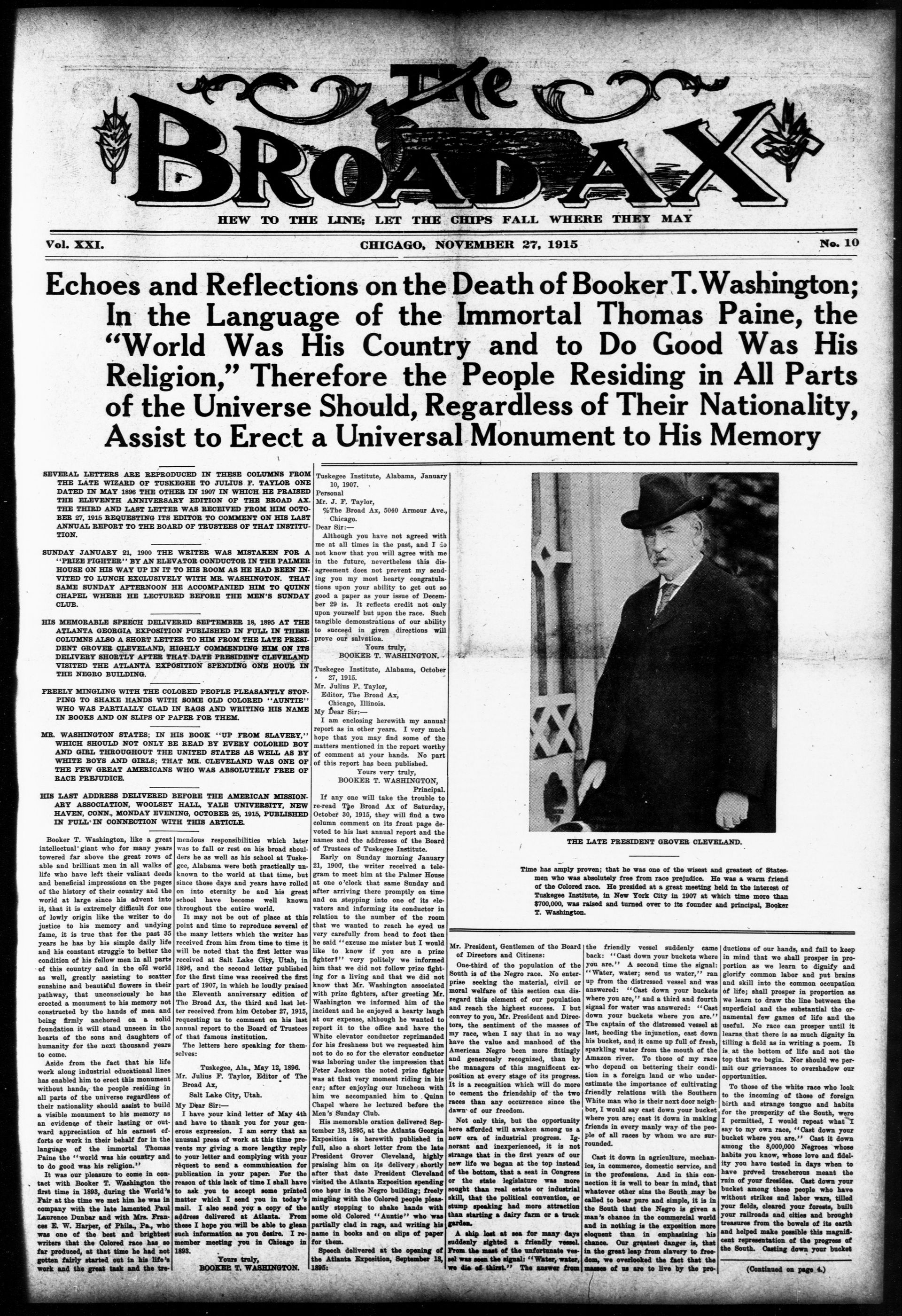
Page text (machine-generated)
Echoes and Reflections on the Death of Booker T.Washington; In the Language of the Immortal Thomas Paine, the "World Was His Country and to Do Good Was His Religion," Therefore the People Residing in All Parts of the Universe Should, Regardless of Their Nationality, Assist to Erect a Universal Monument to His Memory
SEVERAL LETTERS ARE REPRODUCED IN THESE COLUMNS FROM THE LATE WIZARD OF TUSKEGEE TO JULIUS F. TAYLOR ONE DATED IN MAY 1896 THE OTHER IN 1907 IN WHICH HE PRAISED THE ELEVENTH ANNIVERSARY EDITION OF THE BROAD AX. THE THIRD AND LAST LETTER WAS RECEIVED FROM HIM OCTOBER 27, 1915 REQUESTING ITS EDITOR TO COMMENT ON HIS LAST ANNUAL REPORT TO THE BOARD OF TRUSTEES OF THAT INSTITUTION.
SUNDAY JANUARY 21, 1900 THE WRITER WAS MISTAKEN FOR A “PRIZE FIGHTER” BY AN ELEVATOR CONDUCTOR IN THE PALMER HOUSE ON HIS WAY UP IN IT TO HIS ROOM AS HE HAD BEEN INVITED TO LUNCH EXCLUSIVELY WITH MR. WASHINGTON. THAT SAME SUNDAY AFTERNOON HE ACCOMPANIED HIM TO QUINN CHAPEL WHERE HE LECTURED BEFORE THE MEN’S SUNDAY CLUB.
HIS MEMORABLE SPEECH DELIVERED SEPTEMBER 18, 1895 AT THE ATLANTA GEORGIA EXPOSITION PUBLISHED IN FULL IN THESE COLUMNS ALSO A SHORT LETTER TO HIM FROM THE LATE PRESIDENT GROVER CLEVELAND, HIGHLY COMMENDING HIM ON ITS DELIVERY SHORTLY AFTER THAT DATE PRESIDENT CLEVELAND VISITED THE ATLANTA EXPOSITION SPENDING ONE HOUR IN THE NEGRO BUILDING.
FREELY MINGLING WITH THE COLORED PEOPLE PLEASANTLY STOPPING TO SHAKE HANDS WITH SOME OLD COLORED “AUNTIE” WHO WAS PARTIALLY CLAD IN BAGS AND WRITING HIS NAME IN BOOKS AND ON SLIPS OF PAPER FOR THEM.
MR. WASHINGTON STATES; IN HIS BOOK "UP FROM SLAVERY," WHICH SHOULD NOT ONLY BE READ BY EVERY COLORED BOY AND GIRL THROUGHOUT THE UNITED STATES AS WELL AS BY WHITE BOYS AND GIRLS; THAT MR. CLEVELAND WAS ONE OF THE FEW GREAT AMERICANS WHO WAS ABSOLUTELY FREE OF RACE PREJUDICE.
HIS LAST ADDRESS DELIVERED BEFORE THE AMERICAN MISSIONARY ASSOCIATION, WOOLSEY HALL, YALE UNIVERSITY, NEW HAVEN, CONN, MONDAY EVENING, OCTOBER 25, 1915, PUBLISHED IN FULL IN CONNECTION WITH THIS ARTICLE.
Vol. XXI.
Echoes are In the "Wor Relig of the Assis
SEVERAL LETTERS ARE REPRODUCED THE LATE WIZARD OF TUSK DATED IN MAY 1896 THE OTHER THE ELEVENTH ANNIVERSARY THE THIRD AND LAST LETTER BER 27, 1915 REQUESTING ITS ANNUAL REPORT TO THE BOA TION.
SUNDAY JANUARY 21, 1900 THE "PRIZE FIGHTER" BY AN ELE HOUSE ON HIS WAY UP IN IT VITED TO LUNCH EXCLUSIVE SAME SUNDAY AFTERNOON CHAPEL WHERE HE LECTURE CLUB.
HIS MEMORABLE SPEECH DELIVER ATLANTA GEORGIA EXPOSITIVE COLUMNS ALSO A SHORT LETT DENT GROVER CLEVELAND, IN DELIVERY SHORTLY AFTER THE VISITED THE ATLANTA EXP THE NEGRO BUILDING.
FREELY MINGLING WITH THE CO PING TO SHAKE HANDS WITH WHO WAS PARTIALLY CLAD IN BOOKS AND ON SLIPS OF P
MR. WASHINGTON STATES; IN THE WHICH SHOULD NOT ONLY BE AND GIBL THROUGHOUT THE WHITE BOYS AND GIBLS; TH THE FEW GREAT AMERICANS RACE PREJUDICE.
HIS LAST ADDRESS DELIVERED ABRY ASSOCIATION, WOOLSEY HAVEN, CONN., MONDAY EVEN IN FULL IN CONNECTION WITH
Booker T. Washington, like a great intellectual giant who for many years towered far above the great rows of able and brilliant men in all walks of life who have left their valiant deeds and beneficial impressions on the pages of the history of their country and the world at large since his advent into it, that it is extremely difficult for one of lowly origin like the writer to do justice to his memory and undying fame, it is true that for the past 35 years he has by his simple daily life and his constant struggle to better the condition of his fellow men in all parts of this country and in the old world as well, greatly assisting to scatter sunshine and beautiful flowers in their pathway, that unconsciously he has erected a monument to his memory not constructed by the hands of men and being firmly anchored on a solid foundation it will stand unseen in the hearts of the sons and daughters of humanity for the next thousand years to come.
Aside from the fact that his life work along industrial educational lines has enabled him to erect this monument without hands, the people residing in all parts of the universe regardless of their nationality should assist to build a visible monument to his memory as an evidence of their lasting or outward appreciation of his earnest efforts or work in their behalf for in the language of the immortal Thomas Paine the "world was his country and to do good was his religion." It was our pleasure to come in contact with Booker T. Washington the first time in 1893, during the World's Fair at the time we met him he was in company with the late lamented Paul Laurence Dunbar and with Mrs. Frances E. W. Harper, of Phila., Pa., who was one of the best and brightest writers that the Colored race has so far produced, at that time he had not gotten fairly started out in his life's work and the great task and the tre-
mendous responsibilities which later was to fall or rest on his broad shoulders he as well as his school at Tuskegee, Alabama were both practically unknown to the world at that time, but since those days and years have rolled on into eternity he and his great school have become well known throughout the entire world.
It may not be out of place at this point and time to reproduce several of the many letters which the writer has received from him from time to time it will be noted that the first letter was received at Salt Lake City, Utah, in 1896, and the second letter published for the first time was received the first part of 1907, in which he loudly praised the Eleventh anniversary edition of The Broad Ax, the third and last letter received from him October 27, 1915, requesting us to comment on his last annual report to the Board of Trustees of that famous institution.
The letters here speaking for themselves:
Tuskegee, Ala., May 12, 1896.
Mr. Julius F. Taylor, Editor of The Broad Ax,
Salt Lake City, Utah.
My Dear Sir:—
I have your kind letter of May 4th and have to thank you for your generous expression. I am sorry that an unusual press of work at this time prevents my giving a more lengthy reply to your letter and complying with your request to send a communication for publication in your paper. For the reason of this lack of time I shall have to ask you to accept some printed matter which I send you in today's mail. I also send you a copy of the address delivered at Atlanta. From these I hope you will be able to glean such information as you desire. I remember meeting you in Chicago in 1893.
Yours truly,
BOOKER T. WASHINGTON.
CHICAGO, NOVEMBER 27, 1915
Tuskegee Institute, Alabama, January 10, 1907.
Personal
Mr. J. F. Taylor,
%The Broad Ax, 5040 Armour Ave.,
Chicago.
Dear Sir:—
Although you have not agreed with me at all times in the past, and I do not know that you will agree with me in the future, nevertheless this disagreement does not prevent my sending you my most hearty congratulations upon your ability to get out so good a paper as your issue of December 29 is. It reflects credit not only upon yourself but upon the race. Such tangible demonstrations of our ability to succeed in given directions will prove our salvation.
Yours truly,
BOOKER T. WASHINGTON.
Tuskegee Institute, Alabama, October 27, 1915.
Mr. Julius F. Taylor.
I am enclosing herewith my annual report as in other years. I very much hope that you may find some of the matters mentioned in the report worthy of comment at your hands. No part of this report has been published.
If any one will take the trouble to re-read The Broad Ax of Saturday, October 30, 1915, they will find a two column comment on its front page devoted to his last annual report and the names and the addresses of the Board of Trustees of Tuskegee Institute.
Early on Sunday morning January 21, 1900, the writer received a telegram to meet him at the Palmer House at one o'clock that same Sunday and after arriving there promptly on time and on stepping into one of its elevators and informing its conductor in relation to the number of the room that we wanted to reach he eyed us very carefully from head to foot then he said "excuse me mister but I would like to know if you are a prize fighter?" very politely we informed him that we did not follow prize fighting for a living and that we did not know that Mr. Washington associated with prize fighters, after greeting Mr. Washington we informed him of the incident and he enjoyed a hearty laugh at our expense, although he wanted to report it to the office and have the White elevator conductor reprimanded for his freshness but we requested him not to do so for the elevator conductor was laboring under the impression that Peter Jackson the noted prize fighter was at that very moment riding in his car; after enjoying our luncheon with him we accompanied him to Quinn Chapel where he lectured before the Men's Sunday Club.
His memorable oration delivered September 18, 1895, at the Atlanta Georgia Exposition is herew published in full, also a short letter from the late President Grover Cleveland, highly praising him on its delivery, shortly after that date President Cleveland visited the Atlanta Exposition spending one hour in the Negro building; freely mingling with the Colored people pleasantly stopping to shake hands with some old Colored "Auntie" who was partially clad in rags, and writing his name in books and on slips of paper for them.
Speech delivered at the opening of the Atlanta Exposition, September 18, 1895.
Time has amply proven; that he was one of the wisest and greatest of Statesmen who was absolutely free from race prejudice. He was a warm friend of the Colored race. He presided at a great meeting held in the interest of Tuskegee Institute, in New York City in 1907 at which time more than $700,000, was raised and turned over to its founder and principal, Booker T. Washington.
Mr. President, Gentlemen of the Board of Directors and Citizens:
One-third of the population of the South is of the Negro race. No enterprise seeking the material, civil or moral welfare of this section can disregard this element of our population and reach the highest success. I but convey to you, Mr. President and Directors, the sentiment of the masses of my race, when I say that in no way have the value and manhood of the American Negro been more fittingly and generously recognized, than by the managers of this magnificent exposition at every stage of its progress. It is a recognition which will do more to cement the friendship of the two races than any occurrence since the dawn of our freedom.
Not only this, but the opportunity here afforded will awaken among us a new era of industrial progress. Ignorant and inexperienced, it is not strange that in the first years of our new life we began at the top instead of the bottom, that a seat in Congress or the state legislature was more sought than real estate or industrial skill, that the political convention, or stump speaking had more attraction than starting a dairy farm or a truck garden.
A ship lost at sea for many days suddenly sighted a friendly vessel. From the mast of the unfortunate vessel was seen the signal: "Water, water, we die of thirst." The answer from
THE LATE PRESIDENT GROVER CLEVELAND.
the friendly vessel suddenly came back: "Cast down your buckets where you are." A second time the signal: "Water, water; send us water," ran up from the distressed vessel and was answered: "Cast down your buckets where you are," and a third and fourth signal for water was answered: "Cast down your buckets where you are." The captain of the distressed vessel at last, heeding the injunction, cast down his bucket, and it came up full of fresh, sparkling water from the mouth of the Amazon river. To those of my race who depend on bettering their condition in a foreign land or who underestimate the importance of cultivating friendly relations with the Southern White man who is their next door neighbor, I would say cast down your bucket where you are; cast it down in making friends in every manly way of the people of all races by whom we are surrounded.
Cast it down in agriculture, mechanics, in commerce, domestic service, and in the professions. And in this connection it is well to bear in mind, that whatever other sins the South may be called to bear pure and simple, it is in the South that the Negro is given a man's chance in the commercial world and in nothing is the exposition more eloquent than in emphasizing his chance. Our greatest danger is, that in the great leap from slavery to freedom, we overlooked the fact that the masses of us are to live by the pro-
No.10
ductions of our hands, and fail to keep in mind that we shall prosper in proportion as we learn to dignify and glorify common labor and put brains and skill into the common occupation of life; shall prosper in proportion as we learn to draw the line between the superficial and the substantial the ornamental few games of life and the useful. No race can prosper until it learns that there is as much dignity in tilling a field as in writing a poem. It is at the bottom of life and not the top that we begin. Nor should we permit our grievances to overshadow our opportunities.
To those of the white race who look to the incoming of those of foreign birth and strange tongue and habits for the prosperity of the South, were I permitted, I would repeat what I say to my own race, "Cast down your bucket where you are." Cast it down among the 8,000,000 Negroes whose habits you know, whose love and fidelity you have tested in days when to have proved treacherous meant the ruin of your firesides. Cast down your bucket among these people who have without strikes and labor wars, tilled your fields, cleared your forests, built your railroads and cities and brought treasures from the bowels of its earth and helped make possible this magnificent representation of the progress of the South. Casting down your bucket
(Continued on page 4.)
Page TWO
—_—
Ambassadorial indiscretions. —
‘The first rule of an ambassador's of-
fice is that he shal] abstain from all in-
terference in the affairs of the country
in which he is living. A breach of that
rule makes him persona non grata. In
English diplomacy the best known
case is that of Bulwer at Madrid.
Bulwer had, by. order, transmitted to
the Spanish government in 1848 an im-
pertinent dispatch in which the actions
of the Spanish government were
strongly criticised. Bulwer received a
reply stating among other things:
“Your conduct in the execution of
your important mission has been rep-
robated by public opinion in England,
censured by the British press and con-
demned in the British parliament.
Her Catholic majesty’s government
cannot defend it, and that of her
Britannic majesty has not done s0.”
‘Whereupon Bulwer received his pass:
ports with peremptory orders to quit
the country within forty-eight hours.—
‘Manchester Guardian.
When Cheese Was Vulgar.
‘There was a time when cheese was
regarded as too vulgar a diet for well
bred ladies. This belief is referred tc
in Mrs. Gaskell’s “Wives and Daugh-
ters” and also in “The Visits of Eliza-
beth,” where Mrs. Elinor Glyn makes
her heroine write: “I was glad to have
‘a nice piece of cheese. All the time
I was with godmamma I was not al-
lowed to, as it isn't considered proper
for girls.” A correspondent of Notes
and Queries for April 24, 1909, writes:
“When I was living in Jamaica some
years ago a friend of mine who would
now if living be about ninety-five told
me that before he left England as a
young man it was not the custom for
ladies to eat cheese. Though he had
been in England so lately as 1874, he
believed that ladies suffered the same
privation at that time and almost re-
fused to believe me when I told him
that they did not."—London Chroni-
ele.
Mice That Subsiet on Scorpions.
Among the queer forms of animal
life that inhabit Death valley is a
mouse that has acquired such a taste
for scorpions that they form its entire
Dill of fare. The scorpion carries its
formidable armament at the end of
its slender, elongated abdomen in the
shape of an exceedingly venomous
hooied sting. When disturbed it ele-
vates this in the air and goes in
search of its disturber. But it is com-
paratively slow in its motions, while
mice are proverbial for thelr quick-
ness the world over. ‘The mouse learn-
ed many generations ago where the
scorpion carries its weapon, and when
he meets it he leaps at the uplifted
abdomen, takes off the sting at a sin-
gle bite and proceeds to make a meal
of his helpless prey. It is supposed to
be the only animal that relishes scor-
pions.
Di ls eel ie
“She seems to have abandoned her
moral suasion ideas relative to the
training of children.”
“She has.”
“How did it happen?”
“Well. I was largely instrumental in
bringing about the change. You see,
she has no children of ber own, and I
grew weary of her constant preach-
ing and theorizing, so I loaned her our
Willie.”
“Loaned her your boy?”
“Precisely. She was to have bim a
week on her solemn promise to con-
fine herself entirely to moral suasion.”
“Did she keep her promise?”
“She did. but at the expiration of the
week she came to me with tears in
her eyes and pleaded for permission
to whale him just once.”—New York
Mail,
‘The Nebular Hvocthesis.
The nebular hypothesis assumes that
the matter composing our sun and plan-
ets once existed as a vast gaseous neb-
ula, spiral in form, having an incon-
ceivably high temperature and slowly
revolving on an axis passing through
its center of gravity. As the mass
cooled by radiating heat into space a
contraction of volume with accelerated
axial rotation would ensue, in accord-
ance with well known dynamie princi-
ples. The centrifugal force thus rap-
idly Increased would cause the separa-
tion of large masses which would, by
mutual attraction of their own parti-
cles, gradually assume a spherical form
and become planets. By a repetition
of this process planet after planet
would be thrown off and the central
glowing sun would remain.
The Place For Lovers.
Ian MacLaren wrote that Gaelic is
the best of all languages for terms of
endearment, that it has fifty ways of
saying “darling.” The old tongue of
the Isle of Man, a picturesque island
almost equally near to Ireland, Scot-
land and England, is said to be even
better furnished with terms for the
use of lovers, that it has or had ninety-
seven ways of saying “my dear.”
ell eee
‘The “natural language” of the Irish-
man is the Gaelic, the old Celtic tongue,
which is still spoken, to a certain ex-
tent in Ireland, Wales, the Highlands
of Scotland and northern France, where
the remnants of the Celts are still
Qwelling—New York American,
Flat Failure.
“You department store people have
everything. It's a wonder you don't
have a department to supply women
with husbands.”
“We tried that once, but the percent-
‘age of returned goods was too large.”
—Baltimore Sun.
He who has injured thee was either
stronger or weaker, If weaker spare
him, if stranger apare thyself.—Seneca,
~~ “When Kistihg Was Costly.
‘The case of the people against Mur
Mne, heard by the governor of New
Haven colony in council on May day,
11660, indicates the attitude toward un-
Mcensed kissing in those times. It ap-
peared that Jacob Murline and Sara
Tuttle had been caught Kissing each
other. Jacob tried to throw the blame
on Sarab, saying he thought she had
“vith intent let fall ber gloves.” Sa-
rah denied the intent. Jacob then ad.
mitted that he “tooke her by the hand,
and they both sat down upon a chest,
but whether he kyssed her or she
kyssed him he knows not, for he nev:
er thought of it since until Mr. Ray-
mond told him that he had not layde it
to heart as he ought.” The stern gov-
emnor, after duly lecturing the guilty
parties on the enormity of their of:
fense, decreed that “the sentence there
fore concerning them is that they shall
pay either of them a fine of 20 shil-
lings to the colony.”
aid in Hic Own Cola.
In the days of the country inn ane
when traveling overland was done on
horseback or in carriages the eccen-
trie John Randolph of Roanoke was
passing over a road that was new to
him. He stopped at an inn for dinner.
‘The meal being over, the driver hitch-
ed in his team and was ready to re-
sume the journey when the innkeeper,
doubtless with the best intentions, in-
quired of Randolph where he was go-
ing.
“[ve paid my bill, and it's none of
your business,” gruffly answered the
traveler.
About half a mile from the inn Ran.
dolph found that the road forked. He
of course did not know which end to
take, so he sent the driver back to in-
quire of the innkeeper.
“You can tell Mr. Randolph that he
has paid bis bill and that be can take
whichever way he chooses,” returned
the inkeeper.
hie anise Meeabaeeis:
| The four great revolutions of mod-
em times are the English revolution
‘of 1688, which finally put an end to
‘Stuart power in England; the great
‘French revolution of 1789; the French
revolution of July, 1830, which was
followed by several revolutionary out-
‘breaks in other parts of Europe, and
the almost general revolutionary out-
burst of 1818. ‘The July revolution in
France in 1830 was followed by at-
tempts which were unsuccessful in
Germany and Italy, but in Belgium
the present kingdom of the Belgians
was established, and in 1832 the pas-
sage of the English reform bill was
directly attributed to events and proc-
esses of thought set in motion at that
time. The revolutions of 1848 result-
ed in France in the fall of the bour-
geois monarchy and brought about a
political upheaval in Europe from
many causes from Ireland to the Dan-
ube—New York Times.
‘The Conductor's Baton.
According to the investigations of a
Frenchman, the credit of inventing the
conductor's baton belongs to Lully, the
composer, who eventually had cause to
regret his invention. Before he adopt-
ed the baton conductors were in the
habit of pounding on the floor with
thelr feet or clapping their hands to
mark the time. Lully found it weari-
some to keep his foot constantly in mo-
tion and so used a stick to strike the
floor and beat time. He used a pole
six feet long. One day he brought
down the pole with such force that it
struck his foot and made a deep
wound. He paid no attention to the
matter. The wound grew worse and
ultimately caused his death. After
his time conductors tried more and
more to improve the baton, and it was
ultimately brought to its present form,
pea saree Wee i SY)
The Praetorian guard was a select
body of troops instituted by the Em-
Peror Augustus to protect his person
and consisted of ten cohorts, each of
1,000 men, chosen from Italy. ‘They
had peculiar privileges and when they
had served sixteen years were retired
on a pension of about $500. Each
member of the guard had the rank of
a captain in-the regular army. Like
the bodyguard of Louis XI., they were
all gentlemen and formed gradually a
great power, like the Janizaries at Con-
stantinople, and frequently deposed or
elevated the very emperors themselves.
Getting to a Busy Man.
“It’s a mistake to call on a busy man
at his office if you can possibly avoid it”
“That’s right. Go out and ring him
up on the telephone. If you call and
send in your card he hasn't the slight.
est curiosity to know who is trying to
talk to him.”—Washington Star.
Of Course George Would.
Married Friend—My husband says
stock speculation is dangerous {f you
get on the wrong side of the market.
The Fiancee—But George has prom-
ised to be very careful not to get on
the wrong side of the market—Kan-
sas City Star.
nether Wey,
Student—I want some information
about the bronzes. I suppose I had
better write to the keeper? Attend-
ant—Yes, miss, or you might see him
verbally !—London Punch.
Rats’ Teeth.
The teeth of rats and mice have no
roots. As the animal wears them
down by gnawing—which prevents
them from becoming too long—they
keep growing again.
And He Isn't.
‘He—Cupid is always represented asa
poor little urchin without any gar
ments. She—Yes; that is done so that
he will never be out of fashion!”
THE BROAD AX, CHICAGO, NOVEMBER 27, 191
———$—————
ee
Touchy Abaut Their Rank, - ‘Fisetless Fiat Hunters,
No ‘ambassador can be arrested. or| ‘The restlessness of the fiat
sued for debt. However much be may|# & national mystery. Why ds
get credit, or even defraud a trades-| €0 forth inevitably in the spri
man, be cannot be prosecuted. It is| find another flat and to insert his
the same with an ambassador's wife.| ily and furniture therein? As
‘The wife of a Spanish ambassador at| 88 not it is the fiat which he
Turin once had her goods seized by a| Goned five years ago. Since th
creditor, whereupon Spain at once de-| Cccupied four other flats, each
manded the most profuse and abject | improvement over its predecesso
apologies from the Italian govern-| be is now delighted with the ne
ment! which he left in disgust five year
‘We have mentioned the ambassa-|He has spent hundreds of dolls
dor’s wife. She is almost as impor-| arriving at this stage of happines
tant as her husband. Any attack on|be will abandon the flat again
her is reckoned by her husband’s gov-| year and fiit on in a moving v
ernment as being an affront to itself. | large as a small chapel.
She is very susceptible, too, on mat-| We falter, appalled at the ta
ters of predecence, and her suscepti-| discovering the fat dweller's pt
bilities must be regarded. until we consider the strangely s
The wives of the British, the French | restlessness of the sick man wh
and the Austrian ambassadors all left | on one side until he can’t stand |
a ball given by the Princess Palavicini | longer and then, with the assistal
at Rome, and left it before the deper-| his devoted family, is turned ov
ture of the king and queen because| the other side. The change ts
they had not been placed at the royal} lightful relief, although a few
supper table while ladies of lesser po-| before he’couldn't endure to lie
sition had.—Pearson's Weekly. side a minute longer.—George Fi
ae Collier’s Weekly.
Nothina Comina. Sains
‘The teacher was instructing a junio
class in arithmetic when she started
to give the youngsters some mental
exercises.
“Johnny,” said she, turning to «
youngster of ten, “if you went to the
grocery store and bought 10 cents
worth of sugar, 5 cents’ worth of soap,
2% cents’ worth of coffee and 10 cents
worth of crackers and gave the pro
prietor a dollar bill In payment for
these articles how much change would
you get?”
“{ wouldn't get any change, Miss
Mary,” was the rather surprising re
sponse of the boy.
“You wouldn't get any change!” ex
claimed the teacher. “How do you
figure that out?”
“Storekeeper wouldn't give up,” an
swered Johnny. “He would freeze on
to it for the old bill.”"—Philadelphia
‘Telegraph.
‘The Mact Ponuler Sin.
The most popular sin, according to
high authority, is selfishness. At least
this was the conclusion reached by 2
number of prominent public men, in-
cluding lawyers, editors, religious
workers and others in response to an
inquiry of Rev. Dr. Reisner of Grace
Methodist Episcopal church, in New
York, “What is the most popular sin
and the best method to offset it?” Of
all the ignoble traits of humanity
selfishness works the greatest evil. It
finds its root in envy, malice, extrava-
gance and its fruit in sin. If we could
analyze the causes of crime, of poverty,
of wretchedness and of war itself we
would find at the bottom of them all
the evil spirit of a selfish purpose.
The best text for the preacher today
is “Render unto Caesar the things that
are Caesar's and unto God the things
that are God’s.”—Leslie's.
Edward Everett.
Edward Everett was one of the most
purely literary of all American orators.
Among the more eminent scbolars and
statesmen of our land no one has ever
been more deservedly honored for in-
tellectul power, purity of character,
public and private. and for clearness
and perception of judgment than Ever-
ett. To the efforts of Edward Everett
more than to any other one person fs
to be credited the raising of funds
sufficient to purchase the home of
Washington at Mount Vernon. He de-
livered a lecture on the character of
that great man more than a hundred
times and gave the proceeds to the
Ladies’ Mount Vernon association. He
personally placed over $60,000 in the
treasury. It is probable that his ora-
tory won for benevolent purposes at
least $100,000.
Dietearaien.
‘The earliest experiments in the dl-
rection of: photography were made by
‘Wedgwood and Das, but the first pho-
tograph was actually produced in a
camera made by Daguerre and a part-
ner about 1839. In 1840 the first pho-
tograph portrait was made by Pro-
fessor John W. Draper, an American.
Progress was made in the work of
Fox Talbot, 1841, and Scott Archer,
1851, with the glass plate. The gela-
tin bromide dry plate was invented in
1871 by Maddox and greatly improved
by Bennett in 1878. As in many other
inventions, it Is practically Impossible
to lay one’s finger on one man and one
date for the specific “invention” of
photography: it has been so largely a
work of experiment und improvement.
Legal Necessities.
“I understand you have placed your
son in the office of a firm of big law-
yers so that he may learn the really
important things about his profession.”
“Yes, and he is being taught them
too. Why, the very first day he was
put to work drawing up fee bills.”—
Richmond Times-Dispatch.
‘on gat aa Pa Sale.
One often puts too much salt In food
while cooking it. To remove the salt.
place a wet cloth over the top of the
Vessel in which the food is cooking,
and the steam will draw the salt into
the wet cloth.—Good Housekeeping
‘Magazine.
Reserved.
Late comer at lecture (to occupant
of aisle seat)—Is the seat next you re-
served? Occupant—Evidently. It has
not made a sound since I came in—Dal-
las News.
Her Status,
His Wife—Never mind if you have
Jost everything. You still have me.
‘Mr. Bustup—But you're not an asset.
) You're a running expense.—Judge.
| & wise man never loses anything if
he has bimself.—Montaigne.
‘Restless Fiat Hunters. is
‘mThe restlessness of the fat dweller
fs 2 national mystery. Why does he
go forth inevitably in the spring to
find another fiat and to insert bis fam-
fly and furniture therein? As likely
as not it is the fiat which he aban-
doned five years ago. Since then he
occupied four other flats, each a vast
improvement over its predecessor, and
he is now delighted with the new fiat
which he left in disgust five years ago.
He has spent hundreds of dollars in
arriving at this stage of happiness, but
be will abandon the flat again next
year and fiit on in a moving van as
large as a small chapel.
‘We falter, appalled at the task of
discovering the fiat dweller’s purpose
until we consider the strangely similar
restlessness of the sick man who lies
on one side until he can’t stand it any
longer and then, with the assistance of
his devoted family, is turned over on
the other side. The change is a de-
lghtful relief, although a few hours
before he'couldn't endure to lie on that
side a minute longer.—George Finch in
Collier's Weekly.
Dolly Madison.
The history of the first sixteen years
of the White House is practically a
biography of Mrs. Dolly Madison, the
handsome young widow whom the
bachelor James Madison married
long after his friends had regard-
ed him as “confirmed” in his single
Dlessedness. The first eight years she
‘was the official hostess for the elderly
widower, President ‘Thomas Jefferson,
her husband being a member of his
cabinet. Jefferson was rich, and his
Patriotic prodigality assisted her in
uniting the warring social factions of
the “capital in the wilderness,” as
Washington was then called. Mrs.
Madison's experience as hostess for
Jefferson was her social education and
the White House was her training
school, and during Madison's own ad-
ministration his wealth likewise help-
ed greatly in oiling the wheels of the
chariot of state. “Queen Dolly's” beau-
ty, charm and wit were the only
wealth she brought her husband, as
she was in circumstances actually
straitened when Madison married her.
—New York World.
A Kino’s Trick.
King Gustavus IIL of Sweden had
been frequently invited to the little
court of Schwerin. In 1783 he paid a
visit to Germany, and as soon as the
Duchess of Mecklenburg heard of bis
approach she prepared fetes in his
honor. But Gustavus, who disdained
the petty courts of the small rulers,
‘sent two of his attendants—a page
named Peyron and Desvouges, a valet
who had formerly been an actor—to
be entertained by the duchess. ‘The
two personated the king and his min-
ister, Baron Sparre, and sustained the
characters throughout. They accepted
as their due all the homage meant for
their master, danced with the Meck-
Ienburg ladies who were presented to
them, and Peyron went so far as to
ask one of the ladies for her portrait.
Meantime Gustavus was enjoying
himself elsewhere in secret.
‘The Wonderful Toad Bone.
All early writers attribute wonderful
qualities to toads and frogs and the
various parts of their bodies. Pliny
belleved, for instance, that if a toad
was brought into the midst of a mob
or other large and unruly concourse
of people “silence would instantly pre-
vail.” A small bone found in the right
side of toads “of the proper age” was
also believed to have powers over the
various elements. “By throwing this
bone into a vessel of boiling water,”
says Pliny, “it will immediately cool it,
the water refusing to boll again until
the bone has been removed. To find
this bone, expose the dead toad on an
ant hill. When the ants have eaten
her all away except the bones take
each bone separately and drop it into
boiling water. Thus may the won-
drous toad bone be discovered.”
He Didn’t Know Mary Ann.
“Keep moving, keep moving,” urged
a downtown policeman in an effort to
clear the sidewalk.
A countryman appealed to him in de-
spair.
“T've lost my wife,” he said.
“Well, get another one,” replied the
policeman laconically.
‘The countryman shook his head.
“You don't know Mary Ann,” he an-
swered.—Indianapolis News.
ea aie
“A magistrate has unusual domestic
advantages over other men whose
wives are alwiys giving them a piece
of their minds.”
“What advantaze has he?"
“When she starts in to give it he
can bind her over to keep the plece.”—
Baltimore American.
A Common Type.
“Dubwaite is what I would call a
Umited humanitarian.”
“In what respect?”
“The wrongs of humanity in gen-
eral work him up to a frenzy, but the
individual cases merely bore him."—
Birmingham Age-Herald.
Turkish Babies.
‘The Turkish mother loads her child
with amulets as soon as it is born,
and a small bit of mud, steeped in hot
water, prepared by previous charms, fs
stuck on its forehead.
‘As Others See Us.
Little Lemuel—Say, paw, what is the
meaning of ostentation? 'Paw—Osten-
tation, son. is a way the neighbors
hove of showing off.—Indianapolis Star,
Nothing is cheap which is superfiu-
us, for what one does not need is dear
at a penny.—Plutarch.
‘The German title of “von” as a prefix
before a surname was in feudal times
the privilege of the landed barons, who
thus designated, as in other countries
with like prefixes, their ownership of
ands. In modern times, however, the
prefix “von” may be granted as a title
of nobility by the German emperor or
the kings of the various kingdoms of
the empire. It does not carry any
privileges or emoluments with it, It
4s recorded in the heraldry office in
Berlin if granted by the emperor as
kaiser or as king of Prussia, in Munich
if granted by the king of Bavaria,
Letpzig if conferred by the king of
Bexony, etc. The recipient is not given
a diploma with it. It may be, like the
English title of baronet, personal oF
hereditary—that is, it may be grant-
ed to a man for his lifetime only o
may descend to his sons. It cannot be
assumed by any one, but may be earn-
ed by any deserving German subject
‘and conferred as a reward for service
or eminence.—San Francisco Chronicle.
i hii
A historical paper in Lord Montagu’s
collection in London tells of a strange
tragedy “done in Holborn, a little be-
fore Christmas,” several centuries ago:
“A boy seven years old came up into
a gentleman's chamber and prattled to
him and drew his sword and flourished
with it. The gentleman, being in bed,
‘wondered to see the boy toss his blade
so and said: ‘So, good boy, thou hast
done well. Put in the sword.’ The boy
persisting, the gentleman rose and held
him the scabbard, and the rude hand-
ed lad, thinking to sheath the sword,
lustily chopt it into his body. Compa-
ny were called. One offered to strike
the child. ‘Let him alone,’ quoth the
gentleman. ‘God is just. This boy's
father did I kill five years since and
none knew. Now he hath revenged it’
‘And the gentleman died the second
dressing.”
‘The Last of the Ruffs.
In 1762 the rage foy ruffs, such as
are seen on many monumental effigies,
began to decline. A writer in the Lon-
don Chronicle of that year says of gen-
tlemen’s dress, “Their cuffs entirely
cover thelr wrists, and only the edges
of their ruffles are to be seen.” It is
sald that a distaste for ruffs was first
created so far back as 1613, when a
woman named Turner wore them on
her trial for the murder by poison of
Sir Thomas Overbury. ‘The French rev-
olution of 1789 much influenced British
fashion, and the picturesque cocked
hat and ruilles then gave way general-
ly to round hats and small cuffs. The
period of their final disuse cannot be
easily determined, as men of old fasb-
foned or eccentric habits have worn
ruiflled shirt fronts within quite recent
memory.
BGS
A gentleman while hunting near a
river one winter day saw a fox run
out on the ice and make at full speed
for an opening in the ice where the
rushing water of the river could be
plainly seen from the bank, says the
Scotsman. At the edge he stopped,
turned, followed his tracks back to the
bank and then ran some distance down
the stream and sat there. Soon a dog
came crashing out of the woods, bay-
ing finely, hot on the. fox’s trail. Now,
dogs when on a chase of this kind
trust almost entirely to their noses.
This one was no exception. He ran
along the ice, head down, and when he
reached the hole he could not stop, but
plunged into the water and disappear-
ed forever. Then the fox trotted away
with every sign of satisfaction.
B Liahtnina Reault.
During the lessons one afternoon in
a public school a thunderstorm arose,
and, seeking to lessen the fright of the
children, the teacher began an enter-
talning discourse on the wonder of the
elements.
“Jimmy,” said she, finally turning
to a bright little youngster, “can you
tell me what lightuing is?”
“Yes, ma'am,” was the ready re-
joinder of little Jimmy. “Lightning
is streaks of electricity.”
“That's right,” smiled the teacher
encouragingly. “Now, tell me why it
fs that lightning never strikes twice
in the same place.”
“Because,” answered Jimmy quite
easily, “after it hits once the same
place ain't there any wore.”—Phila-
elphia Ledger.
An Ancient Astronomer.
About 500 B. C. Anaxagoras of Tonia
was born. When he “grew up in wis-
dom” he was the first to teach the
course and cause of both solar and
Tunar eclipses and to give his followers
rules whereby they could distinguish
planets from fixed stars. He was pun-
ished for declaring that the sun was
‘not a god.
His Tendency.
“Does your boy show any Itterary
tastes?” asked the visitor on the farm.
“Well,” answered the father as he
gazed down the road at bis son driv-
ing home the lost pig, “he can pen a
stray article now and then.”—Baltl-
more American.
Se ee
“Professor, how would you like to re-
ceive a message from Mars?”
“Prepaid?” asked the professor cau-
tiously.—Loutsville Courier-Journal. -
Gentle Words.
Gentle words, quiet words, are, after
all, the most powerful words. ‘They
are more convincing, more compelling,
more prevailing.—W. Gladden.
Children.
‘There are few things in the world s0
easy as to make a child bappy—and few
things so well worth doing—Youth’s
Companion. .
“Fighters Who See No Battle
Daring a sea fight the engine room
men tend the great engines of a bat-
tleship. with all the care that they
‘would bestow upon the same delicate
yet mighty mechanism in time of
peace, roaming Ustlessly, yet with a
definite purpose, around the engine
room with oll cans in hand bestowing
drops of lubricant here and there as
required. Theirs and the stokers’ is
almost—not quite—the hardest part of
the whole grim drama of a naval bat-
tle, for they are absolutely cut off
from the fight and are only cognizant
of it by the quivering of thelr ship as
the great turrets over thelr heads fire
or as the enemy's shells thud against
the armor or when some stray shot
finds its way through the steel wall
and the bunkers to the boilers. Such
an event blends a whole stokehold in
one frenzied orgy of death—death by
exploding shell and scattering frag-
ments of steel; death by awful wounds
from flying, burning coals or death by
scalding, hissing, blinding steam as
the water tubes burst all around them.
—London Tit-Bits.
cies Wicca,
Perhaps the lengthiest sermons on
record were preached by Isaac Bar-
row. On one occasion when preach-
ing in Westminster abbey, at a time
when visitors were shown around the
place after the sermon for a fee, he
Kept on so long that the authorities
“caused the organ to play till they had
blown him down.” When he preached
on charity before the lord mayor and
aldermen the sermon lasted three and
a half hours, and if the collection
came after that it probably suffered.
‘And, again, when he had arranged to
preach on the words “He that uttereth
a slander is a liar,” precautions were
taken beforehand, and he was prevail-
ed on to preach only the half relating
to slander, leaving out that which had
to do with lies. In this way be man-
aged to finish in one hour and a half.
Very likely some of his hearers wished
that he was not quite so fond of work.
—London Standard.
Turkieh Schoo! Children.
‘Turkish children recite their lessons
all together in the old fashioned
schools, and if you could hear them
you would think that you had gone into
Wonderland with Alice, where “things
wouldn't come straight.” The little
girls go to school in groups, and with
them is always an old servant who
carries all their books on what looks
for all the world like a small clothes
tree. The boys go and come in two
Jong lines attended by their teacher.
They carry their own books and wear
Jong trousers and fezzes exactly like
their fathers. Some of the tiny girls
carry their own little tables and draw-
ing boards. In the gipsy village in
‘Scutari the children learn thelr lessons
by songs in the street. They stand in
a circle with a big girl in the middle,
and they get noisier and noisier the
more interested they grow.—Lindamira
Harbeson in St. Nicholas.
cee ae
Khartum owes its existence to an
oriental form of treachery. When
Khedive Mohammed Ali invaded the
Sudan in 120 he marched triumphant-
ly to Shendi, where his troops were
entertained at a banquet by the sub-
missive natives. But while the khe-
dive’s high officials were seated at the
feast they shared the fate of the
viands and were themselves reduced
to funeral baked meats. Full of fury,
the army fell on Shendi and demol-
ished it. Marching south, the invaders
reached the junction of the Blue Nile
and White Nile. With the conqueror’s
instinct they recognized that the strip
of land, with its few fishermen’s huts
of straw, formed ideal strategical
headquarters, so Khartum finally grew
into the most sensitive part of the Su-
dan organism.
Wire Wound Guns.
One of the chief sources of strength
in big guns lies in the miles and miles
of steel ribbon with which the tube {s
re-enforced. This ribbon, onesix-
teenth of an inch thick and about a
quarter of an inch wide, is wound
around the tube or core of the great
cannon. On a twelve inch gun about
130 miles of the ribbon {s wound, a
weight of fifteeen tons. The ribbon
has a tensile strength of 100 tons per
‘square inch.
His Apology.
‘Mrs. Minks—I don’t want to make a
‘scene, but that man over there is star-
ing at me very offensively. Mr. Minks
—He is, eh? I'll speak to him. Mrs.
‘Minks (a few moments later)—Did he
apologize? Mr. Minks—Y-es. He said
he was looking for bis mother and
thought at first that you were she.
The First Museum.
‘The first museum was part of the
Palace of Alexandria, where learned
men were maintained at the public
cost, just as eminent public servants
were in the Prytaneum at Athens. Its
foundation {s attributed to Ptolemy
Philadelphus about 280 B. C.
‘The Problem. «
“Is this a problem play?”
“Yes, but you can't see the prob-
Jem.”
“Why not?”
“The manager is wrestling with it in
a box office.”"—Birmingham Age-Her-
Motor Orthography.
Caller—I suppose you can spell all
the short words, Bobble? Bobbie—I
can spell a lot of big ones too. I can
even spell words of four cylinders —
Boston Transcript.
‘Not what you do, but how you do it,
‘ts the test of your capacity Studley,
COMING PAN-AMERICAN SCIENTIFIC CONGRESS
To Promote Closer Relations Among American Republics.
The preliminary arrangements for the second pan-American scientific congress, scheduled to meet in Washington for the two weeks beginning Monday, Dec. 27, have been completed. According to official reports from each of the governments now in the hands of Director General John Barrett of the Pan-American union, who is secretary general of the congress, each one of the twenty-one American republics will appoint delegates composed
THE REPRESENTATIVE OF THE UNION OF THE STATE OF NEW YORK.
Photo by American Press Association.
of its leading educators, economists, engineers, international lawyers and experts on mining, agriculture, health, transportation and finance. From present indications it is estimated that there will be in attendance more than 150 of the most representative men of Central and South America, or more than have ever participated in any other international conference held in America. From the United States, aside from its official delegation, there will be present more than 600 special representatives from its universities, colleges and scientific societies and organizations.
The congress will be signalized by an effort to promote closer relations among the American republics along intellectual and educational lines rather than along material and political lines. In the same way that the regular international conferences of the American republics have developed closer political ties, and the recent pan-American financial conference helped to promote better financial understanding, so correspondingly this congress will bring the Americas more intimately together upon a high plane of intellectual, scientific, educational and social progress and intercourse.
WHITLOCK ON VACATION
Minister to Belgium Says His Trip Home Has No Political Significance. Brand Whitlock. American minister to Belgium, who is on leave of absence because of illness, has made it clear that his trip home has no political purpose whatsoever. Its sole object, he said, was to give him a short rest and an opportunity to get back his health,
PETER H.
BRAND WHITLOCK.
which has been undermined by fifteen months of uninterrupted work at high pressure. He has arranged to return to Brussels on Dec. 28, sailing on the Rotterdam from New York city.
Secretary Lansing has announced that the German military authorities in Belgium had expressed to the American minister, Brand Whitlock, their regrets that published reports should have made it appear he was leaving Belgium as a result of objections from the German government.
SHORT AND SHARP.
One word may make a new friend-
ship or break an old one.
It takes quite a clever woman to
look pretty when she isn't.
The hardest task yet will be for
every Mexican general to disband him-
self.
One of the sorry features of office
seeking is that somebody has got to
lose.
Isn't it wonderful how much talking
a woman can do without mentioning
politics?
The man with the black eye is not
out looking for trouble; he is on his
way back.
Cheer up! The peace palace at The Hague has not yet been turned into an arms factory.
One of the curiosities of European nomenclature is that Belgrade is pronounced as it is spelled.
"Old men for counsel, young men for war," says the proverb. But the veterans in Europe seem to be doing double turn.
If you want to lose your popularity, assuming that you have some, just begin to talk about your troubles to every one you meet.
With all the opera stars going into moving pictures, one may soon expect the films to feature the Swiss bell ringers and the monologue artists.
Making ammunition is a line of employment which enables a man to experience the suspense and peril of war without being actually on the firing line
Current Comment.
Another autumn has passed with regrets on the part of Sir Thomas Lipton to note that the ocean is still busy.—Washington Stur.
A national milk day is the latest suggestion. At this rate there will soon be no plain, common, nameless days left.—Philadelphia Ledger.
It is said that the Chinese people prefer a monarchy to a republic, but then it may be safer for them to feel that way about it.—Indianapolis News.
A movement is on foot in New York to make the laws intelligible to men without legal training, but it might help some if they were made intelligible enough to men with legal training to enable two lawyers to agree as to what they mean.—Florida Times-Union.
Train and Track.
Nearly all the locomotives in Asiatic countries are driven by petroleum.
Electric locomotives have been built for a German railroad having heavy grades that draw loads of 230 tons at a speed of forty-two miles an hour.
Boston expects that her new $2,350.000 rapid transit subway, which is an extension of the East Boston tunnel, can be opened for business on Jan. 1 next.
The railway system of Japan is practically a government monopoly, only 265.58 miles of railway being privately owned on March 31, 1915 (the latest date for which statistics are available), out of a total mileage of 5,944.
Flippant Flings.
Half the time it's a question whether the canal is in Panama or Panama in the canal.—New York Telegram.
Congress will fill a long felt want if it makes the Congressional Record of a size suitable for lining pantry shelves.—Cleveland Leader.
Our paternal government publishes all kinds of information except the best method to make red fannel underwear quit its tickling.—Chicago News.
Fireproof clothing is now being advocated by some of the fire prevention champions. Is the time coming when Americans will have nothing to burn but money?—New Orleans Times-Picayune.
Pen and Brush.
H. T. Webster, the cartoonist, is only thirty years of age.
Robert W. Chambers was a draftsman and a painter before he was an author. Indeed, Mr. Chambers studied to become an illustrator.
Edna Ferber happened to write a story when she was recovering from a nervous breakdown due to overwork as a news reporter. This story sold, and her career as a fictionist was started.
What is claimed to be the finest portrait of President Wilson is one that has been painted by Miss Marion Swinton, who did the work without a single sitting from the nation's head.
Short Stories.
In Sweden a mile is 11,690 yards.
Africa is three times larger than Europe.
The world's population uses 2,500,000 glass eyes a year.
"Rote-shild" was the original pronunciation of the name Rothschild.
There are 330,000 Indians in the United States. About one-third of these are Christians.
The extent of animal life in central Siberia may be imagined when it is considered that one merchant has been known to buy as many as 1,000,000 squirrel skins in a single season.
THE BROAD AX. CHICAGO. NOVEMBER 27, 1915.
DAMES AND DAUGHTERS.
Mrs. Maria di Gavini of New York is the mother of nineteen children. When Lady French was at school she won a prize in a knitting competition. The prize was a set of silver knitting needles, which are still in her possession. Mlle. Yvette Guilbert is a great tea drinker. She drinks tea with and after every meal and without sugar or milk. Often before going on the stage and nearly always after she comes off she has a cup of her favorite beverage. Mrs. Emma S. Fry, who as Emma Sheridan Fry was leading lady for the late Richard Mansfield, gives much of her time gratuitously as dramatic director of the Educational Dramatic league of New York. She helps to train amateurs and stage their productions.
Mrs. Bayard Taylor, widow of the poet, novelist and one time American minister to Germany, is a native of Germany and has translated most of her husband's works into German. Because she disliked the American attitude toward Germany she recently left her New York home for her native land.
The Royal Box.
King George of England plays an excellent game of billiards, a favorite pastime of his.
Vienna schnitzel is a favorite dish of the emperor of Austria. The emperor is also fond of calves' tongues in red wine.
King Victor Emmanuel always carries his camera on his frequent trips along the fighting line. He is the only Italian whose war pictures have not to be submitted to the censor.
King Ferdinand of Bulgaria is noted as the handsomest man now upon a European throne. He is profuse in decorating his person with all the insignia of the many orders that have been conferred upon him.
PITH AND POINT.
It is in the movies that actions speak louder than words.
People who are always looking for trouble miss a lot of joy rides.
Did you ever notice that good winners are as rare as good losers?
Wonder how many people mean it when they say, "I'm glad to meet you."
If a man is smart he ought to be the first to find it out, then say nothing about it.
It is becoming more and more apparent that the Panama canal is built on a sliding scale.
It is not always the man who makes the most money who is best off at the end of the year.
You will be happier if you spend less time thinking about those you hate and more about those you love.
One comfort is left the man who begins at the bottom. He can sink no lower—unless the bottom falls out.
When some people get out of debt they feel so happy about it they immediately plunge right back in again.
The war is becoming so complicated that there is a growing suspicion that even the experts are not following it so closely as they pretend to be.
One of the impossible things to think out is as to what the great thinkers on the other side of the Atlantic think of themselves at this blessed moment.
Echoes of the War.
Over in Europe they're getting crowded for ground to fight on.-Atlanta Constitution.
The scarcest thing in war is glory, and the present conflict seems to have even a smaller supply than is common.-Detroit News.
When Europe recovers consciousness it will ask, "Where am I?" and nobody will be able to answer the conundrum.-Chicago News.
It is difficult to realize that this same war was going on away back in the days when "It's a Long Way to Tipperary" was popular.-Washington Star.
Recent Inventions.
Either a solid stream at right angles or a cone of water toward the rear can be thrown by a new adjustable fire hose nozzle. Curved bars of various lengths have been patented to suspend pictures at any desired height in a room from a picture molding without the use of wire or cord. Concrete piles have been patented with pipes running through their centers through which water can be pumped to wash away the earth and permit them to sink under their own weight.
Fashion Frills.
Scientists have explained everything but feminine fashions. - St. Louis Globe-Democrat.
The styles of 1830 are decreed for 1915. Yet Fashion claims she is up to date.—Detroit News.
And just think how much valuable time the poor girls have to spend in sewing fur round the tops of their shoes!—Indianapolis News.
What do you think of the short skirted, white stockinged, three story heeled, white toed girl?—Baltimore American.
RAPID CHANGES IN CABINETS
Coalition In France and Reversals In Greece.
THE cabinets of certain European nations either actually engaged in the great war or tottering on the verge of entering it have undergone some rapid and remarkable changes. In the case of France, Briand, a strong man, has recently come into power as premier. In the case of Greece, Venzelos, a strong man, has gone out of power, but he still retains much strength, though out of office. He is, if not a power behind the throne, still a power nevertheless.
For the first time in the history of the French republic there is a coalition ministry of all the opposing parties and factions. The government of Aristide Briand, which came into power on the collapse recently of Viviani's cabinet, is a close imitation of the recent innovation of a British coalition cabinet of Liberals and Conservatives. There are many political parties in France, however, and the new government contains many divergent elements.
The French ministerial readjustment has brought to the surface of political France the most distinguished statesmen ever assembled in a cabinet of the third republic. There are De Freycinet, who has been seven times premier, besides holding a score of portfolios; Ribot, also a former premier and a distinguished foreign and finance minister; Bourgeois, another former premier, who has also held as many portfolios as De Freycinet; Jules Cambon, who has distinguished himself as ambassador at Washington, Madrid and Berlin, the brother of Paul Cambon, now ambassador at the court of
M. B.
ARISTIDE BRIAND AND ELETHERIOS VENI-ZELOS.
St. James; two other former premiers, Doumergue and Dr. Emile Combes, the latter of whom, from 1902 to 1905, put through the measures of republican defense made necessary by the Dreyfus case and devised by the cabinet of his predecessor, the late M. Waldeck-Rousseau, and Jules Guesde, the well known parliamentary Socialist, who was a member without a portfolio in the late cabinet. Finally, General Gallieni, the defender of Paris a year ago, and Admiral Lacaze are both men who stand high in their respective professions.
Aristide Briand, the new premier, has twice before filled that office. He was the first Socialist premier when appointed in 1900 to succeed M. Clemenceau. The latter had to deal with the strikes of organized labor, but his methods had not been effective. With M. Briand, a Socialist, premier and minister of the interior, a great strike was organized. In 1910 all the railway employees were called out. M. Briand was equal to the occasion. He ordered the strikers to join the colors for three weeks' training and assigned them as soldiers to run the trains. Since that time he has broken with the organized Socialist party.
After the election of M. Poincare in January, 1913, M. Briand formed the first cabinet. Since then, whether in or out of office—he has meanwhile been minister of justice—he has been the president's most energetic and faithful lieutenant.
The Greek cabinet has been turning such a lot of political somersaults and changing so quickly that Venezelos, strong as he is, has been unable to commit Greece to any settled policy. When he recently overturned the Zalmis cabinet it was thought that he would return to power, but instead Stephanos Skouloudis was invited by King Constantine to become premier. If Venezelos returns to power the entente nations are confident that Greece will at once join the allies. Venezelos has recently been quoted as saying that his resumption of the premiership would be followed by war upon Bulgaria.
SIRES AND SONS.
Justice J. P. Clark of the New York supreme court sails his own boat, the Babette. When his arduous duties give him a few spare hours you will be sure to find him on the water.
Samuel S. Fleisher, a Philadelphia manufacturer, is also a practical philanthropist. He organized an art club where 200 poor boys study each year without charge.
The oldest soldier of the French army, M. Sarugue, ex-mayor of Auxerre, who is seventy-seven, is now serving as a corporal in the first line near Arras. He was a lieutenant of engineers in the war of 1870.
Herman Sielcken, the coffee merchant, came to America a poor boy. Although he lives in New York, he has a wonderful private park near Baden-Baden, Germany—four villas for guests, forty-six gardeners caring for the 168 varieties of roses that beautify the park.
Julius Bittner, to whom the Gustav Mahler foundation prize has been awarded, is a well known Vienna composer, known particularly in Germany and Austria for his operas "Der Muskant" and "Der Bergsee." The prize for which a fund of $11,000 was set apart in the name of the lamented composer-conductor, was designed to provide financial assistance for creative musicians.
Dress Hints.
In sewing on a button, if you will put the knot of the thread on the right side of the article under the button, it will stay on much longer.
If your petticoat or princess slip is so thin that the form shows when standing in the light, instead of wearing an extra petticoat, line the front gore with some heavy material.
When ribbons are removed from lingerie, if one has a medium sized malling tube at hand and rolls them on it, it keeps them in perfect condition and looking newer than to press them each time.
Science Siftings.
Recent experiments in India indicate that the light emitted by fireles is similar in many ways to X rays. A seismograph invented by a Japanese scientist registers the velocity of all earthquakes two hundredfold. Single nickel salts cannot be used alone for plating without the addition of a conducting salt, such as sulphate of ammonia. One seven-hundredth part of a grain of radium will thoroughly fertilize a ton of soil and cause grain to grow with great rapidity.
English Etchings.
It is not lawful for a man to leave a British ship or even a share in one as a legacy to a foreigner.
A hundred years ago paper was so dear in England that butchers used to give their customers the meat wrapped up in a large vegetable leaf.
Swans, according to the law of England, are crown property. Whoever steals or destroys swans' eggs forfeits 5 shillings for every egg, and whoever steals a marked swan of the crown commits felony.
Facts From France.
French people eat 580 pounds of bread a head per year. France is the best cultivated country in the whole of Europe. The cost of living in Grenoble, France, has nearly doubled within the last six months. Paris plans to obtain fully 300,000 electrical horsepower by damming the river Rhone at a point 300 miles from the city.
BRIGHT BRIEFS.
Anything is wrong that is almost right.
It's the little troubles that wear away a man's conceit.
The man who knows it all is never too full for utterance.
The rooster can give the man pointers as to the proper time to stop crowing.
Good jobs always seem to seek the men who have jobs rather than the jobless.
Some European statesmen might remark that it isn't only republics that are ungrateful.
Rome wasn't built in a day, and Mexico wasn't subdued in a week, or at least hasn't been.
Just for a change, try sometimes to gossip about yourselves instead of about your neighbors.
Despite the rapid growth of their business, no phonograph company is advertising, "All records broken!
A federal court has decided that talcum powder is a cosmetic. Must we find something else for our innocent babies?
By the time a man finds out that he doesn't amount to anything and never will he is too old to care anything about it.
The assistant treasurer of the United States is credited with saying that the average dollar bill lasts about three weeks, but isn't that a misprint for minutes?
---
PAGE THREE
FIRE WALKER OF SOUTH SEA ISLANDS
Interesting Exhibit In American Museum of Natural History.
The American Museum of Natural History of New York city has completed the installation in the south sea islands hall of three large groups depicting Tahitian daily life and ceremonies.
One group illustrates a Tahitian firemaker and cocanut grater, a kava brewer and roofmaker, and a third a Tahitian firewalker, the most prominent of the groups, which tells the story in detail of the previously unexplained problem of how these natives in their ceremonies walk over redhot stones. The figure itself is a cast
Photo courtesy of American Museum of Natural History.
TAHITIAN FIRE WALKER.
made in the museum from a real Tahitian fire walker during his stay in New York and represents a priest conducting this most interesting ceremony, known as "umuuti." In preparing for this performance the natives dig a large shallow trench about 9 by 21 feet and about two feet deep. Two layers of wood are placed at the bottom of the pit and set on fire through a little side opening. On top of the wood large rocks of porous basalt are heaped up in several layers. The fire is maintained for a long time so that the lowest layers of stone become visibly hot and occasionally split with loud reports.
The priest proceeds to walk directly over the central ridge of the pile of rocks, followed by his disciples. The performers walk back and forth several times in their bare feet without injury, which naturally impresses the native spectators with the miraculous nature of the fire walk. The physical explanation is that the porous basalt rocks are exceedingly poor conductors of heat, so that while the lower surface may be of a forbidding temperature the upper surface is not too hot for a tough soled native to walk upon.
HEAD OF SERVIAN FORCES.
General Poutnik Is an Invalid, but Great Soldier Nevertheless.
General Radomir Poutnik, chief of the general staff of the Servian army, is a veteran soldier. He won high honors in the Balkan war, his name frequently appearing in the dispatches for
GENERAL RADOMIR POUTNIK
bravery. He is sixty-eight years old and suffers from acute asthma, but fitness has not impaired the tremendous mental energy of this master soldier.
Under him the Servian army has been putting up a wonderful fight against Austro-German and Bulgarian forces. Even the women are fighting in Servia today, and over a thousand are with the army, and more are being organised. The women in the ranks are said to fight with all the courage of men.
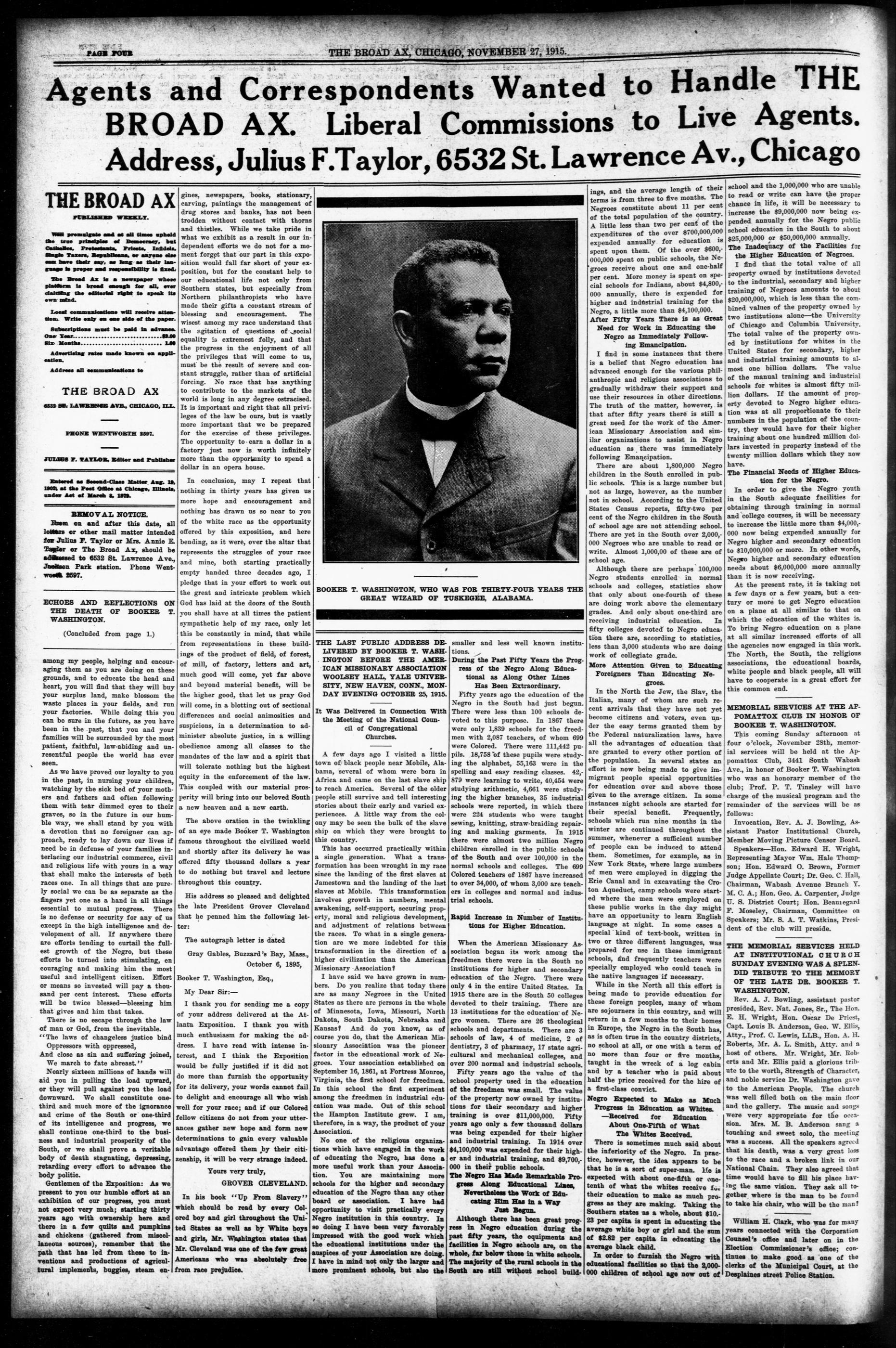
Agents and Correspondents Wanted to Handle THE BROAD AX. Liberal Commissions to Live Agents. Address, Julius F.Taylor, 6532 St. Lawrence Av., Chicago
THE BROAD AX
PUBLISHED WEEKLY.
Will promulgate and at all times uphold the true principles of Democracy, but Cattina Rose, Protestants, Priests, Inidels, Single Taxes, Republicans, or anyone else can have their say, as long as their language is proper and responsibility is fixed.
The Broad Ax is a newspaper whose platform is broad enough for all, ever claiming the editorial right to speak its own mind.
Local communications will receive attention. Write only on one side of the paper.
Subscriptions must be paid in advance. One Year. $3.00
Six Months. 1.00
Advertising rates made known on application.
Address all communications to
6532 SR. LAWRENCE AVE., CHICAGO, ILL
PHONE WENTWORTH 2597.
JULIUS F. TAYLOR, Editor and Publisher
Entered as Second-Class Matter Aug. 19,
1902, at the Post Office at Chicago, Illinois,
under Act of March 8, 1879.
REMOVAL NOTICE.
From on and after this date, all letters or other mail matter intended for Julius F. Taylor or Mrs. Annie E. Taylor or The Broad Ax, should be addressed to 6532 St. Lawrence Ave. Jackson Park station. Phone Wentworth 2597.
ECHOES AND REFLECTIONS ON
THE DEATH OF BOOKER T
WASHINGTON.
(Concluded from page 1.)
among my people, helping and encouraging them as you are doing on these grounds, and to educate the head and heart, you will find that they will buy your surplus land, make blossom the waste places in your fields, and run your factories. While doing this you can be sure in the future, as you have been in the past, that you and your families will be surrounded by the most patient, faithful, law-abiding and unresentful people the world has ever seen.
As we have proved our loyalty to you in the past, in nursing your children, watching by the sick bed of your mothers and fathers and often following them with tear dimmed eyes to their graves, so in the future in our humble way, we shall stand by you with a devotion that no foreigner can approach, ready to lay down our lives if need be in defense of your families interlacing our industrial commerce, civil and religious life with yours in a way that shall make the interests of both races one. In all things that are purely social we can be as as separate as the fingers yet one as a hand in all things essential to mutual progress. There is no defense or security for any of us except in the high intelligence and development of all. If anywhere there are efforts tending to curtail the fullest growth of the Negro, but these efforts be turned into stimulating, en courageing and making him the most useful and intelligent citizen. Effort or means so invested will pay a thousand per cent interest. These efforts will be twice blessed—blessing him that gives and him that takes.
There is no escape through the law of man or God, from the inevitable.
"The laws of changeless justice bind Oppressors with oppressed, And close as sin and suffering joined, We march to fate abreast."
Nearly sixteen millions of hands will aid you in pulling the load upward, or they will pull against you the load downward. We shall constitute one-third and much more of the ignorance and crime of the South or one-third of its intelligence and progress, we shall continue one-third to the business and industrial prosperity of the South, or we shall prove a veritable body of death stagnating, depressing, retarding every effort to advance the body politic.
Gentlemen of the Exposition: As we present to you our humble effort at an exhibition of our progress, you must not expect very much; starting thirty years ago with ownership here and there in a few quilts and pumpkins and chickens (gathered from miscellaneous sources), remember that the path that has led from these to inventions and productions of agricultural implements, buggies, steam en-
gines, newspapers, books, stationary, carving, paintings the management of drug stores and banks, has not been trodden without contact with thorns and thistles. While we take pride in what we exhibit as a result in our independent efforts we do not for a moment forget that our part in this exposition would fall far short of your exposition, but for the constant help to our educational life not only from Southern states, but especially from Northern philanthropists who have made their gifts a constant stream of blessing and encouragement. The wisest among my race understand that the agitation of questions of social equality is extremest folly, and that the progress in the enjoyment of all the privileges that will come to us, must be the result of severe and constant struggle, rather than of artificial forcing. No race that has anything to contribute to the markets of the world is long in any degree ostracised. It is important and right that all privileges of the law be ours, but is vastly more important that we be prepared for the exercise of these privileges. The opportunity to earn a dollar in a factory just now is worth infinitely more than the opportunity to spend a dollar in an opera house.
In conclusion, may I repeat that nothing in thirty years has given us more hope and encouragement and nothing has drawn us so near to you of the white race as the opportunity offered by this exposition, and here bending, as it were, over the altar that represents the struggles of your race and mine, both starting practically empty handed three decades ago, I pledge that in your effort to work out the great and intricate problem which God has laid at the doors of the South you shall have at all times the patient sympathetic help of my race, only let this be constantly in mind, that while from representations in these buildings of the product of field, of forest, of mill, of factory, letters and art, much good will come, yet far above and beyond material benefit, will be the higher good, that let us pray God will come, in a blotting out of sectional differences and social animosities and suspicions, in a determination to administer absolute justice, in a willing obedience among all classes to the mandates of the law and a spirit that will tolerate nothing but the highest equity in the enforcement of the law. This coupled with our material prosperity will bring into our beloved South a new heaven and a new earth.
The above oration in the twinkling of an eye made Booker T. Washington famous throughout the civilized world and shortly after its delivery he was offered fifty thousand dollars a year to do nothing but travel and lecture throughout this country.
His address so pleased and delighted the late President Grover Cleveland that he penned him the following letter:
The autograph letter is dated
Gray Gables, Buzzard's Bay, Mass.,
October 6, 1895,
Booker T. Washington, Esq.,
My Dear Sir:—
I thank you for sending me a copy of your address delivered at the Atlanta Exposition. I thank you with much enthusiasm for making the address. I have read with intense interest, and I think the Exposition would be fully justified if it did not do more than furnish the opportunity for its delivery, your words cannot fail to delight and encourage all who wish well for your race; and if our Colored fellow citizens do not from your utterances gather new hope and form new determinations to gain every valuable advantage offered them by their citizenship, it will be very strange indeed.
Yours very truly.
GROVER CLEVELAND.
In his book "Up From Slavery" which should be read by every Colored boy and girl throughout the United States as well as by White boys and girls, Mr. Washington states that Mr. Cleveland was one of the few great Americans who was absolutely free from race prejudice.
THE BROAD AX, CHICAGO, NOVEMBER 27, 1915
BOOKER T. WASHINGTON, WHO WAS FOR THIRTY-FOUR YEARS THE
GREAT WIZARD OF TUSKEGEE, ALABAMA.
THE LAST PUILLC ADDRESS DELIVERED BY BOOKER T. WASHINGTON BEFORE THE AMERICAN MISSIONARY ASSOCIATION WOOLSEY HALL, YALE UNIVERSITY, NEW HAVEN, CONN., MONDAY EVENING OCTOBER 25, 1915
It Was Delivered in Connection With the Meeting of the National Council of Congressional
A few days ago I visited a little town of black people near Mobile, Alabama, several of whom were born in Africa and came on the last slave ship to reach America. Several of the older people still survive and tell interesting stories about their early and varied experiences. A little way from the colony may be seen the bulk of the slave ship on which they were brought to this country.
This has occurred practically within a single generation. What a transformation has been wrought in my race since the landing of the first slaves at Jamestown and the landing of the last slaves at Mobile. This transformation involves growth in numbers, mental awakening, self-support, securing property, moral and religious development, and adjustment of relations between the races. To what in a single generation are we more indebted for this transformation in the direction of a higher civilization than the American Missionary Association?
I have said we have grown in numbers. Do you realize that today there are as many Negroes in the United States as there are persons in the whole of Minnesota, Iowa, Missouri, North Dakota, South Dakota, Nebraska and Kansas? And do you know, as of course you do, that the American Missionary Association was the pioneer factor in the educational work of Negroes. Your association established on September 16, 1861, at Fortress Monroe, Virginia, the first school for freedmen. In this school the first experiment among the freedmen in industrial education was made. Out of this school the Hampton Institute grew. I am, therefore, in a way, the product of your Association.
No one of the religious organizations which have engaged in the work of educating the Negro, has done a more useful work than your Association. You are maintaining more schools for the higher and secondary education of the Negro than any other board or association. I have had opportunity to visit practically every Negro institution in this country. In so doing I have been very favorably impressed with the good work which the educational institutions under the auspices of your Association are doing. I have in mind not only the larger and more prominent schools, but also the
smaller and less well known institutions.
During the Past Fifty Years the Progress of the Negro Along Educational so Algo. Other Lives.
Fifty years ago the education of the Negro in the South had just begun. There were less than 100 schools devoted to this purpose. In 1867 there were only 1,839 schools for the freedmen with 2,087 teachers, of whom 699 were Colored. There were 111,442 pupils. 18,758 of these pupils were studying the alphabet, 55,163 were in the spelling and easy reading classes. 42,879 were learning to write, 40,454 were studying arithmetic, 4,661 were studying the higher branches, 35 industrial schools were reported, in which there were 224 students who were taught sewing, knitting, straw-braiding repairing and making garments. In 1915 there were almost two million Negro children enrolled in the public schools of the South and over 100,000 in the normal schools and colleges. The 699 Colored teachers of 1867 have increased to over 34,000, of whom 3,000 are teachers in colleges and normal and industrial schools.
Rapid Increase in Number of Institutions for Higher Education.
When the American Missionary Association began its work among the freedmen there were in the South no institutions for higher and secondary education of the Negro. There were only 4 in the entire United States. In 1915 there are in the South 50 colleges devoted to their training. There are 13 institutions for the education of Negro women. There are 26 theological schools and departments. There are 3 schools of law, 4 of medicine, 2 of dentistry, 3 of pharmacy, 17 state agricultural and mechanical colleges, and over 200 normal and industrial schools. Fifty years ago the value of the school property used in the education of the freedmen was small. The value of the property now owned by institutions for their secondary and higher training is over $11,000,000. Fifty years ago only a few thousand dollars was being expended for their higher and industrial training. In 1914 over $4,100,000 was expended for their higher and industrial training, and $9,700,000 in their public schools.
Although there has been great progress in Negro education during the past fifty years, the equipments and facilities in Negro schools are, on the whole, far below those in white schools. The majority of the rural schools in the South are still without school build-
ings, and the average length of their terms is from three to five months. The Negroes constitute about 11 per cent of the total population of the country. A little less than two per cent of the expenditures of the over $700,000,000 expended annually for education is spent upon them. Of the over $600,000,000 spent on public schools, the Negroes receive about one and one-half per cent. More money is spent on special schools for Indians, about $4,800,000 annually, there is expended for higher and industrial training for the Negro, a little more than $4,100,000. After Fifty Years There is as Great
I find in some instances that there is a belief that Negro education has advanced enough for the various philanthropic and religious associations to gradually withdraw their support and use their resources in other directions. The truth of the matter, however, is that after fifty years there is still a great need for the work of the American Missionary Association and similar organizations to assist in Negro education as there was immediately following Emancipation.
There are about 1,800,000 Negro children in the South enrolled in public schools. This is a large number but not as large, however, as the number not in school. According to the United States Census reports, fifty-two per cent of the Negro children in the South of school age are not attending school. There are yet in the South over 2,000,000 Negroes who are unable to read or write. Almost 1,000,000 of these are of school age.
Although there are perhaps 100,000 Negro students enrolled in normal schools and colleges, statistics show that only about one-fourth of these are doing work above the elementary grades. And only about one-third are receiving industrial education. In fifty colleges devoted to Negro education there are, according to statistics, less than 3,000 students who are doing work of collegiate grade.
More Attention Given to Educating Foreigners Than Educating Negroes.
In the North the Jew, the Slav, the Italian, many of whom are such recent arrivals that they have not yet become citizens and voters, even under the easy terms granted them by the Federal naturalization laws, have all the advantages of education that are granted to every other portion of the population. In several states an effort is now being made to give immigrant people special opportunities for education over and above those given to the average citizen. In some instances night schools are started for their special benefit. Frequently, schools which run nine months in the winter are continued throughout the summer, whenever a sufficient number of people can be induced to attend them. Sometimes, for example, as in New York State, where large numbers of men were employed in digging the Erie Canal and in excavating the Croton Aqueduct, camp schools were started where the men were employed on these public works in the day might have an opportunity to learn English language at night. In some cases a special kind of text-book, written in two or three different languages, was prepared for use in these immigrant schools, and frequently teachers were specially employed who could teach in the native languages if necessary.
While in the North all this effort is being made to provide education for these foreign peoples, many of whom are sojourners in this country, and will return in a few months to their homes in Europe, the Negro in the South has, as is often true in the country districts, no school at all, or one with a term of no more than four or five months, taught in the wreck of a log cabin and by a teacher who is paid about half the price received for the hire of a first-class convict.
Negro Expected to Make as Much Progress in Education as Whites.
There is sometimes much said about the inferiority of the Negro. In practice, however, the idea appears to be that he is a sort of super-man. He is expected with about one-fifth or one-tenth of what the whites receive for their education to make as much progress as they are making. Taking the Southern states as a whole, about $10.23 per capita is spent in educating the average white boy or girl and the sum of $2.82 per capita in educating the average black child.
In order to furnish the Negro with educational facilities so that the 2,000,000 children of school are now out of
school and the 1,000,000 who are unable to read or write can have the proper chance in life, it will be necessary to increase the $9,000,000 now being expended annually for the Negro public school education in the South to about $25,000,000 or $50,000,000 annually. The Indemnity of the Facilities for
The Inadequacy of the Facilities for the Higher Education of Negroes.
I find that the total value of all property owned by institutions devoted to the industrial, secondary and higher training of Negroes amounts to about $20,000,000, which is less than the combined values of the property owned by two institutions alone—the University of Chicago and Columbia University. The total value of the property owned by institutions for whites in the United States for secondary, higher and industrial training amounts to almost one billion dollars. The value of the manual training and industrial schools for whites is almost fifty million dollars. If the amount of property devoted to Negro higher education was at all proportionate to their numbers in the population of the country, they would have for their higher training about one hundred million dollars invested in property instead of the twenty million dollars which they now have.
The Financial Needs of Higher Education for the Negro
In order to give the Negro youth in the South adequate facilities for obtaining through training in normal and college courses, it will be necessary to increase the little more than $4,000,000 now being expended annually for Negro higher and secondary education to $10,000,000 or more. In other words, Negro higher and secondary education needs about $6,000,000 more annually than it is now receiving.
At the present rate, it is taking not a few days or a few years, but a century or more to get Negro education on a plane at all similar to that on which the education of the whites is. To bring Negro education on a plane at all similar increased efforts of all the agencies now engaged in this work. The North, the South, the religious associations, the educational boards, white people and black people, all will have to cooperate in a great effort for this common end.
MEMORIAL SERVICES AT THE AP-
POMATTOX CLUB IN HONOR OF
BOOKER T. WASHINGTON.
This coming Sunday afternoon at four o'clock, November 28th, memorial services will be held at the Appomattox Club, 3441 South Wabash Ave., in honor of Booker T. Washington who was an honorary member of the club; Prof. P. T. Tinsley will have charge of the musical program and the remainder of the services will be as follows:
Invocation, Rev. A. J. Bowling, Assistant Pastor Institutional Church, Member Moving Picture Censor Board, Speakers—Hon. Edward H. Wright, Representing Mayor Wm. Hale Thompson; Hon. Edward O. Brown, Former Judge Appellate Court; Dr. Geo. C. Hall, Chairman, Wabash Avenue Branch Y. M. C. A.; Hon. Geo. A. Carpenter, Judge U. S. District Court; Hon. Beauregard F. Moseley, Chairman, Committee on Speakers; Mr. S. A. T. Watkins, President of the club will preside.
THE MEMORIAL SERVICES HELD
AT INSTITUTIONAL CHURCH
SUNDAY EVENING WAS A SPLEN-
DID TRIBUTE TO THE MEMORY
OF THE LATE DR. BOOKER T.
WASHINGTON.
Rev. A. J. Bowling, assistant pastor presided, Rev. Nat. Jones, Sr., The Hon. E. H. Wright, Hon. Oscar De Priest, Capt. Louis B. Anderson, Geo. W. Ellis, Atty, Prof. C. Lewis, LLB., Hon. A. H. Roberts, Mr. A. L. Smith, Atty, and a host of others. Mr. Wright, Mr. Roberts and Mr. Ellis paid a glorious tribute to the worth, Strength of Character, and noble service Dr. Washington gave to the American People. The church was well filled both on the main floor and the gallery. The music and songs were very appropriate for the occasion. Mrs. M. B. Anderson sang a touching and sweet solo, the meeting was a success. All the speakers agreed that his death, was a very great loss to the race and a broken link in our National Chain. They also agreed that time would have to fill his place having the same vision. They ask all together where is the man to be found to take his chair, who will be the man!
William H. Clark, who was for many years connected with the Corporation Counsel's office and later on in the Election Commissioner's office; continues to make good as one of the clerks of the Municipal Court, at the Desplaines street Police Station.
Health, Cleanliness Proper Living Sanitation, Etc.
3300 So.State St.
DROPSY.
Dropsy is not a disease; it is only a manifestation of a disease. It is a sign that advertises the fact that something is wrong somewhere in the body. It is analogous to pain which is also a symptom. Pain is a warning to the patient and so is the symptom dropsy. Pain calls the patient's attention to the fact that the function of the body is disturbed. Dropsy also calls the attention of the patient and even other observers to the fact that the physiology of the human economy is not normal.
The patient who is careful will heed these two signals. Dropsy often disturbs a patient's lethergy more than other symptoms. Most of the people know something of the fatal results of dropsal diseases; hence their activities when they observe this signal. Some obtuse individuals do not even heed the symptom of dropsy until the more distressing symptoms which follow intervene. Then they are often too late for cure.
Before the signal of dropsy the patient probably has had other symptoms which have not been heeded. It often happens that the symptom dropsy is unheeded until a fatal issue impends, when the patient is beyond medical aid.
The two organs whose condition of disease more frequently cause the symptom dropsy are the heart and kidney. Disease of the liver is less often responsible for dropsy. Heart and kidney dropsies are more responsive to treatment than the liver type. When disease of the heart is responsible for the dropsy an examination of that organ will show that fact. If the disease of the kidney is the cause an examination of the urine will tell it. Therefore it is advisable to get an oc
PLEASANT RECEPTION IN HONOR OF THE HIGH OFFICERS OF THE ORDER OF EASTERN STAR.
The reception tendered the Grand Officers of the Eureka Grand Chapter O. E. S. who reside in Chicago, Talma, Garden City and Princess Bernicechapters of Chicago tendered the Grand Elective Officers of the Order of The Eastern Star, who reside, in this city a large and beautiful reception, at the home of Mrs. Selina Cotton, 3400 Calumet Ave. Thursday evening, Nov. 18th. Too much esteem and credit cannot be given the Eastern Star Ladies who participated in the affair for their loyalty to the worthy ladies of the order.
Mrs. Daisy Carthel, Worthy Matron of Garden City Chapter, Mrs. Carrie L. Keete, Eva Taylor and Fannie Calloway promoters of the event deserve much credit in their efforts; and managing the affair, with the assistance of the committees of the other two chapters. At about $7:30^{\circ}$ P. M., the guests began to arrive and although the rain poured the ladies remained loyal and automobiles were in line with the Eastern Stars until 12 P. M.
Music played softly throughout the evening. The ladies never appeared more lovely in their reception gowns and flowers. The house was decorated with appropriate decorations and flowers. The hostess welcomed her guest in her dignified manner with the assistance of Mrs. Ella Cross, W. M. of Talma Chapter and Mrs. Julia Smith and Lizzie Maugram of Princess Bernicee, No. 34. Theountiful supply of refreshments were served by Mrs. Louise Foster, Fannie Calloway, Etta Hayes and others on the committee. Later in the evening the Worthy Matrons presented the following Grand officers with large bouquets of flowers.
The Worthy Grand Matron, Mrs. Louise U. Webb was presented a beautiful crochet basket and a bouquet of flowers by Mrs. Daisy Carthell of Garden City Chapter.
Miss Emma McGowan Associate Grand was presented a beautiful bouquet by her Matron, Mrs. Ella Cross.
A bouquet was sent to Mrs. Mollie Green, Grand Treasurer who was ill and could not be present.
The Grand Officers responded with appropriate remarks thanking the assembly and associate members for the honors and loyalty bestowed them.
There were present Wm. H. Witney, Grand Associate Patron who resides in Decatur, Ill.; Richard H. More, First Past Grand Patron of the order; Mary
[Picture of a man in a suit and tie].
casional examination of the urine and heart and liver if swelling of the feet or serious cavities of the body suggest a disordered circulation.
Otimes dropy is the only symptom of a failing heart that might be put in order by early and scientific treatment. Sometimes it is a symptom of "Bright's Disease" or kidney trouble, when early and proper treatment will prolong life. It is often the first symptom of cancer of the liver or cancer elsewhere.
If dropsy is not properly and early treated it will lead to a condition which will not permit the patient to lie down for fear of suffocating or drowning in his own fluids. Sometimes shortness of breath is the first sign of heart or kidney disease. Shortness of breadth in these conditions is called asthma. And so in asthma as in dropsy an examination of the heart and urine will determine the character, and treatment is given accordingly. From the above incomplete resume it may be seen that it is folly to use the PATENT MEDICINES which are given indiscriminately by persons who presume to treat diseases which they are not supposed to know because they have made no study of disease and its treatment.
A dropsy then can be cured if treated early by one who has a license to treat disease. Dropsy can be cured also with the process known as tapping if the patient sees the doctor early enough. In the early stages of dropsy the patient feels a tightness in the shoes after standing for a considerable portion of the day. Along toward the close of the activities of the day's work. When neglected until tapping is necessary death is generally not long in closing the scene.
E. Davenport, oldest P. G. W. M. living, Hattie Woolridge, P. G. W. M. Issiac Taylor, P. G. A. P. of Indiana; annie R. White; P. G. Cond, Lula Owen, Grand Lecturer; Mamie E. Bish, Grand Organist; Carrie Shanklin, Grand Asst, Secretary; Clara Shanklin, Grand Warden and a large number of Past Matrons and members of the various chapters of Chicago.
TIME FOR GREAT ESSAY CONTEST
FAST APPROACHING.
Six Leading Literary Clubs of City to Compete.
Enthusiasm is at its height among the people over the approach of the great 6th Annual Essay Contest which will be held at Olivet Baptist Church, 27th and Dearborn Sts., Sunday afternoon, Dec. 19th at 2:30 o'clock in the auditrium of that beautiful church cliffe.
Six of the leading literary organizations of the city will take part in this Great Literary Contest, and it is expected to eclipse all previous contest, both in interest and attendance. The prizes as usual are donated by Dr. Louis Usselmann, 3150 So. State St., who has donated them for the past five years. They are a diamond ring to the lady and a gold watch and chain to the gentleman, which will be on exhibition at the church soon. A silver offering will be expected at the door from all who attend this contest. The Contestants are the following named persons:
Miss S. Mattie Fisher and Mr. W. E. King, Standard Literary Society; Miss Leonora T. Curtis, Jolly Twenty Club; Miss. Gladys McAlister and Mr. John W. Felton, University Society; Miss Marie Goings and Mr. William Powell, Star Literary of Ebenezer; and Miss Leonora Webster and Mr. Chas. A. Munday, St. Mark Lyceum; City Federation of Colored Women's Clubs, Mrs. Duncan P. Webster.
OPENING EXERCISES OF THE NEW BEREAN BAPTIST CHURCH CHURCH FIFTY SECOND AND DEARBORN STREETS.
Hons Charles S. Deneen, Roy O. West and Thomas J. Healy Will Be Among The Speakers.
Sunday afternoon, November 28, public opening exercises will be held at the new Berean Baptist Church, 52nd and Dearborn streets, at 2 P. M. sharp, the church as far as it is completed cost
about thirteen thousand dollars and the old church at 48th and Dearborn has been sold for two thousand five hundred and fifty dollars. Hon. Thomas J. Healy has assisted its hustling pastor Rev. M. S. Braddon and his flock of bad workers by loaning them five thousand dollars on the new building which is strictly modern and up-to-date in every respect, it was constructed from its basement to the top of the roof by Jasper M. Higginbothan the successful contractor.
Hons. Charles S. Deneen, Roy O. West, and Thomas J. Healy will be among the speakers, Col. F. A. Dennison and staff and the visiting ministers will assist to enliven the occasion which will long be remembered.
He Didn't Sprout Horna
The first Japanese to drink milk so with misgivings lest he sprout horna like a cow. That was in 1861. The man that took that big chance is H. Tsubel, who is still alive and absolutely free from horns.
At that time Mr. Tsubel was an prentice. He became ill of a disease that baffled the skill of the Japanese physicians, so his master called in Hepburn, an American physician, who then lived in that district. Dr. H. burn prescribed milk, one bottle to "taken" every morning. The poor be believed that the growth of horns was inevitable if one drank cow's milk begged his master not to make take the doctor's prescription, but the frantic pleas were denied.
There was considerable difficulty
THE NEGRO FELLOWSHIP
LEAGUE.
the efforts of the League for the past five weeks has been concentrated on the Joseph Campbell case, whose trial has been going on that long in Joliet. Meetings have been held in Bethel and Quinn Chapel Churches besides collections have been raised from most of the churches. Olivet Church comes to the front with the next meeting which will be held there Sunday, November 28 at 12 o'clock. Olivet hopes to add to the fund for the expense, a larger contribution.
The League has invited the federation of Colored organizations to hold its meeting Sunday, November 28, at the Reading Room 3005 State St., at four o'clock, at which time more organizations are expected to join. Every organization in Chicago is invited to send delegates.
IDA B. WELLS-BARNETT,
President
HYDE PARK NEWS.
Bv L. W. Washington
The Waiters Benevolent Assn. has promised to patronize the Pekin Theatre, while the Spirit of Tuskegee, is playing there, and to ask the waiters and friends of Chicago to do likewise
Mr. D. D. Lacey, will spend Thanksgiving services in Hyde Park with his friends.
* * *
Mr. Alex Brozelton of 5220 Lake Park Ave., has invited a number of friends to spend the day with him and the evening at the Pekin Theatre.
* * *
The Tuskegee Club will hold their regular meeting at 3331 Vernon Ave., and are making preparations to give their memorial at Bethel Dec. 5th, 1915.
Mrs. Merritt of 5420 Kenwood gave a Thanksgiving dinner to the children on Thursday.
CHIPS
Mrs. Ella Claypool, has removed from 5411 S. Dearborn street to 6607 Eberhart avenue.
Mrs. George C. Hall, 3408 South Park avenue; will soon leave for Tuskegee, Alabama, where she will spend some time in visiting at the "Oaks" the beautiful home of Mrs. Booker T. Washington.
Mrs. J. Gray Lucas is visiting relatives and friends in Kokomo, Munice and Indianapolis for the month and will return about the 4th of December. She reports a very enjoyable time and feels much improved in health.
Col. William R. Cowan, is working night and day for the re-election of Mr. S. A. T. Watkins, President of the Appomattox Club and Col. Cowan is willing to lay down some money of either large or small amounts; that Mr. Watkins, will win out with both hands down.
Last Saturday evening, Col. John R. Marshall and Mr. S. A. T. Watkins, were nominated for President of the Appomattox Club and the election will be held on Saturday evening, December 4, and everything indicates on the surface; that a battle royal will be waged between their respective forces with the chances favoring the re-election of Mr. Watkins, who has by far been one of the best and most progressive Presidents to preside over the destinies of that club.
Mr. and Mrs. B. F. Moseley and their daughter Miss Bertha Moseley and Mrs. Jane Hammond, mother of Mrs. Moseley, had the misfortune to have their lovely home at 6248 S. Sangamon street destroyed by fire last Friday night. Every thing in it with a few exceptions being completely swept away by the flames. The family residing in the first flat of their building also had all of their belongings destroyed. The Moseley's are at the present time stopping with Mr. and Mrs. Alfred W. Crampton, 35th street and Calumet avenue.
He Didn't Spruce Horns
The first Japanese to drink milk did so with misgivings lest he sprout horns like a cow. That was in 1861. The man that took that big chance is Mr. Tsubol, who is still alive and absolutely free from horns.
At that time Mr. Tsubol was an apprentice. He became ill of a disease that baffled the skill of the Japanese physicians, so his master called in Dr. Hepburn, an American physician, who then lived in that district. Dr. Hepburn prescribed milk, one bottle to be "taken" every morning. The poor boy, believing that the growth of horns was inevitable if one drank cow's milk, begged his master not to make him take the doctor's prescription, but his frantic pleas were denied.
There was considerable difficulty about getting milk then because, as there was no demand for milk—the greater part of the population sharing the boy's belief that its consumption was sure to raise, horns—there was no dairy or milkmen. Finally some was obtained from a Japanese who cared for a cow kept by a foreigner. Japan Advertiser.
The Horned Lark
Looks like Satan, the horned lark does, with his two black horns of feathers sticking out on top of his head. He wears a suit of a grayish brown touched with pink. A black curve over his eyes and another black crescent under his chin help give him a wicked aspect. His satanic topknot, the two tiny tufts of black feathers on the back of his head, gives him the name. He's the horned lark.
But really he's not so bad as he looks. You know that the minute you see his brown eyes and hear him sing. The farmer knows he isn't such a wicked bird too. The horned lark eats all kinds of wild seeds, beetles, weevils and bugs. If he gets tired of his diet he will start in and clean up the grasshopper and cutworm crop.
Sometimes he will visit an oat field, but he doesn't cause enough damage to get his picture in the rogues' gallery as a dangerous thief. — Philadelphia North American.
Nursing a Grouch
What a dissatisfied bunch of mortals we are! Three hundred and sixty-five days of the year we grumble about the weather. It's either too hot or too cold, too wet or too dry. You meet a friend who says, "It's a fine day today!" You answer, "Delightful!" The next one you meet says, "Ain't this beastly weather?" You answer, "The foulest ever!" You're always ready to agree with and join the knocker. Even the poor, innocent weather cannot escape your hammer. Everything in this world was made wrong—except yourself, I mean. You are the quintessence of perfection in your own mind. When you're invited to a party you are mad because you are invited, and if you are ignored you're mad again just because that condition fits your disposition. Why don't you, for a change, look at the bright side of things and maybe your "disgustion" will improve.—Cartoons Magazine.
Some Kinds of Talking Women.
The woman who tells you all about something in such a way as to leave you in complete ignorance of the essential things which you wanted to know about.
The woman who flatters you about yourself as a screen to give herself the opportunity to talk about herself.
The woman who is silent when she has nothing to say. This woman talks incessantly.
The woman who asks you what you think about something and then heads you off from telling by keeping on talking herself.
The woman you marry—Life.
Temperament In Folly.
The fool in his heart saith a number of things. Suppose he happens to be a phlegmatic fool with a fondness for luxury.
"I do not care," saith he, in that case, "to go out into the damp, chill woods and mistake a toadstool for a mushroom. I much prefer to get up in the night, in my comfortable flat, and drink out of the wrong bottle."—Boston Journal.
Good Prospects.
"What, you want to marry my daughter? Why, you haven't a cent in the world! How do you expect to support her?" "That will be easy enough. As soon as I'm known to be your son-in-law I can get all the credit I want."—Pittsburgh Press.
A One Sided Rule
Once when P. T. Barnum was taking tickets at the entrance of his circus a man asked him if he could go in without paying.
"You can pay without going in," said Barnum, "but you can't go in without paying. The rule doesn't work both ways."
Hydrofluoric Acid.
Hydrofluoric acid is the best agent to use for removing sand from castings, particularly those of iron and steel, as it attacks the sand and dissolves it, while other acids attack the metal and only loosen the sand so that it falls off.
Alaaska.
Alaska has an area of 600,000 square miles, one-fifth the size of the United States, which means that it will make fourteen New Yorks and nearly 500 Rhode Islands.
Tempering Steel.
It is significant that in the matter of tempering steel we are no further advanced than our ancestors of some 5,000 years ago.
An Economical Wife
"A friend of mine," says a clever needlewoman, "had occasion to open my shirtwaist box the other day. She came to me, saying, 'My, but you are extravagant! You have eleven pretty silk waists in that one box. How did you happen to buy so much wash silk? My answer surprised her. My husband works in a bank and must wear clean linen. He is partial to silk shirts, but as soon as there is the least break near the collar they are thrown away.
"Shortly afterward I appear in a new silk waist, for the rest of the shirt is perfectly good. He is a large man, and there is not the least trouble in getting the waist from the shirt. Sometimes I vary them by putting on a plain collar and cuffs.
"You will find that when using this idea you do not mind at all how many new shirts the man of the house chooses to buy. You will even suggest at times that a certain shirt in the window would look well on him—and, incidentally, on you."—Pittsburgh Dispatch.
Dog Hero of Austerlitz
In the annals of the French army Mustache is still a celebrity. Mustache was one of the dogs used in the Italian campaign when Napoleon was first consul. He saved the French army from a night surprise and annihilation. Later he tracked and captured a spy who had secured valuable information. But this dog's crowning achievement was at the battle of Austerlitz. The standard bearer of the regiment had just fallen dead. Mustache's teeth and an Austrian soldier's hand grasped the tattered banner simultaneously. Mustache flew at his enemy's throat and bore him down. Then, seizing the flag, he carried it back to the regiment. Napoleon gave Mustache the highest decoration for his valor. He met a soldier's death not long after this, racing forward beside the flag, leading the regiment in a furious charge—New York Sun.
Curious Street Names.
The list of curious street names is inexhaustible. Bermondsey possesses a Pickle Herring street. Near Gray's inn there is to be found a Cold Bath square. Most of the Nightingale lanes and Love lanes are hidden ironically enough in the slums of the east end. But for really bizarre street names one should go to Brussels. The Short Street of the Long Charlot, the Street of the Red Haired Woman and the Street of Sorrows are remarkable enough to catch the least observant eye. The Street of the One Person is, as one might guess, considerably narrower than Whitehall. But the cream of Brussels street names surely belongs to the Street of the Uncracked Silver Cocoanut. This in the original appears as one ponderous thirty-six letter word.—London Chronicle.
An Artist's Struggles.
Professor von Herkomer, the famous painter, had such a struggle to gain a living in his early days that had it not been for his inexhaustible stock of patience and self confidence he would probably have abandoned art entirely. He sold his first picture for 2 guineas and later on earned for a short time a couple of pounds weekly for a woodcut which he supplied to a comic paper. This modest salary coming to a stop, he was at his wits' end to know what to do. He applied to a troupe of minstrels for an engagement as zither player, but in vain, and then took to designing carpets. For some years he battled with poverty, achieving no success until he obtained employment on a weekly illustrated journal.-London Globe.
Ownership of Deserts.
The national government virtually owns all our deserts, although in Texas the state owns all the public lands. It is probable that eventually the desert lands will pass from public ownership into the hands of private owners by allotment of areas, the size of which will be relative to their productiveness. For it must be realized that whereas in a well watered region five acres may be enough to support a family, anywhere from 500 to 10,000 acres may be needed to support a family in the desert. It is all a matter of water supply, for water is primarily the basis of land utility and value, as it is the prime means of subsistence of all living things, whether plants or animals. Youth's Companion.
Tropical Snake Killer
Among the rare reptiles in the Bronx zoo, in New York, is the mussarama, or snake killer. It is nonpoisonous itself, but attacks, conquers and kills such deadly reptiles as the tropical viper and the fer-de-lance. To their poison it is altogether immune. The snake kills by colling about its victim and squeezing it to death. Against the coral snake's poison, however, the snake killer has no protection and quickly succumbs to the paralyzing effects of a coral snake bite.
The Difference.
Mrs. Dash—The idea of Mrs. Rash having society aspirations! Why, her father was a peddler! Mr. Dash—Yes, she's entirely too forward. She ought to hang back until people have forgotten it. Now, in your case, my dear, it was your grandfather who was a peddler.
Libel.
Label once meant any little book, but as many small tracts in the early days of printing were personal and offensive in character the word acquired its present significance.
The Skeptics.
Harvey's theory of the circulation of the blood was considered so ridiculous at the time of the discovery that for ten years not a single patient consulted him.
PAGE FIVE
Beyond Endurance
A company in Philadelphia was playing "Madame X." at the same time that Bernhardt was playing it, and the manager desired his players to see the divine Sarah in it. They could get away only on one day-Friday. So the Philadelphia manager went to Bernhardt's manager and asked him if it would be possible for Bernhardt to give a Friday matinee. Her manager, eager to please the Philadelphia, but dubious, finally agreed to ask Bernhardt. When he had explained, she readily agreed to give up her afternoon of rest. Her manager went back to the lobby in a daze.
"Bernhardt is more than mortal. She is capable of the work of ten men," he told the Philadelphia. "She is going to give that extra matinee Friday."
Suddenly the ticket seller poked his head out of his cage. "Extra matinee Friday!" he yelled. "Good gracious! What does that woman think I'm made of?"—Green Book Magazine.
Wood and Water.
All wood contains more or less water. Even the driest wood known contains two or three pounds of water to every hundred pounds of weight. Absolutely dry wood is unknown, for the heat needed to obtain it would dissolve the wood and convert it into gas and charcoal. An eminent Swiss authority on the characteristics of wood believes that a sufficiently powerful and perfect microscope, could it be made, would show that the ultimate wood cell is composed of crystals like grains of sugar or salt and that thin films of water hold the crystals apart, yet bind them into a mass. A good microscope shows the wood cell and reveals its spiral bandages and its openings and cavities, but no instrument yet made reveals the ultimate crystals that, as many believe, do exist, and that would explain why water cannot be expelled from wood without destroying the wood itself.
Timidity of the Horse.
The horse is by nature a timid animal, as, generally speaking, all animals are to whom nature has given powers of swift flight as their chief means of self preservation. Of course individuals differ in this respect, but the rule is so general that it should never be lost sight of in training. That the horse can be trained to war simply shows the extent to which his natural impulses can be modified and subdued by the art of man.
Breeds of horses differ in regard to natural timidity. The pure bred Arab is beyond all comparison the most fearless horse in the world. It is possible that this may be owing in part to the fact that his natural development was for long ages in an open country, where he was not in constant danger from unseen foes, but chiefly I think because he is a higher evolutionary type than any other horse.—Farm and Fireside.
An Indian's Comment:
Are we civilized? A young woman who visited the Grand canyon a few weeks ago had an educated Indian as a guide one day, and the party went along they saw a father, aggravated by something his young son had done, stop on the edge of the canyon and give the boy a thorough spanking. The Indian was indignant. "That is what I call barbarous," he exclaimed. "Now, that boy will always remember this great canyon as the place where he received a spanking. He might have carried a picture of its grandeur in his mind that would have assisted in developing him, but now all that is spilled. We Indians don't do things that way. We expect our children to endure pain, but we don't inflict it." And wasn't the Indian right?—Leavenworth Times.
Fully Informed.
Uncle Mose aspired to the elective office of justice 'of the peace in the "black bottom" part of town. One bar there was to his preferment; he could neither read nor write. His master advised him to go to the commissioner of elections and ask whether he was eligible. Mose went and returned. "What did he tell you, Mose?" inquired the master. "It's all right, sah," answered Mose; "dat gen'lemium suttnily was kind, yas, suh. He tole me Ah was illegible fo' dat office."-Argonaut.
Firedamp.
Firedamp is the ordinary name for the carbureted hydrogen which issues from "blowers" or fissures in coal seams. It is inflammable, and when mixed with air in certain proportions is highly explosive: Its ignition is attended by the danger of an explosion of coal dust.
His Adventurous Life
"Uncle, have you had many exciting adventures in your life?" "Oh, yes, my boy. Several times I have been caught in automobiles driven by fool friends who wanted to show me that their cars could make sixty miles an hour." -Detroit Free Press.
A Native Interpretation.
"Tell me," said an inquiring Englishman of an American friend, "what is the significance of the eagle shown on your money?" "It is an emblem of its swift flight."
Acquired.
Wife—it's a mystery to me that I didn't see these faults in you before we were married. Hub—No mystery about it. my dear. I didn't possess them then.—Boston Transcript.
What is called luck, good or bad, is only the result of the operation of the law of compensation.—Albany Journal.
PAGE NEXT
Mrs. John Astor Becomes a War Nurse.
M.
MRS. JOHN ASTOR.
Mrs. John Astor recently went to the French coast to join the staff of the Duchess of Westminster's hospital as a nurse. She had just completed a course of training at the Charing Cross hospital in London to fit her for her duties in the war zone.
At the Charing Cross hospital Mrs. Astor began work every morning at 8 o'clock and was often there until late at night.
Before leaving for the coast Mrs. Astor dispatched an ambulance which she presented to the hospital and will also place two other ambulances in service under her own management when she officially takes up her new duties.
THE SALAD BOWL
Interesting Discussion About This Health Giving Entree.
Salads are capable of infinite variety, so when fish and cheese fall vegetables which approach animal foods in nutrition may be served, and either the oil in the dressing or the fat in the cream or melted butter of a boiled dressing may be depended upon to supply the necessary oil. Try a bean salad. A pound of this vegetable contains as much protein as is found in half a pound of lamb chops or half a dozen eggs. Cool freshly boiled limas, also some rice (dried in the oven until the grains separate), salt slightly and mix them in equal quantities; fold in some stiff mayonnaise and serve very cold in lettuce cups. Peas and lentils, which are so rich in protein, are very desirable for salads in place of meat. Cover two cupfuls of cold baked beans with French dressing and let stand a half hour; drain, sprinkle with half a teaspoonful of onion juice, mix with cream dressing, arrange on lettuce leaves and garnish with parsley and hard cooked eggs. Lentils combined with onions, peppers and parsley and served on cress with French dressing make a hearty and tasty salad.
A fruit salad has the advantage of being very healthful, for nearly all fruits hold acids and salts in solution which are cooling to the blood, and there are so many fruits available that none needs to become tiresome. Pears as a salad, once tried, will appear often this way: Peel large pears, halve them, remove the cores and drop them into cold water in which is a table-spoonful of vinegar to keep them white. Fill the core cavity with either grated cheese or cream cheese balls and serve on lettuce with French dressing. Purple egg plums may be used instead of pears, with lemon juice substituted for vinegar in the dressing. The stone cavity of peaches filled with chopped nuts and arranged on lettuce with mayonnaise is very tasty. A pretty salad can be made from watermelon or cantaloupe by scooping out with a large spoon pieces from the ripeest parts, draining, chilling and serving in lettuce cups with French dressing. When mayonnaise is used with fruits leave out the mustard and pepper, put in a little sugar and use lemon instead of vinegar. In no case should a boiled acid dressing be used with fruit salad.
Prepare Beforehand.
One little woman whose delightful cottage is filled every Sunday with a jolly party seems to entertain without the least effort. Everything goes like clockwork. Meals are delicious and perfectly served, and the hostess herself appears to have plenty of time to play tennis, go to walk and spend long hours on the golf lukes.
But the clockwork has been very carefully wound up and oiled beforehand. This same hostess spends hours preparing for her guests, but all her preparing is done on the couch in her sitting room, a pad and pencil in her lap. After the last batch of Sunday guests have departed the house is thoroughly cleaned and put in order so that nothing but dusting and remaking of beds will be necessary on Friday. A complete list of menus for Friday, Saturday, Sunday and Monday morning is made out, and duplicate lists are typewritten and tacked up in the kitchen. Thursday the hostess and her cook go over the list, and everything that will be needed is ordered from tradesmen.
Children's Place In The Home
It is a vexed question in many families as to whether the children should help in the home. Should they be called upon to contribute at all to the general comfort? Should they, in short, take all and give nothing in the way of service? In the old days girls were always supposed to busy themselves to a certain extent with the affairs of the home. They were taught by their mothers or other female relatives to take a pride in housewifery. The boys, on the other hand, were concerned with outside things. They did contribute to the comfort of the home. They provided the larder with the necessary food, they protected the home and indeed did all that there was to be done outside the walls, being in turn waited on by the women indoors.
But we have changed all that. In very many homes nowadays we find that neither boys nor girls ever lift a finger to do a share of the work that has to be done by some one. The excuse is that they are at school; then they have their home work to do or they must go out. There are many excuses, but in few cases would it be impossible for the children to do at least a small share of the work. Many people will exclaim here, "Oh, but what need can there be for the children to help in the home where there are good servants kept?" Of course in poor homes, where there is no maid or only one maid, it is different.
But it is not a question of poverty or wealth, this of helping in the home. The essential fact that we have to remember is that children, both boys and girls, are the better for sharing in that work which makes for the common weal. This is something that we are only too apt to overlook. Working, not for oneself, but that all may benefit, has an elevating influence. If boys and girls are trained to do a little in order that others may benefit they will have started their life's work with the right perspective. Unfortunately too many of us are concerned from our cradles with what will benefit ourselves, and ourselves only. We forget that our actions are bound to react on others.
We are all familiar with the bored child. This fact should serve to show us that there is something wrong with the way that our children are being brought up. Why is the child dull? Why is he bored? The answer is, "Because he has not had any work to do." If there has been the allotted task to perform the time for recreation is valued.
"All work and no play" is a familiar saying which we might occasionally invert, for it would explain the reason for the school holidays being times of trial to the parents and servants in so many homes.
Where there are pets kept these provide a certain amount of work for their owners, but many parents take even this labor off the children's shoulders. It is one thing to see that the animals are properly tended, but it is quite another matter to take the entire responsibility of them off those who have elected to keep them. In doing this we are harming our children and making them reckless and unreliable. In training them only to make work and never to do it in the home we are denying them one of the finest lessons of life. Helping in the home engenders a love for home and thought for others—lessons which, learned in youth, will never be forgotten through the longest life.
CHRISTMAS HINTS.
Two Simple Pincushions That Children Can Make. A tiny ivory basket fitted with a pale blue silk brocade as cushion makes a useful gift. On an oval cushion of
BASKET
ATTRACTIVE CUSHIONS.
pale pink satin a tiny doll has been pasted. Novelty ribbon makes her bodice, and a silk braid is used to bind the base.
THE BROAD AX. CHICAGO, NOVEMBER 27, 1915.
THE NEW YORK TIMES
BROADCLOTH AND BEAVER.
African brown, set off with beaver bands, ball buttons and a corded belt, is the interesting feature of this attractive suit. The skirt is cut circular, and two balls of beaver jauntily finish the belt. The hat is brown velvet, banded with ostrich tips.
DEMURER UNDERWEAR.
The Average Woman Wants Dainty and Durable Lingerie.
Underwear has been more interesting than discreet in recent seasons. There are always the practical and demure garments for those of practical and demure bent, but a casual stroll through the underwear department of any shop that keeps pace with fashion's whims will give one a vague and uncomfortable suspicion that the practical and demure have lost prestige.
"Do nice people really wear them?" said a little old lady with a move of her hand toward certain filmy foolishness labeled robes de nuit.
"Our best customers buy them," the saleswoman announced superciliously.
The little old lady sighed.
"I was afraid so," she admitted.
"Please show me something that isn't transparent and that will boil."
And, after all, the average woman also wants for general wear something that isn't transparent and that will boil. She may lay a foundation of tulle or voile de sole or chiffon for her party frock and she may refuse even to consider the sturdy enveloping undergarments of olden times, but she wants at least a wisp of sleeve and she doesn't consider the waist line the desirable limit for decolletage and she doesn't approve of nighties slit all the way up to the waist or melting into a single layer of tulle above the knees. There are charming things, there are even impractical and coquettish things that meet these objections. Almost all of the batiste and lawn used for modish underwear now is very sheer, but at least some of it makes a pretense of opaqueness, while scallops and hand embroidery are taking the place of frills, gauze and laces.
Baby Flannels.
Most mothers find that it pays to wash the baby's expensive little woolens themselves instead of letting them go into the regular wash. It takes little strength or time to wash out a tiny shirt after the baby has donned a clean one, and it pays, because it does not shrink so much if washed carefully. A baby can do with three shirts if one is washed out each morning. This allows a clean shirt after the daily bath, one used the day before to be put on at night and one to be washed, with time to dry thoroughly before being put on the next day. With only three shirts the mother can afford to buy a good quality, which pays always in baby things, and, as they are in constant use, there is not much danger of their being outgrown.
Baked Apple Pudding.
Peel, core and cut eight apples the same as for apple sauce, put them into a stewpan with just enough water to keep them from burning and stew until they are reduced to a pulp. Welgh the pulp and to every half pound add half a pound of sugar, six ounces of butter, the rind of one lemon and six well beaten eggs. Beat these ingredients all together. Line a pudding dish with puff paste, fill with the mixture and bake half an hour. The butter should be added last; then the pudding is ready for the oven.
How to Fringe
When fringing a table cover or anything with deep fringe first tear it up as deep as you want the fringe at intervals of a finger or so all the way across the end; then fringe out these short pieces one by one, which is a much easier way than pulling out a long thread every time, having it break and being obliged to hunt for the end with pn or needle.
THE FUR COAT
A MELON MUFF.
Hudson sealskin, cuffed, chokered and almost ruffled with muskrat, gives this rich effect. The skirt ripples gracefully, and the deep collar forms tabs in front. The smart muff, fashioned in sections like a cantaloupe, makes a cozy accessory. A perky velvet rosette trims the pressed black beaver hat.
AFTER THEATER SUPPER.
Is there anything more welcome to the average person with good digestion than an invitation out to supper after the theater, and is there any place more delightful to give a little affair of this kind than at your own home, where all can laugh and talk as much as they please without disturbing any one? The following menu is one easily prepared, therefore welcome to the midwife housekeeper: Shrimps a la Newburg on toast, cheese and crackers, nuts and olives, coffee or wine.
Lobster a la Newburg is also delicious. Use the daintiest cloth or luncheon set on the table. When serving the lobster a la Newburg remove the meat carefully from the shell, wash the shell, put little paper dollies in it, then serve the olives, radishes and green onions from this. It may be filled instead with flowers.
Recipe for shrimp and lobster a la Newburg: One large lobster or one can of shrimps (meat cut into half inch squares), one-half cupful cream, three eggs, one tablespoonful butter, red pepper, salt and nutmeg; melt butter, add fish, allow it to simmer five minutes, mix eggs, cream, pepper, salt and nutmeg together; stir into fish, then stir mixture until it thickens; add last one-half cupful of sherry if desired.
Cultivate Neatness
Tidiness is one of the most attractive of feminine qualities. It is also one of the rarest. Early and persistent must be the training which carries the girl into womanhood with her "bump of neatness" well developed.
Unless inherently fastidious during school days she is liable to drift into careless habits which she never outgrows.
One girl may have a trick of leaving shoes about her room. As a child she was permitted to do this, and as she grew older the untidy custom was never abandoned for the simple reason that she herself did not notice anything unusual about it and probably nobody else took the trouble to correct her. Another slovenly habit is leaving a bunch of combings in the comb or on the dressing table. Constant vigilance on a woman's part is necessary in these small matters if she would be thought really tidy.
Sift together three times a cupful of sugar, one and a half cupfuls of flour, two teaspoonfuls of baking powder. Break an egg into measuring cup, fill cup with milk, beat well into dry ingredients and add three tablespoonfuls of melted butter. Beat all well and bake in layer cake pans.
Walnut Cream For Filling.—One and a half cupfuls of milk, scalded; an egg well beaten, a scant half cupful of sugar, a dessertspoonful each of flour and cornstarch, a quarter teaspoonful of salt. Mix all with egg, add to milk and cook in double boiler until quite thick. When cool flavor with vanilla and add a cupful of hickory nuts ground fine through a meat chopper. Spread on cake. If you prefer use a white frosting on top and decorate with whole nut meats.
Notes on Good form Calling
Calls, as far as the city is concerned, have passed almost into the land of oblivion. In the rush and bustle of metropolitan life few women and still fewer men find time to pay this social duty, though there are certain calls which cannot be neglected by those who pride themselves on good manners. Dinner calls must be numbered among these. To dine formally at the home of some hostess and then not pay her the compliment of a call within two weeks is a rudeness which should not be perpetrated under any circumstances. Calls of condolence and congratulation must be observed, too, though these may take the form of leaving cards only, if one so desires.
But it is not this sort of call we are discussing today; it is the call paid to a newcomer to a community, a great many of which will be paid at just this season of the year, when a good many householders have changed their residence.
In the city no one in the new neighborhood pays the slightest attention to the newcomer. Every one is occupied with his own business and has no time to pay attention to the stranger other than to note just what kind of furniture is moved into the vacant apartment. But in the suburbs it is different. There sociability is more in evidence, and the advent of a newcomer is noted with interest.
It would seem that to make a first call upon a newcomer is very easy of accomplishment; that it is a plain rule of etiquette followed on both sides—on the side of the caller and on that of the one called upon. But here the side issues are constantly arising, simply because there is a deviation from the recognized rule on the part of the one or the other, or maybe on the part of both.
Occasionally a calling acquaintance is not established between the resident and the newcomer subsequent to the interchange of first calls. The difference in social position often accounts for this, joined to individual personality on either side, which renders anything like friendship almost impossible.
Another phase in this wide issuing subject occurs when a first call is made by an extremely vivacious woman who takes the matter of the call return being made entirely into her own hands, thus preventing things taking their own course. On her departure she will perhaps say: "You must come and see me. I am generally at home at half past 4. You must come and have tea with me." This casual invitation is taken seriously, and instead of a formal call being returned the recipient of it takes for granted that she is expected to come to tea with her new neighbor and therefore presents herself at the usual tea hours, half past 4, not asking if Mrs. G. is at home, but merely saying, "Mrs. G. expects me," and is much disconcerted when informed that Mrs. G. is not at home. Therefore she leaves cards, one of her own and one of her husband's, and returns one.
Matters between the two women are now at a deadlock. They have exchanged first calls, it is true, but the newcomer considers that she has been very cavalierly treated and is supposed to resent it and stand on her dignity. The resident is so accustomed to say the same thing to each of her new acquaintances that she never gives the matter a thought and does not think it worth while to refer to it at subsequent meetings, only wonders a little why this or that lady is so cool in her manner toward her.
THE WITCH HAT.
Another Variation of the Tall Hat So Very Popular. A velvet brim, a pressed silk beaver crown and a rakish bow and band of novelty ribbon are the distinctive
J
A JAUNTY CHAPEAU.
points about this modish hat. The fifth and latest variation of the tall crown is the Tipperary. This shape comes in all becoming colors, especially black.
Banana Nut Salad.
Allow a banana for each person and a tablespoonful of nuts for each banana. Peel the skin from one side of the banana, lift it out carefully, dip in salad dressing and roll in the chopped nuts; put a tablespoonful of salad dressing in the skin before returning the banana, sprinkle with more nuts; place on a lettuce leaf or an individual plate.
A Queer Marine Animal Is the Dugong or Sea Cow.
[Image of a whale].
Photo by American Museum of Natural History.
The American Museum of Natural History, New York city, recently installed as a new exhibit a specimen of a dugong, or sea cow. In general appearance the dugong resembles the familiar seal, but has no hair on the body and is more nearly related to the porpoises and whales; nevertheless it is a warm blooded animal. The present specimen is nearly seven feet long and is the only one of its kind known to be preserved in any museum of the western hemisphere.
This animal is found on the shores of the Indian ocean, fifteen degrees on each side of the equator, from East Africa to Australia, and also in the Red sea. It is a marine animal which never ascends the rivers, its food consisting chiefly of seaweed and the algae found in the water. Years ago it was reported to have been found in large herds of several hundred individuals and to have been so fearless as to allow itself to be touched with the hand of man.
The flesh of the young dugong has been compared with pork, beef and veal, but the old animals are tougher and not so highly prized. The skin is smooth and thick; the upper lip is large and thick and covers prominent incisors, forming a kind of snout, something like the trunk of an elephant cut short across. The eyes are very small and are supplied with a third lid, which closes horizontally across the eye.
To its habit of raising its round head out of the water and of its great affection for its young, which it carries under the fore fin, seems to have arisen the legend of the mermaid, in allusion to which the name sirenia was given to this order of mammals.
Cause of Frackles.
Are you freckled? Those little brown spots we call freckles are seen on the skins of some people, especially after they have been exposed to the sun. If you went to the country the past summer or played out of doors a great deal you probably have freckles. Freckles come on the hands and face because those parts of the skin are unprotected by clothes. Some people have more freckles than others. For some people the freckles disappear in a short time, while they stay on others for a long time. The freckles are the result of the sun's action on cells of the skin, which cause those cells to produce coloring matter which remains there for a time.
Exchange.
To play this game one player is blindfolded and stands in the center. The other players sit in chairs in a circle around him. The players are numbered consecutively from one to the highest number playing. The game starts with the blindfolded player calling out two numbers, whereupon the players with these numbers must exchange places, the blindfolded player trying to catch one of the players, so as to obtain one of the chairs. In this game no player must go outside of the circle, but any other device may be used to escape capture, such as stooping, creeping, etc.
Word Addition
To insane add the shortest word in the dictionary; to the combination add an essential for light at night in many homes; add again your automobile, and you will have the four syllables forming the name of a large island.
Answer: Mad-a-gas-car-Madagascar.
Up to Date.
A nowadays Red Riding Hood
Would never tread that lonesome wood.
In siren bugled motorcar
The way to grandma's is not far.
And woodmen now must spare that tree,
So there would be no woodmen, see?
In siren bugled motorcar make
She carries salads, make cake.
A patent bottle holds hot tea.
Or cooling drink, as case may be.
Her rife, small, with newest latch.
Sir Vagrant Wolf would soon dispatch.
The old time cape would hurt her pride;
She'd have one made of that wolf's hide,
Then Mother Goose no tale could tell!
I like new things, but this I know—
I'm glad that she lives—
*Philadelphia Record*
SIX ROOM BRICK OTTAAGE FOR SALE AT A BARGAIN ON EASY PAYMENTS.
Beautiful six room and bath, cement basement, furnace heat, hardwood floors and trimming, one and a half story brick cottage located on St. Lawrence avenue, near Marquette Road, 66th street Boulevard at a bargain, if purchased at once, small amount of money required.
For further particulars, address Julius F. Taylor, 6532 St. Lawrence avenue. Phone Wentworth 2597, no agents wanted.
FIVE BRICK HOUSES FOR SALE
AT A GREAT BARGAIN
We have for sale a group of five brick houses that are offered at a bargain, they are to be sold all at once, and on easy payments, three to five hundred dollars down and the balance the same as rent, they are located on South Park Boulevard near Thirty fourth street. Do you want to be a member of a syndicate that will purchase these houses! If so address X care this paper.
THE BROAD AX CAN BE FOUND ON SALE AT THE FOLLOWING NEWS STANDS:
From on and after this date The Broad Ax, can be found on sale at the following news stands:
N. B. Jones, magazines, cigars, tobacco and news stand, 248 E. 35th St.
N. C. Chalmers, cigars, tobacco, notion store and news stand, 5012 S. State street.
L. E. Chilton, news stand, S. E. corner 51st and State streets.
S. Berenbaum, Cigars, Notions and News Stand; 31 W. 51 Street, near Dearborn.
E. H. Faulkner, news agency; 3109 S. State street.
George I Martin, maker of fine cigars and news stand, 18 W. 31st St., near State.
R. M. Harvey's barber shop and news stand, 3924 State street.
W. M. Maxwell, notions, cigars, tobacco, confections and news stand, 5244 State St.
Edward Felix, notions, cigars and news stand, 52 W. 30th St.
F. Bishop, cigars, tobacco and news stand. 3 W. 27th St., near State.
Sylvester McGloffin, news stand and laundry office, 4122 State St.
William Gaughan, laundry office, cigars, tobacco and news stand, 2636 State St.
E. M. Oliver, notions, cigars and news stand, 15 W. 36th Street, near State.
A. D. Hayes, cigars, tobacco, notions, stationery and news stand, 3640 S. State St.
George McFaro, shoe shining parlors and news stand. 3800½ State street.
T. B. Hall, Laundry office, cigars, tobacco and news stand. 3618 South State street.
Fred M. Waterfield, cigars, tobacco, notions and news stand, 5202 South State street.
Coleman & Glanton, cigars, tobacco and news stand, 3342 S. State street.
Miss E. M. McClain, hair dressing parlor and news stand. 30 W. 39th street. F. M. Diffay, cigars, tobacco, notions and news stand. 3605 State street.
SHORT AND SHARP.
Who will open the door in China when the trouble's over?
Good judgment isn't of much value unless you make use of it.
Sometimes you can help your friends by not giving them advice.
As a rule a man never forgets the spot where his hatchet has been buried.
At Thanksgiving time we may be glad to realize that we are still out of it.
It doesn't matter so much who wins the most battles as who wins the last battle.
Speaking of the Nobel prize, the greatest peace prize in the world is peace itself.
It will take ten years of peaceful work fox Mexico to figure out just what her revolutions have cost her.
For those who favor a short winter we suggest the signing of a promissory note or two to mature next March.
Stefansson has discovered a lot more land in the higher latitudes. But there will be no immediate rush to cut it up into building lots.
Best of all, this banner wheat crop is not due to an exceptional run of weather, but to better methods on moist soil and to wider mastery of dry.
Mexico is to substitute the American game of baseball for bullights. Here is one gratifying proof that the republic is honestly trying to become civilized.
The invention is reported of an aerial torpedo which can drop explosives on an enemy 100 miles away. Day by day the space for innocent bystanders decreases.
Puzzle of the Arctic Term.
Ornithologists have finally awarded first place as migrator to the arctic tern. Recent investigations have proved beyond all question that this bird of mystery makes a flight every year totaling 22,000 miles. It is on the wing literally twenty weeks out of the fifty-two, with a daily average flight of approximately 150 miles. When it is winter in the northern hemisphere the tern is feeding at the edge of the ant arctic circle, far south of Cape Horn. When spring banishes winter it returns to the arctic, 11,000 miles away from its winter quarters, to build its nest in the arctic regions. Almost with mathematical precision the tern arrives in the north every year on June 15 and on Aug. 25 begins its long southern flight. Curiously enough, reports of the birds seen en route are exceedingly rare. One or two have been seen in the last three or four years along the Long Island shore, but beyond this clew to the course they pursue nothing at all is known of the route they follow.—Philadelphia Record.
A Painter's Troubles
The desire of the Bank of England officials to discover forgers has sometimes led to curious mistakes. On one occasion the painter, George Morland, in his eagerness to avoid his duns, retired to an obscure hiding place in Hackney, where his anxious looks and secluded manner of life induced some of his neighbors to believe him a forger of notes then in existence. The directors, on being informed, dispatched some dexterous detectives to the residence, but Morland's suspicions were aroused by their movements in front of the house and, thinking them balliffs, escaped from the back to London. Mrs. Morland informed the visitors of her husband's name and showed them some unfinished pictures. The facts were reported to the directors, who presented Morland with two twenty-pound notes by way of compensation for the alarm.
The Making of a Word.
Few new words can have been brought into the world with so much formality as "telegram," which, like many other words, was coined in America. On April 27, 1852, the Daily American Telegraph published an editorial note: "Telegraph means to write from a distance; telegram, the writing itself executed from a distance; monogram, logogram, etc., are words formed upon the same analogy and in good acceptance. Hence 'telegram' is the appropriate heading of a telegraphic dispatch. Well, we'll go it!" When the word crossed the Atlantic and the Times displaced the heading "News by Electric Telegraph" for "Telegrams" a heated discussion arose as to its admissibility. This reached such a pitch that a pamphlet was published entitled "The Telegraph and Telepheme Controversy."—London Mirror.
The Jellyfish
The bay of Naples abounds in medusae, or jellyfish, often growing as large as two feet in diameter and weighing fifty and sixty pounds. Some of them shine at night with a greenish light and are known as noctiluca (night lanterns) by the natives. The jellyfish sometimes make migrations in great groups, sometimes so large and so thick as to impede the navigation of vessels, like the floating plants in the Sargasso sea of the tropics. These shoals of medusae, as they are called, may be so dense that a piece of timber plunged in among them will be held upright as if stuck in the mud, and ordinary rowboats cannot force their way through them. Their migrations have never been explained. They are irregular and occur at no particular season of the year and under no particular influences.
Maker of Dictionaries Not Enviied.
Can any one envy the maker of dictionaries? To Sir James Murray the readers were drawn in, those who were to garner words. Some hundred thousand "works" were examined by a staff of assistants with two eyes and a bit of brain, and they may have got the spelling right. But think of the task of the searcher, going through the books he loves in the search for a word! And missing all else. For the man with the demand upon him would read the Bible with one eye for misprints. No such torture for the lover of literature could be devised like the making of a dictionary.—London Chronicle.
Just Suited.
"Why do you go with that young man? He isn't making enough money to be married."
"But he is making enough money to provide theater seats and auto rides for Tuesday and Fridays, and I have those evenings to spare."—Louisville Courier-Journal.
Rubbing It In.
He—If you find me so lacking in the qualities you admire, why on earth did you ever marry me? She—There you go making things worse. You know very well I dislike particularly being asked questions that admit of no reasonable answer. — Richmond Times-Dispatch.
Premonitory.
Junior—So you didn't propose to her, after all? Weed—No. And I'm not going to. When I got to her house I found her chasing a mouse with a broom—Puck.
Hereditary.
Honx—Poor old Henpecke has to
mind the baby. Joax-Yes. It's wond-
erful how that baby takes after its
mother.—Philadelphia Record.
Bad men excuse their faults; good
men leave them—Johnson.
THE BROAD AX, CHICAGO, NOVEMBER 27, 1915.
Echo of Sound.
An echo is a sound reflected from a distant surface. Sound is produced by waves or pulses of the air, and when those waves come in contact with a cliff or wall or other opposing surface they are reflected like light or heat, and the returning waves cause a repetition of the sound. The word echo is of Greek origin. According to ancient mythology, it was the name of a mountain nymph, daughter of the air and the earth. Echo was one of Juno's attendants, but her loquacity displeased Jupiter, so she was deprived of the power of speech by Juno and permitted to answer only when she was spoken to. Afterward Echo fell in love with a beautiful youth named Narcissus and was changed into a stone, which still retained the power of voice. Milton personifies her thus:
Sweet Echo, sweetest nymph, that llv'st unseen
Within thy airy shell.
By slow Meander's margent green.
By slow Meander's margent green,
Canst尚 not tell me of a gentle pair
That likest thy Narcissus are?
—Philadelphia Press.
Unearned Gratitude
A sample of the late Dr. William Everett's caustic repartee:
"I always experience a sense of deep obligation to you whenever I meet you or hear of you," said George Babbitt to Dr. Everett one morning when they found themselves pacing the deck of an ocean steamer together.
"Why so?" piped the doctor.
"Because," said Mr. Babbitt, "I recall that I was once so fortunate as to win the Boylston prize for oratory at Harvard, and you were chairman of the board of judges."
"I remember it perfectly well," rejoined the brusque doctor. "The judges were five in number. At the conclusion of the speaking we retired to consider the merits of the contestants. It was moved that you be awarded a first prize. On that motion the vote was 3 to 2 in your favor. I was one of the two." -Boston Transcript.
Geographical Forenames.
The name "Dardanelles," which one girl baby bears, is more musical than some geographical names with which children are burdened. Mrs. Andrew Lang tells of a family where the babies were named after the places where the father happened to be when he heard of their births. He being a courier, there were a St. Petersburg and a Naples, Kattegat and Skagerrak were the twins, while the only daughter was named Vienna.
Another curious geographical name is recorded in the "Souvenirs du Chevallier de Cussy." In 1820, when attached to the French embassy at Berlin, he met a Countess Bernstorf, who had been christened America because she was born there during the war of independence, her father at that time being in command of a Hessian regiment—Pall Mall Gazette.
The Arch.
The consensus of opinion among the learned is to the effect that the arch was invented by the Romans. Some claim that Archimedes of Sicily was the inventor, while there are others who would make it to be of Etrurian origin, but there can be no doubt about the fact that the Romans were the first to apply the principle to architecture. The earliest instance of its use is in the case of the Cloaca Maxima, or greatest sewer, of Rome, built about 588 B. C. by the first of the Tarquini line of kings, a work which is regarded by the historians as being one of the most stupendous monuments of antiquity. Built entirely without cement, it is still doing duty after a service of almost twenty-five centuries. New York American.
Snubbed His Old Friends
In the old days a miner who had toled and suffered in the Klondike and then struck it rich returned to Puget sound after two years of isolation in the far north. He sought out a restaurant. "Bring me $5 worth of beans," he told the waiter. Remarking to himself that this fellow certainly must be fond of beans, the amazed waiter compiled, heaping up the table around the diner with a vertable mountain of baked beans. "Now," said the Klondiker, "take that stuff away and bring me something to eat. It has cost me $5, but I just wanted to show those blank beans that I don't have to eat any more of 'em, now that I'm in a white man's land again."—Tacoma Ledger
Rameses I.
Rameses I. was the first king of the nineteenth dynasty in Egypt and ruled for a brief period about B. C. 1355. Beyond the fact that he waged war in Nubia, where he left an inscription and constructed some of the buildings of the Karnak, little is known of his reign. His mummy was found in 1881 at Delr-el-Bahr. His son, Seti I., built the Memnonum at Karnak in honor of his father's memory.
Old Postal Rates
Our postal rates in 1824 were excessive. To send a letter thirty-six miles the cost was 6 cents. For over 400 miles the uniform rate was 25 cents, and as the mails were transported by stage coaches, the process was a slow one.
So He Would.
If a man was only as careful of his hat and clothes at the end of a month as he is at the end of the first day he would always look well dressed.—Pittsburgh Sun.
Hard to Rime
Some of the hardest words to find rimes for are month, porringer, polka, silver, chimney, Lisbon, window and widow.
Skillful pilots gain their reputation from storms and tempests.—Educura.
Keir Hardie's Rough Attire. James Keir Hardie, the British labor leader, never relinquished his working class garb, and many were the occasions when his rough attire led to mistakes on the part of others. One story is that Keir Hardie, then many years an M. P., was challenged by a policeman outside the house of commons. The officer asked Mr. Hardie if he was working there. "Yes." "On the roof?" (which was undergoing repair), "No." answered the leader of the Independent Labor party, "on the floor." Another time a landlady refused to let him have rooms until he gave references. He looked too rough. The good woman was astonished when Mr. Hardie named a number of the most prominent men in parliament. He was arrested in Belgium once on suspicion of being in collusion with a notorious anarchist whom the police had detained. The Belgian police never could understand why a British M. P. was not elaborately attired.—Philadelphia Ledger.
How to Slay a Grudge.
"I forgive you once, and I won't forgive you again." This is what we heard one brother say to another who had unwittingly broken his chisel for the second time. He would not listen to an explanation. "You shall not use another of my tools," he continued. The next day he wanted to borrow a book from that brother. But before he asked for it he remembered he had said he would not lend his tools any more. He said to himself: "Well, I don't care if I did. He owes me something for breaking the tool, so I will just ask for the book." And he did. "Certainly you can have it and keep it as long as you want it," replied the brother without one bit of grudge in his heart. The effect was good, for the very next day he asked his brother to go with him into the tool room, and there he said. "You can use any of them if you wish, only please be careful not to break them." The grudge had disappeared.—Christian Herald.
The Oldest Death Sentence.
The oldest death sentence extant is found in the Amherst papyri containing the trials of state criminals in Egypt, about 1300 B. C. The criminal in this case was found guilty of magic, which his judges state "was worthy of death, which he carried out, and he killed himself" apparently by stabbing, as in the Japanese harakiri, which is also of very ancient origin. Among less civilized peoples drowning would seem to have been the earliest method of legal punishment, for about 450 B. C. the Britons killed their criminals by throwing them into a quagmire. Of other than capital punishments the oldest recorded comes from Chaldea, where it was enacted some, 6,000 years ago that when any one maimed a slave "the hand that thus offended should pay him each day a measure of corn."
They Paid the Price.
The corporation of the city of Glasgow wanted to purchase the Whistler portrait of Carlyle and in due course waited on the master of the gentle art of making enemies about the price (1,000 gulneas). They admitted it was a magnificent picture, but "Do you not think, Mr. Whistler, the sum a wee, wee bit excessive?" "Didn't you know the price before you came to me?" asked the master, with suspicious blandness. "Oh, aye, we knew that!" replied the corporation. "Very well, then," said Mr. Whistler in his suavest tones, "let's talk of something else." And as there was nothing else 'of interest to detain the "corporation" they paid the price and made an excellent bargain.
An Eye For His Colors.
Haiti appears to breed a spirit of sensitive patriotism unknown in other countries. Some years ago a general in the Haitian army ordered an artificial eye. The maker did his best to execute the order satisfactorily, but the eye was returned from Port au Prince, with a letter complaining that "the eye you forwarded me is of a tint that resembles the Spanish flag. I am far too patriotic to wear any colors but those of my own country." After ascertaining from the ministry of marine the colors of the Haitian standard a scarlet and green eye was dispatched, and this met with enthusiastic approval.
Purdie's Panacea.
Tom Purdle, an old manservant in Sir Walter Scott's household, used to talk of the famous "Waverley Novels" as "our books" and said that the reading of them was the greatest comfort to him.
"Whenever I am off my sleep," he confided to James Skene, the author of "Memories of Sir Walter Scott," "I have only to take one of the novels, and before I have read two pages it is sure to set me asleep."
Flooding the Magazine
A flooding device to prevent the explosion of the powder magazine is fitted to most big battleships. By simply turning on a number of taps sea water is allowed to rush through pipes into the powder store, which is rendered harmless in case of fire.
The Idea.
"I see where a very clever dog is the star of a play lately produced." "I suppose they did that to make it a howling success."—Baltimore American.
Colored Goldfish
The artificial coloring of goldfish to meet prevailing tastes by keeping them in water containing certain chemicals is extensively carried on in Sicily.
Every base occupation makes one sharp in its practice and dull in every other.—Sir Philip Sidney.
LINCOLN STATE BANK OF CHICAGO
3105-07 SOUTH STATE STREET
CAPITAL, $200,000.00
NICKELS
CENTS
Int
Your
This Registering Home Bank FREE to our Savings Depositors; will start you saving and keep you at it. A Savings Account is the first step to wealth. OPEN one with US.
STATES MILLINERY
3332 South State Street
A. DANIZIGER, Prop.
LADIES' ATTENTION:—
The next time you are out, it
to call in and SEE our LATEST
millinery, designed and trimmed by
*RECENTLY FROM PARIS.
The next time you are out, it will pay you to call in and SEE our LATEST MODELS in millinery, designed and trimmed by Miss Roberts RECENTLY FROM PARIS.
HATS TRIMMED FREE
NOTARY PUBLIC
Faustin S. Delany
Attorney and Counselor at Law
312 S. Clark St., Suite 422
CHICAGO
A. D. GASH
ATTORNEY AT LAW
118 North La Salle St., Chica
Suite 615 to 616
PHONE MAIN 2214
COLLECTIONS A SPECIALTY
Res. 4510 St. Lawrence Ave.
Tel. Drexel 5260
PHONES: OFFICE. MAIN 4153
AUTOMATIC 33-736
RESIDENCE, DREXEL 7990
Walter M. Farmer
ATTORNEY AT LAW
SUITE 708, 184 WASHINGTON ST.
NOTARYPUBLIC CHICAGO
Office Phones: Res. 5133 So. Wabash Ave.
Oakland 4662, Auto. 73-058 Phone Drezel 18815
Dr. Theo. R. Mozee
DENTIST
4709 S. STATE STREET
CHICAGO
Hours 9 A. M. to 5 P. M., 7 P. M. to 9 P. M.
Sundays by Appointment
Phone Main 2017 Automatic 32-395
A. L. WILLIAMS
ATTORNEY AND COUNSELOR AT LAW
Suite 706 Firmenich Bldg.
184 W. Washington St.
Residence 5548 Jefferson Av.
Phone Midway 5515 Chicago
Boy
Do this
No
Boys!
Do you want this dandy BICYCLE?
No Money Needed
This is not a Prize Contest. Every boy who fills out and mails the corner coupon can earn this high-grade Bicycle for very little effort during spare time. ASK "The Bicycle Man." Mail this coupon TO-DAY.
FILL OUT AND MAIL THIS COUPON TO DAY
"The Bicycle Man"
% The McCall Co.
236 W. 37th Street
New York City
Dear "Bicycle Man": Please tell me how to get one of your high-grade Bicycles, without money, and for very little effort.
Name
Address
BANK OF CHICAGO
ATE SUPERVISION
SURPLUS. $20,000.00
Commercial Banking
Savings and Checking Accounts
Foreign Exchange
Safety Deposit Vaults
Mortgages and Bonds
3 Per Cent Interest on Savings Deposits Your Patronage Solicited
Depository and Correspondent, Continental & Commercial National Bank of Chicago, Illinois.
ON:— you are out, it will pay you our LATEST MODELS in and trimmed by Miss Roberts PARIS.
A. D. GASH
118 North La Salle St., Chicago
Suite 615 to 616
PHONE MAIN 2214
Residence 1262 Macalister Place
Telephone Monroe 2714
MILES J. DEVINE
ATTORNEY AT LAW
Suite 313-329 Reaper Block
Clark & Washington Sts.
Phones Central 239
Auto. 41-916 CHICAGO
Franklin A. Denison
ATTORNEY AT LAW
36 West Randolph St., Chicago
Suite 708 Delaware Building
Tel. Central 3142
Phone Res. 508 E. 36th St.
FRANKLIN 2727 Phone Douglas 4397
AUTO. 41-543
J. GRAY LUCAS
ATTORNEY-AT-LAW
25 N. Dearborn St.
Union Bank Building
Suite 311 CHICAGO
FRANK DUNN} Trustees Established 1877
J. B. McCAHEY
TEL. OAKLAND 1550, 1551, 1552
JOHN J. DUNN
WHOLESALE COAL RETAIL
Fifty-First and Armour Avenue
RAILYARDS
51st St. and L. S. & M. S.
51st St. and Armour Ave.
CHICAGO
PAGE SEX
Woman's World
Mrs. John Astor Be-
comes a War Nurse.
MRS. JOHN ASTOR.
Mrs. John Astor recently went to the French coast to join the staff of the Duchess of Westminster's hospital as a nurse. She had just completed a course of training at the Charing Cross hospital in London to fit her for her duties in the war zone.
At the Charing Cross hospital Mrs. Astor began work every morning at 8 o'clock and was often there until late at night.
Before leaving for the coast Mrs. Astor dispatched an ambulance which she presented to the hospital and will also place two other ambulances in service under her own management when she officially takes up her new duties.
THE SALAD BOWL
Interesting Discussion About This Health Giving Entree.
Salads are capable of infinite variety, so when fish and cheese fail vegetables which approach animal foods in nutrition may be served, and either the oil in the dressing or the fat in the cream or melted butter of a boiled dressing may be depended upon to supply the necessary oil. Try a bean salad. A pound of this vegetable contains as much protein as is found in half a pound of lamb chops or half a dozen eggs. Cool freshly boiled limas, also some rice (dried in the oven until the grains separate), salt slightly and mix them in equal quantities; fold in some stiff mayonnaise and serve very cold in lettuce cups. Peas and lentils, which are so rich in protein, are very desirable for salads in place of meat. Cover two cupfuls of cold baked beans with French dressing and let stand a half hour; drain, sprinkle with half a teaspoonful of onion juice, mix with cream dressing, arrange on lettuce leaves and garnish with parsley and hard cooked eggs. Lentils combined with onions, peppers and parsley and served on cress with French dressing make a hearty and tasty salad.
A fruit salad has the advantage of being very healthful, for nearly all fruits hold acids and salts in solution which are cooling to the blood, and there are so many fruits available that none needs to become tiresome. Pears as a salad, once tried, will appear often this way: Peel large pears, halve them, remove the cores and drop them into cold water in which is a table-spoonful of vinegar to keep them white. Fill the core cavity with either grated cheese or cream cheese balls and serve on lettuce with French dressing. Purple egg plums may be used instead of pears, with lemon juice substituted for vinegar in the dressing. The stone cavity of peaches filled with chopped nuts and arranged on lettuce with mayonnaise is very tasty. A pretty salad can be made from watermelon or cantaloupe by scooping out with a large spoon pieces from the ripest parts, drilling, chilling and serving in lettuce cups with French dressing. When mayonnaise is used with fruits leave out the mustard and pepper, put in a little sugar and use lemon instead of vinegar. In no case should a boiled acid dressing be used with fruit salad.
Prepare Beforehand.
One little woman whose delightful cottage is filled every Sunday with a jolly party seems to entertain without the least effort. Everything goes like clockwork. Meals are delicious and perfectly served, and the hostess herself appears to have plenty of time to play tennis, go to walk and spend long hours on the golf links.
But the clockwork has been very carefully wound up and oiled beforehand. This same hostess spends hours preparing for her guests, but all her preparing is done on the couch in her sitting room, a pad and pencil in her lap. After the last batch of Sunday guests have departed the house is thoroughly cleaned and put in order so that nothing but dusting and remaking of beds will be necessary on Friday. A complete list of menus for Friday, Saturday, Sunday and Monday morning is made out, and duplicate lists are typewritten and tacked up in the kitchen. Thursday the hostess and her cook go over the list, and everything that will be needed is ordered from tradesmen.
Children's Place In The Home
It is a vexed question in many families as to whether the children should help in the home. Should they be called upon to contribute at all to the general comfort? Should they, in short, take all and give nothing in the way of service? In the old days girls were always supposed to busy themselves to a certain extent with the affairs of the home. They were taught by their mothers or other female relatives to take a pride in housewifery. The boys, on the other hand, were concerned with outside things. They did contribute to the comfort of the home. They provided the larder with the necessary food, they protected the home and indeed did all that there was to be done outside the walls, being in turn waited on by the women indoors.
But we have changed all that. In very many homes nowadays we find that neither boys nor girls ever lift a finger to do a share of the work that has to be done by some one. The excuse is that they are at school; then they have their home work to do or they must go out. There are many excuses, but in few cases would it be impossible for the children to do at least a small share of the work. Many people will exclaim here, "Oh, but what need can there be for the children to help in the home where there are good servants kept?" Of course in poor homes, where there is no maid or only one maid, it is different
But it is not a question of poverty or wealth, this of helping in the home. The essential fact that we have to remember is that children, both boys and girls, are the better for sharing in that work which makes for the common weal. This is something that we are only too apt to overlook. Working, not for oneself, but that all may benefit, has an elevating influence.
If boys and girls are trained to do a little in order that others may benefit they will have started their life's work with the right perspective. Unfortunately too many of us are concerned from our cradles with what will benefit ourselves, and ourselves only. We forget that our actions are bound to react on others.
We are all familiar with the bored child. This fact should serve to show us that there is something wrong with the way that our children are being brought up. Why is the child dull? Why is he bored? The answer is, "Because he has not had any work to do." If there has been the allotted task to perform the time for recreation is valued.
"All work and no play" is a familiar saying which we might occasionally invert, for it would explain the reason for the school holidays being times of trial to the parents and servants in so many homes.
Where there are pets kept these provide a certain amount of work for their owners, but many parents take even this labor off the children's shoulders. It is one thing to see that the animals are properly tended, but it is quite another matter to take the entire responsibility of them off those who have elected to keep them. In doing this we are harming our children and making them reckless and unreliable. In training them only to make work and never to do it in the home we are denying them one of the finest lessons of life. Helping in the home engenders a love for home and thought for others—lessons which, learned in youth, will never be forgotten through the longest life.
CHRISTMAS HINTS.
Two Simple Pincushions That Children Can Make.
A tiny ivory basket fitted with a pale blue silk brocade as cushion makes a useful gift. On an oval cushion of
BASKET
ATTRACTIVE CUSKIONS.
pale pink satin a tiny doll has been pasted. Novelty ribbon makes her bodice, and a silk braid is used to bind the base.
THE BROAD AX, CHICAGO, NOVEMBER 27, 1915.
A MODISH "FLAPPER."
Extremely Good Lines
For Fifteen-year-old Girl.
A REAL LUXURY.
With Frilled Effect The
Coat Speaks the Last Word
1910
BROADCLOTH AND BEAVER.
African brown, set off with beaver bands, ball buttons and a corded belt is the interesting feature of this attractive suit. The skirt is cut circular, and two balls of beaver jauntily finish the belt. The hat is brown velvet, banded with ostrich tips.
DEMURER UNDERWEAR.
The Average Woman Wants Dainty and Durable Lingerie.
Underwear has been more interesting than discreet in recent seasons. There are always the practical and demure garments for those of practical and demure bent, but a casual stroll through the underwear department of any shop that keeps pace with fashion's whims will give one a vague and uncomfortable suspicion that the practical and demure have lost prestige.
"Do nice people really wear them?" said a little old lady with a move of her hand toward certain filmy foolishness labeled robes de nuit.
"Our best customers buy them," the saleswoman announced superciliously.
The little old lady sighed.
"I was afraid so," she admitted.
"Please show me something that isn't transparent and that will boil."
And, after all, the average woman also wants for general wear something that isn't transparent and that will boll. She may lay a foundation of tulle or volle de sole or chiffon for her party frock and she may refuse even to consider the sturdy enveloping undergarments of olden times, but she wants at least a wisp of sleeve and she doesn't consider the waist line the desirable limit for decolletage and she doesn't approve of nighties silt all the way up to the waist or melting into a single layer of tulle above the knees. There are charming things, there are even impractical and coquettish things that meet these objections. Almost all of the batiste and lawn used for modish underwear now is very sheer, but at least some of it makes a pretense of opaqueness, while scallops and hand embroidery are taking the place of frills, gauze and laces.
Baby Flannels.
Most mothers find that it pays to wash the baby's expensive little woolens themselves instead of letting them go into the regular wash. It takes little strength or time to wash out a tiny shirt after the baby has donned a clean one, and it pays, because it does not shrink so much if washed carefully. A baby can do with three shirts if one is washed out each morning. This allows a clean shirt after the daily bath, one used the day before to be put on at night and one to be washed, with time to dry thoroughly before being put on the next day. With only three shirts the mother can afford to buy a good quality, which pays always in baby things, and, as they are in constant use, there is not much danger of their being outgrown.
Baked Apple Pudding.
Peel, core and cut eight apples the same as for apple sauce, put them into a stewpan with just enough water to keep them from burning and stew until they are reduced to a pulp. Weigh the pulp and to every half pound add half a pound of sugar, six ounces of butter, the rind of one lemon and six well beaten eggs. Beat these ingredients all together. Line a pudding dish with puff paste, fill with the mixture and bake half an hour. The butter should be added last; then the pudding is ready for the oven.
How to Fringe.
When fringing a table cover or anything with deep fringe first tear it up as deep as you want the fringe at intervals of a finger or so all the way across the end; then fringe out these short pieces one by one, which is a much easier way than pulling out a long thread every time, having it break and being obliged to hunt for the end with pn or needle.
With Frilled Effect This
Coat Speaks the Last Word.
THE FASHION OF THE TWENTIETH CENTURY
A MELON MUFF.
Hudson sealskin, cuffed, chokered and almost ruffled with muskrat, gives this rich effect. The skirt ripples gracefully, and the deep collar forms tabs in front. The smart muff, fashioned in sections like a cantaloupe, makes a cozy accessory. A perky velvet rosette trims the pressed black beaver hat.
AFTER THEATER SUPPER.
Is there anything more welcome to the average person with good digestion than an invitation out to supper after the theater, and is there any place more delightful to give a little affair of this kind than at your own home, where all can laugh and talk as much as they please without disturbing any one? The following menu is one easily prepared, therefore welcome to the maidless housekeeper: Shrimps a la Newburg on toast, cheese and crackers, nuts and olives, coffee or wine.
Lobster a la Newburg is also delicious. Use the daintiest cloth or luncheon set on the table. When serving the lobster a la Newburg remove the meat carefully from the shell, wash the shell, put little paper dolllies in it, then serve the olives, radishes and green onions from this. It may be filled instead with flowers.
Recipe for shrimp and lobster a la Newburg: One large lobster or one can of shrimps (meat cut into half inch squares), one half cupful cream, three eggs, one tablespoonful butter, red pepper, salt and nutmeg; melt butter, add fish, allow it to simmer five minutes, mix eggs, cream, pepper, salt and nutmeg together; stir into fish, then stir mixture until it thickens; add last one half curful of sherry if desired.
Cultivate Neatness
Tidiness is one of the most attractive of feminine qualities. It is also one of the rarest. Early and persistent must be the training which carries the girl into womanhood with her "bump of neatness" well developed.
Unless inherently fastidious during school days she is liable to drift into careless habits which she never outgrows.
One girl may have a trick of leaving shoes about her room. As a child she was permitted to do this, and as she grew older the untidy custom was never abandoned for the simple reason that she herself did not notice anything unusual about it and probably nobody else took the trouble to correct her. Another slovenly habit is leaving a bunch of combings in the comb or on the dressing table. Constant vigilance on a woman's part is necessary in these small matters if she would be thought really tidy.
CREAM WALNUT CAKE.
Sift together three times a cupful of sugar, one and a half cupfuls of flour, two teaspoonfuls of baking powder. Break an egg into measuring cup, fill cup with milk, beat well into dry ingredients and add three tablespoonfuls of melted butter. Beat all well and bake in layer cake pans.
Walnut Cream For Filling.—
One and a half cupfuls of milk,
scalded; an egg well beaten,
a scant half cupful of sugar,
a dessertspoonful each of flour and
cornstarch, a quarter teaspoonful of salt. Mix all with egg,
add to milk and cook in double
boller until quite thick. When
cool flavor with vanilla and add
a cupful of hickory nuts ground
fine through a meat chopper.
Spread on cake. If you prefer
use a white frosting on top and
decorate with whole nut meats.
Notes on Good Form Calling
Calls, as far as the city is concerned, have passed almost into the land of oblivion. In the rush and bustle of metropolitan life few women and still fewer men find time to pay this social duty, though there are certain calls which cannot be neglected by those who pride themselves on good manners. Dinner calls must be numbered among these. To dine formally at the home of some hostess and then not pay her the compliment of a call within two weeks is a rudeness which should not be perpetrated under any circumstances. Calls of condolence and congratulation must be observed, too, though these may take the form of leaving cards only, if one so desires.
But it is not this sort of call we are discussing today; it is the call paid to a newcomer to a community, a great many of which will be paid at just this season of the year, when a good many householders have changed their residence.
In the city no one in the new neighborhood pays the slightest attention to the newcomer. Every one is occupied with his own business and has no time to pay attention to the stranger other than to note just what kind of furniture is moved into the vacant apartment. But in the suburbs it is different. There sociability is more in evidence, and the advent of a newcomer is noted with interest.
It would seem that to make a first call upon a newcomer is very easy of accomplishment; that it is a plain rule of etiquette followed on both sides—on the side of the caller and on that of the one called upon. But here the side issues are constantly arising, simply because there is a deviation from the recognized rule on the part of the one or the other, or maybe on the part of both.
Occasionally a calling acquaintance is not established between the resident and the newcomer subsequent to the interchange of first calls. The difference in social position often accounts for this, joined to individual personality on either side, which renders anything like friendship almost impossible.
Another phase in this wide issuing subject occurs when a first call is made by an extremely vivacious woman who takes the matter of the call being made entirely into her own hands, thus preventing things taking their own course. On her departure she will perhaps say: "You must come and see me. I am generally at home at half past 4. You must come and have tea with me." This casual invitation is taken seriously, and instead of a formal call being returned the recipient of it takes for granted that she is expected to come to tea with her new neighbor and therefore presents herself at the usual tea hours, half past 4, not asking if Mrs. G. is at home, but merely saying, "Mrs. G. expects me," and is much disconcerted when informed that Mrs. G. is not at home. Therefore she leaves cards, one of her own and one of her husband's, and returns home.
Matters between the two women are now at a deadlock. They have exchanged first calls, it is true, but the newcomer considers that she has been very cavalierly treated and is supposed to resent it and stand on her dignity. The resident is so accustomed to say the same thing to each of her new acquaintances that she never gives the matter a thought and does not think it worth while to refer to it at subsequent meetings, only wonders a little why this or that lady is so cool in her manner toward her.
THE WITCH HAT.
Another Variation of the Tall Hat So Very Popular.
A velvet brim, a pressed silk beaver crown and a rakish bow and band of novelty ribbon are the distinctive
J
A JAUNTY CHAPEAU.
points about this modish hat. The fifth and latest variation of the tall crown is the Tipperary. This shape comes in all becoming colors, especially black.
Banana Nut Salad.
Allow a banana for each person and a tablespoonful of nuts for each banana. Peel the skin from one side of the banana, lift it out carefully, dip in salad dressing and roll in the chopped nuts; put a tablespoonful of salad dressing in the skin before returning the banana, sprinkle with more nuts; place on a lettuce leaf or an individual plate.
A Queer Marine Animal Is the Dugong or Sea Cow.
[Image of a whale].
Photo by American Museum of Natural History.
The American Museum of Natural History, New York city, recently installed as a new exhibit a specimen of a dugong, or sea cow. In general appearance the dugong resembles the familiar seal, but has no hair on the body and is more nearly related to the porpoises and whales; nevertheless it is a warm blooded animal. The present specimen is nearly seven feet long and is the only one of its kind known to be preserved in any museum of the western hemisphere.
This animal is found on the shores of the Indian ocean, fifteen degrees on each side of the equator, from East Africa to Australia, and also in the Red sea. It is a marine animal which never ascends the rivers, its food consisting chiefly of seaweed and the algae found in the water. Years ago it was reported to have been found in large herds of several hundred individuals and to have been so fearless as to allow itself to be touched with the hand of man.
The flesh of the young dugong has been compared with pork, beef and veal, but the old animals are tougher and not so highly prized. The skin is smooth and thick; the upper lip is large and thick and covers prominent incisors, forming a kind of snout, something like the trunk of an elephant cut short across. The eyes are very small and are supplied with a third lid, which closes horizontally across the eye.
To its habit of raising its round head out of the water and of its great affection for its young, which it carries under the fore fin, seems to have arisen the legend of the mermaid, in allusion to which the name sirenia was given to this order of mammals.
Cause of Frackles.
Are you freckled? Those little brown spots we call freckles are seen on the skins of some people, especially after they have been exposed to the sun. If you went to the country the past summer or played out of doors a great deal you probably have freckles. Freckles come on the hands and face because those parts of the skin are unprotected by clothes. Some people have more freckles than others. For some people the freckles disappear in a short time, while they stay on others for a long time. The freckles are the result of the sun's action on cells of the skin, which cause those cells to produce coloring matter which remains there for a time.
Exchange.
To play this game one player is blindfolded and stands in the center. The other players sit in chairs in a circle around him. The players are numbered consecutively from one to the highest number playing.
The game starts with the blindfolded player calling out two numbers, whereupon the players with these numbers must exchange places, the blindfolded player trying to catch one of the players, so as to obtain one of the chairs.
In this game no player must go outside of the circle, but any other device may be used to escape capture, such as stooping, creeping, etc.
Word Addition:
To insane add the shortest word in the dictionary; to the combination add an essential for light at night in many homes; add again your automobile, and you will have the four syllables forming the name of a large island.
Up to Date.
A nowadays Red Riding Hood
Would never tread that lonesome wood.
In siren bugled motorcar
The way to grandma's is not far.
And woodmen now must spare that tree,
So there would be no woodmen, see?
In shall of sanitary make
A patent cermate cake
A patent bottle holds hot tea
Or cooling drink, as case may be.
Her rifle, small, with newest latch.
Sir Vagrant Wolf would soon dispatch.
The old time cape would hurt her pride;
She'd have one made of that wolf's hide,
Then Mother Goose no tale could tell!
I like new things, but this I know—
I'm glad that she lived long ago!
SIX ROOM BRICK COTTAGE FOR SALE AT A BARGAIN ON EASY PAYMENTS.
Beautiful six room and bath, cement basement, furnace heat, hardwood floors and trimmings, one and a half story brick cottage located on St. Lawrence avenue, near Marquette Road, 66th street Boulevard at a bargain, if purchased at once, small amount of money required.
For further particulars, address Julius F. Taylor, 6532 St. Lawrence avenue. Phone Wentworth 2597, no agents wanted.
FIVE BRICK HOUSES FOR SALE AT A GREAT BARGAIN
We have for sale a group of five brick houses that are offered at a bargain, they are to be sold at once, and on easy payments, three to five hundred dollars down and the balance the same as rent, they are located on South Park Boulevard near Thirty fourth street. Do you want to be a member of a syndicate that will purchase these houses! If so address X care this paper.
THE BROAD AX CAN BE FOUND ON SALE AT THE FOLLOWING NEWS STANDS:
From on and after this date The Broad Ax, can be found on sale at the following news stands:
N. B. Jones, magazines, cigars, tobacco and news stand, 248 E. 55th St.
N. C. Chalmers, cigars, tobacco, notion store and news stand, 5012 S. State street.
L. E. Chilton, news stand, S. E. corner 51st and State streets.
S. Berenbaum, Cigars, Notions and News Stand; 31 W. 51 Street, near Dearborn.
E. H. Faulkner, news agency; 3109 S. State street.
George I Martin, maker of fine cigars and news stand, 18 W. 31st St., near State.
R. M. Harvey's barber shop and news stand, 3924 State street.
W. M. Maxwell, notions, cigars, tobacco, confections and news stand, 5244 State St.
Edward Felix, notions, cigars and news stand, 52 W. 30th St.
F. Bishop, cigars, tobacco and news stand, 3 W. 27th St., near State.
Sylvester McGloffin, news stand and laundry office, 4122 State St.
William Gaughan, laundry office, cigars, tobacco and news stand, 2636 State St.
E. M. Oliver, notions, cigars and news stand, 15 W. 36th Street, near State.
A. D. Hayes, cigars, tobacco, notions, stationery and news stand, 3640 S. State St.
George McFaro, shoe shining parlors and news stand. 3800½ State street.
T. B. Hall, Laundry office, cigars, tobacco and news stand. 3618 South State street.
Fred M. Waterfield, cigars, tobacco, notions and news stand, 5202 South State street.
Coleman & Glanton, cigars, tobacco and news stand, 3342 S. State street.
Miss E. M. McClain, hair dressing parlor and news stand. 30 W. 39th street.
F. M. Diffay, cigars, tobacco, notions and news stand. 3605 State street.
SHORT AND SHARP.
Who will open the door in China when the trouble's over?
Good judgment isn't of much value unless you make use of it.
Sometimes you can help your friends by not giving them advice.
As a rule a man never forgets the spot where his hatchet has been buried.
At Thanksgiving time we may be glad to realize that we are still out of it.
It doesn't matter so much who wins the most battles as who wins the last battle.
Speaking of the Nobel prize, the greatest peace prize in the world is peace itself.
It will take ten years of peaceful work for Mexico to figure out just what her revolutions have cost her.
For those who favor a short winter we suggest the signing of a promissory note or two to mature next March.
Stefansson has discovered a lot more land in the higher latitudes. But there will be no immediate rush to cut it up into building lots.
Best of all, this banner wheat crop is not due to an exceptional run of weather, but to better methods on moist soil and to wider mastery of dry.
Mexico is to substitute the American game of baseball for bullfights. Here is one gratifying proof that the republic is honestly trying to become civilized.
The invention is reported of an aerial torpedo which can drop explosives on an enemy 100 miles away. Day by day the space for innocent bystanders decreases.
Puzzle of the Arctic Tern.
Ornithologists have finally awarded first place as migrator to the arctic tern. Recent investigations have proved beyond all question that this bird of mystery makes a flight every year totaling 22,000 miles. It is on the wing literally twenty weeks out of the fifty-two, with a daily average flight of approximately 150 miles. When it is winter in the northern hemisphere the tern is feeding at the edge of the antarctic circle, far south of Cape Horn. When spring banishes winter it returns to the arctic, 11,000 miles away from its winter quarters, to build its nest in the arctic regions. Almost with mathematical precision the tern arrives in the north every year on June 15 and on Aug. 25 begins its long southern flight. Curiously enough, reports of the birds seen en route are exceedingly rare. One or two have been seen in the last three or four years along the Long Island shore, but beyond this clew to the course they pursue nothing at all is known of the route they follow.—Philadelphia Record.
A Painter's Troubles
The desire of the Bank of England officials to discover forgers has sometimes led to curious mistakes. On one occasion the painter, George Morland, in his eagerness to avoid his duns, retired to an obscure hiding place in Hackney, where his anxious looks and secluded manner of life induced some of his neighbors to believe him a forger of notes then in existence. The directors, on being informed, dispatched some dexterous detectives to the residence, but Morland's suspicions were aroused by their movements in front of the house and, thinking them balliffs, escaped from the back to London. Mrs. Morland informed the visitors of her husband's name and showed them some unfinished pictures. The facts were reported to the directors, who presented Morland with two twenty-pound notes by way of compensation for the alarm.
The Making of a Word.
Few new words can have been brought into the world with so much formality as "telegram," which, like many other words, was coined in America. On April 27, 1852, the Daily American 'Telegram published an editorial note: "Telegram means to write from a distance; telegram, the writing itself executed from a distance; monogram, logogram, etc., are words formed upon the same analogy and in good acceptance. Hence 'telegram' is the appropriate heading of a telegraph dispatch. Well, we'll go it!" When the word crossed the Atlantic and the Times displaced the heading "News by Electric Telegraph" for "Telegrams" a heated discussion arose as to its admissibility. This reached such a pitch that a pamphlet was published entitled "The Telegraph and Telepheme Controversy." -London Mirror.
The Jellyfish.
The bay of Naples abounds in medusae, or jellyfish, often growing as large as two feet in diameter and weighing fifty and sixty pounds. Some of them shine at night with a greenish light and are known as noctiluca (night lanterns) by the natives. The jellyfish sometimes make migrations in great groups, sometimes so large and so thick as to impede the navigation of vessels, like the floating plants in the Sargasso sea of the tropics. These shoals of medusae, as they are called, may be so dense that a piece of timber plunged in among them will be held upright as if stuck in the mud, and ordinary rowboats cannot force their way through them. Their migrations have never been explained. They are irregular and occur at no particular season of the year and under no particular influences.
Maker of Dictionaries Not Envied.
Maker of Dictionaries Not Enviied.
Can any one envy the maker of dictionaries? To Sir James Murray the readers were drawn in, those who were to garner words. Some hundred thousand "works" were examined by a staff of assistants with two eyes and a bit of brain, and they may have got the spelling right. But think of the task of the searcher, going through the books he loves in the search for a word! And missing all else. For the man with the demand upon him would read the Bible with one eye for misprints. No such torture for the lover of literature could be devised like the making of a dictionary.—London Chronicle.
Just Suited.
"Why do you go with that young man? He isn't making enough money to be married." "But he is making enough money to provide theater seats and auto rides for Tuesdays and Fridays, and I have those evenings to spare."—Louisville Courier-Journal.
Rubbing It In:
He—If you find me so lacking in the qualities you admire, why on earth did you ever marry me? She—There you go making things worse. You know very well I dislike particularly being asked questions that admit of no reasonable answer. — Richmond Times-Dispatch.
Premonitory.
Junior--So you didn't propose to her, after all? Weed-No. And I'm not going to. When I got to her house I found her chasing a mouse with a broom--Puck.
Hereditary.
Hoax—Poor old Henpecke has to
mind the baby. Joax-Yes. It's wond-
erful how that baby takes after its
mother.—Philadelphia Record.
Bad men excuse their faults; good
pen leave them.—Johnson.
THE BROAD AX, CHICAGO, NOVEMBER 27, 1915.
Echo of Sound.
An echo is a sound reflected from a distant surface. Sound is produced by waves or pulses of the air, and when those waves come in contact with a cliff or wall or other opposing surface they are reflected like light or heat, and the returning waves cause a repetition of the sound. The word echo is of Greek origin. According to ancient mythology, it was the name of a mountain nymph, daughter of the air and the earth. Echo was one of Juno's attendants, but her loquacity displeased Jupiter, so she was deprived of the power of speech by Juno and permitted to answer only when she was spoken to. Afterward Echo fell in love with a beautiful youth named Narcissus and was changed into a stone, which still retained the power of voice. Milton personifies her thus:
Sweet Echo, sweetest nymph, that liv'st unseen
Within thy airy shell,
By slow Mearle the margent green,
Can thou not notice the gentle pair
That likest Narcissus are?
—Philadelphia Press.
Unearned Gratitude
A sample of the late Dr. William Everett's caustic repartee:
"I always experience a sense of deep obligation to you whenever I meet you or hear of you," said George Babbitt to Dr. Everett one morning when they found themselves pacing the deck of an ocean steamer together.
"Why so?" piped the doctor.
"Because," said Mr. Babbitt, "I recall that I was once so fortunate as to win the Boylston prize for oratory at Harvard, and you were chairman of the board of judges."
"I remember it perfectly well," rejoined the brusque doctor. "The judges were five in number. At the conclusion of the speaking we retired to consider the merits of the contestants. It was moved that you be awarded a first prize. On that motion the vote was 3 to 2 in your favor. I was one of the two." -Boston Transcript.
Geographical Forenames.
The name "Dardanelles," which one girl baby bears, is more musical than some geographical names with which children are burdened. Mrs. Andrew Lang tells of a family where the babies were named after the places where the father happened to be when he heard of their births. He being a courier, there were a St. Petersburg and a Naples, Kattegat and Skagerral were the twins, while the only daughter was named Vienna.
Another curious geographical name is recorded in the "Souvenirs du Chevallier de Cussy." In 1820, when attached to the French embassy at Berlin, he met a Countess Bernstorf, who had been christened America because she was born there during the war of independence, her father at that time being in command of a Hessian regiment—Pall Mall Gazette.
The Arch.
The consensus of opinion among the learned is to the effect that the arch was invented by the Romans. Some claim that Archimedes of Sicily was the inventor, while there are others who would make it to be of Etrurian origin, but there can be no doubt about the fact that the Romans were the first to apply the principle to architecture. The earliest instance of its use is in the case of the Cloaca Maxima, or greatest sewer, of Rome, built about 588 B. C. by the first of the Tarquin line of kings, a work which is regarded by the historians as being one of the most stupendous monuments of antiquity. Built entirely without cement, it is still doing duty after a service of almost twenty-five centuries. New York American.
Snubbed His Old Friends
In the old days a miner who had toled and suffered in the Klondike and then struck it rich returned to Puget sound after two years of isolation in the far north. He sought out a restaurant. "Bring me $5 worth of beans," he told the waiter. Remarking to himself that this fellow certainly must be fond of beans, the amazed waiter complied, heaping up the table around the diner with a veritable mountain of baked beans. "Now," said the Klondiker, "take that stuff away and bring me something to eat. It has cost me $5, but I just wanted to show those blank beans that I don't have to eat any more of 'em, now that I'm in a white man's land again."—Tacoma Ledger
Rameses I.
Rameses I. was the first king of the nineteenth dynasty in Egypt and ruled for a brief period about B. C. 1355. Beyond the fact that he waged war in Nubia, where he left an inscription and constructed some of the buildings of the Karnak, little is known of his reign. His mummy was found in 1881 at Del-el-Bahr. His son, Seti I, built the Memnonium at Karnak in honor of his father's memory.
Old Postal Rates
Our postal rates in 1824 were excessive. To send a letter thirty-six miles the cost was 6 cents. For over 400 miles the uniform rate was 25 cents, and as the mails were transported by stage coaches, the process was a slow one.
So He Would.
If a man was only as careful of his hat and clothes at the end of a month as he is at the end of the first day he would always look well dressed.—Pittsburgh Sun.
Hard to Rime
Some of the hardest words to find rimes for are month, porringer, polka, silver, chimney, Lisbon, window and widow.
Skillful pilots gain their reputation from storms and tempests.—Epicurus.
Keir Hardie's Rough Attire.
James Keir Hardie, the British labor leader, never relinquished his working class garb, and many were the occasions when his rough attire led to mistakes on the part of others. One story is that Keir Hardie, then many years an M. P., was challenged by a policeman outside the house of commons. The officer asked Mr. Hardie if he was working there. "Yes." "On the roof?" (which was undergoing repair). "No." answered the leader of the Independent Labor party, "on the floor." Another time a landlady refused to let him have rooms until he gave references. He looked too rough. The good woman was astonished when Mr. Hardie named a number of the most prominent men in parliament. He was arrested in Belgium once on suspicion of being in collusion with a notorious anarchist whom the police had detained. The Belgian police never could understand why a British M. P. was not elaborately attired.—Philadelphia Ledger.
How to Slay a Grudge.
"I forgive you once, and I won't forgive you again." This is what we heard one brother say to another who had unwittingly broken his chisel for the second time. He would not listen to an explanation. "You shall not use another of my tools," he continued. The next day he wanted to borrow a book from that brother. Before he asked for it he remembered he had said he would not lend his tools any more. He said to himself: "Well, I don't care if I did. He owes me something for breaking the tool, so I will just ask for the book." And he did. "Certainly you can have it and keep it as long as you want it," replied the brother without one bit of grudge in his heart. The effect was good, for the very next day he asked his brother to go with him into the tool room, and there he said. "You can use any of them if you wish, only please be careful not to break them." The grudge had disappeared.—Christian Herald.
The Oldest Death Sentence
The oldest death sentence extant is found in the Amherst papyri containing the trials of state criminals in Egypt, about 1300 B. C. The criminal in this case was found guilty of magic, which his judges state "was worthy of death, which he carried out, and he killed himself" apparently by stabbing, as in the Japanese harakiri, which is also of very ancient origin. Among less civilized peoples drowning would seem to have been the earliest method of legal punishment, for about 450 B. C. the Britons killed their criminals by throwing them into a quagmire. Of other than capital punishments the oldest recorded comes from Chaldea, where it was enacted some, 6,000 years ago that when any one maimed a slave "the hand that thus offended should pay him each day a measure of corn."
They Paid the Price
The corporation of the city of Glasgow wanted to purchase the Whistler portrait of Carlyle and in due course waited on the master of the gentle art of making enemies about the price (1,000 gulneas. They admitted it was a magnificent picture, but "Do you not think, Mr. Whistler, the sum a wee, wee bit excessive?" "Didn't you know the price before you came to me?" asked the master, with suspicious blandness. "Oh, aye, we knew that!" replied the corporation. "Very well, then," said Mr. Whistler in his suave tones, "let's talk of something else." And as there was nothing else 'of interest to detain the "corporation" they paid the price and made an excellent bargain.
An Eye For His Colors
Haiti appears to breed a spirit of sensitive patriotism unknown in other countries. Some years ago a general in the Haitian army ordered an artificial eye. The maker did his best to execute the order satisfactorily, but the eye was returned from Port au Prince, with a letter complaining that "the eye you forwarded me is of a tint that resembles the Spanish flag. I am far too patriotic to wear any colors but those of my own country." After ascertaining from the ministry of marine the colors of the Haitian standard a scarlet and green eye was dispatched, and this met with enthusiastic approval.
Purdie's Panacea
Tom Purdle, an old manservant in Sir Walter Scott's household, used to talk of the famous "Waverley Novels" as "our books" and said that the reading of them was the greatest comfort to him.
"Whenever I am off my sleep," he confided to James Skene, the author of "Memories of Sir Walter Scott," "I have only to take one of the novels, and before I have read two pages it is sure to set me asleep."
Flooding the Magazine
A flooding device to prevent the explosion of the powder magazine is fitted to most big battleships. By simply turning on a number of taps sea water is allowed to rush through pipes into the powder store, which is rendered harmless in case of fire.
The Idea.
"I see where a very clever dog is the star of a play lately produced." "I suppose they did that to make it a howling success."—Baltimore American.
Colored Goldfish
The artificial coloring of goldfish to meet prevailing tastes by keeping them in water containing certain chemicals is extensively carried on in Sicilly.
Every base occupation makes one sharp in its practice and dull in every other.-Sir Philip Sidney.
LINCOLN STATE BANK OF CHICAGO
3105-07 SOUTH STATE STREET
CHICAGO, ILL.
Douglas 200
CAPITAL, $200,000.00
SURPLUS
Commercial Banking
Savings and Checking
Foreign Exchange
Safety Deposit Vault
Mortgages and Bond
This Registering Home Bank FREE to our Savings Depositors; will start you saving and keep you at it. A Savings Account is the first step to wealth. OPEN one with US.
STATES MILLINERY
3332 South State Street
A. DANIZIGER, Prop.
STATES MIL
3332 South St
A. DANIZIGER
LADIES' ATTENTION:—
The next time you are
to call in and SEE our LA
millinery, designed and trim
*RECENTLY FROM PARI
next time you are out, it will pay you and SEE our LATEST MODELS in designed and trimmed by Miss Roberts LY FROM PARIS.
The next time you are out, it will pay you to call in and SEE our LATEST MODELS in millinery, designed and trimmed by Miss Roberts RECENTLY FROM PARIS.
HATS TRIMMED FREE
NOTARY PUBLIC
Faustin S. Delany
Attorney and Counselor at Law
312 S. Clark St., Suite 422
CHICAGO
A. D. GASH
ATTORNEY AT LAW
118 North La Salle St., Chica
Suite 615 to 616
PHONE MAIN 2214
COLLECTIONS A SPECIALTY
Res. 4510 St. Lawrence Ave.
Tel. Drexel 5260
PHONES: OFFICE. MAIN 4153
AUTOMATIC 33-736
RESIDENCE, DREXEL 7990
Walter M. Farmer
ATTORNEY AT LAW
SUITE 708, 184 WASHINGTON ST.
NOTARYPUBLIC CHICAGO
Office Phones: Res. 5133 So. Wabash Ave.
Oakland 4662, Auto. 73-058 Phone Drezel 18815
Dr. Theo. R. Mozee
DENTIST
4709 S. STATE STREET
CHICAGO
Hours 9 A. M. to 5 P. M., 7 P. M. to 9 P. M.
Sundays by Appointment
Phone Main 2017 Automatic 32-395
A. L. WILLIAMS
ATTORNEY AND COUNSELOR AT LAW
Suite 706 Firmenich Bldg.
184 W. Washington St.
Residence 5548 Jefferson Av.
Phone Midway 5515 Chicago
Boy
Do this
No
Boys!
Do you want this dandy
BICYCLE
THIS DUOTOM TODAY
"The Bicycle Man"
Boys!
Do you want this dandy BICYCLE?
No Money Needed
This is not a Prize Contest. Every boy who fills out and mails the corner coupon can earn this high-grade Bicycle for very little effort during spare time. ASK "The Bicycle Man." Mail this coupon TO-DAY.
FILL OUT AND MAIL THIS COUPON TO DAY
"The Bicycle Man"
% The McCall Co.
236 W. 37th Street
New York City
Dear "Bicycle Man": Please tell me how to get one of your high-grade Bicycles, without money, and for very little effort.
Name
Address
PAGE SEVEN
SURPLUS. $20,000.00
Commercial Banking
Savings and Checking Accounts
Foreign Exchange
Safety Deposit Vaults
Mortgages and Bonds
3 Per Cent Interest on Savings Deposits Your Patronage Solicited
Depository and Correspondent, Continental & Commercial National Bank of Chicago, Illinois.
A. D. GASH
118 North La Salle St., Chicago
Suite 615 to 616
PHONE MAIN 2214
Residence 1262 Macalister Place
Telephone Monroe 2714
MILES J. DEVINE
ATTORNEY AT LAW
Suite 313-329 Reaper Block
Clark & Washington Sts.
Phones Central 239
Auto. 41-916
CHICAGO
Franklin A. Denison
ATTORNEY AT LAW
36 West Randolph St., Chicago
Suite 708 Delaware Building
Tel. Central 3142
Phone Res. 508 E. 361h St.
FRANKLIN 2727 Phone Douglas 4397
AUTO. 41-543
J. GRAY LUCAS
ATTORNEY-AT-LAW
25 N. Dearborn St.
Union Bank Building
Suite 311 CHICAGO
FRANK DUNN} Trustees Established
J. B. McCAHEY
TEL. OAKLAND 1550, 1551, 1552
WHOLESALE COAL RETAIL
Fifty-First and Armour Avenue
RAILYARDS
51st St. and L. S. & M. S.
51st St. and Armour Ave.
CHICAGO
S. E. Cor. State and 36th Place, Chicago
GENERAL BANKING
3 per cent allowed on
Safety Deposit Vault
REAL ESTATE
As agent buy and sell Real Estate on cond
dents, including payment of taxes and loc
on Chicago Real Estate.
Especially Invites the patron
TEENAN JO
cent allowed on Savings Accounts
by Deposit Vaults, $3.00 per Year
REAL ESTATE DEPARTMENT
and sell Real Estate on commission, manages estates for non-resi-
gency payment of taxes and looking after assessments. Money to loan
real Estate.
Specially Invites the patronage of Chicago business men.
NAN JONES' PLACE
3 per cent allowed on Savings Accounts Safety Deposit Vaults, $3.00 per Year
As agent buy and sell Real Estate on commission, manages estates for non-residents, including payment of taxes and looking after assessments. Money to loan on Chicago Real Estate.
TEENAN JONES' PLACE
3445 SOUTH STATE STREET
Telephone Douglas 4591
The finest and most UP-TO BUFFET and CAFE on the Side. First-Class Entertainer
HENRY "TEENAN"JONES, Prop
finest and most UP-TO-DATE ET and CAFE on the South First-Class Entertainers. Y "TEENAN"JONES, Proprietor.
The finest and most UP-TO-DATE BUFFET and CAFE on the South Side. First-Class Entertainers. HENRY "TEENAN"IJONES. Proprietor.
A. F. CODOZOE,
J. H. WHISTON, Proprietors
CHAS, HARRIS, Manager
The Elite Cafe AND BUFFET
3030 STATE STREET
JOHN BLOCKI, President
JOHN BLOCK
PERFU
GO TO
C. E. KREYSSS
5057 South St
NOT ON THE
FOR HIGH GRADE DRUGS
MEDICINAL PRO
All Prescriptions Care
ALSO CARRY A
BLOCKI'S IDEAL &
IN BOTTLE
$1.00 PER WEEK
WEBER G
KI, President F. W. BLOCKI, Treasurer
JOHN BLOCKI & SON
PERFUMERS
GO TO
KREYSSLER, Druggist
5057 South State Street
JOHN BLOCKI & SON PERFUMERS
BLOCKI'S IDEAL & BLOCKI'S FLOWER IN BOTTLE PERFUMES
WEBER COMPANY
MEN'S AND W
SUITS AND
MADE TO ORDER AND
Cleaning, Pressing
27 W. WASHINGTON
TEL. CENTRAL 6757
$1.00 PER WEEK
SUITS AND COATS MADE TO ORDER AND READY TO WEAR Cleaning, Pressing and Repairing
27 W. WASHINGTON, STREET, Bank Floor
TEL. CENTRAL 6757 MAX WEBER, MGR.
We carry the finest lines of WINES, BEERS and WHISKIES on the South Side, will deliver all orders.
PAGE EIGHT
CASH OR
EASY
PAYMENTS
Telephone Douglas 1565
DOUGLAS 5971
Phones DOUGLAS 3256
AUTO. 72-379
CHICAGO
F. W. BLOCKI, Treasurer
---
CASH OR EASY PAYMENTS
THE BROAD AX, CHICAGO, NOVEMBER 27, 1915.
ERNEST WILLIAMSON
wasting is praying some people are praying nearly all the time and without getting their knees dusty.
Few things are necessary for the wants of this life, but it takes an infinite number to satisfy the demands of opinion.
Yale university is almost a million dollars richer than a year ago, says an exchange, again illustrating the power of knowledge.
At least they were good enough to wait until the American doctors cleaned up the typhus in Servia before they resumed fighting.
Spain has submitted a bid for the peace conference, but it may be barred by the statute of limitations before the date for opening the bids arrives.
Echoes of the War.
The sights of many famous European cities are now spelled "sites."—Memphis Commercial Appeal.
The declarations of war since the first one in August, 1914, are now twenty-five.—Boston Herald.
Why not put Europe's trenches to some good use? They would be an excellent place to bury the hatchet.—Chicago News.
"War is a disguised blessing," says a preacher. There may be two opinions about the blessing, but only one on the effectiveness of the disguise.—Wall Street Journal.
Lord Kitchener now says that it is a struggle between Birmingham and the Krupps. The man behind the guns has given way to the man who makes the gun.—Detroit Free Press.
Fashion Frills.
Some women wear comfortable clothes, while others dress in style.—Macon News.
Short skirts for general wear are still cutting in upon the business of the burlesque shows.—Chicago News.
But, at that, perhaps with the women going in for trouserettes the men can't be blamed if they turn to near corsets.—Pittsburgh Dispatch.
"Women in America dress better than men." remarks a woman writer. Uh, huh, and at last accounts water was still running downhill.—Philadelphia Inquirer.
"Fashion." says an authority, "is a state of mind." What horrible mental disorders some of those designers of late styles must be suffering from!—Detroit Free Press.
Indian Statistics.
Canada's Indians number about 100,000, or, including Eskimos, 107,221, a decrease of 2,716 compared with 1913. Since 1860 the Indian population of this country has increased materially. There are now 300,000 members of various tribes compared with 254,300 in 1860. They own lands valued roughly at $600,000,000. Over 3,000 students have been fully graduated from government Indian schools and several hundred from mission schools of various denominations. The majority of these are well known and respected citizens in their respective communities.
Flippant Flings.
At any rate, this administration may go down as the weddingest administration in our history.—Chicago News.
If this war keeps on for another year we'll probably find out how far a kilometer is.—New York Evening Sun.
Possibly it would be the correct engineering thing to roof over the Panama canal and make it a subway.—Cleveland Plain Dealer.
A flag for the vice president being demanded, we suggest an emblem with that imperishable device. "Hope springs eternal."—Washington Post.
Pert Personals.
Schwab has bought another steel company. Charley believes in doing his early.-Cleveland Plain Dealer. Just as though the president did not have troubles enough, his daughter has told the reporters that he has a "really beautiful tenor voice."-Boston Herald. Rudyard Kipling must be the greatest of modern poets, since he is the only one for whose works a glossary and concordance have been issued.-Chicago News.
Homing instinct of Crabs.
Who would believe that among creatures having well developed domestic instincts we must include the humble crabs, the "spiders of the sea," as Victor Hugo calls them? Once under water, we might expect one part of the sea to be as homelike as another, but that only shows how little the average human being understands a crab's point of view. Some one, however, suspected them of the homing instinct and so tried the experiment of catching a pair of them on the Yorkshire coast, in England, and, after marking them, carrying them south fifty miles or more, returning first one and then the other to the water at different points on the shore. Then the Yorkshire crabbers carefully searched their traps as they made each haul, on the lookout for the possible return of the wanderers. Strange to relate, one day not one, but both of the crabs were caught a second time, having made their way back across the intervening miles of sea bottom to their Yorkshire home—St. Nicholas.
Waterapouts.
The waterspout at sea and the tornado on land are manifestations of great instability of the atmosphere in a vertical direction, caused either by an abnormally warm surface layer of air or an abnormally cold layer at the cloud level, says Nature. The former cause is common in summer; the latter occurs both in summer and winter and is usually associated with a "line squall" or V shaped barometric depression. The waterspout shows the track along which surface air passes spirally upward to restore equilibrium. The commotion of the sea is due to the exceedingly violent character of the phenomenon. The funnel itself is probably composed partly of moisture condensed out of air by the sudden diminution of pressure which occurs and partly of sea water in the form of spray. Sometimes the middle portion of the visible funnel is absent, but there must in that case be a corresponding complete funnel of rotating air from the surface of the cloud.
Melancholia.
Melancholia does not mean depression of spirits. A man may be as depressed as it is possible to be and still not have melancholia. Melancholia is despondency on account of painful delusions. One of the two typical delusions of melancholia is that the unpardonable sin has been committed, that God has been offended beyond redemption and that heil is to be the ultimate goal; the other is that of impending poverty. Everything is lost or is about to be. The patient and his family are going to end up in the poorhouse. His acts alone have brought about this terrible calamity from which there is no escape. It can be readily seen that a person having delusions of this type must be necessarily depressed. There is probably no form of insanity in which the anguish of the patient equals that of the melancholic. Life is one continuous horror—Exchange.
Pan-America.
The combined area of pan-America, exclusive of Canada, is 12,000,000 square miles, of which the Latin American countries occupy approximately 9,000,000 and the United States 3,000,000. This physical extent of pan-America is better realized when it is compared with that of Europe, which has 3,750,000 square miles, with Africa, which has 11,500,000, and with Asia, which has 17,000,000.
Pan-America's real greatness, significance and power in world relationship are emphasized by appreciation of its present population and the future possibilities for a vast increase. Its twenty-one nations can now boast of a population of 180,000,000, of which 100,000,000 are living in United States territory and 80,000,000 in Latin America.—John Barrett in North American Review.
Defining an Art Patron
"Is your husband so very fond of art?"
"Art! He doesn't know a Raphael from a hair cut."
"Why, I understood him to say that he was an art patron."
"Patron! That man wouldn't trade a club sandwich for a Bouguereau! What does he mean by calling himself an art patron?"
"Why, he says it costs him ten thousand a year to pay for the bogus masters the smooth dealers coax you to buy—and that makes him an art patron."-Cleveland Plain Dealer.
Ruttenberg's Dry Goods Store
3534 STATE STREET
Phone Douglas 2824
Colored Help Employed
The Cranf Building.
The finest building ever
Steam heat, electric light, til
Cranford Apartment Building. 3600 Wabash. building ever opened to Colored to electric light, tile baths, marble entrances
The Cranford Apartment Building. 3600 Wabash Ave.
THE BROADWAY
The finest building ever opened to Colored tenants in Chicago. Steam heat, electric light, tile baths, marble entrance.
J. W. Casey, Agent,
74 W. WASHINGTON STREET.
'Phone Randolph 803
Amber Glo Sight-Sa
r Glow Light
ht-Saving Light
Amber Glow Lights Are Sight-Saving Lights
Everybody Likes Them
Father likes them because of light for so little money are so steady, cheerful and
Daughter likes them because complexion and show and the room decorations.
Get an Amber Glow now and let the whole faint trouble to you—just call to us and our man will call.
Cost you only two dollars in installments, seventy-fifth.
One Amber Glow light power and consumes about hour. 300,000 already in.
Why grope around in a your evenings at home,
The Peoples Gas Peoples Gas Building
THE MOST COMPLETE BEST GOODS
kisses them because they give such a
also little money. Mother likes them b
very, cheerful and agreeable.
or likes them because they unquestiona
tion and show the color harmonies of
in decorations.
Amber Glow light in your living
at the whole family judge of its adva-
tion—just call Wabash 6000, or drop a
or man will call and install the light.
only two dollars and a quarter, which
ents, seventy-five cents a month on yea
other Glow light gives approximately
consumes about 1-4 of a cent's worth
000 already in use in Chicago.
ope around in a dim, sight-destroying Lighte
enings at home, happy, comfortable and co
uilding Telephone
All Eyes
DR. LOUIE
The Pract
COMPLETE OPTICAL ROOMS I
BEST GOODS AT THE LOWEST PRICE
Father likes them because they give such a huge volume of light for so little money. Mother likes them because they are so steady, cheerful and agreeable.
Daughter likes them because they unquestionably enhance her complexion and show the color harmonies of her dress and the room decorations.
Get an Amber Glow light in your living room, right now and let the whole family judge of its advantages. No trouble to you—just call Wabash 6000, or drop a postal card to us and our man will call and install the light.
Cost you only two dollars and a quarter, which you can pay in installments, seventy-five cents a month on your gas bill.
One Amber Glow light gives approximately 160 candle power and consumes about 1-4 of a cent's worth of gas per hour. 300,000 already in use in Chicago.
Why grope around in a dim, sight-destroying Light. Spend your evenings at home, happy, comfortable and contented.
The Peoples Gas Light & Coke Co.
Peoples Gas Building
Telephone Wabash 6000
THE MOST COMPLETE OPTICAL ROOMS IN THE CITY BEST GOODS AT THE LOWEST PRICES
Consultation or examination FREE. We have 28 different ways of testing the eyes and guarantee to give satisfaction.
3150 S. STATE ST
Phone Douglas 5308
CHICAGO
Open Evenings
One for an Ordinary Size Living Room
ford Apartment
3600 Wabash Ave.
opened to Colored tenants in Chicago.
baths, marble entrance.
J. W. Casey, Agent,
74 W. WASHINGTON STREET.
new Lights Are living Lights
use they give such a huge volume
Mother likes them because they
agreeable.
use they unquestionably enhance
the color harmonies of her dress
right in your living room, right
rally judge of its advantages. No
Wabash 6000, or drop a postal card
and install the light.
and a quarter, which you can pay
cents a month on your gas bill.
gives approximately 160 candle
1-4 of a cent's worth of gas per
se in Chicago.
n, sight-destroying Light. Spend
happy, comfortable and contented.
S Light & Coke Co.
Telephone Wabash 6000
All Eye Trouble
SEE
Dr. LOUIE USSELMANN
The Practical Optician
OPTICAL ROOMS IN THE CITY
THE LOWEST PRICES
3150 S. STATE ST.
Phone Douglas 5308
CHICAGO
Nemo
Nº326
LASTIC CURVE-BACK
SELF-REDUCING
Two for
a Big
Living Room