The Broad Ax
Saturday, December 4, 1915
Chicago, Illinois
Page text (machine-generated)
Continued Echoes or Reflections on the Passing of Booker T. Washington. In Addition to His Exacting Duties as Chief Executive of Tuskegee Institute, He was the Author of Many Books, at the Same Time Contributing Articles to the Standard Magazines and Other Publications on the Current Topics of the Day
HE WAS ASTUTE IN AN EMINENT DEGREE SO MUCH SO THAT HE CULTIVATED THE FRIENDSHIP OF MEN OF WEALTH BOTH DEMOCRATS AND REPUBLICANS THEREIN LAID HIS GREAT POWER AND STRENGTH.
FOR EXAMPLE GEORGE F. PEABODY THE SUCCESSFUL NEW YORK BANKER WHO WAS TREASURER OF THE DEMOCRATIC NATIONAL COMMITTEE IN 1904 FELT HIGHLY HONORED TO SERVE AS ONE OF THE TRUSTEES OF TUSKEGEE INSTITUTE.
COL. WILLIAM J. BRYAN CONTRIBUTED $500 TO HIS FAMOUS SCHOOL IN 1906.
BY ADHERING TO THAT POLICY TODAY TUSKEGEE INSTITUTE OWNS 3,500 ACRES OF LAND RAISING ON IT PRACTICALLY EVERYTHING CONSUMED BY THE 1,500 STUDENTS AND MORE THAN 300 TEACHERS THE LAND AND THE 60 OR 70 BUILDINGS USED IN CONNECTION WITH THE SCHOOL BEING VALUED AT MORE THAN ONE MILLION, FIVE HUNDRED AND SIXTY-TWO THOUSAND DOLLARS.
IT WILL BE RECALLED THAT AT THE MEETING OF THE NATIONAL NEGRO BUSINESS LEAGUE IN THIS CITY THE LATTER PART OF AUGUST, 1912 THAT IT WOUND UP WITH A GRAND BALL AND RECEPTION AT THE SECOND REGIMENT ARMORY THAT JULIUS P. TAYLOR ASSISTED TO DIRECT THE GRAND MARCH ONE DIVISION BEING LED BY DR. BOOKER T. WASHINGTON AND MRS. GEORGE C. HALL THE OTHER BY DR. GEORGE C. HALL AND MRS. BOOKER T. WASHINGTON.
THE LEGISLATURE OF ILLINOIS PASSED A RESOULTION WHICH WAS INTRODUCED BY HON. S. B. TURNER LAMENTING THE DEATH OF BOOKER T. WASHINGTON.
MEMORIAL SERVICES WILL BE HELD IN HIS HONOR AT THE ARSENAL SPRINGFIELD, ILL. SUNDAY, DECEMBER 12, IT WILL BE PARTICIPATED IN BY ALL OF THE COLORED CHURCHES AND SOCIETIES OF THAT CITY GEN. F. S. DICKSON COMMANDING THE ILLINOIS NATIONAL GUARD WILL BE ON HAND TO GREET HIS COLORED FELLOW CITIZENS.
Vol. XXI.
Continued
T. Wash
Chief E
of Many
the Sta
Current
HE WAS ASTUTE IN AN EMINENT
TIVATED THE FRIENDSHIP OF
AND REPUBLICANS THEREIN
STRENGTH.
FOR EXAMPLE GEORGE F. PEABO
BANKER WHO WAS TREASURY
COMMITTEE IN 1904 FELT HIGH
THE TRUSTEES OF TUSKEGEE
COL. WILLIAM J. BRYAN CONTRIE
IN
BY ADHERING TO THAT POLICY TH
3,500 ACRES OF LAND RAISING
CONSUMED BY THE 1,500 STUD
ERS THE LAND AND THE 60 C
TION WITH THE SCHOOL BE
MILLION, FIVE HUNDRED AND
IT WILL BE RECALLED THAT AT
NEGRO BUSINESS LEAGUE IN
AUGUST, 1912 THAT IT WOUND
CEPTION AT THE SECOND RE
TAYLOR ASSISTED TO DIRECT
BEING LED BY DR. BOOKER T.
HALL THE OTHER BY DR. GEOR
WASHINGTON.
THE LEGISLATURE OF ILLINOIS P
INTRODUCED BY HON. S. B. TU
BOOKER T. WASHINGTON.
MEMORIAL SERVICES WILL BE HE
SPRINGFIELD, ILL. SUNDAY, D
PATED IN BY ALL OF THE COL
THAT CITY GEN. F. S. DICKSON
TIONAL GUARD WILL BE ON P
LOW CITIZENS.
So much can be said or written concerning the career of Booker T. Washington that most any one could write three or five columns of matter about him each week for six months and still have many interesting things unrelated respecting his progress from abject slavery to freedom, finally becoming one of the most constructive and one of the most distinguished men that has so far been spawned upon the shores of time.
He worked night and day in order to accomplish the great task which was constantly before him and it is safe to say that very few men in this country, rich or poor, high or low, White or Black, ever worked any harder than he did even right up to within a few hours of his untimely death.
In addition to his laborious duties as the head and front of Tuskegee Institute, by burning midnight oil, he found the time to bring forth the following books, and as an author his books, like his public addresses, are all highly interesting and very instructive.
Among his most important published works are "Sowing and Reaping," 1900; "Up From Slavery," 1901; "Future of the American Negro," 1899; "Character Building," 1902; "The Story of My Life and Work," 1903; "Working With Hands," 1904; "Tuskegee and Its People," 1905; "Putting the Most Into Life," 1906; "Life of Frederick Douglass," 1907; "The Negro In Business," 1907; "The Story of the Negro," 1909; "My Larger Education," 1911, and "The Man Farthest Down," 1912.
Aside from producing the above books, from time to time he contributed articles to the standard magazines and other publications on the current topics of the day.
There is one thing that must be said to the great credit of Booker T. Washington and that is that he was astute to an eminent degree; he knew how to cultivate the friendship of wealthy men, both Democrats and Republicans, and therein laid his great power and strength and that fact alone gave him
a wonderful hold upon the great mass of his fellow country men; by adhering to that policy George F. Peabody, the successful New York Banker who was the treasurer of the Democratic National Committee in 1904, felt highly to serve as one of the trustees of Tuskegee Institute, and Col. William J. Bryan contributed five hundred dollars to his famous school in 1906, and four presidents of the United States were numbered among his warm friends, namely: Grover Cleveland, William McKinley, Theodore Roosevelt and William H. Taft.
As a result of his far-sightedness in that direction, today Tuskegee Institute owns 3,500 acres of land, raising on it almost everything which is consumed by its 1,500 students and more than three hundred teachers, and the land and 60 to 70 buildings on it which are used in connection with the school is valued at more than one million five hundred and sixty-two thousand dollars and it is the greatest educational institution today, white or Black, south of the Mason and Dixon Line.
ANNUAL MEETING OF THE NATIONAL ASSOCIATION FOR THE ADVANCEMENT OF COLORED PEOPLE.
The Fourth Annual Meeting of the Chicago Branch of the National Association for the Advancement of Colored People will be held at the Abraham Lincoln Center on Sunday, December 5th, 1915, at eight P. M. Dr. Fayette Avery McKenzie, the new president of Fisk University will give the principal address—his subject being "The Signs of the Times." Edward Osgood Brown, Esquire, will preside, and the officers of the Chicago branch will present their reports of the year's work of the Association, following which will be the election of new directors. As this will be President McKenzie's first public address in Chicago the opportunity to hear him should not be missed. The public is cordially invited.
CHICAGO, DECEMBER 4, 1915
LAST PUELIC LETTER TO RACE
FOR CO-OPERATION.
Dr. Washington Urges Co-operation Between Business Men and Farmers.
By authority of the Executive Committee of the National Negro Business League, I am writing to urge the officers and members of State and Local Negro Business Leagues to take active steps at once to arrange "Get-together Meetings" with the farmers of their states and communities. By carefully working out plans in advance for these meetings great interest can be aroused throughout the surrounding rural communities and, in my opinion, much good accomplished. Notice should be sent to the farmers telling them of the coming of Local Leagues members, and acquainting them with the purposes of the visit. It is a better plan to use buggies, carriages or automobiles than railroads as these conveyance will permit wider areas to be covered and more people reached. The program of these tours might include calling on individual farmers, speaking in Churches and schoolhouses, and visiting small country stores.
By co-operating with the farmers in this manner, greater confidence may be established between producer and merchant, mutual buying and selling methods adopted, and the volume of business of merchants increased. Another way to bring about results through Negro Business League work is for the Local Negro Business Leagues in cities not too far distant to have joint meetings. For instance, the Local League at Tuskegee, Alabama, has recently held joint meetings with the Local Leagues at Montgomery. Opelika and Union Springs, Alabama. As the result of these joint meetings more helpful business and trade relationship has been established between the business men of these several communities. I very much hope that the Local Leagues will take hold of these matters for by so doing they will help the farmers solve their problems, and at the same time increase the business of Colored merchants. BOOKER T. WASHINGTON, President, National Negro Business League. Tuskegee Institute, Alabama, November 1, 1915.
HOUSE RESOLUTION ON THE DEATH OF THE HONORABLE BOOKER T. WASHINGTON. Introduced By Hon. S. B. Turner. Booker T. Washington has lived his life story best in his life work. His classic work, "Up from Slavery," is but a recital, though an inspiring one, of his career. His honorable worldplace is the best evidence of the genius of American institutions that made possible his career.
Though a Negro, a slave, amongst the least of human kind, he arose, superior to his environment, and took his place amongst the great of the world. Some men excel in arms, some in statecraft, some in industry, but Booker T. Washington stands transcendent amongst the apostles of enlightenment. He was the teacher of his race, the Moses of his people; and WHEREAS the career of Booker T. Washington shines forth like a beacon light, not to his race alone, but to the lowly of humanity everywhere; and WHEREAS: his rise to great usefulness must inspire added love for our institutions;
THEREFORE BE IT RESOLVED by the House of Representatives of the
Forty-ninth General Assembly of Illinois that we record our deep appreciation of the influence of the career of Booker T. Washington upon our country, and that we recognize in his life work, a most valuable contribution to our Nation's progress;
BE IT FURTHER RESOLVED that this memorial be spread upon the records of this House, and that an engrossed copy thereof, signed by the Speaker of the House and attested by the Clerk, be forwarded to the family of the deceased.
NATIONAL EQUAL RIGHTS CONVENTION IN PHILADELPHIA DECEMBER, 15-17.
Colored Asked to Make December 19th Semi-Centennial of Freedom Sunday IN EVERY CITY.
"Freedom Centennial Week," the week ending Dec. 19th, 1915, and including Dec. 18th, which is the exact 50th anniversary date of the enactment of the 13th amendment, has been chosen as the time, and Philadelphia, chief city of the state of Thaddeus Stevens, where the Declaration of Independence was framed and declared, has been taken as the place, by the National Independent Equal Rights League for its 8th Annual Meeting.
This League, which started in 1908 on a protest against the Brownsville discharge and won most fame by its protest against Federal segregation to the face of a Southern Democratic president who broke his pledges, believes that this real 50th anniversary year of freedom should end with a civic observance by means of a great National meeting, together in conference of the Colored people of this country.
This 8th annual meeting will be held Dec. 15-16, in the beautiful Allen A. M. E. church, pastored by the militant race champion, Rev. W. S. Carpenter. All Colored Americans, who will, whether they are members of this particular league now or not, but who are honestly and earnestly contending in the cause of full liberty and full equality of rights are invited. As the Jewish Americans will meet in a National Congress, so let Colored Americans meet in a race-conference, with no White true friends interested in our self-protective struggle unwelcome in Allen church, Philadelphia, on Dec. 15. Dec. 17 will be a general citizens' celebration of the semi-centennial of the enactment of the 13th amendment.
Dec. 19th. Semi-Centennial Sunday
The League calls upon the Colored people in every city to observe locally the semi-centennial of the 13th amendments enactment in church edifice afternoon or evening at the League's request.
Col. A. D. Gash, head of the Highway Commission of Illinois, spent Tuesday and Wednesday in Springfield and on Tuesday evening he attended the reception at the Governor's mansion given by Governor and Mrs. Edward F. Dunne, in honor of the 49th General Assembly and their wives. The mansion was beautifully decorated for the occasion with palms, ferns, roses and chrysanthemums. Miss Rena Lazelle, of Jacksonville, Illinois, sang a group of songs. The John Taylor orchestra discoursed sweet music during the evening. More than two hundred people attended the reception.
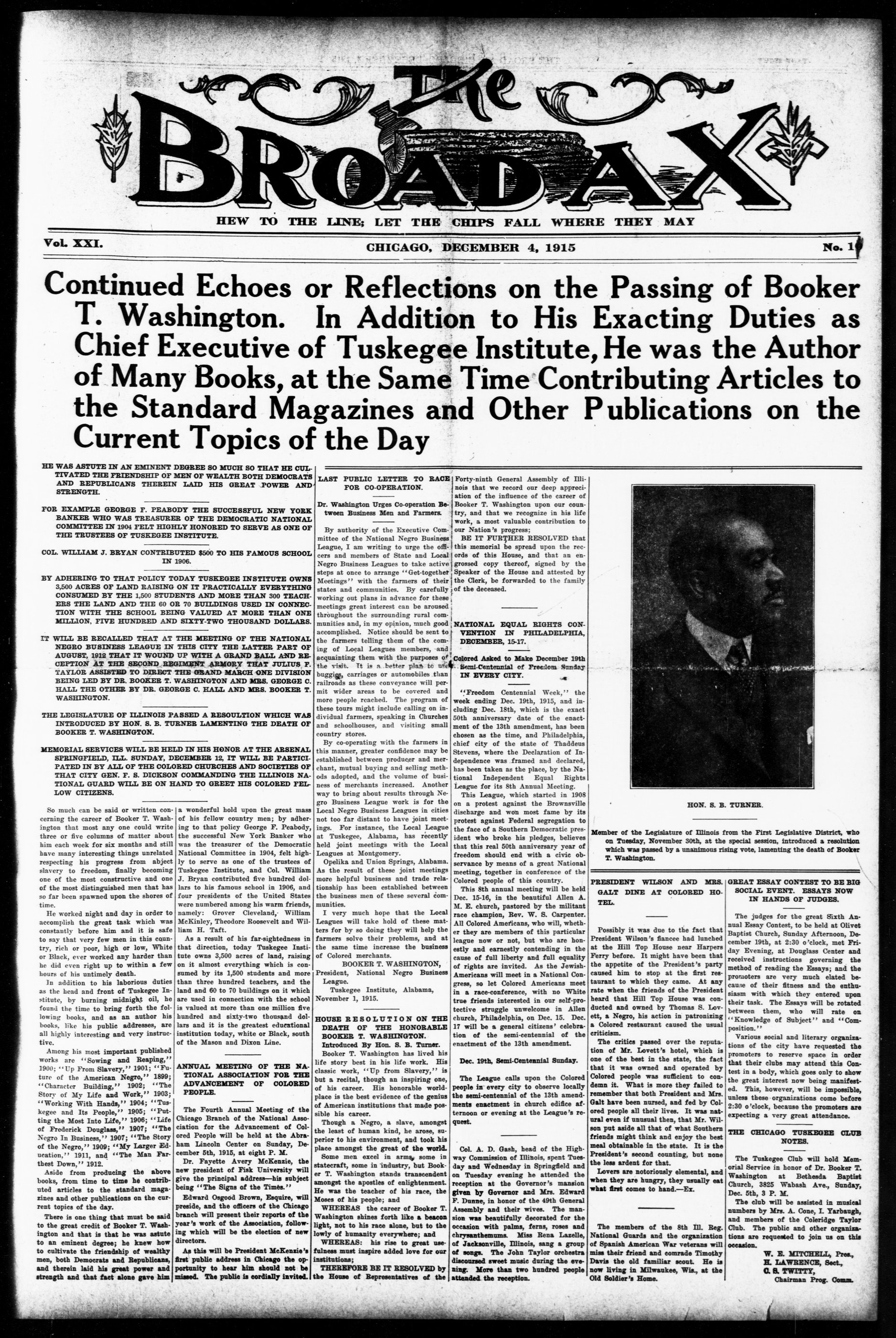
[Picture of a man in a suit with a tie].
HON. S. B. TURNER.
Member of the Legislature of Illinois from the First Legislative District, who on Tuesday, November 30th, at the special session, introduced a resolution which was passed by a unanimous rising vote, lamenting the death of Booker T. Washington.
PRESIDENT WILSON AND MRS
GALT DINE AT COLORED HOT
TEL.
Possibly it was due to the fact that President Wilson's fliancee had lunched at the Hill Top House near Harpers Ferry before. It might have been that the appetite of the President's party caused him to stop at the first restaurant to which they came. At any rate when the friends of the President heard that Hill Top House was conducted and owned by Thomas S. Lovett, a Negro, his action in patronizing a Colored restaurant caused the usual criticism.
The critics passed over the reputation of Mr. Lovett's hotel, which is one of the best in the state, the fact that it was owned and operated by Colored people was sufficient to condemn it. What is more they failed to remember that both President and Mrs. Galt have been nursed, and fed by Colored people all their lives. It was natural even if unusual then, that Mr. Wilson put aside all that of what Southern friends might think and enjoy the best meal obtainable in the state. It is the President's second counting, but none the less ardent for that.
Lovers are notoriously elemental, and when they are hungry, they usually eat what first comes to hand—Ex.
The members of the 8th Ill. Reg. National Guards and the organization of Spanish American War veterans will miss their friend and comrade Timothy Davis the old familiar scout. He is now living in Milwaukee, Wis., at the Old Soldier's Home.
GREAT ESSAY CONTEST TO BE BIG SOCIAL EVENT. ESSAYS NOW IN HANDS OF JUDGES.
The judges for the Sixth Annual Essay Contest, to be held at Olivet Baptist Church, Sunday Afternoon, December 19th, at 2:30 o'clock, met Friday Evening, at Douglass Center and received instructions governing the method of reading the Essays; and the promoters are very much elated because of their fitness and the enthusiasm with which they entered upon their task. The Essays will be rotated between them, who will rate on "Knowledge of Subject" and "Composition."
Various social and literary organizations of the city have requested the promoters to reserve space in order that their clubs may attend this Contest in a body, which goes only to show the great interest now being manifested. This, however, will be impossible, unless these organizations come before 2:30 o'clock, because the promoters are expecting a very great attendance.
THE CHICAGO TUSKEGEE CLUB
NOTES.
The Tuskegee Club will hold Memorial Service in honor of Dr. Booker T. Washington at Bethesda Baptist Church, 3825 Wabash Ave., Sunday, Dec. 5th, 3 P. M. The club will be assisted in musical numbers by Mrs. A. Cone, I. Yarbaugh, and members of the Coleridge Taylor Club. The public and other organizations are requested to join us on this occasion
No.1
W. E. MITCHELL, Pres,
H. LAWRENCE, Sect.
G. S. TWITTY,
Chairman Prog. Comm.
PAGE TWO
Some Authors and Their Names.
There are authors who make the most of their names, and there are others who don't. When W. W. Jacobs was commencing his literary career and hoping to "make a name" why did he not make the best of the one he got at the font? What a splash he could have made with William Wymark Jacobs!
It is almost as bad as Gilbert's neglected name, which was Schwenck. But perhaps that was too near "swank" for a modest man. Rutherford Crockett would have served the author of "The Stickit Minister" well, but he was content with S. R. Sir Arthur Pinero's second name is Wing, Silas Hocking's is Kitto, Jerome K. Jerome's is Klapka, and Gilbert Chesterton's "K" stands for Keith. Charles Dickens was christened Charles John Huffham.
It is a remarkable fact that nearly all the greater novelists are simply styled—Henry Fielding, Jane Austen, Walter Scott, Charles Reade, George Meredith, Thomas Hardy. William Makepeace Thackeray ignored his second name—St. James' Gazette.
What Becomes of That Cent?
A farmer comes to town with thirty apples, which he sells three for a cent, getting, of course, 10 cents for them. Another farmer, also with thirty apples, sells them two for a cent, getting 15 cents for his. They get 25 cents in all. The next time they come in, with thirty apples aplece, they meet at the edge of town and put their apples together, making sixty apples. One man having sold two for a cent, the other three for a cent, they decide to sell them five for 2 cents. They do so and when they're through find out they have received but 24 cents. The problem is, Why did they not get as much for their apples selling them five for 2 cents as they did when they sold them separately, or, what becomes of the cent?-Columbus Dispatch.
Fire and the Lodgepole Pine
Fire. the arch enemy of the forest, is the very life of the lodgepole pine, for cessation of fires would in time practically eliminate the species from the forest. Following a sweeping fire it is found that the lodgepole pine is the first tree at work to make good its loss. On the blackened limbs of the fire killed tree are scores of cones stuck closely to the branches. Within these cones lie fertile seeds waiting for nature to set them free. The fiery whirlwind sweeps by, and in a few hours the brown bits of tissue-like seeds silently climb out of their sheltering homes and make a flight to the earth. Being exceedingly light, thousands are sometimes blown for miles. An earth cleaned for their reception is found by the germs of new woods life.
"Ough."
an exchange prints the following list of words ending in "ough" and adds the pronunciation of the more obscene words, so far as ascertainable from the dictionaries: Messrs. Gough (gough), Hough (huff) and Clough (cluff), touch touch enough, thought through the day that they would visit Mr. Brough (broo), who, having a hiccough (hiccup) and a cough, lived in a clough (cluff or clou), with plenty of dough and a tame chough (chuff) kept near a plough in a rough trough, hung to a bough over a lough (loch). A slouch (slub) of the bank into the slough (sloo) injured his thoroughbred's hough (hock).
No wonder the foreigner shudders at those four terrible letters!
Strong Even In Death
A yew tree almost destitute of branches or bark grows abundantly in the Caucasus to a height of from fifty to sixty feet and a diameter of a little over two feet. It grows slowly, but its timber is almost indestructible except by fire. It is considered superior in durability, appearance and toughness to mahogany, which it otherwise somewhat resembles. In some large forests of this tree it is very difficult to distinguish the live trees from the dead ones, the latter being very numerous and said to stand for 100 years after death without exhibiting decay.
Base Deception
Family Physician—I am afraid, Mrs. Gaybird, your husband cannot last much longer. The trouble with your husband, madam, is that he has overdrawn his account at the bank of vitality. Mrs. Gaybird—I felt sure he was deceling me about something. Doctor, I give you my word, I never knew he had any account there.—Topeka Journal.
John Hay on Stanton
In "The Life and Letters of John Hay" is this plaintive note to Nicolay: "My dear Nico—Don't, in a sudden spasm of good nature, send any more people with letters to me requesting favors from Stanton. I would rather make the tour of a smallpox hospital."
The Obliging Proprietor
"Won't you please give me an order?" pleaded the persistent drummer "Certainly," replied the crusty proprietor. "Get out!"
Was Willing.
Smith--You and Jones don't seem to be as friendly as you were. Does he owe you money? Brown--No, not exactly, but he wanted to.
The Gooseberry.
Gooseberry bushes were originally called gorseberry bushes, from the plants having prickles similar to those of the gorse shrub.
The Degradation of Matter
If we examine the life history of any substance with sufficient knowledge edge and sufficient care, says the Engineer, we shall find that nature provides means and forces that little by little are turning that substance into dust. The manipulations of man greatly assist in the process. But nature itself is always active in it and even without man's aid is quite competent to achieve the task. At times we strive to hinder the process, as, for example, when we apply paint to iron work in order to prevent it from rusting. But we can hinder it only for a time, and even then we merely check the degradation of one substance by degrading another. Thus we have constantly to renew the paint on our iron work. The former coats disappear wholly or in part, and the material of which they were composed has turned to dust. We may accordingly look forward to a time when all matter will be uniformly distributed as dust throughout space, a condition that, according to the nebular hypothesis, actually did prevail at one time, before the universe, as we know it, was formed.
Uncle Sam's Big Checks.
When the government pays a claim or debt it is done by a treasury warrant, signed by the secretary of the treasury. In May, 1904, the secretary signed a warrant for $40,000,000, which was delivered to J. P. Morgan & Co. of New York as disbursing agents of this government on account of the Panama canal purchase. This was the largest warrant ever issued. The largest sum previously covered by a single government warrant was for $7,200,000, paid to Russia in 1868 on account of the Alaskan purchase. The next largest sum was $5,500,000, paid in 1876 to the British government on account of the Halifax award under the treaty of Washington for infringement of fishing rights in Nova Scotian waters. In 1890 this government paid Spain, through the French ambassador, $20,000,000 for the Philippine Islands, but this sum was represented by four warrants of $5,000,000 each—Philadelphia Press.
Broadway Noon Idyl.
Every weekday at noon the chimes of Grace church, in New York, send down into the clatter of Broadway the strains of old familiar hymns. The other day the chimes had just finished Pleye's hymn. They began a new melody, which in the midst of the city's roar was not at first distinguishable. Then the tangle of notes unwound itself and through the noises of the street sounded the sweet notes of "Just as I Am, Without One Plea."
Car wheels clanked, car brakes shrieked, iron shod horse hoofs smote the stones of the street, motor horns blew raucously; there was the sound of a myriad human feet and of many human voices, and through it all—"Just as I Am, Without One Plea."
Pedestrians took up the theme and hummed it absentmindedly. Old scenes were brought back, old faiths strengthened, old blessings remembered.—Christian Herald.
First English Book on Sport
The first book on sport ever printed in the English language was a rimed treatise called the "Boke of St. Albands," its author being a woman, Dame Juliana Berners. Its second edition was printed by Wynkyn de Worde in 1496. A descendant of her family, Lord Berners, was the translator of Froissart's "Chronicles." It is true that old manuscripts existed, such as the "Venerie de Twecy" of the time of Edward II., but it was Dame Juliana who was the real ancestress of sporting literature in England, for she also composed an essay on hawking and another on "Fishing With an Angle," the last being of such excellence that Izaak Walton himself did take a hint from its pages.
Parasol Monoplanes.
The "parasol plane" is really a biplane with the lower pair of wings removed, the engine, pilot and observer all sitting under the upper plane and thus giving rise to the nickname of "parasol." This type of monoplane is chiefly used for directing the fire of the guns. In an ordinary monoplane it is difficult for the observer to see below him—Pearson's Weekly.
Fighting Fishes of Siam
The Siamese devote great care to the cultivation of their famous fighting fishes, known as plakat. The interest in the fights, on which the spectators stake large sums of money, is so great that the license to hold them brings a large annual revenue to the king of Slam.—Westminster Gazette.
Excusable.
"Miss Short says she's only thirty, and I'd swear she's five and thirty if she's a day." "Well, you see. I've heard she was a rather backward child, dear, and didn't learn to count till she was five."—Exchange.
Expanding.
The Old Friend-I understand that your practice is getting bigger. The Young Doctor-That's true. My patient has gained nearly two pounds in the last month.
Contempt of Court
Defendant (in a loud voice)—Justice! Justice! I demand justice! Judge—Silence! The defendant will please remember that he is in a courtroom.—Penn State Froth.
Remedy your deficiencies and your merits will take care of themselves.—Bulwer.
Amazing Transformation.
One may be a speckled trout in the country and a codfish in the city, according to an observer, who believes that many country boys would do well to stay at home.
"A farmer," he said, "once caught a fine speckled trout, which he decided to present to his aunt in the city. Accordingly, he wrapped it in green leaves and placed it in a basket in the body of the wagon. As he stopped for refreshment at a roadside tavern some mischievous boys took a codfish from a nearby grocery stall and substituted it for the funny beauty.
"Arriving in the city, he presented the fish to his aunt. 'What do you mean?' she cried. 'This isn't a trout; it's a codfish.'
Voices of the Sea.
In "The Log of the Snark," by man Kittredge London, is this a sea description:
"The sea is not a lovable mood. And monster it is. It is beautiful sea, always beautiful in one another, but it is cruel and unkind of the life that is in it and upon it was cruel last evening in the low sunset that made it glow, to the cold, mocking, ragged mood that made it look like death. waves positively beckoned when rose and pitched toward our booby boring in the trough. And all the night it seemed to me that I I voices through the planking, talking, endlessly, monotonously, ulously, and I couldn't make
"Rather crestfallen, he took it back, but on the road the boys again made a substitution, and when he showed the fish to his wife it was a speckled trout. She listened to his tale with an amused smile. 'Yes,' she said finally 'it's like you—a speckled trout in the country and a codfish in town.'"—Exchange.
The Split Infinitive.
The split infinitive is the term used to designate the infinitive form of the verb that generally begins with the preposition "to," when separated by a qualifying adverb or phrase, as in the following: "To briefly designate," "to readily understand," "to suddenly and completely change front," "the knew not which to most admire," "to sweetly sing," "to humbly walk." This use is held by literary critics and grammatical purists to be highly improper, but it occurs abundantly in English literature, from the time of Shakespeare to the present day. Nearly every standard author is guilty of it, and it is very general in popular speech. The splitting of the infinitive is often dictated by a sense of rhythm, the placing of the qualifying adverb after the verb and before the weak adjunct or object which follows the verb resulting often in disharmony of rhythm or stress.
Fixing the Fairies
Remnants of the cave men living in hidden places in the forests, avoiding the more civilized human beings about them, but seen occasionally by these, were probably the first of the fairies, according to A. E. Peake in a paper that appears in the report of the Prehistoric Society of East Anglia. Long before the Danes came to the British isles Ireland was infested by a people called the Danaans, probably the earliest of the Celts or possibly antedating them. The word Danaan, according to the London Lancet, may be rendered "fairy." They were of puny stature, but their heads were as large as ours, as is proved by the skulls found in the bogs. With their little pointed caps and their retiring ways they were only vaguely known to their neighbors, and when they died out they were dimly remembered and soon became a legend.
Cairo Street Warnings.
In oriental countries the recklessness of drivers of vehicles and their disregard for foot passengers are very marked, but in Cairo they have a series of curious cries with which they warn a footman. They specify the particular part of his anatomy which is in danger, as thus: "Look out for thy left shin. O uncle!" "Boy, have a care for the little toe on thy right foot!" "O blind beggar, look out for thy staff!" And the blind beggar, feeling his way with the staff in his right hand, at once obediently turns to the left. "O Frankish woman, look out for thy left foot!" "O burden bearer, thy load is in danger!" "O water carrier, look out for the tail end of thy pigskin water bottle."
The Wolf's Den
One of the most grewsome among animal homes is the wolf's den. This is simply a hole dug in the side of a bank or a small natural cave, generally situated on the sunny side of a ridge and almost hidden by bushes and loose bowlders. Here the wolf lies snug. In and about his doorway lie the remains of past feasts, which, coupled with his own odor, make the wolf's den a not very inviting place. Nevertheless there is something so dread and mysterious about this soft footed marauder that it even lends a fascination to his home-St. Nicholas
E. Pluribus Unum
The Latin phrase "E pluribus unum" means "From many, one." It is the motto of the United States, as being one nation, though composed of many states. The expression is found originally in a Latin poem entitled "Moretum," supposed to have been written by the poet Virgil.
Saved!
A husband was waiting outside a jeweler's, growling with impatience. His wife emerged from the shop.
"They want a thousand guineas for it." she said.
"Thank heavens!" cried the husband.
"Now come along."—Punch.
A Duke's Maxim
It was a maxim of the first Duke of Portland, who was a great lover of race horses, that there were only two places where all men are equal—on the turf and under the turf.
Suspicion.
Once give your mind to suspicion and there is sure to be food enough for it. In the stillest night the air is filled with sounds for the wakeful ear that is resolved to listen.
Josh Billings was right when he said, "I don't care how much a man talks if he only says it in a few words."
Voices of the Sea.
In "The Log of the Snark," by Charman Kittredge London, is this bit of sea description:
"The sea is not a lovable monster. And monster it is. It is beautiful, the sea, always beautiful in one way or another, but it is cruel and unmindful of the life that is in it and upon it. It was cruel last evening in the lurid low sunset that made it glow, dully to the cold, mocking, ragged moonrise that made it look like death. The waves positively beckoned when they rose and pitched toward our boat laboring in the trough. And all the long night it seemed to me that I heard voices through the planking, talking, talking, endlessly, monotonously, querulously, and I couldn't make out whether it was the ocean calling from the outside or the ship herself muttering gropingly, finding herself. If the voices are of the ship they will soon cease, for she must find herself. But if they are the voices of the sea they must be sad sirens that cry, restless, questioning, unsatisfied—quaint homeless little sirens."
Beautiful Fish.
Japanese gardens are almost like a part of the house. The people live in gardens far more than most Americans do. In almost every garden is found a pond with goldfish in it. The golden carp is a kind of goldfish which was brought from China to Japan, and the species named ranchu is greatly admired. It has a tail made of three or four fanlike fins that open and close. When floating about in the water and looked at from above it appears like one of the old Japanese gold coins called the koban. It is supposed to look like a lion, when one gazes straight into its face. The Japan Magazine tells us of these fish and says that the Japanese are fond of giving fancy names to their favorites, such as "dancing butterfly" and "double cherry blossom." Sometimes the fish take their names from appearance and sometimes from habits.
Austria's Historic Crown.
The crown donned by the monarch of Austria, which was made originally for Stephen of Hungary some eight centuries ago, has been stolen, lost or pawned.
One one occasion it was pilfered by a queen who flied across the frozen Danube with it, and there, being in need of ready cash, she pawned it for 2,800 ducats. When it was finally traced and recovered it was placed in a fortress in Hungary and guarded night and day.
At the time of the revolution it was buried in a forest to prevent its being annexed by the Austrians, and it remained under the soil for nearly a hundred years. The crown is adorned with fifty-three fine sapphires, fifty good sized rubies, one emerald and 338 pearls. The gems are sunken in a mass of pure gold, and the crown weighs altogether about fourteen pounds.—Exchange.
The Common People
Coronets, miters, military display, the pomp of war, wide colonies and a huge empire are, in my view, all trifles, light as air and not worth considering, unless with them you can have a fair share of comfort, contentment and happiness among the great body of the people. Palaces, baronial castles, great halls, stately mansions, do not make a nation. The nation in every country dwells in the cottage, and unless the light of your constitution can shine there, unless the beauty of your legislation and the excellence of your statesmanship are impressed there on the feelings and condition of the people, rely upon it, you have yet to learn the duties of government—John Bright.
Beating Off a Dog
If a dog springs for a man the latter should guard his face with his arm and try to meet the animal with his forearm. With his right hand he should attempt to catch one of the animal's front paws. The paw of a bulldog is ultra sensitive. If it can be caught a vigorous squeeze will make the animal howl for mercy and retire discomfited.
Oak Wood.
The oak is a historic wood. As early as the eleventh century it became the favorite wood of civilized Europe, and specimens of carving and interior finish have come down to us from that early day, their pristine beauty enhanced by the subduing finger of time.
Giving Due Credit
"Willie, I hope your teacher appre
ciates how much I teach you at home."
"That's what I keep tellin' her, ma.
She said yesterday. 'I wonder where
you learn your bad manners, Willie,
and I said right away. 'Ma teaches 'em
to me.'"—Cleveland Plain Dealer.
A Wise Child.
"Johnny, do you know that your mother has been looking for you?" asked the neighbor next door. "Sure I do," replied Johnny. "That's the reason she can't find me!"—Judge.
She Was So Precise
"Do you go in for aviation?" he asked the Boston beauty.
"No, not for aviation. One goes in for sea bathing, but for aviation one goes up"—Judge.
Cause and Effect
There is nothing so calculated to give a young man that tired feeling as annexing a rich father-in-law.—New York Times.
The innocent seldom find an uneasy pillow.—Cowher.
Growth of Baseball
Nothing shows the growth of baseball more than a comparison of gate receipts taken in during the different series played for the baseball championship of the world. In the year 1884 about 300 persons attended the final game between the Providence team and the Metropolitan club, champions of their respective leagues, and the total attendance at all three games was less than 3,000. Radbourne and Keefe, the opposing hurlers, were at the height of their respective careers, but they failed to draw the throngs. However, the players did not worry, as there was nothing in it for them except glory.
In the season of 1885 the series was a failure from all standpoints. Only 8,000 saw the six contests between the men of Anson and the Browns, led by Charles Comlskey. The series was marked by continual scrapping and at times real fighting. It ended or broke up with honors in games won and verbal scraps "fifty-fifty." In 1886 the first real series for the world championship was pulled off in a successful manner. The six games drew 40,000, and the net receipts were $14,000.—Philadelphia Ledger.
Ecuador's Vegetable Wool.
Kapok, known in Ecuador as "lana de celba," or "vegetable wool," is a product of the largest tree that grows in the forests of the littoral, a species of the genus Eriodendron (allied to the cotton plant). The celba bears most of its branches near the top, and the appearance of its bright yellow flowers marks the approaching end of the rainless season. After the flowers fade the pods that yield the kapok of commerce are formed. These are gathered and the fiber extracted by hand. One hundred pounds of crude material yield, after cleaning, forty-five pounds of first grade kapok. Kapok is gaining in popularity in the United States, where, among the other uses to which it is put, it is employed in stuffing mattresses and sofa cushions and, it is said, has found some favor among makers of upholstery fabrics.
Illustrating the Idea.
A school inspector was examining a class in grammar and trying to elucidate the complex relations of adjectives and nouns by a telling example. "Now, for instance." said he, "what am I?"
That was an easy question, and all the children shouted:
"A man!" and then looked around triumphantly.
"Yes, but what else?" said the inspector.
"Yes, but there is something more than that."
This was a poser, but at last an infant phenomenon almost leaped from his seat in his eagerness and cried:
"Please, sir, I know, sir—un ugly lit
their"—Pearson's Weekly.
Beautiful Flag Flower.
Among the stateliest and proudest of the members of America's flower family none excels the larger blue flag, which also wears the names of blue iris and fleur-de-lis. Ruskin calls it the flower of chivalry, which has a sword for its leaf and a lily for its heart. Longfellow pronounces it "a flower born in the purple, to joy and pleasance." It blooms in the wet, rich marsh and meadow from May to July and finds its home from Newfoundland and Manitoba to Florida and Arkansas. The flag flower must look to the insect world entirely for its propagation, particularly to the bees as its pollen carriers. So it puts forth a flower that is blue tinted, for its experience has taught it that a bee can be wooded with blue better than with any other color—Pittsburgh Press.
A Titled Kleptomaniac
A titled kleptomaniac almost a century ago was the Countess of Cork. She had a reputation for stealing anything she could lay her hands on, whether it was useful or valuable or not. Once when leaving a country house where she had been staying she saw and quietly picked up a hedgehog that was crossing a hall, a pet of the porter's, and took it away in her carriage. Finding it an uncomfortable foot warmer, she decided to dispose of it at the first town where she changed horses and then offered it to a confectioner in return for a sponge cake.
Kent Him Waiting
The Scotch clergyman who invented the percussion lock for firearms in 1805 had to wait twenty-seven years before it was tested by the British government, thirty-two years before a regiment was armed with it and thirty-four years before it was used in war.
Well Named
"A wonderful man is my uncle," said little Binks, "so very original and witty. He says he called his dog Sausage because it was half bread, his goat Nearly because it was all butt and his prize cockerel Robinson because it Crusoe."
Inspiring Words
"What," asks a contemporary, "are the most inspiring words in the English language?" Much might be said on behalf of these: "Inclosed find check"—Chicago News.
Quite Easy.
Mother (annoyed)—I don't see, Elsie, how you can be so naughty. Elsie—Why, mamma, it isn't a bit hard.—Boston Transcript.
No man is a good physician who has never been sick.—Arabian.
Free and Easy Servants In Japan.
Free and Easy Servants in Japan.
In Japan domestic service is very honorable. Domestic servants rank before tradesmen, who are considered at the bottom of the social ladder. In the absence of his master a servant will receive the callers and chat away familiarly, but politely, until the arrival of the head of the house. After rubbing his knees together and hissing and kotowing he will invite you to take a seat—on the floor, or, more correctly speaking, on your heels, with a flat cushion between your knees and the floor to make the ordeal a little less painful. He will then offer you five cups of tea. Even after his master has arrived he may stay in the room and is likely to cut into the conversation and quite certain to laugh at the smallest apology for a joke. He brings all his sisters and cousins and aunts to be introduced when he takes service, and the house is seldom without a few of them engaged on some business or errand. In the European hotels in Japan the servants are all men, who are dressed in indigo cotton doublets and hose and run about bare-foot—London Answers.
A Prince's Chilly Dip.
Prince Henry of Prussia is an ardent sailor, says Pearson's Weekly, but he is known among the bluejackets as a great martinet. The following story is typical of his methods, and shows that although he expects those under his command to put up with all kinds of hardships, he is by no means above "roughing it" himself.
One day, when he was on board a warship in the North sea, he suddenly gave the order, "All hands to bathe!" It was a bitterly cold day and the water was like ice. The order was so evidently distasteful that one of the officers ventured to make a mild protest to the prince. Without answering him a single word, Prince Henry, although fully clothed, sprang over the vessel's side, swam out a good distance in the icy water and returned to the deck dripping from head to foot. After that the sailors took their bath without demur.
A Pretty Hot Story.
Chabert, the fire king, who was a popular favorite in London over eighty years ago, claimed to be able to swallow arsenic and other poisons with impunity. Visitors to his entertainment were requested to come provided with phosphorus, arsenic and oxalic acid, which he proceeded to consume before their eyes, taking an antidote afterward which was supposed to neutralize their effects. Then, to show that he was as impervious to heat as to poison, he would take a raw leg of lamb into an oven heated to 220 degrees and remain inside until the joint was cooked, when it was carved and handed around to the audience. The performance concluded by Chabert rubbing a redot shovel on his head and face and allowing any one who wished to drop molten sealing wax on his tongue and hands—London Mall.
Eskimo Candy.
Tallow is the Eskimo's candy. It is put up in bright red packages made out of the feet of a waterfowl. The women cut off the red feet of this bird, which is called the dovekle, draw out the bones and blow up the skin so as to make pouches, which they fill with reindeer tallow for their little folk. None of the food that the Eskimos eat seems very inviting to us, but they are extremely fond of it and are very apt to overheat. It is said by explorers who have gone into Greenland that it is no uncommon sight to see an Eskimo man who has eaten an enormous meal of the raw frozen flesh of the reindeer, seal or walrus lying on his back and eating blubber until he cannot move—Exchange.
More Than One
The clergyman of a country village, reprehending one of his parishioners for quarrelling with his wife so loudly and frequently as to be a source of perpetual disturbance to the neighborhood, in the course of his exhortation remarked that the Scriptures declared that man and wife were one. "Aye, that may be, sir," answered Hodge, "but if you were to go by when me and my wife are at it you'd think there were twenty of us."—London Globe.
Consolation
The mistress, not wishing to offend her cook, who had been with her but two weeks, announced in a low, well modulated voice, "I am sorry, Ellen, but the master found fault with your cooking today."
"Lor," I don't take no notice of 'im, mum. It's his blessed nature to find fault. Ain't he always finding fault with you?"—Argonaut.
Masonry Weights
Granite or ilmestone masonry, well dressed, weighs 165 pounds per cubic foot; mortar rubble weighs 154 pounds, dry rubble 128 pounds and well dressed sandstone masonry 144 pounds.
Ita Advantage.
Teacher—What is the difference between the sun and the moon? Pupil—Please, sir, the sun's bigger and healthier looking than the moon because he goes to bed earlier.
Discouraging.
Jester—Poor old Skintint has his troubles! Jimson—What! Why, he's making barrels and barrels of money! Jester—I know, but the price of barrels has gone up.
Knew What His Few Days Meant. Quackly—By the bye, you have got $10 about you that you don't need for a few days? Smackily—I have, but I might need it some time—Exhale.
SALONIKI, GATEWAY TO THE BALKANS
An Important Strategic Point In Present War Drama.
The ancient city of Saloniki, known in former times as Thessalonica, is occupying an important position at present in the great war drama that is being enacted in Europe. Here the allied Anglo-French troops landed to go to the aid of Servia upon the invitation, it is alleged, of the recent Venizelos government. This government also pledged that no action by Greece should restrict the liberty of movement
12
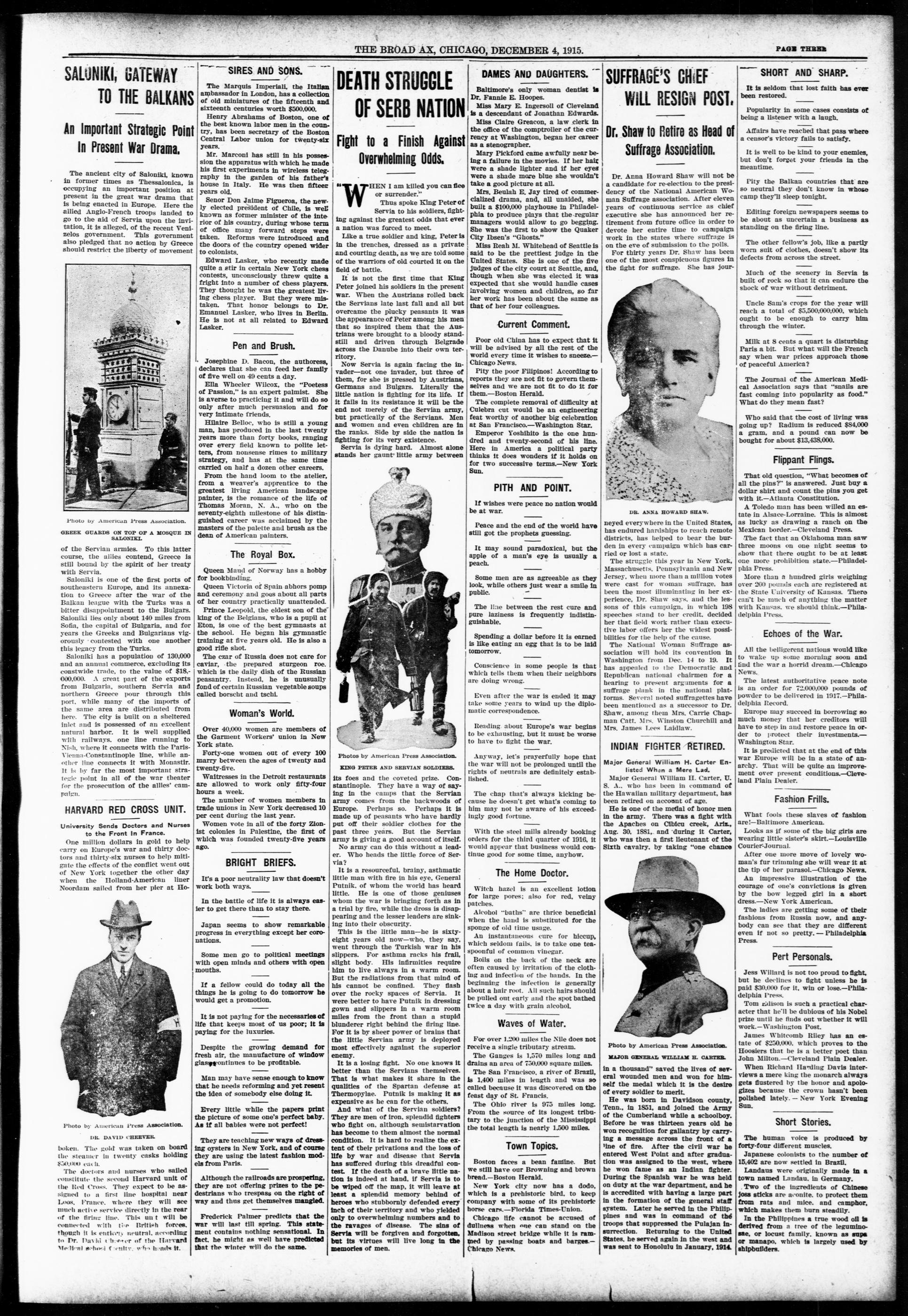
Photo by American Press Association.
GREEK GUARDS ON TOP OF A MOSQUE IN SALONIKI
of the Servian armies. To this latter course, the allies contend, Greece is still bound by the spirit of her treaty with Servia.
Saloniki is one of the first ports of southeastern Europe, and its annexation to Greece after the war of the Balkan league with the Turks was a bitter disappointment to the Bulgars. Saloniki lies only about 140 miles from Sofia, the capital of Bulgaria, and for years the Greeks and Bulgarians vigorously contested with one another this legacy from the Turks.
Saloniki has a population of 130,000 and an annual commerce, excluding its coastwide trade, to the value of $18,000,000. A great part of the exports from Bulgaria, southern Servia and northern Greece pour through this port, while many of the imports of the same area are distributed from here. The city is built on a sheltered inlet and is possessed of an excellent natural harbor. It is well supplied with railways, one line running to Nish, where it connects with the Paris-Vienna-Constantinople line, while another line connects it with Monastir. It is by far the most important strategic point in all of the war theater for the prosecution of the allies' campaign.
HARVARD RED CROSS UNIT.
University Sends Doctors and Nurses to the Front In France.
One million dollars in gold to help carry on Europe's war and thirty doctors and thirty-six nurses to help mitigate the effects of the conflict went out of New York together the other day when the Holland-American liner Noordam sailed from her pier at Ho-
H
Photo by American Press Association.
DR. DAVID CHEEVER.
boken. The gold was taken on board the steamer in twenty casks holding $50,000 each.
The doctors and nurses who sailed constitute the second Harvard unit of the Red Cross. They expect to be assigned to a first line hospital near Loos, France, where they will see much active service directly in the rear of the firing line. This unit will be connected with the British forces, though it is entirely neutral, according to Dr. David Cheever of the Harvard Medical School Centre who leads it.
The Marquis Imperiali, the Italian ambassador in London, has a collection of old miniatures of the fifteenth and sixteenth centuries worth $500,000.
Henry Abrahams of Boston, one of the best known labor men in the country, has been secretary of the Boston Central Labor union for twenty-six years.
Mr. Marconi has still in his possession the apparatus with which he made his first experiments in wireless telegraphy in the garden of his father's house in Italy. He was then fifteen years old.
Senor Don Jaime Figueroa, the newly elected president of Chile, is well known as former minister of the interior of his country, during whose term of office many forward steps were taken. Reforms were introduced and the doors of the country opened wider to colonists.
Edward Lasker, who recently made quite a stir in certain New York chess contests, unconsciously threw quite a fright into a number of chess players. They thought he was the greatest living chess player. But they were mistaken. That honor belongs to Dr. Emanuel Lasker, who lives in Berlin. He is not at all related to Edward Lasker.
Pen and Brush.
Josephine D. Bacon, the authoress, declares that she can feed her family of five well on 49 cents a day. Ella Wheeler Wilcox, the "Poetess of Passion," is an expert palmist. She is averse to practicing it and will do so only after much persuasion and for very intimate friends. Hilda Belloc, who is still a young man, has produced in the last twenty years more than forty books, ranging over every field known to polite letters, from nonsense rimes to military strategy, and has at the same time carried on half a dozen other careers. From the hand loom to the atelier, from a weaver's apprentice to the greatest living American landscape painter, is the romance of the life of Thomas Moran, N. A., who on the seventy-eighth milestone of his distinguished career was acclaimed by the masters of the palette and brush as the dean of American painters.
The Royal Box.
Queen Maud of Norway has a hobby for bookbinding.
Queen Victoria of Spain abhors pomp and ceremony and goes about all parts of her country practically unattended.
Prince Leopold, the eldest son of the king of the Belgians, who is a pupil at Eton, is one of the best gymnasts at the school. He began his gymnastic training at five years old. He is also a good rifle shot.
The czar of Russia does not care for caviar, the prepared sturgeon roe, which is the daily dish of the Russian peasantry. Instead, he is unusually fond of certain Russian vegetable soups called borscht and tschi.
Woman's World.
Over 40,000 women are members of the Garment Workers' union in New York state.
Forty-one women out of every 100 marry between the ages of twenty and twenty-five.
Waltresses in the Detroit restaurants are allowed to work only fifty-four hours a week.
The number of women members in trade unions in New York decreased 10 per cent during the last year.
Women vote in all of the forty Zionist colonies in Palestine, the first of which was founded twenty-five years ago.
BRIGHT BRIEFS.
It's a poor neutrality law that doesn't work both ways. _____
In the battle of life it is always easier to get there than to stay there. _____
Japan seems to show remarkable progress in everything except her coronations. _____
Some men go to political meetings with open minds and others with open mouths. _____
If a fellow could do today all the things he is going to do tomorrow he would get a promotion. _____
It is not paying for the necessaries of life that keeps most of us poor; it is paying for the luxuries. _____
Despite the growing demand for fresh air, the manufacture of window glass continues to be profitable.
Man may have sense enough to know that he needs reforming and yet present the idea of somebody else doing it.
Every little while the papers print the picture of some one's perfect baby. As if all babies were not perfect!
They are teaching new ways of dressing oysters in New York, and of course they are using the latest fashion models from Paris.
Although the railroads are prospering, they are not offering prizes to the pedestrians who trespass on the right of way and thus get themselves mangled.
Frederick Palmer predicts that the war will last till spring. This statement contains nothing sensational. In fact, he might as well have predicted that the winter will do the same.
THE BROAD AX. CHICAGO. DECEMBER 4. 1915.
WHEN I am killed you can flee or surrender." Thus smoke King Potent of
Thus spoke King Peter of Servia to his soldiers, fighting against the greatest odds that ever a nation was forced to meet.
Like a true soldier and king, Peter is in the trenches, dressed as a private and courting death, as we are told some of the warriors of old courted it on the field of battle.
It is not the first time that King Peter joined his soldiers in the present war. When the Austrians rolled back the Servians late last fall and all but overcame the plucky peasants it was the appearance of Peter among his men that so inspired them that the Austrians were brought to a bloody standstill and driven through Belgrade across the Danube into their own territory.
Now Servia is again facing the invader—not one invader, but three of them, for she is pressed by Austrians, Germans and Bulgars. Literally the little nation is fighting for its life. If it fails in its resistance it will be the end not merely of the Servian army, but practically of the Servians. Men and women and even children are in the ranks. Side by side the nation is fighting for its very existence. Servia is dying hard. Almost alone stands her gaunt little army between
M
Photos by American Press Association.
KING PETER AND SERVIAN SOLDIERS.
its foes and the coveted prize. Constantinople. They have a way of saying in the camps that the Servian army comes from the backwoods of Europe. Perhaps so. Perhaps it is made up of peasants who have hardly put off their soldier clothes for the past three years. But the Servian army is giving a good account of itself.
No army can do this without a lead.
No army can do this without a leader. Who heads the little force of Servia?
It is a resourceful, brainy, asthmatic little man with fire in his eye, General Putnik, of whom the world has heard little. He is one of those geniuses whom the war is bringing forth as in a trial by fire, while the dross is disappearing and the lesser leaders are sinking into their obscurity.
This is the little man—he is sixty-eight years old now—who, they say, went through the Turkish war in his slippers. For asthma racks his frail, slight body. His infirmities require him to live always in a warm room. But the radiations from that mind of his cannot be confined. They flash over the rocky spaces of Servia. It were better to have Putnik in dressing gown and slippers in a warm room miles from the front than a stupid blunderer right behind the firing line. For it is sheer power of brains that the little Servian army is deployed most effectively against the superior enemy.
It is a losing fight. No one knows it better than the Servians themselves. That is what makes it share in the qualities of the Spartan defense at Thermopylae. Putnik is making it as expensive as he can for the others.
And what of the Servian soldiers? They are men of iron, splendid fighters who fight on, although semistarvation has become to them almost the normal condition. It is hard to realize the extent of their privations and the loss of life by war and disease that Servia has suffered during this dreadful contest. If the death of a brave little nation is indeed at hand, if Servia is to be wiped off the map, it will leave at least a splendid memory behind of heroes who stubbornly defended every inch of their territory and who yielded only to overwhelming numbers and to the ravages of disease. The sins of Servia will be forgiven and forgotten, but its virtues will live long in the memories of men.
DAMES AND DAUGHTERS.
Baltimore's only woman dentist is Dr. Fannie E. Hoopes.
Miss Mary E. Ingersoll of Cleveland is a descendant of Jonathan Edwards.
Miss Claire Greacon, a law clerk in the office of the comptroller of the currency at Washington, began her career as a stenographer.
Mary Pickford came awfully near being a failure in the movies. If her hair were a shade lighter and if her eyes were a shade more blue she wouldn't take a good picture at all.
Mrs. Beulah E. Jay tired of commercialized drama, and, all unaided, she built a $100,000 playhouse in Philadelphia to produce plays that the regular managers would allow to go begging. She was the first to show the Quaker City Ibsen's "Ghosts."
Miss Reah M. Whitehead of Seattle is said to be the prettiest judge in the United States. She is one of the five judges of the city court at Seattle, and, though when she was elected it was expected that she would handle cases involving women and children, so far her work has been about the same as that of her four colleagues.
Current Comment.
Poor old China has to expect that it will be advised by all the rest of the world every time it wishes to sneeze.—Chicago News.
Pity the poor Filipinos! According to reports they are not fit to govern themselves and we are not fit to do it for them.—Boston Herald.
The complete removal of difficulty at Culebra cut would be an engineering feat worthy of another big celebration at San Francisco.—Washington Star.
Emperor Yoshihito is the one hundred and twenty-second of his line. Here in America a political party thinks it does wonders if it holds on for two successive terms.—New York Sun.
PITH AND POINT.
If wishes were peace no nation would be at war.
Peace and the end of the world have still got the prophets guessing.
It may sound paradoxical, but the apple of a man's eye is usually a peach.
Some men are as agreeable as they look, while others just wear a smile in public.
The line between the rest cure and pure laziness is frequently indistinguishable.
Spending a dollar before it is earned is like eating an egg that is to be laid tomorrow.
Conscience in some people is that which tells them when their neighbors are doing wrong.
Even after the war is ended it may take some years to wind up the diplomatic correspondence.
Reading about Europe's war begins to be exhausting, but it must be worse to have to fight the war.
Anyway, let's prayerfully hope that the war will not be prolonged until the rights of neutrals are definitely established.
The chap that's always kicking because he doesn't get what's coming to him may not be aware of his exceedingly good fortune.
With the steel mills already booking orders for the third quarter of 1916, it would appear that business would continue good for some time, anyhow.
The Home Doctor.
Witch hazel is an excellent lotion for large pores; also for red, veiny patches.
Alcohol "baths" are thrice beneficial when the hand is substituted for the sponge of old time usage.
An instantaneous cure for hiccup, which seldom fails, is to take one teaspoonful of common vinegar.
Boils on the back of the neck are often caused by irritation of the clothing and infection of the hands. In the beginning the infection is generally about a hair root. All such hairs should be pulled out early and the spot bathed twice a day with grain alcohol.
Waves of Water.
For over 1,200 miles the Nile does not receive a single tributary stream.
The Ganges is 1,570 miles long and drains an area of 750,000 square miles.
The San Francisco, a river of Brazil, is 1,400 miles in length and was so called because it was discovered on the feast day of St. Francis.
The Ohio river is 975 miles long. From the source of its longest tributary to the junction of the Mississippi the total length is nearly 1,500 miles.
Town Topics.
Boston faces a bean famine. But we still have our Browning and brown bread.—Boston Herald.
New York city now has a dodo, which is a prehistoric bird, to keep company with some of its prehistoric horse cars.—Florida Times-Union.
Chicago life cannot be accused of dullness when one can stand on the Madison street bridge while it is rammed by passing boats and barges.—Chicago News.
SUFFRAGE'S CHIEF WILL RESIGN POST.
Dr. Shaw to Retire as Head of Suffrage Association.
Dr. Anna Howard Shaw will not be a candidate for re-election to the presidency of the National American Woman Suffrage association. After eleven years of continuous service as chief executive she has announced her retirement from future office in order to devote her entire time to campaign work in the states where suffrage is on the eve of submission to the polls. For thirty years Dr. Shaw has been one of the most conspicuous figures in the fight for suffrage. She has jour-
P. A.
DR. ANNA HOWARD SHAW.
neyed everywhere in the United States, has endured hardships to reach remote districts, has helped to bear the burden in every campaign which has carried or lost a state.
The struggle this year in New York, Massachusetts, Pennsylvania and New Jersey, when more than a million votes were cast for woman suffrage, has been the most illuminating in her experience, Dr. Shaw says, and the lessons of this campaign, in which 198 speeches stand to her credit, decided her that field work rather than executive labor offers her the widest possibilities for the help of the cause.
The National Woman Suffrage association will hold its convention in Washington from Dec. 14 to 19. It has appealed to the Democratic and Republican national chairmen for a hearing to present arguments for a suffrage plank in the national platforms. Several noted suffragettes have been mentioned as a successor to Dr. Shaw, among them Mrs. Carrie Chapman Catt. Mrs. Winston Churchill and Mrs. James Lees Laidlaw.
INDIAN FIGHTER RETIRED.
Major General William H. Carter Enlisted When a Mere Lad.
Major General William H. Carter, U. S. A., who has been in command of the Hawaiian military department, has been retired on account of age.
He is one of the medal of honor men in the army. There was a fight with the Apaches on Cibicu creek, Ariz, Aug. 30, 1881, and during it Carter, who was then a first lieutenant of the Sixth cavalry, by taking "one chance
A. B.
Photo by American Press Association.
MAJOR GENERAL WILLIAM H. CARTER.
in a thousand" saved the lives of several wounded men and won for himself the medal which it is the desire of every soldier to merit.
He was born in Davidson county, Tenn., in 1851, and joined the Army of the Cumberland while a schoolboy. Before he was thirteen years old he won recognition for gallantry by carrying a message across the front of a line of fire. After the civil war he entered West Point and after graduation was assigned to the west, where he won fame as an Indian fighter. During the Spanish war he was held on duty at the war department, and he is accredited with having a large part in the formation of the general staff system. Later he served in the Philippines and was in command of the troops that suppressed the Pulajan insurrection. Returning to the United States, he served again in the west and was sent to Honolulu in January, 1914.
PAGE THREE
SHORT AND SHARP.
It is seldom that lost faith has ever been restored.
Popularity in some cases consists of being a listener with a laugh.
Affairs have reached that pass where a censor's victory fails to satisfy.
It is well to be kind to your enemies, but don't forget your friends in the meantime.
Pity the Balkan countries that are so neutral they don't know in whose camp they'll sleep tonight.
Editing foreign newspapers seems to be about as uncertain a business as standing on the firing line.
The other fellow's job, like a partly worn suit of clothes, doesn't show its defects from across the street.
Much of the scenery in Servia is built of rock so that it can endure the shock of war without detriment.
Uncle Sam's crops for the year will reach a total of $5,500,000,000, which ought to be enough to carry him through the winter.
Milk at 8 cents a quart is disturbing Paris a bit. But what will the French say when war prices approach those of peaceful America?
The Journal of the American Medical Association says that "snails are fast coming into popularity as food." What do they mean fast?
Who said that the cost of living was going up? Radium is reduced $84,000 a gram, and a pound can now be bought for about $13,438,000.
Flippant Flings.
That old question, "What becomes of all the pins?" is answered. Just buy a dollar shirt and count the pins you get with it—Atlanta Constitution.
A Toledo man has been willed an estate in Alsace-Lorraine. This is almost as lucky as drawing a ranch on the Mexican border.—Cleveland Press.
The fact that an Oklahoma man saw three moons on one night seems to show that there ought to be at least one more prohibition state.—Philadelphia Press.
More than a hundred girls weighing over 200 pounds each are registered at the State University of Kansas. There can't be much of anything the matter with Kansas, we should think.—Philadelphia Press.
Echoes of the War.
All the belligerent nations would like to wake up some morning soon and find the war a horrid dream.—Chicago News.
The latest authoritative peace note is an order for 72,000,000 pounds of powder to be delivered in 1917.—Philadelphia Record.
Europe may succeed in borrowing so much money that her creditors will have to step in and restore peace in order to protect their investments.—Washington Star.
It is predicted that at the end of this war Europe will be in a state of anarchy. That will be quite an improvement over present conditions.—Cleveland Plain Dealer.
Fashion Frills.
What fools these slaves of fashion are!-Baltimore American.
Looks as if some of the big girls are wearing little sister's skirt.-Louisville Courier-Journal.
After one more move of lovely woman's fur trimming she will wear it at the tip of her parasol.-Chicago News.
An impressive illustration of the courage of one's convictions is given by the bow legged girl in a short dress.-New York American.
The ladies are getting some of their fashions from Russia now, and anybody can see that they are different even if not so pretty.-Philadelphia Press.
Pert Personals.
Jess Willard is not too proud to fight, but he declines to fight unless he is paid $30,000 for it, win or lose.—Philadelphia Press.
Tom edison is such a practical character that he'll be dubious of his Nobel prize until he finds out whether it will work.—Washington Post.
James Whitcomb Riley has an estate of $250,000, which proves to the Hoosiers that he is a better poet than John Milton.—Cleveland Plain Dealer.
When Richard Harding Davis interviews a mere king the monarch always gets flustered by the honor and apologizes because the crown hasn't been polished lately.—New York Evening Sun.
Short Stories.
The human voice is produced by forty-four different muscles. Japanese colonists to the number of 15,402 are now settled in Brazil. Landaus were originally made in a town named Landau, in Germany. Two of the ingredients of Chinese joss sticks are aconite, to protect them from rats and mice, and camphor, which makes them burn steadily. In the Philippines a true wood oil is derived from a tree of the leguminosae, or locust family, known as supa or manapo, which is largely used by shipbuilders.
Agents and Correspondents Wanted to Handle THE BROAD AX. Liberal Commissions to Live Agents. Address, Julius F.Taylor, 6532 St. Lawrence Av., Chicago
PAGE FOUR
Agents a
BRO
Addr
THE BROAD AX
PUBLISHED WEEKLY.
Will promulgate and at all times uphold the true principles of Democracy, but Criticism, Protestism, Priests, Inidels, Singles Taxors, Republicans, or anyone else can have their say, as long as their language is proper and responsibility is fixed.
The Broad Ax is a newspaper whose platform is broad enough for all, ever distilling the editorial right to speak its own mind.
Local communications will receive attention. Write only on one side of the paper.
Subscriptions must be paid in advance. One Year. $2.00.
Six Months. $1.00.
Advertising rates made known on application.
Address all communications to
6533 SR. LAWRENCE AVE., CHICAGO, ILL.
PHONE WENTWORTH 2597.
JULIUS F. TAYLOR, Editor and Publisher
Entered as Second-Class Matter Aug. 18,
1988, at the Post Office at Chicago, Illinois,
under Act of March 8, 1978.
REMOVAL NOTICE.
From on and after this date, all letters or other mail matter intended for Julius F. Taylor or Mrs. Annie E. Taylor or The Broad Ax, should be addressed to 6532 St. Lawrence Ave., Jackson Park station. Phone Wentworth 2597.
HEALTH NOTES
Night air is as good to breathe as day air. In fact, it is apt to be purer. In the city, dust, smoke and irritating gas and ashes from ten thousand chimney pots are less after dark. The furnaces of industry are doing their best (or rather worst) in the full blast of business hours. In the absence of a gale of wind, the dust of street traffic and the dirt stirred up by five million human feet during the day are less active when the city goes to sleep. With less dust there are fewer germ aeroplanes abroad at night, of course.
A house without a plentiful supply of pure, fresh air in it all the time is a mighty poor house to live in.
Wood alcohol appears to be especially dangerous to the eyesight, quite frequently causing blindness. Dr. James A. Campbell of St. Louis, in a paper read before the Ophthalmic Society last June, said: "Wood alcohol blindness may occur by inhaling the fumes, or by absorption through the hands, and one case was caused by it being splashed into the eyes. The symptoms are headache, dizziness, weakness, nausea, prostration, blindness and death. Blindness is a late symptom. Wood alcohol blindness is curable, if treated early, but if left until nerve degeneration takes place the blindness may be permanent and complete."
The dropping leaves of the plants in winter behind closed windows is a good sermon on bad air.
Sunshine and fresh air are conspirators for good health.
Money wisely spent for public health purposes invariably pays handsome returns on the original investment.
Hygiene aims to make growth more perfect; life more vigorous; decay less rapid; death more remote.
Defective sanitation means defective civilization.
Where the sun does not go, the doctor does. (An old Italian proverb.)
Robbing yourself of sleep puts a mortgage on your future health and happiness; Nature will foreclose.
Open windows close the doors to consumption.
MEMORIAL MEETING TO WASH
INGTON IN N. Y.
New York, Special to The Broad Ax.—A memorial meeting for the late Booker T. Washington will be held in Carnegie hall Feb. 11. The call for the meeting was issued by the Tukegee board of trustees, the Hampton association and the Negro ministers of this city.
Western Negro Press Association to Meet in Kansas City During the Holidays.
Officers and Members of the Western Negro Press Association, Greeting:
By authority of the power vested in me as president of your association, I hereby request you to assembly in the 15th annual convention of the association on the 28th day of December, 1915, in the assembly room of the Kansas City Sun, in the Masonic Temple bldge, 1803 E. 18th St., Kansas City, Missouri, for the purpose of transacting business of the organization, and discussing and taking action upon important question concerning the welfare and peace of our people. We expect a good attendance and much good to result from the meeting. All newspaper or magazine publishers, editors, agents and correspondents are invited to attend.
Further information concerning the W. N. P. A. and the meeting at Kansas City next month may be had by addressing J. D. Cooke, Milwaukee, Wis., Sec., or H. R. Graham, Kingston, Mo., Statistician, or Nelson C. Crews, Editor The Kansas City Sun, Kansas City, Mo.
Editor The Tulsa Star.
Tulsa, Okla.
AMERICAN RED CROSS WILL
AWARD PENNANTS TO BEST
SEAL SELLERS.
Second Annual Competition will include States. Cities and Villages.
The states, cities, towns and villages selling the largest number of Red Cross Seals per capita will be given pennants in their respective classes by The American Red Cross and The National Association for the Study and Prevention of Tuberculosis, as announced in a bulletin issued to-day. Last year's competition was limited to cities, towns and villages, but for the 1915 Seals Campaign pennants will be awarded to states as well.
To avoid pitting villages against large cities, they have been divided into ten classes, as follows: Population less than 600; from 600 to 1,200; from 1,200 to 2,000, thence to 8,000; thence to 25,000; thence to 50,000, thence to 150,000; thence to 1,000,000; and over 1,000,000.
A handsome silk banner in red and white will be awarded to the city, village, town or county anywhere in the United States and territories which shall make the highest score in sale per capita in its class. The populations considered are the Federal Estimates for 1915.
The states with Hawaii—which is a strong competitor—are likewise grouped in classes. Class A, population up to 1,250,000; Class B, 1,250,000 to 2,400,000; Class C, 2,400,000 upwards. Of the 19 “A” states, Rhode Island led last year with a sale of 2.112 seals per inhabitant. Of the 17 “B” states, Minnesota led with .956 seal per inhabitant. Of the 13 states with populations (1915) more than 2,400,000, Wisconsin led with 1.478 seals. It beat New York State by Seven-thousandths of a seal, although New York State outside New York City won out over Wisconsin, with 1.930 seals per capita.
In the 1914 competition staid cities bestirred themselves in rivalry to be published as the most generous supporters of public health work through purchase of the Red Cross Seals. In other places the anti-tuberculosis workers started the selling campaign up again between Christmas and New Year to get their town in the Honor Roll for the sale of three seals per capita.
Last year's pennant winners were:
Pittsburgh, Pa., population, 533,905;
Seals per capita, 2.004; Rochester, N.Y., population 218,149, seals per capita, 4.76; Troy, N. Y., population, 76,813, seals per capita, 5.72; New Rochelle, N.Y., population 28,867, seals per capita, 6.01; Charleston, W. Va., population, 22,996, seals per capita, 6,638; Swickey, Pa., population, 4,479, seals per capita 16.774; Garden City, N.Y., population, 1,100, seals per capita, 20.49.
Julius F. Taylor, left the city Monday evening, on the Diamond Special on the Illinois Central for Springfield, Illinois; where he spent several days attending the sessions of the Illinois Legislature.
Burglar attempted to break in the rear of the Tailor establishment of Mr. J. R. Lee's place at 3321 State St., Sunday night and was stopped by the force of two bullets which did not reach their mark, which permitted them to make their escape.
THE BROAD AX: CHICAGO: DECEMBER 4, 1915.
Charles E. Stump Still Continues His Tour Through Mississippi, Visiting Meridian and Other Points in That State
Meridian, Miss.—It will please you to know that Mississippi is just full of our people, and some of them are doing well in spite of what may be said or done on the other hand. I have been around where there has been a real lynching, yet I have seen so many people who have not been lynched, and are making good.
While this is the state of Vardaman and other evils, yet the more I see of it, the more impressed I am and the longer I want to stay down here among the people. The last time I wrote to you I was in Yazoo City, and there I was in a conference taking reporting lessons, trying to tell you about the East Mississippi conference of the African Methodist Episcopal church, presided over by Bishop J. M. Connor. It is wonderful how he has gotten into the hearts of the people down here. To see him you can tell at a glance what race he belongs and can even locate his tribe. The Bishop has spent his time in preparing, and he reads the Bible in its originals just as you read the real translated Bible.
While in the city of Yazoo City, I had the pleasure of going to a Baptist Association, and I heard those people just speak right out in church about Brother E. P. Jones, and appointed a committee of 35 to tell where the Association stood, to a man for Dr. E. C. Morris and the National Baptist convention, and let it be understood now and forever that there is but one National Baptist convention in America.
Now let me see about the conference. I have been to three of them already, and I have been very much impressed with Bishop Connor and his work down here. He is doing much to help our people from every view point. He not only insists that his preachers shall study, but prepares the way. Two hours every day are spent in an institute, where the practical things are discussed and reviewed, especially the common errors made by men. This is indeed helpful and inspiring to the men, and then when it comes to the young men entering the ministry, they are carted right off to school if they are not qualified. I looked at all this and felt like shouting myself.
At each of the conferences I have seen Revs. John J. Morant, of Vicksburg, D. H. Butler, of Jackson, J. W. Hair, of Jackson, S. P. Felder, of Mound Bayou. These are the men who are putting forth an effort to get to the higher positions in life. These are the men who are looking up in their church. Dr. Morant wants to be bishop, and Dr. Felder wants the same place, while D. H. Butler, will be contented with the management of the A. M. E. Book Concern, and J. W. Hair wants Church Extension Society.
Rev. B. F. Watson, of Kansas, has held this for a long time and he has rendered such good service that it would be impossible of Dr. Hair to beat him. He is a good man, a business man, and has learned the business well. Such a man should not be changed until changed by death. But the elder can get his name before the church, for when Dr. Watson has been called home he will be in line.
From Yazoo City, I went to Lexington, Miss., to spend a day with Rev. J. A. Marshall, D. D., pastor of the Baptist church. He is a young man, and was in Chicago during the National Baptist convention. He said he took pleasure in inviting me to go to Lexington and the way he treated me showed that he meant it. This is one of the smaller towns of the state, but we have a fine set of people in the place. I was surprised as I walked up the street Sunday morning to find all
Mrs. Nora E. Lee, 5259 S. Dearborn street, is spending her time at present in decorating some beautiful hand painted china, which she will give to some of her friends for holiday presents.
the people speaking to me. White folks said "Good morning parson," and the Colored folks said "Good morning parson." They said a new preacher was in town. Hence I had to preach. It is a long distance from a Kansas farm to a newspaper writer and then to the pulit.
I must not forget to tell you that the trip from Lexington to a place called Tchula was made in a chair wagon over the Illinois Central system. Of course your readers will know about this road, because it is in Chicago I am told. But lo and behold, when I changed at Tchula I was placed in the end of a baggage car, and it was not clean. But I just rode and let them know that a man was riding in a baggage car. This was the best I could do. They cannot crush my manhood by this Jim Crow business.
Monday morning I started for Jackson. I had to spend two hours in Durant, and I shall never forget the time spent there. I visited the school, and the children seemed to be in charge. There was but little order. The building looks like a masonic hall, but it is a regular school building. I will not attempt to tell you about the professor.
For teachers in Mississippi the pay is very small in most places, and the best trained men and women seek other places. In the small towns they don't put up much. Say a teacher getting $15 to $30 a month will not do much. I think I told you about Miss Mabel Clopton, being one of the best trained teachers I have met on this round, but will meet others before I am through. I saw a man driving a wagon full of turkeys, selling hens for $1 and goblers $.25 and $1.50. I thought of what the people were paying for them in other places.
At Durant, I got what they called No. 3, a train direct from Chicago, and it did not make but one stop before it landed me right in Jackson. It was the runningest train I have been on down here yet. That thing just snorted, and puffed and grunted like it had the colic or something like that. It looked like it was going to run away with itself. I held my peace until I got off at Jackson.
I know you have heard of Jackson. It is the head of the state. This is where they come to make the laws to "Keep them Niggers down." You know of some of the laws that have passed down here. You recall when Vardaman was governor of the state, the first thing he did was to close up a school, and would have closed Alcorn A. & M. college, but because of the National appropriation he could not. Well he performed all he could. I saw the old state house, where Jim Hill was once the secretary of state, where men of our race had been in charge and helped to make laws, where Hyram R. Revels was elected to the United States Senate, and I think Blanche K. Bruce was elected from the same place. I thought of what had been and then asked myself "Will it come again?"
I was met at the stable by President Z. T. Hubert, of Jackson college. He is some college man and is doing some work here. I will tell you about the schools of Jackson in my next letter. I have made it from Jackson here. Prof. Hubert carried me to Pearl Street A. M. E. Church to hear Rev. R. C. Bansom, deliver an address. He made some talk too. Dr. W. T. Vernon has made it to Avery chapel, and is now in charge. I have not heard from Arkansas Baptist convention yet. Look out for my next letter.
Sir Knight, C. C. Smallwood, 1912 S. Dearborn street; has been confined to his home for the past two weeks, with illness and he has been unable to make his long regular trip to the Pacific Coast.
"CHICKEN JOE" CAMPBELL CONVICTED FOR THE MURDER OF MRS. EDMUND M. ALLEN. The first part of this week, "Chicken Joe" Campbell, was convicted in the criminal court of Will county, Joliet, Illinois, after a long drawn out trial for the murder of Mrs. Edmund M. Allen, the first part of June this year, whose husband was at that time the warden of the penitentiary and if Joe Campbell, really did murder Mrs. Allen, Mr. Allen, is almost as much responsible for the commitment of the terrible deed as Campbell is if he really did do it.
For it was wrong in every way, for Mr. Allen to leave on a pleasure trip for West Baden and permit Mrs. Allen to remain at home unprotected, surrounded by murderers, cut throats and desperate characters, who seemingly had free access to her apartments either day or night.
It may be; that Joe Campbell, did not have a hand in helping to end her life, but his criminal record was against him and as he was serving out a life sentence for murdering some one here in Chicago; the jury concluded; that the only way to punish him, was to sentence him to die on the gallows.
The latter part of this month, a motion will be argued for a new trial for him.
HYDE PARK NEWS.
By L. W. Washington.
Mrs. Flanigan of 5221 Lake Park Ave., is on the sick list. We hope for her a speedy recovery.
* * *
Mr. Leroy Brooks of 5137 Lake Park Ave., is in very bad health. He has a wife and small children. He has our heartfelt sympathy.
* * *
We were very sorry to hear of the death of Mrs. Anna Shelby Phoenix's father. He died after a week's illness in the South.
* * *
Mr. Henry Webb of 5535 Kimbark Ave., is not feeling so well of late. We hope he will soon recover his health.
Mrs. Mamie Johnson of 1515 E. 52nd St., entertained at dinner Saturday afternoon Miss Naoma Raymore, Miss Lelabell Sherman and Mr. Paul Johnson.
---
Mrs. John Webb entertained Thanks giving at dinner her brother-in-law and Miss Abney.
Miss Edna DeMoss of 1515 East 52nd, departed this life Nov. 28th, after suffering a long time. She was willing and ready to meet her Maker. She was born in Austin, Tex., in the year 1881. She was a devoted daughter; to know her was to love her. The funeral was preached by Rev. W. H. Griffin at the Hyde Park A. M. E. chureh; Prayer by Rev. Bryant by request of the deceased; Mrs. Clue had a solo, entitled Last Long Rest, by Paul Laurence Dunbar; Mrs. Rosa Foucha sang Free As a Bird from Yon Mountain; Rev. Griffin took for his text the eleventh chap. of Ecclesiastes. The church was packed to its utmost capacity with relatives and sorrowing friends. She leaves to mourn her loss a father, mother, sister and other relatives, and a host of friends. Undertaker Edward Hill had charge of the remains. She had flowers in abundance.
The Cornation Club gave an Oyster and Chittling supper at the Hyde Park A. M. E. church Nov. 30th, which was a success. Mrs. Daisy Miller, pres.; Mrs. Lulu Brooks, sect.
WILL NAME TUSKEEGE HEAD. Seth Low Calls Trustees' Meeting for Dec. 13 to Select Booker T. Washington's Successor.
New York, Special—Seth Low, chairman of the board of trustees of Tuskegee institute, Alabama, announced today that he had called a meeting of the trustees to be held at the institute on Dec. 13, for the purpose of selecting a successor to Dr. Booker T. Washington.
It is freely predicted that either Major Robert R. Moton, who has been connected with the Hampton Institute for many years or Emmett J. Scott will be selected to succeed Booker T. Washington.
The Odd Fellows gave a social among its members last Thursday night at their hall, 3333 State St., which was a success in every way. Quite a number turned out and the rendition of the program was excellent, such meetings unifies the feeling of good fellowship.
CONVENTION ADVANCED 2 DAYS.
Dec. 13, 14 and 15th Fixed for National Equal Rights Convention in Philadelphia and Celebration of 50th Anniversary of 13th Amendment.
Philadelphia, Penn., Nov. 26, 1915. The joint local committee of arrangements for the National Equal Rights Convention at the 8th annual meeting of the National Independent Equal Rights League and National observance of the Semi-Centennial of the 13th Amendment, have decided upon Dec. 13 and 14 for the League's convention and Dec. 15 for the 13th Amendment observance. This is two days earlier than the original date set. The sessions will all be in the Allen A. M. E. church, 19th and a binbridge streets: A big convention seems assured. Every city is asked to send delegates which are not confined to members of the League.
Justine Carter, 5532 LaFayette avenue; has been confined to Provident Hospital for the past three weeks, where he underwent an operation for acute appendicitis.
Mice That Subsist on Scorpions.
Among the queer forms of animal life that inhabit Death valley is a mouse that has acquired such a taste for scorpions that they form its entire bill of fare. The scorpion carries its formidable armament at the end of its slender, elongated abdomen in the shape of an exceedingly venomous booked sting. When disturbed it elevates this in the air and goes in search of its disturber. But it is comparatively slow in its motions, while mice are proverbial for their quickness the world over. The mouse learned many generations ago where the scorpion carries its weapon, and when he meets it he leaps at the uplifted abdomen, takes off the sting at a single bite and proceeds to make a meal of his helpless prey. It is supposed to be the only animal that relishes scorpions.
Moral Suasion and a Strap
"She seems to have abandoned her moral suasion ideas relative to the training of children."
"She has."
"How did it happen?"
"Well, I was largely instrumental in bringing about the change. You see, she has no children of her own, and I grew weary of her constant preaching and theorizing, so I loaned her our Willie."
"Loaned her your boy?"
"Precisely. She was to have him a week on her solemn promise to confine herself entirely to moral suasion."
"Did she keep her promise?"
"She did, but at the expiration of the week she came to me with tears in her eyes and pleaded for permission to whale him just once."—New York Mall.
The Nebular Hypothesis.
The nebular hypothesis assumes that the matter composing our sun and planets once existed as a vast gaseous nebula, spiral in form, having an inconceivably high temperature and slowly revolving on an axis passing through its center of gravity. As the mass cooled by radiating heat into space a contraction of volume with accelerated axial rotation would ensue, in accordance with well known dynamic principles. The centrifugal force thus rapidly increased would cause the separation of large masses which would, by mutual attraction of their own particles, gradually assume a spherical form and become planets. By a repetition of this process planet after planet would be thrown off and the central glowing sun would remain.
The Place For Loverz
Ian MacLaren wrote that Gaelic is the best of all languages for terms of endearment, that it has fifty ways of saying "darling." The old tongue of the Isle of Man, a picturesque island almost equally near to Ireland, Scotland and England, is said to be even better furnished with terms for the use of lovers, that it has or had ninety-seven ways of saying "my dear."
Irish Language
The "natural language" of the Irishman is the Gaellic, the old Celtic tongue, which is still spoken, to a certain extent in Ireland, Wales, the Highlands of Scotland and northern France, where the remnants of the Celts are still dwelling.-New York American.
Flat Failure.
"You department store people have everything. It's a wonder you don't have a department to supply women with husbands."
"We tried that once, but the percentage of returned goods was too large."—Baltimore Sun.
He who has injured thee was either stronger or weaker. If weaker spare him, if stronger snare thyself—Seneca.
DR. W.A.DRIVER
3300 So. State St.
Phone Douglas 3617
HEART DISEASE
There is no disorder in the list of disturbances to which we are heir producing as many sudden deaths as does heart disease, generally styled heart failure. The reason is obvious. The heart is the power that acts as the "engine of the body." It sends the blood to every cell in the body and in that way every organ gets nourishment. If an organ fails to get nourishment it soon degenerates into that condition called death. If the heart fails to send the blood to its own muscle wall, the heart itself will first have a most painful condition called angina pectoris. If the same condition is maintained for more than a few moments death ensues.
The central nervous system, the brain, cannot perform its functions without sufficient blood supply. The blood supply is supplied by the heart's action. If the central nervous system does not functionate, the body loses its equilibrium, the vital force flees and death ensues. The nerves that supply every organ, even the heart nerves, functionate by reason of the aid given the central nervous system by the heart. The heart and central nervous system are interdependent.
The common subjective symptoms of heart disease are difficulty of breathing, called asthma and dyspnea, on exertion, edema or dropical accumulations and rapidity of the heart action. But nervous manifestations of heart
European Revolutions.
The four great revolutions of modern times are the English revolution of 1688, which finally put an end to Stuart power in England; the great French revolution of 1789; the French revolution of July, 1830, which was followed by several revolutionary out breaks in other parts of Europe, and the almost general revolutionary outburst of 1848. The July revolution in France in 1830 was followed by attempts which were unsuccessful in Germany and Italy, but in Belgium the present kingdom of the Belgians was established, and in 1832 the passage of the English reform bill was directly attributed to events and processes of thought set in motion at that time. The revolutions of 1848 resulted in France in the fall of the bourgeois monarchy and brought about a political upheaval in Europe from many causes from Ireland to the Danube—New York Times.
The Conductor's Baton.
According to the investigations of a Frenchman, the credit of inventing the conductor's baton belongs to Lully, the composer, who eventually had cause to regret his invention. Before he adopted the baton conductors were in the habit of pounding on the floor with their feet or clapping their hands to mark the time. Lully found it wearlsome to keep his foot constantly in motion and so used a stick to strike the floor and beat time. He used a pole six feet long. One day he brought down the pole with such force that it struck his foot and made a deep wound. He paid no attention to the matter. The wound grew worse and ultimately caused his death. After his time conductors tried more and more to improve the baton, and it was ultimately brought to its present form.
The Praetorian Guard.
The Praetorian guard was a select body of troops instituted by the Emperor Augustus to protect his person and consisted of ten cohorts, each of 1,000 men, chosen from Italy. They had peculiar privileges and when they had served sixteen years were retired on a pension of about $500. Each member of the guard had the rank of a captain in the regular army. Like the bodyguard of Louis XI., they were all gentlemen and formed gradually a great power, like the janizaries at Constantinople, and frequently deposed or elevated the very emperors themselves.
Getting to a Busy Man
"It's a mistake to call on a busy man at his office if you can possibly avoid it." "That's right. Go out and ring him up on the telephone. If you call and send in your card he hasn't the slightest curiosity to know who is trying to talk to him."—Washington Star.
Of Course George Would.
Married Friend—My husband says stock speculation is dangerous if you get on the wrong side of the market. The Flancee—But George has promised to be very careful not to get on the wrong side of the market—Kansas City Star.
A. E.
disease often present no such phenomena. Mental symptoms are often the only evidence of the existence of heart trouble. A slowness of heart action called bradycardia is at times evident at night in early heart disorder. Tobacco heart is evidenced by a rapidity of action of the organ and a rise in blood pressure. This is followed later by a slowing of the heart with a fall in blood pressure. When the system becomes accustomed to the drug the symptoms are somewhat diminished. Excessive use of tobacco produces an intermission of the heart beat and irregularity of the same. A sense of weight and pain in the region of the heart is experienced.
Valvular disease of the heart with loss of compensation calls for vigorous treatment. Valvular disease is often mentioned by the use of the term leaky valve or a leakage of the heart. A detached portion of the valve may be carried by the blood to the brain and thus cause a condition resembling hemorrhage of the brain and consequent paralysis. Degeneration of the heart muscle or inflammation of the inner lining membrane of the heart present the common symptoms of heart hurry, dropsy and respiratory embarrassment. Treatment depends upon the particular disease presenting evidence of its existence and the compensatory action of the heart structures. Loss of compensation always demands hygienic, dietetic, medicinal, and at times operative procedure.
Restless Flat Hunters.
The restlessness of the flat dweller is a national mystery. Why does he go forth inevitably in the spring to find another flat and to insert his family and furniture therein? As likely as not it is the flat which he abandoned five years ago. Since then he occupied four other flats, each a vast improvement over its predecessor, and he is now delighted with the new flat which he left in disgust five years ago. He has spent hundreds of dollars in arriving at this stage of happiness, but he will abandon the flat again next year and flit on in a moving van as large as a small chapel.
We falter, appalled at the task of discovering the flat dweller's purpose until we consider the strangely similar restlessness of the sick man who lies on one side until he can't stand it any longer and then, with the assistance of his devoted family, is turned over on the other side. The change is a delightful relief, although a few hours before he couldn't endure to lie on that side a minute longer.—George Finch in Collier's Weekly.
Dolly Madison.
The history of the first sixteen years of the White House is practically a biography of Mrs. Dolly Madison, the handsome young widow whom the bachelor James Madison married long after his friends had regarded him as "confirmed" in his single blessedness. The first eight years she was the official hostess for the elderly widower, President Thomas Jefferson, her husband being a member of his cabinet. Jefferson was rich, and his patriotic prodigality assisted her in uniting the warring social factions of the "capital in the wilderness," as Washington was then called. Mrs. Madison's experience as hostess for Jefferson was her social education and the White House was her training school, and during Madison's own administrations his wealth likewise helped greatly in oiling the wheels of the charlot of state. "Queen Dolly's" beauty, charm and wit were the only wealth she brought her husband, as she was in circumstances actually straitened when Madison married her.—New York World.
A King's Trick.
King Gustavus III. of Sweden had been frequently invited to the little court of Schwerin. In 1783 he paid a visit to Germany, and as soon as the Duchess of Mecklenburg heard of his approach she prepared fetes in his honor. But Gustavus, who disdained the petty courts of the small rulers, sent two of his attendants—a page named Peyron and Desvouges, a valet who had formerly been an actor—to be entertained by the duchess. The two personated the king and his minister, Baron Sparre, and sustained the characters throughout. They accepted as their due all the homage meant for their master, danced with the Mecklenburg ladies who were presented to them, and Peyron went so far as to ask one of the ladies for her portrait. Meantime Gustavus was enjoying himself elsewhere in secret.
THE BROAD AX. CHICAGO. DECEMBER 4. 1915.
SHORT AND SHARP.
One word may make a new friendship or break an old one.
It takes quite a clever woman to look pretty when she isn't.
The hardest task yet will be for every Mexican general to disband himself.
One of the sorry features of office seeking is that somebody has got to lose.
Isn't it wonderful how much talking a woman can do without mentioning politics?
The man with the black eye is not out looking for trouble; he is on his way back.
Cheer up! The peace palace at The Hague has not yet been turned into an arms factory.
One of the curiosities of European nomenclature is that Belgrade is pronounced as it is spelled.
"Old men for counsel, young men for war," says the proverb. But the veterans in Europe seem to be doing double turn.
If you want to lose your popularity, assuming that you have some, just begin to talk about your troubles to every one you meet.
With all the opera stars going into moving pictures, one may soon expect the films to feature the Swiss bell ringers and the monologue artists.
Making ammunition is a line of employment which enables a man to experience the suspense and peril of war without being actually on the firing line.
Current Comment.
Another autumn has passed with regrets on the part of Sir Thomas Lipton to note that the ocean is still busy.-Washington Star.
A national milk day is the latest suggestion. At this rate there will soon be no plain, common, nameless days left.-Philadelphia Ledger.
It is said that the Chinese people prefer a monarchy to a republic, but then it may be safer for them to feel that way about it.-Indianapolis News.
A movement is on foot in New York to make the laws intelligible to men without legal training, but it might help some if they were made intelligible enough to men with legal training to enable lawyers to agree as to what they mean.-Florida Times-Union.
Train and Track.
Nearly all the locomotives in Asiatic countries are driven by petroleum.
Electric locomotives have been built for a German railroad having heavy grades that draw loads of 230 tons at a speed of forty-two miles an hour.
Boston expects that her new $2,350,-000 rapid transit subway, which is an extension of the East Boston tunnel, can be opened for business on Jan. 1 next.
The railway system of Japan is practically a government monopoly, only 265.58 miles of railway being privately owned on March 31, 1915 (the latest date for which statistics are available), out of a total mileage of 5.944.
Flippant Flings
Half the time it's a question whether the canal is in Panama or Panama in the canal.—New York Telegram.
Congress will fill a long felt want if it makes the Congressional Record of a size suitable for lining pantry shelves.—Cleveland Leader.
Our paternal government publishes all kinds of information except the best method to make red fannel underwear quit its tickling.—Chicago News.
Fireproof clothing is now being advocated by some of the fire prevention champions. Is the time coming when Americans will have nothing to burn but money?—New Orleans Times-Picayune.
Pen and Brush.
H. T. Webster, the cartoonist, is only thirty years of age.
Robert W. Chambers was a draftsman and a painter before he was an author. Indeed, Mr. Chambers studied to become an illustrator.
Edna Ferber happened to write a story when she was recovering from a nervous breakdown due to overwork as a news reporter. This story sold, and her career as a fictionist was started.
What is claimed to be the finest portrait of President Wilson is one that has been painted by Miss Marlon Swinton, who did the work without a single sitting from the nation's head.
Short Stories.
In Sweden a mile is 11,690 yards. Africa is three times larger than Europe. The world's population uses 2,500,000 glass eyes a year. "Rote-shild" was the original pronunciation of the name Rothschild. There are 330,000 Indians in the United States. About one-third of these are Christians. The extent of animal life in central Siberia may be imagined when it is considered that one merchant has been known to buy as many as 1,000,000 squirrel skins in a single season.
He Didn't Sprout Horns
The first Japanese to drink milk did so with misgivings lest he spruc horns like a cow. That was in 1861. The man that took that big chance is Mr. Tsubol, who is still alive and absolutely free from horns. At that time Mr. Tsubol was an apprentice. He became ill of a disease that baffled the skill of the Japanese physicians, so his master called in Dr. Hepburn, an American physician, who then lived in that district. Dr. Hepburn prescribed milk, one bottle to be "taken" every morning. The poor boy, believing that the growth of horns was inevitable if one drank cow's milk, begged his master not to make him take the doctor's prescription, but his frantic pleas were denied.
There was considerable difficulty about getting milk then because, as there was no demand for milk—the greater part of the population sharing the boy's belief that its consumption was sure to raise horns—there was no dairy or milkmen. Finally some was obtained from a Japanese who cared for a cow kept by a foreigner. Japan Advertiser.
The Horned Lark
Looks like Satan, the horned lark does, with his two black horns of feathers sticking out on top of his head. He wears a suit of a grayish brown touched with pink. A black curve over his eyes and another black crescent under his chin help give him a wicked aspect. His satanic topknot, the two tiny tufts of black feathers on the back of his head, gives him the name. He's the horned lark.
But really he's not so bad as he looks. You know that the minute you see his brown eyes and hear him sing. The farmer knows he isn't such, a wicked bird too. The horned lark eats all kinds of wild seeds, beetles, weevils and bugs. If he gets tired of his diet he will start in and clean up the grasshopper and cutworm crop.
Sometimes he will visit an oat field, but he doesn't cause enough damage to get his picture in the rogues' gallery as a dangerous thief. — Philadelphia North American.
Nursing a Grouch.
What a dissatisfied bunch of mortals we are! Three hundred and sixty-five days of the year we grumble about the weather. It's either too hot or too cold, too wet or too dry. You meet a friend who says, "It's a fine day today!" You answer, "Delightful!" The next one you meet says, "Ain't this beastly weather?" You answer, "The foulest ever!" You're always ready to agree with and join the knocker. Even the poor, innocent weather cannot escape your hammer. Everything in this world was made wrong—except yourself, I mean. You are the quintessence of perfection in your own mind. When you're invited to a party you are mad because you are invited, and if you are ignored you're mad again just because that condition fits your disposition. Why don't you, for a change, look at the bright side of things and maybe your "disgustion" will improve.—Cartoons Magazine.
Some Kinds of Talking Women
The woman who tells you all about something in such a way as to leave you in complete ignorance of the essential things which you wanted to know about.
The woman who flatters you about yourself as a screen to give herself the opportunity to talk about herself.
The woman who is silent when she has nothing to say. This woman talks incessantly.
The woman who asks you what you think about something and then heads you off from telling by keeping on talking herself.
The woman you marry—Life.
Temperament In Folly.
The fool in his heart saith a number of things. Suppose he happens to be a phlegmatic fool with a fondness for luxury.
"I do not care," saith he, in that case, "to go out into the damp, chill woods and mistake a toadstool for a mushroom. I much prefer to get up in the night, in my comfortable flat, and drink out of the wrong bottle."—Boston Journal.
Good Prospects
"What, you want to marry my daughter? Why, you haven't a cent in the world! How do you expect to support her?"
"That will be easy enough. As soon as I'm known to be your son-in-law I can get all the credit I want."—Pittsburgh Press.
A One Sided Rule
Once when P. T. Barnum was taking tickets at the entrance of his circus a man asked him if he could go in without paying.
"You can pay without going in," said Barnum, "but you can't go in without paying. The rule doesn't work both ways."
Hydrofluoric Acid.
Hydrofluoric acid is the best agent to use for removing sand from castings, particularly those of iron and steel, as it attacks the sand and dissolves it, while other acids attack the metal and only loosen the sand so that it falls off.
Alaska.
Alaska has an area of 600,000 square miles, one-fifth the size of the United States, which means that it will make fourteen New Yorks and nearly 500 Rhode Islands.
Tempering Steel.
It is significant that in the matter of tempering steel we are no further advanced than our ancestors of some 5,000 years ago.
"A friend of mine," says a clever needlewoman, "had occasion to open my shirtwaist box the other day. She came to me, saying, 'My, but you are extravagant! You have eleven pretty silk waistins in that one box. How did you happen to buy so much wash silk? My answer surprised her. My husband works in a bank and must wear clean linen. He is partial to silk shirts, but as soon as there is the least break near the collar they are thrown away.
"Shortly afterward I appear in a new silk waist, for the rest of the shirt is perfectly good. He is a large man, and there is not the least trouble in getting the waist from the shirt. Sometimes I vary them by putting on a plain collar and cuffs.
"You will find that when using this idea you do not mind at all how many new shirts the man of the house chooses to buy. You will even suggest at times that a certain shirt in the window would look well on him—and, incidentally, on you."—Pittsburgh Dispatch
Dog Here of Austerlitz
In the annals of the French army Mustache is still a celebrity. Mustache was one of the dogs used in the Italian campaign when Napoleon was first consul. He saved the French army from a night surprise and annihilation. Later he tracked and captured a spy who had secured valuable information. But this dog's crowning achievement was at the battle of Austerlitz. The standard bearer of the regiment had just fallen dead. Mustache's teeth and an Austrian soldier's hand grasped the tattered banner simultaneously. Mustache flew at his enemy's throat and bore him down. Then, seizing the flag, he carried it back to the regiment. Napoleon gave Mustache the highest decoration for his valor. He met a soldier's death not long after this, racing forward beside the flag, leading the regiment in a furious charge—New York Sun.
Curious Street Names
The list of curious street names is inexhaustible. Bermondsey possesses a Pickle Herring street. Near Gray's inn there is to be found a Cold Bath square. Most of the Nightingale lanes and Love lanes are hidden ironically enough in the slums of the east end. But for really bizarre street names one should go to Brussels. The Short Street of the Long Charlot, the Street of the Red Haired Woman and the Street of Sorrows are remarkable enough to catch the least observant eye. The Street of the One Person is, as one might guess, considerably narrower than Whitehall. But the cream of Brussels street names surely belongs to the Street of the Uncracked Silver Cocoanut. This in the original appears as one ponderous thirty-six letter word.—London Chronicle.
An Artist's Struggles
Professor von Herkomer, the famous painter, had such a struggle to gain a living in his early days that had it not been for his inexhaustible stock of patience and self confidence he would probably have abandoned art entirely. He sold his first picture for 2 guineas and later on earned for a short time a couple of pounds weekly for a woodcut which he supplied to a comic paper. This modest salary coming to a stop, he was at his wits' end to know what to do. He applied to a troupe of minstrels for an engagement as zither player, but in vain, and then took to designing carpets. For some years he battled with poverty, achieving no success until he obtained employment on a weekly illustrated journal—London Globe.
Ownership of Deserts
the national government virtually owns all our deserts, although in Texas the state owns all the public lands. It is probable that eventually the desert lands will pass from public ownership into the hands of private owners by allotment of areas, the size of which will be relative to their productiveness. For it must be realized that whereas in a well watered region five acres may be enough to support a family, anywhere from 500 to 10,000 acres may be needed to support a family in the desert. It is all a matter of water supply, for water is primarily the basis of land utility and value, as it is the prime means of subsistence of all living things, whether plants or animals. Youth's Companion.
Tropical Snake Killer
Among the rare reptiles in the Bronx zoo, in New York, is the mussarama, or snake killer. It is nonpoisonous itself, but attacks, conquers and kills such deadly reptiles as the tropical viper and the fer-de-lance. To their poison it is altogether immune. The snake kills by colling about its victim and squeezing it to death. Against the coral snake's poison, however, the snake killer has no protection and quickly succumbs to the paralyzing effects of a coral snake bite.
The Difference
Mrs. Dash—The idea of Mrs. Rash having society aspirations! Why, her father was a peddler! Mr. Dash—Yes, she's entirely too forward. She ought to hang back until people have forgotten it. Now, in your case, my dear, it was your grandfather who was a peddler.
Libel
Libel once meant any little book, but as many small tracts in the early days of printing were personal and offensive in character the word acquired its present significance.
The Skeptics.
Harvey's theory of the circulation of the blood was considered so ridiculous at the time of the discovery that for ten years not a single patient consulted him.
PAGE FIVE
Beyond Endurance
A company in Philadelphia was playing "Madame, X." at the same time that Bernhardt was playing it, and the manager desired his players to see the divine Sarah in it. They could get away only on one day-Friday. So the Philadelphia manager went to Bernhardt's manager and asked him if it would be possible for Bernhardt to give a Friday matinee. Her manager, eager to please the Philadelphia, but dubious, finally agreed to ask Bernhardt. When he had explained, she readily agreed to give up her afternoon of rest. Her manager went back to the lobby in a daze.
"Bernhardt is more than mortal. She is capable of the work of ten men," he told the Philadelphia. "She is going to give that extra matinee Friday."
Suddenly the ticket seller poked his head out of his cage. "Extra matinee Friday!" he yelled. "Good gracious! What does that woman think I'm made of?" -Green Book Magazine.
Wood and Water
All wood contains more or less water. Even the driest wood known contains two or three pounds of water to every hundred pounds of weight. Absolutely dry wood is unknown, for the heat needed to obtain it would dissolve the wood and convert it into gas and charcoal. An eminent Swiss authority on the characteristics of wood believes that a sufficiently powerful and perfect microscope, could it be made, would show that the ultimate wood cell is composed of crystals like grains of sugar or salt and that thin films of water hold the crystals apart, yet bind them into a mass. A good microscope shows the wood cell and reveals its spiral bandages and its openings and cavities, but no instrument yet made reveals the ultimate crystals that, as many believe, do exist, and that would explain why water cannot be expelled from wood without destroying the wood itself.
Timidity of the Horse
The horse is by nature a timid animal, as, generally speaking, all animals are to whom nature has given powers of swift flight as their chief means of self preservation. Of course individuals differ in this respect, but the rule is so general that it should never be lost sight of in training. That the horse can be trained to war simply shows the extent to which his natural impulses can be modified and subdued by the art of man.
Breeds of horses differ in regard to natural timidity. The pure bred Arab is beyond all comparison the most fearless horse in the world. It is possible that this may be owing in part to the fact that his natural development was for long ages in an open country, where he was not in constant danger from unseen foes, but chided I think because he is a higher evolutionary type than any other horse.—Farm and Fireside.
An Indian's Comment
Are we civilized? A young woman who visited the Grand canyon a few weeks ago had an educated Indian as a guide one day and as the party went along they saw a father, aggravated by something his young son had done, stop on the edge of the canyon and give the boy a thorough spanking. The Indian was indignant. "That is what I call barbarous," he exclaimed. "Now, that boy will always remember this great canyon as the place where he received a spanking. He might have carried a picture of its grandeur in his mind that would have assisted in developing him, but now all that is spilled. We Indians don't do things that way. We expect our children to endure pain, but we don't inflict it." And wasn't the Indian right?-Leavenworth Times.
Fully Informed.
Uncle Mose aspired to the elective office of justice of the peace in the "black bottom" part of town. One bar there was to his preferment; he could neither read nor write. His master advised him to go to the commissioner of elections and ask whether he was eligible. Mose went and returned. "What did he tell you, Mose?" inquired the master. "It's all right, sah," answered Mose; "dat gen'lemum suttnily was kind, yau, suh. He tole me Ah was illegible fo' dat office."—Argonaut.
Firedamp.
Firedamp is the ordinary name for the carbureted hydrogen which issues from "blowers" or fissures in coal seams. It is inflammable, and when mixed with air in certain proportions is highly explosive. Its ignition is attended by the danger of an explosion of coal dust.
His Adventurous Life
"Uncle, have you had many exciting adventures in your life?"
"Oh, yes, my boy. Several times I have been caught in automobiles driven by fool friends who wanted to show me that their cars could make sixty miles an hour."-Detroit Free Press
A Native Interpretation
"Tell me," said an inquiring Englishman of an American friend, "what is the significance of the eagle shown on your money?" "It is an emblem of its swift flight."
Acquired.
Wife—It's a mystery to me that I didn't see these faults in you before we were married. Hub—No mystery about it, my dear. I didn't possess them then.—Boston Transcript.
What is called luck, good or bad, is only the result of the operation of the law of compensation.—Albany Journal.
PAGE SIX
The Pioneer Woman Judge of the National Horse Show.
M.
Photo by American Press Association.
LADY BECK.
The first woman invited to judge at the horse show was Lady Beck. At the show, which was held in Madison Square Garden, New York, she officiated with Mr. James G. Marshall of the Riding club in awarding the prizes for undocked saddle horses of the thoroughbred type.
Lady Beck is an Englishwoman who has ridden to hounds in Leicestershire, as well as in Canada and Virginia. At the last national horse show she rode her own hunters over the jumps in Madison Square Garden.
What she knows about hunters was in evidence at the last international horse show in England, where three horses from her stable defeated the pick of the British entries for the capital prize of the show.
Lady Beck is the wife of Sir Adam Beck, a director of the international horse show. Their home is in London, Ont.
Lady Beck goes in largely for blacks and browns. At the afternoon sessions she wore a brown tailored suit topped with a small high standing hat, encircled with black paradise feathers, and brown fox furs.
Desserts For Children.
Fairy Apples.—Pare and core enough tart cooking apples to fill a baking dish; cover them with sugar and put a little cold water in the dish, also several slices of lemon and two cloves; then pour a little melted butter over the apples and bake them until tender. Serve them cold, with a blob of fruit jelly put on the top of each and whipped cream about them.
Ambrosia.—This delicious dessert requires grated cocosanut, sliced oranges and bananas, sugar and a wee taste of lemon juice. Fill a dish with layers of the different fruits, putting sugar over each one, and continue in this way until the ingredients are all in. Let the dish blend while in a cool place before serving. Fresh cocosanut is needed, and if the milk of the fruit is sweet this may be added to the dessert.
Brown Sugar Sandwiches.—For the children incessantly craving sweets brown sugar is an excellent thing to keep in the house. Spread it thickly on buttered white bread and put the slices together so as to make narrow sandwiches.
Quick Gingercake Pudding.—Get any sort of small or large ginger or molasses cakes from the grocery and cover them with a custard made of bolling hot milk into which several eggs are beaten up. Pour the milk gradually into the eggs, stirring vigorously all the while; sweeten and pour over the cakes, allowing them to stand until they have drunk up a good deal of the custard. Serve warm or cold.
The Polite Mother
There is but one way to teach good manners to children—good manners, that is, that are worth the practicing and are not mere polish and sham and hypocrisy—but one way, and this is to practice good manners yourself.
All over the land unthinking women are still saying to the casual guest: "How good of you to come!" "Oh no, you are not late." "Well, it doesn't matter a bit." But to the child it is this old formula: "What did I tell you?" "Don't let me have to speak to you again!" "Thomas, shut that door!" and a hundred other inexcusable crudities.
These inconsistencies of ours rob the child in a hundred ways. They wear upon his nerves as only illogical, irrational, unharmonious and inconsistent things can do. The child brought up in a home of rude, crude manners goes into the world gravely crippled, harmed and handicapped. He has been robbed before he begins his journey.
Capes For the Traveler
Capes are doubly blessed by the traveler and by fashion, for the need of an auxiliary traveling wrap is great, and the cape aptly supplies it. Capes are being interpreted in many and various ways, some of which are charming, others, speaking frankly, grotesque. Among the first, however, must be rated the delightful examples made with an attractive little waistcoat, fastening with large and distinctive buttons.
In the
Wake of
Christmas
An aftermath of Christmas which people would fain ignore is the necessity of writing notes of thanks to all who have sent gifts. Just why it should be such a task to spare a few minutes in fulfilling an act of courtesy in return for a favor it is difficult to say, but probably it is the number of such notes to be written which terrifies the would-be polite.
To children the joys of Christmas are absolutely dulled by the prospect of dutiful letters to be indicted to out of town relatives and friends, and one small girl used to devote the entire day on New Year's to this gigantic task, for she invariably enumerated the entire list of the presents she had received in every letter she wrote. Her epistles used to read somewhat as follows:
Dear Aunt Jane—I thank you very much for the beautiful gift you so kindly sent me, also eight books, three school companions, a muff, a breastpin, a box of candy, a gold pencl, two pictures and a paint box. Thanking you again for the doll, I am your loving niece.
With slight variations this note was sent to many people every year before the writer grew old enough to know that other people were not so interested in her affairs as she was herself, and as her years increased her discretion grew until, for her own sake, she began to shorten her notes of thanks down to—
Dear Aunt Jane—Your lovely gift received. Accept my thanks. With much love, from your affectionate niece.
It is to be feared that nowadays people are as remiss about acknowledging gifts as they are in answering invitations, about which there is more than a crying need for reform. It is still worse to delay writing a few words in return for a gift which has cost the sender some trouble and thought. Such should be answered verbally or by a letter at the earliest opportunity.
"But, oh, it is hard to write when one has to give thanks for some crazy thing one does not want!" cries the modern miss. "I don't mind thanking people for what I did like, but I can't be hypocritical." And forthwith she sits down at the telephone with a list in her hand and calls up in turn all those of her friends and relatives who have telephones and who have sent her presents.
This is a labor saving device which saves some note paper and stamps, but which does not really save much time. The telephone may have put letter writing out of fashion, but it never was intended to dispense with polite usages in society.
So, unlike the little girl previously quoted, do not postpone your notes of thanks for a New Year's task. Begin the new year with a clean slate as far as debts of courtesy are concerned, as well as in other matters.
A HOLIDAY HINT.
A Set of Doilies That Makes Interesting Christmas Cards. These pretty doilies are easily made, given a perfect circle of linen and a torchon lace. This may be sewed on
```markdown
```
TWO OF A KIND.
quite evenly if a strong thread is run along the top edge as a ruffle string. A set of six, with one enlarged as a centerpiece, would make an acceptable present.
Those French Hats
Tall, square crowns are to the fore, and the material is panne velvet or silk beaver, which, of course, adds much to the smart effect. Beaded flowers are tucked away in small hats composed entirely of fur. Flowers of feathers are so cleverly made that they defy any one versed in this business to tell of what material they are fashioned. Feathers, too, as well as wings and ribbon, are to play a prominent part in the trimming of the hats for winter. Coque heads are considered smart and a change from the popular owl's head. The only case when crowns are low is when the sailor's brim is wide, as many brims are. Otherwise it is safe to say that all crowns are high and the higher the smarter. The return of the ostrich feather means that the picture hat will be a thing of beauty. The beret, too, is still to remain in all its chic adaptations.
THE BROAD AX, CHICAGO, DECEMBER 4, 1915.
1
FOR ONE PIECE FROCKS.
For one piece frocks wide striped corduroy is used for this fetching coat with its modish bit of fur around the high collar and deep cuffs. Fastened with novelty buttons, low belted and well fared, this garment means "good style." With it go smart buttoned boots and a dashing turban.
CHRISTMAS CANDIES.
Four Picked Recipes For Favorite Holiday Candies.
Pinoche.—Two and one-half cupfuls of brown sugar, one-half cupful of cream, butter the size of an egg, one-half cupful of chopped walnuts, one-half cupful of chopped almonds, one-teaspoonful of vanilla. Boil the sugar, cream and butter together twenty minutes; add the nuts and vanilla and beat well. When smooth and creamy pour into buttered tins. When cool cut in squares.
Chocolate Squares.—One cupful of sugar, one-quarter cake of chocolate, one-half cupful of molasses, one-half cupful of milk, one-half cupful of butter. Mix this all together and boil it twenty minutes; cool it a very little and add one teaspoonful of vanilla. Pour in pans and, when cool, mark off in squares.
Nut Creams.—Three cupfuls of light brown sugar, whites of two eggs, one cupful of boiling water, one cupful of chopped nuts, one teaspoonful of vanilla. Boil the sugar and water, stirring and beating till the sugar is all dissolved; then let it boil without stirring till it spins a thread. Remove from the fire and let it stand on the table for just a moment, to be sure it has stopped boiling; then pour it over the stiff whites of the eggs, beating with a wire beater all the time; put in the vanilla while you are beating. When it is creamy and getting stiff add the nuts, stir well and spread on buttered paper. If you prefer do not use vanilla, but almond flavoring, and add almonds instead of other nuts.
Candied Orange Peel.-Peel of three oranges, water and sugar. Cut the orange peel into strips one-eighth inch wide and of as even length as possible. Put into a saucepan, cover with cold water and bring slowly to boiling point. Add fresh water, bring to the boiling point again and repeat the process four times. Now make a sip, using proportionately one pound of sugar to one cupful of water. Place the cooked orange peel in this and simmer slowly until the sip is almost entirely absorbed. Cool and roll the strips in granulated sugar. The same process can be employed with lemon rind or grapefruit rind. A mixture of all three in a box makes a very acceptable little holiday gift.
Neighborliness
Be interested in your neighbor, but not curious.
Borrow not and then you may not be asked to lend.
Respect your neighbor's line full of clean clothes and do not select her wash day for the beating of your rugs.
It is said walls have ears. Therefore speak low if you would keep your affairs private.
Don't consider your neighbor's house a stopping-in place to enter without knocking.
Don't start a quarrel over your neighbor's children, but preserve friendliness.
Make your little girl use the soft pedal when practicing if there be sickness in your neighbor's house.
Neighborliness should be nothing more than a steady courtesy.
BEHOLD THE REDINGOTE. Cut on Beautiful Lines, This Suit Gives a Smart Effect.
J
A WINTER IDEAL.
Over a full skirt of deep purple broadcloth goes its redingote, which is modishly banded with black fox. Two interesting details are the slit pockets in the front skirt of the coat and the demi-belt fastened with two novelty buttons. With the chic little turban this makes a handsome outfit for the business woman.
Y. W. C. A. NOTES.
Historical Sketch to Be Given March, 1916, During Jubilee Month. Fifty years ago the first Young Women's Christian association in this country was founded in Boston, March 8, 1866. On March 3, 1916, the fifth birthday of Y. W. C. A. work in America will be observed with a service of rejoicing in 966 associations. During this period the work has grown from one small association to an organization numbering 342,948 members in America, owning millions of dollars' worth of property in buildings to which members come for recreation, to make friends and to study subjects ranging from those on the curriculum of grammar grades to the university. Some one has called the educational department of the Y. W. C. A. the "greatest woman's university."
From Feb. 1 to March 3, 1916, the jubilation will continue, participated in by members and those interested in the work the country over. One of the important dates is Feb. 22, to be celebrated by a historical pageant of association work, "Girls of Yesterday and Today," which has been specially prepared by all the associations in the United States. It will be a pictorial presentation, with only two speaking parts. The girl of 1866, gowned in the dress of that period, and the girl of 1916, in up to the minute attire, will interpret the scenes.
Employment agencies have always been an important part of association work. Business positions and domestic situations have always been included. Domestic science was always on the curriculum whenever teachers could be found. Almost without exception the early associations opened boarding homes for young women, chiefly for self supporting girls. In 1872 Hartford, Conn., erected the first building for this purpose. The first association summer home was built at Asbury Park by the Philadelphia association in 1874. In 1891 Kansas City, Mo., opened the first self serving lunchroom.
In 1886 a convention was held at Lake Geneva and the National Young Women's Christian association, which later became the American committee, with headquarters in Chicago, was formed. In 1891 it was decided to form a permanent executive body, and the International Board of Women's and Young Women's Christian Associations was effected. In 1892 American delegates were invited to London, where Young Women's Christian association work was started. The world's organization was accomplished in 1895. In 1905 members from both the American boards merged the two organizations into one national body, with headquarters in New York city.
Dark Waists Are Popular
The separate blouse is of simple character and is otherwise in line with the general style tendencies. The newest note is the introduction of dark waists, to match the tailored suit in color. These more dressy waists are made of chiffon, georgette crape, taffeta, satin, marquisette and crepe de chine. For the simple tailored waists for practical wear crepe de chine, in white or flesh color, is favored. Lace waists, black or white, are modish. A limited quantity of the more elaborate numbers have the girdle finish, to be worn outside the skirt.
As the Twig Is Bent
Temper storms seem to be frequent among the nursery folk. One little boy of about two and a half years of age, with his screams and stamping and flinging himself on the ground, drew the attention of a whole street in pity for his mother. She could do nothing with him, so left him and went on with the other children. At a cry from the bystanders she turned, to see the boy, temporarily demented, rush off the pavement into the street. Fortunately he was rescued in time, but what a life in that home and what a future for that boy!
The incident brought to mind the urgency for a better understanding of the causes and treatment of the young child's furious temper.
It is often forgotten that neither the reasoning powers nor self control is strong enough to restrain a child's aggressive energy. The habit of restraint over the primitive propensities has not yet been set up. Consequently injudicious ment diet, nervous excitement, want of fresh air or the company of irritable, quarrelsome people fosters a mental condition liable to be set ablaze by some slight cause. The will, which can be quite strong even in a baby, is roused to exertion, and then the storm bursts and continues usually until the boy is exhausted. Apart from the physical aspect of temper and its treatment, there are other methods to be followed. Prevention of an outburst is easier than its stoppage.
The mother or nurse should watch for the immediate cause of these storms and in future, should avoid them whenever possible by distracting the attention in time or so maneuvering that the conditions are changed. Every outburst avoided is a gain to the child. It is essential in dealing with a passionate child that his whole character and propensities should be understood, so that all that is possible can be done to help him. With control established and energy directed to useful purposes, the boy stands a far better chance of developing into a man of strong character than another child of uniformly calm temperament.
FOR THE WEE GIRL
A Winter Cozy That Delights the Small Person.
This bath robe is made of Shetland wool in an old shade shade, with a rope girdle, held by side straps, that ties
1910
A DAINTY ROBE.
around the waist. These charming garments may be bought at reasonable prices in the shops, but many mothers caught by the knitting fad are making them as fancy work.
Eye Strain and the Movies
The common practice of flashing written letters and printed matter on and off the screen with almost lightning rapidity is condemned as putting the greatest strain of all upon the eyes. The audience, in its eagerness to get an intelligent understanding of the action, makes a strong effort to read the lines, but it is given no opportunity to read all of them in many instances and is kept on a strain in a strenuous effort to grasp them at a fleeting glance.
Another effect of watching moving pictures worth mentioning in this connection, although it is not injurious to the eyes, is a pronounced hypnotic experience that many people have, particularly when the performance is prolonged to more than one or two hours and is not of a very exciting nature. The drowsiness that comes over some of the audience is so complete as to induce loss of consciousness in sleep for short periods of time, in spite of all efforts to keep awake, even in well ventilated theaters.
1
What a happy awakening for the little girl in bed on Christmas morning! She perhaps had sent a letter to Santa Claus to tell him her needs and desires, or maybe her mamma by skillful questioning had discovered what her daughter hoped the good saint would give her. And so the most wonderful thing has happened, for Santa Claus has brought the very presents the little girl longed for. Isn't it queer how closely Santa Claus guesses what little folks want? He seems to select the very things they like best. Surely he is a wonderfully gifted and kind hearted old gentleman. He rarely forgets his little friends.
Mysterious Chimney Swift.
Much has been learned about bird migration, but much yet remains to be learned, and the following is one of the most curious and interesting of the unsolved problems: The chimney swift is one of the most abundant and best known birds of the eastern United States. With troops of fledglings, catching their prey as they go and lodging by night in tall chimneys, the flocks drift slowly south, joining with other bands, until on the northern coast of the gulf of Mexico they become an innumerable host. Then they disappear. Did they drop into the water or hibernate in the mud, as was believed of old, their obliteration could not be more complete. In the last week in March a joyful twittering far overhead announces their return to the gulf coast, but their hiding place during the intervening five months is still the swift's secret.
Christmas Cheer
Oh, children, you who have a Christmas, why won't you make it have a real meaning by impersonating Santa Claus? And if you cannot get through the chimney for the reason "that there ain't none" then joyfully walk through the door of the poor dwelling and deposit your gift on the threshold. You do not catch the true Christmas spirit if you give only when you expect to receive in return. After you have exchanged gifts within your homes and even to your relatives near by then show your "good will to men" by making the "merry Christmas chimes" ring in the hearts of some poor tots.
一
Peanut Hunt—A Christmas Game.
How Water Melts Stone.
There are two things in rain besides the water itself that have the power to melt things, even the hardest stone, such as granite. These two things are nitric acid and carbonic acid. These acids eat away the stone so that it seems the water slowly melts it.
For Wakeful Dolls.
Some folks think that rocking spots dolls, I don't. Do you? They sleep much better if you rock them, and if that won't put them to sleep you might tell them the story of the "Three Bears" or "Little Red Riding Hood."
Here's my dearest dollie, dear,
When you get safely when
Please bring to her, dear Santa Claus,
A bright new golden crown.
Don't wake her up, dear Santa, please,
She's sleeping in her booth;
Be very careful as you put
The crown on dollie's tooth.
She's eat so much candy, poor dear,
It's worn her tooth away,
And every day it aches so bad,
She'll neither eat nor play.
I tled her little handkerchief
Around the aching jaw;
She looks so very bad, poor dear,
The worst you ever saw.
I think it is a shame, I do,
To tell the solemn truth,
There isn't a dentist anywhere
To fix dear dollie's tooth.
But I am sure that you know how,
You good and wise St. Nick,
So please be sure to bring the crown,
And put it on real quick.
-Philadelphia Record.
WE ARE HEADQUARTERS FOR RELIABLE MERCHANDISE
WE CARRY
Light and Cantripem OVERALLS.
Guaranteed MEN'S UNDERWEAR.
Sates, Selz and Endicott-Johnson's
ed SHOES.
GUARANTEED OR MONEY BACK
ON IS WORTH 50c TO YOU
to our store and use it as 50c, cash to apply on
you may make in any of our Departments.
On for Each $2.50 purchase
MAS. KLEIN CO. VOID AFTER DEC. 31, 1915
N CO. 4706-4708 S. State St.
Fishers for Men, Women and Children
URNISHINGS ON SECOND FLOOR
HOLIDAY SALE
ON
Watches, Diamonds, Jewelry
Sweet-Orr, Headlight and Cantripem OVERALLS. Stephenson's Guaranteed MEN'S UNDERWEAR. W. L. Douglas, Bates, Selz and Endicott-Johnson's Guaranteed SHOES.
SATISFACTION GUARANTEED OR MONEY BACK
THIS COUPON IS WORTH 50c TO YOU
Bring this Coupon to our store and use it as 50c. cash to apply on any $2.50 cash purchase you may make in any of our Departments.
One Coupon for Each $2.50 purchase
CHAS. KLEIN CO. VOID AFTER DEC. 31. 1915
CHAS. KLEIN CO.
We are Reliable Furnishers for Men, Women and Children HOUSE FURNISHINGS ON SECOND FLOOR
ELGIN or WALTHAM
20 and 25 year cases, 7 and 15 jewels
$7.95 and $10.95
C. L. LANDE
8518 S. State St. Tel. Douglas 7587
C. L. LANDE
3518 S. State St. Tel. Douglas 7587
PHONE DOUGLAS 6626
GABRIEL FRANCHERE, Jr.
SHOES
FOR LADIES, MEN AND CHILDREN
SHORT VAMP SPECIALTIES
3109 S. State St. Chicago
QUINA
GROWS H
REMOVES DAY
SEND FOR SA
BEFORE
AFTER
QUINAS
THE IDEAL SHAM
THOROUGHLY CLEANS
QUINAC
HAIR STRAIGHT
SHAMPOO D.
QUINADE 25 $ QUINACONS 0
AT ALL SHAMPOO
SEEBY DRUG COMPANY, N
QUINADE
GROWS HAIR
MOVES DANDRUFF
SEND FOR SAMPLE
QUINASOAP
IDEAL SHAMPOO 50OAP
ROUGHLY CLEANSSES THE SCALP
QUINACOMB
HAIR STRAIGHTENER
SHAMPOO DRYER
25¢ QUINASOAP 25¢
AT ALL DRUGGISTS
COMPANY. NEW YORK CITY. N.Y.
QUINADE
GROWS HAIR
REMOVES DANDRUFF
SEND FOR SAMPLE
QUINASOAP
THE IDEAL SHAMPOO SOAP
THOROUGHLY CLEANSSES THE SCALP
QUINACOMB
HAIR STRAIGHTENER
SHAMPOO DRYER
QUINADE 25¢ QUINACOMB 50¢ QUINASOAP 25¢
AT ALL SHOREISTS
SEEBY DRUG COMPANY, NEW YORK CITY, N.Y.
set.
---
WALTRAM
WATCHES
12
11
10
9
8
7
6
5
4
3
2
1
WALTRAM
1
THE BROAD AX CAN BE FOUND
ON SALE AT THE FOLLOWING
NEWS STANDS:
From on and after this date The
Broad Ax, can be found on sale at the
following news stands:
N. B. Jones, magazines, cigars, tobacco and news stand, 248 E. 35th St.
N. C. Chalmers, cigars, tobacco, notion store and news stand, 5012 S. State street.
L. E. Chilton, news stand, S. E. corner 51st and State streets.
S. Berenbaum, Cigars, Notions and News Stand; 31 W. 51 Street, near Dearborn.
E. H. Faulkner, news agency; 3109 S. State street.
George I Martin, maker of fine cigars and news stand, 18 W. 31st St., near State.
R. M. Harvey's barber shop and news stand, 3924 State street.
W. M. Maxwell, notions, cigars, tobacco, confections and news stand, 5244 State St.
Edward Felix, notions, cigars and news stand, 52 W. 30th St.
F. Bishop, cigars, tobacco and news stand, 3 W. 27th St., near State.
Sylvester McGlofin, news stand and laundry office, 4122 State St.
William Gaughan, laundry office cigars, tobacco and news stand, 2636 State St.
E. M. Oliver, notions, cigars and news stand, 15 W. 36th Street, near State.
A. D. Hayes, cigars, tobacco, notions, stationery and news stand, 3640 S. State St.
George McFaro, shoe shining parlor and news stand. 38001 $ State street. T. B. Hall, Laundry office, cigars, tobacco and news stand. 3618 South State street. Fred M. Waterfield, cigars, tobacco, notions and news stand, 5202 South State street. Coleman & Glanton, cigars, tobacco and news stand, 3342 S. State street. Miss E. M. McClain, hair dressing parlor and news stand. 30 W. 39th street. F. M. Diffay, cigars, tobacco, notions and news stand. 3605 State street.
The war is becoming so complicated that there is a growing suspicion that even the experts are not following it so closely as they pretend to be.
One of the impossible things to think out is as to what the great thinkers on the other side of the Atlantic think of themselves at this blessed moment.
Echoes of the War.
Over in Europe they're getting crowded for ground to fight on.-Atlanta Constitution.
The scarcest thing in war is glory, and the present conflict seems to have even a smaller supply than is common.-Detroit News.
When Europe recovers consciousness it will ask, "Where am I?" and nobody will be able to answer the conundrum.-Chicago News.
It is difficult to realize that this same war was going on away back in the days when "it's a Long Way to Tippierary" was popular.-Washington Star.
Recent Inventions.
Either a solid stream at right angles or a cone of water toward the rear can be thrown by a new adjustable fire hose nozzle. Curved bars of various lengths have been patented to suspend pictures at any desired height in a room from a picture molding without the use of wire or cord. Concrete piles have been patented with pipes running through their centers through which water can be pumped to wash away the earth and permit them to sink under their own weight.
Fashion Frills.
Scientists have explained everything but feminine fashions, - St. Louis Globe-Democrat.
The styles of 1830 are decreed for 1915. Yet Fashion claims she is up to date.—Detroit News.
And just think how much valuable time the poor girls have to spend in sewing fur round the tops of their shoes!—Indianapolis News.
What do you think of the short skirted, white stockinged, three story heeled, white toed girl?—Baltimore American.
THE BROAD AX, CHICAGO, DECEMBER 4, 1915.
Echo of Sound.
An echo is a sound reflected from a distant surface. Sound is produced by waves or pulses of the air, and when those waves come in contact with a cliff or wall or other opposing surface they are reflected like light or heat, and the returning waves cause a repetition of the sound. The word echo is of Greek origin. According to ancient mythology, it was the name of a mountain nymph, daughter of the air and the earth. Echo was one of Juno's attendants, but her loquacity displeased Jupiter, so she was deprived of the power of speech by Juno and permitted to answer only when she was spoken to. Afterward Echo fell in love with a beautiful youth named Narcissus and was changed into a stone, which still retained the power of voice. Milton personifies her thus:
Sweet Echo, sweetest nymph, that llvst unseen
Within thy airy shell,
By slow Meander's margent green,
Can thou not notice a gentle pair
That likest Narcissus are? \
—Philadelphia Press.
Unearned Gratitude
A sample of the late Dr. William Everett's caustic repartee:
"I always experience a sense of deep obligation to you whenever I meet you or hear of you," said George Babbitt to Dr. Everett one morning when they found themselves pacing the deck of an ocean steamer together.
"Why so?" piped the doctor.
"Because," said Mr. Babbitt, "I recall that I was once so fortunate as to win the Boyleston prize for oratory at Harvard, and you were chairman of the board of judges."
"I remember it perfectly well," rejoined the brusque doctor. "The judges were five in number. At the conclusion of the speaking we retired to consider the merits of the contestants. It was moved that you be awarded a first prize. On that motion the vote was 3 to 2 in your favor. I was one of the two." -Boston Transcript.
Geographical Forenames.
The name "Dardanelles," which one girl baby bears, is more musical than some geographical names with which children are burdened. Mrs. Andrew Lang tells of a family where the babies were named after the places where the father happened to be when he heard of their births. He being a courier, there were a St. Petersburg and a Naples, Kattegat and Skagerral were the twins, while the only daughter was named Vienna.
Another curious geographical name is recorded in the "Souvenirs du Chevaller de Cussy." In 1820, when attached to the French embassy at Berlin, he met a Countess Bernstorf, who had been christened America because she was born there during the war of independence, her father at that time being in command of a Hessian regiment—Pall Mall Gazette.
The Arch.
The consensus of opinion among the learned is to the effect that the arch was invented by the Romans. Some claim that Archimedes of Sicily was the inventor, while there are others who would make it to be of Etrurian origin, but there can be no doubt about the fact that the Romans were the first to apply the principle to architecture. The earliest instance of its use is in the case of the Cloaca Maxima, or greatest sewer, of Rome, built about 588 B. C. by the first of the Tarquini line of kings a work which is regarded by the historians as being one of the most stupendous monuments of antiquity. Built entirely without cement, it is still doing duty after a service of almost twenty five centuries. New York American.
Snubbed His Old Friends
In the old days a miner who had toled and suffered in the Klondike and then struck it rich returned to Puget sound after two years of isolation in the far north. He sought out a restaurant. "Bring me $5 worth of beans," he told the waiter. Remarking to himself that this fellow certainly must be fond of beans, the amazed waiter compiled, heaping up the table around the diner with a vertable mountain of baked beans. "Now," said the Klondiker, "take that stuff away and bring me something to eat. It has cost me $5, but I just wanted to show those blank beans that I don't have to eat any more of 'em, now that I'm in a white man's land again."—Tacoma Ledger
Rameses I.
Rameses I. was the first king of the nineteenth dynasty in Egypt and ruled for a brief period about B. C. 1355. Beyond the fact that he waged war in Nubia, where he left an inscription and constructed some of the buildings of the Karnak, little is known of his reign. His mummy was found in 1881 at Delr-e-Bahr. His son, Seti I, built the Memnonium at Karnak in honor of his father's memory.
Old Postal Rates.
Our postal rates in 1824 were excessive. To send a letter thirty-six miles the cost was 6 cents. For over 400 miles the uniform rate was 25 cents, and as the mails were transported by stage coaches, the process was a slow one.
So He Would.
If a man was only as careful of his hat and clothes at the end of a month as he is at the end of the first day he would always look well dressed.—Pittsburgh Sun.
Some of the hardest words to find
rimes for are月 month, porringer, polka
silver, chimney, Lisbon, window and
widow.
Skillful pilots gain their reputation
from storms and tempests.—Epicurus.
Keir Hardie's Rough Attire.
James Keir Hardie, the British labor leader, never relinquished his working class garb, and many were the occasions when his rough attire led to mistakes on the part of others. One story is that Keir Hardie, then many years an M. P., was challenged by a policeman outside the house of commons. The officer asked Mr. Hardie if he was working there. "Yes." "On the roof?" (which was undergoing repair). "No." answered the leader of the Independent Labor party, "on the floor." Another time a landlady refused to let him have rooms until he gave references. He looked too rough. The good woman was astonished when Mr. Hardie named a number of the most prominent men in parliament. He was arrested in Belgium once on suspicion of being in collusion with a notorious anarchist whom the police had detained. The Belgian police never could understand why a British M. P. was not elaborately attired.—Philadelphia Ledger.
How to Slav a Grudge
"I forgive you once, and I won't forgive you again." This is what we heard one brother say to another who had unwittingly broken his chisel for the second time. He would not listen to an explanation. "You shall not use another of my tools," he continued. The next day he wanted to borrow a book from that brother. But before he asked for it he remembered he had said he would not lend his tools any more. He said to himself: "Well, I don't care if I did. He owes me something for breaking the tool, so I will just ask for the book." And he did. "Certainly you can have it and keep it as long as you want it," replied the brother without one bit of grudge in his heart. The effect was good, for the very next day he asked his brother to go with him into the tool room, and there he said. "You can use any of them if you wish, only please be careful not to break them." The grudge had disappeared.—Christian Herald.
The Oldest Death Sentence
The oldest death sentence extant is found in the Amherst papyrl containing the trials of state criminals in Egypt, about 1300 B. C. The criminal in this case was found guilty of magic, which his judges state "was worthy of death, which he carried out, and he killed himself," apparently by stabbing, as in the Japanese harakiri, which is also of very ancient origin. Among less civilized peoples drowning would seem to have been the earliest method of legal punishment, for about 450 B. C. the Britons killed their criminals by throwing them into a quagmire. Of other than capital punishments the oldest recorded comes from Chaldea, where it was enacted some 6,000 years ago that when any one maimed a slave "the hand that thus offended should pay him each day a measure of corn."
They Paid the Price
The corporation of the city of Glasgow wanted to purchase the Whistler portrait of Carlyle and in due course waited on the master of the gentle art of making enemies about the price (1,000 guineas. They admitted it was a magnificent picture, but "Do you not think, Mr. Whistler, the sum a wee, wee bit excessive?" "Didn't you know the price before you came to me?" asked the master, with suspicious blandness. "Oh, aye, we knew that!" replied the corporation. "Very well, then," said Mr. Whistler in his suavest tones, "let's talk of something else." And as there was nothing else of interest to detain the "corporation" they paid the price and made an excellent bargain.
An Eye For His Colors.
HaliT appears to breed a spirit of sensitive patriotism unknown in other countries. Some years ago a general in the Haitian army ordered an artificial eye. The maker did his best to execute the order satisfactorily, but the eye was returned from Port au Prince, with a letter complaining that "the eye you forwarded me is of a tint that resembles the Spanish flag. I am far too patriotic to wear any colors but those of my own country." After ascertaining from the ministry of marine the colors of the Haitian standard a scarlet and green eye was dispatched, and this met with enthusiastic approval.
Purdie's Panacea
Tom Purdle, an old manservant in Sir Walter Scott's household, used to talk of the famous "Waverley Novels" as "our books" and said that the reading of them was the greatest comfort to him.
"Whenever I am off my sleep," he confided to James Skene, the author of "Memories of Sir Walter Scott," "I have only to take one of the novels, and before I have read two pages it is sure to set me asleep."
Flooding the Magazine
A flooding device to prevent the explosion of the powder magazine is fitted to most big battleships. By simply turning on a number of taps sea water is allowed to rush through pipes into the powder store, which is rendered harmless in case of fire.
The Idea.
"I see where a very clever dog is the star of a play lately produced." "I suppose they did that to make it a howling success."—Baltimore American.
Colored Goldfish
The artificial coloring of goldfish to meet prevailing tastes by keeping them in water containing certain chemicals is extensively carried on in Sicily.
Every base occupation makes one sharp in its practice and dull in every other.-Sir Philip Sidney.
LINCOLN STATE BANK OF CHICAGO
3105-07 SOUTH STATE STREET
CHICAGO, ILL.
Douglas 200
CAPITAL, $200,000.00
NICKELS CENTS
Int
Your
This Registering Home Bank FREE to our Savings Depositors; will start you saving and keep you at it. A Savings Account is the first step to wealth. OPEN one with US.
STATES MILLINERY
LADIES' ATTENTION:—
The next time you are
to call in and SEE our LA
millinery, designed and trim
RECENTLY FROM PARI
The next time you are out, it will pay you to call in and SEE our LATEST MODELS in millinery, designed and trimmed by Miss Roberts RECENTLY FROM PARIS.
JATSTRIMMEDFREE
NOTARY PUBLIC
Faustin S. Delany
Attorney and Counselor at Law
312 S. Clark St., Suite 422
CHICAGO
COLLECTIONS A SPECIALTY
Res. 4510 St. Lawrence Ave.
Tel. Drexel 5260
PHONES: OFFICE, MAIN 4153
AUTOMATIC 33-736
RESIDENCE, DREXEL 7990
Walter M. Farmer
ATTORNEY AT LAW
SUITE 708, 184 WASHINGTON ST.
NOTARYPUBLIC CHICAGO
Office Phones: Res. 5133 So. Wabash Ave.
Oakland 4662, Auto. 73-058 Phone Drexel 18815
Dr. Theo. R. Mozee
DENTIST
4709 S. STATE STREET
CHICAGO
Hours 9 A. M. to 5 P. M., 7 P. M. to 9 P. M.
Sundays by Appointment
Phone Main 2017 Automatic 32-395
A. L. WILLIAMS
ATTORNEY AND COUNSELOR AT LAW
Suite 706 Firmenich Bldg.
184 W. Washington St.
Residence 5548 Jefferson Av.
Phone Midway 5515 Chicago
Boy
No
Do this
RIC
Boys!
Do you want this dandy BICYCLE?
No Money Needed
This is not a Prize Contest. Every boy who fills out and mails the corner coupon can earn this high-grade Bicycle for very little effort during spare time. ASK "The Bicycle Man." Mail this coupon TO-DAY.
FILL OUT AND MAIL THIS COUPON TO-DAY
"The Bicycle Man"
% The McCall Co.
236 W. 37th Street
New York City
Dear "Bicycle Man": Please tell me how to get one of your high-grade Bicycles, without money, and for very little effort.
Name
Address
BANK OF CHICAGO
ATE SUPERVISION
SURPLUS, $20,000.00
Commercial Banking Savings and Checking Accounts Foreign Exchange Safety Deposit Vaults Mortgages and Bonds
3 Per Cent Interest on Savings Deposits Your Patronage Solicited
Depository and Correspondent, Continental & Commercial National Bank of Chicago, Illinois.
North State Street
AZIZIGER, Prop.
N:—
You are out, it will pay you
our LATEST MODELS in
and trimmed by Miss Roberts
PARIS.
MMED;FREE
A. D. GASH
ATTORNEY AT LAW
118 North La Salle St., Chicago
Suite 615 to 616
PHONE MAIN 2214
Residence 1262 Macalister Place
Telephone Monroe 2714
MILES J. DEVINE
ATTORNEY AT LAW
Suite 313-329 Reaper Block
Clark & Washington Sts.
Phones Central 239
Auto. 41-916 CHICAGO
Franklin A. Denison
ATTORNEY AT LAW
36 West Randolph St., Chicago
Suite 708 Delaware Building
Tel. Central 3142
Phone Res. 508 E. 36th St.
FRANKLIN 2727 Phone Douglas 4397
AUTO. 41-543
J. GRAY LUCAS
ATTORNEY-AT-LAW
25 N. Dearborn St.
Union Bank Building
Suite 311 CHICAGO
FRANK DUNN} Trustees Established 1877
J. B. McCAHEY
TEL. OAKLAND 1550, 1551, 1552
JOHN J. DUNN
WHOLESALE COAL RETAIL
Fifty-First and Armour Avenue
RAILYARDS
51st St. and L. S. & M. S.
51st St. and Armour Ave.
CHICAGO
Boys!
Do you want this dandy
BICYCLE
FILL THIS COUPON TO DAY
"The Bicycle Man"
% The McCall Co.
236 W. 37th Street
New York City
PAGE EIGHT
GENERAL BANKING
3 per cent at
Safety Depo
REAL
As agent buy and sell Real
dents, including payment of
on Chicago Real Estate.
Especially Invite
TEENAN
cent allowed on Savings Acc
y Deposit Vaults, $3.00 per
3 per cent allowed on Savings Accounts
Safety Deposit Vaults, $3.00 per Year
REAL ESTATE DEPARTMENT
agent buy and sell Real Estate on commission, manages estates for no
nurses, including payment of taxes and looking after assessments. Money
Chicago Real Estate.
Especially Invites the patronage of Chicago business men.
TEENAN JONES' PLACE
As agent buy and sell Real Estate on commission, manages estates for non-residents, including payment of taxes and looking after assessments. Money to loan on Chicago Real Estate. Especially Invites the patronage of Chicago business men.
TEENAN JONES' PLACE
3445 SOUTH STATE STREET Telephone Douglas 4591
The finest BUFFET and Side. First-C
HENRY "TEN
A. F. CODOZOE,
J. H. WHISTON, Proprietor
CHAS. HARRIS, Manager
The
A
3030 STATE S
JOHN BLOCKI, President
JOHN
C. E. KRIE
5057 S
NOT O
FOR HIGH GR
MED
All Prescri
ALI
BLOCKI'S IDE
IN BO
$1.00 PER WEEK
WEBB
finest and most UP-TO ET and CAFE on the
The finest and most UP-TO-DATE BUFFET and CAFE on the South Side. First-Class Entertainers. HENRY "TEENAN" JONES, Proprietor.
A. F. CODOZOE,
J. H. WHISTON, Proprietors
CHAS. HARRIS, Manager
DOUGLAS 5971
Phones DOUGLAS 3256
AUTO. 72-379
The Elite Cafe
AND BUFFET
3030 STATE STREET
CHICAGO
BLOCKI'S IDEAL & BLOCKI'S FLOWER IN BOTTLE PERFUMES
WEBER COMPANY
SUITE
MADE TO OUR
Cleaning
27 W. WASHING
TEL. CENT.
$1.00 PER WEEK
SUITS AND COATS MADE TO ORDER AND READY TO WEAR Cleaning, Pressing and Repairing
27 W. WASHINGTON, STREET, Bank Floor
TEL. CENTRAL 6757 MAX WEBER, MQRJ
We carry the finest lines of WINES, BEERS and WHISKIES on the South Side, will deliver all orders.
CASH OR
EASY
PAYMENTS
S. E. Cor. State and 36th Place, Chicago Telephone Douglas 1565
owed on Savings Accounts
at Vaults, $3.00 per Year
ESTATE DEPARTMENT
State on commission, manages estates for non-resi-
kes and looking after assessments. Money to loan
the patronage of Chicago business men.
JONES' PLACE
and most UP-TO-DATE CAFE on the South
THE BROAD AX, CHICAGO, DECEMBER 4, 1915.
ERNEST WILLIAMSON
ERNEST H. WILLIAMSON
PRIVATE CHAPEL UNDERTAKER NOTARY PUBLIC
5028-5030 S. State St. Automobiles for All Occasions Chicago, Ill.
In wishing is praying some people are praying nearly all the time and without getting their knees dusty.
Few things are necessary for the wants of this life, but it takes an infinite number to satisfy the demands of opinion.
Yale university is almost a million dollars richer than a year ago, says an exchange, again illustrating the power of knowledge.
At least they were good enough to wait until the American doctors cleaned up the typhus in Servia before they resumed fighting.
Spain has submitted a bid for the peace conference, but it may be barred by the statute of limitations before the date for opening the bids arrives.
Echoes of the War.
The sights of many famous European cities are now spelled "sites."—Memphis Commercial Appeal.
The declarations of war since the first one in August, 1914, are now twenty-five.—Boston Herald.
Why not put Europe's trenches to some good use? They would be an excellent place to bury the hatchet.—Chicago News.
"War is a disguised blessing," says a preacher. There may be two opinions about the blessing, but only one on the effectiveness of the disguise.—Wall Street Journal.
Lord Kitchener now says that it is a struggle between Birmingham and the Krupps. The man behind the guns has given way to the man who makes the gun—Detroit Free Press.
Fashion Frills.
Some women wear comfortable clothes, while others dress in style.—Macon News.
Short skirts for general wear are still cutting in upon the business of the burlesque shows.—Chicago News.
But, at that, perhaps with the women going in for trouserettes the men can't be blamed if they turn to near corsets.—Pittsburgh Dispatch.
"Women in America dress better than men," remarks a woman writer. Uh, huh, and at last accounts water was still running downhill.—Philadelphia Inquirer.
"Fashion," says an authority, "is a state of mind." What horrible mental disorders some of those designers of late styles must be suffering from!—Detroit Free Press.
Indian Statistics.
Canada's Indians number about 100,000, or, including Eskimos, 107,221, a decrease of 2,716 compared with 1913. Since 1860 the Indian population of this country has increased materially. There are now 300,000 members of various tribes compared with 254,300 in 1860. They own lands valued roughly at $600,000,000. Over 8,000 students have been fully graduated from government Indian schools and several hundred from mission schools of various denominations. The majority of these are well known and respected citizens in their respective communities.
Flippant Flings.
At any rate, this administration may go down as the weddingest administration in our history.—Chicago News.
If this war keeps on for another year we'll probably find out how far a kilometer is.—New York Evening Sun.
Possibly it would be the correct engineering thing to roof over the Panama canal and make it a subway.—Cleveland Plain Dealer.
A flag for the vice president being demanded, we suggest an emblem with that imperishable device, "Hope springs eternal."—Washington Post.
Pert Personals.
Schwab has bought another steel company. Charley believes in doing his early.-Cleveland Plain Dealer. Just as though the president did not have troubles enough, his daughter has told the reporters that he has a "really beautiful tenor voice."-Boston Herald. Rudyard Kipling must be the greatest of modern poets, since he is the only one for whose works a glossary and concordance have been issued.-Chicago News.
Homing Instinct of Grabs. Who would believe that among creatures having well developed domestic instincts we must include the humble crabs, the "spiders of the sea," as Victor Hugo calls them? Once under water, we might expect one part of the sea to be as homelike as another, but that only shows how little the average human being understands a crabs point of view. Some one, however, suspected them of the homing instinct and so tried the experiment of catching a pair of them on the Yorkshire coast, in England, and, after marking them, carrying them south fifty miles or more, returning first one and then the other to the water at different points on the shore. Then the Yorkshire crabbers carefully searched their traps as they made each haul, on the lookout for the possible return of the wanderers. Strange to relate, one day not one, but both of the crabs were caught a second time, having made their way back across the intervening miles of sea bottom to their Yorkshire home.-St. Nicholas.
Waterspouts.
The waterspout at sea and the tornado on land are manifestations of great instability of the atmosphere in a vertical direction, caused either by an abnormally warm surface layer of air or an abnormally cold layer at the cloud level, says Nature. The former cause is common in summer; the latter occurs both in summer and winter and is usually associated with a "line squall" or V shaped barometric depression. The waterspout shows the track along which surface air passes spirally upward to restore equilibrium. The commotion of the sea is due to the exceedingly violent character of the phenomenon. The funnel itself is probably composed partly of moisture condensed out of air by the sudden diminution of pressure which occurs and partly of sea water in the form of spray. Sometimes the middle portion of the visible funnel is absent, but there must in that case be a corresponding complete funnel of rotating air from the surface of the cloud.
Melancholia.
Melancholia does not mean depression of spirits. A man may be as depressed as it is possible to be and still not have melancholia. Melancholia is despondency on account of painful delusions. One of the two typical delusions of melancholia is that the unparalleled sin has been committed, that God has been offended beyond redemption and that hell is to be the ultimate goal; the other is that of impending poverty. Everything is lost or is about to be. The patient and his family are going to end up in the poorhouse. His acts alone have brought about this terrible calamity from which there is no escape. It can be readily seen that a person having delusions of this type must be necessarily depressed. There is probably no form of insanity in which the anguish of the patient equals that of the melancholic. Life is one continuous horror—Exchange.
Pan-America.
The combined area of pan-America, exclusive of Canada, is 12,000,000 square miles, of which the Latin American countries occupy approximately 9,000,000 and the United States 3,000,000. This physical extent of pan-America is better realized when it is compared with that of Europe, which has 3,750,000 square miles, with Africa, which has 11,500,000, and with Asia, which has 17,000,000.
Pan-America's real greatness, significance and power in world relationship are emphasized by appreciation of its present population and the future possibilities for a vast increase. Its twenty-one nations can now boast of a population of 180,000,000, of which 100,000,000 are living in United States territory and 80,000,000 in Latin America.—John Barrett in North American Review.
Defining an Art Patron
"Is your husband so very fond of art?"
"Art! He doesn't know a Raphael from a hair cut."
"Why, I understood him to say that he was an art patron."
"Patron! That man wouldn't trade a club sandwich for a Bouguereau! What does he mean by calling himself an art patron?"
"Why, he says it costs him ten thousand a year to pay for the bogus masters the smooth dealers cox you to buy—and that makes him an art patron."-Cleveland Plain Dealer.
Special Sale
Nemo C
$1.89 and
AT
Ruttenb
Dry Good
3534 STATE
Phone Dougle
Open Evenings
The Cra
Building
The finest building e
steam heat, electric light
Demo Corsets
$1.89 and $2.89
AT
Ruttenberg's
My Goods Store
5534 STATE STREET
Phone Douglas 2824
evenings Colored Help Employed
The Cranford Apartment Building. 3600 Wabas
The finest building ever opened to Colored to heat, electric light, tile baths, marble entrances.
Ruttenberg's Dry Goods Store
3534 STATE STREET
Phone Douglas 2824
Open Evenings Colored Help Employed
The Cranford Apartment Building. 3600 Wabash Ave.
THE NEW HOLLYWOOD MUSEUM
The finest building ever opened to Colored tenants in Chicago. Steam heat, electric light, tile baths, marble entrance.
J. W. Casey, Agent,
74 W. WASHINGTON STREET.
*Phone Randolph 803
or an
nary
living
Amber G Sight-S
ber Glow Light Sight-Saving Light
Amber Glow Lights Are Sight-Saving Lights
Everybody Likes Them
Father likes them of light for so little m are so steady, cheerful. Daughter likes the her complexion and s and the room decorati Get an Amber G now and let the wh trouble to you—just o to us and our man wil Cost you only two in installments, seven
Father likes them because they give such a light for so little money. Mother likes them like so steady, cheerful and agreeable. Daughter likes them because they unquestionable complexion and show the color harmonies of the room decorations. Get an Amber Glow light in your living room and let the whole family judge of its adve able to you—just call Wabash 6000, or drop a us and our man will call and install the light. Cost you only two dollars and a quarter, which installments, seventy-five cents a month on y
Father likes them because they give such a huge volume of light for so little money. Mother likes them because they are so steady, cheerful and agreeable.
Daughter likes them because they unquestionably enhance her complexion and show the color harmonies of her dress and the room decorations.
Get an Amber Glow light in your living room, right now—and let the whole family judge of its advantages. No trouble to you—just call Wabash 6000, or drop a postal card to us and our man will call and install the light.
Cost you only two dollars and a quarter, which you can pay in installments, seventy-five cents a month on your gas bill.
One Amber Glow light gives approximately 160 candle power and consumes about 1-4 of a cent's worth of gas per hour. 300,000 already in use in Chicago.
Why grope around in a dim, sight-destroying Light. Spend your evenings at home, happy, comfortable and contented.
The Peoples Gas Light & Coke Co.
Peoples Gas Building
Telephone Wabash 6000
All Eye Trouble
SEE
Dr. LOUIE USSELMANN
The Practical Optician
THE MOST COMPLETE OPTICAL ROOMS IN THE CITY
BEST GOODS AT THE LOWEST PRICES
Consultation or examination
FREE. We have 28 different
ways of testing the eyes and
guarantee to give satisfaction.
3150 S. STATE ST.
Phone Douglas 5308
CHICAGO
One for an Ordinary Size Living Room
rd Apartment
3600 Wabash Ave.
opened to Colored tenants in Chicago.
baths, marble entrance.
J. W. Casey, Agent,
74 W. WASHINGTON STREET.
New Lights Are
living Lights
My Likes Them
use they give such a huge volume
Mother likes them because they
agreeable.
use they unquestionably enhance
the color harmonies of her dress
right in your living room, right
finally judge of its advantages. No
ubash 6000, or drop a postal card
and install the light.
and a quarter, which you can pay
cents a month on your gas bill.
New
Nº326
LASTICCURVE-BACK
SELF-REDUCING
Two for
a Big
Living Room