The Broad Ax
Saturday, December 11, 1915
Chicago, Illinois
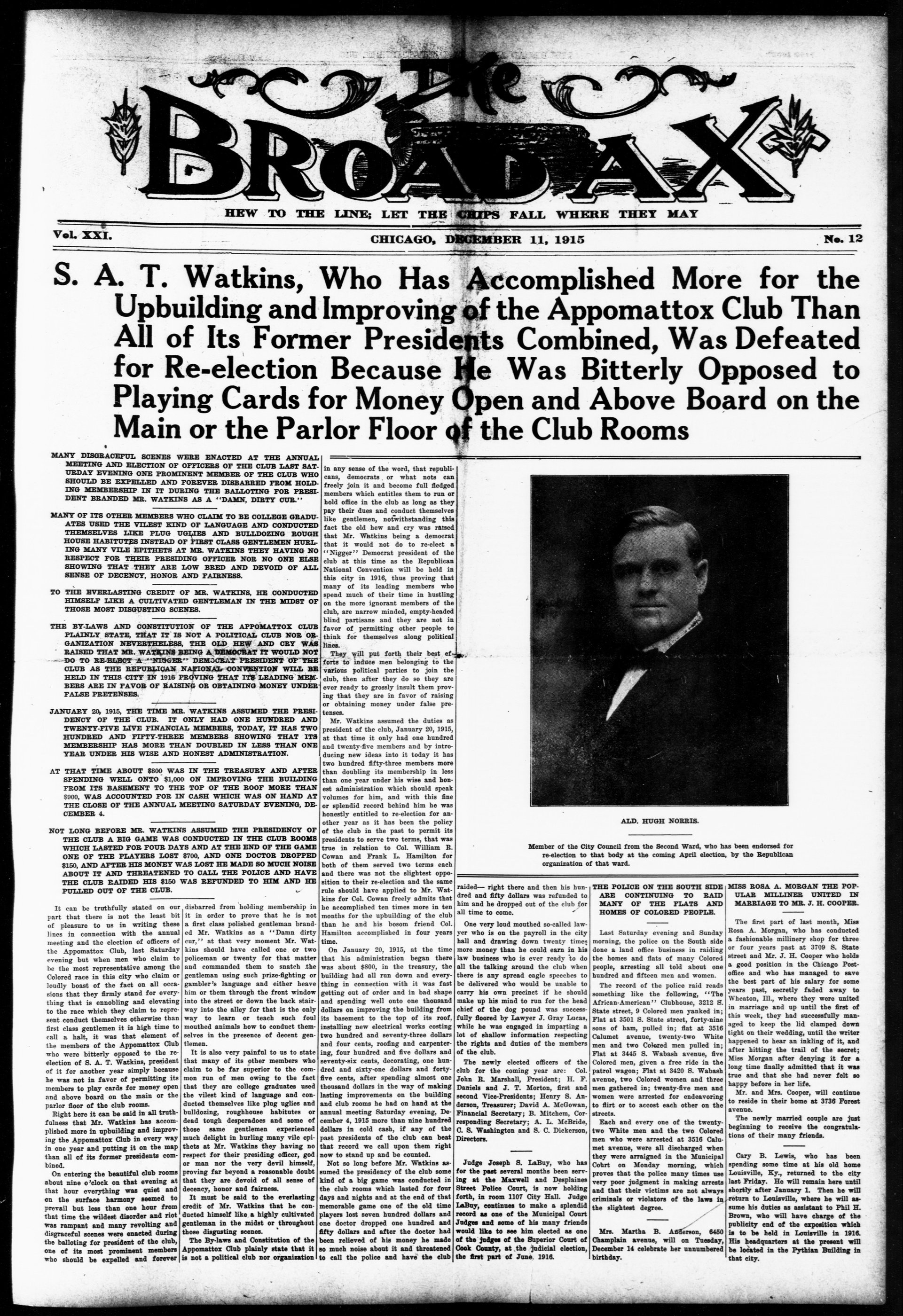
Page text (machine-generated)
THE BROAD AX
HEW TO THE LINE; LET THE CHIPS FALL WHERE THEY MAY
S. A. T. Watkins, Who Has Accomplished More for the Upbuilding and Improving of the Appomattox Club Than All of Its Former Presidents Combined, Was Defeated for Re-election Because He Was Bitterly Opposed to Playing Cards for Money Open and Above Board on the Main or the Parlor Floor of the Club Rooms
MANY DISGRACEFUL SCENES WERE ENACTED AT THE ANNUAL MEETING AND ELECTION OF OFFICERS OF THE CLUB LAST SATURDAY EVENING ONE PROMINENT MEMBER OF THE CLUB WHO SHOULD BE EXPELLED AND FOREVER DISBARRED FROM HOLDING MEMBERSHIP IN IT DURING THE BALLOTING FOR PRESIDENT BRANDED MR. WATKINS AS A "DAMN, DIRTY CUR."
MANY OF ITS OTHER MEMBERS WHO CLAIM TO BE COLLEGE GRADUATES USED THE VILEST KIND OF LANGUAGE AND CONDUCTED THEMSELVES LIKE PLUG UGLIES AND BULLDOZING ROUGH HOUSE HABITUTES INSTEAD OF FIRST CLASS GENTLEMEN HURLING MANY VILE EPITHETS AT MR. WATKINS THEY HAVING NO RESPECT FOR THEIR PRESIDING OFFICER NOR NO ONE ELSE SHOWING THAT THEY ARE LOW BRED AND DEVOID OF ALL SENSE OF DECENCY, HONOR AND FAIRNESS.
TO THE EVERLASTING CREDIT OF MR. WATKINS, HE CONDUCTED HIMSELF LIKE A CULTIVATED GENTLEMAN IN THE MIDST OF THOSE MOST DISGUSTING SCENES.
THE BY-LAWS AND CONSTITUTION OF THE APPOMATTOX CLUB PLAINLY STATE, THAT IT IS NOT A POLITICAL CLUB NOR ORGANIZATION NEVERTHELESS, THE OLD HEW AND OBY WAS RAISED THAT MR. WATKINS BEING A DEMOCRAT IT WOULD NOT DO TO BE ELECT A "NIGGER" DEMOCRAT PRESIDENT OF THE CLUB AS THE REPUBLICAN NATIONAL CONVENTION WILL BE HELD IN THIS CITY IN 1916 PROVING THAT ITS LEADING MEMBERS ARE IN FAVOR OF ERAISING OR OBTAINING MONEY UNDER FALSE PRETENSES.
JANUAEY 20, 1915, THE TIME MR. WATKINS ASSUMED THE PRESIDENCY OF THE CLUB. IT ONLY HAD ONE HUNDRED AND TWENTY-FIVE LIVE FINANCIAL MEMBERS, TODAY, IT HAS TWO HUNDRED AND FIFTY-THREE MEMBERS SHOWING THAT ITS MEMBERSHIP HAS MORE THAN DOUBLED IN LESS THAN ONE YEAR UNDER HIS WISE AND HONEST ADMINISTRATION.
AT THAT TIME ABOUT $800 WAS IN THE TREASURY AND AFTER SPENDING WELL ONTO $1,000 ON IMPROVING THE BUILDING FROM ITS BASEMENT TO THE TOP OF THE ROOF MORE THAN $900, WAS ACCOUNTED FOR IN CASH WHICH WAS ON HAND AT THE CLOSE OF THE ANNUAL MEETING SATURDAY EVENING, DECEMBER 4.
NOT LONG BEFORE MR. WATKINS ASSUMED THE PRESIDENCY OF THE CLUB A BIG GAME WAS CONDUCTED IN THE CLUB ROOMS WHICH LASTED FOR FOUR DAYS AND AT THE END OF THE GAME ONE OF THE PLAYERS LOST $700, AND ONE DOCTOR DROPPED $150, AND AFTER HIS MONEY WAS LOST HE MADE SO MUCH NOISE ABOUT IT AND THREATENED TO CALL THE POLICE AND HAVE THE CLUB AIDED HIS $150 WAS REFUNDED TO HIM AND HE PULLED OUT OF THE CLUB.
Vol. XXI.
S. A. T. Upbuzz All one for R Playing Main
MANY DISGRACEFUL SCENES WE MEETING AND ELECTION OF URDAY EVENING ONE PROMISE SHOULD BE EXPELLED AND ING MEMBERSHIP IN IT DU DENT BRANDED MR. WATKIN
MANY OF ITS OTHER MEMBERS WATES USED THE VILEST KIND THEMSELVES LIKE PLUG UP HOUSE HABITUTES INSTEAD OF ING MANY VILE EPITHETHS A RESPECT FOR THEIR PRESIDING THAT THEY ARE SENSE OF DECENCY, HONOR
TO THE EVERLASTING CREDIT OF HIMSELF LIKE A CULTIVATING THOSE MOST DISGUSTING SCENES
THE BY-LAWS AND CONSTITUTION PLAINLY STATE, THAT IT HAS GANIZATION NEVERTHELESS RAISED THAT MR. WATKIN'S DO TO REBLECT A NIGGER CLUB AS THE REPUBLICAN HELD IN THIS CITY IN 1916 BERS ARE IN FAVOR OF BAIS FALSE PRETENSES.
JANUARY 20, 1915, THE TIME MEDENCY OF THE CLUB. IT TWENTY-FIVE LIVE FINANCIAL HUNDRED AND FIFTY-THREE MEMBERSHIP HAS MORE THAN YEAR UNDER HIS WISE AND AT THAT TIME ABOUT $800 WAS SPENDING WELL ONTO $1,000 FROM ITS BASEMENT TO THE $900, WAS ACCOUNTED FOR IN THE CLOSE OF THE ANNUAL CEMBER 4.
NOT LONG BEFORE MR. WATKIN THE CLUB A BIG GAME WAS WHICH LASTED FOR FOUR DAYS ONE OF THE PLAYERS LOST $150, AND AFTER HIS MONEY WAS ABOUT IT AND THREATENED THE CLUB EAIDED HIS $150 PULLED OUT OF THE CLUB.
It can be truthfully stated on our part that there is not the least bit of pleasure to us in writing these lines in connection with the annual meeting and the election of officers of the Appomattox Club, last Saturday evening but when men who claim to be the most representative among the Colored race in this city who claim or loudly boast of the fact on all occasions that they firmly stand for everything that is ennobling and elevating to the race which they claim to represent conduct themselves otherwise than first class gentlemen it is high time to call a halt, it was that element of the members of the Appomattox Club who were bitterly opposed to the reelection of S. A. T. Watkins, president of it for another year simply because he was not in favor of permitting its members to play cards for money open and above board on the main or the parlor floor of the club rooms. Right here it can be said in all truthfulness that Mr. Watkins has accomplished more in upbuilding and improving the Appomattox Club in every way in one year and putting it on the map than all of its former presidents combined.
On entering the beautiful club rooms about nine o'clock on that evening at that hour everything was quiet and on the surface harmony seemed to prevail but less than one hour from that time the wildest disorder and riot was rampant and many revolting and disgraceful scenes were enacted during the balloting for president of the club, one of its most prominent members should be expelled and forever
disbarred from holding membership in it in order to prove that he is not a first class polished gentleman branded Mr. Watkins as a "Damn dirty cur," at that very moment Mr. Watkins should have called one or two policeman or twenty for that matter and commanded them to snatch the gentleman using such prize-fighting or gambler's language and either heave him or them through the front window into the street or down the back stairway into the alley for that is the only way to learn or teach such foul mouthed animals how to conduct themselves in the presence of decent gentlemen.
It is also very painful to us to state that many of its other members who claim to be far superior to the common run of men owing to the fact that they are college graduates used the vilest kind of language and conducted themselves like plug uglies and buldozing, roughhouse habitues or dead tough desperadoes and some of those same gentlemen experienced much delight in hurling many vile epithets at Mr. Watkins they having no respect for their presiding officer, god or man nor the very devil himself, proving far beyond a reasonable doubt that they are devoid of all sense of decency, honor and fairness.
It must be said to the everlasting credit of Mr. Watkins that he conducted himself like a highly cultivated gentleman in the midst or throughout those disgusting scenes.
The By-laws and Constitution of the Appomattox Club plainly state that it is not a political club nor organization
CHICAGO, DECEMBER 11, 1915
in any sense of the word, that republicans, democrats or what nots can freely join it and become full fledged members which entitles them to run or hold office in the club as long as they pay their dues and conduct themselves like gentlemen, notwithstanding this fact the old hew and cry was raised that Mr. Watkins being a democrat that it would not do to re-elect a "Nigger" Democrat president of the club at this time as the Republican National Convention will be held in this city in 1916, thus proving that many of its leading members who spend much of their time in hustling on the more ignorant members of the club, are narrow minded, empty-headed blind partisans and they are not in favor of permitting other people to think for themselves along political lines. They will put forth their best efforts to induce men belonging to the various political parties to join the club, then after they do so they are ever ready to grossly insult them proving that they are in favor of raising or obtaining money under false pretenses.
Mr. Watkins assumed the duties as president of the club, January 20, 1915, at that time it only had one hundred and twenty-five members and by introducing new ideas into it today it has two hundred fifty-three members more than doubling its membership in less than one year under his wise and honest administration which should speak volumes for him, and with this fine or splendid record behind him he was honestly entitled to re-election for another year as it has been the policy of the club in the past to permit its presidents to serve two terms, that was true in relation to Col. William R. Cowan and Frank L. Hamilton for both of them served two terms each and there was not the slightest opposition to their re-election and the same rule should have applied to Mr. Watkins for Col. Cowan freely admits that he accomplished ten times more in ten months for the upbuilding of the club than he and his bosom friend Col. Hamilton accomplished in four years time.
On January 20, 1915, at the time that his administration began there was about $800, in the treasury, the building had all run down and everything in connection with it was fast getting out of order and in bad shape and spending well onto one thousand dollars on improving the building from its basement to the top of its roof, installing new electrical works costing two hundred and seventy-three dollars and four cents, roofing and carpentry, four hundred and five dollars and seventy-six cents, decorating, one hundred and sixty-one dollars and forty-five cents, after spending almost one thousand dollars in the way of making lasting improvements on the building and club rooms he had on hand at the annual meeting Saturday evening, December 4, 1915 more than nine hundred dollars in cold cash, if any of the past presidents of the club can beat that record we call upon them right now to stand up and be counted.
Not so long before Mr. Watkins assumed the presidency of the club some kind of a big game was conducted in the club rooms which lasted for four days and nights and at the end of that memorable game one of the old time players lost seven hundred dollars and one doctor dropped one hundred and fifty dollars and after the doctor had been relieved of his money he made so much noise about it and threatened to call the police and have the club
[Picture of a man in a suit and bow tie].
Member of the City Council from the Second Ward, who has been endorsed for re-election to that body at the coming April election, by the Republican organization of that ward.
raided—right there and then his hundred and fifty dollars was refunded to him and he dropped out of the club for all time to come.
One very loud mouthed so-called lawyer who is on the payroll in the city hall and drawing down twenty times more money than he could earn in his law business who is ever ready to do all the talking around the club when there is any spread eagle speeches to be delivered who would be unable to carry his own precinct if he should make up his mind to run for the head chief of the dog pound was successfully floored by Lawyer J. Gray Lucas, while he was engaged in imparting a lot of shallow information respecting the rights and duties of the members of the club.
The newly elected officers of the club for the coming year are: Col. John R. Marshall, President; H. F. Daniels and J. T. Morton, first and second Vice-Presidents; Henry S. Anderson, Treasurer; David A. McGowan, Financial Secretary; B. Mitchem, Corresponding Secretary; A. L. MeBride, C. S. Washington and S. C. Dickerson, Directors.
Judge Joseph S. LaBuy, who has for the past several months been serving at the Maxwell and Desplaines Street Police Court, is now holding forth, in room 1107 City Hall. Judge LaBuy, continues to make a splendid record as one of the Municipal Court Judges and some of his many friends would like to see him elected as one of the judges of the Superior Court of Cook County, at the judicial election, the first part of June. 1916.
THE POLICE ON THE SOUTH SIDE ARE CONTINUING TO RAID MANY OF THE FLATS AND HOMES OF COLORED PEOPLE.
Last Saturday evening and Sunday morning, the police on the South side done a land office business in raiding the homes and flats of many Colored people, arresting all told about one hundred and fifteen men and women.
The record of the police raid reads something like the following, "The African-American" Clubhouse, 3212 S. State street, 9 Colored men yanked in; Flat at 3501 S. State street, forty-nine sons of ham, pulled in; flat at 3516 Calumet avenue, twenty-two White men and two Colored men pulled in; Flat at 3445 S. Wabash avenue, five Colored men, given a free ride in the patrol wagon; Flat at 3420 S. Wabash avenue, two Colored women and three men gathered in; twenty-five men and women were arrested for endeavoring to firt or to accost each other on the streets.
Each and every one of the twenty-two White men and the two Colored men who were arrested at 3516 Calumet avenue, were all discharged when they were arraigned in the Municipal Cobrt on Monday morning, which proves that the police many times use very poor judgment in making arrests and that their victims are not always criminals or violators of the laws in the slightest degree.
Mrs. Martha B. Anderson, 6450 Champlain avenue, will on Tuesday, December 14 celebrate her unnumbered birthday.
No.12
e for the Club Than has Defeated supposed to guard on the
has been endorsed for by the Republican
MISS ROSA A. MORGAN THE POPULAR MILLINER UNITED IN MARRIAGE TO MR. J. H. COOPER.
The first part of last month, Miss Rosa A. Morgan, who has conducted a fashionable millinery shop for three or four years past at 3709 S. State street and Mr. J. H. Morgan who holds a good position in the Chicago Post-office and who has managed to save the best part of his salary for some years past, secretly faded away to Wheaton, Ill., where they were united in marriage and up until the first of this week, they had successfully managed to keep the lid clamped down tight on their wedding, until the writer happened to hear an inkling of it, and after hitting the trail of the secret; Miss Morgan after denying it for a long time finally admitted that it was true and that she had never felt so happy before in her life.
Mr. and Mrs. Cooper, will continue to reside in their home at 3736 Forest avenue.
The newly married couple are just beginning to receive the congratulations of their many friends.
Cary B. Lewis, who has been spending some time at his old home Louisville, Ky., returned to the city last Friday. He will remain here until shortly after January 1. Then he will return to Louisville, where he will assume his duties as assistant to Phil H. Brown, who will have charge of the publicity end of the exposition which is to be held in Louisville in 1916. His headquarters at the present will be located in the Pythian Building in that city.
PAGE TWO
Australian boys begin their military career at the age of twelve years, when they enter the ranks of the "junior cadets" and drill under the instruction of their schoolteachers. Their target practice is limited to shooting what is popularly known as the "twenty-two" rifle. At the age of fourteen the schoolboy is graduated into the "senior cadets," and here his military training begins in dead earnest. He learns to care for his rifle, which the government furnishes to him. The state also gives him an olive drab military uniform. He learns the movements of squad and company formations and learns to deploy as skirmishers.
The Australian schoolboy becomes a soldier irrespective of his own wishes in the matter, or those of his parents. Truancy officers, such as in this country, watch the attendance at school in Australia, hale into court the parents of boys who are absent from their military drill, and it is not an infrequent occurrence for heavy fines to be levied on parents who are indifferent to their sons' military education.—American Boy.
How Romans Took Their Food.
The Romans reclined at their banquets on couches, all supporting themselves on one elbow and eating with their fingers from dishes placed in the center of the table. Each was supplied with a napkin, and knives were used, though it does not appear that every one was supplied with one. Nothing, it would seem, could be more fatiguing than to partake of a repast in such an awkward posture or less conducive to neatness, it being almost impossible to keep the hands clean even with water supplied by the slaves or to prevent the food and wine from falling on the clothing and the draperies of the couch. This manner of eating disappeared during the dark ages so far as the couch was concerned, but the peculiarity of taking food with the fingers from a common dish continued afterward for more than 1,000 years.
Bismarck's Card Trick.
The diplomat has many tricks up his sieve. Bismarck included not only drinking, but card playing. It was when he was negotiating the treaty of Genstein with the Austrian Blome. "I then played quinze for the last time in my life. Although I had not played then for a long time, I gambled recklessly, so that the others were astounded. But I knew what I was at. Blome had heard that quinze gave the best opportunity of testing a man's character, and he was anxious to try the experiment on me. I thought to myself, 'Til teach him.' I lost a few hundred thalers, for which I might well have claimed reimbursement from the state. But I got around Blome in that way and made him do what I wanted. He took me to be reckless and yielded."—London Chronicle.
Washing In the Philippines
Most of the laundry work of the Philippine Islands is done by hand. The washing is usually done by beating the clothes with paddles, with the open hands or by rolling the garment slightly and striking one end of it upon a flat stone or other hard, smooth surface, handling it as a fail is swung over the shoulder. The usual method is to beat the clothes with paddles especially fashioned for the purpose. There is no such thing as boiling in the process of washing among the Filipinos. Much of the clothing worn in the country being white, a great deat of sun bleaching is done.
"Maru" In Japan.
Maru is the Japanese word for mother. All Japanese regard their country of Japan as their mother, and instead of using the equivalent of the word fatherland they invariably say "Maru" (mother) when referring to the land of Japan. Their use of the word as part of the names of ships is to show their reverence for and to honor their mother, Japan, and at the same time to distinguish the ships as belonging to their motherland.
Nothing Unusual.
"My goodness!" said Wiggles. "Rudyard Kipling's autograph brought $17.50 at auction the other day." "That's nothing," retorted Ralph Waldo Inkwell, author of "Sonnets to a Portuguese." "My autograph brought $37.25 last week." "Auction sale?" queried Wiggles. "No," said Inkwell. "It was signed to a check in payment of my tallor's bill."—New York Times.
Harder Still.
"Well, have you reached the point where you can assemble a motorcar?" asked Mr. Chugson.
"No, indeed," answered Mr. Johnson. "In fact, I haven't yet reached the point where I can assemble the price."—Birmingham Ars-Herald
Very Simple.
"My wife is going to that masquerade ball as a simple fisher malden."
"Going to borrow a fisher's costume from some simple malden?
"Not on your life. Going to have one especially constructed for $2,000.—Louisville Courier-Journal."
Somebody Had to Sleep
The doctor entered the patient's room in the morning and, according to habit, read the chart the first thing. He was a little surprised to read: "2 a. m. —Patient very restless; nurse sleeping quietly." —Collier's Weekly.
If you would hit the target aim a little above it. Every arrow that flies the attraction of earth. —Longfellow.
The Lady or the Tiger Biddle
"Perhaps the most interesting thing about 'The Lady or the Tiger?'" Frank R. Stockton once said, "is its great popularity among the-savage races. It has been told again and again by the story tellers of Burma. A missionary once told the story to a tribe of Karen's in Burma. When she came back a year later the tribe surrounded her and wanted to know if she had found out whether—I cannot answer the question, for I have no earthly idea myself. I have never been able to decide whether the lady or the tiger came out of that door. Yet I must defend myself. People for years have upbraided me for leaving it a mystery. Some used to write me that I had no right to impose upon the good nature of the public in that manner. However, when I started in to write the story I intended to finish it, but it would never let itself be finished. I could not decide, and to this day, I assure you, I know no better than any one else."—Christian Science Monitor.
Drew Line at Indians
At a recent gathering of life insurance men one of the old timers exhibited a copy of a permit which had been attached to a policy issued by the Mutual Life in 1868. This permit read: "The within assured has permission to reside in any settled part of the states of California, Nevada, Oregon or Washington territory and while so residing to make trips (as a passenger only) on first class steamers plying between the ports of Washington territory, the states of California and Oregon and the Sandwich Islands and to proceed to and return in like manner, or by public conveyance overland.
"Provided that written notice be given by the assured whenever any trip to the Sandwich Islands or to the Atlantic states is undertaken, to the general agent of the company at San Francisco, Cal., and provided also that on the overland route the said assured to take his own risk by death from hostile Indians."—Wall Street Journal,
Courage and Courtesy.
It is recorded of General Sheridan that he was once asked who, in his opinion, was the most reliable of the corps commanders, and he unhesitatingly answered, General Hancock. He said, "If I wanted a man to stay where I put him, if I located him at night and wanted to find him right there in the morning, I'd select Hancock." And then further Sheridan said:
"For genuine politeness and gentle regard for women Hancock was incomparable. If Mrs. Hancock came into his room twenty times in half an hour he would always stand up."
There is a compliment indeed. The bravest commander was the most courteous to women, and, what was best of all, he included his own wife among the objects of his courtesy. That is something many men forget—they are courteous to all women except to their own wives.—Ohio State Journal.
Original of Ealstaff:
Sir John Fastofl was the original of Shakespeare's Falstaff and in his day was a continual butt for the jests of the town and borough of Southwark. Though he had fought at Agincourt, when Jack Cade invaded the borough he showed great cowardice. When Cade was yet some way off Fastofl had armed and fortified his house and garrisoned it with veterans of the French wars. On the arrival of Cade, however, he withdrew his garrison and fled to the Tower, leaving his neighbors to the mercy of the rebels. Fastofl's matrimonial adventures seem also to have been another source of unpopularity, for, having married a widow named Scrope, he seized her property and kept his stepson out of his inheritance during his own lifetime.-London News.
Boiled Rosebuds.
Although it is little known in this country, Turkish women consider rosebuds boiled in sugar a luxury not to be missed. They claim that these make an excellent preserve.
In China a species of lily is dried and used for seasoning ragouts and other dishes. This is looked upon as one of the choicest of native dishes.
Many provinces of this same land grow lilies expressly for the purpose of marketing them in this connection. They are usually picked just previous to their opening and then cooked as ordinary vegetables.
German and Spanish
It is just about "nip and tuck" between those who speak German and those who speak Spanish, with the advantage somewhat on the side of the German. There are about $8,000,000 German speaking people in the world and about $2,000,000 speaking Spanish.—New York American.
Unfortunately Expressed
Violinist (one of a trio of amateurs who have just obliged with a rather lengthy performance)—Well, we've left off at last! Hostess-Thank you so much!-London Telegraph.
His Ambition:
Madge—I hear that Charlie is an awful spendthrift. Marjorie—I should say he was. He's trying to make two wild oats grow where only one grew before—Puck.
Anomalous
"Pa. what is an anomaly?"
"I can't explain the term very well, son, but a deck hand on a submarine would be anomalous." — Birmingham Age-Herald.
When you know a thing, maintain that you know it; when you do not, acknowledge your ignorance. — Confucius.
THE BROAD AX. CHICAGO. DECEMBER 11, 1915
The Chesapeake Bay Dog.
The most remarkable characteristic of the Chesapeake is his retrieving. He has been developed for retrieving ducks, and naturally should be well fitted for that purpose. But it is my firm conviction that he would retrieve a horse if told to do so, bringing it to you in pieces if he couldn't boat it home. The one definite aim in breeding him has been to make the best possible retriever, and if ever a breeder's aim succeeded it has succeeded in this instance.
A Chesapeake will fetch anything on earth that is within his physical powers to move or handle. If you take him to the water and do not throw anything in for him to go after he will bring you oysters on his own account. He brings bricks and stones and clubs joyfully. Old Beaver, long a prize winner and now just about to leave us for the happy hunting ground, has worn his teeth down to stubs, like an old bear's teeth, carrying hard objects. Almost any Chesapeake will show the same condition of mouth—Outing.
Men Who Wear Feathers.
Among the strange tribes of men about whom little is known are the Chamacocos of the region about the upper Paraguay river. Although the Chamacocos wear but little clothing, they excel in the art of making personal adornments from the feathers of birds. Their country abounds with birds of the most beautiful plumage, including parrots, toucans and trogons, whose feathers are dazzling in color; rheas with gray plumes, musk ducks of a glossy black color, egrets with feathers of pure white and spoonbills of a delicate pink hue. All this wealth of color and graceful plumage is combined by the Chamacocos in a most artistic manner. Some of these savages walk their forest glades in colors more brilliant, if less ample, than any woman's dressmaker could produce.—Washington Star.
Reconciled.
We observe that our friend has a bad cold in his head, and of course we tell him exactly how to cure it.
From his pocket he takes a large memorandum book and enters our prescription on one of the final pages thereof. Then he snaps a rubber band about the book, sneezes and smiles happily.
We observe to him that we are glad our instructions for a cure have made him so happy.
"It isn't that," he says. "Since I got this cold I have written down every sure cure recommended, and whenever the cold gets so bad I feel as though I couldn't stand it another day I read over all the cures and think how much better is is to have the cold than to endure all the remedies."—Judge.
Spring Flows on Holidays
In a picnic ground in the Passaic valley there is a spring that flows only on Sundays and holidays. "It used to flow always. Robert E. Horton, in the proceedings of the Connecticut Society of Civil Engineers, explains this strange performance. When the great silk mills spring up in the Passaic valley numerous artesian wells were bored into the red sandstone; pumps draw out so much water that it now normally stands below the level of the spring outlet, but on Sundays and holidays the pumps are not working, the water rises above the level of the spring, and this flows again.
Helping Uncle.
She came down to the drawing room to meet her special young man with a frown on her pretty face.
"John," she said, "father saw you this morning going into a pawnbroker's with a large bundle."
John flushed. Then he said in a low voice:
"Yes, that is true. I was taking the pawnbroker some of my old clothes. You see, he and his wife are frightfully hard up."
"Oh, John, forgive me!" exclaimed the young girl. "How truly noble you are!"—Exchange.
Expert Samoans
The women of Samoa often fish in the sea without nets, boats or hooks. They simply wade into the water and form themselves into a ring. The fishes being so plentiful, they are almost sure to have imprisoned some in the ring. These women are very quick and active, and every time they catch a fish with their hands they simply throw it alive into the basket on their back.
Considerate
"Have you ever done anything to make the world happier?" asked the solemn looking person with the unbarbered hair.
"Sure," answered the jolly man with the double chin. "I was once invited to sing in public and declined."
"My grandpa had a perplexity fit the other day," said small Dorothy.
"Perplexity fit!" echoed Edward. "You mean a parallel stroke, don't you?" -Buffalo News.
Touched.
"I suppose you were touched when your wife gave you that fifty dollar easy chair for your den."
"I was touched before she gave it."—Boston Transcript.
Jade of Burma.
The world's principal jade mine is in Burma, where the privilege of mining the stone has beep in possession of one Indian tribe for many generations.
The Land of Large Families.
In his article on the winter life of the French Canadians in Harper's Howard E. Smith tells of the extraordinary large families of these simple folk.
"Soon the twilight grew to night, and the large lamp on the table cast its orange glow over the room and the long table filled with steaming dishes.
"You have a large family, madam," I remarked, as they gathered about the table.
"Oui, monsieur, we are sixteen. It is a good gift to le bon Dieu, n'est-ce pas? she said, turning toward the cure.
"C'est vrai, mon enfant. It is. There is no better gift than that of another child to his kingdom."
"I could not but remember that the law has also encouraged large families by passing a bill at Quebec giving ten acres of land to any family having from that time forth twelve or more children, and how in two years the law was repealed because the demand on those ten acres lots was in excess of the supply."
Strawberry Nose.
The most distressing of facial deformities, rhinophyma, which is characterized by a much swollen and redened tip of the nose, making this look like a huge strawberry or a piece of cauliflower that has been dipped in beet juice, may be cured by a simple operation. Sir William Milligan of the Royal infirmary, Manchester, England, describes this in the London Lancet. The operation consists in cutting off all the hypertrophied tissue, while the nasal passages are kept extended with absorbent wool in order to preserve their contour. Care is taken to avoid injury to the lateral cartilages, and only two insignificant blood vessels require tying. The raw surface is covered with two thin grafts of skin cut from the patient's thigh, over which a sheet of gold leaf is placed and a dry dressing fastened with adhesive plaster. It should be possible to remove the dressing in five days.
Races Within Races In the Balkans.
Language and religion are not the only basis of the intense subdivision of feeling in the Balkans. The whole region is parceled out among race fractions, some of which are no larger than a hamlet. Roumanians, Bulgarians, Servians and Greeks have a sharp consciousness of race persistence, and at the same time every state is intent upon breaking up the race units of other peoples which exist within its borders. If Greece were populated only by Greeks and Bulgaria by Bulgarians and Servia by Servians, the task would be easier. It is a curse to the peninsula that the villagers have pushed this way and that wherever there was vacant land or wherever they could make a vacancy by driving out the previous holders. The result is the creation of race islands in the midst of angry race seas.—Albert Bushnell Hart in Outlook,
Making the Insects Speak.
In the biographies of the world there is no passage more human and more humorous than the account by M. Fabre of his first interview with Pasteur, who had never seen a cocoon and was astonished that there was anything in it. He concludes the account thus: "Encouraged by the magnificent example of the cocous rattling in Pasteur's astonished ears, I have made my rule to adopt the method of ignorance in my investigations into insects. I read very little. Instead of turning the pages of books, an expensive proceeding quite beyond my means, instead of consulting other people, I persist obstinately in interviewing my subject until I succeed in making him speak."—I London Spectator.
Limited Perpetual Motion
Ambrose Fletcher solved the great problem of perpetual motion the other day, after laboring upon it for many years. It is in the shape of a ball which swings back and forth regularly and tirelessly, being propelled by a sort of clockwork mechanism. There is only one drawback to this solution of the old problem. He has to wind the machinery every eight days. There is always something wrong, isn't there? As soon as Ambrose gets it so it will run without winding we will have the problem definitely solved. — Brooklyn Eagle.
Exactly Alike.
"You ought to be pleased with these rolls, George, dear." said the young wife. "They are exactly like those your mother used to make when you were a boy." "Of course they are," replied George gallantly. "In fact, I thought at first they were the same ones." And the stupid creature could not understand why Mrs. George burst into tears!-Richmond Times-Dispatch
The Color of Air
Pure air is blue in tint because, according to Newton, the molecules of the air have the thickness necessary to reflect blue rays. When the atmosphere is blended with perceptible vapors the diffused light is mixed with a large proportion of white.
A Slight Change.
Slight changes sometimes make a great difference. "Dinner for nothing" would be agreeable, for instance; not so, "Nothing for dinner."
The Main Question
A child asks, "Is it good to eat?"—
Judge.
Heaven often smites in mercy, even
when the blow is severest—Baillie.
Thugs of India.
Among the countless varieties of criminal which infest the large cities you are doubtless familiar with the one commonly designated by the name "thug," a rufian who would stab a person in the back for a few cents. The name "thug" is derived from the old religious order that flourished in India unmolested up to about 1836. Thuggee was practiced by religious fanatics, whose creed prohibited the shedding of blood. Any human sacrifice which might be offered to the goddess Kall must be slain without the breaking of the skin or the appearance of one bloodstain. Usually the thugs masqueraded as pilgrims or peddlers, got the confidence of their victims and then strangled them by means of a rope, a handkerchief or an unwound turban. They were then buried in shallow graves, dug with a consecrated pickax, and a third of the plunder was laid on the altar of Kall, their barbaric deity.-St. Louis Globe-Democrat.
Taking an Impression
The original point of view of Stephen Hawweis, the English painter, is seen in the following fable, which was included in a letter to a friend:
The artist peeced into a window of a room where a retired merchant sat, doing a jigsaw puzzle.
"Whose is that strange face?" the merchant asked anxiously.
"I saw no one," his wife said.
"I did. I saw a strange face distinctly"—but before he reached the window the artist was gone.
"Do you think it was a burglar?" his wife said.
"We will see if he has taken anything."
Investigation showed that nothing was missing, but the artist had taken away an impression which he sold to that particular merchant for £100.—Kansas City Times.
The Penetrating Stare.
Can a stare be felt? A woman who has conducted many experiments says it can, that "no matter how deep her absorption, the stare at her back will always disturb her. All girls feel a stare." Dr. Coover, "a psychologist," says a stare is not felt and that he has tested it a thousand times. It is probably all imagination on the part of the woman, for it is easy in such cases for what one imagines to become real to her. Where she passes a man, and be stares at her, she can doubtless feel that stare a block away, for it will take awhile for the impression of a stare to pass away. Stares are no doubt a great annoyance to women, but there is no way to prohibit them. The only way to do to abolish the stare is for women to dress simply and go modestly about their business. —Ohio State Journal.
Nickel In Soapmaking:
It will probably be news to the average ablutionist that the metal nickel is used in making his soap. And further, perhaps, he will be glad to learn that although the nickel, finely ground, is mixed with the other soap ingredients the finished product contains none of it. This is so because the nickel acts as what the chemists call a catalyst—that is, its presence causes certain desirable changes to occur, although it takes no part in the chemical reaction. Offensive oils and those too thin for satisfactory use when mixed with finely divided nickel and subjected to the action of a current of hydrogen become deodorized and harder and suitable for the soapmaker's use. Cottonseed oil, for example, after the nickel-hydrogen treatment, makes a satisfactory soap.—Pittsburgh Press.
Elephant Skin.
Elephant skin is beautiful and durable, but it is very hard to get. The price of a live elephant is large, and a leather manufacturer who promised to provide a number of elephant skin bags at short order would find himself facing a big problem. Almost all elephants, after they die, fall into the hands of the leather manufacturers, or else they are stuffed and put in museums.
She Was Right.
Teacher—Now, Dorothy, tell me how many bones in your body? Dorothy—Two hundred and eight. Teacher—That's not right. There are only 207. Dorothy (with great delight)—But I swallowed a fish bone this morning!-Indianapolis Star.
Balata
Balata is a substance belonging to the rubber-like products and which is very similar to gutta percha. It is obtained from the milky juice of the "bully tree" (Sapota muelleri belk), found chiefly in the Guianas and Venezuela.
An Easy Arrangement
Wife—Am I. then, never to have my way in anything? Husband—Certainly, dear. When we are both agreed you can have your way. When we differ I'll have mine."
Obliging.
Limited Experience
Mistress (to new girl)-We entertain a good deal. Have you had much experience at parties? Girl-Only as a guest. mum.-New Haven Register.
Curiosity is looking over other people's affairs and overlooking our own. -Wayland.
The Torch of Civilization.
In the history of civilization first one nation arises and becomes the torch bearer and then another takes the torch as it becomes stronger, the stronger always pushing the weaker aside and becoming in its turn the leader. Each nation that has borne the torch of civilization has followed some path peculiarly its own. Egyptian, Syrian, Persian, Greek, Roman, Frank, all had their ideal of power—order and progress directed under supreme authority, maintained by armed organization. We Anglo-Saxons bear the torch of civilization because we possess the principles of civil liberty, and we have the character, or should have the character, which our fathers have transmitted to us, with which to uphold it. If we have not, then be sure that with the certainty of a law of nature some nation—it may be one or it may be another—already knocking at our doors, will push us from the way and take the torch and bear it onward, and we shall go down—Thomas Nelson Page.
Classification of Stars
In classifying stars astronomers recognize six degrees of magnitude, but the term relates to radiance or brilliancy rather than to size. Although the classification is somewhat arbitrary, yet each degree of magnitude is approximately two and a half times as brilliant as a star of the next magnitude below. Then, too, each magnitude is about three times more numerous than the one which precedes it. Beginning with the brightest, there are visible without a glass about twenty stars of the first magnitude, about sixty-five of the second magnitude, nearly 200 of the third magnitude, over 400 of the fourth magnitude, about 1,100 of the fifth and over 3,000 of the sixth. The total number of stars that can be seen by the unaided eye is about 5,000, but not all at one time. This takes no account of the millions, perhaps hundreds of millions, in regions of space that cannot be reached by the unaided eye.
Hot Winds.
The siroco blows hot from the highlands of north Africa and falls on the Mediterranean as far as Malta. The salano jumps like a windy fireball from the heat of the Sahara desert and lands flatfooted in Spain. The harmattan blows hot Sahara dust far into the Atlantic and gives nosebleed and makes skin and lips parch and crack, while furniture and ship timbers groan and crack and scream in an agony of droughty despair. The khasmin blows Sahara's ancient dust into Egyptian eyes every fifty days. The pamperes periodically blow down into Buenos Aires out of the unexplored desert highlands of Brazil, and the blowing causes suicides and murders to be more common and wounds to break out afresh, with a heavy death rate. Pamperos pass away in a second, leaving the air fine.—Exchange.
Painter and Pawnbroker
Mr. Frank Brangwyn, A. R. A., knows his Paris as well as most, and also a good many more out of the way parts of the world besides-Russia, Spain, Aligiers, Turkey and the rest—which he has visited in the pursuit of his art, more especially during his earlier days, when he was less affluent than today, in which latter connection he once had an amusing experience. During a financial crisis he sought to effect a loan of $50 on the security of one of his own pictures. The pawnbroker offered $2.50, to the artist's indignation. "Why, the frame alone is worth more than that," he protested, to be met with the crushing reply, "I know it is, and it is on the frame that I am lending the money."—Westminster Gazette.
A Japanese Breakfast.
The usual Japanese breakfast consists of rice, miso, soup, pickles and occasionally fish. Tea is always served with meals and is drunk clear, without sugar or cream. Miso soup consists of strips of radishes, seaweed, eggplant or other vegetables cooked with bean curd and water. The cooking is not continued for a long period, and so few vegetables are used that the soup partakes only slightly of the flavor of the ingredients.
A Whistling Moth
A whistling moth is an Australian rarity. There is a glassy space on the wings crossed with ribs. When the moth wants to whistle it strikes these ribs with its antennae, which have a knob at the end. The sound is a love call from the male to the female.
A Last Resort.
"Can't you do anything at all for my hair?"
"Nope," said the barber. "Hair all gone."
"But my dome shines like a newt starched collar. Can't you give it a sort of dull finish?"—Exchange.
Bill—Did you ever try to stand on an egg?
"That the inside of the egg was stronger than the outside."—Philadelphia Record.
Psychology.
Psychology is the science of explaining why the time between weekly pay days seems longer than the period from one monthly gas bill to the next. —Toledo Blade.
Worse Still.
"I have a wife who is like a bird that can sing and won't"
"You're lucky. Mine can't sing and will."-Baltimore American
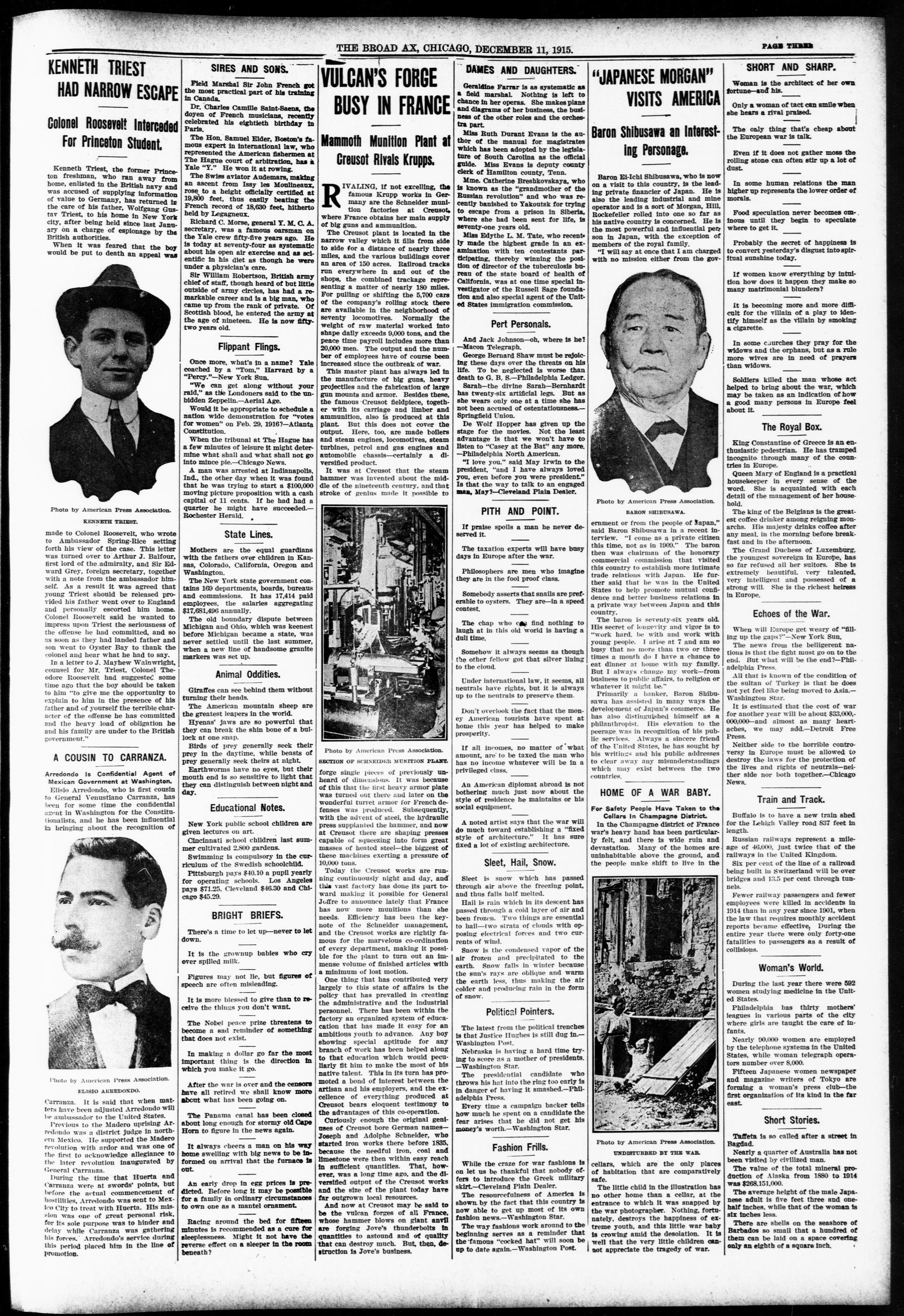
Kenneth Triest, the former Princeton freshman, who ran away from home, enlisted in the British navy and was accused of supplying information of value to Germany, has returned in the care of his father, Wolfgang Gustav Triest, to his home in New York city, after being held since last January on a charge of espionage by the British authorities. When it was feared that the boy would be put to death an appeal was
```markdown
```
Photo by American Press Association.
KENNETH TRIEST.
made to Colonel Roosevelt, who wrote to Ambassador Spring-Rice setting forth his view of the case. This letter was turned over to Arthur J. Balfour, first lord of the admiralty, and Sir Edward Grey, foreign secretary, together with a note from the ambassador himself. As a result it was agreed that young Triest should be released provided his father went over to England and personally escorted him home. Colonel Roosevelt said he wanted to impress upon Triest the seriousness of the offense he had committed, and so as soon as they had landed father and son went to Oyster Bay to thank the colonel and hear what he had to say.
In a letter to J. Mayhew Wainwright, counsel for Mr. Triest, Colonel Theodore Roosevelt had suggested some time ago that the boy should be taken to him "to give me the opportunity to explain to him in the presence of his father and of yourself the terrible character of the offense he has committed and the heavy load of obligation he and his family are under to the British government."
A COUSIN TO CARRANZA
Arredondo Is Confidential Agent of Mexican Government at Washington. Elisio Arredondo, who is first cousin to General Venustiano Carranza, has been for some time the confidential agent in Washington for the Constitutionalists, and he has been influential in bringing about the recognition of
P. A. M.
Photo by American Press Association.
ELISIO ARREDONDO.
Carranza. It is said that when matters have been adjusted Arredondo will be ambassador to the United States.
Previous to the Madero uprising Arredondo was a district judge in northern Mexico. He supported the Madero revolution with ardor and was one of the first to acknowledge allegiance to the later revolution inaugurated by General Carranza.
During the time that Huerta and Carranza were at swords' points, but before the actual commencement of hostilities, Arredondo was sent to Mexico City to treat with Huerta. His mission was one of great personal risk, for its sole purpose was to hinder and delay while Carranza was gathering his forces. Arredondo's service during this period placed him in the line of promotion.
SIRES AND SONS.
Field Marshal Sir John French got the most practical part of his training in Canada.
Dr. Charles Camille Saint-Saens, the doyen of French musicians, recently celebrated his eighth birthday in Paris.
The Hon. Samuel Elder, Boston's famous expert in international law, who represented the American fishermen at The Hague court of arbitration, has a Yale "Y." He won it at rowing.
The Swiss aviator Audemars, making an ascent from Issy les Moulineaux, rose to a height officially certified at 19,800 feet, thus easily beating the French record of 18,630 feet, hitherto held by Legacieux.
Richard C. Morse, general Y. M. C. A. secretary, was a famous oarsman on the Yale crew fifty-five years ago. He is today at seventy-four as systematic about his open air exercise and as scientific in his diet as though he were under a physician's care.
Sir William Robertson, British army chief of staff, though heard of but little outside of army circles, has had a remarkable career and is a big man, who came up from the rank of private. Of Scottish blood, he entered the army at the age of nineteen. He is now fifty-two years old.
Flippant Flings.
Once more, what's in a name? Yale coached by a "Tom," Harvard by a "Percy."—New York Sun.
"We can get along without your raid," as the Londoners said to the unbidden Zeppelin—Aerial Age.
Would it be appropriate to schedule a nation wide demonstration for "votes for women" on Feb. 29, 1916?—Atlanta Constitution.
When the tribunal at The Hague has a few minutes of leisure it might determine what shall and what shall not go into mince pie.—Chicago News.
A man was arrested at Indianapolls, Ind., the other day when it was found that he was trying to start a $100,000 moving picture proposition with a cash capital of 11 cents. If he had had a quarter he might have succeeded.—Rochester Herald.
State Lines.
Mothers are the equal guardians with the fathers over children in Kansas, Colorado, California, Oregon and Washington. The New York state government contains 169 departments, boards, bureaus and commissions. It has 17,414 paid employees, the salaries aggregating $17,681,496 annually. The old boundary dispute between Michigan and Ohio, which was keenest before Michigan became a state, was never settled until the last summer, when a new line of handsome granite markers was set up.
Animal Oddities.
Giraffes can see behind them without turning their heads.
The American mountain sheep are the greatest leapers in the world.
Hyenas' jaws are so powerful that they can break the shin bone of a bullock at one snap.
Birds of prey generally seek their prey in the daytime, while beasts of prey generally seek theirs at night.
Earthworms have no eyes, but their mouth end is so sensitive to light that they can distinguish between night and day.
Educational Notes.
New York public school children are given lectures on art.
Cincinnati school children last summer cultivated 2,800 gardens.
Swimming is compulsory in the curriculum of the Swedish schoolchild.
Pittsburgh pays $40.10 a pupil yearly for operating schools. Los Angeles pays $71.25. Cleveland $46.30 and Chicago $45.29.
BRIGHT BRIEFS.
There's a time to let up—never to let down.
It is the grownup babies who cry over spilled milk.
Figures may not lie, but figures of speech are often misleading.
It is more blessed to give than to receive the things you don't want.
The Nobel peace prize threatens to become a sad reminder of something that does not exist.
In making a dollar go far the most important thing is the direction in which you make it go.
After the war is over and the censors have all retired we shall know more about what has been going on.
The Panama canal has been closed about long enough for stormy old Cape Horn to figure in the news again.
It always cheers a man on his way home swelling with big news to be informed on arrival that the furnace is out.
An early drop in egg prices is predicted. Before long it may be possible for a family in ordinary circumstances to own one as a mantel ornament.
Racing around the bed for fifteen minutes is recommended as a cure for sleeplessness. Might it not have the reverse effect on a sleeper in the room beneath?
---
THE BROAD AX, CHICAGO, DECEMBER 11, 1915
RIVALING, if not excelling, the famous Krupp works in Germany are the Schneider muntion factories at Creusot, where France obtains her main supply of big guns and ammunition. The Creusot plant is located in the narrow valley which it fills from side to side for a distance of nearly three miles, and the various buildings cover an area of 150 acres. Railroad tracks run everywhere in and out of the shops, the combined trackage representing a matter of nearly 180 miles. For pulling or shifting the 5,700 cars of the company's rolling stock there are available in the neighborhood of seventy locomotives. Normally the weight of raw material worked into shape dally exceeds 9,000 tons, and the peace time payroll includes more than 20,000 men. The output and the number of employees have of course been increased since the outbreak of war.
This master plant has always led in the manufacture of big guns, heavy projectiles and the fabrication of large gun mounts and armor. Besides these, the famous Creusot fieldpiece, together with its carriage and limber and ammunition, also is produced at this plant. But this does not cover the output. Here, too, are made boilers and steam engines, locomotives, steam turbines, petrol and gas engines and automobile chassis—certainly a diversified product.
It was at Creusot that the steam hammer was invented about the middle of the nineteenth century, and that stroke of genius made it possible to
THE LATHE
Photo by American Press Association.
SECTION OF SCHNEIDER MUNITION PLANT
forge single pieces of previously unheard of dimensions. It was because of this that the first heavy armor plate was turned out there and later on the wonderful turret armor for French defenses was produced. Subsequently, with the advent of steel, the hydraulic press supplanted the hammer, and now at Creusot there are shaping presses capable of squeezing into form great masses of heated steel—the biggest of these machines exerting a pressure of 10,000 tons.
Today the Creusot works are running continuously night and day, and this vast factory has done its part toward making it possible for General Joffre to announce lately that France has now more munitions than she needs. Efficiency has been the keynote of the Schneider management, and the Creusot works are rightly famous for the marvelous co-ordination of every department, making it possible for the plant to turn out an immense volume of finished articles with a minimum of lost motion.
One thing that has contributed very largely to this state of affairs is the policy that has prevailed in creating the administrative and the industrial personnel. There has been within the factory an organized system of education that has made it easy for an ambitious youth to advance. Any boy showing special aptitude for any branch of work has been helped along to that education which would peculiarly fit him to make the most of his native talent. This in its turn has promoted a bond of interest between the artisan and his employers, and the excellence of everything produced at Creusot bears eloquent testimony to the advantages of this co-operation.
Curiously enough the original geniuses of Creusot bore German names—Joseph and Adolphe Schneider, who started iron works there before 1835, because the needful iron, coal and limestone were then within easy reach in sufficient quantities. That, however, was a long time ago, and the diversified output of the Creusot works and the size of the plant today have far outgrown local resources.
And now at Creusot may be said to be the vulcan forges of all France, whose hammer blows on giant anvil are forging Jove's thunderbolts in quantities to astound and of quality that can destroy much. But, then, destruction is Jove's business.
DAMES AND DAUGHTERS.
Geraldine Farrar is as systematic as a field marshal. Nothing is left to chance in her operas. She makes plans and diagrams of her business, the business of the other roles and the orchestra part.
Miss Ruth Durant Evans is the author of the manual for magistrates which has been adopted by the legislature of South Carolina as the official guide. Miss Evans is deputy county clerk of Hamilton county, Tenn.
Mme. Catherine Breshkovskaya, who is known as the "grandmother of the Russian revolution" and who was recently banished to Yakoutsk for trying to escape from a prison in Siberia, where she had been sent for life, is seventy-one years old.
Miss Edythe L. M. Tate, who recently made the highest grade in an examination with ten contestants participating, thereby winning the position of director of the tuberculosis bureau of the state board of health of California, was at one time special investigator of the Russell Sage foundation and also special agent of the United States immigration commission.
Pert Personals.
And Jack Johnson—oh, where is he?—Macon Telegraph.
George Bernard Shaw must be rejoicing these days over the threats on his life. To be neglected is worse than death to G. B. S.—Philadelphia Ledger.
Sarah—the divine Sarah—Bernhardt has twenty-six artificial legs. But as she wears only one at a time she has not been accused of ostentatiousness.—Springfield Union.
De Wolf Hopper has given up the stage for the movies. Not the least advantage is that we won't have to listen to "Casey at the Bat" any more.—Philadelphia North American.
"I love you," said May Irwin to the president, "and I have always loved you, even before you were president." Is that the way to talk to an engaged man. May?—Cleveland Plain Dealer.
PITH AND POINT.
If praise spoils a man he never deserved it.
The taxation experts will have busy days in Europe after the war.
Philosophers are men who imagine they are in the fool proof class.
Somebody asserts that snails are preferable to oysters. They are—in a speed contest.
The chap who can find nothing to laugh at in this old world is having a dull time.
Somehow it always seems as though the other fellow got that silver lining to the cloud.
Under international law, it seems, all neutrals have rights, but it is always up to the neutrals to preserve them.
Don't overlook the fact that the money American tourists have spent at home this year has helped to make prosperity.
If all incomes, no matter of what amount, are to be taxed the man who has no income whatever will be in a privileged class.
An American diplomat abroad is not bothering much just now about the style of residence he maintains or his social equipment.
A noted artist says that the war will do much toward establishing a "fixed style of architecture." It has sure fixed a lot of existing architecture.
Sleet. Hail. Snow.
Sleet is snow which has passed through air above the freezing point, and thus falls half melted.
Hail is rain which in its descent has passed through a cold layer of air and been frozen. Two things are essential to hall—two strata of clouds with opposing electrical forces and two currents of wind.
Snow is the condensed vapor of the air frozen and precipitated to the earth. Snow falls in winter because the sun's rays are oblique and warm the earth less, thus making the air cooler and producing rain in the form of snow.
Political Pointers.
The latest from the political trenches is that Justice Hughes is still dug in.—Washington Post. Nebraska is having a hard time trying to score as a mother of presidents.—Washington Star. The presidential candidate who throws his hat into the ring too early is in danger of having it smashed.—Philadelphia Press. Every time a campaign backer tells how much he spent on a candidate the fear arises that he did not get his money's worth.—Washington Star.
Fashion Frills.
While the craze for war fashions is on let us be thankful that nobody offers to introduce the Greek military skirt.—Cleveland Plain Dealer.
The resourcefulness of America is shown by the fact that this country is now able to get up most of its own fashion news.—Washington Star.
The way fashions work around to the beginning serves as a reminder that the famous "cocked hat" will soon be up to date again.—Washington Post.
"JAPANESE MORGAN" VISITS AMERICA
Baron El-Ichi Shibusawa, who is now on a visit to this country, is the leading private financier of Japan. He is also the leading industrial and mine operator and is a sort of Morgan, Hill, Rockefeller rolled into one so far as his native country is concerned. He is the most powerful and influential person in Japan, with the exception of members of the royal family. "I will say at once that I am charged with no mission either from the gov-
大島 義夫
erment or from the people of Japan," said Baron Shibusawa in a recent interview. "I come as a private citizen this time, not as in 1900." The baron then was chairman of the honorary commercial commission that visited this country to establish more intimate trade relations with Japan. He further said that he was in the United States to help promote mutual confidence and better business relations in a private way between Japan and this country. The baron is seventy-six years old. His secret of longevity and vigor is to "work hard, be with and work with young people. I arise at 7 and am so busy that no more than two or three times a month do I have a chance to eat dinner at home with my family. But I always change my work—from business to public affairs, to religion or whatever it might be."
Primarily a banker, Baron Shibusawa has assisted in many ways the development of Japan's commerce. He has also distinguished himself as a philanthropist. His elevation to the peerage was in recognition of his public services. Always a sincere friend of the United States, he has sought by his writings and his public addresses to clear away any misunderstandings which may exist between the two countries.
HOME OF A WAR BABY.
For Safety People Have Taken to the Cellars In Champagne District.
In the Champagne district of France war's heavy hand has been particularly felt, and there is wide ruin and devastation. Many of the homes are uninhabitable above the ground, and the people make shift to live in the
A woman and a child look out from a window.
Photo by American Press Association.
UNDISTURBED BY THE WAR.
cellars, which are the only places of habitation that are comparatively safe.
The little child in the illustration has no other home than a cellar, at the entrance to which it was snapped by the war photographer. Nothing, fortunately, destroys the happiness of extreme youth, and this little war baby is crowing amid the desolation. It is well that the very little children cannot appreciate the tragedy of war.
PAGE THIRD
SHORT AND SHARP.
Woman is the architect of her own fortune—and his. _____
Only a woman of tact can smile when she hears a rival praised. _____
The only thing that’s cheap about the European war is talk. _____
Even if it does not gather moss the rolling stone can often stir up a lot of dust. _____
In some human relations the man higher up represents the lower order of morals. _____
Food speculation never becomes omnious until they begin to speculate where to get it. _____
Probably the secret of happiness is to convert yesterday’s disgust into spiritual sunshine today. _____
If women know everything by intuition how does it happen they make so many matrimonial blunders?
It is becoming more and more difficult for the villain of a play to identify himself as the villain by smoking a cigarette.
In some churches they pray for the widows and the orphans, but as a rule more wives are in need of prayers than widows.
Soldiers killed the man whose act helped to bring about the war, which may be taken as an indication of how a good many persons in Europe feel about it.
The Royal Box.
King Constantine of Greece is an enthusiastic pedestrian. He has tramped incognito through many of the countries in Europe.
Queen Mary of England is a practical housekeeper in every sense of the word. She is acquainted with each detail of the management of her household.
The king of the Belgians is the greatest coffee drinker among reigning monarchs. His majesty drinks coffee after any meal, in the morning before breakfast and in the afternoon.
The Grand Duchess of Luxemburg, the youngest sovereign in Europe, has so far refused all her suitors. She is extremely beautiful, very talented, very intelligent and possessed of a strong will. She is the richest heiress in Europe.
Echoes of the War.
When will Europe get weary of "filling up the gaps?"—New York Sun.
The news from the belligerent nations is that the fight must go on to the end. But what will be the end?—Philadelphia Press.
All that is known of the condition of the sultan of Turkey is that he does not yet feel like being moved to Asia.—Washington Star.
It is estimated that the cost of war for another year will be about $33,000,000,000—and almost as many heartaches, we may add.—Detroit Free Press.
Neither side to the horrible controversy in Europe must be allowed to destroy the laws for the protection of the lives and rights of neutrals—neither side nor both together.—Chicago News.
Train and Track.
Buffalo is to have a new train shed for the Lehigh Valley road 837 feet in length. Russian railways represent a mileage of 46,000, just twice that of the railways in the United Kingdom. Six per cent of the line of a railroad being built in Switzerland will be over bridges and 13.5 per cent through tunnels. Fewer railway passengers and fewer employees were killed in accidents in 1914 than in any year since 1901, when the law that requires monthly accident reports became effective. During the entire year there were only forty-one fatalities to passengers as a result of collisions.
Woman's World.
During the last year there were 592 women studying medicine in the United States. Philadelphia has thirty mothers' leagues in various parts of the city where girls are taught the care of infants. Nearly 90,000 women are employed by the telephone systems in the United States, while woman telegraph operators number over 8,000. Fifteen Japanese women newspaper and magazine writers of Tokyo are forming a woman's press club—the first organization of its kind in the far east.
Short Stories.
Taffeta is so called after a street in Bagdad.
Nearly a quarter of Australia has not been visited by civilized man.
The value of the total mineral production of Alaska from 1880 to 1914 was $268,151,000.
The average height of the male Japanese adult is five feet three and one-half inches, while that of the woman is six inches less.
There are shells on the seashore of Barbados so small that a hundred of them can be laid on a space covering only an eighth of a square inch.
.
Agents and Correspondents Wanted to Handle THE BROAD AX. Liberal Commissions to Live Agents. Address, Julius F.Taylor, 6532 St. Lawrence Av., Chicago
Agents a BRO Addr
THE BROAD AX
PUBLISHED WEEKLY.
Will promulgate and at all times uphold the true principles of Democracy, but Galileos, Protetorians, Priests, Inidels, Single Taxes, Republicans, or anyone else can have their say, as long as their language is proper and responsibility is fixed.
The Broad Ax is a newspaper whose platform is broad enough for all, even claiming the editorial right to speak its own mind.
Local communications will receive attention. Write only on one side of the paper.
Subscriptions must be paid in advance. One Year. $3.00
Six Months. 1.00
Advertising rates made known on application.
Address all communications to
6532 ST. LAWRENCE AVE., CHICAGO, ILL
PHONE WENTWORTH 2507.
JULIUS F. TAYLOR, Editor and Publisher
Entered as Second-Class Matter Aug. 18,
1908, at the Post Office at Chicago, Illinois,
under Act of March 8, 1878.
THE QUEEN CAFE
SPECIAL SUNDAY DINNERS
Do you eat at home? Then home isn't nothing like this. Do you eat in Cafes, Restaurants, or Lunch Counters. Then come and see us. We cook the best meals, give the best service, buy the best goods in the market, and guarantee that our prices can't be beat anywhere in the city. My name is E. A. Hoffman, my place of business is located at 21 E. 33rd St., just east of the elevated station. If you will come and eat with us we know, you will come again.
HYDE PARK NEWS
BY
L. W. WASHINGTON.
"Over $4,000 in prizes are to be given to high school students by the Chicago Singletax Club for talks and theses on taxation. Our youthful orators and essay writers should now get in line for the winning from the club's circular it appears that some of the prizes are worth $400 and over each, and there are even prizes, the small ones, for the qualifying or tryout contest. In addition to the chance of winning, this is a great opportunity for high school boys and girls to get accustomed to speaking before large audiences. $20 in prizes are to be given exclusively to the students of the Hyde Park High School for the best three essays on Singletax."—Clippings from the Hyde Park Weekly.
Mrs. T. H. Perkins of 5330 Kenwood Ave., spent and active service at Odd Fellows Hall helping in a Bazaar.
Mrs. E. H. Brown, of Ind. Harbor was in the city this week visiting the Foresters. She spent a few days with her friend, Mrs. Davidson on Engleside Ave.
The Concert Co. of The Coronation Club managed by Mr. Golden Brook gave a recital at Oak Park Baptist Church last Tuesday.
Mr. Joseph Gunn of 5538 Lake Park Ave. has been selected to superintend the business of the Douglass Association.
Mr. Garrett Washington is somewhat ill with a cold at this writing likewise Hannibal Washington.
The Hyde Park A. M. E. Church gave a Bazaar Wednesday, Thursday and Friday, which was very pretty.
OFFICIAL CALL
Western Negro Press Association to Meet in Kansas City During the Holidays. Officers and Members of the Western Negro Press Association, Greeting: By authority of the power vested in me as president of your association, I hereby request you to assembly in the 15th annual convention of the association on the 28th day of December, 1915, in the assembly room of the Kansas City Sun, in the Masonic Temple bldg., 1803 E. 18th St., Kansas City, Missouri, for the purpose of transacting business of the organization, and discussing and taking action upon important question concerning the welfare and peace of
---
our people. We expect a good attendance and much good to result from the meeting. All newspaper or magazine publishers, editors, agents and correspondents are invited to attend.
Further information concerning the W. N. P. A. and the meeting at Kansas City next month may be had by addressing J. D. Cooke, Milwaukee, Wis., Sec., or H. R. Graham, Kingston, Mo., Statistician, or Nelson C. Crews, Editor The Kansas City Sun, Kansas City, Mo.
Editor The Tulsa Star.
Tulsa, Okla.
OLIVET CHURCH TO BE DECORATED FOR GREAT ESSAY CONTEST.
Arrangements have been perfected by the officers of the Standard Literary Club, to decorate the auditorium of the Church with palms and flowers for the Great Sixth Annual Essay Contest, which will be held at Olivet Baptist Church, 27th and Dearborn streets, Sunday afternoon, December 19th, at 2:30 o'clock.
The choir, under the directorship of the expert Organist Professor Alfonso W. Johnson, will render two beautiful anthems, and he will play one of his classics on the pipe organ. There will also be two vocal solos by noted sopranos, whose name will be published in the next issue of The Broad Ax. In order that the expenses of this great Literary treat may be met, a silver offering will be expected at the door from every one who attends this Contest.
CHIPS
We learn of the illness of Mrs. John Turner of 516 E. 36th place.
Dr. T. A. Smythe Pastor of Bethel A. M. E. Church is quite sick at this writing.
Mrs. Johnson of 3741 Vernon Ave., lost her only son just 1 year ago lacking two days she lost the other boy. She has our sympathy in her hour of trial.
Mrs. Wilson of 3313 State St., a great lodge worker and civic advance has been ill for two or three days confined to her apartments.
James Johnson, a young Colored man who plays on the Y. M. C. A. football team (White) of Oil City, Pa., has been re-elected captain of the team.
Dr. and Mrs. Thomas S. Officer, 4217 S. Wabash avenue, are the proud parents of a new little baby girl, which was presented to them recently by Dr. Stork.
Mrs. A. O. Chrisfeld, 3753 Vernon Ave., lost her sister who lived in New Orleans, La., her name was Salina Cato, who leaves a husband and child 13 years old, mother and 5 sisters.
Mr. W. R. Grant Steward of Local 25 of the Asphalt Pavers Union, found his devoted wife dead. His comrades all express their solemn regrets and condolence in his bereavement.
Mae L. B. Graves is now in St. Paul, Minn., visiting her mother, who is ill, she writes that she finds her much better. The Broad Ax wishes for her a complete recovery.
Dr. W. A. Buckner, and Miss Roberts fashionable dressmaker, residing at 4314 Forestville avenue, have become united in marriage and are receiving the hearty congratulations of their many friends.
Dr. Daniel H. Williams, 3129 Indiana avenue, was this week one of the distinguished guests of the Northwestern Medical Association, which held its sessions at Rochester, Minn., and yesterday he read a highly interesting paper, before that body, he will return home tomorrow morning.
S. A. T. Watkins, President of the Appomattox Club, left for Washington, D. C., on Sunday morning, where he appeared before the Supreme Court of the District of Columbia in which the Knight of Pythias of that city are interested in. Gov. Edward F. Dunne, Roger C. Sullivan, Attorney General P. J. Lucy, John T. Connery, Alderman Henry P. Bergen, Fred W. Blocki, Robt. M. Sweitzer and many other Chicagoans were on the same train on their way to Washington. Mr. Watkins will return home the first of this week.
---
THE BROAD AX, CHICAGO, DECEMBER 11, 1915.
Charles E. Stump, the Kansas Farmer Newspaper Correspondent, Continues His Travels Through Mississippi; He Sets Forth His Views Respecting Mound Bayou, Miss., Which Is The Most Enterprising City in the South to be Under the Absolute Control of Colored People
Mound Bayou, Miss.—I am still in the State of Mississippi, but it will not be long before I will be out of the State almost before you can read this letter. To my mind Mississippi is a great state and I have seen many things to inspire me. I have met some of the leading men of the State, and believe me that they have some leading men down here, some are leading men and then some are leading men, if you can understand that statement. I do not remember where I was when I wrote you the last letter, because one was not published the week it should have have and I have not seen it, but I am still trying to do newspaper work, and it strikes me that I will get through with it. I am learning more about it all the time.
I have been around with Bishop Connor looking at him hold conferences and to hear what he has been saying to his men. They have some men down here who have made Rome howl so to speak, and then they have some who want to fill high church positions, and will go to the general conference with that in view. Rev. John J. Morant, is anxious to be on the bench, and his conference is behind him with that in view, and I would mention, not only Dr. Morant, but Rev. S. P. Felder, D. D., and then there comes in Rev. J. W. Hair, who wants to beat Dr. B. F. Watson, in the church extension office, and Dr. D. H. Butler, feels that the church should honor him with the other position, against Dr. J. I. Lowe, business manager of the Book Concern, I have met these men, and I am feeling like this newspaper business is going to make me know some big men it is better than farming in Kansas, yet I may have to go back to the farm. I have been invited by a Chicago newspaper man to visit Chicago Christmas, and I may come there with him.
I had the pleasure of meeting a minister from Chicago, the Rev. Dr. A. J. Carey, and believe me he is some speaker. The men just went wild over him down in Aberdeen, Miss., and the people down here say that he would make a big bishop and I think so too, and would like to see him placed on the bench. I was glad to know one Chicago man, although I saw him when I was there at that big National Baptist convention and met the editor of this paper, who has made me a reporter.
I have before me Dr. A. L. Gaines, of Baltimore, and he is some fine man, and he is well qualified for the episcopacy in his church, but I will have something to say about him in another letter. Let us read well, and listen to all I have to say. I have been to Lexington, Durant, Jackson, Meridian, Netchez, Vicksburg, Hollandale, and now I am here in this very town, and it is a town of our people. Nobody here but us. Let me say just a word or two about some of the other places, I have been and then I am going to tell you just how happy I am. Now I
will talk about Mound Bayou, because it is worth talking about.
It has a population of about 1,000 and all of them are our people. They have here Mayor Creswell, the city marshal, the aldermen, the depot ticket agent, the express agent, the post master, the clerks, the groceries and stores, all belong to us and you may decide that we are some pumpkins.
Upon reaching here I met the founder of the town, Hon. I. T. Montgomery, and a finer man I have never met since I have been in the world. He is refined, cultured, full of information. He is just a part of the whole State of Mississippi, and he has the love and respect of all the people. He has suffered much in building up the town and has given of his own means to make it what it is today. Of course the people were a little backward in taking hold of this business, and it looked for a long time that it would not be a real place. Mr. Montgomery stuck to it.
Seeing the possibility of it after while there came into it some new blood. Foremost in this was to be found Hon. Charles Banks, whose reputation has reached the entire country. He entered the town, and told the men that he was going to work with them to build it up. He did not want an office, but he wanted to work. It was not long before others entered, and you could see it going up. A bank was established, and then new life parook itself in Mound Bayou. It was at once placed on the map. Mr. Banks, stood next to Dr. Booker T. Washington in the National Negro Business League, and that added more to the town. Things moved along in good shape, until a few years ago, the war, hard times, and other things united and the bank failed.
This is not the first bank that ever failed, and some have never found life again. But there was a business man at the head of this, and he had read "If you fail once try again." He had the confidence of the people. The new law which the State had enacted not only enforced the Mound Bayou out of business but other banks followed, and I mean the little banks. $10,000 cash had to be put up to open another bank. That did not frighten Young Banks, and then another thousand on top of that. He decided that he would meet the requirements of the State. The amount in cash was put down, and now it is the "Mound Bayou State Bank." The whole State of Mississippi is behind this bank. You do not see the hand of Mr. Banks, but his hand is back of all of it.
It is indeed a pleasure to meet such a man, and to see just how he is helping his people to rise. In the death of Mr. Washington, Mr. Banks became the president of the National Negro Business League, but he did not want to appear selfish even in this matter. He is a modest man, hence asked Hon. J. C. Napier to assume the responsi-
36
MR. PATRICK J. CARR.
The successful real estate dealer, the popular and energetic member of the Board of Trustees of the Sanitary District of Chicago.
P. J. CARR.
"Pat" Carr, as he is more commonly known by his many friends throughout Chicago and Cook County is deserving of much credit for his ability, integrity, and businesslike manner in conducting the affairs of the Sanitary District of Chicago. He is a Trustee with the best interests of the people of all classes in mind at all times, and his intelligence and foresight in voting upon the various matters presented to the Board for solution is well to be commended, and he has always remembered the working man and the needs of the working man.
of the Citizens of Chicago for his successful rise in this community. He formerly sold newspapers in the Stock Yards District to help to defray expenses at home, and to pay for his schooling. Mr. Carr at present resides in the Fifth Ward, as well as his parents who live in their humble home on Lowe avenue. Mr. Carr is successfully engaged in the real estate and insurance business at 2407 W. 35th street.
HE IS A MAN OF THE PEOPLE AND FOR THE PEOPLE, and we heartily voice our approval of his record as a member of the Sanitary Dis
Mr. Carr was born and raised in the Fifth Ward, which Ward he later represented in the City Council for four years, and he is entitled to the esteem
PETER H.
DR. LOUIE USSELMANN.
The popular up-to-date jeweler and optician, who has always been extremely friendly to the Colored people.
The popular up-to-date jeweler and optician, who has always been extremely friendly to the Colored people.
Dr. Louie Usselmann, the practical optician and popular jeweler, 3150 S. State street, telephone Douglas 5308, who makes a specialty of setting diamonds while you wait and plain rings also made to order while you wait, is displaying a fine line of watches, clocks, jewelry, optical goods, cut glass, hand painted china, musical instruments, watch charms, lodge pins, ladies and gents diamond rings for the holiday season and his goods are all sold as cheap, if not cheaper than the same quality and line of goods, sold in the down town district.
goods displayed and sold over his counters, are of the very best quality. As an evidence of his friendship and interest in the Colored people, each year for the past six years, Dr. Louie Usselmann, has freely donated diamond rings and other jewelry valued at $100 as prizes for the great annual Essay Contest, for he believes in encouraging historical research, among the Colored people along literary lines.
This year the Essay Contest will be held at the Olivet Baptist Church, 27th and Dearborn streets, Sunday afternoon. December 19th.
For many years Dr. Usselmann, has been the watch inspector for the Chicago and Eastern Illinois Railroad. He makes a specialty of testing the eyes free of charge. He has the most complete optical room in this city and all work in connection with the manufacture of rings and other jewelry and so on, is done by his own expert workmen, under his personal supervision, right in his own establishment and all ability, and this has been done, and Mr. Napier is at the head of the National League. The next session will be in Kansas City, Mo. I was talking to Mr. Banks about it and he says that he will not stand for the presidency, because he wants another man there, and he would accept of the position of vice-president. We want such men as this in our race.
Mr. Banks is behind Mound Bayou, and he is the proper man to be. I had the pleasure of meeting Mrs. M. C. Booze who is the post master of the town. E. P. Booze at the head for the department store, Mr. Creswell, the mayor; Mrs. Minnie Sadie Jordan, principal of the public school; Prof. Frederick M. Roberts, principal of the Mound Bayou Normal Institute; all of the teachers of both schools. Visited the palatial home of E. P. Booze, and his wife, and then spent a little while
of the Citizens of Chicago for his successful rise in this community. He formerly sold newspapers in the Stock Yards District to help to defray expenses at home, and to pay for his schooling. Mr. Carr at present resides in the Fifth Ward, as well as his parents who live in their humble home on Lowe avenue. Mr. Carr is successfully engaged in the real estate and insurance business at 2407 W. 35th street.
HE IS A MAN OF THE PEOPLE AND FOR THE PEOPLE, and we heartily voice our approval of his record as a member of the Sanitary District Board, and we believe that he has made good, and will continue to make good.
goods displayed and sold over his counters, are of the very best quality. As an evidence of his friendship and interest in the Colored people, each year for the past six years, Dr. Louie Usselmann, has freely donated diamond rings and other jewelry valued at $100 as prizes for the great annual Essay Contest, for he believes in encouraging historical research, among the Colored people along literary lines. This year the Essay Contest will be held at the Olivet Baptist Church, 27th and Dearborn streets, Sunday afternoon, December 19th, and the prizes will consist of a girls gold watch and chain and a ladies diamond ring and for the sixth time, these prizes have been donated by Dr. Usselmann. The forth coming Essay Contest, will be under the active management of Mr. B. W. Pitts, 3315 S. State street.
For sometime, two Colored men in the persons of Robert B. Whitaker and Hugo Peterson, have been trusted employees of Dr. Usselmann.
in the home of Hon. Charles Banks.
He is just a fine, entertainer. At his home I met Davidson Washington, the son of the late Booker T. Washington
When I stepped into the bank, I could not keep from shouting. The first time in my life I have ever been in a bank of our people. I have been hearing of these banks for years, but now I have seen one with my own eyes, and it is because a Charles Bank lived. He has the confidence of his people, and I am sure the whole race is proud of such a man. I wish he would just come to Kansas and let our people see him out there and if he comes to the Business League next summer I shall try to get to go to my farm. Look out for it. I would like for him to visit Chicago also and let the people see him. I will tell you about R. J. Gardner, the ticket agent and others in my next letter.
Talks on
Health,
Cleanliness
Proper Living
Sanitation, Etc.
by
DR. W.A. DRIVER
3300 So. State St.
Phone Douglas 3617
DISEASE PREVENTION WEEK
This is the week that has been set apart for the examination of the well and the sick. The knowing ones say that many are sick who think themselves well. They also say that eternal vigilance is the price of health. The principal reason for urging the people to be examined periodically is to discover that dread disease tuberculosis early, before it has become insurable. It is well known that tuberculosis can be cured if properly treated in the early stages. It is observed that patients present themselves for treatment most frequently after the disease has become advanced. The same is true with patients who have cancer and locomotor ataxia and other parasyphilitic maladies.
There is a striking relationship in the above mentioned diseases but the most significant feature is the similarity of insidious attack. When each has become chronic each is well nigh incurable. It takes a careful examination to be able to say that the presence of either is absent in the body. Some authorities say that they are all one and the same disease entity but slightly modified in manifestation. At all events it is well known that neither can be always recognized by the symp-
NEGROES AGAIN REGISTER IN CAROLINA.
Atlanta, Ga.—The unrest which has been felt in certain South Carolina localities recently over the prospect of the Negro vote becoming once more a political factor in elections in that State was emphasized at the registration offices in Charleston last Monday, when voters registered for the city general election of December 14. The registrars experience much more difficulty in completing the registrations than in a great while. It is felt in Charleston that this was due in some measure to the number of Negroes in line.
There was not, as a matter of fact, a large number of Negroes who registered, there being perhaps a score out of about 350 persons. In Charleston, however, it is regarded as remarkable that there should have been any Negroes in line on that day. Whatever may have been the reason, to the Charleston News and Courier it "ought to be more or less illuminating to those people who are under the mistaken idea that the Negro has permanently laid aside political ambitions. He hopes the solidarity of the Whites will be terminated some day, with the possibility that in every election he might hold the balance of power."
Nothing will be more remarkable than that the Negroes should do just that thing through the educational and property tests. They are making greater progress each year.
PROHIBITION A FAILURE
New York, N. Y.—The New York World quotes Sir Thomas Dewar, a famous Englishman, as follows, regarding the proposition of William J. Bryan and others to wage a fight for a nation-wide prohibition plank at the next National Democratic Convention: "Prohibition has been a failure in all the countries I have ever visited, and I think I have been in all civilized countries. It is a farce and a farce fraught with disaster. It leads to the consumption of spirits instead of beer, because they are more portable and more easily concealed, and of bad spirits instead of good, because the adulteration of liquor illegally obtained cannot be legally punished. It involves the corruption of public officials, and the bad quality of the liquor has led to a large increase in insanity."
THE UNPREPARED ARE BEATEN
New York, N. Y.—At a great meeting held here in New York, last week, John Temple Graves, the Southern Editor of the New York American, known in other days as a Southern "firecater" made a speech in the interest of education in which he said among other things that the unprepared are beaten even before they start.
There is something of irony in contemplating John Temple Graves breathing such magnificent and generous
A. E. H.
toms. It requires a careful examination to enable the detection of either disease.
Many years of suffering from other loathsome diseases can be avoided by early recognition and hence early treatment and cure. Periodical examination of the body by the physician is in harmony with the ancient teaching that an ounce of prevention is worth a pound of cure.
When we know our tendencies to disease and the way to avoid our particular susceptibilities by following the prevention path, we are in line with the teaching of the seven wise men of Greece who said: "Know thyself."
Most diseases announce their approach but only those who are trained to look for early signs can detect them. It is indeed pathetic to look upon those who are in the advanced stages of deadly diseases which were curable just a short while ago. Tuberculosis and cancer are the best examples in this part of the world.
But an unreasonable fear of the doctor, false economy and false modesty as well as general ignorance must be overcome before regular physical examinations will be instituted.
Is it Utopian to predict that governments will demand that every person be examined periodically?
thoughts in the interest of educating all of the people when one remembers that he devoted many years of his life, while in the South, to keeping the Negro people "in their place." Nevertheless, the sentiments expressed by Colonel Graves are representative of present-day public opinion with reference to the education of all the people. He was speaking in the interest of the immigrants—that is alien peoples—but what he had to say applies to the necessity of education for the Negro people just as strongly as what he had to say applies to the necessities, etc., of the alien immigrants. In the course of his remarks, Colonel Graves said:
"There is nothing finer in this republic than the spirit which would seek an education at great personal sacrifice. And the spirit which would deny it that right is unnatural and unpatriotic.
"We must bring every force of public opinion to bear to aid those who are hungering and thirsting for the food and drink of knowledge to enable them to be better prepared for life's work.
"Unpreparedness is a crime. The unprepared are the beaten. The unprepared look with sombre eyes upon the future. It is a coward nation that would send its troops into battle without arms. It is no less cowardly and unwise for a nation or a city to send its young men and young women to grapple with life's problems unprepared. The crime of letting children be unprepared is a crime the world over." Colonel Graves has considerably broadened, and it is hoped that the opinions expressed by him in his New York speech represent his opinion, generally, with reference to the education of all people.
Buffalo, New York.—As a result of a debate here in the class of men and women conducted by E. J. Ward, the University of Wisconsin community center expert, the class came to a decision, by a vote of 10 to 5, that the saloon of today follows the general ideas of Jesus Christ better than the church of today. It was a startling decision.
The discussion viewed the question entirely from the Social Center Idea, holding that both the Saloon and the Church were wrong in some respects, and that a happy medium, combining the "good fellowship" spirit of the saloon with the spiritual ideas of the church must be realized before the church fulfills its mission and attains the place it should hold in the life of the day. Physically, it was held, the saloon is bad, but in its spirit of sociability and fellowship, it holds a place, according to the debaters which the church does not hold and should hold. Were Jesus to come back on earth, the debaters maintained, the church would be His first object of attack, and not the saloon. The discussion and the decision reached have been subjects of much discussion here.
THE BROAD AX. CHICAGO. DECEMBER 11. 1915
Voices of the sea.
In "The Log of the Snark," by Charman Kittredge London, is this bit of sea description:
"The sea is not a lovable monster. And monster it is. It is beautiful, the sea, always beautiful in one way or another, but it is cruel and unmindful of the life that is in it and upon it. It was cruel last evening in the lurid low sunset that made it glow, dully, to the cold, mocking, ragged moonrise that made it look like death. The waves positively beckoned when they rose and pitched toward our boat laboring in the trough. And all the long night it seemed to me that I heard voices through the planking, talking, talking, endlessly, monotonously, queriously, and I couldn't make out whether it was the ocean calling from the outside or the ship herself muttering gropingly, finding herself. If the voices are of the ship they will soon cease, for she must find herself. But if they are the voices of the sea they must be sad sirens that cry, restless, questioning, unsatisfied-quaint homeless little sirens."
Beautiful Fish.
Japanese gardens are almost like a part of the house. The people live in gardens far more than most Americans do. In almost every garden is found a pond with goldfish in it. The golden carp is a kind of goldfish which was brought from China to Japan, and the species named ranchu is greatly admired. It has a tall made of three or four fanlike fins that open and close. When floating about in the water and looked at from above it appears like one of the old Japanese gold coins called the koban. It is supposed to look like a lion, when one gazes straight into its face. The Japan Magazine tells us of these fish and says that the Japanese are fond of giving fancy names to their favorites, such as "dancing butterfly" and "double cherry blossom". Sometimes the fish take their names from appearance and sometimes from habits.
Austria's Historic Crown.
The crown donned by the monarch of Austria, which was made originally for Stephen of Hungary some eight centuries ago, has been stolen, lost or pawned. One one occasion it was pilfered by a queen who fied across the frozen Danube with it, and there, being in need of ready cash, she pawned it for 2,800 ducats. When it was finally traced and recovered it was placed in a fortress in Hungary and guarded night and day.
At the time of the revolution it was buried in a forest to prevent its being annexed by the Austrians, and it remained under the soil for nearly a hundred years. The crown is adorned with fifty-three fine sapphires, fifty good sized rubies, one emerald and 338 pearls. The gems are sunken in a mass of pure gold, and the crown weighs altogether about fourteen pounds.—Exchange.
The Common People
Coronets, miters, military display, the pomp of war, wide colonies and a huge empire are, in my view, all trifles, light as air and not worth considering, unless with them you can have a fair share of comfort, contentment and happiness among the great body of the people. Palaces, baronial castles, great halls, stately mansions, do not make a nation. The nation in every country dwells in the cottage, and unless the light of your constitution can shine there, unless the beauty of your legislation and the excellence of your statesmanship are impressed there on the feelings and condition of the people, rely upon it, you have yet to learn the duties of government—John Bright.
Beating Off a Dog.
If a dog springs for a man the latter should guard his face with his arm and try to meet the animal with his forearm. With his right hand he should attempt to catch one of the animal's front paws. The paw of a bulldog is ultra sensitive. If it can be caught a vigorous squeeze will make the animal howl for mercy and retire discomfited.
Oak Wood.
The oak is a historic wood. As early as the eleventh century it became the favorite wood of civilized Europe, and specimens of carving and interior finish have come down to us from that early day, their pristine beauty enhanced by the subduing finger of time.
Giving Due Credit
"Willie, I hope your teacher appreciates how much I teach you at home."
"That's what I keep tellin' her, ma. She said yesterday, I wonder where you learn your bad manners, Willie, and I said right away, 'Ma teaches 'em to me.'"—Cleveland Plain Dealer.
A Wise Child.
"Johnny, do you know that your mother has been looking for you?" asked the neighbor next door. "Sure I do," replied Johnny. "That's the reason she can't find me!"—Judge
She Was So Precise.
"Do you go in for aviation?" he asked the Boston beauty.
"No, not for aviation. One goes in for sea bathing, but for aviation one goes up."—Judge.
Cause and Effect
There is nothing so calculated to give
a young man that tired feeling as an
nexing a rich father-in-law.—New York
Times.
The innocent seldom find an uneasy
pillow.—Cowper.
Amazing Transformation.
One may be a speckled trout in the country and a codfish in the city, according to an observer, who believes that many country boys would do well to stay at home.
"A farmer," he said, "once caught a fine speckled trout, which he decided to present to his aunt in the city. Accordingly, he wrapped it in green leaves and placed it in a basket in the body of the wagon. As he stopped for refreshment at a roadside tavern some mischievous boys took a codfish from a nearby grocery stall and substituted it for the funny beauty.
"Arriving in the city, he presented the fish to his aunt. 'What do you mean?' she cried. 'This isn't a trout; it's a codfish.'
"Rather crestfallen, he took it back, but on the road the boys again made a substitution, and when he showed the fish to his wife it was a speckled trout. She listened to his tale with an amused smile. 'Yes,' she said finally 'it's like you—a speckled trout in the country and a codfish in town.'"—Exchange.
The Split Infinitive
The split infinitive is the term used to designate the infinitive form of the verb that generally begins with the preposition "to," when separated by a qualifying adverb or phrase, as in the following: "To briefly designate," "to readily understand," "to suddenly and completely change front," "the knew not which to most admire," "to sweetly sing," "to humbly walk." This use is held by literary critics and grammatical purists to be highly improper, but it occurs abundantly in English literature, from the time of Shakespeare to the present day. Nearly every standard author is guilty of it, and it is very general in popular speech. The splitting of the infinitive is often dictated by a sense of rhythm, the placing of the qualifying adverb after the verb and before the weak adjunct or object which follows the verb resulting often in disharmony of rhythm or stress.
Fixing the Fairies
Remnants of the cave men living in hidden places in the forests, avoiding the more civilized human beings about them, but seen occasionally by these, were probably the first of the fairies, according to A. E. Peake in a paper that appears in the report of the Prehistoric Society of East Anglia.
Long before the Danes came to the British isles Ireland was infested by a people called the Danaans, probably the earliest of the Celts or possibly antedating them. The word Danaan, according to the London Lancet, may be rendered "fairy." They were of puny stature, but their heads were as large as ours, as is proved by the skulls found in the bogs. With their little pointed caps and their retiring ways they were only vaguely known to their neighbors, and when they died out they were dimly remembered and soon became a legend.
Cairo Street Warnings.
In oriental countries the recklessness of drivers of vehicles and their disregard for foot passengers are very marked, but in Cairo they have a series of curious cries with which they warn a footman. They specify the particular part of his anatomy which is in danger, as thus: "Look out for thy left shin. O uncle!" "Boy, have a care for the little toe on thy right foot!" "O blind beggar, look out for thy staff!" And the blind beggar, feeling his way with the staff in his right hand, at once obediently turns to the left. "O Frankish woman, look out for thy left foot!" "O burden bearer, thy load is in danger!" "O water carrier, look out for the tail end of thy pigskin water bottle!"
The Wolf's Den.
One of the most grewsome among animal homes is the wolf's den. This is simply a hole dug in the side of a bank or a small natural cave, generally situated on the sunny side of a ridge and almost hidden by bushes and loose bowlders. Here the wolf lies snug. In and about his doorway lie the remains of past feasts, which, coupled with his own odor, make the wolf's den a not very inviting place. Nevertheless there is something so dread and mysterious about this soft footed marauder that it even lends a fascination to his home-St. Nicholas.
E. Pluribus Unum.
The Latin phrase "E pluribus unum" means "From many, one." It is the motto of the United States, as being one nation, though composed of many states. The expression is found originally in a Latin poem entitled "Moretum," supposed to have been written by the poet Virgil.
Saved!
A husband was waiting outside a jeweler's, growling with impatience. His wife emerged from the shop. "They want a thousand gulneas for it," she said. "Thank heavens!" cried the husband. "Now come along."—Punch.
A Duke's Maxim.
It was a maxim of the first Duke of Portland, who was a great lover of race horses, that there were only two places where all men are equal-on the turf and under the turf.
Suspicion.
Once give your mind to suspicion and there is sure to be food enough for it. In the stillest night the air is filled with sounds for the wakeful ear that is resolved to listen.
Josh Billings was right when he said, "I don't care how much a man talks if he only says it in a few words."
The Degradation of Matter
The Degradation of Matter.
If we examine the life history of any substance with sufficient knowledge and sufficient care, says the Engineer, we shall find that nature provides means and forces that little by little are turning that substance into dust. The manipulations of man greatly assist in the process. But nature itself is always active in it and even without man's aid is quite competent to achieve the task. At times we strive to hinder the process, as, for example, when we apply paint to ironwork in order to prevent it from rusting. But we can hinder it only for a time, and even then we merely check the degradation of one substance by degrading another. Thus we have constantly to renew the paint on our ironwork. The former coats disappear wholly or in part, and the material of which they were composed has turned to dust. We may accordingly look forward to a time when all matter will be uniformly distributed as dust throughout space, a condition that, according to the nebular hypothesis, actually did prevail at one time, before the universe, as we know it, was formed.
Uncle Sam's Big Checks.
When the government pays a claim or debt it is done by a treasury warrant, signed by the secretary of the treasury. In May, 1904, the secretary signed a warrant for $40,000,000, which was delivered to J. P. Morgan & Co. of New York as disbursing agents of this government on account of the Panama canal purchase. This was the largest warrant ever issued. The largest sum previously covered by a single government warrant was for $7,200,000, paid to Russia in 1868 on account of the Alaskan purchase. The next largest sum was $5,500,000, paid in 1876 to the British government on account of the Halifax award under the treaty of Washington for infringement of fishing rights in Nova Scotian waters. In 1890 this government paid Spain, through the French ambassador, $20,000,000 for the Philippine Islands, but this sum was represented by four warrants of $5,000,000 each—Philadelphia Press.
Broadway Noon Idxl
Every weekday at noon the chimes of Grace church, in New York, send down into the clatter of Broadway the strains of old familiar hymns. The other day the chimes had just finished Pleyl's hymn. They began a new melody, which in the midst of the city's roar was not at first distinguishable. Then the tangle of notes unwound itself and through the noises of the street sounded the sweet notes of "Just as I Am, Without One Plea."
Car wheels clanked, car brakes shrieked, iron shod horse hoofs smote the stones of the street, motor horns blew raucously; there was the sound of a myriad human feet and of many human voices, and through it all—"Just as I Am, Without One Plea."
Pedestrians took up the theme and hummed it absentmindedly. Old scenes were brought back, old faiths strengthened, old blessings remembered.—Christian Herald.
First English Book on Sport
The first book on sport ever printed in the English language was a rimed treatise called the "Boke of St. Albands," its author being a woman, Dame Juliana Berners. Its second edition was printed by Wynkyn de Worde in 1496. A descendant of her family, Lord Berners, was the translator of Froissart's "Chronicles." It is true that old manuscripts existed, such as the "Venerie de Twecy" of the time of Edward II., but it was Dame Juliana who was the real ancestress of sporting literature in England, for she also composed an essay on hawking and another on "Fishing With an Angle," the last being of such excellence that Izaak Walton himself did take a hint from its pages.
Parasol Monoplanes
The "parasol plane" is really a biplane with the lower pair of wings removed, the engine, pilot and observer all sitting under the upper plane and thus giving rise to the nickname of "parasol." This type of monoplane is chiefly used for directing the fire of the guns. In an ordinary monoplane it is difficult for the observer to see below him—Pearson's Weekly.
Eighting Fishes of Siam
The Siamese devote great care to the cultivation of their famous fighting fishes, known as plakat. The interest in the fights, on which the spectators stake large sums of money, is so great that the license to hold them brings a large annual revenue to the king of Slam.—Westminster Gazette.
Excusable.
"Miss Short says she's only thirty, and I'd swear she's five and thirty if she's a day."
"Well, you see. I've heard she was a rather backward child, dear, and didn't learn to count till she was five."—Exchange.
Expanding.
The Old Friend-I understand that your practice is getting bigger. The Young Doctor-That's true. My patient has gained nearly two pounds in the last month.
Contempt of Court
Defendant (in a loud voice)—Justice!
Justice! I demand justice! Judge-
Silence! The defendant will please
remember that he is in a courtroom.
Penn State Froth.
Remedy your deficiencies and your
merits will take care of themselves.
Bulwer.
PAGE FIVE
Some Authors and Their Names.
There are authors who make the most of their names, and there are others who don't. When W. W. Jacobs was commending his literary career and hoping to "make a name" why did he not make the best of the one he got at the font? What a splash he could have made with William Wymark Jacobs!
It is almost as bad as Gilbert's neglected name, which was Schwenck. But perhaps that was too near "swank" for a modest man. Rutherford Crockett would have served the author of "The Stickt Minister" well, but he was content with S. R. Sir Arthur Pinero's second name is Wing, Silas Hocking's is Kitto, Jerome K. Jerome's is Klapka, and Gilbert Chesterton's "K" stands for Keith. Charles Dickens was christened Charles John Huffham.
It is a remarkable fact that nearly all the greater novelists are simply styled—Henry Fielding, Jane Austen, Walter Scott, Charles Reade, George Meredith, Thomas Hardy. William Makepeace Thackeray ignored his second name—St. James' Gazette.
What Becomes of That Cent?
A farmer comes to town with thirty apples, which he sells three for a cent, getting, of course, 10 cents for them. Another farmer, also with thirty apples, sells them two for a cent, getting 15 cents for his. They get 25 cents in all.
The next time they come in, with thirty apples apples, they meet at the edge of town and put their apples together, making sixty apples. One man having sold two for a cent, the other three for a cent, they decide to sell them five for 2 cents.
They do so and when they're through find out they have received but 24 cents.
The problem is, Why did they not get as much for their apples selling them five for 2 cents as they did when they sold them separately, or, what becomes of the cent?—Columbus Dispatch.
Fire and the Lodgepole Pine
Fire, the arch enemy of the forest, is the very life of the lodgepole pine, for cessation of fires would in time practically eliminate the species from the forest. Following a sweeping fire it is found that the lodgepole pine is the first tree at work to make good its loss. On the blackened limbs of the fire killed tree are scores of cones stuck closely to the branches. Within these cones lie fertile seeds waiting for nature to set them free. The fiery whirlwind sweeps by, and in a few hours the brown bits of tissue-like seeds silently climb out of their sheltering homes and make a flight to the earth. Being exceedingly light, thousands are sometimes blown for miles. An earth cleaned for their reception is found by the germs of new woods life.
"Ough."
An exchange prints the following list of words ending in "ough" and adds the pronunciation of the more obscure words, so far as ascertainable from the dictionaries: Messrs. Gough (goff), Hough (huff) and Clough (cluff), though tough enough, thought through the day that they would visit Mr. Brough (broo), who, having a hiccough (hiccup) and a cough, lived in a clough (cluff or clou), with plenty of dough and a tame chough (chuff) kept near a plough in a rough trough, hung to a bough over a lough (loch). A douch (sluf) of the bank into the slough (sloo) injured his thoroughbred's hough (hock).
No wonder the foreigner shudders at those four terrible letters!
Strong Even In Death
A yew tree almost destitute of branches or bark grows abundantly in the Caucasus to a height of from fifty to sixty feet and a diameter of a little over two feet. It grows slowly, but its timber is almost indestructible except by fire. It is considered superior in durability, appearance and toughness to mahogany, which it otherwise somewhat resembles. In some large forests of this tree it is very difficult to distinguish the live trees from the dead ones, the latter being very numerous and said to stand for 100 years after death without exhibiting decay.
Base Deception.
Family Physician—I am afraid, Mrs. Gaybird, your husband cannot last much longer. The trouble with your husband, madam, is that he has overdrawn his account at the bank of vitality. Mrs. Gaybird I felt sure he was deceiving me about something. Doctor, I give you my word, I never knew he had any account there—Topeka Journal.
John Hay on Stanton
In "The Life and Letters of John Hay" is this plaintive note to Nicolay: "My dear Nico—Don't, in a sudden spasm of good nature, send any more people with letters to me requesting favors from Stanton. I would rather make the tour of a smallpox hospital."
The Obliging Proprietor
"Won't you please give me an order?" pleaded the persistent drummer. "Certainly," replied the crusty proprietor. "Get out!"
Waa Willing.
Smith—You and Jones don't seem to be as friendly as you were. Does he owe you money? Brown—No, not exactly, but he wanted to.
The Gooseberry:
Gooseberry bushes were originally called gorseberry bushes, from the plants having prickles similar to those of the gorse shrub.
Woman's World Opinions of Dr. Davis and Others About Mentally Defective Children.
1910
Photo by American Press Association.
DR. KATHARINE B. DAVIS.
The recent discussion occasioned by the refusal of a Chicago doctor to operate on a mentally defective baby because, in his judgment, an operation meant condemning the child to an inbecile's fate makes this symposium of interest to the mothers of our race:
Dr. Katharine B. Davis, Commissioner of Correction, New York.—If a child would be a helpless idiot, then what purpose would be served by keeping it alive? But it seems to me that no one physician should ever have the right to decide so momentous a question.
Mrs. Mary Ware Dennett, New York Clubwoman.—I think Dr. Haiselden has done a big humanitarian thing.
Judge Ben Lindsey, Denver Juvenile Court.—This case should give an impetus to the birth control movement.
Dr. Virgil P. Gibney, College of Physicians and Surgeons, Columbia University.—It is the duty of a doctor to relieve the sufferings of humanity and to prolong life regardless of what he individually may deem may be the outcome of such service.
Miss Florence Guernsey, Former President Federation of Women's Clubs.—I believe the Chicago physician was right if he was absolutely certain the child had such physical and mental defects as would make it a burden when it grew up.
Dr. Harvey W. Wiley, Washington.—As a eugenist and a philanthropist I would let the child die. Perhaps as a parent I would have let it live.
Professor Franklin H. Giddings, Head of the Department of Sociology, Columbia University.—If the facts are as reported the child should be permitted to die. If more such children had been permitted to die there would be fewer molasses minded men and women in the community who object to letting such children die.
Dr. Woods Hutchinson, Magazine Writer.—Few who have not had actual occasion to study the lot of large numbers of the feeble minded can conceive of the legacy of isolation, thoughtless ridicule and exploitation by the unscrupulous for vicious purposes which descends almost inevitably upon them the moment their natural protectors die or become unable to care for them, unless the community takes active and determined steps to protect them. The more bitter facts that seven-eighths of our paupers, nine-tenths of our prostitutes and three-quarters of our criminals are feeble minded and that 90 per cent of all feeble minded girls become the mothers of illegitimate children before they are seventeen are a sufficient and convincing commentary upon the kind of influences which are likely to surround the lives of the feeble minded.
Dr. Max G. Schlapp, Director of the Clearing House For Mental Defectives, Postgraduate Hospital, New York, Psychiatrist to the Children's Court—No physician has the right, on the strength of his own opinion, to sacrifice life or condemn a human being to death. At so early an age it is often difficult to make a diagnosis. Certain kinds of feeble mindedness, like cretinism, can be wonderfully helped. The public gets excited about a case of this kind, while there are so many thousands of high grade mental defectives, the most dangerous types, at large with no state machinery to protect them or society from them till after crimes are committed.
The state board of charities reports that in New York alone there are over 32,000 mental defectives, while state institutions care for less than 5,000.
Sewing Suggestions
When sewing long seams use wire paper clips to fasten the edges of the cloth together, and no basting will be necessary. Turn up a hem the desired depth and place the fasteners at the bottom edge to hold it in place. In making a buttonhole in serge the material often frays badly at the cut edges. To avoid this make a mark to show the exact size and position of the buttonhole by means of a tacking thread. Then stitch around this tacking thread with the machine. Now you are ready to cut the hole between the stitching and to work the buttonhole over the machine stitching. When boys' blouses are bought ready made it is a good plan to cut off the narrow hem and sewn on a narrow belt that just fits around the waist. Finish with button and buttonhole. It saves much time putting in strings.
What Makes a Home?
When we say "homemaker" we usually have in mind the woman who keeps and manages the house. But, truly, is it fair to put the entire burden of homemaking on the shoulders of woman alone? Home is, in the last analysis, an attitude of mind, a feeling, an emotion of several persons toward one another, and not simply a pride in material possessions.
No matter how strongly a woman synthetized in herself all the instincts and feeling which go to make a home, she cannot alone create the true home unless she is supported by the other members of the family. Father is a homemaker, too, as truly as mother in the higher sense, and each other member must feel his share and responsibility in making the home spirit.
We do not mean, of course, that father must wash the dishes or hire and fire the help, but that he should feel his importance in family councils and the need for his judgment above and beyond the mere paying of the bills. The old Spartan type of father, whose very glance made the children tremble and who thought himself the divinely appointed agent over his children's very lives, has happily disappeared. But the modern parent, who has taken his place, seems to have gone' to the other extreme of good natured indifference. This is just as unwholesome and unbalanced. Father's opinion, his taste, his co-operation, his strength, are needed equally to support his side of the arch of home.
When the woman is held solely responsible as the homemaker, the children, instead of doing their share, stand around and expect to receive the pleasures and benefits of a fine home spirit without creating this spirit themselves. It is not possible for the woman to carry this load which should be distributed among all the members of the family. The children must be encouraged, each in his own small way, to do some work and take some share in the duties or they will never fully appreciate the pleasures they receive. A definite daily task, like emptying a wastebasket or taking care of pets, putting up a little shelf or helping to dust or sweep, will engender in the child's mind its close relationship to the home. Only by personal service and doing, either with the hand or heart, do we come to love our surroundings or the people who dwell in them. Only by having a real part in the life of the home can each member feel that it is his home. Too often we feel that the attitude of the father, say, is that it is the mother's home, where she entertains her women friends at afternoon gatherings, where she has chosen the furniture, where everything is arranged and ordered as a setting for herself.
Again, too often the young son feels that his mother's parlor is no place for him. Why should it be when its glt chairs and gilt clocks and fragile gltarieries are far removed from his masculinity? Home to him probably is the den which he has helped to arrange and decorate with pennants and footballs or where he keeps his books and tools. The one great need in modern home life seems to be to draw the members of a family to the home through greater individual responsibility toward the home.
A VANITY BAG.
One of the Frivolities That Every Woman Is Glad to Carry.
Flesh colored fallle classique is used to fashion this dainty bag, which is edged along the seams with a narrow gold lace, while a gold cord and tassel finish both ends. The attractive
M
"MERRY CHRISTMAS."
feature of this prettiness, which would make such a charming Christmas remembrance, is the novel way a gold buckle has been used to give the only elaborate touch. So hunt up your old buckles, have them resculled.
THE BROAD AX, CHICAGO, DECEMBER 11, 1915.
This Luxury For the Juvenile Is One of the New Combinations.
A BRISK WALKER.
Gray astrakhan and sealskin have been effectively combined to give this beautiful effect. The coat has a deml belt of seal and, with a chubby muff, is worn over a voile gown of Belgian blue, banded with velvet ribbon in varying widths.
THE BOYS' CHRISTMAS.
Several "Things" That Please the Small Men of the Family.
Leaving out any question of the beneficial effect upon boys of certain Christmas gifts, there is a long list, any one of which will give pleasure pure and simple, without any moral reflections. A good flag of United States standard make, with pole and fitting for a window casing, delights a boy and adds to his patriotism.
Of course a "wheel" is a most acceptable gift, or if he has one some additions to his outfit, a lantern, bell, cyclometer or rack, or a sweater, which, if he does not own, he wants.
In the same connection a football, "regulation" bat and ball, tennis racket, set of dumbbells, all suggest themselves to suit the tastes for different out of door sports.
A bag of marbles, the bag made of duck or coarse linen and his initial embroidered on it, will find a welcome, particularly if it holds "reals."
Most of the fathers of the boys of today never dreamed of having a watch until they were of age, many of them not until they earned one, but pretty watches that are also good timepieces are so cheap and plentiful nowadays that boys of eight and nine asplre to them. Any boy who has a wornout watch or none at all will be pleased with one at Christmas. A good chain, strong if not expensive, should go with it. Studs, sleeve buttons and scarpins please boys, and an addition to their stock of neckwear is never objectionable.
Guns and rifles—the mere mention of them makes a boy's eyes snap. Only the coolest and most sensible, however, should be trusted with them. It is almost better, indeed, when thinking of buying one for any lad under twenty, to follow Punch's matrimonial advice, "Don't." But how a boy loves them! He will fend a gun as a girl does her doll, patting it gently and passing his hands over stock, trigger and muzzle, while his eyes shine with longing or, if he owns it, with actual affection.
Don'ts For Parents.
Here are some very important don'ts for parents. Don't forget that children, like plants, suffer seriously from want of sunlight. Don't forget that children are more seriously affected by impure air than grown people. Don't forget that little children are easily depressed by gloomy surroundings, and this lowers their vitality. Don't forget that lowered vitality makes children more liable to catch any infectious disease.
Don't think that any room in the house will do for the nursery. The sunniest, most airy and most cheerful room in the house should be given to the children if you want them to be healthy. Don't shake or scold a child who wakes up and cries out in the night. Often night terrors are a purely nervous affection, and any harshness only makes matters worse. Don't say "don't" to your little ones. Remember to tell the child what he is to do, not what he is not to do. It often happens that little children, especially those nervous or highly strung, are disposed to keep on crying when they get started. When you wish a child to stop sobbing get him to take a good drink of cold water. It almost always will stop the sobbing immediately.
MODISH TO A DEGREE.
Cut of tan broadcloth, edged with beaver and smocked at the belt and high collar, this fetching suit gives an ultra result. The apron front is apparently held by four self buttons and verges into military severity. The charming little close turban has a band of worsted roses in pastel shades with gold centers.
HOW TO SMOCK.
Better to Practice on Dimity Before You Tackle a Silk Garment.
Crossbarred dimity is best to learn to smock on, as the lines are a great help in preparing the work. There should be about three spaces to an inch. The part to be smocked must first be gathered into tucks of even size with black thread. After some practice these spaces can be measured with the eye, but at first the crossbarred or dotted material is a big help and time saver. After gathering with strong black thread as many rows half an inch apart as will cover the space that is to be smocked the garment is ready for the actual smocking.
Mercerized floss in medium weight in double thread is the best cotton to use. The twisted cotton single is also effective for coarse work. This floss holds its color and comes in attractive shades. The stitches are made very much like the feathersitch and have the same number of variations. The feathersitch is done toward the sewer, whereas smocking is worked away from the sewer. Every time a new stitch is taken one picks up a tuck previously made by the black bastings. After some practice it will be easy to pick up just the right amount of material from each tuck, but everything depends upon the evenness of the spacing in the beginning. The different stitches are made by changing the thread from one side of the needle to the other, just as in featherstitching. The combination of stitches with themselves and with each other is so endless that no two garments need ever be alike, and the combining of colors and materials makes this work very fascinating.
It is possible to buy patterns for smocked dresses for adults and children. It should also be noted that smocking will take two and a half times as much material as will appear when the work is done—that is, in order to obtain half a yard of smocked material a yard and a quarter must be used. Of course this can be gathered up into a smaller space or stretched to a larger one, but that is the average. The materials used for a grown person's dress must be soft, for the fullness around the waist will not look well in stiffer materials. A soft velling silk and even chiffon are best adapted for this kind of garment. The advantages of smocked dresses for children's wear are numerous. The fullness will leave room for growth, and the dresses may be worn for a long time.
A Suffrage Vell.
East side children of New York recently greeted the suffragists who came down to hold street meetings in that part of the city with a novel yell which went:
Strawberry shortcake,
Huckleberry ple,
V-1-c-t-o-r-y,
Are we in it?
Well, I guess.
Votes for women,
Yes, yes, yes!
Don't Let Fatigue Get You!
The fine art of discovering their physical limitations is something all women should strive to attain. Half the cases of nervous prostration, of disease of mind or body, arise from the absence of this very bit of knowledge. "Stop just short of being tired," is the advice which all physicians give their patients. This is the ounce of prevention idea that stands before the folly of the pound of cure, and yet not one woman in ten pays any heed to it.
The sensation of fatigue is the indication of your particular limitations. Give up the theater and supper in the evening if you have had a hard day and are feeling tired at night. "I know I ought not to do it, but I just can't resist," is the criminal confession of most women.
Any doctor in any city, town or country will tell you that what women need is not medicine, but consciences—consciences that make them stop short of being tired. "All we can do," the doctors say, "is to patch up what they persist in tearing down. We find it almost hopeless to arouse them to a sense of their duty toward their husbands, families and themselves in this respect, so we have learned to shrug our shoulders and patch 'em up.
"Now, fatigue actually means a decrease of vital force. If up to the point of feeling tired you have required all the vital energy you have been using to keep you in good physical condition it is a foregone conclusion that your limit has been reached when the first signs of fatigue begin to show themselves. That is the time for you to drop everything and rest. Sleep that has relaxation in it is the best aid to insure it.
"Not one woman in a hundred knows how to rest. Despite the fact that chair backs and chair arms are provided to coax the sitter into relaxation, the average woman seats herself upon a chair with the grim determination of helping the chair hold her in place. How many women of your acquaintance know even how to let their hands drop idly in their laps? Not many! The strain is felt all along the arms. They are not left there in the laps, but actually held there by the gripping power of its master, the will.
"It is not massage that really keeps a woman youthful looking; it is nothing more than the relaxation that she is forced into by the temporarily superior power of the will of the one treating her. Youth and beauty and charm are not only born of relaxation and composure, but are kept alive by it. No power on earth can keep youth alive when old age in the form of unrest of mind and body is persistently working against it.
"Study relaxation in everything, how to walk without weariness, to sit without restraint and to live without haste. A lot of cares that you have gripped frantically have needed no grip at all. Most of the 'worries' you have are creations of pure imagination. You have lived through a day of them and found them turned into jokes. Most things don't matter at all. Most of your losses have been just inconveniences, but you have turned them into tragedies and lasting griefs by the grip you have had upon them."
SONNY'S PLAY UNIFORM
Loose, Warm and Durable Are These Knitted Suits. Cap, sweater and leggings, to say nothing of two pockets, provide this favorite play uniform of the small boy.
O
ONE IN THREE.
Such outfits come in warm grays, bright browns and navy blue in the shops, but enterprising mothers inoculated with the knitting microbe make them as fancy work.
1920
Photo by American Press Association
For many months the disabled soldiers of France have been making dolls, singly and in groups, and they have been aided by the artists made destitute by the war. Now these dolls have come to America, more than 10,000 of them, and they are to be exhibited and sold in the largest cities for the benefit of the war sufferers. The first exhibition was held in New York city and was highly successful. Soldiers' Toyland, as the exhibit is called, is made up of a wonderful display of the most beautiful dolls imaginable, and the little folks of society were present to admire and help along the cause of charity. The little girl in the picture is Miss Janis Guinness, and she sold flowers to aid the poor children of France. On the whole, the display is an amazing one, and as many of the groups and dolls are based on historical personages and scenes it is also of educational value.
一
New Year's In Scotland.
On the morning of New Year's eve in certain small towns of Scotland the children take great pleasure in playing "hogmanay," a game as peculiar as its name sounds. Just read for yourself and see.
First, the little boys and girls wrap themselves in large sheets, so wound around them that a huge pocket is formed right over their little stomachs. Then they stroll along the streets in little bands and call at the homes of the wealthier people, asking for a dole of wheaten bread.
Invariably each child is given a piece of oatcake, which is known as his "hogmanay." Needless to say, the good women of the households have anticipated such visits from the children and have cooked large quantities of the cake in readiness for their coming.
Hidden Sweets
The name of a candy filling or flavoring is concealed in each of these sentences:
1. For this soup you need pepper; mint, too, is excellent for flavoring.
2. I was very sorry to find Donovan ill and very weak.
3. I call my dog Choco. Later I will explain why.
5. If you need a piano U. Gates has them for sale.
6. Had Marius and Cinna money when they ruled Rome?
Answers: -1, peppermint; 2, vanilla; 3, chocolate; 4, fondant; 5, nougat; 6, chnamon.
Remarks by Mrs. Needle.
"I just wanted to remind you girls that Christmas is coming. It seems a long way off, but my sharp eye tells me that it is not so far off as it seems. Santa Claus and I think it would be a fine thing to make the dolls a whole new outfit for Christmas. Don't you think that would be fun? And the next rainy afternoon that comes along let's get the doll's grandmothers to cut out a set of underwear. Threads and thimbles, I can hardly wait to begin!"
Rigmarole.
A very amusing game is called rig-marole. One person starts telling a story and stops in the middle of a sentence in an interesting or exciting part. The one on the beginner's left continues, and so on until all have had a turn. It creates a lot of fun when the players have good imaginations. Each may have a given time to tell his or her part.
Beginning Right
Papa he has been a-sayin'.
We should start the new year right,
An' not quarrel in our playin',
An' mind mamma day an' night.
An' he said there's no disputin'
That whatever we might do
On the first day, sure as shootin',
We would do the whole year through.
An' I saw the chance was splendid
To do something right away
That, until the year was ended,
I would like to do each day.
An' on New Year's, startin' squarely,
I got up soon as 'twas light
An' learned all my lessons fairly,
So's I'd always have them right.
WE ARE HEADQUARTERS FOR RELIABLE MERCHANDISE
Sweet-Orr, Headlight and Cantripem OVERALLS. Stephenson's Guaranteed MEN'S UNDERWEAR. W. L. Douglas, Bates, Selz and Endicott-Johnson's Guaranteed SHOES.
SATISFACTION GUARANTEED OR MONEY BACK
THIS COUPON IS WORTH 50c TO YOU
Bring this Coupon to our store and use it as 50c. cash to apply on any $2.50 cash purchase you may make in any of our Departments.
One Coupon for Each $2.50 purchase
CHAS. KLEIN CO. VOID AFTER DEC. 31. 1915
We are Reliable Furnishers for Men, Women and Children HOUSE FURNISHINGS ON SECOND FLOOR
ELGIN or WALTHAM
20 and 25 year cases, 7 and 15 jewels
$7.95 and $10.95
C. L. LANDE
518 S. State St. Tel. Douglas 7587
C. L. LANDE
3518 S. State St. Tel. Douglas 7587
PHONE DOUGLAS 6626
GABRIEL FRANCHERE, Jr.
QUINADE
BROWS HAIR
MOVES DANDRUFF
SEND FOR SAMPLE
QUINASOAP
IDEAL SHAMPOO SOAP
ROUGHLY CLEANS THE SKALP
QUINACOMB
HAIR, STRAIGHTENER
SHAMPOO DRYER
25¢ QUINACOMB50¢ QUINASOAP 25¢
AT ALL DRUGGISTS
COMPANY. NEW YORK CITY. N. Y.
QUINADE
GROWS HAIR
REMOVES DANDRUFF
SEND FOR SAMPLE
QUINASOAP
THE IDEAL SHAMPOO 50AP
THOROUGHLY CLEANSES THE SKALP
QUINACOMB
HAIR, STRAIGHTENER
SHAMPOO DRYER
QUINADE 25¢ QUINACOMB 50¢ QUINASOAP 25¢
AT ALL RUGSGISTS
SEEBY DRUG COMPANY, NEW YORK CITY, N.Y.
street.
WALTHAM
WATCHES
10
11
12
1
2
3
4
5
6
7
8
9
10
WALTHAM
1
QUIN
GROWS
REMOVES
SEND F
QUIN
THE IDEAL
THOROUGHLY CL
QUIN
HAIR ST
SHAM
QUINADE 25¢ QUINAC
AT ALL
SEEBY DRUG COMPANY
THE BROAD AX CAN BE FOUND ON SALE AT THE FOLLOWING NEWS STANDS:
From on and after this date The Broad Ax, can be found on sale at the following news stands:
N. B. Jones, magazines, cigars, tobacco and news stand, 248 E. 35th St.
N. C. Chalmers, cigars, tobacco, notion store and news stand, 5012 S. State street.
L. E. Chilton, news stand, S. E. corner 51st and State streets.
S. Berenbaum, Cigars, Notions and News Stand; 31 W. 51 Street, near Dearborn.
E. H. Faulkner, news agency; 3109 S. State street.
George I Martin, maker of fine cigars and news stand, 18 W. 31st St., near State.
R. M. Harvey's barber shop and news stand, 3924 State street.
W. M. Maxwell, notions, cigars, tobacco, confections and news stand, 3244 State St.
Edward Felix, notions, cigars and news stand, 52 W. 30th St.
F. Bishop, cigars, tobacco and news stand, 3 W. 27th St., near State.
Sylvester McGloffin, news stand and laundry office, 4122 State St.
William Gaughan, laundry office, cigars, tobacco and news stand, 2636 State St.
E. M. Oliver, notions, cigars and news stand, 15 W. 36th Street, near State.
A. D. Hayes, cigars, tobacco, notions, stationery and news stand, 3640 S. State St.
George McFaro, shoe shining parlor and news stand. 3800½ State street.
T. B. Hall, Laundry office, cigars, tobacco and news stand. 3618 South State street.
Fred M. Waterfield, cigars, tobacco, notions and news stand, 5202 South State street.
Coleman & Glanton, cigars, tobacco and news stand, 3342 S. State street.
Miss E. M. McClain, hair dressing parlor and news stand. 80 W. 39th street.
F. M. Diffay, cigars, tobacco, notions and news stand. 3605 State street.
SHOES
FOR LADIES, MEN AND CHILDREN
SHORT VAMP SPECIALTIES
3109 S. State St. Chicago
The war is becoming so complicated that there is a growing suspicion that even the experts are not following it so closely as they pretend to be.
One of the impossible things to think out is as to what the great thinkers on the other side of the Atlantic think of themselves at this blessed moment.
Echoes of the War.
Over in Europe they're getting crowded for ground to fight on.-Atlanta Constitution.
The scarcest thing in war is glory, and the present conflict seems to have even a smaller supply than is common.-Detroit News.
When Europe recovers consciousness it will ask, "Where am I?" and nobody will be able to answer the conundrum.-Chicago News.
It is difficult to realize that this same war was going on away back in the days when "it's a Long Way to Tipperary" was popular.-Washington Star.
Recent Inventions.
Either a solid stream at right angles or a cone of water toward the rear can be thrown by a new adjustable fire hose nozzle. Curved bars of various lengths have been patented to suspend pictures at any desired height in a room from a picture molding without the use of wire or cord. Concrete piles have been patented with pipes running through their centers through which water can be pumped to wash away the earth and permit them to sink under their own weight.
Fashion Frills.
Scientists have explained everything but feminine fashions. - St. Louis Globe-Democrat.
The styles of 1830 are decreed for 1915. Yet Fashion claims she is up to date.—Detroit News.
And just think how much valuable time the poor girls have to spend in sewing fur round the tops of their shoes!—Indianapolis News.
What do you think of the short skirted, white stockinged, three story healed, white toed girl?—Baltimore American.
THE BROAD AX. CHICAGO. DECEMBER 11. 1915
Free and Easy Servants In Japan. In Japan domestic service is very honorable. Domestic servants rank before tradesmen, who are considered at the bottom of the social ladder. In the absence of his master a servant will receive the callers and chat away familiarly, but politely, until the arrival of the head of the house. After rubbing his knees together and hissing and kotowing he will invite you to take a seat—on the floor, or, more correctly speaking, on your heels, with a flat cushion between your knees and the floor to make the ordeal a little less painful. He will then offer you five cups of tea. Even after his master has arrived he may stay in the room and is likely to cut into the conversation and quite certain to laugh at the smallest apology for a joke. He brings all his sisters and cousins and aunts to be introduced when he takes service, and the house is seldom without a few of them engaged on some business or errand. In the European hotels in Japan the servants are all men, who are dressed in indigo cotton doublets and hose and run about bare-foot.—London Answers.
A Prince's Chilly Dip
Prince Henry of Prussia is an ardent sailor, says Pearson's Weekly, but he is known among the bluejackets as a great martinet. The following story is typical of his methods, and shows that although he expects those under his command to put up with all kinds of hardships, he is by no means above "roughing it" himself.
One day, when he was on board a warship in the North sea, he suddenly gave the order, "All hands to bathe!" It was a bitterly cold day and the water was like ice. The order was so evidently distasteful that one of the officers ventured to make a mild protest to the prince. Without answering him a single word, Prince Henry, although fully clothed, sprang over the vessel's side, swam out a good distance in the icy water and returned to the deck dripping from head to foot. After that the sailors took their bath without demur.
A Pretty Hot Story.
Chabert, the fire king, who was a popular favorite in London over eighty years ago, claimed to be able to swallow arsenic and other poisons with impunity. Visitors to his entertainment were requested to come provided with phosphorus, arsenic and oxalic acid, which he proceeded to consume before their eyes, taking an antidote afterward which was supposed to neutralize their effects. Then, to show that he was as impervious to heat as to poison, he would take a raw leg of lamb into an oven heated to 220 degrees and remain inside until the joint was cooked, when it was carved and handed around to the audience. The performance concluded by Chabert rubbing a red hot shovel on his head and face and allowing any one who wished to drop molten sealing wax on his tongue and hands.-London Mail.
Eskimo Candy.
Tullow is the Eskimo's candy. It is put up in bright red packages made out of the feet of a waterfowl. The women cut off the red feet of this bird, which is called the dovekie, draw out the bones and blow up the skin so as to make pouches, which they fill with reindeer tallow for their little folk. None of the food that the Eskimos eat seems very inviting to us, but they are extremely fond of it and are very apt to overheat. It is said by explorers who have gone into Greenland that it is no uncommon sight to see an Eskimo man who has eaten an enormous meal of the raw frozen flesh of the reindeer, seal or walrus lying on his back and eating blubber until he cannot move.—Exchange.
More Than One
The clergyman of a country village, reprehending one of his parishioners for quarrelling with his wife so loudly and frequently as to be a source of perpetual disturbance to the neighborhood, in the course of his exhortation remarked that the Scriptures declared that man and wife were one. "Aye, that may be, sir," answered Hodge, "but if you were to go by when me and my wife are at it you'd think there were twenty of us."—London Globe.
Consolation.
The mistress, not wishing to offend her cook, who had been with her but two weeks, announced in a low, well modulated voice, "I am sorry, Ellen, but the master found fault with your cooking today." "Lor," I don't take no notice of 'im, mum. It's his blessed nature to find fault. Ain't he always finding fault with you?"—Argonaut.
Masonry Weights
Granite or limestone masonry, well dressed, weighs 165 pounds per cubic foot; mortar rubble weighs 154 pounds, dry rubble 128 pounds and well dressed sandstone masonry 144 pounds.
Its Advantage.
Teacher—What is the difference between the sun and the moon? Pupil—Please, srl, the sun's bigger and healthier looking than the moon because he goes to bed earlier.
Discouraging.
Jester—Poor old Skinflint has his troubles! Jimson-What! Why, he's making barrels and barrels of money! Jester—I know, but the price of barrels has gone up.
Knew What His Few Days Meant. Quackly-By the bye, have you got $10 about you that you don't need for a few days? Smackly-I have, but I might need it some time—Exchange.
Growth of Baseball.
Nothing shows the growth of baseball more than a comparison of gate receipts taken in during the different series played for the baseball championship of the world. In the year 1884 about 300 persons attended the final game between the Providence team and the Metropolitan club, champions of their respective leagues, and the total attendance at all three games was less than 3,000. Radbourne and Keefe, the opposing hurlers, were at the height of their respective careers, but they failed to draw the throngs. However, the players did not worry, as there was nothing in it for them except glory.
In the season of 1885 the series was a failure from all standpoints. Only 8,000 saw the six contests between the men of Anson and the Browns, led by Charles Comiskey. The series was marked by continual scrapping and at times real fighting. It ended or broke up with honors in games won and verbal scraps "fifty-fifty." In 1886 the first real series for the world championship was pulled off in a successful manner. The six games drew 40,000, and the net receipts were $14,000, -Philadelphia Ledger.
Ecuador's Vegetable Wool
Kapok, known in Ecuador as "lana de celba," or "vegetable wool," is a product of the largest tree that grows in the forests of the littoral, a species of the genus Eriodendron (allied to the cotton plant). The celba bears most of its branches near the top, and the appearance of its bright yellow flowers marks the approaching end of the rainless season. After the flowers fade the pods that yield the kapok of commerce are formed. These are gathered and the fiber extracted by hand. One hundred pounds of crude material yield, after cleaning, forty-five pounds of first grade kapok. Kapok is gaining in popularity in the United States, where, among the other uses to which it is put, it is employed in stuffing mattresses and sofa cushions and, it is said, has found some favor among makers of upholstery fabrics.
Illustrating the Idea
A school inspector was examining a class in grammar and trying to elucidate the complex relations of adjectives and nouns by a telling example. "Now, for instance," said he, "what am I?" That was an easy question, and all the children shouted: "A man!" and then looked around triumphantly. "Yes, but what else?" said the inspector. This was not so easy, but after a pause a boy ventured to suggest: "A little man." "Yes, but there is something more than that." This was a poser, but at last an infant phenomenon almost leaped from his seat in his eagerness and cried: "Please, sir, I know, sir—an ugly little man!"—Pearson's Weekly.
Beautiful Flag Flower.
Among the stateliest and proudest of the members of America's flower family none excels the larger blue flag, which also wears the names of blue iris and fleur-de-lis. Ruskin calls it the flower of chivalry, which has a sword for its leaf and a lily for its heart. Longfellow pronounces it "a flower born in the purple, to joy and pleasance." It blooms in the wet, rich marsh and meadow from May to July and finds its home from Newfoundland and Manitoba to Florida and Arkansas. The flag flower must look to the insect world entirely for its propagation, particularly to the bees as its pollen carriers. So it puts forth a flower that is blue tinted, for its experience has taught it that a bee can be wooed with blue better than with any other color.—Pittsburgh Press.
A Titled Kleptomaniac.
A titled kleptomaniac almost a century ago was the Countess of Cork. She had a reputation for stealing anything she could lay her hands on, whether it was useful or valuable or not. Once when leaving a country house where she had been staying she saw and quietly picked up a hedgehog that was crossing a hall, a pet of the porter's, and took it away in her carriage. Finding it an uncomfortable foot warmer, she decided to dispose of it at the first town where she changed horses and then offered it to a confectioner in return for a sponge cake.
Kent Him Waiting
The Scotch clergyman who invented the percussion lock for firearms in 1805 had to wait twenty-seven years before it was tested by the British government, thirty-two years before a regiment was armed with it and thirty-four years before it was used in war.
Well Named.
"A wonderful man is my uncle," said little Binks, "so very original and witty. He says he called his dog Sausage because it was half bread, his goat Nearly because it was all butt and his prize cockerel Robinson because it Crusoe."
Inspiring Words.
"What," asks a contemporary, "are the most inspiring words in the English language?" Much might be said on behalf of these: "Inclosed find check."—Chicago News.
Quite Easy.
Mother (annoyed)—I don't see, Elsie.
How you can be so naughty. Elsie—
Why, mamma, it isn't a bit hard.—Boston Transcript.
No man is a good physician who has never been sick.—Arabian.
LINCOLN STATE BANK OF CHICAGO
3105-07 SOUTH STATE STREET,
CHICAGO, ILL.
Douglas 200
200,000.00
SURPLUS
CAPITAL, $200,000.00
NICKELS CENTS
Int
Your
This Registering Home Bank FREE to our Savings Depositors; will start you saving and keep you at it. A Savings Account is the first step to wealth. OPEN one with US.
STATES MILLINERY
STATES MILLINE
3332 South State Street
A. DANIZIGER, Prop.
LADIES' ATTENTION:—
The next time you are out, it
to call in and SEE our LATEST
millinery, designed and trimmed by
RECENTLY FROM PARIS.
next time you are out, it will and SEE our LATEST MO designed and trimmed by MIS TLY FROM PARIS.
The next time you are out, it will pay you to call in and SEE our LATEST MODELS in millinery, designed and trimmed by Miss Roberts RECENTLY FROM PARIS.
JATS TRIMMED FREE
---
NOTARY PUBLIC
Faustin S. Delany
Attorney and Counselor at Law
312 S. Clark St., Suite 422
CHICAGO
COLLECTIONS A SPECIALTY
Res. 4510 St. Lawrence Ave.
Tel. Drexel 5260
PHONES: OFFICE. MAIN 4153
AUTOMATIC 33-736
RESIDENCE. DREXEL 7990
A. D. C.
ATTORNEY
118 North La Saline
Suite 615
PHONE MA
Residence 1262 M.
Telephone Mo
MILES J.
ATTORNEY
Suite 313-329 R.
Clark & Wash.
Phones Central 239
Auto. 41-916
Walter M. Farmer
ATTORNEY AT LAW
SUITE 708, 184 WASHINGTON ST.
NOTARYPUBLIC CHICAGO
Office Phones: Res. 5133 So. Wahash Ave.
Oakland 4662, Auto. 73-058 Phone Dresel 18815
Dr. Theo. R. Mozee
DENTIST
4709 S. STATE STREET
CHICAGO
Hours 9 A.M. to 5 P.M., 7 P.M. to 9 P.M.
Sundays by Appointment
FR
L.E
FRANK DUNN
J. B. McCAHEY Trustee
Suite 706 Firmenich Bldg.
184 W. Washington St.
Residence 5548 Jefferson Av.
Phone Midway 5515 Chicago
Bo
No
Boys!
Do you want this dandy BICYCLE
Boys!
Do you want this dandy BICYCLE?
No Money Needed
This is not a Prize Contest. Every boy who fills out and mails the corner coupon can earn this high-grade Bicycle for very little effort during spare time. ASK "The Bicycle Man." Mail this coupon TO-DAY.
FILL OUT AND MAIL THIS COUPON TO-DAY
"The Bicycle Man"
% The McCall Co.
236 W. 37th Street
New York City
Dear "Bicycle Man": Please tell me how to get one of your high-grade Bicycles, without money, and for very little effort.
Name
Address
Phone Main 2017
BANK OF CHICAGO
ATE SUPERVISION
SURPLUS, $20,000.00
Commercial Banking
Savings and Checking Accounts
Foreign Exchange
Safety Deposit Vaults
Mortgages and Bonds
3 Per Cent Interest on Savings Deposits Your Patronage Solicited
Depository and Correspondent, Continental & Commercial National Bank of Chicago, Illinois.
ON:—
you are out, it will pay you
our LATEST MODELS in
and trimmed by Miss Roberts
PARIS.
IMMED FREE
A. D. GASH
ATTORNEY AT LAW
118 North La Salle St., Chicago
Suite 615 to 616
PHONE MAIN 2214
Residence 1262 Macalister Place
Telephone Monroe 2714
MILES J. DEVINE
ATTORNEY AT LAW
Suite 313-329 Reaper Block
Clark & Washington Sts.
Phones Central 239
Auto. 41-916 CHICAGO
Franklin A. Denison
ATTORNEY AT LAW
36 West Randolph St., Chicago
Suite 708 Delaware Building
Tel. Central 3142
Phone Res. 508 E. 36th St.
FRANKLIN 2727 Phone Douglas 4397
AUTO. 41-543
J. GRAY LUCAS
ATTORNEY-AT-LAW
25 N. Dearborn St.
Union Bank Building
Suite 311 CHICAGO
FRANK DUNN} Trustees Established 1877
J. B. McCAHEY
TEL. OAKLAND 1550, 1551, 1552
JOHN J. DUNN
WHOLESALE COAL RETAIL
Fifty-First and Armour Avenue
RAILYARDS
51st St. and L. S. & M. S.
51st St. and Armour Ave.
CHICAGO
PAGE NIGHT
S. E. Cor. State and 36th Place, Chicago Telephone Douglas 1565 GENERAL BANKING
3 per cent allowed on
Safety Deposit Vault
REAL ESTATE
As agent buy and sell Real Estate on cond
dents, including payment of taxes and loo
on Chicago Real Estate.
Especially Invites the patron
TEENAN JO
3445 SOUTH S
Telephone D
The finest and m
BUFFET and CA
Side. First-Class
HENRY "TEENAN"
Recent allowed on Savings Acct. Deposit Vaults, $3.00 per REAL ESTATE DEPARTMENT and sell Real Estate on commission, manages est. payment of taxes and looking after assessment of Estate. Specially Invites the patronage of Chicago business.
NAN JONES' PLACE
8445 SOUTH STATE STREET
Telephone Douglà's 45911
finest and most UP-TO T and CAFE on the First-Class Entertainers
"TEENAN" JONES, Pro
owed on Savings Accounts
at Vaults, $3.00 per Year
ESTATE DEPARTMENT
State on commission, manages estates for non-resi-
tates and looking after assessments. Money to loan
the patronage of Chicago business men.
JONES' PLACE
SOUTH STATE STREET
June Douglà's 4591
and most UP-TO-DATE
CAFE on the South
Class Entertainers.
"NAN" JONES, Proprietor.
3 per cent allowed on Savings Accounts Safety Deposit Vaults, $3.00 per Year
As agent buy and sell Real Estate on commission, manages estates for non-residents, including payment of taxes and looking after assessments. Money to loan on Chicago Real Estate. Especially Invites the patronage of Chicago business men.
TEENAN JONES' PLACE
3445 SOUTH STATE STREET Telephone Dougla's 4591 The finest and most UP-TO-DATE BUFFET and CAFE on the South Side. First-Class Entertainers. HENRY "TEENAN" JONES, Proprietor.
A. F. CODOZOE,
J. H. WHISTON, Proprietors
CHAS. HARRIS, Manager
The Elite
AND BU
The Elite Cafe
AND BUFFET
Elite Cafe
D BUFFET
3030 STATE STREET
JOHN BLOCKI, President
JOHN BLO
I, President F. W. BLOCK
JOHN BLOCK L & CO.
F. W. BLOCKI, Treasurer
BLOCKI'S IDEAL & BLOCKI'S FLOWER IN BOTTLE PERFUMES
$1.00 PER WEEK $1.00 PER WEEK
WEBER COMPANY
CASH OR EASY PAYMENTS
TAILORS
CASH OR EASY PAYMENTS
MEN'S! AND WOMEN'S
SUITS AND COATS
MADE TO ORDER AND READY TO WEAR!
Cleaning, Pressing and Repairing
27 W. WASHINGTON STREET, Bank Floor
TEL. CENTRAL 6757 MAX WEBER, MGR.
$1.00 PER WEEK $1.00 PER WEEK
We carry the finest lines of WINES, BEERS and WHISKIES on the South Side,will deliver all orders.
DOUGLAS 5971
Phones DOUGLAS 3256
AUTO,72-379
CHICAGO
---
THE BROAD AX, CHICAGO, DECEMBER 11, 1915.
wasting is praying some people are praying nearly all the time and without getting their knees dusty.
Few things are necessary for the wants of this life, but it takes an infinite number to satisfy the demands of opinion.
Yale university is almost a million dollars richer than a year ago, says an exchange, again illustrating the power of knowledge.
At least they were good enough to wait until the American doctors cleaned up the typhus in Servia before they resumed fighting.
Spain has submitted a bid for the peace conference, but it may be barred by the statute of limitations before the date for opening the bids arrives.
Echoes of the War.
The sights of many famous European cities are now spelled "sites."—Memphis Commercial Appeal.
The declarations of war since the first one in August, 1914, are now twenty-five.—Boston Herald.
Why not put Europe's trenches to some good use? They would be an excellent place to bury the hatchet.—Chicago News.
"War is a disguised blessing," says a preacher. There may be two opinions about the blessing, but only one on the effectiveness of the disguise.—Wall Street Journal.
Lord Kitchener now says that it is a struggle between Birmingham and the Krupps. The man behind the guns has given way to the man who makes the gun.—Detroit Free Press.
Fashion Frills.
Some women wear comfortable clothes, while others dress in style.—Macon News.
Short skirts for general wear are still cutting in upon the business of the burlesque shows.—Chicago News.
But, at that, perhaps with the women going in for trouserettes the men can't be blamed if they turn to near corsets.—Pittsburgh Dispatch.
"Women in America dress better than men," remarks a woman writer. Uh, huh, and at last accounts water was still running downhill.—Philadelphia Inquirer.
"Fashion." says an authority, "is a state of mind." What horrible mental disorders some of those designers of late styles must be suffering from!—Detroit Free Press.
Indian Statistics.
Canada's Indians number about 100,000, or, including Eskimos, 107,221, a decrease of 2,716 compared with 1913. Since 1800 the Indian population of this country has increased materially. There are now 300,000 members of various tribes compared with 254,300 in 1800. They own lands valued roughly at $600,000,000. Over 8,000 students have been fully graduated from government Indian schools and several hundred from mission schools of various denominations. The majority of these are well known and respected citizens in their respective communities.
Flippant Flings.
At any rate, this administration may go down as the weddingest administration in our history.—Chicago News.
If this war keeps on for another year we'll probably find out how far a kilometer is.—New York Evening Sun.
Possibly it would be the correct engineering thing to roof over the Panama canal and make it a subway.—Cleveland Plain Dealer.
A flag for the vice president being demanded, we suggest an emblem with that imperishable device, "Hope springs eternal."—Washington Post.
Pert Personals.
Schwab has bought another steel company. Charley believes in doing his early.-Cleveland Plain Dealer.
Just as though the president did not have troubles enough, his daughter has told the reporters that he has a "really beautiful tenor voice."-Boston Herald.
Budyard Kipling must be the greatest of modern poets, since he is the only one for whose works a glossary and concordance have been issued.-Chicago News.
Homing Instinct or Crabs. Who would believe that among creatures having well developed domestic instincts we must include the humble crabs, the "spiders of the sea," as Victor Hugo calls them? Once under water, we might expect one part of the sea to be as homelike as another, but that only shows how little the average human being understands a crab's point of view. Some one, however, suspected them of the homing instinct and so tried the experiment of catching a pair of them on the Yorkshire coast, in England, and, after marking them, carrying them south fifty miles or more, returning first one and then the other to the water at different points on the shore. Then the Yorkshire crabbers carefully searched their traps as they made each haul, on the lookout for the possible return of the wanderers. Strange to relate, one day not one, but both of the crabs were caught a second time, having made their way back across the intervening miles of sea bottom to their Yorkshire home.-St. Nicholas.
Waterspouts.
The waterspout at sea and the tornado on land are manifestations of great instability of the atmosphere in a vertical direction, caused either by an abnormally warm surface layer of air or an abnormally cold layer at the cloud level, says Nature. The former cause is common in summer; the latter occurs both in summer and winter and is usually associated with a "line squall" or V shaped barometric depression. The waterspout shows the track along which surface air passes spirally upward to restore equilibrium. The commotion of the sea is due to the exceedingly violent character of the phenomenon. The funnel itself is probably composed partly of moisture condensed out of air by the sudden diminution of pressure which occurs and partly of sea water in the form of spray. Sometimes the middle portion of the visible funnel is absent, but there must in that case be a corresponding complete funnel of rotating air from the surface of the cloud.
Melancholia.
Melancholia does not mean depression of spirits. A man may be as depressed as it is possible to be and still not have melancholia. Melancholia is despondency on account of painful delusions. One of the two typical delusions of melancholia is that the unparonable sin has been committed, that God has been offended beyond redemption and that hell is to be the ultimate goal; the other is that of impending poverty. Everything is lost or is about to be. The patient and his family are going to end up in the poorhouse. His acts alone have brought about this terrible calamity from which there is no escape. It can be readily seen that a person having delusions of this type must be necessarily depressed. There is probably no form of insanity in which the anguish of the patient equals that of the melancholiac. Life is one continuous horror.-Exchange.
Pan-America.
The combined area of pan-America, exclusive of Canada, is 12,000,000 square miles, of which the Latin American countries occupy approximately 9,000,000 and the United States 3,000,000. This physical extent of pan-America is better realized when it is compared with that of Europe, which has 3,750,000 square miles, with Africa, which has 11,500,000, and with Asia, which has 17,000,000.
Pan-America's real greatness, significance and power in world relationship are emphasized by appreciation of its present population and the future possibilities for a vast increase. Its twenty-one nations can now boast of a population of 180,000,000, of which 100,000,000 are living in United States territory and 80,000,000 in Latin America.—John Barrett in North American Review.
Defining an Art Patron
"Is your husband so very fond of art?"
"Art! He doesn't know a Raphael from a hair cut."
"Why, I understood him to say that he was an art patron."
"Patron! That man wouldn't trade a club sandwich for a Bouguereau! What does he mean by calling himself an art patron?"
"Why, he says it costs him ten thousand a year to pay for the bogus masters the smooth dealers coax you to buy—and that makes him an art patron."-Cleveland Plain Dealer
Special Sale
ON
emo Corsets
$1.89 and $2.89
AT
Ruttenberg's
y Goods Store
5534 STATE STREET
Phone Douglas 2824
Ruttenberg's Dry Goods Store
3534 STATE STREET
Phone Douglas 2824
The Cranford Apartment Building. 3600 Wabas
finest building ever opened to Colored to seat, electric light, tile baths, marble entrances
The Cranford Apartment Building. 3600 Wabash Ave.
THE NEW HOLLYWOOD HOTEL
The finest building ever opened to Colored tenants in Chicago. Steam heat, electric light, tile baths, marble entrance.
---
ber Glow Light Sight-Saving Li
Amber Glow Lights Are Sight-Saving Lights
Father likes them because they give such a light for so little money. Mother likes them like so steady, cheerful and agreeable. Daughter likes them because they unquestionable complexion and show the color harmonies of the room decorations. Get an Amber Glow light in your living and let the whole family judge of its adve able to you—just call Wabash 6000, or drop s and bur man will call and install the light. Cost you only two dollars and a quarter, which installments, seventy-five cents a month on you.
Father likes them because they give such a huge volume of light for so little money. Mother likes them because they are so steady, cheerful and agreeable.
Daughter likes them because they unquestionably enhance her complexion and show the color harmonies of her dress and the room decorations.
Get an Amber Glow light in your living room, right now—and let the whole family judge of its advantages. No trouble to you—just call Wabash 6000, or drop a postal card to us and our man will call and install the light.
Cost you only two dollars and a quarter, which you can pay in installments, seventy-five cents a month on your gas bill.
One Amber Glow light gives approximately 160 candle power and consumes about 1-4 of a cent's worth of gas per hour. 300,000 already in use in Chicago.
Why grope around in a dim, sight-destroying Light. Spend your evenings at home, happy, comfortable and contented.
The Peoples Gas Light & Coke Co.
Peoples Gas Building
Telephone Wabash 6000
All Eye Trouble
SEE
Dr. LOUIE USSELMANN
The Practical Optician
THE MOST COMPLETE OPTICAL ROOMS IN THE CITY
BEST GOODS AT THE LOWEST PRICES
Consultation or examination
FREE. We have 28 different
ways of testing the eyes and
guarantee to give satisfaction.
3150 S. STATE ST.
Phone Douglas 5308
CHICAGO
Nem
$1.
Ru
Dry C
3534
Ph
Open Evenings
The finest
Steam heat, elec
'Phone Ra
One for an Ordinary Size Living Room
Amber
Sig
Colored Help Employed
ford Apartment
3600 Wabash Ave.
opened to Colored tenants in Chicago.
baths, marble entrance.
J. W. Casey, Agent,
74 W. WASHINGTON STREET.
Two for
a Big
Living Room
r Glow Lights Are
ht-Saving Lights
Everybody Likes Them
likes them because they give such a huge volume
also little money. Mother likes them because they
may, cheerful and agreeable.
likes them because they unquestionably enhance
action and show the color harmonies of her dress
in decorations.
Amber Glow light in your living room, right
set the whole family judge of its advantages. No
you—just call Wabash 6000, or drop a postal card
our man will call and install the light.
only two dollars and a quarter, which you can pay
ents, seventy-five cents a month on your gas bill.
Nemo
Nº326
LASTICURVE-BACK
SELF-REDUCING
Two for
a Big
Living Room