The Broad Ax
Saturday, December 18, 1915
Chicago, Illinois
Page text (machine-generated)
Dr. W. A. Bastedo, Fifty-Seven West Fifty-Eighth Street, New York City, N. Y., States in a Communication to Julius F. Taylor that He Never Gave Expression to the Idea that "Racial Characteristics" were Responsible for Booker T. Washington's Break Down, and that He is Free From Race Prejudice and Narrow-mindedness
THE REPORTERS FOR THE DAILY NEWSPAPERS COINED AND PLACED THOSE WORDS IN HIS MOUTH.
BRIGHT'S DISASE WAS THE IMMEDIATE CAUSE OF THE DEATH OF THE LONG TO BE REMEMBERED WIZARD OF TUSKEGEE.
AT THE TIME HE WAS CONFINED IN A PRIVATE ROOM AT ST. LUKE'S HOSPITAL THE PAVILLION IT WAS LOCATED IN BEING ONE OF THE FINEST IN THE WORLD.
DR. BASTEDO, DR. COLE, HEAD OF THE ROCKFELLER INSTITUTE HOSPITAL AND THE OTHER PHYSICIANS WHO WERE CONSULTED GAVE THEIR SERVICES WITHOUT RECOMPENSATE IN AN EFFORT TO PROLONG THE LIFE OF BOOKER T. WASHINGTON.
THE FOLLOWING LETTER SPEAKS FOR ITSELF:
Vol. XXI.
Dr. W. A. N.
York C.
Taylor
"Racial
Washing
Prejudi
THE REPORTERS FOR THE DAILY
THOSE WORDS IN HIS MOUTH
BRIGHT'S DISASE WAS THE IMM
THE LONG TO BE REMEMBER
AT THE TIME HE WAS CONFINED
HOSPITAL THE PAVILLION IN
THE FINEST IN THE WORLD.
DR. BASTEDO, DR. COLE, HEAD
HOSPITAL AND THE OTHER P
GAVE THEIR SERVICES WITH
TO PROLONG THE LIFE OF BO
THE FOLLOWING LETTER SPEAKS
On the morning of Wednesday, November 10, it was flashed to all parts of the world by the Associated Press, that Booker T. Washington, the far famed founder of Tuskegee Institute, Alabama was at that time confined in a private room in St. Luke's Hospital, New York City; that he was under the medical care of Dr. W. A. Bastedo; that nervous poststation had overtaken him, in the same breath the Associated Press and the reporters for the Chicago Tribune and the other great daily newspapers proceeded in a cold blooded manner not only to stab Booker T. Washington whom they professed to dearly love and the entire Colored race in the back, by misquoting and putting false words in the mouth of Dr. Bastedo by making him loudly exclaim which was echoed all around the civilized world that "racial characteristics were largely responsible for Dr. Washington's breakdown," that these racial characteristics whatever that means was peculiar to the Colored race.
Assuming at that time that the representatives of the daily newspapers were adhering to the absolute truth in relation to the utterness of Dr. Bastedo, the following comment on his statement or interview appeared in these columns Saturday, November 13th, 1915, which was reproduced by the News-enterprise of Shreveport, Louisiana, and widely commented upon by many of the leading Colored newspapers in the various parts of the country.
"It is to be very much regretted that White men who claim to be thoroughly educated, but who are not are placed in charge of hospitals and other public institutions who are utterly incapable of doing or discharging their duties without displaying their race prejudice and narrow-mindedness like unto Dr. Bastedo, who seems to be unable to grasp the idea, that thousands of the very best and brightest White business men in this country as well as professional men, break down from nervousness or nervous prostration long before they reach the age of fifty or sixty years and according to the theory of Dr. Bastedo, these men fall by the wayside from the effects of some terrible or dreaded disease which they inherited and which was fastend upon them by their fore-parents."
Right here the following letter which was received by the writer from Dr. Bastedo last Saturday evening and it speaks for itself.
W. A. Bastedo, M. D., 57 West Fifty-eighth street, New York.
December 8, 1915.
Julius F. Taylor, Editor,
The Broad Ax,
Dear Sir:—
It has just come to my notice that in your paper of November 13th, in an article about Booker T. Washington, you quoted me as saying "Racial characteristics are in part responsible for
Dr. Washington's breakdown" and you follow this with remarks about race prejudice and narrow mindedness on my part.
As doubtless you now know, Dr. Washington died of Bright's disease, and I think it very unfortunate indeed that any reporter should have attached my name to any such statement as you have quoted. In the first place, Dr. Washington would not have been sent to me had I had such race prejudice and in the second, we all made a very serious endeavor to save Booker Washington for further usefulness.
He was given the best room in the private patients' pavilion at St. Luke's Hospital and this is considered one of the finest pavilions for private patients in the world. I gave my services without recompense as did Dr. Cole, the head of the Rockefeller Institute Hospital and the other physicians who were consulted.
I have no race prejudice of the kind your article inferred and I write you this letter with the feeling that it is unfair to the Negro race to have that impression go out. The reporters made me say many things that I had not thought of, but I did not know that they had charged me with enmity to the race until I saw your article.
Very truly yours,
W. A. BASTEDO.
The above is ample proof that the daily newspapers are always willing to do everything in their power to throw obstructions in the pathway of the Colored race, for if Dr. Bastedo, who is one of the most prominent M.D.'s in this country entertained prejudice against the Colored race he would not spend his valuable time in fully explaining his position in that connection to us and it is safe to say that not another Colored editor in the United States can produce a similar letter from Dr. Bastedo, which proves that fair minded White men of prominence will pay some attention to true or misleading statements which appear in the columns of Colored newspapers concerning their actions and this incident should teach the so-called sensible Colored people this one everlasting truth and that is that the vast majority of the daily newspapers are ever ready to use their great power to assist to pull them down, while on the other hand the little Colored newspapers are constantly struggling as best they can to fight their battles for them.
It is a source of great pleasure to state that after all that has been said and done in this respect that Dr. Bastedo is free from race prejudice—that he is friendly disposed towards the Colored race and that our mission on this earth is to make all the friends that possibly can be made among the best class of Whites everywhere for that race:
CHICAGO, DECEMBER 18, 1915
PHOTOPLAY ON CONSUMPTION.
"The Lone Game" will be Used in Red Cross Seal and Anti-Tuberculosis Campaign.
Football, Red Cross Seals and Tuberculosis are cleverly blended into a strong romance in "The Lone Game," a motion picture produced by Thomas A. Edison for the National Association for the Study and Prevention of Tuberculosis. The picture was released on Saturday, December 11th, and will be used as an aid in the Red Cross Seal Campaign throughout the country.
"The Lone Game" is based upon a book by Thomas Crawford Galbreath, entitled "T. B. Playing the Lone Game Consumption." The leading characters in the play are: Dean Norman, a wealthy young college student and star player on the football team; Phil Proctor, a poor student who earns his living by coaching and tutoring, and Grace Proctor, Phil's sister, studying voice culture in a near-by city and being supported largely by her brother.
Dean meets Grace through a street car accident. At the hospital he finds that her brother had been his tutor in college and learns that Phil has been suffering from what his physician calls malaria, but which is later found by a specialist to be tuberculosis, induced by overwork and lack of proper food. While Grace is in the hospital, Dean, to whom she has become much attached also develops tuberculosis, brought about by neglect of a cold and living in germ-infected rooms at college. He bids Grace good-by and under most favorable circumstances, with a private car, a special nurse and every luxury money can buy, goes West to fight the disease and to play "the lone game." Phil, wrongly advised by his doctor, also starts for the West, riding by himself in a day coach, greatly weakened by his disease and with only $20 in his pocket. When he arrives at a West-resort town, he finds that, with money gone, even though weakened by disease, he must work. He is unable to hold a job, however, and cannot secure admission to hospitals without money. The result is that he is "passed on" weaker and weaker from "town to town, until he is reduced to bogggy.
Grace during this period supposes from his cheek letters that her brother is getting well. She, too, has overworked meanwhile and contracts tuberculosis, but is examined immediately at a free clinic, and is given prompt treatment in a charitable sanatorium. Here she recovers rapidly and gradually regains her lost voice.
During this time Dean, with good care and wholesome outdoor life, has been steadily improving. He had lost all trace of Grace when she went to the sanatorium until, one day, as he was riding in his automobile, a beggar fell almost in front of the machine. As they picked him up, he dropped a letter on which Dean read Grace's name and address. He recognized Phil, but all the care he could bestow came too late.
Later, restored to health, Dean finds Grace, almost well, in the free sanatorium and tells her of Phil's death. "It is for us who are saved to show others the right road to health," he says. The picture closes with a concert scene at which Grace appeals to the audience to buy Red Cross Christmas Seals for the consumptive sufferers who are "playing the lone game," followed by a scene in which Dean proposes and is accepted by Grace. This is the sixth annual Red cross
74 IPEU
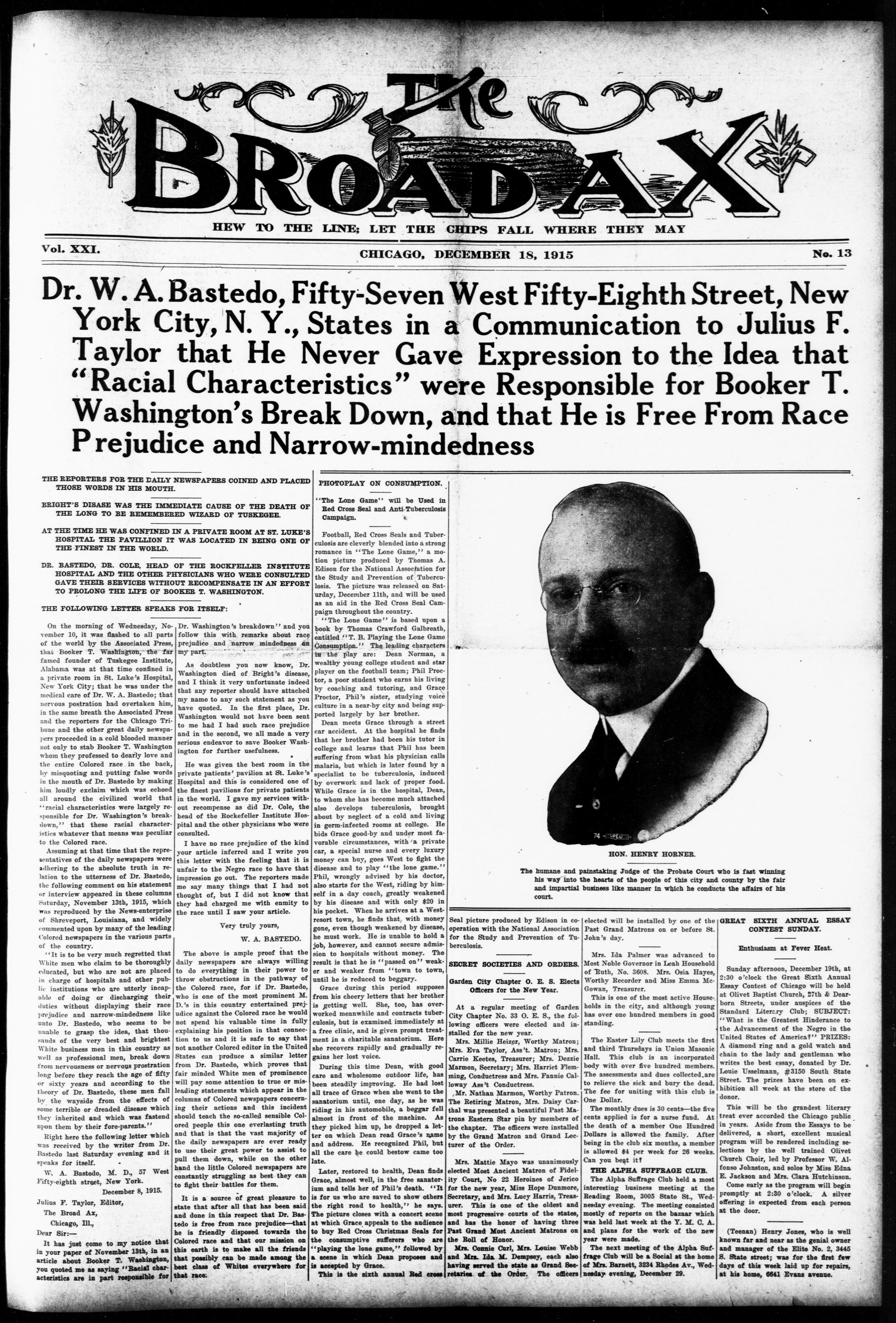
The humane and painstaking Judge of the Probate Court who is fast winning his way into the hearts of the people of this city and county by the fair and impartial business like manner in which he conducts the affairs of his court.
The humane and painstaking Judge of the Probate Court who is fast winning his way into the hearts of the people of this city and county by the fair and impartial business like manner in which he conducts the affairs of his court.
Seal picture produced by Edison in co operation with the National Association for the Study and Prevention of Tuberculosis.
SECRET SOCIETIES AND ORDERS
Garden City Chapter O. E. S. Elects Officers for the New Year.
At a regular meeting of Garden City Chapter No. 33 O. E. S., the following officers were elected and installed for the new year.
Mrs. Millie Heizer, Worthy Matron; Mrs. Eva Taylor, Ass't. Matron; Mrs. Carrie Keetes, Treasurer; Mrs. Dezzie Marmon, Secretary; Mrs. Harriet Flemming, Conductress and Mrs. Fannie Calloway Ass't. Conductress.
Mr. Nathan Marmon, Worthy Patron. The Retiring Matron, Mrs. Daisy Carthal was presented a beautiful Past Matrons Eastern Star pin by members of the chapter. The officers were installed by the Grand Matron and Grand Lecturer of the Order.
Mrs. Mattie Mayo was unanimously elected Most Ancient Matron of Fidelity Court, No 22 Heroines of Jerico for the new year, Miss Hope Dunmore, Secretary, and Mrs. Lucy Harris, Treasurer. This is one of the oldest and most progressive courts of the states, and has the honor of having three Past Grand Most Ancient Matrons on the Roll of Honor.
Mrs. Connie Curl, Mrs. Louise Webb and Mrs. Ida M. Dempsey, each also having served the state as Grand Secretaries of the Order. The officers
elected will be installed by one of the Past Grand Matrons on or before St. John's day.
Mrs. Ida Palmer was advanced to Most Noble Governor in Leah Household of Ruth, No. 3608. Mrs. Osia Hayes, Worthy Recorder and Miss Emma McGowan, Treasurer.
This is one of the most active Households in the city, and although young has over one hundred members in good standing.
The Easter Lily Club meets the first and third Thursdays in Union Masonie Hall. This club is an incorporated body with over five hundred members. The assessments and dues collected, are to relieve the sick and bury the dead. The fee for uniting with this club is One Dollar.
The monthly dues is 30 cents—the five cents applied is for a nurse fund. At the death of a member One Hundred Dollars is allowed the family. After being in the club six months, a member is allowed $4 per week for 26 weeks. Can you beat it?
THE ALPHA SUFFRAGE CLUB.
The Alpha Suffrage Club held a most interesting business meeting at the Reading Room, 3005 State St., Wednesday evening. The meeting consisted mostly of reports on the bazaar which was held last week at the Y. M. C. A. and plans for the work of the new year were made.
The next meeting of the Alpha Suffrage Club will be a Social at the home of Mrs. Barnett, 3234 Rhodes Av., Wednesday evening, December 29.
No.13
Enthusiasm at Fever Heat.
Sunday afternoon, December 19th, at 2:30 o'clock the Great Sixth Annual Essay Contest of Chicago will be held at Olivet Baptist Church, 27th & Dearborn Streets, under auspices of the Standard Literary Club; SUBJECT: "What is the Greatest Hinderance to the Advancement of the Negro in the United States of America?" PRIZES: A diamond ring and a gold watch and chain to the lady and gentleman who writes the best essay, donated by Dr. Louie Usselmann, #3150 South State Street. The prizes have been on exhibition all week at the store of the donor.
This will be the grandest literary treat ever accorded the Chicago public in years. Aside from the Essays to be delivered, a short, excellent musical program will be rendered including selections by the well trained Olivet Church Choir, led by Professor W. Alfonso Johnston, and solos by Miss Edna E. Jackson and Mrs. Clara Hutchinson. Come early as the program will begin promptly at 2:30 o'clock. A silver offering is expected from each person at the door.
(Teenan) Henry Jones, who is well known far and near as the genial owner and manager of the Elite No. 2, 3445 S. State street; was for the first few days of this week laid up for repairs, at his home. 6641 Evans avenue.
PAGE TWO
The Way of the World
A professor from Indiana university was attending a teachers' convention. He desired to stay at a certain hotel, but when he arrived at the hotel he found a crowd of teachers bemoaning the fact that all the rooms were taken.
"It won't do you any good to ask the clerk," the professor was assured. "Just watch me," answered the professor. He filmed his derby to one side of his head and stuck a cigar in his mouth as he approached the clerk. "What the deuce is going on here, anyway?" he asked. "A Sunday school convention?" he added, as he glanced disdainfully at the crowd of teachers in the hotel corridor. As the hotel clerk smiled and volunteered the information that it was a school teachers' convention, the professor grunted out the fact that he wanted a room. And he got it. The hotel clerk was scratching his head, trying to remember what firm the new arrival traveled for, while the teachers who had been "turned down" were wondering what magic the professor used to get the privilege to sign the register.—Indianapolis News.
Two Distant Suns
The nearest star to the earth is, as far as known at present, Alpha Centauri, in the southern hemisphere. It is a double star, consisting of two suns, each about as massive as our sun and slightly brighter, revolving around each other in a period somewhat more than eighty years at a mean distance apart of about 1,000 million miles.
But the orbit is so eccentric that at one point in the revolution the two suns are not farther apart than the distance between Jupiter and our sun, while at the opposite point they are nearly as far apart as the distance of Uranus from the sun. Thus the two suns in Alpha Centauri rush around their common center of gravity, now sweeping nearer to each other and now farther apart, all their evolutions being performed within a circuit much smaller than that of the solar system.
—New York Journal.
His Caller.
Some time ago Brown said to Smith: "I envy you. You come in contact with all kinds of men. You actually know and talk to burglaries and other criminals. All I know about them is what I read or imagine about them. Now, the next time you meet a good burglar I want you to send him to me. Give him a card to me and tell him I will pay his carfare and expenses. I want to talk to him and see how criminals differ from other men." Smith promised to send along the next good specimen of a burglar that came his way and forgot all about the matter until some weeks later he received this letter from Brown: "Your friend came, but I had not expected him professionally. If you will tell him to bring back the family plate and Mrs. Brown's jewels you and I will resume social relations."—New York Globe.
Some of New York's Islands.
Hoffman and Swinburne islands are quarantine stations under the state board of health. Governors island is the headquarters of the eastern division of the United States army. Bedloe's island is occupied by the star-shaped Fort Wood and the statue of Liberty. Ellis island is the immigrant station of the port of New York. Blackwell's island contains the City hospital, the Metropolitan Homeopathic hospital, the City Hospital For Incurables and the City Home For the Aged. Ward's island is occupied by the New York State Insane asylum. Hunter's island is the site of the Little Mothers' summer home. The city cemetery is on Hart's island. Randall's island contains the children's hospitals, schools and house of refuge. New York Times,
To Thread a Hair Through a Walnut.
To pass a hair through a walnut without boring a hole seems an impossibility, but the feat has often been done. The hull of the walnut when examined with a strong glass is seen to have innumerable small openings, some of which lead entirely through the nut. The trick consists in using a very fine hair and an infinite amount of patience. Pass the hair into one of these minute crevices and urge it gently along. Sometimes it will appear on the other side at the first trial, but if it comes out at the hundred and first you will be very lucky.
Disraeli as a Turk
At one period of his life Dismell had decided leanings toward the life of a Turk, "very much confirmed by my residence in Turkey." And the Turkish grandee who told him that he must be one of the eastern race "because he walked so slowly" won Dizzy's heart at once-London Standard.
Eidtorial Amenities
An editor stopped using the headline "Local Intelligence" in his paper not long ago. A friend from another town asked the reason. The reply was, "There ain't any."—Hartford Courant.
Hot Air.
"Have you hot air in your apartment?"
"Have we? You just ought to hear the landlord telling what he is going to do for us."-Baltimore American.
So Plebeian.
Doctor—This prescription will supply iron in your system. Rich Patient—Iron is so common, doctor. Couldn't you make it gold or silver?—Boston Transcript.
Cause For Grief
"Why did everybody cry in that last death scene?"
"Because they knew the actor wasn't really dead."—Toneka Journal.
War and Social Changes.
"War," says Emerson, "passes the power of all chemical solvents, breaking up the old adhesions and allowing the atoms of society to take a new order." That this was pre-eminent true of our own war is the opinion of Professor Fred Lewis Pattate in his "History of American Literature Since 1870." "The change wrought by the war," he says, "was far more than a rise of new activities and a shifting of population. A totally new America grew from the ashes of the great conflict. In 1880 north and south alike were provincial and self conscious. New York city was an enormously overgrown village, and Boston, Philadelphia and Charleston were almost as individual and as unlike each other as they had been in the days of the Revolution. There had been nothing to fuse the sections together and to bring them to a common vision. Until 1860 there had been no passion fierce enough to stir to the very center of their lives all of the people, to melt them into a homogeneous mass and to pour them forth into the mold of a new individual soul among the nations."
The Better Judge.
Some years ago the Oldham amateurs were producing one of Handel's oratorios, under the personal tuition and conductorship of the late Sir Charles Halle. Among the orchestra was the famous and gigantic bassoon player, George Seel of Ashton-under-Lyne. At the first rehearsal Halle went to George and, indicating several bars for the bassoon, told him not to play them on the night of the performance. George was inwardly bolling with indignation, but said nothing. On the night of the performance George played the banned music.
When the affair was over Halle went up to Seel in a great rage and, pointing to the notes, said, "I told you to leave them out, didn't I"
"Aye, you did," said George, "but Handel towed me to put them in, an' he were a better judge than you."—London Answers.
Washington's Home
Mount Vernon, historically the most interesting of all American mansions, was erected in 1743 for Lawrence Washington, the half brother of George, and so named in honor of Admiral Edward Vernon, R. N., under whose command Lawrence Washington had served during the British expedition against Cartagena in 1741. The property passed into the hands of George after the death of Lawrence in 1752, and the house was later improved and enlarged. When Mrs. Washington died in 1802 Mount Vernon became, in accordance with Washington's will, the property of his nephew, Bushrod Washington, who in turn bequeathed it to his nephew, John Augustine Washington, from whom it passed to a son of the same name, and in 1858 it was purchased from him by the Mount Vernon Ladies' association.
Took Away the Sting.
A pleasant retort was that given by Admiral Marsden at a dinner in Malta several years ago. It was given on the Fourth of July by him to the American officers on a man-of-war, and all the English officers in the harbor were guests. They were no better bred than many Englishmen of that day, for when the regular toast, "The day we celebrate," was read, they set down their glasses untasted. The venerable host added gently, "The day, gentlemen, when England celebrates the coming of age of her eldest daughter." Every face cleared, and the toast was drunk with hearty cheers. Wit never finds its way to the mark so swiftly as when aimed with kindness and good will.
Dumas and a Duke
Dumas on the day before the production of his "Henri III." called on the Duc d'Orleans and practically demanded that the latter attend the performance. The duke, amused, declared it impossible, as he had a dinner party invited to his home. But Dumas, armed with abundant brass and determination, suggested that the dinner be set an hour ahead and the play begin an hour later so that the entire party might attend. Dumas had reserved all the grand circle in anticipation of his success in the encounter, and the duke owned himself routed and did as he was "ordered."
Legend of the Pearl
The ancient inhabitants of India had a very pretty superstition concerning the origin of pearls. They believed that at certain seasons Buddha showered dewdrops upon the world, which the oyster, floating on the waters to breathe, received and held until they hardened and became pearls.
Business and Pleasure.
"We want to keep business out of politics," said the reformer.
"Well," replied Senator Sorghum, "you've taken all the pleasure out of it. If you take all the business out of it, too. I don't see what's going to be left." Washington Star.
Social Applications
"She likes publicity, eh?" "Does she? Why, she thinks the society column ought to make an item of it when she gives a little breakfast to a tramp."—Louisville Courier-Journal
Retort Gourteous
She—I never helped you to make a fool of yourself. He—You didn't? Didn't you marry me?—Baltimore American.
The love of beauty is taste; the creation of beauty is art—Emerson.
THE BROAD AX. CHICAGO. DECEMBER 18. 1915.
Why Water Quenches Thirst.
Why Water Quenches Thirst
a word, of Anglo-Saxon origin and akin to the Latin torreo and our torrid or parched, describes a peculiar sensation of dryness and heat located in the tongue and throat. Artificial thirst may be produced by the passage of a current of air over the mucous membrane of these parts, but normal thirst is the consequence of a lack of liquid in the system. The agony of extreme thirst is due to the fact that all the tissues sympathize in this distress. It is then as a refreshing relief that a supply of water comes to thirsting lips, replacing what has been lost, cooling the parched palate and rapidly removing the craving which has depressed the system. In short, water quenches thirst just because it supplies what at the moment is wanting and is most eagerly desired, so that Solomon could properly compare the gift of "cold waters to a thirsty soul" to the advent of good news. Thirst is to some extent appeased by the injection of water into the blood or body, though no fluid touches the part to which the sensation is referred.
The Things That Come Hard.
"I am happy because it is so easy for me to write," said a beginner to one of the great masters of French prose.
"Go home and pray," said the master, "that it may come hard."
It is so of writing, so of thinking, so of life. The easy thing is barely worth doing. The hard thing is worth doing, though the end be failure. A goal, to make which one fairly tugs at life and yet misses, is better than a victory softly won.
So often the man who speaks easily tells us least, while the sparing words one wrenches from a taciturn speaker are imbedded in thought. Shakespeare said that Gratiano talked more than any other man in all Venice. But he compared his speech to a bushel of chaff in which lay hidden a single grain of wheat and that not worth the finding.—Toledo Blade.
Wandering of Minor Planets
The "mislaying" of the minor planets is sometimes due to their actually failing to keep their appointments at the places where, according to calculation, they ought to be. An instance is the case of No. 153, otherwise known as Hilda. Dr. Palisa discovered her in 1875 and calculated her orbit. But attempts to find her again failed, and she was almost given up as lost until Dr. Palisa found her again in 1879—a long way, however, from where she had been expected. The discrepancy was caused by the effect upon Hilda of the attraction of Jupiter, of whom she is a comparatively near neighbor. For these little planets are scattered over a wide belt. Hilda gets within 33,000,000 miles of the orbit of Jupiter, and Aethra at times actually comes nearer to the sun than Mars ever does.—London Chronicle.
Dreams That Were
The dunce has disappeared from the schools and is not even pointed out in the streets as erstwhile.
And the dear old man who used to drop in a few hours before supper and decline to remove his topcoat because he had but a few minutes to stop and who lingered until he was invited to eat, when he accepted, and who remained until 10 o'clock in the evening and then remarked that it was time for him "to be showin' up the creek."
And the fine old gentleman who came in from the farm carrying a change in a pair of saddlebags. When did you ever see a pair of these bags?
And the gracious lady, the neighbor, who never baked anything good that she didn't send some over to your house? Eh? - Richmond Times-Dispatch.
Telephone Church Service
Residents on the island of Guernsey, in the English channel, are enabled to listen to church service in their homes any Sunday evening at a charge of about 10 cents. Policemen and firemen, as well as lighthouse keepers and other government employees, who are prevented by their occupation from going to church, are furnished the telephone service free of charge. At Platte Fougere lighthouse station sometimes as many as eight persons sit down together to hear the telephone service from a church five miles away. -Popular Mechanics.
Cats' Eyes.
As showing how widely the permanently blue eyes of cats differ from other eyes it is noted that immediately the eyes of white cats that are to have permanently blue eyes open they shine bright red in the dark, and neither the ephemeral kitten blue nor any other colored eye does this.
History.
Brown—Anybody can make history, you know, but only a great man can write it. Smith—That may be, but when history is made it is always sure to be history, when when it is written it is merely some man's idea of history.—Life
One Improvement
We never hear anybody talking about the good old times without being reminded that our forefathers had to crawl head first into their shirts.—Toledo Blade.
Life's Grindstone
Whether the grindstone of life wears a man down or polishes him up depends entirely on the stuff he is made of.—Youth's Companion.
Seldom is knowledge given to keep, but to impart. The grace of this jewel is lost in concealment.
Strength of Oysters
If a man, in proportion, had the strength of an oyster he could lift a locomotive with ease. With the muscles with which an oyster of good size holds its shell closed a weight of thirty-five pounds can be supported. A weight of more than six pounds is required to force apart the shell of a common mussel, and in the Mediterranean a clam exists that will support nearly 500 times its own weight—equivalent to a 150 pound man supporting more than thirty-six tons. These interesting facts have been brought to light by a series of experiments and investigations conducted by Felix Plateau, a Belgian scientist. Dr. Plateau has been measuring at the same time the strength of insects. Harnessed to a delicate weighing machine of special construction, the insects were prodded into attempts to escape while weights were added until any forward movement was rendered impossible. By such means the investigator learned, among other curious facts, that a bee, weight for weight, is thirty times as strong as a horse.—Boston Herald.
The "What Is It."
"When I was a boy in Ohio there came to town one day a covered wagon containing a mysterious animal which was to be exhibited at the opera house that night," said a St. Louis gentleman who still recalls with relish some of his youthful adventures. "They called this creature the 'what is it,' and that night we all crowded into the opera house to see it. The curtain was down. Presently there was a rattle of chains behind the curtain and a scream. A man rushed out, leaped over the footlights and started up the aisle, shouting: "Run for your lives! The 'what is it' is loose."
"We got out in a hurry. All of us who could not get to the door went through the windows. After the excitement had quieted somewhat we discovered that the two showmen who brought the 'what is it' to town had disappeared with the receipts. I remember that show better than any other I ever went to. Probably it was the best."-St. Louis Post-Dispatch
An Odd Experiment
A strange and amusing experiment is described by G. Hugo in the Electrical Experimenter as follows:
Place a copper coin on a silver coin. The former should be at least three-sixteenth inch smaller all around than the latter. A cent and a half dollar will do; an English halfpenny and a silver dollar will do better, because they are larger. On the copper coin place an ordinary earthworm and watch it try to crawl off. It cannot do it, for the instant its damp body, which is in contact with the copper, touches the silver it starts a current of electricity that gives it a shock. The shock makes the worm recoll. It tries again, but each time its head touches the silver it gets the shock and soon finds it is more comfortable to stay on the copper coin.
Of course the current thus produced is very slight, but it is quite enough for the worm.
Clever Ruse.
Even more than a fee gratefully paid does a humorous physician enjoy an extra fee adroitly drawn from the hand of a reluctant payer. Sir Richard Jebb was once paid three guineas by a nobleman from whom he had a right to expect five. Sir Richard dropped the coins on the carpet, when a servant picked up and restored them—three and only three. Instead of walking off Sir Richard continued his search on the carpet.
“Are all the guineas found?” asked his lordship, looking around.
“There must be two still on the floor,” was the answer, “for I have only three.” The hint, of course, was taken, and the right sum was put down—“Doctors and Patients.”
Tireless Camels.
An eastern legend has it that the camel was fashioned last by the Creator, and so it is held in very high esteem by the people of the cast. Although a somewhat unshapely and perhaps bad tempered animal, the camel is an unfitting worker. He will travel on for hour after hour without appearing distressed in any way and on this account has made a good name for himself—London Answers.
Finance
"Hello, Bilkins. How well you look! All your worries gone up in smoke?" said Silhers joyously. "Yes, Silhers." said Bilkins, "I've got a great load off my mind. I've just been able to borrow enough money to pay off all my debts." — New York Times.
Cutting Combs.
Combs are always cut out in pairs. The spaces left between the teeth of one comb serve to form the teeth of the other, so that in shaping one comb two are really made.
Suspicious.
Friend—So this is one of your jokes,
is it? Ha, ha, ha! Humorist (testily)
—Well, what are you laughing at, anyhow?
Isn't it a good one?—Passing Show.
What Might Happen
He-Yes, I am still single. She-But you intend to marry some day, do you not? He-I do unless some woman changes my mind.-Judge.
Judgment Days
The world is full of judgment days,
and into every assembly that a man
enters, in every action he attempts, he
is ganged and stamped.--Emerson.
Perpetual Motion
Several people have had a shot at making something that would go on forever, like Tennyson's brook. And these have not all been cranks. A mechanician, for instance, made a top, which was balanced on diamond tips and spun in a vacuum, which ran for twelve months.
A Swiss watchmaker has invented an electric watch which will go for fifteen years without requiring to be rewound.
A watch and clock maker of Burton had in his possession an electric clock of his own making which has already gone twelve years and has never failed to record the time during that period, although it has never been rewound. He claims that the mechanism will last fifty years and that he would not be surprised if the clock ran uninterrupted for a century.
Of course the possibilities of radioactivity are today only dimly known, but they may yet revolutionize all our notions of motion and energy and put even electricity out of court—Buffalo News.
Luck Laden.
An idle person chanced to see a wagon rolling slowly along Fulton street. Bad luck pursued it. At Broadway the driver sleepily tried to cross in disregard of the traffic policeman's ample and warning hand. His number was jotted down in the book of that recording angel and a summons was handed up. A few yards beyond and the horse, turning to avoid a hot chestnut peddler, went down in a heap. The pavement was slippery, and he must needs be unharnessed in the shafts before he could rise. Another block, and somebody was digging a hole in the street to put in some kind of a main for somebody else. The off wheels of the wagon rolled too near, and the vehicle careened and slid into the excavation. It had to be unloaded laboriously by hand before it could be jacked up level again.
The wagon carried a load of 3,000 castoff horseshoes.—New York Post.
Putting the Blame on Noah:
Putting the Blame on Noan.
A tablet believed to be 4,000 or 5,000 years old and to antedate the book of Genesis by 1,000 years sets forth, according to the translation of Dr. Steven Langdon of Oxford university, England, that it was Noah and not Adam and Eve who brought about the fall of man. Noah was commanded not to eat of the cassia tree in the garden of paradise, the translation has it, and when he disobeyed the curse of ill health and an early death instead of a life span of 50,000 years like that of his ancestors, fell on him. According to Babylonian and Sumerian accounts, the flood occurred about 35,000 years before Christ, and the period between that catastrophe and creation -432,000 years -was filled in by ten kings, so that each must have ruled something like 43,200 years. The comparatively short reigns of later kings is explained as being the result of Noah's sin in eating of the cassia tree.
The Devil's Bible
The devil's Bible is in the Royal Palace library of Stockholm, Sweden. It is a huge copy of the Scriptures, written upon 300 prepared asses' skins. One tradition declares that it took 500 years, or from the eighth to the thirteenth century, to make the copy, which is so large that it has a table to itself. Another tradition affirms that the work was done in a single night by a monk with the assistance of his satanic majesty, who, when the work was completed, gave the monk a picture of himself for the frontispiece, where, amid illuminated incantations, it is still to be seen; hence the name. This marvelous manuscript was carried off by the Swedes during the thirty years' war from a convent in Prague.—Pearson's Weekly.
A Fable.
A woman once came to the cave of a sage who was renowned for his profound analysis of her sex.
"Master," said she, "let me sit at your feet awhile. I am but a woman—faulty and foolish and weak—but I would fain be the pupil of your learning and the disciple of your virtues."
And the sage, secure in his wisdom, consented.
Then he laid himself down to sleep in the shade of a rock, out of the glare of the sun. When he wakened he was blindfolded and bound hand and foot—a prisoner to love.
He had protected himself against every feminine weapon except the most dangerous one—humility—New York Evening Sun.
The Fault of Ridicule
There is no character, howsoever good and fine, but it can be destroyed by ridicule, howsoever poor and witless. Observe the ass, for instance. His character is about perfect, he is the choicest spirit among all the humbler animals, yet see what ridicule has brought him to. Instead of feeling complimented when we are called an ass we are left in doubt—Mark Twain.
Bean Ballots
Black beans and white beans were used by the ancients in gathering the votes of the people for the election of magistrates. A white bean signified a "yea" and a black one a "nay." When a politician failed to get elected he literally had "spilled the beans."
What Did It Mean?
A notice board in a Scottish kirk once bore, it is said, the following amazing sentence: "This church is licensed for the solemn negation of marriages."
One of the very best of all earthly possessions is self possession.—G. D. Prentice.
Habits of Authors.
I was presented once to a lady who immediately fixed me with an eager eye.
"I am making a study of the habits of authors," she announced. (Here a dreadful sinking of the heart assailed me.) "Kindly tell me at what hour you retire."
"Usually at half past 10," I answered wretchedly.
At that, as I had expected, her eyebrows went up. "The author of 'When All Was Dark,'" she informed me, "sits up all night. She says she cannot sleep until she has savored the dawn." However, she was kind enough to give me another chance. "What do you eat?" she asked.
"Three hearty meals a day," I answered.
"Not breakfast!" she pleaded. "Why, St. George Dreamer never takes more than three drops of brandy on a lump of sugar in the morning. Just the sight of a coffee cup will upset his work for a week."
And then she left me, sure, I do not doubt, that no real author could confess to such distressingly normal habits as mine.—Atlantic.
Military Spies.
One of the ingenious ideas of modern war strategy is to utilize artist skill in making a drawing of a fortification without betraying its purport on the surface. The spy makes a drawing which appears to be an ordinary landscape. If caught with it he might pose with comparative safety as an artist who had been sketching for pleasure and was entirely ignorant of the existence of any fort and its surroundings.
Interpreted according to a secret code, however, the picture reveals to the spy's government a fairly complete plan of a fort. This is indicated by the character and position of details. One kind of tree represents an armored gun turret. A bush is an observation turret. Other forms of trees are gun positions, a couple of gates are entrances to the fort, a piece of fencing is a barbed wire entanglement, lines of bushes are ditches, and so on.-Kansas City Star.
Siamese Earth Eaters
The Lastians of Siam actually eat and enjoy earth. It has never been discovered where these peculiar people contracted this habit, though it is generally believed that it probably came about in the time of a famine, when there was nothing else to be had. However, the habit has now got such a hold upon them that old and young, rich and poor alike, indulge freely in its consumption. It is preferred when it has been acquired from the vicinity of waters so that it carries with it a taste of fish. It is made into a pasty substance and smothered into the ground in a hot fire. It can be obtained at markets and at stores and is served at dinners and at big functions of any description. In some parts of the Kongo earth is sold in the shape of apples and oranges and is given out in various colors—yellow, brown, gray and even pink, which is looked upon as a very delectable luxury.
Belgrade.
Belgrade, the capital of the kingdom of Servia, has gradually, for many years past, been losing its old Turkish aspect, becoming more modern, more European. The history of the city for nearly 1,000 years has been one of continual contests. The walls have disappeared since 1862; the last and finest of the five gates was demolished in 1868, and the citadel is not up to the requirements of modern warfare. The manufactures of Belgrade consist of arms, cutlery, saddlery, silk goods, carpets, etc. The chief buildings in the city are the royal and episcopal palaces, the government houses, the cathedral, barracks, bazaars, national theater and various educational institutions. The population is about 70,000.-Westminster Gazette.
What Interested Her
Dr. Anna Howard Shaw, discussing the divorce evil, on one occasion said, "Love is the best foundation for marriage, of course. But common sense keeps it cool, and cool things, of course, keep the best. But selfishness kills all—and some married people are as selfish as the lady to whom the palmist said, 'These lines, alas, tell me that you are destined to wear widow's weeds.' 'Oh, dear me!' said the lady. 'For how long?'
Roman Rulers
Three of the greatest rulers Rome ever had were Spanish born—Trajan, Hadrian and Marcus Aurelius. Later occupants of the Caesarian throne born in Iberia were Theodosius and Honorius. Seneca, Martial and Quintilian, famous in Roman letters, also were Spanlards.
Few Paupers In Japan
There are few paupers in Japan. Everybody works, and it is considered a disgrace to be supported by your relatives while you have the ability to earn your own living.
Relio of Barbarity
Balls placed on the top of gateposts are a survival of the barbary practice of our forefathers, who hung over their gates the heads of their enemies killed in combat.
A Pesaimist
"A pessimist is a man, my boy, who can't enjoy fine weather because he knows it isn't going to last."—Detroit Free Press.
Self respect is the cornerstone of all virtue.—Herschel
THE BRITISH FLEET WAITS AND WATCHES
Its Hiding Place Has Been the Orkney Islands.
The British North sea fleet is at the naval base in the Orkney islands, north of Scotland. It has pursued a policy of watchful waiting, waiting for the German fleet to come out. By years of labor and the expenditure of much money the English navy has transformed the barren, desolate Orkney islands into one of the strong
R. H.
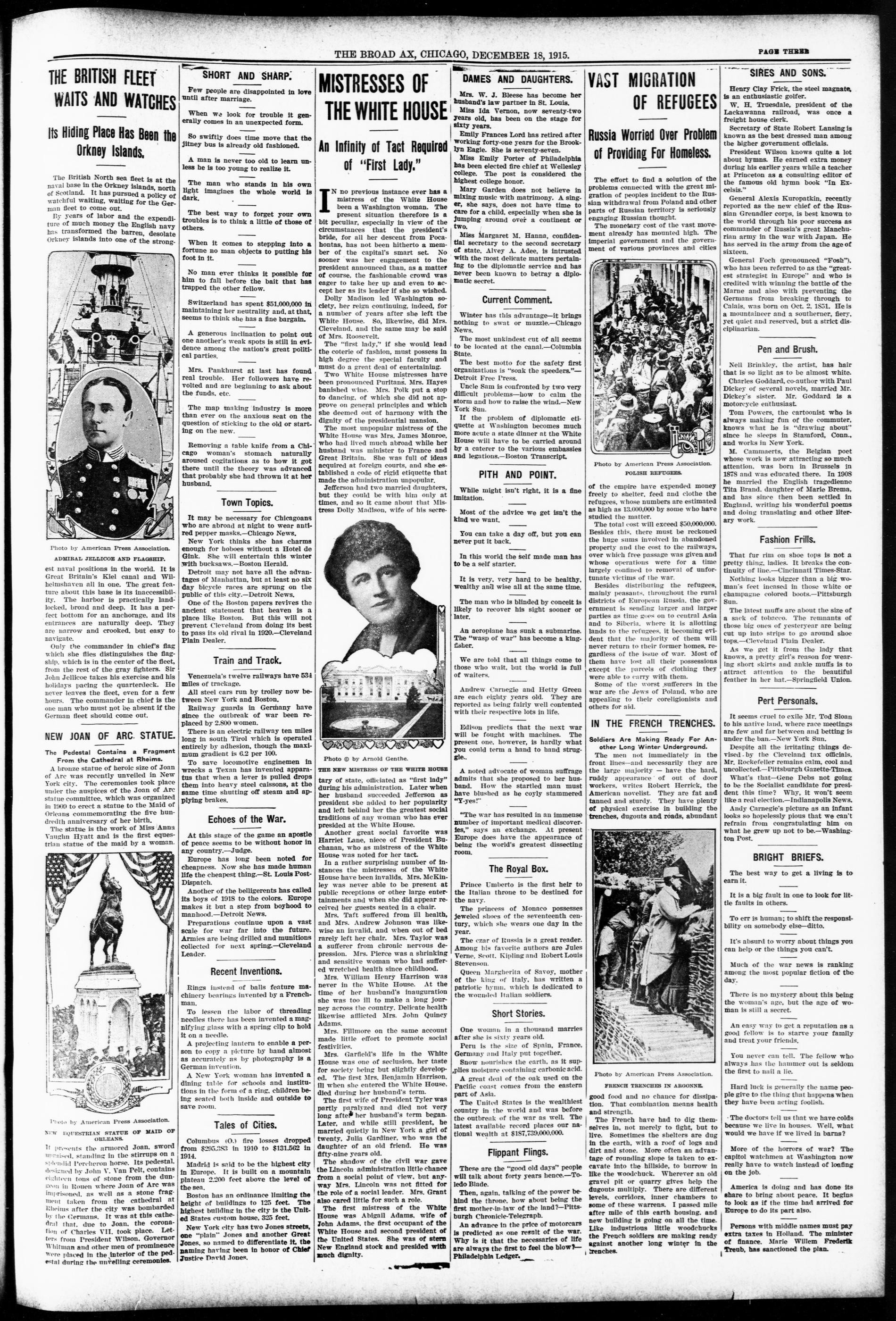
ADMIRAL JELLICOE AND FLAGSHIP.
est naval positions in the world. It is
Great Britain's Kiel canal and Wil-
helmshaven all in one. The great feature
about this base is its inaccessibility.
The harbor is practically landlocked, broad and deep. It has a perfect bottom for an anchorage, and its entrances are naturally deep. They are narrow and crooked, but easy to navigate.
Only the commander in chief's flag
which she flies distinguishes the flagship, which is in the center of the fleet, from the rest of the gray fighters. Sir John Jellicoe takes his exercise and his holidays pacing the quarterdeck. He never leaves the fleet, even for a few hours. The commander in chief is the one man who must not be absent if the German fleet should come out.
NEW JOAN OF ARC. STATUE.
The Pedestal Contains a Fragment From the Cathedral at Rheims.
A bronze statue of heroic size of Joan of Arc was recently unveiled in New York city. The ceremonies took place under the auspices of the Joan of Arc statue committee, which was organized in 1900 to erect a statue to the Maid of Orleans commemorating the five hundredth anniversary of her birth.
The statue is the work of Miss Anna Vaughn Hyatt and is the first equestrian statue of the maid by a woman.
THE MEMORIAL OF THE
UNION NATIONAL CIVIL WAR
MEMORIAL
NOW EQUESTRIAN STATUE OF MAID OF ORLEANS.
It presents the armored Joan, sword unraised, standing in the stirrups on a seldom Percheron horse. Its pedestal, designed by John V. Van Pelt, contains eighteen tons of stone from the dungeon in Rouen where Joan of Arc was imprisoned, as well as a stone fragment taken from the cathedral at Rheins after the city was bombarded by the Germans. It was at this cathedral that, due to Joan, the coronation of Charles VII. took place. Letters from President Wilson, Governor Whitman and other men of prominence were placed in the interior of the pedestal during the unveiling ceremonies.
SHORT AND SHARP.
Few people are disappointed in love until after marriage.
When we look for trouble it generally comes in an unexpected form.
So swiftly does time move that the jitney bus is already old fashioned.
A man is never too old to learn unless he is too young to realize it.
The man who stands in his own light imagines the whole world is dark.
The best way to forget your own troubles is to think a little of those of others.
When it comes to stepping into a fortune no man objects to putting his foot in it.
No man ever thinks it possible for him to fall before the bait that has trapped the other fellow.
Switzerland has spent $51,000,000 in maintaining her neutrality and, at that, seems to think she has a fine bargain.
A generous inclination to point out one another's weak spots is still in evidence among the nation's great political parties.
Mrs. Pankhurst at last has found real trouble. Her followers have revolted and are beginning to ask about the funds, etc.
The map making industry is more than ever on the anxious seat on the question of sticking to the old or starting on the new.
Removing a table knife from a Chicago woman's stomach naturally aroused cogitations as to how it got there until the theory was advanced that probably she had thrown it at her husband.
Town Topics.
It may be necessary for Chicagoans who are abroad at night to wear antired pepper masks.—Chicago News.
New York thinks she has charms enough for hoboes without a Hotel de Glnk. She will entertain this winter with bucksaws.—Boston Herald.
Detroit may not have all the advantages of Manhattan, but at least no six day bicycle races are sprung on the public of this city.—Detroit News.
One of the Boston papers revives the ancient statement that heaven is a place like Boston. But this will not prevent Cleveland from doing its best to pass its old rival in 1920.—Cleveland Plain Dealer.
Train and Track.
Venezuela's twelve railways have 534 miles of trackage.
All steel cars run by trolley now between New York and Boston.
Railway guards in Germany have since the outbreak of war been replaced by 2,800 women.
There is an electric railway ten miles long in south Tirol which is operated entirely by adhesion, though the maximum gradient is 6.2 per 100.
To save locomotive enginemen in wrecks a Texan has invented apparatus that when a lever is pulled drops them into heavy steel caissons, at the same time shutting off steam and applying brakes.
Echoes of the War.
At this stage of the game an apostle of peace seems to be without honor in any country.—Judge.
Europe has long been noted for cheapness. Now she has made human life the cheapest thing.—St. Louis Post-Dispatch.
Another of the belligerents has called its boys of 1918 to the colors. Europe makes it but a step from boyhood to manhood.—Detroit News.
Preparations continue upon a vast scale for war far into the future. Armies are being drilled and munitions collected for next spring.—Cleveland Leader.
Recent Inventions.
Rings instead of balls feature machinery bearings invented by a Frenchman.
To lessen the labor of threading needles there has been invented a magnifying glass with a spring clip to hold it on a needle.
A projecting lantern to enable a person to copy a picture by hand almost as accurately as by photography is a German invention.
A New York woman has invented a dining table for schools and institutions in the form of a ring, children being seated both inside and outside to save room.
Tales of Cities.
Columbus (O.) fire losses dropped from $295.383 in 1910 to $131.502 in 1914.
Madrid is said to be the highest city in Europe. It is built on a mountain plateau 2,200 feet above the level of the sea.
Boston has an ordinance limiting the height of buildings to 125 feet. The highest building in the city is the United States custom house, 325 feet.
New York city has two Jones streets, one "plain" Jones and another Great Jones, so named to differentiate it, the naming having been in honor of Chief Justice David Jones.
THE BROAD AX, CHICAGO, DECEMBER 18, 1915
MISTRESSES OF THE WHITE HOUSE
An Infinity of Tact Required of "First Lady."
IN no previous instance ever has a mistress of the White House been a Washington woman. The present situation therefore is a bit peculiar, especially in view of the circumstances that the president's bride, for all her descent from Pocahontas, has not been hitherto a member of the capital's smart set. No sooner was her engagement to the president announced than, as a matter of course, the fashionable crowd was eager to take her up and even to accept her as its leader if she so wished. Dolly Madison led Washington society, her reign continuing, indeed, for a number of years after she left the White House. So, likewise, did Mrs. Cleveland, and the same may be said of Mrs. Roosevelt. The "first lady," if she would lead the coterie of fashion, must possess in high degree the special faculty and must do a great deal of entertaining.
Two White House mistresses have been pronounced Puritans, Mrs. Hayes banished wine. Mrs. Polk put a stop to dancing, of which she did not approve on general principles and which she deemed out of harmony with the dignity of the presidential mansion.
The most unpopular mistress of the White House was Mrs. James Monroe, who had lived much abroad while her husband was minister to France and Great Britain. She was full of ideas acquired at foreign courts, and she established a code of rigid etiquette that made the administration unpopular.
Jefferson had two married daughters, but they could be with him only at times, and so it came about that Mistress Dolly Madison, wife of his secre
THE WHITE HOUSE
Photo © by Arnold Genthe.
THE NEW MISTRESS OF THE WHITE HOUSE
tary of state, officiated as "first lady"
during his administration. Later when
her husband succeeded Jefferson as
president she added to her popularity
and left behind her the greatest social
traditions of any woman who has ever
presided at the White House.
Another great social favorite was
Harriet Lane, niece of President Buchanan,
who as mistress of the White
House was noted for her tact.
In a rather surprising number of
instances the mistresses of the White
House have been invalids. Mrs. McKinley
was never able to be present at
public receptions or other large entertainments
and when she did appear
received her guests seated in a chair.
Mrs. Taft suffered from ill health, and Mrs. Andrew Johnson was likewise an invalid, and when out of bed rarely left her chair. Mrs. Taylor was a sufferer from chronic nervous depression. Mrs. Pierce was a shrinking and sensitive woman who had suffered wretched health since childhood. Mrs. William Henry Harrison was never in the White House. At the time of her husband's inauguration she was too ill to make a long journey across the country. Delicate health likewise allied Mrs. John Quincy Adams. Mrs. Fillmore on the same account made little effort to promote social festivities. Mrs. Garfield's life in the White House was one of seclusion, her taste for society being but slightly developed. The first Mrs. Benjamin Harrison, ill when she entered the White House, died during her husband's term.
The first wife of President Tyler was partly paralyzed and died not very long after her husband's term began. Later, and while still president, he married quietly in New York a girl of twenty, Julia Gardiner, who was the daughter of an old friend. He was fifty-nine years old.
The shadow of the civil war gave the Lincoln administration little chance from a social point of view, but anyway Mrs. Lincoln was not fitted for the role of a social leader. Mrs. Grant also cared little for such a role.
The first mistress of the White House was Abigail Adams, wife of John Adams, the first occupant of the White House and second president of the United States. She was of stern New England stock and presided with much dignity.
DAMES AND DAUGHTERS.
Mrs. W. J. Bleece has become her husband's law partner in St. Louis.
Miss Ida Vernon, now seventy-two years old, has been on the stage for sixty years.
Emily Frances Lord has retired after working forty-one years for the Brooklyn Eagle. She is seventy-seven.
Miss Emily Porter of Philadelphia has been elected fire chief at Wellesley college. The post is considered the highest college honor.
Mary Garden does not believe in mixing music with matrimony. A singer, she says, does not have time to care for a child, especially when she is jumping around over a continent or two.
Miss Margaret M. Hanna, confidential secretary to the second secretary of state, Alvey A. Adee, is intrusted with the most delicate matters pertaining to the diplomatic service and has never been known to betray a diplomatic secret.
Current Comment.
Winter has this advantage—it brings nothing to swat or muzzle.—Chicago News.
The most unkindest cut of all seems to be located at the canal.—Columbia State.
The best motto for the safety first organizations is "soak the speeders."—Detroit Free Press.
Uncle Sam is confronted by two very difficult problems—how to calm the storm and how to raise the wind.—New York Sun.
If the problem of diplomatic etiquette at Washington becomes much more acute a state dinner at the White House will have to be carried around by a caterer to the various embassies and legations.—Boston Transcript.
PITH AND POINT.
While might isn't right, it is a fine imitation.
Most of the advice we get isn't the kind we want.
You can take a day off, but you can never put it back.
In this world the self made man has to be a self starter.
It is very, very hard to be healthy, wealthy and wise all at the same time.
The man who is blinded by conceit is likely to recover his sight sooner or later.
An aeroplane has sunk a submarine. The "wasp of war" has become a king-fisher.
We are told that all things come to those who wait, but the world is full of waiters.
Andrew Carnegie and Hetty Green are each eighty years old. They are reported as being fairly well contented with their respective lots in life.
Edison predicts that the next war will be fought with machines. The present one, however, is hardly what you could term a hand to hand struggle.
A noted advocate of woman suffrage admits that she proposed to her husband. How the startled man must have blushed as he coyly stammered "Y-yes."
"The war has resulted in an immense number of important medical discoveries," says an exchange. At present Europe does have the appearance of being the world's greatest dissecting room.
The Royal Box.
Prince Umberto is the first heir to the Italian throne to be destined for the navy.
The princess of Monaco possesses jeweled shoes of the seventeenth century, which she wears one day in the year.
The czar of Russia is a great reader. Among his favorite authors are Jules Verne, Scott, Kipling and Robert Louis Stevenson.
Queen Margherita of Savoy, mother of the king of Italy, has written a patriotic hymn, which is dedicated to the wounded Italian soldiers.
Short Stories.
One woman in a thousand marries after she is sixty years old.
Peru is the size of Spain, France, Germany and Italy put together.
Snow nourishes the earth, as it supplies moisture containing carbonic acid.
Show nourishes the earth as it supplies moisture containing carbonic acid. A great deal of the oak used on the Pacific coast comes from the eastern part of Asia. The United States is the wealthiest country in the world and was before the outbreak of the war as well. The latest available record places our national wealth at $157,739,000,000.
Flippant Flings.
These are the "good old days" people will talk about forty years hence.—Toledo Blade.
Then, again, talking of the power behind the throne, how about being the first mother-in-law of the land?—Pittsburgh Chronicle-Telegraph.
An advance in the price of motorcars is predicted as one result of the war. Why is it that the necessaries of life are always the first to feel the blow?—Philadelphia Ledger.
VAST MIGRATION OF REFUGEES
Russia Worried Over Problem of Providing For Homeless.
The effort to find a solution of the problems connected with the great migration of peoples incident to the Russian withdrawal from Poland and other parts of Russian territory is seriously engaging Russian thought. The monetary cost of the vast movement already has mounted high. The imperial government and the government of various provinces and cities
HENRY
Photo by American Press Association. POLISH REFUGEES.
of the empire have expended money freely to shelter, feed and clothe the refugees, whose numbers are estimated as high as 13,000,000 by some who have studied the matter.
The total cost will exceed $50,000,000. Besides this, there must be reckoned the huge sums involved in abandoned property and the cost to the railways, over which free passage was given and whose operations were for a time largely confined to removal of unfortunate victims of the war.
Besides distributing the refugees, mainly peasants, throughout the rural districts of European Russia, the government is sending larger and larger parties as time goes on to central Asia and to Siberia, where it is allotting lands to the refugees, it becoming evident that the majority of them will never return to their former homes, regardless of the issue of war. Most of them have lost all their possessions except the parcels of clothing they were able to carry with them. Some of the worst sufferers in the war are the Jews of Poland, who are appealing to their coreligionists and others for aid.
IN THE FRENCH TRENCHES.
Soldiers Are Making Ready For Another Long Winter Underground. The men not immediately in the front lines—and necessarily they are the large majority—have the hard, ruddy appearance of out of door workers, writes Robert Herrick, the American novelist. They are fat and tanned and sturdy. They have plenty of physical exercise in building the trenches, dugouts and roads, abundant
A
good food and no chance for dissipation. That combination means health and strength.
The French have had to dig themselves in, not merely to fight, but to live. Sometimes the shelters are dug in the earth, with a roof of logs and dirt and stone. More often an advantage of rounding slope is taken to excavate into the hillside, to burrow in like the woodchuck. Wherever an old gravel pit or quarry gives help the dugouts multiply. There are different levels, corridors, inner chambers to some of these warrens. I passed mile after mile of this earth housing, and new building is going on all the time. Like industrious little woodchucks the French soldiers are making ready against another long winter in the trenches.
PAGE THREE
SIRES AND SONS.
Henry Clay Frick, the steel magnate, is an enthusiastic golfer.
W. H. Truesdale, president of the Lackawanna railroad, was once a freight house clerk.
Secretary of State Robert Lansing is known as the best dressed man among the higher government officials.
President Wilson knows quite a lot about hymns. He earned extra money during his earlier years while a teacher at Princeton as a consulting editor of the famous old hymn book "In Excelsis."
General Alexis Kuropatkin, recently reported as the new chief of the Russian Grenadier corps, is best known to the world through his poor success as commander of Russia's great Manchurian army in the war with Japan. He has served in the army from the age of sixteen. General Foch (pronounced "Fosh"), who has been referred to as the "greatest strategist in Europe" and who is credited with winning the battle of the Marne and also with preventing the Germans from breaking through to Calais, was born on Oct. 2, 1851. He is a mountaineer and a southerner, fiery, yet quiet and reserved, but a strict disciplinarian.
Pen and Brush.
Nell Brinkley, the artist, has hair that is so light as to be almost white.
that is so light as to be almost white. Charles Goddard, co-author with Paul Dickey of several novels, married Mr. Dickey's sister. Mr. Goddard is a motorcycle enthusiast. Tom Powers, the cartoonist who is always making fun of the commuter, knows what he is "drawing about" since he sleeps in Stamford, Conn., and works in New York. M. Cammaerts, the Belgian poet whose work is now attracting so much attention, was born in Brussels in 1878 and was educated there. In 1908 he married the English tragedienne Tita Brand, daughter of Marle Brema, and has since then been settled in England, writing his wonderful poems and doing translating and other literary work.
Fashion Frills.
That fur rim on shoe tops is not a pretty thing, ladies. It breaks the continuity of line.—Cincinnati Times-Star. Nothing looks bigger than a big woman's feet incased in those white or champagne colored boots.—Pittsburgh Sun.
The latest muffs are about the size of a sack of tobacco. The remnants of those big ones of yesteryear are being cut up into strips to go around shoe tops.—Cleveland Plain Dealer.
As we get it from the lady that knows, a pretty girl's reason for wearing short skirts and ankle muffs is to attract attention to the beautiful feather in her hat.—Springfield Union.
Pert Personals.
It seems cruel to exile Mr. Todd Slom to his native land, where race meetings are few and far between and betting is under the ban.—New York Sun. Despite all the irritating things devised by the Cleveland tax officials, Mr. Rockefeller remains calm, cool and uncollected.—Pittsburgh Gazette-Times. What's that—Gene Debs not going to be the Socialist candidate for president this time? Why, it won't seem like a real election.—Indianapolis News. Andy Carnegie's picture as an infant looks so hopelessly pious that we can't refrain from congratulating him on what he grew up not to be.—Washington Post.
BRIGHT BRIEFS.
The best way to get a living is to earn it.
It is a big fault in one to look for little faults in others.
To err is human; to shift the responsibility on somebody else—ditto.
It's absurd to worry about things you can help or the things you can't.
Much of the war news is ranking among the most popular fiction of the day.
There is no mystery about this being the woman's age, but the age of woman is still a secret.
An easy way to get a reputation as a good fellow is to starve your family and treat your friends.
You never can tell. The fellow who always has the hammer out is seldom the first to nail a lie.
Hard luck is generally the name people give to the thing that happens when they have been acting foolish.
The doctors tell us that we have colds because we live in houses. Well, what would we have if we lived in barns?
More of the horrors of war? The capitol watchmen at Washington now really have to watch instead of loafing on the job.
America is doing and has done its share to bring about peace. It begins to look as if the time had arrived for Europe to do its part also.
Persons with middle names must pay extra taxes in Holland. The minister of finance. Marie Willem Frederik Treub, has sanctioned the plan.
Agents and Correspondents Wanted to Handle THE BROAD AX. Liberal Commissions to Live Agents. Address, Julius F.Taylor, 6532 St. Lawrence Av., Chicago
Agents a BRO Addr
THE BROAD AX
PUBLISHED WEEKLY.
Will promulgate and at all times uphold the true principles of Democracy, but Cattickles, Protestants, Priests, Infections, Single Taxes, Republicans, or anyone else can have their say, as long as their language is proper and responsibility is fixed.
The Broad Ax is a newspaper whose platform is broad enough for all, even claiming the editorial right to speak its own mind.
Local communications will receive attention. Write only on one side of the paper.
Subscriptions must be paid in advance. One Year. $3.00
Six Months. 1.00
Advertising rates made known on application.
Address all communications to
6532 ST. LAWRENCE AVE., CHICAGO, ILL
PHONE WENTWORTH 2597.
JULIUS F. TAYLOR, Editor and Publisher
Entered as Second-Class Matter Aug. 18,
1905, at the Post Office at Chicago, Illinois,
under Act of March 8, 1879.
HEALTH NOTES
Why are so many men dropping out at fifty when they should have at least twenty years more of active, productive life? While so much is being done to save infants and children, we are forgetting the plain facts of physiology.
**
By the strain and worry incident to modern economic conditions; by the misuse of tobacco and alcohol; by abuse of appetite and overeating; by insufficient exercise and faulty elimination; by irregular and insufficient sleep, we are wearing out the physical machine. The inroads of preventable disease cooperate with this neglect to sow the seeds of insidious disorders while we think we are in good health.
***
A prominent life insurance company found that some 43 per cent, of its rejected applicants gave evidence of these diseases of heart, kidney and arteries, and further found that about 43 per cent, of its recorded deaths were due to like causes.
***
This waste of life at the most valuable period should certainly wake us up to ask, "Am I all right?" or "Have I signs of these diseases which I do not recognize?" Properly qualified physicians by careful examination can discover these symptoms at the beginning
---
It is highly important, therefore, that all seemingly healthy people should periodically, say once a year, have a thorough physical examination made and take intelligent account of their methods of living. The Mayor of Chicago has set a laudable example in this regard. If all citizens follow his example, it is safe to say that much needless sickness will be avoided and the average life in Chicago prolonged. This means increased happiness and increased usefulness individually and collectively.
---
Every Red Cross Christmas Seal that is sold is a real bullet in the fight against tuberculosis. These seals last year helped to support thousands of needy tuberculosis patients and to give them a chance for life. They provided for many visiting nurses, whose hundreds of thousands of visits brought instruction and cheer to numerous patients. They helped maintain dispensaries in scores of cities from the Atlantic to the Pacific, where thousands of consumptive patients received free treatment, aid and advice. They provided the means to purchase millions of copies of circulars, pamphlets and other literature with which the public has been educated about tuberculosis. They have established and helped to maintain more than 500 open air schools for children who need open air treatment. These are just a few of the ways in which the $550,000.00 received last year was expended. Surely anyone can help by buying at least ten seals!
Sunshine and fresh air are God's agencies for keeping people well and strong. And like all of God's gifts to the children of men, they are free. Why then should not every one have plenty of good, fresh air all the time?
Soap, water and sunshine promote cleanliness and health.
NATIONAL NEWS NOTES.
GORHAM COMPANY DISPLAYS
SCULPTURE.
New York.—A head of Booker T. Washington, modeled at Tuskegee by Leila Usher, sculptoress, has been exhibited at the Gorham Silver Company, 5th Avenue and 36th Street. The whole north window has been used for the display and thousands have viewed it. The Gorham Silver Company vies with famous Tiffany's in prestige and importance. This was a notable tribute to the great leader of the Negro people.
GEORGIA "COLONELS" AND CHRISTMAS
Atlanta, Georgia, which has been classed as a prohibition State for nearly eight years, has just passed a law putting limitations on shipments of liquor from other States to its citizens for personal use. This measure limits quantities to be received in any thirty day period as follows: Whisky, two quarts; beer, forty-eight pints; wine, one gallon.
With the United States Statistical Abstract as authority for per capita consumption (fiscal year 1914) for the whole country, the Georgians are to receive for personal use four times as much whisky, three and a half times as much beer and twenty-three times as much wine as the per capita consumption was in 1914 for the whole land.
The Georgia "Colonels" are preparing for a grand old time during the approaching Christmas season.
SOUTH AGAIN TURNS TO NEGRO COOKS.
Charleston, S. C.—The South is planning a revival of old-fashioned Southern cooking, and with it the old time Negro cook—the best in the world, any colonel will tell you—is coming back into her own. The French chef has been tried in the South, together with the French waiter, but, except in a few rare instances, they have failed to satisfy the peculiar demands of the Southern epicure, or even of the tourist, who, coming South expects dishes peculiarly Southern, and the kind of dining room service that the trained Negro waiter can give.
The demand for capable Negro cooks is greater than the supply. Cognizance of this fact has been taken officially by Rock Hill, S. C., where a cooking school for Colored women is being conducted, the expenses being borne jointly by the people, through the public schools, and one of the local public utility corporations. The only objection ever raised to the Southern Negro cook is that she is wasteful, and this, it is hoped, will be overcome through the cooking school. In Georgia it is planned that the Georgia Federation of Women's Clubs lend its aid to the revival.
One large Southern tourist hotel is advertising now that it employs no foreign help in the kitchen; that the cooking it all done by Colored women. Still another has as a feature of its service a little kitchen in plain view of the dining room, where Aunt Dinah is preparing fried chicken. The South may be wholly reconstructed in many ways, but the Negro cook is far from losing her place for her prestige.
PLAN MEMORIAL ENDOWMENT
FOR BOOKER T. WASHINGTON
Trustees of Tuskegee Institute Announce Creation of $2,000,000 Fund for Negro Institution.
Tuskegee, Ala., Dec.—Creation of a $2,000,000 Booker T. Washington memorial endowment for the Tuskegee institute has been authorized by the institute's trustees, who announce that $450,000 already had been pledged, some of it contingent on raising the remainder.
The task of selecting a successor to Dr. Washington as president of the school has been referred to a subcommittee.
At all times it is against our policy to do any betting but we are willing to lay down a little something that Major Robert R. Moton will be selec- as the new Principal of Tuskegee Institute.
FURNISHED ROOMS TO RENT.
3661 Forest Ave. Neatly furnished rooms for married or single persons. New furnace insuring plenty of heat and hot water at all times. Rooms from $2.00 to $3.25. Douglas 3899.
THE BROAD AX. CHICAGO. DECEMBER 18, 1915.
COLORED PEOPLE TO HONOR MEMORY OF DR. WASHINGTON.
Plan Gigantic Campaign to Raise Memorial Fund to Perpetuate Work of Tuskegee Institute.
New York, December 10.—In the midst of the grief and sorrow which overwhelmed the country following the death of the race's wise counsellor and faithful friend, Dr. Booker T. Washington, no more fitting tribute to his memory has been offered than the hundreds of letters which have been sent to Tuskegee Institute and to various members of the Board of Trustees by admiring Colored friends urging that a campaign be at once launched to raise a Booker T. Washington Memorial Fund to perpetuate the work of the Tuskegee Institute, and expressing their desire to honor his memory by contributing to such a fund.
The sentiment expressed in all these letters is that the most permanent and enduring monument which can be erected to the memory of Dr. Washington is to make secure the work which he founded and for which he gave the first-fruits of his time and energy.
At a meeting of the Investment Fund Committee of the Board of Trustees which was held here in New York City, lately, to consider the best and most practical ways of conserving this interest and directing it in a way to be most satisfactory to the Colored people, it was unanimously agreed to appoint Mr. Emmett J. Scott, Secretary of the Tuskegee Institute, director of a special campaign which will be conducted among the Colored people of the United States. Mr. Scott, who was for eighteen years Dr. Washington's confidential secretary and intimate friend, enjoys in fullest measure the confidence of the public, and it is safe to predict that Dr. Washington's thousands of friends throughout the country will give this effort their sympathetic support and co-operation.
In order to have unified effort on the part of the Colored people and in order to avoid any division of interest in this movement, it is hoped and urged that all organizations planning a similar effort among the Colored people will communicate at once with Mr. Scott at Tuskegee Institute and will defer any action in a national way until the Board of Trustees makes announcement of its plans.
THE NEGRO FELLOWSHIP LEAGUE
Sunday, December 19, the League will be addressed by Mr. C. J. Dunmore of Charleston, S. C. Mr. Dunmore has an interesting story to tell of conditions of the south and of the black man who is trying to achieve something, and how he was forced to leave a good home and a splendid business on account of race prejudice. The nominating committee of the Negro Fellowship League will also make its report for officers for the ensuing year. Mr. Lawshee is chairman of the committee. The meeting will be held at the Reading Room, 3005 State St.
Last Sunday's meeting was most interesting. The president gave her annual report; the financial report shows deficit; the racial report was very encouraging. Mrs. Barnett showed during the year past the Negro Fellowship League had fostered the work of securing a Negro Alderman for the second ward; had brought William Trotter to the west and aided in the rounding up of the Illinois Congressman on the African exclusion bill, on Jim erow street cars in the District of Columbia, on the marriage bill; had caused the abolishment of the jim crow social hour at Wendell Phillips High School; fourth, had interceded in behalf of Joseph Campbell; secured an attorney and raised $400 with which to pay expenses of his five weeks trial. This trial is one of the most noted ever held in the State of Illinois in which a Colored man was concerned, and now that the jury has found him guilty, the case will be taken to the Supreme Court; fifth, the Reading Room has accommodated thousands of visitors for the past year. Scores have been given meals, lodging and employment.
The report was discussed by many of the members present. Several new members joined and all pledged themselves to do more than ever in the year to come to assist in carrying forward the work.
Mr. J. C. Hughes is in charge of the Men's Civic Club which meets every Tuesday evening. Mr. C. R. Winthrop is in charge of the Boys' Club which meets every Friday evening.
IDA B. WELLS BARNETT.
Mr. D. D. Lacey, the proprietor of the Hyde Park Barbershop, has been indisposed, in the house for two or three days, suffering indigestion. We wish for him a speedy recovery. His residence is at 5220 Lake Park Ave.
* * *
The Business houses of Hyde Park, have beautifully decorated their places of business and are now ready to receive their patrons.
* * *
The removal of Mr. A. L. Williams from Hyde Park, one of our prominent attorneys, has caused a general discussion among his constituents out here who shall be his successor, among the most available candidates are Mr. Fred Muney, Mr. Golden Brooks, Mr. Joseph Gunn, Mr. J. Anderson, Mr. John Lowe, Jr. and Mr. J. B. Stokes.
Upon whom this mantle will fall, we are not in a position to say just now.
The Employers in Hyde Park are very considerate and thoughtful of their employees during the Holidays, and for that reason, a goodly number of them are looking forward to a happy New Year, and a very very Merry Christmas, and if it is true, that "Like begets Like" and it is true. Then such thoughtfulness of reward does get the best results.
* * *
We are glad to note that for a truth, there prevails in Hyde Park, among its citizens the most friendly and happy feeling which seem to carry with it the Spirit of "Peace and good will," to all mankind and say just the thought of this condition prevailing in a community where it was top-heavy with prejudice is remarkably pleasant.
HARRISBURG UNVEILS MEMORIAL
TO NEGRO.
Harrisburg, Pa., Special—A recent event that has attracted much attention was the unveiling by the city of Harrisburg of a memorial to the memory of Dr. William H. Jones, a Negro, who served several terms on the school board and was a man of wide popularity among all races. This is the first time in Harrisburg's history that this city has so honored a Negro. The memorial is in the shape of a fountain at the entrance of the Twelfth street playgrounds, and the committee in charge of the dedication included both Colored and White men. The speakers included Mayor John E. Royal and Dr. Hugh Hamilton of the Dauphin County Medical association, and the ceremony was in charge of James E. Auter of the executive department of the state capital.
BOOKKEEPER FOR WHITE FIRM
IN MISSISSIPPI
Gunnison, Miss, Special to The Broad Ax—Russell B. Sugarmon, a young Colored man of this city, enjoys the distinction of being the only Colored man in the state, and perhaps in the South, employed as bookkeeper by a White concern at a handsome salary. The W. T. Burt Cotton & Planting company, whose business amounts to more than $100,000 annually, has retained the service of Mr. Sugarmon in this capacity for the past nine years. Mr. Sugarmon's qualities and business judgment have made many friends among both races. He has given such satisfaction to his employers that they have retained him over all other applicants.
THE DEMOCRATIC AND REPUBLICAN CONVENTIONS WILL BE HELD IN CHICAGO AND ST. LOUIS, MISSOURI.
The Democratic National Committee, met in Washington D. C., last week and after winding up its deliberations, it was decided to hold the Democratic National Convention which will renominate President Woodrow Wilson, in St. Louis, Mo., June 14, 1916.
The Republican National Committee, held forth in the same city this week and selected Chicago to hold its convention on Wednesday, June 7, 1916 and shortly after January 1st, the various States will begin to select delegates to the two national conventions.
GABRIEL FRANCHERE, JR. CONDUCTS A FINE SHOE STORE AT 3109 S. STATE STREET.
One of the neatest and most up-to-date shoe stores on the south side is located at 3109 S. STATE street and conducted by Gabriel Franchere, Jr., who makes a specialty of carrying in stock none but first class shoes and other foot gear, for ladies, men and children which he sells at the very lowest prices. See his ad in another column of this paper.
OFFICIAL CALL
Western Negro Press Association to Meet in Kansas City During the Holidays.
Officers and Members of the Western Negro Press Association, Greeting:
By authority of the power vested in me as president of your association, I hereby request you to assembly in the 15th annual convention of the association on the 28th day of December, 1915, in the assembly room of the Kansas City Sun, in the Masonic Temple bldg., 1803 E. 18th St., Kansas City, Missouri, for the purpose of transacting business of the organization, and discussing and taking action upon important question concerning the welfare and peace of our people. We expect a good attendance and much good to result from the meeting. All newspaper or magazine publishers, editors, agents and correspondents are invited to attend.
Further information concerning the W. N. P. A. and the meeting at Kansas City next month may be had by addressing J. D. Cooke, Milwaukee, Wis., See., or H. R. Graham, Kingston, Mo., Statistician, or Nelson C. Crews, Editor The Kansas City Sun, Kansas City, Mo.
THE QUEEN CAFE
SPECIAL SUNDAY DINNERS
Do you eat at home? Then home isn't nothing like this. Do you eat in Cafes, Restaurants, or Lunch Counters, Then come and see us. We cook the best meals, give the best service, buy the best goods in the market, and guarantee that our prices can't be beat anywhere in the city. My name is E. A. Hoffman, my place of business is located at 21 E. 33rd St., just east of the elevated station. If you will come and eat with us we know, you will come again.
DEATH CLAIMS JOSEFH D. MA
HONEY.
Avery Trade School has suspended operations for one week by reason of the death of the Principal, Joseph D. Mahoney. Mr. Mahoney was born in Peoria, Ill., in 1863, his parents were Charles and Theresa Mahoney. He went to Pennsylvania in 1882. He was a graduate of Chambersburg High school, leading his class at graduation. In 1899 he took charge of the Avery College and Trade School, and has been secretary of the Board of Directors for some years. He resided at 627 Chester avenue, North Side, Pittsburg, Pa. There survive him a wife and daughter, Mrs. W. G. Cutts.
SEVENTH WARD WOMAN'S CIVIC CLUB ADDRESSED BY IDA B. WELLS-BARNETT
Tuesday evening, the Seventh Ward Woman's Civic Club held a social hour at the Lincoln Memorial church, 65th street and Champlain avenue, "City Government" was the topic under discussion and the principal speakers were: Mrs. Ida B. Wells-Barnett and Mrs. Eva Thornton. During the social hour, refreshments were served. Mrs. Martha B. Anderson is president of the club and Mrs. Estella Majors, secretary.
COLORED MAN MAKES THE HIGH
EST AVERAGE
St. Louis, Mo.-At the recent examination conducted at the Marquette Hotel by the Missouri State Board of embalmers, J. Myron Crawford, who has been with Gates and Manuel for a year, made the highest average among the 35 Colored and White applicants that took the examination in anatomy, sanitary science, bacteriology and embalming.
SPECIAL PRICES FOR THE HOLIDAYS, CUT RATES ON WINES, LIQUORS AND CIGARS.
Goodman's Wine and Liquor House, retailers of Imported and Domestic wines, liquors and cigars, 3358-60 S. State Street, Chicago. Telephones: Douglas 8243, Automatic 72-836, Automatic 73-455.
Alderman Frank McDermott, who has served two terms in the city council from the 29th Ward, who was shot in the right leg, less than one year ago, as he was slipping out of the city council chambers by his wife, Mrs. McDermott, for failing to support her and her child, which she claimed he was the father of, will not enter the race for re-election to the city council at the April election
CHIPS
Mrs. Corrine Eggleston, 552 E. 37th street; will be at home and receive her many friends on New Year's Day.
Mrs. Amanda Nelson, has removed from 3034 Wentworth avenue to 56 W. 35th street.
Mrs. William Emanuel, 6352 Rhodes avenue, will receive and entertain her numerous friends on New Year's Day.
Attorney A. L. Williams, 184 W. Washington street; has been confined this week to his home, 3655 Prairie avenue; from the effects of a very severe cold. He is under the care of Dr. Cotton and is much improved at this writing.
Robert J. Roulston, Vice-President of McNeill, Higgins Company, wholesale grocerers, State and South Water streets who served for a number of years as President of the Library Board and also as a member of the Board of Education; feels proud of the record which he has made and left behind him. As President of the Library Board, he secured the site and had constructed on it, the Hyram Kelly Public Library in Englewood which is one of the finest branch libraries in this city and as a member of the Board of Education, several extensive public school buildings were constructed in the same section of the city through the influence of Mr. Roulston. Those improvements in that direction, costing several million dollars.
Mrs. Ida B. Wells-Barnett, who is highly esteemed by a large circle of friends; was lately relieved of her duties as one of the probation officers of the Municipal Court, which position she held well on to three years; pulling in $125, per month. It is maintained; that Mrs. Barnett, about one year ago started out to champion the cause of Hon. Harry Olson, Chief Justice of the Municipal Court, for Mayor of Chicago, but for some reason of other she suddenly transferred her far reaching influence from him to Hon. William Hale Thompson, and it appears; that Justice Olson still has something to do somewhere or other in selecting or proposing candidates for Probation Officers, and the up shot of it all is; that Mrs. Gilmer, has been selected to succeed her as one of the Probation Officers.
Making the Insects Speak
In the biographies of the world there is no passage more human and more humorous than the account by M. Fabre of his first interview with Pasteur, who had never seen a cocoon and was astonished that there was anything in it. He concludes the account thus: "Encouraged by the magnificent example of the cocoons rattling in Pasteur's astonished ears, I have made my rule to adopt the method of ignorance in my investigations into insects. I read very little. Instead of turning the pages of books, an expensive proceeding quite beyond my means, instead of consulting other people, I persist obstinately in interviewing my subject until I succeed in making him speak."—London Spectator.
Limited Perpetual Motion.
Ambrose Fletcher solved the great problem of perpetual motion the other day, after laboring upon it for many years. It is in the shape of a ball which swings back and forth regularly and tirelessly, being propelled by a sort of clockwork mechanism. There is only one drawback to this solution of the old problem. He has to wind the machinery every eight days. There is always something wrong, isn't there? As soon as Ambrose gets it so it will run without winding he will have the problem definitely solved. — Brooklyn Eagle.
Exactly Alike.
"You ought to be pleased with these rolls, George, dear," said the young wife. "They are exactly like those your mother used to make when you were a boy." "Of course they are," replied George gallantly. "In fact, I thought at first they were the same ones." And the stupid creature could not understand why Mrs. George burst into tears!-Richmond Times-Dispatch
The Color of Air:
Pure air is blue in tint because, according to Newton, the molecules of the air have the thickness necessary to reflect blue rays. When the atmosphere is blended with perceptible vapors the diffused light is mixed with a large proportion of white.
A Slight Change
Slight changes sometimes make a great difference. "Dinner for nothing," would be agreeable, for instance; not so. "Nothing for dinner."
Talks on
Health,
Cleanliness
Proper Living
Sanitation, Etc.
by
DR. W.A. DRIVER
3300 So. State St.
Phone Douglas 3617
A "COLD" IS DANGEROUS
A "Cold" is dangerous. It is an infection. It is caused by germs. Germs cause the most serious diseases. A "cold" often develops into tuberculosis. Tuberculosis is a germ disease. A "cold" often develops into pneumonia. Pneumonia is called the Captain of the Men of Death, because its death rate is so high. It causes death more rapidly than any infections process and it begins as a common "cold." Bronchitis is an advanced stage of a "cold"; bronchitis is a way station between a "cold" and broncho-pneumonia or tuberculosis. La Grippe or influenza is a "cold" that has grown larger. It is a gateway
It is recorded of General Sheridan that he was once asked who, in his opinion, was the most reliable of the corps commanders, and he unhesitatingly answered, General Hancock. He said, "If I wanted a man to stay where I put him, if I located him at night and wanted to find him right there in the morning, I'd select Hancock." And then further Sheridan said: "For genuine politeness and gentle regard for women Hancock was incomparable. If Mrs. Hancock came into his room twenty times in half an hour he would always stand up."
There is a compliment indeed. The bravest commander was the most courteous to women, and, what was best of all, he included his own wife among the objects of his courtesy. That is something many men forget—they are courteous to all women except to their own wives.—Ohio State Journal.
Sir John Fastolf was the original of Shakespeare's Falstaff and in his day was a continual butt for the jests of the town and borough of Southwark. Though he had fought at Agincourt, when Jack Cade invaded the borough he showed great cowardice. When Cade was yet some way off Fastolf had armed and fortified his house and garrisoned it with veterans of the French wars. On the arrival of Cade, however, he withdrew his garrison and fled to the Tower, leaving his neighbors to the mercy of the rebels. Fastolf's matrimonial adventures seem also to have been another source of unpopularity, for, having married a widow named Scrope, he seized her property and kept his stepson out of his inheritance during his own lifetime.-London News.
[Name]
A. H.
Member of the City Council from the Second Ward re-election to that body at the coming April organization of that ward.
Member of the City Council from the Second Ward, who has been endorsed for re-election to that body at the coming April election, by the Republican organization of that ward.
Courage and Courtesy
Original of Falstaff
[Picture of a man in a suit with a tie].
to more serious diseases which often terminate fatally.
Diphtheria is often mistaken for an ordinary sore throat which began as a "cold."
This is the time of the year that "colds" are abundant. It is well to remember that "colds are catching" and that neglected "colds" mean probably pneumonia, tuberculosis and other serious sequels.
A "cold" should be cared for by a physician before it has developed into a hopeless condition. Pneumonia can kill in a few hours. Diphtheria also can kill in a few hours. Both come from a "cold."
Although it is little known in this country, Turkish women consider rosebuds boiled in sugar a luxury not to be missed. They claim that these make an excellent preserve. In China a species of lily is dried and used for seasoning ragouts and other dishes. This is looked upon as one of the choicest of native dishes. Many provinces of this same land grow lilies expressly for the purpose of marketing them in this connection. They are usually picked just previous to their opening and then cooked as ordinary vegetables.
It is just about "nip and tuck" between those who speak German and those who speak Spanish, with the advantage somewhat on the side of the German. There are about 85,000,000 German speaking people in the world and about 82,000,000 speaking Spanish.—New York American.
Violinist (one of a trio of amateurs who have just obliged with a rather lengthy performance)—Well, we've left off at last! Hostess-Thank you so much!-London Telegraph.
Madge—I hear that Charlie is an awful spendthrift. Marjorie—I should say he was. He's trying to make two wild oats grow where only one grew before—Puck.
"Pa. what is an anomaly?"
"I can't explain the term very well, son, but a deck hand on a submarine would be anomalous." — Birmingham Age-Herald.
Boiled Rosebuds.
German and Spanish
Unfortunately Expressed
His Ambition.
Anomalous
THE BROAD AX, CHICAGO, DECEMBER 18, 1915.
Voices of the Sea.
In "The Log of the Snark," by Charmian Kittredge London, is this bit of sea description:
"The sea is not a lovable monster, and monster it is. It is beautiful, the sea, always beautiful in one way or another, but it is cruel and unmindful of the life that is in it and upon it. It was cruel last evening in the lurid low sunset that made it glow, dully, to the cold, mocking, ragged moonrise that made it look like death. The waves positively beckoned when they rose and pitched toward our boat laboring in the trough. And all the long night it seemed to me that I heard voices through the planking, talking, talking, endlessly, monotonously, quarrelously, and I couldn't make out whether it was the ocean calling from the outside or the ship herself muttering groupily, finding herself. If the voices are of the ship they will soon cease, for she must find herself. But if they are the voices of the sea they must be sad sirens that cry, restless, questioning, unsatisfied—quaint homeless little sirens."
Beautiful Fish.
Japanese gardens are almost like a part of the house. The people live in gardens far more than most Americans do. In almost every garden is found a pond with goldfish in it. The golden carp is a kind of goldfish which was brought from China to Japan, and the species named ranchu is greatly admired. It has a tail made of three or four fanlike fins that open and close. When floating about in the water and looked at from above it appears like one of the old Japanese gold coins called the koban. It is supposed to look like a lion, when one gazes straight into its face. The Japan Magazine tells us of these fish and says that the Japanese are fond of giving fancy names to their favorites, such as "dancing butterfly" and "double cherry blossom." Sometimes the fish take their names from appearance and sometimes from habits.
Austria's Historic Crown.
The crown donned by the monarch of Austria, which was made originally for Stephen of Hungary some eight centuries ago, has been stolen, lost or pawned. One one occasion it was pilfered by a queen who fied across the frozen Danube with it, and there, being in need of ready cash, she pawned it for 2,800 ducats. When it was finally traced and recovered it was placed in a fortress in Hungary and guarded night and day.
At the time of the revolution it was buried in a forest to prevent its being annexed by the Austrians, and it remained under the soil for nearly a hundred years. The crown is adorned with fifty-three fine sapphires, fifty good sized rubies, one emerald and 338 pearls. The gems are sunken in a mass of pure gold, and the crown weighs altogether about fourteen pounds.—Exchange.
The Common People
Coronets, miters, military display, the pomp of war, wide colonies and a huge empire are, in my view, all trifles, light as air and not worth considering, unless with them you can have a fair share of comfort, contentment and happiness among the great body of the people. Palaces, baronial castles, great halls, stately mansions, do not make a nation. The nation in every country dwells in the cottage, and unless the light of your constitution can shine there, unless the beauty of your legislation and the excellence of your statesmanship are impressed there on the feelings and condition of the people, rely upon it, you have yet to learn the duties of government—John Bright.
Beating Off a Dog.
If a dog springs for a man the latter should guard his face with his arm and try to meet the animal with his forearm. With his right hand he should attempt to catch one of the animal's front paws. The paw of a bulldog is ultra sensitive. If it can be caught a vigorous squeeze will make the animal howl for mercy and retire discomfited.
Oak Wood.
The oak is a historic wood. As early as the eleventh century it became the favorite wood of civilized Europe, and specimens of carving and interior finish have come down to us from that early day, their pristine beauty enhanced by the subduing finger of time.
Giving Due Credit
"Willie, I hope your teacher appreciates how much I teach you at home."
"That's what I keep tellin' her, ma. She said yesterday. 'I wonder where you learn your bad manners, Willie, and I said right away, 'Ma teaches 'em to me.'"—Cleveland Plain Dealer.
A. Wise Child.
"Johnny, do you know that your mother has been looking for you?" asked the neighbor next door.
"Sure I do," replied Johnny. "That's the reason she can't find me!" -Judge
She Was So Precise
"Do you go in for aviation?" he asked the Boston beauty.
"No, not for aviation. One goes in for sea bathing, but for aviation one goes up."—Judge.
Cause and Effect
There is nothing so calculated to give
a young man that tired feeling as an
nexing a rich father-in-law.—New York
Times.
The innocent seldom find an uneasy
pillow.—Cowper.
Amazing Transformation
One may be a speckled trout in the country and a codfish in the city, according to an observer, who believes that many country boys would do well to stay at home.
"A farmer," he said, "once caught a fine speckled trout, which he decided to present to his aunt in the city. Accordingly, he wrapped it in green leaves and placed it in a basket in the body of the wagon. As he stopped for refreshment at a roadside tavern some mischievous boys took a codfish from a nearby grocery stall and substituted it for the finny beauty.
"Arriving in the city, he presented the fish to his aunt. 'What-do you mean?' she cried. 'This isn't a trout; it's a codfish.'
"Rather crestfallen, he took it back, but on the road the boys again made a substitution, and when he showed the fish to his wife it was a speckled trout. She listened to his tale with an amused smile. 'Yes,' she said finally 'it's like you—a speckled trout in the country and a codfish in town.'"—Exchange.
The Split Infinitive
The split infinitive is the term used to designate the infinitive form of the verb that generally begins with the preposition "to," when separated by a qualifying adverb or phrase, as in the following: "To briefly designate," "to readily understand," "to suddenly and completely change front," "he knew not which to most admire," "to sweetly sing," "to humbly walk." This use is held by literary critics and grammatical purists to be highly improper, but it occurs abundantly in English literature, from the time of Shakespeare to the present day. Nearly every standard author is guilty of it, and it is very general in popular speech. The splitting of the infinitive is often dictated by a sense of rhythm, the placing of the qualifying adverb after the verb and before the weak adjunct or object which follows the verb resulting often in disharmony of rhythm or stress.
Fixing the Fairies
Remnants of the cave men living in hidden places in the forests, avoiding the more civilized human beings about them, but seen occasionally by these, were probably the first of the fairies, according to A. E. Peake in a paper that appears in the report of the Prehistoric Society of East Anglia.
Long before the Danes came to the British isles Ireland was infested by a people called the Danaans, probably the earliest of the Celts or possibly antedating them. The word Danaan, according to the London Lancet, may be rendered "fairy." They were of puny stature, but their heads were as large as ours, as is proved by the skulls found in the bogs. With their little pointed caps and their retiring ways they were only vaguely known to their neighbors, and when they died out they were dimly remembered and soon became a legend.
Cairo Street Warnings.
In oriental countries the recklessness of drivers of vehicles and their disregard for foot passengers are very marked, but in Cairo they have a series of curious cries with which they warn a footman. They specify the particular part of his anatomy which is in danger, as thus: "Look out for thy left shin. O uncle!" "Boy, have a care for the little toe on thy right foot!" "O blind beggar, look out for thy staff!" And the blind beggar, feeling his way with the staff in his right hand, at once obediently turns to the left. "O Frankish woman, look out for thy left foot!" "O burden bearer, thy load is in danger!" "O water carrier, look out for the tail end of thy pigskin water bottle."
The Wolf's Den:
One of the most grewsome among animal homes is the wolf's den. This is simply a hole dug in the side of a bank or a small natural cave, generally situated on the sunny side of a ridge and almost hidden by bushes and loose bowlders. Here the wolf lies snug. In and about his doorway lie the remains of past feasts, which, coupled with his own odor, make the wolf's den a not very inviting place. Nevertheless there is something so dread and mysterious about this soft footed marauder that it even lends a fascination to his home.-St. Nicholas.
E. Pluribus Unum.
The Latin phrase "E pluribus unum" means "From many, one." It is the motto of the United States, as being one nation, though composed of many states. The expression is found originally in a Latin poem entitled "Moretum," supposed to have been written by the poet Virgil.
Saved!
A husband was waiting outside a jeweler's, growling with impatience. His wife emerged from the shop. "They want a thousand gulneas for it," she said. "Thank heavens!" cried the husband. "Now come along."—Punch.
A Duke's Maxim.
It was a maxim of the first Duke of Portland, who was a great lover of race horses, that there were only two places where all men are equal-on the turf and under the turf.
Suspicion.
Once give your mind to suspicion and there is sure to be food enough for it. In the stillest night the air is filled with sounds for the wakeful ear that is resolved to listen.
Josh Billings was right when he said, "I don't care how much a man talks if he only says it in a few words."
The Degradation of Matter.
If we examine the life history of any substance with sufficient knowledge and sufficient care, says the Engineer, we shall find that nature provides means and forces that little by little are turning that substance into dust. The manipulations of man greatly assist in the process. But nature itself is always active in it and even without man's aid is quite competent to achieve the task. At times we strive to hinder the process, as, for example, when we apply paint to ironwork in order to prevent it from rusting. But we can hinder it only for a time, and even then we merely check the degradation of one substance by degrading another. Thus we have constantly to renew the paint on our ironwork. The former coats disappear wholly or in part, and the material of which they were composed has turned to dust. We may accordingly look forward to a time when all matter will be uniformly distributed as dust throughout space, a condition that, according to the nebular hypothesis, actually did prevail at one time, before the universe, as we know it, was formed.
Uncle Sam's Big Checks.
When the government pays a claim or debt it is done by the treasury warrant, signed by the secretary of the treasury. In May, 1904, the secretary signed a warrant for $40,000,000, which was delivered to J. P. Morgan & Co. of New York as disbursing agents of this government on account of the Panama canal purchase. This was the largest warrant ever issued. The largest sum previously covered by a single government warrant was for $7,200,000, paid to Russia in 1868 on account of the Alaskan purchase. The next largest sum was $5,500,000, paid in 1876 to the British government on account of the Halifax award under the treaty of Washington for infringement of fishing rights in Nova Scotian waters. In 1890 this government paid Spain, through the French ambassador, $20,000,000 for the Philippine Islands, but this sum was represented by four warrants of $5,000,000 each.—Philadelphia Press.
Broadway Noon Idvl.
Every weekday at noon the chimes of Grace church, in New York, send down into the clatter of Broadway the strains of old familiar hymns. The other day the chimes had just finished Pleyl's hymn. They began a new melody, which in the midst of the city's roar was not at first distinguishable. Then the tangle of notes unwound itself and through the noises of the street sounded the sweet notes of "Just as I Am, Without One Plea." Car wheels clanked, car brakes shrieked, iron shod horse hoofs smote the stones of the street, motor horns blew rucously; there was the sound of a myriad human feet and of many human voices, and through it all—"Just as I Am, Without One Plea." Pedestrians took up the theme and hummed it absentmindedly. Old scenes were brought back, old faiths strengthened, old blessings remembered.—Christian Herald.
First English Book on Sport.
The first book on sport ever printed in the English language was a rimed treatise called the "Boke of St. Albands," its author being a woman, Dame Juliana Berners. Its second edition was printed by Wynkyn de Worde in 1496. A descendant of her family, Lord Berners, was the translator of Froissart's "Chronicles." It is true that old manuscripts existed, such as the "Venerie de Twecy" of the time of Edward II., but it was Dame Juliana who was the real ancestress of sporting literature in England, for she also composed an essay on hawking and another on "Fishing With an Angle," the last being of such excellence that Izaak Walton himself did take a hint from its pages.
Parasol Monoplanes.
The "parasol plane" is really a biplane with the lower pair of wings removed, the engine, pilot and observer all sitting under the upper plane and thus giving rise to the nickname of "parasol." This type of monoplane is chiefly used for directing the fire of the guns. In an ordinary monoplane it is difficult for the observer to see below him.-Pearson's Weekly.
Fighting Fishes of Siam.
The Siamese devote great care to the cultivation of their famous fighting fishes, known as plakat. The interest in the fights, on which the spectators stake large sums of money, is so great that the license to hold them brings a large annual revenue to the king of Slam.—Westminster Gazette.
Excusable.
"Miss Short says she's only thirty, and I'd swear she's five and thirty if she's a day."
"Well, you see, I've heard she was a rather backward child, dear, and didn't learn to count till she was five."—Exchange.
Expanding.
The Old Friend-I understand that your practice is getting bigger. The Young Doctor-That's true. My patient has gained nearly two pounds in the last month.
Contempt of Court
Defendant (in a loud voice)—Justice!
Justice! I demand justice! Judge—
Silence! The defendant will please
remember that he is in a courtroom.
Penn State Froth.
Remedy your deficiencies and your
merits will take care of themselves—
Bulwer.
PAGE FIVE
Some Authors and Their Names.
There are authors who make the most of their names, and there are others who don't. When W. W. Jacobs was commencing his literary career and hoping to "make a name" why did he not make the best of the one he got at the font? What a splash he could have made with William Wymark Jacobs!
It is almost as bad as Gilbert's neglected name, which was Schwenck. But perhaps that was too near "swank" for a modest man. Rutherford Crockett would have served the author of "The Stickt Minister" well, but he was content with S. R. Sir Arthur Pinero's second name is Wing, Sillas Hocking's is Kitto, Jerome K. Jerome's is Klapka, and Gilbert Chesterton's "K" stands for Keith. Charles Dickens was christened Charles John Huffham.
It is a remarkable fact that nearly all the greater novelists are simply styled—Henry Fielding, Jane Austen, Walter Scott, Charles Reade, George Meredith, Thomas Hardy. William Makepeace Thackeray ignored his second name—St. James' Gazette.
What Becomes of That Cent?
A farmer comes to town with thirty apples, which he sells three for a cent, getting, of course, 10 cents for them. Another farmer, also with thirty apples, sells them two for a cent, getting 15 cents for his. They get 25 cents in all.
The next time they come in, with thirty apples apple, they meet at the edge of town and put their apples together, making sixty apples. One man having sold two for a cent, the other three for a cent, they decide to sell them five for 2 cents.
They do so and when they're through find out they have received but 24 cents.
The problem is, Why did they not get as much for their apples selling them five for 2 cents as they did when they sold them separately, or, what becomes of the cent?—Columbus Dispatch.
Fire and the Lodgepole Pine
Fire, the arch enemy of the forest, is the very life of the lodgepole pine for cessation of fires would in time practically eliminate the species from the forest. Following a sweeping fire it is found that the lodgepole pine is the first tree at work to make good its loss. On the blackened limbs of the fire killed tree are scores of cones stuck closely to the branches. Within these cones lie fertile seeds waiting for nature to set them free. The fiery whirlwind sweeps by, and in a few hours the brown bits of tissue-like seeds silently climb out of their sheltering homes and make a flight to the earth. Being exceedingly light, thousands are sometimes blown for miles. An earth cleaned for their reception is found by the germs of new woods life.
"Ough."
An exchange prints the following list of words ending in "ough" and adds the pronunciation of the more obscure words, so far as ascertainable from the dictionaries: Messrs. Gough (goff), Hough (huff) and Clough (cluff), though enough, thought through the day that they would visit Mr. Brough (broo), who, having a hiccough (hiccup) and a cough, lived in a clough (cluff or clou), with plenty of dough and a tame chough (chuff) kept near a plough in a rough trough, hung to a bough over a lough (loch). A slouch (sluf) of the bank into the slough (sloo) injured his thoroughbred's hough (hock).
No wonder the foreigner shudders at those four terrible letters!
Strong Even In Death.
A yew tree almost destitute of branches or bark grows abundantly in the Caucasus to a height of from fifty to sixty feet and a diameter of a little over two feet. It grows slowly, but its timber is almost indestructible except by fire. It is considered superior in durability, appearance and toughness to mahogany, which it otherwise somewhat resembles. In some large forests of this tree it is very difficult to distinguish the live trees from the dead ones, the latter being very numerous and said to stand for 100 years after death without exhibiting decay.
Base Deception:
Family Physician—I am afraid, Mrs. Gaybird, your husband cannot last much longer. The trouble with your husband, madam, is that he has overdrawn his account at the bank of vitality. Mrs. Gaybird—I felt sure he was deceiving me about something. Doctor, I give you my word, I never knew he had any account there.—Topeka Journal.
John Hax on Stanton
In "The Life and Letters of John Hay" is this plaintive note to Ncolay: "My dear Nico—Don't, in a sudden spasm of good nature, send any more people with letters to me requesting favors from Stanton. I would rather make the tour of a smallpox hospital."
The Obliging Proprietor:
"Won't you please give me an order?" pleaded the persistent drummer "Certainly," replied the crusty proprietor. "Get out!"
Was Willing.
Smith—You and Jones don't seem to be as friendly as you were. Does he owe you money? Brown—No, not exactly, but he wanted to.
The Gooseberry
Gooseberry bushes were originally called gorseberry bushes, from the plants having prickles similar to those of the goose shrub.
PAGE SIX
Mme. Calve Makes Dolls For the Lafayette Fund.
THE MUSICAL OF THE YEAR
Photo by American Press Association.
MMR. EMMA CALYE
Thousands of toys, all the work of maimed French soldiers under the direction of Parisian artists, are now on exhibition and sale at the old Knickerbocker club, Thirty-second street and Fifth avenue, New York, under the auspices of the Lafayette fund, composed of more than a hundred well known New York men and women. Mrs. William Astor Chanler is the moving spirit in the movement.
From shelf, from stand and from packing case dolls look down in all the array of their "Sunday best," and beaus from Paris flirt outrageously with gayly dressed women from the provinces. From under the shelter of glass, dolls, artistic creations, every one copied from celebrated paintings in the Louvre, watch with rather superluctious air those
.
MADE BY FRENCH SOLDIERS. who cannot trace their ancestors back as far as the old masters. The dolls range in price from 50 cents to $500. The most striking and certainly the most costly piece of the entire collection is the "Algerian Wedding," a group which includes two dozen dolls and which is so correct in every part and detail that it would make a valued addition to a museum. The piece occupies one side of the room and is about six feet long. There is the Algerian house, open on one side, and through the arches the spectators can see the bridal scene. There are the family gathering in the corner, the bride in all her glad array, the dancing girls, the blacks, the musicians and the guests, all gathered awaiting the coming of the bridegroom, who is lounging in another room watching a chess game and drinking coffee with his friends. Architecturally the house is said to be perfect, and the figures are exquisite.
Mme. Charles Le Verrier, who brought the collection to this country, explained that in order to obtain this accuracy the heads of the dolls were made by French artists and were faithful reproductions of the Algerian cast of countenance. After the figures were completed they were shipped to Algeria and there dressed and grouped.
Mme. Calve has dressed three huge, delightful dolls in the costumes of her three famous parts—two from Manon and one from Carmen.
Mme. Calve's dolls are being sold at $1 a share, but each purchaser of a share is presented with an autographed photograph of the singer.
Part of the funds realized from sales in "Soldiers' Toyland" will go to buy kits, which cost $2 aplece. Each kit contains a suit of fleece lined undershrift and pants for winter trenches, a gray wool muffler, an abdominal belt, blue worsted gloves and helmet, a pair of socks, a pad of writing paper and a pencil, a bit of soap and six safety pins, and, most hearttrending of all, a box of mercurial salve to relieve the insufferable pest of vermin the men endure in the trenches.
That Week End Trip
Really it is a troublesome thing to pack up one's clothes for a short visit, perhaps more troublesome than to pack them for a long trip. A year or two ago, when skirts were scant and bodices filmy, one could get a week end wardrobe into a suit case without trouble. But now, when skirts are full and collars are high, sleeves are long and the fashionable fabrics are rather clumsy, the getting of enough clothes into the kind of luggage one is supposed to carry on a week end visit is something of a problem.
Week end trunks, which are large enough to hold a good many clothes and yet small enough for a porter to carry, small enough, too, to be stowed in an automobile, are useful for the short visit. But, lacking one of these, a big suit case and a small leather bag will do.
The woman who travels with little luggage must beware too many convenient cases. Attractive they may be, but they take up room that is often needed for clothes. Tissue paper answers the purpose of protecting one's frocks and takes less room than many of the rather cumbersome cases.
Take a thin negligee, a pair of the lightest sort of bedroom slippers—heelless cretonne or silk mules are a good choice—and lingerie that takes up little room. Really in this way a good deal of space may be saved. It is too bad, so far as the week end visitor is concerned, that petticoats have returned to style, for space must be left for a petticoat to wear with one's evening frock. However, this need not be bulky. The taffetta petticoat may be worn under the street frock or suit.
Lingerie, stockings, necessary toilet articles and nightwear need not take up much room. The only shoes needed are a pair of evening slippers in addition to the street boots worn, unless sport shoes of some sort are needed.
It is quite possible to wear a serge frock under a big coat—a serge frock that will serve for morning and lunchon, for walking and motoring. Or a three piece suit may take the place of the frock and coat. One's hostess can always provide an extra coat for motoring, if necessary.
If carefully packed, lingerie, night things and toilet articles can all be stowed in the small bag. This leaves the suit case for shoes and frocks.
Use plenty of tissue paper in packing the evening frock. Stuff out the sleeves and bodice with it and place a roll of paper under the folds necessary to get the garment into the suit case. And don't pack the frock down with many things on top of it, especially if it is taffeta. A satin evening frock is a far wiser choice for the week end traveler. A sweater, blouse and sport skirt can be placed first in the suit case, with the evening frock on top. Even in these days of full skirts a frock of satin and georgette crepe can be packed in small compass. And neither the creme nor the winker dress readily.
Most week end visits are made at short distances, and if one's bags are packed at the last moment before starting forth and unpacked at the first moment after arriving at one's destination the clothes need not be long confined. They should be immediately shaken out and placed on hangers.
1916 GREETS YOU.
A Way to Make Calendars That Is Not Too Banal.
These calendars may be attached to any picture ranging from a ten cent print to a miniature, from the baby's
1916
Clemente
1916
1916
1916
HAPPY NEW YEAR!
latest to your beau's best. In oval or square frames of gilt, natural hard woods or cretonne to match your room, they make an attractive New Year's greeting.
Baked Ham or Sausage
Who has ever fried ham or sausage without becoming annoyed at the spattering of grease and smoke which filled the room? All this can be avoided by preparing the ham or sausage for trying and placing in a moderately hot oven. Bake for half an hour or until as delicately browned as desired. It will be delicously tender, and no one can tell what meat is to be served until it is placed upon the table.
THE BROAD AX, CHICAGO, DECEMBER 18, 1915.
A
DIAGONAL GR. CE.
Over silk net are draped two pale blue taffetta ruffles irregularly cut and embroidered with sequin disks. The bodice has been draped to keep the diagonal lines, and from the belt wreathe French roses, which extend over the right shoulder.
THE BOYS' CHRISTMAS.
How These Difficult Members of the Family May Be Pleased.
Christmas books are a safe and valuable standby. A subscription to any of the several good young people's periodicals is in the same category. A scrap album, with an accompanying pair of clipping shears, suggests itself with these, as does a portfolio, diary or pocket memorandum.
A fountain pen or a screw pencil, with always and forever a good knife, is more of the stationer's stock that is sure to please. A clock for the boy's room or a calendar may also be considered.
A boy who has got to turnover collars and vests will rejoice in a card plate and cards, with, of course, a neat little case. The same young gentleman will also be glad of a natty umbrella, with his name somewhere on the handle. His less aspiring brother, one or two years younger, will be quite as well pleased with one of the school sort. His name may be stamped on a bit of white linen and fastened to one of the ribs on the inside, close to the stick. This is not for ornament, but solely for purposes of identification.
If a boy is a camper anything to add to this outfit will meet with his approval. A rubber coat, extra high boots or a blanket of the same material, a field or opera glass, folding drinking cup, tourist's notebook—these and more readily suggest themselves.
Money in a purse or a purse without the money pleases a boy. So do a cup and saucer for his special use, a fruit knife or napkin ring; games, either new ones or a good set of the old dominos, checkers, chess or a pack of cards in a case. Boys like any sort of musical instrument, from a harmonicon up. A boy to whom Christmas last year brought one of the cheap but not unmusical music boxes amused himself for hours at a time with its easily learned tunes. An accordion is acceptable—to the boy, not to his neighborhood.
To a young book lover a set of shelves for his treasures is a genuine pleasure. They may be had from $3.50 upward, even the cheapest being well finished with brass rod for a curtain, to which the boy will not object. A desk is another piece of furniture which a boy of any size, from the four-year-old with his miniature one not a foot and a half high to his big brother who wants a "roll top" that locks, will welcome. A chair for his individual use at table is sometimes a doubly happy thought, gratifying its recipient and usefully supplementing the dining room furniture.
The New Waists.
To be worn with the suit to give the effect of a complete costume is the waist that matches in color at least, if not the material. Flesh color and white are always dressy and, with a touch of the color of the suit added to them, give a charming effect and the necessary connecting link. Chiffon, georgette crape, net or tulle in a shade to match the suit is made up over white lace. Often the lace sleeves are left uncovered with the darker hued material. Marquisette is a material that will be frequently used for this purpose. The less dressy waist of crepe de chine is made on military lines, with high collar, epaulets, long sleeves and many buttons. Military colors are added as a decoration.
Collars are either high or low and flat, seldom a combination of the two, or of the convertible type of which there were so many last season. Sleeves are, as stated before, long, and in many cases they are tight fitting, while others are loose from shoulder to wrist, with tight wristbands.
T
THE NEWEST NOVELITY.
Plum colored glazed leather slit and inserted with white kid and banded with black fur gives this jaunty effect. The coat is popular for motoring, being quite as impervious to cold and lighter than a fur garment. Trig skating suits are being made of this new leather.
CHRISTMAS SALADS
Delicious Combinations That the Homecomers Will Like.
Place two pieces of canned asparagus on a white lettuce leaf. Across the asparagus put two strips of sweet red pepper. Dress with French dressing, well seasoned with paprika.
Remove the top from a sweet red pepper and fill it with Camembert and cream cheese mashed together. Cut it in quarter inch slices. On each plate place a couple of lettuce leaves and on them put a thick slice of sweet, juicy orange. On this place a slice of the cheese stuffed pepper. Pour French dressing over it and serve.
Put a slice of pared tart apple on a lettuce leaf and on it place a thick slice of tomato, then another slice of apple and another of tomato. Top with a spoonful of mayonnaise.
Remove the pits from dates and stuff with cream cheese. On each plate put a slice of pineapple on a lettuce leaf. Add three stuffed dates, pour French dressing over and serve.
Add chopped pecans to cottage cheese and form into small balls. Serve three or four with each service of crisp lettuce, dressed either with French or mayonnaise dressing.
On a piece of endive place alternately segments of orange from which the inner skin is removed, and similarly shaped pieces of tart apple. Dress with French dressing.
Avocados or alligator pears make a delicious salad cut in cubes and served with a well seasoned French dressing on crisp white lettuce leaves.
Three or four pieces of canned asparagus, drained and chilled, served on a lettuce leaf with French dressing, to which a chopped sweet green pepper has been added, make another good salad that is not much trouble.
Roast Duck.
For the roast duck or duckling, as the case may be, there is nothing nicer than a good savory bread stuffing, though many people like an oyster or some other fancy dressing. For the savory bread stuffing take the day before it is needed a loaf of baker's bread and with a sharp knife cut off very thinly the crust of the entire loaf. Then break the bread into pieces and put it into a square of cheesecloth, tie it up and hang it in the air.
When ready to make the stuffing, crumb the bread fine and add to it the juice of a large onion, pepper, salt, a quarter pound of butter cut into small pieces, a teaspoonful of powdered sage, a dash of mace, a little sweet basil, a little sweet marjoram, a gill of cream and one beaten egg. Mix the dressing thoroughly; if it seems a little dry add nothing more, as the butter and meat juices will moisten it sufficiently.
A Sunny Morning Face.
A principle of psychology which every mother should know is that the last thought before going to sleep makes the deepest impression. The last thought is sure to be the first waking thought. A child should never be punished just before going to bed if you wish to create in him a joyous disposition. A happy bedtime will mean a sunny morning face. No one can be at his best morally and spiritually unless he is at his best physically. No child can be improved morally by being injured physically. To send a child away from the table hungry or to send him supperless to bed is a relic of barbarism. A happy bedtime and a happy mealtime are the right of every child.
Notes for The Beauty Seeker
Beauty is rather an indefinite thing at best. What spells beauty to some eyes means nothing at all to others. Every one seeks it, yet no one can exactly define it. It is, after all, more a matter of comparison perhaps than anything else, for the village belle who is ravishingly lovely in the midst of her plain companions may seem gawky and without charm when placed in the midst of city beauties.
The girl who lives close to nature inherits a large part of Mother Earth's rich dowry of beauty. Nature bestows on its children gratis all the complexion lotions and hair tonics which the beauty doctors prescribe for large fees. The trouble is that city dwellers are so far away from nature's heart that they have no idea of the gifts she is willing to bestow. They depend on creams, powder and rouges to do for them what nature would gladly do if they would allow her.
If city women would only forswear the artificialities and rely on nature to supply their needs they would find their complexious rejuvenated. Complexions grow old before their time with the constant application of powders and rouges. To free them from this bondage of cosmetics means to restore natural loveliness again.
Beautiful complexions are only possible where health abounds. A clear skin is, as a rule, the result of good circulation, and in order that the blood may flow freely plenty of outdoor exercise is necessary. Hours in the open air are a part of nature's beauty treatment, which is the reason why the country maid has the advantage of her city sister.
Two of the finest skin tonics in nature's storehouse are rainwater and milk. When the rainy days come, instead of sitting down and bewailing the awful weather, just thank your lucky stars for the splendid tonic you are obtaining free of charge and put out all the receptacles handy to catch as much of it as possible. Keep a big bottle just for this purpose and into it pour the rainwater as you catch it. Use it on your face whenever you wash, and you will notice how it softens and clears the skin. Rainwater is wonderful for the hair also, and one woman with the most exquisite head of hair imaginable declares that she owes it entirely to the fact that she only uses rainwater with which to wash her hair.
Milk is a splendid skin tonic and has the effect of imparting its own color to the skin on which it is used. The only drawback to the constant usage of milk is that it is apt to grow a soft down on some faces. Those who use cold cream with impunity will find that milk has much the same effect, only more so.
THE MODISH SKIRT.
All Correctly Put Up For Mornings in the House Is This Girl.
Blue and green plaid velvet features this skirt, which is belted with plain blue velvet, just as the pockets are out-
A
GOOD FORM.
lined with the same material. The hip
fullness extends around the back, and
with the skirt is worn a modish blouse
of flesh colored crepe de chine. Striped
velvet, uncut corduroys and contrasting
plaids are favorites for this model.
Russian Pancakes
Set a sponge with four cupfuls of flour, half a compressed yeast cake and milk enough for a stiff dough. Let rise over night, and in the morning add three tablespoonfuls of butter, four eggs, two tablespoonfuls of sugar and the grated rind of a lemon. Mix thoroughly. Form into balls with orange marmalade, about a teaspoonful, in the middle. Let rise again and fry in fat.
F. C. Bradman, Jr., Youngest United States Marine.
1
Although his parents didn't raise him to be a soldier, Frederic C. Bradman, Jr., of Mare Island, Cal., aged seven years, has twice formally enlisted in the United States marine corps and is a corporal in his second "hitch," to use the sea soldier vernacular. Corporal Bradman wears a service stripe and a good conduct medal as a reward for excellent service during his first enlistment and also sports a sharpshooter's badge that was won by proxy. The youngest marine has had two years' foreign service in Cuba, which will count as four years toward the thirty years necessary for retirement. And Corporal Bradman says he will enlist until he shall have served thirty years. Major Frederic L. Bradman, U. S. M. C., father of the boy, is proud of the fact that the regularly enlisted marines have accepted his son as a comrade and obey his orders as corporal.
"French Roll."
A good many children can play in this game. One player is called the buyer. The rest form a line in front of him and take hold of each other. The first in the line is called the baker, the last the French roll. Those between are supposed to be the oven.
When they are in place the buyer says to the baker, "Give me my French roll." The baker replies, "It is at the back of the oven." The buyer goes to fetch it, when the French roll begins running from the back of the oven and comes up to the baker, calling all the while, "Who runs? Who runs?"
The buyer must run after him, but if the French roll gets first to the top of the line he becomes baker, and the last in the line is French roll. If, however, the buyer catches the French roll the French roll becomes buyer, and the buyer takes the place of the baker.
An Alphabet Game.
The best place to play this game is at the table. Somebody begins by saying, "I had for dinner an apple," the next person says, "I had for dinner an apple and a beet;" the third declares he "had for dinner an apple, a beet and some celery." Each player contributes the name of something to eat beginning with the next letter of the alphabet in order, and he must repeat everything that has been mentioned up to that point in the game. By the time the company has reached "z" there are, of course, twenty-six names to remember, and it is quite likely that most of the players will have missed and have fallen out of the game.
A New Year's Jumble
The words have been jumbled to form other words. For example, No. 1 is New Year's day.
1. The next holiday after Csristmas—Yes wade yarn.
2. The time when Mr. New Year arrives—Dim thing.
3. An old man with a scythe—He trim fate.
4. What takes place when the new year comes—Ben gill grin.
5. The name of our century—Cute wry tenth ten.
Answer.—1, New Year's day; 2, midnight; 3. Father Time; 4, bell ringing; 5, twentieth century.
New Year's Long Ago.
Way back in the days of the Romans the New Year celebration was a gala one. They decorated their houses and temples with wreaths of evergreen and presented each other with branches of trees as omens of good luck for the coming year. Also they feasted and made merry in the dance and in the masquerades, visited each other and exchanged gifts much as we now do on Christmas day.
New Year's Eve
New Year's Eve.
New Year eve's the time for fun,
New the New Year has begun,
When it's everybody's plan
To make all the noise they can.
An' you take most anything—
Horn to blew or bell to ring,
Whirl a tattle hard an' quick,
Pound a dish with a stick.
Any nonsense is allowed.
An' you join in with the crowd
An' parade around the square,
Makin' racket everywhere.
An' as you go 'long the meet
You must cry to all you meet
"Happy New Year!" If you do
They will say, "The same to you!"
WE ARE HEADQUARTERS FOR RELIABLE MERCHANDISE
Sweet-Orr, Headlight and Cantripem OVERALLS. Stephenson's Guaranteed MEN'S UNDERWEAR. W. L. Douglas, Bates, Selz and Endicott-Johnson's Guaranteed SHOES. SATISFACTION GUARANTEED OR MONEY BACK
THIS COUPON IS WORTH 50c TO YOU
Bring this Coupon to our store and use it as 50c. cash to apply on
any $2.50 cash purchase you may make in any of our Departments.
One Coupon for Each $2.50 purchase
CHAS. KLEIN CO. VOID AFTER DEC. 31, 1915
We are Reliable Furnishers for Men, Women and Children HOUSE FURNISHINGS ON SECOND FLOOR
ELGIN or WALTHAM
20 and 25 year cases, 7 and 15 jewels
$7.95 and $10.95
C. L. LANDE
518 S. State St. Tel. Douglas 7587
C. L. LANDE
3518 S. State St. Tel. Douglas 7587
SPECIAL RATES ON STORAGE of Household Goods, Pianos and Trunks
PIANO in room alone with dust-proof cover on each one. Household goods in private room, each piece burlapped before putting away. We guarantee your furniture to come out of storage in just as good condition as it went in, whether it be one month or one year.
Storage Warehouse
ate St. All Phones Oakland 3784
Leach's Storage Warehouse Main Office 4430 So. State St. All Phones Oakland 3784
PHONE DOUGLAS 6626
3109 S. State St. Chicago
QUINADE
BROWS HAIR
MOVES DANDRUFF
SEND FOR SAMPLE
QUINASOAP
THE IDEAL SHAMPOO 50AP
ROUGHLY CLEANS THE SCALP
QUINACOMB
HAIR STRAIGHTENER
SHAMPOO DRYER
25¢ QUINACOMB:50¢ QUINASOAP25¢
AT ALL DRUGGISTS
COMPANY, NEW YORK CITY, N.Y.
QUINADE
GROWS HAIR
REMOVES DANDRUFF
SEED FOR SAMPLE
QUINASOAP
THE IDEAL SHAMPOO SOAP
THOROUGHLY CLEANSSES THE SCALP
QUINACOMB
HAIR STRAIGHTENER
SHAMPOO DRYER
QUINADE 25¢ QUINACOMB50¢ QUINASOAP 25¢
AT ALL DRUGGISTS
SEEBY DRUG COMPANY, NEW YORK CITY, N.Y.
---
WALTHAM
WATCHES
12
11
10
9
8
7
6
5
4
3
2
1
WALTHAM
SPECIAL
of House
For
War
FIR
PIANO
each
each pie
guarantee
just as go
one month
Leach's Stora
Main Office 4430 So. State St.
```markdown
```
QUINA
GROWS
REMOVES
SEND FOR
QUINA
THE IDEAL S
THOROUGHLY CL
QUINA
HAIR STRE
SHAMP
QUINADE 25£ QUINADE
AT ALL
SEEBY DRUG COMPANY
THE BROAD AX CAN BE FOUND ON SALE AT THE FOLLOWING NEWS STANDS:
From on and after this date The Broad Ax, can be found on sale at the following news stands:
N. B. Jones, magazines, cigars, tobacco and news stand, 248 E. 35th St.
N. C. Chalmers, cigars, tobacco, notion store and news stand, 5012 S. State street.
L. E. Chilton, news stand, S. E. corner 51st and State streets.
S. Berenbaum, Cigars, Notions and News Stand; 31 W. 51 Street, near Pearborn.
E. H. Faulkner, news agency; 3109 S. State street.
George I Martin, maker of fine cigars and news stand, 18 W. 31st St., near State.
R. M. Harvey's barber shop and news stand, 3924 State street.
W. M. Marwell, notions, cigars, tobacco, confections and news stand, 5244 State St.
Edward Felix, notions, cigars and news stand, 52 W. 30th St.
For the next thirty days to fill our New Warehouse we are giving Special Rates FIRST MONTH STORAGE FREE
GABRIEL FRANCHERE, Jr.
SHOES
FOR LADIES, MEN AND CHILDREN
SHORT VAMP SPECIALTIES
F. Bishop, cigars, tobacco and news stand, 3 W. 27th St., near State.
Sylvester McGloffin, news stand and laundry office, 4122 State St.
William Gaughan, laundry office, cigars, tobacco and news stand, 2636 State St.
E. M. Oliver, notions, cigars and news stand, 15 W. 36th Street, near State.
A. D. Hayes, cigars, tobacco, notions, stationery and news stand, 3640 S. State St.
George McFaro, shoe shining parlors and news stand. 3800½ State street.
T. B. Hall, Laundry office, cigars, tobacco and news stand. 3618 South State street.
Fred M. Waterfield, cigars, tobacco, notions and news stand, 5202 South State street.
Coleman & Glanton, cigars, tobacco and news stand, 3342 S. State street.
Miss E. M. McClain, hair dressing parlor and news stand. 30 W. 39th street.
F. M. Diffay, cigars, tobacco, notions and news stand. 3605 State street.
THE BROAD AX, CHICAGO, DECEMBER 18, 1915
Free and Easy Servants in Japan. In Japan domestic service is very honorable. Domestic servants rank before tradesmen, who are considered at the bottom of the social ladder. In the absence of his master a servant will receive the callers and chat away familiarly, but politely, until the arrival of the head of the house. After rubbing his knees together and hissing and kotowing he will invite you to take a seat—on the floor, or, more correctly speaking, on your heels, with a flat cushion between your knees and the floor to make the ordeal a little less painful. He will then offer you five cups of tea. Even after his master has arrived he may stay in the room and is likely to cut into the conversation and quite certain to laugh at the smallest apology for a joke. He brings all his sisters and cousins and aunts to be introduced when he takes service, and the house is seldom without a few of them engaged on some business or errand. In the European hotels in Japan the servants are all men, who are dressed in indigo cotton doublets and hose and run about bare-foot—London Answers.
A Prince's Chilly Dip.
Prince Henry of Prussia is an ardent sailor, says Pearson's Weekly, but he is known among the bluejackets as a great martinet. The following story is typical of his methods, and shows that although he expects those under his command to put up with all kinds of hardships, he is by no means above "roughing it" himself.
One day, when he was on board a warship in the North sea, he suddenly gave the order, "All hands to bathe!" It was a bitterly cold day and the water was like ice. The order was so evidently distasteful that one of the officers ventured to make a mild protest to the prince. Without answering him a single word, Prince Henry, although fully clothed, sprang over the vessel's side, swam out a good distance in the icy water and returned to the deck dripping from head to foot. After that the sailors took their bath without demur.
A Pretty Hot Story.
Chabert, the fire king, who was a popular favorite in London over eighty years ago, claimed to be able to swallow arsenic and other poisons with impunity. Visitors to his entertainment were requested to come provided with phosphorus, arsenic and oxalic acid, which he proceeded to consume before their eyes, taking an antidote afterward which was supposed to neutralize their effects. Then, to show that he was as impervious to heat as to poison, he would take a raw leg of lamb into an oven heated to 220 degrees and remain inside until the joint was cooked, when it was carved and handed around to the audience. The performance concluded by Chabert rubbing a red-hot shell on his head and face and allowing any one who wished to drop molten sealing wax on his tongue and hands—London Mail.
Eskimo Candy.
Tallow is the Eskimo's candy. It is put up in bright red packages made out of the feet of a waterfowl. The women cut off the red feet of this bird, which is called the dovekle, draw out the bones and blow up the skin so as to make pouches, which they fill with reindeer tallow for their little folk. None of the food that the Eskimos eat seems very inviting to us, but they are extremely fond of it and are very apt to overheat. It is said by explorers who have gone into Greenland that it is no uncommon sight to see an Eskimo man who has eaten an enormous meal of the raw frozen flesh of the reindeer, seal or walrus lying on his back and eating blubber until he cannot move.—Exchange.
More Than One.
The clergyman of a country village, reprehending one of his parishioners for quarrelling with his wife so loudly and frequently as to be a source of perpetual disturbance to the neighborhood, in the course of his exhortation remarked that the Scriptures declared that man and wife were one. "Aye, that may be, sir," answered Hodge, "but if you were to go by when me and my wife are at it you'd think there were twenty of us."—London Globe.
Consolation.
The mistress, not wishing to offend her cook, who had been with her but two weeks, announced in a low, well modulated voice, "I am sorry, Ellen, but the master found fault with your cooking today." "Lor," I don't take no notice of 'im, mum. It's his blessed nature to find fault. Ain't he always finding fault with you?"—Argonaut.
Masonry Weights
Granite or limestone masonry, well dressed, weighs 165 pounds per cubic foot; mortar rubble weighs 154 pounds, dry rubble 128 pounds and well dressed sandstone masonry 144 pounds.
Its Advantage.
Teacher—What is the difference between the sun and the moon? Pupil—Please, sir, the sun's bigger and healthier looking than the moon because he goes to bed earlier.
Discouraging.
Jester—Poor old Skinflint has his troubles! Jimson—What! Why, he's making barrels and barrels of money! Jester—I know, but the price of barrels has gone up.
Knew What His Few Days Meant. Quackly—By the bye, have you got $10 about you that you don't need for a few days? Smackily—I have, but I might need it some time.—Exchange.
Nothing shows the growth of baseball more than a comparison of gate receipts taken in during the different series played for the baseball championship of the world. In the year 1884 about 300 persons attended the final game between the Providence team and the Metropolitan club, champions of their respective leagues, and the total attendance at all three games was less than 3,000. Radbourne and Keefe, the opposing hurlers, were at the height of their respective careers, but they failed to draw the throngs. However, the players did not worry, as there was nothing in it for them except glory.
In the season of 1885 the series was a failure from all standpoints. Only 8,000 saw the six contests between the men of Anson and the Browns, led by Charles Comlskey. The series was marked by continual scrapping and at times real fighting. It ended or broke up with honors in games won and verbal scraps "fifty-fifety." In 1886 the first real series for the world championship was pulled off in a successful manner. The six games drew 40,000, and the net receipts were $14,000.—Philadelphia Ledger.
Ecuador's Vegetable Wool
Kapok, known in Ecuador as "lana de ceiba," or "vegetable wool," is a product of the largest tree that grows in the forests of the littoral, a species of the genus Eriodendron (allied to the cotton plant). The ceiba bears most of its branches near the top, and the appearance of its bright yellow flowers marks the approaching end of the rainless season. After the flowers fade the pods that yield the kapok of commerce are formed. These are gathered and the fiber extracted by hand. One hundred pounds of crude material yield, after cleaning, forty-five pounds of first grade kapok. Kapok is gaining in popularity in the United States, where, among the other uses to which it is put, it is employed in stuffing mattresses and sofa cushions, and it is said, has found some favor among makers of upholstery fabrics.
Illustrating the Idea
A school inspector was examining a class in grammar and trying to elucidate the complex relations of adjectives and nouns by a telling example. "Now, for instance," said he, "what am I?" That was an easy question, and all the children shouted:
"A man!" and then looked around triumphantly.
"Yes, but what else?" said the inspector.
This was not so easy, but after a pause a boy ventured to suggest:
"A little man."
"Yes, but there is something more than that."
This was a poser, but at last an infant phenomenon almost leaped from his seat in his eagerness and cried:
Beautiful Flag Flower.
Among the stateliest and proudest of the members of America's flower family none excels the larger blue flag, which also wears the names of blue iris and fleur-de-lis. Ruskin calls it the flower of chivalry, which has a sword for its leaf and a lily for its heart. Longfellow pronounces it "a flower born in the purple, to joy and pleasance." It blooms in the wet, rich marsh and meadow from May to July and finds its home from Newfoundland and Manitoba to Florida and Arkansas. The flag flower must look to the insect world entirely for its propagation, particularly to the bees as its pollen carriers. So it puts forth a flower that is blue tinted, for its experience has taught it that a bee can be wooed with blue better than with any other color—Pittsburgh Press.
A Titled Kleptomaniac
A titled kleptomaniac almost a century ago was the Countess of Cork. She had a reputation for stealing anything she could lay her hands on, whether it was useful or valuable or not. Once when leaving a country house where she had been staying she saw and quietly picked up a hedgehog that was crossing a hall, a pet of the porter's, and took it away in her carriage. Finding it an uncomfortable foot warmer, she decided to dispose of it at the first town where she changed horses and then offered it to a confectioner in return for a sponge cake.
Kent Him Waiting.
The Scotch clergyman who invented the percussion lock for firearms in 1805 had to wait twenty-seven years before it was tested by the British government, thirty-two years before a regiment was armed with it and thirty-four years before it was used in war.
Well Named.
"A wonderful man is my uncle," said Little Binks, "so very original and witty. He says he called his dog Sausage because it was half bread, his goat Nearly because it was all butt and his prize cockerel Robinson because it Crusoe."
Inspiring Words
"What," asks a contemporary, "are the most inspiring words in the English language?" Much might be said on behalf of these: "Inclosed find check"—Chicago News.
Quite Easy.
Mother (annoyed)—I don't see, Elise,
how you can be so naughty. Elise—
Why, mamma, it isn't a bit hard.—Boston Transcript.
No man is a good physician who has
never been sick.—Arabian.
LINCOLN STATE BANK OF CHICAGO
3105-07 SOUTH STATE STREET
CHICAGO, ILL.
Douglas 200
CAPITAL, $200,000.00
NICKELS
CENTS
Int
Your
This Registering Home Bank FREE to our Savings Depositors; will start you saving and keep you at it. A Savings Account is the first step to wealth. OPEN one with US.
STATES MILLINERY
3332 South State Street
A. DANIZIGER, Prod.
LADIES' ATTENTION:—
The next time you are out, it
to call in and SEE our LATEST
millinery, designed and trimmed by
*RECENTLY FROM PARIS.
The next time you are out, it will pay you to call in and SEE our LATEST MODELS in millinery, designed and trimmed by Miss Roberts RECENTLY FROM PARIS.
JATS TRIMMEDJFREE
NOTARY PUBLIC
Faustin S. Delany
Attorney and Counselor at Law
312 S. Clark St., Suite 422
CHICAGO
COLLECTIONS A SPECIALTY
Res. 4510 St. Lawrence Ave.
Tel. Drexel 5260
PHONES: OFFICE. MAIN 4153
AUTOMATIC 33-736
RESIDENCE. DREXEL 7990
Walter M. Farmer
ATTORNEY AT LAW
SUITE 708, 184 WASHINGTON ST.
NOTARYPUBLIC CHICAGO
Office Phones: Res. 5133 So. Wabash Ave.
Oakland 4662, Auto. 73-058 Phone Drexel 18815
Dr. Theo. R. Mozee
DENTIST
4709 S. STATE STREET
CHICAGO
Hours 9 A.M. to 5 P.M., 7 P.M. to 9 P.M.
Sundays by Appointment
Phone Main 2017 Automatic 32-395
A. L. WILLIAMS
ATTORNEY AND COUNSELOR AT LAW
Suite 706 Firmenich Bldg.
184 W. Washington St.
Residence 5548 Jefferson Av.
Phone Midway 5515 Chicago
No
Boys!
Do you want this dandy BICYCLE?
No Money Needed
This is not a Prize Contest. Every boy who fills out and mails the corner coupon can earn this high-grade Bicycle for very little effort during spare time. ASK "The Bicycle Man." Mail this coupon TO-DAY.
FILL OUT AND MAIL THIS COUPON TODAY
"The Bicycle Man"
% The McCall Co.
236 W. 37th Street
New York City
Dear "Bicycle Man": Please tell me how to get one of your high-grade Bicycles, without money, and for very little effort.
Name
Address
PAGE SEVEN
BANK OF CHICAGO
ATE SUPERVISION
SURPLUS, $20,000.00
Commercial Banking
Savings and Checking Accounts
Foreign Exchange
Safety Deposit Vaults
Mortgages and Bonds
3 Per Cent Interest on Savings Deposits Your Patronage Solicited
Depository and Correspondent, Continental & Commercial National Bank of Chicago, Illinois.
ON:—
you are out, it will pay you
your LATEST MODELS in
and trimmed by Miss Roberts
PARIS.
IMMEDIFREE
A. D. GASH
ATTORNEY AT LAW
118 North La Salle St., Chicago
Suite 615 to 616
PHONE MAIN 2214
Residence 1262 Macalister Place
Telephone Monroe 2714
MILES J. DEVINE
ATTORNEY AT LAW
Suite 313-329 Reaper Block
Clark & Washington Sts.
Phones Central 239
Auto. 41-916 CHICAGO
Franklin A. Denison
ATTORNEY AT LAW
36 West Randolph St., Chicago
Suite 708 Delaware Building
Tel. Central 3142
Phone Res. 508 E. 36th St.
FRANKLIN 2727 Phone Douglas 4397
AUTO. 41-543
J. GRAY LUCAS
ATTORNEY-AT-LAW
25 N. Dearborn St.
Union Bank Building
Suite 311 CHICAGO
FRANK DUNN
J. B. McAHEY
Trustees
Established 1877
TEL. OAKLAND 1550, 1551, 1552
JOHN J. DUNN
WHOLESALE COAL RETAIL
Fifty-First and Armour Avenue
RAILYARDS
51st St. and L. S. & M. S.
51st St. and Armour Ave.
CHICAGO
Boys!
Do you want this dandy
BICYCLE
?
ALL THIS GOUPON TODAY
"The Bicycle Man"
"% The McCall Co.
236 W. 37th Street
New York City
PAGE EIGHT
GENERAL BANKING
3 per cent a
Safety Depo
REAL
As agent buy and sell Real
dents, including payment of
on Chicago Real Estate.
Especially Invi
TEENAN
cent allowed on Savings Acc y Deposit Vaults, $3.00 per
3 per cent allowed on Savings Accounts
Safety Deposit Vaults, $3.00 per Year
REAL ESTATE DEPARTMENT
agent buy and sell Real Estate on commission, manages estates for non-
persons, including payment of taxes and locking after assessments. Money to
Chicago Real Estate.
Especially Invites the patronage of Chicago business men.
TEENAN JONES' PLACE
As agent buy and sell Real Estate on commission, manages estates for non-residents, including payment of taxes and locking after assessments. Money to loan on Chicago Real Estate. Especially Invites the patronage of Chicago business men.
TEENAN JONES' PLACE
3445 SOUTH STATE STREET Telephone Douglas 4591
The finest BUFFET and Side. First-Grade HENRY "TEN"
A. F. CODOZOE,
J. H. WHISTON, Proprietor
CHAS. HARRIS, Manager
3030 STATE S
JOHN BLOCKI, President
JOHN
C. E. KRI
finest and most UP-TO
ET and CAFE on the
First-Class Entertainers
BY "TEENAN" JONES, Prop
ZOE,
TON, Proprietors
RIS, Manager
DON
Phones DON
AUT
The Elite Cafe
AND BUFFET
STATE STREET
CKI, President
F. W. BLOCK
JOHN BLOCKI & SON
PERFUMERS
GO TO
KREYSSLER, Dru
The finest and most UP-TO-DATE BUFFET and CAFE on the South Side. First-Class Entertainers. HENRY "TEENAN" JONES. Proprietor.
A. F. CODOZOE,
J. H. WHISTON, Proprietors
CHAS. HARRIS, Manager
DOUGLAS 5971
Phones DOUGLAS 3256
AUTO. 72-379
The Elite Cafe
AND BUFFET
3030 STATE STREET
CHICAGO
JOHN BLOCKI & SON PERFUMERS
5057 South State Street NOT ON THE CORNER
FOR HIGH GR
MED
All Prescri
AL
BLOCKI'S ID
IN B
HIGH GRADE DRUGS, CHEMICALS
MEDICINAL PREPARATIONS
All Prescriptions Carefully Compounded
ALSO CARRY A FULL LINE OF
KI'S IDEAL & BLOCKI'S FL
IN BOTTLE PERFUMES
WEEK $1.00
WEBER COMPANY
TAILORS
BLOCKI'S IDEAL & BLOCKI'S FLOWER IN BOTTLE PERFUMES
WEBER COMPANY
SUITS AND COATS
WE TO ORDER AND READY TO WORK
cleaning, Pressing and Repairing
WASHINGTON STREET, IBank
TEL. CENTRAL: 6757 MAX WEBER, MGR. I
WEEK $1.00
SUITS AND COATS MADE TO ORDER AND READY TO WEAR Cleaning, Pressing and Repairing
27 W. WASHINGTON STREET,IBank Floor
TEL. CENTRAL:6757 MAX WEBER, MQR.!
We carry the finest lines of WINES, BEERS and WHISKIES on the South Side, will deliver all orders.
S. E. Cor. State and 36th Place, Chicago Telephone Douglas 1565
owed on Savings Accounts
at Vaults, $3.00 per Year
ESTATE DEPARTMENT
state on commission, manages estates for non-resi-
kexes and looking after assessments. Money to loan
the patronage of Chicago business men.
JONES' PLACE
and most UP-TO-DATE
CAFE on the South
class Entertainers.
NAN" JONES, Proprietor.
DOUGLAS 5971
Phones DOUGLAS 3256
AUTO. 72-379
Elite Cafe
D BUFFET
STREET CHICAGO
F. W. BLOCKI, Treasurer
BLOCKI & SON
PERFUMERS
GO TO
YSSLER, Druggist
GRADE DRUGS, CHEMICALS AND
MEDICINAL PREPARATIONS
Scriptions Carefully Compounded
ALSO CARRY A FULL LINE OF
DEAL & BLOCKI'S FLOWER
BOTTLE PERFUMES
[$1.00 PER WEEK
BER COMPANY
TAILORS
CASH OR
EASY
PAYMENTS
WOMEN'S AND WOMEN'S
CWS AND COATS
WEAR AND READY TO WEAR
Pressing and Repairing
GTON STREET,|Bank Floor
AL:6757 MAX WEBER, MGR..
$1.00 PER WEEK
THE BROAD AX, CHICAGO, DECEMBER 18, 1915.
My Formal Compartment Auto-Cars Are Revolutionizing Formal Services in Chicago. They Are Vastly Preferred to Single Carriages and Autos, as They Insure for Greater Sailings and Guardt, and Bustles Save More than Half the High Cost of Carriages and Automobiles Tel. Kenwood 455 Calls Promptly Answered Day or Night Auto. 73-867
If wasting is praying some people are praying nearly all the time and without getting their knees dusty.
Few things are necessary for the wants of this life, but it takes an infinite number to satisfy the demands of opinion.
Yale university is almost a million dollars richer than a year ago, says an exchange, again illustrating the power of knowledge.
At least they were good enough to wait until the American doctors cleaned up the typhus in Servia before they resumed fighting.
Spain has submitted a bid for the peace conference, but it may be barred by the statute of limitations before the date for opening the bids arrives.
Echoes of the War.
The sights of many famous European cities are now spelled "sites."—Memphis Commercial Appeal.
The declarations of war since the first one in August, 1914, are now twenty-five.—Boston Herald.
Why not put Europe's trenches to some good use? They would be an excellent place to bury the hatchet.—Chicago News.
"War is a disguised blessing," says a preacher. There may be two opinions about the blessing, but only one on the effectiveness of the disguise.—Wall Street Journal.
Lord Kitchener now says that it is a struggle between Birmingham and the Krupps. The man behind the guns has given vay to the man who makes the gun—Detroit Free Press.
Fashion Frills.
Some women wear comfortable clothes, while others dress in style.—Macon News.
Short skirts for general wear are still cutting in upon the business of the burlesque shows.—Chicago News.
But, at that, perhaps with the women going in for trouserttes the men can't be blamed if they turn to near corsets.—Pittsburgh Dispatch.
"Women in America dress better than men." remarks a woman writer. Uh, huh, and at last accounts water was still running downhill.—Philadelphia Inquirer.
"Fashion." says an authority, "is a state of mind." What horrible mental disorders some of those designers of late styles must be suffering from!—Detroit Free Press.
Indian Statistics.
000, or, including Eskimos, 107,221, a decrease of 2,716 compared with 1913. Since 1860 the Indian population of this country has increased materially. There are now 300,000 members of various tribes compared with 254,300 in 1860. They own lands valued roughly at $600,000,000. Over 3,000 students have been fully graduated from government Indian schools and several hundred from mission schools of various denominations. The majority of these are well known and respected citizens in their respective communities.
Flippant Flings.
At any rate, this administration may go down as the weddingest administration in our history.—Chicago News.
If this war keeps on for another year we'll probably find out how far a kilometer is.—New York Evening Sun.
Possibly it would be the correct engineering thing to roof over the Panama canal and make it a subway.—Cleveland Plain Dealer.
A flag for the vice president being demanded, we suggest an emblem with that imperishable device. "Hope springs eternal."—Washington Post.
Pert Personals.
Schwab has bought another steel company. Charley believes in doing his early.-Cleveland Plain Dealer. Just as though the president did not have troubles enough, his daughter has told the reporters that he has a "really beautiful tenor voice."-Boston Herald. Rudyard Kipling must be the greatest of modern poets, since he is the only one for whose works a glossary and concordance have been issued.-Chicago News.
Thugs of India.
Among the countless varieties of criminal which infest the large cities you are doubtless familiar with the one commonly designated by the name "thug," a ruffian who would stab a person in the back for a few cents. The name "thug" is derived from the old religious order that flourished in India unmolested up to about 1836. Thuggee was practiced by religious fanatics, whose creed prohibited the shedding of blood. Any human sacrifice which might be offered to the goddess Kali must be slain without the breaking of the skin or the appearance of one bloodstain. Usually the thugs masqueraded as pilgrims or peddlers, got the confidence of their victims and then strangled them by means of a rope, a handkerchief or an unwound turban. They were then buried in shallow graves, dug with a consecrated pickax, and a third of the plunder was laid on the altar of Kali, their barbaric deity.-St. Louis Globe-Democrat.
Taking an Impression.
The original point of view of Stephen Hawes, the English painter, is seen in the following fable, which was included in a letter to a friend:
The artist peeped into a window of a room where a retired merchant sat, doing a jigsaw puzzle.
"Whose is that strange face?" the merchant asked anxiously.
"I saw no one," his wife said.
"I did. I saw a strange face distinctly"—but before he reached the window the artist was gone.
"Do you think it was a burglar?" his wife said.
"We will see if he has taken anything."
Investigation showed that nothing was missing, but the artist had taken away an impression which he sold to that particular merchant for £100.—Kansas City Times.
The Penetrating Stare.
Can a stare be felt? A woman who has conducted many experiments says it can, that "no matter how deep her absorption, the stare at her back will always disturb her. All girls feel a stare." Dr. Coover, "a psychologist," says a stare is not felt and that he has tested it a thousand times. It is probably all imagination on the part of the woman, for it is easy in such cases for what one imagines to become real to her. Where she passes a man, and he stares at her, she can doubtless feel that stare a block away, for it will take awhile for the impression of a stare to pass away. Stares are no doubt a great annoyance to women, but there is no way to prohibit them. The only way to do to abolish the stare is for women to dress simply and go modestly about their business. —Ohio State Journal.
Nickel In Soapmaking.
It will probably be news to the average ablutionist that the metal nickel is used in making his soap. And further, perhaps, he will be glad to learn that although the nickel, finely ground, is mixed with the other soap ingredients the finished product contains none of it. This is so because the nickel acts as what the chemists call a catalyst—that is, its presence causes certain desirable changes to occur, although it takes no part in the chemical reaction. Offensive oils and those too thin for satisfactory use when mixed with finely divided nickel and subjected to the action of a current of hydrogen become deodorized and harder and suitable for the soapmaker's use. Cottonseed oil, for example, after the nickel-hydrogen treatment, makes a satisfactory soap—Pittsburgh Press.
Elephant Skin.
Elephant skin is beautiful and durable, but it is very hard to get. The price of a live elephant is large, and a leather manufacturer who promised to provide a number of elephant skin bags at short order would find himself facing a big problem. Almost all elephants, after they die, fall into the hands of the leather manufacturers, or else they are stuffed and put in museums.
She Was Right.
Teacher—Now, Dorothy, tell me how many bones in your body? Dorothy—Two hundred and eight. Teacher—That's not right. There are only 207. Dorothy (with great delight)—But I swallowed a fish bone this morning—Indianapolis Star.
Ruttenberg's Dry Goods Store
3534 STATE STREET
Phone Douglas 2824
Cranford Apartment Building. 3600. Wabash building ever opened to Colored to electric light, tile baths, marble entrance
The Cra
Building
The finest building e
Steam heat, electric light
The Cranford Apartment Building. 3600. Wabash Ave.
THE FORTY-FOURTH STREET
The finest building ever opened to Colored tenants in Chicago. Steam heat, electric light, tile baths, marble entrance. J. W. Casey, Agent, Phone Randolph 803 74 W. WASHINGTON STREET.
---
---
A
Amber G Sight-S
r Glow Light
ht-Saving Li
Amber Glow Lights Are Sight-Saving Lights
Everybody Likes Them
Father likes them of light for so little m are so steady, cheerful Daughter likes her complexion and s and the room decorati Get an Amber G now—and let the wh trouble to you—just c to us and our men will
likes them because they give such a little money. Mother likes them lovely, cheerful and agreeable. or likes them because they unquestionation and show the color harmonies in decorations. Amber Glow light in your living at the whole family judge of its advice—just call Wabash 6000, or drop a
Father likes them because they give such a huge volume of light for so little money. Mother likes them because they are so steady, cheerful and agreeable.
Daughter likes them because they unquestionably enhance her complexion and show the color harmonies of her dress and the room decorations.
Get an Amber Glow light in your living room, right now—and let the whole family judge of its advantages. No trouble to you—just call Wabash 6000, or drop a postal card to us and our man will call and install the light.
Cost you only two dollars and a quarter, which you can pay in installments, seventy-five cents a month on your gas bill.
One Amber Glow light gives approximately 160 candle power and consumes about 1-4 of a cent's worth of gas per hour. 300,000 already in use in Chicago.
Why grope around in a dim, sight-destroying Light. Spend your evenings at home, happy, comfortable and content.
The Peoples Gas Light & Coke Co. Peoples Gas Building Telephone Wabash
All Eye Trouble
SEE
DR. LOUIE USSELMANN
The Practical Optician
THE MOST COMPLETE OPTICAL ROOMS IN THE CITY
BEST GOODS AT THE LOWEST PRICES
Consultation or examination
FREE. We have 28 different
ways of testing the eyes and
guarantee to give satisfaction.
3150 S. STATE ST.
Phone Douglas 5308
CHICAGO
Open Evenings
One for an Ordinary Size Living Room
Colored Help Employed
rd Apartment
3600. Wabash Ave.
opened to Colored tenants in Chicago
paths, marble entrance.
J. W. Casey, Agent,
74 W. WASHINGTON STREET.
New Lights Are
living Lights
Likes Them
use they give such a huge volume
Mother likes them because they
agreeable.
use they unquestionably enhance
the color harmonies of her dress
right in your living room, right
ily judge of its advantages. No
ubash 6000, or drop a postal card
and install the light.
and a quarter, which you can pay
cents a month on your gas bill.
Nemo
Nº326
LASTICURVE-BACK
SELF-REDUCING
Two for
a Big
Living Room