The Broad Ax
Saturday, December 25, 1915
Chicago, Illinois
Page text (machine-generated)
BROAD AX
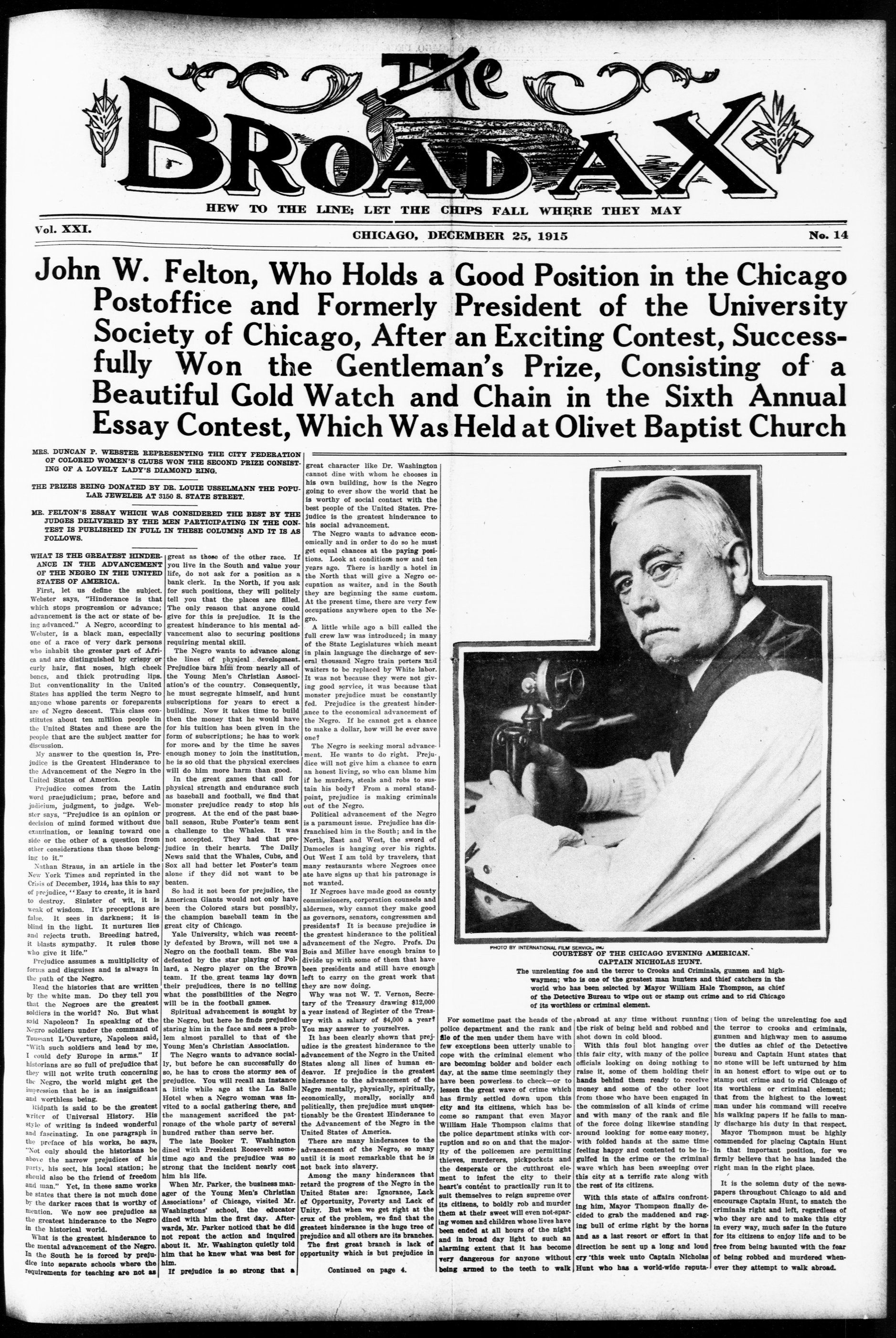
John W. Felton, Who Holds a Good Position in the Chicago Postoffice and Formerly President of the University Society of Chicago, After an Exciting Contest, Successfully Won the Gentleman's Prize, Consisting of a Beautiful Gold Watch and Chain in the Sixth Annual Essay Contest, Which Was Held at Olivet Baptist Church
MRS. DUNCAN P. WEBSTER REPRESENTING THE CITY FEDERATION OF COLORED WOMEN'S CLUBS WON THE SECOND PRIZE CONSISTING OF A LOVELY LADY'S DIAMOND RING.
THE PRIZES BEING DONATED BY DR. LOUIE USSELMANN THE POPULAR JEWELER AT 3150 S. STATE STREET.
MR. FELTON'S ESSAY WHICH WAS CONSIDERED THE BEST BY THE JUDGES DELIVERED BY THE MEN PARTICIPATING IN THE CONTEST IS PUBLISHED IN FULL IN THESE COLUMNS AND IT IS AS FOLLOWS.
Vol. XXI.
John W. Poston Society fully Beauty Essay
MRS. DUNCAN P. WEBSTER REPEAT OF COLORED WOMEN'S CLUBS ING OF A LOVELY LADY'S D
THE PRIZES BEING DONATED BY LAR JEWELEB AT S
MR. FELTON'S ESSAY WHICH WA JUDGES DELIVERED BY THE TEST IS PUBLISHED IN FULLY FOLLOWS.
WHAT IS THE GREATEST HINDERANCE IN THE ADVANCEMENT OF THE NEGRO IN THE UNITED STATES OF AMERICA.
First, let us define the subject, Webster says, "Hinderance is that which stops progression or advance; advancement is the act or state of being advanced." A Negro, according to Webster, is a black man, especially one of a race of very dark persons who inhabit the greater part of Africa and are distinguished by crispy or curly hair, flat noses, high cheek bones, and thick protruding lips. But conventionality in the United States has applied the term Negro to anyone whose parents or foreparents are of Negro descent. This class constitutes about ten million people in the United States and these are the people that are the subject matter for discussion.
My answer to the question is, Prejudice is the Greatest Hinderance to the Advancement of the Negro in the United States of America.
Prejudice comes from the Latin word praejudicium; prae, before and judicium, judgment, to judge. Webster says, "Prejudice is an opinion or decision of mind formed without due examination, or leaning toward one side or the other of a question from other considerations than those belonging to it." Nathan Straus, in an article in the New York Times and reprinted in the Crisis of December, 1914, has this to say of prejudice, "Easy to create, it is hard to destroy. Sinister of wit, it is weak of wisdom. It's preceptions are false. It sees in darkness; it is blind in the light. It nurtures lies and rejects truth. Breeding hatred, it blasts sympathy. It rules those who give it life."
Prejudice assumes a multiplicity of forms and disguises and is always in the path of the Negro.
Read the histories that are written by the white man. Do they tell you that the Negroes are the greatest soldiers in the world? No. But what said Napoleon? In speaking of the Negro soldiers under the command of Tousant L'Ouverture, Napoleon said, "With such soldiers and lead by me, I could defy Europe in arms." If historians are so full of prejudice that they will not write truth concerning the Negro, the world might get the impression that he is an insignificant and worthless being.
Ridpath is said to be the greatest writer of Universal History. His style of writing is indeed wonderful and fascinating. In one paragraph in the preface of his works, he says, "Not only should the historians be above the narrow prejudices of his party, his sect, his local station; he should also be the friend of freedom and man." Yet, in these same works he states that there is not much done by the darker races that is worthy of mention. We now see prejudice as the greatest hindrance to the Negro in the historical world.
What is the greatest hinderance to the mental advancement of the Negro. In the South he is forced by prejudice into separate schools where the requirements for teaching are not as
great as those of the other race. If you live in the South and value your life, do not ask for a position as a bank clerk. In the North, if you ask for such positions, they will politely tell you that the places are filled. The only reason that anyone could give for this is prejudice. It is the greatest hindrance to his mental advancement also to securing positions requiring mental skill.
The Negro wants to advance along the lines of physical development. Prejudice bars him from nearly all of the Young Men's Christian Association's of the country. Consequently, he must segregate himself, and hunt subscriptions for years to erect a building. Now it takes time to build then the money that he would have for his tuition has been given in the form of subscriptions; he has to work for more and by the time he saves enough money to join the institution, he is so old that the physical exercises will do him more harm than good.
In the great games that call for physical strength and endurance such as baseball and football, we find that monster prejudice ready to stop his progress. At the end of the past baseball season, Rube Foster's team sent a challenge to the Whales. It was not accepted. They had that prejudice in their hearts. The Daily News said that the Whales, Cubs, and Sox all had better let Foster's team alone if they did not want to be beaten.
So had it not been for prejudice, the American Giants would not only have been the Colored stars but possibly, the champion baseball team in the great city of Chicago.
Yale University, which was recently defeated by Brown, will not use a Negro on the football team. She was defeated by the star playing of Pollard, a Negro player on the Brown team. If the great teams lay down their prejudices, there is no telling what the possibilities of the Negro will be in the football games.
Spiritual advancement is sought by the Negro, but here he finds prejudice staring him in the face and sees a problem almost parallel to that of the Young Men's Christian Association.
The Negro wants to advance socially, but before he can successfully do so, he has to cross the stormy sea of prejudice. You will recall an instance a little while ago at the La Salle Hotel when a Negro woman was invited to a social gathering there, and the management sacrificed the patronage of the whole party of several hundred rather than serve her. The late Booker T. Washington dined with President Roosevelt sometime ago and the prejudice was so strong that the incident nearly cost him his life. When Mr. Parker, the business manager of the Young Men's Christian Associations' of Chicago, visited Mr. Washington's school, the educator dined with him the first day. Afterwards, Mr. Parker noticed that he did not repeat the action and inquired about it. Mr. Washington quietly told him that he knew what was best for him. If prejudice is so strong that a
CHICAGO, DECEMBER 25, 1915
great character like Dr. Washington cannot dine with whom he chooses in his own building, how is the Negro going to ever show the world that he is worthy of social contact with the best people of the United States. Prejudice is the greatest hinderance to his social advancement.
The Negro wants to advance economically and in order to do so he must get equal chances at the paying positions. Look at conditions now and ten years ago. There is hardly a hotel in the North that will give a Negro occupation as waiter, and in the South they are beginning the same custom. At the present time, there are very few occupations anywhere open to the Negro.
A little while ago a bill called the full crew law was introduced; in many of the State Legislatures which meant in plain language the discharge of several thousand Negro train porters and waiters to be replaced by White labor. It was not because they were not giving good service, it was because that monster prejudice must be constantly fed. Prejudice is the greatest hinderance to the economical advancement of the Negro. If he cannot get a chance to make a dollar, how will he ever save one?
The Negro is seeking moral advancement. He wants to do right. Prejudice will not give him a chance to earn an honest living, so who can blame him if he murders, steals and robs to sustain his body? From a moral standpoint, prejudice is making criminals out of the Negro. Political advancement of the Negro is a paramount issue. Prejudice has disfranchised him in the South; and in the North, East and West, the sword of Damocles is hanging over his rights. Out West I am told by travelers, that many restaurants where Negroes once ate have signs up that his patronage is not wanted. If Negroes have made good as county commissioners, corporation counsels and aldermen, why cannot they make good as governors, senators, congressmen and presidents? It is because prejudice is the greatest hindrance to the political advancement of the Negro. Profs. Du Bois and Miller have enough brains to divide up with some of them that have been presidents and still have enough left to carry on the great work that they are now doing.
Why was not W. T. Vernon, Secretary of the Treasury drawing $12,000 a year instead of Register of the Treasury with a salary of $4,000 a year? You may answer to yourselves.
It has been clearly shown that prejudice is the greatest hindrance to the advancement of the Negro in the United States along all lines of human endeavor. If prejudice is the greatest hindrance to the advancement of the Negro mentally, physically, spiritually, economically, morally, socially and politically, then prejudice must unquestionably be the Greatest Hindrance to the Advancement of the Negro in the United States of America.
There are many hindernances to the advancement of the Negro, so many until it is most remarkable that he is not back into slavery.
Among the many hindernances that retard the progress of the Negro in the United States are: Ignorance, Lack of Opportunity, Poverty and Lack of Unity. But when we get right at the crux of the problem, we find that the greatest hindrance is the huge tree of prejudice and all others are its branches.
The first great branch is lack of opportunity which is but prejudice in Continued on page 4.
THE MASTER OF TELEPHONES
The unrelenting foe and the terror to Crooks and Criminals, gunmen and highwaymen; who is one of the greatest man hunters and thief catchers in the world who has been selected by Mayor William Hale Thompson, as chief of the Detective Bureau to wipe out or stamp out crime and to rid Chicago of its worthless or criminal element.
For sometime past the heads of the police department and the rank and file of the men under them have with few exceptions been utterly unable to cope with the criminal element who are becoming bolder and bolder each day, at the same time seemingly they have been powerless to check—or to lessen the great wave of crime which has firmly settled down upon this city and its citizens, which has become so rampant that even Mayor William Hale Thompson claims that the police department stinks with corruption and so on and that the majority of the policemen are permitting thieves, murderers, pickpockets and the desperate or the cutthroat element to infest the city to their heart's content to practically run it to suit themselves to reign supreme over its citizens, to boldly rob and murder them at their sweet will even not-sparing women and children whose lives have been ended at all hours of the night and in broad day light to such an alarming extent that it has become very dangerous for anyone without being armed to the teeth to walk
abroad at any time without running the risk of being held and robbed and shot down in cold blood.
With this foul blot hanging over this fair city, with many of the police officials looking on doing nothing to raise it, some of them holding their hands behind them ready to receive money and some of the other loot from those who have been engaged in the commission of all kinds of crime and with many of the rank and file of the force doing likewise standing around looking for some easy money, with folded hands at the same time feeling happy and contented to be ingulfed in the crime or the criminal wave which has been sweeping over this city at a terrific rate along with the rest of its citizens.
With this state of affairs confronting him, Mayor Thompson finally decided to grab the maddened and raging bull of crime right by the horns and as a last resort or effort in that direction he sent up a long and loud cry 'this week unto Captain Nicholas Hunt who has a world-wide reputa-
No.14
the Chicago University, Success- ting of a 6th Annual Priest Church
AMERICAN.
Annals, gunmen and high- thief catchers in the late Thompson, as chief me and to rid Chicago
tion of being the unrelenting foe and the terror to crooks and criminals, gunmen and highway men to assume the duties as chief of the Detective bureau and Captain Hunt states that no stone will be left unturned by him in an honest effort to wipe out or to stamp out crime and to rid Chicago of its worthless or criminal element; that from the highest to the lowest man under his command will receive his walking papers if he fails to manly discharge his duty in that respect. Mayor Thompson must be highly commended for placing Captain Hunt in that important position, for we firmly believe that he has landed the right man in the right place.
It is the solemn duty of the newspapers throughout Chicago to aid and encourage Captain Hunt, to snatch the criminals right and left, regardless of who they are and to make this city in every way, much safer in the future for its citizens to enjoy life and to be free from being haunted with the fear of being robbed and murdered whenever they attempt to walk abroad.
---
PAGE TWO
SIRES AND SONS.
Lord Rosebery is averse to pink. The sight of a lady in a pink dress has caused him to lose the thread of his argument in a political speech. Robert E. Peary has his summer home on a small island in Casco bay, off the coast of Maine, and on a small adjoining island, which he owns, he breeds Eskimo dogs. Dr. Wellington Koo, who has been appointed Chinese minister to this country, in succession to Kai Fu Shah, was until his appointment minister to Mexico, Peru and Cuba. Henry Bruere, whose position may be called chief efficiency engineer of New York city, which spends $200,000,000 a year, is a native of Missouri, has devoted ten years to work of this nature and is only thirty-three years of age.
Admiral von Holtzendorf, recently announced as the head of the German naval staff, is former commander of the German high seas fleet and one of the big men of the navy. The new chief of the naval staff, with his bushy, snow white beard, his square, thickset frame and his frank, positive manner, is a typical sea dog.
The Cookbook.
To make eggs stick to croquettes and other foods that are dipped in egg and crumbs, first dip the food in flour; then the egg will adhere very well.
When making apple float try baking the apples instead of stewing them. The pulp is removed from the skins and mixed with the whites of the egg, which makes the float much lighter than the old way.
Instead of frying your pork chops, try baking them. Salt them and place one on top of the other in a pan with about two cupfuls of water. Cover with a tight lid. You can bake eight in an hour, and they will be as tender as chicken.
Fashion Frills.
Skirts will be shorter in the spring. This has got to stop somewhere.—Albany Knickerbocker-Press.
As the rage for fox furs refuses to wane, this promises to be an unusually hard year on rabbits.—Washington Post.
Again the eternal law of compensation. As the skirts grow shorter the shoes get higher. — Cleveland Plain Dealer.
Cold weather short skirts and thin stockings don't strike the masculine mind as a comfortable combination.—Exchange.
Train and Track.
There were 157 railway laws passed in 1915 by state legislatures.
In Glasgow if you ride on a trolley you pay a cent for any ordinary distance, while even the longest rides cost but 2 cents.
One of the largest English railways is building a fireproofing plant in which to treat all of the lumber used in cars which will be constructed in future.
To avoid discarding a number of four wheeled cars a street railway company in Virginia has joined them together in parks with a compartment between them that permits them to round curves.
Waves of Water.
The bottom of Lake Mampouri, New Zealand, is 861 feet below sea level. Its depth is 1,458 feet. The Potomac river is only 500 miles long and in its lower course is rather an estuary than a stream. The Seine is 470 miles in length and during the lower part of its course frequently attains a width of a mile. The longest and most important river in Central America is the Motaga, which empties into the sea on the border line between Guatemala and Honduras.
BRIGHT BRIEFS.
The more a man rests the more he rusts.
Selfishness is the worst investment a man can make.
There's many a slip 'twixt the cup and the lip—fortunately.
He who disregards the rudder is pretty sure to suffer a wreck.
Until some one puts a spike in it a lie sounds just as well as the truth.
When the buyer understands his business the salesman has an easy time.
One good turn deserves another, but unfortunately there is no such thing as perpetual motion.
Probably the secret of happiness is to convert yesterday's disgust into spiritual sunshine today.
The old blue laws were probably enacted for the purpose of preventing men from painting towns red.
When you meet a rich man who says that he is happier than when he was poor, give him the credit of being honest.
It's funny how children can learn all the things they ought not to do without any help, but must be taught all the things they ought to know.
They claim they have found an antidote for bichloride of mercury poisoning. At the same time nobody is going to be in any hurry to test it.
---
BLIND ORATORS IN NEW CONGRESS
Similar Careers of Senator Gore and Representative Schall.
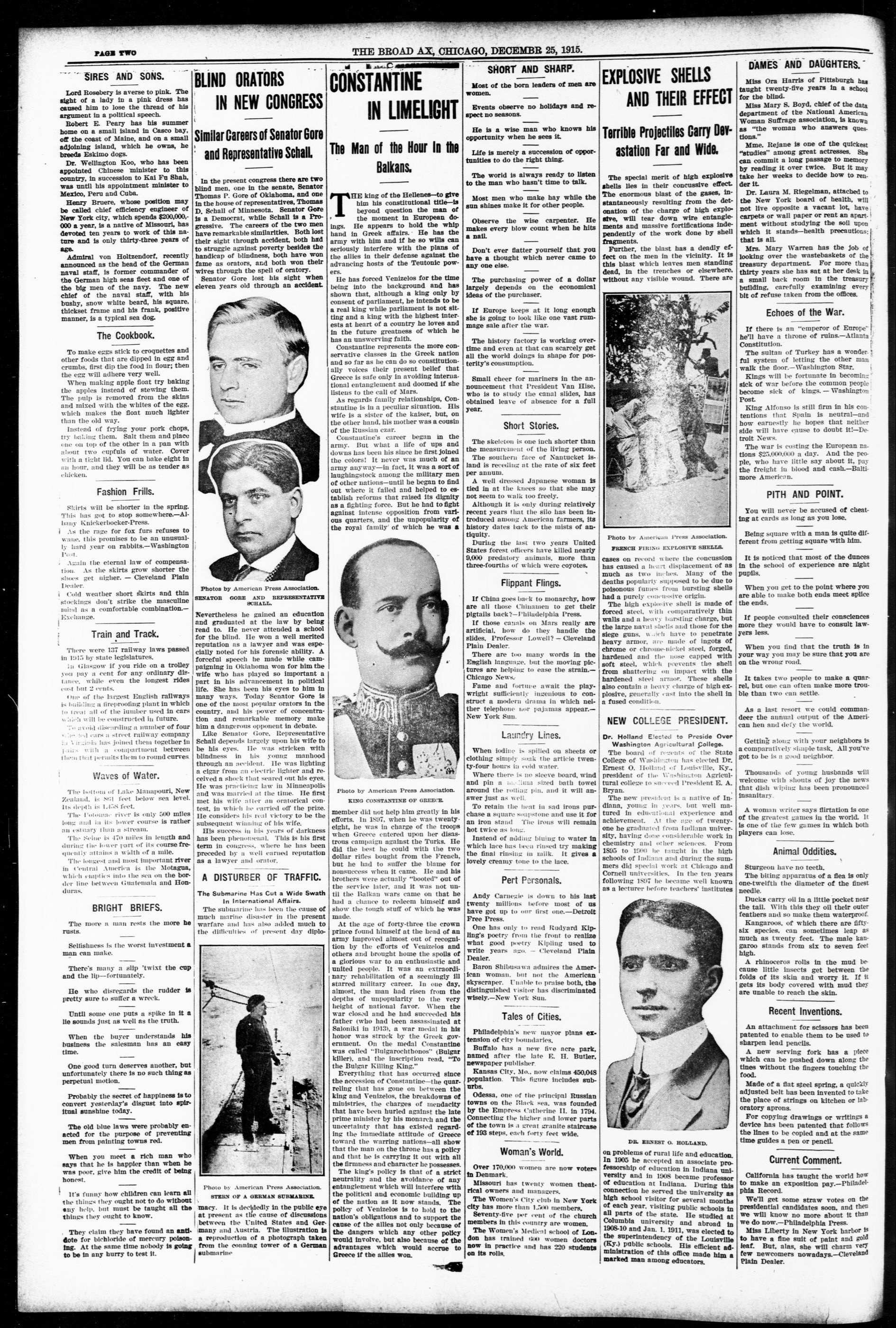
In the present congress there are two blind men, one in the senate, Senator Thomas P. Gore of Oklahoma, and one in the house of representatives, Thomas D. Schall of Minnesota. Senator Gore is a Democrat, while Schall is a Progressive. The careers of the two men have remarkable similarities. Both lost their sight through accident, both had to struggle against poverty besides the handicap of blindness, both have won fame as orators, and both won their wives through the spell of oratory. Senator Gore lost his sight when eleven years old through an accident.
J. B. H.
Photos by American Press Association.
SENATOR GORE AND REPRESENTATIVE
SCHALL.
Photos by American Press Association.
SENATOR GORE AND REPRESENTATIVE SCHALL.
Nevertheless he gained an education and graduated at the law by being read to. He never attended a school for the blind. He won a well merited reputation as a lawyer and was especially noted for his forensic ability. A forceful speech he made while campaigning in Oklahoma won for him the wife who has played so important a part in his advancement in political life. She has been his eyes to him in many ways. Today Senator Gore is one of the most popular orators in the country, and his power of concentration and remarkable memory make him a dangerous opponent in debate.
Like Senator Gore, Representative Schall depends largely upon his wife to be his eyes. He was stricken with blindness in his young manhood through an accident. He was lighting a cigar from an electric lighter and received a shock that seared out his eyes. He was practicing law in Minneapolis and was married at the time. He first met his wife after an oratorical contest, in which he carried off the prize. He considers his real victory to be the subsequent winning of his wife. His success in his years of darkness has been phenomenal. This is his first term in congress, where he has been preceded by a well earned reputation as a lawyer and orator.
A DISTURBER OF TRAFFIC.
The Submarine Has Cut a Wide Swathe In International Affairs. The submarine has been the cause of much marine disaster in the present warfare and has also added much to the difficulties of present day diplo-
100
macy. It is decidedly in the public eye at present as the cause of discussions between the United States and Germany and Austria. The illustration is a reproduction of a photograph taken from the conning tower of a German submarine.
THE BROAD AX. CHICAGO. DECEMBR 25. 1915.
CONSTANTINE IN LIMELIGHT
The Man of the Hour In the Balkans.
THE king of the Hellenes—to give him his constitutional title—is beyond question the man of the moment in European doings. He appears to hold the whip hand in Greek affairs. He has the army with him and if he so wills can seriously interfere with the plans of the allies in their defense against the advancing hosts of the Teutonic powers.
He has forced Venizelos for the time being into the background and has shown that, although a king only by consent of parliament, he intends to be a real king while parliament is not sitting and a king with the highest interests at heart of a country he loves and in the future greatness of which he has an unwary faith.
Constantine represents the more conservative classes in the Greek nation and so far as he can do so constitutionally voices their present belief that Greece is safe only in avoiding international entanglement and doomed if she listens to the call of Mars.
As regards family relationships, Constantine is in a peculiar situation. His wife is a sister of the kaiser, but, on the other hand, his mother was a cousin of the Russian czar.
Constantine's career began in the army. But what a life of ups and downs has been his since he first joined the colors! It never was much of an army anyway—in fact, it was a sort of laughingstock among the military men of other nations—until he began to find out where it failed and helped to establish reforms that raised its dignity as a fighting force. But he had to fight against intense opposition from various quarters, and the unpopularity of the royal family' of which he was a
M.
Photo by American Press Association.
KING CONSTANTINE OF GREECE.
member did not help him greatly in his efforts. In 1897, when he was twenty-eight, he was in charge of the troops when Greece entered upon her disastrous campaign against the Turks. He did the best he could with the two dollar rifles bought from the French, but he had to suffer the blame for nonsuccess when it came. He and his brothers were actually "booted" out of the service later, and it was not until the Balkan wars came on that he had a chance to redeem himself and show the tough stuff of which he was made.
At the age of forty-three the crown prince found himself at the head of an army improved almost out of recognition by the efforts of Venizelos and others and brought home the spoils of a glorious war to an enthusiastic and united people. It was an extraordinary rehabilitation of a seemingly ill starred military career. In one day, almost, the man had risen from the depths of unpopularity to the very height of national favor. When the war closed and he had succeeded his father (who had been assassinated at Saloniki in 1913), a war medal in his honor was struck by the Greek government. On the medal Constantine was called "Bulgarochthonos" (Bulgar killer), and the inscription read, "To the Bulgar Killing King."
Everything that has occurred since the accession of Constantine—the quarrelling that has gone on between the king and Venizelos, the breakdowns of ministries, the charges of mendacity that have been hurled against the late prime minister by his monarch and the uncertainty that has existed regarding the immediate attitude of Greece toward the warring nations—all show that the man on the throne has a policy and that he is carrying it out with all the firmness and character he possesses. The king's policy is that of a strict neutrality and the avoidance of any entanglement which will interfere with the political and economic building up of the nation as it now stands. The policy of Venizelos is to hold to the nation's obligations and to support the cause of the allies not only because of the dangers which any other policy would involve, but also because of the advantages which would accrue to Greece if the allies won.
SHORT AND SHARP.
Most of the born leaders of men are women.
Events observe no holidays and respect no seasons.
He is a wise man who knows his opportunity when he sees it.
Life is merely a succession of opportunities to do the right thing.
The world is always ready to listen to the man who hasn't time to talk.
Most men who make hay while the sun shines make it for other people.
Observe the wise carpenter. He makes every blow count when he hits a nail.
Don't ever flatter yourself that you have a thought which never came to any one else.
The purchasing power of a dollar largely depends on the economical ideas of the purchaser.
If Europe keeps at it long enough she is going to look like one vast rum-mage sale after the war.
The history factory is working overtime and even at that can scarcely get all the world doings in shape for posterity's consumption.
Small cheer for mariners in the announcement that President Van Hise, who is to study the canal slides, has obtained leave of absence for a full year.
Short Stories.
The skeleton is one inch shorter than the measurement of the living person. The southern face of Nantucket island is receding at the rate of six feet per annum. A well dressed Japanese woman is tied in at the knees so that she may not seem to walk too freely. Although it is only during relatively recent years that the silo has been introduced among American farmers, its history dates back to the mists of antiquity. During the last two years United States forest officers have killed nearly 9,000 predatory animals, more than three-fourths of which were coyotes.
Flippant Flings.
If China goes back to monarchy, how are all those Chinamen to get their pigtails back?—Philadelphia Press. If those canals on Mars really are artificial, how do they handle the slides, Professor Lowell?—Cleveland Plain Dealer. There are too many words in the English language, but the moving pictures are helping to ease the strain.—Chicago News. Fame and fortune await the playwright sufficiently ingenious to construct a modern drama in which nelther telephone nor pajamas appear.—New York Sun.
Laundry Lines.
When iodine is spilled on sheets or clothing simply soak the article twenty-four hours in cold water.
Where there is no sleeve board, wind and pin a medium sized bath towel around the rolling pin, and it will answer just as well.
To retain the heat in sad irons purchase a square soapstone and use it for an iron stand. The irons will remain hot twice as long.
Instead of adding bluing to water in which lace has been rinsed try making the final rinsing in milk. It gives a lovely creamy tone to the lace.
Pert Personals
Andy Carnegie is down to his last twenty millions before most of us have got up to our first one.—Detroit Free Press.
One has only to read Rudyard Kipling's poetry from the front to realize what good poetry Kipling used to write years ago. — Cleveland Plain Dealer.
Baron Shibusawa admires the American woman, but not the American skyscraper. Unable to praise both, the distinguished visitor has discriminated wisely.—New York Sun.
Tales of Cities.
Philadelphia's new mayor plans extension of city boundaries.
Buffalo has a new five acre park, named after the late E. H. Butler, newspaper publisher.
Kansas City, Mo., now claims 450,048 population. This figure includes suburbs.
Odessa, one of the principal Russian towns on the Black sea, was founded by the Empress Catherine II. in 1794. Connecting the higher and lower parts of the town is a great granite staircase of 193 steps, each forty feet wide.
Woman's World.
Over 170,000 women are now voters in Denmark.
Missouri has twenty women theatrical owners and managers.
The Women's City club in New York city has more than 1,500 members.
Seventy-five per cent of the church members in this country are women. The Women's Medical school of London has trained 600 women doctors now in practice and has 220 students on its rolls.
EXPLOSIVE SHELLS AND THEIR EFFECT
Terrible Projectiles Carry Devastation Far and Wide.
The special merit of high explosive shells lies in their concussive effect. The enormous blast of the gases, instantaneously resulting from the detonation of the charge of high explosive, will tear down wire entanglements and massive fortifications independently of the work done by shell fragments.
Further, the blast has a deadly effect on the men in the vicinity. It is this blast which leaves men standing dead, in the trenches or elsewhere, without any visible wound. There are
THE BATTLE
FRENCH FIRING EXPLOSIVE SHELLS. cases on record where the concussion has caused a heart displacement of as much as two inches. Many of the deaths popularly supposed to be due to poisonous fumes from bursting shells had a purely concussive origin. The high explosive shell is made of forced steel, with comparatively thin walls and a heavy bursting charge, but the large naval shells and those for the siege guns, which have to penetrate heavy armor, are made of ingots of chrome or chrome-nickel steel, forged, hardened and the nose capped with soft steel, which prevents the shell from shattering on impact with the hardened steel armor. These shells also contain a heavy charge of high explosive, generally cast into the shell in a fused condition.
NEW COLLEGE PRESIDENT.
Dr. Holland Elected to Preside Over Washington Agricultural College.
The board of regents of the State College of Washington has elected Dr. Ernest O. Holland of Louisville, Ky., president of the Washington Agricultural college to succeed President E. A. Bryan.
The new president is a native of Indiana, young in years, but well matured in educational experience and achievement. At the age of twenty-one he graduated from Indiana university, having done considerable work in chemistry and other sciences. From 1850 to 1900 he taught in the high schools of Indiana and during the summers did special work at Chicago and Cornell universities. In the ten years following 1807 he became well known as a lecturer before teachers' institutes
J. B.
DR. ERNEST O. HOLLAND. on problems of rural life and education. In 1905 he accepted an associate professorship of education in Indiana university and in 1908 became professor of education at Indiana. During this connection he served the university as high school visitor for several months of each year, visiting public schools in all parts of the state. He studied at Columbia university and abroad in 1908-10 and Jan. 1, 1911, was elected to the superintendency of the Louisville (KY.) public schools. His efficient administration of this office made him a marked man among educators.
DAMES AND DAUGHTERS.
Miss Ora Harris of Pittsburgh has taught twenty-five years in a school for the blind.
Miss Mary S. Boyd, chief of the data department of the National American Woman Suffrage association, is known as "the woman who answers questions."
Mme. Rejane is one of the quickest "studies" among great actresses. She can commit a long passage to memory by reading it over twice. But it may take her weeks to decide how to render it.
Dr. Laura M. Riegelman, attached to the New York board of health, will not live opposite a vacant lot, have carpets or wall paper or rent an apartment without studying the soil upon which it stands—health precautions; that is all.
Mrs. Mary Warren has the job of looking over the wastebaskets of the treasury department. For more than thirty years she has sat at her desk in a small back room in the treasury building, carefully examining every bit of refuse taken from the offices.
Echoes of the War.
If there is an "emperor of Europe" he'll have a throne of ruins.—Atlanta Constitution.
The sultan of Turkey has a wonderful system of letting the other man walk the floor.—Washington Star.
Kings will be fortunate in becoming sick of war before the common people become sick of kings.—Washington Post.
King Alfonso is still firm in his contents that Spain is neutral—and how earnestly he hopes that neither side will have cause to doubt it!—Detroit News.
The war is costing the European nations $25,000,000 a day. And the people, who have little say about it, pay the freight in blood and cash.—Baltimore American.
PITH AND POINT.
You will never be accused of cheating at cards as long as you lose.
Being square with a man is quite different from getting square with him.
It is noticed that most of the dunces in the school of experience are night pupils.
When you get to the point where you are able to make both ends meet splice the ends.
If people consulted their consciences more they would have to consult lawyers less.
When you find that the truth is in your way you may be sure that you are on the wrong road.
It takes two people to make a quarrel, but one can often make more trouble than two can settle.
As a last resort we could commander the annual output of the American hen and defy the world.
Getting along with your neighbors is a comparatively simple task. All you've got to be is a good neighbor.
Thousands of young husbands will welcome with shouts of joy the news that dish wiping has been pronounced insanitary.
A woman writer says flirtation is one of the greatest games in the world. It is one of the few games in which both players can lose.
Animal Oddities.
Sturgeon have no teeth.
The biting apparatus of a flea is only one twelfth the diameter of the finest needle.
Ducks carry oil in a little pocket near the tail. With this they oil their outer feathers and so make them waterproof.
Kangaroos, of which there are fifty-six species, can sometimes leap as much as twenty feet. The male kangaroo stands from six to seven feet high.
A rhinoceros rolls in the mud because little insects get between the folds of its skin and worry it. If it gets its body covered with mud they are unable to reach the skin.
Recent Inventions.
An attachment for scissors has been patented to enable them to be used to sharpen lead pencils. A new serving fork has a piece which can be pushed down along the tines without the fingers touching the food. Made of a flat steel spring, a quickly adjusted belt has been invented to take the place of strings on kitchen or laboratory aprons. For copying drawings or writings a device has been patented that follows the lines to be copied and at the same time guides a pen or pencil.
Current Comment.
California has taught the world how to make an exposition pay.—Philadelphia Record.
We'll get some straw votes on the presidential candidates soon, and then we will know no more about it than we do now.—Philadelphia Press.
Miss Liberty in New York harbor is to have a fine suit of paint and gold leaf. But, alas, she will charm very few newcomers nowadays.—Cleveland Plain Dealer.
Lv
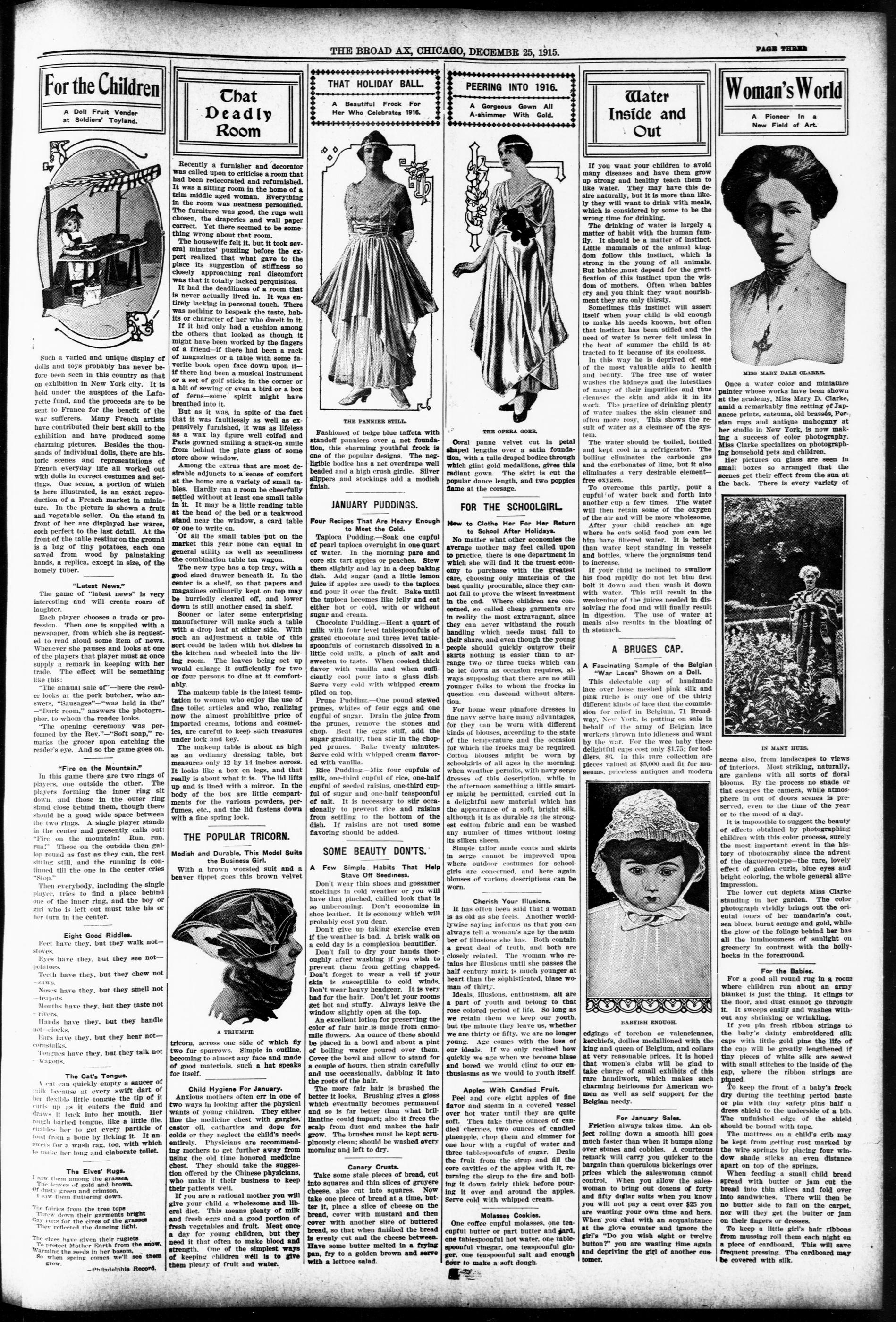
Such a varied and unique display of dolls and toys probably has never before been seen in this country as that on exhibition in New York city. It is held under the auspices of the Lafayette fund, and the proceeds are to be sent to France for the benefit of the war sufferers. Many French artists have contributed their best skill to the exhibition and have produced some charming pictures. Besides the thousands of individual dolls, there are historic scenes and representations of French everyday life all worked out with dolls in correct costumes and settings. One scene, a portion of which is here illustrated, is an exact reproduction of a French market in miniature. In the picture is shown a fruit and vegetable seller. On the stand in front of her are displayed her wares, each perfect to the last detail. At the front of the table resting on the ground is a bag of tiny potatoes, each one sawed from wood by painstaking hands, a replica, except in size, of the homely tuber.
"Latest News"
The game of "latest news" is very interesting and will create roars of laughter.
Each player chooses a trade or profession. Then one is supplied with a newspaper, from which she is requested to read aloud some item of news. Whenever she pauses and looks at one of the players that player must at once supply a remark in keeping with her trade. The effect will be something like this:
"The annual sale of"—here the reader looks at the pork butcher, who answers, "Sausages"—"was held in the"—"Dark room," answers the photographer, to whom the reader looks.
"The opening ceremony was performed by the Rev."—"Soft soap," remarks the grocer upon catching the reader's eye. And so the game goes on.
"Fire on the Mountain."
In this game there are two rings of players, one outside the other. The players forming the inner ring sit down, and those in the outer ring stand close behind them, though there should be a good wide space between the two rings. A single player stands in the center and presently calls out: "Fire on the mountain! Run, run, run." Those on the outside then gallop round as fast as they can, the rest sitting still, and the running is continued till the one in the center cries "Stop."
Then everybody, including the single player, tries to find a place behind one of the inner ring, and the boy or girl who is left out must take his or her turn in the center.
Eight Good Riddles.
Feet have they, but they walk not-
stoves.
Eyes have they, but they see not-
lectatoes.
Teeth have they, but they chew not-
saws.
Noses have they, but they smell not-
teapots.
Mouths have they, but they taste not-
rivers.
Hands have they, but they handle
not-clocks.
Ears have they, but they hear not-
cornstalks.
Tongues have they, but they talk not-
-wagers.
The Cat's Tongue.
A cat can quickly empty a saucer of milk because at every swift dart of her flexible little tongue the tip of it curls up as it enters the fluid and draws it back into her mouth. Her rough barbed tongue, like a little file, enables her to get every particle of food from a bone by licking it. It answers for a wash rag, too, with which to make her long and elaborate toilet.
The Elves' Rugs.
I saw them among the grasses,
The leaves of gold and brown,
Of dusty green and crimson,
I saw them fluttering down.
The fairies from the tree tops
Threw down their garments bright
Gay rugs for the elves of the grasses
They reflected the dancing light.
The elves have given their ruglets
To protect Mother Earth from the snow,
Warming the seeds in her bosom,
So when spring comes we'll see them
That Deadly Room
Recently a furnisher and decorator was called upon to criticise a room that had been redecorated and refinished. It was a sitting room in the home of a trim middle aged woman. Everything in the room was neatness personified. The furniture was good, the rugs well chosen, the draperies and wall paper correct. Yet there seemed to be something wrong about that room.
The housewife felt it, but it took several minutes' puzzling before the expert realized that what gave to the place its suggestion of stiffness so closely approaching real discomfort was that it totally lacked perquisites. It had the deadliness of a room that is never actually lived in. It was entirely lacking in personal touch. There was nothing to bespeak the taste, habits or character of her who dwelt in it. If it had only had a cushion among the others that looked as though it might have been worked by the fingers of a friend—if there had been a rack of magazines or a table with some favorite book open face down upon it—if there had been a musical instrument or a set of golf sticks in the corner or a bit of sewing or even a bird or a box of ferns—some spirit might have breathed into it.
But as it was, in spite of the fact that it was faultlessly as well as expensively furnished, it was as lifeless as a wax lay figure well coifed and Paris gowned smiling a stuck-on smile from behind the plate glass of some store show window.
Among the extras that are most desirable adjuncts to a sense of comfort at the home are a variety of small tables. Hardly can a room be cheerfully settled without at least one small table in it. It may be a little reading table at the head of the bed or a teakwood stand near the window, a card table or one to write on.
Of all the small tables put on the market this year none can equal in general utility as well as seemliness the combination table tea wagon.
The new type has a top tray, with a good sized drawer beneath it. In the center is a shelf, so that papers and magazines ordinarily kept on top may be hurriedly cleared off, and lower down is still another cased in shelf. Sooner or later some enterprising manufacturer will make such a table with a drop leaf at either side. With such an adjustment a table of this sort could be laden with hot dishes in the kitchen and wheeled into the living room. The leaves being set up would enlarge it sufficiently for two or four persons to dine at it comfortably.
The makeup table is the latest temptation to women who enjoy the use of fine toilet articles and who, realizing now the almost prohibitive price of imported creams, lotions and cosmetics, are careful to keep such treasures under lock and key.
The makeup table is about as high as an ordinary dressing table, but measures only 12 by 14 inches across. It looks like a box on legs, and that really is about what it is. The lid lifts up and is lined with a mirror. In the body of the box are little compartments for the various powders, perfumes, etc., and the lid fastens down with a fine spring lock.
THE POPULAR TRICORN.
Modish and Durable, This Model Suits the Business Girl.
With a brown worsted suit and a beaver tippet goes this brown velvet
A TRIUMPH.
tricorn, across one side of which fly two fur sparrows. Simple in outline, becoming to almost any face and made of good materials, such a hat speaks for itself.
Child Hygiene For January.
Anxious mothers often err in one of two ways in looking after the physical wants of young children. They either line the medicine chest with gargles, castor oil, cathartics and dope for colds or they neglect the child's needs entirely. Physicians are recommending mothers to get further away from using the old time honored medicine chest. They should take the suggestion offered by the Chinese physicians, who make it their business to keep their patients well.
If you are a rational mother you will give your child a wholesome and liberal diet. This means plenty of milk and fresh eggs and a good portion of fresh vegetables and fruit. Meat once a day for young children, but they need it that often to make blood and strength. One of the simplest ways of keeping children well is to give them plenty of fruit and water.
THE BROAD AX, CHICAGO, DECEMBR 25, 1915.
THAT HOLIDAY BALL.
A Beautiful Frock For
Her Who Celebrates 1916.
PEERING INTO 1916.
A Gorgeous Gown All
A-shimmer With Gold.
J
THE PANNER STILL.
Fashioned of belge blue taffeta with standoff panniers over a net foundation, this charming youthful frock is one of the popular designs. The negligible bodice has a net overdrape well beaded and a high crush girdle. Silver slippers and stockings add a modish finish.
JANUARY PUDDINGS.
Four Recipes That Are Heavy Enough to Meet the Cold.
Tapioca Pudding.—Soak one cupful of pearl tapioca overnight in one quart of water. In the morning pare and core six tart apples or peaches. Stew them slightly and lay in a deep baking dish. Add sugar (and a little lemon juice if apples are used) to the tapioca and pour it over the fruit. Bake until the tapioca becomes like jelly and eat either hot or cold, with or without sugar and cream.
Chocolate Pudding.—Heat a quart of milk with four level tablespoonfuls of grated chocolate and three level tablespoonfuls of cornstarch dissolved in a little cold milk, a pinch of salt and sweeten to taste. When cooked thick flavor with vanilla and when sufficiently cool pour into a glass dish. Serve very cold with whipped cream piled on top.
Prune Pudding—One pound stewed prunes, whites of four eggs and one cupful of sugar. Drain the juice from the prunes, remove the stones and chop. Beat the eggs stiff, add the sugar gradually, then stir in the chopped prunes. Bake twenty minutes. Serve cold with whipped cream flavored with vanilla.
Rice Pudding—Mix four cupfuls of milk, one-third cupful of rice, one-half cupful of seeded raisins, one-third cupful of sugar and one-half teaspoonful of salt. It is necessary to stir occasionally to prevent rice and raisins from settling to the bottom of the dish. If raisins are not used some flavoring should be added.
SOME BEAUTY DON'TS.
A Few Simple Habits That Help Stave Off Seediness.
Don't wear thin shoes and gossamer stockings in cold weather or you will have that pinched, chilled look that is so unbecoming. Don't economize in shoe leather. It is economy which will probably cost you dear.
Don't give up taking exercise even if the weather is bad. A brisk walk on a cold day is a complexion beautifier.
Don't fail to dry your hands thoroughly after washing if you wish to prevent them from getting chapped. Don't forget to wear a vell if your skin is susceptible to cold winds. Don't wear heavy headgear. It is very bad for the hair. Don't let your rooms get hot and stuffy. Always leave the window slightly open at the top.
An excellent lotion for preserving the color of fair hair is made from camomile flowers. An ounce of these should be placed in a bowl and about a pint of boiling water poured over them. Cover the bowl and allow to stand for a couple of hours, then strain carefully and use occasionally, dabbing it into the roots of the hair.
The more fair hair is brushed the better it looks. Brushing gives a gloss which eventually becomes permanent and so is far better than what brillantine could impart; also it frees the scalp from dust and makes the hair grow. The brushes must be kept scrupliously clean; should be washed every morning and left to dry.
Canary Crusts.
Take some stale pieces of bread, cut into squares and thin slices of gruyere cheese, also cut into squares. Now take one piece of bread at a time, butter it, place a slice of cheese on the bread, cover with mustard and then cover with another slice of buttered bread, so that when finished the bread is evenly cut and the cheese between. Have some butter melted in a frying pan, fry to a golden brown and serve with a lettuce salad.
PEERING INTO 1916.
A Gorgeous Gown All
A-shimmer With Gold.
K
THE OPERA GOER.
Coral panne velvet cut in petal shaped lengths over a satin foundation, with a tulle draped bodice through which glint gold medallions, gives this radiant gown. The skirt is cut the popular dance length, and two poppies flame at the corsage.
FOR THE SCHOOLGIBL
How to Clothe Her For Her Return to School After Holidays.
No matter what other economies the average mother may feel called upon to practice, there is one department in which she will find it the truest economy to purchase with the greatest care, choosing only materials of the best quality procurable, since they cannot fail to prove the wisest investment in the end. Where children are concerned, so called cheap garments are in reality the most extravagant, since they can never withstand the rough handling which needs must fall to their share, and even though the young people should quickly outgrow their skirts nothing is easier than to arrange two or three tucks which can be let down as occasion requires, always supposing that there are no still younger folks to whom the frocks in question can descend without alteration.
For home wear pinafore dresses in fine navy serve have many advantages, for they can be worn with different kinds of blouses, according to the state of the temperature and the occasion for which the frocks may be required. Cotton blouses might be worn by schoolgirls of all ages in the morning, when weather permits, with navy serge dresses of this description, while in the afternoon something a little smarter might be permitted, carried out in a delightful new material which has the appearance of a soft, bright silk, although it is as durable as the strongest cotton fabric and can be washed any number of times without losing its silken sheen.
Simple tailor made coats and skirts in serge cannot be improved upon where outdoor costumes for schoolgirls are concerned, and here again blouses of various descriptions can be worn.
Cherish Your Illusions.
It has often been said that a woman is as old as she feels. Another worldly wise saying informs us that you can always tell a woman's age by the number of illusions she has. Both contain a great deal of truth, and both are closely related. The woman who retains her illusions until she passes the half century mark is much younger at heart than the sophisticated, blase woman of thirty.
Ideals, illusions, enthusiasm, all are a part of youth and belong to that rose colored period of life. So long as we retain them we keep our youth, but the minute they leave us, whether we are thirty or fifty, we are no longer young. Age comes with the loss of our ideals. If we only realized how quickly we age when we become blase and bored we would cling to our enthusiasm as we would to youth itself.
Apples With Candied Fruit.
Peel and core eight apples of fine flavor and steam in a covered vessel over hot water until they are quite soft. Then take three ounces of candied cherries, two ounces of candied pheenapple, chop them and simmer for one hour with a cupful of water and three tablespoonfuls of sugar. Drain the fruit from the sirup and fill the core cavities of the apples with it, returning the sirup to the fire and boiling it down fairly thick before pouring it over and around the apples. Serve cold with whipped cream.
Molasses Cookies.
One coffee cupful molasses, one teacupful butter or part butter and gard, one tablespoonful hot water, one tablespoonful vinegar, one teaspoonful ginger, one teaspoonful salt and enough flour to make a soft dough.
Water Inside and Out
If you want your children to avoid many diseases and have them grow up strong and healthy teach them to like water. They may have this desire naturally, but it is more than likely they will want to drink with meals, which is considered by some to be the wrong time for drinking.
The drinking of water is largely a matter of habit with the human family. It should be a matter of instinct. Little mammals of the animal kingdom follow this instinct, which is strong in the young of all animals. But babies must depend for the gratification of this instinct upon the wisdom of mothers. Often when babies cry and you think they want nourishment they are only thirsty. Sometimes this instinct will assert itself when your child is old enough to make his needs known, but often that instinct has been stifled and the need of water is never felt unless in the heat of summer the child is attracted to it because of its coolness.
In this way he is deprived of one of the most valuable aids to health and beauty. The free use of water washes the kidneys and the intestines of many of their impurities and thus cleanses the skin and aids it in its work. The practice of drinking plenty of water makes the skin cleaner and often more rosy. This shows the result of water as a cleanser of the system. The water should be boiled, bottled and kept cool in a refrigerator. The boiling eliminates the carbonic gas and the carbonates of lime, but it also eliminates a very desirable element—free oxygen. To overcome this partly, pour a cupful of water back and forth into another cup a few times. The water will then retain some of the oxygen of the air and will be more wholesome.
After your child reaches an age where he eats solid food you can let him have filtered water. It is better than water kept standing in vessels and bottles, where the organisms tend to increase.
If your child is inclined to swallow his food rapidly do not let him first bolt it down and then wash it down with water. This will result in the weakening of the juices needed in dissolving the food and will finally result in digestion. The use of water at meals also results in the bloating of th stomach.
A. BRUGES CAP.
A Fascinating Sample of the Belgian
"War Laces" Shown on a Dell.
War Laces shown on a Doll
This delectable cap of handmade lace over loose meshed pink silk and pink ruche is only one of the thirty different kinds of lace that the commission for relief in Belgium, 71 Broadway, New York, is putting on sale in behalf of the army of Belgian lace workers thrown into idleness and want by the war. For the wee baby these delightful caps cost only $1.75; for toddlers, $6. In this rare collection are pieces valued at $5,000 and fit for museums, priceless antiques and modern
```markdown
```
BABYISH ENOUGH.
edgings of torchon or valenciennes, kerchiefs, doilies medallioned with the king and queen of Belgium, and collars at very reasonable prices. It is hoped that women's clubs will be glad to take charge of small exhibits of this rare handiwork, which makes such charming heirlooms for American women as well as self support for the Belgian needy.
For January Sales.
Friction always takes time. An object rolling down a smooth hill goes much faster than when it bumps along over stones and cobbles. A courteous remark will carry you quicker to the bargain than querulous bickerings over prices which the saleswoman cannot control. When you allow the saleswoman to bring out dozens of forty and fifty dollar suits when you know you will not pay a cent over $25 you are wasting your own time and hers. When you chat with an acquaintance at the glove counter and ignore the girl's "Do you wish eight or twelve button?" you are wasting time again and depriving the girl of another customer.
PAGE THIRD
P. A.
MISS MARY DALE CLARKE.
Once a water color and miniature painter whose works have been shown at the academy, Miss Mary D. Clarke, amid a remarkably fine setting of Japanese prints, satsuma, old brassés, Persian rugs and antique mahogany at her studio in New York, is now making a success of color photography. Miss Clarke specializes on photographing household pets and children.
Her pictures on glass are seen in small boxes so arranged that the scenes get their effect from the sun at the back. There is every variety of
THE WORLD'S LARGEST CHURCH
IN MANY HUES.
scene also, from landscapes to views of interiors. Most striking, naturally, are gardens with all sorts of floral blooms. By the process no shade or tint escapes the camera, while atmosphere in out of doors scenes is preserved, even to the time of the year or to the mood of a day.
It is impossible to suggest the beauty of effects obtained by photographing children with this color process, surely the most important event in the history of photography since the advent of the daguerreotype—the rare, lovely effect of golden curls, blue eyes and bright coloring, the whole general alive impression.
The lower cut depicts Miss Clarke standing in her garden. The color photograph vividly brings out the oriental tones of her mandarin's coat, sea blues, burnt orange and gold, while the glow of the follage behind her has all the luminousness of sunlight on greenery in contrast with the holly-hocks in the foreground.
For the Babies.
For a good all round rug in a room where children run about an army blanket is just the thing. It clings to the floor, and dust cannot go through it. It sweeps easily and washes without any shrinking or wrinkling.
If you pin fresh ribbon strings to the baby's dainty embroidered silk caps with little gold pins the life of the cap will be greatly lengthened if tiny pieces of white silk are sewed with small stitches to the inside of the cap, where the ribbon strings are pinned.
To keep the front of a baby's frock dry during the teething period bastе or pin with tiny safety pins half a dress shield to the underside of a bib. The unfinished edge of the shield should be bound with tape.
The mattress on a child's crib may be kept from getting rust marked by the wire springs by placing four window shade sticks an even distance apart on top of the springs. When feeding a small child bread spread with butter or jam cut the bread into thin slices and fold over into sandwiches. There will then be no butter side to fall on the carpet, nor will they get the butter or jam on their fingers or dresses. To keep a little girl's hair ribbons from mussing roll them each night on a piece of cardboard. This will save frequent pressing. The cardboard may be covered with silk.
Agents and Correspondents Wanted to Handle THE BROAD AX. Liberal Commissions to Live Agents. Address, Julius F.Taylor, 6532 St. Lawrence Av., Chicago
Agents a
BRO
Addr
THE BROAD AX
PUBLISHED WEEKLY.
Will promulgate and at all times uphold the two principles of Democracy, but Coffee Nes, Protetants, Priests, Infidels, Single Taxes, Republiances, or anyone else can have their say, as long as their language is proper and responsibility is fixed.
The Broad Ax is a newspaper whose platform is broad enough for all, ever claiming the editorial right to speak its own mind.
Local communications will receive attention. Write only on one side of the paper.
Subscriptions must be paid in advance. One Year.....$3.00
Six Months.....1.00
Advertising rates made known on application.
Address all communications to
THE BROAD AX
6532 SE. LAWRENCE AVE., CHICAGO, ILL.
PHONE WENTWORTH 2597.
JULIUS F. TAYLOR, Editor and Publisher
Entered as Second-Class Matter Aug. 18,
1868, at the Post Office at Chicago, Illinois,
under Act of March 8, 1879.
JOHN W. FELTON'S ESSAY DELIVERY
ERED AT OLIVET BAPTIST
CHURCH.
Concluded from page 1.
disguise. The next is poverty, caused first by his great difficulty in securing a position, second, after securing the position, he gets less pay for the same work that the White man does and is forced to pay more rent than the White man and receives less conveniences. The next is ignorance due to the fact that in the South where he is in the majority and prejudice reigns supreme, his educational career is limited. The next is lack of unity but if it were not for the prejudice he would not have to unite, for he is an American citizen and if a German, Frenchman, Italian or Japanese has a public place of business why should they not want the patronage of the Negro? Why should the Negro not patronize them? If a Negro has a place of business why should he not be patronized by them?
[Picture of a man in a suit and tie].
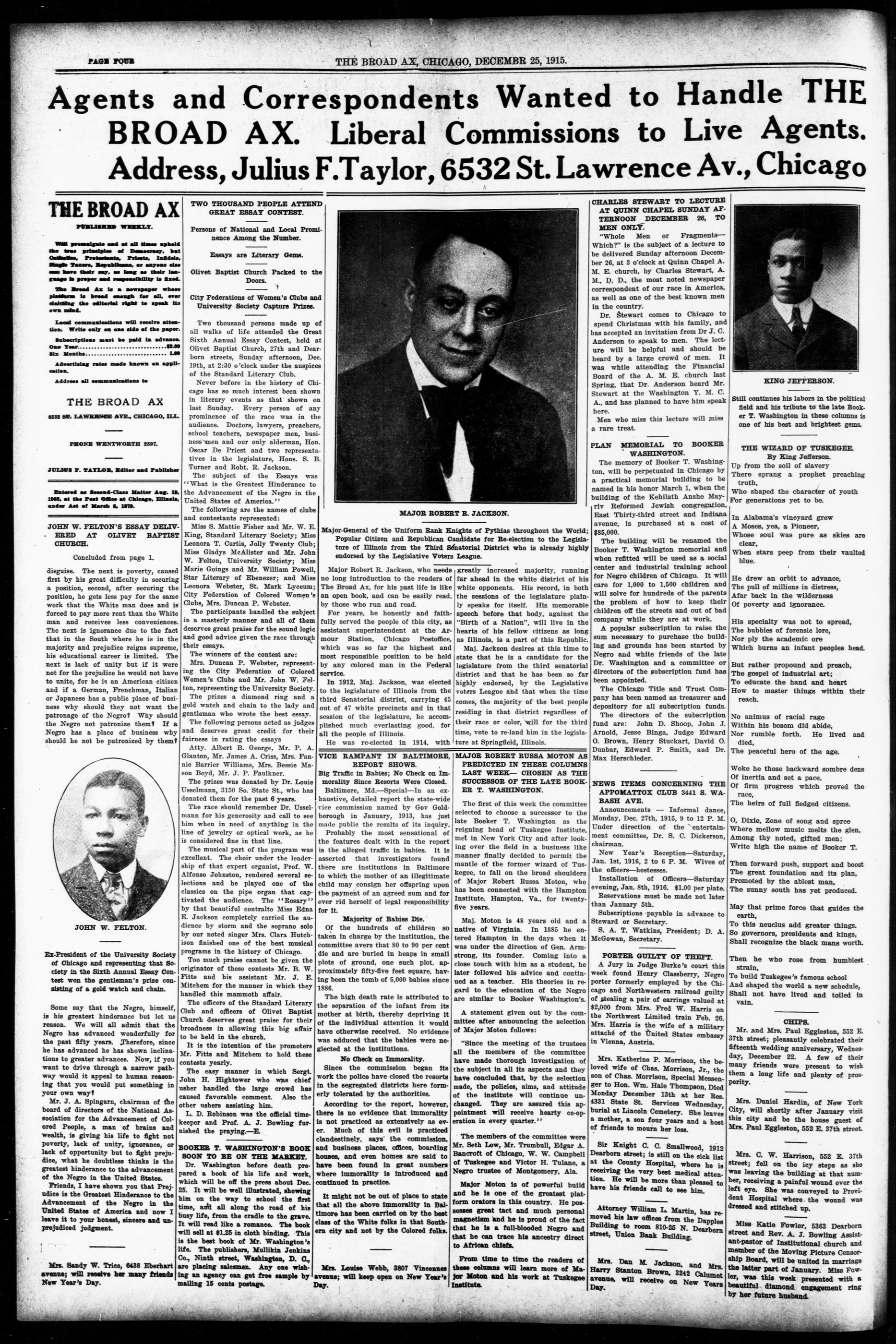
JOHN W. FELTON.
Ex-President of the University Society of Chicago and representing that Society in the Sixth Annual Essay Contest won the gentleman's prize consisting of a gold watch and chain.
Some say that the Negro, himself is his greatest hindrance but let us reason. We will all admit that the Negro has advanced wonderfully for the past fifty years. Therefore, since he has advanced he has shown inclinations to greater advances. Now, if you want to drive through a narrow pathway would it appeal to human reasoning that you would put something in your own way?
Mr. J. A. Spingarn, chairman of the board of directors of the National Association for the Advancement of Colored People, a man of brains and wealth, is giving his life to fight not poverty, lack of unity, ignorance, or lack of opportunity but to fight prejudice, what he doubtless thinks is the greatest hindrance to the advancement of the Negro in the United States.
Friends, I have shown you that Prejudice is the Greatest Hinderance to the Advancement of the Negro in the United States of America and now I leave it to your honest, sincere and unprejudiced judgment.
Mrs. Sandy W. Trice, 6438 Eberhart avenue; will receive her many friends New Year's Day.
TWO THOUSAND PEOPLE ATTEND
GREAT ESSAY CONTEST.
Persons of National and Local Promi-
nence Among the Number.
Essays are Literary Gems.
Olivet Baptist Church Packed to the Doors.
City Federations of Women's Clubs and University Society Capture Prizes.
Two thousand persons made up of all walks of life attended the Great Sixth Annual Essay Contest, held at Olivet Baptist Church, 27th and Dearborn streets, Sunday afternoon, Dec. 19th, at 2:30 o'clock under the auspices of the Standard Literary Club.
Never before in the history of Chicago has so much interest been shown in literary events as that shown on last Sunday. Every person of any prominence of the race was in the audience. Doctors, lawyers, preachers, school teachers, newspaper men, business men and our only alderman, Hon. Oscar De Priest and two representatives in the legislature, Hons. S. B. Turner and Robt. R. Jackson.
The subject of the Essays was "What is the Greatest Hinderance to the Advancement of the Negro in the United States of America." The following are the names of clubs and contestants represented:
Miss S. Mattie Fisher and Mr. W. E. King, Standard Literary Society; Miss Leonora T. Curtis, Jolly Twenty Club; Miss Gladys McAlister and Mr. John W. Felton, University Society; Miss Marie Goings and Mr. William Powell, Star Literary of Ebenezer; and Miss Leonora Webster, St. Mark Lyceum; City Federation of Colored Women's Clubs, Mrs. Duncan P. Webster.
The participants handled the subject in a masterly manner and all of them deserves great praise for the sound logic and good advice given the race through their essays.
The winners of the contest are: Mrs. Duncan P. Webster, representing the City Federation of Colored Women's Clubs and Mr. John W. Felton, representing the University Society.
The prizes a diamond ring and a gold watch and chain to the lady and gentleman who wrote the best essay. The following persons acted as judges and deserves great credit for their fairness in rating the essays. Atty. Albert B. George, Mr. P. A. Glanton, Mr. James A. Criss, Mrs. Fannie Barrier Williams, Mrs. Bessie Mason Boyd, Mr. J. P. Faulkner. The prizes was donated by Dr. Louie Usselmann, 3150 So. State St., who has donated them for the past 6 years. The race should remember Dr. Usselmann for his generosity and call to see him when in need of anything in the line of jewelry or optical work, as he is considered fine in that line.
The musical part of the program was excellent. The choir under the leadership of that expert organist, Prof. W. Alfonso Johnston, rendered several selections and he played one of the classics on the pipe organ that captivated the audience. The "Rosary" by that beautiful contralto Miss Edna E. Jackson completely carried the audience by storm and the soprano solo by our noted singer Mrs. Clara Hutchison finished one of the best musical programs in the history of Chicago. Too much praise cannot be given the originator of these contests Mr. B. W. Pitts and his assistant Mr. J. E. Mitchem for the manner in which they handled this mammoth affair.
The officers of the Standard Literary Club and officers of Olivet Baptist Church deserves great praise for their broadness in allowing this big affair to be held in the church.
It is the intention of the promoters Mr. Fitts and Mitchem to hold these contests yearly.
The easy manner in which Sergt. John H. Hightower who was chief usher handled the large crowd has caused favorable comment. Also the other ushers assisting him.
L. D. Robinson was the official timekeeper and Prof. A. J. Bowling furnished the praying—E.
BOOKER T. WASHINGTON'S BOO
SOON TO BE ON THE MARKET.
Dr. Washington before death prepared a book of his life and work, which will be off the press about Dec. 25. It will be well illustrated, showing him on the way to school the first time, and all along the road of his busy life, from the cradle to the grave. It will read like a romance. The book will sell at $1.25 in cloth binding. This is the best book of Mr. Washington's life. The publishers, Mullikin Jenkins Co., Ninth street, Washington, D. C., are placing salesmen. Any one wishing an agency can get free sample by mailing 15 cents postage.
THE BROAD AX. CHICAGO. DECEMBR 25, 1915.
M.
MAJOR ROBERT R. JACKSON
Major-General of the Uniform Rank K
Popular Citizen and Republican C
ture of Illinois from the Third S
endorsed by the Legislative Votem
Major-General of the Uniform Rank Knights of Pythias throughout the World; Popular Citizen and Republican Candidate for Re-election to the Legislature of Illinois from the Third Senatorial District who is already highly endorsed by the Legislative Voters League.
Major Robert R. Jackson, who needs no long introduction to the readers of The Broad Ax, for his past life is like an open book, and can be easily read, by those who run and read.
For years, he honestly and faithfully served the people of this city, as assistant superintendent at the Armour Station, Chicago Postoffice, which was so far the highest and most responsible position to be held by any colored man in the Federal service.
greatly increased majority, running far ahead in the white district of his white opponents. His record, in both the sessions of the legislature plainly speaks for itself. His memorable speech before that body, against the "Birth of a Nation", will live in the hearts of his fellow citizens as long as Illinois, is a part of this Republic.
Maj. Jackson desires at this time to state that he is a candidate for the legislature from the third senatorial district and that he has been so far
In 1912, Maj. Jackson, was elected to the legislature of Illinois from the third Senatorial district, carrying 45 out of 47 white precincts and in that session of the legislature, he accomplished much everlasting good, for all the people of Illinois.
VICE RAMPANT IN BALTIMORE
REPORT SHOWS.
Big Traffic in Babies; No Check on Immorality Since Resorts Were Closed.
Baltimore, Md.—Special—In an exhaustive, detailed report the state-wide vice commission named by Gov Goldborough in January, 1913, has just made public the results of its inquiry.
Probably the most sensational of the features dealt with in the report is the alleged traffic in babies. It is asserted that investigators found there are institutions in Baltimore to which the mother of an illegitimate child may consign her offspring upon the payment of an agreed sum and for ever rid herself of legal responsibility for it
Majority of Babies Die.
Of the hundreds of children so taken in charge by the institution, the committee avers that 80 to 90 per cent die and are buried in heaps in small plots of ground, one such plot, approximately fifty-five feet square, having been the tomb of 5,000 babies since 1886.
The high death rate is attributed to the separation of the infant from its mother at birth, thereby depriving it of the individual attention it would have otherwise received. No evidence was adduced that the babies were neglected at the institutions.
No Check on Immorality.
Since the commission began its work the police have closed the resorts in the segregated districts here formerly tolerated by the authorities.
According to the report, however, there is no evidence that immorality is not practiced as extensively as ever. Much of this evil is practiced clandestinely, says' the commission, and business places, offices, boarding houses, and even homes are said to have been found in great numbers where immorality is introduced and continued in practice.
It might not be out of place to state that all the above immorality in Baltimore has been carried on by the best class of the White folks in that Southern city and not by the Colored folks.
Mrs. Louise Webb, 3807 Vincennes avenue; will keep open on New Year's Day.
greatly increased majority, running far ahead in the white district of his white opponents. His record, in both the sessions of the legislature plainly speaks for itself. His memorable speech before that body, against the "Birth of a Nation", will live in the hearts of his fellow citizens as long as Illinois, is a part of this Republic. Maj. Jackson desires at this time to state that he is a candidate for the legislature from the third senatorial district and that he has been so far highly endorsed, by the Legislative voters League and that when the time comes, the majority of the best people residing in that district regardless of their race or color, will for the third time, vote to re-land him in the legislature at Springfield, Illinois.
MAJOR ROBERT RUSSA MOTON AS PREDICTED IN THESE COLUMNS LAST WEEK—CHOSEN AS THE SUCCESSOR OF THE LATE BOOKER T. WASHINGTON.
The first of this week the committee selected to choose a successor to the late Booker T. Washington as the reigning head of Tuskegee Institute, met in New York City and after looking over the field in a business like manner finally decided to permit the mantle of the former wizard of Tuskegee, to fall on the broad shoulders of Major Robert Russa Moton, who has been connected with the Hampton Institute, Hampton, Va., for twenty-five years.
Maj. Moton is 48 years old and a native of Virginia. In 1885 he entered Hampton in the days when it was under the direction of Gen. Armstrong, its founder. Coming into a close touch with him as a student, he later followed his advice and continued as a teacher. His theories in regard to the education of the Negro are similar to Booker Washington's.
A statement given out by the committee after announcing the selection of Major Moton follows:
"Since the meeting of the trustees all the members of the committee have made thorough investigation of the subject in all its aspects and they have concluded that, by the selection made, the policies, aims, and attitude of the institute will continue unchanged. They are assured this appointment will receive hearty co-operation in every quarter." The members of the committee were Mr. Seth Low, Mr. Trumbull, Edgar A. Bancroft of Chicago, W. W. Campbell of Tuskegee and Victor H. Tulane, a Negro trustee of Montgomery, Ala.
Major Moton is of powerful build and he is one of the greatest platform orators in this country. He possesses great tact and much personal magnetism and he is proud of the fact that he is a full-blooded Negro and that he can trace his ancestry direct to African chiefs.
From time to time the readers of these columns will learn more of Major Moton and his work at Tuskegee Institute.
CHARLES STEWART TO LECTURE AT QUINN CHAPEL SUNDAY AFTERNOON DECEMBER 26, TO MEN ONLY.
"Whole Men or Fragments—Which?" is the subject of a lecture to be delivered Sunday afternoon December 26, at 3 o'clock at Quinn Chapel A. M. E. church, by Charles Stewart, A. M., D. D., the most noted newspaper correspondent of our race in America, as well as one of the best known men in the country.
Dr. Stewart comes to Chicago to spend Christmas with his family, and has accepted an invitation from Dr J. C. Anderson to speak to men. The lecture will be helpful and should be heard by a large crowd of men. It was while attending the Financial Board of the A. M. E. church last Spring, that Dr. Anderson heard Mr. Stewart at the Washington Y. M. C. A., and has planned to have him speak here. Men who miss this lecture will miss a rare treat.
PLAN MEMORIAL TO BOOKER
WASHINGTON.
The memory of Booker T. Washington, will be perpetuated in Chicago by a practical memorial building to be named in his honor March 1, when the building of the Kehilath Anshe Mayriv Reformed Jewish congregation, East Thirty-third street and Indiana avenue, is purchased at a cost of $85,000.
The building will be renamed the Booker T. Washington memorial and when refitted will be used as a social center and industrial training school for Negro children of Chicago. It will care for 1,000 to 1,500 children and will solve for hundreds of the parents the problem of how to keep their children off the streets and out of bad company while they are at work.
A popular subscription to raise the sum necessary to purchase the building and grounds has been started by Negro and white friends of the late Dr. Washington and a committee or directors of the subscription fund has been appointed.
The Chicago Title and Trust Company has been named as treasurer and depository for all subscription funds.
The directors of the subscription fund are: John D. Shoop, John J. Arnold, Jesse Binga, Judge Edward O. Brown, Henry Stuckart, David O. Dunbar, Edward P. Smith, and Dr. Max Herschleder.
NEWS ITEMS CONCERNING THE APPOMATTOX CLUB 3441 S. WA-BASH AVE.
Announcements — Informal dance, Monday, Dec. 27th, 1915, 9 to 12 P. M. Under direction of the `entertainment committee, Dr. S. C. Dickerson, chairman.
New Year's Reception—Saturday, Jan. 1st, 1916, 2 to 6 P. M. Wives of the officers—hostesses.
Installation of Officers—Saturday evening, Jan. 8th, 1916. $1.00 per plate. Reservations must be made not later than January 5th.
Subscriptions payable in advance to Steward or Secretary.
S. A. T. Watkins, President; D. A. McGowan, Secretary.
PORTER GUILTY OF THEFT
A Jury in Judge Burke's court this week found Henry Classberry, Negro porter formerly employed by the Chicago and Northwestern railroad guilty of stealing a pair of earrings valued at $2,000 from Mrs. Fred W. Harris on the Northwest Limited train Feb. 26. Mrs. Harris is the wife of a military attaché of the United States embassy in Vienna, Austria.
Mrs. Katherine P. Morrison, the beloved wife of Chas. Morrison, Jr., the son of Chas. Morrison, Special Messenger to Hon. Wm. Hale Thompson, Died Monday December 13th at her Res. 4331 State St. Services Wednesday, burial at Lincoln Cemetery. She leaves a mother, a son four years and a host of friends to mourn her loss.
Sir Knight C. C. Smallwood, 1912
Dearborn street; is still on the sick list
at the County Hospital, where he is
receiving the very best medical attention.
He will be more than pleased to
have his friends call to see him.
Attorney William L. Martin, has removed his law offices from the Dapples Building to room 810-25 N. Dearborn street, Union Bank Building
Mrs. Dan M. Jackson, and Mrs. Harry Stanton Brown. 3242 Calumet avenue, will receive on New Years Day.
KING JEFFERSON.
Still continues his labors in the political field and his tribute to the late Booker T. Washington in these columns is one of his best and brightest gems.
Up from the soil of slavery
There sprang a prophet preaching
truth,
Who shaped the character of youth
For generations yet to be.
Whose soul was pure as skies are clear,
When stars peep from their vaulted blue.
He drew an orbit to advance,
The pull of millions in distress,
Afar back in the wilderness
Of poverty and ignorance.
His specialty was not to spread,
The bubbles of forensic lore,
Nor ply the academic ore
Which burns an infant peoples head.
But rather propound and preach,
The gospel of industrial art;
To educate the hand and heart
How to master things within their reach.
No animus of racial rage
Within his bosom did abide,
Nor rumble forth. He lived and
died.
Woke he those backward sombre dens
Of inertia and set a pace,
Of firm progress which proved the
race,
The heirs of full fledged citizens.
O, Dixie, Zone of song and spree
Where mellow music melts the glen,
Among thy noted, gifted men;
Write high the name of Booker T.
Then forward push, support and boost
The great foundation and its plan,
Promoted by the ablest man,
The sunny south has yet produced.
May that prime force that guides the
earth,
To this neclus add greater things.
So governors, presidents and kings,
Shall recognize the black mans worth.
Then he who rose from humblest strain,
To build Tuskegee's famous school
And shaped the world a new schedule,
Shall not have lived and toiled in vain.
CHIPS.
Mr. and Mrs. Paul Eggleston, 552 E. 37th street; pleasantly celebrated their fifteenth wedding anniversary, Wednesday, December 22. A few of their many friends were present to wish them a long life and plenty of prosperity.
Mrs. Daniel Hardin, of New York City, will shortly after January visit this city and be the house guest of Mrs. Paul Eggleston, 552 E. 37th street.
Mrs. C. W. Harrison, 552 E. 37th street; fell on the icy steps as she was leaving the building at that number, receiving a painful wound over the left eye. She was conveyed to Provident Hospital where the wound was dressed and stitched up.
Miss Katie Fowler, 5363 Dearborn street and Rev. A. J. Bowling Assistant-pastor of Institutional church and member of the Moving Picture Censorship Board, will be united in marriage the latter part of January. Miss Fowler, was this week presented with a beautiful diamond engagement ring by her future husband.
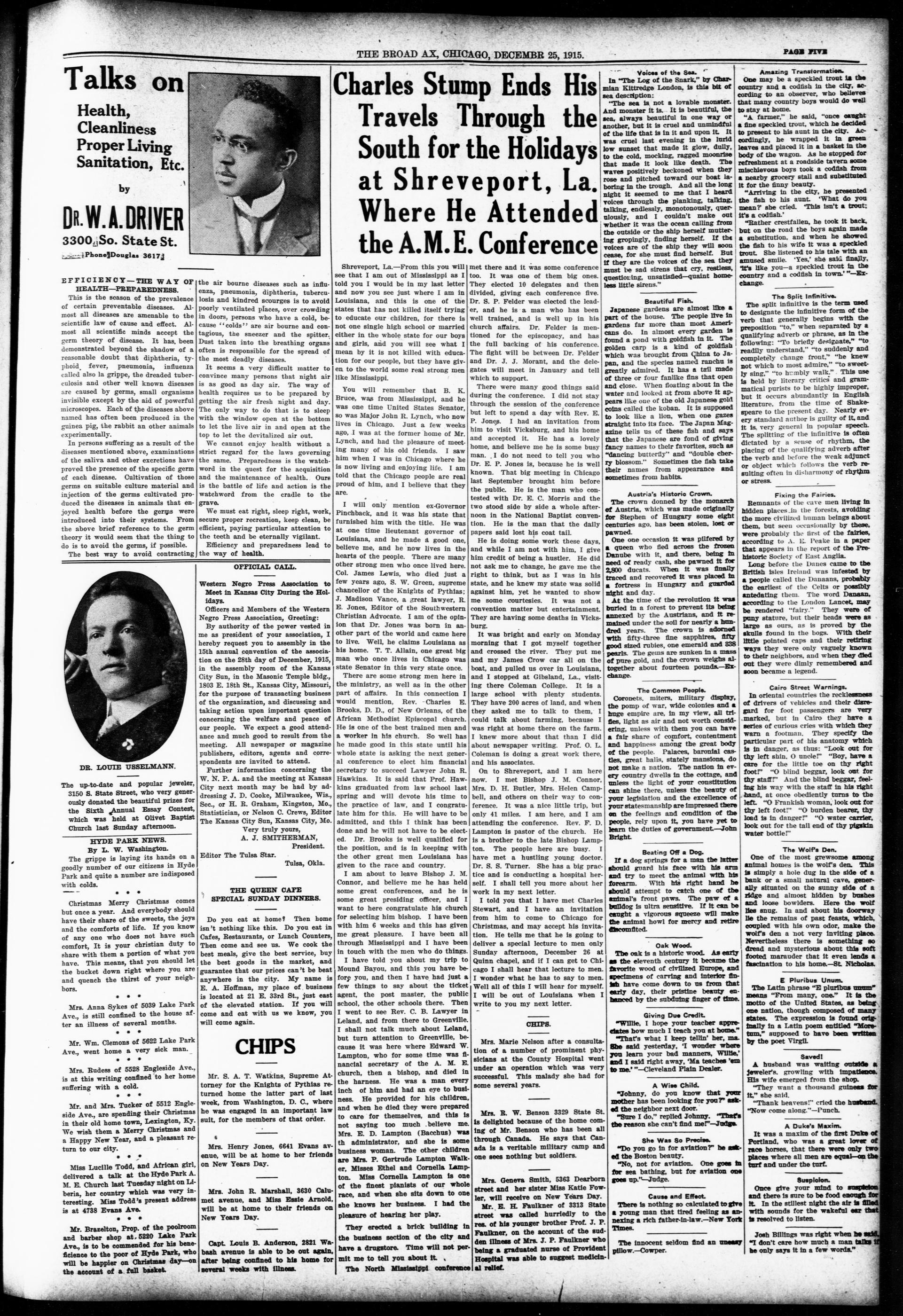
EFFICIENCY—THE WAY OF HEALTH—PREPAREDNESS.
This is the season of the prevalence of certain preventable diseases. Almost all diseases are amenable to the scientific law of cause and effect. Almost all scientific minds accept the germ theory of disease. It has been demonstrated beyond the shadow of a reasonable doubt that diphtheria, typhoid, fever, pneumonia, influenza called also la gripe, the dreaded tuberculosis and other well known diseases are caused by germs, small organisms invisible except by the aid of powerful microscopes. Each of the diseases above named has often been produced in the guinea pig, the rabbit an other animals experimentally.
In persons suffering as a result of the diseases mentioned above, examinations of the saliva and other excretions have proved the presence of the specific germ of each disease. Cultivation of those germs on suitable culture material and injection of the germs cultivated produced the diseases in animals that enjoyed health before the germs were introduced into their systems. From the above brief reference to the germ theory it would seem that the thing to do is to avoid the germs, if possible. The best way to avoid contracting
[Picture of a man in a suit with a tie and a flower on his lapel].
DR. LOUIE USSELMANN.
The up-to-date and popular jeweler, 3150 S. State Street, who very generously donated the beautiful prizes for the Sixth Annual Essay Contest, which was held at Olivet Baptist Church last Sunday afternoon.
HYDE PARK NEWS.
The grippe is laying its hands on a goodly number of our citizens in Hyde Park and quite a number are indisposed with colds.
---
Christmas Merry Christmas comes but once a year. And everybody should have their share of the sweets, the joys and the comforts of life. If you know of any one who does not have such comfort, It is your christian duty to share with them a portion of what you have. This means, that you should let the bucket down right where you are and quench the thirst of your neighbors.
---
Mrs. Anna Sykes of 5039 Lake Park Ave., is still confined to the house after an illness of several months.
* * *
Mr. Wm. Clemons of 5622 Lake Park Ave., went home a very sick man.
* * *
Mrs. Rudess of 5528 Engleside Ave., is at this writing confined to her home suffering with a cold.
* * *
Mr. and Mrs. Tucker of 5512 Engleside Ave., are spending their Christmas in their old home town, Lexington, Ky. We wish them a Merry Christmas and a Happy New Year, and a pleasant return to our city.
Miss Lucille Todd, and African girl, delivered a talk at the Hyde Park A.M. E. Church last Tuesday night in Liberia, her country which was very interesting. Miss Todd's present address is at 4738 Evans Ave.
---
Mr. Brazelton, Prop. of the poolroom and barber shop at.5220 Lake Park Ave., is to be commended for his benefienc to the poor of Hyde Park, who will be happier on Christmas day—on the account of a full basket.
[Picture of a man in a suit].
the air bourne diseases such as influenza, pneumonia, diphtheria, tuberculosis and kindred scourges is to avoid poorly ventilated places, over crowding in doors, persons who have a cold, because "colds" are air bourne and contagious, the sneezer and the spitter, Dust taken into the breathing organs often is responsible for the spread of the most deadly diseases.
It seems a very difficult matter to convince many persons that night air is as good as day air. The way of health requires us to be prepared by getting the air fresh night and day. The only way to do that is to sleep with the window open at the bottom to let the live air in and open at the top to let the devitalized air out.
We cannot enjoy health without a strict regard for the laws governing the same. Preparedness is the watchword in the quest for the acquisition and the maintenance of health. Ours is the battle of life and action is the watchword from the cradle to the grave. We must eat right, sleep right, work, secure proper recreation, keep clean, be efficient, paying particular attention to the teeth and be eternally vigilant. Efficiency and preparedness lead to the way of health.
OFFICIAL CALL
Western Negro Press Association to Meet in Kansas City During the Holidays.
Officers and Members of the Western Negro Press Association, Greeting:
By authority of the power vested in me as president of your association, I hereby request you to assembly in the 15th annual convention of the association on the 28th day of December, 1915, in the assembly room of the Kansas City Sun, in the Masonic Temple bld., 1803 E. 18th St., Kansas City, Missouri, for the purpose of transacting business of the organization, and discussing and taking action upon important question concerning the welfare and peace of our people. We expect a good attendance and much good to result from the meeting. All newspaper or magazine publishers, editors, agents and correspondents are invited to attend.
Further information concerning the W. N. P. A. and the meeting at Kansas City next month may be had by addressing J. D. Cooke, Milwaukee, Wis., Sec., or H. R. Graham, Kingston, Mo., Statistician, or Nelson C. Crews, Editor The Kansas City Sun, Kansas City, Mo.
Editor The Tulsa Star.
Tulsa. Okla.
THE QUEEN CAFE
SPECIAL SUNDAY DINNERS
Do you eat at home? Then home isn't nothing like this. Do you eat in Cafes, Restaurants, or Lunch Counters, Then come and see us. We cook the best meals, give the best service, buy the best goods in the market, and guarantee that our prices can't be beat anywhere in the city. My name is E. A. Hoffman, my place of business is located at 21 E. 33rd St., just east of the elevated station. If you will come and eat with us we know, you will come again.
CHIPS
Mr. S. A. T. Watkins, Supreme Attorney for the Knights of Pythias returned home the latter part of last week, from Washington, D. C., where he was engaged in an important law suit, for the members of that order.
Mrs. Henry Jones, 6641 Evans avenue, will be at home to her friends on New Years Day.
Mrs. John R. Marshall, 3630 Calumet avenue, and Miss Essie Arnold, will be at home to their friends on New Years Day.
Capt. Louis B. Anderson, 2821 Wabash avenue is able to be out again, after being confined to his home for several weeks with illness.
THE BROAD AX, CHICAGO, DECEMBR 25, 1915
Charles Stump Ends His Travels Through the South for the Holidays at Shreveport, La. Where He Attended the A.M.E. Conference
Shreveport, La.—From this you will see that I am out of Mississippi as I told you I would be in my last letter and now you see just where I am in Louisiana, and this is one of the states that has not killed itself trying to educate our children, for there is not one single high school or married either in the whole state for our boys and girls, and you will see what I mean by it is not killed with education for our people, but they have given to the world some real strong men like Mississippi.
You will remember that B. K. Bruce, was from Mississippi, and he was one time United States Senator, so was Major John R. Lynch, who now lives in Chicago. Just a few weeks ago, I was at the former home of Mr. Lynch, and had the pleasure of meeting many of his old friends. I saw him when I was in Chicago where he is now living and enjoying life. I am told that the Chicago people are real proud of him, and I believe that they are.
I will only mention ex-Governor Pinchback, and it was his state that furnished him with the title. He was at one time lieutenant governor of Louisiana, and he made a good one, believe me, and he now lives in the hearts of the people. There are many other strong men who once lived here. Col. James Lewis, who died just a few years ago, S. W. Green, supreme chancellor of the Knights of Pythias; J. Madison Vance, a great lawyer, R. E. Jones, Editor of the Southwestern Christian Advocate. I am of the opinion that Dr. Jones was born in another part of the world and came here to live. Well, he claims Louisiana as his home. T. T. Allain, one great big man who once lives in Chicago was state Senator in this very state once
There are some strong men here in the ministry, as well as in the other part of affairs. In this connection I would mention, Rev. Charles E. Brooks, D. D., of New Orleans, of the African Methodist Episcopal church. He is one of the best trained men and a worker in his church. So well has he made good in this state until his whole state is asking the next general conference to elect him financial secretary to succeed Lawyer John R. Hawkins. It is said that Prof. Hawkins graduated from law school last spring and will devote his time to the practice of law, and I congratulate him for this. He will have to be admitted, and this I think has been done and he will not have to be elected. Dr. Brooks is well qualified for the position, and is in keeping with the other great men Louisiana has given to the race and country.
I am about to leave Bishop J. M. Connor, and believe me he has held some great conferences, and he is some great presiding officer, and I want to here congratulate his church for selecting him bishop. I have been with him 6 weeks and this has given me great pleasure. I have been all through Mississippi and I have been in touch with the men who do things.
I have told you about my trip to Mound Bayou, and this you have before you, and then I have had just a few things to say about the ticket agent, the post master, the public school, the other schools there. Then I went to see Rev. C. B. Lawyer in Leland, and from there to Greenville. I shall not talk much about Leland, but turn attention to Greenville, because it was here where Edward W. Lampton, who for some time was financial secretary of the A. M. E. church, then a bishop, and died in the harness. He was a man every inch of him and had an eye to business. He provided for his children, and when he died they were prepared to care for themselves, and this is not saying too much. believe me, Mrs. E. D. Lampton (Bacchus) was th administrator, and she is some business woman. The other children are Mrs. P. Gertrude Lampton Walker, Misses Ethel and Cornella Lampton. Miss Cornella Lampton is one of the finest planists of our whole race, and when she sits down to one she knows her business. I had the pleasure of hearing her play.
They erected a brick building in the business section of the city and have a drugstore. Time will not permit me to tell you about it. The North Mississippi conference
met there and it was some conference too. It was one of them big ones. They elected 10 delegates and then divided, giving each conference five. Dr. S. P. Felder was elected the leader, and he is a man who has been well trained, and is well up in his church affairs. Dr. Felder is mentioned for the episcopacy, and has the full backing of his conference. The fight will be between Dr. Felder and Dr. J. J. Morant, and the delegates will meet in January and tell which to support.
There were many good things said during the conference. I did not stay through the session of the conference but left to spend a day with Rev. E. P. Jones. I had an invitation from him to visit Vicksburg, and his home and accepted it. He has a lovely home, and believe me he is some busy man. I do not need to tell you who Dr. E. P. Jones is, because he is well known. That big meeting in Chicago last September brought him before the public. He is the man who contested with Dr. E. C. Morris and the two stood by side a whole afternoon in the National Baptist convention. He is the man that the dally papers said lost his coat tail.
He is doing some work these days, and while I am not with him, I give him credit of being a hustler. He did not ask me to change, he gave me the right to think, but as I was in his state, and he knew my state was solid against him, yet he wanted to show me some courtesies. It was not a convention matter but entertainment. They are having some deaths in Vicksburg.
It was bright and early on Monday morning that I got myself together and crossed the river. They put me and my James Crow car all on the boat, and pulled us over in Louisiana, and I stopped at Gibsland, La., visiting there Coleman College. It is a large school with plenty students. They have 200 acres of land, and when they asked me to talk to them, I could talk about farming, because I was right at home there on the farm. I knew more about that than I did about newspaper writing. Prof. O. L. Coleman is doing a great work there, and his associates.
On to Shreveport, and I am here now. I met Bishop J. M. Connor, Mrs. D. H. Butler, Mrs. Helen Campbell, and others on their way to conference. It was a nice little trip, but only 41 miles. I am here, and I am attending the conference. Rev. F. D. Lampton is pastor of the church. He is a brother to the late Bishop Lampton. The people here are busy. I have met a hustling young doctor, Dr. S. S. Turner. She has a big practice and is conducting a hospital here self. I shall tell you more about her work in my next letter.
I told you that I have met Charles Stewart, and I have an invitation from him to come to Chicago for Christmas, and may accept his invitation. He tells me that he is going to deliver a special lecture to men only Sunday afternoon, December 26 at Quinn chapel, and if I can get to Chicago I shall hear that lecture to men. I wonder what he has to say to men. Well all of this I will hear for myself. I will be out of Louisiana when I write to you my next letter.
CHIPS.
Mrs. Marie Nelson after a consultation of a number of prominent physicians at the County Hospital went under an operation which was very successful. This malady she had for some several years.
Mrs. R. B. W. Benson 3329 State St. is delighted because of the home coming of Mr. Benson who has been all through Canada. He says that Canada is a veritable military camp and one sees nothing but soldiers.
Mrs. Geneva Smith, 5363 Dearborn street and her sister Miss Katie Fowler, will receive on New Years Day. Mr. E. H. Faulkner of 3313 State street was called hurriedly to the res. of his younger brother Prof. J. P. Faulkner, on the account of the sudden illness of Mrs. J. P. Faulkner who being a graduated nurse of Provident Hospital was able to suggest medicinal relief.
Voices of the Sea.
In "The Log of the Snark," by Charmian Kittedge London, is this bit of sea description:
"The sea is not a lovable monster. And monster it is. It is beautiful, the sea, always beautiful in one way or another, but it is cruel and unmindful of the life that is in it and upon it. It was cruel last evening in the lurid low sunset that made it glow, dully, to the cold, mocking, ragged moonrise that made it look like death. The waves positively beckoned when they rose and pitched toward our boat laboring in the trough. And all the long night it seemed to me that I heard voices through the planking, talking, talking, endlessly, monotonously, queriously, and I couldn't make out whether it was the ocean calling from the outside or the ship herself muttering gropingly, finding herself. If the voices are of the ship they will soon cease, for she must find herself. But if they are the voices of the sea they must be sad sirens that cry, restless, questioning, unsatisfied-quaint homeless little sirens."
Beautiful Fish.
Japanese gardens are almost like a part of the house. The people live in gardens far more than most Americans do. In almost every garden is found a pond with goldfish in it. The golden carp is a kind of goldfish which was brought from China to Japan, and the species named ranchu is greatly admired. It has a tail made of three or four fanlike fins that open and close. When floating about in the water and looked at from above it appears like one of the old Japanese gold coins called the koban. It is supposed to look like a lion, when one gazes straight into its face. The Japan Magazine tells us of these fish and says that the Japanese are fond of giving fancy names to their favorites, such as "dancing butterfly" and "double cherry blossom." Sometimes the fish take their names from appearance and sometimes from habits.
Austria's Historic Crown.
The crown donned by the monarch of Austria, which was made originally for Stephen of Hungary some eight centuries ago, has been stolen, lost or pawned.
One one occasion it was plifered by a queen who flied across the frozen Danube with it, and there, being in need of ready cash, she pawned it for 2,800 ducats. When it was finally traced and recovered it was placed in a fortress in Hungary and guarded night and day.
At the time of the revolution it was buried in a forest to prevent its being annexed by the Austrians, and it remained under the soil for nearly a hundred years. The crown is adorned with fifty-three fine sapphires, fifty good sized rubies, one emerald and 338 pearls. The gens are sunken in a mass of pure gold, and the crown weighs all together about fourteen pounds—Ex change.
The Common People.
Coronets, miters, military display, the pomp of war, wide colonies and a huge empire are, in my view, all tribes, light as air and not worth considering, unless with them you can have a fair share of comfort, contentment and happiness among the great body of the people. Palaces, baronial casties, great halis, stately mansions, do not make a nation. The nation in every country dwells in the cottage, and unless the light of your constitution can shine there, unless the beauty of your legislation and the excellence of your statesmanship are impressed there on the feelings and condition of the people, rely upon it, you have yet to learn the duties of government.—John Bright.
Beating Off a Dpg.
If a dog springs for a man the latter should guard his face with his arm and try to meet the animal with his forearm. With his right hand he should attempt to catch one of the animal's front paws. The paw of a bulldog is ultra sensitive. If it can be caught a vigorous squeeze will make the animal howl for mercy and retire discomfited.
Oak Wood.
The oak is a historic wood. As early as the eleventh century it became the favorite wood of civilized Europe, and specimens of carving and interior finish have come down to us from that early day, their pristine beauty enhanced by the subduing finger of time.
Giving Due Credit
"Wille, I hope my teacher appreciates how much I teach you at home."
"That's what I keep tellin' her, ma. She said yesterday. I wonder where you learn your bad manners, Willie, and I said right away, 'Ma teaches 'em to me.'"—Cleveland Plain Dealer.
A. Wise Child.
"Johnny, do you know that your mother has been looking for you?" asked the neighbor next door. "Sure I do," replied Johnny. "That's the reason she can't find me!" - Judge
She Was So Precise
"Do you go in for aviation?" he asked the Boston beauty.
"No, not for aviation. One goes in for sea bathing, but for aviation one goes up."—Judge.
Cause and Effect
There is nothing so calculated to give a young man that tired feeling as anxexing a rich father-in-law.—New York Times.
The innocent seldom find an uneasy pillow.—Cowper.
PAGE FIVE
Amazing交易
One may be a speckled trout in the country and a codfish in the city, according to an observer, who believes that many country boys would do well to stay at home.
"A farmer," he said, "once caught a fine speckled trout, which he decided to present to his aunt in the city. Accordingly, he wrapped it in green leaves and placed it in a basket in the body of the wagon. He stopped for refreshment at a roadside tavern some mischievous boys took a codfish from a nearby grocery stall and substituted it for the funny beauty.
"Arriving in the city, he presented the fish to his aunt. 'What do you mean?' she cried. 'This isn't a trout; it's a codfish.'
"Rather crestfallen, he took it back, but on the road the boys again made a substitution, and when he showed the fish to his wife it was a speckled trout. She listened to his tale with an amused smile. 'Yes,' she said finally 'it's like you—a speckled trout in the country and a codfish in town.'"—Exchange.
The Split Infinitive
The split infinitive is the term used to designate the infinitive form of the verb that generally begins with the preposition "to," when separated by a qualifying adverb or phrase, as in the following: "To briefly designate," "to readily understand," "to suddenly and completely change front," "the knew not which to most admire," "to sweetly sing," "to humbly walk." This use is held by literary critics and grammatical purists to be highly improper, but it occurs abundantly in English literature, from the time of Shakespeare to the present day. Nearly every standard author is guilty of it, and it is very general in popular speech. The splitting of the infinitive is often dictated by a sense of rhythm, the placing of the qualifying adverb after the verb and before the weak adjunct or object which follows the verb resulting often in disharmony of rhythm or stress.
Fixing the Fairies.
Remnants of the cave men living in hidden places in the forests, avoiding the more civilized human beings about them, but seen occasionally by these, were probably the first of the fairies, according to A. E. Peake in a paper that appears in the report of the Prehistoric Society of East Anglia.
Long before the Danes came to the British Isles Ireland was infested by a people called the Danaans, probably the earliest of the Celts or possibly antedating them. The word Danaan, according to the London Lancet, may be rendered "fairy." They were of pony stature, but their heads were as large as ours, as is proved by the skulls found in the bogs. With their little pointed caps and their retiring ways they were only vaguely known to their neighbors, and when they died out they were dimly remembered and soon became a legend.
Cairo Street Warnings.
In oriental countries the recklessness of drivers of vehicles and their disregard for foot passengers are very marked, in Bai Cairo they have a series of curious cries with which they warn a footman. They specify the particular part of his anatomy which is in danger, as thus: "Look out for thy left shin. O uncle!" "Boy, have a care for the little toe on thy right foot!" "O blind beggar, look out for thy staff!" And the blind beggar, feeling his way with the staff in his right hand, at once obediently turns to the left. "O Frankish woman, look out for thy left foot!" "O burden bearer, thy load is in danger!" "O water carrier, look out for the tall end of thy pigskin water bottle."
The Wolf's Den.
One of the most grewsome among animal homes is the wolf's den. This is simply a hole dug in the side of a bank or a small natural cave, generally situated on the sunny side of a ridge and almost hidden by bushes and loose bowlders. Here the wolf likes snug. In and about his doorway lie the remains of past feasts, which, coupled with his own odor, make the wolf's den a not very inviting place. Nevertheless there is something so dread and mysterious about this soft footed marauder that it even lends a fascination to his home. St Nicholas.
E. Pluribus Unum.
The Latin phrase "E pluribus unum" means "From many, one." It is the motto of the United States, as being one nation, though composed of many states. The expression is found originally in a Latin poem entitled "Moretum," supposed to have been written by the poet Virgil.
Saved!
A husband was waiting outside a jeweler's, growling with impatience. His wife emerged from the shop. "They want a thousand guineas for it." she said. "Thank heavens!" cried the husband. "Now come along."—Punch.
A Duke's Maxim.
It was a maxim of the first Duke of Portland, who was a great lover of race horses, that there were only two places where all men are equal on the turf and under the turf.
Suspicion.
Once give your mind to suspicion and there is sure to be food enough for it. In the stillest night the air is filled with sounds for the wakeful ear that is resolved to listen.
Josh Billings was right when he said "I don't care how much a man talks it he only says it in a few words."
PAGE SEL
First Wire Suspension Bridge
First Wire Suspension Bridge.
The first wire suspension bridge in the United States if not in the world was thrown across the Schuylkill river near the falls of Schuylkill, in Philadelphia, in 1816. Its history is as follows: In 1809 Robert Kennedy and Conrad Carpenter built a chain bridge at the falls of Schuylkill, which broke down in 1811. Josiah White and Erskine Hazard, afterward prominent as pioneers in the anthracite coal trade of Pennsylvania, had erected a rolling mill and a wire factory in the neighborhood, and after the bridge fell they formed a new company, and another chain bridge was constructed in April, 1811, but this new bridge in turn gave way in 1816. White & Hazard then swung a wire suspension bridge across the river from an upper window of their factory to some large trees on the west bank, steps leading from the trees to the ground. This primitive bridge structure was intended for foot passengers only, and but eight persons were allowed to go upon the footway at one time. The bridge is said to have cost $125.—ExchANGE.
Career of the Levelers
Levelers first appeared in Germany. Two men, Munzer and Storck, taught that distinctions of rank violate the rights of mankind. This was in the sixteenth century. At the head of 40,000 men Munzer commanded the sovereign princes of Germany and the magistrates of cities to resign. His followers ravaged the country until one of the German overlords defeated them in battle. Their leader was beheaded.
A party of Levelers appeared in England in 1647, where they became powerful in parliament. They determined to level all ranks and establish an equality of titles and estates throughout the kingdom. About this time Cromwell departed for Ireland. The Levelers raised mutinies in various quarters. Cromwell put them down in 1649 and imprisoned their leader.
A party of Levelers appeared in England during the French revolution. A "loyal association" was formed against them, and their efforts brought no results—Kansas City Star.
Twelfth Century Football.
In the twelfth century football was a game for the streets. The chronicler of that period tells how after dinner the city youths "addressed themselves to football" and how the scholars of each school and the apprentices of particular trades would each have their peculiar ball. There were spectators, too, in those days, enthusiastic spectators. Fathers would come to watch their sons and "become as youthful as the youngest, their natural heat seeming to be revived at the sight of so much ability."
In later years there was a famous ball game played in Hyde park. In 1654, then, "there was a hurling of a great ball by fifty Cornish gentlemen on one side and fifty on the other; one party played in red caps, the other in white." And—here the historical value of the contest—Cromwell was a spectator and applauded the "great ability of body" displayed.
Sulphuric Acid Burns
Burns from sulphuric acid are easily cured. Just remember that plain water—lots of it—must be poured on the victim of a sulphuric acid accident at once, even to throwing the party into the water if possible. This acid on the skin feels like fire. With water quickly applied in great quantity this acid is rendered harmless. Men have been burned with it repeatedly without harm through a knowledge of this proper antidote. If not treated promptly the most horrible disfigurements result. The police department of Paris exhibits wax figures of faces of victims of the foreign practice of throwing this acid in one's face. A prompt treatment of water would have rendered the acid harmless.
Floating a Loan.
"I want to see if I can't borrow a little money from the Brokers and Stokers' bank."
"Well?"
"What sort of man is the president of it? Is he one of these fellows who are impressed by a rusty suit, or does he think a man is a good risk who affects loud vests and gay spats?"—Pittsburgh Post.
The Soft Answer
He—Ugh! I'm going out of this, and you won't see me again until the day of judgment.
She (sweetly, getting the last word, as usual)—All right, dear, and if you aren't feeling in a better temper please let it be well on in the afternoon.—London Saturday Review.
Hear Out of Doors
"Well, look at the billygoat! He's the first one I've seen for ages." "He's hardly an impressive looking object." "He may not be impressive looking, but he certainly has a striking forehead." - Boston Transcript.
Muddled
Customer — Is this bread today's
Shopkeeper — Yes'm. Customer — The
reason I ask is because the bread I
got here yesterday wasn't. — London
Telegraph.
Big Spiders
The South American bird eating spider is as big as a mouse, and its furred feet are so formed that it can walk up glass with practically no difficulty.
Rhinoceros Horn
In Sumatra the horn of the rhinoceros is esteemed as an antidote to poison and on that account is made into drinking cups.
Life In New York.
In commenting on the "spenders" of the Great White Way a writer in the American Magazine asks if the improvident habits of the average metropolitan are due to a shorter life.
"The grocer on the corner told my wife that he didn't try to save anything because 'we all die before we are sixty, anyway. * * * What's the use?' he said. You never see many old people around. I won't live to be old, and neither will you.
"That last statement stuck in my mind. It is a fact that in the streets of New York you see few people past sixty. The actual dangers connected with street traffic must keep the old indoors to a certain extent, or else it drives them away to the little towns. Anyway, I am sure you see a smaller proportion of old people in great cities than you see in small towns.
"Does this fact influence a good many, like the grocer, to spend all and to save nothing because of an unconsciously formed opinion that almost everybody works along and dies in the harness before sixty? Is this one reason why city people are more improvident and extravagant than country people?"
Changed His Mind.
When Charles B. Towns, author of "Habits That Handicap," first began his practice in curing drug victims he had great difficulty in securing patients in order to prove the efficacy of his cure. His claim to have discovered a cure for drugs was reverberating through the New York underworld; but, though speculation was lively, volunteers were timid. Finally, not knowing what else to do, Towns actually kidnapped a race track tout and put him through the treatment against his will. "When I get out of here and tell the boys what you've been doing to me," threatened the tout, "your life won't be worth 20 cents. They'll croak you in a minute." But five days later the tout told his friends quite another story. He sent, not gun men to kill, but confidence men to be healed, four of them. Towns had squared himself with the underworld as much by his courage as by his skill.
To Erect a Tent In Winter
Instead of using a rope bridge, tents should be set in winter with a pole between two trees or supported on forked sticks, and the tapes along the ridge should be tied to this pole, says All Outdoors. If the tent has no tapes run the pole through the tent from end to end, and support it at each extremity with a forked pole. Better still are two forked poles at each end, the bottoms of which are spread far apart. When the tent sags it can be tightened by drawing the bottom close together and thus raising the ridge. Poles spread apart in this way also add much to the stability of the tent in a wind. While this method requires five poles instead of three, it is nevertheless the best way to erect an A tent. It will be difficult to drive stakes in winter, but logs, to which the ropes may be tied, will serve nearly as well.
The King Is Dead, Long Live the King.
A biographer of Louis XIV, of France says his death was announced by the captain of the bodyguard from a window of the state apartment and that, "raising his staff of office above his head, he broke it in the center and, throwing the pieces among the crowd, exclaimed in a loud voice, 'Le roi est mort!' ('The king is dead!') Then seizing another staff he flourished it in the air, shouting, 'Vive le roi!' ('Long live the king')" The phrase was used in announcing the death of other French kings and for the last time at the death of Louis XVIII. It is often quoted to signify the quickness with which official authority and popular admiration are transferred from a dead ruler to a living one.
The Judge's Hint
A young Irish barrister began his speech to the court in these terms: "The eagle soaring high above the mists of the earth, winning its daring flight against a midday sun, until the contemplation becomes too dazzling for humanity, and mortal eyes gaze after it in vain!" Here the orator was noticed to falter and lose the thread of his speech. He sat down after some vain attempts to regain it. The judge then said, "The next time, sir, you bring an eagle into court I should recommend you to clip its wings." No doubt the hint was taken.-Westminster Gazette
Shrapnel Cartridge Cases
The material used for shrapnel cartridge cases generally consists of a composition of two parts copper and one part iron. This alloy has been found to possess the best physical qualities—that is, high tensile strength and a large percentage of elongation when properly annealed—London Standard.
All About Metaphysics
A Scotchman thus defines metaphysics: "When a mon wha' kens nothing aboot any subject takes a subject that nae mon kens anything aboot and explains it to anther mon still more ignorant than himself—that's metaphysics."
Weeds.
The earlier you get the upper hand of the weeds the more you lessen their later power for mischief. This is true of other soil besides that of the garden.-Youth's Companion.
Consistency.
Murilla — Do you consider engagements binding? Millicent—Certainly.
If one didn't there would be no fun in breaking them.—Illustrated Bits.
Listen to others, but do not blindly depend on ther.
THE BROAD AX, CHICAGO, DECEMBR 25, 1915.
Mosquitoes in Bagdad.
A round the world electrical engineer tells this story:
"We ran up to Bagdad to put over a little deal with the pasha, a former government official who had been prominent in the days of Abdul Hamid. His palace was infested with mosquitoes, and we had to plan to give him relief.
"He lived in the usual Moorish house, with high walls, flat roof with parapets, few windows and open court. The old pasha looked exactly as if he had just stepped out of a Broadway musical comedy with his shining silk robes, turban and red shoes with upturned toes.
Effect of Familiarity.
"What we see constantly wives vividly. The faces we least are those we know—and really love—best. Our eyes are jaded by following the familiar.
"The same is true of pure says a writer in the Atlantic M. "Water and sky are very be and you may suppose that you duly appreciative of them, but the deck of a catboat and look with your head in an unaccent position—sideways and upside and note how the colors flare on your vision.
"Or stay indoors for a few wives now, where you do not go."
"In the palace garden was a stream with a fall of about ten feet. It would develop about one-fourth horsepower. We built a water mill, equipped it with a dynamo, wired the palace and started up some gigantic electric fans. These fans cooled the air and also blew through the rooms a narcotic sufficiently powerful to cause the mosquitoes to fall in a coma. All that remained was for the servants to go around and sweep them up in piles to be destroyed."—G. T. Hadley in World Outlook.
Fish Eating Cattle
The use of fish as food for cattle is an idea more novel than agreeable. According to Nature, however, it is a common practice in various parts of the world. In Shetland and Iceland the farmers feed dry salt fish to cattle, sheep and even to horses. Cecil Wood, describing experiments of this nature, mentions that certain special cattle, kept for display at the village festivals in Nandyal, in India, are fed with mutton and adds that it is a fairly common practice to make use of bandicoots by pounding them in a mortar and feeding them to cattle. In Mr. Wood's experiments two lots of heifers were fed on dried fish diet and normal diet respectively.
The animals took a little time to get used to the fish, but they ate it readily enough. At the end of six months the fish fed hefters showed an average increase in weight of fifty-four pounds as against seventy pounds for the normally fed animals.
Beauty Merely a Matter of Health
Beauty merely a matter of Health.
Not long ago a woman said, "If I could afford to have a course of treatment in a beauty parlor I might do something for my appearance." She needed to be told that the daily bath, plain, nonpoisonous food, eight hours of sleep every night, a daily walk, sensible clothing and really good books would do more for her attractiveness than any beauty parlor could possibly do, writes Dr. Maude Kent in Good Health.
To have health means to live the daily life of work and play in a state of bodily ease, mental vigor and spiritual growth. We must consider health in this threefold aspect, for mere animal health is not desirable, nor a fine mind in a stunted, pain racked body, nor soulfulness that disregards the laws of the body and intellectual attainment. It is the all round person who is the telling, efficient force in the world, and the world greatly needs every human being developed to his greatest capacity.
Chemical Dangers
A professor of a northern university who was as remarkable for his felicity in experimenting as Rouelle could be for his failures was once repeating an experiment with some combustible substance, when the mixture exploded, and the phial which he held in his hand blew into a hundred pieces. "Gentlemen," said the doctor to his pupils, with the most unaffected gravity, "I have made this experiment often with the very same phial and never knew it to break in my hands before." The simplicity of this rather superfluous assurance produced a general laugh, in which the learned professor, who instantly discovered the cause of it, joined most heartily.—Dr. E. L. H. in Medical Pickwick.
Going the Limit
"Tell that fellow Gingerly not to call here any more," said paterfamilias savagely.
"What's the use, papa?" Evangeline asked.
"I say tell him not to call any more," repeated paterfamilias with increased anger.
"Why, papa, he calls seven times a week now. He can't call any more than that."—London Tit-Bits.
Greenwich Hill.
Probably no hill in the world has had so strangely varied a history or played so important a part in the affairs of men as that at Greenwich. The granite line across the footpath on its summit is the meridian from which the longitude on every British map and chart is calculated.
Caviare.
As a matter of fact, not all caviare comes from the sturgeon, since, like other foods, it is woefully adulterated with the roe of inferior fishes prepared in similar fashion. True caviare, however, is only the eggs of the sturgeon.
Her Wish.
"Snoring, my dear, is the sign of an easy conscience."
"Hubby, there are times when I wish you weren't so contented with your past career."-Detroit Free Press
Cultivate the Mind
It is the mind that makes the body rich; and as the sun breaks through the darkest clouds, so honor peereth in the meanest habit. - Shakespeare.
Trouble teaches men how much there is in manhood—Henry Ward Beecher.
Effect of Familiarity.
"What we see constantly we cease to see vividly. The faces we notice least are those we know—and perhaps really love—best. Our eyes are a bit jaded by following the familiar lines. "The same is true of pure color," says a writer in the Atlantic Monthly. "Water and sky are very beautiful, and you may suppose that you are duly appreciative of them, but lie on the deck of a catboat and look at them with your head in an unaccustomed position—sideways and upside down—and note how the colors flare out upon your vision. "Or stay indoors for a few weeks in a room where you do not get much outlook and then go out. You will be blinded by the glory of the world, but not for long. The glory, alas, fades quickly, and habit settles upon you once more!
"With our friends' faces somewhat the same thing happens. When we first meet them they pique us pleasantly with their unfamiliar line and color. Gradually we grow used to them. The first vision has passed."
Mounting a Horse
In mounting take the veins in the left hand. At the same time grasp a little mane halfway up the neck. Now turn the stirrup slightly toward you with the right hand and place the ball of the left foot in it. Grab the horn with the right hand and swing on. Don't pull yourself on, but swing on. Settle into the saddle easily; don't flop into it. If you want to get "your neck broke" some time mount by taking the horn in one hand and the candle in the other, and the time will surely come when you will not be disappointed.
Just a word in regard to dismounting. First withdraw your feet from the stirrups to the ball. Take the horn in the right hand and swing off, letting the left foot slip easily and quickly from the stirrup. Remember this, for many a man has been dragged to death because his foot stuck in the stirrup. Your feet will nearly always come free if thrown from a horse, but the left one is prone to stick in dismounting unless the above precaution is observed.—Outing.
An Analysis of "Ain't"
"Ain't" is an improper abbreviation of "are not." British writers spell it "an't," which properly indicates its derivation. Americans make it an inclusive offense, using it for "am not" and "is not," as well as for "are not." It is unquestionably the worst instance of slovenliness in the common speech of today.
Yet it is by no means of universal or even of common use. It will slip occasionally from refined lips, always with a jar to the enunciator as well as to the hearer. But the habitual user of "ain'ts" is careless of refinement. He may be an excellent citizen who never beats his wife or kicks the cat. But there is likely to be something slipshod about him somewhere, for "ain't" is needless as well as cacophonous; it fills no void and supplies no need—Cleveland Plain Dealer.
Mark Twain as "Attraction"
A girl who was a stranger to Mark Twain once found her way into his Bermuda home with the hope of getting a sight of the author. She came suddenly in contact with him and frankly explained her errand.
"Have you seen the crystal cave yet," he asked, "or the aquarium?"
"No; I came to see you first," she answered.
"Well, you shouldn't have seen me first," he answered. "I run in opposition to the crystal and the aquarium. But they're not shucks to me. I'm lots better. I give them their money's worth. But you should see them. Then you'll appreciate me."
This was said in his most earnest drawl and with only a sparkle of humor in his keen blue eyes.
The Real Thing.
Fred, aged three, had been a naughty boy, and his mother had punished him. He felt very much hurt and complained to his auntie about mamma's spanking him. Auntie said, "It is not you that mamma spanks, but a little devil inside of you who makes you do naughty things." After sitting very still for five minutes he said, "It beats all how it hurts me when that devil gets spanked."—Delineator.
A Great Copper Mine
for nearly 700 years copper ore (chalcopyrite) has been taken regularly from a mine in the province of Dalecarlia, Sweden. The mine contains the largest copper ore deposit in Sweden and is supposed to be one of the greatest chalcopyrite properties in the world.
Our Trials.
"You know, my dear boy," said a sympathizing friend to a man in trouble, "that we really gain by our trials in life."
"That depends altogether on the kind of lawyer you get to conduct them," replied the sufferer.
Different Methods
There are two different kinds of men. Give one a piece of rope and he will hang himself; give a similar piece to the other and he'll form a cordage trust. —Washington Star.
A Real Artist
"Is Brushpen a good artist?"
"Is he good? Why, he not only can draw pictures that are good, but he can draw checks that are good."—Pittsburgh Post.
By medicine life may be prolonged, yet death will seize the doctor too.—Shakespeare.
Refining Tapioca.
This elegant and delicate starch is the product of a plant that is cultivated very extensively in the Malay peninsula, where its culture is almost entirely in the hands of the Chinese. The tubers of the plant (Manhot utilissima), which weigh on an average from ten to twenty-five pounds, are first scraped and then carefully washed, after which they are reduced to a pulp by being passed between rollers. This pulp is carefully washed and shaken up with abundance of water until the felcula separates and passes through a very fine sieve into a tub placed beneath. The flour so obtained is repeatedly washed and then placed on mats and bleached by exposure to the sun and air. It is finally converted into the pearl taploca of commerce by being placed in a crude shaped frame covered with canvas. It is slightly moistened and subjected to a rotary motion, by which means it is granulated. It is next dried in the sun and finally over the fire in an iron pan greased with vegetable tallow and is then ready for the market.
Brides In India.
A bride in India never sees her husband until after the marriage ceremony. The parents choose the wife for the son of the house without consulting either party. Sometimes the bride is as young as fourteen. The child is, gorgeously dressed and placed on a dais behind a sheet, the women of the family being in attendance. On the other side of the sheet are the bridegroom and many of his young men friends. The groom keeps throwing over jewels attached to flowers, which the women on the bride's side remove and place in her lap or on her person.
This first ceremony is called the shadee, and, although a man is allowed four wives, no other ever holds the same position as the first chosen for him. The others are of little importance, living their lives more or less as servants to the first wife. As the first wife gets to middle age she is known as the begum—Pearson's Weekly.
Mystery of a Diplomat
Of disappearances most mysterious was the case of Benjamin Bathurst, who vanished Nov. 25, 1809, while engaged on a secret mission for the foreign office. Vienna was the young diplomatist's objective, and, with his friend and valet, in a post chaise, Perleberg, a small posting town in north Germany, had been reached. Here Bathurst suppied and slept, awaiting the arrival of fresh horses. Waking, he asked were the horses ready and passed out of the door to make inquiries. Eight people saw him go out, but none ever set eyes on him again. Various theories were set afoot—Napoleon's spies, robbers, illness. In 1912 in the forest near Perleberg a skeleton was discovered with a hole in the skull as from a heavy blunt instrument. Was it that of "the English lord," as Perleberg people surmised?
Investment Bargains
The investor who picks up desirable property when everybody is selling and no one buying will have to wait only a reasonable time to secure his reward. I recall when real estate in several large cities was a drug on the market. Everybody seemed anxious to sell and no one to buy, but the buyers in those periods have realized enormous profits, far greater than one can get in the Stock Exchange. The man who has money, even if it is but a small amount, can always turn it over to advantage if he will wait for the opportunity. Don't go with the crowd when every one is wild to buy something, but quietly abide an opportunity when everybody is anxious to unload and buyers are few. At such a time the bargain counter opens. -Leslie's.
The Spit of Ceremony
Among the Akikiyu of East Africa, described by Mr. and Mrs. W. S. Routledge in "With a Prehistoric People," to spit upon a person or thing indicates good will. "The blacksmith spits upon the sword he has forged before handling it over to the owner. So, too, courtesy demands that a man should spit in his hand before offering it to a friend, and the female visitors spit upon the newly arrived youngster as a sign of welcome." Even in England there are relics of the same custom in the habit among the lower classes of spitting on a coin.
No Favors to Beauties
A beautiful young lady approached the ticket window at a Pennsylvania country station and in a voice like the rippling of a brook asked the agent. "What is the fare to the fair?" To which the thick headed agent replied, "Same as to the homely, madam." —Argonaut.
A Good Plan
"We should strive to turn our troubles into successes."
"That's what. I know an actor who did that. When people threw vegetables he caught 'em on a fork and made it the hit of the performance."—Louisville Courier-Journal.
Some Bird.
The roc, a fabulous bird often referred to in the "Arabian Nights," was believed to be of such enormous size and strength as to be able to carry even elephants in its talons.
Teaches a Leason
Money is never spent to so much advantage as when you have been cheated out of it, for at one stroke you have purchased prudence.—Schopenhauer.
Those who mistake evil for good or good for evil will never attain to bliss.
Story of a Fortune.
Peter Thelussen, a London merchant, died in 1797, leaving a fortune of £700,000. By his will £100,000 went to his wife and children. The rest of his fortune was committed to trustees, with the stipulation that it should be allowed to accumulate during the lives of the sons and grandsons. When they were all dead the fortune was to go to the oldest living great-grandson, or if there should be no great-grandson it should go to the government and be applied on the national debt. The will was contested, but the heirs were unable to break it. The last grandson died in 1859, and the fortune was delivered to Charles Thelussen, the oldest living great-grandson. At the time the will was made experts figured out that the fortune would amount to something like £1,000,000 by the time it should be turned over to the great-grandson, but the expenses of litigation and administration had been so great that he received only about the amount of the original fortune, £700,000.
How Cotton Varies.
Cotton is usually differentiated in ordinary classification by the length of its staple. "Ordinary cotton" in the United States is of several kinds, chief among them the upland cotton, with a staple of from seven-eighths to one inch in length, and gulf of Texas cotton, of which the staple is not usually quite so long. The longest stapled cottons among the "ordinary cottons" here are the bottom land or bender cotton, with a staple of from one and one-eighth to one and one-fourth inch, and the special fancy staple cotton, one and three-eighths to one and five-eighths inch in length. The sea island cotton, which is grown on the sea islands off the coast of South Carolina, has a staple of from one and a half to two and a half inches, the average length being one and three-fourths. Egyptian cotton is being grown in southern California, New Mexico and Arizona. Its staple is not so long as the sea island cotton, but compares rather with the upland cotton here.
Japanese Houses.
A number of causes have affected the size of the Japanese house, which seems much too small for a comfortable habitation in the eyes of the foreigner. In the first place, the people themselves are small, the average height of the Japanese male adult being five feet three and one-half inches and that of the female four feet nine and one-half inches. As it is the usual custom to sit on the floors upon cushions, with the legs bent beneath, great height of ceilings is not desirable. The low ceilings may also be attributed to the lack of any heating systems other than the small charcoal brazier known as the "hibashi." The frequency of earthquakes throughout Japan has been a largely contributing cause as well, and the question of expense in a country where economy reigns supreme has also had a powerful influence.
Odd Cures For Seasickness
Among curious remedies for seasickness is that which is popular among the mariners in the levant—the daily swallowing of iron rust, which is obtained by the simple process of scraping it off the anchor or anchor chain. But this is only part of the treatment, for a small pouch containing roasted salt and flowers of thyme must be tied upon the abdomen as firmly as can borne, this being considered to counteract the effect of the internal disturbance caused by the rolling of the vessel. Known to the ancient Greeks as "thymian salt," the preparation has at least the authority of old age, while its efficacy is not without modern testimony. And the belt is better than salt and faith better than the belt.
A Martyr.
"When we were married you said there was nothing you wouldn't do for me," said the spoiled darling.
"Well, my dear," answered her husband patiently. "I was thinking the matter over the other day, and it seemed to me there was nothing you hadn't asked me to do for you, but if there is any little thing on your mind you haven't mentioned yet speak, and I will do the best I can." — Chicago News.
His Double Loss.
"I've been robbed in that hospital!" shouted the loony ex-patient as he met a policeman. "Who robbed you, and what did they take?" asked the policeman. "Why, one of the orderlies took my watch, and all the doctors took my temperature."—Baltimore American.
Inherited.
They were jollying the man about his enormous appetite, but he kept "putting away," undisturbed by the taunts. Finally he said in defense: "Well, you see, I take after both my father and my mother. One ate a long while, and the other ate a great deal."
The Old Trouble
"Every residence should have a servants' bath," says a housekeeping magazine. Oh, what's the use? The servants don't stay long enough to need a Louisville Courier-Journal.
Easily Managed
First Girl-I mean to be engaged when I'm nineteen. Second Girl-But supposing you can't manage it? First Girl-Then I shall remain nineteen until I am engaged.
More Effective
Husband—I saw the doctor today.
He says I must go away and rest.
Wife—Did you show him your tongue?
Husband—No, but I told him about yours.
Sweet-Orr, Headlight and Cantripem OVERALLS. Stephenson's Guaranteed MEN'S UNDERWEAR. W. L. Douglas, Bates, Selz and Endicott-Johnson's Guaranteed SHOES.
SATISFACTION GUARANTEED OR MONEY BACK
THIS COUPON IS WORTH 50c TO YOU
Bring this Coupon to our store and use it as 50c. cash to apply on any $2.50 cash purchase you may make in any of our Departments.
One Coupon for Each $2.50 purchase
CHAS. KLEIN CO. YOLO AFTER DEC. 31, 1915
We are Reliable Furnishers for Men, Women and Children HOUSE FURNISHINGS ON SECOND FLOOR
C. L. LANDE
3518 S. State St. Tel. Douglas 7587
QUINADE
GROWS HAIR
REMOVES DANDRUFF
SEND FOR SAMPLE
QUINASOAP
THE IDEAL SHAMPOO SOAP
THOROUGHLY CLEANSES THE SCALP
QUINACOMB
HAIR STRAIGHTENER
SHAMPOO DRYER
QUIMADE 25\(^{\circ}\) QUIMACOMBS 50\(^{\circ}\) QUIMASOAP 25\(^{\circ}\)
AT ALL DRUGGISTS
SEEBY DRUG COMPANY, NEW YORK CITY, N.Y.
WALTHAM
WATCHES
12
11
10
WALTHAM
9
8
7
6
5
4
3
2
1
SPE
of Ho
Leach's Store
Main Office 4430 So. State St.
1
SEEBY DRUG COMPANY
THE BROAD AX CAN BE FOUND ON SALE AT THE FOLLOWING NEWS STANDS:
From on and after this date The Broad Ax, can be found on sale at the following news stands:
N. B. Jones, magazines, cigars, tobacco and news stand, 248 E. 35th St.
N. C. Chalmers, cigars, tobacco, notion store and news stand, 5012 S. State street.
L. E. Chilton, news stand, S. E. corner 51st and State streets.
S. Berenbaum, Cigars, Notions and News Stand; 31 W. 51 Street, near Dearborn.
E. H. Faulkner, news agency; 3109 S. State street.
George I Martin, maker of fine cigars and news stand, 18 W. 31st St., near State.
R. M. Harvey's barber shop and news stand, 3924 State street.
W. M. Maxwell, notions, cigars, tobacco, confections and news stand, 5244 State St.
Edward Felix, notions, cigars and news stand, 52 W. 30th St.
ELGIN or WALTHAM
20 and 25 year cases, 7 and 15 jewels
$7.95 and $10.95
C. L. LANDE
518 S. State St. Tel. Douglas 7587
SPECIAL RATES ON STORAGE of Household Goods, Pianos and Trunks
For the next thirty days to fill our New Warehouse we are giving Special Rates FIRST MONTH STORAGE FREE
PIANO in room alone with dust-proof cover on each one. Household goods in private room, each piece burlapped before putting away. We guarantee your furniture to come out of storage in just as good condition as it went in, whether it be one month or one year.
All Phones Oakland 3784
PHONE DOUGLAS 6626
GABRIEL FRANCHERE, Jr.
SHOES
FOR LADIES, MEN AND CHILDREN
SHORT VAMP SPECIALTIES
3109 S. State St. Chicago
JINADE
ROWS HAIR Aoves DANDRUFF SEND FOR SAMPLE
JINASOAP
IDEAL SHAMPOO SOAP, UGHLY CLEANSE THE SCALP
JINACOMB
AIR STRAIGHTENER SHAMPOO DRYER
5 QUINASOAP254 AT ALL DRUGGISTS
IPANY, NEW YORK CITY, M.Y.
F. Bishop, cigare, tobacco and news stand, 3 W. 27th St., near State. Sylvester McGloffin, news stand and laundry office, 4122 State St.
E. M. Oliver, notions, cigars and news stand, 15 W. 36th Street, near State.
A. D. Hayes, cigars, tobacco, notions, stationery and news stand, 3640 S. State St.
George McFaro, shoe shining parlors and news stand, 3800% State street.
T. B. Hall, Laundry office, cigars, tobacco and news stand, 3618 South State street.
Fred M. Waterfield, cigars, tobacco, notions and news stand, 5202 South State street.
Coleman & Glanton, cigars, tobacco and news stand, 3342 S. State street.
Miss E. M. McClain, hair dressing parlor and news stand, 30 W. 39th Street.
F. M. Diffay, cigars, tobacco, notions and news stand, 3605 State street.
---
THE BROAD AX, CHICAGO, DECEMBR 25.1915
Free and Easy Servants in Japan. In Japan domestic service is very honorable. Domestic servants rank before tradesmen, who are considered at the bottom of the social ladder. In the absence of his master a servant will receive the callers and chat away familiarly, but politely, until the arrival of the head of the house. After rubbing his knees together and hissing and kotowing he will invite you to take a seat—on the floor, or, more correctly speaking, on your heels, with a flat cushion between your knees and the floor to make the ordeal a little less painful. He will then offer you five cups of tea. Even after his master has arrived he may stay in the room and is likely to cut into the conversation and quite certain to laugh at the smallest apology for a joke. He brings all his sisters and cousins and aunts to be introduced when he takes service, and the house is seldom without a few of them engaged on some business or errand. In the European hotels in Japan the servants are all men, who are dressed in indigo cotton doublets and hose and run about bare-foot.—London Answers.
A Prince's Chilly Dip.
Prince Henry of Prussia is an ardent sailor, says Pearson's Weekly, but he is known among the bluejackets as a great martinet. The following story is typical of his methods, and shows that although he expects those under his command to put up with all kinds of hardships, he is by no means above "roughing it" himself.
One day, when he was on board a warship in the North sea, he suddenly gave the order, "All hands to bathe!"
It was a bitterly cold day and the water was like ice. The order was so evidently distasteful that one of the officers ventured to make a mild protest to the prince. Without answering him a single word, Prince Henry, although fully clothed, sprang over the vessel's side, swam out a good distance in the icy water and returned to the deck dripping from head to foot.
After that the sailors took their bath without demur.
A Pretty Hot Story
Chabert, the fire king, who was a popular favorite in London over eighty years ago, claimed to be able to swallow arsenic and other poisons with impunity. Visitors to his entertainment were requested to come provided with phosphorus, arsenic and oxalic acid, which he proceeded to consume before their eyes, taking an antidote afterward which was supposed to neutralize their effects. Then, to show that he was as impervious to heat as to poison, he would take a raw leg of lamb into an oven heated to 220 degrees and remain inside until the joint was cooked, when it was carved and handed around to the audience. The performance concluded by Chabert rubbing a red-hot shovel on his head and face and allowing any one who wished to drop molten sealing wax on his tongue and hands—London Mall.
Eskimo Candy.
Tallow is the Eskimo's candy. It is put up in bright red packages made out of the feet of a waterfowl. The women cut off the red feet of this bird, which is called the dovekle, draw out the bones and blow up the skin so as to make pouches, which they fill with relindeer tallow for their little folk. None of the food that the Eskimos eat seems very inviting to us, but they are extremely fond of it and are very apt to overeat. It is said by explorers who have gone into Greenland that it is no uncommon sight to see an Eskimo man who has eaten an enormous meal of the raw frozen flesh of the reindeer, seal or walrus lying on his back and eating blubber until he cannot move. —Exchange.
More Than One.
The clergyman of a country village, reprehending one of his parishioners for quarreling with his wife so loudly and frequently as to be a source of perpetual disturbance to the neighborhood, in the course of his exhortation remarked that the Scriptures declared that man and wife were one.
"Aye, that may be, slr," answered Hodge, "but if you were to go by when me and my wife are at it you'd think there were twenty of us."—London Globe.
Consolation.
The mistress, not wishing to offend her cook, who had been with her but two weeks, announced in a low, well modulated voice, "I am sorry, Ellen, but the master found fault with your cooking today." "Lor," I don't take no notice of 'im, mum. It's his blessed nature to find fault. Ain't he always finding fault with you?"—Argonaut.
Masonry Weights
Granite or limestone masonry, well dressed, weighs 165 pounds per cubic foot; mortar rubble weighs 154 pounds, dry rubble 128 pounds and well dressed sandstone masonry 144 pounds.
Its Advantage.
Teacher—What is the difference between the sun and the moon? Pupil—Please, sir, the sun's bigger and healthier looking than the moon because he goes to bed earlier.
Discouraging.
Jester—Poor old Skinfint has his troubles! Jimson—What! Why, he's making barrels and barrels of money! Jester—I know, but the price of barrels has gone up.
Knew What His Few Days Meant.
Quackly—By the bye, have you got $10 about you that you don't need for a few days? Smackly—I have, but I might need it some time.—Exchange.
Nothing shows the growth of baseball more than a comparison of gate receipts taken in during the different series played for the baseball championship of the world. In the year 1884 about 300 persons attended the final game between the Providence team and the Metropolitan club, champions of their respective leagues, and the total attendance at all three games was less than 3,000. Radbourne and Keefe, the opposing hurlers, were at the height of their respective careers, but they failed to draw the throngs. However, the players did not worry, as there was nothing in it for them except glory.
In the season of 1885 the series was a failure from all standpoints. Only 8,000 saw the six contests between the men of Anson and the Browns, led by Charles Comiskey. The series was marked by continual scrapping and at times real fighting. It ended or broke up with honors in games won and verbal scraps "fifty-fifty." In 1886 the first real series for the world championship was pulled off in a successful manner. The six games drew 40,000, and the net receipts were $14,000. —Philadelphia Ledger.
Ecuador's Vegetable Wool.
Kapok, known in Ecuador as "lana de ceiba," or "vegetable wool," is a product of the largest tree that grows in the forests of the littoral, a species of the genus Eriodendron (allied to the cotton plant). The ceiba bears most of its branches near the top, and the appearance of its bright yellow flowers marks the approaching end of the rainless season. After the flowers fade the pods that yield the kapok of commerce are formed. These are gathered and the fiber extracted by hand. One hundred pounds of crude material yield, after cleaning, forty-five pounds of first grade kapok. Kapok is gaining in popularity in the United States, where, among the other uses to which it is put, it is employed in stuffing mattresses and sofa cushions and, it is said, has found some favor among makers of upholstery fabrics.
Illustrating the Idea.
A school inspector was examining a class in grammar and trying to elucidate the complex relations of adjectives and nouns by a telling example. "Now, for instance," said he, "what am I?" That was an easy question, and all the children shouted:
“A man!” and then looked around triumphantly.
“Yes, but what else?” said the inspector.
This was not so easy, but after a pause a boy ventured to suggest:
“A little man.”
“Yes, but there is something more than that.”
This was a poser, but at last an infant phenomenon almost leaped from his seat in his eagerness and cried: "Please, sir, I know, sir—an ugly little man!"—Pearson's Weekly.
Beautiful Flag Flower.
Among the statelest and proudest of the members of America's flower family none excels the larger blue flag, which also wears the names of blue fris and fleur-de-lis. Ruskin calls it the flower of chivalry, which has a sword for its leaf and a lily for its heart. Longfellow pronounces it "a flower born in the purple, to joy and pleasance." It blooms in the wet, rich marsh and meadow from May to July and finds its home from Newfoundland and Manitoba to Florida and Arkansas. The flag flower must look to the insect world entirely for its propagation, particularly to the bees as its pollen carriers. So it puts forth a flower that is blue tinted, for its experience has taught it that a bee can be wooed with blue better than with any other color.—Pittsburgh Press.
A Titled Kleptomaniac
A titled kleptomaniac almost a century ago was the Countess of Cork. She had a reputation for stealing anything she could lay her hands on, whether it was useful or valuable or not. Once when leaving a country house where she had been staying she saw and quietly picked up a hedgehog that was crossing a hall, a pet of the porter's, and took it away in her carriage. Finding it an uncomfortable foot warmer, she decided to dispose of it at the first town where she changed horses and then offered it to a confec- doner in return for a sponge cake.
Kent Him Waiting.
The Scotch clergyman who invented the percussion lock for firearms in 1805 had to wait twenty-seven years before it was tested by the British government, thirty-two years before a regiment was armed with it and thirty-four years before it was used in
Well Named.
"A wonderful man is my uncle," said little Binks, "so very original and witty. He says he called his dog Sausage because it was half bread, his goat Nearly because it was all butt and his prize cockerel Robinson because it Crusoe."
Inspiring Words.
"What," asks a contemporary, "are the most inspiring words in the English language?" Much might be said on behalf of these: "Inclosed find check."—Chicago News.
Quite Easy.
Mother (annoyed)—I don't see, Elsie,
how you can be so naughty. Elsie—
Why, mamma, it isn't a bit hard.—Boston, Transcript.
No man is a good physician who has
never been sick.—Arabian.
LINCOLN STATE BANK OF CHICAGO
3105-07 SOUTH STATE STREET
CAPITAL, $200,000.00
NICKELS CENTS
Int
Your
This Registering Home Bank FREE to our Savings Depositors; will start you saving and keep you at it. A Savings Account is the first step to wealth. OPEN one with US.
STATES MILLINERY
3332 South State Street
A. DANIZIGER, Prop.
LADIES' ATTENTION:—
The next time you are out, it to call in and SEE our LATEST millinery, designed and trimmed by
RECENTLY FROM PARIS.
The next time you are out, it will pay you to call in and SEE our LATEST MODELS in millinery, designed and trimmed by Miss Roberts RECENTLY FROM PARIS.
JATS TRIMMED FREE
NOTARY PUBLIC
Faustin S. Delany
Attorney and Counselor at Law
312 S. Clark St., Suite 422
CHICAGO
COLLECTIONS ∆ SPECIALTY
Res. 4510 St. Lawrence Ave.
Tel. Drexel 5260
1
Phones: OFFICE, MAIN 4153
AUTOMATIC 33-736
RESIDENCE, DREXEL 7890
Walter M. Farmer
ATTORNEY AT LAW
SUITE 708, 184 WASHINGTON ST.
NOTARYPUBLIC CHICAGO
Office Phones: Res. 5133 So. Wabash Ave.
Landis 4622 Ats. 73-68 Sunberg 18815
4709 S. STATE STREET
CHICAGO
Hours 9 A. M. to 5 P. M., 7 P. M. to 9 P. M.
Sundays by Appointment
Suite 706 Firmenich Bldg.
184 W. Washington St.
Residence 5548 Jefferson Av.
Phone Midway 5515 Chicago
No
No Money Needed
Do you want this dandy BICYCLE?
This is not a Prize Contest. Every boy who fills out and mails the corner coupon can earn this high-grade Bicycle for very little effort during spare time. ASK "The Bicycle Man."
Mail this coupon TO-DAY.
Phone Main 2017
BANK OF CHICAGO
ATE SUPERVISION
SURPLUS, $20,000.00
Commercial Banking
Savings and Checking Accounts
Foreign Exchange
Safety Deposit Vaults
Mortgages and Bonds
3 Per Cent Interest on Savings Deposits Your Patronage Solicited
Depository and Correspondent, Continental & Commercial National Bank of Chicago, Illinois.
ON:— you are out, it will pay you our LATEST MODELS in and trimmed by Miss Roberts PARIS.
A. D. GASH
118 North La Salle St., Chicago
Suite 615 to 616
PHONE MAIN 2214
Residence 1262 Macalister Place
Telephone Monroe 2714
MILES J. DEVINE
ATTORNEY AT LAW
Suite 313-329 Reaper Block
Clark & Washington Sts.
Phones Central 239
Auto. 41-916
CHICAGO
Franklin A. Denison
ATTORNEY AT LAW
36 West Randolph St., Chicago
Suite 708 Delaware Building
Tel. Central 3142
Phone
FRANKLIN 2727
AUTO. 41-543
J. GRAY LUCAS
ATTORNEY-AT-LAW
25 N. Dearborn St.
Union Bank Building
Suite 311
CHICAGO
FRANK DUNN
J. B. McCAHEY
Trustees
Established 1877
TEL. OAKLAND 1550, 1551, 1552
JOHN J. DUNN
WHOLESALE COAL RETAIL
Fifty-First and Armour Avenue
RAILYARDS
51st St. and L. S. & M. S.
51st St. and Armour Ave.
CHICAGO
1
PAGE MIGHT
GENERAL BANKING
3 per cent al
Safety Depo
REAL
As agent buy and sell Real
dents, including payment of
on Chicago Real Estate.
Especially Invite
TEENAN
cent allowed on Savings Acco
Deposit Vaults, $3.00 per
3 per cent allowed on Savings Accounts Safety Deposit Vaults, $3.00 per Year
REAL ESTATE DEPARTMENT
and sell Real Estate on commission, manages estates
payment of taxes and looking after assessments.
Real Estate.
Specially Invites the patronage of Chicago business m
NAN JONES' PL
As agent buy and sell Real Estate on commission, manages estates for non-residents, including payment of taxes and looking after assessments. Money to loan on Chicago Real Estate. Especially Invites the patronage of Chicago business men.
TEENAN JONES' PLACE
3445 SOUTH STATE STREET Telephone Douglas 4591
The finest BUFFET and Side. First-Grade HENRY "TEE
A. F. CODOZOE,
J. H. WHISTON, Proprietor
CHAS. HARRIS, Manager
3030 STATE S
JOHN BLOCKI, President
JOHN
C. E. KREW
5057 S
NOT O
FOR HIGH GRADE
MEDIC
All Prescrip
ALSO
BLOCKI'S IDE
IN BO
$1.00' PER WEEK
WEBB
finest and most UP-TO-CT and CAFE on the First-Class Entertainers
BY "TEENAN" JONES, Proprietors
ZOE,
TON, Proprietors
RIS, Manager
DOU
Phones DOU
AUTO
The Elite Cafe
AND BUFFET
STATE STREET
The finest and most UP-TO-DATE BUFFET and CAFE on the South Side. First-Class Entertainers. HENRY "TEENAN" JONES. Proprietor.
A. F. CODOZOE,
J. H. WHISTON, Proprietors
CHAS. HARRIS, Manager
DOUGLAS 5971
Phones DOUGLAS 3256
AUTO. 72-379
The Elite Cafe
AND BUFFET
3030 STATE STREET CHICAGO
OHN BLOCKI & SON
PERFUMERS
GO TO
KREYSSLER, Drugs
5057 South State Street
NOT ON THE CORNER
HIGH GRADE DRUGS, CHEMICALS
MEDICINAL PREPARATIONS
All Prescriptions Carefully Compounded
ALSO CARRY A FULL LINE OF
I'S IDEAL & BLOCKI'S FL
IN BOTTLE PERFUMES
JOHN BLOCKI & SON PERFUMERS
C. E. KREYSSLER, Druggist
5057 South State Street
NOT ON THE CORNER
FOR HIGH GRADE DRUGS, CHEMICALS AND
MEDICINAL PREPARATIONS
All Prescriptions Carefully Compounded
ALSO CARRY A FULL LINE OF
BLOCKI'S IDEAL & BLOCKI'S FLOWER
IN BOTTLE PERFUMES
WEEK ($1.00)
WEBER COMPANY
TAILORS
WEBER COMPANY
SUIT
MADE TO OR
Cleaning,
27 W. WASHING
TEL. CENTR
$1.00 PER WEEK
SUITS AND COATS
WE TO ORDER AND READY TO WE
cleaning, Pressing and Repairing
WASHINGTON STREET, Bank
TEL. CENTRAL 6757 MAX WEBER, MGR.
EEK $1.00 DAY
SUITS AND COATS MADE TO ORDER AND READY TO WEAR Cleaning, Pressing and Repairing
27 W. WASHINGTON STREET, Bank[Floor]
TEL. CENTRAL 6757 MAX WEBER, MGR;
We carry the finest lines of WINES, BEERS and]WHISKIES on the South Side, will deliver all orders.
CASHIOR
EASY
PAYMENTS
S. E. Cor. State and 36th Place, Chicago Telephone Douglas 1565
owed on Savings Accounts
at Vaults, $3.00 per Year
ESTATE DEPARTMENT
State on commission, manages estates for non-resi-
kes and looking after assessments. Money to loan
the patronage of Chicago business men.
JONES' PLACE
and most UP-TO-DATE
CAFE on the South
class Entertainers.
NAN" JONES, Proprietor.
DOUGLAS 5971
Phones DOUGLAS 3256
AUTO. 72-379
Elite Cafe
AND BUFFET
STREET CHICAGO
F. W. BLOCKI, Treasurer
BLOCKI & SON
PERFUMERS
GO TO
YSSLER, Druggist
South State Street
IN THE CORNER
DE DRUGS, CHEMICALS AND
NAL PREPARATIONS
ions Carefully Compounded
CARRY A FULL LINE OF
AL & BLOCKI'S FLOWER
TTLE PERFUMES
$1.00 PER WEEK
ER COMPANY
TAILORS
CASH OR
EASY
PAYMENTS
MEN'S AND WOMEN'S
S AND COATS
WEER AND READY TO WEAR
Pressing and Repairing;
GTON STREET, Bank[Floor]
L 6757 MAX WEBER, MQR.:
$1.00 PER WEEK
THE BROAD AX, CHICAGO, DECEMBR 25, 1915. EARNEST WILLIAMSON
My Funeral Compartment Auto-Zars are Revolutionizing Funeral Service in Chicago. They Are Vastly Preferred to Single Carriages and Autos, as They Inherent for Greater Engagements and Kundert, and Besides Save More than Half the High Cost of Carriages and Automobiles Tel. Kenwood 455 Calls Promptly Answered Day or Night Auto. 73-867
PRIVATE CHAPEL UNDER TAKER NOTARPUBLIC
5028-5030 S. State St. Automobiles for All Occasions Chicago, Ill.
**wssing is praying some people are praying nearly all the time and without getting their knees dusty.**
Few things are necessary for the wants of this life, but it takes an infinite number to satisfy the demands of opinion.
Yale university is almost a million dollars richer than a year ago, says an exchange, again illustrating the power of knowledge.
At least they were good enough to wait until the American doctors cleaned up the typhus in Servia before they resumed fighting.
Spain has submitted a bid for the peace conference, but it may be barred by the statute of limitations before the date for opening the bids arrives.
Echoes of the War.
The sights of many famous European cities are now spelled "sites."—Memphis Commercial Appeal.
The declarations of war since the first one in August, 1914, are now twenty-five.—Boston Herald.
Why not put Europe's trenches to some good use? They would be an excellent place to bury the hatchet.—Chicago News.
"War is a disguised blessing," says a preacher. There may be two opinions about the blessing, but only one on the effectiveness of the disguise.—Wall Street Journal.
Lord Kitchener now says that it is a struggle between Birmingham and the Krupps. The man behind the guns has given way to the man who makes the gun.—Droit Free Press.
Fashion Frills.
Some women wear comfortable clothes, while others dress in style.—Macon News.
Short skirts for general wear are still cutting in upon the business of the burlesque shows.—Chicago News.
But, at that, perhaps with the women going in for trouserettes the men can't be blamed if they turn to near corsets.—Pittsburgh Dispatch.
"Women in America dress better than men." remarks a woman writer. Uh, huh, and at last accounts water was still running downhill.—Philadelphia Inquirer.
"Fashion." says an authority, "is a state of mind." What horrible mental disorders some of those designers of late styles must be suffering from.—Detroit Free Press.
Indian Statistics.
Canada's Indians number about 100,000, or, including Eskimos, 107,221, a decrease of 2,716 compared with 1913. Since 1800 the Indian population of this country has increased materially. There are now 300,000 members of various tribes compared with 254,300 in 1800. They own lands valued roughly at $600,000,000. Over 8,000 students have been fully graduated from government Indian schools and several hundred from mission schools of various denominations. The majority of these are well known and respected citizens in their respective communities.
Flippant Flings.
At any rate, this administration may go down as the weddingest administration in our history.—Chicago News.
If this war keeps on for another year we'll probably find out how far a kilometer is.—New York Evening Sun.
Possibly it would be the correct engineering thing to roof over the Panama canal and make it a subway.—Cleveland Plain Dealer.
A flag for the vice president being demanded, we suggest an emblem with that imperishable device, "Hope springs eternal."—Washington Post.
Pert Personals.
Schwab has bought another steel company. Charley believes in doing his early.—Cleveland Plain Dealer.
Just as though the president did not have troubles enough, his daughter has told the reporters that he has a "really beautiful tenor voice."—Boston Herald.
Rudyard Kipling must be the greatest of modern poets, since he is the only one for whose works a glossary and concordance have been issued.—Chicago News.
Thugs of India.
Among the countless varieties of criminal which infest the large cities you are doubtless familiar with the one commonly designated by the name "thug." a ruffian who would stab a person in the back for a few cents. The name "thug" is derived from the old religious order that flourished in India unmolested up to about 1836. Thuggee was practiced by religious fanatics, whose creed prohibited the shedding of blood. Any human sacrifice which might be offered to the goddess Kali must be slain without the breaking of the skin or the appearance of one bloodstain. Usually the thugs masqueraded as pilgrims or peddlers, got the confidence of their victims and then strangled them by means of a rope, a handkerchief or an unwound turban. They were then buried in shallow graves, dug with a consecrated pickax, and a third of the plunder was laid on the altar of Kali, their barbaric deity.—St. Louis Globe-Democrat
Taking an Impression
The original point of view of Stephen Hawlews, the English painter, is seen in the following fable, which was included in a letter to a friend:
The artist peeped into a window of a room where a retired merchant sat, doing a jigsaw puzzle.
"Whose is that strange face?" the merchant asked anxiously.
"I saw no one," his wife said.
"I did. I saw a strange face distinctly"—but before he reached the window the artist was gone.
"Do you think it was a burglar?" his wife said.
"We will see if he has taken anything."
Investigation showed that nothing was missing, but the artist had taken away an impression which he sold to that particular merchant for £100.—Kansas City Times.
The Penetrating Stare
Can a stare be felt? A woman who has conducted many experiments says it can, that "no matter how deep her absorption, the stare at her back will always disturb her. All girls feel a stare." Dr. Coover, "a psychologist," says a stare is not felt and that he has tested it a thousand times. It is probably all imagination on the part of the woman, for it is easy in such cases for what one imagines to become real to her. Where she passes a man, and he stares at her, she can doubtless feel that stare a block away, for it will take awhile for the impression of a stare to pass away. Stares are no doubt a great annoyance to women, but there is no way to prohibit them. The only way to do to abolish the stare is for women to dress simply and go modestly about their business.—Ohio State Journal.
Nickel In Soapmaking.
It will probably be news to the average ablutionist that the metal nickel is used in making his soap. And further, perhaps, he will be glad to learn that although the nickel, finely ground, is mixed with the other soap ingredients the finished product contains none of it. This is so because the nickel acts as what the chemists call a catalyst—that is, its presence causes certain desirable changes to occur, although it takes no part in the chemical reaction. Offensive oils and those too thin for satisfactory use when mixed with finely divided nickel and subjected to the action of a current of hydrogen become deodorized and harder and suitable for the soapmaker's use. Cottonseed oil, for example, after the nickel-hydrogen treatment, makes a satisfactory soap—Pittsburgh Press.
Elephant Skin.
Elephant skin is beautiful and durable, but it is very hard to get. The price of a live elephant is large, and a leather manufacturer who promised to provide a number of elephant skin bags at short order would find himself facing a big problem. Almost all elephants, after they die, fall into the hands of the leather manufacturers, or else they are stuffed and put in museums.
She Was Right.
Teacher—Now, Dorothy, tell me how many bones in your body? Dorothy—Two hundred and eight. Teacher—That's not right. There are only 207. Dorothy (with great delight)—But I swallowed a fish bone this morning!—Indianapolis Star.
Ruttenberg's Dry Goods Store
3534 STATE STREET
Phone Douglas 2824
The Cranford Apartment Building. 3600. Wabash Ave.
THE
The finest building ever opened to Colored tenants in Chicago. Steam heat, electric light, tile baths, marble entrance.
Amber Glow Lights Are Sight-Saving Lights
Father likes them because they give such a huge volume of light for so little money. Mother likes them because they are so steady, cheerful and agreeable.
Daughter likes them because they unquestionably enhance her complexion and show the color harmonies of her dress and the room decorations.
Get an Amber Glow light in your living room, right now—and let the whole family judge of its advantages. No trouble to you—just call Wabash 6000, or drop a postal card to us and our man will call and install the light.
Cost you only two dollars and a quarter, which you can pay in installments, seventy-five cents a month on your gas bill.
One Amber Glow light gives approximately 160 candle power and consumes about 1-4 of a cent's worth of gas per hour. 300,000 already in use in Chicago.
Why grope around in a dim, sight-destroying Light. Spend your evenings at home, happy, comfortable and contented.
The Peoples Gas Light & Coke Co.
s Gas Building
Telephone Wabash
All Eye Trouble
SEE
Dr. LOUIE USSELMANN
The Practical Optician
THE MOST COMPLETE OPTICAL ROOMS IN THE CITY
BEST GOODS AT THE LOWEST PRICES
Consultation or examination
FREE. We have 28 different
ways of testing the eyes and
guarantee to give satisfaction.
3150 S. STATE ST.
Phone Douglas 5308
CHICAGO
Open Evenings
The finest Steam heat, elec
'Phone Ra
One for an Ordinary Size Living Room Ambe Size
Colored Help Employed
Cranford Apartment Building. 3600. Wabash building ever opened to Colored to electric light, tile baths, marble entrances
rd Apartment
3600. Wabash Ave.
opened to Colored tenants in Chicago
baths, marble entrance.
J. W. Casey, Agent,
74 W. WASHINGTON STREET.
Two for
a Big
Living Room
r Glow Light
ht-Saving Li
Our Glow Lights Are
Light-Saving Lights
Everybody Likes Them
likes them because they give such a huge volume
so little money. Mother likes them because they
very, cheerful and agreeable.
likes them because they unquestionably enhance
ion and show the color harmonies of her dress
in decorations.
Amber Glow light in your living room, right
at the whole family judge of its advantages. No
you—just call Wabash 6000, or drop a postal card
use they give such a huge volume Mother likes them because they agreeable.
use they unquestionably enhance the color harmonies of her dress
right in your living room, right truly judge of its advantages. No ubash 6000, or drop a postal card and install the light.
and a quarter, which you can pay cents a month on your gas bill.
Nemo
Nº326
LASTICURVE-BACK
SELF-REDUCING
Two for
a Big
Living Room