The Broad Ax
Saturday, January 1, 1916
Chicago, Illinois
Page text (machine-generated)
THE BROAD AX
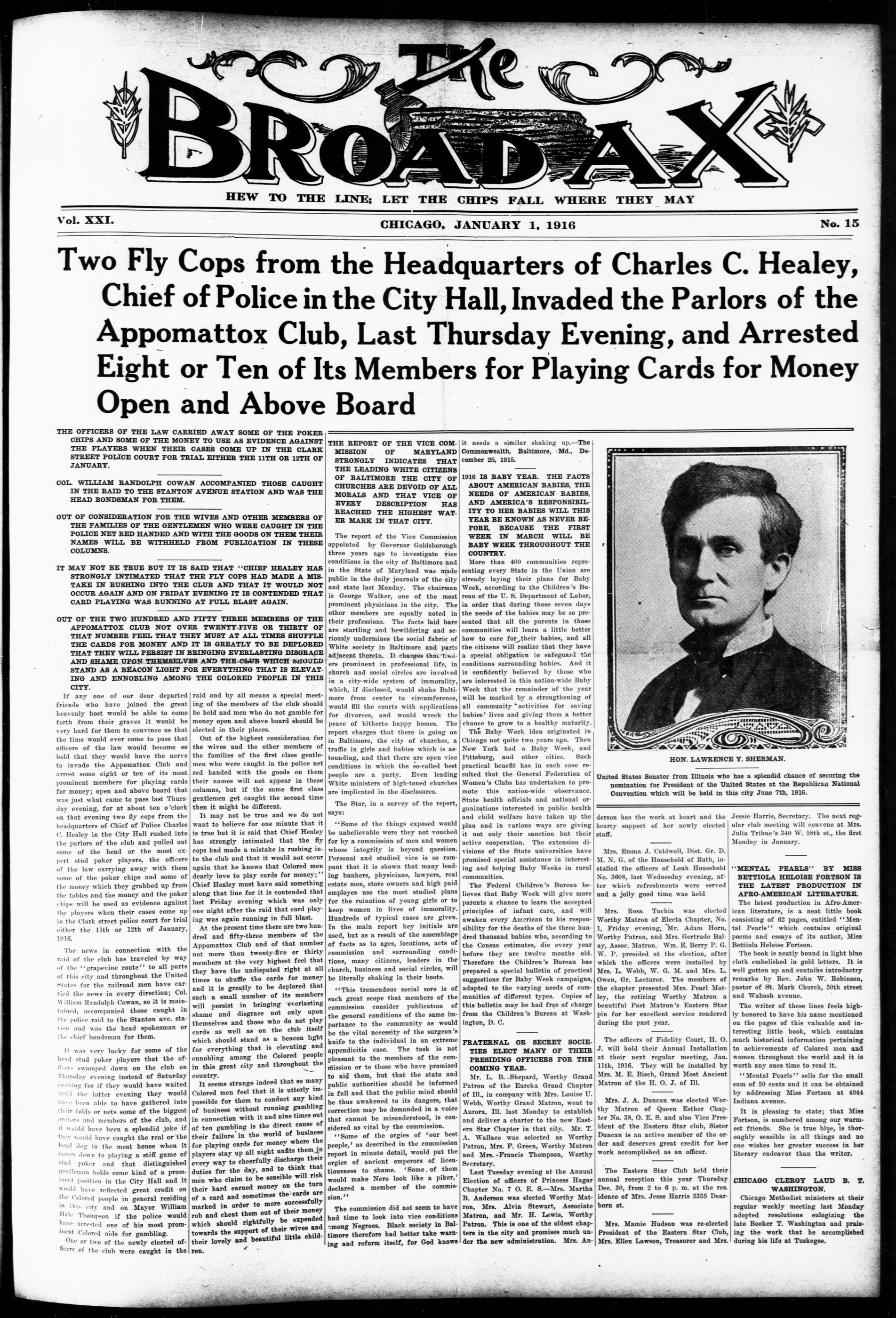
Two Fly Cops from the Headquarters of Charles C. Healey, Chief of Police in the City Hall, Invaded the Parlors of the Appomattox Club, Last Thursday Evening, and Arrested Eight or Ten of Its Members for Playing Cards for Money Open and Above Board
THE OFFICERS OF THE LAW CARRIED AWAY SOME OF THE POKER CHIPS AND SOME OF THE MONEY TO USE AS EVIDENCE AGAINST THE PLAYERS WHEN THEIR CASES COME UP IN THE CLARK STREET POLICE COURT FOR TRIAL EITHER THE 11TH OR 12TH OF JANUARY.
COL. WILLIAM RANDOLPH COWAN ACCOMPANIED THOSE CAUGHT IN THE RAID TO THE STANTON AVENUE STATION AND WAS THE HEAD BONDSMAN FOR THEM.
OUT OF CONSIDERATION FOR THE WIVES AND OTHER MEMBERS OF THE FAMILIES OF THE GENTLEMEN WHO WERE CAUGHT IN THE POLICE NET RED HANDED AND WITH THE GOODS ON THEM THEIR NAMES WILL BE WITHHELD FROM PUBLICATION IN THESE COLUMNS.
IT MAY NOT BE TRUE BUT IT IS SAID THAT "CHIEF HEALEY HAS STRONGLY INTIMATED THAT THE FLY COPS HAD MADE A MISTAKE IN RUSHING INTO THE CLUB AND THAT IT WOULD NOT OCCUB AGAIN AND ON FRIDAY EVENING IT IS CONTENDED THAT CARD PLAYING WAS RUNNING AT FULL BLAST AGAIN.
OUT OF THE TWO HUNDRED AND FIFTY THREE MEMBERS OF THE APPOMATTOX CLUB NOT OVER TWENTY-FIVE OR THIRTY OF THAT NUMBER FEEL THAT THEY MUST AT ALL TIMES SHUFFLE THE CARDS FOR MONEY AND IT IS GREATLY TO BE DEPLORED THAT THEY WILL PERSIST IN BRINGING EVERLASTING DISGRACE AND SHAME UPON THEMSELVES AND THE CLUB WHICH SHOULD STAND AS A BEACON LIGHT FOR EVERYTHING THAT IS ELEVATING AND ENNOBLING AMONG THE COLORED PEOPLE IN THIS CITY.
Vol. XXI.
Two Fly Chief of Appom
Eight of Open a
THE OFFICERS OF THE LAW CAR
CHIPS AND SOME OF THE MON
THE PLAYERS WHEN THEIR
STREET POLICE COURT FOR THE
JANUARY.
COL. WILLIAM RANDOLPH COWA
IN THE RAID TO THE STANTO
HEAD BONDSMAN FOR THEM.
OUT OF CONSIDERATION FOR THE
THE FAMILIES OF THE GENTLE
POLICE NET RED HANDED AND
NAMES WILL BE WITHHELF
COLUMNS.
IT MAY NOT BE TRUE BUT IT IS
STRONGLY INTIMATED THAT
TAKE IN RUSHING INTO THE
OCCUR AGAIN AND ON FRIDAY
CARD PLAYING WAS RUNNING.
OUT OF THE TWO HUNDRED AND
APPOMATTOX CLUB NOT OVER
THAT NUMBER FEEL THAT THE
CARDS FOR MONEY AND
THAT THEY WILL PERSIST IN
AND SHAME UPON THEMSELV
STAND AS A BEACON LIGHT F
ING AND ENNOBLING AMONG
CITY.
If any one of our dear departed friends who have joined the great heavenly host would be able to come forth from their graves it would be very hard for them to convince us that the time would ever come to pass that officers of the law would become so bold that they would have the nerve to invade the Appomattox Club and arrest some eight or ten of its most prominent members for playing cards for money; open and above board that was just what came to pass last Thursday evening, for at about ten o'clock on that evening two fly cops from the headquarters of Chief of Police Charles C. Healey in the City Hall rushed into the parlors of the club and pulled out some of the head or the most expert stud poker players, the officers of the law carrying away with them some of the poker chips and some of the money which they grabbed up from the tables and the money and the poker chips will be used as evidence against the players when their cases come up in the Clark street police court for trial either the 11th or 12th of January, 1916.
The news in connection with the raid of the club has traveled by way of the "grapevine route" to all parts of this city and throughout the United States for the railroad men have carried the news in every direction; Col. William Randolph Cowan, so it is maintained, accompanied those caught in the police raid to the Stanton ave. station and was the head spokesman on the chief bondsman for them.
It was very lucky for some of the head stud poker players that the officers swamped down on the club on Thursday evening instead of Saturday evening for if they would have waited until the latter evening they would have been able to have gathered into their folds or nets some of the biggest orators and members of the club, and it would have been a splendid joke if they would have caught the real or the head dog in the meat house when it comes down to playing a stiff game of stud poker and that distinguished gentleman holds some kind of a prominent position in the City Hall and it would have reflected great credit on the Colored people in general residing in this city and on Mayor William Hale Thompson if the police would have arrested one of his most prominent Colored aids for gambling.
One or two of the newly elected officers of the club were caught in the
raid and by all means a special meeting of the members of the club should be held and men who do not gamble for money open and above board should be elected in their places.
Out of the highest consideration for the wives and the other members of the families of the first class gentlemen who were caught in the police net red handed with the goods on them their names will not appear in these columns, but if the same first class gentlemen get caught the second time then it might be different.
It may not be true and we do not want to believe for one minute that it is true but it is said that Chief Healey has strongly intimated that the fly cops had made a mistake in rushing into the club and that it would not occur again that he knows that Colored men dearly love to play cards for money;" Chief Healey must have said something along that line for it is contended that last Friday evening which was only one night after the raid that card playing was again running in full blast.
At the present time there are two hundred and fifty-three members of the Appomattox Club and of that number not more than twenty-five or thirty members at the very highest feel that they have the undisputed right at all times to shuffle the cards for money and it is greatly to be deplored that such a small number of its members will persist in bringing everlasting shame and disgrace not only upon themselves and those who do not play cards as well as on the club itself which should stand as a beacon light for everything that is elevating and ennobling among the Colored people in this great city and throughout the country.
It seems strange indeed that so many Colored men feel that it is utterly impossible for them to conduct any kind of business without running gambling in connection with it and nine times out of ten gambling is the direct cause of their failure in the world of business for playing cards for money where the players stay up all night unfits them in every way to cheerfully discharge their duties for the day, and to think that men who claim to be sensible will risk their hard earned money on the turn of a card and sometimes the cards are marked in order to more successfully rob and cheat them out of their money which should rightfully be expended towards the support of their wives and their lovely and beautiful little child-
CHICAGO, JANUARY 1, 1916
THE REPORT OF THE VICE COMMISSION OF MARYLAND
STRONGLY INDICATES THAT
THE LEADING WHITE CITIZENS
OF BALTIMORE THE CITY OF
CHURCHES ARE DEVOID OF ALL
MORALS AND THAT VICE OF
EVERY DESCRIPTION HAS
REACHED THE HIGHEST WATER
MARK IN THAT CITY.
The report of the Vice Commission appointed by Governor Goldsborough three years ago to investigate vice conditions in the city of Baltimore and in the State of Maryland was made public in the daily journals of the city and state last Monday. The chairman is George Walker, one of the most prominent physicians in the city. The other members are equally noted in their professions. The facts laid bare are startling and bewildering and seriously undermines the social fabric of White society in Baltimore and parts adjacent thereto. It charges that leaders prominent in professional life, in church and social circles are involved in a city-wide system of immorality, which, if disclosed, would shake Baltimore from center to circumference, would fill the courts with applications for divorces, and would wreck the peace of hitherto happy homes. The report charges that there is going on in Baltimore, the city of churches, a traffic in girls and babies which is astounding, and that there are open vice conditions in which the so-called best people are a party. Even leading White ministers of high-toned churches are implicated in the disclosures.
The Star, in a survey of the report, savs:
"Some of the things exposed would be unbelievable were they not vouched for by a commission of men and women whose integrity is beyond question. Personal and studied vice is so rampant that it is shown that many leading bankers, physicians, lawyers, real estate men, store owners and high paid employees use the most studied plans for the ruination of young girls or to keep women in lives of immorality. Hundreds of typical cases are given. In the main report key initials are used, but as a result of the assemblage of facts as to ages, locations, acts of commission and surrounding conditions, many citizens, leaders in the church, business and social circles, will be literally shaking in their boots.
"This tremendous social sore is of such great scope that members of the commission consider publication of the general conditions of the same importance to the community as would be the vital necessity of the surgeon's knife to the individual in an extreme appendicitis case. The task is not pleasant to the members of the commission or to those who have promised to aid them, but that the state and public authorities should be informed in full and that the public mind should be thus awakened to its dangers, that correction may be demanded in a voice that cannot be misunderstood, is considered as vital by the commission.
"Some of the orgies of 'our best people,' as described in the commission report in minute detail, would put the orgies of ancient emperors of licentiousness to shame. 'Some. of them would make Nero look like a piker,' declared a member of the commission."
The commission did not seem to have had time to look into vice conditions among Negroes. Black society in Baltimore therefore had better take warning and reform itself, for God knows
it needs a similar shaking up.—The Commonwealth, Baltimore, Md., December 25, 1915.
1916 IS BABY YEAR. THE FACTS ABOUT AMERICAN BABIES, THE NEEDS OF AMERICAN BABIES, AND AMERICA'S RESPONSIBILITY TO HER BABIES WILL THIS YEAR BE KNOWN AS NEVER BEFORE, BECAUSE THE FIRST WEEK IN MARCH WILL BE BABY WEEK THROUGHOUT THE COUNTRY.
More than 400 communities representing every State in the Union are already laying their plans for Baby Week, according to the Children's Bureau of the U. S. Department of Labor, in order that during those seven days the needs of the babies may be so presented that all the parents in those communities will learn a little better how to care for their babies, and all the citizens will realize that they have a special obligation to safeguard the conditions surrounding babies. And it is confidently believed by those who are interested in this nation-wide Baby Week that the remainder of the year will be marked by a strengthening of all community activities for saving babies' lives and giving them a better chance to grow to a healthy maturity.
The Baby Week idea originated in Chicago not quite two years ago. Then New York had a Baby Week, and Pittsburg, and other cities. Such practical benefit has in each case resulted that the General Federation of Women's Clubs has undertaken to promote this nation-wide observance. State health officials and national organizations interested in public health and child welfare have taken up the plan and in various ways are giving it not only their sanction but their active cooperation. The extension divisions of the State universities have promised special assistance in interesting and helping Baby Weeks in rural communities.
The Federal Children's Bureau believes that Baby Week will give more parents a chance to learn the accepted principles of infant care, and will awaken every American to his responsibility for the deaths of the three hundred thousand babies who, according to the Census estimates, die every year before they are twelve months old. Therefore the Children's Bureau has prepared a special bulletin of practical suggestions for Baby Week campaigns, adapted to the varying needs of communities of different types. Copies of this bulletin may be had free of charge from the Children's Bureau at Washington, D. C.
FRATERNAL OR SECRET SOCIETIES ELECT MANY OF THEIR PRESIDING OFFICERS FOR THE COMING YEAR.
Mr. L. B.-Shepard, Worthy Grand Patron of the Eureka Grand Chapter of Ill., in company with Mrs. Louise U. Webb, Worthy Grand Matron, went to Aurora, Ill. last Monday to establish and deliver a charter to the new Eastern Star Chapter in that city. Mr. T. A. Wallace was selected as Worthy Patron, Mrs. F. Green, Worthy Matron and Mrs.-Francis Thompson, Worthy Secretary.
Last Tuesday evening at the Annual Election of officers of Princess Hagar Chapter No. 7 O. E. S.-Martha B. Anderson was elected Worthy Matron, Mrs. Alvia Stewart, Associate Matron, and Mr. H. Lewis, Worthy Patron. This is one of the oldest chapters in the city and promises much under the new administration. Mrs. An-
[Picture of a man with dark hair, wearing a dark suit and a white shirt, with a decorative border around the image.]
HON. LAWRENCE Y. SHERMAN
United States Senator from Illinois who has a splendid o nomination for President of the United States at the Convention which will be held in this city June 7th
United States Senator from Illinois who has a splendid chance of securing the nomination for President of the United States at the Republican National Convention which will be held in this city June 7th, 1916.
derson has the work at heart and the hearty support of her newly elected staff.
Mrs. Emma J. Caldwell, Dist. Gr. D. M. N. G. of the Household of Ruth, installed the officers of Leah Household No. 3608, last Wednesday evening, after which refreshments were served and a jolly good time was held
Mrs. Rosa Tuchia was elected Worthy Matron of Electa Chapter, No. 1, Friday evening, Mr. Adam Horn, Worthy Patron, and Mrs. Gertrude Balay, Assoc. Matron. Wm. E. Berry P. G. W. P. presided at the election, after which the officers were installed by Mrs. L. Webb, W. G. M. and Mrs. L. Owen, Gr. Lecturer. The members of the chapter presented Mrs. Pearl Motley, the retiring Worthy Matron a beautiful Past Matron's Eastern Star pin for her excellent service rendered during the past year.
The officers of Fidelity Court, H. O. J. will hold their Annual Installation at their next regular meeting, Jan 11th, 1916. They will be installed by Mrs. M. E. Bisch, Grand Most Ancient Matron of the H. O. J. of Ill.
Mrs. J. A. Duncan was elected Worthy Matron of Queen Esther Chapter No. 38, O. E. S. and also Vice President of the Eastern Star club, Sister Duncan is an active member of the order and deserves great credit for her work accomplished as an officer.
The Eastern Star Club held their annual reception this year Thursday Dec. 30, from 2 to 6 p. m. at the residence of Mrs. Jesse Harris 5355 Dearborn st.
Mrs. Mamie Hudson was re-elected President of the Eastern Star Club, Mrs. Ellen Lawson, Treasurer and Mrs.
C. Healey,
ors of the
Arrested
for Money
I has a splendid chance of securing the United States at the Republican National this city June 7th, 1916.
Jessie Harris, Secretary. The next regular club meeting will convene at Mrs. Julia Tribuhe's 340 W. 58th st., the first Monday in January.
"MENTAL PEARLS" BY MISS BETTIOLA HELOISE FORTSON IS THE LATEST PRODUCTION IN AFRO-AMERICAN LITERATURE.
The latest production in Afro-American literature, is a neat little book consisting of 62 pages, entitled "Mental Pearls" which contains original poems and essays of its author, Miss Bettiola Heloise Fortson.
The book is neatly bound in light blue cloth embelished in gold letters. It is well gotten up and contains introductory remarks by Rev. John W. Robinson, pastor of St. Mark Church, 50th street and Wabash avenue.
The writer of these lines feels highly honored to have his name mentioned on the pages of this valuable and interesting little book, which contains much historical information pertaining to achievements of Colored men and women throughout the world and it is worth any one time to read it.
"Mental Pearls" sells for the small sum of 50 cents and it can be obtained by addressing Miss Fortson at 4044 Indiana avenue.
It is pleasing to state; that Miss Fortson, is numbered among our warmest friends. She is true blue, is thoroughly sensible in all things and no one wishes her greater success in her literary endeavor than the writer.
CHICAGO CLERGY LAUD B. T.
WASHINGTON.
Chicago Methodist ministers at their regular weekly meeting last Monday adopted resolutions eulogizing the late Booker T. Washington and praising the work that he accomplished during his life at Tuskegee.
No.15
---
PAGE TWO
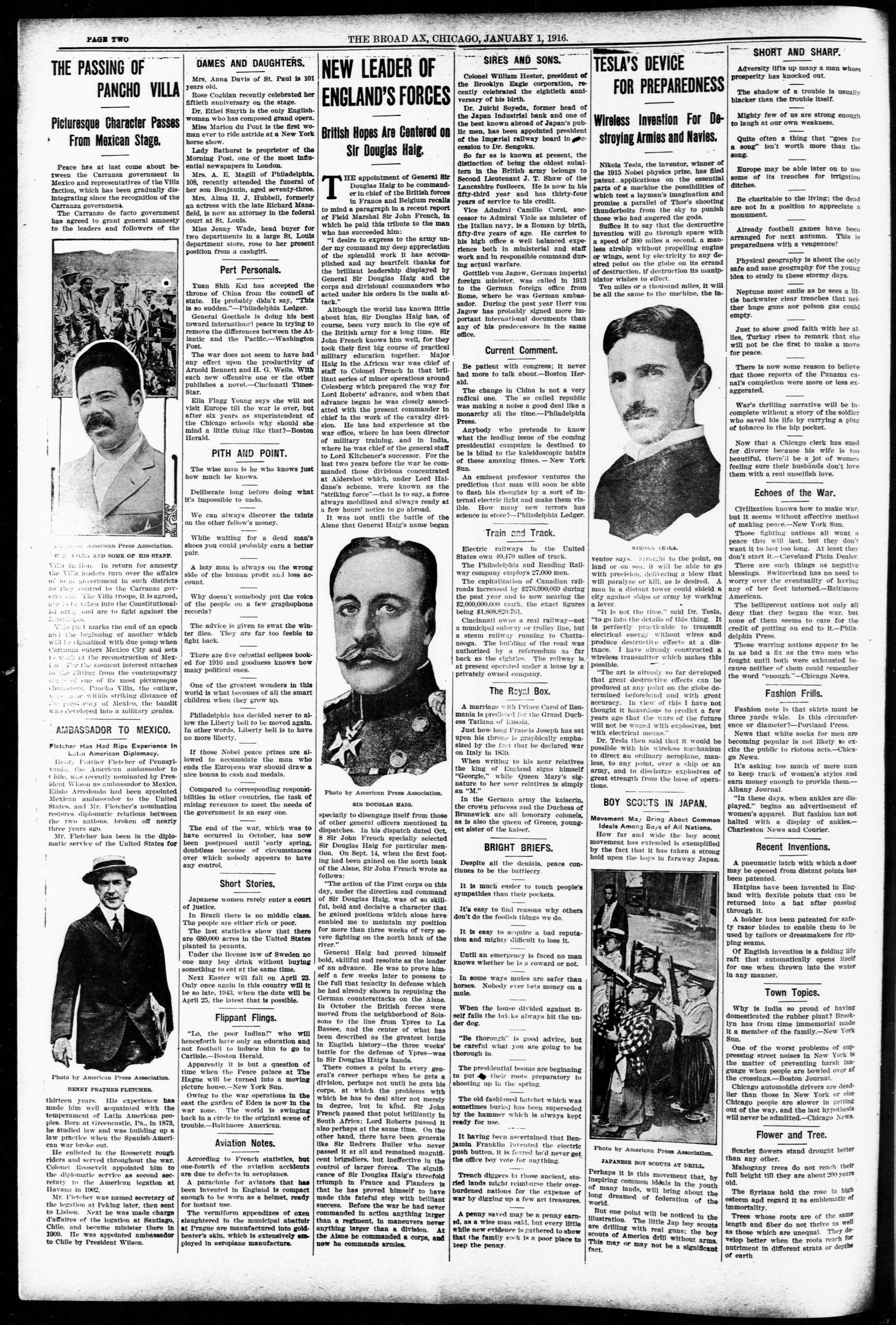
THE PASSING OF PANCHO VILLA
Picturesque Character Passes From Mexican Stage.
Peace has at last come about between the Carranza government in Mexico and representatives of the Villa faction, which has been gradually disintegrating since the recognition of the Carranza government. The Carranzo de facto government has agreed to grant general amnesty to the leaders and followers of the
1
VILA faction. In return for amnesty the VILA leaders turn over the affairs of local government in such districts as they control to the Carranza government. The Villa troops, it is agreed, are to be taken into the Constitutionalist army and are to fight against the Zapatistas.
This just marks the end of an epoch and the beginning of another which will be signalized with due pomp when Carranza enters Mexico City and sets to work at the reconstruction of Mexico. For the moment interest attaches to the fitting from the contemporary state of one of its most picturesque characters, Pancho Villa, the outlaw, who is within striking distance of the presidency of Mexico, the bandit who developed into a military genius.
AMBASSADOR TO MEXICO.
Fletcher Has Had Ripe Experience In Latin American Diplomacy. Henry, Peather Fletcher of Pennsylvania, the American ambassador to Chile, was recently nominated by President Wilson as ambassador to Mexico. Elisio Arredondo had been appointed Mexican ambassador to the United States, and Mr. Fletcher's nomination restores diplomatic relations between the two nations, broken off nearly three years ago.
```markdown
```
Mr. Fletcher has been in the diplomatic service of the United States for
A. H.
Photo by American Press Association.
thirteen years. His experience has made him well acquainted with the temperament of Latin American peoples. Born at Greencastle, Pa., in 1873, he studied law and was building up a law practice when the Spanish-American war broke out.
He enlisted in the Roosevelt rough riders and served throughout the war. Colonel Roosevelt appointed him to the diplomatic service as second secretary to the American legation at Havana in 1902.
Mr. Fletcher was named secretary of the legation at Peking later, then sent to Lisbon. Next he was made charge d'affaires of the legation at Santiago, Chile, and became minister there in 1900. He was appointed ambassador to Chile by President Wilson.
DAMES AND DAUGHTERS.
Mrs. Anna Davis of St. Paul is 101 years old.
Rose Coghlan recently celebrated her fiftieth anniversary on the stage.
Dr. Ethel Smyth is the only Englishwoman who has composed grand opera.
Miss Marion du Pont is the first woman ever to ride astride at a New York horse show.
Lady Bathurst is proprietor of the Morning Post, one of the most influential newspapers in London.
Mrs. A. E. Magill of Philadelphia, 108, recently attended the funeral of her son Benjamin, aged seventy-three.
Mrs. Alma H. J. Hubbell, formerly an actress with the late Richard Mansfield, is now an attorney in the federal court at St. Louis.
Miss Jenny Wade, head buyer for two departments in a large St. Louis department store, rose to her present position from a cashgirl.
Pert Personals.
Yuan Shih Kai has accepted the throne of China from the council of state. He probably didn't say, "This is so sudden."—Philadelphia Ledger.
General Goethals is doing his best toward international peace in trying to remove the differences between the Atlantic and the Pacific.—Washington Post.
The war does not seem to have had any effect upon the productivity of Arnold Bennett and H. G. Wells. With each new offensive one or the other publishes a novel.—Cincinnati Times-Star.
Ella Flagg Young says she will not visit Europe till the war is over, but after six years as superintendent of the Chicago schools why should she mind a little thing like that?—Boston Herald.
PITH AND POINT.
The wise man is he who knows just how much he knows.
Deliberate long before doing what it's impossible to undo.
We can always discover the taints on the other fellow's money.
While waiting for a dead man's shoes you could probably earn a better pair.
A lazy man is always on the wrong side of the human profit and loss account.
Why doesn't somebody put the voice of the people on a few graphophone records?
The advice is given to swat the winter flies. They are far too feeble to fight back.
There are five celestial eclipses booked for 1916 and goodness knows how many political ones.
One of the greatest wonders in this world is what becomes of all the smart children when they grow up.
Philadelphia has decided never to allow the Liberty bell to be moved again. In other words, Liberty bell is to have no more liberty.
If those Nobel peace prizes are allowed to accumulate the man who ends the European war should draw a nice bonus in cash and medals.
Compared to corresponding responsibilities in other countries, the task of raising revenues to meet the needs of the government is an easy one.
The end of the war, which was to have occurred in October, has now been postponed until early spring, doubtless because of circumstances over which nobody appears to have any control.
Short Stories.
Japanese women rarely enter a court of justice.
In Brazil there is no middle class. The people are either rich or poor.
The last statistics show that there are 680,000 acres in the United States planted in peanuts.
Under the license law of Sweden no one may buy drink without buying something to eat at the same time.
Next Easter will fall on April 23. Only once again in this country will it be so late, 1943, when the date will be April 25, the latest that is possible.
Flippant Flings.
"Lo, the poor Indian!" who will henceforth have only an education and not football to induce him to go to Carlisle—Boston Herald.
Apparently it is but a question of time when the Peace palace at The Hague will be turned into a moving picture house—New York Sun.
Owing to the war operations in the east the garden of Eden is now in the war zone. The world is swinging back in a circle to the original scene of trouble—Baltimore American.
Aviation Notes.
According to French statistics, but one-fourth of the aviation accidents are due to defects in aeroplanes.
A parachute for aviators that has been invented in England is compact enough to be worn as a helmet, ready for instant use.
The vermiform appendixes of oxen slaughtered in the municipal abattoir at Prague are manufactured into goldbeater's skin, which is extensively employed in aeroplane manufacture.
THE BROAD AX. CHICAGO. JANUARY 1. 1916.
NEW LEADER OF ENGLAND'S FORCES
British Hopes Are Centered on Sir Douglas Haig.
THE appointment of General Sir Douglas Haig to be commander in chief of the British forces in France and Belgium recalls to mind a paragraph in a recent report of Field Marshal Sir John French, in which he paid this tribute to the man who has succeeded him:
"I desire to express to the army under my command my deep appreciation of the splendid work it has accomplished and my heartfelt thanks for the brilliant leadership displayed by General Sir Douglas Haig and the corps and divisional commanders who acted under his orders in the main attack."
Although the world has known little about him, Sir Douglas Haig has, of course, been very much in the eye of the British army for a long time. Sir John French knows him well, for they took their first big course of practical military education together. Major Haig in the African war was chief of staff to Colonel French in that brilliant series of minor operations around Colesberg which prepared the way for Lord Roberts' advance, and when that advance began he was closely associated with the present commander in chief in the work of the cavalry division. He has had experience at the war office, where he has been director of military training, and in India, where he was chief of the general staff to Lord Kitchener's successor. For the last two years before the war he commanded those divisions concentrated at Aldershot which, under Lord Haldane's scheme, were known as the "striking force"—that is to say, a force always mobilized and always ready at a few hours' notice to go abroad.
It was not until the battle of the
Aisne that General Haig's name began
Photo by American Press Association
SIR DOUGLAS HAIG.
specially to disengage itself from those of other general officers mentioned in dispatches. In his dispatch dated Oct. 8 Sir John French specially selected Sir Douglas Haig for particular mention. On Sept. 14, when the first footing had been gained on the north bank of the Aisne, Sir John French wrote as follows:
"The action of the First corps on this day, under the direction and command of Sir Douglas Haig, was of so skillful, bold and decisive a character that he gained positions which alone have enabled me to maintain my position for more than three weeks of very severe fighting on the north bank of the river."
General Haig had proved himself bold, skillful and resolute as the leader of an advance. He was to prove himself a few weeks later to possess to the full that tenacity in defense which he had already shown in repulsing the German counterattacks on the Alsne. In October the British forces were moved from the neighborhood of Soissons to the line from Ypres to La Bassee, and the center of what has been described as the greatest battle in English history—the three weeks' battle for the defense of Ypres—was in Sir Douglas Haig's hands.
There comes a point in every general's career perhaps when he gets a division, perhaps not until he gets his corps, at which the problems with which he has to deal alter not merely in degree, but in kind. Sir John French passed that point brilliantly in South Africa; Lord Roberts passed it also perhaps at the same time. On the other hand, there have been generals like Sir Redvers Buller who never passed it at all and remained magnificent brigadiers, but ineffective in the control of larger forces. The significance of Sir Douglas Haig's threefold triumph in France and Flanders is that he has proved himself to have made this fateful step with brilliant success. Before the war he had never commanded in action anything larger than a regiment, in maneuvers never anything larger than a division. At the Aisne he commanded a corps, and now he commands armies.
SIRES AND SONS.
Colonel William Hester, president of the Brooklyn Eagle corporation, recently celebrated the eightieth anniversary of his birth.
Dr. Juichi Soyeda, former head of the Japan Industrial bank and one of the best known abroad of Japan's public men, has been appointed president of the Imperial railway board in accession to Dr. Sengoku.
So far as is known at present, the distinction of being the oldest subaltern in the British army belongs to Second Lieutenant J. T. Shaw of the Lancashire fuselers. He is now in his fifty-third year and has thirty-four years of service to his credit.
Vice Admiral Camillo Corst, successor to Admiral Viale as minister of the Italian navy, is a Roman by birth, fifty-five years of age. He carries to his high office a well balanced experience both in ministerial and staff work and in responsible command during actual warfare. Gottlieb von Jagow, German imperial foreign minister, was called in 1913 to the German foreign office from Rome, where he was German ambassador. During the past year Herr von Jagow has probably signed more important international documents than any of his predecessors in the same office.
Current Comment.
Be patient with congress; it never had more to talk about.—Boston Herald.
The change in China is not a very radical one. The so called republic was making a noise a good deal like a monarchy all the time.—Philadelphia Press.
Anybody who pretends to know what the leading issue of the coming presidential campaign is destined to be is blind to the kaleidoscopic habits of these amazing times.—New York Sun.
An eminent professor ventures the prediction that man will soon be able to flash his thoughts by a sort of internal electric light and make them visible. How many new terrors has science in store?—Philadelphia Ledger.
Train and Track.
Electric railways in the United States own 40,470 miles of track.
The capitalization of Canadian railroads increased by $276,900,060 during the past year and is now nearing the $2,000,000,000 mark, the exact figures being $1,808,820,761.
Cincinnati owns a real railway—not a municipal subway or trolley line, but a steam railway running to Chattanooga. The building of the road was authorized by a referendum as far back as the eighties. The railway is at present operated under a lease by a privately owned company.
The Royal Box.
A marriage with Prince Carol of Roumania is predicted for the Grand Duchess Tatiana of Russia.
Just how long Francis Joseph has sat upon his throne is graphically emphasized by the fact that he declared war on Italy in 1850.
When writing to his near relatives the king of England signs himself "Georgle," while Queen Mary's signature to her near relatives is simply an "M."
In the German army the kaiserin, the crown princess and the Duchess of Brunswick are all honorary colonels, as is also the queen of Greece, youngest sister of the kaiser.
BRIGHT BRIEFES
Despite all the denials, peace continues to be the battlecry.
It is much easier to touch people's sympathies than their pockets.
It's easy to find reasons why others don't do the foolish things we do.
It is easy to acquire a bad reputation and mighty difficult to lose it.
Until an emergency is faced no man knows whether he is a coward or not.
In some ways mules are safer than horses. Nobody ever bets money on a mule.
When the house divided against itself falls the bricks always hit the under dog.
"Be thorough" is good advice, but be careful what you are going to be thorough in.
The presidential booms are beginning to put their roots preparatory to shooting up in the spring.
The old fashioned hatchet which was sometimes buried has been superseded by the hammer which is always kept ready for use.
It having been ascertained that Benjamin Franklin invented the electric push button, it is feared he never get the office boy vote for anything.
Trench diggers in those ancient, storied lands might reimburse their overburdened nations for the expense of war by digging up a few art treasures.
A penny saved may be a penny earn- red, as a wise man said, but every little while new evidence is gathered to show that the family sock is a poor place to keep the penny.
TESLA'S DEVICE FOR PREPAREDNESS
Nikola Tesla, the inventor, winner of the 1915 Nobel physics prize, has filed patent applications on the essential parts of a machine the possibilities of which test a layman's imagination and promise a parallel of Thor's shooting thunderbolts from the sky to punish those who had angered the gods. Suffice it to say that the destructive invention will go through space with a speed of 300 miles a second, a manless nirship without propelling engine or wings, sent by electricity to any desired point on the globe on its errand of destruction, if destruction its manipulator wishes to effect. Ten miles or a thousand miles, it will be all the same to the machine, the in-
The quick brown fox jumps over the lazy dog.
NIKOLA TESLA.
ventor says. Straight to the point, on land or on sea, it will be able to go with precision, delivering a blow that will paralyze or kill, as is desired. A man in a distant tower could shield a city against ships or army by working a lever.
"It is not the time," said Dr. Tesla, "to go into the details of this thing. It is perfectly practicable to transmit electrical energy without wires and produce destructive effects at a distance. I have already constructed a wireless transmitter which makes this possible.
"The art is already so far developed that great destructive effects can be produced at any point on the globe determined beforehand and with great accuracy. In view of this I have not thought it hazardous to predict a few years ago that the wars of the future will not be waged with explosives, but with electrical means."
Dr. Tesla then said that it would be possible with his wireless mechanism to direct an ordinary aeroplane, manless, to any point, over a ship or an army, and to discharge explosives of great strength from the base of operations.
BOY SCOUTS IN JAPAN
Movement May Bring About Common Ideals Among Boys of All Nations. How far and wide the boy scout movement has extended is exemplified by the fact that it has taken a strong hold upon the boys in faraway Japan.
Photo by American Press Association
Perhaps it is this movement that, by inspiring common ideals in the youth of many lands, will bring about the long dreamed of federation of the world. But one point will be noticed in the illustration. The little Jap boy scouts are drilling with real guns; the boy scouts of America drill without arms. This may or may not be a significant fact.
SHORT AND SHARP.
Adversity lifts up many a man whom prosperity has knocked out.
The shadow of a trouble is usually blacker than the trouble itself.
Mighty few of us are strong enough to laugh at our own weakness.
Quite often a thing that "goes for a song" isn't worth more than the song.
Europe may be able later on to use some of its trenches for irrigation ditches.
Be charitable to the living; the dead are not in a position to appreciate a monument.
Already football games have been arranged for next autumn. This is preparedness with a vengeance!
Physical geography is about the only safe and sane geography for the young idea to study in these stormy days.
Neptune must smile as he sees a little backwater clear trenches that neither huge guns nor poison gas could empty.
Just to show good faith with her allies, Turkey rises to remark that she will not be the first to make a move for peace.
There is now some reason to believe that those reports of the Panama canal's completion were more or less exaggerated.
War's thrilling narrative will be incomplete without a story of the soldier who saved his life by carrying a plug of tobacco in the hip pocket.
Now that a Chicago clerk has sued for divorce because his wife is too beautiful, there'll be a lot of women feeling sure their husbands don't love them with a real unselfish love.
Echoes of the War.
Civilization knows how to make war, but it seems without effective method of making peace.—New York Sun.
Those fighting nations all want a peace that will last, but they don't want it to last too long. At least they don't start it.—Cleveland Plain Dealer.
There are such things as negative blessings. Switzerland has no need to worry over the eventuality of having any of her fleet interned.—Baltimore American.
The belligerent nations not only deny that they began the war, but none of them seems to care for the credit of putting an end to it.—Philadelphia Press.
Those warring nations appear to be in as bad a fix as the two men who fought until both were exhausted because neither of them could remember the word "enough."—Chicago News.
Fashion Frills.
Fashion note is that skirts must be three yards wide. Is this circumference or diameter?—Portland Press.
News that white socks for men are becoming popular is not likely to excite the public to riotous acts.—Chicago News.
It's asking too much of mere man to keep track of women's styles and earn money enough to provide them.—Albany Journal.
"In these days, when ankles are displayed," begins an advertisement of women's apparel. But fashion has not halted with a display of ankles.—Charleston News and Courier.
Recent Inventions.
A pneumatic latch with which a door may be opened from distant points has been patented. Hatpins have been invented in England with flexible points that can be returned into a hat after passing through it. A holder has been patented for safety razor blades to enable them to be used by tailors or dressmakers for ripping seams. Of English invention is a folding life raft that automatically opens itself for use when thrown into the water in any manner.
Town Topics.
Why is India so proud of having domesticated the rubber plant? Brooklyn has from time immemorial made it a member of the family.—New York Sun.
One of the worst problems of suppressing street noises in New York is the matter of preventing harsh language when people are bowled over at the crossings.—Boston Journal.
Chicago automobile drivers are deadlier than those in New York or else Chicago people are slower in getting out of the way, and the last hypothesis will never be admitted.—Chicago News.
Flower and Tree.
Scarlet flowers stand drought better than any other.
Mahogany trees do not reach their full height till they are about 200 years old.
The Syrians hold the rose in high esteem and regard it as emblematic of immortality.
Trees whose roots are of the same length and fiber do not thrive as well as those which are unequal. They develop better when the roots reach for nutriment in different strata or depths of earth.
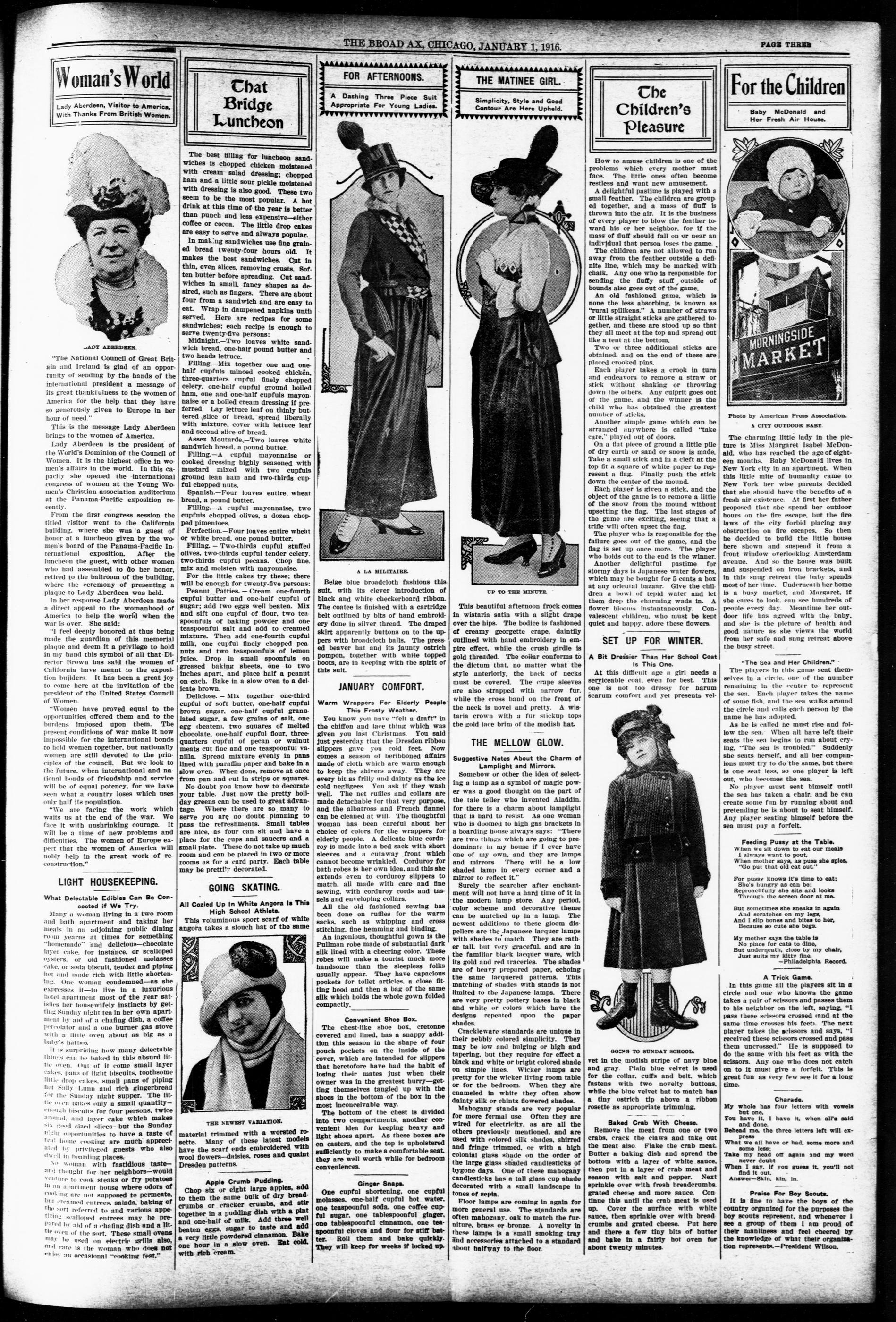
Lady Aberdeen, Visitor to America, With Thanks From British Women.
Mary Ann
LADY ABERDEEN.
"The National Council of Great Britain and Ireland is glad of an opportunity of sending by the hands of the international president a message of its great thankfulness to the women of America for the help that they have so generously given to Europe in her hour of need."
This is the message Lady Aberdeen brings to the women of America.
Lady Aberdeen is the president of the World's Dominion of the Council of Women. It is the highest office in women's affairs in the world. In this capacity she opened the international congress of women at the Young Women's Christian association auditorium at the Panama-Pacific exposition recently.
From the first congress session the titled visitor went to the California building, where she was a guest of honor at a luncheon given by the women's board of the Panama-Pacific International exposition. After the luncheon the guest, with other women who had assembled to do her honor, retired to the ballroom of the building, where the ceremony of presenting a plaque to Lady Aberdeen was held. In her response Lady Aberdeen made a direct appeal to the womanhood of America to help the world when the war is over. She said:
"I feel deeply honored at thus being made the guardian of this memorial plaque and deem it a privilege to hold in my hand this symbol of all that Director Brown has said the women of California have meant to the exposition builders. It has been a great joy to come here at the invitation of the president of the United States Council of Women.
"Women have proved equal to the opportunities offered them and to the burdens imposed upon them. The present conditions of war make it now impossible for the international bonds to hold women together, but nationally women are still devoted to the principles of the council. But we look to the future, when international and national bonds of friendship and service will be of equal potency, for we have seen what a country loses which uses only half its population.
"We are facing the work which waits us at the end of the war. We face it with unshrinking courage. It will be a time of new problems and difficulties. The women of Europe expect that the women of America will nibly help in the great work of reconstruction."
LIGHT HOUSEKEEPING.
What Delectable Edibles Can Be Concocted if We Try.
Many a woman living in a two room and bath apartment and taking her meals in an adjoining public dining room years at times for something "homenade" and delicious-chocolate layer cake, for instance, or scalloped oysters, or old fashioned molasses cake, or soda biscuit, tender and piping hot and made rich with little shortening. One woman condemned—as she expresses it—to live in a luxurious hotel apartment most of the year satisfies her housewifely instincts by getting Sunday night tea in her own apartment by aid of a chafing dish, a coffee percolator and a one burner gas stove with a little oven about as big as a baby's battro
It is surprising how many delectable things can be baked in this absurd little oven. Out of it come small layer cakes, pans of light biscuits, toothsome little drop cakes, small pans of piping hot Sally Lunn and rich gingerbread for the Sunday night supper. The little oven bakes only a small quantity—enough biscuits for four persons, twice around, and layer cake which makes six good sized slices—but the Sunday night opportunities to have a taste of real home cooking are much appreciated by privileged guests who also dwell in boarding places.
No woman with fastidious taste—and thought for her neighbors—would venture to cook steaks or fry potatoes in an apartment house where odors of cooking are not supposed to permeate, but creamed entrees, salads, baking of the sort referred to and various appetizing scalloped entrees may be prepared by aid of a chafing dish and a little oven of the sort. These small ovens may be used on electric skillets also, and rare is the woman who does not enjoy an occasional "cooking fest."
That Bridge Luncheon
The best filling for luncheon sandwiches is chopped chicken moistened with cream salad dressing; chopped ham and a little sour pickle moistened with dressing is also good. These two seem to be the most popular. A hot drink at this time of the year is better than punch and less expensive—either coffee or cocoa. The little drop cakes are easy to serve and always popular. In making sandwiches use fine grained bread twenty-four hours old. It makes the best sandwiches. Cut in thin, even slices, removing crusts. Soften butter before spreading. Cut sandwiches in small, fancy shapes as desired, such as fingers. There are about four from a sandwich and are easy to eat. Wrap in dampened napkins until served. Here are recipes for some sandwiches; each recipe is enough to serve twenty-five persons:
Midnight.—Two loaves white sandwich bread, one-half pound butter and two heads lettuce.
Filling.—Mix together one and one-half cupfuls minced cooked chicken, three-quarters cupful finely chopped celery, one-half cupful ground boiled ham, one and one-half cupfuls mayonnaise or a boiled cream dressing if preferred. Lay lettuce leaf on thinly buttered slice of bread, spread liberally with mixture, cover with lettuce leaf and second slice of bread.
Assez Moutardre.—Two loaves white sandwich bread, a pound butter.
Filling.—A cupful mayonnaise or cooked dressing highly seasoned with mustard mixed with two cupfuls ground lean ham and two-thirds cupful chopped nuts.
Spanish.—Four loaves entire. wheat bread, a pound butter.
Filling.—A cupful mayonnaise, two cupfuls chopped olives, a dozen chopped pimentos.
Perfection. - Four leaves entire wheat or white bread, one pound butter.
Filling. - Two-thirds cupful stuffed olives, two-thirds cupful tender celery, two-thirds cupful pecans. Chop fine, mix and molten with mayonnaise.
For the little cakes try these; there will be enough for twenty-five persons.
will be enough for twenty-five persons.
Peanut_Patties. — Cream one-fourth cupful butter and one-half cupful of sugar; add two eggs well beaten. Mix and sift one cupful of flour, two teaspoonful of baking powder and one teaspoonful salt and add to creamed mixture. Then add one-fourth cupful milk, one cupful finely chopped peanuts and two teaspoonfuls of lemon juice. Drop in small teaspoonfuls on greased baking sheets, one to two inches apart, and place half a peanut on each. Bake in a slow oven to a delicate brown.
Deliciose. - Mix together one-third cupful of soft butter, one-half cupful brown sugar, one-half cupful granulated sugar, a few grains of salt, one egg (beaten), two squares of melted chocolate, one-half cupful flour, three-quarters cupful of pecan or walnut meats cut fine and one teaspoonful vanilla. Spread mixture evenly in pans lined with paraffin paper and bake in a slow oven. When done, remove at once from pan and cut in strips or squares. No doubt you know how to decorate your table. Just now the pretty holiday greens can be used to great advantage. Where there are so many to serve you are no doubt planning to pass the refreshments. Small tables are nice, as four can sit and have a place for the cups and saucers and a small plate. These do not take up much room and can be placed in two or more rooms as for a card party. Each table may be pretty! decorated.
GOING SKATING.
All Cozied Up In White Angora Is This High School Athlete. This voluminous sport scarf of white angora takes a slouched hat of the same
A
THE NEWEST VARIATION.
material trimmed with a worsted rosette.
Many of these latest models have the scarf ends embroidered with wool flowers—daisies, roses and quaint Dresden patterns.
Apple Crumb Pudding.
Chop six or eight large apples, add to them the same bulk of dry bread-crumbs or cracker crumbs, and stir together in a pudding dish with a pint and one half of milk. Add three well beaten eggs, sugar to taste and add a very little powdered cinnamon. Bake one hour in a slow oven. Eat cold, with rich cream.
THE BROAD AX, CHICAGO, JANITARY 1. 1916
THE FASHION OF THE TWENTIETH CENTURY
A LA MILITAIRE.
Belge blue broadcloth fashions this suit, with its clever introduction of black and white checkerboard ribbon. The coattee is finished with a cartridge belt outlined by bits of hand embroidery done in silver thread. The draped skirt apparently buttons on to the uppers with broadcloth balls. The pressed beaver hat and its jaunty ostrich pompon, together with white topped boots, are in keeping with the spirit of this suit.
JANUARY COMFORT.
Warm Wrappers For Elderly People
This Frosty Weather,
You know you have "felt a draft" in the chiffon and lace thing which was given you last Christmas. You said just yesterday that the Dresden ribbon slippers gave you cold feet. Now comes a season of beribboned affairs made of cloth which are warm enough to keep the shivers away. They are every bit as frilly and dainty as the ice cold negligees. You ask if they wash well. The net ruffles and collars are made detachable for that very purpose, and the albatross and French flannel can be cleaned at will. The thoughtful woman has been careful about her choice of colors for the wrappers for elderly people. A delicate blue corduroy is made into a bed sack with short sleeves and a cutaway front which cannot become wrinkled. Corduroy for bath robes is her own idea, and this she extends even to corduroy slippers to match, all made with care and fine sewing, with corduroy cords and tassels and enveloping collars.
All the old fashioned sewing has been done on ruffles for the warm sacks, such as whipping and cross stitching, fine hemming and binding.
An ingenious, thoughtful gown is the Pullman robe made of substantial dark silk lined with a cheering color. These robes will make a tourist much more handsome than the sleepless folks usually appear. They have capacious pockets for toilet articles, a close fitting hood and then a bag of the same silk which holds the whole gown folded compactly.
Convenient Shoe Box.
The chest-like shoe box, cretonne covered and lined, has a snappy addition this season in the shape of four pouch pockets on the inside of the cover, which are intended for slippers that heretofore have had the habit of losing their mates just when their owner was in the greatest hurry—getting themselves tangled up with the shoes in the bottom of the box in the most inconceivable way.
The bottom of the chest is divided into two compartments, another convenient idea for keeping heavy and light shoes apart. As these boxes are on casters, and the top is upholstered sufficiently to make a comfortable seat, they are well worth while for bedroom conveniences.
Ginger Snaps.
One cupful shortening, one cupful molasses, one-half cupful hot water, one teaspoonful soda, one coffee cupful sugar, one tablespoonful ginger, one tablespoonful cinnamon, one teaspoonful cloves and flour for stiff batter. Roll them and bake quickly. They will keep for weeks if locked up.
Simplicity, Style and Good Contour Are Here Upheld.
O
UP TO THE MINUTE.
This beautiful afternoon frock comes in wistaria satin with a slight drape over the hips. The bodice is fashioned of creamy georgette crape, daintily outlined with hand embroidery in empire effect, while the crush girdle is gold threaded. The collar conforms to the dictum that, no matter what the style anteriorly, the back of necks must be covered. The crape sleeves are also strapped with narrow fur, while the cross band on the front of the neck is novel and pretty. A wistaria crown with a fur stickup tops the gold lace brim of the modish hat.
THE MELLOW GLOW.
Suggestive Notes About the Charm of Lamplight and Mirrors.
Somehow or other the idea of selecting a lamp as a symbol of magic power was a good thought on the part of the tale teller who invented Aladdin, for there is a charm about lamplight that is hard to resist. As one woman who is doomed to high gas brackets in a boarding house always says: "There are two things which are going to predominate in my house if I ever have one of my own, and they are lamps and mirrors. There will be a low shaded lamp in every corner and a mirror to reflect it."
Surely the searcher after enchantment will not have a hard time of it in the modern lamp store. Any period, color scheme and decorative theme can be matched up in a lamp. The newest additions to these gloom dispellers are the Japanese lacquer lamps with shades to match. They are rather tall, but very graceful, and are in the familiar black lacquer ware, with its gold and red tracerles. The shades are of heavy prepared paper, echoing the same lacquered patterns. This matching of shades with stands is not limited to the Japanese lamps. There are very pretty pottery bases in black and white or colors which have the designs repeated upon the paper shades.
Crackleware standards are unique in their pebbly colored simplicity. They may be low and bulging or high and tapering, but they require for effect a black and white or bright colored shade on simple lines. Wicker lamps are pretty for the wicker living room table or for the bedroom. When they are enameled in white they often show dainty silk or chinz tinted shades. Mahogany stands are very popular for more formal use. Often they are wired for electricity, as are all the others previously mentioned, and are used with colored silk shades, shirred and fringe trimmed, or with a high colonial glass shade on the order of the large glass shaded candlesticks of bygone days. One of these mahogany candlesticks has a tall glass cup shade decorated with a small landscape in tones of sepia.
Floor lamps are coming in again for more general use. The standards are often mahogany, oak to match the furniture, brass or bronze. A novelty in these lamps is a small smoking tray and accessories attached to a standard about halfway to the floor.
The Children's Pleasure
How to amuse children is one of the problems which every mother must face. The little ones often become restless and want new amusement.
A delightful pastime is played with a small feather. The children are grouped together, and a mass of fluff is thrown into the air. It is the business of every player to blow the feather toward his or her neighbor, for if the mass of fluff should fall on or near an individual that person loses the game.
The children are not allowed to run away from the feather outside a definite line, which may be marked with chalk. Any one who is responsible for sending the fluffy stuff outside of bounds also goes out of the game.
An old fashioned game, which is none the less absorbing, is known as "rural spillikens." A number of straws or little straight sticks are gathered together, and these are stood up so that they all meet at the top and spread out like a tent at the bottom.
Two or three additional sticks are obtained, and on the end of these are placed crooked pins.
Each player takes a crook in turn and endeavors to remove a straw or stick without shaking or throwing down the others. Any culprit goes out of the game, and the winner is the child who has obtained the greatest number of sticks.
Another simple game which can be arranged anywhere is called "take care," played out of doors.
On a flat piece of ground a little pile of dry earth or sand or snow is made.
Take a small stick and in a cleft at the top fit a square of white paper to represent a flag. Finally push the stick down the center of the mound.
Each player is given a stick, and the object of the game is to remove a little of the snow from the mound without upsetting the flag. The last stages of the game are exciting, seeing that a trifle will often upset the flag.
The player who is responsible for the failure goes out of the game, and the flag is set up once more. The player who holds out to the end is the winner. Another delightful pastime for stormy days is Japanese water flowers, which may be bought for 5 cents a box at any orienteal bazaar. Give the children a bowl of tepid water and let them drop the charming wads in. A flower blooms instantaneously. Convalescent children, who must be kept quiet and happy, adore these flowers.
SET UP FOR WINTER.
A Bit Dressier Than Her School Coat Is This One.
At this difficult age a girl needs a serviceable coat, even for best. This one is not too dressy for harum scarcum comfort and yet presents vel-
S
GOING TO SUNDAY SCHOOL.
vet in the modish stripe of navy blue and gray. Plain blue velvet is used for the collar, cuffs and belt, which fastens with two novelty buttons, while the blue velvet hat to match has a tiny ostrich tip above a ribbon rosette as appropriate trimming.
Baked Crab With Cheese.
Baked Meat With Cheese
Remove the meat from one or two crabs, crack the claws and take out the meat also. Flake the crab meat. Butter a baking dish and spread the bottom with a layer of white sauce, then put in a layer of crab meat and season with salt and pepper. Next sprinkle over with fresh breadcrumbs, grated cheese and more sauce. Continue this until the crab meat is used up. Cover the surface with white sauce, then sprinkle over with bread crumbs and grated cheese. Put here and there a few tiny bits of butter and bake in a fairly hot oven for about twenty minutes.
PAGE THREE
MORNINGSIDE
MARKET
Photo by American Press Association.
A CITY OUTDOOR BABY
The charming little lady in the picture is Miss Margaret Isabel McDonald, who has reached the age of eighteen months. Baby McDonald lives in New York city in an apartment. When this little mite of humanity came to New York her wise parents decided that she should have the benefits of a fresh air existence. At first her father proposed that she spend her outdoor hours on the fire escape, but the fire laws of the city forbid placing any obstruction on fire escapes. So then he decided to build the little house here shown and suspend it from a front window overlooking Amsterdam avenue. And so the house was built and suspended on iron brackets, and in this sung retreat the baby spends most of her time. Underneath her home is a busy market, and Margaret, if she cares to look, can see hundreds of people every day. Meantime her outdoor life has agreed with the baby, and she is the picture of health and good nature as she views the world from her safe and snug retreat above the busy street.
"The Sea and Her Children."
The players in this game seat themselves in a circle, one of the number remaining in the center to represent the sea. Each player takes the name of some fish, and the sea walks around the circle and calls each person by the name he has adopted.
As he is called he must rise and follow the sea. When all have left their seats the sea begins to run about crying. "The sea is troubled." Suddenly she seats herself, and all her companions must try to do the same, but there is one seat less, so one player is left out, who becomes the sea.
No player must seat himself until the sea has taken a chair, and he can create some fun by running about and pretending he is about to seat himself. Any player seating himself before the sea must pay a forfeit.
Feeding Pussy at the Table.
When we sit down to eat our meals
I always want to pout.
When mother says, as puss she spies,
"Go put that old cat out."
For pussy knows it's time to eat;
She's hungry as can be;
Reproachfully she sits and looks
Through the screen door at me.
But sometimes she sneaks in again
And scratches on my legs,
And I slip bones and bites to her,
Because so cute she begs.
My mother says the table is
No place for cats to dine,
But underneath, close by my chair,
Just suits my kitty fine.
-Philadelphia Record.
A Trick Game
In this game all the players sit in a circle and one who knows the game takes a pair of scissors and passes them to his neighbor on the left, saying, "I pass these scissors crossed and at the same time crosses his feet." The next player takes the scissors and says, "I received these scissors crossed and pass them uncrossed." He is supposed to do the same with his feet as with the scissors. Any one who does not catch on to it must give a forfeit. This is great fun as very few see it for a long time.
Charade.
My whole has four letters with vowels but one.
You have it. I have it, when all's said and done.
Behead me. the three letters left will express
What we all have or had, some more and some less;
Take my head off again and my word never doubt
When you guess it, you'll not find it out.
Answer-Skin, kin, in.
Praise For Boy Scouts.
It is fine to have the boys of the country organized for the purposes the boy scouts represent, and whenever I see a group of them I am proud of their manliness and feel cheered by the knowledge of what their organization represents.—President Wilson.
Agents and Correspondents Wanted to Handle THE BROAD AX. Liberal Commissions to Live Agents. Address, Julius F.Taylor, 6532 St. Lawrence Av., Chicago
Agents a
BRO
Addr
THE BROAD AX
PUBLISHED WEEKLY.
Will promulgate and at all times uphold the true principles of Democracy, but Cubanism, Protestants, Priests, Inclads, Single Taxes, Republicans, or anyone else can have their say, as long as their language is proper and responsibility is fixed.
The Broad Ax is a newspaper whose platform is broad enough for all, ever claiming the editorial right to speak its own mind.
Local communications will receive attention. Write only on one side of the paper.
Subscriptions must be paid in advance.
One Year. $3.00.
Six Months. 1.00.
Advertising rates made known an annu-
Advertising rates made known on application.
Address all communications to
6532 ST. LAWRENCE AVE., CHICAGO, ILL.
PHONE WENTWORTH 2597.
JULIUS F. TAYLOR, Editor and Publisher
Entered as Second-Class Male Aug. 18,
Chicago, Illinois, Illinois,
under Act of March 18, 1876.
TO OBGANIZE SUNDAY AFTER NOON CLUB AT INSTITUTIONAL CHURCH.
A great movement is on foot headed by B. W. Fitts, originator of the Great Essay Contests that has stirred Chicago for the past six years, to organize a Sunday Afternoon Club at the Institutional Church, 38th and Dearborn Sts., where people who enjoy literary work may go any Sunday afternoon at 3:30 o'clock and hear essays and addresses by some of the brainy men and women of the city and country. This is expected to be the largest purely literary organization in Chicago. It is to be known as the Sunday Afternoon Club.
The Pastor of the Institutional Church, assures Mr. Fitts and the other young men who are to assist him in organizing this great literary club that the church edifice is at their disposal for the good of the literary loving people of Chicago and every courtesy possible will be shown them by himself and officers. This will be the only club of its kind in the Northwest run by Colored people. The musical part of the program is expected to be a great feature. The first meeting will be held Sunday afternoon, Jan. 2nd, at 3:30 o'clock. A short program will be rendered by voluntary talent, also officers for the year will be elected. Everybody regardless of church denomination can become a member and is invited to attend.
HOPE PRESBYTERIAN, CHURCH,
CORNER SIXTY-FIRST AND
LOOMIS STREETS.
Rev. C. Lee Jefferson, D. D., pastor.
Christmas program was carried out
in all departments on last Sunday.
The pastor preached on the subject.
The Wonderful name, and the Choir,
under the direction of Mr. G. Maiolo
rendered Christmas music. The Sabbath school rendered a special exercise in the evening, directed by Mr. W. Holmes. The pastor announced there
would be special watch services on
New Years eve, when Rev. G. R.
Jackson would begin a week's revival
service.
Miss Lucy Hayes and Mr. Welton Parker were united in marriage in the church on Christmas night, surrounded by a large company of relatives and friends. Dr. C. Lee Jefferson officiated, and stated it was the first wedding to be held in the new church.
MISS GEORGIA S. KATES IS ONE OF THE VALUABLE ASSISTANTS OF F. RUTTENBERG WHO CONDUCTS A NICE DRY GOODS STORE AT 3524 S. STATE STREET. For three or four years past; F. Ruttenberg, who has successfully conducted a nice up-to-date dry goods store, at 3524 S. State street, has made it a rule, to employ two or three bright young Colored girls as his assistants; showing that he, highly appreciates the trade of the Colored people.
At the present time Miss Georgia S. Kates, is his most valued Colored assistant. She writes out all the checks and keeps track of the bills and looks after the books and by further or continued training along business lines she will make a first class business woman. See Mr. Ruttenberg's ad in another column of this paper.
Dear Reader. We shall not be satisfied with wishing you one happy New Year, but many a prosperous one.
Mr. Wm. Denney, The House Detective of the Chicago Beach Hotel is to be commended for his fairness and courteous treatment to the employees of this hostel. His father-in-law and Captain Hunt, chief of the Detective Bureau, were school chums. The detective on account of the great responsibility used to mistreat and handle the employees roughly without a cause. While Mr. Denney is well-informed as to his duty as an officer of the law. And as to what's going on around this hostelry. He is not the man to make a display or show off his power and we believe because of this temperament in him there are less crimes committed there than any other hotel in the city.
We were very sorry to learn of the failure or weakened eyes of Miss Victoria Raymore, the little organist and musical director of the Hyde Park A.M. E. Church. Upon paying the father a visit we learn that he had accompanied her to the physician. We hope no serious defect will happen to her, because of the yet useful service she may render her people.
---
We congratulate the generous spirit of the Yuletide, 1915, displayed by the wealthy of Hyde Park, for if you were really not happy it was not their fault. The janitors, the elevator boys, the waiters, the porters, the bell boys, the cooks, the miscellaneous helpers. the poor and barman, auto-man every body was remembered some how by some body on Christmas eve and Christmas day, for which we are thankful.
Everybody seemed to have received some kind token or present on Christmas but the newspaper men and reporters. What crime have we committed deserving such punishment.
In looking over our racial calendar of progress for the past year, Hyde Park can boast of two church organizations, Baptist and A. M. E. Methodist, three poolrooms, 5 barber shops, 6 tailor shops, 4 authors, one playwriter, 1 woman lawyer, three lawyers, several musicians, several singers, two choirists, several newsboys, and janitors several cooks, several hundred waiters, a number of men on the street, 4 head bellmen and one head porter, several ex-pressmen and van-moving helper, and a host of others who are making good.
HEALTH NOTES
Now then before the spring draws nigh,
Be sure and swat that winter fly.
It is well known that enough flies live through the winter in our homes, hotels, restaurants and other places where it is always warm, to start the work of propagating their kind as soon as the warm weather comes. Then with the nearby manure pile the ideal breeding place is soon found and in a very little while these dangerous little pests are swarming everywhere.
Under the provisions of an ordinance regulating the storage and handling of stable refuse, it is made unlawful for anyone to maintain a receptacle in any street, alley or public place in the City of Chicago after January 1, 1916. In order to enforce the provisions of this ordinance the Commissioner of Health is asking the aid of all civic co-operators through out the city to the end that by the time the warm weather is here all of these breeding places for flies shall have been abolished.
If this can be done and the other provisions of the ordinance enforced, as to the proper storage of manure on premises, together with the prompt removal of the same, Chicago will be practically a flyless city. And if we can get rid of the flies it will be a most effective, preventive measure against these diseases that it is well known are spread and carried by flies. It is expected that every right thinking citizen will co-operate in this winter campaign against the fly. Especially is it urgent that all stable owners make every effort to at once get rid of all alley receptacles and install on their premises the kind required by the ordinance. Right now is the time for us to make a winning fight for a cleaner, healthier city.
How far would an automobile get without repair of its tires, cleaning of its engine, renewal of its elements and
THE BROAD AX, CHICAGO, JANUARY 1, 1916.
M.
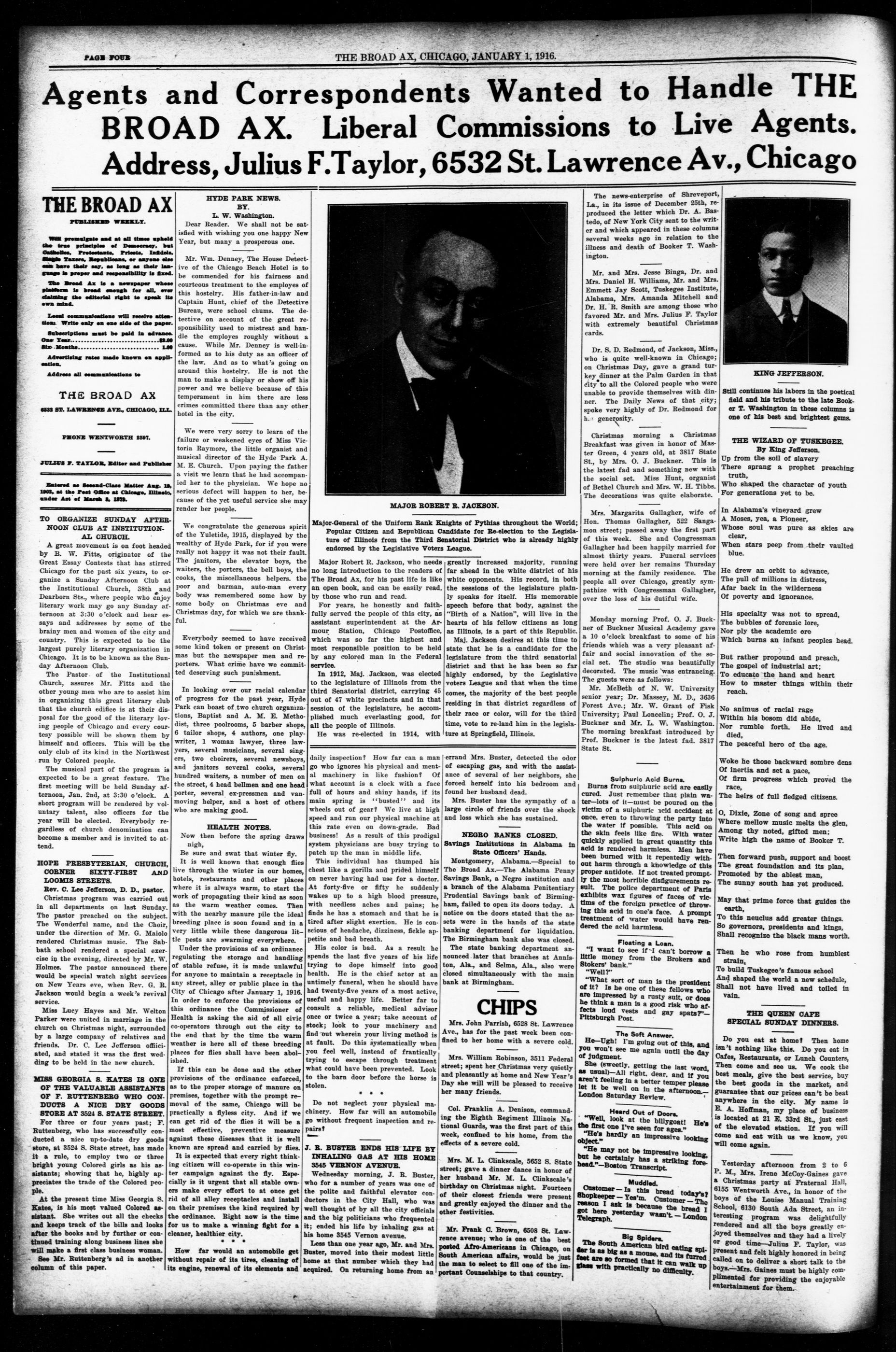
MAJOR ROBEET R. JACKSON.
Major-General of the Uniform Rank Knights of Pythias throughout the World, Popular Citizen and Republican Candidate for Re-election to the Legislature of Illinois from the Third Senatorial District who is already highly endorsed by the Legislative Voters League.
Major Robert R. Jackson, who needs no long introduction to the readers of The Broad Ax, for his past life is like an open book, and can be easily read, by those who run and read.
For years, he honestly and faithfully served the people of this city, as assistant superintendent at the Armour Station, Chicago Postoffice, which was so far the highest and most responsible position to be held by any colored man in the Federal service greatly increased majority, running far ahead in the white district of his white opponents. His record, in both the sessions of the legislature plainly speaks for itself. His memorable speech before that body, against the "Birth of a Nation", will live in the hearts of his fellow citizens as long as Illinois, is a part of this Republic.
Maj. Jackson desires at this time to state that he is a candidate for the legislature from the third senatorial district and that he has been so far
In 1912, Maj. Jackson, was elected to the legislature of Illinois from the third Senatorial district, carrying 45 out of 47 white precincts and in that session of the legislature, he accomplished much everlasting good, for all the people of Illinois. He was re-elected in 1914, with highly endorsed, by the voters League and that will comes, the majority of the residing in that district in their race or color, will fill time, vote to re-land him in ture at Springfield, Illinois.
daily inspection? How far can a man go who ignores his physical and mental machinery in like fashion? Of what account is a clock with a face full of hours and shiny hands, if its main spring is "busted" and its wheels out of gear? We live at high speed and run our physical machine at this rate even on down-grade. Bad business! As a result of this prodigal system physicians are busy trying to patch up the man in middle life. This individual has thumped his chest like a gorilla and prided himself on never having had use for a doctor. At forty-five or fifty he suddenly wakes up to a high blood pressure, with needless aches and pains; he finds he has a stomach and that he is tired after slight exertion. He is conscious of headache, dizziness, fickle appetite and bad breath.
His color is bad. As a result he spends the last five years of his life trying to dope himself into good health. He is the chief actor at an untimely funeral, when he should have had twenty-five years of a most active, useful and happy life. Better far to consult a reliable, medical advisor once or twice a year; take account of stock; look to your machinery and find out wherein your living method is at fault. Do this systematically when you feel well, instead of frantically trying to escape through treatment what could have been prevented. Look to the barn door before the horse is stolen.
Do not neglect your physical machinery. How far will an automobile go without frequent inspection and repairs!
J. R. BUSTER ENDS HIS LIFE BY INHALING GAS AT HIS HOME 3545 VERNON AVENUE.
Wednesday morning, J. R. Buster, who for a number of years was one of the polite and faithful elevator conductors in the City Hall, who was well thought of by all the city officials and the big politicians who frequented it; ended his life by inhaling gas at his home 3545 Vernon avenue.
Less than one year ago, Mr. and Mrs. Buster, moved into their modest little home at that number which they had acquired. On returning home from an
---
Knights of Pythias throughout the World; Candidate for Re-election to the Legislia-Senatorial District who is already highly ers League.
is greatly increased majority, running far ahead in the white district of his white opponents. His record, in both the sessions of the legislature plainly speaks for itself. His memorable speech before that body, against the "Birth of a Nation", will live in the hearts of his fellow citizens as long as illinois, is a part of this Republic.
Maj. Jackson desires at this time to state that he is a candidate for the legislature from the third senatorial district and that he has been so far highly endorsed, by the Legislative voters League and that when the time comes, the majority of the best people residing in that district regardless of their race or color, will for the third time, vote to re-land him in the legislature at Springfield, Illinois.
errand Mrs. Buster, detected the odor of escaping gas, and with the assistance of several of her neighbors, she forced herself into his bedroom and found her husband dead.
Mrs. Buster has the sympathy of a large circle of friends over the shock and loss which she has sustained.
NEGRO BANKS CLOSED
Savings Institutions in Alabama in State Officers' Hands.
Montgomery, Alabama.-Special to The Broad Ax.-The Alabama Penny Savings Bank, a Negro institution and a branch of the Alabama Penitentiary Prudential Savings bank of Birmingham, failed to open its doors today. A notice on the doors stated that the assets were in the hands of the state banking department for liquidation. The Birmingham bank also was closed. The state banking department announced later that branches at Anniston, Ala., and Selma, Ala., also were closed simultaneously with the main bank at Birmingham.
CHIPS
Mrs. John Parrish, 6528 St. Lawrence Ave., has for the past week been confined to her home with a severe cold.
Mrs. William Robinson, 3511 Federal street; spent her Christmas very quietly and pleasantly at home and New Year's Day she will will be pleased to receive her many friends.
Col. Franklin A. Denison, commanding the Eighth Regiment Illinois National Guards, was the first part of this week, confined to his home, from the effects of a severe cold.
Mrs. M. L. Clinkscale, 5652 S. State street; gave a dinner dance in honor of her husband Mr. M. L. Clinkscale's birthday on Christmas night. Fourteen of their closest friends were present and greatly enjoyed the dinner and the other festivities.
Mr. Frank C. Brown, 6508 St. Lawrence avenue; who is one of the best posted Afro-Americans in Chicago, on South American affairs, would be just the man to select to fill one of the important Counselships to that country.
The news-enterprise of Shreveport, La., in its issue of December 25th, reproduced the letter which Dr. A. Bastedo, of New York City sent to the writer and which appeared in these columns several weeks ago in relation to the illness and death of Booker T. Washington.
Mr. and Mrs. Jesse Binga, Dr. and Mrs. Daniel H. Williams, Mr. and Mrs. Emmett Jay Scott, Tuskegee Institute, Alabama, Mrs. Amanda Mitchell and Dr. H. R. Smith are among those who favored Mr. and Mrs. Julius F. Taylor with extremely beautiful Christmas cards.
Dr. S. D. Redmond, of Jackson, Miss., who is quite well-known in Chicago; on Christmas Day, gave a grand turkey dinner at the Palm Garden in that city to all the Colored people who were unable to provide themselves with dinner. The Daily News of that city; spoke very highly of Dr. Redmond for his generosity.
Christmas morning a Christmas Breakfast was given in honor of Master Green, 4 years old, at 3817 State St., by Mrs. O. J. Buekner. This is the latest fad and something new with the social set. Miss Hunt, organist of Bethel Church and Mrs. W. H. Tibbs. The decorations was quite elaborate.
Mrs. Margarita Gallagher, wife of Hon. Thomas Gallagher, 522 Sangamon street; passed away the first part of this week. She and Congressman Gallagher had been happily married for almost thirty years. Funeral services were held over her remains Thursday morning at the family residence. The people all over Chicago, greatly sympathize with Congressman Gallagher, over the loss of his dutiful wife.
---
Monday morning Prof. O. J. Buckner of Buckner Musical Academy gave a 10 o'clock breakfast to some of his friends which was a very pleasant affair and social innovation of the social set. The studio was beautifully decorated. The music was entrancing. The guests were as follows: Mr. McBeth of N. W. University senior year; Dr. Massey, M. D., 3636 Forest Ave.; Mr. W. Grant of Fisk University; Paul Loncelin; Prof. O. J. Buckner and Mr. L. W. Washington. The morning breakfast introduced by Prof. Buckner is the latest fad. 3817 State St.
一
Sulphuric Acid Burns.
Burns from sulphuric acid are easily cured. Just remember that plain water—lots of it—must be poured on the victim of a sulphuric acid accident at once, even to throwing the party into the water if possible. This acid on the skin feels like fire. With water quickly applied in great quantity this acid is rendered harmless. Men have been burned with it repeatedly without harm through a knowledge of this proper antidote. If not treated promptly the most horrible disfigurements result. The police department of Paris exhibits wax figures of faces of victims of the foreign practice of throwing this acid in one's face. A prompt treatment of water would have rendered the acid harmless.
Floating a Loan.
"I want to see if I can't borrow a little money from the Brokers and Stokers' bank."
"Well?"
"What sort of man is the president of it? Is he one of these fellows who are impressed by a rusty suit, or does he think a man is a good risk who affects loud vests and gay spats?"—Pittsburgh Post.
The Soft Answer
He-Ugh! I'm going out of this, and
you won't see me again until the day
of judgment.
She (sweetly, getting the last word,
as usual)—All right, dear, and if you
aren't feeling in a better temper please
let it be well on in the afternoon.
London Saturday Review
Well, look at the billygoat! He's the first one I've seen for ages.
"He's hardly an impressive looking object."
"He may not be impressive looking, but he certainly has a striking forehead."—Boston Transcript.
Muddled.
Customer—Is this bread today's? Shopkeeper—Yes'm. Customer—The reason I ask is because the bread I got here yesterday wasn't.—London Telegraph.
Big Spiders
The South American bird eating splider is as big as a mouse, and its furred feet are so formed that it can walk up glass with practically no difficulty.
KING JEFFERSON.
Still continues his labors in the poetical field and his tribute to the late Booker T. Washington in these columns is one of his best and brightest gems.
Up from the soil of slavery There sprang a prophet preaching truth, Who shaped the character of youth For generations yet to be.
Whose soul was pure as skies are clear,
When stars peep from their vaulted blue.
He drew an orbit to advance,
The pull of millions in distress,
Afar back in the wilderness
Of poverty and ignorance.
His specialty was not to spread,
The bubbles of forensic lore,
Nor ply the academic ore
Which burns an infant peoples head.
But rather propound and preach,
The gospel of industrial art;
To educate the hand and heart
How to master things within their reach.
No animus of racial rage
Within his bosom did abide,
Nor rumble forth. He lived and
died,
The peaceful hero of the age.
Woke he those backward sombre dens
Of inertia and set a pace,
Of firm progress which proved the
race,
The heirs of full fledged citizens.
O, Dixie, Zone of song and spree
Where mellow music melts the glen,
Among thy noted, gifted men;
Write high the name of Booker T.
Then forward push, support and boost
The great foundation and its plan,
Promoted by the ablest man,
The sunny south has yet produced
May that prime force that guides the earth,
To this neuclus add greater things.
So governors, presidents and kings,
Shall recognize the black mans worth.
Then he who rose from humblest strain,
To build Tuskegee's famous school
And shaped the world a new schedule,
Shall not have lived and toiled in vain.
THE QUEEN CAFE
SPECIAL SUNDAY DINNERS
Do you eat at home? Then home isn't nothing like this. Do you eat in Cafes, Restaurants, or Lunch Counters, Then come and see us. We cook the best meals, give the best service, buy the best goods in the market, and guarantee that our prices can't be beat anywhere in the city. My name is E. A. Hoffman, my place of business is located at 21 E. 33rd St., just east of the elevated station. If you will come and eat with us we know, you will come again.
Yesterday afternoon from 2 to 6 P. M., Mrs. Irene McCoy-Gaines gave a Christmas party at Fraternal Hall, 6155 Wentworth Ave., in honor of the boys of the Louise Manual Training School, 6130 South Ada Street, an interesting program was delightfully rendered and all the boys greatly enjoyed themselves and they had a lively or good time—Julius F. Taylor, was present and felt highly honored in being called on to deliver a short talk to the boys.—Mrs. Gaines must be highly complimented for providing the enjoyable entertainment for them.
Health,
Cleanliness
Proper Living
Sanitation, Etc.
by
DR. W. A. DRIVER
3300 So. State St.
Phone Douglas 3617
TUBERCULOSIS
Tuberculosis is like almost all processes and events in the world of reality, in this journey from the cradle to the grave aptly called the battle of life. It follows definitely the axiom which says: "Coming events cast their shadows before." It gives us a number of warnings but many of us are not sufficiently evolved to understand them.
Although the disease is caused primarily by predisposing factors, the germ called the bacillus tuberculosis is the real factor, the determining cause. In the study of tuberculosis we see a multitude of evidences that exemplify the scientific principle of cause and effect. The germ of tuberculosis is almost powerless before a person who lives a careful life; on the other hand the tubercle bacillus is powerful as a destructive force upon the bodies of those who do not live carefully.
The germ is always in the air of unsanitary, overcrowded places and those who frequent such places will often introduce the deadly bacillus or germ of tuberculosis—consumption—into their systems by the act of breathing. But if their resistance to disease is kept up to standard by proper living they will be able to overcome the germ and the consequent misery.
A neglected cold, neglected cough, improperly treated, la gripe, bronchitis, “sore throat,” neglected diseases of various type often lead to lung or pulmonary tuberculosis, the old fashioned galloping consumption. Measles is often the starting point of tuberculosis. Whooping-cough is also often followed by the dread disease.
It takes two people to make a quarrel, but one can often make more trouble than two can settle.
As a last resort we could commander the annual output of the American hen and defy the world.
Getting along with your neighbors is a comparatively simple task. All you've got to be is a good neighbor.
Thousands of young husbands will welcome with shouts of joy the news that dish wiping has been pronounced insanitary.
A woman writer says flirtation is one of the greatest games in the world. It is one of the few games in which both players can lose.
Animal Oddities.
Sturgeon have no teeth.
The biting apparatus of a flea is only one-twelfth the diameter of the finest needle.
Ducks carry oil in a little pocket near the tail. With this they oil their outer feathers and so make them waterproof.
Kangaroos, of which there are fifty-six species, can sometimes leap as much as twenty feet. The male kangaroo stands from six to seven feet high.
A rhinoceros rolls in the mud because little insects get between the folds of its skin and痒 it. If it gets its body covered with mud they are unable to reach the skin.
Recent Inventions.
An attachment for scissors has been patented to enable them to be used to sharpen lead pencils. A new serving fork has a piece which can be pushed down along the lines without the fingers touching the food. Made of a flat steel spring, a quickly adjusted belt has been invented to take the place of strings on kitchen or laboratory aprons. For copying drawings or writings a device has been patented that follows the lines to be copied and at the same time guides a pen or pencil.
Current Comment.
California has taught the world how to make an exposition pay.—Philadelphia Record.
We'll get some straw votes on the presidential candidates soon, and then we will know no more about it than we do now.—Philadelphia Press.
Miss Liberty in New York harbor is to have a fine suit of paint and gold leaf. But, alas, she will charm very few newcomers nowadays.—Cleveland Plain Dealer.
A. E. H.
The terminal stage of a large number of affections is pulmonary tuberculosis, notably diabetes and chronic bronchitis. No age is exempt; no race variety is exempt but as low wages and long hours of excessive physical exertion as well as the other concomitants of poverty predispose to the disease it is obvious that the race varieties seem to vary in susceptibility. Those race varieties which get good pay and short hours at clean work have less tuberculosis. Osler says: "The American Indians have a death rate more than double that of the whites. He also says that the "negroes" (he does not spell it with a capital letter as the Chicago daily newspapers have recently learned to do) also have an extraordinarily high death rate particularly in the cities. The Irish, both at home and in the United States, are more prone to the disease than other European races. He continues by saying that the rate in Ireland has increased, and in America the mortality is double that of the next highest European race. The Italians in the large American cities show a very high death rate. The Jews everywhere have a low mortality from consumption—about one-half that of Christians which Fishberg attributes to their adaptation to city life for the past two thousand years."
Thus we see there is an economic cause of exceedingly great importance. We must not forget that we must secure better wages and conditions of employment. The man farthest down is more susceptible to consumption because he is the victim of poverty and its concomitant misery.
Miss Ora Harris of Pittsburgh has taught twenty-five years in a school for the blind.
Miss Mary S. Boyd, chief of the data department of the National American Woman Suffrage association, is known as "the woman who answers questions."
Mme. Rejane is one of the quickest "studies" among great actresses. She can commit a long passage to memory by reading it over twice. But it may take her weeks to decide how to render it.
Dr. Laura M. Riegelman, attached to the New York board of health, will not live opposite a vacant lot, have carpets or wall paper or rent an apartment without studying the soil upon which it stands—health precautions; that is all.
Mrs. Mary Warren has the job of looking over the wastebaskets of the treasury department. For more than thirty years she has sat at her desk in a small back room in the treasury building, carefully examining every bit of refuse taken from the offices.
Echoes of the War.
If there is an "emperor of Europe" he'll have a throne of ruins.—Atlanta Constitution.
The sultan of Turkey has a wonderful system of letting the other man walk the floor.—Washington Star.
Kings will be fortunate in becoming sick of war before the common people become sick of kings.—Washington Post.
King Alfonso is still firm in his contentions that Spain is neutral—and how earnestly he hopes that neither side will have cause to doubt it!—Detroit News.
The war is costing the European nations $25,000,000 a day. And the people, who have little say about it, pay the freight in blood and cash.—Baltimore American.
PITH AND POINT.
You will never be accused of cheating at cards as long as you lose.
Being square with a man is quite different from getting square with him.
It is noticed that most of the dunces in the school of experience are night pupils.
When you get to the point where you are able to make both ends meet spilce the ends.
If people consulted their consciences more they would have to consult lawyers less.
When you find that the truth is in your way you may be sure that you are on the wrong road.
THE BROAD AX, CHICAGO, JANUARY 1, 1916
Charles E. Stump, Has Within the Last Ten Days Travelled From Shreveport, La. and Other Points in That Section of the South to Roanoke, Va., Where He Will Tarry for a Short Time
When I took my pen in hand to write to you and inform you of my health, I was in Shreveport, La., the extreme Sunny South, and this week I am sitting up in Chicago looking at the snow and ice, and since I have had a taste of the south, and of Jim Crowism, I think I shall return at once and look into matters there, seeing what I can see and hearing what I can hear.
I remained in Shreveport until the close of the North Louisiana conference, and then bright and early I started for this place. I should have left at 3 o'clock in the morning, but it seems that the iron horse had found some way to get angry, and he was an angry old fellow, and they could not control him, so he did not get to Shreveport until 8 o'clock, so I had to ride all day Sunday going to New Orleans, and did not get to see in a single church.
Reaching town, I went to the parsonage of St. James A. M. E. church, Rev. M. R. Dixon pastor, and he toted me over to a boarding house, where I spent the night. I shall not have anything to say about New Orleans, because I did not get to see much. They have a mighty big city there and there are many mighty big doings, but they have Jim Crowism down to perfection on the street cars there.
Getting on the cars there were two short end seats, large enough to hold one person each, and on the back of the next seat was a little screen containing "For Colored patrons only." I started to use a "cuss" word, but I remembered who I was and what I was and did not say a single thing about it, but just took my seat like a little man, for none of these things could crush my manhood. There was a man riding behind a screen the way I felt and acted about it.
The next morning I left on the L & N., road, and I tell you I could hardly believe myself, because the accommodation was so superior. They had a nice big waiting room, a large table in it, chairs, I think, and every accommodation for a passenger. Then when I went to get on that wagon. It was a clean, steel, chair car, smoking room, wash bowl, and everything else. I hardly knew how to sit down. It was just simply fine, and that is putting it in mild terms.
It was just like being in a bed, I threw my chair back and slept like a good fellow, believe me. I remained in that position until I got to Mobile, and decided to get off there for a few hours. I had been invited to visit there by Miss Daisy E. Jackson, the fast writer. Miss Jackson is what you call a stenographer. She does her writing with a machine; and I wish you could see her fingers dance the Highland fling. She writes with a pencil in little scratches and marks, that I could not read a word of it.
She was working for Editor B. G. Davis, of Odd Fellow fame, but resigned and returned home. She is with her mother and sister. They have a lovely home, and I enjoyed the short time I staved there.
Mobile is a hustling place. Up until President Wilson went into office all the mail carriers belonged to our race. But then when Democrats got hold they told the young white men to take the examination and some of them would be appointed, and they were appointed, let me tell you.
Out into the streets, I met Rev. C. L. Fisher, visited the Undertaking establishment of Knox Brothers. These are two young men, and it was wonderful to see how those young men were pulling and working together. They had confidence in each other. They sleep together, work together, and are making wonderful progress.
To my way of thinking Dr. H. Roger Williams, of Mobile is one of the best and greatest physicians of our race. He has a large drugstore in Mobile. He shows what a man can do for himself and with himself. Dr. Williams was not born with a silver spoon in his mouth but had to make his way.
He had to work his way through school, and then work his way on up to the higher things in life. He finished at Meharry Medical College. He has his car, his fine horses, and is in everything that means progress of his race. He is a good christian man, and active in the Methodist Episcopal church, but when the people want anything done there they call on him. He is one of the best doctors, and perhaps the only one in Mobile who is active in racial matters.
Knox Brothers were preparing for the funeral of Albert Boyd, who was the pioneer in undertakers in that section. They had a casket for him which cost $500, gold handles, metal filling and I can't tell you what else. Mrs Sarah J. Duncan is another important character in the city. I was delighted to have the pleasure of seeing and meeting her. She is a great woman.
From Mobile, I went to the city of Birmingham, Ala., and spent a few hours there, the guest of that great physician, Dr. U. G. Mason. I have told you about him before. You remember what I told you about his office and about his stenographer, Miss Sullivan. She is one woman who knows how to be an office girl right. She is deaf, dumb and blind, when it comes to the business of Dr. Mason. You can't get a word of information from her, and I thought it was just awful. I am sure you will agree with me about this. No, it is the kind of office help we need in this world and I am proud that we have it in Miss Sullivan. She is some entertainer.
I visited one of the schools there in Birmingham, and a number of teachers were taking the state examination. I looked in there. A white man was in charge. After spending a little time there, I came out and got on that L. & N. again, for Louisville, passing through Nashville, and ending in Louisville. In Louisville I was the guest of Mr. and Mrs. W. H. Steward. He is the editor of the American Baptist and his wife is teacher of music in the State University.
Things were looking fine around his home, and when I asked something about it, I was informed that his baby girl, Miss Carolyn had just married Prof. J. O. Blanton, of the city high school. Mrs. Blanton, was once a teacher in the high school herself, and she made some friends and progress. She was considered one of the best high school teachers, and regrets were expressed when she resigned to become a wife. I will bet you my head to doughnuts that Mr. Blanton was not sorry, for when I saw him he was looking that something glad around a meat house. He has won for himself a jewel, and I congratulate him.
I spent all day there, and had the pleasure of meeting some of the leading men of Louisville, but will not be able to tell you all of them, and as I go back that way will let you know a few other things in my next letter. I left Louisville in a bed car headed for this place: I reached Chicago Thursday morning, in plenty time for Christmas. Friday I went out to meet some of the people, and stumbled in Ebenezer Baptist church. I had the pleasure there of meeting Rev. J. F. Thomas, and learned something about the great work he is doing in the church and for the people. He is one of the finest preachers of our race, and then he is a man who believes in doing things. He believes that the church should help the poor and his church is noted for that thing, hear me.
He seemed to be a busy man, but shook my hand wanted to know what he could do for me. I told him that I was Charles E. Stump from Kansas, and I wish you could have seen him taking another shake. He used to be in Kansas himself a long time ago. He was delighted to see me. He showed me into the Sunday school room and there were people eating soup. I saw a number of well filled baskets. A committee of ladies were busy handing
them out. These women were of the city. They had investigated the condition of each applicant, and had a basket for them, and each basket had a chicken in it and other good things. Of course they did not give me any. Then there were another committee giving out clothes, and Dr. Thomas himself was supplying the poor with coal. That is doing practical church work, and that is the kind of religion that calls for something. I was delighted to see all of this myself.
I want to here congratulate Dr. Thomas. I went on up the street and met Undertaker McGavick, and while in his place, I met the son of Bishop Tyree, Editor Abbott, of the Defender, and some others. It would take a whole paper to tell you all I met. I met plenty snow too.
Sunday I went to Quinn chapel to hear that lecture by Charles Stewart. I promised him that I would be there and I was there. It was a fine body of men who were there, and I am proud that I went there and was a part of that big crowd of men. Dr. J. C. Anderson, conducted the opening, and then there was a man by the name of _____ who was chairman of the committee and presided, introducing Mr. Stewart. I enjoyed the speech, and then I enjoyed what Hon. H. Roberts said after it was all over.
I am not going to tell all I saw in Chicago, for I will not have anything to say next time. Sunday morning I went to hear Dr. J. F. Thomas preach, and he is some preacher, believe me. I regret that I must leave this big town. I went to see Bishop Parks, because he had invited me to come to see him when I came to Chicago. Mrs Parks is just a queen in her home. I met Miss Ruth Parks, and then as I was leaving I met the other daughter, Miss Naoma Parks. She is the busy one. Bishop Parks is just a prince in his home, and I shall never forget him.
Called on James Hale Porter, Hon. F. L. Barnett, and others but they were not at home. Then I saw some of the other affairs in Chicago. I called to the Phillis Wheatley home. This is under the Phillis Wheatley Home Association, and in charge is Miss Jennie Lawrence, who used to go to school in North Carolina, and got some education there. She is well qualified for the position. Then she can do some running too. I am not going to tell you all about my visit there. A man visited the home, and Miss Lawrence served me with a great big hunk of cake, and it was some fine cake. I looked in the Y. W. C. A., called on Dr. and Mrs. W. F. Lawton, and now I am headed for the other places.
I must tell you that I had the pleasure of meeting Dr. Frank Armstrong, on West Lake Street. He had just taken unto himself a bride. He married Miss Jessie M. Lucas, one of the leading young women of Chicago. For a long time Miss Lucas served in the Recorder's office, and since she has been staying at home. She is some writer, believe me when I tell you. Dr. Armstrong has a lucrative practice because he is a good doctor. I met Dr. A. L. Smith, and many others. I will leave some for the next time.
I must tell you about the printing plant of B. W. Fitts, a young man who came to Chicago a long time ago from Alabama, and got a job with F. L. Barnett, and now he is an employer himself. Right by his side is to be found his cultured wife, who is some printer herself. I may tell you more about them in another letter.
"Fire on the Mountain."
In this game there are two rings of players, one outside the other. The players forming the inner ring sit down, and those in the outer ring stand close behind them, though there should be a good wide space between the two rings. A single player stands in the center and presently calls out: "Fire on the mountain! Run, run, run!" Those on the outside then gallop round as fast as they can, the rest sittling still, and the running is continued till the one in the center cries "Stop." Then everybody, including the single player, tries to find a place behind one of the inner ring, and the boy or girl who is left out must take his or her turn in the center.
Eight Good Riddles.
The Cat's Tongue.
A cat can quickly empty a saucer of milk because at every swift dart of her flexible little tongue the tip of it curls up as it enters the fluid and draws it back into her mouth. Her rough barbed tongue, like a little file, enables her to get every particle of food from a bone by licking it. It answers for a wash rag, too, with which to make her long and elaborate toilet.
PAGE FIVE
Effect of Familiarity.
"What we see constantly we cease to see vividly. The faces we notice least are those we know—and perhaps really love—best. Our eyes are a bit jaded by following the familiar lines. "The same is true of pure color," says a writer in the Atlantic Monthly. "Water and sky are very beautiful, and you may suppose that you are duly appreciative of them, but lie on the deck of a catboat and look at them with your head in an unaccustomed position—sideways and upside down—and note how the colors flare out upon your vision. "Or stay indoors for a few weeks in a room where you do not get much outlook and then go out. You will be blinded by the glory of the world, but not for long. The glory, alas, fades quickly, and habit settles upon you once more!
"With our friends' faces somewhat the same thing happens. When we first meet them they pique us pleasantly with their unfamiliar line and color. Gradually we grow used to them. The first vision has passed."
Mounting a Horse.
In mounting take the reins in the left hand. At the same time grasp a little mane halfway up the neck. Now turn the stirrup slightly toward you with the right hand and place the ball of the left foot in it. Grab the horn with the right hand and swing on. Don't pull yourself on, but swing on. Settle into the saddle easily; don't flop into it. If you want to get "your neck broke" some time mount by taking the horn in one hand and the cantle in the other, and the time will surely come when you will not be disappointed.
Just a word in regard to dismounting. First withdraw your feet from the stirrups to the ball. Take the horn in the right hand and swing off, letting the left foot slip easily and quickly from the stirrup. Remember this, for many a man has been dragged to death because his foot stuck in the stirrup. Your feet will nearly always come free if thrown from a horse, but the left one is prone to stick in dismounting unless the above precaution is observed.—Outing.
An Analysis of "Ain't"
"Ain't" is an improper abbreviation of "are not." British writers spell it "a'n't," which properly indicates its derivation. Americans make it an inclusive offense, using it for "am not" and "is not," as well as for "are not." It is unquestionably the worst instance of slovenliness in the common speech of today.
Yet it is by no means of universal or even of common use. It will slip occasionally from refined lips, always with a jar to the enunciator as well as to the hearer. But the habitual user of "ain'ts" is careless of refinement. He may be an excellent citizen who never beats his wife or kicks the cat. But there is likely to be something slipshod about him somewhere, for "ain'th" is needless as well as cacophonous; it fills no void and supplies no need—Cleveland Plain Dealer.
Mark Twain as "Attraction."
A girl who was a stranger to Mark Twain once found her way into his Bermuda home with the hope of getting a sight of the author. She came suddenly in contact with him and frankly explained her errand.
"Have you seen the crystal cave yet," he asked, "or the aquarium?" "No; I came to see you first," she answered.
"Well, you shouldn't have seen me first," he answered. "I run in opposition to the crystal and the aquarium. But they're not shucks to me. I'm lots better. I give them their money's worth. But you should see them. Then you'll appreciate me."
This was said in his most earnest drawl and with only a sparkle of humor in his keen blue eyes.
The Real Thing.
Fred, aged three, had been a naughty boy, and his mother had punished him. He felt very much hurt and complained to his auntie about mamma's spanking him. Auntie said, "It is not you that mamma spanks, but a little devil inside of you who makes you do naughty things." After sitting very still for five minutes he said, "It beats all how it hurts me when that devil gets spanked."—Delineator.
A Great Copper Mine
For nearly 700 years copper ore (chalcopyrite) has been taken regularly from a mine in the province of Dalecarila, Sweden. The mine contains the largest copper ore deposit in Sweden and is supposed to be one of the greatest chalcopyrite properties in the world.
Our Trials.
"You know, my dear boy," said a sympathizing friend to a man in trouble, "that we really gain by our trials in life."
"That depends altogether on the kind of lawyer you get to conduct them," replied the sufferer.
Different Methods
There are two different kinds of men. Give one a piece of rope and he will hang himself; give a similar piece to the other and he'll form a cordage trust. —Washington Star.
A Real Artist.
"Is Brushen a good artist?"
"Is he good? Why, he not only can draw pictures that are good, but he can draw checks that are good."—Pittsburgh Post.
By medicine life may be prolonged, yet death will seize the doctor too.—Shakespeare.
PAGE 81X
Humors of Indexing.
Quite as bad as the cryptic alphabetical headings under which important subjects are sometimes hidden in an index are the delusive cross references that lead to nothing. The present writer, looking up the subject of silver plate in an index, read "silver plate, see gold plate," then "gold plate, see plate," then "plate, see hallmarking," then "hallmarking, see plate marks," and finally "plate marks, see silver plate," which brought him back to where he had started. The most curious freak of indexing in my experience, writes a correspondent, was detected in the course of revising and arranging a collection of obituary articles which had been neglected. I searched in vain for Queen Victoria in that index, though it was certain that her majesty's life was included in the collection. But neither under "Q" nor under "V" was it to be found. Finally it was discovered accidentally under "T"—"The Queen!" — London Chronicle.
The Soft Answer
"Yes, I'll take Jim's note for a hundred any time," said a banker when an offer to sell a note to the bank was made.
"I want to warn you, though," said the man in whose favor the note had been drawn, "that Jim is a good promoter, but a poor payer. I don't want you to have anything against me because of this note."
"Jim's honest, and I'll take his note for a reasonable amount any time," said the banker. "I had some trouble with him once over an overdraft, and it turned out that the bank was at fault and that he had not actually overdrawn. I'll admit I was pretty nasty in my talk to him about it, because I was so sure the bank was right. The average man under those conditions would have 'cussed' me out at least, but all Jim said, although he was madder than thunder, was, I don't see why your wife ever married you!" —Indianapolis News.
How the Milliner Got Even.
A local business man, who has a friend in a nearby town who is a milliner, told a story of how the latter once got "even" with one of the leading social lights of the place after she had tried to be unfair with him. The husband of the woman in question had a bit of hard financial sledding, and during the "reconstruction" period she had to go light on clothes. So one day she had the milliner send up some of his best hats on approval, which he did. She sent them all back, but in a few days appeared on the street with a duplicate of the most expensive one of all, which she had evidently made herself. In that town there is a middle aged woman of uncertain mental qualities and unquestionable poverty who is more or less of a town character. To her the milliner gave the original of the duplicated hat, much to the discomfort of the social queen, who apparently saw the point. - New York Times.
The Capitol Dome
The capitol dome at Washington is the only considerable dome of iron in the world. It is a vast hollow sphere weighing 8,000,300 pounds. How much is that? More than 4,000 tons, or almost the weight of 70,000 full grown persons, or about equal to 1,000 laden coal cars of four tons each, which, if strung out one behind the other, would occupy a mile and a half of track. On the very top of the dome the allegorical figure "America," weighing 13,985 pounds, lifts its proud head high in the air. The pressure of this dome and figure upon the pliers and pillars is 14,477 pounds to the square foot. It would, however, require a pressure of 755,286 pounds to the square foot to crush the supports.
Appropriate
Lord Dunraven in his younger days, when he was known as Lord Adare, speculated in the theatrical enterprises, but his success in this direction was not unfortunately equal to his enthusiasm. One day a certain well known wit was asked to give a title to one of his lordship's plays. "Well," he answered, "why not call it Robin Adair?"
Mental Dyspepsia
" 'Reading maketh a full man.' " quoted the philosopher. "No doubt that's true," replied the cynic, "but the result is not always satisfactory."
"Why not?"
"I've met a great many people in my time who were crammed full of undigested literature." — Birmingham Age-Herald.
Russian Wolfhounds
the swiftest dog in the world, the borzoi, or Russian wolfhound, has made record runs that show seventy-five feet in a second, while the gazelle has shown measured speed of more than eighty feet a second, which would give it a speed of 4,800 feet in a minute if the pace could be kept up.
The Unfailing Remedy:
Anxious Father—Can you tell what alis my daughter? Doctor—She does not take enough outdoor exercise. Father—She does not feel like it. Doctor—True, so she needs toning up. Father—What do you recommend? Doctor—A new hat!-Exchange
The Way of Bride
"Well," he exclaimed as he shook the dust of the road off himself, "that was some fall, anyhow."—Detroit Free Press.
Easy places do not make for growth anywhere, and he who ceases to grow begins to deteriorate.
The Founding of Frankfort.
The beautiful German commercial city of Frankfort on the Main is said to have had a curious origin.
When the Emperor Charlemagne contended with the Saxons the fortunes of war were often against him. On one occasion he was forced to retire along the banks of the Main. At the time there was a thick fog, and he was unable to find his ship or any place where his army could cross.
He was almost in despair when a doe, carrying a young one, sprang from a thicket in alarm, leaped into the stream and swam over. Charlemagne followed the example and crossed at the same place. The fog concealed the army, which escaped detection.
When the emperor reached the shore he stuck his spear into the earth and exclaimed:
"Here shall a city arise, to be called Frankenford!"
In consequence of crossing the stream he overthrew the Saxons. He then built the town, which afterward became the scene of imperial coronations and later of great commercial importance.-London Answers.
Checkers.
The German name for the game of checkers or dights is "damenbrett"—ladies' board—probably "damen" for short. Some form of "dame" is used in almost every country where the game is played, except the English speaking countries, and the Scots still speak of the "dambrod." "Dames" was the name in England for a time, and we find it in an English book toward the end of Elizabeth's reign. The first use of the word draughts in existing literature is about 1400. At a later day "checkers" became another name, and this went to America with the early English emigrants and there became the usual name. In England in the sixteenth century the game had three names—"dames," "draughts" and "checkers." At an earlier period "checkerle," "chekar," etc., had been English names for chess—London Mirror.
Snails Are Queer Creatures
The snail is found everywhere, over 3,000 species being known. Some of the large tropical snails, as bullmas, form nests of leaves, their eggs being as large as a pigeon's. The snail is extremely skillful in mending its shell, and some curious experiments may be made with them. Thus I have seen a helix of a yellow species attached to another shell of a reddish hue by cutting off the top whorl of the latter, when the snail will proceed to weld the two shells together and occupy both, using the addition as a door and possibly wondering at this sudden extension of its house. In the winter some of the snails hibernate or lie dormant until warm weather. A snail of the Philippine Islands has a faculty of throwing off its tail when seized. This is also true of a West Indian variety, stenophus—London Telegraph.
Euclid's Lost Books.
"I was very much amused at the comment of a young friend who recently went up against the board of examiners for the naval service," said a Philadelphia man. "Speaking of the questions in geometry which were propounded to the boys, this youngster said in a dry way:
"‘History tells us that the old discoverer of the science of geometry, Euclid, who lived 300 years before Christ, wrote something like twenty books, which he called “Elements,” and that of this number seven were lost. The examining board of the marine corps has found those books, for the questions it put to us two weeks ago clearly demonstrated that it dug up some theorems which had not been seen in the last 2,000 years.’"—Pittsburgh Dispatch.
Repelling Fire With a Drum.
A fire of a strange nature appeared in Wales in 1693. According to the most intelligible account concerning it now in existence, it came up from the sea near Harlech. At several places near that place and all over Merlionethshire it did much damage, burning hay, houses, barns, etc. A person writing of it said: "The grass over which it moves kills all manner of cattle that feed upon it. But what is most remarkable is that any great noise, such as the beating of a drum or sounding a horn, effectually repels it from any house."
Excusable.
Judge—Why did you hit this gentleman? Defendant—Well, Judge, I haven't had a vacation for six years, and this boob has been sending me picture postals from Palm Beach, Thousand islands, California and the orient all these years—New York Globe.
Present and Example
Johnny (at the window)—Oh, ma, an automobile just went by as big as a barn. His Mother—Johnny, why do you exaggerate so? I've told you a million times about that habit of yours, and it doesn't seem to do a bit of good.—Boston Transcript.
The Wayaide Dreamer
Stay too long in the land of dreams and when you wake up you'll realize that the world is at a starry station a million miles ahead of you.-Richmond Times-Dispatch
Thankful
"There isn't a bit of coal or wood in the house, and the gas is turned off." "Hurrah! Then the cook can't burn the dinner!" -Philadelphia Ledger.
Suggestive
Mary (aged six) — Uncle Charlie, I wish you many happy returns of your birthday, and mamma said that if you gave me a dollar not to lose it.
THE BROAD AX. CHICAGO. JANUARY 1. 1916.
Right, but Wrong.
The late Professor Thomas R. Lounsbury of Yale, speaking at Cambridge, England, on the proper use of English, according to the Philadelphia Bulletin, said:
"But precision can be carried too far. The ultra precise, even when logically right, are really wrong.
"An ultra precise professor went into a hardware shop and said, 'Show me a shears, please.'
"You mean a pair of shears, don't you? said the dealer.
"No,' said the professor; 'I mean what I say. I mean a shears.'
"The dealer took down a box of shears.
"Look here, professor,' he said, 'aren't there two blades here? And don't two make a pair?'
"Well, you've got two legs. Does that make you a pair of men? And the professor smiled at the dealer triumphantly through his spectacles.
"He was logically right," said Professor Lounsbury, "but really he was wrong."
Girls In Korea.
Girls in Korea have no names or what would be considered names in the western world. There are no Marys or Mabels or Ruths. The little ones are given pet names at their birth, and these they bear until they are ten years old, after which they are no longer used. After her tenth birthday the young woman is known as "Mr. Kim's daughter" or "Mr. Kim's girl baby." The latter title is considered the more honorable. If there are several daughters in the family they are distinguished by such words as "big" (for the eldest), "second," "third." "fourth," etc. After marriage they are known by their husband's name and title, with the word "house" affixed. They may also be distinguished by the name of the place from which they came when marrying, as "Mrs. of the House of Kim, the young lady who came from Kong Jo."
Home Is—
Where you wish you were about twenty times a day when you are away from it.
Where you got three square meals a day and didn't appreciate them.
Where you can use the shower bath any time you want it.
Where you can step across the hall wearing a Turkish towel and a cake of soap without fear of seven or eight people seeing you.
Where you don't have to dress for dinner.
Where you don't have to tip some one every two hours.
Where the view isn't much, but the food and beds and company and general environments have got it all over any other spot on the map.
Where you go when all the other places are closed.—Boston Herald.
Peony at a Feast.
Pepys' account of the lord mayor's banquet which he attended in 1663 illustrates the earliness of the proceedings at that time. He made his way to the Guildhall at noon, "went up and down to see the tables" and then had a drink, refusing wine in consequence of a vow, but persuading his conscience that he might indulge in hippocras, a compound of wine and spices. Soon after 1 o'clock came the lord mayor, "and all to dinner." Afterward Pepys strolled about the ladies' room, but could not discern one handsome face there and, "being weared with looking upon a company of ugly women," went off to Cheapside to see the pageants, "which were very silly." Thus the lord mayor's show in those days came after dinner.—London Standard.
No. He Wasn't Sick
The ocean liner was rolling like a chip; but, as usual in such instances, one passenger was aggressively, disgustingly healthy. "Sick, eh?" he remarked to a pale green person who was leaning on the rail. The pale green person regarded the healthy one with all the scorn he could muster. "Sick nothing!" he snorted weakly. "I'm just hanging over the front of the boat to see how the captain cranks it!" -Argonaut
The Sculptor's Art
Bowls—Yes. I know I'm ugly, but there is one great consolation. Biggs—What is that? Bowls—if ever I should become great and the people should resolve to erect a statue to my memory they won't be able to make me out any uglier than 1 am.—London Telegraph
Preparedness on the Farm.
To my way of thinking, that's the best thing about farm work—you've got to be prepared for all manner of emergencies that you can't possibly prepare for. Maybe that sounds like an absurdity, but it isn't—William R. Lighton in "Happy Hollow Farm."
Old Fashioned
"No; she has never gone out much."
"How do you know?"
"Why, when she joined our sewing club she actually expected to do some sewing!"—Houston Post.
Good Reason.
"Why do you write articles on how cheaply people can live if they try?"
Unflattering.
He (earnestly)—The fact is as plain as the nose on your face. She (pouting)—Everybody but you says I've got a pretty nose.—Baltimore American.
It is fear I stand most in fear of. For in sharpness it surmounteth to all other accidents.—Montague.
Nothing but an American.
Nothing but an American. When I look back on the shifting scenes of my life, if I am not that altogether deplorable creature, a man without a country, I am, when it cones to pull and prestige, almost equally bereft, as I am a man without a state. I was born in Indiana, I grew up in Illinois, I was educated in Rhode Island, and it is no blame to that scholarly community that I know so little. I learned my law in Springfield and my politics in Washington, my diplomacy in Europe, Asia and Africa. I have a farm in New Hampshire and desk room in the District of Columbia.
When I look to the springs from which my blood descends the first ancestors I ever heard of were a Scotchman who was half English and a German woman who was half French. Of my immediate progenitors my mother was from New England and my father was from the south. In this bewilderment of origin and experience I can only put on an aspect of deep humility in any gathering of favorite sons and confess that I am nothing but an American—From "The Life and Letters of John Hay" in Harper's Magazine.
Edison's Incandescent.
According to a friend, Thomas A. Edison is of the opinion that it was anger that first turned him toward inventing the incandescent light, reports the Newark News. How it happened is related by the friend, who says: "That was, of course, in the early days, and Mr. Edison was then quite the inventor that one reads of -poor, enthusiastic, never sleeping. He lived in a small house, innocent of anything approaching a laboratory. Scientific devices were in every room, and all the money went for experiments. Then one day came the crisis in the guise of the collector for the gas company. He had been in the house often, but Edison, hardly heeding his calls, had waved him away, saying, 'Don't bother me!'
"On this last call the collector's instructions were peremptory. He must turn off the gas. He did so, and that act started Edison on the road to the incandescent light."
Patti and Her Partners
The novel manner in which the famous prima donna Patti on one occasion chose her partners at a dance is related by Mr. Leslie Ward in his reminiscences. Mr. Ward went to a certain dance at Lancaster Gate, "Patti," he says, "was sitting in the middle of the room looking angelic and surrounded by a host of admiring men. We were each given a miniature bugle. Patti had one also, on which she sounded a note, and whoever repeated it exactly was to gain her as a partner in the dance. The men advanced in turn. Some blew too high and others too low until one and all gave up in disgust. At last my turn came. I was trembling with eagerness and excitement and determined to dance with Patti or die. I hit the note and gained my waltz, and the applause was great as I carried off my prze."
Jefferson Was a "Slonny"
Jefferson Was a "Sloppy" Dresser. In dress President Jefferson was governed by comfort rather than by elegance. "Pride costs more than hunger, thirst and cold." he used to say, and as he lived in an epoch that witnessed a mighty revolution in men's clothing as well as in men's government, monarchy's cues and velvets giving way to short hair and the useful, ungainly pantaloon, only the watchfulness of his body servant saved him from unbelievable anachronisms of costume. Indeed, in later life, at Monticello, where this democrat ruled absolute king, he often wore the garments of several different periods together, like superimposed geologic strata or the historic remains in the Roman Forum.—Helen Nicolay in Century Magazine.
The Soft Answer
The saving sense of humor! "I am filled with disgust and indignation!" began an angry caller on a business man.
"Well, well." interrupted the business man, "sit down and we'll talk it over. You will be just as full seated and a lot more comfortable." How could disgust and indignation continue in the face of such a greeting? Youth's Companion.
His Excuse.
"Uncle Mose, your first wife tells me that you are three months behind with your alimony."
"Yes, jedge. Ah reckon dat am so. But, yo' see, it's Jes' dis way: Dat second wife of mine ain't turned out t' be the worker that Ah thought she was gwine t' be." -Detroit Free Press
The Superior Humorist
It is the mark of the superior humorist that he arouses thought as well as laughter, and George Meredith held this to be the test of true comedy of the loftier type.—Brander Matthews in Harper's Magazine.
Threads of Khaki
If a thread is pulled out of a khaki cost, unraveled and examined closely the khaki shade will be found to be composed of threads of bronze, light olive green, lavender and brown.
The Past.
Patience- Do you ever look back over the past? Patrice- Why, bless your heart, that's the only way one can look at the past!- London Mall.
The Cavity.
Cholly-The dentist told me I had a large cavity that needed filling. Ethel-Did be recommend any special course of study?
To be wise we must learn to be happy - Masterlink
Living on Schedule.
The man who is living this life on schedule time deserves to be an object of pity. I know of one creature who is so precise in his appointments that he is actually living a month in advance of himself. You say to him "Whatchergonado tomorrow noon, Bill?" and he'll consult his little vest pocket engagement book and inform you that he is filled up as far as next Wednesday at 10 p. m (meaning engagements, of course). Then you say, "I wanted you to lunch with me tomorrow at 12." "Let me see," says he; "I have a fifteen minute canceled engagement at that time, so I'll accept your invitation. Meanwhile you'll excuse me. dear boy, for I have a directors' meeting on at 4:22 and leave for Goplunk, N. J. at 5:48, but I'll be on hand at 12 sharp." And he records it in his book. This schedule crank has everything prearranged except his funeral, and if he happens to have a previous engagement I'll wager he'll disappoint the mourners by postponing that—Cartoons Magazine.
Using the Expression "I Think."
Using the Expression "I think"
A man was referred to as one who in his conversation never says "I think" so and so. The "think" is a mere expletive. A positive, clear headed man says what he thinks without saying he thinks. Besides, when a person premises with an "I think" it weakens his assertion because thinking is by no means an assurance of truth. If one should say "I think it will rain tomorrow" the very expression carries a doubt because mere opinion is a lame matter, and the world is chock full of opinions If, however, he should say "It will rain tomorrow" it carries some assurance even if it is, after all, an opinion. So the man referred to in the first place doesn't say "I think," for it is entirely superfluous, and he adds force and dignity to what he says in omitting it entirely. And then when one looks at the situation calmly he will conclude that "think" is much under a cloud since very few people think exactly alike. There are ten thousand instances of this character - Ohio State Journal.
Beauty In the Mexican's Voice.
Next to the love of dress, I was most struck with the fineness of the voice and the beauty of intonations of both sexes (of the Mexicans). It is a pleasure simply to listen to the sound of the language before I could attach any meaning to it. They have a good deal of the creole drawl, but it is varied, with an occasional extreme rapidity of utterance, in which they seem to skip from consonant to consonant until, lighting upon a broad open vowel, they rest upon that to restore the balance of sound. A common bullock driver delivering a message seemed to speak like an ambassador at an audience. In fact, they sometimes appeared to me to be a people on whom a curse had fallen and stripped them of everything but their pride, their manner and their voices.—"Three Years Before the Mast," by R. H. Dana.
Curious Golf Shot.
The late lord chief justice, Lord Alverstone, being one of the judges at the Birmingham assizes, in the intervals of business had several rounds of golf on the Edgbaston links. On one of these occasions he was playing with the local professional and got rather badly bunkered at the second hole. It was necessary, in order to get the ball out, to make it rise almost perpendicularly into the air, and for this purpose Lord Alverstone, or Sir Richard Webster, as he then was, took his niblick and made a mighty stroke. No conjurer on earth could have done a trick more neatly. The ball not only leaped into the air, but dropped as clean as a whistle into the judge's baggy right hand pocket! - London Mall.
Asphalt Paying.
Asphalt as paving is the commonest commercial use of the mineral today, and yet its successful employment in the field of road making is of comparatively recent date. The first compressed rock asphalt roadway was laid in Paris in 1854, while it was 1876 before the first similar type of road making was used on Pennsylvania avenue in Washington.
The Luxury of Disdair
"He hasn't any," replied Mr. Growcher. "That's why I keep him around. I'm shy on distinguished ancestry myself, and I enjoy having a creature at hand whom I can contemplate with supercilious superlority."—Washington Star.
Reversing the Usual Order
"Do you know, Jones does some uncommonly queer things—anything to be different from other people."
"Like what, for instance?"
"Why, he's just put a mortgage on his limousine to have repairs made on his house."-Baltimore American
Shapes.
"I purchased a lovely round oak dining table this morning," said Mrs. Hasher.
"That being the case," rejoined the star boarder, "I suppose we need expect no more square meals."-Indianapolis Star.
Thawa and Cold
It is colder in a thaw than in a frost because when water freezes it parts with its heat to the air, which thus feels warmer. In a thaw heat is absorbed from the air.
Accommodating
Diner—I'll have an order of chicken. Walter—Very sorry, str, but the chicken is out. Diner—Well, I'll wait till it returns. I'm in no hurry. —Boston Transcript.
An interesting light is thrown on the longevity of the trees that grow along the timber line of the Rocky mountains by Mr. Enos A. Mills in his "Rocky Mountain Wonderland." He says:
A few timber line trees live a thousand years, but half this time is a ripe old age for most of the timber line veterans. The age of these trees cannot be judged by their size or by their general appearance. There may be centuries of difference in the ages of two arm in arm trees of similar size. I examined two trees that were growing within a few yards of each other in the shelter of a crag. One was fourteen feet high and sixteen inches in diameter and had 337 annual rings. The other was seven feet high and five inches in diameter and bad lived 492 years.
One day by the sunny and sheltered side of a bowder I found a tiny seed bearer at an altitude of 11,800 feet. How splendidly unconscious it was of its size and its utterly wild surroundings! This brave pine bore a dainty cone, yet a drinking glass would have completely housed both the tree and its fruit.
Conversing With "Ghosts."
Some scientists of real eminence have accepted the postulate of the individuality and self consciousness of the soul after the death of the body and have attempted to demonstrate their belief by asserting communication with these disembodied spirits. Sir William Crookes, a profound deliverer in chemistry pertaining to radio-activity, asserted years ago that he had communication with souls of dead friends, but for several years he has been silent aunt this matter. Camille Flammarion, a rather speculative and sensational astronomer, declares that he has seen and conversed with the "ghosts" of dead friends. Professor William James, brother of Henry James, the novelist, promised before he died that if possible he would communicate with his friend Professor Hystop, both eminent psychologists, but at last accounts the soul of Professor James had not spoken.—Exchange.
Fangs of a Snake.
Examine the finest cambric needle under a high power microscope and its point will look rough and blunt. A snake's fang similarly inspected appears perfectly smooth and sharp. In each fang is a groove which connects by a tube with a sort of bag—the poison gland—just beneath the eye. When the snake strikes a muscular contraction simultaneously forces the venom out of the bag through the tube and along the groove into the flesh of the person attacked. Snake poison, generally speaking, has two distinct effects. It destroys in some mysterious way the fibrin of the blood, thereby causing the latter to behave as if diluted and to filter through the walls of the veins and arteries. In addition, it paralyzes the nerve centers and so affects the heart, sometimes bringing death by suffocation.
Pantomime Performances
Most pantomime characters were originally borrowed from the Italians. The first real Englishish pantomime was produced at a theater in Lincoln's Inn Fields in 1720. It was called "Harlequin Executed." and its subtitle was "A New Italian Comic Scene Between a Scaramouche, a Harlequin, a Country Farmer. His Wife and Others." The performance was very successful. About the middle of the eighteenth century the character of pantomime performances was completely altered, chiefly because of the genius of the famous Grimaldi, who made the clown the first figure in the pantomime. Grimaldi first appeared at Sadler's Wells theater, where he played the part of a monkey. He was actively engaged on the stage for forty-nine years.
Odor of Iodoform:
It is said that the odor of todoform can be removed from the hands and utensils by mustard. While the hands are wet (moisten them with cold water) place a small quantity of dry mustard powder in the palm and rub it well over the hands and then wash off with soap and water. For utensils the mustard must be made like a paste and allowed to remain spread on them for several hours.
The Needless Needle.
"Now, ma." said the young man who was showing his visiting mother the wonderful sights of the city, "would you like to go into the park and see Cleopatra's Needle?" "I didn't know that hussy ever used a needle. She didn't spend much time sewing, from the scanty wardrobe she had in all the pictures of her that I ever saw"--Judge.
System All Right
"I used to think I would know just how to manage my wife when I got ber."
"Has your system proved to be a failure?"
"No; the system is all right, so far as I know. She has never let me try it."
—Stray Stories.
Four Counties Inn
In the Four Counties inn, in England, it is possible to eat in Lelcestshire, sleep in Staffordshire, drink in Warwickshire and smoke in Derbyshire without leaving the building.
Horses and Music
The musical acuteness of horses is shown by the rapidity with which cavalry horses learn the significance of trumpet calls.
Friendship may and often does grow into love, but love never subsides into friendship.
ELGIN or WALTHAM
20 and 25 year cases, 7 and 15 jewels
$7.95 and $10.95
C. L. LANDE
2518 S. State St. Tel. Douglas 7587
SPECIAL RATES ON STORAGE
of Household Goods, Pianos and Trunks
PHONE DOUGLAS 6626
GABRIEL FRANCHERE, Jr.
SHOES
QUINADE
BROWS HAIR
MOVES DANDRUFF
SEND FOR SAMPLE
QUINASOAP
IDEAL SHAMPOO 50AP
DOUGHLY CLEANSES THE SCALP
QUINACOMB
HAIR STRAIGHTENER
SHAMPOO DRYER
25¢ QUINACOMB50¢ QUINASOAP 25¢
AT ALL DRUGGISTS
COMPANY, NEW YORK CITY, N.Y.
QUINADE
GROWS HAIR
REMOVES DANDRUFF
SEND FOR SAMPLE
QUINASOAP
THE IDEAL SHAMPOO SOAP
THOROUGHLY CLEANSSES THE SCALP
QUINACOMB
HAIR STRAIGHTENER
SHAMPOO DRYER
QUINADE 25¢ QUINACOMB 50¢ QUINASOAP 25¢
AT ALL DRUGGISTS
SEEBY DRUG COMPANY, NEW YORK CITY, N. Y.
---
WALTHAM
WATCHES
10
11
12
1
2
3
4
5
6
7
8
9
WALTHAM
SPEED
of H
For
W
FI
PIAN
each p
guarante
just as
one mo
Leach's Stora
Main Office 4430 So. State St.
1
QUINA
GROW
REMOVES
SEND F
QUINA
THE IDEAL
THOROUGHLY C
QUINA
HAIR ST
SHAM
QUINAGE 25£ QUINAGE
AT ALL
SEEBY DRUG COMPANY
THE BROAD AX CAN BE FOUND
ON SALE AT THE FOLLOWING
NEWS STANDS:
From on and after this date The
Broad Ax, can be found on sale at the
following news stands:
N. C. Chalmers, cigars, tobacco, notion store and news stand, 5012 S.
State street.
L. E. Chilton, news stand, S. E. corner
51st and State streets.
S. Berenbaum, Cigars, Notions and
News Stand; 31 W. 51 Street, near
Dearborn.
E. H. Faulkner, news agency; 3109 S.
State street.
George I Martin, maker of fine cigars and news stand, 18 W. 31st St.,
near State.
R. M. Harvey's barber shop and news stand, 3924 State street.
W. M. Maxwell, notions, cigars, to bacoe, confections and news stand, 5244 State St.
Edward Felix, notions, cigars and news stand, 52 W. 30th St.
F. Bishop, cigars, tobacco and news stand, 3 W. 27th St., near State.
Sylvester McGloffin, news stand and laundry office, 4122 State St.
William Gaughan, laundry office, cigars, tobacco and news stand, 2636 State St.
E. M. Oliver, notions, cigars and news stand, 15 W. 36th Street, near State.
A. D. Hayes, cigars, tobacco, notions, stationery and news stand, 3640 S. State St.
George McFaro, shoe shining parlors and news stand. 3800½ State street.
T. B. Hall, Laundry office, cigars, tobacco and news stand. 3618 South State street.
Fred M. Waterfield, cigars, tobacco, notions and news stand, 5202 South State street.
Coleman & Glanton, cigars, tobacco and news stand, 3342 S. State street.
Miss E. M. McClain, hair dressing parlor and news stand. 30 W. 39th street.
F. M. Diffay, cigars, tobacco, notions and news stand. 3605 State street.
---
For the next thirty days to fill our New
Warehouse we are giving Special Rates
FIRST MONTH STORAGE FREE
PIANO in room alone with dust-proof cover on
each one. Household goods in private room,
each piece burllapped before putting away. We
guarantee your furniture to come out of storage
in just as good condition as it went in, whether it be
one month or one year.
All Phones Oakland 3784
FOR LADIES, MEN AND CHILDREN SHORT VAMP SPECIALTIES
3109 S. State St. Chicago
Chemical Dangers
A professor of a northern university who was as remarkable for his felicity in experimenting as Rouelle could be for his failures was once repeating an experiment with some combustible substance, when the mixture exploded, and the phial which he held in his hand blew into a hundred pieces. "Gentlemen," said the doctor to his pupils, with the most unaffected gravity, "I have made this experiment often with the very same phial and never knew it to break in my hands before." The simplicity of this rather superfluous assurance produced a general laugh, in which the learned professor, who instantly discovered the cause of it, joined most heartily.—Dr. E. L. H. in Medical Pickwick.
Going the Limit.
"Tell that fellow Gingerly not to call here any more," said paterfamilias savagely.
"What's the use, papa?" Evangeline asked.
"I say tell him not to call any more," repeated paterfamilias with increased anger.
"Why, papa, he calls seven times a week now. He can't call any more than that."—London Tit-Bits.
Greenwich Hill.
Probably no hill in the world has had so strangely varied a history or played so important a part in the affairs of men as that at Greenwich. The granite line across the footpath on its summit is the meridian from which the longitude on every British map and chart is calculated.
Caviare
As a matter of fact, not all caviare comes from the sturgeon, since, like other foods, it is woefully adulterated with the roe of inferior ushes prepared in similar fashion. True caviare, however, is only the eggs of the sturgeon.
Her Wish.
"Snoring, my dear, is the sign of an easy conscience."
"Hubby, there are times when I wish you weren't so contented with your past career."—Detroit Free Press.
Cultivate the Mind
It is the mind that makes the body rich; and as the sun breaks through the darkest clouds, so honor peereth in the meanest habit. -Shakespeare.
THE BROAD AX, CHICAGO, JANUARY 1, 1916.
Story of a Fortune
Peter Thelussen, a London merchant, died in 1797, leaving a fortune of £700,000. By his will £100,000 went to his wife and children. The rest of his fortune was committed to trustees, with the stipulation that it should be allowed to accumulate during the lives of the sons and grandsons. When they were all dead the fortune was to go to the oldest living great-grandson, or if there should be no great-grandson it should go to the government and be applied on the national debt. The will was contested, but the heirs were unable to break it. The last grandson died in 1859, and the fortune was delivered to Charles Thelussen, the oldest living great-grandson. At the time the will was made experts figured out that the fortune would amount to something like £1,000,000 by the time it should be turned over to the great-grandson, but the expenses of litigation and administration had been so great that he received only about the amount of the original fortune, £700,000.
How Cotton Varies
Cotton is usually differentiated in ordinary classification by the length of its staple. "Ordinary cotton" in the United States is of several kinds, chief among them the upland cotton, with a staple of from seven-eighths to one inch in length, and gulf of Texas cotton, of which the staple is not usually quite so long. The longest stapled cottons among the "ordinary cottons" here are the bottom land or bender cotton, with a staple of from one and one-eighth to one and one-fourth inch, and the special fancy staple cotton, one and three-eighths to one and five-eighths inch in length. The sea island cotton, which is grown on the sea islands off the coast of South Carolina, has a staple of from one and a half to two and a half inches, the average length being one and three-fourths. Egyptian cotton is being grown in southern California, New Mexico and Arizona. Its staple is not so long as the sea island cotton, but compares rather with the upland cotton here.
Japanese Houses
A number of causes have affected the size of the Japanese house, which seems much too small for a comfortable habitation in the eyes of the foreigner. In the first place, the people themselves are small, the average height of the Japanese male adult being five feet three and one-half inches and that of the female four feet nine and one-half inches. As it is the usual custom to sit on the floors upon cushions, with the legs bent beneath, great height of ceilings is not desirable. The low ceilings may also be attributed to the lack of any heating systems other than the small charcoal brazier known as the "hibashl." The frequency of earthquakes throughout Japan has been a largely contributing cause as well, and the question of expense in a country where economy reigns supreme has also had a powerful influence.
Odd Cures For Seasickness.
Among curious remedies for seasickness is that which is popular among the mariners in the levant—the daily swallowing of iron rust, which is obtained by the simple process of scraping it off the anchor or anchor chain. But this is only part of the treatment, for a small pouch containing roasted salt and flowers of thyme must be tied upon the abdomen as firmly as can be borne, this being considered to counteract the effect of the internal disturbance caused by the rolling of the vessel. Known to the ancient Greeks as "thymian salt," the preparation has at least the authority of old age, while its efficacy is not without modern testimony. And the belt is better than salt and faith better than the belt.
A Martyr.
"When we were married you said there was nothing you wouldn't do for me," said the spoiled darling.
"Well, my dear," answered her husband patiently. "I was thinking the matter over the other day, and it seemed to me there was nothing you hadn't asked me to do for you, but if there is any little thing on your mind you haven't mentioned yet speak, and I will do the best I can." — Chicago News.
His Double Loss.
"I've been robbed in that hospital!" shouted the looy ex-patient as he met a policeman.
"Who robbed you, and what did they take?" asked the policeman.
"Why, one of the orderlies took my watch, and all the doctors took my temperature."—Baltimore American.
Inherited.
They were jollying the man about his enormous appetite, but he kept "putting away," undisturbed by the taunts. Finally he said in defense: "Well, you see, I take after both my father and my mother. One ate a long while, and the other ate a great deal."
The Old Trouble.
"Every residence should have a servants' bath," says a housekeeping magazine. Oh, what's the use? The servants don't stay long enough to need a bath—Louisville Courrier-Journal.
Easily Managed.
First Girl-I mean to be engaged when I'm nineteen. Second Girl-But supposing you can't manage it? First Girl-Then I shall remain nineteen until I am engaged.
More Effective.
Husband—I saw the doctor today.
He says I must go away and rest.
Wife—Did you show him your tongue?
Husband—No, but I told him about yours.
Refining Tapioca.
This elegant and delicate starch is the product of a plant that is cultivated very extensively in the Malay peninsula, where its culture is almost entirely in the hands of the Chinese. The tubers of the plant (Manlhot utilissima), which weigh on an average from ten to twenty-five pounds, are first scraped and then carefully washed, after which they are reduced to a pulp by being passed between rollers. This pulp is carefully washed and shaken up with abundance of water until the felcula separates and passes through a very fine sieve into a tub placed beneath. The flour so obtained is repeatedly washed and then placed on mats and bleached by exposure to the sun and air. It is finally converted into the pearl taploca of commerce by being placed in a crude shape frame covered with canvas. It is slightly moistened and subjected to a rotary motion, by which means it is granulated. It is next dried in the sun and finally over the fire in an iron pan greased with vegetable tallow and is then ready for the market.
Brides In India.
A bride in India never sees her husband until after the marriage ceremony. The parents choose the wife for the son of the house without consulting either party. Sometimes the bride is as young as fourteen. The child is gorgeously dressed and placed on a dals behind a sheet, the women of the family being in attendance. On the other side of the sheet are the bridegroom and many of his young men friends. The groom keeps throwing over jewels attached to flowers, which the women on the bride's side remove and place in her lap or on her person.
This first ceremony is called the shadee, and, although a man is allowed four wives, no other ever holds the same position as the first chosen for him. The others are of little importance, living their lives more or less as servants to the first wife. As the first wife gets to middle age she is known as the begum. - Pearson's Weekly.
Mystery of a Diplomat.
Of disappearances most mysterious was the case of Benjamin Bathurst, who vanished Nov. 25, 1809, while engaged on a secret mission for the foreign office. Vienna was the young diplomatist's objective, and, with his friend and valet, in a post chise, Perleberg, a small posting town in north Germany, had been reached. Here Bathurst suppied and slept, awaiting the arrival of fresh horses. Waking, he asked were the horses ready and passed out of the door to make inquiries. Eight people saw him go out, but none ever set eyes on him again. Various theories were set afoot—Napoleon's spies, robbers, illness. In 1912 in the forest near Perleberg a skeleton was discovered with a hole in the skull as from a heavy blunt instrument. Was it that of "the English lord," as Perleberg people surmised?
Investment Bargains.
The investor who picks up desirable property when everybody is selling and no one buying will have to wait only a reasonable time to secure his reward. I recall when real estate in several large cities was a drug on the market. Everybody seemed anxious to sell and no one to buy, but the buyers in those periods have realized enormous profits, far greater than one can get in the Stock Exchange. The man who has money, even if it is but a small amount, can always turn it over to advantage if he will wait for the opportunity. Don't go with the crowd when every one is wild to buy something, but quietly abide an opportunity when everybody is anxious to unload and buyers are few. At such a time the bargain counter opens. —Leslie's.
The Spit of Ceremony.
Among the Akikuyu of East Africa, described by Mr. and Mrs. W. S. Routledge in "With a Prehistoric People," to spit upon a person or thing indicates good will. "The blacksmith spits upon the sword he has forged before handing it over to the owner. So, too, courtesy demands that a man should spit in his hand before offering it to a friend, and the female visitors spit upon the newly arrived youngster as a sign of welcome." Even in England there are relics of the same custom in the habit among the lower classes of spitting on a coin.
No Favors to Beauties.
A beautiful young lady approached the ticket window at a Pennsylvania country station and in a voice like the rippling of a brook asked the agent, "What is the fare to the fair?" To which the thick headed agent replied, "Same as to the homely, madam." —Argonaut.
A Good Plan.
"We should strive to turn our troubles into successes."
"That's what. I know an actor who did that. When people threw vegetables he caught 'em on a fork and made it the hit of the performance."—Louisville Courier-Journal.
Some Bird.
The roc, a fabulous bird often referred to in the "Arabian Nights," was believed to be of such enormous size and strength as to be able to carry even elephants in its talons.
Teaches a Lesson.
Money is never spent to so much advantage as when you have been cheated out of it, for at one stroke you have purchased prudence.—Schopenhauer.
Those who mistake evil for good or good for evil will never attain to bliss
BANK OF CHICAGO
STATE SUPERVISION
TH STATE STREET.
CAGO, ILL.
LINCOLN STATE BANK OF CHICAGO
Commercial Banking
Savings and Checking Accounts
Foreign Exchange
Safety Deposit Vaults
Mortgages and Bonds
3 Per Cent Interest on Savings Deposits Your Patronage Solicited
Depository and Correspondent, Continental & Commercial National Bank of Chicago, Illinois.
MILLINERY
North State Street
NIZIGER, Prop.
ON:—
You are out, it will pay you
our LATEST MODELS in
and trimmed by Miss Roberts
PARIS.
The next time you are out, it will pay you to call in and SEE our LATEST MODELS in millinery, designed and trimmed by Miss Roberts RECENTLY FROM PARIS.
HATS TRIMMED FREE
A. D. GASH
ATTORNEY AT LAW
118 North La Salle St., Chicago
Suite 615 to 616
PHONE MAIN 2214
Residence 1262 Macalister Place
Telephone Monroe 2714
MILES J. DEVINE
ATTORNEY AT LAW
Suite 313-329 Reaper Block
Clark & Washington Sts.
Phones Central 239
Auto. 41-916 CHICAGO
Franklin A. Denison
ATTORNEY AT LAW
36 West Randolph St., Chicago
Suite 708 Delaware Building
Tel. Central 3142
Phone Res. 508 E. 36th St.
FRANKLIN 2727 Phone Douglas 4397
AUTO. 41-543
J. GRAY LUCAS
ATTORNEY-AT-LAW
25 N. Dearborn St.
Union Bank Building
Suite 311 CHICAGO
FRANK DUNN } Trustees Established 1877
J. B. McCAHEY
TEL. OAKLAND 1550, 1551, 1552
JOHN J. DUNN
WHOLESALE COAL RETAIL
Fifty-First and Armour Avenue
RAILYARDS
51st St. and L. S. & M. S.
51st St. and Armour Ave.
CHICAGO
Boys!
Do you want this dandy BICYCLE?
No Money Needed
This is not a Prize Contest. Every boy who fills out and mails the corner coupon can earn this high-grade Bicycle for very little effort during spare time. ASK "The Bicycle Man." Mail this coupon TO-DAY.
"The Bicycle Man"
% The McCall Co.
236 W. 37th Street
New York City
Dear "Bicycle Man": Please tell me how to get one of your high-grade Bicycles, without money, and for very little effort.
Name
Address
CAPITAL, $200,000.00
This Registering Home Bank FREE to our Savings Depositors; will start you saving and keep you at it. A Savings Account is the first step to wealth. OPEN one with US.
LADIES' ATTENTION:—
NOTARY PUBLIC
Faustin S. Delany
Attorney and Counselor at Law
312 S. Clark St., Suite 422
CHICAGO
COLLECTIONS A SPECIALTY
Res. 4510 St. Lawrence Ave.
Tel. Drexel 5260
PHONES: OFFICE, MAIN 4153
AUTOMATIC 33-736
RESIDENCE, DREXEL 7990
Walter M. Farmer
ATTORNEY AT LAW
SUITE 708, 184 WASHINGTON ST.
NOTARYPUBLIC CHICAGO
Office Phones: Res. 5133 Sco. Wahave Aah.
Oakland 4626, Auto 702, Phone Dresen 18815
4709 S. STATE STREET
CHICAGO
Hours 9 A.M. to 5 P.M., 7 P.M. to 9 P.M.
Sundays by Appointment
Phone Main 2017
Phone Main 2017 Automatic 32-395
A. L. WILLIAMS
ATTORNEY AND COUNSELOR AT LAW
Suite 706 Firmenich Bldg.
184 W. Washington St.
Residence 5548 Jefferson Av.
Phone Midway 5515 Chicago
PAGE SEVEN
SURPLUS. $20,000.00
PAGE EIGHT TEENAN JO
TEENAN JONES' PLACE
3445 SOUTH STATE STREET Telephone Douglas 4591
The finest and the BUFFET and CAL Side. First-Class HENRY "TEENAN
A. F. CODOZOE,
J. H. WHISTON, Proprietors
CHAS. HARRIS, Manager
The Elf AND E
3030 STATE STREET
JOHN BLOCKI, President
JOHN BLOCKI
PERFECT
C. E. KREYSS
5057 South
NOT ON THE
FOR HIGH GRADE DR
MEDICINAL H
All Prescriptions C
ALSO CARRY
BLOCKI'S IDEAL & IN BOTTLE
The finest and most UP-TO-DATE BUFFET and CAFE on the South Side. First-Class Entertainers. HENRY "TEENAN" JONES, Proprietor.
A. F. CODOZOE,
J. H. WHISTON, Proprietors
CHAS. HARRIS, Manager
DOUGLAS 5971
Phones DOUGLAS 3256
AUTO. 72.379
The Elite Cafe
AND BUFFET
3030 STATE STREET
CHICAGO
JOHN BLOCKI, President F. W. BLOCKI, Treasurer
JOHN BLOCKI & SON
PERFUMERS
GO TO
C. E. KREYSSLER, Druggist
5057 South State Street
NOT ON THE CORNER
FOR HIGH GRADE DRUGS, CHEMICALS AND
MEDICINAL PREPARATIONS
All Prescriptions Carefully Compounded
ALSO CARRY A FULL LINE OF
BLOCKI'S IDEAL & BLOCKI'S FLOWER
IN BOTTLE PERFUMES
In Sumatra the horn of the rhinoceros is esteemed as an antidote to poison and on that account is made into drinking cups.
The Land of Large Families.
In his article on the winter life of the French Canadians in Harper's Howard E. Smith tells of the extraordinary large families of these simple folk.
"Soon the twilight grew to night, and the large lamp on the table cast its orange glow over the room and the long table filled with steaming dishes.
"You have a large family, madam," I remarked, as they gathered about the table.
"Oui, monsieur, we are sixteen. It is a good gift to le bon Dieu, n'est-ce pas? she said, turning toward the cure.
"C'est vrai, mon enfant. It is. There is no better gift than that of another child to his kingdom."
"I could not but remember that the law has also encouraged large families by passing a bill at Quebec giving ten acres of land to any family having from that time forth twelve or more children, and how in two years the law was repealed because the demand on those ten acres lots was in excess of the supply."
Strawberry Nose
The most distressing of facial deformities, rhinophyma, which is characterized by a much swollen and redened tip of the nose, making this look like a huge strawberry or a piece of cauliflower that has been dipped in beet juice, may be cured by a simple operation. Sir William Milligan of the Royal infirmary, Manchester, England, describes this in the London Lancet. The operation consists in cutting off all the hypertrophied tissue, while the nasal passages are kept extended with absorbent wool in order to preserve their contour. Care is taken to avoid injury to the lateral cartilages, and only two insignificant blood vessels require tying. The raw surface is covered with two thin grafts of skin cut from the patient's thigh, over which a sheet of gold leaf is placed and a dry dressing fastened with adhesive plaster. It should be possible to remove the dressing in five days.
Races Within Races In the Balkans.
Takes Writen Races in the Balkans.
Language and religion are not the only basis of the intense subdivision of feeling in the Balkans. The whole region is parceled out among race fractions, some of which are no larger than a hamlet. Roumanians, Bulgarians, Servians and Greeks have a sharp consciousness of race persistence, and at the same time every state is intent upon breaking up the race units of other peoples which exist within its borders. If Greece were popped only by Greeks and Bulgaria by Bulgarians and Servia by Servians, the task would be easier. It is a curse to the peninsula that the villagers have pushed this way and that wherever there was vacant land or wherever they could make a vacancy by driving out the previous holders. The result is the creation of race islands in the midst of angry race seas.—Albert Bushnell Hart in Outlook.
---
most UP-TO-DATE
CAFE on the South
Entertainers.
"JONES, Proprietor.
DOUGLAS 5971
Phones DOUGLAS 3256
AUTO. 72-379
ite Cafe
BUFFET
T CHICAGO
F. W. BLOCKI, Treasurer
BLOCKI & SON
DRUMERS
O TO
SLER, Druggist
State Street
THE CORNER
DRUGS, CHEMICALS AND
PREPARATIONS
carefully Compounded
A FULL LINE OF
BLOCKI'S FLOWER
PERFUMES
Reconciled.
Reconciled.
We observe that our friend has a bad cold in his head, and of course we tell him exactly how to cure it.
From his jacket he takes a large memorandum book and enters our prescription on one of the final pages thereof. Then he snaps a rubber band about the book, sneezes and smiles happily.
We observe to him that we are glad our instructions for a cure have made him so happy.
"It isn't that," he says. "Since I got this cold I have written down every sure cure recommended, and whenever the cold gets so bad I feel as though I couldn't stand it another day I read over all the cures and think how much better is is to have the cold than to endure all the remedies."—Judge
Spring Flows on Holidays.
In a picnic ground in the Passaic valley there is a spring that flows only on Sundays and holidays. It used to flow always. Robert E. Horton, in the proceedings of the Connecticut Society of Civil Engineers, explains this strange performance. When the great silk mills sprang up in the Passaic valley numerous artesian wells were bored into the red sandstone; pumps draw out so much water that it now normally stands below the level of the spring outlet, but on Sundays and holidays the pumps are not working, the water rises above the level of the spring, and this flows again.
Helping Uncle.
She came down to the drawing room to meet her special young man with a frown on her pretty face.
"John," she said, "father saw you this morning going into a pawnbroker's with a large bundle."
John flushed. Then he said in a low voice:
"Yes, that is true. I was taking the pawnbroker some of my old clothes. You see, he and his wife are frightfully hard up."
"Oh, John, forgive me!" exclaimed the young girl. "How truly noble you are!"—Exchange.
Expert Samoans.
The women of Samoa often fish in the sea without nets, boats or hooks. They simply wade into the water and form themselves into a ring. The fishes being so plentiful, they are almost sure to have imprisoned some in the ring. These women are very quick and active, and every time they catch a fish with their hands they simply throw it alive into the basket on their back.
Considerate.
"Have you ever done anything to make the 'world happier?' asked the solemn looking person with the unbarbered hair.
"Sure," answered the jolly man with the double chin. "I was once invited to sing in public and declined."
Out of the Mouths of Babes.
Out of the mouths of Babes.
"My grandpa had a perplexity fit the other day," said small Dorothy.
"Perplexity fit!" echoed Edward.
"You mean a parallel stroke, don't you?"—Buffalo News.
THE BROAD AX, CHICAGO, JANUARY 1, 1916.
**I** wasning is praying some people are praying nearly all the time and without getting their knees dusty.
Few things are necessary for the wants of this life, but it takes an infinite number to satisfy the demands of opinion.
Yale university is almost a million dollars richer than a year ago, says an exchange, again illustrating the power of knowledge.
At least they were good enough to wait until the American doctors cleaned up the typhus in Servia before they resumed fighting.
Spain has submitted a bid for the peace conference, but it may be barred by the statute of limitations before the date for opening the bids arrives.
Echoes of the War.
The sights of many famous European cities are now spelled "sites."—Memphis Commercial Appeal.
The declarations of war since the first one in August, 1914, are now twenty-five.—Boston Herald.
Why not put Europe's trenches to some good use? They would be an excellent place to bury the hatchet.—Chicago News.
"War is a disguised blessing," says a preacher. There may be two opinions about the blessing, but only one on the effectiveness of the disguise.—Wall Street Journal.
Lord Kitchener now says that it is a struggle between Birmingham and the Krupps. The man behind the guns has given way to the man who makes the city—Boston Free Press.
Fashion Frills.
Some women wear comfortable clothes, while others dress in style.—Macon News.
Short skirts for general wear are still cutting in upon the business of the burlesque shows.—Chicago News.
But, at that, perhaps with the women going in for trouserettes the men can't be blamed if they turn to near corsets.—Pittsburgh Dispatch.
"Women in America dress better than men." remarks a woman writer. Uh, huh, and at last accounts water was still running downhill.—Philadelphia Inquirer.
"Fashion." says an authority, "is a state of mind." What horrible mental disorders some of those designers of late styles must be suffering from—Detroit Free Press.
Indian Statistics.
Canada's Indians number about 100,000, or, including Eskimos, 107,221, a decrease of 2.716 compared with 1913. Since 1860 the Indian population of this country has increased materially. There are now 300,000 members of various tribes compared with 254,300 in 1800. They own lands valued roughly at $600,000,000. Over 8,000 students have been fully graduated from government Indian schools and several hundred from mission schools of various denominations. The majority of these are well known and respected citizens in their respective communities.
Flippant Flings.
At any rate, this administration may go down as the weddingest administration in our history.—Chicago News.
If this war keeps on for another year we'll probably find out how far a kilometer is.—New York Evening Sun.
Possibly it would be the correct engineering thing to roof over the Panama canal and make it a subway.—Cleveland Plain Dealer.
A flag for the vice president being demanded, we suggest an emblem with that imperishable device, "Hope springs eternal."—Washington Post.
Pert Personals.
Schwab has bought another steel company. Charley believes in doing his early.—Cleveland Plain Dealer.
Just as though the president did not have troubles enough, his daughter has told the reporters that he has a "really beautiful tenor voice."—Boston Herald.
Rudyard Kipling must be the greatest of modern poets, since he is the only one for whose works a glossary and concordance have been issued.—Chicago News.
Thugs of India.
Among the countless varieties of criminal which infest the large cities you are doubtless familiar with the one commonly designated by the name "thug," a ruffian who would stab a person in the back for a few cents. The name "thug" is derived from the old religious order that flourished in India unmolested up to about 1830. Thuggee was practiced by religious fanatics, whose creed prohibited the shedding of blood. Any human sacrifice which might be offered to the goddess Kall must be slain without the breaking of the skin or the appearance of one bloodstain. Usually the thugs masqueraded as pilgrims or peddlers, got the confidence of their victims and then strangled them by means of a rope, a handkerchief or an unwound turban. They were then buried in shallow graves, dug with a consecrated pickax, and a third of the plunder was laid on the altar of Kall, their barbaric deity.-St. Louis Globe-Democrat.
Taking an Impression
The original point of view of Stephen Hawlews, the English painter, is seen in the following fable, which was included in a letter to a friend.
The artist peeped into a window of a room where a retired merchant sat, doing a jigsaw puzzle.
"Whose is that strange face?" the merchant asked anxiously.
"I saw no one," his wife said.
I saw no one, his wife said.
"I did. I saw a strange face distinctly"—but before he reached the window the artist was gone.
"Do you think it was a burglar?" his wife said.
"We will see if he has taken anything."
Investigation showed that nothing was missing, but the artist had taken away an impression which he sold to that particular merchant for £100.—Kahsas City Times.
The Penetrating Stare
Can a stare be felt? A woman who has conducted many experiments says it can, that "no matter how deep her absorption, the stare at her back will always disturb her. All girls feel a stare." Dr. Coover, "a psychologist," says a stare is not felt and that he has tested it a thousand times. It is probably all imagination on the part of the woman, for it is easy in such cases for what one imagines to become real to her. Where she passes a man, and he stares at her, she can doubtless feel that stare a block away, for it will take awhile for the impression of a stare to pass away. Stares are no doubt a great annoyance to women, but there is no way to prohibit them. The only way to do to abolish the stare is for women to dress simply and go modestly about their business. —Ohio State Journal.
Nickel In Soapmaking.
It will probably be news to the average ablutionist that the metal nickel is used in making his soap. And further, perhaps, he will be glad to learn that although the nickel, finely ground, is mixed with the other soap ingredients the finished product contains none of it. This is so because the nickel acts as what the chemists call a catalyst—that is, its presence causes certain desirable changes to occur, although it takes no part in the chemical reaction. Offensive oils and those too thin for satisfactory use when mixed with finely divided nickel and subjected to the action of a current of hydrogen become deodorized and harder and suitable for the soapmaker's use. Cottonseed oil, for example, after the nickel-hydrogen treatment, makes a satisfactory soap.—Pittsburgh Press.
Elephant Skin
Elephant skin is beautiful and durable, but it is very hard to get. The price of a live elephant is large, and a leather manufacturer who promised to provide a number of elephant skin bags at short order would find himself facing a big problem. Almost all elephants, after they die, fall into the hands of the leather manufacturers, or else they are stuffed and put in museums.
She Was Right.
Teacher—Now, Dorothy, tell me how many bones in your body? Dorothy—Two hundred and eight. Teacher—That's not right. There are only 207. Dorothy (with great delight)—But I swallowed a fish bone this morning! Indianapolis Star.
Ruttenberg's Dry Goods Store
3534 STATE STREET
Phone Douglas 2824
Cranford Apartment Building. 3600. Wabasca building ever opened to Colored electric light, tile baths, marble entr
The Craig Building
The finest building e
Steam heat, electric light
The Cranford Apartment Building. 3600. Wabash Ave.
THE BROADWAY
The finest building ever opened to Colored tenants in Chicago. Steam heat, electric light, tile baths, marble entrance.
J. W. Casey, Agent,
Phone Randolph 803
74 W. WASHINGTON STREET.
A
Amber G Sight-S
r Glow Light
ht-Saving Li
Amber Glow Lights Are Sight-Saving Lights
Everybody Likes Them
Father likes them of light for so little man are so steady, cheerful Daughter likes them her complexion and skin and the room decorate Get an Amber Gl now—and let the who trouble to you—just c to us and our man will
kisses them because they give such a little money. Mother likes them lovely, cheerful and agreeable. Her likes them because they unquestionation and show the color harmonies in decorations. Amber Glow light in your living at the whole family judge of its advice—just call Wabash 6000, or drop a man will call.
Father likes them because they give such a huge volume of light for so little money. Mother likes them because they are so steady, cheerful and agreeable.
Daughter likes them because they unquestionably enhance her complexion and show the color harmonies of her dress and the room decorations.
Get an Amber Glow light in your living room, right now—and let the whole family judge of its advantages. No trouble to you—just call Wabash 6000, or drop a postal card to us and our man will call and install the light.
Cost you only two dollars and a quarter, which you can pay in installments, seventy-five cents a month on your gas bill.
One Amber Glow light gives approximately 160 candle power and consumes about 1-4 of a cent's worth of gas per hour. 300,000 already in use in Chicago.
Why grope around in a dim, sight-destroying Light. Spend your evenings at home, happy, comfortable and contented.
The Peoples Gas Light & Coke Co.
s Gas Building
Telephone Wabash
All Eye Trouble
SEE
DR. LOUIE USGELMANN
The Practical Optician
THE MOST COMPLETE OPTICAL ROOMS IN THE CITY
BEST GOODS AT THE LOWEST PRICES
Consultation or examination
FREE. We have 28 different
ways of testing the eyes and
guarantee to give satisfaction.
3150 S. STATE ST.
Phone Douglas 5308
CHICAGO
Open Evenings
One for an Ordinary Size Living Room
Colored Help Employed
rd Apartment
3600. Wabash Ave.
opened to Colored tenants in Chicago.
baths, marble entrance.
J. W. Casey, Agent,
74 W. WASHINGTON STREET.
New Lights Are
living Lights
Likes Them
are they give such a huge volume
Mother likes them because they
agreeable.
use they unquestionably enhance
the color harmonies of her dress
right in your living room, right
lily judge of its advantages. No
bash 6000, or drop a postal card
and install the light.
and a quarter, which you can pay
cents a month on your gas bill.
Name
Nº326
LASTICURVE-BACK
SELF-REDUCING
Two for
a Big
Living Room