The Broad Ax
Saturday, January 8, 1916
Chicago, Illinois
Page text (machine-generated)
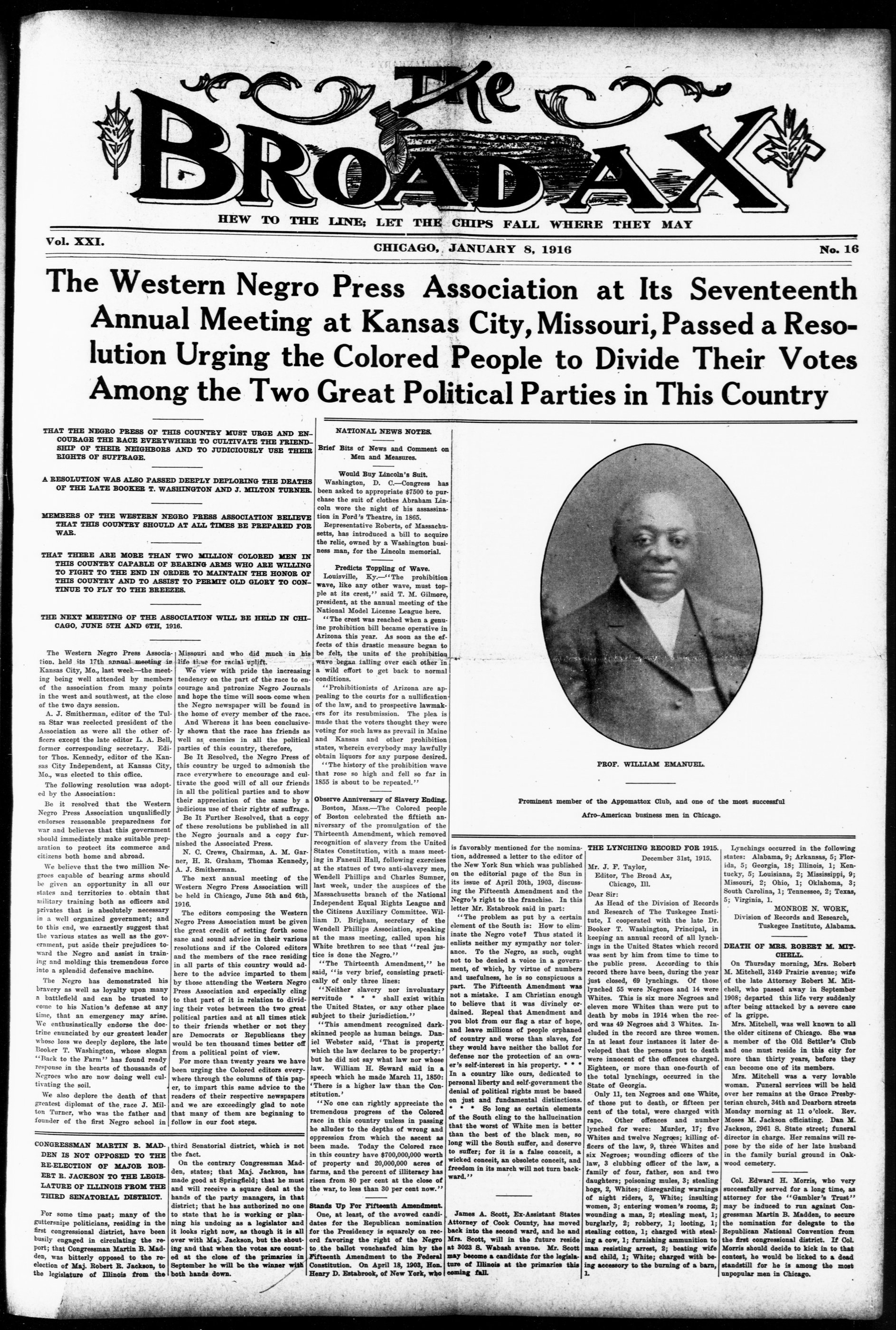
THE BROAD AX
The Western Negro Press Association at Its Seventeenth Annual Meeting at Kansas City, Missouri, Passed a Resolution Urging the Colored People to Divide Their Votes Among the Two Great Political Parties in This Country
THAT THE NEGRO PRESS OF THIS COUNTRY MUST URGE AND ENCOURAGE THE RACE EVERYWHERE TO CULTIVATE THE FRIENDSHIP OF THEIR NEIGHBORS AND TO JUDICIOUSLY USE THEIR RIGHTS OF SUFFRAGE.
A RESOLUTION WAS ALSO PASSED DEEPLY DEPLORING THE DEATHS OF THE LATE BOOKER T. WASHINGTON AND J. MULTON TINNER
MEMBERS OF THE WESTERN NEGRO PRESS ASSOCIATION BELIEVE THAT THIS COUNTRY SHOULD AT ALL TIMES BE PREPARED FOR WAR.
THAT THERE ARE MORE THAN TWO MILLION COLORED MEN IN THIS COUNTRY CAPABLE OF BEARING ARMS WHO ARE WILLING TO FIGHT TO THE END IN ORDER TO MAINTAIN THE HONOR OF THIS COUNTRY AND TO ASSIST TO PERMIT OLD GLORY TO CONTINUE TO FLY TO THE BREEZES.
THE NEXT MEETING OF THE ASSOCIATION WILL BE HELD IN CHICAGO, JUNE 5TH AND 6TH, 1916.
Vol. XXI.
The West Annual lution Amon
THAT THE NEGRO PRESS OF THE COURAGE THE RACE EVERYWHERE SHIP OF THEIR NEIGHBORS RIGHTS OF SUFFRAGE.
A RESOLUTION WAS ALSO PASSED OF THE LATE BOOKER T. WAR.
MEMBERS OF THE WESTERN NEVER THAT THIS COUNTRY SHOULD WAR.
THAT THERE ARE MORE THAN THIS COUNTRY CAPABLE OF TO FIGHT TO THE END IN OR THIS COUNTRY AND TO ASSIS TINUE TO FLY TO THE BREEZ.
THE NEXT MEETING OF THE ASS CAGO, JUNE 5TH AND 6TH, 19
The Western Negro Press Association, held its 17th annual meeting in Kansas City, Mo., last week—the meeting being well attended by members of the association from many points in the west and southwest, at the close of the two days session.
A. J. Smitherman, editor of the Tulsa Star was reelected president of the Association as were all the other officers except the late editor L. A. Bell, former corresponding secretary. Editor Thos. Kennedy, editor of the Kansas City Independent, at Kansas City, Mo., was elected to this office.
The following resolution was adopted by the Association:
Be it resolved that the Western Negro Press Association unqualifiedly endorses reasonable preparedness for war and believes that this government should immediately make suitable preparation to protect its commerce and citizens both home and abroad.
We believe that the two million Negroes capable of bearing arms should be given an opportunity in all our states and territories to obtain that military training both as officers and privates that is absolutely necessary in a well organized government; and to this end, we earnestly suggest that the various states as well as the government, put aside their prejudices toward the Negro and assist in training and molding this tremendous force into a splendid defensive machine.
The Negro has demonstrated his bravery as well as loyalty upon many a battlefield and can be trusted to come to his Nation's defense at any time, that an emergency may arise. We enthusiastically endorse the doctrine enunciated by our greatest leader whose loss we deeply deplore, the late Booker T. Washington, whose slogan "Back to the Farm" has found ready response in the hearts of thousands of Negroes who are now doing well cultivating the soil.
We also deplore the death of that greatest diplomat of the race J. Milton Turner, who was the father and founder of the first Negro school in
CONGRESSMAN MARTIN B. MADDEN IS NOT OPPOSED TO THE RE-ELECTION OF MAJOR ROBERT B. JACKSON TO THE LEGISLATURE OF ILLINOIS FROM THE THIRD SENATORIAL DISTRICT.
For some time past; many of the guttersnipe politicians, residing in the first congressional district, have been busily engaged in circulating the report; that Congressman Martin B. Madden, was bitterly opposed to the re-election of Maj. Robert B. Jackson, to the legislature of Illinois from the
Missouri and who did much in his life time for racial uplift.
We view with pride the increasing tendency on the part of the race to encourage and patronize Negro Journals and hope the time will soon come when the Negro newspaper will be found in the home of every member of the race.
And Whereas it has been conclusively shown that the race has friends as well as enemies in all the political parties of this country, therefore,
Be It Resolved, the Negro Press of this country be urged to admonish the race everywhere to encourage and cultivate the good will of all our friends in all the political parties and to show their appreciation of the same by a judicious use of their rights of suffrage.
Be It Further Resolved, that a copy of these resolutions be published in all the Negro journals and a copy furnished the Associated Press.
N. C. Crews, Chairman, A. M. Garner, H. R. Graham, Thomas Kennedy, A. J. Smitherman.
The next annual meeting of the Western Negro Press Association will be held in Chicago, June 5th and 6th, 1916.
The editors composing the Western Negro Press Association must be given the great credit of setting forth some sane and sound advice in their various resolutions and if the Colored editors and the members of the race residing in all parts of this country would adhere to the advice imparted to them by those attending the Western Negro Press Association and especially cling to that part of it in relation to dividing their votes between the two great political parties and at all times stick to their friends whether or not they are Democrats or Republicans they would be ten thousand times better off from a political point of view. For more than twenty years we have been urging the Colored editors everywhere through the columns of this paper, to impart this same advice to the readers of their respective newspapers and we are exceedingly glad to note that many of them are beginning to follow in our foot steps.
third Senatorial district, which is not the fact.
On the contrary Congressman Madden, states; that Maj. Jackson, has made good at Springfield; that he must and will receive a square deal at the hands of the party managers, in that district; that he has authorized no one to state that he is working or planning his undoing as a legislator and it looks right now, as though it is all over with Maj. Jackson, but the shouting and that when the votes are counted at the close of the primaries in September he will be the winner with both hands down.
CHICAGO, JANUARY 8. 1916
NATIONAL NEWS NOTES.
Brief Bits of News and Comment on Men and Measures.
Washington, D. C.—Congress has been asked to appropriate $7500 to purchase the suit of clothes Abraham Lincoln wore the night of his assassination in Ford's Theatre, in 1865. Representative Roberts, of Massachusetts, has introduced a bill to acquire the relic, owned by a Washington business man, for the Lincoln memorial.
Predicts Toppling of Wave.
Louisville, Ky.—"The prohibition wave, like any other wave, must topple at its crest," said T. M. M. Gilmore, president, at the annual meeting of the National Model License League here.
"The crest was reached when a genuine prohibition bill became operative in Arizona this year. As soon as the effects of this drastic measure began to be felt, the units of the prohibition wave began falling over each other in a wild effort to get back to normal conditions.
"Prohibitionists of Arizona are appealing to the courts for a nullification of the law, and to prospective lawmakers for its resubmission. The plea is made that the voters thought they were voting for such laws as prevail in Maine and Kansas and other prohibition states, wherein everybody may lawfully obtain liquors for any purpose desired.
"The history of the prohibition wave that rose so high and fell so far in 1855 is about to be repeated."
Observe Anniversary of Slavery Ending
Boston, Mass.—The Colored people of Boston celebrated the fiftieth anniversary of the promulgation of the Thirteenth Amendment, which removed recognition of slavery from the United States Constitution, with a mass meeting in Faneuil Hall, following exercises at the statues of two anti-slavery men, Wendell Phillips and Charles Sumner, last week, under the auspices of the Massachusetts branch of the National Independent Equal Rights League and the Citizens Auxiliary Committee. William D. Brigham, secretary of the Wendell Phillips Association, speaking at the mass meeting, called upon his White brethren to see that "real justice is done the Negro." "The Thirteenth Amendment," he said, "is very brief, consisting practically of only three lines: "Neither slavery nor involuntary servitude * * * shall exist within the United States, or any other place subject to their jurisdiction."
"This amendment recognized dark-skinned people as human beings. Daniel Webster said, 'That is property which the law declares to be property: but he did not say what law nor whose law. William H. Seward said in a speech which he made March 11, 1850: 'There is a higher law than the Constitution.'"
"No one can rightly appreciate the tremendous progress of the Colored race in this country unless in passing he alludes to the depths of wrong and oppression from which the ascent as been made. Today the Colored race in this country have $700,000,000 worth of property and 20,000,000 acres of farms, and the percent of illiteracy has risen from 80 per cent at the close of the war, to less than 30 per cent now."
Stands Up For Fifteenth Amendment
Stands Up For Fifteenth Amendment. One, at least, of the avowed candidates for the Republican nomination for the Presidency is squarely on record favoring the right of the Negro to the ballot vouchsafed him by the Fifteenth Amendment to the Federal Constitution. On April 18, 1903, Hon. Henry D. Esthbrook of New York, who
[Name not visible]
Prominent member of the Appomattox Club, and one of the most successful Afro-American business men in Chicago.
is favorably mentioned for the nomination, addressed a letter to the editor of the New York Sun which was published on the editorial page of the Sun in its issue of April 20th, 1903, discussing the Fifteenth Amendment and the Negro's right to the franchise. In this letter Mr. Estabrook said in part:
"The problem as put by a certain element of the South is: How to eliminate the Negro vote? Thus stated it enlists neither my sympathy nor tolerance. To the Negro, as such, ought not to be denied a voice in a government, of which, by virtue of numbers and usefulness, he is so conspicuous a part. The Fifteenth Amendment was not a mistake. I am Christian enough to believe that it was divinely ordained. Repeal that Amendment and you blot from our flag a star of hope, and leave millions of people orphaned of country and worse than slaves, for they would have neither the ballot for defense nor the protection of an owner's self-interest in his property. * * * In a country like ours, dedicated to personal liberty and self-government the denial of political rights must be based on just and fundamental distinctions. * * * So long as certain elements of the South cling to the hallucination that the worst of White men is better than the best of the black men, so long will the South suffer, and deserve to suffer; for it is a false conceit, a wicked conceit, an obsolete conceit, and freedom in its march will not turn backward."
James A. Scott, Ex-Assistant States Attorney of Cook County, has moved back into the second ward, and he and Mrs. Scott, will in the future reside at 3023 S. Wabash avenue. Mr. Scott may become a candidate for the legislature of Illinois at the primaries this coming fall.
THE LYNCHING RECORD FOR 1915
December 31st, 1915.
Mr. J. F. Taylor.
As Head of the Division of Records and Research of The Tuskegee Institute, I cooperated with the late Dr. Booker T. Washington, Principal, in keeping an annual record of all lynchings in the United States which record was sent by him from time to time to the public press. According to this record there have been, during the year just closed, 69 lynchings. Of those lynched 55 were Negroes and 14 were Whites. This is six more Negroes and eleven more Whites than were put to death by mobs in 1914 when the record was 49 Negroes and 3 Whites. Included in the record are three women. In at least four instances it later developed that the persons put to death were innocent of the offences charged. Eighteen, or more than one-fourth of the total lynchings, occurred in the State of Georgia.
Only 11, ten Negroes and one White, of those put to death, or fifteen per cent of the total, were charged with rape. Other offences and number lynched for were: Murder, 17; five Whites and twelve Negroes; killing officers of the law, 9, three Whites and six Negroes; wounding officers of the law, 3 clubbing officer of the law, a family of four, father, son and two daughters; poisoning mules, 3; stealing hogs, 2, Whites; disregarding warnings of night riders, 2, White; insulting women, 3; entering women's rooms, 2; wounding a man, 2; stealing meat, 1; burglarly, 2; robbery, 1; looting, 1; stealing cotton, 1; charged with stealing a cow, 1; furnishing ammunition to man resisting arrest, 2; beating wife and child, 1; White; charged with being accessory to the burning of a barn, 1
No.16
Lynchings occurred in the following states: Alabama, 9; Arkansas, 5; Florida, 5; Georgia, 18; Illinois, 1; Kentucky, 5; Louisiana, 2; Mississippi, 9; Missouri, 2; Ohio, 1; Oklahoma, 3; South Carolina, 1; Tennessee, 2; Texas, 5; Virginia, 1.
MONROE N. WORK,
Division of Records and Research,
Tuskegee Institute, Alabama.
DEATH OF MRS. ROBEET M. MIT-
CHELL.
On Thursday morning, Mrs. Robert M. Mitchell, 3149 Prairie avenue; wife of the late Attorney Robert M. Mitchell, who passed away in September 1908; departed this life very suddenly after being attacked by a severe case of la grippe.
Mrs. Mitchell, was well known to all the older citizens of Chicago. She was a member of the Old Settler's Club and one must reside in this city for more than thirty years, before they can become one of its members.
Mrs. Mitchell was a very lovable woman. Funeral services will be held over her remains at the Grace Presbyterian church, 34th and Dearborn streets Monday morning at 11 o'clock. Rev. Moses M. Jackson officiating. Dan M. Jackson, 2961 S. State street; funeral director in charge. Her remains will repose by the side of her late husband in the family burial ground in Oakwood cemetery.
Col. Edward H. Morris, who very successfully served for a long time, as attorney for the "Gambler's Trust" may be induced to run against Congressman Martin B. Madden, to secure the nomination for delegate to the Republican National Convention from the first congressional district. If Col. Morris should decide to kick in to that contest, he would be licked to a dead standstill for he is among the most unpopular men in Chicago.
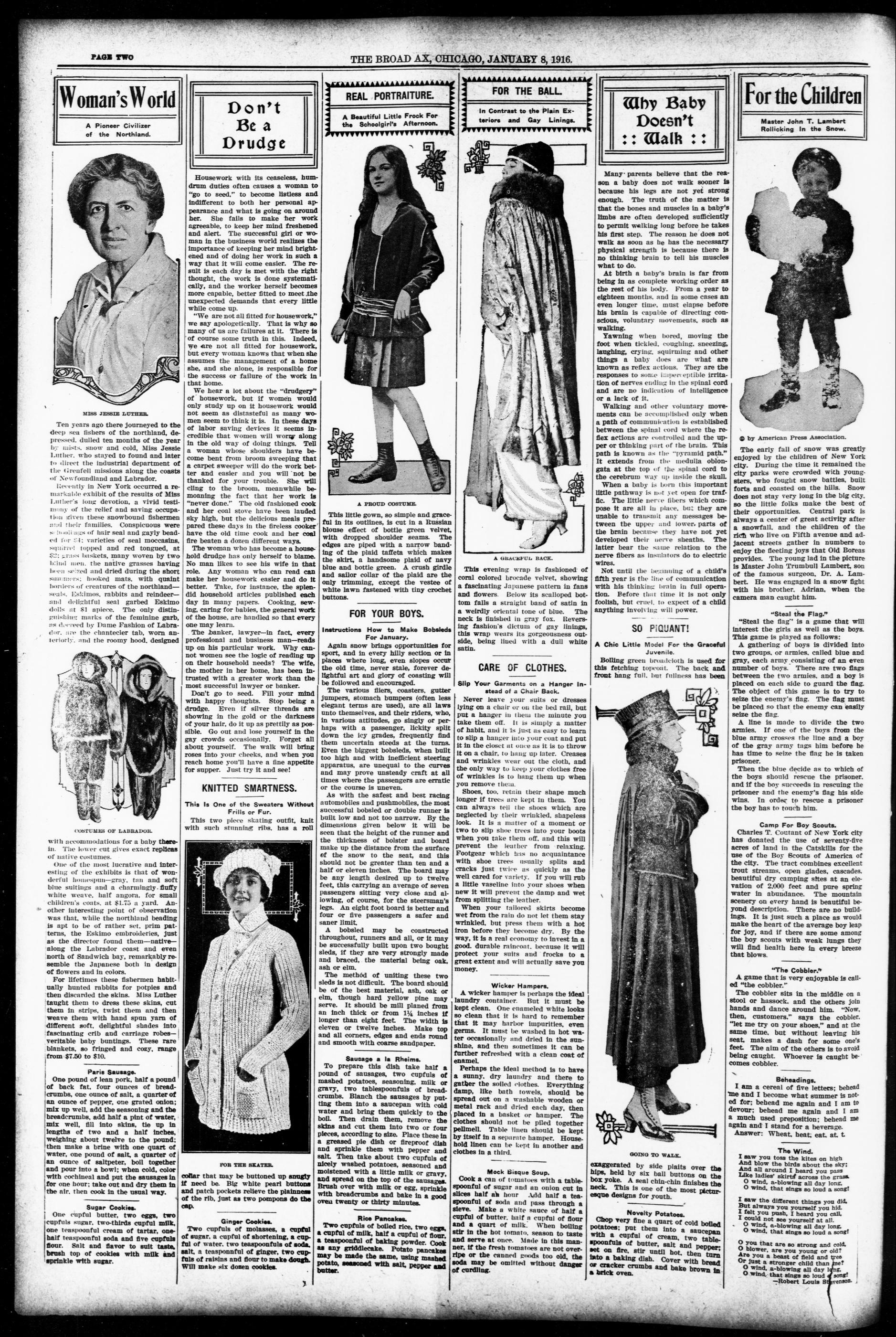
PAGE TWO
A Pioneer Civilizer of the Northland.
Mary Ann
MISS JESSE LUTHER.
Ten years ago there journeyed to the deep sea fishers of the northland, depressed, dulled ten months of the year by mists, snow and cold, Miss Jessie Luther, who stayed to found and later to direct the industrial department of the Greenfell missions along the coasts of Newfoundland and Labrador.
Recently in New York occurred a remarkable exhibit of the results of Miss Luther's long devotion, a vivid testimony of the relief and saving occupation given these snowbound fishermen and their families. Conspicuous were schoolings of hair seal and gayly beaded for $4; varieties of seal moccasins, squirrel topped and red tongued, at $2; grass baskets, many woven by two blind men; the native grasses having been seized and dried during the short summers; hooked mats, with quint borders of creatures of the northland—seals, Eskimos, rabbits and reindeer—and delightful seal garbed Eskimo dolls at $1 apiece. The only distinguishing marks of the feminine garb, as decreed by Dame Fashion of Labrador, are the chantecer tab, worn anteriorly, and the roomy hood, designed
COSTUMES OF LABRADOR.
with accommodations for a baby therein. The lower cut gives exact replicas of native costumes.
One of the most lucrative and interesting of the exhibits is that of wonderful homespun—gray, tan and soft blue suitings and a charmingly, fuzzy white weave, half angora, for small children's coats, at $1.75 a yard. Another interesting point of observation was that, while the northland beading is apt to be of rather set, prim patterns, the Eskimo embroideries, just as the director found them—native—along the Labrador coast and even north of Sandwich bay, remarkably resemble the Japanese both in design of flowers and in colors.
For lifetimes these fishermen habitually hunted rabbits for potpies and then discarded the skins. Miss Luther taught them to dress these skins, cut them in strips, twist them and then weave them with hand spun yarn of different soft, delightful shades into fascinating crib and carriage robes—veritable baby buntings. These rare blankets, so fringed and cozy, range from $7.50 to $10.
Paris Sausage.
One pound of lean pork, half a pound of back fat, four ounces of breadcrumbs, one ounce of salt, a quarter of an ounce of pepper, one grated onion; mix up well, add the seasoning and the breadcrumbs, add half a pint of water, mix well, fill into skins, tie up in lengths of two and a half inches, weighing about twelve to the pound; then make a brine with one quart of water, one pound of salt, a quarter of an ounce of saltpeter, boll together and pour into a bowl; when cold, color with cochineal and put the sausages in for one hour; take out and dry them in the air, then cook in the usual way.
Sugar Cookies.
One cupful butter, two eggs, two cupfuls sugar, two-thirds cupful milk, one teaspoonful cream of tartar, one-half teaspoonful soda and five cupfuls flour. Salt and flavor to suit taste, brush top of cookies with milk and sprinkle with sugar.
Don't Be a Drudge
Housework with its ceaseless, hum-drum duties often causes a woman to "go to seed," to become listless and indifferent to both her personal appearance and what is going on around her. She fails to make her work agreeable, to keep her mind freshened and alert. The successful girl or woman in the business world realizes the importance of keeping her mind brightened and of doing her work in such a way that it will come easier. The result is each day is met with the right thought, the work is done systematically, and the worker herself becomes more capable, better fitted to meet the unexpected demands that every little while come up.
"We are not all fitted for housework," we say apologetically. That is why so many of us are failures at it. There is of course some truth in this. Indeed, we are not all fitted for housework, but every woman knows that when she assumes the management of a home she, and she alone, is responsible for the success or failure of the work in that home.
We hear a lot about the "drudgery" of housework, but if women would only study up on it housework would not seem as distasteful as many women seem to think it is. In these days of labor saving devices it seems incredible that women will worry along in the old way of doing things. Tell a woman whose shoulders have become bent from broom sweeping that a carpet sweeper will do the work better and easier and you will not be thanked for your trouble. She will cling to the broom, meanwhile be moaning the fact that her work is "never done." The old fashioned cook and her coal stove have been lauded sky high, but the delicious meals prepared these days in the fireless cooker have the old time cook and her coal fire beaten a dozen different ways.
The woman who has become a household drudge has only herself to blame. No man likes to see his wife in that role. Any woman who can read can make her housework easier and do it better. Take, for instance, the splendid household articles published each day in many papers. Cooking, sewing, caring for babies, the general work of the house, are handled so that every one may learn.
The banker, lawyer—in fact, every professional and business man—reads up on his particular work. Why cannot women see the logic of reading up on their household needs? The wife, the mother in her home, has been intrusted with a greater work than the most successful lawyer or banker.
Don't go to seed. Fill your mind with happy thoughts. Stop being a drudge. Even if silver threads are showing in the gold or the darkness of your hair, do it up as prettily as possible. Go out and lose yourself in the gay crowds occasionally. Forget all about yourself. The walk will bring roses into your cheeks, and when you reach home you'll have a fine appetite for supper. Just try it and see!
KNITTED SMARTNESS.
This Is One of the Sweaters Without
Frills or Fur.
This two piece skating outfit, knit
with such stunning ribs, has a roll
THE LONG COAT
FOR THE SKATER.
collar that may be buttoned up snugly if need be. Big white pearl buttons and patch pockets relieve the plainness of the rlb, just as two pompons do the cap.
Ginger Cookies
Two cupfuls of molasses, a cupful of sugar, a cupful of shortening, a cupful of water, two teaspoonfuls of soda, salt, a teaspoonful of ginger, two cupfuls of raisins and flour to make dough. Will make six dozen cookies.
THE BROAD AX, CHICAGO, JANUARY 8, 1916
```markdown
```
A PROUD COSTUME
This little gown, so simple and graceful in its outlines, is cut in a Russian blouse effect of bottle green velvet, with dropped shoulder seams. The edges are piped with a narrow banding of the plaid taffeta which makes the skirt, a handsome plaid of navy blue and bottle green. A crush girdle and sailor collar of the plaid are the only trimming, except the vestee of white lawn fastened with tiny crochet buttons.
FOR YOUR BOYS.
Instructions How to Make Bobsleds For January.
Again snow brings opportunities for sport, and in every hilly section or in places where long, even slopes occur the old time, never stale, forever delightful art and glory of coasting will be followed and encouraged.
The various filers, coasters, gutter jumpers, stomach bumper (often less elegant terms are used), are all laws unto themselves, and their riders, who, in various attitudes, go singly or perhaps with a passenger, lickity split down the icy grades, frequently find them uncertain steeds at the turns. Even the biggest bobsleds, when built too high and with inefficient steering apparatus, are unequal to the curves and may prove unsteady craft at all times where the passengers are erratic or the course is uneven.
As with the safest and best racing automobiles and pushmobiles, the most successful bobsled or double runner is built low and not too narrow. By the dimensions given below it will be seen that the height of the runner and the thickness of bolster and board make up the distance from the surface of the snow to the seat, and this should not be greater than ten and a half or eleven inches. The board may be any length desired up to twelve feet, this carrying an average of seven passengers sitting very close and allowing, of course, for the steersman's legs. An eight foot board is better and four or five passengers a safer and saner limit.
A bobsled may be constructed throughout, runners and all, or it may be successfully built upon two bought sleds, if they are very strongly made and braced, the material being oak, ash or elm.
The method of uniting these two sleds is not difficult. The board should be of the best material, ash, oak or elm, though hard yellow pine may serve. It should be mill planed from an inch thick or from $1 \frac{1}{4}$ inches if longer than eight feet. The width is eleven or twelve inches. Make top and all corners, edges and ends round and smooth with coarse sandpaper.
Saucage a la Rheims
To prepare this dish take half a pound of sausages, two cupfuls of mashed potatoes, seasoning, milk or gravy, two tablespoonfuls of breadcrumbs. Blanch the sausages by putting them into a saucepan with cold water and bring them quickly to the boll. Then drain them, remove the skins and cut them into two or four pieces, according to size. Place these in a greased pie dish or fireproof dish and sprinkle them with pepper and salt. Then take about two cupfuls of nicely washed potatoes, seasoned and molstened with a little milk or gravy, and spread on the top of the sausages. Brush over with milk or egg, sprinkle with breadcrumbs and bake in a good oven twenty or thirty minutes.
Rice Pancakes.
Two cupfuls of boiled rice, two eggs, a cupful of milk, half a cupful of flour, a teaspoonful of baking powder. Cook as any griddlecake. Potato pancakes may be made the same, using mashed potato, seasoned with salt, pepper and butter.
In Contrast to the Plain Exterior and Gay Linings.
```markdown
```
A GRACEFUL BACK.
This evening wrap is fashioned of coral colored brocade velvet, showing a fascinating Japanese pattern in fans and flowers. Below its scalloped bottom falls a straight band of satin in a weirdly oriental tone of blue. The neck is finished in grayfox. Reversing fashion's dictum of gay linings, this wrap wears its gorgeousness outside, being lined with a dull white satin.
CARE OF CLOTHES.
Slip Your Garments on a Hanger Instead of a Chair Back.
Never leave your suits or dresses lying on a chair or on the bed rail, but put a hanger in them the minute you take them off. It is simply a matter of habit, and it is just as easy to learn to slip a hanger into your coat and put it in the closet at once as it is to throw it on a chair, to hang up later. Creases and wrinkles wear out the cloth, and the only way to keep your clothes free of wrinkles is to hang them up when you remove them.
Shoes, too, retain their shape much longer if trees are kept in them. You can always tell the shoes which are neglected by their wrinkled, shapeless look. It is a matter of a moment or two to slip shoe trees into your boots when you take them off, and this will prevent the leather from relaxing. Footgear which has no acquaintance with shoe trees usually splits and cracks just twice as quickly as the well cared for variety. If you will rub a little vaseline into your shoes when new it will prevent the damp and wet from splitting the leather.
When your tailored skirts become wet from the rain do not let them stay wrinkled, but press them with a hot iron before they become dry. By the way, it is a real economy to invest in a good, durable raincoat, because it will protect your suits and frocks to a great extent and will actually save you money.
Wicker Hammers
A wicker hamper is perhaps the ideal laundry container. But it must be kept clean. One enameled white looks so clean that it is hard to remember that it may harbor impurities, even germs. It must be washed in hot water occasionally and dried in the sunshine, and then sometimes it can be further refreshed with a clean coat of enamel.
Perhaps the ideal method is to have a sunny, dry laundry and there to gather the soiled clothes. Everything damp, like bath towels, should be spread out on a washable wooden or metal rack and dried each day, then placed in a basket or hamper. The clothes should not be piled together pellmell. Table linen should be kept by itself in a separate hamper. Household linen can be kept in another and clothes in a third.
Mock Bisque Soup.
Cook a can of tomatoes with a table-spoonful of sugar and an onion cut in slices half ah hour. Add half a tea-spoonful of soda and pass through a sieve. Make a white sauce of half a cupful of butter, half a cupful of flour and a quart of milk. When boiling stir in the hot tomato, season to taste and serve at once. Made in this manner, if the fresh tomatoes are not overripe or the canned goods too old, the soda may be omitted without danger of curdling.
Why Baby Doesn't
:: Walk ::
Many parents believe that the reason a baby does not walk sooner is because his legs are not yet strong enough. The truth of the matter is that the bones and muscles in a baby's limbs are often developed sufficiently to permit walking long before he takes his first step. The reason he does not walk as soon as he has the necessary physical strength is because there is no thinking brain to tell his muscles what to do.
At birth a baby's brain is far from being in as complete working order as the rest of his body. From a year to eighteen months, and in some cases an even longer time, must elapse before his brain is capable of directing conscious, voluntary movements, such as walking.
Yawning when bored, moving the foot when tickled, coughing, sneezing, laughing, crying, squirming and other things a baby does are what are known as reflex actions. They are the responses to some imperceptible irritation of nerves ending in the spinal cord and are no indication of intelligence or a lack of it.
Walking and other voluntary movements can be accomplished only when a path of communication is established between the spinal cord where the reflex actions are controlled and the upper or thinking part of the brain. This path is known as the "pyramid path." It extends from the medulla oblongata at the top of the spinal cord to the cerebrum way up inside the skull.
When a baby is born this important little pathway is not yet open for traffic. The little nerve fibers which compose it are all in place, but they are unable to transmit any messages between the upper and lower parts of the brain because they have not yet developed their nerve sheaths. The latter bear the same relation to the nerve fibers as insulators do to electric wires. Not until the beginning of a child's fifth year is the line of communication with his thinking brain in full operation. Before that time it is not only foolish, but cruel, to expect of a child anything involving will power.
SO PIQUANT!
A Chic Little Model For the Graceful Juvenile. Bolling green broadcloth is used for this fetching topcoat. The back and front hang full, but fullness has been
I
GOING TO WALK.
exaggerated by side plaits over the
hips, held by six ball buttons on the
box yoke. A seal chin-chin finishes the
neck. This is one of the most picture-
esque designs for youth.
Novelty Potatoes
Chop very fine a quart of cold boiled potatoes; put them into a saucepan with a cupful of cream, two tablespoonfuls of butter, salt and pepper; set on fire, stir until hot, then turn into a baking dish. Cover with bread or cracker crumbs and bake brown in a brick oven.
Master John T. Lambert Rollicking In the Snow.
H
© by American Press Association.
The early fall of snow was greatly enjoyed by the children of New York city. During the time it remained the city parks were crowded with youngsters, who fought snow battles, built forts and coasted on the hills. Snow does not stay very long in the big city, so the little folks make the best of their opportunities. Central park is always a center of great activity after a snowfall, and the children of the rich who live on Fifth avenue and adjacent streets gather in numbers to enjoy the fleeting joys that Old Boreas provides. The young lad in the picture is Master John Trumbull Lambert, son of the famous surgeon, Dr. A. Lambert. He was engaged in a snow fight with his brother, Adrian, when the camera man caught him.
"Steal the Flag."
"Steal the flag" is a game that will interest the girls as well as the boys. This game is played as follows:
A gathering of boys is divided into two groups, or armies, called blue and gray, each army consisting of an even number of boys. There are two flags between the two armies, and a boy is placed on each side to guard the flag. The object of this game is to try to seize the enemy's flag. The flag must be placed so that the enemy can easily seize the flag.
A line is made to divide the two armies. If one of the boys from the blue army crosses the line and a boy of the gray army tags him before he has time to seize the flag he is taken prisoner.
Then the blue decide as to which of the boys should rescue the prisoner, and if the boy succeeds in rescuing the prisoner and the enemy's flag his side wins. In order to rescue a prisoner the boy has to touch him.
Camp For Boy Scouts.
Charles T. Coutant of New York city has donated the use of seventy-five acres of land in the Catskills for the use of the Boy Scouts of America of the city. The tract combines excellent trout streams, open glades, cascades, beautiful dry camping sites at an elevation of 2,000 feet and pure spring water in abundance. The mountain scenery on every hand is beautiful beyond description. There are no buildings. It is just such a place as would make the heart of the average boy leap for joy, and if there are some among the boy scouts with weak lungs they will find health here in every breeze that blows.
"The Cobbler"
A game that is very enjoyable is called "the cobbler."
The cobbler sits in the middle on a stool or hassock, and the others join hands and dance around him. "Now, then, customers," says the cobbler. "let me try on your shoes," and at the same time, but without leaving his seat, makes a dash for some one's feet. The aim of the others is to avoid being caught. Whoever is caught becomes cobbler.
Beheadings
I am a cereal of five letters; behead me and I become what summer is noted for; behead me again and I am to devour; behead me again and I am a much used preposition; behead me again and I stand for a beverage.
Answer: Wheat beat at it.
The Wind.
I saw you toss the kites on high
And blow the birds about the sky;
And all around I heard you pass
Like ladies' skirts across the grass
O wind, a-blowing all day long,
O wind, that sings so loud a song!
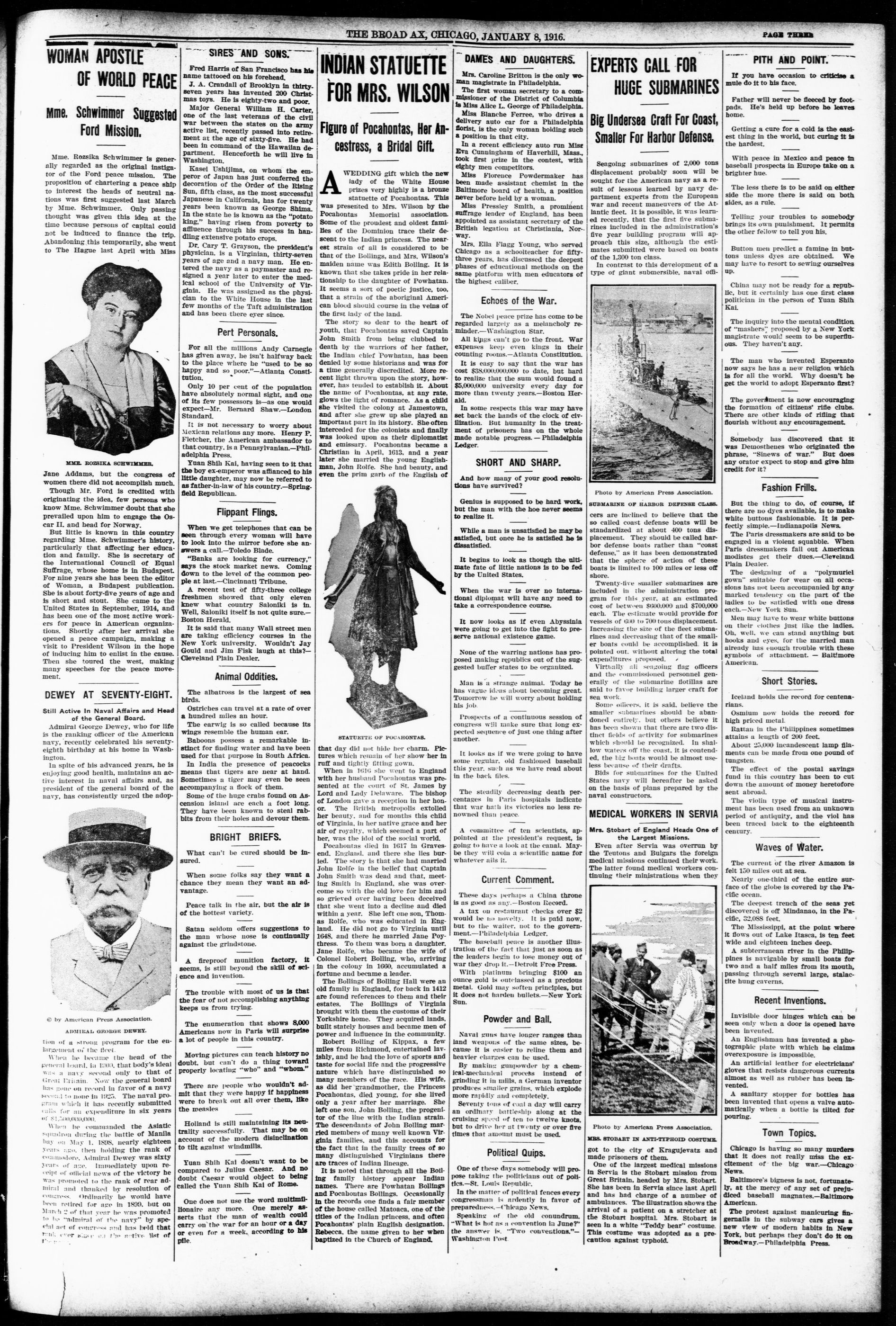
Mme. Schwimmer Suggested Ford Mission.
Mme. Rozsika Schwimmer is generally regarded as the original instigator of the Ford peace mission. The proposition of chartering a peace ship to interest the heads of neutral nations was first suggested last March by Mme. Schwimmer. Only passing thought was given this idea at the time because persons of capital could not be induced to finance the trip. Abandoning this temporarily, she went to The Hague last April with Miss
M.
MME. ROZIKA SCHWIIMER.
Jane Addams, but the congress of women there did not accomplish much. Though Mr. Ford is credited with originating the idea, few persons who know Mme. Schwimmer doubt that she prevailed upon him to engage the Oscar II. and head for Norway.
But little is known in this country regarding Mme. Schwimmer's history, particularly that affecting her education and family. She is secretary of the International Council ofEqual Suffrage, whose home is in Budapest. For nine years she has been the editor of Woman, a Budapest publication. She is about forty-five years of age and is short and stout. She came to the United States in September, 1914, and has been one of the most active workers for peace in American organizations. Shortly after her arrival she opened a peace campaign, making a visit to President Wilson in the hope of inducing him to enlist in the cause. Then she toured the west, making many speeches for the peace movement.
DEWEY AT SEVENTY-EIGHT.
Still Active In Naval Affairs and Head of the General Board. Admiral George Dewey, who for life is the ranking officer of the American navy, recently celebrated his seventy-eighth birthday at his home in Washington. In spite of his advanced years, he is enjoying good health, maintains an active interest in naval affairs and, as president of the general board of the navy, has consistently urged the adop-
[Image of a man in a suit and hat]
$ \textcircled{c} $ by American Press Association.
tion of a strong program for the enlargement of the fleet. When he became the head of the general board, in 1830, that body's ideal was a navy second only to that of Great Britain. Now the general board has gone on record in favor of a navy second to none in 1825. The naval program which it has recently submitted calls for an expenditure in six years of $1,500,000,000.
When he commanded the Asiatic squadron during the battle of Manila bay on May 1, 1898, nearly eighteen years ago, then holding the rank of commodore, Admiral Dewey was sixty years of age. Immediately upon receipt of official news of the victory he was promoted to the rank of rear admiral and thanked by resolution of congress. Ordinarily he would have been retired for age in 1899, but on March 2 of that year he was promoted to "admiral of the navy" by special act of congress and has held that rank ever since on the active list of Foes.
SIRES AND SONS.
Fred Harris of San Francisco has his name tattooed on his forehead.
J. A. Crandall of Brooklyn in thirty-seven years has invented 200 Christmas toys. He is eighty-two and poor. Major General William H. Carter, one of the last veterans of the civil war between the states on the army active list, recently passed into retirement at the age of sixty-five. He had been in command of the Hawaiian department. Henceforth he will live in Washington. Kasel Ushijima, on whom the emperor of Japan has just conferred the decoration of the Order of the Rising Sun, fifth class, as the most successful Japanese in California, has for twenty years been known as George Shima. In the state he is known as the "potato king," having risen from poverty to influence through his success in handling extensive potato crops.
Dr. Cary T. Grayson, the president's physician, is a Virginian, thirty-seven years of age and a navy man. He entered the navy as a paymaster and resigned a year later to enter the medical school of the University of Virginia. He was assigned as the physician to the White House in the last few months of the Taft administration and has been there ever since.
Pert Personals.
For all the millions Andy Carnegie has given away, he isn't halfway back to the place where he "used to be so happy and so poor."—Atlanta Constitution.
Only 10 per cent of the population have absolutely normal sight, and one of its few possessors is—as one would expect—Mr. Bernard Shaw.—London Standard.
It is not necessary to worry about Mexican relations any more. Henry P. Fletcher, the American ambassador to that country, is a Pennsylvanian.—Philadelphia Press.
Yuan Shih Kai, having seen to it that the boy ex-emperor was afflianced to his little daughter, may now be referred to as father-in-law of his country.—Springfield Republican.
Flippant Flings.
When we get telephones that can be seen through every woman will have to look into the mirror before she answers a call.—Toledo Blade.
"Banks are looking for currency," says the stock market news. Coming down to the level of the common people at last.—Cincinnati Tribune.
A recent test of fifty-three college freshmen showed that only eleven knew what country Saloniki is in. Well, Saloniki itself is not quite sure.—Boston Herald.
It is said that many Wall street men are taking efficiency courses in the New York university. Wouldn't Jay Gould and Jim Fisk laugh at this?—Cleveland Plain Dealer.
Animal Oddities.
The albatross is the largest of sea birds.
Ostriches can travel at a rate of over a hundred miles an hour.
The earwig is so called because its wings resemble the human ear.
Baboons possess a remarkable instinct for finding water and have been used for that purpose in South Africa.
In India the presence of peacocks means that tigers are near at hand.
Sometimes a tiger may even be seen accompanying a flock of them.
Some of the huge crabs found on Ascension island are each a foot long. They have been known to steal rabbits from their holes and devour them.
BRIGHT BRIEFS.
What can't be cured should be insured.
When some folks say they want a chance they mean they want an advantage.
Peace talk in the air, but the air is of the hottest variety.
Satan seldom offers suggestions to the man whose nose is continually against the grindstone.
A fireproof munition factory, it seems, is still beyond the skill of science and invention.
The trouble with most of us is that the fear of not accomplishing anything keeps us from trying.
The enumeration that shows 8,000 Americans now in Paris will surprise a lot of people in this country.
Moving pictures can teach history no doubt, but can't do a thing toward properly locating "who" and "whom."
There are people who wouldn't admit that they were happy if happiness were to break out all over them, like the measles.
Holland is still maintaining its neutrality successfully. That may be on account of the modern disinclination to tilt against windmills.
Yuan Shih Kai doesn't want to be compared to Julius Caesar. And no doubt Caesar would object to being called the Yuan Shih Kai of Rome.
One does not use the word multimillionaire any more. One merely asserts that the man of wealth could carry on the war for an hour or a day or even for a week, according to his plea.
THE BROAD AX, CHICAGO, JANUARY 8, 1916
INDIAN STATUETTE FOR MRS. WILSON
Figure of Pocahontas, Her Ancestress, a Bridal Gift.
WEDDING gift which the new lady of the White House prizes very highly is a bronze statuette of Pocahontas. This was presented to Mrs. Wilson by the Pocahontas Memorial association. Some of the proudest and oldest families of the Dominion trace their descent to the Indian princess. The nearest strain of all is considered to be that of the Bollings, and Mrs. Wilson's maiden name was Edith Bolling. It is known that she takes pride in her relationship to the daughter of Powhatan. It seems a sort of poetic justice, too, that a strain of the aboriginal American blood should course in the veins of the first lady of the land.
The story so dear to the heart of youth, that Pocahontas saved Captain John Smith from being clubbed to death by the warriors of her father, the Indian chief Powhatan, has been denied by some historians and was for a time generally discredited. More recent light thrown upon the story, however, has tended to establish it. About the name of Pocahontas, at any rate, glows the light of romance. As a child she visited the colony at Jamestown, and after she grew up she played an important part in its history. She often interceded for the colonists and finally was looked upon as their diplomatist and emissary. Pocahontas became a Christian in April, 1613, and a year later she married the young Englishman, John Rolfe. She had beauty, and even the prim garb of the English of
```markdown
```
STATUTE OF POCAHONTAS.
that day did not hide her charm. Pictures which remain of her show her in ruff and tightly fitting gown.
When in 1616 she went to England with her husband Pocahontas was presented at the court of St. James by Lord and Lady Delaware. The bishop of London gave a reception in her honor. The British metropolis extolled her beauty, and for months this child of Virginia, in her native grace and her air of royalty, which seemed a part of her, was the idol of the social world.
Pocahontas died in 1617 in Gravesend, England, and there she lies buried. The story is that she had married John Rolfe in the belief that Captain John Smith was dead and that, meeting Smith in England, she was overcome so with the old love for him and so grieved over having been deceived that she went into a decline and died within a year. She left one son, Thomas Rolfe, who was educated in England. He did not go to Virginia until 1648, and there he married Jane Poythress. To them was born a daughter, Jane Rolfe, who became the wife of Colonel Robert Bolling, who, arriving in the colony in 1660, accumulated a fortune and became a leader.
The Bollings of Bolling Hall were an old family in England, for back in 1412 are found references to them and their estates. The Bollings of Virginia brought with them the customs of their Yorkshire home. They acquired lands, built stately houses and became men of power and influence in the community. Robert Bolling of Kippax, a few miles from Richmond, entertained lavishly, and he had the love of sports and taste for social life and the progressive nature which have distinguished so many members of the race. His wife, as did her grandmother, the Princess Pocahontas, died young, for she lived only a year after her marriage. She left one son, John Bolling, the progenitor of the line with the Indian strain. The descendants of John Bolling married members of many well known Virginia families, and this accounts for the fact that in the family trees of so many distinguished Virginians there are traces of Indian lineage.
It is noted that through all the Boling family history appear Indian names. There are Powhatan Bollings and Pocahontas Bollings. Occasionally in the records one finds a fair member of the house called Matoaca, one of the titles of the Indian princess, and often Pocahontas' plain English designation. Rebecca, the name given to her when baptized in the Church of England.
DAMES AND DAUGHTERS.
Mrs. Caroline Britton is the only woman magistrate in Philadelphia.
The first woman secretary to a commissioner of the District of Columbia is Miss Alice L. George of Philadelphia.
Miss Blanche Ferree, who drives a delivery auto car for a Philadelphia florist, is the only woman holding such a position in that city.
In a recent efficiency auto run Miss Eva Cunningham of Haverhill, Mass., took first prize in the contest, with eighty men competitors.
Miss Florence Powdermaker has been made assistant chemist in the Baltimore board of health, a position never before held by a woman.
Miss Pressley Smith, a prominent suffrage leader of England, has been appointed as assistant secretary of the British legation at Christiania, Norway.
Mrs. Ella Flagg Young, who served Chicago as a schoolteacher for fifty-three years, has discussed the deepest phases of educational methods on the same platform with men educators of the highest caliber.
Echoes of the War.
The Nobel peace prize has come to be regarded largely as a melancholy reminder.—Washington Star.
All kings can't go to the front. War expenses keep even kings in their counting rooms.—Atlanta Constitution.
It is easy to say that the war has cost $28,000,000,000 to date, but hard to realize that the sum would found a $5,000,000 university every day for more than twenty years.—Boston Herald.
In some respects this war may have set back the hands of the clock of civilization. But humanity in the treatment of prisoners has on the whole made notable progress.—Philadelphia Ledger.
SHORT AND SHARP.
And how many of your good resolutions have survived?
Genius is supposed to be hard work, but the man with the hoe never seems to realize it.
While a man is unsatisfied he may be satisfied, but once he is satisfied he is dissatisfied.
It begins to look as though the ultimate fate of little nations is to be fed by the United States.
When the war is over no international diplomat will have any need to take a correspondence course.
It now looks as if even Abyssinia were going to get into the fight to preserve national existence game.
None of the warring nations has proposed making republics out of the suggested buffer states to be organized.
Man is a strange animal. Today he has vague ideas about becoming great. Tomorrow he will worry about holding his job.
Prospects of a continuous session of congress will make sure that long expected sequence of just one thing after another.
It looks as if we were going to have some regular, old fashioned baseball this year, such as we have read about in the back files.
The steadily decreasing death percentages in Paris hospitals indicate that war hath its victories no less renowned than peace.
A committee of ten scientists, appointed at the president's request, is going to have a look at the canal. Maybe they will coin a scientific name for whatever it is.
Current Comment.
These days perhaps a China throne is as good as any.—Boston Record.
A tax on restaurant checks over $2 would be no novelty. It is paid now, but to the waiter, not to the government.—Philadelphia Ledger.
The baseball peace is another illustration of the fact that just as soon as the leaders begin to lose money out of war they drop it.—Detroit Free Press.
With platinum bringing $100 an ounce gold is outclassed as a precious metal. Gold may soften principles, but it does not harden bullets.—New York Sun.
Powder and Ball
Naval guns have longer ranges than land weapons of the same sizes, because it is easier to reline them and heavier charges can be used.
By making gunpowder by a chemical-mechanical process instead of grinding it in mills, a German inventor produces smaller grains, which explode more rapidly and completely.
Seventy tons of coal a day will carry an ordinary battleship along at the cruising speed of ten to twelve knots, but to drive her at twenty or over five times that amount must be used.
Political Quips.
One of these days somebody will propose taking the politicians out of politics.—St. Louis Republic.
In the matter of political fences every congressman is ardently in favor of preparedness.—Chicago News.
Speaking of the old conundrum, "What is hot as a convention in June?" the answer is, "Two conventions."—Washington Post.
Big Undersea Craft For Coast, Smaller For Harbor Defense.
Seagooing submarines of 2,000 tons displacement probably soon will be sought for the American navy as a result of lessons learned by navy department experts from the European war and recent maneuvers of the Atlantic fleet. It is possible, it was learned recently, that the first five submarines included in the administration's five year building program will approach this size, although the estimates submitted were based on boats of the 1,300 ton class. In contrast to this development of a type of giant submersible, naval offi
THE DESTINATION
Photo by American Press Association.
SUBMARINE OF HARBOR DEFENSE CLASS.
cers are inclined to believe that the so called coast defense boats will be standardized at about 400 tons displacement. They should be called harbor defense boats rather than "coast defense," as it has been demonstrated that the sphere of action of these boats is limited to 100 miles or less off shore.
Twenty-five smaller submarines are included in the administration program for this year, at an estimated cost of between $600,000 and $700,000 each. The estimate would provide for vessels of 600 to 700 tons displacement. Increasing the size of the fleet submarines and decreasing that of the smaller boats could be accomplished. it is pointed out, without altering the total expenditures proposed.
Virtually all seagoing flag officers and the commissioned personnel generally of the submarine flotillas are said to favor building larger craft for sea work. Some officers, it is said, believe the smaller submarines should be abandoned entirely, but others believe it has been shown that there are two distinct fields of activity for submarines which should be recognized. In shallow waters off the coast, it is contended, the big boats would be almost useless because of their drafts. Bids for submarines for the United States navy will hereafter be asked on the basis of plans prepared by the naval constructors.
MEDICAL WORKERS IN SERVIA
Mrs. Stobart of England Heads One of the Largest Missions.
Even after Servia was overrun by the Teutons and Bulgars the foreign medical missions continued their work.
The latter found medical workers continuing their ministrations when they
1910
got to the city of Kragujevatz and made prisoners of them.
One of the largest medical missions in Servia is the Stobart mission from Great Britain, headed by Mrs. Stobart. She has been in Servia since last April and has had charge of a number of ambulances. The illustration shows the arrival of a patient on a stretcher at the Stobart hospital. Mrs. Stobart is seen in a white "Teddy bear" costume. This costume was adopted as a precaution against typhoid.
PAGE THREED
PITH AND POINT.
If you have occasion to criticise a mule do it to his face.
Father will never be fleeced by footpads. He's held up before he leaves home.
Getting a cure for a cold is the easiest thing in the world, but curing it is the hardest.
With peace in Mexico and peace in baseball prospects in Europe take on a brighter hue.
The less there is to be said on either side the more there is said on both sides, as a rule.
Telling your troubles to somebody brings its own punishment. It permits the other fellow to tell you his.
Button men predict a famine in buttons unless dyes are obtained. We may have to resort to sewing ourselves up.
China may not be ready for a republic, but it certainly has one first class politician in the person of Yuan Shih Kai.
The inquiry into the mental condition of "mashers" proposed by a New York magistrate would seem to be superfluous. They haven't any.
The man who invented Esperanto now says he has a new religion which is for all the world. Why doesn't he get the world to adopt Esperanto first?
The government is now encouraging the formation of citizens' rifle clubs. There are other kinds of rifling that flourish without any encouragement.
Somebody has discovered that it was Demosthenes who originated the phrase, "Sinews of war." But does any orator expect to stop and give him credit for it?
Fashion Frills.
But the thing to do, of course, if there are no dyes available, is to make white buttons fashionable. It is perfectly simple. -Indianapolis News.
The Paris dressmakers are said to be engaged in a violent squabble. When Paris dressmakers fall out American modifies get their dues. -Cleveland Plain Dealer.
The designing of a "polymuriel gown" suitable for wear on all occasions has not been accompanied by any marked tendency on the part of the ladies to be satisfied with one dress each. -New York Sun.
Men may have to wear white buttons on their clothes just like the ladies. Oh, well, we can stand anything but hooks and eyes, for the married man already has enough trouble with these symbols of attachment. - Baltimore American.
Short Stories.
Iceland holds the record for centenarians.
Osmium now holds the record for high priced metal.
Rattan in the Philippines sometimes attains a length of 200 feet.
About 25,000 incandescent lamp filaments can be made from one pound of tungsten.
The effect of the postal savings fund in this country has been to cut down the amount of money heretofore sent abroad.
The violin type of musical instrument has been used from an unknown period of antiquity, and the viol has been traced back to the eighteenth century.
Waves of Water.
The current of the river Amazon is felt 150 miles out at sea.
Nearly one-third of the entire surface of the globe is covered by the Pacific ocean.
The deepest trench of the seas yet discovered is off Mindanao, in the Pacific, 32,088 feet.
The Mississippi, at the point where it flows out of Lake Itasca, is ten feet wide and eighteen inches deep.
A subterranean river in the Philippines is navigable by small boats for two and a half miles from its mouth, passing through several large, stalactite hung caverns.
Recent Inventions.
Invisible door hinges which can be seen only when a door is opened have been invented.
An Englishman has invented a photographic plate with which he claims overexposure is impossible.
An artificial leather for electricians' gloves that resists dangerous currents almost as well as rubber has been invented.
A sanitary stopper for bottles has been invented that opens a valve automatically when a bottle is tilted for pouring.
Town Topics.
Chicago is having so many murders that it does not really miss the excitement of the big war.—Chicago News.
Baltimore's bigness is not, fortunately, at the mercy of any set of prejudiced baseball magnates.—Baltimore American.
The protest against manicuring fingernails in the subway cars gives a new view of modern habits in New York, but perhaps they don't do it on Broadway.—Philadelphia Press.
Agents and Correspondents Wanted to Handle THE
BROAD AX. Liberal Commissions to Live Agents.
Address, Julius F.Taylor, 6532 St. Lawrence Av., Chicago
PaGs FOUR
PUBLISHED WEEKLY.
‘Wl promulgate and of all times upheld
the twee principles of Democracy, but
Gotteties, Protestants, Priests, Infidels,
Magis Taxers, Depublieans, or anyone else
exe here their cay, os long as thelr lan-
fangs te proper and responsibility is fixed.
‘Tue Brood Ax ts = newspaper whese
vistterm is breed encugh fer all, ever
ainsing the editerial right to speak its
own mind.
‘Lecal communications will receive atten-
toms Write only om one side of the paper.
Subscriptions must be paid in advance
Advertising rates made known om appli-
cation.
Address all commenteations te
THE BROAD AX
6553 5, LAWRENOE AVE. CHICAGO, ILL.
oe Oe
PONE WENTWORTH 2591.
JULIGS ¥. TAYLOR, Eéitor and Publisher
Entered as Secend-Clase Matter Aug. 18,
1008, at the Pest Oflee at Chicage, Hlinets,
under Ast of March 8, 1979.
—_——
TUBERCULOSIS CAMPAIGN SPENDS
$22,500,000 IN 1915 AS AGAINST
$5,000,000 IN 1905.
ee ae ere ere ee eee ee nr
j —New York State leads.
Figures indicating the growth of the
anti-tuberculosis campaign in the
United States show that in the year
1905 about $5,000,000 was spent in this
movement while during the year 1915
over $22,500,000 was spent. These fig-
ures are part of the annual statistical
statement of The National Association
for the Study and Prevention of Tu-
bereulosis published today. The state-
ment is based in part on actual reports
received from anti-tuberculosis agen-
cies throughout the country and in part
on estimates made by the Association.
In 1905 probably less than $100,000
was spent for anti-tuberculosis work
other than the care of tuberculosis pa-
tients in a few poorly equipped sana-
toria and hospitals. In 1915 over 1,400
anti-tuberculosis associations spent
nearly $1,225,000 in organization and
education. Special tuberculosis dis-
spensaries, of which there are 450 spent
over $1,150,000 in examining, advising
and treating patients. Open air schools
of which there were none in 1905, spent
more than $350,000 in teaching and
treating anemic and tuberculosis chil-
aren, while nearly $750,000 was spent
in the care of tuberculosis insane and
Prisoners. Sanatoria and hospitals for
the care of consumptions, nearly 600
of them, spent $19,250,000. Much of
this sum was contributed by private
pay-patients, but the greater part, over
$12,000,000 was paid by federal, state,
city and county boards for free treat-
ment.
As an indication of the way in which
the burden of the care of consumptives
is being shifted to the public’s should-
ers, where it rightly belongs, the Na-
tional Association points out that in
1905, as nearly as can be estimated,
less than 25 per cent. of the total ex-
Penditure of $5,000,000 for tuberculosis
‘was from public fands, while in 1915
nearly 65 per cent., or $15,500,000 was
from this source.
New York State again leads the
states with the largest total expendi-
ture of nearly $5,000,000 with Pennsyl-
vania second, and Illinois third. The
folowing table shows the relative public
and private expenditures in each of the
five leading states:
Expenditures in 1915.
State, New York, Public, $3,193,415,
Private, $1,751,096, Total, $4,944,511;
State, Pennsylvania, Public, $2,172,711,
Private, $534,722, Total, $2,707,433;
State, Hlinois, Public, $1,558,644, Pri-
vate, $902,314, Total, $2,460,958; State,
Massachusetts, Public, $1,349,033, Pri-
‘vate, $357,510, Total, $1,706,543; State,
Colorado, Public, $97,500, Private,
$862,765, Total, $960,265.
NEGRO WAITERS AS CONDUCTORS.
Easton, Pa—For the past three
months the Lehigh Valley District Com-
missary Department has been using
waiters as conductors in place of the
regular conductors. The men have
made good and there are six Colored
waiters now running as conductors.
Their names are Joseph Hartmon of
Philipsburg, N. J., R. 0. Hoff of Eas-
ton, N. 8. Spurlock M. O. Dalney, 0.
Oliver and T. M. Jones of Jersey City.
THE NEGRO FELLOWSHIP
LEAGUE’S EIGHTH ANNUAL
CELEBRATION.
The Negro Fellowship League, in
keeping with its custom, Sunday last
celebrated the Fifty-third Anniversary
of the Taking Effect of the Emanci-
pation Proclamation, also the Fiftieth
Anniversary of the enactment of the
Thirteenth Amendment to the Constitu-
tion, at Bethel A. M. E. Church, corner
30th and Dearborn Sts.
‘The crowded house received the fol
lowing program with great applause,
as they also did the few old soldiers
‘of the Civil War who were guests of
honor. They were members of the
John Brown Post of which Mr. J. J.
Jones is commandant.
A chorus of fifty voices sang the
jubilee melodies as only Negro voices
can sing them. They were led by Mr.
©. W. Pierce, musical director. Mrs.
Ida. B. Wells Barnett, the president,
presided and gave a review of the
race history for the year past. Mr. J.
W. Collins gave the history of the Thir-
teenth Amendment and how it became
alaw. My. J. E, Hughes, secretary of
the League, gave a report of its activ-
ities for the year past, especially its
work on the Campbell case in which
over five hundred dollars has been
raised by the League and its plans for
taking that case to the Supremé Court
if it becomes necessary to do so. Mr.
A. H, Roberts made a masterly address
on ‘‘the Black Man’s View of the
White Man’s Problem.’? Mr. F. L.
Barnett, attorney for the League, pre-
sented the following resolutions which
were unanimously adopted:
RESOLVED: That we Colored citi-
zens of Chicago, in the Emancipation
Anniversary Services assembled, call
attention of the President of the United
States to the shameless barbarism by
which, during the year 1915, ninety-two
American citizens were put to Death
by shooting, hanging, and burning; and
to ask that during the lull, between
diplomatic notes to foreign powers to
protect American citizens abroad, that
our President by some official act, en-
deavor to stop this slaughter of Ameri-
can citizens at home.
RESOLVED: That we assure to Gov-
ernor Edward F. Dunne our heartfelt
gratitude for his vigorous and effective
action in preventing another public and
spectacular execution in Ilinois, and
we hereby express the hope that the
Governor may find it consistent with
the demands of justice to commute the
sentence of the prisoner Elston Scott
to life imprisonment.
RESOLVED: That we express our
appreciation of the kind and helpful
trend of the Editorials of The Chica-
go Herald, The Daily News, and The
Tribune and especially appreciate the
policy lately adopted by The Tribune
which refuses to continue the injustice
of referring to our race by writing Ne-
gro with a small letter, but now spells
Negro with a capital ‘N.”?
RESOLVED: That we believe that
every man condemned to die should
have the benefit of a review of his case
by the highest Tribunal of the State
and that this right, possible to the
rich, should not be denied to a man
because he is poor, end we therefore
pledge our support to secure an appeal
to the Supreme Court of judgment
against Joseph Campbell who was con-
vieted not because he was guilty but
because is is black. |
THE SUNDAY AFTERNOON CLUB
ORGANIZE AND ELECT OFFI-
At an enthusiastic meeting held at
the Institutional Church, 38th an¢
Dearborn Sts, Sunday afternoon, Jan
2nd, at 4 o’clock, a number of young
men and women met and organized s
club to be known as The Sunday After
noon Club, which will meet every Sun
day afternoon, from 4 to 6 P. M,, al
the Institutional Church.
‘The meeting was called to order by
Rev. Alonzo J. Bowling, assistant pas.
tor of the church, who introduced B
W. Fitts, who was elected temporary
chairman. After stating the object of
the meeting, the chairman called on
several persons who made short but
pointed talks, after which Dr. A. J.
Carey, pastor of the church, delivered
a masterly address, setting forth the
great needs of such an organization
in Chicago.
The following officers were clected
who will be installed on next Sunday:
—B. W. Fitts, Pres., T. Bell, V. Pres,
Miss Katie M. Fowler, Sec’y., Jas. A.
Marshall, Cor. See’y., W. 0. Woodford,
Tress. Mrs. Elnora Dunlap, Chaplain,
John H. Hightower, Sergt-at-arms. Pro-
gram Committee:—Prof. Alonzo J.
Bowling, Ohr’m., J. T. McLemore, J.
T. H. Woods. Committee on Music:—
D. W. Reed, Ohr’m., Mrs. Azalia Hack-
ley, Mrs. Martha B. Anderson, Mrs.
THE BROAD AX, CHICAGO, JANUARY 8, 1916.
eae nS
BS >.
rw
| ie
et Ee ae
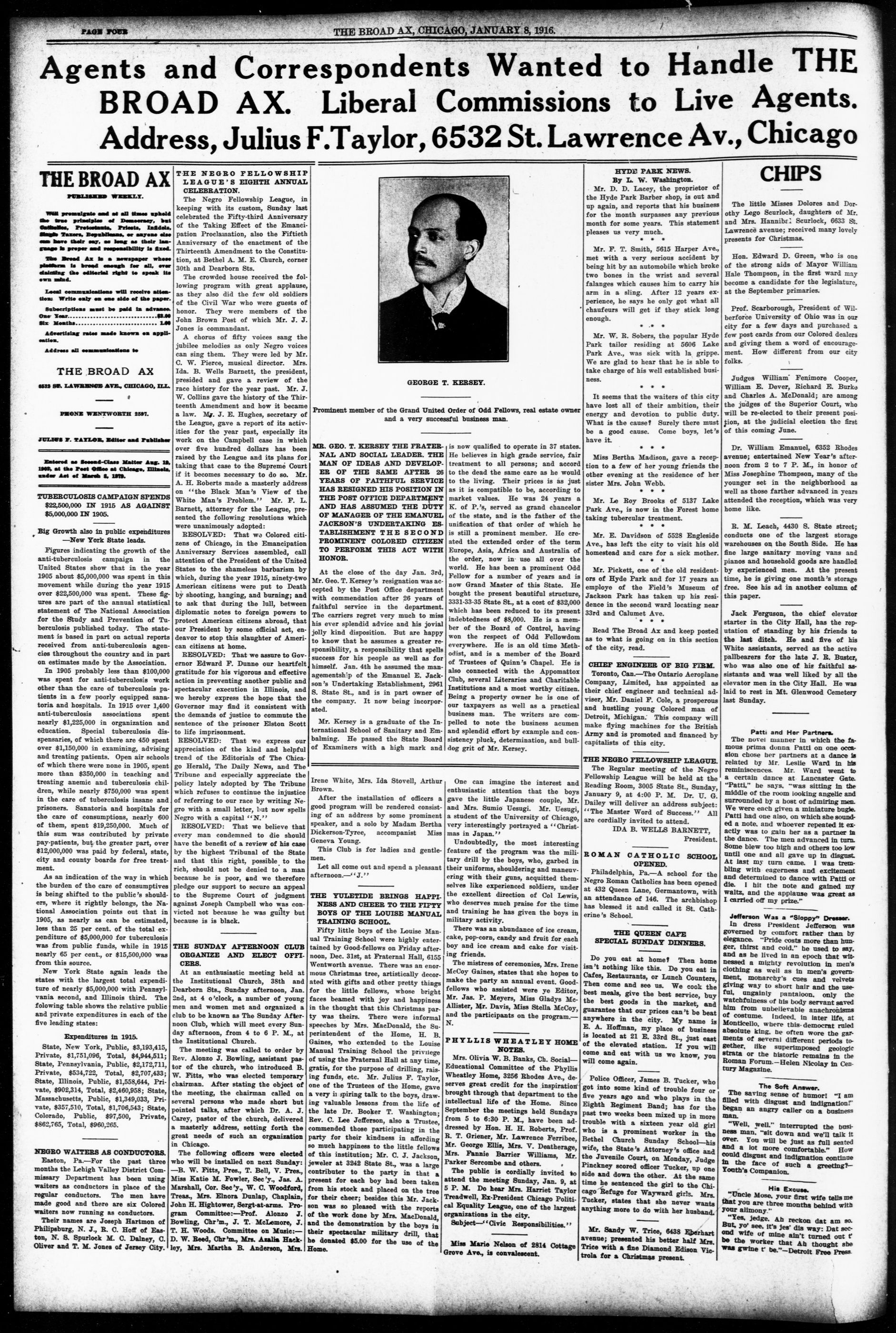
GEORGE T. KERSEY.
Prominent member of the Grand United Order of Odd Fellows, real estate owner
and a very successful business man.
MR. GEO. T. KERSEY THE FRATEB- is now qualified to operate in 37 states.
NAL AND SOCIAL LEADER. THE| He believes in high grade service, fair
MAN OF IDEAS AND DEVELOP. | treatment to all persons; and accord
ER OF THE SAME AFTER 26|to the dead the same care as he would
YEARS OF FAITHFUL SERVICE| to the living. Their prices is as just
HAS RESIGNED HIS POSITION IN|as it is compatible to be, according to
THE POST OFFICE peers market values. He was 24 years a
AND HAS ASSUMED THE K. of P.'s, served as grand chancelor
OF MANAGER OF THE EMANUEL | of the state, and is the father of the
JACKSON'S UNDERTAKING ES-| unification of that order of whieh he
TABLISHMENT THE SECOND|is still a prominent member. He cre-
PROMINENT COLORED CITIZEN| ated the extended order of the term
TO PERFORM THIS ACT WITH|Europe, Asia, Africa and Australia of
HONOR. the order, new im- use all ever the
At the close of the day Jan. 3rd,
Mr. Geo. T. Kersey’s resignation was ac-
cepted by the Post Office department
with commendation after 26 years of
faithful service in the department.
The carriers regret very much to miss
his ever splendid advice and his jovial
jolly kind disposition. But are happy
to know that he assumes a greater re-
sponsibility, a responsibility that spells
success for his people as well as for
himself. Jan. 4th he assumed the man-
agementship of the Emanuel E. Jack-
son’s Undertaking Establishment, 2961
8. State St., and is in part owner of
the company. It now being incorpor-
ated.
‘Mr. Kersey is a graduate of the In-
ternational School of Sanitary and Em-
balming. He passed the State Board
of Examiners with a high mark and
Irene White, Mrs. Ida Stovell, Arthur
Brown.
After the installation of officers a
good program will be rendered consist.
ing of an address by some prominent
speaker, and a solo by Madam Bertha
Dickerson-Tyree, accompanist Miss
Geneva Young.
This Club is for ladies and gentle-
men,
Let all come out and spend a pleasant
afternoon —‘<J.”?
THE YULETIDE BRINGS HAPPI-
NESS AND CHEER TO THE FIFTY
BOYS OF THE LOUISE MANUAL
‘TRAINING SCHOOL.
Fifty little boys of the Louise Man-
ual Training School were highly enter.
tained by Good-fellows on Friday after.
noon, Dec. 3ist, at Fraternal Hall, 6155
Wentworth avenue. There was an enor-
mous Christmas tree, artistically decor.
ated with gifts and other pretty things
for the little fellows, whose bright
faces beamed with joy and happiness
in the thought that this Christmas par-
‘ty was theirs. There were informal
speeches by Mrs. MacDonald, the Su-
perintendent of the Home, H. B.
Gaines, who extended to the Louise
Manual Training School the privilege
of using the Fraternal Hall at any time,
gratis, for the purpose of drilling, rais.
ing funds, etc. Mr. Julius F. Taylor,
one of the Trustees of the Home, gave
a very it spiring talk to the boys, draw-
ing valuable lessons from the life of
the late Dr. Booker T. Washington;
Rev. C. Lee Jefferson, also a Trustee,
commended those participating in the
party for their kindness in affording
so much happiness to the little fellows
of this institution; Mr. C. J. Jackson,
jeweler at 3242 State St., was a large
contributer to the party in that a
present for each boy had been taken
from his stock and placed on the tree
for their cheer; besides this Mr. Jack-
son was so pleased with the reports
of the work done by Mrs. MacDonald,
and the demonstration by the boys in
he donated $5.00 for the use of the
Heme.
is now qualified to operate in 37 states.
He believes in high grade service, fait
treatment to all persons; and accord
to the dead the same care as he would
to the living. Their prices is as just
as it is compatible to be, according to
market values. He was 2 years a
K. of P.’s, served as grand chancelor
of the state, and is the father of the
unification of that order of which he
is still a prominent member. He cre-
ated the extended order of the term
Europe, Asia, Africa and Australia of
the order, now in: use all over the
world. He has been a prominent Odd
Fellow for a number of years and is
now Grand Master of this State. He
bought the present beautiful structure,
3331-33-35 State St., at a cost of $32,000
which has been reduced to its present
indebtedness of $8,000. He is a mem-
ber of the Board of Control, having
won the respect of Odd Fellowdom
everywhere. He is an old time Meth-
odist, and is a member of the Board
of Trustees of Quinn’s Chapel. He is
also connected with the Appomattox
Club, several Literaries and Charitable
Institutions and a most worthy citizen.
Being a property owner he is one of
our taxpayers as well as a practical
business man. The writers are com-
pelled to note the business acumen
and splendid effort by example and con-
sistency pluek, determination, and bull-
log grit of Mr. Kersey.
One can imagine the interest and
enthusiastic attention that the boys
gave the little Japanese couple, Mr.
and Mrs. Sumio Uesugi. Mr. Uesugi,
‘a student of the University of Chicago,
very interestingly portrayed a ‘Christ:
mas in Japan.’?
Undoubtedly, the most interesting
feature of the program was the mili:
tary drill by the boys, who, garbed in
their uniforms, shouldering and maneuy-
ering with their guns, acquitted them-
selves like experienced soldiers, under
the excellent direction of Col Lewis,
who deserves much praise for the time
and training he has given the boys in
military activity.
There was an abundance of ice cream,
cake, pop-corn, eandy and fruit for each
boy and ice cream and cake for visit.
ing friends.
The mistress of ceremonies, Mrs. Irene
MeCoy Gaines, states that she hopes to
make the party an annual event. Good-
fellows who assisted were ye Editor,
Mr. Jas. P. Meyers, Miss Gladys Me.
Allister, Mr. Davis, Miss Stella MeCoy,
and the participants on the program.—
N.
PHYLLIS WHEATLEY HOME
‘NOTES.
Mrs. Olivia W. B. Banks, Ch. Social—
Educational Committee of the Phyllis
Wheatley Home, 3256 Rhodes Ave., de-
serves great credit for the inspiration
brought through that department to the
intellectual life of the Home. Since
September the meetings held Sundays
from 5 to 6:30 P. M, have been ad-
dressed by Hon. H. H. Roberts, Prof.
R. T. Griener, Mr. Lawrence Ferribee,
Mr. George Ellis, Mrs. V. Deatherage,
‘Mrs. Fannie Barrier Williams, Mr.
Parker Sercombe and others.
Tho public is cordially invited to
attend the meeting Sunday, Jan. 9, at
5 P.M. Do hear Mrs. Harriet Taylor
Treadwell, Ex-President Chieago Politi-
cal Equality League, one of the largest
organizations in the city.
Sabject—‘Civie Responsibilities.”
Miss Marie Nelson of 2814 Cottage
Grove Ave., is convalescent.
HYDE PARK NEWS.
By L. W. Washington.
Mr. D. D. Lacey, the proprietor of
the Hyde Park Barber shop, is out and
up again, and reports that his business
for the month surpasses any previous
month for some years. This statement
pleases us very much.
‘Mr. F. T. Smith, 5615 Harper Ave,
met with a very serious accident by
being hit by an automobile whieh broke
two bones in the wrist and several
falanges which causes him to carry his
arm in a sling. After 12 years ex-
perience, he says he only got what all
ehaufeurs will get if they stick long
enough.
Mr. W. R. Sobers, the popular Hyde
Park tailor residing at 5606 Lake
Park Ave., was sick with la gripe.
We are glad to hear that he is able to
take charge of his well established busi
ness.
It seems that the waiters of this city
have lost all of their ambition, their
energy and devotion to public duty.
What is the causef Surely there must
be a good cause. Come boys, let’s
have it.
Miss Bertha Madison, gave a recep-
tion to a few of her young friends the
other evening at the residence of her
sister Mrs. John Webb.
Mr. Le Roy Brooks of 5137 Lake
Park Ave., is now in the Forest home
taking tubereular treatment.
Mr. E. Davidson of 5528 Engleside
Ave., has left the city to visit his old
homestead and care for a sick mother.
Mr. Pickett, one of the old resident-
ors of Hyde Park and for 17 years an
employe of the Field’s Museum of
Jackson Park has taken up his resi-
dence in the second ward locating near
33rd and Calumet Ave.
Read The Broad Ax and keep posted
as to what is going on in this section
of the city, read.
CHIEF ENGINEER OF BIG FIRM.
Toronto, Can.—The Ontario Aeroplane
Company, Limited, has appointed as
their chief engineer and technical ad-
viser, Mr. Daniel F. Cole, a prosperous
and hustling young Colored man of
Detroit, Michigan: This company will
make flying machines for the British
Army and is promoted and financed by
capitalists of this city.
‘THE NEGRO FELLOWSHIP LEAGUE.
The Regular meeting of the Negro
Fellowship League will be held at the
Reading Room, 3005 State St., Sunday,
January 9, at 4:00 P. M. Dr. U. G.
Dailey will deliver an address subject:
‘The Master Word of Suceess.”? All
are cordially invited to attend.
IDA B. WELLS BARNETT,
President.
ROMAN CATHOLIC scHooL
OPENED.
Philadelphia, Pa—A school for the
Negro Roman Catholics has been opened
at 432 Queen Lane, Germantown, with
an attendance of 146. The archbishop
has Blessed it and called it St. Cath-
erine’s School.
THE QUEEN CAFE
SPECIAL SUNDAY DINNERS.
Do you eat at home? Then home
isn’t nothing like this. ‘Do you eat in
Cafes, Restaurants, or Lunch Counters,
Then come and see us. We cook the
best meals, give the best service, buy
the best goods in the market, ana
guarantee that our prices can’t be beat
anywhere in the city. My name is
E. A. Hoffman, my place of business
is located at 21 E. 33rd St., just east
of the elevated station. If you will
come and eat with us we know, you
will come again.
Police Officer, James B. Tucker, who
got into some kind of trouble four or
five years ago and who plays in the
Eighth Regiment Band; has for the
Past two weeks been mixed up in more
trouble with a sixteen year old girl
who is a prominent worker in the
Bethel Church Sunday School—his
wife, the State’s Attorney’s office and
the Juvenile Court, on ‘Monday, Judge
Pinckney scored officer Tucker, up one
side and down the other. At the same
time he sentenced the girl to the Chi-
cago Refuge for Wayward girls. Mrs.
Tueker, states that she never wants
anything more to do with her husband,
Mr. Sandy W. Trice, 6438 Eberhart
avenue; presented his better half Mrs.
Trice with a fine Diamond Eaison Vie.
trola for a Christmas present.
‘The little Misses Dolores and Dor-
othy Lego Scurlock, daughters of Mr,
and Mrs. Hannibe} Scurlock, 6633 St.
Lawrence’ avenue; received many lovely
presents for Christmas.
Hon. Edward D. Green, who is one
of the strong aids of Mayor William
Hale Thompson, in the first ward may
become a candidate for the legislature,
at the September primaries.
Prof. Searborough, President of Wil-
berforce University of Ohio was in our
city for a few days and purchased a
few post cards from our Colored dealers
and giving them a word of encourage-
ment. How different from our city
folks. ‘
Judges William’ Fenimore Cooper,
William E. Dever, Richard E. Burke
and Charles A. McDonald; are among
the judges of the Superior Court, who
will be re-elected to their present posi-
ion, at the judicial election the first
‘of this coming June.
Dr. William Emanuel, 6352 Rhodes
avenue; entertained New Year’s after.
noon from 2 to 7 P. M., in honor of
Miss Josephine Thompson, many of the
younger set in the neighborhood as
‘well as thoso farther advanced in years
attended the reception, which was very
home like.
RM. Leach, 4430 S. State street;
conducts one of the largest storage
warehouses on the South Side. He has
fine large sanitary moving vans and
pianos and household goods are handled
by experienced men. At the present
time, he is giving one month’s storage
free. See his ad in another column of
this paper.
Jack Ferguson, the chief elevator
starter in the City Hall, has the rep-
utation of standing by his friends to
the last ditch. He and five of his
White assistants, served as the active
pallbearers for the late J. R. Buster,
who was also one of hie faithful as-
sistants and was well liked by all the
elevator men in the City Hall. He was
laid to rest in Mt. Glenwood Cemetery
last Sunday.
Patti and Her Partners.
‘The nove! manner in which the fa-
mous prima donna Patti on one ocea-
sion chose her partners at a dance is
related by Mr. Leslie Ward in his
reminiscences. Mr. Ward went to
@ certain dance at Lancaster Gate.
“Patti” he says, “was sitting in the
middle of the room looking angelic and
surrounded by a host of admiring men.
We were each given a miniature bugle.
Patti had one also, on which she sound-
ed a note, and whoever repeated it ex-
actly was to gain her as a partner in
the dance. The men advanced in turn.
Some blew too high and others too low
Until one and all gave up in disgust.
At last my turn came. 1 was trem-
bling with eagerness and excitement
and determined to dance with Patti or
die. I hit the note and gained my
waltz, and the applause was great as
I carried off my prize.”
Jefferson Was a “Sloppy” Dresser.
In dress President Jefferson was
governed by comfort rather than by
elegance. “Pride costs more than hun-
Ser, thirst and cold,” be used to say.
and as he lived in an epoch that wit-
Ressed a mighty revolution in men’s
clothing as well as in men’s govern-
ment, monarchy’s cues and velvets
giving way to short hair and the use
ful, ungainly pantaloon, only the
Watchfulness of his body servant saved
him from unbelievable anachronisms
of costume. Indeed. in later life, at
Monticello, where this-democrat raled
absolute king. ne often wore the gar
ments of several different periods to-
gether, like superimposed geologic
strata or the historic remains in the
Roman Forum.—Helen Nicolay in Cen-
tury Magazine.
——
The Soft Answer.
‘The saving sense of humor! “I am
filled with disgust and indignation!”
Degan an angry caller on a business
man.
“Well, well.” interrupted the bust
hess man. “sit down and we'll talk it
over. You will be just as full seated
and a lot more comfortable.” How
could disgust and indignation continue
im the face of such a greeting?
Youth's Companion.
——
- ‘lila te
at nu? Mose, your frst wife tells me
fhat you are three months behind wit
Your alimony.”
“Yes, jedge. Ab reckon dat am so.
But, yo’ see, it's Jes’ dis way: Dat sec-
gnd ‘wife of mine ain’t turned out t
be the worker that Ah thought she
‘Was gwine t be.”—Detroit Free Press.
Talks on
Health, Cleanliness Proper Living Sanitation, Etc.
by DR. W.A. DRIVER
by
3300 So. State St.
Phone Douglas 3617
PNEUMONIA AND THE SUBVIVAL
OF THE FITTEST
Almost all the reading public know that colds, coughs, pleurisy and grip (la gripe) called by the medical profession influenza can become pneumonia or tuberculosis even. If neglected or improperly treated they kill by causing inflammation of the lung (pneumonitis, pneumonia) or pulmonary tuberculosis might close the scene.
All scientific persons have a profound respect for the laws of nature and those laws compel us to believe in the survival of the fittest. The fittest are careful not to break the laws. The fittest know that there is a penalty for breaking the laws. The fittest know that overeating and underexercising or overexertion cause colds. They know that the laws of nature require sufficient oxygen (fresh air) night and day; and they know that failure to receive that oxygen also causes a cold or a cough or a pleurisy or some malady which is an evolutionary product in the growth from a cold to a pneumonia.
The fittest leave as little as possible to chance. They believe in preparedness. They prepare to fight the germ that produces pneumonia before it has multiplied in the nose, throat or other portion of the respiratory tract. They leave the window slightly open even in zero weather in order to keep the body supplied with the ammunition called oxygen which is essential in our stupendous efforts to acquire the proverbial life cycle of three score and ten. The fittest leave the window open at the top and at the bottom, because they know the laws of nature, not for a form, not for show, but for the
It takes two people to make a quarrel, but one can often make more trouble than two can settle.
As a last resort we could commander the annual output of the American hen and defy the world.
Getting along with your neighbors is a comparatively simple task. All you've got to be is a good neighbor.
Thousands of young husbands will welcome with shouts of joy the news that dish wiping has been pronounced insanitary.
A woman writer says flirtation is one of the greatest games in the world. It is one of the few games in which both players can lose.
Animal Oddities
Sturgeon have no teeth.
The biting apparatus of a flea is only one-twelfth the diameter of the finest needle. Ducks carry oil in a little pocket near the tail. With this they oil their outer feathers and so make their waterproof. Kangarooos, of which there are fifty-six species, can sometimes leap as much as twenty feet. The male kangaroo stands from six to seven feet high. A rhinoceros rolls in the mud because little insects get between the folds of its skin and worry it. If it gets its body covered with mud they are unable to reach the skin.
Recent Inventions.
An attachment for scissors has been patented to enable them to be used to sharpen lead pencils. A new serving fork has a piece which can be pushed down along the lines without the fingers touching the food. Made of a flat steel spring, a quickly adjusted belt has been invented to take the place of strings on kitchen or laboratory aprons. For copying drawings or writings a device has been patented that follows the lines to be copied and at the same time guides a pen or pencil.
Current Comment.
California has taught the world how to make an exposition pay.—Philadelphia Record.
We'll get some straw votes on the presidential candidates soon, and then we will know no more about it than we do now.—Philadelphia Press.
Miss Liberty in New York harbor is to have a fine suit of paint and gold leaf. But, alas, she will charm very few newcomers nowadays.—Cleveland Plain Dealer.
[Picture of a man in a suit].
sake of being prepared for the tubercle bacillus, the influenza germ, the microorganisms that cause colds, coughs, pleurisies, empyemas, bronchitis and asthmas, and last but not least pneumonias.
Through the operation of the various laws of nature even the fittest err; but their errors are not as flagrant as those who depend upon the element of luck. The fittest occasionally sneeze, cough, complain of headache, run at the nose and show the symptom complex called a "cold." But the fittest does not fail to consult the physician before burdening the already errant system with the deadly patent medicine which the unfit often considers a panacea.
Pneumonia has been called the friend of the aged because it removes them from this changing mundane sphere to join the numerous throng gone in advance of us. The aged have a low resistance because of the hard fought battle often lasting three score and ten years or more. They have probably qualified as the fittest but those of us who shuffle off this mortal coil before engaging in a seventy years strife have not qualified.
Pneumonia kills easily the idle, the gluttonous, the careless, the nonvigilant, the unprepared in the hay day of youth and it removes the unfit in the fascinating noontide of life. The fittest of the fit probably never succumb to any disease; they do not even "shuffle off this mortal coil," they never taste the bitter cup of dissolution. It is possible for them to say "Death where is thy sting?" They sink into oblivion and enjoy the profundity of "nature's sweet restorer, balmy sleep."
Miss Ora Harris of Pittsburgh has taught twenty-five years in a school for the blind.
Miss Mary S. Boyd, chief of the data department of the National American Woman Suffrage association, is known as "the woman who answers questions."
Mme. Rejane is one of the quickest "studies" among great actresses. She can commit a long passage to memory by reading it over twice. But it may take her weeks to decide how to render it.
Dr. Laura M. Riegelman, attached to the New York board of health, will not live opposite a vacant lot, have carpets or wall paper or rent an apartment without studying the soil upon which it stands—health precautions; that is all.
Mrs. Mary Warren has the job of looking over the wastebaskets of the treasury department. For more than thirty years she has sat at her desk in a small back room in the treasury building, carefully examining every bit of refuse taken from the offices.
Echoes of the War.
If there is an "emperor of Europe" he'll have a throne of ruins.—Atlanta Constitution.
The sultan of Turkey has a wonderful system of letting the other man walk the floor.—Washington Star.
Kings will be fortunate in becoming sick of war before the common people become sick of kings.—Washington Post.
King Alfonso is still firm in his contents that Spain is neutral—and how earnestly he hopes that neither side will have cause to doubt it!—Detroit News.
The war is costing the European nations $25,000,000 a day. And the people, who have little say about it, pay the freight in blood and cash—Baltimore American.
PITH AND POINT.
You will never be accused of cheating at cards as long as you lose.
Being square with a man is quite different from getting square with him.
It is noticed that most of the dunces in the school of experience are night pupils.
When you get to the point where you are able to make both ends meet splice the ends.
If people consulted their consciences more they would have to consult lawyers less.
When you find that the truth is in your way you may be sure that you are on the wrong road.
THE BROAD AX, CHICAGO, JANUARY 8, 1916
The beautiful German commercial city of Frankfort on the Main is said to have had a curious origin. When the Emperor Charlemagne contended with the Saxons the fortunes of war were often against him. On one occasion he was forced to retire along the banks of the Main. At the time there was a thick fog, and he was unable to find his ship or any place where his army could cross. He was almost in despair when a doe, carrying a young one, sprang from a thicket in alarm, leaped into the stream and swam over. Charlemagne followed the example and crossed at the same place. The fog concealed the army, which escaped detection. When the emperor reached the shore he stuck his spear into the earth and exclaimed: "Here shall a city arise, to be called Frankenford."
In consequence of crossing the stream he overthrew the Saxons. He then built the town, which afterward became the scene of imperial coronations and later of great commercial importance.-London Answers.
Checkers.
The German name for the game of checkers or dights is "damenbrett"—ladies' board—probably "damen" for short. Some form of "dame" is used in almost every country where the game is played, except the English speaking countries, and the Scots still speak of the "dambrod." "Dames" was the name in England for a time, and we find it in an English book toward the end of Elizabeth's reign. The first use of the word draughts in existing literature is about 1400. At a later day "checkers" became another name, and this went to America with the early English emigrants and there became the usual name. In England in the sixteenth century the game had three names—"dames," "draughts" and "checkers." At an earlier period "checkerle," "chekar," etc., had been English names for chess—London Mirror.
Snails Are Queen Creatures.
The snail is found everywhere, over 3,000 species being known. Some of the large tropical snails, as bullmas, form nests of leaves, their eggs being as large as a pigson's. The small is extremely skillful in mending its shell, and some curious experiments may be made with them. Thus I have seen a helix of a yellow species attached to another shell of a reddish hue by cutting off the top whorl of the latter, when the snail will proceed to weld the two shells together and occupy both, using the addition as a door and possibly wondering at this sudden extension of its house. In the winter some of the snails hibernate or lie dormant until warm weather. A small of the Philippine Islands has a faculty of throwing off its tail when seized. This is also true of a West Indian variety, stenobus.-London Telegraph.
Euclid's Lost Books
"I was very much amused at the comment of a young friend who recently went up against the board of examiners for the naval service," said a Philadelphia man. "Speaking of the questions in geometry which were propounded to the bogs, this youngster said in a dry way:
"‘History tells us that the old discoverer of the science of geometry, Euclid, who lived 300 years before Christ, wrote something like twenty books, which he called “Elements,” and that of this number seven were lost. The examining board of the marine corps has found those books, for the questions it put to us two weeks ago clearly demonstrated that it dug up some theorems which had not been seen in the last 2,000 years.’"—Pittsburgh Dispatch.
Repelling Fire With a Drum.
A fire of a strange nature appeared in Wales in 1693. According to the most intelligible account concerning it now in existence, it came up from the sea near Harlech. At several places near that place and all over Merkonethshire it did much damage, burning hay, houses, barns, etc. A person writing of it said: "The grass over which it moves kills all manner of cattle that feed upon it. But what is most remarkable is that any great noise, such as the beating of a drum or sounding a horn, effectually repels it from any house."
Excusable.
Judge—Why did you hit this gentleman? Defendant—Well, judge, I haven't had a vacation for six years, and this boob has been sending me picture postals from Palm Beach, Thousand islands, California and the orient all these years!—New York Globe.
Present and Example
Johnny (at the window)—Oh, ma, an automobile just went by as big as a barn. His Mother—Johnny, why do you exaggerate so? I've told you a million times about that habit of yours, and it doesn't seem to do a bit of good—Boston Transcript.
The Wayside Dreamer
Stay too long in the land of dreams and when you wake up you'll realize that the world is at a starry station a million miles ahead of you.—Richmond Times-Dispatch.
Thankful.
"There isn't a bit of coal or wood in the house, and the gas is turned off." "Hurrah! Then the cook can't burn the dinner!"—Philadelphia Ledger.
Suggestive.
Mary (aged six) - Uncle Charlie, I wish you many happy returns of your birthday, and mamma said that if you take me a dollar not to lose it.
Right, but Wrong.
The late Professor Thomas R. Lounsbury of Yale, speaking at Cambridge, England, on the proper use of English, according to the Philadelphia Bulletin, said:
"But precision can be carried too far. The ultra precise, even when logically right, are really wrong.
"An ultra precise professor went into a hardware shop and said, 'Show me a shears, please.'
"You mean a pair of shears, don't you? said the dealer.
"No,' said the professor; 'I mean what I say. I mean a shears.'
"The dealer took down a box of shears.
"Look here, professor,' he said, 'aren't there two blades here? And don't two make a pair?'
"Well, you've got two legs. Does that make you a pair of men? And the professor smiled at the dealer triumphantly through his spectacles.
"He was logically right," said Professor Lounsbury, "but really he was wrong."
Girls In Korea.
Girls in Korea have no names or what would be considered names in the western world. There are no Marys or Mabels or Ruths. The little ones are given pet names at their birth, and these they bear until they are ten years old, after which they are no longer used. After her tenth birthday the young woman is known as "Mr. Kim's daughter" or "Mr. Kim's girl baby". The latter title is considered the more honorable. If there are several daughters in the family they are distinguished by such words as "big" (for the eldest), "second", "third", "fourth", etc. After marriage they are known by their husband's name and title, with the word "house" alixed. They may also be distinguished by the name of the place from which they came when marrying, as "Mrs. of the House of Kim, the young lady who came from Kong Jo."
Home Is—
Where you wish you were about twenty times a day when you are away from it.
Where you got three square meals a day and didn't appreciate them.
Where you can use the shower bath my time you want it.
Where you can step across the hall wearing a Turkish towel and a cake of soap without fear of seven or eight people seeing you.
Where you don't have to dress for dinner.
Where you don't have to tip some one every two hours.
Where the view isn't much, but the food and beds and company and general environments have got it all over any other spot on the map.
Where you go when all the other places are closed.—Boston Herald.
Penys at a Feast.
Pepys' account of the lord mayor's banquet which he attended in 1663 illustrates the earliness of the proceedings at that time. He made his way to the Guildhall at noon, "went up and down to see the tables" and then had a drink, refusing wine in consequence of a vow, but persuading his conscience that he might indulge in hippocras, a compound of wine and spices. Soon after 1 o'clock came the lord mayor, "and so all to dinner." Afterward Pepys strolled about the ladies' room, but could not discern one handsome face there and, "being weared with looking upon a company of ugly women," went off to Cheapside to see the pageants, "which were very silly." Thus the lord mayor's show in those days came after dinner.—London Standard.
No. He Wasn't Sick.
The ocean liner was rolling like a chip; but, as usual in such instances, one passenger was aggressively, disgustingly healthy. "Sick, eh?" he remarked to a pale green person who was leaning on the rail. The pale green person regarded the healthy one with all the scorn he could muster "Sick nothing!" he snorted weakly "I'm just hanging over the front of the boat to see how the captain cranks it!"—Argonaut.
The Sculptor's Art
Bowls—Yes. I know I'm ugly, but there is one great consolation. Biggs—What is that? Bowls—If ever I should become great and the people should resolve to erect a statue to my memory they won't be able to make me out any uglier than I am—London Telegraph.
Preparedness on the Farm.
To my way of thinking, that's the best thing about farm work—you've got to be prepared for all manner of emergencies that you can't possibly prepare for. Maybe that sounds like an absurdity, but it isn't—William R. Lighton in "Happy Hollow Farm."
Old Fashioned.
"No; she has never gone out much."
"How do you know?"
"Why, when she joined our sewing club she actually expected to do some sewing!" -Houston Post.
Good Reason.
"Why do you write articles on how cheaply people can live if they try?"
"In the hope of getting enough money to avoid having to live that way."
—Brooklyn Eagle.
Unflattering.
He (earnestly)—The fact is as plain as the nose on your face. She (pouting)—Everybody but you says I've got a pretty nose.—Baltimore American.
It is fear I stand most in fear of. For in sharpness it surmountetti to all other accidents.—Montague.
Humors of Indexing.
Quite as bad as the cryptic alphabetical headings under which important subjects are sometimes hidden in an index are the delusive cross references that lead to nothing. The present writer, looking up the subject of silver plate in an index, read "silver plate, see gold plate." then "gold plate, see plate," then "plate, see hallmarking," then "hallmarking, see plate marks," and finally "plate marks, see silver plate," which brought him back to where he had started. The most curious, freak of indexing in my experience, writes a correspondent, was detected in the course of revising and arranging a collection of obituary articles which had been neglected. I searched in vain for Queen Victoria in that index, though it was certain that her majesty's life was included in the collection. But neither under "Q" nor under "V" was it to be found. Finally it was discovered accidentally under "T"—"The Queen!" — London Chronicle.
The Soft Answer
"Yes, I'll take Jim's note for a hundred any time." said a banker when an offer to sell a note to the bank was made.
"I want to warn you, though," said the man in whose favor the note had been drawn. "that Jim is a good promiseer, but a poor payer. I don't want you to have anything against me because of this note."
"Jim's honest, and I'll take his note for a reasonable amount any time," said the banker. "I had some trouble with him once over an overdraft, and it turned out that the bank was at fault and that he had not actually overdrawn. I'll admit I was pretty nasty in my talk to him about it, because I was so sure the bank was right. The average man under those conditions would have 'cussed' me out at least, but all Jim said, although he was madder than thunder, was. 'I don't see why your wife ever married you!"—Indianapolis News.
How the Milliner Got Even.
A local business man, who has a friend in a nearby town who is a milliner, told a story of how the latter once got "even" with one of the leading social lights of the place after she had tried to be unfair with him. The husband of the woman in question had had a bit of hard financial sledding, and during the "reconstruction" period she had to go light on clothes. So one day she had the milliner send up some of his best hats on approval, which he did. She sent them all back, but in a few days appeared on the street with a duplicate of the most expensive one of all, which she had evidently made herself. In that town there is a middle aged woman of uncertain mental qualities and unquestionable poverty who is more or less of a town character. To her the milliner gave the original of the duplicated hat, much to the discomfort of the social queen, who apparently saw the point - New York Times
The Capitol Dome
The capitol dome at Washington is the only considerable dome of iron in the world. It is a vast hollow sphere weighing 8,000,300 pounds. How much is that? More than 4,000 tons, or almost the weight of 70,000 full grown persons, or about equal to 1,000 laden coal cars of four tons each, which, if strung out one behind the other, would occupy a mile and a half of track. On the very top of the dome the allegorical figure "America," weighing 13,985 pounds, lifts its proud head high in the air. The pressure of this dome and figure upon the piers and pillars is 14,477 pounds to the square foot. It would, however, require a pressure of 755,286 pounds to the square foot to crush the supports.
Appropriate.
Lord Dunraven in his younger days, when he was known as Lord Adare, speculated in the theatrical enterprises, but his success in this direction was not unfortunately equal to his enthusiasm. One day a certain well known wit was asked to give a title to one of his lordship's plays. "Well," he answered, "why not call it Robin Adair?"
Mental Dyspepsia
"Reading maketh a full man." quoted the philosopher.
"No doubt that's true," replied the cynic, "but the result is not always satisfactory."
"Why not?"
"I've met a great many people in my time who were crammed full of undigested literature." — Birmingham Age-Herald.
Russian Wolfhounds
the swiftest dog in the world, the borzoi, or Russian wolfhound, has made record runs that show seventy-five feet in a second, while the gazelle has shown measured speed of more than eighty feet a second, which would give it a speed of 4,800 feet in a minute if the pace could be kept up.
The Unfailing Remedy:
Anxious Father—Can you tell what
alls my daughter? Doctor—She does
not take enough outdoor exercise. Father—She does not feel like it. Doctor—True, so she needs toning up. Father—What do you recommend? Doctor—A new hat!—Exchange.
The Way of Pride
"Well," he exclaimed as he shook the dust of the road off himself, "that was some fall, anyhow."—Detroit Free Press.
Easy places do not make for growth anywhere, and he who ceases to grow begins to deteriorate.
PAGE FIVE
11
Effect of Familiarity.
"What we see constantly we cease to see vividly. The faces we notice least are those we know—and perhaps really love—best. Our eyes are a bit jaded by following the familiar lines. "The same is true of pure color." says a writer in the Atlantic Monthly. "Water and sky are very beautiful, and you may suppose that you are duly appreciative of them, but lie on the deck of a catboat and look at them with your head in an unaccustomed position—sideways and upside down—and note how the colors flare out upon your vision. "Or stay indoors for a few weeks in a room where you do not get much outlook and then go out. You will be blinded by the glory of the world, but not for long. The glory, alas, fades quickly, and habit settles upon you once more!
"With our friends' faces somewhat the same thing happens. When we first meet them they pique us pleasantly with their unfamiliar line and color. Gradually we grow used to them. The first vision has passed."
Mounting a Horse.
In mounting take the reins in the left hand. At the same time grasp a little mane halfway up the neck. Now turn the stirrup slightly toward you with the right hand and place the ball of the left foot in it. Grab the horn with the right hand and swing on. Don't pull yourself on, but swing on. Settle into the saddle easily; don't flop into it. If you want to get "your neck broke" some time mount by taking the horn in one hand and the candle in the other, and the time will surely come when you will not be disappointed.
Just a word in regard to dismounting. First withdraw your feet from the stirrups to the ball. Take the horn in the right hand and swing off, letting the left foot slip easily and quickly from the stirrup. Remember this, for many a man has been dragged to death because his foot stuck in the stirrup. Your feet will nearly always come free if thrown from a horse, but the left one is prone to stick in dismounting unless the above precaution is observed. -Outing.
An Analysis of "Ain't"
"Ain't" is an improper abbreviation of "are not." British writers spell it "a'n't," which properly indicates its derivation. Americans make it an inclusive offense, using it for "am not" and "is not," as well as for "are not." It is unquestionably the worst instance of sloveniness in the common speech of today.
Yet it is by no means of universal or even of common use. It will slip occasionally from refined lips, always with a jar to the enunciator as well as to the hearer. But the habitual user of "ain'ts" is careless of refinement. He may be an excellent citizen who never beats his wife or kicks the cat. But there is likely to be something silipshod about him somewhere, for "ain'tt" is needless as well as cacophonous; it fills no void and supplies no need—Cleveland Plain Dealer.
Mark Twain as "Attraction."
A girl who was a stranger to Mark Twain once found her way into his Bermuda home with the hope of getting a sight of the author. She came suddenly in contact with him and frankly explained her errand.
"Have you seen the crystal cave yet," he asked, "or the aquarium?"
"No; I came to see you first," she answered.
"Well, you shouldn't have seen me first," he answered. "I run in opposition to the crystal and the aquarium. But they're not shucks to me. I'm lots better. I give them their money's worth. But you should see them. Then you'll appreciate me."
This was said in his most earnest drawl and with only a sparkle of humor in his keen blue eyes.
The Real Thing.
Fred, aged three, had been a naughty boy, and his mother had punished him. He felt very much hurt and complained to his auntie about mamma's spanking him. Auntie said, "It is not you that mamma spanks, but a little devil inside of you who makes you do naughty things." After sitting very still for five minutes he said, "It beats all how it hurts me when that devil gets spanked."—Delineator.
A Great Copper Mine
For nearly 700 years copper ore (chalcopyrite) has been taken regularly from a mine in the province of Dalecarla, Sweden. The mine contains the largest copper ore deposit in Sweden and is supposed to be one of the greatest chalcopyrite properties in the world.
Our Trials.
"You know, my dear boy," said a sympathizing friend to a man in trouble. "that we really gain by our trials in life."
"That depends altogether on the kind of lawyer you get to conduct them," replied the sufferer.
Different Methods.
There are two different kinds of men. Give one a piece of rope and he will hang himself; give a similar piece to the other and he'll form a cordage trust. Washington Star.
A Real Artist.
"Is he good? Why, he not only can draw pictures that are good, but he can draw checks that are good."—Pittsburgh Post.
By medicine life may be prolonged, yet death will seize the doctor too.—Shakespeare.
PAGE SEX
Strenuous Admiralty Law
It was the early days of boat travel on the Ohio river when even passenger steamers stopped at landings on islands and mainlands for freight. We had made an island landing, and a wealthy passenger had left the boat to buy cigars at the island's tiny store. He bought $5 worth and presented a hundred dollar bill in payment, whereupon the storekeeper offered him $5 in change, asserting that he had received only $10. The customer returned to the boat and related his tale of woe to the captain, who at once went ashore and informed the storekeeper that unless the change was at once forthcoming he would hit a cable around the store and drag it into the river.
The storekeeper still refused, and the captain departed for his boat. A cable was quickly passed around the little building, hitched to the vessel and full steam ordered. When the shack totered upon its foundations, the frightened storekeeper appeared, the missing bills fluttering in his hand!—New York Post.
He Proved His Case
"Human nature is mighty queer, isn't it?" he observed to the other man on the rear platform of the street car.
"Yes, I suppose so," replied the other.
"People are too sensitive—altogether too sensitive."
"I don't know about that."
"Well, I do. For instance, now, you have a red nose. You are not to blame for it perhaps, but you are so sensitive that if I should offer you a remedy for it you"—
"You old loafer, I've a good mind to knock your head off!" hissed the red nosed man as he squared off.
"Told you so," replied the other as he dropped off. "Human nature is the queerest durned thing on earth, and some folks are so sensitive that they'd swallow their false teeth rather than let any one know they had 'em."—Detroit Free Press.
Hot Milk In Mashed Potatoes
"The reason that really good mashed white potatoes are such a rarity in this bitter world is that the milk isn't heated before it is put into them," said the domestic science teacher.
"And yet," said the pupil pensively, "I have seen wonderful cooks put in cold milk."
"But that was while the potatoes were burning hot and on the stove," insisted the advocate of the hot milk dressing. "The potatoes were so awfully hot that they heated the milk. The safest way is to heat the milk and to use also plenty of butter, pepper and salt. Then beat and beat them with a fork. Never use a spoon. You can't beat them too much for their own good."—New York Herald.
Going Home to Mother
Just what is meant by going home to one's mother, in its larger sense, is perhaps a little difficult to define. Yet, surely, it must be a very universal experience. Have we not all at some time—often following a period of confusion and stress of circumstances—suddenly experienced that deep sense of finding ourselves where we belonged? A sense of restfulness, of homecoming, of general rightness and well doing? It is a sloughing off of the nonessential and the trivial and a shifting of the spirit into deeper and simpler channels; a pause, when in the midst of all this mad dance of time and circumstances one gets a sudden, enlarging glimpse of truth and of eternity.—Atlantic Monthly.
Why It Burns.
There are a number of chemical substances which when applied to the skin will cause a burning sensation, and mustard is one of these. It acts on the tongue and other sensitive parts of the body as an irritant. It causes the blood vessels to swell and discharge some of their contents. If it is left on the skin long enough it will blister. That is what happens when a mustard plaster is applied. Under the mustard plaster we find a red patch produced by the swelling of blood vessels. This causes pressure on the nerves that produces the sensation we call burning.
Wills In Argentina
In Argentina the laws provide that a father must leave his children four-fifths of his fortune and a husband if he has no children has to leave all of his property to his wife. An unmarried son is compelled to leave his parents two-thirds of his property, and only unmarried persons without parents or descendants can make wills disposing of their possessions as they see fit.
An Effective Way
"They say," said the young dramatist, "that I shall have to cut my play down, but I really don't know where to begin."
"Why not start at both ends," his candid friend asked, "and work toward the middle?"
All He Gets.
The Boss—Ain't it enough that I save your life? The Bookkeeper—What do you mean—save my life? The Boss—If I gave you the raise you're asking for you'd drop dead—New York Globe.
Self Praise.
Be careful that you do not commend yourselves. It is a sign that your reputation is small and sinking if your own tongue must praise you.—Sir Matthew Hale.
Exceptions.
"Not always. Just you try to get any cold cash from a snow bank."—Baltimore American.
Enjoy the present day, trusting very little to the morrow.—Horace.
The Equinoccial Storm Fiction.
The widespread belief in the existence of an equinoctial storm and Indian summer comes, to a certain extent, under the head of popular superstitions. If the equinoctial storm is defined as a rainstorm, lasting at least three days and occurring within two or three days of the 21st of September, then there is very seldom a year when several equinoctial storms do not occur. The reason for the belief in an equinoctial storm is probably the fact that about that time of the year the first storms of the winter type, with steadily falling precipitation, make their appearance. They stand in sharp contrast to the summer type with the sultry weather and thunder showers. Storms of the winter type can occur, however, during any month of the summer. The amount of precipitation near the 21st has been shown by averaging the observations at many stations to be no greater than before or after this date.—Willis Ishlester Millham in Meteorology.
Monster Petticoats
During the reign of Charles I, the hoop petticoat was worn only by wives of the lower gentry and by the wives of the citizens. In the latter part of the reign of Queen Anne it rose again, this time in another form—that of an enormous hoop. This grew to such immense proportions that during the time of George I. and II. eight yards was considered the proper width. These hoops had outstanding steel or whalebone foundations at the bottom of the skirt. In Elizabeth's time this whalebone had been used at the top, near the waist, enlarging the hips for several feet. Addison expressed himself about the subject as follows through his Sir Roger de Coverley: "My great-great-grandmother has on a new fashioned petticoat, except that hers is gathered at the waist. My grandmother appears as if she stood in a large drum, whereas the ladies now walk as if they were in a goocart."
A Strange Rock Dweller.
One of the strangest creatures known to science is the pholas, or boring clam. When still very minute the animal bores into the sandstone ledges at extreme low water, by means of its sharp shell, which is replaced by secretions as it is worn away. It penetrates the rock to a depth of six or eight inches and hollows out its burrows as it increases in size. Shaped roughly like a top, it could not leave its rock dwelling even if it wished to do so. For food it depends on the animalcules that float in sea water, which it seizes by its long siphon, or tongue. The pholas is in great demand at the seaside resorts along the Pacific coast, for its meat is very tender and makes excellent soup. The clams are dislodged in great numbers from the ledges by the use of dynamite, although it is possible to obtain them with a pick or crowbar—Exchange.
Mexico City Is Aged.
Mexico City is traditionally nearly 600 years old. It was founded when the Aztecs settled on an island near Lake Tezcozco. Cortez practically destroyed the city in 1521. From this time on there was hardly a break in the ordinary events until 1692, when there was a revolt against Spanish rule. Later it was the scene of many revolutions and much bloody fighting until the iron rule of Porfrio Díaz made revolutions for thirty years somewhat unprofitable ventures. In the war between the United States and Mexico the principal movement of the American troops was directed against Mexico City. After capturing the hill of Chapultepec by assault General Scott occupied the city Sept. 14, 1847.
The Word Tramway.
Tramway is the term applied in Great Britain to all kinds of street railroads, whether using horses, engines, a cable or electricity. The word tram originally meant a log or stump. The evolution of the word into modern English use is given as: End-fragment—stump—log—pole—bar—beam—rail. In the earliest forms of railroads the tracks consisted of trams of wood or flat stones, at a later period of wooden stringers covered with strap iron and lastly of iron raills.
Encouraging Sign.
"How are you getting along with Miss Gadder?"
"Oh, first rate."
"What makes you think you are making some progress in her regard?"
"Well, when I first started to calling she played the phonograph practically all the time. Now the machine frequently remains idle for as long as twenty minutes."—Birmingham Age-Herald.
Doomed.
"I like to see a smart, well educated woman," said young De Sapp, "but I wouldn't want to marry one who knows more than I do."
"Too bad," rejoined Miss Swift. "I'm sorry to hear that you intend to remain a bachelor all your life."—Indianapolis Star.
One Form of It.
Grubbs—They tell me Binks is very much interested in music. Stubbs I suppose he must be. At any rate, he is an expert at blowing his own horn—Richmond Times-Dispatch
Sightseeing.
On a visit to his grandmother Harry examined her handsome furniture with interest and then asked, "Grandma, where is the miserable table that papa says you always keep?" The reputation that is built on cleverness is temporary; that built on character is permanent.
THE BROAD AX, CHICAGO, JANUARY 8, 1916.
Jupiter's Moons
Jupiter's moons
The statement that Jupiter's moons can occasionally be seen without optical aid by keen sighted persons needs some qualification. Within the last quarter of a century the space penetrating power of the camera, combined with the world's giant telescopes, has added no fewer than five Jovian satellites to the four which Galilei discovered 300 years ago. Four of the five new moons are "netted" at the famous Lick observatory, on Mount Hamilton, California, and the fifth is to the credit of Greenwich observatory. But all of the new discoveries are small and, with one exception, so distant from Jupiter that they are beyond the range of naked eye vision, even from Jupiter itself, unless an observer on the planet had better eyesight than we terrestrials. Indeed, to see Satellite IX (the latest addition to Jupiter's family of moons) a hypothetical observer on Jupiter would need eyesight capable of seeing a star 300 times fainter than the faintest visible to human eyesight—London Chronicle.
The Frugal Breton
"As I watched the fishermen unloading their cargoes I had a striking illustration of Breton frugality." writes Herbert Adams Gibbons in an article on "The Sardine Industry of Brittany," in Harper's Magazine. "So many sardines come into the port of Douarnez that their white, flecky scales cover the sand in mounds, washed up by the tides. Some of the boats have their decks covered several inches deep with the catch. But the fishermen actually count every sardine and send them ashore in baskets of exactly 200 each.
"There is no guesswork, no approximation by weighing. Since at low tide the boats are fifteen feet below the mole, the porters let down ropes to fishermen in the boats. The baskets are drawn up one at a time. If a single fish happens to fall overboard they go after it with a hand net and make really strenuous efforts to recover it. These are fishermen to whom the admonition to gather up the fragments would not have been necessary."
The Four Great Sauces:
A French epicure has declared that "man has created the culinary art; he does not feed like an animal—he breakfasts, dines and sups." The French are particularly eloquent on the subject of sauces. Among their famous chefs are recognized four great sauces, Spanish, veloute, bechamel and German. The Spanish and veloute were known as far back as the seventeenth century. In the eighteenth they were modified by the masters of cookery, particularly by Careme, who was called "the Raphael of the kitchen."
The Spanish sauce is composed of juices extracted from a mixture of ham, veal, chicken and pheasant. Veloute is similar, but is not colored. Bechamel is veloute to which cream has been added, and the German sauce is veloute plus the volks of eggs.
Curious Dwarf Oaks
Known to ranchmen as chinney, the dwarf oak of the southwest presents a curious instance of the devious and inscrutable ways of nature. There the illiptation of the great oak family covers a great area in the plains of Texas bordering on New Mexico. The trees, it is said, rarely attain a height of twenty inches and are replicas of their giant brothers in other parts of the country. The acorns which they bear are as large as those of the common burr oak and present a grotesque appearance hanging from the little limbs of the low growing shrub or tree. The annual crop of mast is used for fattening hogs. When the acorns are ripe many wild animals and birds flock into the miniature forest to feast on the nuts.—Arionaut
Told Almost All:
Here is a story told by one of our women lawyers:
"I told my client to tell me everything just as it had occurred—to hold back nothing—and then, being perfectly familiar with all the facts, I might be able to help him. After the story had come to an end I asked him if that were all.
"'Everything—'cept where I hid th' money!' was the answer." — Buffalo News.
Islands.
There are about 100,000 islands, large and small, scattered over the oceans. America alone has 5,500 around its coasts. There are 365 in the bay of Río Janetro, 16,000 between Madagascar and India and some 1,200 on the eastern coast of Australia between its mainland and New Guinea.
Legal Snags.
"Seems to me that the lawyers have it easy in life."
"Why so?"
"The rest of us have to surmount our own obstacles, but if a lawyer strikes one he applies to some judge and has it set aside."—Louisville Courier-Journal.
Three Clocks
The best three clocks in the world are at the naval observatory at Washington and the observatories at Greenwich and Berlin. The former two are the best and show a mean deviation of fifteen one-thousandths of a second a day.
Easy Mark
Randall—I just borrowed $5 from a friend. Rogers—Give me his address quick. Randall—Why? Rogers—A man who would lend money to you would lend it to any one.—Life.
It is not poverty, but covetousness, that causes sorrow. It is not wealth, but philosophy, that gives security.—Epictetus.
The Worm Turned.
"The Worm I Forced."
"You haven't done very well this month," said the boss. "Your orders were few and far between."
"I'm sorry," said the traveling salesman, "but—"
"I don't want excuses. I want orders."
Just then the door opened, and the secretary entered and passed in a card.
"He says he is in a hurry to leave town and would like to explain his proposition to you. He will be brief." "I can't see him now. I'm busy. Tell him to wait." "When shall I tell him to call again?" "Tell him to wait there and I'll see him in about an hour. Now, then, young man, why is it that you fell down this month?" "Because all the business men I called on insisted on treating your salesman the way you treat theirs."—Exchange.
Baking a Watch.
Only the best made chronometer would ever survive the tests made at the Royal observatory, Greenwich. Usually there are about 200 watches under examination for use in the royal navy. On certain occasions there is a complete trial of chronometers open to all makers who have sufficient confidence in their watches being able to withstand the severity of the tests. During the competition the watches are exposed to every possible variation of temperature. They are baked in furnaces sufficiently hot to cook a joint. In fact, so great is the heat that a badly made watch has been known to tumble to pieces during the baking test. The moment a watch is taken out of the oven it is plunged into mixtures registering 40 degrees of frost. To such perfection has the manufacture of some chronometers attained that even the most stringent tests fall to cause the slightest variation—London Telegraph.
Making Pastel Colors.
The lack of permanency of pastel pictures is largely due, according to Birge Harrison, to the bad quality of the materials employed. Unscrupulous manufacturers dip sticks of white chalk into liquid baths of brilliant but ephemeral dyes, and pictures produced with these soon fade. Writing in Art and Progress, Mr. Harrison says artists should make their own pastels, a process that is very easy.
"The materials used," he says, "are precipitated chalk mixed with the best dry powdered colors in the proportions necessary to produce the various tints desired. This impalpable powder is moistened to the consistency of a thick paste by the addition of an extremely dilute solution of gum tragacanth and water. It is then very thoroughly kneaded and finally pressed or rolled into sticks of the desired size."
Dogs In Moccasins
After the first severe freeze at the beginning of winter a band of prospectors working in northern Canada found themselves on the wrong side of a lake over a hundred miles wide, on the other side of which was the winter headquarters. They were without any means of transportation other than a boat in which was stored all their belongings and provisions. Hiring a halfbreed with his dog team, they put runners under the boat and made their way easily and safely across the smooth miles of frozen water, helping along the dogs by setting a sail on the boat. To protect the feet of the dogs from the hard surface of the ice small moeasins of buckskin, well padded, were provided for each.
Greece Only an Oligarchy.
Greece, as many people do not know, is a country managed by 500 families who hate one another like poison in true classic Greek fashion. The peasants, the back drivers and the fishermen talk radical politics all day long, but when election day comes they vote for a member of one of these big aristocratic—namely, "best" in the Greek sense—families. A republic for Greece would mean anarchy, chaos.—World's Work.
Bored Audience.
"Mr. Jaggs never opened his mouth while his wife was entertaining her guests the other night."
"Oh, yes, he did several times."
"I didn't hear him. What did he say?"
"Nothing. He yawned."—Baltimore American.
The Glove Tree
The limbs of the clove tree being very brittle, a peculiar four sided ladder is used in stripping the tree. As fast as the buds are collected they are spread in the sun until they assume a brownish color, when they are put into the storehouse ready for market.
Curious Request
A doctor in the country received one day a letter from an old woman asking for a bottle of cough mixture for her husband, ending with the postscript: "Please, sir, don't make it too strong, as the poor man has only got one leg." —London Tit-Bits.
Different From Her Ma.
He—Why is it that there's never a match in this house? She (curly)—I can't make matches. He—That's strange. Your mother could—Boston Transcript.
That's So.
"I hear strange sounds in my ears, doctor."
"Well. where would you expect to hear them?" -Boston Transcript.
Munchausen.
Perhaps the most voluble liar that ever lived was the Baron Munchausen—that is, the fictionized baron. The real baron was a kindly soul who lived in Germany and who in nowise deserved the evil reputation that attached to him through the use of his name in a series of highly colored adventures that appeared in printed in London in 1785.
The authorship of the absurd tales is a mystery. It is generally believed that Rudolph Erich Raspe, a questionable character, wrote the stories first; but there is no absolute confirmation. Following the original series a number of additional adventures were written by less skilled pens.
The real baron found little in life to enjoy after the stories became generally circulated. Curious tourists haunted his estates and tried to trap him into relating some wild story. At first he resented their attention in a vigorous fashion, but in his declining years he grew sour and morose and finally died, a most unhappy person, in 1797. —Kansas City Times.
Why the Sea Has Pearls.
A few weeks ago I was talking with a woman of deep religious sentiment who was in great distress because her very young baby had died before it could be baptized. I was led to ask natives of Norway, Finland and other places their views on this very delicate question, and so I came across a bit of very pretty Sicilian folklore.
To the babies in Sicily life is very kind and death is gentle. Those who die unbaptized are doomed to wander, but do not wander grieving. Madonna Mary sends to them every week end an angel, who hays aside his illy crown and romps with the dead babies. When he leaves them he gathers up in a golden chalice all the tears they have shed during the week. These he casts in handfuls into the sea, "and that is why the sea has pearls." I like that story.—Vancouver World.
Effects of Living.
Lying is a great sin against God, who gave us a tongue to speak the truth and not falsehood. It is a great offense against humanity itself; for where there is no regard to truth there can be no safe society between man and man. And it is an injury to the speaker; for besides the disgrace which it brings upon him, it occasions so much baseness of mind that he can scarcely tell the truth or avoid lying, even when he has no color of necessity for it, and in time he comes to such a pass that as other people cannot believe he speaks the truth, so he himself scarcely knows when he tells a falsehood. As you must be careful not to lie, so you must avoid coming near it. You must not equivocate, nor speak anything positively for which you have no authority but report, or conjecture or opinion—Sir Matthew Hale.
Christening Boats
The modern custom of christening vessels is without doubt an adaptation of an ancient custom, just as so many of our other customs and habits have been adapted from ancient ones. The ancients used to place the image of a titular deity at the stern of their vessels, in the tutela, or shrine. Do you remember that the boat mentioned in the twenty-eighth chapter of the Acts, the boat that carried Paul from Malta to Rome, was "under the sign of Castor and Pollux?" It was, so says Acts. The ceremony of breaking a bottle of wine on the bow of a new vessel as it is launched is another ancient adapted custom, for the ancients offered a libation to Neptune or Poseidon, who ruled the seas, as they launched their boats.—Exchange
Playing Safe.
"I'm surprised to see you riding in the suburban smoker every day. You never use tobacco in any form, do you?" "No, but if I ride in one of the other cars my wife expects me to be able to tell her what every lady on the train was wearing and whether it was becoming or not, and if I tell her she accuses me of taking too much interest in other women. If I can't tell her she says I'm too stupid for any kind of use."-St. Louis Post-Dispatch
Babylonia
The northern part of Babylonia is generally dry during the greater part of the year. The lower part, near the junction of the rivers, is generally a great malarial swamp overgrown with reeds. In the springtime one may sail almost anywhere across the country from the Tigris to the Euphrates, and in the dry season great herds of camels, buffaloes, donkeys, sheep and goats graze over the same place.
Nothing Rude.
"I suppose your daughter will start her scholastic career with some special rudimentary studies?"
"No, indeed. There ain't going to be nothin' rude about it. She's goin' to take only polite litertoor."—Baltimore American.
His Opposite.
"They say people with opposite characteristics make the happiest marriages."
"Yes; that's why I'm looking for a girl with money."--Brooklyn Eagle.
A Great Help
"Did you have any one help you when you were wanging the pictures?"
"Oh, yes! My wife stood around and asked me what I was swearing at"—St. Louis Post-Dispatch.
Some men do not make fortunes for the sake of living, but, blinded by avarice, live for the sake of money only.—Juvenal.
hqueaky Shoes.
While conducting a research for information on the origin of certain fashions of the past I discovered the reason for the existence of the squeak in shoes.
The squeak was once deemed fashionable, and men of great importance in the affairs of the country demanded it in their footwear, and cobblers were paid 2 shillings extra for putting it in. The squeaky boot denoted the approach of some one of importance, and the way was made clear at once in the same manner as a bicycler's shrill whistle warns you to look to your interests.
During the squeaky period men found it difficult to sneak into the house after 12 midnight without being discovered and disgraced. Removing the shoes before entering the home is an invention which followed the squeaky shoes era, and while the former is now almost obsolete, the latter is still in vogue and as popular as ever with married men!-Zim in Cartoons Magazine.
Bits About Beasts.
You think you know something about animals, eh? Well, let us put your knowledge to a few simple tests.
Frogs, to begin with. Can they breathe with their mouths shut? Certainly they can. As a matter of fact, they always do. If they kept their mouths open they would suffocate.
Next, hares. When do they close their eyes? Answer, never. You see they haven't any eyelids, so they can't. But they have a thin membrane, which performs the service of eyelids when they are asleep.
What is the color of a horse's eyebrows? That's a difficult one. Think hard and then learn that a horse hasn't any eyebrows.
You may like to know, in addition, that turtles and tortoises have no teeth; that parrots, unlike the majority of birds, can move both mandibles of their beaks, and that fishes never masticate. They simply haven't time between breaths.—London Answers.
More Rope.
In July, 1836, General William Henry Harrison, who had been spoken of as a candidate for president, visited Philadelphia. Many of his political friends were at the steamboat wharf to meet and escort him to his hotel. He was placed in a four-horse carriage, but after proceeding a short distance the horses became unmanageable and had to be taken out of the harness. The people began to draw the carriage, and there, was a call for ropes. They were soon procured, but proved too short, and as the enthusiasm increased the cry arose, "More ropes!" and still more ropes. The Democrats saw only the funny side of the case and adopted "more ropes" as a ridiculing slogan. It did not last long and could not have hurt Harrison much, for four years later he was elected president.—Philadelphia Press.
Skeletons.
Skeletons are used in cemeteryes, laboratories and museums. After battles they are frequently bleached before being stored away for the winter.
Everybody has a skeleton, without which one would fall around like a jellyfish, and instead of going to bed at night we would have to be hung over a clotheshorse. Indeed, life without a skeleton would be one long, dreary flop.
Skeletons come in a lot of assorted bones, which are more or less securely fastened together by the department store clerk who fastened them together before they went out of the shop. When the first skeleton was constructed one of its bones got away and has caused much trouble ever since.
Some wear clothes over their skeletons—Life.
Tosti's Thanks.
One day a lady called on Tosti, the famous song writer, and announced her intention of singing two of his songs at a concert.
"I thought I would just run round and try them over with you," she said.
Tosti remarked that he was not in the habit of giving lessons in that manner, whereupon the lady retorted:
"Very well: I will not sing your songs then."
Tosti's face beamed as he advanced toward her with outstretched hands.
"Madam," he said, "I thank you very much for that favor."
A Complete Job
"Do you love me with all your soul?" breathed the temperamental maiden as she peered through the orchids with which the table was decked at the lucky fellow whose joys and sorrows she had agreed to share.
The l. I. paused for a moment while he inspected the supper check, just handed him by an obsequious menal.
"Yes, and with all my roll," he said fervently—Richmond Times-Direcet.
Painfully Frank
Wedderly—They say that a man and his wife grow to look alike after they have been married a few years. Now, my wife and I have been married ten years. Do you think we look alike? Singleton—Yes, indeed. You both seem to have the same sad expression.
Big Ones.
Fatty--Fer two pins I'd pull year ears
fer you! Shorty--Jist you try it on
You'll find you'll 'ave your 'ands full'
London Firefly.
Pessimistic
"What is an antiquarian, pa?"
"A man who, not satisfied with his present troubles, is looking for some in the past."
Her! Excuse.
Widow (to dressmaker)—You must really wait awhile for payment for the mourning dresses. We are still too sorrowful to consider financial matters.
QUINADE
GROWS HAIR
REMOVES DANDRUFF
SEND FOR SAMPLE
QUINASOAP
THE IDEAL SHAMPOO SOAP
THOROUGHLY CLEANSSES THE SCALP
QUINACOMB
HAIR, STRAIGHTENER
SHAMPOO DRYER
QUINADE 25¢ QUINACOMB50¢ QUINASOAP 25¢
AT ALL DRUGGISTS
SEEBY DRUG COMPANY, NEW YORK CITY, N.Y.
THE SANITARY and SHIP CANAL
Length - - - - - 32 Miles
Depth - - - - - 22 Feet
Width - - - 162 to 290 Feet
THE CANAL OFFERS:
Industrial Locations, Dock Facilities, Water Transportation, Railroad Connections, Electric Power, Concrete Building Material.
Direct Connection with St. Louis via the Illinois River and Direct Connection with the Gulf via the Illinois and Mississippi Rivers.
Electric Energy Created from Water Power for the Modern Factory Means Efficiency and Economy.
THOMAS A. SMYTH, - President
JOHN McGILLEN, - - Chief Clerk
F. D. CONNERY, - - Comptroller
Karpen Building
900 So. Michigan Ave., CHICAGO
WALTHAN
WATCHES
12
11
10
9
8
7
6
5
4
3
2
1
WALTHAN
Leach's S
Main Office 4430 So. St
O
HOLIDAY SALE
ON
Watches, Diamonds, Jewelry
ELGIN or WALTHAM
20 and 25 year cases, 7 and 15 jewels
$7.95 and $10.95
C. L. LANDE
3518 S. State St. Tel. Douglas 7587
SPECIAL RATES ON STORAGE of Household Goods, Pianos and Trunks
For the next thirty days to fill our New Warehouse we are giving Special Rates FIRST MONTH STORAGE FREE PIANO in room alone with dust-proof cover on each one. Household goods in private room, each piece burlapped before putting away. We guarantee your furniture to come out of storage in just as good condition as it went in, whether it be one month or one year.
All Phones Oakland 3784
PHONE DOUGLAS 6626
GABRIEL FRANCHERE, Jr.
SHOES
FOR LADIES, MEN AND CHILDREN
SHORT VAMP SPECIALTIES
3109 S. State St. Chicago
THE BROAD AX, CHICAGO, JANUARY 8, 1916.
Living on Schedule
The man who is living this life on schedule time deserves to be an object of pity. I know of one creature who is so precise in his appointments that he is actually living a month in advance of himself. You say to him, "Whatchergonado tomorrow noon, Bill?" and he'll consult his little vest pocket engagement book and inform you that he is filled up as far as next Wednesday at 10 p. m (meaning engagements, of course). Then you say, "I wanted you to lunch with me tomorrow at 12." "Let me see," says he; "I have a fifteen minute canceled engagement at that time, so I'll accept your invitation. Meanwhile you'll excuse me, dear boy, for I have a directors' meeting on at 4:22 and leave for Goplunk, N. J., at 5:48, but I'll be on hand at 12 sharp." And he records it in his book. This schedule crank has everything prearranged except his funeral, and if he happens to have a previous engagement I'll wager he'll disappoint the mourners by postponing that—Cartoons Magazine.
Using the Expression "I Think." A man was referred to as one who in his conversation never says "I think" so and so. The "think" is a mere expletive. A positive, clear headed man says what he thinks without saying he thinks. Besides, when a person premises with an "I think" it weakens his assertion because thinking is by no means an assurance of truth. If one should say "I think it will rain tomorrow" the very expression carries a doubt because mere opinion is a lame matter, and the world is chock full of opinions. If, however, he should say "It will rain tomorrow" it carries some assurance even if it is, after all, an opinion. So the man referred to in the first place doesn't say "I think," for it is entirely superfluous, and he adds force and dignity to what he says in omitting it entirely. And then when one looks at the situation calmly he will conclude that "think" is much under a cloud since very few people think exactly alike. There are ten thousand instances of this character—Ohio State Journal.
Beauty In the Mexican's Voice.
Beauty In the Mexican's Voice.
Next to the love of dress, I was most struck with the fineness of the voice and the beauty of intonations of both sexes (of the Mexicans). It is a pleasure simply to listen to the sound of the language before I could attach any meaning to it. They have a good deal of the creole drawl, but it is varied, with an occasional extreme rapidity of utterance, in which they seem to skip from consonant to consonant until, lighting upon a broad open vowel, they rest upon that to restore the balance of sound. A common bullock driver delivering a message seemed to speak like an ambassador at an audience. In fact, they sometimes appeared to me to be a people on whom a curse had fallen and stripped them of everything but their pride, their manner and their voices.—"Three Years Before the Mast," by R. H. Dana.
Curious Golf Shot.
The late lord chief justice, Lord Alverstone, being one of the judges at the Birmingham assizes, in the intervals of business had several rounds of golf on the Edgaston links. On one of these occasions he was playing with the local professional and got rather badly bunkered at the second hole. It was necessary, in order to get the ball out, to make it rise almost perpendicularly into the air, and for this purpose Lord Alverstone, or Sir Richard Webster, as he then was, took his niblick and made a mighty stroke. No conjurer on earth could have done a trick more neatly. The ball not only leaped into the air, but dropped as clean as a whistle into the judge's baggy right hand pocket! -London Mall.
Asphalt Paving.
Asphalt as paving is the commonest commercial use of the mineral today, and yet its successful employment in the field of road making is of comparatively recent date. The first compressed rock asphalt roadway was laid in Paris in 1854, while it was 1876 before the first similar type of road making was used on Pennsylvania avenue, in Washington.
The Luxury of Disdain.
"He hasn't any," replied Mr. Growcher. "That's why I keep him around. I'm shy on distinguished ancestry myself, and I enjoy having a creature at hand whom I can contemplate with supercilious superlority."—Washington Star.
Reversing the Usual Order.
"Do you know, Jones does some uncommonly queer things—anything to be different from other people."
"Like what, for instance?"
"Why, he's just put a mortgage on his limousine to have repairs made on his house."—Baltimore American.
Shapes.
"I purchased a lovely round oak dining table this morning," said Mrs. Hasher.
"That being the case," rejoined the star boarder, "I suppose we need expect no more square meals."—Indianapolis Star.
Thaws and Cold.
It is colder in a 'thaw than in a frost because when water freezes it parts with its heat to the air, which thus feels warmer. In a thaw heat is absorbed from the air.
Accommodating.
Diner—I'll have an order of chicken.
Walter—Very sorry, str, but the chick-
an is out. Diner—Well, I'll wait till it
returns. I'm in no hurry. — Boston
Transcript.
Life Struggle of the Trees.
An interesting light is thrown on the longevity of the trees that grow along the timber line of the Rocky mountains by Mr. Enos A. Mills in his "Rocky Mountain Wonderland." He says:
A few timber line trees live a thousand years. But half this time is a ripe old age for most of the timber line veterans. The age of these trees cannot be judged by their size or by their general appearance. There may be centuries of difference in the ages of two arm in arm trees of similar size. I examined two trees that were growing within a few yards of each other in the shelter of a crag. One was fourteen feet high and sixteen inches in diameter and had 337 annual rings. The other was seven feet high and five inches in diameter and had lived 492 years.
One day by the sunny and sheltered side of a bowler I found a tiny seed bearer at an altitude of 11,800 feet. How splendidly unconscious it was of its size and its utterly wild surroundings! This brave pine bore a dainty cone, yet a drinking glass would have completely housed both the tree and its fruit.
Conversing With "Ghosts."
Some scientists of real eminence have accepted the postulate of the individuality and self consciousness of the soul after the death of the body and have attempted to demonstrate their belief by asserting communication with these disembodied spirits. Sir William Crookes, a profound deliver in chemistry pertaining to radio-activity, asserted years ago that he had communication with souls of dead friends, but for several years he has been silent anent this matter. Camille Flammarion, a rather speculative and sensational astronomer, declares that he has seen and conversed with the "ghosts" of dead friends, Professor William James, brother of Henry James, the novelist, promised before he died that if possible he would communicate with his friend Professor Hyslop, both eminent psychologists, but at last accounts the soul of Professor James had not spoken.—Exchange.
Fangs of a Snake.
Examine the finest cambric needle under a high power microscope and its point will look rough and blunt. A snake's fang similarly inspected appears perfectly smooth and sharp. In each fang is a groove which connects by a tube with a sort of bag—the poison gland—just beneath the eye. When the snake strikes a muscular contraction simultaneously forces the venom out of the bag through the tube and along the groove into the flesh of the person attacked. Snake poison, generally speaking, has two distinct effects. It destroys in some mysterious way the fibrin of the blood, thereby causing the latter to behave as if diluted and to filter through the walls of the veins and arteries. In addition, it paralyzes the nerve centers and so affects the heart, sometimes bringing death by suffocation.
Pantomime Performances
Most pantomime characters were originally borrowed from the Italians. The first real English pantomime was produced at a theater in Lincoln's Inn Fields in 1720. It was called "Harlequin Executed," and its subtitle was "A New Italian Comic Scene Between a Scaramouche, a Harlequin, a Country Farmer, His Wife and Others." The performance was very successful. About the middle of the eighteenth century the character of pantomime performances was completely altered, chiefly because of the genius of the famous Grimaldi, who made the clown the first figure in the pantomime. Grimaldi first appeared at Sadler's Wells theater, where he played the part of a monkey. He was actively engaged on the stage for forty-nine years.
Oder of Iodeform:
It is said that the odor of iodoform can be removed from the hands and utensils by mustard. While the hands are wet (moisten them with cold water) place a small quantity of dry mustard powder in the palm and rub it well over the hands and then wash off with soap and water. For utensils the mustard must be made like a paste and allowed to remain spread on them for several hours.
The Needless Needle
"Now, ma," said the young man who was showing his visiting mother the wonderful sights of the city, "would you like to go into the park and see Cleopatra's Needle?" "I didn't know that hussy ever used a needle. She didn't spend much time sewing, from the scanty wardrobe she had in all the pictures of her that I ever saw."—Judge.
System All Right
"I used to think I would know just how to manage my wife when I got her."
"Has your system proved to be a failure?"
"No; the system is all right, so far as I know. She has never let me try it."
—Stray Stories.
Four Counties Inn
In the Four Counties inn, in England, it is possible to eat in Leicestershire, sleep in Staffordshire, drink in Warwickshire and smoke in Derbyshire without leaving the building.
Horses and Music
The musical acuteness of horses is shown by the rapidity with which cavalry horses learn the significance of trumpet calls.
Friendship may and often does grow into love, but love never subsides into friendship.
LINCOLN STATE BANK OF CHICAGO
This Registering Home Bank FREE. to our Savings Depositors; will start you saving and keep you at it. A Savings Account is the first step to wealth. OPEN one with US.
NOTARY PUBLIC
Faustin S. Delany
Attorney and Counselor at Law
312 S. Clark St., Suite 422
CHICAGO
COLLECTIONS A SPECIALTY
Res. 4510 St. Lawrence Ave.
Tel. Drexel 5260
PHONES: OFFICE. MAIN 4153
AUTOMATIC 33-736
RESIDENCE. DREXEL 7990
Walter M. Farmer
ATTORNEY AT LAW
SUITE 708, 184 WASHINGTON ST.
NOTARYPUBLIC CHICAGO
Office Phones: Res. 5133 So. Wakah Ave.
Oakland 4662, Auto. 73-058 Phone Drexel 18815
Dr. Theo. R. Mozee
DENTIST
4709 S. STATE STREET
CHICAGO
Hours 9 A. M. to 5 P. M., 7 P. M. to 9 P.M.
Sundays by Appointment
Phone Main 2017 Automatic 32-395
A. L. WILLIAMS
ATTORNEY AND COUNSELOR AT LAW
Suite 706 Firmenich Bldg.
184 W. Washington St.
Residence 5548 Jefferson Av.
Phone Midway 5515 Chicago
THE BROAD AX CAN BE FOUND
ON SALE AT THE FOLLOWING
NEWS STANDS:
From on and after this date The Broad Ax, can be found on sale at the following news stands:
N. C. Chalmers, cigars, tobacco, notion store and news stand, 5012 S. State street.
L. E. Chilton, news stand, S. E. corner 51st and State streets.
E. H. Faulkner, news agency; 3109 S. State street.
George I Martin, maker of fine cigars and news stand, 18 W. 31st St., near State.
R. M. Harvey's barber shop and news stand, 3924 State street.
W. M. Maxwell, notions, cigars, to bacco, confectionz and news stand, 5244 State St.
Edward Felix, notions, cigars and news stand, 52 W. 30th St.
F. Bishop, cigars, tobacco and news stand, 3 W. 27th St., near State.
Sylvester McGloffin, news stand and laundry office, 4122 State St.
William Gaughan, laundry office cigars, tobacco and news stand, 2636 State St.
E. M. Oliver, notions, cigars and news stand, 15 W. 36th Street, near State.
A. D. Hayes, cigars, tobacco, notions, stationery and news stand, 3640 S. State St.
George McFaro, shoe shining parlors and news stand. 3800½ State street.
PAGE SEVEN
BANK OF CHICAGO
STATE SUPERVISION
TH STATE STREET
CAGO, ILL.
Douglas 200
SURPLUS. $20,000.00
Commercial Banking
Savings and Checking Accounts
Foreign Exchange
Safety Deposit Vaults
Mortgages and Bonds
3 Per Cent
Interest on Savings
Deposits
Your Patronage Solicited
Depository and Correspondent, Continental & Commercial National Bank of Chicago, Illinois.
A. D. GASH
ATTORNEY AT LAW
118 North La Salle St., Chicago
Suite 615 to 616
PHONE MAIN 2214
Residence 1262 Macalister Place
Telephone Monroe 2714
MILES J. DEVINE
ATTORNEY AT LAW
Suite 313-329 Reaper Block
Clark & Washington Sts.
Phones Central 239
Auto. 41-916 CHICAGO
Franklin A. Denison
ATTORNEY AT LAW
36 West Randolph St., Chicago
Suite 708 Delaware Building
Tel. Central 3142
Phone
FRANKLIN 2727
AUTO: 41-543
Res. 508 E. 36th St.
Phone Douglas 4397
J. GRAY LUCAS
ATTORNEY-AT-LAW
25 N. Dearborn St.
Union Bank Building
Suite 311
CHICAGO
FRANK DUNN
J. B. McCAHEY
Trustees
Established 1877
TEL. OAKLAND 1550, 1551, 1552
JOHN J. DUNN
WHOLESALE COAL RETAIL
Fifty-First and Armour Avenue
RAILYARDS
51st St. and L. S. & M. S.
51st St. and Armour Ave.
CHICAGO
T. B. Hall, Laundry office, cigars,
tobacco and news stand. 3618 South
State street.
Fred M. Waterfield, cigars, tobacco,
notions and news stand, 5202 South
State street.
Coleman & Glanton, cigars, tobacco and news stand, 3342 S. State street. Miss E. M. McClain, hair dressing parlor and news stand. 30 W. 39th street. F. M. Diffay, cigars, tobacco, notions and news stand. 3605 State street.
Nothing but an American.
When I look back on the shifting scenes of my life, if I am not that altogether deplorable creature, a man without a country, I am, when it comes to pull and prestige, almost equally bereft, as I am a man without a state. I was born in Indiana, I grew up in Illinois, I was educated in Rhode Island, and it is no blame to that scholarly community that I know so little. I learned my law in Springfield and my politics in Washington, my diplomacy in Europe, Asia and Africa. I have a farm in New Hampshire and desk room in the District of Columbia.
When I look to the springs from which my blood descends the first ancestors I ever heard of were a Scotchman who was half English and a German woman who was half French. Of my immediate progenitors my mother was from New England and my father was from the south. In this bewilderment of origin and experience I can only put on an aspect of deep humility in any gathering of favorite sons and confess that I am nothing but an American.—From "The Life and Letters of John Hay" in Harper's Magazine.
PAGE MIGHT TEENAN JO
TEENAN JONES' PLACE
3445 SOUTH STATE STREET Telephone Douglas 4591
The finest and
BUFFET and C
Side. First-Class
HENRY "TEENAN
A. F. CODOZOE,
J. H. WHISTON, Proprietors
CHAS. HARRIS, Manager
The El
AND H
3030 STATE STREET
JOHN BLOCKI, President
JOHN BLOCK
PERF
C. E. KREYSS
5057 South
NOT ON THE
FOR HIGH GRADE DR
MEDICINAL H
All Prescriptions C
ALSO CARRY
BLOCKI'S IDEAL &
IN BOTTLE
The finest and most UP-TO-DATE BUFFET and CAFE on the South Side. First-Class Entertainers. HENRY "TEENAN" JONES, Proprietor.
A. F. CODOZOE, DOUGLAS 5971
J. H. WHISTON, Proprietors Phones DOUGLAS 3256
CHAS. HARRIS, Manager AUTO. 72.379
The Elite Cafe
AND BUFFET
3030 STATE STREET CHICAGO
JOHN BLOCKI, President F. W. BLOCKI, Treasurer
JOHN BLOCKI & SON
PERFUMERS
GO TO
C. E. KREYSSLER, Druggist
5057 South State Street
NOT ON THE CORNER
FOR HIGH GRADE DRUGS, CHEMICALS AND
MEDICINAL PREPARATIONS
All Prescriptions Carefully Compounded
ALSO CARRY A FULL LINE OF
BLOCKI'S IDEAL & BLOCKI'S FLOWER
IN BOTTLE PERFUMES
Rhinoceros Horn.
In Sumatra the horn of the rhinoceros is esteemed as an antidote to poison and on that account is made into drinking cups.
The Land of Large Families
In his article on the winter life of the French Canadians in Harper's Howard E. Smith tells of the extraordinary large families of these simple folk.
"Soon the twilight grew to night, and the large lamp on the table cast its orange glow over the room and the long table filled with steaming dishes.
"You have a large family, madam," I remarked, as they gathered about the table.
"Oui, monsieur, we are sixteen. It is a good gift to le bon Dieu, n'est-ce pas? she said, turning toward the cure.
"C'est vrai, mon enfant. It is. There is no better gift than that of another child to his kingdom."
"I could not but remember that the law has also encouraged large families by passing a bill at Quebec giving ten acres of land to any family having from that time forth twelve or more children, and how in two years the law was repealed because the demand on those ten acres lots was in excess of the supply."
Strawberry Nose
The most distressing of facial deformities, rhinophyma, which is characterized by a much swollen and redened tip of the nose, making this look like a huge strawberry or a piece of cauliflower that has been dipped in beet juice, may be cured by a simple operation. Sir William Milligan of the Royal infirmary, Manchester, England, describes this in the London Lancet. The operation consists in cutting off all the hypertrophied tissue, while the nasal passages are kept extended with absorbent wool in order to preserve their contour. Care is taken to avoid injury to the lateral cartilages, and only two insignificant blood vessels require tying. The raw surface is covered with two thin grafts of skin cut from the patient's thigh, over which a sheet of gold leaf is placed and a dry dressing fastened with adhesive plaster. It should be possible to remove the dressing in five days.
Races Within Races In the Balkans.
Language and religion are not the only basis of the intense subdivision of feeling in the Balkans. The whole region is parceled out among race fractions, some of which are no larger than a hamlet. Roumanians, Bulgarians, Servians and Greeks have a sharp consciousness of race persistence, and at the same time every state is intent upon breaking up the race units of other peoples which exist within its borders. If Greece were peopleled only by Greeks and Bulgaria by Bulgarians and Servia by Servians, the task would be easier. It is a curse to the peninsula that the villagers have pushed this way and that wherever there was vacant land or wherever they could make a vacancy by driving out the previous holders. The result is the creation of race islands in the midst of angry race seas.—Albert Bushnell Hart in Outlook
---
most UP-TO-DATE
CAFE on the South
Entertainers.
"JONES, Proprietor.
DOUGLAS 5971
Phones DOUGLAS 3256
AUTO. 72-379
ite Cafe
BUFFET
T CHICAGO
F. W. BLOCKI, Treasurer
BLOCKI & SON
CUMERS
TO
SLER, Druggist
State Street
THE CORNER
DRUGS, CHEMICALS AND
PREPARATIONS
carefully Compounded
A FULL LINE OF
BLOCKI'S FLOWER
PERFUMES
Reconciled.
We observe that our friend has a bad cold in his head, and of course we tell him exactly how to cure it. From his pocket he takes a large memorandum book and enters our prescription on one of the final pages thereof. Then he snaps a rubber band about the book, sneezes and smiles happily.
We observe to him that we are glad our instructions for a cure have made him so happy.
"It isn't that," he says. "Since I got this cold I have written down every sure cure recommended, and whenever the cold gets so bad I feel as though I couldn't stand it another day I read over all the cures and think how much better is is to have the cold than to endure all the remedies."—Judge.
Spring Flows on Holidays.
In a picnic ground in the Passaic valley there is a spring that flows only on Sundays and holidays. It used to flow always. Robert E. Horton, in the proceedings of the Connecticut Society of Civil Engineers, explains this strange performance. When the great silk mills sprang up in the Passaic valley numerous artesian wells were bored into the red sandstone; pumps draw out so much water that it now normally stands below the level of the spring outlet, but on Sundays and holidays the pumps are not working, the water rises above the level of the spring, and this flows again.
Helping Uncle.
She came down to the drawing room to meet her special young man with a frown on her pretty face.
"John," she said, "father saw you this morning going into a pawnbroker's with a large bundle."
John flushed. Then he said in a low voice:
"Yes, that is true. I was taking the pawnbroker some of my old clothes. You see, he and his wife are frightfully hard up."
"Oh. John, forgive me!" exclaimed the young girl. "How truly noble you are!"—Exchange.
Expert Samoans.
The women of Samoa often fish in the sea without nets, boats or books. They simply wade into the water and form themselves into a ring. The fishes being so pleniful, they are almost sure to have imprisoned some in the ring. These women are very quick and active, and every time they catch a fish with their hands they simply throw it alive into the basket on their back.
Considerate.
"Have you ever done anything to make the world happier?" asked the solemn looking person with the unbarbered hair. "Sure," answered the jolly man with the double chin. "I was once invited to sing in public and declined."
"My grandpa had a perplexity fit the other day," said small Dorothy. "Perplexity fit!" echoed Edward. "You mean a parallel stroke, don't you?"—Buffalo News.
THE BROAD AX, CHICAGO, JANUARY 8, 1916.
If wising is praying some people are praying nearly all the time and without getting their knees dusty.
Few things are necessary for the wants of this life, but it takes an infinite number to satisfy the demands of opinion.
Yale university is almost a million dollars richer than a year ago, says an exchange, again illustrating the power of knowledge.
At least they were good enough to wait until the American doctors cleaned up the typhus in Servia before they resumed fighting.
Spain has submitted a bid for the peace conference, but it may be barred by the statute of limitations before the date for opening the bids arrives.
Echoes of the War.
The sights of many famous European cities are now spelled "sites."—Memphis Commercial Appeal.
The declarations of war since the first one in August, 1914, are now twenty-five.—Boston Herald.
Why not put Europe's trenches to some good use? They would be an excellent place to bury the hatchet.—Chicago News.
"War is a disguised blessing," says a preacher. There may be two opinions about the blessing, but only one on the effectiveness of the disguise.—Wall Street Journal.
Lord Kitchener now says that it is a struggle between Birmingham and the Krupps. The man behind the guns has given way to the man who makes the men—Boston Free Press.
Fashion Frills.
Some women wear comfortable clothes, while others dress in style.—Macon News.
Short skirts for general wear are still cutting in upon the business of the burlesque shows.—Chicago News.
But, at that, perhaps with the women going in for trouserettes the men can't be blamed if they turn to near corsets.—Pittsburgh Dispatch.
"Women in America dress better than men." remarks a woman writer. Uh, huh, and at last accounts water was still running downhill.—Philadelphia Inquirer.
"Fashion," says an authority, "is a state of mind." What horrible mental disorders some of those designers of late styles must be suffering from—Detroit Free Press.
Indian Statistics
Canada's Indians number about 100,000, or, including Eskimos, 107,221, a decrease of 2,716 compared with 1913. Since 1860 the Indian population of this country has increased materially. There are now 300,000 members of various tribes compared with 254,300 in 1880. They own lands valued roughly at $600,000,000. Over 8,000 students have been fully graduated from government Indian schools and several hundred from mission schools of various denominations. The majority of these are well known and respected citizens in their respective communities.
Flippant Flings.
At any rate, this administration may go down as the weddingest administration in our history.—Chicago News.
If this war keeps on for another year we'll probably find out how far a kilometer is.—New York Evening Sun.
Possibly it would be the correct engineering thing to roof over the Panama canal and make it a subway.—Cleveland Plain Dealer.
A flag for the vice president being demanded, we suggest an emblem with that Imperishable device, "Hope springs eternal."—Washington Post.
Pert Personals.
Schwab has bought another steel company. Charley believes in doing his early.-Cleveland Plain Dealer. Just as though the president did not have troubles enough, his daughter has told the reporters that he has a "really beautiful tenor voice."-Boston Herald. Budyard Kipling must be the greatest of modern poets, since he is the only one for whose works a glossary and concordance have been issued.-Chicago News.
Thugs of India.
Among the countless varieties of criminal which infest the large cities you are doubtless familiar with the one commonly designated by the name "thug," a ruffian who would stab a person in the back for a few cents. The name "thug" is derived from the old religious order that flourished in India unmolested up to about 1836. Thuggee was practiced by religious fanatics, whose creed prohibited the shedding of blood. Any human sacrifice which might be offered to the goddess Kali must be slain without the breaking of the skin or the appearance of one bloodstain. Usually the thugs masqueraded as pilgrims or peddlers, got the confidence of their victims and then strangled them by means of a rope, a handkerchief or an unwound turban. They were then buried in shallow graves, dug with a consecrated pickax, and a third of the plunder was laid on the altar of Kall, their barbaric deity.-St. Louis Globe-Democrat.
Taking an Impression
The original point of view of Stephen Hawweis, the English painter, is seen in the following fable, which was included in a letter to a friend:
The artist peeped into a window of a room where a retired merchant sat, doing a jigsaw puzzle.
"Whose is that strange face?" the merchant asked anxiously.
"I saw no one," his wife said.
"I did. I saw a strange face distinctly"—but before he reached the window the artist was gone. "Do you think it was a burglar?" he wife said. "We will see if he has taken anything."
Investigation showed that nothing was missing, but the artist had taken away an impression which he sold to that particular merchant for £100.—Kansas City Times.
The Penetrating Stare.
Can a stare be felt? A woman who has conducted many experiments says it can, that "no matter how deep her absorption, the stare at her back will always disturb her. All girls feel a stare." Dr. Coover, "a psychologist," says a stare is not felt and that he has tested it a thousand times. It is probably all imagination on the part of the woman, for it is easy in such cases for what one imagines to become real to her. Where she passes a man, and he stares at her, she can doubtless feel that stare a block away, for it will take awhile for the impression of a stare to pass away. Stares are no doubt a great annoyance to women, but there is no way to prohibit them. The only way to do to abolish the stare is for women to dress simply and go modestly about their business. —Ohio State Journal.
Nickel In Soapmaking.
It will probably be news to the average ablutionist that the metal nickel is used in making his soap. And further, perhaps, he will be glad to learn that although the nickel, finely ground, is mixed with the other soap ingredients the finished product contains none of it. This is so because the nickel acts as what the chemists call a catalyst—that is, its presence causes certain desirable changes to occur, although it takes no part in the chemical reaction. Offensive oils and those too thin for satisfactory use when mixed with finely divided nickel and subjected to the action of a current of hydrogen become deodorized and harder and suitable for the soapmaker's use. Cottonseed oil, for example, after the nickel-hydrogen treatment, makes a satisfactory soap.—Pittsburgh Press.
Elephant Skin
Elephant skin is beautiful and durable, but it is very hard to get. The price of a live elephant is large, and a leather manufacturer who promised to provide a number of elephant skin bags at short order would find himself facing a big problem. Almost all elephants, after they die, fall into the hands of the leather manufacturers, or else they are stuffed and put in museums.
She Was Right.
Teacher—Now, Dorothy, tell me how many bones in your body? Dorothy—Two hundred and eight. Teacher—That's not right. There are only 207. Dorothy (with great delight)—But I swallowed a fish bone this morning!—Indianapolis Star.
The Cranford Apartment Building. 3600-Wabash Ave.
THE NEW YORK MUSEUM
The finest building ever opened to Colored tenants in Chicago. Steam heat, electric light, tile baths, marble entrance.
J. W. Casey, Agent,
74 W. WASHINGTON STREET.
'Phone Randolph 803
Amber G Sight-S
r Glow Light
ht-Saving Li
Amber Glow Lights Are Sight-Saving Lights
Everybody Likes Them
Father likes them
of light for so little me
are so steady, cheerful
Daundon likes thor
likes them because they give such a lot
so little money. Mother likes them b
y, cheerful and agreeable.
likes them because they unquestion
Father likes them because they give such a huge volume of light for so little money. Mother likes them because they are so steady, cheerful and agreeable.
Daughter likes them because they unquestionably enhance her complexion and show the color harmonies of her dress and the room decorations.
Get an Amber Glow light in your living room, right now—and let the whole family judge of its advantages. No trouble to you—just call Wabash 6000, or drop a postal card to us and our man will call and install the light.
Cost you only two dollars and a quarter, which you can pay in installments, seventy-five cents a month on your gas bill.
One Amber Glow light gives approximately 160 candle power and consumes about 1-4 of a cent's worth of gas per hour. 300,000 already in use in Chicago.
Why grope around in a dim, sight-destroying Light. Spend your evenings at home, happy, comfortable and contented.
The Peoples Gas Light & Coke Co.
s Gas Building
Telenphone Wabash
All Eye Trouble
SEE
DR. LOUIE USSELMANN
The Practical Optician
THE MOST COMPLETE OPTICAL ROOMS IN THE CITY
BEST GOODS AT THE LOWEST PRICES
Consultation or examination
FREE. We have 28 different
ways of testing the eyes and
guarantee to give satisfaction.
3150 S. STATE ST.
Phone Douglas 5308
CHICAGO
One for an Ordinary Size Living Room
ord Apartment
3600. Wabash Ave.
opened to Colored tenants in Chicago.
baths, marble entrance.
J. W. Casey, Agent,
74 W. WASHINGTON STREET.
New Lights Are
Living Lights
Likes Them
are they give such a huge volume
Mother likes them because they
agreeable.
use they unquestionably enhance
the color harmonies of her dress
right in your living room, right
faily judge of its advantages. No
bash 6000, or drop a postal card
and install the light.
and a quarter, which you can pay
cents a month on your gas bill.
Nemo
Nº326
LASTICURVE-BACK
SELF-REDUCING
Two for
a Big
Living Room