The Broad Ax
Saturday, January 29, 1916
Chicago, Illinois
Page text (machine-generated)
THE BROAD AX
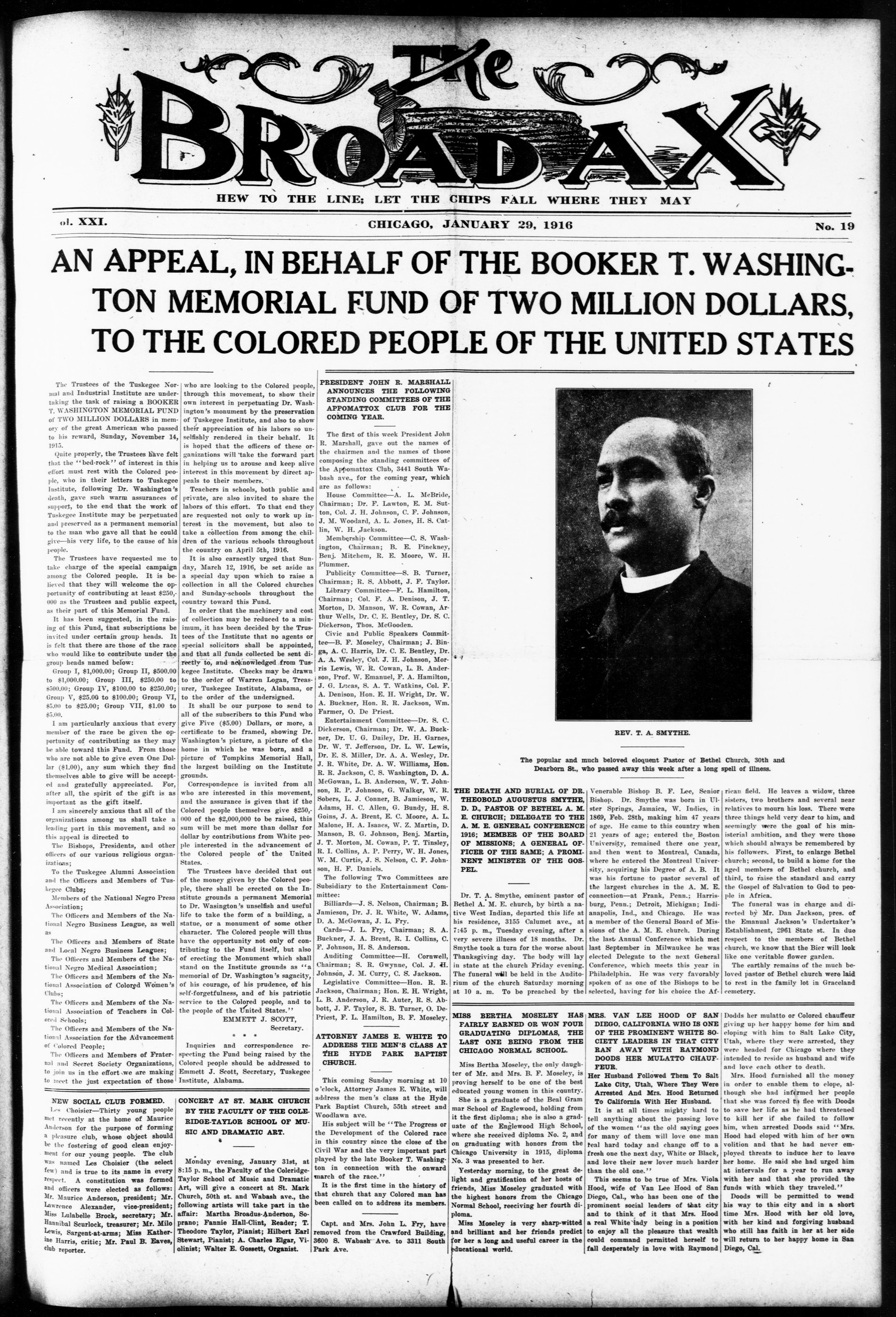
AN APPEAL, IN BEHALF OF THE BOOKER T. WASHINGTON MEMORIAL FUND OF TWO MILLION DOLLARS, TO THE COLORED PEOPLE OF THE UNITED STATES
AN APPEAL
TON M
TO THE
The Trustees of the Tuskegee Normal and Industrial Institute are undertaking the task of raising a BOOKER T. WASHINGTON MEMORIAL FUND of TWO MILLION DOLLARS in memory of the great American who passed to his reward, Sunday, November 14, 1915.
Quite properly, the Trustees have felt that the "bed-rock" of interest in this effort must rest with the Colored people, who in their letters to Tuskegee Institute, following Dr. Washington's death, gave such warm assurances of support, to the end that the work of Tuskegee Institute may be perpetuated and preserved as a permanent memorial to the man who gave all that he could give—his very life, to the cause of his people.
The Trustees have requested me to take charge of the special campaign among the Colored people. It is believed that they will welcome the opportunity of contributing at least $250,000 as the Trustees and public expect, as their part of this Memorial Fund.
It has been suggested, in the raising of this Fund, that subscriptions be invited under certain group heads. It is felt that there are those of the race who would like to contribute under the group heads named below:
Group I, $1,000.00; Group II, $500.00 to $1,000.00; Group III, $250.00 to $500.00; Group IV, $100.00 to $250.00; Group V, $25.00 to $100.00; Group VI, $5.00 to $2.50; Group VII, $1.00 to $5.00.
The Officers and Members of the National Association of Teachers in Colored Schools;
The Officers and Members of the National Association for the Advancement of Colored People;
The Officers and Members of Fraternal and Secret Society Organizations, to join us in the effort we are making to meet the just expectation of those
NEW SOCIAL CLUB FORMED.
Les Choisier—Thirty young people met recently at the home of Maurice Anderson for the purpose of forming a pleasure club, whose object should be the fostering of good clean enjoyment for our young people. The club was named Les Choisier (the select few) and is true to its name in every respect. A constitution was formed and officers were elected as follows: Mr. Maurice Anderson, president; Mr. Lawrence Alexander, vice-president; Miss Lulabelle Brock, secretary; Mr. Hannibal Scurlock, treasurer; Mr. Milo Lewis, Sargent-at-arms; Miss Katherine Harris, critic; Mr. Paul B. Eaves, club reporter.
---
HEW TO THE LINE; LET THE CHIPS FALL WHERE THEY MAY
who are looking to the Colored people through this movement, to show their own interest in perpetuating Dr. Washington's monument by the preservation of Tuskegee Institute, and also to show their appreciation of his labors so unselfishly rendered in their behalf. It is hoped that the officers of these organizations will take the forward part in helping us to arouse and keep alive interest in this movement by direct appeals to their members.
Teachers in schools, both public and private, are also invited to share the labors of this effort. To that end they are requested not only to work up interest in the movement, but also to take a collection from among the children of the various schools throughout the country on April 5th, 1916.
It is also earnestly urged that Sunday, March 12, 1916, be set aside as a special day upon which to raise a collection in all the Colored churches and Sunday-schools throughout the country toward this Fund.
In order that the machinery and cost of collection may be reduced to a minimum, it has been decided by the Trustees of the Institute that no agents or special solicitors shall be appointed, and that all funds collected be sent directly to, and acknowledged from Tuskegee Institute. Checks may be drawn to the order of Warren Logan, Treasurer, Tuskegee Institute, Alabama, or to the order of the undersigned.
It shall be our purpose to send to all of the subscribers to this Fund who give Five ($5.00) Dollars, or more, a certificate to be framed, showing Dr. Washington's picture, a picture of the home in which he was born, and a picture of Tompkins Memorial Hall, the largest building on the Institute grounds.
Correspondence is invited from all who are interested in this movement, and the assurance is given that if the Colored people themselves give $250,000 of the $2,000,000 to be raised, this sum will be met more than dollar for dollar by contributions from White people interested in the advancement of the Colored people of the United States.
The Trustees have decided that out of the money given by the Colored people, there shall be erected on the Institute grounds a permanent Memorial to Dr. Wasington's unselfish and useful life to take the form of a building, a statue, or a monument of some other character. The Colored people will thus have the opportunity not only of contributing to the Fund itself, but also of erecting the Monument which shall stand on the Institute grounds as "a memorial of Dr. Washington's sagacity, of his courage, of his prudence, of his self-forgetfulness, and of his patriotic service to the Colored people, and to the people of the United States."
Inquiries and correspondence respecting the Fund being raised by the Colored people should be addressed to Emmett J. Scott, Secretary, Tuskegee Institute, Alabama.
CONCERT AT ST. MARK CHURCH BY THE FACULTY OF THE COLLE RIDGE-TAYLOR SCHOOL OF MUSIC AND DRAMATIC ART.
Monday evening, January 31st, at 8:15 p. m., the Faculty of the Coleridge-Taylor School of Music and Dramatic Art, will give a concert at St. Mark Church, 50th st. and Wabash ave., the following artists will take part in the affair: Martha Broadus-Anderson, Soprano; Fannie Hall-Clint, Reader; T. Theodore Taylor, Pianist; Hilbert Earl Stewart, Pianist; A. Charles Elgar, Violinist; Walter E. Gossett, Organist.
CHICAGO, JANUARY 29, 1916
PRESIDENT JOHN R. MARSHALL
ANNOUNCES THE FOLLOWING
STANDING COMMITTEES OF THE
APPOMATTOX CLUB FOR THE
COMING YEAR.
The first of this week President John
R. Marshall, gave out the names of
the chairmen and the names of those
composing the standing committees of
the Appomattox Club, 3441 South Wabash ave., for the coming year, which are as follows:
House Committee—A. L. MeBride,
Chairman; Dr. F. Lawton, E. M. Sutton, Col. J. H. Johnson, C. F. Johnson, J. M. Woodard, A. L. Jones, H. S. Catlin, W. H. Jackson.
Membership Committee—C. S. Washington, Chairman; B. E. Pinekney, Benj. Mitchem, R. E. Moore, W. H. Plummer.
Publicity Committee—S. B. Turner, Chairman; R. S. Abbott, J. F. Taylor. Library Committee—F. L. Hamilton, Chairman; Col. F. A. Denison, J. T. Morton, D. Manson, W. R. Cowan, Arthur Wells, Dr. C. E. Bentley, Dr. S. C. Dickerson, Thos. McGooden.
Civic and Public Speakers Committee—B. F. Moseley, Chairman; J. Binga, A. C. Harris, Dr. C. E. Bentley, Dr. A. A. Wesley, Col. J. H. Johnson, Morris Lewis, W. R. Cowan, L. B. Anderson, Prof. W. Emanuel, F. A. Hamilton, J. G. Lucas, S. A. T. Watkins, Col. F. A. Denison, Hon. E. H. Wright, Dr. W. A. Buckner, Hon. R. R. Jackson, Wm. Farmer, O. De Priest.
Entertainment Committee—Dr. S. C. Dickerson, Chairman; Dr. W. A. Buckner, Dr. U. G. Dailley, Dr. H. Garnes, Dr. W. T. Jefferson, Dr. L. W. Lewis, Dr. E. S. Miller, Dr. A. A. Wesley, Dr. J. R. White, Dr. A. W. Williams, Hon. R. R. Jackson, C. S. Washington, D. A. Megowan, L. B. Anderson, W. T. Johnson, R. P. Johnson, G. Walker, W. R. Sobers, L. J. Conner, B. Jamieson, W. Adams, H. C. Allen, G. Bundy, H. S. Goins, J. A. Brent, E. C. Moore, A. L. Malone, H. A. Isaacs, W. Z. Martin, D. Manson, B. G. Johnson, Benj. Martin, J. T. Morton, M. Cowan, P. T. Tinsley, R. I. Collins, A. P. Perry, W. H. Jones, W. M. Curtis, J. S. Nelson, C. F. Johnson, H. F. Daniels.
The following Two Committees are Subsidiary to the Entertainment Committee:
Billiards—J. S. Nelson, Chairman; B. Jamieson, Dr. J. R. White, W. Adams, D. A. Mewgan, J. L. Fry, Cards—J. L. Fry, Chairman; S. A. Buekner, J. A. Brent, R. I. Collins, C. F. Johnson, H. S. Anderson, Auditing Committee—H. Cornwell, Chairman; S. R. Gwynne, Col. J. H. Johnson, J. M. Curry, C. S. Jackson, Legislative Committee—Hon. R. R. Jackson, Chairman; Hon. E. H. Wright, L. B. Anderson, J. R. Auter, R. S. Abbott, J. F. Taylor, S. B. Turner, O. DePriest, F. L. Hamilton, B. F. Moseley.
ATTORNEY JAMES E. WHITE TO ADDRESS THE MEN'S CLASS AT THE HYDE PARK BAPTIST CHURCH.
This coming Sunday morning at 10 o'clock, Attorney James E. White, will address the men's class at the Hyde Park Baptist Church, 55th street and Woodlawn ave.
His subject will be "The Progress or the Development of the Colored race in this country since the close of the Civil War and the very important part played by the late Booker T. Washington in connection with the onward march of the race."
It is the first time in the history of that church that any Colored man has been called on to address its members.
Capt. and Mrs. John L. Fry, have removed from the Crawford Building, 3600 S. Wabash Ave. to 3311 South Park Ave.
P.
THE DEATH AND BURIAL OF DR. THEOBOLD AUGUSTUS SMYTHE, D. D., PASTOR OF BETHEL A. M. E. CHURCH; DELEGATE TO THE A. M. E. GENERAL CONFERENCE 1916; MEMBER OF THE BOARD OF MISSIONS; A GENERAL OFFICER OF THE SAME; A PROMINENT MINISTER OF THE GOSPEL.
Venerable Bishop B. F. Lee, Senior Bishop. Dr. Smythe was born in Ulster Springs, Jamaica, W. Indies, in 1869, Feb. 28th, making him 47 years of age. He came to this country when 21 years of age; entered the Boston University, remained there one year, and then went to Montreal, Canada, where he entered the Montreal University, acquiring his Degree of A. B. It rican field. He left sisters, two broth relatives to mourn three things held in seemingly were the istorial ambition, which should allow his followers. First church; second, to aged members of
Dr. T. A. Smythe, eminent pastor of Bethel A. M. E. church, by birth a native West Indian, departed this life at his residence, 3155 Calumet ave., at 7:45 p. m., Tuesday evening, after a very severe illness of 18 months. Dr. Smythe took a turn for the worse about Thanksgiving day. The body will lay in state at the church Friday evening. The funeral will be held in the Auditorium of the church Saturday morning at 10 a. m. To be preached by the
MISS BERTHA MOSELEY HAS
FAIRLY EARNED OR WON FOUR
GRADUATING DIPLOMAS, THE
LAST ONE BEING FROM THE
CHICAGO NORMAL SCHOOL.
Miss Bertha Moseley, the only daughter of Mr. and Mrs. B. F. Moseley, is proving herself to be one of the best educated young women in this country. She is a graduate of the Beal Grammar School of Englewood, holding from it the first diploma; she is also a graduate of the Englewood High School, where she received diploma No. 2, and on graduating with honors from the Chicago University in 1915, diploma No. 3 was presented to her.
Yesterday morning, to the great delight and gratification of her hosts of friends, Miss Moseley graduated with the highest honors from the Chicago Normal School, receiving her fourth diploma.
Miss Moseley is very sharp-witted and brilliant and her friends predict for her a long and useful career in the educational world.
REV. T. A. SMYTHE.
Venerable Bishop B. F. Lee, Senior Bishop. Dr. Smythe was born in Ulster Springs, Jamaica, W. Indies, in 1869, Feb. 28th, making him 47 years of age. He came to this country when 21 years of age; entered the Boston University, remained there one year, and then went to Montreal, Canada, where he entered the Montreal University, acquiring his Degree of A. B. It was his fortune to pastor several of the largest churches in the A. M. E. connection—at Frank, Penn; Harrisburg, Penn; Detroit, Michigan; Indianapolis, Ind., and Chicago. He was a member of the General Board of Missions of the A. M. E. church. During the last Annual Conference which met last September in Milwaukee he was elected Delegate to the next General Conference, which meets this year in Philadelphia. He was very favorably spoken of as one of the Bishops to be selected, having for his choice the Af-
MRS. VAN LEE HOOD OF SAN DIEGO, CALIFORNIA WHO IS ONE OF THE PROMINENT WHITE SOCIETY LEADERS IN THAT CITY RAN AWAY WITH RAYMOND DOODS HER MULATTO CHAUF-FEUR.
Her Husband Followed Them To Salt Lake City, Utah, Where They Were Arrested And Mrs. Hood Returned To California With Her Husband.
It is at all times mighty hard to tell anything about the passing love of the women "as the old saying goes for many of them will love one man real hard today and change off to a fresh one the next day, White or Black, and love their new lover much harder than the old one."
This seems to be true of Mrs. Viola Hood, wife of Van LEE Hood of San Diego, Cal., who has been one of the prominent social leaders of that city and to think of it that Mrs. Hood a real White lady in that Hood to enjoy all the pleasure that wealth could command permitted herself to fall desperately in love with Raymond
No.19
WASHING-
DOLLARS,
AND STATES
Church, 30th and
spell of illness.
rican field. He leaves a widow, three sisters, two brothers and several near relatives to mourn his loss. There were three things held very dear to him, and seemingly were the goal of his ministerial ambition, and they were those which should always be remembered by his followers. First, to enlarge Bethel church; second, to build a home for the aged members of Bethel church, and third, to raise the standard and carry the Gospel of Salvation to God to people in Africa.
The funeral was in charge and directed by Mr. Dan Jackson, pres. of the Emanual Jackson's Undertaker's Establishment, 2961 State st. In due respect to the members of Bethel church, we know that the Bier will look like one veritable flower garden.
The earthly remains of the much beloved pastor of Bethel church were laid to rest in the family lot in Graceland cemetery.
Dodds her mulatto or Colored chauffeur giving up her happy home for him and eloping with him to Salt Lake City, Utah, where they were arrested, they were headed for Chicago where they intended to reside as husband and wife and love each other to death.
Mrs. Hood furnished all the money in order to enable them to elope, although she had informed her people that she was forced to flee with Doods to save her life as he had threatened to kill her if she failed to follow him, when arrested Doods said "Mrs. Hood had eloped with him of her own volition and that he had never employed threats to induce her to leave her home. He said she had urged him at intervals for a year to run away with her and that she provided the funds with which they traveled."
Doods will be permitted to wend his way to this city and in a short time Mrs. Hood with her old love, with her kind and forgiving husband who still has faith in her at her side will return to her happy home in San Diego, Cal.
---
PAGE TWO
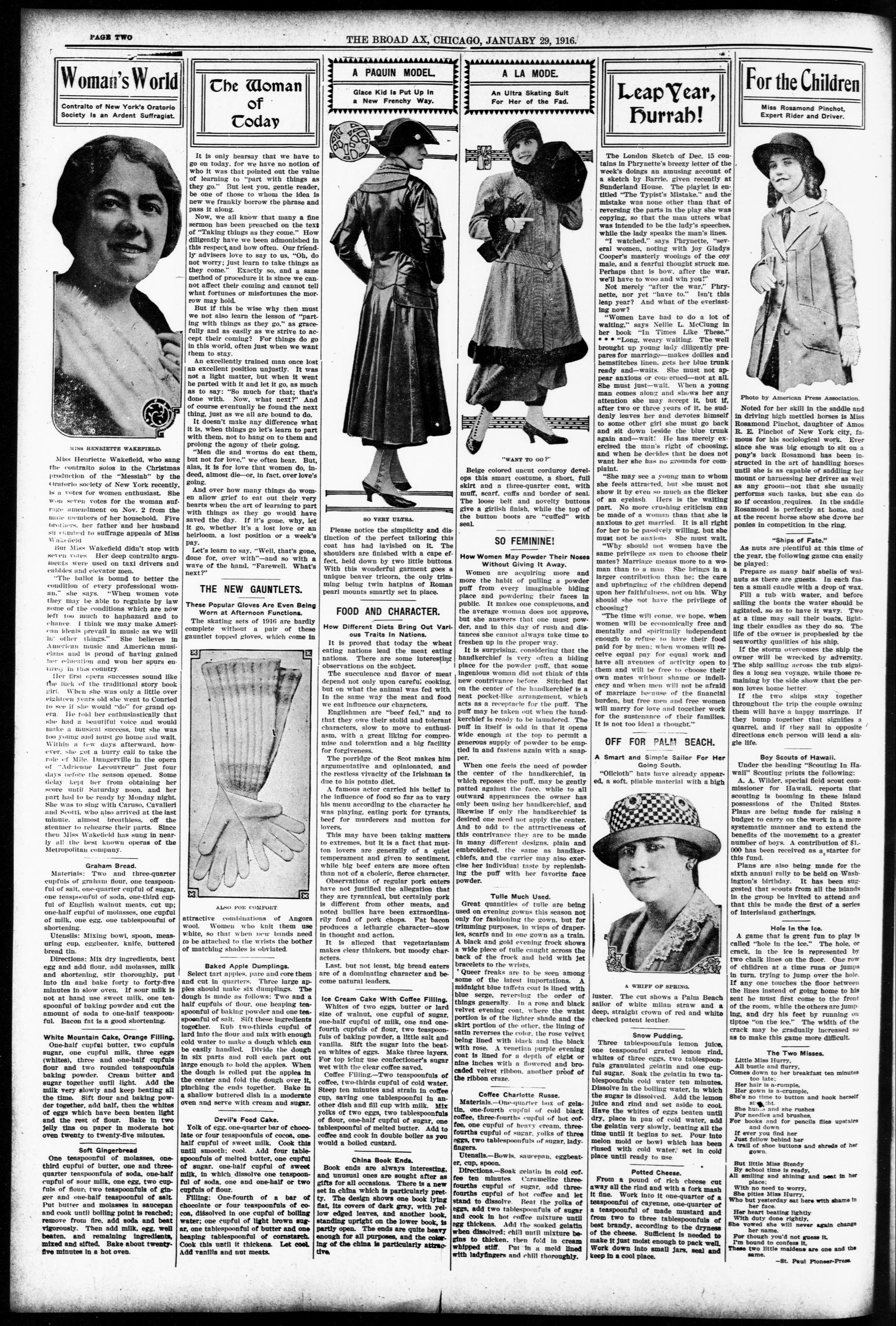
Contralto of New York's Oratorio Society is an Ardent Suffragist.
THE WORLD'S FIRST WOMEN'S FILM MUSEUM
MISS HENRIETTE WAKEFIELD.
Miss Henriette Wakefield, who sang the contraito solos in the Christmas production of the "Messiah" by the Oratorio society of New York recently, is a votes for women enthusiast. She won seven votes for the woman suffrage amendment on Nov. 2 from the male members of her household. Five brothers, her father and her husband su营 cambed to suffrage appeals of Miss Wakefield.
But Miss Wakefield didn't stop with seven votes. Her deep contralto arguments were used on taxi drivers and cabbies and elevator men.
"The ballot is bound to better the condition of every professional woman," she says. "When women vote they may be able to regulate by law some of the conditions which are now left too much to haphazard and to chance. I think we may make American ideals prevail in music as we will in other things." She believes in American music and American musicians and is of proud gained her education and won her spurs entirely in this country.
Her first opera successes sound like the luck of the traditional story book girl. When she was only a little over eighteen years old she went to Conried to see if she would "do" for grand opera. He told her enthusiastically that she had a beautiful voice and would make a musical success, but she was too young and must go home and wait. Within a few days afterward, however, she got a hurry call to take the role of Mile. Dangerville in the opera of "Adrienne Lecouvreur" just four days before the season opened. Some delay kept her from obtaining her score until Saturday noon, and her part had to be ready by Monday night. She was to sing with Caruso, Cavalier and Scotti, who also arrived at the last minute, almost breathless, off the stenner to rehearse their parts. Since then Miss Wakefield has sung in nearly all the best known operas of the Metropolitan company.
Graham Bread.
Materials: Two and three-quarter cupfuls of graham flour, one teaspoonful of salt, one-quarter cupful of sugar, one teaspoonful of soda, one-third cupful of English walnut meats, cut up; one-half cupful of molasses, one cupful of milk, one egg, one tablespoonful of shortening.
Utensils: Mixing bowl, spoon, measuring cup, eggbeater, knife, buttered bread tin.
Directions: Mix dry ingredients, beat egg and add flour, add molasses, milk and shortening, stir thoroughly, put into tin and bake forty to forty-five minutes in slow oven. If sour milk is not at hand use sweet milk, one teaspoonful of baking powder and cut the amount of soda to one-half teaspoonful. Bacon fat is a good shortening.
White Mountain Cake, Orange Filling.
One-half cupful butter, two cupfuls sugar, one cupful milk, three eggs (whites), three and one-half cupfuls flour and two rounded teaspoonfuls baking powder. Cream butter and sugar together until light. Add the milk very slowly and keep beating all the time. Sift flour and baking powder together, add half, then the whites of eggs which have been beaten light and the rest of flour. Bake in two jelly tins on paper in moderate hot oven twenty-five minutes.
Soft Gingerbread
One teaspoonful of molasses, one third cupful of butter, one and three quarter teaspoonfuls of soda, one-half cupful of sour milk, one egg, two cupfuls of flour; two teaspoonfuls of ginger and one-half teaspoonful of salt. Put butter and molasses in saucepan and cook until boiling point is reached; remove from fire, add soda and beat vigorously. Then add milk, egg, well beaten, and remaining ingredients, mixed and sifted. Bake about twenty-five minutes in a hot oven.
The Woman of Today
It is only hearsay that we have to go on today, for we have no notion of who it was that pointed out the value of learning to "part with things as they go." But lest you, gentle reader, be one of those to whom the idea is new we frankly borrow the phrase and pass it along.
Now, we all know that many a fine sermon has been preached on the text of "Taking things as they come." How diligently have we been admonished in this respect and how often. Our friendly advisers love to say to us. "Oh, do not worry; just learn to take things as they come." Exactly so, and a sane method of procedure it is since we cannot affect their coming and cannot tell what fortunes or misfortunes the morrow may hold.
But if this be wise why then must we not also learn the lesson of "parting with things as they go." as gracefully and as easily as we strive to accept their coming? For things do go in this world, often just when we want them to stay.
An excellently trained man once lost an excellent position unjustly. It was not a light matter, but when it went he parted with it and let it go, as much as to say: "So much for that; that's done with. Now, what next?" And of course eventually he found the next thing, just as we all are bound to do. It doesn't make any difference what it is, when things go let's learn to part with them, not to hang on to them and prolong the agony of their going. "Men die and worms do eat them, but not for love," we often hear. But, alas, it is for love that women do, indeed, almost die—or, in fact, over love's going. And over how many things do women allow grief to eat out their very hearts when the art of learning to part with things as they go would have saved the day. If it's gone, why, let it go, whether it's a lost love or an heirloom, a lost position or a week's pay.
Let's learn to say. "Well, that's gone,
done for, over with"—and so with a
wave of the hand. "Farewell. What's
next?"
THE NEW GAUNTLETS
These Popular Gloves Are Even Being Worn at Afternoon Functions.
The skating sets of 1916 are hardly complete without a pair of these gauntlet tipped gloves, which come in
X
ALSO FOR COMFORT
attractive combinations of Angora
wool. Women who knit them use
white, so that when new bands need
to be attached to the wrists the bother
of matching shades is obviated.
Baked Apple Dumplings
Select tart apples, pare and core them and cut in quarters. Three large apples should make six dumplings. The dough is made as follows: Two and a half cupfuls of flour, one heaping teaspoonful of baking powder and one teaspoonful of salt. Sift these ingredients together. Rub two-thirds cupful of lard into the flour and mix with enough cold water to make a dough which can be easily handled. Divide the dough in six parts and roll each part out large enough to hold the apples. When the dough is rolled put the apples in the center and fold the dough over it, pinching the ends together. Bake in a shallow buttered dish in a moderate oven and serve with cream and sugar.
Devil's Food Cake.
Yolk of egg, one-quarter bar of chocolate or four teaspoonfuls of cocoa, one-half cupful of sweet milk. Cook this until smooth; cool. Add four tablespoonfuls of melted butter, one cupful of sugar, one-half cupful of sweet milk, in which dissolve one teaspoonful of soda, one and one-half or two cupfuls of flour.
Filling: One-fourth of a bar of chocolate or four teaspoonfuls of cocoa, dissolved in one cupful of boiling water; one cupful of light brown sugar, one tablespoonful of butter and one heaping tablespoonful of cornstarch. Cook this until it thickens. Let cool. Add vanilla and nut meats.
THE BROAD AX, CHICAGO, JANUARY 29, 1916.
THE LADY'S COAT
SO VERY ULTRA.
Please notice the simplicity and distinction of the perfect tailoring this coat has had lavished on it. The shoulders are finished with a cape effect, held down by two little buttons. With this wonderful garment goes a unique beaver tricorn, the only trimming being two hatpins of Roman pearl mounts smartly set in place.
FOOD AND CHARACTER.
How Different Diets Bring Out Various Traits In Nations.
It is proved that today the wheat eating nations lead the meat eating nations. There are some interesting observations on the subject.
The succulence and flavor of meat depend not only upon careful cooking, but on what the animal was fed with. In the same way the meat and food we eat influence our characters.
Englishmen are "beef fed," and to that they owe their stolid and tolerant characters, slow to move to enthusiasm, with a great liking for compromise and toleration and a big facility for forgiveness.
The porridge of the Scot makes him argumentative and opinionated, and the restless vivacity of the Irishman is due to his potato diet.
A famous actor carried his belief in the influence of food so far as to vary his menu according to the character he was playing, eating pork for tyrants, beef for murderers and mutton for lovers.
This may have been taking matters to extremes, but it is a fact that mutton lovers are generally of a quiet temperament and given to sentiment, while big beef eaters are more often than not of a choleric, fierce character.
Observations of regular pork eaters have not justified the allegation that they are tyrannical, but certainly pork is different from other meats, and noted bullies have been extraordinarily fond of pork chops. Fat bacon produces a lethargic character—slow in thought and action.
It is alleged that vegetarianism makes clear thinkers, but moody characters.
Last, but not least, big bread eaters are of a dominating character and become natural leaders.
Ice Cream Cake With Coffee Filling.
Whites of two eggs, butter or lard size of walnut, one cupful of sugar, one-half cupful of milk, one and one-fourth cupfuls of flour, two teaspoonfuls of baking powder, a little salt and vanilla. Sift the sugar into the beaten whites of eggs. Make three layers. For top iceing use confectioner's sugar wet with the clear coffee saved.
Coffee Filling—Two teaspoonfuls of coffee, two-thirds cupful of cold water. Steep ten minutes and strain in coffee cup, saving one tablespoonful in another dish and fill cup with milk. Mix yolks of two eggs, two tablespoonfuls of flour, one-half cupful of sugar, one tablespoonful of melted butter. Add to coffee and cook in double boiler as you would a boiled custard.
China Book Ends
Book ends are always interesting, and unusual ones are sought after as gifts for all occasions. There is a new set in china which is particularly pretty. The design shows one book lying flat, its covers of dark gray, with yellow edged leaves, and another book, standing upright on the lower book, is partly open. The ends are quite heavy enough for all purposes, and the coloring of the china is particularly attractive.
---
K
"WANT TO GO?"
Beige colored uncut corduroy develops this smart costume, a short, full skirt and a three-quarter coat, with muff, scarf, cuffs and border of seal. The loose belt and novelty buttons give a girlish finish, while the top of the button boots are "cuffed" with seal.
SO FEMININE!
How Women May Powder Their Noses Without Giving It Away.
Women are acquiring more and more the habit of pulling a powder puff from every imaginable hiding place and powdering their faces in public. It makes one conspicuous, and the average woman does not approve, but she answers that one must powder, and in this day of rush and distances she cannot always take time to freshen up in the proper way.
It is surprising, considering that the handkerchief is very often a hiding place for the powder puff, that some ingenious woman did not think of this new contrivance before. Stitched flat on the center of the handkerchief is a neat pocket-like arrangement, which acts as a receptacle for the puff. The puff may be taken out when the handkerchief is ready to be laundered. The puff in itself is odd in that it opens wide enough at the top to permit a generous supply of powder to be emptied in and fastens again with a snapper.
When one feels the need of powder the center of the handkerchief, in which reposes the puff, may be gently patted against the face, while to all outward appearances the owner has only been using her handkerchief, and likewise if only the handkerchief is desired one need not apply the center. And to add to the attractiveness of this contrivance they are to be made in many different designs, plain and embroidered, the same as handkerchiefs, and the carrier may also exercise her individual taste by replenishing the puff with her favorite face powder.
Tulle Much Used
Great quantities of tulle are being used on evening gowns this season not only for fashioning the gown, but for trimming purposes, in wispes of draperies, scarfs and in one gown as a train. A black and gold evening frock shows a wide piece of tulle caught across the back of the frock and held with jet bracelets to the wrists.
*Queer freaks are to be seen among some of the latest importations. A midnight blue taffeta coat is lined with blue serge, reversing the order of things generally. In a rose and black velvet evening coat, where the waist portion is of the lighter shade and the skirt portion of the other, the lining of satin reverses the color, the rose velvet being lined with black and the black with rose. A venetian purple evening coat is lined for a depth of eight or nine inches with a flowered and brocaded velvet ribbon, another proof of the ribbon craze.
Coffee Charlotte Russe
Materials.—One-quarter box of gelatin, one-fourth cupful of cold black coffee, three-fourths cupful of hot coffee, one cupful of heavy cream, three-fourths cupful of sugar, yolks of three eggs, two tablespoonfuls of sugar, lady-fingers.
Utensils.—Bowls, saucepan, eggbeater, cup, spoon.
Directions.—Soak gelatin in cold coffee ten minutes. Caramelize three-fourths cupful of sugar, add three-fourths cupful of hot coffee and let stand to dissolve. Beat the yolks of eggs, add two tablespoonfuls of sugar and cook in hot coffee mixture until egg thickens. Add the soaked gelatin when dissolved: chill until mixture begins to thicken, then fold in cream whipped stuff. Put in a mold lined with lady-fingers and chill thoroughly.
The London Sketch of Dec. 15 contains in Phrynette's breezy letter of the week's doings an amusing account of a sketch by Barrie, given recently at Sunderland House. The playlet is entitled "The Typist's Mistake," and the mistake was none other than that of reversing the parts in the play she was copying, so that the man utters what was intended to be the lady's speeches, while the lady speaks the man's lines. "I watched," says Phrynette, "several women, noting with joy Gladys Cooper's masterly wooings of the coy male, and a fearful thought struck me. Perhaps that is how, after the war, we'll have to woo and win you." Not merely "after the war," Phrynette, nor yet "have to." Isn't this leap year? And what of the everlasting now?
"Women have had to do a lot of waiting," says Nellie L. McClung in her book "In Times Like These."
*** "Long, weary waiting. The well brought up young lady diligently prepares for marriage—makes dollies and hemitches linen, gets her blue trunk ready and—waits. She must not appear anxious or concerned—not at all. She must just—wait. When a young man comes along and shows her any attention she may accept it, but if, after two or three years of it, he suddenly leaves her and devotes himself to some other girl she must go back and sit down beside the blue trunk again and—wait! He has merely exercised the man's right of choosing, and when he decides that he does not want her she has no grounds for complaint.
"She may see a young man to whom she feels attracted, but she must not show it by even so much as the flicker of an eyelash. Hers is the waiting part. No more crushing criticism can be made of a woman than that she is anxious to get married. It is all right for her to be passively willing, but she must not be anxious. She must wait.
"The time will come, we hope, when women will be economically free and mentally and spiritually independent enough to refuse to have their food paid for by men; when women will receive equal pay for equal work and have all avenues of activity open to them and will be free to choose their own mates without shame or indulgency and when men will not be afraid of marriage because of the financial burden, but free men and free women will marry for love and together work for the sustenance of their families. It is not too ideal a thought."
OFF FOR PALM BEACH
A Smart and Simple Sailor For Her Going South. "Oilcloth" hats have already appeared, a soft, pliable material with a high
E.
A WHIFF OF SPRING.
luster. The cut shows a Palm Beach sailor of white milan straw and a deep, straight crown of red and white checked patent leather.
Snow Pudding
Three tablespoonfuls lemon juice, one teaspoonful grated lemon rind, whites of three eggs, two tablespoonfuls granulated gelatin and one cupful sugar. Soak the gelatin in two tablespoonfuls cold water ten minutes. Dissolve in the boiling water, in which the sugar is dissolved. Add the lemon juice and rind and set aside to cool. Have the whites of eggs beaten until dry, place in pan of cold water, add the gelatin very slowly, beating all the time until it begins to set. Pour into melon mold or bowl which has been rinsed with cold water, set in cold place until ready to use.
Potted Cheese
From a pound of rich cheese cut away all the rind and with a fork mash it fine. Work into it one-quarter of a teaspoonful of cayenne, one-quarter of a teaspoonful of made mustard and from two to three tablespoonfuls of best brandy, according to the dryness of the cheese. Sufficient is needed to make it just moist enough to pack well. Work down into small jars, seal and keep in a cool place.
Miss Rosamond Pinchot, Expert Rider and Driver.
A
Photo by American Press Association.
Noted for her skill in the saddle and in driving high mettled horses is Miss Rosamond Pinchot, daughter of Amos R. E. Pinchot of New York city, famous for his sociological work. Ever since she was big enough to sit on a pony's back Rosamond has been instructed in the art of handling horses until she is as capable of saddling her mount or harnessing her driver as well as any groom—not that she usually performs such tasks, but she can do so if occasion requires. In the saddle Rosamond is perfectly at home, and at the recent horse show she drove her ponies in competition in the ring.
"Ships of Fate."
As nuts are plentiful at this time of the year, the following game can easily be played:
Prepare as many half shells of walnuts as there are guests. In each fasten a small candle with a drop of wax.
Fill a tub with water, and before sailing the boats the water should be agitated, so as to have it wavy. Two at a time may sail their boats, lighting their candles as they do so. The life of the owner is prophesied by the seaworthy qualities of his ship.
If the storm overcomes the ship the owner will be wrecked by adversity. The ship sailing across the tub signifies a long sea voyage, while those remaining by the side show that the person loves home better.
If the two ships stay together throughout the trip the couple owning them will have a happy marriage. If they bump together that signifies a quarrel, and if they sail in opposite directions each person will lead a single life.
Boy Scouts of Hawaii
Under the heading "Scouting In Hawaii" Scouting prints the following: A. A. Wilder, special field scout commissioner for Hawaii, reports that scouting is booming in these island possessions of the United States. Plans are being made for raising a budget to carry on the work in a more systematic manner and to extend the benefits of the movement to a greater number of boys. A contribution of $1,000 has been received as a $ starter for this fund. Plans are also being made for the sixth annual rally to be held on Washington's birthday. It has been suggested that scouts from all the islands in the group be invited to attend and that this be made the first of a series of interisland gatherings.
Hole In the Ice.
A game that is great fun to play is called "hole in the ice." The hole, or crack, in the ice is represented by two chalk lines on the floor. One row of children at a time runs or jumps in turn, trying to jump over the hole. If any one touches the floor between the lines instead of going home to his seat he must first come to the front of the room, while the others are jumping, and dry his feet by running on tiptoe "on the ice." The width of the crack may be gradually increased so as to make this game more difficult.
The Two Misses.
Little Miss Hurry,
All bustle and flurry.
Comes down to her breakfast ten minutes
too late;
Her hair is a-rumple.
Her gown is a-crumple.
She's no time to button and hook herself
stight.
She hunts and she rushes
For needles and brushes.
For books and for pencils files upstairs
and down.
If ever you find her
Just follow behind her
A trail of shoe buttons and shreds of her
gown.
But little Miss Steady
By school time is ready.
All smiling and shining and neat in her
place;
With no need to worry.
She pities Miss Hurry.
Who but yesterday sat here with shame in
her face.
Her heart beating lightly.
With duty done rightly.
She vowed she will never again change
her name.
For though you'd not guess it.
I'm bound to confess it.
These two little maledicts are one and the
same.
COUNT APPONYI IS A STATESMAN
Eloquent Orator With Command of English.
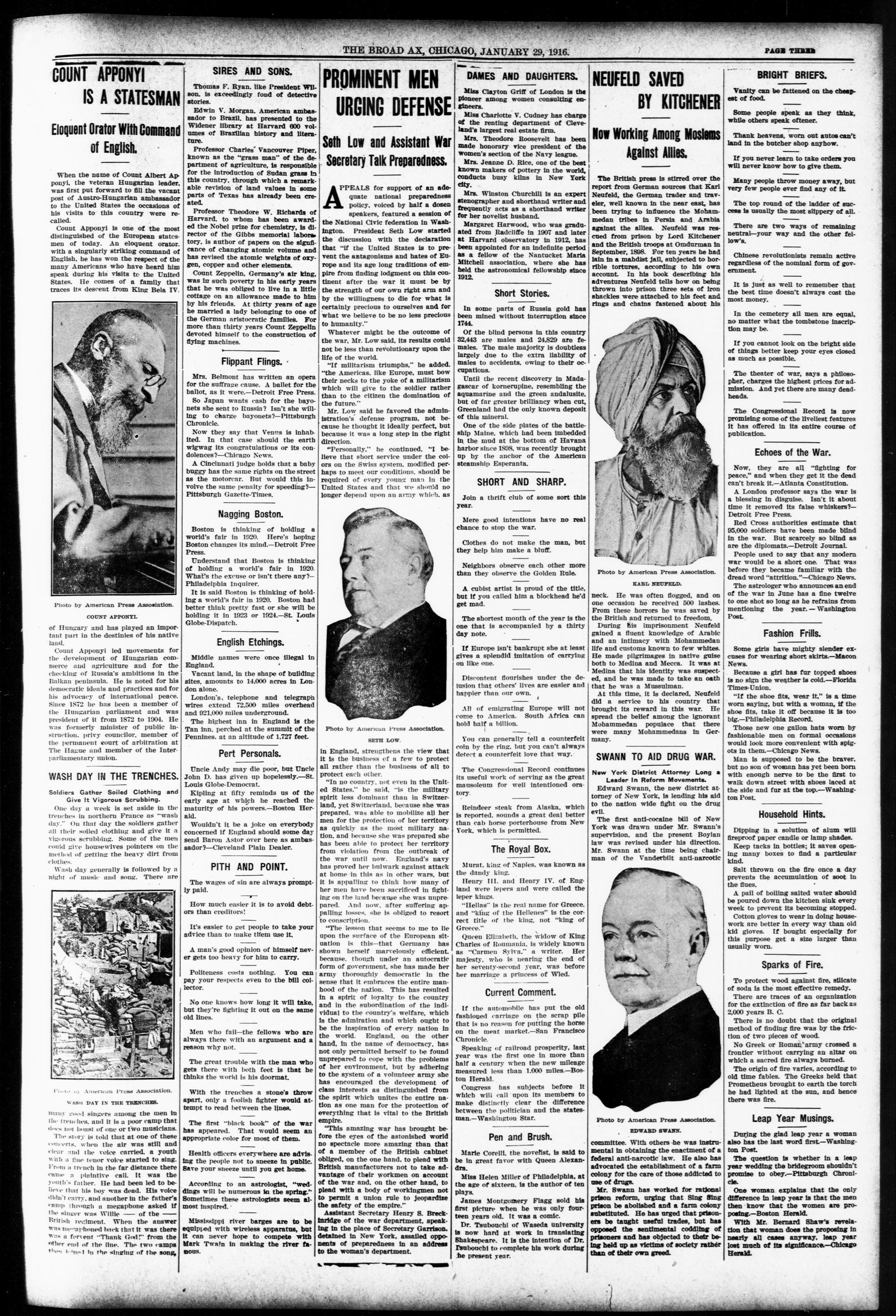
When the name of Count Albert Apponyi, the veteran Hungarian leader, was first put forward to fill the vacant post of Austro-Hungarian ambassador to the United States the occasions of his visits to this country were recalled.
Count Apponyi is one of the most distinguished of the European statesmen of today. An eloquent orator, with a singularly striking command of English, he has won the respect of the many Americans who have heard him speak during his visits to the United States. He comes of a family that traces its descent from King Bela IV.
THE MUSICIAN
Photo by American Press Association.
of Hungary and has played an important part in the destinies of his native land.
Count Apponyi led movements for the development of Hungarian commerce and agriculture and for the checking of Russia's ambitions in the Balkan peninsula. He is noted for his democratic ideals and practices and for his advocacy of international peace. Since 1872 he has been a member of the Hungarian parliament and was president of it from 1872 to 1904. He was formerly minister of public instruction, privy councilor, member of the permanent court of arbitration at The Hague and member of the Inter-parliamentary union.
WASH DAY IN THE TRENCHES.
Soldiers Gather Soiled Clothing and Give It Vigorous Scrubbing.
One day a week is set aside in the trenches in northern France as "wash day." On that day the soldiers gather all their soiled clothing and give it a vigorous scrubbing. Some of the men could give housewives pointers on the method of getting the heavy dirt from clothes.
Wash day generally is followed by a night of music and song. There are
```markdown
```
Fioto by American Press Association.
WASH DAY IN THE TRENCHES.
many good singers among the men in the trenches, and it is a poor camp that does not boast of one or two musicians. The story is told that at one of these concerts, when the air was still and clear and the voice carried, a youth with a fine tenor voice started to sing. From a trench in the far distance there came a plaintive call. It was the youth's father. He had been led to believe that his boy was dead. His voice didn't carry, and another in the father's camp through a megaphone asked if the singer was Willie — of the — British regiment. When the answer was meacapped back that it was there was a fervent "Thank God!" from the other end of the line. The two camps then joined in the slugging of the song.
SIRES AND SONS.
Thomas F. Ryan, like President Wilson, is exceedingly fond of detective stories.
Edwin V. Morgan, American ambassador to Brazil, has presented to the Widener library at Harvard 600 volumes of Brazilian history and literature.
Professor Charles Vancouver Piper, known as the "grass man" of the department of agriculture, is responsible for the introduction of Sudan grass in this country, through which a remarkable revision of land values in some parts of Texas has already been created.
Professor Theodore W. Richards of Harvard, to whom has been awarded the Nobel prize for chemistry, is director of the Gibbs memorial laboratory, is author of papers on the significance of changing atomic volume and has revised the atomic weights of oxygen, copper and other elements.
Count Zeppelin, Germany's air king, was in such poverty in his early years that he was obliged to live in a little cottage on an allowance made to him by his friends. At thirty years of age he married a lady belonging to one of the German aristocratic families. For more than thirty years Count Zeppelin devoted himself to the construction of flying machines.
Flippant Flings.
Mrs. Belmont has written an opera for the suffrage cause. A ballet for the ballot, as it were.-Detroit Free Press. So Japan wants cash for the bayonets she sent to Russia? Isn't she willing to charge bayonets?-Pittsburgh Chronicle. Now they say that Venus is inhabited. In that case should the earth wigwag its congratulations or its condolences?-Chicago News. A Cincinnati judge holds that a baby buggy has the same rights on the street as the motorcar. But would this involve the same penalty for speeding?-Pittsburgh Gazette Times.
Nagging Boston.
Boston is thinking of holding a world's fair in 1920. Here's hoping Boston changes its mind.—Detroit Free Press.
Understand that Boston is thinking of holding a world's fair in 1920. What's the excuse or isn't there any?—Philadelphia Inquirer.
It is said Boston is thinking of holding a world's fair in 1920. Boston had better think pretty fast or she will be holding it in 1923 or 1924.—St. Louis Globe-Dispatch.
English Etchings.
Middle names were once illegal in England.
Vacant land, in the shape of building sites, amounts to 14,000 acres in London alone.
London's, telephone and telegraph wires extend 72,500 miles overhead and 921,000 miles underground.
The highest inn in England is the Tan inn, perched at the summit of the Pennins, at an altitude of 1,727 feet.
Pert Personals.
Uncle Andy may die poor, but Uncle John D. has given up hopelessly.—St. Louis Globe-Democrat.
Kipling at fifty reminds us of the early age at which he reached the maturity of his powers.—Boston Herald.
Wouldn't it be a joke on everybody concerned if England should some day send Baron Astor over here as ambassador?—Cleveland Plain Dealer.
PITH AND POINT.
The wages of sin are always promptly paid.
How much easier it is to avoid debtors than creditors!
It's easier to get people to take your advice than to make them use it.
A man's good opinion of himself never gets too heavy for him to carry.
Politeness costs nothing. You can pay your respects even to the bill collector.
No one knows how long it will take, but they're fighting it out on the same old lines.
Men who fail—the fellows who are always there with an argument and a reason why not.
The great trouble with the man who gets there with both feet is that he thinks the world is his doormat.
With the trenches a stone's throw apart, only a foolish fighter would attempt to read between the lines.
The first "black book" of the war has appeared. That would seem an appropriate color for most of them.
Health officers everywhere are advising the people not to sneeze in public. Save your sneeze until you get home.
According to an astrologist, "weddings will be numerous in the spring." Sometimes these astrologists seem almost inspired.
Mississippi river barges are to be equipped with wireless apparatus, but it can never hope to compete with Mark Twain in making the river famous.
THE BROAD AX. CHICAGO. JANUARY 29. 1916
APPEALS for support of an adequate national preparedness policy, voiced by half a dozen speakers, featured a session of the National Civic federation in Washington. President Seth Low started the discussion with the declaration that "if the United States is to prevent the antagonisms and hates of Europe and its age long traditions of empire from finding lodgment on this continent after the war it must be by the strength of our own right arm and by the willingness to die for what is certainly precious to ourselves and for what we believe to be no less precious to humanity." Whatever might be the outcome of the war, Mr. Low said, its results could not be less than revolutionary upon the life of the world.
"If militarism triumphs," he added, "the Americas, like Europe, must bow their necks to the yoke of a militarism which will give to the soldier rather than to the citizen the domination of the future." Mr. Low said he favored the administration's defense program, not because he thought it ideally perfect, but because it was a long step in the right direction. "Personally," he continued, "I believe that short service under the colors on the Swiss system, modified perhaps to meet our conditions, should be required of every young man in the United States and that we should no longer depend upon an army which, as
PETER H. BURKE
Photo by American Press Association.
SETH LOW.
in England, strengthens the view that it is the business of a few to protect all rather than the business of all to protect each other.
"In no country, not even in the United States," he said, "is the military spirit less dominant than in Switzerland, yet Switzerland, because she was prepared, was able to mobilize all her men for the protection of her territory as quickly as the most military nation, and because she was prepared she has been able to protect her territory from violation from the outbreak of the war until now. England's navy has proved her bulwark against attack at home in this as in other wars, but it is appalling to think how many of her men have been sacrificed in fighting on the land because she was unprepared. And now, after suffering appalling losses, she is obliged to resort to conscription.
"The lesson that seems to me to lie upon the surface of the European situation is this—that Germany has shown herself marvelously efficient, because, though under an autocratic form of government, she has made her army thoroughly democratic in the sense that it embraces the entire manhood of the nation. This has resulted in a spirit of loyalty to the country and in the subordination of the individual to the country's welfare, which is the admiration and which ought to be the inspiration of every nation in the world. England, on the other hand, in the name of democracy, has not only permitted herself to be found unprepared to cope with the problems of her environment, but by adhering to the system of a volunteer army she has encouraged the development of class interests as distinguished from the spirit which unites the entire nation as one man for the protection of everything that is vital to the British empire.
"This amazing war has brought before the eyes of the astonished world no spectacle more amazing than that of a member of the British cabinet obliged, on the one hand, to plead with British manufacturers not to take advantage of their workmen on account of the war and, on the other hand, to plead with a body of workingmen not to permit a union rule to jeopardize the safety of the empire."
Assistant Secretary Henry S. Breckinridge of the war department, speaking in the place of Secretary Garrison, detained in New York, assailed opponents of preparedness in an address to the woman's department.
DAMES AND DAUGHTERS.
Miss Clayton Griff of London is the pioneer among women consulting engineers.
Miss Charlotte V. Cudney has charge of the renting department of Cleveland's largest real estate firm.
Mrs. Theodore Roosevelt has been made honorary vice president of the women's section of the Navy league.
Mrs. Jeanne D. Rice, one of the best known makers of pottery in the world, conducts busy kilns in New York city.
Mrs. Winston Churchill is an expert stenographer and shorthand writer and frequently acts as a shorthand writer for her novelist husband.
Margaret Harwood, who was graduated from Radcliffe in 1907 and later at Harvard observatory in 1912, has been appointed for an indefinite period as a fellow of the Nantucket Maria Mitchell association, where she has held the astronomical fellowship since 1912.
Short Stories.
In some parts of Russia gold has been mined without interruption since 1744.
Of the blind persons in this country 32,443 are males and 24,829 are females. The male majority is doubtless largely due to the extra liability of males to accidents, owing to their occupations.
Until the recent discovery in Madagascar of kornerupine, resembling the aquamarine and the green andalusite, but of far greater brilliancy when cut, Greenland had the only known deposit of this mineral.
One of the side plates of the battleship Maine, which had been imbedded in the mud at the bottom of Havana harbor since 1898, was recently brought up by the anchor of the American steamship Esperanta.
SHORT AND SHARP.
Join a thrift club of some sort this year.
Mere good intentions have no real chance to stop the war.
Clothes do not make the man, but they help him make a bluff.
Neighbors observe each other more than they observe the Golden Rule.
A cubist artist is proud of the title, but if you called him a blockhead he'd get mad.
The shortest month of the year is the one that is accompanied by a thirty day note.
If Europe isn't bankrupt she at least gives a splendid imitation of carrying on like one.
Discontent flourishes under the delusion that others' lives are easier and happier than our own.
All of emigrating Europe will not come to America. South Africa can hold half a billion.
You can generally tell a counterfeit coin by the ring, but you can't always detect a counterfeit love that way.
The Congressional Record continues its useful work of serving as the great mausoleum for well intentioned oratory.
Reindeer steak from Alaska, which is reported, sounds a great deal better than cab horse porterhouse from New York, which is permitted.
The Royal Box.
Murat, king of Naples, was known as the dandy king.
Henry III. and Henry IV. of England were lepers and were called the leper kings.
"Hellas" is the real name for Greece, and "king of the Hellenes" is the correct title of the king, not "king of Greece."
Queen Elizabeth, the widow of King Charles of Roumania, is widely known as "Carmen Sylva," a writer. Her majesty, who is nearing the end of her seventy-second year, was before her marriage a princess of Wied.
Current Comment.
If the automobile has put the old fashioned carriage on the scrap pile that is no reason for putting the horse on the meat market.—San Francisco Chronicle.
Speaking of railroad prosperity, last year was the first one in more than half a century when the new mileage measured less than 1.000 miles.—Boston Herald.
Congress has subjects before it which will call upon its members to make distinctly clear the difference between the politician and the statesman.—Washington Star.
Pen and Brush.
Marie Corelli, the novelist, is said to be in great favor with Queen Alexandra.
Miss Helen Miller of Philadelphia, at the age of sixteen, is the author of ten plays.
James Montgomery Flagg sold his first picture when he was only fourteen years old. It was a comic.
Dr. Tsubouchi of Waseda university is now hard at work in translating Shakespeare. It is the intention of Dr. Tsubouchi to complete his work during the present year.
Now Working Among Moslems Against Allies.
The British press is stirred over the report from German sources that Karl Neufeld, the German trader and traveler, well known in the near east, has been trying to influence the Mohammedan tribes in Persia and Arabia against the allies. Neufeld was rescued from prison by Lord Kitchener and the British troops at Omdurman in September, 1808. For ten years he had lain in a mahdist jail, subjected to horrible tortures, according to his own account. In his book describing his adventures Neufeld tells how on being thrown into prison three sets of iron shackles were attached to his feet and rings and chains fastened about his
SINGH BABU
Photo by American Press Association.
KARL NEUFELD:
neck. He was often flogged, and on one occasion he received 500 lashes. From these horrors he was saved by the British and returned to freedom. During his imprisonment Neufeld gained a fluent knowledge of Arabic and an intimacy with Mohammed life and customs known to few whites. He made pilgrimages in native guse both to Medina and Mecca. It was at Medina that his identity was suspected, and he was made to take an oath that he was a Mussulman. At this time, it is declared, Neufeld did a service to his country that brought its reward in this war. He spread the belief among the ignorant Mohammed population that there were many Mohammedans in Germany.
SWANN TO AID DRUG WAR.
New York District Attorney Long a Leader In Reform Movements
Edward Swann, the new district attorney of New York, is lending his aid to the nation wide fight on the drug evil. The first anti-cocaine bill of New York was drawn under Mr. Swann's supervision, and the present Boylan law was revised under his direction. Mr. Swann at the time being chairman of the Vanderbilt anti-narcotic
[Image of a man with a bald head and a suit]
Photo by American Press Association.
EDWARD SWANN.
committee. With others he was instrumental in obtaining the enactment of a federal anti-narcotic law. He also has advocated the establishment of a farm colony for the care of those addicted to use of drugs.
Mr. Swann has worked for rational prison reform, urging that Sing Sing prison be abolished and a farm colony substituted. He has urged that prisoners be taught useful trades, but has opposed the sentimental codling of prisoners and has objected to their being held up as victims of society rather than of their own greed.
PAGE THREE
BRIGHT BRIEFS.
Vanity can be fattened on the cheapest of food.
Some people speak as they think, while others speak oftener.
Thank heavens, worn out autos can't land in the butcher shop anyhow.
If you never learn to take orders you will never know how to give them.
Many people throw money away, but very few people ever find any of it.
The top round of the ladder of success is usually the most slippery of all.
There are two ways of remaining neutral—your way and the other fellow's.
Chinese revolutionists remain active regardless of the nominal form of government.
It is just as well to remember that the best time doesn't always cost the most money.
In the cemetery all men are equal, no matter what the tombstone inscription may be.
If you cannot look on the bright side of things better keep your eyes closed as much as possible.
The theater of war, says a philosopher, charges the highest prices for admission. And yet there are many dead-heads.
The Congressional Record is now promising some of the loveliest features it has offered in its entire course of publication.
Echoes of the War.
Now, they are all "fighting for peace," and when they get it the dead can't break it.-Atlanta Constitution.
A London professor says the war is a blessing in disguise. Isn't it about time it removed its false whiskers?-Detroit Free Press.
Red Cross authorities estimate that 95,000 soldiers have been made blind in the war. But scarcely so blind as are the diplomats.-Detroit Journal.
People used to say that any modern war would be a short one. That was before they became familiar with the dread word "attrition."-Chicago News.
The astrologer who announces an end of the war in June has a fine twelve to one shot so long as he refrains from mentioning the year.-Washington Post.
Fashion Frills.
Some girls have mighty slender excuses for wearing short skirts.—Macon News.
Because a girl has fur topped shoes is no sign the weather is cold.—Florida Times-Union.
"If the shoe fits, wear it," is a time worn saying, but with a woman, if the shoe fits, take it off because it is too big.—Philadelphia Record.
Those new one gallon hats worn by fashionable men on formal occasions would look more convenient with spigots in them.—Chicago News.
Man is supposed to be the braver, but no son of woman has yet been born with enough nerve to be the first to walk down street with shoes laced at the side and fur at the top.—Washington Post.
Household Hints.
Dipping in a solution of alum will fireproof paper candle or lamp shades.
Keep tacks in bottles; it saves opening many boxes to find a particular kind.
Salt thrown on the fire once a day prevents the accumulation of soot in the flues.
A pail of boiling salted water should be poured down the kitchen sink every week to prevent its becoming stopped.
Cotton gloves to wear in doing housework are better in every way than old kid gloves. If bought especially for this purpose get a size larger than usually worn.
Sparks of Fire.
To protect wood against fire, silicate of soda is the most effective remedy. There are traces of an organization for the extinction of fire as far back as 2,000 years B. C. There is no doubt that the original method of finding fire was by the friction of two pieces of wood. No Greek or Roman army crossed a frontier without carrying an altar on which a sacred fire always burned. The origin of fire varies, according to old time fables. The Greeks held that Prometheus brought to earth the torch he had lighted at the sun, and hence there was fire.
Leap Year Musings.
During the glad leap year a woman also has the last word first.—Washington Post.
The question is whether in a leap year wedding the bridegroom shouldn't promise to obey.—Pittsburgh Chronicle.
One woman explains that the only difference in leap year is that the men then know that the women are proposing.—Boston Herald.
With Mr. Bernard Shaw's revelation that woman does the proposing in nearly all cases anyway, leap year lost much of its significance.—Chicago Herald.
Agents and Correspondents Wanted to Handle THE BROAD AX. Liberal Commissions to Live Agents. Address, Julius F.Taylor, 6532 St. Lawrence Av., Chicago
Agents a BRO Addr
THE BROAD AX
PUBLISHED WEEKLY.
Will promulgate and at all times uphold the true principles of Democracy, but Catholics, Protectors, Priests, Inidels, Single Taxes, Republicans, or anyone else can have their say, as long as their language is proper and responsibility is fixed.
The Broad Ax is a newspaper whose platform is broad enough for all, even claiming the editorial right to speak its own mind.
Local communications will receive attention. Write only on one side of the paper.
Subscriptions must be paid in advance One Year. $3.00
Six Months. 1.00
Advertising rates made known on application.
Address all communications to
6532 ST. LAWRENCE AVE., CHICAGO, ILL.
PHONE WENTWORTH 2597.
JULIU5 F. TÁYLOE, Editor and Publisher
Entered as Second-Class Matter Aug. 18, 1903, at the Post Office at Chicago, Illinois, under Act of March 3, 1879.
NATIONAL NEWS NOTES.
Brief Bits of News and Comment on Men and Women.
PRESIDENT URGES INDEMNITY.
Asks Congress to Appropriate $41,030 as "Act of Grace" for Mob Victims.
Washington, D. C.—President Wilson continues to grieve the Colored citizenship of the United States by his very queer attitude in all matters affecting them. He recently served notice on Bishop Walters of the African Methodist Episcopal Zion Church that no Colored man would be appointed Recorder of Deeds in the District of Columbia, a place which has been held by Colored men from time immemorial. A vacancy has existed for eighteen months or more and the belated announcement is just made that the position is not to be given to a Colored man. During this same week he congratulates Major R. R. Moton upon succeeding to the Principalship of Tuskegee Institute, while ignoring altogether the death of the man whom Major Moton is to succeed.
He now follows this up by a special message to Congress advocating an appropriation of $41,030 indemnity to Greece, Austria-Hungary and Turkey on account of injuries done to subjects of these countries, respectively, by mob violence in riots on February 21, 1909, at South Omaha, Neb., when Edward Lowrey, a policeman, was shot by John Massourides, a Greek subject whom the officer had arrested. The request is made of Congress "as an act of grace and without refrence to the liability of the United States."
This special message is sent to Congress by the President during the same week that announcement is made of the lynching of 69 men and women in the South during the year, 1915. Not a word of protest issues from the White House in condemnation of this terrible lawlessness. A special message from the President would center attention upon this deplorable practice and if the President could see his way clear that "indemnities" were paid the victims of lynch law in this country, the practice would cease.
An Infallible Means to Secure Justice.
Portland, Oregon—Mankind's passionate quest for justice, which began soon after the expulsion of the first pair from the Garden of Eden, and which has been prosecuted with trials and tribulations through all the ages, is to be crowned with success in one state of the Union, at least, and in this Twentieth Century, unless Mr. R. P. Hutton, Superintendent of the Anti-Saloon League of Oregon, is very much mistaken. Mr. Hutton has been making a tour of Eastern Oregon, explaining the recently-adopted prohibition law of that State, telling "what is in it," and "how to get the good out of it." His scheme for securing justice is almost startling in its simplicity.
Let him speak: "The poorest law and the poorest officials will secure more results with a 'bunch' to back them than the best law and the best officials can get if only an unorganized public sentiment is behind them." That is the burden of Mr. Hutton's message, and he is arranging for organized demonstrations of public backing for enforcement, to be made in the courtroom when the first half dozen trials come up in each county or in the
local community, since cases under the prohibition law may come up in any court, from justice court to circuit court.
Of course, now that the secret is out, there will be countless claims of prior discovery. Indeed, history would seem to afford some notable instances of cases in which courtrooms have been "packed" with mobs bent on swaying judge and jury to their side. But it can probably be demonstrated that these were instances in which the unregenerate elements of the community gathered together to secure their own selfish evil ends. Mr. Hutton, on the contrary, proposes the organization of the "truly righteous" for the purpose of showing that it will be healthier for all officially concerned, to follow the wishes of the courtroom audience ("mob" would seem the wrong term in such connection), the law and the evidence to the contrary notwithstanding. But one case occurs to the memory in which the "better elements" have exerted their power in such a way. This was where the "best citizens" of a Southern city somewhat spontaneously crowded a courtroom, day after day, demanding the blood of a prisoner in the dock, in which demand they were entirely successful. For though, after conviction; sentence of death was commuted by a governor who was swayed by old-fashioned notions of the law and the conduct of courts, the object of their wrath was ultimately seized and expeditiously lynched.
And this, be it observed, was a murder not a liquor case, though occurring in a prohibition State. So Mr. Hutton's right of invention, so to speak, should be acknowledged. "Better an hour of justice than a century of prayer," say the Mohammedans. How many centuries of useless prayer will be saved when Mr. Hutton's scheme gets in full working order!
CARE OF THE BABY. After the Second Year.
ARTICLE NUMBER TWO.
When the baby reaches the third year he should be fed four times a day at regular intervals, having the heaviest meal in the middle of the day.
It is of the utmost importance to teach him to chew his food carefully and thus to take plenty of time at his meals. But since his tiny teeth can only partly masticate his food, this should be properly prepared for him. Meat should be cut into small pieces, vegetables either mashed or put through the colander, and all the cores, skins and seeds should be removed from fruits.
He should not be allowed to drink while eating solid food, lest he fall into the habit of washing down his food before it is thoroughly chewed, as do so many of his elders.
The following foods are recommended for children from two to three years; and a daily program is suggested for the convenience of the mothers: 7:30 a. m.: Cereal—Well-cooked out, wheat or corn preparation, with thin cream or milk and very little sugar. Cereals should be cooked three hours in a double boiler, and flavored with a little salt when being cooked. Glass of whole milk, warmed in the cool months of the year. Egg, soft boiled, poached or coddled. Toast, or dry bread and butter. 10:00 a. m.: Fruit—Use one orange and strain the juice; or a baked apple, and two graham crackers; or Warm milk, one glass, with dry bread or toast.
2:00 p. m.: Vegetable soup, one tea-cupful; or, meat broths with rice or arrowroot.
Meat—Beef, mutton, or chicken, broiled, roasted, or boiled; or, fish, cut into small pieces, flavored with a little salt; use no pepper, sauces or condiments.
Potato—Baked, mashed, with a little salt, butter and milk, or salt and cream; or, boiled rice or spaghetti, both thoroughly cooked; with butter or cream.
Green vegetables—Either carrots, asparagus, string beans, peas, spinach, young beets, or squash, each cooked until very soft, with a little salt in the water; strained through a colander or mashed.
Dessert—Apple tapioca pudding, or baked apple, or apple sauce or stewed prunes, or plain custard, or junket.
Drink—Water. No milk at this meal.
Stale bread, with butter.
6:00 p. m.: Bread and milk; or cereal—farina, arrowroot, or wheat—or milk; or milk toast; or dry toast or bread with glass of milk.
Raw fruit juice and milk should not be given at the same meal.
Do not give child of this age any
THE BROAD AX, CHICAGO, JANUARY 29, 1916.
73
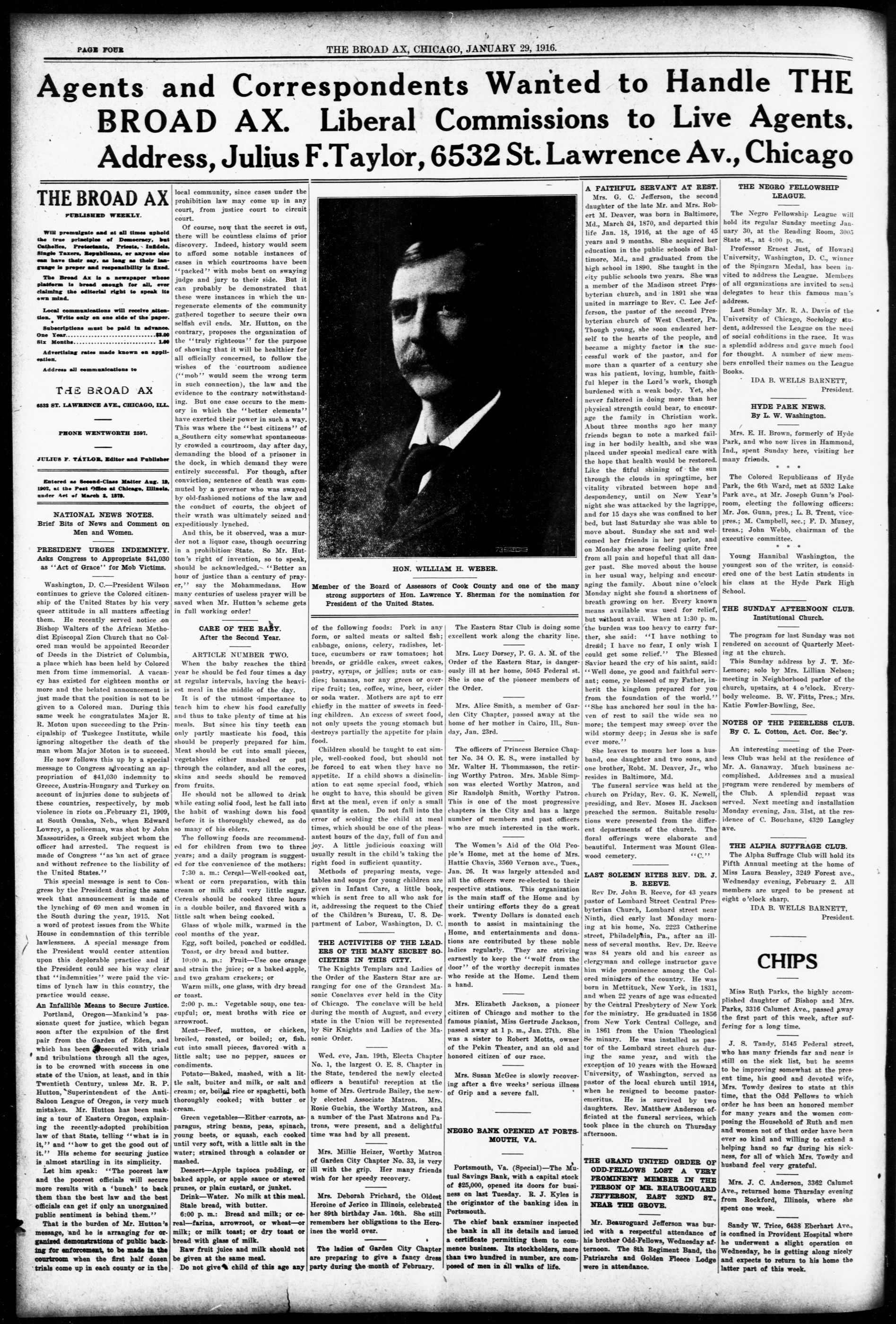
HON. WILLIAM H. WEBER.
Member of the Board of Assessors of Cook County and one of the many strong supporters of Hon. Lawrence Y. Sherman for the nomination for President of the United States.
Member of the Board of Assessors of Cook County and one of the many strong supporters of Hon. Lawrence Y. Sherman for the nomination for President of the United States.
of the following foods: Pork in any form, or salted meats or salted fish; cabbage, onions, celery, radishes, lettuce, cucumbers or raw tomatoes; hot breads, or griddle cakes, sweet cakes, pastry, syrups, or jellies; nuts or candies; bananas, nor any green or overripe fruit; tea, coffee, wine, beer, cider or soda water. Mothers are apt to err chiefly in the matter of sweets in feeding children. An excess of sweet food, not only upsets the young stomach but destroys partially the appetite for plain food.
Children should be taught to eat simple, well-cooked food, but should not be forced to eat when they have no appetite. If a child shows a disinclination to eat some special food, which he ought to have, this should be given first at the meal, even if only a small quantity is eaten. Do not fall into the error of scolding the child at meal times, which should be one of the pleasantest hours of the day, full of fun and joy. A little judicious coaxing will usually result in the child's taking the right food in sufficient quantity.
Methods of preparing meats, vegetables and soups for young children are given in Infant Care, a little book, which is sent free to all who ask for it, addressing the request to the Chief of the Children's Bureau, U. S. Department of Labor, Washington, D. C.
THE ACTIVITIES OF THE LEADERS OF THE MANY SECRET SOCIETIES IN THIS CITY.
The Knights Templars and Ladies of the Order of the Eastern Star are arranging for one of the Grandest Masonic Conclaves ever held in the City of Chicago. The conclave will be held during the month of August, and every state in the Union will be represented by Sir Knights and Ladies of the Masonic Order.
Wed. eve, Jan. 19th, Electa Chapter No. 1, the largest O. E. S. Chapter in the State, tendered the newly elected officers a beautiful reception at the home of Mrs. Gertrude Bailey, the newly elected Associate Matron. Mrs. Rosie Guchia, the Worthy Matron, and a number of the Past Matrons and Patrons, were present, and a delightful time was had by all present.
Mrs. Millie Heizer, Worthy Matron of Garden City Chapter No. 33, is very ill with the grip. Her many friends wish for her speedy recovery.
Mrs. Deborah Prichard, the Oldest Heroine of Jerico in Illinois, celebrated her 89th birthday Jan. 16th. She still remembers her obligations to the Heroines the world over.
The ladies of Garden City Chapter are preparing to give a fancy dress party during the month of February.
of Cook County and one of the many
ce Y. Sherman for the nomination for
The Eastern Star Club is doing some
excellent work along the charity line.
Mrs. Lucy Dorsey, P. G. A. M. of the
Order of the Eastern Star, is danger-
ously ill at her home, 5045 Federal st.
She is one of the pioneer members of
the Order.
Mrs. Alice Smith, a member of Garden City Chapter, passed away at the
home of her mother in Cairo, Ill., Sun-
day, Jan. 23rd.
The officers of Princess Bernice Chapter No. 34 O. E. S., were installed by Mr. Walter H. Thommasson, the retiring Worthy Patron. Mrs. Mable Simpson was elected Worthy Matron, and Sir Randolph Smith, Worthy Patron. This is one of the most progressive chapters in the City and has a large number of members and past officers who are much interested in the work.
The Women's Aid of the Old People's Home, met at the home of Mrs. Hattie Chavis, 3560 Vernon ave., Tues., Jan. 26. It was largely attended and all the officers were re-elected to their respective stations. This organization is the main staff of the Home and by their untiring efforts they do a great work. Twenty Dollars is donated each month to assist in maintaining the Home, and entertainments and donations are contributed by these noble ladies regularly. They are striving earnestly to keep the "wolf from the door" of the worthy decrepit inmates who reside at the Home. Lend them a hand.
Mrs. Elizabeth Jackson, a pioneer citizen of Chicago and mother to the famous pianist, Miss Gertrude Jackson, passed away at 1 p. m., Jan. 27th. She was a sister to Robert Motts, an owner of the Pekin Theater, and an old and honored citizen of our race.
Mrs. Susan McGee is slowly recovering after a five weeks' serious illness of Grip and a severe fall.
NEGRO BANK OPENED AT PORTS
MOUTH, VA.
Portsmouth, Va. (Special)—The Mutual Savings Bank, with a capital stock of $25,000, opened its doors for business on last Tuesday. R. J. Kyles is the originator of the banking idea in Portsmouth.
The chief bank examiner inspected the bank in all its details and issued a certificate permitting them to commence business. Its stockholders, more than two hundred in number, are composed of men in all walks of life.
A FAITHFUL SERVANT AT REST
Mrs. G. C. Jefferson, the second daughter of the late Mr. and Mrs. Robert M. Deaver, was born in Baltimore, Md., March 24, 1870, and departed this life Jan. 18, 1916, at the age of 45 years and 9 months. She acquired her education in the public schools of Baltimore, Md., and graduated from the high school in 1890. She taught in the city public schools two years. She was a member of the Madison street Presbyterian church, and in 1891 she was united in marriage to Rev. C. Lee Jefferson, the pastor of the second Presbyterian church of West Chester, Pa. Though young, she soon endeared herself to the hearts of the people, and became a mighty factor in the successful work of the pastor, and for more than a quarter of a century she was his patient, loving, humble, faithful helper in the Lord's work, though burdened with a weak body. Yet, she never faltered in doing more than her physical strength could bear, to encourage the family in Christian work. About three months ago her many friends began to note a marked failing in her bodily health, and she was placed under special medical care with the hope that health would be restored. Like the fitful shining of the sun through the clouds in springtime, her vitality vibrated between hope and despondency, until on New Year's night she was attacked by the lagripe, and for 15 days she was confined to her bed, but last Saturday she was able to move about. Sunday she sat and welcomed her friends in her parlor, and on Monday she arose feeling quite free from all pain and hopeful that all danger past. She moved about the house in her usual way, helping and encouraging the family. About nine o'clock Monday night she found a shortness of breath growing on her. Every known means available was used for relief, but without avail. When at 1:30 p. m. the burden was too heavy to carry further, she said: "I have nothing to dread; I have no fear, I only wish I could get some relief." The Blessed Savior heard the cry of his saint, said: "Well done, ye good and faithful servant; come, ye blessed of my Father, inherit the kingdom prepared for you from the foundation of the world." "She has anchored her soul in the haven of rest to sail the wide sea no more; the tempest may sweep over the wild stormy deep; in Jesus she is safe ever more."
She leaves to mourn her loss a husband, one daughter and two sons, and one brother, Robt. M. Deaver, Jr., who resides in Baltimore, Md.
The funeral service was held at the church on Friday, Rev. G. K. Newell, presiding, and Rev. Moses H. Jackson preached the sermon. Suitable resolutions were presented from the different departments of the church. The floral offerings were elaborate and beautiful. Interment was Mount Glenwood cemetery.
“C,”
LAST SOLEMN RITES REV. DR. J
B. REVEV.
Rev Dr. John B. Reeve, for 43 years pastor of Lombard Street Central Pressbyterian Church, Lombard street near Ninth, died early last Monday morning at his home, No. 2223 Catherine street, Philadelphia, Pa., after an illness of several months. Rev. Dr. Reeve was 84 years old and his career as clergyman and college instructor gave him wide prominence among the Colored ministers of the country. He was born in Mettituck, New York, in 1831, and when 22 years of age was educated by the Central Presbytery of New York for the ministry. He graduated in 1856 from New York Central College, and in 1861 from the Union Theological Se minary. He was installed as pastor of the Lombard street church during the same year, and with the exception of 10 years with the Howard University, of Washington, served as pastor of the local church until 1914, when he resigned to become pastor-emeritus. He is survived by two daughters. Rev. Matthew Anderson officiated at the funeral services, which took place in the church on Thursday afternoon.
THE GRAND UNITED ORDER OF ODD-FELLOWS LOST A VERY PROMINENT MEMBER IN THE PERSON OF MR. BEAUROGUARD JEFFERSON, EAST 32ND ST., NEAR THE GROVE.
Mr. Beauroguard Jefferson was buried with a respectful attendance of his brother Odd-Fellows, Wednesday afternoon. The 8th Regiment Band, the Patriarchs and Golden Fleece Lodge were in attendance.
THE NEGRO FELLOWSHIP
LEAGUE.
The Negro Fellowship League will hold its regular Sunday meeting January 30, at the Reading Room, 3005 State st., at 4:00 p. m.
Professor Ernest Just, of Howard University, Washington, D. C., winner of the Spingarn Medal, has been invited to address the League. Members of all organizations are invited to send delegates to hear this famous man's address.
Last Sunday Mr. R. A. Davis of the University of Chicago, Sociology student, addressed the League on the need of social conditions in the race. It was a splendid address and gave much food for thought. A number of new members enrolled their names on the League Books.
IDA B. WELLS BARNETT,
President.
HYDE PARK NEWS.
By L. W. Washington.
Mrs. E. H. Brown, formerly of Hyde Park, and who now lives in Hammond, Ind., spent Sunday here, visiting her many friends.
* * *
The Colored Republicans of Hyde Park, the 6th Ward, met at 5332 Lake Park ave., at Mr. Joseph Gunn's Poolroom, electing the following officers: Mr. Jos. Gunn, pres.; L. B. Trent, vicepres.; M. Campbell, sec.; F. D. Muney, treas.; John Webb, chairman of the executive committee.
* * *
Young Hannibal Washington, the youngest son of the writer, is considered one of the best Latin students in his class at the Hyde Park High School.
THE SUNDAY AFTERNOON CLUB
Institutional Church.
The program for last Sunday was not rendered on account of Quarterly Meeting at the church.
This Sunday address by J. T. McLemore; solo by Mrs. Lillian Nelson; meeting in Neighborhood parlor of the church, upstairs, at 4 o'clock. Everybody welcome. B. W. Fitts, Pres.; Mrs. Katie Fowler-Bowling, Sec.
NOTES OF THE PEERLESS CLUB
By C. L. Cotton, Act. Cor. Sec'y.
An interesting meeting of the Peerless Club was held at the residence of Mr. A. Ganaway. Much business accomplished. Addresses and a musical program were rendered by members of the Club. A splendid repast was served. Next meeting and installation Monday evening, Jan. 31st, at the residence of C. Bouchane, 4320 Langley ave.
THE ALPHA SUFFRAGE CLUB
The Alpha Suffrage Club will hold its Fifth Annual meeting at the home of Miss Laura Beasley, 3249 Forest ave., Wednesday evening, February 2. All members are urged to be present at eight o'clock sharp.
IDA B. WELLS BARNETT,
President.
CHIPS
Miss Ruth Parks, the highly accomplished daughter of Bishop and Mrs. Parks, 3316 Calumet Ave., passed away the first part of this week, after suffering for a long time.
J. S. Tandy, 5145 Federal street, who has many friends far and near is still on the sick list, but he seems to be improving somewhat at the present time, his good and devoted wife, Mrs. Towdy desires to state at this time, that the Odd Fellows to which order he has been an honored member for many years and the women composing the Household of Ruth and men and women not of that order have been ever so kind and willing to extend a helping hand so far during his sickness, for all of which Mrs. Towdy and husband feel very grateful.
Mrs. J. C. Anderson, 3362 Calumet Ave., returned home Thursday evening from Rockford, Illinois, where she spent one week.
Sandy W. Trice, 6438 Eberhart Ave., is confined in Provident Hospital where he underwent a slight operation on Wednesday, he is getting along nicely and expects to return to his home the latter part of this week.
Talks on
HEALTH,
CLEANLINESS,
PROPER LIVING,
SANITATION, ETC.
BY
Dr. W. A. DRIVER
3300 So. State Street
Phode Douglas 3617
TYPHOID PREVENTION
Preparedness has the right of way in the minds of practical people. We find plenty of evidence of that fact as we read the literature of today. We find everywhere in our daily observations evidence of the belief in preparedness. We do not have to go to the ant to learn of preparedness but the ant is a good example.
The germ of typhoid is one of the most rapidly moving organisms seen by the aid of the microscope. Its power of producing a terrible disease is like its motility, second to none. Typhoid fever as a destroyer of human life, has gained the consideration of the State of Illinois, which furnishes free to its citizens a three tube serum typhoid fever prevention treatment. Any duly qualified physician will administer the treatment as well as secure the same for those who desire to be prepared against typhoid fever.
THE QUEEN CAFE
SPECIAL SUNDAY DINNERS
Do you eat at home? Then home isn't nothing like this. Do you eat in Cafes, Restaurants, or Lunch Counters. Then come and see us. We cook the best meals, give the best service, buy the best goods in the market, and guarantee that our prices can't be beat anywhere in the city. My name is E. A. Hoffman, my place of business is located at 21 E. 33rd St., just east of the elevated station. If you will come and eat with us we know, you will come again.
The shadow of a trouble is usually blacker than the trouble itself.
Mighty few of us are strong enough to laugh at our own weakness.
Quite often a thing that "goes for a song" isn't worth more than the song.
Europe may be able later on to use some of its trenches for irrigation ditches.
Be charitable to the living; the dead are not in a position to appreciate a monument.
Already football games have been arranged for next autumn. This is preparedness with a vengeance!
Physical geography is about the only safe and same geography for the young idea to study in these stormy days.
Neptune must smile as he sees a little backwater clear trenches that neither huge guns nor poison gas could empty.
Just to show good faith with her allies, Turkey rises to remark that she will not be the first to make a move for peace.
There is now some reason to believe that those reports of the Panama canal's completion were more or less exaggerated.
War's thrilling narrative will be incomplete without a story of the soldier who saved his life by carrying a plug of tobacco in the hip pocket.
Grand Military
BALL
and House Warming
New 8th Regiment
Armory
3515 FOREST AVE.
Monday, Feb. 21st
1916
SPECIAL BAND CONCERT
from 8:30 to 9:30
Admission 50 cents
First opportunity for public inspection of completed Eighth Regiment Armory
---
A. E. H.
The Health Department has recently advised the people of Chicago to boil the water in order to prevent contracting typhoid fever. The drinking water has been contaminated by the recent heavy down-pour of rain and the consequent pollution. In a day's journey about the city much water will be consumed without a chance of securing boiled water in many instances. What is the remedy?
The answer is prepare! Take the typhoid prophylactic which the United States Government intelligently gives to every recruit. One treatment protects for a whole term of enlistment. Soldiers must be prepared for such milk and water as might cause typhoid fever.
Let us follow that example and each of us call on the family doctor for the typhoid prophylactic, spelled pro-fe-lactic.
Do it now!
While conducting a research for information on the origin of certain fashions of the past I discovered the reason for the existence of the squeak in shoes.
The squeak was once deemed fashionable, and men of great importance in the affairs of the country demanded it in their footwear, and cobblers were paid 2 shillings extra for putting it in. The squeaky boot denoted the approach of some one of importance, and the way was made clear at once in the same manner as a bicycle's shrill whistle warns you to look to your interests.
During the squeaky period men found it difficult; to sneak into the house after 12 midnight without being discovered and disgraced. Removing the shoes before entering the home is an invention which followed the squeaky shoe era, and while the former is now almost obsolete, the latter is still in vogue and as popular as ever with married men!-Zim in Cartoons Magazine.
Bite About Beasts
You think you know something about animals, eh? Well, let us put your knowledge to a few simple tests.
Frogs, to begin with, Can they breathe with their mouths shut? Certainly they can. As a matter of fact, they always do. If they kept their mouths open they would suffocate.
Next, hares. When do they close their eyes? Answer, never. You see, they haven't any eyelids, so they can't. But they have a thin membrane, which performs the service of eyelids when they are asleep.
What is the color of a horse's eyebrows? That's a difficult one. Think hard and then learn that a horse hasn't any eyebrows.
You may like to know, in addition, that turtles and tortoises have no teeth; that parrots, unlike the majority of birds, can move both mandibles of their beaks, and that fishes never masticate. They simply haven't time between breaths—London Answers.
More Rope.
In July, 1836, General William Henry Harrison, who had been spoken of as a candidate for president, visited Philadelphia. Many of his political friends were at the steamboat wharf to meet and escort him to his hotel. He was placed in a four horse carriage, but after proceeding a short distance the horses became unmanageable and had to be taken out of the harness. The people began to draw the carriage, and there was a call for ropes. They were soon procured, but proved too short, and as the enthusiasm increased the cry arose, "More ropes!" and still more ropes. The Democrats saw only the funny side of the case and adopted "more ropes" as a ridiculing slogan. It did not last long and could not have hurt Harrison much, for four years later he was elected president.—Philadelphia Press.
Skaletons.
Skeletons are used in cemeteries, laboratories and museums. After battles they are frequently bleached before being stored away for the winter.
Everybody has a skeleton, without which one would fall around like a jellyfish, and instead of going to bed at night we would have to be hung over a clotheshorse. Indeed, life without a skeleton would be one long, dreary flop.
Skeletons come in a lot of assorted bones, which are more or less securely fastened together by the department store clerk who fastened them together before they went out of the shop. When the first skeleton was constructed one of its bones got away and has caused much trouble ever since.
Some wear clothes over their skeletons—Life.
THE BROAD AX, CHICAGO, JANUARY 29, 1916
Strenuous Admiralty Law.
Strenuous Admiralty Law. It was the early days of boat travel on the Ohio river when even passenger steamers stopped at landings on islands and mainlands for freight. We had made an island landing, and a wealthy passenger had left the boat to buy cigars at the island's tiny store. He bought $5 worth and presented a hundred dollar bill in payment, whereupon the storekeeper offered him $5 in change, asserting that he had received only $10. The customer returned to the boat and related his tale of woe to the captain, who at once went ashore and informed the storekeeper that unless the change was at once forthcoming he would hit a cable around the store and drag it into the river.
The storekeeper still refused, and the captain departed for his boat. A cable was quickly passed around the little building, hitched to the vessel and full steam ordered. When the shack totered upon its foundations, the frightened storekeeper appeared, the missing bills fluttering in his hand!—New York Post.
He Proved His Case
"Human nature is mighty queer, isn't it?" he observed to the other man on the rear platform of the street car. "Yes, I suppose so," replied the other. "People are too sensitive—altogether too sensitive."
"I don't know about that."
"Well. I do. For instance, now, you have a red nose. You are not to blame for it perhaps, but you are so sensitive that if I should offer you a remedy for it you"—
"You old loafer, I've a good mind to knock your head off!" hissed the red nosed man as he squared off.
"Told you so," replied the other as he dropped off. "Human nature is the queerest durned thing on earth, and some folks are so sensitive that they'd swallow their false teeth rather than let any one know they had 'em."—Detroit Free Press.
Hot Milk In Mashed Potatoes
"The reason that really good mashed white potatoes are such a rarity in this bitter world is that the milk isn't heated before it is put into them," said the domestic science teacher.
"And yet," said the pupil pensively, "I have seen wonderful cooks put in cold milk."
"But that was while the potatoes were burning hot and on the stove," insisted the advocate of the hot milk dressing. "The potatoes were so awfully hot that they heated the milk. The safest way is to heat the milk and to use also plenty of butter, pepper and salt. Then beat and beat them with a fork. Never use a spoon. You can't beat them too much for their own good."—New York Herald.
Going Home to Mother-
Just what is meant by going home to one's mother, in its larger sense, is perhaps a little difficult to define. Yet, surely, it must be a very universal experience. Have we not all at some time— often following a period of confusion and stress of circumstances—suddenly experienced that deep sense of finding ourselves where we belonged? A sense of restfulness, of homecoming, of general rightness and well doing? It is a sloughing off of the nonessential and the trivial and a shifting of the spirit into deeper and simpler channels; a pause, when in the midst of all this mad dance of time and circumstances one gets a sudden, enlarging glimpse of truth and of eternity.—Atlantic Monthly.
Why It Burns.
There are a number of chemical substances which when applied to the skin will cause a burning sensation, and mustard is one of these. It acts on the tongue and other sensitive parts of the body as an irritant. It causes the blood vessels to swell and discharge some of their contents. If it is left on the skin long enough it will blister. That is what happens when a mustard plaster is applied. Under the mustard plaster we find a red patch produced by the swelling of blood vessels. This causes pressure on the nerves that produces the sensation we call burning.
Wills In Argentina
In Argentina the laws provide that a father must leave his children four-fifths of his fortune and a husband if he has no children has to leave all of his property to his wife. An unmarried son is compelled to leave his parents two-thirds of his property, and only unmarried persons without parents or descendants can make wills disposing of their possessions as they see fit.
An Effective Way.
"They say," said the young dramatist, "that I shall have to cut my play down, but I really don't know where to begin."
"Why not start at both ends," his candid friend asked, "and work toward the middle?"
All He Gots
The Boss—Ain't it enough that I save your life? The Bookkeeper—What do you mean—save my life? The Boss—If I gave you the raise you're asking for you'd drop dead.—New York Globe.
Self Praise.
Be careful that you do not commend yourselves. It is a sign that your reputation is small and sinking if your own tongue must praise you.—Sir Matthew Hale.
Exceptions.
"Not always. Just you try to get any cold cash from a snow bank."—Baltimore American.
Enjoy the present day, trusting very little to the morrow.—Horace.
Jupiter's Moons.
The statement that Jupiter's moons can occasionally be seen without optical aid by keen sighted persons needs some qualification. Within the last quarter of a century the space penetrating power of the camera, combined with the world's giant telescopes, has added no fewer than five Jovian satellites to the four which Galilei discovered 300 years ago. Four of the five new moons are "netted" at the famous Lick observatory, on Mount Hamilton, California, and the fifth is to the credit of Greenwich observatory. But all of the new discoveries are so small and, with one exception, so distant from Jupiter that they are beyond the range of naked eye vision, even from Jupiter itself, unless an observer on the planet had better eyesight than we terrestrials. Indeed, to see Satellite IX (the latest addition to Jupiter's family of moons) a hypothetical observer on Jupiter would need eyesight capable of seeing a star 300 times fainter than the faintest visible to human eyesight—London Chronicle.
The Frugal Breton
"As I watched the fishermen unloading their cargoes I had a striking illustration of Breton frugality." writes Herbert Adams Gibbons in an article on "The Sardine Industry of Brittany," in Harper's Magazine. "So many sardines come into the port of Douarnez that their white, flecky scales cover the sand in mounds, washed up by the tides. Some of the boats have their coats covered several inches deep with the crutch. But the fishermen actually count every sardine and send them where in baskets of exactly 200 each
There is no guesswork, no approximation by weighing. Since at low tide the boats are fifteen feet below the shore, the porters let down ropes to fishermen in the boats. The baskets are drawn up one at a time. If a single fish happens to fall overboard they go after it with a hand net and make really strenuous efforts to recover it. These are fishermen to whom the admonition to gather up the fragments would not have been necessary."
The Four Great Sauces
A French epicure has declared, that "man has created the culinary art; he does not feed like an animal—he breakfasts, dines and sups."
The French are particularly eloquent on the subject of sauces. Among their famous chefs are recognized four great sauces, Spanish, veloute, bechamel and German. The Spanish and veloute were known as far back as the seventeenth century. In the eighteenth they were modified by the masters of cookery, particularly by Careme, who was called "the Raphael of the kitchen."
The Spanish sauce is composed of juices extracted from a mixture of ham, veal, chicken and pheasant. Veloute is similar, but is not colored. Bechamel is veloute to which cream has been added, and the German sauce is veloute plus the rolks of eggs.
Curious Dwarf Oaks.
Known to ranchmen as chinney, the dwarf oak of the southwest presents a curious instance of the devious and inscrutable ways of nature. There the liliputian of the great oak family covers a great area in the plains of Texas bordering on New Mexico. The trees, it is said, rarely attain a height of twenty inches and are replicas of their giant brothers in other parts of the country. The acorns which they bear are as large as those of the common burr oak and present a grotesque appearance hanging from the little limbs of the low growing shrub or tree. The annual crop of mast is used for fattening hogs. When the acorns are ripe many wild animals and birds flock into the miniature forest to feast on the nuts.—Argonaut.
Told Almost All:
Here is a story told by one of our women lawyers:
"I told my client to tell me everything just as it had occurred—to hold back nothing—and then, being perfectly familiar with all the facts, I might be able to help him. After the story had come to an end I asked him if that were all.
"‘Everything’—cept where I hid th' money' was the answer." — Buffalo News.
Islands.
There are about 100,000 islands, large and small, scattered over the oceans. America alone has 5,500 around its coasts. There are 365 in the bay of Rio Janeiro, 16,000 between Madagascar and India and some 1,200 off the eastern coast of Australia between its mainland and New Guinea.
Legal Snags.
"Seems to me that the lawyers have it easy in life."
"Why so?"
"The rest of us have to surmount our own obstacles, but if a lawyer strikes one he applies to some judge and has it set aside."—Louisville Courier-Journal.
Three Clocks.
The best three clocks in the world are at the naval observatory at Washington and the observatories at Greenwich and Berlin. The former two are the best and show a mean deviation of fifteen one-thousandths of a second a day.
Easy Mark.
Randall—I just borrowed $5 from a friend. Rogers—Give me his address quick. Randall—Why? Rogers—A man who would lend money to you would lend it to any one.—Life.
It is not poverty. but covetousness, that causes sorrow. It is not wealth, but philosophy. that gives security.—Epictetus.
"You haven't done very well this month," said the boss. "Your orders were few and far between."
"I'm sorry," said the traveling salesman, "but"—
"I don't want excuses. I want orders."
Just then the door opened, and the secretary entered and passed in a card.
secretary entered and passed in a card,
"Humph," said the boss, "James
Henry, salesman for the General Products
company! Doesn't he know I
never see traveling men at this hour?"
"He says he is in a hurry to leave
town and would like to explain his
proposition to you. He will be brief."
"I can't see him now. I'm busy. Tell
him to wait."
"When shall I tell him to call again?"
"Tell him to wait there and I'll see
him in about an hour. Now, then,
young man, why is it that you fell
down this month?"
"Because all the business men I
called on insisted on treating your
salesman the way you treat theirs."—
Exchange.
Baking a Watch.
Only the best made chronometer would ever survive the tests made at the Royal observatory, Greenwich. Usually there are about 200 watches under examination for use in the royal navy. On certain occasions there is a complete trial of chronometers open to all makers who have sufficient confidence in their watches being able to withstand the severity of the tests. During the competition the watches are exposed to every possible variation of temperature. They are baked in furnaces sufficiently hot to cook a joint. In fact, so great is the heat that a badly made watch has been known to tumble to pieces during the baking test. The moment a watch is taken out of the oven it is plunged into mixtures registering 40 degrees of frost. To such perfection has the manufacture of some chronometers attained that even the most stringent tests fail to cause the slightest variation.—London Telegraph.
Making Pastel Colors
The lack of permanency of pastel pictures is largely due, according to Birge Harrison, to the bad quality of the materials employed. Unscrupulous manufacturers dip sticks of white chalk into liquid baths of brilliant but ephemeral dyes, and pictures produced with these soon fade. Writing in Art and Progress, Mr. Harrison says artists should make their own pastels, a process that is very easy.
"The materials used," he says, "are precipitated chalk mixed with the best dry powdered colors in the proportions necessary to produce the various tints desired. This impalpable powder is moistened to the consistency of a thick paste by the addition of an extremely dilute solution of gum tragacanth and water. It is then very thoroughly kneaded and finally pressed or rolled into sticks of the desired size."
Dogs In Moccasins.
After the first severe freeze at the beginning of winter a band of prospectors working in northern Canada found themselves on the wrong side of a lake over a hundred miles wide, on the other side of which was the winter headquarters. They were without any means of transportation other than a boat in which was stored all their belongings and provisions. Hiring a halfbreed with his dog team, they put runners under the boat and made their way easily and safely across the smooth miles of frozen water, helping along the dogs by setting a sail on the boat. To protect the feet of the dogs from the hard surface of the ice small moccasins of buckskin, well padded, were provided for each.
Greece Only an Oligarchy.
Greece, as many people do not know, is a country managed by 500 families who hate one another like poison in true classic Greek fashion. The peasants, the back drivers and the fishermen talk radical politics all day long, but when election day comes they vote for a member of one of these big aristocratic—namely, "best" in the Greek sense—families. A republic for Greece would mean anarchy, chaos.—World's Work.
Bored Audience:
"Mr. Jaggs never opened his mouth while his wife was entertaining her guests the other night."
"Oh, yes, he did several times."
"I didn't hear him. What did he say?"
"Nothing. He yawned."—Baltimore American.
The Clove Tree.
The limbs of the clove tree being very brittle, a peculiar four sided ladder is used in stripping the tree. As fast as the buds are collected they are spread in the sun until they assume a brownish color, when they are put into the storehouse ready for market.
Curious Request.
A doctor in the country received one day a letter from an old woman asking for a bottle of cough mixture for her husband, ending with the postscript: "Please, sir, don't make it too strong, as the poor man has only got one leg." -London Tit-Bits
Different From Her Ma
He—Why is it that there's never a match in this house? She (curly)—it can't make matches. He—That's strange. Your mother could.—Boston Transcript.
That's So.
"I hear strange sounds in my ears. doctor." "Well, where would you expect to hear them?" -Boston Transcript.
PAGE FIVE
Muncnausen.
Perhaps the most voluble bar that ever lived was the Baron Munchausen—that is, the fictionized baron. The real baron was a kindly soul who lived in Germany and who in nowise deserved the evil reputation that attached to him through the use of his name in a series of highly colored adventures that appeared in print in London in 1785.
The authorship of the absurd tales is a mystery. It is generally believed that Rudolph Erich Raspe, a questionable character, wrote the stories first, but there is no absolute confirmation. Following the original series a number of additional adventures were written by less skilled pens.
The real baron found little in life to enjoy after the stories became generally circulated. Curious tourists haunted his estates and tried to trap him into relating some wild story. At first he resented their attention in a vigorous fashion, but in his declining years he grew sour and morose and finally died, a most unhappy person, in 1797. —Kansas City Times.
Why the Sea Has Pearls.
A few weeks ago I was talking with a woman of deep religious sentiment who was in great distress because her very young baby had died before it could be baptized. I was led to ask natives of Norway, Finland and other places their views on this very delicate question, and so I came across a bit of very pretty Sicilian folklore.
To the babies in Sicily life is very kind and death is gentle. Those who die unbaptized are doomed to wander, but do not wander grieving. Madonna Mary sends to them every week end an angel, who hays aside his ill crown and romps with the dead babies. When he leaves them he gathers up in a golden chalice all the tears they have shed during the week. These he casts in handfuls into the sea, "and that is why the sea has pearls." I like that story.-Vancouver World.
Effects of Lying.
Lying is a great sin against God, who gave us a tongue to speak the truth and not falsehood. It is a great offense against humanity itself; for where there is no regard to truth there can be no safe society between man and man. And it is an injury to the speaker; for besides the disgrace which it brings upon him, it occasions so much baseness of mind that he can scarcely tell the truth or avoid lying, even when he has no color of necessity for it, and in time he comes to such a pass that as other people cannot believe he speaks the truth, so he himself scarcely knows when he tells a falsehood. As you must be careful not to lie, so you must avoid coming near it. You must not equivocate, nor speak anything positively for which you have no authority but report, or conjecture or opinion—Sir Matthew Hale.
Christening Boats
The modern custom of christening vessels is without doubt an adaptation of an ancient custom, just as so many of our other customs and habits have been adapted from ancient ones. The ancients used to place the image of a titular deity at the stern of their vessels, in the tutela, or shrine. Do you remember that the boat mentioned in the twenty-eighth chapter of the Acts, the boat that carried Paul from Malta to Rofne, "under the sign of Castor and Pollux"? It was, so says Acts.
The ceremony of breaking a bottle of wine on the bow of a new vessel as it is launched is another ancient adapted custom, for the ancients offered a libation to Neptune or Poseidon, who ruled the seas, as they launched their boats.
—Exchange.
Playing Safe.
"I'm surprised to see you riding in the suburban smoker every day. You never use tobacco, in any form, do you?"
"No, but if I ride in one of the other cars my wife expects me to be able to tell her what every lady on the train was wearing and whether it was becoming or not, and if I tell her she accuses me of taking too much interest in other women. If I can't tell her she says I'm too stupid for any kind of use."—St. Louis Post-Dispatch.
Babylonia.
The northern part of Babylonia is generally dry during the greater part of the year. The lower part, near the junction of the rivers, is generally a great malarial swamp overgrown with reeds. In the springtime one may sail almost anywhere across the country from the Tigris to the Euphrates, and in the dry season great herds of camels, buffaloes, donkeys, sheep and goats graze over the same place.
Nothing Rude.
"I suppose your daughter will start her scholastic career with some special rudimentary studies?"
"No. indeed. There aren't going to be nothin' rude about it. She's goin' to take only polite literteor."—Baltimore American.
His Opaosite.
"They say people with opposite characteristics make the happiest marriages."
"Yes; that's why I'm looking for a girl with money."—Brooklyn Eagle.
A. Great Help.
"Did you have any one help you when you were hanging the pictures?" "Oh, yes! My wife stood around and asked me what I was swearing at"—St. Louis Post-Dispatch.
Some men do not make fortunes for the sake of living, but, blinded by avarice, live for the sake of money only.—Juvenal.
PAGE NIX
Building a Small House.
When the prospective owner of a small house determines at last to build the home to which he has been aspiring for, perhaps, many years, he faces the consideration with the realization of a complex problem—the necessity of harmonizing the ideal that has formed in his years of anticipation with the stern realities of the actual building. Concisely stated, his problem is this: To combine the five desirables—space, charm, distinction, utility and comfort
—with the sixth, economy, within the apparently limited allowance of the small house. Sometimes he succeeds in this. Generally he yields to the difficulties presented and sacrifices one or more of the desirable qualities, thankful to get a finished house after all the dissension ensuant with building progress. When, however, a home builder succeeds in the combining of all these qualities in the construction of his house the achievement is worthy of record. —Raymond Comstock in Countryside Magazine.
Never Eat What You Dislike.
I am constrained to protest against the advice given mothers to oblige their children to eat food which they dislike. Most grown people have their likes and dislikes, and if it were punishment to them to eat a despised article how much more so it is to a child to whom small troubles loom as tragedies! The child's distaste should not be discussed, simply ignored until he has forgotten how much he hated a certain article. There are so many good and nourishing things that if one is at all disliked how much better to substitute something else, thereby avoiding issues and friction, which every one knows are harmful to a child's nerves and health and disposition as well. And, as for letting a child go without his needed nourishment till next meal if he refuses one article, the injustice of it is too apparent to need comment. — Woman's Home Companion
Big Guns Not New
Modern howitzers and siege guns are giants of destructiveness, yet, making allowance for time and exexperience, we must still admire the good old burghers of Ghent, who 500 years and more ago turned out an iron "bombarde" that weighed thirteen tons. This prototype of the up to date siege gun had a bore twenty-five inches in diameter. Out of it was projected a granite ball that weighed 700 pounds. Bronze guns as big were cast half a century later at Constantinople. And when only a little over 100 years since an earlier British fleet was fighting its way into the Dardanelles these big guns crippled six of the English men-of-war and killed or wounded 126 of those on board. One gun of this type weighed eighteen and three-quarter tons, had a twenty-five inch bore and fired a 672 pound stone shot.—New York World.
Origin of the Gypsies
When the gypsies first appeared in England in the fifteenth century the name gypsy was given to them by the English people, who believed them to have come from Egypt. The French, by a similar mistake, called them Bohemians. But a careful study of this race, and especially of their language, shows that they came originally from India. The gypsy language is derived from the Sanskrit, as are the other Aryan languages of India. A similar error was made by the English when they called a distinctively American bird a turkey, under the impression that it was an importation from the Ottoman empire, and by the French when they called the same bird coq d'Inde, believing that it came from India.—Christian Herald.
Curious Manx Custom.
On July 5 every year all the officials of the Isle of Man, including the clergy in their surplices, walk to the top of Tynwald hill, and from the top of it the laws made during the year are promulgated in Manx and English. This promulgation of the laws on Tynwald hill is as necessary as the royal assent to the validity of all laws passed by the Manx legislature. This is one of the many relics which the old Norsemen left behind, and it dates so far back that its origin is lost in the mists of antiquity. — Liverpool Mercury.
Wonderful.
It was in the Boston Musuem of Fine Arts. The little man with the hunted look on his face was standing before the mummy of an Egyptian princess. "Isn't it wonderful," he sighed, "to think that any one could make a woman dry up and stay that way?" And silently wiping away a tear he hurried out and caught a car, for it was only twenty minutes to dinner time.-Boston Post.
Young Efficiency Expert
Caller—So your son Willie has got a job as office boy. How is he getting on? Fond Mother—Splendidly! He already knows who ought to be discharged and is merely waiting to get promoted so that he can attend to it.—Boston Transcript.
Well. Well.
"Did you ever alm at a deer in the Adirondacks and bag a guide?"
"I did more than that. I aimed at a deer in a drawing room and bagged a bride."-Florida Times-Union.
Experience.
"Experience would be a wonderful asset but for one thing."
"What's that?"
"You can never sell it for what it cost you."
Fortune has often been blamed for her blindness, but Fortune is not so blind as men are.—Samuel Smiles.
Cromwell's Way.
In the days when Oliver Cromwell was lord protector of England there was no fine discrimination to favor members of an embassy. When such members committed crimes against the law of the land they were held to the same accountability as though they had been natives. So it was that on July 10, 1653, Don Pantaleon Sa, a Portuguese nobleman, brother of the ambassador from that country to England and a knight of Malta, was beheaded on Tower hill. He had killed an Englishman, mistaking him for another. The Portuguese took refuge with his brother, the ambassador, who claimed that by the law of nations his house was an inviolable sanctuary for all his countrymen. Cromwell sent a messenger to state that if the criminal was not given up to the civil authorities the soldiers would be withdrawn from guarding the embassy and the mob left to do as it pleased. Every effort was made by the Portuguese and other ambassadors to save Don Pantaleon's life, but without avail. Cromwell made no other reply than, "Blood has been shed, and justice must be satisfied." - Indianapolis News.
Thackeray at Oxford.
An old story of Oxford and Thackeray is recalled by Thomas Plowman, who vouches in the Cornhill Magazine for the accuracy of his version. Thackeray had to apply to the vice chancellor for permission to lecture and found that gentleman ignorant alike of his name and fame.
Still, he had a trump card left, which he had been accustomed to consider would carry all before it wherever the English language was spoken. So, with a quiet smile of supreme confidence, he simply ejaculated, "Vanity Fair,' you know!" Then at last, to his relief, a look of awakened intelligence manifested itself upon the vice chancellor's countenance, and Thackeray awaited the effusive outburst which would make amends for all. It came in the words, "Yes, yes, I have heard of 'Vanity Fair,' of course; it is mentioned in the 'Pilgrim's Progress.'" — Westminster Gazette
To Make Copper Oxide
An excellent way to make copper oxide for use in batteries is as follows: Take a quantity of copper filings or fine copper shavings and heat them in a cast iron container or in a crucible till they are red hot. Stir them with an iron rod, and while still stirring sprinkle a little water over the filings until they become ocher red. You will then have a good quality of copper oxide.
Copper oxide plates may be made as follows: Mix the granulated or coarse copper oxide with 5 per cent or 10 per cent of magnesium chloride and heat the heavy mass in forms made of iron sheeting, the forms being of the size of the wanted plate. The more chloride of magnesium used the more porous the plates will be. The coarser the copper oxide the better will be the results.—Popular Science Monthly and World's Advance.
The Dog Rose
The "dog rose" has provoked as much ingenious explanation of its name as the "horse chestnut." One solution is that the "dog" is really "dagga," a dagger, in allusion to the prickles, a drawback from which the Alexandra Day rose is free. Unfortunately for this explanation, the flower bears a similar name in countries where it will not apply. The Germans, for instance, have "Hundrose," and Pliny tells how a Roman mother was moved in a dream to send some roots of the wild rose to her soldier son in Spain. They arrived just after he had been bitten by a mad dog. He took them and was preserved from hydrophobia, as were others who adopted the same treatment. And from that time the wild rose became the "dog rose."—London Chronicle.
Gates In Norway.
A curious feature to travelers in the highroads of Norway is the great number of gates—upward of 10,000 in the whole country—which have to be opened. These gates, which either mark the boundaries of the farms or separate the home fields from the waste lands, constitute a considerable inconvenience and delay to the traveler, who has to stop his vehicle and get down to open them.
Magnet the Thief of Time.
The magnet is responsible for a great deal of trouble with watches, as any jeweler will tell you. Never go near a dynamo with a watch in your pocket unless you are sure that it is made of nonmagnetic material. This applies especially to the hair spring.—Farm and Flireside.
A Blessed Barrier.
"How did you like that interior setting?" asked the realistic producer, "For a real room, except that it had only three walls, could you beat it?" "Well," said the morose critic. "I'd have been more contented during the play if you had added the fourth wall."-Judge.
Sure Sign.
Nellie—Do you think Paul cares for Mamie? Emma—Did you ever hear a young man refer to a red haired girl as having auburn tresses unless he loved her?—Exchange.
The Traditional Nine
Hokus—I have tried to kill that cat at least eighteen times. Pokus—Well, I suppose even a cat may lead a double life—Pittsburgh Press.
Very True.
Hazel—It's always to a man's credit when he stops drinking. Omar—Sometimes it is due to his lack of credit. Indianapolis Star.
How to Tell Parcel Post Charges.
If you know the zone in which is located the postoffice to which you desire to send a parcel post parcel you may figure out the postage required by a simple method.
If the office is in zone No. 1 or No. 2 add to the figure or figures representing the weight the numeral 4. If the weight is ten pounds the postage will be 14 cents, if it is five pounds the postage will be 9 cents, and if it is one pound the postage will be 5 cents.
If the office is in zone No. 3 multiply the weight by 2 and add 4.
If in zone No. 4 multiply by 4 and add 3.
If in zone No. 5 multiply by 6 and add 2.
If in zone No. 6 multiply by 8 and add 1.
The Grand Teton.
The view of the Teton peak Ashton, Ida., is superb and does has been the inducement for a tourist and sportsman to lead main line for the Teton range a Jackson Hole country in purp elk, sheep, trout and unsurpassed tain scenery. Owen Wister's "ian" was glad to get out of these tains because, as he explained, "most too big."
The average American, who has a vague conception of the natural ties of the Rocky mountains and ines that real alpine forms are only in Switzerland, must be sued when he first sees the lofty pe the Tetons. Even a man who climbed the Matterhorn would twice before daring to try Grand
If in zone No. 7 multiply by 10 and add 1.
If in zone No. 8 multiply by 12.
This scheme is good for packages up to and including twenty pounds. It was worked out by an ingenious attache of the Chicago postoffice.—Farm Life.
"Dear Old Ladies" and Other Kinds.
There are as many kinds of old ladies as there are girls, men, automobiles, books and remedies for a cold. There are kindly old ladies, ill natured old ladies, sharp old ladies, witty old ladies, stupid old ladies, musty-fusty old ladies, dainty old ladies, wise old ladies, silly old ladies, Whistler's mother old ladies, Betsy Trotwood old ladies, white spatted old ladies, churchy old ladies, sit-by-the-fire old ladies, tanging old ladies and old ladies who don't wish to be called old ladies at all.
Nowadays most of them are so busy working in public causes that they have not time to protect their own interests as they should. But let us hope that after awhile they will organize a new association, to be called the Society For the Promotion of Distinctive Characterizations For Old Ladies, and that it will have displayed prominently on its banners the slogan "Down With the Word 'Dear'-" "Scribner's."
Gelts Discovered Soap
Soap appears to have been discovered' by the Celts, for the name is derived from the Celtic word "sebon." It seems strange that such early wanderers should have been familiar with soap, but if they had the name they must certainly have had the article it stood for. Moreover, it is quite conceivable that nomads using wood fires could accidentally discover soap. All woods have a certain amount of mineral salts, chiefly those of potash, in their fibers. After burning these are left in the form of carbonate, which a heavy shower of rain would dissolve into a liquid lye, wanting only the grease from an overturned caldron of broth to form soap. A dash of natural curiosity on the part of the woman who cleaned up the mess would reveal the cleansing properties of the new substance—London Mail.
Chateaubriand a Lover of Cats
Many famous men have loved cats—Cardinal Richelieu and Victor Hugo among others—but probably the animals' most eloquent defender was Chateaubriand, the French writer.
"I love in the cat," he said, "that independent and almost ungrateful temper which prevents it from attaching itself to any one, the indifference with which it passes from the salon to the housetop. The cat lives alone, has no need of society, does not obey except when it likes, pretends to sleep that it may see more clearly and scratches everything it can scratch."
And the great writer on another occasion went so far as to express a hope that by long comradeship with cats he was acquiring some of their characteristics!"—London Times.
Pasteur's Gift to Society.
The normal death rate of civilized countries before the days of Pasteur was about thirty to a thousand of the population. Today it is about fifteen to a thousand in the more progressive nations. Think what a saving of fifteen lives a year for every thousand of population means when applied to half the earth! It means the avering of 12,000,000 untimely deaths annually. It means more than 25,000,000 cases of illness avoided. It means health and happiness in 20,000,000 homes rather than disease and distress.-Bulletin of National Geographic Society.
His Drawback
"Girl, ain't you making a mistake in marrying a football hero?"
"But, auntie, consider how he is admired on all sides."
"I do, and I should think that would make it very difficult to reduce him to a point of humility desirable in a good husband."- Louisville Courier-Journal
Cinnamon Bark.
It is a seeming paradox that the best flavored cinnamon bark is produced on poor, white, sandy soil. It must, however, have an abundance of moisture, the choice growing in a temperature of 85 degrees, where the rainfall is about one inch for every degree of temperature.
Postponed Wisdom
"That's right. Sometimes it's an advantage to go slow and not get a lot of information you'd have been better off without."—Washington Star.
Caught the Habit.
"Why were you late?"
"My watch was slow."
"I know it. That's from going with
on so much."—Harvard Lampoon.
Industry is the right hand and fru-
ality the left hand of fortune.—Old
laying.
The Grand Teton.
The view of the Teton peaks from Ashton, Ida., is superb and doubtless has been the inducement for many a tourist and sportsman to leave the main line for the Teton range and the Jackson Hole country in pursuit of elk, sheep, trout and unsurpassed mountain scenery. Owen Wister's "Virginian" was glad to get out of these mountains because, as he explained, "they're most too big."
The average American, who has only a vague conception of the natural beauties of the Rocky mountains and imagines that real alpine forms are found only in Switzerland, must be surprised when he first sees the lofty peaks of the Tetons. Even a man who has climbed the Matterhorn would think twice before daring to try Grand Teton. According to local report, this peak has been ascended only twice, in 1872 and 1894. As the snowclad mountains along the Alaskan archipelago, rising to cloud reaching heights, stand with their feet bathed in the ocean, so from a viewpoint near Ashton the Tetons, towering to the sky, rise from the billowy surface of a sea of golden grain.—Geological Survey Bulletin.
Howard and Prison Fever
Typhus, which under the name of "prison fever" was once rampant in England, held no terrors for John Howard, the prison reformer. While in a cell he would hold to his nose a vial of aromatic vinegar and on going home would wash and change his clothes, though even these precautions he later abandoned. People thought his powers bordered on the magical, pressed him for his secret and refused to believe his explanations that his immunity was due to fearlessness, cleanliness and temperance. He ate no flesh and very little of anything; he drank neither wine nor spirits and went to bed early and rose early. And his asceticism enabled him to let light into the most noisome dungeons and to live to the age of sixty-four—London Graphic.
Deal In Trousers
The village innkeeper had been persuaded to lend a customer a pair of black trousers for funeral solemnities. The sad occasion was long gone, weeks had passed away, and still Mr. J. looked in vain for the return of his garments. They became urgently necessary, and he sent a messenger to demand them back again.
Said the messenger to the wrongful detainer of the goods: "Mr. J. must have 'em. He's going to a funeral."
"They won't do for a funeral," was the reply. "I've been workin' at the quarry in 'em."
"What will Mr. J. do, then?" asked the messenger.
"Why, borrow a pair," replied the other, "same as what I did."—London Tit-Bits.
Largest Hydraulic Lift Lock
Largest hydraulic Lift Lock.
The largest hydraulic lift lock in the world is at Petersborough, Canada. It consists of two great steel boxes or pontoons, moving up and down between guiding towers. When a boat moves into one of the two pontoons the lock gates are closed behind it, and water is pumped into the other pontoon until it becomes heavier than that containing the boat, which then, being overweighted, rises bodily into the air until it reaches the level of the upper canal. The boats are lifted a total distance of sixty-five feet, the gates and capstans being operated entirely by hydraulic power. The time of lockage for boats is about twelve minutes, the actual time of the vertical lift being one and one-half minutes.—St. Nicholas.
Be Prepared
Daniel Webster once told a friend that his great speech in reply to Hayne, which is the high water mark of modern eloquence, but which at the time was supposed to have been delivered without preparation, had been substantially prepared long before. When called upon suddenly to reply to the fiery Carolinian's attacks, which so alarmed the New Englanders at the capital, he was entirely at ease and ready for the fray, for, as he said, he had "only to turn to his notes tucked away in a pigeonhole" and refresh his recollection. "If Hayne," he said, "had tried to make a speech to fit my notes he could not have hit them better. No man is inspired by the occasion. I never was."
The Liberty Boys
The name of Liberty Boys is the name by which the Sons of Liberty of the American Revolution were familiarly known. They were the men who fought the first battles of the colonists, who opposed the stamp act and participated in the Boston tea party. A flag hoisted upon the flagstaff that stood beside Liberty tree, in Hanover square, Boston, was the signal at which they assembled.
A Giant English Oak
Winfarthing oak, according to reliable testimony, was 700 years old at the time of the conquest. William surveyed it closely before making his famous remark. "Could I live to be but one-fourth the age of this tree the world would be mine."
Ending the Argument.
"There are always two sides to a question."
"Quite so. And I don't like a fellow who insists on expounding both of 'em."—Louisville Courier-Journal.
Sure to Lose
Gillet—See here! Did you tell Scott
I'd been cheated again? Perry—No; I
merely said you had made another of
your characteristic investments.—Satire.
Chance generally favors the prudent.
-Joubert.
Naming a Town.
An interesting story is told as to the origin of the name "Moosejaw" as applied to a town in Canada. Some fifty years ago, so the story runs, a pioneer, with his team of oxen and "prairie schooner," passing along the banks of the river, was obliged to camp at this point in Saskatchewan on account of an accident to his cart.
A spoke had fallen out during the day, and the wheel was falling apart. He looked about for something to insert for a temporary brace for the wheel, while his wife busied herself with the evening meal.
The pioneer's child, while romping around, found the jawbone of a moose, which she held up to her father, who by this time almost despaired of finding anything with which to repair his cart. He was delighted to find that the jawbone exactly fitted the place of the missing spoke. The Indians thereafter named this district the "Place Where the White Man Found the Moosejaw." This, it is said, accounts for the town's queer name—Washington Star.
Message of a Banknote
Writing on a banknote once freed an English slave. The note came into the hands of a Liverpool merchant's cashier. He examined it, noticed some red marks on the back and by the lavish use of time and ingenuity deciphered the message. It ran: "If this note should fall into the hands of John Dean of Longhill, near Carlisle, he will learn thereby that his brother is languishing a prisoner in Algiers." John Dean was found, and he applied to the government and interested the prime minister, who stirred the foreign secretary into action. Inquiries were made, and the dey, by golden arguments, was persuaded to release him. For eleven years he had been a galley slave, and he had written the message in blood with a splinter of wood. His release came in time to allow him to die at home—London Telegraph.
Neighbors.
Occasionally a writer makes a big hit by a very simple device. He discovers his neighbors. Most of us live next door to people for years and visit with them on the front porch and once in awhile call on them. But we rarely get really acquainted.
And then a McCutcheon comes along, or a Webster, or a Briggs, or a George Ade, or a Fatty Lewis and finds out that a neighbor is a human being. It is revealed that he gets peevish when the buttons aren't sewed on, and that his children have the croup, and that the baby keeps the family awake all night, and that in general he is a romantic character.
It is possible that your own neighbors might be as interesting as those of the gentlemen just mentioned if you would take the pains to know them.—Kansas City Stur.
Scolds Gagged With Iron
In the seventeenth century erring inhabitants of Newcastle used to undergo far more trying ordeals than that of the drunkard's cloak.
Ralph Gardner in a work entitled "England's Grievance In Relation to the Coal Trade," published 1655, records having seen "in Newcastle six months ago one Ann Bridlestone drove through the streets by an officer of the same corporation holding a rope in his hand, the other end fastened to an engine called the branks, which is like a crown, it being of iron, which was muzzled over the head and face, with a great gag of iron forced into her mouth, which forced the blood out, and that is the punishment which the magistrates do inflict upon chiding and scolding women."—London Express.
Everybody's Opportunity.
How many people we meet who are living narrow lives, complaining of their lack of opportunity!
Take the woman who feels helplessly that she does not know how to think—she has had no chance to study or to meet people of great interests and great purposes. Yet there are libraries—city libraries, country libraries, loan and traveling libraries, with all the wealth of the world's thought and experience, all hers for the taking. She may not know how to think great thoughts herself—comparatively few people do—but through a book she may live with some master mind until his thoughts become a part of her very life. It is not the mere reading of many chapters that starts the life growing.—Youth's Companion.
Epsom Salts as a Dimmer
Five cents' worth of Epsom salts dissolved in a teacupful of water provides the neatest and most efficient "headlight dimmer" for automobiles so far proposed, according to the Scientific American. The solution is used on the inside of the headlight glass, where it is allowed to evaporate. The result is a beautifully frosted lens, the frosting on which lasts for several months.
A Warning
"You had better be careful, Miss Flirty, or you will find yourself up against the law."
"Oh, what do you mean?"
"Why, you have such a killing way of shooting glances at a fellow."—Baltimore American.
Practical Appraisemen
"Ma, James asked me last night to share his lot."
"Did he say whether it was one in a good building section?"—Baltimore American.
"Could you lend me a dollar, old man?"
"Certainly! I could do lots of things
I have no intention of doing. Nice day,
isn't it?"—Judge.
Love and a Cathedral Altar
The high altar of the Freiburg cathedral, with its matchless carvings, tells a story not only of love, but of love's triumph through the sharp wrist of the lover. The simple woodcarver, Hans Lefrink, who had been the early protege of Maximilian L., 200 years before Alsace was captured by the French, had dared to love the daughter of a rich man, and she was foolish enough to love him in return. The indignant parent, when the youth had received the commission to carve the high altar, and on the strength of this honor asked for the hand of his love, received the haughty response. "When you carve an altar as much higher than the church in which it stands, as my daughter is higher than you, you may lead her to that altar in marriage." It was an impossible condition, but nothing is impossible to love. When the altar had been installed it was observed that the topmost point of it was bent forward, extending in a curve, and was actually about fifteen inches higher than the church. It merely stooped a statue in order to conquer. St. Louis Globe-Democrat.
When Gasoline Runs Low.
In Farm and Fireside is an ingenious suggestion for autoists whose gasoline has run so low that they have trouble in hill climbing.
One sometimes is caught out with a low supply of gasoline through having to make long detours to avoid bad roads or front other causes. The supply can be made to stretch over this emergency by adding denatured alcohol or kerosene. Occasionally there is sufficient gasoline for the ordinary level road, but not enough for an unexpected hill.
In this case the principle of pressure feed can be applied. Screw the cap down tight on the gasoline tank and then sharpen a match to fit the ventilating hole in the cap. Blow into this hole as hard as possible and immediately plug with a sharpened match. Usually this will enable the driver to make the hill without further trouble. But if not he can turn the car around and back uphill.
Doctors' Bills
Your doctor's bill, as a general rule, reads, "For professional services rendered." That means that you are to pay for work done and not for miracles performed. If you hire a doctor to attend you in sickness you enter a contract to pay for his expert services, whether he succeeds in curing you or not. It would be unfortunate for both parties in the contract if the terms were otherwise.
Two things are not yet clearly understood by some people—first, a doctor's fee is collectable, and, second, a doctor is not legally bound to attend any one under any circumstances unless he wants to. You can't make a doctor work for a contingent fee, and you can't make him work at all if he chooses to refuse his services.—Chicago News.
One of Nature's Show Places
Ogden canyon, a deep cleft through the towering Wasatch mountains, overlooking the Great Salt lake, is one of nature's show places, cut in the solid rock by the river which runs through it, the rushing water, from prehistoric times, carrying quantities of sand and gravel which simply filed out the present wonderful canyon. Ogden river was flowing west along its present course before the lofty Wasatch mountains came into existence. The raising of the mountains went on slowly for ages, so slowly that the river kept its place by cutting down its ever rising bed. In no other way can scientists rationally account for a river rising on one side of the range and flowing directly across it—Argonaut.
Magnetic Storms
Contrary to the general belief, magnetic disturbances do not begin at the same moment all over the globe. Instead of that they progress around the earth. In the case of abrupt disturbances, which are usually comparatively minute in their effect on the compass needle, the complete passage around the earth requires from three to four minutes. For the bigger effects or for the greater magnetic storms the rate of progression is slower, so that it would take them half an hour or more to pass around the earth completely.
Festival of Minerva
The most notable festival at Athens was in honor of Minerva. All classes of citizens on this day marched in procession. The oldest went first, then the young men, the children, the young women, the matrons and the people of the lower orders. The most prominent object in the parade was a ship propelled by hidden machinery and bearing at its masthead the sacred banner of the goddess.
Curious Lake.
In the center of Kildine, an island in the German ocean, is a curious lake. The surface of its waters is quite fresh and supports fresh water creatures, but deep down it is as salt as the greatest depths of the sea, and salt water fish live in it.
Highly Important
It is highly important when a man makes up his mind tew bekum a raskall that he shud examine hisself clusly and see if he ain't better konstructed for a b槐—Josh Billings.
Explained
"Pa, what's 'innocuous desuetude?' "It's what I fall into, son, when your mother and a caller start to discuss the servant problem." — Birmingham Age-Herald.
Poverty is the north wind that lashes men into vikings.—Ouida.
eS HOLIDAY SALE —
Po Watches, Diamonds, Jewelry
EEF. ELGIN or WALTHAM
q:° — oy 20 and 25 year cases, 7 and 15 jewels
awe $7.95 and $10,95
CS Gc. L. LANDE :
= 3518 S. State St. Tel. Douglas 7587
Leach’s Storage Warehouse
Main Office 4430 So. State St. All Phones Oakland 3784
we PHONE DOUGLAS 6626
GABRIEL FRANCHERE, Jr.
SHOES
FOR LADIES, MEN AND CHILDREN
SHORT VAMP SPECIALTIES
3109 S. State St. Chicago
eT 25"
<< GROWS HAIR 2
5 REMOVES DANDRUFF f
Did pee eens tf
Og d id om
> QUINASOAP .
- Bie eee
iW & Sommerer fA
ve 2 Sayer
| (UINENSe)isy ¢ Ses
: LL ea a q
< A lan aia xv
w~ VP eae Coon Ie eayy { fa
> NY f aed of &
SeeBy Dave Company, New York City. N.Y:
and SHIP CANAL
Length - - - - - 32 Miles
Depth - - - = - - 22 Feet
Width - *- - 162 to 290 Feet
THE CANAL OFFERS:
Industrial Locations, Dock Facil-
ities, Water Transportation, Rail-
road Connections, Electric Power,
Concrete Building Material.
Direct Connection with St. Louis
via the Illinois River and Direct
Connection with the Gulf via the
Illinois and Mississippi Rivers.
Electric Energy Created from
Water Power for the Modern
Factory Means Efficiency and
Economy.
THOMAS A. SMYTH, - President
JOHN McGILLEN, - - Chief Clerk
F. D. GONNERY, as Comptroller
€ e
Karpen Building
900 So. Michigan Ave. | CHICAGO
ee
tee
re aoe:
oa
ee .
ee
rie
= des oe
Of Household Goods, Pianos and Trunks
For the next thirty days to fill our New
Warehouse we are giving Special Rates
FIRST MONTH STORAGE FREE
Ppno in room alone with dust-proof cover on
each one. Household goods in private room,
each piece burlapped before putting away. We
guarantee your furniture to come out of storage in
just as good condition as it went in, whether it be
‘one month or one year.
THE BROAD AX, CHICAGO, JANUARY 29, 1916.
——————————————————————————
ey a Wa A ofa a ee Sateen tc:
Of the 12,000,000 or so dwellings in
the United States 96 per cent are pro-
tected—at least to some extent—by
fire insurance. But of our 100,000,000
inhabitants only 18 per cent have tak-
en out life insurance policies. Men
seem to be more uneasy over the mere
Possibility of the burning of their
houses than over the stern certainty
that death will some day overtake
them. This is a strange contradiction
in human nature. , To safeguard the
nation’s material possessions is well,
but how much more valuable than the
homes are the human lives of the
country! In this age, when: the prin-
ciples of life insurance are so well
understood, there should be no such
discrepancy between the number of
homes and of lives insured. In many
imstances the former could not be
saved from foreclosure were the earn-
ers of incomes to pass away leaving
the families unprovided for. It is as
much the duty of every man to insure
his life as to insure his property, and
if he bas no insurable property there
is all the more reason for insuring his
life—Leslie's.
How to Ride.
In riding sit erect and don't slouch
along. Don't try to be a cowboy if
you are not. We have the real simon
Pure cowpunchers and broncho bus-
ters; also we have the tin horn variety
of the same species. Steer clear of
the latter; also be careful not to get
into this category yourself.
Remember that a horse is only flesh
and blood and not a machine. He gets
tired, hungry and thirsty, and for
goodness’ sake, treat him accordingly.
Because he is a lively horse and you
are paying his hire, treat him white
just the same. Remember that some
one else rode him yesterday, and an-
other will probably do so tomorrow.
Give your horse the same kind of a
deal you yourself would demand ff
you were in its place. Even a broncho
has feelings and will appreciate your
thoughtfulness.—Outing.
ae eee
ee ee ee Ee ee
Every night at dinner the Anglo-In-
ian holds a kind of levee. The in-
sects which attend dance gayly round
the lamp, and one has to watch one’s
plate and glass carefully lest some of
the insects should dance into them.
There is one insect—a little. flat, brown,
shining creature—which emits the
worst odor in the world. If one of
these touches your food the whole fs
tainted and rendered inedible. You
dare not kill these pests. for if one be
squashed the whole room becomes fill-
ed with its disgusting smell and is
uninhabitable for the next half hour.
So these abominable insects fly about
with impunity, while the poor Anglo-
Indian must perforce look helplessly
on and in-vardly sigh “spero meliora.”
—London Saturday Review.
88 a Maturaiios Painted.
If I were to paint the short days of
winter I should paint two towering
icebergs approaching each other like
promontories, for morning and even-
ing, with cavernous recesses and a sol-
itary traveler wrapping his cloak about
him and bent forward against the
driving storm, just entering the narrow
pass. I would paint the light of a ta-
per at midday, seen through a cottage
window, half buried in snow and frost.
In the foreground should be seen the
sowers in the fields and other evidences
of spring. On the right and left of
the approaching icebergs the heavens
should be shaded off from the light of
midday to midnight with its stars, the
sun being low in the sky.—Henry Da-
vid Thoreau.
The Lyre Bird.
_ The fully developed male lyre bird
4s one of the most handsome and nota-
ble of the forms of bird life of Queens-
land. The contour of the bird, with
its long neck and stout gallinaceous
feet, is by no means unlike that of a
peacock, and the wonderful tall, pos-
sessed only by the male birds, fulfills
a corresponding role of vain display.
The bird executes antics for a train
of female admirers on a raised earth-
en mound. For a short period of the
year, about January, the lyre bird loses
its characteristic plumes and has to be
content with the sober plumage of its
mate.
Internal Portraiture.
An art patroness was gushing over a
portrait in the presence of the artist.
“I do not know how it is,” she said,
“but when you paint a portrait you
‘seem to put more into it than any one
else can see.”
“Madam,” he- exclaimel in a rhap-
sody, “it is not faces alone that I paint;
it fs souls!”
“Oh,” she replied cuttingly, for his
enthusiasm was too warm, “you do in-
teriors, do you?”—Exchange,
Cold Mixtures.
One of the coldest mixtures known is
made by adding three pounds of mu-
riate of Iime to one pound of snow.
‘Three pounds of snow added to one
pound of salt make the mixture fall
thirty-two degrees below freezing
point.
Easy Saving.
In Argentina a postal savings bank
‘account can be opened by depositing
one paper dollar, but after that sums
of mere fractions of a cent may be
entered by purchase of a stamp.
‘Who Knows?’
A Ittle girl, finishing her breakfast,
looked up and asked, “Mother, what is
hash when it is alive?”—Chicago Her-
ald.
‘The lucky man is the one who sees
and grasps his opportunity—Old Say-
ing.
Exploding Ice.
To make a piece of ice explode the
first step is to put on a plate a lamp of
clear ice about as large as your fist.
Then with a reading glass or the lens
of @ magnifying glass focus the sun's
Fays so that the bright spot of light is
exactly in the center of the lump. In
a little time the ice will begin to melt
from the inside, and after a few mo-
ments a small cavity will appear, for
the ice, having expanded in freezing,
will not take up so much room when
melted. The cavity, being entirely sur-
rounded by ice, will be a partial vac-
uum, filed bith a watery vapor of very
low pressure. When you have melted
a large cavity lay the glass aside and
Jet the ice melt in the sun. Turn it
occasionally so that it will be sure to
melt evenly round the cavity. After
awhile the cavity will be surrounded
by a thi shell of ice. Then, because
of the great pressure on the outside
(about fifteen pounds to the square
inch), the thin walls will suddenly
collapse, and the ice will fly in all di-
rections.—Youth’s Companion.
‘ities iia itt aan
Dr. George C. Simpson of the Indian
meteorological service at Simla, in In-
dia, who asserted that the southern
hemisphere is much colder than the
northern, gives in the Scientific Amer-
ican the reasons on which he bases his
opinion. ‘The air is warmed not by the
rays of the sun, which simply pass
through it, but by the earth, which ab-
sorbs the rays. Now, in the northern
hemisphere there is much land toabsorb
the energy of the sun and to give heat
tothe air. In the southern hemisphere
there is much less land, and all the
land within the antarctic circle is per-
manently covered with ice, which forms
a virtually perfect reflector and which
sends back into space most of the solar
energy that falls upon it’ Five mll-
lion square miles of the earth's surface
in the southern hemisphere reflect into
space a large part of the energy re-
ceived from the sun—a fact that in it-
self is enough to account for a consid-
erable difference in temperature.
Fe a ae ae
4 friend once entered the studio of
George Inness, the American land-
Scape painter, while he was at work
and remarked that the picture on the
easel seemed to him much better than
certain former works of the artist.
“Right!” said Inness. “This is going
to be one of my best things, and the
reason is that I have had the good
luck to break my right arm and am
obliged to paint with my left hand.
You see,” he added, showing his right
hand in a sling, “this hand had be-
come so darned clever that I could not
catch up with it, and it painted away
without me, while this hand”—show-
ing the left, with which he held his
brush—“is awkward and can do noth-
ing without me.”
tis then: Gemen Senk:
Sam had come home from school,
hungry, as usual. Tossing his spelling
book on the kitchen table, he hastened
to the pantry and began an investiga-
tion of cake box, cupboards and cooky
Jar.
Suddenly the back doorbell rang
Leaving his unprofitable search, Sam
nel went to answer. On the steps
stood an unshaven, long haired max
whose clothes needed a tailor and
laundry worker.
“I'm hungry,” began the stranger ix
a low, aggrieved tone, “and should
like somethin’ to eat.”
“Well, so'm I,” confided the boy
“but you know I’ve been a-huntin’ for
ten minutes an’ hain't found a thing”
—Tudge.
Too Late.
After the guests had waited for half
an hour in a Berkshire chureh for the
bride to arrive messengers were dis-
patched to the livery stable to try to
discover what had happened. The liv.
eryman, made to understand that he
had omitted to send a carriage to her
house, acknowledged that all the
blame rested on him and apologized in
manly fashion, but when they suggest.
ed that he should proceed to remedy
the delay the failed to see the point.
“What'll be the use o' fetchin’ 'er
now?” he argued. “The service ‘ll be
arf over.”—London Globe.
Those Who Ride.
In all situations of life into which 1
have looked I have found mankind di-
vided into two grand parties, those
who ride and those who are ridden.
‘The great struggle in life seems to be
which shall keep in the saddle. This,
it appears to me, is the fundamental
principle of politics, whether in great
or little life—From “The Young Man
of Great Expectations,” by Washing-
ton Irving.
‘ani
It is the appearances that fill the
scene, and we pause not to ask of
what realities they are the proxies.
‘When the actor of Athens moved all
hearts as he clasped the burial urn and
burst into broken sobs how few then
knew that it held the ashes of his son!
—Bulwer-Lytton.
‘Ciciiine
“Herbert, you weren't listening to
what I said.”
“Er—what makes you think that,
darling?”
“I asked you if you could let me have
$100, and you smiled and said, ‘Yes,
dearest’ "—Life.
‘One Thing Left.
Wife—Have you shut up everything
for the night? Husband (meekly)
Tm sorry to say, dear, that I haven’t—
New York Sun.
@h, life! An age to the miserable, a
moment to the happy.—Bacon.
LincoLW STATE. BANK OF CHICA
3105-07 SOUTH STATE STREET
CHICAGO, ILL.
Douglas 200
CAPITAL, $200,000.00 SURPLUS, $20,000.00
—— Commercial Banking
Ws <= | Savings and Checking Accounts
Will “Ee | f |) Foreign Exchange
ipl E Ii Safety Deposit Vaults .
pate = || || mortgages and Bonds
Qa ® —
Le 3 Per Cent
Micke Interest on Savings
(Peay Pp Deposits
AS ZF G eposi
hi = 3 a Your Patronage Solicited
aE Me
This Registering Home Bank
FREE to our Savings Depos- Depository and Corresponde=t,
een erat Continental & Commercial
[es ET Se as National Bank of Chicago,
wealth. OPEN one with US. Illinois.
NOTARY PUBLIC
Faustin S. Delany
Attorney and Counselor at Law
‘312 S. Clark St., Suite 422
CHICAGO
COLLECTIONS A SPECIALTY
Ree. 4510 St. Lawrence Ave.
Tel. Drexel 5260
PHones: orrice! mam 4183
MinGAnee sete
REsIDEnc®: DREXEL 7000
Walter M. Farmer
ATTORNEY AT LAW
SUITE 708, 184 WASHINGTON ST.
NOTARYPUBLIC CHICAGO
caadinceraieaces
Sexe inti enero eave
Dr. Theo. R. Mozee
DENTIST
4709 S. STATE STREET
“CHICAGO
eoceAlMcsr mize meses
Poles ead
Phone Main 2017 Automatic 32-395
A. L. WILLIAMS
ATTORNEY AND COUNSELOR AT LAW
Suite 706 Firmenich Bldg.
184 W. Washington St.
Residence 5548 Jefferson Av.
= Phone Midway 5515 Chicago
GR GAbe AS 88 eee
NEWS STANDS:
From on and after this date The
Broad Ax, ean be found on sale at the
following news stands:
N. C. Chalmers, cigars, tobacco, no-
tion store and news stand, 5012 8.
State street.
L. E. Chilton, news stand, 8. E. cor-
ner Sist and State streets.
8. Berenbaum, Cigars, Notions and
News Stand; 31 W. 51 Street, near
Dearborn.
E. H. Faulkner, news agency; 3109 8.
State street.
George I Martin, maker of fine cig:
ars and news stand, 18 W. 3st St..
near State.
R. M. Harvey’s barber shop and
news stand, 3024 State street.
W. M. Maxwell, notions, cigars, to
bacco, confections and news stand,
5244 State St.
Edward Felix, notions, cigars and
news stand, 52 W. 30th St.
F. Bishop, cigars, tobacco and news
stand, 3 W. 27th St, near State.
Sylvester MecGloffin, news stand and
laundry office, 4122 State St.
William Gaughan, laundry office
cigars, tobacco and news stand, 2636
‘State St.
E. M. Oliver, notions, cigars and
aews stand, 15 W. 36th Street, near
Btate.
A. D. Hayes, cigars, tobacco, notions,
stationery and news stand, 3640 8.
State Bt.
George MeFaro, shoe shining parlors
and news stand. 3800% State street
PAGE SEVEN
A. D. GASH
ATTORNEY AT LAW
118 North La Salle St., Chicago
Suite 615 to 616
PHONE MAIN 2216
Residence 1262 Macalister Place
‘Telephone Monroe 2714
MILES J. DEVINE
ATTORNEY AT LAW
Suite 313.329 Reaper Block
Clark & Washington Sts.
Phones foto 41-016 cHicaco
Franklin A. Denison
ATTORNEY AT LAW
36 West Randolph St., Chicago
Suite 708 Delaware Building
Tel. Central 3142
| Phone Res. 508 E. Seth st.
FRANKLIN 2727 Phone Doulas 4397
‘AUTO. 41-543
J. GRAY LUCAS
ATTORNEY-AT-LAW
25 N. Dearborn St.
Union Bank Buildine
Suite 311 CHICAGO
FRANK DUNN | cronggn tblched 107
‘TEL. OAKLAND 1880, 1851, 1852
JOHN J. DUNN
rout GOAL ms
Fifty-Firet and Armour Avenue
RAILYARDS
Stet St. and LS. & M. 8.
Sie SE BS “Remowe Mave:
entcaeo
7. B. Hall, Laundry office, cigars,
tobacco and news stand. 3618 South
State street.
Fred M. Waterfield, cigars, tobacco,
notions and news stand, 5202 South
State street.
Coleman & Glanton, cigars, tobacco
and news stand, 3342 S. State street.
Miss E. M. McClain, hair dressing
parlor and news stand. 30 W. 39th
street.
F. M. Diffay, cigars, tobacco, notions
‘and news stand. 3605 State street.
Siete: Uiete ieee: Meelis
When | look back on the shifting
scenes of my life, if 1 am not that al-
together deplorable creature, a man
without a country, 1 am, when it comes
to pull and prestige, almost equally
bereft, as I am a man without a state.
I was born in Indiana, I grew up in Illi
nois, I was educated in Rhode Island
‘and it is no blame to that scholarly
community that 1 know so little I
learned my law in Springfield and my
politics in Washington, my diplomacy
im Europe, Asia and Africa. I have a
farm in New Hampshire and desk
room in the District of Columbia.
When 1 look to the springs from
which my blood descends the first an-
cestors 1 ever heard of were a Scotch-
man who was half English and a Ger-
man woman who was half French. Of
my immediate progenitors my mother
was from New England and my father
was from the south. In this bewtldet
ment of origin and experience I can
only put on an aspect of deep humility
im any gathering of favorite sons amd
confess that | am nothing but an
American.—From “The Life and Let-
ters of John Hay” in Harper's Maga
sine
PAGE EIGHT TEENAN JON
TEENAN JONES' PLACE
3445 SOUTH STATE STREET Telephone Douglas 4591
The finest and most BUFFET and CAFE Side. First-Class E HENRY "TEENAN" J A. F. CODOZOE, J. H. WHISTON, Proprietors CHAS. HARRIS, Manager The Elite AND BU 3030 STATE STREET JOHN BLOCKI, President JOHN BLOOD PERFUM GO TO C. E. KREYSSI
The finest and most UP-TO-DATE BUFFET and CAFE on the South Side. First-Class Entertainers. HENRY "TEENAN" JONES. Proprietor.
A. F. CODOZOE, DOUGLAS 5971
J. H. WHISTON, Proprietors Phones DOUGLAS 3256
CHAS. HARRIS, Manager AUTO. 721-379
The Elite Cafe
AND BUFFET
3030 STATE STREET CHICAGO
5057 South State Street
NOT ON THE CORNER
FOR HIGH GRADE DRUGS, CHEMICALS AND
MEDICINAL PREPARATIONS
All Prescriptions Carefully Compounded
ALSO CARRY A FULL LINE OF
BLOCKI'S IDEAL & BLOCKI'S FLOW
IN BOTTLE PERFUMES
BLOCKI'S IDEAL & BLOCKI'S FLOWER IN BOTTLE PERFUMES
All Eye Trouble
SEE
DR. LOUIE USSELMAN
The Practical Optician
THE MOST COMPLETE OPTICAL ROOMS IN THE CITY
BEST GOODS AT THE LOWEST PRICES
Consultation or examination
FREE. We have 28 different
ways of testing the eyes and
guarantee to give satisfaction.
3150 S. STATE ST
Phone Douglas 5308
CHICAGO
When you talk of maintaining a principle be sure that it is not a prejudice.
The man that feels like being kicked seldom allows another the pleasure of doing it.
Unless all signs fall, this year will be a record breaker in the making of world history.
Next June will give both Chicago and St. Louis new opportunities to pose as summer resorts.
Everything can be overdone. Many a fellow has been fired with enthusiasm by his boss.
The drug shortage is so acute now in England that many chronic invalids are rapidly becoming.convalescent.
If every man who was "a little odd" had to be arrested there wouldn't be enough men at liberty to enforce the law.
Saying the right thing at the right time is equivalent to keeping your mouth shut when you have nothing to say.
In another year the nation will again be giving earnest thought to the question of whether there is going to be any inaugural ball.
It couldn't have been the landlord class that agitated the war as some would have us think. People in Europe are many millions of dollars behind in their rent.
Political Quips.
No lack of preparedness anywhere for presidential nominations.—Atlanta Constitution.
Politically speaking, the rising temperature bulletin is already out for next June.—Washington Star.
Some of the presidential candidates now in the race won't get much for their run except the exercise.—Philadelphia Press.
It is wonderful how clearly a public officer can see what ought to be done—after his term of office is over.—Pittsburgh Post.
Ohio has six native sons in the United States senate, not to mention the long waiting list for the presidency.—Cleveland Plain Dealer.
Dr.
most UP-TO-DATE
CAFE on the South
s Entertainers.
N" JONES, Proprietor.
DOUGLAS 5971
Phones DOUGLAS 3256
AUTO. 721-379
Elite Cafe
BUFFET
ET CHICAGO
F. W. BLOCKI, Treasurer
BLOCKI & SON
FUMERS
GO TO
SSLER, Druggist
RY A FULL LINE OF
& BLOCKI'S FLOWER
E PERFUMES
All Eye Trouble
SEE
Dr. LOUIE USSELMANN
The Practical Optician
OPTICAL ROOMS IN THE CITY
AT THE LOWEST PRICES
3150 S. STATE ST.
Phone Douglas 5308
CHICAGO
Courting In Spain.
In sunny Spain etiquette is so very restrictive in the matter of courtship that it is a wonder that young people ever manage to get married at all. Even when, after many difficulties, the engagement is accomplished, the parents have a deciding voice in fixing the date, and, as they prefer long engagements, the wedding day is usually fixed somewhere in the dim future. The best man and maid of honor are expected not only to fulfill the usual duties, but to contribute—sometimes very substantially—to the expenses of the wedding feast. Wedding cake is unknown, but instead packets of sugared almonds are distributed among the guests and sent by post to those who are unable to be present.—Kansas City Star.
A Tiger Story.
There is a story current at Kuloang, central China, about a tiger which gave trouble in that quarter. A missionary and his wife had been worried by the tiger prowling nightly around their home. They determined to be rid of it and one night tied a cow up in the back yard and a dog at the front of the house. Then they armed themselves with guns and kept watch. The tiger appeared. The missionary fired and killed the cow. The wife rushed to see what had happened, and in her absence the tiger ate the dog—Exchange.
Lazy Idleness
Beware of lazy idleness. It will have its effect on your whole system. It brings on degeneration of the muscles and the internal organs, sometimes resulting in an unhealthy accumulation of fat and sometimes in internal adhesion. In some constitutions it results in shrinkage and premature old age.
Within Reason.
Mistress—Jane, didn't you hear the doorbell? New Servant—Yes, mum. Mistress—Then why don't you go to the door? New Servant—Deed, mum. I ain't expectin' nobody to call on me. It must be somebody to see yourself. mum.—Passing Show.
Evil Enough.
There is evil enough in man, God knows, but it is not the mission of every young man and woman to detail and report it all. Keep the atmosphere as pure as possible and fragrant with gentleness and charity. Dr. John Hall.
THE BROAD AX, CHICAGO, JANUARY 29, 1916.
26-Passenger Auto Funeral Coaches
Carries Complete Funeral to Any Local Cemetery and Return
Greater Elegance, Half the Cost
The sycamore tree bears fruit after twenty years' growth.
It has been found that the olive will live longer under water than any other tree.
Flowering plants should never be watered with cold water. It chills the plants.
The cactus and other desert plants have thick stems instead of leaves in order to reduce the loss of water by evaporation to a minimum.
Nicotine is found in only one plant besides tobacco—a large shrub known to botanists as Duboisia hopwoodii, which is native to the interior of Australia.
PITH AND POINT.
A temptation well resisted is the best tonic a man could have.
Many a good reputation has been stabbed by a pointed tongue.
As nearly as can be figured out, a savant is a scientist on foreign soil.
It is better for the drowning man to clutch a life preserver than a straw.
Even persons who never tried it will tell you that honesty is the best policy.
Many a man who prides himself on his physical strength cannot even hold his tongue.
Aren't there enough peace palaces? A common sense palace seems to be the grett need.
Copper is the one basic necessity of the war, making it a copper bottomed war, so to speak.
If the New York restaurants only charge extra for it the horse meat supply won't equal the demand.
The high cost of living ceases to command attention when the high cost of destroying life is computed.
There is one don't in this grip business worth all the others—"don't worry" and don't let others worry you, either.
It's all well enough to warn us about getting the grip, but the trouble is that we never know we've got it until it's got us.
Breathe through the nose and keep the mouth shut, says a doctor, giving advice on the subject of health. Lots of people owe a ripe old age to keeping the mouth shut.
The Royal Box.
Princess Henry of Battenberg, governor of the Isle of Wight, is the only British woman ruler.
King Peter of Servia is not a military man at heart. Rather is he a scholar and philosopher, as is shown by his admiration of John Stuart Mill, whose works he has anonymously translated into Servian.
King Gustav of Sweden is a teetotaler, and he and the entire royal family of Sweden are at the head of the temperance movement in Sweden. His mother for over forty years devoted her time and money and influence to the cause of temperance.
Flippant Flings.
France forbids the export of nuts. We show a welcome disposition to encourage it.—Wall Street Journal. Judging from the number of generals Joffre has retired, one would say he was bent on a general cleaning up.—Chicago Herald. Horse meat has been placed on the New York bill of fare by the health board. A saddle of colt ought to be palatable.—Detroit Journal. New York warehouses are full of cold storage food for Europe. If anything can make them quit fighting this prospect ought to.—Pittsburgh Dispatch.
Fashion Frills.
Women don't object to old fashioned things if they are in style.—Philadelphia Inquirer.
Hoslery manufacturers, it is said, are making tremendous profits, and nowadays it is easy to see where our earnings go.—Baltimore American.
The news that women are wearing the farthingale doesn't distress us in the least. It's so much better than boots.—New York Sun.
I WILL
The
This
In sh
The
It is
In th
The
It is
For
The
It is
Any
T
The Peoples Gas Light & Coke Co. Telephone Wabash 6000 Peoples Gas Building
If it takes two to make a quarrel it also takes both sides to keep the peace.
A good many fellows can grasp an idea without being able to hang on to it.
It is better to lose than have the fruits of victory leave a bad taste in one's mouth.
Some folks are so used to looking for trouble they don't recognize joy when they meet it.
Europe has long been noted for cheapness. Now she has made human life the cheapest thing.
Even Norway has borrowed $5,000,000 in New York. Pretty soon everybody will be owing us.
Occasionally the charity that begins at home never gets through warming its shins at the radiator.
Nearly all of us do without things we actually need in order to be able to afford a luxury now and then.
Prince Firman Firma is the new Persian premier. There should be nothing unstable about his government.
Under present conditions Europe sees nothing paradoxical in the simultaneous promotion of a war loan and a moratorium.
A German has invented an instrument which measures the ten-millionth of a second. The trouble is that after it is measured it is too much of a back number to be useful.
---
January Clearing Sale
All goods must be sold at cost price
Nemo Corsets
[$1.89]and $2.89
AT
Ruttenberg's
Dry Goods Store
3534 STATE STREET
Phone Douglas 2824
The Cranford Apartment Building. 3600 Wabash Ave.
THE NEW YORK MUSEUM
The finest building ever opened to Colored tenants in Chicago. Steam heat, electric light, tile baths, marble entrance.
OF COURSE, THE CANDLE POWER OF THE GAS HAS NOTHING whatever to do with light from a mantle.
The flame inside the mantle is a blue-green.
This flame heats the mantle to a white heat—the hotter the flame the whiter and brighter the mantle.
In short, the value of gas for mantle light purposes, depends entirely upon its "heat units," not candle power.
The ordinance which compels Chicago to test her gas for Candle Power, is an old timer.
It is a relic of the days when our streets and homes were lighted with flat-flame burners.
In those days the ordinance was a good thing. But think how times have changed.
The old flat-flame burner is on the way to a shelf in the Field Museum.
It is a "has-been" because the mantle unit gives six times more light and consumes half the gas.
For this reason, 98% of the gas used for illumination is now burned in mantles.
The Candle-Power-clause in Chicago's Gas Ordinance should, therefore, be eliminated.
It is an embarassment to the City and an insurmountable handicap to the Gas Company in connection with its efforts to make gas cheaper and more efficient for lighting, cooking and industrial uses.
Any Gas Company employee in our branch stores or our big salesroom downtown, can explain this to you in a few words, in connection with the demonstration of an Amber Glow Mantle Gas Light—any time you care to call. The Amber Glow Light gives a huge volume of brilliant light for very little money, and candle power of the gas has nothing to do with the case.
Open Evenings
The Crane Building
The finest building e
Steam heat, electric light,
Phone Randolph 803
Colored Help Employed
anford Ap-
ling. 3600. Wa
g ever opened to Colo-
ght, tile baths, marble
rd Apartment
3600 Wabash Ave.
opened to Colored tenants in Chicago
baths, marble entrance.
J. W. Casey, Agent,
74 W. WASHINGTON STREET.
AGO
Nomo
Nº326
LASTICURVE-BACK
SELF-REDUCING