The Broad Ax
Saturday, February 5, 1916
Chicago, Illinois
Page text (machine-generated)
THE BROAD AX
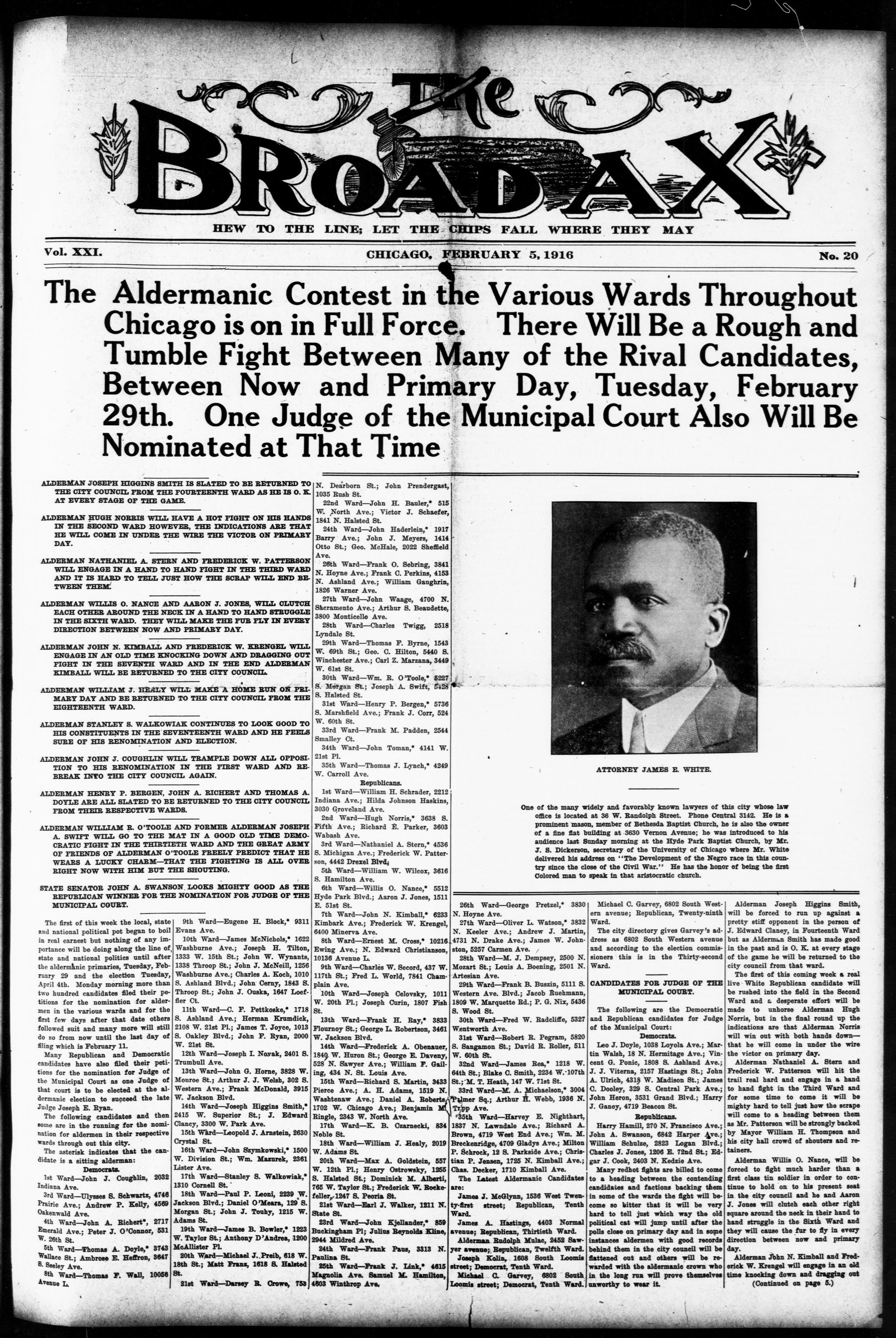
The Aldermanic Contest in the Various Wards Throughout Chicago is on in Full Force. There Will Be a Rough and Tumble Fight Between Many of the Rival Candidates, Between Now and Primary Day, Tuesday, February 29th. One Judge of the Municipal Court Also Will Be Nominated at That Time
ALDERMAN JOSEPH HIGGINS SMITH IS SLATED TO BE RETURNED TO THE CITY COUNCIL FROM THE FOURTEENTH WARD AS HE IS O. K. AT EVERY STAGE OF THE GAME.
ALDERMAN HUGH NORRIS WILL HAVE A HOT FIGHT ON HIS HANDS IN THE SECOND WARD HOWEVER, THE INDICATIONS ARE THAT HE WILL COME IN UNDER THE WIRE THE VICTOR ON PRIMARY DAY.
ALDERMAN NATHANIEL A. STERN AND FREDERICK W. PATTerson WILL ENGAGE IN A HAND TO HAND FIGHT IN THE THIRD WARD AND IT IS HARD TO TELL JUST HOW THE SCRAP WILL END BETWEEN THEM.
ALDERMAN WILLIS O. NANCE AND AARON J. JONES, WILL CLUTCH EACH OTHER AROUND THE NECK IN A HAND TO HAND STRUGGLE IN THE SIXTH WARD. THEY WILL MAKE THE FUB FLY IN EVERY DIRECTION BETWEEN NOW AND PRIMARY DAY.
ALDERMAN JOHN N. KIMBALL AND FREDERICK W. KRENGEL WILL ENGAGE IN AN OLD TIME KNOCKING DOWN AND DRAGGING OUT FIGHT IN THE SEVENTH WARD AND IN THE END ALDERMAN KIMBALL WILL BE RETURNED TO THE CITY COUNCIL.
ALDERMAN WILLIAM J. HEALY WILL MAKE A HOME RUN ON PRIMARY DAY AND BE RETURNED TO THE CITY COUNCIL FROM THE EIGHTEENTH WARD.
ALDERMAN STANLEY S. WALKOWIAK CONTINUES TO LOOK GOOD TO HIS CONSTITUENTS IN THE SEVENTEENTH WARD AND HE FEELS SURE OF HIS RENOMINATION AND ELECTION.
ALDERMAN JOHN J. COUGHLIN WILL TRAMPLE DOWN ALL OPPOSITION TO HIS RENOMINATION IN THE FIRST WARD AND REBREAK INTO THE CITY COUNCIL AGAIN.
ALDERMAN HENRY P. BERGEN, JOHN A. RICHERT AND THOMAS A. DOYLE ARE ALL SLATED TO BE RETURNED TO THE CITY COUNCIL FROM THEIR RESPECTIVE WARDS.
ALDERMAN WILLIAM R. O'TOOLE AND FORMER ALDERMAN JOSEPH A. SWIFT WILL GO TO THE MAT IN A GOOD OLD TIME DEMOCRATIC FIGHT IN THE THIRTIETH WARD AND THE GREAT ARMY OF FRIENDS OF ALDERMAN O'TOOLE FREELY PREDICT THAT HE WEARS A LUCKY CHARM—THAT THE FIGHTING IS ALL OVER RIGHT NOW WITH HIM BUT THE SHOUTING.
STATE SENATOR JOHN A. SWANSON LOOKS MIGHTY GOOD AS THE REPUBLICAN WINNER FOR THE NOMINATION FOR JUDGE OF THE MUNICIPAL COURT.
Vol. XXI.
The Alder Chicago Tumble Between 29th Nominee
ALDERMAN JOSEPH HIGGINS SMYTHE CITY COUNCIL FROM THE AT EVERY STAGE OF THE GATE
ALDERMAN HUGH NOBRIS WILL IN THE SECOND WARD HOWE HE WILL COME IN UNDER THE DAY.
ALDERMAN NATHANIEL A. STEER WILL ENGAGE IN A HAND TO AND IT IS HARD TO TELL JUST TWEEN THEM.
ALDERMAN WILLIS O. NANCE AND EACH OTHER AROUND THE NEAT IN THE SIXTH WARD. THEY WILL DIRECTION BETWEEN NOW AND EIGHTEENTH WARD.
ALDERMAN JOHN N. KIMBALL A ENGAGE IN AN OLD TIME KNIGHT IN THE SEVENTH WARD. KIMBALL WILL BE RETURNED.
ALDERMAN WILLIAM J. HEALY MARY DAY AND BE RETURNED EIGHTEENTH WARD.
ALDERMAN STANLEY S. WALKOW HIS CONSTITUENTS IN THE SURE OF HIS RENOMINATION.
ALDERMAN JOHN J. COUGHLIN WITION TO HIS RENOMINATION BREAK INTO THE CITY COUNTY.
ALDERMAN HENRY P. BERGEN, J. DOYLE ARE ALL SLATED TO BE FROM THEIR RESPECTIVE WARD.
ALDERMAN WILLIAM R. O'TOOLLE A. SWIFT WILL GO TO THE CRATIC FIGHT IN THE THIRTEEN OF FRIENDS OF ALDERMAN O'WEARS A LUCKY CHARM—THE RIGHT NOW WITH HIM BUT T
STATE SENATOR JOHN A. SWANE REPUBLICAN WINNER FOR THE MUNICIPAL COURT.
The first of this week the local, state and national political pot began to boil in real earnest but nothing of any importance will be doing along the line of state and national politics until after the aldermanic primaries, Tuesday, February 29 and the election Tuesday, April 4th. Monday morning more than two hundred candidates filed their petitions for the nomination for aldermen in the various wards and for the first few days after that date others followed suit and many more will still do so from now until the last day of filing which is February 11.
Many Republican and Democratic candidates have also filed their petitions for the nomination for Judge of the Municipal Court as one Judge of that court is to be elected at the aldermanic election to succeed the late Judge Joseph E. Ryan.
The following candidates and then some are in the running for the nomination for aldermen in their respective wards through out this city.
The asterisk indicates that the candidate is a sitting alderman:
Democrats.
1st Ward—John J. Coughlin, 2032
Indiana Ave.
3rd Ward—Ulysses S. Schwartz, 4746
Prairie Ave.; Andrew P. Kelly, 4569
Oakenwald Ave.
4th Ward—John A. Richert*, 2717
Emerald Ave.; Peter J. O'Connor, 531
W. 26th St.
5th Ward—Thomas A. Doyle,* 3743
Wallace St.; Ambrose E. Heffron, 3647
S. Seeley Ave.
8th Ward—Thomas F. Wall, 10056
Avenue L.
9th Ward—Eugene H. Block,* 9311 Evans Ave.
10th Ward—James McNichols,* 1622 Washburne Ave.; Joseph H. Tilton, 1333 W. 15th St.; John W. Wynants, 1338 Wroop St.; John J. McNeill, 1256 Washburne Ave.; Charles A. Koch, 1010 S. Ashland Blvd.; John Cerny, 1843 S. Throop St.; John J. Ouska, 1647 Loefler Ct.
11th Ward—C. F. Pettkoske,* 1718 S. Ashland Ave.; Herman Krumdick, 2108 W. 21st Pl.; James T. Joyce, 1013 S. Oakley Blvd.; John F. Ryan, 2000 W. 21st St.
12th Ward—Joseph I. Novak, 2401 S. Trumbull Ave.
13th Ward—John G. Horne, 3828 W. Monroe St.; Arthur J. J. Welsh, 302 S. Western Ave.; Frank McDonald, 3915 W. Jackson Blvd.
14th Ward—Joseph Higgins Smith,* 2415 W. Superior St.; J. Edward Clancy, 3300 W. Park Ave.
15th Ward—Leopold J. Arnstein, 2630 Crystal St.
16th Ward—John Szymkowski,* 1500 W. Division St.; Wm. Mazurek, 2361 Lister Ave.
17th Ward—Stanley S. Walkowiak,* 1810 Cornell St.
18th Ward—Paul P. Leoni, 2239 W.
Jackson Blvd.; Daniel O'Meara, 129 S.
Morgan St.; John J. Touhy, 1215 W.
Adams St.
19th Ward—James B. Bowler,* 1223
W. Taylor St.; Anthony D'Andres, 1200
McAllister Pl.
20th Ward—Michael J. Preib, 618 W.
18th St.; Matt Franz, 1618 S. Halsted
St.
CHICAGO, FEBRUARY 5, 1916
N. Dearborn St.; John Prendergast,
1035 Rush St.
22nd Ward—John H. Bauler,* 515
W. North Ave.; Victor J. Schaefer,
1841 N. Halsted St.
24th Ward—John Haderlein,* 1917
Barry Ave.; John J. Meyers, 1414
Otto St.; Geo. McHale, 2022 Sheffield
Ave.
26th Ward—Frank O. Sebring, 3841
N. Hoyne Ave.; Frank C. Perkins, 4153
N. Ashland Ave.; William Gaughrin,
1826 Warner Ave.
27th Ward—John Waage, 4700 N.
Sacramento Ave.; Arthur S. Beaudet,
3800 Monticello Ave.
28th Ward—Charles Twigg, 2518
Lyndale St.
29th Ward—Thomas F. Byrne, 1543
W. 69th St.; Geo. C. Hilton, 5440 S.
Winchester Ave.; Carl Z. Marzana, 3449
W. 61st St.
30th Ward—Wm. R. O'Toole,* 5227
S. Morgan St.; Joseph A. Swift, 5428
S. Halsted St.
31st Ward—Henry P. Bergen,* 5736
S. Marshfield Ave.; Frank J. Corr, 524
W. 60th St.
33rd Ward—Frank M. Padden, 2544
Smalley Ct.
34th Ward—John Toman,* 4141 W.
21st Pl.
35th Ward—Thomas J. Lynch,* 4249
W. Carroll Ave.
Republicans.
1st Ward—William H. Schrader, 2212 Indiana Ave.; Hilda Johnson Haskins, 3030 Groveland Ave.
2nd Ward—Hugh Norris,* 3638 S. Fifth Ave.; Richard E. Parker, 3603 Wabash Ave.
3rd Ward—Nathaniel A. Stern,* 4536 S. Michigan Ave.; Frederick W. Patterson, 4442 Drexel Blvd.
5th Ward—William W. Wilcox, 3616 S. Hamilton Ave.
6th Ward—Willis O. Nance,* 5512 Hyde Park Blvd.; Aaron J. Jones, 1511 E. 511 St.
7th Ward—John N. Kimball,* 6233 Kimbark Ave.; Frederick W. Krengel, 6400 Minerva Ave.
8th Ward—Ernest M. Cross,* 10216 Ewing Ave.; N. Edward Christianson, 10136 Avenue L.
9th Ward—Charles W. Secord, 437 W. 117th St.; Fred L. World, 7841 Champlain Ave.
10th Ward—Joseph Celovsky, 1011 W. 20th Pl.; Joseph Curin, 1807 Fish St.
13th Ward—Frank H. Ray,* 3833 Flournoy St.; George L. Robertson, 3461 W. Jackson Blvd.
14th Ward—Frederick A. Obenauer, 1840 W. Huron St.; George E. Daveny, 528 N. Sawyer F.; William F. Gailing, 434 N. St. Louis Ave.
15th Ward—Richard S. Martin, 3433 Pierce Ave.; A. H. Adams, 1519 N. Washtenaw Ave.; Daniel A. Roberts, 1702 W. Chicago Ave.; Benjamin M. Ringle, 2343 W. North Ave.
17th Ward—K. B. Czarnecki, 834 Noble St.
18th Ward—William J. Healy, 2019 W. Adams St.
20th Ward—Max A. Goldstein, 557 W. 12th Pl.; Henry Ostrowsky, 1255 S. Halsted St.; Dominick M. Alberti, 765 W. Taylor St.; Frederick W. Roekefeller, 1247 S. Peoria St.
21st Ward—Earl J. Walker, 1211 N. State St.
23rd Ward—John Kjellander,* 859 Buckingham Pl; Julius Reynolds Kline, 2944 Milred Ave.
25th Ward—Frank J. Link,* 4615 Magnolia Ave. Samuel M. Hamilton, 4803 Winthrop Ave.
[Name]
One of the many widely and favorably known lawyers of this city whose law office is located at 36 W. Randolph Street. Phone Central 3142. He is a prominent mason, member of Bethesda Baptist Church, he is also the owner of a fine flat building at 3630 Vernon Avenue; he was introduced to his audience last Sunday morning at the Hyde Park Baptist Church, by Mr. J. S. Dickerson, secretary of the University of Chicago where Mr. White delivered his address on "The Development of the Negro race in this country since the close of the Civil War." He has the honor of being the first Colored man to speak in that aristocratic church.
26th Ward—George Pretzel,* 3830
N. Hoyne Ave.
27th Ward—Oliver L. Watson,* 3832
N. Keeler Ave.; Andrew J. Martin,
4731 N. Drake Ave.; James W. Johnston,
5257 Carmen Ave.
28th Ward—M. J. Dempsey, 2500 N.
Mozart St.; Louis A. Boening, 2501 N.
Artesian Ave.
29th Ward—Frank B. Buszin, 5111 S.
Western Ave. Blvd.; Jacob Ruehmann,
1809 W. Marquette Rd.; P. G. Nix, 5436
S. Wood St.
30th Ward—Fred W. Radcliffe, 5327
Wentworth Ave.
1st Ward—Robert R. Pegram, 5820
S. Sangamon St.; David R. Roller, 511
W. 60th St.
2nd Ward—James Rea,* 1218 W.
64th St.; Blake C. Smith, 2234 W.107th
St.; M. T. Heath, 147 W. 71st St.
33rd Ward—M. A. Michaelson,* 3004
Palmer Sq.; Arthur H. Webb, 1936 N.
Tripp Ave.
*35th Ward—Harvey E. Nighthart,
1837 N. Lawndale Ave.; Richard A.
Brown, 4719 West End Ave.; Wm. M.
Breckenridge, 4709 Gladys Ave.; Milton
P. Schrock, 12 S. Parkside Ave.; Christian
P. Jensen, 1725 N. Kimball Ave.;
Chas. Decker, 1710 Kimball Ave.
The Latest Aldermanic Candidates are:
James J. McGlynn, 1536 West Twenty-first street; Republican, Tenth Ward.
Michael C. Garvey, 6802 South Western avenue; Republican, Twenty-ninth Ward. The city directory gives Garvey's address as 6802 South Western avenue and according to the election commissioners this is in the Thirty-second Ward.
CANDIDATES FOR JUDGE OF THE MUNICIPAL COURT.
The following are the Democratic and Republican candidates for Judge of the Municipal Court:
Democrats.
Leo J. Doyle, 1038 Loyola Ave.; Martin Walsh, 18 N. Hermitage Ave.; Vincent G. Ponie, 1808 S. Ashland Ave.; J. J. Viterna, 2157 Hastings St.; John A. Ulrich, 4318 W. Madison St.; James C. Dooley, 329 S. Central Park Ave.; John Heron, 3531 Grand Blvd.; Harry J. Ganey, 4719 Beacon St.
Republicans.
Harry Hamill, 270 N. Francisco Ave.; John A. Swanson, 6842 Harper Ave.; William Schulze, 2823 Logan Blvd.; Charles J. Jones, 1206 E. 72nd St.; Edgar J. Cook, 2403 N. Kedzie Ave.
Many redhot fights are billed to come to a heading between the contending candidates and factions backing them in some of the wards the fight will become so bitter that it will be very hard to tell just which way the old political cat will jump until after the polls close on primary day and in some instances aldermen with good records behind them in the city council will be flattened out and others will be rewarded with the aldermanic crown who in the long run will prove themselves unworthy to wear it.
No.20
throughout Rough and Candidates, February so Will Be
this city whose law central 3142. He is a he is also the owner is introduced to his first Church, by Mr. where Mr. White to race in this coun- of being the first
Alderman Joseph Higgins Smith, will be forced to run up against a pretty stiff opponent in the person of J. Edward Claney, in Fourteenth Ward but as Alderman Smith has made good in the past and is O. K. at every stage of the game he will be returned to the city council from that ward.
The first of this coming week a real live White Republican candidate will be rushed into the field in the Second Ward and a desperate effort will be made to unhorse Alderman Hugh Norris, but in the final round up the indications are that Alderman Norris will win out with both hands down—that he will come in under the wire the victor on primary day.
Alderman Nathaniel A. Stern and Frederick W. Patterson will hit the trail real hard and engage in a hand to hand fight in the Third Ward and for some time to come it will be mighty hard to tell just how the scrape will come to a heading between them as Mr. Patterson will be strongly backed by Mayor William H. Thompson and his city hall crowd of shouters and retainers.
Alderman Willis O. Nance, will be forced to fight much harder than a first class tin soldier in order to continue to hold on to his present seat in the city council and he and Aaron J. Jones will clutch each other right square around the neck in their hand to hand struggle in the Sixth Ward and they will cause the fur to fly in every direction between now and primary day.
Alderman John N. Kimball and Frederick W. Krengel will engage in an old time knocking down and dragging out
(Continued on page 5.)
PAGE TWO
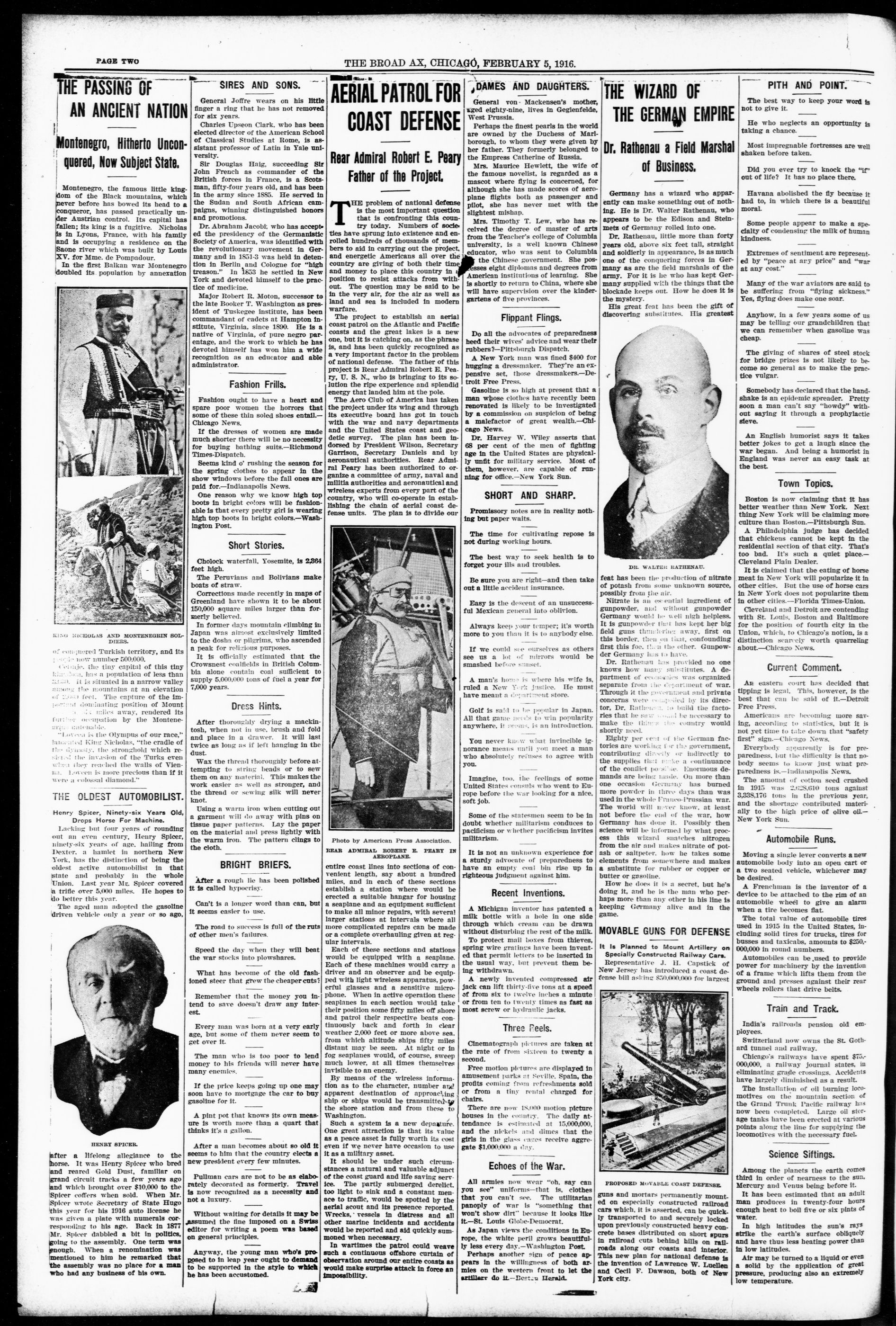
Montenegro, the famous little kingdom of the Black mountains, which never before has bowed its head to a conqueror, has passed practically under Austrian control. Its capital has fallen; its king is a fugitive. Nicholas is in Lyons, France, with his family and is occupying a residence on the Saone river which was built by Louis XV. for Mme. de Pompadour. In the first Balkan war Montenegro doubled its population by aggression
THE MUSLIMS
KING NICHOLAS AND MONTENEGRIN SOLDIERS.
KING NICHOLAS AND MONTENEGRIN SOLDIERS.
of conquered Turkish territory, and its people now number 500,000.
Columbia, the tiny capital of this tiny kingdom, has a population of less than 13,000. It is situated in a narrow valley among the mountains at an elevation of 2,000 feet. The capture of the important dominating position of Mount Olympus 45 miles away, rendered its further occupation by the Montenegrin untenable.
"Loewen is the Olympus of our race," animated King Nicholas, "the cradle of the dynasty, the stronghold which resisted the invasion of the Turks even when they reached the walls of Vienna. Loewen is more precious than if it were a colossal diamond."
THE OLDEST AUTOMOBILIST.
Henry Spicer, Ninety-six Years Old, Drops Horse For Machine.
Lacking but four years of rounding out an even century, Henry Spicer, ninety-six years of age, hailing from Dexter, a hamlet in northern New York, has the distinction of being the oldest active automobilist in that state and probably in the whole Union. Last year Mr. Spicer covered a trifle over 5,000 miles. He hopes to do better this year.
The aged man adopted the gasoline driven vehicle only a year or so ago.
A. B.
HENRY SPICER.
after a lifelong allegiance to the horse. It was Henry Spicer who bred and reared Gold Dust, familiar on grand circuit tracks a few years ago and which brought over $10,000 to the Spicer coffers when sold. When Mr. Spicer wrote Secretary of State Hugo this year for his 1916 auto license he was given a plate with numerals corresponding to his age. Back in 1877 Mr. Spicer dabbled a bit in politics, going to the assembly. One term was enough. When a renomination was mentioned to him he remarked that the assembly was no place for a man who had any business of his own.
SIRES AND SONS.
General Joffre wears on his little finger a ring that he has not removed for six years.
Charles Upseon Clark, who has been elected director of the American School of Classical Studies at Rome, is assistant professor of Latin in Yale university.
Sir Douglas Haig, succeeding Sir John French as commander of the British forces in France, is a Scotman, fifty-four years old, and has been in the army since 1885. He served in the Sudan and South African campaigns, winning distinguished honors and promotions.
Dr. Abraham Jacobi, who has accepted the presidency of the Germanistic Society of America, was identified with the revolutionary movement in Germany and in 1851 was held in detention in Berlin and Cologne for "high treason." In 1853 he settled in New York and devoted himself to the practice of medicine.
Major Robert R. Moton, successor to the late Booker T. Washington as president of Tuskegee institute, has been commandant of cadets at Hampton institute, Virginia, since 1800. He is a native of Virginia, of pure negro parentage, and the work to which he has devoted himself has won him a wide recognition as an educator and able administrator.
Fashion Frills.
Fashion ought to have a heart and spare poor women the horrors that some of these thin soiled shoes entail.—Chicago News.
If the dresses of women are made much shorter there will be no necessity for buying bathing suits.—Richmond Times-Dispatch.
Seems kind o' rushing the season for the spring clothes to appear in the show windows before the fall ones are paid for.—Indianapolis News.
One reason why we know high top boots in bright colors will be fashionable is that every pretty girl is wearing high top boots in bright colors.—Washington Post.
Short Stories.
Cholock waterfall, Yosemite, is 2,864 feet high.
The Peruvians and Bolivians make boats of straw.
Corrections made recently in maps of Greenland have shown it to be about 150,000 square miles larger than formerly believed.
In former days mountain climbing in Japan was almost exclusively limited to the dosha or pilgrims, who ascended a peak for religious purposes.
It is officially estimated that the Crownnest coalfields in British Columbia alone contain coal sufficient to supply 5,000,000 tons of fuel a year for 7,000 years.
Dress Hints.
After thoroughly drying a mackin- tosh, when not in use, brush and fold and place in a drawer. It will last twice as long as if left hanging in the dust. Wax the thread thoroughly before attempting to string beads or to sew them on any material. This makes the work easier as well as stronger, and the thread or sewing silk will never knot. Using a warm iron when cutting out a garment will do away with pins on tissue paper patterns. Lay the paper on the material and press lightly with the warm iron. The pattern clings to the cloth.
BRIGHT BRIEFS.
After a rough lie has been polished
it is called hypocrisy.
Can't is a longer word than can, but
it seems easier to use.
The road to success is full of the ruts
of other men's failures.
Speed the day when they will beat
the war stocks into plowshares.
What has become of the old fash-
loned steer that grew the cheaper cuts?
Remember that the money you intend
to save doesn't draw any interest.
Every man was born at a very early
age, but some of them never seem to
get over it.
The man who is too poor to lend money to his friends will never have many enemies. _____
If the price keeps going up one may soon have to mortgage the car to buy gasoline for it. _____
A pint pot that knows its own measure is worth more than a quart that thinks it's a gallon. _____
After a man becomes about so old it seems to him that the country elects a new president every few minutes. _____
Pullman cars are not to be as elaborately decorated as formerly. Travel is now recognized as a necessity and not a luxury. _____
Without waiting for details it may be assumed the fine imposed on a Swiss editor for writing a poem was based on general principles. _____
Anyway, the young man who's proposed to in leap year ought to demand to be supported in the style to which he has been accustomed.
1.
THE BROAD AX, CHICAGO, FEBRUARY 5, 1916
AERIAL PATROL FOR COAST DEFENSE
Rear Admiral Robert E. Peary Father of the Project.
THE problem of national defense is the most important question that is confronting this coun-
try today. Numbers of societies have sprung into existence and enrolled hundreds of thousands of members to aid in carrying out the project, and energetic Americans all over the country are giving of both their time and money to place this country in a position to resist attacks from without. The question may be said to be in the very air, for the air as well as land and sea is included in modern warfare. The project to establish an aerial coast patrol on the Atlantic and Pacific coasts and the great lakes is a new one, but it is catching on, as the phrase is, and has been quickly recognized as a very important factor in the problem of national defense. The father of this project is Rear Admiral Robert E. Peary, U. S. N., who is bringing to its solution the ripe experience and splendid energy that landed him at the pole.
The Aero Club of America has taken the project under its wing and through its executive board has got in touch with the war and navy departments and the United States coast and geodetic survey. The plan has been indorsed by President Wilson, Secretary Garrison, Secretary Daniels and by aeronautical authorities. Rear Admiral Peary has been authorized to organize a committee of army, naval and militia authorities and aeronautical and wireless experts from every part of the country, who will co-operate in establishing the chain of aerial coast defense units. The plan is to divide our
THE AIRLINES
entire coast lines into sections of convenient length, say about a hundred miles, and in each of these sections establish a station where would be erected a suitable hangar for housing a seaplanet and an equipment sufficient to make all minor repairs, with several larger stations at intervals where all more complicated repairs can be made or a complete overhauling given at regular intervals.
Each of these sections and stations would be equipped with a seaplane. Each of these machines would carry a driver and an observer and be equipped with light wireless apparatus, powerful glasses and a sensitive microphone. When in active operation these seaplanes in each section would take their position some fifty miles off shore and patrol their respective beats continuously back and forth in clear weather 2,000 feet or more above sea, from which altitude ships fifty miles distant may be seen. At night or in fog seaplanes would, of course, sweep much lower, at all times themselves invisible to an enemy.
By means of the wireless information as to the character, number and apparent destination of approaching ship or ships would be transmitted to the shore station and from these to Washington.
Such a system is a new departure. One great attraction is that its value as a peace asset is fully worth its cost even if we never have occasion to use it as a military asset.
It should be under such circumstances a natural and valuable adjunct of the coast guard and life saving service. The partly submerged derelict, too light to sink and a constant menace to traffic, would be spotted by the aerial scout and its presence reported. Wrecks, vessels in distress and all other marine incidents and accidents would be reported and aid quickly summoned when necessary.
In wartime the patrol could weave such a continuous offshore curtain of observation around our entire coasts as would make surprise attack in force an impossibility.
DAMES AND DAUGHTERS.
General von Mackensen's mother, aged eighty-nine, lives in Geglenfelde, West Prussia. Perhaps the finest pearls in the world are owned by the Duchess of Marlborough, to whom they were given by her father. They formerly belonged to the Empress Catherine of Russia. Mrs. Maurice Hewlett, the wife of the famous novelist, is regarded as a mascot where flying is concerned, for although she has made scores of aeroplane flights both as passenger and pilot, she has never met with the slightest mishap. Mrs. Timothy T. Lew, who has received the degree of master of arts from the Teacher's college of Columbia university, is a well known Chinese educator, who was sent to Columbia
of the Chinese government. She possesses eight diplomas and degrees from American institutions of learning. She is shortly to return to China, where she will have supervision over the kindergarten of five provinces.
Flippant Flings.
Do all the advocates of preparedness heed their wives' advice and wear their rubbers?—Pittsburgh Dispatch.
A New York man was fined $400 for hugging a dressmaker. They're an expensive set, those dressmakers.—Detroit Free Press.
Gasoline is so high at present that a man whose clothes have recently been renovated is likely to be investigated by a commission on suspicion of being a malefactor of great wealth.—Chicago News.
Dr. Harvey W. Wiley asserts that 68 per cent of the men of fighting age in the United States are physically unit for military service. Most of them, however, are capable of running for office.—New York Sun.
SHORT AND SHARP.
Promissory notes are in reality nothing but paper waits.
The time for cultivating repose is not during working hours.
The best way to seek health is to forget your ills and troubles.
Be sure you are right—and then take out a little accident insurance.
Easy is the descent of an unsuccessful Mexican general into oblivion.
Always keep your temper; it's worth more to you than it is to anybody else.
If we could see ourselves as others see us a lot of mirrors would be smashed before sunset.
A man's home is where his wife is, ruled a New York justice. He must have meant a department store.
Golf is said to be popular in Japan. All that game needs to win popularity anywhere, it seems, is an introduction.
You never know what invincible ignorance means until you meet a man who absolutely refuses to agree with you.
Imagine, too, the feelings of some United States consuls who went to Europe before the war looking for a nice, soft job.
Some of the statesmen seem to be in doubt whether militarism conduces to pacificism or whether pacificism invites militarism.
It is not an unknown experience for a sturdy advocate of preparedness to have an empty coal bin rise up in righteous judgment against him.
Recent Inventions.
A Michigan inventor has patented a milk bottle with a hole in one side through which cream can be drawn without disturbing the rest of the milk. To protect mail boxes from thieves, spring wire gratings have been invented that permit letters to be inserted in the usual way, but prevent them being withdrawn. A newly invented compressed air jack can lift thirty-five tons at a speed of from six to twelve inches a minute or from ten to twenty times as fast as most screw or hydraulic jacks.
Three Reels.
Cinematograph pictures are taken at the rate of from sixteen to twenty a second.
Free motion pictures are displayed in amusement parks at Seville, Spain, the profits coming from refreshments sold or from a tiny rental charged for chairs.
There are now 18,000 motion picture houses in the country. The daily attendance is estimated at 15,000,000, and the nickels and dimes that the girls in the glass cases receive aggregate $1,000,000 a day.
Echoes of the War.
All armies now wear "oh, say can you see" uniforms—that is, clothes that you can't see. The utilitarian panoply of war is "something that won't show dirt" because it looks like it—St. Louis Globe-Democrat.
As Japan views the conditions in Europe, the white peril grows beautifully less every day.—Washington Post.
Perhaps another sign of peace appears in the willingness of both armies on the western front to let the artillery do it—Boston Herald.
Germany has a wizard who apparently can make something out of nothing. He is Dr. Walter Rathenau, who appears to be the Edison and Steinmetz of Germany rolled into one. Dr. Rathenau, little more than forty years old, above six feet tall, straight and soldierly in appearance, is as much one of the conquering forces in Germany as are the field marshals of the army. For it is he who has kept Germany supplied with the things that the blockade keeps out. How he does it is the mystery. His great feat has been the gift of discovering substitutes. His greatest
PETER H. HARRIS
DR. WALTER RATHENAU.
feat has been the production of nitrate of potash from some unknown source, possibly from the air.
Nitrate is an essential ingredient of gunpowder, and without gunpowder Germany would be well nigh helpless.
It is gunpowder that has kept her big field guns thunderling away, first on this border, then on that, confounding first this foe, then the other. Gunpowder Germany has to have.
Dr. Rathenau has provided no one knows how many substitutes. A department of economies was organized separate from the department of war. Through it the government and private concerns were compelled by its director, Dr. Rathenau, to build the factories that he saw would be necessary to make the things the country would shortly need.
Eighty per cent of the German factories are working for the government, contributing directly or indirectly to the supplies that make a continuance of the conflict possible. E enormous demands are being made. On more than one occasion Germany has burned more powder in three days than was used in the whole Franco-Prussian war. The world will never know, at least not before the end of the war, how Germany has done it. Possibly then science will be informed by what process this wizard snatches nitrogen from the air and makes nitrate of potash or saltpeter, how he takes some elements from somewhere and makes a substitute for rubber or copper or butter or gasoline. How he does it is a secret, but he's doing it, and he is the man who perhaps more than any other in his line is keeping Germany alive and in the game.
MOVABLE GUNS FOR DEFENSE
It is Planned to Mount Artillery on Specially Constructed Railway Cars. Representative J. H. Capstick of New Jersey has introduced a coast defense bill asking $50,000,000 for largest
THE CANNON
PROPOSED MOVABLE COAST DEFENSE guns and mortars permanently mounted on especially constructed railroad cars which, it is asserted, can be quickly transported to and securely locked upon previously constructed heavy concrete bases distributed on short spurs in railroad cuts behind hills on railroads along our coasts and interior. This new plan for national defense is the invention of Lawrence W. Luellen and Cecil F. Dawson, both of New York city.
PITH AND POINT.
The best way to keep your word is not to give it. _____
He who neglects an opportunity is taking a chance. _____
Most impregnable fortresses are well shaken before taken. _____
Did you ever try to knock the "if" out of life? It has no place there. _____
Havana abolished the fly because it had to, in which there is a beautiful moral. _____
Some people appear to make a specialty of condensing the milk of human kindness. _____
Extremes of sentiment are represented by "peace at any price" and "war at any cost." _____
Many of the war aviators are said to be suffering from "flying sickness." Yes, flying does make one soar.
Anyhow, in a few years some of us may be telling our grandchildren that we can remember when gasoline was cheap.
The giving of shares of steel stock for bridge prizes is not likely to become so general as to make the practice vulgar.
Somebody has declared that the handshake is an epidemic spreader. Pretty soon a man can't say "howdy" without saying it through a prophylactic sleeve.
An English humorist says it takes better jokes to get a laugh since the war began. And being a humorist in England was never an easy task at the best.
Town Topics.
Boston is now claiming that it has better weather than New York. Next thing New York will be claiming more culture than Boston.—Pittsburgh Sun. A Philadelphia judge has decided that chickens cannot be kept in the residential section of that city. That's too bad. It's such a quiet place.—Cleveland Plain Dealer. It is claimed that the eating of horse meat in New York will popularize it in other cities. But the use of horse cars in New York does not popularize them in other cities.—Florida Times-Union. Cleveland and Detroit are contending with St. Louis. Boston and Baltimore for the position of fourth city in the Union, which, to Chicago's notion, is a distinction scarcely worth quarreling about.—Chicago News.
Current Comment.
An eastern court has decided that tipping is legal. This, however, is the best that can be said of it.-Detroit Free Press.
Americans are becoming more saving, according to statistics, but it is not yet time to take down that "safety first" sign.-Chicago News.
Everybody apparently is for preparedness, but the difficulty is that nobody seems to know just what preparedness is.-Indianapolis News.
The amount of cotton seed crushed in 1915 was 2,628,610 tons against 3,338,176 tons in the previous year, and the shortage contributed materially to the high price of olive oil.-New York Sun.
Automobile Runs.
Moving a single lever converts a new automobile body into an open cart or a two seated vehicle, whichever may be desired.
A Frenchman is the inventor of a device to be attached to the rim of an automobile wheel to give an alarm when a tire becomes flat.
The total value of automobile tires used in 1915 in the United States, including solid tires for trucks, tires for busses and taxicabs, amounts to $250,000,000 in round numbers.
Automobiles can be used to provide power for machinery by the invention of a frame which lifts them from the ground and presses against their rear wheels rollers that drive belts.
Train and Track.
India's railroads pension old employees.
Switzerland now owns the St. Gothard tunnel and railway.
Chicago's railways have spent $75,000,000, a railway journal states, in eliminating grade crossings. Accidents have largely diminished as a result.
The installation of oil burning locomotives on the mountain section of the Grand Trunk Pacific railway has now been completed. Large oil storage tanks have been erected at various points along the line for supplying the locomotives with the necessary fuel.
Science Siftings.
Among the planets the earth comes third in order of nearness to the sun. Mercury and Venus being before it. It has been estimated that an adult man produces in twenty-four hours enough heat to boil five or six pints of water. In high latitudes the sun's rays strike the earth's surface obliquely and have thus less heating power than in low latitudes. Air may be turned to a liquid or even a solid by the application of great pressure, producing also an extremely low temperature.
How One Englishwoman Describes Her Many War Duties.
```markdown
```
THE COUNTESS OF ESSEX.
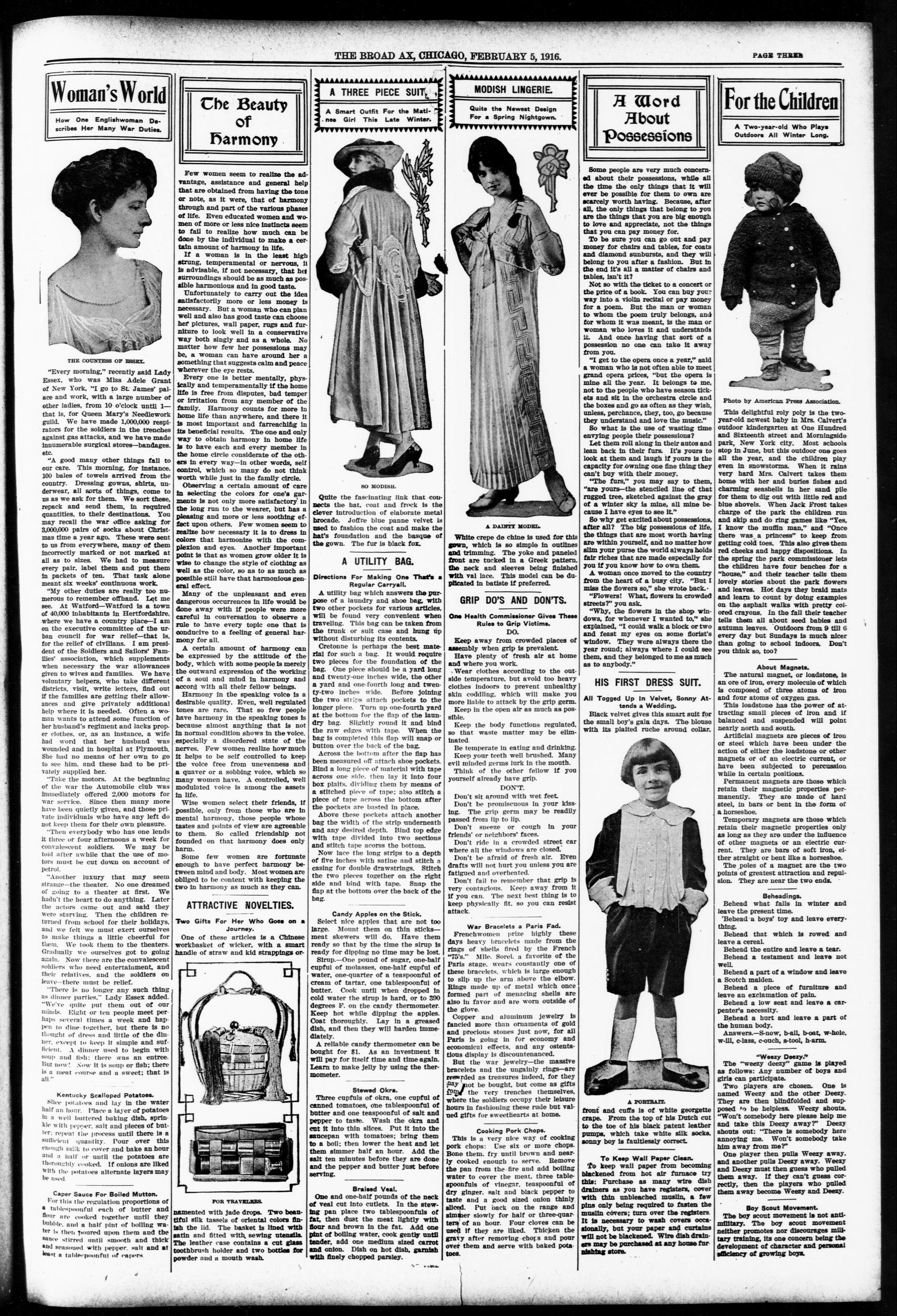
"Every morning," recently said Lady Essex, who was Miss Adele Grant of New York, "I go to St. James' palace and work, with a large number of other ladies, from 10 o'clock until 1 that is, for Queen Mary's Needlework guild. We have made 1,000,000 respirators for the soldiers in the trenches against gas attacks, and we have made innumerable surgical stores—bandages, etc.
"A good many other things fall to our care. This morning, for instance, 100 bales of towels arrived from the country. Dressing gowns, shirts, underwear, all sorts of things, come to us as we ask for them. We sort these, repack and send them, in required quantities, to their destinations. You may recall the war office asking for 3,000,000 pairs of socks about Christmas time a year ago. These were sent to us from everywhere, many of them incorrectly marked or not marked at all as to sizes. We had to measure every pair, label them and put them in packets of ten. That task alone meant six weeks' continuous work.
"My other duties are really too numerous to remember offhand. Let me see. At Watford—Watford is a town of 40,000 inhabitants in Hertfordshire, where we have a country place—I am on the executive committee of the urban council for war relief—that is, for the relief of civilians. I am president of the Soldiers and Sailors' Families' association, which supplements when necessary the war allowances given to wives and families. We have voluntary helpers, who take different districts, visit, write letters, find out if the families are getting their allowances and give privately additional help where it is needed. Often a woman wants to attend some function of her husband's regiment and lacks proper clothes, or, as an instance, a wife had word that her husband was wounded and in hospital at Plymouth. She had no means of her own to go to see him, and these had to be privately supplied her.
"Take the motors. At the beginning of the war the Automobile club was immediately offered 2,000 motors for war service. Since then many more have been quietly given, and those private individuals who have any left do not keep them for their own pleasure. "Then everybody who has one lends it three or four afternoons a week for convalescent soldiers. We may be told after awhile that the use of motors must be cut down on account of petrol.
"Another luxury that may seem strange—the theater. No one dreamed of going to a theater at first. We hadn't the heart to do anything. Later the actors came out and said they were starving. Then the children returned from school for their holidays, and we felt we must exert ourselves to make things a little cheerful for them. We took them to the theaters. Gradually we ourselves got to going again. Now there are the convalescent soldiers who need entertainment, and their relatives, and the soldiers on leave—there must be relief.
"There is no longer any such thing as dinner parties," Lady Essex added. "We've quite put them out of our minds. Eight or ten people meet perhaps several times a week and happen to dine together, but there is no thought of dress and little of the dinner, except to keep it simple and sufficient. A dinner used to begin with soup and fish; there was an entree. But now! Now it is soup or fish; there is a meat course and a sweet; that is all."
Kentucky Scalloped Potatoes.
Nickey Scalloped Potatoes
Slice potatoes and lay in the water half an hour. Place a layer of potatoes in a well buttered baking dish, sprinkle with the pepper, salt and pieces of butter, repeat the process until there is a sufficient quantity. Pour over this enough milk to cover and bake an hour and a half or until the potatoes are thoroughly cooked. If onions are liked with the potatoes alternate layers may be used.
Caper Sauce For Boiled Mutton.
Caper Sauce For Boiled Mutton. For this the regulation proportions of a tablespoonful each of butter and flour are cooked together until they bubble, and a half pint of boiling water is then poured upon them and the sauce stirred until smooth and thick and seasoned with pepper, salt and at least a tablespoonful of capers.
The Beauty of Harmony
Few women seem to realize the advantage, assistance and general help that are obtained from having the tone or note, as it were, that of harmony through and part of the various phases of life. Even educated women and women of more or less nice instincts seem to fail to realize how much can be done by the individual to make a certain amount of harmony in life.
If a woman is in the least high strung, temperamental or nervous, it is advisable, if not necessary, that her surroundings should be as much as possible harmonious and in good taste. Unfortunately to carry out the idea satisfactorily more or less money is necessary. But a woman who can plan well and also has good taste can choose her pictures, wall paper, rugs and furniture to look well in a conservative way both singly and as a whole. No matter how few her possessions may be, a woman can have around her a something that suggests calm and peace wherever the eye rests.
Every one is better mentally, physically and temperamentally if the home life is free from disputes, bad temper or irritation from any member of the family. Harmony counts for more in home life than anywhere, and there it is most important and farreaching in its beneficial results. The one and only way to obtain harmony in home life is to have each and every member in the home circle considerate of the others in every way—in other words, self control, which so many do not think worth while just in the family circle.
Observing a certain amount of care in selecting the colors for one's garments is not only more satisfactory in the long run to the wearer, but has a pleasing and more or less soothing effect upon others. Few women seem to realize how necessary it is to dress in colors that harmonize with the complexion and eyes. Another important point is that as women grow older it is wise to change the style of clothing as well as the color, so as to as much as possible still have that harmonious general effect.
Many of the unpleasant and even dangerous occurrences in life would be done away with if people were more careful in conversation to observe a rule to have every topic one that is conducive to a feeling of general harmony for all.
A certain amount of harmony can be expressed by the attitude of the body, which with some people is merely the outward expression of the working of a soul and mind in harmony and accord with all their fellow beings. Harmony in the speaking voice is a desirable quality. Even, well regulated tones are rare. That so few people have harmony in the speaking tones is because almost anything that is not in normal condition shows in the voice, especially a disordered state of the nerves. Few women realize how much it helps to be self controlled to keep the voice free from unevenness and a quaver or a sobbing voice, which so many women have. A controlled, well modulated voice is among the assets in life.
Wise women select their friends, if possible, only from those who are mental harmony, those people whose tastes and points of view are agreeable to them. So called friendship not founded on that harmony does only harm.
Some few women are fortunate enough to have perfect harmony between mind and body. Most women are obliged to be content with keeping the two in harmony as much as they can.
ATTRACTIVE NOVELTIES.
Two Gifts For Her Who Goes on a Journey.
One of these articles is a Chinese workbasket of wicker, with a smart handle of straw and kid strappings or
```markdown
```
FOR TRAVELERS.
namented with jade drops. Two beautiful silk tassels of oriental colors finish the lid. The basket is lined with satin and fitted with sewing utensils. The leather case contains a cut glass toothbrush holder and two bottles for powder and a mouth wash.
THE BROAD AX, CHICAGO, FEBRUARY 5, 1916.
A THREE PIECE SUIT.
A Smart Outfit For the Mati- nee Girl This Late Winter.
MODISH LINGERIE.
Quite the Newest Design For a Spring Nightgown.
M
Quite the fascinating link that connects the hat, coat and frock is the clever introduction of elaborate metal brocade. Joffre blue panne velvet is used to fashion the coat and make the hat's foundation and the basque of the gown. The fur is black fox.
A UTILITY BAG.
Directions For Making One That's a Regular Carryall.
A utility bag which answers the purpose of a laundry and shoe bag, with two other pockets for various articles, will be found very convenient when traveling. This bag can be taken from the trunk or suit case and hung up without disturbing its contents.
Cretonne is perhaps the best material for such a bag. It would require two pieces for the foundation of the bag. One piece should be a yard long and twenty-one inches wide, the other a yard and one-fourth long and twenty-two inches wide. Before joining the two strips attach pockets to the longer piece. Turn up one-fourth yard at the bottom for the flap of the laundry bag. Slightly round it and bind the raw edges with tape. When the bag is completed this flap will snap or button over the back of the bag.
Across the bottom after the flap has been measured off attach shoe pockets. Bind a long piece of material with tape across one side, then lay it into four box plaits, dividing them by means of a stitched piece of tape; also stitch a piece of tape across the bottom after the pockets are basted in place. Above these pockets attach another bag the width of the strip underneath and any desired depth. Bind top edge with tape divided into two sections and stitch tape acorss the bottom. Now lace the long strips to a depth of five inches with satine and stitch a casing for double drawstrings. Stitch the two pieces together on the right side and bind with tape. Snap the flap at the bottom over the back of the bag.
Candy Apples on the Stick.
Select nice apples that are not too large. Mount them on thin sticks—meat skewers will do. Have them ready so that by the time the sirup is ready for dipping no time may be lost. Stirup.—One pound of sugar, one-half cupful of molasses, one-half cupful of water, one-quarter of a teaspoonful of cream of tartar, one tablespoonful of butter. Cook until when dropped in cold water the sirup is hard, or to 300 degrees F. on the candy thermometer. Keep hot while dipping the apples. Coat thoroughly. Lay in a greased dish, and then they will harden immediately.
A reliable candy thermometer can be bought for $1. As an investment it will pay for itself time and time again. Learn to make jelly by using the thermometer.
Stewed Okra
Three cupfuls of okra, one cupful of canned tomatoes, one tablespoonful of butter and one teaspoonful of salt and pepper to taste. Wash the okra and cut it into thin slices. Put it into the saucepan with tomatoes; bring them to a boll; then lower the heat and let them simmer half an hour. Add the salt ten minutes before they are done and the pepper and butter just before serving.
Braised Veal.
One and one-half pounds of the neck of veal cut into cutlets. In the stewing pan place two tablespoonfuls of fat, then dust the meat lightly with flour and brown in the fat. Add one pint of boiling water, cook gently until tender, add one medium sized carrot and onion. Dish on hot dish, garnish with finely chopped parsley.
Quite the Newest Design For a Spring Nightgown.
```markdown
```
A DAINTY MODEL.
White crepe de chine is used for this gown, which is so simple in outlines and trimming. The yoke and paneled front are tucked in a Greek pattern, the neck and sleeves being finished with val lace. This model can be duplicated in batiste if preferred.
GRIP DO'S AND DON'TS.
One Health Commissioner Gives These Rules to Grip Victims.
DO.
Keep away from crowded places of assembly when grip is prevalent.
Have plenty of fresh air at home and where you work.
Wear clothes according to the outside temperature, but avoid too heavy clothes indoors to prevent unhealthy skin coddling, which will make you more liable to attack by the grip germ.
Keep in the open air as much as possible.
Keep the body functions regulated, so that waste matter may be eliminated.
Be temperate in eating and drinking.
Keep your teeth well brushed. Many evil minded germs lurk in the mouth.
Think of the other fellow if you yourself already have grip.
DON'T.
Don't sit around with wet feet.
Don't be promiscuous in your kissing. The grip germ may be readily passed from lip to lip. Don't sneeze or cough in your friends' or neighbors' faces. Don't ride in a crowded street car where all the windows are closed. Don't be afraid of fresh air. Even drafts will not hurt you unless you are fatigued and overheated. Don't fail to remember that grip is very contagious. Keep away from it if you can. The next best thing is to keep physically fit, so you can resist attack.
War Bracelets a Paris Ead.
Frenchwomen prize highly these days heavy bracelets made from the rings of shells fired by the French "75's." Mile. Sorel, a favorite of the Paris stage, wears constantly one of these bracelets, which is large enough to slip up the arm above the elbow. Rings made up of metal which once formed part of menacing shells are also in favor and are worn outside of the glove. Copper and aluminum jewelry is fancied more than ornaments of gold and precious stones just now, for all Paris is going in for economy and economical effects, and any ostentations display is discountenanced.
But the war jewelry—the massive bracelets and the ungainly rings—are recorded as treasures indeed, for they may not be bought, but come as gifts from the very trenches themselves, where the soldiers occupy their leisure hours in fashioning these rude but valued gifts for sweethearts at home.
Cooking Pork Chops.
This is a very nice way of cooking pork chops: Use six or more chops. Bone them, fry until brown and nearly cooked enough to serve. Remove the pan from the fire and add boiling water to cover the meat, three tablespoonfuls of vinegar, teaspoonful of dry ginger, salt and black pepper to taste and a good sized onion thinly sliced. Put back on the range and simmer slowly for half or three-quarters of an hour. Four cloves can be used if they are liked. Thicken the grate after removing chops and pour over them and serve with baked potatoes.
Some people are very much concerned about their possessions, while all the time the only things that it will ever be possible for them to own are scarcely worth having. Because, after all, the only things that belong to you are the things that you are big enough to love and appreciate, not the things that you can pay money for. To be sure you can go out and pay money for chairs and tables, for coats and diamond sunbursts, and they will belong to you after a fashion. But in the end it's all a matter of chairs and tables, isn't it?
Not so with the ticket to a concert or the price of a book. You can buy your way into a violin recital or pay money for a poem. But the man or woman to whom the poem truly belongs, and for whom it was meant, is the man or woman who loves it and understands it. And once having that sort of a possession no one can take it away from you.
"I get to the opera once a year," said a woman who is not often able to meet grand opera prices, "but the opera is mine all the year. It belongs to me, not to the people who have season tickets and sit in the orchestra circle and the boxes and go as often as they wish, unless, perchance, they, too, go because they understand and love the music."
So what is the use of wasting time envying people their possessions?
Let them roll along in their autos and lean back in their furs. It's yours to look at them and laugh if yours is the capacity for owning one fine thing they can't buy with their money.
"The furs," you may say to them, "are yours—the stenciled line of that rugged tree, sketched against the gray of a winter sky is mine, all mine because I have eyes to see it."
So why get excited about possessions, after all? The big possessions of life, the things that are most worth having are within yourself, and no matter how slim your purse the world always holds fair riches that are made especially for you if you know how to own them.
A woman once moved to the country from the heart of a busy city. "But I miss the flowers so," she wrote back.
"Flowers! What, flowers in crowded streets?" you ask.
"Why, the flowers in the shop windows, for whenever I wanted to," she explained, "I could walk a block or two and feast my eyes on some florist's window. They were always there the year round; always where I could see them, and they belonged to me as much as to anybody."
HIS FIRST DRESS SUIT.
All Togged Up in Velvet, Sonny Attends a Wedding.
Black velvet gives this smart suit for the small boy's gala days. The blouse with its plaited ruche around collar.
```markdown
```
A PORTRAIT
front and cuffs is of white georgette
cape. From the top of his Dutch cut
to the toe of his black patent leather
pumps, which take white silk socks,
sonny boy is faultless correct.
To Keep Wall Paper Clean.
To keep wall paper from becoming blackened from hot air furnace try this: Purchase as many wire dish drainers as you have registers, cover with thin unbleached muslin, a few pins only being required to fasten the muslin covers; turn over the registers. It is necessary to wash covers occasionally, but your paper and curtains will not be blackened. Wire dish drainers may be purchased at any house furnishing store.
PAGE THREB
A Two-year-old Who Plays Outdoors All Winter Long.
```markdown
```
Photo by American Press Association
This delightful roly poly is the two-year-old newest baby in Mrs. Calvert's outdoor kindergarten at One Hundred and Sixteenth street and Morningside park, New York city. Most schools stop in June, but this outdoor one goes all the year, and the children play even in snowstorms. When it rains very hard Mrs. Calvert takes them home with her and buries fishes and charming seashells in her sand pile for them to dig out with little red and blue shovels. When Jack Frost takes charge of the park the children run and skip and do ring games like "Yes, I know the muffin man," and "Once there was a princess" to keep from getting cold toes. This also gives them red cheeks and happy dispositions. In the spring the park commissioner lets the children have four benches for a "house," and their teacher tells them lovely stories about the park flowers and leaves. Hot days they braid mats and learn to count by doing examples on the asphalt walks with pretty colored crayons. In the fall their teacher tells them all about seed babies and autumn leaves. Outdoors from 9 till 6 every day but Sundays is much nicer than going to school indoors. Don't you think so, too?
About Magnets.
The natural magnet, or loadstone, is an ore of iron, every molecule of which is composed of three atoms of iron and four atoms of oxygen gas. This loadstone has the power of attracting small pieces of iron and if balanced and suspended will point nearly north and south. Artificial magnets are pieces of iron or steel which have been under the action of either the loadstone or other magnets or of an electric current, or have been subjected to percussion while in certain positions. Permanent magnets are those which retain their magnetic properties permanently. They are made of hard steel, in bars or bent in the form of a horseshoe.
Temporary magnets are those which retain their magnetic properties only as long as they are under the influence of other magnets or an electric current. They are bars of soft iron, either straight or bent like a horseshoe. The poles of a magnet are the two points of greatest attraction and repulsion. They are near the two ends.
Bebeadings
Bebead what falls in winter and leave the present time.
'Bebead a boys' toy and leave everything.
Bebead that which is rowed and leave a cereal.
Bebead the entire and leave a tear.
Bebead a testament and leave not well.
Bebead a part of a window and leave a Scotch malden.
Bebead a piece of furniture and leave an exclamation of pain.
Bebead a low seat and leave a carpenter's necessity.
Bebead a hurt and leave a part of the human body.
Answers.-S-now, b-all, b-oat, w-hole, w-ill, c-lass, c-ouch, s-tool, h-arm.
"Weezy Deezy."
The "weezy deezy" game is played as follows: Any number of boys and girls can participate.
Two players are chosen. One is named Weezy and the other Deezy. They are then blindfolded and supposed to be helpless. Weezy shouts, "Won't somebody here please help me and take this Deezy away?" Deezy shouts out: "There is somebody here annoying me. Won't somebody take him away from me?"
One player then pulls Weezy away, and another pulls Deezy away. Weezy and Deezy must then guess who pulled them away. If they can't guess correctly, then the players who pulled them away become Weezy and Deezy.
Boy Scout Movement.
The boy scout movement is not anti-military. The boy scout movement neither promotes nor discourages military training, its one concern being the development of character and personal efficiency of growing boys.
Agents and Correspondents Wanted to Handle THE BROAD AX. Liberal Commissions to Live Agents. Address, Julius F.Taylor, 6532 St. Lawrence Av., Chicago
Agents a BRO Addr
THE BROAD AX
PUBLISHED WEEKLY.
Will promulgate and at all times uphold the true principles of Democracy, but Gritfulness, Protestants, Priests, Inclides, Single Taxes, Republicans, or anyone else can have their say, as long as their language is proper and responsibility is fixed.
The Broad Ax is a newspaper where platform is broad enough for all, ever clarifying the editorial right to speak its own mind.
Local communications will receive attention. Write only on one side of the paper.
Subscriptions must be paid in advance. One Year. $8.00.
Six Months. 1.00.
Advertising rates made known on application.
Address all communications to
THE BROAD AX
6533 ST. LAWRENCE AVE., CHICAGO, ILL.
PHONE WENTWORTH 2597.
JULIEUS F. TAYLOR, Editor and Publisher
Entered as Second-Class Matter Aug. 18, 1908, at the Post Office at Chicago, Illinois, under Act of March 8, 1878.
NOTES ON RACIAL PROGRESS.
Compiled by the National Negro Business League.
With the appointment of Mr. Charles Redmon, Knoxville, Tennessee, now has four Colored policemen.
Thomas Stokeley is night foreman in the Coose and Caylor Ice Plant of Indianapolis, Indiana. Mr. Stokeley has achieved this promotion by reason of long years of faithful work.
The National Fraternal Congress will meet in Cincinnati, February 7th and 8th. This Congress represents a movement to bring about co-operation among the leading fraternal organizations of the race.
The newly organized Local Negro Business League in Waycross, Georgia, has been instrumental in promoting the organization of the Laborers' Penny Savings and Loan Company of that city. Mr. Carlton W. Gaines is president of the League.
---
"For My People" is race pride play staged in the office of the St. Louis (Mo.) Argus, which is being presented by the Smith-Bright Players at the Booker Washington Theatre in that city. The play is designed to show the importance of patronizing Colored business enterprises.
Mr. Samuel Charles of Pensacola, Florida, has opened an up-to-date shoe store in his city. Mr. Charles is a member of the very active Local Negro Business League in Pensacola and on the day of his opening, the League sent a large bouquet of flowers for his show-window.
The business men of Atlanta, Georgia, conducted a Christmas Tree for their employees in the Auditorium of the Odd Fellows Building. A feature of the entertainment was the awarding of three prizes for the best essays on the subject of building up business and conserving trade.
The Local Negro Business League of San Antonio, Texas, which was re-organized some months ago with Mr. G. W. Bouldin, editor of the Inquirer, as Secretary, has developed great strength in membership and influence. They expect to have all their business enterprises working in strict co-operation within a few months.
The South Carolina Race Conference will be held in Columbia from February 6th to 9th. Dr. John E. White who delivered an address in Boston at the last meeting of the National Negro Business League is scheduled to speak during this Conference. Rev. Richard Carroll, the noted Evangelist, is the organizer of the Conference.
The Florida State Board of Health is sending a Health Train throughout the State of Florida to encourage better health conditions. The Afro-American Insurance Company of Jacksonville is co-operating with them by sending special letter to all of their agents requesting them to take the forward part in arousing the interest of the Colored people in their communities to the importance of the Health Train.
---
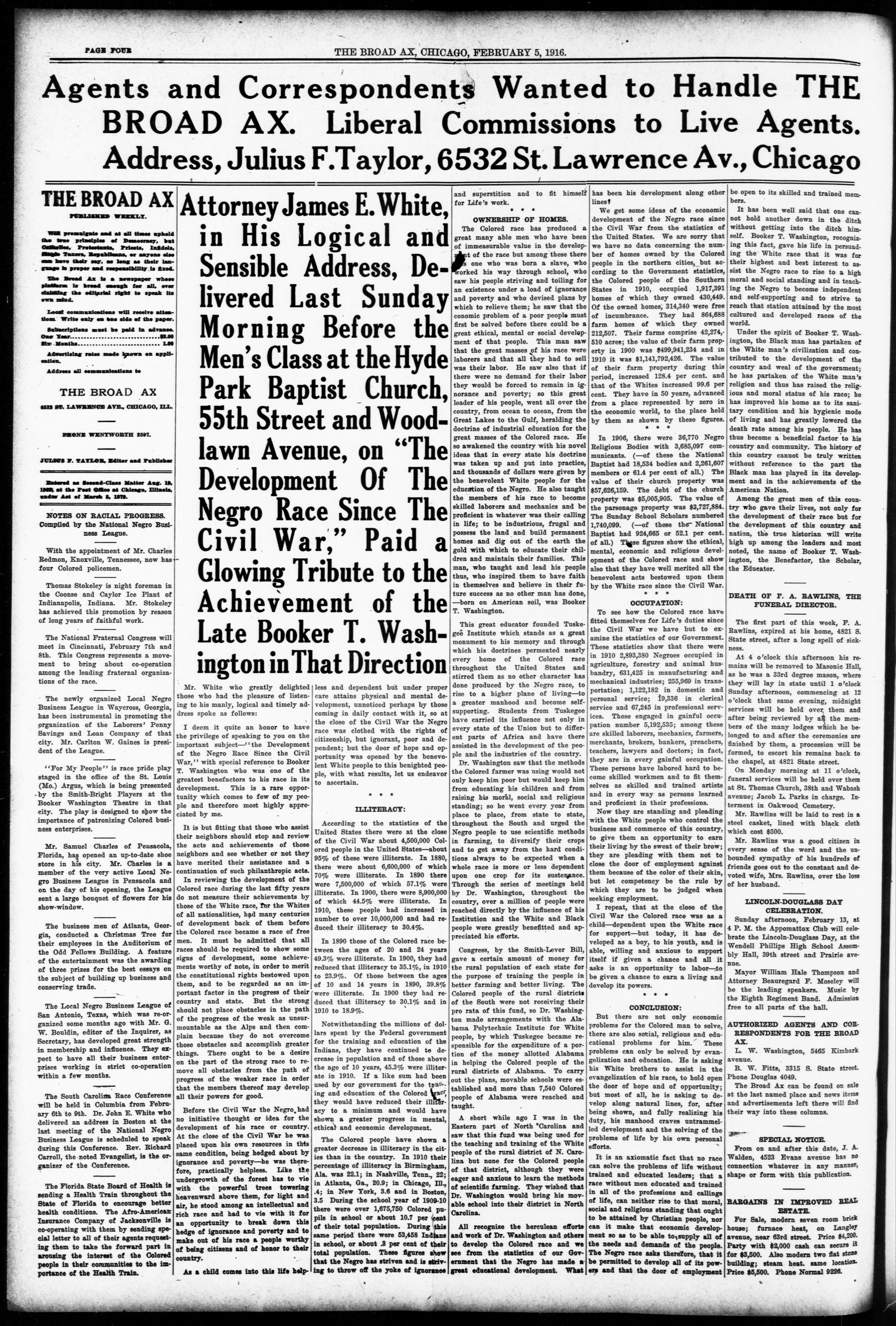
Attorney James E. White, in His Logical and Sensible Address, Delivered Last Sunday Morning Before the Men's Class at the Hyde Park Baptist Church, 55th Street and Woodlawn Avenue, on "The Development Of The Negro Race Since The Civil War," Paid a Glowing Tribute to the Achievement of the Late Booker T. Washington in That Direction
Mr. White who greatly delighted those who had the pleasure of listening to his manly, logical and timely address spoke as follows:
I deem it quite an honor to have the privilege of speaking to you on the important subject—'the Development of the Negro Race Since the Civil War,' with special reference to Booker T. Washington who was one of the greatest benefactors to his race in its development. This is a rare opportunity which comes to few of my people and therefore most highly appreciated by me.
It is but fitting that those who assist their neighbors should stop and review the acts and achievements of those neighbors and see whether or not they have merited their assistance and a continuation of such philanthropic acts
In reviewing the development of the Colored race during the last fifty years do not measure their achievements by those of the White race, for the Whites of all nationalities, had many centuries of development back of them before the Colored race became a race of free men. It must be admitted that all races should be required to show some signs of development, some achievements worthy of note, in order to merit the constitutional rights bestowed upon them, and to be regarded as an important factor in the progress of their country and state. But the strong should not place obstacles in the path of the progress of the weak as unsurmountable as the Alps and then complain because they do not overcome those obstacles and accomplish greater things. There ought to be a desire on the part of the strong race to remove all obstacles from the path of progress of the weaker race in order that the members thereof may develop all their powers for good.
Before the Civil War the Negro, had no initiative thought or idea for the development of his race or country. At the close of the Civil War he was placed upon his own resources in this same condition, being hedged about by ignorance and poverty—he was therefore, practically helpless. Like the undergrowth of the forest has to vie with the powerful trees towering heavenward above them, for light and air, he stood among an intellectual and rich race and had to vie with it for an opportunity to break down this hedge of ignorance and poverty and to make out of his race a people worthy of being citizens and of honor to their country.
As a child comes into this life help-
THE BROAD AX, CHICAGO, FEBRUARY 5, 1916
less and dependent but under proper care attains physical and mental development, unnoticed perhaps by those coming in daily contact with it, so at the close of the Civil War the Negro race was clothed with the rights of citizenship, but ignorant, poor and dependent; but the door of hope and opportunity was opened by the benevolent White people to this benighted people, with what results, let us endeavor to ascertain.
ILLITERACY:
According to the statistics of the United States there were at the close of the Civil War about 4,500,000 Colored people in the United States—about 95% of these were illiterate. In 1880, there were about 6,600,000 of which 70% were illiterate. In 1890 there were 7,500,000 of which 57.1% were illiterate. In 1900, there were 8,900,000 of which 44.5% were illiterate. In 1910, these people had increased in number to over 10,000,000 and had reduced their illiteracy to 30.4%.
In 1890 those of the Colored race between the ages of 20 and 24 years $49.3\%$ were illiterate. In 1900, they had reduced that illiteracy to $35.1\%$, in 1910 to $23.9\%$. Of those between the ages of 10 and 14 years in 1890, $39.8\%$ were illiterate. In 1900 they had reduced that illiteracy to $30.1\%$ and in 1910 to $18.9\%$.
Notwithstanding the millions of dollars spent by the Federal government for the training and education of the Indians, they have continued to decrease in population and of those above the age of 10 years, 45.3% were illiterate in 1910. If a like sum had been used by our government for the training and education of the Colored race they would have reduced their illiteracy to a minimum and would have shown a greater progress in mental, ethical and economic development.
The Colored people have shown a greater decrease in illiteracy in the cities than in the country. In 1910 their percentage of illiteracy in Birmingham, Ala. was 22.1; in Nashville, Tenn., 22; in Atlanta, Ga., 20.9; in Chicago, Ill., 4; in New York, 3.6 and in Boston, 3.5 During the school year of 1909-10 there were over 1,675,750 Colored pupils in school or about 10.7 per cent of their total population. During this same period there were $3,458 Indians in school, or about .3 per cent of their total population. These figures show that the Negro has striven and is striving to throw off the yoke of ignorance
and superstition and to fit himself for Life's work.
OWNERSHIP OF HOMES
The Colored race has produced a great many able men who have been of immeasurable value in the development of the race but among these there is one who was born a slave, who worked his way through school, who saw his people striving and toiling for an existence under a load of ignorance and poverty and who devised plans by which to relieve them; he saw that the economic problem of a poor people must first be solved before there could be a great ethical, mental or social development of that people. This man saw that the great masses of his race were laborers and that all they had to sell was their labor. He saw also that if there were no demand for their labor they would be forced to remain in ignorance and poverty; so this great leader of his people, went all over the country, from ocean to ocean, from the Great Lakes to the Gulf, heralding the doctrine of industrial education for the great masses of the Colored race. He so awakened the country with his novel ideas that in every state his doctrine was taken up and put into practice, and thousands of dollars were given by the benevolent White people for the education of the Negro. He also taught the members of his race to become skilled laborers and mechanics and be proficient in whatever was their calling in life; to be industrious, frugal and possess the land and build permanent homes and dig out of the earth the gold with which to educate their children and maintain their families. This man, who taught and lead his people thus, who inspired them to have faith in themselves and believe in their future success as no other man has done,—born on American soil, was Booker T. Washington.
This great educator founded Tuskegee Institute which stands as a great monument to his memory and through which his doctrines permeated nearly every home of the Colored race throughout the United States and stirred them as no other character has done produced by the Negro race, to rise to a higher plane of living—to a greater manhood and become self-supporting. Students from Tuskegee have carried its influence not only in every state of the Union but to different parts of Africa and have there assisted in the development of the people and the industries of the country.
Dr. Washington saw that the methods the Colored farmer was using would not only keep him poor but would keep him from educating his children and from raising his moral, social and religious standing; so he went every year from place to place, from state to state, throughout the South and urged the Negro people to use scientific methods in farming, to diversify their crops and to get away from the hard conditions always to be expected when a whole race is more or less dependent upon one crop for its sustenance. Through the series of meetings held by Dr. Washington, throughout the country, over a million of people were reached directly by the influence of his Institution and the White and Black people were greatly benefitted and appreciated his efforts.
Congress, by the Smith-Lever Bill, gave a certain amount of money for the rural population of each state for the purpose of training the people in better farming and better living. The Colored people of the rural districts of the South were not receiving their pro rata of this fund, so Dr. Washington made arrangements with the Alabama Polytechnic Institute for White people, by which Tuskegee became responsible for the expenditure of a portion of the money allotted Alabama in helping the Colored people of the rural districts of Alabama. To carry out the plans, movable schools were established and more than 7,540 Colored people of Alabama were reached and taught.
A short while ago I was in the Eastern part of North Carolina and saw that this fund was being used for the teaching and training of the White people of the rural district of N. Carolina but none for the Colored people of that district, although they were eager and anxious to learn the methods of scientific farming. They wished that Dr. Washington would bring his movable school into their district in North Carolina.
All recognize the herculean efforts and work of Dr. Washington and others to develop the Colored race and we see from the statistics of our Government that the Negro has made a great educational development. What
has been his development along other lines!
We get some ideas of the economic development of the Negro race since the Civil War from the statistics of the United States. We are sorry that we have no data concerning the number of homes owned by the Colored people in the northern cities, but according to the Government statistics, the Colored people of the Southern States in 1910, occupied 1,917,391 homes of which they owned 430,449. Of the owned homes, 314,340 were free of incumbrance. They had 864,688 farm homes of which they owned 212,507. Their farms comprise 42,274,510 acres; the value of their farm property in 1900 was $499,941,234 and in 1910 it was $1,141,792,426. The value of their farm property during this period, increased 128.4 per cent. and that of the Whites increased 99.6 per cent. They have in 50 years, advanced from a place represented by zero in the economic world, to the place held by them as shown by these figures.
In 1906, there were 36,770 Negro Religious Bodies with 3,685,097 communicants. (—of these the National Baptist had 18,534 bodies and 2,261,607 members or 61.4 per cent of all.) The value of their church property was $57,626,159. The debt of the church property was $5,005,905. The value of the parsonage property was $3,727,884. The Sunday School Scholars numbered 1,740,099. (—of these the National Baptist had 924,665 or 52.1 per cent of all.) These figures show the ethical, mental, economic and religious development of the Colored race and show also that they have well merited all the benevolent acts bestowed upon them by the White race since the Civil War.
OCCUPATION:
To see how the Colored race have fitted themselves for Life's duties since the Civil War we have but to examine the statistics of our Government. These statistics show that there were in 1910 2,893,380 Negroes occupied in agriculture, forestry and animal husbandry, 631,425 in manufacturing and mechanical industries; 255,969 in transportation; 1,122,182 in domestic and personal service; 19,336 in clerical service and 67,245 in professional services. Those engaged in gainful occupation number 5,192,535; among these are skilled laborers, mechanics, farmers, merchants, brokers, bankers, preachers, teachers, lawyers and doctors; in fact, they are in every gainful occupation. These persons have labored hard to become skilled workmen and to fit themselves as skilled and trained artists and in every way as persons learned and proficient in their professions.
Now they are standing and pleading with the White people who control the business and commerce of this country, to give them an opportunity to earn their living by the sweat of their brow; they are pleading with them not to close the door of employment against them because of the color of their skin, but let competency be the rule by which they are to be judged when seeking employment.
I repeat, that at the close of the Civil War the Colored race was as a child—dependent upon the White race for support—but today, it has developed as a boy, to his youth, and is able, willing and anxious to support itself if given a chance and all it asks is an opportunity to labor—to be given a chance to earn a living and develop its powers.
CONCLUSION:
But there are not only economic problems for the Colored man to solve, there are also sotial, religious and educational problems for him. These problems can only be solved by evangelization and education. He is asking his White brothers to assist in the evangelization of his race, to hold open the door of hope and of opportunity; but most of all, he is asking to develop along natural lines, for, after being shown, and fully realizing his duty, his manhood craves untrammeled development and the solving of the problems of life by his own personal efforts.
It is an axiomatic fact that no race can solve the problems of life without trained and educated leaders; that a race without men educated and trained in all of the professions and callings of life, can neither rise to that moral, social and religious standing that ought to be attained by Christian people, nor can it make that economic development so as to be able to supply all of the needs and demands of the people. The Negro race asks therefore, that it be permitted to develop all of its powers and that the door of employment
be open to its skilled and trained members. It has been well said that one cannot hold another down in the ditch without getting into the ditch himself. Booker T. Washington, recognizing this fact, gave his life in persuading the White race that it was for their highest and best interest to assist the Negro race to rise to a high moral and social standing and in teaching the Negro to become independent and self-supporting and to strive to reach that station attained by the most cultured and developed races of the world.
Under the spirit of Booker T. Washington, the Black man has partaken of the White man's civilization and contributed to the development of the country and weal of the government; he has partaken of the White man's religion and thus has raised the religious and moral status of his race; he has improved his home as to its sanitary condition and his hygienic mode of living and has greatly lowered the death rate among his people. He has thus become a beneficial factor to his country and community. The history of this country cannot be truly written without reference to the part the Black man has played in its development and in the achievements of the American Nation.
Among the great men of this country who gave their lives, not only for the development of their race but for the development of this country and nation, the true historian will write high up among the leaders and most noted, the name of Booker T. Washington, the Benefactor, the Scholar, the Educator.
DEATH OF F. A. RAWLINS, THE FUNERAL DIRECTOR.
The first part of this week, F. A. Rawlins, expired at his home, 4821 S. State street, after a long spell of sickness.
At 4 o'clock this afternoon his remains will be removed to Masonic Hall, as he was a 33rd degree mason, where they will lay in state until 1 o'clock Sunday afternoon, commencing at 12 o'clock that same evening, midnight services will be held over them and after being reviewed by all the members of the many lodges which he belonged to and after the ceremonies are finished by them, a procession will be formed, to escort his remains back to the chapel, at 4821 State street.
On Monday morning at 11 o'clock, funeral services will be held over them at St. Thomas Church, 38th and Wabash avenue; Jacob L. Parks in charge. Interment in Oakwood Cemetery.
Mr. Rawlins will be laid to rest in a steel casket, lined with black cloth which cost $500.
Mr. Rawlins was a good citizen in every sense of the word and the unbounded sympathy of his hundreds of friends goes out to the constant and devoted wife, Mrs. Rawlins, over the loss of her husband.
LINCOLN-DOUGLASS DAY
CELERBATION
Sunday afternoon, February 13, at 4 P. M. the Appomattox Club will celebrate the Lincoln-Douglass Day, at the Wendell Phillips High School Assembly Hall, 39th street and Prairie avenue.
Mayor William Hale Thompson and Attorney Beauregard F. Moseley will be the leading speakers. Music by the Eighth Regiment Band. Admission free to all parts of the hall.
AUTHORIZED AGENTS AND CORRESPONDENTS FOR THE BROAD AX.
L. W. Washington, 5465 Kimbark avenue.
B. W. Fitts, 3315 S. State street. Phone Douglas 4049.
The Broad Ax can be found on sale at the last named place and news items and advertisements left there will find their way into these columns.
SPECIAL NOTICE
From on and after this date, J. A. Walden, 4523 Evans avenue has no connection whatever in any manner, shape or form with this publication.
BARGAINS IN IMPROVED REAL
BSTATE.
For Sale, modern seven room brick house; furnace heat, on Langley avenue, near 63rd street. Price $4,200. Party with $2,000 cash can secure it for $3,500. Also modern two flat stone building; steam heat. same location. Price $5,500. Phone Normal 9226.
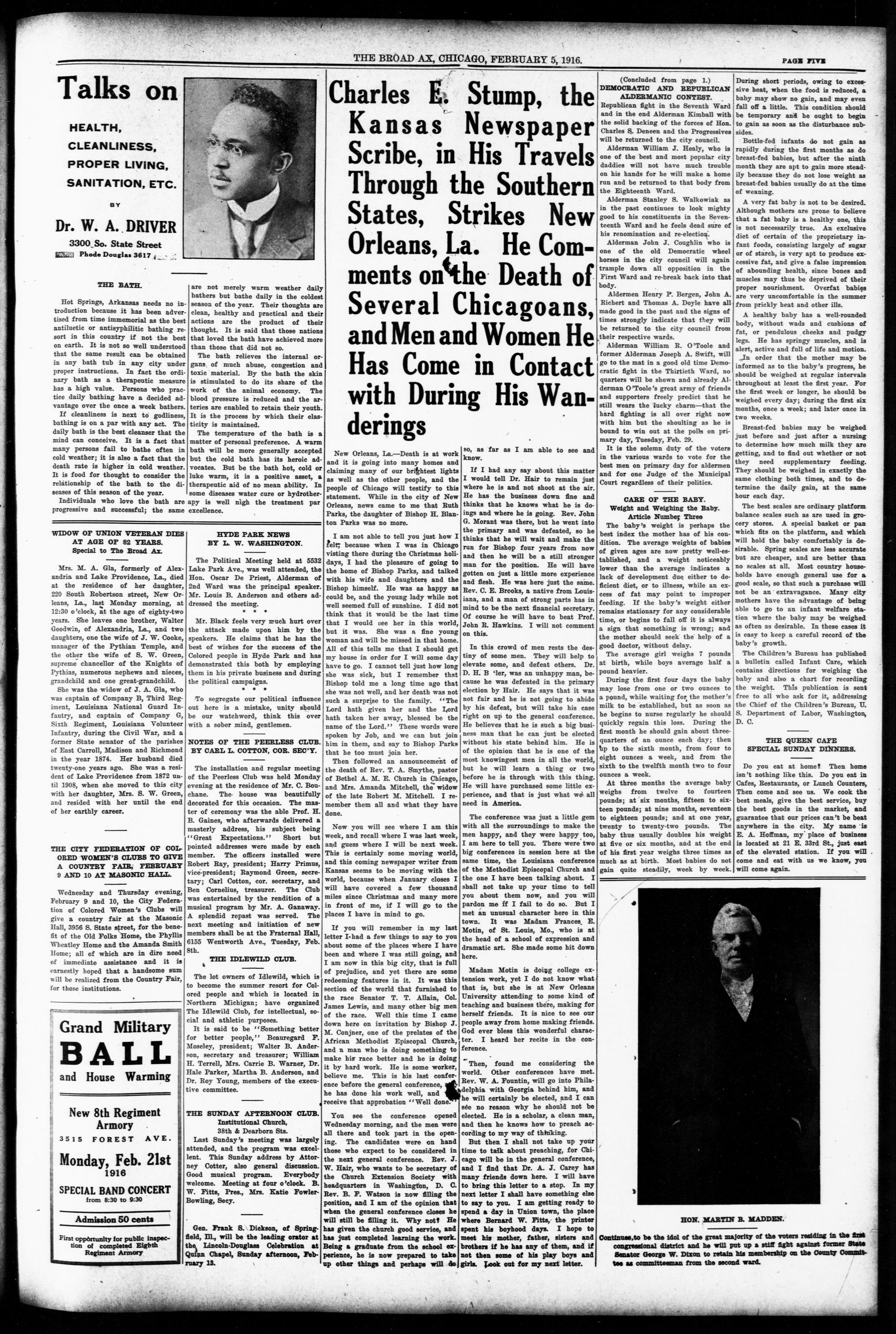
Talks on
HEALTH,
CLEANLINESS,
PROPER LIVING,
SANITATION, ETC.
BY
Dr. W. A. DRIVER
3300 So. State Street
Phode Douglas 3617
THE BATH.
Hot Springs, Arkansas needs no introduction because it has been advertised from time immemorial as the best antilactic or antisphilitic bathing resort in this country if not the best on earth. It is not so well understood that the same result can be obtained in any bath tub in any city under proper instructions. In fact the ordinary bath as a therapeutic measure has a high value. Persons who practice daily bathing have a decided advantage over the once a week bathers.
If cleanliness is next to godliness, bathing is on a par with any act. The daily bath is the best cleanser that the mind can conceive. It is a fact that many persons fail to bathe often in cold weather; it is also a fact that the death rate is higher in cold weather. It is food for thought to consider the relationship of the bath to the diseases of this season of the year. Individuals who love the bath are progressive and successful: the same
WIDOW OF UNION VETERAN DIES
AT AGE OF 82 YEARS.
Special to The Broad Ax.
Mrs. M. A. Gla, formerly of Alexandria and Lake Providence, La., died at the residence of her daughter, 220 South Robertson street, New Orleans, La., last Monday morning, at 12:30 o'clock, at the age of eight-two years. She leaves one brother, Walter Goodwin, of Alexandria, La., and two daughters, one the wife of J. W. Cooke, manager of the Pythian Temple, and the other the wife of S. W. Green, supreme chancellor of the Knights of Pythias, numerous nephews and nieces, grandchild and one great-grandchild.
She was the widow of J. A. Gla, who was captain of Company B, Third Regiment, Louisiana National Guard Infantry, and captain of Company G, Sixth Regiment, Louisiana Volunteer Infantry, during the Civil War, and a former State senator of the parishes of East Carroll, Madison and Richmond in the year 1874. Her husband died twenty-one years ago. She was a resident of Lake Providence from 1872 until 1908, when she moved to this city with her daughter, Mrs. S. W. Green, and resided with her until the end of her earthly career.
THE CITY FEDERATION OF COL
ORED WOMEN'S CLUBS TO GIVE
A COUNTRY FAIR; FEBRUARY
9 AND 10 AT MASONIC HALL.
Wednesday and Thursday evening, February 9 and 10, the City Federation of Colored Women's Clubs will give a country fair at the Masonic Hall, 3956 S. State street, for the benefit of the Old Folks Home, the Phyllis Wheatley Home and the Amanda Smith Home; all of which are in dire need of immediate assistance and it is earnestly hoped that a handsome sum will be realized from the Country Fair, for those institutions.
Grand Military
BALL
and House Warming
New 8th Regiment
Armory
3515 FOREST AVE.
Monday, Feb. 21st
1916
SPECIAL BAND CONCERT
from 8:30 to 9:30
Admission 50 cents
First opportunity for public inspection of completed Eighth Regiment Armory
---
A. E. H.
are not merely warm weather daily bathers but bathe daily in the coldest season of the year. Their thoughts are clean, healthy and practical and their actions are the product of their thought. It is said that those nations that loved the bath have achieved more than those that did not so.
The bath relieves the internal organs of much abuse, congestion and toxic material. By the bath the skin is stimulated to do its share of the work of the animal economy. The blood pressure is reduced and the arteries are enabled to retain their youth. It is the process by which their elasticity is maintained.
The temperature of the bath is a matter of personal preference. A warm bath will be more generally accepted but the cold bath has its heroic advocates. But be the bath hot, cold or lukewarm, it is a positive asset, a therapeutic aid of no mean ability. In some diseases water cure or hydrotherapy is well nigh the treatment par excellence.
HYDE PARK NEWS BY L. W. WASHINGTON.
The Political Meeting held at 5532 Lake Park Ave., was well attended, the Hon. Oscar De Priest, Alderman of 2nd Ward was the principal speaker. Mr. Louis B. Anderson and others addressed the meeting.
* * *
Mr. Black feels very much hurt over the attack made upon him by the speakers. He claims that he has the best of wishes for the success of the Colored people in Hyde Park and has demonstrated this both by employing them in his private business and during the political campaigns.
* * *
To segregate our political influence out here is a mistake, unity should be our watchword, think this over with a sober mind, gentlemen.
NOTES OF THE PERELESS CLUB
BY CARL L. COTTON, COR. SECY.
The installation and regular meeting of the Peerless Club was held Monday evening at the residence of Mr. C. Bouchane. The house was beautifully decorated for this occasion. The master of ceremony was the able Prof. H. B. Gaines, who afterwards delivered a masterly address, his subject being "Great Expectations." Short but pointed addresses were made by each member. The officers installed were Robert Ray, president; Harry Primus, vice-president; Raymond Green, secretary; Carl Cotton, cor. secretary, and Ben Cornelius, treasurer. The Club was entertained by the rendition of a musical program by Mr. A. Ganaway. A splendid repast was served. The next meeting and initiation of new members shall be at the Fraternal Hall, 6155 Wentworth Ave., Tuesday, Feb. 8th.
THE IDLEWILD CLUB.
The lot owners of Idlewild, which is to become the summer resort for Colored people and which is located in Northern Michigan; have organized The Idlewild Club, for intellectual, social and athletic purposes. It is said to be "Something better for better people," Beauregard F. Moseley, president; Walter B. Anderson, secretary and treasurer; William H. Terrell, Mrs. Carrie B. Warner, Dr. Hale Parker, Martha B. Anderson, and Dr. Roy Young, members of the executive committee.
THE SUNDAY AFTERNOON CLUB Institutional Church, 38th & Dearborn Sts.
Last Sunday's meeting was largely attended, and the program was excellent. This Sunday address by Attorney Cotter, also general discussion Good musical program. Everybody welcome. Meeting at four o'clock. B W. Fitts, Pres., Mrs. Katie Fowler Bowling, Secy.
Gen. Frank S. Dickson, of Springfield, Ill., will be the leading orator at the Lincoln-Douglass Celebration at Quinn Chapel, Sunday afternoon, February 13.
THE BROAD AX, CHICAGO, FEBRUARY 5. 1916
Charles E. Stump, the Kansas Newspaper Scribe, in His Travels Through the Southern States, Strikes New Orleans, La. He Comments on the Death of Several Chicagoans, and Men and Women He Has Come in Contact with During His Wanderings
New Orleans, La.—Death is at work and it is going into many homes and claiming many of our brightest lights as well as the other people, and the people of Chicago will testify to this statement. While in the city of New Orleans, news came to me that Ruth Parks, the daughter of Bishop H. Blanton Parks was no more.
I am not able to tell you just how I felt; because when I was in Chicago visiting there during the Christmas holidays, I had the pleasure of going to the home of Bishop Parks, and talked with his wife and daughters and the Bishop himself. He was as happy as could be, and the young lady while not well seemed full of sunshine. I did not think that it would be the last time that I would see her in this world, but it was. She was a fine young woman and will be missed in that home. All of this tells me that I should get my house in order for I will some day have to go. I cannot tell just how long she was sick, but I remember that Bishop told me a long time ago that she was not well, and her death was not such a surprise to the family. "The Lord hath given her and the Lord hath taken her away, blessed be the name of the Lord." These words were spoken by Job, and we can but join him in them, and say to Bishop Parks that he too must join her.
Then followed an announcement of the death of Rev. T. A. Smythe, pastor of Bethel A. M. E. Church in Chicago, and Mrs. Amanda Mitchell, the widow of the late Robert M. Mitchell. I remember them all and what they have done.
Now you will see where I am this week, and recall where I was last week, and guess where I will be next week. This is certainly some moving world, and this coming newspaper writer from Kansas seems to be moving with the world, because when January closes I will have covered a few thousand miles since Christmas and many more in front of me, if I will go to the places I have in mind to go.
If you will remember in my last letter I-had a few things to say to you about some of the places where I have been and where I was still going, and I am now in this big city, that is full of prejudice, and yet there are some redeeming features in it. It was this section of the world that furnished to the race Senator T. T. Allain, Col. James Lewis, and many other big men of the race. Well this time I came down here on invitation by Bishop J. M. Conjner, one of the prelates of the African Methodist Episcopal Church, and a man who is doing something to make his race better and he is doing it by hard work. He is some worker, believe me. This is his last conference before the general conference, he has done his work well, and receive that approbation "Well done."
You see the conference opened Wednesday morning, and the men were all there and took part in the opening. The candidates were on hand those who expect to be considered in the next general conference. Rev. J. W. Hair, who wants to be secretary of the Church Extension Society with headquarters in Washington, D. C. Rev. B. F. Watson is now filling the position, and I am of the opinion that when the general conference closes he will still be filling it. Why not? He has given the church good service, and has just completed learning the work. Being a graduate from the school experience, he is now prepared to take up other things and perhaps will do
so, as far as I am able to see and know.
If I had any say about this matter I would tell Dr. Hair to remain just where he is and not shoot at the air. He has the business down fine and thinks that he knows what he is doings and where he is going. Rev. John G. Morant was there, but he went into the primary and was defeated, so he thinks that he will wait and make the run for Bishop four years from now and then he will be a still stronger man for the position. He will have gotten on just a little more experience and flesh. He was here just the same. Rev. C. E. Brooks, a native from Louisiana, and a man of strong parts has in mind to be the next financial secretary. Of course he will have to beat Prof. John R. Hawkins. I will not comment on this.
In this crowd of men rests the destiny of some men. They will help to elevate some, and defeat others. Dr. D. H. B 'ler, was an unhappy man, because he was defeated in the primary election by Hair. He says that it was not fair and he is not going to abide by his defeat, but will take his case right on up to the general conference. He believes that he is such a big business man that he can just be elected without his state behind him. He is of the opinion that he is one of the most knowingest men in all the world, but he will learn a thing or two before he is through with this thing. He will have purchased some little experience, and that is just what we all need in America.
The conference was just a little gem with all the surroundings to make the men happy, and they were happy too, I am here to tell you. There were two big conferences in session here at the same time, the Louisiana conference of the Methodist Episcopal Church and the one I have been talking about. I shall not take up your time to tell you about them now, and you will pardon me if I fail to do so. But I met an unusual character here in this town. It was Madam Frances E. Motin, of St. Louis, Mo., who is at the head of a school of expression and dramatic art. She made some hit down here.
Madam Motin is doing college extension work, yet I do not know what that is, but she is at New Orleans University attending to some kind of teaching and business there, making for herself friends. It is nice to see our people away from home making friends. God ever bless this wonderful character. I heard her recite in the conference.
Then, found me considering the world. Other conferences have met. Rev. W. A. Fountain, will go into Philadelphia with Georgia behind him, and he will certainly be elected, and I can see no reason why he should not be elected. He is a scholar, a clean man, and then he knows how to preach according to my way of thinking.
But then I shall not take up your time to talk about preaching, for Chicago will be in the general conference, and I find that Dr. A. J. Carey has many friends down here. I will have to bring this letter to a stop. In my next letter I shall have something else to say to you. I am getting ready to spend a day in Union town, the place where Bernard W. Fitts, the printer spent his boyhood days. I hope to meet his mother, father, sisters and brothers if he has any of them, and if not then some of his play boys and girls. Look out for my next letter.
(Concluded from page 1.) DEMOCRATIC AND REPUBLICAN ALDERMANIC CONTEST. Republican fight in the Seventh Ward and in the end Alderman Kimball with the solid backing of the forces of Hon. Charles S. Deneen and the Progressives will be returned to the city council. Alderman William J. Healy, who is one of the best and most popular city daddies will not have much trouble on his hands for he will make a home run and be returned to that body from the Eighteenth Ward. Alderman Stanley S. Walkowiak as in the past continues to look mighty good to his constituents in the Seventeenth Ward and he feels dead sure of his nomination and re-election.
Alderman John J. Coughlin who is one of the old Democratic wheel horses in the city council will again trample down all opposition in the First Ward and re-break back into that body. Aldermen Henry P. Bergen, John A. Richert and Thomas A. Doyle have all made good in the past and the signs of times strongly indicate that they will be returned to the city council from their respective wards.
Alderman William R. O'Toole and former Alderman Joseph A. Swift, will go to the mat in a good old time Democratic fight in the Thirtieth Ward, no quarters will be shown and already Alderman O'Toole's great army of friends and supporters freely predict that he still wears the lucky charm—that the hard fighting is all over right now with him but the shoulting as he is bound to win out at the polls on primary day, Tuesday, Feb. 29.
It is the solemn duty of the voters in the various wards to vote for the best men on primary day for aldermen and for one Judge of the Municipal Court regardless of their politics.
CARE OF THE BABY.
Weight and Weighing the Baby.
Article Number Three
The baby's weight is perhaps the best index the mother has of his condition. The average weights of babies of given ages are now pretty well-established, and a weight noticeably lower than the average indicates a lack of development due either to deficient diet, or to illness, while an excess of fat may point to improper feeding. If the baby's weight either remains stationary for any considerable time, or begins to fall off it is always a sign that something is wrong; and the mother should seek the help of a good doctor, without delay. The average girl weighs 7 pounds at birth, while boys average half a pound heavier.
During the first four days the baby may lose from one or two ounces to a pound, while waiting for the mother's milk to be established, but as soon as he begins to nurse regularly he should quickly regain this loss. During the first month he should gain about three-quarters of an ounce each day; then up to the sixth month, from four to eight ounces a week, and from the sixth to the twelfth month two to four ounces a week.
At three months the average baby weighs from twelve to fourteen pounds; at six months, fifteen to sixteen pounds; at nine months, seventeen to eighteen pounds; and at one year, twenty to twenty-two pounds. The baby thus usually doubles his weight at five or six months, and at the end of his first year weighs three times as much as at birth. Most babies do not gain quite steadily, week by week.
1.
[Name]
HON. MARTIN B. MADDEN.
Continues,to be the idol of the great man congressional district and he will be Senator George W. Dixon to retain tee as committeeman from the second
Continues, to be the idol of the great majority of the voters residing in the first congressional district and he will put up a stiff fight against former State Senator George W. Dixon to retain his membership on the County Committee as committeeman from the second ward.
During short periods, owing to excessive heat, when the food is reduced, a baby may show no gain, and may even fall off a little. This condition should be temporary and he ought to begin to gain as soon as the disturbance subsides.
Bottle-fed infants do not gain as rapidly during the first months as do breast-fed babies, but after the ninth month they are apt to gain more steadily because they do not lose weight as breast-fed babies usually do at the time of weaning.
A very fat baby is not to be desired. Although mothers are prone to believe that a fat baby is a healthy one, this is not necessarily true. An exclusive diet of certain of the proprietary infant foods, consisting largely of sugar or of starch, is very apt to produce excessive fat, and give a false impression of abounding health, since bones and muscles may thus be deprived of their proper nourishment. Overfat babies are very uncomfortable in the summer from prickly heat and other ills.
A healthy baby has a well-rounded body, without wads and cushions of fat, or pendulous cheeks and pudgy legs. He has springy muscles, and is alert, active and full of life and motion.
In order that the mother may be informed as to the baby's progress, he should be weighed at regular intervals throughout at least the first year. For the first week or longer, he should be weighed every day; during the first six months, once a week; and later once in two weeks. Breast-fed babies may be weighed just before and just after a nursing to determine how much milk they are getting, and to find out whether or not they need supplementary feeding. They should be weighed in exactly the same clothing both times, and to determine the daily gain, at the same hour each day.
The best scales are ordinary platform balance scales such as are used in grocery stores. A special basket or pan which fits on the platform, and which will hold the baby comfortably is desirable. Spring scales are less accurate but are cheaper, and are better than no scales at all. Most country households have enough general use for a good scale, so that such a purchase will not be an extravagance. Many city mothers have the advantage of being able to go to an infant welfare station where the baby may be weighed as often as desirable. In these cases it is easy to keep a careful record of the baby's growth.
The Children's Bureau has published a bulletin called Infant Care, which contains directions for weighing the baby and also a chart for recording the weight. This publication is sent free to all who ask for it, addressing the Chief of the Children's Bureau, U. S. Department of Labor, Washington, D. C.
THE QUEEN CAFE SPECIAL SUNDAY DINNERS.
Do you eat at home? Then home isn't nothing like this. Do you eat in Cafes, Restaurants, or Lunch Counters, Then come and see us. We cook the best meals, give the best service, buy the best goods in the market, and guarantee that our prices can't be beat anywhere in the city. My name is E. A. Hoffman, my place of business is located at 21 E. 33rd St., just east of the elevated station. If you will come and eat with us we know, you will come again.
```markdown
```
majority of the voters residing in the first out up a stiff fight against former State his membership on the County Commit- and ward.
PAGE FIVE
PAGE SIX
A. South American Hobo
Santiago, capital of Chile, is the home of the roto Chileno, or broken Chilean, most picturesque and unique of hoboes. The name is a byword in South America, and as far as that continent is concerned he is a unique type. We find rich people everywhere and poor people everywhere, but in no other South American country but Chile do we find this good natured, serviceable, deceitful, ragged, drunken, criminal species of tramp. He earns a livelihood by begging, doing odd jobs and thieving. The last is his mainstay. In his hands stealing has become a fine art. The Chileans have a saying that he will steal your socks without touching your boots. A long, jointed wire with a hook at the end is his favorite tool. If a window on the street is left unguarded he will with this simple contrivance successfully remove from the interior everything but the heavy furniture—New York Independent.
Don't For Roots
Arthur Guterman in a recent interview gave a list of negative commands for would be poets. "Don't think of yourself as a poet and dress the part," he says. "Don't frequent exclusively the company of writers. Don't complain of lack of appreciation. (In the long run no really good published work can escape appreciation) Don't speak of poetic license or believe that there is any such thing. Don't use 'eer' for 'ever', 'oer' for 'over', 'when as' or 'what time' for 'when' or any of the 'poetical' commonplaces of the past. Don't say 'did go' for 'went'. even if you need an extra syllable. Don't—don't write hymns to the great god Pan. He is dead; let him rest in peace! Don't write what everybody else is writing."—Kansas City Star.
Our Navy a Century Ago.
One hundred years ago the naval force of the United States on the Atlantic coast consisted of thirty-three vessels, twenty-seven of which were in commission. Among them were a dozen great ships, first class frigates and sloops of war, some of them carrying as many as seventy-four guns each. They were all sailing vessels. The era of the steam warship, however, was close at hand. With the aid of an appropriation from congress there was now nearing completion a "floating steam battery," designed by Robert Fulton. This ship, which was launched a few months later, was the first steam war vessel ever built and was destined to revolutionize the methods of naval warfare throughout the world—Exchange.
India's Hearded Gold
For many years London has been steadily drained of her gold by India. In ten years India has absorbed from circulation 150,000,000 gold sovereigns and hoarded them away. The coole has learned that silver rupees are a poor investment, especially if he melts them into anklets or a nose ring for his wife, as over 30 per cent of the silver is lost in the melting pot, while the gold sovereign preserves its value whether he keeps it as a coin or melts it. When a coole collects 15 rupees which he finds to be temporarily surplus he buys a sovereign with it. He has come to understand the wisdom of hoarding away only the gold coin, which he knows he can always realize on at its original value.
African Fashion Notes.
The prettiest dress of the Mpongwe woman is a cloth drawn up under the arms, a scarf on the shoulders and a handkerchief folded over the colled hair in a high stiff fold set well up on the head, rather like a child's idea of a crown. There is a great fancy for purples and lavenders set off with shades of rose and red and a sudden keen note of gilt. With black there will be a touch of most delicious bright green. A cloth and a scarf worn by a woman of beautiful gesture—and a Gabonnea is always that—have a certain mutable charm; the movements of the body, the wind that blows from the sea—these renew and display the folds of the garment so that the eye is intrigued.-Atlantic.
But None For Him
"That's strange."
"Expecting any?"
"No, but Israel Pubbleton was reading the other day that there was enough letters sent through the postoffice last year to give every man, woman and child twenty-three each, an' I thought I'd come in for my share."—Pittsburgh Chronicle Telegraph.
An Overnight.
"What do you think of his nerve?" exclaimed the old man, who was notoriously tricky in business. "He called me a barefaced robber!" "Oh, well," replied the man who knew him, "probably in his excitement he didn't notice your mustache."—New York Globe.
Another Reason:
"They call her the human graphophone."
"Just because she buzzes a bit?"
"It's on account of the airs she puts on."—Louisville Courier-Journal
Great Knowledge
"Does he know anything about a car?"
"He certainly does. He knows how to sell it after it gets worn out."—Puck.
Without kind offices and useful services, wherever the power and opportunity occur, love would be a hollow pretence—Coleridge.
Could Est as Well as Write.
Dr. Johnson was a great tea drinker. It is stated that he would drink thirty or forty cups of tea during an evening! Yet he lived to a fair age and apparently suffered no very ill effects from his great thirst for tea. He was one of the most notable of feeders and ate his food in what we should now think rather a piggish fashion, making great grunts and groans of satisfaction or enjoyment the while and going the round of the menu very thoroughly. Charles Reade, the famous novelist, is reported to have been one of the strangest feeders on record. A contemporary, writing of his meals at the Garrick club, says: "He took a cauliflower, flanked by a jug of cream, as his first course, and a great salad to follow, washed down by curious drinks of the shandygayf order. He would drink coffee associated with sweets, black pudding and toasted cheese, to the amazement of any onlooker."
Survival of the Fittest Among Birds.
The struggle of life among the birds and other wild creatures is so severe that the feeble and malformed, or the handicapped in any way, quickly drop out. Probably none of them ever dies from old age. They are cut off in their prime. A weeding out process goes on from the time they leave the nest. A full measure of life, the perfection of every quill and feather and unerring instinct carry them along. They are always in the enemy's country; they are always on the firing line; eternal vigilance and ceaseless activity are the price of life with them. The natural length of life of our smaller birds is calculated to be eight or ten years, but probably not one in a thousand reaches that age. Not half a dozen times in my life have I found the body of a dead bird that did not show some marks of violence.—John Burroughs in Harper's Hagazine.
Remedy For Anger.
The greatest remedy for anger is delay. Beg anger to grant you this at the first, not in order that it may pardon the offense, but that it may form a right judgment about it. If it delays it will come to an end. Do not attempt to quell it all at once, for its first impulses are fierce. By plucking away its parts we shall remove the whole. We are made angry by some things which we learn at second hand and by some things which we ourselves hear or see. Now, we ought to be slow to believe what is told us. * * * If you were about to give sentence in court about ever so small a sum of money you would take nothing as proved without a witness, and a witness would count for nothing except on his oath. You would allow both sides to be heard; you would allow them time.—Seneca.
The Expanding Stone
In the rock of St. Gowan's chapel, in Wales, was a natural cavity upon which the name of the "expanding stone" was bestowed by popular tradition, because the strange fancy prevailed that this stone automatically adapted itself to the size of any one who entered the cavity.
The legend ran, as quoted by Mr. George F. Kunz in "The Magic of Jewels and Charms," that once, during the pagan persecutions, when a fugitive Christian, hotly pursued, reached this rock it opened up of its own accord so that he could slip into it and then closed about him so as to hide him effectually from his enemies. This expanding stone was believed to manifest its magic power by bringing to pass the wish expressed by any one who entered it, provided he did not change his wish while he turned around within it.
Henpecked Sparrows.
Female sparrows are especially tyrannical toward their partners, especially at nest building time, when they frequently attack their husbands fiercely on account of their laziness. At such times the female voice can always be detected, both louder and shrill than that of her mate, as she pecks and tousles him until he beats an ignominious retreat. Hen blackbirds and thrushes are often very overbearing and even spiteful toward their mates when their houses are in course of construction.
Winning Both Ways.
The Zulu young lady, when suturers are not forthcoming, takes the matter in hand herself. She leaves home, takes a discreet friend of her own sex and presents herself at the home of her favored swain. If he regards her with satisfaction his parents receive her as his future bride. Should he, however, be unwilling to accept her he makes her a handsome present instead.
The Old Greek Culrasa.
The Greeks had a cuirass made of linen or woolen fibers which was impenetrable to the sharpest darts or spears. That, by the way, is one of the discoveries that have not been rediscovered, for we do not know the secret of its manufacture.
The Worm Turns.
"How much are your four dollar shoes?" asked the smart one.
"Two dollars a foot," replied the salesman wearily—Judge
Bored.
"I say, your ears have never been pierced, Alleen?"
"No, but they're being 'bored'"—Lehigh Burr.
Two Extremes.
There are no chagrins so venomous as the chagrins of the idle, no pangs so sickening as the satieties of pleasure.—Ruskin.
THE BROAD AX. CHICAGO. FEBRUARY 5. 1916.
Academic Dress.
Academic dress is a sort of scholar's badge consisting of gowns, hoods and caps, copied or adapted from styles long prevalent in England, the combination of articles being so arranged as to indicate the degree or academic status of the wearer. The code was formulated by an intercollegiate college commission chartered by the University of New York and has been adopted in many American colleges. There are three distinct types of gowns and hoops—the bachelor's, the master's and the doctor's. The bachelor's gown is most commonly worn and has long pointed sleeves; the master's gown has long closed sleeves with a slit through which the forearm protrudes; the doctor's gown has velvet bars on round open sleeves and velvet facings down the front. Caps worn with such gowns are the regulation mortar boards with black silk tassels.—Philadelphia Press.
Chinese Architecture.
The monuments of China are among the most conspicuous in the world. Interpreted broadly they range from a coin or an oracle bone to the Great wall. China has more than 2,000 important specimens of the pagoda, an original form of tower architecture unsurpassed for beauty by any similar kind of structure. The Porcelain tower at Nanking deserved to be ranged with the wonders of the world, and for reasons which made it the superior of the so called seven wonders. Chinese sculpture has never been surpassed, and there is no evidence in mundane art to show that it ever will be. There is a single fragment in the Metropolitan museum in New York—a stone head of the Tang period—whose grandeur of plastic mastery since its appearance has conferred distinction upon the sculpture of the world. Journal of the American Asiatic Association.
His College Handicap.
"I remember when it was really a disadvantage to have had a technical mining education." said John Hays Hammond. "I remember going to one of the large mining magnates of the day in California, who had got his information and experience by hard knocks, and asking for a job. He said: 'There is one serious objection to you. You have been at Freiburg, and you know you have to unlearn a good deal when you get into active practice.' I am sorry to say there is a great deal of truth in that too. 'Well,' I said. 'I will tell you in confidence, but do not repeat this to my poor father, who has made every sacrifice to send me abroad for a mining education—I did not learn a confounded thing at Freiburg. Then he said, I will take you.' And that was the first job I ever got."
The Inns of Chancery.
Most of the old inns of chancery are no more. Clement's inn, where Falstaff and Shallow "heard the chimes at midnight;" New inn, of which Sir Thomas More was a member; Lyon's inn, where Cobe once taught the students; Furnival's inn, where Charles Dickens lived; Thavies inn, which was one of the earliest of all the legal settlements in London; Barnard's inn, where Lord Chief Justice Holt was among the "principals"—all these historic places have "in the change and chance of time" disappeared from view. Staple inn remains in its ancient state by the good will of the insurance company that purchased it a number of years ago.—London Law Journal.
Good Reason:
In his book about his distinguished father the son of Louis Agassiz tells a story that relates to the life of the great scientist in America. A few years before his death he came into his house in Cambridge delighted with an occurrence he had just seen in Boston. A carriage pushing through the crowd had knocked down a woman. Her escort proceeded to pummel the driver. "But why," asked the listener, "didn't the owner come to his driver's assistance? " "Oh," exclaimed Agassiz, "I was holding him."
Wasted Apology.
"One day," says a London journalist,
"the late Walter Emanuel called on me
and chatted delightfully. After half
an hour the humorist said he must go
and apologized for having wasted so
much valuable time.
"‘Don’t mention it,’ I rushed to
reply. ‘It has been a pleasure.’
‘Oh, it’s not your valuable time I’m
thinking of!’ said Mr. Emanuel as he
picked up his hat. ‘It’s mine!’"—Ex-
change.
Caffeine
Caffeine, the active principle of coffee, was discovered by Runge in 1820. In a pure state it takes the form of long silky needles. In ordinary coffee it is present to the extent of about 1 per cent, but Java coffee contains and Martinique has as much as 6.4.
Setting Her Right
Aunt Rachel—I see you've patched it up with Archie and he's coming here again oftener than ever. He's asked you to marry him fifty times, hasn't he? Miss Mandy—Oh, dear, no, aunty, but I suppose he has asked me fifty times to marry him.
Where Are They?
Where are those musical children of yesterday whose musical education was complete when they had learned to play "The Malden's Prayer" and "Monastery Bells?"—Life.
I'll bind myself to that which, once being right, will not be less right when I shrink from it.—Kingsley.
Pure Drinking Water
The geologic resource of greatest value to the health of communities is a supply of pure drinking water. It is generally recognized that a number of diseases, prominent among which are typhoid fever and amoebic dysentery—a disease more common in tropical climates, but found also in the United States—are contracted through contaminated water or contaminated food. Therefore a supply of pure water will eliminate one of the sources of such infection.
It is highly desirable to obtain supplies of domestic water from sources other than the shallow wells, some of them open, that are found near many houses. The water obtained from deep wells has percolated through sands and other material for so great a distance that its impurities have been removed by filtration, and it possesses a sanitary value that cannot well be overestimated, for such water is free from bacteria causing typhoid fever and the protozoa causing amoebic dysentery, and its use obviates the necessity for shallow wells that may serve as a breeding place for Anopheles, the mosquito to which malarial infections is due. Geological Survey Bulletin.
Washington at Night.
Night life comes on swiftly when it gets really started. Night in Washington is a beautiful girl drawing a black velvet, jewel bespangled cloak over white shoulders. The streets are lighted with dull bronze, rather low lamps; artistically perfect lamps that hold dull white, glowing globes. The lamps are very close together. They are the pearls that the girl winds about her throat and in her dusky hair.
The White House stands out, glimmering boldly against the black of the foliage, its lighted windows dimmed with tightly drawn curtains. What of national portent may not have happened behind those same curtained windows! Perhaps fear has grappled with bravery behind the shelter of the friendly walls; perhaps hatred and love have clashed. Perhaps cowards have become strong, and surely strong men have wept. Characters and homes and nations have been molded behind those friendly blinds.-Margaret E. Sangster, Jr., in Christian Herald.
The Jumping Frog Story.
It was in the Angel Camp bar that Mark Twain heard from an ex-pilot called Ben Coon the jumping frog story. Clemens related it to Artemus Ward, who urged him to write it, to be included in a book that Ward was publishing. Clemens dalled and sent it to the publishers too late, but they handed it over to a dying paper called the Saturday Press, which gladly gave it pride of place in its columns on Nov. 18, 1865. Professor Sidgwick synopsized it in Greek form for his book "Greek Prose Composition," and thus arose the legend that the jumping frog story originated in ancient Greece, a legend in which Clemens himself believed till Professor Sidgwick undeceived him in 1899 by telling him that the Greek version was merely a translation of Clemens' own work.
How Jefferson Dressed.
In dress President Jefferson was governed by comfort rather than by elegance. "Pride costs more than hunger, thirst and cold," he used to say, and as he lived in an epoch that witnessed a mighty revolution in men's clothing as well as in men's government, monarchy's queues and velvets giving way to short hair and the useful, ungainly pantaloon, only the watchfulness of his body servant saved him from unbelievable anachronisms of costume. Indeed, in later life at Monticello, where this democrat ruled absolute king, he often wore the garments of several different periods together, like superimposed geological strata or the historic remains in the Roman forum.-Century.
Bazaars In Asia.
Streets in the bazaar districts of Aslatic cities are only eight to ten feet wide. The larger shops are eight by ten and the smaller ones five by six feet, with one side giving directly on the street. In each bazaar is a khan for every ten or twelve shops. These khans are two stories high, with an open court in the center and rooms on the four sides, all opening into the court. A door leads from the open court into the street. Rooms are let to different storekeepers for storage purposes.
Wifely Optimism.
Husband—When I see all these bills I am tired of life. Do you think the time will ever come when we shall be out of debt? Wife (cheerfully)—Why not, darling? You know that you are carrying an exceptionally large life insurance.
Left Handed Revenge
Officer—Your honor, this chauffeur
ran his car into th' show windy av a
millinery store. Judge—What millinery
store? Officer—Mme. de Stickum's.
Judge—Discharged. That's where my
wife buys her hats.—Philadelphia Bul
lettin.
Considerate.
"The most considerate wife I ever heard of," said the philosopher, "was a woman who used to date all her letters a week or so ahead to allow her husband time to post them."
First Senior—I'm going to marry a poor girl and settle down. Second Senior—Better marry a rich girl and settle up.—Yale Record.
Oft expectation falls and most oft there where most it promises.—Shakespeare
If You Will Off the Earth
After you have learned that the earth is spinning through space like a great top and that we are all living on the outside of this top you probably wonder where we would all go if we fell off. The earth itself has enough power of attraction to keep everything on its surface from falling off. Now, just imagine that this power of attraction stopped altogether. If that happened and you were indoors your head would hit the ceiling. If you were out of doors you would go straight up into the sky for a long time, and gradually you would begin to move slower and slower and slower, for the resistance of the air would retard you. At last you would come to a stop, and there you would stay. And very cold you would find it.
If the air did not resist, with the least little jump you would go sailing off into space. That is the only way you could fall off the earth, when the earth's attraction stopped and when the air did not resist—Exchange.
Drilla Tiny Holes.
Making an adding machine required the drilling of ten holes in a steel plate a thirty-second of an inch thick. each hole to be accurate to a thousandth of an inch, yet no bigger than a pin in diameter. Such a problem stopped the manufacture of the machine on a commercial basis until the inventor of the calculator could invent a means of solving it.
The machine devised stands but twelve inches high. The drill which was built carries ten spindles, each holding a drill of No. 6 Morse gauge, which is about the size of a pin of ordinary use. Each little silver of steel that does the work is driven by a belt operating through a cam head and therefore works at the same speed as that of its neighbors.
The actual drilling requires ten seconds.-Illustrated World.
Two Coyotes.
"We watched two coyotes in captivity the other day," said a man interested in humane work. "They were of the same age, of the same parentage on both sides. They have been nearly a year confined in the cage. One of them, the male, is as restless a creature as one might ever see, almost never quiet, hurrying back and forth with rapid steps from one end of the cage to the other, apparently never free from fear, the eye restless and wild. The other, the female, is as gentle as a dog, likes to lean against the bars and be petted, is without fear, a restful, and one might imagine, a contented animal. Here is the old question of heredity. Families of humans present the same problem."—Detroit Free Press
Turks' Names For Greeks
The Turks have definite names for the Greeks who inhabit Ottoman territory and for those who are their own masters. The latter are Yunan and their country Yunanistan—names derived from "Ionia"—while the Greeks and Turks are Rum. By origin this is simply "Romans" and is an inheritance from the Byzantine days, when the inhabitants of Constantinople, the new Rome, were called Romaiol, while the provincials were known as Helladikol. "Rum" was the conquering Turks' name for the Byzantine empire. It survives in Roumelia, while the popular Greek language of the present day is still known as Romale. But every Greek, in Greece or in Turkey, calls himself a Hellene—London Spectator.
A Mistake Somewhere.
A helpful friend recently requested us to write a funny piece about a game we used to play in boyhood's glad days called "hiding in the barn." He alleged that part of the gang hid and the rest searched for them, and when they were found all hands jumped and yelled most gleefully. This, he tried to remind us, was very, very funny. Either our memory is failing or we have lost our sense of humor, for as we recollect it our father did the hiding and we jumped and yelled. And it does not seem amusing to us even yet—Kansas City Star.
Serious Obstacle
"Has your boy started in business yet?"
"No. He's been out of college over a year now, but he's still looking around."
"Why don't you take him in with you?"
"Well, to tell the truth, he's got his heart set on a job that pays at least $10,000 a year, and I don't make that much myself."—St. Louis Globe-Democrat
By Way of Contrast
"There is one good thing about buying a really handsome and expensive dress," said Mrs. Bunting to Mrs. Larkin.
"What is that?"
"Why, you feel as though you really ought to buy another not quite so good to save your best one."—Puck.
Sympathy.
Husband—Oh, there's that confounded rheumatism again! Wife—I'm so sorry. I wanted to go shopping tomorrow, and your rheumatism is always a sign of rain. Isn't it provoking?
Not For Hia Business
"But they say," remarked the patron,
"he has a good head for business."
"Nonsense!" replied the barber.
"Why, he's absolutely bald."
Anatomical
She sang softly leaning in the cradle of his arm, her hands in his, their hearts in each other's hands—Jack London's "Martin Eden."
Persimmons as Food.
The only fruit, says a bulletin of the department of agriculture, which equals the persimmon in its value as a food is the date. Nevertheless many persons with fine persimmon trees in their possession are allowing the fruit to go to waste, either through ignorance of the many uses to which it may be put or through prejudice. There is a saying in the persimmon country that persimmons are "good for dogs, hogs and possums." This, however, is declared to be a gross injustice to a very valuable product.
One reason for the neglect of this fruit is the mistaken idea that persimmons are unfit to eat until they have been touched by frost. As a matter of fact, much of the best fruit is lost every year because it ripens and falls to the ground, where, not being touched by frost, it is left to rot. Such persimmons as are not edible before frost comes are a late variety of the fruit, and the reason that they pucker the mouth is because they have not yet ripened. In general, the best fruit is that which ripens just before the leaves fall.
Remembering Faces
Hotel clerks have a way of recognizing guests as soon as they sign a register. The most successful hotel keepers have to have this power of remembering the faces of their guests and all about them or they would soon lose their custom by the mistakes they would make.
Bank cashiers carry in their memories the faces and signature of most of the customers of the bank.
Detectives, too, get into the habit of remembering the faces of every one with whom they have to deal, whether criminals or not.
"I don't think I have ever forgotten a customer," a clerk in one of the big safe deposits recently said. "There are hundreds of safe deposit boxes rented in our vaults, and I can generally remember, without referring to our books, the name, number and password of each customer."—Exchange
Charley Horse.
"Charley horse," dreaded by ball players, is an alliment consisting of displacement and stricture of the muscles of the leg, often the sartorial muscle. The trouble is commonly brought about, not by running, but by quick stopping at bases. The player who "stops on his feet" is almost certain to acquire the alliment in a short time. The overworked muscle, slipping out of place, knots itself into a great bump and exerts pressure on the surrounding muscles, producing lameness. Massaging will bring the muscle back to place, but the trouble returns at the next serious strain.
When you see a player make a long slide which appears unnecessary, the reason is that he prefers to scrape off a little skin rather than take chances on "horsing" himself by stopping standing up—Exchange.
Luminescent Illumination.
There are several substances that become luminescent after long exposure to the rays of the sun, although none of them emits a brilliant light. It is believed that this luminescence could be greatly increased if the problem were investigated with as much care as that given to the development of the incandescent gas mantle. It has been suggested that if a luminescent paint were spread on buildings exposed to brilliant sunshine they would give off stored sunlight during the night and thus preserve one element of the radiant energy of the sun. One authority remarks, "The general use of such a paint would enable the more powerful methods of artificial illumination to be limited to special locations and confine the use of existing systems to indoor service and to spots where little daylight penetrates."—Washington Star.
The Word "Derrick."
The word "derrick" for a machine used to lift heavy weights is curiously derived from a London hangman in the beginning of the seventeenth century whose name was Theodoric and who is often mentioned in old plays. "He rides circuit with the devil, and Derrick must be his host and Tyborne the inn at which he will light" occurs in "The Bellman of London," published in 1616. The name thus corrupted came afterward to be applied by an easy transition to the gallows and later still to any frame or contrivance resembling it in shape.
No One to Do It
"You say you have three small children. Can't you find work?"
The man with the three days' beard and the ragged trousers wiped away a tear.
"Alas, mum," he said, "it wouldn't be any good. They ain't old enough to work yet."
Life's Dream.
Life is but a light dream, which soon vanishes. To live is to suffer. The sincere man struggles incessantly to gain the victory over himself.—Napoleon.
New Acquaintances
If a man does not make new acquaintances as he advances through life he will soon find himself left alone. A man should keep his friendship in constant repair.-Johnson.
An Artist
Mr. Banks—Don't you think my wife paints very nicely? Miss Millburn—Charming! It makes her look so much younger. I think.—London Telegraph.
God sends a new duty to conquer such new pain.—Adelaide Procter.
QUINADE
GROWS HAIR
REMOVES DANDRUFF
SEND FOR SAMPLE
QUINASOAP
THE IDEAL SHAMPOO SOAP
THOROUGHLY CLEANSES THE SCALP
QUINACOMB
HAIR STRAIGHTENER
SHAMPOO DRYER
QUINADE 25¢ QUINASOAP 50¢ QUINASOAP 25¢
AT ALL DRUGISTS
SEEBY DRUG COMPANY, NEW YORK CITY, N.Y.
THE SANITARY and SHIP CANAL
Length - - - - - 32 Miles
Depth - - - - - 22 Feet
Width - - - 162 to 290 Feet
THE CANAL OFFERS:
Industrial Locations, Dock Facilities, Water Transportation, Railroad Connections, Electric Power, Concrete Building Material. Direct Connection with St. Louis via the Illinois River and Direct Connection with the Gulf via the Illinois and Mississippi Rivers. Electric Energy Created from Water Power for the Modern Factory Means Efficiency and Economy.
THOMAS A. SMYTH, President
JOHN McGILLEN, Chief Clerk
F. D. CONNERY, Comptroller
Karpen Building
900 So. Michigan Ave., CHICAGO
WALTHAM
WATCHES
12
11
10
9
8
7
6
5
4
3
2
1
WALTHAM
Leach's S
Main Office 4430 So. St
O
Watches, Diamonds, Jewelry
ELGIN or WALTHAM
20 and 25 year cases, 7 and 15 jewels
$7.95 and $10.95
C. L. LANDE
3518 S. State St. Tel. Douglas 7587
3518 S. State St. Tel. Douglas 7587
SPECIAL RATES ON STORAGE of Household Goods, Pianos and Trunks
For the next thirty days to fill our New
Warehouse we are giving Special Rates
FIRST MONTH STORAGE FREE
PIANO in room alone with dust-proof cover on
each one. Household goods in private room,
each piece burlapped before putting away. We
guarantee your furniture to come out of storage
in just as good condition as it went in, whether it be
one month or one year.
All Phones Oakland 3784
PHONE DOUGLAS 6626
GABRIEL FRANCHERE, Jr.
SHOES
FOR LADIES, MEN AND CHILDREN
SHORT VAMP SPECIALTIES
3109 S. State St. Chicago
THE BROAD AX, CHICAGO, FEBRUARY 5, 1916.
Fire Versus Life Insurance.
Of the 12,000,000 or so dwellings in the United States 96 per cent are protected—at least to some extent—by fire insurance. But of our 100,000,000 inhabitants only 18 per cent have taken out life insurance policies. Men seem to be more uneasy over the mere possibility of the burning of their houses than over the stern certainty that death will some day overtake them. This is a strange contradiction in human nature. To safeguard the nation's material possessions is well, but how much more valuable than the homes are the human lives of the country! In this age, when the principles of life insurance are so well understood, there should be no such discrepancy between the number of homes and of lives insured. In many instances the former could not be saved from foreclosure were the earners of incomes to pass away leaving the families unprovided for. It is as much the duty of every man to insure his life as to insure his property, and if he has no insurable property there is all the more reason for insuring his life.—Leslie's.
How to Ride.
In riding sit erect and don't slouch along. Don't try to be a cowboy if you are not. We have the real simon pure cowpunchers and broncho buusters; also we have the tin horn variety of the same species. Steer clear of the latter; also be careful not to get into this category yourself.
Remember that a horse is only flesh and blood and not a machine. He gets tired, hungry and thirst, and for goodness' sake, treat him accordingly. Because he is a lively horse and you are paying his hire, treat him white just the same. Remember that some one else rode him yesterday, and another will probably do so tomorrow.
Give your horse the same kind of a deal you yourself would demand if you were in its place. Even a broncho has feelings and will appreciate your thoughtfulness. -Outing.
One Misery of Anglo-Indian Life
One Misery of Anglo-Indian Life.
Every night at dinner the Anglo-Indian holds a kind of levee. The insects which attend dance gayly round the lamp, and one has to watch one's plate and glass carefully lest some of the insects should dance into them. There is one insect—a little, flat, brown, shining creature—which emits the worst odor in the world. If one of these touches your food the whole is tainted and rendered inedible. You dare not kill these pests, for if one be squashed the whole room becomes filled with its disgusting smell and is uninhabitable for the next half hour. So these abominable insects fly about with impunity, while the poor Anglo-Indian must perforce look helplessly on and inwardly sigh "spero mellora."—London Saturday Review.
If a Naturalist Painted.
If I were to paint the short days of winter I should paint two towering icebergs approaching each other like promontories, for morning and evening, with cavernous recesses and a solitary traveler wrapping his cloak about him and bent forward against the driving storm, just entering the narrow pass. I would paint the light of a taper at midday, seen through a cottage window, half buried in snow and frost. In the foreground should be seen the sowers in the fields and other evidences of spring. On the right and left of the approaching icebergs the heavens should be shaded off from the light of midday to midnight with its stars, the sun being low in the sky.—Henry David Thoreau.
The Lyre Bird.
The fully developed male lyre bird is one of the most handsome and notable of the forms of bird life of Queensland. The contour of the bird, with its long neck and stout gallinaceous feet, is by no means unlike that of a peacock, and the wonderful tail, possessed only by the male birds, fulfills a corresponding role of vain display. The bird executes antics for a train of female admirers on a raised earthen mound. For a short period of the year, about January, the lyre bird loses its characteristic plumes and has to be content with the sober plumage of its mate.
Internal Portraiture
An art patroness was gushing over a portrait in the presence of the artist.
"I do not know how it is," she said,
"but when you paint a portrait you seem to put more into it than any one else can see."
"Mudam," he exclaimel in a rhapsody, "it is not faces alone that I paint; it is souls!"
"Oh," she replied cuttingly, for his enthusiasm was too warm, "you do interiors, do you?"—Exchange.
Cold Mixtures.
One of the coldest mixtures known is made by adding three pounds of muriate of lime to one pound of snow. Three pounds of snow added to one pound of salt make the mixture fall thirty-two degrees below freezing point.
Easy Saving.
In Argentina a postal savings bank account can be opened by depositing one paper dollar, but after that sums of mere fractions of a cent may be entered by purchase of a stamp.
Who Knows?
A little girl, finishing her breakfast, looked up and asked, "Mother, what is hash when it is alive?"—Chicago Herald.
The lucky man is the one who sees and grasps his opportunity.—Old Saying.
Exploding Ice.
To make a piece of ice explode the first step is to put on a plate a lump of clear ice about as large as your fast. Then with a reading glass or the lens of a magnifying glass focus the sun's rays so that the bright spot of light is exactly in the center of the lump. In a little time the ice will begin to melt from the inside, and after a few moments a small cavity will appear, for the ice, having expanded in freezing, will not take up so much room when melted. The cavity, being entirely surrounded by ice, will be a partial vacuum, filed with a watery vapor of very low pressure. When you have melted a large cavity lay the glass aside and let the ice melt in the sun. Turn it occasionally so that it will be sure to melt evenly round the cavity. After awhile the cavity will be surrounded by a thin shell of ice. Then, because of the great pressure on the outside (about fifteen pounds to the square inch), the thin walls will suddenly collapse, and the ice will fly in all directions.—Youth's Companion.
The Colder Hemisphere.
Dr. George C. Simpson of the Indian meteorological service at Simla, in India, who asserted that the southern hemisphere is much colder than the northern, gives in the Scientific American the reasons on which he bases his opinion. The air is warmed not by the rays of the sun, which simply pass through it, but by the earth, which absorbs the rays. Now, in the northern hemisphere there is much land to absorb the energy of the sun and to give heat to the air. In the southern hemisphere there is much less land, and all the land within the antarctic circle is permanently covered with ice, which forms a virtually perfect reflector and which sends back into space most of the solar energy that falls upon it. Five million square miles of the earth's surface in the southern hemisphere reflect into space a large part of the energy received from the sun—a fact that in itself is enough to account for a considerable difference in temperature.
A Painter's Broken Arm.
A friend once entered the studio of George Inness, the American landscape painter, while he was at work and remarked that the picture on the easel seemed to him much better than certain former works of the artist. "Right!" said Inness, "This is going to be one of my best things, and the reason is that I have had the good luck to break my right arm and am obliged to paint with my left hand. You see," he added, showing his right hand in a sling, "this hand had become so darned clever that I could not catch up with it, and it painted away without me, while this hand"—showing the left, with which he held his brush—"is awkward and can do nothing without me."
In the Same Boat
Sam had come home from school, hungry, as usual. Tossing his spelling book on the kitchen table, he hastened to the pantry and began an investigation of cake box, cupboards and cooky jar.
Suddenly the back doorbell rang. Leaving his unprofitable search, Samuel went to answer. On the steps stood an unshaven, long haired man whose clothes needed a tailor and a laundry worker.
"I'm hungry," began the stranger in a low, aggrieved tone, "and should like somethin' to eat."
"Well, so'm I," confided the boy, "but you know I've been a-huntin' for ten minutes an' hain't found a thing!"—Judge
Too Late.
After the guests had waited for half an hour in a Berkshire church for the bride to arrive messengers were dispatched to the livery stable to try to discover what had happened. The liveryman, made to understand that he had omitted to send a carriage to her house, acknowledged that all the blame rested on him and apologized in manly fashion, but when they suggested that he should proceed to remedy the delay he failed to see the point. "What'll be the use o' fetchin' 'er now?" he argued. "The service 'll be 'arf over."—London Globe.
Those Who Ride
In all situations of life into which I have looked I have found mankind divided into two grand parties, those who ride and those who are ridden. The great struggle in life seems to be which shall keep in the saddle. This, it appears to me, is the fundamental principle of politics, whether in great or little life.—From "The Young Man of Great Expectations," by Washington Irving.
Appearances.
It is the appearances that fill the sieve, and we pause not to ask of such realities they are the proxies. When the actor of Athens moved all hearts as he clasped the burial urn and burst into broken sobs how few then knew that it held the ashes of his son!—Bulwer-Lytton.
Caught.
"Herbert, you weren't listening to what I said."
"Er—what makes you think that, darling?"
"I asked you if you could let me have $100, and you smiled and said, 'Yes, dearest'."—Life.
One Thing Left:
Wife—Have you shut up everything for the night? Husband (meekly)—I'm sorry to say, dear, that I haven't—New York Sun.
Oh, life! An age to the miserable, a moment to the happy.—Bacon.
LINCOLN STATE BANK OF CHICAGO
CAPITAL, $200,000.00
BOLTER BANK
LA MERCANTILE DE LA POINT
NICKELS
CENTS
This Registering Home Bank FREE to our Savings Depositors; will start you saving and keep you at it. A Savings Account is the first step to wealth. OPEN one with US.
NOTARY PUBLIC
Faustin S. Delany
Attorney and Counselor at Law
312 S. Clark St., Suite 422
CHICAGO
COLLECTIONS A SPECIALTY
Res. 4510 St. Lawrence Ave.
Tel. Drexel 5260
PHONES: OFFICE. MAIN 4153
AUTOMATIC 33-736
RESIDENCE, DREXEL 7990
Walter M. Farmer
ATTORNEY AT LAW
SUITE 708, 184 WASHINGTON ST.
NOTARYPUBLIC CHICAGO
Office Phones: Res. 5133 So. Wabash Ave.
Oakland 4662, Auto. 73-058 Phone Drexel 18815
Dr. Theo. R. Mozee
DENTIST
4709 S. STATE STREET
CHICAGO
Hours 9 A.M. to 5 P.M., 7 P.M. to 9 P.M.
Sundays by Appointment
Phone Main 2017 Automatic 32-395
A. L. WILLIAMS
ATTORNEY AND COUNSELOR AT LAW
Suite 706 Firmenich Bldg.
184 W. Washington St.
Residence 5548 Jefferson Av.
Phone Midway 5515 Chicago
THE BROAD AX CAN BE FOUND
ON SALE AT THE FOLLOWING
NEWS STANDS:
From on and after this date The
Broad Ax, can be found on sale at the
following news stands:
N. C. Chalmers, cigars, tobacco, notion store and news stand, 5012 S. State street.
L. E. Chilton, news stand, S. E. corner 51st and State streets.
S. Berenbaum, Cigars, Notions and News Stand; 31 W. 51 Street, near Dearborn.
E. H. Faulkner, news agency; 3109 S. State street.
George I Martin, maker of fine cigars and news stand, 18 W. 31st St., near State.
R. M. Harvey's barber shop and news stand, 3924 State street.
Edward Felix, notions, cigars and news stand, 52 W. 30th St.
Sylvester McGloffin, news stand and laundry office, 4122 State St.
William Gaughan, laundry office cigars, tobacco and news stand, 2636 State St.
E. M. Oliver, notions, cigars and news stand, 15 W. 36th Street, near State.
A. D. Hayes, cigars, tobacco, notions, stationery and news stand, 3640 S. State St.
George McFaro, shee shining parlors and news stand. 3800½ State street.
PAGE SEVEN
BANK OF CHICAGO
STATE SUPERVISION
TH STATE STREET.
CHICAGO, ILL.
Douglas 200
SURPLUS. $20,000.00
Commercial Banking
Savings and Checking Accounts
Foreign Exchange
Safety Deposit Vaults
Mortgages and Bonds
3 Per Cent Interest on Savings Deposits
Depository and Correspondent, Continental & Commercial National Bank of Chicago, Illinois.
A. D. GASH
ATTORNEY AT LAW
118 North La Salle St., Chicago
Suite 615 to 616
PHONE MAIN 2214
Residence 1262 Macalister Place
Telephone Monroe 2714
MILES J. DEVINE
ATTORNEY AT LAW
Suite 313-329 Reaper Block
Clark & Washington Sts.
Phones Central 239
Auto. 41-916
CHICAGO
Franklin A. Denison
ATTORNEY AT LAW
36 West Randolph St., Chicago
Suite 708 Delaware Building
Tel. Central 3142
Phone Res. 508 E. 36th St.
FRANKLIN 2727 Phone Douglas 4397
AUTO. 41-543
J. GRAY LUCAS
ATTORNEY-AT-LAW
25 N. Dearborn St.
Union Bank Building
Suite 311 CHICAGO
FRANK DUNN
J. B. McCAHEY
Trustees
Established 1877
TEL. OAKLAND 1550, 1551, 1552
JOHN J. DUNN
WHOLESALE COAL RETAIL
Fifty-First and Armour Avenue
RAILYARDS
51st St. and L. S. & M. S.
51st St. and Armour Ave.
CHICAGO
T. B. Hall, Laundry office, cigars,
tobacco and news stand. 3618 South
State street.
Fred M. Waterfield, cigars, tobacco,
notions and news stand, 5202 South
State street.
Coleman & Glanton, cigars, tobacco and news stand, 3342 S. State street.
Miss E. M. McClain, hair dressing parlor and news stand. 30 W. 39th street.
F. M. Diffay, cigars, tobacco, notions and news stand. 3605 State street.
Nothing but an American.
When I look back on the shifting scenes of my life, if I am not that altogether deplorable creature, a man without a country, I am, when it comes to pull and prestige, almost equally bereft, as I am a man without a state. I was born in Indiana, I grew up in Illinois, I was educated in Rhode Island, and it is no blame to that scholarly community that I know so little. I learned my law in Springfield and my politics in Washington, my diplomacy in Europe, Asia and Africa. I have a farm in New Hampshire and desk room in the District of Columbia.
When I look to the springs from which my blood descends the first ancestors I ever heard of were a Scotchman who was half English and a German woman who was half French. Of my immediate progenitors my mother was from New England and my father was from the south. In this bewilderment of origin and experience I can only put on an aspect of deep humility in any gathering of favorite sons and confess that I am nothing but an American.—From "The Life and Letters of John Hay" in Harper's Magazine.
PAGE EIGHT TEENAN JON
TEENAN JONES' PLACE
3445 SOUTH STATE STREET Telephone Douglas 4591
The finest and most BUFFET and CAFE Side. First-Class E HENRY "TEENAN" J
A. F. CODOZOE,
J. H. WHISTON, Proprietors
CHAS. HARRIS, Manager
The Elite AND BU
3030 STATE STREET
The finest and most UP-TO-DATE BUFFET and CAFE on the South Side. First-Class Entertainers. HENRY "TEENAN" JONES, Proprietor.
A. F. CODOZOE, DOUGLAS 5971
J. H. WHISTON, Proprietors Phones DOUGLAS 3256
CHAS. HARRIS, Manager AUTO. 72-379
The Elite Cafe
AND BUFFET
3030 STATE STREET CHICAGO
JOHN BLOCKI, President F. W. BLOCKI
JOHN BLOCKI & SON
PERFUMERS
GO TO
C. E. KREYSSLER, Drug
5057 South State Street
NOT ON THE CORNER
FOR HIGH GRADE DRUG
MEDICINAL PRE
All Prescriptions Caref
ALSO CARRY A FU
BLOCKI'S IDEAL & B
IN BOTTLE P
FOR HIGH GRADE DRUGS, CHEMICALS AND MEDICINAL PREPARATIONS
BLOCKI'S IDEAL & BLOCKI'S FLOWER IN BOTTLE PERFUMES
All Eye Trouble
SEE
DR. LOUIE USSELMAN
The Practical Optician
THE MOST COMPLETE OPTICAL ROOMS IN THE CITY
BEST GOODS AT THE LOWEST PRICES
Consultation or examination
FREE. We have 28 different
ways of testing the eyes and
guarantee to give satisfaction.
3150 S. STATE ST
Phone Douglas 5308
CHICAGO
When you talk of maintaining a principle be sure that it is not a prejudice.
The man that feels like being kicked seldom allows another the pleasure of doing it.
Unless all signs fail, this year will be a record breaker in the making of world history.
Next June will give both Chicago and St. Louis new opportunities to pose as summer resorts.
Everything can be overdone. Many a fellow has been fired with enthusiasm by his boss.
The drug shortage is so acute now in England that many chronic invalids are rapidly becoming convalescent.
If every man who was "a little odd" had to be arrested there wouldn't be enough men at liberty to enforce the law.
Saying the right thing at the right time is equivalent to keeping your mouth shut when you have nothing to say.
In another year the nation will again be giving earnest thought to the question of whether there is going to be any inaugural ball.
It couldn't have been the landlord class that agitated the war as some would have us think. People in Europe are many millions of dollars behind in their rent.
Political Quips.
No lack of preparedness anywhere for presidential nominations.—Atlanta Constitution.
Politically speaking, the rising temperature bulletin is already out for next June.—Washington Star.
Some of the presidential candidates now in the race won't get much for their run except the exercise.—Philadelphia Press.
It is wonderful how clearly a public officer can see what ought to be done—after his term of office is over.—Pittsburgh Post.
Ohio has six native sons in the United States senate, not to mention the long waiting list for the presidency.—Cleveland Plain Dealer.
all most UP-TO-DATE
CAFE on the South
is Entertainers.
N" JONES, Proprietor.
DOUGLAS 597.1
Phones DOUGLAS 3256
AUTO. 721-379
lite Cafe
BUFFET
ET CHICAGO
F. W. BLOCKI, Treasurer
OCKI & SON
FUMERS
GO TO
SSLER, Druggist
DRUGS, CHEMICALS AND
PREPARATIONS
Carefully Compounded
RY A FULL LINE OF
& BLOCKI'S FLOWER
E PERFUMES
All Eye Trouble
SEE
Dr. LOUIE USSELMANN
The Practical Optician
OPTICAL ROOMS IN THE CITY
THE LOWEST PRICES
3150 S. STATE ST.
Phone Douglas 5308
CHICAGO
Courting In Spain.
In sunny Spain etiquette is so very restrictive in the matter of courtship that it is a wonder that young people ever manage to get married at all. Even when, after many difficulties, the engagement is accomplished, the parents have a deciding voice in fixing the date, and, as they prefer long engagements, the wedding day is usually fixed somewhere in the dim future. The best man and maid of honor are expected not only to fulfill the usual duties, but to contribute—sometimes very substantially—to the expenses of the wedding feast. Wedding cake is unknown, but instead packets of sugared almonds are distributed among the guests and sent by post to those who are unable to be present.—Kansas City Star.
A Tiger Story.
There is a story current at Kuloang, central China, about a tiger which gave trouble in that quarter. A missionary and his wife had been worried by the tiger prowling nightly around their home. They determined to be rid of it and one night tied a cow up in the back yard and a dog at the front of the house. Then they armed themselves with guns and kept watch. The tiger appeared. The missionary fired and killed the cow. The wife rushed to see what had happened, and in her absence the tiger ate the dog—Exchange.
Lazy Idleness.
Beware of lazy idleness. It will have its effect on your whole system. It brings on degeneration of the muscles and the internal organs, sometimes resulting in an unhealthy accumulation of fat and sometimes in internal adhesion. In some constitutions it results in shrinkage and premature old age.
Within Reason.
Mistress—Jane, didn't you hear the doorbell? New Servant—Yes, mum. Mistress—Then why don't you go to the door? New Servant—Deed, mum. I ain't expectin' nobody to call on me. It must be somebody to see yourself. mum.—Passing Show.
Evil Enough.
There is evil enough in man, God knows, but it is not the mission of every young man and woman to detail and report it all. Keep the atmosphere as pure as possible and fragrant with gentleness and charity.—Dr. John Hall.
THE BROAD AX, CHICAGO, FEBRUARY 5, 1916.
26-Passenger Auto Funeral Coaches
Carries Complete Funeral to Any Local Cemetery and Return
Greater Elegance, Half the Cost
My Firewall Compartment Auto-Cars Are Revitalizing Fire Service In Chicago. They Are Vastly Preferred to Single Carriages and Autos, as they Insure For Greater Eligance and Comfort, and Resides Save More than Half the High Cost of Carriages and Automobiles
Tel. Kenwood 455 Calls Promptly a Day or Night Auto. 73-867
The sycamore tree bears fruit after twenty years' growth.
It has been found that the olive will live longer under water than any other tree.
Flowering plants should never be watered with cold water. It chills the plants.
The cactus and other desert plants have thick stems instead of leaves in order to reduce the loss of water by evaporation to a minimum.
Nicotine is found in only one plant besides tobacco—a large shrub known to botanists as Duboisia hopwoodii, which is native to the interior of Australia.
PITH AND POINT.
A temptation well resisted is the best tonic a man could have.
Many a good reputation has been stabbed by a pointed tongue.
As nearly as can be figured out, a savant is a scientist on foreign soil.
It is better for the drowning man to clutch a life preserver than a straw.
Even persons who never tried it will tell you that honesty is the best policy.
Many a man who prides himself on his physical strength cannot even hold his tongue.
Aren't there enough peace palaces? A common sense palace seems to be the great need.
Copper is the one basic necessity of the war, making it a copper bottomed war, so to speak.
If the New York restaurants only charge extra for it the horse meat supply won't equal the demand.
The high cost of living ceases to command attention when the high cost of destroying life is computed.
There is one don't in this grip business worth all the others—"don't worry" and don't let others worry you, either.
It's all well enough to warn us about getting the grip, but the trouble is that we never know we've got it until it's got us.
Breathe through the nose and keep the mouth shut, says a doctor, giving advice on the subject of health. Lots of people owe a ripe old age to keeping the mouth shut.
The Royal Box.
Princess Henry of Battenberg, governor of the Isle of Wight, is the only British woman ruler.
King Peter of Servia is not a military man at heart. Rather is he a scholar and philosopher, as is shown by his admiration of John Stuart Mill, whose works he has anonymously translated into Servian.
King Gustav of Sweden is a teetotaler, and he and the entire royal family of Sweden are at the head of the temperance movement in Sweden. His mother for over forty years devoted her time and money and influence to the cause of temperance.
Flippant Flings.
France forbids the export of nuts. We show a welcome disposition to encourage it.—Wall Street Journal. Judging from the number of generals Joffre has retired, one would say he was bent on a general cleaning up.—Chicago Herald. Horse meat has been placed on New York bill of fare by the health board. A saddle of colt ought to be palatable.—Detroit Journal. New York warehouses are full of cold storage food for Europe. If anything can make them quit fighting this prospect ought to.—Pittsburgh Dispatch.
Fashion Frills.
Women don't object to old fashioned things if they are in style.—Philadelphia Inquirer.
Hoslery-manufacturers, it is said, are making tremendous profits, and nowadays it is easy to see where our earnings go.—Baltimore American.
The news that women are wearing the farthingale doesn't distress us in the least. It's so much better than boops.—New York Sun.
The finest building ever opened to Colored tenants in Chicago. Steam heat, electric light, tile baths, marble entrance.
I WILL
The Peoples Gas Light & Coke Co. Telephone Wabash 6000 Peoples Gas Building
RTAKER NOTARY PUBLIC mobiles for All Occasions Chicago, Ill.
If it takes two to make a quarrel it also takes both sides to keep the peace.
A good many fellows can grasp an idea without being able to hang on to it.
It is better to lose than have the fruits of victory leave a bad taste in one's mouth.
Some folks are so used to looking for trouble they don't recognize joy when they meet it.
Europe has long been noted for cheapness. Now she has made human life the cheapest thing.
Even Norway has borrowed $5,000,000 in New York. Pretty soon everybody will be owing us.
Occasionally the charity that begins at home never gets through warming its shins at the radiator.
Nearly all of us do without things we actually need in order to be able to afford a luxury now and then.
Prince Firman Firma is the new Persian premier. There should be nothing unstable about his government.
Under present conditions Europe sees nothing paradoxical in the simultaneous promotion of a war loan and a moratorium.
A German has invented an instrument which measures the ten-millionth of a second. The trouble is that after it is measured it is too much of a back number to be useful.
The Cranford Apartment Building. 3600. Wabash Ave.
THE BROADWAY
CHICAGO
OF COURSE, THE CANDLE POWER OF THE GAS HAS NOTHING whatever to do with light from a mantle.
The flame inside the mantle is a blue-green.
This flame heats the mantle to a white heat—the hotter the flame the whiter and brighter the mantle.
In short, the value of gas for mantle light purposes, depends entirely upon its "heat units," not candle power.
The ordinance which compels Chicago to test her gas for Candle Power, is an old timer.
It is a relic of the days when our streets and homes were lighted with flat-flame burners.
In those days the ordinance was a good thing. But think how times have changed.
The old flat-flame burner is on the way to a shelf in the Field Museum.
It is a "has-been" because the mantle unit gives six times more light and consumes half the gas.
For this reason, 98% of the gas used for illumination is now burned in mantles.
The Candle-Power-clause in Chicago's Gas Ordinance should, therefore, be eliminated.
It is an embarassment to the City and an insurmountable handicap to the Gas Company in connection with its efforts to make gas cheaper and more efficient for lighting, cooking and industrial uses.
Any Gas Company employee in our branch stores or our big salesroom downtown, can explain this to you in a few words, in connection with the demonstration of an Amber Glow Mantle Gas Light—any time you care to call. The Amber Glow Light gives a huge volume of brilliant light for very little money, and candle power of the gas has nothing to do with the case.
Open Evenings
The Craig Building
The finest building e
meam heat, electric light
*Phone Randolph 803
as Light & C
Colored Help Employed
anford Ap-
ling. 3600. Wa
ing ever opened to Color
ight, tile baths, marble
rd Apartment
3600. Wabash Ave.
opened to Colored tenants in Chicago
baths, marble entrance.
J. W. Casey, Agent,
74 W. WASHINGTON STREET.
AGO
Nemo
Nº326
LASTICURVE-BACK
SELF-REDUCING