The Broad Ax
Saturday, February 12, 1916
Chicago, Illinois
Page text (machine-generated)
THE BROAD AX
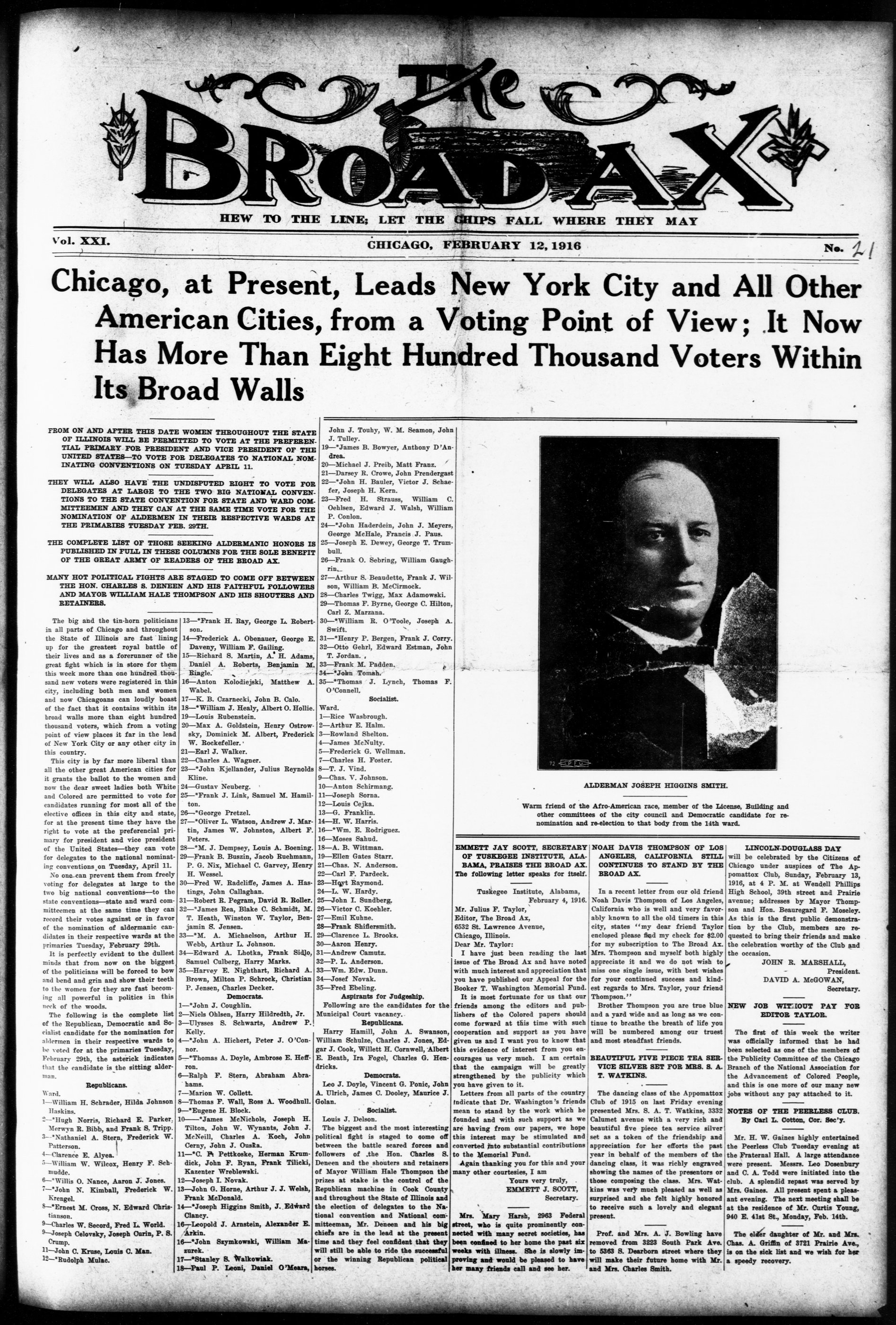
Chicago, at Present, Leads New York City and All Other American Cities, from a Voting Point of View; It Now Has More Than Eight Hundred Thousand Voters Within Its Broad Walls
FROM ON AND AFTER THIS DATE WOMEN THROUGHOUT THE STATE OF ILLINOIS WILL BE PERMITTED TO VOTE AT THE PREFERENTIAL PRIMARY FOR PRESIDENT AND VICE PRESIDENT OF THE UNITED STATES—TO VOTE FOR DELEGATES TO NATIONAL NOMINATING CONVENTIONS ON TUESDAY APRIL 11.
THEY WILL ALSO HAVE THE UNDISPUTED RIGHT TO VOTE FOR DELEGATES AT LARGE TO THE TWO BIG NATIONAL CONVENTIONS TO THE STATE CONVENTION FOR STATE AND WARD COMMITTEEMEN AND THEY CAN AT THE SAME TIME VOTE FOR THE NOMINATION OF ALDERMEN IN THEIE RESPECTIVE WARDS AT THE PRIMARIES TUESDAY FEB. 29TH.
THE COMPLETE LIST OF THOSE SEEKING ALDERMANIC HONORS IS PUBLISHED IN FULL IN THESE COLUMNS FOR THE SOLE BENEFIT OF THE GREAT ARMY OF READERS OF THE BROAD AX.
MANY HOT POLITICAL FIGHTS ARE STAGED TO COME OFF BETWEEN THE HON. CHARLES S. DENEEN AND HIS FAITHFUL FOLLOWERS AND MAYOR WILLIAM HALE THOMPSON AND HIS SHOUTERS AND RETAINERS.
Vol. XXI.
Chicago, America Has Made Its Brother
FROM ON AND AFTER THIS DATE OF ILLINOIS WILL BE PERMITIAL PRIMARY FOR PRESIDENT UNITED STATES—TO VOTE PORNATING CONVENTIONS ON THE
THEY WILL ALSO HAVE THE UNSLEGATES AT LARGE TO TIONS TO THE STATE CONVENTION MITTEEMEN AND THEY CAN A NOMINATION OF ALDERMEN THE PRIMARIES TUESDAY FE
THE COMPLETE LIST OF THOSE PUBLISHED IN FULL IN THESE OF THE GREAT ARMY OF REAL
MANY HOT POLITICAL FIGHTS ARE THE HON. CHARLES S. DENEEM AND MAYOR WILLIAM HALE THE RETAINERS.
The big and the tin-horn politicians in all parts of Chicago and throughout the State of Illinois are fast lining up for the greatest royal battle of their lives and as a forerunner of the great fight which is in store for them this week more than one hundred thousand new voters were registered in this city, including both men and women and now Chicagoans can loudly boast of the fact that it contains within its broad walls more than eight hundred thousand voters, which from a voting point of view places it far in the lead of New York City or any other city in this country.
This city is by far more liberal than all the other great American cities for it grants the ballot to the women and now the dear sweet ladies both White and Colored are permitted to vote for candidates running for most all of the elective offices in this city and state, for at the present time they have the right to vote at the preferential primary for president and vice president of the United States—they can vote for delegates to the national nominating conventions on Tuesday, April 11.
No one can prevent them from freely voting for delegates at large to the two big national conventions—to the state conventions—state and ward committeeeen at the same time they can record their votes against or in favor of the nomination of aldermanic candidates in their respective wards at the primaries Tuesday, February 29th.
It is perfectly evident to the dullest minds that from now on the biggest of the politicians will be forced to bow and bend and grin and show their teeth to the women for they are fast becoming all powerful in politics in this neck of the woods.
The following is the complete list of the Republican, Democratic and Socialist candidate for the nomination for aldermen in their respective wards to be voted for at the primaries Tuesday, February 29th, the asterick indicates that the candidate is the sitting alderman
Republicans
1—William H. Schrader, Hilda Johnson Haskins.
2—*Hugh Norris, Richard E. Parker, Merwyn R. Bibb, and Frank S. Tripp.
3—*Nathaniel A. Stern, Frederick W. Patterson.
4—Clarence E. Alyea.
5—William W. Wilcox, Henry F. Schmudde.
6—*Willis O. Nance, Aaron J. Jones.
7—John N. Kimball, Frederick W. Krengel.
8—*Ernest M. Cross, N. Edward Christianson.
9—Charles W. Secord, Fred L. World.
9—Joseph Celovsky, Joseph Curin, P. S. Crump.
11—John C. Kruse, Louis C. Man.
12—*Rudolph Mulac.
13—*Frank H. Ray, George L. Robertson.
14—Frederick A. Obenauer, George E. Daveny, William F. Gailing.
15—Richard S. Martin, A. H. Adams, Daniel A. Roberts, Benjamin M. Ringle.
16—Anton Kolodiejski, Matthew A. Wabel.
17—K. B. Czarnecki, John B. Calo.
18—*William J. Healy, Albert O. Hollie.
19—Louis Rubenstein.
20—Max A. Goldstein, Henry Ostrowsky, Dominick M. Albert, Frederick W. Rockefeller.
21—Earl J. Walker.
22—Charles A. Wagner.
23—*John Kjellander, Julius Reynolds Kline.
24—Gustav Neuberg.
25—*Frank J. Link, Samuel M. Hamilton.
26—*George Pretzel.
27—*Oliver L. Watson, Andrew J. Martin, James W. Johnston, Albert F. Peters.
28—*M. J. Dempsey, Louis A. Boening.
29—Frank B. Buszin, Jacob Ruehmann, P. G. Nix, Michael C. Garvey, Henry H. Wessel.
30—Fred W. Radcliffe, James A. Hastings, John Callaghan.
31—Robert R. Pegram, David R. Roller.
32—*James Rea, Blake C. Schmidt, M. T. Heath, Winston W. Taylor, Benjamin S. Jensen.
33—*M. A. Michaelson, Arthur H. Webb, Arthur L. Johnson.
34—Edward A. Lhotka, Frank Sidlo, Samuel Culberg, Harry Marks.
35—Harvey E. Nighthart, Richard A. Brown, Milton P. Schrock, Christian P. Jensen, Charles Decker.
Democrats.
1—*John J. Coughlin.
2—Niels Ohlsen, Harry Hildredth, Jr.
3—Ulysses S. Schwarts, Andrew P. Kelly.
4—*John A. Hichert, Peter J. O'Connor.
5—*Thomas A. Doyle, Ambrose E. Heffron.
6—Ralph F. Stern, Abraham Abrahams.
7—Marion W. Collett.
8—Thomas F. Wall, Ross A. Woodhull.
9—*Eugene H. Block.
10—*James McNichols, Joseph H. Tilton, John W. Wynants, John J. McNeill, Charles A. Koch, John Cerny, John J. Ouska.
11—*C. P Pettkoske, Herman Krumdick, John F. Ryan, Frank Tilicki, Kazenter Wreblewski.
12—Joseph I. Novak.
13—John G. Horne, Arthur J. J. Welsh,
Frank McDonald.
14—*Joseph Higgins Smith, J. Edward
Clancy.
16—Leopold J. Arnstein, Alexander E.
Arkin.
16—*John Szymkowski, William Mazurek.
17—*Stanley S. Walkowiak.
CHICAGO, FEBRUARY 12, 1916
John J. Touhy, W. M. Seamon, John J. Tulley.
19 *James B. Bowyer, Anthony D'Andrea.
20-Michael J. Preib, Matt Franz.
21-Darsey R. Crowe, John Prendergast
22*John H. Bauer, Victor J. Schaefer, Joseph H. Kern.
23-Fred H. Strauss, William C. Oehlsen, Edward J. Walsh, William P. Conlon.
24*John Haderdein, John J. Meyers, George McHale, Francis J. Paus.
25-Joseph E. Dewey, George T. Trumbull.
26-Frank O. Sebring, William Gaughrin.
27-Arthur S. Beaudette, Frank J. Wilson, William B. McCirmock.
28-Charles Twigg, Max Adamowski.
29-Thomas F. Byrne, George C. Hilton, Carl Z. Marzana.
30*William R. O'Toole, Joseph A. Swift.
31*Henry P. Bergen, Frank J. Corry.
32-Otto Gehrl, Edward Estman, John T. Jordan.
33-Frank M. Padden.
34*John Tomah.
35*Thomas J. Lynch, Thomas F. O'Connell.
Socialist.
1—Rice Wasbrough.
2—Arthur E. Halm.
3—Rowland Shelton.
4—James McNulty.
5—Frederick G. Wellman
6—Charles H. Foster.
8—T. J. Vind.
9—Chas. V. Johnson.
10—Anton Schirmang.
11—Joseph Sorna.
12—Louis Cejka.
13—G. Franklin.
14—H. W. Harris.
16—*Wm. E. Rodriguez.
18—A. B. Wittman.
19—Ellen Gates Starr.
21—Chas. N. Anderson.
23—Carl F. Pardeck.
23—Hoyt Raymond.
24—L. W. Hardy.
25—John I. Sundberg.
26—Victor C. Koehler.
27—Emil Kuhne.
28—Frank Shiflersmith.
29—Clarence L. Brooks.
30—Aaron Henry.
31—Andrew Camutz.
32—P. L. Anderson.
33—Wm. Edw. Dunn.
34—Josef Novak.
35—Fred Ebeling.
Aspirants for Judgeship. Following are the candidates for the Municipal Court vacancy. Republicans. Harry Hamill, John A. Swanson, William Schulze, Charles J. Jones, Edgar J. Cook, Willett H. Cornwell, Albert E. Beath, Ira Fogel, Charles G. Hendricks.
Democrats.
Leo J. Doyle, Vincent G. Ponic, John A. Ulrich, James C. Dooley, Maurice J. Golan.
The biggest and the most interesting political fight is staged to come off between the battle scared forces and followers of the Hon. Charles S. Deneen and the shouters and retainers of Mayor William Hale Thompson the prizes at stake is the control of the Republican machine in Cook County and throughout the State of Illinois and the election of delegates to the National convention and National committeeman, Mr. Deneen and his big chiefs are in the lead at the present time and they feel confident that they will still be able to ride the successful or the winning Republican political
72 CP EU
Warm friend of the Afro-American race, member of the License, Building and other committees of the city council and Democratic candidate for renomination and re-election to that body from the 14th ward.
EMMETT JAY SCOTT, SECRETARY OF TUSKEGEE INSTITUTE, ALABAMA, PRAISES THE BROAD AX The following letter speaks for itself.
Tuskegee Institute, Alabama,
February 4, 1916
Dear Mr. Taylor:
I have just been reading the last issue of The Broad Ax and have noted with much interest and appreciation that you have published our Appeal for the Booker T. Washington Memorial Fund.
It is most fortunate for us that our friends among the editors and publishers of the Colored papers should come forward at this time with such cooperation and support as you have given us and I want you to know that this evidence of interest from you encourages us very much. I am certain that the campaign will be greatly strengthened by the publicity which you have given to it.
Letters from all parts of the country indicate that Dr. Washington's friends mean to stand by the work which he founded and with such support as we are having from our papers, we hope this interest may be stimulated and converted into substantial contributions to the Memorial Fund.
Again thanking you for this and your many other courtesies, I am
Yours very truly,
EMMETT J. SCOTT,
Secretary.
Mrs. Mary Harsh, 2963 Federal street, who is quite prominently connected with many secret societies, has been confined to her home the past six weeks with illness. She is slowly improving and would be pleased to have her many friends call and see her.
ALDERMAN JOSEPH HIGGINS SMITH.
the Afro-American race, member of the Lice
tees of the city council and Democratic
and re-election to that body from the 14th w
NOAH DAVIS THOMPSON OF LOS
ANGELES, CALIFORNIA STILL
CONTINUES TO STAND BY THE
BROAD AX.
In a recent letter from our old friend
Noah Davis Thompson of Los Angeles,
California who is well and very favor-
ably known to all the old timers in this
city, states "my dear friend Taylor
enclosed please find my check for $2.00
for my subscription to The Broad Ax.
Mrs. Thompson and myself both highly
appreciate it and we do not wish to
miss one single issue, with best wishes
for your continued success and kindest
regards to Mrs. Taylor, your friend
Thompson."
Brother Thompson you are true blue
and a yard wide and as long as we
continue to breathe the breath of life you
will be numbered among our truest
and most steadfast friends.
BEAUTIFUL FIVE PIECE TEA SERVICE SILVER SET FOR MRS. S. A. T. WATKINS.
The dancing class of the Appomattox Club of 1915 on last Friday evening presented Mrs. S. A. T. Watkins, 3332 Calumet avenue with a very rich and beautiful five piece tea service silver set as a token of the friendship and appreciation for her efforts the past year in behalf of the members of the dancing class, it was richly engraved showing the names of the presentors or those composing the class. Mrs. Watkins was very much pleased as well as surprised and she felt highly honored to receive such a lovely and elegant present.
Prof. and Mrs. A. J. Bowling have removed from 3223 South Park Ave. to 5363 S. Dearborn street where they will make their future home with Mr. and Mrs. Charles Smith.
No. 21
All Other
now; It Now
ers Within
I.
license, Building and
candidate for re-
ward.
LINCOLN-DOUGLASS DAY
will be celebrated by the Citizens of Chicago under auspices of the Appomattox Club, Sunday, February 13, 1916, at 4 P. M. at Wendell Phillips High School, 39th street and Prairie avenue; addresses by Mayor Thompson and Hon. Beauregard F. Moseley. As this is the first public demonstration by the Club, members are requested to bring their friends and make the celebration worthy of the Club and the occasion.
JOHN R. MARSHALL,
President.
DAVID A. McGOWAN,
Secretary.
NEW JOB WIT.IOUT PAY FOR
EDITOR TAYLOR.
The first of this week the writer was officially informed that he had been selected as one of the members of the Publicity Committee of the Chicago Branch of the National Association for the Advancement of Colored People, and this is one more of our many new jobs without any pay attached to it.
NOTES OF THE PEERLESS CLUB
By Carl L. Cotton, Cor. Sec'y.
Mr. H. W. Gaines highly entertained the Peerless Club Tuesday evening at the Fraternal Hall. A large attendance were present. Messrs. Leo Dosenbury and C. A. Todd were initiated into the club. A splendid repast was served by Mrs. Gaines. All present spent a pleasant evening. The next meeting shall be at the residence of Mr. Curtis Young, 940 E. 41st St., Monday, Feb. 14th.
The elder daughter of Mr. and Mrs. Chas. A. Griffin of 3721 Prairie Ave., is on the sick list and we wish for her a speedy recovery.
PAGE TWO
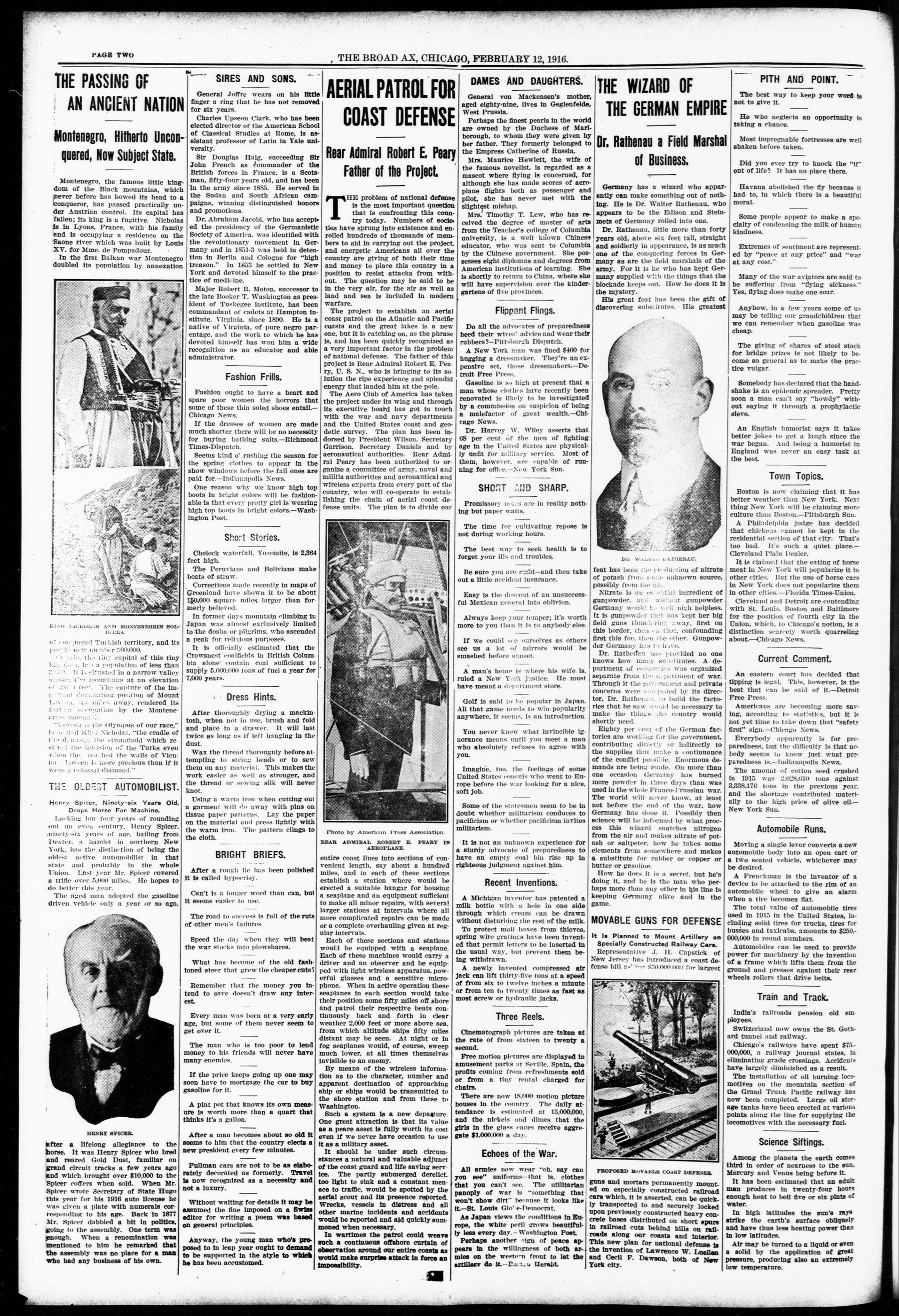
Montenegro, Hitherto Unconquered, Now Subject State.
Montenegro, the famous little kingdom of the Black mountains, which never before has bowed its head to a conqueror, has passed practically under Austrian control. Its capital has fallen; its king is a fugitive. Nicholas is in Lyons, France, with his family and is occupying a residence on the Saone river which was built by Louis XV. for Mme. de Pompadour. In the first Balkan war Montenegro doubled its population by annexation
THE MUSLIMS
KING NICHOLAS AND MONTENEGRIN SOLDIERS.
of conquered Turkish territory, and its people new number 500,000.
He made the tiny capital of this tiny kingdom, has a population of less than 2,000. It is situated in a narrow valley among the mountains at an elevation of 2400 feet. The capture of the important dominating position of Mount Lawen, six miles away, rendered its further occupation by the Montenegrus untenal.
"Lawen is the Olympus of our race," beamed King Nicholas, "the cradle of the dasty, the stronghold which resisted the invasion of the Turks even when the reached the walls of Vienna. Lawen is more precious than if it were a colossal diamond."
THE OLDEST AUTOMOBILIST.
Henry Spicer, Ninety-six Years Old, Drops Horse For Machine.
Lacking but four years of rounding out an even century, Henry Spicer, ninety-six years of age, hailing from Dexter, a hamlet in northern New York, has the distinction of being the oldest active automobilist in that state and probably in the whole Union. Last year Mr. Spicer covered a trifle over 5,000 miles. He hopes to do better this year.
The aged man adopted the gasoline driven vehicle only a year or so ago.
PETER H. BURGESS
HENRY SPICER.
after a lifelong allegiance to the horse. It was Henry Spicer who bred and reared Gold Dust, familiar on grand circuit tracks a few years ago and which brought over $10,000 to the Spicer coffers when sold. When Mr. Spicer wrote Secretary of State Hugo this year for his 1916 auto license he was given a plate with numerals corresponding to his age. Back in 1877 Mr. Spicer dabbled a bit in politics, going to the assembly. One term was enough. When a renomination was mentioned to him he remarked that the assembly was no place for a man who had any business of his own.
SIRES AND SONS.
General Joffre wears on his little finger a ring that he has not removed for six years.
Charles Upseon Clark, who has been elected director of the American School of Classical Studies at Rome, is assistant professor of Latin in Yale university.
Sir Douglas Haig, succeeding Sir John French as commander of the British forces in France, is a Scotsman, fifty-four years old, and has been in the army since 1885. He served in the Sudan and South African campaigns, winning distinguished honors and promotions.
Dr. Abraham Jacobi, who has accepted the presidency of the Germanistic Society of America, was identified with the revolutionary movement in Germany and in 1851-3 was held in detention in Berlin and Cologne for "high treason." In 1853 he settled in New York and devoted himself to the practice of medicine.
Major Robert R. Moton, successor to the late Booker T. Washington as president of Tuskegee institute, has been commandant of cadets at Hampton institute, Virginia, since 1800. He is a native of Virginia, of pure negro parentage, and the work to which he has devoted himself has won him a wide recognition as an educator and able administrator.
Fashion Frills.
Fashion ought to have a heart and spare poor women the horrors that some of these thin soled shoes entail.—Chicago News.
If the dresses of women are made much shorter there will be no necessity for buying bathing suits.—Richmond Times-Dispatch.
Seems kind o' rushing the season for the spring clothes to appear in the show windows before the fall ones are paid for.—Indianapolis News.
One reason why we know high top boots in bright colors will be fashionable is that every pretty girl is wearing high top boots in bright colors.—Washington Post.
Short Stories.
Cholock waterfall, Yosemite, is 2,364 feet high.
The Peruvians and Bolivians make boats of straw.
Corrections made recently in maps of Greenland have shown it to be about 150,000 square miles larger than formerly believed.
In former days mountain climbing in Japan was almost exclusively limited to the dosha or pilgrims, who ascended a peak for religious purposes.
It is officially estimated that the Crownestern coalfields in British Columbia alone contain coal sufficient to supply 5,000,000 tons of fuel a year for 7,000 years.
Dress Hints.
After thoroughly drying a mackintosh, when not in use, brush and fold and place in a drawer. It will last twice as long as if left hanging in the dust.
Wax the thread thoroughly before attempting to string beads or to sew them on any material. This makes the work easier as well as stronger, and the thread or sewing silk will never knot.
Using a warm iron when cutting out a garment will do away with pins on tissue paper patterns. Lay the paper on the material and press lightly with the warm iron. The pattern clings to the cloth.
BRIGHT BRIEFS.
After a rough lie has been polished,
it is called hypocrisy.
Can't is a longer word than can, but
it seems easier to use.
The road to success is full of the ruts
of other men's failures.
Speed the day when they will beat
the war stocks into plowshares.
What has become of the old fashioned steer that grew the cheaper cuts?
Remember that the money you intend to save doesn't draw any interest.
Every man was born at a very early age, but some of them never seem to get over it.
The man who is too poor to lend money to his friends will never have many enemies.
If the price keeps going up one may soon have to mortgage the car to buy gasoline for it.
A pint pot that knows its own measure is worth more than a quart that thinks it's a gallon.
After a man becomes about so old it seems to him that the country elects a new president every few minutes.
Pullman cars are not to be as elaborately decorated as formerly. Travel is now recognized as a necessity and not a luxury.
Without waiting for details it may be assumed the fine imposed on a Swiss editor for writing a poem was based on general principles.
Anyway, the young man who's proposed to in leap year ought to demand to be supported in the style to which he has been accustomed.
THE BROAD AX, CHICAGO, FEBRUARY 12, 1916
AERIAL PATROL FOR COAST DEFENSE
Rear Admiral Robert E. Peary Father of the Project.
THE problem of national defense is the most important question that is confronting this country today. Numbers of societies have sprung into existence and enrolled hundreds of thousands of members to aid in carrying out the project, and energetic Americans all over the country are giving of both their time and money to place this country in a position to resist attacks from without. The question may be said to be in the very air, for the air as well as land and sea is included in modern warfare.
The project to establish an aerial coast patrol on the Atlantic and Pacific coasts and the great lakes is a new one, but it is catching on, as the phrase is, and has been quickly recognized as a very important factor in the problem of national defense. The father of this project is Rear Admiral Robert E. Pearcy, U. S. N., who is bringing to its solution the ripe experience and splendid energy that landed him at the pole.
The Aero Club of America has taken the project under its wing and through its executive board has got in touch with the war and navy departments and the United States coast and geodetic survey. The plan has been indorsed by President Wilson, Secretary Garrison, Secretary Daniels and by aeronautical authorities. Rear Admiral Peary has been authorized to organize a committee of army, naval and militia authorities and aeronautical and wireless experts from every part of the country, who will co-operate in establishing the chain of aerial coast defense units. The plan is to divide our
S. S.
REAR ADMIRAL ROBERT E. PEARY IN AEROPLANE.
entire coast lines into sections of convenient length, say about a hundred miles, and in each of these sections establish a station where would be erected a suitable hangar for housing a seaplanet and an equipment sufficient to make all minor repairs, with several larger stations at intervals where all more complicated repairs can be made or a complete overhauling given at regular intervals.
Each of these sections and stations would be equipped with a seasplane. Each of these machines would carry a driver and an observer and be equipped with light wireless apparatus, powerful glasses and a sensitive microphone. When in active operation these seasplanes in each section would take their position some fifty miles off shore and patrol their respective beats continuously back and forth in clear weather, 2,000 feet or more above sea, from which altitude ships fifty miles distant may be seen. At night or in fog seasplanes would, of course, sweep much lower, at all times themselves invisible to an enemy.
By means of the wireless information as to the character, number and apparent destination of approaching ship or ships would be transmitted to the shore station and from these to Washington.
Such a system is a new departure. One great attraction is that its value as a peace asset is fully worth its cost even if we never have occasion to use it as a military asset.
It should be under such circumstances a natural and valuable adjunct of the coast guard and life saving service. The partly submerged derelict, too light to sink and a constant menace to traffic, would be spotted by the aerial scout and its presence reported. Wrecks, vessels in distress and all other marine incidents and accidents would be reported and aid quickly summoned when necessary.
In wartimes the patrol could weave such a continuous offshore curtain of observation around our entire coasts as would make surprise attack in force an impossibility.
DAMES AND DAUGHTERS.
General von Mackensen's mother, aged eighty-nine, lives in Geglenfelde, West Prussia. Perhaps the finest pearls in the world are owned by the Duchess of Marlborough, to whom they were given by her father. They formerly belonged to the Empress Catherine of Russia. Mrs. Maurice Hewlett, the wife of the famous novelist, is regarded as a mascot where flying is concerned, for although she has made scores of aeroplane flights both as passenger and pilot, she has never met with the slightest mishap.
Mrs. Timothy T. Lew, who has received the degree of master of arts from the Teacher's college of Columbia university, is a well known Chinese educator, who was sent to Columbia by the Chinese government. She possesses eight diplomas and degrees from American institutions of learning. She is shortly to return to China, where she will have supervision over the kindergarten of five provinces.
Flippant Flings.
Do all the advocates of preparedness heed their wives' advice and wear their rubbers?—Pittsburgh Dispatch.
A New York man was fined $400 for hugging a dressmaker. They're an expensive set, those dressmakers.—Detroit Free Press.
Gasoline is so high at present that a man whose clothes have recently been renovated is likely to be investigated by a commission on suspicion of being a malefactor of great wealth.—Chicago News.
Dr. Harvey W. Wiley asserts that 68 per cent of the men of fighting age in the United States are physically unit for military service. Most of them, however, are capable of running for office.—New York Sun.
SHORT AND SHARP.
Promissory notes are in reality nothing but paper waits.
The time for cultivating repose is not during working hours.
The best way to seek health is to forget your ills and troubles.
Be sure you are right—and then take out a little accident insurance.
Easy is the descent of an unsuccessful Mexican general into oblivion.
Always keep your temper; it's worth more to you than it is to anybody else.
If we could see ourselves as others see us a lot of mirrors would be smashed before sunset.
A man's home is where his wife is, ruled a New York justice. He must have meant a department store.
Golf is said to be popular in Japan. All that game needs to win popularity anywhere, it seems, is an introduction.
You never know what invincible ignorance means until you meet a man who absolutely refuses to agree with you.
Imagine, too, the feelings of some United States consuls who went to Europe before the war looking for a nice, soft job.
Some of the statesmen seem to be in doubt whether militarism conduces to pacificism or whether pacificism invites militarism.
It is not an unknown experience for a sturdy advocate of preparedness to have an empty coal bin rise up in righteous judgment against him.
Recent Inventions.
A Michigan inventor has patented a milk bottle with a hole in one side through which cream can be drawn without disturbing the rest of the milk. To protect mail boxes from thieves, spring wire gratings have been invented that permit letters to be inserted in the usual way, but prevent them being withdrawn. A newly invented compressed air jack can lift thirty-five tons at a speed of from six to twelve inches a minute or from ten to twenty times as fast as most screw or hydraulic jacks.
Three Reels.
Cinematograph pictures are taken at the rate of from sixteen to twenty a second.
Free motion pictures are displayed in amusement parks at Seville, Spain, the profits coming from refreshments sold or from a tiny rental charged for chairs.
There are now 18,000 motion picture houses in the country. The daily attendance is estimated at 15,000,000, and the nickels and dimes that the girls in the glass cages receive aggregate $1,000,000 a day.
Echoes of the War.
All armies now wear "oh, say can you see" uniforms—that is, clothes that you can't see. The utilitarian panoply of war is "something that won't show dirt" because it looks like it—St. Louis Glo' e-Democrat.
As Japan views the conditions in Europe, the white peril grows beautifully less every day.—Washington Post.
Perhaps another sign of peace appears in the willingness of both armies on the western front to let the artillery do it—Pustyn Herald.
Germany has a wizard who apparently can make something out of nothing. He is Dr. Walter Rathenau, who appears to be the Edison and Steinmetz of Germany rolled into one. Dr. Rathenau, little more than forty years old, above six feet tall, straight and soldierly in appearance, is as much one of the conquering forces in Germany as are the field marshals of the army. For it is he who has kept Germany supplied with the things that the blockade keeps out. How he does it is the mystery. His great feat has been the gift of discovering substitutes. His greatest
```markdown
```
DR WALKER LATHENAU.
feat has been the production of nitrate of potash from some unknown source, possibly from the air.
Nitrate is an essential ingredient of gunpowder, and without gunpowder Germany would be well nigh helpless. It is gunpowder that has kept her big field guns thinking away, first on this border, then on that, confounding first this foe, then the other. Gunpowder Germany has to have.
Dr. Ratthelaus has provided no one knows how many substitutes. A department of economies was organized separate from the department of war. Through it the government and private concerns were competed by its director, Dr. Ratthelaus, to build the factories that he saw would be necessary to make the things the country would shortly need.
Eighty per cent of the German factories are working for the government, contributing directly or indirectly to the supplies that make a continuance of the conflict possible. E enormous demands are being made. On more than one occasion Germany has burned more powder in three days than was used in the whole Franco-Frussian war. The world will never know, at least not before the end of the war, how Germany has done it. Possibly then science will be informed by what process this wizard snatches nitrogen from the air and makes nitrate of potash or saltpeter, how he takes some elements from somewhere and makes a substitute for rubber or copper or butter or gasoline.
How he does it is a secret, but he's doing it, and he is the man who perhaps more than any other in his line is keeping Germany alive and in the game.
MOVABLE GUNS FOR DEFENSE
It Is Planned to Mount Artillery on
Specially Constructed Railway Cars.
Representative J. H. Capstick of
New Jersey has introduced a coast defense bill as $50,000,000 for largest
Cannon on Railway Track
PROPOSED MOVABLE COAST DEFENSE guns and mortars permanently mounted on especially constructed railroad cars which, it is asserted, can be quickly transported to and securely locked upon previously constructed heavy concrete bases distributed on short spurs in railroad cuts behind hills on railroads along our coasts and interior. This new plan for national defense is the invention of Lawrence W. Luellen and Cecil F. Dawson, both of New York city.
PITH AND POINT.
The best way to keep your word is not to give it.
He who neglects an opportunity is taking a chance.
Most impregnable fortresses are well shaken before taken.
Did you ever try to knock the "if" out of life? It has no place there.
Havana abolished the fly because it had to, in which there is a beautiful moral.
Some people appear to make a specialty of condensing the milk of human kindness.
Extremes of sentiment are represented by "peace at any price" and "war at any cost."
Many of the war aviators are said to be suffering from "flying sickness." Yes, flying does make one soar.
Anyhow, in a few years some of us may be telling our grandchildren that we can remember when gasoline was cheap.
The giving of shares of steel stock for bridge prizes is not likely to become so general as to make the practice vulgar.
Somebody has declared that the handshake is an epidemic spreader. Pretty soon a man can't say "howdy" without saying it through a prophylactic sleeve.
An English humorist says it takes better jokes to get a laugh since the war began. And being a humorist in England was never an easy task at the best.
Town Topics.
Boston is now claiming that it has better weather than New York. Next thing New York will be claiming more culture than Boston.—Pittsburgh Sun.
A Philadelphia judge has decided that chickens cannot be kept in the residential section of that city. That's too bad. It's such a quiet place.—Cleveland Plain Dealer.
It is claimed that the eating of horse meat in New York will popularize it in other cities. But the use of horse cars in New York does not popularize them in other cities.—Florida Times-Union.
Cleveland and Detroit are contending with St. Louis, Boston and Baltimore for the position of fourth city in the Union, which, to Chicago's notion, is a distinction scarcely worth quarreling about.—Chicago News.
Current Comment.
An eastern court has decided that tipping is legal. This, however, is the best that can be said of it.-Detroit Free Press.
Americans are becoming more saving, according to statistics, but it is not yet time to take down that "safety first" sign.-Chicago News.
Everybody apparently is for preparedness, but the difficulty is that nobody seems to know just what preparedness is.-Indianapolis News.
The amount of cotton seed crushed in 1915 was 2,628,610 tons against 3,338,170 tons in the previous year, and the shortage contributed materially to the high price of olive oil.-New York Sun.
Automobile Runs.
Moving a single lever converts a new automobile body into an open cart or a two seated vehicle, whichever may be desired.
A Frenchman is the inventor of a device to be attached to the rim of an automobile wheel to give an alarm when a tire becomes flat.
The total value of automobile tires used in 1915 in the United States, including solid tires for trucks, tires for busses and taxicabs, amounts to $250,000,000 in round numbers.
Automobiles can be used to provide power for machinery by the invention of a frame which lifts them from the ground and presses against their rear wheels rollers that drive belts.
Train and Track.
India's railroads pension old employees.
Switzerland now owns the St. Gothard tunnel and railway.
Chicago's railways have spent $75,000,000, a railway journal states, in eliminating grade crossings. Accidents have largely diminished as a result.
The installation of oil burning locomotives on the mountain section of the Grand Trunk Pacific railway has now been completed. Large oil storage tanks have been erected at various points along the line for supplying the locomotives with the necessary fuel.
Science Siftings.
Among the planets the earth comes third in order of nearness to the sun, Mercury and Venus being before it. It has been estimated that an adult man produces in twenty-four hours enough heat to boil five or six pints of water. In high latitudes the sun's rays strike the earth's surface obliquely and have thus less heating power than in low latitudes. Air may be turned to a liquid or even a solid by the application of great pressure, producing also an extremely low temperature.
How One Englishwoman Describes Her Many War Duties.
```markdown
```
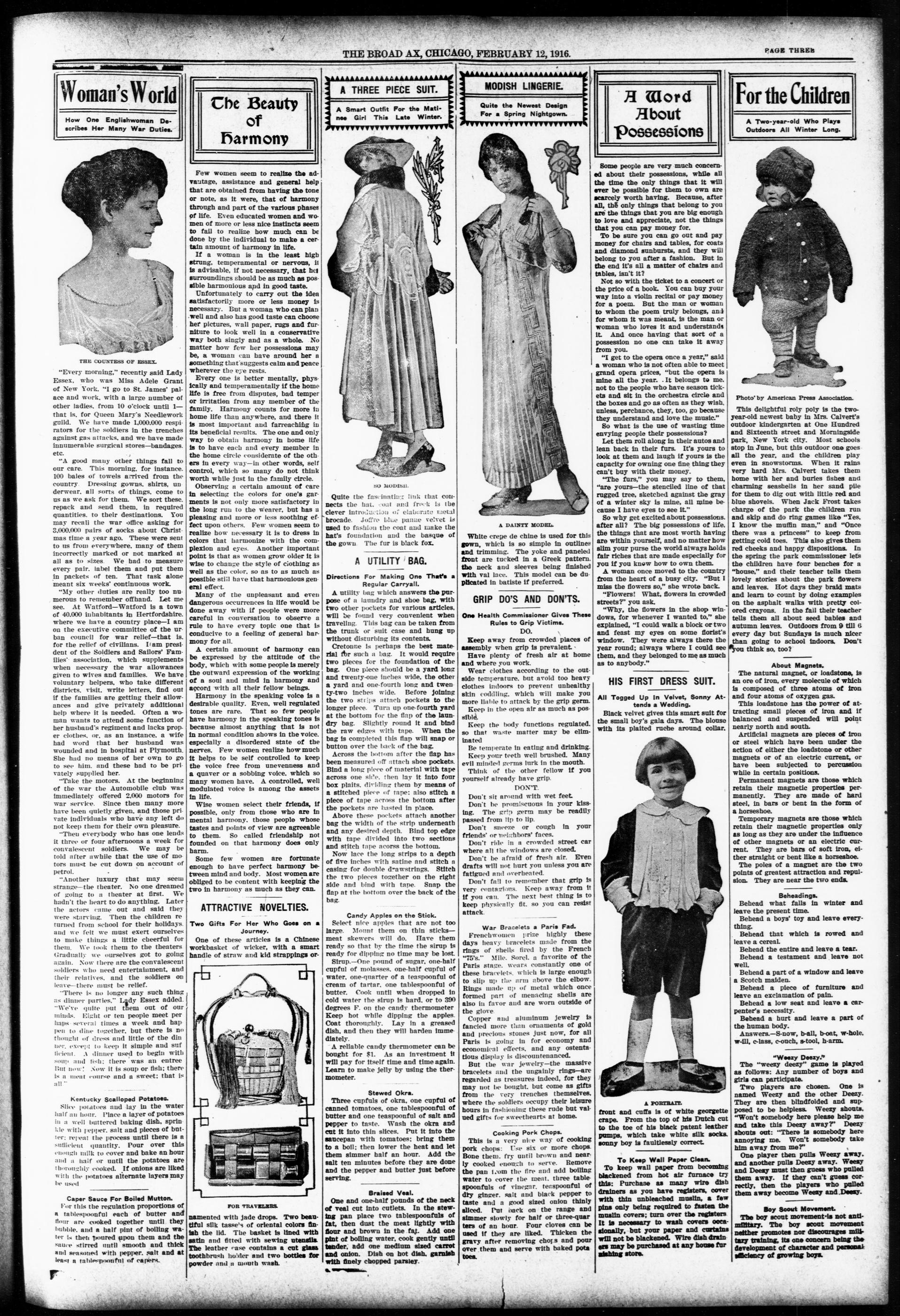
THE COUNTESS OF ESSEX.
"Every morning," recently said Lady Essex, who was Miss Adele Grant of New York. "I go to St. James' palace and work, with a large number of other ladies, from 10 o'clock until 1—that is, for Queen Mary's Needlework guild. We have made 1,000,000 respirators for the soldiers in the trenches against gas attacks, and we have made innumerable surgical stores—bandages, etc.
"A good many other things fall to our care. This morning, for instance, 100 bales of towels arrived from the country. Dressing gowns, shirts, underwear, all sorts of things, come to us as we ask for them. We sort these, repack and send them, in required quantities, to their destinations. You may recall the war office asking for 3,000,000 pairs of socks about Christmas time a year ago. These were sent to us from everywhere, many of them incorrectly marked or not marked at all as to sizes. We had to measure every pair, label them and put them in packets of ten. That task alone meant six weeks' continuous work.
"My other duties are really too numerous to remember offhand. Let me see. At Watford—Watford is a town of 40,000 inhabitants in Hertfordshire, where we have a country place—I am on the executive committee of the urban council for war relief—that is, for the relief of civilians. I am president of the Soldiers and Sailors' Families' association, which supplements when necessary the war allowances given to wives and families. We have voluntary helpers, who take different districts, visit, write letters, find out if the families are getting their allowances and give privately additional help where it is needed. Often a woman wants to attend some function of her husband's regiment and lacks proper clothes, or, as an instance, a wife had word that her husband was wounded and in hospital at Plymouth. She had no means of her own to go to see him, and these had to be privately supplied her.
"Take the motors. At the beginning of the war the Automobile club was immediately offered 2,000 motors for war service. Since then many more have been quietly given, and those private individuals who have any left do not keep them for their own pleasure. "Then everybody who has one lends it three or four afternoons a week for convalescent soldiers. We may be told after awhile that the use of motors must be cut down on account of petrol.
"Another luxury that may seem strange—the theater. No one dreamed of going to a theater at first. We hadn't the heart to do anything. Later the actors came out and said they were starving. Then the children returned from school for their holidays, and we felt we must exert ourselves to make things a little cheerful for them. We took them to the theaters. Gradually we ourselves got to going again. Now there are the convalescent soldiers who need entertainment, and their relatives, and the soldiers on leave—there must be relief.
"There is no longer any such thing as dinner parties," Lady Essex added. "We've quite put them out of our minds. Eight or ten people meet per haps several times a week and happen to dine together, but there is no thought of dress and little of the dinner, except to keep it simple and sufficient. A dinner used to begin with soup and fish; there was an entree But now! Now it is soup or fish; there is a meat course and a sweet; that is all."
Kentucky Scalloped Potatoes.
Slice potatoes and lay in the water half an hour. Place a layer of potatoes in a well buttered baking dish, sprinkle with pepper, salt and pieces of butter; repeat the process until there is a sufficient quantity. Pour over this enough milk to cover and bake an hour and a half or until the potatoes are thoroughly cooked. If onions are liked with the potatoes alternate layers may be used
Caper Sauce For Boiled Mutton
For this the regulation proportions of a tablespoonful each of butter and flour are cooked together until they bubble, and a half pint of boiling water is then poured upon them and the sauce stirred until smooth and thick and seasoned with pepper, salt and at least a tablespoonful of capers.
The Beauty of Harmony
Few women seem to realize the advantage, assistance and general help that are obtained from having the tone or note, as it were, that of harmony through and part of the various phases of life. Even educated women and women of more or less nice instincts seem to fail to realize how much can be done by the individual to make a certain amount of harmony in life.
If a woman is in the least high strung, temperamental or nervous, it is advisable, if not necessary, that her surroundings should be as much as possible harmonious and in good taste. Unfortunately to carry out the idea satisfactorily more or less money is necessary. But a woman who can plan well and also has good taste can choose her pictures, wall paper, rugs and furniture to look well in a conservative way both singly and as a whole. No matter how few her possessions may be, a woman can have around her a something that suggests calm and peace wherever the eye rests.
Every one is better mentally, physically and temperamentally if the home life is free from disputes, bad temper or irritation from any member of the family. Harmony counts for more in home life than anywhere, and there it is most important and farreaching in its beneficial results. The one and only way to obtain harmony in home life is to have each and every member in the home circle considerate of the others in every way—in other words, self control, which so many do not think worth while just in the family circle.
Observing a certain amount of care in selecting the colors for one's garments is not only more satisfactory in the long run to the wearer, but has a pleasing and more or less soothing effect upon others. Few women seem to realize how necessary it is to dress in colors that harmonize with the complexion and eyes. Another important point is that as women grow older it is wise to change the style of clothing as well as the color, so as to as much as possible still have that harmonious general effect.
Many of the unpleasant and even dangerous occurrences in life would be done away with if people were more careful in conversation to observe a rule to have every topic one that is conducive to a feeling of general harmony for all.
A certain amount of harmony can be expressed by the attitude of the body, which with some people is merely the outward expression of the working of a soul and mind in harmony and accord with all their fellow beings. Harmony in the speaking voice is a desirable quality. Even, well regulated tones are rare. That so few people have harmony in the speaking tones is because almost anything that is not in normal condition shows in the voice, especially a disordered state of the nerves. Few women realize how much it helps to be self controlled to keep the voice free from unevenness and a quaver or a sobbing voice, which so many women have. A controlled, well modulated voice is among the assets in life.
Wise women select their friends, if possible, only from those who are in mental harmony, those people whose tastes and points of view are agreeable to them. So called friendship not founded on that harmony does only harm.
Some few women are fortunate enough to have perfect harmony between mind and body. Most women are obliged to be content with keeping the two in harmony as much as they can.
ATTRACTIVE NOVELTIES.
Two Gifts For Her Who Goes on a Journey.
One of these articles is a Chinese workbasket of wicker, with a smart handle of straw and kid strappings or
FOR TRAVELERS
namented with jade drops. Two beautiful silk tassels of oriental colors finish the lid. The basket is lined with satin and fitted with sewing utensils. The leather case contains a cut glass toothbrush holder and two bottles for powder and a mouth wash.
THE BROAD AX, CHICAGO, FEBRUARY 12, 1916.
SO MODISH.
Quite the fascinating link that connects the hat, coat and freck is the clever introduction of elaborate metal brocade. Joffre blue panne velvet is used to fashion the coat and make the hat's foundation and the basque of the gown. The fur is black fox.
A UTILITY / BAG
Directions For Making One That's a Regular Carryall.
A utility bag which answers the purpose of a laundry and shoe bag, with two other pockets for various articles, will be found very convenient when traveling. This bag can be taken from the trunk or suit case and hung up without disturbing its contents.
Crotonne is perhaps the best material for such a bag. It would require two pieces for the foundation of the bag. One piece should be a yard long and twenty-one inches wide, the other a yard and one-fourth long and twenty-two inches wide. Before joining the two strips attach pockets to the longer piece. Turn up one-fourth yard at the bottom for the flap of the laundry bag. Slightly round it and bind the raw edges with tape. When the bag is completed this flap will snap or button over the back of the bag.
Across the bottom after the flap has been measured off attach shoe pockets. Bind a long piece of material with tape across one side, then lay it into four box plaits, dividing them by means of a stitched piece of tape; also stitch a piece of tape across the bottom after the pockets are basted in place. Above these pockets attach another bag the width of the strip underneath and any desired depth. Bind top edge with tape divided into two sections and stitch tape acorss the bottom. Now lace the long strips to a depth of five inches with satine and stitch a casing for double drawstrings. Stitch the two pieces together on the right side and bind with tape. Snap the flap at the bottom over the back of the bag.
Candy Apples on the Stick.
Select nice apples that are not too large. Mount them on thin sticks—meat skewers will do. Have them ready so that by the time the sirup is ready for dipping no time may be lost. Sirup.—One pound of sugar, one-half cupful of molasses, one-half cupful of water, one-quarter of a teaspoonful of cream of tartar, one tablespoonful of butter. Cook until when dropped in cold water the sirup is hard, or to 390 degrees F. on the candy thermometer Keep hot while dipping the apples. Coat thoroughly. Lay in a greased dish, and then they will harden immediately.
A reliable candy thermometer can be bought for $1. As an investment it will pay for itself time and time again. Learn to make jelly by using the thermometer.
Stewed Okra.
Three cupfuls of okra, one cupful of canned tomatoes, one tablespoonful of butter and one teaspoonful of salt and pepper to taste. Wash the okra and cut it into thin slices. Put it into the saucepan with tomatoes; bring them to a boil; then lower the heat and let them simmer half an hour. Add the salt ten minutes before they are done and the pepper and butter just before serving.
Braised Veal.
One and one-half pounds of the neck of veal cut into cutlets. In the stewing pan place two tablespoonfuls of fat, then dust the meat lightly with flour and brown in the fat. Add one pint of boiling water, cook gently until tender, add one medium sized carrot and onion. Dish on hot dish, garnish with finely chopped parsley.
Quite the Newest Design For a Spring Nightgown.
A DAINTY MODEL.
White crepe de chine is used for this gown, which is so simple in outlines and trimming. The yoke and paneled front are tucked in a Greek pattern, the neck and sleeves being finished with valce lace. This model can be duplicated in batiste if preferred.
GRIP DO'S AND DON'TS.
One Health Commissioner Gives These Rules to Grip Victims.
DO.
Keep away from crowded places of assembly when grip is prevalent.
Have plenty of fresh air at home and where you work.
Wear clothes according to the outside temperature, but avoid too heavy clothes indoors to prevent unhealthy skin codling, which will make you more liable to attack by the grip germ.
Keep in the open air as much as possible.
Keep the body functions regulated, so that waste matter may be eliminated.
Be temperate in eating and drinking.
Keep your teeth well brushed. Many evil minded germs lurk in the mouth.
Think of the other fellow if you yourself already have grip.
DON'T.
Don't sit around with wet feet.
Don't be promiscuous in your kissing. The grip germ may be readily passed from tip to lip. Don't sneeze or cough in your friends' or neighbors' faces. Don't ride in a crowded street car where all the windows are closed. Don't be afraid of fresh air. Even drafts will not hurt you unless you are fatigued and overheated. Don't fall to remember that grip is very contagious. Keep away from it if you can. The next best thing is to keep physically fit, so you can resist attack.
War Bracelets a Paris Fad.
Frenchwomen prize highly these days heavy bracelets made from the rings of shells fired by the French "75's." Mile. Sorel, a favorite of the Paris stage, wears constantly one of these bracelets, which is large enough to slip up the arm above the elbow. Rings made up of metal which once formed part of menacing shells are also in favor and are worn outside of the glove. Copper and aluminum jewelry is fancied more than ornaments of gold and precious stones just now, for all Paris is going in for economy and economical effects, and any ostentations display is discomnenced.
But the war jewelry—the massive bracelets and the ungainly rings—are regarded as treasures indeed, for they may not be bought, but come as gifts from the very trenches themselves, where the soldiers occupy their leisure hours in fashioning these rude but valued gifts for sweethearts at home.
Cooking Pork Chops.
This is a very nice way of cooking pork chops: Use six or more chops. Bone them, fry until brown and nearly cooked enough to serve. Remove the pan from the fire and add boiling water to cover the meat, three tablespoonfuls of vinegar, teaspoonful of dry ginger, salt and black pepper to taste and a good sized onion thinly sliced. Put back on the range and smother slowly for half or three-quarters of an hour. Four cloves can be used if they are liked. Thicken the gravy after removing chops and pour over them and serve with baked potatoe.
A Word About Possessions
Some people are very much concerned about their possessions, while all the time the only things that it will ever be possible for them to own are scarcely worth having. Because, after all, the only things that belong to you are the things that you are big enough to love and appreciate, not the things that you can pay money for.
To be sure you can go out and pay money for chairs and tables, for coats and diamond sunbursts, and they will belong to you after a fashion. But in the end it's all a matter of chairs and tables, isn't it?
Not so with the ticket to a concert or the price of a book. You can buy your way into a violin recital or pay money for a poem. But the man or woman to whom the poem truly belongs, and for whom it was meant, is the man or woman who loves it and understands it. And once having that sort of a possession no one can take it away from you.
"I get to the opera once a year," said a woman who is not often able to meet grand opera prices, "but the opera is mine all the year. It belongs to me, not to the people who have season tickets and sit in the orchestra circle and the boxes and go as often as they wish, unless, perchance, they, too, go because they understand and love the music."
So what is the use of wasting time envying people their possessions?
Let them roll along in their autos and lean back in their furs. It's yours to look at them and laugh if yours is the capacity for owning one fine thing they can't buy with their money.
"The furs," you may say to them,
"are yours—the stenciled line of that rugged tree, sketched against the gray of a winter sky is mine, all mine because I have eyes to see it."
So why get excited about possessions.
after all? The big possessions of life,
the things that are most worth having are within yourself, and no matter how slim your purse the world always holds fair riches that are made especially for you if you know how to own them.
A woman once moved to the country from the heart of a busy city. "But I miss the flowers so," she wrote back.
"Flowers! What, flowers in crowded streets?" you ask.
"Why, the flowers in the shop windows, for whenever I wanted to," she explained, "I could walk a block or two and feast my eyes on some florist's window. They were always there the year round; always where I could see them, and they belonged to me as much as to anybody."
HIS FIRST DRESS SUIT.
All Togged Up In Velvet, Sonny Attends a Wedding.
Black velvet gives this smart suit for the small boy's gala days. The blouses with its plaited ruche around collar.
```markdown
```
A PORTRAIT.
front and cuffs is of white georgette crape. From the top of his Dutch cut to the toe of his black patent leather pumps, which take white silk socks, sonny boy is faultless correct.
To Keep Wall Paper Clean.
To keep wall paper from becoming blackened from hot air furnace try this: Purchase as many wire dish drainers as you have registers, cover with thin unbleached muslin, a few pins only being required to fasten the mulin covers; turn over the registers. It is necessary to wash covers occasionally, but your paper and curtains will not be blackened. Wire dish drainers may be purchased at any house furnishing store.
PAGE THREE
A Two-year-old Who Plays Outdoors All Winter Long.
```markdown
```
Photo' by American Press Association
This delightful roly poly is the two-year-old newest baby in Mrs. Calvert's outdoor kindergarten at One Hundred and Sixteenth street and Morningside park, New York city. Most schools stop in June, but this outdoor one goes all the year, and the children play even in snowstorms. When it rains very hard Mrs. Calvert takes them home with her and buries fishes and charming seashells in her sand pile for them to dig out with little red and blue shovels. When Jack Frost takes charge of the park the children run and skip and do ring games like "Yes, I know the muffin man," and "Once there was a princess" to keep from getting cold toes. This also gives them red cheeks and happy dispositions. In the spring the park commissioner lets the children have four benches for a "house," and their teacher tells them lovely stories about the park flowers and leaves. Hot days they braid mats and learn to count by doing examples on the asphalt walks with pretty colored crayons. In the fall their teacher tells them all about seed babies and autumn leaves. Outdoors from 9 till 6 every day but Sundays is much nicer than going to school indoors. Don't you think so, too?
About Magnets.
The natural magnet, or loadstone, is an ore of iron, every molecule of which is composed of three atoms of iron and four atoms of oxygen gas. This loadstone has the power of attracting small pieces of iron and if balanced and suspended will point nearly north and south. Artificial magnets are pieces of iron or steel which have been under the action of either the loadstone or other magnets or of an electric current, or have been subjected to percussion while in certain positions. Permanent magnets are those which retain their magnetic properties permanently. They are made of hard steel, in bars or bent in the form of a horseshoe.
Temporary magnets are those which retain their magnetic properties only as long as they are under the influence of other magnets or an electric current. They are bars of soft iron, either straight or bent like a horseshoe. The poles of a magnet are the two points of greatest attraction and repulsion. They are near the two ends.
Beheadings.
Bebhead what falls in winter and leave the present time.
Bebhead a boys' toy and leave everything.
Bebhead that which is rowed and leave a cereal.
Bebhead the entire and leave a tear.
Bebhead a testament and leave not well.
Bebhead a part of a window and leave a Scotch maiden.
Bebhead a piece of furniture and leave an exclamation of pain.
Bebhead a low seat and leave a carpenter's necessity.
Bebhead a hurt and leave a part of the human body.
Answers.—S-now, b-all, b-oat, w-hole, w-lall, c-class, c-onch, s-tool, h-arm.
"Weezy Deezy."
The "weezy deezy" game is played as follows: Any number of boys and girls can participate.
Two players are chosen. One is named Weezy and the other Deezy. They are then blindfolded and supposed to be helpless. Weezy shouts, "Won't somebody here please help me and take this Deezy away?" Deezy shouts out: "There is somebody here annoying me. Won't somebody take him away from me?"
One player then pulls Weezy away, and another pulls Deezy away. Weezy and Deezy must then guess who pulled them away. If they can't guess correctly, then the players who pulled them away become Weezy and Deezy.
Boy Scout Movement.
The boy scout movement is not anti-military. The boy scout movement neither promotes nor discourages military training, its one concern being the development of character and personal efficiency of growing boys.
Agents and Correspondents Wanted to Handle THE BROAD AX. Liberal Commissions to Live Agents. Address, Julius F.Taylor, 6532 St. Lawrence Av., Chicago
Agents a
BRO
Addr
THE BROAD AX
PUBLISHED WEEKLY.
Will promulgate and at all times uphold the true principles of Democracy, but Catholics, Protestants, Priests, Inlands, Single Taxes, Republicans, or anyone else can have their say, as long as their language is proper and responsibility is fixed.
The Broad Ax is a newspaper whose platform is broad enough for all, ever claiming the editorial right to speak its own mind.
Local communications will receive attention. Write only on one side of the paper.
Subscriptions must be paid in advance. One Year. $3.00
Six Months. 1.00
Advertising rates made known on application.
Address all communications to
THE BROAD AX
6532 ST. LAWRENCE AVE., CHICAGO, ILL
PHONE WENTWORTH 2597.
JULIUS F. TAYLOR, Editor and Publisher
Entered as Second-Class Matter Aug. 18,
1896, at the Post Office at Chicago, Illinois,
under Act of March 8, 1879.
AUTHORIZED AGENTS AND CORRESPONDENTS FOR THE BROAD AX.
L. W. Washington, 5465 Kimbark avenue.
B. W. Fitts, 3315 S. State street.
Phone Douglas 4049.
The Broad Ax can be found on sale
at the last named place and news items
and advertisements left there will find
their way into these columns.
NATIONAL NEWS NOTES.
Brief Bits of News and Comment
On Men and Women.
A COURAGEOUS BISHOP REBUKES
GRATT.
Birmingham, Ala.—Before the North Alabama conference of the African Methodist Episcopal Chuch, Bishop J. W. Alstork of Montgomery who is presiding, let it be known in no uncertain language that he could not be influenced in his work by any special gift or offering and discouraged that practice on the part of the ministers in the conference. He told the ministers plainly that the only thing that could commend them would be faithful service to the church and race.
"Making me special donations will not help at all," said Bishop Alstork. "I would rather not have them, and I cannot discourage the practice too emphatically. In the first place the preachers in a Negro conference have not enough money to be making the bishop presents, and, in the second place, the church has provided for the bishop. For my part, I am perfectly satisfied with the provision the church has made for me, and I am expected to serve it and my God. I can neither be bought nor sold, and will not be influenced in the performance of my duty one iota by such gifts."
SAYS ARMY AND NAVY HAVEN'T ENOUGH MEN TO ENFORCE PROHIBITION LAWS.
New York City, N. Y.—Mr. Hugh F. Fox, the well-known publicist, spoke a few Sunday evenings ago at the Sunday Evening Forum of the Free Synagogue, of which Dr. Stephen S. Wise, the Jewish orator, is Rabbi and Leader on the subject, "The Futility of Prohibition." Mr. Fox pointed out that in the nineteen States which now have prohibition the people are inclined to drink inferior spirits rather than the lighter beverages which they could get in a license State. The fact that beer and wine were too difficult to conceal on account of their bulk explained it, he said.
Speaking of National prohibition, Mr. Fox declared that a prominent Government official had once told him that to enforce national prohibition would require a police force as large as our Army and Navy put together.
AGRICULTURE AND DISTILLING.
Washington, D. C.-Never before have brewers, malsters, distillers and wine-makers made so large a contribution to the agricultural prosperity of the country as during the fiscal year, 1913. In the course of that year—the latest for which reliable statistics are available—grain and other farm products to the value of $113,513,971.00 were used in the manufacture of liquors and this amount does not represent the value of the products so used as re-
---
ported in the markets of Chicago, Cincinnati, Buffalo, Philadelphia and other commercial centers, but the actual sum received by the growers, based upon the carefully compiled reports on farm prices issued from time to time by the United States Department of Agriculture.
The full significance of this amount, which represents, it may be stated, a return of 5 per cent, on an investment of $2,270,279,420.00, can best be appreciated if we compare it with the reports of the last United States Census on the total values, of the crops of certain typical States, which show that it exceeded the total combined crop values in the census year of Vermont, Maryland and West Virginia; of Massachusetts, Rhode Island, New Jersey and Florida; of Louisiana (with its great cotton and sugar interests), New Hampshire and Utah, or of Maine, Connecticut, Delaware, Nevada, Arizona, New Mexico and Wyoming.
CARE OF THE BABY.
Before the Baby Comes.
Article Number Four.
In this series of articles we have been dealing with the early life of a baby, after birth; we have not considered the equally important care of the baby in the months of his life before birth. The necessity for this care is apparent from the fact that statistics show that many thousands of babies die every year in the early days of life either because they were born prematurely, or because they were born too weak to survive. A very large number of them lose their lives because the mothers did not have proper care before they were born, or at the time of childbirth. Every woman expecting a baby should have such care as will result in the birth of a healthy and happy baby.
A prospective mother needs a light, nutritious diet of digestible foods, such as she likes and her appetite demands. Fried and greasy foods, heavy puddings and all heavy or underdone pastries, or an excess of any one article should be eliminated from her diet, as well as anything which she does not readily digest.
She should have a full movement of the bowels every day, and for this purpose should eat plenty of laxative foods, rather than resort to medicines. She should have at least eight hours of sleep at night and another hour during the day with all the bedroom windows open, if she has no out-of-door sleeping room. She should have systematic exercise in the open air every day, spending the time pleasantly in walking or in taking some form of light exercise, except at the normal time of the menstrual period, when it is better to rest. She should be careful not to continue her exercise beyond the point when she becomes tired. She should have a daily tub or sponge bath, having the water neither hot nor very cold, and should rub the skin vigorously afterward.
During the last eight weeks of pregnancy she needs special care. The nipples should have attention each day, according to directions given in a publication of the Children's Bureau called "Prenatal Care," which is sent free upon request to the Chief of the Children's Bureau, U. S. Department of Labor, Washington, D. C.
Throughout this stage of pregnancy the mother should as far as possible be spared all forms of heavy and taxing labor, in order that her strength may be built up in anticipation of the coming demand upon it. The baby's proper development also depends largely upon the mother's condition at this time, since the baby gains half his weight in the last eight weeks of pregnancy. Therefore, if he is to be born strong and healthy, it is most important that the mother have plenty of good food, and be spared undue work and worry through this crucial period. To help the mother, to afford her-opportunity for rest and to relieve her mind of any burden, may entail both expense and trouble upon the family, but it will be repaid a thousandfold in the health of the mother and baby which will result from the effort, not only for the time being, but forever afterward.
The mother of the expected baby should be under the care of a good doctor as long before the birth as possible, in order that he may watch for and correct any untoward symptoms that may arise.
In a city where the mother has not only plenty of private physicians, but hospitals, dispensaries and clinics at her service, it should be possible for her to have the necessary medical attention to keep her well.
In rural districts where medical at-
THE BROAD AX, CHICAGO, FEBRUARY 12, 1916.
[Name]
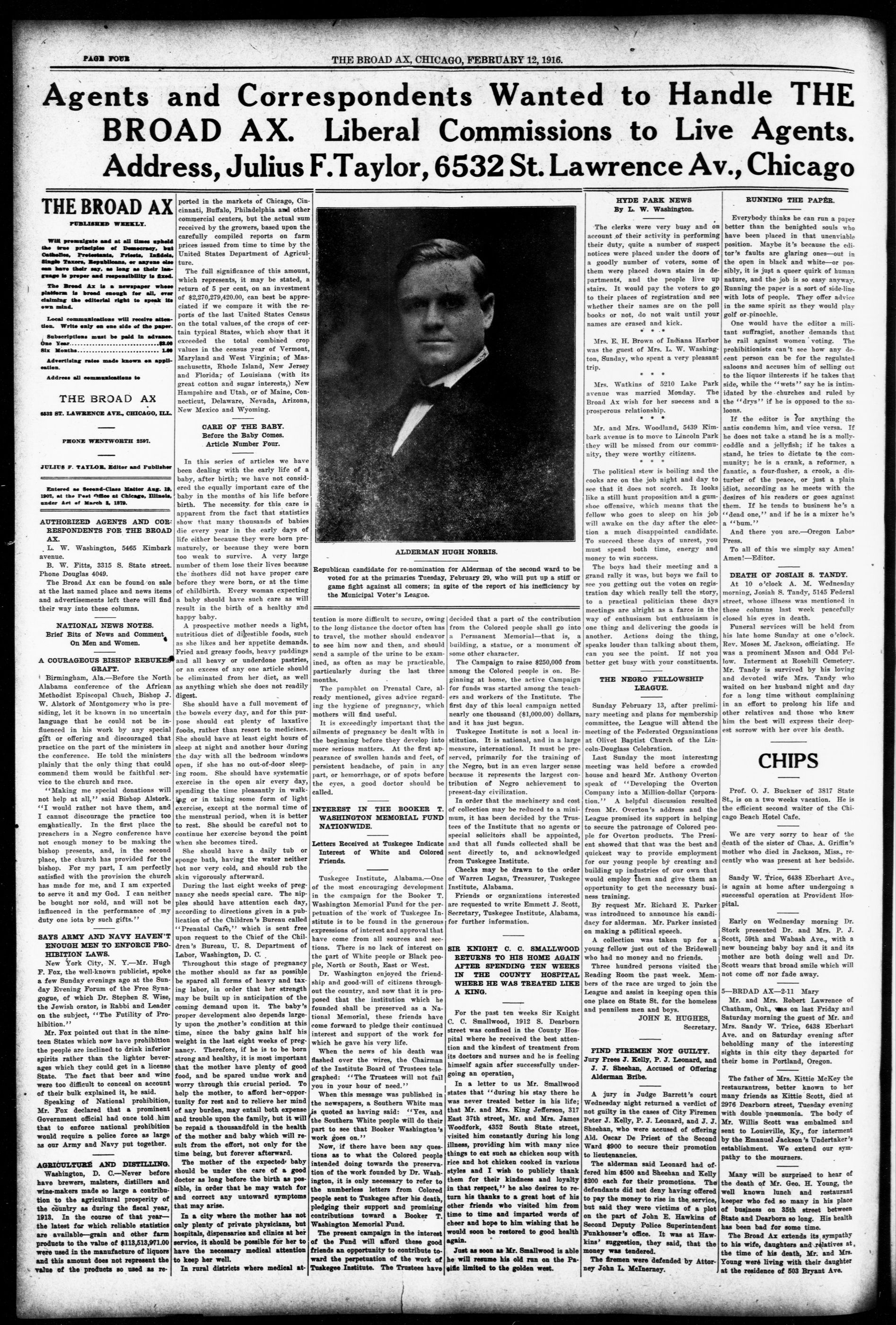
ALDERMAN HUGH NORRIS.
Republican candidate for re-nomination for Alderman of the second ward to be voted for at the primaries Tuesday, February 29, who will put up a stiff or game fight against all comers; in spite of the report of his inefficiency by the Municipal Voter's League.
tention is more difficult to secure, owing to the long distance the doctor often has to travel, the mother should endeavor to see him now and then, and should send a sample of the urine to be examined, as often as may be practicable, particularly during the last three months.
The pamphlet on Prenatal Care, already mentioned, gives advice regarding the hygiene of pregnancy, which mothers will find useful.
It is exceedingly important that the ailments of pregnancy be dealt with in the beginning before they develop into more serious matters. At the first appearance of swollen hands and feet, of persistent headache, of pain in any part, or hemorrhage, or of spots before the eyes, a good doctor should be called.
INTEREST IN THE BOOKER T
WASHINGTON MEMORIAL FUND
NATIONWIDE.
Letters Received at Tuskegee Indicate Interest of White and Colored Friends.
Tuskegee Institute, Alabama.—One of the most encouraging development in the campaign for the Booker T. Washington Memorial Fund for the perpetuation of the work of Tuskegee Institute is to be found in the generous expressions of interest and approval that have come from all sources and sections. There is no lack of interest on the part of White people or Black people, North or South, East or West.
Dr. Washington enjoyed the friendship and good-will of citizens throughout the country, and now that it is proposed that the institution which he founded shall be preserved as a National Memorial, these friends have come forward to pledge their continued interest and support of the work for which he gave his very life.
When the news of his death was flashed over the wires, the Chairman of the Institute Board of Trustees telegraphed: "The Trustees will not fail you in your hour of need."
When this message was published in the newspapers, a Southern White man is quoted as having said: "Yes, and the Southern White people will do their part to see that Booker Washington's work goes on."
Now, if there have been any questions as to what the Colored people intended doing towards the preservation of the work founded by Dr. Washington, it is only necessary to refer to the numberless letters from Colored people sent to Tuskegee after his death, pledging their support and promising contributions toward a Booker T. Washington Memorial Fund.
The present campaign in the interest of the Fund will afford these good friends an opportunity to contribute toward the perpetuation of the work of Tuskegee Institute. The Trustees have
decided that a part of the contribution from the Colored people shall go into a Permanent Memorial—that is, a building, a statue, or a monument of some other character.
The Campaign to raise $250,000 from among the Colored people is on. Beginning at home, the active Campaign for funds was started among the teachers and workers of the Institute. The first day of this local campaign netted nearly one thousand ($1,000.00) dollars, and it has just begun.
Tuskegee Institute is not a local institution. It is national, and in a large measure, international. It must be preserved, primarily for the training of the Negro, but in an even larger sense because it represents the largest contribution of Negro achievement to present-day civilization.
In order that the machinery and cost of collection may be reduced to a minimum, it has been decided by the Trustees of the Institute that no agents or special solicitors shall be appointed, and that all funds collected shall be sent directly to, and acknowledged from Tuskegee Institute.
Checks may be drawn to the order of Warren Logan, Treasurer, Tuskegee Institute, Alabama.
Friends or organizations interested are requested to write Emmett J. Scott, Secretary, Tuskegee Institute, Alabama, for further information.
SIR KNIGHT C. C. SMALLWOOD
RETURNS TO HIS HOME AGAIN
AFTER SPENDING TEN WEEKS
IN THE COUNTY HOSPITAL
WHERE HE WAS TREATED LIKE
A KING.
For the past ten weeks Sir Knight C. C. Smallwood, 1912 S. Dearborn street was confined in the County Hospital where he received the best attention and the kindest of treatment from its doctors and nurses and he is feeling himself again after successfully undergoing an operation.
In a letter to us Mr. Smallwood states that "during his stay there he was never treated better in his life; that Mr. and Mrs. King Jefferson, 317 East 37th street, Mr. and Mrs. James Woodford, 4352 South State street, visited him constantly during his long illness, providing him with many nice things to eat such as chicken soup with rice and hot chicken cooked in various styles and I wish to publicly thank them for their kindness and loyalty in that respect," he also desires to return his thanks to a great host of his other friends who visited him from time to time and imparted words of cheer and hope to him wishing that he would soon be restored to good health again.
Just as soon as Mr. Smallwood is able he will resume his old run on the Pacific limited to the golden west.
HYDE PARK NEWS By L. W. Washington.
The clerks were very busy and on account of their activity in performing their duty, quite a number of suspect notices were placed under the doors of a goodly number of voters, some of them were placed down stairs in departments, and the people live up stairs. It would pay the voters to go to their places of registration and see whether their names are on the poll books or not, do not wait until your names are erased and kick.
Mrs. E. H. Brown of Indiana Harbor was the guest of Mrs. L. W. Washington, Sunday, who spent a very pleasant trip.
Mrs. Watkins of 5210 Lake Park avenue was married Monday. The Broad Ax wish for her success and a prosperous relationship.
* * *
Mr. and Mrs. Woodland, 5439 Kimbark avenue is to move to Lincoln Park they will be missed from our community, they were worthy citizens.
* * *
The political stew is boiling and the cooks are on the job night and day to see that it does not scorch. It looks like a still hunt proposition and a gumshoe offensive, which means that the fellow who goes to sleep on his job will awake on the day after the election a much disappointed candidate. To succeed these days of unrest, you must spend both time, energy and money to win success.
The boys had their meeting and a grand rally it was, but boys we fail to see you getting out the votes on registration day which really tell the story, to a practical politician these days meetings are alright as a farce in the way of enthusiasm but enthusiasm is one thing and delivering the goods is another. Actions doing the thing, speaks louder than talking about them, can you see the point. If not you better get busy with your constituents.
THE NEGRO FELLOWSHIP
LEAGUE.
Sunday February 13, after preliminary meeting and plans for membership committee, the League will attend the meeting of the Federated Organizations at Olivet Baptist Church of the Lincoln-Douglas Celebration.
Last Sunday the most interesting meeting was held before a crowded house and heard Mr. Anthony Overton speak of "Developing the Overton Company into a Million-dollar Corporation." A helpful discussion resulted from Mr. Overton's address and the League promised its support in helping to secure the patronage of Colored people for Overton products. The Present showed that that was the best and quickest way to provide employment for our young people by creating and building up industries of our own that would employ them and give them an opportunity to get the necessary business training.
By request Mr. Richard E. Parker was introduced to announce his candidacy for alderman. Mr. Parker insisted on making a political speech.
A collection was taken up for a young fellow just out of the Bridewell who had no money and no friends. Three hundred persons visited the Reading Room the past week. Members of the race are urged to join the League and assist in keeping open this one place on State St. for the homeless and penniless men and boys.
JOHN E. HUGHES,
Secretary.
FIND FIREMEN NOT GUILTY.
Jury Frees J. Kelly, P. J. Leonard, and
J. J. Sheehan, Accused of Offering
Alderman Bribe.
A jury in Judge Barrett's court
Wednesday night returned a verdict of
not guilty in the cases of City Firemen
Peter J. Kelly, P. J. Leonard, and J. J.
Sheehan, who were accused of offering
Ald. Oscar De Priest of the Second
Ward $900 to secure their promotion
to lieutenancies.
The alderman said Leonard had offered him $500 and Sheehan and Kelly $200 each for their promotions. The defendants did not deny having offered to pay the money to rise in the service, but said they were victims of a plot on the part of John E. Hawkins of Second Deputy Police Superintendent Funkhouser's office. It was at Hawkins' suggestion, they said, that the money was tendered. The firemen were defended by Attorney John L. McNearney.
RUNNING THE PAPER.
Everybody thinks he can run a paper better than the benighted souls who have been placed in that unenviable position. Maybe it's because the editor's faults are glaring ones—out in the open in black and white—or possibly, it is just a queer quirk of human nature, and the job is so easy anyway. Running the paper is a sort of side-line with lots of people. They offer advice in the same spirit as they would play golf or pinchob.
One would have the editor a militant suffragist, another demands that he rail against women voting. The prohibitionists can't see how any deceptive person can be for the regulated saloons and accuses him of selling out to the liquor interests if he takes that side, while the "wets" say he is intimidated by the churches and ruled by the "drys" if he is opposed to the saloons.
If the editor is for anything the antis condemn him, and vice versa. If he does not take a stand he is a molly-coddle and a jellyfish; if he takes a stand, he tries to dictate to the community; he is a crank, a reformer, a fanatic, a four-flusher, a crook, a disturber of the peace, or just a plain idiot, according as he meets with the desires of his readers or goes against them. If he tends to business he's a "dead one," and if he is a mixer he's a "bum." And there you are.—Oregon Labor Press. To all of this we simply say Amen! Amen!—Editor.
At 10 o'clock A. M. Wednesday morning, Josiah S. Tandy, 5145 Federal street, whose illness was mentioned in these columns last week peacefully closed his eyes in death.
Funeral services will be held from his late home Sunday at one o'clock. Rev. Moses M. Jackson, officiating. He was a prominent Mason and Odd Fellow. Interment at Rosehill Cemetery. Mr. Tandy is survived by his loving and devoted wife Mrs. Tandy who waited on her husband night and day for a long time without complaining in an effort to prolong his life and other relatives and those who knew him the best will express their deepest sorrow with her over his death.
CHIPS
CHIPS
Prof. O. J. Buckner of 3817 State St., is on a two weeks vacation. He is the efficient second waiter of the Chicago Beach Hotel Cafe.
We are very sorry to hear of the death of the sister of Chas. A. Griffin's mother who died in Jackson, Miss., recently who was present at her bedside.
Sandy W. Trice, 6438 Eberhart Ave., is again at home after undergoing a successful operation at Provident Hospital.
Early on Wednesday morning Dr. Stork presented Dr. and Mrs. P. J. Scott, 59th and Wabash Ave., with a new bouncing baby boy and it and its mother are both doing well and Dr. Scott wears that broad smile which will not come off nor fade away.
5-BRDAD AX—2-11 Mary
Mr. and Mrs. Robert Lawrence of Chatham, Ont., was on last Friday and Saturday morning the guest of Mr. and Mrs. Sandy W. Trice, 6438 Eberhart Ave. and on Saturday evening after beholding many of the interesting sights in this city they departed for their home in Portland, Oregon.
The father of Mrs. Kittie McKey the restaurantress, better known to her many friends as Kittie Scott, died at 2976 Dearborn street, Tuesday evening with double pneumonia. The body of Mr. Willis Scott was embalmed and sent to Louisville, Ky., for interment by the Emanuel Jackson's Undertaker's establishment. We extend our sympathy to the mourners.
Many will be surprised to hear of the death of Mr. Geo. H. Young, the well known lunch and restaurant keeper who fed so many in his place of business on 35th street between State and Dearborn so long. His health has been bad for some time.
The Broad Ax extends its sympathy to his wife, daughters and relatives at the time of his death, Mr. and Mrs. Young were living with their daughter at the residence of 503 Bryant Ave.
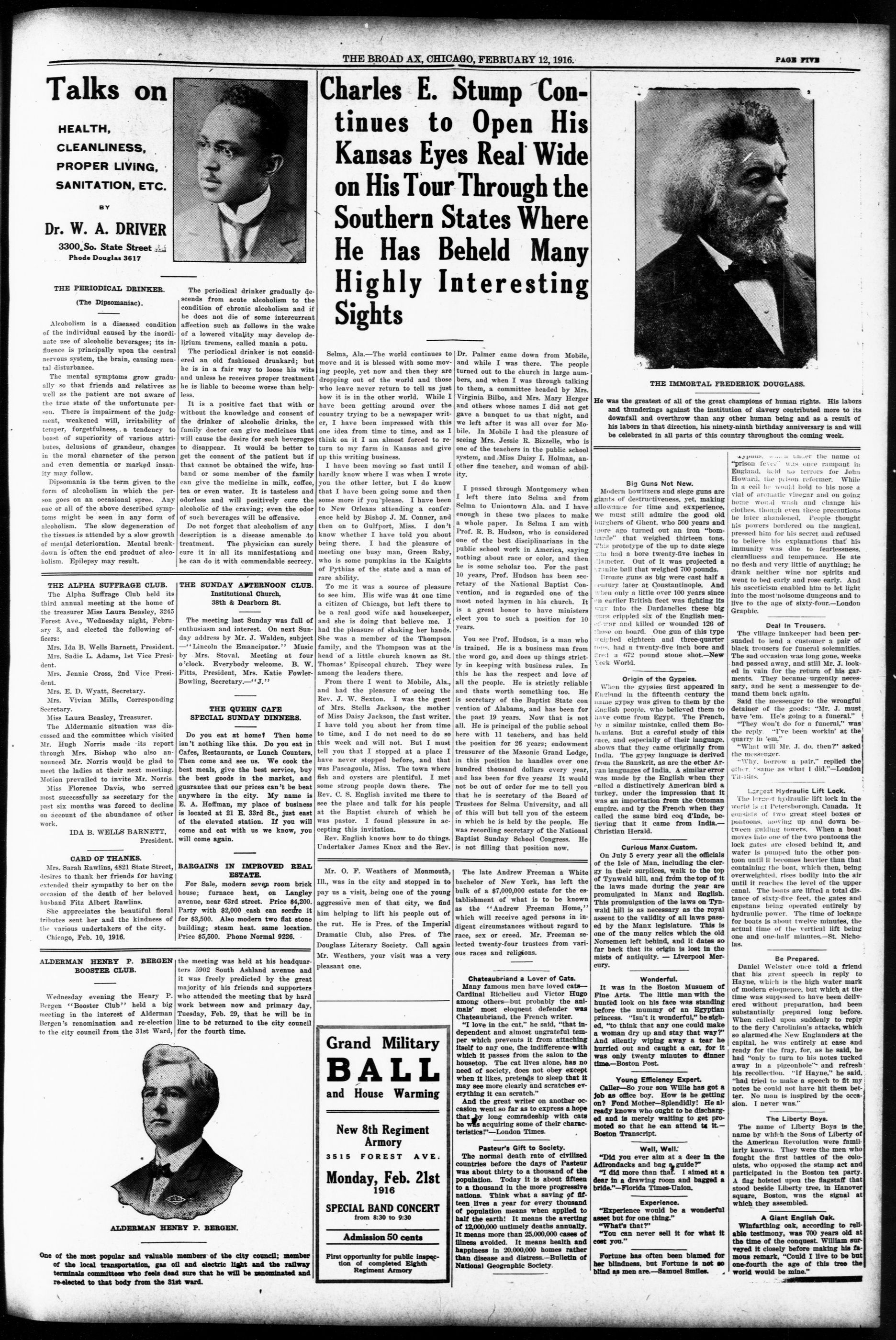
Talks on
HEALTH, CLEANLINESS, PROPER LIVING, SANITATION, ETC.
Dr. W. A. DRIVER
3300 So. State Street
Phode Douglas 3617
(The Dipsomaniac).
Alcoholism is a diseased condition of the individual caused by the inordinate use of alcoholic beverages; its influence is principally upon the central nervous system, the brain, causing mental disturbance.
The mental symptoms grow gradually so that friends and relatives as well as the patient are not aware of the true state of the unfortunate person. There is impairment of the judgment, weakened will, irritability of temper, forgetfulness, a tendency to boast of superiority of various attributes, delusions of grandeur, changes in the moral character of the person and even dementia or marked insanity may follow.
Dipsomania is the term given to the form of alcoholism in which the person goes on an occasional spree. Any one or all of the above described symptoms might be seen in any form of alcoholism. The slow degeneration of the tissues is attended by a slow growth of mental deterioration. Mental breakdown is often the end product of alcoholism. Epilepsy may result.
THE ALPHA SUFFRAGE CLUB.
The Alpha Suffrage Club held its third annual meeting at the home of the treasurer Miss Laura Beasley, 3245 Forest Ave., Wednesday night, February 3, and elected the following officers:
Mrs. Ida B. Wells Barnett, President.
Mrs. Sadie L. Adams, 1st Vice President.
Mrs. Jennie Cross, 2nd Vice President.
Mrs. E. D. Wyatt, Secretary.
Mrs. Vivian Mills, Corresponding Secretary.
Miss Laura Beasley, Treasurer.
The Aldermanic situation was discussed and the committee which visited Mr. Hugh Norris made its report through Mrs. Bishop who also announced Mr. Norris would be glad to meet the ladies at their next meeting. Motion prevailed to invite Mr. Norris. Miss Florence Davis, who served most successfully as secretary for the past six months was forced to decline on account of the abundance of other work.
IDA B. WELLS BARNETT,
President.
CARD OF THANKS.
Mrs. Sarah Rawlins, 4821 State Street, desires to thank her friends for having extended their sympathy to her on the occasion of the death of her beloved husband Fitz Albert Rawlins.
She appreciates the beautiful floral tributes sent her and the kindness of the various undertakers of the city. Chicago, Feb. 10, 1916.
ALDERMAN HENRY P. BERGEN BOOSTER CLUB.
Wednesday evening the Henry P. Bergen "Booster Club" held a big meeting in the interest of Alderman Bergen's renomination and re-election to the city council from the 31st Ward,
ALDERMAN HENRY B. BERGEN
One of the most popular and valuable of the local transportation, gas or terminals committees who feels dead re-elected to that body from the 31
One of the most popular and valuable members of the city council; member of the local transportation, gas oil and electric light and the railway terminals committees who feels dead sure that he will be genominated and re-elected to that body from the 31st ward.
BY
Chicago, Feb. 10, 1916.
[Picture of a man in a suit and tie].
The periodical drinker gradually descends from acute alcoholism to the condition of chronic alcoholism and if he does not die of some intercurrent affection such as follows in the wake of a lowered vitality may develop delirium tremens, called mania a potu. The periodical drinker is not considered an old fashioned drunkard; but he is in a fair way to loose his wits and unless he receives proper treatment he is liable to become worse than helpless.
It is a positive fact that with or without the knowledge and consent of the drinker of alcoholic drinks, the family doctor can give medicines that will cause the desire for such beverages to disappear. It would be better to get the consent of the patient but if that cannot be obtained the wife, husband or some member of the family can give the medicine in milk, coffee, tea or even water. It is tasteless and odorless and will positively cure the alcoholic of the craving; even the odor of such beverages will be offensive.
Do not forget that alcoholism of any description is a disease amenable to treatment. The physician can surely cure it in all its manifestations and he can do it with commendable secrecy.
THE SUNDAY APTERNOON CLUB Institutional Church, 38th & Dearborn St.
The meeting last Sunday was full of enthusiasm and interest. On next Sunday address by Mr. J. Walden, subject—"Lincoln the Emancipator." Music by Mrs. Stoval. Meeting at four o'clock. Everybody welcome. B. W. Fitts, President, Mrs. Katie Fowler-Bowling, Secretary—"J."
THE QUEEN CAFE
SPECIAL SUNDAY DINNERS
Do you eat at home? Then home isn't nothing like this. Do you eat in Cafes, Restaurants, or Lunch Counters, Then come and see us. We cook the best meals, give the best service, buy the best goods in the market, and guarantee that our prices can't be beat anywhere in the city. My name is E. A. Hoffman, my place of business is located at 21 E. 33rd St., just east of the elevated station. If you will come and eat with us we know, you will come again.
BARGAINS IN IMPROVED REAL ESTATE.
For Sale, modern seven room brick house; furnace heat, on Langley avenue, near 63rd street. Price $4,200. Party with $2,000 cash can secure it for $5,500. Also modern two flat stone building; steam heat. same location. Price $5,500. Phone Normal 9226.
the meeting was held at his headquarters 5902 South Ashland avenue and it was freely predicted by the great majority of his friends and supporters who attended the meeting that by hard work between now and primary day, Tuesday, Feb. 29, that he will be in line to be returned to the city council for the fourth time.
THE BROAD AX, CHICAGO, FEBRUARY 12, 1916.
Charles E. Stump Continues to Open His Kansas Eyes Real Wide on His Tour Through the Southern States Where He Has Beheld Many Highly Interesting Sights
Selma, Ala.—The world continues to move and it is blessed with some moving people, yet now and then they are dropping out of the world and those who leave never return to tell us just how it is in the other world. While I have been getting around over the country trying to be a newspaper writer, I have been impressed with this one idea from time to time, and as I think on it I am almost forced to return to my farm in Kansas and give up this writing business.
I have been moving so fast until I hardly know where I was when I wrote you the other letter, but I do know that I have been going some and then some more if you please. I have been to New Orleans attending a conference held by Bishop J. M. Conner, and then on to Gulfport, Miss. I don't know whether I have told you about being there. I had the pleasure of meeting one busy man, Green Raby, who is some pumpkins in the Knights of Pythias of the state and a man of rare ability.
To me it was a source of pleasure to see him. His wife was at one time a citizen of Chicago, but left there to be a real good wife and housekeeper, and she is doing that believe me. I had the pleasure of shaking her hands. She was a member of the Thompson family, and the Thompson was at the head of a little church known as St. Thomas' Episcopal church. They were among the leaders there.
From there I went to Mobile, Ala., and had the pleasure of seeing the Rev. J. W. Sexton. I was the guest of Mrs. Stella Jackson, the mother of Miss Daisy Jackson, the fast writer. I have told you about her from time to time, and I do not need to do so this week and will not. But I must tell you that I stopped at a place I have never stopped before, and that was Pascagoula, Miss. The town where fish and oysters are plentiful. I met some strong people down there. The Rev. C. S. English invited me there to see the place and talk for his people at the Baptist church of which he was pastor. I found pleasure in accepting this invitation.
Rev. English knows how to do things. Undertaker James Knox and the Rev.
Mr. O. F. Weathers of Monmouth, Ill., was in the city and stopped in to pay us a visit, being one of the young aggressive men of that city, we find him helping to lift his people out of the rut. He is Pres. of the Imperial Dramatic Club, also Pres. of The Douglass Literary Society. Call again Mr. Weathers, your visit was a very pleasant one.
Grand Military
BALL
and House Warming
New 8th Regiment
Armory
3515 FOREST AVE.
Monday, Feb. 21st
1916
SPECIAL BAND CONCERT
from 8:30 to 9:30
Admission 50 cents
First opportunity for public inspection of completed Eighth Regiment Armory
Dr. Palmer came down from Mobile, and while I was there. The people turned out to the church in large numbers, and when I was through talking to them, a committee headed by Mrs. Virginia Bilbo, and Mrs. Mary Herger and others whose names I did not get gave a banquet to us that night, and we left after it was all over for Mobile. In Mobile I had the pleasure of seeing Mrs. Jessie R. Bizzelle, who is one of the teachers in the public school system, and Miss Daisy I. Holman, another fine teacher, and woman of ability.
I passed through Montgomery when I left there into Selma and from Selma to Uniontown Ala. and I have enough in these two places to make a whole paper. In Selma I am with Prof. R. B. Hudson, who is considered one of the best disciplinarians in the public school work in America, saying nothing about race or color, and then he is some scholar too. For the past 10 years, Prof. Hudson has been secretary of the National Baptist Convention, and is regarded one of the most noted laymen in his church. It is a great honor to have ministers elect you to such a position for 10 years.
You see Prof. Hudson, is a man who is trained. He is a business man from the word go, and does up things strictly in keeping with business rules. In this he has the respect and love of all the people. He is strictly reliable and thats worth something too. He is secretary of the Baptist State convention of Alabama, and has been for the past 19 years. Now that is not all. He is principal of the public school here with 11 teachers, and has held the position for 26 years; endowment treasurer of the Masonic Grand Lodge, in this position he handles over one hundred thousand dollars every year, and has been for five years! It would not be out of order for me to tell you that he is secretary of the Board of Trustees for Selma University, and all of this will but tell you of the esteem in which he is held by the people. He was recording secretary of the National Baptist Sunday School Congress. He is not filling that position now.
The late Andrew Freeman a White bachelor of New York, has left the bulk of a $7,000,000 estate for the establishment of what is to be known as the "Andrew Freeman Home," which will receive aged persons in indigent circumstances without regard to race, sex or creed. Mr. Freeman selected twenty-four trustees from various races and religions.
Chateaubriand a Lover of Cats
Many famous men have loved cats—Cardinal Richelieu and Victor Hugo among others—but probably the animals' most eloquent defender was Chateaubriand, the French writer.
"I love in the cat," he said, "that independent and almost ungrateful temper which prevents it from attaching itself to any one, the indifference with which it passes from the salon to the housepet. The cat lives alone, has no need of society, does not obey except when it likes, pretends to sleep that it may see more clearly and scratches everything it can scratch."
And the great writer on another occasion went so far as to express a hope that by long comradeship with cats he was acquiring some of their characteristics!"—London Times.
Pasteur's Gift to Society
The normal death rate of civilized countries before the days of Pasteur was about thirty to a thousand of the population. Today it is about fifteen to a thousand in the more progressive nations. Think what a saving of fifteen lives a year for every thousand of population means when applied to half the earth! It means the avering of 12,000,000 untimely deaths annually. It means more than 25,000,000 cases of illness avoided. It means health and happiness in 20,000,000 homes rather than disease and distress...Bulletin of National Geographic Society.
3
He was the greatest of all of the great champions of human rite and thunderings against the institution of slavery contribute downfall and overthrow than any other human being and his labors in that direction, his ninety-ninth birthday anniversary be celebrated in all parts of this country throughout the country.
"prison fever" was o England, held no to
He was the greatest of all of the great champions of human rights. His labors and thunderings against the institution of slavery contributed more to its downfall and overthrow than any other human being and as a result of his labors in that direction, his ninety-ninth birthday anniversary is and will be celebrated in all parts of this country throughout the coming week.
He was the greatest of all of the great champions of human rights. His labors and thunderings against the institution of slavery contributed more to its downfall and overthrow than any other human being and as a result of his labors in that direction, his ninety-ninth birthday anniversary is and will be celebrated in all parts of this country throughout the coming week.
Big Guns Not New.
Modern howitzers and siege guns are giants of destructiveness, yet, making allowance for time and exexperience, we must still admire the good old burgers of Ghent, who 500 years and more ago turned out an iron "bombard" that weighed thirteen tons. This prototype of the up to date siege gun had a bore twenty-five inches in diameter. Out of it was projected a bronze ball that weighed 700 pounds. Bronze guns as big were cast half a century later at Constantinople. And when only a little over 100 years since an earlier British fleet was fighting its way into the Dardanelles these big guns crippled six of the English men-of-war and killed or wounded 126 of those on board. One gun of this type weighed eighteen and three-quarter tons, had a twenty-five inch bore and fired a 672 pound stone shot.—New York World.
Origin of the Gypsies.
When the gypsies first appeared in England in the fifteenth century the name gypsy was given to them by the English people, who believed them to have come from Egypt. The French, by a similar mistake, called them Bohemians. But a careful study of this race, and especially of their language, shows that they came originally from India. The gypsy language is derived from the Sanskrit, as are the other Aryan languages of India. A similar error was made by the English when they called a distinctively American bird a turkey, under the impression that it was an importation from the Ottoman empire, and by the French when they called the same bird coq d'Inde, believing that it came from India.—Christian Herald.
Curious Manx Custom
On July 5 every year all the officials of the Isle of Man, including the clergy in their surplices, walk to the top of Tynwald hill, and from the top of it the laws made during the year are promulgated in Manx and English. This promulgation of the laws on Tynwald hill is as necessary as the royal assent to the validity of all laws passed by the Manx legislature. This is one of the many relics which the old Norsemen left behind, and it dates so far back that its origin is lost in the mists of antiquity. — Liverpool Mercury.
It was in the Boston Museum of Fine Arts. The little man with the hunted look on his face was standing before the mummy of an Egyptian princess. "Isn't it wonderful," he sighed, "to think that any one could make a woman dry up and stay that way?" And silently wiping away a tear he hurried out and caught a car, for it was only twenty minutes to dinner time—Boston Post.
Young Efficiency Expert.
Caller—So your son Willie has got a job as office boy. How is he getting on? Fond Mother—Splendidly! He already knows who ought to be discharged and is merely waiting to get promoted so that he can attend it. Boston Transcript.
Well. Well.
"Did you ever alm at a deer in the Adirondacks and bag a guide?"
"I did more than that. I aimed at a dear in a drawing room and bagged a bride."-Florida Times-Union.
Experience.
"Experience would be a wonderful asset but for one thing."
"What's that?"
"You can never sell it for what it cost you."
Fortune has often been blamed for her blindness, but Fortune is not so blind as men are.—Samuel Smiles.
Wonderful.
3
champions of human rights. His labor sion of slavery contributed more to its other human being and as a result of y-ninth birthday anniversary is and will entry throughout the coming week.
Aphus, with a tincer the name of "prison fever," was once rampant in England, held no terrors for John Howard, the prison reformer. While in a cell he would hold to his nose a vial of aromatic vinegar and on going home would wish and change his clothes, though even these precautions he later abandoned. People thought his powers bordered on the magical, pressed him for his secret and refused to believe his explanations that his immunity was due to fearlessness, cleanliness and temperance. He ate no flesh and very little of anything; he drank neither wine nor spirits and went to bed early and rose early. And his asceticism enabled him to let light into the most nolome dungeons and to live to the age of sixty-four—London Graphic.
Deal In Trousers
The village innkeeper had been persuaded to lend a customer a pair of black trousers for funeral solemnities. The sad occasion was long gone, weeks had passed away, and still Mr. J. looked in vain for the return of his garments. They became urgently necessary, and he sent a messenger to demand them back again.
Said the messenger to the wrongful detainer of the goods: "Mr. J. must have 'em. He's going to a funeral."
"They won't do for a funeral," was the reply. "I've been workin' at the quarry in 'em."
"What will Mr. J. do, 'then?' asked the messenger.
"Why, borrow a pair," replied the other, "same as what I did."—London Titbits.
Largest Hydraulic Lift Lock.
The largest hydraulic lift lock in the world is at Petersborough, Canada. It consists of two great steel boxes or pontoons, moving up and down between guiding towers. When a boat moves into one of the two pontoons the lock gates are closed behind it, and water is pumped into the other pontoon until it becomes heavier than that containing the boat, which then, being overweighted, rises bodily into the air until it reaches the level of the upper canal. The boats are lifted a total distance of sixty-five feet, the gates and capstans being operated entirely by hydraulic power. The time of lockage for boats is about twelve minutes, the actual time of the vertical lift being one and one-half minutes.—St. Nicholas.
Be Prepared.
Daniel Webster once told a friend that his great speech in reply to Hayne, which is the high water mark of modern eloquence, but which at the time was supposed to have been delivered without preparation, had been substantially prepared long before. When called upon suddenly to reply to the fiery Carolinian's attacks, which so alarmed the New Englanders at the capital, he was entirely at ease and ready for the fray, for, as he said, he had "only to turn to his notes tucked away in a pigeonhole" and refresh his recollection. "If Hayne," he said, "had tried to make a speech to fit my notes he could not have hit them better. No man is inspired by the occasion. I never was."
The Liberty Boys
The name of Liberty Boys is the name by which the Sons of Liberty of the American Revolution were familiarly known. They were the men who fought the first battles of the colonists, who opposed the stamp act and participated in the Boston tea party. A flag hoisted upon the flagstaff that stood beside Liberty tree, in Hanover square, Boston, was the signal at which they assembled.
Giant English Oak
Winfarthing oak, according to reliable testimony, was 700 years old at the time of the conquest. William surveyed it closely before making his famous remark, "Could I live to be but one-fourth the age of this tree the world would be mine."
PAGE FIVE
PAGE SLX
eer ee
A South American Hobo.
Santiago, capital of Chile, is the
home of the roto Chileno, or broken
Chilean, most picturesque and unique
of hoboes. The name is a byword in
South America, and as far as that con-
tinent is concerned he is a unique type.
We find rich people everywhere and
Poor people everywhere, but in no oth.
er South American country but Chile
do we find this good natured, service.
able, deceitful, ragged, drunken, erimt-
nal species of tramp. He earns a live
MWhood by begging, doing odd jobs and
thieving. The last is bis mainstay. In
his hands stealing has become a fine
art. The Chileans have a saying that
he will steal your socks without touch
ing your boots. A long, jointed wire
with a hook at the end is his favorite
tool If a window on the street is left
unguarded he will with this simple
contrivance successfully remove from
the interior everything but the heavy
furniture.—New York Independent.
Don'ts For Poets.
Arthur Guiterman in a recent Inter
view gave a list of negative command.
ments for would-be poets. “Don't
think of yourself as a poet and ‘dress
the part,” he says. “Don't frequent
exclusively the company of writers
Don't complain of lack of appreciation.
In the long run no really good pub
lished work can escape appreciation’
Don't speak of poetic license or believe
that there is any such thing. Don't
use ‘e'er’ for ‘ever,’ ‘o'er’ for ‘over,
‘when as’ or ‘what time’ for ‘when’ or
any of the ‘poetical’ commonplaces of
the past. Don't say “did go’ for ‘went.
even if you need an extra syllable
Don't—don't write hymns to the great
god Pan. He is dead: let him rest in
Peace! Don't write what everybods
else is writing.”—Kansas City Star.
——
Our Navy a Century Aco.
One hundred years ag6 the naval
force ef the United States on the At
lantic coast consisted of thirty-three
vessels, twenty-seven of which were
in commission. Among them were a
dozen great ships, first class frigates
and sloops of war, some of them car
rying as many as seventy-four guns
each. They were all sailing vessels
‘The era of the steam warship, how.
ever, was close at hand. With the aid
of an appropriation from congress
there was now nearing completion a
“floating steam battery,” designed by
Robert Fulton. This ship, which was
launched a few months later, was the
first steam war vessel ever built and
was destined to revolutionize the meth
ods of naval warfare throughout the
world.—Exchange.
‘Siitete Ghani ae
Fer many years London has been
steadily drained of her gold by India
In ten years India has absorbed from
circulation 150,000,000 gold sovereigns
and hoarded them away. The coolie
bas learned that silver rupees are. a
Poor investment, especially if he melts
them into anklets or a nose ring for
his wife, as over 30 per cent of the
silver is lost in the melting pot, while
the gold sovereign preserves its value
whether he keeps it as a coin or melts
it When a coolie collects 15 ru
ees which he finds to be temporarily
surplus he buys a sovereign with it
He has come to understand the wis.
dom of hoarding away only the gold
coin, which be knows he can always
realize on at its original value.
i a aa
‘The prettiest dress of the Mpongwe
woman fs a cloth drawn up under the
arms, a scarf on the shoulders and a
handkerchief folded over the coiled
hair in a high stiff fold set well up on
the head, rather like a child’s idea of
@ crown. There is a great fancy for
purples and lavenders set off with
shades of rose and red and a sudden
keen note of gilt. With black there
will be a touch of most delicious bright
green. A cloth and a scarf worn by a
‘Woman of beautiful gesture—and a Ga-
bonnaise is always that—have a certain
mutable charm; the movements of the
body, the wind that blows from the
sea—these renew and display the folds
of the garment so that the eye is in-
trigued.—Atlantic.
But None For Him.
“Any letters for me?”
“What name?”
“Jason Howlet.”
“Um-m-m. Nope.”
“That's strange.”
“Expecting any?"
“No, but Israel Pubbleton was read-
ing the other day thet there was enough
letters sent through the postoffice last
year to give every man, woman and
child twenty-three each, an’ I thought
T'd come in for my share.”—Pittsburgh
Chronicle-Telegraph.
An Oversight.
“What do you think of his nerve?”
exclaimed the old man, who was noto-
fiously tricky in business. “He called
me a barefaced robber!”
“Ob, well.” replied the man who
knew him, “probably in his excitement
he didn’t notice your mustache.”"—New
York Globe.
Dentin Gi
“They call her the human grapho
phone.”
~ “Just because she buzzes a bit?”
“It’s on account of the airs she puts
ou."—Louisville Courier-Journal.
Great Knowledge.
“Does he know anything about a
carr
“He certainly does. He knows how
to sell It after it gets worn out”—
Puck.
Without kind offices and useful serv-
ices, wherever the power and oppor
tunity occur. love would be a hollow
pretense.—Coleridge.
Could Eat as Well as Writs.
Dr. Johnson was a great tea drinker
It is stated that he would drink thirty
or forty cups of tea during an evening’
Yet he lived to a fair age and appar
ently suffered no very ill effects from
‘his great thirst for tea. He was one
of the most notable of feeders and ate
his food in what we should now think
rather a piggish fashion, making great
grunts and groans of satisfaction ot
enjoyment the while and going the
round of the menu very thoroughly.
Charles Reade, the famous novelist.
is reported to have been one of the
strangest feeders on record. A contem-
porary, writing of his meals at the Gar-
Tick club, says: “He took a cauli
flower, flanked by a jug of cream, as
his first course, and a great salad to
follow, washed down by curious drinks
of the shandygaf order. He would
drink coffee associated with sweets.
black pudding and toasted cheese, to
the amazement of any onlooker.”
aap a eC eC Ere
‘The struggle of life among the birds
and other wild creatures is so severe
that the feeble and malformed, or the
handicapped in any way, quickly drop
out. Probably none of them ever dies
from old age. They are cut off in their
prime. A weeding out process goes on
from the time they leave the nest. A
full measure of life, the perfection of
every quill and feather and unerring
instinct carry them along. They are
always in the enemy's country; they
are always on the firing line; eternal
vigilance and ceaseless activity are the
price of life with them. The natural
length of life of our smaller birds is
calculated to be eight or ten years, but
probably not one in a thousand reaches
that age. Not half a dozen times in
my life have I found the body of a
dead bird that did not show some
marks of violence—John Burroughs in
Harper's Hagazine.
iccias Mes eee:
‘The greatest remedy for anger ts de
lay. Beg anger to grant you this ai
the first, not in order that it may par
don the offense, but that it may form
a right judgment about ft If it de
lays it will come to an end. Do no!
attempt to quell it all at once, for tts
first impulses are fierce. By plucking
away {ts parts we shall remove the
whole. We are made angry by some
things which we learn at second hand
and by some things which we ourselves
hear or see. Now, we ought to be slow
to believe what is told us * * * If
you were about to give sentence In
court about ever so small a sum of
money you would take nothing as
proved without a witness, and a wit
ness would count for nothing except on
his oath. You would allow both sides
to be heard: you would allow them
time—Seneca.
Fis Mites Stee
In the rock of St. Gowan's chapel, tr
Wales, was a natural cavity upon
which the name of the “expanding
stone” was bestowed by popular tradi
tion, because the strange fancy prevail
ed that this stone automatically adapt
ed itself to the size of any one who
entered the cavity.
The legend ran, as quoted by Mr.
George F. Kunz in “The Magte of
Jewels and Charms,” that once, dur
ing the pagan persecutions, when a
fugitive Christian, hotly pursued, reach
ed this rock it opened up of tts own
accord so that he could slip into it
and then closed about him so as to
hide him effectually from his enemies
This expanding stone was believed to
manifest its magic power by bringing
to pass the wish expressed by any one
who entered it, provided he did not
change his wish while he turned
around within tt
shieaeede mnie
Female sparrows are especially ty.
rannical toward their partners, espe
cially at nest building time, when thes
frequently attack their husbands flerce
ly on account of their laziness. At
such times the female voice can al
ways be detected, both louder and
shriller than that of her mate, as she
Pecks and tousles him until he beats
an ignominious retreat. Hen black
birds and thrushes are often very over
bearing and even spiteful toward thelr
mates when their houses are in course
of construction.
Winning Both Ways.
‘The Zulu young lady, when suitors
are not forthcoming, takes the matter
in hand herself. She leaves home.
takes a discreet friend of her own sex
and presents herself at the home of
her favored swain. If he regards her
with satisfaction his parents receive
her as bis future bride. Should he.
however, be unwilling to accept her
he makes her a handsome present in
stead.
The Old Greek Cuirass.
‘The Greeks had a cutrass made of
finen or woolen fibers which was im-
penetrable to the sharpest darts or
spears. That, by the way, is one of the
discoveries that have not been redis-
covered, for we do not know the secret
of its manufacture. |
The Worm Turns.
“How much are your four dollar
shoes?” asked the smart one.
“Two dollars a foot.” replied the
salesman wearily.—Judge.
ary
“I say, your ears have never been
pierced, Aileen?”
“No, ‘but they're being “bored? "—
Lehigh Burr.
‘Two Extremes.
There are no chagrins so venomous
as the chagrins of the idle, no pangs
80 sickening as the satieties of pleas-
are—Ruskin.
=H BROAD AX, CHIOAGO, ERERUARY 1s Wi
Academic Dress. = Pure Drinkin,
Academic dress is a sort of scholars} The geolozic mee
badge consisting of gowns, hoods and| value to the health of commut
caps, copied or adapted from styles| supply of pure drinking wat
Jong prevalent in England, the combi-| generally recognized that a 0
nation of articles being so arranged as| diseuxes, prominent among w
to Indicate the degree or academic] typhoid fever and amweble dy
status of the wearer. The code was| a disease more common in tre
formulated by an intercollegiate col-| mates, but found also in th
lege commission chartered by the Uni-| States—are contracted thronyh
versity of New York and bas been| inated water or contuminut
adopted in many American colleges.| Therefore a supply of pure w
There are three distinct types of gowns| eliminute one of the sources
and hoops—the bachelor’s. the mas-| infection.
ter’s and the doctor's. The bachelor’s| It is highly desirable to obt
gown is most commonly worn and bas] plies of domestic water from
long pointed sleeves; the master’s gown | other than the shallow wells,
has long closed sleeves with a siit| them open, that are found ne:
through which the forearm protrudes;| houses. The water obtained fr
the doctor's gown has velvet bars on| Wells has percolated through s
round open sleeves and velvet facings| Other material for so great a
down the front. Caps worn with such | that its impurities have been
gowns are the regulution mortar boards| by filtration. and it possesses
with black silk tassels.—Philadeiphia| tary Value that cannot well be
Pres. timated. for such water is fr
oe the bacteria causing typhoid f¢
Ones the protozoa causing amoebi
The menuments of China are among
the most conspicuous in the world.
Interpreted broadly they range from a
¢oin or an oracle bone to the Great
wall. China has more than 2.000 im-
Portant specimens of the pagoda, an
original form of tower architecture un-
surpassed for beauty by any similar
kind of structure. The Porcelain tower
at Nanking deserved to be ranged with
the wonders of the world, and for
reasons which made it the superior of
the so called seven wonders. Chinese
sculpture has never been surpassed,
and there is no evidence in mundane
art to show that it ever will be. There
is a single fragment in the Metropoli-
tan museum in New York—a stone
head of the Tang period—whose gran-
deur of plastic mastery since its ap-
pearance has conferred distinetion upon
the sculpture of the world.—Journal of
the American Asiatic Association.
Sila Gelisee Handican.
“I remember when it was really a
@isadvantaze to have had a technical
mining education.” said John Hays
Hammond. “I remember zoing to one
of the large mining tasnatex of the
day in Californis. who bad got his in-
formation and experience by bard
knocks, and asking for a job. He
said: “There is one serious objection
to you. You tave been at Freiburg.
and you know sou have to unlearn a
good deal when you xet into active
Practice.’ I am sorry to say there is
@ great deal of truth in that too.
‘Well.’ I said. “I will tell you in con-
fidence, but do not repeat this to my
Poor father, who lis mde every sacri-
fice to send me shroud for a mining
education—I did not iearn a confound-
ed thing at Freiburg. ‘Then he said.
‘I will take you. And that was the
first job I ever got.”
a i a a
| Most of the oid inus of chancery are
‘mo more. Clement's inn. where Fal
staff and Shallow “heard the chimes at
midnight;" New inn, of which Sir
Thomas More was 1 member: Lyon's
fan, where Cobe once tiught the stu-
dents; Furnival’s inn. where Charles
Dickens lived: ‘Tliavies inn, which was
one of the earliest of all the legal set-
flements in Loudon: Barnard’s inn.
where Lord Chief Justice Holt was
among the “principalx"-all these bis-
torie places tive “in the change and
chance of time” disappeared from
view. Staple inn remains in its an-
cient state by the good will of the in-
surance company that purchased it a
number of years ago—London Law
Journal.
Sindh Mine:
In his book abont his distinguished
father the son of Louis Agassiz tells
Story that relates to the life of the
great scientist in America. A few
Years before hix death he came into
his house in Cambridge delighted witt
an occurrence he had just seen In Bos.
ton. A carriaze pushing through the
crowd had knocked down a woman
Her escort proceeded to pummel the
driver. “But why.” asked the listener.
“didn't the owner come to his driver's
assistance?’ “Ob.” exclaimed Agas-
siz, “T was holding him.”
Wasted Apology.
“One day.” says a London journalist,
“the late Walter Emanuel called on me
and chatted delightfully. After balf
an hour the humorist said be must go
and apologized for having wasted so
much valuable time.
“‘Don't mention it,’ 1 rushed to re-
ply. “It bas been a pleasure.”
“ ‘Oh, it's not your valuable time I'm
thinking of! said Mr. Emanuel as be
Picked up bis bat ‘It’s mine? "—Ex-
change.
Cettiiion
Caffeine, the active principle of cof.
fee, was discovered by Runge in 1820.
In a pure state it takes the form of
long silky needles. In ordinary cof-
fee it is present to the extent of about
1 per cent, but Java coffee contains 4.4
‘and Martinique bas as much as 64.
——- @
Setting Her Right.
Aunt Rachel~I see yob've patched
ft up with Archie and he's coming
here again oftener than ever. He's
asked you to marry bim fifty times,
hasn't he? Miss Mandy—Oh, dear, no,
aunty, but I suppose he bas asked me
titty times to marry bim
Where Are They?
| Where are those musical children of
yesterday whose musical education
wax complete when they had learned
fo piay “The Maiden’s Prayer” and
‘Monastery Bells?” —Life.
'H bind myself to that which, once
velng rizht. will not be less right when
‘shrink from it.—Kingsley. }
Ke Pure Drinking Water.
The geologic resuure of greatest
value to the health of communities is s
supply of pure drinking water. It is
generally recognized that a number of
diseuxes, prominent among which are
typhoid fever and amoebic dysentery—
a disease more common in tropical cli.
mates, but found also in the United
States—are contracted through contam
inated water or contuminuted food.
‘Therefore a supply of pure water will
eliminute one of the sources of such
infection.
It ts bighly desirable to obtain sup
plies of domestic water from sources
other than the shallow wells, some of
them open, that are found near many
houses. The water obtained from deep
wells has percolated through sands and
other materia! for so great a distance
that its impurities have been removed
by filtration. und it possesses a sani
tary value that cannot well be overes
timated, for such water is free from
the bacteria causing typhoid fever and
the protozoa causing amoebic dysen
tery, and its use obviates the necessity
for shallow wells that may serve as a
breeding place for Anopheles, the mos.
quito t» which malarial infections is
due.—Geolozical Survey Bulletin.
Washinaton at Nicht.
| Night tife comes on swiftly when i
‘gets really started. Night in Washinz
ton is « beautiful girl drawing a black
velvet, jewel bespangled cloak over
white shoulders. The streets are light
ed with dul! bronze. rather low lamps;
artisticaily perfect lamps that hold dull
white, glowing globes. The lamps are
wery close together. They are the
pearls that the girl winds about ber
throat and in her dusky hair.
‘The White House stands out, giim
mering boldly against the black of the
foliage. its lichted windows dimmed
with tightly drawn curtains. What of
national portent may not have hap
Pened behind those same curtained
windows! Perhaps fear has grappled
with bravery behind the shelter of the
friendly walls: perhaps hatred and love
have clashed. Perhaps cowards bave
become strong. and surely strong men
have wept. Characters and homes and
nations have been molded behind those
friendly blinds.—Margaret B Sang
ster, Jr.. in Christian Merald.
‘The Jumping Froa Story.
It was in the Angel Camp bar that
Mark Twain beard from an ex-pilot
called Ben Coon the jumping froz
story. Clemens related it to Artemus
Ward, who urzed him to write it, to be
included in 1 book that Ward was pub-
Ushing- Clemens dallied and sent it
to the publishers too late. but they
handed ft over to 2 dying paper called
the Saturday Press, which gladly gave
it pride of place in its columns on
Nov. 18, 1865. Professor Sidgwick
synopsized it in Greek form for his
book “Greek Prose Composition,” and
thus arose the lezend that the Jump-
ing frog story orizinated in ancient
Greece, a legend in which Clemens him-
self believed till Professor Sidgwick
undeceived him in 1899 by telling him
that the Greek version was merely a
translation of Clemens’ own work.
Simin belinemein Pieiaaeeed.
In dress President Jefferson was gov:
ered by comfort rather than by ele
gance. “Pride costs more than hun
ger, thirst and cold.” he used to say.
and as he lived in an epoch that wit
nessed a mighty revolution in men’s
clothing ax well as in men's govern:
ment, monarchy’s queues and velvets
giving was to short hair and the useful,
ungainly pantaloon. only the watehfal-
ness of his body servant saved bim
from unbelievable anachronisms of eos.
tume. Indeed. in later life at Montt
cello, where this democrat ruled abso
Inte king. he often wore the garments
of several different periods together.
ke superimpoxed geological strata or
the historic remains in the Roman
‘forum.—Century
Bazaars In Asia.
Streets in the bazaar districts of
Asiatic cities are only eight to ten feet
wide. The larger shops are eight by
ten and the smaller ones five by six
feet. with one side giving directly on
the street In each bazaar is a khan
for every ten or twelve shops. These
Khans are two stories high, with an
open court in the center and rooms on
the four sides. all opening into the
court. A door leads from the open
court into the street. Rooms are let to
different storekeepers for storage pur
poses.
Wifely Octimiem.
Husband—When | see all these bills
1 am tired of life. Do you think the
time will ever come when we shall be
out of debt? Wife (cheerfully—Why
not, darling? You know that you are
carrying an exceptionally large life in
surance
Left Handed Revenge.
Officer—Your honor, this chauffeur
ran his car into th’ show windy av a
millinery store. Judge—What millinery
store? Officer—Mme. de Stickum's
Judge—Discharged. That's where my
wife buys her hats.—Philadelphia Bul
letin.
Considerate.
“The most considerate wife 1 ever
beard of.” said the philosopher, “was
& woman who used to date all her let
ters a week or so ahead to allow her
husband time to post them.”
Advice.
First Seutor—I'm going to marry a
poor girl and settle down. Second
Senior—Better marry a rich girl and
settle up.—Yale Recond.
Oft expectation falls and most oft
tere where mont tt promises.—Shake-
psc
If You Fell Off the Earth,
After you have learned that the
earth is spinning through space like a
great top and that we are all living on
the outside of this top you probably
wonder where we would all go if
we fell off. The earth itself has enough
power of attraction to keep everything
on its surface from falling off.
Now, just imagine that this power of
attraction stopped altogether. If that
happened and you were indoors your
head would hit the ceiling. If yoy
were out of doors you would go
straight up into the sky for a long
time, and gradually you would begin
to move slower and slower and slower.
for the resistance of the air would re
tard you. At last you would come to
a stop. and there you would stay. And
very cold you would find it
If the air did not resist. with the
least little jump you would go sailing
off into space. That is the only way
you could fall off the earth, when the
earth’s attraction stopped and when
the air did not resist—Exchange.
edie Wha Aeon
Making an adding machine required
the drilling of ten holes in a stee
Plate a thirty-second of an inch thick
each bole to be accurate to a thou:
sandth of an inch, yet no bigger than
@ pin in diameter Such a problem
stopped tec mannfacture of the ma
chine on a commercial basis until the
inventor of the calculator could invent
@ means of solving it
The machine devised stands but
twelve inches hich ‘The drill which
was built carries ten spindles, each
holding a drill of No. G Morse ganze.
which is about the size of a pin
of ordinary use Each little sliver of
steel that dees the work is driven by
a belt operatins through a cam head
and therefore works at the same speed
as that of its ne'ghbors
‘The actual driliinz requires ten see
onds.—IIlustrated World.
a ee
“We watched two coyotes in captiv
ity the other day.” said a man interest
ed in humane work “They were o'
the same ace. of the same parentas¢
on both sides They bave been nearl;
a year confined in the cage One of
them, the male. is as restless a crea
ture as one mixzbt ever see, almost nev
er quiet. burrsing back and forth with
rapid steps from one end of the caz¢
to the other. apparently never free
from fear. the eye restless and wild
The other. the female, is as gentle as
a dog. likes to. lean against the bars
and be petted. is without fear, a rest
ful, and oue might imagine, a content-
ed animai Here is the o!d question
of heredity Families of humans pre
sent the same problem.”—Detroit Free
Press.
‘Turks’ Names For Greeke,
‘The Turks have definite names for
the Greeks who inhabit Ottoman terrt-
tory and for those who are their own
masters. The latter are Yunan and
their country Yunanistan—names de
rived from “lonia”—while the Greeks
and Turks are Rum. By origin this is
simply “Romans” and is an inherit-
ance from the Byzantine days, when
the inhabitants of Constantinople, the
new Rome. were called Romatol, while
the provincials were known as Hella
dikol “Rum™ was the conquering
Turks’ name for the Byzantine empire.
It survives in Roumelia, while the
popular Greek language of the present
day ts still known as Romaic. But
every Greek, in Greece or in Turkey,
calls himself a Hellene.—London Spec-
tator.
A Mistake Somewhere.
A helpful friend recently requested
us to write a funny piece about a game
We used to play in boyhood’s glad
days called “hiding in the barn.” He
alleged that part of the gang bid and
the rest searched for them, and when
they were found all hands jumped and
yelled most gleefully. ‘This, he tried
to remind us, was very, very funny
Either our memory is failing or we
have lost our sense of humor, for as
We recollect it our father did the hid
ing and we jumped and yelled. And
it does not seem amusing to us even
yet.—Kansas City Star.
Serious Obstacle.
“Has your boy started in business
yet?"
“No. He's been out of college over
;® Year now. but he's still looking
around.”
“Why don't you take him in with
you?”
“Well, to tell the truth, he’s got bis
heart set on a job that pays at least
$10,000 a year, and | don't make that
much myself”—St Louis Globe-Demo-
crat
By Way of Contrast.
“There is one good thing about buy-
ing a really handsome and expensive
dress,” said Mrs. Bunting to Mrs. Lar
Pe 5
“What ts that?"
“Why, you feel as though you really
ought to buy another not quite so good
to save your best one."—Puck
Sympathy.
Husband—Oh. there's that confound.
ed rheumatism again! Wife—I'm so
sorry. I wanted to go shopping tomor.
fow, and your rheumatism is always a
sign of rain. Isn't it provoking!
Not For His Business,
9 But they say.” remarked the patron,
“he has a good head for business.”
“Nonsense!” replied the barber.
“Why, he’s absolutely bald”
Anatomical.
She sang softly leaning in the cradle
of bis arm. her hands in his, thelr
bearts in each cgher's hands —Jack
London's “Martin Eden.”
Persime.ons as Food,
| ‘The only fruit. says a bulletin of
‘the department of agriculture, whicy
equals the persimmon in its vaiue gs
8 food Is the date. Nevertheless many
Dersons with tine persimmon trees ig
their possession are allowing the fruit
to go to waste, either through ig.
norance of the many uses to which it
may be put or through prejudice,
There is a saying in the persimmon
country that persimmons are “good for
dogs, hogs and ‘possums." This, how.
ever, is declared to be a gross injustice
to a very valuable product.
One reason for the neglect of this
fruit Is the mistaken idea that per
simmons are unfit to eat until they
have been touched by frost. As 4
matter of fact, much of the best fruit
fs lost every year because it ripens and
falls to the ground, where, not deing
touched by frost, it fs left to rot. Such
Persimmons as are not edible before
frost comes are a late variety of the
fruit, and the reason that they pucker
the mouth is because ther have not
yet ripened. In general, the best fruit
fs that which ripens just before the
leaves fall.
Rememberina Faces.
| Hotel clerks have a way of recogniz.
ing guests as soon as they sizn a rez
tater. The most successful hotel keep
ers have to have this power of remem.
bering the faces of their guests and aii
about them or they would soon lose
their custom by the mistakes they
would make
Bank cashiers carry in their memo
Hes the faces and signature of most
of the customers of the bank.
Detectives. too, get into the habit of
fememberine the faces of every one
with whom they have to deal, whether
criminals or uot.
“I don't think I have ever forgotten
a customer.” a clerk in one of the biz
safe deposits recently said. “There are
hundreds of safe deposit boxes rented
in our vaults, and T can generally re-
member. without referring to our
books. the name, number and pass-
word of each customer.”—Exchange.
ae es
“Charley horse.” dreaded by bal!
players. is an ailment consisting of
displacement and stricture of the mus
eles of the iez, often the sartorial
cle. The trouble is commonly brough:
about. not by running. but by quick
stopping at bases. The player who
“stops on his feet” is almost certain
to acquire the ailment in a short time
The overworked muscle, slipping out
of place, knots itself into a great ump
and exerts pressure on the surrounding
muscles. producing lameness.
Massaging will bring the mmscle
back to place. but the trouble returns
at the next serious strain.
When you see a player make @ long
slide which appears unnecessary, the
reason is that he prefers to scrape off
a little skin rather than take chances
on “horsing” himself by stopping
standing up.—Exchange.
Lsieienent Clensteatiee.
| There are several substances that be
come luminescent after long exposure
to the rays of the sun, although none
of them emits a brilliant light. It is
believed that this luminescence could
be greatly increased if the problem
Were investigated with as much care
as that giyen to the development of
the incandescent gas mantle. It has
been suggested that if a luminescent
Paint were spread on buildings exposed
to brilliant sunshine they would give
off stored sunlight during the night
and thus preserve one element of the
radiant energy of the sun. One av-
thority remarks. “The general use of
such a paint would enable the more
Powerful methods of artificial flumt
nation to be limited to special locations
and confine the use of existing systems
to indoor service and to spots where
little daylight penetrates “—Wasbinz
ton Star
The Word “Derrick.”
The word “derrick” for a machine
used to lift heavy weights is curiously
derived’ from a London hangman in the
beginning of the seventeenth century
whose name was Theodorie and wh»
is often mentioned in old plays, “He
rides circuit with the devil, and Der
Hick must be his host and Tyborne the
inn at which he will light” occurs in
“The Bellman of London,” pubiishe:
in 1616. The name thus corrupted
came afterward to be applied by an
easy transition to the gallows and later
still to any frame or contrivance re
sembling it in shape.
No One to Do It.
“You say you have three small ebil
dren. Can't you find work?”
The man with the three days’ bean!
and the razged trousers wiped away «
tear. =
“Alas, mum,” he said, “it wouldn't
be any good. They ain’t old enous!
to work yet.”
Life’s Dream.
Life ts but a light dream, whico
son vanishes. To live is to suffer
‘The sincere man struggles tncessant!y
to gain the victory aver bimself.—N::
poleon.
6 Wits ee
If a man does not make new ac
quaintances as he advances throug!
Ute he will soon find himself left alone.
A man should keep his friendship 1
constant repair.—Jobnson.
An Artist.
Mr. Banks—Don’t you think my wite
paints very nicely? Miss yee
Charming! It makes her look so muct
younger, I think.—London Telegraph
God sends a new duty to conquer
vach new pain.—Adelaide Procter.
THE BROAD AX, CHICAGO, FEBRUARY 12, 1916.
cs HOLIDAY SALE
ps Watches, Diamonds, Jewelry
SS ee
AA $7.95 and $10.95
ars Cc. L. LANDE
3518S. State St. Tel. Douglas 7587
Fire Versus Life Insurance.
Of the 12,000,000 or so dwellings in
the United States 96 per cent are pro-
tected—at least to some extent—by
fire insurance. But of our 100,000,000
inhabitants only 18 per cent have tak-
en out life insurance policies. Men
seem to be more uneasy over the mere
possibility of the burning of their
houses than over the stern certainty
that death will some day overtake
them. This is a strange contradiction
in human nature. To safeguard the
nation’s material possessions is well,
but how much more valuable than the
homes are the human lives of the
country! In this age, when the prin-
ciples of life insurance are so well
understood, there should be no such
discrepancy between the number of
homes and of lives insured. In many
instances the former could not be
saved from foreclosure were the earn-
ers of incomes to pass away leaving
the families unprovided for. It is as
much the duty of every man to insure
his life as to insure his property, and
if he has no insurable property there
is all the more reason for insuring his
life—Leslie’s.
ee, SPEGIAL RATES ON STORAGE
| Weegee. of Household Goods, Pianos and Trunks
| ge A, SS ee
oan pt Pa aes*.| For the next thirty days to fill our New
eet Se aerate Warchouse we are giving Special Rates
ee aes ,, __ FIRST MONTH STORAGE FREE
Sky, ry =e Pano in room, alone with dust-proof cover on
ce at BPG) cach ploce’ burlapped beloce parting sway. We
siete "=| guarantee your furniture to come out of storage in
h || just as good condition as it went in, whether it be
‘one month or one year.
Leach’s Storage Warehouse |
Main Office 4430 So. State St. All Phones Oakland 3784
.
How to Ride.
In riding sit erect and don't slouch
along. Don't try to be a cowboy if
you are not. We have the real simon
pure cowpunchers and broncho bus-
ters; also we have the tin horn variety
of the same species. Steer clear of
the latter; also be careful not to get
into this category yourself.
Remember that a horse is only flesh
and blood and not a machine. He gets
tired, hungry’ and thirsty, and for
goodness’ sake, treat him accordingly.
Because he is a lively horse and you
are paying his hire, treat him white
just the same. Remember that some
one else rode him yesterday, and an-
other will probably do so tomorrow.
Give your horse the same kind of a
deal you yourself would demand if
you were in its place. Even a broncho
has feelings and will appreciate your
thoughtfuiness.—Outing.
ss PHONE DouGLAs 6628
ke
pra GABRIEL FRANCHERE, Jr.
eS ae SHOES
a FOR LADIES, MEN AND CHILDREN
SHORT VAMP SPECIALTIES
3109 S. State St. Chicago
One Misery of Anglo-Indian Life.
Every night at dinner the Anglo-In-
dian holds a kind of levee. The in-
sects which attend dance gayly round
the lamp, and one has to watch one’s
plate and glass carefully lest some of
the insects should dance into them.
There is one insect—a little, flat, brown,
shining creature—which emits the
worst odor in the world. If one of
these touches your food the whole is
tainted and rendered inedible. You
dare not kill these pests, for if one be
squashed the whole room becomes fill-
ed with its disgusting smell and ts
uninhabitable for the next half hour.
So these abominable insects fy about
with impunity, while the poor Anglo-
Indian must perforce look helplessly
on and inwardly sigh “spero meliora.”
—Lendon Saturday Review.
lg : Rie cairns 3) <
We Se \:
ey (ato MeV =e a
eS REMOVES DANDRUFF ©) “
By QUINASOAP %
THE IDEAL SHAMPOO SOAP.
ROLL Ct emeee Ur at aes
G2, &
“SYNE oS
= HAIR. STRAIGHTENER ‘q
Roe ar ALS ‘
NY) Amare eae AGF
Walaa (cn at 0 A a Tale OEE ee
If a Naturalist Painted.
If I were to paint the short days of
winter I should paint two towering
feebergs approaching each other like
Promontories, for morning and even-
ing, with cavernous recesses and a sol-
itary traveler wrapping his cloak about
him and bent forward against the
driving storm, just entering the narrow
pass. I would paint the light of a ta-
per at midday, seen through a cottage
window, half buried in snow and frost.
In the foreground should be seen the
sowers in the fields and other evidences
of spring. On the right and left of
the approaching icebergs the heavens
should be shaded off from the light of
midday to midnight with its stars, the
sun being low in the sky.—Henry Da-
vid Thoreau.
and SHIP CANAL
Length - - - - - 32 Miles
Depth - - - = - - 22 Feet
Width - - - 162 to 290 Feet
THE CANAL OFFERS:
Industrial Locations, Dock Facil-
ities, Water Transportation,’ Rail-
road Connections, Electric Power,
Concrete Building Material.
Direct Connection with St. Louis
via the Illinois River and Direct
Connection with the Gulf via the
Illinois and Mississippi Rivers.
Electric Energy Created from
Water Power for the Modern
Factory Means Efficiency and
Economy. :
THOMAS A. SMYTH, - President
JOHN McGILLEN, - - Chief Clerk
F. D. GONNERY, - Comptroller
e e
Karpen Building
900 So. Michigan Ave, | CHICAGO
‘The Lyre Bird.
‘The fully developed male lyre bird
4s one of the most handsome and nota-
ble of the forms of bird life of Queens-
land. The contour of the bird, with
its long neck and stout gallinaceous
feet, is by no means unlike that of a
peacock, and the wonderful tail, pos-
sessed only by the male birds, fulfills
a corresponding role of vain display.
The bird executes antics for a train
of female admirers on a raised earth-
en mound. For a short period of the
year, about January, the lyre bird loses
its characteristic plumes and has to be
content with the sober plumage of its
mate.
Internal Portraiture.
An art patroness was gushing over a
pects the presence of the artist.
“I do not know how it 4s,” she said,
“but when you paint a portrait you
seem to put more into it than any one
else can see.”
“Madam,” he exclaimel in a rhap-
sody, “it is not faces alone that I paint;
ft 1s souls!”
“Oh,” she replied cuttingly, for his
enthusiasm was too warm, “you do in-
teriors, do you?’"—Exchange.
Cold Mixtures.
One of the coldest mixtures known is
made by adding three pounds of mu-
riate of Ime to one pound of snow.
‘Three pounds of snow added to one
pound of salt make the mixture fall
thirty-two degrees below freezing
Point.
Easy Saving.
In Argentina a postal savings bank
account can be opened by depositing
one paper dollar, but after that sums
of mere fractions of a cent may be
entered by purchase of a stamp.
Whe Knows?
A Uttle girl, finishing her breakfast,
looked up and asked, “Mother, what is
hash when it is alive?’—Ohicago Her-
ald.
‘The tucky man is the one who sees
end grasps his oppottunity—Old Say-
Exploding Ice.
To make a piece of ice explode the
first step is to put on a plate a lump of
clear ice about as large as your fist.
Then with a reading glass or the lens
of a magnifying glass focus the sun's
rays so that the bright spot of light is
exactly in the center of the lump. In
4 little time the ice will begin to melt
trom the inside, and after a few mo-
ments a small cavity will appear, for
the ice, having expanded in freezing,
will not take up so much room when
melted. The cavity, being entirely sur-
rounded by ice, will be a partial vac-
uum, filed with a watery vapor of very
low pressure. When you have melted
@ large cavity lay the glass aside and
let the ice melt in the sun. Turn it
occasionally so that it will be sure to
melt evenly round the cavity. After
awhile the cavity will be surrounded
by a thin shell of ice. Then, because
of the great pressure on the outside
(about fifteen pounds to the square
inch), the thin walls will suddenly
collapse, and the ice will fy in all di-
rections.—Youth's Companion.
Sis Ris Dietienieee
Dr. George C. Simpson of the Indian
meteorological service at Simla, in In-
dia, who asserted that the southern
hemisphere is much colder than the
northern, gives in the Scientific Amer-
ican the reasons on which he bases his
opinion. , The air is warmed not by the
rays of the sun, which simply pass
through it, but by the earth, which ab-
sorbs the rays. Now, in the northern
hemisphere there is much land toabsorb
the energy of the sun and to give heat
to the pi In the susthern bemiephere
therevis much less land, and all the
land within the antaretic circle is per-
manently covered with ice, which forms
a virtually perfect reflector and which
sends back into space most of the solar
energy that falls upon it. Five mil-
Yon square miles of the earth’s surface
in the southern hemisphere reflect into
space a large part of the energy re-
ceived from the sun—a fact that in it-
self is enough to account for a consid-
erable difference in temperature.
A Painters Bren Arm
A friend once entered the studio of
George Inness, the American land-
scape painter, while he was at work
and remarked that the picture on the
easel seemed to him much better than
certain former works of the artist.
“Right!” said Inness. “This is going
to be one of my best things, and the
reason is that I have had the good
luck to break my right arm and am
obliged to paint with my left hand.
You see,” he added, showing his right
hand in a sling, “this hand had be
come so darned clever that I could not
catch up with it, and it painted away
without me, while this hand”—show-
ing the left, with which he held his
brush—“is awkward and can do noth-
ing without me.”
In the Same Boat.
Sam had come*home from school,
hungry, as usual. Tossing his spelling
book on the kitchen table, he hastened
to the pantry and began an investiga-
tion of cake box, cupboards and cooky
Jar.
Suddenly the back doorbell rang.
Leaving his unprofitable search, Sem-
nel went to answer. On the steps
stood an unshaven, long haired man
whose clothes needed a tailor and a
laundry worker.
“I'm hungry,” began the stranger in
a low, aggrieved tone, “and should
Uke somethin’ to eat”
“Well, so'm I,” confided the boy,
“put you know I've been a-buntin’ for
ten minutes an’ hain’t found a thing!”
—Tudge.
Too Late.
After the guests had waited for half
an hour in a Berkshire church for the
bride to arrive messengers were dis-
patched to the livery stable to try to
discover what had happened. The liv-
eryman, made to understand that he
had omitted to send a carriage to her
house, acknowledged that all the
blame rested on him and apologized in
manly fashion, but when they suggest-
ed that he should proceed to remedy
the delay he failed to see the point.
“What'll be the use o' fetehin’ 'er
now?” he argued. “The service ‘ll be
‘arf over.”—London Globe.
Those Who Ride.
In all situations of life into which 1
have looked I have found mankind dt-
vided into two grand parties, those
who ride and those who are ridden.
‘The great struggle in life seems to be
which shall keep in the saddle. This,
it appears to me, is the fundamental
principle of politics, whether in great
or little life—From “The Young Man
of Great Expectations,” by Washing-
ton Irving.
Avopearances.
It is the appearances that fill the
scene, and we pause not to ask of
what realities they are the proxies.
When the actor of Athens moved all
hearts as he clasped the burial urn and
burst into broken sobs how few then
knew that it held the ashes of his son!
—Bulwer-Lytton*
Caught.
“Herbert, you weren't listening to
what I said.”
“Er—what makes you think that,
darling?”
“I asked you if you could let me have
$100, and you smiled and said, ‘Yes,
dearest.’ "—Life.
‘One Thing Left.
Wife—Have you shut up everything
for the night? Husband (meekly)—
I'm sorry to say, dear, that I haven't—
New York Sun.
Ob, life! An age to the miserable, a
moment to the happy.—Bacon.
Lincoun STAT, BANK, OF CHCA
3105-07 SOUTH STATE STREET
CHICAGO, ILL.
Douglas 200
CP'TAL, $200,000.00 SURPLUS, $20,000.00 |
et Commercial Banking , |
sa (|| Savings and Checking’Accounts |
PS AG |) Foreign Exchange |
WGite ce ll Safety Deposit Vaults |
iain Te = : Mortgages and Bonds
| ae — |
Cas 3 Per Cent |
i; c
Sabre Interest on Savings
ae : |
: aha a Deposits |
Boy 7 a EM ae
Ua) ee Your Patronage Solicited |
URED eee Setesberes || Depoclticy and! Conesponde ¢,
tors: will start yousaving and Continental & Commercial
ee tie Ge aoe National Bank of Chic:vc,
wealth. OPEN one with US. Minois.
| NOTARY PUBLIC
| Faustin S. Delany
| Attorney and Counselor at Law
‘312 S. Clark St., Suite 422
CHICAGO
COLLECTIONS A SPECIALTY
Res. 4510 St. Lawrence Ave.
Tel. Drexel 5260
es SL rend SBS e
PHONES: OFFICE. MAIN 4153
AUIOMATIC. 33-736
RESIDENCE. DREXEL 70090
Walter M. Farmer
ATTORNEY AT LAW
SUITE 708, 184 WASHINGTON ST.
NOTARY FUBLIC CHICAGO
an eae
eculouen ie eeniriens wots
Dr. Theo. R. Mozee
DENTIST
4709 S. STATE STREET
CHICAGO
ae nn cabal eecae
pena |
Phone Main 2017 Automatic 32-395
A. L. WILLIAMS
ATTORNEY AND COUNSELOR AT LAW
Suite 706 Firmenich Bldg.
184 W. Washington St.
Residence 5548 Jefferson Av.
Phone Midway 5515 Chicago
THE BROAD AX CAN BE FOUND
ON SALE AT THE FOLLOWING
NEWS STANDS:
From on and after this date The
Broad Ax, can be found on sale at the
following news stands:
N. ©. Chalmers, cigars, tobacco, no-
tion store and news stand, 5012 8.
State street.
"LE. Chilton, news stand, 8. E. cor-
ner Sist and State streets.
8. Berenbaum, Cigars, Notions and
News Stand; 31 W. 61 Street, near
Dearborn.
E. H. Faulkner, news agency; 3109 S.
State street.
George I Martin, maker of fine cig-
ars and news stand, 18 W. 3lst St.,
near State.
R, M. Harvey’s barber shop and
‘news stand, 3924 State street.
—W. M. Maxwell, notions, cigars, to
‘bacco, confectione and news stand,
5244 State St.
Edward Felix, notions, cigars and
news stand, 52 W. 30th St.
F. Bishop, cigars, tobacco and news
stand, 3 W. 27th St., near State.
Sylvester MeGloffin, news stand and
laundry office, 4122 State St.
William Gaughan, laundry office
cigars, tobacco and news stand, 2636
State St.
E. M. Oliver, notions, cigars and
aews stand, 15 W. 86th Street, near
State.
AL D. Hayes, cigars, tobacco, notions,
stationery and news stand, 3640 8.
State St.
George MeFaro, shee shining parlors
‘and news stand. 3890% State stros.
PAGE SEVEN
A. D. GASH
ATTORNEY AT LAW
118 North La Salle St., Chicago
Suite 615 to 616
PHONE MAIN 2214
Residence 1262 Macalister Place
Telephone Monroe 2714
MILES J. DEVINE
ATTORNEY AT LAW
Suite 313-329 Reaper Block
Ciark & Washington Sts.
Phones Cemiral 239
Rato. 41-916 CHICAGO
Franklin A. Denison
ATTORNEY AT LAW
36 West Randolph St., Chicago
Suite 708 Delaware Building
Tel. Central 3142
| Phone Ros, 508 E. 36th St.
FRANKLIN 2727 Phone Deurlan 4307
AUTO. 41-543
J. GRAY LUCAS
ATTORNEY-AT-LAW
25 N. Dearborn St.
cms CHICAGO
FRANK"DUNM | rrugege Eatablabed 187
TEL. OAKLAND 1850, 1851, 1552
JOHN J. DUNN
wou O@Osf Ew
Fitty-Firet and Armour Avenue
RAILYARDS
Sist St. and L. S. & M.S.
Sist St. and Armour Ave.
cHrcaeo
T. B. Hall, Laundry office, cigars,
tobacco and news stand. 3618 South
State street.
Fred M. Waterfield, cigars, tobacco,
notions and news stand, 5202 South
State street.
Coleman & Glanton, cigars, tobacco
and news stand, 3342 8: State street.
Miss E. M. McClain, hair dressing
parlor and news stand. 30 W. 39th
street.
F. M. Diffay, cigars, tobacco, notions
and news stand. 3605 State street.
eek Ci aes Maina
‘When | look back on the shifting
scenes of my life, if I am not that al-
together deplorable creature, a man
without a country, 1 am, when it comes
to pull and prestige, almost equally
bereft, as I am a man without a state.
I was born in Indiana, I grew up in It-
nois, I was educated in Rhode Island,
‘and it is no blame to that scholarly
community that I know so little I
learned my law in Springfield and my
politics in Washington, my diplomacy
in Europe, Asia and Africa. I have a
farm in New Hampshire and desk
room in the District of Columbia.
When 1 look to the springs from
which my blood descends the first an-
cestors I ever heard of were a Scotch-
man who was half English and a Ger-
man woman who was half French. Of
my immediate progenitors my mother
was from New England and my father
was from the south. In this bewilder-
ment of origin and experience I can
‘only put on an aspect of deep humility
tm any gatbering of favorite sons and
confess that | am nothing bat an
American.—From “The Life and Let-
tore of Joh Bay” im Harpers Mags:
i a
PAGE EIGHT TEENAN JON
TEENAN JONES' PLACE
3445 SOUTH STATE STREET Telephone Douglas 4591
The finest and most BUFFET and CAR Side. First-Class E HENRY "TEENAN" A. F. CODOZOE, J. H. WHISTON, Proprietors CHAS. HARRIS, Manager The Elite AND BU 3030 STATE STREET
The finest and most UP-TO-DATE BUFFET and CAFE on the South Side. First-Class Entertainers. HENRY "TEENAN" JONES, Proprietor.
A. F. CODOZOE, DOUGLAS 5971
J. H. WHISTON, Proprietors Phones DOUGLAS 3256
CHAS. HARRIS, Manager AUTO. 721-379
The Elite Cafe
AND BUFFET
3030 STATE STREET CHICAGO
JOHN BLOCKI, President
JOHN BLOCK
PERFUME
GO TO
C. E. KREYSSK
5057 South St
NOT ON THE
FOR HIGH GRADE DRUG
MEDICINAL PRE
All Prescriptions Caref
ALSO CARRY A F
BLOCKI'S IDEAL & B
IN BOTTLE P
JOHN BLOCKI & SON PERFUMERS
FOR HIGH GRADE DRUGS, CHEMICALS AND MEDICINAL PREPARATIONS
BLOCKI'S IDEAL & BLOCKI'S FLOWER IN BOTTLE PERFUMES
All Eye Trouble
SEE
DR. LOUIE USSELMAN
The Practical Optician
THE MOST COMPLETE OPTICAL ROOMS IN THE CITY
BEST GOODS AT THE LOWEST PRICES
Consultation or examination
FREE. We have 28 different
ways of testing the eyes and
guarantee to give satisfaction.
3150 S. STATE ST
Phone Douglas 5308
CHICAGO
When you talk of maintaining a principle be sure that it is not a prejudice.
The man that feels like being kicked seldom allows another the pleasure of doing it.
Unless all signs fail, this year will be a record breaker in the making of world history.
Next June will give both Chicago and St. Louis new opportunities to pose as summer resorts.
Everything can be overdone. Many a fellow has been fired with enthusiasm by his boss.
The drug shortage is so acute now in England that many chronic invalids are rapidly becoming convalescent.
If every man who was "a little odd" had to be arrested there wouldn't be enough men at liberty to enforce the law.
Saying the right thing at the right time is equivalent to keeping your mouth shut when you have nothing to say.
In another year the nation will again be giving earnest thought to the question of whether there is going to be any inaugural ball.
It couldn't have been the landlord class that agitated the war as some would have us think. People in Europe are many millions of dollars behind in their rent.
Political Quips.
No lack of preparedness anywhere for presidential nominations.—Atlanta Constitution.
Politically speaking, the rising temperature bulletin is already out for next June.—Washington Star.
Some of the presidential candidates now in the race won't get much for their run except the exercise.—Philadelphia Press.
It is wonderful how clearly a public officer can see what ought to be done—after his term of office is over.—Pittsburgh Post.
Ohio has six native sons in the United States senate. not to mention the long waiting list for the presidency.—Cleveland Plain Dealer.
Dr.
and most UP-TO-DATE
CAFE on the South
as Entertainers.
"N" JONES, Proprietor.
DOUGLAS 5971
Phones DOUGLAS 3256
AUTO. 721-379
Elite Cafe
BUFFET
SET CHICAGO
F. W. BLOCKI, Treasurer
BLOCKI & SON
PERFUMERS
GO TO
SSLER, Druggist
North State Street
THE CORNER
DRUGS, CHEMICALS AND
PREPARATIONS
Carefully Compounded
RY A FULL LINE OF
& BLOCKI'S FLOWER
PERFUMES
All Eye Trouble
SEE
Dr. Louie Usselmann
The Practical Optician
3150 S. STATE ST.
Phone Douglas 5308
CHICAGO
Courting In Spain.
In sunny Spain etiquette is so very restrictive in the matter of courtship that it is a wonder that young people ever manage to get married at all. Even when, after many difficulties, the engagement is accomplished, the parents have a deciding voice in fixing the date, and, as they prefer long engagements, the wedding day is usually fixed somewhere in the dim future. The best man and maid of honor are expected not only to fulfill the usual duties, but to contribute—sometimes very substantially—to the expenses of the wedding feast. Wedding cake is unknown, but instead packets of sugared almonds are distributed among the guests and sent by post to those who are unable to be present.—Kansas City Star.
A Tiger Story.
There is a story current at Kuloang, central China, about a tiger which gave trouble in that quarter. A missionary and his wife had been worried by the tiger prowling nightly around their home. They determined to be rid of it and one night tied a cow up in the back yard and a dog at the front of the house. Then they armed themselves with guns and kept watch. The tiger appeared. The missionary fired and killed the cow. The wife rushed to see what had happened, and in her absence the tiger ate the dog—Exchange.
Lazy Idleness.
Beware of lazy idenness. It will have its effect on your whole system. It brings on degeneration of the muscles and the internal organs, sometimes resulting in an unhealthy accumulation of fat and sometimes in internal adhesion. In some constitutions it results in shrinkage and premature old age.
Within Reason:
Mistress—Jane, didn't you hear the doorbell? New Servant—Yes, mum. Mistress—Then why don't you go to the door? New Servant—Deed, mum. I ain't expectin' nobody to call on me. It must be somebody to see yourself. mum.—Passing Show.
Evil Enough.
There is evil enough in man, God knows, but it is not the mission of every young man and woman to detall and report it all. Keep the atmosphere as pure as possible and fragrant with gentleness and charity. Dr. John Hall.
THE BROAD AX, CHICAGO, FEBRUARY 12, 1916.
26-Passenger Auto Funeral Coaches
Carries Complete Funeral to Any Local Cemetery and Return
Greater Elegance, Half the Cost
My Formal Compartment Auto-Bars are Revellastimating Formal Service in Chicago. They Are Vastly Preferred to Single Carriages and Autos, as they Incur Great Greater Savings and Gadgets, and Gadgets Save More than Half the High Cost of Carriages and Automobiles Tel. Kenwood 455 Calls Promptly Answered Day or Night Auto. 73-867
PRIVATE CHAPEL UNDERTAKER NOTARY PUBLIC
5028-5030 S. State St. Automobiles for All Occasions Chicago, Ill.
The sycamore tree bears fruit after twenty years' growth.
It has been found that the olive will live longer under water than any other tree.
Flowering plants should never be watered with cold water. It chills the plants.
The cactus and other desert plants have thick stems instead of leaves in order to reduce the loss of water by evaporation to a minimum.
Nicotine is found in only one plant besides tobacco—a large shrub known to botanists as Duboisia hopwoodii, which is native to the interior of Australia.
PITH AND POINT.
A temptation well resisted is the best tonic a man could have.
Many a good reputation has been stabbed by a pointed tongue.
As nearly as can be figured out, a savant is a scientist on foreign soil.
It is better for the drowning man to clutch a life preserver than a straw.
Even persons who never tried it will you that honesty is the best policy.
Many a man who prides himself on his physical strength cannot even hold his tongue.
Aren't there enough peace palaces? A common sense palace seems to be the great need.
Copper is the one basic necessity of the war, making it a copper bottomed war, so to speak.
If the New York restaurants only charge extra for it the horse meat supply won't equal the demand.
The high cost of living ceases to command attention when the high cost of destroying life is computed.
There is one don't in this grip business worth all the others—that war never be.
It's all well enough to warn us about getting the grip, but the trouble is that we never know we've got it until it's got us.
Breathe through the nose and keep the mouth shut, says a doctor, giving advice on the subject of health. Lots of people owe a ripe old age to keeping the mouth shut.
The Royal Box.
Princess Henry of Battenberg, governor of the Isle of Wight, is the only British woman ruler.
King Peter of Servia is not a military man at heart. Rather is he a scholar and philosopher, as is shown by his admiration of John Stuart Mill, whose works he has anonymously translated into Servian.
King Gustav of Sweden is a teetotaler, and he and the entire royal family of Sweden are at the head of the temperance movement in Sweden. His mother for over forty years devoted her time and money and influence to the cause of temperance.
Flippant Flings.
France forbids the export of nuts. We show a welcome disposition to encourage it.—Wall Street Journal. Judging from the number of generals Joffre has retired, one would say he was bent on a general cleaning up.—Chicago Herald. Horse meat has been placed on the New York bill of fare by the health board. A saddle of colt ought to be palatable.—Detroit Journal. New York warehouses are full of cold storage food for Europe. If anything can make them quit fighting this prospect ought to.—Pittsburgh Dispatch.
Fashion Frills.
Women don't object to old fashioned things if they are in style.—Philadelphia Inquirer.
Hosley manufacturers, it is said, are making tremendous profits, and nowadays it is easy to see where our earnings go.—Baltimore American.
The news that women are wearing the farthingale doesn't distress us in the least. It's so much better than hoops.—New York Sun.
If it takes two to make a quarrel it also takes both sides to keep the peace.
A good many fellows can grasp an idea without being able to hang on to it.
It is better to lose than have the fruits of victory leave a bad taste in one's mouth.
Some folks are so used to looking for trouble they don't recognize joy when they meet it.
Europe has long been noted for cheapness. Now she has made human life the cheapest thing.
Even Norway has borrowed $5,000,000 in New York. Pretty soon everybody will be owing us.
Occasionally the charity that begins at home never gets through warming its shins at the radiator.
Nearly all of us do without things we actually need in order to be able to afford a luxury now and then.
Prince Firman Firma is the new Persian premier. There should be nothing unstable about his government.
Under present conditions Europe sees nothing paradoxical in the simultaneous promotion of a war loan and a moratorium.
A German has invented an instrument which measures the ten-millionth of a second. The trouble is that after it is measured it is too much of a back number to be useful.
still us
flame b
uses to
CHIC still uses a car flame burner to uses to heat 35
CHICAGO
still uses a candle and a flat flame burner to test the gas she uses to heat 350,000 flat irons
TEHICAN
98
The Peoples Gas Build
The Peoples Gas Peoples Gas Building
The Peoples Gas Light & Coke Co.
Peoples Gas Building Telephone Wabash 6000
Ruttenberg's
Dry Goods Store
3534 STATE STREET
Phone Douglas 2824
The Cranford Apartment Building. 3600 Wabash Ave.
THE BROADWAY
The finest building ever opened to Colored tenants in Chicago. Steam heat, electric light, tile baths, marble entrance. J. W. Casey, Agent, Phone Randolph 803 74 W. WAS-INGTON STREET.
Cranford Apartment
building. 3600 Wabash Ave.
building ever opened to Colored tenants in Chicago
electric light, tile baths, marble entrance.
CAGO handle and a flat to test the gas she 50,000 flat irons
CHICAGO KNOWS THAT THE flame inside the Gas Iron is blue and hot
While the flame of the open gas jet is white and comparatively cool.
Gas for a hot, blue flame should be tested for its HEAT UNITS.
Gas for a white, luminous flame should be tested for its Candle Power.
The blue-flame appliances now form a big family. In addition to the flat iron, it includes the mantle light, the cooking range, the water heater, the space heater and the factory fire. All together, this family now consumes 98% of the gas manufactured.
The one and only lone member of the luminous flame family, is our old friend, the flat-flame burner.
In its palmy days the flat-flame burned 98% of the gas made—now it burns less than 2% and its finish is waiting.
That is why Chicago must eventually line up with all of Europe's big cities and the eleven State Commissions in this country which have abolished the candle power test of gas and adopted the HEAT UNIT standard exclusively.
Think of this—the next time you look into your gas flat iron. If your home cannot boast of one, your women folks are missing a good thing enjoyed by over 350,000 of their Chicago sisters.
Light & Coke Co.
Telephone Wabash 6000
Nemo
No.326
LASTICURVE-BACK
SELF-REDUCING
Colored Help Employed
J. W. Casey, Agent,
74 W. WAS-INGTON STREET.