The Broad Ax
Saturday, February 26, 1916
Chicago, Illinois
Page text (machine-generated)
BROAD AX
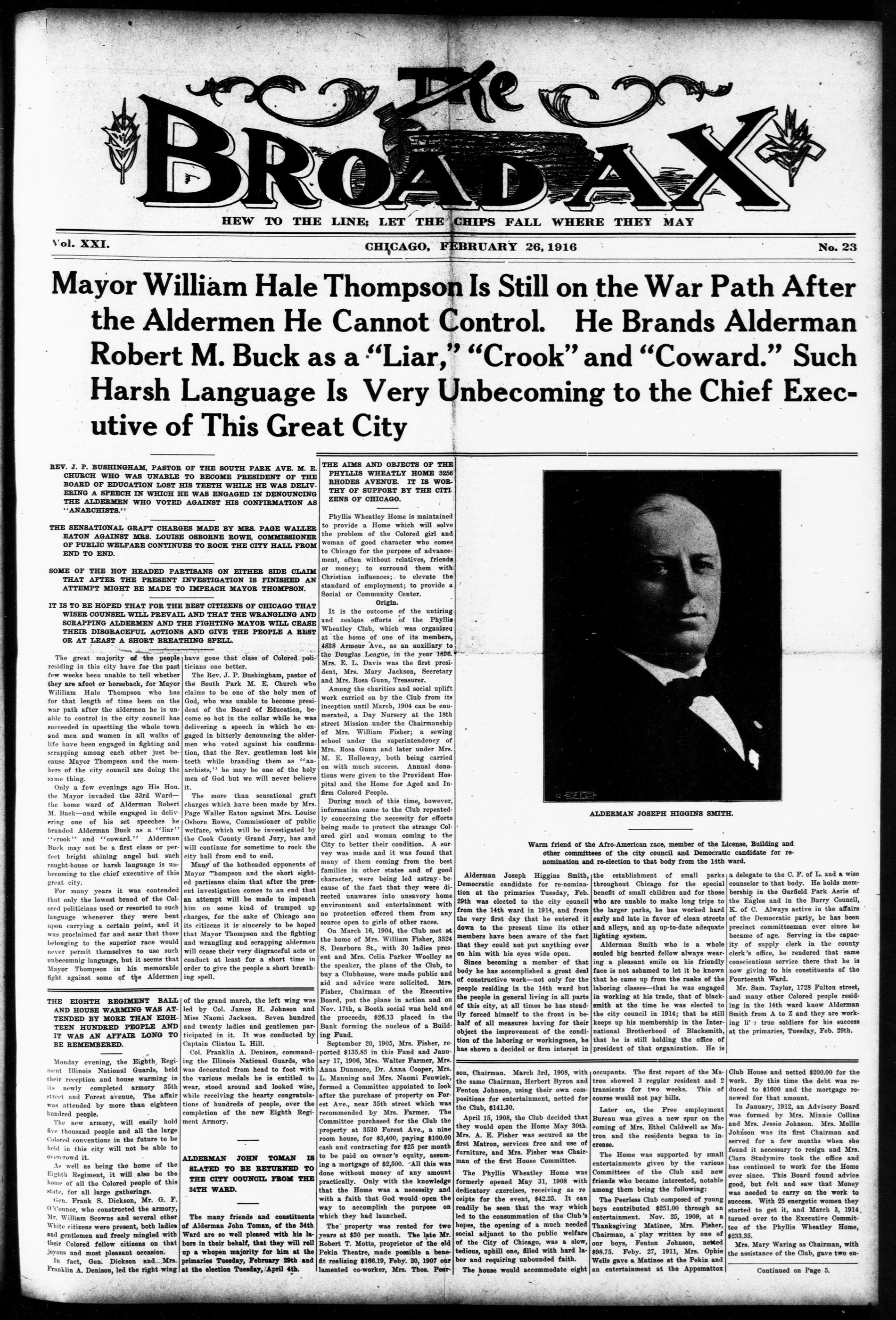
Mayor William Hale Thompson Is Still on the War Path After the Aldermen He Cannot Control. He Brands Alderman Robert M. Buck as a "Liar," "Crook" and "Coward." Such Harsh Language Is Very Unbecoming to the Chief Executive of This Great City
REV. J. P. BUSHINGHAM, PASTOR OF THE SOUTH PARK AVE. M. E. CHURCH WHO WAS UNABLE TO BECOME PRESIDENT OF THE BOARD OF EDUCATION LOST HIS TEETH WHILE HE WAS DELIVERING A SPEECH IN WHICH HE WAS ENGAGED IN DENOUNCING THE ALDERMEN WHO VOTED AGAINST HIS CONFIRMATION AS "ANARCHISTS."
THE SENSATIONAL GRAFT CHARGES MADE BY MRS. PAGE WALLER EATON AGAINST MRS. LOUISE OSBORNE ROWE, COMMISSIONER OF PUBLIC WELFARE CONTINUES TO ROCK THE CITY HALL FROM END TO END.
SOME OF THE HOT HEADED PARTISANS ON EITHER SIDE CLAIM THAT AFTER THE PRESENT INVESTIGATION IS FINISHED AN ATTEMPT MIGHT BE MADE TO IMPEACH MAYOR THOMPSON.
IT IS TO BE HOPED THAT FOR THE BEST CITIZENS OF CHICAGO THAT WISER COUNSEL WILL PREVAIL AND THAT THE WRANGLING AND SCRAPPING ALDERMEN AND THE FIGHTING MAYOR WILL CEASE THEIR DISGRACEFUL ACTIONS AND GIVE THE PEOPLE A REST OR AT LEAST A SHORT BREATHING SPELL.
Vol. XXI.
Mayor Wit
the Aldo
Robert
Harsh
utive o
REV. J. P. BUSHINGHAM, PASTOR
CHURCH WHO WAS UNABLE
BOARD OF EDUCATION LOST
ERING A SPEECH IN WHICH I
THE ALDERMEN WHO VOTED
"ANARCHISTS."
THE SENSATIONAL GRAFT CHARGE
EATON AGAINST MRS. LOUIS
OF PUBLIC WELFARE CONTINU
END TO END.
SOME OF THE HOT HEADED PAY
THAT AFTER THE PRESENT
ATTEMPT MIGHT BE MADE T
IT IS TO BE HOPED THAT FOR THE
WISEER COUNSEL WILL PREVAIL
SCRAPPING ALDERMEN AND T
THEIR DISGRACEFUL ACTION
OR AT LEAST A SHORT BREA
The great majority of the people residing in this city have for the past few weeks been unable to tell whether they are afoot or horseback, for Mayor William Hale Thompson who has for that length of time been on the war path after the aldermen he is unable to control in the city council has succeeded in upsetting the whole town and men and women in all walks of life have been engaged in fighting and scrapping among each other just because Mayor Thompson and the members of the city council are doing the same thing.
Only a few evenings ago His Hon. the Mayor invaded the 33rd Ward—the home ward of Alderman Robert M. Buck—and while engaged in delivering one of his set speeches he branded Alderman Buck as a "liar" "crook" and "coward." Alderman Buck may not be a first class or perfect bright shining angel but such rought-house or harsh language is unbecoming to the chief executive of this great city.
For many years it was contended that only the lowest brand of the Colored politicians used or resorted to such language whenever they were bent upon carrying a certain point, and it was proclaimed far and near that those belonging to the superior race would never permit themselves to use such unbecomign language, but it seems that Mayor Thompson in his memorable fight against some of the Aldermen
THE EIGHTH REGIMENT BALL AND HOUSE WARMING WAS ATTENDED BY MORE THAN EIGHTEEN HUNDRED PEOPLE AND IT WAS AN AFFAIR LONG TO BE REMEMBERED.
Monday evening, the Eighth Regiment Illinois National Guards, held their reception and house warming in its newly completed armory 35th street and Forest avenue. The affair was attended by more than eighteen hundred people.
The new armory, will easily hold five thousand people and all the large Colored conventions in the future to be held in this city will not be able to overcrowd it.
As well as being the home of the Eighth Regiment, it will also be the home of all the Colored people of this state, for all large gatherings.
Gen. Frank S. Dickson, Mr. G. F. O'Connor, who constructed the armory, Mr. William Scowns and several other White citizens were present, both ladies and gentlemen and freely mingled with theirColored fellow citizens on that joyous and most pleasant occasion.
In fact, Gen. Dickson and Mrs. Franklin A. Denison led the right wing
---
have gone that class of Colored politicians one better.
The Rev. J. P. Bushingham, pastor of the South Park M. E. Church who claims to be one of the holy men of God, who was unable to become president of the Board of Education, become so hot in the collar while he was delivering a speech in which he engaged in bitterly denouncing the aldermen who voted against his confirmation, that the Rev. gentleman lost his teeth while branding them as "anarchists," he may be one of the holy men of God but we will never believe it.
The more than sensational graft charges which have been made by Mrs. Page Waller Eaton against Mrs. Louise Osborn Rowe, Commissioner of public welfare, which will be investigated by the Cook County Grand Jury, has and will continue for sometime to rock the city hall from end to end.
Many of the hotheaded opponents of Mayor Thompson and the short sighted partisans claim that after the present investigation comes to an end that an attempt will be made to impeach him on some kind of trumped up charges, for the sake of Chicago and its citizens it is sincerely to be hoped that Mayor Thompson and the fighting and wrangling and scrapping aldermen will cease their very disgraceful acts or conduct at least for a short time in order to give the people a short breathing spell.
of the grand march, the left wing was led by Col. James H. Johnson and Miss Naomi Jackson. Seven hundred and twenty ladies and gentlemen participated in it. It was conducted by Captain Clinton L. Hill. Col. Franklin A. Denison, commanding the Illinois National Guards, who was decorated from head to foot with the various medals he is entitled to wear, stood around and looked wise, while receiving the hearty congratulations of hundreds of people, over the completion of the new Eighth Regiment Armory.
ALDERMAN JOHN TOMAN IS
SLATED TO BE RETURNED TO
THE CITY COUNCIL FROM THE
34TH WARD.
The many friends and constituents of Alderman John Toman, of the 34th Ward are so well pleased with his labors in their behalf, that they will roll up a whopen majority for him at the primaries Tuesday, February 29th and at the election Tuesday, April 4th.
THE AIMS AND OBJECTS OF THE PHYLLIS WHEATLY HOME 3256 RHODES AVENUE. IT IS WORTH OF SUPPORT BY THE CITI ZENS OF CHICAGO.
Phyllis Wheatley Home is maintained to provide a Home which will solve the problem of the Colored girl and woman of good character who comes to Chicago for the purpose of advancement, often without relatives, friends or money; to surround them with Christian influences; to elevate the standard of employment; to provide a Social or Community Center.
Origin.
It is the outcome of the uniting and zealous efforts of the Phyllis Wheatley Club, which was organized at the home of one of its members, 4838 Armour Ave., as an auxiliary to the Douglas League, in the year 1896. Mrs. E. L. Davis was the first president, Mrs. Mary Jackson, Secretary and Mrs. Rosa Gunn, Treasurer. Among the charities and social uplift work carried on by the Club from its inception until March, 1904 can be enumerated, a Day Nursery at the 18th street Mission under the Chairmanship of Mrs. William Fisher; a sewing school under the superintendency of Mrs. Rosa Gunn and later under Mrs. M. E. Holloway, both being carried on with much success. Annual donations were given to the Provident Hospital and the Home for Aged and Infirm Colored People.
During much of this time, however, information came to the Club repeatedly concerning the necessity for efforts being made to protect the strange Colored girl and woman coming to the City to better their condition. A survey was made and it was found that many of them coming from the best families in other states and of good character, were being led astray because of the fact that they were directed unawares into unsavory home environment and entertainment with no protection offered them from any source open to girls of other races.
On March 16, 1904, the Club met at the home of Mrs. William Fisher, 3524 S. Dearborn St., with 30 ladies present and Mrs. Celia Parker Woolley as the speaker, the plans of the Club, to buy a Clubhouse, were made public and aid and advice were solicited. Mrs. Fisher, Chairman of the Executive Board, put the plans in action and on Nov. 17th, a Booth social was held and the proceeds, $26.13 placed in the Bank forming the nucleus of a Building Fund.
September 20, 1905, Mrs. Fisher, reported $135.85 in this Fund and January 17, 1906, Mrs. Walter Farmer, Mrs. Anna Dunnmore, Dr. Anna Cooper, Mrs. L. Manning and Mrs. Naomi Fenwick, formed a Committee appointed to look after the purchase of property on Forest Ave., near 35th street which was recommended by Mrs. Farmer. The Committee purchased for the Club the property at 3530 Forest Ave., a nine room house, for $3,400, paying $100.00 cash and contracting for $25 per month to be paid on owner's equity, assuming a mortgage of $2,500. All this was done without money of any amount practically. Only with the knowledge that the Home was a necessity and with a faith that God would open the way to accomplish the purpose on which they had launched. The' property was rented for two years at $30 per month. The late Mr. Robert T. Mantz, proprietor of the Pekin Theatre, made possible a benefit realizing $166.19, Feb. 20, 1907 our lamented co-worker, Mrs. Thos. Pear-
72
Warm friend of the Afro-American race, member of the License, Building and other committees of the city council and Democratic candidate for renomination and re-election to that body from the 14th ward.
Alderman Joseph Higgins Smith, Democratic candidate for re-nomination at the primaries Tuesday, Feb. 29th was elected to the city council from the 14th ward in 1914, and from the very first day that he entered it down to the present time its other members have been aware of the fact that they could not put anything over on him with his eyes wide open.
Since becoming a member of that body he has accomplished a great deal of constructive work—not only for the people residing in the 14th ward but the people in general living in all parts of this city, at all times he has steadily forced himself to the front in behalf of all measures having for their object the improvement of the condition of the laboring or workingmen, he has shown a decided or firm interest in
son, Chairman. March 3rd, 1908, with the same Chairman, Herbert Byron and Fenton Johnson, using their own compositions for entertainment, netted for the Club, $141.30.
April 15, 1908, the Club decided that they would open the Home May 30th. Mrs. A. E. Fisher was secured as the first Matron, services free and use of furniture, and Mrs. Fisher was Chairman of the first House Committee.
The Phyllis Wheatley Home was formerly opened May 31, 1908 with dedicatory exercises, receiving as receipts for the event, $42.25. It can readily be seen that the way which led to the consummation of the Club's hopes, the opening of a much needed social adjunct to the public welfare of the City of Chicago, was a slow, tedious, uphill one, filled with hard labor and requiring unbounded faith.
The house would accommodate eight
the Afro-American race, member of the Licensees of the city council and Democratic re-election to that body from the 14th w
the establishment of small parks throughout Chicago for the special benefit of small children and for those who are unable to make long trips to the larger parks, he has worked hard early and late in favor of clean streets and alleys, and an up-to-date adequate lighting system.
Alderman Smith who is a whole souled big hearted fellow always wearing a pleasant smile on his friendly face is not ashamed to let it be known that he came up from the ranks of the laboring classes—that he was engaged in working at his trade, that of blacksmith at the time he was elected to the city council in 1914; that he still keeps up his membership in the International Brotherhood of Blacksmith, that he is still holding the office of president of that organization. He is
occupants. The first report of the Matron showed 3 regular resident and 2 transients for two weeks. This of course would not pay bills.
Later on, the Free employment Bureau was given a new spur on the coming of Mrs. Ethel Caldwell as Matron and the residents began to increase.
The Home was supported by small entertainments given by the various Committees of the Club and new friends who became interested, notable among them being the following:
The Peerless Club composed of young boys contributed $251.00 through an entertainment. Nov. 25, 1909, at a Thanksgiving Matinee, Mrs. Fisher, Chairman, a play written by one of our boys, Fenton Johnson, netted $98.75. Feby. 27, 1911, Mrs. Ophie Wells gave a Matinee at the Pekin and an entertainment at the Appomattox
No.23
a delegate to the C. F. of L. and a wise counselor to that body. He holds membership in the Garfield Park Aerie of the Eagles and in the Barry Council, K. of C. Always active in the affairs of the Democratic party, he has been precinct committeeman ever since he became of age. Serving in the capacity of supply clerk in the county clerk's office, he rendered that same conscientious service there that he is now giving to his constituents of the Fourteenth Ward. Mr. Sam. Taylor, 1728 Fulton street, and many other Colored people residing in the 14th ward know Alderman Smith from A to Z and they are working li' true soldiers for his success at the primaries. Tuesday. Feb. 29th.
Club House and netted $200.00 for the work. By this time the debt was reduced to $1600 and the mortgage renewed for that amount.
In January, 1912, an Advisory Board was formed by Mrs. Minnie Collins and Mrs. Jessie Johnson. Mrs. Mollie Johnson was its first Chairman and served for a few months when she found it necessary to resign and Mrs. Clara Studymire took the office and has continued to work for the Home ever since. This Board found advice good, but felt and saw that Money was needed to carry on the work to success. With 25 energetic women they started to get it, and March 3, 1914 turned over to the Executive Committee of the Phyllis Wheatley Home, $233.35.
Mrs. Mary Waring as Chairman, with the assistance of the Club, gave two en-
Continued on Page 5.
PAGE TWO
HARRY HILDRETH, JR., DEMOCRATIC CANDIDATE FOR THE NOMINATION FOR ALDERMAN OF THE SECOND WARD, TO BE VOTED FOR AT THE PRIMARIES, TUESDAY, FEBRUARY 29TH.
Harry Hildredth, Jr., who is well and favorably known to all the citizens of Chicago, the peoples or the Democratic candidate for the nomination for alderman of the Second Ward, to be voted for at the primaries Tuesday February 29th, was born in this city the latter part of July, 1866 receiving his education in its public schools.
At the age of 16 years, he entered the service of Coxe Brothers and Company, wholesale dealers in Coal, where he remained for five years, working his way on up to the position of car accountant, later on resigning that position to accept a more important position with J. T. Rumey and Company wholesale Coal dealers, faithfully serving that company in various important positions until 1890. Then he severed his connection with it to become cashier of the South Chicago Brewing Company which position he held until he was appointed as assistant city treasurer of Chicago, by City Treasurer Ernst Hummel, in the spring of 1903.
As assistant city treasurer Mr. Hildreth was a painstaking city or public official and was courteous in an eminent manner to all those whom he came in contact with, honorably and faithfully serving in that capacity under city Treasurer John E. Traeger until the spring of 1909.
Mr. Hildreth can point with pride to the fact that his father James H. Hildreth, was a member of the Chicago Board of Trade Battery and fought in the Union Army from July 1, 1862 to July 1, 1865, and the division which his father belonged to had the honor of capturing Jefferson Davis, the head chief of the Confederate states.
For some years past Mr. Hildreth has been the manager and one of the owners of the Hotel Warner, 33rd street and Cottage Grove Ave., which is one of the best and most home like hotels in this city, as such he employs many Colored people and treats them with consideration, his head chef being a Colored man who has been with him for the past five years or long before the idea had entered his mind to become a candidate for Alderman of the Second Ward, many of the maids are also Colored and they always look neat and trim while in the discharge of their duties and the Colored help in the Hotel Warner speak of him in the very highest terms—claiming that he is a dandy boss and a high class gentleman.
Mr. Hildreth left the city hall with a reputation for honesty and truthfulness which cannot be surpassed anywhere and his word is his bond in all business transactions, being at all times friendly disposed towards the Colored people, and being willing to give them a square deal at all times he is justly entitled to receive a healthy per cent of their votes and support at the primaries in his race for the nomination for alderman of the Second Ward.
HON. JOHN A. RICHERT THE ALEB
AND HARD WORKING CHAIRMAN
OF THE FINANCE COMMITTEE OF THE CITY COUNCIL
AND DEMOCRATIC CANDIDATE
FOR RENOMINATION AND REELECTION TO THAT BODY FROM
THE FOURTH WARD TO BE VOTED FOR AT THE PRIMARIES
TUESDAY FEB. 29TH.
Alderman John A. Richert who is a tip-top businessman was born in this city, November 28, 1869, he also received his educational training in St. Peter's Parochial School and business college, after which he studied for four years in Strassburg, Germany, on returning to this country he faithfully served as bookkeeper in one of the large banking institutions in this city from 1887 to 1897—since the last mentioned date he has been successfully engaged in the banking, real estate and insurance business—being for a long time secretary of the Halsted Street Safe Deposit Co., with offices at 2603 South Halsted street and he and his company stand A1 in the business world.
Being very popular with all classes of his fellow citizens, he is a member of the Knight of Columbus, Catholic Order of Foresters, N. A. U. R. A. he is also an honored member of several other social clubs or societies. He has been one of the able and brainy members of the city council for the past twelve years—in fact he is one of its safe and sound leaders—reflecting great credit upon it and the people residing in the 4th ward as well as those residing in the various other wards throughout this city.
For the past six or seven years he has honorably served as the chairman of the finance committee of that body, many times working day and night in an effort to keep or stir the old ship of Chicago into clear financial waters.
Alderman and Mrs. Richert are happily married and reside with their three lovely children in a pleasant home at 2717 Emerald Ave.
To Calculate Congresses
To calculate Congresses.
To determine the years covered by a given congress double the number of the congress and add the product to 1789. The result will be the year in which the congress closed. Take, for example, the Thirty-fifth congress. Doubling it gives us seventy; add 1789 and we have 1859, the year in which, on March 4, the Thirty-fifth congress closed. To find the number of a congress sitting in any year subtract 1789 from the year. If the result is an even number half that number will give the congress of which the year in question saw the close. If the result is an odd number add one, and half the result will give the congress in which the year in question was the first year. Take, again, the congress sitting in 1858. Subtract 1789 from 1858 and the result is sixty-nine. Add one, making seventy, and divide by two, showing that the Thirty-first congress was holding its first regular session in that year. The year 1789 is the basic number, because that was the year in which the First congress under the constitution convened. — Philadelphia Press.
Ironing the Tablecloth
A tablecloth should be pulled into shape before being ironed. After it is pulled into shape, fold it together lengthwise through the middle, so that the wrong side will be outside; then turn back the edges at each side so that the cloth is in four long folds, each fold of the same width. The outer folds will now be right side out. Iron these two outer folds, then turn them inside and iron the two inner folds that are now outside and are the right side of the tablecloth. When the four folds are thus finished the long length can be doubled back and forward the desired width, but the crosswise folds should not be ironed in. Papers can be placed where the tablecloth hangs over on the floor from the ironing board. A little practice will soon make you perfect. The old fashioned way was to first iron a tablecloth on the wrong side, but the tablecloths coming under my observation that look the best are ironed in the manner above described.—Eumice Haskins in Independent Farmer.
An Ideal Island.
The island of Ascension, in the Atlantic, belonging to Great Britain, is unique in many respects. There is no private property in land, no rents, no taxes and no use for money. The flocks and herds are public property, and the meat is issued as rations. So are the vegetables grown on the farms. When an island fisherman makes a catch he brings it to the guardroom, whence it is issued by the sergeant major. Practically the entire population are sailors, and they work at most of the common trades. The climate is almost perfect. The island is 8 by 6 miles in size and has a population of about 450. It is 250 miles northward of St. Helena and is governed by a captain appointed from the British navy.
Hamadan In History.
Hamadan seems to be certainly the Ekbatana, the summer residence of the ancient Persian kings, where Alexander the Great stored his enormous loot from Persia, estimated at over £41,000-000. But there is topographical difficulty about identifying it with the earlier and still more interesting Ekbatana described by Herodotus, the city where the first Median king, Deloces, realized the ideal of royal isolation by shutting himself up in a palace on top of a hill, surrounded by seven fortified circles of different colors descending the slopes in order and allowing the inhabitants of these to communicate with him only by writing. Either this story is a myth or the Ekbatana of Herodotus is to be found on a hill between Hamadan and Tabriz—London Chronicle.
Eating and Fighting.
It is not creditable to a thinking people that the two things they most thank God for should be eating and fighting. We say grace when we are going to cut up lamb and chicken, and when we have stuffed ourselves to an extent that an orang outang would be ashamed of we offer up our best praises to the Creator for having blown and sabered his "images," our fellow creatures, to atoms and drenched them in blood and dirt—Leigh Hunt.
Cream Sauce.
To make a satisfactory cream sauce, first put the milk on and while this is getting warm rub the butter and flour together until smooth. As soon as the milk comes to the boil gradually add the creamy mixture while the milk continues to boil, and the finished sauce will be quite smooth.
Close Call.
"Pa," said little Jimmie, "I was very near getting to the head of my class today."
"How was that, Jimmie?"
"Why, a big word came all the way down to me, and if I could only have spelled if I should have gone clear up." —Exchange
Intelligent Lad.
Employer—Boy, take this letter and wait for an answer. New Boy—Yes, sr. Employer—Well, what are you waiting for? New Boy—The answer, sr.—Boston Transcript.
The Pessimist.
"Ta, what is a pessimist?
"My son, a pessimist is a man who when given his choice between two evils takes both of them."—Life
The Place For Him.
"He's so reckless he's always taking chances."
"Oh, do send him to our charity bazaar."-Baltimore American.
THE BROAD AX. CHICAGO. FEBRUARY 26. 1916.
Persimons as Food
Persimmons as food.
The only fruit, says a bulletin of the department of agriculture, which equals the persimmon in its value as a food is the date. Nevertheless many persons with fine persimmons trees in their possession are allowing the fruit to go to waste, either through ignorance of the many uses to which it may be put or through prejudice. There is a saying in the persimmon country that persimmons are "good for dogs, hogs and 'possums.' This, however, is declared to be a gross injustice to a very valuable product.
One reason for the neglect of this fruit is the mistaken idea that persimmons are unfit to eat until they have been touched by frost. As a matter of fact, much of the best fruit is lost every year because it ripens and falls to the ground, where, not being touched by frost, it is left to rot. Such persimmons as are not edible before frost comes are a late variety of the fruit, and the reason that they pucker the mouth is because they have not yet ripened. In general, the best fruit is that which ripens just before the leaves fall.
Remembering Faces
Hotel clerks have a way of recognizing guests as soon as they sign a register. The most successful hotel keepers have to have this power of remembering the faces of their guests and all about them or they would soon lose their custom by the mistakes they would make.
Bank cashiers carry in their memories the faces and signature of most of the customers of the bank.
Detectives, too, get into the habit of remembering the faces of every one with whom they have to deal, whether criminals or not.
"I don't think I have ever forgotten a customer," a clerk in one of the big safe deposits recently said. "There are hundreds of safe deposit boxes rented in our vaults, and I can generally remember, without referring to our books, the name, number and password of each customer."—Exchange.
Charley Horse.
"Charley horse," dreaded by ball players, is an alliment consisting of displacement and stricture of the muscles of the leg, often the sartorial muscle. The trouble is commonly brought about, not by running, but by quick stopping at bases. The player who "stops on his feet" is almost certain to acquire the alliment in a short time. The overworked muscle, slipping out of place, knots itself into a great lump and exerts pressure on the surrounding muscles, producing lameness. Massaging will bring the muscle back to place, but the trouble returns at the next serious strain. When you see a player make a long slide which appears unnecessary, the reason is that he prefers to scrape off a little skin rather than take chances on "horsing" himself by stopping standing up—Exchange.
Luminescent Illumination
There are several substances that become luminescent after long exposure to the rays of the sun, although none of them emits a brilliant light. It is believed that this luminescence could be greatly increased if the problem were investigated with as much care as that given to the development of the incandescent gas mantle. It has been suggested that if a luminescent paint were spread on buildings exposed to brilliant sunshine they would give off stored sunlight during the night and thus preserve one element of the radiant energy of the sun. One authority remarks, "The general use of such a paint would enable the more powerful methods of artificial illumination to be limited to special locations and confine the use of existing systems to indoor service and to spots where little daylight penetrates."-Washington Star.
The Word "Derrick."
The word "derrick" for a machine used to lift heavy weights is curiously derived from a London hangman in the beginning of the seventeenth century whose name was Theodoric and who is often mentioned in old plays. "He rides circuit with the devil, and Derrick must be his host and Tyborne the inn at which he will light" occurs in "The Bellman of London," published in 1616. The name thus corrupted came afterward to be applied by an easy transition to the gallows and later still to any frame or contrivance resembling it in shape.
No One to Do It.
The man with the three days' beard and the ragged trousers wiped away a tear. "Alas, mum," he said, "it wouldn't be any good. They ain't old enough to work yet."
Life's Dream.
Life is but a light dream, which soon vanishes. To live is to suffer. The sincere man struggles incessantly to gain the victory over himself.—Napoleon.
New Acquaintances
If a man does not make new acquaintances as he advances through life he will soon find himself left alone. A man should keep his friendship in constant repair—Johnson.
An Artist
Mr. Banks—Don't you think my wife paints very nicely? Miss Millburn—Charming! It makes her look so much younger. I think.—London Telegraph.
God sends a new duty to conquer such new pain.—Adelaide Procter.
If You Fall Off the Earth.
After you have learned that the earth is spinning through space like a great top and that we are all living on the outside of this top you probably wonder where we would all go if we fell off. The earth itself has enough power of attraction to keep everything on its surface from falling off. Now, just imagine that this power of attraction stopped altogether. If that happened and you were indoors your head would hit the ceiling. If you were out of doors you would go straight up into the sky for a long time, and gradually you would begin to move slower and slower, for the resistance of the air would retard you. At last you would come to a stop, and there you would stay. And very cold you would find it.
If the air did not resist, with the least little jump you would go sailing off into space. That is the only way you could fall off the earth, when the earth's attraction stopped and when the air did not resist—Exchange.
Drilla Tiny Holes.
Making an adding machine required the drilling of ten holes in a steel plate a thirty-second of an inch thick, each hole to be accurate to a thousandth of an inch, yet no bigger than a pin in diameter. Such a problem stopped the manufacture of the machine on a commercial basis until the inventor of the calculator could invent a means of solving it.
The machine devised stands but twelve inches high. The drill which was built carries ten spindles, each holding a drill of No. 6 Morse gauge, which is about the size of a pin of ordinary use. Each little silver of steel that does the work is driven by a belt operating through a cam head and therefore works at the same speed as that of its neighbors.
The actual drilling requires ten seconds—illustrated World.
Two Coyotes.
"We watched two coyotes in captivity the other day," said a man interested in humane work. "They were of the same age, of the same parentage on both sides. They have been nearly a year confined in the cage. One of them, the male, is as restless a creature as one might ever see, almost never quiet, hurrying back and forth with rapid steps from one end of the cage to the other, apparently never free from fear, the eye restless and wild. The other, the female, is as gentle as a dog, likes to lean against the bars and be petted, is without fear, a restful, and one might imagine, a contented animal. Here is the old question of heredity. Families of humans present the same problem."—Detroit Free Press.
Turks' Names For Greeks
The Turks have definite names for the Greeks who inhabit Ottoman territory and for those who are their own masters. The latter are Yunan and their country Yunanistan—names derived from "Ionia"—while the Greeks and Turks are Rum. By origin this is simply "Romans" and is an inheritance from the Byzantine days, when the inhabitants of Constantinople, the new Rome, were called Romaloi, while the provincials were known as Helladikol. "Rum" was the conquering Turks' name for the Byzantine empire. It survives in Roumelia, while the popular Greek language of the present day is still known as Romalc. But every Greek, in Greece or in Turkey, calls himself a Hellene—London Spectator.
A Mistake Somewhere.
A helpful friend recently requested us to write a funny piece about a game we used to play in boyhood's glad days called "hiding in the barn." He alleged that part of the gang hid and the rest searched for them, and when they were found all hands jumped and yelled most gleefully. This, he tried to remind us, was very, very funny. Either our memory is failing or we have lost our sense of humor, for as we recollect it our father did the hiding and we jumped and yelled. And it does not seem amusing to us even yet—Kansas City Star.
Serious Obstacle
"Has your boy started in business yet?"
"No. He's been out of college over a year now, but he's still looking around."
"Why don't you take him in with you?"
"Well, to tell the truth, he's got his heart set on a job that pays at least $10,000 a year, and I don't make that much myself."—St. Louis Globe-Democrat
By Way of Contrast:
"There is one good thing about buying a really handsome and expensive dress," said Mrs. Bunting to Mrs. Larkin.
"What is that?"
"Why, you feel as though you really ought to buy another not quite so good to save your best one."—Puck.
Sympathy.
Husband—Oh, there's that confounded rheumatism again! Wife—I'm so sorry. I wanted to go shopping tomorrow, and your rheumatism is always a sign of rain. Isn't it provoking?
Not For His Business
"But they say," remarked the patron,
"he has a good head for business."
"Nonsense!" replied the barber.
"Why, he's absolutely bald."
Anatomical.
She sang softly leaning in the cradle of his arm, her hands in his, their hearts in each other's hands.—Jack London's "Martin Eden."
Pura Drinking Water.
The geologic resource of greatest value to the health of communities is a supply of pure drinking water. It is generally recognized that a number of diseases, prominent among which are typhoid fever and amoebic dysentery—a disease more common in tropical climates, but found also in the United States—are contracted through contaminated water or contaminated food. Therefore a supply of pure water will eliminate one of the sources of such infection.
It is highly desirable to obtain supplies of domestic water from sources other than the shallow wells, some of them open, that are found near many houses. The water obtained from deep wells has percolated through sands and other material for so great a distance that its impurities have been removed by filtration, and it possesses a sanitary value that cannot well be overestimated, for such water is free from the bacteria causing typhoid fever and the protozoa causing amoebic dysentery, and its use obviates the necessity for shallow wells that may serve as a breeding place for Anopheles, the mosquito to which malarial infections is due.—Geological Survey Bulletin.
Washington at Night.
Night life comes on swiftly when it gets really started. Night in Washington is a beautiful girl drawing a black velvet, jewel bespangled cloak over white shoulders. The streets are lighted with dull bronze, rather low lamps; artistically perfect lamps that hold dull white, glowing globes. The lamps are very close together. They are the pearls that the girl winds about her throat and in her dusky hair.
The White House stands out, glimmering boldly against the black of the foliage, its lighted windows dimmed with tightly drawn curtains. What of national portent may not have happened behind those same curtained windows! Perhaps fear has grappled with bravery behind the shelter of the friendly walls; perhaps hatred and love have clashed. Perhaps cowards have become strong, and surely strong men have wept. Characters and homes and nations have been molded behind those friendly blinds.-Margaret E. Sangster Jr., in Christian Herald.
The Jumping Frog Story.
It was in the Angel Camp bar that Mark Twain heard from an ex-pilot called Ben Coon the jumping frog story. Clemens related it to Artemus Ward, who urged him to write it, to be included in a book that Ward was publishing. Clemens dalled and sent it to the publishers too late, but they handed it over to a dying paper called the Saturday Press, which gladly gave it pride of place in its columns on Nov. 18, 1865. Professor Sidgwick synopsized it in Greek form for his book "Greek Prose Composition," and thus arose the legend that the jumping frog story originated in ancient Greece, a legend in which Clemens himself believed till Professor Sidgwick undeceived him in 1899 by telling him that the Greek version was merely a translation of Clemens' own work.
How Jefferson Dressed.
In dress President Jefferson was governed by comfort rather than by elegance. "Pride costs more than hunger, thirst and cold," he used to say, and as he lived in an epoch that witnessed a mighty revolution in men's clothing as well as in men's government, monarchy's queues and velvets giving way to short hair and the useful, ungainly pantaloon, only the watchfulness of his body servant saved him from unbelievable anachronisms of costume. Indeed, in later life at Monticello, where this democrat ruled absolute king, he often wore the garments of several different periods together, like superimposed geological strata or the historic remains in the Roman forum—Century.
Bazaar In Asia
Streets in the bazaar districts of Aslatic cities are only eight to ten feet wide. The larger shops are eight by ten and the smaller ones five by six feet, with one side giving directly on the street. In each bazaar is a khan for every ten or twelve shops. These khans are two stories high, with an open court in the center and rooms on the four sides, all opening into the court. A door leads from the open court into the street. Rooms are let to different storekeepers for storage purposes.
Wifely Optimism
Husband—When I see all these bills I am tired of life. Do you think the time will ever come when we shall be out of debt? Wife (cheerfully)—Why not, darling? You know that you are carrying an exceptionally large life insurance.
Left Handed Revenge
Officer—Your honor, this chauffeur ran his car into th' show windy av a millinery store. Judge—What millinery store? Officer—Mme. de Stickum's. Judge—Discharged. That's where my wife buys her hats.—Philadelphia Bulletin.
Considerate
"The most considerate wife I ever heard of," said the philosopher, "was a woman who used to date all her letters a week or so ahead to allow her husband time to post them."
Advice.
First Senior—I'm going to marry a poor girl and settle down. Second Senior—Better marry a rich girl and settle up.—Yale Record.
Oft expectation falls and most oft there where most it promises.—Shakespeare.
Music In Shakespeare's Time
Shakespeare's time was an age of music. "Catches" were sung by gentiles as well as by weavers and tinkers, Lute, cithern or virginals were in every barber's shop for the diversion of customers. * * * Thomas Morley may be using the blessing argument of a music teacher when he tells us that a gentleman was counted but a boor if he could not play the lute or sing a part in a madrigal, but there is no getting over the craggy fact that over eight collections of madrigals, ayres and songs were printed and published between 1587 and 1630, in addition to which vast collections of early music still remain in manuscript. With an aristocracy fond of music and accustomed to play and listen to music and song, music in the theater was almost as inevitable in England as in Italy, says the London Musical Record. It was considered a mainly accomplishment to play the hunting horn. Every gentleman who kept hounds could wind it. A punctilious etiquette fixed the correct set of notes for each operation of the chase. Usually a play had at least one song.
Fish Exhibit Emotions
We are accustomed to think that only we humans become pallid with fear or agitated with joy, but some experiments with perch in the artificial pond show that when their repose is suddenly disturbed by tapping on the glass the fish visibly tremble, and the bars which are characteristic of this species actually disappear for the time being, only to reappear when the disturbance is removed and the equanimity of the fish is restored.
Sometimes a pike that is rapidly advancing on his prey becomes suspicious about the latter's character. The pursuer will suddenly stop in an attitude of doubt, his back will arch, and he will remain suspended as though studying the cause of his suspicions. Only when he is thoroughly reassured does he become rigid, to advance to the final attack; if his suspicion is not allayed he drops to the bottom of the pond or swims off in disappointment—Popular Science Monthly.
Success.
"One night at Lady Jeune's house Joseph Chamberlain said to me that he believed any man of even moderate endowment could attain any given aim which he set before him with unremitting effort and 'enduring to the end.' To my question, 'Why, then, do so many men fall short of their ambitions?' he answered: 'They come to the place where they turn back. They may have killed the dragon at the first bridge and at the second, perhaps even at the third. But the dragons are always more formidable the farther we go. Many turn back disheartened, and very few will meet the monsters to the end. Almost none is willing to have a try with the demon at the last bridge, but if he does he has won forever."—Princess Lazarovich in Century
"I Love You"
Very interesting are the phrases used by the various people of the world to express "I love you." Wherever there are human beings declarations of love are made, and there are a thousand languages in which the tender passion may be expressed. The Chinese say "Uo ugai ni." the Armenian expresses his love with "Se siren as hez," the Arab is content with the short "Ne habbek," while the Turk murmurs "Sidi seveliorum." In India "Main syne ka pisar karim" is the declaration. But the Greenlander holds the palm for the word love. When he does not stammer it has fifteen syllables and has been recorded phonetically thus: "Unifgraeerndlaineralfronajunguarrigulak."
An Ancient Guild
The Cutlers' company had probably existed long before the grant of the first charter by Henry V. Early in the previous century a fierce quarrel is recorded between the Cutlers and the Sheathers, who were accused of having discredited the Cutlers by supplying them with unworkmanlike sheaths for knives, daggers and swords, to which the Sheathers cruelly retorted that the Cutlers disgraced the sheaths by selling inferior foreign blades for English.-London Spectator.
Cyprus.
Cyprus was an extremely popular resort for Britishers for a year or so after the announcement, in 1878, that it had become a British protectorate, but as the coast could not provide harbors to compete with those of Malta the vogue of the island receded as quickly as it had sprung up.—London Globe
Worms Used In Medicine.
The earthworm, or the common fishworm, was utilized by the medical practitioners in Europe two and three hundred years ago. The worms were for internal administration and sometimes made into an ointment or embrocation for external use.-Pittsburgh Dispatch.
Marengo.
In the battle of Marengo 58,000 men participated, and of that number 13,000 were killed or wounded, about 22 per cent. Napoleon thought Marengo his greatest victory. He always kept throughout life the uniform he wore on that day.
Information Wanted
Most of the stock phrases of every day life are intelligible to us, and we know a jot, but we wish somebody would tell us what a title is.—Columbia State. _____
Life without pursuit is a vague and languald thing.—Bacon.
A Prima Donna Gives Her Home For War Sufferers.
P. A.
"MME. MELBA.
After sixteen months of personal service to war victims Mme. Melba recently gave the use of her apartment in Paris for an army hospital. Dr Jane Wells Craven of Pittsburgh is superintendent in charge. The apartment will be known as the Melba Home hospital and will be used for the benefit of all soldiers of whatever nationality.
The gift of the hospital came as a surprise, topping the singer's systematic economies in dress, food and personal comforts.
"See my tight skirt," she said, pointing to a much worn serge. "I have bought neither gowns, hats nor blouses since the war began. I can't afford new garments until every suffering man, woman and child has food and shelter.
"This war was declared without consulting women, but our jobs as women seem to be well laid for us, and where there is a will there's a way. I have lost all my men folk in this war, either by shot or insanity."
Mme. Melba said her apartment at 91 Avenue Henri Martin has large, airy rooms, with solarium and roof garden, and will accommodate 200 beds. Equipment for each bed will cost $25.
Mme. Melba has pledged even the maintenance of the majority of these, in memory of Arnold Quilter of the Grenadier guards, who fell at the Dardanelles.
TRAYS FOR EVERY USE
A Variety Of These Useful Articles For Every Household.
One of the most interesting details of the modern china closet is the tray. Trays for muffins, for sweets and services for tea and after dinner coffee are as popular as the breakfast tray. Whether or not the present status of breakfast as a movable feast is the result of the hectic existence mankind leads today it is hard to say.
If this meal is to be served in bed a delightful individual tray would be one with folding legs. Such a tray naturally contains only service for one. A variety of designs, however, may be found in this style of tray with individual sets of china suited to every purse.
For the member of the family who wishes only a cup of black coffee or tea with a dash of cream perhaps a small tray containing three pieces of silver to which is added the cup is a convenient service.
The after dinner coffee set has its own tray and is easily carried into the drawing room or library. At the country house, where all sorts of impromptu meals are served in the garden, the pantry must be supplied with trays of every description—black or white painted ones to accord with old furniture and quaint cottons, glass covered chinata ones set in wicker; even perfectly plain white enameled trays may be used. The housekeeper's soul will delight in the variety and beauty of this practical adjunct to housekeeping, and her only difficulty will be in selecting.
Eggplant Straws.
Cut into one-fourth inch slices an unpeeled eggplant. Salt each slice and press them for an hour or so under a heavy weight. Now cut the slices into equal lengths, about a fourth of an inch wide, discarding the skin; dry in a cloth and roll them in a mixture of equal parts of the cornmeal and flour; season with pepper, salt and a slight dash of nutmeg. Drop a few at a time into salad oil (hot) and fry them until they are a delicate brown. Dry on a soft paper as you would French fried potatoes and serve at once while they are crisp and tender.
Attractive Blotter
Guest room blotters are covered with stiff chintz covers, the blotter leaves inside being held in place by narrow satin ribbons. The chintz is the same as that used in the hangings of the room. On the outside cover of the blotter a picture, clipped from a magazine or Sunday paper, is pasted, and then the entire cover is shellacked. These blotters are very handy for guest room use and may be renewed cheaply and often enough to keep them fresh and inviting in appearance.
About Wedded Bliss
The old fashioned diagnosis of rheumatism is coming into disfavor. Too many distinctly different types of ailments have been classed under rheumatism.
The old fashioned verdict of incompatibility is bound, too, in time, to come into disfavor. Too much of marital infidelity that is caused by selfishness or unrest or unpreparedness for marriage or unpropitious circumstances in marriage is laid at the door of incompatibility.
Of course incompatibility exists. It is present in every marriage in a greater or lesser degree. It is an inevitable concomitant of every marriage. But unless it is pronounced, as in some cases where a man and woman marry in haste, without any community of thought and interest, it does not cause serious trouble.
The average couple are attracted before marriage not only by the call of sex, but by many attributes of mental and spiritual affinity. After marriage it is apparent that they are not as completely in unison as they were before marriage. Traits that were hidden by the glamour of courtship come into the foreground. For husband and wife are each the product of dissimilar environment and heredity, and, being so, many of their ideas, tastes and habits are bound to clash. Then, too, as they are man and woman, their inclinations and emotional natures are fundamentally different. Thus it is to be expected that at times the unlike natures of man and wife should cause discord.
The couple who are idlers or one of whom is an idler find incompatibility a bugbear in their lives. With real work—with something serious to think about and something worth while to do—they would find little time to worry about their discrepancies in opinion and taste.
To those who are unready for marriage, who are bad tempered, eccentric and shiftless in habit and management—to this type of people incompatibility is a scapegoat for all their misdemeanors.
FOR TRAVELERS.
Two Articles That the Girl Going South Will Like.
This workbag is made of Dresden ribbon, the strap of which is re-enforced with silk braid and tassels. It is equipped with stocking darners. The
1
USEFUL FAVORITES.
box combines writing paper with all the necessary sewing utensils, thread, thimble, needles and scissors, with a pocket on the lid for odds and ends. It is compact, pretty, covered with leather and therefore durable.
Conventionality.
Woman is much less conventional than man. She does all the conventional things and attacks other women savagely for breaches of convention. But you will generally find that where a man may with impunity break a convention he will not do so, while if secrecy is guaranteed a woman will please herself first and repent only if necessary. It follows that a man is conventional because he respects convention, women conventional because she is afraid of what may happen if she does not obey convention. The typical Englishman of the world wrecked upon a desert island would get into his evening clothes as long as his shirts lasted; his wife alone in such circumstances would wear a low cut dress to take her meal of coconuts, even if her frock did up in front—Atlantic.
Oysters Roasted In the Shells.
Wash and scrub the shells. Cook in a hot oven or on top of stove over red-hot coals or in a steamer until the shells open. Always place them round shell down to retain the juice. Serve melted butter and vinegar or lemons with them.
Cornmeal Fish Balls
Take two cupfuls of cold white cornmeal mush, combine it with one cupful of shredded codfish, one beaten egg and one tablespoonful of butter. If the fish is too salty it should be soaked first. Drop by sooonpulls into hot fat.
THE BROAD AX, CHICAGO, FEBRUARY 26, 1916
This Hat Might Be a Modern Version of Moorish Taste.
THE FASHION WEEKLY
SO ULTRA.
Headgear after this model resembles old Moorish styles somewhat. The jaunty high white feather is held by a knot of tan straw like the hat itself, which is of a pretty, fine weave. This design leaves no doubt in our minds about height being one of the season's features.
SHINING TRESSES.
A Doctor's Suggestions About Shampoos and Daily Care of Your Hair.
Although it may not be possible or indeed desirable for every woman to have tresses of Godiva-like abundance. it is within the power of almost everybody to have a fine head of hair or to possess what looks like one, whether her locks are long or short, thick or thin, dry or oily, dark, fair or just mid-brown. The whole secret lies in the state of the health and the daily care of the hair.
If the hair is in an impoverished condition, abnormally greasy or abnormally dry, showing a tendency to become brittle and break off short; if it loses its color and bulk, then it is no good in beginning any hair treatment without first attending to the general state of the health.
One should take sufficient exercise and rest and correct any indiscretions in diet. Where an anaemic condition exists a tonic often does wonders, so will a course of cod liver oil, while raw eggs and unboiled milk are articles of diet which directly beautify the hair. As to the general care of the hair, it should be washed as often as it requires cleaning. Once a week is not too often for a very oily type of hair, and about once in three weeks is a good average for ordinary hair.
If it is washed at home liquid soap is the best thing to use. The hair should be thoroughly wetted with warm water, then a handful of the liquid rubbed in. If it does not lather at once use a little more water and a little more liquid till the whole head is in a perfect foam; rinse out the lather very thoroughly, take the worst of the moisture off with hot towels and dry by brushing and fanning. Do not on any account seek to dry it by the fire.
The daily care of the hair is most important. It should be well brushed every night, the scalp being first of all treated with a rather hard brush to stimulate the circulation and the long hair afterward brushed with long, sweeping strokes, two brushes with rather long, stiff bristles being used. This is to keep the hair clean and give it a natural gloss.
Some Tasty Sandwiches.
The Midnight.—One cream cheese, twelve olives stoned and chopped fine, moisten and spread between thin buttered slices of white or entire wheat bread.
The Boston.—Mash cold baked beans, add two tablespoonfuls horseradish to each cupful of beans, spread between thin slices of brown bread, buttered. Tomato catup or prepared mustard may be used to season beans instead of horseradish if preferred, seasoning to suit the taste.
The Walnut.—Butter the bread, spread over each slice a layer of cheese, then a layer of chopped nuts. Sprinkle with salt and cover with another slice. Serve with olives.
The Onion.—Soak finely cut Bermuda onions in ice water for an hour, the water being previously sweetened and salted. Drain and mix with mayonnaise and place between slices of white bread.
Smurche.—Two packages of cheese, one hard boiled egg, a ten cent bottle stuffed olives, salt and cayenne to taste, one tablespoonful melted butter and a little chopped onion. Chop and mix all together and spread between slices of bread.
Homemade Tea Wagon.
A discarded gocart may be used for the purpose. Remove the seat part from the gocart, leaving the wheels and handle. Then saw the legs off from an old wicker table about five inches from the ground. Fasten the table to the gocart and paint all a dark green. Place on top of the table first a piece of cretonne, then a piece of glass over that. Hold both in place with four strips of molding nailed on firmly and painted the same dark green.
One of the First Spring Turbans Yet Pictured.
```markdown
```
A LA MODE.
Brimless, high, springy, this new turbanic combines much of style. The piquant wing is of cerise velvet, a deeper shade than the five floppy roses at its base. The straw itself is a novelty in one of the new tan shades. Please observe the net vell with its attractive border in triangles and dots.
THE ART OF DRESS.
How Clothes Influence Character and Even Destinies.
The influence of clothes on human destinies is enormous. We say "it is not the cowl that makes the monk," but that is another erroneous proverb. Its stamp always remains and molds the individual, body and soul, in a certain way. The prestige of the costume has a great deal to do with the sacerdotal or military vocation. Who will ever know how much Mile. de Montijo's dresses had to do with making an empress of her? She ordered her dresses for Complegne from Worth, whose fame was just beginning, and, according to her own expression, they were her "battle horse." On them she won her victory, and we all know the effects of that victory.
"The death of a delightful man of my acquaintance," declares Pierre de Coulevain in one of her sprightly books, "was caused by a hat being worn on one side. One of his mother's friends wanted him to marry a pretty girl she knew, who was very charming and well off. He happened to be staying at her house near Vernon when this young protege was going through on her way to Rouen.
"Anxious for her guest to see the girl, she persuaded him to go to the station with her. He went, saw the girl; but, alas, she had her hat on one side, in the most comical way possible. It was no doubt one of those odious hats, so badly balanced that no pin in the world could keep them straight. The harm was done, though. He never dared tell his mother's friend what his objection to the girl had been. He owned it to me later on, adding, 'I should always have seen her like that.'" Imagination plays tricks on Frenchmen as it does on no other men. This one married another girl who wore her hats straight, but whose head was rather turned. The marriage ended in a divorce and the divorce in sudden death, such sudden death that it was generally believed to have been suicide.
Knitted Lace.
Cast on fifteen stitches and knit across plain.
Eleventh Row.—K 2, o, o, p 2 together, k 17.
Twelfth Row.—Cast off to 15 stitches, k 10, o, o, p 2 together, k 2.
Delicious Salad.
Six medium sized cold boiled potatoes, three boiled beets, a small onion, a small pepper and any other cooked vegetables left from dinner diced together.
Mix with the following dressing: One teaspoonful mustard, two teaspoonful sugar, one-quarter teaspoonful salt, a teaspoonful flour, blended into a table-spoonful soft butter; a well beaten egg, one-half cupful milk, one-quarter cupful vinegar. Cook in double boiler until thick. Have all ingredients ice cold and mixed some time before serving so as to be well blended. Serve on lettuce leaves garnished with hard boiled eggs. This makes a hearty supper for five persons.
A Run
On
Icings
Chocolate Icing.—Add two squares of chocolate melted over hot water just after the sirup has been beaten into the egg.
Maple Icing.—Use one and one-half cupfuls of brown sugar and one-half cupful of granulated sugar in the boiled iceing.
Coffee Icing.—Use one cupful of weak coffee in place of the water in the boiled iceing.
Marshmallow Icing.—Add twenty marshmallows cut in fourths to the sirup, being sure that it is hot enough to melt them. If not soften the marshmallows first over hot water, or soften in the oven.
Nut or Fruit Icing.—Add one cupful of chopped nut meats just before spreading on the cake. Add cocoanut or chopped raisins. Add a raisin or fig paste made by cooking one cupful of chopped raisins or figs with one tablespoonful of water and one tablespoonful of sugar.
Butter Icing.—Butter, one-third cupful; confectioner's sugar, one cupful; cream, two tablespoonfuls; flavoring, one teaspoonful. Cream the butter, gradually add the sifted sugar, and beat until the mixture looks like whipped cream. Add the flavoring and cream until of the right consistency to spread. Do not put on a hot cake.
Cocoa Icing.—Add two tablespoonfuls of cocoa to the sugar.
Mocha Icing.—Add two tablespoonfuls of cocoa to the sugar and two tablespoonfuls of coffee in place of the cream.
Chocolate Marshmallow Icing.—Slice marshmallows in thin slices and lay on the cake while hot. When cool spread over the chocolate Icing.
Fudge Icing.—Sugar, two cupfuls; milk, one cupful; butter, one teaspoonful; chocolate, two squares; salt, one half teaspoonful; vanilla, one teaspoonful. Combine the sugar, cut chocolate and milk and let stand over a very low flame until the sugar is dissolved and the milk melted. Then boil hard without stirring until a soft ball is formed when dropped in cold water. Remove, add the butter and let stand until cold. Beat until creamy and spread on the cake. This will burn very easily.
A QUAINT DESIGN.
With This Model In Mind Matrons Can Make One Like It.
Simple as it looks, this frock nevertheless conforms to fashion's dictates in that it masses the skirt fulness on the hips, has full sleeves and panners. The material used is a silvery gray
A
A HOUSE GOWN.
crepe de chine, with elaborate embroidery done in heavy silk of the same tone, but different weights, massed on the panniers and sleeves. The princess front is belted loosely with a heavy silk cord and tassel. This frock is exceedingly picturesque on a certain type of woman.
Boiled Salt Mackerel In Cream Sauce.
Wash the fish in several waters, remove the head and part of the tail, scrape off the thin black skin and soak in cold water over night. In the morning tie the fish in a cloth, cover with fresh cold water, bring slowly to a boll, cook one-half hour, then take off the cloth, remove the backbone and lay the fish on a heated dish. Scald a cupful of milk, thicken with a teaspoonful of cornstarch wet in a little cold milk, add a teaspoonful of minced parsley, two tablespoonfuls of butter and pepper and salt to taste. Remove from the fire, add a well beaten egg, return to the fire, cook a minute longer, then pour the sauce over the fish and serve.
Garnish with sprigs of parsley and slices of hard boiled eggs.
PAGE THREE
For the Children Two Playmates Out Having Fun on Roller Skates.
```markdown
```
Photo by American Press Association.
Children who live in the city often miss much of the fun that country youngsters enjoy. Soon as snow falls in big towns hundreds of men are sent out to shovel it into plies quite inconvenient for sliding downhill and snow men. So city children have to plan a bit, and one of the best loved sports is roller skating in the parks, where asphalt walks are good and smooth. The picture shows Helen Maxwell, daughter of Mr. Howard Maxwell, and her playmate, Virginia Smathers, roller skating in Central park, New York, just after the last snowstorm.
The Daisy.
Did you ever hear the story of the daisy which looks like a star? Once upon a time there was a little star up in the sky that belonged in no group of stars at all, but just had to wander around by itself all the time. Every evening it watched the evening star tow the new moon over the edge of the dark and envied it. It heard much talk among the other stars, some of them of less magnitude envying those of greater magnitude, and the little lone star thought to itself that no one saw it even to envy it. Down on the earth it looked so much easier to get into a group and have companions, so one day when the earth was swinging over from dark to daylight the little star did not try to preserve its equilibrium, but just dropped down, down, until it came to earth. It fell so far that it fell deep down into the earth, but some star seeds at its heart shot up from the earth, changed through the influence of the soil, and there stood a beautiful star flower, and never is it lacking for companions of its own kind.
About Matches.
Every boy and girl in the west knows who Lewis and Clark were and what great work they accomplished for the country, but they may not know that when they were starting on their great journey of discovery Dr. Saugrain of St. Louis made them what was called at that time chemical matches. He showed them how they could make phosphorus for themselves, and you no doubt know the story of how these matches affected the Indians, who would not sell the "wapato" until they saw the miracle of the matches, and then they gladly gave it.
Before these chemical matches were made it was necessary to draw fire by means of flint and steel, and it was often a very hard task to do it, so fires seldom went out, but were fed constantly or covered so that they could blaze up in a short time.
Pencil and Notebook.
There is a satisfaction and a very certain educational value as well in being able to record one's impressions by rough notes and sketches and to show others one's ideas in the same manner. Every boy, even though he possesses no talent whatever for drawing, may learn to roughly sketch an outline if he properly develops a simple sense of proportions. The noting of interesting facts, read over often more than once later, fixes them in the memory and is good practice in expression if one tries constantly to set forth these notes clearly and correctly. Try it.
Frost Cracking Trees.
The traveler in the winter woods dur ing extreme cold and especially after nightfall is sometimes started by sounds like pistol shots and as loud, near and far away. It is not difficult to locate these sounds as coming from the larger trees around, the frost so shrinking the wood as to cause the fibers to separate in the weakest places, and they do this in such a hurry as to resemble an explosion.
Poverty of Language.
Travelers tell us that there is a very wild tribe near the upper Amazon that possesses a language singularly devoid of needed words. For instance, they have nothing to express a number greater than three, but this word is one of nine syllables.
Cheerful Molly.
Cheerful Molly.
Oh, Molly put her bonnet on
And started up the street.
And Charlie said Molly was
The first one she did meet.
And Molly passed the time of day.
And Charlie said "Wie gehta",
And never was more joyful pair
In these United States.
Agents and Correspondents Wanted to Handle THE BROAD AX. Liberal Commissions to Live Agents. Address, Julius F.Taylor, 6532 St. Lawrence Av., Chicago
Agents a
BRO
Addr
P. A.
BRIEF BIOGRAPHY OF AARON J
JONES, CANDIDATE FOR ALDERMAN IN SIXTH WARD.
Aaron J. Jones, endorsed by the William Hale Thompson faction on the Republican ticket for Alderman of the Sixth Ward, in opposition to Willis O. Nance, the nominee of the Deneen-West crowd, has many things to his credit, beside his ambition to be the Aldermanic representative of the Sixth Ward. To begin with, he is not a politician, nor has he interested himself in politics heretofore. He is a business man pure and simple, having been a factor in business life in Chicago for over twenty-two years. He is still a young man of vim and vitality, having only touched his thirty-eighth year. For sixteen years he has lived in the Sixth Ward, at present his residence being the Hyde Park Hotel.
He was born in Chicago, and educated in the public schools, attending the Springer School, at 41st street and Wabash avenue. He is educating his children in the public, schools and has two boys at this time attending the Chicago University. He has been a
ALDERMAN WILLIAM R. O'TOOLE
Alderman William R. O'Toole, was elected to the city council two years ago from the 30th Ward at that time as an evidence that he stood well with every man, woman and child in that ward he successfully unhorsed and put to flight Alderman Joseph A. Swift, defeating him at the primaries with almost two thousand votes to the good over his present contestant, very few of the old tried and true politicians in the Town of Lake never thought that he would be able to accomplish that feat but he turned the trick—without any trouble which was owing to the fact that he is very popular with all classes of his fellow citizens.
Alderman O'Toole is one of the most active members of the city council, he is a member of the committee on Local Industries, Gas, Oil and Electr
ALDERMAN WILLIAM R. O'TOOLE.
Democratic candidate for re-nomination the 30th ward to be voted for at th
Democratic candidate for re-nomination and re-election to the city council from the 50th ward to be voted for at the primaries Tuesday, February 29th.
PAGE FOUR
tax payer always, his taxes having been large in recent years, owing to the number of theatres in which he is the guiding spirit. He has over five hundred employees under his direction, operating his business interests throughout Chicago. Mr. Jones was the instigator and builder of the White City, which proved a boon to business at the extreme south end of the Sixth Ward and to the south side in general. The present Aldermanic endorsement was not sought by Mr. Jones, but was brought to him and he was asked to accept by popular acclaim of business men in the Sixth Ward.
Should he be nominated and elected to the Council, his only promise is to the voters. He has made no promises to Ward bosses or others than the rank and file of the voters. His promise is to be honest at all times and use strictly business methods in his office as Alderman.
Mr. Jones, as president of the Jones, Linick & Schaefer Company is a large employer of Colored help. In his theatres in Chicago alone he has over thirty-five Colored men and women on his payrolls.
Light, the License Committee and several other committees of that body; Alderman O'Otoole acts quick—and talks very fast and fairly flys when he walks nevertheless he always finds the time to stand and listen to the tales of woe which are constantly being pumped into his ears by his many constituents. Alderman and Mrs. O'Otoole, who have only been married about one year and Mrs. O'Otoole who is just as nice and as pleasant as she can be and understands how to make friends and win votes for her husband, reside in a lovely home at 5227 South Morgan street and she feels confident that on Tuesday Feb. 29th that he will run so fast that he will rush through the primaries and not stop running until he relands in his seat in the council chamber for the second time.
THE BROAD AX, CHICAGO, FEBRUARY 26, 1916.
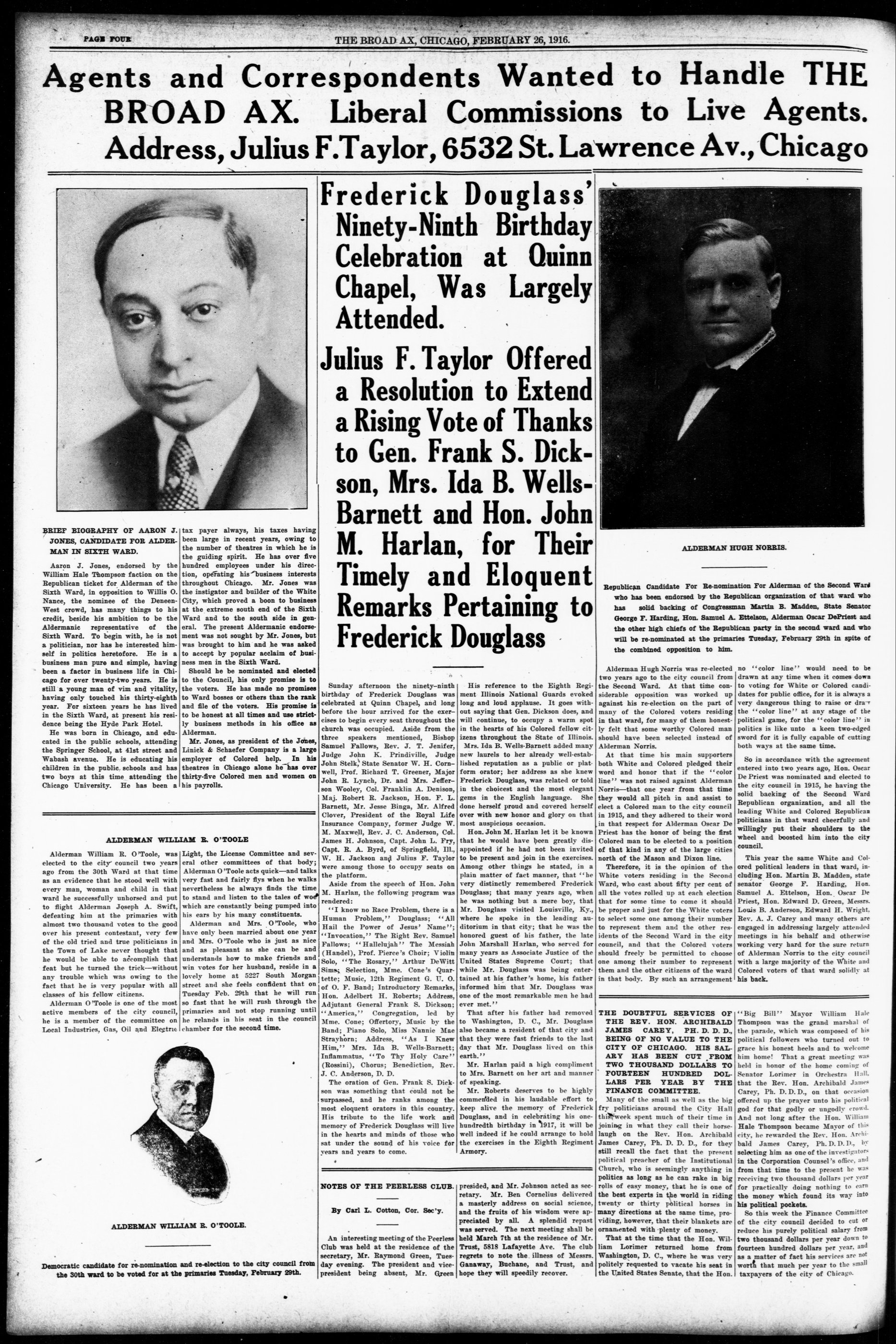
Frederick Douglass' Ninety-Ninth Birthday Celebration at Quinn Chapel, Was Largely Attended.
Julius F. Taylor Offered a Resolution to Extend a Rising Vote of Thanks to Gen. Frank S. Dickson, Mrs. Ida B. Wells-Barnett and Hon. John M. Harlan, for Their Timely and Eloquent Remarks Pertaining to Frederick Douglass
Sunday afternoon the ninety-ninth birthday of Frederick Douglass was celebrated at Quinn Chapel, and long before the hour arrived for the exercises to begin every seat throughout the church was occupied. Aside from the three speakers mentioned, Bishop Samuel Fallows, Rev. J. T. Jenifer, Judge John K. Prindiville, Judge John Stelk, State Senator W. H. Cornwell, Prof. Richard T. Greener, Major John R. Lynch, Dr. and Mrs. Jefferson Wooley, Col. Franklin A. Denison, Maj. Robert R. Jackson, Hon. F. L. Barnett, Mr. Jesse Binga, Mr. Alfred Clover, President of the Royal Life Insurance Company, former Judge W. M. Maxwell, Rev. J. C. Anderson, Col. James H. Johnson, Capt. John L. Fry, Capt. R. A. Byrd, of Springfield, Ill., W. H. Jackson and Julius F. Taylor were among those to occupy seats on the platform.
Aside from the speech of Hon. John M. Harlan, the following program was rendered:
"I know no Race Problem, there is a Human Problem," Douglass; "All Hail the Power of Jesus' Name";
"Invocation," The Right Rev. Samuel Pallows; "Hallelujah" The Messiah (Handel), Prof. Pierce's Choir; Violin Solo, "The Rosary," Arthur DeWitt Sims; Selection, Mme. Cone's Quartette; Music, 12th Regiment G. U. O. of O. F. Band; Introductory Remarks, Hon. Adelbert H. Roberts; Address, Adjutant General Frank S. Dickson; "America," Congregation, led by Mme. Cone; Offertory, Music by the Band; Piano Solo, Miss Nannie Mae Strayhorn; Address, "As I Knew Him," Mrs. Ia B. Wells-Barnett; Inflammatus, "To Thy Holy Care" (Rossini), Chorus; Benediction, Rev. J. C. Anderson, D. D.
The oration of Gen. Frank S. Dickson was something that could not be surpassed, and he ranks among the most eloquent orators in this country. His tribute to the life work and memory of Frederick Douglass will live in the hearts and minds of those who sat under the sound of his voice for years and years to come.
NOTES OF THE PEERLESS CLUB
An interesting meeting of the Peerless Club was held at the residence of the secretary, Mr. Raymond Green, Tuesday evening. The president and vicepresident being absent, Mr. Green
His reference to the Eighth Regiment Illinois National Guards evoked long and loud applause. It goes without saying that Gen. Dickson does, and will continue, to occupy a warm spot in the hearts of his Colored fellow citizens throughout the State of Illinois. Mrs. Ida B. Wells-Barnett added many new laurels to her already well-established reputation as a public or platform orator; her address as she knew Frederick Douglass, was related or told in the choicest and the most elegant gems in the English language. She done herself proud and covered herself over with new honor and glory on that most auspicious occasion.
Hon. John M. Harlan let it be known that he would have been greatly disappointed if he had not been invited to be present and join in the exercises. Among other things he stated, in a plain matter of fact manner, that "he very distinctly remembered Frederick Douglass; that many years ago, when he was nothing but a mere boy, that Mr. Douglass visited Louisville, Ky., where he spoke in the leading auditorium in that city; that he was the honored guest of his father, the late John Marshall Harlan, who served for many years as Associate Justice of the United States Supreme Court; that while Mr. Douglass was being entertained at his father's home, his father informed him that Mr. Douglass was one of the most remarkable men he had ever met."
That after his father had removed to Washington, D. C., Mr. Douglass also became a resident of that city and that they were fast friends to the last day that Mr. Douglass lived on this earth.' Mr. Harlan paid a high compliment to Mrs. Barnett on her art and manner of speaking. Mr. Roberts deserves to be highly commended in his laudable effort to keep alive the memory of Frederick Douglass, and in celebrating his one hundredth birthday in 1917, it will be well indeed if he could arrange to hold the exercises in the Eighth Regiment Armory.
presided, and Mr. Johnson acted as secretary. Mr. Ben Cornelius delivered a masterly address on social science, and the fruits of his wisdom were appreciated by all. A splendid repast was served. The next meeting shall be held March 7th at the residence of Mr. Trust, 5818 Lafayette Ave. The club regrets to note the illness of Messrs. Ganaway, Buchane, and Trust, and hope they will speedily recover.
[Picture of a man in a suit and bow tie].
Republican Candidate For Re-nomination For Alderman of the Second Ward who has been endorsed by the Republican organization of that ward who has solid backing of Congressman Martin B. Madden, State Senator George F. Harding, Hon. Samuel A. Ettelson, Alderman Oscar DePriest and the other high chiefs of the Republican party in the second ward and who will be re-nominated at the primaries Tuesday, February 29th in spite of the combined opposition to him.
Alderman Hugh Norris was re-elected two years ago to the city council from the Second Ward. At that time considerable opposition was worked up against his re-election on the part of many of the Colored voters residing in that ward, for many of them honestly felt that some worthy Colored man should have been selected instead of Alderman Norris.
no "color line" would need to be drawn at any time when it comes down to voting for White or Colored candidates for public office, for it is always a very dangerous thing to raise or draw the "color line" at any stage of the political game, for the "color line" in politics is like unto a keen two-edged sword for it is fully capable of cutting both ways at the same time.
At that time his main supporters both White and Colored pledged their word and honor that if the "color line" was not raised against Alderman Norris—that one year from that time they would all pitch in and assist to elect a Colored man to the city council in 1915, and they adhered to their word in that respect for Alderman Oscar De Priest has the honor of being the first Colored man to be elected to a position of that kind in any of the large cities north of the Mason and Dixon line.
Therefore, it is the opinion of the White voters residing in the Second Ward, who cast about fifty per cent of all the votes rolled up at each election that for some time to come it should be proper and just for the White voters to select some one among their number to represent them and the other residents of the Second Ward in the city council, and that the Colored voters should freely be permitted to choose one among their number to represent them and the other citizens of the ward in that body. By such an arrangement
THE DOUBTFUL SERVICES OF
THE REV. HON. ARCHIBALD
JAMES CAREY, PH.D. D. D.
BEING OF NO VALUE TO THE
CITY OF CHICAGO. HIS SALARY HAS BEEN CUT FROM
TWO THOUSAND DOLLARS TO
FOURTEEN HUNDRED DOLLARS PER YEAR BY THE FINANCE COMMITTEE.
Many of the small as well as the big fry politicians around the City Hall this week spent much of their time in joining in what they call their horse-laugh on the Rev. Hon. Archibald James Carey, Ph. D. D. D., for they still recall the fact that the present political preacher of the Institutional Church, who is seemingly anything in politics as long as he can rake in big rolls of easy money, that he is one of the best experts in the world in riding twenty or thirty political horses in many directions at the same time, providing, however, that their blankets are ornamented with plenty of money.
That at the time that the Hon. William Lorimer returned home from Washington, D. C., where he was very politely requested to vacate his seat in the United States Senate, that the Hon.
no "color line" would need to be drawn at any time when it comes down to voting for White or Colored candidates for public office, for it is always a very dangerous thing to raise or draw the "color line" at any stage of the political game, for the "color line" in politics is like unto a keen two-edged sword for it is fully capable of cutting both ways at the same time.
So in accordance with the agreement entered into two years ago, Hon. Oscar De Priest was nominated and elected to the city council in 1915, he having the solid backing of the Second Ward Republican organization, and all the leading White and Colored Republican politicians in that ward cheerfully and willingly put their shoulders to the wheel and boosted him into the city council.
This year the same White and Colored political leaders in that ward, including Hon. Martin B. Madden, state senator George F. Harding, Hon. Samuel A. Ettelson, Hon. Oscar De Priest, Hon. Edward D. Green, Messrs. Louis B. Anderson, Edward H. Wright, Rev. A. J. Carey and many others are engaged in addressing largely attended meetings in his behalf and otherwise working very hard for the sure return of Alderman Norris to the city council with a large majority of the White and Colored voters of that ward solidly at his back.
"Big Bill" Mayor William Hale Thompson was the grand marshal of the parade, which was composed of his political followers who turned out to grace his honest heels and to welcome him home! That a great meeting was held in honor of the home coming of Senator Lorimer in Orchestra Hall, that the Rev. Hon. Archibald James Carey, Ph. D.D.D., on that occasion offered up the prayer unto his political god for that godly or ungodly crowd. And not long after the Hon. William Hale Thompson became Mayor of this city, he rewarded the Rev. Hon. Archibald James Carey, Ph.D.D.D., by selecting him as one of the investigators in the Corporation Counsel's office, and from that time to the present he was receiving two thousand dollars per year for practically doing nothing to earn the money which found its way into his political pockets.
So this week the Finance Committee of the city council decided to cut or reduce his purely political salary from two thousand dollars per year down to fourteen hundred dollars per year, and as a matter of fact his services are not worth that much per year to the small taxpayers of the city of Chicago.
a tt
alks- ony arles E. Stump, for the}: v2-=:.-:* x <-| THEBROAD AX
ia? P T W i Wwaniagen Dr nt a iy
be — eae Galen <<
jee i ast Two Weeks, Has |r" 22r0 ooo a ee eae
la rs = as
CLEANLINESS, es ra B W di Hi W ee eee eer eS ce a peepee
a a een en Ing 1S ay Pactual: Garl Tat Wash ingies Ste Lees meet ed teem te ce ae
PROPER LIVING. So ... | Hy ev, Fd Grinks, aed, Kk tet | ee SS eee ee
1 pe. : sae to beeoll eomegh ra ort
SANITATION, ETc.| == _ aay North ard f ro His sed agp es a fm ee
o ee gf Me ea Te STE
a - present at both the wedding and the secciae aise marae
fe) | Long Tour Through the =" "9" penne
Dr.,W. A. DRIVER . \} : | . oe Dailey and his new bride, ar- ee rear eee
513300 So.§State Street) ial a Pas | S ith St t H teed hme Sunday morning, bringing | aoe
ean PhedsDeuria:'3617_,.-., LE ¢ | voutnern ates, DS frit: tum, many stele snd beat: ante atemmenttee
THE “GRIP” AND AFTER.
‘There is no doubt that Syphilis is a
‘*great actor’? in that it presents so
many and varied symptoms that it is
often able to hide its true identity.
As great an actor as is syphilis it oc-
cupies second place in its ability to
hide its identity. Influenza has a
greater faculty of disguise. It often
assumes the appearance of pneumonia,
pleurisy, typhoid fever, arthritis, diph-
theria and other throat disorders as
well as other diseases too numerous to
mention. It often imitates pertussis or
whooping cough, gastro-intestinal and
respiratory diseases in particular. The
nose and throat, eye and ear diseases
aer often loeal manifestations of in-
fiuenza,
The influenza germ can and often
does cause serious lung diseases, either
primarily or secondarily. Tubereulosis
following the grip is frequently ob-
served. The germ causing la grippe
weakens the body so that the person
becomes an easy victim to other and
more deadly micro-organisms. The
chief dangers of influenza are the com-
plications. Influenza pneumonia is
often fatal. Empyema often follows
THE AIMS OF OBJECTS OF THE
PHYLLIS WHEATLY HOME
Concluded from Page 1.
tertainments and added $140.00 for the
‘Trustees.
‘Mrs, Martha’ Walton as Chairman of
the Volunteer Subscription Fund, raised
$15.00 and MANY FRIENDS. The
residents of the Home, with Miss Jen-
nie Lawrence, an interested non-resi-
dent as Chairman, surprised the Man-
agement witlt $73.20 raised by their
efforts. '
January 2, 1913, a Board of Trustees
was formed of seven members. Mrs.
Eva Jenifer, Chairman, Mrs. Estelle
Davis, Secretary and Mrs. Mary War-
ing, Treasurer. This Board took the
responsibility of looking after the f-
nancial affairs of the Home and after
a year of strenuous work which en-
gaged every Auxiliary, Clubs and indi-
vidual help, the debt was again re-
duced, this time to $1000.00 and taxes
were made exempt.
In September, 1914, the City Federa-
tion of Colored Women’s Clubs, by re-
quest of the Executive Board of the
Phyllis Wheatley Club appointed four
from their number to increase the
Trustee Board to eleven members and
interest correspondingly increased in
the work of building up the Home.
Mrs. Minnie Collins was Chairman
of the Executive Board from 1912 to
1915. They decided to enlarge the
scope of the work of the Home and
on June 21, 1915, this Board was in-
creased to 15 members. At a joint
meeting of the Executive and Trustee
Boards, July 26th, a Phyllis Wheatley
Association was formed. Mrs. E. L.
Davis, President; Mrs. Minnie Collins,
First Vice; Mrs. Clara Studymire, See-
‘ond Vice; Mrs, J. Snowden-Porter, See-
retary; Mrs, Jessie Johnson, Financial
Secretary-Treasurer, and a Board of
15 Directors were elected and the work
given into their keeping. Thus tne
joint Boards of the Phyllis Wheatley
Club transferred its authority and re-
sponsibilities and assured the Phyllis
Wheatley Home a larger and more se-
cure future, still keeping alive their
love for and interest in the ovement.
‘The Phyllis Wheatley Club had long,
realized that their proposed work
could not be the useful factor needed,
until better and more commodious|
quarters could be secured and they im-
mediately interested the new Associa-
tion in securing new quarters. This
was done and the purchase of property
at 3256 Rhodes Ave. was set about.
Allowed $1500 for the old property a
debt of $8000 was assumed, of which
$500 was raised in sixty days leaving
a balance of $7,500. $1,000 of this
umount is due by Mareh first and the
balance of $6,500 in May, 1917. In at
efforts, the largest single cash donation
ssiven was $60.00 which came from a
woman in a time of pressing need and’
was secured through the efferts of Mrs.
FE. L, Davis, We eam say with much
pride that very much the greater part
of all monies raised by these payaet
came from the Negro race. We believe
the work has been commendable. It
has been proven needed and for the
oy S
Oe es ee
24 wy
oo — y
influenza pleurisy and may be fatal.
Various forms of heart diesase prin-
cipally functional are apt to follow cer-
tain forms of la grippe. In the present
epidemié of influenza peritonitis and
appendicitis have been observed. Gall
bladder disease has often followed at-
tacks of ‘<Grippe”’; gall stones (chole-
lithiasis) may follow. :
‘Many cases of chronic ill-health date
from an attack of “Grippe.’”
To avoid la grippe and the complica-
tions live true to nature. Take health-
ful exercise in the open air. Keep
clean, eat regularly the proper quality
and quantity, get sufficient sleep in a
properly ventilated sleeping apartment.
Avoid overcrowded places and the
vitiated atmosphere found in most
places of human habitation. Get the
proper quality and quantity of air,
night as well as day. Be a fresh air
crank. Don’t be afraid of the cool,
fresh air.
TO CURE THE “‘GRIPPE”’ CON-
SULT YOUR DOCTOR EARLY AND
AS OFTEN AS NECESSARY; avoid
patent medicines, yéu cannot afford to
take the chances with so important a
matter as your health.
larger Association bespeak a field of
usefulness in making for a better City.
The Association has placed the Fi-
nancial and Internal Management
of the Home in the care of a Board of
Directors and a Board of Man-
agers aggregating 50 members and
through the efforts of these energetic
people, the Home MUST SUCCEED.
‘Mrs, Clara Studymire, is Chairman
of the Board of Directors and Execu-
tive Head of the Home and Mrs. T.
G. Macon, Seeretary. Mrs. Bertha
Hensley is Chairman of the Board of
Managers and Mrs. Estelle Davis, Sec-
retary. The Chicago Association of
Commerce indorses the work. Miss
Jennie Lawrence is a most competent
Superintendent and is using every en-
deavor to make the Home ideal in
every respect. Mrs: Alice Lyles is
Chairman of the House Committee.
‘Miss Robinson of the Eleanor Asso-
ciation, very kindly made it possible
for us to secure regulation beds for
our opening in August last and the
place has been nicely furnished through
the generosity of gifts from Furniture
Stores, from the Residents of the Home
and from individual contributions.
The management is making a lively
campaign to raise the debt from this
Institution and add such departments
as will make it a valuable adjunct to
the Social Service of the Community
and invaluable as a factor for civil
betterment.
$10,000 will place the Home nearly
or quite on a self-supporting basis.
Who among the many who are looking
towards a greater and safer Chicago
will come forward and help in raising
this amount in the next ten days.
Cheeks sent to Mrs. Jessie Johnson,
Secretary-Treasurer, 3026 Vernon Ave.,
will receive prompt acknowledgment.
DISMOND WINS RACE FROM
EASTERN STARS; RUNS QUAR-
TER IN :51
New York, Special—Binga Dismond,
the Colored sprinter from the Univer-
sity of Chicago, handed out a stunning
surprise to the eastern cracks Tuesday
when he won the suburban quarter mile
at the Knights of St. Antony games in
the Forty-seventh regiment armory to-
night.
There was no question of the supe-
riority of the dusky flier. Although
there was a little crowding in the
earlier stages of the race he was not to
blame for it and at the finish he was
going away from Ted Meredith, the
Olympic champion, who was forced to
the limit to beat Billy Moore of Prince-
ton by six inches for the place. The
time of :51 constituted a new armory
record.
In addition to Meredith, who won the
trophy last year, there finished behind
Dismond Tom Halpin of Boston, who
also has a leg on the cup; Billy Moore,
the best middle distance man at Prince:
ton, and Tom Lennon, who caused a
sensation by his great running in the
300 yard handicap at the New York
A. C. games.
Charles E. Stump, for the
Past Two Weeks, Has
Been Wending His Way
Northward from His
Long Tour Through the
Southern States, His
Last Stand or Stop
Being Evansville, Ind.
In my last letter I failed to tell you
about my visit to Uniontown. This is
the place where B. W. Fitts was born,
and I had the pleasure of seeing the
house where he first discovered this
world, and met his mother, sister and
brother. He is the young man who is
conducting a printing establishment in
Chicago. When I met him last Christ
mas in Chicago, he invited me to visit
his home, and I found it just as he told
me I would find it. His mother was
im good shape.
When I told Mrs. Fitts that I knew
her son in Chicago, she received me
just like she was receiving her own son,
and Mrs. Rebecca Fitts, assured me
that I was at home. She is the
daughter-in-law, but just like a real
daughter. Into the home I went and
spent my time there.
Evansville, Ind.—I have crossed the
line again, and for a little while I am
going to be away from Jim Crowism
and take in a little of this cold weather,
yet it will not be long before I will
return. I am going to look after things
in Kansas for a while, and get ready
for my crop next summer. I tell you
this newspaper business is just a little
more than I thought it would be, but
since I am in it, I will stick to the
business until I get a call up higher.
| Riding through the south without
‘anything to eat, sleeping when you can,
is not all that you might think it is,
‘yet Iam glad that I have gotten some-
thing out of it. I have seen some of
the world, and then I have met some
real good people and made some friends
that I would not have made, and it-is
now my desire to thank the Editor of
‘The Broad Ax for making it possible
for me to do all these things.
‘When I took my pen in hand last to
write you a few lines to inform you of
my health, I was in Selma, Ala, the
guest of Prof. R. B, Hudson, and it is
‘a pleasure to be in his home. You will
‘see that I have left there and today I
‘am in Indiana, and may be in Chicago
Sunday.
T did not mention last week Prof. H.
E, Archer, and his able wife. Prof.
Archer, M. D., is president of Payne
University, Selma, and it is one of the
schools of the A. M. E. church that is
worth while and one of them that is
really doing something. It was to me
‘a source of pleasure to come in contact
with him, He is a graduate from some
big school up in Michigan, but has been
in the south for a number of years. He
was connected with the A. and M. col-
lege, in Normal, Ala, under the late
William H. Councill, and after the
death of Dr. Councill, he heard a call
from Bishop H. B. Parks to come to
Selma, and he responded to it.
Mrs. Archer is one of the best trained
women in this country and then she is
just making things go. I don’t know
as I have ever seen a woman have s0
much to do. She is matron, preceptress,
teacher, and almost everything else
that you might name, and then there
is no trouble in reaching her. With all
her edueation she will hear the most
illiterate and you will find a welcome
a
ae al : € ae
ALDERMAN HENRY P. BERGEN.
One of the most popular and valuable members of the city council; member
of the local transportation, gas oil and electric light and the railway
‘ terminals committees who feels dead sure that he will be renominated and
re-elected to that body from the Sist ward.
to her home. She is what you might
call a real educated woman.
‘Then they have some professors down
there that you can just see their eduea-
tion in their feet as they walk. They
have their heads so full it looks like
they are running over with knowledge.
I will not comment on them more at
this time. I had the pleasure of meet-
ing them, and talking with them.
In the city of Selma, I met Mrs.
Sheffey Taylor, the wife of one of the
leading physicians in the south, Dr.
Taylor. Of course I met Dr. Taylor
also, but I have in mind to say a few
words about him later, and will call at-
tention to his wife. She is a woman
who has taken advantage of the school
room and is well edueated. Her hus-
band came from Iowa to Boston, Ga.,
‘and from there to Selma, Ala., where
he is building up a fe practice. He
knows the human body and can eut it
all to pieces and then put it back to-
gether again. What a great man.
Visiting Mrs. Taylor, was Mrs.
Rebecea McCants Glover, from Hen-
derson, Ky. the wife of a leading
dentist. Mrs. Taylor I met some years
ago in Buxton, Iowa, and I remember
Mrs, Glover, because she was for a long
time the cashier and bookkeeper, and
stenographer in the A. M. E. Sunday
School Union under Bishop Chappelle.
But there came along a young dentist,
who asked her to be his wife and after
considering it for a long time she ac-
cepted, and now they are happy. They
are just like lovers all the time. She
is getting away from the Kentucky cold
weather and basking in the Alabama
sunshine. .
Now then I left that place, came to
Montgomery, and had the pleasure of
visiting the State Normal school under
Prof. John W. Beverly, one of the
greatest men I have met. He is plain,
common sense educated man, and I tell
you they have some students there. I
had the pleasure of seeing the whole
student body in chapel and heard a
talk to them. After looking around in
Montgomery for a little while I then
left for Birmingham, where I had the
pleasure of talking with Mrs. J. 8.
Jackson, Mrs. Carrie A. Tuggle, pres-
ident and founder of Tuggle Institute,
Dr. U. G. Mason, Mrs. F. M. Cosby,
and a host of others.
Mrs. Tuggle is without a doubt a
remarkable woman, and if you have
not met her it will pay you to meet her
before she leaves this world. She is a
genius, and then she is a leader of
women, and manager of children. She
is worked from the groundfloor ip to
the top, and is at the head of a number
of societies. It was manners to look
at her. You will see from this that I
have been lgoking into education. I
did not get to meet Prof. 0. W. Admas,
editor of the Reporter, and principal
of the Tuggle Institute, but they tell
me he is a cracker jack. I will not say
more about Birmingham, for I spent
one night and day there and left for
Nashville, to attend the National Negro
Press Association.
Last Wednesday at 6 P. M. Miss
Eleanor Jane Curtis, one of the most
Popular and progressive school teachers
of Washington, D. C. and this City,
was united in marriage to Dr. U. Grant
Dailey, of Chicago.
‘The marriage ceremony was pe.-
formed in the Fifteenth Street Presby-
terian Church at Washington, D. C,
Rev. F. J. Grimke, officiated. A bril-
liant reception was held that same
evening from 7 to 9 at the home of the
bride, 1939 13th street, N. W.
Many distinguished guests were
present at both the wedding and the
reception, from all parts of the coun-
try.
Dr. Dailey and his new bride, ar-
rived home Sunday morning, bringing
with them, many valuable and beauti-
ful presents. They are now at home
to their friends at 4317 Forestville
avenue. .
Last evening Mrs. Dailey attended
the brides reception and dance, at the
‘Appomattox Club, Misses Bertha Mose-
ley, Maude Taylor, Naomi Jackson,
Blanche and Emma Shaw, served as
ushers at the brides dance and recep-
tion.
‘The many friends of the contracting
paties in this city and in other sec-
tions of the country, wish them un-
bounded joy and happiness and a safe
jana sound journey on the matrimonial
ces
HOW CITY BABIES DIE.
A recent bulletin of the U. 8. Census
Bureau shows that the 1910 death rate
for infants per 100,000 population was
36 per cent. higher for cities than for
rural districts of the registration area.
For all ages the excess of urban over
rural death rates was only 19 per cent;
this was bad enough. For children un-
der five years it was 38 per cent. higher
for cities. For children under one year
the percentage of mortality excess for
cities over country districts was 44 per
cent; but for those nine to twelve
months of age the percentage of excess
was 71 per cent, far greater than at
other ages.
‘The increased deaths among city
infants is true of all diseases which
affect them, but it is especially matked
for broncho-pneumonia; 113 per cent.
excess.
The acute intestinal disorders (diar-
rheal) show 71 per cent. excess for the
city baby. This means that bad air
and impure milk play the most impor-
tant réle in these deaths, combined as
they are with overerowding, poverty,
dirt and ignorance, and in summer, heat
exhaustion.
This loss of life is only part of the
high price we pay for city civiliza-
tion(#). In cities more people neglect
the elementary requirements of health.
‘The burden of this neglect falls most
heavily upon the babies. They did not
ask to come; they deserve a better faté.
In cities artificial feeding is more com-
mon; mothers are more involved in
bread-winning vecupations.
The factors unfavorable to the life
and development of Chicago infants as
compared to those born and bred in the
country must be enormous when these
greater losses occur, despite the ad-
vances made in city sanitation and
preventive medicine and through organ-
ized effort.
It is of some comfort to know that
the decline in infant mortality in the
last thirty years has been decided and
far more marked in urban than in rural
districts.
‘The good name of this municipality,
in health as well as morals, is in the
hands of each of the 2,497,722 of her
people who are old enough to know
pees it means. The Health Depart-
‘ment and all the many groups of men
‘and women working for civic health
are pointing the way, and walking that
way in leadership; but a larger number
of the people must follow. The trouble
is to reach the individual citizen in his
own home, in his own language.
In 1916, 2,609 babies under two years
of age died of diarrhea and acute in-
flammation of the bowels (enteritis).
‘This was 441 less than in 1914; but
while we laud the saving of this 441 we
should blame ourselves for the needless
loss of most of the 2,609. These were
largely preventable deaths, just as 812
Eastland deaths were preventable.
‘Let each one who reads this ask him-
self what more he ean do to support
some one or more of the many organ-
ized efforts that will be made this year
to save these babies.
Help to educate your neighbors apd
friends. Help to make public opinion
and demand enough public funds to
edueate the mothers.
Ask the Health Department for lit-
terature on the care of babies.
Get up neighborhood meetings at
schools and churches. Write the De-
partment for speakers.
Alderman Oscar De Priest is fast be-
coming the head leader of Mayor
‘Thompson in the city council, and the
friends and admirers of His Honor the
‘Mayor feel very proud of Alderman De
Priest, for on Thursday in the Eaton:
Rowe graft investigation he covered
himself with much glory.
Mrs. Carrie Warner, 5223 Dearborn
street, last Monday was attacked with
acute indigestion, which prevented her
from attending the Eighth Regiment
ball.
FURLISNED WEEKLY.
Wun prosesignte and at all mes phot
the twee principles of Demecracy, but
Cotman, "Protestnte, Frisia, Inada
‘Singt Taxers, Repubitenns, or anyone cise
eam have their ony, os long as their lan-
Fangs t proper nd repemetblty ba zat.
The Breed Ax iss mewopaper whose
pissterm to bread enongh forall, ever
ating the caitertal right to apeak tee
ae
Losal communientions will rosive atten:
dion, Write only on one aide of the paper.
Sebecriptions mast be paid in edvanee
Bix Momths..........0-.-eeceeeeereeree LOO
Advertising rates made known on appll-
tien.
Address alt sommantentions to
|
| THE BROAD AX
6:2 6T. LAWRENOE AYE, CHICAGO, IL1,
PRONE WENTWORTH 2507.
JULIUS ¥. TAYLOR, Raiter and Pabilsner
——
Entered ao Secand-class Matter Ang. 1%,
tyes, 0s the Fest Oates at Chlonge, Tiina,
endem Act of March 8, 1873.
AUTHORIZED AGENTS AND COR-
RESPONDENTS FOR THE BROAD
CARE OF THE BABY.
‘Teething.
Article Number Five.
The baby usually cuts his first tooth
‘when he is 6 to § months old, and by
the end of the first year has, ordinarily,
G teeth. He should have 12 teeth at 18
months of age; 16 when he is two years
old, and before the end the third year
the entire set of 20 ‘‘milk’’ teeth.
‘The process of teething in a healthy
‘baby cannot properly be held respon-
sible for the illness commonly at-
tributed to it. ‘The first half-dozen
teeth rarely give the baby any pain,
but as the double teeth appear there is
oceasionally at the same time a little
disturbance, such as loss of appetite,
and possibly evidences of slight indiges-
tion, whieh may last for a few days.
But if the disturbance is more serious
than this, some other reason for it
should be sought.
Teething takes plate through the
weaning period and during the second
year, when mistakes in feeding are s0
often made which upset the baby’s
digestion, even if they do not make him
seriously ill. On this account it is often
unjustly blamed for making the baby
sick, when the real reason lies in the
fact that he was overfed or improperly
fed, or perhaps that the weather was
very hot.
It must be remembered that exces-
sive heat aggravates any ill the baby
may have, and is quite sufficient im it-
self to make the baby sick. It is neces-
sary in summer, therefore, both on ac-
count of the heat and because of the
disturbances connected with weaning
and teething, to take great care of the
baby in all respeets, and especially to
feed him with great caution. Diree-
tions for feeding the baby are given in
a pamphlet called ‘Infant Care”?
which will be sent free to anyene who
asks for it, applying to the Chief of the
Children’s Bureau, U. 8. Department of
Labor, Washington, D. C.
‘The baby may not gain in weight
during the eutting of his various double
teeth, but it is not a serious matter to
have the weight remain stationary for
a short time. The baby will quickly
regain the lost ground when he is well
‘again, and eating his full rations.
‘The mother should never allow any-
one to persuade her to give the baby
patent medicines, such as soothing
syrups to relieve the pain of teething.
Ie they do relieve it they probably eon-
tain opium in some form, which is much
worse for the baby than the suffering.
It is a safe rule never to give medicine
of any sort to a baby, save that which
is ordered by a doctor.
Gare of the First Teeth.
From the time when the double teeth
make their appearance throughout life
the teeth should have daily care. For
the baby a very soft brush is necessary
and the utmost care should be taken
not to injure in any way the delicate
tissues of the mouth when brushing the
tiny teeth. After the baby has several
teeth, the mother should see to it that
no particles of solid food are left be-
tween them after the baby has eaten.
If the first set of teeth is well taken
care of, the second set will be healthier,
and in addition the child will have been
taught a good habit that will last all
his life.
‘There is considerable variation in the
time that the teeth first appear, but if
the baby has no teeth by the time he
is one year old, he should have medical
attention to see if any diseaso is caus-
ing this unusual delay in the develop-
ment of the teeth, or whether it is due
to improper diet.
— — — "THE BROAD AX, CHICAGO, FEBRUARY 26,1916.
ees sesssstesenstsorssnnneneneenesetenonatteneeeanamere tae ante
ee ee
‘SHORT AND SHARP,
Bad luck is often the result of trust-
ng too much to Ick.
Russia asserts that all that remains
of the vodka industry is the bar.
‘The Lord will provide for the man
‘who works as hard as he prays,
A man will never find his right place
i life if he thinks somebody else 1s
mit
‘The war game is being played with
a high hand, but nobody has yet seen a
king full of bullets. :
‘With the trenches impregnable the
only thing for the belligerents is to
fight it out in the air,
‘The Pasteur institute of Paris an-
nounces a certain cure for cholera.
Why not for fighting?
Another incongruity of the European
conflict is the converting of church
bells into war munitions,
It seems ‘that all the European na-
tions know our secret diplomatic codes,
but the question is, Do we know theirs?
It is different in Argentina. The
Presidential election is due in three
months, and there is not a candidate
in sight.
‘The Audubon society having declared
that the dove is a fighter, it may yet be
necessary to nominate the English
sparrow as the emblem of peace. |
With the boys’ colleges doing away
with class fights and the girls’ colleges
abolishing daisy chains there is less
‘and less inducement to leave home.
Echoes of the War.
Roumania does not seem to be shov.
ing anybody else aside trying to break
into the limelight—Balttmore Ameri
can.
Notwithstanding all the changes on
the war front, they're recognized by
the same brutal features.—A tlanta Con.
stitution.
As nearly as we can fathom it, the
end in Europe will arrive synchronous-
ly with the irreducible minimum.—
‘Washington Post.
Switzerland in preserving neutrality
may have a certain advantage in being
neither very rich nor very aggressive.
—Washington Star.
It's @ curious aeronautical law that
the “enemy” aeroplanes always kill
civilians, while “ours” always land
bombs on ammunition works or bar-
racks—Rocky Mountain News,
Current Comment.
‘There is coming a time when the bes!
seller will be an up to date geography
—New York Sun.
Another aeroplane company has sold
out to 2 syndicate. Looks as thougt
aviation was not going to be neglected
here much longer.—Pittsburgh Dis.
Patch.
The churches of the United States re-
Port a membership of 40,000,000. An
army of tremendous potentialities, de-
spite the difficulties of mobilization be-
fore many pulpits.—New York World.
Under the dye shortage two cent
Postage stamps are turning from red
to light pink and eight centers are be-
coming olive green, but their carrying
value is not diminished.—Syracuse
‘West-Standard.
Flippant Flings.
‘Wuring an open debate the United
@tates senate reminds one of the tow
@ of Babel.—Wall Street Journal.
‘Those Martians are nothing if no!
fmitative. They've taught their canals
the Panama slide.—Atlanta Constitu
tion.
Vassar having abolished the daisy
chain, Harvard responds by putting
the ban on the wrist watch. The war
on student brutalities is to go on to a
‘bitter finish_New York World.
The actors’ fund wants an endow-
ment of $1,000,000. If every man or
‘woman who thinks he or she is an
actor would contribute $1 the fund
could be raised overnight.—Rochester
Herald.
Short Stories.
Babies with more than one Christiar
name are taxed in Holland.
‘Mica deposits sufficiently large to de-
velop exist in twenty states.
The 2,000,000 people of Tokyo an-
ually spend $5 per head for fish.
Fifty thousand voters can demand
an alteration in the laws of Switzer-
land.
Sugar cane in Cuba, set out in virgin
land, may be cut for thirty years with-
out replanting.
More than half of those who, from
‘one cause or another, perished in the
Franco-Prussian war were not bel-
lgerents.
The Royal Box.
‘The Archduke Francis Joseph of Aus-
tria has fifteen Christian names.
Queen Alexandrine of Denmark 1s
probably the least known of European
queens.
Prince Albert of England, who re-
cently celebrated his twentieth birth-
day, bas been a middy in the royal
navy since 1913.
King George's sister, Queen Maud of
Norway, has many accomplishments.
She has mastered Norwegian perfectly,
‘writes charming verses and is an adept
at wood carting.
Finds Loss of Leg a Serious
Handicap.
Sarah Bernhardt will not be seen in
America this season. William F. Con-
nor, the French actress’ American man-
ager, received a cable from her recent-
ly in which she asked to be released
from her contract to appear here in the
spring and expressed her intention of
coming to America in October. Mr.
Connor cabled his assent.
Mme. Bernhardt gave as her reason
for postponing her visit the desire to
Le
Ge
Haas oes oe
ye hae
lo: arn
R oe
fi
AN XS
en i ee
a eras
Ag oo
: eee
Photo by American Press Association.
‘SARAH BERNHARDT.
acquire some new playlets suited to
her infirmities. The plans for her ap-
Pearance here this spring were made
before she had entirely recovered from
the effects of the amputation of one of
her legs last summer. Then, with the
indomitable will that has characteriz-
ed her career, she outlined a repertoire
that embraced some of her best known
roles and several new ones.
But Mme. Bernhardt bas since dis-
covered that the loss of her leg pre-
sents a handicap that even her will
cannot conquer. She has had to re-
strict herself entirely to playlets and
scenes from plays which demanded
little action on her part so that she
might remain seated or standing dur-
ing their performance. She acted for a
moving picture a scene version of
“Jeanne Dore.” but the scenes of this
Were so arranged that whenever she
started to move the scene was switch-
ed and the next picture revealed her
at her destination.
MEDAL FOR BAEKELAND.
Inventor Honored by Chemists For
Eminence In Chemical Research.
The Perkin medal for eminence in
industrial chemical research was re
cently awarded to Dr. L. H. Baeke-
land, the inventor, by the New York
section of the Society of Chemical In-
dustry. Dr. Baekeland is a past presi-
dent of the American Institute of
Chemical Engineers. If the move for
Preparedness takes definite, concrete
shape few men will play a more impor-
eo
é he
or Part than Dr. Baekeland, for he
is chairman of the naval consulting
Doard committee on ordnance and ex.
plosives. He is now busy with a plan
to establish for the government a plant
to make nitric acid out of the alr for
use in manufacturing smokeless pow-
der in case our supply of nitrates,
which now comes entirely from Chile,
should be cut off by war.
DAMES AND DAUGHTERS.
Mrs. A. B. Magill of Philadelphia &
now in her one hundred and eightt
year.
Mrs. McKenna, wife of England’:
chancellor of the exchequer, is wel
known among her friends as a musi
clan and composer.
Mrs. Mary Chapin, clerk of the pro
bate court in Topeka, Kan., has offici
ated at forty weddings. Instead of the
word “obey” she substitutes “protect.”
Dorothy Troud of Pittsburgh, age
sixteen, laughed so hard at a joke she
dislocated her jaw. When it was re
Placed she laughed so hard over the in-
cident she dislocated her jaw again.
Dr. Katharine B. Davis bas resigned
as commissioner of correction in New
‘York to accept an appointment to the
new municipal parole board in that
city. Her salary is $7,500 a year.
For the first time in the history of
New York city, according to Charities
Commissioner Kingsbury, three women
have been appointed members of the
medical staff of a public hospital.
‘These three women are Dr. Mary L.
Lines, Dr. Cornelia C. Brant and Dr.
Mabel C. Sisson.
Pert Personals.
‘That magazine writer who declare:
the art of conversation is lost maj
have been recently up against Colonel
House.—Pittsburgh Telegraph.
Sir Edward Carson was overcome by
the physical effort of uttering 252,00(
words. He would never do for a filibus-
ter in congress.—San Francisco Chron-
icle.
Pictures of Louis D. Brandeis in the
newspapers make him look like a good
many different kinds of person, and
Perhaps that’s what he is.—Philadel-
phia Press.
Whoever writes a history of the As-
tor family, from the original John Ja-
cob to Baron Bill, ought to see the pro-
Priety of entitling the monumental vol.
ume “From Steerage to Peerage.”—
Providence Journal.
PITH AND POINT.
People are prone to mistake self
Praise for self respect.
‘Those who sow wild oats realize that
the devil attends to the harvest.
Some people can do a lot of talking
about how they suffer in silence.
Japan denies crowding China, but
the denial is probably diplomatic.
‘A woman who keeps house doem't
‘have to worry about getting to work.
She is there.
‘Traditions as to Turkish indolence
may have to be revised as one of the
Tesults of the war.
Judging from the way in which tt is
used, many a man’s mind is merely
something to guess with.
Mr. H. G. Wells admits that he has
failed, here and there, as war prophet.
The others are not so candid.
The shrapnel bonnet is the latest
Parisian milinery creation. Some sort
of aerial sky piece wouldn't be a bad
idea.
A Judge has declared that a man’s
home is where his wife is. That would
be all right if the wife was where the
home is.
The lack of German dyestuffs, for
which almost everything is blamed,
has actually made our postage stamps
turn pale.
Poverty may mean lower morality,
as the investigators claim, but many a
man has been kept out of trouble by
not having the price.
Fashion Frills.
‘The new skirts are to be wider at the
bottom. But are they going to be any
longer?—San Francisco Chronicle.
Do you remember a style the girls
ever had that didn’t make them look
pretty?—Albany Knickerbocker Press.
Spesking of the alleged horrors ot
war, consider the rumor that bustles
and hoops are coming back into style!
—Chicago News.
‘The tailors’ convention having issued
its commands as to masculine attire for
the coming season, the men will con-
tinue to dress exactly as they please.—
Pittsburgh Telegraph.
Recent Inventions.
An electric room heater invented by
an Englishman throws the warmed air
directly toward the floor with a mov-
ing parabolic mirror.
Two West Virginia inventors have
patented a baby swing that also can
be used as a high chair by hanging it
on the back of an ordinary chair.
Of German invention is a new thief
alarm, small enough to be carried in a
vest pocket, which explodes a noisy
cap if any object under which it is
placed be moved.
Town Topics.
| Every man should know his home
city, but there's such a thing as know.
ing it too well for your own good.—
Louisville Herald.
New York cabarets scornfully repudi-
Ate the imputation of excessive charges
‘80 long as it costs less than $10 to re-
main outside.—Washington Post.
Philadelphia has started a crusade
for hygienic waiters. It is not a part
of the crusade, however, that the tips
must be sterilized. — Baltimore Amer-
ican.
ESSAD PASHA, —
STORMY PETREL
War Brings Famous Albanian
Into Limelight Again.
SSAD PASHA, the stormy petrel
of Albania, bas again come to
the fore with the extension of
the war along the Adriatic. Aus-
trian troops from Montenegro and Bul-
garian troops from Servia have been
invading Albania from the north and
east. Essad, the nominal ruler, holds
Durazzo, the capital, a port on the Adri-
atic, with a more or less disciplined
force of 10,000 armed and unruly Mos-
Jem Albanians, while the Italians are
at Valona, a port farther south, with
forces of unknown strength.
In the frst Balkan war of 1912 Essad
Pasha achieved fame as the defender
for Turkey of the Albanian city of Scu-
tarl, which eventually surrendered to
‘Montenegro after a siege of six months,
in order that he might be free to use
the troops, the guns and the supplies
of the beleaguered stronghold to enable
him to proclaim himself ruler of Alba-
nia.
He was persuaded to withdraw his
Pretensions in favor of William of
‘Wied, the nominee of the great powers,
whose minister of war he became when
Wied accepted the throne in February,
1914. He rebelled against the king in
the following May and was sent into
exile. King William soon followed him,
compelled to fly by the rebellious at-
titude of his turbulent subjects.
Essad returned to Albania after the
King’s flight and assumed the duties
and title of provisional president of
the republic of Albania. Soon after-
ward the war broke out, and he was
left unmolested until the present inva-
sion by the Teutonic allies, whose ad-
vance he will resist as an ally of the
entente powers.
Essad is a scion of the ancient Al-
banian house of Toptan, which is de-
or 2 .
eT —
wees
ast —
pt ee 4
ee ee
ae «ae
iN & =
NY ey Me 2
Pasa nee ae ee
——————
scended from a natural son of that
French royal Duke of Anjou who took
Part in the crusades and so many of
whose attendant nobles and knights
settled down in northern Greece and
Albania, founding Balkan branches of
thelr families.
In the time of Scanderbeg, the na-
tional hero of Albania, the head of the
house of Toptan was Duke of Duraz-
zo and married Scanderbeg’s sister.
He was killed along with Scanderbeg
at the battle of Alessio. But his only
son, although carried off into captiy-
ity, grew up to achieve fame as All
Bey. Essad Pasha is very proud of his
descent and keeps among his most
precious treasures an illuminated gen-
ealogical table of his ancestry.
Essad was at one time commandant
of the gendarmerie at Constantinople.
His brother, Gani Bey Toptan, an Al-
Danian Nationalist, had been put to
death by ordér of Sultan Abdul Hamid
in the closing months of his reign, and
when the Turkish parliament, on the
occupation of Constantinople by Mah-
moud Shefket's troops, proclaimed Ab-
dul Hamid’s deposition Essad was
granted at his request the privilege of
heading the deputation dispatched to
the Yildiz kiosk to announce to Ab-
dul Hamid his fate.
On April 27, 1909, Essad, accompa-
nied by three other officers, presented
himself before the sultan and pro-
nounced the fateful words, in accord-
ance with the fetvah of the sheik ul
Islam, “The representatives of the na-
tion have decreed your deposition.”
Thereupon the ex-sultan was placed
under arrest by Essad, this lineal de-
scendant of the crusader royal Duke
of Anjou and of the old time kings of
France. Essad has declared that this
day of sweet revenge was the happiest
day, of bis life.
Albania, now a bone of contention
among European powers, lies on the
west of the Balkan peninsula of south-
eastern Europe. the western boundary
being the strait of Otranto. Long a
Turkish possession, the independence
of Albania was declared at the con-
ference of London, May 30, 1913, at
the close of the frst Balkan war. In
this war the kingdoms of Bulgaria,
Servia, Greece and Montenegro wrest-
ed the western portion of the penin-
sula from Turkey.
Albania’s political neighbors are Mon-
tenegro and Servia on the north, Ser-
ria on the east and Greece on the
southeast and south. It holds at pres-
ent an important strategic position.
SIRES AND SONS.
Lord Astor became a British citi
zen in 1899. His properties in New
York are valued at $60,000,000.
Senators O'Gorman of New York and
Phelan of California look more alike
than almost any other pair of senato-
ial doubies ever placed before the pub-
He.
Dr. A. J. de Olieveira Bothelo, who
attended the recent pan-American sci-
entific congress in Washington as a
delegate from Brazil, bears decorations
from the Spanish and French govern-
‘ments for his researches in tubercu-
losis.
Captain Ewald Hecker, mentioned as
& possible successor to Captain von Pa-
Pen as German attache, owing to Von
Papen’s recall, is well known in this
country. He is an officer of the Thir-
teenth Royal dragoons, German army,
and director of the German Red Ctoss
work in this country.
Professor George H. Howison, for-
mer head of the department of philos-
ophy in the University of California,
has just entered his eighty-first year.
Professor Howison is the second old-
est living professor emeritus of the uni-
versity. He is a native of Maryland,
where he was born in 1334.
Pen and Brush.
Hugh Walpole, the writer, is at pres.
ent with the Russian Red Cross. He is
the cousin of the Earl of Oxford and
son of the bishop of Edinburgh, but is
not fond of society.
Before the war Gabriele d’Annunzio,
the Italian poet. who is now fighting
for his country, used to be Rome's
Beau Brummel. On one occasion when
he visited Egypt for a holiday he took
150 neckties, ten sunshades and eight
umbrellas.
‘Willi Geiger, Germany's new wonder
artist, has been in turn an etcher, bull-
fighter, painter-poet and soldier. In
Berlin he has been called “the inter-
preter of world suffering,” and his ple-
tures have created a sensation through-
out Germany.
Woman’s World.
Brooklyn has a successful woman
butcher.
Cambridge (Mass.) women will vote
for mayor at the spring election.
‘There are more than 8,000,000 women
‘Wage earners in the United States.
In England women are organized to
claim their political rights as soon as
the war is over.
‘Women now work in all but forty-
four of the 400 trades enumerated in
the United States.
| One-third of the workers in the hat,
suit and overall industries of the Unit-
ed States are women.
Telephone Calls.
‘Telephones transmit sounds at a rate
of 56,000 miles a second.
So that linemen testing telephone
eireuits will not be endangered by
heavy currents a new English testing
outfit is mounted on a steel rod for
grounding.
The Italian government, which sev-
eral years ago bought most of the tele-
phone systems of that country, has ex-
tended until 1923 the time in which
some smaller companies may operate
independently.
Leap Year Musings.
Don’t refuse to wed a leap year gir!
because she can't cook. She may have
money enough to pay your board —
Chicago News. e
As a matter of fact, gallantry will
forbid mentioning that the bride pro-
Dosed until the divorce proceedings —
Baltimore American.
‘The mean man is the fellow who
receives a leap year proposal of mar-
riage and then brags how he declined
it—Spokane Review.
BRIGHT BRIEFS.
‘The man who courts trouble deserves
to end by marrying it.
Speed the day when We can begin to
Tefer to it as the late war!
It is Just a man’s luck to win every
game when he's playing for fun.
It is far better to be bent on econ-
omy than broke on extravagance.
Every one admires a man of mettle
provided there is not too much brass.
“In the presence of love,” says Vice
President Marshall, “science is silent.”
And so is reason.
Miss Jane Addams’ assertion that
Europe wants peace proves once more
that a woman can't keep a secret.
Both the kaiser and Lloyd-George are
firmly convinced of victory. But neither
side will gain it by talking about ft.
Genuine old masters will be readily
identified after the war as consisting
of an expensively framed hole in the
canvas.
Japan's attentious continue to be di-
rected more to plans for China’s future
than to active participation in the Eu-
ropean war.
You can always tell a first class mo-
torman by the way he stops his car
across a crossing so that you have to
walk around it.
In New York last year 82,540 persons
were convicted of crime, and it is con-
dently believed that even a larger
number got away.
Colebrates Discovery of Pacific
and Completion of Canal,
The national exposition of the re
Public of Panama has been formally
opened by President Porras. It com.
memorates the completion of the inter.
oceanic canal and achievements of
‘Vasco Nunez de Balboa, who in 1513
discovered the Pacific and took posses.
sion of the “great south sea” in the
name of his sovereign, Ferdinand of
Spain, and was rewarded by being ap.
Pointed adelantado of the south Sea,
or admiral of the Pacific and governor
of Panama and Coyba.
The exhibition buildings have been
completed save for some finishing
touches on the horticultural building.
The army transport Logan and other
ae
es
H =
ms £
PA ie 3 f
AS tS
y p Te eee
et Laas
oe : ae
a : oe 4
| wane ormmer ne pause,
‘Yessels recently brought to the exposi-
tion the greater and better part of the
United States exhibit at the Panams-
Pacific exposition.
Spain, Cuba and all the Latin Amer-
Jean countries have typical exhibits in
handsome buildings. The grounds are
within sight of the heights from which
it 1s said Balboa caught his first
glimpse of the Pacific. The canal, too,
can be seen from the grounds. ‘The ex-
hibition is open only during the “ary
season,” when the weather is the
Dalmiest. It will continue for three
months.
‘Talk of an exposition was first heard
some years ago when it was proposed
as a private enterprise, for speculative
‘Purposes. Later it was decided that
the exposition should have its present
| character, and invitations to partic!
‘Pate were sent to the nations directly
in connection with the events commem-
orated. The financial difficulties which
Panama is undergoing have done much
to delay matters. but the exposttion is
all ready now, and Panama has every
‘reason to be proud of it.
CASE OF MISTAKEN IDENTITY.
|Fred B. Fisher, Missionary Worker,
fi Mistaken For a Bartender.
In his addresses at the conventions
of the national missionary campaign
Fred B. Fisher, the new associate gen-
‘eral secretary of the laymen’s mission-
ary movement, has been telling a joke
on himself.
| “I was standing in the lobby of a
hotel in Indianapolis,” says Mr.
Fisher, “when a man with avoirdupois
‘about like mine stepped up to me, put
jout his hand and said, ‘Shake?
| “I shook, whereupon he said, “What
‘time is the session this afternoon? I
replied that I knew of no meeting in
i
Gta
i Qs
.
ae
Re rs
see
the city, when he said, “Ab, come off
You know very well that you are the
secretary of the Bartenders’ associa
Hon meeting here in the city. I saw
you up around the tables this morn-
ing.” -
| “When I told him that I was secre
tary in a very different line of work
and was interviewing prominent In-
anapolis men preparatory to a great
national religious convention, he look:
ed me over and took his departure.”
QUINADE
GROWS HAIR
REMOVES DANDRUFF
SEND FOR SAMPLE
QUINASOAP
THE IDEAL SHAMPOO SOAP
THOROUGHLY CLEANSES THE SCALP
QUINACOMB
HAIR STRAIGHTENER
SHAMPOO DRYER
QUINADE 25¢ QUINACOMB50¢ QUINASOAP 25¢
AT ALL DRUGGISTS
SEEBY DRUG COMPANY, NEW YORK CITY, N.Y.
THE SANITARY and SHIP CANAL
Length - - - - - 32 Miles
Depth - - - - - 22 Feet
Width - - - 162 to 290 Feet
THE CANAL OFFERS:
Industrial Locations, Dock Facilities, Water Transportation, Railroad Connections, Electric Power, Concrete Building Material. Direct Connection with St. Louis via the Illinois River and Direct Connection with the Gulf via the Illinois and Mississippi Rivers. Electric Energy Created from Water Power for the Modern Factory Means Efficiency and Economy.
THOMAS A. SMYTH, President
JOHN McGILLEN, Chief Clerk
F. D. CONNERY, Comptroller
Karpen Building
900 So. Michigan Ave., CHICAGO
Leach's S
Main Office 4430 So. St.
O
Watches, Diamonds, Jewelry
ELGIN or WALTHAM
20 and 25 year cases, 7 and 15 jewels
$7.95 and $10.95
C. L. LANDE
3518 S. State St. Tel. Douglas 7587
3518 S. State St. Tel. Douglas 7587
SPECIAL RATES ON STORAGE of Household Goods, Pianos and Trunks
For the next thirty days to fill our New
Warehouse we are giving Special Rates
FIRST MONTH STORAGE FREE
PIANO in room alone with dust-proof cover on
each one. Household goods in private room,
each piece burlapped before putting away. We
guarantee your furniture to come out of storage
in just as good condition as it went in, whether it be
one month or one year.
All Phones Oakland 3784
PHONE DOUGLAS 6626
GABRIEL FRANCHERE, Jr.
SHOES
FOR LADIES, MEN AND CHILDREN
SHORT VAMP SPECIALTIES
3109 S. State St. Chicago
THE BROAD AX, CHICAGO, FEBRUARY 26, 1916.
Thackeray's Satire.
Thackeray - created quite erroneous impressions of himself by often indulging in irony in the presence of people who were incapable of understanding it. One curious instance which he gave was this: Thackeray had been dining at the Garrick and was talking in the smoking room after dinner with various club acquaintances. One of them happening to have left his cigar case at home, Thackeray, though disliking the man, who was a notorious tuff hunter, good naturely offered him one of his cigars. The man accepted the cigar, but, not finding it to his liking, had the bad taste to say to Thackeray, "I say, Thackeray, you won't mind my saying I don't think much of this cigar?" Thackeray, no doubt irritated at the man's ungraciousness and bearing in mind his tuff hunting predilections, quietly responded, "You ought to, my good fellow, for it was given me by a lord." Instead, however, of detecting the irony, the dolt immediately attributed the remark to snobbishness on Thackeray's part and to the end of his days went about declaring that Thackeray had boasted that he had been given a cigar by a lord.
Show Your Gratitude.
Gratitude is one of the prettiest posies in the bouquet of human virtues. Cultivate it and it will bloom always. Gratitude costs nothing, but repays much, and yet it is a gem of character that is rare indeed.
Never forget the friend who threw you the life line. To do that is treason of the rankest kind. Keep green in your heart the memory of every obligation and lose no opportunity to repay it. Show your gratitude for a kind act done you by doing a kind act for some one else.
A grateful "Thank you!" for a seat in a street car reimburses the man who hangs to a strap. Silently accept the seat as a matter of course and you have started that man on the slide to selfishness.
Kick out of your selfish shell and express your gratitude on the least provocation. If you never give gratitude never expect it. In proportion to your gratitude so will you be graded by your fellow men.—Boston Post.
"Uncle Sam."
The application of the term "Uncle Sam" to the United States had its beginning in Troy, N. Y., during the war of 1812. A commission contractor of Troy named Elbert Anderson had a shop in which the stocks were always examined and passed by a government inspector called Samuel Wilson, who was generally known as "Uncle Sam." When the boxes were passed they were always marked with the initials of the contractor and the nation, "EA-US." One day the man who was doing the marketing was asked what the initials stood for and replied jokingly that they were the initials of the contractor and of "Uncle Sam." The joke spread among the men, got into print and long before the end of the war had become known all over the country. Mr. Wilson, the original "Uncle Sam," died in Troy in 1854—New York Times.
Match Sticks.
Certain kinds of matches are shaved with the grain from sawed blocks. Others are cut both ways by saws. In still further varieties the blocks are boiled to make them cut easily. By some machines a boiled or steamed log is revolved on its own axis, and a shaving the thickness of a match is cut round and round. This shaving is at the same time cut into lengths and split into match sticks. It may be said that there is hardly a limit to the varieties of methods employed. Round matches are made by forcing them through dies.—Harper's.
The Capacity to Sleep.
Very enviable is the capacity to sleep in any position, which has been attributed to Chinese soldiers. In his "Chinese Characteristics" Dr. Arthur H. Smith, the American missionary, says: "It would be easy to raise in China an army of a million men—nay, of 10,000,000—tested by competitive examination as to their capacity to go to sleep across three wheelbarrows, with head downward, like a spider, their mouths wide open and a fly inside."—London Opnion.
He Had Been There
"I beg you to observe," said the talented pianist, displaying his technique to some of his admirers, "how exceedingly light is my touch."
"I don't have to observe," muttered a saddened citizen on the edge of the group. "I know by experience."—Richmond Times-Dispatch.
Not Much Difference
Brown-Now, my wife always consults me about everything she buys for herself-dresses, hats, shoes, gloves-everything. Robinson-So does mine-that is, she always asks me for the money. Comes to the same thing in the end.
Rather Rough.
"Flubdub's wife wants him to pay the income tax on the alimony he gives her."—Louisville Courier-Journal.
Just Like a Man.
Mr. Baggie-Confound that tailor! These trousers are a mile too long. Mrs. Baggie-How much shall I turn them up? Mr. Baggie-About half an inch—London Answers.
Of Course Not.
"I wonder why the oldest person in the world was a man?"
"Why, because no woman would ever have acknowledged it."-Florida Times-Union.
Geography.
Geography is the sum total of all the places in the map that we don't know about. Geography is made up of boundary lines, river lines, dots and dashes like a telegraph system and shaded places which represent the high spots. It is also colored to suit the taste and in such a manner that it takes a bacteriologist to make you know the difference between the sea and the dry land. Historical geography is ordinary geography with whatever you don't know about history added to it. Historical geography consists of migrations, ceddings and other flora and fauna to suit. To make a historical geography get a few races and distribute them according to your fancy over a pink area in various shades to show how they spread out. As a matter of fact, they did nothing of the sort. But that makes the historical geography all the more interesting. In the hands of schoolteachers geographies are frequently believed in for years by confiding pupils.-Life.
Ballads as Newspapers.
The ballad, or that form of it which is associated with the broadside, was one predecessor of the newspaper as a commentator on events. It was written for the people and sold to the people. Printed on poor paper and passed from hand to hand, copies of early ballads were seldom preserved. Fortunately several men of the seventeenth century began to make collections of ballads, and the copies of broadsides printed before 1700 that are now in existence are supposed to number about 10,000. Soon after 1700 the printed form of the ballad was changed, the "black letter" disappearing, but the ballad continued as a chronicler of happenings and a commentator on political, military and other public events until the middle of the nineteenth century and in the United States as well as England. The "topical" song of today perpetuates the satirical function of the ballad.—Springfield Republican.
Belgian Kongo.
Belgian Kongo, founded thirty years ago, is still in the early stage of development. So far practically no manufacturing industries have yet been established, and, aside from the important copper mines in the Katanga district, the only large industrial enterprises are the railways and river transportation services. It may be said that all business activities in the colony are devoted to the collection of tropical products—rubber, ivory, gum copal, palm oil and kernels, cacao, etc.—and the railway and river services are in reality only accessories to these activities, having been established primarily to aid in the transportation of these products to the seaports. The gathering of rubber in Kongo has never recovered its former activity, and in all probability will never again be so rich a source of income to the colony as it was previous to 1912.
Ship Money.
Charles I. was badly in need of money, and his attorney general in the course of his antiquarian researches discovered that in the dim ages of the past the crown had issued writs to the cities and towns on the coast requiring them to provide vessels for the royal needs, and he suggested that this ancient right might be brought into use again. Instead of the actual vessels a money contribution might be exacted instead. Thus the king would be able to tax a larger part of the realm while theoretically observing the laws. Writs for ship money were accordingly issued, but the patron John Hampden declared that they were illegal and raised such a protest against them that they were practically nullified.
Weed Pests.
Of the 200 species of ferns native to this country a few have become more or less serious weed pests. The most troublesome are the hay scented fern and the brake. According to a bulletin of the department of agriculture, cutting off the tops close to the soil surface twice a year for two years will kill out nearly all ferns. The best times to do the cutting are just previous to sporing, or about the middle of June, and the middle of August.
Life In Bermuda.
A feature of life in Bermuda which always impresses the stranger is the apparent prosperity of the natives, white and colored allike. Distressing poverty is unknown, and even the poorest families can boast of a stone house and a garden.-Argonaut.
The Twins.
We have heard of several cases wherein twins have borne a remarkable likeness to each other. But the most curious was the case of twin sisters who had to be told everything together because it was impossible to tell them apart.
Corrected.
"My husband tells me that he was out late last night with your husband." "That isn't so." I want you to understand that my husband was out with your husband."—Detroit Free Press.
Put Out
"Why do writers always talk of angry flames?"
"Because, if you notice, flames are usually put out."—St. Louis Globe-Democrat
Calendar Time.
Mr. Bacon—What are you doing with that old, faded calendar? Mrs. Bacon—Oh, I just like to look into the dim and distant past!—Yonkers Statesman.
A trick is at the best but a mean thing—Le Sage.
LINCOLN STATE BANK OF CHICAGO
3105-07 SOUTH STATE STREET
CHICAGO, ILL.
Douglas 200
CAPITAL, $200,000.00
NICKELS CENTS
In
You
This Registering Home Bank FREE to our Savings Depositors; will start you saving and keep you at it. A Savings Account is the first step to wealth. OPEN one with US.
NOTARY PUBLIC
Faustin S. Delany
Attorney and Counselor at Law
312 S. Clark St., Suite 422
CHICAGO
COLLECTIONS A SPECIALTY
Res. 4510 St. Lawrence Ave.
Tel. Dexel 5260
PHONES: OFFICE, MAIN 4153
AUTOMATIC 33-736
RESIDENCE, DREXEL 7990
Walter M. Farmer
ATTORNEY AT LAW
SUITE 708, 184 WASHINGTON ST.
NOTARYPUBLIC CHICAGO
Office Phones: Res. 5133 So. Wabash Ave.
Oakland 4662, Auto. 73-058 Phone Drexel 18815
Dr. Theo. R. Mozee
DENTIST
4709 S. STATE STREET
CHICAGO
Hours 9 A. M. to 5 P. M., 7 P. M. to 9 P. M.
Sundays by Appointment
Phone Main 2017 Automatic 32-395
Suite 706 Firmenich Bldg.
184 W. Washington St.
Residence 5548 Jefferson Av.
Phone Midway 5515 Chicago
THE BROAD AX CAN BE FOUND ON SALE AT THE FOLLOWING NEWS STANDS:
From on and after this date The Broad Ax, can be found on sale at the following news stands:
N. C. Chalmers, cigars, tobacco, notion store and news stand, 5012 S. State street.
L. E. Chilton, news stand, S. E. corner 51st and State streets.
S. Berenbaum, Cigars, Notions and News Stand; 31 W. 51 Street, near Dearborn.
George I Martin, maker of fine cigars and news stand; 18 W. 31st St. near State.
R. M. Harvey's barber shop and news stand, 3924 State street.
W. M. Maxwell, notions, cigars, tobacco, confections and news stand, 5244 State St.
Edward Felix, notions, cigars and news stand. 52 W. 30th St.
Sylvester McGlofin, news stand and laundry office, 4122 State St.
William Gaughan, laundry office cigars, tobacco and news stand, 2636 State St.
E. M. Oliver, notions, cigars and news stand, 15 W. 36th Street, near State.
A. D. Hayes, cigars, tobacco, notions, stationery and news stand, 3640 S. State St.
George McFaro, shoe shining parlors and news stand. 3800 1/2 State street.
BANK OF CHICAGO
ATE SUPERVISION
SURPLUS, $20,000.00
Commercial Banking
Savings and Checking Accounts
Foreign Exchange
Safety Deposit Vaults
Mortgages and Bonds
3 Per Cent Interest on Savings Deposits Your Patronage Solicited
Depository and Correspondent, Continental & Commercial National Bank of Chicago, Illinois.
A. D. GASH
118 North La Salle St., Chicago
Suite 615 to 616
PHONE MAIN 2214
Residence 1262 Macalister Place
Telephone Monroe 2714
MILES J. DEVINE
ATTORNEY AT LAW
Suite 313-329 Reaper Block
Clark & Washington Sts.
Phones Central 239
Auto. 41-916 CHICAGO
Franklin A. Denison
ATTORNEY AT LAW
36 West Randolph St., Chicago
Suite 708 Delaware Building
Tel. Central 3142
Phone Res. 508 E. 361h St.
FRANKLIN 2727 Phone Douglas 4397
AUTO. 41-543
J. GRAY LUCAS
ATTORNEY-AT-LAW
25 N. Dearborn St.
Union Bank Building
Suite 311 CHICAGO
FRANK DUNN
J. B. McCAHEY
Trustees
Established 1877
TEL. OAKLAND 1550, 1551, 1552
JOHN J. DUNN
WHOLESALE COAL RETAIL
Fifty-First and Armour Avenue
RAILYARDS
51st St. and L. S. & M. S.
51st St. and Armour Ave.
CHICAGO
UNDING
The
the
T. B. Hall, Laundry office, cigars,
tobacco and news stand. 3618 South
State street.
Fred M. Waterfield, cigars, tobacco,
notions and news stand. 5202 South
State street.
Coleman & Glanton, cigars, tobacco and news stand, 3342 S. State street.
Miss E. M. McClain, hair dressing parlor and news stand. 30 W. 39th street.
F. M. Diffay, cigars, tobacco, notions and news stand. 3605 State street.
Nothing but an American.
When I look back on the shifting scenes of my life, if I am not that altogether deplorable creature, a man without a country, I am, when it comes to pull and prestige, almost equally bereft, as I am a man without a state. I was born in Indiana, I grew up in Illinois, I was educated in Rhode Island, and it is no blame to that scholarly community that I know so little. I learned my law in Springfield and my politics in Washington, my diplomacy in Europe, Asia and Africa. I have a farm in New Hampshire and desk room in the District of Columbia.
and
office
2636
and
near
tions,
40 S.
harlors
street.
When I look to the springs from
which my blood descends the first an-
cestors I ever heard of were a Scotch-
man who was half English and a German woman who was half French. Of my immediate progenitors my mother was from New England and my father was from the south. In this bewilderment of origin and experience I can only put on an aspect of deep humility in any gathering of favorite sons and confess that I am nothing but an American.—From "The Life and Letters of John Hay" in Harper's Magazine.
TEENAN JONES’ PLACE.
3445 SOUTH STATE STREET
Telephone Douglas 4591
The finest and most UP-TO-DATE
BUFFET and CAFE on the South
Side. First-Class Entertainers.
HENRY “TEENAN” JONES, Proprietor.
poy core eae mee coumas 73
(CHAS. HARRIS, Manager “AUTO.272|-379
The Elite Cafe i J
AND BUFFET
Dee eee |
3030 STATE STREET CHICAGO,
JOHN BLOCK, Presicent F. W. BLOCKI, Treasurer
JOHN BLOCK! & SON
PERFUMERS
SSS ST SS SS
. °
C. E. KREYSSLER, Druggist
5057 South State Street
NOT ON THE CORNER
FOR HIGH GRADE DRUGS, CHEMICALS AND
MEDICINAL PREPARATIONS
All Prescriptions Carefully Compounded
ALSO CARRY A FULL LINE OF
BLOCKI’S IDEAL & BLOCKI’S FLOWER
IN BOTTLE PERFUMES >
Nee ee EE eS ee ee
a All Eye Trouble
ge at
mmm Vi, LUE USSELMANN
a a pe es - The Practical Optician
THE most COMPLETE OPTICAL ROOMS IN THE CITY
Seer cons ar THE LOWEST PRICES
Consultation or examination | 3150 S. STATE ST.
FREE. We have 28 different =
A aya ck wesciag che cres | Phone Donglas 5308 ,
guarantee to give satisfaction. | CHICAGO
PAGE EIGHT
When you talk of maintaining a
principle be sure that it is not a prej-
dice.
‘The man that feels like being kicked
seldom allows another the pleasure of
doing it.
Unless all signs fail, this year will
be a record breaker in the making of
world history.
Next June will give both Chicago
and St. Louis new opportunities to pose
‘a8 summer resorts.
Everything can be overdone. Many
‘@ fellow has.been fired with enthu-
siasm by his boss.
‘The drug shortage is so acute now in
England that many chronic invalids
are rapidly becoming convalescent.
If every man who was “a little odd”
had to be arrested there wouldn't be
enough men at liberty to enforce the
law.
Saying the right thing at the right
time is equivalent to keeping your
mouth shut when you have nothing
to say.
In another year the nation will again
be giving earnest thought to the ques-
tion of whether there is going to be
any inaugural ball.
It couldn't have been the landlord
class that agitated the war as some
would have us think. People in Bu-
rope are many millions of dollars be
bind in their rent.
Political Quips.
No lack of preparedness anywhere
for presidentin! nominations.—Atlanta
Constitution.
Politically speaking, the rising tem-
perature bulletin is already out for
next June.—\Washington Star.
Some of the presidential candidates
mow in the race won't get much for
their run except the exercise.—Phila-
delphia Press.
It is wonde:ful how clearly a public
officer cain see what ought to be done—-
after his term of office is over.—Pitts-
burgh Post
‘Objo has six native sons in the Unit-
ed States senate, not to mention the
Jong waiting list for the presidency.—
Cleveland Main Dealer.
Courting In Spain.
In sunny Spain etiquette is so very
restrictive in the matter of courtshiy
that it is a wonder that young peopl
ever manage to get married at all
Even when, after many difficulties, the
engagement 1s accomplished, the par
ents have a deciding voice in fixing
the date, and, as they prefer long en
gagements, the wedding day is usually
fixed somewhere in the dim future.
‘The best man and maid of honor are
expected not only to fulfill the usual
duties, but to contribute—sometime:
Yery substantially—to the expenses o!
the wedding feast. Wedding cake 1:
unknown. but instead packets of sugar
ed almonds are distributed among the
guests ond sent by post to those whc
are unable to be present.—Kansas City
Star.
— oan. |
‘There is a story current at Kuloang.
central China, about a tiger which gave
trouble in that quarter. A missionary
and his wife had been worried by the
tiger prowling nightly around their
home. They determined to be rid of
it and one night tied a cow up in the
back yard and a dog at the front of
the house. Then they armed them-
selves with guns and kept watch. ‘The
tiger appenred. The missionary fired
and killed the cow. The wife rushed
to see what bad happened, and in her
absence the tizer ate the dog.—Ex-
change.
Lazy Idleness.
Beware of lazy idleness. It will have
its effect on your whole system. It
brings on dezeneration of the muscles
and the internal organs, sometimes re-
‘sulting in an unhealthy accumulation
of fat and sometimes in internal adhe-
sion. In some constitutions it results
in shrinkage and premature old age.
Within Reason.
Mistress—Jgue, didn't you hear the
doorbell? New Servant—Yes, mum.
Mistress—Then why don't you go to
the door? New Servaut-"Deed, mum.
Tain't expectin’ nobody to call on me.
It must be somebody to see yourself.
mum.—Passing Show.
etd econ ae
‘There is evil enough in man, God
knows, but it is not the mission of
every young man and woman to de
tail and report it all. Keep the at-
mosphere as pure as possible and fra-
grant with gentleness and charity.—
Dr. John Hall
THE BROAD AX, CHICAGO, FEBRUARY 26, 1916.
Vil a ee
Py Z van >
as bates
dis a = a A 3
. an = Searels
ra a - : = ‘
Z 26-Pauengte ‘umeril. Coach
Carries Con pheno neal enh lerel Cosceny eel torn
Greater Elegance, Half the Cast
Se reas aaa ee eee ee
Save More than Half the High Cost of Carriages and Automobiles
Tel. Kenwood 455 Calla Promptly Answered Day or Night Auto. 73-867
ERNEST H. WILLIAMSON
pavatecuarc. UNDERTAKER NOTARY PUBLIC
5028-5030 S. State St. Astoncties for All Occasions Chicago, Ill.
‘The sycamore tree bears fruit after
twenty years’ growth.
It has been found that the olive will
live longer under water than any other
tree.
Flowering plants should never be
watered with cold water. It chills the
‘plants. ;
‘The cactus and other desert plants
have thick stems instead of leaves in
order to reduce the loss of water by
evaporation to a minimum.
Nicotine is found in only one plant
besides tobacco—a large shrub known
to botanists as Duboisia hopwoodit,
‘which fs native to the interlor of Aus.
tralia.
PITH AND POINT.
A temptation well resisted is the best
tonic a man could have.
a * — ——
It’s all well enough to warn us about
getting the grip, but the trouble is that
We never know we've got it until it's
got us.
Breathe through the nose and keep
the mouth shut, says a doctor, giving
advice on the subject of health. Lots
of people owe « ripe old age to keeping
the mouth shut.
The Royal Box.
Princess Henry of Battenberg, gover-
nor of the Isle of Wight, is the only
British woman ruler.
King Peter of Servia is not a mili-
tary man at hesrt. Rather is he a
scholar and philosopher, as is shown
by bis admiration of John Stuart Mill,
whose works he has anonymously
translated into Servian.
King Gustav of Sweden is a teetotal-
ex, and he and the entire royal family
ef Bweden are at the head of the tem-
Derance movement in Sweden. His
mother for over forty years devoted
her time and money and influence to
the cause of temperance.
-Flippant Flings.
France forbids the export of nuts.
We show a welcome disposition to en-
sourage it.—Wall Street Journal,
Judging from the number of generals.
Joffre has retired. one would say he
‘was bent on a general cleaning up.—
Chicago Herald.
Horse meat bas been placed on the
New York bill of fare by the health
board. A saddle of colt ought to be
palatable.—Detroit Journal.
New York warehouses are fall of
cold storaze foo) for Europe. If any-
thing can make them quit Sighting this
prospect ought 1.—Pittsburgh Dis
atch.
Fashion Frills.
Women don't object to old fashioned
things if they are in style—Philadel-
phia Inquirer.
Hoslers manufacturers, it is said, are
making tremendous profits. and now. |
adays it Ix easy to see where our earn. |
ings go.—Baltimore American.
The news that women are wearing
the farthinza'e doesn’t distress us in
the least. It's so much better than
aoops.—New York Sun |
January Clearing Sale ‘ Sey
Alll goods must be sold at cost price gy
Nemo;Corsets -
er go a
195928 /#)
ar | KOSS
_ Ruttenberg’s | Pr 4
Dry Goods Store | “nes26 H \\\
3534ISTATEISTREET | < \z
Phone Douglas 2824}; | =>
Open Evenings Colored Help Employed SIRENS
The Cranford Apartmeit
Building, 3800. Wabash Ave
a eee
If it takes two to make a quarrel it
also takes both sides to keep the peace.
‘A good muny fellows can grasp an
idea without being able to hang on
to ft.
It is better to lose than have the
fruits of victory leave a bad taste in
one’s mouth.
Some folks are so used to looking for
trouble they don't recognize joy when
they meet it.
Europe has long been noted forcheap-
ness. Now she has made human life
the cheapest thing.
Even Norway has borrowed $5,000,
000 in New York. Pretty soon every-
body will be owing us.
Occasionully the charity that begins
at home never gets through warming
its shins at the radiator.
Nearly all of us do without things
we actually need in order to be able
to afford a luxury now and then.
Prince Firman Firma is the new
Persian premier. There should be noth-
‘wg unstable about his government.
Under present conditions Europe sees
=othing paradoxical in the simultane
ous promotion of a war loan and a
moratorium.
A German has invented an instru-
ment which measures the ten-millionth
@f a second. The trouble is that after
ft ts measured It 1s too much of a back
number to be useful.
pe WEE csi i hei Wicsiamteslllael
aoe so Saab Ree Ss peers |
es ay BS ae: :
je So le ae:
ee ear ae eo LS S i
<a ae
erg Cte Set te |
f fa ise |
| ce fa i
i cee
If Es i |
3 7 ee ] 14
i Ee ae =
a - er x
a mi aa a
ea ee Oe
ee eae
WAS) SS SS ee
The finest building ever opened to Colored tenants in Chicago.
Steam heat, electric light, tile baths, marble entrance.
J. W. Casey,°Agent,
“Phone Randolph 803 74 W. WAS "INGTON STREET.
?,
gs CHICAGO
ee 3 J
~ & a Still uses a candle
: hy es and a flat flame
£ S ‘
Bisd E burner to test the
ay at gas she now burns in
.
a fA } - 1,500,000 Mantle Lights
hie F COURSE, THE CANDLE POWER OF
E, [ie THE GAS HAS NOTHING whatever
ifs we , io do with light from a mantle.
\ J \ i The flame inside the mantle is a blue-green.
Kv SWZ This flame heats the mantle to a white heat—the
"i hottef the flame the whiter and brighter the
4 mantle.
| . pS In short, the value of gas for mantle light pur-
jj Ph gi
} A r Poses, depends entirely upon its “heat units,”
i I pe not candle power.
/ = The ordinance which compels Chicago to test her
Mh iW = gas for Candle Power, is an old timer.
{ | i i It is a felic of the days when our streets and homes
‘ RS j Ky were lighted with flat-flame burners.
{ fl OL In those days the ordinance was a good thing. But
wn 7 think how times have changed.
f dak \ The old flat-flame burner is on the way to a shelf
L 1 / \ in the Field Museum.
+ WJ / \ It is a “has-been” because the mantle unit gives
j s { six times more light and consumes half the gas.
y For this reason, 98% of the gas used for illumina-
#) "tion is now burned in maniles.
| : { ‘The Candle-Power-clause in Chicago's Gas Ordi-
ref [3\ + nance should, therefore, be eliminated.
i Mi It is an embarassment to the City and an insur-
Q mountable handicap-to the Gas Company in
i f connection with its efforts to make gas cheaper
i j and more efficient for lighting, cooking and
i —- f industrial uses, :
Ahi SL/L} Any Gas Company employee in our branch stores
inn ioy¥ or our big salesroom downtown, can explain
{ j ; this to you in a few words, in connection with
V i the demonstration of an Amber Glow Mati:.<
t | } VEN Gas Light—any time you cage to call.
i ao — The Amber Glow Light gives a huge volume
; 2S ; of brilliant light for very little money, and
Sy i candle power of the gas has nothing to co
with the case.
7 Telephone Wabash 6002
The Peoples Gas Light & Coke Co. Fitter tuhit: