The Broad Ax
Saturday, March 11, 1916
Chicago, Illinois
Page text (machine-generated)
THE BROAD AX HEW TO THE LINE: LET THE CHIPS FALL WHERE THEY MAY
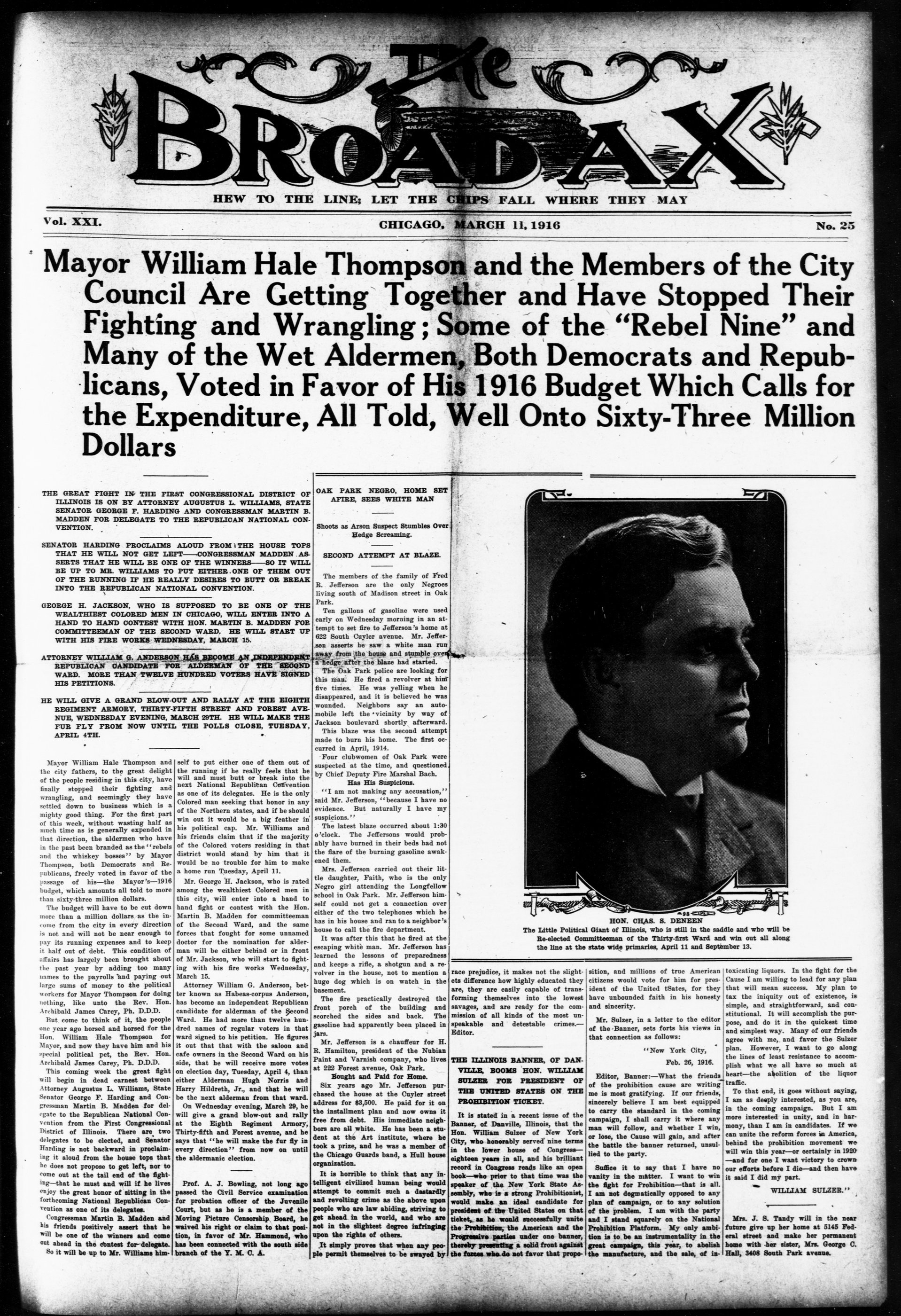
Mayor William Hale Thompson and the Members of the City Council Are Getting Together and Have Stopped Their Fighting and Wrangling; Some of the "Rebel Nine" and Many of the Wet Aldermen, Both Democrats and Republicans, Voted in Favor of His 1916 Budget Which Calls for the Expenditure, All Told, Well Onto Sixty-Three Million Dollars
THE GREAT FIGHT IN THE FIRST CONGRESSIONAL DISTRICT OF ILLINOIS IS ON BY ATTORNEY AUGUSTUS L. WILLIAMS, STATE SENATOR GEORGE F. HARDING AND CONGRESSMAN MARTIN B. MADDEN FOR DELEGATE TO THE REPUBLICAN NATIONAL CONVENTION.
SENATOR HARDING PROCLAIMS ALOUD FROM THE HOUSE TOPS THAT HE WILL NOT GET LEFT—CONGRESSMAN MADDEN. ASSERTS THAT HE WILL BE ONE OF THE WINNERS—SO IT WILL BE UP TO MR. WILLIAMS TO PUT EITHER ONE OF THEM OUT OF THE RUNNING IF HE REALLY DESIRES TO BUTT OR BREAK INTO THE REPUBLICAN NATIONAL CONVENTION.
GEORGE H. JACKSON, WHO IS SUPPOSED TO BE ONE OF THE WEALTHIEST COLORED MEN IN CHICAGO, WILL ENTER INTO A HAND TO HAND CONTEST WITH HON. MARTIN B. MADDEN FOR COMMITTEEMAN OF THE SECOND WARD, HE WILL START UP WITH HIS FIRE WORKS WEDNESDAY, MARCH 15.
ATTORNEY WILLIAM G. ANDERSON HAS BECOME AN INDEPENDENT REPUBLICAN CANDIDATE FOR ALDEERMAN OF THE SECOND WARD. MORE THAN TWELVE HUNDRED VOTERS HAVE SIGNED HIS PETITIONS.
HE WILL GIVE A GRAND BLOW-OUT AND RALLY AT THE EIGHTH REGIMENT ARMORY, THIRTY-FIFTH STREET AND FOREST AVENUE, WEDNESDAY EVENING, MARCH 29TH. HE WILL MAKE THE PUR FLY FROM NOW UNTIL THE POLLS CLOSE, TUESDAY, APRIL 4TH.
Vol. XXI.
Mayor W. Council Fighting Many of Licens, the Exp Dollars
THE GREAT FIGHT IN THE FIRE ILLINOIS IS ON BY ATTORNEY SENATOR GEORGE F. HARDIN MADDEN FOR DELEGATE TO VENTION.
SENATOR HARDING PROCLAIMS THAT HE WILL NOT GET LE SERTS THAT HE WILL BE ON BE UP TO MR. WILLIAMS TO OF THE RUNNING IF HE REA INTO THE REPUBLICAN NATION.
GEORGE H. JACKSON, WHO IS WEALTHIEST COLORED MEN HAND TO HAND CONTEST WI COMMITTEE MAN OF THE SEC WITH HIS FIRE WORKS WED.
ATTORNEY WILLIAM G. ANDERSON REPUBLICAN CANDIDATE FOR WARD. MORE THAN TWELVE HIS PETITIONS.
HE WILL GIVE A GRAND BLOW-REGIMENT ARMORY, THIRTY-NUE, WEDNESDAY EVENING, IN FUR FLY FROM NOW UNTIL APRIL 4TH.
Mayor William Hale Thompson and the city fathers, to the great delight of the people residing in this city, have finally stopped their fighting and wrangling, and seemingly they have settled down to business which is a mighty good thing. For the first part of this week, without wasting half as much time as is generally expended in that direction, the aldermen who have in the past been branded as the "rebels and the whiskey bosses" by Mayor Thompson, both Democrats and Republicans, freely voted in favor of the passage of his—the Mayor's—1916 budget, which amounts all told to more than sixty-three million dollars.
The budget will have to be cut down more than a million dollars as the income from the city in every direction is not and will not be near enough to pay its running expenses and to keep it half out of debt. This condition of affairs has largely been brought about the past year by adding too many names to the payrolls and paying out large sums of money to the political workers for Mayor Thompson for doing nothing, like into the Rev. Hon. Archibald James Carey, Ph. D.D.D.
But come to think of it, the people one year ago horsed and horsed for the Hon. William Hale Thompson for Mayor, and now they have him and his special political pet, the Rev. Hon. Archibald James Carey, Ph. D.D.D. This coming week the great fight will begin in dead earnest between Attorney Augustus L. Williams, State Senator George F. Harding and Congressman Martin B. Madden for delegate to the Republican National Convention from the First Congressional District of Illinois. There are two delegates to be elected, and Senator Harding is not backward in proclaiming it aloud from the house tops that he does not propose to get left, nor to come out at the tail end of the fighting—that he must and will if he lives enjoy the great honor of sitting in the forthcoming National Republican Convention as one of its delegates.
Congressman Martin B. Madden and his friends positively assert that he will be one of the winners and come out ahead in the contest for delegate. So it will be up to Mr. Williams him-
---
self to put either one of them out of the running if he really feels that he will and must butt or break into the next National Republican Convention as one of its delegates. He is the only Colored man seeking that honor in any of the Northern states, and if he should win out it would be a big feather in his political cap. Mr. Williams and his friends claim that if the majority of the Colored voters residing in that district would stand by him that it would be no trouble for him to make a home run Tuesday, April 11.
Mr. George H. Jackson, who is rated among the wealthiest Colored men in this city, will enter into a hand to hand fight or contest with the Hon. Martin B. Madden for committeeman of the Second Ward, and the same forces that fought for some unnamed doctor for the nomination for alderman will be either behind or in front of Mr. Jackson, who will start to fighting with his fire works Wednesday, March 15.
Attorney William G. Anderson, better known as Habeas-corpus Anderson, has become an independent Republican candidate for alderman of the Second Ward. He had more than twelve hundred names of regular voters in that ward signed to his petition. He figures it out that that with the saloon and cafe owners in the Second Ward on his side, that he will receive more votes on election day, Tuesday, April 4, than either Alderman Hugh Norris and Harry Hildreth, Jr., and that he will be the next alderman from that ward. On Wednesday evening, March 29, he will give a grand blow-out and rally at the Eighth Regiment Armory, Thirty-fifth and Forest avenue, and he says that "he will make the fur fly in every direction" from now on until the aldermanic election.
Prof. A. J. Bowling, not long ago passed the Civil Service examination for probation officer of the Juvenile Court, but as he is a member of the Moving Picture Censorship Board, he waived his right or claim to that position, in favor of Mr. Hammond, who has been connected with the south side branch of the Y. M. C. A.
CHICAGO, MARCH 11, 1916
OAK PARK NEGRO, HOME SET
AIREE, SEES WHITE MAN
Shoots as Arson Suspect Stumbles Over Hedge Screaming.
SECOND ATTEMPT AT BLAZE.
The members of the family of Fred R. Jefferson are the only Negroes living south of Madison street in Oak Park.
Ten gallons of gasoline were used early on Wednesday morning in an attempt to set fire to Jefferson's home at 622 South Cuyler avenue. Mr. Jefferson asserts he saw a white man run away from the house and stumble over a hedge after the blaze had started.
The Oak Park police are looking for this man. He fired a revolver at him five times. He was yelling when he disappeared, and it is believed he was wounded. Neighbors say an automobile left the vicinity by way of Jackson boulevard shortly afterward. This blaze was the second attempt made to burn his home. The first occurred in April, 1914.
Four clubwomen of Oak Park were suspected at the time, and questioned by Chief Deputy Fire Marshal Bach.
"I am not making any accusation," said Mr. Jefferson, "because I have no evidence. But naturally I have my suspicions."
The latest blaze occurred about 1:30 o'clock. The Jeffersons would probably have burned in their beds had not the flare of the burning gasoline awakened them.
Mrs. Jefferson carried out their little daughter, Faith, who is the only Negro girl attending the Longfellow school in Oak Park. Mr. Jefferson himself could not get a connection over either of the two telephones which he has in his house and ran to a neighbor's house to call the fire department.
It was after this that he fired at the escaping white man. Mr. Jefferson has learned the lessons of preparedness and keeps a rifle, a shotgun and a revolver in the house, not to mention a huge dog which is on watch in the basement.
The fire practically destroyed the front porch of the building and scorched the sides and back. The gasoline had apparently been placed in jars.
Mr. Jefferson is a chauffeur for H. R. Hamilton, president of the Nubian Paint and Varnish company, who lives at 222 Forest avenue, Oak Park.
Bought and Paid for Home.
Six years ago Mr. Jefferson purchased the house at the Cuyler street address for $3,500. He paid for it on the installment plan and now owns it free from debt. His immediate neighbors are all white. He has been a student at the Art institute, where he took a prize, and he was a member of the Chicago Guards band, a Hull house organization.
It is horrible to think that any intelligent civilized human being would attempt to commit such a dastardly and revolting crime as the above upon people who are law abiding, striving to get ahead in the world, and who are not in the slightest degree infringing upon the rights of others.
It simply proves that when any people permit themselves to be swayed by
98
The Little Political Giant of Illinois, who is still in the saddle and who will be Re-elected Committeeman of the Thirty-first Ward and win out all along the line at the state wide primaries, April 11 and September 13.
race prejudice, it makes not the slightest difference how highly educated they are, they are easily capable of transforming themselves into the lowest savages, and are ready for the commission of all kinds of the most unspeakable and detestable crimes.—Editor.
THE ILLINOIS BANNER, OF DAN-VILLE, BOOMS HON. WILLIAM SULZER FOR PRESIDENT OF THE UNITED STATES ON THE PROHIBITION TICKET.
It is stated in a recent issue of the Banner, of Danville, Illinois, that the Hon. William Sulzer of New York City, who honorably served nine terms in the lower house of Congress—eighteen years in all, and his brilliant record in Congress reads like an open book—who prior to that time was the speaker of the New York State Assembly, who is a strong Prohibitionist, would make an ideal candidate for president of the United States on that ticket, as he would successfully unite the Prohibition, the American and the Progressive parties under one banner, thereby presenting a solid front against the forces who do not favor that propo-
sition, and millions of true American citizens would vote for him for president of the United tSates, for they have unbounded faith in his honesty and sincerity.
Mr. Sulzer, in a letter to the editor of the Banner, sets forts his views in that connection as follows:
Feb. 26, 1916.
Editor, Banner:—What the friends of the prohibition cause are writing me is most gratifying. If our friends, sincerely believe I am best equipped to carry the standard in the coming campaign, I shall carry it where any man will follow, and whether I win, or lose, the Cause will gain, and after the battle the banner returned, unsullied to the party.
Suffice it to say that I have no vanity in the matter. I want to win the fight for Prohibition—that is all. I am not dogmatically opposed to any plan of campaign, or to any solution of the problem. I am with the party and I stand squarely on the National Prohibition Platform. My only ambition is to be an instrumentality in the great campaign, this year, to abolish the manufacture, and the sale, of in-
No.25
of the City
hoped Their
"Nine" and
and Repub-
h Calls for
free Million
handle and who will be
win out all along
number 13.
toxicating liquors. In the fight for the Cause I am willing to lead for any plan that will mean success. My plan to tax the iniquity out of existence, is simple, and straightforward, and constitutional. It will accomplish the purpose, and do it in the quickest time and simplest way. Many of our friends agree with me, and favor the Sulzer plan. However, I want to go along the lines of least resistance to accomplish what we all have so much at heart—the abolition of the liquor traffic.
To that end, it goes without saying, I am as deeply interested, as you are, in the coming campaign. But I am more interested in unity, and in harmony, than I am in candidates. If we can unite the reform forces in America, behind the prohibition movement we will win this year—or certainly in 1920—and for one I want victory to crown our efforts before I die—and then have it said I did my part.
WILLIAM SULZER."
Mrs. J. S. Tandy will in the near future give up her home at 5145 Federal street and make her permanent home with her sister, Mrs. George C. Hall, 3408 South Park avenue.
PAGE TWO
True revolutionists, believe me, the real men of action, who are promoting truth and justice for the morrow, are scientists. Governments fall and pass away; nations grow, shine with splendor and decay. But what matter? The discoveries of science will go on, will increase, will give mankind more and more light and certainty. The close of a century is a small matter; the march of human progress will always be resumed; human nature will insist on having knowledge, whatever may be the obstacles. It is foolish to object that we can never know anything; we have got to know all we can that we may attain the greatest happiness. And therefore I say, How foolish are all the political disputes that excite nations! While the salvation of progress is supposed to be involved in the fate of a ministry, it is really the scientist—the man of learning—who will be the master of the future when he shall be able to enlighten men with a new spark of truth. All injustice shall cease when truth shall reign—Emile Zola.
A Doctor of the Old School.
Doc Robinson never looked wise and kept things to himself about a case. He'd let one tell him every little symptom and listen respectfully, and he'd never go and whip out one of those surveying instruments and go all over a patient as if he were laying out a new state road. No! He'd crack jokes, gossip delightfully and suddenly turn around and ask Margaret if that wasn't a brand new dress she had on, feed little peppermint candies to the children and sit with several on his knees while he talked. He made his call a pleasant affair. Every one in the house enjoyed it and got the benefit of it—even the invalid. "Well," he'd say reluctantly, "Kit and I've got to jog along, though it's mighty comfortable sitting here by your fire. We gotta go 'way out on the Cider Mill road."—Helena Smith-Dayton in Cartoons Magazine.
The Habit of Saving.
The United States is thrifter than it is commonly given credit for being because statistics most frequently quoted do not give all savings deposits and because a vast deal of savings goes on outside of savings institutions. Yet it does not live up to its opportunities by a long way. One of the country's ablest business men said not long ago that any one could tell whether he was going to succeed or fail by his ability to save. If he could not save he could not succeed. At any rate, inability to save for a man with an income above the bread line and no unusual ill luck implies a lack of self control that is not conducive to success.
Like nearly everything else, it is a matter of habit, and with a little determination to begin with the right habit is as easily formed as the wrong one. Try it—Saturday Evening Post.
Gladstone Never Prime Minister.
Gladstone would probably have protested if any official document had described him as one of the principal secretaries of state, for he was keen on correctness in such matters. When giving evidence in a trial he was asked whether he was first lord of the treasury. He demurred at once to this description and explained that he was one of the commission for executing the office of lord high treasurer, "and I believe my name stands first on the list." In the same way it could be argued that Gladstone was never prime minister, for that post was first recognized officially eight years after his death. Sir Robert Walpole told the house of commons that he claimed no such title, and Lord North would not permit its use even in his own family. —London Spectator.
Where Van Tromp Died.
Texel, the low lying island at the entrance to the Zuyder Zee, was the scene of much fierce fighting between Dutch and English in the seventeenth century. It was off Texel that one of the greatest of Dutch admirals, Van Tromp, lost his life in 1633 in an engagement with the British under Blake, and near the same spot, almost exactly twenty years after, De Ruyter was defeated in a desperate conflict with the British and French under Rupert and D'Estrées. On Oct. 11, 1797, Texel again witnessed a heavy defeat of the Dutch, this time by Admiral Duncan—London Mail.
Briar La Really Heath.
Brier pipes are not made from the wild rose brier. The name is a corruption of the French word bruyere (heath). The earliest brier pipes were introduced into England in 1859 and were made from the roots of the French white heath (Erica arborea).—New York World.
Good Likeness.
"Did Miss Sourgirl have her photographs taken yesterday?"
"Yes."
"Good likeness?"
"Yes, must have been, for she refused to have them and demanded another sitting."—London Globe.
Suitable.
"What kind of an apartment did the singer get?"
"I suppose nothing less would satisfy her than a suite thing in A flat."—Baltimore American.
Wise Girl.
Maud—Would you object to a husband who smoked in the house? Marie—Most decidedly. But I shall keep quiet about it until I get one.—Boston Transcript.
Gravity is the ballast of the soul, which keeps the mind steady.—Fuller.
SHORT AND SHARP.
A wise man says little and saws wood.
Beware of the small expenses. Together they make the great deficit.
Among the unpopular pastimes in Canada just now is being an alien.
These may be trying days for kings, but it is not half so hard for them as for their subjects.
In an air battle the main desire is to fall back on the base of supplies as gently as possible.
Edison says he'd rather work than attend a banquet, having in mind, no doubt, some of the speeches.
Satisfactory flood prevention methods await the arrival of the genius who can train water to run uphill.
Eggs are falling, says the market price. But somehow the housewife makes no effort to get out from under.
More land is said to be needed for canal defenses. Why not take some of that sliding land and keep it out of the ditch?
College women marry as often as other women, says a Baltimore lecturer. Well, about how often does the average woman marry?
"Congress won't be advised," says one critic. And still another thinks that what's the matter with it is that it takes all the advice that's coming to it.
Flippant Flings.
Professor Garner is going back to the Kongo to study monkey talk. Human chatter is too confusing.—New York Sun.
Ireland is excluded from the conscription bill. You don't have to force an Irishman to fight.—Boston Transcript.
The Swiss are said to be the best soldiers on earth. Maybe they learned how to charge at the hotels over there.—Florida Times-Union.
According to French medical men, the army trenches are a veritable health resort. Well, everybody knew they were dug to prolong life.—Kansas City Journal.
Professor Edward Sonnenberg of Berlin is said to have removed nearly 2,000 appendixes. We like to see a man carrying out a career—but not that way.—London Standard.
The Writers.
H. G. Wells, the English author, is the son of a professional cricketer. Edwin Lefevre, the writer, is an American citizen, but he was born on the isthmus and served at one time as the Panaman minister to Spain. Sir Gilbert Parker was lately forced by ill health to take a rest and recuperate at Brighton. His health has now improved, and he has returned to his duties in parliament. Besides being a successful author, Payne Erskine (Mrs. Emma Payne Erskine) is the proprietor of several hundred acres of land in the most desirable part of the Blue Ridge mountains of North Carolina. When not writing Mrs. Erskine is busy designing and building cottages for occupancy by northerners.
Fashion Frills.
Lower necks and shorter skirts are predicted by fashion. And will ends ever meet?—Baltimore American. Chicago fashion experts announce milady's waist line is to be located "in its original place." We await further details.—St. Paul Pioneer Press. It is rumored that bustles and hoopskirts are coming back into style. Even the fashion makers are thinking up atrocities nowadays.—Detroit Free Press. New York clubwomen suggest a censorship over women's dress. There are plenty of volunteer censors already, but they don't seem to be very efficient.—New Orleans Times-Picayune.
The Royal Box.
At the German court it is against etiquette for the emperor to shake hands with any one who is not of royal rank. Prince Erik, son of Prince Waldemar of Denmark, has crossed the Atlantic to study practical farming. He expects to remain for several years. His family is regarded as the most democratic branch of European royalty. The Grand Duchess Olga is probably the most popular of the members of the imperial Russian family, although she is by no means pretty. She atones for her lack of beauty, however, by her agreeable manners and her brains—for she is extremely clever.
Where Are They?
What has become of the old fashioned countries that indulged in "pour parlers?"—Washington Post.
What has become of the mud scraper that used to adorn the front doorstep of every well regulated home?—Kansas City Journal.
What has become of the old fashioned man who used to worry for fear the bicycle would make us a round shouldered race?—Exchange.
What has become of the old fashioned girl who thought she was being extremely wicked if she ate a cream puff and a dill pickle before going to bed?—Chicago News.
THE BROAD AX. CHICAGO. MARCH 11. 1916
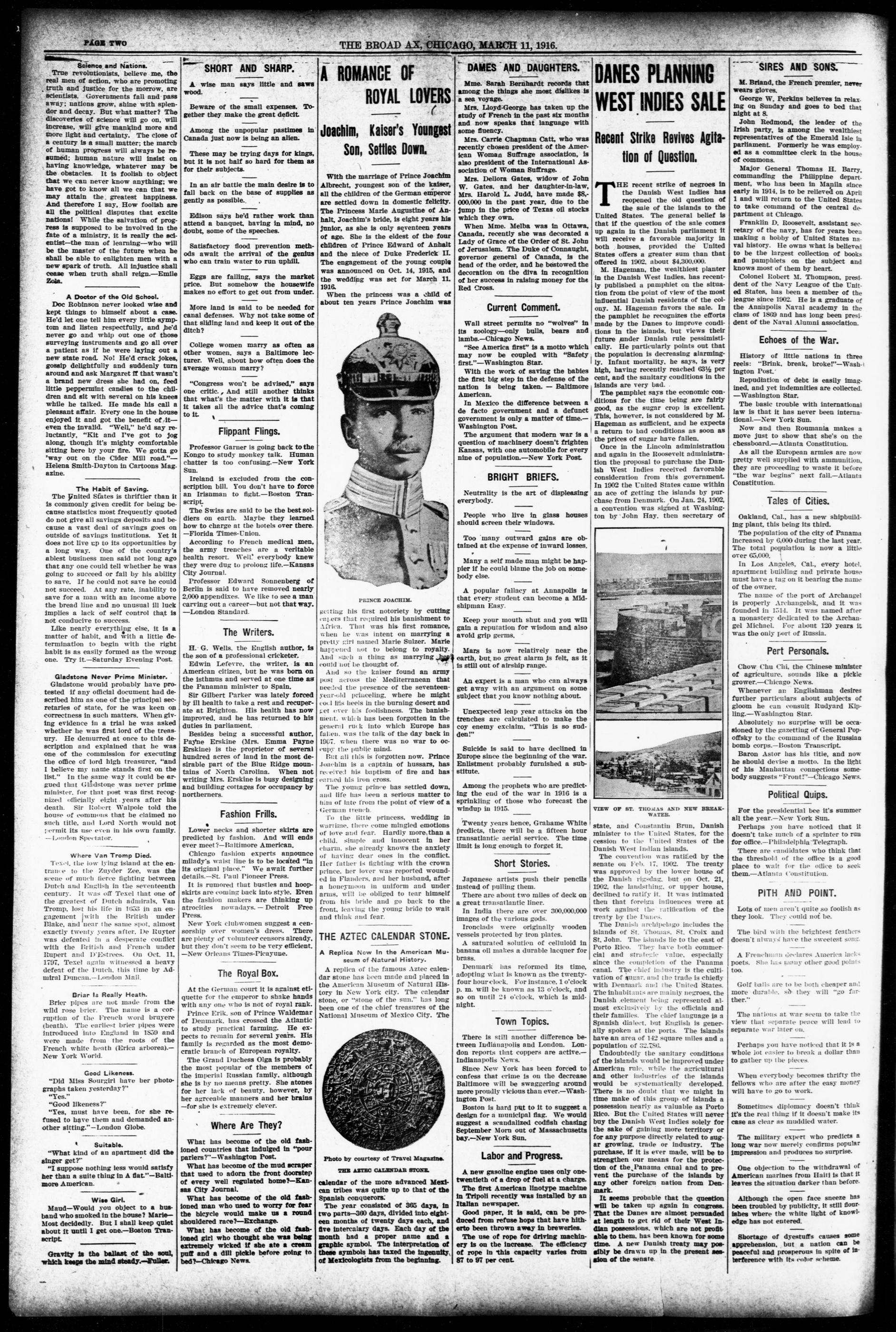
With the marriage of Prince Joachim Albrecht, youngest son of the kaiser, all the children of the German emperor are settled down in domestic felicity. The Princess Marie Augustine of Anhalt, Joachim's bride, is eight years his junior, as she is only seventeen years of age. She is the eldest of the four children of Prince Edward of Anhalt and the niece of Duke Frederick II. The engagement of the young couple was announced on Oct. 14, 1915, and the wedding was set for March 11, 1916. When the princess was a child of about ten years Prince Joachim was
[Name]
PRINCE JOACHIM
getting his first notoriety by cutting capers that required his banishment to Africa. That was his first romance, when he was intent on marrying a pretty girl named Marie Sulzer. Marie happened not to belong to royalty. And such a thing as marrying her could not be thought of.
And so the kaiser found an army post across the Mediterranean that needed the presence of the seventeen-year-old princeling, where he might cool his heels in the burning desert and get over his foolishness. The banishment, which has been forgotten in the general ruck into which Europe has fallen, was the talk of the day back in 1907. when there was no war to occupy the public mind.
But all this is forgotten now. Prince Joachim is a captain of hussars, has received his baptism of fire and has earned his iron cross.
The young prince has settled down, and life has been a serious matter to him of late from the point of view of a German trench.
To the little princess, wedding in warriime, there come mingled emotions of love and fear. Hardly more, than a child, simple and innocent in her charm, she already knows the anxiety of having dear ones in the conflict. Her father is fighting with the crown prince, her lover was reported wounded in Flanders, and her husband, after a honeymoon in uniform and under arms, will be obliged to tear himself from his bride and go back to the front, leaving the young bride to wait and think and fear.
THE AZTEC CALENDAR STONE
A Replica Now In the American Museum of Natural History.
A replica of the famous Aztec calendar stone has been made and placed in the American Museum of Natural History in New York city. The calendar stone, or "stone of the sun," has long been one of the chief treasures of the National Museum of Mexico City. The
Photo by courtesy of Travel Magazine.
calendar of the more advanced Mexican tribes was quite up to that of the Spanish conquerors.
The year consisted of 365 days, in two parts—360 days, divided into eighteen months of twenty days each, and five intercalary days. Each day of the month had a proper name and a graphic symbol. The interpretation of these symbols has taxed the ingenuity of Mexicologists from the beginning.
DAMES AND DAUGHTERS.
Mme. Sarah Bernhardt records that among the things she most dislikes is a sea voyage.
Mrs. Lloyd-George has taken up the study of French in the past six months and now speaks that language with some fluency.
Mrs. Carrie Chapman Catt, who was recently chosen president of the American Woman Suffrage association, is also president of the International Association of Woman Suffrage.
Mrs. Dellora Gates, widow of John W. Gates, and her daughter-in-law, Mrs. Harold L. Judd, have made $8,000,000 in the past year, due to the jump in the price of Texas oil stocks which they own.
When Mme. Melba was in Ottawa, Canada, recently she was decorated a Lady of Grace of the Order of St. John of Jerusalem. The Duke of Connaught, governor general of Canada, is the head of the order, and he bestowed the decoration on the diva in recognition of her success in raising money for the Red Cross.
Current Comment.
Wall street permits no "wolves" in its zoology—only bulls, bears and lambs.—Chicago News.
"See America first" is a motto which may now be coupled with "Safety first."—Washington Star.
With the work of saving the babies the first big step in the defense of the nation is being taken. — Baltimore American.
In Mexico the difference between a de facto government and a defunct government is only a matter of time.—Washington Post.
The argument that modern war is a question of machinery doesn't frighten Kansas, with one automobile for every nine of population.—New York Post.
BRIGHT BRIEFS.
Neutrality is the art of displeasing everybody.
People who live in glass houses should screen their windows.
Too many outward gains are obtained at the expense of inward losses.
Many a self made man might be happier if he could blame the job on somebody else.
A popular fallacy at Annapolis is that every student can become a Midshipman Easy.
Keep your mouth shut and you will gain a reputation for wisdom and also avoid grip germs.
Mars is now relatively near the earth, but no great alarm is felt, as it is still out of airship range.
An expert is a man who can always get away with an argument on some subject that you know nothing about.
Unexpected leap year attacks on the trenches are calculated to make the coy enemy exclaim. "This is so sudden!"
Suicide is said to have declined in Europe since the beginning of the war. Enlistment probably furnished a substitute.
Among the prophets who are predicting the end of the war in 1916 is a sprinkling of those who forecast the windup in 1915.
Twenty years hence, Grahame White predicts, there will be a fifteen hour transatlantic aerial service. The time limit is long enough to forget it.
Short Stories.
Japanese artists push their pencils instead of pulling them. There are about two miles of deck on a great transatlantic liner.
In India there are over 300,000,000 images of the various gods. Ironclads were originally wooden vessels protected by iron plates. A saturated solution of celluloid in banana oil makes a durable lacquer for brass. Denmark has reformed its time, adopting what is known as the twenty-four hour clock. For instance, 1 o'clock p. m. will be known as 13 o'clock, and so on until 24 o'clock, which is midnight.
Town Topics.
There is still another difference between Indianapolis and London. London reports that coppers are active.—Indianapolis News.
Since New York has been forced to confess that crime is on the decrease Baltimore will be swaggering around more proudly vicious than ever.—Washington Post.
Boston is hard put to it to suggest a design for a municipal flag. We would suggest a scandalized codfish chasing September Morn out of Massachusetts bay.—New York Sun.
Labor and Progress.
A new gasoline engine uses only one twentieth of a drop of fuel at a charge.
The first American linotype machine in Tripoli recently was installed by an Italian newspaper.
Good paper, it is said, can be produced from refuse hops that have hitherto been thrown away in breweries.
The use of rope for driving machinery is on the increase. The efficiency of rope in this capacity varies from 87 to 97 per cent.
DANES PLANNING WEST INDIES SALE
THE recent strike of negroes in the Danish West Indies has reopened the old question of the sale of the islands to the United States. The general belief is that if the question of the sale comes up again in the Danish parliament it will receive a favorable majority in both houses, provided the United States offers a greater sum than that offered in 1902, about $4,300,000.
M. Hageman, the wealthiest planner in the Danish West Indies, has recently published a pamphlet on the situation from the point of view of the most influential Danish residents of the colony. M. Hageman favors the sale. In the pamphlet he recognizes the efforts made by the Danes to improve conditions in the islands, but views their future under Danish rule pessimistically. He particularly points out that the population is decreasing alarmingly. Infant mortality, he says, is very high, having recently reached $63\%$ per cent, and the sanitary conditions in the islands are very bad.
The pamphlet says the economic conditions for the time being are fairly good, as the sugar crop is excellent. This, however, is not considered by M. Hageman as sufficient, and he expects a return to bad conditions as soon as the prices of sugar have fallen.
Once in the Lincoln administration and again in the Roosevelt administration the proposal to purchase the Danish West Indies received favorable consideration from this government. In 1902 the United States came within an ace of getting the islands by purchase from Denmark. On Jan. 24, 1902, a convention was signed at Washington by John Hay, then secretary of
```markdown
```
VIEW OF ST. THOMAS AND NEW BREAK-WATER.
state, and Constantin Brun, Danish minister to the United States, for the cession to the United States of the Danish West Indian islands.
The convention was ratified by the senate on Feb. 17, 1902. The treaty was approved by the lower house of the Danish rigsdag, but on Oct. 21, 1902, the landsthing, or upper house, declined to ratify it. It was intimated then that foreign influences were at work against the ratification of the treaty by the Danes.
The Danish archipelago includes the islands of St. Thomas, St. Croix and St. John. The islands lie to the east of Porto Rico. They have both commercial and strategic value, especially since the completion of the Panama canal. The chief industry is the cultivation of sugar, and the trade is chiefly with Denmark and the United States. The inhabitants are mainly negroes, the Danish element being represented almost exclusively by the officials and their families. The chief language is a Spanish dialect, but English is generally spoken at the ports. The islands have an area of 142 square miles and a population of 32,786.
Undoubtedly the sanitary conditions of the islands would be improved under American rule, while the agricultural and other industries of the islands would be systematically developed. There is no doubt that we might in time make of this group of islands a possession nearly as valuable as Porto Rico. But the United States will never buy the Danish West Indies solely for the sake of gaining more territory or for any purpose directly related to sugar growing, trade or industry. The purchase, if it is ever made, will be to strengthen our means for the protection of the Panama canal and to prevent the purchase of the islands by any other foreign nation from Denmark.
It seems probable that the question will be taken up again in congress. That the Danes are almost persuaded at length to get rid of their West Indian possessions, which are not profitable to them, has been known for some time. A new Danish treaty may possibly be drawn up in the present session of the senate.
SIRES AND SONS.
M. Briand, the French premier, never wears gloves.
George W. Perkins believes in relaxing on Sunday and goes to bed that night at 8.
John Redmond, the leader of the Irish party, is among the wealthiest representatives of the Emerald Isle in parliament. Formerly he was employed as a committee clerk in the house of commons.
Major General Thomas H. Barry, commanding the Philippine department, who has been in Manila since early in 1914, is to be relieved on April 1 and will return to the United States to take command of the central department at Chicago.
Franklin D. Roosevelt, assistant secretary of the navy, has for years been making a hobby of United States naval history. He owns what is believed to be the largest collection of books and pamphlets on the subject and knows most of them by heart.
Colonel Robert M. Thompson, president of the Navy League of the United States, has been a member of the league since 1902. He is a graduate of the Annapolis Naval academy in the class of 1899 and has long been president of the Naval Alumni association.
Echoes of the War
History of little nations in three reels: "Brink, break, broke!"—Washington Post.
Repudiation of debt is easily imagined, and yet indemnities are collected.—Washington Star.
The basic trouble with international law is that it has never been international.—New York Sun.
Now and then Roumania makes a move just to show that she's on the chessboard.—Atlanta Constitution.
As all the European armies are now pretty well supplied with ammunition, they are proceeding to waste it before "the war begins" next fall.—Atlanta Constitution.
Tales of Cities.
Oakland, Cal., has a new shipbuilding plant, this being its third.
The population of the city of Panama increased by 6,000 during the last year. The total population is now a little over 65,000.
In Los Angeles, Cal., every hotel, apartment building and private house must have a tag on it bearing the name of the owner.
The name of the port of Archangel is properly Archangelsk, and it was founded in 1514. It was named after a monastery dedicated to the Archangel Michael. For about 120 years it was the only port of Russia.
Pert Personals
Chow Chu Chi, the Chinese minister of agriculture, sounds like a pickle grower.—Chicago News. Whenever an Englishman desires further particulars about subjects of gloom he can consult Rudyard Kipling.—Washington Star. Absolutely no surprise will be occasioned by the gazetting of General Popoffsky to the command of the Russian bomb corps.—Boston Transcript. Baron Astor has his title, and now he should devise a motto. In the light of his Manhattan connections somebody suggests "Front"—Chicago News.
Political Quips.
For the presidential bee it's summer all the year.—New York Sun.
Perhaps you have noticed that it doesn't take much of a spinner to run for office.—Philadelphia Telegraph.
There are candidates who think that the threshold of the office is a good place to wait for the office to seek them.—Atlanta Constitution.
PITH AND POINT.
Lots of men aren't quite so foolish as they look. They could not be.
The bird with the brightest feathers doesn't always have the sweetest song.
A Frenchman declares America lacks poets. She has many other good points too.
Golf balls are to be both cheaper and more durable, so they will "go farther."
The nations at war seem to take the view that separate peace will lead to separate war later on.
Perhaps you have noticed that it is a whole lot easier to break a dollar than to gather up the pieces.
When everybody becomes thrifty the fellows who are after the easy money will have to go to work.
Sometimes diplomacy doesn't think it's the real thing if it doesn't make its case as clear as muddied water.
The military expert who predicts a long war now merely confirms popular impression and produces no surprise.
One objection to the withdrawal of American marines from Haiti is that it leaves the situation darker than before.
Although the open face sneeze has been troubled by publicity, it still flourishes where the white light of knowledge has not entered.
Shortage of dyestuffs causes some apprehension, but a nation can be peaceful and prosperous in spite of interference with its color scheme.
---
How to Recharge Your Battery
Did it ever occur to you that rest is an antidote for more things than every day physical weariness? It is one of the weapons with which a man or woman may fight emotional strains of any kind. And the reason is an extremely simple one. Let us resort to the faithful old device of a diagram.
In the center of the chart suppose we put the word "energy." That is the thing that we have to work with in this life. Now on one side let's write a list of our expenditures—all the things which call for an outlay of energy. In this list is brain work, physical or manual work, emotion and diversion. These are the things that we spend our store of energy for. Every day we spend ourselves either physically, or mentally, or emotionally, or in some manner which may be a combination of any of them and which constitutes our diversions.
So much for the expense account. What shall we put in a list on the other side of the column that we might call income? How, in other words, do we accumulate energy?
Here are some of the ways: 'Food,' of course, and then "rest," "good air" and some of the other lesser ways which are productive of a renewed sense of energy, such as good grooming and inspiring associations.
And it is pretty true that you may add to your bank account and thus offset any sort of an expenditure with any sort of an income. That is, if we are working hard and playing, hard we need a little more fuel in the way of food to keep the supply of energy up to the standard. And so, too, a little added rest will offset not only a physical, but an emotional strain.
Sometimes sleep is a better antidote for suffering than diversion, because diversion, after all, calls for an expenditure of energy, while suffering or an emotional strain of any sort has already taken a pretty full toll of the supply on hand.
Study the chart, then, and learn not only to spend wisely of the things that represent our outlay, but learn, too, to collect generously from those common sources of supply which are open to every one—food, fresh air and rest.
FOR TODDLERS.
How Modish the Two-year-old May Be This Spring.
White linen cut with kimono sleeves,
the neck and sleeve bottoms being
edged with narrow torchon, gives this
attractive little frock. A bolero is
DIMINUTIVE STYLE.
outlined with hand embroidery, and the crushed girdle run through a crocheted buckle is pale blue taffeta ribbon.
Cake Fillings and Icings.
Filling for Orange Cake.—One medium orange, juice and grated rind; two tablespoonfuls butter, one egg, one cupful sugar; beat sugar, orange juice and rind and butter, add beaten egg, cook until it thickens; use cold.
Butter Frosting.—Two cupfuls powdered sugar, two tablespoonfuls milk, two tablespoonfuls melted butter; two tablespoonfuls vanilla; stir until creamy.
Cake Filler.—A good cake filler, easily made, is a cupful of sugar and one half cupful sweet milk; boil until it "hairs"; beat until cold enough to spread.
Lemon Filler.—One egg, well beaten; one cupful sugar, juice and grated rind of one lemon, piece butter size of egg; cook over hot water until thick.
Pineapple Icing.—One and one-half cupfuls of confectioner's sugar, one tablespoonful of shredded pineapple, one half teaspoonful of vanilla, boiling water to make creamy. Spread at once. Chocolate Icing.—Two teaspoonfuls of cocoa, two tablespoonfuls of hot water. Cook half a minute, cool, add one tablespoonful of milk; stir in sugar to the right consistency.
Meat Scallops
Materials.—Two cupfuls cold roast beef, stale breadcrumbs, seasoning, a tablespoonful butter, a tablespoonful flour, a cupful stock or gravy. Directions.—Mince the meat finely, removing any superfluous fat, and season highly with salt, pepper, a little mustard or horseradish or stock sauce. Blend together in a saucepan the butter and flour, add the stock and when boiling cook for two or three minutes; then put in the meat and mix with this foundation sauce. Turn into greased scallop shells or small individual dishes, sprinkle buttered crumbs over the top and lake fifteen minutes.
Lowell's Dread of Old Age.
I have said that Lowell was the youngest man I ever knew. It is also true that I never knew any other man who had a greater dread of growing old than he. He would sometimes say to me (I was twenty-five years the younger). "Oh, you'll begin to feel it pretty soon."
The last time I saw him he gave me a curious and somewhat pathetic indication of his interest in this subject. I happened to be in Boston for a day and went out to see him in the teeth of a terrible March blizzard. I thought he seemed rather lonely. He told me that Hoppin had called upon him not long before. He said that he looked well and seemed to be in good health, but he noticed that when he went out he was a little awkward in getting down the front steps. When I left Lowell came to the door with me and stood there, evidently waiting to see how I negotiated the front steps. At the age at which I then was there was no reason why there should be anything the matter with my action. But the incident was characteristic of Lowell and of his intense interest in the subject of youth and age—E. S. Nadal in Harper's Magazine.
Clever Amateurs
Dozens of old graduates were back, and they talked a lot about themselves and a lot more about others not so fortunate as to attend.
"Most of our old crowd are married and happy," said one.
"Married, anyhow," said another, with the grin that always accompanies this silly joke.
"I accept the amendment," returned the first speaker, "but chiefly on account of poor Billy Tompkins. He had an unfortunate marital experience."
We hadn't heard of it and begged for particulars.
"Why, the girl he married turned out to be a professional pickpocket."
The men who had first spoken sighed, but his eye twinkled.
"Well," he observed, "I guess the rest of us drew some pretty clever amateurs—what?"—St. Louis Post-Dispatch.
The Kilted Eyzone
The Greek soldier may present to some a highly humorous picture in his ballet skirts and tunic. Despite his peculiarities of dress—which, by the way, are scarcely more peculiar than those of some other nations—he is an excellent fighting man.
The evzone, as he is called, would no more abandon the skirt than would a Scot his kilt. It is a part of his national honor, a part of his personal being. It is a right handed down to him from ancient times. A bas relief of the soldier who fought at Marathon shows him in similar costume. His costume is no ephemeral piece of clothing, for it is worn with the dignity of ages behind it. The evzones are ignorant of fear, and if they look anything but soldierly their appearance is belled by their ability to fight under extraordinary conditions. — Syracuse Post-Standard.
Puzzle of the Eagle and the Whale.
There are two animals that puzzle naturalists more than any others.
They are nature's submarine and aeroplane, the whale and the eagle. It is known that whales occasionally descend as much as 3,000 feet below the surface of the sea. Why they are not injured scientists have yet to discover. It is this pressure which prevents a modern submarine descending even 300 feet, let alone 3,000.
Eagles have been seen through telescopes to fly with apparent ease from 30,000 to 40,000 feet above sea level. At that height no human being can live owing to the rarefaction of the air. How the birds live and fly at far greater heights than man can endure for long is a question still to be answered.—Pearson's Weekly.
Percentage
"That's some hat you've got there,
Bill. It must have set you back all
of $10."
"It did, but I figure I'm saving
money on it at that."
"How do you make that out?"
"How do you make that out?
"Well, when I wore a two dollar hat
I had to give up 5 per cent of its
value every time I checked it in a
fashionable restaurant. With this one
it costs me only 1 per cent."—St. Louis
Post-Dispatch.
Saving Labor.
"This agricultural journal states that apple trees ought to be planted on a slope."
"What's the idea?"
"So when the apples ripen and drop off they will roll down to the farmer's doorstep, I suppose."—Louisville Courier-Journal.
Ualv.
"What an ugly disposition he has!"
"Yes. You remember how cross your husband is the first week of every year when he gives up smoking?"
"Yes."
"Well, he's that way all the time."—Detroit Free Press.
Voice of the Bells
R. L. Stevenson said that "there is so often a threatening note, something blatant and metallic, in the voice of bells that we have fully more pain than pleasure in hearing them."
No Chance For Him.
Nkucker—Enjoy your car? Bocker—It might as well be a milk wagon. The only time the rest of the family don't use it is between 4 and 7 in the morning.—New York Sun.
Everything that exists depends upon the past, prepares the future and is related to the whole.—Oersted.
THE BROAD AX, CHICAGO, MARCH 11 1916
---
1
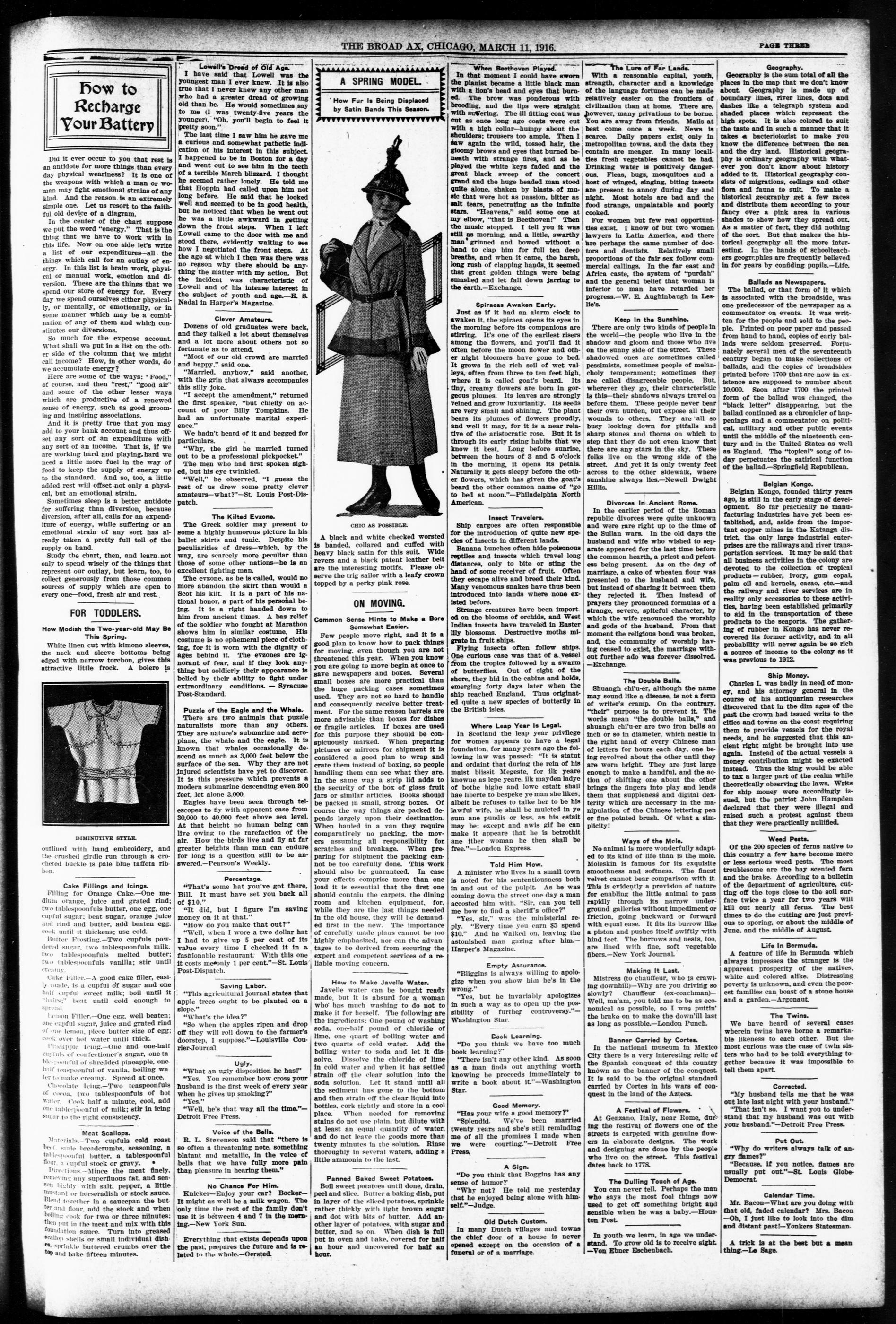
CHIC AS POSSIBLE.
A black and white checked worsted is banded, collared and cuffed with heavy black satin for this suit. Wide revers and a black patent leather belt are the interesting motifs. Please observe the tricolor sailor with a leafy crown topped by a perky pink rose.
ON MOVING.
Common Sense Hints to Make a Bore Somewhat Easier.
Few people move right, and it is a good plan to know how to pack things for moving, even though you are not threatened this year. When you know you are going to move begin at once to save newspapers and boxes. Several small boxes are more practical than the huge packing cases sometimes used. They are not so hard to handle and consequently receive better treatment. For the same reason barrels are more advisable than boxes for dishes or fragile articles. If boxes are used for this purpose they should be conspicuously marked. When preparing pictures or mirrors for shipment it is considered a good plan to wrap and create them instead of boxing, so people handling them can see what they are. In the same way a strip lid adds to the security of the box of glass fruit jars or similar articles. Books should be packed in small, strong boxes. Of course the way things are packed depends largely upon their destination. When hauled in a van they require comparatively no packing, the movers assuming all responsibility for scratches and breakage. When preparing for shipment the packing cannot be too carefully done. This work should also be guaranteed. In case your effects comprise more than one load it is essential that the first one should contain the carpets, the dining room and kitchen equipment, for while they are the last things needed in the old house, they will be demanded first in the new. The importance of carefully made plains cannot be too highly emphasized, nor can the advantages to be derived from securing the expert and competent services of a reliable moving concern.
How to Make Javelle Water
Javelle water can be bought ready made, but it is absurd for a woman who has much washing to do not to make it for herself. The following are the ingredients: One pound of washing soda, one-half pound of chloride of lime, one quart of boiling water and two quarts of cold water. Add the boiling water to soda and let it dissolve. Dissolve the chloride of lime in cold water and when it has settled strain off the clear solution into the soda solution. Let it stand until all the sediment has gone to the bottom and then strain off the clear liquid into bottles, cork tightly and store in a cool place. When needed for removing stains do not use plain, but dilute with at least an equal quantity of water, and do not leave the goods more than twenty minutes in the solution. Rinse thoroughly in several waters, adding a little ammonia to the last.
Panned Baked Sweet Potatoes.
Boil sweet potatoes until done, drain, peel and slice. Butter a baking dish, put in layer of the sliced potatoes, sprinkle rather thickly with light brown sugar and dot with bits of butter. Add another layer of potatoes, with sugar and butter, and so on. When dish is full put in oven and bake, covered for half an hour and uncovered for half an hour.
When Beethoven Played.
In that moment I could have sworn the pianist became a little black man with a lion's head and eyes that burned. The brow was ponderous with brooding, and the lips were straight with suering. The all fitting coat was cut as once long ago coats were cut with a high collar—humpy about the shoulders; trousers too ample. Then I saw again the wild, tossed hair, the gloomy brows and eyes that burned beneath with strange fires, and as he played the white keys faded and the great black sweep of the concert grand and the huge headed man stood quite alone, shaken by blasts of music that were hot as passion, bitter as salt tears, penetrating as the infinite stars. "Heavens," said some one at my elbow, "that is Beethoven!" Then the music stopped. I tell you it was still as morning, and a little, swarthy man grinned and bowed without a hand to clap him for full ten deep breaths, and when it came, the harsh, long rush of clapping hands, it seemed that great golden things were being smashed and let fall down jarring to the earth—Exchange.
Spiraeas Awaken Early.
Just as if it had an alarm clock to awaken it, the spiraea opens its eyes in the morning before its companions are stirring. It's one of the earliest risers among the flowers, and you'll find it often before the moon flower and other night bloomers have gone to bed. It grows in the rich soil of wet valleys, often from three to ten feet high, where it is called goat's beard. Its tiny, creamy flowers are born in gorgeous plumes. Its leaves are strongly veined and grow luxuriantly. Its seeds are very small and shining. The plant bears its plumes of flowers proudly, and well it may, for it is a near relative of the aristocratic rose. But it is through its early rising habits that we know it best. Long before sunrise, between the hours of 3 and 5 o'clock in the morning, it opens its petals. Naturally it gets sleepy before the other flowers, which has given the goat's beard the other common name of "go to bed at noon."—Philadelphia North American.
Insect Travelers
Ship cargoes are often responsible for the introduction of quite new species of insects in different lands. Banana bunches often hide poisonous reptiles and insects which travel long distances, only to bite or sting the hand of some receiver of fruit. Often they escape alive and breed their kind. Many venomous snakes have thus been introduced into lands where none existed before. Strange creatures have been imported on the blooms of orchids, and West Indian insects have traveled in Easter lily blossoms. Destructive moths migrate in fruit ships.
Flying insects often follow ships. One curious case was that of a vessel from the tropics followed by a swarm of butterflies. Out of sight of the shore, they hid in the cabins and holds, emerging forty days later when the ship reached England. Thus originated quite a new species of butterfly in the British isles.
Where Leap Year Is Legal
In Scotland the leap year privilege for women appears to have a legal foundation, for many years ago the following law was passed: "It is statut and ordaint that during the rein of his maist blissit Megeste, for ilk yeare knowne as lepe yeare, ilk mayden ladye of bothe bighe and lowe estalt shall hae liberte to bespeke ye man she likes; albeit he refuses to taike her to be his lawful wife, he shall be muleted in ye sum an pundels or less, as his estalt may be; except and awis gif he can make it appear that he is betrothit anither woman he then shall be free."—London Express.
Told Him How.
A minister who lives in a small town is noted for his sententiousness both in and out of the pulpit. As he was coming down the street one day a man accosted him with. "Sir, can you tell me how to find a sheriff's office?" "Yes, sir," was the ministerial reply. "Every time you earn $5 spend $10." And he walked on, leaving the astonished man gazing after him.—Harper's Magazine.
Empty Assurance
"Bilgkins is always willing to apologize when you show him he's in the wrong."
"Yes, but he invariably apologizes in such a way as to open up the possibility of further controversy."—Washington Star
Book Learning.
"Do you think we have too much book learning?"
"There isn't any other kind. As soon as a man finds out anything worth knowing he proceeds immediately to write a book about it."—Washington Star.
Good Memory.
"Has your wife a good memory?"
Has you write a good birthday?
"Splendid. We've been married
twenty years and she's still reminding
me of all the promises I made when
we were courting."—Detroit Free
Press.
A Sign.
"Do you think that Boggins has any sense of humor?"
"Why not? He told me yesterday that he enjoyed being alone with himself."—Judge.
Old Dutch Custom
In many Dutch villages and towns the chief door of a house is never opened except on the occasion of a funeral or of a marriage.
The Lure of Far Lands.
With a reasonable capital, youth, strength, character and a knowledge of the language fortunes can be made relatively easier on the frontiers of civilization than at home. There are, however, many privations to be borne. You are away from friends. Malls at best come once a week. News is scarce. Daily papers exist only in metropolitan towns, and the data they contain are meager. In many localities fresh vegetables cannot be had. Drinking water is positively dangerous. Fleas, bugs, mosquitoes and a host of winged, singing, biting insects are present to annoy during day and night. Most hotels are bad and the food strange, unpalatable and poorly cooked.
For women but few real opportunities exist. I know of but two women lawyers in Latin America, and there are perhaps the same number of doctors and dentists. Relatively small proportions of the fair sex follow commercial callings. In the far east and Africa caste, the system of "purdah" and the general belief that woman is inferior to man have retarded her progress.—W. E. Aughinbaugh in Leslie's.
Keep In the Sunshine
There are only two kinds of people in the world—the people who live in the shadow and gloom and those who live on the sunny side of the street. These shadowed ones are sometimes called pessimists, sometimes people of melancholy temperament; sometimes they are called disagreeable people. But, wherever they go, their characteristic is this—their shadows always travel on before them. These people never bear their own burden, but expose all their wounds to others. They are all so busy looking down for pitfalls and sharp stones and thorns on which to step that they do not even know that there are any stars in the sky. These folks live on the wrong side of the street. And yet it is only twenty feet across to the other sidewalk, where sunshine always lies.—Newell Dwight Hills.
Divorces In Ancient Rome
In the earlier period of the Roman republic divorces were quite unknown and were rare right up to the time of the Sullan wars. In the old days the husband and wife who wished to separate appeared for the last time before the common hearth, a priest and priestess being present. As on the day of marriage, a cake of wheaten flour was presented to the husband and wife, but instead of sharing it between them they rejected it. Then instead of prayers they pronounced formulas of a strange, severe, spiteful character, by which the wife renounced the worship and gods of the husband. From that moment the religious bond was broken, and, the community of worship having ceased to exist, the marriage without further ado was forever dissolved.—Exchange.
The Double Balls.
Shuangh chl'u-er, although the name may sound like a disease, is not a form of writer's cramp. On the contrary, "their" purpose is to prevent it. The words mean "the double balls," and shuangh chl'u-er are two iron balls an inch or so in diameter, which nestle in the right hand of every Chinese man of letters for hours each day, one being revolved about the other until they are worn bright. They are just large enough to make a handful, and the action of shifting one about the other brings the fingers into play and lends them that suppleness and digital dexterity which are necessary in the manipulation of the Chinese lettering pen or fine pointed brush. Of what a simplicity!
Ways of the Mole
No animal is more wonderfully adapted to its kind of life than is the mole. Moleskin is famous for its exquisite smoothness and softness. The finest velvet cannot bear comparison with it. This is evidently a provisor of nature for enabling the little animal to pass rapidly through its narrow underground galleries without impediment or friction, going backward or forward with equal ease. It fits its burrow like a piston and pushes itself swiftly with hind feet. The burrows and nests, too, are lined with fine, soft vegetable fibers.—New York Journal.
Making It Last.
Mistress (to chauffeur, who is crawling downhill)—Why are you driving so slowly? Chauffeur (ex-coachman)—Well, ma'ma, you told me to be as economical as possible, so I was puttin' the brake on to make the down'll last as long as possible—London Punch.
Banner Carried by Cortes.
In the national museum in Mexico City there is a very interesting relic of the Spanish conquest of this country known as the banner of the conquest. It is said to be the original standard carried by Cortes in his wars of conquest in the land of the Aztecs.
A Festival of Flowers.
At Genzano, Italy, near Rome, during the festival of flowers one of the streets is carpeted with genuine flowers in elaborate designs. The work and designing are done by the people who live on the street. This festival dates back to 1778.
The Dulling Touch of Age
You can never tell. Perhaps the man who says the most fool things now used to get off something bright and sensible when he was a baby.—Houston Post.
In youth we learn, in age we understand. To grow old is to receive sight.—Von Ebner Eschenbach.
PAGE THREE
Geography.
Geography is the sum total of all the places in the map that we don't know about. Geography is made up of boundary lines, river lines, dots and dashes like a telegraph system and shaded places which represent the high spots. It is also colored to suit the taste and in such a manner that it takes a bacteriologist to make you know the difference between the sea and the dry land. Historical geography is ordinary geography with whatever you don't know about history added to it. Historical geography consists of migrations, ceddings and other flora and fauna to suit. To make a historical geography get a few races and distribute them according to your fancy over a pink area in various shades to show how they spread out. As a matter of fact, they did nothing of the sort. But that makes the historical geography all the more interesting. In the hands of schoolteachers geographies are frequently believed in for years by confiding pupils.-Life
Ballads as Newspapers.
The ballad, or that form of it which is associated with the broadside, was one predecessor of the newspaper as a commentator on events. It was written for the people and sold to the people. Printed on poor paper and passed from hand to hand, copies of early ballads were seldom preserved. Fortunately several men of the seventeenth century began to make collections of ballads, and the copies of broadsides printed before 1700 that are now in existence are supposed to number about 10,000. Soon after 1700 the printed form of the ballad was changed, the "black letter" disappearing, but the ballad continued as a chronicler of happenings and a commentator on political, military and other public events until the middle of the nineteenth century and in the United States as well as England. The "topical" song of today perpetuates the satirical function of the ballad.—Springfield Republican.
Belgian Kongo.
Belgian Kongo, founded thirty years ago, is still in the early stage of development. So far practically no manufacturing industries have yet been established, and, aside from the important copper mines in the Katanga district, the only large industrial enterprises are the railways and river transportation services. It may be said that all business activities in the colony are devoted to the collection of tropical products—rubber, ivory, gum copal, palm oil and kernels, cacao, etc—and the railway and river services are in reality only accessories to these activities, having been established primarily to aid in the transportation of these products to the seaports. The gathering of rubber in Kongo has never recovered its former activity, and in all probability will never again be so rich a source of income to the colony as it was previous to 1912.
Ship Money.
Charles L. was badly in need of money, and his attorney general in the course of his antiquarian researches discovered that in the dim ages of the past the crown had issued writs to the cities and towns on the coast requiring them to provide vessels for the royal needs, and he suggested that this ancient right might be brought into use again. Instead of the actual vessels a money contribution might be exacted instead. Thus the king would be able to tax a larger part of the realm while theoretically observing the laws. Writes for ship money were accordingly issued, but the patriot John Hampden declared that they were illegal and raised such a protest against them that they were practically nullified.
Weed Peats.
Of the 200 species of ferns native to this country a few have become more or less serious weed pests. The most troublesome are the hay scented fern and the brake. According to a bulletin of the department of agriculture, cutting off the tops close to the soil surface twice a year for two years will kill out nearly all ferns. The best times to do the cutting are just previous to sporing, or about the middle of June, and the middle of August.
Life In Bermuda.
A feature of life in Bermuda which always impresses the stranger is the apparent prosperity of the natives, white and colored allike. Distressing poverty is unknown, and even the poorest families can boast of a stone house and a garden. -Argonaut.
The Twins.
We have heard of several cases wherein twins have borne a remarkable likeness to each other. But the most curious was the case of twin sisters who had to be told everything together because it was impossible to tell them apart.
Corrected.
"My husband tells me that he was out late last night with your husband." "That isn't so. I want you to understand that my husband was out with your husband."—Detroit Free Press.
Put Out.
"Why do writers always talk of angry flames?"
"Because, if you notice, flames are usually put out."—St. Louis Globe-Democrat
Calendar Time.
Mr. Bacon—What are you doing with that old, faded calendar? Mrs. Bacon—Oh, I just like to look into the dim and distant past!—Yonkers Statesman.
A trick is at the best but a mean thing—Le Sage.
Agents and Correspondents Wanted to Handle THE BROAD AX. Liberal Commissions to Live Agents. Address, Julius F.Taylor, 6532 St. Lawrence Av., Chicago
Agents a
BRO
Addr
51
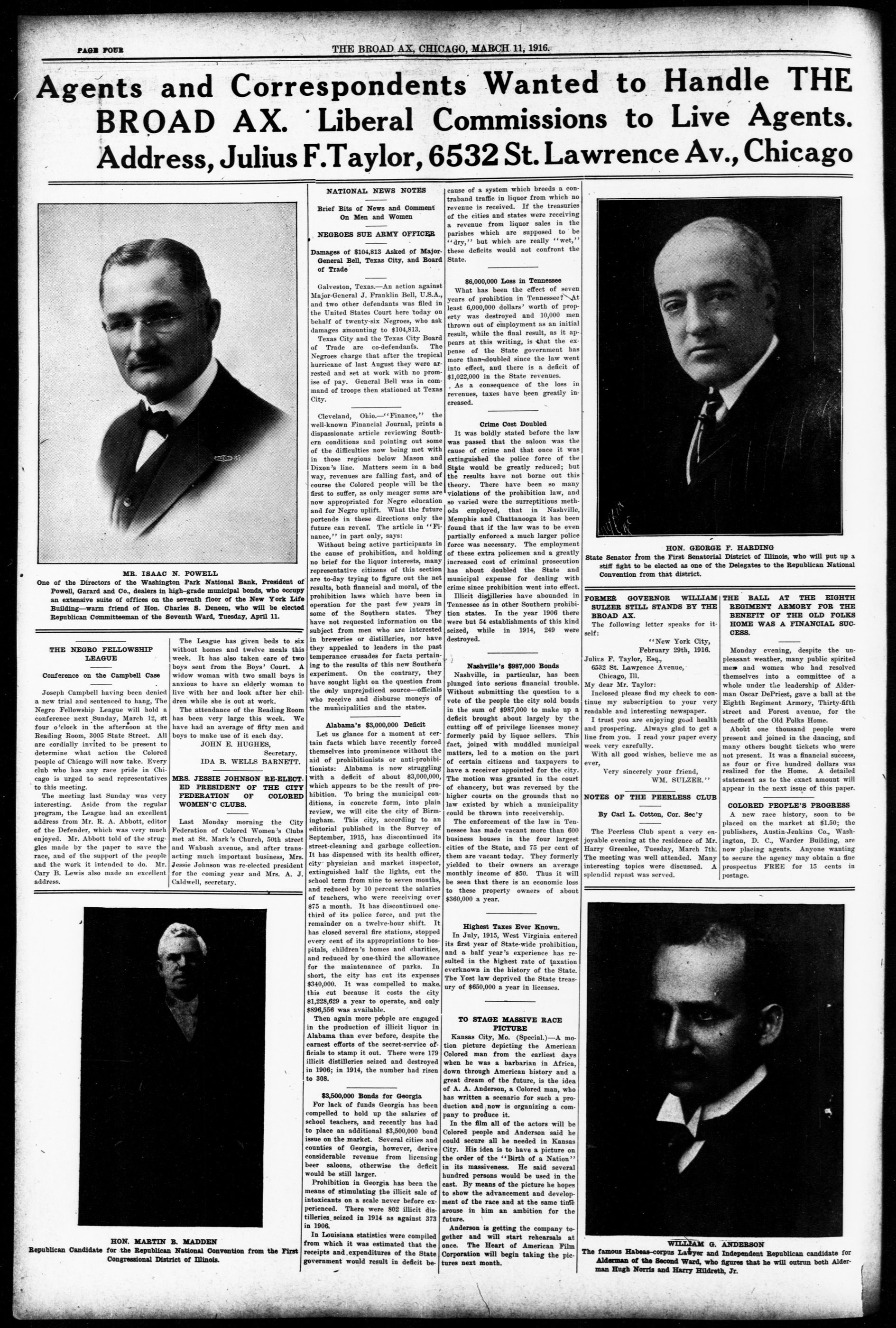
MR. ISAAC N. POWELL
One of the Directors of the Washing Powell, Garard and Co., dealers in an extensive suite of offices on the Building—warm friend of Hon. C Republican Committeeman of the S
One of the Directors of the Washington Park National Bank, President of Powell, Garard and Co., dealers in high-grade municipal bonds, who occupy an extensive suite of offices on the seventh floor of the New York Life Building—warm friend of Hon. Charles S. Deneen, who will be elected Republican Committeeman of the Seventh Ward, Tuesday, April 11.
THE NEGRO FELLOWSHIP
LEAGUE
Conference on the Campbell Case
Joseph Campbell having been denied a new trial and sentenced to hang, The Negro Fellowship League will hold a conference next Sunday, March 12, at four o'clock in the afternoon at the Reading Room, 3005 State Street. All are cordially invited to be present to determine what action the Colored people of Chicago will now take. Every club who has any race pride in Chicago is urged to send representatives to this meeting.
The meeting last Sunday was very interesting. Aside from the regular program, the League had an excellent address from Mr. R. A. Abbott, editor of the Defender, which was very much enjoyed. Mr. Abbott told of the struggles made by the paper to save the race, and of the support of the people and the work it intended to do. Mr. Cary B. Lewis also made an excellent address.
---
M. J.
Republican Candidate for the Republican National Convention from the First Congressional District of Illinois.
PAGE FOUR
ton Park National Bank, President of high-grade municipal bonds, who occupy the seventh floor of the New York Life Charles S. Deneen, who will be elected seventh Ward, Tuesday, April 11.
The League has given beds to six without homes and twelve meals this week. It has also taken care of two boys sent from the Boys' Court. A widow woman with two small boys is anxious to have an elderly woman to live with her and look after her children while she is out at work.
The attendance of the Reading Room has been very large this week. We have had an average of fifty men and boys to make use of it each day.
JOHN E. HUGHES,
Secretary.
IDA B. WELLS BARNETT.
MRS. JESSIE JOHNSON RE-ELECTED PRESIDENT OF THE CITY FEDERATION OF COLORED WOMEN'C CLUBS.
Last Monday morning the City Federation of Colored Women's Clubs met at St. Mark's Church, 50th street and Wabash avenue, and after transacting much important business, Mrs. Jessie Johnson was re-elected president for the coming year and Mrs. A. J. Caldwell, secretary.
THE BROAD AX, CHICAGO, MARCH 11, 1916.
NATIONAL NEWS NOTES
Brief Bits of News and Comment
On Men and Women
NEGROES SUE ARMY OFFICER
Damages of $104,813 Asked of Major-General Bell, Texas City, and Board of Trade
Galveston, Texas.—An action against Major-General J. Franklin Bell, U.S.A., and two other defendants was filed in the United States Court here today on behalf of twenty-six Negroes, who ask damages amounting to $104,813.
Texas City and the Texas City Board of Trade are co-defendants. The Negroes charge that after the tropical hurricane of last August they were arrested and set at work with no promise of pay. General Bell was in command of troops then stationed at Texas City.
Cleveland, Ohio,—“Finance,” the well-known Financial Journal, prints a dispassionate article reviewing Southern conditions and pointing out some of the difficulties now being met with in those regions below Mason and Dixon's line. Matters seem in a bad way, revenues are falling fast, and of course the Colored people will be the first to suffer, as only meager sums are now appropriated for Negro education and for Negro uplift. What the future portends in these directions only the future can reveal. The article in “Finance,” in part only, says:
Without being active participants in the cause of prohibition, and holding no brief for the liquor interests, many representative citizens of this section are to-day trying to figure out the net results, both financial and moral, of the prohibition laws which have been in operation for the past few years in some of the Southern states. They have not requested information on the subject from men who are interested in breweries or distilleries, nor have they appealed to leaders in the past temperance crusades for facts pertaining to the results of this new Southern experiment. On the contrary, they have sought light on the question from the only unprejudiced source-officials who receive and disburse moneys of the municipalities and the states.
Alabama's $3,000,000 Deficit
Alabama's $3,000,000 Debt
Let us glance for a moment at certain facts which have recently forced themselves into prominence without the aid of prohibitionists or anti-prohibitionists: Alabama is now struggling with a deficit of about $3,000,000, which appears to be the result of prohibition. To bring the municipal conditions, in concrete form, into plain review, we will cite the city of Birmingham. This city, according to an editorial published in the Survey of September, 1915, has discontinued its street-cleaning and garbage collection. It has dispensed with its health officer, city physician and market inspector, extinguished half the lights, cut the school term from nine to seven months, and reduced by 10 percent the salaries of teachers, who were receiving over $75 a month. It has discontinued one-third of its police force, and put the remainder on a twelve-hour shift. It has closed several fire stations, stopped every cent of its appropriations to hospitals, children's homes and charities, and reduced by one-third the allowance for the maintenance of parks. In short, the city has cut its expenses $340,000. It was compelled to make this cut because it costs the city $1,228,629 a year to operate, and only $896,556 was available.
Then again more people are engaged in the production of illicit liquor in Alabama than ever before, despite the earnest efforts of the secret-service officials to stamp it out. There were 179 illicit distilleries seized and destroyed in 1906; in 1914, the number had risen to 308.
$3,500,000 Bonds for Georgia
For lack of funds Georgia has been compelled to hold up the salaries of school teachers, and recently has had to place an additional $3,500,000 bond issue on the market. Several cities and counties of Georgia, however, derive considerable revenue from licensing beer saloons, otherwise the deficit would be still larger.
Prohibition in Georgia has been the means of stimulating the illicit sale of intoxicants on a scale never before experienced. There were 802 illicit distilleries seized in 1914 as against 373 in 1906.
In Louisiana statistics were compiled from which it was estimated that the receipts and expenditures of the State government would result in deficit be-
cause of a system which breeds a contraband traffic in liquor from which no revenue is received. If the treasuries of the cities and states were receiving a revenue from liquor sales in the parishes which are supposed to be "dry,' but which are really "wet,' these deficits would not confront the State.
$6,000,000 Loss in Tennessee
What has been the effect of seven years of prohibition in Tennessee? At least 6,000,000 dollars' worth of property was destroyed and 10,000 men thrown out of employment as an initial result, while the final result, as it appears at this writing, is that the expense of the State government has more than doubled since the law went into effect, and there is a deficit of $1,022,000 in the State revenues. As a consequence of the loss in revenues, taxes have been greatly increased.
Crime Cost Doubled
It was boldly stated before the law was passed that the saloon was the cause of crime and that once it was extinguished the police force of the State would be greatly reduced; but the results have not borne out this theory. There have been so many violations of the prohibition law, and so varied were the surreptitious methods employed, that in Nashville, Memphis and Chattanooga it has been found that if the law was to be even partially enforced a much larger police force was necessary. The employment of these extra policemen and a greatly increased cost of criminal prosecution has about doubled the State and municipal expense for dealing with crime since prohibition went into effect.
Illicit distilleries have abounded in Tennessee as in other Southern prohibition states. In the year 1906 there were but 54 establishments of this kind seized, while in 1914, 249 were destroved.
Nashville's $987,000 Bonds
Nashville, in particular, has been plunged into serious financial trouble. Without submitting the question to a vote of the people the city sold bonds in the sum of $987,000 to make up a deficit brought about largely by the cutting off of privilege licenses money formerly paid by liquor sellers. This fact, joined with muddled municipal matters, led to a motion on the part of certain citizens and taxpayers to have a receiver appointed for the city. The motion was granted in the court of chancery, but was reversed by the higher courts on the grounds that no law existed by which a municipality could be thrown into receivership.
The enforcement of the law in Tennessee has made vacant more than 600 business houses in the four largest cities of the State, and 75 per cent of them are vacant today. They formerly yielded to their owners an average monthly income of $50. Thus it will be seen that there is an economic loss to these property owners of about $360,000 a year.
Highest Taxes Ever Known.
In July, 1915, West Virginia entered its first year of State-wide prohibition, and a half year's experience has resulted in the highest rate of taxation everknown in the history of the State. The Yost law deprived the State treasury of $650,000 a year in licenses.
TO STAGE MASSIVE RACE
PICTURE
Kansas City, Mo. (Special.)—A motion picture depicting the American Colored man from the earliest days when he was a barbarian in Africa, down through American history and a great dream of the future, is the idea of A. A. Anderson, a Colored man, who has written a scenario for such a production and now is organizing a company to produce it.
In the film all of the actors will be Colored people and Anderson said he could secure all he needed in Kansas City. His idea is to have a picture on the order of the "Birth of a Nation" in its massiveness. He said several hundred persons would be used in the cast. By means of the picture he hopes to show the advancement and development of the race and at the same time arouse in him an ambition for the future.
Anderson is getting the company together and will start rehearsals at once. The Heart of American Film Corporation will begin taking the pictures next month.
M. C.
State Senator from the First Senatorial District of Illinois, who will put up a stiff fight to be elected as one of the Delegates to the Republican National Convention from that district.
State Senator from the First Senatorial District of Illinois, who will put up a stiff fight to be elected as one of the Delegates to the Republican National Convention from that district.
FORMER GOVERNOR WILLIAM
SULZER STILL STANDS BY THE
BROAD AX.
The following letter speaks for it
self:
"New York City,
February 29th, 1916.
Julius F. Taylor, Esq.,
6532 St. Lawrence Avenue,
Chicago, Ill.
My dear Mr. Taylor:
Inclosed please find my check to
continue my subscription to your very
readable and interesting newspaper.
I trust you are enjoying good health
and prospering. Always glad to get a
line from you. I read your paper every
week very carefully.
With all good wishes, believe me as
ever,
Very sincerely your friend,
WM. SULZER."
NOTES OF THE PEERLESS CLUB
By Carl L. Cotton, Cor. Sec'y
The Peerless Club spent a very enjoyable evening at the residence of Mr. Harry Greenlee, Tuesday, March 7th The meeting was well attended. Many interesting topics were discussed. A sulendid repast was served.
[Image of a man with a mustache and a suit]
G.
WILLIAM G. ANDERSON The famous Habeas-corpus Lawyer and Independent Republican candidate for Alderman of the Second Ward, who figures that he will outrun both Alderman Hugh Norris and Harry Hildreth, Jr.
The famous Habeas-corpus Lawyer and Alderman of the Second Ward, who man Hugh Norris and Harry Hildre
bus Lawyer and Independent Bond Ward, who figures that he and Harry Hildreth, Jr.
My dear Mr. Taylor:
THE BALL AT THE EIGHTH REGIMENT ARMORY FOR THE BENEFIT OF THE OLD FOLKS HOME WAS A FINANCIAL SUCCESS.
Monday evening, despite the unpleasant weather, many public spirited men and women who had resolved themselves into a committee of a whole under the leadership of Alderman Oscar DePriest, gave a ball at the Eighth Regiment Armory, Thirty-fifth street and Forest avenue, for the benefit of the Old Folks Home.
About one thousand people were present and joined in the dancing, and many others bought tickets who were not present. It was a financial success, as four or five hundred dollars was realized for the Home. A detailed statement as to the exact amount will appear in the next issue of this paper.
COLORED PEOPLE'S PROGRESS
A new race history, soon to be placed on the market at $1.50; the publishers, Austin-Jenkins Co., Washington, D. C., Warder Building, are now placing agents. Anyone wanting to secure the agency may obtain a fine prospectus FREE for 15 cents in postage.
```markdown
```
Independent Republican candidate for figures that he will outrun both Alderh, Jr.
---
A. B.
MR. AUGUSTUS L. WILLIAMS Lawyer and Republican Candidate, for Delegate to the Republican National Convention from the First Congressional District of Illinois.
Talks on
HEALTH,
CLEANLINESS,
PROPER LIVING,
SANITATION, ETC.
BY
Dr. W. A. DRIVER
3300 So. State Street
Phode Douglas: 3617
HEALTH FOR THE BABY
The health of the baby depends upon the mother instinct plus scientific aid. These cannot be dwelt upon at great length in the space at our disposal; the primary principles only can be mentioned here. The writer will be glad to furnish free a booklet on the subject which contains a page for the record or history of the baby.
The most important factor in the health of the baby is the food. For various reasons many babies will not be given the best known food, namely the milk from the breast of the mother. Next to the mother's milk the most valuable food is cow's milk properly modified. And the proper modification of the cow's milk is a scientific matter that can be learned by any normal adult who is entrusted with the care of a baby. Cow's milk must be rendered suitable to the delicate stomach of the baby, if it must be fed to the baby. It must be free from pathogenic germs (diseaseproducing micro-organisms). Science has evolved a process that enables mothers to render cow's milk digestible for babies and free from disease-producing
J. W. CASEY, AGENT FOR THE CRANFORD BUILDING, 36TH STREET AND WABASH AVENUE, OCCUPIES FINE QUARTERS IN THE CHAMBER OF COMMERCE BUILDING.
Some six or seven years ago, the Cranford Apartment Building, 3600 S. Wabash avenue, was placed under the control of Mr. J. W. Casey, the successful real estate dealer, and at that time he changed out the white tenants and put in Colored.
Prior to making the change, the building was only about half full and running at a loss. But now it is fully rented and has been right along with no vacancies.
Mr. Casey, understanding how to do business, last year moved into the Chamber of Commerce Building, 138 W. Washington street, and occupies a neat suite of rooms on the fourth floor of that building. He handles and manages property in all parts of this city and sells farm and timber lands as far west as Oregon.
"THE CAUSE OF CRIME"
No. "606," or "The Cause of Crime," is the title of a highly interesting and sensational little book by Dr. Carle C. Quale, author of "Eye Opener on White Slavery," "Thrilling Stories of White Slavery," etc., etc. Dr. Quale served as the chief investigator for the Illinois Senate White Slave Committee, he therefore knows what he is talking about. This little book contains some lofty ideals and timely thoughts, and it is really worth any ones time to read it.
```markdown
```
A. E. H.
bacteria by a simple process and the addition of the proper modifier. Mother craft or instinct should enable any mother to know the need of the daily bath, to know the necessity of comfortable clothing, dry and clean raiment and the multitude of matters purely maternal. But maternal instinct is capable of "killing with kindness" such as over feeding, irregular feeding and kindred errors. Science comes to the rescue with the advice to feed by the clock and regularly, use the proper short nipple without tube and feeding bottle that can be properly cleaned before each feeding, how and when to wean, how to care for the eyes, to give the baby pure air, not to give baby pacifiers or sugar teats. Baby should sleep alone.
Baby should not be fed during proper sleeping hours for the mother; if anything is given baby in the night it should be water which is always good day as well as night. Give water in abundance internally and externally. Do not feed the baby every time it cries; some crying is good exercise at least for the lungs.
WHITE WOMAN AND COLORED
MAN FROM KENTUCKY. SAH
Get Arrested in Jeffersonville for "Associating"
(Special)
Miss Agnes Brown, white, and Mr. Patrick Brady, Colored, desided the name, are from Anderson county, Ky. For some reason they decided to go to Indianapolis together whether to marry or not cannot be said. At any rate they were arrested in the Hoosier capital and fined $20 each. Brady paid the fines and they promised to separate, but instead hiked to Jeffersonville, where they were arrested again. Brady was again fined $19.50 last Saturday and promised to leave the city. "Miss" Brown was held until Monday when she was ordered to leave the city.
APPOINTMENTS BY GOVERNOR
HARRINGTON A DEMOCRAT.
Strange to say and to see, the long list of appointments sent to the Senate by Governor Harrington contained no less than six Colored persons as notaries public, one of whom, Mrs. Minnie B. Lewis, is the first Colored woman in the State to be so honored. In these appointments four more persons were appointed than by Governor Goldsborough. Those appointed are as follows: Mrs. Minnie B. Lewis, connected with the Mutual Benefit Society and the banking house of William O. Wilson; Messrs. W. L. Fitzgerald, truly Hatchett, C. Carecell Dorsey, J. Winfield Thomas and Carlos Jennings. The Governor does not recognize the "Negro bogui."—The Commonwealth, Baltimore, Md., March 4, 1916.
SUNDAY, MARCH THE TWELFTH
The Day for Special Collections from
Churches for Washington Memorial
Fund — Popular Subscriptions In-
vited
Tuskegee Institute, Ala., March.—
Next Sunday is March 12th. On that
day the Colored people are asked to
contribute ONE DOLLAR to the
Booker T. Washington Memorial Fund
which is being raised as the visible,
concrete, proof of their gratitude to the
man who through consecrated, sincere
and unselfish toil lifted the veil of sus-
picion between the two races in the
South and interpreted the one to the
other through the medium of love,
humility and The Golden Rule.
THE CHILDREN'S BUREAU
BABY WEEK
Julia C. Lathrop, Chief, Child
Bureau
"Is Baby Week the business
Government Bureau?" The ob-
taxpayer is perhaps asking this
tion.
Ever since last October who
General Federation of Women's
announced its plan, an increasin
portion of the Bureau's office for
been detailed to the correspo-
required by the growing interest
nation-wide observance of Baby.
The sociologist and the stati
will remind us that the Bureau
created to make investigation
Before his death, Booker T. Washington became a national institution. He was friend alike to friend and foe; help for the helpless, hope for the discouraged, and he died rich in honors because the talents with which he was so bountifully endowed were not used merely for his own advancement but rather that the friendless of his race might find a "door of hope" opened to them through his labors.
WHAT YOUR DOLLAR WILL DO? Ask yourself this question.
Through Tuskegee Institute, the "door of hope" has been opened in order that the black boys and girls of the South may have their chance to become substantial, independent and respected citizens. But Booker T. Washington did not halt there in his achievements and Tuskegee's guiding influence has multiplied through many avenues of service and in many communities. Indirectly through its influence, other "doors of hope" have been opened and none there are today who will dispute that Booker T. Washington was the greatest single contributing element to the present success, and the industrial and educational progress of the Negro race in the South.
THE DOLLAR WHICH YOU ARE ASKED TO GIVE TOMORROW AT YOUR CHURCH will help to perpetuate the medium of service which Dr. Washington founded, and to make permanent and secure the ideals and principles of human brotherhood which he established and proved to be the unfailing bond of mutual helpfulness between the races in the South. $250,000 has been asked from the Colored people as their part of a BOOKER T. WASHINGTON TWO MILION DOLLAR MEMORIAL FUND. $250,000 represents one-eighth of the total amount asked for, and the Trustees of the school are desirous that the permanent. memorial whether it be a building, a statue, or monument of some other character shall come from the money given by the Colored people.
The white friends who by their generosity have made possible Negro education in the South will regard the response from the Colored people as a mark of gratitude to Booker T. Washington for his life of service and sacrifice and a token of appreciation for their interest, and support to the causes for Negro advancement.
If the white people are willing to contribute seven-eighths of this Memorial Fund, it is hoped and expected that the Colored people who were the direct beneficiaries of this life, will give a grateful ONE-EIGHTH? NEXT SUNDAY, MARCH 12th, is the day of opportunity for each Colored person. Will you give at least ONE DOLLAR at your church for the Booker T. Washington Memorial Fund?
If each grown-up will give ONE DOLLAR in this collection next Sunday and each Sunday school student at least ten cents, a very substantial part of this $250,000 will be raised and the whole race exalted in the estimation of the people of this country who support Negro education.
It is to be hoped that the Ministers and Sunday School Superintendents will co-operate in emphasizing the importance of this special collection next Sunday for the Booker T. Washington Memorial Fund. Remittances covering the collections should be sent directly to Emmett J. Scott, Secretary, in charge of collecting the Fund, or to Warren Logan, Treasurer, Tuskegee Institute, Alabama.
It has been suggested that in some instances pastors of churches might, for various reasons, prefer to have the special collection for the Memorial Fund taken on some Sunday other than March 12th. In that event, we hope such pastors will give sufficient advance notice to their congregations to insure the most satisfactory response.
REV. WILLIAM S. BRADDAN
WILL SPEAK FOR BETHEL LIT
ERBARY SUNDAY CLUB,
SUNDAY AFTERNOON,
AT FOUR O'CLOCK,
MARCH TWELFTH.
SUBJECT: "JUST A MAN."
George T. Kersey,
Julia C. Lathrop, Chief, Children's Bureau
"Is Baby Week the business of a Government Bureau?" The observing taxpayer is perhaps asking this question.
Ever since last October when the General Federation of Women's Clubs announced its plan, an increasing proportion of the Bureau's office force has been detailed to the correspondence required by the growing interest in the nation-wide observance of Baby Week.
The sociologist and the statistician will remind us that the Bureau was created to make investigations pertaining to the welfare of children and that Baby Week is not an investigation and is not statistics.
To all these groups we are accountable. What is our reply?
For the three years the Bureau has been in existence it has put a considerable share of its energy into a statistical study of the social and economic causes of infant mortality, planned with the greatest care and conducted by trained field agents with all possible precision. The results of this inquiry are being published, as the law requires, in a series of reports which consist of statistical tabulations accompanied by descriptive text.
There are many million fathers and mothers in the United States, including many of the best educated fathers and mothers, who have never read a statistical table and never will. Yet hidden within the figures of the Bureau's reports on infant mortality, the reading of which they will successfully evade, lie stern facts about the dangers which beset American babies.
These figures give a clue to the reasons why, on the great average, one baby in eight dies before the end of the first year of life. They show that this average obscures a wide gamut with comparative immunity from infant loss at one end and with fearful infant waste at the other.
If the Bureau is to investigate and to report as the law directs, then it must try to find ways of reporting which will be heard by the whole public which it was created to serve.
The popular methods of the Baby Week, which are those of all astute advertisers, form an invaluable method of reporting to the parents of this nation those standards of infant welfare which experts are endeavoring to make clear.
The Baby Week emphasizes the constructive side of infant care. It addresses not only individual parents but communities. The best test of its value will be the work that follows it:— Undoubtedly every State Board of Health should secure what only six States have at present—a special division of child hygiene. No city or town should fail to provide instructive nursing service and to pay constant heed to the problems of hygiene and sanitation, of proper housing and of recreation spaces, since all these immediately affect the welfare of infants
There are 3,009 counties in the United States. In every county seat there should be a center for the health work of that county—a station for examining babies, and older children, and for furnishing expert advice for keeping them well—in short, a health teaching center.
We must have complete birth registration.
All these will be institutions for the common use—no more revolutionary, no more eleemosynary, than public schools and weather bureau and agricultural experiment stations.
The New Zealand infant mortality rate is less than one-half of ours and is being further reduced.
Why take less pains for American babies than New Zealand takes!
Mr. George T. Kersey, Chairman Program Committee.
CHIPS
R. M. Harvey, who for a number of years conducted a barber shop and news stand at 3924 S. State street, passed away the first of this week. He is survived by his wife, Mrs. Bessie Harvey, two children, other relatives and many friends.
Mr. S. A. T. Watkins will leave Sunday evening for New Orleans, La., where he will remain for possibly one week, and be engaged in a law suit in behalf of S. W. Green, Grand Chancellor of the Knights of Pythias throughout the world.
Tuesday evening, March 14th, the Seventh Ward Woman's Civic Club will meet at the home of Mrs. Estella C. Majors, 6652 Wabash avenue. "Woman's Suffrage" will be discussed by Mrs. Florence King and Dr. Fannie Emanuel.
BRIGHT BRIEFS.
Vanity can be fattened on the cheapest of food.
Some people speak as they think, while others speak oftener.
Thank heavens, worn out autos can't land in the butcher shop anyhow.
If you never learn to take orders you will never know how to give them.
Many people throw money away, but very few people ever find any of it.
The top round of the ladder of success is usually the most slippery of all.
There are two ways of remaining neutral—your way and the other fellow's.
Chinese revolutionists remain active regardless of the nominal form of government.
It is just as well to remember that the best time doesn't always cost the most money.
In the cemetery all men are equal, no matter what the tombstone inscription may be.
If you cannot look on the bright side of things better keep your eyes closed as much as possible.
The theater of war, says a philosopher, charges the highest prices for admission. And yet there are many dead beads.
SIRES AND SONS.
General Joffre wears on his little finger a ring that he has not removed for six years.
Charles Upseon Clark, who has been elected director of the American School of Classical Studies at Rome, is assistant professor of Latin in Yale university.
Sir Douglas Haig, succeeding Sir John French as commander of the British forces in France, is a Scotman, fifty-four years old, and has been in the army since 1885. He served in the Sudan and South African campaigns, winning distinguished honors and promotions.
Dr. Abraham Jacobi, who has accepted the presidency of the Germanistic Society of America, was identified with the revolutionary movement in Germany and in 1851-3 was held in detention in Berlin and Cologne for "high treason." In 1853 he settled in New York and devoted himself to the practice of medicine.
Major Robert R. Moton, successor to the late Booker T. Washington as president of Tuskegee institute, has been commandant of cadets at Hampton institute, Virginia, since 1890. He is a native of Virginia, of pure negro parentage, and the work to which he has devoted himself has won him a wide recognition as an educator and able administrator.
Fashion Frills.
Fashion ought to have a heart and spare poor women the horrors that some of these thin soiled shoes entail.—Chicago News.
If the dresses of women are made much shorter there will be no necessity for buying bathing suits.—Richmond Times-Dispatch.
Seems kind o' rushing the season for the spring clothes to appear in the show windows before the fall ones are paid for.—Indianapolis News.
One reason why we know high top boots in bright colors will be fashionable is that every pretty girl is wearing high top boots in bright colors.—Washington Post.
Recent Inventions.
A Michigan inventor has patented a milk bottle with a hole in one side through which cream can be drawn without disturbing the rest of the milk. To protect mail boxes from thieves, spring wire gratings have been invented that permit letters to be inserted in the usual way, but prevent them being withdrawn. A newly invented compressed air jack can lift thirty-five tons at a speed of from six to twelve inches a minute or from ten to twenty times as fast as most screw or hydraulic jacks.
Three Reels.
Cinematograph pictures are taken at the rate of from sixteen to twenty a second.
Free motion pictures are displayed in amusement parks at Seville, Spain, the profits coming from refreshments sold or from a tiny rental charged for chairs.
There are now 18,000 motion picture houses in the country. The daily attendance is estimated at 15,000,000, and the nickels and dimes that the girls in the glass cages receive aggregate $1,000,000 a day.
Echoes of the War.
All armies now wear "oh, say can you see" uniforms—that is, clothes that you can't see. The utilitarian panoply of war is "something that won't show dirt" because it looks like it—St. Louis Globe-Democrat.
As Japan views the conditions in Europe, the white peril grows beautifully less every day—Washington Post.
Perhaps another sign of peace appears in the willingness of both armies on the western front to let the artillery do it—Boston Herald.
PAGE FIVE
THE BROAD AX
PUBLISHED WEEKLY.
Will promulgate and at all times uphold the true principles of Democracy, but Catholics, Protestants, Priests, Infidels, Magistrates, Republism, or anyone else can have their say, as long as their language is proper and responsibility is fixed.
The Broad Ax is a newspaper whose platform is broad enough for all, over claiming the editorial right to speak its own mind.
Local communications will receive attention. Write only on one side of the paper.
Subscriptions must be paid in advance. One Year. $3.00.
61x Months. 1.00.
Advertising rates made known on application.
Address all communications to
THE BROAD AX
6533 ST. LAWRENCE AVE., CHICAGO, ILL.
PHONE WENTWORTH 2597.
JULIUS F. TAYLOR, Editor and Publisher
Entered as Second-Class Matter Aug. 19,
1902, at the Post Office at Chicago, Illinois,
under Act of March 2, 1879.
AUTHORIZED AGENTS AND CORRESPONDENTS FOR THE BROAD AX.
L. W. Washington, 5465 Kimbark avenue.
B. W. Fitts, 3315 S. State street. Phone Douglas 4049.
The Broad Ax can be found on sale at the last named place and news items and advertisements left there will find their way into these columns.
Household Hints.
Dipping in a solution of alum will fireproof paper candle or lamp shades.
Keep tacks in bottles; it saves opening many boxes to find a particular kind.
Salt thrown on the fire once a day prevents the accumulation of soot in the flues.
A pail of boiling salted water should be poured down the kitchen sink every week to prevent its becoming stopped.
Cotton gloves to wear in doing housework are better in every way than old kid gloves. If bought especially for this purpose get a size larger than usually worn.
Sparks of Fire.
To protect wood against fire, silicate of soda is the most effective remedy. There are traces of an organization for the extinction of fire as far back as 2,000 years B. C. There is no doubt that the original method of finding fire was by the friction of two pieces of wood. No Greek or Roman army crossed a frontline without carrying an altar on which a sacred fire always burned. The origin of fire varies, according to old time fables. The Greeks held that Prometheus brought to earth the torch he had lighted at the sun, and hence there was fire.
Leap Year Musings.
During the glad leap year a woman also has the last word first.—Washington Post.
The question is whether in a leap year wedding the bridegroom shouldn't promise to obey.—Pittsburgh Chronicle.
One woman explains that the only difference in leap year is that the men then know that the women are proposing.—Boston Herald.
With Mr. Bernard Shaw's revelation that woman does the proposing in nearly all cases anyway, leap year lost much of its significance.—Chicago Herald.
BRIGHT BRIEFS.
After a rough lie has been polished, it is called hypocrisy.
Can't is a longer word than can, but it seems easier to use.
The road to success is full of the ruts of other men's failures.
Speed the day when they will beat the war stocks into plowshares.
What has become of the old fashioned steer that grew the cheaper cuts?
Remember that the money you intend to save doesn't draw any interest.
Every man was born at a very early age, but some of them never seem to get over it.
The man who is too poor to lend money to his friends will never have many enemies. _____
If the price keeps going up one may soon have to mortgage the car to buy gasoline for it. _____
A pint pot that knows its own measure is worth more than a quart that thinks it's a gallon.
PAGE SIX
Poisonous Flowers.
Flowers of the jonquil, white hyacinth and snowdrop all possess a polsonous nature, the narcissus being also particularly deadly, so much indeed that to chew a small scrap of one of the bulbs may result fatally, while the juice of the leaves is an emetic. The berries of the yew have killed many persons, and it is known nowadays that it is not safe to eat many peach pips or cherry kernels at once. The lobelias are all dangerous. Lady's slipper poisons in the same manner as does poison ivy. The bulbs seem to be the most harmful. Lilies of the valley are also as much so. There is enough opium in red poppies to do mischief, and the autumn crocus, if the blossoms are chewed, causes vomiting and purging.
The leaves and flowers of the oleander are deadly, and the bark of the catalpa tree is very mischievous. The water dropwort when not in flower resembles celery and is virulent—Country Gentleman.
Cutting Off Noses
Rameses II. of Egypt cut off the nose of any person convicted of treason or arson. Actisanes, another Egyptian ruler, punished robbers in the same way. After each nose had been amputated back even with the bridge the culprit was sent to a colony of noseless felons, the place of banishment being known as Rhinoconum, from the nature of the punishment its colonists had undergone.
In England in 1671 Lord Coventry, then "great keeper of the British seal," had his nose cut off by order of the king because he had dared to ask some questions about an actress then playing at Drury Lane theater.
A conscript who protested openly that he had been enrolled in the army of Frederick the Great in a fraudulent manner had his nose amputated by order of that sovereign, who spoke of the punishment as an "indelible mark on the front side of the face."
Uses of Bicarbonate of Soda
Bicarbonate of soda should always be kept in an easily accessible place in the kitchen. Applied immediately to a burn and moistened it will relieve the pain.
A pinch added to any fruits or vegetables will make them more palatable, and less sugar will be needed. Use a quarter of a teaspoonful to two quartes of fruit, fresh, or to one pound of evaporated fruit.
Fill new cooking utensils with cold water to which one teaspoonful of soda has been added and boll it. Then wash the utensils with good soap and water, dry, and they are ready for use. Bicarbonate of soda added to the water in which old vegetables are cooked will make them green and fresh. It will also make tender a tough piece of stewing meat.
It will sweeten milk which is about to turn—New York Sun.
Did as He Was Told.
One evening, just as it was getting dusk, a laborer walked down the main street of the city. Coming to a poultry dealer's place, he stopped and gazed admiringly at the fowls and game displayed on the window slab. One turkey of about fifteen pounds weight took his fancy. After running his fingers through the coins in his trousers pockets a few times he decided on having that turkey. Picking it up he entered the shop. The shopman was very busy. "Jest weigh this bird for me, will ye?" said he. "Why don't you take your bird somewhere else to be weighed?" snappily replied the poulter without looking up. "Oh, I kin do that all right," he replied, cheerfully picking the bird up and walking out with it—London Tit-Bits.
Bukowina's Stormy History.
Bukowina, the Austro-Hungarian province, has undergone sundry political transitions. According to many Austrian authorities, it was wrested from Transylvania in the fifteenth century by Moldavia, but it not long before that formed an integral portion of the latter state, to which it belonged until it was ceded to Austria by the Turks in 1775. Bukowina, which means "Beech Land," abounds in woodland and mineral wealth and rears large numbers of cattle and horses.—London Globe.
The Puzzle.
"I wonder how Flububd can afford an auto. Don't you?" "No, I don't wonder how he can afford an auto. I know he can't afford an auto. But how do gazaboes like him manage to get hold of autos? That is what flabbergests me."—Louisville Courier-Journal.
Shocking.
"They tell me Dubbs is in the hospital. What happened to him?"
"Oh, he saw a piece of wire lying in the street and tried to pick it up."
"Yes, and then?"
"He discovered that the wire was busy."—St. Louis Post-Dispatch.
Very Annoying:
The oldest daughter says she wishes dishes were made of rubber so they wouldn't rattle so when maw is washing them and she has an early evening caller—Florida Times-Union.
National Nicknames
Just as the British talk about John Bull, the French talk about Jean Crapaud and the Russians about Ivan Ivanovitch.
Associate with men of good quality if you esteem your own reputation, for it is better to be alone than in bad company.—Washington.
Woman's World Newly Elected Treasurer of New York State Suffrage Party.
P. A.
MRS. OGDEN MILLS REID.
"Ever since I was a girl at Barnard college," says Mrs. Reid, "I have had the feeling that life outside the home was incomplete without woman's direct contribution to the making of public affairs. This is an age of specialization, and if women specialize in anything it is in a sense of the value of human life.
"This idea of conserving life as the best investment any state can make is needed in political affairs. I believe in all the other arguments for enfranchising women, but this seems to me the most urgent. Woman's own specialties, those things which make up her peculiar province, such as guardianship of home and children and her better knowledge of housekeeping, are needed to make up a good world for men and women just as much as man's knowledge of business and finance is needed. Men have surely realized that women have had success in their own province. Why should they deny the world the value of this special skill? This great mass of influence and expert knowledge could be used for mankind. It should so be used."
Born in Appleton, Wis., Mrs. Reid is a true western woman. She has the point of view which sees the United States as stretching from coast to coast and not as a thin line along the Atlantic seaboard. As one who has herself been a wage earning woman she believes in woman's economic independence. "I certainly hope my daughter will have this same wholesome experience, for I believe every girl should be given the chance to earn her own living," she says. She voices the newer call for woman's political freedom not alone because women are denied a privilege when the ballot is withheld from them, but because the world needs the enfranchisement of its women and because politics as well as domestic life needs her point of view.
Spring Cues.
Blouses formed of net, either used singly or double, are most charmingly dainty. They are severely tailored or made with ruffles and frills. Chiffon hems on faille frocks are finished with overlapping folds of the faille. An oblong picot edged piece of chiffon was attached to the underside of the seams of a dark blue faille and chiffon frock. Sleeves are full below the elbow and in many cases flowing, with under-sleeves that are often of extreme daintiness.
How are the women of spring to disguise themselves—for during the winter it was a wise husband who could recognize his wife at a little distance. The chin-chin collar hld her chin and mouth, while the small, close fitting hld all her hair and even obliterated one eye. So, given one eye, one had to recognize one's fashionable friends. Of course, if feet and ankles are individual enough—and, goodness knows, some are—one had a generous view of the latter. Corsets continue to hug the waist, are still short on the hips and the bust remains medium in height. Even if the waist is to be smaller do not order a smaller corset to obtain this effect, for it will not only not wear well, but will be uncomfortable. The same effect can be obtained by getting a corset of your own size that is cut to fit in at the waist.
Fashion Hint:
Evening dresses are sleeved! Sometimes the sleeves are mere wispies, 'tis true, but yet they cover to an extent niliady's pretty shoulders and make them even prettier for the velling. A few evening dresses will be sleeveless, but they will be the exception. The 1800 dip shoulder is also forcing itself upon fashionable notice, and a few extreme evening gowns show its charming lines.
Shrimp Salad
Chop shrimp with celery, if large, and add a little onion. Place in a salad dish and pour over it mayonnaise made very thin and garnish with sliced boiled eggs, sliced lemon, beets and celery tops. It may be served on lettuce leaves if preferred.
THE BROAD AX, CHICAGO, MARCH 11, 1916.
Thackeray's Satire
Thackeray created quite erroneous impressions of himself by often indulging in irony in the presence of people who were incapable of understanding it. One curious instance which he gave was this: Thackeray had been dining at the Garrick and was talking in the smoking room after dinner with various club acquaintances. One of them happening to have left his cigar case at home, Thackeray, though disliking the man, who was a notorious tuft hunter, good naturedly offered him one of his cigars. The man accepted the cigar, but, not finding it to his liking, had the bad taste to say to Thackeray, "I say, Thackeray, you won't mind my saying I don't think much of this cigar?" Thackeray, no doubt irritated at the man's ungratulness and bearing in mind his tuft hunting predilections, quietly responded, "You ought to, my good fellow, for it was given me by a lord." Instead, however, of detecting the irony, the dolt immediately attributed the remark to snobblishness on Thackeray's part and to the end of his days went about declaring that Thackeray had boasted that he had been given a cigar by a lord.
Show Your Gratitude.
Gratitude is one of the prettiest posies in the bouquet of human virtues. Cultivate it and it will bloom always. Gratitude costs nothing, but repays much, and yet it is a gem of character that is rare indeed.
Never forget the friend who threw you the life line. To do that is treason of the rankest kind. Keep green in your heart the memory of every obligation and lose no opportunity to repay it. Show your gratitude for a kind act done you by doing a kind act for some one else.
A grateful "Thank you!" for a seat in a street car reimburces the man who hangs to a strap. Silently accept the seat as a matter of course and you have started that man on the slide to selfshiness.
Kick out of your selfish shell and express your gratitude on the least provocation. If you never give gratitude never expect it. In proportion to your gratitude so will you be graded by your fellow men—Boston Post.
"Uncle Sam."
The application of the term "Uncle Sam" to the United States had its beginning in Troy, N. Y., during the war of 1812. A commission contractor of Troy named Elbert Anderson had a shop in which the stocks were always examined and passed by a government inspector called Samuel Wilson, who was generally known as "Uncle Sam." When the boxes were passed they were always marked with the initials of the contractor and the nation, "EA-US." One day the man who was doing the marketing was asked what the initials stood for and replied jokingly that they were the initials of the contractor and of "Uncle Sam." The joke spread among the men, got into print and long before the end of the war had become known all over the country. Mr. Wilson, the original "Uncle Sam," died in Troy in 1854.—New York Times.
Match Sticks.
Certain kinds of matches are shaved with the grain from sawed blocks. Others are cut both ways by saws. In still further varieties the blocks are boiled to make them cut easily. By some machines a boiled or steamed log is revolved on its own axis, and a shaving the thickness of a match is cut round and round. This shaving is at the same time cut into lengths and split into match sticks. It may be said that there is hardly a limit to the varieties of methods employed. Round matches are made by forcing them through dies.—Harper's.
The Capacity to Sleep.
Very enviable is the capacity to sleep in any position, which has been attributed to Chinese soldiers. In his "Chinese Characteristics" Dr. Arthur H. Smith, the American missionary, says: "It would be easy to raise in China an army of a million men—nay, of 10,000,000—tested by competitive examination as to their capacity to go to sleep across three wheelbarrows, with head downward, like a spider. their mouths wide open and a fly inside."—London Opnior.
He Had Been There.
"I beg you to observe," said the talented pianist, displaying his technique to some of his admirers, "how exceedingly light is my touch."
"I don't have to observe," muttered a saddened citizen on the edge of the group. "I know by experience."—Richmond Times-Dispatch.
Not Much Difference
Brown-Now, my wife always consults me about everything she buys for herself—dresses, hats, shoes, gloves—everything. Robinson-So does mine—that is, she always asks me for the money. Comes to the same thing in the end.
Rather Rough.
"What's that?F"
"Flubdub's wife wants him to pay the income tax on the alimony he gives her."—Louisville Courier-Journal
Just Like a Man.
Mr. Baggie-Confound that tailor!
These trousers are a mile too long.
Mrs. Baggie-How much shall I turn
them up? Mr. Baggie-About half an
inch.-London Answers.
Of Course Not.
"I wonder why the oldest person in the world was a man?" "Why, because no woman would ever have acknowledged it."-Florida Times-Union.
Fortunes in Farthings.
It is well known that shopkeepers make pounds by ignoring farthings or by giving something for them that is worth far less than a farthing, but where shopkeepers make the pounds banks and the English government make their hundreds of pounds. If a farthing is due from you in taxes you are charged onepence. On the other hand, you are never paid onepence for a farthing.
The same principle is applied to fractions of pounds. Banks in reckoning interest for themselves call any part of £1 a full pound, whereas in reckoning interest for you odd shillings are left out of account. Thus for a deposit of £99 9s. 11d, you would receive interest on £99 only.
It is amazing how the state profits by not paying fractions of pence.
The government has a special fund in which are placed the fractions of pence withheld in paying dividends on government stock. This fund amounted to more than £150,000 in ten years before being used for other purposes. As far as the government is concerned, farthings mean a lot.—London Answers.
His Little Lot.
There were some interesting episodes in the life of Sir Charles Euan-Smith. Once in the market place of an Afghanistan town he was fired at by a native. He lodged a complaint with the ameer, who appeared to take no notice of the incident, merely remarking, "That's all right." Sir Charles complained again and met with the same reply. He still thought that the ameer was treating a serious matter with less consideration than it deserved, but thought it advisable to say no more on the subject. About a week afterward he was invited by the ameer to ride with him. They rode for some distance outside the town, and they passed gibbet after gibbet. At length Sir Charles said, "Your highness has been busy of late." "Oh, no," replied the ameer; "they are your little lot." He had seized all the members of the would be assassin's family and hanged every one of them.
Be Natural.
Holmes says that there are six people present whenever two meet in conversation—the real A, the real B, A as he sees himself. B as he sees himself, A as B sees him and B as A sees him. The remark comes back when one goes out upon the street and considers himself and the other people who pass, particularly those who seem on the slippery road to success. It is not they themselves who go by; it is what they would have other people think them. If they are young and inexperienced they must tighten up their faces with an artificial solemnity; if they are getting on in years they must affect an artificial snappiness. They wear their outward aspects like clothes.
One feels like crying in the ears of young men: "Be natural. Live or die, sink or swim, survive or perish, but be yourselves."—New York Globe.
The Primrose.
The primrose has suffered injustice from the poets, who seem to regard it as a floral weakling. Shakespeare wrote of "pale primroses" that die "are they can behold Phoebe in his strength;" Spencer regrets "so fair a flower" should perish through "untimely tempest;" Milton laments the "rather primrose that forsaken, dies," and many later poets have written of it in similar strain. Why? For the primrose is a hardy plant and will be found where few other flowers can exist, on the mountain heights of Europe and Asia and even on the highest ranges of the Himalayas. And Disraell recognized its color in the fried eggs upon his breakfast table.—London Notes and Queries.
He Was Right.
A man rushed to the entrance of a lunatic asylum in the middle of the night and yelled to the keeper to let him in.
"Let me in!" he cried. "I have suddenly gone insane."
The keeper woke up, thrust his head out of a first story window and bellowed down in a rage:
"What? Come here at this time of night? Man, you must be crazy!"—Brooklyn Eagle.
The Unexpected.
Amateur Photographer (touring in the country)—Pardon me, sir, but would you object to my taking your daughter just as she is? Farmer Green—Well, this is sudden; but take her, and be happy. Keep yer eyes on him, Sal, tell I scoot round for the parson.—London Mail.
Just a Suggestion
"I'm still waiting for you to pay me that $ you owe me, Dubson."
"Oh, don't let that worry you." "That's what I'm trying to do, but I would feel greatly encouraged if you would let it worry you occasionally."—Birmingham Age-Herald.
Curious Fishing Plant
There is a strange vegetable growth under the sea called the fishing plant, which opens and shuts periodically, like a big mouth. When fishes are near enough to this wonderful plant, all of a sudden it closes its "mouth" and swallows them.
The Best Hour:
"Bobby, why aren't you playing with your cousin Ethel?"
"Gee whiz, mother! Don't I get an hour off at noon?"-Puck.
Poor Experience
"Experience is de best teacher," said Uncle Eben. "but gittin' arrested ain' no way to study law."—Washington *star*.
Snow and Ice Make Sport For Little Folks.
C
Photo by American Press Association.
Not for many years have the children of New York enjoyed such a winter as the weather man has provided this year. There have been half a dozen snowstorms, and some of the time the lakes have been covered with ice for skaters. You may easily believe that skates and sleds have been much in use. Little New Yorkers do not let such opportunities go to waste, for some of them remember winters when there was not snow or ice enough to give them a chance to enjoy the sports of winter. The young lad in the picture has probably seen very little snow in his lifetime. However, he is making up for whatever time he has lost. His name is Duncan van Norden, and he was shoveling snow in Central park when the camera man happened along.
The Chickens' Surprise Party.
In southern California the dry season lasts from six to eight months, so there were some good sized chicks in our yard that had never seen rain, writes a correspondent of the Orange Judd Farm.
One morning a little cloud suddenly began to send down some big drops on the dry soil. The chicks evidently thought some one was throwing grain to them. They flew at the drops, this way and that, trying to pick them up. Peck as fast as they would they could not get a bite of anything. They heard the pattering; they saw the spots on the ground; they jumped about like crazy chickens, pushed each other about and looked skyward in their funny sideways fashion.
When the shower became heavy they flew to shelter, huddled together and cheeped pitifully. How we wished we could have understood what they said to each other about then!
The River Jordan.
Among famous rivers must always be included the Jordan, nearly as sacred to Christians as the Ganges is to the Hindus because of the baptism of Christ in its waters. The Jordan, except near its source, is below the level of the ocean, and the Dead sea, where it empties, is a quarter of a mile below the surface of the Mediterranean.
There are four old fords of the Jordan. At one of these on the Monday before Easter the pilgrims of the Greek church, often thousands in number, who have come down from Jerusalem escorted by Turkish soldiers, perform the well known ceremony of bathing in the sacred stream. A short distance below this is the point where the river loses itself in the lifeless waters of the Dead sea.
Natural Snow Bridges.
A slow thaw, following a heavy fall of snow, is almost sure to form, here and there, miniature natural bridges of snow, over which a rabbit or even a fox might run without crushing the short span. According to the lay of the land, the melted snow water collects at a certain place and gradually eats its way under another part not melting so rapidly, and this tunnel, growing larger from the increasing water, soon forms the span. In the same manner natural bridges of earth and rock are formed after hundreds of centuries of erosion, while the snow bridges are formed in a few hours and often disappear as quickly.
Under the Bridge
Under the bridge the trains go by
With whistle and shriek and puff.
And I mean to go right off in a train
When I am big enough.
I shall drink my milk from a cocoanut And munch the sugar cane, And when I am tired of that faroff land
Variety The Spice Of Life
No one problem is daily more vexatious than "What shall we have to eat?" Not only once but three times a day does the same plant arise. Most families are in a peculiar rut as to their eating and manner of cooking. For instance, in one family there is a too frequent appearance of pot roast, mashed potatoes and brown gravy. Another family will not tolerate anything but broiled meat and runs up expensive bills for chops and steaks. A third family never has soup, and still another has every dessert a pudding.
Is it not possible and easy also to vary more greatly our American menus? Is not this just the time of year to install some new methods of cooking the old familiar dishes? Why must rice always be used as a cereal or as a basis for tasteless rice pudding? Other countries use it with meat, with a spiced gravy, and make it the basis of a meal either as a curry or pilaf.
Is it not possible to take the piece of chuck and cook it in some other way than as the unending pot roast? It could be seasoned with sage or capers stuffed with dressing and served with a tomato instead of a brown sauce. In the matter of soups, many of us go on in the same unvarying way of vegetable bouillon and tomato bisque. How about all the other pures, green dried peas, yellow split peas, onions, carrots? How about the many kinds of soups with balls, with noodles or spatzele? There is not a foreign nation but excels in the variety of its soups. So, too, with potatoes. Why always the same mashed, boiled or creamed? Under the hands of a competent cook they become tasteful, varied and really interesting. Cheese, brown stock, lemon juice, all these can be added to potatoes, and there is even a book on 101 different kinds of potatoes.
No one thing will make for greater economy in our cooking than greater variety. Instead of the steak that we think must always be broiled we can use a "skirt steak," or flank, and have a delicious casserole dish at half the price. Instead of the soup that uses expensive vegetables we can have a simple stock or purée for less money. Instead of a dessert needing three eggs or more we can create substitutes which taste and look just as attractive, but in which only a single egg or none is used. Variety in cooking, new dishes, new flavors—these will help the housewife set a better table at less money.
A WATTEAU MODEL
A Pretty Spring Bonnet Reminiscent of Other Days.
This milan straw is strapped with wide velvet ribbon, a flat shape with a bunch of little pink flowers
FOR JUVENILES.
massed in the back. The effect is charming for youth and a grateful variation from the banked, high designs.
Millinery Jottings
Buttons have entered the realm of millinery and are used on sports hats, and by this are meant real buttons, buttons used for fastening purposes. Hatpins, too, in either pearl, brass or nickel add an ornamental touch to many a hat for spring. Ostrich novelties effectively change an ordinary hat into one of unusual effectiveness. Wing shaped are some of these ostrich novelties, which may be bent into any desired shape, for the quill is easily persuaded to assume any shape or position. Many straw ornaments are used on the Paris creations, and most of them are formed of the modish shiny straw.
Appliques of fruit are most popular, and all the small berries are to be had as well as the larger fruits. Quite as unusual are the flowers that are seen in profusion, and after a period when flowers were not considered smart we find that the designers have turned out more beautiful and original models than have ever been seen before.
Mint Sauce.
Pick all the leaves from a large mint stalk and mince as fine as possible. Place in a large bowl with six tablespoonfuls of sugar, three-fourths of a pint of vinegar, one-half pint of cold water and one tablespoonful of salt. Mix thoroughly with a wooden spoon; then place in a large bottle. cover tightly; shake the bottle always before using. Instead of the ordinary plebeian "apple sauce" the addition of mint turns it into a highly tempting dessert.
QUINADE
GROWS HAIR
REMOVES DANDRUFF
SEND FOR SAMPLE
QUINASOAP
THE IDEAL SHAMPOO SOAP
THOROUGHLY CLEANSES THE SCALP
QUINACOMB
HAIR STRAIGHTENER
SHAMPOO DRYER
QUINADE 25¢ QUINACOMB55 50¢ QUINASOAP 25¢
AT ALL DRUGGISTS
SEEBY DRUG COMPANY, NEW YORK CITY, N.Y.
THE SANITARY and SHIP CANAL
Length - - - - - 32 Miles
Depth - - - - - 22 Feet
Width - - - 162 to 290 Feet
THE CANAL OFFERS:
Industrial Locations, Dock Facilities, Water Transportation, Railroad Connections, Electric Power, Concrete Building Material. Direct Connection with St. Louis via the Illinois River and Direct Connection with the Gulf via the Illinois and Mississippi Rivers. Electric Energy Created from Water Power for the Modern Factory Means Efficiency and Economy.
THOMAS A. SMYTH, - President
JOHN McGILLEN, - - Chief Clerk
F. D. CONNERY, - - Comptroller
Karpen Building 900 So. Michigan Ave., CHICAGO
SPEE
of Hoe
For
W
FI
PIAN
each pi
guarant
just as
one mo
Leach's Stora
Main Office 4430 So. State St.
1
QUIN
GROWS
REMOVES
SEND F
QUIN
THE IDEAL
THOROUGHLY C
QUIN
HAIR ST
SHAM
QUINAGE 25¢ QUIN
AT ALL
SEEBY DRUG COMPANY
THE SA
and SHIP
Length - - -
Depth - - -
Width - - -
THE CANADA
Industrial Locat
ities, Water Tra
road Connection
Concrete Building
Direct Connection
via the Illinois
Connection with
Illinois and Miss
Electric Energy
Water Power
Factory Means
Economy.
THOMAS A. SMYTH
JOHN McGILLEN,
F. D. CONNERY,
Karpen
900 So. Michigan
It is different in Argentina. The presidential election is due in three months, and there is not a candidate in sight.
The Audubon society having declared that the dove is a fighter, it may yet be necessary to nominate the English sparrow as the emblem of peace.
With the boys' colleges doing away with class fights and the girls' colleges abolishing daisy chains there is less and less inducement to leave home.
SPECIAL RATES ON STORAGE of Household Goods, Pianos and Trunks
For the next thirty days to fill our New Warehouse we are giving Special Rates FIRST MONTH STORAGE FREE
PIANO in room alone with dust-proof cover on each one. Household goods in private room, each piece burlapped before putting away. We guarantee your furniture to come out of storage in just as good condition as it went in, whether it be one month or one year.
Storage Warehouse
State St. All Phones Oakland 3784
PHONE DOUGLAS 6626
GABRIEL FRANCHERE, Jr.
SHOES
FOR LADIES, MEN AND CHILDREN
SHORT VAMP SPECIALTIES
3109 S. State St. Chicago
QUINADE
BROWS HAIR
MOVES DANDRUFF
SEND FOR SAMPLE
QUINASOAP
IDEAL SHAMPOO SOAP
DRAUGHLY CLEANSES THE SCALP
QUINACOMB
HAIR STRAIGHTENER
SHAMPOO DRYER
25¢ QUINACOMB; 50¢ QUINASOAP; 25¢
AT ALL DRUGGISTS
COMPANY, NEW YORK CITY, N.Y.
SANITARY
SHIP CANAL
- - - - 32 Miles
- - - - 22 Feet
- - - 162 to 290 Feet
NAL OFFERS:
Locations, Dock Facil-
Transportation, Rail-
ctions, Electric Power,
building Material.
Connection with St. Louis
Minois River and Direct
with the Gulf via the
Mississippi Rivers.
Energy Created from
Power for the Modern
Means Efficiency and
MYTH, - President
EN, - Chief Clerk
Y, - Comptroller
en Building
gan Ave., CHICAGO
The Royal Box.
The Archduke Francis Joseph of Austria has fifteen Christian names.
Queen Alexandrine of Denmark is probably the least known of European queens.
Prince Albert of England, who recently celebrated his twentieth birthday, has been a mildy in the royal navy since 1913.
King George's sister, Queen Maud of Norway, has many accomplishments. She has mastered Norwegian perfectly, writes charming verses and is an adept at wood carving.
THE BROAD AX, CHICAGO, MARCH 11, 1916
Jersey Cloth Is In the Lead Both For Street Wear and Sports.
c
SMART AS THEY COME.
This silk jersey suit is in deep tan color, with brown glacied leather for cuffs, collar and pocket lids. The stringy belt and novelty buttons give a natty finish. A simple tan straw sailor goes with the suit, which is one of the spring's successes.
---
Every woman, young and old, knows what it is to have cross days—days when, from the rising up of the sun to the going down of the same, every mortal thing seems to go wrong, no matter how hard one tries to have them go right. For that matter, one always does try harder on such days than on the happy go lucky ones when life flows on smoothly and harmoniously, like "a grand, sweet song." Goodness knows, there is enough conscientious effort wasted on a single cross day to balance half a year of ordinary days.
Why is this? Is crossness a disordered state of the mind or an overwrought condition of the nerves or simply the reflection of an inexplicable but unanimous "crossedness" on the part of things in general? And if it be any or all of these is there any way of preventing or overcoming it?
Crossness, like most other conditions of life, is the inevitable effect of a perfectly natural cause. Good humor, like fine weather, cannot possibly last forever. If it could it would inevitably become an intolerable bore. Being eternally pleasant and agreeable is all right theoretically, but it is a terrible strain on the nerves.
It is dreadfully wearing, too, on other people. Did you ever have to live in the same house with somebody who was always placid, always even tempered, no matter who else was worried and distraught? And were you not sometimes seized with an unholy yearning to do something perfectly awful and fiendish, that you might for once startle that placid being out of his or her maddening imperturbability?
Dates With Lemon Jelly.
Soak one-half a box of gelatin in one-half cupful of cold water for about twenty minutes. Dissolve in two and one-half cupfuls of boiling water and add one cupful of sugar and the juice of two lemons. Strain and half fill a mold and set on ice. When almost firm, drop on the dates, which have been stoned and stuffed with blanched almonds. Add the rest of the jelly to fill the mold and chill. Serve with whipped cream.
Waffles With Maple Sirup.
Two cupfuls of flour sifted twice with one teaspoonful of baking powder and the same of salt, three eggs, one tablespoonful of butter and two cupfuls of milk. Beat the yolks smooth, add the milk and turn this upon the prepared flour. Whip lightly and quickly for one minute, add the stiffened whites and drop by the spoonful into heated and greased waffle irons.
A Jabot From a Collar.
Another use for the flat Dutch collar of value is to make it into a jabot. This will require no cutting at all. The collar should be gathered or plaited at the center of the back and the two pointed ends turned directly underneath. It is then hung from the front of a stock collar. Of course a soft collar of lace or lace trimmed batists will fill in this purpose best.
Mission to Keep War Veterans on English Soil.
Sir Rlder Haggard, who a quarter of a century ago was very much in the public eye as the author of "King Solomon's Mines" and other stories of adventure, has left England on a trip around the world with a mission from the Royal Colonial institute to investigate the chances for empire building after the war. His idea, backed by the institute and its important officials, including Lord Curzon, is to prevent the emigration to foreign countries of soldiers and their families after the war and to direct steady streams of these war veterans to the British colonies, thus recruiting the population with a sturdy and intelligent class and holding them within the British empire. It is the latest phase of the imperial movement which seeks to bind together
[Image of a man with a beard and mustache, wearing a suit and tie. The background is plain white. The man's face is centered in the image.]
SIR RIDER HAGGARD.
the mother country and the oversea dominions into a vast confederacy.
The effect of the movement would, of course, be to keep war emigrants from going to the United States or South American countries, where their status as imperial subjects would eventually be lost.
While Sir Rider is one of the interesting literary figures of England, he is, besides, a justice of the peace of his home town in Norfolk and a student of land settlement, unemployment and agriculture, and this qualification led to his choice as commissioner for the Royal institute to investigate the outlook for retaining war veterans within the empire after the war. He goes first to South Africa, then eastward to the Straits Settlements, Australia and New Zealand and will be in America next summer or fall, going from the Pacific to the Atlantic, most of the time in Canada, arranging for the influx of war veterans and their families.
"I am going to inquire," said Sir Rider in a recent interview, "into the possibilities of the British empire, or, at any rate, of a large portion of it, with reference to land settlement and the employment of service men after the war. It is obvious that during the turmoll and change of conditions resulting from so great a struggle a large number of men will become dissatisfied with their former employment, especially at the desk or counter, and will wish to begin a new life under new circumstances, often overseas."
OF PRESIDENTIAL TIMBER.
Elihu Root Is Numbered Among the Foremost of Republican Possibilities. The recent speech of Elihu Root strongly advocating preparedness has echoed through the country and has
M. B.
Photo by American Press Association. ELIHU BOOT. helped to make him one of the likeliest candidates for the presidential nomination by the Republican party. The former senator has reached his three-score and ten, but he is still vigorous, both mentally and physically, and his name looms large in Republican calculations.
LINCOLN STATE BANK OF CHICAGO
3105-07 SOUTH STATE STREET
CAPITAL, $200,000.00
NICKELS
CENTS
This Registering Home Bank
FREE to our Savings Depositors;
will start you saving and
keep you at it. A Savings
Account is the first step to
wealth, OPEN one with US.
PHONES: OFFICE, MAIN 4183
AUTOMATIC 33-736
RESIDENCE, DREXEL 7990
Walter M. Farmer
ATTORNEY AT LAW
SUITE 708, 184 WASHINGTON ST.
NOTARYPUBLIC CHICAGO
Office Phone: Res. 5133 So. Wahash Ave.
Oakland 4662, Auto. 73-058 Phone Drezel 18815
Dr. Theo. R. Mozee
DENTIST
4709 S. STATE STREET
CHICAGO
Hours 9 A. M. to 5 P. M., 7 P. M. to 9 P. M.
Sundays by Appointment
Phone Main 2017 Automatic 32-395
A. L. WILLIAMS
ATTORNEY AND COUNSELOR AT LAW
Suite 706 Firmenich Bldg.
184 W. Washington St.
Residence 5548 Jefferson Av.
Phone Midway 5515 Chicago
New Acquaintances.
If a man does not make new acquaintances as he advances through life he will soon find himself left alone. A man should keep his friendship in constant repair.—Johnson.
Mr. Banks—Don't you think my wife paints very nicely? Miss Burnburn—Charming! It makes her look so much younger. I think.—London Telegraph.
God sends a new duty to conquer each new pain.—Adelaide Procter.
THE BROAD AX CAN BE FOUND ON SALE AT THE FOLLOWING NEWS STANDS:
From on and after this date The Broad Ax, can be found on sale at the following news stands:
N. C. Chalmers, cigars, tobacco, notion store and news stand, 5012 S. State street.
L. E. Chilton, news stand, S. E. corner 51st and State streets.
S. Berenbaum, Cigars, Notions and News Stand; 31 W. 51 Street, near Dearborn.
E. H. Faulkner, news agency; 3109 S. State street.
George I Martin, maker of fine cigars and news stand, 18 W. 31st St., near State.
R. M. Harvey's barber shop and news stand, 3924 State street.
W. M. Maxwell, notions, cigars, tobacco, confections and news stand, 5244 State St.
Edward Felix, notions, cigars and news stand, 52 W. 30th St.
F. Bishop, cigars, tobacco and news stand, 3 W. 27th St., near State.
Sylvester McGloffin, news stand and laundry office, 4122 State St.
William Gaughan, laundry office cigars, tobacco and news stand, 2636 State St.
E. M. Oliver, notions, cigars and news stand, 15 W. 36th Street, near State.
A. D. Hayes, cigars, tobacco, notions, stationery and news stand, 3640 S. State St.
George McFare, shee shining parlors and news stand. $890 1/4 State street.
BANK OF CHICAGO
ATE SUPERVISION
$URPLUS, $20,000.00
Commercial Banking
Savings and Checking Accounts
Foreign Exchange
Safety Deposit Vaults
Mortgages and Bonds
3 Per Cent Interest on Savings Deposits Your Patronage Solicited
Depository and Correspondent,
Continental & Commercial
National Bank of Chicago,
Illinois.
A. D. GASH
ATTORNEY AT LAW
118 North La Salle St., Chicago
Suite 615 to 616
PHONE MAIN 2214
Residence 1262 Macalister Place
Telephone Monroe 2714
MILES J. DEVINE
ATTORNEY AT LAW
Suite 313-329 Reaper Block
Clark & Washington Sts.
Phones Central 239
Auto. 41-916 CHICAGO
Franklin A. Denison
ATTORNEY AT LAW
36 West Randolph St., Chicago
Suite 708 Delaware Building
Tel. Central 3142
Phone Res. 508 E. 36th St.
FRANKLIN 2727 Phone Douglas 4397
AUTO. 41-543
J. GRAY LUCAS
ATTORNEY-AT-LAW
25 N. Dearborn St.
Union Bank Building
Suite 311 CHICAGO
FRANK DUNN} Trustees Established 1877
J. B. McCAHEY
TEL. OAKLAND 1550, 1551, 1552
JOHN J. DUNN
WHOLESALE COAL RETAIL
Fifty-First and Armour Avenue
RAILYARDS
51st St. and L. S. & M. S.
51st St. and Armour Ave.
CHICAGO
T. B. Hall, Laundry office, cigars,
tobacco and news stand. 3618 South
State street.
Fred M. Waterfield, cigars, tobacco,
notions and news stand, 5202 South
State street.
Coleman & Glanton, cigars, tobacco
and news stand, 3342 S. State street.
Miss E. M. McClain, hair dressing parlor and news stand. 30 W. 39th street. F. M. Diffay, cigars, tobacco, notions and news stand. 3605 State street.
Nothing but an American.
When I look back on the shifting scenes of my life, if I am not that altogether deplorable creature, a man without a country, I am, when it comes to pull and prestige, almost equally bereft, as I am a man without a state. I was born in Indiana, I grew up in Illinois, I was educated in Rhode Island, and it is no blame to that scholarly community that I know so little. I learned my law in Springfield and my politics in Washington, my diplomacy in Europe, Asia and Africa. I have a farm in New Hampshire and desk room in the District of Columbia.
When I look to the springs from which my blood descends the first ancestors I ever heard of were a Scotchman who was half English and a German woman who was half French. Of my immediate progenitors my mother was from New England and my father was from the south. In this bewilderment of origin and experience I can only put on an aspect of deep humility in any gathering of favorite sons and confesses that I am nothing but an American.—From "The Life and Letters of John Hay" in Harper's Magazine.
TEENAN JONES' PLACE
3445 SOUTH STATE STREET Telephone Dougllas 4591
The finest and most BUFFET and CAFE Side. First-Class E HENRY "TEENAN" J
A. F. CODOZOE,
J. H. WHISTON, Proprietors
CHAS. HARRIS, Manager
The Elite AND BU
3030 STATE STREET
JOHN BLOCKI, President
JOHN BLOOD PERFUME
GO TO C. E. KREYSSI
The finest and most UP-TO-DATE BUFFET and CAFE on the South Side. First-Class Entertainers. HENRY "TEENAN" JONES, Proprietor.
A. F. CODOZOE, DOUGLAS 5971
J. H. WHISTON, Proprietors Phones DOUGLAS:3256
CHAS. HARRIS, Manager AUTO:721-379
The Elite Cafe
AND BUFFET
3030 STATE STREET CHICAGO
JOHN BLOCKI & SON PERFUMERS
5057 South State Street
NOT ON THE CORNER
FOR HIGH GRADE DRUGS, CHEMICALS
MEDICINAL PREPARATIONS
All Prescriptions Carefully Compounded
ALSO CARRY A FULL LINE OF
BLOCKI'S IDEAL & BLOCKI'S FL
IN BOTTLE PERFUMES
FOR HIGH GRADE DRUGS, CHEMICALS AND MEDICINAL PREPARATIONS
BLOCKI'S IDEAL & BLOCKI'S FLOWER IN BOTTLE PERFUMES
All Eye Trouble
SEE
DR. LOUIE USSELMAN
The Practical Optician
THE MOST COMPLETE OPTICAL ROOMS IN THE CITY
BEST GOODS AT THE LOWEST PRICES
Consultation or examination
FREE. We have 28 different
ways of testing the eyes and
guarantee to give satisfaction.
3150 S. STATE ST
Phone Douglas 5308
CHICAGO
When you talk of maintaining a principle be sure that it is not a prejudice.
The man that feels like being kicked seldom allows another the pleasure of doing it.
Unless all signs fail, this year will be a record breaker in the making of world history.
Next June will give both Chicago and St. Louis new opportunities to pose as summer resorts.
Everything can be overdone. Many a fellow has been fired with enthusiasm by his boss.
The drug shortage is so acute now in England that many chronic invalids are rapidly becoming convalescent.
If every man who was "a little odd" had to be arrested there wouldn't be enough men at liberty to enforce the law.
Saying the right thing at the right time is equivalent to keeping your mouth shut when you have nothing to say.
In another year the nation will again be giving earnest thought to the question of whether there is going to be any inaugural ball.
It couldn't have been the landlord class that agitated the war as some would have us think. People in Europe are many millions of dollars behind in their rent.
Political Quips.
No lack of preparedness anywhere for presidential nominations.—Atlanta Constitution.
Politically speaking, the rising temperature bulletin is already out for next June.—Washington Star.
Some of the presidential candidates now in the race won't get much for their run except the exercise.—Philadelphia Press.
It is wonderful how clearly a public officer can see what ought to be done—after his term of office is over.—Pittsburgh Post.
Ohio has six native sons in the United States senate, not to mention the long waiting list for the presidency.—Cleveland Plain Dealer.
Dr.
all most UP-TO-DATE
CAFE on the South
us Entertainers.
N" JONES, Proprietor.
DOUGLAS 5971
Phones DOUGLAS;3256
AUTO:21721-379
Elite Cafe
BUFFET
ET CHICAGO
F. W. BLOCKI, Treasurer
BLOCKI & SON
FUMERS
GO TO
SSLER, Druggist
DRUGS, CHEMICALS AND
PREPARATIONS
Carefully Compounded
RY A FULL LINE OF
& BLOCKI'S FLOWER
E PERFUMES
All Eye Trouble
SEE
DR. LOUIE USSELMANN
The Practical Optician
3150 S. STATE ST.
Phone Douglas 5308
CHICAGO
Courting In Spain.
In sunny Spain etiquette is so very restrictive in the matter of courtship that it is a wonder that young people ever manage to get married at all. Even when, after many difficulties, the engagement is accomplished, the parents have a deciding voice in fixing the date, and, as they prefer long engagements, the wedding day is usually fixed somewhere in the dim future.
The best man and maid of honor are expected not only to fulfill the usual duties, but to contribute—sometimes very substantially—to the expenses of the wedding feast. Wedding cake is unknown, but instead packets of sugared almonds are distributed among the guests and sent by post to those who are unable to be present.—Kansas City Star.
A Tiger Story.
There is a story current at Kuloang, central China, about a tiger which gave trouble in that quarter. A missionary and his wife had been worried by the tiger prowling nightly around their home. They determined to be rid of it and one night tied a cow up in the back yard and a dog at the front of the house. Then they armed themselves with guns and kept watch. The tiger appeared. The missionary fired and killed the cow. The wife rushed to see what had happened, and in her absence the tiger ate the dog—Exchange.
Lazy Idleness.
Beware of lazy idleness. It will have its effect on your whole system. It brings on degeneration of the muscles and the internal organs, sometimes resulting in an unhealthy accumulation of fat and sometimes in internal adhesion. In some constitutions it results in shrinkage and premature old age.
Within Reason.
Mistress—Jane, didn't you hear the doorbell? New Servant—Yes, mum. Mistress—Then why don't you go to the door? New Servant—Deed, mum. I ain't expectin' nobody to call on me. It must be somebody to see yourself, mum.—Passing Show.
Evil Enough.
There is evil enough in man, God knows, but it is not the mission of every young man and woman to detail and report it all. Keep the atmosphere as pure as possible and fragrant with gentleness and charity. Dr. John Hall.
THE BROAD AX, CHICAGO, MARCH 11, 1916.
26-Passenger Auto Funeral Coaches
Carries Complete Funeral to Any Local Cemetery and Return
Greater Elegance, Half the Cost
My Funeral Compartment Auto-Cars Are Revitalizing Funeral Services in Dishes. They Are Vastly Preferred to Single Carriages and Autos, so They Insure For Greater Ranges and Comfort, and Safety
Save More than Half the High Cost of Carriages and Automobiles
Tel. Kenwood 455 Calls Promptly Answered Day or Night Auto. 73-867
The sycamore tree bears fruit after twenty years' growth.
It has been found that the olive will live longer under water than any other tree.
Flowering plants should never be watered with cold water. It chills the plants.
The cactus and other desert plants have thick stems instead of leaves in order to reduce the loss of water by evaporation to a minimum.
Nicotine is found in only one plant besides tobacco—a large shrub known to botanists as Duboisia hopwoodii, which is native to the interior of Australia.
PITH AND POINT.
A temptation well resisted is the best tonic a man could have.
Many a good reputation has been stabbed by a pointed tongue.
As nearly as can be figured out, a savant is a scientist on foreign soil.
It is better for the drowning man to clutch a life preserver than a straw.
Even persons who never tried it will you that honesty is the best policy.
Many a man who prides himself on his physical strength cannot even hold his tongue.
Aren't there enough peace palaces? A common sense palace seems to be the great need.
Copper is the one basic necessity of the war, making it a copper bottomed war, so to speak.
If the New York restaurants only charge extra for it the horse meat supply won't equal the demand.
The high cost of living ceases to command attention when the high cost of destroying life is computed.
There is one don't in this grip business worth all the others.
It's all well enough to warn us about getting the grip, but the trouble is that we never know we've got it until it's got us.
Breathe through the nose and keep the mouth shut, says a doctor, giving advice on the subject of health. Lots of people owe a ripe old age to keeping the mouth shut.
The Royal Box.
Princess Henry of Battenberg, governor of the Isle of Wight, is the only British woman ruler.
King Peter of Servia is not a military man at heart. Rather is he a scholar and philosopher, as is shown by his admiration of John Stuart Mill, whose works he has anonymously translated into Servian.
King Gustav of Sweden is a teetotaler, and he and the entire royal family of Sweden are at the head of the temperance movement in Sweden. His mother for over forty years devoted her time and money and influence to the cause of temperance.
Flippant Flings.
France forbids the export of nuts. We show a welcome disposition to encourage it.—Wall Street Journal.
Judging from the number of generals Joffre has retired, one would say he was bent on a general cleaning up.—Chicago Herald.
Horse meat has been placed on the New York bill of fare by the health board. A saddle of colt ought to be palatable.—Detroit Journal.
New York warehouses are full of cold storage food for Europe. If anything can make them quit fighting this prospect ought to.—Pittsburgh Dispatch.
Fashion Frills.
Women don't object to old fashioned things if they are in style.—Philadelphia Inquirer.
Hosiery manufacturers, it is said, are making tremendous profits, and nowadays it is easy to see where our earnings go.—Baltimore American.
The news that women are wearing the farthingale doesn't distress us in the least. It's so much better than boops.—New York Sun.
Ruttenberg's Dry Goods Store 3534 STATE STREET Phone Douglas[2824]
The Cranford Apartment Building. 3600. Wabasca
finest building ever opened to Colored t
at, electric light, tile baths, marble entr
The Cranford Apartment Building. 3600. Wabash Ave.
THE NEW YORK CITY MUSEUM
The finest building ever opened to Colored tenants in Chicago. Steam heat, electric light, tile baths, marble entrance.
J. W. Casey, Agent,
74 W. WASHINGTON STREET.
Phone Randolph 803
---
CHICAGO
still uses a candle and flat flame burner to test the gas she now burns in 450,000 gas ranges.
CONSIDERING Gas as a Cooking Fuel—Chicago might just as well test it with a spoon and a tin can, as with a candle and flat-flame burner for the "candle power"of gas has nothing whatever to do with the efficiency of a gas range.
If you are at all puzzled about the relation and "heat units," ask our experts about the new line of Composite ranges—at a or our big salesroom downtown. The fifty shapes and styles, for as many d
The Peoples Gas Light
Peoples Gas Building
about the relation of "candle power" or experts about it when you inspect the ranges-at any of our branch stores downtown. The new line includes some for as many different requirements. Gas Light & Coke Co. Telephone Wabash 6000
If you are at all puzzled about the relation of "candle power" and "heat units," ask our experts about it when you inspect the new line of Composite ranges-at any of our branch stores or our big salesroom downtown. The new line includes some fifty shapes and styles, for as many different requirements. The Peoples Gas Light & Coke Co. Peoples Gas Building Telephone Wabash 6000
Open Evenings
NOTARY PUBLIC Chicago, Ill.
If it takes two to make a quarrel it
also takes both sides to keep the peace.
A good many fellows can grasp an
idea without being able to hang on
to it.
It is better to lose than have the
fruits of victory leave a bad taste in
one's mouth.
Some folks are so used to looking for
trouble they don't recognize joy when
they meet it.
Europe has long been noted for cheapness.
Now she has made human life
the cheapest thing.
Even Norway has borrowed $5,000,
000 in New York. Pretty soon everybody
will be owing us.
Occasionally the charity that begins at home never gets through warming its shins at the radiator.
Nearly all of us do without things we actually need in order to be able to afford a luxury now and then.
Prince Firman Firma is the new Persian premier. There should be nothing unstable about his government.
Under present conditions Europe sees nothing paradoxical in the simultaneous promotion of a war loan and a moratorium.
A German has invented an instrument which measures the ten-millionth of a second. The trouble is that after it is measured it is too much of a back number to be useful.
C
stil
fla
sh
ga
C
test
I WILL
Colored Help Employed
rd Apartment
3600. Wabash Ave.
opened to Colored tenants in Chicago, baths, marble entrance.
J. W. Casey, Agent,
74 W. WASHINGTON STREET.
The woman who cooks on your Composite range wants gas that will make a hot fire—the hotter the better.
Chicago tests the "candle power" of the gas she uses in her ranges, because an ordinance says she must. The ordinance is a back number—a relic of the days when we lighted our streets with flat-flame burners.
Today this ordinance is standing in the way of progress. It is a big obstacle to any plan towards the manufacture of cheaper and more efficient gas for the purpose that gas is now used.
of "candle power"
when you inspect
your branch stores
me includes some
nt requirements.
Coke Co.
ne Wabash 6000
Nemo
Nº326
LASTICURVE-BACK
SELF-REDUCING