The Broad Ax
Saturday, March 18, 1916
Chicago, Illinois
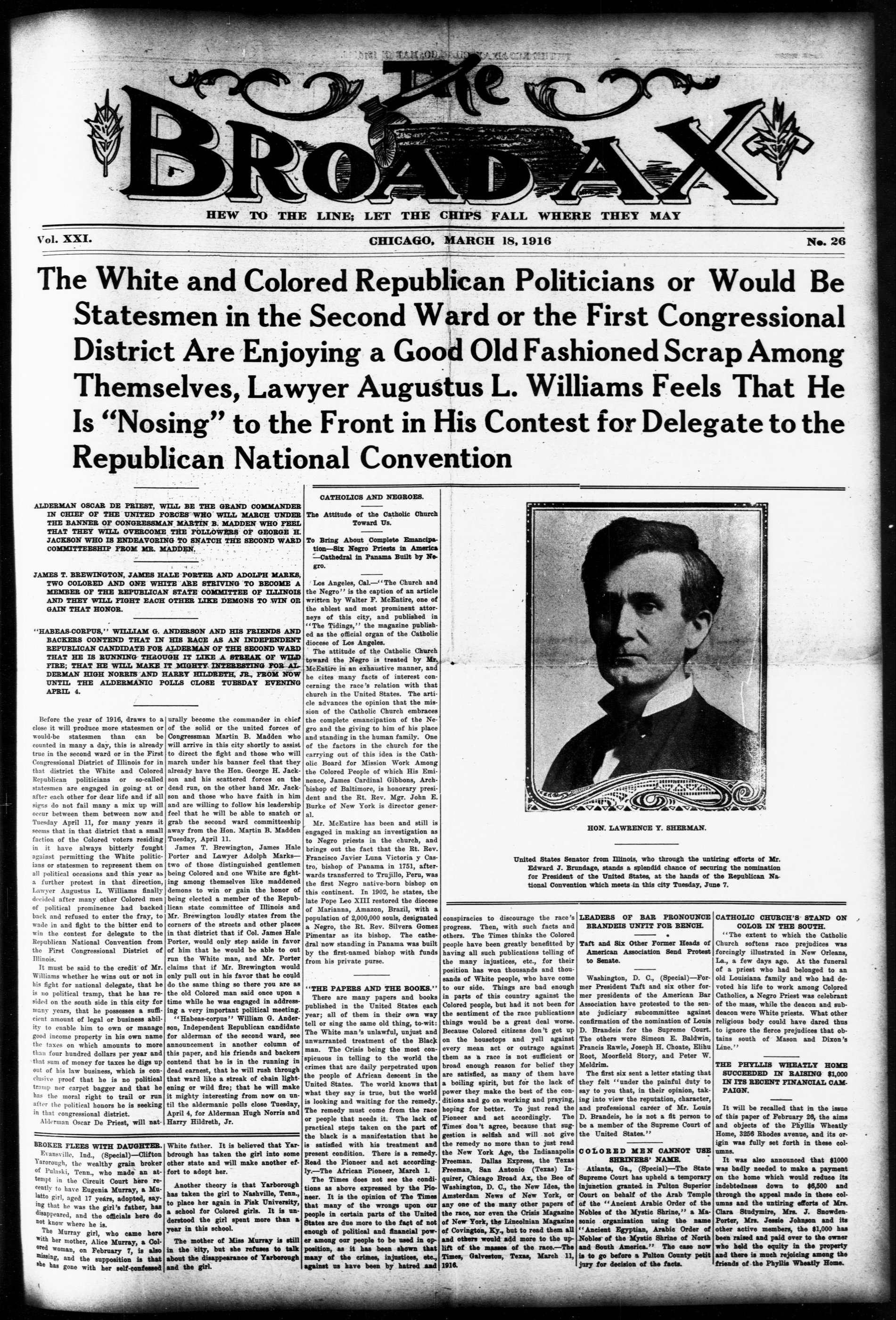
Page text (machine-generated)
THE BROAD AX
The White and Colored Republican Politicians or Would Be Statesmen in the Second Ward or the First Congressional District Are Enjoying a Good Old Fashioned Scrap Among Themselves, Lawyer Augustus L. Williams Feels That He Is "Nosing" to the Front in His Contest for Delegate to the Republican National Convention
ALDERMAN OSCAR DE PRIEST, WILL BE THE GRAND COMMANDER IN CHIEF OF THE UNITED FORCES WHO WILL MARCH UNDER THE BANNER OF CONGRESSMAN MARTIN B. MADDEN WHO FEEL THAT THEY WILL OVERCOME THE FOLLOWERS OF GEORGE H. JACKSON WHO IS ENDEAVORING TO SNATCH THE SECOND WARD COMMITTEEESHIP FROM MR. MADDEN.
JAMES T. BREWINGTON, JAMES HALE PORTER AND ADOLPH MARKS, TWO COLORED AND ONE WHITE ARE STRIVING TO BECOME A MEMBER OF THE REPUBLICAN STATE COMMITTEE OF ILLINOIS AND THEY WILL FIGHT EACH OTHER LIKE DEMONS TO WIN OR GAIN THAT HONOR.
"HABEAS-CORPUS," WILLIAM G. ANDERSON AND HIS FRIENDS AND BACKERS CONTEND THAT IN HIS RACE AS AN INDEPENDENT REPUBLICAN CANDIDATE FOR ALDERMAN OF THE SECOND WARD THAT HE IS RUNNING THROUGH IT LIKE A STREAK OF WILD FIRE; THAT HE WILL MAKE IT MIGHTY INTERESTING FOR ALDERMAN HIGH NORRIS AND HARRY HILDRETH, JR., FROM NOW UNTIL THE ALDERMANIC POLLS CLOSE TUESDAY EVENING APRIL 4.
Vol. XXI.
The White
States
District
Thems
Is "Nos
Republic
ALDERMAN OSCAR DE PRIEST, W
IN CHIEF OF THE UNITED F
THE BANNER OF CONGRESSM
THAT THEY WILL OVERCOM
JACKSON WHO IS ENDEAVOR
COMMITTEESHIP FROM MR.
JAMES T. BREWINGTON, JAMES H
TWO COLORED AND ONE WH
MEMBER OF THE REPUBLIC
AND THEY WILL FIGHT EACH
GAIN THAT HONOR.
"HABEAS-CORPUS," WILLIAM G.
BACKERS CONTEND THAT IN
REPUBLICAN CANDIDATE FOR
THAT HE IS RUNNING THRO
FIRE; THAT HE WILL MAKE
DERMAN HIGH NORRIS AND
UNTIL THE ALDERMANIC F
APRIL 4.
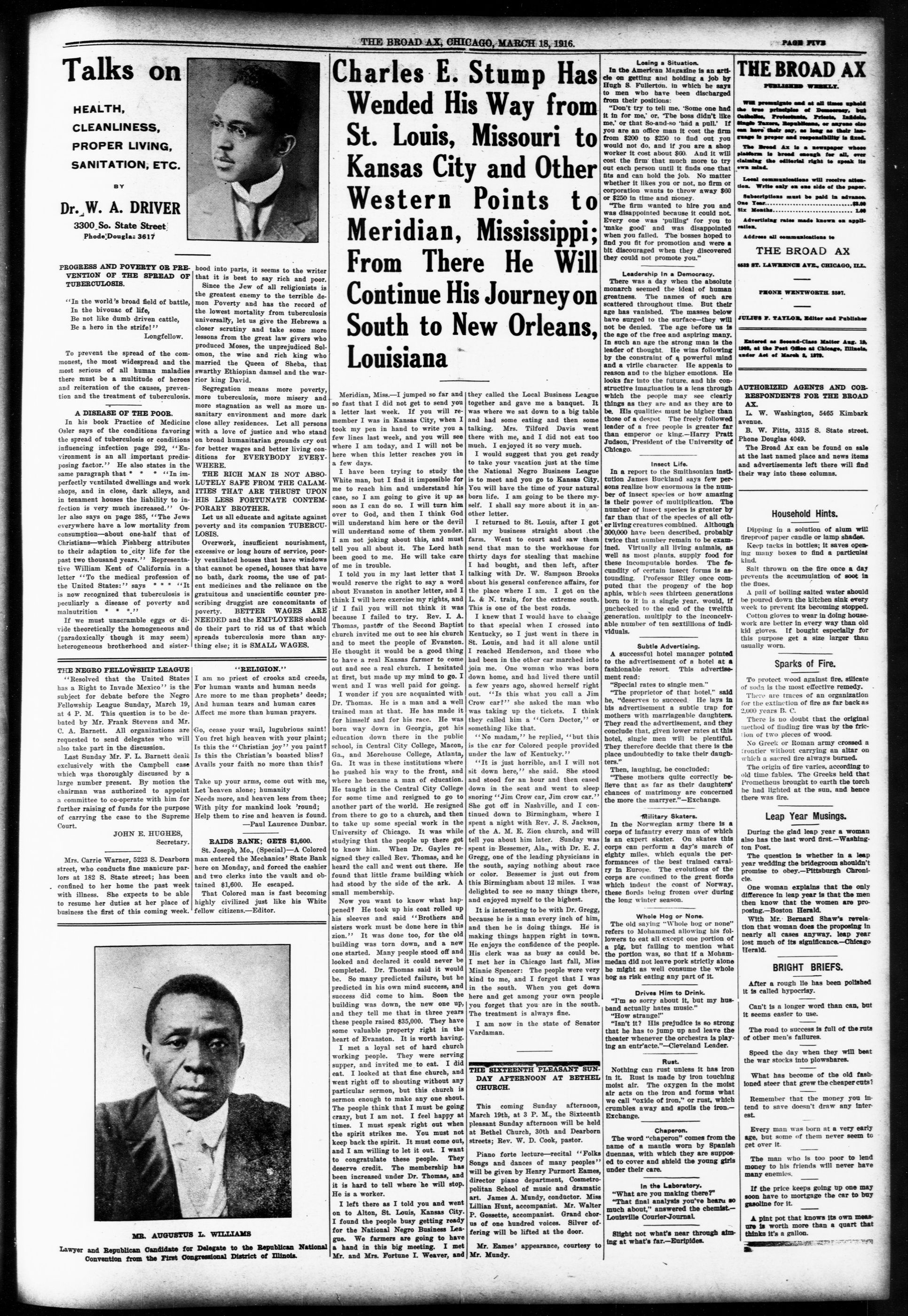
Before the year of 1916, draws to a close it will produce more statesmen or would-be statesmen than can be counted in many a day, this is already true in the second ward or in the First Congressional District of Illinois for in that district the White and Colored Republican politicians or so-called statesmen are engaged in going at or after each other for dear life and if all signs do not fail many a mix up will occur between them between now and Tuesday April 11, for many years it seems that in that district that a small faction of the Colored voters residing in it have always bitterly fought against permitting the White politicians or statesmen to represent them on all political occasions and this year as a further protest in that direction, Lawyer Augustus L. Williams finally decided after many other Colored men of political prominence had backed back and refused to enter the fray, to wade in and fight to the bitter end to win the contest for delegate to the Republican National Convention from the First Congressional District of Illinois.
It must be said to the credit of Mr. Williams whether he wins out or not in his fight for national delegate, that he is no political tramp, that he has resided on the south side in this city for many years, that he possesses a sufficient amount of legal or business ability to enable him to own or manage good income property in his own name the taxes on which amounts to more than four hundred dollars per year and that sum of money for taxes he digs up out of his law business, which is conclusive proof that he is no political tramp nor carpet bagger and that he has the moral right to trail or run after the political honors he is seeking in that congressional district.
BROKER FLEES WITH DAUGHTER.
Evansville, Ind., (Special)—Clifton Yatorough, the wealthy grain broker of Pulaski, Tenn., who made an attempt in the Circuit Court here recently to have Eugenia Murray, a Mulatto girl, aged 17 years, adopted, saying that he was the girl's father, has disappeared, and the officials here do not know where he is.
The Murray girl, who came here with her mother, Alice Murray, a Colored woman, on February 7, is also missing, and the supposition is that she has gone with her self-confessed
urally become the commander in chief of the solid or the united forces of Congressman Martin B. Madden who will arrive in this city shortly to assist to direct the fight and those who will march under his banner feel that they already have the Hon. George H. Jackson and his scattered forces on the dead run, on the other hand Mr. Jackson and those who have faith in him and are willing to follow his leadership feel that he will be able to snatch or grab the second ward committeeship away from the Hon. Martin B. Madden Tuesday, April 11.
James T. Brewington, James Hale Porter and Lawyer Adolph Marks—two of those distinguished gentlemen being Colored and one White are fighting among themselves like maddened demons to win or gain the honor of being elected a member of the Republican state committee of Illinois and Mr. Brewington loudly states from the corners of the streets and other places in that district that if Col. James Hale Porter, would only step aside in favor of him that he would be able to out run the White man, and Mr. Porter claims that if Mr. Brewington would only pull out in his favor that he could do the same thing so there you are as the old Colored man said once upon a time while he was engaged in addressing a very important political meeting: "Habeas-corpus" William G. Anderson, Independent Republican candidate for alderman of the second ward, see announcement in another column of this paper, and his friends and backers content that he is in the running in dead earnest, that he will rush through that ward like a streak of chain lightening or wild fire; that he will make it mighty interesting from now on until the aldermanic polls close Tuesday, April 4, for Alderman Hugh Norris and Harry Hildreth, Jr.
White father. It is believed that Yarbrough has taken the girl into some other state and will make another effort to adopt her.
Another theory is that Yarbrough has taken the girl to Nashville, Tenn., to place her again in Fisk University, a school for Colored girls. It is understood the girl spent more than a year in this school.
The mother of Miss Murray is still in the city, but she refuses to talk about the disappearance of Yarborough and the girl.
CHICAGO, MARCH 18, 1916
CATHOLICS AND NEGROES.
The Attitude of the Catholic Church Toward Us.
To Bring About Complete Emancipation—Six Negro Priests in America—Cathedral in Panama Built by Negro.
Los Angeles, Cal.—"The Church and the Negro" is the caption of an article written by Walter F. McEntire, one of the ablest and most prominent attorneys of this city, and published in "The Tidings," the magazine published as the official organ of the Catholic diocese of Los Angeles.
The attitude of the Catholic Church toward the Negro is treated by Mr. McEntire in an exhaustive manner, and he cites many facts of interest concerning the race's relation with that church in the United States. The article advances the opinion that the mission of the Catholic Church embraces the complete emancipation of the Negro and the giving to him of his place and standing in the human family. One of the factors in the church for the carrying out of this idea is the Catholic Board for Mission Work Among the Colored People of which His Eminence, James Cardinal Gibbons, Archbishop of Baltimore, is honorary president and the Rt. Rev. Mgr. John E. Burke of New York is director general.
Mr. McEntire has been and still is engaged in making an investigation as to Negro priests in the church, and brings out the fact that the Rt. Rev. Francisco Javier Luna Victoria y Castro, bishop of Panama in 1751, afterwards transferred to Trujillo, Peru, was the first Negro native-born bishop on this continent. In 1902, he states, the late Pope Leo XIII restored the diocese of Marianna, Amazon, Brazil, with a population of 2,000,000 souls, designated a Negro, the Rt. Rev. Silvera Gomez Pimentar as its bishop. The cathedral now standing in Panama was built by the first-named bishop with funds from his private purse.
"THE PAPERS AND THE BOOKS."
There are many papers and books published in the United States each year; all of them in their own way tell or sing the same old thing, to-wit: The White man's unlawful, unjust and unwarranted treatment of the Black man. The Crisis being the most conspicuous in telling to the world the crimes that are daily perpetrated upon the people of African descent in the United States. The world knows that what they say is true, but the world is looking and waiting for the remedy. The remedy must come from the race or people that needs it. The lack of practical steps taken on the part of the black is a manifestation that he is satisfied with his treatment and present condition. There is a remedy. Read the Pioneer and act accordingly—The African Pioneer, March 1.
The Times does not see the conditions as above expressed by the Pioneer. It is the opinion of The Times that many of the wrongs upon our people in certain parts of the United States are due more to the fact of not enough of political and financial power among our people to be used in opposition, as it has been shown that many of the crimes, injustices, etc., against us have been by hatred and
United States Senator from Illinois, who through the untiring efforts of Mr. Edward J. Brundage, stands a splendid chance of securing the nomination for President of the United States, at the hands of the Republican National Convention which meets in this city Tuesday, June 7.
conspiracies to discourage the race's progress. Then, with such facts and others. The Times thinks the Colored people have been greatly benefitted by having all such publications telling of the many injustices, etc., for their position has won thousands and thousands of White people, who have come to our side. Things are bad enough in parts of this country against the Colored people, but had it not been for the sentiment of the race publications things would be a great deal worse. Because Colored citizens don't get up on the housetops and yell against every mean act or outrage against them as a race is not sufficient or broad enough reason for belief they are satisfied, as many of them have a boiling spirit, but for the lack of power they make the best of the conditions and go on working and praying, hoping for better. To just read the Pioneer and act accordingly. The Times don't agree, because that suggestion is selfish and will not give the remedy no more than to just read the New York Age, the Indianapolis Freeman. Dallas Express, the Texas Freeman, San Antonio (Texas) Inquirer, Chicago Broad Ax, the Bee of Washington, D. C., the New Idea, the Amsterdam News of New York, or any one of the many other papers of the race, nor even the Crisis Magazine of New York, the Lincolnian Magazine of Covington, Ky., but to read them all and others would add more to the uplift of the masses of the race.—The Times, Galveston, Texas, March 11, 1916.
HON. LAWRENCE Y. SHERMAN.
ator from Illinois, who through the un- undage, stands a splendid chance of sec- of the United States, at the hands of- which meets in this city Tuesday, Ju
LEADERS OF BAR PRONOUNCE BRANDEIS UNFIT FOR BENCH.
Taft and Six Other Former Heads of American Association Send Protest to Senate.
Washington, D. C., (Special)—Former President Taft and six other former presidents of the American Bar Association have protested to the senate judiciary subcommittee against confirmation of the nomination of Louis D. Brandeis for the Supreme Court. The others were Simeon E. Baldwin, Francis Rawle, Joseph H. Choate, Elihu Root, Moorfield Story, and Peter W. Meldrim.
The first six sent a letter stating that they felt "under the painful duty to say to you that, in their opinion, taking into view the reputation, character, and professional career of Mr. Louis D. Brandeis, he is not a fit person to be a member of the Supreme Court of the United States."
COLORED MEN CANNOT USE
SHRINERS' NAME.
Atlanta, Ga., (Special)—The State Supreme Court has upheld a temporary injunction granted in Fulton Superior Court on behalf of the Arab Temple of the "Ancient Arabic Order of the Nobles of the Mystic Shrine," a Masonic organization using the name "Ancient Egyptian, Arabic Order of Nobles of the Mystic Shrine of North and South America." The case now is to go before a Fulton County petit jury for decision of the facts.
No.26
Would Be Regressional Map Among Us That He Gate to the
iniring efforts of Mr. carrying the nomination of the Republican Na- ne 7.
CATHOLIC CHURCH'S STAND ON COLOR IN THE SOUTH.
"The extent to which the Catholic Church softens race prejudices was forcefully illustrated in New Orleans, La., a few days ago. At the funeral of a priest who had belonged to an old Louisiana family and who had devoted his life to work among Colored Catholics, a Negro Priest was celebrant of the mass, while the deacon and subdeacon were White priests. What other religious body could have dared thus to ignore the fierce prejudices that obtains south of Mason and Dixon's Line."
THE PHYLLIS WHEATLY HOME SUCCEEDED IN RAISING $1,000 IN ITS RECENT FINANCIAL CAMPAIGN.
It will be recalled that in the issue of this paper of February 26, the aims and objects of the Phyllis Wheatly Home, 3256 Rhodes avenue, and its origin was fully set forth in these columns.
It was also announced that $1000 was badly needed to make a payment on the home which would reduce its indebtedness down to $6,500 and through the appeal made in these columns and the untiring efforts of Mrs. Clara Studymire, Mrs. J. Snowden-Porter, Mrs. Jessie Johnson and its other active members, the $1,000 has been raised and paid over to the owner who held the equity in the property and there is much rejoicing among the friends of the Phyllis Wheatly Home.
PAGE TWO
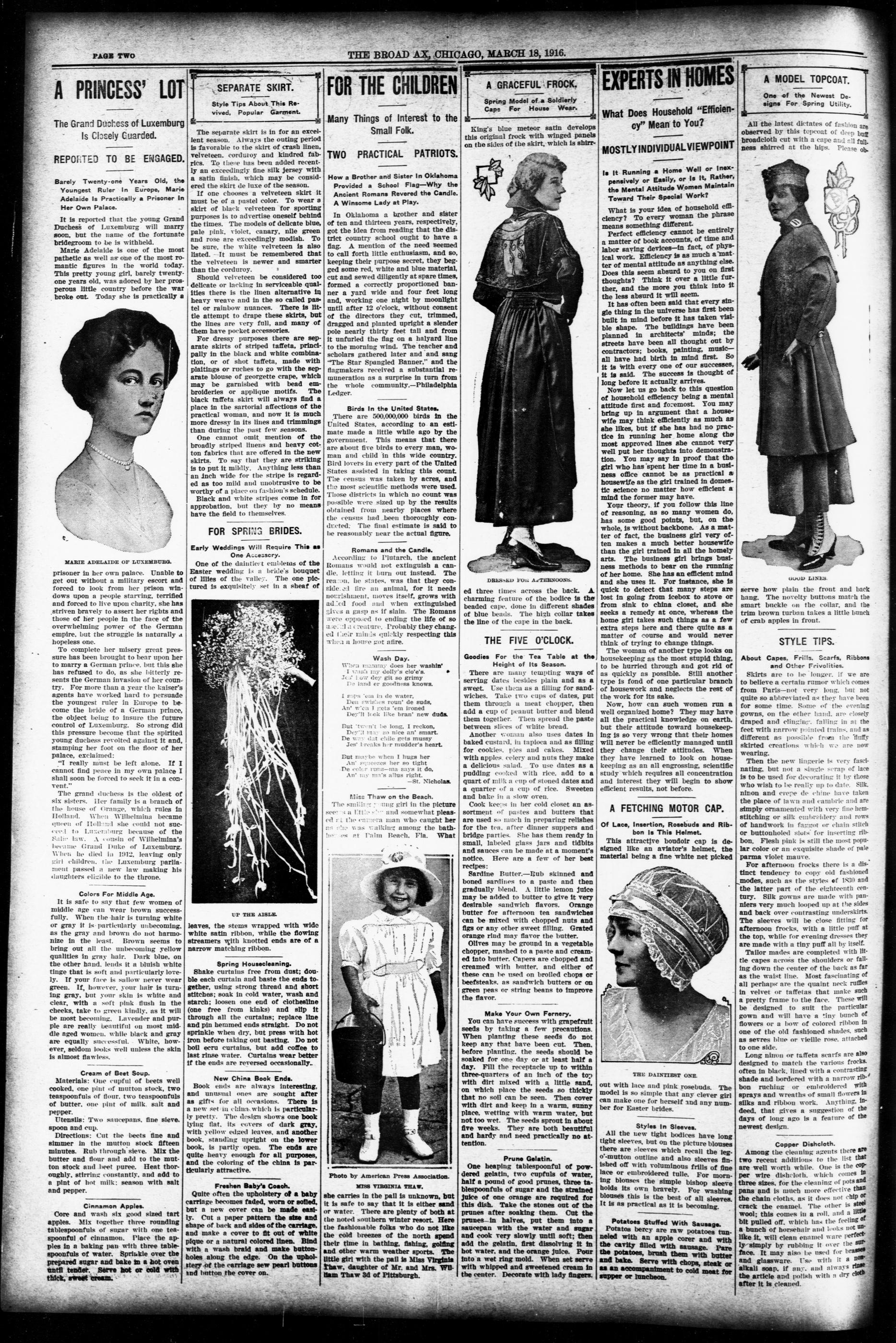
A PRINCESS' LOT
The Grand Duchess of Luxemburg Is Closely Guarded.
REPORTED TO BE ENGAGED.
Barely Twenty-one Years Old, the Youngest Ruler In Europe, Marie Adelaide Is Practically a Prisoner In Her Own Palace.
It is reported that the young Grand Duchess of Luxemburg will marry soon, but the name of the fortunate bridegroom to be is withheld.
Marie Adelaide is one of the most pathetic as well as one of the most romantic figures in the world today.
This pretty young girl, barely twenty-one years old, was adored by her prosperous little country before the war broke out. Today she is practically a
6.
MARIE ADELAIDE OF LUXEMBURG.
prisoner in her own palace. Unable to get out without a military escort and forced to look from her prison windows upon a people starving, terrified and forced to live upon charity, she has striven bravely to assert her rights and those of her people in the face of the overwhelming power of the German empire, but the struggle is naturally a hopeless one.
To complete her misery great pressure has been brought to bear upon her to marry a German prince, but this she has refused to do, as she bitterly resents the German invasion of her country. For more than a year the kaiser's agents have worked hard to persuade the youngest ruler in Europe to become the bride of a German prince, the object being to insure the future control of Luxemburg. So strong did this pressure become that the spirted young duchess revolted against it and, stamping her foot on the floor of her palace, exclaimed:
"I really must be left alone. If I cannot find peace in my own palace I shall soon be forced to seek it in a convent."
The grand duchess is the oldest of six sisters. Her family is a branch of the house of Orange, which rules in Holland. When Wilhelmina became queen of Holland she could not succeed to Luxemburg because of the Salle law. A cousin of Wilhelmina's became Grand Duke of Luxemburg. When he died in 1912, leaving only girl children, the Luxemburg parliament passed a new law making his daughters eligible to the throne.
Colors For Middle Age
It is safe to say that few women of middle age can wear brown successfully. When the hair is turning white or gray it is particularly unbecoming, as the gray and brown do not harmonize in the least. Brown seems to bring out all the unbecoming yellow qualities in gray hair. Dark blue, on the other hand, lends it a blush white tinge that is soft and particularly lovely. If your face is sallow never wear green. If, however, your hair is turning gray, but your skin is white and clear, with a soft pink flush in the cheeks, take to green kindly, as it will be most becoming. Lavender and purple are really beautiful on most middle aged women, while black and gray are equally successful. White, however, seldom looks well unless the skin is almost flawless.
Cream of Beet Soup
Materials: One cupful of beets well cooked, one pint of mutton stock, two teaspoonfuls of flour, two teaspoonfuls of butter, one pint of milk, salt and pepper.
Utensils: Two saucepans, fine sieve, spoon and cup.
Directions: Cut the beets fine and simmer in the mutton stock fifteen minutes. Rub through sieve. Mix the butter and flour and add to the mutton stock and beet purée. Heat thoroughly, stirring constantly, and add to a pint of hot milk: season with salt and pepper.
Cinnamon Apples
Core and wash six good sized tart apples. Mix together three rounding tablespoonfuls of sugar with one teaspoonful of cinnamon. Place the apples in a baking pan with three tablespoonfuls of water. Sprinkle over the prepared sugar and bake in a hot oven until tender. Serve hot or cold with thick sweet cream.
Style Tips About This Revived, Popular Garment.
The separate skirt is in for an excellent season. Always the outing period is favorable to the skirt of skirt linen, velveteen, corduroy and kindred fabrics. To these has been added recently an exceedingly fine silk jersey with a satin finish, which may be considered the skirt de luxe of the season. If one chooses a velveteen skirt it must be of a pastel color. To wear a skirt of black velveteen for sporting purposes is to advertise oneself behind the times. The models of delicate blue, pale pink, violet, canary, nile green and rose are exceedingly modish. To be sure, the white velveteen is also listed. It must be remembered that the velveteen is newer and smarter than the corduroy.
Should velvetteen be considered too delicate or lacking in serviceable qualities there is the linen alternative in heavy weave and in the so called pastel or rainbow nuances. There is little attempt to drape these skirts, but the lines are very full, and many of them have pocket accessories.
For dressy purposes there are separate skirts of striped taffeta, principally in the black and white combination, or of shot taffeta, made with plaitings or ruches to go with the separate blouse of georgette crape, which may be garnished with bead embroideries or applique motifs. The black taffeta skirt will always find a place in the sartorial affections of the practical woman, and now it is much more dressy in its lines and trimmings than during the past few seasons.
One cannot omit mention of the broadly striped linens and heavy cotton fabrics that are offered in the new skirts. To say that they are striking is to put it mildly. Anything less than an inch wide for the stripe is regarded as too mild and unobtrusive to be worthy of a place on fashion's schedule. Black and white stripes come in for approbation, but they by no means have the field to themselves.
FOR SPRING BRIDES
Early Weddings Will Require This as One Accessory. One of the daintest emblems of the Easter wedding is a bride's bouquet of illies of the valley. The one pictured is exquisitely set in a sheaf of
```markdown
```
UP THE AISLE
leaves, the stems wrapped with wide
white satin ribbon, while the flowing
streamers with knotted ends are of a
narrow matching ribbon.
Spring Housecleaning.
Shake curtains free from dust; double each curtain and baste the ends together, using strong thread and short stitches; soak in cold water, wash and starch; loosen one end of clothesline (one free from kinks) and slip it through all the curtains; replace line and pin hemmed ends straight. Do not sprinkle when dry, but press with hot iron before taking out basting. Do not boil ecru curtains, but add coffee to last rinse water. Curtains wear better if the ends are reversed occasionally.
New China Book Ends.
Book ends are always interesting, and unusual ones are sought after as gifts for all occasions. There is a new set in china which is particularly pretty. The design shows one book lying flat, its covers of dark gray, with yellow edged leaves, and another book, standing upright on the lower book, is partly open. The ends are quite heavy enough for all purposes, and the coloring of the china is particularly attractive.
Freshen Baby's Coach.
Quite often the upholstery of a baby carriage becomes faded, worn or soiled, but a new cover can be made easily. Cut a paper pattern the size and shape of back and sides of the carriage, and make a cover to fit out of white plique or a natural colored linen. Bind with a wash braid and make button-holes along the edge. On the upholstery of the carriage sew pearl buttons and button the cover on.
THE BROAD AX. CHICAGO, MARCH 18, 1916.
FOR THE CHILDREN
Many Things of Interest to the Small Folk.
TWO PRACTICAL PATRIOTS.
How a Brother and Sister In Oklahoma Provided a School Flag—Why the Ancient Romans Revered the Candle. A Winsome Lady at Play.
In Oklahoma a brother and sister of ten and thirteen years, respectively, got the idea from reading that the district country school ought to have a flag. A mention of the need seemed to call forth little enthusiasm, and so, keeping their purpose secret, they begged some red, white and blue material, cut and sewed diligently at spare times, formed a correctly proportioned banner a yard wide and four feet long, and working one night by moonlight until after 12 o'clock, without consent of the directors they cut, trimmed, dragged and planted upright a slender pole nearly thirty feet tall and from it unfurled the flag on a halfyard line to the morning wind. The teacher and scholars gathered later and sang "The Star Spangled Banner," and the flagmakers received a substantial remuneration as a surprise in turn from the whole community.—Philadelphia Ledger.
Birds In the United States.
There are 500,000,000 birds in the United States, according to an estimate made a little while ago by the government. This means that there are about five birds to every man, woman and child in this wide country. Bird lovers in every part of the United States assisted in taking this count. The census was taken by acres, and the most scientific methods were used. Those districts in which no count was possible were sized up by the results obtained from nearby places where the census had been thoroughly conducted. The final estimate is said to be reasonably near the actual figure.
Romans and the Candle.
According to Plutarch, the ancient Romans would not extinguish a candle, letting it burn out instead. The reason, he states, was that they considered fire an animal, for it needs nourishment, moves itself, grows with added food and when extinguished gives a gasp as if slain. The Romans were opposed to ending the life of so auscult a creature. Probably they changed their minds quickly respecting this when a house got afire.
Wash Day.
When mammy does her washin'
I wash my dolly's cloe's.
I how low my git so grimy
De land er goodness knows.
I gops 'on in de water,
Dean swishes roun' de suds,
An' it now I gets 'em iron
Deyll 'to look like bran' new duds.
But 'twent be long, I reckon,
Deyll 'to stay no ice' an smart.
De way dat chile gets mussy
Jes 'breaks her muddur's heart.
But maybe when I hugs her
An' squeezes her so tight
Deyll 'run--ma says it do,
An' my mat's allus right.
-St. Nicholas.
Miss Thaw on the Beach.
The smiling young girl in the picture sees a little girl and somewhat pleased at the camera man who caught her as she was walking among the bathhouses at Palm Beach. Fla. What
THE CHILDREN'S WEEKLY NEWS
she carries in the pall is unknown, but it is safe to say that it is either sand or water. There are plenty of both at the noted southern winter resort. Here the fashionable folks who do not like the cold breezes of the north spend their time in bathing, fishing, golfing and other warm weather sports. The little girl with the pall is Miss Virginia Thaw, daughter of Mr. and Mrs. William Thaw 3d of Pittsburgh.
Spring Model of a Soldierly Cape For House Wear.
King's blue meteor satin develops this original frock with winged panels on the sides of the skirt, which is shirr-
[Illustration of a woman wearing a long black dress with a high collar and a decorative emblem on the back.]
DRESSED FOR AFTERNOONS.
ed three times across the back. A
charming feature of the bodice is the
beaded cape, done in different shades
of blue beads. The high collar takes
the line of the cape in the back.
THE FIVE O'CLOCK.
Goodies For the Tea Table at the Height of Its Season.
There are many tempting ways of serving dates besides plain and as a sweet. Use them as a filling for sandwiches. Take two cups of dates, put them through a meat chopper, then add a cup of peanut butter and blend them together. Then spread the paste between slices of white bread.
Another woman also uses dates in baked custard, in tapioca and as filling for cookies, pies and cakes. Mixed with apples celery and nuts they make a delicious salad. To use dates as a pudding cooked with rice, add to a quart of milk a cup of stoned dates and a quarter of a cup of rice. Sweeten and bake in a slow oven.
Cook keeps in her cold closet an assortment of pastes and butters that are used so much in preparing relishes for the tea, after dinner suppers and bridge parties. She has them ready in small, labeled glass jars and tidbits and sauces can be made at a moment's notice. Here are a few of her best recipes:
Sardine Butter.—Rub skinned and boned sardines to a paste and then gradually blend. A little lemon juice may be added to butter to give it very desirable sandwich flavors. Orange butter for afternoon tea sandwiches can be mixed with chopped nuts and figs or any other sweet filling. Grated orange rind may flavor the butter.
Olives may be ground in a vegetable chopper, mashed to a paste and creamed into butter. Capers are chopped and creamed with butter, and either of these can be used on broiled chops or beefsteaks, as sandwich butters or on green peas or string beans to improve the flavor.
Make Your Own Fernery.
You can have success with grapefruit seeds by taking a few precautions. When planting these seeds do not keep any that have been cut. Then, before planting, the seeds should be soaked for one day or at least half a day. Fill the receptacle up to within three-quarters of an inch of the toy with dirt mixed with a little sand, on which place the seeds so thickly that no soil can be seen. Then cover with dirt and keep in a warm, sunny place, wetting with warm water, but not too wet. The seeds sprout in about five weeks. They are both beautiful and hardy and need practically no attention.
Prune Gelatin.
One heaping tablespoonful of powdered gelatin, two cupfuls of water, half a pound of good prunes, three tablespoonfuls of sugar and the strained juice of one orange are required for this dish. Take the stones out of the prunes after soaking them. Cut the prunes in halves, put them into a saucepan with the water and sugar and cook very slowly until soft; then add the gelatin, first dissolving it in hot water, and the orange juice. Pour into a wet ring mold. When set serve with whipped and sweetened cream in the center. Decorate with lady fingers.
EXPERTS IN HOMES
What Does Household "Efficiency" Mean to You?
MOSTLY INDIVIDUAL VIEWPOINT
Is It Running a Home Well or Inexpensively or Easily, or is It, Rather, the Mental Attitude Women Maintain Toward Their Special Work?
What is your idea of household efficiency? To every woman the phrase means something different.
perfect efficiency cannot be entirely a matter of book accounts, of time and labor saving devices—in fact, of physical work. Efficiency is as much a matter of mental attitude as anything else. Does this seem absurd to you on first thoughts? Think it over a little further, and the more you think into it the less absurd it will seem.
It has often been said that every single thing in the universe has first been built in mind before it has taken visible shape. The buildings have been planned in architects' minds; the streets have been all thought out by contractors; books, painting, music—all have had birth in mind first. So it is with every one of our successes, it is said. The success is thought of long before it actually arrives.
Now let us go back to this question of household efficiency being a mental attitude first and fo:emost. You may bring up in argument that a housewife may think efficiently as much as she likes, but if she has had no practice in running her home along the most approved lines she cannot very well put her thoughts into demonstration. You may say in proof that the girl who has spent her time in a business office cannot be as practical a housewife as the girl trained in domestic science no matter how efficient a mind the former may have.
Your theory, if you follow this line of reasoning, as so many women do, has some good points, but, on the whole, is without backbone. As a matter of fact, the business girl very often makes a much better housewife than the girl trained in all the homely arts. The business girl brings business methods to bear on the running of her home. She has an efficient mind and she uses it. For instance, she is quick to detect that many steps are lost in going from icebox to stove or from sink to china closet, and she seeks a remedy at once, whereas the home girl takes such things as a few extra steps here and there quite as a matter of course and would never think of trying to change things.
The woman of another type looks on housekeeping as the most stupid thing, to be hurried through and got rid of as quickly as possible. Still another type is fond of one particular branch of housework and neglects the rest of the work for its sake.
Now, how can such women run a well organized home? They may have all the practical knowledge on earth, but their attitude toward housekeeping is so very wrong that their homes will never be efficiently managed until they change their attitudes. When they have learned to look on housekeeping as an all engrossing, scientific study which requires all concentration and interest they will begin to show efficient results, not before.
A FETCHING MOTOR CAP.
Of Lace, Insertion, Rosebuds and Ribbon Is This Helmet. This attractive boudolr cap is designed like an aviator's helmet, the material being a fine white net picked
THE DAINTIEST ONE
out with lace and pink rosebuds. The
model is so simple that any clever girl
can make one for herself and any number
for Easter brides.
Styles In Sleeves
All the new tight bodices have long tight sleeves, but on the picture blouses there are sleeves which recall the lego-mutton outline and also sleeves finished off with voluminous frills of fine lace or embroidered tulle. For morning blouses the simple bishop sleeve holds its own bravely. For washing blouses this is the best of all sleeves. It is as practical as it is becoming.
Potatoes Stuffed With Sausage
Potatoes Stuffed With Sausage.
Potatoes bercy are raw potatoes tunneled with an apple corer and with the cavity filled with sausage. Pare the potatoes, brush them with butter and bake. Serve with chops, steak or as an accompaniment to cold meat for supper or luncheon.
A MODEL TOPCOAT.
One of the Newest Designs For Spring Utility.
All the latest dictates of fashion are observed by this topcoat of deep buff broadcloth cut with a cape and all fullness shirred at the hips. Please ob
ROSE
serve how plain the front and back hang. The novelty buttons match the smart buckle on the collar, and the trim brown turban takes a little bunch of crab apples in front.
STYLE TIPS.
About Capes, Frills, Scarfs, Ribbons and Other Frivolities.
Skirts are to be longer, if we are to believe a certain rumor which comes from Paris—not very long, but not quite so abbreviated as they have been for some time. Some of the evening gowns, on the other hand, are closely draped and clinging, falling in at the feet with narrow pointed trains, and as different as possible from the fluffy skirted creations which we are now wearing.
Then the new lingerie is very fascinating, but not a single scrap of lace is to be used for decorating it by those who wish to be really up to date. Silk, ninon and crepe de chine have taken the place of lawn and cambric and are simply ornamented with very fine hemstitching or silk embroidery and rows of handwork in faggot or chain stitch or buttonholed slots for inserting ribbon. Flesh pink is still the most popular color or an exquisite shade of pale parma violet mauve.
For afternoon frocks there is a distinct tendency to copy old fashioned modes, such as the styles of 1830 and the latter part of the eighteenth century. Silk gowns are made with panners very much looped up at the sides and back over contrasting underskirts. The sleeves will be close fitting for afternoon frocks, with a little puff at the top, while for evening dresses they are made with a tiny puff all by itself.
Tailor mades are completed with little capes across the shoulders or falling down the center of the back as far as the waist line. Most fascinating of all perhaps are the quaint neck ruffles in velvet or taffetas that make such a pretty frame to the face. These will be designed to suit the particular gown and will have a tiny bunch of flowers or a bow of colored ribbon in one of the old fashioned shades, such as sevres blue or vielle rose, attached to one side.
Long nimon or taffeta scarfs are also designed to match the various frocks, often in black, lined with a contrasting shade and bordered with a narrow ribbon ruching or embroidered with sprays and wreaths of small flowers in silks and ribbon work. Anything, indeed, that gives a suggestion of the days of long ago is a feature of the newest design.
Copper Dishcloth
Among the cleaning agents there are two recent additions to the list that are well worth while. One is the copper wire dishcloth, which comes in three sizes, for the cleaning of pots and pans and is much more effective than the chain cloth, as it does not chip or crack the enamel. The other is steel wool; this comes in a roll, and a little bit pulled off, which has the feeling of a bunch of horsehair and looks not unlike it, will clean enamel ware perfectly simply by rubbing it over the surface. It may also be used for brasses and glassware. Use with it a nonalkal soap, if any, and always rinse the article and polish with a dry cloth after it is cleaned.
A CUBERNATORIAL BOOM FOR GERARD
Ambassador to Run For Governor of New York.
As a result of informal conferences among Democratic leaders of New York state it is likely that James W. Gerard, ambassador to Germany, will be made the Democratic nominee for governor of New York next fall. According to reports received from abroad, Ambassador Gerard's return to this country is expected before long. It has also been reported that he is to make speeches for President Wilson throughout the country in the national campaign. It is not thought that the views of either Mr. Gerard or the Democratic leaders at Washington have been obtained regarding the plan to have Mr. Gerard run, which as yet is said to
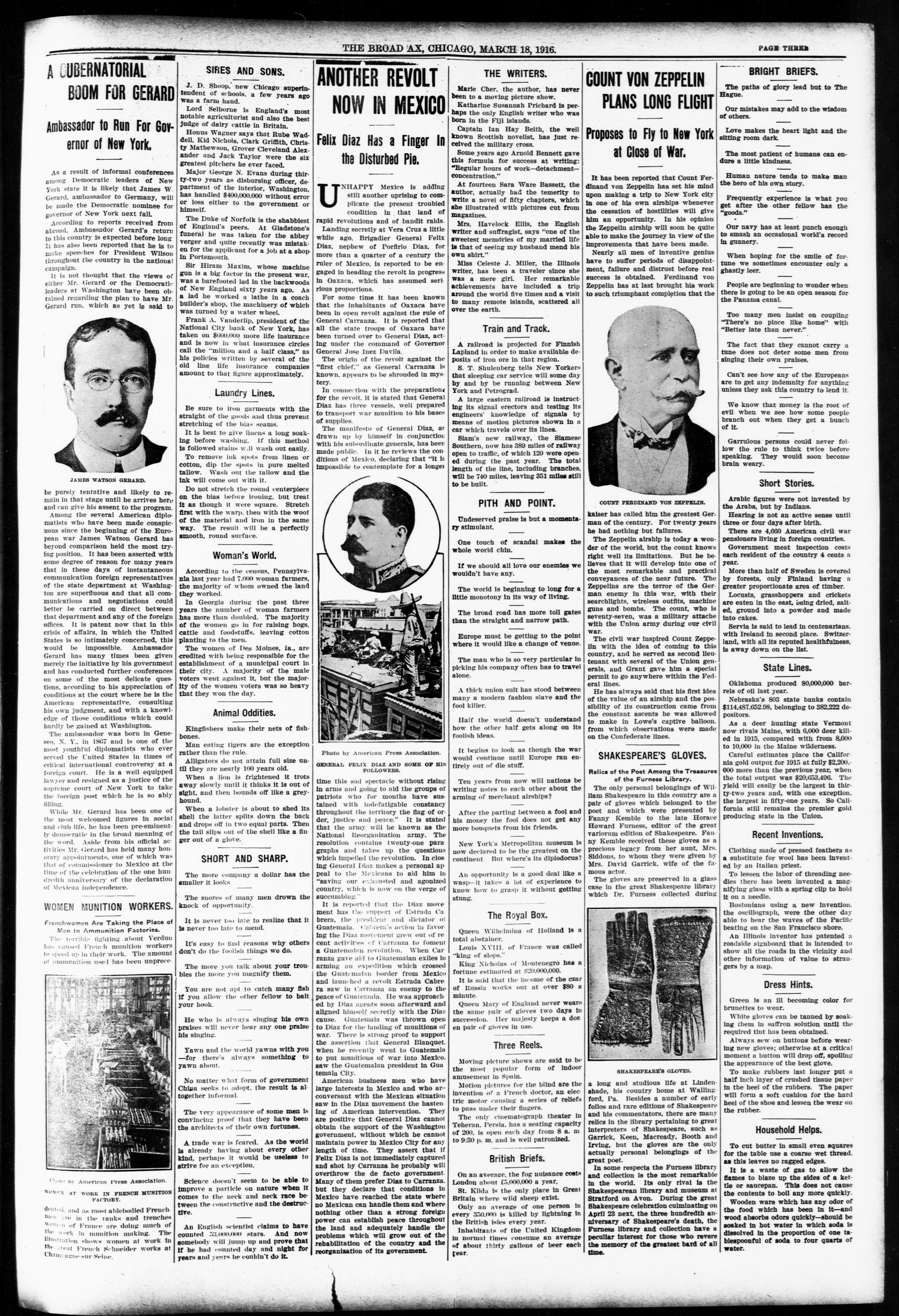
JAMES WATSON GEBARD.
be purely tentative and likely to remain in that stage until he arrives here and can give his assent to the program.
Among the several American diplomats who have been made conspicuous since the beginning of the European war James Watson Gerard has beyond comparison held the most trying position. It has been asserted with some degree of reason for many years that in these days of instantaneous communication foreign representatives of the state department at Washington are superfluous and that all communications and negotiations could better be carried on direct between that department and any of the foreign offices. It is patent now that in this crisis of affairs, in which the United States is so intimately concerned, this would be impossible. Ambassador Gerard has many times been given merely the initiative by his government and has conducted further conferences on some of the most delicate questions, according to his appreciation of conditions at the court where he is the American representative, consulting his own judgment, and with a knowledge of those conditions which could hardly be gained at Washington.
The ambassador was born in Genea- seo, N. Y., in 1867 and is one of the most youthful diplomatists who ever served the United States in times of critical international controversy at a foreign court. He is a well equipped lawyer and resigned as a justice of the supreme court of New York to take the foreign post which he is so ably filling.
While Mr. Gerard has been one of the most welcomed figures in social and club life, he has been pre-eminently democratic in the broad meaning of the word. Aside from his official activities Mr. Gerard has held many honorary appointments, one of which was that of commissioner to Mexico at the time of the celebration of the one hundredth anniversary of the declaration of Mexican independence.
WOMEN MUNITION WORKERS.
Frenchwomen Are Taking the Place of Men in Ammunition Factories. The terrible fighting about Verdun has caused French munition workers to speed up in their work. The amount of ammunition used has been unprece
```markdown
```
Photo by American Press Association.
WOMEN AT WORK IN FRENCH MUNITION
FACTORY.
dented, and as most ablebodied Frenchmen are in the ranks and trenches
women of France are doing much of the work in munition making. The
illustration shows women at work in the great French Schneider works at
Champagne sur Seine.
SIRES AND SONS
J. D. Shoop, new Chicago superintendent of schools, a few years ago was a farm hand.
Lord Selborne is England's most notable agriculturist and also the best judge of dairy cattle in Britain.
Honus Wagner says that Rube Waddell, Kid Nichols, Clark Griffith, Christy Mathewson, Grover Cleveland Alexander and Jack Taylor were the six greatest pitchers he ever faced.
Major George N. Evans during thirty-two years as disbursing officer, department of the interior, Washington, has handled $400,000,000 without error or loss either to the government or himself.
The Duke of Norfolk is the shabblest of England's peers. At Gladstone's funeral he was taken for the abbey verger and quite recently was mistaken for the applicant for a job at a shop in Portsmouth.
Sir Hiram Maxim, whose machine gun is a big factor in the present war, was a barefooted lad in the backwoods of New England sixty years ago. As a lad he worked a lathe in a coach builder's shop, the machinery of which was turned by a water wheel.
Frank A. Vanderlip, president of the National City bank of New York, has taken on $600,000 more life insurance and is now in wint insurance circles call the "million and a half class," as his policies written by several of the old line life insurance companies amount to that figure approximately.
Laundry Lines.
Be sure to iron garments with the straight of the goods and thus prevent stretching of the bias seams. It is best to give linens a long soaking before washing. If this method is followed stains will wash out easily.
Do not stretch the round centerpiece on the bias before ironing, but treat it as though it were square. Stretch first with the warp, then with the woof of the material and iron in the same way. The result will be a perfectly smooth, round surface.
Woman's World.
According to the census, Pennsylvania last year had 7,000 woman farmers, the majority of whom owned the land they worked.
In Georgia during the past three years the number of woman farmers has more than doubled. The majority of the women go in for raising hogs, cattle and foodstuffs, leaving cotton planting to the men.
The women of Des Moines, Ia., are credited with being responsible for the establishment of a municipal court in their city. A majority of the male voters went against it, but the majority of the women voters was so heavy that they won the day.
Animal Oddities.
Kingfishers make their nets of fishbones.
Man eating tigers are the exception rather than the rule.
Alligators do not attain full size until they are nearly 100 years old.
When a lion is frightened it trots away slowly until it thinks it is out of sight, and then bounds off like a greyhound.
When a lobster is about to shed its shell the latter splits down the back and drops off in two equal parts. Then the tail slips out of the shell like a finger out of a glove.
SHORT AND SHARP.
The more company a dollar has the smaller it looks
The snores of many men drown the knock of opportunity.
It is never too late to realize that it is never too late to mend.
It's easy to find reasons why others don't do the foolish things we do.
The more you talk about your troubles the more you magnify them.
You are not apt to catch many fish if you allow the other fellow to bait your hook.
He who is always singing his own praises will never hear any one praise his singing.
Yawn and the world yawns with you
—for there's always something to
yawn about.
No matter what form of government
China seeks to adopt, the result is al-
together informal.
The very appearance of some men is
convincing proof that they have been
the architects of their own fortunes.
A trade war is feared. As the world
is already having about every other
kind, perhaps it would be useless to
strive for an exception.
Science doesn't seem to be able to
improve a particle on nature when it
comes to the neck and neck race bet-
ween the constructive and the destructive.
An English scientist claims to have counted 73,000,000 stars. And now somebody will jump up and prove that if he had counted day and night for years and years he couldn't do it.
THE BROAD AX. CHICAGO. MARCH 18 1916
ANOTHER REVOLT NOW IN MEXICO
Felix Diaz Has a Finger In the Disturbed Pie.
UNHAPPY Mexico is adding still another uprising to complicate the present troubled condition in that land of rapid revolutions and of bandit raids. Landing secretly at Vera Cruz a little while ago, Brigadier General Felix Diaz, nephew of Porfirio Diaz, for more than a quarter of a century the ruler of Mexico, is reported to be engaged in heading the revolt in progress in Oaxaca, which has assumed serious proportions.
For some time it has been known that the inhabitants of Oaxaca have been in open revolt against the rule of General Carranza. It is reported that all the state troops of Oaxaca have been turned over to General Diaz, acting under the command of Governor General Jose Inez Davila
The origin of the revolt against the "first chief," as General Carranza is known, appears to be shrouded in mystery.
In connection with the preparation for the revolt, it is stated that General Diaz has three vessels, well prepared to transport war munition to his bases of supplies.
The manifesto of General Diaz, as drawn up by himself in conjunction with his subordinate generals, has been made public. In it he reviews the conditions of Mexico, declaring that "it is impossible to contemplate for a longer
THE GENERAL
Photo by American Press Association.
GENERAL FELIX DIAZ AND SOME OF HIS FOLLOWERS.
time this sad spectacle without rising in arms and going to aid the groups of patriots who for months have sustained with indefatigable constancy throughout the territory the flag of order, justice and peace." It is stated that the army will be known as the National Reorganization army. The resolution contains twenty-one paragraphs and takes up the questions which impelled the revolution. In closing General Diaz makes a personal appeal to the Mexicans to aid him in "saving our exhausted and agonized country, which is now on the verge of succumbing."
It is reported that the Diaz movement has the support of Estrada Cabrera, the president and dictator of Guatemala. Cabrera's action in favor of the Diaz movement grew out of recent activities of Carranza to foment a Guatemalan revolution. When Carranza gave aid to Guatemalan exiles in arming an expedition which crossed the Guatemalan border from Mexico and launched a revolt Estrada Cabrera saw in Carranza an enemy to the peace of Guatemala. He was approached by Diaz agents soon afterward and aligned himself secretly with the Diaz cause. Guatemala was thrown open to Diaz for the landing of munitions of war. There is strong proof to support the assertion that General Blanquet, when he recently went to Guatemala to put munitions of war into Mexico, saw the Guatemalan president in Guatemala City.
American business men who have large interests in Mexico and who are conversant with the Mexican situation saw in the Diaz movement the hastening of American intervention. They are positive that General Diaz cannot obtain the support of the Washington government, without which he cannot maintain power in Mexico City for any length of time. They assert that if Felix Diaz is not immediately captured and shot by Carranza he probably will overthrow the de facto government. Many of them prefer Diaz to Carranza, but they declare that conditions in Mexico have reached the state where no Mexican can handle them and where nothing other than a strong foreign power can establish peace throughout the land and adequately handle the problems which will grow out of the rehabilitation of the country and the reorganization of its government.
THE WRITERS.
Marie Cher, the author, has never been to a moving picture show.
Katharine Susannah Prichard is perhaps the only English writer who was born in the Fiji islands.
Captain Ian Hay Beith, the well known Scottish novelist, has just received the military cross.
Some years ago Arnold Bennett gave this formula for success at writing: "Regular hours of work—detachment—concentration."
At fourteen Sara Ware Bassett, the author, actually had the temerity to write a novel of fifty chapters, which she illustrated with pictures cut from magazines.
Mrs. Havelock Ellis, the English writer and suffragist, says "one of the sweetest memories of my married life is that of seeing my husband mend his own shirt."
Miss Celeste J. Miller, the Illinois writer, has been a traveler since she was a mere girl. Her remarkable achievements have included a trip around the world five times and a visit to many remote islands, scattered all over the earth.
Train and Track.
A railroad is projected for Finnish Lapland in order to make available deposits of iron ore in that region.
S. T. Shulenberg tells New Yorkers that sleeping car service will some day by and by be running between New York and Petrograd.
A large eastern railroad is instructing its signal erectors and testing its engineers' knowledge of signals by means of motion pictures shown in a car which travels over its lines.
Slam's new railway, the Siamese Southern, now has 389 miles of railway open to traffic, of which 120 were opened during the past year. The total length of the line, including branches, will be 740 miles, leaving 351 miles still to be built.
PITH AND POINT.
Underserved praise is but a momentary stimulant.
One touch of scandal makes the whole world chin.
If we should all love our enemies we wouldn't have any.
The world is beginning to long for a little monotony in its way of living.
The broad road has more toll gates than the straight and narrow path.
Europe must be getting to the point where it would like a change of venue.
The man who is so very particular in picking his company often has to travel alone.
A thick union suit has stood between many a modern fashion slave and the fool killer.
Half the world doesn't understand how the other half gets along on its foolish ideas.
It begins to look as though the war would continue until Europe ran entirely out of die stuff.
Ten years from now will nations be writing notes to each other about the arming of merchant airships?
After the parting between a fool and his money the fool does not get any more bouquets from his friends.
New York's Metropolitan museum is now declared to be the greatest on the continent. But where's its diplodocus?
An opportunity is a good deal like a wasp—it takes a lot of experience to know how to grasp it without getting stung.
The Royal Box.
Queen Wilhelmina of Holland is a total abstainer.
Louis XVIII, of France was called "king of slops."
King Nicholas of Montenegro has a fortune estimated at $20,000,000.
It is said that the income of the czar of Russia works out at over $80 a minute.
Queen Mary of England never wears the same pair of gloves two days in succession. Her majesty keeps a dozen pair of gloves in use.
Three Reels.
Moving picture shows are said to be the most popular form of indoor amusement in Spain. Motion pictures for the blind are the invention of a French doctor, an electric motor causing a series of reliefs to pass under their fingers. The only cinematograph theater in Teheran, Persia, has a seating capacity of 200, is open each day from 8 a. m. to 9:30 p. m. and is well patronized.
British Briefs.
On an average, the fog nuisance costs London about £5,000,000 a year. St. Kilda is the only place in Great Britain where wild sheep exist. Only an average of one person in every 350,000 is killed by lightning in the British isles every year. Inhabitants of the United Kingdom in normal times consume an average of about thirty gallons of beer each year.
COUNT VON ZEPPELIN PLANS LONG FLIGHT
It has been reported that Count Ferdinand von Zeppelin has set his mind upon making a trip to New York city in one of his own airships whenever the cessation of hostilities will give him an opportunity. In his opinion the Zeppelin airship will soon be quite able to make the journey in view of the improvements that have been made. Nearly all men of inventive genius have to suffer periods of disappointment, failure and distrust before real success is obtained. Ferdinand von Zeppelin has at last brought his work to such triumphant completion that the
A. M.
COUNT FERDINAND VON ZEPPELIN.
kaiser has called him the greatest German of the century. For twenty years he had nothing but failures.
The Zeppelin airship is today a wonder of the world, but the count knows right well its limitations. But he believes that it will develop into one of the most remarkable and practical conveyances of the near future. The Zeppelins are the terror of the German enemy in this war, with their searchlights, wireless outfits, machine guns and bombs. The count, who is seventy-seven, was a military attache with the Union army during our civil war.
The civil war inspired Count Zeppelin with the idea of coming to this country, and he served as second lieutenant with several of the Union generals, and Grant gave him a special permit to go anywhere within the Federal lines.
He has always said that his first idea of the value of an airship and the possibility of its construction came from the constant ascents he was allowed to make in Lowe's captive balloon, from which observations were made on the Confederate lines.
SHAKESPEARE'S GLOVES.
Relics of the Poet Among the Treasures of the Furness Library.
The only personal belongings of William Shakespeare in this country are a pair of gloves which belonged to the poet and which were presented by Fanny Kemble to the late Horace Howard Furness, editor of the great variorum edition of Shakespeare. Fanny Kemble received these gloves as a precious legacy from her aunt, Mrs. Slddons, to whom they were given by Mrs. David Garrick, wife of the famous actor.
The gloves are preserved in a glass case in the great Shakespeare library which Dr. Furness collected during
SHAKESPEARE'S GLOVES.
a long and studious life at Linden-shade, his country home at Wallingford, Pa. Besides a number of early follos and rare editions of Shakespeare and his commentators, there are many relics in the library pertaining to great interpreters of Shakespeare, such as Garrick, Keen, Macready, Booth and Irving, but the gloves are the only actually personal belongings of the great poet.
In some respects the Furness library and collection is the most remarkable in the world. Its only rival is the Shakespearean library and museum at Stratford on Avon. During the great Shakespeare celebration culminating on April 23 next, the three hundredth anniversary of Shakespeare's death, the Furness library and collection have a peculiar interest for those who revere the memory of the greatest bard of all time.
PAGE THREE
BRIGHT BRIEFS.
The paths of glory lead but to The Hague.
Our mistakes may add to the wisdom of others.
Love makes the heart light and the sitting room dark.
The most patient of humans can endure a little kindness.
Human nature tends to make man the hero of his own story.
Frequently experience is what you get after the other fellow has the "goods."
Our navy has at least punch enough to smash an occasional world's record in gunnery.
When hoping for the smile of fortune we sometimes encounter only a ghastly leer.
People are beginning to wonder when there is going to be an open season for the Panama canal.
Too many men insist on coupling "There's no place like home" with "Better late than never."
The fact that they cannot carry a tune does not deter some men from singing their own praises.
Can't see how any of the Europeans are to get any indemnity for anything unless they ask this country to lend it.
We know that money is the root of evil when we see how some people branch out when they get a bunch of it.
Garrulous persons could never follow the rule to think twice before speaking. They would soon become brain weary.
Short Stories.
Arabic figures were not invented by the Arabs, but by Indians.
Hearing is not an active sense until three or four days after birth.
There are 4,600 American civil war pensioners living in foreign countries.
Government meat inspection costs each resident of the country 4 cents a year.
More than half of Sweden is covered by forests, only Finland having a greater proportionate area of timber.
Locusts, grasshoppers and crickets are eaten in the east, being dried, salted, ground into a powder and made into cakes.
Servilia is said to lead in centenarians, with Ireland in second place. Switzerland, with all its reputed healthfulness, is away down on the list.
State Lines.
Oklahoma produced 80,000,000 barrels of oil last year.
Nebraska's 803 state banks contain $114,487,652.98, belonging to 382,222 depositors.
As a deer hunting state Vermont now rivals Maine, with 6,000 deer killed in 1915, compared with from 8,000 to 10,000 in the Maine wilderness.
Careful estimates place the California gold output for 1915 at fully $2,200,000 more than the previous year, when the total output was $20,653,496. The yield will easily be the largest in thirty-two years and, with one exception, the largest in fifty-one years. So California still remains the premier gold producing state in the Union.
Recent Inventions.
Clothing made of pressed feathers as a substitute for wool has been invented by an Italian priest. To lessen the labor of threading needles there has been invented a magnifying glass with a spring clip to hold it on a needle. Bostonians using a new invention, the oscillograph, were the other day able to hear the waves of the Pacific beating on the San Francisco shore. An Illinois inventor has patented a roadside signboard that is intended to show all the roads in the vicinity and other information of value to strangers by a map.
Dress Hints.
Green is an ill becoming color for brunettes to wear.
White gloves can be tanned by soaking them in saffron solution until the required tint has been obtained.
Always sew on buttons before wearing new gloves; otherwise at a critical moment a button will drop off, spoiling the appearance of the best glove.
To make rubbers last longer put a half inch layer of crushed tissue paper in the heel of the rubbers. The paper will form a soft cushion for the hard heel of the shoe and lessen the wear on the rubber.
Household Helps.
To cut butter in small even squares for the table use a coarse wet thread, as this leaves no ragged edges.
It is a waste of gas to allow the flames to blaze up the sides of a kettle or saucepan. This does not cause the contents to boil any more quickly.
Wooden ware which has any odor of the food which has been in it—and wood absorbs odors quickly—should be soaked in hot water in which soda is dissolved in the proportion of one tablespoonful of soda to four quarts of water.
Agents and Correspondents Wanted to Handle THE BROAD AX. Liberal Commissions to Live Agents. Address, Julius F.Taylor, 6532 St. Lawrence Av., Chicago
Agents a BRO Addre
SPECIAL NOTICE PHONE CHANGED
THE EMANUEL JACKSON UN-
DEBTAKING COMPANY, 2959-2961
State St., begs to inform its patrons
and friends, that our "Telephone" has
been changed to "CALUMET 6164."
Automatic remains same—71-629
Prompt service day or night.
DAN M. JACKSON, Pres.
GEORGE T. KERSEY, See
CITY AIR.
City air is always more or less bad. As a rule, more bad than less bad. This is due to the fact that all large cities have many kinds of industrial plants and these plants with very few exceptions contribute to bad outdoor conditions, either through dust or smoke or vapors, or all these agencies. One of the important sanitary problems connected with city life is that of reducing to a minimum the pollution of outdoor air. And as people must have outdoor aid to breathe in their homes, shops and workplaces, it follows that if the outdoor air is contaminated by any of the agencies mentioned, the indoor air will also be made impure and unwholesome.
A frequent and almost constant source of pollution of outdoor air is that caused by dust from many sources. The dust that is swept up from the streets by the prevailing winds and carried in every direction. The dust that comes from many industrial establishments, that is allowed to escape through windows into the outside air. Dust that is caused by the beating of rugs and carpets in back yards and on vacant lots. Dust that is caused by shaking and beating of rugs on the back porches, where it floats through the open windows of adjoining tenants and causes annoyance and is a frequent source of complaint to the Department of Health.
Recently the Department has received several complaints against the coal companies of Chicago, delivering coal on the streets in both resident and business sections, without being dampened and shoveled from a coal wagon into the street and again shoveled into wheel-barrows, or other receptacles, and conveyed into basements. This causes an immense amount of dust that floats through open windows into homes, spoils the family washing on the lines, fills people's lungs with a substance that should not be there and in a general way causes great annoyance and discomfort.
The Department of Health would urge upon all coal dealers throughout the city that they dampen their coal before delivering, not before weighing, but after the wagon has been loaded and driven off the scale, so that when it is delivered at homes or other places it will not be the cause of nuisance and complaint. While there is no ordinance requiring that this be done, it is so clearly a recommendation along health lines, that the Commissioner of Health feels sure that coal dealers generally will be glad to comply with this suggestion. Coal dealers, like other merchants, desire the good will of their patrons and certainly in no other way perhaps, might they so easily advance themselves in public favor, than by doing all in their power to mitigate this character of nuisance which is so frequently the source of complaint to the Department of Health.
"By their amusements shall ye know them" may be said of a people. Those that recreate and refresh are good; those that exhaust and depress are bad. Two-thirds of juvenile delinquency is easily traced to faulty recreation conditions.
Caution in what you eat, good judgment in what you drink and wear are as essential to good health as alertness in side-stepping automobiles or falling bricks.
One may not run an elevator safely and do something else at the same time; but he can be courteous, cheerful and keep his shoulders squared.
POLICE TRIAL BOARD FINES 2
DISMISSES 2.
Fred Schober, a patrolman at the South Chicago station, who was accused by investigators for the Hyde Park Protective Association of immoral conduct and drinking on duty, was fined three days' pay yesterday by the police trial board. Lieutenant J. J. Miller was penalized fourteen days' pay for being absent without permission.
John J. D. Onthank, a motorcycle policeman was dismissed from the force on charges of having taken money from auto speeders to let them
go. Patrolman C. E. Lund was exonerated of a similar charge. Detective Sergeant J. B. Tucker, a Negro, was dismissed from the force on the charge of having attacked a young Negro girl.
TUBERCULOSIS DEATH RATE DE
CLINES TWENTY-FIVE P&R CENT.
Ten year drop due in large part to ac
activities of anti-tuberculosis societies.
While the latest report of the Bureau of the Census shows that in 1914 tuberculosis caused over 10.5 per cent. of all deaths in the registration area of the United States. The National Association for the Study and Prevention of Tuberculosis points out in a statement issued today that the death-rate from this disease is steadily decreasing, having declined from 200.7 per 100,000 population in 1904 to 146.8 in 1914. This would indicate the Association claims, that the anti-tuberculosis movement organized in the last ten years is having a marked effect on the mortality of tuberculosis, especially since the death-rate from this disease seems to be declining more rapidly than the general death-rate from all causes.
Commenting on this decrease in the rate from tuberculosis, the Bureau of the Census says: "As a result of a more general understanding of the laws of health, the importance of fresh air, etc., due in part, no doubt, to the efforts of the various societies for the prevention of tuberculosis, there has been a most marked and gratifying decrease during recent years, in the mortality from this scourge of civilization. In only a decade—from 1904 to 1914—the death-rate from tuberculosis in all its forms fell from 200.7 to 146.8 per 100,000, the decline being continuous from year to year. This is a drop of more than 25 per cent."
As an indication of the growth of the campaign against tuberculosis, The National Association for the Study and Prevention of Tuberculosis shows that in 1905, when the campaign was definitely started, there were in the United States only thirty-nine anti-tuberculosis associations, 115 sanatoria and hospitals, twenty special clinics, no open air schools, and not more than 5,000 people actively interested in the prevention of this disease. At the close of the year 1915 there were over 1,500 anti-tuberculosis associations, 600 sanatoria and hospitals, 450 dispensaries, 800 open air schools, and over 100,000 people actively interested in the prevention of tuberculosis. Besides this the fundamental truths that tuberculosis is a communicable, preventable and curable disease have been carried into almost every village and hamlet and to millions of men, women and children in a great variety of ways. The National Association for the Study and Prevention of Tuberculosis, 105 East 22nd Street, New York City, will gladly send literature on tuberculosis to those who wish it.
ATTACKS RIGHT OF BRYAN TO
CALL SLEE A DEMOCRAT
Omaha Man Questions Propriety of Nebraskan's Petition to be Candidate for Convention Delegate.
Lincoln, Neb., March—(Special)—R. W. Whited of Omaha has filed a protest against W. J. Bryan and Charles W. Bryan using the word "Democrat" in connection with their nomination petitions filed with the secretary of state, one as a candidate for delegate at large to the Democratic national convention and the other as a candidate for governor.
Mr. Whited says in his protest that he desires to be heard in person in his effort to convince the secretary of state that W. J. Bryan is not entitled to use the word Democrat in connection with his filing for delegate.
Secretary of State Pool says he believes under the law he is required to hear the protest in so far as it concerns W. J. Bryan, so he has set next Saturday as the day for hearing. No hearing will be held in regard to C. W. Bryan's petition because the protest was not received within five days after the filings. Mr. Whited does not state specifically the basis for his charge that the Bryans are not Democrats.
Madame Byron, sister of Miss Nellie Callaway, 3300 Rhodes avenue; who spent most of her time abroad until the breaking out of the European War expects to fill several important singing engagements out of the city in the near future.
THE BROAD AX. CHICAGO, MARCH 18, 1916.
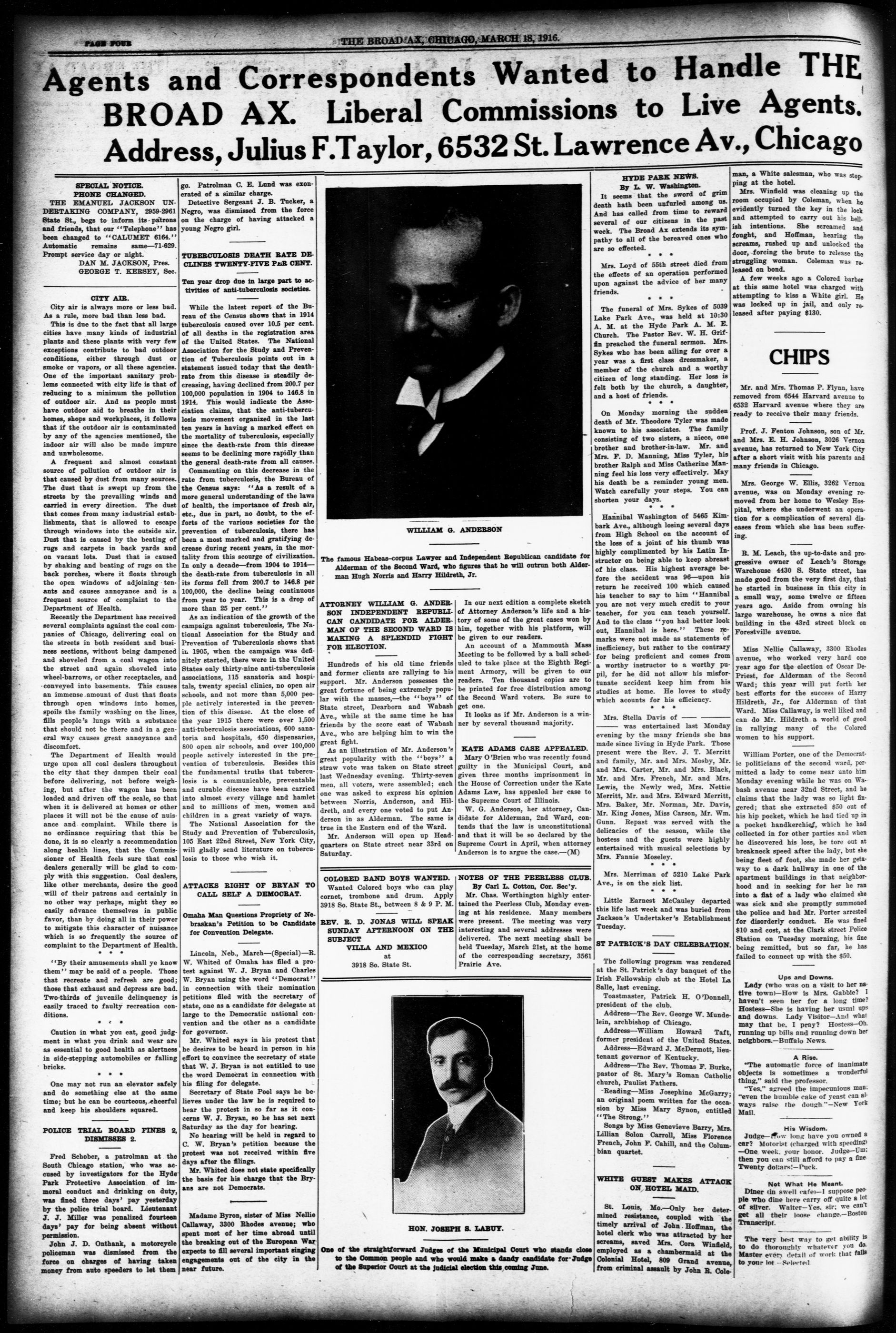
WILLIAM G. ANDERSON
The famous Habeas-corpus Lawyer and Alderman of the Second Ward, who man Hugh Norris and Harry Hildre
The famous Habeas-corpus Lawyer and Independent Republican candidate for Alderman of the Second Ward, who figures that he will outrun both Alderman Hugh Norris and Harry Hildreth, Jr.
ATTORNEY WILLIAM G. ANDERSON INDEPENDENT REPUBLICAN CANDIDATE FOR ALDERMAN OF THE SECOND WARD IS MAKING A SPLENDID FIGHT FOR ELECTION.
Hundreds of his old time friends and former clients are rallying to his support. Mr. Anderson possesses the great fortune of being extremely popular with the masses,—the “boys” of State street, Dearborn and Wabash Ave., while at the same time he has friends by the score east of Wabash Ave., who are helping him to win the great fight.
As an illustration of Mr. Anderson's great popularity with the "boys" a straw vote was taken on State street last Wednesday evening. Thirty-seven men, all voters, were assembled; each one was asked to express his opinion between Norris, Anderson, and Hildreth, and every one voted to put Anderson in as Alderman. The same is true in the Eastern end of the Ward. Mr. Anderson will open up Headquarters on State street near 33rd on Saturday.
COLORED BAND BOYS WANTED.
Wanted Colored boys who can play cornet, trombone and drum. Apply 3918 So. State St., between 8 & 9 P. M.
REV. E. D. JONAS WILL SPEAK
SUNDAY AFTERNOON ON THE
SUBJECT
VILLA AND MEXICO
at
3918 So. State St.
M. B.
HON. JOSEPH S. LABUY.
One of the straightforward Judges of to the Common people and who w of the Superior Court at the judicia
One of the straightforward Judges of the Municipal Court who stands close to the Common people and who would make a dandy candidate for Judge of the Superior Court at the judicial election this coming June.
Independent Republican candidate for
figures that he will outrun both Alder-
th, Jr.
In our next edition a complete sketch
of Attorney Anderson's life and a histo-
ry of some of the great cases won by
him, together with his platform, will
be given to our readers.
An account of a Mammouth Mass
Meeting to be followed by a ball schedu-
led to take place at the Eighth Regi-
ment Armory, will be given to our
readers. Ten thousand copies are to
be printed for free distribution among
the Second Ward voters. Be sure to
get one.
It looks as if Mr. Anderson is a winner by several thousand majority.
KATE ADAMS CASE APPEALED.
Mary O'Brien who was recently found guilty in the Municipal Court, and given three months imprisonment in the House of Correction under the Kate Adams Law, has appealed her case to the Supreme Court of Illinois. W. G. Anderson, her attorney, Candidate for Alderman, 2nd Ward, contends that the law is unconstitutional and that it will be so declared by the Supreme Court in April, when attorney Anderson is to argue the case—(M)
NOTES OF THE PEELESS CLUB
By Carl L. Cotton, Cor. Sec'y.
Mr. Chas. Worthington highly entertained the Peerless Club, Monday evening at his residence. Many members were present. The meeting was very interesting and several addresses were delivered. The next meeting shall be held Tuesday, March 21st, at the home of the corresponding secretary, 3561 Prairie Ave.
in the Municipal Court who stands close should make a dandy candidate for Judge and election this coming June.
It seems that the sword of grim death hath been unfurled among us. And has called from time to reward several of our citizens in the past week. The Broad Ax extends its sympathy to all of the bereaved ones who are so effected.
---
Mrs. Loyd of 55th street died from the effects of an operation performed upon against the advice of her many friends.
---
The funeral of Mrs. Sykes of 5039 Lake Park Ave., was held at 10:30 A. M. at the Hyde Park A. M. E. Church. The Pastor Rev. W. H. Griffin preached the funeral sermon. Mrs. Sykes who has been ailing for over a year was a first class dressmaker, a member of the church and a worthy citizen of long standing. Her loss is felt both by the church, a daughter, and a host of friends.
On Monday morning the sudden death of Mr. Theodore Tyler was made known to his associates. The family consisting of two sisters, a niece, one brother and brother-in-law. Mr. and Mrs. F. D. Manning, Miss Tyler, his brother Ralph and Miss Catherine Manning feel his loss very effectively. May his death be a reminder young men. Watch carefully your steps. You can shorten your days.
...
Hannibal Washington of 5465 Kimbark Ave., although losing several days from High School on the account of the loss of a joint of his thumb was highly complimented by his Latin Instructor on being able to keep abreast of his class. His highest average before the accident was 96—upon his return he received 100 which caused his teacher to say to him "Hannibal you are not very much credit to your teacher, for you can teach yourself. And to the class "you had better look out, Hannibal is here." These remarks were not made as statements of inefficiency, but rather to the contrary for being proficient and comes from a worthy instructor to a worthy pupil, for he did not allow his misfortune accident keep him from his studies at home. He loves to study which accounts for his efficiency.
Mrs. Steena Davis of
was entertained last Monday
evening by the many friends she has
made since living in Hyde Park. Those
present were the Rev. J. T. Merritt
and family, Mr. and Mrs. Mosby, Mr.
and Mrs. Carter, Mr. and Mrs. Black,
Mr. and Mrs. French, Mr. and Mrs.
Lewis, the Newly wed, Mrs. Nettie
Merritt, Mr. and Mrs. Edward Merritt,
Mrs. Baker, Mr. Norman, Mr. Davis,
Mr. King Jones, Miss Carson, Mr. Wm.
Gunn. Repast was served with the
delicacies of the season, while the
hostess and the guests were highly
entertained with musical selections by
Mrs. Fannie Moseley.
Mrs. Merriman of 5210 Lake Park
Ave., is on the sick list.
Little Earnest McCauley departed this life last week and was buried from Jackson's Undertaker's Establishment Tuesday.
ST PATRICK'S DAY CELEBRATION
The following program was rendered at the St. Patrick's day banquet of the Irish Fellowship club at the Hotel La Salle, last evening.
Toastmaster, Patrick H. O'Donnell, president of the club.
Address—The Rev. George W. Mundelein, archbishop of Chicago.
Address—The Rev. Thomas F. Burke, pastor of St. Mary's Roman Catholic church, Paulist Fathers.
Reading—Miss Josephine McGarry; an original poem written for the occasion by Miss Mary Synon, entitled "The Strong."
Songs by Miss Genevieve Barry, Mrs. Lillian Solon Carroll, Miss Florence French, John F. Cahill, and the Columbian quartet.
WHITE GUEST MAKES ATTACK
ON HOTEL MAID.
St. Louis, Mo.-Only her determined resistance, coupled with the timely arrival of John Hoffman, the hotel clerk who was attracted by her screams, saved Mrs. Cora Winfield, employed as a chambermaid at the Colonial Hotel, 809 Grand avenue, from criminal assault by John B. Cole-
man, a White salesman, who was stopping at the hotel. Mrs. Winfield was cleaning up the room occupied by Coleman, when he evidently turned the key in the lock and attempted to carry out his hellish intentions. She screamed and fought, and Hoffman, hearing the screams, rushed up and unlocked the door, forcing the brute to release the struggling woman. Coleman was released on bond. A few weeks ago a Colored barber at this same hotel was charged with attempting to kiss a White girl. He was locked up in jail, and only released after paying $130.
CHIPS
Mr. and Mrs. Thomas P. Flynn, have removed from 6544 Harvard avenue to 6532 Harvard avenue where they are ready to receive their many friends.
Prof. J. Fenton Johnson, son of Mr. and Mrs. E. H. Johnson, 3026 Vernon avenue, has returned to New York City after a short visit with his parents and many friends in Chicago.
Mrs. George W. Ellis, 3262 Vernon avenue, was on Monday evening removed from her home to Wesley Hospital, where she underwent an operation for a complication of several diseases from which she has been suffering.
R. M. Leach, the up-to-date and progressive owner of Leach's Storage Warehouse 4430 S. State street, has made good from the very first day, that he started in business in this city in a small way, some twelve or fifteen years ago. Aside from owning his large warehouse, he owns a nice flat building in the 43rd street block on Forestville avenue.
Miss Nellie Callaway, 3300 Rhodes avenue, who worked very hard one year ago for the election of Oscar DePriest, for Alderman of the Second Ward; this year will put forth her best efforts for the success of Harry Hildreth, Jr., for Alderman of that Ward. Miss Callaway, is well liked and can do Mr. Hildreth a world of good in rallying many of the Colored women to his support.
William Porter, one of the Democratic politicians of the second ward, permitted a lady to come near unto him Monday evening while he was on Wabash avenue near 32nd Street, and he claims that the lady was so light fingered; that she extracted $50 out of his hip pocket, which he had tied up in a pocket handkerchief, which he had collected in for other parties and when he discovered his loss, he tore out at breakneck speed after the lady, but she being fleet of foot, she made her getaway to a dark hallway in one of the apartment buildings in that neighborhood and in seeking for her he ran into a flat of a lady who claimed she was sick and she promptly summoned the police and had Mr. Porter arrested for disorderly conduct. He was fined $10 and cost, at the Clark street Police Station on Tuesday morning, his fine being remitted, but so far, he has failed to connect up with the $50.
Ups and Downs.
Lady (who was on a visit to her native town)—How is Mrs. Gabble? I haven't seen her for a long time? Hostess—She is having her usual ups and downs. Lady Visitor—And what may that be, I pray? Hostess—Oh, running up bills and running down her neighbors—Buffalo News.
A Rise.
"The automatic force of inanimate objects is sometimes a wonderful thing," said the professor.
"Yes," agreed the impecunious man "even the humble cake of yeast can always raise the dough"—New York Mail.
His Wisdom.
Judge—How long have you owned a car? Motorist (charged with speeding)—One week, your honor. Judge—Um; then you can still afford to pay a fine. Twenty dollars!—Puck.
Not What He Meant
Diner (in swell cafe)—I suppose people who dine here carry off quite a lot of silver. Walter—Yes, sir; we can't get all their loose change—Boston Transcript.
The very best way to get ability is to do thoroughly whatever you do. Master every detail of work that falls to your lot—Selected
[Name]
hood into parts, it seems to the writer that it is best to say rich and poor. Since the Jew of all religionists is the greatest enemy to the terrible demon Poverty and has the record of the lowest mortality from tuberculosis universally, let us give the Hebrews a closer scrutiny and take some more lessons from the great law givers who produced Moses, the unprejudiced Solomon, the wise and rich king who married the Queen of Sheba, that swarthy Ethiopian damsel and the warrior king David.
Segregation means more poverty; more tuberculosis, more misery and more stagnation as well as more unsanitary environment and more dark close alley residences. Let all persons with a love of justice and who stand on broad humanitarian grounds cry out for better wages and better living conditions for EVERYBODY EVERYWHERE.
THE RICH MAN IS NOT ABSOLUTELY SAFE FROM THE CALAMITIES THAT ARE THRUST UPON HIS LESS FORTUNATE CONTEMPORARY BROTHER.
Let us all educate and agitate against poverty and its companion TUBERCULOSIS.
Overwork, insufficient nourishment, excessive or long hours of service, poorly ventilated houses that have windows that cannot be opened, houses that have no bath, dark rooms, the use of patient medicines and the reliance on the gratuitous and unscientific counter prescribing druggist are concomitants of poverty. BETTER WAGES ARE NEEDED and the EMPLOYERS should do their part to rid us of that which spreads tuberculosis more than anything else; it is SMALL WAGES.
I am no priest of crooks and creeds,
For human wants and human needs
Are more to me than prophets' deeds;
And human tears and human cares
Affect me more than human prayers.
Go, cease your wail, lugubrious saint!
You fret high heaven with your plaint;
Is this the "Christian joy" you paint?
Is this the Christian's boasted bliss?
Avails your faith no more than this?
Take up your arms, come out with me,
Let heaven alone; humanity
Needs more, and heaven less from thee;
With pity for mankind look 'round;
Help them to rise and heaven is found.
—Paul Laurence Dunbar.
RAIDS BANK: GETS $1,600.
St. Joseph, Mo., (Special)—A Colored man entered the Mechanics' State Bank here on Monday, and forced the cashier and two clerks into the vault and obtained $1,600. He escaped.
That Colored man is fast becoming highly civilized just like his White fellow citizens—Editor.
BROWN CHRISTIAN
CHARLES THE LORD OF THE WEST
M.
MR. AUGUSTUS L. WILLIAMS
Lawyer and Republican Candidate for Delegate to the Convention from the First Congressional District
For Delegate to the Republican National Congressional District of Illinois.
Lawyer and Republican Candidate for Delegate to the Republican National Convention from the First Congressional District of Illinois.
Talks on
HEALTH,
CLEANLINESS,
PROPER LIVING,
SANITATION, ETC.
BY
Dr. W. A. DRIVER
3300 So. State Street
Phode,Douglas: 3617
PROGRESS AND POVERTY OR PREVENTION OF THE SPREAD OF TUBERCULOSIS.
"In the world's broad field of battle,
In the bivouac of life,
Be not like dumb driven cattle,
Be a hero in the strife!"
Longfellow.
To prevent the spread of the commonest, the most widespread and the most serious of all human maladies there must be a multitude of heroes and reiteration of the causes, prevention and the treatment of tuberculosis.
A DISEASE OF THE POOR
In his book Practice of Medicine Osler says of the conditions favoring the spread of tuberculosis or conditions influencing infection page 292, "Environment is an all important predisposing factor." He also states in the same paragraph that * * * * "In imperfectly ventilated dwellings and work shops, and in close, dark alleys, and in tenment houses the liability to infection is very much increased." Osler also says on page 285, "The Jews everywhere have a low mortality from consumption—about one-half that of Christians—which Fishberg attributes to their adaption to city life for the past two thousand years." Representative William Kent of California in a letter "To the medical profession of the United States:" says * * * * "It is now recognized that tuberculosis is peculiarly a disease of poverty and malnutrition * * *."
If we must unscramble eggs or divide theoretically the homogeneous and (paradoxically though it may seem) heterogeneous brotherhood and sister-
THE NEGRO FELLOWSHIP LEAGUE
"Resolved that the United States has a Right to Invade Mexico" is the subject for debate before the Negro Fellowship League Sunday, March 19, at 4 P. M. This question is to be debated by Mr. Frank Stevens and Mr. C. A. Barnett. All organizations are requested to send delegates who will also take part in the discussion.
Last Sunday Mr. F. L. Barnett deals exclusively with the Campbell case which was thoroughly discussed by a large number present. By motion the chairman was authorized to appoint a committee to co-operate with him for further raising of funds for the purpose of carrying the case to the Supreme Court.
JOHN E. HUGHES,
Secretary.
Mrs. Carrie Warner, 5223 S. Dearborn street, who conducts fine manicure parlors at 182 S. State street; has been confined to her home the past week with illness. She expects to be able to resume her duties at her place of business the first of this coming week.
"RELIGION"
THE BROAD AX, CHICAGO, MARCH 18, 1916.
Charles E. Stump Has Wended His Way from St. Louis, Missouri to Kansas City and Other Western Points to Meridian, Mississippi; From There He Will Continue His Journey on South to New Orleans, Louisiana
Meridian, Miss.—I jumped so far and so fast that I did not get to send you a letter last week. If you will remember I was in Kansas City, when I took my pen in hand to write you a few lines last week, and you will see where I am today, and I will not be here when this letter reaches you in a few days.
I have been trying to study the White man, but I find it impossible for me to reach him and understand his case, so I am going to give it up as soon as I can do so. I will turn him over to God, and then I think God will understand him here or the devil will understand some of them yonder. I am not joking about this, and must tell you all about it. The Lord hath been good to me. He will take care of me in trouble.
I told you in my last letter that I would reserve the right to say a word about Evanston in another letter, and I think I will here exercise my rights, and if I fail you will not think it was because I failed to try. Rev. I. A. Thomas, pastor of the Second Baptist church invited me out to see his church and to meet the people of Evanston. He thought it would be a good thing to have a real Kansas farmer to come out and see a real church. I hesitated at first, but made up my mind to go. I went and I was well paid for going.
I wonder if you are acquainted with Dr. Thomas. He is a man and a well trained man at that. He has made it for himself and for his race. He was born way down in Georgia, got his education down there in the public school, in Central City College, Macon, Ga., and Morehouse College, Atlanta, Ga. It was in these institutions where he pushed his way to the front, and where he became a man of education. He taught in the Central City College for some time and resigned to go to another part of the world. He resigned from there to go to a church, and then to take up some special work in the University of Chicago. It was while studying that the people up there got to know him. When Dr. Gayles resigned they called Rev. Thomas, and he heard the call and went out there. He found that little frame building which had stood by the side of the ark. A small membership.
Now you want to know what happened? He took up his coat rolled up his sleeves and said "Brothers and sisters work must be done here in this zion." It was done too, for the old building was torn down, and a new one started. Many people stood off and looked and declared it could never be completed. Dr. Thomas said it would be. So many predicted failure, but he predicted in his own mind success, and success did come to him. Soon the building was down, the new one up, and they tell me that in three years these people raised $35,000. They have some valuable property right in the heart of Evanston. It is worth having.
I met a loyal set of hard church working people. They were serving supper, and invited me to eat. I did eat. I looked at that fine church, and went right off to shouting without any particular sermon, but this church is sermon enough to make any one shout. The people think that I must be going crazy, but I am not. I feel happy at times. I must speak right out when the spirit strikes me. You must not keep back the spirit. It must come out, and I am willing to let it out. I want to congratulate these people. They deserve credit. The membership has been increased under Dr. Thomas, and it is hard to tell where he will stop. He is a worker.
I left there as I told you and went on to Alton, St. Louis, Kansas City. I found the people busy getting ready for the National Negro Business League. We farmers are going to have a hand in this big meeting. I met Mr. and Mrs. Fortune I. Weaver, and
they called the Local Business League together and gave me a banquet. It was where we sat down to a big table and had some eating and then some talking. Mrs. Tilford Davis went there with me, and I did not eat too much. I enjoyed it so very much. I would suggest that you get ready to take your vacation just at the time the National Negro Business League is to meet and you go to Kansas City. You will have the time of your natural born life. I am going to be there myself. I shall say more about it in another letter.
I returned to St. Louis, after I got all my business straight about the farm. Went to court and saw them send that man to the workhouse for thirty days for stealing that machine I had bought, and then left, after talking with Dr. W. Sampson Brooks about his general conference affairs, for the place where I am. I got on the L. & N. train, for the extreme south. This is one of the best roads.
I knew that I would have to change to that special when I crossed into Kentucky, so I just went in there in St. Louis, and had it all alone until I reached Henderson, and those who had been in the other car marched into join me. One woman who was born down home, and had lived there until a few years ago, showed herself right out. "Is this what you call a Jim Crow car?" she asked the man who was taking up the tickets. I think they called him a "Corn Doctor," or something like that. "No madam," he replied, "but this is the car for Colored people provided under the law of Kentucky."
"It is just horrible, and I will not sit down here," she said. She stood and stood for an hour and then eased down in the seat and went to sleep snoring "Jim Crow car, Jim crow car." She got off in Nashville, and I continued down to Birmingham, where I spent a night with Rev. J. S. Jackson, of the A. M. E. Zion church, and will tell you about him later. Sunday was spent in Bessemer, Ala., with Dr. E. J. Gregg, one of the leading physicians in the south, saying nothing about race or color. Bessemer is just out from this Birmingham about 12 miles. I was delighted to see so many things there, and enjoyed myself to the highest.
It is interesting to be with Dr. Gregg, because he is a man every inch of him, and then he is doing things. He is making things happen right in town. He enjoys the confidence of the people. His clerk was as busy as could be. I met her in Chicago last fall, Miss Minnie Spencer: The people were very kind to me, and I forgot that I was in the south. When you get down here and get among your own people you forget that you are in the south. The treatment is always fine. I am now in the state of Senator Vardaman.
THE SIXTEENTH PLEASANT SUN
DAY AFTERNOON AT BETHEL
CHURCH.
This coming Sunday afternoon, March 19th, at 3 P. M., the Sixteenth pleasant Sunday afternoon will be held at Bethel Church, 30th and Dearborn streets; Rev. W. D. Cook, pastor.
Piano forte lecture—recital "Folks Songs and dances of many peoples" will be given by Henry Purmort Eames, director piano department, Cosmetropolitan School of music and dramatic art. James A. Mundy, conductor. Miss Lillian Hunt, accompanist. Mr. Walter P. Gossette, accompanist. Grand chorus of one hundred voices. Silver offering will be lifted at the door.
Mr. Eames' appearance, courtesy to Mr. Mundy.
Losing a Situation.
In the American Magazine is an article on getting and holding a job by Hugh S. Fullerton, in which he says to men who have been discharged from their positions:
"Don't try to tell me. 'Some one had it in for me,' or. 'The boss didn't like me,' or that So-and-so 'had a pull.' If you are an office man it cost the firm from $200 to $250 to find out you would not do, and if you are a shop worker it cost about $00. And it will cost the firm that much more to try out each person until it finds one that fits and can hold the job. No matter whether it likes you or not, no firm or corporation wants to throw away $00 or $250 in time and money.
"The firm wanted to hire you and was disappointed because it could not. Every one was 'pulling' for you to make good' and was disappointed when you failed. The bosses hoped to find you fit for promotion and were a bit discouraged when they discovered they could not promote you."
Leadership In a Democracy.
Leadership in a Democracy.
There was a day when the absolute monarch seemed the ideal of human greatness. The names of such are scattered throughout time. But their age has vanished. The masses below have surged to the surface—the will not be denied. The age before us is the age of the free and aspiring many. In such an age the strong man is the leader of thought. He wins following by the constraint of a powerful mind and a virile character. He appeals to reason and to the higher emotions. He looks far into the future, and his constructive imagination is a lens through which the people may see clearly things as they are and as they are to be. His qualities must be higher than those of a despot. The freely followed leader of a free people is greater far than emperor or king.-Harry Pratt Judson, President of the University of Chicago.
Insect Life.
In a report to the Smithsonian institution James Buckland says few persons realize how enormous is the number of insect species or how amazing is their power of multiplication. The number of insect species is greater by far than that of the species of all other living creatures combined. Although 300,000 have been described, probably twice that number remain to be examined. Virtually all living animals, as well as most plants, supply food for these incomputable hordes. The fecundity of certain insect forms is astounding. Professor Riley once computed that the progeny of the hop aphis, which sees thirteen generations born to it in a single year, would, if unchecked to the end of the twelfth generation, multiply to the inconceivable number of ten sextillions of individuals.
Subtle Advertising
A successful hotel manager pointed to the advertisement of a hotel at a fashionable resort. This advertisement read: "Special rates to single men." "The proprietor of that hotel." said he, "deserves to succeed. He lays in his advertisement a subtle trap for mothers with marriageable daughters. They read the advertisement, and they conclude that, given lower rates at this hotel, single men will be plentiful. They therefore decide that there is the place undoubtedly to take their daughters." Then, laughing, he concluded: "These mothers quite correctly believe that as far as their daughters' chances of matrimony are concerned the more the marryer."—Exchange.
Military Skaters.
In the Norwegian army there is a corps of infantry every man of which is an expert skater. On skates this corps can perform a day's march of eighty miles, which equals the performances of the best trained cavalry in Europe. The evolutions of the corps are confined to the great flords which indent the coast of Norway, these flords being frozen over during the long winter season.
Whole Hog or None.
The old saying "Whole hog or none" refers to Mohammed allowing his followers to eat all except one portion of a pig, but failing to mention what the portion was, so that if a Mohammedan did not leave pork strictly alone he might as well consume the whole hog as risk eating any part of it.
Drives Him to Drink
"I'm so sorry about it, but my husband actually hates music."
"How strange!"
"Isn't it? His prejudice is so strong that he has to jump up and leave the theater whenever the orchestra is playing an ent'acte."—Cleveland Leader.
Rust.
Nothing can rust unless it has iron in it. Rust is made by iron touching molst air. The oxygen in the molst air acts on the iron and forms what we call "oxide of iron," or rust, which crumbles away and spolls the iron—Exchange.
Chaperon.
The word "chaperon" comes from the name of a mantle worn by Spanish duennas, with which they are supposed to cover and shield the young girls under their care.
In the Laboratory.
"That final analysis you've heard so much about," answered the chemist—Louisville Courier-Journal.
Slight not what's near through aiming at what's far.—Euripides.
PAGE FIVE
THE BROAD AX
PUBLISHED WEEKLY.
Will promulgate and at all times uphold the true principles of Democracy, but Catholic, Protestant, Priests, Infections, Single Taxes, Republiance, or anyone else can have their say, as long as their language is proper and responsibility is fixed.
The Broad AX is a newspaper whose platform is broad enough for all, over claiming the editorial right to speak its own mind.
Local communications will receive attention. Write only on one side of the paper.
Subscriptions must be paid in advance. One Year. $3.00.
Six Months. $1.00.
Advertising rates made known on application.
Address all communications to
THE BROAD AX
6533 ST. LAWRENCE AVE., CHICAGO, IL.
PHONE WENTWORTH 2597.
JULIUS F. TAYLOR, Editor and Publisher
Entered as Second-Class Aug. 18 in
the Office of Chicago, Illinois,
under A. M. of Chicago.
AUTHORIZED AGENTS AND CORRESPONDENTS FOR THE BROAD AX.
L. W. Washington, 5465 Kimbark avenue.
B. W. Fitts, 3315 S. State street. Phone Douglas 4049.
The Broad Ax can be found on sale at the last named place and news items and advertisements left there will find their way into these columns.
Household Hints.
Dipping in a solution of alum will fireproof paper candle or lamp shades.
Keep tacks in bottles; it saves opening many boxes to find a particular kind.
Salt thrown on the fire once a day prevents the accumulation of soot in the flues.
A pail of boiling salted water should be poured down the kitchen sink every week to prevent its becoming stopped.
Cotton gloves to wear in doing housework are better in every way than old kid gloves. If bought especially for this purpose get a size larger than usually worn.
Sparks of Fire.
To protect wood against fire, silicate of soda is the most effective remedy. There are traces of an organization for the extinction of fire as far back as 2,000 years B. C. There is no doubt that the original method of finding fire was by the friction of two pieces of wood. No Greek or Roman army crossed a frontier without carrying an altar on which a sacred fire always burned. The origin of fire varies, according to old time fables. The Greeks held that Prometheus brought to earth the torch he had lighted at the sun, and hence there was fire.
Leap Year Musings.
During the glad leap year a woman also has the last word first.—Washington Post. The question is whether in a leap year wedding the bridegroom shouldn't promise to obey.—Pittsburgh Chronicle. One woman explains that the only difference in leap year is that the men then know that the women are proposing.—Boston Herald. With Mr. Bernard Shaw's revelation that woman does the proposing in nearly all cases anyway. leap year lost much of its significance.—Chicago Herald.
BRIGHT BRIEFS.
After a rough life has been polished it is called hypocrisy.
Can't is a longer word than can, but it seems easier to use.
The road to success is full of the ruts of other men's failures.
Speed the day when they will beat the war stocks into plowshares.
What has become of the old fashioned steer that grew the cheaper cuts?
Remember that the money you intend to save doesn't draw any interest.
Every man was born at a very early age, but some of them never seem to get over it.
The man who is too poor to lend money to his friends will never have many enemies.
If the price keeps going up one may soon have to mortgage the car to buy gasoline for it. ____
A pint pot that knows its own measure is worth more than a quart that thinks it's a gallon.
PAGE SLX
Crafty Red Squirrels.
The red squirrel is as crafty as he is quick. He'll select three or four places to store nuts, if one is discovered he has reserve supplies. And he never makes a mistake and put away worm eaten nuts. The red squirrel knows a wormy nut as soon as he picks it up and revolves it in his paws.
Ever see him eat a hickory nut? He sits up on his hind legs with his tail curved over his back, holding the nut in his forepaws. First he drills a little hole in the shell with his sharp teeth, breaking away the shell a little at a time until he can get at the kerpel.
If the red squirrel limited his diet to nuts he would have more friends. But sometimes he adds a store of the farmer's corn to his underground nest. He's a robber of birds' nests, too, and you'll see him perched on a limb eating an egg as innocently as though he were cracking a walnut.—Philadelphia North American.
Dangerous Learning
A little learning is a dangerous thing, but a little too much learning is still more dangerous. To have too much learning sets you so far above your fellow mortals and fills you with such contempt for them that you cannot be comfortable in their presence nor they in yours. Beyond a certain point learning ceases to be of use and becomes a burden, because nobody can comprehend what you are talking about. Thus it happens that men are so learned sometimes that the only way society can live with them is to shut them away in some asylum. So, then, follow Pope's advice, "Drink deep or taste not the Pierian spring," but don't drink too deep. Which is much the same as saying that a happy medium in the matter of learning is just as happy as any other happy medium.—Life.
Our Debt to the Pioneers
I love to think of the bold, adventurous men who blazed the pathway of civilization across the continent to the shores of the peaceful ocean. They, and not the politicians of this era, made this a world power. We owe them a debt of gratitude which we can never repay except by being model citizens. They had none of the ordinary incentives to high endeavor. They acted their parts in a rude age, upon an obscure stage, far from the teeming centers of population and publicity, with no Boswell to follow at their heels to record their words, with no newspaper correspondents to blazon their deeds. No trumpet of fame sounded in their ears, cheering them on in their onerous, hazardous, self appointed task, but they wrought nobly for their country and their kind.—Champ Clark.
Alone In a Great City
The words burst like heart tearing sobs from the lips of the wretched looking man at the street corner, and passersby eyed him in silent sympathy. "Alone in a great city!" he sobbed again. Then over his careworn face flashed a sudden look of hope as he added, "Ah, that gives me an idea!" Taking from the pocket of his shabby waistcoat his real silver watch, he turned quickly into a side alley over which hung the sign of the three golden balls. A few minutes later he returned, pushing a little ticket into his now empty pocket and jingling some colns gayly. "A loan," he muttered in happy, care free tones—"a loan in a great city!"—London Mail.
Thackeray and Dickens.
Thackeray was much taller than Dickens. His form, indeed, approached the gigantic in its proportions. He looked far older, although the two men were much about the same age. His immense head, his broad forehead and his prematurely white hair gave him an appearance of authority and even of severity, which one might have thought would prove intimidating to a stranger. Yet I at least never felt it so. He seemed to me to be less self assertive, less conscious of his superiority, than Dickens appeared to be. Justin McCarthy's Reminiscences.
Back to Her Tender Years
Boarder—This beef is very tough. It is evidently from an old cow. Mrs. Hasleigh—Let me tell you, sir, that the tenderest beef I ever ate was from a cow fifteen or twenty years old. Boarder—That's easily explained. The cow was so old she was childish.—Boston Transcript.
Encouragement.
Collector (warmly)—I've been here a dozen times, sir, and I positively won't call again.
Mr. Poorpay (cheerfully)—Oh, come now, my man. Don't be so superstitious about making the thirteenth call. Nothing will happen, I assure you.
Information.
Customer—Have you the papers for a week back? Newsboy—Fer a weak back? Yer don't want papers; yer wants a porous plaster.—Exchange.
During the Engagement:
Patience—So Peggy is putting off her marriage as long as possible? Patrice —Oh, yes; she loves attention, you know.—Yonkers Statesman.
High Application
Peter—It's a fine castle in the air
you've built. How do you propose to
get into it—by airship? James—No; by
heftress!
To effect a quick cure mix cheerfulness
with your medicines.
Pure Drinking Water. The geologic resource of greatest value to the health of communities is a supply of pure drinking water. It is generally recognized that a number of diseases, prominent among which are typhoid fever and amoebic dysentery—a disease more common in tropical climates, but found also in the United States—are contracted through contaminated water or contaminated food. Therefore a supply of pure water will eliminate one of the sources of such infection.
It is highly desirable to obtain supplies of domestic water from sources other than the shallow wells, some of them open, that are found near many houses. The water obtained from deep wells has percolated through sands and other material for so great a distance that its impurities have been removed by filtration, and it possesses a sanitary value that cannot well be overestimated, for such water is free from the bacteria causing typhoid fever and the protozoa causing amoebic dysentery, and its use obviates the necessity for shallow wells that may serve as a breeding place for Anopheles, the mosquito to which malarial infections is due.—Geological Survey Bulletin.
Washington at Night.
Night life comes on swiftly when it gets really started. Night in Washington is a beautiful girl drawing a black velvet, jewel bespangled cloak over white shoulders. The streets are lighted with dull bronze, rather low lamps; artistically perfect lamps that hold dull white, glowing globes. The lamps are very close together. They are the pearls that the girl winds about her throat and in her dusky hair.
The White House stands out, glimmering boldly against the black of the foliage, its lighted windows dimmed with tightly drawn curtains. What of national portent may not have happened behind those same curtained windows! Perhaps fear has grappled with bravery behind the shelter of the friendly walls; perhaps hatred and love have clashed. Perhaps cowards have become strong, and surely strong men have wept. Characters and homes and nations have been molded behind those friendly blinds.-Margaret E. Sangster Jr., in Christian Herald.
The Jumping Frog Story.
It was in the Angel Camp bar that Mark Twain heard from an ex-pilot called Ben Coon the jumping frog story. Clemens related it to Artemus Ward, who urged him to write it, to be included in a book that Ward was publishing. Clemens dalled and sent it to the publishers too late, but they handed it over to a dying paper called the Saturday Press, which gladly gave it pride of place in its columns on Nov. 18, 1865. Professor Sidgwick synopsized it in Greek form for his book "Greek Prose Composition," and thus arose the legend that the jumping frog story originated in ancient Greece, a legend in which Clemens himself believed till Professor Sidgwick undeceived him in 1880 by telling him that the Greek version was merely a translation of Clemens' own work.
How Jefferson Dressed.
In dress President Jefferson was governed by comfort rather than by elegance. "Pride costs more than hunger, thirst and cold," he used to say, and as he lived in an epoch that witnessed a mighty revolution in men's clothing as well as in men's government, monarchy's queues and velvets giving way to short hair and the useful, ungainly pantaloon, only the watchfulness of his body servant saved him from unbelievable anachronisms of costume. Indeed, in later life at Monticello, where this democrat ruled absolute king, he often wore the garments of several different periods together, like superimposed geological strata or the historic remains in the Roman forum.-Century.
Bazaars In Asia.
Streets in the bazaar districts of Aslatic cities are only eight to ten feet wide. The larger shops are eight by ten and the smaller ones five by six feet, with one side giving directly on the street. In each bazaar is a khan for every ten or twelve shops. These khans are two stories high, with an open court in the center and rooms on the four sides, all opening into the court. A door leads from the open court into the street. Rooms are let to different storekeepers for storage purposes.
Wifely Optimism.
Husband—When I see all these bills I am tired of life. Do you think the time will ever come when we shall be out of debt? Wife (cheerfully)—Why not, darling? You know that you are carrying an exceptionally large life insurance.
Left Handed Revenge
Officer—Your honor, this chauffeur ran his car into th' show windy av a millinery store. Judge—What millinery store? Officer—Mme. de Stickum's. Judge—Discharged. That's where my wife buys her hats.—Philadelphia Bulletin.
Considerate.
"The most considerate wife I ever heard of," said the philosopher, "was a woman who used to date all her letters a week or so ahead to allow her husband time to post them."
First Senior—I'm going to marry a poor girl and settle down. Second Senior—Better marry a rich girl and settle up.—Yale Record.
Oft expectation falls and most oft there where most it promises.—Shakespeare.
THE BROAD AX. CHICAGO. MARCH 18, 1916
Tennyson's Birds.
Of all the poets Tennyson was the most exact in his rendering of the songs or calls of birds. A young lady was present when he was reading "Maud." When he came to the passage which says, "Birds in the high hall garden cry,'Maud, Maud, Maud!'" he suddenly ceased reading and asked her abruptly what the birds were. She blushed and hesitated and then said:
"Nightingales, I suppose."
The poet turned away with the one word "Rooks!"
He always made the sound right. What could be better than "the moan of doves" and "Whit, whit, whit! chirruped the nightingale?"
Then, linnets, robins and thrushes "pipe" in his pages, the woodpecker "laughs" and "mocks," the lark and the plover "whistle," the jay "scrichtes," the parrot "screams," the peacock "squalls," the blackbird "warbles," the ocean fowl "shriek," and the eagle "yelps." He may well ask in one of the daintiest of his lullables, "What does little bird say?" He knows, and he lets his readers know too.—London Answers.
The Missing Chapter
The new pastor of a certain country parish is likely to lose the confidence of his flock unless he changes his ways. During his sermon one Sunday morning not long back he stopped abruptly and asked:
"How many of those here are diligent students of their Bible?"
Fifty hands went up.
"Good!" said the pastor. "Now, how many of you have read the second chapter of Jude?"
Twenty-five hands went up.
A wan smile overspread the divine's face.
"That's also good, but when you go home read that chapter again, and you will doubtless learn something to your interest."
Reader, the point of this story lies in the fact that the book of Jude consists of one chapter only.
Burning Diamonds.
You often hear of people with money to burn, but so far none has ever attempted to burn his diamonds. The reason why perhaps is because they will burn beautifully. "A great many people imagine that diamonds are indestructible." said a jeweler, who was placing a load of gems in his safe for the night. "but as a matter of fact, a fire of diamonds would be the briskest, prettiest thing in the world. Diamonds are nothing but coal carbon. Put a handful of diamonds on a plate and set a light to them. They will burn with a hard, gemlike flame till nothing is left. There will be no smoke, no soot, and at the end the plate will be as clear as though just washed. Not the slightest particle, even of ash, will remain."-Pittsburgh Press.
A Lost Book
Among the Somalis of Africa there is a legend that when God first made them, a man and a woman, he wrote down in a book the law they were to follow. They were promised that as long as they carefully preserved this book they should continue great and powerful, but if they lost it their greatness would depart from them. One day the book was carelessly left lying outside a tent, where a bullock found and devoured it. From that fatal day their decadence set in, and to the present time whenever an ox dies of disease or is killed his entrails are religiously examined to see if any trace of the book can be found. If found they believe they should recover their lost power.
The Two Versions
The editor was trying to placate an indignant statesman.
"All we said about you in the paper, Mr. Krakajack," he assured him, "was that you seemed to have an inadequate sense of proportion."
"Not by a blamed sight!" roared the caller. "What you said about me was that I seemed to have an inadequate proportion of sense!"—Chicago Tribune
Kansas as a Territory:
When Kansas was first organized as a territory in 1854 its area included part of the present state of Colorado, extending as far west as the crest of the Rocky mountains. Denver, Leadville, Pueblo and Colorado Springs are now located on former Kansas soil.
One of Her Necessities
Maud—Jack said when he proposed that he could give me only the necessities of life. Ethel—And what did you say? Maud—I told him that one of the necessities of my life was a husband who could supply me with the luxuries.—Exchange.
Olives and Bread.
Pound for pound, ripe olives, so far as total value of heat unit is concerned, contain almost as much food value as bread, and in the case of very large olives the value may be increased to approximately the same as that of bread.
Strong One at That
The very young man says, "The world is my oyster," then discovers it takes an oyster knife to open the thing.—Florida Times-Union.
A Carpet.
One hundred and seventy-seven years ago the word "carpet" was defined in an English dictionary as "a covering for a table."
Discouragement selzes us only when we can no longer count on chance.—George Sand.
A. Shabby. Royal Palace.
A Shabby Royal Palace. The Persian royal palace is a most unattractive place. The courts are filled with painted figures of cast iron in a kind of operatic Romeo's costume, and with boys of gilt iron offering vermilion cups to gilt eagles. The tanks are stagnant and shabby, the gardens neglected. The rooms are horrible even for one of those monuments of bad taste called royal palaces; the walls are covered with mirrors, and a decoration made of small pieces of mirror set in elaborate patterns, the effect reminding one of a wedding cake. The furniture is without exception European, of poor quality and worse taste; there is not a single one of those exquisite works of Persian art which in the collections of Europe arouse enthusiasm—not so much as a fine carpet. Neither the famous peacock throne—so long eroneously thought to be the one built for the great moghal and looted by Nadir Shah—nor any of the jewels are now exhibited. Local gossip believes them to have been broken up and sold in Europe by the present government.—"From Moscow to the Persian Gulf."
A Case of Identification.
"Is that the officer who arrested you?" his honor inquired of Mose Hanibel, an old negro whitewash artist, arrested for assault.
"I can't reekerlect," answered the prisoner.
"Sure, I arrested him, judge," put in the policeman, with indignation. "He knows it too."
"Take a good look at him, Moses," insisted the judge. "Isn't that face familiar?"
The darky squinted long and scowlingly at his accuser.
"Now dat I uses me' keer, jedge," he sald, "peers like dy is somethin' familyus erout dat face, but dis yere worl' is so full o nacherally ugly folks jes' an ordinary man kain't always tell de diffune betwil' em. Dat's him, jedge, dat's him. * * * But be ez easy ez yo' kin on him, kaze he got a wife and fo' chillun."—Case and Comment.
Construction of Big Guns.
The making of a big gun involves as much intricate work as the putting together of a locomotive or a giant crane. A twelve inch gun on board a battleship is fifty feet in length and has an extreme range of twenty-five miles and an effective range of twelve miles. There is a vast amount of intricate and delicate, trained workmanship wanted in the finish of a giant cannon. For example, says a writer in the Millgate Monthly, the breech block has to undergo eighteen or twenty machinings. And all the medley of mechanism necessary to enable the ponderous mass of ordnance to move to the right or left or up or down at a touch from the naval gunners is being built up together at the same time as the work proceeds on the gun itself. For some of the smaller guns no fewer than 550 machinings on 280 parts are necessary before the weapon is ready for use.
The Finest Street In the World
"Truly, New York is the unbelievable city, as I have called it," said Joseph Pennell, the famous etcher. "Down Broadway there are endless new subjects. Stand, for instance, at the upper side of City Hall square on Broadway and look south. Now, I know all of old Europe, the parts that are left and the parts that are gone, and there is nothing, there was nothing, to compare in grandeur and majesty with this vista down Broadway. Were it somewhere in Europe every one would be staring at it. ogling it, patronizing it, saying the correct things in the guidebook about it. Here the guidebook says nothing. Broadway, to those who can see, is the finest street in the world."—New York World.
A Country of Earthquakes.
Japan is peculiarly the victim of elemental forces. The only satisfaction its people can derive from living in a country which contains fifty-one active volcanoes and has an average of about 500 earthquake shocks yearly is that in all probability Japan would never have existed but for the seismic and volcanic agency which has elevated whole districts above the ocean by means of repeated eruptions.
Ceres.
In the classic mythology Ceres is the goddess of the harvest, or, to be more specific, of the cereals. According to Ovid, Meta, book 5, Ceres first taught men to plow the fields and also to have fixed laws, the meaning of which is that laws originated with the settled state known as agriculture.
A Hard Question.
Modern Maiden—I wish advice. Old Lady—Certainly, my dear. What is it? Modern Maiden—Shall I marry a man whose tastes are the opposite of mine and quarrel with him, or shall I marry a man whose tastes are the same as mine and tire of him?
Laws.
The laws of a country must be like a large river and not like a small ditch. Men do not fall in a river because it is remarkably wide and deep, while they often fall into a ditch because it is so narrow and shallow.—Kyuso.
Bad Arguments
The best way of answering a bad argument is not to stop it, but let it go on its course until it overlaps the boundaries of common sense.—Sydney Smith.
Not Eternal.
Souful Youth (at the piano)—Do you sing "Forever and Forever?" Matter of Fact Malden—No; I stop for meals. —Exchange
Music In Shakespeare's Time.
Music in Shakespeare's time was an age of music. "Catches" were sung by gentiles as well as by weavers and tinkers. Lute, cithern or virginals were in every barber's shop for the diversion of customers. * * * Thomas Morley may be using the blessed argument of a music teacher when he tells us that a gentleman was counted but a boor if he could not play the lute or sing a part in a madrigal, but there is no getting over the craggy fact that over eighty collections of madrigals, ayres and songs were printed and published between 1587 and 1630, in addition to which vast collections of early music still remain in manuscript. With an artistrycogy fond of music and accustomed to play and listen to music and song, music in the theater was almost as inevitable in England as in Italy, says the London Musical Record. It was considered a manly accomplishment to play the hunting horn. Every gentleman who kept hounds could wind it. A punctilious etiquette fixed the correct set of notes for each operation of the chase. Usually a play had at least one song.
Fish Exhibit Emotions.
We are accustomed to think that only we humans become pallid with fear or agitated with joy, but some experiments with perch in the artificial pond show that when their repose is suddenly disturbed by tapping on the glass the fish visibly tremble, and the bars which are characteristic of this species actually disappear for the time being, only to reappear when the disturbance is removed and the equanimity of the fish is restored.
Sometimes a pike that is rapidly advancing on his prey becomes suspicious about the latter's character. The pursuer will suddenly stop in an attitude of doubt, his back will arch, and he will remain suspended as though studying the cause of his suspicions. Only when he is thoroughly reassured does he become rigid, to advance to the final attack; if his suspicion is not allayed he drops to the bottom of the pond or swims off in disappointment—Popular Science Monthly.
Success.
"One night at Lady Jeune's house Joseph Chamberlain said to me that he believed any man of even moderate endowment could attain any given aim which he set before him with unremitting effort and 'enduring to the end.' To my question, 'Why, then, do so many men fall short of their ambitions?' he answered: 'They come to the place where they turn back. They may have killed the dragon at the first bridge and at the second, perhaps even at the third. But the dragons are always more formidable the farther we go. Many turn back dishearened, and very few will meet the monsters to the end. Almost none is willing to have a try with the demon at the last bridge, but if he does he has won forever."—Princess Lazarovich in Century.
"I Love You."
Very interesting are the phrases used by the various people of the world to express "I love you." Wherever there are human beings declarations of love are made, and there are a thousand languages in which the tender passion may be expressed. The Chinese say "Uo ugai ni." the Armenian expresses his love with "Se siren as hez," the Arab is content with the short "Ne habbek," while the Turk murmurs "Sidel seveliorum." In India "Main syne ka pisar karlm" is the declaration. But the Greenlander holds the palm for the word love. When he does not stammer it has fifteen syllables and has been recorded phonetically thus: "Unfgrgaerndlainalerfironajunguarrig-ujak"
An Ancient Guild
The Cutlers' company had probably existed long before the grant of the first charter by Henry V. Early in the previous century a fierce quarrel is recorded between the Cutlers and the Sheathers, who were accused of having discredited the Cutlers by supplying them with unworkmanlike sheaths for knives, daggers and swords, to which the Sheathers cruelly retorted that the Cutlers disgraced the sheaths by selling inferior foreign blades for English—London Spectator.
Cyprus.
Cyprus was an extremely popular resort for Britishers for a year or so after the announcement, in 1878, that it had become a British protectorate, but as the coast could not provide harbors to compete with those of Malta the vogue of the island receded as quickly as it had sprung up.—London Globe
Worms Used In Medicine
The earthworm, or the common fishworm, was utilized by the medical practitioners in Europe two and three hundred years ago. The worms were for internal administration and sometimes made into an ointment or embrocation for external use.—Pittsburgh Dispatch.
Marengo.
In the battle of Marengo 58,000 men participated, and of that number 13,000 were killed or wounded, about 22 per cent. Napoleon thought Marengo his greatest victory. He always kept throughout life the uniform he wore on that day.
Information Wanted
Most of the stock phrases of every day life are intelligible to us, and we know a jot, but we wish somebody would tell us what a title is.—Columbia State.
Life without pursuit is a vague and languid thing.—Bacon.
Ingersoll's Eloquence
In his book, "Notes of a Busy Life," Joseph Benson Foraker, writing of the Republican national convention of 1870, says: "The intellectual feature was the famous speech of Robert G. Ingersoll nominating Mr. Blaine. I have many times seen popular orators arouse great enthusiasm, but I have never seen before or since anything equal to the effect of his eloquent and telling sentences. Some one preceding him had said to make sure of the election we must nominate a man acceptable to Massachusetts. This netted Ingersoll. He rehit him in his first sentences, saying if any man who had been mentioned at that convention as a possible candidate should be nominated and could not carry that state by 75,000 majority, Massachusetts should tear down Bunker Hill monument and sell Faneuil Hall for Democratic headquarters. His speech throughout fairly bristled with sharp, jagged points and smashing, bludgeon-like blows that thrilled his audience, aroused their enthusiasm and brought forth round after round of applause, and the climax was reached when he likened Blaine to a plumed knight with shining lance smiting traitors in congress full in the face."
Some Exercise
Walking is the best exercise. Do some of it every day. Next to walking comes bowling. You can't throw a bowling ball without stooping clear to the floor, and every stoop stimulates the liver and exercises the intestines. Fifty per cent of the sickness in the world would be eliminated if everybody bowled. Walk or bowl every day. And at night lie flat on your back and raise your legs above your head slowly as many times as you can without fatigue. Then, anchoring your toes under a weight of some sort, raise and lower the body. These two exercises repeated fifteen or twenty times night and morning will do a lot for you. And you'll be surprised to find how quickly you develop endurance. Start with five times and increase each day or two until you reach twenty.—Woman's Home Companion.
Something to Step On.
We don't get very high in this world unless we have something to step on. That is why we put risers in stairs and rounds in ladders.
When we were boys if we could stick our toenails into a crevice in the bark of a tree, be it ever so shallow, we could shin up to the top all right. When we got to the lowest branch we were all right. After that we could pull ourselves up easier. But it did seem a long way to the lower limbs sometimes.
That is the story of all life—getting the feet on something and then springing up.
Life is fine, or it is a tragedy, just according to whether we see the meaning of the experiences which come to us and use them to climb up by—Farm Life.
Her Lost Chance
Mrs. B.—I wonder why Miss Singleton refused the curate when he proposed to her? Mrs. D.—All a mistake, my dear, a sad mistake. You know, she has grown a little deaf, and she did not suspect he was at all "gone" on her. She actually thought he was asking her to subscribe to the new organ fund, so she told him he was sorry, but she had promised all her money in another direction Mrs. B.—Then what happened? Mrs. D.—The curate felt himself insulted and departed in dudgeon, and she's lost the only chance she ever had.—London Telegraph.
Sandy Was Willing.
An old farmer and his wife were paying a visit to an exhibition in Glasgow and were deeply interested in the wonders which they saw. Overcome at the sights, the old woman dropped into a chair and exclaimed: "Oh, Sandy, this is just splendid! I could sit here a'me days." "Aweel," said the farmer, "Jist sit still, Jeanie, wumman. I'll no grudge the shilling."
Boots In Russia.
All Russians have a weakness for handsome footwear, and the result is that there are more pairs of showy boots worn in the czar's empire than anywhere else on earth. This preference extends to the women as well as to the men.
Pleased.
"You may say what you like about that new play of mine, but you've got to admit that it sends the audience away in good humor." "That's, very true. Most of them seemed to be glad it was over."-Pittsburgh Press.
Freshly Defined.
"The honeymoon, my son, is the only period in a man's life during which he considers it funny to come home and find that his dear little wife hasn't dinner ready on time."—Boston Transcript
Preposterous!
Officer - Why do you think he wouldn't make a good corporal? Sergeant (indicating sentry) -I'm a corporall Lor' lummel Why, 'is name's Clarencel-London Punch.
Nearly Empty.
Theodosia—What do you think of my friend? Theodore—The only thing he had in his head was a cigarette, and that was going out—Princeton Tiger.
He is no wise man that will quit a certainty for an uncertainty.—Samuel Johnson.
PIANO in room alone with dust-proof cover on each one. Household goods in private room, each piece burlapped before putting away. We guarantee your furniture to come out of storage in just as good condition as it went in, whether it be one month or one year.
Storage Warehouse
State St. All Phones Oakland 3784
Leach's Storage Warehouse
Main Office 4430 So. State St. All Phones Oakland 3784
QUINADE
BROWS HAIR
MOVES DANDRUFF
SEND FOR SAMPLE
QUINASOAP
IDEAL SHAMPOO 50AP
DOUGHLY CLEANSES THE SCALP
QUINACOMB
HAIR. STRAIGHTENER
SHAMPOO DRYER
25¢ QUINACOMB50¢ QUINASOAP 25¢
AT ALL DRUGGISTS
COMPANY. NEW YORK CITY. N.Y.
SANITARY
SHIP CANAL
32 Miles
22 Feet
162 to 290 Feet
OFFERS:
Locations, Dock Facil-
Transportation, Rail-
ections, Electric Power,
building Material.
Connection with St. Louis
Mississippi River and Direct
with the Gulf via the
Mississippi Rivers.
Energy Created from
power for the Modern
Means Efficiency and
MYTH, - President
EN, - Chief Clerk
Y, - Comptroller
en Building
gan Ave., CHICAGO
QUINADE
GROWS HAIR
REMOVES DANDRUFF
SEND FOR SAMPLE
QUINASOAP
THE IDEAL SHAMPOO SOAP
THOROUGHLY CLEANSSES THE SCALP
QUINACOMB
HAIR, STRAIGHTENER
SHAMPOO DRYER
QUINADE 25¢ QUINACOMB 50¢ QUINASOAP 25¢
AT ALL DRUGGISTS
SEEBY DRUG COMPANY. NEW YORK CITY, N. Y.
THE SANITARY and SHIP CANAL
Length - - - - - 32 Miles
Depth - - - - - 22 Feet
Width - - - 162 to 290 Feet
THE CANAL OFFERS:
Industrial Locations, Dock Facilities, Water Transportation, Railroad Connections, Electric Power, Concrete Building Material. Direct Connection with St. Louis via the Illinois River and Direct Connection with the Gulf via the Illinois and Mississippi Rivers. Electric Energy Created from Water Power for the Modern Factory Means Efficiency and Economy.
THOMAS A. SMYTH, - President
JOHN McGILLEN, - - Chief Clerk
F. D. CONNERY, - - Comptroller
Karpen Building
900 So. Michigan Ave., CHICAGO
---
SPECIAL
of Hous
For
W
FI
PIANE
each pi
guarant
just as s
one more
Leach's Stora
Main Office 4430 So. State St.
1
QUINA
GROWS
REMOVES
SEND FOR
QUINA
THE IDEAL
THOROUGHLY CO
QUINA
HAIR ST
SHAM
QUINADE 25¢ QUINADE
AT ALL
SEEBY DRUG COMPANY
THE SA
and SHIP
Length - - -
Depth - - -
Width - - -
THE CANADA
Industrial Locat
ities, Water Tran
road Connection
Concrete Building
Direct Connection
via the Illinois
Connection with
Illinois and Missi
Electric Energy
Water Power
Factory Means
Economy.
THOMAS A. SMYTH
JOHN McGILLEN,
F. D. CONNERY,
Karpen
900 So. Michigan
It is different in Argentina. The presidential election is due in three months, and there is not a candidate in sight.
The Audubon society having declared that the dove is a fighter, it may yet be necessary to nominate the English sparrow as the emblem of peace.
With the boys' colleges doing away with class fights and the girls' colleges abolishing daisy chains there is less and less inducement to leave home.
SPECIAL RATES ON STORAGE of Household Goods, Pianos and Trunks
For the next thirty days to fill our New Warehouse we are giving Special Rates FIRST MONTH STORAGE FREE
PHONE DOUGLAS 6626
GABRIEL FRANCHERE, Jr.
SHOES
FOR LADIES, MEN AND CHILDREN
SHORT VAMP SPECIALTIES
3109 S. State St. Chicago
The Royal Box.
The Archduke Francis Joseph of Austria has fifteen Christian names.
Queen Alexandrine of Denmark is probably the least known of European queens.
Prince Albert of England, who recently celebrated his twentieth birthday, has been a middy in the royal navy since 1913.
King George's sister, Queen Maud of Norway, has many accomplishments. She has mastered Norwegian perfectly, writes charming verses and is an adept at wood carving.
THE BROAD AX, CHICAGO, MARCH 18, 1916.
It is well known that shopkeepers make pounds by ignoring farthings or by giving something for them that is worth far less than a farthing, but where shopkeepers make the pounds banks and the English government make their hundreds of pounds. If a farthing is due from you in taxes you are charged onepence. On the other hand, you are never paid onepence for a farthing.
The same principle is applied to fractions of pounds. Banks in reckoning interest for themselves call any part of £1 a full pound, whereas in reckoning interest for you odd shillings are left out of account. Thus for a deposit of £99 9s. 11d, you would receive interest on £99 only.
It is amazing how the state profits by not paying fractions of pence.
The government has a special fund in which are placed the fractions of pence withheld in paying dividends on government stock. This fund amounted to more than £150,000 in ten years before being used for other purposes. As far as the government is concerned; farthings mean a lot.—London Answers.
His Little Lot.
There were some interesting episodes in the life of Sir Charles Euan-Smith. Once in the market place of an Afghanistan town he was fired at by a native. He lodged a complaint with the ameer, who appeared to take no notice of the incident, merely remarking, "That's all right." Sir Charles complained again and met with the same reply. He still thought that the ameer was treating a serious matter with less consideration than it deserved, but thought it advisable to say no more on the subject. About a week afterward he was invited by the ameer to ride with him. They rode for some distance outside the town, and they passed gibbet after gibbet. At length Sir Charles said, "Your highness has been busy of late." "Oh, no," replied the ameer; "they are your little lot." He had seized all the members of the would be assassin's family and hanged every one of them.
Be Natural.
Holmes says that there are six people present whenever two meet in conversation—the real A, the real B, A as he sees himself, B as he sees himself, A as B sees him and B as A sees him. The remark comes back when one goes out upon the street and considers himself and the other people who pass, particularly those who see on the slippery road to success. It is not they themselves who go by; it is what they would have other people think them. If they are young and inexperienced they must tighten up their faces with an artificial solemnity; if they are getting on in years they must affect an artificial snappiness. They wear their outward aspects like clothes.
One feels like crying in the ears of young men: "Be natural. Live or die, sink or swim, survive or perish, but be yourselves."—New York Globe.
The Primrose.
The primrose has suffered injustice from the poets, who seem to regard it as a floral weakling. Shakespeare wrote of "pale primroses" that die "hey they can behold Phoebus in his strength;" Spencer regrets "so far a flower" should perish through "untimely tempest;" Milton lambes the "rathe primrose that forsaken, dies," and many later poets have written of it in similar strain. Why? For the primrose is a hardy plant and will be found where few other flowers can exist, on the mountain heights of Europe and Asia and even on the highest ranges of the Himalayas. And Disraeli recognized its color in the fried eggs upon his breakfast table.—London Notes and Queries.
He Was Right.
A man rushed to the entrance of a lunatic asylum in the middle of the night and yelled to the keeper to let him in.
"Let me in!" he cried. "I have suddenly gone insane."
The keeper woke up, thrust his head out of a first story window and bellowed down in a rage:
"What? Come here at this time of night? Man, you must be crazy!"—Brooklyn Eagle.
The Unexpected.
Amateur Photographer (touring in the country)—Pardon me, sir, but would you object to my taking your daughter just as she is? Farmer Green—Well, this is sudden; but take her, and be happy. Keep yer eyes on him, Sal, till I scoot round for the parson.—London Mail.
Just a Suggestion.
"I'm still waiting for you to pay me that $5 you owe me, Dubson."
"Oh, don't let that worry you."
"That's what I'm trying to do, but I would feel greatly encouraged if you would let it worry you occasionally."—Birmingham Age-Herald.
Curious Fishing Plant
There is a strange vegetable growth under the sea called the fishing plant, which opens and shuts periodically, like a big mouth. When fishes are near enough to this wonderful plant, all of a sudden it closes its "mouth" and swallows them.
The Best Hour:
"Bobby, why aren't you playing with your cousin Ethel?" "Gee whiz, mother! Don't I get an hour off at noon?"-Puck.
Poor Experience.
"Experience is do best teacher," said Uncle Eben, "but gittin' arrested all so way to study law."—Washington $tar.
Geography.
Geography is the sum total of all the places in the map that we don't know about. Geography is made up of boundary lines, river lines, dots and dashes like a telegraph system and shaded places which represent the high spots. It is also colored to suit the taste and in such a manner that it takes a bacteriologist to make you know the difference between the sea and the dry land. Historical geography is ordinary geography with whatever you don't know about history added to it. Historical geography consists of migrations, ceddings and other flora and fauna to suit. To make a historical geography get a few races and distribute them according to your fancy over a pink area in various shades to show how they spread out. As a matter of fact, they did nothing of the sort. But that makes the historical geography all the more interesting. In the hands of schoolteachers geographies are frequently believed in for years by confiding pupils.—Life.
Ballads as Newspapers.
The ballad, or that form of it which is associated with the broadside, was one predecessor of the newspaper as a commentator on events. It was written for the people and sold to the people. Printed on poor paper and passed from hand to hand, copies of early ballads were seldom preserved. Fortunately several men of the seventeenth century began to make collections of ballads, and the copies of broadsides printed before 1700 that are now in existence are supposed to number about 10,000. Soon after 1700 the printed form of the ballad was changed, the "black letter" disappearing, but the ballad continued as a chronicler of happenings and a commentator on political, military and other public events until the middle of the nineteenth century and in the United States as well as England. The "topical" song of today perpetuates the satirical function of the ballad.—Springfield Republican.
Belgian Kongo.
Belgian Kongo, founded thirty years ago, is still in the early stage of development. So far practically no manufacturing industries have yet been established, and, aside from the important copper mines in the Katanga district, the only large industrial enterprises are the railways and river transportation services. It may be said that all business activities in the colony are devoted to the collection of tropical products—rubber, ivory, gum copal, palm oil and kernels, cacao, etc.—and the railway and river services are in reality only accessories to these activities, having been established primarily to aid in the transportation of these products to the seaports. The gathering of rubber in Kongo has never recovered its former activity, and in all probability will never again be so rich a source of income to the colony as it was previous to 1912.
Ship Money.
Charles I. was badly in need of money, and his attorney general in the course of his antiquarian researches discovered that in the dim ages of the past the crown had issued writs to the cities and towns on the coast requiring them to provide vessels for the royal needs, and he suggested that this ancient right might be brought into use again. Instead of the actual vessels a money contribution might be exacted instead. Thus the king would be able to tax a larger part of the realm while theoretically observing the laws. Writes for ship money were accordingly issued, but the patriot John Hampden declared that they were illegal and raised such a protest against them that they were practically nullified.
Weed Pests.
Of the 200 species of ferns native to this country a few have become more or less serious weed pests. The most troublesome are the hay scented fern and the brake. According to a bulletin of the department of agriculture, cutting off the tops close to the soil surface twice a year for two years will kill out nearly all ferns. The best times to do the cutting are just previous to sporing, or about the middle of June, and the middle of August.
Life In Bermuda
A feature of life in Bermuda which always impresses the stranger is the apparent prosperity of the natives, white and colored allike. Distressing poverty is unknown, and even the poorest families can boast of a stone house and a garden.--Argonaut.
The Twins.
We have heard of several cases wherein twins have borne a remarkable likeness to each other. But the most curious was the case of twin sisters who had to be told everything together because it was impossible to tell them apart.
Corrected.
"My husband tells me that he was out late last night with your husband." "That last is not. I want you to understand that my husband was out with your husband."—Detroit Free Press.
Put Out
"Why do writers always talk of angry flames?"
"Because, if you notice, flames are usually put out."—St. Louis Globe-Democrat
Calendar Time.
Mr. Bacon—What are you doing with that old, faded calendar? Mra. Bacon—Oh, I just like to look into the dim and distant past!—Yonkers Statesman.
A trick is at the best but a mean thing—Le Sage.
LINCOLN STATE BANK OF CHICAGO
CAPITAL, $200,000.00
NICKELS
CENTS
This Registering Home Bank FREE to our Savings Depositors; will start you saving and keep you at it. A Savings Account is the first step to wealth. OPEN one with US.
PHONES: OFFICE, MAIN 4153
AUTOMATIC 33-736
RESIDENCE, DREXEL 7990
Walter M. Farmer
ATTORNEY AT LAW
SUITE 708, 184 WASHINGTON ST.
NOTARYPUBLIC CHICAGO
Office Phones: Ree. 5133 So. Wahash Ave.
Oakland 4662, Auto. 73-058 Phone Drexel 18815
Dr. Theo. R. Mozee
DENTIST
4709 S. STATE STREET
CHICAGO
Hours 9 A. M. to 5 P. M., 7 P. M. to 9 P. M.
Sundays by Appointment
Phone Main 2017 Automatic 32-395
A. L. WILLIAMS
ATTORNEY AND COUNSELOR AT LAW
Suite 706 Firmenich Bldg.
184 W. Washington St.
Residence 5548 Jefferson Av.
Phone Midway 5515 Chicago
New Acquaintances.
If a man does not make new acquaintances as he advances through life he will soon find himself left alone. A man should keep his friendship in constant repair.-Johnson.
An Artist
Mr. Banks—Don't you think my wife paints very nicely? Miss Millburn—Charming! It makes her look so much younger. I think.—London Telegraph.
God sends a new duty to conquer each new pain.—Adelita Procter.
THE BROAD AX CAN BE FOUND ON SALE AT THE FOLLOWING NEWS STANDS:
From on and after this date The Broad Ax, can be found on sale at the following news stands:
N. C. Chalmers, cigars, tobacco, notion store and news stand, 5012 S. State street.
L. E. Chilton, news stand, S. E. corner 51st and State streets.
S. Berenbaum, Cigars, Notions and News Stand; 31 W. 51 Street, near Dearborn.
E. H. Faulkner, news agency; 3109 S. State street.
George I Martin, maker of fine cigars and news stand, 18 W. 31st St., near State.
R. E. Harvey's barber shop and news stand, 3924 State street.
W. M. Maxwell, notions, cigars, tobacco, confections and news stand, 5244 State St.
Edward Felix, notions, cigars and news stand, 52 W. 30th St.
F. Bishop, cigars, tobacco and news stand, 3 W. 27th St., near State.
Sylvester McGloffin, news stand and laundry office, 4122 State St.
William Gaughan, laundry office cigars, tobacco and news stand, 2636 State St.
E. M. Oliver, notions, cigars and news stand, 15 W. 36th Street, near State.
A. D. Hayes, cigars, tobacco, notions, stationery and news stand, 3640 S. State St.
George McFaro, shee shining parlors and news stand, 3800½ State street.
---
PAGE SEVEN
BANK OF CHICAGO
STATE SUPERVISION
TH STATE STREET
CHICAGO, ILL.
Auglas 200
SURPLUS, $20,000.00
Commercial Banking
Savings and Checking Accounts
Foreign Exchange
Safety Deposit Vaults
Mortgages and Bonds
3 Per Cent Interest on Savings Deposits Your Patronage Solicited
Depository and Corresponde t,
Continental & Commercial
National Bank of Chicago,
Illinois.
A. D. GASH
ATTORNEY AT LAW
118 North La Salle St., Chicago
Suite 615 to 616
PHONE MAIN 2214
Residence 1262 Macalister Place
Telephone Monroe 2714
MILES J. DEVINE
ATTORNEY AT LAW
Suite 313-329 Reaper Block
Clark & Washington Sts.
Phones Central 239
Auto. 41-916 CHICAGO
Franklin A. Denison
ATTORNEY AT LAW
36 West Randolph St., Chicago
Suite 708 Delaware Building
Tel. Central 3142
Phone Res. 508 E. 36th St.
FRANKLIN 2727 Phone Douglas 4397
AUTO. 41-543
J. GRAY LUCAS
ATTORNEY-AT-LAW
25 N. Dearborn St.
Union Bank Building
Suite 311 CHICAGO
FRANK DUNN
J. B. McCAHEY Trustees Established 1877
TEL. OAKLAND 1550, 1551, 1552
JOHN J. DUNN
WHOLESALE COAL RETAIL
Fifty-First and Armour Avenue
RAILYARDS
51st St. and L. S. & M. S.
51st St. and Armour Ave.
CHICAGO
T. B. Hall, Laundry office, cigars,
tobacco and news stand. 3618 South
State street.
Fred M. Waterfield, cigars, tobacco,
notions and news stand, 5202 South
State street.
Coleman & Glanton, cigars, tobacco
and news stand, 3342 S. State street.
Miss E. M. McClain, hair dressing parlor and news stand. 30 W. 39th street.
F. M. Diffay, cigars, tobacco, notions and news stand. 3605 State street.
Nothing but an American.
When I look back on the shifting scenes of my life, if I am not that altogether deplorable creature, a man without a country, I am, when it comes to pull and prestige, almost equally bereft, as I am a man without a state. I was born in Indiana, I grew up in Illinois, I was educated in Rhode Island, and it is no blame to that scholarly community that I know so little. I learned my law in Springfield and my politics in Washington, my diplomacy in Europe, Asia and Africa. I have a farm in New Hampshire and desk room in the District of Columbia.
When I look to the springs from which my blood descends the first ancestors I ever heard of were a Scotch man who was half English and a German woman who was half French. Of my immediate progenitors my mother was from New England and my father was from the south. In this bewilderment of origin and experience I can only put on an aspect of deep humility in any gathering of favorite sons and confess that I am nothing but an American.—From "The Life and Letters of John Hay" in Harper's Magazine.
TEENAN JONES' PL
3445 SOUTH STATE STREET
Telephone Douglas 4591
The finest and most BUFFET and CAR Side. First-Class E HENRY "TEENAN"
A. F. CODOZOE,
J. H. WHISTON, Proprietors
CHAS. HARRIS, Manager
The Elite AND BU
3030 STATE STREET
JOHN BLOCKI, President
JOHN BLOCKI PERFUME
GO TO
C. E. KREYSSEN
5057 South St
NOT ON THE
FOR HIGH GRADE DRUG
MEDICINAL PRE
All Prescriptions Caref
ALSO CARRY A F
BLOCKI'S IDEAL & B IN BOTTLE P
The finest and most UP-TO-DATE BUFFET and CAFE on the South Side. First-Class Entertainers. HENRY "TEENAN" JONES. Proprietor.
A. F. CODOZOE, DOUGLAS 5971
J. H. WHISTON, Proprietors Phones DOUGLAS 3256
CHAS. HARRIS, Manager 'AUTO. 72-379
The Elite Cafe
AND BUFFET
3030 STATE STREET CHICAGO
5057 South State Street
NOT ON THE CORNER
FOR HIGH GRADE DRUGS, CHEMICALS AND
MEDICINAL PREPARATIONS
All Prescriptions Carefully Compounded
ALSO CARRY A FULL LINE OF
BLOCKI'S IDEAL & BLOCKI'S FLOWER
IN BOTTLE PERFUMES
All Eye Trouble
SEE
DR. LOUIE USSELMAN
The Practical Optician
THE MOST COMPLETE OPTICAL ROOMS IN THE CITY
BEST GOODS AT THE LOWEST PRICES
Consultation or examination
FREE. We have 28 different
ways of testing the eyes and
guarantee to give satisfaction.
3150 S. STATE ST
Phone Douglas 5308
CHICAGO
When you talk of maintaining a principle be sure that it is not a prejudice.
The man that feels like being kicked seldom allows another the pleasure of doing it.
Unless all signs fail, this year will be a record breaker in the making of world history.
Next June will give both Chicago and St. Louis new opportunities to pose as summer resorts.
Everything can be overdone. Many a fellow has been fired with enthusiasm by his boss.
The drug shortage is so acute now in England that many chronic invalids are rapidly becoming convalescent.
If every man who was "a little odd" had to be arrested there wouldn't be enough man at liberty to enforce the law.
Saying the right thing at the right time is equivalent to keeping your mouth shut when you have nothing to say.
In another year the nation will again be giving earnest thought to the question of whether there is going to be any inaugural ball.
It couldn't have been the landlord class that agitated the war as some would have us think. People in Europe are many millions of dollars behind in their rent.
Political Quips.
No lack of preparedness anywhere for presidential nominations.—Atlanta Constitution.
Politically speaking, the rising temperature bulletin is already out for next June.—Washington Star.
Some of the presidential candidates now in the race won't get much for their run except the exercise.—Philadelphia Press.
It is wonderful how clearly a public officer can see what ought to be done—after his term of office is over.—Pittsburgh Post.
Ohio has six native sons in the United States senate, not to mention the long waiting list for the presidency.—Cleveland Plain Dealer.
Dr.
and most UP-TO-DATE
CAFE on the South
as Entertainers.
N" JONES, Proprietor.
DOUGLAS 5971
Phones DOUGLAS 3256
'AUTO. 72-379
lite Cafe
BUFFET
ET CHICAGO
F. W. BLOCKI, Treasurer
BLOCKI & SON
PERFUMERS
GO TO
SSLER, Druggist
North State Street
THE CORNER
DRUGS, CHEMICALS AND
PREPARATIONS
Carefully Compounded
ERY A FULL LINE OF
& BLOCKI'S FLOWER
LE PERFUMES
All Eye Trouble
SEE
Dr. LOUIE USSELMANN
The Practical Optician
OPTICAL ROOMS IN THE CITY
AT THE LOWEST PRICES
3150 S. STATE ST.
Phone Douglas 5308
CHICAGO
In sunny Spain etiquette is so very restrictive in the matter of courtship that it is a wonder that young people ever manage to get married at all. Even when, after many difficulties, the engagement is accomplished, the parents have a deciding voice in fixing the date, and, as they prefer long engagements, the wedding day is usually fixed somewhere in the dim future. The best man and maid of honor are expected not only to fulfill the usual duties, but to contribute—sometimes very substantially—to the expenses of the wedding feast. Wedding cake is unknown, but instead packets of sugared almonds are distributed among the guests and sent by post to those who are unable to be present.—Kansas City Star.
A Tiger Story.
There is a story current at Kuloang, central China, about a tiger which gave trouble in that quarter. A missionary and his wife had been worried by the tiger prowling nightly around their home. They determined to be rid of it and one night tied a cow up in the back yard and a dog at the front of the house. Then they armed themselves with guns and kept watch. The tiger appeared. The missionary fired and killed the cow. The wife rushed to see what had happened, and in her absence the tiger ate the dog—Exchange.
Lazy Idleness.
Beware of lazy idleness. It will have its effect on your whole system. It brings on degeneration of the muscles and the internal organs, sometimes resulting in an unhealthy accumulation of fat and sometimes in internal adhesion. In some constitutions it results in shrinkage and premature old age.
Within Reason.
Mistress—Jane, didn't you hear the doorbell? New Servant—Yes, mum. Mistress—Then why don't you go to the door? New Servant—Deed, mum. I can't expectin' nobody to call on me. It must be somebody to see yourself. mum.—Passing Show.
Evil Enough.
There is evil enough in man, God knows, but it is not the mission of every young man and woman to detail and report it all. Keep the atmosphere as pure as possible and fragrant with gentleness and charity. Dr. John Hall.
THE BROAD AX, CHICAGO, MARCH 18, 1916.
26-Passenger Auto Funeral Coaches
Carries Complete Funeral to Any Local Cemetery and Return
Greater Elegance, Half the Cost
My Formal Compartment Auto-Care Are Invollotizing Formal Services In Chicago. They Are Vastly Preferred to Single Carriages and Autos, as They Incur For Greater Glamour and Beauty, and Builds Save More than Half the High Cost of Carriages and Automobiles Tel. Kenwood 455 Calls Promptly Answered Day or Night Auto. 73-867
The sycamore tree bears fruit after twenty years' growth.
It has been found that the olive will live longer under water than any other tree.
Flowering plants should never be watered with cold water. It chills the plants.
The cactus and other desert plants have thick stems instead of leaves in order to reduce the loss of water by evaporation to a minimum.
Nicotine is found in only one plant besides tobacco—a large shrub known to botanists as Duboisia hopwoodii, which is native to the interior of Australia.
PITH AND POINT.
A temptation well resisted is the best tonic a man could have.
Many a good reputation has been stabbed by a pointed tongue.
As nearly as can be figured out, a savant is a scientist on foreign soil.
It is better for the drowning man to clutch a life preserver than a straw.
Even persons who never tried it will tell you that honesty is the best policy.
Many a man who prides himself on his physical strength cannot even hold his tongue.
Aren't there enough peace palaces? A common sense palace seems to be the great need.
Copper is the one basic necessity of the war, making it a copper bottomed war, so to speak.
If the New York restaurants only charge extra for it the horse meat supply won't equal the demand.
The high cost of living ceases to command attention when the high cost of destroying life is computed.
There is one don't in this grip business worth all the others—that is, the war.
It's all well enough to warn us about getting the grip, but the trouble is that we never know we've got it until it's got us.
Breathe through the nose and keep the mouth shut, says a doctor, giving advice on the subject of health. Lots of people owe a ripe old age to keeping the mouth shut.
The Royal Box.
Princess Henry of Battenberg, governor of the Isle of Wight, is the only British woman ruler.
King Peter of Servia is not a military man at heart. Rather he is a scholar and philosopher, as is shown by his admiration of John Stuart Mill, whose works he has anonymously translated into Servian.
King Gustav of Sweden is a teetotaler, and he and the entire royal family of Sweden are at the head of the temperance movement in Sweden. His mother for over forty years devoted her time and money and influence to the cause of temperance.
Flippant Flings.
France forbids the export of nuts We show a welcome disposition to encourage it.-Wall Street Journal. Judging from the number of generals Joffre has retired, one would say he was bent on a general cleaning up.-Chicago Herald. Horse meat has been placed on the New York bill of fare by the health board. A saddle of colt ought to be palatable.-Detroit Journal. New York warehouses are full of cold storage food for Europe. If anything can make them quit fighting this prospect ought to.-Pittsburgh Dispatch.
Fashion Frills.
Women don't object to old fashioned things if they are in style.—Philadelphia Inquirer.
Hoslery manufacturers, it is said, are making tremendous profits, and nowadays it is easy to see where our earnings go.—Baltimore American.
The news that women are wearing the farthingale doesn't distress us in the least. It's so much better than boops.—New York Sun.
January Clearing Sale
All goods must be sold at cost price
Nemo Corsets
$1.89 and $2.89
Ruttenberg's Dry Goods Store
3534 STATE STREET
Phone Douglas 2824
he Cranford Apartment Building. 3600. Wabas
finest building ever opened to Colored t
at, electric light, tile baths, marble entr
The Cranford Apartment Building. 3600. Wabash Ave.
THE BROADWAY
The finest building ever opened to Colored tenants in Chicago. Steam heat, electric light, tile baths, marble entrance.
J. W. Casey, Agent,
74 W. WASHINGTON STREET.
Phone Randolph 803
---
CHICAGO
still uses a candle and flat flame burner to test the gas she now burns in 450,000 gas ranges.
CONSIDERING Gas as a Cooking Fuel—Chicago might just as well test it with a spoon and a tin can, as with a candle and flat-flame burner for the "candle power" of gas has nothing whatever to do with the efficiency of a gas range.
If you are at all puzzled about the relation and "heat units," ask our experts about the new line of Composite ranges—at a or our big salesroom downtown. The r fifty shapes and styles, for as many d
The Peoples Gas Light
Peoples Gas Building
about the relation of "candle power" or experts about it when you inspect the ranges-at any of our branch stores downtown. The new line includes some for as many different requirements. Gas Light & Coke Co. Telephone Wabash 6000
If you are at all puzzled about the relation of "candle power" and "heat units," ask our experts about it when you inspect the new line of Composite ranges—at any of our branch stores or our big salesroom downtown. The new line includes some fifty shapes and styles, for as many different requirements. The Peoples Gas Light & Coke Co. Peoples Gas Building Telephone Wabash 6000
Open Evenings
NOTARY PUBLIC Chicago, Ill.
If it takes two to make a quarrel it
also takes both sides to keep the peace.
A good many fellows can grasp an
idea without being able to hang on
to it.
It is better to lose than have the
fruits of victory leave a bad taste in
one's mouth.
Some folks are so used to looking for
trouble they don't recognize joy when
they meet it.
Europe has long been noted for cheapness. Now she has made human life
the cheapest thing.
Even Norway has borrowed $5,000,
000 in New York. Pretty soon everybody
will be owing us.
Occasionally the charity that begins at home never gets through warming its shins at the radiator.
Nearly all of us do without things we actually need in order to be able to afford a luxury now and then.
Prince Firman Firma is the new Persian premier. There should be nothing unstable about his government.
Under present conditions Europe sees nothing paradoxical in the simultaneous promotion of a war loan and a moratorium.
A German has invented an instrument which measures the ten-millionth of a second. The trouble is that after it is measured it is too much of a back number to be useful.
sti
fla
she
ga
C
test
Colored Help Employed
rd Apartment
3600. Wabash Ave.
opened to Colored tenants in Chicago
paths, marble entrance.
J. W. Casey, Agent,
74 W. WASHINGTON STREET.
The woman who cooks on your Composite range wants gas that will make a hot fire—the hotter the better.
Chicago tests the"candle power" of the gas she uses in her ranges, because an ordinance says she must. The ordinance is a back number—a relic of the days when we lighted our streets with flat-flame burners.
Today this ordinance is standing in the way of progress. It is a big obstacle to any plan towards the manufacture of cheaper and more efficient gas for the purpose that gas is now used.
if "candle power" when you inspect your branch stores one includes some but requirements.
Coke Co.
ne Wabash 6000
Nemo
Nº326
LASTICURVE-BACK
SELF-REDUCING