The Broad Ax
Saturday, April 22, 1916
Chicago, Illinois
Page text (machine-generated)
THE BROAD AX
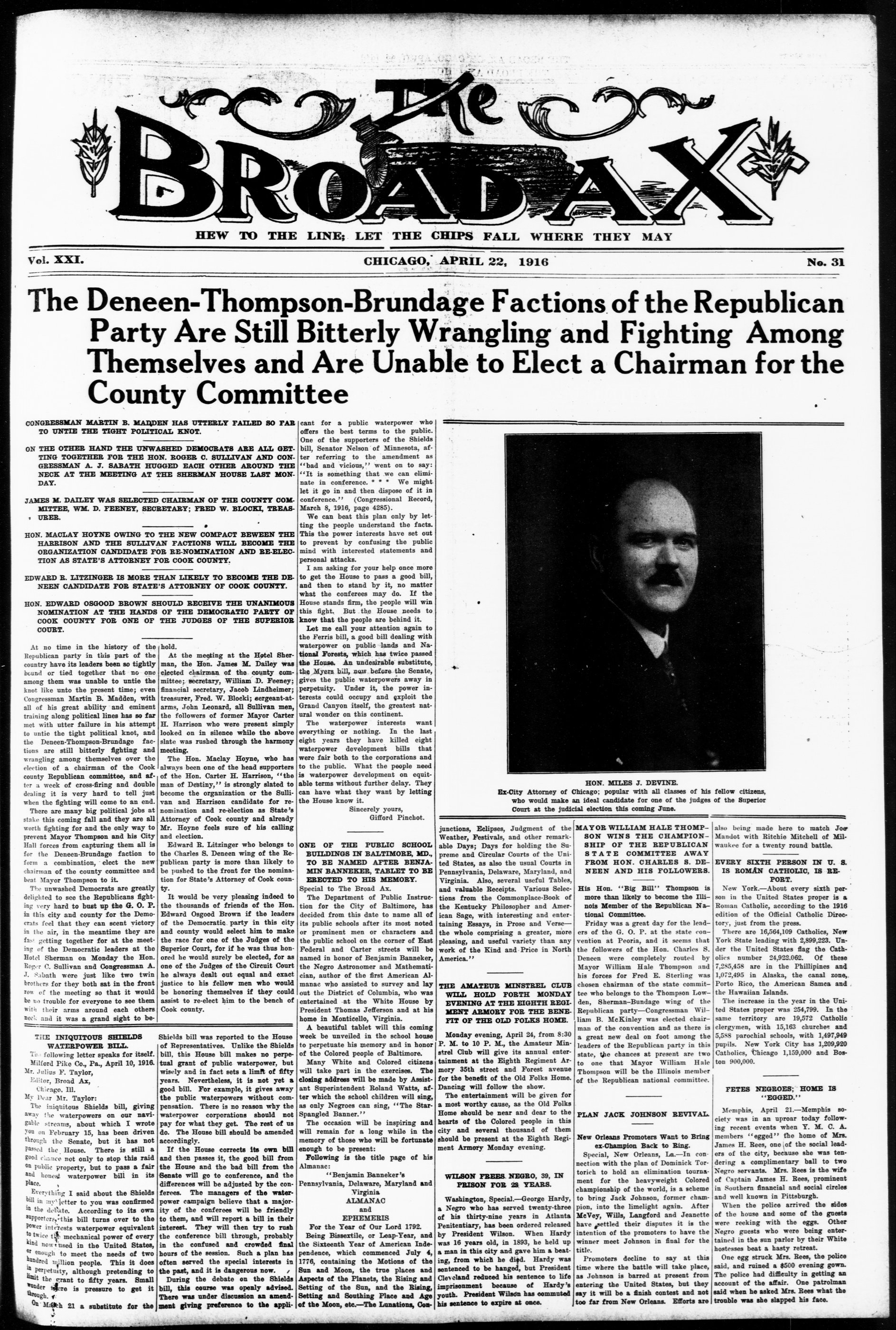
The Deneen-Thompson-Brundage Factions of the Republican Party Are Still Bitterly Wrangling and Fighting Among Themselves and Are Unable to Elect a Chairman for the County Committee
CONGRESSMAN MARTIN B. MAIDEN HAS UTTERLY FAILED SO FAR TO UNTIE THE TIGHT POLITICAL KNOT.
ON THE OTHER HAND THE UNWASHED DEMOCRATS ARE ALL GETTING TOGETHER FOR THE HON. ROGER C. SULLIVAN AND CONGRESSMAN A. J. SABATH HUGGED EACH OTHER AROUND THE NECK AT THE MEETING AT THE SHERMAN HOUSE LAST MONDAY.
JAMES M. DAILEY WAS SELECTED CHAIRMAN OF THE COUNTY COMMITTEE, WM. D. FEENEY, SECRETARY; FRED W. BLOCKI, TREASURER.
HON. MACLAY HOYNE OWING TO THE NEW COMPACT BEWEEN THE HARRISON AND THE SULLIVAN FACTIONS WILL BECOME THE ORGANIZATION CANDIDATE FOR RE-NOMINATION AND RE-ELECTION AS STATE'S ATTORNEY FOR COOK COUNTY.
EDWARD R. LITZINGER IS MORE THAN LIKELY TO BECOME THE DENEEN CANDIDATE FOR STATE'S ATTORNEY OF COOK COUNTY.
HON. EDWARD OSGOOD BROWN SHOULD RECEIVE THE UNANIMOUS NOMINATION AT THE HANDS OF THE DEMOCRATIC PARTY OF COOK COUNTY FOR ONE OF THE JUDGES OF THE SUPERIOR COURT.
Vol. XXI.
The Deneen Party A Thems County
CONGRESSMAN MARTIN B. MADDEN H
TO UNTIE THE TIGHT POLITICAL
ON THE OTHER HAND THE UNWASHE
TING TOGETHER FOR THE HON. R.
GRESSMAN A. J. SABATH HUGGED
NECK AT THE MEETING AT THE
DAY.
JAMES M. DAILEY WAS SELECTED CHA
MITTEE, WM. D. FEENEY, SECRETAR
URER.
HON. MACLAY HOYNE OWING TO THE
HARRISON AND THE SULLIVAN F
ORGANIZATION CANDIDATE FOR R
TION AS STATE'S ATTORNEY FOR O
EDWARD B. LITZINGER IS MORE THAN
NEEN CANDIDATE FOR STATE'S AT
HON. EDWARD OSGOOD BROWN SHOUL
NOMINATION AT THE HANDS OF
COOK COUNTY FOR ONE OF THE
COURT.
At no time in the history of the Republican party in this part of the country have its leaders been so tightly bound or tied together that no one among them was unable to untie the knot like unto the present time; even Congressman Martin B. Madden, with all of his great ability and eminent training along political lines has so far met with utter failure in his attempt to untie the tight political knot, and the Deneen-Thompson-Brundage factions are still bitterly fighting and wrangling among themselves over the election of a chairman of the Cook county Republican committee, and after a week of cross-firing and double dealing it is very hard to tell just when the fighting will come to an end. There are many big political jobs at stake this coming fall and they are all worth fighting for and the only way to prevent Mayor Thompson and his City Hall forces from capturing them all is for the Deneen-Brundage faction to form a combination, elect the new chairman of the county committee and beat Mayor Thompson to it.
The unwashed Democrats are greatly delighted to see the Republicans fighting very hard to bust up the G. O. P. in this city and county for the Democrats feel that they can scent victory in the air, in the meantime they are fast getting together for at the meeting of the Democratic leaders at the Hotel Sherman on Monday the Hona. Roger C. Sullivan and Congressman A. J. Sabath were just like two twin brothers for they both sat in the front row of the meeting so that it would be no trouble for everyone to see them with their arms around each others neck and it was a grand sight to be-
THE INQUITOUS SHIELDS
WATERPOWER BILL
The following letter speaks for itself Milford Pike Co., Pa., April 10, 1916 Mr. Julius F. Taylor,
My Dear Mr. Taylor:
The iniquitous Shields bill, giving away the waterpowers on our navigable streams, about which I wrote you on February 15, has been driven through the Senate, but it has not passed the House. There is still a good chance not only to stop this raid on public property, but to pass a fair and honest waterpower bill in its place.
Everything I said about the Shields bill in my letter to you was confirmed in the debate. According to its own supporters, this bill turns over to the power interests waterpower equivalent to twice the mechanical power of every kind now used in the United States, or enough to meet the needs of two hundred million people. This it does in perpetuity, although pretending to limit the grant to fifty years. Small wonder there is pressure to get it through.
On March 21 a substitute for the
HEW TO THE LINE; LET THE CHIPS FALL WHERE THEY MAY
hold.
At the meeting at the Hotel Sherman, the Hon. James M. Dailey was elected chairman of the county committee; secretary, William D. Feeney; financial secretary, Jacob Lindheimer; treasurer, Fred. W. Blocki; sergeant-at-arms, John Leonard, all Sullivan men, the followers of former Mayor Carter H. Harrison who were present simply looked on in silence while the above slate was rushed through the harmony meeting.
The Hon. Maclay Hoyne, who has always been one of the head supporters of the Hon. Carter H. Harrison, "the man of Destiny," is strongly slated to become the organization or the Sullivan and Harrison candidate for renomination and re-election as State's Attorney of Cook county and already Mr. Hoyne feels sure of his calling and election.
Edward R. Litzinger who belongs to the Charles S. Deneen wing of the Republican party is more than likely to be pushed to the front for the nomination for State's Attorney of Cook county.
It would be very pleasing indeed to the thousands of friends of the Hon. Edward Osgood Brown if the leaders of the Democratic party in this city and county would select him to make the race for one of the Judges of the Superior Court, for if he was thus honored he would surely be elected, for as one of the Judges of the Circuit Court he always dealt out equal and exact justice to his fellow men who would be honoring themselves if they could assist to re-elect him to the bench of Cook county.
Shields bill was reported to the House of Representatives. Unlike the Shields bill, this House bill makes no perpetual grant of public waterpower, but wisely and in fact sets a limit of fifty years. Nevertheless, it is not yet a good bill. For example, it gives away the public waterpowers without compensation. There is no reason why the waterpower corporations should not pay for what they get. The rest of us do. The House bill should be amended accordingly.
If the House corrects its own bill and then passes it, the good bill from the House and the bad bill from the Senate will go to conference, and the differences will be adjusted by the conferences. The managers of the waterpower campaign believe that a majority of the conferences will be friendly to them, and will report a bill in their interest. They will then try to rush the conference bill through, probably in the confused and crowded final hours of the session. Such a plan has often served the special interests in the past, and it is dangerous now.
During the debate on the Shields bill, this course was openly advised. There was under discussion an amendment giving preference to the appli-
CHICAGO, APRIL 22, 1916
cant for a public waterpower who offers the best terms to the public. One of the supporters of the Shields bill, Senator Nelson of Minnesota, after referring to the amendment as "bad and vicious," went on to say: "It is something that we can eliminate in conference. * * * We might let it go in and then dispose of it in conference." (Congressional Record, March 8, 1916, page 4285). We can beat this plan only by letting the people understand the facts. This the power interests have set out to prevent by confusing the public mind with interested statements and personal attacks. I am asking for your help once more to get the House to pass a good bill, and then to stand by it, no matter what the confeees may do. If the House stands firm, the people will win this fight. But the House needs to know that the people are behind it.
Let me call your attention again to the Ferris bill, a good bill dealing with waterpower on public lands and National Forests, which has twice passed the House. An undesirable substitute, the Myers bill, now before the Senate, gives the public waterpowers away in perpetuity. Under it, the power interests could occupy and exploit the Grand Canyon itself, the greatest natural wonder on this continent.
The waterpower interests want everything or nothing. In the last eight years they have killed eight waterpower development bills that were fair both to the corporations and to the public. What the people need is waterpower development on equitable terms without further delay. They can have what they want by letting the House know it.
Sincerely yours,
Gifford Pinchot
ONE OF THE PUBLIC SCHOOL BUILDINGS IN BALTIMORE, MD., TO BE NAMED AFTER BENJAMIN BANNEKER, TABLET TO BE ERECTED TO HIS MEMORY.
Special to The Broad Ax.
The Department of Public Instruction for the City of Baltimore, has decided from this date to name all of its public schools after its most noted or prominent men or characters and the public school on the corner of East Federal and Carter streets will be named in honor of Benjamin Banneker, the Negro Astronomer and Mathematician, author of the first American Almanac who assisted to survey and lay out the District of Columbia, who was entertained at the White House by President Thomas Jefferson and at his home in Monticello, Virginia.
A beautiful tablet will this coming week be unveiled in the school house to perpetuate his memory and in honor of the Colored people of Baltimore.
Many White and Colored citizens will take part in the exercises. The closing address will be made by Assistant Superintendent Roland Watts, after which the school children will sing, as only Negroes can sing, "The Star-Spangled Banner."
The occasion will be inspiring and will remain for a long while in the memory of those who will be fortunate enough to be present:
Following is the title page of his Almanac:
"Benjamin Banneker's Pennsylvania, Delaware, Maryland and
EPHEMERIS
For the Year of Our Lord 1792.
Being Bissextile, or Leap-Year, and the Sixteenth Year of American Independence, which commenced July 4, 1776, containing the Motions of the Sun and Moon, the true places and Aspects of the Planets, the Rising and Setting of the Sun, and the Rising, Setting and Southing Place and Age of the Moon, etc.—The Lunations Con-
M. J. H.
junctions, Eclipses, Judgment of the Weather, Festivals, and other remarkable Days; Days for holding the Supreme and Circular Courts of the United States, as also the usual Courts in Pennsylvania, Delaware, Maryland, and Virginia. Also, several useful Tables, and valuable Receipts. Various Selections from the Commonplace-Book of the Kentucky Philosopher and American Sage, with interesting and entertaining Essays, in Prose and Verse—the whole comprising a greater, more pleasing, and useful variety than any work of the Kind and Price in North America."
MAYOR WILLIAM HALE THOMPSON WINS THE CHAMPIONSHIP OF THE REPUBLICAN STATE COMMITTEE AWAY FROM HON. CHARLES S. DENEEN AND HIS POLLOWERS.
His Hon. "Big Bill" Thompson is more than likely to become the Illinois Member of the Republican National Committee.
Friday was a great day for the leaders of the G. O. P. at the state convention at Peoria, and it seems that the followers of the Hon. Charles S. Deneen were completely routed by also being made Mandot with Waukee for a t
EVERY SIXTH IS ROMAN
New York.—son in the Uni Roman Catholic edition of the tory, just from There are 16 York State leader the United olic number
THE AMATEUR MINSTREL CLUB
WILL HOLD FORTH MONDAY
EVENING AT THE EIGHTH REG
MENT ARMORY FOR THE BENEF
IT OF THE OLD FOLKS HOME.
Monday evening, April 24, from 8:30 P. M. to 10 P. M., the Amateur Minstrel Club will give its annual entertainment at the Eighth Regiment Armory 35th street and Forest avenue for the benefit of the Old Folks Home. Dancing will follow the show.
The entertainment will be given for a most worthy cause, as the Old Folks Home should be near and dear to the hearts of the Colored people in this city and several thousand of them should be present at the Eighth Regiment Armory Monday evening.
WILSON FREES NEGRO, 39, IN
PRISON FOR 29 YEARS.
Washington, Special—George Hardy, a Negro who has served twenty-three of his thirty-nine years in Atlanta Penitentiary, has been ordered released by President Wilson. When Hardy was 16 years old, in 1893, he held up a man in this city and gave him a beating, from which he died. Hardy was sentenced to be hanged, but President Cleveland reduced his sentence to life imprisonment because of Hardy's youth. President Wilson has commuted his sentence to expire at once.
MAYOR WILLIAM HALE THOMPSON WINS THE CHAMPIONSHIP OF THE REPUBLICAN STATE COMMITTEE AWAY FROM HON. CHARLES S. DENEEN AND HIS FOLLOWERS.
His Hon. "Big Bill" Thompson is more than likely to become the Illinois Member of the Republican National Committee.
Friday was a great day for the leaders of the G. O. P. at the state convention at Peoria, and it seems that the followers of the Hon. Charles S. Deneen were completely routed by Mayor William Hale Thompson and his forces for Fred E. Sterling was chosen chairman of the state committee who belongs to the Thompson Lowden, Sherman-Bundage wing of the Republican party—Congressman William B. McKinley was elected chairman of the convention and as there is a great new deal on foot among the leaders of the Republican party in this state, the chances at present are two to one that Mayor William Hale Thompson will be the Illinois member of the Republican national committee.
PLAN JACK JOHNSON REVIVAL
New Orleans Promoters Want to Bring ex-Champion Back to Ring.
Special, New Orleans, La.—In connection with the plan of Dominick Tortorich to hold an elimination tournament for the heavyweight Colored championship of the world, is a scheme to bring Jack Johnson, former champion, into the limelight again. After McVey, Wills, Langford and Jeanette have settled their disputes it is the intention of the promoters to have the winner meet Johnson in final for the title.
Promoters decline to say at this time where the battle will take place, as Johnson is barred at present from entering the United States, but they say it will be a finish contest and not too far from New Orleans. Efforts are
No. 31
also being made here to match Joe Mandot with Ritchie Mitchell of Milwaukee for a twenty round battle.
EVERY SIXTH PERSON IN U. S.
IS ROMÁN CATHOLIC, IS RE-
PORT.
New York.—About every sixth person in the United States proper is a Roman Catholic, according to the 1916 edition of the Official Catholic Directory, just from the press.
There are 16,564,109 Catholics, New York State leading with 2,899,223. Under the United States flag the Catholics number 24,922,062. Of these 7,285,458 are in the Phillipines and 1,072,495 in Alaska, the canal zone, Porto Rico, the American Samca and the Hawaiian Islands.
The increase in the year in the United States proper was 254,799. In the same territory are 19,572 Catholic clergymen, with 15,163 churches and 5,588 parochial schools, with 1,497,949 pupils. New York City has 1,209,920 Catholics, Chicago 1,159,000 and Boston 900,000.
FETES NEGROES; HOME IS
"EGGED."
Memphis, April 21.—Memphis society was in an uproar today following recent events when Y. M. C. A. members "egged" the home of Mrs. James H. Rees, one of the social leaders of the city, because she was tendering a complimentary ball to two Negro servants. Mrs. Rees is the wife of Captain James H. Rees, prominent in Southern financial and social circles and well known in Pittsburgh.
When the police arrived the sides of the house and some of the guests were reeking with the eggs. Other Negro guests who were being entertained in the sun parlor by their White hostesses beat a hasty retreat.
One egg struck Mrs. Rees, the police said, and ruined a $500 evening gown. The police had difficulty in getting an account of the affair. One patrolman said when he asked Mrs. Rees what the trouble was she slapped his face.
PAGE TWO
THE BROAD AX
PUBLISHED WEEKLY.
Will promulgate and at all times uphold the two principles of Democracy, but Cuffeille, Protetoranda, Priests, Inside, Single Taxes, Republism, or anyone else can have their way, as long as their language is proper and responsibility is fixed. The Broad Ax is a newspaper whose platform is broad enough for all, even claiming the editorial right to speak its own mind.
Local communications will receive attention. Write only on one side of the paper.
Subscriptions must be paid in advance. One Year. $5.60 Six Months. 1.60 Advertising rates made known on application.
Address all communications to
THE BROAD AX
6533 ST. LAWRENCE AVE., CHICAGO, IL.
PHONE WENTWORTH 2597.
JULIUS F. TAYLOR, Editor and Publisher
Mineral as Second-Class Matter Aug. 18
1988, at the Post Office at Chicago, Illinois
mineral Act of March 8, 1978.
AUTHORIZED AGENTS AND CORRESPONDENTS FOR THE BROAD AX.
L. W. Washington, 5465 Kimbark avenue.
B. W. Fitts, 3315 S. State street. Phone Douglas 4049.
The Broad Ax can be found on sale at the last named place and news items and advertisements left there will find their way into these columns.
The Flag of Denmark.
In the year 1219 King Waldemar of Denmark, when leading his troops to battle against the Livonians, saw, or thought he saw, a bright light in the form of a cross in the sky. He held this appearance to be a promise of divine aid and pressed forward to victory. From this time he had the cross placed on the flag of his country and called it the Dannebrog—that is, the strength of Denmark. Aside from legend, there is no doubt that this flag with the cross was adopted by Denmark in the thirteenth century and that at about the same date an order, known as the order of Dannebrog, was instituted, to which only soldiers and sailors who were distinguished for courage were allowed to belong. The flag of Denmark, a plain red banner bearing on it a white cross, is the oldest flag now in existence. For 300 years both Norway and Sweden were united with Denmark under this flag.
The Gegenschein.
The Gegenschein is the name given to one of the most inexplicable objects known to astronomers. It is visible in the night sky under favorable conditions, is rounded in outline and is situated always exactly opposite the place of the sun. It has been termed by one eminent astronomer "a sort of cometky or meteoric satellite" attending the earth. He supposes it to be composed of a cloud of meteors situated about a million miles from the earth and revolving around it it in a period of just one year, so that the sun and the meteors are always on opposite sides of the earth. It is estimated that the size of this ghostly satellite may be nearly the same as that of the planet Jupiter-1. e., about 86,000 miles in diameter.
A. Modern Venus.
If a girl could have the neat ankles of the hosiery ads., and the trim waist of the corset ads., and the hair of the grower ads., and the teeth of the tooth-powder ads., and the complexion of the cold cream ads., wouldn't she be a wonder?
What would she do for a heart?
She wouldn't need a heart or a brain. We could give her the emotions of the heroines in the best seller ads.—Life.
Considerate.
Mrs. Brindle—Now, Mary, I want you to be extremely careful. This is some very old table linen—been in the family for over 200 years and— Mary —Ah, sure, ma'am, you needn't worry. I won't tell a soul about it, and it looks as good as new, anyway. — Chicago News.
Making Friends.
Blessed are they who have the gift of making friends, for it is one of God's best gifts. It involves many things, but, above all, the power of going out of one's self and seeing and preciating whatever is noble and living in another—Thomas Husheus.
Rubbing the Eyes.
The italian child is never allowed. rub its eyes. If it bursts into tears it is not repressed, but allowed to have the cry out. This, it is claimed, beifies the eyes and makes them clean, while rubbing the eyes injures them in many ways.
More Urgent.
"Daughter, don't you want to in prove your mind?"
"Of course, ma, but I'm busy with my complexion now." — Kansas City Journal.
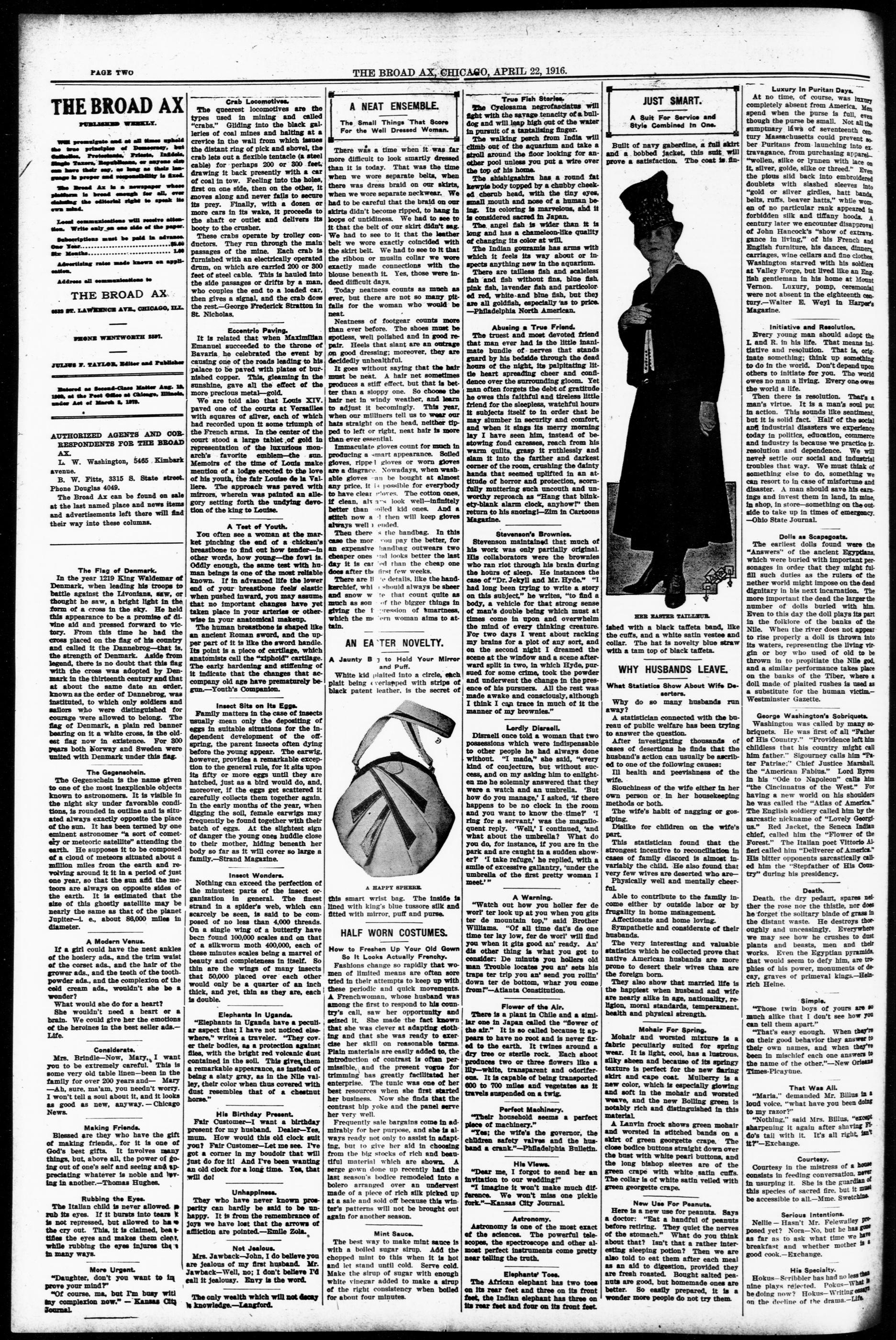
There was a time when it was far more difficult to look smartly dressed than it is today. That was the time when we wore separate belts, when there was dress braid on our skirts, when we wore separate neckwear. We had to be careful that the braid on our skirts didn't become ripped, to hang in loops of untidiness. We had to see to it that the belt of our skirt didn't sag. We had to see to it that the leather belt we wore exactly coincided with the skirt belt. We had to see to it that the ribbon or muslin collar we wore exactly made connections with the blouse beneath it. Yes, those were indeed difficult days.
Today neatness counts as much as ever, but there are not so many pitfalls for the woman who would be peat.
Neatness of footgear counts more than ever before. The shoes must be spotless, well polished and in good repair. Heels that slant are an outrage on good dressing; moreover, they are decidedly unhealthful. It goes without saying that the hair must be neat. A hair net sometimes produces a stiff effect, but that is better than a sloppy one. So choose the hair net in windy weather, and learn to adjust it becomingly. This year, when our milliners tell us to wear our hats straight on the head, neither tipped to left or right, neat hair is more than ever essential.
Immaculate gloves count for much in producing a smart appearance. Solled gloves, ripped gloves or worn gloves are a disgrace. Nowadays, when washable gloves can be bought at almost any price, it is possible for everybody to have clear gloves. The cotton ones, if clean, always look well—infinitely better than solled kid ones. And a stitch now and then will keep gloves always well padded.
Then there is the handbag. In this case the more you pay the better, for an expensive handbag outwears two cheaper ones and looks better the last day it is carried than the cheap one does after the first few weeks.
There are little details, like the handkerchief, which should always be sheer and snow white that count quite as much as son of the bigger things in giving the impression of smartness, which the modern woman aims to attain.
A Jaunty B to Hold Your Mirror and Puff.
White kid plaited into a circle, each plait be overlapped with strips of black patent leather, is the secret of
5
this smart wrist bag. The inside is lined with king's blue tussore silk and fitted with mirror, puff and purse.
How to Freshen Up Your Old Gown
So It Looks Actually French.
Fashions change so rapidly that women of limited means are often sore tried in their attempts to keep up with these periodic and quick movements. A Frenchwoman, whose husband was among the first to respond to his country's call, saw her opportunity and seized it. She made the fact known that she was clever at adapting clothing and that she was ready to exercise her skill on reasonable terms. Plain materials are easily added to, the introduction of contrast is often permissible, and the present vogue for trimming has greatly facilitated her enterprise. The tunic was one of her best resources when she first started her business. Now she finds that the contrast hip joke and the panel serve her very well.
Frequently sale bargains come in admirably for her purpose, and she is always ready not only to assist in adapting, but to give her aid in choosing from the big stocks of rich and beautiful material which are shown. A serge gown done up recently had the last season's bodice remodeled into a bolero arranged over an undervest made of a piece of rich silk picked up at a sale and sold off because this winter's patterns will not be brought out again for another season.
The best way to make mint sauce is with a boiled sugar sirup. Add the chopped mint to this when it is hot and let stand until cold. Serve cold. Make the sirup of sugar with enough white vinegar added to make a sirup of the right consistency when boiled for about four minutes.
Crab Locomotives.
The queerest locomotives are the types used in mining and called "crabs." Gliding into the black galleries of coal mines and halting at a crevice in the wall from which issues the distant ring of pick and shovel, the crab lets out a flexible tentacle (a steel cable) for perhaps 200 or 300 feet drawing it back presently with a car of coal in tow. Feeling into the holes, first on one side, then on the other, it moves along and never fails to secure its prey. Finally, with a dozen or more cars in its wake, it proceeds to the shaft or outlet and delivers its booty to the crusher.
These crabs operate by trolley conductors. They run through the main passages of the mine. Each crab is furnished with an electrically operated drum, on which are carried 200 or 300 feet of steel cable. This is hauled into the side passages or drifts by a man, who couples the end to a loaded car, then gives a signal, and the crab does the rest.-George Frederick Stratton in St. Nicholas.
Eccentric Paving.
It is related that when Maximilian Emanuel succeeded to the throne of Bavaria he celebrated the event by causing one of the roads leading to his palace to be paved with plates of burnished copper. This, gleaming in the sunshine, gave all the effect of the more precious metal—gold.
We are told that Louis XIV. paved one of the courts at Versailles with squares of silver, each of which had recorded upon it some triumph of the French arms. In the center of the court stood a large tablet, of gold in representation of the luxurious monarch's favorite emblem—the sun. Memoirs of the time of Louis make mention of a lodge erected to the love of his youth, the fair Louise de la Valliere. The approach was paved with mirrors, wherein was painted an allegory setting forth the undying devotion of the king to Louise.
A Test of Youth.
You often see a woman at the market pinching the end of a chicken's breastbone to find out how tender—in other words, how young—the fowl is. Oddly enough, the same test with human beings is one of the most reliable known. If in advanced life the lower end of your breastbone feels elastic when pushed inward, you may assume that no important changes have yet taken place in your arteries or otherwise in your anatomical makeup. The human breastbone is shaped like an ancient Roman sword, and the upper part of it is like the sword handle. Its point is a piece of cartilage, which anatomists call the "xiphoid" cartilage. The early hardening and stiffening of it indicate that the changes that accompany old age have prematurely begun. Youth's Companion.
Insect Sites on Its Eggs.
Family matters in the case of insects usually mean only the depositing of eggs in suitable situations for the independent development of the offspring, the parent insects often dying before the young appear. The earwig, however, provides a remarkable exception to the general rule, for it sits upon its fifty or more eggs until they are hatched, just as a bird would do, and, moreover, if the eggs get scattered it carefully collects them together again. In the early months of the year, when digging the soil, female earwigs may frequently be found together with their batch of eggs. At the slightest sign of danger the young ones huddle close to their mother, hiding beneath her body so far as it will cover so large a family.—Strand Magazine.
Insect Wonders.
Nothing can exceed the perfection of the minutest parts of the insect organization in general. The finest strand in a spider's web, which can scarcely be seen, is said to be composed of no less than 4,000 threads. On a single wing of a butterfly have been found 100,000 scales and on that of a silkworm moth 400,000, each of these minutes scales being a marvel of beauty and completeness in itself. So thin are the wings of many insects that 50,000 placed over each other would only be a quarter of an inch thick, and yet, thin as they are, each is double.
Elephants In Uganda
"Elephants in Uganda have a peculiar aspect that I have not noticed elsewhere," writes a traveler. "They cover their bodies, as a protection against files, with the bright red volcanic dust contained in the soil. This gives them a remarkable appearance, as instead of being a slaty gray, as in the Nile valley, their color when thus covered with dust resembles that of a chestnut horse."
His Birthday Present
Fair Customer—I want a birthday present for my husband. Dealer—Yes, mum. How would this old clock suit you? Fair Customer—Let me see. I've got a corner in my boudor that will just do for it! And I've been wanting an old clock for a long time. Yes, that will do!
Unhappiness.
They have never known prosperity can hardly be said to be unhappy. It is from the remembrance of joys we have lost that the arrows of affliction are pointed—Emile Zola.
Not Jealous.
Mrs. Jawback—John, I do believe you are jealous of my first husband. Mr.
Jawback—Well, no; I don't believe I'd call it jealousy. Envy is the word.
The only wealth which will not decay in knowledge—Lengford
THE BROAD AX, CHICAGO, APRIL 22, 1916.
A NEAT ENSEMBLE.
The Small Things That Score
For the Wet Dressed Woman.
is the handbag. In this you pay the better, for handbag outwears two and looks better the last bed than the cheap one first few weeks. See details, like the hand- should always be sheer- te that count quite as of the bigger things in pression of smartness,ern woman aims to at-
AN EA TER NOVELTY.
A HAPPY SPHERE
HALE WORN COSTUMES
Mint Sauce.
True Fish Stories.
The Cyclosama negrofasciatus will fight with the savage tenacity of a bulldog and will leap high out of the water in pursuit of a tantalizing finger.
The walking pech from India will climb out of the aquarium and take a stroll around the floor looking for another pool unless you put a wire over the top of his home.
The shishigashira has a round fat kewpie body topped by a chubby checked cherub head, with the tiny eyes, small mouth and nose of a human being. Its coloring is marvelous, and it is considered sacred in Japan.
The angel fish is wider than it is long and has a chameleon-like quality of changing its color at will.
The Indian gouramis has arms with which it feels its way about or injects anything new in the aquarium.
There are tallless fish and scaleless fish and fish without fins, blue fish pink fish, lavender fish and particolored red, white- and blue fish, but they are all goldfish, especially 'as to price — Philadelphia North American.
Abusing a True Friend.
The truest and most devoted friend that man ever had is the little manatee bundle of nerves that stands guard by his bedside through the dead hours of the night, its palpitating little heart spreading cheer and confidence over the surrounding gloom. Yet man often forgets the debt of gratitude he owes this faithful and tireless little friend for the sleepless, watchful hours it subjects itself to in order that he may slumber in security and comfort, and when it sings its merry morning lay I have seen him, instead of bestowing fond caresses, reach from his warm quilts, grasp it ruthlessly and slam it into the farther and darkest corner of the room, crushing the dainty hands that seemed uplifted in an attitude of horror and protection, scornfully muttering such uncutth and unworthy reproach as "Hang that blinkety-blank alarm clock, anyhow!" then return to his snoring—Zim in Cartoons Magazine.
Stevensen's Brownies.
Stevenson maintained that much of his work was only partially original. His collaborators were the brownies who ran riot through his brain during the hours of sleep. He instances the case of "Dr. Jekyll and Mr. Hyde." "I had long been trying to write a story on this subject," he writes, "to find a body, a vehicle for that strong sense of man's double being which must at times come in upon and overwhelm the mind of every thinking creature. For two days I went about racking my brains for a plot of any sort, and on the second night I dreamed the scene at the window and a scene afterward split in two, in which Hyde, pursued for some crime, took the powder and underwent the change in the presence of his pursuers. All the rest was made awake and consciously, although I think I can trace in much of it the manner of my brownies."
Lordly Disraeli.
Disraeli once told a woman that two possessions which were indispensable to other people he had always done without. "I made," she said, "every kind of conjecture, but without success, and on my asking him to enlighten me he solemnly answered that they were a watch and an umbrella. 'But how do you manage,' I asked, if there happens to be no clock in the room and you want to know the time?' 'I ring for a servant,' was the magniloquent reply. 'Well,' I continued, 'and what about the umbrella? What do you do, for instance, if you are in the park and are caught in a sudden shower?' 'I take refuge,' he replied, with a smile of excessive gallantry, 'under the umbrella of the first pretty woman I meet.'
A Warning.
"Watch out how you holler fer de worl' ter look up at you when you gits ter de mountain top," said Brother Williams. "Of all time dat's de one time ter lay low, fer de worl' will find you when it gits good an' ready. An' dis other thing is what you got to consider: De minute you hollers old man Trouble locates you an' sets his traps ter trip you an' send you rollin' down ter de bottom, whar you come from!" -Atlanta Constitution
Flower of the Air
There is a plant in Chile and a similar one in Japan called the "fower of the air." It is so called because it appears to have no root and is never fixed to the earth. It twines around a dry tree or sterile rock. Each shoot produces two or three flowers like a lily—white, transparent and odoriferous. It is capable of being transported 600 to 700 miles and vegetates as it travels suspended on a twig.
Perfect Machinery.
"Their household seems a perfect piece of machinery."
"Yes; the wife's the governor, the children safety valves and the husband a crank."—Philadelphia Bulletin.
Hla Views.
"Dear me, I forgot to send her an invitation to our wedding!"
"I imagine it won't make much difference. We won't miss one pickle fork."—Kansas City Journal
Astronomy.
Astronomy is one of the most exact of the sciences. The powerful telescopes, the spectroscope and other almost perfect instruments come pretty near telling the truth.
Elephants' Toes
The African elephant has two toes on its rear feet and three on its front feet, the Indian elephant has three on its rear feet and four on its front feet.
Built of navy gaberdine, a full skirt and a bobbed jacket, this suit will prove a satisfaction. The coat is fin-
A
HER EASTER TAILLEUR.
ished with a black taffeta band, like
the cuffs, and a white satin vestee and
collar. The hat is novelty blue straw
with a tam top of black taffeta.
WHY HUSBANDS LEAVE
What Statistics Show About Wife Deserters.
Why do so many husbands run away?
A statistician connected with the bureau of public welfare has been trying to answer the question.
After investigating thousands of cases of desertions he finds that the husband's action can usually be ascribed to one of the following causes:
Ill health and peevishness of the wife.
Slouchiness of the wife either in her own person or in her housekeeping methods or both.
The wife's habit of nagging or gossiping.
Dislike for children on the wife's part.
This statistician found that the strongest incentive to reconciliation in cases of family discord is almost invariably the child. He also found that very few wives are deserted who are physically well and mentally cheer
Physically well and mentally cheerful
Able to contribute to the family income either by outside labor or by frugality in home management.
Affectionate and home loving.
Sympathetic and considerate of their husbands.
The very interesting and valuable statistics which he collected prove that native American husbands are more prone to desert their wives than are the foreign born.
They also show that married life is the happiest when husband and wife are nearly alike in age, nationality, religion, moral standards, temperament, health and physical strength.
Mohair For Spring
Mohair and worsted mixture is a fabric peculiarly suited for spring wear. It is light, cool, has a lustrous, silky sheen and because of its springy texture is perfect for the new daring skirt and cape coat. Mulberry is a new color, which is especially glowing and soft in the mohair and worsted weave, and the new Bolling green is notably rich and distinguished in this material.
A Lanvin frock shows green mohair and worsted in stitched bands on a skirt of green georgette crape. The close bodice buttons straight down over the bust with white pearl buttons, and the long bishop sleeves are of the green crape with white satin cuffs. The collar is of white satin veiled with green georgette crape.
New Use For Peanuts
Here is a new use for peanuts. Says a doctor: "Eat a handful of peanuts before retiring. They quiet the nerves of the stomach." What do you think about that? Isn't that a rather interesting sleeping potion? Then we are also told to eat them after each meal as an aid to digestion, provided they are fresh roasted. Bought salted peanuts are good, but homemade ones are better. So easily prepared, it is a wonder more people do not try them.
Luxury In Puritan Daya
At no time, of course, was luxury completely absent from America. Men spend when the purse is full, even though the purse be small. Not all the suptimary laws of seventeenth century Massachusetts could prevent sober Puritans from launching into extravagance, from purchasing apparel—"wollen, slike or lynn with lace on it, silver, golde, slike or threed." Even the plious slid back into embroidered doublets with slashed sleeves into "gold or silver girdles, hatt bands, belts, ruffs, beaver hatts," while women of no particular rank appeared in forbidden silk and tiffany hoods. A century later we encounter disapproval of John Hancock's "show of extravagance in living," of his French and English furniture, his dances, dimmers, carriages, wine cellars and fine clothes. Washington starved with his soldiers at Valley Forge, but lived like an English gentleman in his home at Mount Vernon. Luxury, pomp, ceremonial were not absent in the eighteenth century.—Walter E. Weyl in Harper's Magazine.
Initiative and Resolution.
Every young man should adopt the L. and R. in his life. That means initiative and resolution. That is, originate something; think up something to do in the world. Don't depend upon others to initiate for you. The world owes no man a living. Every one owes the world a life.
Then there is resolution. That's a man's virtue. It is a man's soul put in action. This sounds like sentiment, but it is solid fact. Half of the social and industrial disasters we experience today in politics, education, commerce and industry is because we practice resolution and dependence. We will never settle our social and industrial troubles that way. We must think of something else to do, something we can resort to in case of misfortune and disaster. A man should save his earnings and invest them in land, in mine in shop, in store—something on the outside to take up in times of emergency—Ohio State Journal.
Dolls as Scapagoata.
The earliest dolls found were the "Answers" of the ancient Egyptians, which were buried with important personages in order that they might fulfill such duties as the rulers of the nether world might impose on the dead dignitary in his next incarnation. The more important the dead the larger the number of dolls buried with him. Even to this day the doll plays its part in the folklore of the banks of the Nile. When the river does not appear to rise properly a doll is thrown into its waters, representing the living virgin or boy who used of old to be thrown in to propitiate the Nile god, and a similar performance takes place on the banks of the Tiber, where a doll made of plaited rushes is used as a substitute for the human victim—Westminster Gazette.
George Washington's Sobrigueta.
Washington was called by many sobriquets. He was first of all "Father of His Country." "Providence left him childless that his country might call him father." Sigourney calls him "Fater Patriae;" Chief Justice Marshall, the "American Fabius." Lord Byron in his "Ode to Napoleon" calls him "the Cincinnatus of the West." For having a new world on his shoulders he was called the "Atlas of America." The English soldiery called him by the sarcastic nickname of "Lovely Georgius." Red Jacket, the Seneca Indian chief, called him the "Flower of the Forest." The Italian poet Vittorio Alfieri called him "Deliverer of His Country" during his presidency.
Death.
Death.
Death, the dry pedant, spares ne
ther the rose nor the thistle, nor does
he forget the solitary blade of grass in
the distant waste. He destroys thor-
oughly and unceasingly. Everywhere
we may see how he crushes to dust
plants and beasts, men and their
works. Even the Egyptian pyramid,
that would seem to defy him, are tro-
phies of his power, monuments of de-
cay, graves of primeval kings.—Hein-
rich Helme.
Simple.
"Those twin boys of yours are so much alike that I don't see how you can tell them apart."
"That's easy enough. When they're on their good behavior they answer to their own names, and when they've been in mischief each one answers to the name of the other."—New Orleans Times-Picayne
That Was All.
"Maria," demanded Mr. Billus in a loud voice, "what have you been doing to my razor?" "Nothing," said Mrs. Billus, "except sharpening it again after shaving Fido's tail with it. It's all right, isn't it?"—Exchange
Courtesy.
Courtesy in the mistress of a house consists in feeding conversation, never in usurping it. She is the guardian of this species of sacred fire, but it must be accessible to all.—Mme. Swatchine.
Serious Intentions.
Nellie — Hasn't Mr. Fleewalley proposed yet? Nora—No, but he has gone as far as to ask what time we have breakfast and whether mother is a good cook.—Exchange.
His Specialty.
Hokus - Scribler has had no less than nine plays rejected. Pokus - What is he doing now? Hokus - Writing essays on the decline of the drama - Life
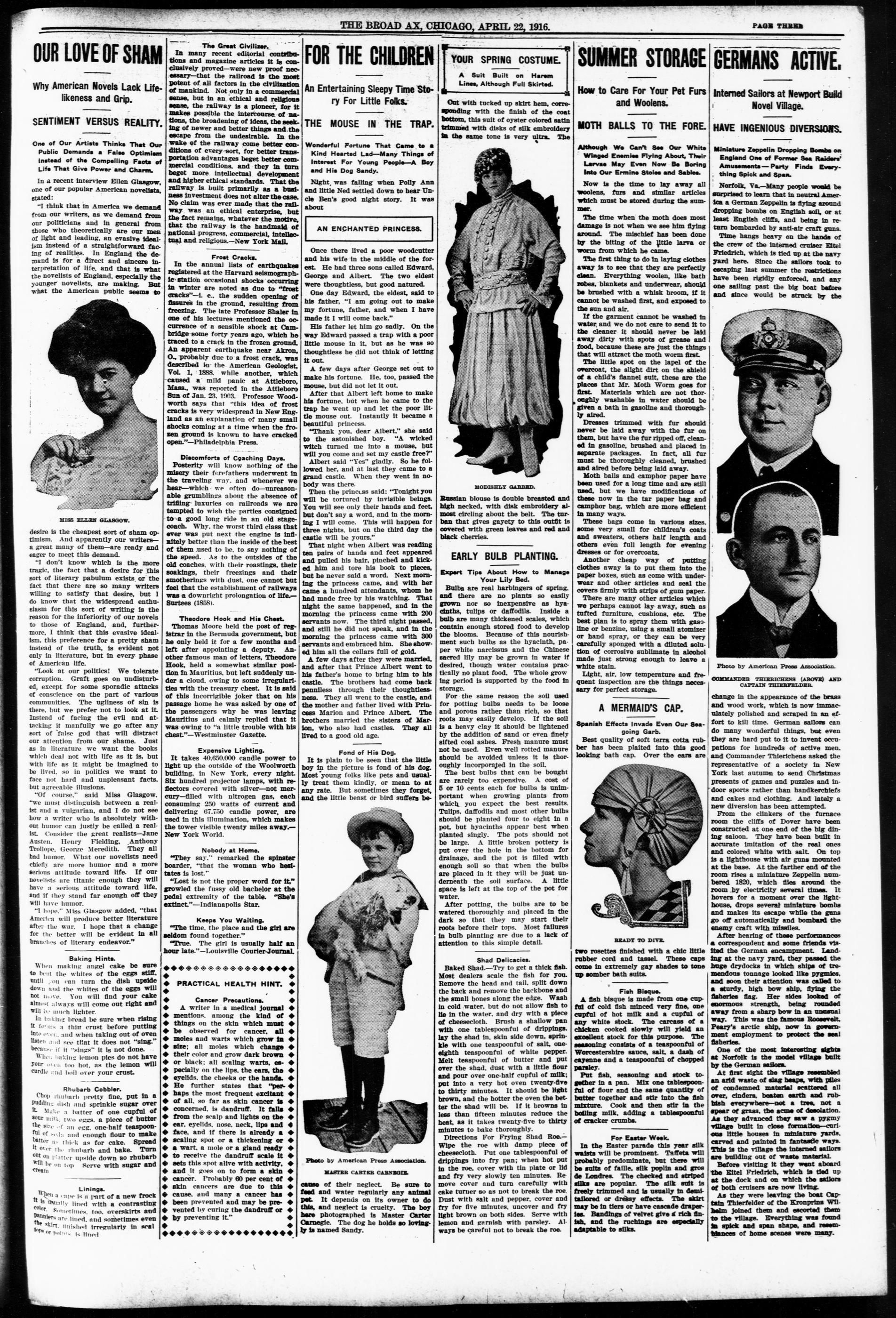
OUR LOVE OF SHAM
Why American Novels Lack Life-
likeness and Grip.
SENTIMENT VERSUS REALITY.
One of Our Artists Thinks That Our
Public Demands a False Optimism
Instead of the Compelling Facts of
Life That Give Power and Charm.
In a recent interview Ellen Glasgow,
one of our popular American novelists,
stated:
"I think that in America we demand from our writers, as we demand from our politicians and in general from those who theoretically are our men of light and leading, an evasive idealism instead of a straightforward facing of realities. In England the demand is for a direct and sincere interpretation of life, and that is what the novelists of England, especially the younger novelists, are making. But what the American public seems to
A.
MISS ELLEN GLASGOW.
desire is the cheapest form of sham optimism. And apparently our writers—a great many of them—are ready and eager to meet this demand.
"I don't know which is the more tragic, the fact that a desire for this sort of literary pabulum exists or the fact that there are so many writers willing to satisfy that desire, but I do know that the widespread enthusiasm for this sort of writing is the reason for the inferiority of our novels to those of England, and, furthermore, I think that this evasive idealism, this preference for a pretty sham instead of the truth, is evident not only in literature, but in every phase of American life.
"Look at our politics! We tolerate corruption. Graft goes on undisturbed, except for some sporadic attacks of conscience on the part of various communities. The ugliness of sin is there, but we prefer not to look at it. Instead of facing the evil and attacking it manfully we go after any sort of 'false god that will distract our attention from our shame. Just as in literature we want the books which deal not with life as it is, but with life as it might be imagined to be lived, so in politics we want to face not hard and unpleasant facts, but agreeable illusions.
"Of course," said Miss Glasgow, "we must distinguish between a realist and a vulgarian, and I do not see how a writer who is absolutely without humor can justly be called a realist. Consider the great realists—Jane Austen, Henry Fielding, Anthony Trollope, George Meredith. They all had humor. What our novelists need chiefly are more humor and a more serious attitude toward life. If our novelists are titanic enough they will have a serious attitude toward life, and if they stand far enough off they will have humor.
"I hope," Miss Glasgow added, "that America will produce better literature after the war. I hope that a change for the better will be evident in all branches of literature endeavor."
Baking Hints
When making angel cake be sure to beat the whites of the eggs stiff, until you can turn the dish upside down and the whites of the eggs will not move. You will find your cake almost always will come out right and will be much lighter.
In baking bread be sure when rising it focuses a thirst crust before putting into oven, and when taking out of oven listen and see that it does not "sing," because if it "sings" it is not done.
When baking lemon pies do not have your oven too hot, as the lemon will curdle and boil over your crust.
Rhubarb Cobbler
Chop rhubarb pretty fine, put in a pudding dish and sprinkle sugar over it. Make a batter of one cupful of sour milk, two eggs, a piece of butter the size of an egg, one-half teaspoonful of soda and enough flour to make batter as thick as for cake. Spread it over the rhubarb and bake. Turn out on platter upside down so rhubarb will be on top. Serve with sugar and cream.
Linings.
When a cape is a part of a new frock it is usually lined with a contrasting color. Sometimes, too, overskirts and panniers are lined, and sometimes even the skirt, finished irregularly in scalops or points, is lined.
The Great Civilizer.
In many recent editorial contributions and magazine articles it is conclusively proved—were new proof necessary—that the railroad is the most potent of all factors in the civilization of mankind. Not only in a commercial sense, but in an ethical and religious sense, the railway is a pioneer, for it makes possible the intercourse of nations, the broadening of ideas, the seeking of newer and better things and the escape from the undesirable. In the wake of the railway come better conditions of every sort, for better transportation advantages beget better commercial conditions, and they in turn beget more intellectual development and higher ethical standards. That the railway is built primarily as a business investment does not alter the case. No claim was ever made that the railway was an ethical enterprise, but the fact remains, whatever the motive, that the railway is the handmaid of national progress, commercial, intellectual and religious.—New York Mall.
Frost Cracks.
In the annual lists of earthquakes registered at the Harvard seismographic station occasional shocks occurring in winter are noted as due to "frost cracks"-1. e., the sudden opening of fissures in the ground, resulting from freezing. The late Professor Shaler in one of his lectures mentioned the occurrence of a sensible shock at Cambridge some forty years ago, which he traced to a crack in the frozen ground. An apparent earthquake near Akron, O., probably due to a frost crack, was described in the American Geologist, Vol. 1, 1888, while another, which caused a mild panic at Attleboro, Mass., was reported in the Attleboro Sun of Jan. 23, 1903. Professor Woodworth says that "this idea of frost cracks is very widespread in New England as an explanation of many small shocks coming at a time when the frozen ground is known to have cracked open."-Philadelphia Press.
Discomforts of Coaching Days
Posterity will know nothing of the misery their forefathers underwent in the traveling way, and whenever we hear—which we often do—unreasonable grumblings about the absence of trifling luxuries on railroads we are tempted to wish the parties consigned to a good long ride in an old stage-coach. Why, the worst third class that ever was put next the engine is infinitely better than the inside of the best of them used to be, to say nothing of the speed. As to the outsides of the old coaches, with their roastings, their soakings, their freezings and their smotherings with dust, one cannot but feel that the establishment of railways was a downright prolongation of life.—Surtees (1858).
Theodore Hook and His Chest
Thomas Moore held the post of registrar in the Bermuda government, but he only held it for a few months and left after appointing a deputy. Another famous man of letters, Theodore Hook, held a somewhat similar position in Mauritius, but left suddenly under a cloud, owing to some irregularities with the treasury chest. It is said of this incorrigible joker that on his passage home he was asked by one of the passengers why he was leaving Mauritius and calmly replied that it was owing to "a little trouble with his chest."—Westminster Gazette.
Expensive Lighting.
It takes 40,650,000 candle power to light up the outside of the Woolworth building, in New York, every night. Six hundred projector lamps, with reflectors covered with silver—not mercury—filled with nitrogen gas, each consuming 250 watts of current and delivering 67,750 candle power, are used in this illumination, which makes the tower visible twenty miles away.—New York World.
Nobody at Home.
"They say." remarked the spinster boarder, "that the woman who hesitates is lost."
"Lost is not the proper word for it," growled the fussy old bachelor at the pedal extremity of the table. "She's extinct."—Indianapolis Star.
Keeps You Waiting.
"The time, the place and the girl are seldom found together."
"True. The girl is usually half an hour late."—Louisville Courier-Journal.
PRACTICAL HEALTH HINT.
Cancer Precautions
Cancer Precautions.
A writer in a medical journal mentions, among the kind of things on the skin which must be observed for cancer, all moles and warts which grow in size; all moles which change their color and grow dark brown or black; all scaling warts, especially on the lips, the ears, the eyelids, the cheeks or the hands. He further states that "perhaps the most frequent exantion of all, so far as skin cancer is concerned, is dandruff. It falls from the scalp and lights on the ear, eyelids, nose, neck, lips and face, and if there is already a scaling spot or a thickening or a wart, a mole or a gland ready to receive the dandruff scale it sets this spot alive with activity, and it goes on to form a skin cancer. Probably 60 per cent of skin cancers are due to this cause, and many a cancer has been prevented and may be prevented by curing the dandruff or by preventing it."
---
THE BROAD AX, CHICAGO, APRIL 22, 1916.
FOR THE CHILDREN
FOR THE CHILDREN
An Entertaining Sleepy Time Story For Little Folks.
THE MOUSE IN THE TRAP.
Wonderful Fortune That Came to a Kind Hearted Lad—Many Things of Interest For Young People—A Boy and His Dog Sandy.
Night, was falling when Polly Ann and little Ned settled down to hear Uncle Ben's good night story. It was about
AN ENCHANTED PRINCESS.
Once there lived a poor woodcutter and his wife in the middle of the forest. He had three sons called Edward, George and Albert. The two eldest were thoughtless, but good natured. One day Edward, the eldest, said to his father, "I am going out to make my fortune, father, and when I have made it I will come back." His father let him go sadly. On the way Edward passed a trap with a poor little mouse in it, but as he was so thoughtless he did not think of letting it out. A few days after George set out to make his fortune. He, too, passed the mouse, but did not let it out. After that Albert left home to make his fortune, but when he came to the trap he went up and let the poor little mouse out. Instantly it became a beautiful princess.
"Thank you, dear Albert," she said to the astonished boy. "A wicked witch turned me into a mouse, but will you come and set my castle free?" Albert said "Yes" gladly. So he followed her, and at last they came to a grand castle. When they went in nobody was there. Then the princess said: "Tonight you will be tortured by invisible beings. You will see only their hands and feet, but don't say a word, and in the morning I will come. This will happen for three nights, but on the third day the castle will be yours."
That night when Albert was reading ten pairs of hands and feet appeared and pulled his hair, pinched and kicked him and tore his book to pieces, but he never said a word. Next morning the princess came, and with her came a hundred attendants, whom he had made free by his watching. That night the same happened, and in the morning the princess came with 200 servants now. The third night passed, and still he did not speak, and in the morning the princess came with 300 servants and embraced him. She showed him all the cellars full of gold.
A few days after they were married, and after that Prince Albert went to his father's home to bring him to his castle. The brothers had come back penniless through their thoughtlessness. They all went to the castle, and the mother and father lived with Princess Marlon and Prince Albert. The brothers married the sisters of Marlon, who also had castles. They all lived to a good old age.
Fond of His Dog.
It is plain to be seen that the little boy in the picture is fond of his dog. Most young folks like pets and usually treat them kindly, or mean to at any rate. But sometimes they forget, and the little beast or bird suffe-
```markdown
```
Photo by American Press Association.
cause of their neglect. Be sure to feed and water regularly any animal pet. It depends on its owner to do this, and neglect is cruelty. The boy here photographed is Master Carter Carnegie. The dog he holds so lovingly is named Sandy.
YOUR SPRING COSTUME
A Suit Built on Harem Lines, Although Full Skirted.
Out with tucked up skirt hem, corresponding with the finish of the coat bottom, this suit of oyster colored satin trimmed with disks of silk embroidery in the same tone is very ultra. The
MODISLY GARBED.
Russian blouse is double breasted and high necked, with disk embroidery almost circling about the belt. The turban that gives gayety to this outfit is covered with green leaves and red and black cherries.
EARLY BULB PLANTING
Expert Tips About How to Manage Your Lily Bed.
Bulbs are real harbingers of spring, and there are no plants so easily grown nor so inexpensive as hyacinths, tulips or daffodils. Inside a bulb are many thickened scales, which contain enough stored food to develop the blooms. Because of this nourishment such bulbs as the hyacinth, paper white narcissus and the Chinese sacred lily may be grown in water if desired, though water contains practically no plant food. The whole growing period is supported by the food in storage.
For the same reason the soil used for potting bulbs needs to be loose and porous rather than rich, so that roots may easily develop. If the soil is a heavy clay it should be lightened by the addition of sand or even finely sifted coal ashes. Fresh manure must not be used. Even well rotted manure should be avoided unless it is thoroughly incorporated in the soil.
The best bulbs that can be bought are rarely too expensive. A cost of 5 or 10 cents each for bulbs is unimportant when growing plants from which you expect the best results. Tulips, daffodils and most other bulbs should be planted four to eight in a pot, but hyacinths appear best when planted singly. The pots should not be large. A little broken pottery is put over the hole in the bottom for drainage, and the pot is filled with enough soil so that when the bulbs are placed in it they will be just underneath the soil surface. A little space is left at the top of the pot for water.
After potting, the bulbs are to be watered thoroughly and placed in the dark so that they may start their roots before their tops. Most failures in bulb planting are due to a lack of attention to this simple detail.
Shad Delicacies.
Baked Shad.—Try to get a thick fish. Most dealers scale the fish for you. Remove the head and tail, split down the back and remove the backbone and the small bones along the edge. Wash in cold water, but do not allow fish to lie in the water, and dry with a piece of cheesecloth. Brush a shallow pan with the tablespoonful of drippings, lay the shad in, skin side down, sprinkle with one teaspoonful of salt, one-eighth teaspoonful of white pepper. Melt teaspoonful of butter and put over the shad, dust with a little flour and pour over one-half cupful of milk; put into a very hot oven twenty-five to thirty minutes. It should be light brown, and the hotter the oven the better the shad will be. If it browns in less than fifteen minutes reduce the heat, as it takes twenty-five to thirty minutes to bake thoroughly.
Directions For Frying Shad Roe. Wipe the roe with damp piece of cheesecloth. Put one tablespoonful of drippings into fry pan; when hot put in the roe, cover with tin plate or lid and fry very slowly ten minutes. Remove cover and turn carefully with cake turner so as not to break the roe. Dust with salt and pepper, cover and fry for five minutes, uncover and fry light brown on both sides. Serve with lemon and garnish with parsley. Always be careful not to break the roe.
SUMMER STORAGE
How to Care For Your Pet Furs and Woolens.
MOTH BALLS TO THE FORE.
Although We Can't See Our White Winged Enemies Flying About, Their Larvae May Even Now Be Boring Into Our Ermine Stoles and Sables.
Now is the time to lay away all woolens, furs and similar articles which must be stored during the summer.
The time when the moth does most damage is not when we see him flying around. The mischief has been done by the biting of the little larva or worm from which he came.
The first thing to do in laying clothes away is to see that they are perfectly clean. Everything woolen, like bath robes, blankets and underwear, should be brushed with a whisk broom, if it cannot be washed first, and exposed to the sun and air.
If the garment cannot be washed in water, and we do not care to send it to the cleaner it should never be laid away dirty with spots of grease and food, because these are just the things that will attract the moth worm first.
The little spot on the lapel of the overcoat, the slight dirt on the shield of a child's fannel suit, these are the places that Mr. Moth Worm goes for first. Materials which are not thoroughly washable in water should be given a bath in gasoline and thoroughly aired.
Dresses trimmed with fur should never be laid away with the fur on them, but have the fur ripped off, cleaned in gasoline, brushed and placed in separate packages. In fact, all fur must be thoroughly cleaned, brushed and aired before being laid away. Moth balls and camphor paper have been used for a long time and are still used, but we have modifications of these now in the tar paper bag and camphor bag, which are more efficient in many ways. These bags come in various sizes, some very small for children's coats and sweaters, others half length and others even full length for evening dresses or for overcoats. Another cheap way of putting clothes away is to put them into the paper boxes, such as come with underwear and other articles and seal the covers firmly with strips of gum paper.
There are many other articles which we perhaps cannot lay away, such as tufted furniture, cushions, etc. The best plan is to spray them with gasoline or benzine, using a small atomizer or hand spray, or they can be very carefully sponged with a diluted solution of corrosive sublimate in alcohol made just strong enough to leave a white stain.
Light, air, low temperature and frequent inspection are the things necessary for perfect storage.
A MERMAID'S CAP.
Spanish Effects Invade Even Our Sea-going Garb.
Best quality of soft terra cotta rubber has been plaited into this good looking bath cap. Over the ears are
READY TO DIVE.
two rosettes finished with a chic little rubber cord and tassel. These caps come in extremely gay shades to tone up somber bath suits.
Fiah Bianque.
A fish bisque is made from one cupful of cold fish minced very fine, one cupful of hot milk and a cupful of any white stock. The carcass of a chicken cooked slowly will yield an excellent stock for this purpose. The seasoning consists of a teaspoonful of Worcestershire sauce, salt, a dash of cayenne and a teaspoonful of chopped parley. Put fish, seasoning and stock together in a pan. Mix one tablespoonful of flour and the same quantity of butter together and stir into the fish mixture. Cook and then stir in the boiling milk, adding a tablespoonful of cracker crumbs.
For Easter Week
In the Easter parade this year silk waists will be prominent. Taffeta will probably predominate, but there will be suits of fallie, silk poplin and gros de Londres. The checked and striped silks are popular. The silk suit is freely trimmed and is usually in demitailored or dressy effects. The skirt may be in tiers or have cascade draperies. Bandings of velvet give a rich finish, and the ruchings are especially adaptable to silks.
PAGE THREED
GERMANS ACTIVE.
Interned Sailors at Newport Build Novel Village.
Miniature Zeppelin Dropping Bombs on England One of Former Sea Raiders' Amusements—Party Finds Everything Spick and Span.
Norfolk, Va.—Many people would be surprised to learn that in neutral America a German Zeppelin is flying around dropping bombs on English soil, or at least English cliffs, and being in return bombarded by anti-air craft guns.
Time hangs heavy on the hands of the crew of the interned cruiser Eitel Friedrich, which is tied up at the navy yard here. Since the sailors took to escaping last summer the restrictions have been rigidly enforced, and any one sailing past the big boat before and since would be struck by the
JOHN H. BURKE
JOHN H. BURKE
Photo by American Press Association.
COMMANDER THIERICHENS (ABOVE) AND CAPTAIN THIERFELDER.
change in the appearance of the brass and wood work, which is now immaculately polished and scraped in an effort to kill time. German sailors can do many wonderful things, but even they are hard put to it to invent occupations for hundreds of active men. and Commander Thilerichens asked the representative of a society in New York last autumn to send Christmas presents of games and puzzles and indoor sports rather than handkerchiefs and cakes and clothing. And lately a new diversion has been attempted.
From the clinkers of the furnace room the cliffs of Dover have been constructed at one end of the big dining saloon. They have been built in accurate imitation of the real ones and colored white with salt. On top is a lighthouse with air guns mounted at the base. At the farther end of the room rises a miniature Zeppelin numbered 1820, which files around the room by electricity several times. It hovers for a moment over the lighthouse, drops several miniature bombs and makes its escape while the guns go off automatically and bombard the enemy craft with missiles.
After hearing of these performances a correspondent and some friends visited the German encampment. Landing at the navy yard, they passed the huge drydocks in which ships of tremendous tonnage looked like pygmies, and soon their attention was called to a sturdy, high bow ship, flying the fisheries flag. Her sides looked of enormous strength, being rounded away from a sharp bow in an unusual way. This was the famous Roosevelt, Peary's arctic ship, now in government employment to protect the seal fisheries.
One of the most interesting sights at Norfolk is the model village built by the German sailors.
At first sight the village resembled an arid waste of slag heaps, with piles of condemned material scattered all over, cinders, beaten earth and rubbish everywhere—not a tree, not a spar of grass, the acme of desolation. As they advanced they saw a pymy village built in close formation—curious little houses in miniature yards, carved and painted in fantastic ways. This is the village the interned sailors are building out of waste material. Before visiting it they went aboard the Eitel Friedrich, which is tied up at the dock and on which the sailors of both cruisers are now living. As they were leaving the boat Captain Thierfelder of the Kronprints Wilhelm joined them and escorted them to the village. Everything was found in spick and span shape, and resemblances of home scenes were many.
The New York State Health Department, in company with the state health officials of New Hampshire, Ohio, Indiana, Michigan, Virginia, North Carolina, Kentucky, West Virginia and Idaho, has started a campaign of popular education as to the causes and prevention of cancer. The New York State Health Department has devoted the entire March number of its bulletin to a consideration of the nature, prevalence and treatment of malignant disease with the object of creating among the people "a healthy vigilance which leads to the taking of expert advice on the first appearance of danger signals."
The leading article in this special issue of the Health Department's Magazine is by Dr. Francis Carter Wood, Director of Cancer Research at Columbia University. Additional papers are contributed by other notable figures in the scientific world, including Frederick L. Hoffman, LL. D., Chairman of the Statistical Advisory Board of the American Society for the Control of Cancer, and Dr. Harvey R. Gaylord, Director of the New York State Institute for the Study of Malignant Disease.
Writing on "What People Should Know About Cancer," Dr. Wood endeavors to dispel some of the mistaken popular notions which have grown up regarding this disease. He disposes of the stories regarding "cancer villages," "cancer houses," or "cancer belts," briefly showing that the occurrence of a number of cases in a house usually is due to the fact that the occupants are old people; that "cancer villages" usually are small towns from which most of the young people have emigrated, and that in like manner "cancer belts" are found to be sections of the country where the population is distinctly aged.
The idea that cancer is hereditary is likewise made light of by Dr. Wood and he declares that there is no reason whatever to worry because one member of a family has suffered from the disease. "It does not at all follow that any other member of a family will have it," says Dr. Wood, and quotes from the laws governing statistics to show that if there are two or more cases in a family it is due purely to chance. The quackery which is practiced by unscrupulous people in the treatment of cancer is severely censured. It also is made perfectly plain that cancer it comparatively easy to cure, if it can be taken in time.
Copious doses of spring sunshine taken every day will drive dull care and gloom away.
The Cadillac Motor Car Co., has posted throughout its factories a forceful bulletin against cigarette smoking, with a view to stamping it out. Among other things, it says, "We believe that men who do not smoke cigarettes or frequent the saloon can make better automobiles than those who do."
The state denies one the privilege of killing his neighbor through ignorance or neglect of health precautions, yet gives him the privilege of killing himself by the same means.
Self-protection is the first law of Nature. Protect yourself by helping to promote public health.
ROYAL LIFE INSURANCE HEADS
NAMED IN TRUE BILLS.
Grand July Votes Indictment Against President Clover and Secretary Singleton.
Alfred Clover, as president of the Royal Life Insurance Company of Chicago, and John W. Singleton, as secretary, are named in true bills voted by the grand jury Tuesday. According to the plans of Assistant State's Attorney Duval, charges of fraud, forgery and embezzlement will be made in open court against Clover, and Singleton will be charged with having conspired with Clover to defraud the stockholders, by various means.
The principal witness against them was Miss Anna Kepka, formerly a stenographer for Clover. On her testimony and that of others charges of stock selling frauds are reported to be based.
The company is in the hands of a receiver and Clover is trying to lift the receivership. Stockholders' and policy-holders' committees have been formed.
JOHN P. HOPKINS PINCHED.
Former Mayor, Arrested as Speeder,
Just Laughs When Taken to Police Station.
John P. Hopkins, former mayor of Chicago and personal friend of Roger Sullivan, was "pinched" in Lincoln park for speeding. He didn't mind it much. He laughed as he and a half dozen friends, on their way home from the ball game, were taken to the Chicago avenue police station. John Skaye, Mr. Hopkins' chauffeur, said he did not think he was going faster than the law allows. The former mayor was released on his own recognizance.
HEALEY DEPOSES FUNK HOUSEB AS "FILLUM" GEAR
Chief of Police O. K's White Slave Movie the Major Had Said He Would Bar.
Maj. M. C. L. Funkhouser, Thursday was deposed by Chief of Police Healey as czar of the moving picture censorship board. The action of Healey, which makes the chief of police a court of review to pass finally on decisions of Maj. Funkhouser in the future, was made in connection with the consideration of a permit for the showing of "The Little Girl Next Door," the film dramatization of the White slave traffic investigation carried on by Lieut. Gov. Barrett O'Hara and his chief aid, M. Blair Coan. Maj. Funkhouser, according to the information laid before Chief Healey had prejudiced the picture and announced that he would not permit it to be shown in Chicago.
Senator Ettelson Passes on It.
Mr. Coan and representatives of the Essanay Film Company, through their attorney Roy D. Keehn, laid the case before Chief Healey and Mayor Thompson. A review of the court decisions on film censorship was laid before Chief Healey following this conference. The chief appointed Corporation Counsel Ettelson chief censor to pass on the picture. After ordering some forty modifications and cutouts, which do not materially affect the picture, the corporation counsel recommended that a permit be issued. Chief Healey announced that he will issue the permit.
In appealing the case to Chief Healey specific charges were made that Maj Funkhouser had stated to several persons he would under no conditions permit the film to be shown. This statement, according to the written report laid before Chief Healey, was made by the major to Lieut. Gov. O'Hars and representatives of the Essanay producing company.
Doesn't Shock Big Bill.
The major saw the film, as did City Controller and Mrs. Eugene R. Pike. They pronounced it fit and proper and a great educational exhibition. The request was then made for an unprejudiced censorship of the film, which was acted on at once by the chief, with the result that the several thousand pages of testimony elicited by the state senate vice commission's investigation throughout Illinois will be placed in the moving picture theaters in a few days.
TWO CHICAGO ATTORNEYS ARE
ORDERED DISARRED.
William E. Keeley and "Habeas Corpus" Anderson, Negro, Ousted by Supreme Court.
Two Chicago attorneys were ordered discharged Thursday by the state Supreme Court. They are William E. Keeley, whose license was revoked on the motion of the Chicago Bar Association, and William G. Anderson, the Negro lawyer, who has earned the title of "Habeas Corpus" Anderson through his activities in filing petitions for writs of that nature in the lower courts. Anderson, disbarred from practice for two years, was accused of taking money from clients and failing to file divorce suits.
In reference to Keeley a decision of the court read: "The charge that the respondent has been guilty of unprofessional and dishonorable conduct as an attorney is fully sustained."—The Herald, Chicago, April 21, 1916.
It will be recalled that Mr. Anderson recently made the race as the Independent Republican candidate for alderman of the Second Ward.—Editor.
ATTORNEY RICHARD HILL, JR.
REMOVES HIS LAW OFFICE.
Lately, Lawyer Richard Hill, Jr., removed his law offices from 748 S. Halsted street to suite 517 Mid-City Bank Building, Halsted and Madison streets. Office phone, Monroe 6184. Residence phone, West 1761. Mr. Hill is amply qualified to transact all kinds of law business.
THE NEW EUREKA SOCIAL CLUB
New Club Organized.
The Eureka Glee Club is the name of a new club organized during the month of March. Elaborate club rooms have been opened up by the club at 300 East 35th St. The officers are: B. W. Fitts, Pres.; W. A. Carr, Fin. Sec.; Wm. Thomas, Treas.
Michael G. Walsh, one of the most efficient Deputy Coroners of Cook County, may be induced to become the Republican Candidate for Congressman in the fourth congressional district of Illinois.
We learn that B. W. Fitts, of 3315 State St., has been appointed Committeeman of the 37th precinct, 2nd Ward. He is well known in business and political circles and Congressman Martin B. Madden, the Ward Committeeman, deserves to be commended for having made such a selection.
18
HON. FRED. W. UPHAM.
One of the high chiefs of the Republican party who has worked out all of the details in connection with holding the Republican National Convention in this city, June 7, and he may be selected Illinois member of the Repub-
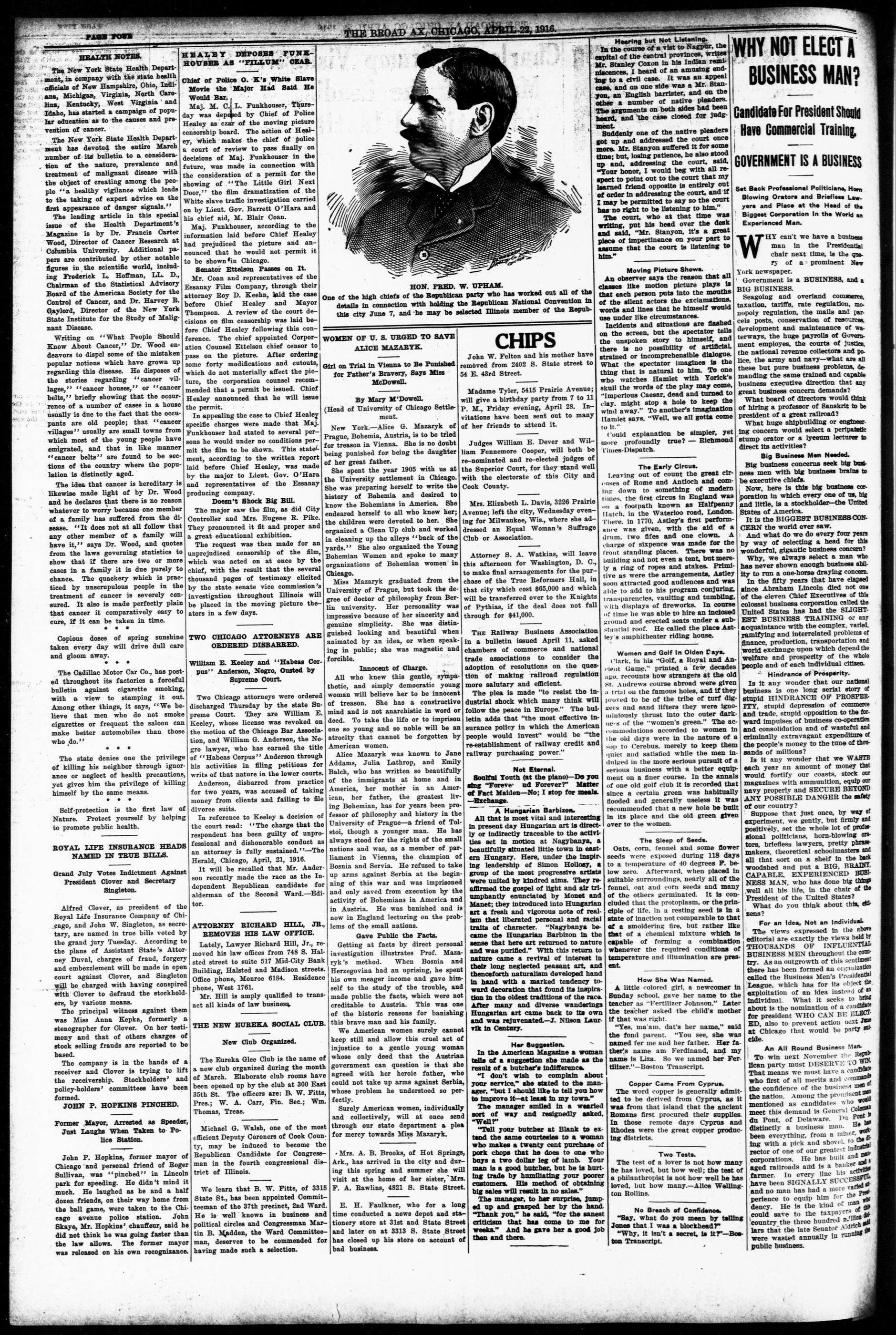
WOMEN OF U. S. URGED TO SAVE
ALICE MAZARYK.
Girl on Trial in Vienna to Be Punished
for Father's Bravery, Says Miss
McDowell.
(Head of University of Chicago Settlement.
New York—Alice G. Mazaryk of Prague, Bohemia, Austria, is to be tried for treason in Vienna. She is no doubt being punished for being the daughter of her great father.
She spent the year 1905 with us at the University settlement in Chicago. She was preparing herself to write the history of Bohemia and desired to know the Bohemians in America. She endeared herself to all who knew her; the children were devoted to her. She organized a Clean Up club and worked in cleaning up the alleys "back of the yards." She also organized the Young Bohemian Women and spoke to many organizations of Bohemian women in Chicago.
Miss Mazaryk graduated from the University of Prague, but took the degree of doctor of philosophy from Berlin university. Her personality was impressive because of her sincerity and genuine simplicity. She was distinguished looking and beautiful when animated by an idea, or when speaking in public; she was magnetic and forcible.
Innocent of Charge.
All who knew this gentle, sympathetic, and simply democratic young woman will believe her to be innocent of treason. She has a constructive mind and is not anarchistic in word or deed. To take the life or to imprison one so young and so noble will be an atrocity that cannot be forgotten by American women.
Alice Mazaryk was known to Jane Addams, Julia Lathrop, and Emily Balch, who has written so beautifully of the immigrants at home and in America, her mother in an American, her father, the greatest living Bohemian, has for years been professor of philosophy and history in the University of Prague—a friend of Tolstoi, though a younger man. He has always stood for the rights of the small nations and was, as a member of parliament in Vienna, the champion of Bosnia and Servia. He refused to take up arms against Serbia at the beginning of this war and was imprisoned and only saved from execution by the activity of Bohemians in America and in Austria. He was banished and is now in England lecturing on the problems of the small nations.
Gave Public the Facts.
Getting at facts by direct personal investigation illustrates Prof. Mazaryk's method. When Bosnia and Herzegovina had an uprising, he spent his own meager income and gave himself to the study of the trouble, and made public the facts, which were not creditable to Austria. This was one of the historic reasons for banishing this brave man and his family. We American women surely cannot keep still and allow this cruel act of injustice to a gentle young woman whose only deed that the Austrian government can question is that she agreed with her heroic father, who could not take up arms against Serbia, whose problem he understood so perfectly.
Surely American women, individually and collectively, will at once send through our state department a plea for mercy towards Miss Mazaryk.
Mrs. A. B. Brooks, of Hot Springs, Ark., has arrived in the city and during this spring and summer she will visit at the home of her sister, Mrs. F. A. Rawlins, 4821 S. State Street.
E. H. Faulkner, who for a long time conducted a news depot and stationery store at 31st and State Street and later on at 3313 S. State Street has closed up his store on account of bad business.
Bv Mary M'Dowell.
John W. Felton and his mother have removed from 2402 S. State street to 54 E. 43rd Street.
Madame Tyler, 5415 Prairie Avenue; will give a birthday party from 7 to 11 P. M., Friday evening, April 28. Invitations have been sent out to many of her friends to attend it.
Judges William E. Dever and William Fennemore Cooper, will both be re-nominated and re-elected judges of the Superior Court, for they stand well with the electorate of this City and Cook County.
Mrs. Elizabeth L. Davis, 3226 Prairie Avenue; left the city, Wednesday evening for Milwaukee, Wis., where she addressed an Equal Woman's Suffrage Club or Association.
Attorney S. A. Watkins, will leave this afternoon for Washington, D. C., to make final arrangements for the purchase of the True Reformers Hall, in that city which cost $65,000 and which will be transferred over to the Knights of Pythias, if the deal does not fall through for $41,000.
THE Railway Business Association in a bulletin issued April 11, asked chambers of commerce and national trade associations to consider the adoption of resolutions on the question of making railroad regulation more salutary and efficient.
The plea is made "to resist the industrial shock which many think will follow the peace in Europe." The bulletin adds that "the most effective insurance policy in which the American people would invest" would be "the re-establishment of railway credit and railway purchasing power."
Souffle Youth (at the piano)—Do you sing "Foreve" nd Forever?" Matter of Fact Malden—No; I stop for meals. —Exchange.
All that is most vital and interesting in present day Hungarian art is directly or indirectly traceable to the activities set in motion at Nagybanya, a beautifully situated little town in eastern Hungary. Here, under the inspiring leadership of Simon Holloy, a group of the most progressive artists were united by kindred aims. They reaffirmed the gospel of light and air triumphantly enunciated by Monet and Manet; they introduced into Hungarian art a fresh and vigorous note of realism that liberated personal and racial traits of character. "Nagybanya became the Hungarian Barbizon in the sense that here art returned to nature and was purified." With this return to nature came a revival of interest in their long neglected peasant art, and thenceforth naturalism developed hand in hand with a marked tendency toward decoration that found its inspiration in the oldest traditions of the race. After many and diverse wanderings Hungarian art came back to its own and was rejuvenated.-J. Nilson Laurin in Century.
In the American Magazine a woman tells of a suggestion she made as the result of a butcher's indifference.
"I don't wish to complain about your service," she stated to the manager, "but I should like to tell you how to improve it—at least in my town."
The manager smiled in a weared sort of way and resignedly asked, "Well?"
"Tell your butcher at Blank to extend the same courtesies to a woman who makes a twenty cent purchase of pork chops that he does to one who buys a two dollar leg of lamb. Your man is a good butcher, but he is hurting trade by humiliating your poorer customers. His method of obtaining big sales will result in no sales."
The manager, to her surprise, jumped up and grasped her by the hand. "Thank you," he said, "for the saneest criticism that has come to me for weeks." And he gave her a good job then and there.
CHIPS
Not Eternal.
Her Suggestion.
Hearing but Not Listening.
In the course of a vist to Nagpur, the capital of the central provinces, writes Mr. Stanley Coxon in his Indian reminiscences, I heard of an amusing ending to a civil case. It was an appeal case, and on one side was a Mr. Stanyon, an English barrister, and on the other a number of native pleaders. The arguments on both sides had been heard, and the case closed for judgment.
Suddenly one of the native pleaders got up and addressed the court once more. Mr. Stanyon suffered it for some time; but, losing patience, he also stood up and, addressing the court, said, "Your honor, I would beg with all respect to point out to the court that my learned friend opposite is entirely out of order in addressing the court, and if I may be permitted to say so the court has no right to be listening to him."
The court, who at that time was writing, put his head over the desk and said, "Mr. Stanyon, it's a great piece of impertinence on your part to assume that the court is listening to him."
Moving Picture Shows
An observer says the reason that all classes like motion picture plays is that each person puts into the mouths of the silent actors the exclamations, words and lines that he himself would use under like circumstances. Incidents and situations are flashed on the screen, but the spectator tells the unspoken story to himself, and there is no possibility of artificial, strained or incomprehensible dialogue. What the spectator imagines is the thing that is natural to him. To one who watches Hamlet with Yorick's skull the words of the play may come, "Imperious Caesar, dead and turned to clay, might stop a hole to keep the wind away." To another's imagination Hamlet says, "Well, we all gotta come to it." Could explanation be simpler, yet more profoundly true? — Richmond Times-Dispatch.
The Early Circus.
Leaving out of count the greatcircuses of Rome and Antioch and coming down to something of modern times, the first circus in England was on a footpath known as Halfpenny Hatch, in the Waterloo road, London. There, in 1770, Astley's first performance was given, with the aid of a drum, two fifes and one clown. A charge of sixpence was made for the front standing places. There was no building and not even a tent, but merely a ring of ropes and stakes. Primitive as were the arrangements, Astley soon attracted good audiences and was able to add to his program conjuring, transparencies, vaulting and tumbling, with displays of fireworks. In course of time he was able to hire an inclosed ground and erected seats under a substantial roof. He called the place Astley's amphitheater riding house.
Women and Golf In Olden Days.
Women and Golf in Olden Lays.
Clark, in his "Golf, a Royal and Ancient Game," printed a few decades ago, recounts how strangers at the old St. Andrews course abroad were given a trial on the famous holes, and if they proved to be of the tribe of turf diggers and sand lifters they were ignominiously thrust into the outer darkness of the "women's green." The accommodations accorded to women in the old days were in the nature of a sop to Cerebus, merely to keep them quiet and satisfied while the men indulged in the more serious pursuit of an serious business with a better equipment on a finer course. In the annals of one old golf club it is recorded that since a certain green was habitually flooded and generally useless it was recommended that a new hole be built in its place and the old green given over to the women.
The Sleep of Seeds.
Oats, corn, fennel and some flower seeds were exposed during 118 days to a temperature of 40 degrees F. below zero. Afterward, when placed in suitable surroundings, nearly all of the fennel, oat and corn seeds and many of the others germinated. It is concluded that the protoplasm, or the principle of life, in a resting seed is in a state of inaction not comparable to that of a smoldering fire, but rather like that of a chemical mixture which is capable of forming a combination whenever the required conditions of temperature and illumination are present.
How She Waa Named.
A little colored girl, a newcomer in Sunday school, gave her name to the teacher as "Fertilizer Johnson." Later the teacher asked the child's mother if that was right.
"Yes, ma'am, dat's her name," said the fond parent. "You see, she was named fer me and her father. Her father's name am Ferdinand, and my name is Liza. So we named her Fertilizer."-Boston Transcript.
Copper Game From Cyprus.
The word copper is generally admitted to be derived from Cyprus, as it was from that island that the ancient Romans first procured their supplies. In those remote days Cyprus and Rhodes were the great copper producing districts.
Two Tests.
The test of a lover is not how many he has loved, but how well; the test of a philanthropist is not how well he has loved, but how many.—Alice Wellington Rollins.
"Why, it isn't a secret, is it?"—Boston Transcript.
WHY NOT ELECT A BUSINESS MAN?
Candidate For President Should Have Commercial Training. GOVERNMENT IS A BUSINESS
Set Back Professional Politicians, Horn Blowing Orators and Briefless Lawyers and Place at the Head of the Biggest Corporation In the World an Experienced Man.
WHY can't we have a business man in the Presidential chair next time, is the query of a prominent New York newspaper.
Government is a BUSINESS, and a BIG BUSINESS.
Seagaling and overland commerce, taxation, tariffs, rate regulation, monopoly regulation, the mails and parcels posts, conservation of resources, development and maintenance of waterways, the huge payrolls of Government employees, the courts of justice, the national revenue collectors and police, the army and navy—what are all these but pure business problems, demanding the same trained and capable business executive direction that any great business concern demands? What board of directors would think of hiring a professor of Sanskrit to be president of a great railroad? What huge shipbuilding or engineering concern would select a peripatetic stump orator or a yleum lecturer to direct its activities?
Big Business Men Needed.
Big business concerns seek big business men with big business brains to be executive chiefs. Now, here is this big business corporation in which every one of us, big and little, is a stockholder—the United States of America. It is the BIGGEST BUSINESS CONCERN the world ever saw. And what do we do every four years by way of selecting a head for this wonderful, gigantic business concern?
Why, we always select a man who has never shown enough business ability to run a one-horse draying concern.
In the fifty years that have elapsed since Abraham Lincoln died not one of the eleven Chief Executives of this colossal business corporation called the United States has had the SLIGHTEST BUSINESS TRAINING or any acquaintance with the complex, varied, ramifying and interrelated problems of finance, production, transportation and world exchange upon which depend the welfare and prosperity of the whole people and of each individual citizen.
Hindrance of Prosperity.
Is it any wonder that our national business is one long serial story of stupid HINDRANCE OF PROSPERITY, stupid depression of commerce and trade, stupid opposition to the forward impulses of business co-operation and consolidation and of wasteful and criminally extravagant expenditure of the people's money to the tune of thousands of millions?
Is it any wonder that we WASTE each year an amount of money that would fortify our coasts, stock our magazines with ammunition, equip our navy properly and SECURE BEYOND ANY POSSIBLE DANGER the safety of our country?
Suppose that just once, by way of experiment, we gently, but firmly and positively, set the whole lot of professional politicians, horn-blowing orators, briefless lawyers, pretty phrase-makers, theoretical schoolmasters and all that sort on a shelf in the back woodshed and put a BIG, BRAINY CAPABLE, EXPERIENCED BUSINESS MAN, who has done big things well all his life, in the chair of the President of the United States? What do you think about this citizens?
For an Idea, Not an Individual. The views expressed in the above editorial are exactly the views held by THOUSANDS OF INFLUENTIAL BUSINESS MEN throughout the country. As an outgrowth of this sentiment there has been formed an organization called the Business Men's Presidential League, which has for its object the exploitation of an idea instead of an individual. What it seeks to bring about is the nomination of a candidate for president WHO CAN BE ELECTED, also to prevent action next June at Chicago that would be party suicide.
An All Round Business Man.
HEALTH, CLEANLINESS, PROPER LIVING, SANITATION, ETC.
3300 So. State Street
Phode Douglas 3617
PROTECT YOUR HEART
There are many factors responsible for the production of heart disease. It is probably not well understood that the heart is the engine of the body and is constantly working from birth to death. It is doubtless the most abused organ in the body. No process of life is capable without the active co-operation of the heart. The heart of a healthy adult is approximately seventy-two beats in a minute. The rapid action of the heart is an indication of disease unless produced temporarily by emotion or exercise and even emotion and exercise will do irreparable damage to any heart if persisted in.
The natural work of the heart is to supply blood to the entire animal economy for the use of every organ and cell in the body. The heart is a regular bee hive of industry, pumping away, if it is treated right, every fraction of a second, night and day, for three scores and ten years at the rate of seventy strokes every minute, forty-two hundred times every hour and nearly thirty-seven million beats every year. At each stroke the ventricles pump about six ounces or nearly fifty teaspoonsful of blood. About eighteen pounds of blood are moved every minute, or twelve tons every day...
It is calculated that the total amount of daily work done by the heart can be represented by what a man weighing one hundred and fifty pounds
Belgian Kongo.
Belgian Kongo, founded thirty years ago, is still in the early stage of development. So far practically no manufacturing industries have yet been established, and, aside from the important copper mines in the Katanga district, the only large industrial enterprises are the railways and river transportation services. It may be said that all business activities in the colony are devoted to the collection of tropical products—rubber, ivory, gum copal, palm oil and kernels, cacao, etc—and the railway and river services are in reality only accessories to these activities, having been established primarily to aid in the transportation of these products to the seaports. The gathering of rubber in Kongo has never recovered its former activity, and in all probability will never again be so rich a source of income to the colony as it was previous to 1912.
Ship Money.
Charles L was badly in need of money, and his attorney general in the course of his antiquarian researches discovered that in the dim ages of the past the crown had issued writs to the cities and towns on the coast requiring them to provide vessels for the royal needs, and he suggested that this ancient right might be brought into use again. Instead of the actual vessels a money contribution might be exacted instead. Thus the king would be able to tax a larger part of the realm while theoretically observing the laws. Writes for ship money were accordingly issued, but the patriot John Hampden declared that they were illegal and raised such a protest against them that they were practically nullified.
Weed Pests.
Of the 200 species of ferns native to this country a few have become more or less serious weed pests. The most troublesome are the hay scented fern and the brake. According to a bulletin of the department of agriculture, cutting off the tops close to the soil surface twice a year for two years will kill out nearly all ferns. The best times to do the cutting are just previous to sporing, or about the middle of June, and the middle of August.
Life In Bermuda.
A feature of life in Bermuda which always impresses the stranger is the apparent prosperity of the natives, white and colored alike. Distressing poverty is unknown, and even the poorest families can boast of a stone house and a garden.—Argonaut.
The Twins
We have heard of several cases wherein twins have borne a remarkable likeness to each other. But the most curious was the case of twin sisters who had to be told everything together because it was impossible to tell them apart.
Corrected.
"My husband tells me that he was out late last night with your husband." "That isn't so. I want you to understand that my husband was out with your husband."-Detroit Free Press.
A. E.
would do in running up a flight of forty steps forty times. While the cavities of the heart are filling with blood, and the heart muscles are relaxed the heart has a very brief period of semi-repose or rest; otherwise, it could not keep up its patient and tireless pumping of over four thousand tons of blood every year for in some cases seventy years and more. Such is the natural volume of work that the heart must do and should.
But there are burdens put upon every heart that are not necessary. Such burdens hasten the end of the life cycle on the earth. It has been demonstrated that certain substances have a debilitating effect on the heart. Tobacco, coffee, tea, patent medicines that contain alcohol and habit forming drugs of high potency and the cup that brings nervous excitement exhibited by talkativeness are unnecessary burdens upon the heart.
It is not so well known that certain mental phenomena produce unnecessary work for the heart and thereby produce disease, debility and death. Emotions such as fear, anger, malice and the like cause increased excitability of the nervous mechanism of the heart and thereby shorten the life span. Worry is a burden upon the heart that has been the cause of early death. The heart that expands its energy in the physiological processes will last longer than the heart that takes on added and unnecessary burdens.
Philadelphia and Carpets.
More than a third of all American carpets are woven in Philadelphia, which, it is claimed, leads any other city of the world in the volume of production. Wilton, in England, has given its name to one of the most widely known and useful rugs in the world, but now the Wilton rug producing center of the world is in Philadelphia. Axminster, too, gave its name to a carpet, but it long ago ceased to produce any of it. Brussels likewise is known all over the earth for its carpet, but Brussels does not begin to produce the carpets and rugs which are turned out in Philadelphia. Philadelphia enterprise embarked in the carpet business while Washington was president of the United States, but it was not until more than half a century later that Pennsylvania led all the states in carpet production. As early as 1791 there was a factory in Philadelphia engaged in the manufacture of Axminster and Turkey carpets. China and Russia send to Philadelphia most of the long, coarse wool used in the manufacture of the finest Wiltons.-Argonaut.
Getting Up In the Morning.
The truth is that there is no time at which it is pleasing to get up. Getting up in the world is a pleasure, but we refer to getting up from anything between a fifty cent cot and a forty dollar mattress after having tried to indulge, to a point of satiety, a normal appetite for sleep. To get up willingly is, as Lord Dundreary would say, "something no fellow can do." It simply isn't done and can't be done. Absolutely nobody does it.
Early rising is with some persons a sort of religion, like flagellation. But they, like the rest of us, unless they are afflicted with a loss of the normal capacity for sleep, find the moment of rising painful, however compensating the pleasure of boasting their early rising, the joy of bullyragging and beittling persons who frankly do not like at any time to get up, although they do it heroically every morning—Louisville Courter-Journal.
A Rise.
"The automatic force of inanimate objects is sometimes a wonderful thing," said the professor.
"Yes," agreed the impecunious man "even the humble cake of yeast can always raise the dough."—New York Mail.
His Wisdom.
Judge—How long have you owned a car? Motorist (charged with speeding)—One week, your honor. Judge—Um then you can still afford to pay a fine Twenty dollars!—Puck.
Not What He Meant.
Diner (in swell cafe)—I suppose people who dine here carry off quite a lot of silver. Waiter-Yes, sir; we can't get all their loose change.—Boston Transcript.
The very best way to get ability is to do thoroughly whatever you do. Master every detail of work that falls to your lot.—Selected.
THE BROAD AX, CHICAGO, APRIL 22, 1916.
Charles E. Stump Visits Many of the Leading Educational Institutions for Colored People Throughout the State of Florida
Deland, Fla.—If there is any place on the earth that God had something to do with, it was Florida, and then I think the devil has stepped in and put in his claim here too, because it is so full of prejudice of race, prejudice that is like—I can't say what, but it is my aim to strive to live down here while I am here and get along with all mankind.
Thousands of wealthy people of America come to Florida every year, and we meet and talk with them at a distance. That is when we pass around the streets we see here and there some great big man and we are told who he is and about his millions, and we speak to him in our mind and congratulate him upon his wonderful progress, upon what he has done for his world. But there are some of them who come down in private cars, screened in, and they do not allow you to even look at them. They are carted away on their private boats, and carried out in the water and thus you are toed away or they are toed away.
But it has not all been prejudice, or if it has our people have grown under it, because we have some people that are as rich as cream down here in Florida. Rich in material things, rich in grace, rich in thought, rich in love, rich in service to mankind. I have seen them as I have gone from place to place.
It strikes me that I was in Jacksonville, when I wrote to you the last time, and you will find me far from there now. I am now in this part of the state. I had been with some of the big men of this world. I was with one of the great educators of the race, and of the age, Prof. N. W. Collier, president of the Florida Baptist college. He is getting things in good shape in this part of the world, and it is always a source of pleasure to look at him. I think I told you about S. A. Blocker, who has devoted her life to the service of the race.
Rev. John E. Ford, is pastor of the leading church in the town, and his people just love him. He has not gotten hold of the big head, and I hope he will, never. Dr. Ford, is an old Chicago boy, I am told, and since that is true the people will be delighted to know that he is doing well. He has the leading church in Florida, if not in the whole south. To see the building you would never think that it belonged to our people. It is strictly a business church, and they do business right up to the now. Ford is among our first men to come out from the University of Chicago, and he has taken time to win his place. He has done some real good work since he left school.
Speaking of good work, I am reminded that God would require us all to do good work, but it seems that some men can do better than others, and such is the position of Dr. Ford. I had the pleasure of meeting his sister, Mrs. Hunter, who has spent the winter in town, keeping house for her brother, and he has enjoyed it so very much. She enjoys basking in the Florida sunshine taking in the air that all the other rich people are taking in
From Jacksonville, I went to St. Augustine, Fla., and was the guest of Rev. R. B. Brooks, D. D., who is pastor of the A. M. E. church, and one of the leading men in the state. He is a man who has made his place in this world, and I am real proud of him, because he has made his way. Dr. Brooks has the whole state behind him for the position of bishop in the African Methodist Episcopal church, and he has many friends outside of the state. That will give a strong team, Revs. W. A. Fountain, of Georgia and Dr. R. B. Brooks, of Florida. A fine team, I am told.
St. Augustine, is one of the great places, and I am told it is the oldest city in the United States. Well it looks new, believe me. It is one of the newest looking old things I have ever seen. Even the old slave market, which stands right in front of the post office, looks new. As I stood there and looked at that fine place, I was reminded of the past. A relic of slavery. I saw the wonderful progress made, the learned preacher, D. R. B. Brooks, and then I thought of what happened back yonder. "The Lord hath done great things for us, whereof we are glad." Florida you can just keep on riding
and riding without getting through, so I just rode some myself, stopping next at Palatka, where I met with a little disappointment, hence did not tarry there, but will go back another time and spend just a little time with Rev. C. S. Long, D. D., whose name is before the A. M. E. church as successor to Dr. J. C. Caldwell. Then to Daytona, and from there to Miami, the stepping off place. I could just write a week about Daytona, about Miami, Palm Beach and other places. I spent a little time with Rev. J. T. Brown, one of the writers of the Sunday School Board of the National Baptist convention, and one of the best Baptist scholars in this country. Dr. Brown just reads his Bible in the original tongue just like you read it in English, and perhaps better than some people read it.
I am glad that Dr. Brown is a man with common sense, because, I just said a big word to him, as I thought I was talking in Greek. I said "Mocusdumpikomurdus." I thought I was talking in Greek, and he did not understand me and rather than make me feel bad he just looked. I spent a few days with him, and had the pleasure of meeting some of the leading people. I will not take up time to talk about him because I want to tell you a few things about Florida oranges. You have been buying them but perhaps you don't know that we are in this business, and I am now eating oranges from a grove owned by one of our men, and one of the largest shippers in the state, but you don't know it. It is J. W. Wright, of this place.
Perhaps you want to know about him. He has worked his way up here in this world. He came into the world via Hawthorne, Florida, or out in the country and that is the nearest town we could get at in order to locate him. He is stricly a country boy. But I wish you could see him and his home. It is a first class city home, believe me. Just about 3 miles from the town of Deland in the midst of his large orange groves. A two story house, modern improvements. He has his own private water supply, his own gas plant with latest improvements, his beautiful walk, from his door to the gate, on each side of the walk, large palmettoes. Then large oak trees in his yard covered with moss.
In the business world, he has fine rating, and the bankers down here speak in the highest terms of this young man, and all because he has made good. It is indeed inspiring to come in touch with him and his brothers. The Lord has just blessed his home with a junior, and he is here to stay.
Just after starting this letter information comes to me that Dr. J. H. Thompson, of Orlando, Fla., has been forced to leave his home—not exactly leave, but had to be spirited away by the sheriff to save his life, and that he is in jail somewhere. Several weeks ago, in a drug store, the White drug-gist accused him of disputing his word, and when he turned to leave with a weight or something knocked our doctor down, and then took advantage of it to give him a good clubbing. For this the White man was praised and there was no arrest made.
Things went on, until one day last week this same G. N. B. Barlow, drugist, met Dr. Thompson on the street and thought he could repeat it, but this time Dr. Thompson was on the look out, and when this White man attempted to make the assault, Dr. Thompson known his right down on the ground and then gave him a real good whipping. This man rushed in town, told the White man that a "Nigger" ran over him with an automobile, and then clubbed him. A mob was formed, Dr. Thompson was arrested, and at night carried away, so when the mob went to jail after him, he was not there. It was alright as long as the White man was doing the whipping. How brave the White man of the South is.
Just think of it. One little man, arrested, everything with which to defend himself being taken away, to be tried by White men, executed or punished by White men, and yet this same crowd of White men will go to work and form a mob to kill one man for protecting his rights. Think of 500 men going after one man, and then after he has been disarmed. Well, I will not comment on this.
Used Income of High School Instructor In Moderate Manner, and With Money He Earned by Writing He Was Able to Educate Eighteen Students.
Everett, Wash.-F. D. Mack, teacher in the Central school, has spent about $40,000 in educating eighteen students, seventeen boys and one girl, during the last sixteen years, according to a story he reluctantly told a newspaper representative.
Living on his school salary in a modest way both in Minnesota, his former home, and in Washington, he has earned the money to send students through universities by writing short stories and magazine articles. He has paid out between $2,000 and $3,000 on each of his "children."
Some of the youngsters were orphans, and some had one parent, but all were eager to learn and were handicapped by lack of money.
The thirteen boys who are alive are all actively engaged in the professions in which Mr. Mack has educated them. Two are druggists, one being in St. Paul and the other in Los Angeles. Two are instructors in the University of Minnesota, where they were graduated. One teaches mathematics, and the other is an instructor in German.
This latter young man plans to be a physician and in 1914 married a girl who wished to go to Germany to get her master's degree, so he and his bride sailed for Germany to continue their studies, only to be turned back by the beginning of the war.
Mr. Mack sent him through Normal school, the University of Minnesota and Harvard, where he received his master's degree.
A young man who chose to be a broker received his education at the University of Illinois. He started out to be an architect, but changed his mind and took a commercial course. He was graduated four years ago and is now in Minneapolis engaged in the lumber brokerage business. He is the best money maker of the "family." In his four years out of college he has made $40,000.
A mining engineer who was educated at the University of Minnesota is now working in a mine at Butte, Mont. The banker received a thorough commercial education, and then Mr. Mack set him up in business in a bank in Elgin, N. D. Mr. Mack says that if any of his boys wants to start in business he always gives them enough money to begin. He recently bought an eighty acre farm for one of them.
A dentist lives in Chicago. He had four years at the University of Valparaiso. Mr. Mack says this boy married a rich nurse. One boy who studied to be a lawyer lost his health after his graduation from the University of Minnesota law school, so could not practice, and is now employed as chief of the Minnesota state fish and game commission, with headquarters at St. Paul. Self educated and quiet, Mr. Mack would not be thought responsible for one of the most unusual philanthropies in the world.
NO PAINTER'S COLIC FOR HIM.
BILL For "Tint" Makes Bachelor issue Leap Year Declaration.
Elwood, N. J.—Robert W. Hunt, a retired college instructor, received a letter recently from a neighboring town containing a bill for 40 cents for "tint" purchased by "Mrs. Hunt." Hunt is a good looking bachelor with a steady income, and the inquisitive element of Elwood at once interpreted the postoffice bulletin in terms of leap year possibilities.
To quiet the buzzing gossip, Hunt has issued the following statement:
"We have had several offers of marriage, and one or two ladies have assumed we were engaged without making any offer, and it is with fear and trembling we pass each day of this year, which is divisible by four. However, when Mrs. Hunt does arrive she shall come as nature painted her, with eyes like the heavens, with cheeks like the rose and with lips like the damp of crushed strawberry. She shall have no need of 'tint.' When we want a kiss we don't propose to mess through two or three coats of paint to get it."
Dogs Tree Insane Man.
Oregon City, Ora—Peter Brevio
agged forty-three, an Italian, was treed
with the aid of bloodbounds arrested
and brought back to Oregon City and
committed to the State Hospital For
the Insane. Brevio lived in a hollow
tree, and his diet consisted of roots,
berries and what food he could find
around neighboring farmhouses. He
stole an ax from a farmhouse and
passed much of his time chopping
down trees. A number of men of the
district determined to arrest Brevio
and went to his tree home. The Italian
ran away. Dogs were then put on his trail.
PAGE FIVE
Jane Wenham was indicted at the Hertfordshire assizes on March 4, 1712, for "conversing with the devil in the form of a cat," under the provisions of the act of 1604, repealed in 1728. Her prosecutors wished to have her also indicted for practicing witchcraft to the harm of Ann Thorn, a servant girl sixteen years old, but this was not allowed, although evidence was produced at the trial to show what injury had been done to the victim by means of crooked pins and by placing cakes and cats' hair in Ann Thorn's pillow and how the prisoner had caused the death of some cattle simply by walking through a turnip field.
The jury brought her in "gullity," and Justice Powell passed sentence of death, but took steps to quash the verdict. Wenham's prosecutors published an account of the case, but their arguments were pulverized by scientific men. Jane Wenham herself was liberated and taken under the protection of Colonel Plummer, who gave her a cottage, and we are told by Dr. Hutchinson that in 1720 the whole country was fully convinced of her innocence—London Spectator.
The Game of Life
Life becomes, as the stolcs more than once tell us, like a play which is acted or a game played with counters. Viewed from the outside, these counters are valueless, but to those engaged in the game their importance is paramount. What really and ultimately matters is that the game shall be played as it should be played. God, the eternal dramatist, has cast you for some part in his drama and hands you the role. It may turn out that you are cast for a triumphant king. It may be for a slave who dies of torture. What does that matter to the good actor? He can play either part. His only business is to accept the role given him and to perform it well. * * * Success or failure is a thing he can determine without stirring a hand. It hardly interests him. What interests him is that one thing which he cannot determine—the action of your free and conscious will—Gilbert Murray.
Kings and Shaving.
The classic case of a king who knew better than to let anybody else shave him is that of Dionysius the elder, tyrant of Syracuse, who appears to have been unable to shave himself, for he is said to have resorted to the uncomfortable device of singing off his beard with hot walnut shells, says the London Chronicle. We may suspect that Napoleon's was another case of the kind. Rogers asked Talleyrand whether Napoleon shaved himself. "Yes," replied Talleyrand; "one born to be a king has some one to shave him but they who acquire kingdoms shave themselves." That way of putting pleasantly emphasizes the practical periority of the parvenu to the less, spoiled child of heredity, because probably entered into the ter also, if Talleyrand's statement correct.
A Queer Fish.
A male fish which hatches the young of its mate is the Chromis paterfamilias. It is found in the lake of Tiberias, Palestine. Strange to say, this industrious fish hatches its young is its mouth. When the female has spawned in the sand the male approaches and draws the eggs into his gills, where they remain until hatched, when they struggle out of their confinement into the parent's mouth. As many as 200 perfect young are sometimes found in the mouth of an adult male. How the fish manages to feed itself without swallowing its young is a mystery. The grown fish is about seven inches long and one and three-quarters wide. Its back is olive green, shot with blue, and the belly is silver white, marked with green and blue.
Reason For Complaint
"I keep the best bread," said a certain baker the other day to a poor fellow who complained of the inferior quality of the article he had purchased of him the day before.
"I do not doubt it," replied the customer.
"Then why do you complain?" asked the baker.
"Because I would suggest that you sell the best bread and keep the bad." was the reply.-Pittsburgh Telegraph.
Some Evidence
"You say that preparation will make the hair grow?" asked the thin haired man of the druggist.
"Why, say," came from the drug man, "I know a customer who took the cork out of a bottle of that stuff with his teeth, and now he's got a hair-lin." Yonkers Statesman.
Part Often Ovarlooked
"It is all right to pat yourself on the back occasionally," said the dispenser of sage advice. "Yes?" said the player up.
"But don't forget to call yourself down when you need it, my boy."—Pittsburgh Post.
Treat For the Boarders
"Mr," queried the small daughter of the boarding housekeeper, "what shall I do with these basting threads?" "Give them to me and I will stir them into the frosting for the coconut cake," said her mother.—Youth's Competition.
Lively Chasse.
John—I'll bring you a fork, sir. The Customer—What for? John—The camembert, sir. The Customer—A fork's no good. Bring a revolver.—Exchange.
Sincerity's own realm is one's secret chamber; strong here, a man is strong everywhere. -Saigo.
pO
FLYING AIDS SICK.
Titled engaieas Says it
* Cures Nervous People.
—S HER OWN MECHANICIAN.
‘One's Eyes Would Open to Ses Lady
Auckland Modishly Dressed and
‘Then In Overalls Repairing Flying
Machine—Has Lost One Son In War.
Palm Beach, Fla.—If you are suffer
fag from nerves, from ennui or from
Jack of adventure step into a hydro
aeroplane, rise gently from the ground
‘nd soar into the azure, over land and
ea, descending upon either as the im-
Pulse moves you.
_ Lady Auckland, whose rank may be
‘sbtained from any of the books dealing
‘with the British peerage, recommends
aviation as a sport and asa cure. Dur-
ng the last season she, with her son,
conducted a school for aviation here,
not merely lending her name to the en-
terprise as a passing fad, but going
‘tuto tt tn the most practical manner.
‘One rubbed one’s eyes to see her at
‘me moment, modishly dressed, on the
promenade with other fashionable vis-
aha dn ae
Pg WES
Ne
f On ae
ae ;
es
Sees
and the next in workwoman’s
and overalls making mechanical
on her flying machine.
The transition from London society
to an American workshop and business
‘enterprise is interesting. Lady Auck-
4and told the story.
She is the daughter of Colonel George
M. Hutton, C. B., a great landowner
‘and a noted military man. Her mother
‘was a granddaughter of Arkwright, the
4nventor, and on both sides of her fam-
fly she is descended from distinguished
torbears.
“My early youth was spent at the
id abbey of Knauth, on the banks of
fhe river Trent,” she said. “It was a
eautiful old black and white house of
the Stuart period, built on the site of
the Cistercian monastery razed by
Henry VIII.
“I had a very unhappy childhood, as
amy mother never forgave me for being
‘born a girl, not even up to the time of
ig Eee
married when I was only nineteen
years old, but my married life was not
‘a happy one. I had luxuries and all
the advantages that social position can
give, but my home life was not happy.
‘My two boys were born nearly three
years apart, and I became completely
absorbed in them.
“I had a fearful shock in 190¢°when
I discovered that my husband had lost
‘money on the Stock Exchange—all our
moneys that were not in trust.
“Our beautiful home at Gravenhurst
haf to be sold and with it many of its
world famed art treasures, including
f= from Marie Antoinette to the
Auckland of that time, who was
‘embassador to France.
“I found that unless I wotked we
could not keep our eldest son at Eton,
anf to take him from there at that
‘time would have ruined his career.
“I went to work as designer to a
‘Yarge electrical firm and remained with
ft until I got a better position with
& well known firm of metal workers in
London. By this means I succeeded in
‘keeping my oldest boy at Eton until he
Jeft in the ordinary course for the
-examinations for the army.
“Shortly after this time our dear old
aunts died, and we were once again
comfortably off and bought a heavenly
Place in the Isle of Wight. This house
formerly belonged to Dickens, and here
be wrote many of his works. The
=, low, with a velvet lawn
to the edge of the steep cliff
‘everlooking the channel. From this
= we saw the Olympic pass and the
fated Titanic on her fatal voyage.
Glere we lived some years unt) Lord
Auckland again lost money.
“After years of sorrow there was a
‘culmination. I was only second fiddle,
‘ge my son and I made up our minds to
¢ome to America, where he decided to
take up aviation.
“My oldest son was killed at St. Blot,
‘near Ypres, on March 1, 1915, with two
‘ef his brother officers while leading
‘their detachment to take some trench-
<s. He was a Mentenant in the Six-
‘Geth Royal rifies, having been appoint-
ef to that regiment by King George
tm 1913 after he had passed through
‘the Military college at Sandhurst.”
BUCK SAVES FAWN
FROM SWIFT RIVER
Latter Falle Behind In Swimming the
Columbia to Eecape From
Some Doge.
Kettle Falls, Wash—Ed Boper, a
farmer living on the Ferry county side
of the Columbia river, saw three deer
etven to the Columbia river by dogs
and then forced to cross for safety the
other day. Roper had crossed to this
side of the river in a rowboat and
heard the barking of the dogs near the
bank of the river that he had left.
Three deer, a buck, « doe and a fawn,
sought safety by swimming in the river
and were swimming toward this side
svhen Roper hid himself in order not to
frighten the deer back again.
‘The fawn fell behind the others and
spocaza seal ta) the) bate WE
swift cold water, and Roper
thought it would surely drown, when
the buck, which had been in the lead,
turned back and assisted the fawn
until the bank of the river was safely
Teached. ‘The three deer then stood still
‘and rested for some time.
CLAIM TO HAVE FOUND
SCARLET FEVER GERM
Boston Pathologists Report Dis-
covery of Bacillus—New York
Physician Skeptical.
-_Boston.—Dr. F. B. Mallory, patholo-
‘gist of the Boston City hospital, and
Lis assistant, Dr. B. M. Medlar, have
iscovered the bacillus that causes
scarlet fever, and it is believed it will
Bot be very difficult to work out an
antitoxin or vaccine for its prevention
and cure.
‘This important discovery is laconi-
cally described by Dr. Mallory and Dr.
Medlar in a thousand word article in
the current issue of the Journal of
Medical Iesearch entitled “The Etl-
ogy of Scarlet Fever.”
It fs larzely owing to the short life
of the actual germ that it has evaded
@iscovery so long. ‘The germs are found
goon after the skin eruption appears
and usually find lodgment first in the
tonsils or at the root of the tongue.
The germ is less virulent than the
@iphtheria bacillus, although it infects
Fiat the same localities, Dr.
jory says it is a “grampositive ba-
am”
“A vaccine for the disease would be
the more important,” says Dr. Mallory,
“go as to render nurses immune to the
Gisease. Scarlet fever is not conveyed,
as many suppose, from the scaling of
the patient. When that takes place
all the germs in the body are dead.”
It was said by a New York physi-
cian that a number of doctors have
claimed the discoverx_of the bacillus
of scarlet fever, but have failed to sub-
stantiate their claims.
FINDS BURIED GOLD.
Mrs. Grey Dug It Up, but Mrs. Judkins
Buried It, Is Belief.
Chico, Cal.—Fifty dollars in gold, be-
Heved to have been buried more than
twenty-five years ago, was discovered
here recently by Mrs. John Grey, wife
of a shoe merchant of this city, while
digging in her yard. Mrs. Grey, while
seeking lily bulbs, turned up an old
can and found in it, wrapped up in the
remains of a handkerchief, the gold.
‘More than twenty-five years ago a
family by the name of Judkins occu-
pied the home. Mrs. Judkins was
known to have buried money, several
packages having been found by her
husband following her death. It is be-
Heved that this money also was hidden
by her.
‘The can contained one $20 and three
$10 gold pieces. The can in which they
had been placed was rusty, and the
cloth which had been wound sround
the coins was decayed and fell to pieces
when handled.
OSTRICH EGG MEAL FOR ALL.
Family Heartily Partake of it.
Kansas City, Mo.—While Prosecutor
Floyd Jacobs and family were visiting
the zoo at Swope park one of the at-
tendants brought in a freshly laid
ostrich egg about the size of a toy bal-
Joon. It was said to be slightly un-
dersized, so Mr. Jacobs was told he
might take it home if he would prom-
ise to have it served for supper. *
“My wife scrambled it,” Mr. Jacobs
said, “and | was about all the egg one
family could eat at a meal. There
wasn't much difference in the taste
from an ordinary hen’s egg, 8o far ay
I could determine, but it seemed to be
a trifle richer. At least it satisfied
the appetite quicker than the scram-
Died eggs usually served at my table.”
Mutes Make Tires.
Akron, 0.—Sixty deaf mutes are em-
ployed by a tire and rubber manufac-
turing company here. It is the policy
of this establishment to employ all
deaf mutes who apply for posttions
who are strong, willing to work and
who have zood eyes. They have prov-
@d to be efficient workers and are of-
ten placed in responsible positions.
Finde Indien Relics.
Calico Rock, Ark.—Cal Branscum of
Cotter, a lineman for the Arkansss-
Missouri Telephone company, has sr-
ived here loaded down with Indian
arrow heads, which he found on a lit-
tle knoll in a small feld a mile north
of this place.
THE BROAD AX, CHIC. 1A GO, APRIL 22, 1916.
“GETS MAIL WiTH PULLEY. eS Origin of the Penny.
——— ‘The “maiden name” of tt
Farmer Didn't Want to Walk to the | was “denarius,” and the Engil
Road to Get It There. {s a survival of the Roman ru
Whilesvilie, Mo.—To C. R. Thompson,
@ farmer living uortheast of here, is
given the credit of originating the lat
st method of having bis mail brought
@trectly to his door.
Bome time ago Thompson decided
that it was a waste of time and shoe
Teather to make the daily trip to his
‘mail box down by the road, and he set
ibis mind and hand to work on a device
which would make said trip unneces.
mry.
‘He succeeded, and now by means of
‘a set of wires and a pulley the trick 1s
‘secomplished.
After the mail man's visit Thompeon
bas only to step to bis door and draw
fm bis mail, box and all,
‘The box is sent back to its post by
the roadside in the same manner.
Others in the community are so pleas.
ef with Thompson's device that they
are going to follow his example, and it
‘will doubtless not be long until “going
‘after the mail,” even so far as the
gate, will be a thing of the past with
the progressive farmers of northwest
‘Missouri.
BIBLE 332 YEARS OLD.
ll Realy aaa ge ane nena ec a
1584 and Is in German.
Ionia, Ind.—A. P. Fleckenstein of
Ionia is the possessor of a Bible which
has been in his family for 332 years.
‘Most of the time it has been in Ger-
many. It was in Hoerstin, Bavaria,
‘until 1883. when ft was brought tu
America. In 1893 it was exhibited at
the world’s fair.
The fiyleaf at the ‘beginning of the
new testament contains the following
tribute to the translator:
“A true translation into the German
language according to the old transla-
tions used in the Christian church and
emlightened with many wholesome an-
notations by the Rev. Dr. John Dieten-
berger. To the praise of God and the
most gracious pleasure of the Roman
imperial majesty and to the good of
the common German nation and now
embellished with illustrations and put
into this grand form. This book was
printed at Cologne. Germany, in the
year A. D. 1581 by Gerwin Calenium
and the heirs of John Quentel With
the grace and liberty of the Roman im.
perial majesty.”
COLLIE HALTS A BULL.
Effort of a Dog Saves the Lives of Fa
‘tens ond Gen;
St. Louis. ~ Fannie, a Scotch collie
saved the life of John ©. Shafer, a
farmer and the dog’s owner, and John
Shafer, father of the dog’s owner, on
two different occasions in one week,
when the men were attacked by an in-
fariated bull, according to a story told
in Marne, Il
‘When the father went to the barn to
feed, the bull attacked him. In trying
to get away he fell several times and
was bruised. His granddaughter, Nel-
Ue Shafer, arrived home from school
at that time, and she sent the collie
into the lot. The dog halted the bull
‘and permitted the old man to escape.
‘The next morning, when the son
went to the barn to feed, the bull at-
tacked him. His erles attracted Mrs.
Shafer, who went to the lot in her
night clothes, taking the dog with her.
for the second reseue.
BOYS LEARN BACHELORHOOD.
Taking Up Domestic Science and Will
Know How te Cook.
McPherson, Kan.—Leap year is pro
Gucing reverse results in Central Acad.
emy and College here.
‘A dozen boys have applied for a do-
mestic science course, and others will
join. The instructor is Miss Viola
Grabam, and she has received a num-
ber of additional applications. The
course will include cooking and sew:
ing and will continue the remainder
of the school year.
‘The girls are doing their best to pre
yent the movement of bachelorhood by
inviting the colleze boys to attend par-
ties, but the domestic science boy stu-
dents are busy practicing the culinary
art, and they assert that if the women
intend to: live independent lves they
also can.
HOSTLER AN HEIR.
Will Get Lawyer to Look After Estate
When He Gets Time.
Pasadena, Cal.—Roxie Shadwick, a
hostler at a local stable, paused in his
work the other day long enough to
open a letter handed him by the post
man and read that he was an helr to
‘the rich estate of a granduncle tn Mo
doc county. Then he folded the letter
‘and went back to smoothing the cont
of one of the horses,
"He has a recollection of his grand-
uncle and asserts that the last time he
‘beard of him he was reputed to be
quite wealthy. Whether this wealth
increased or decreased he does not
‘know, but says he will seek a lawyer
fn regard to the estate when be gets
time.
Finds Coin Minted In 1790.
Fredericksbure. Tex.—Arthur Kuene
mann found 2 silver coin on his lot
ere which wax found to bgve beer
minted in 179) under Francis TL, em-
Deror of Germany. king of Bohemia
‘and Hungary. The coin ts the size of
@ diver dollar and in a fair state of
Preservation.
Out of Tobacco, They Chew Alfalfa.
Bedding, Ca!.— Farmers of Hat Creek
valley who are a.ldicte! to tobaccu
@m@oked and chew: d alfalfa leaves for
three weeks owing to their inability to
gat real tobacco by parce? post.
Origin of the Penny.
‘The “maiden name” of the penny
‘was “denarius,” and the English penny
is a survival of the Roman rule in the
British isles. Like the coin"which pre
ceded it in Rome, it has been debased
fm value until its name has lost its
original meaning. The first denarius
‘was minted in Rome about 268 B. ©.
and was the principal silver coin of
both the republic and the empire. It at
first’ weighed seventy-two grains troy
and was as nearly pure silver as du-
rability would permit. It bore on one
aide the helmeted head of Roma and
the mark X and on the other side the
images of Castor and Pollux. Later
these twin gods were replaced by the
head of the Roman emperors. By 215
A. D. the coin had deteriorated ip
value until it was only 40 per cent
silver. The X, which signified the val-
ue of ten asses, had wholly lost its
meaning. Diocletian finished the deg:
radation of the denarius by applying
the name to a small copper coin. In
England the largest silver coin was
called a denarius at a time when the
English florin was called a gold penny.
—B8t. Louis Globe-Democrat.
Edison and His Mother.
During the short time that he at
tended school Thomas A. Edison was
nearly always at the foot of his class.
On one occasion. teacher remarked
to the inspector that the boy was
“addled” and that trying to tutor him
‘was a mere waste of time.
‘The youth overheard the remark. He
repeated it to his mother, who prompt-
Jy took the child back to the school and
told the teacher he did not know what
he was talking about and that the lad
had more brains than the teacher.
Referring to this critical period of
his existence, Mr. Edison once said:
“Had it not been for my mother’s ap-
Preciation and faith in me I should
‘Very likely never have been an in-
ventor. She was so true, so sure of
me, that I felt that I had some one to
ye for, some one I must not disap-
point. The memory of her will always
‘be a blessing to me.”—Columbus Dis-
patch.
Proof That We Are Sheepish.
‘The Pittsburgh man who several
years ago won a dinner from an In
Giana county relative by taking e smal
Plece of wood, a hammer and a nal
and blocked traffic on lower Fifth ave
nue of the steel metropolis by hammer
ing the nail into the shingle resting on
the sidewalk has a follower here wh¢
id a similar stunt. The New Yorker
‘won his wager by placing a ball of pa
Per six inches in diameter at the cor.
ner of Wall street and Broadway and
by staring at it got a crowd of a hun
dred people in five minutes. It proved
the old contention of the psychology
of crowds, showed that all the yokels
are not living in the country and re
Yealed that we humans all are more o1
less sheep.—New York Letter to Pitts
bargh Dispate’:
Origin of Patents. =
Patents (from pateo, I lie open) orig-
$nated with the so called nobility of
France. Lest their superiority to oth
r folks should be in doubt, the nobles
got out titles of nobility, so that the
fact that they were better than the
rest of the people might “lle open” to
all the world. It was in connection
‘with the printing of books that the
first real patents were issued, about
1550. By 1625 it began to be custom:
ary to Issue patents protecting the
rights of inventors in the arts and
manufactures. Since that time the
Patent offices of the world have had
& steadily increasing business.
Got Some of the Poison.
“The late William Vaughn Moody,”
said a Harvard instructor, “was well
Wked. Moody hated gossip. One of
our professors had a nasty, venomous
tongue, and one day this gentleman
appeared in chapel with his hand
tled up.
“What's the matter with him?’ some
‘one asked.
“‘Oh, he’s been trying to hold his
tongue,’ said Moody.”—Exchange. *
4 ‘However, Father Was Moved.
She—Was father very angry when
you broke the news of our engage-
ment? He—Idon't think so, His most
poignant emotions, so far as I could
iscover them, appeared to be sym-
Pathy and relief—Richmond Times:
Dispatch.
Ite Sort.
“That woman's tongue goes as fast
as an express train.”
“And It's always on the rail.”"—Balti-
more American.
PRACTICAL HEALTH HINT.
Treublecome Tensile.
‘© Rheumatism is only a minor
® consequence of enlarged tonsils.
© Tuberculosis, asthma, epilepsy,
® articular rheumatism, goiter, val-
© vular heart disease, stomach
© and intestinal ulcers, gallstones,
@ glandular troubles and a dozen
© other serious or even fatal dis-
© eases are caused directly or are
© materially predisposed to by in- |
@ fection originating in the tonsils.
@ The cure is simple. Have them |
@ either amputated or atrophied. |
@ Radical removal is more effec-
@ tive than slower shrinkage. But —
@ get rid of them in any event if.
@ they persist in occupying more.
@ than their proper share of space —
@ and attention. The operation in
@ efficient hands is quick, safe and
@ certain. And if the tonsils re-
@ appear the operation or the
© shrinkage treatment can be re-
. ae
WISCONSIN GIRL “KILLS
WOLF WITH MOP STICK
Declares It Was Not Much, but Gets
‘a Bounty and Will Wear Hide
as Fura.
Menominee, Wis.—Since Mabel Hen
Gerson Killed 2 wolf with a mop han-
Ge she has been kept busy answering
letters that poured in from all parts o!
the country. Some wrote from curios
ity to find out what kind of a girl she
was and others merely wanted to eon
gratulate her.
‘When Miss Henderson stepped out of
the house she saw the family dog fight.
ing with the wolf. She selzed the mop
handle, the first weapon that came into
her hands, and went to the dog's res
cue. She killed the wolf and recetred
@ bounty of $10 from the secretary of
state, with a personal letter of congrat
ulation, and also $10 from the county.
‘The skin of the wolf is being made
into a set of furs, which Miss Hender
on will take pride in wearing.
“It wasn't much,” said Mabel “1
saw the wolf and got mad. I did not
think of being in danger myself and
fust grabbed the first thing I got my
hands on. That was all. I was sur
prised that the animal did not run
‘away. I guess I surprised him and hit
him so hard the first time that he was
too stunned to think of getting away.
Anyway, I got him, and he won't
bother our house any more.”
GERMAN FEMINISTS
WOULD DRAFT WOMEN
Idea Is That All Girls Should Be
Conscripted For a Year to
Learn Useful Work.
‘The Hague—Conscription for women
4s the latest idea of German feminists.
German women have accomplished
an amazing amount of work for the
fatherland in the present war, but the
feminist leaders assert that too much
of the work has been dilettante, ill or-
ganized and ill directed.
‘What is wanted, according to these
‘women, is the introduction of compul-
sory service for women—not military,
but home service. Each woman, they
say, should spend one year in the later
teens learning work which should be
Useful to the state. At the end of that
time she could return to the bosom of
her family.
At a meeting held at Berlin recently
Dr., Gertrude Banmer developed this
Gea. She showed how feminine work
for the fatherland had been hampered
by lack of training and organization,
drew a fine picture of what could have
Deen done had the women been called
upon at the same time as the men,
each woman knowing her job and
Inowing where to go to it.
Finally, she urged the advantages in
the way of discipline which the men
got from thelr years of service. “We
must be done with dilettantism!” she
cried. “Every woman must learn that
she owes a duty not only to her child,
but to the home, and not only to the
home, but to the state, ahd, above all,
she must know what to do.”
SLAPPED HIM IN COURT.
Was Accused of Assaulting a Woman
and Gets Thirty Days.
Canton, 0.—A new cure for slapping
faces has been demonstrated by Police
Jndge Quinn, who has become noted
for the original sentences he hands
down.
Thomas Nickols was before him on
the charge of slapping the, face of Mrs.
Bessie Mare, proprietor of the board-
ing house where Nickols lives. Mrs.
Mare was on the witness stand,
“Demonstrate to the court just how
Nickols slapped you,” she was ordered
by the judge. She took the order liter-
ally, and going up to Nickols gave him
‘@ sounding whack across the face with
her open hand.
“About that hard, judge,” she said.
“About thirty days in the workhouse
for you,” the judge ordered, address-
ing Nickols, as he called the next case.
MEETS FORMER WIFE; WEDS.
Se ee ee Cree ae
fess During Year's Separation,
®t Paul—John A. Hubbard, stxty-
three, has decided that lonesome ts as
Jonesome does. His wife, Jennie, for-
ty-three, has decided the same thing.
A divorce decree granted him at El-
Gora, Ia, last year after his wife had
left him only added to bis lonesome-
‘Bees, said Mr. Hubbard. He came to
‘Minneapolis, found his former wife
living at 417 Tenth street south and
found that she felt much as he aid,
‘The two have been remarried by
Court Commissioner W. E. Bates.
‘To Work In Jail Where He Served.
‘Winsted, Conn.—Frank ©. Barnes,
former tax collector of Plymouth, who
Fecently completed in the county jail
at Litchfield a sentence for embezale-
‘ment, is again in the jail, this time as
am employee. Barnes was a model
‘Peisoner, and High Sheriff Frank Turk-
ington has hired him to take charge of
the prisoners sent out to work on Jobs
about Litchfield.
Aged Woman Gets Divorce,
Jackson, Tenn.—Mrs. Laura Payne,
Seventy-four years old, has been grant.
ef a divorce from W. W. Payne, eighty.
two, on allegations of cruel and inhu-
‘man treatment. The couple had been
‘Married forty-two years, but have no
ehfidren.
HITS “TOY” WIVES
Girl lasts iaried Couple
‘Should Quit When Love Ceases.
ALL SHOULD EXPRESS SELVES
Declares She Gives Vent to Her Feel-
‘Ings Every Morning In Singing,
Shouting and Dancing About to Her
Heart's Content.
Lea Angeles, Cal—“When married
people cease to love they should quit
Marriage as we know it today is a
terrible mistake. When two people fall
fm love nothing in the world should
keep them apart.”
‘This statement was but one of a se
ries equally unorthodox which Miss
‘Violette Wilson uttered at her father’s
home in outlining her unusual theories
regarding life. Miss Wilson is the
daughter of J. Stitt Wilson, former 80-
Cialist mayor of Berkeley. Recently,
following an eight months’ course at
the University of California, she sud-
Genly withdrew in order to get away
from a system of education which she
declared crushed her “individuality”
apd deprived her of her intellectusi
freedom and joined her father and
mother here.
‘Miss Wilson is pretty. Although she
4s only nineteen, she outlined her
ideals and aspirations with the touch
of a woman twice her years. Also she
is epigrammatic. When she says a
thing she puts a “punch” in her ev-
ery phrase, and some of the things she
says are, to say the least, interesting.
“Why did 1 leave the university?”
she echoed in answer to a question.
“Simply because I was being stifled
I would sit and listen from 8 a. m. to
4D. m. to some pompous professor who
was telling me what he had read of
other people's thoughts. It was in-
tolerable to me. I planned a literary
work. I began it in Berkeley. But in
some strange way I found I could not
work on it at the university. My ego
‘was being crushed, and I left.”
About the only things connected with
modern college life of which Miss Wil-
son approves are the athletics and the
student activities, such as the editing
of papers. “Sororities should never be
allowed,” she ejaculated. “Athletics
develop initiative—permit one to ex-
press self. At Baddale’s, the school
near London which I attended, I was
the only girl on the football team. 1
played, center wing, and I had a great
time too!”
Freedom! That is Miss Wilson's fa-
vorite word. “What is life without
freedom?” she éxclaimed. “I have left
the university. Were my ideals to
clash with those of my father and
mother I would not hesitate to leave
them. I most assuredly wouldn't give
in,
“We should all express ourselves.
Before I talfe my bath every morning
I dance. I put on a light chiffon gar-
ment, throw all the windows open and
give ‘vent to my feelings in singing,
shouting and dancing about fo my
heart's content.
“The vast majority of men, especial-
ly business men, want a pretty little
plaything for a wife. The sweet
things hardly ever give a serious
thought to the rearing of children.
They know nothing about eugenics.
They are, it must be confessed, cling-
ing vines. They have no intellectual
interests in common with their hus-
bands. They are toys—pets!
“Some day there will be neither
marriage nor divorce. We will rise to
such a plane that love will be back of
our unions—real love, which will not
require a ceremony to make ft legal
and binding.”
Meantime the professors are won-
éering why Miss Violette Wilson, one
of their most brilliant pupils, departed
bioamig Terai
SENT WRONG BODY.
Finds French Officer's Corpse Inetead
‘of Young Woman’s In Coffin.
Crawfordsville, Ind.—Miss Helen El-
ston Smith of this city, niece of Mrs.
Lew Wallace and of Mrs. Henry S.
Lane, both of whom were distinguisb-
@4 Crawfordsville women, had the
unusual experience in New York city
recently of finding the body of a
French army officer in the coffin which
‘was supposed to contain the body of «
young woman friend whose death oc-
curred in Europe. Miss Smith was in
New York to await the arrival of the
dody of her friend.
It is presumed that in some manner
& mistake was made in the shipment
of the coffin and that Miss Smith's
friend’g body was buried in some pert
of war stricken France with military
honors.
BOYS HYPNOTIZE SELVES.
Students Do It by Gazing Steadily st
Bright Object.
Columbia, Mo.—A demonstration of
hypnotism by Professor Max Myer.
head of the psychology department of
the University of Missouri, recent!”
showed that hypnosis can be induce!
without the influence of a hypnots
Professor Myer hypnotized students by
having them gaze fixedly at a brizht
shoes ‘with no sound to distract atten
Later he suggested that the hypn°
tized student was an artist painting «
Picture, a wounded soldier home from
the trenches or an intoxicated dine
‘out, and the students acted their parts
Lee 8. Eads of Hamilton, Mo. was
the star subject in Professor Myer
@emonstration of hypnotism.
= i ee ee aes 2 eae ey as
iv j
> WL ep
3 GROWS HAIR
x , beaiiraba celta f |
Ss QUINASOAP in:
ieee ater song o> Wi
: TINNSO sy § Cay yl |
\ erty i
BY) Aamir snaeean al
SeeBy Druc Company, New York City.N.Y.
and SHIP CANAL
a
Length - - -.- -32Miles .
Depth - - - = - = 22 Feet
Width - = - 162 to 290 Feet
THE CANAL OFFERS:
| Industrial Locations, Dock Facil-
ities, Water Transportation, Rail-
road Connections, Electric Power, ~
Concrete Building Material.
Direct Connection with St. Louis
via the Illinois River and Direct
Connection with the Gulf via the
Illinois and Mississippi Rivers.
Electric Energy Created from
Water Power for the Modern
Factory Means Efficiency and
Economy.
THOMAS A. SMYTH, - President
JOHN McGILLEN, - - Chief Clerk
F. D. CONNERY, - = [Comptroller
e e
Karpen Building
900 So. Michigan Ave, | CHICAGO |
State Lines.
Oklahoma produced 80,000,000 bar
Tele of oil last year.
Nebraska's 803 state banks contair
$114,487,652.98, belonging to 382,222 de
Dositors.
4s a deer hunting state Vermon:
Bow rivals Maine, with 6,000 deer kill
#4 in 1915, compared with from 8,00
to 10,000 in the Maine wilderness.
Careful estimates place the Califor
nia gold output for 1915 at fully $2,200,
00 more than the previous year, wher
the total output was $20,653,496. The
Yield will easily be the largest in thir
tytwo years and, with one exception
the largest in fifty-one years, So Call
fornia still remains the premier gold
Producing state in the Union.
Recent Inventions.
Checting sede ot pesseed Seether =
{ substitute for wool has been.
4 by an Italian priest.
‘To lessen the labor of threading nee
Ges there has been invented @ mag:
Rifying class with a spring clip te hold
on a needle. covution
Bostonians using a new
fe scllograph, were the other day
able to hear the waves of the
deatirs on the San Francisco shore.
An lilinols inventor has patented s
Foaisite signboard that is intended to
ster all the roads ta the vetnity 404
other information ef value to ;
rs by a map.
Dress Hints.
Green ts an Ml becoming color for
brunettes to wear.
White gloves can be tanned by soak
og them in saffron solution anti the
Tequired tint has been obtained.
Always sew on buttons before wear
Og new sioves; otherwise at a critica
Bement » button will drop off, spoiling
the aprearince of the best glove.
To make rubbers last longer put 2
tf Inch layer of crushed tissue paper
‘© the heel of the rubbers. ‘The papel
Mil form a soft cusblon for the hard
Seelof the shoe and lessen the Wear oD
the rubber
Laundry Lines.
Be sure to iron garments with the
straight of the goods and thus prevent
stretching of the bias seams.
It is best to give linens a long soak-
ing before washing. If this method
1s followed stains will wash out easily.
To remove ink spots from linen or
cotton, dip the spots in pure meltdd
tallow. Wash out the tallow and the
ink will come out with it.
Do not stretch the round centerpiece
on the bias before ironing, but treat
ft as though it were square. Stretch
first with the warp, then with the woof
of the materia! and iron In the same
way. The result will be a perfectly
‘smooth, round surface.
Woman’s World.
According to the census, Pennsytva.
nia last year had 7,000 woman farmers
the majority of whom owned the land
they worked.
In Georgia during the past three
years the number of woman farmers
‘bas more than doubled. The majority
ef the women go in for raising hogs
cattle and foodstuffs, leaving cotton
planting to the men.
‘The women of Des Moines, Ia, are
eredited with being responsible for the
establishment of a municipal court in
their city. A majority of the male
Yoters went against it, but the major-
ity of the women voters was so heavy
that they won the day.
Animal Oddities.
Kingfishers make thetr nets of fish.
bones.
Man eating tigers are the exception
rather than the rule.
Alligators do not attain fall size un-
til they are nearly 100 years old.
When a lion is frightened it trots
away slowly until it thinks it is out of
sight, and then bounds off like a grey-
bound.
When a lobster is about to shed ts
shell the latter splits down the back
‘and drops off in two equal parts. Then
the tail slips out of the shell like a fin
gar out of a glove.
THE BROAD. AX, CHICAGO, APRIL 22, 1916.
BR ee aes ee
eRe te gee eae
Tt is well known that shopkeepers
‘Make pounds by ignoring farthings or
by giving something for them that is
worth far less than. a fartliing, but
Where shopkeepers make the pounds
Danks and the English government
take their hundreds of pounds. If a
farthing is due from you in taxes you
are charged onepence. On the other
hand, you are never paid onepence for
@ farthing.
‘The same principle is applied to frac-
tions of pounds. Banks in reckoning
interest for themselves call any part
of £1 2 full pound, whereas in reckon-
ing interest for you odd shillings are
Ieft out of aceount Thus for a de-
posit of £90 9a, Tid. you would receive
interest on £99 only.
It is amazing how the state profits
by not paying fractions of pence.
‘The government has a special fund
tm whieh are placed the fractions of
pence withheld in paying dividends on
government stock. ‘This fund amount-
4 to more than £150,000 in ten years
before being used for other purposes.
As far as the government is concern-
04, farthings mean @ lot—London An-
sewers. =
Mle Little Let.
‘There were some interesting eptsodes
im the life of Str Charles Euan-Smith
‘Once in the market place of an Af-
ghanistan town he was fired at by «
native. He lodged = complaint with
the ameer, who appeared to take no
notice of the incident, merely remark-
ing, “That's all right” Sir Charles
complained again and met with the
same reply. He still thought that the
ameer was treating a serious matter
with less consideration than it deserv-
e4, but thought it advisable to say no
more on the subject. About a week
‘afterward he was invited by the ameer
to ride with him. They rode for some
@istance outside the town, and they
passed gibbet after gibbet. At length
Sir Charles said, “Your highness has
Deen busy of late.” “Oh, no,” replied
the ameer; “they are your little lot”
He had seized all the members of the
‘would be assassin’s family and hanged
every one of them.
Be Natural.
Holmes says that there are six peo-
ple present whenever two meet tn con-
‘yersation—the real A, the real B, A as
he sees himself, B as he sees himself.
A as B sees him and B as A sees him.
‘The remark comes back when one
gees out upon the street and considers
himself and the other people who pass.
particularly those who seem on the
mippery road to success. It is not they
themselves who go by; it is what they
‘would have other people think them.
If they are young and inexperienced
they must tighten up their faces with
an artificial solemnity; if they are get-
ting on in years they must affect an
artificial snappiness. They wear their
outward aspects dike clothes.
One feels like crying in the ears of
young men: “Be natural. Live or dle,
sink or swim, survive or perish, but be
yourselves.”—New York Globe.
i i
‘The primrose has suffered injustice
from the poets, who seem to regard it
as a floral weakling. Shakespeare
‘wrote of “pale primroses” that die “ere
they can behold bold Phoebus in his
strength;” Spencer regrets “so fair a
flower” should perish through “untime-
Jy tempest;” Milton laments the “rathe
primrose that forsaken, dies,” and
many later poets have written of it in
similar strain. Why? For the prim-
rose is a hardy plant and will be found
where few other flowers can exist, on
the mountain heights of Europe and
asia and even on the highest ranges of
the Himalayas. And Disraeli recog-
nized its color in the fried eggs upon
hts breakfast table—London Notes and
Queries
He Was Right.
A man rushed to the entrance of a
Imnatic asylum in the middle of the
night and yelled to the keeper to let
him in.
“Let me in!” he cried. “I have sud-
@enly gone insane.”
‘The keeper woke up, thrust his head
out of a first story window and bel-
lowed down in a rage:
“What? Come here at this time of
might? Man, you must be crasyf"—
Brooklyn Eagle.
Tio tinesteneted
Amateur Photographer (touring tm
the country)—Pardon me, str, bat
‘would you object to my taking your
sughter just as she is? Farmer Green
—Well, this is sudden; but take her,
and be happy. Keep yer eyes on him,
Sal, til I scoot round for the parson.—
London Mail.
Just a Suggestion,
“T'm still waiting for you to pay me
that $5 you owe me, Dubeon.”
“Oh, don’t let that worry you.”
“That's what I'm trying to do, but 1
‘would feel greatly encouraged if you
‘would let it worry you occasionally.”—
Birmingham Age-Herald.
Curious Fishing Plant.
‘There is a strange vegetable growth
‘Under the sea called the fishing plant.
which opens and shuts periodically.
Wke a big mouth. When fishes are near
ough to this wonderful plant, all of
& sudden it closes its “mouth” and
swallows them.
The Rest Hour,
“Bobby, why aren't you playing
with your cousin Ethel?”
“Gee whiz, mother! Don’t I get an
‘hour off at noon?*—Puck.
Bear Simestenen
“Experience is de best teacher,” said
Unele Eben, “but gittin’ arrested ain’
So way te study Inw.”—Washingtoo
FOR THE CHILDREN
Some Interesting information For
Boys and Girls,
BIRDS AND THE WEATHER.
Our Little Feathered Friends Not So
Wise as We Give Them Credit For
Being—Making the Most of Oppor-
tunity—Portrait of a Little Girl.
That birds are not such good weather
Prophets as they are generally believed
to be is one of the assertions of Frank
‘M. Chapman, the well known ornithol-
eeist, in an article on “Birds as Trav-
@ers” in St. Nicholas. Birds make as
serious miscalculations as the rest of
‘™@, according to Mr. Chapman. “Some-
times," he says, “encouraged by an
Unusually mild period, birds come so
far ahead of their usual time that they
are trapped by the sudden return of
cold weather. ‘Then if they do not re
treat they may suffer for lack of food.
Ihave seen geese on the coast of Tex-
‘a@ migrating northward in large num-
‘ders, urged onward by a warm wave.
‘The next day, to my surprise, they all
ame flying back. But the day follow.
mg, that a severe ‘norther’ suddenly
arrived. ‘The geese had evidently en-
countered this storm and were driven
‘Dack by it.”
Make the Most of Opportunity.
Don't wait for your opportuntty—
wake it, as Lincoln made his in the
‘og cabin in the wilderness. Make it,
as Henry Wilson made his during his
evenings on a farm, when he read a
‘thousand volumes while other boys of
the neighborhood wasted their even-
ings. Make it, as the shepherd boy
Verguson made his when he calculated
the distance of the stars with a hand-
fal of beads on a string. Make it, as
George Stephenson made his when he
‘Mastered the rules of mathematics with
‘a bit of chalk on the sides of the coal
wagons in the mines. Make it, as
Douglass made his when he learned to
read from scraps of paper and posters,
Make it, as Napoleon made his in a
Bundred important situations. Makd it,
as the deaf and blind Helen Keller has
made hers. Make it, as every man
must who would accomplish anything
‘worth the effort. Golden opportunities
afe nothing to laziness, and the great-
est advantage will make you ridiculous
ff you are not prepared for it—Phfla-
Geiphia Ledger.
The Stars In the Sky.
Man may never know how many
stars there are. The best we can do
fa to figure on tle number that can be
seen with the largest telescopes that
have been invented, for you know
there must be many millions of them
‘which to us are invisible.
‘We have counted the stars so far as
we can see them, or, rather, so far as
‘we can photograph them. Astronomers
bave found that a photographic plate
‘exposed to the stars will show more of
them than can be seen with the naked
oe By, ts method, the “Book of
tells us, man has been able
fm a way to count the stars he can
fee. It adds up to more than a hun-
@red million of them. Astronomers
found this out y taking photographs
ef the heavens xi night, devoting one
pleture to cacli section until the entire
Beavens had been covered and then
counting all the stars shown in the
pictures.
A Care Free Little Girl.
Quite undisturbed by the great events
of the day is Miss Betty Gerard, whose
Portrait was snapped by a photogra-
pher at Palm Beach, Fla. Little Miss
Betty has almost nothing to do but en-
Ge SS
+; Wy rh
Fe
- { a ‘
a é os S
fe ie oem ‘
| a
Photo by American Press Association
MISS DETTY GERARD.
Joy herself, and. judging from ber bi)
Py expression, she finds that an eaxy
and pleasant occupation.
Betty was caught among the palms.
where she and a number of ber little
friends were at play. She is a member
of a prominent New York family. aud
this is her first winter at the famous
‘winter resort.
LincoLw STATE. BANK OF
3105-07 SOUTH STATE STREET,
CHICAGO, ILL.
CAPITAL, $200,000.00 —_ SURPLUS, $20,000.00
<I BEES Commercial Banking
=a || Savings and Checking Accounts
Nl Ml || Foreign Exchange
i Safety Deposit Vaults
\ || Mortgages and Bonds
i 3 Per Cent
ean Interest on Savings
iim j “a Deposits
| Hie | Your Patronage Solicited
mee
This Registering Home Bank
FREE to our Savings De; and C. dent,
ene | “emo See
‘Aascunk is thn Gast aap! se National Bank of Chicago,
wealth. OPEN one with US. Hinois.
PHONES: OFFICE. MAIN 4153
AUTOMATIC. ae-750
RESIDENCE, DREXEL 7990
Walter M. Farmer
ATTORNEY AT LAW,
SUITE 708, 184 WASHINGTON ST.
NOTARYPUBLIC CHICAGO
Office Phones: ‘Res. 5133 Se. Wabash Ave.
Oakland 4662, Ante. T3458 Phone Drexel 18815
Dr. Theo. R. Mozee
DENTIST
4709 S. STATE STREET
CHICAGO
Heures 9 A.M. teoS P.M, 7 P.M. te9 P.M.
Sundays by Appointment
Phone Main 2017 Automatie 32:395
A. L. WILLIAMS
ATTORNEY AND COUNSELOR AT LAW
Suite 706 Firmenich Bldg.
184 W. Washington St.
Residence 5548 Jefferson Av.
Phone Midway 5515 Chicago
New Acquaintances.
If a man does not make new ac
q@aintances as he advances through
Iife he will soon find himself left alone.
A man should keep his friendship in
constant repair—Johnson.
An Artist.
Mr. Banks—Don't you think my wife
paints very nicely? Miss Millburn—
Charming! It makes her look so much
younger, I think.—London Telegraph.
God sends a new duty to conquer
sach new pain.—Adelaide Procter.
SS
THE BEOAD AX OAN BE FOURD
ON SALE AT THE FOLLOWING
NEWS STANDS:
From on and after this date The
Broad Ax, can be found on sale at the
following news stands:
N. ©. Chalmers, cigars, tobacco, 20-
tion store and news stand, 5012 8.
State street.
1, B Chilton, news stand, 8. E. cor-
ner Slst and State streets.
|B, Berenbaum, Cigars, Notions and
‘News Stand; 31 W. 61 Street, near
Dearbora.
E. H. Faulkner, news agency; 3109 8.
State strect.
George I Martin, maker of fine cig-
ars and news stand, 18 W. 3lst St.,
near Btate,
B. M. Harvey’s barber shop and
news stand, 3924 State strect.
W. M. Maxwell, notions, cigars, to
bacco, confections and news stand,
5244 State Bt.
Edward Felix, notions, cigars and
news stand, 52 W. 80th St.
F. Bishop, cigars, tobacco and news
stand, 3 W. 27th Bt, near State.
Bylvester MeGlofin, news stand and
laundry office, 4122 State St.
William Gaughan, laundry office
cigars, tobacco and news stand, 2636
State Bt
EB M. Oliver, notions, cigars and
aews stand, 15 W. 36th Street, neal
Btate.
‘A. D. Hayes, cigars, tobacco, notions,
stationery and news stand, 3640 8.
State Bt
George MeFaro, shee shining parlor
and news stand. 3800% State street
PAGE SEVEN
A. D. GASH
ATTORNEY AT LAW
118 North La Salle St., Chicago
Suite 615 te 618
PHONE MAIN 2214
Residence 1262 Macalister Place
"Talephewe Monree 2714
MILES J. DEVINE
ATTORNEY AT LAW
Suite 313.320 Reaper Bleck
Clark & Washington Sts.
Phones Serer ai-318 cHICAGO
Franklin A. Denison
ATTORNEY AT LAW
36 West Randolph St., Chicago
Suite 708 Delaware Building
Tel. Central 3142
7. B. Hall, Laundry office, cigars,
tobacco and news stand. 3618 South
State street.
Fred M. Waterfield, cigars, tobacco,
notions and news stand, 6202 South
State street.
Coleman & Glanton, cigars, tobacco
and news stand, $342 8. State street.
“Miss B. M. McClain, hair dressing
parlor and news stand. 30 W. 39th
street.
¥. M. Diffay, cigars, tobacco, notions
‘and news stand. 3605 State street.
Pa ee
~ ething but an American,
‘When | look back on the shifting
scenes of my life, if I am not thet ak
together deplorable creature, a man
without country, I am, when it comes
AS Gol and prestige, almost equally
Dereft, as | am a man without a state
‘Iwas born in Indiana, I grew up tm IIs
pois, I was educated in Rhode Istand
and it is no blame to that scholarly
community that | know so litte 1
learned my law in Springfield and my
politics in Washington, my diplomacy
tm Europe, Asia and Africa. I have e
farm in New Hampshire and desk
room in the District of Columbia.
When | look to the springs from
which my blood descends the first an-
cestors | ever beard of were a Scotch-
wan who was half English and a Ger
man woman who was balf French. Of
my immediate progenitors my mother
was from New England and my father
was from the south. In this bewfider
ment of orizin and experience I ean
only put on un aspect of deep buméiity
fm any gathering of favorite sons and
confess that | um nothing bet as
American. rom “The Life and Let
ters of Joho Hay” in Harper's Maga
sine.
TEENAN JONES' PL
3445 SOUTH STATE STREET
Telephone Douglas 4591
The finest and most UP-TO BUFFET and CAFE on the Side. First-Class Entertainer
HENRY "TEENAN" JONES, Prop
The finest and most UP-TO-DATE BUFFET and CAFE on the South Side. First-Class Entertainers. HENRY "TEENAN" JONES, Proprietor.
A. F. CODOZOE,
J. H. WHISTON, Proprietors
CHAS, HARRIS, Manager
The Elite Cafe AND BUFFET
3030 STATE STREET
JOHN BLOCKI, President
JOHN BLOCKI
PERFUME
GO TO
C. E. KREYSSEN
5057 South St
NOT ON THE
FOR HIGH GRADE DRUG
MEDICINAL PRE
All Prescriptions Caref
ALSO CARRY A F
BLOCKI'S IDEAL & B
IN BOTTLE P
BLOCKI'S IDEAL & BLOCKI'S FLOWER IN BOTTLE PERFUMES
All Eye Trouble
SEE
DR. LOUIE USSELMAN
The Practical Optician
THE MOST COMPLETE OPTICAL ROOMS IN THE CITY
BEST GOODS AT THE LOWEST PRICES
Consultation or examination
FREE. We have 28 different
ways of testing the eyes and
guarantee to give satisfaction.
3150 S. STATE ST
Phone Douglas 5308
CHICAGO
Walking is the best exercise. Do some of it every day. Next to walking comes bowling. You can't throw a bowling ball without stooping clear to the floor, and every stoop stimulates the liver and exercises the intestines. Fifty per cent of the sickness in the world would be eliminated if everybody bowled. Walk or bowl every day. And at night lie flat on your back and raise your legs above your head slowly as many times as you can without fatigue. Then, anchoring your toes under a weight of some sort, raise and lower the body. These two exercises repeated fifteen or twenty times night and morning will do a lot for you. And you'll be surprised to find how quickly you develop endurance. Start with five times and increase each day or two until you reach twenty—Woman's Home Companion.
Something to Step On.
We don't get very high in this world unless we have something to step on. That is why we put risers in stairs and rounds in ladders. When we were boys if we could stick our toenails into a crevice in the bark of a tree, be it ever so shallow, we could shin up to the top all right. When we got to the lowest branch we were all right. After that we could pull ourselves up easier. But it did seem a long ways to the lower limbs sometimes. That is the story of all life—getting the feet on something and then springing up. Life is fine, or it is a tragedy, just according to whether we see the meaning of the experiences which come to us and use them to climb up by.—Farm Life.
Her Lost Chance
Mrs. B.—I wonder why Miss Singleton refused the curate when he proposed to her? Mrs. D.—All a mistake, my dear, a sad mistake. You know, she has grown a little deaf, and she did not suspect he was at all "gone" on her. She actually thought he was asking her to subscribe to the new organ fund, so she told him she was sorry, but she had promised all her money in another direction. Mrs. B.—Then what happened? Mrs. D.—The curate felt himself insulted and departed in dudgeon, and she's lost the only chance she ever had.—London Telegraph.
Some Exercise
and most UP-TO-DATE
CAFE on the South
less Entertainers.
"N" JONES, Proprietor.
DOUGLAS 59711
Phones DOUGLAS 3256
'AUTO. 721-379
F. W. BLOCKI, Treasurer
BLOCKI & SON
PERFUMERS
GO TO
SSLER, Druggist
North State Street
THE CORNER
DRUGS, CHEMICALS AND
PREPARATIONS
Carefully Compounded
ERY A FULL LINE OF
& BLOCKI'S FLOWER
LE PERFUMES
All Eye Trouble SEE
DR. LOUIE USSELMANN
The Practical Optician
3150 S. STATE ST.
Phone Douglas 5308
CHICAGO
"I Love You."
Very interesting are the phrases used by the various people of the world to express "I love you." Wherever there are human beings declarations of love are made, and there are a thousand languages in which the tender passion may be expressed. The Chinese say "Uo ugal ni." the Armenian expresses his love with "Se siren as hez," the Arab is content with the short "Ne habbek" while the Turk murmurs "Sidi sevelorum." In India "Main syne ka pisar karim" is the declaration. But the Greenlander holds the palm for the word love. When he does not stammer it has fifteen syllables and has been recorded phonetically thus: "Unifgraeerndlalnaferfironajunguarrigulak."
An Ancient Guild.
The Cutlers' company had probably existed long before the grant of the first charter by Henry V. Early in the previous century a fierce quarrel is recorded between the Cutlers and the Sheathers, who were accused of having discredited the Cutlers by supplying them with unworkmanlike sheaths for knives, daggers and swords, to which the Sheathers cruelly retorted that the Cutlers disgraced the sheaths by selling inferior foreign blades for English—London Spectator.
Cyprus was an extremely popular resort for Britishers for a year or so after the announcement, in 1878, that it had become a British protectorate, but as the coast could not provide harbors to compete with those of Malta the vogue of the island receded as quickly as it had sprung up.—London Globe
Worms Used In Medicine
The earthworm, or the common fish worm, was utilized by the medical practitioners in Europe two and three hundred years ago. The worms were for internal administration and sometimes made into an ointment or embrocation for external use.—Pittsburgh Dispatch.
In the battle of Marengo 58,000 men participated, and of that number 13, 000 were killed or wounded, about 22 per cent. Napoleon thought Marengo his greatest victory. He always kept throughout life the uniform he wore on that day.
CHICAGO
Cyprus.
Marengo.
THE BROAD AX, CHICAGO, APRIL 22, 1916.
SIRES AND SONS.
J. D. Shoop, new Chicago superintendent of schools, a few years ago was a farm hand.
Lord Selborne is England's most notable agriculturist and also the best judge of dairy cattle in Britain.
Honus Wagner says that Rube Waddell, Kid Nichols, Clark Griffith, Christy Mathewson, Grover Cleveland Alexander and Jack Taylor were the six greatest pitchers he ever faced.
Major George N. Evans during thirty-two years as disbursing officer, department of the interior, Washington, has handled $400,000,000 without error or loss either to the government or himself.
The Duke of Norfolk is the shabblest of England's peers. At Gladstone's funeral he was taken for the abbey verger and quite recently was mistaken for the applicant for a job at a shop in Portsmouth.
Sir Hiram Maxim, whose machine gun is a big factor in the present war, was a barefooted lad in the backwoods of New England sixty years ago. As a lad he worked a lathe in a coach builder's shop, the machinery of which was turned by a water wheel.
Frank A. Vanderlip, president of the National City bank of New York, has taken on $600,000 more life insurance and is now in what insurance circles call the "million and a half class," as his policies written by several of the old line life insurance companies amount to that figure approximately.
Music In Shakespeare's Time.
Music in Shakespeare's Time. Shakespeare's time was an age of music. "Catches" were sung by genies as well as by weavers and tinkers. Lute, either or virginals were in every barber's shop for the diversion of customers. * * * Thomas Morley may be using the blessed argument of a music teacher when he tells us that a gentleman was counted but a boor if he could not play the lute or sing a part in a madrigal, but there is no getting over the craggy fact that over eighty collections of madrigals, ayres and songs were printed and published between 1587 and 1630, in addition to which vast collections of early music still remain in manuscript. With an aristocracy fond of music and accustomed to play and listen to music and song, music in the theater was almost as inevitable in England as in Italy, says the London Musical Record. It was considered a manly accomplishment to play the hunting horn. Every gentleman who kept hounds could wind it. A punctillous etiquette fixed the correct set of notes for each operation of the chase. Usually a play had at least one song.
Fish Exhibit Emotions
We are accustomed to think that only we humans become pallid with fear or agitated with joy, but some experiments with perch in the artificial pond show that when their repose is suddenly disturbed by tapping on the glass the fish visibly tremble, and the bars which are characteristic of this species actually disappear for the time being, only to reappear when the disturbance is removed and the equanimity of the fish is restored.
Sometimes a pike that is rapidly advancing on his prey becomes suspicious about the latter's character. The purser will suddenly stop in an attitude of doubt, his back will arch, and he will remain suspended as though studying the cause of his suspicions. Only when he is thoroughly reassured does he become rigid, to advance to the final attack; if his suspicion is not allayed he drops to the bottom of the pond or swims off in disappointment—Popular Science Monthly.
Success.
"One night at Lady Jeune's house Joseph Chamberlain said to me that he believed any man of even moderate endowment could attain any given aim which he set before him with unremitting effort and 'enduring to the end.' To my question, 'Why, then, do so many men fall short of their ambitions?' he answered: 'They come to the place where they turn back. They may have killed the dragon at the first bridge and at the second, perhaps even at the third. But the dragons are always more formidable the farther we go. Many turn back disheartened, and very few will meet the monsters to the end. Almost none is willing to have a try with the demon at the last bridge, but if he does he has won forever."—Princess Lazarovich in Century.
100
If you have used a coal range in your kitchen all this winter, now is the time you will want to get rid of it. Spring weather, in Chicago, with its uneven temperature, and alternating days of hot and cold, make the "Combination" features of a Gas or Coal range more desirable than at any other season of the year.
To help you obtain one of these Combination Ranges we will allow you FIVE DOLLARS on your old coal range, and place the latest model
Combination Gas and Coal Range
in your kitchen, for a small payment down, and the balance in monthly installments. This is one of the most popular offers ever made to our customers. We have already junked thousands of old coal ranges and more are coming in every day.
You can inspect these new Gas and Coal Combinations at any of our branch stores or our big salesroom downtown. Get one now, while you have a chance to enjoy all the advantages it offers.
The Peoples Gas Light & Coke Company
Peoples Gas Building
Telephone Wabaah 6000
A Country of Earthquakes.
A Country of Earthquakes. Japan is peculiarly the victim of elemental forces. The only satisfaction its people can derive from living in a country which contains fifty-one active volcanoes and has an average of about 500 earthquake shocks yearly is that in all probability Japan would never have existed but for the seismic and volcanic agency which has elevated whole districts above the ocean by means of repeated eruptions.
Ceres.
In the classic mythology Ceres is the goddess of the harvest, or, to be more specific, of the cereals. According to Ovid, Meta, book 5, Ceres first taught men to plow the fields and also to have fixed laws, the meaning of which is that laws originated with the settled state known as agriculture.
A. Hard Question-
Modern Malden—I wish advice. Old Lady—Certainly, my dear. What is it? Modern Malden—Shall I marry a man whose tastes are the opposite of mine and quarrel with him, or shall I marry a man whose tastes are the same as mine and tire of him?
Laws.
The laws of a country must be like a large river and not like a small ditch. Men do not fall in a river because it is remarkably wide and deep, while they often fall into a ditch because it is so narrow and shallow.—Kyuso.
Bad Arguments.
The best way of answering a bad argument is not to stop it, but let it go on its course until it overlaps the boundaries of common sense.—Sydney Smith.
THE HOTEL
GENERAL BANKING 3 per cent allowed on Savings Accounts Safety Deposit Vaults, $3.00 per Year
REAL ESTATE DEPARTMENT As agent buy and sell Real Estate on commission, manages estates for non-residents, including payment of taxes and looking after assessments. Money to loan on Chicago Real Estate.
THE NEW YORK MUSEUM
The finest building ever opened to Colored tenants in Chicago. Steam heat, electric light, tile baths, marble entrances.
Gas or Coal COMBINATION RANGES
S. E. Cor. State and 36th Place, Chicago Telephone Douglas 1565