The Broad Ax
Saturday, April 29, 1916
Chicago, Illinois
Page text (machine-generated)
BROAD AX
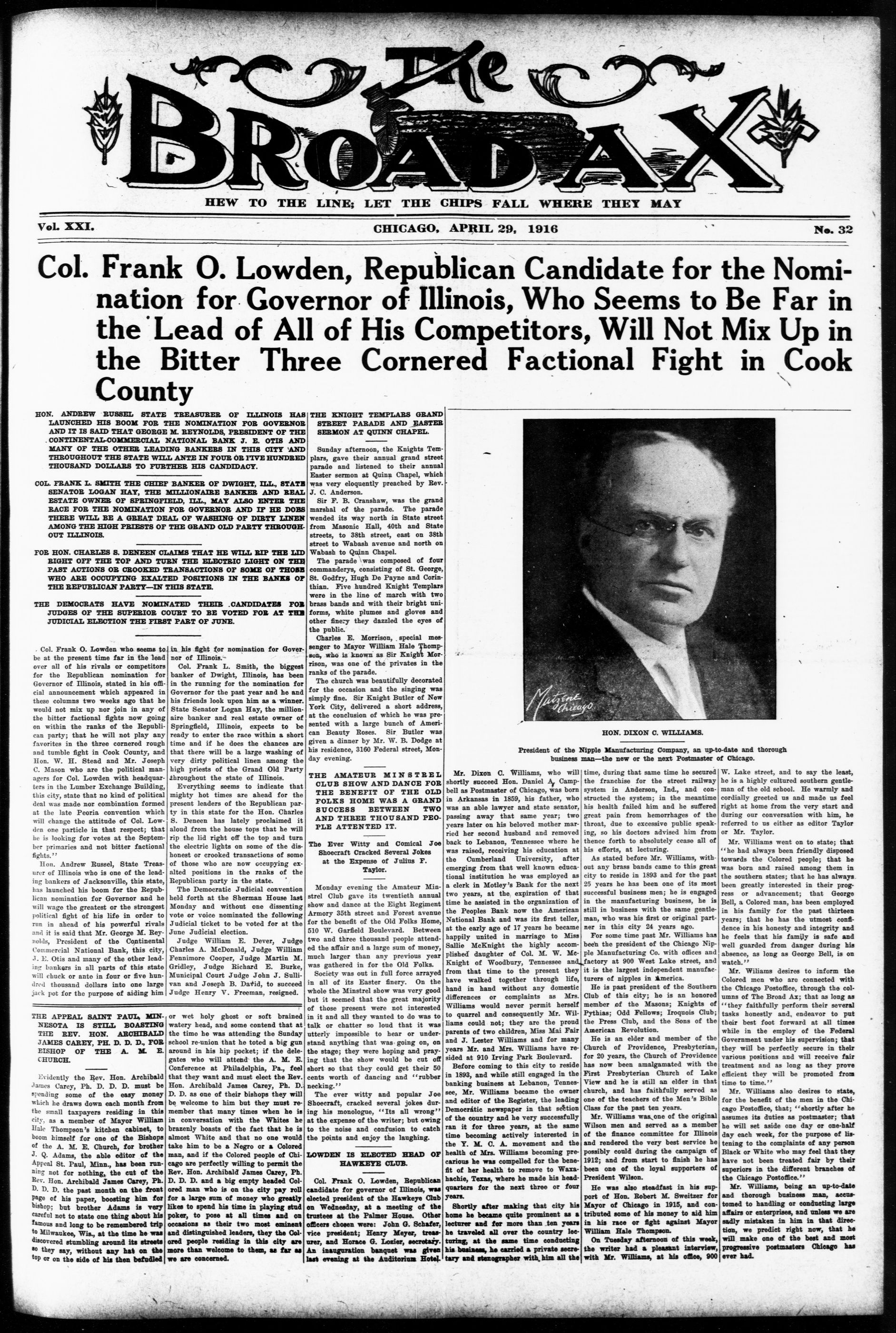
Col. Frank O. Lowden, Republican Candidate for the Nomination for Governor of Illinois, Who Seems to Be Far in the Lead of All of His Competitors, Will Not Mix Up in the Bitter Three Cornered Factional Fight in Cook County
HON. ANDREW BUSSEL STATE TREASURER OF ILLINOIS HAS LAUNCHED HIS BOOM FOR THE NOMINATION FOR GOVERNOR AND IT IS SAID THAT GEORGE M. REYNOLDS, PRESIDENT OF THE CONTINENTAL-COMMERCIAL NATIONAL BANK J. E. OTIS AND MANY OF THE OTHER LEADING BANKERS IN THIS CITY AND THROUGHOUT THE STATE WILL ANTE IN FOUR OR FIVE HUNDRED THOUSAND DOLLARS TO FURTHER HIS CANDIDACY.
COL. FRANK L. SMITH THE CHIEF BANKER OF DWIGHT, ILL., STATE SENATOR LOGAN HAY, THE MILLIONAIRE BANKER AND REAL ESTATE OWNER OF SPRINGFIELD, ILL., MAY ALSO ENTER THE RACE FOR THE NOMINATION FOR GOVERNOR AND IF HE DOES THERE WILL BE A GREAT DEAL OF WASHING OF DIRTY LINEN AMONG THE HIGH PRIESTS OF THE GRAND OLD PARTY THROUGHOUT ILLINOIS.
FORE HON. CHARLES S. DENEEN CLAIMS THAT HE WILL RIP THE LID RIGHT OFF THE TOP AND TUEN THE ELECTRIC LIGHT ON THE PAST ACTIONS OR CROOKED TRANSACTIONS OF SOME OF THOSE WHO ARE OCCUFYING EXALTED POSITIONS IN THE BANKS OF THE REPUBLICAN PARTY—IN THIS STATE.
THE DEMOCRATS HAVE NOMINATED THEIR CANDIDATES FOR JUDGES OF THE SUPERIOR COURT TO BE VOTED FOR AT THE JUDICIAL ELECTION THE FIRST PART OF JUNE.
Vol. XXI.
Col. Frank nation the L the L County
HON. ANDREW RUSSEL STATE LAUNCHED HIS BOOM FOR THE AND IT IS SAID THAT GEORGE CONTINENTAL-COMMERCIAL MANY OF THE OTHER LEAD THROUGHOUT THE STATE WILL THOUSAND DOLLARS TO FUR.
COL. FRANK L. SMITH THE CHIEF SENATOR LOGAN HAY, THE ESTATE OWNER OF SPRINGFIELD RACE FOR THE NOMINATION THERE WILL BE A GREAT DEBAMONG THE HIGH PRIESTS OF OUT ILLINOIS.
FOR HON. CHARLES S. DENEEN CURBIGHT OFF THE TOP AND TU PAST ACTIONS OR CROOKED THE WHO ARE OCCUPYING EXALT THE REPUBLICAN PARTY—IN
THE DEMOCRATS HAVE NOMINATED JUDGES OF THE SUPERIOR C JUDICIAL ELECTION THE FIRST
Col. Frank O. Lowden who seems to be at the present time far in the lead over all of his rivals or competitors for the Republican nomination for Governor of Illinois, stated in his official announcement which appeared in these columns two weeks ago that he would not mix up nor join in any of the bitter factional fights now going on within the ranks of the Republican party; that he will not play any favorites in the three cornered rough and tumble fight in Cook County, and Hon. W. H. Stead and Mr. Joseph C. Mason who are the political managers for Col. Lowden with headquarters in the Lumber Exchange Building, this city, state that no kind of political deal was made nor combination formed at the late Peoria convention which will change the attitude of Col. Lowden one particle in that respect; that he is looking for votes at the September primaries and not bitter factional fights."
Hon. Andrew Russel, State Treasurer of Illinois who is one of the leading bankers of Jacksonville, this state, has launched his boom for the Republican nomination for Governor and he will wage the greatest or the strongest political fight of his life in order to run in ahead of his powerful rivals and it is said that Mr. George M. Reynolds, President of the Continental Commercial National Bank, this city, J. E. Otis and many of the other leading bankers in all parts of this state will chuck or ante in four or five hundred thousand dollars into one large jack pot for the purpose of aiding him
THE APPEAL SAINT PAUL, MINESOTA IS STILL BOASTING THE REV. HON. ARCHIBALD JAMES CAREY, PH. D. D. D., FOR BISHOP OF THE A. M. E. CHURCH.
Evidently the Rev. Hon. Archibald James Carey, Ph. D. D. D. must be spending some of the easy money which he draws down each month from the small taxpayers residing in this city, as a member of Mayor William Hale Thompson's kitchen cabinet, to boom himself for one of the Bishops of the A. M. E. Church, for brother J. Q. Adams, the able editor of the Appeal St. Paul, Minn., has been running not for nothing, the cut of the Rev. Hon. Archibald James Carey, Ph. D. D. D. the past month on the front page of his paper, boosting him for bishop; but brother Adams is very careful not to state one thing about his famous and long to be remembered trip to Milwaukee, Win., at the time he was discovered stumbling around its streets so they say, without any hat on the top or on the side of his then befuddled
---
HEW TO THE LINE; LET THE CHIPS FALL WHERE THEY MAY
in his fight for nomination for Governor of Illinois.
Col. Frank L. Smith, the biggest banker of Dwight, Illinois, has been in the running for the nomination for Governor for the past year and he and his friends look upon him as a winner. State Senator Logan Hay, the millionaire banker and real estate owner of Springfield, Illinois, expects to be ready to enter the race within a short time and if he does the chances are that there will be a large washing of very dirty political linen among the high priests of the Grand Old Party throughout the state of Illinois.
Everything seems to indicate that mighty hot times are ahead for the present leaders of the Republican party in this state for the Hon. Charles S. Deneen has lately proclaimed it aloud from the house tops that he will rip the lid right off the top and turn the electric lights on some of the dishonest or crooked transactions of some of those who are now occupying exalted positions in the ranks of the Republican party in the state.
The Democratic Judicial convention held forth at the Sherman House last Monday and without one dissenting vote or voice nominated the following Judicial ticket to be voted for at the June Judicial election.
Judge William E. Dever, Judge Charles A. McDonald, Judge William Fennimore Cooper, Judge Martin M. Gridley, Judge Richard E. Burke, Municipal Court Judge John J. Sullivan and Joseph B. David, to succeed Judge Henry V. Freeman, resigned.
or wet holy ghost or soft brained watery head, and some contend that at the time he he was attending the Sunday school re-union that he toted a big gun around in his hip pocket; if the delegates who will attend the A. M. E. Conference at Philadelphia, Pa., feel that they want and must elect the Rev. Hon. Archibald James Carey, Ph. D. D. D. as one of their bishops they will be welcome to him but they must remember that many times when he is in conversation with the Whites he brazenly boasts of the fact that he is almost White and that no one would take him to be a Negro or a Colored man, and if the Colored people of Chicago are perfectly willing to permit the Rev. Hon. Archibald James Carey, Ph. D. D. D. and a big empty headed Colored man who is on the city pay roll for a large sum of money who greatly likes to spend his time in playing stud poker, to pose at all times and on occasions as their two most eminent and distinguished leaders, they the Colored people residing in this city are more than welcome to them, as far as we are concerned.
CHICAGO, APRIL 29, 1916
Sunday afternoon, the Knights Templars, gave their annual grand street parade and listened to their annual Easter sermon at Quinn Chapel, which was very eloquently preached by Rev. J. C. Anderson.
Sir F. B. Cranshaw, was the grand marshal of the parade. The parade wended its way north in State street from Masonic Hall, 40th and State streets, to 38th street, east on 38th street to Wabash avenue and north on Wabash to Quinn Chapel.
The parade was composed of four commanderys, consisting of St. George, St. Godfry, Hugh De Payne and Corinthian. Five hundred Knight Templars were in the line of march with two brass bands and with their bright uniforms, white plumes and gloves and other finery they dazzled the eyes of the public.
Charles E. Morrison, special messenger to Mayor William Hale Thompson, who is known as Sir Knight Morrison, was one of the privates in the ranks of the parade.
The church was beautifully decorated for the occasion and the singing was simply fine. Sir Knight Butler of New York City, delivered a short address, at the conclusion of which he was presented with a large bunch of American Beauty Roses. Sir Butler was given a dinner by Mr. W. B. Dodge at his residence, 3160 Federal street, Monday evening.
THE AMATEUR MINSTREL CLUB SHOW AND DANCE FOR THE BENEFIT OF THE OLD FOLKS HOME WAS A GRAND SUCCESS BETWEEN TWO AND THREE THOUSAND PEOPLE ATTENDED IT.
The Ever Witty and Comical Joe Shoecraft Cracked Several Jokes at the Expense of Julius F. Taylor.
Monday evening the Amateur Minstrel Club gave its twentieth annual show and dance at the Eight Regiment Armory 35th street and Forest avenue for the benefit of the Old Folks Home, 510 W. Garfield Boulevard. Between two and three thousand people attended the affair and a large sum of money, much larger than any previous year was gathered in for the Old Folks. Society was out in full force arrayed in all of its Easter finery. On the whole the Minstrel show was very good but it seemed that the great majority of those present were not interested in it and all they wanted to do was to talk or chatter so loud that it was utterly impossible to hear or understand anything that was going on, on the stage; they were hoping and praying that the show would be cut off short so that they could get their 50 cents worth of dancing and "rubber necking." The ever witty and popular Joe Shoecraft, cracked several jokes during his monologue, "Its all wrong" at the expense of the writer; but owing to the noise and confusion to catch the points and enjoy the laughing.
LOWDEN IS ELECTED HEAD OF
HAWKEYR CLUB.
Col. Frank O. Lowden, Republican candidate for governor of Illinois, was elected president of the Hawkeye Club on Wednesday, at a meeting of the trustees at the Palmer House. Other officers chosen were: John G. Schafer, vice president; Henry Meyer, treasurer, and Horace G. Loxier, secretary. An inauguration banquet was given last evening at the Auditorium Hotel.
Mutzen
Chicago
President of the Nipple Manufacturing Company, an up-to-date and thorough business man—the new or the next Postmaster of Chicago.
Mr. Dixon C. Williams, who will shortly succeed Hon. Daniel A. Campbell as Postmaster of Chicago, was born in Arkansas in 1859, his father, who was an able lawyer and state senator, passing away that same year; two years later on his beloved mother married her second husband and removed back to Lebanon, Tennessee where he was raised, receiving his education at the Cumberland University, after emerging from that well known educational institution he was employed as a clerk in Motley's Bank for the next two years, at the expiration of that time he assisted in the organization of the Peoples Bank now the American National Bank and was its first teller, at the early age of 17 years he became happily united in marriage to Miss Sallie McKnight the highly accomplished daughter of Col. M. W. McKnight of Woodbury, Tennessee and from that time to the present they have walked together through life, hand in hand without any domestic differences or complaints as Mrs. Williams would never permit herself to quarrel and consequently Mr. Williams could not; they are the proud parents of two children, Miss Mai Fair and J. Lester Williams and for many years Mr. and Mrs. Williams have resided at 910 Irving Park Boulevard.
Before coming to this city to reside in 1893, and while still engaged in the banking business at Lebanon, Tennessee, Mr. Williams became the owner and editor of the Register, the leading Democratic newspaper in that section of the country and he very successfully ran it for three years, at the same time becoming actively interested in the Y. M. C. A. movement and the health of Mrs. Williams becoming precarious he was compelled for the benefit of her health to remove to Waxahachie, Texas, where he made his headquarters for the next three or four years.
Shortly after making that city his home he became quite prominent as a lecturer and for more than ten years he traveled all over the country lecturing, at the same time conducting his business, he carried a private secretary and stenographer with him all the
HON. DIXON C. WILLIAMS
time, during that same time he secured the franchise for the street railway system in Anderson, Ind., and constructed the system; in the meantime his health failed him and he suffered great pain from hemorrhages of the throat, due to excessive public speaking, so his doctors advised him from thence forth to absolutely cease all of his efforts, at lecturing.
As stated before Mr. Williams, without any brass bands came to this great city to reside in 1893 and for the past 25 years he has been one of its most successful business men; he is engaged in the manufacturing business, he is still in business with the same gentleman, who was his first or original partner in this city 24 years ago.
For some time past Mr. Williams has been the president of the Chicago Nipple Manufacturing Co. with offices and factory at 900 West Lake street, and it is the largest independent manufacturers of nipples in America.
He is past president of the Southern Club of this city; he is an honored member of the Masons; Knights of Pythias; Odd Fellows; Iroquois Club; the Press Club, and the Sons of the American Revolution.
He is an elder and member of the Church of Providence, Presbyterian, for 20 years, the Church of Providence has now been amalgamated with the First Presbyterian Church of Lake View and he is still an elder in that church, and has faithfully served as one of the teachers of the Men's Bible Class for the past ten years.
Mr. Williams was one of the original Wilson men and served as a member of the finance committee for Illinois and rendered the very best service he possibly could during the campaign of 1912; and from start to finish he has been one of the loyal supporters of President Wilson.
He was also steadfast in his support of Hon. Robert M. Sweitzer for Mayor of Chicago in 1915, and contributed some of his money to aid him in his race or fight against Mayor William Hale Thompson.
On Tuesday afternoon of this week, the writer had a pleasant interview, with Mr. Williams, at his office, 900
No.32
W. Lake street, and to say the least, he is a highly cultured southern gentleman of the old school. He warmly and cordially greeted us and made us feel right at home from the very start and during our conversation with him, he referred to us either as editor Taylor or Mr. Taylor.
Mr. Williams went on to state; that "he had always been friendly disposed towards the Colored people; that he was born and raised among them in the southern states; that he has always been greatly interested in their progress or advancement; that George Bell, a Colored man, has been employed in his family for the past thirteen years; that he has the utmost confidence in his honesty and integrity and he feels that his family is safe and well guarded from danger during his absence, as long as George Bell, is on watch."
Mr. Williams desires to inform the Colored men who are connected with the Chicago Postoffice, through the columns of The Broad Ax; that as long as "they faithfully perform their several tasks honestly and, endeavor to put their best foot forward at all times while in the employ of the Federal Government under his supervision; that they will be perfectly secure in their various positions and will receive fair treatment and as long as they prove efficient they will be promoted from time to time." Mr. Williams also desires to state, for the benefit of the men in the Chicago Postoffice, that; "shortly after he assumes its duties as postmaster; that he will set aside one day or one-half day each week, for the purpose of listening to the complaints of any person Black or White who may feel that they have not been treated fair by their superiors in the different branches of the Chicago Postoffice."
Mr. Williams, being an up-to-date and thorough business man, accustomed to handling or conducting large affairs or enterprises, and unless we are sadly mistaken in him in that direction, we predict right now, that he will make one of the best and most progressive postmasters Chicago has ever had.
PAGE TWO
THE BROAD AX
PUBLISHED WEEKLY.
Will promulgate and at all times uphold the true principles of Democracy, but Custodite, Protestant, Priests, Inidida, Single Taxes, Republiana, or anyone else can have their way, as long as their language is proper and responsibility is fixed.
The Broad AX is a newspaper whose platform is broad enough for all, even claiming the editorial right to speak its own mind.
Local communications will receive attention. Write only on one side of the paper.
Subscriptions must be paid in advance. One Year. $3.00 Six Months. $1.00
Advertising rates made known on application.
Address all communications to
THE BROAD AX
6533 ST. LAWRENCE AVE., CHICAGO, ILL.
PHONE WENTWORTH 2597.
JULIUS F. TAYLOR, Editor and Publisher
Entered as Second-Class Matter Aug. 18
1983, at the Post Office at Chicago, Illinois
under Act of March 8, 1879.
AUTHORIZED AGENTS AND CORRESPONDENTS FOR THE BROAD AX.
L. W. Washington, 5465 Kimbark avenue.
B. W. Fitts, 3315 S. State street. Phone Douglas 4049.
The Broad Ax can be found on sale at the last named place and news items and advertisements left there will find their way into these columns.
The Flag of Denmark.
In the year 1219 King Waldemar of Denmark, when leading his troops to battle against the Livonians, saw, or thought he saw, a bright light in the form of a cross in the sky. He held this appearance to be a promise of divine aid and pressed forward to victory. From this time he had the cross placed on the flag of his country and called it the Dannebrog—that is, the strength of Denmark. Aside from legend, there is no doubt that this flag with the cross was adopted by Denmark in the thirteenth century and that at about the same date an order, known as the order of Dannebrog, was instituted, to which only soldiers and sailors who were distinguished for courage were allowed to belong. The flag of Denmark, a plain red banner bearing on it a white cross, is the oldest flag now in existence. For 300 years both Norway and Sweden were united with Denmark under this flag.
The Gegenschein.
The Gegenschein is the name given to one of the most inexplicable objects known to astronomers. It is visible in the night sky under favorable conditions, is rounded in outline and is situated always exactly opposite the place of the sun. It has been termed by one eminent astronomer "a sort of comet or meteoric satellite" attending the earth. He supposes it to be composed of a cloud of meteors situated about a million miles from the earth and revolving around it it in a period of just one year, so that the sun and the meteors are always on opposite sides of the earth. It is estimated that the size of this ghostly satellite may be nearly the same as that of the planet Jupiter-1. e., about 86,000 miles in diameter.
A Modern Venus.
If a girl could have the neat ankles of the hosiery ads., and the trim waist of the corset ads., and the hair of the grower ads., and the teeth of the tooth-powder ads., and the complexion of the cold cream ads., wouldn't she be a wonder?
What would she do for a heart?
She wouldn't need a heart or a brain. We could give her the emotions of the heroines in the best seller ads.— Life.
Considerate.
Mrs. Brindle—Now, Mary, I want you to be extremely careful. This is some very old table linen—been in the family for over 200 years and— Mary—Ah, sure, m'am, you needn't worry. I won't tell a soul about it, and it looks as good as new, anyway. — Chicago News.
Making Friends.
Blessed are they who have the gift of making friends, for it is one of God's best gifts. It involves many things, but, above all, the power of going out of one's self and seeing and preciating whatever is noble and loving in another—Thomas Hughes.
Rubbing the Eyes.
The Italian child is never allowed. rub its eyes. If it bursts into tears it is not repressed, but allowed to have the cry out. This, it is claimed, affirms the eyes and makes them clean while rubbing the eyes injures them in many ways.
More Urgent.
"Daughter, don't you want to im prove your mind?"
"Of course, ma, but I'm busy witi my complexion now." - Kansas City Journal.
Crab Locomotives.
The queerest locomotives, are the types used in mining and called "crabs." Gliding into the black galleries of coal mines and halting at a crevice in the wall from which issues the distant ring of pick and shovel, the crab lets out a flexible tentacle (a steel cable) for perhaps 200 or 300 feet, drawing it back presently with a car of coal in tow. Feeling into the holes, first on one side, then on the other, it moves along and never fails to secure its prey. Finally, with a dozen or more cars in its wake, it proceeds to the shaft or outlet and delivers its booty to the crusher.
These crabs operate by trolley conductors. They run through the main passages of the mine. Each crab is furnished with an electrically operated drum, on which are carried 200 or 300 feet of steel cable. This is hauled into the side passages or drifts by a man, who couples the end to a loaded car, then gives a signal, and the crab does the rest.-George Frederick Stratton in St. Nicholas.
Eccentric Paving.
It is related to when Maximilian Emanuel succeeded to the throne of Bavaria he celebrated the event by causing one of the roads leading to his palace to be paved with plates of burnished copper. This, gleaming in the sunshine, gave all the effect of the more precious metal—gold.
We are told also that Louis XIV. paved one of the courts at Versailles with squares of silver, each of which had recorded upon it some triumph of the French arms. In the center of the court stood a large tablet of gold in representation of the luxurious monarch's favorite emblem—the sun. Memoirs of the time of Louis make mention of a lodge erected to the love of his youth, the fair Louise de la Valliere. The approach was paved with mirrors, wherein was painted an allegory setting forth the undying devotion of the king to Louise.
A Test of Youth-
You often see a woman at the market pinching the end of a chicken's breastbone to find out how tender—in other words, how young—the fowl is. Oddly enough, the same test with human beings is one of the most reliable known. If in advanced life the lower end of your breastbone feels elastic when pushed inward, you may assume that no important changes have yet taken place in your arteries or otherwise in your anatomical makeup. The human breastbone is shaped like an ancient Roman sword, and the upper part of it is like the sword handle. Its point is a piece of cartilage, which anatomists call the "xiphoid" cartilage. The early hardening and stiffening of it indicate that the changes that accompany old age have prematurely begun. Youth's Companion.
Insect Sites on Its Eggs.
Family matters in the case of insects usually mean only the depositing of eggs in suitable situations for the independent development of the offspring, the parent insects often dying before the young appear. The earwig, however, provides a remarkable exception to the general rule, for it sits upon its fifty or more eggs until they are hatched, just as a bird would do, and, moreover, if the eggs get scattered it carefully collects them together again. In the early months of the year, when digging the soil, female earwigs may frequently be found together with their batch of eggs. At the slightest sign of danger the young ones huddle close to their mother, hiding beneath her body so far as it will cover so large a family.—Strand Magazine.
Insect Wonders.
Nothing can exceed the perfection of the minutest parts of the insect organization in general. The finest strand in a spider's web, which can scarcely be seen, is said to be composed of no less than 4,000 threads. On a single wing of a butterfly have been found 100,000 scales and on that of a silkworm moth 400,000, each of these minutes scales being a marvel of beauty and completeness in itself. So thin are the wings of many insects that 50,000 placed over each other would only be a quarter of an inch thick, and yet, thin as they are, each is double.
Elephants In Uganda
"Elephants in Uganda have a peculiar aspect that I have not noticed elsewhere," writes a traveler. "They cover their bodies, as a protection against files, with the bright red volcanic dust contained in the soil. This gives them a remarkable appearance, as instead of being a slaty gray, as in the Nile valley, their color when thus covered with dust resembles that of a chestnut horse."
His Birthday Present.
Fair Customer—I want a birthday present for my husband. Dealer—Yes, mum. How would this old clock suit you? Fair Customer—Let me see. I've got a corner in my boudoir that will just do for it! And I've been wanting an old clock for a long time. Yes, that will do!
Unhappiness.
They who have never known prosperity can hardly be said to be unhappy. It is from the remembrance of joys we have lost that the arrows of affliction are pointed.—Emile Zola.
Not jealous.
Mrs. Jawback—John, I do believe you are jealous of my first husband. Mr. Jawback—Well, no; I don't believe I'd call it jealousy. Envy is the word.
The only wealth which will not decay is knowledge—Langford.
THE BROAD AX. CHICAGO. APRIL 29. 1916.
A NEAT ENSEMBLE.
The Small Things That Score For the Well Dressed Woman.
There was a time when it was far more difficult to look smartly dressed than it is today. That was the time when we wore separate belts, when there was dress braid on our skirts, when we wore separate neckwear. We had to be careful that the braid on our skirts didn't become ripped, to hang in loops of untidiness. We had to see to it that the belt of our skirt didn't sag. We had to see to it that the leather belt we wore exactly coincided with the skirt belt. We had to see to it that the ribbon or muslin collar we wore exactly made connections with the blouse beneath it. Yes, those were indeed difficult days.
Today neatness counts as much as ever, but there are not so many pitfalls for the woman who would be neat.
Neatness of footgear counts more than ever before. The shoes must be spotless, well polished and in good repair. Heels that slant are an outrage on good dressing; moreover, they are decidedly unhealthful.
It goes without saying that the hair must be neat. A hair net sometimes produces a stiff effect, but that is better than a sloppy one. So choose the hair net in windy weather, and learn to adjust it becomingly. This year, when our milliners tell us to wear our hats straight on the head, neither tipped to left or right, neat hair is more than ever essential.
Immaculate gloves count for much in producing a smart appearance. Soiled gloves, ripped gloves or worn gloves are a disgrace. Nowadays, when washable gloves can be bought at almost any price, it is possible for everybody to have clear gloves. The cotton ones, if clean, always look well—infinitely better than soiled kid ones. And a stitch now and then will keep gloves always well rendered.
Then there is the handbag. In this case the more you pay the better, for an expensive handbag outwears two cheaper ones and looks better the last day it is caried than the cheap one does after the first few weeks.
There are little details, like the handkerchief, which should always be sheer and snow white, that count quite as much as son of the bigger things in giving the impression of smartness, which the modern woman aims to attain.
AN EASTER NOVELTY.
A Jaunty Big to Hold Your Mirror and Puff.
White kid plaited into a circle, each plait being overlapped with strips of black patent leather, is the secret of
A HAPPY SPHERE.
this smart wrist bag. The inside is lined with king's blue tussore silk and fitted with mirror, puff and purse.
HALE WORN COSTUMES.
How to Freshen Up Your Old Gown So It Looks Actually Frenchy. Fashions change so rapidly that women of limited means are often sore tried in their attempts to keep up with these periodic and quick movements. A Frenchwoman, whose husband was among the first to respond to his country's call, saw her opportunity and seized it. She made the fact known that she was clever at adapting clothing and that she was ready to exercise her skill on reasonable terms. Plain materials are easily added to, the introduction of contrast is often permissible, and the present vogue for trimming has greatly facilitated her enterprise. The tunic was one of her best resources when she first started her business. Now she finds that the contrast hip yoke and the panel serve her very well.
Frequently sale bargains come in admirably for her purpose, and she is always ready not only to assist in adapting, but to give her aid in choosing from the big stocks of rich and beautiful material which are shown. A serge gown done up recently had the last season's bodice remodeled into a bolero arranged over an undervest made of a piece of rich silk picked up at a sale and sold off because this winter's patterns will not be brought out again for another season.
Mint Sauce
The best way to make mint sauce is with a boiled sugar sirup. Add the chopped mint to this when it is hot and let stand until cold. Serve cold. Make the sirup of sugar with enough white vinegar added to make a sirup of the right consistency when boiled for about four minutes.
The Cyclosoma negrofasciatus will fight with the savage tenacity of a bulldog and will leap high out of the water in pursuit of a tantalizing finger.
The walking perch from India will climb out of the aquarium and take a stroll around the floor looking for another pool unless you put a wire over the top of his home.
The shishigashira has a round fat kewpie body topped by a chubby cheeked cherub head, with the tiny eyes, small mouth and nose of a human being. Its coloring is marvelous, and it is considered sacred in Japan.
The angel fish is wider than it is long and has a chameleon-like quality of changing its color at will.
The Indian gouramis has arms with which it feels its way about or inspects anything new in the aquarium.
There are talless fish and scaleless fish and fish without fins, blue fish pink fish, lavender fish and particolored red, white and blue fish, but they are all goldfish, especially as to price —Philadelphia North American.
Abusing a True Friend.
Aubusing a True Friend
The truest and most devoted friend that man ever had is the little manatee bundle of nerves that stands guard by his bedside through the dead hours of the night, its palpitating little heart spreading cheer and confidence over the surrounding gloom. Yet man often forgets the debt of gratitude he owes this faithful and tireless little friend for the sleepless, watchful hours it subjects itself to in order that he may slumber in security and comfort, and when it sings its merry morning lay I have seen him, instead of bestowing fond caresses, reach from his warm quilts, grasp it ruthlessly and slam it into the farther and darkest corner of the room, crushing the dainty hands that seemed uplifted in an attitude of horror and protection, scornfully muttering such uncouth and unworthy reproach as "Hang that blink-ety-blank alarm clock, anyhow!" then return to his snoring!—Zim in Cartoons Magazine.
Stevenson's Brownies.
Stevenson maintained that much of his work was only partially original. His collaborators were the brownies who ran riot through his brain during the hours of sleep. He instances the case of "Dr. Jekyll and Mr. Hyde," "I had long been trying to write a story on this subject," he writes, "to find a body, a vehicle for that strong sense of man's double being which must at times come in upon and overwhelm the mind of every thinking creature. For two days I went about racking my brains for a plot of any sort, and on the second night I dreamed the scene at the window and a scene afterward split in two, in which Hyde, pursued for some crime, took the powder and underwent the change in the presence of his pursuers. All the rest was made awake and consciously, although I think I can trace in much of it the manner of my brownies."
Lordly, Disraeli.
Disraeli once told a woman that two possessions which were indispensable to other people he had always done without. "I made," she said, "every kind of conjecture, but without success, and on my asking him to enlighten me he solemnly answered that they were a watch and an umbrella. 'But how do you manage,' I asked, if there happens to be no clock in the room and you want to know the time?' 'I ring for a servant,' was the magniloquent reply. 'Well,' I continued, 'and what about the umbrella? What do you do, for instance, if you are in the park and are caught in a sudden shower?' 'I take refuge,' he replied, with a smile of excessive gallantry, 'under the umbrella of the first pretty woman I meet.'
A Warning.
"Watch out how you holler fer de worl' ter look up at you when you gits ter de mountain top," said Brother Williams. "Of all time dat's de one time ter lay low, fer de worl' will find you when it gits good an' ready. An' dis other thing is what you got to consider: De minute you hollers old man Trouble locates you an' sets his traps ter trip you an' send you rollin' down ter de bottom, whar you come from!" -Atlanta Constitution.
Flower of the Air.
There is a plant in Chile and a similar one in Japan called the "flower of the air." It is so called because it appears to have no root and is never fixed to the earth. It twins around a dry tree or sterile rock. Each shoot produces two or three flowers like a lily—white, transparent and odoriferous. It is capable of being transported 600 to 700 miles and vegetates as it travels suspended on a twig.
Perfect Machinery.
"Their household seems a perfect piece of machinery."
"Yes; the wife's the governor, the children safety valves and the husband a crank."—Philadelphia Bulletin.
His Views.
"Dear me, I forgot to send her an invitation to our wedding!"
"I imagine it won't make much difference. We won't miss one pickle fork."-Kansas City Journal.
Astronomy.
Astronomy is one of the most exact of the sciences. The powerful telescopes, the spectroscope and other almost perfect instruments come pretty near telling the truth.
Elephants' Toes
The African elephant has two toes on its rear feet and three on its front feet, the Indian elephant has three on its rear feet and four on its front feet.
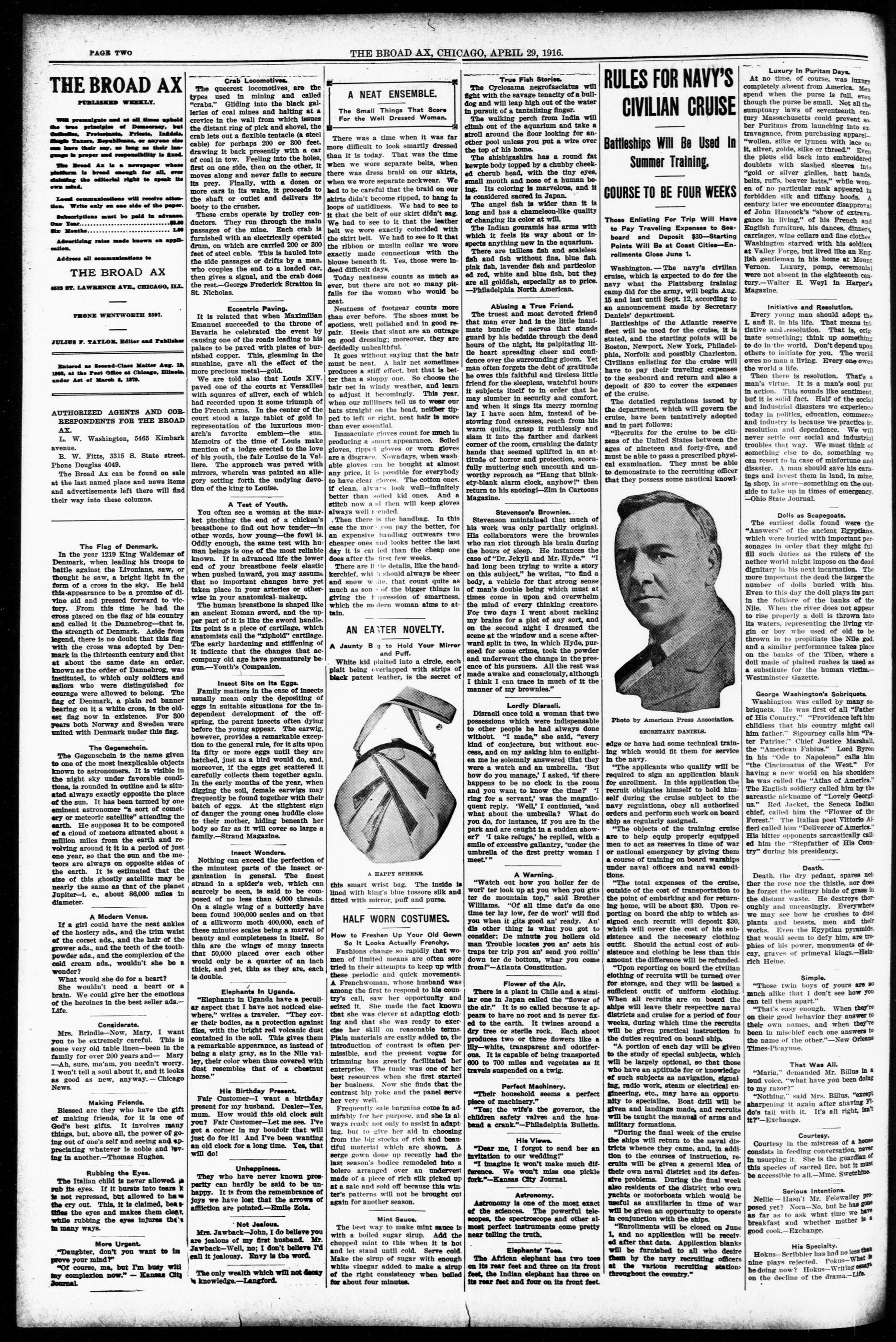
RULES FOR NAVY'S CIVILIAN CRUISE
Battleships Will Be Used In Summer Training.
COURSE TO BE FOUR WEEKS
Those Enlisting For Trip Will Have to Pay Traveling Expenses to Seaboard and Deposit $30—Starting Points Will Be at Coast Cities—Enrollments Close June 1.
Washington. — The navy's civilian cruise, which is expected to do for the navy what the Plattsburg training camp did for the army, will begin Aug. 15 and last until Sept. 12, according to an announcement made by Secretary Daniels' department.
Battleships of the Atlantic reserve fleet will be used for the cruise, it is stated, and the starting points will be Boston, Newport, New York, Philadelphia, Norfolk and possibly Charleston. Civilians enlisting for the cruise will have to pay their traveling expenses to the seaboard and return and also a deposit of $30 to cover the expenses of the cruise.
The detailed regulations issued by the department, which will govern the cruise, have been tentatively adopted and in part follows:
"Recruits for the cruise to be citizens of the United States between the ages of nineteen and forty-five, and must be able to pass a prescribed physical examination. They must be able to demonstrate to the recruiting officer that they possess some nautical knowl-
[Picture of a man with a suit and tie].
Photo by American Press Association.
SECRETARY DANIELS.
edge or have had some technical training which would fit them for service in the navy.
"The applicants who qualify will be required to sign an application blank for enrollment. In this application the recruit obligates himself to hold himself during the cruise subject to the navy regulations, obey all authorized orders and perform such work on board ship as regularly assigned.
"The objects of the training cruise are to help equip properly equipped men to act as reserves in time of war or national emergency by giving them a course of training on board warships under naval officers and naval conditions.
"The total expenses of the cruise, outside of the cost of transportation to the point of embarking and for returning home, will be about $30. Upon reporting on board the ship to which assigned each recruit will deposit $30, which will cover the cost of his subsistence and the necessary clothing outfit. Should the actual cost of subsistence and clothing be less than this amount the difference will be refunded.
"Upon reporting on board the civilian clothing of recruits will be turned over for storage, and they will be issued a sufficient outfit of uniform clothing. When all recruits are on board the ships will leave their respective naval districts and cruise for a period of four weeks, during which time the recruits will be given practical instruction in the duties required on board ship.
"A portion of each day will be given to the study of special subjects, which will be largely optional, so that those who have an aptitude for or knowledge of such subjects as navigation, signaling, radio work, steam or electrical engineering, etc., may have an opportunity to specialize. Boat drill will be given and landings made, and recruits will be taught the manual of arms and military formations.
"During the final week of the cruise the ships will return to the naval districts whence they came, and, in addition to the courses of instruction, recruits will be given a general idea of their own naval district and its defensive problems. During the final week also residents of the district who own yachts or motorboats which would be useful as auxiliaries in time of war will be given an opportunity to operate in conjunction with the ships.
"Enrollments will be closed on June 1, and no application will be received after that date. Application blanks will be furnished to all who desire them by the navy recruiting officers at the various recruiting stations throughout the country."
At no time, of course, was luxury completely absent from America. Men spend when the purse is full, even though the purse be small. Not all the sumptuary laws of seventeenth century Massachusetts could prevent so Puritans from launching into extravagance, from purchasing apparel—"wollen, silke or lynnen with lace on it, silver, goldle, silke or threed." Even the plous slid back into embroidered doublets with slashed sleeves into "gold or silver girdles, hatt bands, belts, ruffs, beaver hatts," while women of no particular rank appeared in forbidden silk and tiffany hoods. A century later we encounter disapproval of John Hancock's "show of extravagance in living," of his French and English furniture, his dances, dinners, carriages, wine cellars and fine clothes. Washington starved with his soldiers at Valley Forge, but lived like an English gentleman in his home at Mount Vernon. Luxury, pomp, ceremonial were not absent in the eighteenth century.—Walter E. Weyl in Harper's Magazine.
Initiative and Resolution.
Every young man should adopt the L and R in his life. That means initiative and resolution. That is, originate something; think up something to do in the world. Don't depend upon others to initiate for you. The world owes no man a living. Every one owes the world a life.
Then there is resolution. That's a man's virtue. It is a man's soul put in action. This sounds like sentiment, but it is solid fact. Half of the social and industrial disasters we experience today in politics, education, commerce and industry is because we practice resolution and dependence. We will never settle our social and industrial troubles that way. We must think of something else to do, something we can resort to in case of misfortune and disaster. A man should save his earnings and invest them in land, in mine in shop, in store—something on the outside to take up in times of emergency—Ohio State Journal.
Dolls as Scapegoats.
The earliest dolls found were the "Answers" of the ancient Egyptians, which were buried with important personages in order that they might fulfill such duties as the rulers of the nether world might impose on the dead dignitary in his next incarnation. The more important the dead the larger the number of dolls buried with him. Even to this day the doll plays its part in the folklore of the banks of the Nile. When the river does not appear to rise properly a doll is thrown into its waters, representing the living virgin or boy who used of old to be thrown in to propitiate the Nile god, and a similar performance takes place on the banks of the Tiber, where a doll made of plaited rushes is used as a substitute for the human victim—Westminster Gazette.
George Washington's Sobriqueta
Washington was called by many sobriquets. He was first of all "Father of His Country." "Providence left him childless that his country might call him father." Sigourney calls him "Father Patriae:" Chief Justice Marshall, the "American Fabius." Lord Byron in his "Ode to Napoleon" calls him "the Cincinnatus of the West." For having a new world on his shoulders he was called the "Atlas of America." The English soldiery called him by the sarcastic nickname of "Lovely Georgius." Red Jacket, the Seneca Indian chief, called him the "Flower of the Forest." The Italian poet Vittorio Alfieri called him "Deliverer of America." His bitter opponents sarcastically called him the "Stepfather of His Country" during his presidency.
Death.
Death, the dry pedant, spares nek ther the rose nor the thistle, nor does he forget the solitary blade of grass in the distant waste. He destroys thoroughly and unceasingly. Everywhere we may see how he crushes to dust plants and beasts, men and their works. Even the Egyptian pyramids, that would seem to defy him, are trophies of his power, monuments of decay, graves of primeval kings.—Heinrich Heine.
Simple.
"Those twin boys of yours are so much alike that I don't see how you can tell them apart."
"That's easy enough. When they're on their good behavior they answer to their own names, and when they've been in mischief each one answers to the name of the other."—New Orleans Times-Picayune.
That Was All.
"Maria," demanded Mr. Billus in a loud voice, "what have you been doing to my razor?"
"Nothing," said Mrs. Billus, "except sharpening it again after shaving Fido's tail with it. It's all right, isn't it?"—Exchange
Courtesy.
Courtesy in the mistress of a house consists in feeding conversation, never in usurping it. She is the guardian of this species of sacred fire, but it must be accessible to all—Mme. Swetline.
Serious Intentions
Nellie — Hasn't Mr. Fleewaller proposed yet? Nora—No, but he has gone as far as to ask what time we have breakfast and whether mother is a good cook—Exchange.
His Specialty:
This Opus:
Hokus—Scribbler has had no less than nine plays rejected. Pokus—What is he doing now? Hokus—Writing essays on the decline of the drama.—Life.
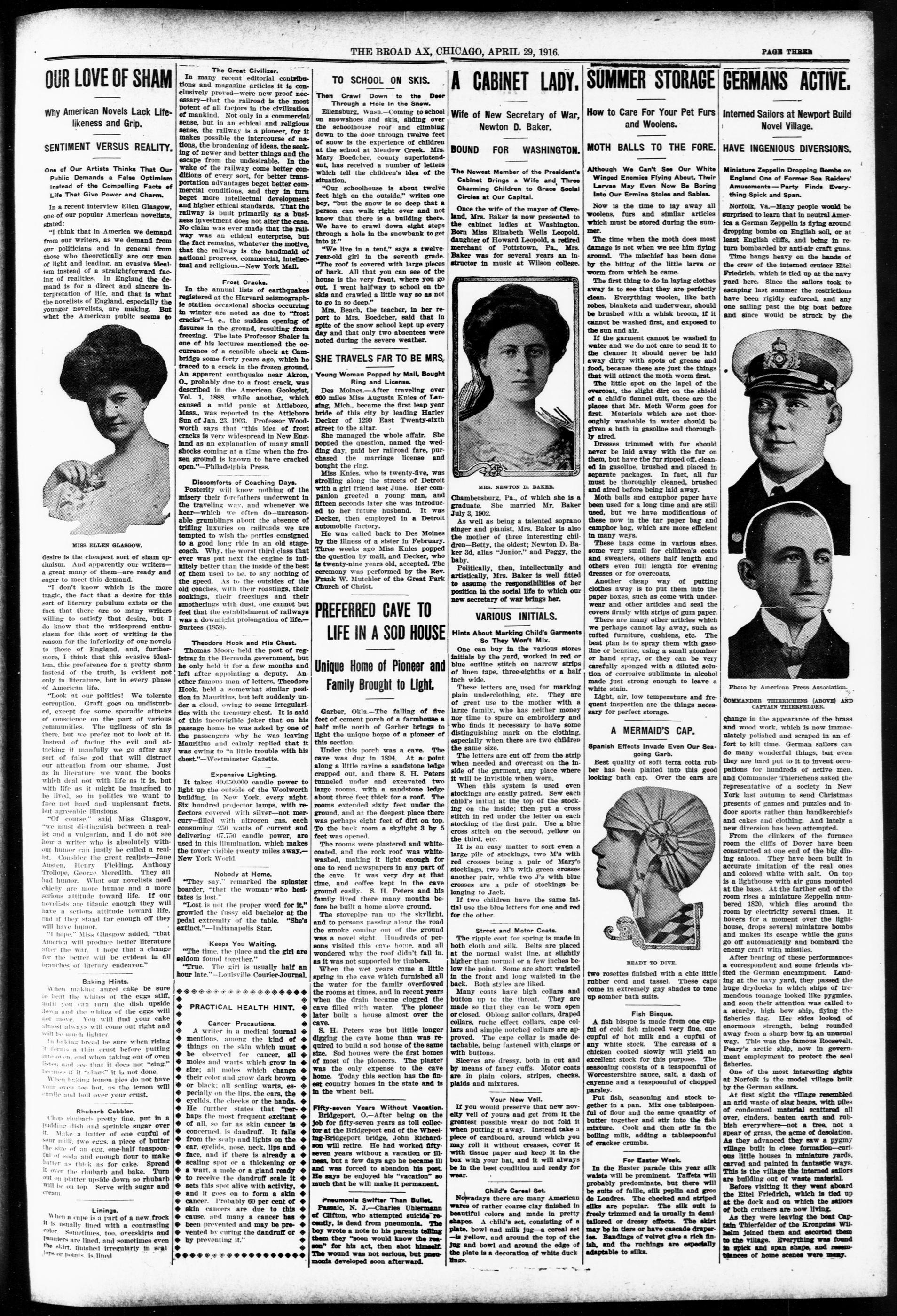
OUR LOVE OF SHAM
Why American Novels Lack Life-
likeness and Grip.
SENTIMENT VERSUS REALITY.
One of Our Artists Thinks That Our
Public Demands a False Optimism
Instead of the Compelling Facts of
Life That Give Power and Charm.
In a recent interview Ellen Glasgow,
one of our popular American novelists,
stated:
"I think that in America we demand from our writers, as we demand from our politicians and in general from those who theoretically are our men or light and leading, an evasive idealism instead of a straightforward facing of realities. In England the demand is for a direct and sincere interpretation of life, and that is what the novelists of England, especially the younger novelists, are making. But what the American public seems to
A. E.
MISS ELLEN GLASGOW.
desire is the cheapest sort of sham optimism. And apparently our writers—a great many of them—are ready and eager to meet this demand.
"I don't know which is the more tragic, the fact that a desire for this sort of literary pabulum exists or the fact that there are so many writers willing to satisfy that desire, but I do know that the widespread enthusiasm for this sort of writing is the reason for the inferiority of our novels to those of England, and, furthermore, I think that this evasive idealism, this preference for a pretty sham instead of the truth, is evident not only in literature, but in every phase of American life.
"Look at our politics! We tolerate corruption. Graft goes on undisturbed, except for some sporadic attacks of conscience on the part of various communities. The ugliness of sin is there, but we prefer not to look at it. Instead of facing the evil and attacking it manfully we go after any sort of false god that will distract our attention from our shame. Just as in literature we want the books which deal not with life as it is, but with life as it might be imagined to be lived, so in politics we want to face not hard and unpleasant facts, but agreeable illusions.
"Of course," said Miss Glasgow, "we must distinguish between a realist and a vulgarian, and I do not see how a writer who is absolutely without humor can justly be called a realist. Consider the great realists—Jane Austen, Henry Fielding, Anthony Trollope, George Meredith. They all had humor. What our novelists need chiefly are more humor and a more serious attitude toward life. If our novelists are titanic enough they will have a serious attitude toward life, and if they stand far enough off they will have humor.
"I hope," Miss Glasgow added, "that America will produce better literature after the war. I hope that a change for the better will be evident in all branches of literary endeavor."
Baking Hints
When making angel cake be sure to beat the whites of the eggs stiff, until you can turn the dish upside down and the whites of the eggs will not move. You will find your cake almost always will come out right and will be much lighter.
In baking bread be sure when rising it forms a thin crust before putting into oven, and when taking out of oven listen and see that it does not "sing," because if it "sings" it is not done.
When baking lemon pies do not have your oven too hot, as the lemon will crumble and boil over your crust.
Rhubarb Cobbler.
Chop rhubarb pretty fine, put in a
pudding dish and sprinkle sugar over it.
Make a batter of one cupful of
sour milk, two eggs, a piece of butter
the size of an egg, one-half teaspoon-
ful of soda and enough flour to make
batter as thick as for cake. Spread
it over the rhubarb and bake. Turn
out on platter upside down so rhubarb
will be on top. Serve with sugar and
cream.
Linings.
When a cape is a part of a new frock it is usually lined with a contrasting color. Sometimes, too, overskirts and panniers are lined, and sometimes even the skirt, finished irregularly in scallops or points, is lined.
The Great Civilizer.
In many recent editorial contributions and magazine articles it is conclusively proved—were new proof necessary—that the railroad is the most potent of all factors in the civilization of mankind. Not only in a commercial sense, but in an ethical and religious sense, the railway is a pioneer, for it makes possible the intercourse of nations, the broadening of ideas, the seeking of newer and better things and the escape from the undesirable. In the wake of the railway come better conditions of every sort, for better transportation advantages beget better commercial conditions, and they in turn beget more intellectual development and higher ethical standards. That the railway is built primarily as a business investment does not alter the case. No claim was ever made that the railway was an ethical enterprise, but the fact remains, whatever the motive, that the railway is the handmaid of national progress, commercial, intellectual and religious.—New York Mall.
Frost Cracks.
In the annual lists of earthquakes registered at the Harvard seismographic station occasional shocks occurring in winter are noted as due to "frost cracks".-I. e., the sudden opening of fissures in the ground, resulting from freezing. The late Professor Shaler in one of his lectures mentioned the occurrence of a sensible shock at Cambridge some forty years ago, which he traced to a crack in the frozen ground. An apparent earthquake near Akron, O., probably due to a frost crack, was described in the American Geologist, Vol. 1, 1888. while another, which caused a mild panic at Attleboro, Mass., was reported in the Attleboro Sun of Jan. 23, 1903. Professor Woodworth says that "this idea of frost cracks is very widespread in New England as an explanation of many small shocks coming at a time when the frozen ground is known to have cracked open."-Philadelphia Press.
Discomforts of Coaching Days
Discomforts or Coaching Days.
Priority will know nothing of the misery their forefathers underwent in the traveling way, and whenever we hear—which we often do—unreasonable grumblings about the absence of trifling luxuries on railroads we are tempted to wish the parties consigned to a good long ride in an old stage-coach. Why, the worst third class that ever was put next the engine is infinitely better than the inside of the best of them used to be, to say nothing of the speed. As to the outsides of the old coaches, with their roastings, their soakings, their freezings and their smotherings with dust, one cannot but feel that the establishment of railways was a downright prolongation of life.—Surtees (1858).
Theodore Hook and His Chest
Thomas Moore held the post of registrar in the Bermuda government, but he only held it for a few months and left after appointing a deputy. Another famous man of letters, Theodore Hook, held a somewhat similar position in Mauritius, but left suddenly under a cloud, owing to some irregularities with the treasury chest. It is said of this incorrigible joker that on his passage home he was asked by one of the passengers why he was leaving Mauritius and calmly replied that it was owing to "a little trouble with his chest."—Westminster Gazette.
Expensive Lighting
It takes 40,650,000 candle power to light up the outside of the Woolworth building, in New York, every night. Six hundred projector lamps, with reflectors covered with silver—not mercury—filled with nitrogen gas, each consuming 250 watts of current and delivering 67,750 candle power, are used in this illumination, which makes the tower visible twenty miles away.—New York World.
Nobody at Home.
"They say," remarked the spinster boarder, "that the woman who hesitates is lost."
"Lost is not the proper word for it," growled the fussy old bachelor at the pedal extremity of the table. "She's extinct."—Indianapolis Star.
Keeps You Waiting.
"The time, the place and the girl are seldom found together."
"True. The girl is usually half an hour late."-Louisville Courier-Journal.
PRACTICAL HEALTH HINT.
Cancer Precautions.
A writer in a medical journal mentions, among the kind of things on the skin which must be observed for cancer, all moles and warts which grow in size; all moles which change their color and grow dark brown or black; all scaling warts, especially on the lips, the ears, the eyelids, the cheeks or the hands. He further states that "perhaps the most frequent excitant of all, so far as skin cancer is concerned, is dandruff. It falls from the scalp and lights on the ear, eyelids, nose, neck, lips and face, and if there is already a scaling spot or a thickening or a wart, a mole or a gland ready to receive the dandruff scale it sets this spot alive with activity, and it goes on to form a skin cancer. Probably 60 per cent of skin cancers are due to this cause, and many a cancer has been prevented and may be prevented by curing the dandruff or by preventing it."
---
THE BROAD AX, CHICAGO, APRIL 29, 1916.
TO SCHOOL ON SKIS.
Then Crawl Down to the Deer Through a Hole In the Snow.
Ellensburg, Wash.—Coming to school on snowshoes and skis, sliding over the schoolhouse roof and climbing down to the door through twelve feet of snow is the experience of children at the school at Meadow Creek. Mrs. Mary Boedcher, county superintendent, has received a number of letters which tell the children's idea of the situation.
"Our schoolhouse is about twelve feet high on the outside," writes one boy, "but the snow is so deep that a person can walk right over and not know that there is a building there. We have to crawl down eight steps through a hole in the snowbank to get into it."
"We live in a tent," says a twelve-year-old girl in the seventh grade. "The roof is covered with large pieces of bark. All that you can see of the house is the very front, where you go out. I went halfway to school on the skis and crawled a little way so as not to go in so deep." Mrs. Beach, the teacher, in her report to Mrs. Boedcher, said that in spite of the snow school kept up every day and that only two absentees were noted during the severe weather.
SHE TRAVELS FAR TO BE MRS
Young Woman Popped by Mail, Bought Ring and License.
Des Molines.—After traveling over 600 miles Miss Augusta Knies of Lansing, Mich., became the first leap year bride of this city by leading Harley Decker of 1290 East Twenty-sixth street to the altar.
She managed the whole affair. She popped the question, named the wedding day, paid her railroad fare, purchased the marriage license and bought the ring.
Miss Knies, who is twenty-five, was strolling along the streets of Detroit with a girl friend last June. Her companion greeted a young man, and fifteen seconds later she was introduced to her future husband. It was Decker, then employed in a Detroit automobile factory.
He was called back to Des Molines by the illness of a sister in February. Three weeks ago Miss Knies popped the question by mail, and Decker, who is twenty-nine years old, accepted. The ceremony was performed by the Rev. Frank W. Mutchler of the Great Park Church of Christ.
PREFERRED CAVE TO LIFE IN A SOD HOUSE Unique Home of Pioneer and Family Brought to Light.
Garber, Okla.-The falling of five feet of cement porch of a farmhouse a half mile north of Garber brings to light the unique home of a pioneer of this section.
Under this porch was a cave. The cave was dug in 1894. At a point along a little ravine a sandstone ledge cropped out, and there S. H. Peters tunneled under and excavated two large rooms, with a sandstone ledge about three feet thick for a roof. The rooms extended sixty feet under the ground, and at the deepest place there was perhaps eight feet of dirt on top. To the back room a skylight 3 by 5 feet was opened.
The rooms were plastered and white-coated, and the rock roof was white-washed, making it light enough for one to read newspapers in any part of the cave. It was very dry at that time, and coffee kept in the cave ground easily. S. H. Peters and his family lived there many months before he built a home above ground. The stovepipe ran up the skylight, and to persons passing along the road the smoke coming out of the ground was a novel sight. Hundreds of persons visited this cave home, and all wondered why the roof didn't fall in. as it was not supported by timbers. When the wet years came a little spring in the cave which furnished all the water for the family overflowed the rooms at times, and in recent years when the drain became clogged the cave filled with water. The pioneer later built a house almost over the cave.
S. H. Peters was but little longer digging the cave home than was required to build a sod house of the same size. Sod houses were the first homes of most of the ploneers. The plaster was the only expense to the cave home. Today this section has the finest country homes in the state and is in the wheat belt.
Fifty-seven Years Without Vacation. Bridgeport. O..After being on the job for fifty-seven years as toll collector at the Bridgeport end of the Wheeling-Bridgeport bridge, John Richardson will retire. He had worked fifty-seven years without a vacation or illness, but a few days ago he became ill and was forced to abandon his post. He says he enjoyed his "vacation" so much that he will make it permanent.
Pneumonia Swifter Than Bullet
Passaic, N. J.—Charles Uhlermann of Clifton, who attempted suicide recently, is dead from pneumonia. The boy wrote a note to his parents telling them they "soon would know the reason" for his act, then shot himself. The wound was not serious, but pneumonia developed soon afterward.
A CABINET LADY.
Wife of New Secretary of War,
Newton D. Baker.
BOUND FOR WASHINGTON.
The Newest Member of the President's
Cabinet Brings a Wife and Three
Charming Children to Grace Social
Circles at Our Capital.
Once the wife of the mayor of Cleveland,
Mrs. Baker is now presented to
the cabinet ladies at Washington.
Born Miss Elizabeth Wells Leopold,
daughter of Howard Leopold, a retired
merchant of Pottstown, Pa., Mrs.
Baker was for several years an
instructor in music at Wilson college.
© 1900
MRS. NEWTON D. BAKER.
Chambersburg, Pa., of which she is a graduate. She married Mr. Baker July 3, 1902.
As well as being a talented soprano singer and pianist. Mrs. Baker is also the mother of three interesting children—Betty, the oldest; Newton D. Baker 3d, alias "Junior," and Peggy, the baby.
Politically, then, intellectually and artistically, Mrs. Baker is well fitted to assume the responsibilities of her position in the social life to which our new secretary of war brings her.
VARIOUS INITIALS.
Hints About Marking Child's Garments So They Won't Mix.
One can buy in the various stores initials by the yard, worked in red or blue outline stitch on narrow strips of linen tape, three-eighths or a half inch wide.
These letters are used for marking plain underclothing, etc. They are of great use to the mother with a large family, who has neither money nor time to spare on embroidery and who finds it necessary to have some distinguishing mark on the clothing, especially when there are two childre the same size.
The letters are cut off from the strip when needed and overcast on the inside of the garment, any place where it will be invisible when worn.
When this system is used even stockings are easily paired. Sew each child's initial at the top of the stocking on the inside; then put a cross stitch in red under the letter on each stocking of the first pair. Use a blue cross stitch on the second, yellow on the third, etc.
It is an easy matter to sort even a large pile of stockings, two M's with red crosses being a pair of Mary's stockings, two M's with green crosses another pair, while two J's with blue crosses are a pair of stockings belonging to Jack.
If two children have the same initial use the blue letters for one and red for the other.
Street and Motor Coats
The ripple coat for spring is made in both cloth and silk. Belts are placed at the normal waist line, at slightly higher than normal or a few inches below the point. Some are short waisted in the front and long waisted in the back. Both styles are liked.
Many coats have high collars and button up to the throat. They are made so that they can be worn open or closed. Oblong sailor collars, draped collars, ruche effect collars, cape collars and simple notched collars are approved. The cape collar is made detachable, being fastened with clasps or with buttons.
Sleeves are dressy, both in cut and by means of fancy cuffs. Motor coats are in plain colors, stripes, checks, plaids and mixtures.
Your New Vail.
If you would preserve that new novelty veil of yours and get from it the greatest possible wear do not fold it when putting it away. Instead take a piece of cardboard, around which you may roll it without creases, cover it with tissue paper and keep it in the box with your hat, and it will always be in the best condition and ready for wear.
Child's Cereal Set
Nowadays there are many American wares of rather coarse clay finished in beautiful colors and made in pretty shapes. A child's set, consisting of a plate, bowl and milk jug—a cereal set is yellow, and around the top of the jug and bowl and around the edge of the plate is a decoration of white ducklings.
SUMMER STORAGE
How to Care For Your Pet Furs and Woolens.
MOTH BALLS TO THE FORE.
Although We Can't See Our White Winged Enemies Flying About, Their Larvae May Even Now Be Boring Into Our Ermine Stoles and Sables.
Now is the time to lay away all woolens, furs and similar articles which must be stored during the summer.
The time when the moth does most damage is not when we see him flying around. The mischief has been done by the biting of the little larva or worm from which he came.
The first thing to do in laying clothes away is to see that they are perfectly clean. Everything woolen, like bath robes, blankets and underwear, should be brushed with a whisk broom, if it cannot be washed first, and exposed to the sun and air.
If the garment cannot be washed in water and we do not care to send it to the cleaner it should never be laid away dirty with spots of grease and food, because these are just the things that will attract the moth worm first. The little spot on the lapel of the overcoat, the slight dirt on the shield of a child's fannel suit, these are the places that Mr. Moth Worm goes for first. Materials which are not thoroughly washable in water should be given a bath in gasoline and thoroughly aired. Dresses trimmed with fur should never be laid away with the fur on them, but have the fur ripped off, cleaned in gasoline, brushed and placed in separate packages. In fact, all fur must be thoroughly cleaned, brushed and aired before being laid away.
Moth balls and camphor paper have been used for a long time and are still used, but we have modifications of these now in the tar paper bag and camphor bag, which are more efficient in many ways.
These bags come in various sizes, some very small for children's coats and sweaters, others half length and others even full length for evening dresses or for overcoats.
Another cheap way of putting clothes away is to put them into the paper boxes, such as with underwear and other articles and seal the covers firmly with strips of gum paper.
There are many other articles which we perhaps cannot lay away, such as tufted furniture, cushions, etc. The best plan is to spray them with gasoline or benzine, using a small atomizer or hand spray, or they can be very carefully sponged with a diluted solution of corrosive sublimate in alcohol made just strong enough to leave a white stain.
Light, air, low temperature and frequent inspection are the things necessary for perfect storage.
A MERMAID'S CAP.
Spanish Effects Invade Even Our Sea-going Garb.
Best quality of soft terra cotta rubber has been plaited into this good looking bath cap. Over the ears are
READY TO DIVE.
two rosettes finished with a chic little rubber cord and tassel. These caps come in extremely gay shades to tone up somber bath suits.
Fish Bisque.
A fish bisque is made from one cupful of cold fish minced very fine, one cupful of hot milk and a cupful of any white stock. The carcass of a chicken cooked slowly will yield an excellent stock for this purpose. The seasoning consists of a teaspoonful of Worcestershire sauce, salt, a dash of cayenne and a teaspoonful of chopped parsley. Put fish, seasoning and stock together in a pan. Mix one tablespoonful of flour and the same quantity of butter together and stir into the fish mixture. Cook and then stir in the boiling milk, adding a tablespoonful of cracker crumbs.
For Easter Week
In the Easter parade this year silk waists will be prominent. Taffeta will probably predominate, but there will be suits of fallie, silk poplin and gros de Londres. The checked and striped silks are popular. The silk suit is freely trimmed and is usually in demi-tailored or dressy effects. The skirt may be in tiers or have cascade draperies. Bandings of velvet give a rich finish, and the ruchings are especially adaptable to silks.
PAGE THREE
GERMANS ACTIVE.
Interned Sailors at Newport Build Novel Village.
HAVE INGENIOUS DIVERSIONS.
Miniature Zeppelin Dropping Bombs on England One of Former Sea Raiders' Amusements — Party Finds Everything Spick and Span.
Norfolk, Va.—Many people would be surprised to learn that in neutral America a German Zeppelin is flying around dropping bombs on English soil, or at least English cliffs, and being in return bombarded by anti-air craft guns.
Time hangs heavy on the hands of the crew of the interned cruiser Eltel Friedrich, which is tied up at the navy yard here. Since the sailors took to escaping last summer the restrictions have been rigidly enforced, and any one sailing the big boat before and since would be struck by the
JOHN B. BURKE
Photo by American Press Association.
COMMANDER THIERICHENS (ABOVE) AND
CAPTAIN THIERFELDER.
COMMANDER THIERICENS (ABOVE) AND CAPTAIN THIERFELDER. change in the appearance of the brass and wood work, which is now immaculately polished and scraped in an effort to kill time. German sailors can do many wonderful things, but even they are hard put to it to invent occupations for hundreds of active men. and Commander Thilerichens asked the representative of a society in New York last autumn to send Christmas presents of games and puzzles and indoor sports rather than handkerchiefs and cakes and clothing. And lately a new diversion has been attempted.
From the clinkers of the furnace room the cliffs of Dover have been constructed at one end of the big dining saloon. They have been built in accurate imitation of the real ones and colored white with salt. On top is a lighthouse with air guns mounted at the base. At the farther end of the room rises a miniature Zeppelin numbered 1820, which flies around the room by electricity several times. It hovers for a moment over the lighthouse, drops several miniature bombs and makes its escape while the guns go off automatically and bombard the enemy craft with missiles.
After hearing of these performances a correspondent and some friends visited the German encampment. Landing at the navy yard, they passed the huge drydocks in which ships of tremendous tonnage looked like pygmies, and soon their attention was called to a sturdy, high bow ship, flying the fisheries flag. Her sides looked of enormous strength, being rounded away from a sharp bow in an unusual way. This was the famous Roosevelt. Peary's arctic ship, now in government employment to protect the seal fisheries.
One of the most interesting sights at Norfolk is the model village built by the German sailors.
At first sight the village resembled an arid waste of slag heaps, with piles of condemned material scattered all over, cinders, beaten earth and rubbish everywhere—not a tree, not a spear of grass, the acme of desolation. As they advanced they saw a pygmy village built in close formation—curious little houses in miniature yards, carved and painted in fantastic ways. This is the village the interned sailors are building out of waste material. Before visiting it they went aboard the Eitel Friedrich, which is tied up at the dock and on which the sailors of both cruisers are now living. As they were leaving the boat Captain Thlerfelder of the Kronprins Wilhelm joined them and escorted them to the village. Everything was found in spick and span shape, and resemblances of home scenes were many.
PAGE FOUR
A HINT FOR HOUSEWIVES.
Now that the spring season is here and every housewife in Chicago has the housecleaning fever—which by the way is a very desirable disease to have—the Department of Health will like to offer a few suggestions.
Of course, along with housecleaning comes generally new decorations, which involve painting woodwork and putting new paper on the wall. Now, if the paper hanger has taken possession of your flat, keep your eye on him. Don't waste your energy finding fault with the cook because you are dining in the kitchen. Watch that paper hanger and see that the old paper is removed from the walls before the new paper goes on. There is an ordinance, prohibiting putting new paper on over old in tenement houses. But because it costs a little more to take off the old paper, sometimes both tenants and paper hangers are willing to overlook this ordinance requirement and go ahead in the old way.
There is a decided advantage from the standpoint of cleanliness and sanitation to have all old paper removed first before re-papering. By doing this fewer harboring places are left for vermin of various kinds that are apt to infest tenements. Removing the old paper and "sizing" the walls and ceilings insures clean walls. It also insures you against any undesirable legacies that might have been left by former tenants.
So, if the paper hanger tells you that the landlord said it would be all right to put the new paper on over the old, assure him that it will not be all right and that you want the old paper removed. Stand for your rights under the ordinance. Appeal to the Health Department, if necessary, and we will try to help you all we can to have your apartments made as clean and safe as it is possible to make them.
* * *
Again we say spring is here. With it comes the robins, the bluebirds, the budding trees and plants. With it also has come the clean up feeling.
Now is the time then, to begin the work of renovating your entire premises. Especially, should careful attention be given to the winter's accumulation of ashes, rubbish and the many kinds of cast off material and refuse that are allowed to accumulate during the winter months. It is a good plan also to clean up that basement while you are at it. It is amazing how much rubbish will accumulate during the winter that should be given to the rubbish collector to be hauled away. Of course, this does not include material, rich in heat units, that may be burned in the furnace or grate and put to good use; but most basements are badly cluttered up with material that should be removed.
And then, after this ridding out process has been carefully performed, why not try a coat of whitewash to the basement walls and ceilings? In addition to being excellent from a sanitary standpoint making your basement clean and sweet, it also makes it lighter, brighter and a better basement than it was before. Lime is cheap, water is still cheaper, so that it costs almost nothing to apply whitewash to alley fences, basement walls and ceilings and other places where needed. Why not take your exercise with a rake and hoe and the whitewash brush? You will find it will be just as beneficial as lugging a bag of iron clubs over the golf links.
DENEEN THREATS LAND HIM
THREE JUDICIAL PLACES.
"Harmony" Conference Gives Former Governor Best End of Slatmaking.
Threats of Deneen men to play the heavy villain role and reveal the "shady past" of Illinois Republican leaders are bearing fruit for Mr. Deneen. At a conference of faction leaders Thursday he was accorded the right of naming three of the seven Republican judicial candidates. In addition the gossip was that the new county chairman will be satisfactory to him, inasmuch, it was asserted, as some of the Brundage men are now talking of tieing up with him instead of Mayor Thompson.
In Interest of Harmony.
The decision to give Mr. Deneen a little more than his proportionate say in naming judicial candidates was in the interest of party harmony and a united landslide in November, it was formally explained. But it was asserted that the "harmony" program "for the present" applied only to the judicial slate.
Meantime disquieting rumors that the mayor will refuse to be a party to the slatmaking. The fear was expressed that he will wait until they get their slate all arranged and then issue an address to the people lambasting "bosses" who assemble in gold rooms and red rooms of the hotels to "nullify the primary law."
How They Are Allotted.
Judge Turney, whose term expires, is to be slated by all factions, provided the mayor goes along. He was a Deneen man a year ago. Besides Judge Turney Deneen gets the privilege of naming two of the other five candidates for the long term. The Thompson folk are offered the privilege of
naming two for the long term and Mr. Brundage is to name the other two, one of whom will run for the short term.
When the slate makers had agreed to this division they proceeded to the red room at the Hotel La Salle, where the county convention was called to order and then adjourned until Monday, when the slate will be taken up. Probable Selections.
If the Thompson people do go along with the slatemaking it is understood former Judge Adelor J. Petit and William A. Bither will be the city hall selections for the slate.
Bernard Barasa probably will be given the short term nomination by the Brundage faction, provided he can secure the consent of David Clark, city hall committeeman in the Thirteenth ward.
Other possible selections are C. Arch Williams, Third ward; George A. Dupuy, Twenty-sixth; Thomas J. Graydon, Twenty-first; Municipal Judge Gemmell, Seventh; Robert E. Crowe, Thirteenth, and Charles E. Pope, Evanston.
T. R. QUARTERS TO OPEN AT ONCE
FOR VOTE HUNT.
Siman and Sergel to Manage Chicago
Campaign to Corral Delegates.
The favorite son courtesy is not going to stop the Roosevelt people, even in Illinois, from going out after delegates wherever they can get them. A raid on Sherman delegates in this state, as well as in every state where native pride has stood behind the state candidate, is considered a development in the Republican national fight within a week, it was ascertained this week. Following Col. Roosevelt's visit to Chicago headquarters are to be opened in the Congress hotel and will be manned by Republicans, not Progressives. The plan will be to sign up delegates to vote for Roosevelt as soon as favorite sons begin to drop out in the convention.
Sergel and Siman in Charge.
Sergel and Siman in Charge.
City Treasurer Charles H. Sergel and City Clerk John Siman, who smashed the Sherman slate in Illinois, are to direct the headquarters work. The Sergel-Siman announcement was understood to bear close relation to the visit of George W. Perkins, who departed for New York during the day after conferring with local Moose leaders.
"We will open Roosevelt headquarters at the hotel at once," said Mr. Sergel. "All other candidates have headquarters and it is only proper that we Progressive party men who have rejoined the Republican party should have a headquarters in which we can work for the nomination of Col. Roosevelt. We expect to wage a campaign for delegates and will be duly appreciative of any additions to our ranks."
Busy Day for Colonel.
Colonel Roosevelt who comes as the guest of the Illinois Bar Association, will arrive on the Twentieth Century limited at 5 o'clock this morning. He will be met at the train by Nathan William MacChesney, president of the bar association, and escorted to the Hotel La Salle, where an informal reception will be held. The colonel will go to the University club for luncheon. The big doings are scheduled for the evening at the Hotel La Salle, where Col. Roosevelt will speak on "National Duty and International Ideals."
BENJAMIN BANNEKER WAS A
PEACE ADVOCATE.
Washington, Special—When the Columbia Historical Association met in the Shoreham Hotel, Washington, last Thursday, a paper by the president, Allen C. Clark, shed new light on the character of Benjamin Banneker, Banneker has been famed as a mathematician and an astronomer, but according to President Clark, this friend of Washington and Jefferson, offered in his almanac for 1793 "A Plan of Peace Office for the United States," for promoting and securing perpetual peace. "This article was concise and well written, and contains most of the ideas set forth today by advocates of peace. Banneker took a 'crack' at European military ideas, and advocated the abolishment in the United States of military dress and titles and militia laws. He laid down laws for the construction of a good temple of peace, in which hymns were to be sung each day."
Added to the name of mathematician, astronomer, and compiler of almanacs comes now this final copstone of peace advocate for Maryland's great son.
PLEASANT BIRTHDAY PARTY.
Margaret and Dorothy Nelson entertained fifteen of their little girl friends, in honor of their eleventh and seventh birthdays at their home 5127 S. Wabash Ave., one afternoon last week. Musical selections, recitations and games were indulged in until late in the afternoon, when they all merrily went into the dining room where they feasted upon the dainties of the season, after which all went home thinking of the happy time they had spent.
THE BROAD AX, CHICAGO, APRIL 29, 1916.
Charles E. Stump on His Tour Through the Southern States, Visits South Carolina, the Rotten State Which Belongs to the United States Senator Benjamin R. Tillman
Charleston, S. C.—I am in the land of Senator Ben Tillman, and I am gratified to note the wonderful progress being made by our people as I pass through the state, and read about the wonderful things being done, and then I can see some of them for myself, and say "Behold the race." I was in Florida when I wrote the last letter, and you will see that I am away now, but I saw so many good things in Florida until I am going back to spend a few more days and will then go to Georgia to see what I can see there and how I can see it and you will just look and listen until I am through and you will be on the borders of a wise man or a wise woman or boy or girl if you are reading after me.
I spent a good time in Florida and was present when they had the Founders' Day exercises at the Florida Baptist College, in Jacksonville, and it was to me a source of pleasure to have been there and noted what was going on. This school started about 24 years ago in the Bethel Baptist Institutional church, of which the Rev. John E. Ford, D. D., is now its pastor, but he was not there when the churches was started, but it is another church now with other people taking charge of it, and I don't mind telling you about this. It is one of the leading churches in the country. But now let us see about the school. It has increased just like the church. The school soon got too big for the church and they were forced to go out and purchase some other property, and they are going to get out from where they are soon.
At the head of this school is Prof. N. W. Collier, and he is some educator, and one of the finest young men I have ever met since I have been in the world. He is just a real big man and I don't mind letting you know this for yourself. Miss S. A. Blocker was in the organization of the school and she is found there right now. She is just a fine woman, and has given her life for our girls. We need such women as this and don't mind reaching them when we can. So many girls out in the world are making good because they touched Miss Blocker.
Now let me see about the program. It was just fine. Rev. C. Brewer an interesting and noble character was right on hand and he took pleasure in reading the scripture lesson. I listened to him read, and then there was others who had something to do. Charles Stewart, of Chicago was on hand and made one of the leading speeches. Stewart was not well, but he made a good talk, and he was followed by a White man, the Rev. Dr. Rogers, secretary of the Board of Missions for the Baptist State convention. That White man told what he was struggling to have the Baptists of the state do to help the Negro to rise in this world. It was a wonderful address, and I certainly did enjoy hearing it.
From Jacksonville, I spent a few hours at Savannah, Ga., and then jumped right into South Carolina, stopping at Denmark. At this place is one of the great institutions of learning. It was there I found the school which was started some few years ago by Miss Elizabeth Wright a young graduate from Tuskegee, and she spent her life in getting the school on foot, and then died. It is a monument and one that will never decay and fall down. When she died there was one of her friends, Prof. Martin A. Menafee who was the treasurer. He took up the work and has kept it going. He is active in the work and is doing some real good work. They have over 200 acres of land, and some fine buildings that count for something, buildings that are worth while. I was glad to look at them and to note progress.
After spending two days in the school looking at the educational progress, then it was my lot to turn attention to going to Orangeburg to visit the state school and to have a talk with Prof. R. S. Wilkinson the president. This is one of the largest schools in the south and is under one of the greatest educators. Of course it has the whole state behind it, and it means something to graduate from a school of
this kind. He and his teachers were busy. You see a few weeks ago the building occupied by the girls was destroyed by fire and forty girls were injured including some of the teachers. They are all getting well and some of them have returned to their work and are at their post either as students or teachers. I was proud to see this.
I spent all day Sunday there and spoke with them 6 times on Sunday, and then left for Charleston, S. C. I have not been here since I have been in the cause, and it was a source of pleasure to come to town to see this wonderful place and to meet some of of these wonderful people and getting just a little education here. This seems to be a good place to go to college, so I just came right along, and entered Avery Institute. I got to the school about noon time, and the first thing to claim my attention was the line going in. I met one of the teachers, Miss Harriette McClennan, who was looking after the line. I walked up to her and said:
"Lady I want to get some education —that is to say I wants to get a ploma from this school so I can be a real fessor."
She told me that it would cost me $1.50 a month for up stairs grades, but I did not want that but wanted my education right there and then so she referred me to the boss teacher.
Prof. Benj. F. Cox, is principal, and he was busy, but I had the pleasure of meeting his wife, Mrs. Cox, who is some educated woman herself and she knows something about how to look after business. She just shook my lily black hand and told me that she would show me the way to see her husband. Well, before she had me to walk up stairs she carried me in the eating room and gave me something to eat. Looking into her face and trying to impress her that I was educated, I just said, "Eatibus goodibus, thankibus strongibus." She looked at me, as if she wanted to know what I was saying. I tell you it is a nice thing to make them educated people sit up and take notice. I used some words that she had never heard of, although she has studied Latin.
Next found me up in the chapel, where I found about 128 young people in a chorus getting ready for commencement. They were just singing something which sounded to me like "Hallie you-jar" or something like that. Perhaps I have spelled the world word wrong and if I have forgive me. You may know something about music. I met President Cox, who shook my hand like I was some college president myself, and I just felt good all over myself, and I though I would greet him in Greek, so I said to him:
"Inkerukillo, Schulikum profesitum Komilkerdumick." I don't believe he knows what that means, for I don't know myself, but I was trying to tell him that I was delighted to see his school, and to see the good work he is doing for my people. You see for years, this school has been under White folks, and they have been doing the best they could, and this has at times been real good. But about two years ago the American Missionary Association decided that it was going to try one of our men, and they selected one of the best men in the system, Prof. Benj. F. Cox. Now that young man took hold of the work, and he has made wonderful improvements. All the teachers belong to us. I would mention in addition to Prof. and Mrs. Cox. I met Misses Hattie E. Green, Serena Hamilton, Althea Hill, Florence Clyde, Edna Morrison, Harriet McClennan, Esther Spencer, Mrs. A. L. Demond, and Prof. A. W. Murrell. Now these people are just like one family, and they are working together for good.
The student body is very large, and the work is telling for itself. I had the pleasure of looking in the faces of the students in the school and saying a few words to them. They could see just how excited I was and they looked at me. Although I was splitting verbs, yet they listened to all I had to say and when I concluded I wish you could have seen them young people clap their hands, for joy. I have been invited
to return and may do so another time. I have been so impressed with Charleston and the people. I took in the city. Visited the widow of the late Bishop Salter, talked with her, and then went to a meeting of women. It was the hospital committee. I don't think it is called a committee, but the Lucy Brown hospital Auxiliary. Presiding over this meeting was Mrs. Demond, and in it were some of the best women in Charleston. The hospital will have to have my attention another time, and I will tell you about the women and what they are doing.
PERSONAL
Mrs. Ida B. Wells Barnett was chaperon for the House Party given by the Beta Pi for the University of Illinois in Champaign, Illinois from Friday to Monday.
Mrs. Barnett accompanied by Miss Bertha Moseley, and Miss Melba Perry were the Chicago representatives. Misses Odessa Wright and Hazel Alexandra, Miss Hattie Leonard of St. Louis schools, Miss Edna Richardson of Springfield were the other young lady guests.
The Beta Pi of which her son is a member is composed of twelve young gentlemen who run a fraternity house managed by Mrs. Wm. Hunt, a charming hostess who makes a pleasant home for these young men.
The visitors left for their homes after four days of royal good time. They reported that the young men left nothing undone to make their stay most pleasant. The Chicago party were augmented by Mr. Phillip Jones of the Chicago Defender, and Mr. Chas. Aked Barnett.
THE NEGRO FELLOWSHIP READ
ING ROOM ANNIVISARY.
Sunday, April 30th will be the anniversary of the sixth year of the opening of the Reading Room and Social Center of the Negro Fellowship League. Invitations are extended to all old and new members as well as representatives of clubs to assist in celebrating this anniversary. All are cordially invited. Meeting to be held at the Reading Room, 3005 State St.
Last Sunday, Easter exercises were directed by Mr. John E. Hughes, secretary, and Mr. S. W. Whalen, chaplain. The Negro Fellowship League in honor of Shakespeare's three hundredth birthday had quotations from Shakespeare from each of those present.
The Negro Fellowship League has a splendid home for a fourteen year old girl. Any one desiring this place apply to Mrs. Barnett, 3005 State St.
JOHN E. HUGHES,
Secretary.
1916 FUTURE EVENTS FORECAST
THEIR SHADOWS.
Republican national convention at Chicago on June 7th.
National Negro Business League at Kansas City, Mo., August 20.
National Negro Press Association at Kansas City, Mo., August 19.
National Teachers' Association.
National Bankers' Association at Kansas City, Mo., August 20.
International Conference of Grand Master and P. G. M. and Grand Secretary at Chicago on August 21.
Knights Templar Conference and Imperial Council and Supreme Grand Chapter of R. A. and Supreme at Chicago, August 22.
Grand Chapter of O. E. S. at Chicago on August 21.
General Conference of A. M. E. church at Philadelphia on May 4.
THE TREBLE CLEF CLUB WILL
RENDER HENRY SMART'S
KING BENE'S DAUGHTER.
Monday evening May 1, at 8 P. M., the Treble Clef Club will render Henry Smart's "King Rene's Daughter," at Bethel church, 30th and Dearborn street. Forty superb and well trained lady voices under the direction of Martha Broadus-Anderson. Soloists: Florence Cole-Talbert, Lilly Nelson, Bertha Dickerson-Tyree, Della Ridgeway-Young, Irene White, Lou Vene Brooks. Accompanists: Estella Bonds-Majors, Cordelia Rucker-Yarbrough. Admission 25 cents.
MEETING OF THE SOCIAL AND LITERARY SOCIETY OF CHICAGO.
The Social and Literary Society of Chicago held their last meeting on April 25, at Miss K. Jefferson. The discussion for the evening was "what is the greatest thing in the world," a lovely lunch was served afterwards. The next meeting will be held at the home of Mr. M. Hickey, on May 9. Mrs. K. Jefferson, Pres., Mrs. M. Hickey, Vice-Pres., Mrs. E. Thomas, Sec.
THE EUREKA GLEE CLUB
will have Thursday evening whist for ladies, the members will welcome them with refreshments, the business meeting will be held Sunday, April 30th at 3 o'clock, all members are requested to attend.
By Order of
BOARD DIRECTORS.
GOVERNMENT IS A BUSINESS
Set Back Professional Politicians, Horn
Blowing Orators and Briefless Law-
yers and Place at the Head of the
Biggest Corporation In the World an
Experienced Man.
WHY can't we have a business
man in the Presidential
chair next time, is the que-
ry of a prominent New
York newspaper.
Government is a BUSINESS, and a
BIG BUSINESS.
Seaogaming and overland commerce, taxation, tariffs, rate regulation, monopoly regulation, the mails and parcels posts, conservation of resources, development and maintenance of waterways, the huge payrolls of Government employees, the courts of justice, the national revenue collectors and police, the army and navy—what are all these but pure business problems, demanding the same trained and capable business executive direction that any great business concern demands?
What board of directors would think of hiring a professor of Sanskrit to be president of a great railroad?
What huge shipbuilding or engineering concern would select a peripatetic stump orator or a lycme lecturer to direct its activities?
Big Business Men Needed.
Big business concerns seek big business men with big business brains to be executive chiefs.
Now, here is this big business corporation in which every one of us, big and little, is a stockholder—the United States of America. It is the BIGGEST BUSINESS CONCERN the world ever saw.
And what do we do every four years by way of selecting a head for this wonderful, gigantic business concern? Why, we always select a man who has never shown enough business ability to run a one-horse draying concern. In the fifty years that have elapsed since Abraham Lincoln died not one of the eleven Chief Executives of this colossal business corporation called the United States has had the SLIGHTEST BUSINESS TRAINING or any acquaintance with the complex, varied, ramifying and interrelated problems of finance, production, transportation and world exchange upon which depend the welfare and prosperity of the whole people and of each individual citizen.
Hindrance of Prosperity.
Is it any wonder that our national business is one long serial story of stupid HINDRANCE OF PROSPERITY, stupid depression of commerce and trade, stupid opposition to the forward impulses of business co-operation and consolidation and of wasteful and criminally extravagant expenditure of the people's money to the tune of thousands of millions?
Is it any wonder that we WASTE each year an amount of money that would fortify our coasts, stock our magazines with ammunition, equip our navy properly and SECURE BEYOND ANY POSSIBLE DANGER the safety of our country?
Suppose that just once, by way of experiment, we gently, but firmly and positively, set the whole lot of professional politicians, horn-blowing orators, briefness lawyers, pretty phrasemakers, the theoretical schoolmasters and all that sort on a shelf in the back woodshed and put a BIG, BRAINY, CAPABLE, EXPERIENCED BUSINESS MAN, who has done big things well all his life, in the chair of the President of the United States?
What do you think about this, citizens?
For an Idea. Not an Individual.
For an Idea, Not an Individual
The views expressed in the above editorial are exactly the views held by THOUSANDS OF INFLUENTIAL BUSINESS MEN throughout the country. As an outgrowth of this sentiment there has been formed an organization called the Business Men's Presidential League, which has for its object the exploitation of an idea instead of an individual. What it seeks to bring about is the nomination of a candidate for president WHO CAN BE ELECTED, ED, to also prevent action next June at Chicago that would be party suicide.
An All Round Business Man.
To win next November the Republican party must DESERVE TO WIN. That means we must have a candidate who first of all merits and commands the confidence of the business men of the nation. Among the prominent men mentioned as candidates who would meet this demand is General Coleman du Pont, of Delaware. Du Pont is distinctly a business man. He has been everything, from a miner, working with a pick and shovel, to the director of one of our greatest industrial corporations. He has built and managed railroads and is a banker and a farmer. In every line his activities have been SIGNALLY SUCCESSFUL and no man has had a more varied experience to equip him for the presidency. He is the kind of man who could save to the taxpayers of this country the three hundred billion dollars that the late Senator Aldrich said were wasted annually in running the public business.
Talks on
HEALTH,
CLEANLINESS,
PROPER LIVING,
SANITATION, ETC.
Dr. W. A. DRIVER
3300 So. State Street
Phode Douglas 3617
THERE WILL NO LONGER BE ANY
PATENT MEDICINE.
The early treatment of disease cannot be instituted properly without a definite knowledge of the early signs or symptoms. Guess work in any pursuit is to be discouraged if humanity is to keep step with progress toward efficiency. Since health is the principal thing, it is obvious that guess work in the matter of the preservation and maintenance of health is of all errors the most dangerous. The question then arises: How are the people to know the early signs and symptoms of disease. The answer requires thought of a profound character.
It appears that the strength of the nation lies in the health of the people. If that be true the nation should take a decided interest in the preservation of the health of the people and the maintenance of the same. Willy nilly each individual capable of bearing arms must fight for the government if called upon so to do. It is a well proven fact that each individual is incapable of diagnosing and treating his own disease. Notwithstanding that fact self medication and autodiage
ALPHA SUFFRAGE CLUB
The Alpha Suffrage Club held its regular meeting at the Reading Room, 3005 S. State St. It was very interesting. The program was in charge of Miss Laura Beasley. Mrs. Emma Smith, president of the "Easter Lily Club" was to be guest of honor. Arrangements for the parade are going on a pace. All indications are, that, the club will make a handsome showing on June 7.
IDA B. WELLS BARNETT,
President.
Victoria, B.C.-Edward P. Price does not wear medals in recognition of a world's record tramp, neither is he the author of any "Travels by Foot" tales—not yet—but he has made something of a record for stamina and is now hopelessly a victim to a relentless desire to walk every highway which may be casually named in his presence. He has walked from Chicago to San Francisco in a roundabout way, a distance of 3,400 miles. He does not claim that there is anything remarkable about that fact alone, but the circumstances of the trip make a good story.
The first consideration is the fact that Mr. Price at the beginning of his tramp was a tenderfoot.
The Price party, for he did not travel alone, was essentially a tenderfoot group. Perhaps the most experienced member was Bunny, a donkey whose eight years had at least taught him caution. Another member was a collie dog named Prince, which is now much more than mere dog to Mr. Price, and another thing which does not appear in the log of the journey, but upon which he admits the successful conclusion of the undertaking largely depended, was the taunts of Price's friends in Chicago.
Price left Chicago in midsummer, 1914, traveling westward along the Lincoln highway. The tramp was the result of a wager and was to be made entirely on foot with the consideration that the conditions would not be fulfilled unless the journey was finished with both of his four footed companions. He insists without a blush that every inch of the journey was on foot. The certified statements of the mayors of the various cities along the route form the credentials.
Starting without money, the commissariat was provided entirely by a gun and fishing tackle and the proceeds from singing at the show houses along the way. The camp equipment, including provisions, amounted to 100 pounds, and this was Bunny's burden.
Hid Over $7,000 In Hut
Cedar Falls, Ia.-More than $7,000 was found hidden in the hut of George Pound, eight miles north of here, when the administrator of his estate made an investigation. Pound died suddenly and was supposed to have left little money. Twenty years ago he lost more than $5,000 in a bank failure and thereafter never trusted banks.
Gets a Civil War Letter
Bangor, Cal.—L. E. Cole of this town received a letter recently written to him by his brother on Dec. 2, 1864. At that time the writer was a soldier in the Union army, and he tells of the chase into Mississippi after General Price's command. Where the letter has been for the past half century is a mystery.
A. E. H.
noses are the rule and not the exception. The government has made a feeble effort to correct the errors mentioned by passing such legislation as the inadequate pure food and drug measure and the admirable antinarcotic law. But more than that is required to save us from the disasters of self medication and the calamities that come from taking the opinion of those who are untrained.
Some governments have passed laws to protect the ignorant from their own ignorance also from the cupidity of the merely mercenary as well as from the sought and unsought guess work of ignorant the well meaning advisers. Brazil is far in advance of most governments in preventing that destruction of life which must be the result of persons pretending to cure by occult means, by magic or otherwise when they have not met the conditions required of all physicians by the medical colleges and the Governmental Department of Health.
When the governments of the world learn that strong soldiers can not come from patent medicine users THERE WILL NO LONGER BE ANY PATENT MEDICINE.
CHIPS
Col. James Miller, who is one of the leading Colored Democrats in this city returned home the first of this week from a pleasant trip to Cal.
Leon S. Adger, pianist and James E. Lightfoot, manager "The Right Quintentte," both of New York City, paid a visit to Chicago, the first of this week.
---
Origin of the Letter V.
The letter V may be regarded as the mutilated remains of one of the symbols used by the ancient Egyptians in their hieroglyphics or picture writing. A common animal in their country was the two horned sandviper, a representation of which stood for V. The priests ultimately found that for the practical purposes of everyday life it was a waste of time to use elaborate hieroglyphics and invented a kind of short hand to meet the occasion. In this the snake was reduced to a V with a dash (V-) to represent horns and body. The Phoenicians adopted this letter, and from them we get our V by loss of the dash, leaving only the two little horns of the original picture. This snake is still common in Egypt and is probably the one mentioned in Genesis xlix, 17, "Dan shall be a serpent by the way, an adder in the path, that biteth the horse heels, so that his rider shall fall backward." Travelers tell us that it is still addicted to this unpleasant habit.
Music of the Church.
Nothing is plainer than the seemingly hopeless decadence of the music of the church as compared with modern possibilities and realities of musical art today. It is now some 200 years since the spirit of music left the church—since the church could hold and spiritually feed a great composer as it had done in the preceding centuries. The spirit of music, emancipated from the materialistic and puritanical influences which overtook established religion, brought forth the great modern art of music, with Beethoven as its leader, says Musical America. What has happened to that art at the hands of composers less lofty and less spiritually minded than he the world knows only too well, especially of late. The divorce has become almost complete Not only has music, in its greatest powers, forsaken the forms of the church latterly it has departed from spiritual vision and aspiration within its own artistic province.
Factors That Determine Salaries
In the Woman's Home Companion a successful business man says that salaries are fixed by the amount and quality of work that a man can deliver. "Pull," in his opinion, is a negligible factor in the business world.
"And that applies to the man who is getting $30,000 a year just as truly as it does to the man who is getting $30 a month. The only way that I can be paid more money than I am getting is by delivering more work to my company than I am now delivering or by showing my company how to save more money and so have a larger profit at the end of the year."
THE BROAD AX, CHICAGO, APRIL 29, 1916.
GETS MAIL WITH PULLEY.
Farmer Didn't Want to Walk to the Road to Get It There.
Whilesville, Mo.—To C. R. Thompson, a farmer living northeast of here, is given the credit of originating the latest method of having his mail brought directly to his door.
Some time ago Thompson decided that it was a waste of time and shoe leather to make the daily trip to his mail box down by the road, and he set his mind and hand to work on a device which would make trip unnecessary.
He succeeded, and now by means of a set of wires and a pulley the trick is accomplished.
After the man's visit Thompson has only to step to his door and draw in his mail, box and all.
The box is sent back to its post by the roadside in the same manner.
Others in the community are so pleased with Thompson's device that they are going to follow his example, and it will doubtless not be long until "going after the mail," even so far as the gate, will be a thing of the past with the progressive farmers of northwest Missouri.
BIBLE 332 YEARS OLD.
Book Has Been In One Family Since 1584 and Is in German.
Ionia, Ind.—A. P. Fleckenstein of Ionia is the possessor of a Bible which has been in his family for 332 years.
Most of the time it has been in Germany. It was in Hoerstin, Bavaria, until 1883, when it was brought to America. In 1893 it was exhibited at the world's fair.
The flyleaf at the beginning of the new testament contains the following tribute to the translator:
"A true translation into the German language according to the old translations used in the Christian church and enlightened with many wholesome annotations by the Rev. Dr. John Dietenberger. To the praise of God and the most gracious pleasure of the Roman imperial majesty and to the good of the common German nation and now embellished with illustrations and put into this grand form. This book was printed at Cologne, Germany, in the year A. D. 1584 by Gerwin Calenium and the heirs of John Quentel. With the grace and liberty of the Roman imperial majesty."
COLLIE HALTS A BULL.
Effort of a Dog Saves the Lives of Fa
ther and Son.
St. Louis. — Fannie, a Scotch collie, saved the life of John C. Shafer, a farmer and the dog's owner, and John Shafer, father of the dog's owner, on two different occasions in one week, when the men were attacked by an infuriated bull, according to a story told in Marne, Ill.
When the father went to the barn to feed, the bull attacked him. In trying to get away he fell several times and was bruised. His granddaughter, Nelle Shafer, arrived home from school at that time, and she sent the collie into the lot. The dog halted the bull and permitted the old man to escape.
The next morning, when the son went to the barn to feed, the bull attacked him. His cries attracted Mrs. Shafer, who went to the lot in her night clothes, taking the dog with her, for the second rescue.
BOYS LEARN BACHELORHOOD.
Taking Up Domestic Science and Will Know How to Cook.
McPherson, Kan.—Leap year is producing reverse results in Central Academy and College here.
A dozen boys have applied for a domestic science course, and others will join. The instructor is Miss Viola Graham, and she has received a number of additional applications. The course will include cooking and sewing and will continue the remainder of the school year.
The girls are doing their best to prevent the movement of bachelorhood by inviting the college boys to attend parties, but the domestic science boy students are busy practicing the culinary art, and they assert that if the women intend to live independent lives they also can.
HOSTLER AN HEIR.
Will Get Lawyer to Look After Estate
When He Gets Time.
Pasadena, Cal.-Roxie Shadwick, a hostler at a local stable, paused in his work the other day long enough to open a letter handed him by the postman and read that he was an heir to the rich estate of a granduncle in Modoc county. Then he folded the letter and went back to smoothing the coat of one of the horses.
He has a recollection of his grand-uncle and asserts that the last time he heard of him he was reputed to be quite wealthy. Whether this wealth increased or decreased he does not know, but says he will seek a lawyer in regard to the estate when he gets time.
Finds Coin Minted In 1780
Fredericksburg, Tex.—Arthur Kuenemann found a silver coin on his lot here which was found to have been minted in 1790 under Francis II., emperor of Germany, king of Bohemia and Hungary. The coin is the size of a silver dollar and in a fair state of preservation.
Out of Tobacco, They Chew Alfalfa.
Redding, Cal.—Farmers of Hat Creek valley who are addicted to tobacco smoked and chewed alfalfa leaves for three weeks owing to their inability to get real tobacco by parcel post.
Hearing but Not Listening.
In the course of a visit to Nagpur, the capital of the central provinces, writes Mr. Stanley Coxon in his Indian reminiscences, I heard of an amusing ending to a civil case. It was an appeal case, and on one side was a Mr. Stanyon, an English barrister, and on the other a number of native pleaders. The arguments on both sides had been heard, and the case closed for judgment.
Suddenly one of the native pleaders got up and addressed the court once more. Mr. Stanyon suffered it for some time; but, losing patience, he also stood up and, addressing the court, said, "Your honor, I would beg with all respect to point out to the court that my learned friend opposite is entirely out of order in addressing the court, and if I may be permitted to say so the court has no right to be listening to him."
The court, who at that time was writing, put his head over the desk and said, "Mr. Stanyon, it's a great piece of impertinence on your part to assume that the court is listening to him."
Moving Picture Shows.
An observer says the reason that all classes like motion picture plays is that each person puts into the mouths of the silent actors the exclamations, words and lines that he himself would use under like circumstances.
Incidents and situations are flashed on the screen, but the spectator tells the unspoken story to himself, and there is no possibility of artificial strained or incomprehensible dialogue. What the spectator imagines is the thing that is natural to him. To one who watches Hamlet with Yorick's skull the words of the play may come, "Imperious Caesar, dead and turned to clay, might stop a hole to keep the wind away." To another's imagination Hamlet says, "Well, we all gotta come to it."
Could explanation be simpler, yet more profoundly true? — Richmond Times-Dispatch.
The Early Circus.
Leaving out of count the great circuses of Rome and Antioch and coming down to something of modern times, the first circus in England was on a footpath known as Halfpenny Hatch, in the Waterloo road, London. There, in 1770, Astley's first performance was given, with the aid of a drum, two fives and one clown. A charge of sixpence was made for the front standing places. There was no building and not even a tent, but merely a ring of ropes and stakes. Primitive as were the arrangements, Astley soon attracted good audiences and was able to add to his program conjuring, transparencies, vaulting and tumbling, with displays of fireworks. In course of time he was able to hire an inclosed ground and erected seats under a substantial roof. He called the place Astley's amphitheater riding house.
Women and Golf In Olden Days.
Women and Golf in Great Dayt.
Clark, in his "Golf, a Royal and Ancient Game," printed a few decades ago, recounts how strangers at the old St. Andrews course abroad were given a trial on the famous holes, and if they proved to be of the tribe of turf diggers and sand lifters they were ignominiously thrust into the outer darkness of the "women's green." The accommodations accorded to women in the old days were in the nature of a sop to Cerebus, merely to keep them quiet and satisfied while the men indulged in the more serious pursuit of a serious business with a better equipment on a finer course. In the annals of one old golf club it is recorded that since a certain green was habitually flooded and generally useless it was recommended that a new hole be built in its place and the old green given over to the women.
The Sleep of Seeds.
Oats, corn, fennel and some flower seeds were exposed during 118 days to a temperature of 40 degrees F. below zero. Afterward, when placed in suitable surroundings, nearly all of the fennel, oat and corn seeds and many of the others germinated. It is concluded that the protoplasm, or the principle of life, in a resting seed is in a state of inaction not comparable to that of a smoldering fire, but rather like that of a chemical mixture which is capable of forming a combination whenever the required conditions of temperature and illumination are present.
How She Was Named.
A little colored girl, a newcomer in Sunday school, gave her name to the teacher as "Fertilizer Johnson." Later the teacher asked the child's mother if that was right.
"Yes, ma'am, dat's her name," said the fond parent. "You see, she was named fer me and her father. Her father's name am Ferdinand, and my name is Liza. So we named her Fertilizer."—Boston Transcript.
Copper Game From Cyprus.
Copper Cane
The word copper is generally admitted to be derived from Cyprus, as it was from that island that the ancient Romans first procured their supplies. In those remote days Cyprus and Rhodes were the great copper producing districts.
Two Tests.
The test of a lover is not how many he has loved, but how well; the test of a philanthropist is not how well he has loved, but how many. Alice Wellington Rollins.
No Breach of Confidence.
No Brawn or Commission
"Say, what do you mean by telling Jones that I was a blockhead?"
"Why, it isn't a secret, is it?"—Boston Transcript.
SPENT FORTUNE TO TRAIN ORPHANS
LIVED MODESTLY TO DO ACT
Used Income of High School Instructor In Moderate Manner, and With Money He Earned by Writing He Was Able to Educate Eighteen Students.
Everett, Wash.—F. D. Mack, teacher in the Central school, has spent about $40,000 in educating eighteen students, seventeen boys and one girl, during the last sixteen years, according to a story he reluctantly told a newspaper representative.
Living on his school salary in a modest way both in Minnesota, his former home, and in Washington, he has earned the money to send students through universities by writing short stories and magazine articles. He has paid out between $2,000 and $3,000 on each of his "children."
Some of the youngsters were orphans, and some had one parent, but all were eager to learn and were handicapped by lack of money.
The thirteen boys who are alive are all actively engaged in the professions in which Mr. Mack has educated them. Two are drugglists, one being in St. Paul and the other in Los Angeles. Two are instructors in the University of Minnesota, where they were graduated. One teaches mathematics, and the other is an instructor in German.
This latter young man plans to be a physician and in 1914 married a girl who wished to go to Germany to get her master's degree, so he and his bride sailed, for Germany to continue their studies, only to be turned back by the beginning of the war.
Mr. Mack sent him through Normal school, the University of Minnesota and Harvard, where he received his master's degree. A young man who chose to be a broker received his education at the University of Illinois. He started out to be an architect, but changed his mind and took a commercial course. He was graduated four years ago and is now in Minneapolis engaged in the lumber brokerage business. He is the best money maker of the "family." In his four years out of college he has made $40,000.
A mining engineer who was educated at the University of Minnesota is now working in a mine at Butte, Mont. The banker received a thorough commercial education, and then Mr. Mack set him up in business in a bank in Elgin, N. D. Mr. Mack says that if any of his boys wants to start in business he always gives them enough money to begin. He recently bought an eighty acre farm for one of them. A dentist lives in Chicago. He had four years at the University of Valparaiso. Mr. Mack says this boy married a rich nurse. One boy who studied to be a lawyer lost his health after his graduation from the University of Minnesota law school, so could not practice, and is now employed as chief of the Minnesota state fish and game commission, with headquarters at St. Paul.
Self educated and quiet, Mr. Mack would not be thought responsible for one of the most unusual philanthropies in the world.
NO PAINTER'S COLIC FOR HIM.
Bill For "Tint" Makes Bachelor issue Leap Year Declaration.
Elwood, N. J.-Robert W. Hunt, a retired college instructor, received a letter recently from a neighboring town containing a bill for 40 cents for "thet" purchased by "Mra. Hunt." Hunt is a good looking bachelor with a steady income, and the inquisitive element of Elwood at once interpreted the postoffice bulletin in terms of leap year possibilities.
To quiet the buzzing gossip, Hunt has issued the following statement:
"We have had several offers of marriage, and one or two ladies have assumed we were engaged without making any offer, and it is with fear and trembling we pass each day of this year, which is divisible by four. However, when Mrs. Hunt does arrive she shall come as nature painted her, with eyes like the heavens, with cheeks like the rose and with lips like the damp of crushed strawberry. She shall have no need of 'tint.' When we want a kiss we don't propose to mess through two or three coats of paint to get it."
Dogs Tree Insane Man.
Oregon City, Ore—Peter Brevio
aged forty-three, an Italian, was treed
with the aid of bloodhounds arrested
and brought back to Oregon City and
committed to the State Hospital For
the Insane. Brevio lived in a hollow
tree, and his diet consisted of roots,
berries and what food he could find
around neighboring farmhouses. He
stole an ax from a farmhouse and
passed much of his time chopping
down trees. A number of men of the
district determined to arrest Brevio
and went to his tree home. The Italian
ran away. Dogs were then put on his trail.
PAGE FIVE
Old Time Witchcraft.
Jane Wenham was indicted at the Hertfordshire assizes on March 4, 1812, for "conversing with the devil in the form of a cat," under the provisions of the act of 1604, repealed in 1728. Her prosecutors wished to have her also indicted for practicing witchcraft to the harm of Ann Thorn, a servant sixteen years old, but this was not allowed, although evidence was produced at the trial to show what injury had been done the victim by means of crooked pins and by placing cakes and cats' hair in Ann Thorn's pillow and how the prisoner had caused the death of some cattle simply by walking through a turnip field.
The jury brought her in "gully," and Justice Powell passed sentence of death, but took steps to quash the verdict. Wenham's prosecutors published an account of the case, but their arguments were pulverized by scientific men. Jane Wenham herself was liberated and taken under the protection of Colonel Plummer, who gave her a cottage, and we are told by Dr. Hutchinson that in 1720 the whole country was fully convinced of her innocence—London Spectator.
The Game of Life
Life becomes, as the stoles more than once tell us, like a play which is acted or a game played with counters. Viewed from the outside, these counters are valueless, but to those engaged in the game their importance is paramount. What really and ultimately matters is that the game shall be played as it should be played. God, the eternal dramatist, has cast you for some part in his drama and hands you the role. It may turn out that you are cast for a triumphant king. It may be for a slave who dies of torture. What does that matter to the good actor? He can play either part. His only business is to accept the role given him and to perform it well. * * * Success or failure is a thing he can determine without stirring a hand. It hardly interests him. What interests him is that one thing which he cannot determine—the action of your free and conscious will—Gilbert Murray.
Kings and Shaving.
The classic case of a king who knew better than to let anybody else shave him is that of Dionystus the elder, tyrant of Syracuse, who appears to have been unable to shave himself, for he is said to have resorted to the uncomfortable device of singing off his beard with hot walnut shells, says the London Chronicle. We may suspect that Napoleon's was another case of the kind. Rogers asked Talleyrand whether Napoleon shaved himself. "Yes," replied Talleyrand; "one born to be a king has some one to shave him, but they who acquire kingdoms shave themselves." That way of putting it pleasantly emphasizes the practical superiority of the parvenu to the helpless, spolled child of heredity, but prudence probably entered into the matter also, if Talleyrand's statement was correct.
.
A Queer Fish.
A male fish which hatches the young of its mate is the Chromis paterfamilias. It is found in the lake of Tiberias, Palestine. Strange to say, this industrious fish hatches its young is its mouth. When the female has spawned in the sand the male approaches and draws the eggs into his gills, where they remain until hatched, when they struggle out of their confinement into the parent's mouth. As many as 200 perfect young are sometimes found in the mouth of an adult male. How the fish manages to feed itself without swallowing its young is a mystery. The grown fish is about seven inches long and one and three-quarters wide. Its back is olive green, shot with blue, and the belly is silver white, marked with green and blue.
Reason For Complaint.
"I keep the best bread," said a certain baker the other day to a poor fellow who complained of the inferior quality of the article he had purchased of him the day before.
"I do not doubt it," replied the customer.
"Then why do you complain?" asked the baker.
"Because I would suggest that you sell the best bread and keep the bad," was the reply.-Pittsburgh Telegraph.
Some Evidence.
"You say that preparation will make the hair grow?" asked the thin haired man of the druggist.
"Why, say," came from the drug man, "I know a customer who took the cork out of a bottle of that stuff with his teeth, and now he's got a hair-lip."-Yonkers Statesman.
Part Often Overlooked.
"It is all right to pat yourself on the back occasionally," said the dispenser of sage advice. "Yes?" said the player up.
"But don't forget to call yourself down when you need it, my boy."—Pittsburgh Post.
"Ma," queried the small daughter of the boarding housekeeper, "what shall I do with these basting threads?" "Give them to me and I will stir them into the frosting for the coconut cake," said her mother.—Youth's Companion.
Lively Cheese.
John—I'll bring you a fork, sir. The Customer—What for? John—The camembert, sir. The Customer—A fork's no good. Bring a revolver.—Exchange.
Sincerity's own realm is one's secret chamber; strong here, a man is strong everywhere.—Salgo.
PAGE SIX
RETURNED BABY'S BANK
Thief Robbed the House, but Brought That Back.
Sierra Vista, Cal.—A thief with a conscience recently entered the home of Clark Rubido here and after decamping with valuables amounting to $100 returned to the burglarized house and deposited a child's bank containing $2 in pennies, which had been part of the loot, on the front porch.
The Rubido family visited friends in Los Angeles that day, and about noon a neighbor, Mrs. Caroline Martin, saw a well dressed young man carrying a suit case walk up to the front door of the Rubido home, fumble with the lock a moment and walk in.
Mrs. Martin thought the stranger was probably a friend of the Rubidos and when the young man reappeared some time after, still carrying the suit case, she told him that the Rubido family was passing the day in the city. The young man thanked her and hurried on.
Half an hour later Mrs. Martin saw the young man come back and deposit something on the front porch of the house.
When the Rubidos returned they found that the pleasant faced young man had carried away all their silver, several articles of jewelry and $30. The baby's penny bank, which had been returned, was about the only movable valuable not taken.
SOAP BRINGS REUNION
Brothers Meet For First Time In Thirteen Years by Accident.
St. Paul.—Charles McKee of Ray, N. D., was sent to room 322 when he registered at the Hotel Sherman. Desiring to shave, he unpacked his grip. But his shaving stick was missing.
"Have you got any shaving soap?" he asked a man who was issuing from room 324.
"Sure," was the answer. They entered room 324 and turned on the light to look for the shaving soap. McKee looked at the other man critically.
"What's your name?" he asked.
"R. E. McKee of Shakopee, Minn." was the answer.
"Tm your brother Charley," the North Dakota said.
The two had not seen each other for thirteen years. They were reared in St. Paul and separated after their parents died. Charles went to North Dakota, where he owns a half section of land. R. E. McKee went to Shakopee, where he owns a section.
In the last thirteen years they had not corresponded. Unknown to each other, each had amassed a fortune.
SOUTH SEA ISLAND COLONY IN AMERICA
Strange Community Is Discovered In Utah.
Salt Lake City. — Discovered—the strangest community in the United States.
It is a community of south sea islanders. A thousand in number, they are now settled in the Skull valley in Utah, between the Great Salt lake and the Nevada line.
There are Maoris, Samoans and Hawaiians living and farming in perfect harmony, intermarrying and raising children.
Twenty-five or thirty years ago the older men of this strange colony came from across the Pacific, some as sailors, some as stowaways.
They wandered in small groups about California, and some of them came across the Sierras into Idaho and Utah. They were starving when a group of business men decided to help them.
They secured 15,000 acres of land in the Skull valley, collected all the south sea natives that they could find and established them in a colony which they call Ioseppa.
An American farmer was selected as superintendent. Each man was paid good wages at the start, and as soon as they were capable they were allowed to buy half acre lots and cottages at actual cost.
Now there is a new generation growing up. Some of the boys have gone from the grade school and taken full courses at the State Agricultural college. Several of the girls have become stenographers in Salt Lake City. A number have graduated from the University of Utah.
DRAW LOTS TO PREACH.
White Plains Pastors Try New Way of Exchanging Pulpits.
White Plains, N. Y.—"We had the time of our lives," said the Rev. William Dana Street, pastor of the Ridgeview Avenue Congregational church and one of the six ministers here who filled pulpits that were assigned to them by drawing lots. Sealed envelopes containing the names of the churches were put in a hat, and each minister drew one.
"None of us knew which church he had drawn," said Mr. Street, "until a couple of days after when we opened the envelopes."
The Rev. Chaellis E. Nichols, pastor of the First Baptist church, exchanged with the Rev. Ernest L. Wals, pastor of the Chatterton Hill Congregational church; the Rev. Herbert E. Wright, pastor of the Memorial M. E. church, the largest Protestant church here, exchanged with the Rev. David W. DeForest of St. Paul's M. E. Protestant church, one of the smallest churches.
BUCK SAVES FAWN
FROM SWIFT RIVER
Latter Falls Behind In Swimming the Columbia to Escape From Some Dogs.
Kettle Falls, Wash.-Ed Roper, a farmer living on the Ferry county side of the Columbia river, saw three deer driven to the Columbia river by dogs and then forced to cross for safety the other day. Roper had crossed to this side of the river in a rowboat and heard the barking of the dogs near the bank of the river that he had left.
Three deer, a buck, a doe and a fawn, sought safety by swimming in the river and were swimming toward this side when Roper hid himself in order not to frighten the deer back again.
The fawn fell behind the others and appeared unequal to the battle with the swift cold water, and Roper thought it would surely drown, when the buck, which had been in the lead, turned back and assisted the fawn until the bank of the river was safely reached. The three deer then stood still and rested for some time.
GLAIM TO HAVE FOUND SCARLET FEVER GERM
Boston Pathologists Report Discovery of Bacillus—New York Physician Skeptical.
Boston.—Dr. F. B. Mallory, pathologist of the Boston City hospital, and his assistant, Dr. E. M. Mediar, have discovered the bacillus that causes scarlet fever, and it is believed it will not be very difficult to work out an antibiotics or vaccine for its prevention and cure.
This important discovery is laconically described by Dr. Mallory and Dr. Mediar in a thousand word article in the current issue of the Journal of Medical Research entitled "The Etiology of Scarlet Fever."
It is largely owing to the short life of the actual germ that it has evaded discovery so long. The germs are found soon after the skin eruption appears and usually find lodgment first in the tonsils or at the root of the tongue. The germ is less virulent than the ulceraria bacillus, although it infects practically the same localities. Dr. Mallory says it is a "grampositive bacillus."
"A vaccine for the disease would be the more important," says Dr. Mallory, "so as to render nurses immune to the disease. Scarlet fever is not conveyed, as many suppose, from the scaling of the patient. When that takes place all the germs in the body are dead."
It was said by a New York physician that a number of doctors have claimed the discovery of the bacillus of scarlet fever, but have failed to substantiate their claims.
FINDS BURIED GOLD.
Mrs. Grey Dug It Up, but Mrs. Judkins Buried It, Is Belief.
Chico, Cal.—Fifty dollars in gold, believed to have been buried more than twenty-five years ago, was discovered here recently by Mrs. John Grey, wife of a shoe merchant of this city, while digging in her yard. Mrs. Grey, while seeking illy bulbs, turned up an old can and found in it, wrapped up in the remains of a handkerchief, the gold.
More than twenty-five years ago a family by the name of Judkins occupied the home. Mrs. Judkins was known to have buried money, several packages having been found by her husband following her death. It is believed that this money also was hidden by her.
The can contained one $20 and three $10 gold pieces. The can in which they had been placed was rusty, and the cloth which had been wound around the coins was decayed and fell to pieces when handled.
OSTRICH EGG MEAL FOR ALL
Scrambled by Wife and Prosecutor's Family Heartily Partake of It.
Kansas City, Mo.—While Prosecutor Floyd Jacobs and family were visiting the zoo at Swope park one of the attendants brought in a freshly laid ostrich egg about the size of a toy balloon. It was said to be slightly undersized, so Mr. Jacobs was told he might take it home if he would promise to have it served for supper.
"My wife scrambled it," Mr. Jacobs said, "and it was about all the egg one family could eat at a meal. There wasn't much difference in the taste from an ordinary hen's egg, so far as I could determine, but it seemed to be a trifle richer. At least it satisfied the appetite quicker than the scrambled eggs usually served at my table."
Mutes Make Tires.
Akron, O.-Sixty deaf mutes are employed by a tire and rubber manufacturing company here. It is the policy of this establishment to employ all deaf mutes who apply for positions who are strong, willing to work and who have good eyes. They have proved to be efficient workers and are often placed in responsible positions.
Finds Indian Relica.
Calico Rock, Ark.-Cal Branscum of Otter, a lineman for the Arkansas-Missouri Telephone company, has arrived here loaded down with Indian arrow heads, which he found on a little knoll in a small field a mile north of this place.
THE BROAD AX. CHICAGO. APRIL 29. 1916.
FOR SPRING WEDDINGS.
One Attractive Way to Give the Bride a Shower.
With spring already upon us, the thought of spring weddings is now in the air. This is the ripe season for linen showers and other showers of household necessaries given to the bride by all her friends. The girl who is to be married in April will be the recipient of many an entertainment before she is safely wedded, but she will enjoy nothing more than a shower if her friends have any novel ideas on the subject.
The chief point in a shower must always be its surprise; otherwise it would not be a shower. If you are thinking of giving such an affair for some friend who is soon to be married be sure that every detail is kept a secret from her. That is half the fun.
A novel idea for a linen shower can be executed in the following way: Invite the bride to be to spend an evening at your home with a few old friends. See that she arrives the first and is comfortably seated and chatting when the other guests begin to arrive. Of course the latter are in the secret or else there would be no shower. Each guest must come in carrying an umbrella. The bride may not notice the first one, but she will certainly remark before long that every one who enters carries an umbrella. She will probably ask before the last one arrives if it is raining, in which case the guest questioned should answer, "No, but it looks like a shower."
When all the guests have arrived each one must gain possession of her own umbrella in case it has been laid aside on her entrance. At a given signal, which should be some such remark from the hostess as "Did you say it looked like a shower?" the guests should all open their umbrellas with the answer, "It certainly does."
From the steel ribs of each umbrella should be suspended by a string the parcel holding the piece of linen which the guest intends to give the bride. Any big bundles, like a tablecloth, will make the umbrella a bit bulky when closed, but in such case the guest will have to smuggle her umbrella in unnoticed. But most linen pieces can be done up in such small parcels that they can easily be concealed in a closed umbrella.
At the signal to open the parcels will all hang down by their strings. The guests must then hold their umbrellas over the bride-to-be's head. The hostess provides her with scissors to cut down her various bundles, and the point of the shower is made apparent.
AN UNUSUAL MODEL
A Black Satin Hat to Go With Your Spring Suit.
This smart hat with a close fitting brim has a flat crown topped with a
1910
blackbird. The lines are good, and the tam effect is becoming to many types of women. The vell is a hexagonal mesh with a floral scroll pattern.
A. Hygiene Note.
When a child begins with a cold isolate it from the other children in the house and do not let it attend school until it is better. Not only is a cold contagious in itself, but in children a cold is often the beginning of a contagious disease, and it is not fair to other children to let them come in contact with a cold until it is proved to be nothing serious.
There is no better gargle or nose douche for a beginning inflammation than salt and water. Of course the solution must be weaker for the nose. Nose douches should be taken only on a doctor's advice, as the membrane of the nose is very delicate and the treatment must necessarily vary with the child. Never let the child go out of doors after spraying nose and throat.
Roxbury Cakes.
One-fourth cupful of butter, one-half cupful sour milk, one teaspoonful cinnamon, two eggs, one-half cupful of raisins, one-half cupful brown sugar, one-half cupful corn sirup, one and one-half cupfuls flour, one teaspoonful of soda, one-half cupful English walnuts. Cream butter, add sugar and beaten egg yolks. Mix and sift dry ingredients and add to first mixture alternately with the corn sirup and the sour milk. Add egg whites beaten dry, chopped raisins and nuts. Bake in small pans. This will make eighteen to twenty little cakes.
Origin of the Penny.
The "maiden name" of the penny was "denarius," and the English penny is a survival of the Roman rule in the British isles. Like the coin which preceded it in Rome, it has been debased in value until its name has lost its original meaning. The first denarius was minted in Rome about 288 B. C. and was the principal silver coin both the republic and the empire. It at first weighed seventy-two grains troy and was as nearly pure silver as durability would permit. It bore on one side the helmeted head of Roma and the mark X and on the other side the images of Castor and Pollux. Later these twin gods were replaced by the head of the Roman emperors. By 215 A. D. the coin had deteriorated in value until it was only 40 per cent silver. The X, which signified the value of ten asses, had wholly lost its meaning. Diocletian finished the degradation of the denarius by applying the name to a small copper coin. In England the largest silver coin was called a denarius at a time when the English florin was called a gold penny.—St Louis Globe-Democrat.
Edison and His Mother-
During the short time that he attended school Thomas A. Edison was nearly always at the foot of his class. On one occasion a teacher remarked to the inspector that the boy was "addled" and that trying to tutor him was a mere waste of time. The youth overheard the remark. He repeated it to his mother, who promptly took the child back to the school and told the teacher he did not know what he was talking about and that the lad had more brains than the teacher. Referring to this critical period of his existence, Mr. Edison once said:
"Had it not been for my mother's appreciation and faith in me I should very likely never have been an inventor. She was so true, so sure of me, that I felt that I had some one to live for, some one I must not disappoint. The memory of her will always be a blessing to me."—Columbus Dispatch.
Proof That We Are Sheepish:
The Pittsburgh man who several years ago won a dinner from an Indiana county relative by taking a small piece of wood, a hammer and a nail and blocked traffic on lower Fifth avenue of the steel metropolis by hammering the nail into the shingle resting on the sidewalk has a follower here who did a similar stunt. The New Yorker won his wager by placing a ball of paper six inches in diameter at the corner of Wall street and Broadway and by staring at it got a crowd of a hundred people in five minutes. It proved the old contention of the psychology of crowds, showed that all the yokels are not living in the country and revealed that we humans all are more or less sheep. New York Letter to Pittsburgh Dispase!
Origin of Patents
Patents (from pateo, I lie open) originated with the so called nobility of France. Lest their superiority to other folks should be in doubt, the nobles got out titles of nobility, so that the fact that they were better than the rest of the people might "ile open" to all the world. It was in connection with the printing of books that the first real patents were issued, about 1550. By 1625 it began to be customary to issue patents protecting the rights of inventors in the arts and manufactures. Since that time the patent offices of the world have had a steadily increasing business.
Got Some of the Poison.
"The late William Vaughn Moody," said a Harvard instructor, "was well liked. Moody hated gossip. One of our professors had a nasty, venomous tongue, and one day this gentleman appeared in chapel with his hand tied up.
"What's the matter with him?" some one asked.
"Oh, he's been trying to hold his tongue," said Moody."-Exchange.
However, Father Was Moved
She—Was father very angry when you broke the news of our engagement? He—I don't think so. His most polignant emotions, so far as I could discover them, appeared to be sympathy and relief.—Richmond Times-Dispatch.
"That woman's tongue goes as fast as an express train." "And it's always on the rail."—Baltimore American.
PRACTICAL HEALTH HINT.
Rheumatism is only a minor consequence of enlarged tonsils. Tuberculosis, asthma, epilepsy, articular rheumatism, goiter, valvular heart disease, stomach and intestinal ulcers, gallstones, glandular troubles and a dozen other serious or even fatal diseases are caused directly or are materially predisposed to by infection originating in the tonsils. The cure is simple. Have them either amputated or atrophied. Radical removal is more effective than slower shrinkage. But get rid of them in any event if they persist in occupying more than their proper share of space and attention. The operation in efficient hands is quick, safe and certain. And if the tonsils reappear the operation or the shrinkage treatment can be repeated.
ABOUT GARNISHING
Some of the Sprigs That Make Food Attractive.
THEY APPEAL TO THE EYE.
There Are Two Sorts of Trimming, One For Flavor and One For Decoration—Garnishing Often Turns a Despised Dish Into a Favorite.
With spring spleeniness upon us, it is well for housewives to bait appetites. Very often a dish may be delicious to taste, but unattractive to the eye, and the eye judges it before the palate does. So make it attractive to the eye if you would have it a successful dish.
There are two sorts of garnishes—those that add flavor as well as decoration and those that are only decorative and do not add flavor. Mushrooms, for instance, served with a ragout of meat, add to both appearance and taste. A bright green leaf under half a musk melon adds only to appearance. This second class of garnishes need not be served when they are used on the serving dish.
Parsley is perhaps the most useful garnish. In sprigs with cold meat, minced with soup and vegetables and salads, it is always fresh in color and tempting in taste.
Mushrooms are useful because, canned, they always can be kept on hand. And so can peas. A mound of canned peas served in the middle of an Irish stew makes it far daintier than a mound of plain boiled potatoes. Potatoes, however, can be used for garnishing. Scoop raw potatoes with a round scoop and boil them. Serve them with melted butter and parsley for a garnish, or force soft, mashed potatoes through a stiff paper cone and brown in the oven, or fry brown small rounds of potatoes, or use French fried potatoes, and potato garnish is suitable with cold meat.
Green and red peppers, too, can be used to garnish vegetables, meats and salads. An egg salad is much improved if it is dotted with bits of red pepper. Minced green pepper or shredded green pepper adds both taste and looks to potato and cabbage salad.
Beets and carrots can be cut in rings or stars, cooked tender very carefully and then used to garnish substantial meet dishes. Barberries are one of the purely ornamental garnishes. Holly, too, can be used in season, and bits of evergreen can often be called on to help make a simple dish attractive. Remember that the garnishing of a dish will often change it from something not liked to a favorite with the family.
BEDROOM SLIPPERS.
Various Nether Comforts That May Also Be Good Looking.
It is possible to have attractive bedroom slippers which match your negligee, or at least are in accord with it. There are endless varieties of "mules" in gay colored silk or satin, edged with silk cord and decorated with thy rosebuds. This is the kind of work that the expert needlewoman enjoys, but besides such dainty trifles more sensible everyday ones can be bought which do not clash with one's beauty loving ideas.
Kid slippers, with low, comfortable heels, may be bought in pinks, blues and browns. Very similar to them are the felt styles, whose instep is decorated with a cut out design of the felt over a contrasting color.
White kid well covered with a Japanese embossed design are shown. Most luxurious are the slippers of bright quilted satin, whose ribbon rosettes hold a tiny rhinestone.
Made with only a toe covering, but minus the heels attached to "mules," are other models, some covered with white fannel, decorated with a satin bow; others, to be used en route to the bath, are made of checked towelling, the edges bound with corduroy and the sole being very woolly.
NEW SILVERWARE
Two Pieces Any Housewife Will Welcome In Her Dining Room.
This cake basket, which is starling has a new feature in its graceful handle. The pattern is one easily kept
TWO OF A KIND.
bright and clean, matching the cassole, which is of pretty blue ware. For her who enjoys serving meats in the dishes they are cooked in this cassole will make an attractive wedding gift.
Matting.
Bub every two or three months with salt water, lukewarm, and dry quickly with a clean cloth.
Girl Asserts Married Couple Should Quit When Love Ceases.
ALL SHOULD EXPRESS SELVES
Declares She Gives Vent to Her Feelings Every Morning In Singing, Shouting and Dancing About to Her Heart's Content.
Los Angeles, Cal.—"When married people cease to love they should quit. Marriage as we know it today is a terrible mistake. When two people fall in love nothing in the world should keep them apart."
This statement was but one of a series equally unorthodox which Miss Voilette Wilson uttered at her father's home in outlining her unusual theories regarding life. Miss Wilson is the daughter of J. Stitt Wilson, former Socialist mayor of Berkeley. Recently following an eight months' course at the University of California, she suddenly withdrew in order to get away from a system of education which she declared crushed her "individuality" and deprived her of her intellectual freedom and joined her father and mother here.
Miss Wilson is pretty. Although she is only nineteen, she outlined her ideals and aspirations with the touch of a woman twice her years. Also she is epigrammatic. When she says a thing she puts a "punch" in her every phrase, and some of the things she says are, to say the least, interesting.
"Why did I leave the university?" she echoed in answer to a question. "Simply because I was being stifled. I would sit and listen from 8 a. m. to 4 p. m. to some pompous professor who was telling me what he had read of other people's thoughts. It was intolerable to me. I planned a literary work. I began it in Berkeley. But in some strange way I found I could not work on it at the university. My ego was being crushed, and I left." About the only things connected with modern college life of which Miss Wilson approves are the athletics and the student activities, such as the editing of papers. "Sororities should never be allowed," she ejaculated. "Athletics develop initiative-permit one to express self. At Baddale's, the school near London which I attended, I was the only girl on the football team. I played center wing, and I had a great time too!"
Freedom! That is Miss Wilson's favorite word. "What is life without freedom?" she exclaimed. "I have left the university. Were my ideals to clash with those of my father and mother I would not hesitate to leave them. I most assuredly wouldn't give in.
"We should all express ourselves. Before I take my bath every morning I dance. I put on a light chiffon garment, throw all the windows open and give vent to my feelings in singing, shouting and dancing about to my heart's content.
"The vast majority of men, especially business men, want a pretty little plaything for a wife. The sweet things hardly ever give a serious thought to the rearing of children. They know nothing about eugenics. They are, it must be confessed, clinging vines. They have no intellectual interests in common with their husbands. They are toys—pets!"
"Some day there will be neither marriage nor divorce. We will rise to such a plane that love will be back of our unions—real love, which will not require a ceremony to make it legal and binding."
Meantime the professors are wondering why Miss Violette Wilson, one of their most brilliant pupils, departed from Berkeley.
SENT WRONG BODY.
Finds French Officer's Corpse Instead of Young Woman's in Coffin.
Crawfordsville, Ind.—Miss Helen Elston Smith of this city, niece of Mrs. Lew Wallace and of Mrs. Henry S. Lane, both of whom were distinguished Crawfordsville women, had the unusual experience in New York city recently of finding the body of a French army officer in the coffin which was supposed to contain the body of a young woman friend whose death occurred in Europe. Miss Smith was in New York to await the arrival of the body of her friend.
It is presumed that in some manner a mistake was made in the shipment of the coffin and that Miss Smith's friend's body was buried in some part of war stricken France with military honors.
BOYS HYPNOTIZE SELVES.
Students Do It by Gazing Steadily at Bright Object.
Columbia, Mo.—A demonstration of hypnotism by Professor Max Myer, head of the psychology department of the University of Missouri, recently showed that hypnosis can be induced without the influence of a hypnotist. Professor Myer hypnotized students by having them gaze fixedly at a bright object with no sound to distract attention.
Later he suggested that the hypnotized student was an artist painting a picture, a wounded soldier home from the trenches or an intoxicated dinner out, and the students acted their parts. Lee S. Eads of Hamilton, Mo., was the star subject in Professor Myer's demonstration of hypnotism.
QUINADE
GROWS HAIR
REMOVES DANDRUFF
SEND FOR SAMPLE
QUINASOAP
THE IDEAL SHAMPOO 50AP
THOROUGHLY CLEANSSES THE SCALP
QUINACOMB
HAIR STRAIGHTENER
SHAMPOO DRYER
QUINADE 25¢ QUINACOMB 50¢ QUINASOAP 25¢
AT ALL DRUGGISTS
SEEBY DRUG COMPANY, NEW YORK CITY, N. Y.
THE SANITARY and SHIP CANAL
Length - - - - - 32 Miles
Depth - - - - - 22 Feet
Width - - - 162 to 290 Feet
THE CANAL OFFERS:
Industrial Locations, Dock Facilities, Water Transportation, Railroad Connections, Electric Power, Concrete Building Material. Direct Connection with St. Louis via the Illinois River and Direct Connection with the Gulf via the Illinois and Mississippi Rivers. Electric Energy Created from Water Power for the Modern Factory Means Efficiency and Economy.
THOMAS A. SMYTH, - President
JOHN McGILLEN, - - Chief Clerk
F. D. CONNERY, - - |Comptroller
Karpen Building 900 So. Michigan Ave., CHICAGO
State Lines.
Oklahoma produced 80,000,000 barrels of oil last year.
Nebraska's 803 state banks contain $114,857,652.98, belonging to 382,222 depositors.
As a deer hunting state Vermont now rivals Maine, with 6,000 deer killed in 1915, compared with from 8,000 to 10,000 in the Maine wilderness.
Careful estimates place the California gold output for 1915 at fully $2,200,000 more than the previous year, when the total output was $20,653,496. The yield will easily be the largest in thirty-two years and, with one exception, the largest in fifty-one years. So California still remains the premier gold producing state in the Union.
Recent Inventions.
Clothing made of pressed feathers as a substitute for wool has been invented by an Italian priest. To lessen the labor of threading needles there has been invented a magnifying glass with a spring clip to hold it on a needle. Bostonians using a new invention, the oscillograph, were the other day able to hear the waves of the Pacific beating on the San Francisco shore. An Illinois inventor has patented a roadside signboard that is intended to show all the roads in the vicinity and other information of value to strangers by a map.
Dress Hints.
Green is an ill becoming color for brunettes to wear.
White gloves can be tanned by soaking them in saffron solution until the required tint has been obtained.
Always sew on buttons before wearing new gloves; otherwise at a critical moment a button will drop off, spoiling the appearance of the best glove.
To make rubbers last longer put a half inch layer of crushed tissue paper in the heel of the rubbers. The paper will form a soft cushion for the hard heel of the shoe and lessen the wear on the rubber.
Laundry Lines.
Be sure to iron garments with the straight of the goods and thus prevent stretching of the bias seams. It is best to give linens a long soaking before washing. If this method is followed stains will wash out easily. To remove ink spots from linen or cotton, dip the spots in pure melted tallow. Wash out the tallow and the ink will come out with it. Do not stretch the round centerpiece on the bias before ironing, but treat it as though it were square. Stretch first with the warp, then with the woof of the material and iron in the same way. The result will be a perfectly smooth, round surface.
Woman's World.
According to the census, Pennsylvania last year had 7,000 woman farmers, the majority of whom owned the land they worked.
In Georgia during the past three years' the number of woman farmers has more than doubled. The majority of the women go in for raising hogs, cattle and foodstuffs, leaving cotton planting to the men.
The women of Des Moines, In., are credited with being responsible for the establishment of a municipal court in their city. A majority of the male voters went against it, but the majority of the women voters was so heavy that they won the day.
Animal Oddities.
Kingfishers make their nets of fishbones.
Man eating tigers are the exception rather than the rule.
Alligators do not attain full size until they are nearly 100 years old.
When a lion is frightened it trots away slowly until it thinks it is out of sight, and then bounds off like a grey-bound.
When a lobster is about to shed its shell the latter splits down the back and drops off in two equal parts. Then the tall slips out of the shell like a finger out of a glove.
THE BROAD AX. CHICAGO. APRIL 29. 1916.
Fortunes In Farthings.
It is well known that shopkeepers make pounds by ignoring farthings or by giving something for them that is worth far less than a farthing, but where shopkeepers make the pounds banks and the English government make their hundreds of pounds. If a farthing is due from you in taxes you are charged onepence. On the other hand, you are never paid onepence for a farthing.
The same principle is applied to fractions of pounds. Banks in reckoning interest for themselves call any part of £1 a full pound, whereas in reckoning interest for you odd shillings are left out of account. Thus for a deposit of £99 s. 11d, you would receive interest on £99 only.
It is amazing how the state profits by not paying fractions of pence.
The government has a special fund in which are placed the fractions of pence withheld in paying dividends on government stock. This fund amounted to more than £150,000 in ten years before being used for other purposes. As far as the government is concerned, fardings mean a lot—London Answers.
His Little Lot.
There were some interesting episodes in the life of Sir Charles Euan-Smith. Once in the market place of an Afghanistan town he was fired at by a native. He lodged a complaint with the ameer, who appeared to take no notice of the incident, merely remarking, "That's all right." Sir Charles complained again and met with the same reply. He still thought that the ameer was treating a serious matter with less consideration than it deserved, but thought it advisable to say more on the subject. About a week afterward he was invited by the ameer to ride with him. They rode for some distance outside the town, and they passed gibbet after gibbet. At length Sir Charles said, "Your highness has been busy of late." "Oh, no," replied the ameer; "they are your little lot." He had seized all the members of the would be assassin's family and hanged every one of them.
Be Natural.
Holmes says that there are six people present whenever two meet in conversation—the real A, the real B, A as he sees himself, B as he sees himself, A as B sees him and B as A sees him. The remark comes back when one goes upon the street and considers himself and the other people who pass, particularly those who seem on the slippery road to success. It is not they themselves who go by; it is what they would have other people think them. If they are young and inexperienced they must tighten up their faces with an artificial solemnity; if they are getting on in years they must affect an artificial snappiness. They wear their outward aspects like clothes. One feels like crying in the ears of young men: "Be natural. Live or die, sink or swim, survive or perish, but be yourselves."—New York Globe.
The Primrose.
The primrose has suffered injustice from the poets, who seem to regard it as a floral weakling. Shakespeare wrote of "pale primroses" that die "ere they can behold bold Phoebus in his strength;" Spencer regrets "so fair a flower" should perish through "untimely tempest;" Milton laments the "rather primrose that forsaken, dies," and many later poets have written of it in similar strain. Why? For the primrose is a hardy plant and will be found where few other flowers can exist, on the mountain heights of Europe and Asia and even on the highest ranges of the Himalayas. And Disraeli recognized its color in the fried eggs upon his breakfast table.—London Notes and Queries.
He Was Right.
A man rushed to the entrance of a lunatic asylum in the middle of the night and yelled to the keeper to let him in.
"Let me in!" he cried. "I have suddenly gone insane."
The keeper woke up, thrust his head out of a first story window and bellowed down in a rage:
"What? Come here at this time of night? Man, you must be crazy!"—Brooklyn Eagle.
The Unexpected.
Amateur Photographer (touring in the country)—Pardon me, sir, but would you object to my taking your daughter just as she is? Farmer Green—Well, this is sudden; but take her, and be happy. Keep yer eyes on him, Sal, till I scoot round for the parson.—London Mall.
Just a Suggestion
"I'm still waiting for you to pay me that $5 you owe me, Dubson."
"Oh, don't let that worry you."
"That's what I'm trying to do, but I would feel greatly encouraged if you would let it worry you occasionally."—Birmingham Are-Herald.
Curious Fishing Plant
There is a strange vegetable growth under the sea called the fishing plant, which opens and shuts periodically. Like a big mouth. When fishes are near enough to this wonderful plant, all of a sudden it closes its "mouth" and swallows them.
The Best Hour.
"Gee whik, mother! Don't I get an hour off at noon?"-Puck
Poor Experience.
"Experience is do best teacher," said Uncle Eben, "but gittin' arrested ain' so way to study law."—Washington $tar.
FOR THE CHILDREN
FOR THE CHILDREN
Some Interesting Information For Boys and Girls.
BIRDS AND THE WEATHER.
Our Little Feathered Friends Not So Wise as We Give Them Credit For Being—Making the Most of Opportunity—Portrait of a Little Girl.
That birds are not such good weather prophets as they are generally believed to be is one of the assertions of Frank M. Chapman, the well known ornithologist, in an article on "Birds as Travelers" in St. Nicholas. Birds make as serious miscalculations as the rest of us, according to Mr. Chapman. "Sometimes," he says, "encouraged by an unusually mild period, birds come so far ahead of their usual time that they are trapped by the sudden return of cold weather. Then if they do not retreat they may suffer for lack of food. I have seen geese on the coast of Texas as migrating northward in large numbers, urged onward by a warm wave. The next day, to my surprise, they all came flying back. But the day following that a severe 'norther' suddenly arrived. The geese had evidently encountered this storm and were driven back by it."
Make the Most of Opportunity.
Make the Most of Opportunity.
Don't wait for your opportunity—make it, as Lincoln made his in the log cabin in the wilderness. Make it, as Henry Wilson made his during his evenings on a farm, when he read a thousand volumes while other boys of the neighborhood wasted their evenings. Make it, as the shepherd boy Ferguson made his when he calculated the distance of the stars with a handful of beads on a string. Make it, as George Stephenson made his when he mastered the rules of mathematics with a bit of chalk on the sides of the coal wagons in the mines. Make it, as Douglass made his when he learned to read from scraps of paper and posters. Make it, as Napoleon made his in a hundred important situations. Make it, as the deaf and blind Helen Keller has made hers. Make it, as every man must who would accomplish anything worth the effort. Golden opportunities are nothing to laziness, and the greatest advantage will make you ridiculous if you are not prepared for it.—Philadelphia Ledger.
The Stars In the Sky.
Man may never know how many stars there are. The best we can do is to figure on the number that can be seen with the largest telescopes that have been invented, for you know there must be many millions of them which to us are invisible.
We have counted the stars so far as we can see them, or, rather, so far as we can photograph them. Astronomers have found that a photographic plate exposed to the stars will show more of them than can be seen with the naked eye. By this method, the "Book of Wonders" tells us, man has been able in a way to count the stars he can see. It adds up to more than a hundred million of them. Astronomers found this out by taking photographs of the heavens at night, devoting one picture to each section until the entire heavens had been covered and then counting all the stars shown in the pictures.
A Care Free Little Girl.
Quite undisturbed by the great events of the day is Miss Betty Gerard, whose portrait was snapped by a photographer at Palm Beach, Fla. Little Miss Betty has almost to do but en-
A
joy herself, and, judging from her happy expression, she finds that an easy and pleasant occupation. Betty was caught among the palms, where she and a number of her little friends were at play. She is a member of a prominent New York family, and this is her first winter at the famous winter resort.
LINCOLN STATE BANK OF CHICAGO
3105-07 SOUTH STATE STREET
BILLIARIES BANK
A BOOK FOR THE WORLD
NICHELS
CENTS
In
Yo
This Registering Home Bank FREE to our Savings Depositors; will start you saving and keep you at it. A Savings Account is the first step to wealth. OPEN one with US.
PHONES: OFFICE. MAIN 4153
AUTOMATIC 33-736
RESIDENCE, DREXEL 7990
Walter M. Farmer
ATTORNEY AT LAW
SUITE 708, 184 WASHINGTON ST.
NOTARYPUBLIC
CHICAGO
Office Phone: Res. 5133 So. Wabash Ave.
Oakland 4662, Auto. 73-058 Phone Drezel 18815
Dr. Theo. R. Mozee
DENTIST
4709 S. STATE STREET
CHICAGO
Hours 9 A. M. to 5 P. M., 7 P. M. to 9 P. M.
Sundays by Appointment
Phone Main 2017 Automatic 32-395
A. L. WILLIAMS
ATTORNEY AND COUNSELOR AT LAW
Suite 706 Firmenich Bldg.
184 W. Washington St.
Residence 5548 Jefferson Av.
Phone Midway 5515 Chieago
To cut butter in small even squares for the table use a coarse wet thread, as this leaves no ragged edges.
It is a waste of gas to allow the flames to blaze up the sides of a kettle or saucepan. This does not cause the contents to boll any more quickly.
Wooden ware which has any odor of the food which has been in it—and wood absorbs odors quickly—should be soaked in hot water in which soda is dissolved in the proportion of one tablespoonful of soda to four quarts of water.
THE BROAD AX CAN BE FOUND
ON SALE AT THE FOLLOWING
NEWS STANDS:
From on and after this date The
Broad Ax, can be found on sale at the
following news stands:
N. C. Chalmers, cigars, tobacco, notion store and news stand, 5012 S.
State street.
L. E. Chilton, news stand, S. E. corner 51st and State streets.
S. Berenbaum, Cigars, Notions and News Stand; 31 W. 61 Street, near Dearborn.
E. H. Faulkner, news agency; 3109 S. State street.
George I Martin, maker of fine cigars and news stand, 18 W. 31st St., near State.
R. M. Harvey's barber shop and news stand, 3924 State street.
W. M. Maxwell, notions, cigars, tobacco, confections and news stand, 5244 State St.
Edward Felix, notions, cigars and news stand, 52 W. 30th St.
Sylvester McGloffin, news stand and laundry office, 4122 State St.
B. M. Oliver, notions, cigars and news stand, 15 W. 36th Street, near State.
A. D. Hayes, cigars, tobacco, notions, stationery and news stand, 3640 S. State St.
George McFaro, shee shining parlors and news stand. 3800½ State street.
CAPITAL, $200,000.00
Household Helps.
PAGE SEVEN
SURPLUS, $20,000.00
Commercial Banking
Savings and Checking Accounts
Foreign Exchange
Safety Deposit Vaults
Mortgages and Bonds
3 Per Cent Interest on Savings Deposits Your Patronage Solicited
Depository and Correspondent, Continental & Commercial National Bank of Chicago, Illinois.
118 North La Salle St., Chicago
Suite 615 to 616
PHONE MAIN 2214
Residence 1262 Macalister Place
Telephone Monroe 2714
MILES J. DEVINE
ATTORNEY AT LAW
Suite 313-329 Reaper Block
Clark & Washington Sts.
Phones Central 239
Auto. 41-916 CHICAGO
Franklin A. Denison
ATTORNEY AT LAW
36 West Randolph St., Chicago
Suite 708 Delaware Building
Tel. Central 3142
Res. 508 E. 36th St.
Phone Douglas 4397
Phone
FRAKLIN 2727
AUTO: 41-5431
T. B. Hall, Laundry office, cigars, tobacco and news stand. 3618 South State street.
Fred M. Waterfield, cigars, tobacco, notions and news stand, 5202 South State street.
Coleman & Glanton, cigars, tobacco and news stand, 3342 S. State street.
Miss E. M. McClain, hair dressing parlor and news stand. 30 W. 39th street.
F. M. Diffay, cigars, tobacco, notions and news stand. 3605 State street.
Nothing but an American.
When I look back on the shifting scenes of my life, if I am not that altogether deplorable creature, a man without a country, I am, when it comes to pull and prestige, almost equally bereft, as I am a man without a state. I was born in Indiana, I grew up in Illinois. I was educated in Rhode Island, and it is no blame to that scholarly community that I know so little. I learned my law in Springfield and my politics in Washington, my diplomacy in Europe, Asia and Africa. I have a farm in New Hampshire and desk room in the District of Columbia.
When I look to the springs from which my blood descends the first ancestors I ever heard of were a Scotchman who was half English and a German woman who was half French. Of my immediate progenitors my mother was from New England and my father was from the south. In this bewilderment of origin and experience I can only put on an aspect of deep humility in any gathering of favorite sons and confess that I am nothing but an American. -From "The Life and Letters of John Hay" in Harper's Magazine.
PAGE NIGHT TEENAN JON
TEENAN JONES' PLACE
3445 SOUTH STATE STREET
Telephone Douglas 4591
The finest and most UP-TO BUFFET and CAFE on the Side. First-Class Entertainer
HENRY "TEENAN" JONES, Prop
The finest and most UP-TO-DATE BUFFET and CAFE on the South Side. First-Class Entertainers. HENRY "TEENAN" JONES, Proprietor.
A. F. CODOZOE,
J. H. WHISTON, Proprietors
CHAS. HARRIS, Manager
The Elite Cafe AND BUFFET
3030 STATE STREET
JOHN BLOCKI, President
JOHN BLOCK
PERFUME
GO TO
C. E. KREYSSI
C. E. KREYSSLER, Druggist
5057 South State Street
NOT ON THE CORNER
FOR HIGH GRADE DRUGS, CHEMICALS AND
MEDICINAL PREPARATIONS
All Prescriptions Carefully Compounded
ALSO CARRY A FULL LINE OF
BLOCKI'S IDEAL & BLOCKI'S FLOWER
IN BOTTLE PERFUMES
BLOCKI'S IDEAL & BLOCKI'S FLOWER IN BOTTLE PERFUMES
All Eye Trouble
SEE
DR. LOUIE USSELMAN
The Practical O tici
THE MOST COMPLETE OPTICAL ROOMS IN THE CITY
BEST GOODS AT THE LOWEST PRICES
Consultation or examination
FREE. We have 28 different
ways of testing the eyes and
guarantee to give satisfaction.
3150 S. STATE ST
Phone Douglas 5308
CHICAGO
Some Exercise
Walking is the best exercise. Do some of it every day. Next to walking comes bowling. You can't throw a bowling ball without stooping clear to the floor, and every stoop stimulates the liver and exercises the intestines. Fifty per cent of the sickness in the world would be eliminated if everybody bowled. Walk or bowl every day. And at night lie flat on your back and raise your legs above your head slowly as many times as you can without fatigue. Then, anchoring your toes under a weight of some sort, raise and lower the body. These two exercises repeated fifteen or twenty times night and morning will do a lot for you. And you'll be surprised to find how quickly you develop endurance. Start with five times and increase each day or two until you reach twenty—Woman's Home Companion.
Something to Step On.
We don't get very high in this world unless we have something to step on. That is why we put risers in stairs and rounds in ladders. When we were boys if we could stick our toenails into a crevice in the bark of a tree, be it ever so shallow, we could shin up to the top all right. When we got to the lowest branch we were all right. After that we could pull ourselves up easier. But it did seem a long ways to the lower limbs sometimes.
That is the story of all life—getting the feet on something and then springing up.
Life is fine, or it is a tragedy, just according to whether we see the meaning of the experiences which come to us and use them to climb up by—Farm Life.
Her Lost Chance
Mrs. B.—I wonder why Miss Singleton refused the curate when he proposed to her? Mrs. D.—All a mistake, my dear, a sad mistake. You know, she has grown a little deaf, and she did not suspect he was at all "gone" on her. She actually thought he was asking her to subscribe to the new organ fund, so she told him she was sorry, but she had promised all her money in another direction. Mrs. B.—Then what happened? Mrs. D.—The curate felt himself insulted and departed in dudgeon, and she lost the only chance she ever had.—London Telegraph.
---
and most UP-TO-DATE
CAFE on the South
as Entertainers.
IN" JONES, Proprietor.
DOUGLAS 5971
Phones:DOUGLAS 3256
.AUTO. 72-379
F. W. BLOCKI, Treasurer
BLOCKI & SON
FRUMERS
GO TO
SSLER, Druggist
DRUGS, CHEMICALS AND
PREPARATIONS
Carefully Compounded
DRY A FULL LINE OF
& BLOCKI'S FLOWER
LE PERFUMES
All Eye Trouble
SEE
Dr. LOUIE USSELMANN
The Practical Otician
OPTICAL ROOMS IN THE CITY
BY THE LOWEST PRICES
3150 S. STATE ST.
Phone Douglas 5308
CHICAGO
"I Love You."
Very interesting are the phrases used by the various people of the world to express "I love you." Wherever there are human beings declarations of love are made, and there are a thousand languages in which the tender passion may be expressed. The Chinese say "Uo ugai ni," the Armenian expresses his love with "Se siren as hez," the Arab is content with the short "Ne habbek," while the Turk murmurs "Sidl seveliorum." In India "Main syne ka pisar karim" is the declaration. But the Greenlander holds the palm for the word love. When he does not stammer it has fifteen syllables and has been recorded phonetically thus: "Unifgraeerndlainalerfironajunguarrig-ujak."
An Ancient Guild
The Cutlers' company had probably existed long before the grant of the first charter by Henry V. Early in the previous century a fierce quarrel is recorded between the Cutlers and the Sheathers, who were accused of having discredited the Cutlers by supplying them with unworkmanlike sheaths for knives, daggers and swords, to which the Sheathers cruelly retorted that the Cutlers disgraced the sheaths by selling inferior foreign blades for English—London Spectator.
Cyprus was an extremely popular resort for Britishers for a year or so after the announcement, in 1878, that it had become a British protectorate, but as the coast could not provide harbors to compete with those of Malta the vogue of the island receded as quickly as it had sprung up.—London Globe
Worms Used In Medicine
The earthworm, or the common fishworm, was utilized by the medical practitioners in Europe two and three hundred years ago. The worms were for internal administration and sometimes made into an ointment or embrocation for external use.—Pittsburgh Dispatch.
In the battle of Marengo 58,000 men participated, and of that number 18, 000 were killed or wounded, about 22 per cent. Napoleon thought Marengo his greatest victory. He always kept throughout life the uniform he wore on that day.
CHICAGO
---
Cyprus.
Marengo.
THE BROAD AX, CHICAGO, APRIL 29, 1916.
ERNEST WILLIAMSON
SIRES AND SONS.
J. D. Shoop, new Chicago superintendent of schools, a few years ago was a farm hand.
Lord Selborne is England's most notable agriculturist and also the best judge of dairy cattle in Britain.
Honus Wagner says that Rube Waddell, Kid Nichols, Clark Griffith, Christy Mathewson, Grover Cleveland Alexander and Jack Taylor were the six greatest pitchers he ever faced.
Major George N. Evans during thirty-two years as disbursing officer, department of the interior, Washington, has handled $400,000,000 without error or loss either to the government or himself.
The Duke of Norfolk is the shabbiest of England's peers. At Gladstone's funeral he was taken for the abbey verger and quite recently was mistaken for the applicant for a job at a shop in Portsmouth.
Sir Hiram Maxim, whose machine gun is a big factor in the present war, was a barefooted lad in the backwoods of New England sixty years ago. As a lad he worked a lathe in a coach builder's shop, the machinery of which was turned by a water wheel.
Frank A. Vanderlip, president of the National City bank of New York, has taken on $600,000 more life insurance and is now in what insurance circles call the "million and a half class," as his policies written by several of the old line life insurance companies amount to that figure approximately.
Music In Shakespeare's Time
Shakespeare's time was an age of music. "Catches" were sung by gentiles as well as by weavers and tinkers. Lute, cithern or virginals were in every barber's shop for the diversion of customers. * * * Thomas Morley may be using the blessed argument of a music teacher when he tells us that a gentleman was counted but a boor if he could not play the lute or sing a part in a madrigal, but there is no getting over the craggy fact that over eighty collections of madrigals, ayres and songs were printed and published between 1587 and 1630, in addition to which vast collections of early music still remain in manuscript. With an aristocracy fond of music and accustomed to play and listen to music and song, music in the theater was almost as inevitable in England as in Italy, says the London Musical Record. It was considered a manly accomplishment to play the hunting horn. Every gentleman who kept hounds could wind it. A punctilious etiquette fixed the correct set of notes for each operation of the chase. Usually a play had at least one song.
Fish Exhibit Emotions.
We are accustomed to think that only we humans become pallid with fear or agitated with joy, but some experiments with perch in the artificial pond show that when their repose is suddenly disturbed by tapping on the glass the fish visibly tremble, and the bars which are characteristic of this species actually disappear for the time being, only to reappear when the disturbance is removed and the equanimity of the fish is restored.
Sometimes a pike that is rapidly advancing on his prey becomes suspicious about the latter's character. The pursuer will suddenly stop in an attitude of doubt, his back will arch, and he will remain suspended as though studying the cause of his suspicions. Only when he is thoroughly reassured does he become rigid, to advance to the final attack; if his suspicion is not allayed he drops to the bottom of the pond or swims off in disappointment—Popular Science Monthly.
Success.
"One night at Lady Jeune's house Joseph Chamberlain said to me that he believed any man of even moderate endowment could attain any given aim which he set before him with unremitting effort and 'enduring to the end.' To my question, 'Why, then, do so many men fall short of their ambitions?' he answered: 'They come to the place where they turn back. They may have killed the dragon at the first bridge and at the second, perhaps even at the third. But the dragons are always more formidable the farther we go. Many turn back disheartened, and very few will meet the monsters to the end. Almost none is willing to have a try with the demon at the last bridge, but if he does he has won forever.'"—Princess Lazarovich in Century.
Lower Gas Bills!
The Peoples Gas Light & Coke Company has undertaken a sincere effort to make clear to the people of Chicago how their gas bills may be reduced—and why. In doing this, the company is ready and willing to lay before the public all details of its business.
The only way to reduce the cost of manufacturing gas in Chicago is to adopt scientific "heat unit" gas in place of obsolete "candle power" gas. Scientific "heat unit" gas is rapidly replacing obsolete "candle power" gas almost everywhere.
In Chicago the Company is powerless to make the change for the better, from "candle power" to "heat unit" gas, without the consent of the authorities. The city council now has it under consideration. It will have to be decided, not on theory or prejudice, but on the facts. The company has the facts. It will state them accurately and fairly, and it invites the public to help examine and judge them.
Everybody is cordially urged by the Company to,read its advertisements as they appear from day to day in the big daily papers, and to write to the Company their comments or questions on any statements made in the advertisements.
The Peoples Gas Light & Coke Company
Peoples Gas Building Telephone Wabash 6000
A Country of Earthquakes.
Japan is peculiarly the victim of elemental forces. The only satisfaction its people can derive from living in a country which contains fifty-one active volcanoes and has an average of about 500 earthquake shocks yearly is that in all probability Japan would never have existed but for the seismic and volcanic agency which has elevated whole districts above the ocean by means of repeated eruptions.
Ceres.
In the classic mythology Ceres is the goddess of the harvest, or, to be more specific, of the cereals. According to Ovid, Meta, book 5, Ceres first taught men to plow the fields and also to have fixed laws, the meaning of which is that laws originated with the settled state known as agriculture.
A Hard Question
Modern Malden—I wish advice. Old Lady—Certainly, my dear. What is it? Modern Malden—Shall I marry a man whose tastes are the opposite of mine and quarrel with him, or shall I marry a man whose tastes are the same as mine and tire of him?
Laws.
The laws of a country must be like a large river and not like a small ditch. Men do not fall in a river because it is remarkably wide and deep, while they often fall into a ditch because it is so narrow and shallow. Kyuso.
Bad Arguments.
The best way of answering a bad argument is not to stop it, but let it go on its course until it overlaps the boundaries of common sense.—Sydney Smith.
THE BANK OF NEW YORK
GENERAL BANKING
3 per cent all
Safety Depos
REAL
As agent buy and sell Real E
dents, including payment of t
on Chicago Real Estate.
Especially Invites
The Cra
Building
The finest building e
meam heat, electric light
cent allowed on Savings Acct.
by Deposit Vaults, $3.00 per
REAL ESTATE DEPARTMENT
and sell Real Estate on commission, manages estat
payment of taxes and looking after assessment
Real Estate.
Specially Invites the patronage of Chicago business
Cranford Apartment
Building, 3600. Wabash A
building ever opened to Colored tenant
electric light, tile baths, marble entrance
3 per cent allowed on Savings Accounts Safety Deposit Vaults, $3.00 per Year
As agent buy and sell Real Estate on commission, manages estates for non-residents, including payment of taxes and looking after assessments. Money to loan on Chicago Real Estate.
Especially Invites the patronage of Chicago business men.
The Cranford Apartment Building. 3600. Wabash Ave.
THE HOTEL
The finest building ever opened to Colored tenants in Chicago. Steam heat, electric light, tile baths, marble entrance.
J. W. Casey, Agent,
*Phone Randolph 803
74 W. WASHINGTON STREET.
---
The people of Chicago are cordially invited to ask, and the company agrees to answer, through advertisements now running in the big daily papers, any and all questions bearing upon the subject of gas.
Up-to-Date Methods Needed
Write to the Gas Company
Just address your letter or postcard to Department B, Peoples Gas Light & Coke Company, and watch for the answer in succeeding advertisements in big daily papers.
S. E. Cor. State and 36th Place, Chicago Telephone Douglas 1565
owed on Savings Accounts
at Vaults, $3.00 per Year
ESTATE DEPARTMENT
State on commission, manages estates for non-resi-
tives and looking after assessments. Money to loan
the patronage of Chicago business men.
Anford Apartment
3600. Wabash Ave.
ver opened to Colored tenants in Chicago.
tile baths, marble entrance.
J. W. Casey, Agent,
74 W. WASHINGTON STREET.