The Broad Ax
Saturday, May 6, 1916
Chicago, Illinois
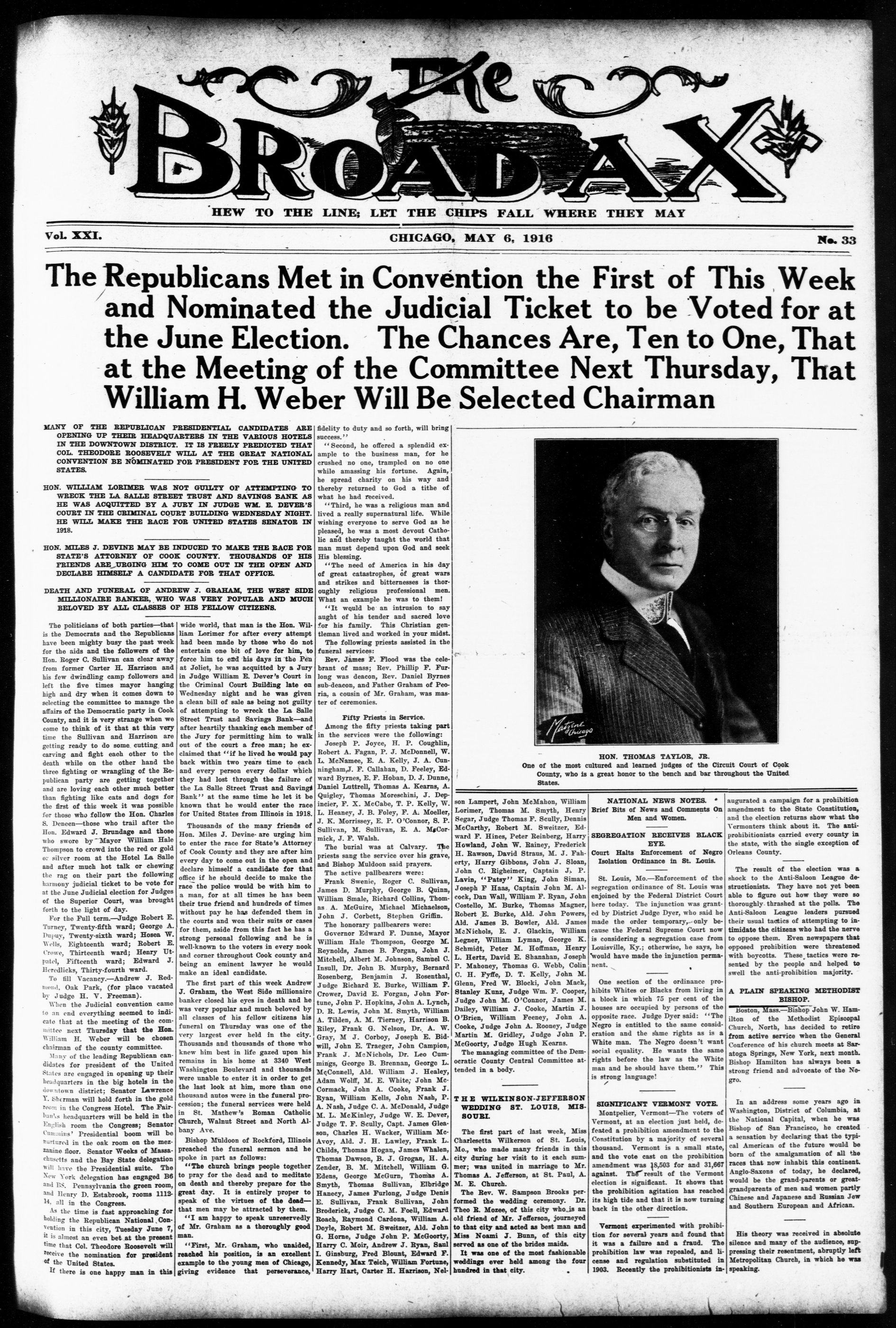
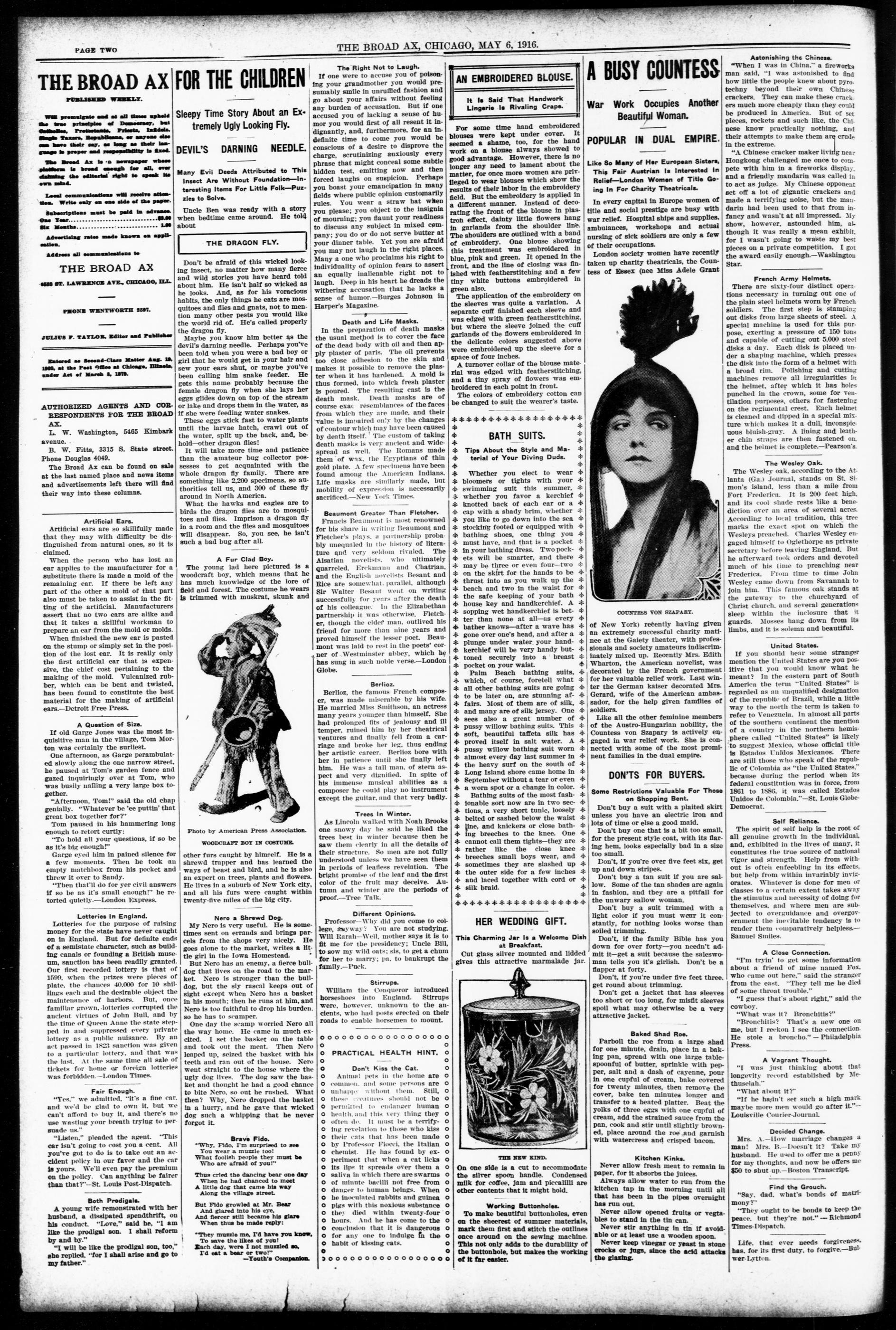
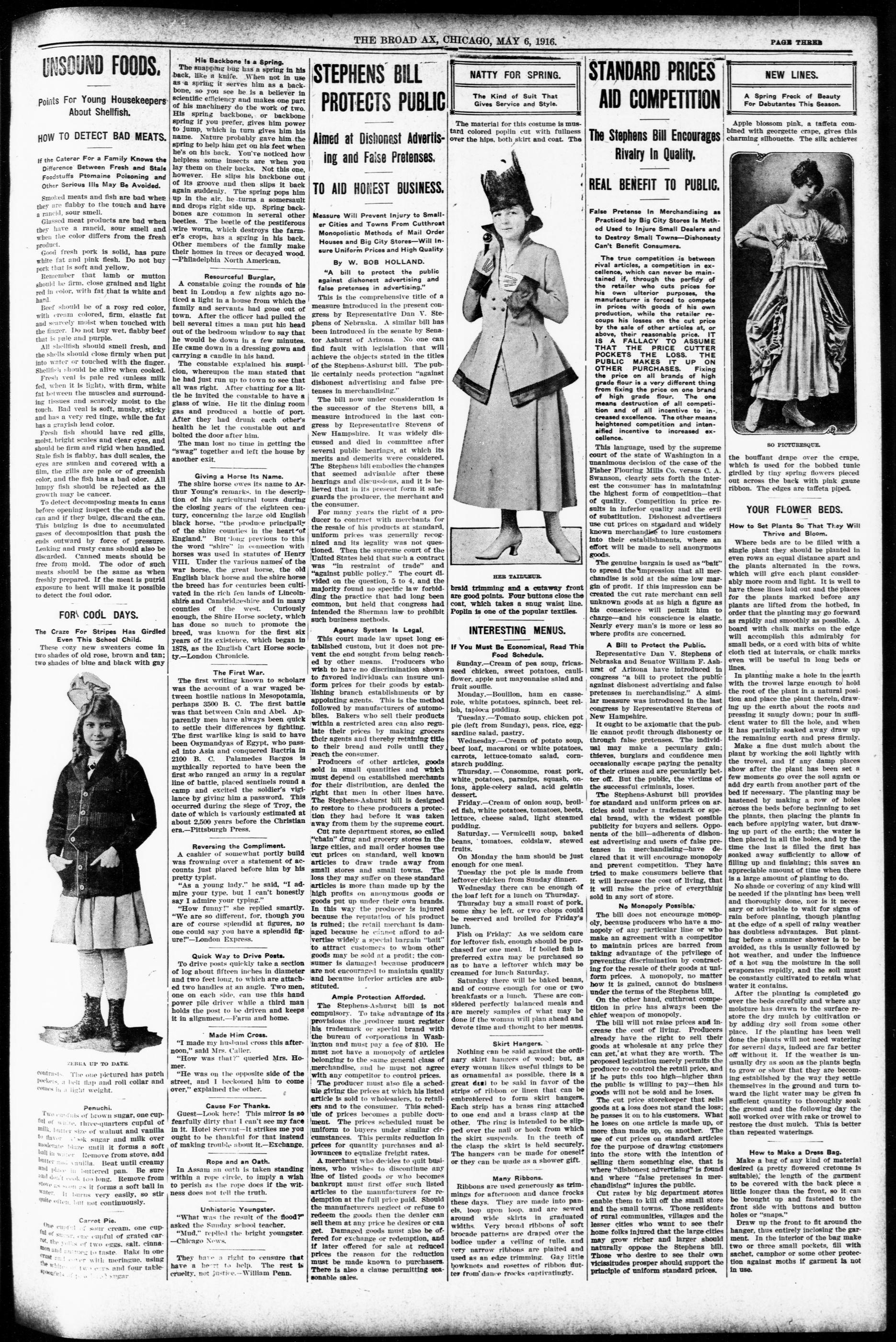
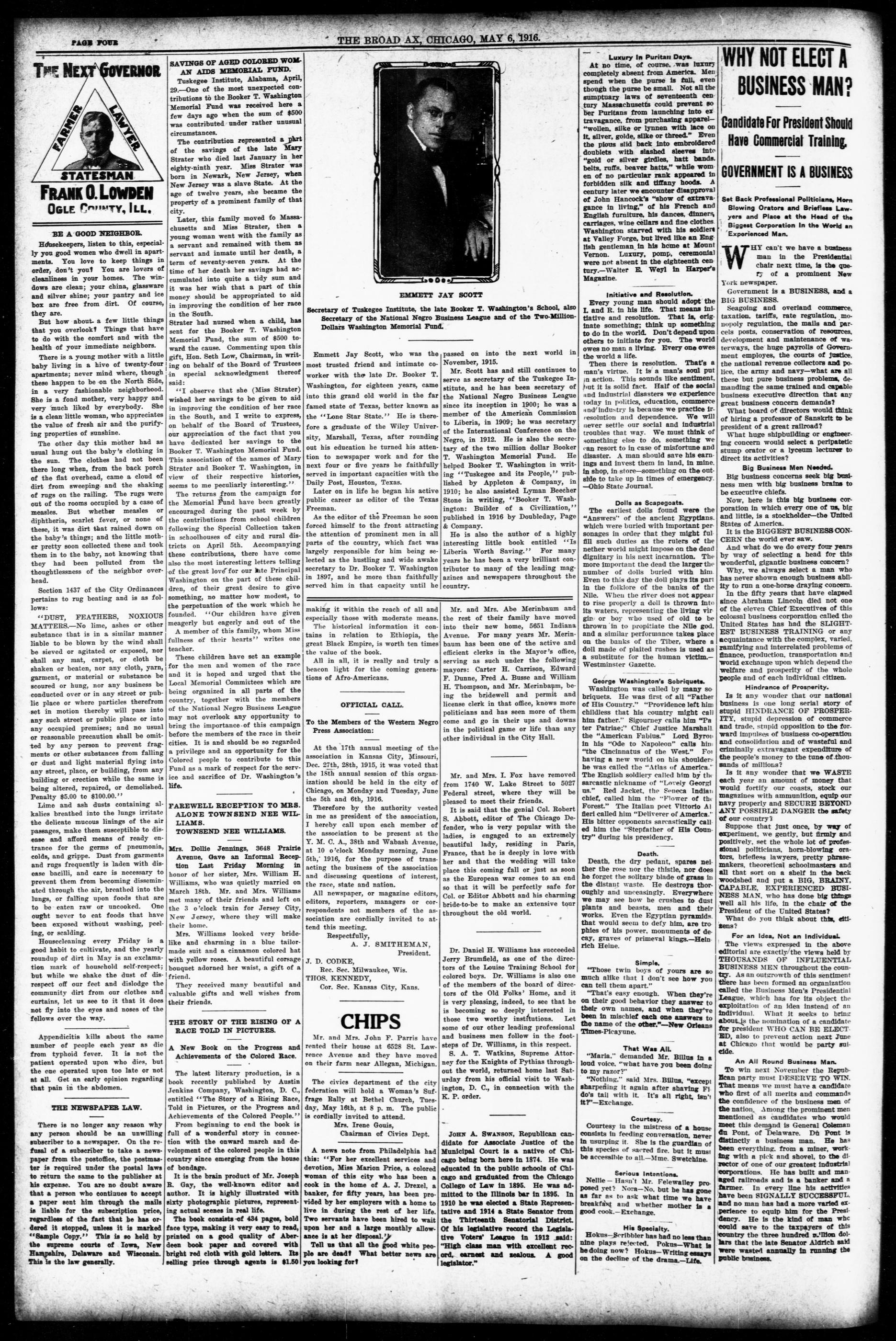
Page text (machine-generated)
BROAD AX
The Republicans Met in Convention the First of This Week and Nominated the Judicial Ticket to be Voted for at the June Election. The Chances Are, Ten to One, That at the Meeting of the Committee Next Thursday, That William H. Weber Will Be Selected Chairman
MANY OF THE REPUBLICAN PRESIDENTIAL CANDIDATES ARE OPENING UP THEIR HEADQUARTERS IN THE VARIOUS HOTELS IN THE DOWNTOWN DISTRICT. IT IS FREELY PREDICTED THAT COL. THEODORE ROOSEVELT WILL AT THE GREAT NATIONAL CONVENTION BE NOMINATED FOR PRESIDENT FOR THE UNITED STATES.
HON. WILLIAM LORIMER WAS NOT GUILTY OF ATTEMPTING TO WRECK THE LA SALLE STREET TRUST AND SAVINGS BANK AS HE WAS ACQUITTED BY A JURY IN JUDGE WM. E. DEVER'S COURT IN THE CRIMINAL COURT BUILDING WEDNESDAY NIGHT. HE WILL MAKE THE RACE FOR UNITED STATES SENATOR IN 1918.
HON. MILES J. DEVINE MAY BE INDUCED TO MAKE THE RACE FOR STATE'S ATTORNEY OF COOK COUNTY. THOUSANDS OF HIS FRIENDS ARE URGING HIM TO COME OUT IN THE OPEN AND DECLARE HIMSELF A CANDIDATE FOR THAT OFFICE.
DEATH AND FUNERAL OF ANDREW J. GRAHAM, THE WEST SIDE MILLIONAIRE BANKER, WHO WAS VERY POPULAR AND MUCH BELOVED BY ALL CLASSES OF HIS FELLOW CITIZENS.
Vol. XXI.
The Republic and M the J at the William
MANY OF THE REPUBLICAN H OPENING UP THEIR HEADQU IN THE DOWNTOWN DISTRICT COL. THEODORE ROOSEVELT CONVENTION BE NOMINATED STATES.
HON. WILLIAM LORIMER WAS H WRECK THE LA SALLE STREET HE WAS ACQUITTED BY A J COUET IN THE CRIMINAL COU HE WILL MAKE THE RACE IN 1918.
HON. MILES J. DEVINE MAY BE H STATE'S ATTORNEY OF COO FRIENDS ARE URGING HIM TO DECLARE HIMSELF A CANDID.
DEATH AND FUNERAL OF ANDRE MILLIONAIRE BANKER, WHO BELOVED BY ALL CLASSES O
The politicians of both parties—that is the Democrats and the Republicans have been mighty busy the past week for the aids and the followers of the Hon. Roger C. Sullivan can clear away from former Carter H. Harrison and his few dwindling camp followers and left the five times mayor hanging high and dry when it comes down to selecting the committee to manage the affairs of the Democratic party in Cook County, and it is very strange when we come to think of it that at this very time the Sullivan and Harrison are getting ready to do some cutting and carving and fight each other to the death while on the other hand the three fighting or wrangling of the Republican party are getting together and are loving each other much better than fighting like cats and dogs for the first of this week it was possible for those who follow the Hon. Charles S. Deneen—those who trail after the Hon. Edward J. Brundage and those who swore by Mayor William Hale Thompson to crowd into the red or gold or silver room at the Hotel La Salle and after much hot talk or chewing the rag on their part the following harmony judicial ticket to be vote for at the June Judicial election for Judges of the Superior Court, was brought forth to the light of day.
For the Full term.—Judge Robert E. Turney, Twenty-fifth ward; George A. Dupuy, Twenty-sixth ward; Hosea W. Wells, Eighteenth ward; Robert E. Crowe, Thirteenth ward; Henry Utpatel, Fifteenth ward; Edward J. Heredlicks, Thirty-fourth ward.
To fill Vacancy.—Andrew J. Redmond, Oak Park, (for place vacated by Judge H. V. Freeman).
When the Judicial convention came to an end everything seemed to indicate that at the meeting of the committee next Thursday that the Hon. William H. Weber will be chosen chairman of the county committee.
Many of the leading Republican candidates for president of the United States are engaged in opening up their headquarters in the big hotels in the downtown district; Senator Lawrence Y. Sherman will hold forth in the gold room in the Congress Hotel. The Fairbanks headquarters will be held in the English room the Congress; Senator Cummins' Presidential boom will be nurtured in the oak room on the mezanine floor. Senator Weeks of Massachusetts and the Bay State delegation will have the Presidential suite. The New York delegation has engaged B6 and BS. Pennsylvania the green room, and Henry D. Estabrook, rooms 1112-14, all in the Congress.
As the time is fast approaching for holding the Republican National Convention in this city, Tuesday June 7, it is almost an even bet at the present time that Col. Theodore Roosevelt will receive the nomination for president of the United States.
If there is one happy man in this
wide world, that man is the Hon. William Lorimer for after every attempt had been made by those who do not entertain one bit of love for him, to force him to end his days in the Pen at Joliet, he was acquitted by a Jury in Judge William E. Dever's Court in the Criminal Court Building late on Wednesday night and he was given a clean bill of sale as being not guilty of attempting to wreck the La Salle Street Trust and Savings Bank—and after heartily thanking each member of the Jury for permitting him to walk out of the court a free man; he explained that "if he lived he would pay back within two years time to each and every person every dollar which they had lost through the failure of the La Salle Street Trust and Savings Bank" at the same time he let it be known that he would enter the race for United States from Illinois in 1918.
Thousands of the many friends of Hon. Miles J. Devine are urging him to enter the race for State's Attorney of Cook County and they are after him every day to come out in the open and declare himself a candidate for that office if he should decide to make the race the police would be with him to a man, for at all times he has been their true friend and hundreds of times without pay he has defended them in the courts and won their suits or cases for them, aside from this fact he has a strong personal following and he is well-known to the voters in every corner throughout Cook county and being an eminent lawyer he would make an ideal candidate.
The first part of this week Andrew J. Graham, the West Side millionaire banker closed his eyes in death and he was very popular and much beloved by all classes of his fellow citizens his funeral on Thursday was one of the very largest ever held in the city. Thousands and thousands of those who knew him best in life gazed upon his remains in his home at 3340 West Washington Boulevard and thousands were unable to enter it in order to get the last look at him, more than one thousand autos were in the funeral process; the funeral services were held in St. Mathew's Roman Catholic Church, Walnut Street and North Albany Ave.
Bishop Muldoon of Rockford, Illinois preached the funeral sermon and he spoke in part as follows:
"The church brings people together to pray for the dead and to meditate on death and thereby prepare for the great day. It is entirely proper to speak of the virtues of the dead—that men may be attracted by them.
"I am happy to speak unreservedly of Mr. Graham as a thoroughly good man."
"First, Mr. Graham, who unaided, reached his position, is an excellent example to the young men of Chicago, giving evidence that perseverance.
CHICAGO, MAY 6, 1916
let in Conve
lal the Judic
ion. The C
of the Con
er Will Be
fidelity to duty and so forth, will bring
success.'
"Second, he offered a splendid ex-
ample to the business man, for he crushed no one, trampled on no one
while amassing his fortune. Again,
he spread charity on his way and
thereby returned to God a tithe of
what he had received.
"Third, he was a religious man and lived a really supernatural life. While wishing everyone to serve God as he pleased, he was a most devout Catholic and thereby taught the world that man must depend upon God and seek His blessing.
"The need of America in his day of great catastrophes, of great wars and strikes and bitternesses is thoroughly religious professional men. What an example he was to them!
"It would be an intrusion to say aught of his tender and sacred love for his family. This Christian gentleman lived and worked in your midst.
The following priests assisted in the funeral services:
Rev. James F. Flood was the celebrant of mass; Rev. Phillip F. Furlong was deacon, Rev. Daniel Byrnes sub-deacon, and Father Graham of Peoria, a cousin of Mr. Graham, was master of ceremonies.
Fifty Priests in Service.
Among the litty priests taking part in the services were the following:
Joseph P. Joyce, H. P. Coughlin, Robert A. Fagan, P. J. McDonnell, W. L. McNamee, E. A. Kelly, J. A. Cunningham, J. F. Callahan, D. Feeley, Edward Byrnes, E. F. Hoban, D. J. Dunne, Daniel Luttrell, Thomas A. Kearns, A. Quigley, Thomas Moreschini, J. Depincier, F. X. McCabe, T. P. Kelly, W. L. Heaney, J. B. Foley, F. A. Moeller, J. K. Morrissey, E. P. O'Connor, S. P. Sullivan, M. Sullivan, E. A. McCormick, J. F. Walsh.
The burial was at Calvary. The priests sang the service over his grave, and Bishop Muldoon said prayers.
The active pallbearers were:
Frank Swenie, Roger C. Sullivan, James D. Murphy, George B. Quinn, William Smale, Richard Collins, Thomas A. McGuire, Michael Michaelson, John J. Corbett, Stephen Griffin.
The lobby panelists were:
Governor Edward F. Dunne, Mayor
William Hale Thompson, George M.
Reynolds, James B. Forgan, John J.
Mitchell, Albert M. Johnson, Samuel C.
Insull, Dr. John B. Murphy, Bernard
Rosenberg, Benjamin J. Rosenthal,
Judge Richard E. Burke, William F.
Crower, David E. Forgan, John Fortune,
John P. Hopkins, John A. Lynch,
D. R. Lewis, John M. Smyth, William
A. Tilden, A. M. Tierney, Harrison B.
Riley, Frank G. Nelson, A. D. W
Gray, M J. Corboy, Joseph E. Bidwill,
Frank J. E. Traeger, John Campion,
Frank J. E. McNichols, Dr. Leo Cummings, George B. Brennan, George L. McConnell, Ald. William J. Healey,
Adam Wolff, M. E. White; John McCormack, John A. Cooke, Frank J.
Ryan, William Kells, John Nash, P. A. Nash, Judge C. A. McDonald, Judge M. L. McKinley, Judge W. E. Dever,
Judge T. F. Scully, Capt. James Gleason, Charles H. Wacker, William McAvoy, Ald. J. H. Lawley, Frank L.
Childs, Thomas Hogan, James Whalen,
Thomas Dawson, B. J. Grogan, H. A. Zender, B. M. Mitchell, William G.
Edens, George McGurn, Thomas A. Smyth, Thomas Sullivan, Elbridge Hanecy, James Furlong, Judge Denis
E. Sullivan, Frank Sullivan, John Broderick, Judge C. M. Foell, Edward Roach, Raymond Cardona, William A. Doyle, Robert M. Sweitzer, Ald. John G. Horne, Judge John P. McGoorty,
Harry C. Moir, Andrew J. Ryan, Saul
I. Ginsburg, Fred Blount, Edward F.
Kennedy, Max Teich, William Fortune,
Harry Hart, Carter H. Harrison, Nel-
---
ention the
social Ticket
Chances And
committee N
Selected
One of the most
County, who is
States.
HON. THOMAS TAYLOR, JR.
One of the most cultured and learned judges of the Circuit Court of Cook County, who is a great honor to the bench and bar throughout the United States.
son Lampert, John McMahon, William Lorimer, Thomas M. Smyth, Henry Segar, Judge Thomas F. Scully, Dennis McCarthy, Robert M. Sweitzer, Edward F. Hines, Peter Reinberg, Harry Howland, John W. Rainey, Frederick H. Rawson, David Straus, M. J. Faherty, Harry Gibbons, John J. Shoan, John C. Bigheimer, Captain J, P. Lavin, "Patsy" King, John Siman, Joseph F Haas, Captain John M. Alcock, Dan Wall, William F. Ryan, John Costello, M. Burke, Thomas Magner, Robert E. Burke, Ald. John Powers, Ald. James B. Bowler, Ald. James McNichols, E. J. Glackin, William Legner, William Lyman, George K. Schmidt, Peter M. Hoffman, Henry L. Hertz, David E. Shanahan, Joseph P. Mahoney, Thomas G. Webb, Colin C. H. Fyffe, D. T. Kelly, John M. Glenn, Fred W. Blocki, John Mack, Stanley Kunz, Judge Wm. F. Cooper, Judge John M. O'Connor, James M. Dailey, William J. Cooke, Martin J. O'Brien, William Feeney, John A. Cooke, Judge John A. Rooney, Judge Martin M. Gridley, Judge John P. McGoorty, Judge Hugh Kearns.
The managing committee of the Democratic County Central Committee attended in a body.
THE WILKINSON-JEFFERSON WEDDING ST. LOUIS, MIS SOURL
The first part of last week, Miss Charlesetta Wilkerson of St. Louis, Mo., who made many friends in this city during her visit to it each summer; was united in marriage to Mr. Thomas A. Jefferson, at St. Paul, A. M. E. Church.
The Rev. W. Sampson Brooks performed the wedding ceremony. Dr. Theo R. Mozee, of this city who is an old friend of Mr. Jefferson, journeyed to that city and acted as best man and Miss Noami J. Bunn, of this city served as one of the brides maids.
It was one of the most fashionable weddings ever held among the four hundred in that city.
Matzint
Chicago
NATIONAL NEWS NOTES.
Brief Bits of News and Comments On Men and Women.
SEGREGATION RECEIVES BLACK EYE.
Court Halts Enforcement of Negro Isolation Ordinance in St. Louis.
St. Louis, Mo.—Enforcement of the segregation ordinance of St. Louis was enjoined by the Federal District Court here today. The injunction was granted by District Judge Dyer, who said he made the order temporary, only because the Federal Supreme Court now is considering a segregation case from Louisville, Ky.; otherwise, he says, he would have made the injunction permanent.
One section of the ordinance prohibits Whites or Blacks from living in a block in which 75 per cent of the houses are occupied by persons of the opposite race. Judge Dyer said: "The Negro is entitled to the same consideration and the same rights as is a White man. The Negro doesn't want social equality. He wants the same rights before the law as the White man and he should have them." This is strong language!
SIGNIFICANT VERMONT VOTE.
SIGNIFICANT VERMONT VOTE.
Montpelier, Vermont—The voters of Vermont, at an election just held, defeated a prohibition amendment to the Constitution by a majority of several thousand. Vermont is a small state, and the vote cast on the prohibition amendment was 18,503 for and 31,667 against. The result of the Vermont election is significant. It shows that the prohibition agitation has reached its high tide and that it is now turning back in the other direction.
Vermont experimented with prohibition for several years and found that it was a failure and a fraud. The prohibition law was repealed, and license and regulation substituted in 1903. Recently the prohibitionists in-
No.33
augurated a campaign for a prohibition amendment to the State Constitution, and the election returns show what the Vermonters think about it. The anti-prohibitionists carried every county in the state, with the single exception of Orleans County.
The result of the election was a shock to the Anti-Saloon League destructionists. They have not yet been able to figure out how they were so thoroughly thrashed at the polls. The Anti-Saloon League leaders pursued their usual tactics of attempting to intimidate the citizens who had the nerve to oppose them. Even newspapers that opposed prohibition were threatened with boycotts. These tactics were resented by the people and helped to swell the anti-prohibition majority.
A PLAIN SPEAKING METHODIST
BISHOP.
Boston, Mass.—Bishop John W. Hamilton of the Methodist Episcopal Church, North, has decided to retire from active service when the General Conference of his church meets at Saratoga Springs, New York, next month. Bishop Hamilton has always been a strong friend and advocate of the Negro.
In an address some years ago in Washington, Distriet of Columbia, at the National Capital, when he was Bishop of San Francisco, he created a sensation by declaring that the typical American of the future would be born of the amalgamation of all the races that now inhabit this continent. Anglo-Saxons of today, he declared, would be the grand-parents or great-grandparents of men and women partly Chinese and Japanese and Russian Jew and Southern European and African.
His theory was received in absolute silence and many of the audience, suppressing their resentment, abruptly left Metropolitan Church, in which he was speaking.
PAGE TWO
THE BROAD AX
PUBLISHED WEEKLY.
Will premulgate and at all times uphold the true principles of Democracy, but Coffeehouse, Protestantia, Priests, Inidida, Single Taxes, Republiana, or anyone else can have their say, as long as their language is proper and responsibility is fixed.
The Broad Ax is a newspaper whose platform is broad enough for all, ever drinking the editorial right to speak its own mind.
Local communications will receive attention. Write only on one side of the paper.
Subscriptions must be paid in advance. One Year. $3.00 Six Months. 1.00
Advertising rates made known on application.
Address all communications to
THE BROAD AX
6588 ST. LAWRENCE AVE., CHICAGO, IL.
PHONE WENTWORTH 2597.
JULIUS F. TAYLOR, Editor and Publisher
Entered as Second-Chas Matter Aug. 18, 1983, at the Post Office at Chicago, Illinois, under Act of March 8, 1879.
AUTHORIZED AGENTS AND CORRESPONDENTS FOR THE BROAD AX.
L. W. Washington, 5465 Kimbark avenue.
B. W. Fitts, 3315 S. State street.
Phone Douglas 4049.
The Broad Ax can be found on sale at the last named place and news items and advertisements left there will find their way into these columns.
Artificial Ears.
Artificial ears are so skilfully made that they may with difficulty be distinguished from natural ones, so it is claimed.
When the person who has lost an ear applies to the manufacturer for a substitute there is made a mold of the remaining ear. If there be left any part of the other a mold of that part also must be taken to assist in the fitting of the artificial. Manufacturers assert that no two ears are alike and that it takes a skillful workman to prepare an ear from the mold or molds.
When finished the new ear is pasted on the stump or simply set in the position of the lost ear. It is really only the first artificial ear that is expensive, the chief cost pertaining to the making of the mold. Vulcanized rubber, which can be bent and twisted, has been found to constitute the best material for the making of artificial ears—Detroit Free Press.
A Question of Size.
If old Garge Jones was the most inquisitive man in the village, Tom Morton was certainly the surliest.
One afternoon, as Garge perambulated slowly along the one narrow street, he paused at Tom's garden fence and gazed inquiringly over at Tom, who was busily naffling a very large box together.
"Afternoon, Tom!" said the old chap genially. "Whatever be 'ye puttin' that great box together for?" Tom paused in his hammering long enough to retort curtly:
"To hold all your questions, if so be as it's big enough."
Garge eyed him in pained silence for a few moments. Then he took an empty matchbox from his pocket and threw it over to Sandy.
"Then that'll do for yer civil answers if so be as it's small enough!" he retorted quietly—London Express.
Lotteries In England
Lotteries for the purpose of raising money for the state have never caught on in England. But for definite ends of a semistate character, such as building canals or founding a British museum, sanction has been readily granted. Our first recorded lottery is that of 1590, when the prizes were pieces of plate, the chances 40,000 for 10 shillings each and the desirable object the maintenance of harbors. But, once familiar grown, lotteries corrupted the ancient virtues of John Bull, and by the time of Queen Anne the state stepped in and suppressed every private lottery as a public nuisance. By an act passed in 1823 sanction was given to a particular lottery, and that was the last. At the same time all sale of tickets for home or foreign lotteries was forbidden—London Times.
Fair Enough.
"Yes," we admitted, "it's a fine car, and we'd be glad to own it, but we can't afford to buy it, and there's no use wasting your breath trying to persuade us."
"Listen," pleaded the agent. "This car isn't going to cost you a cent. All you've got to do is to take out an accident policy in our favor and the car is yours. We'll even pay the premium on the policy. Can anything be fairer than that?"—St. Louis Post-Dispatch.
Both Prodigals
A young wife remonstrated with her husband, a dissipated spendthrift, on his conduct. "Love," said he, "I am like the prodigal son. I shall reform by and by."
"I will be like the prodigal son, too," she replied, "for I shall arise and go to my father."
FOR THE CHILDREN
Sleepy Time Story About an Extremely Ugly Looking Fly.
DEVIL'S DARNING NEEDLE.
Many Evil Deeds Attributed to This Insect Are Without Foundation—Interesting Items For Little Folk—Puzzles to Solve.
Uncle Ben was ready with a story when bedtime came around. He told about
THE DRAGON FLY.
Don't be afraid of this wicked looking insect, no matter how many fierce and wild stories you have heard told about him. He isn't half so wicked as he looks. And, as for his voracious habits, the only things he eats are mosquitoes and flies and gnats, not to mention many other pests you would like the world rid of. He's called properly the dragon fly.
Maybe you know him better as the devil's darning needle. Perhaps you've been told when you were a bad boy or girl that he would get in your hair and sew your ears shut, or maybe you've been calling him snake feeder. He gets this name probably because the female dragon fly when she lays her eggs glides down on top of the stream or lake and drops them in the water, as if she were feeding water snakes.
These eggs stick fast to water plants until the larvae hatch, crawl out of the water, split up the back, and, behold—other dragon flies!
It will take more time and patience than the amateur bug collector possesses to get acquainted with the whole dragon fly family. There are something like 2,200 specimens, so authorities tell us, and 300 of these fly around in North America. What the hawks and eagles are to birds the dragon flies are to mosquitoes and flies. Imprison a dragon fly in a room and the flies and mosquitoes will disappear. So, you see, he isn't such a bad bug after all.
A Fur Clad Boy.
The young lad here pictured is a woodcraft boy, which means that he has much knowledge of the lore of field and forest. The costume he wears is trimmed with muskrat, skunk and
A
Photo by American Press Association.
other furs caught by himself. He is a shrewd trapper and has learned the ways of beast and bird, and he is also an expert on trees, plants and flowers. He lives in a suburb of New York city, and all his furs were caught within twenty-five miles of the big city.
Nero a Shrewd Dog.
My Nero is very useful. He is sometimes sent on errands and brings parcels from the shops very nicely. He goes alone to the market, writes a little girl in the Iowa Homestead. But Nero has an enemy, a fierce bulldog that lives on the road to the market. Nero is stronger than the bulldog, but the sly rascal keeps out of sight except when Nero has a basket in his mouth; then he runs at him, and Nero is too faithful to drop his burden, so he has to scamper.
One day the scamp worried Nero all the way home. He came in much excited. I set the basket on the table and took out the meat. Then Nero leaped up, seized the basket with his teeth and ran out of the house. Nero went straight to the house where the ugly dog lives. The dog saw the basket and thought he had a good chance to bite Nero, so out he rushed. What then? Why, Nero dropped the basket in a hurry, and he gave that wicked dog such a whipping that he never forgot it.
Brave Eido
"Why, Fido, I'm surprised to see
You wear a muzzle too!
What foolish people they must be
Who are afraid of you!"
Thus cried the dancing bear one day
When he had chanced to meet
A little dog that came his way
Along the village street.
But Fido growled at Mr. Bear
And glared into his eye,
And fiercer still became his glare
When thus he made reply:
THE BROAD AX, CHICAGO, MAY 6, 1916.
The Right Not to Laugh.
The Right Not to Laugh.
If one were to accuse you of poisoning your grandmother you would presumably smile in unruffled fashion and go about your affairs without feeling any burden of accusation. But if one accused you of lacking a sense of humor you would first of all resent it indignantly, and, furthermore, for an indefinite time to come you would be conscious of a desire to disprove the charge, scrutinizing anxiously every phrase that might conceal some subtle hidden test, emitting now and then forced laughs on suspicion. Perhaps you boast your emancipation in many fields where public opinion customarily rules. You wear a straw hat when you please; you object to the insignia of mourning; you faunt your readiness to discuss any subject in mixed company; you do or do not serve butter at your dinner table. Yet you are afraid you may not laugh in the right places. Many a one who proclaims his right to individuality of opinion fears to assert an equally inalienable right not to laugh. Deep in his heart he dreads the withering accusation that he lacks a sense of humor.—Burges Johnson in Harper's Magazine.
Death and Life Masks.
In the preparation of death masks the usual method is to cover the face of the dead body with oil and then apply plaster of paris. The oil prevents too close adhesion to the skin and makes it possible to remove the plaster when it has hardened. A mold is thus formed, into which fresh plaster is poured. The resulting cast is the death mask. Death masks are of course exact resemblances of the faces from which they are made, and their value is impaired only by the changes of contour which may have been caused by death itself. The custom of taking death masks is very ancient and widespread as well. The Romans made them of wax, the Egyptians of thin gold plate. A few specimens have been found among the American Indians. Life masks are similarly made, but mobility of expression is necessarily sacrificed—New York Times.
Beaumont Greater Than Fletcher.
Francis Beaumont is most renowned for his share in writing Beaumont and Fletcher's plays, a partnership probably unequaled in the history of literature and very seldom rivaled. The Alsatian novelists, who ultimately quarreled, Erckmann and Chatrian, and the English novelists Besant and Rice are somewhat parallel, although Sir Walter Besant went on writing successfully for years after the death of his colleague. In the Elizabethan partnership it was otherwise. Fletcher, though the elder man, outlived his friend for more than nine years and proved himself the lesser poet. Beaumont was laid to rest in the poets' corner of Westminster abbey, which he has sung in such noble verse.—London Globe.
Berlioz.
Berlioz, the famous French composer, was made miserable by his wife. He married Miss Smithson, an actress many years younger than himself. She had prolonged fits of jealousy and ill temper, ruined him by her theatrical ventures and finally fell from a carriage and broke her leg, thus ending her artistic career. Berlioz bore with her in patience until she finally left him. He was a tall man, of stern aspect and very dignified. In spite of his immense musical abilities as a composer he could play no instrument except the guitar, and that very badly.
Trees In Winter.
As Lincoln walked with Noah Brooks one snowy day he said he liked the trees best in winter because then he saw them clearly in all the details of their structure. So men are not fully understood unless we have seen them in periods of leafless revelation. The bright promise of the leaf and the first color of the fruit may deceive. Autumn and winter are the periods of proof—Tree Talk.
Different Opinions.
Professor—Why did you come to college, anyway? You are not studying. Will Karah—Well, mother says it is to fit me for the presidency; Uncle Bill, to sow my wild oats; sis, to get a chum for her to marry; pa, to bankrupt the family.—Puck.
Stirrups.
William the Conqueror introduced horseshoes into England. Stirrups were, however, unknown to the ancients, who had posts erected on their roads to enable horsemen to mount.
PRACTICAL HEALTH HINT.
Don't Kiss the Cat.
- Animal pets in the home are common, and some persons are unhappy without them. Still, these creatures should not be permitted to endanger human health, and this very thing they often do. It must be a terrifying revelation to those who kiss their cats that has been made by Professor Fiocci, the Italian chemist. He has found by experiment that when a cat licks its lips it spreads over them a saliva in which there are swarms of minute bacilli not free from danger to human beings. When he inoculated rabbits and guinea pigs with this noxious substance they died within twenty-four hours. And he has come to the conclusion that it is dangerous for any one to indulge in the habit of kissing cats.
```markdown
```
AN EMBROIDERED BLOUSE.
It Is Said That Handwork Lingerie Is Rivaling Grape.
For some time hand embroidered blouses were kept under cover. It seemed a shame, too, for the hand work on a blouse always showed to good advantage. However, there is no longer any need to lament about the matter, for once more women are privileged to wear blouses which show the results of their labor in the embroidery field. But the embroidery is applied in a different manner. Instead of decorating the front of the blouse in plastron effect, dalty little flowers hang in garlands from the shoulder line. The shoulders are outlined with a band of embroidery. One blouse showing this treatment was embroidered in blue, pink and green. It opened in the front, and the line of closing was finished with feathersstitching and a few tiny white buttons embroidered in green also.
The application of the embroidery on the sleeves was quite a variation. A separate cuff finished each sleeve and was edged with green featherstitching, but where the sleeve joined the cuff garlands of the flowers embroidered in the delicate colors suggested above were embroidered up the sleeve for a space of four inches. A turnover collar of the blouse material was edged with featherstitching, and a tiny spray of flowers was embroidered in each point in front. The colors of embroidery cotton can be changed to suit the wearer's taste.
BATH SUITS.
Tips About the Style and Material of Your Diving Dude.
Whether you elect to wear bloomers or tights with your swimming suit this summer, whether you favor a kerchief knotted back of each ear or a cap with a shady brim, whether you like to go down into the sea stocking footed or equipped with bathing shoes, one thing you must have, and that is a pocket in your bathing dress. Two pockets will be smarter, and there may be three or even four—two on the skirt for the hands to be thrust into as you walk up the beach and two in the waist for the safe keeping of your bath house key and handkerchief. A sopping wet handkerchief is better than none at all—as every bather knows—after a wave has gone over one's head, and after a plunge under water, your handkerchief will be very handy buttoned securely into a breast pocket on your waist.
Palm Beach bathing suits, which, of course, foretell what all other bathing suits are going to be later on, are stunning affairs. Most of them are of silk, and many are of silk jersey. One sees also a great number of pussy willow bathing suits. This soft, beautiful taffeta silk has proved itself in salt water. A pussy willow bathing suit worn almost every day last summer in the heavy surf on the south of Long Island shore came home in September without a tear or even a worn spot or a change in color.
Bathing suits of the most fashionable sort now are in two sections, a very short tunic, loosely belted or sashed below the waist line, and knickers or close bathing breeches to the knee. One cannot call them tights—they are rather like the close knee breeches small boys wear, and sometimes they are slashed up the outer side for a few inches and laced together with cord or silk braid.
HER WEDDING GIFT.
This Charming Jar Is a Welcome Dish at Breakfast.
Cut glass silver mounted and lidded gives this attractive marmalade jar.
THE NEW KIND.
On one side is a cut to accommodate the silver spoon handle. Condensed milk for coffee, jam and piccalilli are other contents that it might hold.
Working Buttonholes.
To make beautiful buttonholes, even on the sheerest of summer materials, mark them first and stitch the outlines once around on the sewing machine. This not only adds to the durability of the buttonhole, but makes the working of it far easier.
A BUSY COUNTESS
War Work Occupies Another Beautiful Woman.
POPULAR IN DUAL EMPIRE.
Like So Many of Her European Sisters, This Fair Austrian Is Interested In Relief—London Women of Title Going In For Charity Theatricals.
In every capital in Europe women of title and social prestige are busy with war relief. Hospital ships and supplies, ambulances, workshops and actual nursing of slick soldiers are only a few of their occupations.
London society women have recently taken up charity theatricals, the Countess of Essex (nee Miss Adele Grant
A
COUNTESS VON SZAPARY.
of New York) recently having given an extremely successful charity matinee at the Gaiety theater, with professionals and society amateurs indiscriminately mixed up. Recently Mrs. Edith Wharton, the American novelist, was decorated by the French government for her valuable relief work. Last winter the German kaiser decorated Mrs. Gerard, wife of the American ambassador, for the help given familles of soldiers.
Like all the other feminine members of the Austro-Hungarian nobility, the Countess von Szapary is actively engaged in war relief work. She is connected with some of the most prominent families in the dual empire.
DON'TS FOR BUYERS.
Some Restrictions Valuable For Those on Shopping Bent.
Don't buy a suit with a plaited skirt unless you have an electric iron and lots of time or else a good maid.
Don't buy one that is a bit too small, for the present style coat, with its faring hem, looks especially bad in a size too small.
Don't, if you're over five feet six, get up and down stripes.
Don't buy a tan suit if you are sallow. Some of the tan shades are again in fashion, and they are a pitfall for the unwary sallow woman.
Don't buy a suit trimmed with a light color if you must wear it constantly, for nothing looks worse than soiled trimming.
Don't, if the family Bible has you down for over forty—you needn't admit it—get a suit because the saleswoman tells you it's girlish. Don't be a flapper at forty.
Don't, if you're under five feet three,
get round about trimming.
Don't get a jacket that has sleeves
too short or too long, for misfit sleeves
spoil what may otherwise be a very
attractive jacket.
Baked Shad Boe
Parboll the roe from a large shad for one minute, drain, place in a baking pan, spread with one large table-spoonful of butter, sprinkle with pepper, salt and a dash of cayenne, pour in one cupful of cream, bake covered for twenty minutes, then remove the cover, bake ten minutes longer and transfer to a heated platter. Beat the yolks of three eggs with one cupful of cream, add the strained sauce from the pan, cook and stir until slightly browned, place around the roe and garnish with watercress and crisped bacon.
Kitchen Kinks
Never allow fresh meat to remain in paper, for it absorbs the juices.
Always allow water to run from the kitchen tap in the morning until all that has been in the pipes overnight has run out.
Never allow opened fruits or vegetables to stand in the tin can.
Never stir anything in tin if avoidable or at least use a wooden spoon.
Never keep vinegar or yeast in stone crocks or jugs, since the acid attacks the glazing.
Astonishing the Chinese.
"When I was in China," a fireworks man said, "I was astonished to find how little the people knew about pyrotechny beyond their own Chinese crackers. They can make these crackers much more cheaply than they could be produced in America. But of set pieces, rockets and such like, the Chinese know practically nothing, and their attempts to make them are crude in the extreme.
"A Chinese cracker maker living near Hongkong challenged me once to compete with him in a fireworks display, and a friendly mandarin was called in to act as judge. My Chinese opponent set off a lot of gigantic crackers and made a terrifying noise, but the mandarin had been used to that from infancy and wasn't at all impressed. My fancy, however, astounded him, although it was really a mean exhibit, for I wasn't going to waste my best pieces on a private competition. I got the award easily enough.—Washington Star.
French Army Helmets.
There are sixty-four distinct operations necessary in turning out one of the plain steel helmets worn by French soldiers. The first step is stamping out disks from large sheets of steel. A special machine is used for this purpose, exerting a pressure of 150 tons and capable of cutting out 5,000 steel disks a day. Each disk is placed under a shaping machine, which presses the disk into the form of a helmet with a broad rim. Polishing and cutting machines remove all irregularities in the helmet, after which it has holes punched in the crown, some for ventilation purposes, others for fastening on the regimental crest. Each helmet is cleaned and dipped in a special mixture which makes it a dull, inconspicuous bluish-gray. A lining and leather chin straps are then fastened on and the helmet is complete—Pearson's.
The Wesley Oak.
The Wesley oak, according to the Atlanta (Ga.) Journal, stands on St. Simon's island, less than a mile from Fort Frederica. It is 200 feet high, and its cool shade rests like a benediction over an area of several acres. According to local tradition, this tree marks the exact spot on which the Wesleyes preached. Charles Wesley engaged himself to Oglethorpe as private secretary before leaving England. But he afterward took orders and devoted much of his time to preaching near Frederica. From time to time John Wesley came down from Savannah to join him. This famous oak stands at the gateway to the churchyard of Christ church, and several generations sleep within the enclosure that it guards. Mosses hang down from its limbs, and it is solemn and beautiful.
United States.
If you should hear some stranger mention the United States are you positive that you would know what he meant? In the eastern part of South America the term "United States" is regarded as an unqualified designation of the republic of Brazil, while a little way to the north the term is taken to refer to Venezuela. In almost all parts of the southern continent the mention of a country in the northern hemisphere called "United States" is likely to suggest Mexico, whose official title is Estados Unidos Mexicanos. There are still those who speak of the republic of Colombia as "the United States," because during the period when its federal constitution was in force, from 1861 to 1886, it was called Estados Unidos de Colombia."—St. Louis Globe-Democrat.
Self Reliance
The spirit of self help is the root of all genuine growth in the individual, and, exhibited in the lives of many, it constitutes the true source of national vigor and strength. Help from without is often enfeebling in its effects, but help from within invariably invigorates. Whatever is done for men or classes to a certain extent takes away the stimulus and necessity of doing for themselves, and where men are subjected to overguidance and overgovernment the inevitable tendency is to render them comparatively helpless.—Samuel Smiles.
A. Close Connection
"I'm tryin' to get some information about a friend of mine named Fox, who came out here," said the stranger from the east. "They tell me he died of some throat trouble."
"I guess that's about right," said the cowboy.
"What was it? Bronchitis?"
"Bronchitis? That's a new one on me, but I reckon I see the connection. He stole a broncho." — Philadelphia Press
A Vagrant Thought:
"I was just thinking about that longevity record established by Mehthuselah."
"What about it?"
"If he hadn't set such a high mark maybe more men would go after it."—Louisville Courier-Journal.
Decided Change.
Mrs. A.-How marriage changes a man! Mrs. B.-Doesn't it? Take my husband. He used to offer me a penny for my thoughts, and now he offers me $50 to shut up.-Boston Transcript.
Find the Groush
"Say, dad, what's bonds of matrimony?"
"They ought to be bonds to keep the peace, but they're not." — Richmond Times-Dispatch.
Life, that ever needs forgiveness, has, for its first duty, to forgive.—Bulwer-Lytton.
UNSOUND FOODS.
Points For Young Housekeepers About Shellfish.
HOW TO DETECT BAD MEATS
If the Caterer For a Family Knows the Difference Between Fresh and Stale Foodstuffs Ptomaine Poisoning and Other Serious Ills May Be Avoided.
Smoked meats and fish are bad when they are flabby to the touch and have a rancid, sour smell.
Glassed meat products are bad when they have a rancid, sour smell and when the color differs from the fresh product.
Good fresh pork is solid, has pure white fat and pink flesh. Do not buy pork that is soft and yellow.
Remember that lamb or mutton should be firm, close grained and light red in color, with fat that is white and hard.
Beef should be of a rosy red color, with cream colored, firm, elastic fat and scarcely moist when touched with the finger. Do not buy wet, flabby beef that is pale and purple.
All shellfish should smell fresh, and the shells should close firmly when put into water or touched with the finger. Shellfish should be alive when cooked.
Fresh veal is pale red (unless milk fed, when it is light), with firm, white fat between the muscles and surrounding tissues and scarcely moist to the touch. Bad veal is soft, musky, sticky and has a very red tinge, while the fat has a grayish lead color.
Fresh fish should have red gills, moist, bright scales and clear eyes, and should be firm and rigid when handled. Stale fish is flabby, has dull scales, the eyes are sunken and covered with a film, the gills are pale or of greenish color, and the fish has a bad odor. All lumpy fish should be rejected as the growth may be cancer.
To detect decomposing meats in cans before opening inspect the ends of the can and if they bulge, discard the can. This bulging is due to accumulated gases of decomposition that push the ends outward by force of pressure. Leaking and rusty cans should also be discarded. Canned meats should be free from mold. The odor of such meats should be the same as when freshly prepared. If the meat is putrid exposure to heat will make it possible to detect the foul odor.
FOR COOL DAYS
The Craze For Stripes Has Girdled Even This School Child. These cozy new sweaters come in two shades of old rose, brown and tan; two shades of blue and black with gay
1920
ZERRA UP TO DATE
contrasts. The one pictured has patch
packes, a belt flap and roll collar and
comes in a light weight.
Penuchi.
Two cups of brown sugar, one cupful of white, three-quarters cupful of milk, butter size of walnut and vanilla to flavor. Cook sugar and milk over moderate blaze until it forms a soft ball in water. Remove from stove, add butter and vanilla. Beat until creamy and place in buttered pan. Be sure and don't cook too long. Remove from stove as soon as it forms a soft ball in water. It burns very easily, so stir quite often but not continuously.
Carrot Pie
One cupful of sour cream, one cupful of sugar, one cupful of grated carrot, the yolks of two eggs, salt, cinnamon and meringue to taste. Bake in one crust and coat with meringue, using the white of two eggs and four tablespoons of sugar.
His Backbone Is a Spring.
The snapping bug has a spring in his back, like a knife. When not in use as a spring it serves him as a back-bone, so you see he is a believer in scientific efficiency and makes one part of his machinery do the work of two. His spring backbone, or backbone spring if you prefer, gives him power to jump, which in turn gives him his name. Nature probably gave him the spring to help him get on his feet when he's on his back. You've noticed how helpless some insects are when you lay them on their backs. Not this one, however. He slips his backbone out of its groove and then slips it back again suddenly. The spring pops him up in the air, he turns a somersault and drops right side up. Spring back-bones are common in several other beetles. The beetle of the pestiferous wire worm, which destroys the farmer's crops, has a spring in his back. Other members of the family make their homes in trees or decayed wood. —Philadelphia North American.
Resourceful Burglar
A constable going the rounds of his beat in London a few nights ago noticed a light in a house from which the family and servants had gone out of town. After the officer had pulled the bell several times a man put his head out of the bedroom window to say that he would be down in a few minutes. He came down in a dressing gown and carrying a candle in his hand.
The constable explained his suspicion, whereupon the man stated that he had just run up to town to see that all was right. After chatting for a little he invited the constable to have a glass of wine. He lit the dining room gas and produced a bottle of port. After they had drunk each other's health he let the constable out and bolted the door after him.
The man lost no time in getting the "swag" together and left the house by another exit.
Giving a Horse Its Name:
The shire horse owes its name to Arthur Young's remarks, in the description of his agricultural tours during the closing years of the eighteenth century, concerning the large old English black horse, "the produce principally of the shire counties in the heart of England." But long previous to this the word "shire" in connection with horses was used in statutes of Henry VIII. Under the various names of the war horse, the great horse, the old English black horse and the shire horse the breed has for centuries been cultivated in the rich fen lands of Lincolnshire and Cambridgeshire and in many counties of the west. Curiously enough, the Shire Horse society, which has done so much to promote the breed, was known for the first six years of its existence, which began in 1878, as the English Cart Horse society—London Chronicle.
The First War.
The first writing known to scholars was the account of a war waged between hostile nations in Mesopotamia, perhaps 3500 B. C. The first battle was that between Cain and Abel. Apparently men have always been quick to settle their differences by fighting. The first warlike king is said to have been Osymandyas of Egypt, who passed into Asia and conquered Bactria in 2100 B. C. Palamedes Bacgos is mythically reported to have been the first who ranged an army in a regular line of battle, placed sentinels round a camp and excited the soldier's vigilance by giving him a password. This occurred during the siege of Troy, the date of which is variously estimated at about 2,500 years before the Christian era.—Pittsburgh Press.
Reversing the Compliment.
A cashier of somewhat portly build was frowning over a statement of accounts just placed before him by his pretty typist.
"As a young lady," he said, "I admire your type, but I can't honestly say I admire your typing."
"How funny!" she replied smartly.
"We are so different, for, though you are of course splendid at figures, no one could say you have a splendid figure"—London Express.
Quick Way to Drive Posts.
To drive posts quickly take a section of log about fifteen inches in diameter and two feet long, to which are attached two handles at an angle. Two men, one on each side, can use this hand power pile driver while a third man holds the post to be driven and keeps it in alignment.—Farm and home.
Made Him Cross
"I made my husband cross this afternoon," said Mrs. Caller.
"How was that?" queried Mrs. Homer.
"He was on the opposite side of the street, and I beckoned him to come over," explained the other.
Cause For Thanks.
Guest—Look here! This mirror is so fearfully dirty that I can't see my face in it. Hotel Servant—It strikes me you ought to be thankful for that instead of making trouble about it.—Exchange.
Rope and an Oath.
In Assam an oath is taken standing within a rope circle, to imply a wish to perish as the rope does if the witness does not tell the truth.
Unhistoric Youngster
"What was the result of the flood?" asked the Sunday school teacher. "Mud," replied the bright youngster. —Chicago News.
They have a right to censure that have a heart to help. The rest is cruelty, not justice. —William Penn.
THE BROAD AX, CHICAGO, MAY 6, 1916.
STEPHENS BILL PROTECTS PUBLIC
TO AID HONEST BUSINESS.
Measure Will Prevent Injury to Smaller Cities and Towns From Cuthroat Monopolistic Methods of Mail Order Houses and Big City Stores—Will Ensure Uniform Prices and High Quality
Bv. W. BOB HOLLAND.
"A bill to protect the public against dishonest advertising and false pretenses in advertising."
This is the comprehensive title of a measure introduced in the present congress by Representative Dan V. Stephens of Nebraska. A similar bill has been introduced in the senate by Senator Ashurst of Arizona. No one can find fault with legislation that will achieve the objects stated in the titles of the Stephens-Ashurst bill. The public certainly needs protection "against dishonest advertising and false pretenses in merchandising."
The bill now under consideration is the successor of the Stevens bill, a measure introduced in the last congress by Representative Stevens of New Hampshire. It was widely discussed and died in committee after several public hearings, at which its merits and demerits were considered. The Stephens bill embodies the changes that seemed advisable after these hearings and discussions, and it is believed that in its present form it safeguards the producer, the merchant and the consumer.
For many years the right of a producer to contract with merchants for the resale of his products at standard, uniform prices was generally recognized and its legality was not questioned. Then the supreme court of the United States held that such a contract was "in restraint of trade" and "against public policy." The court divided on the question, 5 to 4, and the majority found no specific law forbidding the practice that had long been common, but held that congress had intended the Sherman law to prohibit such business methods.
Agency System Is Legal.
This court made law upset long established custom, but it does not prevent the end sought from being reached by other means. Producers who wish to have no discrimination shown to favored individuals can insure uniform prices for their goods by establishing branch establishments or by appointing agents. This is the method followed by manufacturers of automobiles. Bakers who sell their products within a restricted area can also regulate their prices by making grocers their agents and thereby retaining title to their bread and rolls until they reach the consumer. Producers of other articles, goods sold in small quantities and which must depend on established merchants for their distribution, are denied the right that men in other lines have. The Stephens-Ashurst bill is designed to restore to these producers a protection they had before it was taken away from them by the supreme court.
Cut rate department stores, so called "chain" drug and grocery stores in the large cities, and mail order houses use cut prices on standard, well known articles to draw trade away from small stores and small towns. The loss they may suffer on these standard articles is more than made up by the high profits on anonymous goods or goods put up under their own brands. In this way the producer is injured because the reputation of his product is ruined; the retail merchant is damaged because he cannot afford to advertise widely a special bargain "bait" to attract customers to whom other goods may be sold at a profit; the consumer is damaged because producers are not encouraged to maintain quality and because inferior articles are substituted.
Ample Protection Afforded.
The Stephens-Ashurst bill is not compulsory. To take advantage of its provisions the producer must register his trademark or special brand with the bureau of corporations in Washington and must pay a fee of $10. He must not have a monopoly of articles belonging to the same general class of merchandise, and he must not agree with any competitor to control prices. The producer must also file a schedule giving the prices at which his listed article is sold to wholesalers, to retailers and to the consumer. This schedule of prices becomes a public document. The prices scheduled must be uniform to buyers under similar circumstances. This permits reduction in prices for quantity purchases and allowances to equalize freight rates. A merchant who decides to quit business, who wishes to discontinue any line of listed goods or who becomes bankrupt must first offer such listed articles to the manufacturers for redemption at the full price paid. Should the manufacturers neglect or refuse to redeem the goods then the dealer can sell them at any price he desires or can get. Damaged goods must also be offered for exchange or redemption, and if later offered for sale at reduced prices the reason for the reduction must be made known to purchasers. There is also a clause permitting seasonable sales.
NATTY FOR SPRING.
The Kind of Suit That Gives Service and Style.
The material for this costume is mustard colored poplin cut with fullness over the hips, both skirt and coat. The
100
HER TAIDGEUR.
braid trimming and a cutaway front are good points. Four buttons close the coat, which takes a snug waist line.
Poplin is one of the popular textiles.
INTERESTING MENUS.
If You Must Be Economical, Read This Food Schedule.
Sunday.—Cream of pea soup, fricasseed chicken, sweet potatoes, cauliflower, apple nut mayonnaise salad and fruit souffle.
Monday.—Bouillon, ham en casserole, white potatoes, spinach, beet relish, tapioca pudding.
Tuesday.—Tomato soup, chicken pot pie (left from Sunday), peas, rice, egg-sardine salad, pastry.
Wednesday.—Cream of potato soup, beef loaf, macaroni or white potatoes, carrots, lettuce-tomato salad, corn-starch pudding.
Thursday.—Consomme, roast pork, white potatoes, parsnips, squash, onions, apple-celery salad, acid gelatin dessert.
Friday.—Cream of onion soup, broiled fish, white potatoes, tomatoes, beets, lettuce, cheese salad, light steamed pudding.
Saturday.—Vermicelli soup, baked beans, tomatoes, coldslaw, stewed fruits.
On Monday the ham should be just enough for one meal.
Tuesday the pot pie is made from leftover chicken from Sunday dinner.
Wednesday there can be enough of the loaf left for a lunch on Thursday.
Thursday buy a small roast of pork, some may be left, or two chops could be reserved and broiled for Friday's lunch. Fish on Friday. As we seldom care for leftover fish, enough should be purchased for one meal. If boiled fish is preferred extra may be purchased so as to have a leftover which may be creamed for lunch Saturday. Saturday there will be baked beans, and of course enough for one or two breakfasts or a lunch. These are considered perfectly balanced meals and are merely samples of what may be done if the woman will plan ahead and devote time and thought to her menus.
Skirt Hangers.
Nothing can be said against the ordinary skirt hangers of wood; but, as every woman likes useful things to be as ornamental as possible, there is a great detail to be said in favor of the strips of ribbon or linen that can be embroidered to form skirt hangers. Each strip has a brass ring attached to one end and a brass clasp at the other. The ring is intended to be slipped over the nail or hook from which the skirt suspends. In the teeth of the clasp the skirt is held securely. The hangers can be made for oneself or they can be made as a shower gift.
Many Ribbons.
Ribbons are used generously as trimming for afternoon and dance frocks these days. They are made into panels, loop upon loop, and are sewed around wide skirts in graduated widths. Very broad ribbons of soft brocade patterns are draped over the bodice under a veiling of tulle, and very narrow ribbons are plaited and used as an edge trimming. Gay little bowknots and rosettes of ribbon dutter from dance frocks captivatingly.
STANDARD PRICES AID COMPETITION
REAL BENEFIT TO PUBLIC
False Pretense In Merchandising as Practiced by Big City Stores Is Method Used to Injure Small Dealers and to Destroy Small Towns—Dishonesty Can't Benefit Consumers.
The true competition is between rival articles, a competition in excellence, which can never be maintained if, through the perfidy of the retailer who cuts prices for his own ulterior purposes, the manufacturer is forced to compete in prices with goods of his own production, while the retailer recoups his losses on the cut price by the sale of other articles at, or above, their reasonable price. IT IS A FALLACY TO ASSUME THAT THE PRICE CUTTER POCKETS THE LOSS. THE PUBLIC MAKES IT UP ON OTHER PURCHASES. Fixing the price on all brands of high grade flour is a very different thing from fixing the price on one brand of high grade flour. The one means destruction of all competition and of all incentive to increased excellence. The other means heightened competition and intensified incentive to increased excellence.
This language, used by the supreme court of the state of Washington in a unanimous decision of the case of the Fisher Flouring Mills Co. versus C. A. Swanson, clearly sets forth the interest the consumer has in maintaining the highest form of competition—that of quality. Competition in price results in inferior quality and the evil of substitution. Dishonest advertisers use cut prices on standard and widely known merchandise to lure customers into their establishments, where an effort will be made to sell anonymous goods. The genuine bargain is used as "bait" to spread the impression that all merchandise is sold at the same low margin of profit. If this impression can be created the cut rate merchant can sell unknown goods at as high a figure as his conscience will permit him to charge—and his conscience is elastic. Nearly every man's is more or less so where profits are concerned.
A Bill to Protect the Public.
Representative Dan V. Stephens of Nebraska and Senator William F. Ashurst of Arizona have introduced in congress "a bill to protect the public against dishonest advertising and false pretenses in merchandising." A similar measure was introduced in the last congress by Representative Stevens of New Hampshire.
It ought to be axiomatic that the public cannot profit through dishonesty or through false pretenses. The individual may make a pecuniary gain; thieves, burglars and confidence men occasionally escape paying the penalty of their crimes and are pecuniarily better off. But the public, the victims of the successful criminals, loses.
The Stephens-Ashurst bill provides for standard and uniform prices on articles sold under a trademark or special brand, with the widest possible publicity for buyers and sellers. Opponents of the bill—adherents of dishonest advertising and users of false pretenses in merchandising—have declared that it will encourage monopoly and prevent competition. They have tried to make consumers believe that it will increase the cost of living, that it will raise the price of everything sold in any sort of store.
No Monopoly Possible.
The bill does not encourage monopoly, because producers who have a monopoly of any particular line or who make an agreement with a competitor to maintain prices are barred from taking advantage of the privilege of preventing discrimination by contracting for the resale of their goods at uniform prices. A monopoly, no matter how it is gained, cannot do business under the terms of the Stephens bill. On the other hand, cutthroat competition in price has always been the chief weapon of monopoly.
The bill will not raise prices and increase the cost of living. Producers already have the right to sell their goods at wholesale at any price they can get, at what they are worth. The proposed legislation merely permits the producer to control the retail price, and if he puts this too high—higher than the public is willing to pay—then his goods will not be sold and he loses.
The cut price storekeeper that sells goods at a loss does not stand the loss; he passes it on to his customers. What he loses on one article is made up, or more than made up, on another. The use of cut prices on standard articles for the purpose of drawing customers into the store with the intention of selling them something else, that is where "dishonest advertising" is found and where "false pretenses in merchandising" injures the public.
Cut rates by big department stores enable them to kill off the small store and the small towns. Those residents of rural communities, villages and the lesser cities who want to see their home folks injured that the large cities may grow richer and larger should naturally oppose the Stephens bill. Those who desire to see their own vicissitudes prosper should support the principle of uniform standard prices.
PAGE THREED
A Spring Frock of Beauty For Debutantes This Season.
Apple blossom pink, a taffeta combined with georgette crape, gives this charming silhouette. The silk achieves
E
SO PICTURESQUE.
the bouffant drape over the crape,
which is used for the bobbed tunic
girdled by tiny spring flowers pieced
out across the back with pink gauze
ribbon. The edges are taffeta piped.
YOUR FLOWER BEDS.
How to Set Plants So That They Will Thrive and Bloom.
Where beds are to be filled with a single plant they should be planted in even rows an equal distance apart and the plants alternated in the rows, which will give each plant considerably more room and light. It is well to have these lines laid out and the places for the plants marked before any plants are lifted from the hotbed, in order that the planting may go forward as rapidly and smoothly as possible. A board with chalk marks on the edge will accomplish this admirably for small beds, or a cord with bits of white cloth tied at intervals, or chalk marks even will be useful in long beds or lines.
In planting make a hole in the earth with the trowel large enough to hold the root of the plant in a natural position and place the plant therein, drawing up the earth about the roots and pressing it snugly down; pour in sufficient water to fill the hole, and when it has partially soaked away draw up the remaining earth and press firmly.
Make a fine dust mulch about the plant by working the soil lightly with the trowel, and if any damp places show after the plant has been set a few moments go over the soil again or add dry earth from another part of the bed if necessary. The planting may be hastened by making a row of holes across the beds before beginning to set the plants, then placing the plants in each before applying water, but drawing up part of the earth; the water is then placed in all the holes, and by the time the last is filled the first has soaked away sufficiently to allow of filling up and finishing; this saves an appreciable amount of time when there is a large amount of planting to do.
No shade or covering of any kind will be needed if the planting has been well and thoroughly done, nor is it necessary or advisable to wait for signs of rain before planting, though planting at the edge of a spell of rainy weather has doubtless advantages. But planting before a summer shower is to be avoided, as this is usually followed by hot weather, and under the influence of a hot sun the moisture in the soil evaporates rapidly, and the soil must be constantly cultivated to retain what water it contains.
After the planting is completed go over the beds carefully and where any moisture has drawn to the surface restore the dry mulch by cultivation or by adding dry soil from some other place. If the planting has been well done the plants will not need watering for several days, indeed are far better off without it. If the weather is unusually dry as soon as the plants begin to grow or show that they are becoming established by the way they settle themselves in the ground and turn toward the light water may be given in sufficient quantity to thoroughly soak the ground and the following day the soil worked over with rake or trowel to restore the dust mulch. This is better than repeated waterings.
How to Make a Dress Bag.
Make a bag of any kind of material desired (a pretty flowered cretonne is suitable), the length of the garment to be covered with the back piece a little longer than the front, so it can be brought up and fastened to the front side with buttons and button holes or "snaps."
Draw up the front to fit around the hanger, thus entirely inclosing the garment. In the interior of the bag make two or three small pockets, fill with sachet, camphor or some other protection against moths if garment is not in use.
PAGE FOUR
THE NEXT GOVERNOR
FARMER
LAWYER
STATESMAN
FRANK O. LOWDEN
OGLE COUNTY, ILL.
BE A GOOD NEIGHBOR.
Housekeepers, listen to this, especially you good women who dwell in apartments. You love to keep things in order, don't you? You are lovers of cleanliness in your homes. The windows are clean; your china, glassware and silver shine; your pantry and ice box are free from dirt. Of course, they are.
But how about a few little things that you overlook? Things that have to do with the comfort and with the health of your immediate neighbors.
There is a young mother with a little baby living in a hive of twenty-four apartments; never mind where, though these happen to be on the North Side, in a very fashionable neighborhood. She is a fond mother, very happy and very much liked by everybody. She is a clean little woman, who appreciates the value of fresh air and the purifying properties of sunshine.
The other day this mother had as usual hung out the baby's clothing in the sun. The clothes had not been there long when, from the back porch of the flat overhead, came a cloud of dirt from sweeping and the shaking of rugs on the railing. The rugs were out of the rooms occupied by a case of measles. But whether measles or diphtheria, scarlet fever, or none of these, it was dirt that rained down on the baby's things; and the little mother pretty soon collected these and took them in to the baby, not knowing that they had been polluted from the thoughtlessness of the neighbor overhead.
Section 1437 of the City Ordinances pertains to rug beating and is as follows:
"DUST, FEATHERS, NOXIOUS MATTERS.—No lime, ashes or other substance that is in a similar manner liable to be blown by the wind shall be sieved or agitated or exposed, nor shall any mat, carpet, or cloth be shaken or beaten, nor any cloth, yarn, garment, or material or substance be scoured or hung, nor any business be conducted over or in any street or public place or where particles therefrom set in motion thereby will pass into any such street or public place or into any occupied premises; and no usual or reasonable precaution shall be omitted by any person to prevent fragments or other substances from falling or dust and light material flying into any street, place, or building, from any building or erection while the same is being altered, repaired, or demolished. Penalty $5.00 to $100.00."
Lime and ash dusts containing alkalies breathed into the lungs irritate the delicate mucous linings of the air passages, make them susceptible to disease and afford means of ready entrance for the germs of pneumonia, colds, and gripe. Dust from garments and rugs frequently is laden with disease bacilli, and care is necessary to prevent them from becoming disseminated through the air, breathed into the lungs, or falling upon foods that are to be eaten raw or uncooked. One ought never to eat foods that have been exposed without washing, peeling, or scalding.
Housecleaning every Friday is a good habit to cultivate, and the yearly roundup of dirt in May is an exclamation mark of household self-respect; but while we shake the dust of disrespect off our feet and dislodge the community dirt from our clothes and curtains, let us see to it that it does not fly into the eyes and noses of the fellows over the way.
Appendicitis kills about the same number of people each year as die from typhoid fever. It is not the patient operated upon who dies, but the one operated upon too late or not at all. Get an early opinion regarding that pain in the abdomen.
THE NEWSPAPER LAW.
There is no longer any reason why any person should be an unwilling subscriber to a newspaper. On the refusal of a subscriber to take a newspaper from the postoffice, the postmaster is required under the postal laws to return the same to the publisher at his expense. You are no doubt aware that a person who continues to accept a paper sent him through the mails is liable for the subscription price, regardless of the fact that he has ordered it stopped, unless it is marked "Sample Copy." This is so held by the supreme courts of Iowa, New Hampshire, Delaware and Wisconsin. This is the law generally.
SAVINGS OF AGED COLORED WOM-
AN AIDS MEMORIAL FUND.
Tuskegee Institute, Alabama, April,
29.—One of the most unexpected
contributions to the Booker T. Washington
Memorial Fund was received here a
few days ago when the sum of $500
was contributed under rather unusual
circumstances.
The contribution represented a part of the savings of the late Mary Strater who died last January in her eighty-ninth year. Miss Strater was born in Newark, New Jersey, when New Jersey was a slave State. At the age of twelve years, she became the property of a prominent family of that city. Later, this family moved to Massachusetts and Miss Strater, then a young woman went with the family as a servant and remained with them as servant and inmate until her death, a term of seventy-seven years. At the time of her death her savings had accumulated into quite a tidy sum and it was her wish that a part of this money should be appropriated to aid in improving the condition of her race in the South.
Strater had nursed when a child, has sent for the Booker T. Washington Memorial Fund, the sum of $500 toward the cause. Commenting upon this gift, Hon. Seth Low, Chairman, in writing on behalf of the Board of Trustees in special acknowledgment thereof said: "I observe that she (Miss Strater) wished her savings to be given to aid in improving the condition of her race in the South, and I write to express, on behalf of the Board of Trustees, our appreciation of the fact that you have dedicated her savings to the Booker T. Washington Memorial Fund. This association of the names of Mary Strater and Booker T. Washington, in view of their respective histories, seems to me peculiarly interesting."
The returns from the campaign for the Memorial Fund have been greatly encouraged during the past week by the contributions from school children following the Special Collection taken in schoolhouses of city and rural districts on April 5th. Accompanying these contributions, there have come also the most interesting letters telling of the great love for our late Principal Washington on the part of these children, of their great desire to give something, no matter how modest, to the perpetuation of the work which he founded. "Our children have given meagerly but eagerly and out of the A member of this family, whom Miss fullness of their hearts" writes one teacher.
These children have set an example for the men and women of the race and it is hoped and urged that the Local Memorial Committees which are being organized in all parts of the country, together with the members of the National Negro Business League may not overlook any opportunity to bring the importance-of this campaign before the members of the race in their cities. It is and should be so regarded a privilege and an opportunity for the Colored people to contribute to this Fund as a mark of respect for the service and sacrifice of Dr. Washington's life.
FAREWELL RECEPTION TO MRS
ALONE TOWNSEND NEE WIL
LIAMS.
TOWNSEND NEE WILLIAMS
Mrs. Dollie Jennings, 3048 Prairie Avenue, Gave an Informal Reception Last Friday Morning in honor of her sister, Mrs. William H. Williams, who was quietly married on March 18th. Mr. and Mrs. Williams met many of their friends and left on the 3 o'clock train for Jersey City, New Jersey, where they will make their home.
Mrs. Williams looked very bride-like and charming in a blue tailor-made suit and a cinnamon colored hat with yellow roses. A beautiful corsage bouquet adorned her waist, a gift of a friend.
They received many beautiful and valuable gifts and well wishes from their friends.
THE STORY OF THE RISING OF A
RACE TOLD IN PICTURES
A New Book on the Progress and Achievements of the Colored Race.
The latest literary production, is a book recently published by Austin Jenkins Company, Washington, D. C., entitled "The Story of a Rising Race, Told in Pictures, or the Progress and Achievements of the Colored People." From beginning to end the book is full of a wonderful story in connection with the onward march and development of the colored people in this country since emerging from the house of bondage.
It is the brain product of Mr. Joseph R. Gay, the well-known editor and author. It is highly illustrated with sixty photographic pictures, representing actual scenes in real life.
The book consists of 434 pages, bold face type, making it very easy to read, printed on a good quality of Aberdeen book paper and covered with bright red cloth with gold letters. Its selling price through agents is $1.50
THE BROAD AX, CHICAGO, MAY 6, 1916.
D. COOPER
EMMETT
Secretary of Tuskegee Institute, the la
Secretary of the National Negro B
Dollars Washington Memorial Fun
EMMETT JAY SCOTT Secretary of Tuskegee Institute, the late Booker T. Washington's School, also Secretary of the National Negro Business League and of the Two-Million-Dollars Washington Memorial Fund.
Secretary of Tuskegee Institute, the late Booker T. Washington's School, also Secretary of the National Negro Business League and of the Two-Million-Dollars Washington Memorial Fund.
Emmett Jay Scott, who was the most trusted friend and intimate coworker with the late Dr. Booker T. Washington, for eighteen years, came into this grand old world in the far famed state of Texas, better known as the "Lone Star State." He is therefore a graduate of the Wiley University, Marshall, Texas, after rounding out his education he turned his attention to newspaper work and for the next four or five years he faithfully served in important capacities with the Daily Post, Houston, Texas. Later on in life he began his active public career as editor of the Texas Freeman.
As the editor of the Freeman he soon forced himself to the front attracting the attention of prominent men in all parts of the country, which fact was largely responsible for him being selected as the hustling and wide awake secretary to Dr. Booker T. Washington in 1897, and he more than faithfully served him in that capacity until he
making it within the reach of all and especially those with moderate means. The historical information it contains in relation to Ethiopia, the great Black Empire, is worth ten times the value of the book. All in all, it is really and truly a beacon light for the coming generations of Afro-Americans.
OFFICIAL CALL
To the Members of the Western Negro Press Association:
At the 17th annual meeting of the association in Kansas City, Missouri, Dec. 27th, 28th, 1915, it was voted that the 18th annual session of this organization should be held in the city of Chicago, on Monday and Tuesday, June the 5th and 6th, 1916.
Therefore by the authority vested in me as president of the association, I hereby call upon each member of the association to be present at the Y. M. C. A., 38th and Wabash Avenue, at 10 o'clock Monday morning, June 5th, 1916, for the purpose of transacting the business of the association and discussing questions of interest, the race, state and nation.
All newspaper, or magazine editors, editors, reporters, managers or correspondents not members of the association are cordially invited to attend this meeting.
A. J. SMITHEMAN,
President.
J. D. CODKE,
Rec. Sec. Milwaukee, Wis.
THOS. KENNEDY,
Cor. Sec. Kansas City, Kans.
CHIPS
Mr. and Mrs. John F. Parris have rented their house at 6528 St. Lawrence Avenue and they have moved on their farm near Allegan, Michigan.
The civics department of the city federation will hold a Woman's Suffrage Rally at Bethel Church, Tuesday, May 16th, at 8 p.m. The public is cordially invited to attend.
Mrs. Irene Gouis,
Chairman of Civics Dept.
A news note from Philadelphia had this: "For her excellent services and devotion, Miss Marion Price, a colored woman of this city who has been a cook in the home of A. J. Drexel, a banker, for fifty years, has been provided by her employers with a home to live in during the rest of her life. Two servants have been hired to wait upon her and a large monthly allowance is at her disposal." Tell us that all the good white people are dead! What better news are you looking for?
Respectfully.
Mrs. Irene Gouis.
passed on into the next world in November, 1915.
Mr. Scott has and still continues to serve as secretary of the Tuskegee Institute, and he has been secretary of the National Negro Business League since its inception in 1900; he was a member of the American Commission to Liberia, in 1909; he was secretary of the International Conference on the Negro, in 1912. He is also the secretary of the two million dollar Booker T. Washington Memorial Fund. He helped Booker T. Washington in writing "Tuskegee and its People," published by Appleton & Company, in 1910; he also assisted Lyman Beecher Stone in writing, "Booker T. Washington: Builder of a Civilization," published in 1916 by Doubleday, Page & Company.
He is also the author of a highly interesting little book entitled "Is Liberia Worth Saving." For many years he has been a very brilliant contributor to many of the leading magazines and newspapers throughout the country.
Mr. and Mrs. Abe Merinbaum and the rest of their family have moved into their new home, 5651 Indiana Avenue. For many years Mr. Merinbaum has been one of the active and efficient clerks in the Mayor's office, serving as such under the following mayors: Carter H. Carrison, Edward F. Dunne, Fred A. Busse and William H. Thompson, and Mr. Merinbaum, being the bridewell and permit and license clerk in that office, knows more politicians and has seen more of them come and go in their ups and downs in the political game or life than any other individual in the City Hall.
Mr. and Mrs. I. Fox have removed from 1740 W. Lake Street to 5027 Federal street, where they will be pleased to meet their friends. It is said that the genial Col. Robert S. Abbott, editor of The Chicago Defender, who is very popular with the ladies, is engaged to an extremely beautiful lady, residing in Paris, France, that he is deeply in love with her and that the wedding will take place this coming fall or just as soon as the European war comes to an end so that it will be perfectly safe for Col. or Editor Abbott and his charming bride-to-be to make an extensive tour throughout the old world.
Dr. Daniel H. Williams has succeeded Jerry Brumfield, as one of the directors of the Louise Training School for colored boys. Dr. Williams is also one of the members of the board of directors of the Old Folks' Home, and it is very pleasing, indeed, to see that he is becoming so deeply interested in those two worthy institutions. Let some of our other leading professional and business men follow in the footsteps of Dr. Williams, in this respect.
S. A. T. Watkins, Supreme Attorney for the Knights of Pythias throughout the world, returned home last Saturday from his official visit to Washington, D. C., in connection with the K. P. order.
JOHN A. SWANSON, Republican candidate for Associate Justice of the Municipal Court is a native of Chicago being born here in 1874. He was educated in the public schools of Chicago and graduated from the Chicago College of Law in 1895. He was admitted to the Illinois bar in 1895. In 1910 he was elected a State Representative and 1914 a State Senator from the Thirteenth Senatorial District. Of his legislative record the Legislative Voters' League in 1912 said: "High class man with excellent record, earnest and zealous. A good legislator."
Luxury In Puritau Days
Luxury in Puritan Days.
At no time, of course, was luxury completely absent from America. Men spend when the purse is full, even though the purse be small. Not all the sumptuary laws of seventeenth century Massachusetts could prevent sober Puritans from launching into extravagance, from purchasing apparel—"wollen, slike or lynnen with lace on it, silver, golde, slike or threed." Even the plious slid back into embroidered doublets with slashed sleeves into "gold or silver girdles, hatt bands, belts, ruffs, beaver hats," while women of no particular rank appeared in forbidden silk and tiffany hoods. A century later we encounter disapproval of John Hancock's "show of extravagance in living," of his French and English furniture, his dances, dinners, carriages, wine cellars and fine clothes. Washington starved with his soldier at Valley Forge, but lived like an English gentleman in his home at Mount Vernon. Luxury, pomp, ceremonial were not absent in the eighteenth century.—Walter E. Weyl in Harper's Magazine.
Initiative and Resolution.
Every young man should adopt the L and R. in his life. That means initiative and resolution. That is, originate something; think up something to do in the world. Don't depend upon others to initiate for you. The world owes no man a living. Every one owes the world a life.
Then there is resolution. That's a man's virtue. It is a man's soul put in action. This sounds like sentiment, but it is solid fact. Half of the social and industrial disasters we experience today in politics, education, commerce and industry is because we practice resolution and dependence. We will never settle our social and industrial troubles that way. We must think of something else to do, something we can resort to in case of misfortune and disaster. A man should save his earnings and invest them in land, in mine, in shop, in store—something on the outside to take up in times of emergency.—Ohio State Journal.
Dolls as Scapegoats.
The earliest dolls found were the "Answers" of the ancient Egyptians, which were buried with important personages in order that they might full fill such duties as the rulers of the nether world might impose on the dead dignitary in his next incarnation. The more important the dead the larger the number of dolls buried with him. Even to this day the doll plays its part in the folklore of the banks of the Nile. When the river does not appear to rise properly a doll is thrown into its waters, representing the living virgin or boy who used of old to be thrown in to propitiate the Nile god, and a similar performance takes place on the banks of the Tiber, where a doll made of plaited rushes is used as a substitute for the human victim—Westminster Gazette.
George Washington's Sobriqueta.
George Washington's Sobriquets.
Washington was called by many sobriquets. He was first of all "Father of His Country." "Providence left him childless that his country might call him father." Sigourney calls him "Pater Patriae;" Chief Justice Marshall the "American Fabius." Lord Byron in his "Ode to Napoleon" calls him "the Cincinnatus of the West." For having a new world on his shoulders he was called the "Atlas of America." The English soldiery called him by the sarcastic nickname of "Lovely Georgius." Red Jacket, the Seneca Indian chief, called him the "Flower of the Forest." The Italian poet Vittorio Alfieri called him "Deliverer of America." His bitter opponents sarcastically called him the "Stepfather of His Country" during his presidency.
Death.
Death, the dry pedant, spares nek ther the rose nor the thistle, nor does he forget the solitary blade of grass in the distant waste. He destroys thoroughly and unceasingly. Everywhere we may see how he crushes to dust plants and beasts, men and their works. Even the Egyptian pyramids that would seem to defy him, are trophies of his power, monuments of decay, graves of primeval kings.-Heinrich Heine.
Simple.
"Those twin boys of yours are so much alike that I don't see how you can tell them apart."
"That's easy enough. When they're on their good behavior they answer to their own names, and when they've been in mischief each one answers to the name of the other."—New Orleans Times-Picayune.
That Was All.
"Maria," demanded Mr. Billus in a loud voice. "what have you been doing to my razor?"
"Nothing," said Mrs. Billus, "except sharpening it again after shaving Fie's do's tail with it. It's all right, isn't it?"—Exchange
Courtesy.
Courtesy in the mistress of a house consists in feeding conversation, never in usurping it. She is the guardian of this species of sacred fire, but it must be accessible to all.-Mme. Swetchew
Serious Intentions
Nellie - Hasn't Mr. Feelewalley proposed yet? Nora-No, but he has gone as far as to ask what time we have breakfast and whether mother is a good cook.-Exchange
His Specialty
Hokus—Scribbler has had no less than nine plays rejected. Pokus—What is he doing now? Hokus—Writing essays on the decline of the drama—Life
GOVERNMENT IS A BUSINESS
Set Back Professional Politicians, Horn Blowing Orators and Briefless Lawyers and Place at the Head of the Biggest Corporation In the World an Experienced Man.
WHY can't we have a business man in the Presidential chair next time, is the query of a prominent New York newspaper.
Government is a BUSINESS, and a BIG BUSINESS.
Seagating and overland commerce, taxation, tariffs, rate regulation, monopoly regulation, the mails and parcels posts, conservation of resources, development and maintenance of waterways, the huge payrolls of Government employees, the courts of justice, the national revenue collectors and police, the army and navy—what are all these but pure business problems, demanding the same trained and capable business executive direction that any great business concern demands? What board of directors would think of hiring a professor of Sanskrit to be president of a great railroad? What huge shipbuilding or engineering concern would select a peripatetic stump orator or a lyceum lecturer to direct its activities?
Big Business Men Needed.
Big business concerns seek big business men with big business brains to be executive chiefs. Now, here is this big business corporation in which every one of us, big and little, is a stockholder—the United States of America. It is the BIGGEST BUSINESS CONCERN the world ever saw. And what do we do every four years by way of selecting a head for this wonderful, gigantic business concern? Why, we always select a man who has never shown enough business ability to run a one-horse draying concern.
In the fifty years that have elapsed since Abraham Lincoln died not one of the eleven Chief Executives of this colossal business corporation called the United States has had the SLIGHTEST BUSINESS TRAINING or any acquaintance with the complex, varied, ramifying and interrelated problems of finance, production, transportation and world exchange upon which depend the welfare and prosperity of the whole people and of each individual citizen.
Hindrance of Prosperity.
Is it any wonder that our national business is one long serial story of stupid HINDRANCE OF PROSPERITY, stupid depression of commerce and trade, stupid opposition to the forward impulses of business co-operation and consolidation and of wasteful and criminally extravagant expenditure of the people's money to the tune of thousands of millions?
Is it any wonder that we WASTE each year an amount of money that would fortify our coasts, stock our magazines with ammunition, equip our navy properly and SECURE BEYOND ANY POSSIBLE DANGER the safety of our country?
Suppose that just once, by way of experiment, we gently, but firmly and positively, set the whole lot of professional politicians, horn-blowing orators, brieffess lawyers, pretty phrase-makers, the theoretical schoolmasters and all that sort on a shelf in the back woodshed and put a BIG, BRANY, CAPABLE, EXPERIENCED BUSINESS MAN, who has done big things well all his life, in the chair of the President of the United States? What do you think about this, citizens?
For an Idea, Not an Individual.
The views expressed in the above editorial are exactly the views held by THOUSANDS OF INFLUENTIAL BUSINESS MEN throughout the country. As an outgrowth of this sentiment there has been formed an organization called the Business Men's Presidential League, which has for its object the exploitation of an idea instead of an individual. What it seeks to bring about is the nomination of a candidate for president WHO CAN BE ELECTED, also to prevent action next June at Chicago that would be party suicide.
An All Round Business Man
To win next November the Republican party must DESERVE TO WIN. That means we must have a candidate who first of all merits and commands the confidence of the business men of the nation. Among the prominent men mentioned as candidates who would meet this demand is General Coleman du Pont, of Delaware. Du Pont is distinctly a business man. He has been everything, from a miner, working with a pick and shovel, to the director of one of our greatest industrial corporations. He has built and managed railroads and is a banker and a farmer. In every line his activities have been SIGNALLY SUCCESSFUL, and no man has had a more varied experience to equip him for the Presidency. He is the kind of man who could save to the taxpayers of this country the three hundred s. lion dollars that the late Senator Aldrich said were wasted annually in running the public business.
Talks on
HEALTH, CLEANLINESS, PROPER LIVING, SANITATION, ETC. BY
3300 So. State Street
Phode Douglas 3617
THE DANGER OF SAYING I HAVE A COLD.
"Ignorance has been the cause of the erroneous use of the word as it is used in the effort to diagnose the disease manifestation most frequently recognized. It is wrong to say "It is a cold," because what is called a cold is an infection due to disease producing micro-organisms. To call such a condition a cold is to put the blame on Nature where it does not belong. Such a statement is misleading also because it leads to the do nothing policy which is responsible for most of the suffering that we needlessly endure. Why not be honest with ourselves and say I have transgressed the LAW OF NATURE and I have become poisoned for my transgression. Such a brave admission of error would lead to honest and efficient ACTION.
What is commonly called a cold is an inflammation brought on by an irritant of some kind. The irritant is usually disease producing germs or their poisonous products. If we obey Nature, we will be able to successfully protect ourselves from the rapacity of the almost omnipresent germs but if we forget that eternal vigilance is the price of success, the germs will be victorious.
To say I have a cold is an attempt to dodge responsibility. It can only be an attempt, for Nature will not and cannot be deceived. To attempt to cheat Nature is to invite disease, disaster, death. Fortunately nature will not be a party to erasion. We cannot flatter, bribe or bluff Nature. Nature demands its "pound of flesh" and is in position to take it without spilling the smallest amount of blood in excess of what belongs in the bargain. Nature that made us made the germs
Victoria, B. C.—Edward P. Price does not wear medals in recognition of a world's record tramp, neither is he the author of any "Travels by Foot" tales—not yet—but he has made something of a record for stamina and is now hopelessly a victim to a relentless desire to walk every highway which may be casually named in his presence. He has walked from Chicago to San Francisco in a roundabout way, a distance of 3,400 miles. He does not claim that there is anything remarkable about that fact alone, but the circumstances of the trip make a good story.
The first consideration is the fact that Mr. Price at the beginning of his tramp was a tenderfoot.
The Price party, for he did not travel alone, was essentially a tenderfoot group. Perhaps the most experienced member was Bunny, a donkey whose eight years had at least taught him caution. Another member was a collie dog named Prince, which is now much more than mere dog to Mr. Price, and another thing which does not appear in the log of the journey, but upon which he admits the successful conclusion of the undertaking largely depended, was the taunts of Price's friends in Chicago.
Price left Chicago in midsummer, 1814, traveling westward along the Lincoln highway. The tramp was the result of a wager and was to be made entirely on foot with the consideration that the conditions would not be fulfilled unless the journey was finished with both of his four footed companions. He insists without a blush that every inch of the journey was on foot. The certified statements of the mayors of the various cities along the route form the credentials.
Starting without money, the commissariat was provided entirely by a gun and fishing tackle and the proceeds from singing at the show houses along the way. The camp equipment, including provisions, amounted to 100 pounds, and this was Bunny's burden.
Hid Over $7,000 In Hut.
Cedar Falls, Ia.--More than $7,000 was found hidden in the hut of George Pound, eight miles north of here, when the administrator of his estate made an investigation. Pound died suddenly and was supposed to have left little money. Twenty years ago he lost more than $5,000 in a bank failure and thereafter never trusted banks.
Gets a Civil War Letter
Bangor, Cal.—L. E. Cole of this town received a letter recently written to him by his brother on Dec. 2, 1884. At that time the writer was a soldier in the Union army, and he tells of the chase into Mississippi after General Price's command. Where the letter has been for the past half century is a mystery.
[Name]
that destroy us. But until time and our efforts deplete our physical treasury, we seem to have the better of the fray. Our sins of omission as well as of commission tend to give the germs an advantage which do not seem to be a fault of Nature.
Those of us who say "I have a cold" are in a bad state of mind. Bad action is sure to follow a bad state of mind. It is more reasonable to say they are in an inactive state of mind which lead to inaction or nothing but inertia, death. They do nothing or worse than nothing to counteract their errors, to repay, hence they suffer pain, disease, discomfort, cough, headache, mental disorganization, loss of weight, apathy, and a host of maladies too numerous to mention.
They will not admit that what they call a cold is a condition due to their errors. They are unable to understand and cannot comprehend. THEY ARE BLIND. It is characteristic of the pe sons who labor under the misapprehension under consideration that they develop gradually and imperceptibly what is called for the want of a more serviceable word, TUBERCULOSIS. They generally refuse to admit for reasons hinted above, even on the day of their dissolution that they have the dread CONSUMPTION but they had it in embryo when they were in ear shot of the first incompetent person who said the condemning sentence, the DEATH SENTENCE of almost countless millions who have gone the way of the incompetent and who will go until we learn to look the facts in the face and admit our laziness and other errors of artificial living, SINS OF COMMISSION and OMISSION or fear of the air, the draught, the bath and the TRUTH.
1.
Origin of the Letter V.
The letter V may be regarded as the mutilated remains of one of the symbols used by the ancient Egyptians in their hieroglyphics or picture writing. A common animal in their country was the two horned sandviper, a representation of which stood for V. The priests ultimately, found that for the practical purposes of everyday life it was a waste of time to use elaborate hieroglyphics and invented a kind of shorthand to meet the occasion. In this the snake was reduced to a V with a dash (V-) to represent horns and body. The Phoenicians adopted this letter, and from them we get our V by loss of the dash, leaving only the two little horns of the original picture. This snake is still common in Egypt and is probably the one mentioned in Genesis xlix, 17. "Dan shall be a serpent by the way, an adder in the path, that biteth the horse heels, so that his rider shall fall backward." Travelers tell us that it is still addicted to this unpleasant habit.
Music of the Church
Nothing is plainer than the seemingly hopeless decadence of the music of the church as compared with modern possibilities and realities of musical art today. It is now some 200 years since the spirit of music left the church—since the church could hold and spiritually feed a great composer as it had done in the preceding centuries. The spirit of music, emancipated from the materialistic and puritanical influences which overtook established religion, brought forth the great modern art of music, with Beethoven as its leader, says Musical America. What has happened to that art at the hands of composers less lofty and less spiritually minded than he the world knows only too well, especially of late. The divorce has become almost complete. Not only has music, in its greatest powers, forsaken the forms of the church, latterly it has departed from spiritual vision and aspiration within its own artistic province.
Factors That Determine Salaries
In the Woman's Home Companion a successful business man says that salaries are fixed by the amount and quality of work that a man can deliver. "Pull," in his opinion, is a negligible factor in the business world.
"And that applies to the man who is getting $30,000 a year just as truly as it does to the man who is getting $80 a month. The only way that I can be paid more money than I am getting is by delivering more work to my company than I am now delivering or by showing my company how to save more money and so have a larger profit at the end of the year."
THE BROAD AX, CHICAGO, MAY 6. 1916.
Charles E. Stump Visited High Point, North Carolina, Knoxville, Tennessee and Other Points in the Tar-Heel State and Virginia, on His Way to Philadelphia, Pennsylvania Where He Will Attend the Sessions of the General A. M. E. Conference
High Point, N. C.—Getting over this country is a nice thing yet there are some hardships experiences as long as you belong to my race, but I have left the farm in Kansas and have been trying to become a newspaper man, so I had just as well make up my mind that I am going to stand the hardships, come what may, and then I will be able to say things to you.
I do not know just where I was when I wrote to you the last time, but I do know where I am today, and I have been to a few places since I wrote. I sit down to write you, and as you read this letter general conferences will be in session, and the preachers will be down to business make church laws. Of course in a general conference it is just like in a legislature, every man almost is hourly having new laws born in his brains, and he must be able to get them out to advantage and tell the world about them. I am not surprised at this, hence I am not going to say much about it now.
If you were at the general conference, then you would see just how it is when the men get into the legislature how they want to make a name and how they want to let people know that they were not asleep during their stay in town and in the conference. I have met many of them and have talked with them. Some will want to change the world and others will not want to change anything. Such is life.
The making of bishops will be one of the things in two conferences—I mean in three conferences. I don't know who will be made, but I will say here that I want to see Rev. Dr. W. A. Fountain, president of Morris Brown University, in Atlanta, made a bishop in the A. M. E. general conference, and that it is because he is prepared and then he has won the place by hard work for his church and his people.
I had the pleasure of being at the commencement at Morris Brown University last week, and believe me there were some things that happened up there that was worth happening, and then I saw the hand of a trained man in all. For instance they opened the Fair Haven Hospital of Morris Brown University. Dr. Fountain has been working for this a long time, and he has just been able to realize his real work. Of course they have had a nurse training department at Morris Brown a long time, but this has been in theory only and not in practice. Now they have the real thing and will use it. This is the work of Dr. Fountain.
Do you know that this is the only hospital in Atlanta where members of our race can go. There is a first-class hospital connected with Spelman, but only White physicians can practice there, and the Colored men can carry them to the door and there leave them, and this is an institution for the training of our girls and boys. I do not mean boys, but girls. I hope this is not true, but I heard a man say this in his speech. Spelman has trained many of our young people. I hope that it will turn out alright.
I have told you about Atlanta, from time to time and will not say more about it now. I had the pleasure of meeting Bishop J. S. Flipper, and he is a real bishop. He knows how to deal with men and women, and how to do church work. I am real proud to know him. Dr. Fountain will be another great man on the bench.
I would not forget to mention another great man in the A. M. E. church, who would make a great bishop if elected, and he should be elected, and that is Rev. A. L. Gaines, of Baltimore, of the best men in the A. M. E. church, and a man of rare ability. I was so glad to have the pleasure of seeing him, and talking with him and
to report to you that he is doing a great big work in this part of the world.
I have not mentioned all the men, because I am away from Atlanta, and not yet in the general conference, but I will have a few things to say to you about it next week, so you may look out for me. I will tell you all that I know. I went from Atlanta to Knoxville, reaching there at night at 10:40 o'clock I found Editor W. L. Porter, waiting for me, and toted me in his car over to the place where I was booked to spend the night. Well, I slept as best I could there, and then the next morning went to the home of Rev. W. Augustus Jones, pastor of Mt. Zion Baptist church, and got in his tub, and was fully ready and prepared for the next day.
What happened. After shaking hands with Dr. H. M. Green, Dr. S. M. Clark, I got in the car with Editor Porter, headed for Jefferson City, Tenn., where he had booked me to make a few remarks. He had a pretty little automobile, and said it would tote us over to Jefferson City and then he could tome me back, and I would start from Knoxville to my next point.
Mr. Porter is a small man, and I am—well you may guess. We got in the wagon, and he turned a little something and that thing grunted a few times, and then started off. We were riding well, and all at once, I heard something like a gun, and he said it was a blow out. He stopped, took something off the wheel, and stuffed that, put some wind in it, and then off he started. It looked as if we were flying at times, and there was nothing for me to do but just sit there and hold my breath, for I thought every minute something would happen. We rolled up into the town on time, and then we had to go up a big hill.
This was the Nelson Merry college, Jefferson City. The president was away but they were looking for us. They received us like they were receiving their own. Teachers and students alike seemed glad to receive us. Misses M. Cordille Rice, and Vandolia Simons, met us down the hill, and as I had to get out and walk, they walked up with me, and we saw Editor Porter pull the hill. It was not long before we had supper, and then our attention was called to the meeting. They were there. We had the pleasure of meeting them, and they were anxious to hear what a Kansas farmer would have to say, and they even asked me about the potato growing business.
We had many things there to see and many things to say, but I shall not take time to tell you about all of them, because we just looked and looked until we were through looking. I shall not have any more to say about the trip just now. I would mention the teachers we met, Mrs. L. A. Diggs, principal, Mrs. A. C. Thompson, Mrs. O. Joiner, and Rev. J. M. Thompson, is the president. I could just tell you so much, but I will not have time.
We remained over night and the next morning at 4:30 we were up and ready to start back to Knoxville, and we made it there I am here to tell you.
Perhaps I have said enough for this time. I will have to bring this letter to a stop. Kindly let me hear from you when you have the time to do so. I stopped at Lynchburg, Danville, and I am now in North Carolina, but will soon be away. In my next letter I will tell you a few things about Virginia and a trip to Philadelphia.
SPENT FORTUNE TO TRAIN ORPHANS
SPENT FORTUNE TO TRAIN ORPHANS
Washington Teacher Aided Those Who Sought Education.
Used Income of High School Instructor in Moderate Manner, and With Money He Earned by Writing He Was Able to Educate Eighteen Students.
Everett, Wash.—F. D. Mack, teacher in the Central school, has spent about $40,000 in educating eighteen students, seventeen boys and one girl, during the last sixteen years, according to a story he reluctantly told a newspaper representative.
Living on his school salary in a modest way both in Minnesota, his former home, and in Washington, he has earned the money to send students through universities by writing short stories and magazine articles. He has paid out between $2,000 and $3,000 on each of his "children."
Some of the youngsters were orphans, and some had one parent, but all were eager to learn and were handled by lack of money.
The thirteen boys who are alive are all actively engaged in the professions in which Mr. Mack has educated them. Two are druggists, one being in St Paul and the other in Los Angeles. Two are instructors in the University of Minnesota, where they were graduated. One teaches mathematics, and the other is an instructor in German.
This latter young man plans to be a physician and in 1914 married a girl who wished to go to Germany to get her master's degree, so he and his bride sailed for Germany to continue their studies, only to be turned back by the beginning of the war.
Mr. Mack sent him through Norma school, the University of Minnesota and Harvard, where he received his master's degree.
A young man who chose to be a broker received his education at the University of Illinois. He started out to be an architect, but changed his mind and took a commercial course. He was graduated four years ago and is now in Minneapolis engaged in the lumber brokerage business. He is the best money maker of the "family." In his four years out of college he has made $40,000.
A mining engineer who was educated at the University of Minnesota is now working in a mine at Butte, Mont. The banker received a thorough commercial education, and then Mr. Mack set him up in business in a bank in Elgin, N. D. Mr. Mack says that if any of his boys wants to start in business he always gives them enough money to begin. He recently bought an eighty acre farm for one of them.
A dentist lives in Chicago. He had four years at the University of Valparaiso. Mr. Mack says this boy married a rich nurse.
One boy who studied to be a lawyer lost his health after his graduation from the University of Minnesota law school, so could not practice, and is now employed as chief of the Minnesota state fish and game commission with headquarters at St. Paul.
Self educated and quiet, Mr. Mack would not be thought responsible for one of the most unusual philanthropies in the world.
NO PAINTER'S COLIC FOR HIM
Bill For "Tint" Makes Bachelor Issue Leap Year Declaration.
Elwood, N. J.—Robert W. Hunt, a retired college instructor, received a letter recently from a neighboring town containing a bill for 40 cents for "tint" purchased by "Mrs. Hunt." Hunt is a good looking bachelor with a steady income, and the inquisitive element of Elwood at once interpreted the postoffice bulletin in terms of leap year possibilities.
To quiet the buzzing gossip, Hunt has issued the following statement:
"We have had several offers of marriage, and one or two ladies have assumed we were engaged without making any offer, and it is with fear and trembling we pass each day of this year, which is divisible by four. How ever, when Mrs. Hunt does arrive she shall come as nature painted her, with eyes like the heavens, with cheeks like the rose and with lips like the damp of crushed strawberry. She shall have no need of 'tint.' When we want a kiss we don't propose to mess through two or three coats of paint to get it."
Dogs Tree Insane Man.
Oregon City, Ore—Peter Brevio, aged forty-three, an Italian, was treed with the aid of bloodhounds arrested and brought back to Oregon City and committed to the State Hospital For the Insane. Brevio lived in a hollow tree, and his diet consisted of roots, barries and what food he could find around neighboring farmhouses. He stole an ax from a farmhouse and passed much of his time chopping down trees. A number of men of the district determined to arrest Brevio and went to his tree home. The Italian ran away. Dogs were then put on his trail.
PAGE FIVE
Old Time Witchcraft.
Jane Wenham was indicted at the Hertfordshire assizes on March 4, 1712, for "conversing with the devil in the form of a cat," under the provisions of the act of 1604, repealed in 1738. Her prosecutors wished to have her also indicted for practicing witchcraft to the harm of Ann Thorn, a servant sixteen years old, but this was not allowed, although evidence was produced at the trial to show what injury had been done the victim by means of crooked pins and by placing cakes and cats' hair in Ann Thorn's pillow and how the prisoner had caused the death of some cattle simply by walking through a turnip field.
The jury brought her in "gulley," and Justice Powell passed sentence of death, but took steps to quash the verdict. Wenham's prosecutors published an account of the case, but their arguments were pulverized by scientific men. Jane Wenham herself was liberated and taken under the protection of Colonel Plummer, who gave her a cottage, and we are told by Dr. Hutchinson that in 1720 the whole country was fully convinced of her innocence—London Spectator.
The Game of Life
Life becomes, as the stolies more than once tell us, like a play which is acted or a game played with counters. Viewed from the outside, these counters are valueless, but to those engaged in the game their importance is paramount. What really and ultimately matters is that the game shall be played as it should be played. God, the eternal dramatist, has cast you for some part in his drama and hands you the role. It may turn out that you are cast for a triumphant king. It may be for a slave who dies of torture. What does that matter to the good actor? He can play either part. His only business is to accept the role given him and to perform it well. * * * Success or failure is a thing he can determine without stirring a hand. It hardly interests him. What interests him is that one thing which he cannot determine—the action of your free and conscious will—Gilbert Murray.
Kings and Shaving.
The classic case of a king who knew better than to let anybody else shave him is that of Dionysius the elder, tyrant of Syracuse, who appears to have been unable to shave himself, for he is said to have resorted to the uncomfortable device of singing off his beard with hot walnut shells, says the London Chronicle. We may suspect that Napoleon's was another case of the kind. Rogers asked Talleyrand whether Napoleon shaved himself. "Yes," replied Talleyrand; "one born to be a king has some one to shave him, but they who acquire kingdoms shave themselves." That way of putting it pleasantly emphasizes the practical superiority of the parvenu to the helpless, spolled child of heredity, but prudence probably entered into the matter also, if Talleyrand's statement was correct.
A. Queen Fish.
A male fish which hatches the youns of its mate is the Chromis paterfamilias. It is found in the lake of Tiberias, Palestine. Strange to say, this industrious fish hatches its young is its mouth. When the female has spawned in the sand the male approaches and draws the eggs into his gills, where they remain until hatched, when they struggle out of their confinement into the parent's mouth. As many as 200 perfect young are sometimes found in the mouth of an adult male. How the fish manages to feed itself without swallowing its young is a mystery. The grown fish is about seven inches long and one and three-quarters wide. Its back is olive green, shot with blue, and the belly is silver white, marked with green and blue.
Reason For Complaint
"I keep the best bread," said a certain baker the other day to a poor fellow who complained of the inferior quality of the article he had purchased of him the day before.
"I do not doubt it," replied the customer.
"Then why do you complain?" asked the baker.
"Because I would suggest that you sell the best bread and keep the bad." was the reply.-Pittsburgh Telegraph.
Some Evidence
"You say that preparation will make the hair grow?" asked the thin haired man of the druggist.
"Why, say," came from the drug man, "I know a customer who took the cork out of a bottle of that stuff with his teeth, and now he's got a hair-li-n."-Yonkers Stateman.
Part Often Overlooked.
"It is all right to pat yourself on the back occasionally," said the dispenser of sage advice.
"Yes?" said the player up.
"But don't forget to call yourself down when you need it, my boy."—Pittsburgh Post.
Treat For the Boarders
"Ma," queried the small daughter of the boarding housekeeper, "what shall I do with these basting threads?" "Give them to me and I will stir them into the frosting for the coconut cake," said her mother.—Youth's Companion.
Lively Cheese.
John—I'll bring you a fork, sir. The Customer—What for? John—The camembert, sir. The Customer—A fork's no good. Bring a revolver.—Exchange.
Sincerity's own realm is one's secret chamber; strong here, a man is strong everywhere. -Saige.
---
PAGE SLX
SPAIN'S KING BUSY
Acts as Medium In Sending News to Soldiers and Families.
RECEIVES 1,000 NOTES DAILY.
Alfonso and Secretary Have Been Instrument In Bringing About Communication Between 120,000 Families and Their Relatives Among Soldiers.
Madrid.-The king and queen of Spain and their family have spent the past few months here, although the king has been on various shooting excursions, making visits to his friends in the country. Among his hosts have been the Duke of Tarifa, who has a great estate near Cadiz, and Count Gavea, who entertained his majesty at Santa Cruz de Mudela. Returning to Madrid from one of these excursions to a workmen's club, the king was saved from running over one of his subjects by the quick wit of the chauffeur. As the royal car was entering the Puerta Del Sol a man attempting suicide threw himself before the car. The same person, who had been declared a maniac, tried to enter the royal palace last November, telling the attendants that the king owed him a small sum of money, and he wanted to get it.
The queen has been entertaining her brother, Prince Leopold of Battenburg, now returned to London after a visit to
1930
KING ALFONSO.
Paris. He has been recuperating his health and was allowed to leave the army through the influence of his mother, Princess Beatrice, who has been inconsolable over the loss of her youngest son, Prince Maurice, who was killed on the battlefield in October, 1914. Prince Leopold is now staying with his mother at Kensington palace, London.
Queen Victoria has not taken an active interest in social affairs during the winter and spring, having had some weeks of ill health and preferring to spend most of her time with her children. The youngest, Prince Gonzalo, eighteen months old, is a splendid big baby and the pet of the family. It is amusing to see the solicitude manifested for him by his eldest brother, Alfonso, Prince of the Asturias, who will succeed his father upon the throne. Prince Alfonso is nearing his ninth year, and while he formerly resembled his mother, there is now a striking likeness to King Alfonso. The prince spends about half of the day out of doors. He has been trained in various sports and is divided in his love for his pony and for his little motorcar, which he is sometimes allowed to run by himself around the avenues of the palace park.
King Alfonso and his private secretary, Dennilo Torres, have been instrumental in bringing about communication between 120,000 families in France and their relatives among the soldiers who are prisoners of war. The king receives from 800 to 1,000 letters every day in connection with this work, which he has voluntarily assumed, of getting news back and forth between the prisoners of war and their families. His offices are at the service of the humblest servant girl as well as the princess.
CHAMPION HAND FISHERMAN
Penn Yan (N. Y.) Woman Catches Big Whitefish After Struggle.
Penn Yan, N. Y.—Mrs. Jennie Pratt is probably the champion hand fisherman. Mrs. Pratt, who lives at the foot of Keuka lake, caught a big palatable whitefish with her hands after a considerable struggle, during which she struck her face on a cake of ice.
She saw what looked like a piece of ice floating on the water. Investigation showed it was a whitefish swimming on the water surface. She caught it with her hands, but he wrigled away. Mrs. Pratt dropped to her knees, thrust her arm to her shoulder in the water, struck her cheek on a cake of ice, but caught that fish.
Robs Prisoner In Jail.
Chester, Pa.—Posing as a "janitor," a stranger walked into the lockup the other night and filmmammed C. L. Bennett, a prisoner, out of $15 and made a safe getaway. He told the prisoner that the chief wanted the money for safe keeping.
COST A DIAMOND FOR
EACH TIME JILTED
COST A DIAMOND FOR
EACH TIME JILTED
Youth Has Only Three Remaining of Original Seven In Locket—Hopes to Find a True Lover.
Kansas City, Mo.—A well dressed young man walked into a loan office here. He brought forth his pocketbook and paid the interest on money he had borrowed on a locket.
Then he asked Frank Nevin, apprasi, to be allowed to see the trinket. Nevin produced it. The young man examined it and grew confidential.
"That locket," he said, "represents four love affairs gone astray. You will notice four of the seven diamonds with which it was originally set are missing. It was four years ago that I became engaged the first time. The girl suggested I take a diamond from the locket for our engagement ring. I have been engaged three times since, and every time I have used one of the diamonds. The girls have broken their engagements and then kept the ring.
"You see these three remaining stones? I hope to be able to find a girl that will keep her promise before they are all gone."
Mr. Nevin said the diamonds in the locket were worth about $75 each.
WAR EMANCIPATES
THE TURKISH WOMEN
WAR EMANCIPATES
THE TURKISH WOMEN
Veils Being Discarded or Modified, and Theaters Will Soon See Native Actresses Is Belief.
Constantinople.—Since the allies abandoned the Dardanelles attack Constantinople has become normal and is now as far removed from the theater of war as any big city in neutral countries. The cafes and motion picture houses are well attended, and the theaters are crowded. Recently there was a big first night in the Petit Champs, the occasion being the performance of a French comedy. The actors were Turks, but the actresses were all Armenians, as Turkish women are not yet permitted to appear on the stage, but the general opinion is expressed by all thinking Turks that before long their women will make their first appearance as actresses.
The emancipation of women in Turkey has made remarkable progress since the beginning of the war. In the best society in Constantinople the women no longer wear their veils when receiving their guests. Though veils continue to be worn by the Turkish women in the street, still the fashion has made them so flimsy and transparent that they might just as well be dispensed with.
Consequently all the fascination and mystery that heretofore has surrounded the harem has suddenly disappeared. There is no longer any such thing, and in its place there is simply the usual family life. The Turkish woman is as much a housewife as her European sister, and in this war her resources have been taxed to the utmost. Despite the fact that the rich agricultural country of Anatolia is not far distant, the prices of all necessaries of life have increased enormously.
Turkey has awakened from its long lethargy, and the war has brought a new life in the empire. Progress is now the keynote, and the indications are that within a few years Constantinople will be one of the most advanced cities in the world.
WOMEN NOT REAL ANGLERS
New York Commissioner Pratt, Therefore, Would Let 'Em Fish Free.
Albany, N. Y.—"Women," says Conservation Commissioner Pratt, "do not constitute a factor of importance in the fishing situation."
Therefore Mr. Pratt recommends that the fair sex, as are children under sixteen years of age, be exempt from the provisions of his bill to compel fishermen to take out an annual license costing $1.10.
"It is not desired," he adds, "to put any burden upon these young fishermen."
Under the bill a license is not required to catch suckers, bullheads, carp or other plebeian fish, to catch fish propagated by the state the $1.10 fee must be paid.
WEDS LOSER OF PHOTO
Planter Traveled Throughout Middle West Six Months Seeking Ideal.
Hudsonville, Mich.-George N. Howard, a planter of Birmingham, Ala., found a handbag on the Panama-Pacific exposition grounds at San Francisco last September. The bag contained the photograph of a young woman. On the picture was written the name "Wisconsin."
Howard fell in love and for six months traveled throughout the middle west seeking his ideal. He found her here.
The bride was Miss Nettle Telsma of Oshkosh, Wls.
Flying Hen Drops Egg.
Bluefield, W. Va.—What is believed to be the first time on record of a hen laying an egg in middail was the unusual accomplishment of a brown leghorn in the express office at Graham. The hen was in a coop of chickens. After the coop had been placed on a truck the brown leghorn escaped, and while flying dropped a snow white egg into space. John Jones, a colored rastautob, who was pursuing the hen, caught the egg as it dropped.
THE BROAD AX, CHICAGO, MAY 6, 1916
DOG HAS LUXURY.
Lives In a Fifteen Room House In Boston and Has Valet.
DAILY FOOD ALLOWANCE $1.50
Jap Sees That Large Bed Is Made Smoothly, That He Gets His Bath and Medicine and Awakes Him For a Tramp In the Woods.
Boston.—Few persons in Greater Boston know that Cohasset is the abode of royalty.
Yet down in Cohasset, off beautiful Jerusalem road, high up on a great estate, in a fifteen room house, with a splendid big bed for himself, with an allowance of $1.50 a day for meals and with a Japanese valet to attend him night and day, lives his great highness Prince, a monster Great Dane dog.
The palace of Prince is situated on an eminence. Far above it towers the residence of Ernest G. Howes, who lives in winter on Commonwealth avenue and who is a wealthy Boston man. He is gracefully permitted by H. I. M. to occupy one of the finest homes in Cohasset, just above Prince's palace.
This is in return for a favor done Prince by Mr. Howes, Mr. Howes, while still in his early days of youth, purchased him. Though the base mercantile transaction must have hurt Prince's dog heart, he never winced and swallowed the humiliation with royal fortitude and regal philosophy. Mr. Howes installed him in the palace just below, and Prince, out of gratitude, has permitted Mr. Howes' residence near him ever since. This was about a year and a half ago. Should you desire an audience with his majesty an interview first with one Toku Kobe, valet, is desirable. In fact, the prince's valet is quite talkative in regard to his majesty's tastes and customs.
"It is pleasant to know that Prince likes one," said the reporter. "What does he usually desire for a repast?" he asked, with some apprehension.
"Ah, the expense is great, sometimes $10 in the month for meat alone and only the best."
"You provide"—
"Yes; each day I travel to the town to purchase provisions. I buy the best of meat. Cost it 22 cents or 25 cents, it does not matter if it is only good. He eats sometimes more, sometimes less, than two and one-half pounds each day."
"And besides?"
"He is very fond of bone—just bone. Few people care for bone, but he likes it. I expend, it may be, 10 cents, 15 cents, 20 cents, daily for bone. But that is not all. Speaking of the table, he requires some fifty to sixty pounds of dog biscuit each month, for he is also very fond of dog biscuit. That is most expensive. I have paid 10 cents, even more, for each pound of dog biscuit that goes upon the table.
"He will now go to the supper. Following that he goes to the bath, for he is most carefully groomed," said the Hon. Kobe, while the reporter thought of what they say about some folks' aversion to bathing.
"After the bath," continued the Hon. Kobe, leading H. I. M. into the antechamber, then into the interior of the palace, "he wanders about the house—there are actually more than fifteen apartments in it—and when he desires he retires. It is my duty to see that the bath water is not too hot nor too cold; that he receives the medicines prescribed by the physician; that the bed is made properly and smoothly, the linen changed and the lights extinguished. I awake him in the morning, bathe him and give breakfast, after which he goes for a tramp in the woods, usually attended by me. Thus the day passes and keeps me very preoccupied. As Mr. Howes had no other place at Prince's disposal, he has kept this house open through the winter season especially for Prince."
JOURNEY OF AN EGG.
Consumer Paid 20 Cents a Dozen More Than Producer Got.
Russell, Kan.—A. J. Oison, a Russell county farmer, who sells hundreds of dozens of eggs annually, recently wrote on an egg a request for the consumer to write him and inform him where the egg was purchased at retail and what the cost was.
Oison sold his product to a Russell dealer for 25 cents a dozen. The eggs were then shipped to Elsworth, from where they were shipped to Pendleton. Orc. by express.
The Oregon retail merchant paid 341 cents a dozen, and they were retailed at 45 cents, that being the price paid by the woman in Oregon who broke the egg bearing Oison's letter. Oison received a letter from her this week, and she gave the details of the egg's career and end in the far northwest.
Trolling. Caught Baby Seal.
Portland, Ore.—A baby white seal, said to be a rare specimen, was presented to the city park zoo here recently, the gift of United States Deputy Marshal Frank T. Berry. The seal was caught with a spoon hook in the Sluslaw river, near Florence, Ore., while Berry was troiling for trout.
Dog Swailows Hatoin.
Pittsburgh.—A harpin seven inches long has been removed from the stomach of Kink, a Boston terrier belonging to Miss Alice Stewart of Williamsburg, by a surgeon. The dog had been ill for several days, and an operation was decided upon. The pin lay lengthwise in the dog's stomach.
HELD IN COAL SIX HOURS.
Victim Was Released When Hole Was Sawed In Elevator.
Elkhart, Ind.-Clarence Eddy, aged fifty-six, yard manager for Godfrey & Son, coal dealers, was held in a perilous position in the vortex of a big coal bin for six hours.
He was freed when a hole twelve feet square was sawed in the sliding of the elevator, permitting the coal to drop out and relieve the pressure on one of his legs, which had been held knee deep in the constantly shifting coal.
Eddy then climbed up a ladder to safety. He complained only of cold. The temperature was 20 above zero. During his "imprisonment" Eddy had been supplied with hot coffee from time to time.
Eddy and Walter Lehman had been working at the gate at the bottom of the sixteen foot bin which contained 200 tons of finely coal. Because a crust of ice had formed on the top the coal did not drop as fast as desired, and Eddy went to the top and struck the crust with an iron bar. The "roof" collapsed, and he went down with the mass ten feet and within six feet of the gate.
BOY HAS 14 GRANDPARENTS.
Unusual Wealth of Relatives Claimed For Indiana Youth.
Delphi, Ind—Dean Overholser, the little son of Mr. and Mrs. L. Overholser, who live in the eastern part of Roll county, has fourteen grandparents, ten of them blood relatives and four grandparents by marriage.
Following is the list: Grandparents, Mr. and Mrs. Charles Overholser, George McManama and Mrs. James Bridge; great-grandparents, Mr. and Mrs. D. G. Overholser, Mr. and Mrs. William McManama, Isaac Wagoner and Mrs. Rachel Richardson. George McManama and his first wife, who is now Mrs. James Bridge, separated, and each married again. Thus the little Overholser is entitled to four more grandparents because of the fact that one's grandfather's wife is his grandmother and one grandmother's husband is his grandfather. The second Mrs. George McManama, who was Orpha Johnson, and the second husband of Mrs. Bridge are also grandparents. Mrs. Bridge's mother, Mrs. Margaret Bridge, is living as well as the mother of Orpha Johnson, which gives Dean Overholser fourteen grandparents.
FIND 20 INDIAN SKELETONS
Supposition That They Were Buried
Near Where They Fall In Battery
Near Where They Fell In Battle.
Oregon City, Ore.--While excavating for a basement near the river bank workmen employed by Frank Busch uncovered twenty skeletons of Indians in one hole.
The bodies are supposed to be the remains of Indians killed in battle, for in one or two cases arrowheads have been found caught between the bones.
The first trace of the bones was found early in the week, when the workmen uncovered a skull. It was buried by itself, and Mr. Busch, who had studied the find carefully, believes that it belonged to a chief or leader.
To prevent disturbing the bones the workmen began excavating in another place, and they found a hole with a radius of about six feet which Mr. Busch estimates contains the bones of at least twenty Indians. The skeletons are lying like the spokes of a wheel with the skulls in the center. Over the top of the grave was a thick, hard crust of baked clay that was hardened like stone.
EGG OF PET PARROT
After Much Treatment Opal Finally Lays One.
Riverside, Cal.-The hurried administration of red pepper pills under the orders of a veterinarian and the hurried application of hot fannel cloths and other family remedies, all designed to save the life of Opal, the pet white parrot at the Mission inn, occasioned great excitement among the patrons of that hostelry.
Frank A. Miller, master of the inn, took personal care of the bird, which was found to be writhing in seeming paroxisms of pain and making the air vocal with squawkings. After submitting to the sympathetic treatment of its friends for a time the bird calmly laid an egg, Opal's first achievement along this line, although she is twenty years old.
ABLE TO SHOE HORSE AT 90
Aged Blacksmith Kept Vow Made Years Ago.
Parnell, Mo.-Josiah Collins of this place celebrated his nineteet birthday recently, and to keep a vow that he had frequently made, he went to the blacksmith shop on his anniversary and shod a horse.
Mr. Collins, who is a native of Ohio, began his trade when he was nineteen years old. He has followed the blacksmithing business all his life and has often declared that, if he lived, he would shoe a horse or mule on his nineteet birthday, no matter how unruly the animal might be. He kept his vow and was much pleased again to perform the familiar task.
Clock 110 Years Old.
Helena, Mo.—Mrs. Charissa Furgeson of this place has a clock which she says is 110 years old. The clock was first purchased by a Mrs. Tunnison of Greenville, Pa., and after it had been in the Tunnison family sixty-two years Mrs. Furgeson bought it in 1868. It has been in Mrs. Furgeson's possession forty-eight years. It is still running and keeps good time.
Call Upon American Women to Help War Victims.
PLAN TO TEACH THEM TRADES
Unceasing Activity of American People In Their Efforts to Alleviate Sufferings In Europe Has Met With Kindest of Appreciation From Abroad.
New York.-The activity of the American people in their efforts to alleviate the sufferings in Europe has resulted in the saving of the lives of many persons who were on the verge of starvation and the receiving of profound thanks from both victims and rulers of the belligerent nations. Their unceasing work will long be remembered. Money and supplies in large quantities have been sent to both sides.
One of the latest steps taken by the sympathizers of the allies is an appeal issued by the B. F. B. (British, French, Belgian) Permanent Blind Relief fund, with headquarters in this city, over the names of Lady Arthur Paget of the fund's 'executive committee and Mrs. Harry Payne Whitney, one of the honorary secretaries, calling upon the women of America for aid. The appeal says in part:
"Thousands of wives, mothers and daughters in France, England and Belgium are speaking to you. Their husbands, brothers and sons, blinded in the war, are helpless and hopeless. They cannot see to work at their former trades. These brave, true women are now obliged to assume the entire burden of supporting them and their children, of supplying all their daily
Mary
Photo by American Press Association.
MRS. H. P. WHITNEY.
material needs and of encouraging them constantly in their complete despair and continual distress.
"Unless you act these thousands of women will be condemned for the rest of their lives to an existence of hopeless drudgery and hardship.
"For humanity's sake help these European women. They are your sisters, even though you have never seen them.
"Six months' training will educate the blinded men dependent on them in trades not requiring sight. Even your single donation alone will go far toward enabling one of these sightless men to support himself and partly support his family for the rest of his life.
"These women stretch appealing hands to you from across the ocean. Make at least one of them permanently happy and her husband, father or son permanently useful by sending us a contribution.
"The sooner you act the sooner one brave, good, faithful woman will be rescued from an existence of despair and crushing slavery and the sooner the man who is tragically anxious to support her will be saved from a life of uselessness and hopelessness."
FOX IN PORCH SWING
Apparently Found Cushion Comfortable Sleeping Place.
Duarte. Cal. — When C. A. Werner opened his house the other morning he found his swinging seat occupied by a full grown fox. With the cushion for a nest the fox was resting comfortably and evidently enjoying his quarters.
When his presence became known the members of the family came trooping out to see the porch climber. Then the fox disappeared under the house, where his nature prompted him to hide until the spectators left the porch, when, finding the coast again clear, the fox gracefully jumped on the porch and into the swinging seat, and with an almost human air of comfort and satisfaction adjusted the pillow and settled down to complete the morning nap.
When again interrupted the fox disappeared and headed for the mountains.
St. Paul. - Miss Katherine S. Sleepy of 27 Crocs place will continue the undertaking business left by the death of her father, William J. Sleepy. "Most of the work will be done by employees, however," she said. Miss Sleepy is sole heir to the $17,500 estate left by her father and the $9,000 estate left by her mother.
Divine Tells Them to Think Carefully and Prayerfully About Their Wedding Day.
Cleveland.—"Twelve Golden Rules For Young Ladies" was the subject of the sermon delivered by Rev. Thomas Hughes, pastor of the Rocky River Methodist church. The twelve rules are:
"Always remember to be a lady.
"Don't be loud and bolsterous.
"Be modest and virtuous.
"Choose carefully your company of both sexes.
"Open your eyes and ears, but keep your heart closed to the gush and nonsense from the so called lovers.
"Be careful about your dress. Have it becoming and tasteful.
"Be more careful about what is in your head than what is in your heart.
"Don't be self conceited.
"Don't keep company with a sinful young man.
"Think carefully and prayerfully about your wedding day.
"Be considerate about the time and money of your gentlemen friends.
"Be true to the best ideals of womanhood."
DRIVEN INSANE BY 100 CIGARETTES A DAY
Sent to an Asylum Upon Saloon- keeper's Complaint and Doctor's Testimony.
Detroit, Mich.—Frank Winters, the man who smoked a hundred cigarettes a day, was committed to the Pontiac asylum by Judge Hulbert recently in the probate court.
The incessant use of the cigarettes was declared by Dr. S. L. Layton, who examined Winters, to have affected his mind. Frequenting a saloon at the corner of Chamberlain and Lawndale avenues, Winters smoked until his supply gave out and his money too. After that he begged smokes from the customers of the saloon, according to Joseph Berman, the proprietor of the place.
Berman petitioned the court to have Winters taken to an asylum. A German by birth, Winters was getting along well in this country until the cigarette habit got the upper hand. Given jobs by Berman, Winters lost his power of application to simple work.
"No more work for me," he would say as he would sit down on the job Berman told investigators. The nicotine undoubtedly had a deteriorating effect on his mentality, Dr. Layton declared.
FEWER KANSAS FARMERS
There Are Not So Many Now as Ten Years Ago.
Abilene, Kan.—Fewer people are engaged in agricultural pursuits in Kansas now than ten years ago, according to J. C. Mohler, secretary of the state board of agriculture.
"In 1895 of those engaged in all occupations 55 per cent were in agriculture," he declared, "and in 1905 50 per cent and in 1915 46 per cent. It is a very discouraging sign in a state like Kansas, where agriculture is the overshadowing industry, that fewer instead of more people are engaging in it."
Some of the serious problems that must be solved in Kansas are those of the home seeker, the ownership of lands, employment of capital, better farming and the improvement of conditions of rural life, Mr. Mohler asserted.
WOULDN'T SPOIL HIS FINGERS
Artistic Hands, Out of a Job, Refuses to Shovel Coal.
Montclair, N. J.-If a man has "plano fingers" and is offered a job on a coal wagon should he accept the job to support his wife and six children, or should a philanthropic society place him in some position where his digital refinement would not be affected by manual labor?
This is one of the questions propounded in the annual report of Mrs. Nettle E. Patterson, superintendent of the Altruist society. Mrs. Patterson mentions the case in referring to the difficulties that confront the society. She said that a man when offered a place on the coal wagon refused, saying he had been told he had "plano fingers" and did not wish to spoil them.
UNABLE TO FIND A WIFE.
Farmer Has Been Searching Sixteen Years, but So Far Has Failed. Bridgeport, Conn.—Joseph Cronan, a farmer of Derby, announced that he had searched forty-two states and two countries of Europe and that, while in a receptive mood, he had not found a girl suitable to be his spouse. "I am strictly temperate, a healthy and strong farmer, and I have been searching sixteen years for the right kind of a wife," he declared. "I have yet to find the woman, and I wish the newspapers would help me."
Pig Ate Sixty Others' Tails
Findlay, O.—Anson James, a Delaware county farmer, went into his hog yard and found sixty of his sixty-one pigs minus tails. He watched the drove for awhile and say the sixty-first pig trying to ept his own tail.
QUINADE
GROWS HAIR
REMOVES DANDRUFF
SEMD FOR SAMPLE
QUINASOAP
THE IDEAL SHAMPOO 50AP
THOROUGHLY CLEANS THE SCALP
QUINACOMB
HAIR STRAIGHTENER
SHAMPOO DRYER
QUINADE 25¢ QUINACOMB 50¢ QUINASGAP 25¢
AT ALL DRUGGISTS
SEEBY DRUG COMPANY, NEW YORK CITY, N.Y.
THE SANITARY and SHIP CANAL
Length - - - - - 32 Miles
Depth - - - - - 22 Feet
Width - - - 162 to 290 Feet
THE CANAL OFFERS:
Industrial Locations, Dock Facilities, Water Transportation, Railroad Connections, Electric Power, Concrete Building Material. Direct Connection with St. Louis via the Illinois River and Direct Connection with the Gulf via the Illinois and Mississippi Rivers. Electric Energy Created from Water Power for the Modern Factory Means Efficiency and Economy.
THOMAS A. SMYTH, - President
JOHN McGILLEN, - - Chief Clerk
F. D. CONNERY, - - Comptroller
Karpen Building 900 So. Michigan Ave., CHICAGO
An Artist's Fad.
A Parisian artist in lieu of a picture gallery has a collection of great painters' palettes, some 500 in number, among them being Corot's, Isabey's and Theodore Rousseau's. On many of the palettes are sketches by the painters who used them.
Wycliffe's Bible.
John Wycliffe, completed the translation of the whole Bible for the first time into the language of the English people. He was born near Richmond, in Yorkshire, about 1324.
A Case of Fifty-Fifty.
"Half the world doesn't know how the other half lives." "That's the half that minds its own business probably."—Philadelphia Ledger.
The smallest thing well done becomes artistic.—William Matthews.
Flower of the Air.
There is a plant in Chile and a similar one in Japan called the "flower of the air." It is so called because it appears to have no root and is never fixed to the earth. It twines around a dry tree or sterile rock. Each shoot produces two or three flowers like a lily-white, transparent and odoriferous. It is capable of being transported 600 to 700 miles and vegetates as it travels suspended on a twig.
Perfect Machinery.
"Their household seems a perfect piece of machinery." "Yes; the wife's the governor, the children safety valves and the husband a crank."-Philadelphia Bulletin.
His Views
"Dear me, I forgot to send her an invitation to our wedding!"
"I imagine it won't make much difference. We won't miss one pickle fork."-Kansas City, Journal.
Astronomy.
Astronomy is one of the most exact of the sciences. The powerful telescopes, the spectroscope and other almost perfect instruments come pretty near telling the truth.
Stevenson's Brownies.
Stevenson maintained that much of his work was only partially original. His collaborators were the brownies who ran riot through his brain during the hours of sleep. He instances the case of "Dr. Jekyll and Mr. Hyde." "I had long been trying to write a story on this subject," he writes, "to find a body, a vehicle for that strong sense of man's double being which must at times come in upon and overwhelm the mind of every thinking creature. For two days I went about racking my brains for a plot of any sort, and on the second night I dreamed the scene at the window and a scene afterward split in two, in which Hyde, pursued for some crime, took the powder and underwent the change in the presence of his pursuers. All the rest was made awake and consciously, although I think I can trace in much of it the manner of my brownies."
Lordly Disraeli.
Disraeli once told a woman that two possessions which were indispensable to other people he had always done without. "I made," she said, "every kind of conjecture, but without success, and on my asking him to enlighten me he solemnly answered that they were a watch and an umbrella. 'But how do you manage,' I asked, if there happens to be no clock in the room and you want to know the time?' 'I ring for a servant,' was the magnoliquent reply. 'Well,' I continued, 'and what about the umbrella?' What do you do, for instance, if you are in the park and are caught in a sudden shower? 'I take refuge,' he replied, with a smile of excessive gallantry, 'under the umbrella of the first pretty woman I meet.'
A Warning.
"Watch out how you holler fer de worl' ter look up at you when you gits ter de mountain top," said Brother Williams. "Of all time dat's de one time ter lay low, fer de worl' will find you when it gits good an' ready. An' dis other thing is what you got to consider: De minute you hollers old man Trouble locates you an' sets his traps ter trip you an' send you rollin' down ter de bottom, whar you come from!"—Atlanta Constitution.
When We Feared the Indians.
At a recent gathering of life insurance men one of the old timers exhibited a copy of a permit which had been attached to a policy issued in 1868. This permit read:
"The within assured has permission to reside in any settled part of the states of California, Nevada, Oregon or Washington territory and while so residing to make trips (as a passenger only) on first class steamers plying between the ports of Washington territory, the states of California and Oregon and the Sandwich Islands and to proceed to and return from in like manner or by public conveyance overland:
Changed Words.
The English language pre- large number of words that has completely changed in their cance since they first came in. In some cases their meaning is exactly reversed. A conspicuous ample of this is the word "let Shakespeare uses several times the meaning "to hinder." He claimed, "I'll make a ghost of lets me," of course "him the me."
The word is used in the same in the Bible, as in II Thessalonica 7—"He who now lettet will he be taken out of the way." "Ravel" and "unravel" mea
"Provided that written notice be given by the assured whenever any trip to the Sandwich Islands or to the Atlantic states is undertaken to the general agent of the company at San Francisco, Cal., and provided, also, that on the onland route the said assured to take his own risk by death from hostile Indians."—Wall Street Journal.
A Natural Born Spender
When a long forgotten cousin died and left Miss Mitfield a round hundred thousand the entire village, after having recovered from the shock, fell to wondering whether the faded little spinster, after having for sixty-three years pinched and scraped and plain sewed just to keep soul and body together, would, after all, get much comfort from her eleventh hour opulence. The state of little Miss Mitfield's mind was revealed when her next door neighbor inquired what she should do with her money—did she mean to save it?
"Save it!" Her eyes flashed with new found scorn. "Listen to me, Betsy; all my life long I've wanted a pair of side combs with yellow glass beads onto 'em, and now I'm goin' to hev 'em; yes, ma'ma, even if I should hev to go as high as 50 cents!"—Youth's Companion.
Coffee With Milk
For many years after coffee was first drunk in Europe, says the Manchester Guardian, no one thought of mixing it with milk any more than the Turks and Arabs do now. The use of coffee au lait seems to date from 1687. Mme. de Sévigne, writing to her daughter in that year, said that a doctor much in vogue "has taught us to mix sugar and milk with our coffee. They make a most delightful compound, which will help to support me through the rigors of Lent."
In a letter written seven years earlier she had mentioned as an eccentric proceeding on the part of Mme. de la Sabliere that "she drinks milk to her tea." Readers of "Unbeaten Tracks In Japan" may remember that one of the Ainus thought it disgusting that Mrs. Bishop should drink milk and pollute her tea with a fluid having so strong a smell and taste.
Rin Van Winkle—Himself.
Joseph Jefferson used to tell a story of his visit to a village in the Catskill mountains. He was taking a cup of tea in the hotel when he heard a negro waiter giving a detailed account of legends.
"Yes, sah," he continued, "Rip went up into de mountains, slep" for twenty years, and when he come back hyar in ds berry town his own folks didn't know him."
"Why," said the listener, "you don't believe the story's true!"
"True? Ob course it is. Why," pointing to Jefferson, "da's de man."
Boss Prevaricators.
"There goes a man who boasts that he has never bought a gold brick."
"Reminds me of the fellow who says he has never told a lie."
"Yes. He reminds me of the chap who says the upkeep of his automobile is next to nothing."
"And he's in the same category with the man who says he never was sick a day in his life." — Birmingham Age-Herald.
Fuel In Ancient Rome.
The fuel of the ancient Romans was almost exclusively coalal. This was burned in open pans without grate or flue and gave economical heat for living rooms and baths. The inconvenience of chimneys was avoided, and the heat could be easily regulated.
Franzied Finance
Short—I wish I were a rumor. Long—What's the answer? Short—Why, a rumor soon gains currency.—St. Louis Post-Dispatch.
PRACTICAL HEALTH HINT.
Treating a Sprain.
A sprain is a straining or tearing of the ligaments and capsule which surround a joint by a sudden twist or wrench. There are pain, heat and swelling at the seat of the injury, followed later on by discoloration of the skin. The treatment is to put the parts affected at complete rest. If the sprain is in a joint of the upper extremity apply a padded splint to the inside of the limb, then place the forearm in a large arm sling. If in a joint of the lower extremity place the patient in bed, apply a padded back splint to the limb and keep it slightly elevated. After the limb has been put at rest apply bandages dipped in a saturated solution of epsom salts. Keep the bandages constantly wet with the solution. If the pain is severe and cold cannot be tolerated use hot applications of the epsom salt solution.
```markdown
```
Changed Words
The English language presents a large number of words that have been completely changed in their significance since they first came into use. In some cases their meaning has been exactly reversed. A conspicuous example of this is the word "let," which Shakespeare uses several times with the meaning "to hinder." Hamlet exclaimed, "I'll make a ghost of him that lets me," of course "him that stops me."
The word is used in the same sense in the Bible, as in II Thessalonians ii. 7—"He who now letteth will let until he be taken out of the way." "Ravel" and "unravel" mean exactly the same thing, although at one time to unravel probably meant to reduce confusion to order. Compare the words "valuable" and "invaluable" and "loose" and "unlose."
As used frequently in the Bible "prevent" instead of meaning to "hinder" means to "precede" or "go before," which is, of course, its etymological meaning.—Los Angeles Times.
Holy Landa of All Religions
Christians call Palestine the Holy Land because it was the birthplace of the Christian religion on earth as well as that of the Saviour, whose birth, ministry and death are inseparably associated with the history of Jerusalem and vicinity. To the Mohammedans Mecca, in Arabia, is the holy land, it being the birthplace of Mohammed, the saviour of the followers of that faith.
India is the holy land of the Chinese and other oriental Buddhists, it being the native land of Sakya Muni, the supreme Buddha. Ellis, one of the several divisions of the ancient Peloponnesus, was the Mecca and the Jerusalem of the ancient Greeks. The temple of Olympus Zeus was situated at Ellis, and the sacred festivals were held there each year. The believers in the Shinto religion make annual pilgrimage to Sitsa Kara, the immense stone pillar where their supreme ruler last stood while talking to men.
Pigeons In Constantinople.
Pigeons in Constantinople
In no big city in the world are there so many tame pigeons as in Constantinople. In many squares in London there are small flocks of pigeons, but in the Turkish capital they are to be seen by the thousand. These pigeons are sacred, and, indeed, many a wealthy Turk leaves money to be devoted to buying food for them. The story of why they are sacred is rather interesting. When Mohammed, the Turkish prophet, was flying from his enemies he hid in a cavern. At the mouth of the cavern two pigeons built their nest, so tradition runs, while across the entrance a spider spun its web. The soldiers who came along some days later felt certain that no one had entered the cave, seeing the birds nesting and the spider's web, and so never troubled to enter it and search. Ever since then the Turks have held pigeons and spiders to be sacred.
Gifts of the Grass
The grass is missed only by its absence. When we pass by a house which is minus a green lawn or grassy plot in front we exclaim, "What a blot on the landscape." In a vague way we realize that the grass gives tone and color to outdoor life as nothing else can; that no picture is complete without it. All the beauties of the seashore—the bold rocks, the crested surf, the dashing waves, the lights and shadows which play at sunrise and sunset beside old ocean—cannot compensate for the lack of the grass beneath our feet. Friends wintering at southern beaches have told us that they grew homesick for the grassy fields and meadows of home—Margaret Woodward in Countryside Magazine.
Naming the Baby.
Give your baby a name that will suit him or her throughout life. Let it be a euphonious, well balanced name, indicative of intelligence, character and success and one so easily written or spoken that no nicknames will ever be found necessary. If there is available a family name with these good qualities, all the better. Do not indulge in levity, do not give way to sentiment, do not surrender to affection or romance in this matter of selecting a suitable name, and avoid novel combinations and plays upon words without loading the child down with cheap commonplace.—Dallas News.
Starting the Tears.
Her Husband—Do you know, dear,
that I found my first gray hair this
morning? His Wife—Oh, give it to me,
John, and I'll keep it as a souvenir
to remember you by. Her Husband—
What's the matter with me keeping it
to remember you by?—Indianapolis
Star.
When France Washed In Holland.
In the sixteenth century clothes were sent from all parts of France to be washed in Holland, where the water of the canals was supposed to have special cleansing properties. The cost of transport was about ten times greater in those days than at present.
Out of Sight
Country Cousin--Of course pertaters grows underneath the ground. City Cousin--H'm! Ye-es, but what gits me is how you tell when they're ripe or not--Farming Business.
When She Sees It Quickly,
"in your wife sees it too."
"If it's in the shape of a bonnet or a dress that some other woman is wearing she can."—Detroit Free Press.
Worry, whatever its source, weakens, takes away courage and shortens life.
LINCOLN STATE BANK OF CHICAGO
CAPITAL, $200,000.00
A DOLLAR BANK
IN MONTANA, COLORADO
NICKELS
CENTS
This Registering Home Bank FREE to our Savings Depositors; will start you saving and keep you at it. A Savings Account is the first step to wealth. OPEN one with US.
PHONES: OFFICE. MAIN 4153
AUTOMATIC 33-736
RESIDENCE, DREXEL 7990
Walter M. Farmer
ATTORNEY AT LAW
SUITE 708, 184 WASHINGTON ST.
NOTARYPUBLIC
CHICAGO
Office Phone: Res. 5133 Sq. Wabash Ave.
Oakland 4682, Auto. 73-058 Phone Drexel 18815
Dr. Theo. R. Mozee
DENTIST
4709 S. STATE STREET
CHICAGO
Hours 9 A. M. to 5 P. M., 7 P. M. to 9 P. M.
Sundays by Appointment
Phone Main 2017 Automatic 32-395
A. L. WILLIAMS
ATTORNEY AND COUNSELOR AT LAW
Residence 5548 Jefferson Av.
Phone Midway 5515 Chicago
Household Helps.
To cut butter in small even squares for the table use a coarse wet thread, as this leaves no ragged edges.
It is a waste of gas to allow the flames to blaze up the sides of a kettle or saucepan. This does not cause the contents to boll any more quickly.
Wooden ware which has any odor of the food which has been in it—and wood absorbs odors quickly—should be soaked in hot water in which soda is dissolved in the proportion of one tablespoonful of soda to four quarts of water.
THE BROAD AX CAN BE FOUND
ON SALE AT THE FOLLOWING
NEWS STANDS:
From on and after this date The
Broad Ax, can be found on sale at the
following news stands:
N. C. Chalmers, cigars, tobacco, notion store and news stand, 5012 S.
State street.
L. E. Chilton, news stand, S. E. corner 51st and State streets.
S. Berenbaum, Cigars, Notions and News Stand; 31 W. 61 Street, near Dearborn.
E. H. Faulkner, news agency; 3109 S. State street.
George I Martin, maker of fine cigars and news stand, 18 W. 31st St., near State.
R. M. Harvey's barber shop and news stand, 3924 State street.
W. M. Maxwell, notions, cigars, to bacco, confections and news stand, 5244 State St.
Edward Felix, notions, cigars and news stand, 52 W. 30th St.
F. Bishop, cigars, tobacco and news stand, 3 W. 27th St., near State.
Sylvester McGloffin, news stand and laundry office, 4122 State St.
William Gaughan, laundry office cigars, tobacco and news stand, 2636 State St.
E. M. Oliver, notions, cigars and news stand, 15 W. 36th Street, near State.
A. D. Hayes, cigars, tobacco, notions, stationery and news stand, 3640 S. State St.
George McFaro, shee shining parlors and news stand. 3890½ State street.
BANK OF CHICAGO
STATE SUPERVISION
TH STATE STREET.
CHICAGO, ILL.
Auglas 200
SURPLUS, $20,000.00
Commercial Banking
Savings and Checking Accounts
Foreign Exchange
Safety Deposit Vaults
Mortgages and Bonds
3 Per Cent
Interest on Savings
Deposits
Your Patronage Solicited
Depository and Correspondent,
Continental & Commercial
National Bank of Chicago,
Illinois.
A. D. GASH
ATTORNEY AT LAW
118 North La Salle St., Chicago
Suite 615 to 616
PHONE MAIN 2214
Residence 1262 Macalister Place
Telephone Monroe 2714
MILES J. DEVINE
ATTORNEY AT LAW
Suite 313-329 Reaper Block
Clark & Washington Sts.
Phones Central 239
Auto. 41-916 CHICAGO
Franklin A. Denison
ATTORNEY AT LAW
36 West Randolph St., Chicago
Suite 708 Delaware Building
Tel. Central 3142
Phone Res. 508 E. 36th St.
FRANKLIN 2727 Phone Douglas 4397
AUTO. 41-543
J. GRAY LUCAS
ATTORNEY-AT-LAW
25 N. Dearborn St.
Union Bank Building
Suite 311 CHICAGO
FRANK DUNN
J. B. McCAHEY
Trustees
Established 1877
TEL. OAKLAND 1850, 1551, 1552
JOHN J. DUNN
WHOLESALE COAL RETAIL
Fifty-First and Armour Avenue
RAILYARDS
51st St. and L. S. & M. S.
51st St. and Armour Ave.
OMICA
T. B. Hall, Laundry office, cigars, tobacco and news stand. 3618 South State street.
Fred M. Waterfield, cigars, tobacco, notions and news stand, 5202 South State street.
Coleman & Glanton, cigars, tobacco and news stand, 3342 S. State street.
Miss E. M. McClain, hair dressing parlor and news stand. 30 W. 39th street.
F. M. Diffay, cigars, tobacco, notions and news stand. 3605 State street.
Why Not Be Friendly?
Less than a third of the people in the average American neighborhood are natives. In thousands of cases practically all the population was born elsewhere. So why stand off when some one moves in from another section? Why be niggardily with neighborliness? Of course one may make an occasional mistake, but for every undesirable acquaintance we find several good people worth knowing. You, your neighbor and the newcomer are problems of your community, and as each of you may be the other two the problem ought to be simple.
If you are an older resident greet the newcomer. There is a double blessing in a welcome. In giving you get.
If you are the newcomer—well, your duty was never better stated than in these words of Ruskin:
"It is a good and safe rule to sojourn in any place as if you meant to spend your life there, never omitting an opportunity of doing a kindness or speaking a true word or making a friend."
The way to fill the lonesome hours is to be friendly.—Country Gentleman.
TEENAN JONES' PLACE
TEENAN JONES' PLACE
3445 SOUTH STATE STREET
Telephone Douglas 4591
The finest and most UP-TO BUFFET and CAFE on the Side. First-Class Entertainer
HENRY "TEENAN" JONES, Prop
The finest and most UP-TO-DATE BUFFET and CAFE on the South Side. First-Class Entertainers. HENRY "TEENAN" JONES. Proprietor.
A. F. CODOOZE,
J. H. WHISTON, Proprietors
CHAS. HARRIS, Manager
The Elite Cafe AND BUFFET
3030 STATE STREET
JOHN BLOCKI, President
JOHN BLOCKI
PERFUME
GO TO
C. E. KREYSSEN
5057 South St
NOT ON THE
FOR HIGH GRADE DRUG
MEDICINAL PRE
All Prescriptions Caref
ALSO CARRY A F
BLOCKI'S IDEAL & B
IN BOTTLE P
C. E. KREYSSLER, Druggist
BLOCKI'S IDEAL & BLOCKI'S FLOWER IN BOTTLE PERFUMES
All Eye Trouble
SEE
DR. LOUIE USSELMAN
The Practical O ticing
THE MOST COMPLETE OPTICAL ROOMS IN THE CITY
BEST GOODS AT THE LOWEST PRICES
Consultation or examination
FREE. We have 28 different
ways of testing the eyes and
guarantee to give satisfaction.
3150 S. STATE ST
Phone Douglas 5308
CHICAGO
Some Exercise.
Walking is the best exercise. Do some of it every day. Next to walking comes bowling. You can't throw a bowling ball without stooping clear to the floor, and every stoop stimulates the liver and exercises the intestines. Fifty per cent of the sickness in the world would be eliminated if everybody bowled. Walk or bowl every day. And at night lie flat on your back and raise your legs above your head slowly as many times as you can without fatigue. Then, anchoring your toes under a weight of some sort, raise and lower the body. These two exercises repeated fifteen or twenty times night and morning will do a lot for you. And you'll be surprised to find how quickly you develop endurance. Start with five times and increase each day or two until you reach twenty—Woman's Home Companion.
Something to Step On.
We don't get very high in this world unless we have something to step on. That is why we put risers in stairs and rounds in ladders.
When we were boys if we could stick our toenails into a crevice in the bark of a tree, be it ever so shallow, we could shin up to the top all right. When we got to the lowest branch we were all right. After that we could pull ourselves up easier. But it did seem a long ways to the lower limbs sometimes.
That is the story of all life—getting the feet on something and then springing up.
Life is fine, or it is a tragedy, just according to whether we see the meaning of the experiences which come to us and use them to climb up by—Farm Life.
Mrs. B.-I wonder why Miss Singleton refused the curate when he proposed to her? Mrs. D.-All a mistake, my dear, a sad mistake. You know, she has grown a little deaf, and she did not suspect he was at all "gone" on her. She actually thought he was asking her to subscribe to the new organ fund, so she told him she was sorry, but she had promised all her money in another direction. Mrs. B.-Then what happened? Mrs. D.-The curate felt himself insulted and departed in dudgeon, and she's lost the only chance she ever had.-London Telegraph.
1.
Her Lost Chance
and most UP-TO-DATE
CAFE on the South
less Entertainers.
"N" JONES, Proprietor.
DOUGLAS 5971
Phones!DOUGLAS 3256
'AUTO. 721-379
F. W. BLOCKI, Treasurer
BLOCKI & SON
PERFUMERS
GO TO
SSLER, Druggist
North State Street
THE CORNER
DRUGS, CHEMICALS AND
PREPARATIONS
Carefully Compounded
RY A FULL LINE OF
& BLOCKI'S FLOWER
LE PERFUMES
All Eye Trouble
SEE
Dr. LOUIE USSELMANN
The Practical O tician
OPTICAL ROOMS IN THE CITY
IN THE LOWEST PRICES
3150 S. STATE ST.
Phone Douglas 5308
CHICAGO
"I Love You."
Very interesting are the phrases used by the various people of the world to express "I love you." Wherever there are human beings declarations of love are made, and there are a thousand languages in which the tender passion may be expressed. The Chinese say "Uo ugai nl." the Armenian expresses his love with "Se siren as hez," the Arab is content with the short "Ne habbek," while the Turk murmurs "Sidi seveliorum." In India "Main syne ka plas karim" is the declaration. But the Greenlander holds the palm for the word love. When he does not stammer it has fifteen syllables and has been recorded phonetically thus: "Unifgraeerndlalnaferfironajunguarrigulak."
An Ancient Guild
The Cutlers' company had probably existed long before the grant of the first charter by Henry V. Early in the previous century a fierce quarrel is recorded between the Cutlers and the Sheathers, who were accused of having discredited the Cutlers by supplying them with unworkmanlike sheaths for knives, daggers and swords, to which the Sheathers cruelly retorted that the Cutlers disgraced the sheaths by selling inferior foreign blades for English—London Spectator.
Cyprus was an extremely popular resort for Britishers for a year or so after the announcement, in 1878, that it had become a British protectorate, but as the coast could not provide harbors to compete with those of Malta the vogue of the island receded as quickly as it had sprung up.-London Globe
Worms Used In Medicine
The earthworm, or the common fishworm, was utilized by the medical practitioners in Europe two and three hundred years ago. The worms were for internal administration and sometimes made into an ointment or embrocation for external use.—Pittsburgh Dispatch.
In the battle of Marengo 58,000 men participated, and of that number 13, 000 were killed or wounded, about 22 per cent. Napoleon thought Marengo his greatest victory. He always kept throughout life the uniform he wore on that day.
CHICAGO
Cyprus.
Marengo.
THE BROAD AX. CHICAGO. MAY 6, 1916.
ERNEST WILLIAMSON
SIRES AND SONS.
J. D. Shoop, new Chicago superintendent of schools, a few years ago was a farm hand.
Lord Selborne is England's most notable agriculturist and also the best judge of dairy cattle in Britain.
Honus Wagner says that Rube Waddell, Kid Nichols, Clark Griffith, Christy Mathewson, Grover Cleveland Alexander and Jack Taylor were the six greatest pitchers he ever faced.
Major George N. Evans during thirty-two years as disbursing officer, department of the interior, Washington, has handled $400,000,000 without error or loss either to the government or himself.
The Duke of Norfolk is the shabblest of England's peers. At Gladstone's funeral he was taken for the abbey verger and quite recently was mistaken for the applicant for a job at a shop in Portsmouth.
Sir Hiram Maxim, whose machine gun is a big factor in the present war, was a barefooted lad in the backwoods of New England sixty years ago. As a lad he worked a lathe in a coach builder's shop, the machinery of which was turned by a water wheel.
Frank A. Vanderlip, president of the National City bank of New York, has taken on $600,000 more life insurance and is now in what insurance circles call the "million and a half class," as his policies written by several of the old life life insurance companies amount to that figure approximately.
Music in Shakespeare's Time.
Shakespeare's time was an age of music. "Catches" were sung by gentiles as well as by weavers and tinkers. Lute, either or virginals were in every barber's shop for the diversion of customers. * * * Thomas Morley may be using the blessed argument of a music teacher when he tells us that a gentleman was counted but a boor if he could not play the lute or sing a part in a madrigal, but there is no getting over the craggy fact that over eighty collections of madrigals, ayres and songs were printed and published between 1587 and 1630, in addition to which vast collections of early music still remain in manuscript. With an aristocracy fond of music and accustomed to play and listen to music and song, music in the theater was almost as inevitable in England as in Italy, says the London Musical Record. It was considered a manly accomplishment to play the hunting horn. Every gentleman who kept bounds could wind it. A punctilious etiquette fixed the correct set of notes for each operation of the chase. Usually a play had at least one song.
Fish Exhibit Emotions
We are accustomed to think that only we humans become pallid with fear or agitated with joy, but some experiments with perch in the artificial pond show that when their repose is suddenly disturbed by tapping on the glass the fish visibly tremble, and the bars which are characteristic of this species actually disappear for the time being, only to reappear when the disturbance is removed and the equanimity of the fish is restored.
Sometimes a pike that is rapidly advancing on his prey becomes suspicious about the latter's character. The pursuer will suddenly stop in an attitude of doubt, his back will arch, and he will remain suspended as though studying the cause of his suspicions. Only when he is thoroughly reassured does he become rigid, to advance to the final attack; if his suspicion is not allayed he drops to the bottom of the pond or swims off in disappointment—Popular Science Monthly.
Success.
"One night at Lady Jeune's house Joseph Chamberlain said to me that he believed any man of even moderate endowment could attain any given aim which he set before him with unremitting effort and 'enduring to the end.' To my question, 'Why, then, do so many men fall short of their ambitions?' he answered: 'They come to the place where they turn back. They may have killed the dragon at the first bridge and at the second, perhaps even at the third. But the dragons are always more formidable the father we go. Many turn back disheartened, and very few will meet the monsters to the end. Almost none is willing to have a try with the demon at the last bridge, but if he does he has won forever.'"—Princess Lazarovich in Century.
Lower Gas Bills!
The Peoples Gas Light & Coke Company has undertaken a sincere effort to make clear to the people of Chicago how their gas bills may be reduced—and why. In doing this, the company is ready and willing to lay before the public all details of its business.
The only way to reduce the cost of manufacturing gas in Chicago is to adopt scientific "heat unit" gas in place of obsolete "candle power" gas. Scientific "heat unit" gas is rapidly replacing obsolete "candle power" gas almost everywhere.
Up-to-Date Methods Needed
In Chicago \the Company is powerless to make the change for the better, from "candle power" to "heat unit" gas, without the consent of the authorities. The city council now has it under consideration. It will have to be decided, not on theory or prejudice, but on the facts. The company has the facts. It will state them accurately and fairly, and it invites the public to help examine and judge them.
Everybody is cordially urged by the Company to read its advertisements as they appear from day to day in the big daily papers, and to write to the Company their comments or questions on any statements made in the advertisements.
The Peoples Gas Light & Coke Company
Peoples Gas Building Telephone Wahash 6000
A Country of Earthquakes.
Japan is peculiarly the victim of elemental forces. The only satisfaction its people can derive from living in a country which contains fifty-one active volcanoes and has an average of about 500 earthquake shocks yearly is that in all probability Japan would never have existed but for the selsmic and volcanic agency which has elevated whole districts above the ocean by means of repeated eruptions.
Ceres.
In the classic mythology Ceres is the goddess of the harvest, or, to be more specific, of the cereals. According to Ovid, Meta, book 5, Ceres first taught men to plow the fields and also to have fixed laws, the meaning of which is that laws originated with the settled state known as agriculture.
A. Hard Question:
Modern Maiden—I wish advice. Old Lady—Certainly, my dear. What is it? Modern Maiden—Shall I marry a man whose tastes are the opposite of mine and quarrel with him, or shall I marry a man whose tastes are the same as mine and tire of him?
Laws.
The laws of a country must be like a large river and not like a small ditch. Men do not fall in a river because it is remarkably wide and deep, while they often fall into a ditch because it is so narrow and shallow.—Kyuso.
Bad Arguments
The best way of answering a bad argument is not to stop it, but let it go on its course until it overlaps the boundaries of common sense—Sydney Smith
GENERAL BANKING
3 per cent al
Safety Depos
REAL
agent buy and sell Real
ents, including payment of
Chicago Real Estate.
Especially Invite
The Cra
Building
The finest building e
um heat, electric light
cent allowed on Savings Acc
y Deposit Vaults, $3.00 per
REAL ESTATE DEPARTMENT
and sell Real Estate on commission, manages estate
payment of taxes and looking after assessments
Real Estate.
Specially Invites the patronage of Chicago business
Cranford Apartment
building. 3600. Wabash A
The building ever opened to Colored tenant
electric light, tile baths, marble entrance.
3 per cent allowed on Savings Accounts Safety Deposit Vaults, $3.00 per Year
As agent buy and sell Real Estate on commission, manages estates for non-residents, including payment of taxes and looking after assessments. Money to loan on Chicago Real Estate.
The Cranford Apartment Building. 3600. Wabash Ave.
THE BROADWAY
The finest building ever opened to Colored tenants in Chicago. Steam heat, electric light, tile baths, marble entrance.
J. W. Casey, Agent,
*Phone Randolph 803
74 W. WASHINGTON STREET.
---
The people of Chicago are cordially invited to ask, and the company agrees to answer, through advertisements now running in the big daily papers, any and all questions bearing upon the subject of gas.
Write to the Gas Company
Just address your letter or postcard to Department B, Peoples Gas Light & Coke Company, and watch for the answer in succeeding advertisements in big daily papers.
S. E. Cor. State and 36th Place, Chicago Telephone Douglas 1565
owed on Savings Accounts
at Vaults, $3.00 per Year
ESTATE DEPARTMENT
state on commission, manages estates for non-resi-
ces and looking after assessments. Money to loan
the patronage of Chicago business men.
Ford Apartment
. 3600. Wabash Ave.
or opened to Colored tenants in Chicago.
Tile baths, marble entrance.
J. W. Casey, Agent,
74 W. WASHINGTON STREET.