The Broad Ax
Saturday, July 8, 1916
Chicago, Illinois
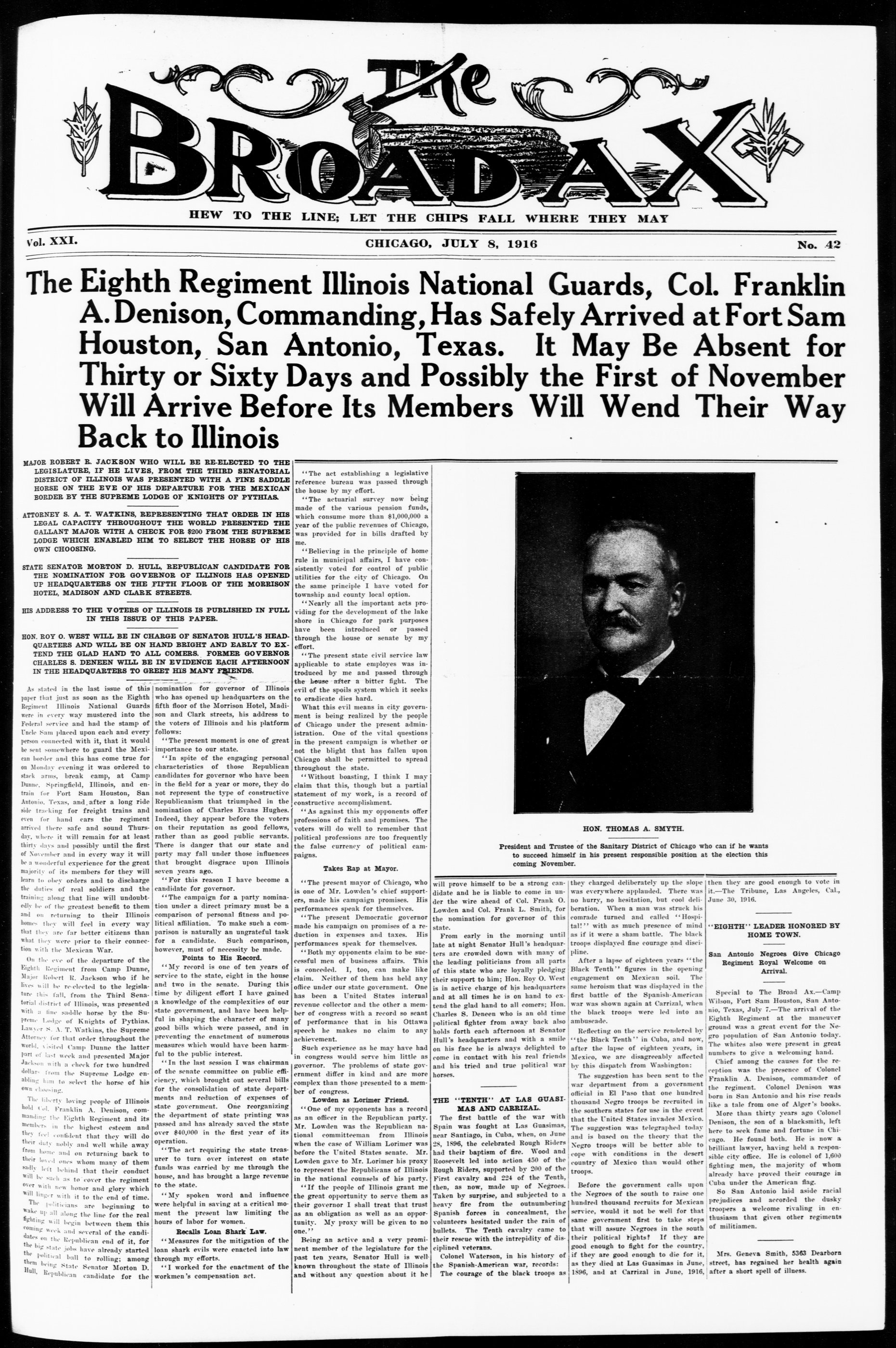
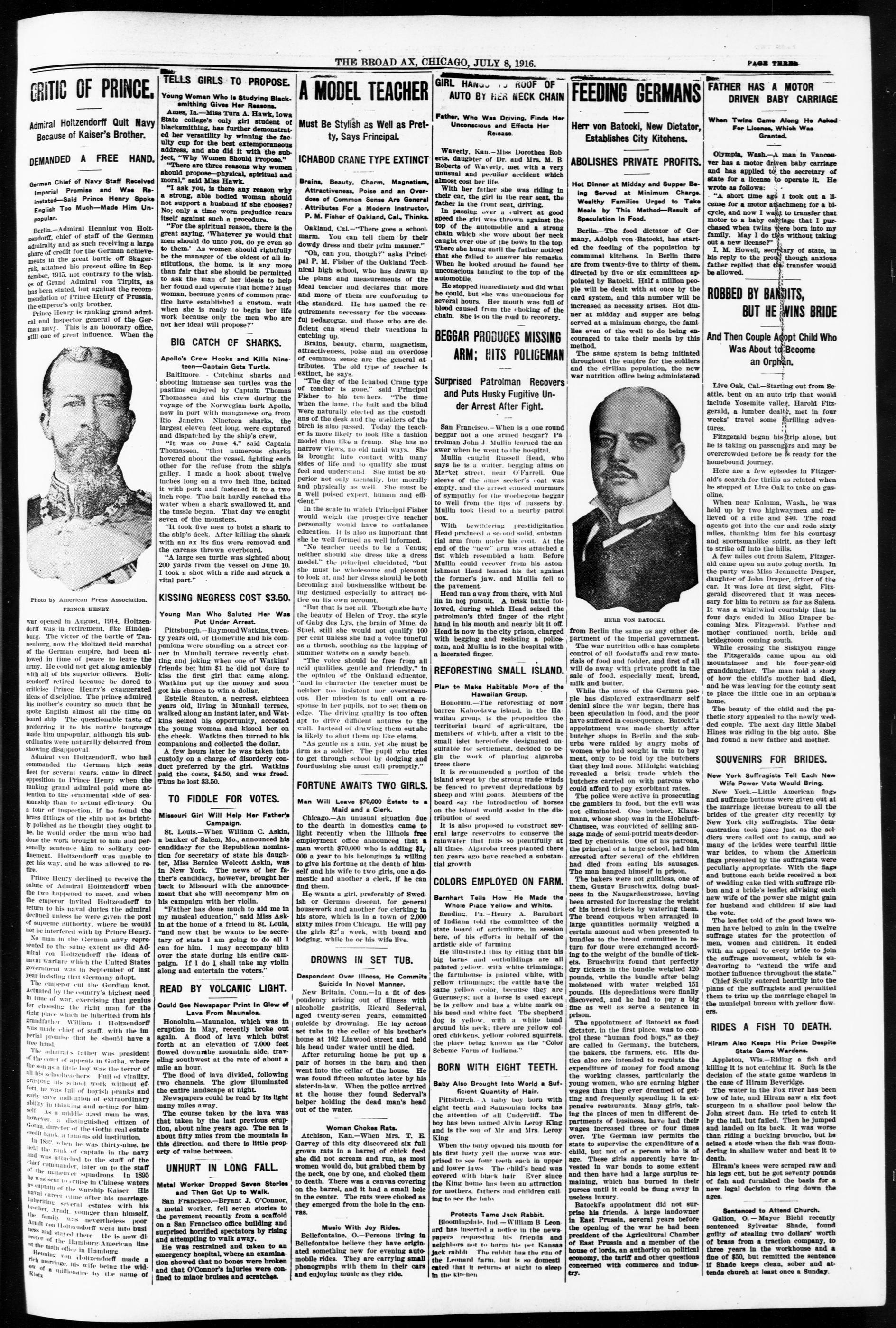
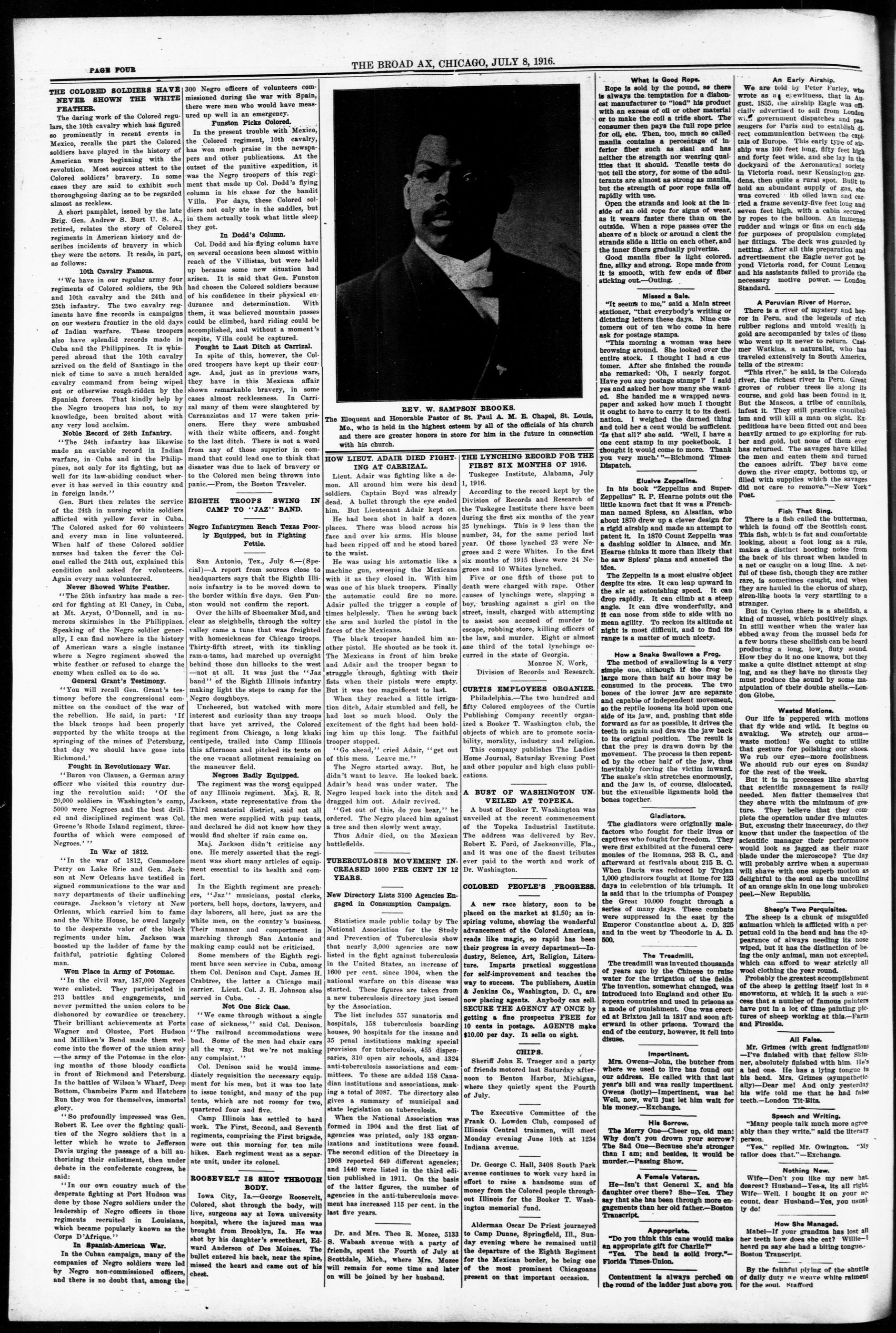
Page text (machine-generated)
THE BROAD AX
The Eighth Regiment Illinois National Guards, Col. Franklin A. Denison, Commanding, Has Safely Arrived at Fort Sam Houston, San Antonio, Texas. It May Be Absent for Thirty or Sixty Days and Possibly the First of November Will Arrive Before Its Members Will Wend Their Way Back to Illinois
MAJOR ROBERT R. JACKSON WHO WILL BE RE-ELECTED TO THE
LEGISLATURE, IF HE LIVES, FROM THE THIRD SENATORIAL
DISTRICT OF ILLINOIS WAS PRESENTED WITH A FINE SADDLE
HORSE ON THE EVE OF HIS DEPARTURE FOR THE MEXICAN
BORDER BY THE SUPREME LODGE OF KNIGHTS OF PYTHIAS.
ATTORNEY S. A. T. WATKINS, REPRESENTING THAT ORDER IN HIS
LEGAL CAPACITY THROUGHOUT THE WORLD PRESENTED THE
GALLANT MAJOR WITH A CHECK FOR $200 FROM THE SUPREME
LODGE WHICH ENABLED HIM TO SELECT THE HORSE OF HIS
OWN CHOOSING.
STATE SENATOR MORTON D. HULL, REPUBLICAN CANDIDATE FOR
THE NOMINATION FOR GOVERNOR OF ILLINOIS HAS OPENED
UP HEADQUARTERS ON THE FIFTH FLOOR OF THE MORRISON
HOTEL, MADISON AND CLARK STREETS.
HIS ADDRESS TO THE VOTERS OF ILLINOIS IS PUBLISHED IN FULL
IN THIS ISSUE OF THIS PAPER.
HON. ROY O. WEST WILL BE IN CHARGE OF SENATOR HULL'S HEAD-
QUARTERS AND WILL BE ON HAND BRIGHT AND EARLY TO EXTEND THE GLAD HAND TO ALL COMERS. FORMER GOVERNOR
CHARLES S. DENEEN WILL BE IN EVIDENCE EACH AFTERNOON
IN THE HEADQUARTERS TO GREET HIS MANY FRIENDS.
Vol. XXI.
The Eighty A. Dee House Thirty Will A Back
MAJOR ROBERT R. JACKSON WILL LEGISLATURE, IF HE LIVES DISTRICT OF ILLINOIS WAS IN HORSE ON THE EVE OF HIS BORDER BY THE SUPREME LO
ATTORNEY S. A. T. WATKINS, BE LEGAL CAPACITY THROUGH GALLANT MAJOR WITH A CHILD LODGE WHICH ENABLED HIM OWN CHOOSING.
STATE SENATOR MORTON D. HU THE NOMINATION FOR GOV UP HEADQUARTERS ON THE HOTEL, MADISON AND CLAREN
HIS ADDRESS TO THE VOTERS ON IN THIS ISSUE
HON. ROY O. WEST WILL BE IN QUARTERS AND WILL BE ON TEND THE GLAD HAND TO A CHARLES S. DENEEN WILL BE IN THE HEADQUARTERS TO G
As stated in the last issue of this paper that just as soon as the Eighth Regiment Illinois National Guards were in every way mustered into the Federal service and had the stamp of Uncle Sam placed upon each and every person connected with it, that it would be sent somewhere to guard the Mexican border and this has come true for on Monday evening it was ordered to stack arms, break camp, at Camp Dunne, Springfield, Illinois, and entrain for Fort Sam Houston, San Antonio, Texas, and after a long ride side tracking for freight trains and even for hand cars the regiment arrived there safe and sound Thursday, where it will remain for at least thirty days and possibly until the first of November and in every way it will be a wonderful experience for the great majority of its members for they will learn to obey orders and to discharge the duties of real soldiers and the training along that line will undoubtedly be of the greatest benefit to them and on returning to their Illinois homes they will feel in every way that they are far better citizens than what they were prior to their connection with the Mexican War.
On the eve of the departure of the Eighth Regiment from Camp Dunne, Major Robert R. Jackson who if he lives will be re-elected to the legislature this fall, from the Third Senatorial district of Illinois, was presented with a fine saddle horse by the Supreme Lodge of Knights of Pythias, Lawyer S. A. T. Watkins, the Supreme Attorney for that order throughout the world, visited Camp Dunne the latter part of last week and presented Major Jackson with a check for two hundred dollars from the Supreme Lodge enabling him to select the horse of his own choosing.
The liberty loving people of Illinois hold Col. Franklin A. Denison, commanding the Eighth Regiment and its members in the highest esteem and they feel confident that they will do their duty nobly and well while away from home and on returning back to their loved ones whom many of them sadly left behind that their conduct will be such as to cover the regiment over with new honor and glory which will live a lifetime.
The politicians are beginning to wake up all along the line for the real fighting will begin between them this coming week and several of the candidates on the Republican end of it, for the big state jobs have already started the political ball to rolling; among them being State Senator Morton D. Hull, Republican candidate for the
nomination for governor of Illinois who has opened up headquarters on the fifth floor of the Morrison Hotel, Madison and Clark streets, his address to the voters of Illinois and his platform follows:
"The present moment is one of great importance to our state.
"In spite of the engaging personal characteristics of those Republican candidates for governor who have been in the field for a year or more, they do not represent the type of constructive Republicanism that triumphed in the nomination of Charles Evans Hughes. Indeed, they appear before the voters on their reputation as good fellows, rather than as good public servants. There is danger that our state and party may fall under those influences that brought disgrace upon Illinois seven years ago.
"For this reason I have become a candidate for governor.
"The campaign for a party nomination under a direct primary must be a comparison of personal fitness and political affiliation. To make such a comparison is naturally an ungrateful task for a candidate. Such comparison, however, must of necessity be made.
Points to His Record.
"My record is one of ten years of service to the state, eight in the house and two in the senate. During this time by diligent effort I have gained a knowledge of the complexities of our state government, and have been helpful in shaping the character of many good bills which were passed, and in preventing the enactment of numerous measures which would have been harmful to the public interest.
"In the last session I was chairman of the senate committee on public efficiency, which brought out several bills for the consolidation of state departments and reduction of expenses of state government. One reorganizing the department of state printing was passed and has already saved the state over $40,000 in the first year of its operation.
"The act requiring the state treasurer to turn over interest on state funds was carried by me through the house, and has brought a large revenue to the state.
"My spoken word and influence were helpful in saving at a critical moment the present law limiting the hours of labor for women.
Recalls Loan Shark Law.
"Measures for the mitigation of the loan shark evils were enacted into law through my efforts.
"I worked for the enactment of the workmen's compensation act.
CHICAGO, JULY 8, 1916
nt Illinois N
ommanding,
Antonio, T
Days and H
ore Its Me
"The act establishing a legislative
reference bureau was passed through
the house by my effort.
"The actuarial survey now being made of the various pension funds, which consume more than $1,000,000 a year of the public revenues of Chicago, was provided for in bills drafted by me.
"Believing in the principle of home rule in municipal affairs, I have consistently voted for control of public utilities for the city of Chicago. On the same principle I have voted for township and county local option.
"Nearly all the important acts providing for the development of the lake shore in Chicago for park purposes have been introduced or passed through the house or senate by my effort.
"The present state civil service law applicable to state employees was introduced by me and passed through the house after a bitter fight. The evil of the spoils system which it seeks to eradicate dies hard.
What this evil means in city government is being realized by the people of Chicago under the present administration. One of the vital questions in the present campaign is whether or not the blight that has fallen upon Chicago shall be permitted to spread throughout the state.
"Without boasting, I think I may claim that this, though but a partial statement of my work, is a record of constructive accomplishment.
"As against this my opponents offer professions of faith and promises. The voters will do well to remember that political professions are too frequently the false currency of political campaigns.
Takes Rap at Mayor.
"The present mayor of Chicago, who is one of Mr. Lowden's chief supporters, made his campaign promises. His performances speak for themselves.
"The present Democratic governor made his campaign on promises of a reduction in expenses and taxes. His performances speak for themselves.
"Both my opponents claim to be successful men of business affairs. This is conceded. I, too, can make like claim. Neither of them has held any office under our state government. One has been a United States internal revenue collector and the other a member of congress with a record so scant of performance that in his Ottawa speech he makes no claim to any achievement.
Such experience as he may have had in congress would serve him little as governor. The problems of state government differ in kind and are more complex than those presented to a member of congress.
Lowden as Lorimer Friend.
Lowden as Lorimer Friend.
"One of my opponents has a record as an officer in the Republican party. Mr. Lowden was the Republican national committeeman from Illinois when the case of William Lorimer was before the United States senate. Mr. Lowden gave to Mr. Lorimer his proxy to represent the Republicans of Illinois in the national counsels of his party.
"If the people of Illinois grant me the great opportunity to serve them as their governor I shall treat that trust as an obligation as well as an opportunity. My proxy will be given to no one."
Being an active and a very prominent member of the legislature for the past ten years, Senator Hull is well known throughout the state of Illinois and without any question about it he
National G Has Safely Texas. It Possibly th mbers Wi
President and Trust to succeed him coming November
President and Trustee of the Sanitary District of Chicago who can if he wants to succeed himself in his present responsible position at the election this coming November.
will himself to be a strong candidate and he is liable to come in under the wire ahead of Col. Frank O. Lowden and Col. Frank L. Smith, for the nomination for governor of this state.
From early in the morning until late at night Senator Hull's headquarters are crowded down with many of the leading politicians from all parts of this state who are loyally pledging their support to him; Hon. Roy O. West is in active charge of his headquarters and at all times he is on hand to extend the glad hand to all comers; Hon. Charles S. Deneen who is an old time political fighter from away back also holds forth each afternoon at Senator Hull's headquarters and with a smile on his face he is always delighted to come in contact with his real friends and his tried and true political war horses.
they charged deliberately up the slope was everywhere applauded. There was no hurry, no hesitation, but cool deliberation. When a man was struck his comrade turned and called "Hospital!" with as much presence of mind as if it were a sham battle. The black troops displayed fine courage and discipline.
After a lapse of eighteen years "the Black Tenth" figures in the opening engagement on Mexican soil. The same heroism that was displayed in the first battle of the Spanish-American war was shown again at Carrizal, when the black troops were led into an ambuscade.
Reflecting on the service rendered by "the Black Tenth" in Cuba, and now, after the lapse of eighteen years, in Mexico, we are disagreeably affected by this dispatch from Washington:
The suggestion has been sent to the then they are good at it.—The Tribune, June 30, 1916.
"EIGHTH" LEAD HOMI
San Antonio New Regiment Roan An
Special to The Wilson, Fort Samnio, Texas, July 7 Eighth Regiment ground was a great gro population of The whites also with numbers to give Chief among the eption was the
THE "TENTH" AT LAS GUASI
MAS AND CARRIAL.
The first battle of the war with Spain was fought at Las Guasimas, near Santiago, in Cuba, when, on June 28, 1896, the celebrated Rough Riders had their baptism of fire. Wood and Roosevelt led into action 450 of the Rough Riders, supported by 200 of the First cavalry and 224 of the Tenth, then, as now, made up of Negroes. Taken by surprise, and subjected to a heavy fire from the outnumbering Spanish forces in concealment, the volunteers hesitated under the rain of bullets. The Tenth cavalry came to their rescue with the intrepidity of disciplined veterans. Colonel Waterson, in his history of the Spanish-American war, records: The courage of the black troops as
HON. THOMAS A. SMYTH
they charged deliberately up the slope was everywhere applauded. There was no hurry, no hesitation, but cool deliberation. When a man was struck his comrade turned and called "Hospital!" with as much presence of mind as if it were a sham battle. The black troops displayed fine courage and discipline.
After a lapse of eighteen years "the Black Tenth" figures in the opening engagement on Mexican soil. The same heroism that was displayed in the first battle of the Spanish-American war was shown again at Carrizal, when the black troops were led into an ambuscade.
Reflecting on the service rendered by "the Black Tenth" in Cuba, and now, after the lapse of eighteen years, in Mexico, we are disagreeably affected by this dispatch from Washington:
The suggestion has been sent to the war department from a government official in El Paso that one hundred thousand Negro troops be recruited in the southern states for use in the event that the United States invades Mexico. The suggestion was telegraphed today and is based on the theory that the Negro troops will be better able to cope with conditions in the desert country of Mexico than would other troops.
Before the government calls upon the Negroes of the south to raise one hundred thousand recruits for Mexican service, would it not be well for that same government first to take steps that will assure Negroes in the south their political rights? If they are good enough to fight for the country, if they are good enough to die for it, as they died at Las Guasimas in June, 1896, and at Carrizal in June, 1916,
No. 42
l. Franklin at Fort Sam
Absent for
November
Their Way
who can if he wants
t the election this
then they are good enough to vote in it.—The Tribune, Las Angeles, Cal., June 30, 1916.
"EIGHTH" LEADER HONORED BY HOME TOWN.
San Antonio Negroes Give Chicago Regiment Royal Welcome on Arrival.
Special to The Broad Ax.—Camp Wilson, Fort Sam Houston, San Antonio, Texas, July 7.—The arrival of the Eighth Regiment at the maneuver ground was a great event for the Negro population of San Antonio today. The whites also were present in great numbers to give a welcoming hand.
Chief among the causes for the reception was the presence of Colonel Franklin A. Denison, commander of the regiment. Colonel Denison was born in San Antonio and his rise reads like a tale from one of Alger's books. More than thirty years ago Colonel Denison, the son of a blacksmith, left here to seek fame and fortune in Chicago. He found both. He is now a brilliant lawyer, having held a responsible city office. He is colonel of 1,600 fighting men, the majority of whom already have proved their courage in Cuba under the American flag.
So San Antonio laid aside racial prejudices and accorded the dusky troopers a welcome rivaling in enthusiasm that given other regiments of militiamen.
Mrs. Geneva Smith, 5363 Dearborn street, has regained her health again after a short spell of illness.
PAGE TWO
THE BROAD AX
Published Weekly
In this city since July 15th, 1899,
without missing one single issue, Republicans, Democrats, Catholics, Protestants, single Taxers, Priests, infidels or anyone else can have their say as long as their language is proper and responsibility is fixed.
The Broad Ax is a newspaper whose platform is broad enough for all, ever claiming the editorial right to speak its own mind.
Local communications will receive attention. Write only on one side of the paper.
Subscriptions must be paid in advance.
One Year.....$2.00
Six Months.....1.00
Advertising rates made known on application.
Address all communications to
THE BROAD AX
6532 St. Lawrence Ave, Chicago, Ill
PHONE WENTWORTH 2597.
JULIUS F. TAYLOR, Editor and Publisher.
Entered as Second-Class Matter Aug 19, 1902, at the Post Office at Chicago Illinois, under Act of March 3, 1879.
When We Feared the Indiana
At a recent gathering of life insurance men one of the old timers exhibited a copy of a permit which had been attached to a policy issued in 1868. This permit read:
"The within assured has permission to reside in any settled part of the states of California, Nevada, Oregon or Washington territory and while so residing to make trips (as a passenger only) on first class steamers plying between the ports of Washington territory, the states of California and Oregon and the Sandwich Islands and to proceed to and return from in like manner or by public conveyance overland.
"Provided that written notice be given by the assured whenever any trip to the Sandwich Islands or to the Atlantic states is undertaken to the general agent of the company at San Francisco, Cal., and provided, also, that on the overland route the said assured to take his own risk by death from hostile Indians."—Wall Street Journal
A Natural Born Spender.
When a long forgotten cousin died and left Miss Mitfield a round hundred thousand the entire village, after having recovered from the shock, fell to wondering whether the faded little spinster, after having for sixty-three years pinched and scraped and plain sewed just to keep soul and body together, would, after all, get much comfort from her eleventh hour opulence. The state of little Miss Mitfield's mind was revealed when her next door neighbor inquired what she should do with her money—did she mean to save it?
"Save it!" Her eyes flashed with new found scorn. "Listen to me, Betsy; all my life long I've wanted a pair of side combs with yellow glass beads onto 'em, and now I'm goin' to he 'em; yes, ma'm, even if I should her to go as high as 50 cents!"—Youth's Companion.
Coffee With Milk
For many years after coffee was first drunk in Europe, says the Manchester Guardian, no one thought of mixing it with milk any more than the Turks and Arabs do now. The use of coffee au lait seems to date from 1687. Mme. de Sevigne, writing to her daughter in that year, said that a doctor much in vogue "has taught us to mux sugar and milk with our coffee. They make a most delightful compound, which will help to support me through the rigors of Lent."
In a letter written seven years earlier she had mentioned as an eccentric proceeding on the part of Mme. de la Sabbiere that "she drinks milk to her tea." Readers of "Unbeaten Tracks in Japan" may remember that one of the Alnus thought it disgusting that Mrs. Bishop should drink milk and pollute her tea with a fluid having so strong a smell and taste.
Bin Van Winkle—Himself.
Joseph Jefferson used to tell a story of his visit to a village in the Catskill mountains. He was taking a cup of tea in the hotel when he heard a negro waiter giving a detailed account of legends.
"Yes, sah." he continued, "Rip went up into de mountains, slep" for twenty years, and when he come back hyar in dis berry town his own folks didn't know him."
"Why," said the listener, "you don't believe the story's true!"
"True? Ob course it is. Why," pointing to Jefferson, "dat's de man."
Boss Prevaricators
"Reminds me of the fellow who says he has never told a lie."
"Yes. He reminds me of the chap who says the upkeep of his automobile is next to nothing."
"And he's in the same category with the man who says he never was sick a day in his life." - Birmingham Age-Herald
Gothic Architecture
The styles called Gothic, springing from a common source in Romanesque architecture and developing throughout western Europe on differing lines, are in general characterized by the following features, although not all of these will be found in all examples:
Ribbed vaulting, pointed arches, the flying arch and pinnacled buttress, clustered shafting, traceried windows in all but the earliest phases, stained glass, a progressive tendency toward loftiness, lightness of supports and suppression of wall surfaces, a system of decoration of which one element was the emphasis and adornment of structural features and another the use of sculpture and carving of human, animal, vegetable and grotesque forms, controlled by a definite didactic purpose and significance, and finally the use of available materials according to their nature upon principles in part of structural logic and in part of decorative effect.-A. D. F. Hamlin in Architectural Record.
National Flags.
If the question were asked which country's national flag had been longest in use the answer would be either the dragon banner of China or the chrysanthemum flag of Japan. The former has been used from a very early period, and the latter is as old as the present dynasty in Japan, which is the most ancient in the world. Among European national flags that of Denmark, a white St. George's cross on a red ground, is the most ancient, having been in use since 1219. No other flag has existed without change for anything like the same period as a national emblem, although there are royal standards that are older.
The Spanish colors date only from 1785, and Great Britain's flag in its present form was first flown after the union with Ireland in 1801. The stars and stripes of the United States was first planned and ordered by Washington of an upholsterer in Philadelphia and formally adopted on June 14, 1777. —London Spectator.
Shaving on One Side.
The shaving on one side only of the heads and beards of prisoners of war was obviously done to prevent any attempt at escape. But there have been other motives for such half shaving, which occurs at all sorts of points in history. Sometimes the act has been pure insult, as when Hanun, king of the children of Ammon, shaved off half of the beards of David's servants. In these days the victims would have mended matters by shaving the other half. But Jewish reverence for the beard forbade that, and David told the men to "tarry at Jericho until your beards be grown." Demosthenes, when he shut himself up for months in a subterranean chamber to practice oratory, shaved half of his head to cut off all temptation to go abroad.—London Chronicle.
Earrings Donate Widowhood.
Earrings Denote Widowhood.
That India is a land of curious customs is confirmed by the Popular Science Monthly. A widow, instead of wearing black crape, dons ponderous earrings made of solid brass. Since her widowhood is perpetual she is obliged to wear them the rest of her life. Each year another ring is added. The constantly increasing weight of metal stretches the lobe of the ear, to which it is attached, in an extraordinary manner. It is safe to say that no widow ever forgets the fact of her widowhood when wearing such a clumsy weight.
A Silent City.
No industry brings the village of Glilthoorn, Holland, into touch with the world. It is almost wholly inaccessible except by water, and the inhabitants are shy and keep within doors, betraying not the slightest interest in visitors. Indeed, Glilthoorn has been likened, empty and silent in its green picturesqueness, to a place visited in a dream.—Argonaut.
Progressive.
"When did you commit your first fatal extravagance?"
"When my boss referred to my wages as my 'salary.'"
"And when did you perpetrate this latest folly?"
"The day my wife called my salary 'income.'" -Cleveland Leader.
Appropriate.
Manufacturer—I'm going to call this new cigar "The American Lady In the Japanese Kimono." Dealer — Why? Manufacturer—Domestic filler and imported wrapper—Illinois Siren.
The Feminine Pessimist
The feminine pessimist worries because she is not as young as she once was; the optimist of the same sex rejoices that she is not so old as she will be—Life.
PRACTICAL HEALTH HINT.
Ptomaine Poison.
"Pтомалine is a scientific name for food poison," says a physician in Farm and Fireside, "and, although all potomaines are not dangerous to health, there is no simple test for telling the dangerous ones from the others. Dr. Charles K. Francis, a noted chemist, gives the advice, 'When doubtful about a food do not eat it.' This applies especially to meat which has a peculiar odor or taste, canned goods, especially when they have been opened for some time, and other foods which do not seem just right. Taking a chance may be taking your health or life. Safety first!"
THE BROAD AX, CHICAGO, JULY 8, 1916
Fable of Two Maidens.
Once there were two maidens who sought to catch a nice young man, and it was a false start in the eyes of the undiscerning, for the one was exceedingly fair to look upon and dressed stylishly, while the other was plain of countenance.
The pretty girl smiled sweetly on the nice young man and talked to him till she dazzled him with her beauty and charmed him with her wit. The plain one gazed wonderingly at him and made him talk to her of divers things, while she listened, entranced at his wisdom and learning.
Serrows of an Author.
Many of the sorrows of life in this living present are quite as 150 years ago when Oldys lived and died in Lonor 'pencil' was as remorsome though under some name men. Oldys tells how he was valuable article of nearly two and how the bookseller, 'gain and to save a little print paper, got Mr. John C cross it and cramp it, and devil with it, till he squeezes less compass than a sheet.' borrower of, that time was
He took the pretty girl out riding, to the theater and bought her chocolates and flowers, and all the knowing ones said she had struck a winner, when one day he married the plain girl and took her on the continent for their honeymoon.
The pretty girl had made him very much pleased with her, but the plain girl had gone one better and made him very much more pleased with himself.
Moral—The people who read human nature as they run generally get first to the wire—Pearson's.
Going Without Food.
Science says that if he can get drinking water an ordinary man can exist for about thirty days without food. At the end of that time the machinery of the body will not be ruined and can be entirely strengthened back to its old standard by careful feeding. About one-quarter of our body weight is fat, and it is mostly this fat which is absorbed as food during the period of starvation. We can absorb and burn up our muscles until 60 per cent of their weight has gone. We can do the same with from 30 to 40 per cent of our liver and digestive organs and 20 per cent of our lungs. Our hearts can lose 10 per cent, and our brains and nervous system can lose 5 per cent. It will thus be seen that the more vital organs, brain and heart, yield least of their valuable substance for the life of the body, while the less valuable substances—fat, muscles, and so on—are consumed first—New York American.
Novel Methods of Warfare
In ancient history there are two well authenticated instances of wild animals being used by attacking armies. The first is related by Appian when describing the siege of Themiseyra, in Pontus, by Lucullus in his war against Mithidrates. Turrets were brought up, mounds were built and huge mines were made by the Romans. The people of Themiseyra dug open these mines from above and through the holes cast down upon the workmen bears and other wild animals, together with swarms of bees. The second instance occurred in England when the Danes and Norwegians were at tacking Chester, held by the Saxons and some Gallic auxiliaries. After adopting stoning and boiling water defenses in vain against the beslegeres the Saxons threw down all the bee hives in the town upon the attackers who were soon routed.
Powers of Sheik ul Islam.
The office of sheik ul Islam—literally chief or ancient of Islam—ranks second only to that of sultan in the Ottoman empire. Its holder is ecclesiastical head of the empire and supreme interpreter of the Koran, with absolute control over all imams, dervishes and religious institutions, but he has judicial and political authority also, being, indeed, first magistrate, private seal and minister for education. In some respects the sheik ul Islam is superior even to the sultan, for his edicts are irrevocable. The sultan may dismiss him before he issues an edict, but the edict once issued takes automatic legal effect, even though, as happened in the case of Abdul Hamid, it decrees the deposition of the sultan himself.
Just by Good Luck.
A young man who had received the privilege of shooting over the land of a farmer got rather close once or twice to the home grounds. Late in the day he met the farmer.
"You've had pretty good luck," said the farmer.
"Well, no," said the young man hesitating. "I haven't had any luck at all."
"Yes, you have," repeated the farmer. "This morning you just missed my best Shorthorn."—Country Gentleman.
Sufficient.
Him-Darling, I would ask you to be my wife, but I'm afraid my income of only $2,000 a year would not be sufficient for us to get along on. Her-Oh yes; it would. I can dress on $1,500 a year, and we would have all the rest for our living and household expenses. -Indianaapolis Star.
Business Instinct
The following epiphath may be seen in the cemetery of a parish in the environs of Paris:
"Here lies Mme. N., wife of M. N., master blacksmith. The railing round this tomb was manufactured by her husband."
Cold Snatchers
Teacher—Johnny, can you tell me the function of the pores of our bodies? Johnny—They are things we use to catch cold with—Christian Register.
Be Not Fearful
You will never fear the trouble that comes your way if you are cheerful; neither will you enjoy the blessings of each day if you are fearful.
Gava Her Proof
"Do you believe, sir, that the dead ever walk after death?"
"No doubt of it, ma'am. I have heard the dead march."
Content thyself to be obscurely good.
—Addison.
Sorrows of an Author.
Many of the sorrows of the author in this living present are quite as active as 150 years ago when William Oldys lived and died in London. The "blue pencil" was as remorseless then, though under some name now forgotten. Oldys tells how he wrote some valuable article of nearly two sheets and how the bookseller, "for sordid gain and to save a little expense in print paper, got Mr. John Campbell to cross it and cramp it, and play the devil with it, till he squeezed it into less compass than a sheet." The book borrower of, that time was the same neglectful person that many of us know today, and Oldys sighs over books he has lent which have never been returned. He was a keen antiquary, delighting especially in musty manuscripts, and, half in temper and half in good humor, tells of "Old Counsel Fane, who gave me a parcel of manuscript and promised me others which he never gave me nor anything else besides a barrel of oysters."
An Early Ironclad.
Many people imagine that the first armored ship was the "iron cased frigate" Gloria, launched for the French navy in 1857, yet, according to the Popular Science Monthly, the Dutch built an armored vessel nearly 300 years earlier. That was in 1858, when Antwerp was besieged by the Spaniards. The Dutch took one of their biggest ships, cut her down and erected on the deck a battery with armored and sloping sides, within which they mounted eight of the heaviest guns the factories of the day could produce. The roof of the battery formed an armored breastwork for men armed with crossbows and shotguns, and there were gratings in the roof to provide ventilation for the battery below. A contemporary picture of the Finis Belli, as she was called, bears a striking resemblance to the Merrimac, which was designed and built on precisely the same principles.
Tendency Is What Counts.
Of course there can be no such thing as perfection in this vale of tears, but the man who turns his back upon it on that account hasn't good common sense. The man who is low down and tending upward is nearer perfection than the man who is high up and tending downward. Tendency is the profoundest fact in life—in religion, education, society, politics. When an astronomer sees a comet for the first time he will ascertain its direction, even if its progress is only a minute or two, and will describe its course among the stars for weeks ahead. He simply studies the tendency, and one can tell where a man will be ten years from now by the same sort of mathematics. That tendency may reach human perfection if it is started right and the direction maintained—Ohio State Journal.
Recognition.
One morning on the street car I noticed a large negro woman, very much overdressed and, judging from her expression, much pleased with herself.
A negro girl of about seventeen came in and sat beside her, saying genially, "Howdy do, Missus Brown?"
The woman turned and, looking down upon the girl, said:
"Chile, yo' face looks pow'ful similar, but Ah fails to organize yo'."—Exchange
The Apocalypse.
There is no other book in the New Testament about which so much has been written and to so little purpose. Dr. South said of it, "It either finds a man mad or makes him so." It is said of Calvin that he showed his wisdom in not writing a commentary on this, as he did on other books.—Chadwick.
The Only Chance.
Old Gotrox—Can you draw me a will that cannot be broken? Young Lawyer—Why—er—I've never drawn one as yet, and— Old Gotrox—Then you doubtless could. Get about it while ignorant—Boston Globe.
Musical Note.
She—Every time Screecher, the grand opera tenor, gets a sore throat it costs him $1,000. He—Gee, his throat must be as long as a giraffe's!—Musical America.
```markdown
```
PRACTICAL HEALTH HINT.
Nosebleed.
Whatever may be the cause of bleeding at the nose, always send at once for a physician and see that he is told the cause of the bleeding if it is known. While waiting for the doctor to arrive take care of the patient as best you can.
Unfasten all tight clothing around the neck; make the patient sit down on a chair or a sofa with his head slightly thrown back (never allow a patient to hang his head over a basin); open the window; raise the arms of the patient, stretched to their full extent well above and behind his head, and keep them in that position: apply a cold, wet sponge or a wet towel or a lump of ice to the back of the neck between the shoulder blades, also apply to the root of the nose. If the bleeding does not stop pinch the nose just below the bridge (where the soft part of the nose begins) between the thumb and forefinger, or a clean piece of soft rag or handkerchief can be wrapped up tightly and passed gently into the bleeding nostril.
Divine Telle Them to Think Carefully and Prayerfully About Their Wedding Day.
Cleveland. — "Twelve Golden Rules For Young Ladies" was the subject of the sermon delivered by Rev. Thomas Hughes, pastor of the Rocky River Methodist church. The twelve rules are:
"Always remember to be a lady.
"Don't be hud and boisterous.
"Be modest and virtuous.
"Choose carefully your company of both sexes.
"Open your eyes and ears, but keep your heart closed to the gush and nonsense from the so called lovers.
"Be careful about your dress. Have it beautiful and tasteful."
*Becoming and learning*
*"Be more careful about what is in your head than what is in your heart."
*"Don't be self conceited."
*"Don't keep company with a sinful young man."
*"Think carefully and prayerfully about your wedding day."
"Be considerate about the time and money of your gentlemen friends.
"Be true to the best ideals of womanhood."
DRIVEN INSANE BY 100 CIGARETTES A DAY
Sent to an Asylum Upon Saloon- keeper's Complaint and Doctor's Testimony.
Detroit, Mich.—Frank Winters, the man who smoked a hundred cigarettes a day, was committed to the Pontiac asylum by Judge Hulbert recently in the probate court. The incessant use of the cigarettes was declared by Dr. S. L. Layton, who examined Winters, to have affected his mind. Frequenting a saloon at the corner of Chamberlain and Lawdale avenues, Winters smoked until his supply gave out and his money too. After that he begged smokes from the customers of the saloon, according to Joseph Berman, the proprietor of the place.
Berman petitioned the court to have Winters taken to an asylum. A German by birth, Winters was getting along well in this country until the cigarette habit got the upper hand. Given jobs by Berman, Winters even lost his power of application to simple work.
"No more work for me," he would say as he would sit down on the job, Berman told investigators.
The nicotine undoubtedly had a deteriorating effect on his mentality, Dr. Layton declared.
FEWER KANSAS FARMERS.
There Are Not So Many Now as Ten Years Ago.
Ablene, Kan.-Fewer people are engaged in agricultural pursuits in Kansas now than ten years ago, according to J. C. Mohler, secretary of the state board of agriculture.
"In 1895 of those engaged in all occupations 55 per cent were in agriculture," he declared, "and in 1905 50 per cent and in 1915 46 per cent. It is a very discouraging sign in a state like Kansas, where agriculture is the overshadowing industry, that fewer instead of more people are engaging in it."
Some of the serious problems that must be solved in Kansas are those of the home seeker, the ownership of lands, employment of capital, better farming and the improvement of conditions of rural life, Mr. Mohler asserted.
WOULDN'T SPOIL HIS FINGERS
Artistic Hands, Out of a Job, Refuses to Shovel Coal.
Montclair, N. J.-If a man has "piano fingers" and is offered a job on a coal wagon should he accept the job to support his wife and six children, or should a philanthropic society place him in some position where his digital refinement would not be affected by manual labor?
This is one of the questions propounded in the annual report of Mrs. Nettle E. Patterson, superintendent of the Altruist society. Mrs. Patterson mentions the case in referring to the difficulties that confront the society. She said that a man when offered a place on the coal wagon refused, saying he had been told he had "piano fingers" and did not wish to spoil them.
UNABLE TO FIND A WIFE.
Farmer Has Been Searching Sixteen Years, but Se Far Has Failed.
Bridgeport, Conn.—Joseph Cronan, a farmer of Derby, announced that he had searched forty-two states and two countries of Europe and that, while in a receptive mood, he had not found a girl suitable to be his spouse.
"I am strictly temperate, a healthy and strong farmer, and I have been searching sixteen years for the right kind of a wife," he declared. "I have yet to find the woman, and I wish the newspapers would help me."
Pig Ate Sixty Others' Tail
Findlay, O.—Anson James, a Delaware county farmer, went into his hog yard and found sixty of his sixty-one pigs mhus tails. He watched the drove for awhile and saw the sixty-first pig trying to eat his own tail.
Hundreds Present When Inventor's Wife Hits Clothing—Urges Girls to Be Modest.
New York.—Hundreds of women recently heard well known women who were delegates to the National Federation of Women's Clubs convention discuss dress—the right and wrong kind of dress, the future dress and the cost of dress. All the speakers advocated greater individuality.
Mrs. Thomas A. Edison made an appeal for greater modesty in dress, particularly of young women, and in no unmistakable terms assailed clothing which, she said, tended to lead sons down to degradation. she denounced "the present abbreviated skirts and uncovered shoulders," saying: "I had a father who frequently reminded me, 'Daughter, be modest.' I think this would be good advice to our girls today."
Her husband, Mrs. Edison said, had declared there was not more than one woman in a hundred who was well dressed.
LITTLE TOWN IN OHIO
PLAINLY ON THE MAP
Clyde Has Several Claims to Distinction In Connection With Country's Wars.
Sandusky, O.—The village of Clyde, fourteen miles southwest of this city, was the home not only of the highest ranking officer killed during the civil war, but also of the first American killed in the Spanish-American war. It has the distinction also of being the nucleus of what is now the Women's Relief corps. General J. B. McPherson, killed at Atlanta in the civil war, and George B. Mack, the first American killed in the Spanish-American war, are both buried there. According to Joel Elliot of Clyde, Mrs. Hattie McPherson, aunt of General McPherson, organized the first Ladies' Aid society after the civil war began, and it was from the Ladies' Aid society of the sixties that the Women's Relief corps of the present day grew.
Elliot says further that army records at Washington will show that in proportion to population, more men enlisted at Clyde for both the civil and Spanish-American wars than from any other place of its size in the United States.
President Garfield was to have been the principal orator at the unveiling of the McPherson monument when, on Saturday, July 2, 1881, he left the White House to go to the seaside to spend Sunday with his family before proceeding to Ohio and was shot while waiting for his train.
NEW WAY OF GETTING A SUIT
Prisoner Worried Owner Until He Gave it to Him.
San Jose.—A new way of getting a suit of clothes was introduced here when William Shore, a prisoner, confessed to Police Captain Campbell that he had "mooched" the suit he wore.
"I saw the suit on a man on the street and liked it," he said. "So I went up to him and asked for it. He got mad and wouldn't give it to me, so I followed him around day and night for two days, asking for it at every turn. Finally he got disgusted with me and gave me the clothes."
Shore told Police Chief Fuller, who threatened to put him to work pitching hay, that he "wouldn't pitch enough hay in a week to keep a canary bird alive for one day."
REFUSED TO QUIT JAIL
Muncie (Ind.) Resident Said It Was the Best Job He Ever Had.
Muncie, Ind.-Albert O'Harra, sheriff,
had a hard time to make Frank McLaughlin quit the county jail.
A friend paid McLaughlin's fine, but he steadfastly refused to leave the jail until his sentence had been served, the sentence being for eleven days.
"I never had a better job than this," said McLaughlin. "All I had to do was a little scrubbing out in the morning, and I had a good, warm place in which to sleep and a good place in which to eat and had plenty of things to eat in the bargain. Believe me, Sheriff O'Harra is the best landlord I've ever known."
CALICO FROM THE SKY.
Windstorm Drops Bolt of Goods in Needy Woman's Yard.
Hume, Mo.—In a recent windstorm here a bolt of calico fell in Mrs. Jenny Harrie's chicken lot in the north part of the city. It was quite a lucky jack for Mrs. Harrie, when the price of calico is considered, and she needed the goods.
It is supposed that the calico was taken it up in the clouds in the path of the tornado south of here. Where it came from no one knows.
Hog With Six Lega.
Puente, Cal-While driving out a number of hogs from a pen on the Rowland ranch workmen in the employ of L. A. Meredith discovered that one sow was possessed of six legs. The animal has two extra forelegs perfectly formed, and all six legs are used by the animal in walking. Mr. Meredith says the two extra legs are just inside the "regular" forelegs and are somewhat smaller.
CRITIC OF PRINCE.
Admiral Holtzendorff Quit Navy Because of Kaiser's Brother.
DEMANDED A FREE HAND.
German Chief of Navy Staff Received Imperial Promise and Was Reinstated—Said Prince Henry Spoke English Too Much—Made Him Unpopular.
Berlin.-Admiral Henning von Holtzendorff, chief of staff of the German admiral and as such receiving a large share of credit for the German achievements in the great battle off Skagerrak, attained his present office in September, 1915, not contrary to the wishes of Grand Admiral von Tirpitz, as has been stated, but against the recommendation of Prince Henry of Prussia, the emperor's only brother. Prince Henry is ranking grand admiral and inspector general of the German navy. This is an honorary office, still one of great influence. When the
[Name]
Photo by American Press Association. PRINCE HENRY war opened in August, 1914. Holtzendorff was in retirement, like Hindenburg. The victor of the battle of Tannenburg, now the idolized field marshal of the German empire, had been allowed in time of peace to leave the army. He could not get along amicably with all of his superior officers. Holtzendorff retired because he dared to criticise Prince Henry's exaggerated ideas of discipline. The prince admired his mother's country so much that he spoke English almost all the time on board ship. The questionable taste of preferring it to his native language made him unpopular, although his subordinates were naturally debarred from showing disapproval
Admiral von Holtzendorff, who had commanded the German high seas fleet for several years, came in direct opposition to Prince Henry when the ranking grand admiral paid more attention to the ornamental side of seamanship than to actual efficiency. On a tour of inspection, if he found the brass fittings of the ship not as brightly polished as he thought they ought to be, he would order the man who had done the work brought to him and personally sentence him to solitary confinement. Holtzendorff was unable to get his way, and he was allowed to retire.
Prince Henry declined to receive the salute of Admiral Holtzendorff when the two happened to meet, and when the emperor invited Holtzendorff to return to his naval duties the admiral declined unless he were given the post of supreme authority, where he would not be interfered with by Prince Henry.
No man in the German navy represented to the same extent as did Admiral von Holtzendorff the idea of naval warfare which the United States government was in September of last year insisting that Germany adopt. The emperor cut the Gordian knot. Activated by the country's highest need in time of war, exercising that genius for choosing the right man for the right place which he inherited from his grandfather William 1 Holtzendorff was made chief of staff, with the imperial promise that he should have a free hand.
The admiral's father was president of the court of appeals in Gotha, where the son as a little boy was the terror of all his schoolteachers. Full of vitality, grasping his school work without effort, he was full of boyish pranks and early gave indication of extraordinary ability in thinking and acting for himself. As a middle aged man he was, however, a distinguished citizen of Gotha, director of the Gotha real estate credit bank a fortune-old institution.
In 1892, when he was thirty-nine, he held the rank of captain in the navy and was attached to the staff of the chief commander, later on to the staff of the maneuver squadrons. In 1895 he was sent to cruise in Chinese waters as captain of the warship Kaiser His naval career came after his marriage. Inheriting several estates with his brother, Arudt, younger than himself, the family was nevertheless poor. Arudt von Holtzendorff went into business and stayed there. He is now director of the Hamburg-American line at the mall office in Hamburg.
denning von aldzoutendorf made a rich marriage, his wife being the widow of a millionaire by the name of Khaz
TELLS GIRLS TO PROPOSE
Young Woman Who Is Studying Black
smithing Gives Her Responses
Ames, Ia.—Miss Tura A. Hawk, Iowa State college's only girl student of blacksmithing, has further demonstrated her versatility by winning the faculty cup for the best extemporaneous address, and she did it with the subject, "Why Women Should Propose."
"There are three reasons why women should propose—physical, spiritual and moral," said Miss Hawk.
"I ask you, is there any reason why a strong, able bodied woman should not support a husband if she chooses? No; only a time worn prejudice rears itself against such a procedure.
"For the spiritual reason, there is the great saying, 'Whatever ye would that men should do unto you, do ye even so to them.' As women should rightfully be the manager of the oldest of all institutions, the home, is it any more than fair that she should be permitted to ask the man of her ideals to help her found and operate that home? Must woman, because years of common practice have established a custom, wait when she is ready to begin her life work because only the men who are not her ideal will propose?"
BIG CATCH CF SHARKS
Apollo's Crew Hooks and Kills Nineteen—Captain Gets Turtle.
Baltimore - Catching sharks and shooting immense sea turtles was the pastime enjoyed by Captain Thomas Thomassen and his crew during the voyage of the Norwegian bark Apollo, now in port with manganese ore from Rio Janeiro. Nineteen sharks, the largest eleven feet long, were captured and dispatched by the ship's crew.
"It was on June 4," said Captain Thomassen, "that numerous sharks covered about the vessel, fighting each other for the refuse from the ship's galley. I made a book about twelve inches long on a two inch line, baited it with pork and fastened it to a two inch rope. The bait hardly reached the water when a shark swallowed it, and the tussle began. That day we caught seven of the monsters.
"It took five men to hoist a shark to the ship's deck. After killing the shark with an ax its fins were removed and the carcass thrown overboard.
"A large sea turtle was sighted about 200 yards from the vessel on June 10.
I took a shot with a rifle and struck a vital part."
KISSING NEGRESS COST $3.50.
Young Man Who Saluted Her Was Put Under Arrest.
Pittsburgh.—Raymond Watkins, twenty years old, of Homeville and his companions were standing on a street corner in Munhall terrace recently chatting and joking when one of Watkins' friends bet him $1 he did not dare to kiss the first girl that came along. Watkins put up the money and soon got his chance to win a dollar.
Estelle Stanton, a negress, eighteen years old, living in Munhall terrace, walked along an instant later, and Watkins seized his opportunity, accosted the young woman and kissed her on the cheek. Watkins then turned to his companions and collected the dollar.
A few hours later he was taken into custody on a charge of disorderly conduct preferred by the girl. Watkins paid the costs, $4.50, and was freed. Thus he lost $3.50.
TO FIDDLE FOR VOTES.
Missouri Girl Will Help Her Father's Campaign.
St. Louis.—When William C. Askin, a banker of Salem, Mo., announced his candidacy for the Republican nomination for secretary of state his daughter, Miss Bernice Wolcott Askin, was in New York. The news of her father's candidacy, however, brought her back to Missouri with the announcement that she will accompany him on his campaign with her violin.
"Father has done much to alm me in my musical education," said Miss Askin at the home of a friend in St. Louis, "and now that he wants to be secretary of state I am going to do all I can for him. I may accompany him over the state during his entire campaign. If I do I shall take my violin along and entertain the voters."
READ BY VOLCANIC LIGHT.
Could See Newspaper Print In Glow of Lava From Maunaloa.
Honolulu—Maunaloa, which was in eruption in May, recently broke out again. A flood of lava which burst forth at an elevation of 7,000 feet flowed down the mountain side, traveling southwest at the rate of about a mile an hour.
The flood of lava divided, following two channels. The glow illuminated the entire landscape at night.
Newspapers could be read by its light many miles away.
The course taken by the lava was that taken by the last previous eruption, about nine years ago. The sea is about fifty miles from the mountain in this direction, and there is little property of value between.
UNHURT IN LONG FALL.
Metal Worker Dropped Seven Stories and Then Got Up to Walk.
San Francisco—Bryant J. O'Connor, a metal worker, fell seven stories to the pavement recently from a scaffold on a San Francisco office building and surprised horrified spectators by rising and attempting to walk away.
He was restrained and taken to an emergency hospital, where an examination showed that no bones were broken and that O'Connor's injuries were confined to minor bruises and scratches.
THE BROAD AX, CHICAGO, JULY 8, 1916
A MODEL TEACHER
Must Be Stylish as Well as Pretty, Says Principal.
ICHABOD CRANE TYPE EXTINCT
Brains, Beauty, Charm, Magnetism, Attractiveness, Poise and an Overdose of Common Sense Are General. Attributes For a Modern Instructor. P. M. Fisher of Oakland, Cal., Thinka Oakland, Cal.—"There goes a schoolmarm. You can tell them by their dowdy dress and their prim manner." "Oh, can you, though?" asks Principal P. M. Fisher of the Oakland Technical high school, who has drawn up the plans and measurements of the ideal teacher and declares that more and more of them are conforming to the standard. He has named the requirements necessary for the successful pedagogue, and those who are deficient can spend their vacations in catching up.
Brains, beauty, charm, magnetism, attractiveness, poise and an overdose of common sense are the general attributes. The old type of teacher is extinct, he says.
"The day of the Ichabod Crane type of teacher is gone," said Principal Fisher to his teachers. "The time when the lame, the halt and the blind were naturally elected as the custodians of the desk and the welders of the birch is also passed. Today the teacher is more likely to look like a fashion model than like a trump. She has no narrow views, no old maid ways. She is brought into contact with many sides of life and to qualify she must feel and understand. She must be superior not only mentally, but morally and physically as well. She must be a well poised expert, human and efficient."
In the scale in which Principal Fisher would weigh the prospective teacher personally would have to outbalance education. It is also as important that she be well formed as well informed.
"No teacher needs to be a Venus; neither should she dress like a dress model." the principal elucidated, "but she must be wholesome and pleasant to look at, and her dress should be both becoming and businesslike without being designed especially to attract notice on its own account.
"But that is not all. Though she have the beauty of Helen of Troy, the style of Gaby des Lys, the brain of Mme. de Stael, still she would not qualify 100 per cent unless she had a voice tuneful as a thrush, soothing as the lapping of summer waters on a sandy beach.
"The voice should be free from all acid qualities, gentle and friendly." in the opinion of the Oakland educator, "and in character the teacher must be neither too insistent nor overstrenuous. Her mission is to call out a response in her pupils, not to set them on edge. The driving quality is too often apt to drive diffident natures to the wall. Instead of drawing them out she is likely to shut them up like clams. "As gentle as a num, yet she must be firm as a soldier. The pupil who tries to get through school by dodging and fourflushing she must call promptly."
FORTUNE AWAITS TWO GIRLS.
Man Will Leave $70,000 Estate to a Maid and a Clerk.
Chicago.—An unusual situation due to the dearth in domestics came to light recently when the Illinois free employment office announced that a man worth $70,000 who is adding $1,000 a year to his belongings is willing to give his fortune at the death of himself and his wife to two girls, one a domestic and another a clerk, if he can find them.
He wants a girl, preferably of Swedish or German descent, for general housework and another for clerking in his store, which is in a town of 2,000 sixty miles from Chicago. He will pay the girls $2' a week, with board and lodging, while he or his wife live.
DROWNS IN SET TUB.
Despondent Over Illness, He Commits Suicide In Novel Manner.
New Britain, Conn.—In a fit of despondency arising out of illness with alcoholic gastritis, Richard Sederval, aged twenty-seven years, committed suicide by drowning. He lay across set tubs in the cellar of his brother's home at 102 Linwood street and held his head under water until he died.
After returning home he put up a pair of horses in the barn and then went into the cellar of the house. He was found fifteen minutes later by his sister-in-law. When the police arrived in the house they found Sederval's helper holding the dead man's head out of the water.
Woman Chokes Rats.
Atchison, Kan.-When Mrs. T. E. Garvey of this city discovered six full grown rats in a barrel of chick feed she did not scream and run, as most women would do, but grabbed them by the neck, one by one, and choked them to death. There was a canvas covering on the barrel, and it had a small hole in the center. The rats were choked as they emerged from the hole in the canvas.
Music With Joy Rides.
Bellefontaine, O.-Persons living in Bellefontaine believe they have originated something new for evening automobile rides. They are carrying small phonographs with them in their cars and enjoying music as they ride.
Father, Who Was Driving, Finds Her Unconscious and Effects Her Release.
Waverly, Kan.—Miss Dorothea Roberts, daughter of Dr. and Mrs. M. B. Roberts of Waverly, met with a very unusual and peculiar accident which almost cost her life.
With her father she was riding in their car, the girl in the rear seat, the father in the front seat, driving.
In passing over a culvert at good speed the girl was thrown against the top of the automobile and a strong chain which she wore about her neck caught over one of the bows in the top. There she hung until the father noticed that she failed to answer his remarks. When he looked around he found her unconscious hanging to the top of the automobile.
He stopped immediately and did what he could, but she was unconscious for several hours. Her mouth was full of blood caused from the choking of the chain. She is on the road to recovery.
BEGGAR PRODUCES MISSING ARM; HITS POLICEMAN
BEGGAR PRODUCES MISSING ARM; HITS POLICEMAN
Surprised Patrolman Recovers and Puts Husky Fugitive Under Arrest After Fight.
San Francisco. - When is a one round beggar not a one armed beggar? Patrolman John J. Mullin learned the an-swer when he went to the hospital.
Mullin caught Russell Head, who says he is a waiter, begging alms on Market street, near O'Farrall. One sleeve of the alms seeker's coat was empty, and the arrest caused murmurs of sympathy for the woehoghe beggar to well from the tips of passers by. Mullin took Head to a nearby patrol box.
With bewildering prestidigitation Head produced a second solid, substantial arm from under his coat. At the end of the "new" arm was attached a fist which resembled a ham. Before Mullin could recover from his astonishment Head leaned his fist against the former's jaw, and Mullin fell to the pavement.
Head ran away from there, with Mullin in hot pursuit. A brisk battle followed, during which Head seized the patrolman's third finger of the right hand in his mouth and nearly bit it off. Head is now in the city prison, charged with begging and resisting a policeman, and Mullin is in the hospital with a lacerated finger.
REFORESTING SMALL ISLAND.
Plan to Make Habitable More of the Hawaiian Group.
Honolulu.—The reforesting of now barren Kahoolawe island, in the Hawaiian group, is the proposition the territorial board of agriculture, the members of which, after a visit to the small islet heretofore designated unsuitable for settlement, decided to begin the work of planting algaroba trees there.
It is recommended a portion of the island swept by the strong trade winds be fenced to prevent depredations by sheep and wild goats. Members of the board say the introduction of horses on the island would assist in the distribution of seed.
It is also proposed to construct several large reservoirs to conserve the rainwater that falls so plentifully at all times. Algaroa trees planted there ten years ago have reached a substantial growth
COLORS EMPLOYED ON FARM
Barnhart Teils How He Made the Whole Peace Yellow and White.
Reading, Pa.-Henry A. Barnhart of Indiana told the committee of the state board of agriculture, in session here, of his efforts in behalf of the artistic side of farming.
He illustrated this by citing that his big barns and outbuildings are all painted yellow, with white trimmings; the farmhouse is painted white, with yellow trimmings; the cattle have the same yellow color, because they are Guernseys; not a horse is used except he is yellow and has a white mark on his head and white feet. The shepherd dog is yellow, with a white band around his neck; there are yellow colored chickens, yellow colored squirrels, the place being known as the "Color Scheme Farm of Indiana."
BORN WITH EIGHT TEETH.
Baby Also Brought Into World a Sufficient Quantity of Hair.
Pittsburgh. A baby boy born with eight teeth and Samsonian locks has the attention of all Undercliff. The boy has been named Alvin Leroy King and is the son of Mr and Mrs. Leroy King
When the baby opened his mouth for his first lusty yell the nurse was surprised to see four teeth each in upper and lower jaws. The child's head was covered with black hair. Ever since the King home has been an attraction for mothers, fathers and children calling to see the baby
Protects Tame Jack Rabbit
Bloomingdale, Ind. — William B Leonard has inserted a notice in the newspapers requesting his friends and neighbors not to harm his pet Kansas jack rabbit. The rabbit has the run of the Leonard farm, but is so domesticated that it returns at night to sleep in the kitchen.
Herr von Batocki, New Dictator, Establishes City Kitchens.
ABOLISHES PRIVATE PROFITS.
Hot Dinner at Midday and Supper Being Served at Minimum Charge. Wealthy Families Urged to Take Meals by This Method—Result of Speculation In Food.
Berlin.—The food dictator of Germany, Adolph von Batockl, has started the feeding of the population by communal kitchens. In Berlin there are from twenty-five to thirty of them, directed by five or six committees appointed by Batockl. Half a million people will be dealt with at once by the card system, and this number will be increased as necessity arises. Hot dinner at midday and supper are being served at a minimum charge, the families even of the well to do being encouraged to take their meals by this method.
The same system is being initiated throughout the empire for the soldiers and the civilian population, the new war nutrition office being administered
P.
HERB VON BATOCKI
from Berlin the same as any other department of the imperial government.
partment of the imperial government. The war nutrition office has complete control of all foodstuffs and raw materials of food and fodder, and first of all will do away with private profit in the sale of food, especially meat, bread, milk and butter. While the mass of the German people has displayed extraordinary self denial since the war began, there has been speculation in food, and the poor have suffered in consequence. Butocki's appointment was made shortly after butcher shops in Berlin and the suburbs were raided by angry mobs of women who had sought in vain to buy meat, only to be told by the butchers that they had none. Midnight watching revealed a brisk trade which the butchers carried on with patrons who could afford to pay exorbitant rates.
The police were active in prosecuting the gamblers in food, but the evil was not eliminated. One butcher, Klausmann, whose shop was in the Hoheluft-Chausee, was convicted of selling sausage made of semi-purit meats deodorized by chemicals. One of his patrons, the principal of a large school, had him arrested after several of the children had died from eating his sausages. The man hanged himself in prison.
The bakers were not guiltless, one of them, Gustav Bruschwitz, doing business in the Naugardenstrasse, having been arrested for increasing the weight of his bread tickets by watering them. The bread coupons when arranged in large quantities normally weighed a certain amount and when presented in bundles to the bread committee in return for flour were exchanged according to the weight of the bundle of tickets. Bruschwitz found that perfectly dry tickets in the bundle weighed 120 pounds, while the bundle after being moistened with water weighed 151 pounds. His depredations were finally discovered, and he had to pay a big fine as well as serve a sentence in prison.
The appointment of Batocki as food dictator, in the first place, was to control these "human food hogs," as they are called in Germany, the butchers, the bakers, the farmers, etc. His duties also are intended to regulate the expenditure of money for food among the working classes, particularly the young women, who are earning higher wages than they ever dreamed of getting and frequently spending it in expensive restaurants. Many girls, taking the places of men in different departments of business, have had their wages increased three or four times over. The German law permits the state to supervise the expenditure of a child, but not of a person who is of age. These girls apparently have invested in war bonds to some extent and then have had a large surplus remaining, which has burned in their purses until it could be fung away in useless luxury.
Batocki's appointment did not surprise his friends. A large landowner in East Prussia, several years before the opening of the war he had been president of the Agricultural Chamber of East Prussia and a member of the house of lords, an authority on political economy, the tariff and other questions concerned with commerce and industry.
PAGE THREE
FATHER HAS A MOTOR
DRIVEN BABY CARRIAGE
When Twins Came Along He Asked For License, Which Was Granted.
Olympia, Wash.—A man in Vancouver has a motor driven baby carriage and has applied to the secretary of state for a license to operate it. He wrote as follows:
"A short time age I took out a license for a motor attachment for a bicycle, and now I want to transfer that motor to a baby carriage that I purchased when twins were born into my family. May I do this without taking out a new license?"
I. M. Howell, secretary of state, in his reply to the proud though anxious father replied that the transfer would be allowed.
ROBBED BY BANDITS,
BUT HE WINS BRIDE
And Then Couple Adopt Child Who
Was About to Become
an Orphan.
Live Oak, Cal.—Starting out from Seattle, bent on an auto trip that would include Yosemite valley, Harold Fitzgerald, a lumber dealer, met in four weeks' travel some thrilling adventures.
Fitzgerald began his trip alone, but he is taking on passengers, may be overcrowded before he is ready for the homebound journey.
Here are a few episodes in Fitzgerald's search for thrills as related when he stopped at Live Oak to take on gasoline.
When near Kalama, Wash., he was held up by two highwaymen and relieved of a rifle and $40. The road agents got into the car and rode sixty miles, thanking him for his courtesy and sportsmanlike spirit, as they left to strike off into the hills.
A few miles out from Salem, Fitzgerald came upon an auto going north. In the party was Miss Jeannette Draper, daughter of John Draper, driver of the car. It was love at first sight. Fitzgerald discovered that it was necessary for him to return as far as Salem. It was a whirlwind courtship that in four days ended in Miss Draper becoming Mrs. Fitzgerald. Father and mother continued north, bride and bridegroom coming south.
While crossing the Siskiyou range the Fitzgeralds came upon an old mountaineer and his four-year-old granddaughter. The man told a story of how the child's mother had died, and he was leaving for the county seat to place the little one in an orphan's home.
The beauty of the child and the pathetic story appealed to the newly wedded couple. The next day little Mabel Hines was riding in the big auto. She had found a new father and mother.
SOUVENIRS FOR BRIDES.
New York Suffragists Tell Each New Wife Power Vote Would Bring.
New York.-Little American flags and suffrage buttons were given out at the marriage license bureau to all the brides of the greater city recently by New York city suffragists. The demonstration took place just as the soldiers were called out to camp, and so many of the brides were tearful little war brides, to whom the American flags presented by the suffragists were peculiarly appropriate. With the flags and buttons each bride received a box of wedding cake tied with suffrage ribbon and a bride's leaflet advising each new wife of the power she might gain for husband and children if she had the vote.
The leaflet told of the good laws women have helped to gain in the twelve suffrage states for the protection of men, women and children. It ended with an appeal to every bride to join the suffrage movement, which is endeavoring to "extend the wife and mother influence throughout the state." Chief Scully entered heartily into the plans of the suffragists and permitted them to trim up the marriage chapel in the municipal bureau with yellow flowers.
RIDES A FISH TO DEATH.
Hiram Also Keeps His Prize Despite State Game Wardens.
Appleton, Wis.-Riding a fish and killing it is not catching it. Such is the decision of the state game wardens in the case of Hiram Beveridge.
The water in the Fox river has been low of late, and Hiram saw a six foot sturgeon in a shallow pool below the John street dam. He tried to catch it by the tail, but failed. Then he jumped and landed on its back. It was worse than riding a bucking broncho, but he seized a stone when the fish was floundering in shallow water and beat it to death.
Hiram's knees were scraped raw and his legs cut, but he got seventy pounds of fish and furnished the basis for a new legal decision to ring down the ages.
Sentenced to Attend Church.
Gallion, O.—Mayor Biehl recently sentenced Sylvester Shade, found guilty of stealing two dollars' worth of brass from a traction company, to three years in the workhouse and a fine of $50, but remitted the sentence if Shade keeps clean, sober and attends church at least once a Sunday.
PAGE FOUR
THE COLORED SOLDIERS HAVE NEVER SHOWN THE WHITE PEATHER.
The daring work of the Colored regulars, the 10th cavalry which has figured so prominently in recent events in Mexico, recalls the part the Colored soldiers have played in the history of American wars beginning with the revolution. Most sources attest to the Colored soldiers' bravery. In some cases they are said to exhibit such thoroughgoing daring as to be regarded almost as reckless.
A short pamphlet, issued by the late Brig. Gen. Andrew S. Burt U. S. A., retired, relates the story of Colored regiments in American history and describes incidents of bravery in which they were the actors. It reads, in part, as follows:
10th Cavalry Famous.
"We have in our regular army four regiments of Colored soldiers, the 9th and 10th cavalry and the 24th and 25th infantry. The two cavalry regiments have fine records in campaigns on our western frontier in the old days of Indian warfare. These troopers also have splendid records made in Cuba and the Philippines. It is whispered abroad that the 10th cavalry arrived on the field of Santiago in the nick of time to save a much heralded cavalry command from being wiped out or otherwise rough-ridden by the Spanish forces. That kindly help by the Negro troopers has not, to my knowledge, been bruited about with any very loud acclaim.
Noble Record of 24th Infantry.
"The 24th infantry has likewise made an enviable record in Indian warfare, in Cuba and in the Philippines, not only for its fighting, but as well for its law-abiding conduct wherever it has served in this country and in foreign lands." Gen. Burt then relates the service of the 24th in nursing white soldiers afflicted with yellow fever in Cuba. The Colored asked for 60 volunteers and every man in line volunteered. When half of these Colored soldier nurses had taken the fever the Colonel called the 24th out, explained this condition and asked for volunteers. Again every man volunteered.
Never Showed White Feather.
"The 25th infantry has made a record for fighting at El Caney, in Cuba, at Mt. Aryat, O'Donnell, and in numerous skirmishes in the Philippines. Speaking of the Negro soldier generally, I can find nowhere in the history of American wars a single instance where a Negro regiment showed the white feather or refused to charge the enemy when called on to do so.
General Grant's Testimony.
"You will recall Gen. Grant's testimony before the congressional committee on the conduct of the war of the rebellion. He said, in part: 'If the black troops had been properly supported by the white troops at the springing of the mines of Petersburg, that day we should have gone into Richmond."
Fought in Revolutionary War.
"Baron von Clausen, a German army officer who visited this country during the revolution said: 'Of the 20,000 soldiers in Washington's camp, 5000 were Negroes and the best drilled and disciplined regiment was Col Greene's Rhode Island regiment, three-fourths of which were composed of Negroes.'"
In War of 1812.
"In the war of 1812, Commodore Perry on Lake Erie and Gen. Jackson at New Orleans have testified in signed communications to the war and navy departments of their unfinching courage. Jackson's victory at New Orleans, which carried him to fame and the White House, he owed largely to the desperate valor of the black regiments under him. Jackson was boosted up the ladder of fame by the faithful, patriotic fighting Colored man
Won Place in Army of Potomac.
"In the civil war, 187,000 Negroes were enlisted. They participated in 213 battles and engagements, and never permitted the union colors to be dishonored by cowardice or treachery. Their brilliant achievements at Forts Wagner and Olustee, Fort Hudson and Milliken's Bend made them welcome into the flower of the union army—the army of the Potomac in the closing months of those bloody conflicts in front of Richmond and Petersburg. In the battles of Wilson's Wharf, Deep Bottom, Chambeirs Farm and Hatchers Run they won for themselves, immortal glory.
"So profoundly impressed was Gen. Robert E. Lee over the fighting qualities of the Negro soldiers that in a letter which he wrote to Jefferson Davis urging the passage of a bill authorizing their enlistment, then under debate in the confederate congress, he said:
"In our own country much of the desperate fighting at Port Hudson was done by those Negro soldiers under the leadership of Negro officers in those regiments recruited in Louisiana, which became popularly known as the Corps D'Afrique."
In Spanish-American War.
In the Cuban campaign, many of the companies of Negro soldiers were led by Negro non-commissioned officers, and there is no doubt that among the
300 Negro officers of volunteers commissioned during the war with Spain, there were men who would have measured up well in an emergency.
Funston Ricks Colored
In the present trouble with Mexico, the Colored regiment, 10th cavalry, has won much praise in the newspapers and other publications. At the outset of the punitive expedition, it was the Negro troopers of this regiment that made up Col. Dodd's flying column in his chase for the bandit Villa. For days, these Colored soldiers not only ate in the saddles, but in them actually took what little sleep they got.
In Dodd's Column.
Col. Dodd and his flying column have on several occasions been almost within reach of the Villistas, but were held up because some new situation had arisen. It is said that Gen. Funston had chosen the Colored soldiers because of his confidence in their physical endurance and determination. With them, it was believed mountain passes could be climbed, hard riding could be accomplished, and without a moment's respite, Villa could be captured.
Fought to Last Ditch at Carrizal.
Fought to Last Ditch at Carrizan.
In spite of this, however, the Colored troopers have kept up their courage. And, just as in previous wars, they have in this Mexican affair shown remarkable bravery, in some cases almost recklessness. In Carrizal many of them were slaughtered by Carranzistas and 17 were taken prisoners. Here they were ambushed with their white officers, and fought to the last ditch. There is not a word from any of those superior in command that could lead one to think that disaster was due to lack of bravery or to the Colored men being thrown into panic—From, the Boston Traveler.
EIGHTH TROOPS SWING IN
CAMP TO "JAZ" BAND.
Negro Infantrymen Reach Texas Poorly Equipped, but in Fighting Fettle.
San Antonio, Tex., July 6.—(Special)—A report from sources close to headquarters says that the Eighth Illinois infantry is to be moved down to the border within five days. Gen Funston would not confirm the report. Over the hills of Shoemaker Mud, and clear as sleighbells, through the sultry valley came a tune that was freighted with homesickness for Chicago troops. Thirty-fifth street, with its tinkling ram-a-tams, had marched up overnight behind those dun hillocks to the west—not at all. It was just the "Jaz band" of the Eighth Illinois infantry making light the steps to camp for the Negro doughboys.
Uncheered, but watched with more interest and curiosity than any troops that have yet arrived, the Colored regiment from Chicago, a long khaki centipede, trailed into Camp Illinois this afternoon and pitched its tents on the one vacant allotment remaining on the maneuver field.
Negroes Badly Equipped.
The regiment was the worst equipped of any Illinois regiment. Maj. R. R. Jackson, state representative from the Third senatorial district, said not all the men were supplied with pup tents, and declared he did not know how they would find shelter if rain came on.
Maj. Jackson didn't criticise any one. He merely asserted that the regiment was short many articles of equipment essential to its health and comfort.
In the Eighth regiment are preachers, "Jaz" musicians, postal clerks, porters, bell hops, doctors, lawyers, and day laborers, all here, just as are the white men, on the country's business. Their manner and comportment in marching through San Antonio and making camp could not be criticised.
Some members of the Eighth regiment have seen service in Cuba, among them Col. Denison and Capt. James H. Crabtree, the latter a Chicago mail carrier. Lieut. Col. J. H. Johnson also served in Cuba.
Not One Sick Case.
"We came through without a single case of sickness," said Col. Denison. "The railroad accommodations were bad. Some of the men had chair cars all the way. But we're not making any complaint." Col. Denison said he would immediately requisition the necessary equipment for his men, but it was too late to issue tonight, and many of the pup tents, which are not roomy for two, quartered four and five.
Camp Illinois has settled to hard work. The First, Second, and Seventh regiments, comprising the First brigade, were out this morning for ten mile hikes. Each regiment went as a separate unit, under its colonel.
BOOSEVELT IS SHOT THROUGH BODY.
Iowa City, Ia.—George Roosevelt, Colored, shot through the body, will live, surgeons say at Iowa university hospital, where the injured man was brought from Brooklyn, Ia. He was shot by his daughter's sweetheart, Edward Anderson of Des Moines. The bullet entered his back, near the spine, missed the heart and came out of his chest.
.
THE BROAD AX, CHICAGO, JULY 8, 1916.
[Image of a man in a suit with a bow tie and a badge on his lapel].
REV. W. SAMPSON BROOKS.
The Eloquent and Honorable Pastor of St. Paul A. M. E. Chapel, St. Louis, Mo., who is held in the highest esteem by all of the officials of his church and there are greater honors in store for him in the future in connection with his church.
The Eloquent and Honorable Pastor of St. Paul A. M. E. Chapel, St. Louis, Mo., who is held in the highest esteem by all of the officials of his church and there are greater honors in store for him in the future in connection with his church.
HOW LIEUT. ADAIR DIED FIGHTING AT CARRIZAL.
Lieut. Adair was fighting like a demon. All around him were his dead soldiers. Captain Boyd was already dead. A bullet through the eye ended him. But Lieutenant Adair kept on. He had been shot in half a dozen places. There was blood across his face and over his arms. His blouse had been ripped off and he stood bared to the waist.
THE LYNCHING RECORD FOR THE FIRST SIX MONTHS OF 1916.
Tuskegee Institute, Alabama, July 1, 1916.
According to the record kept by the Division of Records and Research of the Tuskegee Institute there have been during the first six months of the year 25 lynchings. This is 9 less than the number, 34, for the same period last year. Of those lynched 23 were Negroes and 2 were Whites. In the first
He was using his automatic like a machine gun, sweeping the Mexicans with it as they closed in. With him was one of his black troopers. Finally the automatic could fire no more. Adair pulled the trigger a couple of times helplessly. Then he swung back the arm and hurled the pistol in the faces of the Mexicans.
The black trooper handed him another pistol. He healed as he took it. The Mexicans in front of him broke and Adair and the trooper began to struggle through, fighting with their fists when their pistols were empty. But it was too magnificent to last.
When they reached a little irrigation ditch, Adair stumbled and fell, he had lost so much blood. Only the excitement of the fight had been holding him up this long. The faithful trooper stopped.
"Go ahead," cried Adair, "get out of this mess. Leave me."
The Negro started away. But, he didn't want to leave. He looked back. Adair's head was under water. The Negro leaped back into the ditch and dragged him out. Adair revived.
"Get out of this, do you hear," he ordered. The Negro placed him against a tree and then slowly went away.
Thus Adair died, on the Mexican battlefields.
TUBERCULOSIS MOVEMENT INCREASED 1600 PER CENT IN 12 YEARS.
New Directory Lists 3100 Agencies Engaged in Consumption Campaign.
Statistics made public today by The National Association for the Study and Prevention of Tuberculosis show that nearly 3,000 agencies are now listed in the fight against tuberculosis in the United States, an increase of 1600 per cent, since 1904, when the national warfare on this disease was started. These figures are taken from a new tuberculosis directory just issued by the Association.
The list includes 557 sanatoria and hospitals, 158 tuberculosis boarding houses, 90 hospitals for the insane and 35 penal institutions making special provision for tuberculosis, 455 dispensaries, 310 open air schools, and 1324 anti-tuberculosis associations and committees. To these are added 158 Canadian institutions and associations, making a total of 3087. The directory also gives a summary of municipal and state legislation on tuberculosis.
When the National Association was formed in 1904 and the first list of agencies was printed, only 183 organizations and institutions were found. The second edition of the Directory in 1908 reported 649 different agencies; and 1440 were listed in the third edition published in 1911. On the basis of the latter figures, the number of agencies in the anti-tuberculosis movement has increased 115 per cent. in the last five years.
Dr. and Mrs. Theo R. Mozee, 5133 S. Wabash avenue with a party of friends, spent the Fourth of July at Scottdale, Mich., where Mrs. Mozee will remain for some time and later on will be joined by her husband.
THE LYNCHING RECORD FOR THE FIRST SIX MONTHS OF 1916.
Tuskegee Institute, Alabama, July 1, 1916.
According to the record kept by the Division of Records and Research of the Tuskegee Institute there have been during the first six months of the year 25 lynchings. This is 9 less than the number, 34, for the same period last year. Of those lyncheds 23 were Negroes and 2 were Whites. In the first six months of 1915 there were 24 Negroes and 10 Whites lynched.
Five or one fifth of those put to death were charged with rape. Other causes of lynchings were, slapping a boy, brushing against a girl on the street, insult, charged with attempting to assist son accused of murder to escape, robbing store, killing officers of the law, and murder. Eight or almost one third of the total lynchings occurred in the state of Georgia.
Monroe N. Work,
Division of Records and Research
CURTIS EMPLOYEES ORGANIZE.
Philadelphia.—The two hundred and fifty Colored employees of the Curtis Publishing Company recently organized a Booker T. Washington club, the objects of which are to promote sociability, morality, industry and religion. This company publishes The Ladies Home Journal, Saturday Evening Post and other popular and high class publications.
A BUST OF WASHINGTON UN
VEILED AT TOPEKA.
A bust of Booker T. Washington was unveiled at the recent commencement of the Topeka Industrial Institute. The address was delivered by Rev. Robert E. Ford, of Jacksonville, Fla., and it was one of the finest tributes ever paid to the worth and work of Dr. Washington.
COLORED PEOPLE'S PROGRESS
A new race history, soon to be placed on the market at $1.50; an inspiring volume, showing the wonderful advancement of the Colored American, reads like magic, so rapid has been their progress in every department—Industry, Science, Art, Religion, Literature. Imparts practical suggestions for self-improvement and teaches the way to success. The publishers, Austin & Jenkins Co., Washington, D. C., are now placing agents. Anybody can sell SECURE THE AGENCY AT ONCE by getting a fine prospectus FREE for 10 cents in postage. AGENTS make $10.00 per day. It sells on sight.
Sheriff John E. Traeger and a party of friends motored last Saturday afternoon to Benton Harbor, Michigan, where they quietly spent the Fourth of July.
The Executive Committee of the Frank O. Lowden Club, composed of Illinois Central trainmen, will meet Monday evening June 10th at 1234 Indiana avenue.
Dr. George C. Hall, 3408 South Park avenue continues to work very hard in effort to raise a handsome sum of money from the Colored people throughout Illinois for the Booker T. Washington memorial fund.
Alderman Oscar De Priest journeyed to Camp Dunne, Springfield, Ill., Sunday evening where he remained until the departure of the Eighth Regiment for the Mexican border, he being one of the most prominent Chicagoans present on that important occasion.
CHIPS.
What Is Good Ropes.
Rope is sold by the pound, so there is always the temptation for a dishonest manufacturer to "load" his product with an excess of oil or other material or to make the coll a trifle short. The consumer then pays the full rope price for oil, etc. Then, too, much so called manila contains a percentage of inferior fiber such as sisal and has neither the strength nor wearing qualities that it should. Tensile tests do not tell the story, for some of the adulterants are almost as strong as manila, but the strength of poor rope falls off rapidly with use. Open the strands and look at the inside of an old rope for signs of wear, as it wears faster there than on the outside. When a rope passes over the sheave of a block or around a cleat the strands slide a little on each other, and the inner fibers gradually pulverize.
Good manila fiber is light colored, fine, silky and strong. Rope made from it is smooth, with few ends of fiber sticking out.—Outing.
Missed a Sale.
"It seems to me," said a Main street stationer, "that everybody's writing or dictating letters these days. Nine customers out of ten who come in here ask for postage stamps.
"This morning a woman was here browsing around. She looked over the entire stock. I thought I had a customer. After she finished the rounds she remarked: 'Oh, I nearly forgot. Have you any postage stamps?' I said yes and asked her how many she wanted. She handed me a wrapped newspaper and asked how much I thought it ought to have to carry it to its destination. I weighed the darned thing and told her a cent would be sufficient. 'Is that all?' she said. 'Well, I have a one cent stamp in my pocketbook. I thought it would come to more. Thank you very much.'"—Richmond Times-Dispatch
Elusive Zeppelins
In his book "Zeppelins and Super-Zeppelins" R. P. Hearne points out the little known fact that it was a Frenchman named Spiess, an Alsatian, who about 1870 drew up a clever design for a rigid airship and made an attempt to patent it. In 1870 Count Zeppelin was a dashing soldier in Alsace, and Mr. Hearne thinks it more than likely that he saw Spiess' plans and annexed the idea.
The Zeppelin is a most elusive object despite its size. It can leap upward in the air at astonishing speed. It can drop rapidly. It can climb at a steep angle. It can dive wonderfully, and it can nose from side to side with no mean agility. To reckon its altitude at night is most difficult, and to find its range is a matter of much nicety.
How a Snake Swallows a Frog
How a Snake Swallows a Frog.
The method of swallowing is a very simple one, although if the frog be large more than half an hour may be consumed in the process. The two bones of the lower jaw are separate and capable of independent movement, so the reptile loosens its hold upon one side of its jaw, and, pushing that side forward as far as possible, it drives the teeth in again and draws the jaw back to its original position. The result is that the prey is drawn down by the movement. The process is then repeated by the other half of the jaw, thus inevitably forcing the victim inward. The snake's skin stretches enormously, and the jaw is, of course, dislocated, but the extensible ligaments hold the bones together.
Gladiators.
The gladiators were originally malefactors who fought for their lives or captives who fought for freedom. They were first exhibited at the funeral ceremonies of the Romans, 263 B. C., and afterward at festivals about 215 B. C. When Dacia was reduced by Trojan 1,000 gladiators fought at Rome for 123 days in celebration of his triumph. It is said that in the triumphs of Pompey the Great 10,000 fought through a series of many days. These combats were suppressed in the east by the Emperor Constantine a. D. 325 and in the west by Theodoric in A. D. 500.
The Treadmill
The treadmill was invented thousands of years ago by the Chinese to raise water for the irrigation of the fields. The invention, somewhat changed, was introduced into England and other European countries and used in prisons as a mode of punishment. One was erected at Brixton jail in 1817 and soon afterward in other prisons. Toward the end of the century, however, it fell into disuse.
Impertinent
Mrs. Owens—John, the butcher from where we used to live has found out our address. He called with that last year's bill and was really impertinent. Owens (hotly)—Impertinent, was he Well, now, we'll just let him wait for his money.—Exchange.
His Sorrow.
The Merry One—Cheer up, old man! Why don't you drown your sorrow? The Sad One—Because she's stronger than I am; and besides, it would be murder.—Passing Show.
A Female Veteran
He-Isn't that General X. and his daughter over there? She—Yes. They say that she has been through more engagements than her old father—Boston Transcript.
Appropriate.
"Do you think this cane would make an appropriate gift for Charlie?"
"Yes. The head is solid ivory."—Florida Times-Union.
Contentment is always perched on the round of the ladder just above you
An Early Airship.
We are told by Peter Farley, who wrote as a eyewitness, that in August, 1835, the airship Eagle was officially advertised to sail from London with government dispatches and passengers for Paris and to establish direct communication between the capitals of Europe. This early type of airship was 160 feet long, fifty feet high and forty feet wide, and she lay in the dockyard of the Aeronautical society in Victoria road, near Kensington gardens, then quite a rural spot. Built to hold an abundant supply of gas, she was covered with oiled land and carried a frame seventy-five feet long and seven feet high, with a cabin secured by ropes to the balloon. An immense rudder and wings or fins on each side for purposes of propulsion completed her fittings. The deck was guarded by netting. After all this preparation and advertisement the Eagle never got beyond Victoria road, for Count Lenox and his assistants failed to provide the necessary motive power. — London Standard.
A Peruvian River of Horror
There is a river of mystery and horror in Peru, and the legends of rich rubber regions and untold wealth in gold are accompanied by tales of those who went up it never to return. Caskier Watkins, a naturalist, who has traveled extensively in South America, tells of the stream:
"This river," he said, is the Colorado river, the richest river in Peru. Great groves of rubber trees lie along its course, and gold has been found in it. But the Mascos, a tribe of cannibals, infest it. They still practice cannibalism and will kill a man on sight. Expeditions have been fitted out and been heavily armed to go exploring for rubber and gold, but none of them ever has returned. The savages have killed the men and eaten them and turned the canoes adrift. They have come down the river empty, bottoms up, or filled with supplies which the savages did not care to remove."—New York Post.
Fish That Sing.
There is a fish called the butterman, which is found off the Scottish coast. This fish, which is fat and comfortable looking, about a foot long as a rule, makes a distinct hooting noise from the back of his throat when landed in a net or caught on a long line. A netful of these fish, though they are rather rare, is sometimes caught, and when they are hauled in the chorus of sharp, siren-like boots is very startling to a stranger.
But in Ceylon there is a shellfish, a kind of mussel, which positively sings. In still weather when the water has ebbed away from the mussel beds for a few hours these shellfish can be heard producing a long, low, futy sound. How they do it no one knows, but they make a quite distinct attempt at singing, and as they have no throats they must produce the sound by some manipulation of their double shells.—London Globe.
Wasted Motions.
Our life is peppered with motions that fly wide and wild. It begins on awaking. We stretch our arms—waste motion! We ought to utilize that gesture for polishing our shoes. We rub our eyes—more foolishness. We should rub our eyes on Sunday for the rest of the week.
But it is in processes like shaving that scientific management is really needed. Men flatter themselves that they shave with the minimum of gesture. They believe that they complete the operation under five minutes. But, excusing their inaccuracy, do they know that under the inspection of the scientific manager their performance would look as jagged as their razor blade under the microscope? The day will probably arrive when a superman will shave with one superb motion as delightful to the soul as the uncolling of an orange skin in one long unbroken peel—New Republic.
Sheep's Two Pergulasites
The sheep is a chunk of misguided animation which is afflicted with a perpetual cold in the head and has the appearance of always needing its nose wiped, but it has the distinction of being the only animal, man not excepted, which can afford to wear strictly all wool clothing the year round. Probably the greatest accomplishment of the sheep is getting itself lost in a snowstorm, at which it is such a success that a number of famous painters have put in a lot of time painting pictures of sheep working at this.—Farm and Fireside.
All False.
Mr. Grimes (with great indignation)
"I've finished with that fellow Skinner, absolutely finished with him. He's a bad one. He has a lying tongue in his head. Mrs. Grimes (sympathetically)—Dear me! And only yesterday his wife told me that he had false teeth.—London Tit-Bits.
Speech and Writing.
"Many people talk much more agreeably than they write," said the literary person.
"Yes," replied Owington. "My tailor does that." Exchange.
Nothing New.
Wife—Don't you like my new hat,
dearest? Husband—Yes-s, its all right.
Wife—Well. I bought it on your account,
dear Husband—Yes, you usually do!
How She Managed.
Mabel—If your grandma has lost all her teeth how does she eat? Willie—I heard pa say she had a biting tongue. Boston Transcript.
By the faithful plying of the shuttle of daily duty we weave white ralment for the soul. Stafford
Talks on
HEALTH,
CLEANLINESS,
PROPER LIVING,
SANITATION, ETC.
BY
Dr. W. A. DRIVER
BY
3300 So. State Street
Phode Douglas 3617
TOBACCO AND ALCOHOLIC
BLINDNESS
The careful examination of the national guardsmen now in progress reveals the fact that our citizen soldiery has a large contingent defective, especially as regards vision ocular. Pathologists tell us that much of the defective sight is due to the use of tobacco and alcohol. Snuff has the same injurious effect as tobacco and alcohol. The injury to the sight is of such gradual growth that the victims are not aware of the danger until the damage is irreparable. Tobacco and alcohol are doubly dangerous because of the insidious nature of the two drugs. It seems that good vision is the first need of a soldier; it also seems that tobacco and alcohol are the destroyers of good vision. It is strange indeed that the well wishers of the soldiers
CHIPS
Attorney B. F. Moseley, 6221 S. Halsted street; the Chicago mayor of Idlewild, Mich., the new Colored summer resort; returned home Thursday from that city where he spent the Fourth of July and in assisting generally to construct his new summer home.
Mrs. Carrie Warner, 5223 South Dearborn street, visited Camp Dunne, Springfield, Illinois the first of this week in order to bid her only son Joe Warner farewell on the eve of his departure for the Mexican border with the Eighth Regiment Illinois National Guards.
Mrs. James H. Johnson, Mrs. Robert R. Jackson, Mrs. Samuel A. McGowan, Mrs. Clinton L. Hill and Mrs. Arnett Betz and Hunt have all returned home from Camp Dunne, Springfield, Ill., where on Monday evening they bid farewell to their husbands and witnessed the departure of the Eighth Regiment for the Mexican borders.
---
Mrs. Franklin A. Denison, with Master Franklin A. Denison returned home from Camp Dunne, Springfield, Illinois Tuesday evening, where she witnessed the departure of the Eighth Regiment Illinois National Guard, Col F. A. Denison commanding, for the Mexican border. Mrs. Denison and the children will spend the rest of the summer at their summer home, near Benton Harbor, Mich.
Despite the fact that the vacation season has struck Chicago square in the face, Mr. Jesse Binga, State street and 36th place, the successful banker and real estate broker continues to do a thriving business. Mr. Binga gives steady employment. to not less than twenty-five to thirty-five Colored young women and men, such as clerks, stenographers, carpenters, plumbers, painters or decorators and janitors, which amply proves that he is aiding or helping the race in general, while he is moving forward or climbing upward.
THE defendant in a case tried in a Western court had been duly convicted of theft, when it was seen, on "proving previous convictions," that he had actually been in prison at the time the theft was committed.
"Why didn't you say so?" angrily demanded the judge of the prisoner.
"Your Honor," said the man, apologetically, "I was afraid of prejudicing the jury against me."—New York Evening Post.
ASSISTANT STATE'S ATTORNEY WILLIAM H. HOLLY has resigned and will resume private practice as a member of the law firm of Henry A. and Charles Aaron.
O. A. ARNSTON announces the removal of his law offices from 851 Otis Building to 1317 City Hall Square Building. Telephone Randolph 3564.
HARRY A. BARNHARDT has removed his law office to Conway Bldg., suite 1809. Telephone Franklin 2481.
RALPH L. PECK is now located at 1427 New York Life Building. Telephone Central 631. He was formerly located at 1410, 76 West Monroe street.
[Name]
persist in sending them tobacco, the destroyer of that which is needed most. Good marksmanship is a great credit to a soldier; good vision is necessary for it.
Our soldiers must be protected from their own folly. We must save the vision ocular of the men who bear arms; we must learn what are the dangers and avoid those dangers. Efficient soldiers shoot straight; they have good eyesight. In time of peace prepare for war; in time of peace teach the youth, the future soldier, that tobacco and alcohol injure the eye and thus prevent soldierly efficiency.
What profiteth it a nation if it gain a whole lot of revenue from the sale of tobacco and alcohol and lose the eyesight necessary for its soldiers to shoot straight?
MISS CLIFFT MARTIN is the first woman to receive the law degree from the University of Louisiana and one of the few women entitled to practice law in Louisiana.
FREEMAN K. BLAKE has moved his law office from 1439 Unity Building to 900 Cunard Building. Telephone Central 3441.
BERNHABT FRANK has moved from 1517 Unity Building to 1108 Cunard Building. Telephone Central 6930.
THE BROAD AX, CHICAGO, JULY 8, 1916.
Charles E. Stump, the Newspaper Correspondent, Ends His Travels Through the South for the Present and for a Short Time He Will Remain on His Farm Out in Kansas
I am back in Chicago at this time, and I have a few things to say to you and hope that you will give this your attention for when I am through I am going to make a stop, and stop I must before I get through, but I can't stop before I commence.
Of course I have been doing some moving since I wrote the last letter, and I am still ready to move a little more. But I thought I would come in and take a look at Chicago for inspiration. I find the older you get the more inspiration you will want, and the more you get the more you will try to get. This seems to be human nature, and I am not going to go out of the way to find out why.
If you will recall when I wrote to you the last time I was right in Texas, or some other point, but I have been to Texas to see them hold a grand lodge of Knights of Pythias. I had already learned the pass word and was ready to go in and have a little say there. Such is life, and such is the world.
I think I have already told you about Prairie View, Texas and told you about Prof. I. M. Terrell. When I was through there I got on the wagon and went right into Dallas where the grand lodge was to meet. I had accepted an invitation to be with the Rev. F. B. Williams, pastor of Bethel A. M. E. church. He is a remarkable young man, and has won a high place in his church, although the church may be a long time in finding him. It is going to find him before he leaves here, because merit is bound to win.
After spending a little time in his home I went by and met the editors and reporters and bookkeepers and other big men connected with the Dallas Express. It was a real good paper, and they were as polite as politeness itself. Of course I enjoyed all this, and made myself right at home. Business Manager Jordan told me to stay in his office during my visit in Dallas. Of course I accepted.
Next found me clapping my hands for joy, because I did not dream I would ever get to see what I really did see, and that was the great big building right in Texas. Four stories high, brick and steel, and owned by the Pythians. This is the work of Grand Chancellor A. N. Prince, M. D. one of the great men of our race and country, and he will ever live in the hearts of the people. He just put down his doctor business, and said that his people had to do a few things in this world, and I tell you when he was through the things had been done and accomplished.
I am not going to tell you what they have on each floor because that would take up too much time for this week. But it is a modern building in all that goes to make modern, and they do not owe a White man one cent on it. If they borrowed any money it was borrowed from the race.
Would it be of any interest to you to know that W. Sidney Pitman was the architect and he is one of the best in the country, and I don't mind saying that to you and to the people! He has just settled down and made his place in this world. He is a man of affairs, and a man of worth. I was delighted to see him to talk with him and to meet so many able people in this part of the world.
Prof. M. M. Rodger, who is some scholar, and some business man is the Grand Keeper of Records and seal, and in this he has made his mark. He is secretary of a number of organizations, and they tell me that he is so accurate that he would hardly step on a pin for fear of making a mistake. He is considered one of the best in the south. He is chairman of the Pythian Temple commission, auditor for the National Baptist convention, and an all around man from start to finish. He knows how to lead men. It is fortunate that he is right by the side of Dr. Prince. W. S. Willis, George M. Huest. are all business men.
I have never understood just how it is, but when you are leader of men, you can get along alright until you do something and then you must fight or die. Just as soon as that temple was
completed, then men cried for a change, for change, and some wore badges containing "We want a change." In other words Dr. Prince has now finished the temple and we want to set him aside that some other man may enjoy all the glory. They canvassed, they worked, and they got on hand the biggest politician in Texas, William McDonald known in the political world as "Goose Neck Bill." He was there fresh from the Chicago convention that had nominated Hughes for president, and he had all the latest methods. The other people declared that they were going to carry home the bacon. But they did not. W. E. King, editor of the Dallas Express was nominated, but when the votes were cast, they found that they had lost, and Prince was put on top again. He has won his place and there is no need of changing him. I had then the pleasure of going to another part of the world. After seeing the grand lodge through, and meeting Miss Lillian A. Shaw, who can write as fast as you can speak, and then make her fingers dance a jig on the typewriter, was kind enough to write my letters. She is one of the teachers in the public school of the town, and she is doing some teaching, but is spending the summer doing some work for others.
I met many of the Dallas people, saw all the grand lodge, and heard them elect officers, and then I pulled out for Texarkana, Little Rock, Memphis, Louisville, Frankfort, Paris, Ky., Cynthiana, Ky., Cincinnati, Ohio, Indianapolis, Ind., and now I am here in Chicago.
Many of the people wore a sad look on their faces, and when I asked, I learned that many of the sons and brothers and husbands of the women had gone to fight Villa and Carranza and all them other men in Mexico. They belonged to the 8th Illinois National Guards and the regiment had been ordered to Springfield to get equipped for fighting. I am told that they are drinking gunpowder soup and blood pudding in order to get in fighting humor. Maj. R. R. Jackson said that he was going to take his boys and whip them out. He is some fighter himself. Col. Franklin A. Denison, a fine lawyer, scholar and soldier is at the head. He is a fighter too, and the men all love him. They will march with him right into the place where wind was never known to blow. They are going there to die, or to kill if so ordered. They love "Old Glory." They will die for the country.
Since they are willing to do all this, it seems to me that the flag should give them better protection. Just to think men of my race went in and helped to elect the present president, and yet he will not give them a single appointment. For some time we have been register of deeds, but he has appointed a White man to the position. Douglass, C. H. J. Taylor, Cheatham, Dancy, and perhaps one or two others held the position. I am sorry of this because I work for the country, die for it, and when it is all over the president will not give me a second grade appointment in the post office or anywhere else where skill and ability are needed. I am about to see how I can make it.
I will be glad to see some of you sometime when I am in town. I want to come to see you again and that soon. I will not be able to tell you of the things I saw in Kentucky. They have a big Pythian building in Frankfort. I hope to call your attention to all when I see you next. I am going back to Kansas for a few hours to see how my farm is getting along.
LEAVES $500 TO A WHITE STUDENT.
New Haven, Conn.—By the will of Mrs. Ella de Ladson, an aged Colored woman who conducted a restaurant for Yale students for forty years, lately filed, Albert A. Low (white) of Danbury, who was bookkeeper for her while in college, receives a $500 bequest. She made many charitable bequests. Her estate will reach $35,000, all of which was made in catering to students.
How Limpets Stick
Every one is familiar with the saying "to stick like a limpet," but there are not so many who know how it is that a limpet is able to stick as it does to the rocks upon which it passes its existence. The creature is able, by means of the central portion of its body, which can be raised independently of the edge or frill which surrounds it, to create a vacuum, much in the same way that a piece of soft wet leather can be made to adhere to a smooth surface by pressing out all the air. Thus the so called "strength" of the limpet is largely due to atmospheric pressure. It is not entirely so, however, for if they are closely examined it will be seen that the shells accommodate themselves around the edges to the surface of the rock upon which the limpet is located, and if removed to another spot the edge of the shell will probably be found to be a very bad fit and the creature's power of adhesion somewhat lessened. If taken by surprise with a smart sidelong blow even a large limpet is easily enough dislodged; but, given the slightest warning, its power of suction is instantly brought into play, and very often considerable force is then necessary ere it can be detached—London Mail.
Taming the Mink
The United States department of agriculture is making experiments in domesticating the mink. Well, here's luck to its efforts—but heaven help the poultryman who tries to rear his chickens near that experimental farm. The mink has fur as fine as the most exacting lady could desire, but his disposition is as bad as that of a Villista bandit, and he has at least as much cunning. He can dig his way into any enclosure not made of brick, stone or concrete. He loves blood as well as a weasel. He has a perfect genius for evading traps, and he can conduct his depredations so skillfully that for months and even years they will be laid to other marauders, and only the closest observers will know that there is a mink in the neighborhood. The man—or the department—which undertakes to tame such a creature has a large self confidence.—Chicago Journal.
Napoleon and a Submarine.
The idea of submarine navigation is not so modern as many people imagine. When Napoleon was banished to St. Helena a notorious smuggler named Johnstone conceived the idea of assisting the dethroned monarch to escape. In Scott's "Life of Napoleon" he says: "A submarine vessel was to be the means of effecting this enterprise. It was thought that by sinking the vessel during the daytime she might escape the notice of the British cruisers and, being raised at night, might approach the guarded rock without discovery. The vessel was actually begun in one of the building yards upon the Thames; but, the peculiarity of her construction having occasioned suspicion, she was seized by the government."
Our First Railroad Train
On Aug. 28, 1830, the first American built railroad train made its initial journey. The train carried passengers in its one little car and made a trip of fourteen miles in one hour and fifteen minutes, to the utter astonishment of the "natives," who predicted all sorts of dire calamities from such speed madness. This was the beginning of the Baltimore and Ohio railroad, the oldest American road.
A Lasting Flower.
A common South African flower, the white star of Bethlehem (Ornithogalum lacteum), will keep fresh for two months or more after cutting. It can be sent as a cut flower from South Africa to Europe or Asia or America, and then will last for weeks in water.
Pruning Trees
In pruning branches from trees cut them off close up to the origin. Never leave a stub of the portion removed, for the cut surface will never heal over, allowing the decay germs to enter and gradually work into the body of the tree.
Identified.
"You haven't forgotten us, have you, waiter?"
"Oh, no, sir. You are the two fried smelts."—Judge.
PRACTICAL HEALTH HINT.
Treating Hives
An attack of hives has usually a beginning in some carelessness due to eating. It is a very common thing to mix up indigestible foods in one's dietary. The partaking of foods which cause indigestion must be avoided. Nothing destroys the appearance of the skin more readily than repeated bilious attacks, which are always brought on by indulgent eating. The skin becomes thick, yellowish and pasty looking and many times covered with an eruption known as urticaria or hives.
The hives will quickly disap-
pear if a good purgative medicine
is taken, such as the effervescing
citrate of magnesia, a half glass
three times a day between meals
for a day or two, or the efferves-
cing phosphate of sodium, two
heaping teapoonfuls in a tum-
blerful of cold water three times
a day half an hour before meals.
The itching of the skin will be
relieved by bathing the skin se-
veral times a day with a mixture
composed of vinegar, two table-
spoonfuls, and hot water, four
tablespoonfuls.
PAGE FIVE
If the fame of all great men were sung one member of our community would be known far beyond the circle of family and friends. We believe that in one regard he has few equals. Give him something to save for, something not too far off and not too vague, and he will keep the money in his pockets until it is black with pocket wear.
He has saved money for several yards of finely bound books, one or two volumes of which he has actually read. He has saved money with which to join secret orders and uniforms thereof. By frugal attention to pennles and nickels, paring an expense here, making a rigid self denial there, he has saved the price of an automobile. In March he begins to save for vacation, and along about August he begins saving for Christmas.
But our friend cannot save for a rainy day. He cannot save for investment. There has never been a serious thought in his mind about old age, impairment of working and earning powers, sickness and unemployment—Toledo Blade.
During a Thunderstorm
Do not use the telephone. The telephone wires may receive a heavy charge.
Keep away from stoves, radiators and the like. They are large metallic masses, likely to become heavily charged.
Avoid screen doors or other metallic bodies connecting with the exterior of the building.
Keep away from chimneys and open screened windows.
Out of doors the most dangerous places are under isolated trees and near wire fences in open fields.
Small sheds and other shelters are dangerous if isolated from larger buildings.
Thick timber is undoubtedly the safest place to seek out of doors, since a single tree in a forest is not so likely to receive a stroke as a single person or an object in an open space of equal area.—Country Gentleman.
He Who Shirke His Work
The man who shirks his work, who treats the service of labor with indifference, who sacrifices his efficiency on the altar of self indulgence, loafs on his job and plans to see how little he can do and not be caught, is to be the most pitted man on the face of the earth.
He thinks he is cheating his employer. But the employer is not the man he is cheating. Far from it. He is cheating himself. More than cheating himself, he is assassinating opportunity and paving the way to utter ruin and disgrace.
The man who cannot be trusted with labor for which he is honestly paid is just as despicable as the man who refuses to pay for labor honestly performed. The shirker is essentially dishonest. Unfaithful to himself, setting the bomb that will sooner or later send him to poverty, he is a menace and an abomination—Dayton Journal.
Why Coins Are Milled
Did you ever look at the edge of a dime or quarter? They are different from pennies and nickels, for all silver and gold coin have what are called "milled" edges, while the edges of pennies and nickels are smooth. The reasons for this is that some dishonest persons used to clip pieces off the coins, especially the gold ones, and then sell these scraps of precious metal when they had saved a great many. Every year the nation lost large sums of money this way, and the thieves would smooth the edges off so well that it was hard to find out who was guilty. The best way of stopping this practice was found to be to "mill" the edges of the most valuable coins so that no one could pare them without letting it be seen at once. — Kansas City Star.
Two New York Straits.
The following information as to the widest and narrowest streets from curb to curb and from property line to property line is for the old city of New York, now the borough of Manhattan. Rachel lane, near Grand street, between Goerck and Mangin streets, is one of the narrowest streets, having a width of ten feet between property lines. Delancey street, east of Norfolk street, has a width of 200 feet between property lines and is the widest street. Rachel lane has no sidewalks. Delancey street has a width of 165 feet between curbs.—New York Times.
Shingle Roofs
There is a definite record of an early use of shingles for roofing in England in pre-Norman times. At that time this method of making roofs was common. The shingles were thin pieces of split wood, usually oak. Many old examples still exist in England, especially on the wooden towers and spires of East Anglia.
A Careful Woman.
Mrs. Talkalot—What I have just told you is a very great secret. It was told to me in the strictest confidence. I must caution you against repeating it. Miss Cautique—I shall endeavor to be just as cautious as you are—Philadelphia Record.
Big Brazilians
The average height of the Borosor,
who live in the southwest of Brazil, is six feet four inches. They are the tallest
people in the world.
Domestic Joy.
"You were always a faultfinder!" growled the wife.
"Yes, dear," responded the husband meekly. "I found you."
The great soul that sits on the throne of the universe is not, never was and never will be in a hurry.—Timothy Titcomb.
PAGE NLX
TOKINDERGARTENS
California Woman Helped to Send Children There.
BETTER LEGISLATION NEEDED.
As a Result of One Law One City Now Has 133 Kindergartens Instead of Seventy-four In 1912, and Another Sprang From Three to Sixty.
Parents, educators and philanthropists in all parts of the country who are trying to have the public schools provide enough kindergartens for all girls and boys will be encouraged by the most recent success of Californians in this connection as a result of persistent, hard work.
California now has one of the best kindergarten laws in the country. It says that whenever parents of twenty-five children of kindergarten age who
MRS. IRVING GRANT DAVIS.
live within a mile of an elementary school want a kindergarten the way is open for them to get one simply by petitioning the local educational authorities.
It was not, however, until the law had been brought to the attention of the people through systematic effort that any marked advantage was reaped from its favorable provisions. In 1914, a year after the passage of the act, Mrs. Irving Grant Davis of Redlands, Cal., a field secretary of the National Kindergarten association and special collaborator of the United States bureau of education, began co-operating with parents and state and local officials to bring about the establishment of more classes, there then being but 197 in the whole state. The result has been that the number of kindergarteners throughout California has practically doubled since this extension work was begun. Los Angeles, which may be taken as an example, now has 133 kindergarteners, whereas in 1912 it had only seventy-four. Oakland, which had only three kindergarteners before the law was passed, has sixty at the present time.
It would seem as if all conditions were in conjunction in California for the easy establishment of kindergarten. But it is only right to point out that the people of California have worked hard to secure kindergarten for their children. In the first place, they were wise enough to look at the matter from a practical point of view. They began by changing their law and had to bend all their energies toward accomplishing it, so that the opening of kindergarten was legally facilitated and not merely tolerated. The National Kindergarten association, 250 Madison avenue, New York, co-operates with the United States bureau of education in giving assistance in legislative campaigns and will be glad to loan exhibits, lantern slides and motion pictures to aid in such work for the kindergarten.
THAT SUNBURN
How to Cure This Ache of All Thin Skins.
Sunburn is often extremely painful. In many cases where a girl has been out in the sun practically all day the skin blisters and causes very real suffering. It is a wise girl who knows how to care for her own sunburn, for she will save herself a good bit of pain by doctoring it at once.
When you return to the house after a day in the open and find your arms, neck and face all rose colored from the sun don't stop to question why, but start in treating it at once. The burn never hurts the first day, and sometimes it does not the second day, but you will certainly get it the third unless you are very careful. Don't wait until the skin begins to itch and smart before you put on a cream, but at the first sign of rose color where white usually is start your doctoring at once.
Cocoa butter is excellent to take the sting out of sunburn, and witch hazel cream is another fine emollient. Rub either one in well at the first appearance of the burn and then again the next day, and you will not be bothered so much by the pain and itch.
Banana Boat Salad
Take plump, fine bananas, preferably the red variety, and strip off the upper skin only. With a small potato scoop scoop out inside in little balls, laying them aside for the next salad. Make a filling of the irregular bits remaining with shredded celery and sweet red pepper shreds, white grapes and pecan nuts. Mix all together with a delicate creamy mayonnaise. Serve in the boat shaped banana shells.
BEACH ACCESSORIES.
What Smart Women Wear at the Seashore Now.
As smart and effective as an opera cloak is a graceful one piece wrap of rose pink rubber, stripe trimmed in black and white, for beach wear. The coat drapes beautifully and conveniently over the figure by a simple arrangement of fasteners artfully concealed, surely a very pleasing and practical covering for the bather as she emerges from the water and in great demand in beach cottage colonies, where one dresses at home instead of in a bathhouse. Scarfs of pure rubber wide and long enough to be protective as well as decorative are of many pleasing colors, deeply fringed and in some instances decorated with hand painted floral designs.
If you want a practical, good wearing cap or diving helmet they are to be had in several colors and in black and white, made of two thicknesses of rubber that insures their dependability. Wonderfully beautiful in colors and designs are beach pillows of the same fine rubber that the hats, wraps and caps are made of.
If you go in for swimming rather than beach parade you will be interested in a knitted swimming suit of fitted trousers and sleeveless jacket. Beach and swimming suits of all descriptions are to be had—the high neck and long sleeve models of taffeta and satin, looking for all the world like smart street dresses except for their abbreviated skirts, which are in an above-the-knee length to display the trouser shape bloomers, a prevailing feature of most of the new suits. Decidedly ultra are suits trimmed with bead embroidery. Others more practical have hand embroidery in contrasting silk floss.
A REAL PORTRAIT
Romney Effect as One Summer Style of Hat.
After a season of small flowers huge ones are blooming on the newest hats. Roses, carnations and immense pop-
ADVANCE TRIMMING.
ples are the first seedlings of this new mode. A white milan straw with a black velvet crown is trimmed with a huge red poppy and its fuzzy stem. The effect is remarkably like a masterpiece.
BEADED RETICULES.
How to Make a Modish Wrist Bag Also Unique.
So strong is the vogue of beads that they are being placed on every accessory of dress possible. Fancy designs of beads are found on stockings, on neckwear, on parasols and on bags.
The designs used on one bag make one think of kindergarten days, so crudely drawn is all of the animals. However, they serve their purpose, and that is all that is necessary. The fact that they need not be exact makes it possible for any one to sketch a menagerie on a bag and fill all of the animals full of beads. The simplest way to do this is to string your beads and then couch them on the material.
Fence the animals in with rows of beads sewed above and below them.
The style of bag you choose to make determines whether the base of it shall be covered with beads. One bag is made with a flat bottom and has, therefore, been successfully covered with circles and circles of beads.
Ribbon can be satisfactorily employed to fashion bags of every description and for every purpose. The wide ribbon will do for the bag, while the narrow ribbon will serve as drawstrings.
A Mixed Diet Important.
That a mixed diet is imperative is emphasized by the recently discovered fact that habits of digestion may be formed. For instance, if a child eats no fatty food the power of producing those secretions necessary to digest fat is greatly lessened and may be lost entirely. He would then be unable to eat fatty food for the rest of his life and would therefore suffer from impaired nutrition.
A Bit of Spanish Influence
Ball trimming of silk or woolen floss in brilliant colors is used to trim the brim and crown of a new sport hat which is very popular just now at the country meets. Leghorn or Milan hemp is chosen for the hats, which have rath er high crowns and faring broad brims.
The Silver Ankle Chain:
A pair of new slippers recently unpacked was provided with very long tongues which extended well up on the instep and were held in place by a slender silver chain round the ankle.
THE BROAD AX, CHICAGO, JULY 8, 1916
FOR YOUNG FOLKS
FOR YOUNG FOLKS
A Sleepy Time Story That Tells of Good Deeds Done.
SAVING AN EMPEROR'S LIFE.
Kindly Act of a Poor Man Grows Into a Remarkable Series of Adventures. Other Things of Interest to Little People.
Children, said Uncle Ben to Polly Ann and little Ned, I am going to tell you about
THE BEGGAR'S PENNY.
A generous man gave a beggar a penny. The beggar went on his way until he came to a baker's shop. He was just going to buy some bread with the penny when an old man came up with a pilgrim's staff in his hand. The pilgrim was selling pictures of the city of Jerusalem in order to get money to ransom his brother, who had been taken prisoner by the Turks at Jerusalem.
The poor beggar was moved by the story of the pilgrim. He gave him the new penny and told him its story. The baker saw this kind act of the lame beggar, and as a reward he gave him more bread than he could have bought for the penny.
When the pilgrim came to Jerusalem he went at once to the Turkish governor and offered him all the money he had gathered for his brother's freedom. The governor, however, wanted more money and would not let the brother go.
The pilgrim said, "This is all that I have except one copper penny," and then he told the story of the penny. The governor asked to see the penny that had done so many good actions. "I will keep it," he said, "and wear it next my heart, and perhaps a blessing will go with it." Then he gave the pilgrim all his money back again and let his brother go free.
Soon after this the Turkish governor was in battle. An arrow struck him on the breast, but it glanced off without hurting him. It had struck against the penny, and thus his life was saved.
When the war was over the governor went to his master, the emperor, and as they talked together he told how his life had been saved by a penny. He showed him the penny and told its story. As the emperor gazed at it he exclaimed again and again: "It is wonderful! It is wonderful!"
The governor, seeing his delight, gave him the penny, and the emperor fastened it with a golden chain to the hilt of his sword. One day soon after this the emperor was about to drink a cup of wine when the empress asked to see the hilt of his sword. As he held it up the penny dropped into the cup of wine. When he took it out he saw that the copper had turned to a green color. Some one had mixed poison with the wine, but the change in the color of the penny warned the emperor, and his life was saved.
Then the emperor had the penny put in his crown, surrounded by diamonds and jewels of great value.
The smiling little boy riding on his toy rider has suddenly grown into consequence. He is the grandson of Charles Evans Hughes, Republican
© by American Press Association.
CHARLES EVANS HUGHES 3D.
candidate for the presidency of the United States. Charles 3d is a year and a half old, and his father, Charles Evans Hughes 2d, is the only son of the former associate justice of the supreme court.
Hat That Phyllis Wore.
Dear little Phyllis wore a hat—
It was a gorgeous sight.
Cornflowers blue and roses, too,
With daisies gold and white.
One day she walked a meadow wide
That was full of clover.
Her gaudy hat the bees soon spied—
They came and hovered over.
Said one big bee: "It seems to me
Kind of queer and funny
That in these flowers I can't see
Anything like honey.
"They really are not what they seem.
My, they are deceiving!
It seems just like a drewwful dream."
Then off he flew a-grieving.
-Philadelphia Record
FOR SPORTS.
Correct Garb For the Tennis Courts This Season.
Awning stripes have spread over into ponges and corduroys. This skirt, worn with a comfortable, short sleeved blouse of white linen, is made of wide
M
PLAY WITH ME 7
striped black and white corduroy, the
gaudy pockets being cut horizontally,
with diagonal lids. The belt takes three
novelty black and white buttons.
ABOUT VEILS.
Up to Date Notes About This Feminine Accessory.
There seems to be a new fad in veilings almost every week. At least there is some novelty veilling displayed in the shops, whether it "takes" in the popular fancy or not.
For one thing, there is oriental veiling, sold by the yard. It is made with a plain, thin mesh at the top, and the lower half is a heavy figured mesh. Supposedly the heavy mesh covers the lower part of the face and the thin mesh covers the eyes.
Then there are tea veils—tiny veils, semicircular in shape that cover the eyes and leave the mouth uncovered, so that one could drink tea while wearing such a veil, if need be. These come in various meshes, with border or all over designs. They are also made in lace.
Striped chiffon for automobile veils is a novelty. It is, of course, in keeping with all things in awning stripes. In pale violet and white it is especially pretty.
Touring veil is the name applied to the chiffon automobile veil with an inset of isinglass to cover the face. These veils are comfortable to wear on a long and dusty trip. There are holes for ventilation; but, even so, they are a bit warm. However, compared to the dust and wind sometimes encountered on a long motor trip, the warmth and security behind the isinglass are welcome.
Chenille dots, big ones, decorate a veil with square mesh that is very smart in appearance. The dots form a border design.
Round veils of face that are spread over the entire hat, to fall in faring ripples about the face, are much worn this summer. They are useless, of course, in keeping stray locks in place or adding to the general neatness of the appearance. But they help produce the faring silhouette and are considered smart.
The woman who wishes a veil to keep the hair in place does well to buy velling by the yard, in taupe, dull blue, violet, brown or black, with fine mesh and a loose all over design or a simple border.
Table Covers.
Chintzes and French cretonnes come in charming colors and in odd conventional designs. When squares or runners of these materials are bound in heavy gold galloon, no smarter effect could be asked for. Strips and squares of heavy crash bound with linen of a plain color or with a linen border buttonholed on are practical and good looking for camp or bungalow verandas. The blue and white Japanese toweling is fresh looking and equally serviceable for summer table covers. The blue and white or red and white barred linen towelling, when finished with a white cotton fringe, makes smart covers for wicker tables when out of door teas and lunches are served.
Burlap For Stove.
A piece of burlap is good for polishing the kitchen stove or range. It does not burn readily and for that reason is better than flannel or cotton cloth or paper
CLOSED HOUSES.
How to Lock Up While Away This Summer.
MOTHS, DUST AND THIEVES.
How to Guard Against These Ubiquitous Pests While You Enjoy Breezes at the Mountains and the Surf at the Beach During Your Vacation.
There is always danger, of course, that an empty house will come to grief in the absence of its occupants for the summer. Thieves may break in and steal. Moths and dust may do their worst. Fire may destroy. Rust may eat. Mice and rats may gnaw. Many unpleasant things may happen that will bring grief to the absent owners—and happiness, we hope, to the pests.
All we can do when leaving our houses unoccupied is to take all the precautions we know of. Then we should rest peacefully content throughout the summer that nothing is going amiss.
Burglar insurance helps to produce this state of peaceful content, of course. But it is also well not to leave jewelry, money, silver or other easily transported valuables where a thief can get at them. Still another precaution is to leave doors and drawers unlocked throughout the house. The would be thief will not then be tempted to destroy house and furniture while he is seeking to open doors and drawers. Many a house has been ruined by thieves who have pried open drawers and burst open doors in a vain search for valuables that were securely in a safe deposit box.
Guard against dampness as well as possible. Leave a window at the top of the house open. It should be a window well sheltered by overhanging eaves if possible, so that rain cannot beat in. It serves to keep the house dry and well ventilated. Have the furnace thoroughly cleaned out, as ashes left in it gather dampness, which causes rust in furnace and pipes.
In an earthen bowl near the piano place some unslaked lime, which will collect dampness that might otherwise injure the piano. Let the bowl be only quarter full, so that there will be no danger from the lime.
Grease the gas stove and anything of steel that is exposed to the air. This prevents rust.
Put kerosene on the works of the sewing machine to cut the grease and dust that will accumulate on it.
Have the water pipes turned off in the cellar, so that no water can run in any part of the house.
Have screening tacked over the tops of the chimneys to keep out birds and bats, as they could do and have done much damage in empty houses. The screening keeps them safely out of the chimneys, and so they cannot get into the house.
Drape all valuable furniture with old sheets and take down all expensive hangings and curtains.
MINIATURE STYLE
Dame Fashion's Small Tots Look Like This.
This small lady's coat is of blue poplin cut with a full skirt belted. White batiste, collar and cuffs val inserted.
PROUD ELEGANCE.
along with tiny white pearl buttons,
trim the garment, which takes a blue
taffeta bonnet with a pink rose on the
left side.
Old Magazines Are Useful.
Have an old magazine handy on the kitchen serving table upon which to place hot or soiled dishes from the stove. As the top leaf becomes soiled it is torn off and burned. Because of the weight of the magazine it is often possible to tear off a leaf with one hand while the other hand is engaged. This is easier than scrubbing black and greasy rings from the table or having the white oilcloth scarred by stains and burns. When the youngsters want to paste things into their scrap books give them an old magazine to work on. As fast as a leaf becomes gummy it may be torn off and thrown away, and a clean one is always waiting. This saves the table from becoming sticky and smeared with paste.
Fetching Gown For Hot Weather Days.
White volle polka dotted in sage green and cut with a tucked skirt and revere bodice makes this cool gown. The middle tuck, collar and cuffs are
COOL LOOKING.
trimmed with a frill bordered with white volle like the vestee. Sage ribbon gives the belt and perky tie, withal a model easily copied.
CHILDREN'S DIET.
What Makes Up a Good Mixed Diet For Small Growers.
"My child eats everything."
This exclamation has a good and a bad interpretation. If "everything" means pickles, cucumbers, meat, coleslaw, pepper hash, kidney stew, cheese, coffee and beer and the child is under eight years of age or even slightly over that mark the mother should be ashamed to say it.
If, on the other hand, she merely means that the child eats everything which she wisely selects for him and is not "finicky"—that is, will eat well cooked cereals, vegetables, fruits, nutritious desserts—if this is what "everything" implies, then the mother has every right to be proud, for such a child has been sensibly fed.
A child should be trained to eat everything you put before him, but do not put "everything" before him which you yourself eat
A child's stomach is much smaller than yours; therefore he should have less heavy and more frequent meals than you do. In the middle of the morning or afternoon a child should have some milk, with bread or toast or a saucer of cereal. A child not only must keep his body warm, but must build up new muscles, new bones and increase his strength. You should not attempt to increase the strength of his back by asking him to carry a trunk to the third floor. But are you sure you are not asking his stomach to perform just as remarkable a feat by feeding it twice as much as the size of it will allow and its small strength digest? Your digestive system has had many years of practice in assimilating all kinds of food; your child has only three or four years of such experience behind him. How, then, can you expect him to digest the same foods which you do-meat, cheese, pickles, coleslaw, coffee and other foods so difficult for a child's stomach to handle?
Entire Wheat Bread.
Use three and one-half pints entire wheat flour, a pint of good white bread flour, a handful of salt, butter half the size of an egg, one-half cupful of molasses, a compressed yeast cake, a quart warm water. Mix dry ingredients together first, then rub in butter. Take one-half cupful of water from the measured quart and dissolve yeast cake in this. Add to dry ingredients, then add molasses, then rest of water. Knead about twenty minutes, using enough white flour to form a soft but not a sticky dough. This might need about an additional pint of white flour. Cover well and put in a warm place overnight. In the morning, when it has risen to top of bowl or pan, turn out on a well floured board and mold into loaves. Allow to rise until loaves reach top of pans and bake in a hot oven thirty-five or forty minutes. When done turn from pans and with a small piece of paper spread butter over top crust of each loaf.
The Golf Helmet.
There is a new model of golf cap which much resembles a policeman's helmet and has a little patent kid chin strap. The material is linen or satin and is covered over with a handmade fish net. The front is decorated with an embroidered applique.
The New Petticoats.
White petticoats of batiste or very thin silk are made with a deep ruffled flounce which measures from three to five yards round. These are to be worn under the net and organdie dresses, which require voluminous petticoats to display their charm.
QUINADE
GROWS HAIR
REMOVES DANDRUFF
SEMD FOR SAMPLE
QUINASOAP
THE IDEAL SHAMPOO SOAP
THOROUGHLY CLEANSSES THE SCALP
QUINACOMB
HAIR STRAIGHTENER
SHAMPOO DRYER
QUINADE 25¢ QUINACOMB 50¢ QUINASOAP 25¢
AT ALL DRUGGISTS
SEEBY DRUG COMPANY, NEW YORK CITY, N.Y.
THE SANITARY and SHIP CANAL
Length - - - - 32 Miles
Depth - - - - 22 Feet
Width - - - 162 to 290 Feet
THE CANAL OFFERS:
Industrial Locations, Dock Facilities, Water Transportation, Railroad Connections, Electric Power, Concrete Building Material. Direct Connection with St. Louis via the Illinois River and Direct Connection with the Gulf via the Illinois and Mississippi Rivers. Electric Energy Created from Water Power for the Modern Factory Means Efficiency and Economy.
THOMAS A. SMYTH, - President
JOHN McGILLEN, - - Chief Clerk
F. D. CONNERY, - - Comptroller
Karpen Building
900 So. Michigan Ave., CHICAGO
An Artist's Fad.
A Parisian artist in lieu of a picture gallery has a collection of great painters' palettes, some 500 in number, among them being Corot's, Isabey's and Theodore Rousseau's. On many of the palettes are sketches by the painters who used them.
Wycliffe's Bible.
John Wycliffe, completed the translation of the whole Bible for the first time into the language of the English people. He was born near Richmond, in Yorkshire, about 1324.
A Case of Fifty-Fifty.
"Half the world doesn't know how the other half lives."
"That's the half that minds its own business probably."—Philadelphia Ledger.
The smallest thing well done becomes artistic.—William Matthews.
Flower of the Air
There is a plant in Chile and a similar one in "span called the "flower of the air." It is so called because it appears to have no root and is never fixed to the earth. It twines around a dry tree or sterile rock. Each shoot produces two or three flowers like a fly—white, transparent and odoriferous. It is capable of being transported 600 to 700 miles and vegetates as it travels suspended on a twig.
Perfect Machinery
"Their household seems a perfect piece of machinery."
"Yes; the wife's the governor, the children safety valves and the husband a crank."—Philadelphia Bulletin.
His Views.
"Dear me, I forgot to send her an invitation to our wedding!"
"I imagine it won't make much difference. We won't miss one pickle fork."-Kansas City Journal.
Astronomy.
Astronomy is one of the most exact of the sciences. The powerful telescopes, the spectroscope and other almost perfect instruments come pretty near telling the truth.
Stevenson's Brownies.
Stevenson maintained that much of his work was only partially original. His collaborators were the brownies who ran riot through his vamp during the hours of sleep. He h stances the case of "Dr. Jekyll and Ms Hyde." "I had long been trying to write a story on this subject," he writes, "to find a body, a vehicle for that strong sense of man's double being which must at times come in upon and overwhelm the mind of every thinking creature. For two days I went about racking my brains for a plot of any sort, and on the second night I dreamed the scene at the window and a scene afterward split in two, in which Hyde, pursued for some crime, took the powder and underwent the change in the presence of his pursuers. All the rest was made awake and consciously, although I think I can trace in much of it the manner of my browners."
Lordly Disraeli:
Disraeli once told a woman that two possessions which were indispensable to other people he had always done without. "I made," she said, "every kind of conjecture, but without success, and on my asking him to enlighten me he solemnly answered that they were a watch and an umbrella. 'But how do you manage,' I asked, if there happens to be no clock in the room and you want to know the time? 'I ring for a servant,' was the magnificent reply. 'Well,' I continued, 'and what about the umbrella? What do you do, for instance, if you are in the park and are caught in a sudden shower? 'I take refuge,' he replied, with a smile of excessive gallantry, 'under the umbrella of the first pretty woman I meet.'
A Warning.
"Watch out how you holler fer der worl' ter look up at you when you gits ter der mountain top," said Brother Williams. "Of all time dat's de one time ter lay low, fer de worl' will find you when it gits good an' ready. An' dis other thing is what you got to consider: De minute you hollers old man Trouble locates you an' sets his traps ter trip you an' send you rollin' down ter de bottom, whar you come from!" -Atlanta Constitution.
Raised Decorations on Eggshells.
It is easy to work out a design in relief on an eggshell, whether the contents of the egg have been removed or not. The first step is to draw with a pencil the design or the lettering that you wish to appear on the egg. Make only an outline and the leading points of the design. Then melt a small quantity of candle wax in a shallow tin and let it set a little, but while it is still soft take it out of the tin and spread it over the design on the egg. If there is any difficulty in getting the wax to hold touch it here and there with the heated blade of a penknife.
"Kissing the Book."
When did "kissing the book" be recognized as a part of lath oath? Master William T. priest, who was tried for her fore the archbishop of Canterbury 1407, has in an account of a trial related a conversation a "man of law" and a "mast virinity" on the subject of oath man of law spoke of a witness laying his hand on the book upon the master of divinity so that chargget him to lay his upon the book, touching it an ing by it and kissing it pro
Take vinegar enough to cover the egg completely and soak the egg in it for a period that may be half an hour or may be an hour and a half, according to the strength of the vinegar. At the end of that period take the egg out and peel off the wax. The design will then stand up in relief against the rest of the shell, for the acid of the vinegar will have eaten away the uncovered part and left untouched only that part which the wax protected. Youth's Companion.
Tipping In ConstantInople
The tipping evil is no joke even in this country. But it has hardly reached the degree of insidiousness marked by this tale from the near east: "On the morning of my departure from Constantinople I gave the letter carrier who had brought my letters during my sojourn here half a medshid as a tip.
"In the afternoon a man came up to me and said: 'My lord, I am a stranger to you. You never received a telegram. But may it please you to know that I am the telegraph messenger. May it please you to know that it was up to me to deliver telegrams to you if such had been received for you in our office. I surely would have brought them to you most quickly. I know you will be just and you will not harm a man who has always been ready to serve you. I cannot be blamed that I have never been called upon to be of service to you. I, too, deserve half a medshid."—Bruno's Weekly.
Masking the Guns.
Against air craft observation one of the first precautions taken is to splash guns, limbers and ammunition wagons with different neutral tints so that they will blend with the ground about them. Any earthworks, pits, etc., that are erected or dug are strewn with leaves and branches and the earth disturbed generally, so that from above nothing unusual shall be spotted by keen eyed air men.
A battery of guns is seldom placed along the sky line, for there it is an easy mark. Generally the guns are concealed some distance down the incline in front of the sky line, unless the guns are howitzers, in which case they can be best served from behind the ridge. The idea of placing the guns in front of the ridge is that the rising ground behind them serves as an effectual screen, as the guns themselves are painted to represent earth and foliage—London Standard.
He Wanted to Know.
The late E. H. Harriman, says the Wall Street Journal, was a stickler for facts. He cared little for an approximate statement. When he asked his employees for information he wanted it definite.
While traveling through Nevada one day with a number of the officials of the Union Pacific the train passed a little station with much platform, a bleak background of sagebrush and junipers and no habitation within sight.
"What is that station there for?" asked Mr. Harriman of one of the railway officials with the party.
"They ship a few cattle and two or three cars of wool."
"Which is it, two or three?" snapped Mr. Harriman. "Which is it? There is a difference of 33 1-3 per cent."
Birds as Lamps.
The natives of Trinidad make use of the young guacharo in an unusual manner. The young are very fat and are frequently found to weigh more than the full grown birds. Their fat is used by the natives to produce an oil which is a substitute for butter. Also it is frequently the custom of the natives to draw a wick through the body of a young guacharo and use it as a lamp or candle. Thus the guacharo is sometimes called the oil bird.
A. Great Secret.
Old Bachelor Uncle—Well, Charlie, what do you want now?
Charlie—Oh, I want to be rich.
"Rich! Why so?"
"Because I want to be petted. Ma says you are an old fool, but must be petted because you are rich. But it's a great secret, and I mustn't tell it."
The Aftermath.
Mrs. DuPuy-I was so surprised to hear that Edith and Mr. Sissingham were married. You know they always used to claim their attachment was merely platicic. Mrs. Kolkrem—Yes, I remember. But now, I fear, they wouldn't claim it was even that.
Spitzbergen's Minerals
A little of almost every precious mineral has been found in Spitzbergen, but there are no signs, according to geologists, that precious minerals exist in paying quantities.
Bit of Advice.
"One of your eyebrows is a trifle awry."
"Ah, a bit of misplaced color."
"Just so. Hue to the line, my dear."—Exchange.
The more virtuous any man is the less easily does he suspect others to be vicious.—Cicero.
"Kissing the Book."
When did "kissing the book" come to be recognized as a part of the English oath? Master William Thorpe, a priest, who was tried for heresy before the archbishop of Canterbury in 1407, has in an account of his own trial related a conversation between a "man of law" and a "master of divinity" on the subject of oaths. The man of law spoke of a witness merely laying his hand on the book, whereupon the master of divinity said, "He that chargeth him to lay his hand thus upon the book, touching it and swearing by it, and kyssing it, promising in this form to do this thing, will say and witness that he that toucheth thus a book and kisseth it hath sworn upon that book." So the practice is at least 500 years old.
"Kissing the book" must have been a familiar practice in Shakespeare's day, for in "The Tempest" there is more than one joueur reference to it. "Swear by this bottle how thou camest hither," says Stephano to Trinculo. "Here, kiss the book," offering him his bottle of sack. There is also legal proof that the practice was well known in the seventeenth century.—London Opinion.
Being the Vice President
"Isn't it easy to be a vice president?" remarked a young woman who had been sitting in one of the galleries for some time watching the senate work. "Clinch," colloquially responded her escort. But senators know differently, for they are fully aware of what it means to sit hour by hour and pilot their august body through the parliamentary jungles which frequently are confronted. The rules for legislative procedure in the United States senate are practically no rules at all, paradoxical as it may seem. The course of the upper house is guided largely upon precedent and past rulings of vice presidents, and as a consequence the presiding officer must be thoroughly conversant with what his predecessors have done from the time the nation was born. This means long hours of study and extensive reading.—Cincinnati Enquirer.
Antiquity of the Ballet.
Strictly defined, the ballet is properly a theatrical exhibition of the art of dancing in its highest perfection, complying generally with the rules of the drama as to its composition and form. It was in existence in Italy as far back as A. D. 1500, the court of Turin in that day making especial use of it and the royal family and nobles taking part in it. The ballet was first introduced in France in the reign of Louis XIII., and both that monarch and Louis XIV. occasionally took part in its dances. About the year 1700 women made their first appearance in the ballet, which up to that time had been performed exclusively by men, as was the case also with plays and operas, but no woman ballet dancer of any note appeared until 1730.
Leggings of the Marines.
Leggings of the marines
The stout leggings worn by members of the United States marine corps are not a purely decorative adjunct to their very nasty uniforms, as popularly supposed by civilians, but are a protection for the men against tropical diseases while in foreign service, naval surgeons say. Many of the most dangerous tropical diseases are transmitted by the bites of insects. Among these are malaria, yellow fever, bubonic plague, hookworm, elephantiasis and tropical ulcer. Fleas and mosquitoes are the prime carriers, and they make their first attack upon the ankles, thence working their way over the whole body. The leggings worn by the United States marines afford splendid protection to the ankles against fleas, mosquitoes and infected dirt.
Shakespeare Altered.
A portable theater had been pitched in an out of the way spot where the prospective theatrical patrons were unsophisticated in matters dramatic. The players possessed the costumes for "Hamlet," and Shakespeare's tragedy was selected for representation. It then occurred to the proprietors of the show that the name might not attract, so they altered the title to "How the Stepfather Was Paid Out!"—London Mail.
A. Virtue Misplaced.
"I ordered this steak not well done," sald the impatient guest.
"I know it." answered the intellectual waiter. "But the cook is one of those people who believe that no matter how small a thing is it should be well done."
New Version.
Mother was hacking at the fatted calf when the prodigal clumped into the kitchen.
"Aw, say, maw," he grumbled, "lay off the veal and give us a little spring lamb. These occasions don't happen every day."--Buffalo Express.
Big Balance on Hand.
"Jack, I have a notion to give you a piece of my mind."
"You could do that, Juliet, and still have quite a surplus." — Richmond Times-Dispatch.
High Art
Patience-They say that is a spurious painting. Patrice—Really! It looks like a watercolor to me.—Yonkers Statesman.
A. Question of Gifts
"Because he is to be married next month."
People seldom improve when they have no other model but themselves to pattern after.—Goldsmith.
LINCOLN STATE BANK OF CHICAGO
CAPITAL, $200,000.00
COLLEEN BAYER BANK
A FORTRESS OF THE COUNTY
NICKELS
CENTS
This Registering Home Bank FREE to our Savings Depositors; will start you saving and keep you at it. A Savings Account is the first step to wealth. OPEN one with US.
PHONES: OFFICE, MAIN 4153
AUTOMATIC 33-736
RESIDENCE, DREXEL 7890
Walter M. Farmer
ATTORNEY AT LAW
SUITE 708, 184 WASHINGTON ST.
NOTARYPUBLIC
CHICAGO
Office Phones: Res. 5133 So. Wabash Ave.
Oakland 4662, Aute. 73-058 Phone Drezel 18815
Dr. Theo. R. Mozee
DENTIST
4709 S. STATE STREET
CHICAGO
Hours 9 A. M. to 5 P. M., 7 P. M. to 9 P. M.
Sundays by Appointment
Phone Main 2017 Automatic 32-395
L. L. WILLIAMS
ATTORNEY AND COUNSELOR AT LAW
Suite 706 Firmenich Bldg.
184 W. Washington St.
Residence 5548 Jefferson Av.
Phone Midway 5515 Chicago
Household Helps.
To cut butter in small even squares for the table use a coarse wet thread, as this leaves no ragged edges.
It is a waste of gas to allow the flames to blaze up the sides of a kettle or saucepan. This does not cause the contents to boll any more quickly.
Wooden ware which has any odor of the food which has been in it—and wood absorbs odors quickly—should be soaked in hot water in which soda is dissolved in the proportion of one tablespoonful of soda to four quarts of water.
THE BROAD AX CAN BE FOUND
ON SALE AT THE FOLLOWING
NEWS STANDS:
From on and after this date The
Broad Ax, can be found on sale at the
following news stands:
N. C. Chalmers, cigars, tobacco, not
ion store and news stand, 5012 S.
State street.
L. E. Chilton, news stand, S. E. corner 51st and State streets.
S. Berenbaum, Cigars, Notions and News Stand; 31 W. 51 Street, near Dearborn.
E. H. Faulkner, news agency; 3109 S. State street.
George I Martin, maker of fine cigars and news stand, 18 W. 31st St., near State.
R. M. Harvey's barber shop and news stand, 3924 State street.
W. M. Maxwell, notions, cigars, to bacco, confections and news stand, 5244 State St.
Edward Felix, notions, cigars and news stand, 52 W. 30th St.
Sylvester McGlofin, news stand and laundry office, 4122 State St.
William Gaughan, laundry office cigars, tobacco and news stand, 2636 State St.
E. M. Oliver, notions, cigars and news stand, 15 W. 36th Street, near State.
A. D. Hayes, cigars, tobacco, notions, stationery and news stand, 3640 S. State St.
George McFare, shee shining parlors and news stand. 3890½ State street.
PAGE SEVEN
BANK OF CHICAGO
STATE SUPERVISION
TH STATE STREET.
CHICAGO, ILL.
Douglas 200
SURPLUS, $20,000.00
Commercial Banking
Savings and Checking Accounts
Foreign Exchange
Safety Deposit Vaults
Mortgages and Bonds
3 Per Cent Interest on Savings Deposits
Your Patronage Solicited
Depository and Correspondent, Continental & Commercial National Bank of Chicago, Illinois.
A. D. GASH
ATTORNEY AT LAW
118 North La Salle St., Chicago
Suite 615 to 616
PHONE MAIN 2214
Residence 1262 Macalister Place
Telephone Monroe 2714
MILES J. DEVINE
ATTORNEY AT LAW
Suite 313-329 Reaper Block
Clark & Washington Sts.
Phones Central 239
Auto. 41-918
CHICAGO
Franklin A. Denison
ATTORNEY AT LAW
36 West Randolph St., Chicago
Suite 708 Delaware Building
Tel. Central 3142
Ree. 508 K. 36th St.
Phone Douglas 4397
Phone Res. 508 K. 36th St.
FRANKLIN 2727 Phone Douglas 4397
AUTO. 41-543
J. GRAY LUCAS
ATTORNEY-AT-LAW
25 N. Dearborn St.
Union Bank Building
Suite 311 CHICAGO
FRANK DUNN Trustees Established 1877
J. B. McCAHEY
TEL. OAKLAND 1850, 1851, 1852
JOHN J. DUNN
WHOLESALE COAL RETAIL
Fifty-First and Armour Avenue
RAILYARDS
51st St. and L. S. & M. S.
51st St. and Armour Ave.
OHIOAGO
T. B. Hall, Laundry office, cigars,
tobacco and news stand. 3618 South
State street.
Fred M. Waterfield, cigars, tobacco, notions and news stand, 5202 South State street.
Coleman & Glanton, cigars, tobacco and news stand, 3342 S. State street.
Miss E. M. McClain, hair dressing parlor and news stand. 30 W. 39th street.
F. M. Diffay, cigars, tobacco, notions and news stand. 3605 State street.
Why Not Be Friendly?
Less than a third of the people in the average American neighborhood are natives. In thousands of cases practically all the population was born elsewhere. So why stand off when some one moves in from another section? Why be niggardly with neighborliness? Of course one may make an occasional mistake, but for every undesirable acquaintance we find several good people worth knowing. You, your neighbor and the newcomer are problems of your community, and as each of you may be the other two the problem ought to be simple. If you are an older resident greet the newcomer. There is a double blessing in a welcome. In giving you get. If you are the newcomer—well, your duty was never better stated than in these words of Ruskin:
"It is a good and safe rule to sojourn in any place as if you meant to spend your life there, never omitting an opportunity of doing a kindness or speaking a true word or making a friend."
The way to fill the lonesome hours is to be friendly.—Country Gentleman.
PAGE EIGHT TEENAN JON
TEENAN JONES' PLACE
3445 SOUTH STATE STREET
Telephone Douglas 4591
The finest and most UP-TO BUFFET and CAFE on the Side. First-Class Entertainer
HENRY "TEENAN" JONES, Prop
The finest and most UP-TO-DATE BUFFET and CAFE on the South Side. First-Class Entertainers. HENRY "TEENAN" JONES, Proprietor.
A. F. CODOZOE,
J. H. WHISTON, Proprietors
CHAS. HARRIS, Manager
The Elite Cafe AND BUFFET
3030 STATE STREET
JOHN BLOCKI, President
JOHN BLOCKI
PERFUME
GO TO
C. E. KREYSSI
5057 South St
NOT ON THE
FOR HIGH GRADE DRUG
MEDICINAL PRE
All Prescriptions Caref
ALSO CARRY A FU
BLOCKI'S IDEAL & B
IN BOTTLE P
BLOCKI'S IDEAL & BLOCKI'S FLOWER IN BOTTLE PERFUMES
All Eye Trouble
SEE
DR. LOUIE USSELMAN
The Practical O ticia
THI MOST COMPLETE OPTICAL ROOMS IN THE CITY
BEST GOODS AT THE LOWEST PRICES
Consultation or examination
FREE. We have 28 different
ways of testing the eyes and
guarantee to give satisfaction.
3150 S. STATE ST
Phone Douglas 5308
CHICAGO
A Test of Philosophy.
Slowbetter is a calm man, not easily upset. On one occasion, as his motorcar had come to a sudden stop, he crawled underneath it to see what was the matter.
Somehow or other some petrol ignited. A fierce burst of flame and smoke came forth, enveloping Slowbetter. In the midst of the excitement he walked to one side with his usual slow and regular step. His face was black, his eyebrows and eyelashes were singed, and what was left of his hair and beard was a sight to behold.
Some one brought a mirror, and he had a look at himself. As usual, however, he took matters philosophically.
"Well," he said slowly and deliberately, "I was needing a shave and my hair cut anyway."—Exchange.
Our First Free School.
The first free school established in the United States was in the province of Massachusetts Bay in the year 1641 by order of the general colonial court. In 1647 the same authority declared that free schools should be established within every town having fifty householders under penalty of a fine of $25. This fine was doubled by a declaration made in 1671 and again doubled in 1683.
Lead Soldiers
"So you are playing with your soldiers, Willie?" said the caller.
"Yes, ma'am."
"They seem very heavy soldiers."
"Yes, ma'am. They're on their way home from the war and they've got a lot of lead in 'em."—Yonkers Statesman.
Warranted Not to Fail
Doctor—Your wife needs outdoor exercise more than anything else. Husband—But she won't go out. What am I to do? Doctor—Give her plenty of money to shop with.
Getting In Debt.
Poverty is hard, but debt is horrible. A man might as well have a smoky house and a scolding wife, which are said to be the two worst evils of our life—Spurgeon.
Madge—Did you have anything to talk about at the club meeting? Marjorie—Lots! On account of the storm there were only three of us present—Judge.
Fine Field.
most UP-TO-DATE
DAFE on the South
Entertainers.
' JONES, Proprietor.
DOUGLAS 5971
Phones DOUGLAS 3256
AUTO. 72-379
F. W. BLOCKI, Treasurer
BLOCKI & SON
CUMERS
TO
SLER, Druggist
State Street
CORNER
DRUGS, CHEMICALS AND
PREPARATIONS
Carefully Compounded
A FULL LINE OF
BLOCKI'S FLOWER
PERFUMES
All Eye Trouble
SEE
Dr. LOUIE USSELMANN
The Practical Otician
TICAL ROOMS IN THE CITY
THE LOWEST PRICES
150 S. STATE ST.
Phone Douglas 5308
CHICAGO
Two Wonderful Clocks
One of the most wonderful clocks in the world is owned by a Frenchman, Louis Descutter. It is mounted on a Louis Seize stand and has four faces. Besides marking the hours, it shows the tides at six different parts of the world, the mean time and the solar time, the age of the moon, the movements of the planets and all eclipses. It is also a perpetual calendar. It was made by Janvier of Paris in 1799 and took eleven years to manufacture.
San Diego, Cal., has a wonderful clock with twenty dials, which tell the time simultaneously in all parts of the world, also the days of the week and the date and month. It stands twenty-one feet high, and four of its dials are each four feet in diameter. It is enclosed in plate glass, so that every action can be seen, and the whole is illuminated every night. It is jeweled with tourmaline, topaz, agate and jade and required fifteen months to build. The motive power is a 200 pound weight. The cost of the clock was $3,000—People's Home Journal.
Styles In Indian Names.
Although among the Indians there are not so many Deerslayers as there were in the days of James Fenimore Cooper, yet many of the names still possess strong individuality. This is shown by examining the names that were prominent in a recent sale of Indian lands in the Standing Rock reservation, in the Dakota.
Here, for instance, was found Barnay Two Bears, an amable neighbor to Miss Katie Good Crow. Melda Crowghost and Mary Yellow Fat have adjoining tracts, and there are also Mrs. Crazy Walking and Jack Elk Ghost in the same section.
It is not to be wondered at that Mary Lean Dog looks enviably from her door when Agatha Big Shield goes by with her aristocratic name, nor could any one blame Jennie Dog Man and Mary Shave Head if they fell all over themselves to assume on short notice the heroic name borne by Morris Thundershield, heir apparent to Long Step Thundershield.—New York Times.
Not Too Thick
"Well, not too thick, sir," answered the native. "We have to use this lake partly for navigation."—Louisville Courier-Journal.
CHICAGO
THE BROAD AX, CHICAGO, JULY 8, 1916.
---
Lines on the Palms of Hands.
It cannot be said that the lines on the palms of our hands are of any great service to us. Indeed, it is doubtful if they are of any value in themselves, outside of the possible aid they may be in helping us to determine the character of the surface of things which we grasp or touch. It is possible that they aid in some slight degree in this way. There is little doubt, however, that they are a result of the work the hands are constantly called upon to do rather than contrived for any particular service. The habitual tendency of the fingers in grasping and holding things throws the skin of the palms into creases which through frequent repetition make the lines of the palms permanent in several instances.
The peculiarity of these lines or creases in various individuals as to details and length and variations is the chief basis of the so called science of palmistry.—Exchange.
If you want to be miserable think about yourself—about what you want, what you like, what respect people ought to pay to you and what people think of you.—Charles Kingsley.
"Professor Jones has no right to teach. He doesn't understand his subject, and he can't explain"—
Little Willie (who is of a painfully inguiring turn of mind)—Mamma, tell me, do mosquitoes bite us because they like us or because they don't like us?
Why They Walk In Circles.
"If you were lost in a desert or in a forest and tried to find your way out," says a well known scientist, "you would be almost sure to walk in a circle." This well known fact is due to a slight inequality in the length of the legs. Careful measurements of a series of skeletons have shown that only 10 per cent had the lower limbs equal in length, 35 per cent had the right limb longer than the left, while in 55 per cent the left limb was the longer.
The result of one limb being longer than the other will naturally be that a person will unconsciously take a longer step with the longer limb, and consequently will trend to the right or left, according as the left or right leg is the longer. The left leg being more frequently the longer, the inclination should take place more frequently to the right than to the left, and this conclusion is quite borne out by observations made on a number of persons when walking blindfolded. The inequality in the length of limb is not confined to any sex or race, but seems to be universal in all respects.
Courtesy In Business Pays.
In the American Magazine is a story by Fred C. Kelly to prove that courtesy in business pays. It has to do with George C. Boldt, manager of the Waldorf-Astoria in New York city and former manager of a Philadelphia hostelry.
"One night when all the hotels in Philadelphia were crowded and it was almost impossible to obtain a room a man and his wife drove up to Boldt's hotel and asked in a tone of despair if he could not give them a place to sleep.
"Yes," Boldt told them; 'you can
"Yes,' Boldt told them; 'you can take my room. That's all I have.'
"The next morning the guest told Boldt that a manager with his sense of courtesy would be an assured success in a much larger hotel.
"And, added the guest, I'm willing to provide you with the hotel.'
"Since then that same guest has invested many millions of dollars in hotel under Boldt's direction. The guest was William Waldorf Artor."
The Silver Fox.
The silver fox is really a black fox, not as some persons suppose, of being almost white or a silver gray. The nature is given on account of the presence of glistening white and grayish hairs which appear among the black in the better grades the long, silky brush has a tip of pure white. About a quarter of a century ago the little animal, which weighs when full grown only about twelve pounds, became almost extinct. Because of the beauty of its fur the species was trapped until almost the last of them had disappeared. For a long time the standard price offered by the Hudson Bay company for silver fox pelts was around $1,000, and the efforts of the French Canadians, half breeds and Indian trappers to obtain this sum, to them a fortune, can be better imagined than described. - St. Louis Post-Dispatch
Curious Recruiting Custom.
The Russian army in the early part of the nineteenth century had a curious way of raising troops. A levy of two to four men out of every 500 were selected and then medically examined at the army's headquarters, either at Moscow or St. Petersburg (now Petrograd). If the recruit successfully passed he was then turned over to an officer, who saw to it that he was correctly measured and, if the proper height, was sent into another apartment, where the front part of his head was shaved. If rejected as being medically unfit or short of the necessary height the back part of his head was then shorn of its locks to prevent him from appearing again among new levies.
Heavy Holes.
Mrs. Newed—Well, I don't want any of it. I'm not going to pay for a pound of cheese that contains a half pound of holes!
Quite Deliberate
"I am glad to say," remarked Mr. Seckton, "that I never spoke a hasty word to you."
"No, Leonidas," answered his wife rather gently; "I'm willing to give you credit for not hurrying about anything."
Do You Want
Lower Gas Bills?
YOUR GAS RATES WILL BE REDUCED
at once by the city's acceptance of the gas
company's proposal, which is now before the
city council. Here, in brief, is our proposition:
Gas Company's Pro-
posal to the City
1. Give us permission to make and sell
"heat unit" gas instead of obsolete
and expensive "candle power" gas.
2. We in turn will put into effect immedi-
diately a schedule of rates materi-
ally lower than present rates.
3. The lower rate schedule will be sub-
ject to further revision when our
property is valued, and can always
be revised at any time by the pro-
perly constituted authorities.
4. Present gas rates must be increased
unless we are permitted to make and
sell "heat unit" gas. We can prove
this to anybody's satisfaction.
The city's acceptance of this proposal will give you lower
gas rates at once. Talk to your alderman about this.
If any part of the subject puzzles you, write us about it.
Just address your letter or post card to Depart-
ment B, Peoples Gas Light & Coke Company,
and watch for the answer in the adver-
tisements now running in the big daily papers.
The Peoples Gas Light & Coke Company
Peoples Gas Building Telephone Wabash 6000
Yourself.
Hit the Same Way.
Answer It.
THE MUSEUM OF THE
ARTS AND CRAFTS
GENERAL BANKING
3 per cent all
Safety Deposits
REAL
As agent buy and sell Real E
dents, including payment of tax
on Chicago Real Estate.
Especially Invites
The Cran
Building
The finest building e
Steam heat, electric lights
cent allowed on Savings Ac Deposit Vaults, $3.00 per
3 per cent allowed on Savings Accounts Safety Deposit Vaults, $3.00 per Year REAL ESTATE DEPARTMENT
and sell Real Estate on commission, manages estate payment of taxes and looking after assessment Estate. Specially Invites the patronage of Chicago business.
Cranford Apartment Building. 3600. Wabash A
The building ever opened to Colored tenant electric light, tile baths, marble entrance
As agent buy and sell Real Estate on commission, manages estates for non-residents, including payment of taxes and looking after assessments. Money to loan on Chicago Real Estate.
Especially Invites the patronage of Chicago business men.
The Cranford Apartment Building. 3600-Wabash Ave.
THE NEW YORK MUSEUM
The finest building ever opened to Colored tenants in Chicago. Steam heat, electric light, tile baths, marble entrance.
J. W. Casey, Agent,
'Phone Randolph 803
74 W. WASHINGTON STREET.
---
S. E. Cor. State and 36th Place, Chicago Telephone Douglas 1565
owed on Savings Accounts t Vaults, $3.00 per Year
state on commission, manages estates for non-resi-
ties and looking after assessments. Money to loan
the patronage of Chicago business men.
Anford Apartment
No. 3600. Wabash Ave.
ver opened to Colored tenants in Chicago.
tile baths, marble entrance.
J. W. Casey, Agent,
74 W. WASHINGTON STREET.