The Broad Ax
Saturday, July 15, 1916
Chicago, Illinois
Page text (machine-generated)
THE BROAD AX
The Thompson-Brundage and the Deneen-West-Hull Factions of the Republican Party Both Place Separate and Distinct Tickets in the Field for the Various Elective Offices in Cook County. A Bitter Fight Will Be Waged Between the Two Factions and the September Primaries Will Tell Which Wing of the Grand Old Party Will Be on Top
THE SULLIVAN WING OF THE DEMOCRATIC PARTY HAVE SUCCESSFULLY AND COMPLETELY ROUTED FORMER MAYOR CARTER H. HARRISON AND HIS FOLLOWERS IN MAKING UP THE COUNTY TICKET THE ONLY HARRISON MAN TO COME IN UNDER THE WIRE WAS HON. MACLAY HOYNE, WHO WILL BE RE-NOMINATED FOR STATE'S ATTORNEY.
HON. WILLIAM E. MASON, EX-UNITED STATES SENATOR FROM ILLINOIS WILL MAKE THE RACE FOR THE NOMINATION FOR CONGRESSMAN AT LARGE.
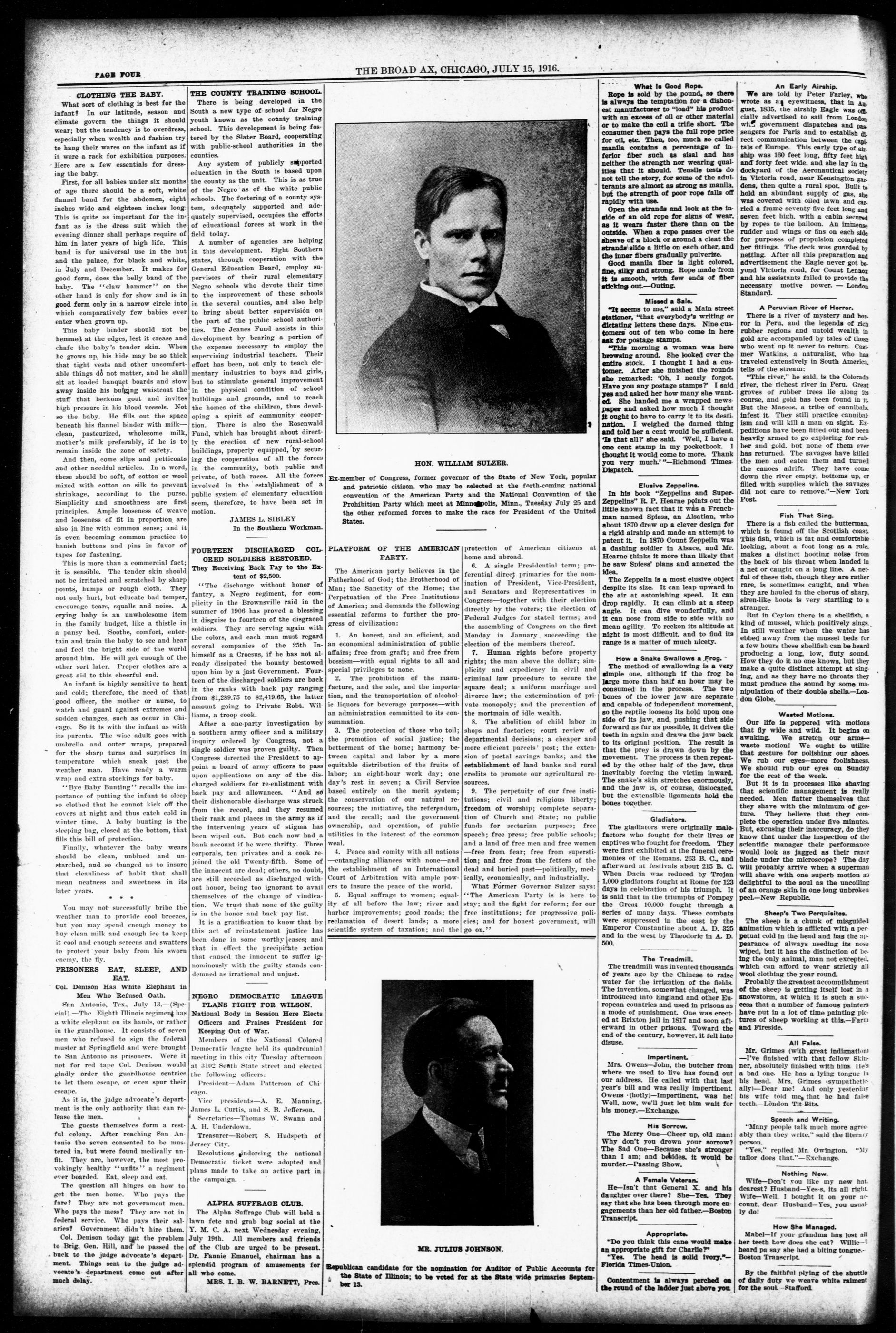
HON. JULIUS JOHNSON OF MOLINE SEEMS TO BE FORGING WELL TO THE FRONT FOR THE NOMINATION FOR AUDITOR OF PUBLIC ACCOUNTS FOR THE STATE OF ILLINOIS.
HON. LEN SMALL, PRESIDENT OF THE FIRST NATIONAL BANK OF KANKAKEE, ILL., GEORGE E. KEYS, VICE-PRESIDENT OF THE FARMERS NATIONAL BANK, SPRINGFIELD, ILL., ALBERT J. OLSON AND JOHN J. STOWE OF GIRARD CITY ARE THE LEADING REPUBLICAN CANDIDATES FOR THE NOMINATION FOR STATE TREASURER OF ILL.
Vol. XXI.
The Thomas of the tinct in Co the T Which
THE SULLIVAN WING OF THE D FULLY AND COMPLETELY B H. HARRISON AND HIS FOLLO TICKET THE ONLY HARRISO WIRE WAS HON. MACLAY HOT FOR STATE'S ATTORNEY.
HON. WILLIAM E. MASON, EX-UN NOIS WILL MAKE THE RACE GRESSMAN AT LARGE.
HON. JULIUS JOHNSON OF MOLL TO THE FRONT FOR THE NOM ACCOUNTS FOR THE STATE O
HON. LEN SMALL, PRESIDENT OF KANKAKEE, ILL., GEORGE E FARMERS NATIONAL BANK, SON AND JOHN J. STOWE OF G PUBLICAN CANDIDATES FOR TREASURER OF ILL.
The big Republican and Democratic politicians started in the first of this week to do business for the September primaries, and from now on until September 13th which will be an unlucky day for some of them there will be a great deal of hustling among them in all parts of this state.
Here in Cook county they will have a knocking down and dragging out time of it for his Honor Mayor William Hale Thompson, Edward J. Brundage and their shouters and retainers—who receive their bread and butter and house rent by making a very loud noise all the time, feel that they are powerful enough to crush out and trample down all opposition to their onward march have selected and placed a complete slate ticket in the field without consulting the likes or dislikes of the Hon. Charles S. Deneen, Roy O. West and State Senator Morton D. Hull, who have followed suit called their hand or bluff and gone them one better and have also ground out a full county or slate ticket without consulting the wishes of the city hall end of the Republican party, and it will be a life and death struggle between the head chiefs or bosses and as well as between their tin horn followers to see who is who and no one can tell until the close of the September primaries which side will win out and will be entitled to ride the winning or the successful political horses for be it remembered that there are some mighty rich pickings at stake this coming fall and none of the politicians either Republican or Democratic will be able to enjoy those rich pickings unless they can brush by the forthcoming primaries.
The Thompson—Brundage slate ticket follows:
States's Attorney—Harry B. Miller, Thirty-third ward; Recorder—Leland S. Rapp, Eighteenth ward; Circuit Court Clerk—A. W. Miller, Twelfth ward; Superior Court Clerk—Ald. John Kjellander, Twenty-third ward; Board of Review—Charles A. Williams, Thirty-second ward; Assessor (full term)—George K. Schmidt, Twenty-fifth ward; Assessor (short term)—Robert R. Levy, Third ward; Coroner—Peter M. Hoffman; Surveyor—Harry Emerson, Oak Park; President Sanitary Board—Ald. James H. Lawley, Fourteenth ward; Sanitary Trustees—David R. Jones, Eighth ward, and Matthias Mueller, Twenty-ninth ward; Municipal Judges (full term)—Hosea W. Wells, Eighteenth ward; John R. Newcomer, Thirty-fifth ward; Anton T. Zeman, Thirty-first ward; Wells M. Cook, Twenty-fifth ward; Frank W. Hoyt, Thirteenth ward; Gustav E. Beerly, Twenty-third ward; John W.
HEW TO THE LINE; LET THE CHIPS FALL WHERE THEY MAY
Richardson, Second ward; Howard W Hayes, Sixth ward; Thomas J. Peden, Eighth ward, and John F. Haas, Nineteenth ward; Municipal Judge (short term)—Bernard Barasa, Twenty-second ward.
The Deneen-West-Hull-Progressive slate or ticket:
State's Attorney—John E. Northup; Recorder—Joseph F. Haas; Board of Review—Edward R. Litzinger; Board of Assessors (long term)—Felix A. Norden; Board of Assessors (short term)—Charles Ringer; Clerk Circuit Court—William F. Lipps; Clerk Superior Court—John Siman; President Sanitary District—Charles H. Sergel; Sanitary District Trustee—Edward L. Williams; Sanitary District Trustee—Thomas W. Gilmore; Judge Circuit Court—Ben M. Smith.
The old long standing political fight between the Honorable Carter H. Harrison, who was one of the coldest and most selfish mayors Chicago has ever had and the Honorable Roger C. Sullivan and those who march under his banner and for about one hundred times the "man of Destiny" and his one horse army was again this week routed by the adherents of the Honorable Roger C. Sullivan who proceeded to frame up a county slate or ticket without fully realizing that there are any other Democrats in this neck of the woods except those who radiate within his shadow, for only one distinguished official whom it is claimed is friendly to the former Democratic mayor, was honored with a place on the Sullivan slate or ticket and that is the Hon. Maelay Hoyne who will be renominated to make the race for State's Attorney and his past splendid record in that office will make him a mighty hard man for any one to beat at the county election in November.
The Sullivan ticket follows:
State's Attorney—Maclay Hoyne; Recorder—Joseph F. Connery; Circuit Court Clerk—John W. Rainey; Superior Court Clerk—James C. Gavin, Coroner—James B. Bowler; Assessor (six year term)—Martin J. O'Brien; Assessor (to fill vacancy)—Joseph Cepak; Board of Review—Thomas J. Webb; County Surveyor—William P. Feeney; President Sanitary District—Thomas M. Sullivan; Sanitary Trustees—Joseph Rushkewiz and James A. Long; Superior Court Judge (to fill vacancy)—Joseph Sabath; Circuit Judge (to fill vacancy)—Jacob H. Hopkins. Municipal Court Judges to come later.
Hon. William E. Mason who was at one time United States senator from Illinois, who is one of the best orators in this country and one of the warm supporters of mayor William Hale
CHICAGO, JULY 15. 1916
Thompson has entered the race for the nomination for Congressman at large and it goes without saying that he has thousands of friends in all parts of this state who would be highly delighted to see him land the plum. Hon. Julius Johnson of Moline, who is one of the most successful business men in this state, seems to be rapidly forging to the front in his race for the nomination for. Auditor of Public Accounts for the state of Illinois. So far there are only four Republican candidates for the nomination for state Treasurer of Illinois and they are the Hon. Lee Small, President of the First National Bank of Kankakee, Ill., Mr. George E. Keys, vice-president of the Farmers National Bank of Springfield, Ill., Albert J. Olson and John J. Stoine of Girard City who made a close race against the Hon. Andrew Russell for the same position in 1914, all four of them are high class business men and will make first class public officials, Mr. Small having honorably and faithfully served in that capacity in the past.
WILL ORGANIZE WORKING MEN
IN TUBERGULOSIS FIGHT.
Association of Employers and Employees Proposed with Fund for Consumptive Workers.
Organization of all of the working men and women of the United States, including the systematic collection of funds from both employers and employees for local anti-tuberculosis campaigns, is proposed in a report issued today by The National Association for the Study and Prevention of Tuberculosis, entitled "Working Men's Organizations in Local Anti-Tuberculosis Campaigns."
The report discusses various experiments that have been tried by working men in different parts of the United States to organize for effective service in the anti-tuberculosis campaign, and recommends a plan which would comprehend the following features, based upon the best in all the schemes studied:
(1) A simple organization representing employers and employees closely allied with the local anti-tuberculosis society of the community. The organization will provide for the establishment of a tuberculosis fund either on the basis of individual factories or groups of factories.
(2) A plan for collecting funds to be used for the relief of tuberculous workers and their families by free will offerings from employers and employees. Employers will be urged in all cases to duplicate the joint collections of employees. The collections will not be a tax or assessment, and will constitute a special tuberculosis fund in addition to those of regular benefit societies.
(3) A systematic campaign for medical examination of all workers at yearly or more frequent intervals.
(4) The appointment of special committees to give relief to fellow-workers and their families suffering from tuberculosis from the funds collected. A worker in a community where a fund is started who develops tuberculosis will be cared for.
(5) Carrying on of educational and legislative work through the organization.
(6) The collection of statistics about occupational mortality from tuberculosis.
(7) The anti-tuberculosis association in the United States will be urged to use this report as a basis for organizing the factories and shops in its com-
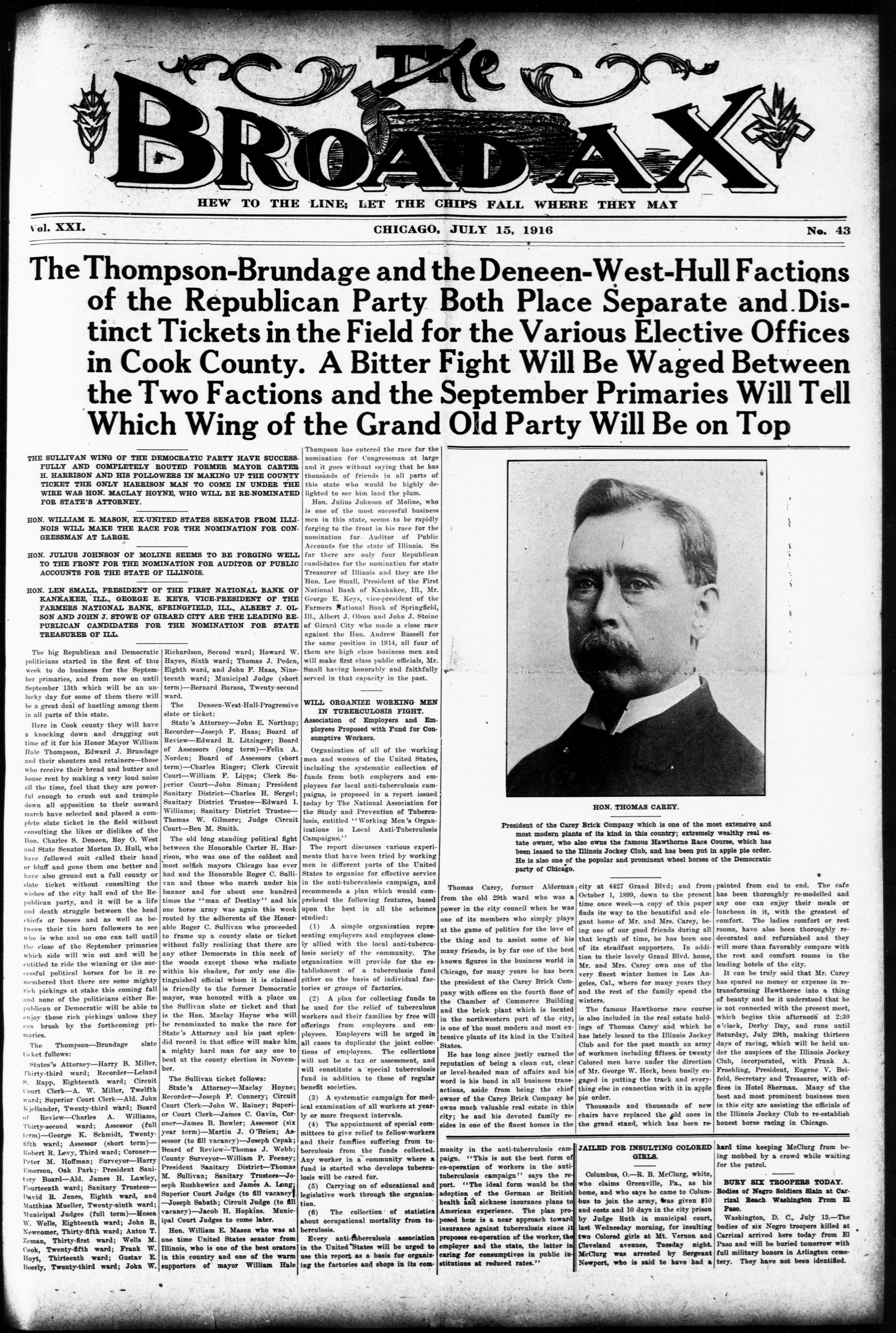
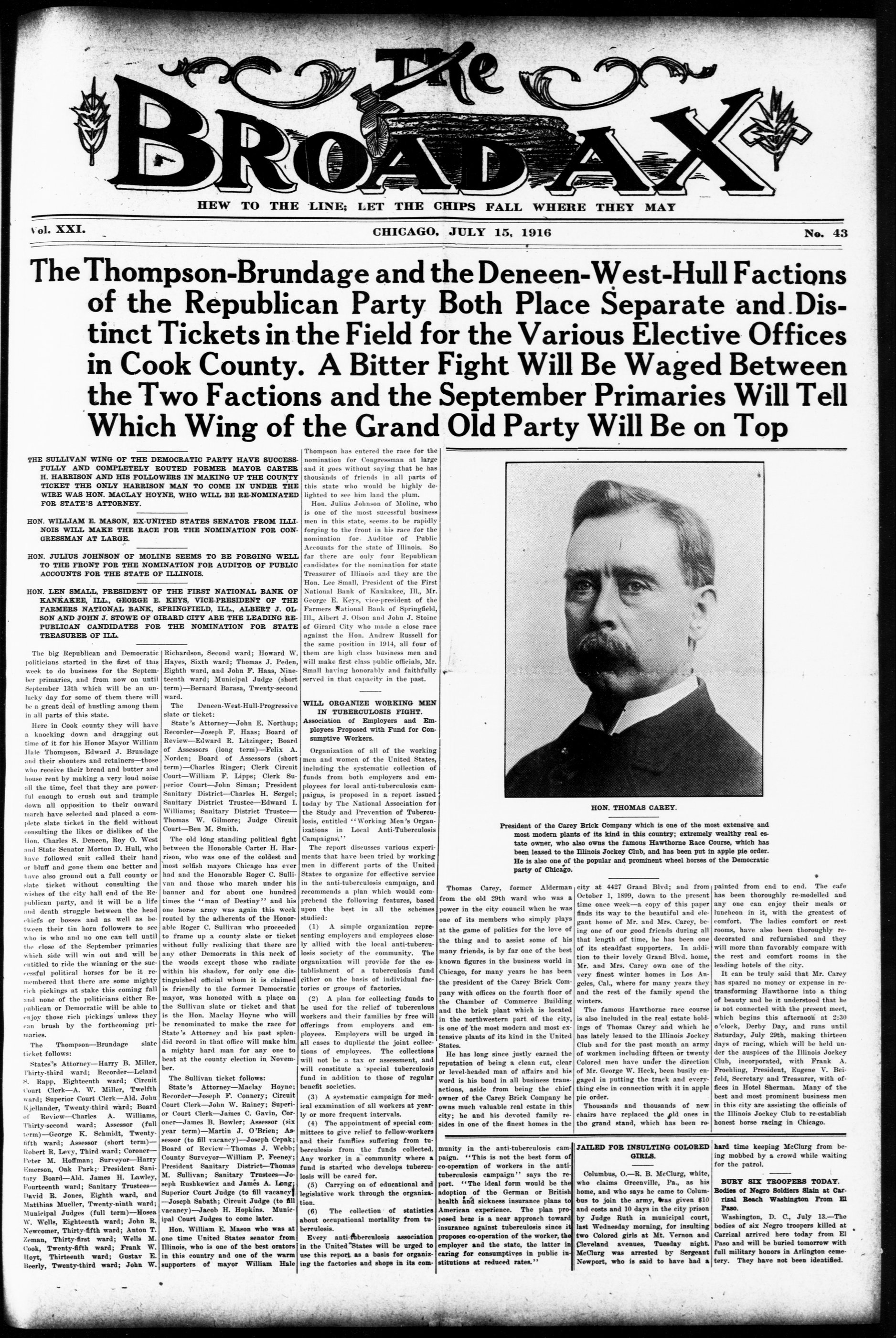
[Picture of a man with a mustache and a suit].
President of the Carey Brick Company which is one of the most extensive and most modern plants of its kind in this country; extremely wealthy real estate owner, who also owns the famous Hawthorne Race Course, which has been leased to the Illinois Jockey Club, and has been put in apple pie order. He is also one of the popular and prominent wheel horses of the Democratic party of Chicago.
Thomas Carey, former Alderman from the old 29th ward who was a power in the city council when he was one of its members who simply plays at the game of politics for the love of the thing and to assist some of his many friends, is by far one of the best known figures in the business world in Chicago, for many years he has been the president of the Carey Brick Company with offices on the fourth floor of the Chamber of Commerce Building and the brick plant which is located in the northwestern part of the city, is one of the most modern and most extensive plants of its kind in the United States.
city at 4427 Grand Blvd; and from October 1, 1899, down to the present time once week—a copy of this paper finds its way to the beautiful and elegant home of Mr. and Mrs. Carey, being one of our good friends during all that length of time, he has been one of its steadfast supporters. In addition to their lovely Grand Blvd. home, Mr. and Mrs. Carey own one of the very finest winter homes in Los Angeles, Cal., where for many years they and the rest of the family spend the winters.
The famous Hawthorne race course is also included in the real estate holdings of Thomas Carey and which he has lately leased to the Illinois Jockey Club and for the past month an army painted from each has been thorow any one can o luncheon in it, comfort. The living rooms, have also decorated and will more than f the rest and o leading hotels on it. It can be truly has spared no more transforming He of beauty and beauty is not connected which begins to o'clock, Derby Saturday, July days of racing.
He has long since justly earned the reputation of being a clean cut, clear or level-headed man of affairs and his word is his bond in all business transactions, aside from being the chief owner of the Carey Brick Company he owns much valuable real estate in this city; he and his devoted family resides in one of the finest homes in the
munity in the anti-tuberculosis campaign. "This is not the best form of co-operation of workers in the antituberculosis campaign" says the report. "The ideal form would be the adoption of the German or British health and sickness insurance plans to American experience. The plan proposed here is a near approach toward insurance against tuberculosis since it proposes co-operation of the worker, the employer and the state, the latter in caring for consumptives in public institutions at reduced rates."
HON. THOMAS CAREY.
My Brick Company which is one of the marts of its kind in this country; extremely also owns the famous Hawthorne Race Illinois Jockey Club, and has been put in the popular and prominent wheel horses city at 4427 Grand Blvd; and from October 1, 1899, down to the present time once week—a copy of this paper finds its way to the beautiful and elegant home of Mr. and Mrs. Carey, being one of our good friends during all that length of time, he has been one of its steadfast supporters. In addition to their lovely Grand Blvd. home, Mr. and Mrs. Carey own one of the very finest winter homes in Los Angeles, Cal., where for many years they and the rest of the family spend the winters.
The famous Hawthorne race course is also included in the real estate holdings of Thomas Carey and which he has lately leased to the Illinois Jockey Club and for the past month an army of workmen including fifteen or twenty Colored men have under the direction of Mr. George W. Heck, been busily engaged in putting the track and everything else in connection with it in apple pie order.
Thousands and thousands of new chairs have replaced the old ones in the grand stand, which has been re-
JAILED FOR INSULTING COLORED GIRLS.
Columbus, O.—R. B. McClurg, white, who claims Greenville, Pa., as his home, and who says he came to Columbus to join the army, was given $10 and costs and 10 days in the city prison by Judge Ruth in municipal court, last Wednesday morning, for insulting two Colored girls at Mt. Vernon and Cleveland avenues, Tuesday night. McClurg was arrested by Sergeant Newport, who is said to have had a
No. 43
All Factions
are and Dis-
ceive Offices
and Between
Us Will Tell
on Top
Most extensive and
wealthy real es-
course, which has
an apple pie order.
of the Democratic
painted from end to end. The cafe has been thoroughly re-modelled and any one can enjoy their meals or luncheon in it, with the greatest of comfort. The ladies comfort or rest rooms, have also been thoroughly re-decorated and refurnished and they will more than favorably compare with the rest and comfort rooms in the leading hotels of the city.
It can be truly said that Mr. Carey has spared no money or expense in re-transforming Hawthorne into a thing of beauty and be it understood that he is not connected with the present meet, which begins this afternoon at 2:30 o'clock, Derby Day, and runs until Saturday, July 29th, making thirteen days of racing, which will be held under the auspices of the Illinois Jockey Club, incorporated, with Frank A. Froehling, President, Eugene V. Beifeld, Secretary and Treasurer, with offices in Hotel Sherman. Many of the best and most prominent business men in this city are assisting the officials of the Illinois Jockey Club to re-establish honest horse racing in Chicago.
hard time keeping McClurg from being mobbed by a crowd while waiting for the patrol.
BURY SIX TROOPERS TODAY.
Bodies of Negro Soldiers Slain at Carrizal Beach Washington From El Paso.
Washington, D. C., July 13.—The bodies of six Negro troopers killed at Carrizal arrived here today from El Paso and will be buried tomorrow with full military honors in Arlington cemetery. They have not been identified.
es @
AL ( 2
A ee ee IP
= rt eT h FG ~
SS Ci enn P A,
DLA DAs
\ WAG ). ae ee SA a eh
a A =
HEW TO THE LINE; LET THE CHIPS FALL WHERE THEY MAY
vol. XXI. =f CHICAGO, JULY 15, 1916 Ne. 43
The Thompson-Brundage and the Deneen-West-Hull Factions
of the Republican Party Both Place Separate and_Dis-
tinct Tickets in the Field for the Various Elective Offices
in Cook County. A Bitter Fight Will Be Waged Between
the Two Factions and the September Primaries Will Tell
Which Wing of the Grand Old Party Will Be on Top
THE SULLIVAN WING OF THE DEMOCRATIC PARTY HAVE SUCCESS.
FULLY AND COMPLETELY ROUTED FORMER MAYOR CARTER
H. HARRISON AND HIS FOLLOWERS IN MAKING UP THE COUNTY
TICKET THE ONLY HARRISON MAN TO COME IN UNDER THE
WIRE WAS HON. MACLAY HOYNE, WHO WILL BE RE-NOMINATED
FOR STATE’S ATTORNEY.
HON. WILLIAM E. MASON, EX-UNITED STATES SENATOR FROM ILLI-
NOIS WILL MAKE THE RACE FOR THE NOMINATION FOR CON-
GRESSMAN AT LARGE.
HON, JULIUS JOHNSON OF MOLINE SEEMS TO BE FORGING WELL
TO THE FRONT FOR THE NOMINATION FOR AUDITOR OF PUBLIC
ACCOUNTS FOR THE STATE OF ILLINOIS.
HON. LEN SMALL, PRESIDENT OF THE FIRST NATIONAL BANK OF
KANKAKEE, ILL, GEORGE E. KEYS, VICE-PRESIDENT OF THE
FARMERS NATIONAL BANK, SPRINGFIELD, ILL, ALBERT J. OL-
SON AND JOHN J. STOWE OF GIRARD CITY ARE THE LEADING RE-
PUBLICAN CANDIDATES FOR THE NOMINATION FOR STATE
TREASURER OF ILL.
The big Republiean and Democratic
politicians started in the first of this
week to do business for the Septem-
ber primaries, and from now on until
September 13th which will be an un-
lucky day for some of them there will
be a great deal of hustling among them
in all parts of this state.
Here in Cook county they will have
2 knocking down and dragging out
time of it for his Honor Mayor William
Hale Thompson, Edward J. Brundage
and their shouters and retainers—those
who receive their bread and butter and
house rent by making a very loud noise
all the time, feel that they are power-
ful enough to crush out and trample
down all opposition to their onward
march have selected and placed a com-
plete slate ticket in the field without
consulting the likes or dislikes of the
lion, Charles 8. Deneen, Roy O. West
sind State Senator Morton D. Hull, who
have followed suit called their hand
or bluff and gone them one better and
have also ground out a full county or:
slate ticket without consulting the
wishes of the city hall end of the Re-
publican party, and it will be a life
and death struggle between the head
chiefs or bosses and as well as be-
tween their tin horn followers to see
who is who and no one can tell until
the elose of the September primaries
which side will win out and will be
entitled to ride the winning or the sue-
cessful political horses for be it re-
membered that there are some mighty
rich pickings at stake this coming fall
and none of the politicians either Re-
publican or Democratic will be able to
enjoy those rich pickings unless they
can brush by the fortheoming pri-
naries.
‘The ‘Thompson—Brundage slate
ticket follows:
States’s Attorney—Harry B. Miller,
Chirty-third ward; Recorder—Leland
S. Rapp, Eighteenth ward; Circuit
Court Clerk—A. W. Miller, ‘Twelfth
ward; Superior Court Clerk—Ald. John
Kjellander, Twenty-third ward; Board
of Review—Charles A. Williams,
Vhirty-second ward; Assessor (full
term)—George K. Schmidt, Twenty-
fifth ward; Assessor (short term)—
Robert R. Levy, Third ward; Coroner—
Veter M. Hoffman; Surveyor—Harry
Emerson, Oak Park;- President Sani-
tary Board—Ald. James H. Lawley,
Fourteenth ward; Sanitary Trustees—
David BR. Jones, Eighth ward, and
Matthias Mueller, Twenty-ninth ward;
Municipal Judges (fall term)—Hosea
W. Wells, Eighteenth ward; John R.
Newcomer, Thirty-fifth ward; Anton T.
Zeman, Thirty-first ward; Wells M.
Cook, Twenty-fifth ward; Frank W.
Hoyt, Thirteenth ward; Gustay E.
Beerly, Twenty-third ward; John W.
Richardson, Second ward; Howard W.
Hayes, Sixth ward; Thomas J. Peden,
Eighth ward, and John F. Haas, Nine-
teenth ward; Municipal Judge (short
term)—Bernard Barasa, Twenty-second
ward.
The —_Deneen-West-Hull-Progressive
slate or ticket:
State’s Attorney—John E. Northup;
Recorder—Joseph F, Haas; Board of
Review—Edward R. Litzinger; Board
of Assessors (long term)—Felix A.
Norden; Board of Assessors (short
term)—Charles Ringer; Clerk Circuit
Court—William F. Lipps; Clerk Su-
perior Court—John Siman; President
Sanitary District—Charles H. Sergel;
Sanitary District Trustee—Edward I.
Williams; Sanitary Distriet Trustee—
Thomas W. Gilmore; Judge Circuit
Court—Ben M. Smith.
The old long standing political fight
between the Honorable Carter H. Har-
rison, who was one of the coldest and
‘most selfish mayors Chicago has ever
had and the Honorable Roger C. Sulli-
van and those who march under his
banner and for about one hundred
times the ‘‘man of Destiny’’ and his
‘one horse army was again this week
routed by the adherents of the Honor-
able Roger C. Sullivan who proceeded
to frame up a county slate or ticket
without fully realizing that there are
any other Democrats in this neck of
the woods except those who radiate
within his shadow, for only one dis-
tinguished official whom it is claimed
is friendly to the former Democratic
mayor, was honored with a place on
the Sullivan slate or ticket and that
is the Hon, Maclay Hoyne who will
be renominated to make the race for
State's Attorney and his past splen-
did record in that office will make him,
a mighty hard man for any one to
beat at the county election in Novem-
ber.
The Sullivan ticket follows:
State’s Attorney—Maclay Hoyne;
Recorder—Joseph F. Connery; Circuit)
Court Clerk—John W. Rainey; Superi-
or Court Clerk—James C. Gavin, Cor-
oner—James B. Bowler; Assessor (six
year term)—Martin J. O’Brien; As
sessor (to fill vacancy)—Joseph Cepak;
Board of Review—Thomas J. Webb;
County Surveyor—William P. Feeney;
President Sanitary Distriet—Thomas
M. Sullivan; Sanitary Trustees—Jo-
seph Rushkewicz and James A. Long;
Superior Court Judge (to fill vacancy
—Joseph Sabath; Circuit Judge (to fill
vaeaney)—Jacob H. Hopkins. Muniec-
ipal Court Judges to come later.
Hon, William E. Mason who was at
one time United States senator from
Illinois, who is one of the best orators
in this country and one of the warm
supporters of mayor William Hale
Thompson has entered the race for the
nomination for Congressman at large
and it goes without saying that he has
thousands of friends in all parts of
this state who would be highly de-
lighted to see him Jand the plum.
Hon. Julius Johnson of Moline, who
is one of the most sucessful business
men in this state, seems.to be rapidly
forging to the front in his race for the
nomination for. Auditor of Publie
Accounts for the state of Illinois. So
far there are only four Republiean
candidates for the nomination for state
Treasurer of Illinois and they are the
Hon. Lee Small, President of the First
National Bank of Kankakee, IIL, Mr.
George E. Keys, vice-president of the
Farmers Rational Bank of Springfield,
IIL, Albert J. Olson and John J. Stoine
of Girard City who made a close race
against the Hon, Andrew Russell for
the same position in 1914, all four of
them are high class business men and
will make first class publie officials, Mr.
Small having honorably and faithfully
served in that capacity in the past.
WILL ORGANIZE WORKING MEN
IN TUBERCULOSIS FIGHT.
Association of Employers and Em-
ployees Proposed with Fund for Con-
sumptive Workers.
ee
| Organization of all of the working
men and women of the United States,
including the systematic collection of
funds from both employers and em-
ployees for local anti-tubereulosis cam-
paigns, is proposed in a report issued
today by The National Association for
the Study and Prevention of Tubereu-
losis, entitled ‘‘ Working Men’s Organ-
izations in Local Anti-Tubereulosis
Campaigns.’?
The report discusses various experi-
ments that have been tried by working
men in different parts of the United
States to organize for effective service
in the anti-tuberculosis campaign, and
recommends a plan which would com-
prehend the following features, based
upon the best in all the schemes
studied: |
(1) A simple organization repre-|
senting employers and employees close-
ly allied with the local anti-tubereu-
losis society of the community. The’
organization will provide for the es-
tablishment of a tuberculosis fund
¢ither on the basis of individual fae-
tories or groups of factories.
(2) A plan for collecting funds to
be used for the relief of tuberculous
workers and their families by free will
offerings from employers and em-
ployees. Employers will be urged in
all cases to duplicate the joint collee-
tions of employees. The collections
will not be a tax or assessment, and
will constitute a “special tuberculosis
fund in addition to those of regular
benefit societies.
(3) A systematic eampaign for med-
ical examination of all workers at year-
ly or more frequent intervals.
(4) The appointment of special com-
mittees to give relief to fellow-workers
and their famflies suffering from tu-
berculosis from the funds collected.
Any worker in a community where a
fund is started who develops tubereu-
losis will be eared for.
(5) Carrying on of educational and
legislative work through the organiza-
tion.
(6) The collection of statistics
about occupational mortality from tu-
bereulosis.
Every anti-fabercalosis association
in the United “States will be urged to
use this report as a basis for organiz-
ing the factories and shops in its com-
i j wat
. : i 1
, a
:
an |
-
President of the Carey Brick Company which is one of the most extensive and
most modern plants of its kind in this country; extremely wealthy real es-
tate owner, who also owns the famous Hawthorne Race Course, which has
been leased to the Illinois Jockey Club, and has been put in apple pie order.
He is also one of the popular and prominent wheel horses of the Democratic
party of Chicago.
Thomas Carey, former Alderman
from the old 29th ward who was a
power in the city council when he was
one of its members who simply plays
at the game of polities for the love of
the thing and to assist some of his
many friends, is by far one of the best
known figures in the business world in
Chicago, for many years he has been
the president of the Carey Brick Com-
pany with offices on the fourth floor of
the Chamber of Commerce Building
and the brick plant which is located
in the northwestern part of the city,
is one of the most modern and most ex-
tensive plants of its kind in the United
States.
He has long since justly earned the
reputation of being a clean cut, clear
or level-headed man of affairs and his
word is his bond in all business trans-
actions, aside from being the chief
owner of the Carey Brick Company he
owns much valuable real estate in this
city; he and his devoted family re-
sides in one of the finest homes in the
munity in the anti-tuberculosis cam
paign. ‘This is not the best form of
co-operation of workers in the anti
tuberculosis campaign’? says the re
port. ‘The ideal form would be the
adoption of the German or British
health &nd sickness insurance plans tc
American experience. The plan pro
posed here is a near approach toward
insurance against tuberculosis since it
proposes co-operation of the worker, the
employer and the stato, the latter in
caring for consumptives in public in
stitutions at reduced rates.’’
HON. THOMAS CAREY.
y Brick Company which is one of the m
ts of its kind in this country; extremels
ilso owns the famous Hawthorne Race (
linois Jockey Club, and has been put i
the popular and prominent wheel horses ¢
city at 4427 Grand Blvd; and from
October 1, 1899, down to the present
time once week—a copy of this paper
finds its way to the beautiful and ele-
gant home of Mr. and Mrs, Carey, be-
ing one of our good friends during all
that length of time, he has been one
of its steadfast supporters. In addi-
tion to their lovely Grand Blvd. home,
Mr. and Mrs. Carey own one of the
very finest winter homes in Los An-
geles, Cal., where for many years they
and the rest of the family spend the
winters.
The famous Hawthorne race course
is also included in the real estate hold-
‘ings of ‘Thomas Carey and which he
‘has lately leased to the Illinois Jockey
‘Club and for the past month an army
of workmen including fifteen or twenty
Colored men have under the direction
of Mr. George W. Heck, been busily en-
gaged in putting the track and every:
thing else in connection with it in apple
pie order.
Thousands and thousands of new
chairs have replaced the gla ones in
the grand stand, which has been re
ane FOR INSULTING COLORED
GIRLS.
Columbus, 0.—R. B. McClurg, white,
who claims Greenville, Pa, as his
home, and who says he came to Colum-
‘bus to join the army, Was given $10
and costs and 10 days in the city prison
by Judge Ruth in municipal court,
last Wednesday morning, for insulting
‘two Colored girls at Mt. Vernon and
Cleveland avenues, Tuesday night.
McClurg was arrested by Sergeant
Newport, who is said to have bad a
painted from end to end. The cafe
has been thoroughly re-modelled and
any one can enjoy their meals or
luncheon in it, with the greatest of
comfort. The ladies comfort or rest
rooms, have also been thoroughly re-
decorated and refurnished and they
will more than favorably compare with
the rest and comfort rooms in the
leading hotels of the city.
It can be truly said that Mr. Carey
has spared no money or expense in re-
transforming Hawthorne into a thing
of beauty and be it understood that he
is not connected with the present meet,
which begins this afternoon at 2:30
ovelock, Derby Day, and runs until
Saturday, July 29th, making thirteen
days of racing, which will be held un-
der the auspices of the Illinois Jockey
Club, incorporated, with Frank A.
Froehling, President, Eugene V. Bei-
feld, Seeretary and Treasurer, with of-
fices in Hotel Sherman. Many of the
best and most prominent business men
in this city are assisting the officials of
the Illinois Jockey Club to re-establish
honest horse racing in Chicago.
hard time keeping McClurg from be-
ing mobbed by a crowd while waiting
for the patrol.
BURY SIX TROOPERS TODAY.
Bodies of Negro Soldiers Slain at Car-
rizal Reach Washington From El
Paso.
Washington, D. C., July 13—The
bodies of six Negro troopers killed at
Carrizal arrived here today from El
Paso and will be buried tomorrow with
full military honors in Arlington ceme-
tery. They have not been ideatified.
PAGE TWO
THE BROAD AX
Published Weekly
In this city since July 15th, 1899,
without missing one single issue, Republicans, Democrats, Catholies, Protestants, single Taxers, Priests, infidels or anyone else can have their say as long as their language is proper and responsibility is fixed.
The Broad Ax is a newspaper whose platform is broad enough for all, ever claiming the editorial right to speak its own mind.
Local communications will receive attention. Write only on one side of the paper.
Subscriptions must be paid in advance.
One Year.....$2.00
Six Months.....1.00
Advertising rates made known on application.
Address all communications to
THE BROAD AX
6532 St. Lawrence Ave, Chicago, Ill.
PHONE WENTWORTH 2597.
JULIUS F. TAYLOR, Editor and Publisher.
Entered as Second-Class Matter Aug.
19, 1902, at the Post Office at Chicago,
Illinois, under Act of March 3, 1879.
At a recent gathering of life insurance men one of the old timers exhibited a copy of a permit which had been attached to a policy issued in 1863. This permit read: "The within assured has permission to reside in any settled part of the states of California, Nevada, Oregon or Washington territory and while so residing to make trips (as a passenger only) on first class steamers plying between the ports of Washington territory, the states of California and Oregon and the Sandwich Islands and to proceed to and return from in like manner or by public conveyance over land:
"Provided that written notice be given by the assured whenever any trip to the Sandwich Islands or to the Atlantic states is undertaken to the general agent of the company at San Francisco, Cal., and provided, also, that on the overland route the said assured to take his own risk by death from hostile Indians."—Wall Street Journal.
A Natural Born Spender-
When a long forgotten cousin died and left Miss Mitfield a round hundred thousand the entire village, after having recovered from the shock, fell to wondering whether the faded little spinster, after having for sixty-three years pinched and scraped and plain sewed just to keep soul and body together, would, after all, get much comfort from her eleventh hour opulence. The state of little Miss Mitfield's mind was revealed when her next door neighbor inquired what she should do with her money—did she mean to save it?
"Save it!" Her eyes flashed with new found scorn. "Listen to me, Betsy; all my life long I've wanted a pair of side combs with yellow glass beads onto 'em, and now I'm goin' to hey 'em; yes, ma'm, even if I should hey to go as high as 50 cents!"—Youth's Companion.
Coffee With Milk
For many years after coffee was first drunk in Europe, says the Manchester Guardian, no one thought of mixing it with milk any more than the Turks and Arabs do now. The use of coffee au lait seems to date from 1687. Mme. de Sevigne, writing to her daughter in that year, said that a doctor much in vogue "has taught us to mix sugar and milk with our coffee. They make a most delightful compound, which will help to support me through the rigors of Leut."
In a letter written seven years earlier she had mentioned as an eccentric proceeding on the part of Mme. de la Sabliere that "she drinks milk to her tea." Readers of "Unbeaten Tracks In Japan" may remember that one of the Alnus thought it disgusting that Mrs. Bishop should drink milk and pollute her tea with a fluid having so strong a smell and taste.
Bin Van Winkle—Himself.
Joseph Jefferson used to tell a story of his visit to a village in the Catskill mountains. He was taking a cup of tea in the hotel when he heard a negro waiter giving a detailed account of legends.
"Yes, sah," he continued, "Rip went up into de mountains, slep' for twenty years, and when he come back hyar in dis berry town his own folks didn't know him."
"Why," said the listener, "you don't believe the story's true!
"True? Ob course it is. Why," pointing to Jefferson, "dat's de man."
Boss Prevaricators
"There goes a man who boasts that he has never bought a gold brick."
"Reminds me of the fellow who says he has never told a lie."
"Yes. He reminds me of the chap who says the upkeep of his automobile is next to nothing."
"And he's in the same category with the man who says he never was sick a day in his life." — Birmingham Age-Herald.
Gothic Architecture.
The styles called Gothic, springing from a common source in Romanesque architecture and developing throughout western Europe on differing lines, are in general characterized by the following features, although not all of these will be found in all examples:
Ribbed vaulting, pointed arches, the flying arch and pinnacled buttress, clustered shafting, traceried windows in all but the earliest phases, stained glass, a progressive tendency toward loftiness, lightness of supports and suppression of wall surfaces, a system of decoration of which one element was the emphasis and adornment of structural features and another the use of sculpture and carving of human, animal, vegetable and grotesque forms, controlled by a definite didactic purpose and significance, and finally the use of available materials according to their nature upon principles in part of structural logic and in part of decorative effect.-A. D. F. Hamlin in Architectural Record.
National Flags.
If the question were asked which country's national flag had been longest in use the answer would be either the dragon banner of China or the chrysanthemum flag of Japan. The former has been used from a very early period, and the latter is as old as the present dynasty in Japan, which is the most ancient in the world. Among European national flags that of Denmark, a white St. George's cross on a red ground, is the most ancient, having been in use since 1219. No other flag has existed without change for anything like the same period as a national emblem, although there are royal standards that are older.
The Spanish colors date only from 1785, and Great Britain's flag in its present form was first flown after the union with Ireland in 1801. The stars and stripes of the United States was first planned and ordered by Washington of an upholsterer in Philadelphia and formally adopted on June 14, 1777. -London Spectator.
Shaving on One Side.
The shaving on one side only of the heads and beards of prisoners of war was obviously done to prevent any attempt at escape. But there have been other motives for such half shaving, which occurs at all sorts of points in history. Sometimes the act has been pure insult, as when Hanun, king of the children of Ammon, shaved off half of the beards of David's servants. In these days the victims would have mended matters by shaving the other half. But Jewish reverence for the beard forbade that, and David told the men to "tarry at Jericho until your beards be grown." Demosthenes, when he shut himself up for months in a subterranean chamber to practice oratory, shaved half of his head to cut off all temptation to go abroad.—London Chronicle.
Ferrings Denote Widowhood.
Earrings Denote Widowhood.
That India is a land of curious customs is confirmed by the Popular Science Monthly. A widow, instead of wearing black crape, dons ponderous earrings made of solid brass. Since her widowhood is perpetual she is obliged to wear them the rest of her life. Each year another ring is added. The constantly increasing weight of metal stretches the lobe of the ear, to which it is attached, in an extraordinary manner. It is safe to say that no widow ever forgets the fact of her widowhood when wearing such a clumsy weight.
A Silent City.
No industry brings the village of Gilthoorn, Holland, into touch with the world. It is almost wholly inaccessible except by water, and the inhabitants are shy and keep within doors, betraying not the slightest interest in visitors. Indeed, Gilthoorn has been likened, empty and silent in its green picturesqueness, to a place visited in a dream.—Argonaut.
Progressive.
"When did you commit your first fatal extravagance?"
"When my boss referred to my wages as my 'salary.'"
"And when did you perpetrate this latest folly?"
"The day my wife called my salary my 'income.'" -Cleveland Leader.
Appropriate.
Manufacturer—I'm going to call this new cigar "The American Lady In the Japanese Kimono." Dealer — Why? Manufacturer—Domestic filler and imported wrapper—Illinois Siren.
The Feminine Pessimist:
The feminine pessimist worries because she is not as young as she once was; the optimist of the same sex rejoices that she is not so old as she will be.—Life.
PRACTICAL HEALTH HINT.
Ptomaine Poison.
"Pтомaine is a scientific name for food poison," says a physician in Farm and Fireside, "and, although all ptomaines are not dangerous to health, there is no simple test for telling the dangerous ones from the others. Dr. Charles K. Francis, a noted chemist, gives the advice, 'When doubtful about a food do not eat it.' This applies especially to meat which has a peculiar odor or taste, canned goods, especially when they have been opened for some time, and other foods which do not seem just right. Taking a chance may be taking your health or life. Safety first!"
THE BROAD AX, CHICAGO, JULY 15, 1916.
Etable of Two Maidene.
Once there were two maidens who sought to catch a nice young man, and it was a false start in the eyes of the undiscerning, for the one was exceedingly fair to look upon and dressed stylishly, while the other was plain of countenance.
The pretty girl smiled sweetly on the nice young man and talked to him till she dazzled him with her beauty and charmed him with her wit. The plain one gazed wonderingly at him and made him talk to her of divers things, while she listened, entranced at his wisdom and learning.
He took the pretty girl out riding, to the theater and bought her chocolates and flowers, and all the knowing ones said she had struck a winner, when one day he married the plain girl and took her on the continent for their honeymoon.
Moral.—The people who read human nature as they run generally get first to the wire.—Pearson's.
Going Without Food.
Science says that if he can get drinking water an ordinary man can exist for about thirty days without food. At the end of that time the machinery of the body will not be ruined and can be entirely strengthened back to its old standard by careful feeding. About one-quarter of our body weight is fat, and it is mostly this fat which is absorbed as food during the period of starvation. We can absorb and burn up our muscles until 60 per cent of their weight has gone. We can do the same with from 30 to 40 per cent of our liver and digestive organs and 20 per cent of our lungs. Our hearts can lose 10 per cent, and our brains and nervous system can lose 5 per cent. It will thus be seen that the more vital organs, brain and heart, yield least of their valuable substance for the life of the body, while the less valuable substances—fat, muscles, and so on—are consumed first.—New York American.
Novel Methods of Warfare.
In ancient history there are two well authenticated instances of wild animals being used by attacking armies. The first is related by Applan when describing the siege of Themiseyra, in Pontus, by Lucullus in his war against Mithidrates. Turrets were brought up, mounds were built and huge mines were made by the Romans. The people of Themiseyra dug open these mines from above and through the holes cast down upon the workmen bears and other wild animals, together with swarms of bees. The second instance occurred in England when the Danes and Norwegians were at attacking Chester, held by the Saxons and some Gallic auxiliaries. After adopting stoning and boiling water defenses in vain against the besiegers the Saxons threw down all the bee hives in the town upon the attackers, who were soon routed.
Powers of Sheik ul Islam.
The office of sheik ul Islam—literally chief or ancient of Islam—ranks second only to that of sultan in the Ottoman empire. Its holder is ecclesiastical head of the empire and supreme interpreter of the Koran, with absolute control over all imams, dervishes and religious institutions, but he has judicial and political authority also, being, indeed, first magistrate, privy seal and minister for education. In some respects the sheik ul Islam is superior even to the sultan, for his edicts are irrevocable. The sultan may dismiss him before he issues an edict, but the edict once issued takes automatic legal effect, even though, as happened in the case of Abdul Hamid, it decrees the deposition of the sultan himself.
Just by Good Luck.
A young man who had received the privilege of shooting over the land of a farmer got rather close once or twice to the home grounds. Late in the day he met the farmer.
"You've had pretty good luck," said the farmer.
"Well, no," said the young man hesitatingly. "I haven't had any luck at all."
"Yes, you have," repeated the farmer. "This morning you just missed my best Shorthorn."—Country Gentleman.
Sufficient
Him-Darling, I would ask you to be my wife, but I'm afraid my income of only $2,000 a year would not be sufficient for us to get along on. Her-Oh yes; it would. I can dress on $1,500 a year, and we would have all the rest for our living and household expenses. -Indianaapolis Star.
Business Instinct
The following epiphath may be seen in the cemetery of a parish in the environs of Paris: "Here lies Mme. N., wife of M. N., master blacksmith. The railing round this tomb was manufactured by her husband."
Cold Snatchers.
Teacher—Johnny, can you tell me the function of the pores of our bodies? Johnny—They are things we use to catch cold with—Christian Register.
Be Not Fearful.
You will never fear the trouble that comes your way if you are cheerful; neither will you enjoy the blessings of each day if you are fearful.
Gave Her Proof.
"Do you believe, sir, that the dead ever walk after death?"
"No doubt of it, ma'am. I have heard the dead march."
Content thyself to be obscurely good.
—Addison.
Sorrows of an Author.
Sorrows or an Author.
Many of the sorrows of the author in this living present are quite as active as 150 years ago when William Oldys lived and died in London. The "blue pencil" was as remorseless then, though under some name now forgotten. Oldys tells how he wrote some valuable article of nearly two sheets and how the bookseller, "for sordid gain and to save a little expense in print paper, got Mr. John Campbell to cross it and cramp it, and play the devil with it, till he squeezed it into less compass than a sheet." The book borrower of that time was the same neglectful person that many of us know today, and Oldys sighs over books he has lent which have never been returned. He was a keen antiquary, delighting especially in musty manuscripts, and, half in temper and half in good humor, tells of "Old Counselor Fane, who gave me a parcel of manuscript and promised me others, which he never gave me nor anything else besides a barrel of oysters."
An Early Ironclad.
Many people imagine that the first armored ship was the "iron eased frigate" Gloria, launched for the French navy in 1857, yet, according to the Popular Science Monthly, the Dutch built an armored vessel nearly 300 years earlier. That was in 1858, when Antwerp was besieged by the Spaniards. The Dutch took one of their biggest ships, cut her down and erected on the deck a battery with armored and sloping sides, within which they mounted eight of the heaviest guns the factories of the day could produce. The roof of the battery formed an armored breastwork for men armed with crossbows and shotguns, and there were gratings in the roof to provide ventilation for the battery below. A contemporary picture of the Finis Belli, as she was called, bears a striking resemblance to the Merrimac, which was designed and built on precisely the same principles.
Tendency Is What Counts.
Of course there can be no such thing as perfection in this vale of tears, but the man who turns his back upon it that account hasn't good common sense. The man who is low down and tending upward is nearer perfection than the man who is high up and tending downward. Tendency is the profoundest fact in life—in religion, education, society, politics. When an astronomer sees a comet for the first time he will ascertain its direction, even if its progress is only a minute or two, and will describe its course among the stars for weeks ahead. He simply studies the tendency, and one can tell where a man will be ten years from now by the same sort of mathematics. That tendency may reach human perfection if it is started right and the direction maintained—Ohio State Journal.
Recognition.
One morning on the street car I noticed a large negro woman, very much overdressed and, judging from her expression, much pleased with herself.
A negro girl of about seventeen came in and sat beside her, saying genially, "Howdy do, Missus Brown?"
The woman turned and, looking down upon the girl, said: "Chile, yo' face looks pow'ful similar, but Ah falls to organize yo'."—Exchange.
The Apocalypse.
There is no other book in the New Testament about which so much has been written and to so little purpose. Dr. South said of it, "It either finds a man mad or makes him so." It is said of Calvin that he showed his wisdom in not writing a commentary on this, as he did on other books.—Chadwick.
The Only Chance.
Old Gotrox—Can you draw me a will that cannot be broken? Young Lawyer—Why—er—I've never drawn one as yet, and— Old Gotrox—Then you doubtless could. Get about it while ignorant—Boston Globe.
Musical Note
She—Every time Screecher, the grand opera tenor, gets a sore throat it costs him $1,000. He—Gee, his throat must be as long as a giraffe's!—Musical America.
PRACTICAL HEALTH HINT.
Nosebleed.
Whatever may be the cause of bleeding at the nose, always send at once for a physician and see that he is told the cause of the bleeding if it is known. While waiting for the doctor to arrive take care of the patient as best you can.
- Unfasten all tight clothing around the neck; make the patient sit down on a chair or a sofa with his head slightly thrown back (never allow a patient to hang his head over a basin); open the window; raise the arms of the patient, stretched to their full extent well above and behind his head, and keep them in that position; apply a cold, wet sponge or a wet towel or a lump of ice to the back of the neck between the shoulder blades, also apply to the root of the nose. If the bleeding does not stop pinch the nose just below the bridge (where the soft part of the nose begins) between the thumb and forefinger, or a clean piece of soft rag or handkerchief can be wrapped up tightly and passed gently into the bleeding nostril.
```markdown
```
Divine Tolie Them to Think Carefully
and Prayerfully About Their
Wedding Day.
Cleveland—"Twelve Golden Rules
For Young Ladies" was the subject of
the sermon delivered by Rev. Thomas
Hughes, pastor of the Rocky River
Methodist church. The twelve rules
are:
"Always remember to be a lady."
"Choose carefully your company of both sexes.
"Open your eyes and ears, but keep your heart closed to the gush and nonsense from the so called lovers.
"Be careful about your dress. Have it becoming and tasteful.
"Be more careful about what is in your head than what is in your heart.
"Don't be self conceited.
"Don't keep company with a sinful young man.
"Think carefully and prayerfully about your wedding day.
"Be considerate about the time and money of your gentlemen friends.
"Be true to the best ideals of womanhood."
DRIVEN INSANE BY 100
CIGARETTES A DAY
Sent to an Asylum Upon Saloon- keeper's Complaint and Doctor's Testimony.
Detroit, Mich.—Frank Winters, the man who smoked a hundred cigarettes a day, was committed to the Pontiac asylum by Judge Hulbert recently in the probate court.
The incessant use of the cigarettes was declared by Dr. S. L. Layton, who examined Winters, to have affected his mind. Frequenting a saloon at the corner of Chamberlain and Lawdale avenues, Winters smoked until his supply gave out and his money too. After that he begged smokes from the customers of the saloon, according to Joseph Berman, the proprietor of the place.
Berman petitioned the court to have Winters taken to an asylum. A German by birth, Winters was getting along well in this country until the cigarette habit got the upper hand. Given jobs by Berman, Winters even lost his power of application to simple work.
"No more work for me," he would say as he would sit down on the job, Berman told investigators. The nicotine undoubtedly had a deteriorating effect on his mentality, Dr. Laxton declared.
FEWER KANSAS FARMERS.
There Are Not So Many Now as Ten Years Ago.
Ablene, Kan.-Fewer people are engaged in agricultural pursuits in Kansas now than ten years ago, according to J. C. Mohler, secretary of the state board of agriculture.
"In 1895 of those engaged in all occupations 55 per cent were in agriculture," he declared, "and in 1905 50 per cent and in 1915 46 per cent. It is a very discouraging sign in a state like Kansas, where agriculture is the overshadowing industry, that fewer instead of more people are engaging in it."
Some of the serious problems that must be solved in Kansas are those of the home seeker, the ownership of lands, employment of capital, better farming and the improvement of conditions of rural life, Mr. Mohler asserted.
WOULDN'T SPOIL HIS FINGERS
Artistic Hands, Out of a Job, Refuses to Shovel Coal.
Montclair, N. J.-If a man has "plano fingers" and is offered a job on a coal wagon should he accept the job to support his wife and six children, or should a philanthropic society place him in some position where his digital refinement would not be affected by manual labor?
This is one of the questions propounded in the annual report of Mrs. Nettle E. Patterson, superintendent of the Altruist society. Mrs. Patterson mentions the case in referring to the difficulties that confront the society.
She said that a man when offered a place on the coal wagon refused, saying he had been told he had "plano fingers" and did not wish to spoil them.
UNABLE TO FIND A WIFE.
Farmer Has Been Searching Sixteen Years, but So Far Has Failed.
Bridgeport, Conn.—Joseph Cronan, a farmer of Derby, announced that he had searched forty-two states and two countries of Europe and that, while in a receptive mood, he had not found a girl suitable to be his spouse.
"I am strictly temperate, a healthy and strong farmer, and I have been searching sixteen years for the right kind of a wife," he declared. "I have yet to find the woman, and I wish the newspapers would help me."
Pig Ate Sixty Others' Talla
Findlay, O.—Anson James, a Delaware county farmer, went into his hog yard and found sixty of his sixty-one pigs minus tails. He watched the drove for awhile and saw the sixty-first pig trying to eat his own tail.
Hundreds Present When Inventor's Wife Hits Clothing—Urges Girls to Be Modest.
New York.—Hundreds of women recently heard well known women who were delegates to the National Federation of Women's Clubs convention discuss dress—the right and wrong kind of dress, the future dress and the cost of dress. All the speakers advocated greater individuality in dress
Mrs. Thomas A. Edison made an appeal for greater modesty in dress, particularly of young women, and in no unmistakable terms assailed clothing which, she said, tended to lead sons down to degradation. She denounced "the present abbreviated skirts and uncovered shoulders," saying: "I had a father who frequently reminded me, 'Daughter, be modest.' I think this would be good advice to our girls today."
Her husband, Mrs. Edison said, had declared there was not more than one woman in a hundred who was well dressed.
LITTLE TOWN IN OHIO
PLAINLY ON THE MAP
Clyde Has Several Claims to Distinction In Connection With Country's Wars.
Sandusky, O.—The village of Clyde, fourteen miles southwest of this city, was the home not only of the highest ranking officer killed during the civil war, but also of the first American killed in the Spanish-American war. It has the distinction also of being the nucleus of what is now the Women's Relief corps. General J. B. McPherson, killed at Atlanta in the civil war, and George B. Mack, the first American killed in the Spanish-American war, are both buried there. According to Joel Elliot of Clyde, Mrs. Hattie McPherson, aunt of General McPherson, organized the first Ladies' Aid society after the civil war began, and it was from the Ladies' Aid society of the sixties that the Women's Relief corps of the present day grew.
Elliot says further that army records at Washington will show that in proportion to population, more men enlisted at Clyde for both the civil and Spanish-American wars than from any other place of its size in the United States. President Garfield was to have been the principal orator at the unveiling of the McPherson monument when, on Saturday, July 2, 1881, he left the White House to go to the seaside to spend Sunday with his family before proceeding to Ohio and was shot while waiting for his train.
NEW WAY OF GETTING A SUIT
Prisoner Worried Owner Until He Gave It to Him.
San Jose.—A new way of getting a suit of clothes was introduced here when William Shore, a prisoner, confessed to Police Captain Campbell that he had "mooched" the suit he wore.
"I saw the suit on a man on the street and liked it," he said. "So I went up to him and asked for it. He got mad and wouldn't give it to me, so I followed him around day and night for two days, asking for it at every turn. Finally he got disgusted with me and gave me the clothes."
Shore told Police Chief Fuller, who threatened to put him to work pitching hay, that he "wouldn't pitch enough hay in a week to keep a canary bird alive for one day."
REFUSED TO QUIT JAIL
Muncie (Ind.) Resident Said It Was the Best Job He Ever Had.
Muncie, Ind.-Albert O'Harra, shellif,
had a hard time to make Frank McLaughlin quit the county jail.
A friend paid McLaughlin's fine, but
he steadfastly refused to leave the jail
until his sentence had been served, the
sentence being for eleven days.
"I never had a better job than this,"
said McLaughlin. "All I had to do was
a little scrubbing out in the morning,
and I had a good, warm place in which to
sleep and a good place in which to
eat and had plenty of things to eat in
the bargain. Believe me, Sheriff O'Harra is the best landlord I've ever known."
CALICO FROM THE SKY.
Windstorm Drops Bolt of Goods In Needy Woman's Yard.
Hume, Mo.—In a recent windstorm here a bolt of calico fell in Mrs. Jenny Harrie's chicken lot in the north part of the city. It was quite a lucky haunt for Mrs. Harrie, when the price of calico is considered, and she needed the goods.
It is supposed that the calico was taken up in the clouds in the path of the tornado south of here. Where it came from no one knows.
Hog With Six Legs
Puente. Cal.-While driving out a number of hogs from a pen on the Rowland ranch workmen in the employ of L. A. Meredith discovered that one sow was possessed of six legs. The animal has two extra forelegs perfectly formed, and all six legs are used by the animal in walking. Mr. Meredith says the two extra legs are just inside the "regular" forelegs and are some what smaller.
FOR THE CHILDREN
A Sleepy Time Story About a Very Remarkable Bird.
WAR EAGLE OF THE SIXTIES.
About a Baby Camel Which Was Born In a Circus and Nursed on a Bottle. Many Interesting and Amusing Things For Little Folk.
As Memorial day will soon be here, Uncle Ben told the children this story about
AN AMERICAN EAGLE.
The eagle has always been the emblem of power and courage. It is pictured in many ways, the most popular way being spread out. This is called the spread eagle.
The United States in 1785 adopted the bald eagle, its wings displayed, as the national emblem. You know that sailors and soldiers always make a pet of something and take it with them on their trips. Well, in the civil war the Wisconsin soldiers took with them as their mascot a young eagle.
It is very hard to get an eagle from its nest, for the nests are usually very high up and in lonely places. An Indian once managed to steal a very young eagle from its nest, and he sold it to a soldier. The soldier named it "Abe" for he intended to present the bird to Abraham Lincoln when the war closed. The soldiers all made a great fuss over this bird. At mustering in they decorated him with red, white and blue ribbons, tying the colors around its neck and putting an immense rosette on its breast. The color bearer, the tallest man in the regiment, carried "Abe" on a staff, which was placed a little above the colors.
When any orders were given the colors and the eagle were always first in place. It would sit very still and look from side to side to see if everything was all right. When battles were being fought it would scream and flap its wings as if to cheer the soldiers. It seemed to understand all the orders given to the men.
Once when the men were ordered to lie on the ground it flew down and stretched flat beside the soldiers. When they got up it flew to the top of its perch again, so the story goes.
It went through twenty-two battles and thirty skirmishes and was wounded three times.
When the war was over it traveled all over the country and received as much homage as a great man. A veteran was detailed to take care of it and was well paid for doing so.
The bird died in 1881, and its skin was stuffed and put in the state capitol. But it was later burned in a great fire.
The Common Hen.
When you come right down to natural history facts there is no beast or bird about which a boy or girl knows more than about the common barnyard hen, which is a very industrious individual. But there may be some boys and girls who do not know that the hen and her male companion, the rooster, came originally from Asia. In the jungles of India they used to roam wild and were great fighters. When a couple of them engaged in battle the one that was victorious would shout it out with loud crowing. There is also a negro variety that has not only black feathers, but a black skin. You no doubt have seen the Cochins that came originally from China, and you may have heard or read that the Greeks and Romans and the Egyptians thought a great deal of the hen.
A Valuable Tree.
Whittier, in Los Angeles county, can perhaps claim the most valuable fruit tree in California. It is an avocado (aligator pear) and it is insured against wind and fire by Lloyd's of London to the amount of $30,000. This tree in 1814 produced 3,000 pears, which averaged the grower 50 cents each; it also produced $1,500 worth of bud wood, making a total production of $3,000 for the year.
A Menagerie Infant.
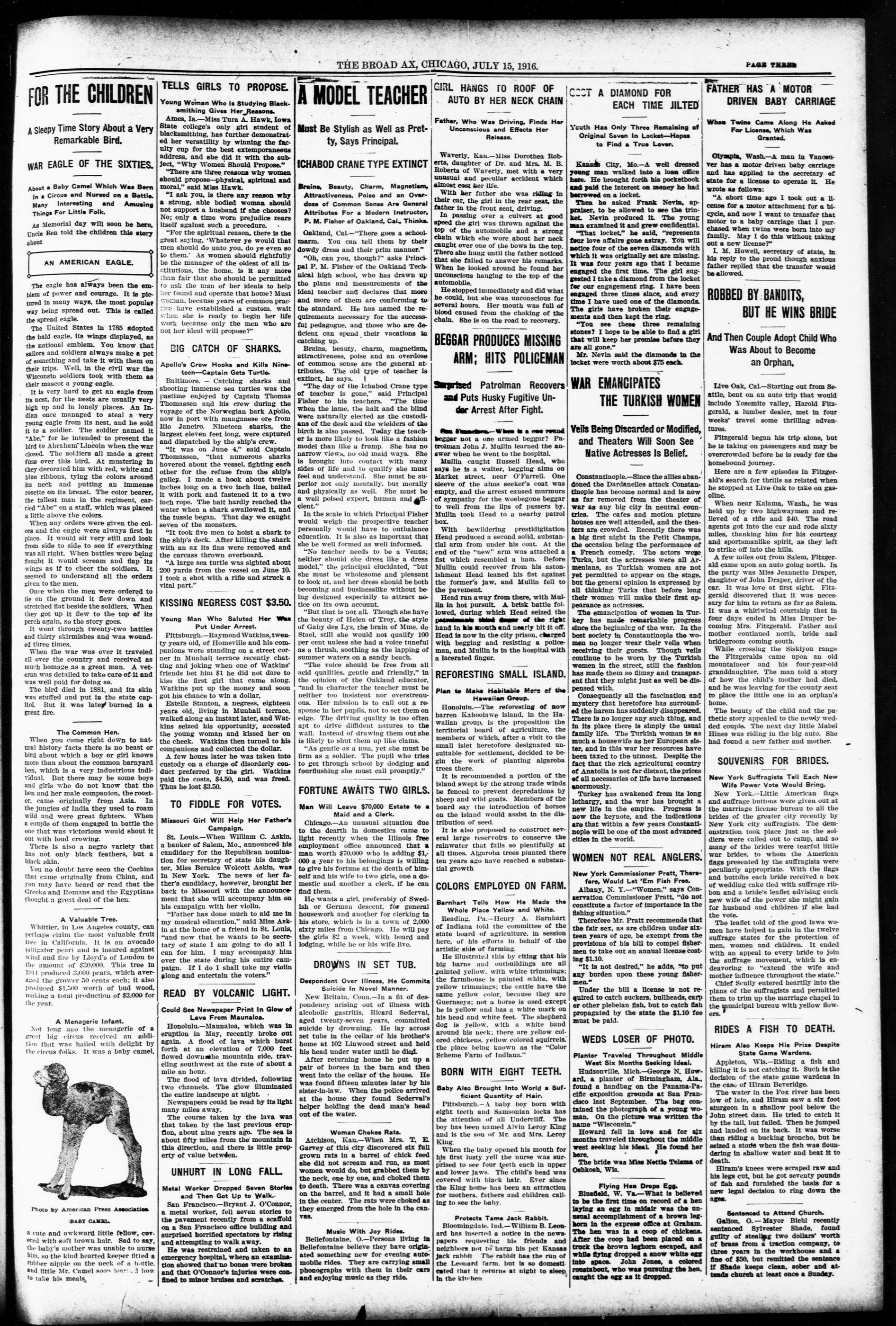
Not long ago the menagerie of a great big circus received an addition that was hailed with delight by the circus folks. It was a baby camel.
Photo by American Press Association.
a cute and awkward little fellow, covered with soft brown hair. Sad to say, the baby's mother was unable to nurse him, so the kind hearted keeper fitted a rubber nipple on the neck of a bottle, and little Mr. Camel soon learns, I how to take his meals.
TELLS GIRLS TO PROPOSE
Young Woman Who Is Studying Black
smithing Gives Her Reasons.
smithing Gives Her Reasons.
Ames, Ia.—Miss Tura A. Hawk, Iowa State college's only girl student of blacksmithing, has further demonstrated her versatility by winning the faculty cup for the best extemporaneous address, and she did it with the subject, "Why Women Should Propose."
"There are three reasons why women should propose—physical, spiritual and moral," said Miss Hawk.
"I ask you, is there any reason why a strong, able bodied woman should not support a husband if she chooses? No; only a time worn prejudice rears itself against such a procedure.
"For the spiritual reason, there is the great saying, 'Whatever ye would that men should do unto you, do ye even so to them.' As women should rightfully be the manager of the oldest of all institutions, the home, is it any more than fair that she should be permitted to ask the man of her ideals to help her found and operate that home? Must woman, because years of common practice have established a custom, wait when she is ready to begin her life work because only the men who are not her ideal will propose?"
BIG CATCH OF SHARKS
Apollo's Crew Hooks and Kills Nineteen-teen-Captain Gets Turtle
Baltimore. - Catching sharks and shooting immense sea turtles was the pastime enjoyed by Captain Thomas Thomassen and his crew during the voyage of the Norwegian bark Apollo, now in port with manganese ore from Rio Janeiro. Nineteen sharks, the largest eleven feet long, were captured and dispatched by the ship's crew.
"It was on June 4," said Captain Thomassen, "that numerous sharks hovered about the vessel, fighting each other for the refuse from the ship's galley. I made a hook about twelve inches long on a two inch line, baited it with pork and fastened it to a two inch rope. The bait hardly reached the water when a shark swallowed it, and the tussle began. That day we caught seven of the monsters.
"It took five men to holst a shark to the ship's deck. After killing the shark with an ax its fins were removed and the carcass thrown overboard.
"A large sea turtle was sighted about 200 yards from the vessel on June 10. I took a shot with a rifle and struck a vital part."
KISSING NEGRESS COST $3.50.
Young Man Who Saluted Her Was Put Under Arrest.
Pittsburgh.—Raymond Watkins, twenty years old, of Homeville and his companions were standing on a street corner in Munhall terrace recently chatting and joking when one of Watkins' friends bet him $1 he did not dare to kiss the first girl that came along. Watkins put up the money and soon got his chance to win a dollar.
Estelle Stanton, a negress, eighteen years old, living in Munhall terrace, walked along an instant later, and Watkins seized his opportunity, accosted the young woman and kissed her on the cheek. Watkins then turned to his companions and collected the dollar.
A few hours later he was taken into custody on a charge of disorderly conduct preferred by the girl. Watkins paid the costs, $4.50, and was freed. Thus he lost $3.50.
TO FIDDLE FOR VOTES.
Missouri Girl Will Help Her Father's Campaign.
St. Louis.—When William C. Askin, a banker of Salem, Mo., announced his candidacy for the Republican nomination for secretary of state his daughter, Miss Bernice Wolcott Askin, was in New York. The news of her father's candidacy, however, brought her back to Missouri with the announcement that she will accompany him on his campaign with her violin.
"Father has done much to alm me in my musical education," said Miss Askin at the home of a friend in St. Louis, "and now that he wants to be secretary of state I am going to do all I can for him. I may accompany him over the state during his entire campaign. If I do I shall take my violin along and entertain the voters."
READ BY VOLCANIC LIGHT.
Could See Newspaper Print In Glow of Lava From Maunaloa.
Honolulu—Maunaloa, which was in eruption in May, recently broke out again. A flood of lava which burst forth at an elevation of 7,000 feet flowed down the mountain side, traveling southwest at the rate of about a mile an hour.
The flood of lava divided, following two channels. The glow illuminated the entire landscape at night.
Newspapers could be read by its light many miles away.
The course taken by the lava was that taken by the last previous eruption, about nine years ago. The sea is about fifty miles from the mountain in this direction, and there is little property of value between.
UNHURT IN LONG FALL
Metal Worker Dropped Seven Stories and Then Got Up to Walk.
San Francisco—Bryant J. O'Connor, a metal worker, fell seven stories to the pavement recently from a scaffold on a San Francisco office building and surprised horrified spectators by rising and attempting to walk away.
He was restrained and taken to an emergency hospital, where an examination showed that no bones were broken and that O'Connor's injuries were confined to minor bruises and scratches.
THE BROAD AX, CHICAGO, JULY 15, 1916
A MODEL TEACHER
Must Be Stylish as Well as Pretty, Says Principal.
ICHABOD CRANE TYPE EXTINCT
Braine, Beauty, Charm, Magnetism, Attractiveness, Poise and an Overdose of Common Sense Are General Attributes For a Modern Instructor, P. M. Fisher of Oakland, Cal., Thinks Oakland, Cal.—"There goes a schoolmarm. You can tell them by their dowdy dress and their prim manner." "Oh, can you, though?" asks Principal P. M. Fisher of the Oakland Technical high school, who has drawn up the plans and measurements of the ideal teacher and declares that more and more of them are conforming to the standard. He has named the requirements necessary for the successful pedagogy, and those who are deficient can spend their vacations in catching up.
Brains, beauty, charm, magnetism, attractiveness, poise and an overdose of common sense are the general attributes. The old type of teacher is extinct, he says. "The day of the Ichabod Crane type of teacher is gone," said Principal Fisher to his teachers. "The time when the lame, the halt and the blind were naturally elected as the custodians of the desk and the wielders of the birch is also passed. Today the teacher is more likely to look like a fashion model than like a frump. She has no narrow views, no old maid ways. She is brought into contact with many sides of life and to qualify she must feel and understand. She must be superior not only mentally, but morally and physically as well. She must be a well poised expert, human and efficient."
In the scale in which Principal Fisher would weigh the prospective teacher personally would have to outbalance education. It is also as important that she be well formed as well informed.
"No teacher needs to be a Venus; neither should she dress like a dress model." the principal elucidated, "but she must be wholesome and pleasant to look at, and her dress should be both becoming and businesslike without being designed especially to attract notice on its own account.
"But that is not all. Though she have the beauty of Helen of Troy, the style of Gaby des Lys, the brain of Mme. de Stael, still she would not qualify 100 per cent unless she had a voice tuneful as a thrush, soothing as the lapping of summer waters on a sandy beach.
"The voice should be free from all acid qualities, gentle and friendly," in the opinion of the Oakland educator, "and in character the teacher must be neither too insistent nor overstrenuous. Her mission is to call out a response in her pupils, not to set them on edge. The driving quality is too often apt to drive diffident natures to the wall. Instead of drawing them out she is likely to shut them up like clams.
"As gentle as a num, yet she must be firm as a soldier. The pupil who tries to get through school by dodging and fourflushing she must call promptly."
FORTUNE AWAITS TWO GIRLS.
Man Will Leave $70,000 Estate to a Maid and a Clerk.
Chicago.—An unusual situation due to the dearth in domestics came to light recently when the Illinois free employment office announced that a man worth $70,000 who is adding $1,000 a year to his belongings is willing to give his fortune at the death of himself and his wife to two girls, one a domestic and another a clerk, if he can find them.
He wants a girl, preferably of Swedish or German descent, for general housework and another for clerking in his store, which is in a town of 2,000 sixty miles from Chicago. He will pay the girls $2 a week, with board and lodging, while he or his wife live.
DROWNS IN SET TUB.
Despondent Over Illness, He Commits Suicide in Novel Manner.
New Britain, Conn.-In a fit of despondency arising out of illness with alcoholic gastritis, Ricard Sederval, aged twenty-seven years, committed suicide by drowning. He lay across set tubs in the cellar of his brother's home at 102 Linwood street and held his head under water until he died.
After returning home he put up a pair of horses in the barn and then went into the cellar of the house. He was found fifteen minutes later by his sister-in-law. When the police arrived at the house they found Sederval's helper holding the dead man's head out of the water.
Woman Chokes Rats.
Atchison, Kan.-When Mrs. T. E. Garvey of this city discovered six full grown rats in a barrel of chick feed she did not scream and run, as most women would do, but grabbed them by the neck, one by one, and choked them to death. There was a canvas covering on the barrel, and it had a small hole in the center. The rats were choked as they emerged from the hole in the canvas.
Music With Joy Rides.
Bellefontaine, O.—Persons living in Bellefontaine believe they have originated something new for evening automobile rides. They are carrying small phonographs with them in their cars and enjoying music as they ride.
GIRL HANGS TO ROOF OF AUTO BY HER NECK CHAIN
Father, Who Was Driving, Finds Her Unconscious and Effects Her Release.
Waverly, Kan.—Miss Dorothea Roberts, daughter of Dr. and Mrs. M. B. Roberts of Waverly, met with a very unusual and peculiar accident which almost cost her life.
With her father she she was riding in their car, the girl in the rear seat, the father in the front seat, driving.
In passing over a culvert at good speed the girl was thrown against the top of the automobile and a strong chain which she wore about her neck caught over one of the bows in the top. There she hung until the father noticed that she failed to answer his remarks. When he looked around he found her unconscious hanging to the top of the automobile.
He stopped immediately and did what he could, but she was unconscious for several hours. Her mouth was full of blood caused from the choking of the chain. She is on the road to recovery.
BEGGAR PRODUCES MISSING ARM; HITS POLICEMAN
Surprised Patrolman Recovers and Puts Husky Fugitive Under Arrest After Fight.
Sun Damascene — When is a one round beggar not a one armed beggar? Patrolman John J. Mullin learned the answer when he went to the hospital.
Mullin caught Russell Head, who says he is a waiter, begging alms on Market street, near O'Farrell. One sleeve of the alms seeker's coat was empty, and the arrest caused murmurs of sympathy for the woebegone beggar to well from the lips of passers by. Mullin took Head to a nearby patrol box.
With bewildering prestidigitation Head produced a second solid, substantial arm from under his coat. At the end of the "new" arm was attached a fist which resembled a ham. Before Mullin could recover from his astonishment Head leaned his fist against the former's jaw, and Mullin fell to the pavement.
Head ran away from there, with Mullin in hot pursuit. A brisk battle followed, during which Head seized the patrolman's third finger of the right hand in his mouth and nearly bit it off. Head is now in the city prison, charged with begging and resisting a policeman, and Mullin is in the hospital with a lacerated finger.
REFORESTING SMALL ISLAND.
Plan to Make Habitable Mers of the Hawaiian Group.
Honolulu.—The reforesting of now barren Kahoolawe island, in the Hawaiian group, is the proposition the territorial board of agriculture, the members of which, after a visit to the small islet heretofore designated unsuitable for settlement, decided to begin the work of planting algaroba trees there.
It is recommended a portion of the island swept by the strong trade winds be fenced to prevent depredations by sheep and wild goats. Members of the board say the introduction of horses on the island would assist in the distribution of seed.
It is also proposed to construct several large reservoirs to conserve the rainwater that falls so plentifully at all times. Algaroba trees planted there ten years ago have reached a substantial growth.
COLORS EMPLOYED ON FARM.
Barnhart Tells How He Made the Whole Place Yellow and White.
Reading, Pa.-Henry A. Barnhart of Indiana told the committee of the state board of agriculture, in session here, of his efforts in behalf of the artistic side of farming.
He illustrated this by citing that his big barns and outbuildings are all painted yellow, with white trimmings; the farmhouse is painted white, with yellow trimmings; the cattle have the same yellow color, because they are Guernseys; not a horse is used except he is yellow and has a white mark on his head and white feet. The shepherd dog is yellow, with a white band around his neck; there are yellow colored chickens, yellow colored squirrels, the place being known as the "Color Scheme Farm of Indiana."
BORN WITH EIGHT TEETH.
Baby Also Brought Into World a Sufficient Quantity of Hair.
Pittsburgh. - A baby boy born with eight teeth and Samsonian locks has the attention of all Undercliff. The boy has been named Alvin Leroy King and is the son of Mr. and Mrs. Leroy King.
When the baby opened his mouth for his first lusty yell the nurse was surprised to see four teeth each in upper and lower jaws. The child's head was covered with black hair. Ever since the King home has been an attraction for mothers, fathers and children calling to see the baby.
Protects Tame Jack Rabbit
Bloomingdale, Ind.—William B. Leonard has inserted a notice in the newspapers requesting his friends and neighbors not to harm his pet Kansas jack rabbit. The rabbit has the run of the Leonard farm, but is so domesticated that it returns at night to sleep in the kitchen
Youth Has Only Three Remaining of Original Seven In Locket—Hopes to Find a True Lover.
Kansas City, Mo.—A well dressed young man walked into a loan office here. He brought forth his pocketbook and paid the interest on money he had borrowed on a locket.
Then he asked Frank Nevin, appraiser, to be allowed to see the trinket. Nevin produced it. The young man examined it and grew confidential
"That locket," he said, "represents four love affairs gone astray. You will notice four of the seven diamonds with which it was originally set are missing. It was four years ago that I became engaged the first time. The girl suggested I take a diamond from the locket for our engagement ring. I have been engaged three times since, and every time I have used one of the diamonds. The girls have broken their engagements and then kept the ring. "You see these three remaining stones? I hope to be able to find a girl that will keep her promise before they are all gone." Mr. Nevin said the diamonds in the locket were worth about $75 each.
WAR EMANCIPATES
THE TURKISH WOMEN
Veils Being Discarded or Modified, and Theaters Will Soon See Native Actresses Is Belief.
Constantinople.-Since the allies abandoned the Dardanelles attack Constantinople has become normal and is now as far removed from the theater of war as any big city in neutral countries. The cafes and motion picture houses are well attended, and the theaters are crowded. Recently there was a big first night in the Petit Champs, the occasion being the performance of a French comedy. The actors were Turks, but the actresses were all Armenians, as Turkish women are not yet permitted to appear on the stage, but the general opinion is expressed by all thinking Turks that before long their women will make their first appearance as actresses.
The emancipation of women in Turkey has made remarkable progress since the beginning of the war. In the best society in Constantinople the women no longer wear their vells when receiving their guests. Though vells continue to be worn by the Turkish women in the street, still the fashion has made them so filmsy and transparent that they might just as well be dispensed with.
Consequently all the fascination and mystery that heretofore has surrounded the harem has suddenly disappeared. There is no longer any such thing, and in its place there is simply the usual family life. The Turkish woman is as much a housewife as her European sister, and in this war her resources have been taxed to the utmost. Despite the fact that the rich agricultural country of Anatolia is not far distant, the prices of all necessaries of life have increased enormously.
Turkey has awakened from its long lethargy, and the war has brought a new life in the empire. Progress is now the keynote, and the indications are that within a few years Constantinople will be one of the most advanced cities in the world.
WOMEN NOT REAL ANGLERS.
New York Commissioner Pratt, Therefore, Would Let 'Em Fish Free. Albany, N. Y.—"Women," says Conservation Commissioner Pratt, "do not constitute a factor of importance in the fishing situation."
Therefore Mr. Pratt recommends that the fair sex, as are children under sixteen years of age, be exempt from the provisions of his bill to compel fishermen to take out an annual license costing $1.10.
"It is not desired," he adds, "to put any burden upon these young fishermen."
Under the bill a license is not required to catch suckers, bullheads, carp or other plebeian fish, but to catch fish propagated by the state the $1.10 fee must be paid.
WEDS LOSER OF PHOTO.
Planter Traveled Throughout Middle West Six Months Seeking Ideal.
Hudsonville, Mich.—George N. Howard, a planner of Birmingham, Ala., found a handbag on the Panama-Pacific exposition grounds at San Francisco last September. The bag contained the photograph of a young woman. On the picture was written the name "Wisconsin."
Howard fell in love and for six months traveled throughout the middle west seeking his ideal. He found her here.
The bride was Miss Nettle Telsma of Oshkosh, Wis.
Flying Hen Drop Egg.
Bluefield, W. Va.—What is believed to be the first time on record of a hen laying an egg in midair was the unusual accomplishment of a brown leghorn in the express office at Graham. The hen was in a coop of chickens. After the coop had been placed on a truck the brown leghorn escaped, and while flying dropped a snow white egg into space. John Jones, a colored roostabout, who was pursuing the hen, caught the egg as it dropped.
FATHER HAS A MOTOR DRIVEN BABY CARRIAGE
When Twins Came Along He Asked For License, Which Was Granted.
Olympia, Wash.—A man in Vancouver has a motor driven baby carriage and has applied to the secretary of state for a license to operate it. He wrote as follows:
"A short time ago I took out a license for a motor attachment for a bicycle, and now I want to transfer that motor to a baby carriage that I purchased when twins were born into my family. May I do this without taking out a new license?"
I. M. Howell, secretary of state, in his reply to the proud though anxious father replied that the transfer would be allowed.
ROBBED BY BANDITS,
BUT HE WINS BRIDE
And Then Couple Adopt Child Who Was About to Become an Orphan.
Live Oak, Cal.—Starting out from Seattle, bent on an auto trip that would include Yosemite valley, Harold Fitzgerald, a lumber dealer, met in four weeks' travel some thrilling adventures.
Fitzgerald began his trip alone, but he is taking on passengers and may be overcrowded before he is ready for the homebound journey.
Here are a few episodes in Fitzgerald's search for thrills as related when he stopped at Live Oak to take on gasoline.
When near Kalama, Wash., he was held up by two highwaymen and relieved of a rifle and $40. The road agents got into the car and rode sixty miles, thanking him for his courtesy and sportsmanlike spirit, as they left to strike off into the hills.
A few miles out from Salem, Fitzgerald came upon an auto going north. In the party was Miss Jeannette Draper, daughter of John Draper, driver of the car. It was love at first sight. Fitzgerald discovered that it was necessary for him to return as far as Salem. It was a whirlwind courtship that in four days ended in Miss Draper becoming Mrs. Fitzgerald. Father and mother continued north, bride and bridegroom coming south.
While crossing the Siskiyou range the Fitzgeralds came upon an old mountaineer and his four-year-old granddaughter. The man told a story of how the child's mother had died, and he was leaving for the county seat to place the little one in an orphan's home.
The beauty of the child and the pathetic story appealed to the newly wedded couple. The next day little Mabel Hines was riding in the big auto. She had found a new father and mother.
SOUVENIRS FOR BRIDES.
New York Suffragists Tell Each New Wife Power: Vote Would Bring.
New York.-Little American flags and suffrage buttons were given out at the marriage license bureau to all the brides of the greater city recently by New York city suffragists. The demonstration took place just as the soldiers were called out to camp, and so many of the brides were tearful little war brides, to whom the American flags presented by the suffragists were peculiarly appropriate. With the flags and buttons each bride received a box of wedding cake tied with suffrage ribbon and a bride's leaflet advising each new wife of the power she might gain for husband and children if she had the vote.
The leaflet told of the good laws women have helped to gain in the twelve suffrage states for the protection of men, women and children. It ended with an appeal to every bride to join the suffrage movement, which is endeavoring to "extend the wife and mother influence throughout the state." Chief Scully entered heartily into the plans of the suffragists and permitted them to trim up the marriage chapel in the municipal bureau with yellow flowers.
RIDES A FISH TO DEATH.
Hiram Also Keeps His Prize Despite State Game Wardens.
Appleton, Wls.-Riding a fish and killing it is not catching it. Such is the decision of the state game wardens in the case of Hiram Beveridge.
The water in the Fox river has been low of late, and Hiram saw a six foot sturgeon in a shallow pool below the John street dam. He tried to catch it by the tail, but failed. Then he jumped and landed on its back. It was worse than riding a bucking broncho, but he seized a stone when the fish was floundering in shallow water and beat it to death.
Hiram's knees were scraped raw and his legs cut, but he got seventy pounds of fish and furnished the basis for a new legal decision to ring down the areas.
Sentenced to Attend Church.
Gallon, O.—Mayor Blehl recently sentenced Sylvester Shade, found guilty of stealing two dollars' worth of brass from a traction company, to three years in the workhouse and a fine of $50, but remitted the sentence if Shade keeps clean, sober and attends church at least once a Sunday.
. am
. é Ce
PaGE FOUR THE BROAD AX, CHICAGO, JULY 15, 1916. i
ee SS PE ceca Mena
cLoTEING THE BABY. |eHE COUNTY TRAINING scHoot.| |- What Is Good Rope. | An Early Airship.
Sica On ated tes me oe Gaet -Aie eee tak Get Petes Wet a?
‘What sort of clothing 1s best tor the
infant? In our latitude, season and
¢limate govern the things it should
wear; but the tendency is to overdress,
especially when wealth and fashion try
to hang their wares on the infant as if
it were a rack for exhibition purposes.
Here are a few essentials for dress-
ing the baby.
First, for all babies under six months
of age there should be a soft, white
flannel band for the abdomen, eight
inches wide and eighteen inches long:
‘This is quite as important for the in-
fant as is the dress suit which the
evening dinner shall perhaps require of
him in later years of high life. This
band is for universal use in the hut
and the palace, for black and white,
in July and December. It makes for
good form, does the belly band of the
baby. The ‘‘claw hammer’? on the
other hand is only for show and is in
good form only in a narrow circle into
which comparatively few babies ever
enter when grown up.
This baby binder should not be
hemmed at the edges, lest it crease and
chafe the baby’s tender skin, When
he grows up, his hide may be so thick
that tight vests and other uncomfort-
able things dé not matter, and he shall
sit at Joaded banquet boards and stow
away inside his bulgjng waistcoat the
stuff that beckons gout and invites
high pressure in his blood vessels. Not
so the baby. He fills out the space
beneath his flannel binder with milk—
clean, pasteurized, wholesome milk,
mother’s milk preferably, if he is to
remain inside the zone of safety.
‘And then, come slips and petticoats
and other needful articles. In a word,
these should be soft, of cotton or wool
mixed with cotton on silk to prevent
shrinkage, according to the purse.
Simplicity and smoothness are first
principles. Ample looseness of weave
and jooseness of fit in proportion are
also in line with common sense; and it
is even becoming common practice to
banish buttons and pins in favor of
tapes for fastening.
‘This is more than 2 commercial fact;
it is sensible. The tender skin should
not be irritated and scratched by sharp
points, humps or rough cloth. They
not only hurt, but edueate bad temper,
encourage tears, squalls and noise. A
erying baby is an unwholesome item
in the family budget, like a thistle in
a pansy bed. Soothe, comfort, enter-
tain and train the baby to see and hear
and feel the bright side of the world
around him, He will get enough of the
other sort later. Proper clothes are a
great aid to this cheerful end.
An infant is highly sensitive to heat
and cold; therefore, the need of that
good officer, the mother or nurse, to
watch and guard against extremes and
sudden changes, such as oceur in Chi-
cago. So it is with the infant as with
its parents. The wise adult goes with
umbrella and outer wraps, prepared
for the sharp turns and surprises in
temperature which sneak past the
weather man, Have ready a warm
wrap and extra stockings for baby.
“Bye Baby Bunting’? reealls the im-
portance of putting the infant to sleep
so clothed that he cannot kick off the
covers at night and thus eatch cold in
winter time. A baby bunting is the
sleeping bag, closed at the bottom, that
fills this bill of protection.
Finally, whatever the baby wears
should be clean, unblued and un-
starched, and so changed as to insure
that cleanliness of habit that shall
mean neatness and sweetness in its
later years.
You may not successfully bribe the
weather man to provide cool breezes,
but you may spend enough money to
buy clean milk and enough iee to keep
it cool and enough sereens and swatters
to protect your baby from his sworn
enemy, the fly.
PRISONERS EAT, SLEEP, AND
EAT.
Col. Denison Has White Elephant in
Men Who Refused Oath.
San Antonio, Tex., July 13.—(Spe-
cial) —The Eighth Minois regimeng has
a white elephant on its hands, or rather
in the guardhouse. It consists of seven
men who refused to sign the federal
muster at Springfield and were brought
to San Antonio as prisoners. Were it
not for red tape Col. Denison would
gladly order the guardhouse sentries
to let them eseape, or even spur their
eseape. 3
As it is, the judge advoeate’s depart-
ment is the only authority that ean re-
Tease the men. ‘
‘The guests themselves form a rest:
fal colony. After reaching San An-
tonio the seven consented to be mus-
tered in, but were found medically un-
fit. They are, however, the most pro-
vokingly healthy ‘‘unfits’? a regiment
ever boarded. Eat, sleep and eat.
‘The question all hinges on how to
get the men home. Who pays the
fare? They are not government men.
Who pays the mess? They are not in
federal service. Who pays their sal-
aries? Government didn't hire them.
Col. Denison today ypt the problem
to Brig, Gen. Hill, tat he passed the
buck to the judge advocate’s depart-
ment. ‘Things sent to the judge ad-
voeate’s. department come out after
much delay. ~ ord
THE COUNTY TRAINING SCHOOL.
There is being developed in the
South a new type of: school for Negro
youth known as the cotnty training
school. This development is being fos-
tered by the Slater Board, cooperating
with public-school authorities in the
counties.
‘Any system of publicly supported
education in the South is based upon
the county as the unit. This is as true
of the Negro as of the white public
schools. The fostering of a county sys-
tem, adequately supported and ade-
quately supervised, oceupies the efforts
of educational forces at work in the
field today.
‘A number of agencies are helping
in this development. Eight Southern
states, through cooperation with the
General Education Board, employ sv-
pervisors of their rural elementary
Negro schools who devote their time
to the improvement of these schools
in the several counties, and also help
to bring about better supervision on
the part of the public sehool authori-
ties. The Jeanes Fund assists in this
development by bearing a portion of
the expense necessary to employ the
supervising industrial teachers. Their
effort has been, not only to teach ele-
mentary industries to boys and girls,
but to stimulate general improvement
in the physieal condition of school
buildings and grounds, and to reach
the homes of the children, thus devel-
oping a spirit of community cooper-
tion. ‘There is also the Rosenwald
Fund, which has brought about direct-
ly the erection of new rural-school
buildings, properly equipped, ‘by secur:
ing the cooperation of all the forces
in the community, both publie and
private, of both races. All the forces
involved in the establishment of a
public system of elementary education
seem, therefore, to have been set in
motion.
JAMES L. SIBLEY
In the Southern Workman.
FOURTEEN DISCHARGED COL
ORED SOLDIERS RESTORED.
tent of $2,500.
‘The discharge without honor of
fantry, a Negro regiment, for com-
plieity in the Brownsville raid in the
summer of 1906 has proved a blessing
in disguise to fourteen of the disgraced
soldiers. They are serving again with
the colors, and each man must regard
several companies of the 25th In-
himself as a Croesus, if he has not al-
ready dissipated the bounty bestowed
upon him by a just Government, Four-
teen of the discharged soldiers are back
in the ranks with back pay ranging
from $1,289.75 to $2,419.65, the latter
amount going to Private Robt. Wil-
liams, a troop cook.
After a one-party investigation by
a southern army officer and a military
[inquiry ordered by Congress, not a
single soldier was proven guilty. Then
Congress directed the President to ap-
point a board of army officers to pass
upon applieations on any of the dis-
charged soldiers for re-enlistment with
back pay and allowances. ‘‘And so
their dishonorable discharge was struck
from the record, and they resumed
their rank and places in the army as if
the intervening years of stigma has
been wiped out. But each now had a
bank account if he were thrifty. ‘Three
corporals, ten privates and a cook re-
joined the old Twenty-fifth. Some of
the innocent are dead; others, no doubt,
are still recorded as discharged with-
‘out honor, being too ignorant to avail
themselves of the change of vindiea-
tion, We trust that none of the guilty
is in the honor and baek pay list.
It ix a gratification to know that by
this act of reinstatement justice has
been done in some worthy [eases; and
that in effect the precipitate action
that caused the innocent to suffer ig-
nominously with the guilty stands con
demned as irrational and unjust.
|NEGRO DEMOCRATIC LEAGUE
PLANS FIGHT FOR WILSON.
National Body in Session Here Elects
Officers and Praises President for
Keeping Ont of War.
Members of the National Colored
Democratic league held its quadrennial
meeting in this city Tuesday afternoon
at 3102 Soath State street and elected
the following officers:
President—Adam Patterson of Chi-
cago.
Vico presidents—A. E, Manning,
James L. Curtis, and 8, B, Jefferson.
Seeretaries—Thomas W. Swann and
A. H. Underdown,
Treasurer—Robert S. Hudspeth of
Jersey City.
Resolutions gindorsing the national
Democratic ticket were adopted and
plans made to take an active part in
the campaign.
ALPHA SUFFRAGE CLUB.
The Alpha Suffrage Club will hold a
lawn fete and grab bag social at the
Y. M. C. A. next Wednesday evening,
July 19th. All members and friends
of the Club are urged to be present.
Dr. Fannie Emanuel, chairman bas a
splendid program of amusements for
all who come.
MRS. I. B. W. BARNETT, Pres.
Be eS
Noe eS te
CS LS: eee eee
i ge ee
AURER SBE 5 See ana
Poe ety eee ae
Ca
rm eS
we aa
4 i eg
7 é SS Seta |
eae
st sl er
ae
oe > ae eae
eee a ee
oe ig ad ae
es > 7 * ES 3
Dee OS
Se
Se ee .
HON. WILLIAM SULZER.
Ex-member of Congress, former governor of the State of New York, popular
and patriotic citizen, who may be selected at the forth-coming national
convention of the American Party and the National Convention of the
Prohibition Party which meet at Minn@@polis, Minn., Tuesday July 25 and
‘the other reformed forces to make the race for President of the United
States.
|PLATFORM OF THE AMERICAN
j PARTY.
The American party believes in the
Fatherhood of God; the Brotherhood of
Man; the Sanetity of the Home; the
Perpetuation of the Free Institutions
of America; and demands the following
essential reforms to further the pro-
‘gress of civilization:
1. An honest, and an efficient, and
an economical administration of public
affairs; free from graft; and free from
bossism—with equal rights to all and
special privileges to none.
2. The prohibition of the manu-
facture, and the sale, and the importa-
tion, and the transportation of alcohol-
ie liquors for beverage purposes—with
an administration committed to its con-
summation.
3. The protection of those who toil;
the promotion of social justice; the
betterment of the home; harmony be-
tween capital and labor by a more
equitable distribution of the fruits of
labor; an eight-hour work day; one
day’s rest in seven; a Civil Service
based entirely on the merit system;
the conservation of our natural re-
sourees; the initiative, the referendum,
and the recall; and the government
owner and operation, of public
utilities in the interest of the common
weal.
4. Peace and comity with all nations
—entangling alliances with none—and
the establishment of an International
Court of Arbitration with ample pow-
ers to insure the peace of the world.
5. Equal suffrage to women; equal-
ity of all before the law; river and
harbor improvements; good roads; the
reclamation of desert lands; a more
scientifie system of taxation; and the
| as
FE it
% a
, )
Lf.
ce eee
‘ i
&
‘ME. JULIUS JOHNSON.
Bepublican candidate for the nomination for Auditor of Public Accounts for
, the State of Ilinois; to be voted for at the State wide primaries Septem-
Der 13.
protection of American citizens at
home and abroad.
6. A single Presidential term; pre-
ferential direct primaries for the nom-
ination of President, Vice-President,
and Senators and Representatives in
Congress—together with their election
direetly by the voters; the election of
Federal Judges for stated terms; and
the assembling of Congress on the first
Monday in January suceeeding the
election of the members thereof.
7, Human rights before property
rights; the man above the dollar; sim-
plieity and expediency in civil and
criminal law procedure to secure the
square deal; a uniform marriage and
divorce law; the extermination of pri-
vate monopoly; and the prevention of
the mortmain of idle wealth.
8. The abolition of child labor in
shops and factories; court review of
departmental decisions; a cheaper and
more eficient parcels’ post; the exten-
sion of postal savings banks; and the
establishment of land banks and rural
credits to promote our agricultural re-
sources.
9. The perpetuity of our free insti-
tutions; civil and religious liberty;
freedom of worship; complete separa-
tion of Church and State; no public
funds for sectarian purposes; free
speech; free press; free public schools;
and a land of free men and free women
—free from fear; free from supersti-
tion; and free from the fetters of the
dead and buried past—politically, med-
ically, economically, and industrially.
‘What Former Governor Sulzer says:
“The American Party is is here to
stay; and the fight for reform; for our
free institutions; for progressive poli-
cies; and for honest government, will
go on.’?
res What Is Good Rope.
Rope 1s sold by the pound, se there
is alwnys the temptation for a dishon-
est manufacturer to “load” his product
with an excess of ofl or other material
or to make the coil a trifle short. The
consumer then pays the full rope price
for oil, ete. Then, too, much so called
manila contains a percentage of in
ferior fiber such as sisal and has
neither the strength nor wearing qual:
ities that it should. Tensile tests do
not tell the story, for some of the adul-
terants are almost as strong as manila.
bot the strength of poor rope falls of
rapidly with use.
Open the strands and look at the in-
side of an old rope for signs of wear.
as it wears faster there than on the
outside. When 2 rope passes over the
sheave of a block or around a cleat the
strands'slide a little on each other, and
the inner fibers gradually pulverize.
Good manila fiber is light colored.
fine, silky and strong. Rope made from
it is smooth, with few ends of fiber
sticking out.—Outing.
Miesed a Sale.
“It seems to me,” said a Main street
stationer, “that everybody's writing or
Gictating letters these days. Nine cus
tomers out of ten who come in here
ask for postage stamps.
“This morning a woman was here
browsing around. She looked over the
entire stock. I thought I had a cus
tomer. After she finished the rounds
she remarked: ‘Oh, I nearly forgot.
‘Have you any postage stamps? I said
yes and asked her how many she want-
@4. Sho handed me » wrapped news
paper and asked how much I thought
it ought to have to carry it to its desti-
nation. I weighed the darned thing
and told her a cent would be sufficient.
‘Is that all? she said. ‘Well, I have a
one cent stamp in my pocketbook. 1
thought it would come to more. Thank
you very much.’ ”—Richmond Times-
‘Dispatch.
Sluaive Zanneline.
In his book “Zeppelins and Super
Zeppelins” R. P. Hearne La sap out the
little known fact that it was a French:
man named Spiess, an Alsatian, who
about 1870 drew up a clever design for
a rigid airship and made an attempt to
patent it, In 1870 Count Zeppelin was
@ dashing soldier in Alsace, and Mr.
Hearne thinks {t more than likely that
he saw Spiess’ plans and annexed the
idea.
‘The Zeppelin is a most elusive object
despite its size. It can leap upward fn
the air at astonishing speed. It can
drop rapidly. It can climb at a steep
angle. It can dive wonderfully, and
it can nose from side to'side with no
mean agility. To reckon its altitude at
night is most difficult, and to find its
range is a matter of much ulcety.
Mew « Snake Swallows a Froa.-
‘The method of swallowing is a very
simple one, although if the frog be
large more than half an hour may be
consumed in the process. The two
Dones of the lower jaw are separate
and capable of independent movement,
s0 the reptile loosens its hold upon one
Side of its jaw, and, pushing that side
forward as far as possible, it drives the
teeth in again and draws the jaw back
to {ts original position. The result ts
that the prey is drawn down by the
movement. The process is then repeat.
ed by the other half of the jaw, thus
inevitably forcing the victim inward.
The snake's skin stretches enormously,
and the jaw is, of course, dislocated,
but the extensible ligaments hold the
bones together.
Gladiators.
‘The gladiators were originally male
factors who fought for their lives or
captives who fought for freedom. They
were first exhibited at the funeral cere-
monies of the Romans, 263 B. C., and
afterward at festivals about 215 B. C.
When Dacia was reduced by Trojan
1,000 gladiators fought at Rome for 123
days in celebration of his triumph. It
4s said that in the triumphs of Pompey
the Great 10.000 fought through a
series of many days. These combats
Were suppressed in the east by the
Emperor Constantine about A. D. 325
and in the west by Theodorie in A. D.
500.
The Treadmill.
‘The treadmill was invented thousands
of years ago by the Chinese to raise
water for the irrigation of the fields.
The invention, somewhat changed, was
introduced into England and other Eu-
| Topean countries and used in prisons as
a mode of punishment. One was erect-
ed at Brixton jail in 1817 and soon aft-
erward in other prisons. Toward the
end of the century, however, it fell into
disuse.
i impertinent.
Mrs. Owens—John, the butcher from
where we used to live has found out
our address. He called with that last
year's bill and was really impertinent.
Owens -(hotly)—Impertinent, was he!
Well, now, we'll just let him wait for
his money.—Exchange.
His Sorrow.
The Merry One—Cheer up, old man!
Why don’t you drown your sorrow?
The Sad One—Because she’s stronger
than I am; and bebides, it would be
murder.—Passing Show. \
A Female Veteran:
He—Isn't that General X. and his
daughter over there? She—Yes. They
say that she has been through more en-
gagements than her old father—Boston
‘Transcript.
Pe
“Do you think this cane would make
‘an appropriate gift for Charlie?”
“Yes. The head is solid ivory."—
Florida Times-Union.
Contentment is always perched on
‘the round of the ladder just above you
2 An Early Airship.
We are told by Peter Farley, why
wrote as 24 eyewitness, that in ay.
gust, 1835, the airship Eagle was of
cially advertised to sail from Londog
wi! government dispatches and pag.
sengers for Paris and to establish gy
Tect communication between the capi.
tals of Europe. This early type of air
ship was 160 feet long, fifty feet high
and forty feet wide. and she lay in the
dockyard of the Aeronautical society
in Victoria road, near Kensington gar
dens, then quite a rural spot. Built to
hold’ an abundant supply of gas, she
was covered with oiled lawn and car
ried a frame seventy-five feet long ang
seven feet high. with a cabin secured
by ropes to the balloon. An immense
rudder and wings or fins on each side
for purposes of propulsion completed
her fittings. The deck was guarded by
netting. After all this preparation and
advertisement the Eagle never got be
yond Victoria road, for Count Lenacr
and his assistants failed to provide the
necessary motive power. — London
Standard.
A Beruvian River of Merrac_
‘There is a river of mystery and hor.
ror in Peru, and the legends of rich
rubber regions and untold wealth in
gold are accompanied by tales of those
who went up it never to return. Casi-
mer Watkins, a naturalist, who has
traveled extensively in South America,
tells of the stream:
“This river,” he said, is the Colorado
river, the richest river in Peru. Great
groves of rubber trees lie along its
course, and xold has been found in it
But the Mascos. a tribe of cannibals,
infest it. They still practice cannibal
ism and will kill a man on sight. Ex.
peditions have been fitted out and been
heavily armed to go exploring for rub-
ber and gold. but none of them ever
has returned. The savages have killed
the men and eaten them and turned
the canoes adrift. They have come
down the river empty. bottoms up, or
filled with supplies which the savages
did not care to remove.”—New York
Post.
Fish That Sinc.
There is a fish called the butterman,
which is found off the Seottish coast.
This fish, which is fat and comfortable
looking, about a foot long as a rule,
makes a distinct hooting noise from
the back of his throat when landed in
a net or caught on a long line. A net-
ful of these fish, though they are rather
rare, is sometimes caught, and when
they are hauled in the chorus of sharp,
siren-like boots ts very startling to a
stranger.
But in Ceylon there is a shellfish, a
kind of mussel, which positively sings.
In still weather when the water has
ebbed away from the mussel beds for
a few hours these shellfish can be heard
producing a long, low, fluty sound
How they do it no one knows, but they
make a quite distinct attempt at sing-
ing, and as they have no throats they
must produce the sound by some ma-
nipulation of their double shells. —Lon-
don Globe.
Wheatedd Bethene.
Our life is peppered with motions
that fy wide and wild. It begins on
awaking. We stretch our arms—
waste motion! We ought to utilize
that gesture for polishing our shoes.
We rub our eyes—more foolishness.
We should rub our eyes on Sunday
for the rest of the week.
But it is in processes like shaving
that scientific management is really
needed. Men flatter themselves that
they shave with the minimum of ges-
ture. They believe that they com
Dlete the operation under five minutes
But, excusing their inaccuracy, do they
know that under the inspection of the
scientific manager thelr performance
would look as jagged as their razor
blade under the microscope? The day
will probably arrive when a superman
will shave with one superb motion as
delightful to the soul as the uncoiling
of an orange skin in one long unbroken
peel—New Republic.
Sheen’s Two Perauisites.
The sheep is a chunk of misguided
‘animation which is afflicted with a per-
‘petual cold in the head and has the ap-
‘pearance of always needing its nose
wiped, but it has the distinction of be-
ing the ouly animal, man not excepted.
‘which can afford to wear strictly all
Wool clothing the year round.
Probably the greatest accomplishment
of the sheep is getting itself lost in
snowstorm, at which it is such a suc-
cess that a number of famous painters
have put in a lot of time painting pic-
tures of sheep working at this—Farm
and Fireside.
All False.
Mr. Grimes (with great indignation
—T've finished with that fellow Skin-
ner, absolutely finished with him He's
a bad one. He has a lying tongue in
his head. Mrs. Grimes sympathetic
ally—Dear me! And only yesterd:y
his wife told meg that he bad fale
teeth.—Léndon Tit-Bits.
Speech and Writing.
“Many people talk much more agree
ably than they write.” said the literary
Person.
“Yes,” replied Mr. Owington. “My
tailor does that.”—Exchange.
Nothing New.
Wife—Don't rou like my new hat.
dearest? Husband—Yes-s, its all rizht.
Wite—Weil. 1 bought it on your a~
count, dear. Husband—Yes, you usual
ly do!
How She Managed.
Mabel—If your grandma has lost all
her teeth tow does she eat? Willie—l
heard pa say she had a biting tongue.-
Boston Transcript. -
By the faithful plying of the shuttle
of daily duty we weave white raiment
HEALTH,
CLEANLINESS,
PROPER LIVING,
SANITATION, ETC.
BY
Dr. W. A. DRIVER
3300 So."State Street
Phode Douglas 3617
STOMACH AND BOWEL AUTO.
TOXEMIA.
Cleanliness internally is of more im-
jort than is apparent to the easual ob-
server, The tendency is to eat regu:
rly at stated intervals, habitually, of
every article of food that is put be-
fore the eater. That is done by most
persons without regard to the actual
food needs of the body. In summer
the food needs are less than in the
winter, but in spite of that fact many
persons eat the same amount and kinds
of nutriment. It is the old, old story
of habit, nothing more. The average
housewife understands the psychology
ef the force of habit and saves the
family much in health and food ex-
yense by making believe that all the
food has been placed upon the table
when nothing of the kind has been
done. This is only one of the diplo-
matic tricks of the sophisticated house-
wife in her marvelous services. In this
‘one trick she does more to prolong life
and promote the gospel of happiness
than we are inclined to admit. She
knows that we will eat"more if we see
more until stomach and intestinal au-
totoxemia begin to deprive us of the
priceless heritage of health.
Distress after eating is the first evi-
dence of stomach and intestinal auto-
toxemia, A distension in the region
of the stomach and lower down in the
region called intestinal is present.
Eating too much is intemperance. Bet-
ter eat too little than too much. Bet-
ter still it is to eat sufficient. It has
heen aptly said that many persons dig
their graves with their teeth. The vig-
PASTORS DEMAND LID ON
GAMBLING AT HAWTHORNE.
Tell Sheriff They Have a Tip That
‘Things Will be Wide Open.
Traeger Evades Answer.
Sheriff John E. Traeger fought
lively verbal battle on Thursday with
the Rev. M. P. Boynton, pastor of th
Woodlawn Baptist church and presi
dent of the Chicago Church Federation
council, and the Rev. W. B. Millard
former executive secretary of the coun
cil,
The two ministers, who said they
represented 300 churches and mor
than 300,000 people, visited the sherif
and requested him to prevent gambling
at the races which are to be run at
Hawthorne Saturday.
++We are here to give you informa:
tion which we received from a high
source, which souree we cannot di
vulze, and which we believe is suffi
ciently reliable to warrant our turn.
ing over to you,’ said the Rev. Mr
Hoynton to the sheriff.
Can't Stop Mental Bets.
Mr. Traeger replied that he would be
indebted to the ministers for the infor-
mation, and added that it was his duty
to sce that gambling was not allowed,
fut he added that he could not stop
mental betting.
“We are told giat it is proposed to
put gambling in the Hawthorne race
track on Saturday,’? continued the
Rev. Mr. Boynton. ‘It is said the
gambling will be on a gigantic seale,
so that it will be permanently estab-
lished as it was in New York.’?
No Bookmaking, Says Sheriff.
++ AML can say is that there will be
no bookmaking, but so far as mental
bets are concerned Iam not the Al-
mighty and T ean’t stop men making
that kind of bets,’? said the sheriff.
+1 will have two justices of the peace
on the ground.’
++ What about the Sunday closing out
there?"*
‘That is a matter for the mayor of
those towns. They have licenses. It
is much better to grant them licenses
than to be troubled with ‘blind pigs.”
I would rather have the front door
open in these places than to have them
closed and have their rear door open.””
Mr. Peters Explains. .
“Why don’t you go to the mayors
of these towns and ask them to enforce
the laws?" he asked.
+*We are not citizens of those towns,
xo we came to you,’? the Rev. Mr.
Boynton replied.
Here Mr. Peters, whose duty it is
to act for the sheriff in many cases,
stepped forward and said:
“You are in the right church, but
the wrong pew, gentlemen,’? said he.
ra
a
t, Cee
ilant person is careful as to the quan
tity as well as to the quality of foo
his body accepts. Too much food ren
ders the mind ineapable of prope:
thought. Too much food clogs th
millions of cells in the body structure
and interferes with every funetior
that human economy possesses.
‘The deadly, dangerous, filthy and al
‘most omnipresent fly renders much of
our food unfit for use as food. De.
eayed and dirty food will cause gas
trointestinal diseases by introducing
microorganisms multitudinous into the
alimentary canal. The result of the
introduction of millions of germs into
the stomach and intestines means that
the blood stream gets poisons from the
bacilli or germs that infest the ali
mentary canal. Even the dead germs
produce poisonous material by theit
mere decomposition in the gastrointes.
tinal tract. Not only must we protect
ourselves from the living germ but
from the dead microorganism.
This season of the year is producing
a multitude of ailments because of the
failure of the people to meet the con-
ditions of nature. The physicians are
aware of the fact that gastritis, indi-
gestion, flatulence, cholera infantum,
cholera morbus, and other stomach and
intestinal disorders are upon us with
many people trying to evade the issue.
Babies suffer most and the toll
of death will be greater for them in
the hot weather for obvious reasons.
The intelligent person will not take
patent medicine to fight the germs nor
resort to Christian unscience but will
seek the trained seientifie diagnosti-
cian,
‘*“Why don’t you get the evidence and
present it to the state’s attorney?
Then you can have these law violators
indicted and prosecuted.’?
The ministers then left. *
WALTER A. M. E. ZION CHURCH
“NOTES BY WM. J. BURDINE.
_ Dr..Blackwell preached excellent ser
mons at both the morning and evenin;
service last sunday. The members ar
taking well to Dr. Blackwell and hi
bids fair to do an exeellent work a
pastor.
Sunday services as follows:
Preaching at 10:45 and 7:45 by th
pastor.
Sunday School at 1:39 p. m. Rev. G
W. Rivers, Supt. /
Varick Christian Endeavor at 6 p
m., Dr. E. E, Middleton, president.
The Women’s Home and Foreigt
Missionary Society was entertaine&
Tuesday eve. by the president, Mrs. De
lilah Thomas, at the home of Mrs. F
G. Carter, 3810 Dearborn St.
Rey. T. W. Wallace of East St
Louis, Il, Editor of the Western Sta
of Zion, preached at Walter A. M. E
Zion Church Tuesday eve.
The following, trustees of Walter
Chapel have been elected for the en
suing year: Messrs, J. B. Foster, J. W
Green, Ummil Collins, Felix Bager,
James Williams, Isaae Kindley, George
Burleigh, D. W. Thomas and J. E
Powers.
The Southern Club met with Mrs. R
B. Davis, 4544 Evans Ave., Wednesday
eve. the 12th inst. The club will have
a mass meeting and rally at Walters
Chapel, Tuesday eve, July 18th, An
excellent program free.
COLORED PEOPLE'S PROGRESS
A new race history, soon to be
placed on the market at $1.50; an in
spiring volume, showing the wonderfu
advaneoment of the Colored American,
reads like magic, so rapid has beer
their progress in every department—In.
dustry, Science, Art, Religion, Litera.
ture. Imparts practical suggestion:
for self-improvement and teaches the
way to success. The publishers, Austin
& Jenkins Co, Washington, D. C., are
now placing agents. Anybody can sell.
SECURE THE AGENCY AT ONCE by
getting a fine prospectus FREE: for
10 cents in postage. AGENTS make
$10.00 per day. It sells on sight.
Wm. H. Clark, one of the wide awake
and expert clerks of the municipal
court, who has for some time been
stationed at the South Clark street Po-
lice court, has removed from 218 E.
32nd street to 3301 Calumet avenue.
THE BROAD AX, CHICAGO, JULY 15. 1916.
|the above facts, did then and there
unlawfully, as the manager, servant
and agent of the United Cigar Stores
Company, Inc, use and furnish in,
with and in connection with the sale
of certain goods, etc., to one John Gar-
Vin a certain stamp, etc, of the fol-
lowing tenor:
“No. 139,198. Dr.
“United Cigar Stores Company (In-
corporated).
“Cexmiricare.
“Cash value at any Profit Sharing
Station in the State of Washington,
|1 cent, but average merchandise value,
according to profit sharing list, 2
cents.
“This certificate represents a
twenty-five cent purchase and is re
deemable according to the conditions
of our profit sharing list. Ask for a
copy of list. Redeemable only by the
person to whom originally issued.
“United Cigar Stores Company (In-
corporated).
“Largest Cigar Retailers in the world.”
And it was alleged that Garvin re-
ceived the same.
A demurrer was filed to the inform-
ation, the grounds of which were, as
alleged, that the defendant had not
violated any law, that the information
failed to state facts sufficient to con-
stitute a crime or misdemeanor and
that it did not charge any offense
against the laws of Washington. The
demurrer was sustained and the case
dismissed. This action was reversed
by the Supreme Court of the State
and the cause remanded with direc-
tions to overrule the demurrer. 79
Wash. 608.
Upon the return of the case to the
Superior Court the demurrer was
overruled and defendant pleaded
guilty. He then moved in arrest of
judgment, invoking against the law
and sentence under it Articles V and
VIII of the Constitution of the United
States and section 1 of the Fourteenth
Amendment of that Constitution.
It was stipulated that Pitney, as
charged, furnished Garvin a certain
stamp, etc, which entitled Garvin to
procure from the United Cigar Stores
Co, Inc., upon the produetion of a
certain specified number of such
stamps, etc., or other similar device,
certain goods, etc., free of charge;
that the stamp, etc, so delivered to
Garvin was redeemable by the com-
pany alone and entitled him to re-
ceive from the company and from no
other such goods, etc., that the stamp,
ete., was by its terms redeemable in
goods, etc., or 1 cent in cash at the
option of the holder as provided by
the laws of the State of Washington.
(The law of Washington, passed in
1907 (Laws 1907, p. 742), provided: )
($1) That no stamps, ete, or
other similar device which should en-
title the holder thereof to receive
from the vendor or indirectly through
any other person, money or goods,
ete., should be sold or issued unless
each of the stamps, etc., should have
legibly printed or written upon the
face thereof the redeemable value
thereof in cents.
(§2) That such stamps, ete.,
should be redeemable in goods, etc.,
“or in cash, good and lawful money
of the United States, at the option of
the holder thereof,” and any number
of such stamps, etc, should be re-
deemed at the value thereof in cents
printed on the face thereof, and it
should not be necessary for the holder
thereof to have any stipulated number
of the same. .
($3) That in case of refusal to
redeem the stamps, etc, the vendor|
or such other person should be liable
to the holder thereof for the face value
thereof.
(4) Violation of the act is made
a misdemeanor.
Judgment of a fine of $10 and costs
was pronounced against him, which
was affirmed by the Supreme Court
for the reasons announced in its
by the Chief Justice of the State.
The court overruled Leonard r.
Bassindale, 46 Wash. 301, in which
ease it had decided that the law,
passed in 1905, prohibiting the use of
trading stamps was unconstitutional,
giving as reason that the police power
of the State, as expounded and illus-
rated by the decisions of this court,
was legally exercised in the passage
of the statute.
The reasons and conclusions of the
ourt are combated by plaintiff in
| Ronert T. Nett, of the department
of justice in Washington, arrived in
Chicago, Monday, to begin work as a
special assistant in the United States
District Attorney's office. He will
work for the most part on postal
fraud cases.
Derares, Buckixcnaa & Eatox an-
nounce the admission of Paul B.
Fischer, Don Kenneth Jones and Rich-
ard Yates Hoffman to membership in
the firm.
‘NEGEO FELLOWSHIP LEAGUE.
The Negro Fellowship League will
hold a symposium on the ‘Cook Coun-
ty Republican Convention and what it
means to the Negro’’ Sunday July 16, 4
P. M. Discussion led by J. U. High-
tower, 8. B. Turner and others. Meet-
ing at the Reading Room 3005 State St.
Last Sunday the League enjoyed a
splendid addtess by Mr. J. E. Hughes
on ‘Should the Negro Fight for this
Country’. - Mr. Hughes’ remarks
brought warm discussion which was
participated in by most of the mgn and
women who were present. All agree
that nowhere else in the City anyone
hears the race programs that we have
here.
em BROWN’S HOME PUR-
! CHASED.
Meadville, Pa—The National His-
torieal Society has purchased five acres
of land twelve miles east of here, which
was formerly owned by John Brown of
civil war fame and upon which he
built a tannery. The society will in-
close the land and erect a suitable tab-
let to his memory.
Mrs. Mary Ezell, of 5130 S. Wabash
avenue, is still on the sick list.
Miss Nellie Callaway, 3300 Rhodes
avenue, has been under the doctor’s
care the past week being affeeted by
a severe cold.
Mrs. Corrine Eggleston, 542 E. 37th
street, has been confined to her home
for the past week with illness brought
on by the dentist extracting several of
her teeth.
‘Mrs. M. Clark, 6155 Wentworth av-
enue, attended the district Sunday
School Conference Thursday afternoon
‘at Morgan Park, and she enjoyed the
ca ride and its deliberations.
‘The Grammar School Department of
the Glenwood Manual Training School,
Glenwood, IIL, held commencement ex-
ercises in Memorial Hall on Thursday
evening which were largely attended.
Mrs. Ed. Nixon, 2827 S. Wabash av-
enue, will spend the remainder of the
summer at home, as she expects in the
near future some friends to visit her
from the south and other sections of
the country.
Mrs. B. F. Moseley, 6248 S. Sanga-
mon street and her daughter, Miss Ber-
tha Moseley, are now located in their
new summer home, at Idlewild, Mich.,
where they will enjoy the real comforts
of country life. *
‘Mrs. James A. Myers, of the Fisk
University, Nashville, Tenn, is the
house guest of Miss Maude J. Roberts,
3231 Vernon avenue. Mrs. Myers is
the wife of Mr. Myers, of the Fisk
Quartette and she is greatly enjoying
her visit to this city.
Miss Maude J. Roberts, 3231 Vernon
avenue, is one of the most highly ac-
complished and popular soprano song-
sters in this city. She lately appeared
upon the program of Mr. Devries pu-
pils held at the Fine Arts Building.
The Business Protective and Legal
Aide Association of Chicago, will give
a banquet or monthly luncheon Tues-
day evening, July 18th, at the Associa-
tion’s Assembly Hall, 6155 Wentworth
ee
John N. Blackshear, who has served
as one of the clerks in the Local Board
of Improvements rooms for the past
18 years, will spend his forth coming
vaeation in Chicago, for he feels that
any one ean enjoy life much better in
this city than almost any other place
in this country.
SUPREME COURT OF THE UNITED
STATES.
No. 242.—Octoser TERM, 1915.
Maxct 6, 1916.
Mr. Justice McKenna delivered the
opinion of the court.
A companion case with Nos. 41 and
224. It was. argued and submitted
with those cases and involves the same
general questions and the validity of
the statute passed upon in No. 224.
A criminal information was filed in
the Superior Court of the State of
Washington for the County of King
charging that the United Cigar Stores
Company, Inc., a New Jersey Corpora-
tion, doing business in the State of
Washington, owned and conducted a
certain store and place of business in
the City of Seattle and had not then
or theretofore obtained a separate li-
cense from the auditor of the county
entitling it at its store and place of
business to use or furnish to other
persons, etc, to use, in, with or for
the sale of any goods, etc., any stamps,
etc., or other similar devices, eptitling
the purchaser receiving the same to
procure from any person, etc, any
goods, etc., free of charge or for less
than the retail price thereof upon the
production of any number of said
stamps, etc. .
‘That Pitney (plaintiff in error), at
Affirmed.
How Limpets Stick.
‘Brery ene is familiar with the saying
“to stiek Uke a Hmpet.” bat there are
not so meny who know how it is that
a limpet is able to stick as it does to
the rocks upon which it passes its ex.
istence. ‘The creature is able, by means
of the central portion of its body,
which can be raised independently of
the edge or frill which surrounds it
to create a vacuum, much in the same
way that a plece of soft wet leather
can be made to adhere to a smooth
surface by pressing out all the air.
‘Thus the so called “strength” of the
Umpet is largely due to atmospheric
Pressure. It is not entirely so, how-
ever, for if they are closely examined
it will be seen that the shells accom-
modate themselves around the edges to
the surface of the rock upon which the
Umpet is located, and if removed to
another spot the edge of the shell will
probably be found to be a very bad fit
and the creature's power of adhesion
somewhat lessened. If taken by sur
prise with a smart sidelong blow even
@ large limpet is easily enough dis-
lodged; but, given the slightest warn-
ing, its power of suction is instantly
brought into play, and very often con-
siderable force is then necessary ere it
can be detached.—London Mail.
Tamina the Mink.
The United States department of
agriculture is making experiments in
domesticating the mink. Well, here’s
luck to its efforts—but heaven help
the poultryman who tries to rear his
chickens near that experimental farm.
‘The mink has fur as fine as the most
exacting lady could desire, but his dis-
Position is as bad as that of a Villista
bandit, and he has at least as much
cunning. He can dig his way into
any inclosure not made of brick, stone
or concrete. He loves blood as well
asa weasel. He has a perfect genius
for evading traps, and he can conduct
his depredations so skillfully that for
months and even years they will be
laid to other marauders, and only the
closest observers will know that there
is a mink in the neighborhood. The
man—or the department—which un-
dertakes to tame such a creature has
a large self confidence—Chicago Jour-
nal.
lato ois Oa
The idea of submarine navigation ts
not so modern as many people imagine.
When Napoleon was banished to St.
Helena a notorious smuggler named
‘Johnstone conceived the idea of assist
ing the dethroned monarch to escape.
In Scott’s “Life of Napoleon” he saya:
“A submarine vessel was to be the
means of effecting this enterprise. It
was thought that by sinking the vessel
during the daytime she might escape
the notice of the British cruisers and,
being raised at night, might approach
the guarded rock without discovery.
‘The vessel was actually begun in one
of the building yards upon the Thames;
but, the peculiarity of her construction
having occasioned suspicion, she was
seized by the government.”
Our First Railroad Train.
On Aug. 28, 1830, the first American
built railroad train made ts initial
Journey. ‘The train carried passengers
in its one little car and made a trip of
fourteen miles in one hour and fifteen
minutes, to the utter astonishment of
the “natives,” who predicted all sorts
of dire calamities from such speed mad-
ness. This was the beginning of the
Baltimore and Ohio railroad, the oldest
American road.
A Lastina Flower.
A common South African flower, the
white star of Bethlehem (Ornithoga-
lum lacteum), will keep fresh for two
mouths or more after cutting. It can
be sent as a cut flower from South
Africa to Europe or Asia or America,
and then will last for weeks in water.
Pruning Trees.
In pruning branches from trees cut
‘them off close up to the origin. Never
leave a stub of the portion removed,
for the cut surface will never heal
‘over, allowing the decay germs to en-
ter and gradually work into the body
of the tree.
Identified.
“You haven't forgotten us, have you,
waiter?”
“Ob, no, sir. You are the two fried
smelts.”—Judge,
@ PRACTICAL HEALTH HINT. ¢
+ — 4
* Treating Hives. ‘
Am attack of hives has usually 4
a beginning in some carelessness 4
due to eating. It is a very com- 4
mon thing to mix up indigestible 4
foods in one’s dietary. The par 4
@ taking of foods which cause in- 4
@ digestion must be avoided. 4
# Nothing destroys the appear 4
@ ance of the skin more readily 4
than repeated bilious attacks, 4
which are always brought on by 4
injudictons eating. The skin be 4
comes thick, yellowish and pasty 4
looking and many times covered 4
@ with an eruption known as urt- 4
® caria or hives. 4
«The hives will quickly disap 4
@ pear if a good purgative medicine 4
‘s taken, such as the effervescing 4
citrate of magnesia, a half glass 4
three times a day between meals 4
# for a day or two, or the effer 4
vescing phosphate of sodium, two 4
@ heaping teaspoonfuls in a tum- 4
blerful of cold water three times 4
@ day half an hour before meals. 4
% — The itching of the skin will be 4
@ relieved by bathing the skin sev- 4
© eral times a day with a mixture 4
composed of vinegar, two table- ¢
spoonfuls, and hot water, four ¢
© tablespoontuls. ¢
s
PAGE FIVE
—— ——EE
‘A Saving Man.
If the fame of all great men were
wang one member of our community
‘would be known far beyond the ¢ircle
of family and friends. We believe that
in one regard he has few equals. Give
him something to save for, something
not too far off and not too vague, and
he will keep the money in his pockets
Until it is black with pocket wear.
He has saved money for several yards
of finely bound books, one or twe vol-
umes of which he has actually read.
He has saved money with which to
Join secret orders and uniforms there-
of. By frugal attention to pennies and
nickels, paring an expense here, mak-
ing a rigid self denial there, he has
saved the price of an automobile. In
March he begins to save for vacation,
and along about August he begins sav-
ing for Christmas.
But our friend cannot save fora rainy
day. He cannot, save for investment.
There has never been a serious thought
in his mind about old age, impairment
of working and earning powers, sick-
ness and unemployment—Toledo Blade.
‘Dicstien a Mic
Do not use the telephone. The tele-
phone wires may receive a heavy
charge.
Keep away from stoves, radiators
and the like. They are large metallic
masses, likely to become heavily
charged.
Avoid screen doors or other metallic
bodies connecting with the etterior of
the building.
Keep away from chimneys and open
screened windows.
Out of doors the most dangerous
Places are under isolated trees and near
‘wire fences in open fields.
Small sheds and other sheltens are
dangerous if isolated from larger build-
ings.
‘Thick timber 1s undoubtedly the
safest place to seek out of doors, since
Single tree in a forest is not so likely
to receive a stroke as a single person
or an object in an open space of equal
area.—Country Gentleman.
He Who Shirks His Work.
‘The man who shirks his work, who
treats the service of labor with indif-
ference, who sacrifices his efficiency on
the altar of self indulgence, loafs on
his job and plans to see how little he
can do and not be caught, is to be the
most pitied man on the face of the
earth.
He thinks he is cheating his em-
Ployer. But the employer is not the
man he fs cheating. Far from it. He
is cheating himself. More than cheat-
ing himself, he is assassinating oppor-
tunity and paving the way to utter
ruin and disgrace.
‘The man who cannot be trusted with
labor for which he is honestly paid is
just as despicable as the man who re-
fuses to pay for labor honestly per-
formed. The shirker is essentially dis-
honest. Unfaithful to himself, setting
the bomb that will sooner or later send
him to poverty, he is a menace and an
abomination.—Dayton Journal _
Why Coins Are Milled.
Did you ever look at the edge of a
dime or quarter? They are different
from pennies and nickels, for all silver
and gold coin have what are called
“milled” edges, while the edges of
pennies and nickels are smooth. The
Teasons for this is that some dishonest
Persons used to clip pieces off the
coins, especially the gold ones, and
then sell these scraps of precious metal
when they had saved a great many.
Every year the nation lost large sums
of money this way, and the thieves
would smooth the edges off so well
that it was hard to find out who was
guilty. The best way of stopping this
practice was found to be to “mill” the
edges of the most valuable coins so
that no one could pare them without
letting it be seen at once.— Kansas
City Star.
Twe New York Streets.
The following information as to the
widest and narrowest streets from curb
to curb and from property line to prop-
erty line is for the old city of New
York, now the borough of Manhattan.
Rachel lane, near Grand street, be-
tween Goerck and Mangin streets, is
one of the narrowest streets, having a
width of ten feet between property
lines. Delancey street, east of Norfolk
street, has a width of 200 feet between
Property lines and is the widest street.
Rachel lane has no sidewalks. Delan-
cey street has a width of 165 feet be-
tween curbs.—New York Times,
Shingle Roofs.
‘There is a definite record of an early
use of shingles for roofing in England
in pre-Norman times. At that time this
method of making roofs was common.
‘The shingles were thin pieces of split
‘wood, usually oak. Many old examples
still exist in England, especially on the
‘Wooden towers and spires of East An-
glia.
A Careful Woman.
Mrs. Talkalot—What I have just told
you is @ very great secret. It was told
to me in the strictest confidence. I
must caution you against repeating it.
Miss Caustique—I shall endeavor to
be just as cautious as you are—Phila-
delphia Record.
Ble Breziliane.
The average height of the Bororos,
who live in the southwest of Brazil, is
six feet four inches. They are the tall-
est people in the world.
Domestic Jey.
“Zou were always a fauitfinder!”
growled the wife.
“Yes, dear,” responded the husband
meekly. “I found you.” :
‘The great soul that sits on the throne
of the universe is not, never was and
Bever will be in a hurry—Timothy Tit-
a THE BROAD AX, CHICAGO, JULY 15, 1916.
eae ee a IE eee ae | ee ere it .
BURGLAR KEPT MONEY, | _ Wh Sacitore na pre | __OCennall an an Oratr, | __Antenahng the chine. WILLIAM, 60, IS.SICK; lATPADTIEN BY Wag
the Bank Brought Decision. -
Kansas City, Mo—He was polite,
even suave, u: he unlocked the door
and entered tbr. room occupied by Mrs.
William Buchanan of 1518 Locust
street the other day. He the
oor so quigly and had such a gen-
tlemanly infer that Mrs. Buchanan
was too miich surprised to scream.
‘The intrude took her pocketbook, con-
taining negtly $3, from the dresser.
‘Then Mrs. yuchanan protested.
“Please ddh’t take my money. It is
all I have,” she pleaded.
“But I understood you had lots of
money,” replied he, holding the cash in
his hand. ‘ut if this is all you have
TU return #”
“But I hyve more,than that,” she tn-
sisted. “Icf in the bank, but as I don't
feel very ll goodness knows when I
shall be a! to get more,” she contin-
ued. The fntruder hesitated, smiled and
then took the money. Mrs. Buchanan
then called the police.
TOOK CLOTHES FOR DEBT.
Because He Couldn't Collect §3 He
Seized Four Suits.
Indianapolis.— William Devine, a
farm laborer, explained in the criminal
court that, being unable to collect $3
from James Boyce, living near Flack-
ville, he took four suits of clothes as
payment. He admitted he was gen-
erous to himself, for the sults were of
excellent quality and appearance.
“First I put on one suit,” he said,
“and then I thought how much better
tt looked on me than it did on Boyee,
80 I took the others.”
With the disappearance of his suits
and Devine, Boyce came before the
grand jury and an indictment was re-
turned against the farm laborer. Boyce
paid $18 to find and return-Devine to
the city to face the larceny charge.
Devine went to Madison, Ind, after
taking the suits
Judge Collins sentenced Devine to
the penal farm for ninety days.
“?M SO FOND OF MUSICI”
‘That Explains What Maid Does With
scais Rellaceaee ae aia
Chicago.—For a few days a young
north shore matron believed she had
solved the servant girl problem. Her
first girl found the country life too
slow and returned home “back of the
yards.”
‘This experience afforded an insptra-
ton, and she imported a girl from her
former home at Galesburg. Kindly
treatment was to be the keynote of
success, so when she discovered the
new maid lacked underwear she armed
her with a dollar and shopping in-
structions.
In thirty minutes the girl was back,
but minus the underwear. In its place
she had purchased a mouth organ
costing 49 cents, which she exhibited
proudly to her mistress with the re-
mark:
“T’'m so fond of music.”
NEW USE FOR OLD GLORY.
Bench.”
New York.—After an adjournment of
the Brooklyn court of special sessions
recently the bench and clerk’s desk
‘were bedecked with an American flag.
“What's the idea?” Chief Probation
Officer John J. Rooney was asked.
“That's the duster,” Rooney explain-
ed. “When the janitor sweeps he cov-
ers the bench and clerk’s desk with
the old fag.”
Indignant, the questioner sought out
Chief Clerk Joseph L. Kerrigan and
@emanded an explanation of the ap-
parent desecration of Old Glory.
“Well, isn't the flag protecting the
bench?” was Kerrigan's ready re
sponse.
GETS EGG DURING TRIAL.
Be ia ir aR 2 AN REN 6 oo a es
Court, and the Judge Benefits.
Portland, Ore.—Maude, a White Leg-
horn hen, was in District Judge Bell's
court as Exhibit A in a sult over her
ownership and that of two other Bid-
dies and a cockerel. Suddenly there
smote the air a shrill “cut-a-cut.” It
was Maude cackling, and she kept tt
up. “Bailiff, kindly remove the ex-
hibit,” ordered the judge. The bailiff
approached §Mande’s coop. “Your
honor,” he shouted, “look!” and held
up a snowy white egg. “Maude has
laid it”
Both litigants agreed that the judge
should receive the egg, and he did.
DRINKERS SENT TO FRONT.
France Adopts Plan to Keep Tempta-
tion From Munition Workers.
Paris—On account of a diminution
of the output of munitions, due to ex-
cessive drinking, Minister of Munitions
Albert Thomas recently issued instruc-
tions that any munition workers found
under the influence of alcohol shall be
immediately sent to the fighting line.
‘The explanation is given that the
penalty is not in the nature of a pun-
tshment, but because the man in ques.
tion is unlikely to experience the same
temptations at the front. *
Firet Bath In Twenty Yeare.
Charlestown, Ind.—After being given
the first bath he has had in twenty
years, according to his own admission,
DD, W. Hodson, who presented himself
at the county farm for the poor, near
here, suddenly disappeared. The mys-
tery of his absence was solved when
he showed up at his old home at Un-
erwood, Ind., and told of the vigorous
yerubbing the farm attendants admin-
‘istered. a
His Backbone Is a Spring.
‘The snapping bug has a spring im bs
beck, ike a knife. When net im wae
as a spring it serves him as a beek-
Dene, so you see he is a believer im
scientific efficiency and makes one part
ef his machinery do the work of twe.
Wis spring backbone, or backbene
spring if you prefer, gives him power
te jump, which in turn gives him his
mame. Nature probably gave him the
spring to help him get on his feet when
he’s on his back. You've noticed how
helpless some insects are when you
Jay them on their backs. Not this one,
however. He slips his backbone eut
‘ef its groove and then slips it back
again suddenly. The spring pops him
Up in the air, he turns a somersault
and drops right side up. Spring back.
bones are common in several other
Beetles. The beetle of the pestiferous
wire worm, which destroys the farm-
e's crops, has a spring in his back.
Other members of the family make
their homes in trees or decayed wood.
—Philadelphia North American.
Resourceful Burclar.
A constable going the rounds of Bis
beat in London a few nights ago no-
ticed a light in a house from which the
family and servants had gone out of
town. After the officer had pulled the
bell several times a man put his head
‘eut of the bedroom window to say that
he would be down in a few minutes.
Be came down in a dressing gown and
carrying a candle in his hand.
‘The constable explained his suspi-
clon, whereupon the man stated that
he had just run up to town to see that
all was right After chatting for a lt-
tle he invited the constable to have a
glass of wine. He lit the dining room
gas and produced a bottle of port
After they had drunk each other's
health he let the constable out and
bolted the door after him.
‘The man lost no time in getting the
“swag” together and left the house by
another exit
Gluten ao teres Me Mama,
‘The shire horse owes its name to Ar
thur Young's remarks, in the descrip-
tion of his agricultural tours during
the closing years of the eighteen cea-
tury, concerning the large old English
Diack horse, “the produce principally
of the shire counties in the heart of
England.” But long previous to this
the word “shire” in connection with
horses was used in statutes of Henry
VIII. Under the various names of the
war horse, the great horse, the old
English black horse and the shire horse
the breed has for centuries been culti-
vated in the rich fen lands of Lincoln-
shire and Cambridgeshire and in many
counties of the west. Curiously
enough, the Shire Horse society, which
has done so much to promote the
breed, was known for the first six
years of its existence, which began in
1878, as the English Cart Horse socie-
ty—London Chronicle.
The First War.
The first writing known te scholars
was the account of a war waged be-
tween hostile nations in Mesopotamia,
perhaps 3500 B. ©. The first battle
was that between Cain and Abel. Ap-
parently men have always been quick
to settle their differences by fighting.
‘The first warlike king is said to have
Deen Osymandyas of Egypt, who pass-
ed into Asia and conquered Bactria in
2100 B. C. Palamedes Bacgos 1s
mythically reported to have bean the
first who ranged an army in a regular
Mne of battle, placed sentinels round a
camp and excited the soldier’s vigt-
lance by giving him a password. ‘This
eccurred during the siege of Troy, the
date of which is variously estimated at
‘about 2,500 years before the Christian
era—Pittsburgh Press.
Reversina the Compliment.
A cashier of somewhat portly build
was ffowning over a statement of ac-
counts just placed before him hy his
pretty typist.
“As a young lady,” he said, “I ad-
mire your type, but I can’t honestly
say I admire your typing.”
“How funny!” she replied smartly.
“We are so different, for, though you
are of course splendid at figures, no
‘one could say you have a splendid fig-
uref"—London Express.
Quick Way to Drive Posts.
‘To drive posts quickly take a section
of log about fifteen inches in diameter
‘and two feet long, to which are attach-
ed two handles at an angle. Two men,
ene on each side, can use this hand
power pile driver while a third mam
olds the post to be driven and keeps
tt in alignment —Farm and home.
Made Him Cross.
“I made my husband cross this after-
oon,” said Mrs. Caller.
“How was that?” queried Mra. He
mer.
“He was on the opposite side ef the
street, and I beckoned him te come
over,” explained the other.
PS ae a
Guest—Look here! This mirror fs se
fearfully dirty that I can't see my face
fm it. Hotel Servant—It strikes me you
eught to be thankful for that inetead
ef making trouble about it—Exchanga,
Rope and an Oath.
In Assam an oath is taken standing
within a rope circle, to imply a wish
to perish as the rope does if the wit-
ness does not tell the truth.
Chil Wie
“What was the result of the see?
‘asked the Sunday school teacher.
“Mud,” replied the bright youngster.
—Chicago News.
‘They have a right to censure that
have a heart to belp. The rest &
cruelty, not justice —William Pean.
THE BROAD AX, CHICAGO, JULY 15, 1916.
O'Connell as an Orator. Astonishing the Chine
Few orators hive been so fortunate | “When I was in China.” a
es Daniel O'Connell in their physical | mam said, “I was astonishe
appeal to the senses. Grattan, Cur- | hew little the people knew a
ran, Emmet, Sheil and Meagher were | teebay beyond their own
small men, not the least impressive to |esackers, They can make th
the eye. O'Connell was a man of royal | ees much more cheaply than |
aspect. His voice was seductively | be preduced in America. B
musical—the most musical, according | pleces, reckets and such lke
to Disracll, ever heard in the house ef | mese knew practically. not!
commons. It was soft, of great com- their attempts to make them
pass, capable of expressing every tm |tmtheextreme. «
aginable emotion. His eyes, light im| “A Chinese cracker maker |
calor and full, fiashed or beamed or | Hongkong challenged me on
burned, according to the sentiment ex- | petapwith him in a firework
pressed. His contemporaries all men- | and a friendly mandarin wa:
ton the expressibility of his mouth. | te act as judge. My Chinese
His gestures were free and bold, not in | set off a lot of gigantic cra
the least suggestive of elocution and | made a terrifying noise, but
yet infinitely graceful and apt. There | darin had been used to that
was nothing in his manner indicattve | fancy and wasn’t at all impr
of preparation. His manner was easy | show, however, astounded
and without effort. Wendell Phillips, | though it was really a mea
who heard him, says in his lecture: | tor I wasn't going to wast
“We used to say of Webster, ‘This ia | pieces on a private competiti
a great effort,’ of Eiverett, ‘It is a bet | the award easily enough —W
tifal effort,’ but you never used the | star,
word ‘effort’ in speaking of O'Connell ———_—
It provoked you that he would vaot French Army Helme
make an effort.”"—“The Irish Orators,” | There are sixty-four distlr
by Claude G. Bowers. tions necessary in turning 0
——_— the plain steel helmets worn |
The Evil Eye. eoldiers. The first step is
It is probable that the “evil eye,” for
which many hapless old women were
harried to their death on the suspicion
of witchcraft in “the good old days,”
was no more than a common squint, a
“cast” in the eye, or “bossing,” as tt
fs called in many parts of the country
to this day, writes Dr. N. Bishop Har
man in the British Journal of Chit
Gren's Diseases. Not only was the
squint thought to be of evil signifi
cance, but the defect itself was com
sidered to be the work of evil spirits
In “King Lear” we find the following
im the scene on the heath at night:
“This is the foul fiend Filbbertigib-
get. He begins at curfew and walks
till the first cock; he gives the web and
the pin, squints the eye and makes
the harelip, mildews the white meat
and hurts the poor creature of earth.”
enees tite Clan.
George Bubb, better known as Bubb
Doddington, one of the wits of the
eighteenth céntury, always dined well
and always liked to doze after the re-
past. Falling asleep one day after din-
ner with Sir Richard Temple and Lord
Cobham, the latter reproached Dod-
ington with his drowsiness. Dodding-
ton denied having been asleep and to
prove he had not offered to repeat all
Lord Cobham had been saying. Cob-
ham challenged him to do so. Dod-
ington repeated a story, and Lord
Cobham owned he had been telling it
“Well,” said Doddington, “and yet 1
did not hear a word of it, but I went
to sleep because I knew that about this
time of the day you would tell that
story.”
Lightning Rods.
‘There were no lightning rods in an-
cfent times. The first one that the
world ever saw was set up by our
own illustrious countryman Benjamin
Franklin shortly after the year 1752
‘He had just had his celebrated experi-
ment with the kite, in which he dem-
onstrated the identity of lghtning
with electricity, and was therefore
prepared for the construction of the
rods for which the world had waited
so long. It is not generally known
that Franklin was as distinguished in
science as he was in statesmanship
and diplomacy.—Exchange.
A Bright Outlook.
“Do you—er—do you think, Miss
Dobleigh, that you will be—er—engag-
ed next Thursday evening?’ asked
‘Tompy very bashfully.
“Well, really, Mr. Tompy,” replied
Ethel, “I don’t know, but if you can
get up spunk enough between now and
then to do your share I think there's a
fair prospect that I shall be.”
And Tompy did.
Different Kinds.
“I had a tooth extracted yesterday,”
remarked the fussy man, “and the
dentist gave me gas.”
“Oh, that’s nothing,” rejoined the
man with the bald spot. “Every time
I get shaved the barber gives me a lot
of it."—Indianapolis Star.
PRACTICAL HEALTH HINT.
@ In treating hemorrhage the ¢
@ first thing is to find its cause ¢
@ and then try to stop it by local ¢
@ means. What these means are ¢
@ must depend on the state the pa- ¢
@ tient ts in and the site of the ¢
@ Diceding. If that is easily reach- ¢
@ ed the hemorrhage can be stop- ¢
@ ped by packing or by pressure ¢
@ or by binding with ligatures. <
@ Sometimes the state of the pa- ¢
@ tient is such that it is best to «
@ stop the flow by the pressure of «
@ the hand or fingers while other «
@ steps are taken to relieve the con- ¢
@ stitutional symptoms of shock «
@ and collapse. :
@ Sometimes only an operation «
@ can reach the point from which <
@ the blood comes. In that case «
@ it must be performed as rapidly 4
@ as possible while the patient re- ¢
® celves constitutional treatment. <
@ In many cases only a physician ¢
@ can find the source of a hemor- «
® rhage, but intelligent bystand- ¢
@ ers can do much to relieve the ¢
@ symptoms. Hot water bottles «
@ are needed to help in maintain ¢
@ ing the bodily heat. Stimulants «
@ should be in readiness, and the «
@ salt box should be at hand, for ¢
@ saline injections are often given ¢
@ by physicians in dangerous cases 4
@ of hemorrhage. .
Astonishing the Chinese.
“When I was in China.” a frewerks
man said, “I was astonished to find
bow little the people knew abeut pyre-
teehay beyond their own Chinese
evackers, They can make these erack-
ers much more cheaply than they could
be preduced in America. But of set
pieces, reckets and such like, the Cht-
nese know practically. nothing, and
their attempts to make them are erade
im the extreme. .
“A Chinese cracker maker living near
Hongkong challenged me once te com-
petepwith him in a fireworks display,
and a friendly mandarin was called in
te act as judge. My Chinese opponent
set off a lot of gigantic crackers and
made a terrifying noise, but the man-
darin had been used to that from in-
fancy and wasn't at all impressed. My
show, however, astounded him, ab
though it was really a mean exhibit,
for I wasn't going to waste my best
pieces on a private competition. I got
the award easily enough Washington
a: eee
icich ee Siete
There are sixty-four distinct epera-
tions necessary in turning out one of
the plain steel helmets worn by French
soldiers. The first step is stamping
eut disks from large sheets of steel A
special machine is used for this pur-
pose, exerting a pressure of 150 tons
and capable of cutting out 5,000 steel
isks a day. Each disk is placed un-
der a shaping machine, which presses
the disk into the form of a helmet with
@ broad rim. Polishing and cutting
machines remove all irregularities in
the helmet, after which it has holes
punched in the crown, some for ven-
tilation purposes, others for fastening
on the regimental crest. Each helmet
{s cleaned and dipped in a special mir.
tare which makes it a dull, inconspic-
uous bluish-gray. A lning and leath-
er chin straps are then fastened on,
and the helmet is complete.—Pearson's.
—_—_—+—_
‘The Wesley Oak.
‘The Wesley oak, according to the At
Janta (Ga.) Journal, stands on St, Si-
mon’s island, less than mile from
Fort Frederica. It is 200 feet high,
and its cool shade rests lke a bene-
diction over an area of several acres.
According to local tradition, this tree
marks the exact spot on which the
‘Wesleys preached. Charles Wesley en-
gaged himself to Oglethorpe as private
secretary before leaving England. But
he afterward took orders and devoted
much of his time to preaching near
Frederica. From time to time John
‘Wesley came down from Savannah te
Join him. This famous oak stands at
the gateway to the churchyard of
Ghrist church, and several generations
sleep within the inclosure that it
guards. Mosses bang down from its
Umbs, and it is solemn and beautiful.
Stetead Shanon.
If you should bear some stranger
mention the United States are you pos-
itive that you would know what be
meant? In the eastern part of South
America the term “United States” is
regarded as an unqualified designation
ef the republic of Brazil, while a little
‘way to the north the term is taken te
refer to Venezuela. In almost all parts
ef the southern continent the mention
of a country in the northern hemis-
phere called “United States” is likely
te suggest Mexico, whose official title
fs Estados Unidos Mexicanos. There
are still those who speak of the repub-
Ue of Colombia as “the United States,”
because during the period when its
federal constitution was in force, from
1861 to 1886, it was called Estados
Unidos de Colombia."—St. Louis Globe-
Democrat.
Self Reliance.
‘The spirit of self help ts the root ef
all genuine growth in the individual,
‘aad, exhibited in the lives of many, it
constitutes the true source of national
vigor and strensth. Help from with
out is often enfecbling in its effects,
but help from within invariably tavig-
erates. Whatever is done for men or
classes to a certain extent takes away
the stimulus and necessity of doing for
themselves, and where men are sub-
fected to overcuidance and pvergov-
‘xnment the inevitable tendency is te
‘render them comparatively helpless —
Samuel Smiles.
A Close Connection.
“I'm tryin’ to get some information
about a friend of mine named For,
‘who came out here,” said the stranger
from the east. “They tell me he died
ef some throat trouble.”
“I guess that’s about right,” sald the
cowboy.
“What was it? Bronchitis?”
“Bronchitis? That's a new one en
me, but I reckon I see the connection.
He stole a broncho.” — Philadelphia
Press,
A Vecvemt Theanaht.
| “I was jost thinking about that
Jengevity record established by Me-
‘thuselab.”
“What about xf
“If he hadn't set such a high mark
‘maybe more men would go after tt.”—
Louisville Courier Journal
Decided Change.
Mra 4—How marriage changes a
man! Mra B.—Doesn't it? Take my
Mmusband. He used to offer me a penny
fer my thoughts, and now he offers me
$60 te abut up.—Boston Transcript,
| a
a ee eee RCC
“Bdy, dad, what's bonds of mate
mony?”
“They ought to be bonds te keep the
peace, but they're not.” — Richmond
‘Times-Dispatch. /
| rase\ cust evap oes Decstreanan
has, for its first duty, te forgive—Bul-
werLytton.
WILLIAM, 60, IS_SICK;
PAPA, 108, NURSES HIM
Son Who Cared For Father Since He
Passed Century Mark Falls
Victim to Measles.
Balaton, Minn.—William has the mea-
sles. He's sixty and has been taking
care of papa since the latter passed the
hundred year mark, but now papa is
taking care of William.
‘William is the son of John Shequin,
who soon will be 108 years old. Mr.
Shequin, Sr., has been ailing a little
lately, but under the care of his wife
and William he is able to be up and
about again.
Father and Mother Shequin celebrat-
ed their diamond wedding anniversary
three years ago. Mr. Shequin, Sr., was
born in Franklin, Vt, and was seven
years old when the war of 1812 ended.
He couldn't enlist in the civil war be-
tause he was too old. His wife was
Louise Bigford of Standbridge, Can-
ada. She is nearly ninety-eight years
old. The Shequins moved here from
Freeborn county, Minn., in 1873.
William, being only sixty, is expected
to recover from the measles.
WEDS CONVICT; NOW
WORKS TO FREE HIM
Bride Hopes to Gain Pardon For
Her Husband, a “Lifer”—First
Occurrence In Oklahoma.
McAlester, Okla.—“Love laughs at
prison bars” is an old saying that was
given practical demonstration at the
Oklahoma state penitentiary. Etta
Martin, a pretty young Spanish girl
from St. Louis, became the bride of
Jobn Cieloha, Bohemian, who is serv-
ing a life sentence for murder.
It is the first sentence on record
where a life term convict was permit-
ted to marry and\the third case of
marriage in which an Oklahoma pris-
oner appeared as principal.
‘The first case was that of a trusty,
who married before marriage license
clerk or officiating minister knew of
his record. In the other case the cere-
mony took place in the warden’s office,
but the bridegroom held a parole in
one hand.
‘The young bride of John Cieloha ex-
pects to bring about the release of her
husband through pardon or parole.
“If he hadn't escaped from the pent-
tentlary he would have stood a much
better chance,” suggested a newspaper
man in talking with the newlyweds
shortly after their marriage.
“But if he hadn’t escaped I wouldn't
have found him,” was the quick reply
ef the young wife.
‘The persistence with which she pur-
sued her demand for marriage with a
convict leads one to believe that she'll
keep her word as to freeing him.
Cieloha was charged with being, ac-
cessory to the murder of David Con-
War, an aged bridge keeper-on the
Midland Valley railroad, near Musko-
gee, seven years ago. Conway was
found beaten to death, presumably by
robbers.
BURGLAR ROCKS BABY.
After Order Is Restored Policemen Find
Negro Alongside of Child.
Aurora, Ill.—A noise at her bedroom
window early in the morning aroused
Mrs. William Lustic. As she looked
timorously in the direction of the win-
dow she saw a negro crawling into the
room. She scfeamed and fled, clad only
im her nightgown. Her husband jump-
ed out of bed when he heard his wife's
shriek. He bumped into the negro and
Was so frightened that he, too, ran out
of the house.
In thelr panic Lustic and his wife
forgot their one-year-old baby daugh-
ter, who slept in a cradle. Of a sudden
Mrs. Lustic heard the baby cry. Po-
licemen who were summoned found
the negro seated in a chair rocking the
baby.
LAYS SIX EGGS AT ONE CACKLE
Connecticut Hen Has Busy Birthday.
Rooster Acts as Cop.
Hartford, Conn.—A hen and a roost-
@r near here have joined the “super
chicken” class. In Willington a White
Leghorn hen celebrated her birthday
by laying six eggs at one cackle. Aft
er she stopped laying recently an agri-
cultural college student performed an
operation on her, which was more
than successful.
A dangerous “blind” bridge at Boltch
Notch was guarded by a rooster. The
fowl, which is called Speaker by his
owner, Mrs. Minnie Howard, because
of his parliamentarian qualities, did
trafile cop duty all afternoon, warning
automobiles to slow down before cross-
ing the rickety structure.
TRAINS LONG TO WHIP RIVAL.
Waits Nine Years te Do It and Then
‘Gite Heo Oe
Hiawatha, Kan.—Robert Noe of Pow-
hatan waited nine years to whip Gar-
Tett Bartley and then gladly paid a fine
for doing It.
‘Nine years ago Noe, then a boy, won
a foot race from Bartley. ‘They after-
ward fought, and Bartley whipped the
victor. Noe promised to even up later
and trained for the event. Meanwhile
Bartley had moved to another part of
the county. A few weeks ago Noe
moved into the same neighborhood.
‘The Grst time he met Bartley they
tought.
TARTLED BY KISS
Long Teen eee Rounds
Up With a Mishap.
WRONG FELLOW IS HUGGED,
‘Victim Utters Incoherent Words of In-
" quiry When Prospective Husband
Comes Aldng, and After Apologies
He Hurries Her Off to Minister.
Parsons, Kan.—Marcella Howland
kissed the wrong man. And inasmuch
as Marcella at the time of her oscula-
tory performance was engaged to be
married and ‘the man she kissed was
not her prospective husband, she found
herself in an embarrassing situation
‘when the real groom hove to and made
anxious inquiry as to her affection for
another man. If it had been in the
good old days of raplers and swords
perhaps there would have been a duel,
with much blood, but there was none
of that, and only a few people at the
Katy station were aware of the near
‘tragedy.
‘The story of the kissing and Marcella
and the man she kissed and the man
she should have kissed adds another
chapter to the volumes that have been
written about long distance love mak-
Ing. This episode might have been
labeled “Courtship by Mail, or Wooing
by Correspondence.” The story is this,
duly attested and sworn to by at least
one of the parties concerned:
Marcella lives near Joplin and is a
helper in a grocery store. A year ago
she found the name of James Vandyke
in a case of eggs, the said James not
being a barber, as his name might in-
dicate, but a raiser of chickens and
corn near Anadarko, Okla. Marcella
wrote to James, and James replied.
‘Then followed a correspondence with
each succeeding letter ripened into
leve. A month ago it was decided to
meet in Parsons end have a minister
here perform the ceremony, an elope-
ment being considered the proper
thing to do.
James arrived and spent a restlese
afternoon waiting for his bride, who
was to come from Joplin on the even-
ing train.
Came 7:45 o'clock, and with it the
train from Joplin and Marcella. James
was a bit confused in time and was
not at the station. Marcella, wearing
& pink carnation by prearrangement,
went to the waiting room and sat
down to await the arrival of her hus-
band to be.
‘Now enter the other side of the tri-
angle, whose name for the present is
unknown, as he absolutely refused to
divulge his identity. His name will be
John Doe for this occasion. John en-
tered the station and gazed over the
crowds. Marcella saw him, and after
giving him time to discover her trip-
Ped across the room and stood enrap-
tured before the astonished man.
“Well, here I am, James,” she said
demurely, waiting for her fiance to
take her in his arms, ete., &te.
John gasped, but made no move to-
ward her.
“Why, you bashful thing.” the girl
exclaimed, and with that bounded over
to the man, threw her arms about him
and planted a kiss upon his lips.
John extricated himself as best he
could—or would, and was mumbling
some incoherent words of inquiry
when in came a breathless Vandyke,
who had come up just in time to be-
hold the performance, and, convinced
that some one was making away with
his bride to be, rushed up to thwart
him.
As he approached misgiving spread
over Marcella’s face. She had a faint
suspicion that she had kissed the wrong
man, and this suspicion grew with
each step of the excited Vandyke. He
stood before her. She looked at Doe
and then at Vandyke. Yes, the last
man was certainly the one she had
come to meet. How could she have
mistaken the other fellow for him, al-
though their resemblance was quite
marked?
Then apologies, explanations, assur-
ances by Doe to Vandyke that he was
an tanscent party opel had no intention
to “cop” Marcella,Sand then Marcella
Kissed the right man, right there in the
station, with a score of people watch-
ing her.
‘The couple decided to take the 8:22
train back tp Joplin and be married
there. They hurried to a telephone,
made an appointment with a minister
there and left.
GETS BACK HIS SIGHT.
Blinded by a Fall, a Man Is Recovering
After Eight Years.
Philadelphia.—Unable te see for eight
years, Edward Claycomb, a painter, of
Altoona, Pa., is recovering his sight by
degrees.
In 1908 he fell from a house he was
painting, and in addition to his other
injuries he detached the retinas of
both eyes. He became blind. Special-
ists of a dozen cities were consulted,
and they all told him bis case was
hopeless.
For the last several weeks his sight
has been returning, and now he can see
and read large letters and distinguish
between colors. Physicians are puz-
zled. Claycomb is hopeful that his
sight will become normal.
Selle Hidden Money With Potatees.
Manton, Cal—W. A. Cleland placed
$820 in $20 gold pleces in a potato bin
for safe keeping. Forgetting about the
money, he sold some potatoes. Later
geureh forthe cate peeved easeccom
Cleland now thinks banks are a
safer proposition than potato bins.
QUINADE
GROWS HAIR
REMOVES DANDRUFF
SEND FOR SAMPLE
QUINASOAP
THE IDEAL SHAMPOO SOAP
THOROUGHLY CLEANSES THE SCALP
QUINACOMB
HAIR. STRAIGHTENER
SHAMPOO DRYER
QUINADE 25¢ QUINACC 550¢ QUINASOAP 25¢
AT ALL DRUGGISTS
SEEBY DRUG COMPANY, NEW YORK CITY, N. Y.
THE SANITARY and SHIP CANAL
Length - - - - - 32 Miles
Depth - - - - - 22 Feet
Width - - - 162 to 290 Feet
THE CANAL OFFERS:
Industrial Locations, Dock Facilities, Water Transportation, Railroad Connections, Electric Power, Concrete Building Material.
Direct Connection with St. Louis via the Illinois River and Direct Connection with the Gulf via the Illinois and Mississippi Rivers.
Electric Energy Created from Water Power for the Modern Factory Means Efficiency and Economy.
THOMAS A. SMYTH, - President
JOHN McGILLEN, - - Chief Clerk
F. D. CONNERY, - - Comptroller
Karpen Building
900 So. Michigan Ave., CHICAGO
An: Artist's Fad.
A Parisian artist in lieu of a picture gallery has a collection of great painters' palettes, some 500 in number, among them being Corot's, Isabey's and Theodore Rousseau's. On many of the palettes are sketches by the painters who used them.
Wycliffe's Bible.
John Wycliffe, completed the translation of the whole Bible for the first time into the language of the English people. He was born near Richmond, in Yorkshire, about 1324.
A Case of Fifty-Fifty
"Half the world doesn't know how
the other half lives."
"That's the half that minds its
own business probably."—Philadelphia
Ledger.
The smallest thing well done
becomes artistic.—William Matthews.
Flower of the Air.
There is a plant in Chile and a similar one in "span called the "flower of the air." It is so called because it appears to have no root and is never fixed to the earth. It twitches around a dry tree or sterile rock. Each shoot produces two or three flowers like a lily—white, transparent and odoriferous. It is capable of being transported 600 to 700 miles and vegetates as it travels suspended on a twig.
Perfect Machinery
"Their household seems a perfect piece of machinery."
"Yes; the wife's the governor, the children safety valves and the husband a crank."—Philadelphia Bulletin.
His Views.
"Dear me, I forgot to send her an invitation to our wedding!"
"I imagine it won't make much difference. We won't miss one pickle fork."-Kansas City Journal
Astronomy.
Astronomy is one of the most exact of the sciences. The powerful telescopes, the spectroscope and other almost perfect instruments come pretty near telling the truth.
Stevenson's Brownies.
Stevenson maintained that much of his work was only partially original. His collaborators were the brownies who ran riot through his [vain during the hours of sleep. He h stances the case of "Dr. Jekyll and Ms. Hyde." "I had long been trying to write a story on this subject," he writes, "to find a body, a vehicle for that strong sense of man's double being which must at times come in upon and overwhelm the mind of every thinking creature. For two days I went about racking my brains for a plot of any sort, and on the second night I dreamed the scene at the window and a scene afterward split in two, in which Hyde, pursued for some crime, took the powder and underwent the change in the presence of his pursuers. All the rest was made awake and consciously, although I think I can trace in much of it the manner of my browns."
Lordly, Disraeli.
Disraeli once told a woman that two possessions which were indispensable to other people he had always done without. "I made," she said, "every kind of conjecture, but without success, and on my asking him to enlighten me he solemnly answered that they were a watch and an umbrella. 'But how do you manage,' I asked, if there happens to be no clock in the room and you want to know the time?' 'I ring for a servant,' was the magalloquent reply. 'Well,' I continued, 'and what about the umbrella? What do you do, for instance, if you are in the park and are caught in a sudden shower?' 'I take refuge,' he replied, with a smile of excessive gallantry, 'under the umbrella of the first pretty woman I meet.'
A Warning.
"Watch out how you holler fer de worl' ter look up at you when you gitt ter de mountain top," said Brother Williams. "Of all time dat's de one time ter lay low, fer de worl' will find you when it gits good an' ready. An' dis other thing is what you got to consider: De minute you hollers old man Trouble locates you an' sets his traps ter trip you an' send you rellin' down ter de bottom, whar you come from!"-Atlanta Constitution.
Raised Decorations on Eggshells
It is easy to work out a design in relief of an eggshell, whether the contents of the egg have been removed or not. The first step is to draw with a pencil the design or the lettering that you wish to appear on the egg. Make only an outline and the leading points of the design. Then melt a small quantity of candle wax in a shallow tin and let it set a little, but while it is still soft take it out of the tin and spread it over the design on the egg. If there is any difficulty in getting the wax to hold touch it here and there with the heated blade of a penknife.
"Kissing the Book."
When did "kissing the book" be recognized as a part of a lash oath? Master William T priest, who was tried for her fore the archbishop of Canterbury 1407, has in an account of a trial related a conversation a man of law" and a "mast vinity" on the subject of oat man of law spoke of a witness laying his hand on the book upon the master of divinity that chargget him to lay his hand upon the book, touching it an ing by it and kissing it proper
Take vinegar enough to cover the egg completely and soak the egg in it for a period that may be half an hour or may be an hour and a half, according to the strength of the vinegar. At the end of that period take the egg out and peel off the wax. The design will then stand up in relief against the rest of the shell, for the acid of the vinegar will have eaten away the uncovered part and left untouched only that part which the wax protected. Youth's Companion.
Tipping In ConstantPeople
The tipping evil is no joke even in this country. But it has hardly reached the degree of insidiousness marked by this tale from the near east: "On the morning of my departure from Constantinople I gave the letter carrier who had brought my letters during my sojourn here half a medhid as a tip.
"In the afternoon a man came up to me and said: 'My lord, I am a stranger to you. You never received a telegram. But may it please you to know that I am the telegraph messenger. May it please you to know that it was up to me to deliver telegrams to you if such had been received for you in our office. I surely would have brought them to you most quickly. I know you will be just and you will not harm a man who has always been ready to serve you. I cannot be blamed that I have never been called upon to be of service to you. I, too, deserve half a medshid." —Bruno's Weekly.
Masking the Guns.
Against air craft observation one of the first precautions taken is to splash guns, limbers and ammunition wagons with different neutral tints so that they will blend with the ground about them. Any earthworks, pits, etc., that are erected or dug are strewn with leaves and branches and the earth disturbed generally, so that from above nothing unusual shall be spotted by keen eyed air men.
A battery of guns is seldom placed along the sky line, for there it is an easy mark. Generally the guns are concealed some distance down the incline in front of the sky line, unless the guns are howitzers, in which case they can be best served from behind the ridge. The idea of placing the guns in front of the ridge is that the rising ground behind them serves as an effectual screen, as the guns themselves are painted to represent earth and foliage—London Standard.
He Wanted to Know.
The late E. H. Harriman, says the Wall Street Journal, was a stickler for facts. He cared little for an approximate statement. When he asked his employees for information he wanted it definite.
While traveling through Nevada one day with a number of the officials of the Union Pacific the train passed a little station with much platform, a bleak background of sagebrush and juniperers and no habitation within sight.
"What is that station there for?" asked Mr. Harriman of one of the railway officials with the party.
"They ship a few cattle and two or three cars of wool."
"Which is it, two or three?" snapped Mr. Harriman. "Which is it? There is a difference of 33 1-3 per cent."
Birds as Lamps.
The natives of Trinidad'make use of the young guacharo in an unusual manner. The young are very fat and are frequently found to weigh more than the full grown birds. Their fat is used by the natives to produce an oil which is a substitute for butter. Also it is frequently the custom of the natives to draw a wick through the body of a young guacharo and use it as a lamp or candle. Thus the guacharo is sometimes called the oil bird.
A. Great Secret.
Old Bachelor Uncle—Well, Charlie,
what do you want now?
Charlie—Oh, I want to be rich.
"Rich! Why so?"
"Because I want to be petted. Ma-
says you are an old fool, but must be
petted because you are rich. But it's
a great secret, and I mustn't tell it."
The Aftermath.
Mrs. DuPuy-I was so surprised to hear that Edith and Mr. Sissingham were married. You know they always used to claim their attachment was merely platiconic. Mrs. Kolkremes—Yes. I remember. But now, I fear, they wouldn't claim it was even that.
Spitzbergen's Minerals
A little of almost every precious mineral has been found in Spitzbergen, but there are no signs, according to geologists, that precious minerals exist in paying quantities.
Bit of Advice.
"One of your eyebrows is a trifle awry."
"Ah, a bit of misplaced color."
"Just so. Hue to the line, my dear."—Exchange.
The more virtuous any man is the less easily does he suspect others to be vicious.—Cicero.
"Kissing the Book."
When did "kissing the book" come to be recognized as a part of the English oath? Master William Thorpe, a priest, who was tried for heresy before the archbishop of Canterbury in 1407, has in an account of his own trial related a conversation between a "man of law" and a "master of divinity" on the subject of oaths. The man of law spoke of a witness merely laying his hand on the book, whereupon the master of divinity said, "He that chargeth him to lay his hand thus upon the book, touching it and swearing by it, and kyssing it, promising in this form to do this thing, will say and witness that he that toucheth thus a book and kisseth it hath sworn upon that book." So the practice is at least 500 years old.
"Kissing the book" must have been a familiar practice in Shakespeare's day, for in "The Tempest" there is more than one jocular reference to it. "Swear by this bottle how thou camest hither," says Stephano to Trinculo. "Here, kiss the book," offering him his bottle of sack. There is also legal proof that the practice was well known in the seventeenth century—London Opinion.
Being the Vice President:
"Isn't it easy to be a vice president?" remarked a young woman who had been sitting in one of the galleries for some time watching the senate work. "Clinch," colloquially responded her escort.
But senators know differently, for they are fully aware of what it means to sit hour by hour and pilot their august body through the parliamentary jungles which frequently are confronted. The rules for legislative procedure in the United States senate are practically no rules at all, paradoxical as it may seem. The course of the upper house is guided largely upon precedent and past rulings of vice presidents, and as a consequence the presiding officer must be thoroughly conversant with what his predecessors have done from the time the nation was born. This means long hours of study and extensive reading.—Cincinnati Enquirer.
Antiquity of the Ballet.
Strictly defined, the ballet is properly a theatrical exhibition of the art of dancing in its highest perfection, complying generally with the rules of the drama as to its composition and form. It was in existence in Italy as far back as A. D. 1500, the court of Turin in that day making especial use of it and the royal family and nobles taking part in it. The ballet was first introduced in France in the reign of Louis XIII, and both that monarch and Louis XIV. occasionally took part in its dances. About the year 1700 women made their first appearance in the ballet, which up to that time had been performed exclusively by men, as was the case also with plays and operas, but no woman ballet dancer of any note appeared until 1750.
Laggings of the Marines
The stout leggings worn by members of the United States marine corps are not a purely decorative adjunct to their very nasty uniforms, as popularly supposed by civilians, but are a protection for the men against tropical diseases while in foreign service, naval surgeons say. Many of the most dangerous tropical diseases are transmitted by the bites of insects. Among these are malaria, yellow fever, bubonic plague, hookworm, elephantiasis and tropical ulcer. Fleas and mosquitoes are the prime carriers, and they make their first attack upon the ankles, thence working their way over the whole body. The leggings worn by the United States marines afford splendid protection to the ankles against fleas, mosquitoes and infected dirt.
Shakespeare Altered.
A portable theater had been pitched in an out of the way spot where the prospective theatrical patrons were unsophisticated in matters dramatic. The players possessed the costumes for "Hamlet," and Shakespeare's tragedy was selected for representation. It then occurred to the proprietors of the show that the name might not attract, so they altered the title to "How the Stepfather Was Paid Out"—London Mail.
A. Virtue Misplaced.
"I ordered this steak not well done," said the impatient guest.
"I know it." answered the intellectual waiter. "But the cook is one of those people who believe that no matter how small a thing is it should be well done."
New Version.
Mother was hacking at the fatted calf when the prodigal clumped into the kitchen.
"Aw, say, maw," he grumbled, "lay off the veal and give us a little spring lamb. These occasions don't happen every day."—Buffalo Express.
Big Balance on Hand.
"Jack, I have a notion to give you a piece of my mind."
"You could do that, Juliet, and still have quite a surplus." — Richmond Times-Dispatch.
High Art.
Patience—They say that is a spurious painting. Patrice—Really! It looks like a watercolor to me—Yonkers Statesman.
A. Question of Gifts
People seldom improve when they have no other model but themselves to pattern after.-Goldsmith.
LINCOLN STATE BANK OF CHICAGO
CAPITAL, $200,000.00
DOLLAR BASE BANK
IN DOLLAR AND CENTS
NICKELS
CENTS
This Registering Home Bank FREE to our Savings Depositors; will start you saving and keep you at it. A Savings Account is the first step to wealth. OPEN one with US.
PHONES: OFFICE, MAIN 4159
AUTOMATIC 33-736
RESIDENCE, DREXEL 7990
Walter M. Farmer
ATTORNEY AT LAW
SUITE 708, 184 WASHINGTON ST.
NOTARYPUBLIC CHICAGO
Office Phones: Res. 5133 So. Wabash Ave.
Oakland 4662, Auto. 73-058 Phone Drexel 18815
Dr. Theo. R. Mozee
DENTIST
4709 S. STATE STREET
CHICAGO
Hour 9 A. M. to 5 P. M., 7 P. M. to 9 P. M.
Sundays by Appointment
Phone Main 2017 Automatic 32-395
A. L. WILLIAMS
ATTORNEY AND COUNSELOR AT LAW
Suite 706 Firmenich Bldg.
184 W. Washington St.
Residence 5548 Jefferson Av.
Phone Midway 5515 Chicago
Household Helps.
To cut butter in small even squares for the table use a coarse wet thread, as this leaves no ragged edges.
It is a waste of gas to allow the flames to blaze up the sides of a kettle or saucepan. This does not cause the contents to boll any more quickly.
Wooden ware which has any odor of the food which has been in it—and wood absorbs odors quickly—should be soaked in hot water in which soda is dissolved in the proportion of one tablespoonful of soda to four quarts of water.
THE BROAD AX CAN BE FOUND
ON SALE AT THE FOLLOWING
NEWS STANDS:
From on and after this date The
Broad Ax, can be found on sale at the
following news stands:
N. C. Chalmers, cigars, tobacco, notion store and news stand, 5012 S.
State street.
L. E. Chilton, news stand, S. E. corner 51st and State streets.
S. Berenbaum, Cigars, Notions and News Stand; 31 W. 51 Street, near Dearborn.
E. H. Faulkner, news agency; 3109 S. State street.
George I Martin, maker of fine cigars and news stand, 18 W. 31st St., near State.
R. M. Harvey's barber shop and news stand, 3924 State street.
W. M. Marwell, notions, cigars, tobacco, confections and news stand, 5244 State St.
Edward Felix, notions, cigars and news stand, 52 W. 30th St.
F. Bishop, cigars, tobacco and news stand, 3 W. 27th St., near State.
Sylvester McGloffin, news stand and laundry office, 4123 State St.
William Gaughan, laundry office
cigars, tobacco and news stand, 2636
State St.
E. M. Oliver, notions, cigars and
news stand, 15 W. 36th Street, near
State.
A. D. Hayes, cigars, tobacco, notions,
stationery and news stand, 3640 &
State St.
George McFare, shoe shining parlors
and news stand. 3290½ State street.
PAGE SEVEN
BANK OF CHICAGO
STATE SUPERVISION
TH STATE STREET
CHICAGO, ILL.
Douglas 200
SURPLUS, $20,000.00
Commercial Banking
Savings and Checking Accounts
Foreign Exchange
Safety Deposit Vaults
Mortgages and Bonds
3 Per Cent Interest on Savings Deposits Your Patronage Solicited
Depository and Correspondent,
Continental & Commercial
National Bank of Chicago,
Illinois.
A. D. GASH
ATTORNEY AT LAW
118 North La Salle St., Chicago
Suite 615 to 616
PHONE MAIN 2214
Residence 1262 Macalistor Place
Telephone Monroe 2714
MILES J. DEVINE
ATTORNEY AT LAW
Suite 313-329 Reaper Block
Clark & Washington Sts.
Phones Central 239
Auto. 41-918
CHICAGO
Franklin A. Denison
ATTORNEY AT LAW
36 West Randolph St., Chicago
Suite 708 Delaware Building
Tel. Central 3142
Phone
FRANKLIN 2727
AUTO. 41-543
Phone Res. 508 E. 36th St.
FRANKLIN 2727 Phone Douglas 4397
AUTO. 41-543
J. GRAY LUCAS
ATTORNEY-AT-LAW
25 N. Dearborn St.
Union Bank Building
Suite 311 CHICAGO
FRANK DUNN Trustees Established 1877
J. B. McCAHEY
TEL. OAKLAND 1850, 1851, 1852
JOHN J. DUNN
WHOLESALE COAL RETAIL
Fifty-First and Armour Avenue
RAILYARDS
51st St. and L. S. & M. S.
51st St. and Armour Ave.
CHICAGO
T. B. Hall, Laundry office, cigars,
tobacco and news stand. 3618 South
State street.
Fred M. Waterfield, cigars, tobacco,
notions and news stand, 5202 South
State street.
Coleman & Glanton, cigars, tobacco
and news stand. 3342 S. State street.
Miss E. M. McClain, hair dressing parlor and news stand. 30 W. 39th street.
F. M. Diffay, cigars, tobacco, notions and news stand. 3605 State street.
Why Not Be Friendly?
Less than a third of the people in the average American neighborhood are natives. In thousands of cases practically all the population was born elsewhere. So why stand off when some one moves in from another section? Why be niggarly with neighborliness? Of course one may make an occasional mistake, but for every undesirable acquaintance we find several good people worth knowing. You, your neighbor and the newcomer are problems of your community, and as each of you may be the other two the problem ought to be simple.
If you are an older resident greet the newcomer. There is a double blessing in a welcome. In giving you get.
If you are the newcomer—well, your duty was never better stated than in these words of Ruskin:
"It is a good and safe rule to sojourn in any place as if you meant to spend your life there, never omitting an opportunity of doing a kindness or speaking a true word or making a friend."
The way to fill the lonesome hours is to be friendly.—Country Gentleman.
- TEENAN JONES’ PLACE
| 3445 SOUTH STATE STREET _
| Telephone Douglas 4591
| The finest and most UP-TO-DATE
BUFFET and CAFE on the South
Side. First-Class Entertainers.
| HENRY “TEENAN” JONES, Proprietor.
——
; meaner: ; :
j The Elite Cafe
3 AND BUFFET f
Rocce acoso EEO
3030 STATE STREET CHICAGO
JOHN BLOCKL Presicent F. W. BLOCKI, Treasurer
JOHN BLOCKI & SON
PERFUMERS
— 60 10 ———
C. E. KREYSSLER, Druggist
5057 South State Street
NOT ON THE CORNER
FOR HIGH GRADE DRUGS, CHEMICALS AND .
MEDICINAL PREPARATIONS
All Prescriptions Carefully Compounded
ALSO CARRY A FULL LINE OF
| BLOCKI’S IDEAL & BLOCKI’S FLOWER
IN BOTTLE PERFUMES
ahaa SSS El cual aii ES NIT alt NR
aS All Eye Trouble
es SEE.
Zoe UR. LOUIE UsSELMAN
eae Tbe Practical O tician
ee
TH. MOST Somntare OPTICAL ROOMS IN THE CITY
SonTLere ovina, comms se
Comultation or examination | 3150 S. STATE ST.
See Eat | * nee oe
guarantee to give satisfaction. CHICAGO
_swsrnstee to premstsisctn, | CHICAGO
PAGE EIGRT
A Test of Philesephy.
Slowbetter is 2 calm man, not easily
pest. On ene eccasion, as his motor
car had come to 2 sudden stop, he
crawled underneath it to see what was
the matter.
Somehew or ether some petrel ig
mited. A fierce burst of flame and
smoke came forth, enveloping Slewbet
ter. In the midst of the excitement be
walked to ene side with his usual slow
and regular step. His face was black
his eyebrows and eyelashes were
singed, and what was left of bis hats
and beard was a sicht to behold.
Some ene brougbt a mirror, and he
had a look at himself. As usual, how-
ever, he took matters philosophically.
“Well,” he said slowly and deliber
ately, “I was needing a shave and my
hair cut anyway.”—Exchange.
Our First Free Scheel.
The first free school established is
the United States was in the province
of Massachusetts Bay in the year 1041
by order of the general colonial court
In 1647 the same authority declared
that free schools should be established
within every town having fifty house
holders under penalty of a fine of $25
‘This fine was doubled by a declaration
made in 1671 and again doubled is
1683.
Lead Seldiers.
“Bo you are playing with your seb
iers, Willie?” said the caller.
“Yes, ma'am”
“They seem very heavy sokiiers.”
“Tes, ma'am. They're on their way
home from the war and they’ve get 8
Jet of lead in ‘om."—Youkers States
man
Sheeemented Bet te Sut.
Dector—Yeour wife needs eutdeor ex-
ercise mere than anything else Hus
band—Bat she won't go out What
am I te de? Dectoc—Give her plenty
tof money to shop with.
Getting In Debt.
Poverty is hard, but debt ts herribte,
A man might as weil have a smoky
house and a scolding wife, which are
said te be the twe weret evils of cur
Uife—Spurgeen.
Fine Fieid.
Madge—Did you have enything to
talk about at the club meeting? Mar
|jerie—Lets! On acceant of the storm
there were only three of us poesent—
Tete.
‘Twe Wenderful Cleeks.
‘One of the most wonderful clecks te
the world is owned by a Frenchman,
Louls Descutter. It is mounted on a
Leuls Seize stand and has four faces.
Besides marking the hours, tt shews
the tides at six different parts of the
world, the mean time and the selar
time, the axe of the moon, the mere
ments of the planets and all eclipses
It fs also a perpetual calendar. It was
made by Janvier of Paris in 1789 and
took eleven years to manufacture.
Ban Diezo. Cal, bas a wonderta
lock with twenty dials, which tell the
time simultaneously tn all parts ef the
world, also the days of the week and
the date and month It stands tweaty-
one feet high, and four of its dials are
each four fect in diameter. It te
closed in plate glass, so that every ae-
thon can be scen, and the whole is fllv-
minated every night It is jeweled
with tourmaline, topas, agate and jade
and required fifteen months to build
‘The motive power is a 200 peund
weight The cost of the clock was $8,
(000.—People's Home Journal.
enn in es ee
AMbouch amoug the Indians there
‘are not so many Deerslayers as there
were in the days of James Fenimore
Cooper, yet many of the names still
possess strong individuality. This ts
shewn by examining the names that
were prominent in a recent sale of ‘In-
dian lands in the Standing Rock reser-
vation, in the Dakotas.
‘Here, for instance, was found Bar.
ney Two Bears, an amiable neighbor
te Miss Katie Good Crow. Melde
Crewgbost and Mary Yellew Fat have
adjoining tracts, and there are alse
Mrs. Crazy Walking and Jack Bik
Chest in the samo section.
It is not to be wondered at that
Mary Lean Dog looks enviously frem
her door when Agatha Big Bhield gees
by with her aristocratic name, mer
could any one blame Jennie Deg Men
and Mary Shave Head if they fol all
over themselves to assume om shert me
ties the heroic name borne by Mesrts
‘Trandershield, heir apparent te Leng
Step Thundershield.—New Yook Thmes.
Not Tee Thick.
“Are the Osh thick here?”
“Well, net too thick, str,” answered
the native. “We have to use this lake
partly for navigation.”—Louisville Ove
tierJeournal.
THE BROAD AX, CHICAGO, JULY:15, 1916.
8
q mt ae a AS
4
2 | ‘ : N >
ie Bi ae
x ‘ oe 3 eee tr
cas B :
it 26-Passenger Ai Coaches
Cries Cees he al Coceaey adiatarns
Greater Elegance, Half the Cost
St ras SRP ee ee oo eee are
Save More than Half the High Cost of Carriages and Automobiles
Tel. Kenwood 455 Calls Promptly Answered Day or Night Auto. 73-867
ERNEST H. WILLIAMSON
pavatecuart, =» UNDERTAKER NOTARY PUBLIC
5028-5030 S. State St. Astomotites for All Occasioes Chicago, Ill.
ant
5 ee ere
“If you were lvst in a desert or ft a
forest and tried to find your way out,”
says a well known scientist, “you
would be almost sure to walk in a
circle.” This well known fact i due
to a slight inequality in the length ef
the legs. Careful measurements of «
series of akeletons bave shown that
only 10 per cent had the lower mbes
equal im length, 35 per cent had the
right limb longer than the left, while
im 55 per cent the left imb was the
lenger.
‘The result of one limb being longer
than the other will naturally be that a
person wil! unconsciously take a longer
step with the longer limb, and conse
quently will trend to the right or left,
according as the left or right leg ts the
longer. The left leg belng more fre
quently. tbe longer, the inclination
should tako place more frequently te
the right than to the left, and this eos
clusion is quite borne out by observa-
tions made on a number of persons
when walking biindfoded The im
equality im the length of limb is met
confined to any sex or race, but seema
to be universal tn all respects
iiieeciiiaiees dein: ining: iain.
In the American Magazine is a story
by Fred C. Kelly to prove that cour
‘tesy tn business pays It bas to de
with George C. Boldt, manaser ef the
‘Waldorf-Astoria in New York city «nd
fecmer manager of « Philadelphia hes-
telry.
“One night when al the botele tm
Philadelphia were ~rowded and it was
almost impossible to obtain a room a
man and his wife drove up to Bolit's
Botel and asked in a tone of despair if
he could not give them « place to sleep.
"Yea" Boldt told them; ‘you cam
take my room. That's all I have’
“The next morning the guest teld
Beldt that a manager with his sense
e€ courtesy would be an assured suc-
uss in 2 much larger hotel.
‘and.’ added the guest, ‘Tm willing
te provite you with the hotel.”
“Since then thet same guest has ia-
vested many millions of dotiers im he-
tels under Boldt's direction. The guest
was William Waldorf Astor.”
The Sitwer Fan
‘The silver fox is really a black fox
astead, as some persous suppose, of be-
ag almost white er « silver gray. The
uame is given on account of the pres
ence ef glistening white and grayish
uairs which appear among the black
Im the better grades the long, silky
brash has a tip of pure white Abeu!
a quarter of a century age the littl
animal, which weighs when full grews
ealy about twelve pounds, became al
mest extinct Because of the beauty
of tts fur the species was trapped um.
til almost the Inst of them had disep
peared. For a long time the standard
price offered by the Hudson Bay com.
pany for silver fox pelts was around
$1,000, and the efforts of the French
Canadians, half breeds and Indies
trappers to obtain this sum, to them «
fortwme, can be better imagined thes
deecribed.—St. Louis Post-Dispatch
Gurieus Rearuitine Cuctem
‘The Russian army im the early part
ef the nineteenth century had a ee
rious way of raising troops. A levy of
twe te four men out of every 500 were
selected and then medically examined
at the army's headquarters, either at
Moscow or St. Petersburg (now Petro
grad). If the recruit successfully pass
ed he was then turned over to an oft
cer, who saw to it that he was cor
rectly measured and. if the proper
height, was seat into another apart
meat, where the front part of his head
was shaved. If rejected as being med
fealty waft or short ef the mecessary
hatgtt the back part of his bend was
then shorn of its locks te prevent him
fem appearing again ameng new
levies.
Sine Een
Mrs, Newed—I would like « pound ef
eur best cheese.
Grocer—Yes, ma'am
‘Mra, Newed (examiaing tt}—Why,
this cheese is full of holes
Grocer—Yes, ma'am; that's the way
ft comes.
Mrs. Newed—Well, I don't want any
ef %. I'm not going te pay for a pound
ef cheese that contains a half pound of
Relea!
Quite Deliberate.
“I am giad to say,” remarked Mr.
Beckton, “that I never spoke a hasty
‘werd te you”
“No, Leonidas,” answered his wite
gather gently; “I'm willing te give yeu
q@edit for net hurrying about say-
‘tj@inc”
7 > JESSE BINGA
Seces SE. Cot, Ste and 36th Pla, Chica
i a" Telephone Douglas 1565
GENERAL
BANEING
3 per cent allowed on Savings Accounts
Safety Deposit Vaults, $3.00 per Year
REAL ESTATE DEPARTMENT
As agent buy and sell Real Estate on commission, manages estates for non-resi-
dents, including payment of taxes and locking after assessments. Money to loan
‘en Chicago Real Estate.
Especially Invites the patronage of Chicago business men,
Lines on the Palms ef Hands.
It cannot be sald that the lines em
the palms of our hands are of amy
great service to us. Indeed, it is doubt
ful i€ they are of any value in them:
selves, outside of the possible aid they
may be in helping us to determine the
ebaracter of the surface of things
which we grasp or touch It is posst
bie that they ald in some alight degree
im this way. There is little doubt,
however, that they are a result of the
work the bands are coustantly called
upon to do rather than contrived for
any particular service. The habitual
tendency of the Gngers in grasping and
holding things throws the skin ef the
palms into creases which through fre
quent repetition make the lines e¢ the
palms permanent in several instances
‘The peculiarity of these Unes er
creases in various individuals as te ée
tails and length and variations ts the
ehief basis of the so called selenee of
palmistry —Exchange.
Building, 3600. Wabash Ave
bo zh Ae Ce ae
ie ae = tae F |
Pinan J
eT face Ek |
ae = aa :
2
[oe ee
Yourself.
If you want to be miserable think
about yeurself—about what you want,
what you like, what respect people
eught to pey to you and what peeple
think of you.—Charles Kingsley.
Hit the Same Way.
“Professor Jones has no right te
teach. He doesn’t understand his #ub-
ject, and he can't explain”—
“Yeah; I know. He gave me a lew
mark too.”—Exchange.
The finest building ever opened to Colored tenants in Chicago
Steam heat, electric light, tile baths, marble entrance.
J. W. Casey,"Agent,
*Phone Randolph 803 74 W. WAS*4NGTON STREET.
Anewer It.
‘Little Willie (whe ie of a painfully
tmquiriag turn of mind)—Mamme, tell
ma, do mosquitoes bite us because they
Whe us or because they don’t like us?
——
°
Lower Gas Bills?
—<§< ——
YOUR GAS RATES WILL BE REDUCED
at once by the city’s acceptance of the gas
company’s pfoposal, which is now before the
city council. Here, in brief, is our proposition:
Gas Company’s Pro-
posal to the City
1. Give us permission to make and sell
“heat unit” gas instead of obsolete
and expensive “candle power” gas.
2. Wein turn will put into effect imme-
diately a schedule of rates mater:
ally lower than present rates.
3. The lower rate schedule will be sub-
ject to further revision when our
PLOnetty i voboed, and can always
revised at any time by the pro-
perly constituted authorities.
4. Present gas rates must be increased
unless we are permitted to make and
sell “heat unit” gas. We can prove
. this to anybody’s satisfaction.
The city’s acceptance of this proposal will give you lower
gas rates at once. Talk to your alderman about this.
If any part of the subject puzzles you, write us about it.
Jost address your letter or post card to Depart-
fod watch for thn eawter a tee Santas:
‘ments sew running in the big daily papers.
The Peoples Gas Light & Coke Company
Peoples Gas Building ‘Telephone Wabash 6000