The Broad Ax
Saturday, July 22, 1916
Chicago, Illinois
Page text (machine-generated)
THE BROAD AX
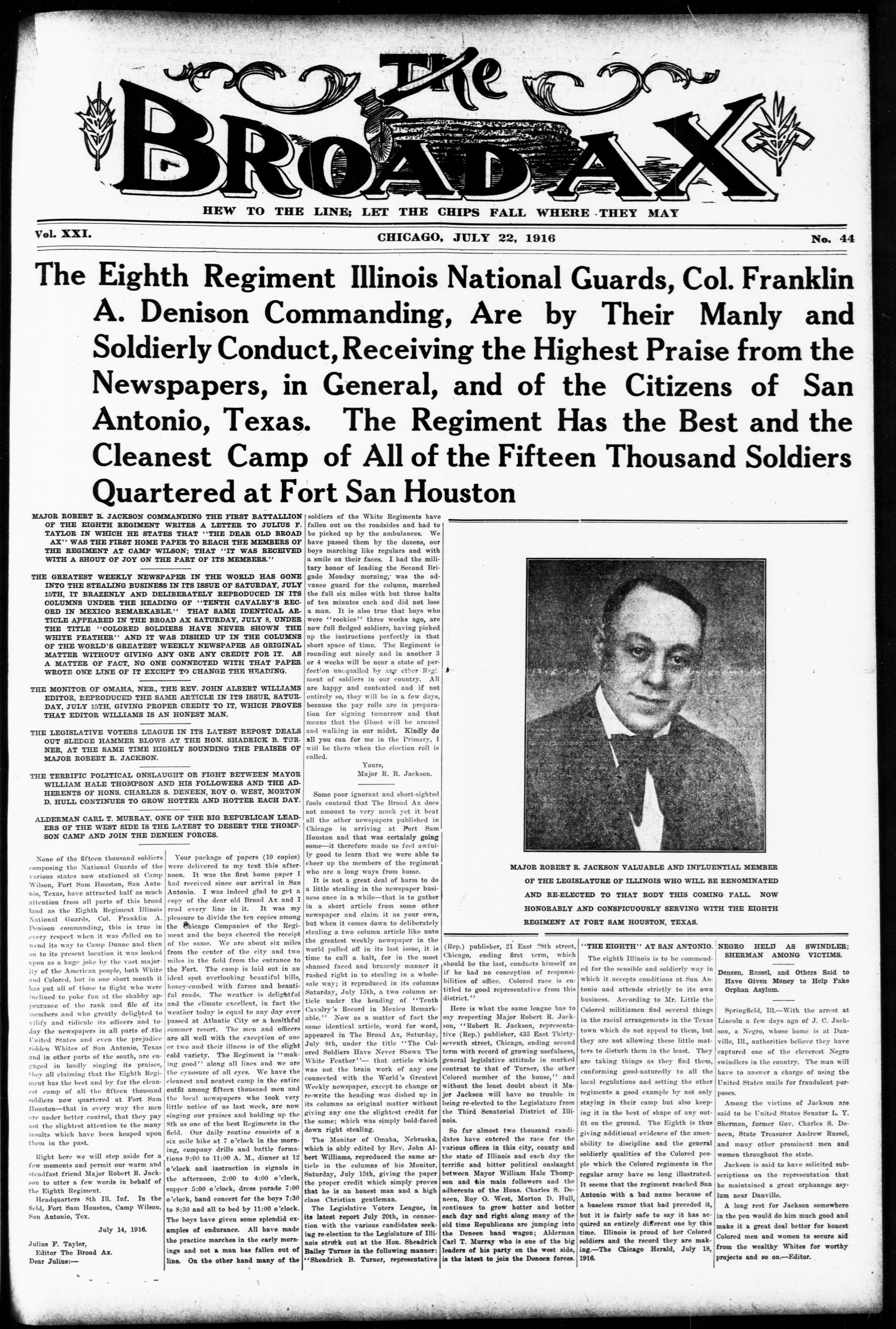
The Eighth Regiment Illinois National Guards, Col. Franklin A. Denison Commanding, Are by Their Manly and Soldierly Conduct, Receiving the Highest Praise from the Newspapers, in General, and of the Citizens of San Antonio, Texas. The Regiment Has the Best and the Cleanest Camp of All of the Fifteen Thousand Soldiers Quartered at Fort San Houston
MAJOR ROBERT R. JACKSON COMMANDING THE FIRST BATTALLION OF THE EIGHTH REGIMENT WRITES A LETTER TO JULIUS P. TAYLOR IN WHICH HE STATES THAT "THE DEAR OLD BROAD AX" WAS THE FIRST HOME PAPER TO REACH THE MEMBERS OF THE REGIMENT AT CAMP WILSON; THAT "IT WAS RECEIVED WITH A SHOUT OF JOY ON THE PART OF ITS MEMBERS."
THE GREATEST WEEKLY NEWSPAPER IN THE WORLD HAS GONE INTO THE STEALING BUSINESS IN ITS ISSUE OF SATURDAY, JULY 15TH, IT BRAZENLY AND DELIBERATELY REPRODUCED IN ITS COLUMNS UNDER THE HEADING OF "TENTH CAVALRY'S RECORD IN MEXICO REMARKABLE." THAT SAME IDENTICAL ARTICLE APPEARED IN THE BROAD AX SATURDAY, JULY 8, UNDER THE TITLE "COLORED SOLDIERS HAVE NEVER SHOWN THE WHITE FEATHER" AND IT WAS DISHED UP IN THE COLUMNS OF THE WORLD'S GREATEST WEEKLY NEWSPAPER AS ORIGINAL MATTER WITHOUT GIVING ANY ONE ANY CREDIT FOR IT. AS A MATTER OF FACT, NO ONE CONNECTED WITH THAT PAPER WROTE ONE LINE OF IT EXCEPT TO CHANGE THE HEADING.
THE MONITOR OF OMAHA, NEB., THE REV. JOHN ALBERT WILLIAMS EDITOR, REPRODUCED THE SAME ARTICLE IN ITS ISSUE, SATURDAY, JULY 15TH, GIVING PROPER CREDIT TO IT, WHICH PROVES THAT EDITOR WILLIAMS IS AN HONEST MAN.
THE LEGISLATIVE VOTERS LEAGUE IN ITS LATEST REPORT DEALS OUT SLEDGE HAMMER BLOWS AT THE HON. SHADRICK B. TURNER, AT THE SAME TIME HIGHLY SOUNDING THE PRAISES OF MAJOR ROBERT R. JACKSON.
THE TERRIFIC POLITICAL ONSLAUGHT OR FIGHT BETWEEN MAYOR WILLIAM HALE THOMPSON AND HIS FOLLOWERS AND THE ADHERENTS OF HONS. CHARLES S. DENEEN, ROY O. WEST, MORTON D. HULL CONTINUES TO GROW HOTTER AND HOTTER EACH DAY.
ALDERMAN CARL T. MURRAY, ONE OF THE BIG REPUBLICAN LEADERS OF THE WEST SIDE IS THE LATEST TO DESERT THE THOMPSON CAMP AND JOIN THE DENEEN FORCES.
Vol. XXI.
The Eighth A. D. Soldier News Anton Clean Quartz
MAJOR ROBERT R. JACKSON COMMAND OF THE EIGHTH REGIMENT AT TAYLOR IN WHICH HE STATES AX” WAS THE FIRST HOME OF THE REGIMENT AT CAMP WILLIAM WITH A SHOUT OF JOY ON THE
THE GREATEST WEEKLY NEWS INTO THE STEALING BUSINESS 15TH, IT BRAZENLY AND DECOLUMNS UNDER THE HEADLORD IN MEXICO REMARKABLE TICLE APPEARED IN THE BROTH THE TITLE “COLORED SOLID WHITE FEATHER” AND IT WOULD OF THE WORLD’S GREATEST WASTER WITHOUT GIVING A MATTER OF FACT, NO ONE WROTE ONE LINE OF IT EXCUSES
THE MONITOR OF OMAHA, NEB., THE EDITOR, REPRODUCED THE SATDAY, JULY 15TH, GIVING PROMPT THAT EDITOR WILLIAMS IS A
THE LEGISLATIVE VOTERS LEAGUE OUT SLEDGE HAMMER BLOWER, AT THE SAME TIME HE MAJOR ROBERT R. JACKSON.
THE TERRIFIC POLITICAL ONSLAND WILLIAM HALE THOMPSON AHERENTS OF HONS. CHARLES D. HULL CONTINUES TO GROW
ALDERMAN CARL T. MURRAY, OVERS OF THE WEST SIDE IS THE SON CAMP AND JOIN THE DE
None of the fifteen thousand soldiers composing the National Guards of the various states now stationed at Camp Wilson, Fort Sam Houston, San Antonio, Texas, have attracted half as much attention from all parts of this broad land as the Eighth Regiment Illinois National Guards, Col. Franklin A. Denison commanding, this is true in every respect when it was called on to wend its way to Camp Dunne and then on to its present location it was looked upon as a huge joke by the vast majority of the American people, both White and Colored, but in one short month it has put all of those to flight who were inclined to poke fun at the shabby appearance of the rank and file of its members and who greatly delighted to vilify and ridicule its officers and today the newspapers in all parts of the United States and even the prejudice ridden Whites of San Antonio, Texas and in other parts of the south, are engaged in loudly singing its praises, they all claiming that the Eighth Regiment has the best and by far the clearest camp of all the fifteen thousand soldiers now quartered at Fort Sam Houston—that in every way the men are under better control, that they pay not the slightest attention to the many insults which have been heaped upon them in the past.
Right here we will step aside for a few moments and permit our warm and steadfast friend Major Robert R. Jackson to utter a few words in behalf of the Eighth Regiment.
Headquarters Sth Ill. Inf. In the field, Fort Sam Houston, Camp Wilson, San Antonio, Tex.
July 14, 1916.
Julius F. Taylor,
Editor The Broad Ax.
Dear Julius:—
Your package of papers (10 copies) were delivered to my tent this afternoon. It was the first home paper I had received since our arrival in San Antonio. I was indeed glad to get a copy of the dear old Broad Ax and I read every line in it. It was my pleasure to divide the ten copies among the Chicago Companies of the Regiment and the boys cheered the receipt of the same. We are about six miles from the center of the city and two miles in the field from the entrance to the Fort. The camp is laid out in an ideal spot overlooking beautiful hills, honey-combed with farms and beautiful roads. The weather is delightful and the climate excellent, in fact the weather today is equal to any day ever passed at Atlantic City or a healthful summer resort. The men and officers are all well with the exception of one or two and their illness is of the slight cold variety. The Regiment is "making good" along all lines and we are the cynosure of all eyes. We have the cleanest and nearest camp in the entire outfit among fifteen thousand men and the local newspapers who took very little notice of us last week, are now singing our praises and holding up the 8th as one of the best Regiments in the field. Our daily routine consists of a six mile hike at 7 o'clock in the morning, company drills and battle formations 9:00 to 11:00 A. M., dinner at 12 o'clock and instruction in signals in the afternoon, 2:00 to 4:00 o'clock, supper 5:00 o'clock, dress parade 7:00 o'clock, band concert for the boys 7:30 to 8:30 and all to bed by 11:00 o'clock. The boys have given some splendid examples of endurance. All have made the practice marches in the early mornings and not a man has fallen out of line. On the other hand many of the
CHICAGO, JULY 22, 1916
soldiers of the White Regiments have fallen out on the roadside and had to be picked up by the ambulances. We have passed them by the dozens, our boys marching like regulars and with a smile on their faces. I had the military honor of leading the Second Brigade Monday morning; was the advance guard for the column, marched the full six miles with but three halts of ten minutes each and did not lose a man. It is also true that boys who were "rookies" three weeks ago, are now fledged soldiers, having picked up the instructions perfectly in that short space of time. The Regiment is rounding out nicely and in another 3 or 4 weeks will be near a state of perfection unqualified by any other Regiment of soldiers in our country. All are happy and contented and if not entirely so, they will be in a few days, because the pay rolls are in preparation for signing tomorrow and that means that the Ghost will be around and walking in our midst. Kindly do all you can for me in the Primary, I will be there when the election roll is called.
Yours,
Major R. R. Jackson.
Some poor ignorant and short-sighted fools contend that The Broad Ax does not amount to very much yet it beat all the other newspapers published in Chicago in arriving at Port Sam Houston and that was certainly going some—it therefore made us feel awfully good to learn that we were able to cheer up the members of the regiment who are a long ways from home.
It is not a great deal of harm to do a little stealing in the newspaper business once in a while—that is to gather in a short article from some other newspaper and claim it as your own, but when it comes down to deliberately stealing a two column article like unto the greatest weekly newspaper in the world pulled off in its last issue, it is time to call a halt, for in the most shamed faced and brazenly manner it rushed right in to stealing in a wholesale way; it reproduced in its columns Saturday, July 15th, a two column article under the heading of “Tenth Cavalry's Record in Mexico Remarkable.” Now as a matter of fact the same identical article, word for word, appeared in The Broad Ax, Saturday, July 8th, under the title “The Colored Soldiers Have Never Shown The White Feather”—that article which was not the brain work of any one connected with the World's Greatest Weekly newspaper, except to change or re-write the heading was dished up in its columns as original matter without giving any one the slightest credit for the same; which was simply bold-faced down right stealing.
The Monitor of Omaha, Nebraska, which is ably edited by Rev. John Albert Williams, reproduced the same article in the columns of his Monitor, Saturday, July 15th, giving the paper the proper credit which simply proves that he is an honest man and a high class Christian gentleman.
The Legislative Voters League, in its latest report July 20th, in connection with the various candidates seeking re-election to the Legislature of Illinois struck out at the Hon. Sheadrick Bailey Turner in the following manner: "Sheadrick B. Turner, representative
J.
MAJOR ROBERT R. JACKSON VALUABLE AND INFLUENTIAL MEMBER OF THE LEGISLATURE OF ILLINOIS WHO WILL BE RENOMINATED AND RE-ELECTED TO THAT BODY THIS COMING FALL. NOW HONORABLY AND CONSPICUOUSLY SERVING WITH THE EIGHTH REGIMENT AT FORT SAM HOUSTON, TEXAS.
(Rep.) publisher, 21 East 28th street, Chicago, ending first term, which should be the last, conducts himself as if he had no conception of responsibilities of office. Colored race is entitled to good representative from this district." Here is what the same league has to say respecting Major Robert R. Jackson, "Robert R. Jackson, representative (Rep.) publisher, 435 East Thirty-seventh street, Chicago, ending second term with record of growing usefulness, general legislative attitude in marked contrast to that of Turner, the other Colored member of the house," and without the least doubt about it Major Jackson will have no trouble in being re-elected to the Legislature from the Third Senatorial District of Illinois.
So far almost two thousand candidates have entered the race for the various offices in this city, county and the state of Illinois and each day the terrific and bitter political onslaught between Mayor William Hale Thompson and his main followers and the adherents of the Hons. Charles S. Deneen, Roy O. West, Morton D. Hull, continues to grow hotter and hotter each day and right along many of the old time Republicans are jumping into the Deneen band wagon; Alderman Carl T. Murray who is one of the big leaders of his party on the west side, is the latest to join the Deneen forces.
"THE EIGHTH" AT SAN ANTONIO. The eighth Illinois is to be commended for the sensible and soldierly way in which it accepts conditions at San Antonio and attends strictly to its own business. According to Mr. Little the Colored militiamen find several things in the racial arrangements in the Texas town which do not appeal to them, but they are not allowing these little matters to disturb them in the least. They are taking things as they find them, conforming good-naturedly to all the local regulations and setting the other regiments a good example by not only staying in their camp but also keeping it in the best of shape of any outfit on the ground. The Eighth is thus giving additional evidence of the amenability to discipline and the general soldierly qualities of the Colored people which the Colored regiments in the regular army have so long illustrated. It seems that the regiment reached San Antonio with a bad name because of a baseless rumor that had preceded it, but it is fairly safe to say it has acquired an entirely different one by this time. Illinois is proud of her Colored soldiers and the record they are making.—The Chicago Herald, July 18, 1916.
No. 44
Col. Franklin Manly and
are from the
bases of San
est and the
and Soldiers
ENTIAL MEMBER
E RENOMINATED
BURNING FALL. NOW
WITH THE EIGHTH
NEGRO HELD AS SWINDLER; SHERMAN AMONG VICTIMS.
Deneen, Russel, and Others Said to Have Given Money to Help Fake Orphan Asylum.
Springfield, Ill.-With the arrest at Lincoln a few days ago of J. C. Jackson, a Negro, whose home is at Danville, Ill., authorities believe they have captured one of the cleverest Negro swindlers in the country. The man will have to answer a charge of using the United States mails for fraudulent purposes.
Among the victims of Jackson are said to be United States Senator L. Y. Sherman, former Gov. Charles S. Deneen, State Treasurer Andrew Russel, and many other prominent men and women throughout the state.
Jackson is said to have solicited subscriptions on the representation that he maintained a great orphanage asylum near Danville.
A long rest for Jackson somewhere in the pen would do him much good and make it a great deal better for honest Colored men and women to secure aid from the wealthy Whites for worthy projects and so on.—Editor.
PAGE TWO
THE BROAD AX
Published Weekly
In this city since July 15th, 1899, without missing one single issue, Republicans, Democrats, Catholics, Protestants, single Taxers, Priests, infidels or anyone else can have their say as long as their language is proper and responsibility is fixed.
The Broad Ax is a newspaper whose platform is broad enough for all, ever claiming the editorial right to speak its own mind.
Local communications will receive attention. Write only on one side of the paper.
Subscriptions must be paid in advance.
One Year.....$2.00
Six Months.....1.00
Advertising rates made known on application.
Address all communications to
THE BROAD AX
6532 St. Lawrence Ave, Chicago, Ill
PHONE WENTWORTH 2597.
JULIUS P. TAYLOR, Editor and Publisher.
Entered as Second-Class Matter Aug. 19, 1902, at the Post Office at Chicago, Illinois, under Act of March 3, 1879.
At a recent gathering of life insurance men one of the old timers exhibited a copy of a permit which had been attached to a policy issued in 1868. This permit read: "The within assured has permission to reside in any settled part of the states of California, Nevada, Oregon or Washington territory and while so residing to make trips (as a passenger only) on first class steamers plying between the ports of Washington territory, the states of California and Oregon and the Sandwich Islands and to proceed to and return from in like manner or by public conveyance overland:
"Provided that written notice be given by the assured whenever any trip to the Sandwich Islands or to the Atlantic states is undertaken to the general agent of the company at San Francisco, Cal., and provided, also, that on the overland route the said assured to take his own risk by death from hostile Indians."—Wall Street Journal.
A Natural Born Spender.
When a long forgotten cousin died and left Miss Mitfield a round hundred thousand the entire village, after having recovered from the shock, fell to wondering whether the faded little spinster, after having for sixty-three years pinched and scraped and plain sewed just to keep soul and body together, would, after all, get much comfort from her eleventh hour opulence. The state of little Miss Mitfield's mind was revealed when her next door neighbor inquired what she should do with her money—did she mean to save it?
"Save it!" Her eyes flashed with new found scorn. "Listen to me, Betsy; all my life long I've wanted a pair of side combs with yellow glass beads onto 'em, and now I'm goin' to hey on, yes, not, even if I should have such as 50 cents!"—You're tomorrow.
Coffee With Milk
For four years after coffee was first drunk in Larnie, says the Manchester Guardian, "no one thought of mixing it with milk any more than the Turks and Arabs do now. The use of coffee au liti seems to date from 1687. Mme. de Sivore, writing to her daughter in that year, said that a doctor much in vogue "has taught us to mix sugar and milk with our coffee. They make a most delightful compound, which will help to support me through the rigors of Lent."
In a letter written seven years earlier she had mentioned as an eccentric proceeding on the part of Mme. de la Sabbiere that "she drinks milk to her tea." Readers of "Unbenutten Tracks In Japan" may remember that one of the Alinus thought it disgusting that Mrs. Bishop should drink milk and pollute her tea with a fluid having so strong a smell and taste.
Bip Van Winkle—Himself.
Joseph Jefferson used to tell a story of his visit to a village in the Catskill mountains. He was taking a cup of tea in the hotel when he heard a negro waiter giving a detailed account of legends.
"Yes, sah," he continued. "Rip went up into de mountains, slep" for twenty years, and when he come back hyar in dis berry town his own folks didn't know him."
"Why," said the listener, "you don't believe the story's true."
"True? Ob course it is. Why," pointing to Jefferson, "that's de man."
Boss Prevaricators.
"There goes a man who boasts that he has never bought a gold brick."
"Reminds me of the fellow who says he has never told a lie."
"Yes. He reminds me of the chap who says the upkeep of his automobile is next to nothing."
"And he's in the same category with the man who says he never was sick a day in his life." - Birmingham Age-Herald
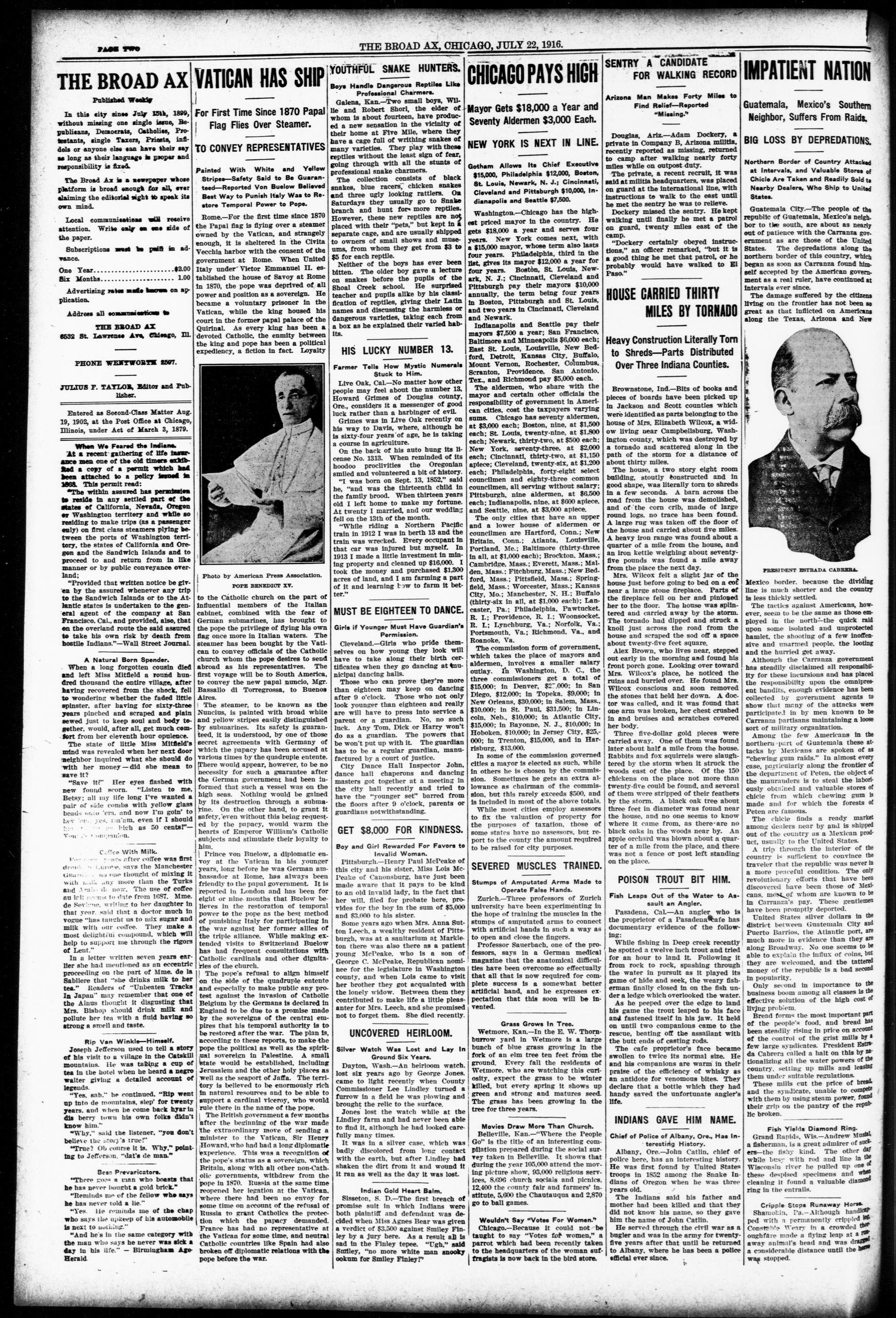
VATICAN HAS SHIP
For First Time Since 1870 Papal Flag Flies Over Steamer.
TO CONVEY REPRESENTATIVES
Painted With White and Yellow Stripes—Safety Said to Be Guaranteed—Reported Von Buelow Believed Best Way to Punish Italy Was to Restore Temporal Power to Pope.
Rome.—For the first time since 1870 the Papal flag is flying over a steamer owned by the Vatican, and strangely enough, it is sheltered in the Clvita Vecchia harbor with the consent of the government at Rome. When United Italy under Victor Emmanuel II. established the house of Savoy at Rome in 1870, the pope was deprived of all power and position as a sovereign. He became a voluntary prisoner in the Vatican, while the king housed his court in the former papal palace of the Quirinal. As every king has been a devoted Catholic, the enmity between the king and pope has been a political expediency, a fiction in fact. Loyalty
POPE
Photo by American Press Association.
POPE BENEDICT XV.
to the Catholic church on the part of influential members of the Italian cabinet, combined with the fear of German submarines, has brought to the pope the privilege of flying his own flag once more in Italian waters. The steamer has been bought by the Vatican to convey officials of the Catholic church whom the pope desires to send abroad as his representatives. The first voyage will be to South America, to convey the new papal nuncio, Mgr. Bassallo di Torregrossa, to Buenos Aires.
The steamer, to be known as the Nuncius, is painted with broad white and yellow stripes easily distinguished by submarines. Its safety is guaranteed, it is understood, by one of those secret agreements with Germany of which the papacy has been accused at various times by the quadruple entente. There would appear, however, to be no necessity for such a guarantee after the German government had been informed that such a vessel was on the high seas. Nothing would be gained by its destruction through a submarine. On the other hand, to grant it safety, even without this being requested by the papacy, would warm the hearts of Emperor William's Catholic subjects and stimulate their loyalty to him.
Prince von Buelow, a diplomatic envoy at the Vatican in his younger years, long before he was German ambassador at Rome, has always been friendly to the papal government. It is reported in London and has been for eight or nine months that Buelow believes in the restoration of temporal power to the pope as the best method of punishing Italy for participating in the war against her former allies of the triple alliance. While making extended visits to Switzerland Buelow has had frequent consultations with Catholic cardinals and other dignitaries of the church.
The pope's refusal to align himself on the side of the quadruple entente and especially to make public any protest against the invasion of Catholic Belgium by the Germans is declared in England to be due to a promise made by the sovereigns of the central empires that his temporal authority is to be restored after the war. The plan is, according to these reports, to make the pope the political as well as the spiritual sovereign in Palestine. A small state would be established, including Jerusalem and the other holy places as well as the seaport of Jaffa. The territory is believed to be enormously rich in natural resources and to be able to support a cardinal viceroy, who would rule there in the name of the pope.
The British government a few months after the beginning of the war made the extraordinary move of sending a minister to the Vatican, Sir Henry Howard, who had had a long diplomatic experience. This was a recognition of the pope's status as a sovereign, which Britain, along with all other non-Catholic governments, withdrew from the pope in 1870. Russia at the same time reopened her legation at the Vatican, where there had been no envoy for some time on account of the refusal of Russia to grant Catholics the protection which the papacy demanded. France has had no representative at the Vatican for some time, and neutral Catholic countries like Spain had also broken off diplomatic relations with the pope before the war.
THE BROAD AX, CHICAGO, JULY 22, 1916.
YOUTHFUL SNAKE HUNTERS.
Boys Handle Dangerous Reptiles Like Professional Charmers.
Galena, Kan.-Two small boys, Willie and Robert Shorl, the elder of whom is about fourteen, have produced a new sensation in the vicinity of their home at Five Mile, where they have a cage full of writhing snakes of many varieties. They play with these reptiles without the least sign of fear, going through with all the stunts of professional snake charmers.
The collection consists of black snakes, blue racers, chicken snakes and three ugly looking rattlers. On Saturday they usually go to Snake branch and hunt for more reptiles. However, these new reptiles are not placed with their "pets," but kept in a separate cage, and are usually shipped to owners of small shows and museums, from whom they get from $3 to $5 for each reptile.
Neither of the boys has ever been bitten. The older boy gave a lecture on snakes before the pupils of the Shoal Creek school. He surprised teacher and pupils alike by his classification of reptiles, giving their Latin names and discussing the harmless or dangerous varieties, taking each from a box as he explained their varied habits.
HIS LUCKY NUMBER 13.
Farmer Tells How Mystic Numerals Stuck to Him.
Live Oak, Cal—No matter how other people may feel about the number 13, Howard Grimes of Douglas county, Ore., considers it a messenger of good luck rather than a harbinger of evil.
Grimes was in Live Oak recently on his way to Davis, where, although he is sixty-four years of age, he is taking a course in agriculture.
On the back of his auto hung its license No. 1313. When reminded of its hoodoo proclivities the Oregonian smiled and volunteered a bit of history.
"I was born on Sept. 13, 1852," said he, "and was the thirteenth child in the family brood. When thirteen years old I left home to make my fortune. At twenty I married, and our wedding fell on the 13th of the month.
"While riding a Northern Pacific train in 1912 I was in berth 13 and the train was wrecked. Every occupant in that car was injured but myself. In 1913 I made a little investment in mining property and cleaned up $16,000. I took the money and purchased $1,300 acres of land, and I am farming a part of it and learning how to farm it better."
MUST BE EIGHTEEN TO DANCE.
Girls if Younger Must Have Guardian's Permission.
Cleveland.—Girls who pride themselves on how young they look will have to take along their birth certificates when they go dancing at municipal dancing halls.
Those who can prove they're more than eighteen may keep on dancing after 9 o'clock. Those who not only look younger than eighteen and really are will have to press into service a parent or a guardian. No, no such luck. Any Tom, Dick or Harry won't do as a guardian. The powers that be won't put up with it. The guardian has to be a regular guardian, manufactured by a court of justice.
City Dance Hall Inspector John, dance hall chaperons and dancing masters got together at a meeting in the city hall recently and tried to have the "younger set" barred from the floors after 9 o'clock, parents or guardians notwithstanding.
GET $8,000 FOR KINDNESS.
Boy and Girl Rewarded For Favors to Invalid Woman.
Pittsburgh.—Henry Paul McPeake of this city and his sister, Miss Lois McPeake of Canonsburg, have just been made aware that it pays to be kind to an old invalid lady, in the fact that her will, filed for probate here, provides for the boy in the sum of $5,000 and $3,000 to his sister.
Some years ago when Mrs. Anna Sutton Leech, a wealthy resident of Pittsburgh, was at a sanitarium at Markleton there was also there as a patient young McPeake, who is a son of George C. McPeake, Republican nominee for the legislature in Washington county, and when Lois came to visit her brother they got acquainted with the lonely widow. Between them they contributed to make life a little pleasanter for Mrs. Leech, and she promised not to forget them. She died recently.
UNCOVERED HEIRLOOM.
Silver Watch Was Lost and Lay In Ground Six Years.
Dayton, Wash.—An heirloom watch, lost six years ago by George Jones, came to light recently when County Commissioner Lee Lindley turned a furrow in a field he was plowing and brought the relic to the surface.
Jones lost the watch while at the Lindley farm and had never been able to find it, although he had looked carefully many times.
It was in a silver case, which was badly discolored from long contact with the earth, but after Lindley had shaken the dirt from it and wound it it ran as well as the day it was lost.
Indian Gold Heart Balm
Sisseton, S. D.—The first breach of promise suit in which Indians were both plaintiff and defendant was decided when Miss Agnes Bear was given a verdict of $3,500 against Smiley Finley by a jury here. As a result all is sad in the Finley tepee. "Ugh," said Smiley, "no more white man smoooky ookum for Smiley Finley!"
CHICAGO PAYS HIGH
Mayor Gets $18,000 a Year and Seventy Aldermen $3,000 Each.
Gotham Allows Its Chief Executive $15,000, Philadelphia $12,000, Boston, St. Louis, Newark, N. J.; Cincinnati, Cleveland and Pittsburgh $10,000, Indianapolis and Seattle $7,500.
Washington—Chicago has the highest priced mayor in the country. He gets $18,000 a year and serves four years. New York comes next, with a $15,000 mayor, whose term also lasts four years. Philadelphia, third in the list gives its mayor $12,000 a year for four years. Boston, St. Louis, Newark, N. J.; Cincinnati, Cleveland and Pittsburgh pay their mayors $10,000 annually, the term being four years in Boston, Pittsburgh and St. Louis, and two years in Cincinnati, Cleveland and Newark.
Indianapolis and Seattle pay their mayors $7,500 a year; San Francisco, Baltimore and Minneapolis $6,000 each; East St. Louis, Louisville, New Bedford, Detroit, Kansas City, Buffalo, Mount Vernon, Rochester, Columbus, Scranton, Providence, San Antonio, Tex. and Richmond pay $5,000 each.
The aldermen, who share with the mayor and certain other officials the responsibility of government in American cities, cost the taxpayers varying sums. Chicago has seventy aldermen, at $3,000 each; Boston, nine, at $1,500 each; St. Louis, twenty-nine, at $1,800 each; Newark, thirty-two, at $500 each; New York, seventy-three, at $2,000 each; Cincinnati, thirty-two, at $1,150 apiece; Cleveland, twenty-six, at $1,200 each; Philadelphia, forty-eight select councilmen and eighty-three common councilmen, all serving without salary; Pittsburgh, nine aldermen, at $6,500 each; Indianapolis, nine, at $60 apiece, and Seattle, nine, at $3,000 apiece.
The only cities that have an upper and a lower house of aldermen or councilmen are Hartford, Conn.; New Britain, Conn.; Atlanta, Louisville, Portland, Me.; Baltimore (thirty-three in all, at $1,000 each); Brockton, Mass.; Cambridge, Mass.; Everett, Mass.; Malden, Mass.; Fitchburg, Mass.; New Bedford, Mass.; Pittsfield, Mass.; Springfield, Mass.; Worcester, Mass.; Kansas City, Mo.; Manchester, N. H.; Buffalo (thirty-six in all, at $1,000 each); Lancaster, Pa.; Philadelphia, Pawtucket, R. I.; Providence, R. I.; Woonsocket, R. I.; Lynchburg, Va.; Norfolk, Va.; Portsmouth, Va.; Richmond, Va., and Roanoke, Va.
The commission form of government, which takes the place of mayors and aldermen, involves a smaller salary outlay. In Washington, D. C., the three commissioners get a total of $15,000; in Denver, $2,000; in San Diego, $12,000; in Topeka, $0,000; in New Orleans, $30,000; in Salem, Mass, $10,000; in St. Paul, $31,500; in Lincoln, Neb., $10,000; in Atlantic City, $15,000; in Bayonne, N. J., $10,000; in Hoboken, $10,000; in Jersey City, $25,000; in Trenton, $15,000, and in Harrisburg, $13,000.
In some of the commission governed cities a mayor is elected as such, while in others he is chosen by the commission. Sometimes he gets an extra allowance as chairman of the commission, but this rarely exceeds $500, and is included in most of the above totals.
While most cities employ assessors to fix the valuation of property for the purposes of taxation, those of some states have no assessors, but report to the county the amount required to be raised for city purposes.
SEVERED MUSCLES TRAINED.
Stumps of Amputated Arms Made to Operate False Hands.
Zurich.-Three professors of Zurich university have been experimenting in the hope of training the muscles in the stumps of amputated arms to connect with artificial hands in such a way as to open and close the fingers.
Professor Sauerbach, one of the professors, says in a German medical magazine that the anatomical difficulties have been overcome so effectually that all that is now required for complete success is a somewhat better artificial hand, and he expresses expectation that this soon will be invented.
Grass Grows In Tree.
Wetmore, Kan.—In the E. W. Thornburrow yard in Wetmore is a large bunch of blue grass growing in the fork of an elm tree ten feet from the ground. Every fall the residents of Wetmore, who are watching this curiosity, expect the grass to be winter killed, but every spring it shows up green and strong and matures seed. The grass has been growing in the tree for three years.
Movies Draw More Than Church.
Movies Draw More Than Church.
Belleville, Kan.—"Where the People Go" is the title of an interesting compilation prepared during the social survey taken in Belleville. It shows that during the year 105,000 attend the moving picture show, 93,000 religious services, 8,696 church socials and picnics, 12,400 the county fair and farmers' institute, 5,600 the Chautauqua and 2,870 go to ball games.
Wouldn't Say "Votes For Women."
Chicago.—Because it could not be taught to say "Votes for women," a parrot which had been recently taken to the headquarters of the woman suffragists is now back in the bird store.
Douglas, Arlz.-Adam Dockery, a private in Company B, Arizona militia, recently reported as missing, returned to camp after walking nearly forty miles while on outpost duty. The private, a recent recruit, it was said at militia headquarters, was placed on guard at the international line, with instructions to walk to the east until he met the sentry he was to relieve. Dockery missed the sentry. He kept walking until finally he met a patrol on guard, twenty miles east of the camp. "Dockery certainly obeyed instructions," an officer remarked, "but it is a good thing he met that patrol, or he probably would have walked to El Paso."
HOUSE CARRIED THIRTY MILES BY TORNADO
HOUSE CARRIED THIRTY MILES BY TORNADO
Heavy Construction Literally Torn to Shreds—Parts Distributed Over Three Indiana Counties.
Brownstone, Ind.—Bits of books and pieces of boards have been picked up in Jackson and Scott counties which were identified as parts belonging to the house of Mrs. Elizabeth Wilcox, a widow living near Campbellsburg, Washington county, which was destroyed by a tornado and scattered along in the path of the storm for a distance of about thirty miles.
The house, a two story eight room building, stoutly constructed and in good shape, was literally torn to shreds in a few seconds. A barn across the road from the house was demolished, and of the corn crib, made of large round logs, no trace has been found. A large rug was taken off the floor of the house and carried about five miles. A heavy iron range was found about a quarter of a mile from the house, and an iron kettle weighing about seventy-five pounds was found a mile away from the place the next day.
Mrs. Wilcox felt a slight jar of the house just before going to bed on a cof near a large stone fireplace. Parts of the fireplace fell on her and pinloned her to the floor. The house was splintered and carried away by the storm. The tornado had dipped and struck a knoll just across the road from the house and scraped the sod off a space about twenty-five feet square.
Alex Brown, who lives near, stepped out early in the morning and found his front porch gone. Looking over toward Mrs. Wilcox's place, he noticed the ruins and hurried over. He found Mrs. Wilcox conscious and soon removed the stones that held her down. A doctor was called, and it was found that one arm was broken, her chest crushed in and bruises and scratches covered her body.
Three five-dollar gold pieces were carried away. One of them was found later about half a mile from the house. Rabbits and fox squirrels were slaughtered by the storm when it struck the woods east of the place. Of the 150 chickens on the place not more than twenty-five could be found, and several of them were stripped of their feathers by the storm. A black oak tree about three feet in diameter was found near the house, and no one seems to know where it came from, as there are no black oaks in the woods near by. An apple orchard was blown about a quarter of a mile from the place, and there was not a fence or post left standing on the place.
POISON TROUT BIT HIM.
Fish Leaps Out of the Water to Assault an Angler.
Pasadena, Cal.-An angler who is the proprietor of a Pasadena cafe has documentary evidence of the following:
While fishing in Deep creek recently he spotted a twelve inch trout and tried for an hour to land it. Following it from rock to rock, spashing through the water in pursuit as it played its game of hide and seek, the weary fisherman finally closed in on the fish under a ledge which overlooked the water.
As he peeped over the edge to land his game the trout leaped to his face and fastened itself in his jaw. It held on until two companions came to the rescue, beating off the assailant with the butt ends of casting rods.
The cafe proprietor's face became swollen to twice its normal size. He and his companions are warm in their praise of the efficiency of whisky as an antidote for venomous bites. They declare that a bottle which they had handy saved the unfortunate angler's life.
INDIANS GAVE HIM NAME.
Chief of Police of Albany, Ore., Has Interesting History.
Albany, Ore.—John Catlin, chief of police here, has an interesting history. He was first found by United States troops in 1852 among the Snake Indians of Oregon when he was three years old.
The Indians said his father and mother had been killed and that they did not know his name, so they gave him the name of John Catlin.
He served through the civil war as a bugler and was in the army for twenty-five years after that until he returned to Albany, where he has been a police official ever since.
IMPATIENT NATION
Guatemala, Mexico's Southern Neighbor, Suffers From Raids.
BIG LOSS BY DEPREDATIONS.
Northern Border of Country Attacked at Intervals, and Valuable Stores of Chicle Are Taken and Readily Sold to Nearby Dealers, Who Ship to United States.
Guatemala City.—The people of the republic of Guatemala, Mexico's neighbor to the south, are about as nearly out of patience with the Carranza government as are those of the United States. The depredations along the northern border of this country, which began as soon as Carranza found himself accepted by the American government as a real ruler, have continued at intervals ever since.
The damage suffered by the citizens living on the frontier has not been so great as that inflicted on Americans along the Texas, Arizona and New
[Picture of a man with a mustache and a suit].
PRESIDENT ESTRADA CABREZA.
Mexico border, because the dividing line is much shorter and the country is less thickly settled.
The tactics against Americans, however, seem to be the same as those employed in the north—the quick raid upon some isolated and unprotected hamlet, the shooting of a few inoffensive and unarmed people, the looting and the hurried get away.
Although the Carranza government has steadily disclaimed all responsibility for these incursions and has placed the responsibility upon the omnipresent bandits, enough evidence has been collected by government agents to show that many of the attacks were participated in by men known to be Carranza partisans maintaining a loose sort of military organization.
Among the few Americans in the northern part of Guatemala these attacks by Mexicans are spoken of as "chewing gum raids." In almost every case, particularly along the frontier of the department of Peten, the object of the maudrauders is to steal the laboriously obtained and valuable stores of chicle from which chewing gum is made and for which the forests of Peten are famous. The chicle finds a ready market among dealers near by and is shipped out of the country as a Mexican product, usually to the United States. A trip through the interior of the country is sufficient to convince the traveler that the republic was never in a more peaceful condition. The only revolutionary efforts that have been discovered have been those of Mexicans, most of whom are known to be in Carranza's pay. These gentlemen have been promptly deported.
United States silver dollars in the district between Guatemala City and Puerto Barrios, the Atlantic port, are much more in evidence than they are along Broadway. No one seems to be able to explain the inflow of coins, but they are welcomed, and the tattered money of the republic is a bad second in popularity.
Only second in importance to the business boom among all classes is the effective solution of the high cost of living problem.
Bread forms the most important part of the people's food, and bread has been steadily rising in price on account of the control of the grist mills by a few large syndicates. President Estrada Cabrera called a halt on this by nationalizing all the water powers of the country, setting up mills and leasing them under suitable regulations.
These mills cut the price of bread, and the syndicate, unable to compete with them by using steam power, found their grip on the pantry of the republic broken.
Fish Yields Diamond Bing
Grand Ridges, Wis.-Andrew Musial, a fisherman, is a great admirer of suckers—the fishy kind. The other day while busy with rod and line in the Wisconsin river he pulled up one of these desplised specimens and when cleaning it found a valuable diamond ring in the entrails.
Cripple Stops Runaway Horse. Shamokin, Pa.-Although handicapped with a permanently crippled leg, Constable Weary in a crowded thoroughfare made a flying leap at a runaway animal's head and was dragged a considerable distance until the horse was stopped.
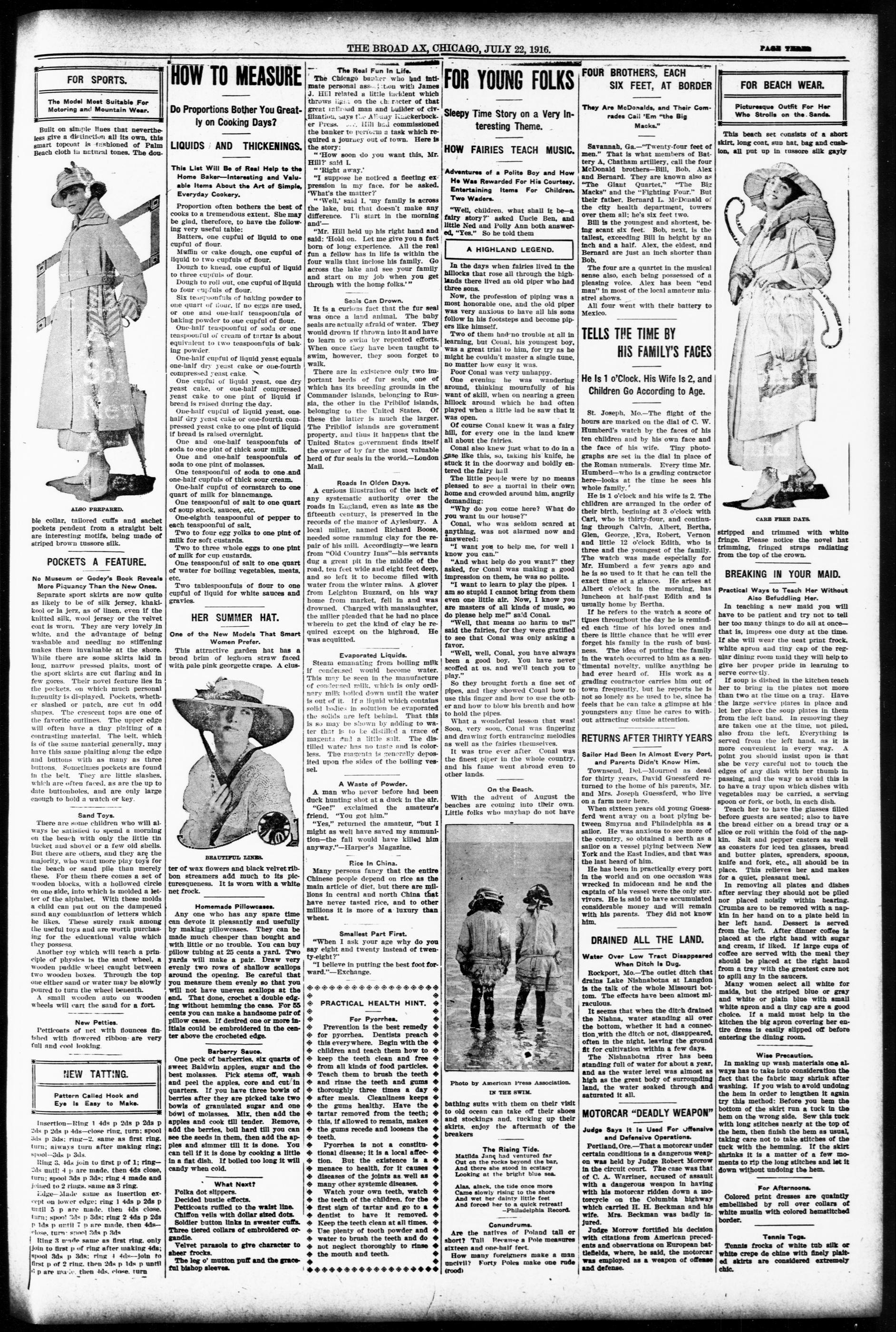
The Model Most Suitable For Motoring and Mountain Wear.
Built on simple lines that nevertheless give a distinction all its own, this smart topcoat is fashioned of Palm Beach cloth in natural tones. The dou
GO
NEW
ALSO PREPARED.
ble collar, tallored cuffs and sachet pockets pendent from a straight belt are interesting motifs, being made of striped brown tussore silk.
POCKETS A FEATURE.
No Museum or Godey's Book Reveals
More Piguancy Than the New Ones.
Separate sport skirts are now quite as likely to be of silk jersey, khaki-kool or la jerz, as of linen, even if the knitted silk, wool jersey or the velvet coat is worn. They are very lovely in white, and the advantage of being washable and needing no stiffening makes them invaluable at the shore. While there are some skirts laid in long, narrow pressed plaits, most of the sport skirts are cut faring and in few gores. Their novel feature lies in the pockets, on which much personal ingenuity is displayed. Pockets, whether slashed or patch, are cut in odd shapes. The crescent tops are one of the favorite outlines. The upper edge will often have a tiny plaiting of a contrasting material. The belt, which is of the same material generally, may have this same plaiting along the edge and buttons with as many as three buttons. Sometimes pockets are found in the belt. They are little slashes, which are often faced, as are the up to date buttonholes, and are only large enough to hold a watch or key.
Sand Toys.
There are some children who will always be satisfied to spend a morning on the beach with only the little tin bucket and shovel or a few old shells. But there are others, and they are the majority, who want more play toys for the beach or sand pile than merely these. For them there comes a set of wooden blocks, with a hollowed circle on one side, into which is molded a letter of the alphabet. With these molds a child can pat out on the dampened sand any combination of letters which he likes. These surely rank among the useful toys and are worth purchasing for the educational value which they possess.
Another toy which will teach a principle of physics is the sand wheel, a wooden paddle wheel caught between two wooden boxes. Through the top one either sand or water may be slowly poured to turn the wheel beneath.
A small wooden auto on wooden wheels will cart the sand for a fort.
New Petties.
Petticoats of net with flounces finished with flowered ribbon are very full and cool looking.
NEW TATTING.
Pattern Called Hook and Eye Is Easy to Make.
Insertion—Ring 1 4ds p 2ds p 2ds p 2ds p 2ds p 4ds—close ring, turn; spool 3ds p 3ds; ring—2, same as first ring, turn; always turn after making ring; spool—3ds p 3ds.
Ring 3, 4ds join to first p of 1; ring—2ds until 4 p are made, then 4ds close, turn; spool 3ds p 3ds; ring 4 made and joined to 2 rings, same as 3 ring.
Edge -Made same as insertion except on lower edge; ring 1 4ds p 2ds p until 5 p are made, then 4ds close, turn; spool 3ds p 3ds; ring 2 4ds p 2ds p 1ds p until 7 p are made, then 4ds close, turn; spool 3ds p 3ds
Ring 3 made same as first ring, only join to first p of ring after making 4ds; spool 3ds p 3ds; ring 4 4ds—join to first p of 2 ring, then 2ds p 1ds p until 5 p are made, then 4ds close, turn
HOW TO MEASURE
Do Proportions Bother You Greatly on Cooking Days?
LIQUIDS AND THICKENINGS.
This List Will Be of Real Help to the Home Baker—Interesting and Valuable Items About the Art of Simple, Everyday Cookery.
Proportion often bothers the best of cooks to a tremendous extent. She may be glad, therefore, to have the following very useful table:
Batters, one cupful of liquid to one cupful of flour.
Dough to knead, one cupful of liquid to three cupfuls of flour.
Dough to roll out, one cupful of liquid to four cupfuls of flour.
Six teaspoonfuls of baking powder to one quart of flour, if no eggs are used, or one and one-half teaspoonfuls of baking powder to one cupful of flour.
One-half teaspoonful of soda or one teaspoonful of cream of tartar is about equivalent to two teaspoonfuls of baking powder.
One-half cupful of liquid yeast equals one-half dry yeast cake or one-fourth compressed yeast cake.
One cupful of liquid yeast, one dry yeast cake, or one-half compressed yeast cake to one pint of liquid if bread is raised during the day.
One-half cupful of liquid yeast, one-half dry yeast cake or one-fourth compressed yeast cake to one pint of liquid if bread is raised overnight.
One and one-half teaspoonfuls of soda to one pint of thick milk.
One and one-half teaspoonfuls of soda to one pint of molasses.
One teaspoonful of soda to one and one-half cupfuls of thick sour cream.
One-half cupful of cornstarch to one quart of milk for blancmange.
One teaspoonful of salt to one quart of soup stock, sauces, etc.
One-eighth teaspoonful of pepper to each teaspoonful of salt.
Two to four egg yolks to one pint of milk for soft custards.
Two to three whole eggs to one pint of milk for cup custards.
One teaspoonful of salt to one quart of water for boiling vegetables, meats, etc.
Two tablespoonfuls of flour to one cupful of liquid for white sauces and gravies.
HER SUMMER HAT.
One of the New Models That Smart Women Prefer.
This attractive garden hat has a broad brim of leghorn straw faced with pale pink georgette crape. A clus-
BEAUTIFUL LINES.
ter of wax flowers and black velvet ribbon streamers add much to its picturesqueness. It is worn with a white net frock.
Homemade Pillowcases.
Any one who has any spare time can devote it pleasantly and usefully by making pillowcases. They can be made much cheaper than bought and with little or no trouble. You can buy pillow tubing at 25 cents a yard. Two yards will make a pair. Draw very evenly two rows of shallow scallops around the opening. Be careful that you measure them evenly so that you will not have uneven scallops at the end. That done, crochet a double edging without hemming the case. For 55 cents you can make a handsome pair of pillow cases. If desired one or more initials could be embroidered in the center above the crocheted edge.
Barberry Sauce.
One peck of barberries, six quarts of sweet Baldwin apples, sugar and the best molasses. Pick stems off, wash and peel the apples, core and cut in quarters. If you have three bowls of berries after they are picked take two bowls of granulated sugar and one bowl of molasses. Mix, then add the apples and cook till tender. Remove, add the berries, boll hard till you can see the seeds in them, then add the apples and simmer till it is done. You can tell if it is done by cooking a little in a flat dish. If boiled too long it will candy when cold.
What Next?
Soldier button links in sweater cuffs.
Three tiered collars of embroidered organdle.
Velvet parasols to give character to sheer frocks.
The leg o' mutton puff and the graceful bishop sleeves.
THE BROAD AX, CHICAGO, JULY 22, 1916.
The Real Fun In Life.
The Chicago banker who had intimate personal association with James J. Hill related a little incident which throws light on the character of that great railroad man and builder of civilization, says the Alamy Knickerbocker Press. Hill had commissioned the banker to perform a task which required a journey out of town. Here is the story:
"How soon do you want this, Mr. Hill?" said L.
"Right away.'
"I suppose he noticed a fleeting expression in my face, for he asked. 'What's the matter?'
"Well,' said I. 'my family is across the lake, but that doesn't make any difference. I'll start in the morning and'—
"Mr. Hill held up his right hand and said: 'Hold on. Let me give you a fact born of long experience. All the real fun a fellow has in life is within the four walls that inclose his family. Go across the lake and see your family and start on my job when you get through with the home folks."
Seals Can Drown.
It is a curious fact that the fur seal was once a land animal. The baby seals are actually afraid of water. They would drown if thrown into it and have to learn to swim by repeated efforts. When once they have been taught to swim, however, they soon forget to walk.
There are in existence only two important herds of fur seals, one of which has its breeding grounds in the Commander islands, belonging to Russia, the other in the Pribilof islands, belonging to the United States. Of these the latter is much the larger. The Pribilof islands are government property, and thus it happens that the United States government finds itself the owner of by far the most valuable herd of fur seals in the world.—London Mall.
Roads In Olden Days.
A curious illustration of the lack of any systematic authority over the roads in England, even as late as the fifteenth century, is preserved in the records of the manor of Aylesbury. A local miller, named Richard Boose, needed some ramming clay for the repair of his mill. Accordingly—we learn from "Old Country Inns"—his servants dug a great pit in the middle of the road, ten feet wide and eight feet deep, and so left it to become filled with water from the winter rains. A glover from Leighton Buzzard, on his way home from market, fell in and was drowned. Charged with manslaughter, the miller pleaded that he had no place wherein to get the kind of clay he required except on the highroad. He was acquitted.
Evaporated Liquids.
Steam emanating from boiling milk if condensed would become water. This may be seen in the manufacture of condensed milk, which is only ordinary milk boiled down until the water is out of it. If a liquid which contains solid bodies in solution be evaporated the solids are left behind. That this is so may be shown by adding to water that is to be distilled a trace of magenta and a little salt. The distilled water has no taste and is colorless. The magenta is generally deposited upon the sides of the boiling vessel.
A Waste of Powder
A man who never before had been duck hunting shot at a duck in the air. "Gee!" exclaimed the amateur's friend. "You got him." "Yes," returned the amateur, "but I might as well have saved my ammunition—the fall would have killed him anyway."-Harper's Magazine.
Rice In China.
Many persons fancy that the entire Chinese people depend on rice as the main article of diet, but there are millions in central and north China that have never tasted rice, and to other millions it is more of a luxury than wheat.
Smallest Part First:
"When I ask your age why do you say eight and twenty instead of twenty-eight?"
"I believe in putting the best foot forward."—Exchange.
PRACTICAL HEALTH HINT.
For Pyorrhea.
Prevention is the best remedy for pyorrhea. Dentists preach this everywhere. Begin with the children and teach them how to keep the teeth clean and free from all kinds of food particles. Teach them to brush the teeth and rinse the teeth and gums thoroughly three times a day after meals. Cleanliness keeps the gums healthy. Have the tartar removed from the teeth; this, if allowed to remain, makes the gums recede and loosens the teeth.
Pyorrhea is not a constitutional disease; it is a local affection. But the existence is a menace to health, for it causes diseases of the joints as well as many other systemic diseases.
- Watch your own teeth, watch
- the teeth of the children, for the
- first sign of tartar and go to a
- dentist to have it removed.
- Keep the teeth clean at all times.
- Use plenty of tooth powder and
- water to brush the teeth and do
- not neglect thoroughly to rinse
- the mouth and teeth.
FOR YOUNG FOLKS
Sleepy Time Story on a Very Interesting Theme.
HOW FAIRIES TEACH MUSIC.
Adventures of a Polite Boy and How He Was Rewarded For His Courtesy. Entertaining Items For Children. Two Waders. "Well, children, what shall it be—a fairy story?" asked Uncle Ben, and little Ned and Polly Ann both answered, "Yes." So he told them
A HIGHLAND LEGEND.
In the days when fairies lived in the hillocks that rose all through the highlands there lived an old piper who had three sons.
Now, the profession of piping was a most honorable one, and the old piper was very anxious to have all his sons follow in his footsteps and become pipers like himself.
Two of them had no trouble at all in learning, but Conal, his youngest boy, was a great trial to him, for try as he might he couldn't master a single tune, no matter how easy it was.
Poor Conal was very unhappy.
One evening he was wandering around, thinking mournfully of his want of skill, when on nearing a green hillock around which he had often played when a little lad he saw that it was open.
Of course Conal knew it was a fairy hill, for every one in the land knew all about the fairies.
Conal also knew just what to do in a case like this, so, taking his knife, he stuck it in the doorway and boldly entered the fairy hall.
The little people were by no means pleased to see a mortal in their own home and crowded around him, angrily demanding:
"Why do you come here? What do you want in our house?"
Conal, who was seldom scared at anything, was not alarmed now and answered:
"I want you to help me, for well I know you can."
"And what help do you want?" they asked, for Conal was making a good impression on them, he was so polite.
"I want to learn to play the pipes. I am so stupid I cannot bring from them even one little air. Now, I know you are masters of all kinds of music, so do please help me!" said Conal.
"Well, that means no harm to us!" said the fairies, for they were gratified to see that Conal was only asking a favor.
"Well, well, Conal, you have always been a good boy. You have never scoffed at us, and we'll teach you to play."
So they brought forth a fine set of pipes, and they showed Conal how to use this finger and how to use the other and how to blow his breath and how to hold the pipes.
What a wonderful lesson that was! Soon, very soon, Conal was fingering and drawing forth entrancing melodies as well as the fairies themselves.
It was true ever after. Conal was the finest piper in the whole country, and his fame went abroad even to other lands.
On the Beach
With the advent of August the beaches are coming into their own. Little folks who mayhap do not have
THE BAY
Photo by American Press Association.
IN THE SWIM.
bathing suits with them on their visit to old ocean can take off their shoes and stockings and, tucking up their skirts, enjoy the aftermath of the breakers
The Rising Tide.
Matilda Jang had ventured far
Out on the rocks beyond the bar.
And there she stood in ecstacy
Looking at the bright blue sea.
Alas, alack, the tide once more
Came slowly rising to the shore
And wet her dainty little feet
And forced her a quick breath
Philadelphia Record.
Conundrums
Are the natives of Poland tall or short? Tall Because a Pole measures sixteen and one-half feet.
How many foreigners make a man unclevil? Forty Poles make one rude (rood)
FOUR BROTHERS, EACH
SIX FEET, AT BORDER
They Are McDonalds, and Their Com
rades Cail 'Em "the Big
Savannah, Ga. "Twenty-four feet of men." That is what members of Battery A, Chatham artillery, call the four McDonald brothers—Bill, Bob, Alex and Bernard. They are known also as "The Glant Quartet," "The Big Macks" and the "Fighting Four." But their father, Bernard L. McDonald of the city health department, towers over them all; he's six feet two.
Bill is the youngest and shortest, being scant six feet. Bob, next, is the tallest, exceeding Bill in height by an inch and a half. Alex, the eldest, and Bernard are just an inch shorter than Bob.
The four are a quartet in the musical sense also, each being possessed of a pleasing voice. Alex has been "end man" in most of the local amateur minstrel shows.
All four went with their battery to Mexico.
TELLS THE TIME BY HIS FAMILY'S FAGES
He Is 1 o'Clock, His Wife Is 2, and Children Go According to Age.
St. Joseph, Mo.—The flight of the hours are marked on the dial of C. W. Humberd's watch by the faces of his ten children and by his own face and the face of his wife. Tiny photographs are set in the dial in place of the Roman numerals. Every time Mr. Humberd—who is a grading contractor here—looks at the time he sees his whole family.
He is 1 o'clock and his wife is 2. The children are arranged in the order of their birth, beginning at 3 o'clock with Carl, who is thirty-four, and continuing through Calvin, Albert, Bertha, Glen, George, Eva, Robert, Vernon and little 12 o'clock Edith, who is three and the youngest of the family. The watch was made especially for Mr. Humberd a few years ago and he is so used to it that he can tell the exact time at a glance. He arises at Albert o'clock in the morning, has luncheon at half-past Edith and is usually home by Bertha.
If he refers to the watch a score of times throughout the day he is reminded each time of his loved ones and there is little chance that he will ever forget his family in the rush of business. The idea of putting the family in the watch occurred to him as a sentimental novelty, unlike anything he had ever heard of. His work as a grading contractor carries him out of town frequently, but he reports he is not so lonely as he used to be, since he feels that he can take a glimpse at his youngsters any time he cares to without attracting outside attention.
RETURNS AFTER THIRTY YEARS
Sailor Had Been In Almost Every Port, and Parents Didn't Know Him.
Townsend, Del.—Mourned as dead for thirty years, David Guesssferd returned to the home of his parents, Mr. and Mrs. Joseph Guesssferd, who live on a farm near here.
When sixteen years old young Guesssferd went away on a boat plying between Smyrna and Philadelphia as a sailor. He was anxious to see more of the country, so obtained a berth as a sailor on a vessel plying between New York and the East Indies, and that was the last heard of him.
He has been in practically every port in the world and on one occasion was wrecked in midocean and he and the captain of his vessel were the only survivors. He is said to have accumulated considerable money and will remain with his parents. They did not know him.
DRAINED ALL THE LAND.
Water Over Low Tract Disappeared When Ditch is Dug.
Rockport, Mo.—The outlet ditch that drains Lake Nishnabotna at Langdon is the talk of the whole Missouri bottom. The effects have been almost miraculous.
It seems that when the ditch drained the Nishna, water standing all over the bottom, whether it had a connection, with the ditch or not, disappeared, often in the night, leaving the ground fit for cultivation within a few days.
The Nishnabotna river has been standing full of water for about a year, and as the water level was almost as high as the great body of surrounding land, the water soaked through and saturated it all.
MOTORCAR "DEADLY WEAPON"
Judge Says It Is Used For Offensive and Defensive Operations. Portland, Ore.-That a motorcar under certain conditions is a dangerous weapon was held by Judge Robert Morrow in the circuit court. The case was that of C. A. Warriner, accused of assault with a dangerous weapon in having with his motorcar ridden down a motorcycle on the Columbia highway which carried H. H. Beckman and his wife. Mrs. Beckman was badly injured. Judge Morrow fortified his decision with citations from American precedents and observations on European battlefields, where, he said, the motorcar was employed as a weapon of offense and defense.
PAGE THER
Picturesque Outfit For Her
Who Strolls on the Sands.
This beach set consists of a short
skirt, long coat, sun hat, bag and
cushion, all put up in ussore silk gayly
A
CARE FREE DAYS.
stripped and trimmed with white fringe. Please notice the novel hat trimming, fringed straps radiating from the top of the crown.
BREAKING IN YOUR MAID.
Practical Ways to Teach Her Without Also Befuddling Her.
In teaching a new maid you will have to be patient and try not to tell her too many things to do all at once—that is, impress one duty at the time. If she will wear the neat print frock, white apron and tiny cap of the regular dining room maid they will help to give her proper pride in learning to serve correctly.
If soup is dished in the kitchen teach her to bring in the plates not more than two at the time on a tray. Have the large service plates in place and let her place the soup plates in them from the left hand. In removing they are taken one at the time, not piled, also from the left. Everything is served from the left hand, as it is more convenient in every way. A point you should insist upon is that she be very careful not to touch the edges of any dish with her thumb in passing, and the way to avoid this is to have a tray upon which dishes with vegetables may be carried, a serving spoon or fork, or both, in each dish.
Teach her to have the glasses filled before guests are seated; also to have the bread either on a bread tray or a slice or roll within the fold of the napkin. Salt and pepper casters as well as coasters for leed tea glasses, bread and butter plates, spreaders, spoons, knife and fork, etc., all should be in place. This relieves her and makes for a quiet, pleasant meal.
In removing all plates and dishes after serving they should not be piled nor placed noisily within hearing. Crumbs are to be removed with a napkin in her hand on to a plate held in her left hand. Dessert is served from the left. After dinner coffee is placed at the right hand with sugar and cream, if liked. If large cups of coffee are served with the meal they should be placed at the right hand from a tray with the greatest care not to spill any in the saucers.
Many women select all white for maids, but the striped blue or gray and white or plain blue with small white apron and a thy cap are a good choice. If a maid must help in the kitchen the big apron covering her entire dress is easily slipped off before entering the dining room.
Wise Precaution:
In making up wash materials one always has to take into consideration the fact that the fabric may shrink after washing. If you wish to avoid undoing the hem in order to lengthen it again try this method: Before you hem the bottom of the skirt run a tuck in the hem on the wrong side. Sew this tuck with long stitches nearly at the top of the hem, then finish the hem as usual, taking care not to take stitches of the tuck with the hemmings. If the skirt shrinks it is a matter of a few moments to rip the long stitches and let it down without undoing the hem.
For Afternoons.
Colored print dresses are quantitly embellished by roll over collars of white muslin with colored hemstitched border.
Tennis Toga.
Tennis frocks of white tub silk or white crepe de chine with finely plaited skirts are considered extremely chic.
BURIED WITH FULL MILITARY HONORS.
Bodies of six black troopers laid at rest in the National Cemetery at Arlington, Washington, D. C. President Wilson sends flowers—Secretary of war and Chief of Staff of Army present. John R. Hawkins, Financial Secretary of A. M. E. Church, marshalls citizens committee.
Special to The Broad Ax by Captain Wilson Bruce Evans, Retired.
"On fame's eternal camping ground,
Their silent tents are spread;
And Glory guards with solemn round,
the brave bivouac of the dead. $ ^{27} $
The brave bivouac of the dead.
The six unidentified and unclaimed bodies of the black troopers killed in the Mexican ambuscade at Carrizal, were buried with full military honors on Friday morning.
The ceremonies over the black heroes were given a national character from the fact that all orders relating to the funeral were issued by the War Office, the escort, a troop of the second cavalry, a section of battery A, field artillery of the Federal City Brigade and the engineer band having been ordered out by that department. Hon. Newton D. Baker, Secretary of War and Maj. General Hugh L. Scott, Chief of Staff of the Army were present in person and President Wilson sent a wreath of flowers for each grave from the White House conservatory.
Long before eight o'clock, the hour set for the start from the Union Station where the bodies had arrived over night, the plaza was crowded by hundreds of people of all races and classes to do honor to the brave. Promptly on the hour, and with military precision and order, the detail of the second cavalry bore upon their shoulders the bodies of their fellow troopers and gently placed them upon the caisons of the battery. Each coffin was draped with the American flag under which they had fought and for whose principles and for love of the country for which it stands had given up their lives, a willing sacrifice“a greater love than which,” no man hath.
John R. Hawkins, financial secretary of the A. M. E. Church placed a wreath on each for the committee of Colored citizens and the cortege moved.
The procession was led by the troop of the second cavalry and the field battery bearing the bodies followed by the Spanish War Veterans led by Hon. L. G. Dyer, Commander in Chief and member of Congress from St. Louis, Mo. Other members of Congress following were: William S. Howard of Georgia, Richard A. Austin and Samuel R. Sells of Tenn., George A. Loud and W. F. James of Mich., G. T. Helvering of Kansas, Henry Bruckner of New York, Sydney Anderson of Minn., and J. M. McGuileuddy of Maine, M. H. Nealy of West Va., Claudius W. Stone of Ul. and Cali Van Dyke of Minn.
Among the prominent citizens of Washington, marshalled by John R. Hawkins, Chairman of the Citizen's Committee were : Mr. Justice Robert H. Terrel, Hon. John C. Dancy, Col. Henry Lincoln Johnson, George W. Cook, Secretary of Howard University, Reverends J. Milton Waldron, Simon P. W. Drew, W. H. Jernigan, Alex Wilbanks, Drs. Charles I. West, E. D. Williston, H William H. Wilson, William A. Warfield, surgeon in chief of Freedmen's Hospital, Creed W. Childs, Mr. James Howard, U. S. Deputy Marshal, Mr. L. Melendez King, Mr. Armond W. Scott, representing the Colored Elks of the World, Mr. W. H. McKinlay, Mr. James A. Cobb, Dr. A. M. Curtis, Dr. Arthur L. Curtis, Mrs. Julia Mason Layton and Mrs. Anna Jordan Collier of The Women's Relief Corps, G. A. R. and Miss Ida C. Plummer.
From the Peace Monument at the foot of the Capitol to Fourteenth street where the procession turned south to the highway bridge, the curb of Pennsylvania was lined with thousands of spectators who bared their heads as the caissons passed giving signs of that reverence for the sacred dead which seeks expression in no other way than by the perfect silence of veneration.
Arrived at the National Cemetery, the throng which had journeyed on foot and in conveyances massed itself in two lines at the approach to the open graves. The band broke the solemn stillness with the strains of "Lead Kindly Light" and across the open space, threading their way between the marbles of those who had gone before, the white troopers bore upon their broad shoulders the bodies of their black comrades and tenderly deposited them, each over his own grave—the tent whose flap ne'er swings outward.
The bodies placed, the troopers lined in front of the people. Every head was bared as Chaplain G. Livingstone Bayard of the U. S. Navy stepping from the side of the War Secretary and the Chief of Staff, advanced to the center of the six open graves, reading as he walked in clear and vibrant voice—"I am the resurrection and the life!" that beautiful and sublime burial service of the Episcopal Church whose soul subduing paths was evidenced in the misty eyes of all when the—"earth to earth, ashes to ashes, dust to dust" was said with the lowering of each to its long home. The band played
"Nearer My God To Thee" and as the last notes died away among the evergreens and monuments, the detail fired the customary salute of three volleys just as was done three days before when the body of Capt. Charles T. Boyd their old commander was buried in the same last bivouac. The bugler sergeant advanced to the center—"Taps" were sounded. It was a soldiers funeral—simple and complete.
NOTES ON RACIAL PROGRESS.
Furnished by The National Negro Business League.
The Mechanics Savings Bank at Savannah, Georgia has moved into its new quarters at 721 Broad Street. Hundreds of new accounts were added on the opening day. Mr. Fleming Tucker is cashier.
Some of the Colored ministers of Savannah, Georgia are co-operating with the Local Negro Business League by preaching sermons based upon the importance of supporting race enterprises.
McGraw Brothers and Moore, grocers at Waycross, Georgia, have just completed arrangements for a new and striking window display of Jello Ice Cream Powder.
As a result of the activities of the Local Negro Business League at Waycross, Georgia, the Colored business men have organized the Laborers Penny Savings and Loan Company. The stockholders are paying their subscriptions promptly and the company expects to engage in a regular banking business beginning January 1, 1917. Carlton W. Gaens is the president and R. W. Williams, the secretary.
Thomas Hudson, the owner of three grocery stores in Valdosta, Georgia, says that his success has been due to his policy of selling only reliable merchandise and then backing it up. "My goods must satisfy my customers," says Mr. Hudson.
Thomas Middleton owns and conducts a fifteen-acre truck farm in Valdosta, Georgia. He supplies green grocries to the retail merchants of that city.
A. B. Walton, a successful undertaker of Valdosta, Georgia, has just completed a $20,000 brick building with five stores and offices upstairs.
The Enterprise Company of the same city has valuable real estate holdings in the business section of the city.
A movement has been started in Georgia for a State Negro Business League.
Spencer's Millinery Establishment in Columbus, Ga., is one of the most successful business enterprises of the race in that city. Miss M. A. Spencer, the manager of the business, is a graduate of Tuskegee Institute.
The Local Negro Business League at Columbus, Georgia, has been revived with Dr. E. J. Turner as president and J. R. Curtis, manager of the Southern Guide as secretary. Dr. Turner is Grand Medical Director, Knight of Pythias of Georgia and is otherwise prominent in state, business and political circles.
E. D. Redding is one of the successful business men of Macon, Ga. He has been engaged in the wholesale and retail fish business for over fourteen years. His weekly sales average 3,600 pounds.
H. W. Wilson is a successful Colored grocer of Macon, Ga. Mr. Wilson conducts a candy factory in conjunction with his business and specializes in peanut and cocoanut candy for which he has built up a large demand.
The various enterprises conducted by C. H. Douglass of Macon are a credit to the city as well as the race. Mr. Douglass has a modernly equipped moving picture and vaudeville parlor, barber shop, pool room and cafe.
Local Negro Business Leagues as Columbus, Macon and Augusta, Georgia, are formulating plans for a State Negro Business League.
In Augusta, Georgia, there are three co-operative grocery stores among the Colored people. One of these concerns, the Augusta Merchandising Company, is composed of 165 stockholders and has been in business about eight years. Butler's Bakery, a Negro enterprise, employs eight people.
T. M. Dugas and Son of Augusta, Ga., successful undertakers carry a stock, not including the three-story brick building, which is valued at $10,000.
The Pilgrim Health and Life Insurance Co., and the Georgia Mutual Insurance, of which W. S. Hornsby and Shewll respectively are managers have their home offices in Augusta, Ga., and
THE BROAD AX, CHICAGO, JULY 22, 1916.
63
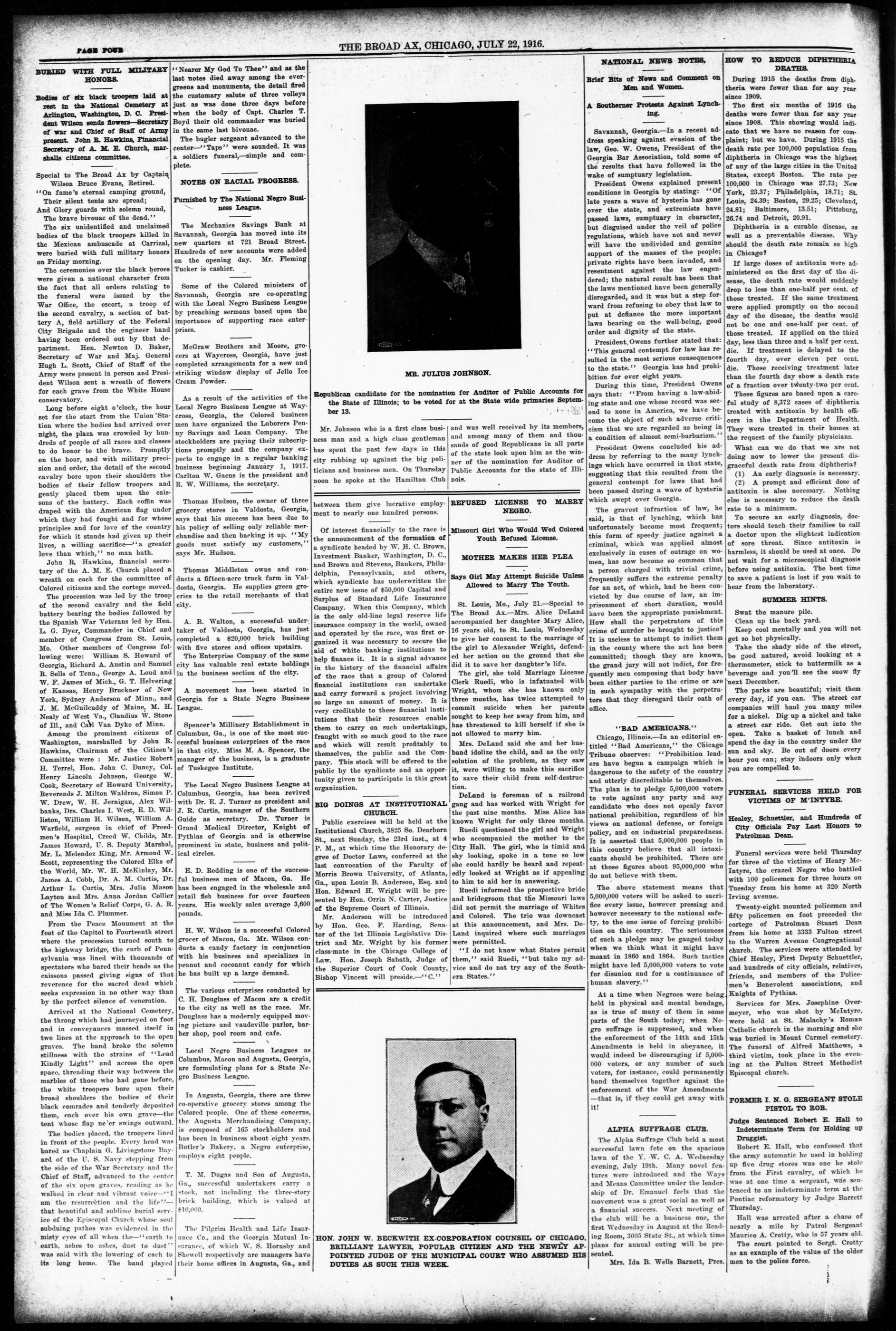
MR. JULIUS JOHNSON.
Republican candidate for the nomination for Auditor of Public Accounts for the State of Illinois; to be voted for at the State wide primaries September 13.
Mr. Johnson who is a first class business man and a high class gentleman has spent the past few days in this city rubbing up against the big politicians and business men. On Thursday noon he spoke at the Hamilton Club and was well received by its members, and among many of them and thousands of good Republicans in all parts of the state look upon him as the winner of the nomination for Auditor of Public Accounts for the state of Illinois.
between them give lucrative employment to nearly one hundred persons.
Of interest financially to the race is the announcement of the formation of a syndicate headed by W. H. C. Brown, Investment Banker, Washington, D. C., and Brown and Stevens, Bankers, Philadelphia, Pennsylvania, and others, which syndicate has underwritten the entire new issue of $50,000 Capital and Surplus of Standard Life Insurance Company. When this Company, which is the only old-line legal reserve life insurance company in the world, owned and operated by the race, was first organized it was necessary to secure the aid of white banking institutions to help finance it. It is a signal advance in the history of the financial affairs of the race that a group of Colored financial institutions can undertake and carry forward a project involving so large an amount of money. It is very creditable to these financial institutions that their resources enable them to carry on such undertakings, fraught with so much good to the race and which will result profitably to themselves, the public and the Company. This stock will be offered to the public by the syndicate and an opportunity given to participate in this great organization.
BIG DOINGS AT INSTITUTIONAL CHURCH.
Public exercises will be held at the Institutional Church, 3825 So. Dearborn St., next Sunday, the 23rd inst., at 4 P. M., at which time the Honorary degree of Doctor Laws, conferred at the last convocation of the Faculty of Morris Brown University, of Atlanta, Ga, upon Louis B. Anderson, Esq. and Hon. Edward H. Wright will be presented by Hon. Orrin N. Carter, Justice of the Supreme Court of Illinois. Mr. Anderson will be introduced by Hon. Geo. F. Harding, Senator of the 1st Illinois Legislative District and Mr. Wright by his former class-mate in the Chicago College of Law. Hon. Joseph Sabath, Judge of the Superior Court of Cook County, Bishop Vincent will preside—"C."
181
HON. JOHN W. BECKWITH EX-CORPORATION COUNSEL OF CHICAGO,
BRILLIANT LAWYER, POPULAR CITIZEN AND THE NEWLY AP-
POINTED JUDGE OF THE MUNICIPAL COURT WHO ASSUMED HIS
DUTIES AS SUCH THIS WEEK.
on for Auditor of Public Accounts for or at the State wide primaries Septem-
and was well received by its members,
and among many of them and thousands of good Republicans in all parts of the state look upon him as the winner of the nomination for Auditor of Public Accounts for the state of Illinois.
REFUSED LICENSE TO MARRY NEGRO.
Missouri Girl Who Would Wed Colored Youth Refused License.
MOTHER MAKES HER PLEA
Says Girl May Attempt Suicide Unless Allowed to Marry The Youth.
St. Louis, Mo., July 21.—Special to The Broad Ax.—Mrs. DeLand accompanied her daughter Mary Alice, 16 years old, to St. Louis, Wednesday to give her consent to the marriage of the girl to Alexander Wright, defended her action on the ground that she did it to save her daughter's life.
The girl, she told Marriage License Clerk Ruedi, who is infatuated with Wright, whom she has known only three months, has twice attempted to commit suicide when her parents sought to keep her away from him, and has threatened to kill herself if she is not allowed to marry him.
Mrs. DeLand said she and her husband idolize the child, and as the only solution of the problem, as they saw it, were willing to make this sacrifice to save their child from self-destruction.
DeLand is foreman of a railroad gang and has worked with Wright for the past nine months. Miss Alice has known Wright for only three months. Ruedi questioned the girl and Wright who accompanied the mother to the City Hall. The girl, who is timid and shy looking, spoke in a tone so low she could hardly be heard and repeatedly looked at Wright as if appealing to him to aid her in answering.
Ruedi informed the prospective bride and bridegroom that the Missouri laws did not permit the marriage of Whites and Colored. The trio was downcast at this announcement, and Mrs. DeLand inquired where such marriages were permitted.
"I do not know what States permit them," said Ruedi, "but take my advice and do not try any of the Southern States."
CORPORATION COUNSEL OF CHICAGO
AR CITIZEN AND THE NEWLY APPE
NICIPAL COURT WHO ASSUMED HIS
Brief Bits of News and Comment on Men and Women.
A Southerner Protests Against Lynch- ing.
Savannah, Georgia.—In a recent address speaking against evasion of the law, Geo. W. Owens, President of the Georgia Bar Association, told some of the results that have followed in the wake of sumptuity legislation.
President Owens explained present conditions in Georgia by stating: "Of late years a wave of hysteria has gone over the state, and extremists have passed laws, sumptuary in character, but disguised under the veil of police regulations, which have not and never will have the undivided and genuine support of the masses of the people; private rights have been invaded, and resentment against the law engendered; the natural result has been that the laws mentioned have been generally disregarded, and it was but a step forward from refusing to obey that law to put at defiance the more important laws bearing on the well-being, good order and dignity of the state.
President Owens further stated that: "This general contempt for law has resulted in the most serious consequences to the state." Georgia has had prohibition for over eight years.
During this time, President Owens says that: "From having a law-abiding state and one whose record was second to none in America, we have become the object of such adverse criticism that we are regarded as being in a condition of almost semi-barbarism."
President Owens concluded his address by referring to the many lynchings which have occurred in that state, suggesting that this resulted from the general contempt for laws that had been passed during a wave of hysteria which swept over Georgia.
The gravest infraction of law, he said, is that of lynching, which has unfortunately become most frequent; this form of speedy justice against a criminal, which was applied almost exclusively in cases of outrage on women, has now become so common that a person charged with trivial crime, frequently suffers the extreme penalty for an act, of which, had he been convicted by due course of law, an imprisonment of short duration, would have been the appropriate punishment. How shall the perpetrators of this crime of murder be brought to justice? It is useless to attempt to indict them in the county where the act has been committed; though they are known, the grand jury will not indict, for frequently men composing that body have been either parties to the crime or are in such sympathy with the perpetrators that they disregard their oath of office.
"BAD AMERICANS."
Chicago, Illinois.-In an editorial entitled "Bad Americans," the Chicago Tribune observes: "Prohibition leaders have begun a campaign which is dangerous to the safety of the country and utterly disreducible to themselves. The plan is to pledge 5,000,000 voters to vote against any party and any candidate who does not openly favor national prohibition, regardless of his views on national defense, or foreign policy, and on industrial preparedness. It is asserted that 5,000,000 people in this country believe that all intoxicants should be prohibited. There are at those figures about 95,000,000 who do not believe with them.
The above statement means that 5,000,000 voters will be asked to sacrifice every issue, however pressing and however necessary to the national safety, to the one issue of forcing prohibition on this country. The seriousness of such a pledge may be gauged today when we think what it might have meant in 1860 and 1864. Such tactics might have led 5,000,000 voters to vote for disunion and for a continuance of human slavery."
At a time when Negroes were being held in physical and mental bondage, as is true of many of them in some parts of the South today; when Negro suffrage is suppressed, and when the enforcement of the 14th and 15th Amendments is held in abeyance, it would indeed be discouraging if 5,000-000 voters, or any number of such voters, for instance, could permanently band themselves together against the enforcement of the War Amendments—that is, if they could get away with it!
ALPHA SUFFRAGE CLUB.
The Alpha Suffrage Club held a most successful lawn fete on the spacious lawn of the Y. W. C. A. Wednesday evening, July 19th. Many novel features were introduced and the Ways and Means Committee under the leadership of Dr. Emanuel feels that the movement was a great social as well as a financial success. Next meeting of the club will be a business one, the first Wednesday in August at the Reading Room, 3005 State St., at which time plans for annual outing will be presented. Mrs. Ida B. Wells Barnett, Pres.
HOW TO REDUCE DIPHTHERIA
DEATHS.
During 1915 the deaths from diphtheria were fewer than for any year since 1909.
The first six months of 1916 the deaths were fewer than for any year since 1908. This showing would indicate that we have no reason for complaint; but we have. During 1915 the death rate per 100,000 population from diphtheria in Chicago was the highest of any of the large cities in the United States, except Boston. The rate per 100,000 in Chicago was 27.73; New York, 23.37; Philadelphia, 18.71; St. Louis, 24.39; Boston, 29.25; Cleveland, 24.81; Baltimore, 13.51; Pittsburg, 26.74 and Detroit, 20.91.
Diphtheria is a curable disease, as well as a preventable disease. Why should the death rate remain so high in Chicago?
If large doses of antitoxin were administered on the first day of the disease, the death rate would suddenly drop to less than one-half per cent. of those treated. If the same treatment were applied promptly on the second day of the disease, the deaths would not be one and one-half per cent. of those treated. If applied on the third day, less than three and a half per cent. die. If treatment is delayed to the fourth day, over eleven per cent. die. Those receiving treatment later than the fourth day show a death rate of a fraction over twenty-two per cent. These figures are based upon a careful study of 8,372 cases of diphtheria treated with antitoxin by health officers in the Department of Health. They were treated in their homes at the request of the family physicians.
What can we do that we are not doing now to lower the present disgraceful death rate from diphtheria?
(1) An early diagnosis is necessary.
(2) A prompt and efficient dose of antitoxin is also necessary. Nothing else is necessary to reduce the death rate to a minimum.
To secure an early diagnosis, doctors should teach their families to call a doctor upon the slightest indication of sore throat. Since antitoxin is harmless, it should be used at once. Do not wait for a microscopical diagnosis before using antitoxin. The best time to save a patient is lost if you wait to hear from the laboratory.
SUMMER HINTS.
Swat the manure pile.
Clean up the back yard.
Keep cool mentally and you will not get so hot physically.
Take the shady side of the street, be good natured, avoid looking at a thermometer, stick to buttermilk as a beverage and you'll see the snow fly next December.
The parks are beautiful; visit them every day, if you can. The street car companies will haul you many miles for a nickel. Dig up a nickel and take a street car ride. Get out into the open. Take a basket of lunch and spend the day in the country under the sun and sky. Be out of doors every hour you can; stay indoors only when you are compelled to.
FUNERAL SERVICES HELD FOR
VICTIMS OF M'INTYRE.
Healey, Schuettler, and Hundreds of City Officials Pay Last Honors to Patrolman Dean.
Funeral services were held Thursday for three of the victims of Henry McIntyre, the crazed Negro who battled with 100 policemen for three hours on Tuesday from his home at 320 North Irving avenue.
Twenty-eight mounted policemen and fifty policemen on foot preceded the cortege of Patrolman Stuart Dean from his home at 3333 Fulton street to the Warren Avenue Congregational church. The services were attended by Chief Healey, First Deputy Schuettler, and hundreds of city officials, relatives, friends, and members of the Policemen's Benevolent associations, and Knights of Pythias.
Services for Mrs. Josephine Overmeyer, who was shot by McIntyre, were held at St. Malachy's Roman Catholic church in the morning and she was buried in Mount Carmel cemetery. The funeral of Alfred Matthews, a third victim, took place in the evening at the Fulton Street Methodist Episcopal church.
FORMER I. N. G. SERGEANT STOLE
PISTOL TO ROB.
Judge Sentenced Robert E. Hall to Indeterminate Term for Holding up Druggist.
Robert E. Hall, who confessed that the army automatic he used in holding up five drug stores was one he stole from the First cavalry, of which he was at one time a sergeant, was sentenced to an indeterminate term at the Pontiac reformatory by Judge Barrett Thursday.
Hall was arrested after a chase of nearly a mile by Patrol Sergeant Maurice A. Crotty, who is 57 years old. The court pointed to Sergt. Crotty as an example of the value of the older men to the police force.
Talks on
HEALTH,
CLEANLINESS,
PROPER LIVING,
SANITATION, ETC.
BY
Dr. W. A. DRIVER
3300 So. State Street
Phode Douglas 3617
STOMACH AND BOWEL AUTO-
TOXEMIA
Cleanliness internally is of more import than is apparent to the casual observer. The tendency is to eat regularly at stated intervals, habitually, of every article of food that is put before the eater. That is done by most persons without regard to the actual food needs of the body. In summer the food needs are less than in the winter, but in spite of that fact many persons eat the same amount and kinds of nutriment. It is the old, old story of habit, nothing more. The average housewife understands the psychology of the force of habit and saves the family much in health and food expense by making believe that all the food has been placed upon the table when nothing of the kind has been done. This is only one of the diplomatic tricks of the sophisticated housewife in her marvelous services. In this one trick she does more to prolong life and promote the gospel of happiness than we are inclined to admit. She knows that we will eat more if we see more until stomach and intestinal autotoxemia begin to deprive us of the priceless heritage of health.
Distress after eating is the first evidence of stomach and intestinal autoxemia. A distension in the region of the stomach and lower down in the region called intestinal is present. Eating too much is intemperance. Better eat too little than too much. Better still it is to eat sufficient. It has been aptly said that many persons dig their graves with their teeth. The vig-
Mrs. Harry Stanton Brown, 3240 Calumet avenue is on a visit with friends in St. Paul, Minn.
Mr. and Mrs. Robert L. Hall, have removed from 3739 S. Wabash avenue to 3442 Wabash avenue.
Mrs. Ida W. B. Barnett is visiting Owensboro, Ky., and several other points in that state on a short lecturing tour.
Caldwell Watkins, the only son of Mr. and Mrs. S. A. T. Watkins, 3332 Calumet avenue is serving as one of the clerks in the State's Attorneys office.
Hon. S. W. Green, Supreme Chancellor of the Knights of Pythias of New Orleans, La., will arrive in the city this evening and be the guest of Mr. and Mrs. S. A. T. Watkins and on tomorrow evening Mr. Green and Mr. Watkins will leave for several points in Iowa.
---
CARLIS
FORMER ALDERMAN HENRY P. BE
NATION FOR TRUSTEE OF THE
FORMER ALDERMAN HENRY P. BERGEN CANDIDATE FOR THE NOMI
NATION FOR TRUSTEE OF THE SANITARY DISTRICT OF CHICAGO
Former Alderman Henry P. Bergen, who for eight or ten years honestly and faithfully served the people of the 31st Ward in the City Council and who made a record for efficiency and straight-forwardness that no man can
CHIPS
A. E.
ilant person is careful as to the quantity as well as to the quality of food his body accepts. Too much food renders the mind incapable of proper thought. Too much food clogs the millions of cells in the body structure and interferes with every function that human economy possesses.
The deadly, dangerous, filthy and almost omnipresent fly renders much of our food unfit for use as food. Decayed and dirty food will cause gastrointestinal diseases by introducing microorganisms multitudinous into the alimentary canal. The result of the introduction of millions of germs into the stomach and intestines means that the blood stream gets poisons from the bacilli or germs that infest the alimentary canal. Even the dead germs produce poisonous material by their mere decomposition in the gastrointestinal tract. Not only must we protect ourselves from the living germ but from the dead microorganism.
This season of the year is producing a multitude of ailments because of the failure of the people to meet the conditions of nature. The physicians are aware of the fact that gastritis, indigestion, flatulence, cholera infantum, cholera morbus, and other stomach and intestinal disorders are upon us with many people trying to evade the issue. Babies suffer most and the toll of death will be greater for them in the hot weather for obvious reasons. The intelligent person will not take patent medicine to fight the germs nor resort to Christian unscience but will seek the trained scientific diagnostician.
ATTENDED THE AMERICAN
DERRY.
Last Saturday afternoon S. A. T. Watkins, George J. Terrell and Julius F. Taylor attended the American Day Derby at the famous Hawthorne Race Track, where more than 30,000 people witnessed that event; and being an old time race tout, Mr. Terrell picked the winner of the first race. No. 6.
Mrs. W. A. Blackwell the wife of the esteemed pastor of Walters A. M. E. church arrived in the city Tuesday eve., and of course, the Rev. failed to deliver the address at the Southern Club's entertainment.
Rev. Dr. Stinson of Atlanta, Ga., delivered a very interesting address for the Southern Club at Walters Chapel last Tuesday eve.
Dr. Blackwell will fill the pulpit at the morning and evening services. Sunday School, 1:30 P. M. Varrick Christian endeavor at 6 P. M. Dr. E. E. Middleton, Superintendent and President respectively.
BERGEN CANDIDATE FOR THE NOMINEE SANITARY DISTRICT OF CHICAGO.
feel ashamed of; has become a candidate for the nomination for one of the trustees of the Sanitary District of Chicago and being a sound upright business man with a level head, Alderman Bergen is just the man for that position.
---
THE BROAD AX, CHICAGO, JULY 22, 1916.
Charles E. Stump Has Left His Farm Away Out in Kansas and Has Started Out on Another Tour Through the Southern States
Kansas City, Kans.-To me it seems that the whole world is wanting war, and while I have read of attacks and counter attacks in Europe, I have not realized what that meant until I returned to the farm just a few days ago, and have been forced to find rescue in Kansas City, Kans., for a few days, and then without telling the people what has happened, I am going to take another trip away until cold weather comes and destroys my enemies.
In my last letter, I told you about looking around in Chicago to see what was going on there, and I met a few people and got a little information. I called at the printing house of Bernard Fitts, on State street, and found that he was busy as could be. Of course he took time to shake my milly black hand and give me some information, and also introduced me to another printer, by the name of Mr. Shirley.
I did not know that printers knew so much about what was going on in the world until I talked with these two men. I left there full of information. I then went to call on the "Grand Old Man," Rev. J. F. Thomas, who has been preaching many years, and is today one of the greatest preachers in Chicago. He is strictly in harmony with his church doctrine, and if you want to stir him just dish out some milk and water Baptist doctrine. He is a deep dyed in the wool Baptist preacher and is doing a great big work in Chicago. I was delighted to talk with him.
It was to me a source of pleasure to meet Rev. L. K. Williams, the new pastor of Olivet Baptist church and talk with him. He is planning to do some real work, and I am sure he will. Rev. Williams is a young man, well educated, and has had some experience in church work—yes he has erected the finest church in Texas owned by our people, and it is a monument. After getting it up, and the debt out of the way, he then was called to Chicago. This will give him a better opportunity to educate his son. So many of our best men seek an opportunity to leave the south because of the educational opportunities.
I don't see to save my life why the south would want a part of its citizens to be illiterate and ignorant. Educated people, whether white or black help communities, and will do good. They help to allay lawlessness. They help to improve communities. The south is sleeping on its own rights. I know here and there in the larger cities and towns you will find in some places good schools, but then back in the rural districts where the masses are, they do not make any steps toward a real education.
Out at Evanston, I had the pleasure of meeting that great church builder Rev. I. A. Thomas, who is without a doubt a man among men. I talked with him just a little bit about his church and church work, found that his people were putting down money to get the church out of debt. I had the pleasure of meeting Rev. H. E. Stewart, pastor of the A. M. E. church in Evanston. I went to the church to hear a special lecture to men only, and enjoyed it. I met Rev. I. N. Ross, who is one of the new Bishops of the A. M. E. church, and many other people. I had the pleasure of attending services at the Y. M. C. A., where Rev. W. R. Ashburn is holding forth, prior to building a new church. He is going to put up some church there, believe me. I was proud indeed to have the pleasure of looking into his face also of meeting his wife. She is a fine woman.
Getting through with the town, I left for Kansas City, shaking the dust off of my feet. I went directly out to the farm and found the horses, mules, cows, chickens, ducks and even the eggs glad to see me, and Juno, the old dog certainly did do some extra shaking. I thought everything was well, and I would bask in the sunshine, but then that night came the spirit of war. I had retired in the bed where I had been sleeping for years, and thought it was my right to do so, but then even before I could go to sleep an army of a million bed bugs made an attack on me, and I started the killing act. After 180,000 had fallen at my hands, there came a reinforcement, and I had to retreat. Some little hopping things came along to help them. I think they are called fleas or something like
that, and there were other soldiers that did not move so fast, but they got there just the same. They tried to put me out of business.
Bright and early, battered, wounded, I came into Kansas City and sought shelter where I was received with open arms at the home of Mr. and Mrs. Tilford Davis, 1116 Washington Blvd. I was glad indeed to get there, and it seemed to me that I tried to sleep a whole week without opening my eyes. They made me so comfortable. The son will enter high school in the fall, and the daughter will enter the senior class at the same time. She will come out and he will go in. They are certainly smart children. This girl will be a high school graduate back in her teen age. Good for that.
It is good to have friends in this world, and I am proud that when I was chased off of the farm I had a place in town where I could go for rest. Mr. Davis is still toting mail to the people, and while his wife has been sick, yet she is active in work which means the uplift of our people. She is now the writer in the grand court of Calanthe, and I am told that she is a good one at that.
She went to Missouri one night, and of course I went along. We were walking along on that broad big street leading to her house, and all at once I noticed that she was jumping and screaming. I thought at first she had seen a ghost and I had a crawley feeling. I was ready to do some real good running. I thought I saw something in the shape of a man without a head, and then I thought that there were robbers. It was all I could do to keep my heart from jumping out of my mouth, and when I was pulling off my coat and hat and had thrown them aside to run, I learned that she had seen a snake.
Just imagine how I felt to find a snake right in the street, and I thought that it was one of the things which attacked me on the farm acting as a spy, and the rule in war is to kill a spy without warning, so I got the stones, and gave them to Mrs. Davis to do the killing, and believe me honey it was not long before she had sent that snake away from this world. Then I wanted the world to see the snake we had killed. It was just about the size of a pencil. But he is dead now, and I do not like to talk about the dead. We stopped by the home of Miss Laura J. Harlan, who is principal of one of the public schools here in town. We told her of the battle we had fought, and in commemoration of our victory she made some fine lemonade. She crowned us as heroes, and I feel like I am some brave man. When we told Mr. Davis about it, you know he is already a poet, and he wrote poetry, no doubt, about our bloody conflict on the streets of Kansas City, Kans., and Miss Kathryn Davis, will make snakeelogy a part of her graduating thesis, for she has learned so much about it. The next day they all went down to see the bloody battlefield, and all that was left was the lifeless body of that snake.
Things are now in shape for the National Negro Business League, and the people are ready to entertain their guests. I thought I was going to invite some of them to go out on my farm, and will do so yet if I can get a regiment of soldiers to go out there and clean up. I am going to send to the paper an ad "Wanted 2,000 brave soldiers to enter the army in Kansas." They are going to have some big times out here and I will tell you about it next week. Let me hear from you.
NEGRO FELLOWSHIP LEAGUE
The Negro Fellowship League conference Sunday, July 23rd, on "Labor Unions and what they mean to the Negro." Discussion led by Mr. Wm. Hannon. A subject of such great interest should naturally call out all serious minded members of the race. Meeting promptly at 4 o'clock at the Reading Room, 3005 State Street. Last Sunday, Sergeant Hightower gave a most interesting address on Political Conditions in the Second Ward. His address was discussed by Messrs. Geo. H. Jackson, L. W. Washington and others. Mr. J. E. Hughes' race review was discussed, it is becoming more interesting every week. Mrs. Ida B. Wells Barnett, Pres.
The services at our church were well attended last Sunday. Dr. Blackwell the pastor was seemingly at his best and delighted his audience at both the morning and evening services. At 3 P. M. he preached the communion sermon at the Institutional church which was considered a masterly effort.
Mrs. J. F. Trimble of Chattanooga, Tenn., and her two little daughters, Pauline and Bonita are visiting friends and relatives in the city.
Mrs. Sallie Luttrell of Knoxville, Tenn., will spend the summer with her daughter Mrs. J. C. T. Carmicheal of 3822 S. State St.
Mrs. Mary Eazell of 5130 Wabash Ave., has been critically ill for more than a fortnight but is improving slowly.
Mrs. Emma Renfro of Pittsburg, Pa., is the summer guest of her son and daughter Mr. and Mrs. M. E. Renfro of 1256 Millard Ave.
Miss Sylvia Kidd of Knoxville, Tenn. is visiting with her cousin Mrs. Smallwood of 3715 S. Dearborn St.
Stewardess Board No. 1 of Walters A. M. E. Zion church was entertained Tuesday by Mrs. Phillis Turner at the home of Mrs. Lottie Pope, 3706 Forest Ave.
The Missionary Society met with Mrs. Heath Tuesday eve.
Stewardess Board No. 2 met with Mrs. Mary J. Green.
Mrs. E. V. Green one of the popular members of Walters' Chapel Choir is sojourning with relatives and friends in New York.
Rev. L. P. Powell of St. Mathews A. M. E. Zion church preaches at Walters Chapel Wednesday eve.
Mrs. Lula Fugett and Miss Anna B. Davis of Knoxville, Tenn., are being royally entertained by Mr. and Mrs. Arthur Bradley of 5248 Dearborn St.
He Who Shirks His Work
The man who shirks his work, who treats the service of labor with indifference, who sacrifices his efficiency on the altar of self indulgence, loafs on his job and plans to see how little he can do and not be caught, is to be the most pitted man on the face of the earth.
He thinks he is cheating his employer. But the employer is not the man he is cheating. Far from it. He is cheating himself. More than cheating himself, he is assassinating opportunity and paving the way to utter ruin and disgrace.
The man who cannot be trusted with labor for which he is honestly paid is just as despicable as the man who refuses to pay for labor honestly performed. The shirker is essentially dishonest. Unfaithful to himself, setting the bomb that will sooner or later send him to poverty, he is a menace and an abomination—Dayton Journal.
Why Coins Are Milled.
Did you ever look at the edge of a dime or quarter? They are different from pennies and nickels, for all silver and gold coin have what are called "milled" edges, while the edges of pennies and nickels are smooth. The reasons for this is that some dishonest persons used to clip pieces off the coins, especially the gold ones, and then sell these scraps of precious metal when they had saved a great many. Every year the nation lost large sums of money this way, and the thieves would smooth the edges off so well that it was hard to find out who was guilty. The best way of stopping this practice was found to be to "mill" the edges of the most valuable coins so that no one could pear them without letting it be seen at once.—Kansas City Star.
Two New York Streets
The following information as to the widest and narrowest streets from curb to curb and from property line to property line is for the old city of New York, now the borough of Manhattan. Rachel lane, near Grand street, between Goerck and Mangin streets, is one of the narrowest streets, having a width of ten feet between property lines. Delancey street, east of Norfolk street, has a width of 200 feet between property lines and is the widest street. Rachel lane has no sidewalks. Delancey street has a width of 165 feet between curbs. -New York Times.
Shingle Roofs
There is a definite record of an early use of shingles for roofing in England in pre-Norman times. At that time this method of making roofs was common. The shingles were thin pieces of split wood, usually oak. Many old examples still exist in England, especially on the wooden towers and spires of East Anglia.
A Careful Woman.
Mrs. Talkalot-What I have just told you is a very great secret. It was told to me in the strictest confidence. I must caution you against repeating it. Miss Caustique-I shall endeavor to be just as cautious as you are.-Philadelphia Record.
PAGE FIVE
The "wild cow" of Arabia, in reality an antelope, the Beatrix cryx, is said never to drink, which is probably correct, for unless these animals can descend the wells they can find no drinking water for ten months in the year. There is no surface water, and rain falls but precariously during the winter. Only once during my journey did I find a pool of rainwater, caught in a hollow rock, and even this I should have passed by without knowing of its existence had not my camels sniffed it from a distance and obstinately refused to be turned from going in that direction. These antelope, however, are provided by nature with a curious food supply, especially designed as a thirst quencher. This is a parasite which grows on the roots of the desert bushes and forms a long spadix full of water and juice. The antelope dig deep holes in the sand in order to get at these—Wide World Magazine.
Wouldn't Bring an Action
There is a story told of a very eminent advocate, now no longer with us, who once while endeavoring to dissuade a friend from going to law was asked what he would himself consider a sufficient ground for resorting to litigation.
"My dear fellow," he replied, "I do not say that in no conceivable circumstances would I take proceedings against any one, but I do say that if at this moment you deliberately upset my ink on the tablecloth, chucked my wife out of the window, threw that volume of reports at the bust of Blackstone, 'made hay' with my furniture and finally tweaked my nose I should no doubt use my best endeavors to kick you downstairs. But once rid of you, either by force or persuasion, no power on earth should induce me to bring an action against you."—London Globe.
A Tlp.
"I notice you keep your office door closed all the time."
"Yes. I'd never get anything done if I didn't."
"Why?"
"Well, so many people that I don't want to see would wander in here."
"How do you know whether or not you want to see them unless you admit them and hear what they have to say?"
"I don't. I suppose I do miss one or two worth while in the course of a day."
"Did it ever occur to you that the old way to know what people want is to hear what they have to say? It's easy enough to get rid of the undesirable visitor after he gets in, but you never can recall the man with the worth while message if he once goes away."
—Detroit Free Press.
Bulwer Lytton and His Chorus
The Princess von Racowitsa met Bulwer Lytton in the Riviera toward the end of the fifties. He was then, she says in her autobiography, "past his first youth; his fame was at its zenith. He seemed to me antediluvian, with his long dyed curls and his old fashioned dress. He dressed exactly in the fashion of the twenties, with long coats reaching to the ankles, knee breeches and long colored waistcoats. Also he appeared always with a young lady who adored him and who was followed by a manservant carrying a harp. She sat at his feet and appeared, as he did, in the costume of 1830, with long flowing curls, called Anglases. He read aloud from his own works, and in especially poetic passages his 'Alice' accompanied him with arpeggios on the harp."
A City Within a City.
In Augsburg, Germany, there is a little city in the heart of the city shut in all by itself with two gates and named the "Fuggerel." It is so called because the 106 houses within it were built with money left by Fugger, the wealthy sixteenth century banker. When he died he directed that these houses should be built and then given to the poor aged families for 4 marks and 12 pfennigs rental a year, which is exactly one American dollar. They have four rooms and kitchen, with a little front garden and a little garden behind.
The Byplay Minstrels.
"Mr. Interlocutor, can you tell me which is the richest country in the world?"
"Why, the United States is the richest country in the world, Mr. Tambo."
"No, it isn't. Ireland is the richest country in the world."
"And why is Ireland the richest country in the world, Mr. Tambo?"
"Because it's capital is always Dublin."-Philadelphia Ledger.
One Way to Cure a Headache
One of the quickest known ways of dispelling a headache is to give some of the muscles—those of the legs, for instance—a little hard, sharp work to do. The reason is obvious. Muscular exertion flushes the parts engaged in it and so depletes the brain. When your head aches take a stiff walk or a short bicycle ride—Exchange.
A Difference.
"Binnick is making a collection of antiques." "He thinks he is, but they are nothing but a lot of old furniture."—Browning's Magazine.
"It's just as easy to love a girl with money as to love one without it."
"Very true, but it isn't so easy to get her."
In the English language there are eight-two sounds.
PAGE 81X
CANDIDATE'S WIFE
Some Interesting Facts About the Life of Mrs. Charles E. Hughes.
PREFERS HOME TO SOCIETY.
She is No Clubwoman and is Also Said to Be Anti-suffrage—She Delights In the Fine Arts of Homemaking.
Women all over the United States are asking about Mrs. Hughes, wanting to know something about this quiet little woman whose husband is the Republican candidate for president.
Washington has discovered that Mrs. Hughes is about the only person in its official "Who's Who" who has successfully managed to keep out of the limelight of official and social publicity.
Mrs. Hughes is not a clubwoman. She has always preferred to capitalize home. To her nothing else has ever
J
Photo © by American Press Association.
MBS. CHARLES E. HUGHES.
mattered quite so much. Society, except where it was necessary as a part of her husband's official life, has never interested her.
It is rumored that Mrs. Hughes is an antisuffragist. She has been so close to her own family and her home that she has not seen the urgent need of suffrage for women as women more in public affairs see it. Always Mrs. Hughes has spent much more time in study, charity and church work than in any other pursuits.
Mrs. Hughes is an ardent advocate of all kinds of athletics. She has personally superintended the education of her three daughters, Catherine, Helen and Elizabeth. Helen graduated two years ago from Vassar, and next fall Catherine will be a student of Wellesley.
Perhaps the charity that has been of first importance to Mrs. Hughes during the past few years is the woman's evening clinic in Washington, which gives medical advice to working women for a nominal fee.
The friends of Mrs. Hughes, who know her best, speak of her as a splendid representative of American woman, a woman whose home and family have always come first even when her duties as wife of a member of the supreme court were the heaviest. With Mrs. Hughes the fine arts of homemaking are the best. She is proud of her reputation of being an excellent cook.
Mrs. Hughes sews, because to her it is a much more fascinating occupation than bridge, and it has been said that this clear thinking woman, with her steady, quiet eyes, believes that the modestly dressed woman is always sure of being herself, because she is bigger than the dictates and vagaries of every passing fashion.
Footgear.
The shops are put to it these days to keep up with the demand for fanciful sport shoes. Woman has become used to having her feet exquisitely dressed and refuses to don any old shoe for athletics. The country club type of sport shoe is of white washable kid, with trimmings of colored glazed kid in the shape of tip and "saddle," as the shoe salesman calls the curved strip of kid which crosses the toe back of the tip. All white shoes are of washable kid and come in high or low style, the high laced sport shoe with white rubber sole being on the whole smarter than the low Oxford. Still, many women prefer the Oxford, which leaves the ankle free, and the new glazed kid trimmed white Oxfords are very smart indeed.
That Berry Tart.
Mix together with a knife or fork a quarter of a pound of butter with a pound of self raising flour and a pinch of salt. Beat two eggs, mix with two cupfuls of milk and add slowly to the flour and butter. Mix well and roll out in a thin sheet. Cut with a circular cutter and put the circles in muffin tins. Fill with rich stewed raspberries, bake for a quarter of an hour and serve very cold with whipped cream.
Illuative Collars.
Collars are very smart, and they have to be watched every minute if one wishes to keep up with their fashions.
Fest of a Wild Boar
The boar is a terrible enemy and also an alarmingly agile one. An English sportsman tells of a splendid escape made by one of these creatures in India.
This boar, which had been hard pressed, galloped into a nullah, a very sharp, deep cut, more like a narrow chasm than a ravine. Down this, along the bottom of it, he raced, followed by a man on a swift horse.
The banks on each side overhanging the boar were six feet or more in height. Suddenly the creature turned a sharp corner, which hid him from view. Then by a tremendous effort he scaled the bank and gained the top.
He turned short around, leaped the entire width of the nullah and landed safely on the other side, clearing both horse and rider as he jumped save for the man's pith helmet, which he knocked off. He had escaped by a narrow margin.
Sea Dips a Century Ago.
Seaside bathers can obtain their dips under easier conditions now than a century ago if Erridge in his history of Brighton draws a true picture of the morning scene at that popular resort toward the end of the eighteenth century.
"Each man," he says, "runs to a machine ladder as it is dragged out of the sea and scuffles who shall first set foot thereon. Some send their footmen and contend by proxy. Others go in boats or on horseback to meet the machines, so that a tolerably modest man has generally some hours for contemplation on the sand, to the detriment of his shoes as well as the diminution of his patience."
When impatient souls took to bathing from the beach without machines the town authorities fined them 5 guineas for each offense.—London Chronicle.
Original "Annie Laurie."
"Annie Laurie," as written and sung by William Douglas, differed greatly from the version familiar today. It had only two verses, and the second ran:
She's backit like the peacock.
She's breastit like the swan.
She's jump around the middle.
Her waist ye weel might span,
Her waist ye weel might span,
An' she has a rolling 'ee,
And for bonnie Annie Laurie
I'd lay me doun and dee.
It was Lady John Scott who wrongly attributed the original to Allan Cunningham, who made the rough smooth in the existing verse, added a third and wrote the familiar tune. "Annie Laurie," by the way, was a great favorite with the English soldiers in the Crimea.
Buttons.
The Elizabethan era gave vogue to the button and buttonhole, two inventions which may fairly be regarded as important, since they did much to revolutionize dress. The original button was wholly a product of needlework, which was soon improved by the use of a wooden mold. The brass button is said to have been introduced by a Birmingham merchant in 1680. It took 200 years to improve on the method of sewing the cloth upon the covered button. Then an ingenious Dane hit upon the idea of making the button in two parts and clamping them together with the cloth between.
An Emerald Vase.
A vase cut from a single emerald has been preserved in the cathedral in Genoa for 600 years. It is the largest gem of the kind in the world, its diameter being twelve and a half inches and its height five and three-quarter inches. Every precaution is taken to insure safe keeping. Several locks must be opened to reach it, and the key of each lock is in the possession of a different man.
Easy Money.
"Mrs. Blossom is all smiles this morning."
"Yes. She is going downtown to spend a rain check."
"What sort is that?"
"One she got from Mr. Blossom by crying."—Baltimore Sun.
Strict Plant Law.
The law in Switzerland protecting rare plants is so strict that to be found in possession of specimens illegitimately collected is a penal offense.
PRACTICAL HEALTH HINT.
Inflammations
Counterirritation of the surface of the body is often a valuable means of relieving internal inflammatory conditions and of checking beginning illnesses of the inflammatory type. In such affections as common colds, bronchitis, pneumonia, stomach and bowel troubles counterirritation relieves congestion and pain. There are various ways of producing reddening of the skin (counterirritation). The mustard plaster is probably the most satisfactory means of producing quick counterirritation of a large surface.
At the beginning of all diseases of the chest or of an intestinal tract counterirritation is a valuable treatment in conjunction with free cathartics (a dose of castor oil) and rest in bed. These methods should be carried out while waiting for the arrival of the medical attendant. It is rarely a physician can reach a patient before some time may have elapsed, and during this interval home treatment is advisable to relieve distress and pain.
THE BROAD AX, CHICAGO, JULY 22, 1916.
"A Trip into Space
"If you could ride from the earth to Alpha Centauri on a train going at the rate of a mile a minute you would reach your destination in 48,000,000 years," says John Brashear in the American Magazine. "At the rate sound travels if a song were to be sung on Alpha Centauri it would be 3,800,000 years before we could hear it. This neighbor of ours is 35,000,000,000 miles away. A spider's thread from a cocoon reaching to it would weigh 500 tons.
"Our earth in its revolutions on its own axis and its trip around the sun and outward into space makes a journey of 984,000,000 miles a year, but the old clock never varies. There is never a jar or tremor, and we are back again on the hundredth of a second. Do you know it would have cost me $1,500,000,000 if I had had to pay my way so far at the rate of 2 cents a mile during my journey of seventy-five years? To ride from the earth to Alpha Centauri would cost $700,000,000,000."
Sharks as Swimmers.
One ill service nature has done the shark—namely, that of placing a triangular fin on his back, which acts as a danger signal and gives warning of his approach. Happily the shark has not been gifted with sufficient sagacity to be aware of this peculiarity, for had he been so he would unquestionably abandon his habit of swimming close to the surface of the water and would in that case be enabled to approach his victim unobserved. The shark is a slow swimmer for his size and strength. Byron observes, "As darts the dolphin from the shark." But Byron was a poet and does not appear to have been a close observer of the habits of inhabitants of the water or he would have known that a shark would have no more chance of catching a dolphin than a sheep would of overhauling a hare.
Value of Good Manners.
Good manners, like the gold at the foundation of all money, are current the world over. Emerson noted this: "Give a boy dress and accomplishments and you give him the mastery of palaces and fortunes wherever he goes. He has not the trouble to earn or own them; they solicit him to enter and possess." "All your Greek," Chesterfield wrote to his son, "can never advance you from secretary to envoy or from envoy to ambassador, but your address, your air, your manner, if good, may." "The difference between a well bred and ill bred man is this," Samuel Johnson said, "one immediately attracts your attention, the other your aversion. You love one until you find reason to hate him; you hate the other until you find reason to love him." Civility, polished manners, mean much to a youth in his first position.
Obituary Gems.
When John Sherman of New Haven, preacher, mathematician, almanac maker and father of twenty-six children, heard of the death of his good friend Jonathan Mitchell, a Harvard pastor, he explained (after due thought and many poetic pangs): Here lies the darling of his time. Mitchell expired in his prime, Who, four years short of forty-seven, Was found full ripe and plucked for heaven. When Thomas Dudley, father of the first American poetess, Anne Bradstreet, came to his deathbed he showed where his daughter had received her surprising gift by composing such farewell lines as: Dim eyes, deaf ears, cold stomach shew My dissolution is in view. Eleven times seven near lived have I, And now God calls I willing die.
"Hail, Columbia."
"Hall, Columbia," was written in 1789 and "The Star Spangled Banner" in 1814. "Hall, Columbia," was first called "General Washington's March," the music having been composed by an orchestra leader in New York and the words written to be sung when Washington went to New York to be inaugurated president April 30, 1789. Later it was called "The President's March" and finally "Hall, Columbia."
Why He Was Proud.
In a particularly desolate region of the country two travelers came on a tumbledown shack in the midst of filth and barrenness. They were discussing the improbability of human beings living there and did not see a forlorn little boy sitting in the edge of the weeds. He arose with a proud flush on his face. "Ye needn't make fun of it." Tain't our'n. It's jest rented!"—Exchange.
Her Uplift Scheme
"What is Gertrude Gadder's latest fad?"
"Prison reform."
"Along what lines?"
"She thinks every convict ought to have a canary in his cell."—Birmingham Ade-Herald.
Unreasonable.
Mrs. Sharpe (severely)—Norah, I can find only seven of these plates. Where are the other five? Cook (in surprise)—Sure, mum, don't ye make no allowance for ordinary wear an 'ear' taut.
Not as Guaranteed
"You know these gloves I bought here the other day--you said they'd last me two years." "Well?" "Tye lost them!"—Paris Rire.
Two Typists.
Jenkins—My stenographer can write
150 words a minute. Tompkins—So
ran mine—but she doesn't seem to
care what the words are.—Puck.
A sunny temper gilds the edges of
life's blackest cloud.—Guthrie.
Sacrificed His Own Life.
During the war of the Revolution two British soldiers of the army of Cornwallis went into a house and abused the inmates in a most cruel and shameful manner. A third soldier, going into the house, met them coming out and recognized them. The inmates acquitted him of all blame, but he was imprisoned because he refused to disclose the names of the offenders. Every persuasion was tried, but in vain, and at length he was condemned by a court martial to die. When he was on the gallows Lord Cornwallis, surprised by his obstinacy, rode up to him, saying: "Campbell, what a fool you are to die thus! Disclose the names of the guilty men and you shall be immediately released; otherwise you have not fifteen minutes to live."
"You are in the midst of a campaign, my lord," replied Campbell. "You can better spare one man than two." And, firmly adhering to his purpose, he died.
What Am I?
I've wrecked trains; I've saved a rich man's life and of course married his beautiful daughter; I've committed murder; I've preached the gospel; I've found treasure; I've led armies to victory; I've been a king; I've seen hell; I've toured heaven; I've made men slaves and freed them; I've threatened women's honor and saved it; I've denounced to death the innocent and given liberty to the guilty; I've built nations and destroyed them; I've created drought and brought flood; I've changed poverty to riches and robes to rags; I've fought in the Crusades; I've gone through the Revolution; I've made men of politicians and politicians of men; I've tortured Christians as a pagan and as a Christian enlightened the heathen; I've been lawmaker and law breaker; but, with all, I've made the world progress—1 am imagination!-Life.
A Phrase Explained.
Medicus tells us that it makes him mad whenever he sees some writer using the old southern phrase "the spit 'an' image" without showing any knowledge of what it means. Medicus says that he has even seen it spelled thus: "The spittin' image." So we have seen in the works of an English novelist: "He's the spit and image of his fa-
"He's the spit and image of his father, as they say in America." And an American short story writer makes a negro character say: "Yassuh. He's de spitti' image of his ma." The phrase was originally "the spirit and image," explains Medicus. Of course that means that one person is both mentally and physically like another. Southern people are careless about their r's, so the phrase became "the spit an image" and "the spitti' image."—Louisville Courier-Journal.
Hydroaeroplanes.
The idea of the hydroeroplanet was suggested in patent specifications by Hugo Matullath of New York in 1890, but it had its practical origin in Glenn Curttius, who added boats to the aeroplane with which he was experimenting over Lake Keuka in 1908. These were placed under each wing, so that in case of accident the machine would not sink. Langley and others had "made their experimental flights over bodies of water for like reasons". Probably the first to make the floats an integral part of his machine was Fabre, who on March 28, 1910, made the first flight with a practical hydroeroplanet at Martignes on the Seine. Curttius soon abandoned floats and built boat bodies, and for this accomplishment he received the Aero Club of America trophy in 1911.
Butter From a Tree.
One shea tree beside each man's back porch would cut a big slice of butter off the monthly food bill. In Africa vegetable butter is made from the fruit of this tree, and it is said to be of richer taste than any butter made from cow's milk—alleged or actually scraped from a churn and squeezed into the wooden mold which leaves a yellow rosebud on top of the cake. The Arabs used it in early times.—Pittsburgh Dispatch.
High Calling.
Little Walter's uncle was attached to the commissary department. Naturally little Walter wanted to know what that meant. His father explained that it was the commissary's duty to supply the soldiers with food and drink and the like. The very next day a lady came to call and asked Walter how his Uncle Paul was.
"He's fine," said the young man. "He's a waiter now."—New York Post
Woodwork.
"Is it your intention to offer your enemy an olive branch?"
"I'm not sure." replied Senator Sorghum. "We'll try out the olive branch proposition. But we'll fix the thing so it can be turned into an ax handle."—Washington Star.
From the Stars to You.
Somewhere beneath the stars there is something that you alone were meant to do. Never rest until you have found out what it is!—John Brashear in the American Magazine.
A Long Run
"This bill has been running now for three months," said the collector.
"Dear me," said the debtor, "how tired it must be."—Detroit Free Press.
The Plan of Opposites.
"What is the best way to get some hard cash?"
"Get hold of some soft thing."—Baltimore American.
Good manners are made up of petty sacrifices.—Emerson
If you are a gourmet you like lobster. The man who made lobster a la Newburg famous refused to have his name go with it. He gave Delmonico the recipe, and Del gave the delicacy the name it bears today, while that of the benefactor is never heard outside of the little circle in which he lived. Well, the creator of the dish was Benjamin Wenburg, a New York broker. He used to take his luncheons at Delmonico's downtown place, not many blocks from the Battery. When he told Del how to make lobster a la Newburg—it had no name then—Del put it on his bill and called it lobster a la Wenburg.
Wenburg got angry about it and told Delmonico if he didn't remove his name he would feed elsewhere. The big caterer reversed the first syllable, and the title has been what you have been accustomed to see ever since—Richmond Times-Dispatch.
Whim of a Great Actor.
Salvini, the great Italian tragedian, made it a condition that none of his sons should act in Italy so long as he remained on the stage. So Gustavo was banished to the other countries of the continent and acted in Russia and Austria with some success. Alexander learned the English language and played in this country until he died at an early age. Tomaso is now an actor in Italy and is said to have inherited to a greater degree than any of his brothers the talents of his father. Salvini was married twice; first to Clementine Cazzola, an eminent Italian actress, who died, leaving him three small children. Many years later he married an Englishwoman named Lotte Sharp, by whom he had two children. His grandchildren have attracted attention in art and other circles in Italy.-Argonaut.
Flowers and Leaves.
Flowers are produced by the sacrifice of stem and leaves, which subordinate their own functions to the making of seed to carry on the species. In the late summer time, when plants have flowered and set their seed, the leaf spirit seems again to assert itself and in many instances becomes so strong that the miracle of its self sacrifice is revealed. One often sees roses, after producing perfect blossoms, producing some which push out a small bunch of green leaves from the heart, or perhaps the axis of the aborted stem grows right out from the middle and bears a small secondary rosebud. This secondary rose is generally smothered in a calyx more like a conglomeration of leaves than any ordinary calyx, the calyx showing a strong tendency to revert to the leaf form—Edinburgh Scotsman.
Stupendous Surnames.
The bearers of some of the surnames which appear in medieval documents must have been glad of an excuse to change them. Apparently this was done, for the more grotesque have either vanished or have been modified out of recognition. Among the former are such names as Alice Thepundersstepdoghtre, Mazelina Stabwourchman, Frethesancecia Del Countynghouse, Godisman Attestrestreesende and Thomas Wrangwisshe, which certainly have no claimants nowadays.
Many surnames derived from trade or service have been contracted, such as Le Lindraper into Draper, Le Couhirde into Coward, Le Chapelayn into Chaplin and Le Gresuenour (gros veneur) into Grosvenor. London Opinton.
A Queer Creature.
Queer that while the male seal is a bull and the female a cow their youngster is not called a calf, but a pup. Why "seal fisheries." too, when the seal is not a fish? And why should the seal's breeding place be styled a rookery? It looks as if this strange creature is only a fish in common parlance while at sea. On land (or ice) it is classed popularly with animals or birds.—Exchange.
A Glimpse of Heaven.
Paterfamilias—Well, Mr. Smith, I'm pleased to see you at our humble board for the first time. Now, is there any particular cut you fancy? Prospective Son-in-law—Oh, no, thank you. I think— Youngest Daughter of the House—Dad, aren't you going to ask Cissie? You know what a shindy she kicks up if she doesn't get first pick—London Opinion.
The Beginning and End
Fond Mother—It was at this point in the entrancing landscape that my daughter received a declaration and accepted. Friend—And tell us the rest of the romance. Fond Mother—Unfortunately that is all there was.—Meggendorfer Blaetter.
The Assent Sarcastic
He (at the end of a fishing story)—My word, it was a monster! 'Pon my word, I never saw such a fish in my life! She-I don't believe you ever did!—London Mall.
Partinent.
"I asked Arthur how old he thought I was, and he guessed right the very first time."
"Have you made up yet?"—Pittsburgh Press.
Telling the Time
Ingenious Teacher—If the clock were to strike fourteen, what time would it be? Intelligent Pupil—Time to send the clock to be repaired.—London Telegraph.
The only competition worthy a wise man is with himself—Mrs. Jameson.
ABOUT HANDBAGS.
Infinite Variety of Styles For All Individual Tastes.
Everywhere one goes the new handbags are most noticeable. Here is a new fashion which has definite variety. No two of them resemble each other. Any woman of taste can design her own handbag and have something personal and unique.
These bags are on the order of the famous pocket of Lucy Lockett—that is to say, they are of the reticule type and hang over the arm by ribbons or chains. They seldom have the gate or silver frame, but draw up through rings or in simple old fashioned style through a fold.
These bags are sometimes knitted bead affairs. A very stunning one often seen is so large one expects to find fancy work inside. It hangs over the arm by long platinum chains. The upper part is of suede leather, the lower part knitted in varicolored stripes. There are also saddlebag shapes which hang over the arm. These are made of dark moire silk, generally heavily embroidered and fringed with several colors of beads. Others are embroidered with steel or silver beads.
One extremely large silk bag has a heavy silver frame. The bag part is made of beautiful brocade, often intermingled with gold or silver threads and fulled into the silver frame. It is so large and the chain so long that when held over the arm it drops more than halfway down to the knees.
The only sort of arm bag which resembles those carried last season are small shapes, the frames all covered with striped or plain taffeta. These should match the dress worn. The bead frame bags often have little all over patterns of contrasting colored beads.
All bags, whether of the reticule or frame bag type, are fitted inside with the usual small mirror, pocket powder puff, etc. A very odd fancy of the moment seems to be to go gloveless. The gloves are buttoned or snapped together at the last fastening and thrown across one end of the bag, saddle bag style. It looks very odd to see these white gloves, more or less clean, dangling over the bag.
For a shopping bag the very flat, thin envelope type seems to be the most popular. The polished and seal leathers are the most seen, and this bag has generally a leather handle on one side which can be slid along until it is a mere hand strap through which to thrust the hand.
Hand or arm bags show signs of wear quickly, and nothing takes away from a costume more than a shabby bag. This new style may be easily fashioned by the girl at home, for the inside of the bag is lined and faced with flat pockets to hold the vanities, which may be taken from old cases and recovered.
Extra Fine Piecrust.
One cupful of lard, two cupfuls of flour, one tablespoonful of lemon juice, three-quarters of a teaspoonful of salt, one egg and sufficient cold water to hold the mixture together. Sift the flour and salt into a basin. Flour the blade of a knife and chop the lard into the flour, being careful to keep the flour between the blade of the knife and the shortening. When the mixture looks like meal add gradually the egg, well beaten, and mixed with the lemon juice. Roll the pastry into a ball with the knife. It may be used at once, but it will be improved if allowed to stand in a cool place for one hour. This pastry should be rolled out once and handled as lightly as possible. Bake in a hot oven. Lemon juice makes gluten of flour more elastic, so that dough stretches rather than breaks as paste is rolled out.
PROUD SATISEACTION.
A Fetching Model That Mother Can Make at Home.
Ever useful gingham is the fabric used for this small gown cut with a high waist line and side plaited skirt. Envelope pockets and pique collar and
T
VACATION GABB.
cuffs are the only trimming. The colors are cool green and white stripe, but any shade becoming to daughter will be suitable.
QUINADE
GROWS HAIR
REMOVES DANDRUFF
SEMO FOR SAMPLE
QUINASOAP
THE IDEAL SHAMPOO SOAP
THOROUGHLY CLEANS THE SCALP
QUINACOMB
HAIR STRAIGHTENER
SHAMPOO DRYER
QUINADE 25¢ QUINACOMB 50¢ QUINASOAP 25¢
AT ALL DRUGGISTS
SEEBY DRUG COMPANY, NEW YORK CITY, N.Y.
THE SANITARY and SHIP CANAL
Length - - - - - 32 Miles
Depth - - - - - 22 Feet
Width - - - 162 to 290 Feet
THE CANAL OFFERS:
Industrial Locations, Dock Facilities, Water Transportation, Railroad Connections, Electric Power, Concrete Building Material. Direct Connection with St. Louis via the Illinois River and Direct Connection with the Gulf via the Illinois and Mississippi Rivers. Electric Energy Created from Water Power for the Modern Factory Means Efficiency and Economy.
THOMAS A. SMYTH, - President
JOHN McGILLEN, - - Chief Clerk
F. D. CONNERY, - - Comptroller
Karpen Building
900 So. Michigan Ave., CHICAGO
An Artist's Ead.
A Parisian artist in lieu of a picture gallery has a collection of great painters' palettes, some 500 in number, among them being Corot's, Isabey's and Theodore Rousseau's. On many of the palettes are sketches by the painters who used them.
Wycliffe's Bible.
John Wycliffe, completed the translation of the whole Bible for the first time into the language of the English people. He was born near Richmond, in Yorkshire, about 1324.
A Case of Fifty-Fifty.
"Half the world doesn't know how the other half lives."
"That's the half that minds its own business probably."—Philadelphia Ledger.
The smallest thing well done becomes artistic.—William Matthews.
Flower of the Air.
There is a plant in Chile and a similar one in "span called the "flower of the air." It is so called because it appears to have no root and is never fixed to the earth. It twins around a dry tree or sterile rock. Each shoot produces two or three flowers like a fly—white, transparent and odoriferous. It is capable of being transported 600 to 700 miles and vegetables as it travels suspended on a twig.
Perfect Machinery
"Their household seems a perfect piece of machinery."
"Yes; the wife's the governor, the children safety valves and the husband a crank."—Philadelphia Bulletin.
His Views.
"Dear me, I forgot to send her an invitation to our wedding."
"I imagine it won't make much difference. We won't miss one pickle fork." Kansas City Journal.
Astronomy.
Astronomy is one of the most exact of the sciences. The powerful telescopes, the spectroscope and other almost perfect instruments come pretty near telling the truth.
Stevenson's Brownies.
Stevenson maintained that much of his work was only partially original. His collaborators were the brownies who ran riot through his vain during the hours of sleep. He stances the case of "Dr. Jekyll and Ms. Hyde." "I had long been trying to write a story on this subject," he writes, "to find a body, a vehicle for that strong sense of man's double being which at times come in upon and overwhelm the mind of every thinking creature. For two days I went about racking my brains for a plot of any sort, and on the second night I dreamed the scene at the window and a scene afterward split in two, in which Hyde, pursued for some crime, took the powder and underwent the change in the presence of his pursuers. All the rest was made awake and consciously, although I think I can trace in much of it the manner of my brownies."
Lordly, Diareeli
Disraeli once told a woman that two possessions which were indispensable to other people he had always done without. "I made," she said, "every kind of conjecture, but without success, and on my asking him to enlighten me he solemnly answered that they were a watch and an umbrella. 'But how do you manage,' I asked, if there happens to be no clock in the room and you want to know the time?' 'I ring for a servant,' was the magnificent reply. 'Well,' I continued, 'and what about the umbrella? What do you do, for instance, if you are in the park and are caught in a sudden shower?' 'I take refuge,' he replied, with a smile of excessive gallantry, 'under the umbrella of the first pretty woman I meet.'
A Warning.
"Watch out how you holler for de worl' ter look up at you when you gitt ter de mountain top," said Brother Williams. "Of all time dat's de one time ter lay low, fer de worl' will find you when it gets good an' ready. An' dis other thing is what you got to consider: De minute you hollers old man Trouble locates you an' sets his traps ter trip you an' send you rellin' down ter de bottom, whar you come from" -Attiana Constitution.
THE BROAD AX, CHICAGO, JULY 22, 1916.
Raised Decorations on Eggshells.
It is easy to work out a design in relief on an eggshell, whether the contents of the egg have been removed or not. The first step is to draw with a pencil the design or the lettering that you wish to appear on the egg. Make only an outline and the leading points of the design. Then melt a small quantity of candle wax in a shallow tin and let it set a little, but while it is still soft take it out of the tin and spread it over the design on the egg. If there is any difficulty in getting the wax to hold touch it here and there with the heated blade of a penknife.
"Kissing the Book."
When did "kissing the book" be recognized as a part of the Irish oath? Master William Tirpst, who was tried for her fore the archbishop of Canterbury 1407, has in an account of trial related a conversation in a "man of law" and a "master virility" on the subject of oath man of law spoke of a witness laying his hand on the book, upon the master of divinity said that chargeth him to lay his hand upon the book, touching it and by it, kissing it is proven.
Take vinegar enough to cover the egg completely and soak the egg in it for a period that may be half an hour or may be an hour and a half, according to the strength of the vinegar. At the end of that period take the egg out and peel off the wax. The design will then stand up in relief against the rest of the shell, for the acid of the vinegar will have eaten away the uncovered part and left untouched only that part which the wax protected. Youth's Companion.
Tipping In ConstantInople
The tipping evil is no joke even in this country. But it has hardly reached the degree of insidiousness marked by this tale from the near east: "On the morning of my departure from Constantinople I gave the letter carrier who had brought my letters during my sojourn here half a mod-shid as a tip.
"In the afternoon a man came up to me and said: 'My lord, I am a stranger to you. You never received a telegram. But may it please you to know that I am the telegraph messenger. May it please you to know that it was up to me to deliver telegrams to you if such had been received for you in our office. I surely would have brought them to you most quickly. I know you will be just and you will not harm a man who has always been ready to serve you. I cannot be blamed that I have never been called upon to be of service to you. I, too, deserve half a medahid."—Bruno's Weekly.
Masking the Guns.
Against air craft observation one of the first precautions taken is to splash guns, limbers and ammunition wagons with different neutral tints so that they will blend with the ground about them. Any earthworks, pits, etc., that are erected or dug are strewn with leaves and branches and the earth disturbed generally, so that from above nothing unusual shall be spotted by keen eyed air men.
A battery of guns is seldom placed along the sky line, for there it is an easy mark. Generally the guns are concealed some distance down the incline in front of the sky line, unless the guns are howitzers, in which case they can be best served from behind the ridge. The idea of placing the guns in front of the ridge is that the rising ground behind them serves as an effectual screen, as the guns themselves are painted to represent earth and foliage—London Standard.
He Wanted to Know
The late E. H. Harriman, says the Wall Street Journal, was a stickler for facts. He cared little for an approximate statement. When he asked his employees for information he wanted it definite.
While traveling through Nevada one day with a number of the officials of the Union Pacific the train passed a little station with much platform, a bleak background of sagebrush and junipers and no habitation within sight.
"What is that station there for?" asked Mr. Harriman of one of the railway officials with the party.
"They ship a few cattle and two or three cars of wool."
"Which is it, two or three?" snapped Mr. Harriman. "Which is it? There is a difference of 33 1-3 per cent."
Birds as Lamps.
The natives of Trinidad make use of the young guacharo in an unusual manner. The young are very fat and are frequently found to weigh more than the full grown birds. Their fat is used by the natives to produce an oil which is a substitute for butter. Also it is frequently the custom of the natives to draw a wick through the body of a young guacharo and use it as a lamp or candle. Thus the guacharo is sometimes called the oil bird.
A Great Secret.
Old Bachelor Uncle—Well, Charlie,
what do you want now?
Charlie—Oh, I want to be rich.
"Rich! Why so?"
"Because I want to be petted. Ma
says you are an old fool, but must be
petted because you are rich. But it's
a great secret, and I mustn't tell it."
The Aftermath
Mrs. DuPuy-I was so surprised to hear that Edith and Mr. Sissingham were married. You know they always used to claim their attachment was merely platiconic. Mrs. Kokremes—Yes, I remember. But now, I fear, they wouldn't claim it was even that.
Spitzberger's Minerals
A little of almost every precious mineral has been found in Spitzbergen, but there are no signs, according to geologists, that precious minerals exist in paying quantities.
Bit of Advice
"One of your eyebrows is a trifle
awry."
"Ah, a bit of misplaced color."
"Just so. Hue to the line, my dear."—
Exchange.
The more virtuous any man is the
best easily does he suspect others to
be vicious—Clcero.
"Kissing the Book."
When did "kissing the book" come to be recognized as a part of the English oath? Master William Thorpe, a priest, who was tried for heresy before the archbishop of Canterbury in 1407, has in an account of his own trial related a conversation between a "man of law" and a "master of divinity" on the subject of oaths. The man of law spoke of a witness merely laying his hand on the book, whereupon the master of divinity said, "He that chargeth him to lay his hand thus upon the book, touching it and swearing by it, and kyssing it, promising in this form to do this thing, will say and witness that he that toucheth thus a book and kisseth it that hath sworn upon that book." So the practice is at least 500 years old.
"Kissing the book" must have been a familiar practice in Shakespeare's day, for in "The Tempest" there is more than one jocular reference to it. "Swear by this bottle how thou camest lither," says Stephano to Trinculo. "Here, kiss the book," offering him his bottle of sack. There is also legal proof that the practice was well known in the seventeenth century.—London Opinion.
Being the Vice President
"Isn't it easy to be a vice president?" remarked a young woman who had been sitting in one of the galleries for some time watching the senate work. "Clinch," colloquially responded her escort. But senators know differently, for they are fully aware of what it means to sit hour by hour and pilot their august body through the parliamentary jungles which frequently are confronted. The rules for legislative procedure in the United States senate are practically no rules at all, paradoxical as it may seem. The course of the upper house is guided largely upon precedent and past rulings of vice presidents, and as a consequence the presiding officer must be thoroughly conversant with what his predecessors have done from the time the nation was born. This means long hours of study and extensive reading.—Cincinnati Enquirer.
Antiquity of the Ballet
Strictly defined, the ballet is properly a theatrical exhibition of the art of dancing in its highest perfection, complying generally with the rules of the drama as to its composition and form. It was in existence in Italy as far back as A. D. 1500, the court of Turin in that day making special use of it and the royal family and nobles taking part in it. The ballet was first introduced in France in the reign of Louis XIII, and both that monarch and Louis XIV, occasionally took part in its dances. About the year 1700 women made their first appearance in the ballet, which up to that time had been performed exclusively by men, as was the case also with plays and operas, but no woman ballet dancer of any note appeared until 1750.
Leggings of the Marines
The stout leggings worn by members of the United States marine corps are not a purely decorative adjunct to their very nasty uniforms, as popularly supposed by civilians, but are a protection for the men against tropical diseases while in foreign service, naval surgeons say. Many of the most dangerous tropical diseases are transmitted by the bites of insects. Among these are malaria, yellow fever, bubonic plague, hookworm, elephantiasis and tropical ulcer. Fleas and mosquitoes are the prime carriers, and they make their first attack upon the ankles, thence working their way over the whole body. The leggings worn by the United States marines afford splendid protection to the ankles against fleas, mosquitoes and infected dirt.
Shakespeare Altered.
A portable theater had been pitched in an out of the way spot where the prospective theoretical patrons were unsophisticated in matters dramatic. The players possessed the costumes for "Hamlet," and Shakespeare's tragedy was selected for representation. It then occurred to the proprietors of the show that the name might not attract, so they altered the title to "How the Stepfather Was Paid Out"—London Mail.
A Virtue Misplaced
"I ordered this steak not well done," said the impatient guest.
"I know it." answered the intellectual waiter. "But the cook is one of those people who believe that no matter how small a thing is it should be well done."
New Version.
Mother was hacking at the fatted calf when the prodigal clumped into the kitchen.
"Aw, say, maw," he grumbled, "lay off the veal and give us a little spring lamb. These occasions don't happen every day."--Buffalo Express.
Big Balance on Hand.
"Jack. I have a notion to give you a piece of my mind."
"You could do that, Jullet, and still have quite a surplus." — Richmond Times-Dispatch
High Art.
*Patience* - They say that is a spurious painting. *Patrice* - Really! It looks like a watercolor to me. -Yonkers Statesman.
A. Question of Gift
"Why did you deliberately make an enemy of your old friend Jinks?"
"Because he is to be married next month."
People seldom improve when they have no other model but themselves to pattern after. - Goldsmith.
HAS ODD CAREER.
Woman at One Time Headed Six Living Generations.
HAD FIVE SONS IN CIVIL WAR.
While She Was Celebrating Her One Hundred and Fourth Birthday It Was Figured Out That Venerable Old Lady of Wisconsin Has 185 Descendants—Is Rugged and Enjoys Life.
Prairie du Chien, Wis—Grandma Shrake is in her one hundred and fifth year, for she celebrated her one hundred and fourth birthday anniversary recently. She is a most remarkable woman in several respects. With the aid of a cane she is able to get about quite well, and she is always cheerful and happy. Up to a year ago she was able to read the newspapers, but her eyesight has failed fast since that time, and she is now able to recognize people only when they get within a few feet of her. She has a rugged constitution and is able to take care of three square meals a day and enjoy them.
At the birthday anniversary thirty-five of her relatives were present to do honor to the event, an event that is exceedingly rare.
While the circle were enjoying dinner it was figured out that this venerable old lady had 185 descendants living at the present time, as follows: Three sons, of which Sylvester Ault, aged eighty-three, of Oelweln, Ia., was present at the celebration and who declares that he is still a young man; forty-six grandchildren, ninety-two great-grandchildren, forty great-great-grandchildren and four great-great-great-grandchildren.
Mrs. Shrake herself was the mother of ten children, of which the three sons are all that are living of the first generation.
And what a wonderful family record is Grandma Shrake's—the head at one time of six living generations, all female, the only known instance of the kind in the United States. Death has removed only two of the links. The six generations are: Mrs. Lydia Shrake of Wyoming, Mrs. Margaret Elder (deceased), Mrs. Rachel Goff (deceased), Mrs. Malissa Spaulding of California, Mrs. Cora Gulley of California, baby Agnes Gulley of California. They all used to live at Wyalusing.
Grandma Lydia Thomas Ault-Shrake was born in Connellsville, Fayette county, Pa., and at the age of four moved with her parents to Coschoton, O., where at the age of eighteen she married William Ault in May, 1832. To them were born five children—Louisa, Sylvester, Margaret, Ellas and William. Two of these sons, Sylvester and William Ault, served in the late civil war, the former in the Fifteenth Wisconsin and the latter in Company A, Thirty-first Wisconsin. In September, 1839, her husband died, and two years later she married Jacob Shrake. In 1844 they moved to Green county, Wis., and in 1850 to Wyalusing, their home ever since. To the last union were born five children—Jacob, of Bagley; Jane, David, Abner and George. Three of these sons served in the civil war, Jacob in Company A, Thirty-first Wisconsin; David in Company H, Wisconsin's Eagle regiment, and Abner in Company C, Fort-eighth Wisconsin. This makes five sons Grandma Shrake sent to the front in the dark days of the war, another remarkable thing to her credit and showing her patriotism. Her second husband, Mr. Shrake, who died in 1861, was also a soldier in the war of 1812.
HOME AFTER 21 YEARS.
Kansan, Long Thought Lost at Sea, Ends His Roaming.
Pratt, Kan.—Charles M. Short, who has been mourned as dead by his mother, Mrs. M. A. Annett of St. Joseph, Mo., has been found in this city and is alive and well.
Short tells a peculiar story of a roaming life, which he has at last decided to stop and go home to his mother. About twenty-one years ago Short left his home at Excelsior Springs, Mo., and started out for himself. He went to San Francisco, where he went on the seas as a sailor. He never wrote his mother, but a word to a cousin in Nebraska gave the information that he was a sailor on a certain boat. This boat was reported sunk, and there was no report of Short's name in the list of survivors.
His mother then mourned him for dead until recently a flash came over the wire from the cousin in Nebraska that Short had been found.
FALLS ASLEEP ANY PLACE.
Slumbera In Street, on Wharf, Falls In, Saved, Snoozes In Cell.
Bayonne, N. J.-Roman Kowaski, twenty-six, of 145 Prospect avenue was found asleep recently in the street in front of his home. Passersby, believing him unconscious, had him hurried to Bayonne hospital, where doctors said he was in perfect health. He was taken home by friends.
Shortly thereafter police headquarters received a message that a man asleep at Packard's dock at the foot of East Twenty-eighth street had fallen into the bay. With long ropes he was rescued by Policeman Hunter. At police headquarters he was found to be Kowaski. He was put in a cell and fell fast asleep.
PAGE SEVEN
PHONES: OFFICE, MAIN 4180
AUTOMATIC 33-786
RESIDENCE, DREXEL 7990
Walter M. Farmer
ATTORNEY AT LAW
SUITE 708, 184 WASHINGTON ST.
NOTARYPUBLIC CHICAGO
Office Phones: Res. 5135 Sq. Wahash Ava.
Oakland 4662, Auto. 73-650 Phone Druzel 18815
Dr. Theo. R. Mozee
DENTIST
4709 S. STATE STREET
CHICAGO
Houre @ A. M. to 5 P. M., 7 P. M. to 9 P. M.
Sundays by Appointment
Phone Main 2017 Automatic 32-395
A. L. WILLIAMS
ATTORNEY AND COUNSELOR AT LAW
Suite 706 Firmenich Bldg.
184 W. Washington St.
Residence 5548 Jefferson Av.
Phase Midway 5515 Chicago
A. D. GASH
ATTORNEY AT LAW
118 North La Salle St., Chicago
Suite 615 to 616
PHONE MAIN 2214
Residence 1262 Macalister Place
Telephone Monroe 2714
MILES J. DEVINE
ATTORNEY AT LAW
Suite 313-329 Roaper Block
Clark & Washington Ste.
Phones Central 239
Auto. 41-816
CHICAGO
Franklin A. Denison
ATTORNEY AT LAW
36 West Randolph St., Chicago
Suite 708 Delaware Building
Tel. Central 3142
FRANK DUNN
J. B. McCAHEY
Trustees
Established 1877
TEL. OAKLAND 1850, 1851, 1852
JOHN J. DUNN
WHOLESALE COAL RETAIL
Fifty-First and Armour Avenue
RAILYARDS
51st St. and L. S. & M. S.
51st St. and Armour Ave.
OMIACO
THE BROAD AX CAN BE FOUND
ON SALE AT THE FOLLOWING
NEWS STANDS:
From on and after this date The
Broad Ax, can be found on sale at the
following news stands:
N. C. Chalmers, cigars, tobacco, notion store and news stand, 5012 S. State street.
L. E. Chilton, news stand, S. E. corner 51st and State streets.
S. Berenbaum, Cigars, Notions and News Stand; 31 W. 51 Street, near Dearborn.
E. H. Faulkner, news agency; 3109 S. State street.
George I Martin, maker of fine cigars and news stand, 18 W. 31st St., near State.
P. M. Harvey's barber shop and news stand, 3924 State street.
W. M. Maxwell, notions, cigars, tobacco, confections and news stand, 5244 State St.
Edward Felix, notions, cigars and news stand, 52 W. 30th St.
F. Bishop, cigars, tobacco and news stand, 3 W. 27th St., near State.
Sylvester McGloffin, news stand and laundry office, 4122 State St.
William Gaughan, laundry office, cigars, tobacco and news stand, 2636 State St.
E. M. Oliver, notions, cigars and news stand, 15 W. 36th Street, near State.
A. D. Hayes, cigars, tobacco, notions, stationery and news stand, 3640 S. State St.
George McFare, shoe shining parlors and news stand. 3800½ State street.
T. B. Hall, Laundry office, cigars, tobacco and news stand. 3618 South State street.
Fred M. Waterfield, cigars, tobacco, notions and news stand, 5202 South State street.
Coleman & Glanton, cigars, tobacco and news stand, 3342 S. State street.
Miss E. M. McClain, hair dressing parlor and news stand. 30 W. 39th street.
F. M. Diffay, cigars, tobacco, notions and news stand. 3605 State street.
PAGE NIGHT TEENAN JO
TEENAN JONES' PLACE
3445 SOUTH STATE STREET Telephone Douglas 4591
The finest and
BUFFET and CA
Side. First-Class
HENRY "TEENAN
A. F. CODOZOE,
J. H. WHISTON, Proprietors
CHAS. HARRIS, Manager
The Elf
AND B
3030 STATE STREET
JOHN BLOCKI, President
JOHN BLOCK
PERF
C. E. KREYSS
5057 South
NOT ON THE
FOR HIGH GRADE DR
MEDICINAL I
All Prescriptions C
ALSO CARRY
BLOCKI'S IDEAL &
IN BOTTLE
THE MOST COMPLETE OP
BEST GOODS AT T
fineest and most UP-TO
BET and CAFE on the
First-Class Entertainers
BY "TEENAN" JONES, Prop
ZOE,
TON, Proprietors
RIS, Manager
DOU
Phones DON
AUT
The Elite Cafe
AND BUFFET
STATE STREET
CH
KI, President
F. W. BLOCK
JOHN BLOCKI & SON
PERFUMERS
GO TO
KREYSSLER, Dru
5057 South State Street
NOT ON THE CORNER
HIGH GRADE DRUGS, CHEMICALS
MEDICINAL PREPARATIONS
All Prescriptions Carefully Compounded
ALSO CARRY A FULL LINE OF
I'S IDEAL & BLOCKI'S FL
IN BOTTLE PERFUMES
All Eye T
SEE
Dr. Louie Uss
The Practical
ST COMPLETE OPTICAL ROOMS IN THE
BEST GOODS AT THE LOWEST PRICES
The finest and most UP-TO-DATE BUFFET and CAFE on the South Side. First-Class Entertainers. HENRY "TEENAN" JONES, Proprietor.
A. F. CODOZOE, DOUGLAS 5971
J. H. WHISTON, Proprietors Phones DOUGLAS 3256
CHAS. HARRIS, Manager AUTO. 72-379
The Elite Cafe
AND BUFFET
3030 STATE STREET CHICAGO
FOR HIGH GRADE DRUGS, CHEMICALS AND MEDICINAL PREPARATIONS
BLOCKI'S IDEAL & BLOCKI'S FLOWER IN BOTTLE PERFUMES
THE MOST COMPLETE OPTICAL ROOMS IN THE CITY BEST GOODS AT THE LOWEST PRICES
Consultation or examination
FREE. We have 28 different
ways of testing the eyes and
guarantee to give satisfaction.
3150 S. STATE ST
Phone Douglas 5308
CHICAGO
A Test of Philosophy.
Slowbetter is a calm man, not easily upset. On one occasion, as his motorcar had come to a sudden stop, he crawled underneath it to see what was the matter.
Somehow or other some petrol ignited. A fierce burst of flame and smoke came forth, enveloping Slowbetter. In the midst of the excitement he walked to one side with his usual slow and regular step. His face was black, his eyebrows and eyelashes were singed, and what was left of his hair and beard was a sight to behold.
Some one brought a mirror, and he had a look at himself. As usual, however, he took matters philosophically. "Well," he said slowly and deliberately, "I was needing a shave and my hair cut anyway."-Exchange.
Our First Free School.
The first free school established in the United States was in the province of Massachusetts Bay in the year 1641 by order of the general colonial court. In 1647 the same authority declared that free schools should be established within every town having fifty householders under penalty of a fine of $25. This fine was doubled by a declaration made in 1671 and again doubled in 1683.
Lead Soldiers.
"So you are playing with your soldiers, Willie." said the caller.
"Yes, ma'am."
"They seem very heavy soldiers."
"They bet me." They're on their way home from the war and they've got a lot of load in 'em."—Yenkors Batesmen
Warranted Not to Fail
Doctor—Your wife needs outdoor exercise more than anything else. Husband—But she won't go out. What am I to do? Doctor—Give her plenty of money to shop with.
Getting in Debt.
Fevery is hard, but debt is horrible. A man might as well have a smoky house and a scolding wife, which are said to be the two worst evils of our life—furrowed.
Madge—Did you have anything to talk about at the club meeting? Marjorie—Lots! On account of the storm there were only three of us present—Judg.
---
Fine Field.
and most UP-TO-DATE
CAFE on the South
as Entertainers.
"N" JONES, Proprietor.
DOUGLAS 5971
Phones DOUGLAS 3258
AUTO. 72-379
Elite Cafe
BUFFET
ET CHICAGO
F. W. BLOCKI, Treasurer
BLOCKI & SON
PERFUMERS
GO TO
SSLER, Druggist
North State Street
THE CORNER
DRUGS, CHEMICALS AND
PREPARATIONS
Carefully Compounded
RY A FULL LINE OF
& BLOCKI'S FLOWER
PERFUMES
All Eye Trouble
SEE
Dr. LOUIE USSELMANN
The Practical O tician
OPTICAL ROOMS IN THE CITY
AT THE LOWEST PRICES
3150 S. STATE ST.
Phone Douglas 5308
CHICAGO
Two Wonderful Clocks.
One of the most wonderful clocks in the world is owned by a Frenchman, Louis Descutter. It is mounted on a Louis Seize stand and has four faces. Besides marking the hours, it shows the tides at six different parts of the world, the mean time and the solar time, the age of the moon, the movements of the planets and all eclipses. It is also a perpetual calendar. It was made by Janvier of Paris in 1789 and took eleven years to manufacture.
San Diego, Cal., has a wonderful clock with twenty dials, which tell the time simultaneously in all parts of the world, also the days of the week and the date and month. It stands twenty-one feet high, and four of its dials are each four feet in diameter. It is enclosed in plate glass, so that every action can be seen, and the whole is illuminated every night. It is jewelled with tourmaline, topaz, agate and jade and required fifteen months to build. The motive power is a 200 pound weight. The cost of the clock was $3,000—People's Home Journal.
Styles In Indian Names.
Although among the Indians there are not so many Deerslayers as there were in the days of James Fenimore Cooper, yet many of the names still possess strong individuality. This is shown by examining the names that were prominent in a recent sale of Indian lands in the Standing Rock reservation, in the Dakota.
Here, for instance, was found Burney Two Bears, an amifiable neighbor to Miss Katie Good Crow. Melda Crowghost and Mary Yellow Fat have adjoining tracts, and there are also Mrs. Crazy Walking and Jack Blk Ghost in the same section.
It is not to be wondered at that Mary Lean Dog looks inviously from her door when Agatha Big Shield goes with her aristocratic name, nor could any one blame Jennie Dog Man and Mary Shave Head if they fell all over themselves to assume on short notice the heroic name borne by Morris Thundershield, heir apparent to Long Stae Thundershield.—New York Times
"Well, not too thick, sir," answered the native. "We have to use this lake partly for navigation."—Louisville Courier-Journal.
THE BROAD AX, CHICAGO, JULY 22, 1916.
My Formal Compartment Auto-Surv Are Revolutionizing Formal Services In Chicago. They Are Vastly Preferred to Single Carriages and Artes, as They Incur For Greater Carriages and Automobiles Save More than Half the High Cost of Carriages and Automobiles Tel. Kenwood 455 Calls Promptly Answered Day or Night Auto. 73-867
Why They Walk In Circles.
"If you were lost in a desert or in a forest and tried to find your way out," says a well known scientist, "you would be almost sure to walk in a circle." This well known fact is due to a slight inequality in the length of the legs. Careful measurements of a series of skeletons have shown that only 10 per cent had the lower limbs equal in length, 35 per cent had the right limb longer than the left, while in 55 per cent the left limb was the longer.
The result of one limb being longer than the other will naturally be that a person will unconsciously take a longer step with the longer limb, and consequently will trend to the right or left, according as the left or right leg is the longer. The left leg being more frequently the longer, the inclination should take place more frequently to the right than to the left, and this conclusion is quita borne out by observations made on a number of persons when walking blindfolded. The inequality in the length of limb is not confined to any sex or race, but seems to be universal in all respects.
Courtesy In Business Paya.
In the American Magazine is a story by Fred C. Kelly to prove that courtesy in business pays. It has to do with George C. Boldt, manager of the Waldorf-Astoria in New York city and former manager of a Philadelphia hostelry.
"One night when all the hotels in Philadelphia, were crowded and it was almost impossible to obtain a room a man and his wife drove up to Boldt's hotel and asked in a tone of despair if he could not give them a place to sleep.
"Yes, Boldt told them; 'you can take my room. That's all I have'.
"The next morning the guest told Boldt that a manager with his sense of courtesy would be an assured success in a much larger hotel.
"And aided the guest, 'I'm willing to provide you with the hotel.'
"Since then that same guest has invested many millions of dollars in hotels in Oldtown's direction. The guest was William Waldorf Astor."
The Silver Fox.
The silver fox is really a black fox, and is some persons suppose, of being almost white or a silver gray. The name is given on account of the presence of glistening white and grayish hairs which appear among the black in the better grades the long, silky brush has a tip of pure white. About a quarter of a century ago the little animal, which weighs when full grown only about twelve pounds, became almost extinct. Because of the beauty of its fur the species was trapped until almost the last of them had disappeared. For a long time the standard price offered by the Hudson Bay company for silver fox pelts was around $1,000, and the efforts of the French Canadians, half breeds and Indian trappers to obtain this sum, to them a fortune, can be better imagined than described.—St. Louis Post-Dispatch
Curious Recruiting Custom.
The Russian army in the early part of the nineteenth century had a curious way of raising troops. A levy of two to four men out of every 500 were selected and then medically examined at the army's headquarters, either at Moscow or St. Petersburg (now Petrograd). If the recruit successfully passed he was then turned over to an officer, who saw to it that he was correctly measured and, if the proper height, was sent into another apartment, where the front part of his head was shaved. If rejected as being medically unfit or short of the necessary height the back part of his head was then shorn of its locks to prevent him from appearing again among new brides.
Heavy Holes.
Mrs. Newed—I would like a pound of your best cheese.
Mrs. Newed—Well, I don't want any of it. I'm not going to pay for a pound of cheese that contains a half pound of butter!
Quite Deliberate
"I am glad to say," remarked Mr. Beckton, "that I never spoke a hasty word to you."
"No, Leonidas," answered his wife rather gently; "I'm willing to give you credit for net hurrying about anything."
Youth Has Only Three Remaining of Original Seven In Locket—Hopes to Find a True Lover.
Kansas City. Mo.—A well dressed young man walked into a loan office here. He brought forth his pocketbook and paid the interest on money he had borrowed on a locket.
Then he asked Frank Nevin, appraiser, to be allowed to see the trinket. Nevin produced it. The young man examined it and grew confidential.
"That locket," he said, "represents four love affairs gone astray. You will notice four of the seven diamonds with which it was originally set are missing. It was four years ago that I became engaged the first time. The girl suggested I take a diamond from the locket for our engagement ring. I have been engaged three times since, and every time I have used one of the diamonds. The girls have broken their engagements and then kept the ring.
"You see these three remaining stones? I hope to be able to find a girl that will keep her promise before they are all gone."
Mr. Nevin said the diamonds in the locket were worth about $75 each.
Veils Being Discarded or Modified, and Theaters Will Soon See Native Actresses Is Belief.
Constantinople.-Since the allies abandoned the Dardanelles attack Constantinople has become normal and is now as far removed from the theater of war as any big city in neutral countries. The cafes and motion picture houses are well attended, and the theaters are crowded. Recently there was a big first night in the Petit Champs, the occasion being the performance of a French comedy. The actors were Turks, but the actresses were all Armenians, as Turkish women are not yet permitted to appear on the stage, but the general opinion is expressed by all thinking Turks that before long their women will make their first appearance as actresses.
The emancipation of women in Turkey has made remarkable progress since the beginning of the war. In the best society in Constantinople the women no longer wear their vells when receiving their guests. Though vells continue to be worn by the Turkish women in the street, still the fashion has made them so flimsy and transparent that they might just as well be dispensed with.
Consequently all the fascination and mystery that heretofore has surrounded the harem has suddenly disappeared. There is no longer any such thing, and in its place there is simply the usual family life. The Turkish woman is as much a housewife as her European sister, and in this war her resources have been taxed to the utmost. Despite the fact that the rich agricultural country of Anatolia is not far distant, the prices of all necessaries of life have increased enormously.
Turkey has awakened from its long lethargy, and the war has brought a new life in the empire. Progress is now the keynote, and the indications are that within a few years Constantinople will be one of the most advanced cities in the world.
WOMEN NOT REAL ANGLERS.
New York Commissioner Pratt, Therefore, Would Let 'Em Fish Free.
Albany, N. Y.—"Women," says Conservation Commissioner Pratt, "do not constitute a factor of importance in the fishing situation."
Therefore Mr. Pratt recommends that the fair sex, as are children under sixteen years of age, be exempt from the provisions of his bill to compel fishermen to take out an annual license costing $1.10.
"It is not desired," he adds, "to put any burden upon these young fishermen."
Under the bill a license is not required to catch suckers, bullheads, carp or other plebeian fish, but to catch fish propagated by the state the $1.10 fee must be paid.
3 per cent allowed on Savings Accounts Safety Deposit Vaults, $3.00 per Year
The Cranford Apartment Building. 3600. Wabash Ave.
THE NEW YORK MUSEUM
The finest building ever opened to Colored tenants in Chicago. Steam heat, electric light, tile baths, marble entrance.
The finest building ever opened to Colored tenants in Chicago. Steam heat, electric light, tile baths, marble entrance.
THE MIDDLEBROOK MUSEUM
3 per cent allowed
Safety Deposit Va
REAL ESTATE
As agent buy and sell Real Estate on or
dents, including payment of taxes and l
on Chicago Real Estate.
Especially Invites the patr
The Cranfor
Building.
The finest building ever oper
Steam heat, electric light, tile ba
'Phone Randolph 803
Honolulu.—The reforestation or now barren Kahoolawe island, in the Hawaiian group, is the proposition the territorial board of agriculture, the members of which, after a visit to the small islet heretofore designated unsuitable for settlement, decided to begin the work of planting algaroba trees there.
It is recommended a portion of the island swept by the strong trade winds be fenced to prevent depredations by sheep and wild goats. Members of the board say the introduction of horses on the island would assist in the distribution of seed.
It is also proposed to construct several large reservoirs to conserve the rainwater that falls so plentifully at all times. Algaroba trees planted there ten years ago have reached a substantial growth.
COLORS EMPLOYED ON FARM
Barnhart Tells How He Made the Whole Place Yellow and White.
Reading, Pa.—Henry A. Barnhart of Indiana told the committee of the state board of agriculture, in session here, of his efforts in behalf of the artistic side of farming.
He illustrated this by citing that his big barns and outbuildings are all painted yellow, with white trimmings; the farmhouse is painted white, with yellow trimmings; the cattle have the same yellow color, because they are Guernseys; not a horse is used except he is yellow and has a white mark on his head and white feet. The shepherd dog is yellow, with a white band around his neck; there are yellow colored chickens, yellow colored squirrels, the place being known as the "Color Scheme Farm of Indiana."
BORN WITH EIGHT TEETH.
Baby Also Brought Into World a Sufficient Quantity of Hair.
Pittsburgh. A baby boy born with eight teeth and Samsonian locks has the attention of all Undercliff. The boy has been named Alvin Leroy King and is the son of Mr. and Mrs. Leroy King.
When the baby opened his mouth for his first lusty yell the nurse was surprised to see four teeth each in upper and lower jaws. The child's head was covered with black hair. Ever since the King home has been an attraction for mothers, fathers and children calling to see the baby.
Protects Tame Jack Rabbit
Bloomingdale, Ind.—William B Leonard has inserted a notice in the newspapers requesting his friends and neighbors not to harm his pet Kansas jack rabbit. The rabbit has the run of the Leonard farm, but is so domesticated that it returns at night to sleep in the kitchen
J. W. Casey, Agent,
74 W. WASHINGTON STREET.
When Twins Came Along He Asked
For License, Which Was
Granted.
Olympia, Wash.—A man in Vancouver has a motor driven baby carriage and has applied to the secretary of state for a license to operate it. He wrote as follows:
"A short time ago I took out a license for a motor attachment for a bicycle, and now I want to transfer that motor to a baby carriage that I purchased when twins were born into my family. May I do this without taking out a new license?"
I. M. Howell, secretary of state, in his reply to the proud though anxious father replied that the transfer would be allowed.
Cheapest Light and Fuel
Cheapest Light and Fuel
The U.S. Bureau of Standards announces, in an official bulletin, that the mantle gas light is the cheapest of all house lights.
The Bureau's tests show that the antiquated flat flame burner uses up five times as much gas as the mantle burner to produce the same amount of light.
The tests also show, that for the same amount of light, flat flame lighting costs about four times as much as mantle lighting, including cost of mantles.
Since "candle power" is useless in mantle lighting, isn't it perfectly plain that the most economical household would save money with "heat unit" gas and mantles for all lighting?
And since "heat unit" gas would be more economical than "candle power" gas for cooking and all heating purposes, what reason remains for retaining "candle power" gas in Chicago.
Talk to your Alderman about this.