The Broad Ax
Saturday, August 26, 1916
Chicago, Illinois
Page text (machine-generated)
BROAD AX
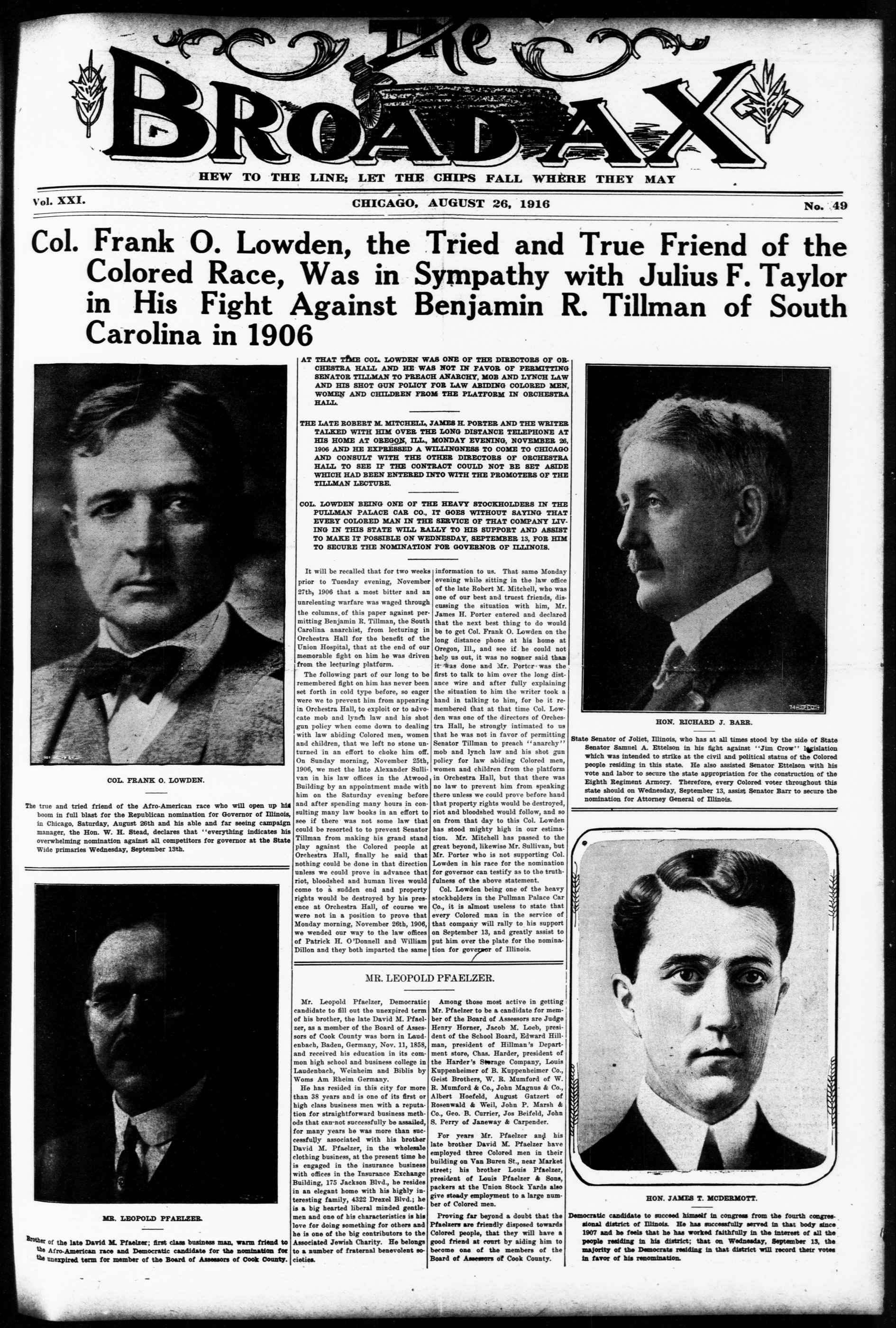
Col. Frank O. Lowden, the Tried and True Friend of the Colored Race, Was in Sympathy with Julius F. Taylor in His Fight Against Benjamin R. Tillman of South Carolina in 1906
Vol. XXI.
107
COL. FRANK O. LOWDEN.
end of the Afro-American race for the Republican nomination day, August 26th and his able W. H. Stead, declares that the nation against all competitors Wednesday, September 13th.
The true and tried friend of the Afro-American race who will open up his boom in full blast for the Republican nomination for Governor of Illinois, in Chicago, Saturday, August 26th and his able and far seeing campaign manager, the Hon. W. H. Stead, declares that "everything indicates his overwhelming nomination against all competitors for governor at the State Wide primaries Wednesday, September 13th.
[Image of a man in a suit with a tie and a mustache, facing forward. The background is dark. There is no text or additional information visible.]
MR. LEOPOLD PFAELZER.
And M. Pfaelzer; first class busin
race and Democratic candidate
for member of the Board of A
other of the late David M. Pfaelzer; first class business man, warm friend to the Afro-American race and Democratic candidate for the nomination for the unexpired term for member of the Board of Assessors of Cook County.
AT THAT TIME COL. LOWDEN WAS ONE OF THE DIRECTORS OF ORCHESTRA HALL AND HE WAS NOT IN FAVOR OF PERMITTING SENATOR TILLMAN TO PREACH ANARCHY, MOB AND LYNCH LAW AND HIS SHOT GUN POLICY FOR LAW ABIDING COLORED MEN, WOMEN AND CHILDREN FROM THE PLATFORM IN ORCHESTRA HALL.
THE LATE ROBERT M. MITCHELL, JAMES H. PORTER AND THE WRITER TALKED WITH HIM OVER THE LONG DISTANCE TELEPHONE AT HIS HOME AT OREGON, ILL., MONDAY EVENING, NOVEMBER 26, 1906 AND HE EXPRESSED A WILLINGNESS TO COME TO CHICAGO AND CONSULT WITH THE OTHER DIRECTORS OF ORCHESTRA HALL TO SEE IF THE CONTRACT COULD NOT BE SET ASIDE WHICH HAD BEEN ENTERED INTO WITH THE PROMOTERS OF THE TILLMAN LECTURE.
COL. LOWDEN BEING ONE OF THE HEAVY STOCKHOLDERS IN THE PULLMAN PALACE CAR CO., IT GOES WITHOUT SAYING THAT EVERY COLORED MAN IN THE SERVICE OF THAT COMPANY LIVING IN THIS STATE WILL RALLY TO HIS SUPPORT AND ASSIST TO MAKE IT POSSIBLE ON WEDNESDAY, SEPTEMBER 13, FOR HIM TO SECURE THE NOMINATION FOR GOVERNOR OF ILLINOIS.
It will be recalled that for two weeks prior to Tuesday evening, November 27th, 1906 that a most bitter and an unrelenting warfare was waged through the columns, of this paper against permitting Benjamin R. Tillman, the South Carolina anarchist, from lecturing in Orchestra Hall for the benefit of the Union Hospital, that at the end of our memorable fight on him he was driven from the lecturing platform.
The following part of our long to be remembered fight on him has never been set forth in cold type before, so eager were we to prevent him from appearing in Orchestra Hall, to exploit or to advocate mob and lynch law and his shot gun policy when come down to dealing with law abiding Colored men, women and children, that we left no stone unturned in an effort to choke him off. On Sunday morning, November 25th, 1906, we met the late Alexander Sullivan in his law offices in the Atwood Building by an appointment made with him on the Saturday evening before and after spending many hours in consulting many law books in an effort to see if there was not some law that could be resorted to to prevent Senator Tillman from making his grand stand play against the Colored people at Orchestra Hall, finally he said that nothing could be done in that direction unless we could prove in advance that riot, bloodshed and human lives would come to a sudden end and property rights would be destroyed by his presence at Orchestra Hall, of course we were not in a position to prove that Monday morning, November 26th, 1906, we wended our way to the law offices of Patrick H. O'Donnell and William Dillon and they both imparted the same
MR. LEOPOLD PFAELZER.
Mr. Leopold Pfaelzer, Democratic candidate to fill out the unexpired term of his brother, the late David M. Pfaelzer, as a member of the Board of Assessors of Cook County was born in Laudenbach, Baden, Germany, Nov. 11, 1858, and received his education in its common high school and business college in Laudenbach, Weinheim and Biblis by Woms Am Rhein Germany.
He has resided in this city for more than 38 years and is one of its first or high class business men with a reputation for straightforward business methods that can-not successfully be assailed, for many years he was more than successfully associated with his brother David M. Pfaelzer, in the wholesale clothing business, at the present time he is engaged in the insurance business with offices in the Insurance Exchange Building, 175 Jackson Blvd., he resides in an elegant home with his highly interesting family, 4322 Drexel Blvd.; he is a big hearted liberal minded gentlemen and one of his characteristics is his love for doing something for others and he is one of the big contributors to the Associated Jewish Charity. He belongs to a number of fraternal benevolent societies.
information to us. That same Monday evening while sitting in the law office of the late Robert M. Mitchell, who was one of our best and truest friends, discussing the situation with him, Mr. James H. Porter entered and declared that the next best thing to do would be to get Col. Frank O. Lowden on the long distance phone at his home at Oregon, Ill., and see if he could not help us out, it was no sooner said than it was done and Mr. Porter was the first to talk to him over the long distance wire and after fully explaining the situation to him the writer took a hand in talking to him, for be it remembered that at time Col. Lowden was one of the directors of Orchestra Hall, he strongly intimated to us that he was not in favor of permitting Senator Tillman to preach "anarchy" mob and lynch law and his shot gun policy for law abiding Colored men, women and children from the platform in Orchestra Hall, but that there was no law to prevent him from speaking there unless we could prove before hand that property rights would be destroyed, riot and bloodshed would follow, and so on from that day to this Col. Lowden has stood mighty high in our estimation. Mr. Mitchell has passed to the great beyond, likewise Mr. Sullivan, but Mr. Porter who is not supporting Col. Lowden in his race for the nomination for governor can testify as to the truthfulness of the above statement.
Col. Lowden being one of the heavy stockholders in the Pullman Palace Car Co., it is almost useless to state that every Colored man in the service of that company will rally to his support on September 13, and greatly assist to put him over the plate for the nomination for governor of Illinois.
Among those most active in getting Mr. Pfaelzer to be a candidate for member of the Board of Assessors are Judge Henry Horner, Jacob M. Loeb, president of the School Board, Edward Hillman, president of Hillman's Department store, Chas. Harder, president of the Harder's Storage Company, Louis Kuppenheimer of B. Kuppenheimer Co., Geist Brothers, W. R. Mumford of W. R. Mumford & Co., John Magnus & Co., Albert Hoefeld, August Gatzert of Rosenwald & Weil, P. Marsh & Co., Geo. B. Currier, Jos Beifeld, John S. Perry of Janeway & Carpender.
For years Mr. Pfaelzer and his late brother David M. Pfaelzer have employed three Colored men in their building on Van Buren St., near Market street; his brother Louis Pfaelzer, president of Louis Pfaelzer & Sons, packers at the Union Stock Yards also give steady employment to a large number of Colored men.
Proving far beyond a doubt that the Pfaelzers are friendly disposed towards Colored people, that they will have a good friend at court by aiding him to become one of the members of the Board of Assessors of Cook County.
No. 49
74532203
HON. RICHARD J. BARR.
at Illinois, who has at all times stood by the side of State A. Ettelson in his fight against "Jim Crow" legislation and to strike at the civil and political status of the Colored in this state. He also assisted Senator Ettelson with his secure the state appropriation for the construction of the Armory. Therefore, every Colored voter throughout this Wednesday, September 13, assist Senator Barr to secure the Attorney General of Illinois.
State Senator of Joliet, Illinois, who has at all times stood by the side of State Senator Samuel A. Ettelson in his fight against "Jim Crow" legislation which was intended to strike at the civil and political status of the Colored people residing in this state. He also assisted Senator Ettelson with his vote and labor to secure the state appropriation for the construction of the Eighth Regiment Armory. Therefore, every Colored voter throughout this state should on Wednesday, September 13, assist Senator Barr to secure the nomination for Attorney General of Illinois.
[Picture of a man with a neatly combed hairstyle, wearing a suit and tie, with a serious expression. The background is plain white. There are no other discernible elements or text.]]
HON. JAMES T. MCDERMOTT.
to succeed himself in congress from the fourth congress Illinois. He has successfully served in that body since that he has worked faithfully in the interest of all the his district; that on Wednesday, September 13, the electorates residing in that district will record their votes nomination.
Democratic candidate to succeed himself in congress from the fourth congressional district of Illinois. He has successfully served in that body since 1907 and he feels that he has worked faithfully in the interest of all the people residing in his district; that on Wednesday, September 13, the majority of the Democrats residing in that district will record their votes in favor of his renomination.
THE BROAD AX
Se ee eae eee
In this city sinee July 15th, 1899,
without missing one single issue, Be-
publieans, Democrats, Catholies, Pro-
testants, single Taxers, Priests, inf-
dels or anyone else ean have their say
‘as long 2s their language is proper and
responsibility is fixed.
‘The Broad Ax is & aewspaper whose
platform is broad enough for all, ever
claiming the editorial right to speak its
own mind.
Local communiestiens will reseive
attention. Write enly em one side of
the paper.
Subscriptions must be paid im ad-
vance.
One Year.........sseeecceeee 11-0800
Bix Months.............+--+++++ 1.00
Advertising rates made kaowa on ap
plication.
Address all communications to
THE BROAD AX
6418 Champlain Ave., Chicago, Il.
PHONE WENTWORTH 2507.
JULIUS F. TAYLOR, Editor and Pud-
lisher.
Entered as Seeond-Class Matter Aug.
19, 1902, at the Post Office at Chicago,
Ilinois, under Act of March 3, 1879.
——
‘Tae Inunors Tax Pavens’ ALLIANCE
is using every effort to arouse public
attention to the tax amendment to the
state constitution to be submitted to
the people at the election to be held
November 7, 1916. ; Fear is expressed
that this important“tax reform may be
lost sight of in the engrossing prest-
dential campaign.
Mr. and Mrs. J. H. Cooper, 3736 For-
est ave. are spending their two weeks’
vacation with friends at Monmouth, Il-
linois.
‘Mr. Weaver, who is in the govern-
ment mail service at Columbus, Ohio,
is visiting his cousin, James B. Nein-
some, 214 West 30th street.
‘Miss Maude J. Roberts, 3231 Vernon
ave., is spending her summer vacation
in Allegan, Mich. She will return
home the first of this coming week.
Mrs. Sarah Washington, of St. Louis,
Mo., sister of Mrs. Hattie Arrant, 3228
Calumet ave., continues to delightfully
enjoy her visit to this, the windy city.
Mrs. Emma Brown of Lexington, Ky.,
is visiting Mr. and Mrs, Edward Felix,
3002 Sout Dearborn St. Mrs. Brown
is well pleased with her visit to this
city.
Miss V. N, Anderson, 20 East 44th
street, will return home the first of the
week from a business and pleasure trip
to Kansas City, Mo, and the Yellow:
stone Park.
Mrs. Ethel Lampton, daughter of the
late Bishop Lampton of Grenville,
Miss., is in this city, and she will make
a long visit with her friend, Mrs. Hat-
tie Arrant, 3228 Calumet ave.
General J. T. T. Warren of Hot
Springs, Ark., who is one of the most
prominent K. Ps in the world is tak.
ing in the sights of Chicago and he is
stopping at the C. and C. hotel, 3449
South State street.
Miss Florence M. Harris a graduate
nurse of Brooklyn, New York, and one
of the district nurses of that city has
for the past two weeks been the house
guest of Mrs. Robert A. Williams, 3544
South Dearborn street.
Mrs. Geneva Smith, 5363 South Dear
born street, will on Saturday evening
arrive home from a three weeks’ pleas
ure trip to Detroit, Mich. and other
points in that state and to say the least
she had the most pleasant time of her
life.
Prof. Richard Hill of Nashville
‘Tenn., who had charge of the Negro
Building during the Nashville, Tena.
Exposition in 1897, is visiting his son
im this city Richard Hill, Jr., and he is
completely carried away with Chicago
end its people.
‘Mrs. W. N. Ross of Birmingham, Als.,
is visiting in the city stopping at 3600
‘Wabash avenue. She came on to at.
tend the funeral of her brother Mr.
Sherley, who worked with Mr. B. W.
Fitts the printer, 3315 8. State street.
Miss Catherine Lealted, the highly
accomplished daughter of Rev. Father
and Mrs. Lealted of St. Paul, Minn, is
visiting in this city with Mr. and Mrs.
Harry Stanton Brown, 3242 Calumet
ave. Last year Miss Lealted graduated
with high honors from MeAllester’s
College.
Indians and Time.
Certain of the reservation Iadians
still cling to the calendar of their an-
cestors. The Indian method was to
compute time by sleeps and moons.
A sleep is twenty-four hours, and @
moon is a month There is also a
midmoon, where the sun is at 12
o'clock meridian. This hour is indi-
cated by pointing overhead.
‘When an Indian pointed quarter way
up the sky he meant 9 o'clock; when
he pointed quarter was down he meant
8 o'clock. Sunrise was the eastern
horizon and sunset the western.
‘When there was a moon the time
was indicated in the same way as by
the sun, Were an Indian asked the
distance to a certain place or how far
he had come he would say so many
sleeps, or days’ travel. A sleep, a8
describing distance, was about thirty-
five miles when walking deliberately
or from fifty to seventy-five miles if
going in haste with a message—Phil-
adelphia Inquirer.
The Firet Aties
The first modern atlas was the work
of Abraham Ortelius, a Dutch geogra-
pher, who died 518 years ago. His
monumental treatise, entitled “The-
atrum Orbis Terrarum,” was first pub-
Ushed at Antwerp in 1570 and was re-
vised and reissued five times during
the author's lifetime. It was a folio
volume containing nearly a husdred
maps, representing the different coun-
tries and continents as they were then
known. Although this atlas was a
momentous achievement, yet a bright
schoolboy today could draw maps from
memory with a better approximation
to correctness. Even England and
Scotland appear in this ploneer volume
with amazing distortions of coast line
and relative area, and many other
maps in the volume bear only a slight
resemblance to those of today.—New
York World.
An Ant That Spins.
‘The spinning ant is found in India,
im Ceylon, in the islands of Malacca
and in Australia. This ant weaves its
nest between two leaves of a tree,
Preferably the mango. It begins to
build or to weave by drawing two
leaves together. ‘To do this it runs a
Une of its working material—material
similar to the spider's thread—the
length of the leaf and around it. While
at work it clings to the leaf with its
nails and at the same time draws on
the leaf nearest to it with its mandi-
bles. Sometimes the two leaves sult-
able for nest building are too far apart;
then the builder calls in its fellow
ants, and they help to form a chain.
Each ant clings to the waist of its
neighbor by its mandibles. Thus en-
chained, they work to build the nest
of their comrade.
‘That Indefinite Article.
The rule dealing with the indefinite
article preceding words commencing
‘with “u” (when pronounced “yu”) does
not appear to be an adamantine one.
Like Macaulay, with his fondness for
“an” university, many of our best
writers and speakers prefer to ignore
the rule and back their fancy in this
Uttle question of euphony. As for the
man in the street, the matter has long
ago been settled in favor of “a” in all
cases where the initial “u” bas the
“gu” sound, partly no doubt because
such phrases as “an united people” do
not come trippingly off the tongue and
have an old fashioned, pedantic flavor.
And there are sensitive ears that will
prefer “a unique” to the more studied
“an unique."—London Chronicle.
Calendars of the Aztecs.
Calendars are probably the oldest
form of literature in the world. The
cards which appear by the millions in
all civilized countries nowadays have
their counterpart among the most an-
clent known races. The Aztecs, for ex-
ample, were well supplied with calen-
dars, and several of them have been
preserved to this day. They were pub-
lished in stone and set up in public
places.
Te Hela Mim Gut.
“You are lying so clumsily,” said the
observant judge to a litigant who was
making a dublous statement of his
case, “that I would advise you to get
a lawyer.”—Browning’s Magazine.
Probably.
} “Hopkins says be owes everything he
bas to his wife.”
“I suppose that is why he put his
property in bis wife’s name before he
‘failed.”—Boston Globe.
% PRACTICAL HEALTH HINT.
+ =
+ Dangers of Bad Teeth.
+ A bad tooth should never be
+ tolerated, and the danger of can-
+ cer is only one more good reason
+ for having it attended to. Can-
+ cer of the tongue may occur at
+ any age, but it is most common
+ between forty and sixty. As one-
+ third of all cases investigated
+ have been shown to be definitely
+ associated with jagged or decay-
+ ed teeth or impe-fect plates, it
+ would seem that here is one
+ method of preventing cancer.
+ It ts probable that other condi-
+ tions occurring in combination
+ with bed teeth increase the Ike-
+ hood of cancer of the tongue
+ as a result, but the removal of
+ this form of irritation is so sim-
+ ple matter that deaths in cases
+ of this kind must be charged to
+ pure negligence. If the removal
+ or treatment of the tooth does
+ not relieve the situation and the
& ulcer continues, prompt operation
+ is necessary, for this form of
# cancer is quickly fatal.
>
THE BROAD AX, CHICAGO; AUGUST 26, 1916.
[aaieaeey So: = a al par
|
2 |
| |
| ee |
| id pes, |
saa |
:
| " |
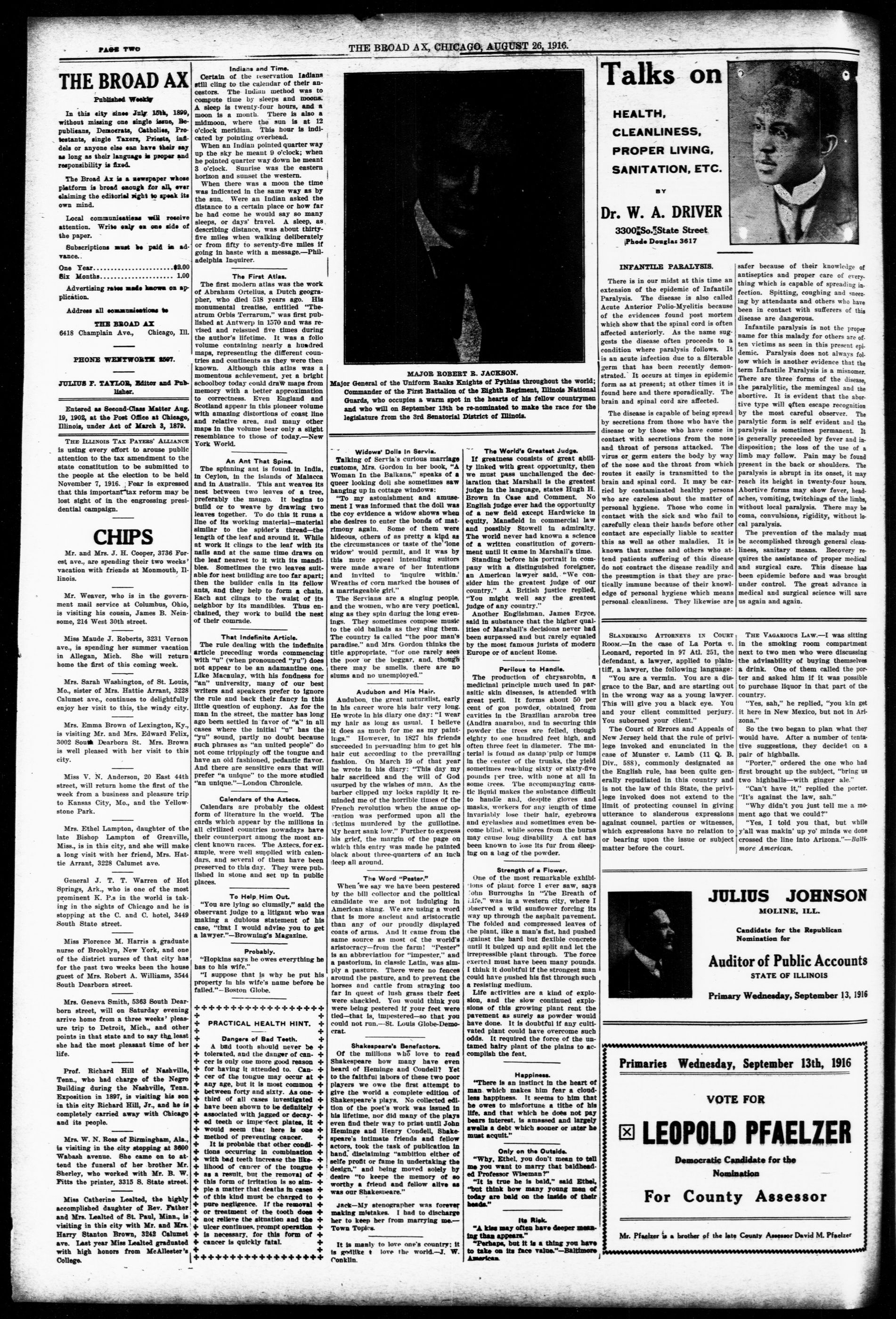
MAJOR ROBERT B. JACKSON.
Major General of the Uniform Ranks Knights of Pythias throughout the world;
Commander of the First Battalion of the Eighth Regiment, Illinois National
Guards, who occupies a warm spot in the hearts of his fellow countrymen
and who will on September 18th be re-nominated to make the race for the
legislature from the Srd Senatorial District of Ilinois.
‘Widows’ Dollis In Servia.
‘Talking of Servia’s curious marriage
customs, Mrs. Gordon in her book, “A
‘Woman In the Balkans,” speaks of a
queer looking doll she sometimes saw
hanging up in cottage windows:
“To my astonishment and amuse-
‘ment I was informed that the doll was
the coy evidence a widow shows when
‘the desires to enter the bonds of mat-
rimony again, Some of them were
Secectanat 2 ane
the circumstances or taste of the’ ‘lone
widow’ would permit, and it was by
‘this mute appeal intending sultors
‘were made aware of her intentions
and invited to ‘inquire within.’
Wreaths of corn marked the houses of
a marriageable girl.”
‘The Servians are a singing people,
and the women, who are very poetical.
sing as they spin during the long even-
ings. They sometimes compose music
to the old ballads as they sing them.
The country 1s called “the poor man’s
paradise.” and Mrs. Gordon thinks the
title appropriate. “for one rarely sees
the poor or the beggar, and, though
there may be smells. there are no
| slums and no unemployed.”
uduben and Hie Heir.
Audubon, the xreat naturalist, early
in his career wore his bair very long.
He wrote in his diary one day: “I wear
my hair as long as usual. I believe
it does as much for me as my paint-
Ings.” However, in 1827 his friends
‘succeeded in persuading him to get his
hair cut according to the prevailing
fashion. On March 19 of that year
he wrote in his diary: “This day my
hair sacrificed and the will of God
usurped by the wishes of man. As the
barber clipped my locks rapidly tt re-
minded me of the horrible times of the
French revolution when the same op-
eration was performed upon all the
victims murdered by the guillotine.
My heart sank low.” Further to express
his grief, the margin of the page on
which this entry was made he painted
black about three-quarters of an inch
deep all around.
‘The Word “Pester.”
When ‘we say we have been pestered
by the bill collector and the political
candidate we are not indulging in
American slang. We are using a word
that 1s more ancient and aristocratic
than any of our proudly displayed
coats of arms. And it came from the
same source as most of the world’s
aristocracy—from the farm! “Pester”
1s an abbreviation for “impester,” and
a pastorium, in classic Latin, was sim-
ply @ pasture. There were no fences
around the pasture, and to prevent the
horses and cattle from straying too
far in quest of lush grass their feet
were shackled. You would think you
were being pestered If your feet were
tled—that Is, impestered—so that you
could not run.—St. Louis Globe-Demo-
crat.
ai Bi.
Of the millions who love to read
‘Shakespeare how many have even
heard of Heminge and Condell? Yet
‘to the faithful labors of these two poor
‘Players we owe the first attempt to
give the world a complete edition of
Shakespeare's plays. No collected edi-
‘tion of the poet’s work was issued in
his lifetime, nor did many of the plays
even find their way to print until John
Heminge and Henry Condell, Shake-
speare’s intimate friends and fellow
actors, took the task of publication in
hand, disclaiming “ambition elther of
selfe profit or fame in undertaking the
design,” and being moved solely by
desire “to keepe the memory of so
worthy a friend and fellow alive as
was our Shakespeare.”
Jack—My stenographer was forever
making mistakes. I had to discharge
her to keep her from marrying me—
Town Topics.
It is manly to love one’s country; it
is geiitke ¢ love the world—J. W.
Conklin.
‘The World’s Greatest Judge.
If greatness consists of great abill-
ty linked with great opportunity, then
we must pass unchallenged the dec-
laration that Marshall is the greatest
Judge in the language, states Hugh H.
Brown in Case and Comment. No
English judge ever had the opportunity
of a new field except Hardwicke in
equity, Mansfield in commercial law
and possibly Stowell in admiralty.
‘The world never had known a science
of a written constitution of govern-
ment until it came in Marshall's time.
Standing before his portrait in com-
pany with a distinguished foreigner,
an American lawyer said, “We con-
sider him the greatest judge of our
country.” A British justice replied,
“You might well say the greatest
Judge of any country.”
Another Englishman, James Eryce,
said in substance that the higher qual-
ities of Marshall's decisions never had
been surpassed and but rarely equaled
by the most famous jurists of moderp
Europe or of ancient Rome.
iccthia te neta:
The production of chrysarobin, a
medicinal principle much used in par-
asitic skin diseases, is attended with
great peril. It forms about 50 per
cent of goa powders, obtained from
cavities in the Brazilian araroba tree
(Andira anarabo), and tn securing this
powder the trees are felled, though
eighty to one hundred feet high, and
often three feet in diameter. The ma-
terlal is found as daip’pulp or lumps
in the center of the trunks, the yield
sometimes reaching sixty or sixty-five
pounds yer tree, with none at all in
some irees. The accompanying caus-
tie liquid makes the substance difficult
to handie and, despite gloves and
masks, workers for any iength of time
Invariably lose their hair, eyebrows
and eyelashes and sometimes even be-
come blind, while sores from the burns
may cause loug disability A cat has
been known to iose its fur from sleep-
ing on a bag of the powder.
Strenath of a Fiower.
One of the most remarkable exhibl-
fons of plant force 1 ever saw, says
‘ohn Burroughs in “ihe Breath of
ize,” was in a western city, where I
observed a wild sunflower forcing its
way up through the asphalt pavement.
The folded and compressed leaves of
che plant, like a man’s fist, had pushed
against the bard but flexible concrete
until ft bulged up and split and let the
irrepressible plant through. The force
exerted must have been many pounds.
I think {t doubtful if the strongest man
could have pushed his fist through such
a resisting medium.
Life activities are a kind of explo-
sion, and the slow continued explo-
sions of this growing plant rent the
Pavement as surely as powder would
have done. It is doubtful if any cultt-
vated plant could have overcome such
odds. It required the force of the un-
tamed hairy plant of the plains to ac-
complish the feat.
Happiness.
“There is an instinct in the heart of
man. which makes him fear a cloud.
less happiness. It seems to him that
he owes to misfortune a tithe of his
Ufe, and that which he dots not pay
bears interest, is amassed and largely
swells a debt which sooner or sater he
must acquit.”
aie om tin eee.
“Why, Ethel, you don't mean to tel
‘me you want to marry that baldhead
ed Professor Wiseman?”
“It is true he ts bald.” sald Ethel
“but think how many young men of
today are bald on the inside of thel
heads.”
tts Risk.
“A Kies may often bave deeper menn-
tng than appears.”
“Perhaps, but it is a thing you have
to take on its face value.”—Baltimore
American
JULIUS JOHNSON
a MOLINE, ILL.
"~ Candidate for the Republican
: Nomination for
ok Auditor of Public Accounts
ba) STATE OF ILLINOIS
Primary Wednesday, September 13, 1916
} Primaries Wednesday, September 13th, 1916
| VOTE FOR
© LEOPOLD PFAELZER
Democratic Candidate for the
Nomination
; For County Assessor
| Mr. Pfaclzer is a brother of the late County Assessor David M. Pfaelzer
Talks on
HEALTH, :
CLEANLINESS,
PROPER LIVING,
SANITATION, ETC.
Dr. W. A. DRIVER
3300§So.%State Street
(Phode Douglas 3617
INFANTILE PARALYSIS. 2
‘There is in our midst at this time an
‘extension of the epidemic of Infantile
Paralysis. The disease is also called
‘Acute Anterior Polio-Myelitis because
of the evidences found post mortem
which show that the spinal cord is often
affected anteriorly. As the name sug:
gests the disease often proceeds to a
condition where paralysis follows. It
is an acute infection due to a filterable
jgerm that has been recently demon-
strated. It oceurs at times in epidemic
form as at present; at other times it is
found here and there sporadically. ‘The
brain and spinal cord are affected.
The disease is capable of being spread
by secretions from those who have the
disease or by those who have come in
contact with secretions from the nose
and throat of persons attacked. The
virus or germ enters the body by way
of the nose and the throat from whick
routes it easily is transmitted to the
brain and spinal cord. It may be car
ried by contaminated healthy person:
who are careless about the matter of
personal hygiene. Those who come ir
contact with the sick and who fail tc
carefully clean their hands before othe:
contact are especially liable to seatte:
this as well as other maladies. It is
known that nurses and others who at
tend patients suffering of this disease
do not contract the disease readily and
the presumption is that they are prac
tically immune because of their knowl
edge of personal hygiene which mean:
personal cleanliness. They likewise are
SLANDERING ATTORNEYS IN CouRT
Room.—In the case of La Porta ».
Leonard, reported in 97 Atl. 251, the
defendant, a lawyer, applied to plain
tiff, a lawyer, the following language:
“You are a vermin. You are a dis.
grace to the Bar, and are starting out
in the wrong way as a young lawyer.
This will give you a black eye. You
and your client committed perjury.
You suborned your client.”
The Court of Errors and Appeals of
New Jersey held that the rule of privi-
lege invoked and enunciated in the
case of Munster v. Lamb (11 Q. B.
Div., 588), commonly designated as
the English rule, has been quite gen:
erally repudiated in this country and
is not the law of this State, the privi-
lege invoked does not extend to the
limit of protecting counsel in giving
utterance to slanderous expressions
against counsel, parties or witnesses,
which expressions have no relation to
or bearing upon the issue or subject
matter before the court.
- oo
ee
a ee S
Ca — >
. So a
Poe o y
: hi rec
safer because of their knowledge of
‘antisepties and proper care of every.
‘thing whieh is eapable of spreading in.
fection. Spitting, coughing and sneer.
ing by attendants and others who have
‘been in contact with sufferers of this
disease are dangerous.
| Infantile paralysis is not the proper
name for this malady for others are of.
ten vietims as seen in this present epi-
demic. Paralysis does not always fol
low which is another evidence that the
term Infantile Paralysis is a misnomer.
There are three forms of the disease,
the paralylitic, the memingeal and the
abortive. It is evident that the abor.
tive type will gften escape recognition
by the most careful observer. The
paralytic form is self evident and the
paralysis is sometimes permanent. It
is generally preceeded by fever and in-
disposition; the loss of the use of a
limb may follow. Pain may be found
present in the back or shoulders. The
paralysis is abrupt in its onset, it may
Teach its height in twenty-four hours,
Abortive forms may show fever, head-
aches, vomiting, twitchings of the limbs,
without local paralysis. There may be
‘coma, convulsions, rigidity, without lo-
cal paralysis.
The prevention of the malady must
be accomplished through general clean-
liness, sanitary means. Recovery re-
quires the assistance of proper medical
and surgical care. This disease has
been epidemic before and was brought
under control. ‘The great advance in
medical and surgical science will save
us again and again.
‘Tue Vacariovs Law.—t was sitting
in the smoking room compartment
next to two men who were discussing
the advisability of buying themselves
‘a drink. One of them called the por
ter and asked him if it was possible
‘to purchase liquor in that part of the
country.
“Yes, sah,” he replied, “you kin get
it here in New Mexico, but not in Ari-
zona.”
So the two began to plan what they
would have. After a number of tenta-
tive suggestions, they decidei on
pair of highballs.
“Porter,” ordered the one who had
first brought up the subject, “bring us
two highballs—with ginger ale.”
“Can't have it,” replied the porter.
“It’s against the law, sah.”
“Why didn’t you just tell me a mo
ment ago that we could?”
“Yes, I told you that, but while
y'all was makin’ up yo’ minds we done
crossed the line into Arizona."—Baltt
more American.
<a
ERD>»
MY ™
‘ a Vian a
bee ib
IAD
b Se
etme
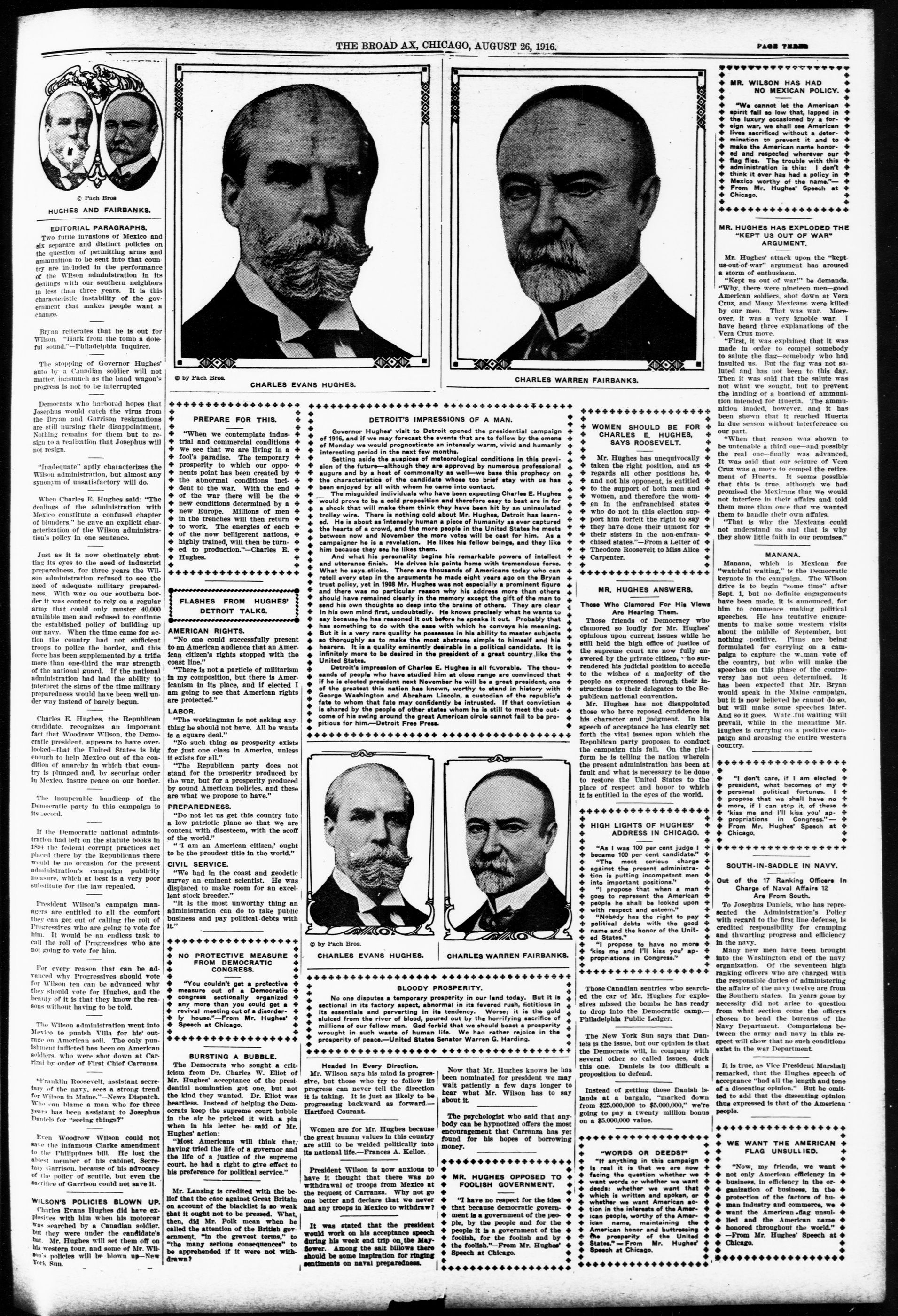
HUGHES AND FAIRBANKS.
EDITORIAL PARAGRAPHS,
‘Two futile invasions of Mexico and
six separate and distinct policies on
the question of permitting arms and
ammunition to be sent into that coun-
try are included in the performance
of the Wilson administration in its
dealings with our southern neighbors
in less than three years. It is this
characteristic instability of the gov-
ernment that makes people want a
change.
Bryan reiterates that he is out for
Wilson. “Ilark from the tomb a dole-
fal sound."—Philadelphia Inquirer.
The stopping of Governor Hughes’
auto by a Canadian soldier will not
matter, inasmuch as the band wagon’s
progress is not to be interrupted
Democrats who harbored hopes that
Josephus would catch the virus from
the Bran and Garrison resignations
are still nursing their disappointment.
Nothing remains for them but to re-
sign to a realization that Josephus will
not resign.
“Inadequate” aptly characterizes the
Wilson administration, but almost any
synonym of unsatisfactory will do.
When Charles E. Hughes said: “The
dealings of the administration with
Mexico constitute a confused chapter
of blunders.” he gave an explicit char-
acterization of the Wilson administra-
tion's policy in one sentence.
Just as it is now obstinately shut-
ting Its eyes to the need of industriat
preparedness, for three years the Wil-
son administration refused to see the
need of adequate military prepared-
ness. With war on our southern bor-
der it was content to rely on a regular
army that could only muster 40,000
available men and refused to continue
the established policy of bullding up
our navy. When the time came for ac-
tlon the country bad not sufficient
troops to police the border, and this
force has been supplemented by a trifle
more than one-third the war strength
of the national guard. If the national
administration had had the ability to
interpret the signs of the time military
Preparedness would have been well un-
der way instead of barely begun.
Charles E. Hughes, the Republican
candidate, recognizes an important
fact that Woodrow Wilson, the Demo-
cratic president. appears to have over-
looked—that the United States is big
enough to help Mexico out of the con-
ition of anarchy in which that coun-
try 1s plunged and, by securing order
in Mexico, insure peace on our border.
‘The insuperable handieap of the
Democratie party in this campaign 1s
Sts cecord.
If the Democratic national adminis-
tration had left on the statute books in
18 the federal corrupt practices act
Placed there by the Republicans there
Would be no occasion for the present
administration's campaign publicity
hasnre, which at best 18 a very poor
substitute for the aw repealed,
Tresident Wilson's campaign man-
agers are entitled to all the comfort
they can get out of calling the roll of
Trozressives who are going to vote for
him. It would be an endless task to
call the roll of Progressives who are
not kong to vote for him.
For every reason that can be ad-
vanced why Progressives should vote
for Wilson ten can be advanced why
they should vote for Hughes, and the
beauty of it fs that they know the rea-
Sous withont having to be told.
‘The Witson administration went into
Mexico {0 punish Villa for his‘ out-
Tace on American soll. The only pun-
Ashmont fnflteted has been on American
Soldiers, who were shot down at Car-
Meal by order of First Chief Carranza.
“Franklin Roosevelt, assistant secre-
tary of the navy, sees a strong trend
for Wilson in Maine."—News Dispatch.
Who can blame a man who for three
Tears has been assistant to Josephus
Danicts for “seeing things?”
Fren Woodrow Wilson could not
save the infamous Clarke amendment
to the Philippines bill. He lost the
Ablest_ member of his cabinet, Secre-
tary Garrison. because of his advocacy
of the polley of scuttle, but even the
Sacritice of Garrison could not save it.
WILSON'S POLICIES BLOWN UP.
Charles Evans Hughes did have ex-
Plosives with him when his motorcar
Was searched by a Canadian soldier.
but they were under the can@idate's
bat. Mr, Hughes will set them off on
bis western tour, and some of Mr. Wi-
Son's polteles will be blown up—New
York Sun.
> < :
Po 7
PS oa |
Se a
ee foe
> ee ne
NG a
ee ale SS >
xe TTT—CS
CHARLES EVANS HUGHES.
+ PREPARE FOR THIS.
+ sae
# “When we contemplate indus-
# trial and commercial conditions
we see that we are living in a
# fool's paradise. The temporary
# prosperity to which our oppo-
# nents point has been created by
# the abnormal conditions inci-
# dent to the war. With the end
of the war there will be the
# new conditions determined by a
* new Europe. Millions of men
# in the trenches will then return
# to work. The energies of each
# of the now belligerent nations,
# highly trained, will then be turn-
# ed to production."—Charles E.
# Hughes.
+
FLASHES FROM HUGHES’
DETROIT TALKS.
AMERICAN RIGHTS.
“No one could successfully present
toan American audience that an Amer-
tean citizen's rights stopped with the
coast line.”
| “There is not a particle of militarism
in my composition, but there is Amer-
fcanism in its place, and if elected I
am going to see that American rights
are protected.”
LABoR.
“The workingman is not asking any-
thing he should not have. All he wants
fs a square deal.”
| “No such thing as prosperity exists
for just one class in America, unless
it exists for all.”
“The Republican party does not
stand for the prosperity produced by
the war, but for a prosperity produced
by sound American policies, and these
are what we propose to have.”
PREPAREDNESS.
“Do not let us get this country into
a low patriotic plane so that we are
content with disesteem, with the scoff
of the world.”
“‘T am an American citizen,’ ought
to be the proudest title in the world.”
CIVIL SERVICE.
“We had in the coast and geodetic
survey an eminent scientist. He was
displaced to make room for an excel-
ent stock breeder.”
“It 1s the most unworthy thing an
administration can do to take public
business and pay political debts with
aie
NO PROTECTIVE MEASURE
FROM DEMOCRATIC
CONGRESS.
“You couldn't get a protective
measure out of a Democratic
congress sectionally organized
any more than you could get a
revival meeting out of a disorder-
ly house.”"—From Mr. Hughes’
Speech at Chicago.
BURSTING A BUBBLE.
The Democrats who sought a crit-
feism from Dr. Charles W. Eliot of
Mr. Hughes’ acceptance of the presi-
dential nomination got one, but not
the kind they wanted. Dr. Eliot was
heartless. Instead of helping the Dem-
ocrats keep the supreme court bubble
in the alr he pricked it with a pin
when in his letter he. said of Mr.
Hughes’ action:
“Most Americans will think that,
having tried the life of a governor and
the life of a justice of the supreme
court, he had a right to give effect to
his preference for political service.”
Mr. Lansing is credited with the be-
Uef that the case against Great Britain
on account of the blacklist is so weak
that it ought not to be pressed. What,
then, did Mr. Polk mean when he
called the attention of the British gov-
ernment, “in the gravest terms,” to
“the many serious consequences” to
be apprehended if it were not with-
é@rawn?
© by Pach Broa.
THE BROAD AX, CHICAGO, AUGUST 26, 1916.
POSSESSES ESESSESED FEFEEEEESESE
: Governor Hughes’ visit to Detroit opened the presidential campaign
’ of 1916, and if we may forecast the events that are to follow by the omens
of Monday we would prognosticate an intensely warm, vivid and humanly
’ interesting period in the next few months.
+ Setting aside the auspices of meteorological conditions in this previ-
sion of the future—although they are approved by numerous professional
/ augurs and by a host of commonalty as well—we base this prophecy on
- the characteristics of the candidate whose too brief stay with us has
» been enjoyed by all with whom he came into contact.
,__ The misguided individuals who have been expecting Charles E. Hughes
, “would prove to be a cold proposition and therefore easy to beat are in for
, a shock that will make them think they have been hit by an uninulated
| trolley wire. There is nothing cold about Mr. Hughes, Detroit has learn-
| ed. He is about as intensely human a piece of humanity as ever captured
| the hearts of a crowd, and the more people in the United States he meots
| between now and November the more votes will be cast for him. Asa
campaigner he is a revelation. He likes his fellow beings, and they like
| him because they see he likes them.
| And what his personality begins his remarkable powers of intellect
| and utterance finish. He drives his points home with tremendous force.
What he says.sticks. There are thousands of Americans today who can
' retell every step in the arguments he made eight years ago on the Bryan
"trust policy, yet in 1908 Mr. Hughes was not especially a prominent figure
and there was no particular reason why his address more than others
should have remained clearly in the memory except the gift of the man to
send his own thoughts so deep into the brains of others. They are clear
in his own mind first, undoubtedly. He knows precisely what he wants to
| aay because he has reasoned it out before he speaks it out. Probably that
| has something to do with the ease with which he conveys his meaning.
| But it is a very rare quality he possesses in his ability to master subjects
80 thorgughly as to make the most abstruse simple to himself and hie
hearers. It is a quality eminently desirable in a political candidate. It is
Infinitely more to be desired in the president of a great country like the
United States.
Detroit's impression of Charles E. Hughes is all favorable. The thou-
sands of people who have studied him at close range are convinced that
if he is elected president next November he will be a great president, one
of the greatest this nation has known, worthy to stand in history with
George Washington and Abraham Lincoln, a custodian of the republic’s
fate to whom that fate may confidently be intrusted. If that conviction
is shared by the people of other states whom he is still to meet the out-
come of his swing around the great American circle cannot fail to be pro-
pitious for him—Detroit Free Press.
«. , a “75 cS
Yo " fan oe
ae oe y et y
ee ae a Ct ee a
eS aw
Vy ‘i y 6 §
Ss. ~ ». p ELS ,
DSA (a piece
© by Pach Bros
CHARLES EVANS HUGHES. | CHARLES WARREN FAIRBANKS.
EEEEESESEEESEEEEEE CREEESEEESEESESEES
Noone disputes a temporary prosperity in our land today. But it is
Ps sectional in its factory aspect, abnormal in its fevered rush, fictitious in
* its essentials and perverting in its tendency. Worse; it is the gold
e sluiced from the river of blood, poured out by the horrifying sacrifice of
e millions of our fellow men. God forbid that we should boast a prosperity
wrought in such waste of human life. We hac rather rejoice in the
¢ prosperity of peace—United States Senator Warren G. Harding.
| SEES ESEEESEEEEEEES SEFTEFEEEEEEEHETE
Were Cpenuee sae vuraten ts cosenae | , Now that Mr. Hushes knows be bi
sive, but those who try to follow its] pec nominated for presklent em
progress can never tell the direction sa
ft 1s taking. It is Just as ikely to be Hear what Mr. Wilson bas to
progressing backward as forward— | *bout it.
Hartford Courant.
‘The psychologist who said that ar
offe
cmon em inns wecome | Sats SON Pantene ome
the great human values in this country found his hoy pom
are still to be welded politically into) money. = =<
its national life—Frances A. Kellor. aa
Se SOeSeeeeesesseses
President Wilson is now anxious to @
bave it thought that there was no @ MR. HUGHES OPPOSED TO
withdrawal of troops from Mexico at @ FOOLISH GOVERNMENT.
the request of Carranza. Why not go @ —
one better and declare that we never @ “I have no respect for the idea
had any troops in Mexico to withdraw? @ thet because democratic govern-
a @ ment is a government of the peo-
Jt was stated that the president ® Ple, by the people and for the
‘would work on his acceptance speech ® People it ts a government of the
Goring bis week end trip on, the May- * foolish, for the foolish and by
flower. Among the salt billows there @ the foolish.” From Mr. Hughes’
should be some insptration for ringing @ Speech at Chicago.
sentiments on naval preparedness, =(® =...
DETROIT’S IMPRESSIONS OF A MAN.
BLOODY PROSPERITY.
putes a temporary prosperity in our land toc
5 factory aspect, abnormal in its fevered rus
and perverting in its tendency. Worse; |
he river of blood, poured out by the horrifyi
fellow men. God forbid that we should boas
ch waste of human life. We hac rather |
eace—United States Senator Warren G. Har
CEPESEESES SHFEEHEEDE
<
fete ee
Pee es RS
pare PRS ae Se me
week | ie %
ii
Sa 2
Ae G:
ee xD
@ MR. HUGHES OPPOSED TO ¢
@ FOOLISH GOVERNMENT. ¢@
° —_ °
@ “Thave no respect for the idea @
@ that because democratic govern- @
@ ment is a government of the peo @
@ ple, by the people and for the #
® people it ts 2 government of the @
foolish, for the foolish and by @
@ the foolish."—From Mr. Hughes’
a :
SOSOOSOSESSSSESOOSD
CHARLES WARREN FAIRBANKS.
WOMEN SHOULD BE FOR
CHARLES E, HUGHES,
SAYS ROOSEVELT.
‘Mr. Hughes has unequivocally
taken the right position, and as «
regards all other positions he, «
and not his opponent, is entitled «
to the support of both men and -
Women, and therefore the wom- *
en in the enfranchised states +
who do not in this election sup- «
Port him forfeit the right to say ¢
they have done their utmost for «
their sisters in the non-enfran- «
chised states.”—From a Letter of «
‘Theodore Roosevelt to Miss Allce «
Carpenter. P
4
PREPEHEEEEESEEEESE
MR, HUGHES ANSWERS.
Those Who Clamored For His Views
Aro Hearing Them.
Those friends of Democracy who
clamored so loudly for Mr. Hughes’
opinions upon current issues while he
still held the high office of justice of
the supreme court are now fully an-
swered by the private citizen, +-ho sur-
rendered his Judicial position to accede
to the wishes of a majority of the
People as expressed through their in-
structions to thelr delegates to the Re-
publican national convention.
‘Mr. Hughes has not disappointed
those who have reposed confidence in
his character and judgment. In his
speech of acceptance he has clearly set
forth the vital issues upon which the
Republican party proposes to conduct
the campaign this fall. On the rlat-
form he fs telling the nation wherein
the present administration has been at
fault and what is necessary to be done
to restore the United States to the
place of respect and honor to which
it fs entitled in the eyes of the world.
= —
HIGH LIGHTS OF HUGHES’ 4
+ ADDRESS IN CHICAGO. 4
+ — 4
“As | was 100 per cont judge | +
& became 100 per cent candidate.” +
“The most serious charge 4
# against the present administra- 4
% tion is putting incompetent men #
# into important positions.” 4
“I propose that when a man #
© goes to represent the American 4
people he shall be locked upon +
# with respect and esteem.” +
% “Nobody has the right to pay #
# political debts with the good +
name and the honor of the Unit- +
# ed States.” +
# “I propose to have no more #
# ‘kiss me and I'll kiss you’ ap- #
© propriations in Congress.” 3
+
SEEPEFESESEEFESE SE
‘Those Canadian sentries who search-
ed the car of Mr. Hughes for explo-
sives missed the bombs he has ready
to drop into the Democratic camp.—
Philadelphia Public Ledger.
‘The New York Sun says that Dan-
fels is the issue, but our opinion is that
the Democrats will, in company with
several other so called tissues, duck
this one. Daniels {s too difficult a
proposition to defend.
Instead of getting those Danish ts-
lands at a bargain, “marked down
from $25,000,000 to $5,000,000,” we're
going to pay a twenty million bonus
‘on a $5,000,000 value.
“WORDS OR DEEDS?”
“If anything in this campaign
is real it is that we are now
facing the question whether we
want words or whether we want
deeds; whether we want that
which is written and spoken, or
whether we want American ac-
tion in the interests of the Amer-
ican people, worthy of the Amer-
ican name, maintaining the
American honor and buttressing
the prosperity of the United
States."—From Mr. Hughew
Speech at Chicago.
Paes 7HRmR
) MR. WILSON HAS HAD
; NO MEXICAN POLICY.
» “We cannot let the American
> spirit fall so low that, lapped in
the luxury occasioned by a for-
» eign war, we shall see American
» lives sacrificed without a deter-
» mination to prevent it and to
) make the American name honor-
» ed and respected wherever our
» flag flies. The trouble with this
» administration is this: | don't
» think it ever has had a policy in
» Mexico worthy of the name.”"—
» From Mr. Hughes’ Speech at
| Chicago.
MR. HUGHES HAS EXPLODED THE
“KEPT US OUT OF WAR”
ARGUMENT.
Mr. Hughes’ attack upon the “kept-
us-out-of-war” argument has aroused
& storm of enthusiasin.
“Kept us out of war!” he demands.
“Why, there were nineteen men—good
American soldiers, shot down at Vera
Cruz, and Many Mexicans were killed
by our men. That was war. More-
over, it was a very ignoble war. I
have heard three explanations of the
Vera Cruz move.
“First, it was explained that it was
made in order to compel somebody
to salute the flaz—somebody who had
insulted us. But the flag was not sa-
luted and has not been to this day.
Then it was said that the salute was
not what we sought. but to prevent
the landing of a boatload of ammani-
tion intended for Huerta. The ammu-
nition landed, however. and it has
been shown that it reached Huerta
in due sexson without interference on
our part.
“When that reason was shown to
be untenable a third one—and possibly
the real one—finally was advanced.
It was said that our seizure of Vera
Cruz was a move to compel the retire-
ment of Huerta. It seems possible
that this is true. although we had
promised the Mexicans that we would
not interfere in their affairs and told
them more than once that we wanted
them to handle their own affairs.
“That is why the Mexicans could
not understand us and that is why
they show little faith in our promises.”
MANANA.
Manana, which is Mexican for
“watchful waiting,” is the Pemocratic
keynote in the campaign. The Wilson
drive 1s to begin “some time” after
Sept. 1, but no definite engagements
have been made. it is announced, for
him to commence making political
speeches. He has tentative engage-
ments to make some western visits
about the middle of September, but
nothing positive. Plans are being
formulated for carrying on a cam-
paign to capture the w.man vote of
the country, but who will make the
speeches on this phase of the contro-
versy has not veen determined. It
has been expected that Mr. Bryan
would speak in the Maine campaign,
but it is now believed he cannot do so,
but will make some speeches later.
And so it goes. Wate ful waiting will
prevail, while in the meantime Mr.
Hughes is carrying on a positive cam-
paign and arousing the entire western
courtry.
“1 don’t care, if | am elected
president, what becomes of my
personal "political fortunes. 1
propose that we shall have no
more, if | can stop it, of these
‘kiss'me and I'll kiss you’ ap-
propriations in Congress.” —
From Mr. Hughes’ Speech at
Chicago.
| SOUTH-IN-SADDLE IN NAVY.
Out of the 17 Ranking Officers In
Charge of Naval Affairs 12
‘Are From South.
To Josephus Daniels, who has repre-
sented the Administration's Policy
‘with rezard to the first line defense, is
eredited responsibility for cramping
and thwarting progress and efficiency
in the navy.
Many new men have been brought
into the Washington end of the navy
organization. Of the seventeen high
ranking officers who are charged with
the responsible duties of administering
the affairy of the navy twelve are from
the Southern states. In years gone by
necessity did not arise to question
from what section come the officers
chosen to head the bureaus of the
Navy Department. Comparisions be-
tween the army and navy in this re-
spect will show that no such conditions
exist in the war Department.
It is true, as Vice President Marshali
remarked, that the Hughes speech of
‘acceptance “had all the length and tone
of a dissenting opinion.” But he omit-
ted to add that the dissenting opinion
thus expressed fs that of the American
peenie.
WE WANT THE AMERICAN
FLAG UNSULLIED.
“Now, my friends, we want
not only American efficiency in
business, in efficiency in the or-
ganization of business, in the
protection of the factors of hu-
man industry and commerce, we
want the American flag unsul-
Med and the American name
honored throughout the world.”
—From Mr. Hughes’ Speech at
Chicago.
R3
83
HON. JULIUS JOHNSON.
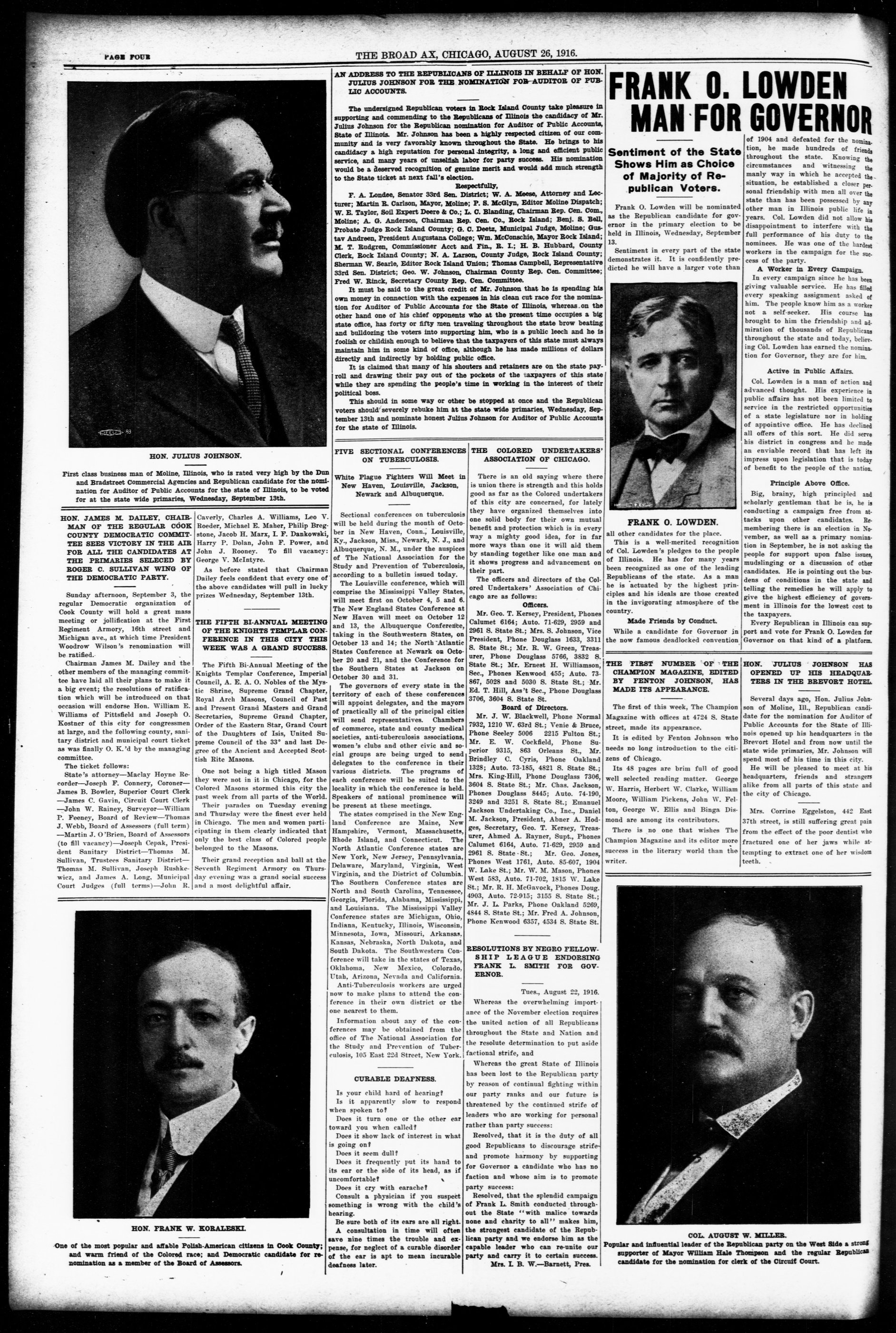
First class business man of Moline, Ill and Bradstreet Commercial Agenciation for Auditor of Public Acco for at the state wide primaries,
First class business man of Moline, Illinois, who is rated very high by the Dun and Bradstreet Commercial Agencies and Republican candidate for the nomination for Auditor of Public Accounts for the state of Illinois, to be voted for at the state wide primaries, Wednesday, September 13th.
HON. JAMES M. DAILEY, CHAIRMAN OF THE REGULAR COOK COUNTY DEMOCRATIC COMMITTEE SEES VICTORY IN THE AIR FOR ALL THE CANDIDATES AT THE PRIMARIES SELECED BY BOGER C. SULLIVAN WING OF THE DEMOCRATIC PARTY.
Sunday afternoon, September 3, the regular Democratic organization of Cook County will hold a great mass meeting or jollification at the First Regiment Armory, 16th street and Michigan ave., at which time President Woodrow Wilson's renomination will be ratified.
Caverly, Charles A. Williams, Leo V. Roeder, Michael E. Maher, Philip Bregstone, Jacob H. Marx, I. F. Dankowski, Harry P. Dolan, John F. Power, and John J. Rooney. To fill vacancy: George V. McIntyre.
As before stated that Chairman Dailey feels confident that every one of the above candidates will pull in lucky prizes Wednesday, September 13th.
THE FIETH BI-ANNUAL MEETING OF THE KNIGHTS TEMPLAR CONFERENCE IN THIS CITY THIS WEEK WAS A GRAND SUCCESS.
Chairman James M. Dailey and the other members of the managing committee have laid all their plans to make it a big event; the resolutions of ratification which will be introduced on that occasion will endorse Hon. William E. Williams of Pittsfield and Joseph O. Kostner of this city for congressmen at large, and the following county, sanitary district and municipal court ticket as was finally O. K.'d by the managing committee.
State's attorney—Maclay Hoyne Recorder—Joseph F. Connery, Coroner—James B. Bowler, Superior Court Clerk—James C. Gavin, Circuit Court Clerk—John W. Rainey, Surveyor—William P. Feeney, Board of Review—Thomas J. Webb, Board of Assessors (full term)—Martin J. O'Brien, Board of Assessors (to fill vacancy)—Joseph Cepak, President Sanitary District—Thomas M. Sullivan, Trustees Sanitary District—Thomas M. Sullivan, Joseph Rushkewicz, and James A. Long, Municipal Court Judges (full terms)—John R.
[Image of a man with a mustache and a suit]
M. H.
HON. FRANK W. KORALESKIL
One of the most popular and affable Polish-American city and warm friend of the Colored race; and Democ nomination as a member of the Board of Assessors.
One of the most popular and affable Polish-American citizens in Cook County; and warm friend of the Colored race; and Democratic candidate for renomination as a member of the Board of Assessors.
One of the most popular and affable Polish-American citizens in Cook County; and warm friend of the Colored race; and Democratic candidate for renomination as a member of the Board of Assessors.
PAGE FOUR
The ticket follows:
inois, who is rated very high by the Dum
ns and Republican candidate for the nomi-
nts for the state of Illinois, to be voted
Wednesday, September 13th.
Caverly, Charles A. Williams, Leo V.
Roeder, Michael E. Maher, Philip Breg-
stone, Jacob H. Marx, I. F. Dankowski,
Harry P. Dolan, John F. Power, and
John J. Rooney. To fill vacancy:
George V. McIntyre.
As before stated that Chairman
Dailey feels confident that every one of
the above candidates will pull in lucky
prizes Wednesday, September 13th.
THE FIFTH BI-ANNUAL MEETING OF THE KNIGHTS TEMPLAR CONFERENCE IN THIS CITY THIS WEEK WAS A GRAND SUCCESS.
The Fifth Bi-Annual Meeting of the Knights Templar Conference, Imperial Council, A. E. A. O. Nobles of the Mystic Shrine, Supreme Grand Chapter, Royal Arch Masons, Council of Past and Present Grand Masters and Grand Secretaries, Supreme Grand Chapter, Order of the Eastern Star, Grand Court of the Daughters of Isis, United Supreme Council of the $33^{\circ}$ and last Degree of the Ancient and Accepted Scottish Rite Masons.
One not being a high titled Mason they were not in it in Chicago, for the Colored Masons stormed this city the past week from all parts of the World. Their parades on Tuesday evening and Thursday were the finest ever held in Chicago. The men and women participating in them clearly indicated that only the best class of Colored people belonged to the Masons. Their grand reception and ball at the Seventh Regiment Armory on Thursday evening was a grand social success and a most delightful affair.
```markdown
```
ish-American citizens in Cook County; ace; and Democratic candidate for re- d of Assessors.
AN ADDRESS TO THE REPUBLICANS OF ILLINOIS IN BEHALF OF HON. JULIUS JOHNSON FOR THE NOMINATION FOR AUDITOR OF PUBLIC ACCOUNTS.
The undersigned Republican voters in Rock Island County take pleasure in supporting and commending to the Republicans of Illinois the candidacy of Mr. Julius Johnson for the Republican nomination for Auditor of Public Accounts, State of Illinois. Mr. Johnson has been a highly respected citizen of our community and is very favorably known throughout the State. He brings to his candidacy a high reputation for personal integrity, a long and efficient public service, and many years of unselfish labor for party success. His nomination would be a deserved recognition of genuine merit and would add much strength to the State ticket at next fall's election.
Respectfully.
F. A. Londee, Senator 33rd Sen. District; W. A. Meese, Attorney and Lecturer; Martin R. Carlson, Mayor, Moline; P. S. McGlynn, Editor Moline Dispatch; W. E. Taylor, Soil Expert Deere & Co.; L. C. Blanding, Chairman Rep. Cen. Com; Moline; A. G. Anderson, Chairman Rep. Cen. Co., Rock Island; Benj. S. Bell, Probate Judge Rock Island County; G. C. Deetz, Municipal Judge, Moline; Gustav Andreen, President Augustana College; Wm. McConschie, Mayor Rock Island; M. T. Budgren, Commissioner Acct and Fin., B. I.; H. B. Hubbard, County Clerk, Rock Island County; N. A. Larson, County Judge, Rock Island County; Sherman W. Searle, Editor Rock Island Union; Thomas Campbell, Representative 33rd Sen. District; Geo. W. Johnson, Chairman County Rep. Cen. Committee; Fred W. Rinck, Secretary County Rep. Cen. Committee.
It must be said to the great credit of Mr. Johnson that he is spending his own money in connection with the expenses in his clean cut race for the nomination for Auditor of Public Accounts for the State of Illinois, whereas on the other hand one of his chief opponents who at the present time occupies a big state office, has forty or fifty men traveling throughout the state brow beating and buldozing the voters into supporting him, who is a public leech and he is foolish or childish enough to believe that the taxpayers of this state must always maintain him in some kind of office, although he has made millions of dollars directly and indirectly by holding public office.
It is claimed that many of his shouters and retainers are on the state payroll and drawing their pay out of the pockets of the taxpayers of this state while they are spending the people's time in working in the interest of their political boss.
This should in some way or other be stopped at once and the Republican voters should severely rebuke him at the state wide primaries, Wednesday, September 13th and nominate honest Julius Johnson for Auditor of Public Accounts for the state of Illinois.
FIVE SECTIONAL CONFERENCES ON TUBERCULOSIS.
White Plague Fighters Will Meet in New Haven, Louisville, Jackson, Newark and Albuquerque.
Sectional conferences on tuberculosis will be held during the month of October in New Haven, Conn., Louisville, Ky., Jackson, Miss., Newark, N. J., and Albuquerque, N. M., under the auspices of The National Association for the Study and Prevention of Tuberculosis, according to a bulletin issued today.
The Louisville conference, which will comprise the Mississippi Valley States, will meet first on October 4, 5 and 6. The New England States Conference at New Haven will meet on October 12 and 13, the Albuquerque Conference, taking in the Southwestern States, on October 13 and 14; the North Atlantic States Conference at Newark on October 20 and 21, and the Conference for the Southern States at Jackson on October 30 and 31.
The governors of every state in the territory of each of these conferences will appoint delegates, and the mayors of practically all of the principal cities will send representatives. Chambers of commerce, state and county medical societies, anti-tuberculosis associations, women's clubs and other civic and social groups are being urged to send delegates to the conference in their various districts. The programs of each conference will be suited to the locality in which the conference is held. Speakers of national prominence will be present at these meetings.
The states comprised in the New England Conference are Maine, New Hampshire, Vermont, Massachusetts, Rhode Island, and Connecticut. The North Atlantic Conference states are New York, New Jersey, Pennsylvania, Delaware, Maryland, Virginia, West Virginia, and the District of Columbia. The Southern Conference states are North and South Carolina, Tennessee, Georgia, Florida, Alabama, Mississippi, and Louisiana. The Mississippi Valley Conference states are Michigan, Ohio, Indiana, Kentucky, Illinois, Wisconsin, Minnesota, Iowa, Missouri, Arkansas, Kansas, Nebraska, North Dakota, and South Dakota. The Southwestern Conference will take in the states of Texas, Oklahoma, New Mexico, Colorado, Utah, Arizona, Nevada and California. Anti-Tuberculosis workers are urged now to make plans to attend the conference in their own district or the one nearest to them.
Information about any of the conferences may be obtained from the office of The National Association for the Study and Prevention of Tuberulosis, 105 East 22d Street, New York
CURABLE DEAFNESS
Is it apparently slow to respond when spoken to?
Does it turn one or the other ear toward you when called?
Does it show lack of interest in what is going on?
Does it seem dull?
Does it frequently put its hand to its ear or the side of its head, as if uncomfortable?
Does it cry with earache?
Consult a physician if you suspect something is wrong with the child's hearing.
Be sure both of its ears are all right.
A consultation in time will often save nine times the trouble and expense, for neglect of a curable disorder of the ear is apt to mean incurable deafness later.
THE COLORED UNDERTAKERS
ASSOCIATION OF CHICAGO.
There is an old saying where there is union there is strength and this holds good as far as the Colored undertakers of this city are concerned, for lately they have organized themselves into one solid body for their own mutual benefit and protection which is in every way a mighty good idea, for in far more ways than one it will aid them by standing together like one man and it shows progress and advancement on their part.
The officers and directors of the Colored Undertakers' Association of Chicago are as follows:
Officers.
Mr. Geo. T. Kersey, President, Phones Calumet 6164; Auto. 71-629, 2959 and 2961 S. State St.; Mrs. S. Johnson, Vice President, Phone Douglass 1633, 3311 S. State St.; Mr. R. W. Green, Treasurer, Phone Douglass 5766, 3832 S. State St.; Mr. Ernest H. Williamson, Sec., Phone Kenwood 455; Auto. 73-867, 5028 and 5030 S. State St.; Mr. Ed. T. Hill, Ass't Sec., Phone Douglass 3706, 3604 S. State St.
Board of Directors
Mr. J. W. Blackwell, Phone Normal
7932, 1210 W. 63rd St.; Venie & Bruce
Phone Seeley 5006 2215 Fulton St.;
Mr. E. W. Cockfield, Phone Superior
9315, 863 Orleans St., Mr. Brindley
C. Cyris, Phone Oakland
1328; Auto. 73-185, 4821 S. State St.
Mrs. King-Hill, Phone Douglass 7306,
3604 S. State St.; Mr. Chas. Jackson,
Phones Douglass 8445; Auto. 74-190,
3249 and 3251 S. State St.; Emanuel
Jackson Undertaking Co., Inc., Daniel
M. Jackson, President, Abner A. Hodges, Secretary, Geo. T. Kersey, Treasurer, Ahmed A. Rayner, Supt., Phones Calumet 6164, Auto. 71-629, 2959 and
2961 S. State St.; Mr. Geo. Jones,
Phones West 1761, Auto. 85-607, 1904
W. Lake St.; Mr. W. M. Mason, Phones
West 583, Auto. 71-702, 1815 W. Lake
490; Mr. R. H. McGavock, Phones Doug.
4903; Auto. 72-915; 3155 S. State St.;
Mr. J. L. Parks, Phone Oakland 5269,
4844 S. State St.; Mr. Fred A. Johnson,
Phone Kenwood 6357, 4534 S. State St.
RESOUTIONS BY NEGRO FELLOW-
SHIP LEAGUE ENDORSING
FRANK L. SMITH FOR GOVERNOR.
Tues., August 22, 1916. Whereas the overwhelming importance of the November election requires the united action of all Republicans throughout the State and Nation and the resolute determination to put aside factional strife, and Whereas the great State of Illinois has been lost to the Republican party by reason of continual fighting within our party ranks and our future is threatened by the continued strife of leaders who are working for personal rather than party success:
Resolved, that it is the duty of all good Republicans to discourage strife and promote harmony by supporting for Governor a candidate who has no faction and whose aim is to promote party success:
Resolved, that the splendid campaign of Frank L. Smith conducted throughout the State "with malice towards none and charity to all" makes him, the strongest candidate of the Republican party and we endorse him as the capable leader who can re-unite our party and carry it to certain success.
Mrs. L. B. W—Barnett, Pres.
FRANK O. LOWDEN MAN FOR GOVERNOR
Sentiment of the State Shows Him as Choice of Majority of Republican Voters.
Frank O. Lowden will be nominated as the Republican candidate for governor in the primary election to be held in Illinois, Wednesday, September 13.
Sentiment in every part of the state demonstrates it. It is confidently predicted he will have a larger vote than
107
FRANK O. LOWDEN.
all other candidates for the place. This is a well-merited recognition of Col. Lowden's pledges to the people of Illinois. He has for many years been recognized as one of the leading Republicans of the state. As a man he is actuated by the highest principles and his ideals are those created in the invigorating atmosphere of the country.
Made Friends by Conduct.
While a candidate for Governor in the now famous deadlocked convention
THE FIRST NUMBER OF THE CHAMPION MAGAZINE, EDITED BY FENTON JOHNSON, HAS MADE ITS APPEARANCE.
The first of this week, The Champion Magazine with offices at 4724 S. State street, made its appearance.
It is edited by Fenton Johnson who needs no long introduction to the citizens of Chicago.
Its 48 pages are brim full of good well selected reading matter. George W. Harris, Herbert W. Clarke, William Moore, William Pickens, John W. Felton, George W. Ellis and Binga Dismond are among its contributors.
There is no one that wishes The Champion Magazine and its editor more success in the literary world than the writer.
1930
M. B.
COL. AUGUST W. MILLER.
Popular and influential leader of the Republican party of supporter of Mayor William Hale Thompson and candidate for the nomination for clerk of the Circ
Popular and influential leader of the Republican party on the West Side a strong supporter of Mayor William Hale Thompson and the regular Republican candidate for the nomination for clerk of the Circuit Court.
of 1904 and defeated for the nomination, he made hundreds of friends throughout the state. Knowing the circumstances and witnessing the manly way in which he accepted the situation, he established a closer personal friendship with men all over the state than has been possessed by any other man in Illinois public life in years. Col. Lowden did not allow his disappointment to interfere with the full performance of his duty to the nominees. He was one of the hardest workers in the campaign for the success of the party.
A Worker in Every Campaign
In every campaign since he has been giving valuable service. He has filled every speaking assignment asked of him. The people know him as a worker not a self-seeker. His course has brought to him the friendship and admiration of thousands of Republicans throughout the state and today, believing Col. Lowden has earned the nomination for Governor, they are for him.
Active in Public Affairs
Col. Lowden is a man of action and advanced thought. His experience in public affairs has not been limited to service in the restricted opportunities of a state legislature nor in holding of appointive office. He has declined all offers of this sort. He did serve his district in congress and he made an enviable record that has left its impress upon legislation that is today of benefit to the people of the nation.
Big, brainy, high principled and scholarly gentleman that he is, he is conducting a campaign free from attacks upon other candidates. Remembering there is an election in November, as well as a primary nomination in September, he is not asking the people for support upon false issues, mudslinging or a discussion of other candidates. He is pointing out the burdens of conditions in the state and telling the remedies he will apply to give the highest efficiency of government in Illinois for the lowest cost to the taxpayers. Every Republican in Illinois can support and vote for Frank O. Lowden for Governor on that kind of a platform.
HON. JULIUS JOHNSON HAS OPENED UP HIS HEADQUARTERS IN THE BREVORT HOTEL
Several days ago, Hon. Julius Johnson of Moline, Ill., Republican candidate for the nomination for Auditor of Public Accounts for the State of Illinois opened up his headquarters in the Brevort Hotel and from now until the state wide primaries, Mr. Johnson will spend most of his time in this city.
He will be pleased to meet at his headquarters, friends and strangers alike from all parts of this state and the city of Chicago.
Mrs. Corrine Eggelston, 442 East 37th street, is still suffering great pain from the effect of the poor dentist who fractured one of her jaws while attempting to extract one of her wisdom teeth.
publican party on the West Side a strong Thompson and the regular Republican work of the Circuif Court.
Principle Above Office.
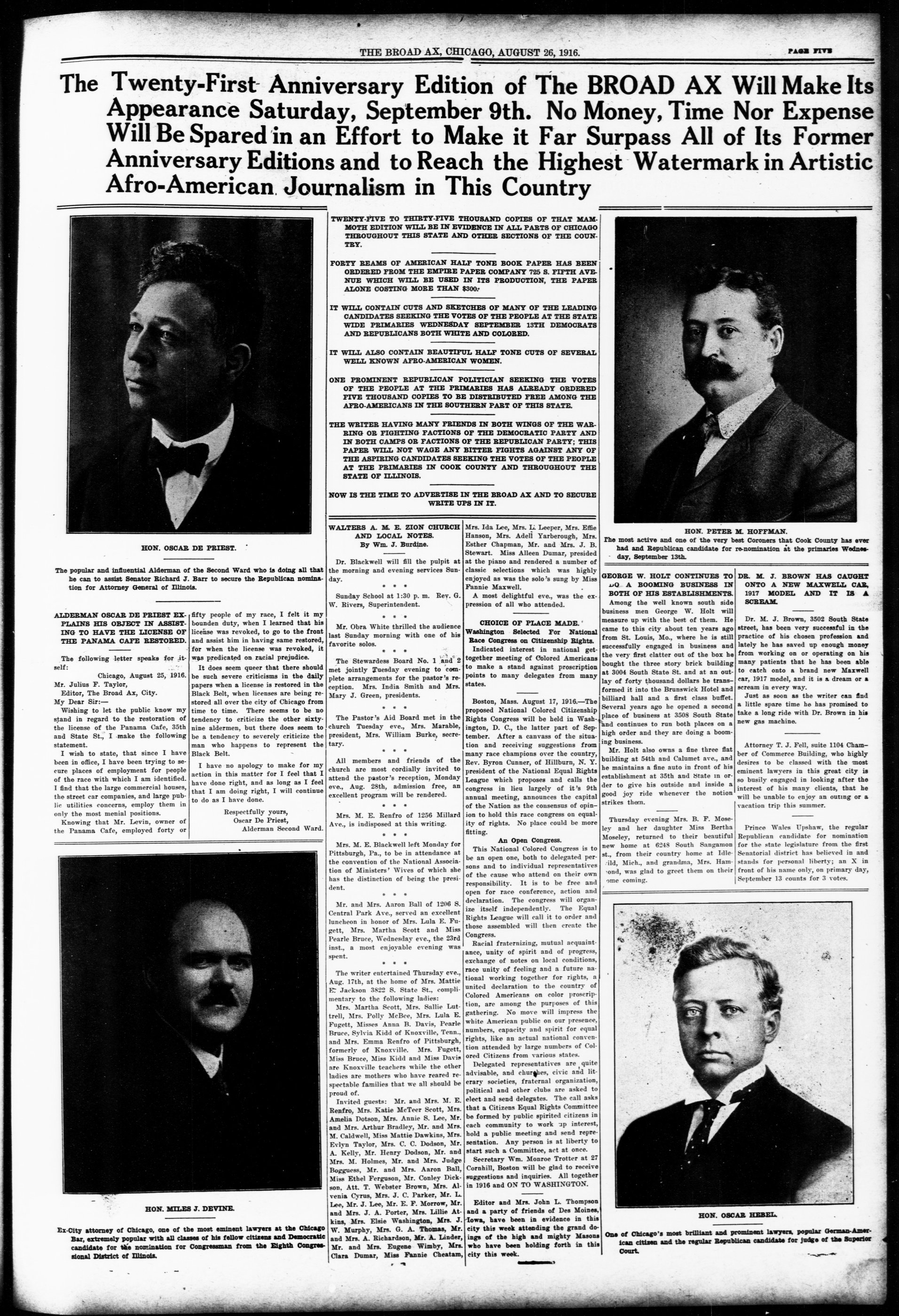
The Twenty-First Anniversary Edition of The BROAD AX Will Make Its Appearance Saturday, September 9th. No Money, Time Nor Expense Will Be Spared in an Effort to Make it Far Surpass All of Its Former Anniversary Editions and to Reach the Highest Watermark in Artistic Afro-American Journalism in This Country
J. B.
HON, OSCAR DE PRIEST.
The popular and influential Alderman of he can to assist Senator Richard J tion for Attorney General of Illin
General Alderman of the Second Ward
Actor Richard J. Barr to secure the
general of Illinois.
The popular and influential Alderman of the Second Ward who is doing all that he can to assist Senator Richard J. Barr to secure the Republican nomination for Attorney General of Illinois.
ALDERMAN OSCAR DE PRIEST EXPLAINS HIS OBJECT IN ASSISTING TO HAVE THE LICENSE OF THE PANAMA CAFE RESTORED.
The following letter speaks for itself:
Chicago, August 25, 1916.
Mr. Julius F. Taylor.
Wishing to let the public know my stand in regard to the restoration of the license of the Panama Cafe, 35th and State St., I make the following statement.
I wish to state, that since I have been in office, I have been trying to secure places of employment for people of the race with which I am identified. I find that the large commercial houses, the street car companies, and large public utilities concerns, employ them in only the most menial positions.
Knowing that Mr. Levin, owner of the Panama Cafe, employed forty or
```markdown
```
M. J.
M. J. H.
HON. MILES J. DEVINE
Ex-City attorney of Chicago, one of the Bar, extremely popular with all class candidate for the nomination for省级 District of Illinois.
cago, one of the most eminent a
ear with all classes of his fellow
nomination for Congressman from
Indinois.
Ex-City attorney of Chicago, one of the most eminent lawyers at the Chicago Bar, extremely popular with all classes of his fellow citizens and Democratic candidate for the nomination for Congressman from the Eighth Congressional District of Illinois.
Editor, The Broad Ax, City.
My Dear Sir:—
of the Second Ward who is doing all that Barr to secure the Republican nominais.
fifty people of my race, I felt it my bounden duty, when I learned that his license was revoked, to go to the front and assist him in having same restored, for when the license was revoked, it was predicated on racial prejudice.
It does seem queer that there should be such severe criticisms in the daily papers when a license is restored in the Black Belt, when licenses are being restored all over the city of Chicago from time to time. There seems to be no tendency to criticize the other sixty-nine aldermen, but there does seem to be a tendency to severely criticize the man who happens to represent the Black Belt.
I have no apology to make for my action in this matter for I feel that I have done right, and as long as I feel that I am doing right, I will continue to do as I have done.
[Image of a man with a mustache and a suit]
the most eminent lawyers at the Chicago cases of his fellow citizens and Democratic Congressman from the Eighth Congress
Alderman Second Ward.
THE BROAD AX, CHICAGO, AUGUST 26, 1916.
TWENTY-FIVE TO THIRTY-FIVE THOUSAND COPIES OF THAT MAM-
MOTH EDITION WILL BE IN EVIDENCE IN ALL PARTS OF CHICAGO
THROUGHOUT THIS STATE AND OTHER SECTIONS OF THE COUN-
TRY.
FOREY REAMS OF AMERICAN HALF TONE BOOK PAPER HAS BEEN
ORDERED FROM THE EMPIRE PAPER COMPANY 725 S. FIFTH AVENUE
WHICH WILL BE USED IN ITS PRODUCTION, THE PAPER
ALONE COSTING MORE THAN $300.
IT WILL CONTAIN CUTS AND SKETCHES OF MANY OF THE LEADING
CANDIDATES SEEKING THE VOTES OF THE PEOPLE AT THE STATE
WIDE PRIMARIES WEDNESDAY SEPTEMBER 13TH DEMOCRATS
AND REPUBLICANS BOTH WHITE AND COLORED.
IT WILL ALSO CONTAIN BEAUTIFUL HALF TONE CUTS OF SEVERAL
WELL KNOWN AFRO-AMERICAN WOMEN.
ONE PROMINENT REPUBLICAN POLITICIAN SEEKING THE VOTES OF THE PEOPLE AT THE PRIMARIES HAS ALREADY ORDERED FIVE THOUSAND COPIES TO BE DISTRIBUTED FREE AMONG THE AFRO-AMERICANS IN THE SOUTHERN PART OF THIS STATE.
THE WRITER HAVING MANY FRIENDS IN BOTH WINGS OF THE WARRING OR FIGHTING FACTIONS OF THE DEMOCRATIC PARTY AND IN BOTH CAMPS OR FACTIONS OF THE REPUBLICAN PARTY; THIS PAPER WILL NOT WAGE ANY BITTER FIGHTS AGAINST ANY OF THE ASPIRING CANDIDATES SEEKING THE VOTES OF THE PEOPLE AT THE PRIMARIES IN COOK COUNTY AND THROUGHOUT THE STATE OF ILLINOIS.
NOW IS THE TIME TO ADVERTISE IN THE BROAD AX AND TO SECURE WRITE UPS IN IT.
WALTERS A. M. E. ZION CHURCH
AND LOCAL NOTES.
By Wm. J. Burdine.
Dr. Blackwell will fill the pulpit at
the morning and evening services Sunday.
* * *
Sunday School at 1:30 p. m. Rev. G.
W. Rivers, Superintendent.
* * *
Mr. Obra White thrilled the audience
last Sunday morning with one of his
favorite solos.
* * *
The Stewardess Board No. 1 and 2
met jointly Tuesday evening to complete arrangements for the pastor's reception.
Mrs. India Smith and Mrs.
Mary J. Green, presidents.
* * *
The Pastor's Aid Board met in the church Tuesday eve., Mrs. Marable, president, Mrs. William Burke, secretary.
* * *
All members and friends of the church are most cordially invited to attend the pastor's reception, Monday eve., Aug. 28th, admission free, an excellent program will be rendered.
***
Mrs. M. E. Renfro of 1256 Millard Ave., is indosed at this writing.
---
Mrs. M. E. Blackwell left Monday for Pittsburgh, Pa., to be in attendance at the convention of the National Association of Ministers' Wives of which she has the distinction of being the president.
* * *
Mr. and Mrs. Aaron Ball of 1206 S. Central Park Ave., served an excellent luncheon in honor of Mrs. Lula E. Fugett, Mrs. Martha Scott and Miss Pearle Bruce, Wednesday eve., the 23rd inst., a most enjoyable evening was spent.
---
The writer entertained Thursday eve, Aug. 17th, at the home of Mrs. Mattie E. Jackson 3822 S. State St., complimentary to the following ladies: Mrs. Martha Scott, Mrs. Sallie Luttrell, Mrs. Polly McBee, Mrs. Lula E. Fugett, Misses Anna B. Davis, Pearle Bruce, Sylvia Kidd of Knoxville, Tenn., and Mrs. Emma Renfro of Pittsburgh, formerly of Knoxville, Mrs. Fugett, Miss Bruce, Miss Kidd and Miss Davis are Knoxville teachers while the other ladies are mothers who have reared respectable families that we all should be proud of.
Invited guests: Mr. and Mrs. M. E. Renfro, Mrs. Katie McTeer Scott, Mrs. Amelia Dotson, Mrs. Annie S. Lee, Mr. and Mrs. Arthur Bradley, Mr. and Mrs. M. Caldwell, Miss Mattie Dawkins, Mrs. Evlyn Taylor, Mrs. C. C. Dodson, Mr. A. Kelly, Mr. Henry Dodson, Mr. and Mrs. M. Holmes, Mr. and Mrs. Judge Bogguess, Mr. and Mrs. Aaron Ball, Miss Ethel Ferguson, Mr. Conley Dickson, Att. T. Webster Brown, Mrs. Alvenia Cyrus, Mrs. J. C. Parker, Mr. L. Lee, Mr. J. Lee, Mr. E. F. Morrow, Mr. and Mrs. J. A. Porter, Mrs. Lillie Atkins, Mrs. Elsie Washington, Mrs. J. W. Murphy, Mrs. G. A. Thomas, Mr. and Mrs. A. Richardson, Mr. A. Linder Mr. and Mrs. Eugene Wimby, Mrs. Clara Dumar, Miss Fannie Cheatam
Mrs. Ida Lee, Mrs. L. Leeper, Mrs. Efie Hanson, Mrs. Adell Yarberough, Mrs. Esther Chapman, Mr. and Mrs. J. B. Stewart. Miss Alleen Dumar, presided at the piano and rendered a number of classic selections which was highly enjoyed as was the solo's sung by Miss Fannie Maxwell.
A most delightful eve, was the expression of all who attended.
CHOICE OF PLACE MADE.
Washington Selected For National Race Congress on Citizenship Rights. Indicated interest in national get together meeting of Colored Americans to make a stand against proscription points to many delegates from many states.
Boston, Mass. August 17, 1916—The proposed National Colored Citizenship Rights Congress will be held in Washington, D. C., the latter part of September. After a canvass of the situation and receiving suggestions from many race champions over the country, Rev. Byron Cunner, of Hillburn, N. Y. president of the National Equal Rights League which proposes and calls the congress in lieu largely of it's 9th annual meeting, announces the capital of the Nation as the consensus of opinion to hold this race congress on equality of rights. No place could be more fitting.
An Open Congress.
This National Colored Congress is to be an open one, both to delegated persons and to individual representatives of the cause who attend on their own responsibility. It is to be free and open for race conference, action and declaration. The congress will organize itself independently. The Equal Rights League will call it to order and those assembled will then create the Congress.
Racial fraternizing, mutual acquaintance, unity of spirit and of progress, exchange of notes on local conditions, race unity of feeling and a future national working together for rights, a united declaration to the country of Colored Americans on color proscription, are among the purposes of this gathering. No move will impress the white American public on our presence, numbers, capacity and spirit for equal rights, like an actual national convention attended by large numbers of Colored Citizens from various states.
Delegated representatives are quite advisable, and churches, civic and literary societies, fraternal organization, political and other clubs are asked to elect and send delegates. The call asks that a Citizens Equal Rights Committee be formed by public spirited citizens in each community to work up interest, hold a public meeting and send representation. Any person is at liberty to start such a Committee, act at once. Secretary Wm. Monroe Trotter at 27 Cornhill, Boston will be glad to receive suggestions and inquiries. All together in 1916 and ON TO WASHINGTON.
Editor and Mrs. John L. Thompson and a party of friends of Des Moines, Iowa, have been in evidence in this city this week attending the grand doings of the high and mighty Masons who have been holding forth in this city this week.
HON. PETER M. HOFFMAN
e of the very best Coroners tha
candidate for re-nomination a
The most active and one of the very best Coroners that Cook County has ever had and Republican candidate for re-nomination at the primaries Wednesday. September 13th.
The most active and one of the very best Coroners that Cook County has ever had and Republican candidate for re-nomination at the primaries Wednesday. September 13th.
GEORGE W. HOLT CONTINUES TO DO A BOOMING BUSINESS IN BOTH OF HIS ESTABLISHMENTS. Among the well known south side business men George W. Holt will measure up with the best of them. He came to this city about ten years ago from St. Louis, Mo., where he is still successfully engaged in business and the very first clatter out of the box he bought the three story brick building at 3004 South State St. and at an outlay of forty thousand dollars he transformed it into the Brunswick Hotel and billiard hall and a first class buffet. Several years ago he opened a second place of business at 3508 South State and continues to run both places on a high order and they are doing a booming business.
Mr. Holt also owns a fine three flat building at 54th and Calumet ave., and he maintains a fine auto in front of his establishment at 35th and State in order to give his outside and inside a good joy ride whenever the notion strikes them.
Thursday evening Mrs. B. F. Moseley and her daughter Miss Bertha Moseley, returned to their beautiful new home at 6248 South Sangamon st., from their country home at Idleild, Mich., and grandma, Mrs. Hamond, was glad to greet them on their come coming.
1
HON. OSCAR HEBEL
brilliant and prominent lawyer
e regular Republican candidate
One of Chicago's most brilliant and prominent lawyers, popular German-American citizen and the regular Republican candidate for judge of the Superior Court.
Will Make Its Nor Expense of Its Former Work in Artistic
est Coroners that Cook County has ever re-nomination at the primaries Wednes
DR. M. J. BROWN HAS CAUGHT ONTO A NEW MAXWELL CAR, 1917 MODEL AND IT IS A SCREAM.
Dr. M. J. Brown, 3502 South State street, has been very successful in the practice of his chosen profession and lately he has saved up enough money from working on or operating on his many patients that he has been able to catch onto a brand new Maxwell car, 1917 model, and it is a dream or a scream in every way.
Just as soon as the writer can find a little spare time he has promised to take a long ride with Dr. Brown in his new gas machine.
Attorney T. J. Fell, suite 1104 Chamber of Commerce Building, who highly desires to be classed with the most eminent lawyers in this great city is so busily engaged in looking after the interest of his many clients, that he will be unable to enjoy an outing or a vacation trip this summer.
Prince Wales Upshaw, the regular Republican candidate for nomination for the state legislature from the first Senatorial district has believed in and stands for personal liberty; an X in front of his name only, on primary day, September 13 counts for 3 votes.
[Name]
prominent lawyers, popular German-Ameri
dican candidate for judge of the Superior
PAGE FIVE
Pa@r Six
PLEADS FOR BLIND
Calls Upon = Women to
i Help War Victims.
PLANS TO “TEACH TRADES.
With Her Unceasing Zest For Good
Deeds, Mra. Whitney Makes a Specia
Plea to Help Alleviate Suffering Ir
European Countries.
One of the latest steps taken by the
sympathizers of the allies is an appeal
issued by the B. F. B. (British, French,
Belgian) Permanent Blind Relief fund,
‘with headquarters in New York, over
the names of Lady Arthur Paget of
the fund's executive committee and
Mrs, Harry Payne Whitney, one of the
honorary secretaries, calling upon the
women of America for aid. ‘The appeal
says In part:
“Unless you act these thousands of
‘women will be condemned for the rest
of their lives to an existence of hope-
Jess drudgery and hardship.
“For humanity's sake help these Ev-
ropean women. They are your sisters,
even though you have never seen them.
“Six months’ training will educate
the blind men dependent on them in
trades not requiring sight. Even your
Ss
Photo by American Press Association.
4MBS. HARRY PAYNE WHITNEY,
single donation alone will go far to-
‘ward enabling one of these sightless
men to support himself and partly sup-
Port his family for the rest of his life.
“These women stretch appealing
hands to you from across the ocean.
Make at least one of them permanent-
ly happy and her husband, father or
son particularly useful by sending us 2
contribution.
“The sooner you act the sooner one
brave, good, faithful woman will be
rescued from an existence of despair
and crushing slavery and the sooner
the man who is tragically anxious to
support her will be saved from a life of
uselessness and hopelessness.”
‘Mrs. Whitney {s also a sculptor of
rare achievement, and frequently her
Deautiful studio becomes the setting of
some charity benefit. She lately voiced
one of her own art axioms in these
words:
“Beauty without intelligence is the
beauty of an unlighted lamp. There
must be brain to direct the expression
of beauty.”
FOR THE SEWING ROOM.
Family Sewing.
A chiffonier or bureau in the sewing
room will be found indispensable. One
drawer is used for the stock room, and
the small wares are kept therein; one
1s for patterns, one for pieces to use
for patching and mending and one for
clothing to be mended or fixed over.
An old tron incased in a two pound
sugar bag is just the thing to hold
your work while sewing. It takes the
Place of the old fashioned bird that is
seen sometimes.
If the pins are kept in a deep saucer
‘one can pick them up or throw them
down easily when fitting a dress.
‘Take a board of the desired length
and width and drive a number of
nails through two inches apart. These
will hold the spools of thread. ‘The
numbers can be quickly seen, and
there will be no tangling with the scis-
sors,
Cream jars are excellent for but-
tons, as they can be classified and
easily distinguished therein.
An old sheet spread on the floor will
catch all threads and can be easily
shaken, leaving the room tidy with no
exertion.
Flowere Fer Birth Month.
, January—Snowdrop—Consolation.
, February—Primrose—Early youth.
‘March—Violets—Modesty.
| April—Daisy—Innocence.
May—Hawthorn—Hope.
Jone—wild rose—Simplicity.
| July—Lily—Purity.
August—Poppy—Consoling sleep.
September—Morning glory—Content
ment.
October—Hops—Joy.
November — Chrysanthemum—Cheer
fulness.
December—Holly—Foresight.
STYLE TIPS.
One Is Rows of Silk Stitch-
ing Used as Trimming.
Just one whisper today about the
new modes for fall. Paris openings are
over, and the autumn styles are pretty
well settled—the Paris styles, that is
American women do not always abide
dy these styles.
‘They look over the new modes and
select those that appeal to them most,
iscarding others, and presently the
selected modes appear with miraculous
swiftness in the shops for everybody to
buy. But there are two or three salient
features in the Paris styles that cannot
be disregarded, even thus early, for
thelr repetition by one couturier after
another foretells their sure importance
as winter style features.
One of these is silk stitching used as
© trimming. The Paris frocks and
coats are fitted by many seams and
darts, all stitched conspicuously in more
or less fanciful effect. Pocket flaps,
cuffs, revers—they are all garnished
with silk stitching, and skirts and
tunes have often a score or more of
rows of this stitchery, done on the ma-
chine in effective chain stitch.
Alpaca is a surprise for the coming
season. Both alpaca and mohair are
being used by some of the couturiers in
tailored frocks for day wear. Some of
these models are appealingly chic, as,
for instance, a sample frock of black
twilled alpaca with a full overskirt
pressed into little box plaits and fall-
ing almost to the edge of a plain foun-
dation skirt. This frock has a button
in back bodice with long, close sleeves
and one of the enormous Japanese col-
lars that are to be the rage without
doubt. The bodice is loose, flat at back
and front and plaited into the waist at
the sides. It is attached with a stitch.
ed seam to the box plaited overskirt,
little tabs in the bodice extending down
over the plaits to emphasize the long
waisted effect. Under this moyen age
bodice is a foundation fitted to the
waist line and stiffened to insure
trimness, though the outer button in
back bodice is loose rather than close
fitting.
Silks for formal frocks and evening
frocks, of course, and Paris whispers
that satins and satin surfaced silks
will be most in favor. Of these a new
silk called soiree is exquisitely beauti-
ful in its lights and shades of color, a
most enchanting silk for evening gowns
of distinction. Worth and Jenny have
brought out stunning gowns in velvet,
the Jenny model a slip over the head
affair distinctly novel, with bands of
Belgian hare for trimming. Very dis-
Hnguished is an afternoon gown by
Premet made of navy blue charmeuse,
with a good deal of black chantilly
lace draped airily in the bodice and a
big Japanese collar of navy blue mous-
seline draped around throat and shoul-
ders. The combination of navy satin
and black lace is particularly elegant
and refined, and this gown of Premet
is sure to make a decided hit with wo-
men of conservative taste. Ag bril-
llant as-the Premet gown fs, quiet and
elegant {s a Klein dance frock of gold
colored silk voile and cream lace, with
an underslip of flesh pink silk. ‘The
skirt is yards and yards wide, and at
the back an odd sash forms a pannier
bustle and then trails to the floor, the
frock itself being short enough to re-
veal the feet and ankles
AUTUMN’S TULIPS.
Here’s a Stunning Doily For All Nee-
ie dleworkers.
On a piece of finest linen circularly
cut, figured and featherstitched are em.
broidered a hedge of yellow tulips and
Gy "i te ES
ec 8
Cc ae
r GEIGER. *
& RUN AFD 3
me
A BS
(ee: 8§=8 =
fe > | oa :
; “Ss ow § OP
. Erie ,
— “Genny
Se
EB RO a)
RARE AND BEAUPLFUL.
then spiky greenery. The shading is
true to nature and the design as rare
as it is beautiful.
Fatigue Injures Temper.
More than half of the ill temper and
irritability displayed by women are due
to fatigue, not only of the body, but
of the nerves. Every woman should
learn how advisable it is to rest daily
and to rest in the proper way. After
a tiring day, whether it be housework,
looking after the children, shopping ot
paying calls, balf an hour's rest will
work wonders,
‘Take off your shoes, put on soft slip-
Pers and slip into a loose gown. Pull
down the blind; then either He down
‘or sit in a comfortable easy chair, say,
| for twenty minutes. Even if you
don't sleep you will rest. After bath-
ing, rearranging the hair and getting
into fresh clothes you will feel lke 2
totally different woman and equal to
any work that may be necessary.
loed Coffee,
Pour two quarts of boiling water
over one-half pound of best coffee and
Jet stand one-half hour; then strain off
the clear liquor through cloth, add one
quart of milk and one-quarter pound
of sugar. Pour into freezer and pack
well around with ice and salt. Let tt
stand an hour before using, then serve
‘im small coffee cups.
THE BROAD AX, CHICAGO, AUGUST 26, 1916.
—$—$—$————————————
AD ‘i ee ee
FOR YOUNG FOLKS {rau eouse
—— New Walsts Are Marked
Sleepy Time Story About the| 4 Se” Celereé =e ee
Fairies of Faraway Denmark. ont striped nits promise te:
———— w bik 5 a
BLACKSMITH’S QUEER WIFE. swe te ct wt
Strange Thing That Happened to Her bi me oa
Neighbors When They Refused to Be =
Sociable—Some Things of Interest to an
Little People—Girl on the Beach. (oe
Now, kiddies, said Uncle Ben to ut-| <eagiiinaamas
tle Ned and Polly Ann, I am going Cae 7
to teli—
A DANISH LEGEND. a all
Once upon a time the daughter of
one of the underground people, the
Bergmen, was married to a smith who
lived in Mors.
| Kirstin was a good and most patient
‘wife, ulthough her husband, the smith,
“was cross and surly and sometimes
even beat her when he was in an ill
temper.
Kirstin did not lke this at all, and
one day when he had taken up a stick
intending to strike her she seized a
great horseshoe which was lying on
the anvil and broke it in two without
any difficulty. -
‘The smith was astonished. “Are you
that strong?” he asked. “Then why
have you never resisted when I struck
you?”
“Because I love you,” said Kirstin.
“Tl strike you no more!” said the
smith, and he kept his word.
The people of Mors, however, were
not friendly to the Bergman's
daughter and in spite of her desire to
be on pleasant terms with them
avolded her and would scarcely even
nod to her when they met.
One day, as she and all the people
were standing in the churchyard, wait-
ing for the arrival of the minister,
Kirstin said to her husband:
“Listen to me—my father 1s coming
to see me, but he is angry.”
‘As she thus warned her husband the
Bergman appeared, and a most awe
inspiring person he was! Indeed, he
was so terrible to look at that ‘the
people would have liked to creep into
the earth to avoid him.
“My dear daughter,” said the Berg-
man, “I hear the people here will have
naught to do with you, so I have come
to remedy that!”
“Yes, father,” replied Kirstin. “Tit
toss them up in the air a bit,” said he.
“Will you pitch or catch?”
“Til catch,” sald Kirstin, for she
feared the Bergman would handle the
people very roughly.
‘Then began a merry game. ‘The Berg-
man stood on one side of the church,
Kirstin, his daughter, on the other, and
the Bergman tossed all the people in
turn over the roof of the church to Kir-
stin, who deftly caught them.
No one was injured, but every one
was badly scared. But the plan worked
to a charm, for so long as Kirstin lived
she was treated with the greatest re-
‘spect and consideration.
Size of the Ark.
In Genesis vi, 15, we have the meas.
ure of the ark to be as follows: “The
length of the ark shall be 300 cubits,
the breadth of it 50 cubits and the
height of it 30 cubits.” We find that
authorities differ somewhat as to the
exact length of a cubit. It may be
from eighteen inches to twenty-one
inches. If we take twenty inches as
the length of a cubit the ark would
measure 500 feet by 831-3 feet by 50
feet. A slight variation, one way or
the other, will make no material differ.
ence in the final measure.
Romping on the Beach.
Hanging on the ropes at the bathing
beach, the girl in the picture is safe
from a wetting because the tide is
hao ee eee
; _ ec.
bg ie
ie ey
FS J
i -_
a> —
SM S;
eS ‘A a
peat J se
[ac oe
foes’ foe ie AE es
ee, ae
oo fm
ho Re eS
Photo by American Press Association.
KIOKIVG UP HER HEELS.
low. She is having a jolly time and
kicking up her heels gayly. The little
girl's name is Aubrey Davies, and she
lives at Southampton, N. Y.
FALL BLOUSE.
eee eee eeee eens
New Waists Are Markedly
Gay Colored and Dressy.
Gayly striped silks promise to feature
the new blouses. This one is a wistaria
and white taffeta cut with an open
b= ve
a Vi 4
eet - ON
a. @ i a
I fa
Hi r \
rf.
* aay
A fa Nee
Ya
Pal Sy ~ °
ULTRA MODEL.
front filled by a perky white organdie
vestee and a cartridge fluted ruff. Tiny
taffeta buttons parade down the front.
NEW NETHERS.
‘The Kind of Stockings That Go With
Fall Shoes.
Whoever said that simple footweat
was coming back into fashion was
much mistaken. To be sure, certain
styles of “fancy” shoes were marked
down last winter, but other styles quite
‘as elaborate took their place, and, as
for stockings, never before have they
been so varied and so far from plain
‘or simple.
| There is some thought that cotton
| stockings, colored ones at that, may be
worn, for the price of silk stockings 1s
soaring by the hour. But just at the
moment silk stockings are made in
hundreds of patterns.
Stripes form the most prominent
stocking decoration or motive. Some.
times they are up and down stripes,
sometimes stripes running around:
‘sometimes they extend the whole
Jength of the stockinz, sometimes only
halfway down or halfway up.
There are checked stockings, too,
and plaid ones, and there are stock-
ings with odd and trrecular designs.
Then, too, regular clocking at the
ankles, in colors or black on white, is
@ prominent feature of the summer
‘stockings. Clocks are especially smart
for wear with sport shoes, and they
add to the effectiveness of low shoes
worn with short skirts
One black and white combination
shows half inch stripes extending from
‘the toe to the calf, ending there in ar-
‘rowheads. Another shows a panel of
‘stripes extending the full length of the
stocking, about four inches across the
front.
One of the newer sorts of evening
stockings show bended embroidery.
This {s in line with the vogue for bead-
ed embroidery and sequins and span-
gles that is so strong for evening
frocks.
Inserts of real Ince, too, in fine silk
stockings are used for evening. And
another evening idea is a white silk
stocking painted with flowers to
match a painted kid slipper. This, of
course, is so unusual that it may’ al-
most be considered a freak style. But
it is interesting and is mentioned for
what it is worth.
| PUNISH TO EDUCATE.
Parents Should Never Act on Impulse
| of Moment.
Never punish a child on the impulse
of the moment. The correcting of a lit-
tle child is a very serious matter—a
matter to be thought over earnestly
and (if you are the kind that prays)
even prayerfully, Always keep in mind
that true punishment fs not revenge:
neither is it vindication nor retaliation
it {s, or should be, nothing more or
less than education. The time for pun-
ishment affords you an invaluable op-
portunity to teach a youngster but one
of the many, many lessons of life it
must learn.
‘Therefore it is extremely important
that you do not punish a child when
you are angry. In anger you will more
than likely be unjust and also too
severe. In anger you are in a fair way
to lose your own respect and the child's.
See that the punishment fits the fault
and that ft has within it the power to
teach the difference between right and
‘wrong in the particular instance under
consideration.
Cool Frock.
A frock made of white material dot-
ted with blue spots and trimmed with
blue ribbon is ideal for a summer aft-
=
FOOD THAT FEEDS
Why Do We eat aap In Sum-
mer Time?
WHAT IS "A. GoD MENU?
Most Housewives Don’t Know Food
Values to the Extent of Giving «
Family, Especially Growing Children,
the Proper Proportions of Protein.
One of the most important things
that every housewife should know
about food is its value as nourishment
for the body. We must in fact have
foods that feed. There are several
kinds of values that all human bodies
need in the food they eat and with-
out which they cannot be healthy and
well nourished. These are:
Material to build the body and repair
waste.
Material to give heat and strength.
Material to enrich and cleanse the
blood.
‘Material to form bone. :
Let us take them in order.
It may be sald of the body building
material that, in a sense, it is the most
important of all, because we cannot
live without it, while we might go on
llving for some time without most of
the others (though we could not long re-
main healthy). Cheese, lentils, haricot
beans, split peas, meat, fish, oatmeal,
‘eggs, nuts and, to a somewhat less ex-
tent, good bread, all have much body
building material.
Fats of all kinds, such as butter,
cream, suet, dripping, margarine and
nut butter, give warmth and enerzy,
strength and power to work. Sugar,
molasses and golden sirup are also
heat giving, and so are starchy foods,
such as potatoes, rice.and cornstarch.
‘These foods, however, contain very lit-
tle body building material.
Vegetables and fruit (other than
peas, beans and lentils) contain scarce-
ly.any of the body building materials,
but they give the body what no other
foods give—that is, certain juices which
purify and enrich the blood and with-
out which no one can be healthy. It
is these precious juices which are
thrown away when vegetables are
bolied in water and the water poured
down the sink. If these juices were
taken by people every day in properly
cooked vegetables there would not be
nearly so much money spent at the
drug store, as they are the best pos-
sible form of natural medicine.
‘The bone forming materials are to be
found principally in milk and cheese,
good bread, oatmeal and in onions and
many green vegetables. They are ab-
solutely necessary for growing children.
‘The result of children not getting
enough of them is only too often to be
seen in bad teeth and stunted growth.
| Grape Juice Pudding.
One cupful of grape juice, one cup-
fal of water, one cupfui of sugar, one
fourth cupful of taploca, the juice of
one lemon, a pinch of salt and stiffly
beaten whites of three eggs. Soak the
taploca for fifteen minutes in a cup of
water; place in saucepan, add the
sugar; when hot add the grape juice.
Cook ‘until the tapioca is transparent,
then add the lemon juice and salt.
Lastly fold in the beaten whites of the
eggs.
WHAT’S COMING.
Fine Feathers Make Fine Birds This
Fall, You See.
Feather trimmings promise to take
the place of beads, which are going
on to handbags. This snug little shape
b
4
“ee
oa
y.
\ D eet A
QUITE ADVANCED.
of black velvet with its chic brim is
mate meve Cains te tee 1
green birds that perch on thé
and turn tail to breezes.
THIS “WALKING DRESS” {
Peete te cee
For Fall Trotteurs Is Es-
pecially Smart, You Know,
‘The smartest American designer js
putting out this model set up in navy
‘gaberdine with an interesting coat top
| .
fa
Ye
Fa
THE LATEST ONE.
belted low. Cording and much stitch-
Ing are both signs of autumn's note, so
the long coat skirt has a corded bem.
‘The collar and cuffs are organdie.
HOMEMADE CARAMELS.
No Reason Why One Should Not Be
‘Cencenetet Witt Them.
ee Sa Soo
To make chocolate caramels take a
quarter pound of grated chocolate, three
‘ounces of butter, three-fourths pound
of sugar, one gill of milk, two good
‘dessert spoonfuls of syrup. @ small
dessert spoonful of glucose, half a tea-
spoonful of vanilla essence. Put every-
thing except the vanilla Into a pan.
and dissolve over a slow Bre. Boil to
246 or 248 degrees, take off the fire
and add the vanilla essence, and turn
into @ well greased tin. Mark with a
knife when set and cut into squares
and wrap each in wax paper.
‘The tin should be greased with oil or
clarified butter—i. e.. butter that bas
been put into a pan and heated and
the scum taken off as it rises.
Molasses candy (cftramel) is made of
three-fourths of a pound of sugar, a
quarter of a pound of butter, one and a
half pints of milk. two tablespoonfuls of
molasses. Melt the butter and sugar in
@ saucepan, then add the sirup and
milk, and boil, stirring till it leaves the
sides of the pan clear. Pour on toa
buttered plate and when nearly cold
cut into squares and wrap each in wax
paper. If a thermometer Is used it
should boil to 252 degrees. Ten to fit-
teen drops of vanilla can be added. if
Mked, before turning it on to the but-
tered plate.
eames: hase Slee
It fs astonishing to note that gala-
tea fs being used in dresses for grown-
ups. Hitherto it was confined to dress-
es for the schoolgirl and little tot, but
at the present time it is also adapted
for mother. It is shown {n plain col-
ors, such as blue. green, rose and white,
and often trimmed with pique or a
combining fabric. Other models are
shown in striped effects, the founda-
tion being white and the stripe in color.
One particularly attractive dress was
Seen recently, the colors being blue
and white. The arrangement of the
stripes affords a fovel detail. The odd
fiat collar with flat satin tie and deep
cuffs are of white pique. The broad
brimmed hat and high button boots are
details of interest. A gown of this
type is especially useful for morning
and informal wear. Galatea is an ex:
cellent fabric for use in middy blouses
and sports skirts, because it has suill-
cient body to avoid getting crumpled.
It fs also very suitable for simple
sports suits, where the skirt is a two
Pieced model and the coat @ bor cut.
‘which is belted at the waist .’ne. With
appropriate hat and shoes a sult of
this type proves an ideal and practical
summer outfit. Asa “tub” frock, that
is so indispensable during the summer
months, there is nothing to equal the
shirt waist dress of galatea in plain or
striped effect.
Homemade Motor Veils.
Just a length of chiffon or similar
weight veiling, twenty-seven inches oF
more in width and about one and one-
half yards in length. Both ends are
fiaisbed with a tiny bem. Insert a nine
{meh fength of round elastic and attach
at each end of the elastic a narrow
ribbon string. The vell is adjusted by
Placing the elastic edge well down over
the hat in front and holding the veil in
place over the hat by tying the ribbon
strings at the nape of the neck, Many
of the bordered motor veils frequent!’
a ee eet ke nz coves
mske two of these handy requisites
QUINADE
GROWS HAIR
REMOVES DANDRUFF
SEMD FOR SAMPLE
QUINASOAP
THE IDEAL SHAMPOO SOAP
THOROUGHLY CLEANS THE SKALP
QUINACOMB
HAIR STRAIGHTENER
SHAMPOO DRYER
QUINADE 25¢ QUINACOMB 50¢ QUINACAP 25¢
AT ALL DRUGGISTS
SEEBY DRUG COMPANY, NEW YORK CITY, N.Y.
THE SANITARY and SHIP CANAL
Length - - - - - 32 Miles
Depth - - - - - 22 Feet
Width - - - 162 to 290 Feet
THE CANAL OFFERS:
Industrial Locations, Dock Facilities, Water Transportation, Railroad Connections, Electric Power, Concrete Building Material. Direct Connection with St. Louis via the Illinois River and Direct Connection with the Gulf via the Illinois and Mississippi Rivers. Electric Energy Created from Water Power for the Modern Factory Means Efficiency and Economy.
Karpen Building
900 So. Michigan Ave., CHICAGO
Confession of a Contributor.
I wish I might never have to dangle my profession on a label. I am always embarrassed when I am forced blatantly to expose it—for example, to the frank questions of the doctor's secretary or of a customs official. "Profession?" they ask, and I cringe before the admission, "I am a writer." I don't feel ladylike when I say the words. On such occasions I could give my entire remuneration for an Atlantic essay to be able to say, "I am a laundress."—Wintref Kirkland in Atlantic.
Inguisitive Girls
Bessie—I almost hate Carrie Dyerl
She asks such impudent questions, you
know. I was telling her if Frank
Barnes had asked me to marry him
once he had asked me twenty times,
and she had the impertinence to ask
me if he had asked once. Minnie—The
idea! But has he. Bessie?—Exchange
Welcome Joy.
Ef you ain't got manners ter tell
Joy good mawnin' when you meets
him how does you expect him ter call
round' by de place you live at? You
be好 be mighty keerful, fer, while
he is allus in a good humor, he she'
do expect you ter meet him halfway.—
Atlanta Constitution.
Too Much of a Good Thing.
That man's laugh is like a tone.
"I don't deny that it has a cheerful ring," the cynic said, "but hearing the same loud laugh all day long is like taking a dose of medicine every hour—it gets to be monotonous."—Birmingham Ace-Herald.
Wrong Font.
"Ah, I see—she made a typographical error!" -Florida Times-Union.
Powers of the Fireside
Wife—The policeman called on the cook last night. Husband—Ah! A conference of the powers.—Baltimore Sun.
The opportunity is often lost by deliberating.—Syrus.
President
Chief Clerk
Comptroller
Building
Ave., CHICAGO
The record for fasting, so far as our best information goes, is held by Graine, a French murderer, who determined to starve himself to death and from day to day after his arrest refused to eat.
In spite of every effort on the part of his keepers, who first tried to tempt him to eat by placing the most dainty meals in his cell and when that failed attempted feeding him by force, he held out for sixty-three days, at the end of which period he died.
With the exception of Graine's case the longest well authenticated instance of fasting on record is that accomplished by Glovanni Succi, who lived at the Royal Aquarium, London, for forty-five days without food.
An Emperor's Compliment.
Napoleon III. had his full share of the Bonaparte wit, tinged with a kindliness all his own. At a ball at the Tulierles a middle aged officer and his fair partner came to grief. As the mortified veteran scrambled to his feet the emperor extended a hand to him and, turning to the lady, remarked: "Madame, this is the second time I have seen the colonel fall. The first time was on the battlefield of Magenta."
Mark Twain's Definition:
It is told of Mark Twain that during a conversation with a young lady of his acquaintance he had occasion to mention the word drydock.
"What is a drydock, Mr. Clemens?" she asked.
"A thirsty physician." replied the humorist.
Search Marks.
Sometimes scorch marks may be removed by merely laying the dry garment in the sunshine until the rays fade it white again. If the stain remains it may be dipped in soapsuds of some strength and placed in the sun again until the spot is gone.
Its Class.
She—I waive all claim to your pitiful, unworthy, utterly despicable affections. He—Whew, but that was some hot wave.—Baltimore American.
THE BROAD AX, CHICAGO, AUGUST 26, 1916
Beauty of Pennsylvania. In one respect only Pennsylvania is unchanged and unchangeable. Men have dealt harshly and shamefully by her, but nature has crowned her with beauty. Her founder, knowing nothing of his broad tracts, save that they were forest lands, gave to the new province the pretty name of Sylvania, and Charles II., always a pastmaster of words, prefixed the Penn, for which pleasant conceit every son and daughter of the state owes him a grateful thought. Thus the word Pennsylvania perpetuates history, honors a noble name and symbolizes the loveliness of the land, a land of woods and waters, hills and valleys, fat farms and rocky solitudes. The shrinking engine that drags its trainload of passengers through the valley of the Junata, across ridge after ridge of the Alleghenies, past the Tuscarora gap and the succession of narrows—Long Narrows, Jack's Narrows, Packsaddle Narrows—has traversed a country so widely and nobly beautiful that, in Europe, it would attract the tourists of the world.—Agnes Repplier in American Magazine.
Sitting on a Tack.
A thing is tragic or humorous according to the point of view. The man who sits on a tack does not share the onlookers' amusement. In fact, he is not only palmed at his own misfortune, but he is pained because he occasioned some one else to find a degree of pleasure in his unseemly plight. Now, it is perfectly safe to make this positive statement in this connection—the person who witnessed the other's unfortunate encounter with the tack never deliberately sits on the same tack himself. Indeed, he is particularly cautious about sitting down anywhere soon thereafter without looking for a tack. Nor is this an indictment of tacks. Tacks serve a very real and useful purpose in this world, but they have their place, which is not in localities where they may be sat upon.—William C. Lengel in Hoggson Magazine.
Caught Him Both Ways.
"I ask you to pay me this bill," said a tailor to a waggle debtor.
"Do you owe anybody anything?"
asked the wag.
"No sir." replied the tallor.
A day or two afterward the tailor called again. Our wag was not at his wits' end, so, turning to his creditor, he said: "Are you in debt to anybody?"
"I haven't got the money," replied the tailor, with a woebegone countenance. "That's just my case, my dear sir. I am glad to perceive that you can appreciate my position. I always respected your judgment, sir. Give me your hand, sir." -London Mall.
Some Geographical Doubles.
Accidental doubles of geography are very curious. There are the two totally unconnected Galician, the one in Austria-Hungary and the one in Spain. As to the Carpathians, the doubling occurs between the ancient and the modern atlases. On the map of the ancients we find a people named Carpi in the north of what is now Hungary and north of them the Carpatus mountains. But "Carpathian" in Vergil, Horace and Ovid means something quite different. The Carpathian sea was the sea between Rhodes and Crete, from the island of Carpathus, now Scarpanto, and the "Carpathian old man" was Proteus, who lived and no doubt practiced his quick change tricks there.-London Spectator.
Eooled His Subjects
King Erricus of Sweden publicly confessed that he was a sorcerer and magician. He was the owner of an enchanted cap, which he pretended enabled him to control the spirits and change the direction of the winds at pleasure. So firmly did his subjects believe in the supernatural powers of their ruler that, when a storm arose they would exclaim, "Ah, the king is again wearing the magic cap!"
What She Misses.
"I suppose you miss your husband terribly?"
"No; I can't say that I do. I was a golf widow for years before he died, but it does seem strange not to have him phone that he is going to be late for dinner." - Detroit Free Press.
PRACTICAL HEALTH HINT.
Proper Sleep.
To the average individual in the modern civilized community, with its various opportunities and limitations, there is good reason to believe that a proper amount of sleep is the chief health conserver. All about us life, both animate and inanimate, obeys the laws of nature and passes into some form resembling sleep, usually while the sun is beneath the horizon.
Authorities on health and hygiene point out more and more the need of securing at least eight consecutive hours of sleep. Where this cannot be done as a routine, day after day, they advice that the proper amount of sleep be made up some time during the twenty-four hours. The universal practice of this policy no doubt would do more than any other single factor to promote health and prevent disease.
Invasions of Russia.
The first great invasion of Russia was that of the Huns, a race of fierce and warlike Asiatics, who swept over eastern Europe in the fourth century.
In the thirteenth century the golden horde of Tartars captured Russia, and from 1238 to 1462 the country was under the yoke of the Mongols. In 1395 Tamerlane invaded Russia, but retreated. In 1462 the Slavs again gained the ascendency, and Ivan III. (the Great) founded the present monarchy and introduced firearms and cannon into Russia.
In 1479 there was another great invasion of Tartars, but they were driven out. In 1613 the present royal family, the Romanoffs, gained the throne. In 1700 the Swedes invaded Russia, but after several victories they were routed.
The last great invasion of Russia was that of Napoleon. His disastrous retreat from Russia, in which most of his army was destroyed, marked the beginning of the end of his power.—St. Louis Post-Dispatch.
An Invisible Clock
A public clock which can be heard, but not seen, is one of London's curious possessions. It is in the tower of St. Mary Abbot's church, Kensington, and is the only public clock in the immediate neighborhood. It chimes the quarters and the hours, but commits itself no further. It has no dial, no hands, no outward and visible sign of any kind to show that it is a clock. This eccentricity, it is explained, is the result of two causes—one aesthetic, the other financial. When the tower was built in 1879 a clock was suggested as an afterthought, but the architect protested that it would mean the addition of fifteen feet to the tower and the ruin of its cherished proportions. A second point was that the church, having but slender funds, could not afford a clock with a dial. A compromise was arrived at by installing the works of a chiming clock in the belfry without dial or hands.—Pearson's.
Profitable Pebbles
The fint pebble industry gives occupation to many women and children along the French coast lying between Havre and Dieppe. The pebbles collected in and near Havre are selected for their spherical shape and are used exclusively for pulverizing in certain industries, particularly in the manufacture of cement and in copper mines, being employed in the interior of large cylinders. In the cement industry the slow turning of the pebbles produces a powder which becomes an ingredient of the cement, while in the copper industry the metal is freed of all impurities by the grinding operation. The same kind of pebbles is used for crushing purposes in the manufacture of paint. Another important use of fint pebbles is in the manufacture of porcelain, the pebbles for this purpose being found between Fecamp and Calais.—Philadelphia Press.
A "Friday" Ship
A true story is told of a skeptical Massachusetts captain who way back in the early years of the republic determined to exhibit the fallacy of the Friday superstition. He contracted on a certain Friday for the building of a ship, and it was arranged that the keel of this vessel was laid on Friday, that she was launched on a Friday, named Friday, commenced loading on a Friday and hauled into the stream on the same day of the week. To add to the possibilities of disaster, a negro cook named Friday was engaged, and, thus fully freighted with the slister name, the Friday sailed on a Friday, bound to a port in the West Indies. From that day to this no tidings of the ill fated craft have been received.
Salt In the Spectrum.
The extreme delicacy of the spectrum test is illustrated by the fact stated by Lommel that the three-millionth part of a milligram of a salt of sodium, an imperceptible particle of dust to the naked eye, is yet capable of coloring the flame of a candle yellow and of giving the yellow lines of sodium in the spectroscope. Indeed, sodium in the form of a common salt (sodium chloride) is so universally present as an impalpable dust floating in the air that it is next to impossible to get a spectrum which does not show the sodium lines.
Knew the Brand.
"Is that a Landseer, Mr. Croesus?" asked the visitor, pausing before the painting.
"No," replied the host; "reckon it is a Durham. See how broad it is between the horns, and see the color and curl on its forehead. That's a genuine Durham sure."—Exchange.
Balky Machine
"Do you want me to watch your automobile?" asked the boy.
"Yes," replied Mr. Chuggins. "And if it tries to start up and run away don't stop it. Holler for me, and I'll take a chance on overtaking it and getting the first ride I've had for three or four hours."—Washington Star.
Wiadom.
Wisdom may be compared to water. As water leaves the heights and gathers in the depths, so is wisdom received from on high and preserved by a slowly soul—Talmud.
Kindness of Nature
"She gives us all faces, but we can pick our own teeth."—Harvard Lampoon.
Stupidity has no friends and wants none.—Horace Greeley.
Pure woolens are adulterated even more than silk because they are in greater demand and also because they are quite easy to imitate. Many a yard of cloth sold as "pure wool" contains from 30 to 60 per cent cotton. Blankets sold as "half wool" have frequently been found to contain only 10 per cent of pure wool. There are machines today which cleverly wrap wool around cotton threads, and the finished product has every appearance of being "all wool." Another method of adulterating is by taking cotton cloth and "felting" short woolen threads upon its surface by means of heat, moisture and pressure.
A purchaser may be fully convinced from the appearance and feeling of cloth that it is all wool, but the only safe method is to take home the sample and make tests. Immense the sample of so called wool in oil of vitriol for about two minutes. This will destroy the cotton, but the wool will not be affected. Another test is to molisten a sample with 50 per cent nitric acid. This will turn the wool yellow, but the cotton will retain its color.—Washington Post.
Harvest From One Ad
Do you know what was the largest harvest ever reaped from an advertisement?
It was the settlement in Pennsylvania of 100,000 German colonists at Germantown, which was the first German settlement in America. We also know that in fifty years double that many thousand Germans came to William Penn's colony.
Furthermore, history tells us that wars and religious persecutions in Germany caused this then unparalleled exodus of men and women.
But what brought them to Pennsylvania and so made of the German commonwealth? An advertisement written by William Penn himself and distributed among the Germans along the Rhine, who had been stricken by the Thirty Years' war.—Philadelphia Ledger.
Won by Good Looks.
One man in English history owed his success in life almost wholly to his good looks. It was George Villiers, first duke of Buckingham. James I. was wanting a private secretary, and when young Villiers applied for the position the king was much impressed with the beauty of his person and the gracefulness of his manners. He gave him the place, and that was the beginning of a great career. From that time to the end of James' reign the history of England was in great part the personal history of George Villiers, the adventurer—first the cupbearer, in a few weeks knighted, then made gentleman of the bedchamber and knight of the Order of the Garter; then successively he was made a baron, a viscount, an earl, a marquis and lord high admiral of England.
Snubbed the Composer
Gustav Mahler had a queer experience in Munich one day for which his name was partly responsible. His new symphony was being rehearsed, and he took advantage of an hour's intermission to get some fresh air. "On returning to the building," says a Munich paper, "he lost his way and tried to reach the hall through a corridor in which plasterers were at work. 'You cannot pass through here,' he was told. 'But I am Mahler.' (Mahler is the German for painter.) 'You look it,' was the unsympathetic reply of the man who blocked his way. 'We are not ready for the painters yet, so run on.' And the composer, realizing that argument would be useless, plunged into the labyrinth and finally reached his destination."
Matter of Taste
Now comes a learned man, a doctor, who says there is no reason on earth why people should not eat bugs. Well, this is a free country, doc, and just to show you that our heart is right we hereby notify you that you are welcome to our share of potato bugs and buffalo moths if the per capita supply does not satisfy your appetite. P. S.—Would you advise eating them with sugar and cream or salt and vinegar?—Ohio State Journal.
Back to Her Tender Years.
Boarder—This beef is very tough. It is evidently from an old cow. Mrs. Hashleigh—Let me tell you, sir, that the tenderest beef I ever ate was from a cow fifteen or twenty years old. Boarder—That's easily explained. The cow was so old she was childish.—Chicago Tribune.
A Woman and a Trunk
Griggs—Weren't you surprised that the oms inspector didn't find those things you smuggled in? Briggs—Oh, no. My wife stowed them away, you see. She can pack things in a trunk where she can't even find them herself—Exchange.
Much Needed.
"What do you think of the Don't Worry club?"
"S all right. Only I wish some one would start a Don't Worry Other People club."—Boston Transcript.
Truth.
Truth is a torch, but one or enormous size, so that we slink past it in rather a blinking fashion for fear it should burn us.—Goethe.
Limited Time.
"Does the landlady give you your meals on time?" (Sadly) "Yes, but I fear she won't trust me much longer."—Dallas News.
There are 4,000,000 tons of stone in the pyramid of Cheops.
PAGE SEVEN
PHONES: OFFICE, MAIN 4183
AUTOMATIC 33-736
RESIDENCE, DREXEL 7990
Walter M. Farmer
ATTORNEY AT LAW
SUITE 708, 184 WASHINGTON ST.
NOTARYPUBLIC CHICAGO
Office Phones: Res. 5133 S. Wahab Ave.
Oakland 6622, Ante. 73-058 Phone Dresel 18315
Dr. Theo. R. Moze
DENTIST
4709 S. STATE STREET
CHICAGO
Heure 9 A. M. to 5 P. M., 7 P. M. to 9 P. M.
Sundays by Appointment
Phone Main 2017 Automatic 32-395
A. L. WILLIAMS
ATTORNEY AND COUNSELOR AT LAW
Suite 706 Firmenich Bldg.
184 W. Washington St.
Residence 5548 Jefferson Av.
Phone Midway 5515 Chicago
A. D. GASH
ATTORNEY AT LAW
118 North La Salle St., Chicago
Suite 615 to 616
PHONE MAIN 2214
Residence 1262 Macalister Place
Telephone Monroe 2714
MILES J. DEVINE
ATTORNEY AT LAW
Suite 313-329 Reaper Block
Clark & Washington Ste.
Phones Central 239
Auto. 41-818
CHICAGO
Franklin A. Denison
ATTORNEY AT LAW
36 West Randolph St., Chicago
Suite 708 Delaware Building
Tel. Central 3142
FRANK DUNN
J. B. McCAHEY
Trustees
Established 1877
TEL. OAKLAND 1850, 1851, 1852
JOHN J. DUNN
WHOLESALE COAL RETAIL
Fifty-First and Armour Avenue
RAILYARDS
51st St. and L. S. & M. S.
51st St. and Armour Ave.
ONIOACO
THE BROAD AX CAN BE FOUND
ON SALE AT THE FOLLOWING
NEWS STANDS:
From on and after this date The
Broad Ax, can be found on sale at the
following news stands:
N. C. Chalmers, cigars, tobacco, notion store and news stand, 5012 S. State street.
L. E. Chilton, news stand, S. E. corner 51st and State streets.
S. Berenbaum, cigars, Notions and News Stand; 31 W. 51 Street, near Dearborn.
E. H. Faulkner, news agency; 3109 S. State street.
George I Martin, maker of fine cigars and news stand, 18 W. 31st St., near State.
E. M. Harvey's barber shop and news stand, 3924 State street.
W. M. Maxwell, notions, cigars, tobacco, confections and news stand, 5244 State St.
Edward Felix, notions, cigars and news stand, 52 W. 30th St.
F. Bishop, cigars, tobacco and news stand, 3 W. 27th St., near State.
Sylvester McGloffin, news stand and laundry office, 4122 State St.
William Gaughan, laundry office, cigars, tobacco and news stand, 2636 State St.
R. M. Oliver, notions, cigars and news stand, 15 W. 38th Street, near State.
A. D. Hayes, cigars, tobacco, notions, stationary and news stand, 3640 S. State St.
George McFare, shee shining parlers and news stand. 3200½ State street.
T. B. Hall, Laundry office, cigars, tobacco and news stand. 3618 South State street.
Fred M. Waterfield, cigars, tobacco, notions and news stand, 5202 South State street.
Coleman & Glanton, cigars, tobacco and news stand, 3243 S. State street.
Miss R. M. McClain, hair dressing parlor and news stand. 30 W. 39th street.
F. M. Diffay, cigars, tobacco, notions and news stand, 3205 State street.
[Blank space]
. TEENAN JONES’ PLACE
: 3445 SOUTH STATE STREET
ae Telephone Douglas 4591
: _ The finest and most UP-TO-DATE
BUFFET and CAFE on the South
‘Side. First-Class Entertainers.
HENRY “TEENAN” JONES, Proprietor.
a. 0000208, pouatas 5971
J. H. WHISTON, Proprietors Phones DOUGLAS 3256
eenasron: coon oustae esse
ROCCO CEO OEIOCTEEEN OIIOO
The Elite Cafe
AND BUFFET
3030 STATE STREET CHICAGO
OHM BLOOKI, Presigent : F. W. BLOOKI, Treasurer
JOHN BLOCK! & SON
PERFUMERS
eee G0 0
C. E. KREYSSLER, Druggist
5057 South State Street
NOT ON THE CORNER
FOR HIGH GRADE DRUGS, CHEMICALS AND
MEDICINAL PREPARATIONS
All Prescriptions Carefully Compounded
ALSO CARRY A FULL LINE OF
BLOCKI’S IDEAL & BLOCKI’S FLOWER
IN BOTTLE PERFUMES
ee ee
All Eye Trouble
SEE
Dn. Lovie USSELMANK
| - The Practical O tician
| TMi mOST COMPLETE OPTICAL ROOMS IN THE CITY
| COMPLETE OPTICAL, ROOMS IN
| Consultation or examination | 3150 S. STATE ST.
REE Ea | are se
guarantee to give satisfaction. CHICAGO
PAGE EGET
‘The religion inculcated by Buddha
had certain cardinal points—the en-
couragement of the ascetic life, the
maintenance of virtue, the exhortation
to persons of all castes and both sexes
to aim at deliverance from the evils of
existence and, lastly, the attainment of
Nirvana.
But in Tibet Buddhism has been
grafted on to the earlier devil worship
of the people, and a religion has been
evolved better expressed as Lamaism,
or modified devil worship, so that in
addition to the Buddhas and Bodisats
there have also come to be tutelary
and guardian deities of a terrifying
and malignant aspect, whose duty it is
to defend the faith and the faithful
people from external attack. These
Geities are depicted in grotesque and
terrible forms in all the monasteries,
generally in violently colored fresco
paintings at the entrance. — National
Geographic Magazine.
Paste This on the Family Tool Chest.
The idea of this cabinet is to furnish
amusement to the family when they
have scratched up all the furniture and
done all the damage elsewhere they
can think of; therefore
Do not replace or put back anything
that you take out of these drawers.
Try, if possible, to select and remove
from this cabinet some article or tool
that is absolutely indispensable, leav-
ing it preferably out in the back yard.
If you have anything hanging about
your room that is of no earthly use
you might store it in one of these
Grawers.
Remember that the main idea of hav-
ing this cabinet on the premises is
gradually to fill it with utterly useless
things.
And remove from it at the same time
all the useful things.
Patience! Keep at it and you are
bound to succeed.—Life. & &
iene cea
Bere is the old King Richard IL
way of making sausage: “Pyggs in
sawse sawse,” or pigs with sage
‘sauce. “Take pyges yskaldid (scald.
ed) and quarter them and seeth them
tm water and salt; take them and let
them kele (cool); take parsel (parsley),
mawge (sage) and grynde it with brede
and yolkes of ayren (eggs) harde ysode
(boiled); temper it with vinegar some-
‘what thick, and lay the pyggs in a
‘Yeusel and sewe onoward (the sauce
over them), and serve it forth.” “Take
yess” is pretty good. Size or number
Seems of no consequence.
—<$<$<$$<$<$<——_—_—_
One of the most rarely witnessed of
natural phenomena, but one that has
often been discussed at scientific meet-
ings and that always awakens wonder
when seen, is the so called “gréen
flash” occasionally visible at the mo-
ment of the disappearance of the sun
behind a clear horizon. The observer's
eye must be fixed upon the rim of the
sun as it disappears in order to eateh
the phenomenon. One authority tells
us that he has seen the green flash,
although rarely, at ,the instant of the
setting of a bright star. Among the
explanations offered is one based upor
the optical principle of complementary
colors. If one looks at the sun and
then closes the eyes a green disk will
be perceived. A sensitive eye might
be similarly affected by a brilliant
star.
eee Re eae Wain
In some ways which might nowadays
be called “sentimental” the laws of an-
cient Wales were in advance of those
of today. J. E. Lioyd in his “His
tory of Wales” mentions that in some
of the codes (which were, as a rule,
very severe on theft) a remarkable
provision exempted from punishment
“the starving man who, after begging
for three days-and recelving nothing,
helped himself to the food which he
needed in order to keep him alive
‘That every man had the right to live
was a principle of the law, and the
sentiment of the country demanded
that every person of substance should
keep open house ngt only for ordinary
travelers, but also for the destitute and
the friendless.”
African Grosbecks.
The social grosbecks of South Africs
live in large societies. They select s
tree of considerable size and Uterally
cover tt with a grass roof, under which
thelr common dwelling is constructed
‘The roof serves the double purpose of
keeping off the heat and the rain, and
400 or 500 pairs of binds are known tc
have the same shelter. The nests in
this aerial dwelling are built in regu
lar streets and closely resemble rows
of tenement houses.
Sure Bait. ,
“How did you manage to sell that
Plece of goods that’s all out of date to
Mrs, Hifi?”
Clerk—I told her it was a great bar.
gain, but I thought Mrs. Richcoin bad
had it laid aside for one of her daugh-
ters. Then she took it right off.
"THE BROAD AX, CHICAGO, AUGUST 26, 1916.
26-Passenger funeral Coaches
(Carries Complete eaete Ano Fume Cemetery andReturn
Greater Elegance, Half the Cost
SS ee ee ee
ESS ae rea SSE TE Pees od eee
Sere More them Half the High Cont of Carriages and Automobiles
Tel. Kenwood 455 Calla Promptly Answered Day or Night Auto. 73-867
- ERNEST H. WILLIAMSON
pavatecuart. = UNDERTAKER NOTARY PUBLIC
5028-5030 S. State St, Austin tw At Onmime Chicago, Ill.
STARR PETS I NaS I
past six months:
“In the existing lethargic state of
the stock market, little effect has ap-
parently been exercised by the almost
phenomenally favorable earnings re-
ports of so many of the country’s larg-
est railways. The figures of the Penn-
sylvania Railroad are a case in point.
All the lines, eastern and western, in
the Pennsylvania system show for the
month of June and for the six months
ending June 30 the following results,
compared with the figures for the cor-
responding periods in 1915 and 1914:
Gross, June 1916, $37,514,060; Gross,
June 1915, $31,609,836; Gross, June
1914, $30,978,496.
Net after tax, June 1916, $10,222,160;
Net after tax, June 1915, $8,456,564;
Net after tax, June 1914, $7,415,024.
Six months, 1916, Gross, $210,605,-
049; Six months, 1915, Gross, $164,
779,708; Six months, 1914, Gross,
$170,632,212.
Six months, 1916, Net after tax,
$50,767,754; Six months, 1915, Net af-
ter tax, $28,749,315; Six months, 1914,
Net after tax, $26,647,225.
Similar results are displayed by the
‘New York Central lines, the earnings
of all the lines included in that system
for June and the first six months of
this and the two preceding years be
ing as follows:
Gross, June 1916, $30,436,298; Gross,
June 1915, $25,157,492; Gross, June
1914, $23,727,060.
Net after tax, June 1916, $9,809,338;
Net after tax, June 1915, $8,060,266;
Net after tax, June 1914, $5,483,935.
=Six months, 1916, Gross, $172,520,
744; Six months, 1915, Gross, $135,
548,138; Six months, 1914, Gross, $133,-
044,175.
Six months, 1916, Net after tax, $53,
320,447; Six months, 1915, Net after
tax, $30,435,152; Six months, 1914,
$19,013,534.
‘These figures, however, are not iso
lated examples of the recuperation
which has occurred in railway traffic
and revenues. The Southern Railway
system, in its report for June and the
twelve months ending June 30, exhi
bits a total income’ applicable to
charges of $24,426,031, compared with
$16,638,828 for the preceding fiscal
year, while its surplus over fixed
charges is given as $9,358,104, against
$1,656,682 in 1914-15, an increase of
$7,701,422, or more than four and one
half times the available income of the
year before. The Northern Pacific
may also be cited to show the country:
wide nature of the improvement.
That system’s gross for the twelve
months ending June 30 is given as
$75,936,402, against $63,171,653 the
year before, and its net for the same
period as $51,032,338, compared with
$21,550,081 in 1914-15.”
Associate Justice Louis D. Brax
peis of the United States Supreme
Court will not be a member of the
Joint American-Mexican Commission
to settle pending disites between the
two countries. He declined the ap
pointment saying:
“Upon consultation with the chiet
justice I find the state of the business
of the Supreme Court at the present
jtime to be such that it is my duty no
to undertake this important additional
CONFERENCE OF THE STATE Bar EXaxt
INERS IN DEFINING THE STANDARD OF
ADMISSION TO THE BAR—A Conference
of the State Bar Examiners, Supreme
Court judges, law school teachers and
others interested will be held in con
nection with the annual meeting
ot the American Bar Association in
Chicago. The conference, which will
be held under the auspices of the
Legal Education Section of the Amer
fean Bar Association, will meet in the
green room, of the Congress Hotel
Chicago, on Tuesday, August 29, 1916
|at 3 p.m. and at $ p.m. It will be
‘opened by Judge Henry Stockbridge
of the Maryland Court of Appeals
The discussions of the different topics
presented will be opened by Mr
Charles L. McKeehan, of the Pennsy!
vania Board of Bar Examiners; Pro
fessor William R. Vance, dean of the
University of Minnesota Law School;
Judge John C. Rose, of the federal
bench, District of Maryland, and Mr.
Hollis R. Bailey, of the Bar Examiners
for Massachusetts.
The conference will deal with a
number of distinct propositions sub-
mitted, after long consideration, by a
special committee on Standard Rules
for Admission to the Bar. The full
program, including the terms of the
proposition submitted for discussion,
can be had on application to Charles
‘M. Hepburn, Secretary of the Section
of Legal Education, Indiana Univer:
sity Law School, Bloomington, Indi-
ee
Lecat Action ox THE Fiy.—“The
automobile that hit me five minutes
was No, 41144 Ohio,” he sputtered.
“It knocked me unconscious, but I got
the number before I went down for
the count. Put it on a piece of paper,
41144.”
“All right. What do you want?”
“What do I want? Why, I can
prove that he was exceeding the speed
limit, and I want—I want—"
“Calm down, friend. You want 2
warrant for his arrest?”
“Warrant, nothing! What good
would a warrant do me? He was
going so fast, I tell you, that a war
rant wouldn't get him now. What |
want is extradition papers!”—Mil
waukee Evening Wisconsin.
Tae American Law Review for
July-August, 1916, contains the fol
lowing:
I. Recall of Judges and Judicial In
dependence, by James M. Kerr of Les
Angeles, Cal.
II, The Lawyer Friends of Charle:
Lamb, by Alvin Waggoner of Philip
Ss. D.
Ill. Private Turnpikes and Bridges,
by Clinton J. Evans of Topeka, Kan
IV. Bacon's Lost Rules and Deci
sions, by Wm. A. Gardner of Farming
ton, Mo.
V. Lawyers’ Fees Historically Con
sidered, by Wilbur F. Browder o!
Russellville, Ky.
VI. The English Constitution, b3
Alex. P, Humphrey of Louisville, Ky
VII. Current Topics and Notes.
VIII. Notes of Recent Decisions.
IX. The Docket.
X. Book Reviews.
|, XI. Books Received.
Stupendous Surnames.
‘The bearers of some of the surnames
which appear in medieval documents
must have been glad of an excuse to
change them. Apparently this was
done, for the more grotesque have
either vanished or have been modified
‘out of recognition, Among the former
are such names as Alice Thepunders-
stepdoghtre, Mazelina Stabwourchman,
Frethesancela Del Countynghouse,
Godisman Attestretesende and Thomas
Wrangwisshe, wifich certainly have no
claimants nowadays.
Many surnames derived from trade
or service have been contracted, such
‘as Le Lindraper into Draper, Le Cou-
hirde into Coward, Le Chapelayn into
Chaplin and Le Gresuenour (gros ve-
neur) into Grosvenor.—London Opinion.
A Queer Creature.
Queer that while the male seal is a
bull and the female a cow their young-
ster is not called a calf, but a pup.
_ Why “seal fisheries,” too, when the
seal is not a fish?
"And why should the seal’s breeding
place be styled a rookery?
It looks as if this strange creature is
only a fish in common parlance while
‘at sea. On land (or ice) it is classed
popularly with animals or birds. —Ex-
change. =
| tien et Sie
Pateffamilias—Well, Mr. Smith, I'm
pleased to see you at our humble board
for the first time. Now, is there any
particular cut you fancy?
ProspecttreSon-in-law—Ob, no, thank
you, I think—
Youngest Daughter of the House—
Dad, aren't you going to ask Cissie?
You know what a shindy she kicks up
if she doesn’t get first pick—Lendon
Opinion
The Beginning and End.
Fond Mother—It was at this potnt tn
the entrancing landscape that my
Gaughter received a declaration “and
accepted. Friend—And tell us the rest
ef the romance. Fond Mother—Un-
fortunately that is all there was—Meg-
gendorfer Biaetter.
gv JESSE BINGA
— $, Es Car, State and 36th Place, Chicagy
Telephone Douglas 1565
GENERAL
BANESING
3 per cent allowed on Savings Accounts
Safety Deposit Vaults, $3.00 per Year
REAL ESTATE DEPARTMENT
Asagent buy and sell Real Estate on commission, manages estates for non-resi-
dents, including payment of taxes and locking after assessments. Money to loan
en Chicago Real Estate.
Especially Invites the patronage of Chicago business men.
The- Cranford Apartmeit
Building, 3600. Wabash Ave
foe oe. Penn es ae : oe
pee Ree eee ad Beer
AS Sallis T- aa ped
SLES ala a 3 en
aca es 2a Pee |
ea ee IL Sie ety
2 =e ae | bao
i ag is i= = so {
aS a , |
i = ee | =|
Fl er (She .
F =a % Pa ry A |
i an fe aaa ie
; H i |
I a ar y
4 es
i x es ay
ae Tas 2 J |
|S aee—— or age ae
eS
The finest building ever opened to Colored tenants in Chicago
Steam heat, electric light, tile baths, marble entrance.
J. W. Casey, Agent,
*Phone Randolph 803 74 W. WASSINGTON STREET.
Honolulu.—The reforesting or sow
barren Kahoolawe island, in the Ha-
wailan group, is the proposition the
territorial board of agriculture, the
members of which, after a visit to the
small islet heretofore designated un
suitable for settlement, decided to be
gin the work of planting algaroba
trees there.
It ts recommended a portion of the
island swept by the strong trade winds
be fenced to prevent depredations by
sheep and wild goats. Members of the
board say the {introduction of horses
on the island would assist in the dis
tribution of seed.
Tt ts also proposed to construct sev-
eral large reservoirs to conserve the
rainwater that falls so plentifully at
all times. Algaroba trees planted there
ten years ago have reached a substan.
tial growth.
COLORS EMPLOYED ON FARM.
Barnhart Tells How He Made the
Whole Place Yellow and White.
Reading, Pa.—Henry A Barnbart
ef Indiana told the committee of the
state board of agriculture, in session
bere, of his efforts in behalf of the
artistic side of farming.
He illustrated this by citing that his
big barns and outbuildings are all
painted yellow, with white trimmings:
the farmhouse is painted white, with
yellow trimmings; the cattle have the
same yellow color, because they are
Guernseys; not a horse is used except
he is yellow and has a white mark on
his head and white feet. The shepherd
dog is yellow. with a white band
around bis neck: there are yellow col-
ored chickens, yellow colored squirrels.
the place being known as the “Color
Scheme Farm of Indiana.”
BORN WITH EIGHT TEETH.
Baby Also Brought Into World a Suf-
ficient Quantity of Hair.
Pittsburzh.—A baby boy born with
eight teeth and Sumsonian locks has
the attention of all Undercliff. The
boy has been numed Alvin Leroy King
and is the son of Mr and Mra. Leroy
King.
‘When the baby opened bis mouth for
his first lusty yell the nurse was sur
prised to see four teeth each im upper
and lower jaws The child's head was
covered with black hair Ever since
the King home bas been an attraction
for mothers, fathert and children call-
tng to nee the tinby
Protects Tame Jack Rabbit.
Bloomingdale. ind.—Wiltiam B Leow-
ard has inserted a notice in the news
Papers requesting bix friends and
neighbors not to harm bix pet Kansas
jack rabbit The rabbit has the run of
the Leonard farm, but is 50 domestt
ated that It returns at night to sleep
te the kiteben
~~ Naming a Famous Dish.
If you are a gonrmet you like lob-
ster. The man who made lobster a la
Newburg famous refused to have his
name go with it. He gave Delmonico
the recipe, and Del gave the delicacy
the name it bears today, while that of
the benefactor is never heard outside
of the little circle in which he lived.
Well, the creator uf the dish was
Benjamin Wenburg, a New York bro-
ker. He used to take his luncheons at
Delmonico’s downtown place, not many
blocks from the Battery. When he told
Del how to make lobster a la Newburg
it had no name then—Del put it on
his bill and called it lobster a la Wen-
burg.
‘Wenburg got angry about it and told
Delmonico if he didn’t remove his
mame he would feed elsewhere. The
big caterer reversed the first syllable,
and the title has been what you have
Deen accustomed to see ever since—
Richmond Times-Dispatch.
Whim of e Great Actor.
Balvini, the great Itallan tragedian,
made ft a condition that none of his
sons should act in Italy so long as he
remained on the staze. So Gustavo was
banished to the other countries of the
continent and acted in Russia and
Austria with some success, Alexander
learned the English language and
played in this country until he died at
an early age. Tomaso fs now an actor
im Italy and {s said to have inherited
to a greater degree than any of his
brothers the talents of his father.
Salvin was married twice; first to
Clementine Cazola. an eminent Italian
actress, who died, leaving him three
small children. Many years later he
marrjed an Englishwoman named Lot-
tle Sharp. by whom he bad two chil-
ren. His grandchildren have attract-
@d attention in art and other cireles in
Ttaly.—Argoyaut.
ae
Flowers are produced by the sacri-
fice of stem and leaves. which subordl-
nate their own functions to the making
of seed to carry on the species. In the
late summer time. when plants have
flowered and set their seed, the leat
spirit seems again to assert itself and
fm many Instances becomes so strong
that the miracle of its self sacrifice is
Tevealed. One often sees roses, after
producing perfect blossoms. producing
Wome which push out a small bunch of
green leaves from the heart, or perhaps
the axis of the aborted stem grows
right out from the middie and bears a
small secondary rosebud. This sec-
ondary rose {s generally smothered in
a calyx more like a conglomeration of
leaves than any ordinary calyx, the
calyx showing @ strong tendency to
revert to the leaf form—Edinburgh
ieimaar: