The Broad Ax
Saturday, September 2, 1916
Chicago, Illinois
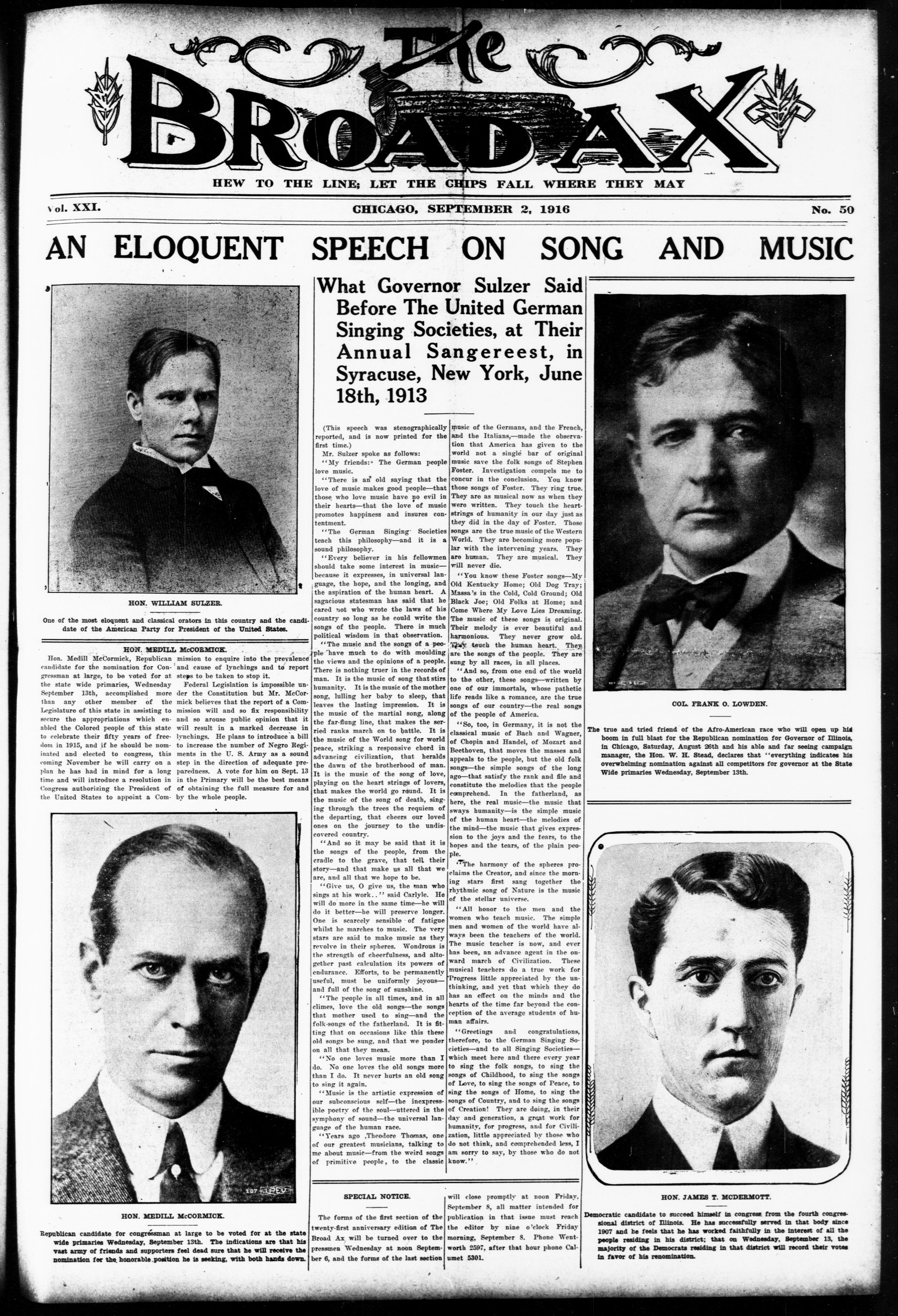
Page text (machine-generated)
THE BROAD AX
AN ELOQUENT SPEECH ON SONG AND MUSIC
AN ELO
HON. WILLIAM SULZER.
One of the most eloquent and classica date of the American Party for
ment and classical orators in this
American Party for President of the
One of the most eloquent and classical orators in this country and the candid date of the American Party for President of the United States.
HON. MEDILL. McCORMICK
Hon. Medill McCormick, Republican candidate for the nomination for Congressman at large, to be voted for at the state wide primaries, Wednesday September 13th, accomplished more than any other member of the Legislature of this state in assisting to secure the appropriations which enabled the Colored people of this state to celebrate their fifty years of freedom in 1915, and if he should be nominated and elected to congress, this coming November he will carry on a plan he has had in mind for a long time and will introduce a resolution in Congress authorizing the President of the United States to appoint a Com-
14
PETER H.
107 LPEU
HON. MEDILL McCORMICK.
Republican candidate for congressman wide primaries Wednesday, September vast army of friends and supporters nomination for the honorable positi
for congressman at large to be
dnesday, September 13th. The
s and supporters feel dead sure
honorable position he is seeking
Republican candidate for congressman at large to be voted for at the state wide primaries Wednesday, September 13th. The indications are that his vast army of friends and supporters feel dead sure that he will receive the nomination for the honorable position he is seeking, with both hands down.
Vol. XXI.
orators in this country and the candidate President of the United States.
L. McCORMICK
mission to enquire into the prevalence and cause of lynchings and to report steps to be taken to stop it.
Federal Legislation is impossible under the Constitution but Mr. McCormick believes that the report of a Commission will and so fix responsibility and so arouse public opinion that it will result in a marked decrease in lynchings. He plans to introduce a bill to increase the number of Negro Regiments in the U. S. Army as a sound step in the direction of adequate preparedness. A vote for him on Sept. 13 in the Primary will be the best means of obtaining the full measure for and by the whole people.
107 LPEV
at large to be voted for at the state October 13th. The indications are that his feel dead sure that he will receive the on he is seeking, with both hands down.
HEW TO THE LINE; LET THE CHIPS FALL WHERE THEY MAY CHICAGO, SEPTEMBER 2, 1916
What Governor Sulzer Said Before The United German Singing Societies, at Their Annual Sangereest, in Syracuse, New York, June 18th, 1913
(This speech was stenographically reported, and is now printed for the first time.)
Mr. Sulzer spoke as follows:
"My friends:* The German people love music.
"There is an old saying that the love of music makes good people—that those who love music have no evil in their hearts—that the love of music promotes happiness and insures contentment.
"The German Singing: Societies teach this philosophy—and it is a sound philosophy.
"And so it may be said that it is the songs of the people, from the cradle to the grave, that tell their story—and that make us all that we are, and all that we hope to be.
"Give us, O give us, the man who sings at his work..." said Carlyle. He will do more in the same time—he will do it better—he will preserve longer. One is scarcely sensible of fatigue whilst he marches to music. The very stars are said to make music as they revolve in their spheres. Wondrous is the strength of cheerfulness, and altogether past calculation its powers of endurance. Efforts, to be permanently useful, must be uniformly joyous—and full of the song of sunshine.
"The people in all times, and in all climes, love the old songs—the songs that mother used to sing—and the folk-songs of the fatherland. It is fitting that on occasions like this these old songs be sung, and that we ponder on all that they mean.
"No one loves music more than I do. No one loves the old songs more than I do. It never hurts an old song to sing it again.
"Music is the artistic expression of our subconscious self—the inexpressible poetry of the soul—uttered in the symphony of sound—the universal language of the human race.
"Years ago, Theodore Thomas, one of our greatest musicians, talking to me about music—from the weird songs of primitive people, to the classic
SPECIAL NOTICE.
The forms of the first section of the twenty-first anniversary edition of The Broad Ax will be turned over to the pressmen Wednesday at noon September 6, and the forms of the last section
music of the Germans, and the French, and the Italians,—made the observation that America has given to the world not a single bar of original music save the folk songs of Stephen Foster. Investigation compels me to concur in the conclusion. You know those songs of Foster. They ring true. They are as musical now as when they were written. They touch the heartstrings of humanity in our day just as they did in the day of Foster. Those songs are the true music of the Western World. They are becoming more popular with the intervening years. They are human. They are musical. They will never die.
"You know these Foster songs—My Old Kentucky Home; Old Dog Tray; Massa's in the Cold, Cold Ground; Old Black Joe; Old Folks at Home; and Come Where My Love Lies Dreaming. The music of these songs is original. Their melody is ever beautiful and harmonious. They never grow old. They touch the human heart. They are the songs of the people. They are sung by all races, in all places.
"And so, from one end of the world to the other, these songs—written by one of our immortals, whose pathetic life reads like a romance, are the true songs of our country—the real songs of the people of America.
"So, too, in Germany, it is not the classical music of Bach and Wagner, of Chopin and Handel, of Mozart and Beethoven, that moves the masses and appeals to the people, but the old folk songs—the simple songs of the long ago—that satisfy the rank and file and constitute the melodies that the people comprehend. In the fatherland, as here, the real music—the music that sways humanity—is the simple music of the human heart—the melodies of the mind—the music that gives expression to the joys and the fears, to the hopes and the tears, of the plain people.
"The harmony of the spheres proclaims the Creator, and since the morning stars first sang together the rhythmic song of Nature is the music of the stellar universe.
will close promptly at noon Friday, September 8, all matter intended for publication in that issue must reach the editor by nine o'clock Friday morning, September 8. Phone Wentworth 2597, after that hour phone Calumet 5301.
No. 50
107
COL. FRANK O. LOWDEN.
friend of the Afro-American race who will open up his seat for the Republican nomination for Governor of Illinois, Saturday, August 26th and his able and far seeing campaign. W. H. Stead, declares that "everything indicates his nomination against all competitors for governor at the State Wednesday, September 13th.
The true and tried friend of the Afro-American race who will open up his boom in full blast for the Republican nomination for Governor of Illinois, in Chicago, Saturday, August 26th and his able and far seeing campaign manager, the Hon. W. H. Stead, declares that "everything indicates his overwhelming nomination against all competitors for governor at the State Wide primaries Wednesday, September 13th.
9
HON. JAMES T. MODERMOTT.
to succeed himself in congress from the fourth congress
Illinois. He has successfully served in that body since
that he has worked faithfully in the interest of all the
his district; that on Wednesday, September 13, the
democrats residing in that district will record their votes
nomination.
Democratic candidate to succeed himself in congress from the fourth congressional district of Illinois. He has successfully served in that body since 1907 and he feels that he has worked faithfully in the interest of all the people residing in his district; that on Wednesday, September 13, the majority of the Democrats residing in that district will record their votes in favor of his renomination.
1930
[Image of a man in a suit with a tie and a serious expression].
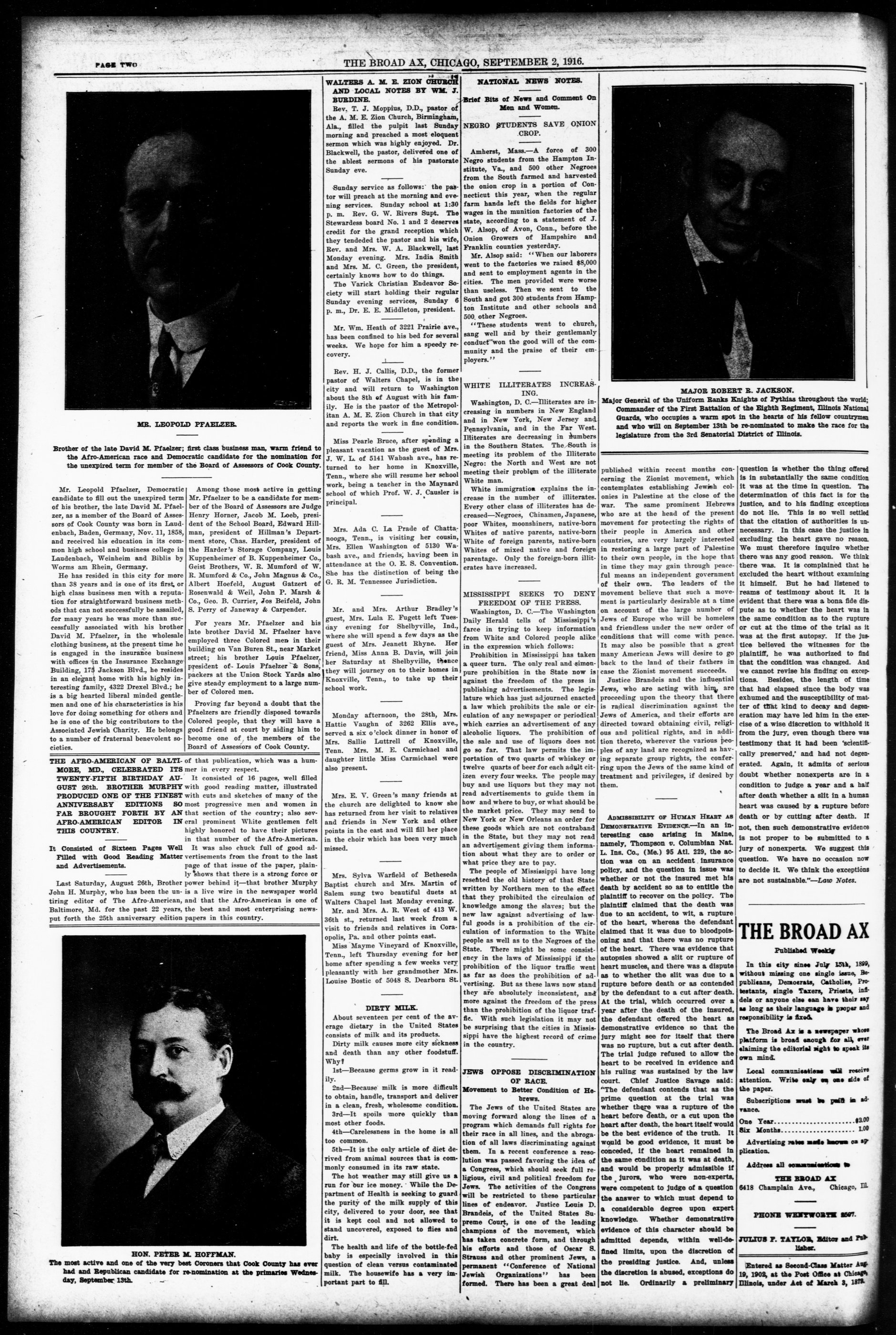
MR. LEOPOLD PFAELZER
Brother of the late David M. Pfaelzerr the Afro-American race and Dem the unexpired term for member of
Brother of the late David M. Pfaelzer; first class business man, warm friend to the Afro-American race and Democratic candidate for the nomination for the unexpired term for member of the Board of Assessors of Cook County.
Mr. Leopold Pfaelzer, Democratic candidate to fill out the unexpired term of his brother, the late David M. Pfaelzer, as a member of the Board of Assessors of Cook County was born in Laudenbach, Baden, Germany, Nov. 11, 1858, and received his education in its common high school and business college in Laudenbach, Weinheim and Biblis by Worms am Rhein, Germany.
He has resided in this city for more than 38 years and is one of its first, or high class business men with a reputation for straightforward business methods that can not successfully be assailed, for many years he was more than successfully associated with his brother David M. Pfaelzer, in the wholesale clothing business, at the present time he is engaged in the insurance business with offices in the Insurance Exchange Building, 175 Jackson Blvd., he resides in an elegant home with his highly interesting family, 4322 Drexel Blvd.; he is a big hearted liberal minded gentlemen and one of his characteristics is his love for doing something for others and he is one of the big contributors to the Associated Jewish Charity. He belongs to a number of fraternal benevolent societies.
THE AFRO-AMERICAN OF BALTIMORE, MD., CELEBRATED ITS TWENTY-FIFTH BIRTHDAY AUGUST 26th. BROTHER MURPHY PRODUCED ONE OF THE FINEST ANNIVERSARY EDITIONS SO FAR BROUGHT FORTH BY AN AFRO-AMERICAN EDITOR IN THIS COUNTRY.
It Consisted of Sixteen Pages Well Filled with Good Reading Matter and Advertisements.
Last Saturday, August 26th, Brother John H. Murphy, who has been the untiring editor of The Afro-American, Baltimore, Md. for the past 22 years, put forth the 25th anniversary edition
Last Saturday, August 26th, Brother power behind it—that brother Murphy John H. Murphy, who has been the un- is a live wire in the newspaper world tiring editor of The Afro-American, and that the Afro-American is one of Baltimore, Md. for the past 22 years, the best and most enterprising newspaper forth the 25th anniversary edition papers in this country.
HON. PETER M. HOFFMAN.
The most active and one of the very best Coroners that had and Republican candidate for re-nomination a day, September 13th.
The most active and one of the very best Coroners that Cook County has ever had and Republican candidate for re-nomination at the primaries Wednesday, September 13th.
PAGE TWO
first class business man, warm friend to cratic candidate for the nomination for the Board of Assessors of Cook County.
Among those most active in getting Mr. Pfaelzer to be a candidate for member of the Board of Assessors are Judge Henry Horner, Jacob M. Loeb, president of the School Board, Edward Hillman, president of Hillman's Department store, Chas. Harder, president of the Harder's Storage Company, Louis Kuppenheimer of B. Kuppenheimer Co., Geist Brothers, W. R. Mumford of W. R. Mumford & Co., John Magnus & Co., Albert Hoefeld, August Gatzert of Rosenwald & Weil, John P. Marsh & Co., Geo. B. Currier, Jos Beifeld, John S. Perry of Janeway & Carpenter.
For years Mr. Pfaelzer and his late brother David M. Pfaelzer have employed three Colored men in their building on Van Buren St., near Market street; his brother Louis Pfaelzer, president of Louis Pfaelzer & Sons, packers at the Union Stock Yards also give steady employment to a large number of Colored men.
Proving far beyond a doubt that the Pfaelzers are friendly disposed towards Colored people, that they will have a good friend at court by aiding him to become one of the members of the Board of Assessors of Cook County.
It consisted of 16 pages, well filled with good reading matter, illustrated with cuts and sketches of many of the most progressive men and women in that section of the country; also several prominent White gentlemen felt highly honored to have their pictures in that number of the Afro-American. It was also chuck full of good advertisements from the front to the last page of that issue of the paper, plainly shows that there is a strong force or
power behind it—that brother Murphy is a live wire in the newspaper world and that the Afro-American is one of the best and most enterprising newspapers in this country.
best Coroners that Cook County has ever pre-nomination at the primaries Wednes-
WALTERS A. M. E. ZION CHURCH AND LOCAL NOTES BY WM. J. BURDINE.
Rev. T. J. Moppius, D.D., pastor of the A. M. E. Zion Church, Birmingham, Ala., filled the pulpit last Sunday morning and preached a most eloquent sermon which was highly enjoyed. Dr. Blackwell, the pastor, delivered one of the ablest sermons of his pastorate Sunday eve.
NATIONAL NEWS NOTES.
Brief Bits of News and Comment Men and Women.
NEGRO STUDENTS SAVE ON CROP.
Amherst, Mass.—A force of Negro students from the Hampton stitute, Va., and 500 other Neg
Sunday service as follows: the pastor will preach at the morning and evening services. Sunday school at 1:30 p. m. Rev. G. W. Rivers Supt. The Stewardess board No. 1 and 2 deserves credit for the grand reception which they tended the pastor and his wife, Rev. and Mrs. W. A. Blackwell, last Monday evening. Mrs. India Smith and Mrs. M. C. Green, the president, certainly knows how to do things. The Varick Christian Endeavor Society will start holding their regular Sunday evening services, Sunday 6 p. m., Dr. E. E. Middleton, president.
Mr. Wm. Heath of 3221 Prairie ave., has been confined to his bed for several weeks. We hope for him a speedy recovery.
Rev. H. J. Callis, D.D., the former pastor of Walters Chapel, is in the city and will return to Washington about the 8th of August with his family. He is the pastor of the Metropolitan A. M. E. Zion Church in that city and reports the work in fine condition.
Miss Pearle Bruce, after spending a pleasant vacation as the guest of Mrs. J. W. L of 5141 Wabash ave., has returned to her home in Knoxville, Tenn., where she will resume her school work, being a teacher in the Maynard school of which Prof. W. J. Causler is principal.
Mrs. Ada C. La Prade of Chattanooga, Tenn., is visiting her cousin. Mrs. Ellen Washington of 5130 Wabash ave., and friends, having been in attendance at the O. E. S. Convention. She has the distinction of being the G. R. M. Tennessee Jurisdiction.
Mr. and Mrs. Arthur Bradley's guest, Mrs. Lula E. Fuget left Tuesday evening for Shelbyville, Ind., where she will spend a few days as the guest of Mrs. Jeanett Rhyne. Her friend, Miss Anna B. Davis, will join her Saturday at Shelbyville, thence they will journey on to their homes in Knoxville, Tenn., to take up their school work.
Monday afternoon, the 28th, Mrs. Hattie Vaughn of 3262 Ellis ave., served a six o'clock dinner in honor of Mrs. Sallie Luttrell of Knoxville, Tenn. Mrs. M. E. Carmichael and daughter little Miss Carmichael were also present.
Mrs. E. V. Green's many friends at the church are delighted to know she has returned from her visit to relatives and friends in New York and other points in the cast and will fill her place in the choir which has been very much missed.
Mrs. Sylva Warfield of Bethesda Baptist church and Mrs. Martin of Salem sung two beautiful duets at Walters Chapel last Monday evening. Mr. and Mrs. A. R. West of 413 W. 36th st., returned last week from a visit to friends and relatives in Cora-opolis, Pa. and other points east. Miss Mayme Vineyard of Knoxville, Tenn., left Thursday evening for her home after spending a few weeks very pleasantly with her grandmother Mrs. Louise Bostic of 5048 S. Dearborn St
DIRTY MILK
About seventeen per cent of the average dietary in the United States consists of milk and its products. Dirty milk causes more city sickness and death than any other foodstuff. Why?
1st—Because germs grow in it readily.
2nd—Because milk is more difficult to obtain, handle, transport and deliver in a clean, fresh, wholesome condition.
3rd—It spoils more quickly than most other foods.
4th—Carelessness in the home is all too common.
5th—It is the only article of diet derived from animal sources that is commonly consumed in its raw state.
The hot weather may still give us a run for our ice money. While the Department of Health is seeking to guard the purity of the milk supply of this city, delivered to your door, see that it is kept cool and not allowed to stand uncovered, exposed to flies and dirt.
The health and life of the bottle-fed baby is especially involved in this question of clean versus contaminated milk. The housewife has a very important part to fill.
NATIONAL NEWS NOTES.
Brief Bits of News and Comment On Men and Women.
NEGRO STUDENTS SAVE ONION
CROP.
Amherst, Mass.—A force of 300 Negro students from the Hampton Institute, Va., and 500 other Negroes from the South farmed and harvested the onion crop in a portion of Connecticut this year, when the regular farm hands left the fields for higher wages in the munition factories of the state, according to a statement of J. W. Alsop, of Avon, Conn., before the Onion Growers of Hampshire and Franklin counties yesterday.
Mr. Alsop said: "When our laborers went to the factories we raised $5,000 and sent to employment agents in the cities. The men provided were worse than useless. Then we sent to the South and got 300 students from Hampton Institute and other schools and 500 other Negroes.
"These students went to church, sang well and by their gentlemanly conduct won the good will of the community and the praise of their employers."
WHITE ILLITERATES INCREASING
Washington, D. C.—Illiterates are increasing in numbers in New England and in New York, New Jersey and Pennsylvania, and in the Far West. Illiterates are decreasing in numbers in the Southern States. The South is meeting its problem of the Illiterate Negro: the North and West are not meeting their problem of the illiterate White man.
White immigration explains the increase in the number of illiterates. Every other class of illiterates has decreased—Negroes, Chinamen, Japanese, poor Whites, moonshiners, native-born Whites of native parents, native-born White of foreign parents, native-born Whites of mixed native and foreign parentage. Only the foreign-born illiterates have increased.
MISSISSIPPI SEEKS TO DENY FREEDOM OF THE PRESS. Washington, D. C.—The Washington Daily Herald tells of Mississippi's face in trying to keep information from White and Colored people alike in the expression which follows:
Prohibition in Mississippi has taken a queer turn. The only real and simonpure prohibition in the State now is against the freedom of the press in publishing advertisements. The legislature which has just adjourned enacted a law which prohibits the sale or circulation of any newspaper or periodical which carries an advertisement of any alcoholic liquors. The prohibition of the sale and use of liquors does not go so far. That law permits the importation of two quarts of whiskey or twelve quarts of beer for each adult citizen every four weeks. The people may buy and use liquors but they may not read advertisements to guide them in how and where to buy, or what should be the market price. They may send to New York or New Orleans an order for these goods which are not contraband in the State, but they may not read an advertisement giving them information about what they are to order or what price they are to pay.
The people of Mississippi have long resented the old history of that State written by Northern men to the effect that they prohibited the circulation of knowledge among the slaves; but the new law against advertising of lawful goods is a prohibition of the circulation of information to the White people as well as to the Negroes of the State. There might be some consistency in the laws of Mississippi if the prohibition of the liquor traffic went as far as does the prohibition of advertising. But as these laws now stand they are absolutely inconsistent, and more against the freedom of the press than the prohibition of the liquor traffic. With such legislation it may not be surprising that the cities in Mississippi have the highest record of crime in the country.
JEWS OPPOSE DISCRIMINATION OF RACE.
Movement to Better Condition of He brews.
The Jews of the United States are moving forward along the lines of a program which demands full rights for their race in all lines, and the abrogation of all laws discriminating against them. In a recent conference a resolution was passed favoring the idea of a Congress, which should seek full religious, civil and political freedom for Jews. The activities of the Congress will be restricted to these particular lines of endeavor. Justice Louis D. Brandeis, of the United States Supreme Court, is one of the leading champions of the movement, which has taken concrete form, and through his efforts and those of Oscar S. Strauss and other prominent Jews, a permanent "Conference of National Jewish Organizations" has been formed. There has been a great deal
M.
MAJOR ROBERT E. JACKSON.
Major General of the Uniform Ranks Knights of Pythias throughout the world;
Commander of the First Battalion of the Eighth Regiment, Illinois National
Guards, who occupies a warm spot in the hearts of his fellow countrymen
and who will on September 13th be re-nominated to make the race for the
legislature from the 3rd Senatorial District of Illinois.
Major General of the Uniform Ranks Knights of Pythias throughout the world; Commander of the First Battalion of the Eighth Regiment, Illinois National Guards, who occupies a warm spot in the hearts of his fellow countrymen and who will on September 13th be re-nominated to make the race for the legislature from the 3rd Senatorial District of Illinois.
published within recent months concerning the Zionist movement, which contemplates establishing Jewish colonies in Palestine at the close of the war. The same prominent Hebrews who are at the head of the present movement for protecting the rights of their people in America and other countries, are very largely interested in restoring a large part of Palestine to their own people, in the hope that in time they may gain through peaceful means an independent government of their own. The leaders of the movement believe that such a movement is particularly desirable at a time on account of the large number of Jews of Europe who will be homeless and friendless under the new order of conditions that will come with peace. It may also be possible that a great many American Jews will desire to go back to the land of their fathers in case the Zionist movement succeeds.
Justice Brandeis and the influential Jews, who are acting with him, are proceeding upon the theory that there is radical discrimination against the Jews of America, and their efforts are directed toward obtaining civil, religious and political rights, and in addition thereto, wherever the various peoples of any land are recognized as having separate group rights, the conferring upon the Jews of the same kind of treatment and privileges, if desired by them.
ADMISSIBILITY OF HUMAN HEART AS DEMONSTRATIVE EVIDENCE.—In an interesting case arising in Maine, namely, Thompson v. Columbian Nat. L. Ins. Co., (Me.) 95 Atl. 229, the action was on an accident, insurance policy, and the question in issue was whether or not the insured met his death by accident so as to entitle the plaintiff to recover on the policy. The plaintiff claimed that the death was due to an accident, to wit, a rupture of the heart, whereas the defendant claimed that it was due to bloodpoisoning and that there was no rupture of the heart. There was evidence that autopsies showed a slit or rupture of heart muscles, and there was a dispute as to whether the slit was due to a rupture before death or as contended by the defendant to a cut after death. At the trial, which occurred over a year after the death of the insured, the defendant offered the heart as demonstrative evidence so that the jury might see for itself that there was no rupture, but a cut after death. The trial judge refused to allow the heart to be received in evidence and his ruling was sustained by the law court. Chief Justice Savage said: "The defendant contends that as the question at the trial was whether there was a rupture of the heart before death, or a cut upon the heart after death, the heart itself would be the best evidence of the truth. It would be good evidence, it must be conceded, if the heart remained in the same condition as it was at death, and would be properly admissible if the jurors, who were non-experts, were competent to judge of a question the answer to which must depend to a considerable degree upon expert knowledge. Whether demonstrative evidence of this character should be admitted depends, within well-defined limits, upon the discretion of the presiding justice. And, unless the discretion is abused, exceptions do not lie. Ordinarily a preliminary
nights of Pythias throughout the world;
of the Eighth Regiment, Illinois National
in the hearts of his fellow countrymen
are-nominated to make the race for the
District of Illinois.
question is whether the thing offered is in substantially the same condition it was at the time in question. The determination of this fact is for the justice, and to his finding exceptions do not lie. This is so well settled that the citation of authorities is unnecessary. In this case the justice in excluding the heart gave no reason. We must therefore inquire whether there was any good reason. We think there was. It is complained that he excluded the heart without examining it himself. But he had listened to reams of testimony about it. It is evident that there was a bona fide dispute as to whether the heart was in the same condition as the rupture or cut at the time of the trial as it was at the first autopsy. If the justice believed the witnesses for the plaintiff, he was authorized to find that the condition was changed. And we cannot revise his findings on exceptions. Besides, the length of time that had elapsed since the body was exhumed and the susceptibility of matter of that kind to decay and degeneration may have led him in the exercise of a wise discretion to withhold it from the jury, even though there was testimony that it had been 'scientifically preserved,' and had not degenerated. Again, it admits of serious doubt whether nonexperts are in a condition to judge a year and a half after death whether a slit in a human heart was caused by a rupture before death or by cutting after death. If not, then such demonstrative evidence is not proper to be submitted to a jury of nonexperts. We suggest this question. We have no occasion now to decide it. We think the exceptions are not sustainable."—Law Notes.
THE BROAD AX
In this city since July 15th, 1899,
without missing one single issue, Rep-
ublicans, Democrats, Catholies, Pro-
testants, single Taxers, Priests, in-
fidels or anyone else can have their say
as long as their language is proper and
responsibility is fixed.
The Broad Ax is a newspaper whose
platform is broad enough for all, ever
claiming the editorial night to speak its
own mind.
Local communications will receive
attention. Write only on one side of
the paper.
Subscriptions must be paid in advance.
One Year.....$2.00
Six Months.....1.00
Advertising rates made known on application.
Address all communications to
THE BROAD AX
6418 Champlain Ave., Chicago, Ill.
PHONE WENTWORTH 2597.
JULIUS P. TAYLOR, Editor and Publisher.
Entered as Second-Class Matter Aug.
19, 1902, at the Post Office at Chicago,
Illinois, under Act of March 3, 1872.
Published Weekly
FLEETING PROSPERITY IS FOOL'S PARADISE
Don't Let Smoke From Munition Factories Cloud Your Brain With Belief It's Abiding.
PROTECTION OUR BULWARK.
Forget Not the Dire Conditions Which Depressed This Country Under the Democratic Free Trade, Tariff Prior to the War—They Will Return to Plagua and Hunger You Unless the Republicans Are Restored to Power.
"When we contemplate industrial and commercial conditions," says Mr. Hughes, "we see that we are living in a fool's paradise." This is the condition to which the administration and its supporters have deliberately closed their eyes. When the war cloud broke over Europe this country was experiencing the most serious depression it had known since 1833, when the Democratic party and its policies were in full control of the United States. Suddenly there came from over the sea a demand for munitions of war, clothing, food, supplies, everything needed by vast armies and by countries whose sons were taken from the field and the workshop, never to return.
As a result our exports and the balance of trade in our favor have reached figures far surpassing any ever before known. Temporarily, especially in the east, there is no lack of work at high wages, for Europe must pay whatever price America asks. No thoughtful person would imagine that this condition is anything like real prosperity. How false it is we in Oregon, who have the clearer vision, because not clouded by the smoke from munitions factories, have fully felt and fully appreciated.
What the Republican candidate for president says about it the Democrats know to be true:
"Our opponents promised to reduce the cost of living. This they have failed to do, but did reduce the opportunities of making a living. Let us not forget the conditions that existed in this country under the new tariff prior to the war. Production had decreased; business was languishing; new enterprises were not undertaken; instead of expansion there was curtailment, and our streets were filled with the unemployed."
The suspension of these conditions is not nation wide, only sectional, and depends upon the duration of the war. Those who think otherwise are indeed living in a fool's paradise--Portland (Ore.) Telegram.
"Moose Drift to Wilson Approaches Stampee"
(Headline—Weekly bulletin issued by Democratic Campaign Committee.)
For Hughes. For Wilson.
Theodore Roosevelt Bainbridge Colby
Raymond Robins Francis J. Heney
Oscar S. Straus Ole Hanson
Gifford Pinchot John Seymour
Hiram W. Johnson Matthew Hale
James A. Garfield
Chester H. Rowell
Albert J. Beveridge
William Allen White
George W. Perkins
Harold L. Ickes
George L. Record
Henry J. Allen
Charles J. Davenport
Stewart Macdonald
Horace S. Wilkinson
Nephi Morris
H. P. Gardner
Elon H. Hooker
F. P. Corrick
Clarence P. Dodge
Raymond McFarland
Charles S. Bird
W. W. Seymour
William Hamlin Childs
W. D. Stevens
Everett Colby
etc.
```markdown
```
PERTINENT PARAGRAPHS
FROM HUGHES'
SPEECHES.
"What is the president's policy—does any one know? Has the executive ever had a policy for more than six months on the Mexican question?"
"If I am elected president I will see to it that American rights in Mexico are respected."
"There is no man who could successfully present to an American community the platform that an American citizen's rights stop at the coast line."
"We will get through with this old strife between capital and labor. We are not laborers and capitalists in this country. We are fellow citizens."
"All that the workingmen want is a square deal."
"We want the United States efficiently managed. I want to see men in office who believe in prosperity."
"The Republican party stands for a prosperity produced by sound American policies."
"We have removed from office men of experience and substituted others to satisfy partisan obligations. This must stop."
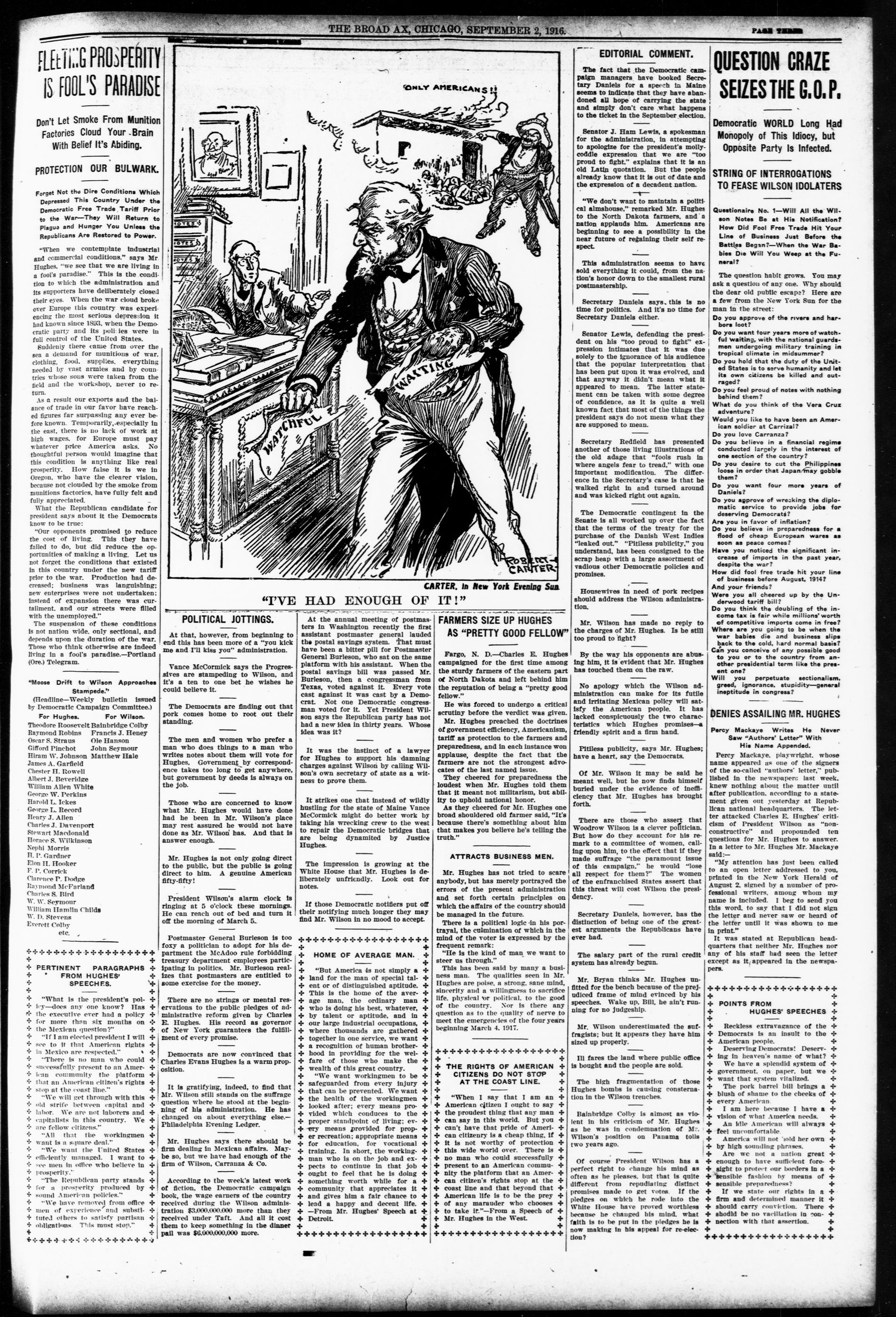
ONLY AMERICANS!!
WATCHFUL
WAITING
ROBERT CARTER
POLITICAL JOTTINGS.
At that, however, from beginning to end this has been more of a "you kick me and I'll kiss you" administration.
Vance McCormick says the Progressives are stampeding to Wilson, and it's a ten to one bet he wishes he could believe it.
The Democrats are finding out that pork comes home to root out their standing.
The men and women who prefer a man who does things to a man who writes notes about them will vote for Hughes. Government by correspondence takes too long to get anywhere, but government by deeds is always on the job.
Those who are concerned to know what Mr. Hughes would have done had he been in Mr. Wilson's place may rest assured he would not have done as Mr. Wilson has. And that is answer enough.
Mr. Hughes is not only going direct to the public, but the public is going direct to him. A genuine American fifty-fifty!
President Wilson's alarm clock is ringing at 5 o'clock these mornings. He can reach out of bed and turn it off the morning of March 5.
Postmaster General Burleson is too foxy a politician to adopt for his department the McAdoo rule forbidding treasury department employees participating in politics. Mr. Burleson realizes that postmasters are entitled to some exercise for the money.
---
There are no strings or mental reservations to the public pledges of administrative reform given by Charles E. Hughes. His record as governor of New York guarantees the fulfillment of every promise.
Democrats are now convinced that Charles Evans Hughes is a warm proposition.
It is gratifying, indeed, to find that Mr. Wilson still stands on the suffrage question where he stood at the beginning of his administration. He has changed on about everything else—Philadelphia Evening Ledger.
Mr. Hughes says there should be firm dealing in Mexican affairs. Maybe so, but we have had enough of the firm Wilson, Carranza & Co.
According to the week's latest work of fiction, the Democratic campaign book, the wage earners of the country received during the Wilson administration $3,000,000,000 more than they received under Taft. And all it cost them to keep something in the dinner pail was $6,000,000,000 more.
THE BROAD AX, CHICAGO, SEPTEMBER 2. 1916.
At the annual meeting of postmasters in Washington recently the first assistant postmaster general lauded the postal savings system. That must have been a bitter pill for Postmaster General Burleson, who sat on the same platform with his assistant. When the postal savings bill was passed Mr. Burleson, then a congressman from Texas, voted against it. Every vote cast against it was cast by a Democrat. Not one Democratic congressman voted for it. Yet President Wilson says the Republican party has not had a new idea in thirty years. Whose idea was it?
It was the instinct of a lawyer for Hughes to support his damning charges against Wilson by calling Wilson's own secretary of state as a witness to prove them.
It strikes one that instead of wildly hustling for the state of Maine Vance McCormick might do better work by taking his wrecking crew to the west to repair the Democratic bridges that are being dynamited by Justice Hughes.
The impression is growing at the White House that Mr. Hughes is deliberately unfriendly. Look out for notes.
If those Democratic notifiers put off their notifying much longer they may find Mr. Wilson in no mood to accept.
HOME OF AVERAGE MAN.
- "But America is not simply a land for the man of special talent or of distinguished aptitude. This is the home of the average man, the ordinary man who is doing his best, whatever, by talent or aptitude, and in our large industrial occupations, where thousands are gathered together in one service, we want a recognition of human brotherhood in providing for the welfare of those who make the wealth of this great country.
"We want workingmen to be safeguarded from every injury that can be prevented. We want the health of the workingmen looked after; every means provided which conduces to the proper standpoint of living; every means provided for proper recreation; appropriate means for education, for vocational training. In short, the working-man who is on the job and expects to continue in that job ought to feel that he is doing something worth while for a community that appreciates it and gives him a fair chance to lead a happy and decent life. —From Mr. Hughes' Speech at Detroit.
FARMERS SIZE UP HUGHES AS "PRETTY GOOD FELLOW"
Fargo, N. D.—Charles E. Hughes campaled for the first time among the sturdy farmers of the eastern part of North Dakota and left behind him the reputation of being a "pretty good fellow."
He was forced to undergo a critical scrutiny before the verdict was given.
Mr. Hughes preached the doctrines of government efficiency, Americanism, tariff as protection to the farmers and preparedness, and in each instance won applause, despite the fact that the farmers are not the strongest advocates of the last named issue.
They cheered for preparedness the loudest when Mr. Hughes told them that it meant not militarism, but ability to uphold national honor.
As they cheered for Mr. Hughes one broad shouldered old farmer said, "It's because there's something about him that makes you believe he's telling the truth."
ATTRACTS BUSINESS MEN.
Mr. Hughes has not tried to scare anybody, but has merely portrayed the errors of the present administration and set forth certain principles on which the affairs of the country should be managed in the future.
There is a political logic in his portrayal, the culmination of which in the mind of the voter is expressed by the frequent remark:
"He is the kind of man we want to steer us through."
This has been said by many a business man. The qualities seen in Mr. Hughes are poise, a strong, sane mind, sincerity and a willingness to sacrifice life, physical or political, to the good of the country. Nor is there any question as to the quality of nerve to meet the emergencies of the four years beginning March 4, 1917.
THE RIGHTS OF AMERICAN
CITIZENS DO NOT STOP
AT THE COAST LINE.
"When I say that I am an
American citizen I ought to say
the proudest thing that any man
can say in this world. But you
can't have that pride of Amer-
ican citizenry is a cheap thing, if
it is not worthy of protection
this wide world over. There is
no man who could successfully
present to an American comu-
nity the platform that an Amer-
can citizen's rights stop at the
coast line and that beyond that
American life is to be the prey
of any marauder who chooses
to take it."—From a Speech of
Mr. Hughes in the West.
************************
EDITORIAL COMMENT.
The fact that the Democratic campaign managers have booked Secretary Daniels for a speech in Maine seems to indicate that they have abandoned all hope of carrying the state and simply don't care what happens to the ticket in the September election.
Senator J. Ham Lewis, a spokesman for the administration, in attempting to apologize for the president's mollycoddle expression that we are "too proud to fight," explains that it is an old Latin quotation. But the people already know that it is out of date and the expression of a decadent nation.
"We don't want to maintain a political almshouse," remarked Mr. Hughes to the North Dakota farmers, and a nation applauds him. Americans are beginning to see a possibility in the near future of regaining their self-respect.
This administration seems to have sold everything it could, from the nation's honor down to the smallest rural postmastership.
Secretary Daniels says, this is no time for politics. And it's no time for Secretary Daniels either.
Senator Lewis, defending the president on his "too proud to fight" expression intimates that it was due solely to the ignorance of his audience that the popular interpretation that has been put upon it was evolved, and that anyway it didn't mean what it appeared to mean. The latter statement can be taken with some degree of confidence, as it is quite a well known fact that most of the things the president says do not mean what they are supposed to mean.
Secretary Redfield has presented another of those living illustrations of the old adage that "fools rush in where angels fear to tread," with one important modification. The difference in the Secretary's case is that he walked right in and turned around and was kicked right out again.
The Democratic contingent in the Senate is all worked up over the fact that the terms of the treaty for the purchase of the Danish West Indies "leaked out." "Pitiless publicity," you understand, has been consigned to the scrap heap with a large assortment of vicious other Democratic policies and promises.
Housewives in need of pork recipes should address the Wilson administration.
Mr. Wilson has made no reply to the charges of Mr. Hughes. Is he still too proud to fight?
By the way his opponents are abusing him, it is evident that Mr. Hughes has touched them on the raw.
No apology which the Wilson administration can make for its futile and irritating Mexican policy will satisfy the American people. It has lacked conspicuously the two characteristics which Hughes promises—a friendly spirit and a firm hand.
Pitiless publicity, says Mr. Hughes; have a heart, say the Democrats.
Of Mr. Wilson it may be said he meant well, but he now finds himself buried under the evidence of inefficiency that Mr. Hughes has brought forth.
There are those who assert that Woodrow Wilson is a clever politician. But how do they account for his remark to a committee of women, calling upon him, to the effect that if they made suffrage "the paramount issue of this campaign," he would "lose all respect for them?" The women of the enfranchised States assert that this threat will cost Wilson the presidency.
Secretary Daniels, however, has the distinction of being one of the greatest arguments the Republicans have ever had.
The salary part of the rural credit system has already begun.
Mr. Bryan thinks Mr. Hughes unfitted for the bench because of the prejudiced frame of mind evinced by his speeches. Wake up, Bill, he ain't running for no judgeship.
Mr. Wilson underestimated the suffragists; but it appears they have him sized up properly.
Ill fares the land where public office is bought and the people are sold.
The high fragmentation of those Hughes bombs is causing consternation in the Wilson trenches.
Bainbridge Colby is almost as violent in his criticism of Mr. Hughes as he was in condemnation of Mr. Wilson's position on Panama toils two years ago.
Of course President Wilson has a perfect right to change his mind as often as he pleases, but that is quite different from repudiating distinct promises made to get votes. If the pledges on which he rode into the White House have proved worthless because he changed his mind, what faith is to be put in the pledges he is now making in his appeal for re-election?
---
PAGE THREE
QUESTION CRAZE SEIZESTHE G.O.P.
Democratic WORLD Long Had Monopoly of This Idiocy, but Opposite Party Is Infected.
STRING OF INTERROGATIONS TO FEASE WILSON IDOLATERS
Questionaire No. 1—Will All the Wilson Notes Be at His Notification?
How Did Fool Free Trade Hit Your Line of Business Just Before the Battles Began?—When the War Babies Die Will You Weep at the Funeral?
The question habit grows. You may ask a question of any one. Why should the dear old public escape? Here are a few from the New York Sun for the man in the street:
Do you approve of the rivers and harbors loot?
Do you want four years more of watchful waiting, with the national guardsmen undergoing military training in tropical climate in midsummer?
Do you hold that the duty of the United States is to serve humanity and let its own citizens be killed and outraged?
Do you feel proud of notes with nothing behind them?
What do you think of the Vera Cruz adventure?
Would you like to have been an American soldier at Carrizal?
Do you love Carranza?
Do you believe in a financial regime conducted largely in the interest of one section of the country?
Do you desire to cut the Philippines loose in order that Japan may gobble them?
Do you want four more years of Daniels?
Do you approve of wrecking the diplomatic service to provide jobs for deserving Democrats?
Are you in favor of inflation?
Do you believe in preparedness for a flood of cheap European wares as soon as peace comes?
Have you noticed the significant increase of imports in the past year, despite the war?
How did fool free trade hit your line of business before August, 1914?
And your friends?
Were you all cheered up by the Underwood tariff bill?
Do you think the doubling of the income tax is fair while millions' worth of competitive imports come in free?
Where are you going to be when the war babies die and business slips back to the cold, hard normal basis?
Can you conceive of any possible good to you or to the country from another presidential term like the present one?
Will you perpetuate sectionalism, greed, ignorance, stupidity—general ineptitude in congress?
DENIES ASSAILING MR. HUGHES
Percy Mackaye Writes He Never Saw "Authors' Letter" With His Name Appended.
Percy Mackaye, playwright, whose name appeared as one of the signers of the so-called "authors' letter," published in the newspapers last week, knew nothing about the matter until after publication, according to a statement given out yesterday at Republican national headquarters. The letter attacked Charles E. Hughes' criticism of President Wilson as "nonconstructive" and propounded ten questions for Mr. Hughes to answer. In a letter to Mr. Hughes Mr. Mackaye said:—
"My attention has just been called to an open letter addressed to you, printed in the New York Herald of August 2, signed by a number of professional writers, among whom my name is included. I beg to send you this word, to say that I did not sign the letter and never saw or heard of the letter until it was shown to me in print."
It was stated at Republican headquarters that neither Mr. Hughes nor any of his staff had seen the letter except as it appeared in the newspapers.
**POINTS FROM**
**HUGHES' SPEECHES**
Reckless extravagance of the Democrats is an insult to the American people.
* Deserving Democrats! Deserving in heaven's name of what? *
* We have a splendid system of government. on paper, but we want that system vitalized. *
* The pork barrel bill brings a blush of shame to the cheeks of every American. *
* I am here because I have a vision of what America needs. *
* An idle American will always feel uncomfortable. *
* America will not hold her own by high sounding phrases. *
* Are we not a nation great enough to have sufficient fore-sight to protect our borders in a sensible fashion by means of sensible preparedness? *
* If we state our rights in a firm and determined manner it should carry conviction. There should be no vacillation in connection with that assertion.
---
‘ol. Frank ©. Lowden, Continues to Lead in the Race for the Nomination for Governor o|
Illinois. Col. Frank L. Smith, the Successful and Leading Banker of Dwight, Illinois
Continues to “Hot Foot” It After Him and He is Almost Neck and Neck with Him i:
Their Memorable Contest "
|, ee
ee oe
pe .
2 i :
3 ;
Baia bs ‘ oe
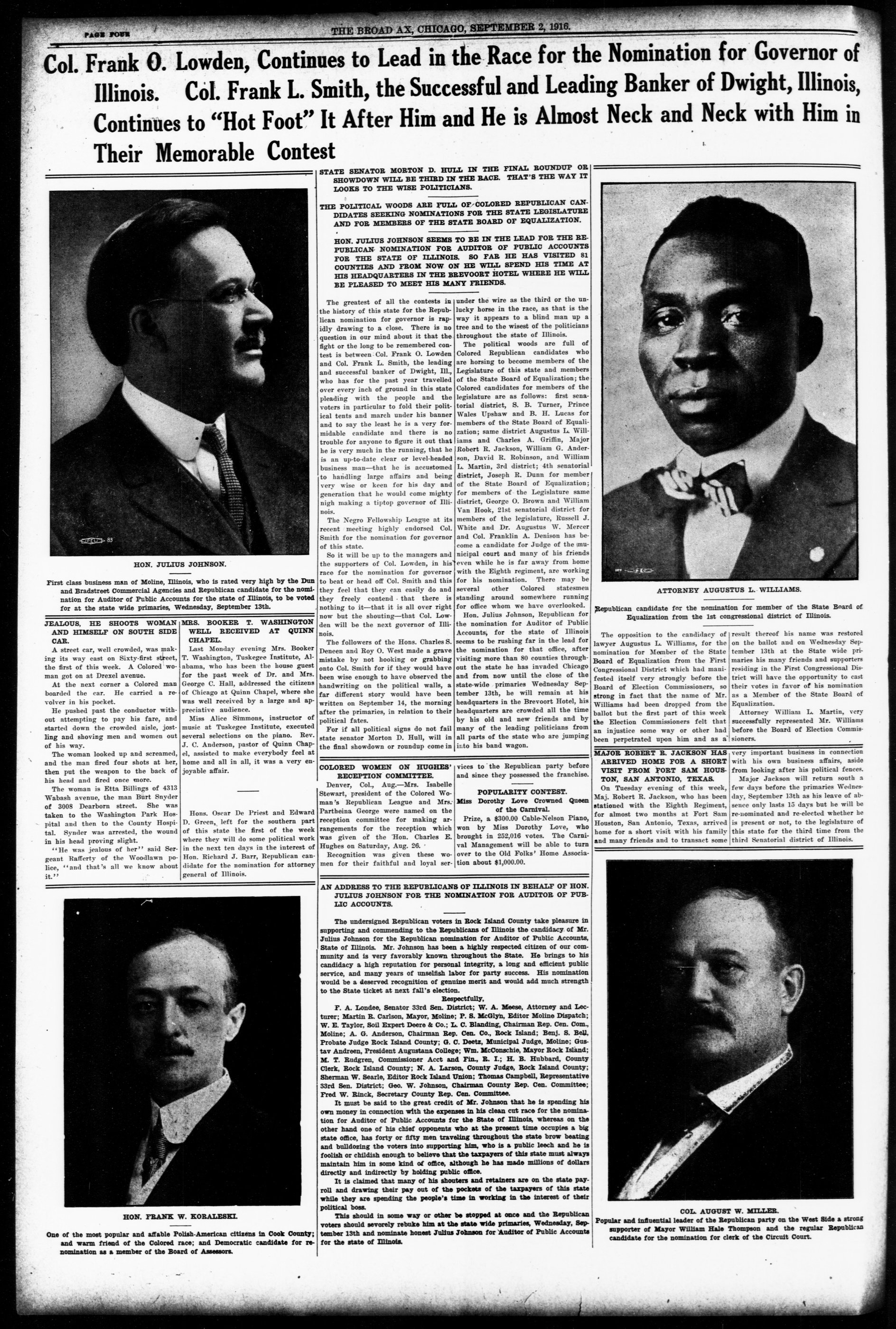
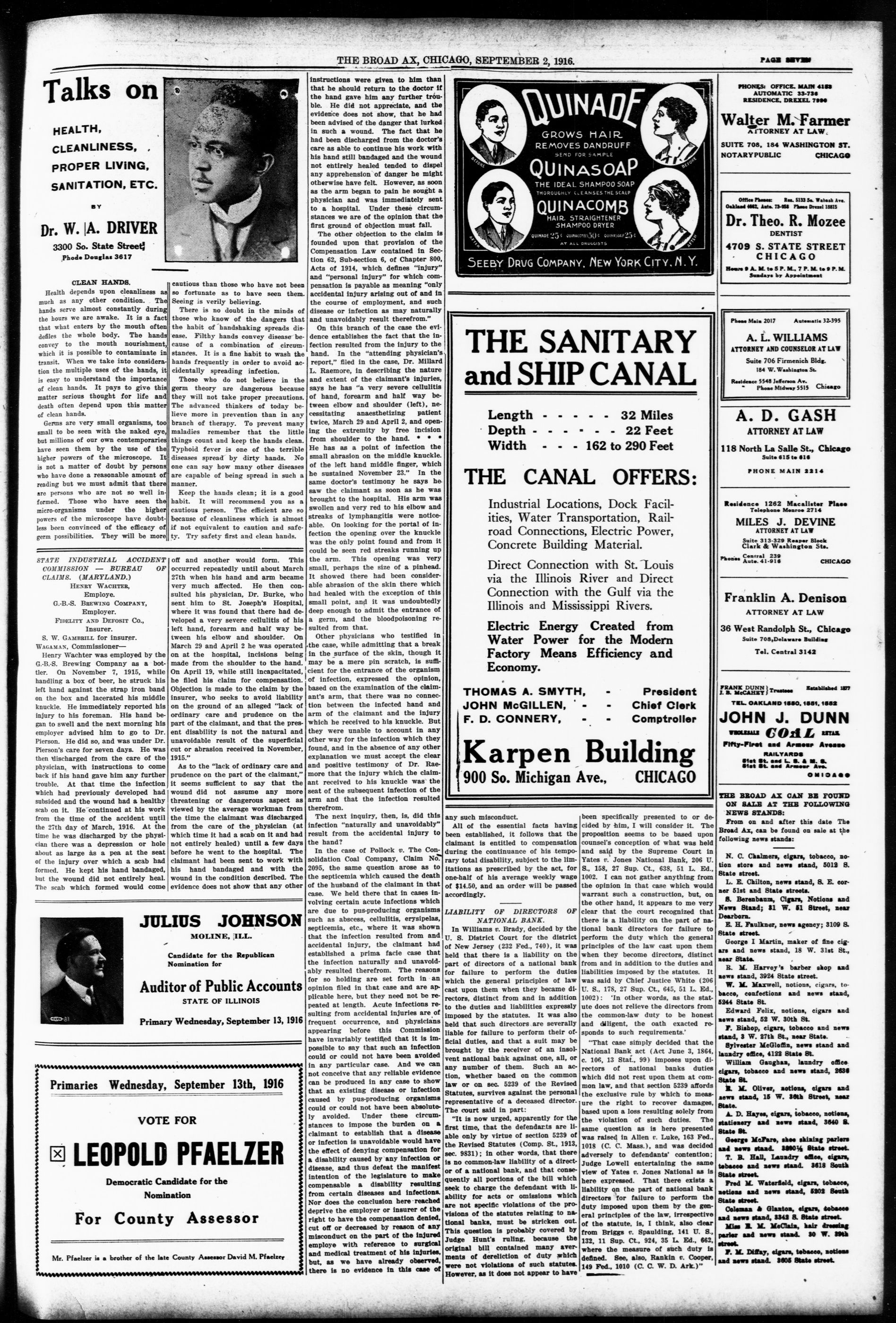
HON. JULIUS JOHNSON.
First class business man of Moline, Ilinois, who is rated very high by the Dun
and Bradstreet Commercial Agencies and Republican candidate for the nomi-
nation for Auditor of Public Accounts for the state of Illinois, to be voted
for at the state wide primaries, Wednesday, September 13th.
——————————————————————————————————————
JEALOUS, HE SHOOTS WOMAN )MRS. BOOKER T. WASHINGTON
AND HIMSELF ON SOUTH sm | WELL RECEIVED AT QUINN
CAR. CHAPEL.
A street car, well crowded, was mak-
ing its way east on Sixty-first street,
the first of this week. A Colored wo-
man got on at Drexel avenue.
At the next corner a Colored man
boarded the car. He carried a re-
volver in his pocket.
‘He pushed past the conductor with-
out attempting to pay his fare, and
started down the crowded aisle, jost-
Jing and shoving men and women out
of his way.
‘The woman looked up and screamed,
and the man fired four shots at her,
then put the weapon to the back of
his head and fired once more.
The woman is Etta Billings of 4313
‘Wabash avenue, the man Burt Snyder
of 3008 Dearborn street. She was
taken to the Washington Park Hos
pital and then to the County Hospi-
tal. Synder was arrested, the wound
in his head proving slight.
“He was jealous of her’? said Ser-
geant Rafferty of the Woodlawn po-
Tiee, ‘and that’s all we know about
it?
;
——
a : : a |
: a |
suai ¢
ee.
ees »
a |
, ;
HON. FRANK W. KORALESEL
One of the most popular and affable Polish-American citizens in Cook County;
and warm friend of the Colored race; and Democratic candidate for re-
nomination as a member of the Board of Assessors.
PAGE FOUR
Hons. Osear De Priest and Edward
D. Green, left for the southern part
of this state the first of the week
where they will do some political work
jin the next ten days in the interest of
Hon. Richard J. Barr, Republican ean
didate for the nomination for attorney
general of Illinois.
“HE BROAD AX, CHICAGO, SEPTEMBER 2, 1916.
STATE SENATOR MORTON D. HULL IN THE FINAL ROUNDUP OR
SHOWDOWN WILL BE THIRD IN THE RACE. THAT’S THE WAY IT
LOOKS TO THE WISE POLITICIANS.
THE POLITICAL WOODS ARE FULL OF COLORED REPUBLICAN CAN-
DIDATES SEEKING NOMINATIONS FOR THE STATE LEGISLATURE
‘AND FOR MEMBERS OF THE STATE BOAED OF EQUALIZATION.
HON, JULIUS JOHNSON SEEMS TO BE IN THE LEAD FOR THE RE-
PUBLICAN NOMINATION FOR AUDITOR OF PUBLIC ACCOUNTS
FOR THE STATE OF ILLINOIS. SO FAR HE HAS VISITED 81
COUNTIES AND FROM Now ON HE WILL SPEND HIS TIME AT
HIS HEADQUARTERS IN THE BREVOORT HOTEL WHERE HE WILL
BE PLEASED TO MEET HIS MANY FRIENDS.
AN ADDRESS TO THE REPUBLICANS OF ILLINOIS IN BEHALF OF HON.
JULIUS JOHNSON FOR THE NOMINATION FOR AUDITOR OF PUB-
Lic ACCOUNTS.
Bie weterricaet Revie Toes ee ee ee
supporting and commending to the Republicans of Ilinois the candidacy. of Mr.
Julius Johnson for the Republican nomination for Auditor of Public Accounts,
State of Illincis. Mr. Johnson has been a highly respected citizen of our com-
munity and is very favorably known throughout the State. He brings to his
candidacy a high reputation for personal integrity, a long and efficient public
service, and many years of unselfish labor for party success. His nomination
would be a deserved recognition of genuine merit and would add much strength
to the State ticket at next fall’s election.
Respectfully, |
F. A. Londee, Senator 33rd Sen. District; W. A. Meese, Attorney and Lec-
turer; Martin R. Carlson, Mayor, Moline; P. S. McGlyn, Editor Moline Dispatch; |
W. E. Taylor, Soil Expert Deere & Co.; L. C. Blanding, Chairman Rep. Cen. Com.,
Moline; A. G. Anderson, Chairman Rep. Cen. Co., Rock Island; Benj. S. Bell,
Probate Judge Rock Island County; G. C. Deetz, Municipal Judge, Moline; Gus-
tav Andreen, President Augustana College; Wm. McConschie, Mayor Rock Island;
‘M. T. Rudgren, Commissioner Acct and Fin, B. I.; H. B. Hubbard, County
Clerk, Rock Island County; N. A. Larson, County Judge, Rock Island County;
Sherman W. Searle, Editor Rock Island Union; Thomas Campbell, Representative
38rd Sen. District; Geo. W. Johnson, Chairman County Rep. Cen. Committee;
Fred W. Rinck, Secretary County Rep. Cen. Committee.
Tt must be said to the great credit of Mr. Johnson that he is spending his
own money in connection with the expenses in his clean cut race for the nomina-
tion for Auditor of Public Accounts for the State of Illinois, whereas on the
other hand one of his chief opponents who at the present time occupies a big
state office, has forty or fifty men traveling throughout the state brow beating
and bulldozing the voters into supporting him, who is a public leech and he is
foolish or childish enough to believe that the taxpayers of this state must always
maintain him in some kind of office, although he has made millions of dollars
directly and indirectly by holding public office.
It is claimed that many of his shouters and retainers are on the state pay-
roll and drawing their pay out of the pockets of the taxpayers of this state
while they are spending the people’s time in working in the interest of their
political boss.
This should in some way or other be stopped at once and the Republican
‘voters should sevorely rebuke him at the state wide primaries, Wednesday, Sep-
tember 13th and nominate honest Julius Johnson for ‘Auditor of Public Accounts
for the state of Illinois.
The greatest of all the contests in
the history of this state for the Repub-
liean nomination for governor is rap.
idly drawing to a close. There is no
question in our mind about it that the
fight or the long to be remembered con-
test is between Col. Frank 0. Lowden
and Col. Frank L. Smith, the leading
and successful banker of Dwight, IIL,
who has for the past year travelled
over every inch of ground in this state
pleading with the people and the
voters in particular to fold their polit
ieal tents and march under his banner
and to say the least he is a very for:
midable candidate and there is no
trouble for anyone to figure it out that
he is very much in the running, that he
is an up-to-date clear or level-heades
business man—that he is accustomed
to handling large affairs and being
very wise or keen for his day and
generation that he would come mighty
nigh making a tiptop governor of Ili
nois.
The Negro Fellowship League at its
recent meeting highly endorsed Col.
‘Smith for the nomination for governor
of this state.
So it will be up to the managers and
the supporters of Col. Lowden, in hi
race for the nomination for governor
to beat or head off Col. Smith and this
they feel that they can easily do and
they freely contend - that there is
nothing to it—that it is all over right
now but the shouting—that Col. Low:
den will be the next governor of Illi-
nois.
‘The followers of the Hons. Charles 8.
Deneen and Roy 0. West made a grave
mistake by not hooking or grabbing
onto Col. Smith for if they would have
been wise enough to have observed the
handwriting on the political walls, a
far different story would have been
written on September 14, the morning
after the primaries, in relation to their
politieal fates.
For if all political signs do not fail
state senator Morton D. Hull, will in
the final showdown or roundup come in
COLORED WOMEN ON HUGHES’
RECEPTION COMMITTEE.
Denver, Col, Aug—Mrs. Isabelle
Stewart, president of the Colored Wo
man’s Republican League and Mrs
Partheina George were named on the
reception committee for making ar
rangements for the reception which
was given of the Hon. Charles E
Hughes on Saturday, Aug. 26. °
Recognition was given these wo
men for their faithful and loyal ser
under the wire as the third or the un-
lucky horse in the race, as that is the
way it appears to a blind man up a
tree and to the wisest of the politicians
throughout the state of Illinois.
‘The politieal woods are full of
Colored Republican candidates who
are horsing to become members of the
Legislature of this state and members
of the State Board of Equalization; the
Colored candidates for members of the
legislature are as follows: first sena-
torial district, 8. B. Turner, Prince
Wales Upshaw and B. H. Lucas for
members of the State Board of Equali-
zation; same district Augustus L. Will-
iams and Charles A. Griffin, Major
Robert R. Jackson, William G. Ander-
son, David R. Robinson, and William
L. Martin, 3rd district; 4th senatorial
distriet, Joseph R. Dunn for member
of the State Board of Equalization;
for members of the Legislature same
district, George O. Brown and William
‘Van Hook, 21st senatorial distriet for
members of the legislature, Russell J.
White and Dr. Augustus W. Mercer
and Col. Franklin A. Denison has be-
come a candidate for Judge of the imu-
nieipal court and many of his friends
even while he is far away from home
with the Eighth regiment, are working
for his nomination. There may be
several other Colored _ statesmen
standing around somewhere running
for office whom we have overlooked.
Hon. Julius Johnson, Republican for
the nomination for Auditor of Public
Accounts, for the state of Illinois
seems to be rushing far in the lead for
the nomination for that office, after
visiting more than 80 counties through-
out the state he has invaded Chicago
and from now until the close of the
state-wide primaries Wednesday Sep-
tember 13th, he will remain at his
headquarters in the Brevoort Hotel, his
headquarters are crowded all the time
by his old and new friends and by
many of the leading politicians from
all parts of the state who are jumping
into his band wagon.
viees to the Republican party before
and since they possessed the franchise.
POPULARITY CONTEST.
Miss Dorothy Love Crowned Queen
of the Carnival.
Prize, a $300.00 Cable-Nelson Piano,
won by Miss Dorothy Love, who
brought in 252,016 votes. The Carni-
val Management will be able to turn
over to the Old Folks’ Home Associa-
tion about $1,000.00.
| |
—
et es
, A 4
. & a pe a
leiden SO oe ¥
ATTORNEY AUGUSTUS L. WILLIAMS.
epublican candidate for the nomination for member of the State Board of
Equalization from the Ist congressional district of Illinois.
The opposition to the candidacy of | result thereof his name was restored
lawyer Augustus L. Williams, for the|on the ballot and on Wednesday Sep-
nomination for Member of the State|tember 13th at the State wide pri-
Board of Equalization from the First |maries his many friends and supporters
Congressional District which had mani-| residing in the First Congressional Dis-
fested itself very strongly before the| trict will have the opportunity to cast
Board of Election Commissioners, so|their votes in favor of his nomination
strong in fact that the name of Mr.|as a Member of the State Board of
Williams had been dropped from the| Equalization.
ballot but the first part of this week Attorney William L. Martin, very
the Election Commissioners felt that | successfully represented Mr. Williams
an injustice some way or other had|before the Board of Election Commis
been perpetrated upon him and as a’ sioners.
——————————————————
MAJOR ROBERT &. JACKSON HAS very important business in connection
ARRIVED HOME FOR A SHORT|with his own business affairs, aside
VISIT FROM FORT SAM HOUS-|from looking after his political fences.
TON, SAN ANTONIO, TEXAS. Major Jackson will return south a
On Tuesday evening of this week,|few days before the primaries Weidnes-
Maj. Robert R. Jackson, who has been | day, September 13th as his leave of ab-
stationed with the Eighth Regiment, |sence only lasts 15 days but he will be
for almost two months at Fort Sam/|re-nominated and re-elected whether he
Houston, San Antonio, Texas, arrived |is present or not, to the legislature of
ome for a short visit with his family|this state for the third time from the
‘and many friends and to transact some |third Senatorial district of Illinois.
sc oe
> ll
COL. AUGUST W. MILLER.
Popular and influential leader of the Republican party on the West Side a strong
supporter of Mayor William Hale Thompson and the regular Republica
candidate for the nomination for clerk of the Circuit Court.
result thereof his name was restored
on the ballot and on Wednesday Sep-
tember 13th at the State wide pri
maries his many friends and supporters
residing in the First Congressional Dis-
triet will have the opportunity to cast
their votes in favor of his nomination
as a Member of the State Board of
Equalization.
Attorney William L. Martin, very
successfully represented Mr. Williams
before the Board of Election Commis
sioners. ;
very important business in connection
with his own business affairs, aside
from looking after his political fences.
Major Jackson will return south 2
few days before the primaries Wednes-
day, September 13th as his leave of ab-
sence only lasts 15 days but he will be
re-nominated and re-elected whether he
is present or not, to the legislature of
this state for the third time from the
third Senatorial distriet of Minois.
<a
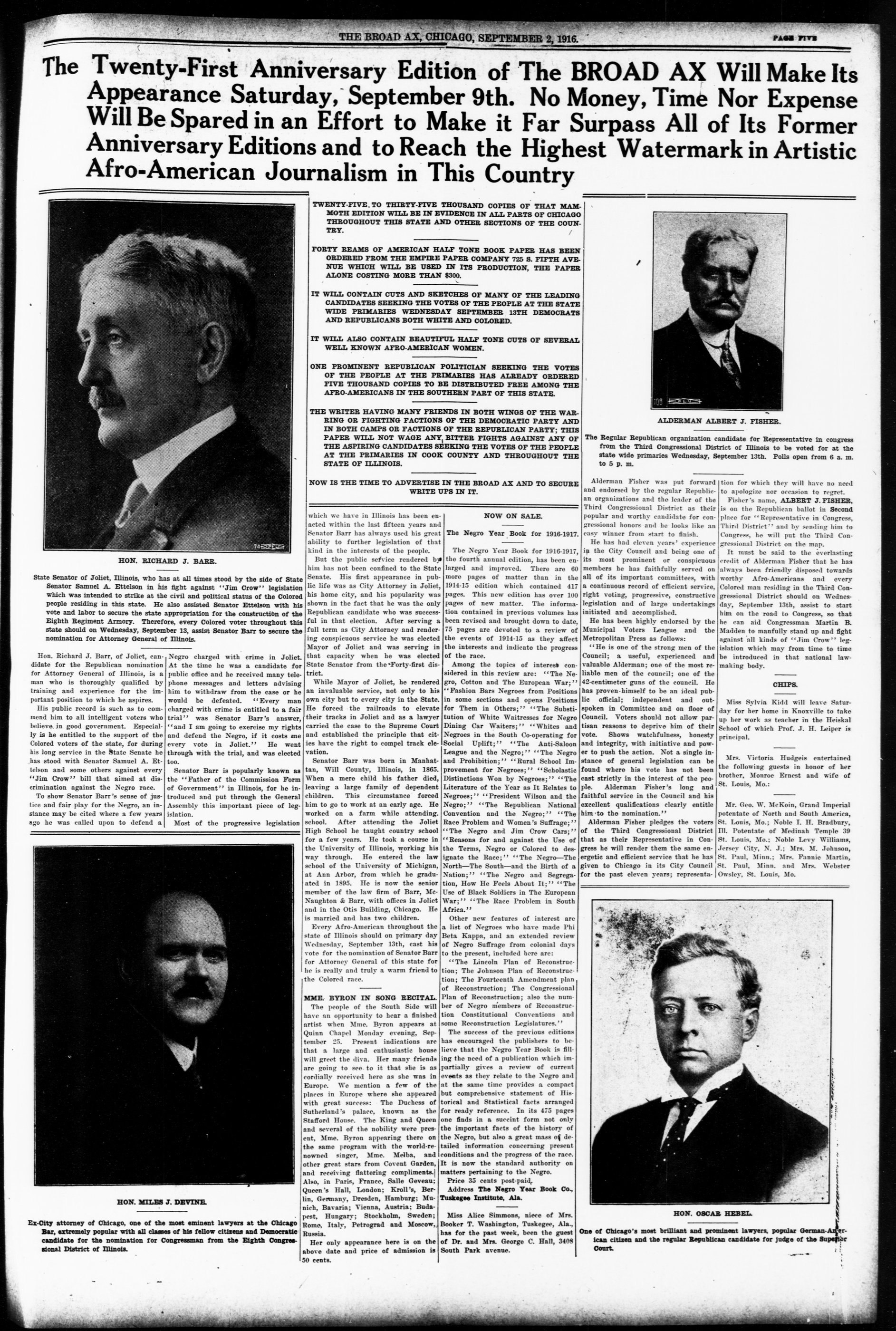
The Twenty-First Anniversary Edition of The BROAD AX Will Make Its
Appearance Saturday, September 9th. No Money, Time Nor Expense
Will Be Spared in an Effort to Make it Far Surpass All of Its Former
Anniversary Editions and to Reach the Highest Watermark in Artistic
Afro-American Journalism in This Country
ca RE i i EE Ee a me CT,
, a
j a
, Ss eee
* ea
-_2o oS Y
- lr
Me Ba
i , a
vo ae ae
: a ue ae
o£ Fe ings
HON. RICHARD J. BARR.
State Senator of Joliet, Iinois, who has at all times stood by the side of State
Senator Samuel A. Ettelson in his fight against ‘‘Jim Crow’? legislation
which was intended to strike at the civil and political status of the Colored
People residing in this state. He also assisted Senator Ettelson with his
vote and labor to secure the state appropriation for the construction of the
Eighth Regiment Armory. Therefore, every Colored voter throughout this
state should on Wednesday, September 13, assist Senator Barr to secure the
nomination for Attorney General of Illinois.
Hon. Richard J. Barr, of Joliet, ean-) Negro charged with erime in Joliet.
didate for the Republican nomination| At the time he was a candidate for
for Attorney General of Illinois, is al public office and he received many tele-
man who is thoroughly qualified by|phone messages and letters advising
training and experience for the im-|him to withdraw from the case or he
portant position to which he aspires. |would be defeated. ‘‘Every man
His publie record is such as to com-| charged with crime is entitled to a fair
mend him to all intelligent voters who] trial’? was Senator Barr’s answer,
believe, in good government. Espeeial-|‘‘and I am going to exercise my rights
ly is he entitied to the support of the|and defend the Negro, if it costs me
Colored voters of the state, for during|every vote in Joliet.’ He went
his long service in the State Senate he| through with the trial, and was elected
has stood with Senator Samuel A. Et-| too.
telson and some others against every! Senator Barr is popularly known as
“Jim Crow’? bill that aimed at dis-|the ‘‘Father of the Commission Form
crimination against the Negro race. |of Government’? in Illinois, for he in-
‘To show Senator Barr’s sense of jus-|troduced and put through the General
tice and fair play for the Negro, an in-| Assembly this important piece of leg-
stance may be cited where a few years] islation.
ago he was called upon to defend al] Most of the progressive legislation
ee
— a
ee
ae
HON, MILES J. DEVINE.
Ex-City attorney of Chicago, one of the most emine:
Bar, extremely popular with all classes of his fellc
candidate for the nomination ror Congressman :
sional District of Dlinois.
Ex-City attorney of Chicago, one of the most eminent lawyers at the Chicago
Bar, extremely popular with all classes of his fellow citizens and Democratic
candidate for the nomination for Congressman from the Eighth Congres-
sional District of Dlinois.
TWENTY-FIVE.TO THIRTY-FIVE THOUSAND COPIES OF THAT MAM.
MOTH EDITION WILL BE IN EVIDENCE IN ALL PARTS OF CHICAGO
THROUGHOUT THIS STATE AND OTHER SECTIONS OF THE COUN.
TRY. /
FORTY REAMS OF AMERICAN HALF TONE BOOK PAPER HAS BEEN
ORDERED FROM THE EMPIRE PAPER COMPANY 725 8. FIFTH AVE-
NUE WHICH WILL BE USED IN ITS PRODUCTION, THE PAPER
ALONE COSTING MORE THAN $300.
IT WILL CONTAIN CUTS AND SKETCHES OF MANY OF THE LEADING
CANDIDATES SEEKING THE VOTES OF THE PEOPLE AT THE STATE
WIDE PRIMARIES WEDNESDAY SEPTEMBER 13TH DEMOCRATS
AND REPUBLICANS BOTH WHITE AND COLORED.
IT WILL ALSO CONTAIN BEAUTIFUL HALF TONE CUTS OF SEVERAL
‘WELL KNOWN AFRO-AMERICAN WOMEN,
ONE PROMINENT REPUBLICAN POLITICIAN SEEKING THE VOTES
OF THE PEOPLE AT THE PRIMARIES HAS ALREADY ORDERED
FIVE THOUSAND COPIES TO BE DISTRIBUTED FREE AMONG THE
AFRO-AMERICANS IN THE SOUTHERN PART OF THIS STATE.
THE WRITER HAVING MANY FRIENDS IN BOTH WINGS OF THE WAR-
RING OR FIGHTING FACTIONS OF THE DEMOCRATIC PARTY AND
IN BOTH CAMPS OR FACTIONS OF THE REPUBLICAN PARTY; THIS
PAPER WILL NOT WAGE ANY, BITTER FIGHTS AGAINST ANY OF
THE ASPIRING CANDIDATES SEEKING THE VOTES OF THE PEOPLE|
AT THE PRIMARIES IN COOK COUNTY AND THROUGHOUT THE
STATE OF ILLINOIS.
Now IS THE TIME TO ADVERTISE IN THE BROAD AX AND TO SECURE
WRITE UPS IN IT.
which we have in Illinois has been en-
acted within the last fifteen years and
Senator Barr has always used his great
ability to further legislation of that
kind in the interests of the people.
But the public sefviee rendered by
him has not been confined to the State
Senate. His first appearance in pub-
lie life was as City Attorney in Joliet,
his home city, and his popularity was
shown in the fact that he was the only
Republican candidate who was suecess-
ful in that election. After serving a
full term as City Attorney and render-
ing conspicuous service he was elected
Mayor of Joliet and was serving in
that capacity when he was elected
State Senator from the-Forty-first dis-
trict.
While Mayor of Joliet, he rendered
an invaluable service, not only to his
own city but to every city in the State.
He forced the railroads to elevate
their tracks in Joliet and as a lawyer
carried the ease to the Supreme Court
and established the principle that cit-
ies have the right to compel track ele-
vation.
Senator Barr was born in Manhat-
tan, Will County, Ilinois, in 1865.
When a mere child his father died,
leaving a large family of dependent
children. This _cireumstance foreed
him to go to work at an early age. He
worked on a farm while attending.
school. After attending the Joliet
High School he taught country school
for a few years. He took a course in
the University of Illinois, working his
way through. He entered the law
school of the University of Michigan,
at Ann Arbor, from which he gradu-
ated in 1895. He is now the senior
member of the law firm of Barr, Me-
Naughton & Barr, with offices in Joliet
and in the Otis Building, Chicago. He
is married and has two children.
Every Afro-American throughout the
state of Illinois should on primary day
Wednesday, September 13th, cast his
vote for the nomination of Senator Barr
for Attorney General of this state for
he is really and truly a warm friend to
he Colored race.
MME. BYRON IN SONG RECITAL.
The people of the South Side will
have an opportunity to hear a finished
artist. when Mme. Byron appears at
Quinn Chapel Monday evening, Sep-
tember 25. Present indications are
that a large and enthusiastic house
will greet the diva. Her many friends
are going to sco. to it that she is as
cordially reeeived here as she was in
Europe. We mention a few of the
places in Europe where she appeared
with great success: The Duchess of
Sutherland's palace, known as the
Stafford House. The King and Queen
and several of the nobility were pres-
ent, Mme. Byron appearing there on
the same program with the world-re-
nowned singer, Mme. Melba, and
other great stars from Covent Garden,
and receiving flattering compliments.|
Also, in Paris, France, Salle Geveau;
Queen’s Hall, London; Kroll’s, Ber-
lin, Germany, Dresden, Hamburg; Mu-
nich, Bavarin; Vienna, Austria; Buda-
pest, Hungary; Stockholm, Sweden;
Rome, Italy, Petrograd and Moscow,
Russia.
Her only appearance here is on the
above date and price of admission is
=“) cents.
NOW ON SALE.
The Negro Year Book for 1916-1917
The Negro Year Book for 1916-1917,
the fourth annual edition, has been en
larged and improved. ‘There are 60
more pages of matter than in the
1914-15 edition which contained 417
pages. This new edition has over 100
pages of new matter. The informa-
tion contained in previous volumes has
lbeen revised and brought down to date,
75 pages are devoted to a review of
the events of 1914-15 as they affect
the interests and indicate the progress
of the race.
Among the topics of interest con-
sidered in this review are: ‘The Ne-
gro, Cotton and The European War;’?
“Fashion Bars Negroes from Positions
in some sections and opens Positions
for Them in Others;’? ‘The Substi-
tution of White Waitresses for Negro
Dining Car Waiters;’’ “Whites and
Negroes in the South Co-operating for
Social Uplift;’? ‘The Anti-Saloon
League and the Negro;’’ ‘‘The Negro
and Prohibition;’? ‘‘Rural Sehool Im-
provement for Negroes;’’ ‘Scholastic
Distinetions Won by Negroes;’? ‘The
Literature of the Year as It Relates to
Negroes;’’ ‘President Wilson and the
Negro;’? ‘<The Republican National
Convention and the Negro;’? ‘The
Race Problem and Women’s Suffrage; ’”
“The Negro and Jim Crow Cars;’?
‘Reasons for and against the Use of
the Terms, Negro or Colored to des-
ignate the Race;’’ ‘‘The Negro—The
North—The South—and the Birth of a
Nation;’’ ‘‘The Negro and Segrega-
tion, How He Feels About It;’’ ‘The
Use of Black Soldiers in The European
War;’? ‘The Race Problem in South
Africa.”
Other new features of interest are
a list of Negroes who have made Phi
Beta Kappa, and an extended review
of Negro Suffrage from colonial days
fo the present, included here are:
“The Lineoin Plan of Reconstrue-
tion; The Johnson Plan of Reconstrue-
‘ion; The Fourteenth Amendment plan
of Reconstruction; The Congressional
Plan of Reconstruction; also the num-
per of Negro niembers of Reeonstrue-
‘ion Constitutional Conventions and
ome Reconstruction Legislatures.’?
The success of the previous editions
1as encouraged the publishers to be-
ieve that the Negro Year Book is fill-
ng the need of a publication which im-
partially gives a review of current
ents as they relate to the Negro and
it the same time provides a compact
ut comprebensive statement of His-
orieal and Statistical facts arranged
‘or ready reference. In its 475 pages
me finds in a succint form not only
he important facts of the history of
he Negro, but also a great mass of de-
ailed information concerning present
onditions and the progress of the race.
tt is now the standard authority on
matters pertaining to the Negro.
Price 35 cents post-paid,
Address The Negro Year Book Co.,
fuskegee Institute, Ala.
Miss Alice Simmons, niece of Mrs.
Booker T. Washington, Tuskegee, Ala.
has for the past week, been the guest
of Dr. and Mrs. George C. Hall, 3408
South Park avenue.
ag SS
.
sn
ao
See
)
e |
i << a
ALDERMAN ALBERT J. pay
The Regular Republican organization candidate for Representative in congress
from the Third Congressional District of Illinois to be voted for at the
state wide primaries Wednesday, September 13th. Polls open from 6 a. m.
to 5 p.m.
Alderman Fisher was put forward
and endorsed by the regular Republie-
an organizations and the leader of the
Third Congressional District as their
Popular and worthy candidate for eon-
gressional honors and he looks like an
easy winner from start to finish.
He has had eleven years’ experience
ip the City Couneil and being one of
its most prominent or conspicuous
members he has faithfully served on
all of its important committees, with
a continuous record of efficient service,
right voting, progressive, constructive
legislation and of large undertakings
initiated and accomplished.
He has been highly endorsed by the
Municipal Voters League and the
Metropolitan Press as follows:
“He is one of the strong men of the
Council; a useful, experienced and
valuable Alderman; one of the most re-
liable men of the council; one of the
42-eentimeter guns of the council. He
has proven-himself to be an ideal pub-
lie official; independent and out-
spoken in Committee and on floor of
Council. Voters should not allow par-
tisan reasons to deprive him of their
vote. Shows watchfulness, honesty
and integrity, with initiative and pow-
er to push the action. Not a single in-
stance of general legislation can be
found where his vote has not been
east strictly in the interest of the peo-
ple. Alderman FFisher’s long and
faithful service in the Council and his
exellent qualifications clearly entitle
him to the nomination.’?
Alderman Fisher pledges the voters
f the Third Congressional District
hat as their Representative in Con-
gress he will render them the same en-
argetic and efficient service that he has
given to Chicago in its City Couneil
for the past eleven years; representa
« eg ets nk
| “eS ne
“5 2 oe
7S a Bi
wr ey
t ry ~~
: Ps 4
a 4
HON. OSCAR HEBEL.
me of Chicago's most brilliant and prominent law;
ican citizen and the regular Republican candidat
Court,
Ce ee oe ee ane hae
ican citizen and the regular Republican candidate for judge of the
Court. a
- Miss Sylvia Kidd will leave Satur-
day for her home in Knoxville to take
up her work as teacher in the Heiskal
School of which Prof. J. H. Leiper is
principal.
Mrs. Victoria Hudgeis entertained
the following guests in honor of her
brother, Monroe Ernest and wife of
St. Louis, Mo.:
Mr. Geo. W. MeKoin, Grand Imperial
potentate of North and South America,
St. Louis, Mo.; Noble I. H. Bradbury,
TH. Potentate of Medinah Temple 39
St. Louis, Mo.; Noble Levy Williams,
Jersey City, N. J.; Mrs. M. Johnson,
St. Paul, Minn.; Mrs. Fannie Martin,
St. Paul, Minn. and Mrs. Webster
Owsley, St. Louis, Mo.
oe
ay
CHIPs.
PAGE SIX
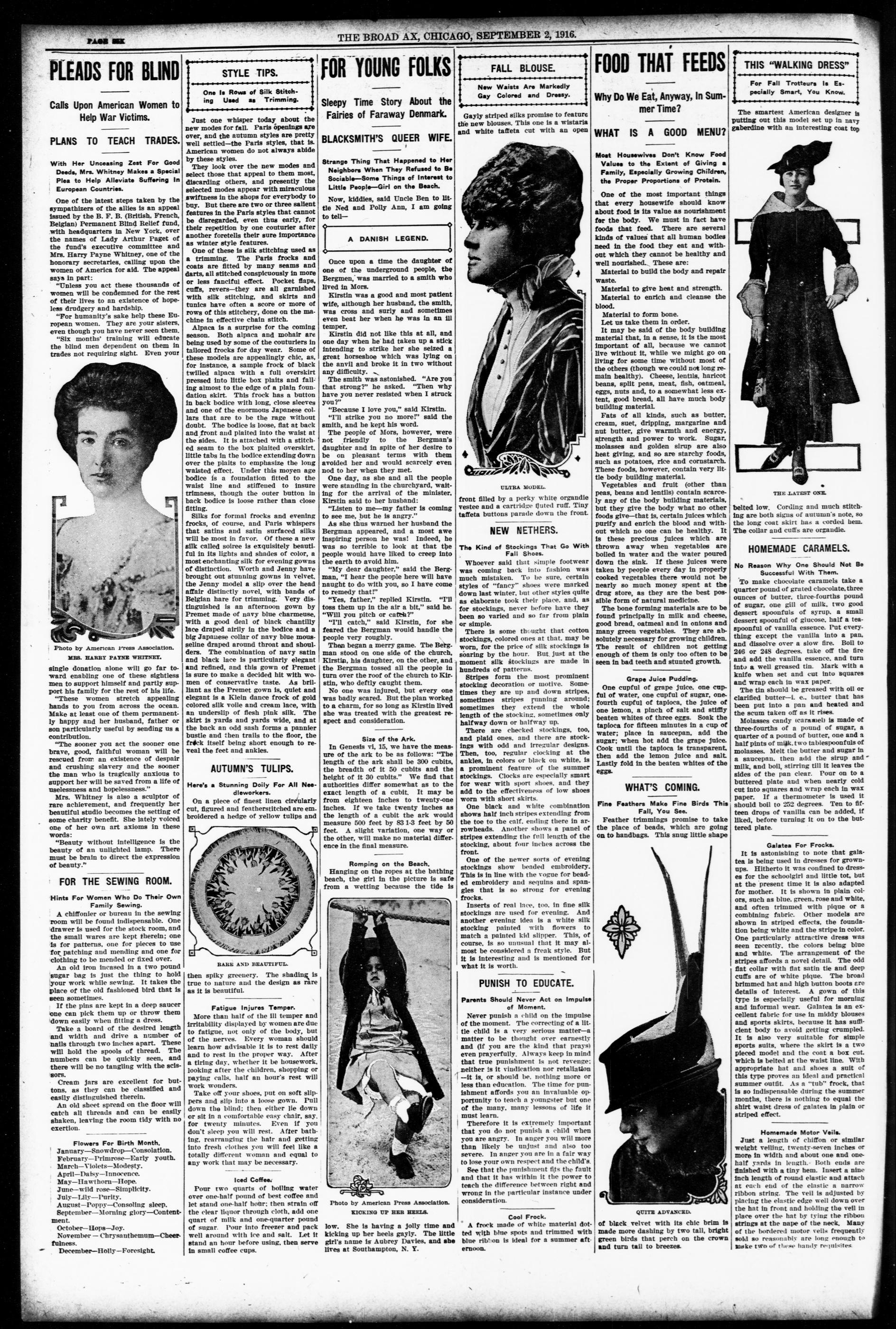
PLEADS FOR BLIND
Calls Upon American Women to Help War Victims.
PLANS TO TEACH TRADES.
With Her Unceasing Zest For Good Deeds, Mrs. Whitney Makes a Special Plea to Help Alleviate Suffering In European Countries.
One of the latest steps taken by the sympathizers of the allies is an appeal issued by the B. F. B. (British, French, Belgian) Permanent Blind Relief fund, with headquarters in New York, over the names of Lady Arthur Paget of the fund's executive committee and Mrs. Harry Payne Whitney, one of the honorary secretaries, calling upon the women of America for aid. The appeal says in part:
"Unless you act these thousands of women will be condemned for the rest of their lives to an existence of hopeless drudgery and hardship.
"For humanity's sake help these European women. They are your sisters, even though you have never seen them.
"Six months' training will educate the blind men dependent on them in trades not requiring sight. Even your
[Pictured is a woman with a large, wavy hairstyle and a dark dress with a decorative border. She is likely a woman of the early 20th century.]
Photo by American Press Association.
MBS. HARBY PAYNE WHITNEY.
single donation alone will go far toward enabling one of these sightless men to support himself and partly support his family for the rest of his life.
"These women stretch appealing hands to you from across the ocean. Make at least one of them permanently happy and her husband, father or son particularly useful by sending us a contribution.
"The sooner you act the sooner one brave, good, faithful woman will be rescued from an existence of despair and crushing slavery and the sooner the man who is tragically anxious to support her will be saved from a life of uselessness and hopelessness."
Mrs. Whitney is also a sculptor of rare achievement, and frequently her beautiful studio becomes the setting of some charity benefit. She lately voiced one of her own art axioms in these words:
"Beauty without intelligence is the beauty of an unlighted lamp. There must be brain to direct the expression of beauty."
FOR THE SEWING ROOM.
Hints For Women Who Do Their Own Family Sewing.
A chiffonier or bureau in the sewing room will be found indispensable. One drawer is used for the stock room, and the small wares are kept therein; one is for patterns, one for pieces to use for patching and mending and one for clothing to be mended or fixed over.
An old iron incased in a two pound sugar bag is just the thing to hold your work while sewing. It takes the place of the old fashioned bird that is seen sometimes.
If the pins are kept in a deep saucer one can pick them up or throw them down easily when fitting a dress.
Take a board of the desired length and width and drive a number of nails through two inches apart. These will hold the spools of thread. The numbers can be quickly seen, and there will be no tangling with the scissors.
Cream jars are excellent for buttons, as they can be classified and easily distinguished therein. An old sheet spread on the floor will catch all threads and can be easily shaken, leaving the room tidy with no exertion.
Flowers For Birth Month.
January—Snowdrop—Consolation.
February—Primrose—Early youth.
March—Violets—Modesty.
April—Daisy—Innocence.
May—Hawthorn—Hope.
June—wild rose—Simplify.
July—Lily—Purity.
August—Poppy—Consoling sleep.
September—Morning glory—Contentment.
October—Hops—Joy.
November—Chrysanthemum—Cheerfulness.
December—Holly—Forestight
Just one whisper today about the new modes for fall. Paris openings are over, and the autumn styles are pretty well settled—the Paris styles, that is. American women do not always abide by these styles. They look over the new modes and select those that appeal to them most, discarding others, and presently the selected modes appear with miraculous swiftness in the shops for everybody to buy. But there are two or three salient features in the Paris styles that cannot be disregarded, even thus early, for their repetition by one couturier after another foretells their sure importance as winter styles features.
One of these is silk stitching used as a trimming. The Paris frocks and coats are fitted by many seams and darts, all stitched conspicuously in more or less fanciful effect. Pocket flaps, cuffs, revers—they are all garnished with silk stitching, and skirts and tunics have often a score or more of rows of this stitchery, done on the machine in effective chain stitch.
Alpaca is a surprise for the coming season. Both alpaca and mohair are being used by some of the couturlers in tailored frocks for day wear. Some of these models are appeallingly chic, as, for instance, a sample frock of black twilled alpaca with a full overskirt pressed into little box plaits and falling almost to the edge of a plain foundation skirt. This frock has a button in back bodice with long, close sleeves and one of the enormous Japanese collars that are to be the rage without doubt. The bodice is loose, flat at back and front and plaited into the waist at the sides. It is attached with a stitched seam to the box plaited overskirt, little tabs in the bodice extending down over the plaits to emphasize the long waisted effect. Under this moyen age bodice is a foundation fitted to the waist line and stiffened to insure trimness, though the outer button in back bodice is loose rather than close fitting.
Silks for formal frocks and evening frocks, of course, and Paris whispers that satins and satin surfaced silks will be most in favor. Of these a new silk called soiree is exquisitely beautiful in its lights and shades of color, a most enchanting silk for evening gowns of distinction. Worth and Jenny have brought out stunning gowns in velvet, the Jenny model a slip over the head affair distinctly novel, with bands of Belgian hare for trimming. Very distinguished is an afternoon gown by Premet made of navy blue charmeuse, with a good deal of black chantilly lace draped ally in the bodice and a big Japanese collar of navy blue mousseine draped around throat and shoulders. The combination of navy satin and black lace is particularly elegant and refined, and this gown of Premet is sure to make a decided hit with women of conservative taste. As brilliant as the Premet gown is, quiet and elegant is a Klein dance frock of gold colored silk voile and cream lace, with an underslip of flesh pink silk. The skirt is yards and yards wide, and at the back an odd sash forms a pannier bustle and then trails to the floor, the frock itself being short enough to reveal the feet and ankles.
AUTUMN'S TULIPS.
Here's a Stunning Doily For All Needleworkers.
On a piece of finest linen circularly cut, figured and featherstitched are embroidered a hedge of yellow tulips and
BARE AND BEAUTIFUL.
then spiky greenery. The shading is true to nature and the design as rare as it is beautiful.
Fatigue Injures Temper.
More than half of the ill temper and irritability displayed by women are due to fatigue, not only of the body, but of the nerves. Every woman should learn how advisable it is to rest daily and to rest in the proper way. After a tiring day, whether it be housework, looking after the children, shopping or paying calls, half an hour's rest will work wonders.
Take off your shoes, put on soft slippers and slip into a loose gown. Pull down the blind; then either lie down or sit in a comfortable easy chair, say, for twenty minutes. Even if you don't sleep you will rest. After bathing, rearranging the hair and getting into fresh clothes you will feel like a totally different woman and equal to any work that may be necessary.
Iced Coffee.
Pour two quarts of boiling water over one-half pound of best coffee and let stand one-half hour; then strain off the clear liquor through cloth, add one quart of milk and one-quarter pound of sugar. Pour into freezer and pack well around with ice and salt. Let it stand an hour before using, then serve in small coffee cups.
THE BROAD AX, CHICAGO, SEPTEMBER 2, 1916.
FOR YOUNG FOLKS
Sleepy Time Story About the Fairies of Faraway Denmark.
Strange Thing That Happened to Her Neighbors When They Refused to Be Sociable—Some Things of Interest to Little People—Girl on the Beach.
Now, kiddies, said Uncle Ben to little Ned and Polly Ann, I am going to tell—
A DANISH LEGEND.
Once upon a time the daughter of one of the underground people, the Bergmen, was married to a smith who lived in Mors.
Kirstin was a good and most patient wife, although her husband, the smith, was cross and surly and sometimes even beat her when he was in an ill temper.
Kirstin did not like this at all, and one day when he had taken up a stick intending to strike her she seized a great horseshoe which was lying on the anvil and broke it in two without any difficulty.
The smith was astonished. "Are you that strong?" he asked. "Then why have you never resisted when I struck you?"
"Because I love you," said Kirstin. "Till strike you no more!" said the smith and he kent his word.
The people of Mors, however, were not friendly to the Bergman's daughter and in spite of her desire to be on pleasant terms with them avoided her and would scarcely even nod to her when they met.
One day, as she and all the people were standing in the churchyard, waiting for the arrival of the minister, Kirstin said to her husband:
"Listen to me—my father is coming to see me, but he is angry."
As she thus warned her husband the Bergman appeared, and a most awe inspiring person he was! Indeed, he was so terrible to look at that the people would have liked to creep into the earth to avoid him.
"My dear daughter," said the Bergman, "I hear the people here will have naught to do with you, so I have come to remedy that!"
"Yes, father," replied Kirstin. "I'll toss them up in the air a bit," said he. "Will you pitch or catch?"
"It catch," said Kirstin, for she feared the Bergman would handle the people very roughly. Then began a merry game. The Bergman stood on one side of the church, Kirstin, his daughter, on the other, and the Bergman tossed all the people in turn over the roof of the church to Kirstin, who deftly caught them. No one was injured, but every one was badly scared. But the plan worked to a charm, for so long as Kirstin lived she was treated with the greatest respect and consideration.
Size of the Ark.
In Genesis vi, 15, we have the measure of the ark to be as follows: "The length of the ark shall be 300 cubits, the breadth of it 50 cubits and the height of it 30 cubits." We find that authorities differ somewhat as to the exact length of a cubit. It may be from eighteen inches to twenty-one inches. If we take twenty inches as the length of a cubit the ark would measure 500 feet by 83.13 feet by 50 feet. A slight variation, one way or the other, will make no material difference in the final measure.
Romping on the Beach
Hanging on the ropes at the bathing beach, the girl in the picture is safe from a wetting because the tide is
[Image of a young girl hanging on a swing, wearing a school uniform with a large hat.]
Photo by American Press Association.
KICKING UP HER HEELS.
low. She is having a jolly time and
kicking up her heels gayly. The little
girl's name is Aubrey Davies, and she
lives at Southampton, N. Y.
FALL BLOUSE.
New Waists Are Markedly Gay Colored and Dressy.
Gayly striped silks promise to feature the new blouses. This one is a wistaria and white taffeta cut with an open
```markdown
```
front filled by a perky white organdle
vestee and a cartridge fluted ruff. Tiny
taffeta buttons parade down the front.
NEW NETHERS.
The Kind of Stockings That Go With Fall Shoes.
Whoever said that simple footwear was coming back into fashion was much mistaken. To be sure, certain styles of "fancy" shoes were marked down last winter, but other styles quite as elaborate took their place, and, as for stockings, never before have they been so varied and so far from plain or simple.
There is some thought that cotton stockings, colored ones at that, may be worn, for the price of silk stockings is soaring by the hour. But just at the moment silk stockings are made in hundreds of patterns.
Stripes form the most prominent stocking decoration or motive. Sometimes they are up and down stripes, sometimes stripes running around; sometimes they extend the whole length of the stocking, sometimes only halfway down or halfway up.
There are checked stockings, too, and plaid ones, and there are stockings with odd and irregular designs. Then, too, regular clocking at the ankles, in colors or black on white, is a prominent feature of the summer stockings. Clocks are especially smart for wear with sport shoes, and they add to the effectiveness of low shoes worn with short skirts.
One black and white combination shows half inch stripes extending from the toe to the calf, ending there in arrowheads. Another shows a panel of stripes extending the full length of the stocking, about four inches across the front.
One of the newer sorts of evening stockings show beaded embroidery. This is in line with the vogue for beaded embroidery and sequins and spangles that is so strong for evening frocks.
Inserts of real lace, too, in fine silk stockings are used for evening. And another evening idea is a white silk stocking painted with flowers to match a painted kid slipper. This, of course, is so unusual that it may almost be considered a freak style. But it is interesting and is mentioned for what it is worth.
PUNISH TO EDUCATE.
Parents Should Never Act on Impulse of Moment.
Never punish a child on the impulse of the moment. The correcting of a little child is a very serious matter—a matter to be thought over earnestly and (if you are the kind that prays) even prayerfully. Always keep in mind that true punishment is not revenge; neither is it vindication nor retaliation—it is, or should be, nothing more or less than education. The time for punishment affords you an invaluable opportunity to teach a youngster but one of the many, many lessons of life it must learn.
Therefore it is extremely important that you do not punish a child when you are angry. In anger you will more than likely be unjust and also too severe. In anger you are in a fair way to lose your own respect and the child's.
See that the punishment fits the fault and that it has within it the power to teach the difference between right and wrong in the particular instance under consideration.
Cool Frock.
A frock made of white material dotted with blue spots and trimmed with blue ribbon is ideal for a summer afternoon.
FOOD THAT FEEDS
Why Do We Eat, Anyway, In Summer Time?
WHAT IS A GOOD MENU?
Most Housewives Don't Know Food Values to the Extent of Giving a Family, Especially Growing Children, the Proper Proportions of Protein.
One of the most important things that every housewife should know about food is its value as nourishment for the body. We must in fact have foods that feed. There are several kinds of values that all human bodies need in the food they eat and without which they cannot be healthy and well nourished. These are:
Material to build the body and repair waste.
Material to give heat and strength.
Material to enrich and cleanse the blood.
Material to form bone.
Let us take them in order.
It may be said of the body building material that, in a sense, it is the most important of all, because we cannot live without it, while we might go on living for some time without most of the others (though we could not long remain healthy). Cheese, lentils, haricot beans, split peas, meat, fish, oatmeal, eggs, nuts and, to a somewhat less extent, good bread, all have much body building material.
Fats of all kinds, such as butter, cream, suet, dripping, margarine and nut butter, give warmth and energy, strength and power to work. Sugar, molasses and golden sirup are also heat giving, and so are starchy foods, such as potatoes, rice and cornstarch. These foods, however, contain very little body building material.
Vegetables and fruit (other than peas, beans and lentils) contain scarcely any of the body building materials, but they give the body what no other foods give—that is, certain juices which purify and enrich the blood and without which no one can be healthy. It is these precious juices which are thrown away when vegetables are boiled in water and the water poured down the sink. If these juices were taken by people every day in properly cooked vegetables there would not be nearly so much money spent at the drug store, as they are the best possible form of natural medicine. The bone forming materials are to be found principally in milk and cheese, good bread, oatmeal and in onions and many green vegetables. They are absolutely necessary for growing children. The result of children not getting enough of them is only too often to be seen in bad teeth and stunted growth.
Grape Juice Pudding.
One cupful of grape juice, one cupful of water, one cupful of sugar, one fourth cupful of tapioca, the juice of one lemon, a pinch of salt and stiffly beaten whites of three eggs. Soak the tapioca for fifteen minutes in a cup of water; place in saucepan, add the sugar; when hot add the grape juice. Cook until the tapioca is transparent, then add the lemon juice and salt. Lastly fold in the beaten whites of the eggs.
WHAT'S COMING.
Fine Feathers Make Fine Birds This Fall, You See.
Feather trimmings promise to take the place of beads, which are going on to handbags. This snug little shape
*
QUITE ADVANCED.
of black velvet with its chic brim is made more dashing by two tall, bright green birds that perch on the crown and turn tail to breezes.
THIS "WALKING DRESS"
For Fall Trotteurs Is Especially Smart, You Know.
The smartest American designer is putting out this model set up in navy gaberdine with an interesting coat top
STEEL & COATING CO.
THE LATEST ONE.
belted low. Cording and much stitching are both signs of autumn's note, so the long coat skirt has a corded hem. The collar and cuffs are organdie.
HOMEMADE CARAMELS.
No Reason Why One Should Not Be Successful With Them.
To make chocolate caramels take a quarter pound of grated chocolate, three ounces of butter, three-fourths pound of sugar, one gill of milk, two good dessert spoonfuls of syrup, a small dessert spoonful of glucose, half a teaspoonful of vanilla essence. Put everything except the vanilla into a pan, and dissolve over a slow fire. Boll to 246 or 248 degrees, take off the fire and add the vanilla essence, and turn into a well greased tin. Mark with a knife when set and cut into squares and wrap each in wax paper.
The tin should be greased with oil or clarified butter—l. e., butter that has been put into a pan and heated and the scum taken off as it rises.
Molasses candy (caramel) is made of three-fourths of a pound of sugar, a quarter of a pound of butter, one and a half pints of milk, two tablespoonfuls of molasses. Melt the butter and sugar in a saucepan, then add the sirup and milk, and boil, stirring till it leaves the sides of the pan clear. Pour on to a buttered plate and when nearly cold cut into squares and wrap each in wax paper. If a thermometer is used it should boil to 252 degrees. Ten to fifteen drops of vanilla can be added, if liked, before turning it on to the buttered plate.
Galatea For Frocks.
It is astonishing to note that galaea is being used in dresses for grown-ups. Hitherto it was confined to dresses for the schoolgirl and little toot, but at the present time it is also adapted for mother. It is shown in plain colors, such as blue, green, rose and white, and often trimmed with pique or a combining fabric. Other models are shown in striped effects, the foundation being white and the stripe in color. One particularly attractive dress was seen recently, the colors being blue and white. The arrangement of the stripes affords a novel detail. The odd flat collar with fat satin tie and deep cuffs are of white pique. The broad brimmed hat and high button boots are details of interest. A gown of this type is especially useful for morning and informal wear. Galatea is an excellent fabric for use in middy blouses and sports skirts, because it has sufficient body to avoid getting crumpled. It is also very suitable for simple sports suits, where the skirt is a two piece model and the coat a box coat, which is belted at the waist line. With appropriate hat and shoes a suit of this type proves an ideal and practical summer outfit. As a "tub" frock, that is so indispensable during the summer months, there is nothing to equal the shirt waist dress of galatea in plain or striped effect.
Homemade Motor Veils.
Just a length of chiffon or similar weight velling, twenty-seven inches or more in width and about one and one half yards in length. Both ends are finished with a tiny hem. Insert a nine inch length of round elastic and attach at each end of the elastic a narrow ribbon string. The veil is adjusted by placing the elastic edge well down over the hat in front and holding the veil in place over the hat by tying the ribbon strings at the nape of the neck. Many of the bordered motor vells frequently sold so reasonably are long enough to make two of these handy requisites.
Talks on
HEALTH, CLEANLINESS, PROPER LIVING, SANITATION, ETC.
Dr. W. | A. DRIVER
3300 So. State Street
Phode Douglas 3617
CLEAN HANDS
Health depends upon cleanliness as much as any other condition. The hands serve almost constantly during the hours we are awake. It is a fact that what enters by the mouth often defiles the whole body. The hands convey to the mouth nourishment, which it is possible to contaminate in transit. When we take into consideration the multiple uses of the hands, it is easy to understand the importance of clean hands. It pays to give this matter serious thought for life and death often depend upon this matter of clean hands.
Germs are very small organisms, too small to be seen with the naked eye, but millions of our own contemporaries have seen them by the use of the higher powers of the microscope. It is not a matter of doubt by persons who have done a reasonable amount of reading but we must admit that there are persons who are not so well informed. Those who have seen the micro-organisms under the higher powers of the microscope have doubtless been convinced of the efficacy of germ possibilities. They will be more
STATE INDUSTRIAL ACCIDENT
COMMISSION — BUREAU OF
CLAIMS. (MARYLAND.)
HENRY WACHTER,
Employe.
G.B.S. BREWING COMPANY,
Employer.
FIDELITY AND DEFOSIT Co.,
Insurer.
S. W. GAMBRILL for insurer.
WAGAMAN. Commissioner—
Henry Wachter was employed by the G.B.S. Brewing Company as a bottler. On November 7, 1915, while handling a box of beer, he struck his left hand against the strap iron band on the box and lacerated his middle knuckle. He immediately reported his injury to his foreman. His hand began to swell and the next morning his employer advised him to go to Dr. Pierson. He did so, and was under Dr. Pierson's care for seven days. He was then discharged from the care of the physician, with instructions to come back if his hand gave him any further trouble. At that time the infection which had previously developed had subsided and the wound had a healthy scab on it. He continued at his work from the time of the accident until the 27th day of March, 1916. At the time he was discharged by the physician there was a depression or hole about as large as a pea at the seat of the injury over which a scab had formed. He kept his hand bandaged, but the wound did not entirely heal. The scab which formed would come
JULIUS JOHNSON
Auditor of Public Accounts
STATE OF ILLINOIS
Primary Wednesday, September 13, 1916
Primaries Wednesday,
VOTE
LEOPOLD
day, September 13th, 1916
VOTE FOR
OLD PFAELZER
Primaries Wednesday, September 13th, 1916
Democratic Candidate for the
Nomination
For County Assess
Mr. Pfaelzer is a brother of the late County Assessor
County Assessor
of the late County Assessor David M. Pfaelzer
BY
83
A. E. H.
cautious than those who have not been so fortunate as to have seen them. Seeing is verily believing. There is no doubt in the minds of those who know of the dangers that the habit of handshaking spreads disease. Filthy hands convey disease because of a combination of circumstances. It is a fine habit to wash the hands frequently in order to avoid accidentally spreading infection.
Those who do not believe in the germ theory are dangerous because they will not take proper precautions. The advanced thinkers of today believe more in prevention than in any branch of therapy. To prevent many maladies remember that the little things count and keep the hands clean. Typhoid fever is one of the terrible diseases spread by dirty hands. No one can say how many other diseases are capable of being spread in such a manner. Keep the hands clean; it is a good habit. It will recommend you as a cautious person. The efficient are so because of cleanliness which is almost if not equivalent to caution and safety. Try safety first and clean hands.
off and another would form. This occurred repeatedly until about March 27th when his hand and arm became very much affected. He then consulted his physician, Dr. Burke, who sent him to St. Joseph's Hospital, where it was found that there had developed a very severe cellulitis of his left hand, forearm and half way between his elbow and shoulder. On March 29 and April 2 he was operated on at the hospital, incisions being made from the shoulder to the hand. On April 19, while still incapacitated, he filed his claim for compensation. Objection is made to the claim by the insurer, who seeks to avoid liability on the ground of an alleged "lack of ordinary care and prudence on the part of the claimant, and that the present disability is not the natural and unavoidable result of the superficial cut or abrasion received in November, 1915."
As to the "lack of ordinary care and prudence on the part of the claimant," it seems sufficient to say that the wound did not assume any more threatening or dangerous aspect as viewed by the average workman from the time the claimant was discharged from the care of the physician (at which time it had a scab on it and had not entirely healed) until a few days before he went to the hospital. The claimant had been sent to work with his hand bandaged and with the wound in the condition described. The evidence does not show that any other
MOLINE, ILL.
Candidate for the Republican Nomination for
instructions were given to him than that he should return to the doctor if the hand gave him any further trouble. He did not appreciate, and the evidence does not show, that he had been advised of the danger that lurked in such a wound. The fact that he had been discharged from the doctor's care as able to continue his work with his hand still bandaged and the wound not entirely healed tended to dispel any apprehension of danger he might otherwise have felt. However, as soon as the arm began to pain he sought a physician and was immediately sent to a hospital. Under these circumstances we are of the opinion that the first ground of objection must fall.
The other objection to the claim is founded upon that provision of the Compensation Law contained in Section 62, Sub-section 6, of Chapter 800, Acts of 1914, which defines "injury" and "personal injury" for which compensation is payable as meaning "only accidental injury arising out of and in the course of employment, and such disease or infection as may naturally and unavoidably result therefrom."
On this branch of the case the evidence establishes the fact that the infection resulted from the injury to the hand. In the "attending physician's report," filed in the case, Dr. Millard L. Raemore, in describing the nature and extent of the claimant's injuries, says he has "a very severe cellulitis of hand, forearm and half way between elbow and shoulder (left), necessitating anaesthetizing patient twice, March 29 and April 2, and opening the extremity by free incision from shoulder to the hand. * * * He has as a point of infection the small abrasion on the middle knuckle of the left hand middle finger, which he sustained November 23." In the same doctor's testimony he says he saw the claimant as soon as he was brought to the hospital. His arm was swollen and very red to his elbow and streaks of lymphangitis were noticeable. On looking for the portal of infection the opening over the knuckle was the only point found and from it could be seen red streaks running up the arm. This opening was very small, perhaps the size of a pinhead. It showed there had been considerable abrasion of the skin there which had healed with the exception of this small point, and it was undoubtedly deep enough to admit the entrance of a germ, and the bloodpoisoning resulted from that.
Other physicians who testified in the case, while admitting that a break in the surface of the skin, though it may be a mere pin scratch, is sufficient for the entrance of the organism of infection, expressed the opinion, based on the examination of the claimant's arm, that there was no connection between the infected hand and arm of the claimant and the injury which he received to his knuckle. But they were unable to account in any other way for the infection which they found, and in the absence of any other explanation we must accept the clear and positive testimony of Dr. Raemore that the injury which the claimant received to his knuckle was the seat of the subsequent infection of the arm and that the infection resulted therefrom.
The next inquiry, then, is, did this infection "naturally and unavoidably" result from the accidental injury to the hand?
In the case of Pollock v. The Consolidation Coal Company, Claim No. 2092, the same question arose as to the septicemia which caused the death of the husband of the claimant in that case. We held there that in cases involving certain acute infections which are due to pus-producing organisms such as abscess, cellulitis, erysipelas, septicemia, etc., where it was shown that the infection resulted from and accidental injury, the claimant had established a prima facie case that the infection naturally and unavoidably resulted therefrom. The reasons for so holding are set forth in an opinion filed in that case and are applicable here, but they need not be repeated at length. Acute infections resulting from accidental injuries are of frequent occurrence, and physicians appearing before this Commission have invariably testified that it is impossible to say that such an infection could or could not have been avoided in any particular case. And we can not conceive that any reliable evidence can be produced in any case to show that an existing disease or infection caused by pus-producing organisms could or could not have been absolutely avoided. Under these circumstances to impose the burden on a claimant to establish that a disease or infection is unavoidable would have the effect of denying compensation for a disability caused by any infection or disease, and thus defeat the manifest intention of the legislature to make compensable a disability resulting from certain diseases and infections. Nor does the conclusion here reached deprive the employer or insurer of the right to have the compensation denied, cut off or decreased by reason of any misconduct on the part of the injured employee with reference to surgical and medical treatment of his injuries, but, as we have already observed, there is no evidence in this case of
QUINADE
GROWS HAIR
REMOVES DANDRUFF
SEND FOR SAMPLE
QUINASOAP
THE IDEAL SHAMPOO SOAP
THOROUGHLY CLEANSSES THE SCALP
QUINACOMB
HAIR STRAIGHTENER
SHAMPOO DRYER
QUINADE 25¢ QUINACOMB 50¢ QUINASOAP 25¢
AT ALL DRUGGISTS
SEEBY DRUG COMPANY, NEW YORK CITY, N.Y.
THE SANITARY and SHIP CANAL
Length - - - - - 32 Miles
Depth - - - - - 22 Feet
Width - - - 162 to 290 Feet
THE CANAL OFFERS:
Industrial Locations, Dock Facilities, Water Transportation, Railroad Connections, Electric Power, Concrete Building Material. Direct Connection with St. Louis via the Illinois River and Direct Connection with the Gulf via the Illinois and Mississippi Rivers. Electric Energy Created from Water Power for the Modern Factory Means Efficiency and Economy.
THOMAS A. SMYTH, President
JOHN McGILLEN, Chief Clerk
F. D. CONNERY, Comptroller
Karpen Building
900 So. Michigan Ave., CHICAGO
any such misconduct. All of the essential facts having been established, it follows that the claimant is entitled to compensation during the continuance of his temporary total disability, subject to the limitations as prescribed by the act, for one-half of his average weekly wage of $14.50, and an order will be passed accordingly.
LIABILITY OF DIRECTORS OF
NATIONAL BANK.
In Williams v. Brady, decided by the U. S. District Court for the district of New Jersey (232 Fed., 740), it was held that there is a liability on the part of directors of a national bank for failure to perform the duties which the general principles of law cast upon them when they became directors, distinct from and in addition to the duties and liabilities expressly imposed by the statutes. It was also held that such directors are severally liable for failure to perform their official duties, and that a suit may be brought by the receiver of an insolvent national bank against one, all, or any number of them. Such an action, whether based on the common law or on sec. 5239 of the Revised Statutes, survives against the personal representative of a deceased director. The court said in part:
"It is now urged, apparently for the first time, that the defendants are liable only by virtue of section 5239 of the Revised Statutes (Comp. St., 1913, sec. 9831); in other words, that there is no common-law liability of a director or of a national bank, and that consequently all portions of the bill which seek to charge the defendant with liability for acts or omissions which are not specific violations of the provisions of the statutes relating to national banks, must be stricken out. This question is probably covered by Judge Hunt's ruling, because the original bill contained many averments of dereliction of duty which were not violations of such statutes. However, as it does not appear to have
been specifically presented to or decided by him, I will consider it. The proposition seems to be based upon counsel's conception of what was held and said by the Supreme Court in Yates v. Jones National Bank, 206 U. S., 158, 27 Sup. Ct., 638, 51 L. Ed., 1002. I can not gather anything from the opinion in that case which would warrant such a construction, but, on the other hand, it appears to me very clear that the court recognized that there is a liability on the part of national bank directors for failure to perform the duty which the general principles of the law cast upon them when they become directors, distinct from and in addition to the duties and liabilities imposed by the statutes. It was said by Chief Justice White (206 U. S., 178, 27 Sup. Ct., 645, 51 L. Ed., 1002): 'In other words, as the statute does not relieve the directors from the common-law duty to be honest and diligent, the oath exacted responds to such requirements.'
"That case simply decided that the National Bank act (Act June 3, 1864, c. 106, 13 Staf., 99) imposes upon directors of national banks duties which did not rest upon them at common law, and that section 5239 affords the exclusive rule by which to measure the right to recover damages, based upon a loss resulting solely from the violation of such duties. The same question as is here presented was raised in Allen v. Luke, 163 Fed., 1018 (C. C. Mass.), and was decided adversely to defendants' contention; Judge Lowell entertaining the same view of Yates v. Jones National as is here expressed. That there exists a liability on the part of national bank directors for failure to perform the duty imposed upon them by the general principles of the law, irrespective of the statute, is, I think, also clear from Briggs v. Spaulding, 141 U. S., 132, 11 Sup. Ct., 924, 35 L Ed., 662, where the measure of such duty is defined. See, also, Rankin v. Cooper, 149 Fed., 1010 (C. C. W. D. Ark.)"
PAGE SEVEN
PHONES: OFFICE, MAIN 4188
AUTOMATIC 33-736
RESIDENCE, DREXEL 7900
Walter M. Farmer
ATTORNEY AT LAW.
SUITE 708, 184 WASHINGTON ST.
NOTARYPUBLIC CHICAGO
Office Phones: Res. 5133 Sa. Wabash Ave.
Oakland 4682, Auto. 73-658, Phone Drexel 18015
Dr. Theo. R. Mozee
DENTIST
4709 S. STATE STREET
CHICAGO
Hours 9 A. M. to 5 P. M., 7 P. M. to 9 P. M.
Sundays by Appointment
Phone Main 2017 Automatic 32-395
A. L. WILLIAMS
ATTORNEY AND COUNSELOR AT LAW
Suite 706 Firmenich Bldg.
184 W. Washington St.
Residence 5548 Jefferson Av.
Phone Midway 5515 Chicago
A. D. GASH
ATTORNEY AT LAW
118 North La Salle St., Chicago
Suite 615 to 616
PHONE MAIN 2214
Residence 1262 Macallister Place
Telephone Monroe 2714
MILES J. DEVINE
ATTORNEY AT LAW
Suite 313-329 Reaper Block
Clark & Washington Ste.
Phones Central 239
Auto. 41-918 CHICAGO
Franklin A. Denison
ATTORNEY AT LAW
36 West Randolph St., Chicago
Suite 708,Delaware Building
Tel. Central 3142
FRANK DUNN
J. B. McCAHEY
Trustees
Established 1877
TEL. OAKLAND 1850, 1851, 1852
JOHN J. DUNN
WHOLESALE COAL RETAIL
Fifty-First and Armour Avenue
RAILYARDS
51st St. and L. S. & M. S.
51st St. and Armour Ave.
OMIACO
THE BROAD AX CAN BE FOUND
ON SALE AT THE FOLLOWING
NEWS STANDS:
From on and after this date The
Broad Ax, can be found on sale at the
following news stands:
N. C. Chalmers, cigars, tobacco, notion store and news stand, 5012 S. State street.
L. E. Chilton, news stand, S. E. corner 51st and State streets.
S. Berenbaum, Cigars, Notions and News Stand; 31 W. 51 Street, near Dearborn.
E. H. Faulkner, news agency; 3109 S. State street.
George I Martin, maker of fine cigars and news stand, 18 W. 31st St., near State.
E. M. Harvey's barber shop and news stand, 3924 State street.
W. M. Maxwell, notions, cigars, tobacco, confections and news stand, 5244 State St.
Edward Felix, notions, cigars and news stand, 52 W. 30th St.
F. Bishop, cigars, tobacco and news stand, 3 W. 27th St., near State.
Sylvester McGloffin, news stand and laundry office, 4122 State St.
William Gaughan, laundry office, cigars, tobacco and news stand, 2636 State St.
R. M. Oliver, notions, cigars and news stand, 15 W. 36th Street, near State.
A. D. Hayes, cigars, tobacco, notions, stationary and news stand, 3640 R. State St.
George McFare, shoe shining parlers and news stand. 3800½ State street.
T. B. Hall, Laundry office, cigars, tobacco and news stand. 3618 South
PAGE EIGHT TEENAN JON
TEENAN JONES' PLACE
TEENAN JONES' PLACE
3445 SOUTH STATE STREET Telephone Douglas 4591
The finest and most BUFFET and CARF Side. First-Class E HENRY "TEENAN" J
A. F. CODOZOE,
J. H. WHISTON, Proprietors
CHAS. HARRIS, Manager
The Elite AND BU
3030 STATE STREET
JOHN BLOCKI, President
JOHN BLOCKI PERFUME
GO TO
C. E. KREYSSI
5057 South St
NOT ON THE
FOR HIGH GRADE DRUG
MEDICINAL PRE
All Prescriptions Caref
ALSO CARRY A F
BLOCKI'S IDEAL & B IN BOTTLE P
The finest and most UP-TO-DATE BUFFET and CAFE on the South Side. First-Class Entertainers. HENRY "TEENAN" JONES, Proprietor.
A. F. CODOZOE,
J. H. WHISTON, Proprietors
CHAS. HARRIS, Manager
DOUQLAS 5971
Phones DOUQLAS 3256
AUTO. 72-379
The Elite Cafe
AND BUFFET
3030 STATE STREET
CHICAGO
BLOCKI'S IDEAL & BLOCKI'S FLOWER IN BOTTLE PERFUMES
THE MOST COMPLETE OPTIC
BEST GOODS AT THE L
Consultation or examination
FREE. We have 28 different
ways of testing the eyes and
guarantee to give satisfaction.
THI MOST COMPLETE OPTICAL ROOMS IN THE CITY
BEST GOODS AT THE LOWEST PRICES
The religion inculcated by Buddha had certain cardinal points—the encouragement of the ascetic life, the maintenance of virtue, the exhortation to persons of all castes and both sexes to aim at deliverance from the evils of existence and, lastly, the attainment of Niryana.
But in Tibet Buddhism has been grafted on to the earlier devil worship of the people, and a religion has been evolved better expressed as Lamaism, or modified devil worship, so that in addition to the Buddhas and Bodisats there have also come to be tutelary and guardian deities of a terrifying and malignant aspect, whose duty it is to defend the faith and the faithful people from external attack. These deities are depicted in grotesque and terrible forms in all the monasteries, generally in violently colored fresce paintings at the entrance. — National Geographic Magazine.
Paste This on the Family Tool Chest.
The idea of this cabinet is to furnish amusement to the family when they have scratched up all the furniture and done all the damage elsewhere they can think of; therefore
Do not replace or put back anything that you take out of these drawers.
Try, if possible, to select and remove from this cabinet some article or tool that is absolutely indispensable, leaving it preferably out in the back yard.
If you have anything hanging about your room that is of no earthly use you might store it in one of these drawers.
Remember that the main idea of having this cabinet on the premises is gradually to fill it with utterly useless things.
And remove from it at the same time all the useful things.
Patience! Keep at it and you are bound to succeed.-Life.
Sawse Sawge.
Here is the old King Richard II. way of making sausage: "Pyggs in sawse sawge." or pigs with sage sauce. "Take pyggs yskaldel (scaled) and quarter them and seeth them in water and salt; take them and let them kele (cool); take parsel (parsley), sawge (sage) and grynde it with brede and yolkes of ayren (eggs) harde ysode (bolled); temper it with vinegar some what thick, and lay the pyggs in a vessel and sewe onoward (the sauce over them), and serve it forth." "Take pyggs is pretty good. Size or number seems of no consequence.
most UP-TO-DATE
SAFE on the South
Entertainers.
' JONES, Proprietor.
DOUGLAS 5971
Phones DOUGLAS 3256
AUTO. 72-379
State Cafe
BUFFET
CHICAGO
F. W. BLOCKI, Treasurer
BLOCKI & SON
CUMERS
TO
SLER, Druggist
State Street
THE CORNER
BUGS, CHEMICALS AND
PREPARATIONS
Carefully Compounded
A FULL LINE OF
BLOCKI'S FLOWER
PERFUMES
All Eye Trouble
SEE
Dr. LOUIE USSELMANN
The Practical Obtician
TICAL ROOMS IN THE CITY
THE LOWEST PRICES
150 S. STATE ST.
Phone Douglas 5308
CHICAGO
One of the most rarely witnessed of natural phenomena, but one that has often been discussed at scientific meetings and that always awakens wonder when seen, is the so called "green flash" occasionally visible at the moment of the disappearance of the sun behind a clear horizon. The observer's eye must be fixed upon the rim of the sun as it disappears in order to catch the phenomenon. One authority tells us that he has seen the green flash, although rarely, at the instant of the setting of a bright star. Among the explanations offered is one based upon the optical principle of complementary colors. If one looks at the sun and then closes the eyes a green disk will be perceived. A sensitive eye might be similarly affected by a brilliant star.
Theft In Ancient Wales
In some ways which might nowadays be called "sentimental" the laws of ancient Wales were in advance of those of today. J. E. Lloyd in his "History of Wales" mentions that in some of the codes (which were, as a rule, very severe on theft) a remarkable provision exempted from punishment "the starving man who, after begging for three days and receiving nothing, helped himself to the food which he needed in order to keep him alive. That every man had the right to live was a principle of the law, and the sentiment of the country demanded that every person of substance should keep open house not only for ordinary travelers, but also for the destitute and the friendless."
African Grosebacka
The social grosebs of South Africa live in large societies. They select a tree of considerable size and literally cover it with a grass roof, under which their common dwelling is constructed. The roof serves the double purpose of keeping off the heat and the rain, and 400 or 500 pairs of birds are known to have the same shelter. The nests in this aerial dwelling are built in regular streets and closely resemble rows of tenement houses.
Sure Bait.
"How did you manage to sell that piece of goods that's all out of date to Mrs. Hisil?"
Clerk-I told her it was a great bargain, but I thought Mrs. Richcoin had had it laid aside for one of her daughters. Then she took it right off.
THE BROAD AX, CHICAGO, SEPTEMBER 2, 1916.
ERNEST WILLIAMSON
My Funeral Compartment Auto-Servers are Revolutionizing Funeral Services in Ohio. They Are Fostly Preferred to Single Carriages and Artists, who Inserve For Greater Gleanings and Guests, and Builds Save More than Half the High Cost of Carriages and Automobiles Tel. Kenwood 455 Calls Promptly Answered Day or Night Auto. 73-867
RAILWAY EARNINGS. — Bradstreet's has the following in regard to the extraordinary railway earnings of the past six months:
"In the existing lethargic state of the stock market, little effect has apparently been exercised by the almost phenomenally favorable earnings reports of so many of the country's largest railways. The figures of the Pennsylvania Railroad are a case in point. All the lines, eastern and western, in the Pennsylvania system show for the month of June and for the six months ending June 30 the following results, compared with the figures for the corresponding periods in 1915 and 1914:
Gross, June 1916, $37,514,060; Gross, June 1915, $31,609,836; Gross, June 1914, $30,978,496.
Net after tax, June 1916, $10,222,160;
Net after tax, June 1915, $8,456,564;
Net after tax, June 1914, $7,415,024.
Six months, 1916, Gross, $210,605,
049; Six months, 1915, Gross, $164,
779,708; Six months, 1914, Gross,
$170,632,212.
Six months, 1916, Net after tax,
$50,767,754; Six months, 1915, Net after tax,
$28,749,315; Six months, 1914, Net after tax, $26,647,225.
Similar results are displayed by the New York Central lines, the earnings of all the lines included in that system for June and the first six months of this and the two preceding years being as follows:
Gross, June 1916, $30,436,298; Gross,
June 1915, $25,157,492; Gross, June
1914. $23,727,060.
Net after tax, June 1916, $9,809,338;
Net after tax, June 1915, $8,060,266;
Net after tax, June 1914, $5,483,935.
Six months, 1916, Gross, $172,520,
744; Six months, 1915, Gross, $135,
548,138; Six months, 1914, Gross, $133,
044,175.
Six months, 1916, Net after tax, $53,
320,447; Six months, 1915, Net after
tax, $30,435,152; Six months, 1914,
$19,013,534.
These figures, however, are not isolated examples of the recuperation which has occurred in railway traffic and revenues. The Southern Railway system, in its report for June and the twelve months ending June 30, exhibits a total income applicable to charges of $24,426,031, compared with $16,638,828 for the preceding fiscal year, while its surplus over fixed charges is given as $9,358,104, against $1,656,682 in 1914-15, an increase of $7,701,422, or more than four and one half times the available income of the year before. The Northern Pacific may also be cited to show the country-wide nature of the improvement. That system's gross for the twelve months ending June 30 is given as $75,936,402, against $63,171,653 the year before, and its net for the same period as $51,032,388, compared with $21,550,801 in 1914-15."
ASSOCIATE JUSTICE LOUS D. BRANDEIS of the United States Supreme Court will not be a member of the Joint American-Mexican Commission to settle pending disputes between the two countries. He declined the appointment saying: "Upon consultation with the chief justice I find the state of the business of the Supreme Court at the present time to be such that it is my duty not to undertake this important additional task."
CONFERENCE OF THE STATE BAR EXAMINERS IN DEFINING THE STANDARD OF ADMISSION TO THE BAR.—A Conference of the State Bar Examiners, Supreme Court judges, law school teachers and others interested will be held in connection with the annual meeting of the American Bar Association in Chicago. The conference, which will be held under the auspices of the Legal-Education Section of the American Bar Association, will meet in the green room, of the Congress Hotel, Chicago, on Tuesday, August 29, 1916, at 3 p. m. and at 8 p. m. It will be opened by Judge Henry Stockbridge, of the Maryland Court of Appeals. The discussions of the different topics presented will be opened by Mr. Charles L. Mckeehan, of the Pennsylvania Board of Bar Examiners; Professor William R. Vance, dean of the University of Minnesota Law School;
Judge John C. Rose, of the federal bench, District of Maryland, and Mr. Hollis R. Bailey, of the Bar Examiners for Massachusetts.
The conference will deal with a number of distinct propositions submitted, after long consideration, by a special committee on Standard Rules for Admission to the Bar. The full program, including the terms of the proposition submitted for discussion, can be had on application to Charles M. Hepburn, Secretary of the Section of Legal Education, Indiana University Law School, Bloomington, Indiana.
LEGAL ACTION ON THE FLY.—"The automobile that hit me five minutes ago was No. 41144 Ohio," he sputtered. "It knocked me unconscious, but I got the number before I went down for the count. Put it on a piece of paper,—41144."
"All right. What do you want?"
"What do I want? Why, I can prove that he was exceeding the speed limit, and I want—I want—"
"Calm down, friend. You want a warrant for his arrest?"
"Warrant, nothing! What good would a warrant do me? He was going so fast, I tell you, that a warrant wouldn't get him now. What I want is extradition papers!"—Milwaukee Evening Wisconsin.
THE AMERICAN LAW REVIEW for July-August, 1916, contains the following:
I. Recall of Judges and Judicial Independence, by James M. Kerr of Los Angeles, Cal.
II. The Lawyer Friends of Charles Lamb, by Alvin Waggoner of Philip, S. D.
III. Private Turnpikes and Bridges, by Clinton J. Evans of Topeka, Kan.
IV. Bacon's Lost Rules and Decisions, by Wm. A. Gardner of Farmington, Mo.
V. Lawyers' Fees Historically Considered, by Wilbur F. Browder of Russellville, Ky.
VI. The English Constitution, by Alex. P. Humphrey of Louisville, Ky.
VII. Current Topics and Notes.
VIII. Notes of Recent Decisions
IX. The Docket
IX. The Docket.
Stupendous Surnames.
The bearers of some of the surnames which appear in medieval documents must have been glad of an excuse to change them. Apparently this was done, for the more grotesque have either vanished or have been modified out of recognition. Among the former are such names as Alice Thepunderstepdoghtre, Mazellina Stabwourchman, Frethesancia Del Countynghouse, Godisman Attestrestresende and Thomas Wrangwisshe, which certainly have no claimants nowadays.
Many surnames derived from trade or service have been contracted, such as Le Lindraper to Draper, Le Countride into Coward, Le Chapelayn into Chaplin and Le Gresuenour (gros vesure) into Grosvenor.—London Opinion.
A Queer Creature.
Queer that while the male seal is a bull and the female a cow their younger is not called a calf, but a pup. Why "seal fisheries," too, when the seal is not a fish?
And why should the seal's breeding place be styled a rookery?
It looks as if this strange creature is only a fish in common parlance while at sea. On land (or ice) it is classed popularly with animals or birds.—Exchance.
A Glimpse of Heaven.
Paterfamilias—Well, Mr. Smith, I'm pleased to see you at our humble board for the first time. Now, is there any particular cut you fancy? Prospective Son-in-law—Oh, no, thank you. I think— Youngest Daughter of the House—Dad, aren't you going to ask Cissie! You know what a shindy she kicks up if she doesn't get first pick—London Ophion.
The Beginning and End.
Fond Mother—It was at this point in the entrancing landscape that my daughter received a declaration and accepted. Friend—And tell us the rest of the romance. Fond Mother—Unfortunately that is all there was.—Megendorfer Blatter.
GENERAL BANKING
3 per cent allowed
Safety Deposit Va
REAL ESTATE
As agent buy and sell Real Estate on c
dents, including payment of taxes and l
on Chicago Real Estate.
Especially Invites the patr
The Cranfor
Building.
The finest building ever oper
Steam heat, electric light, tile ba
3 per cent allowed on Savings Accounts Safety Deposit Vaults, $3.00 per Year
As agent buy and sell Real Estate on commission, manages estates for non-residents, including payment of taxes and locking after assessments. Money to loan on Chicago Real Estate.
Especially Invites the patronage of Chicago business men.
The Cranford Apartment Building. 3600. Wabash Ave.
THE MIDTOWN MASTER
The finest building ever opened to Colored tenants in Chicago. Steam heat, electric light, tile baths, marble entrance.
Honolulu.—The reforestation or new barren Kahoolawe island, in the Hawaiian group, is the proposition the territorial board of agriculture, the members of which, after a visit to the small islet heretofore designated unsuitable for settlement, decided to begin the work of planting algaroba trees there.
It is recommended a portion of the island swept by the strong trade winds be fenced to prevent depredations by sheep and wild goats. Members of the board say the introduction of horses on the island would assist in the distribution of seed.
It is also proposed to construct several large reservoirs to conserve the rainwater that falls so plentifully at all times. Algaroba trees planted there ten years ago have reached a substantial growth.
COLORS EMPLOYED ON FARM
Barnhart Tells How He Made the Whole Place Yellow and White. Reading, Pa.-Henry A. Barnhart of Indiana told the committee of the state board of agriculture, in session here, of his efforts in behalf of the artistic side of farming.
He illustrated this by citing that his big barns and outbuildings are all painted yellow, with white trimmings; the farmhouse is painted white, with yellow trimmings; the cattle have the same yellow color, because they are Guernseys; not a horse is used except he is yellow and has a white mark on his head and white feet. The shepherd dog is yellow, with a white band around his neck; there are yellow colored chickens, yellow colored squirrels, the place being known as the "Color Scheme Farm of Indiana."
BORN WITH EIGHT TEETH.
Baby Also Brought Into World a Sufficient Quantity of Hair.
Pittsburgh.—A baby boy born with eight teeth and Samsonian locks has the attention of all Undercliff. The boy has been named Alvin Leroy King and is the son of Mr. and Mrs. Leroy King.
When the baby opened his mouth for his first lusty yell the nurse was surprised to see four teeth each in upper and lower jaws. The child's head was covered with black hair. Ever since the King home has been an attraction for mothers, fathers and children calling to see the baby.
Protects Tame Jack Rabbit.
Bloomingdale, Ind.—William B. Leonard has inserted a notice in the newspapers requesting his friends and neighbors not to harm his pet Kansas jack rabbit. The rabbit has the run of the Leonard farm, but is so domesticated that it returns at night to sleep in the kitchen
THE MIDDLE EAST MUSEUM
'Phone Randelph 803
S. E. Cor. State and 36th Place, Chicago
J. W. Casey, Agent,
74 W. WASHINGTON STREET.
Naming a Famous Dish.
If you are a gourmet you like lobster. The man who made lobster a la Newburg famous refused to have his name go with it. He gave Delmonico the recipe, and Del gave the delicacy the name it bears today, while that of the benefactor is never heard outside of the little circle in which he lived. Well, the creator of the dish was Benjamin Wenburg, a New York broker. He used to take his luncheons at Delmonico's downtown place, not many blocks from the Battery. When he told Del how to make lobster a la Newburg—it had no name then—Del put it on his bill and called it lobster a la Wenburg.
Wenburg got angry about it and told Delmonico if he didn't remove his name he would feed elsewhere. The big caterer reversed the first syllable, and the title has been what you have been accustomed to see ever since—Richmond Times-Dispatch.
Whim of a Great Actor.
Salvini, the great Italian tragedian, made it a condition that none of his sons should act in Italy so long as he remained on the stage. So Gustavo was banished to the other countries of the continent and acted in Russia and Austria with some success. Alexander learned the English language and played in this country until he died at an early age. Tomaso is now an actor in Italy and is said to have inherited to a greater degree than any of his brothers the talents of his father.
Salvini was married twice; first to Clementine Cazzola, an eminent Italian actress, who died, leaving him three small children. Many years later he married an Englishwoman named Lotte Sharp, by whom he had two children. His grandchildren have attracted attention in art and other circles in Italy.—Argonaut.
Flowers and Leaves.
Flowers are produced by the sacrifice of stem and leaves, which subordinate their own functions to the making of seed to carry on the species. In the late summer time, when plants have flowered and set their seed, the leaf spirit seems again to assert itself and in many instances becomes sq strong that the miracle of its self sacrifice is revealed. One often sees roses, after producing perfect blossoms, producing some which push out a small bunch of green leaves from the heart, or perhaps the axis of the aborted stem grows right out from the middle and bears a small secondary rosebud. This secondary rose is generally smothered in a calyx more like a conglomeration of leaves than any ordinary calyx, the calyx showing a strong tendency to revert to the leaf form—Edinburgh Scotaman.