The Broad Ax
Saturday, September 9, 1916
Chicago, Illinois
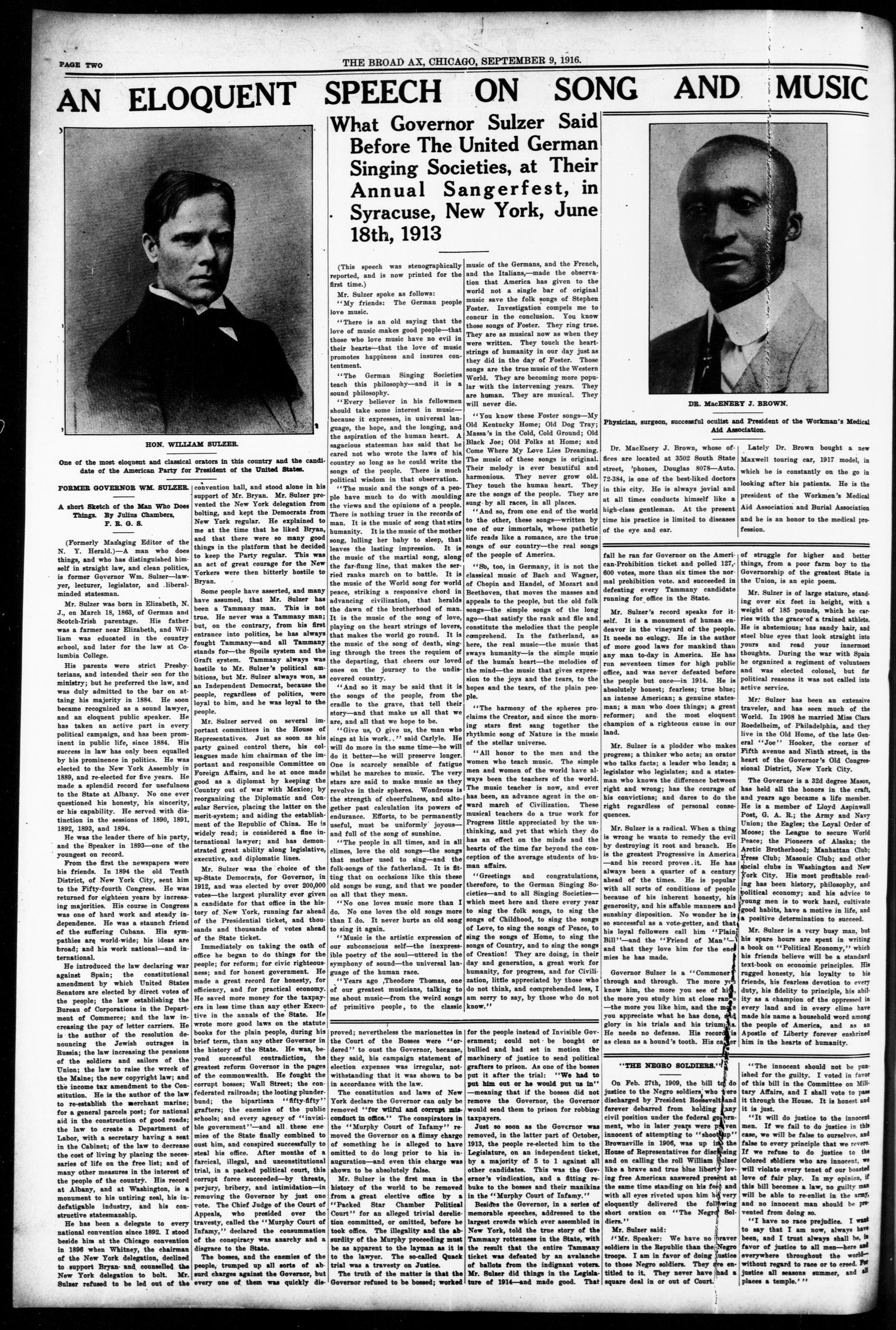
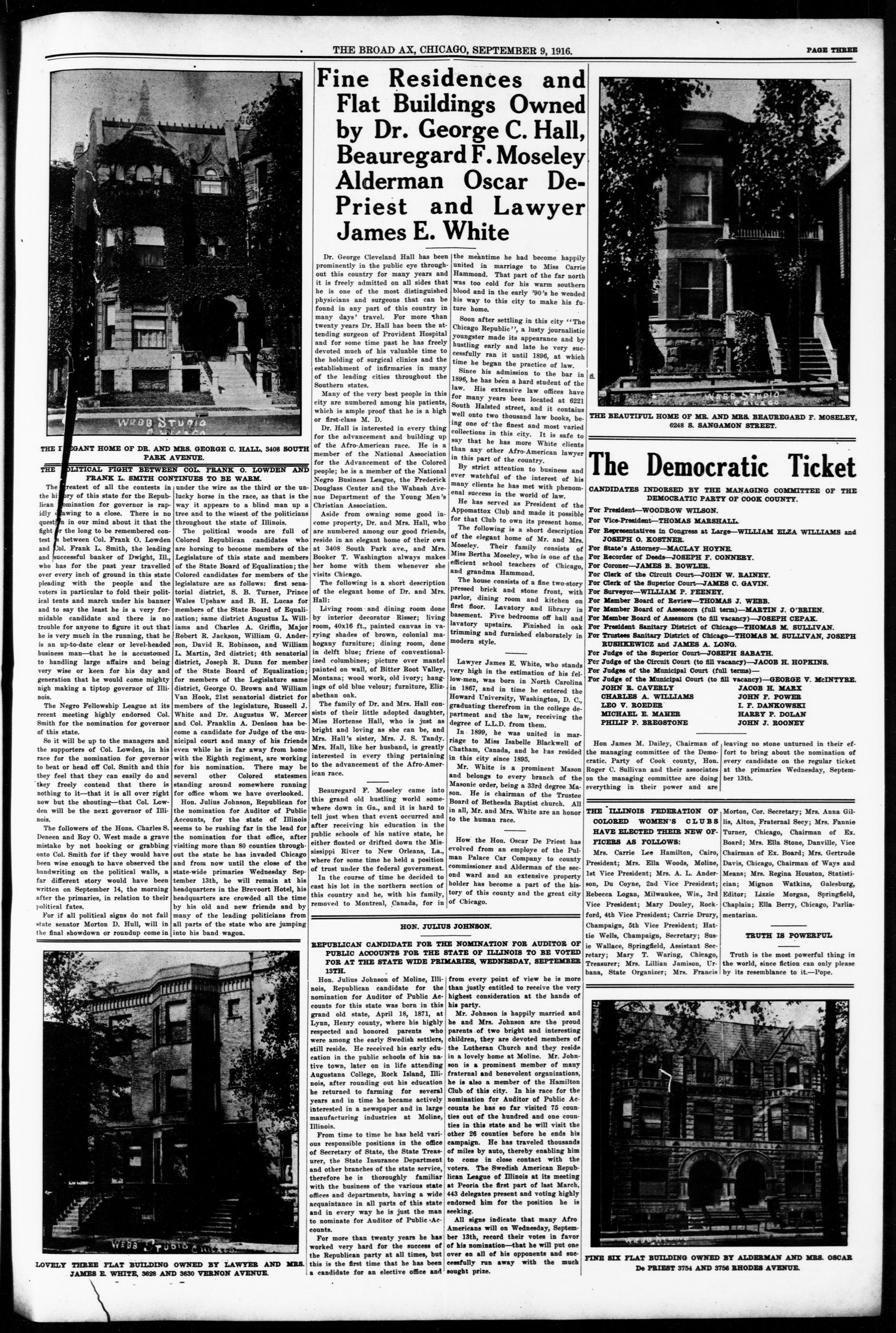
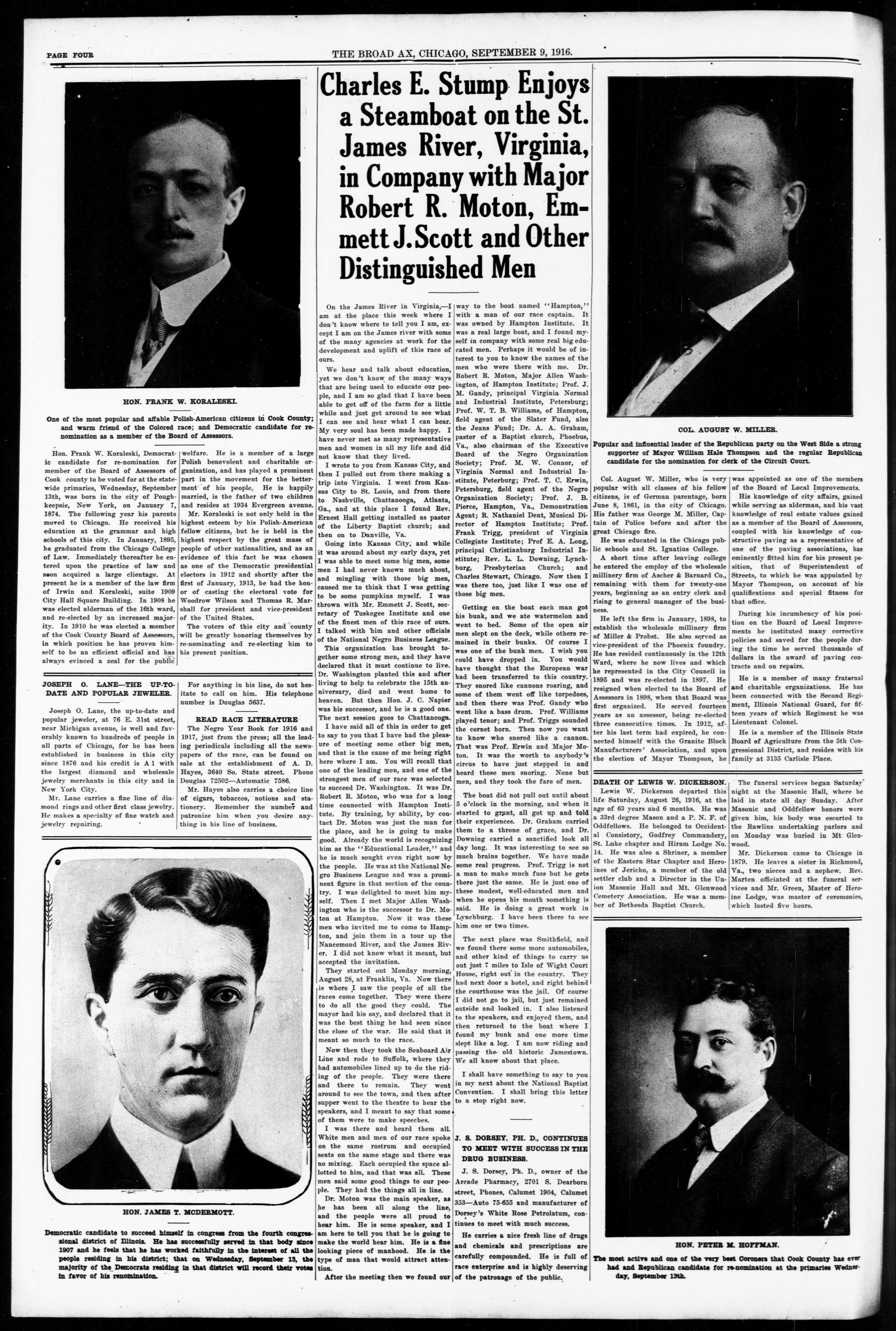
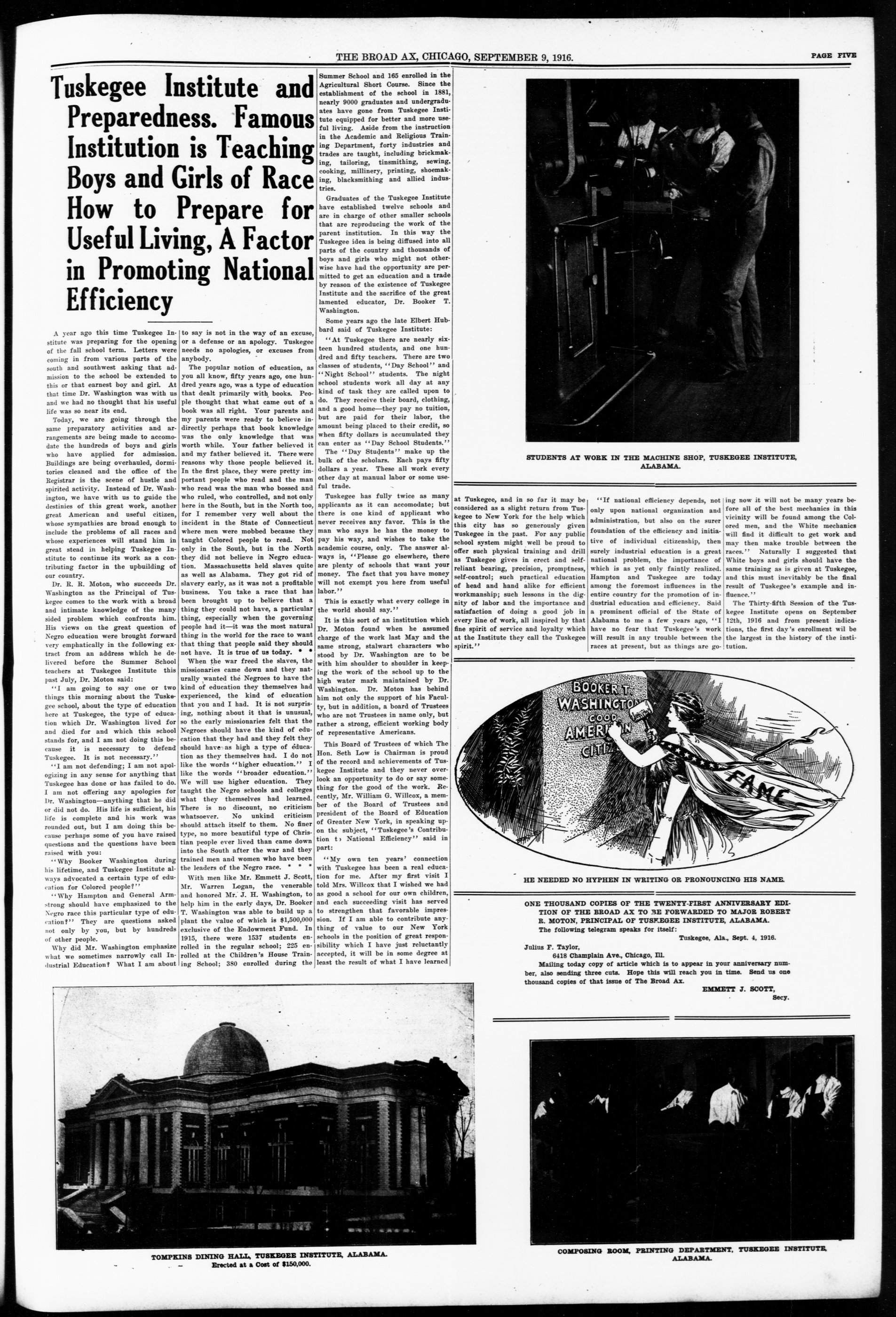
Page text (machine-generated)
THE BROAD AX HEW TO THE LINE: LET THE CHIPS FALL WHERE THEY MAY
HEW TO THE LINE: LET THE CHIPS FALL WHERE THEY MAY
107
COL. FRANK O. LOWDEN
The true and tried friend of the Afro-American race who will open up his boom in full blast for the Republican nomination for Governor of Illinois, in Chicago, Saturday, August 26th and his able and far seeing campaign manager, the Hon. W. H. Stead, declares that "everything indicates his overwhelming nomination against all competitors for governor at the State Wide primaries Wednesday, September 13th.
50
HON. GEORGE E. KEYS.
Warm friend of the Colored people who was willing to lay down his life during the race riots in Springfield in 1908, in order to protect them; Vice President of the Farmers National Bank of that city in which two Colored men are employed and Republican candidate for the nomination for State Treasurer of Illinois, to be voted for at the State-wide primaries Wednesday September 13th.
CHICAGO, SEPTEMBER 9:1916
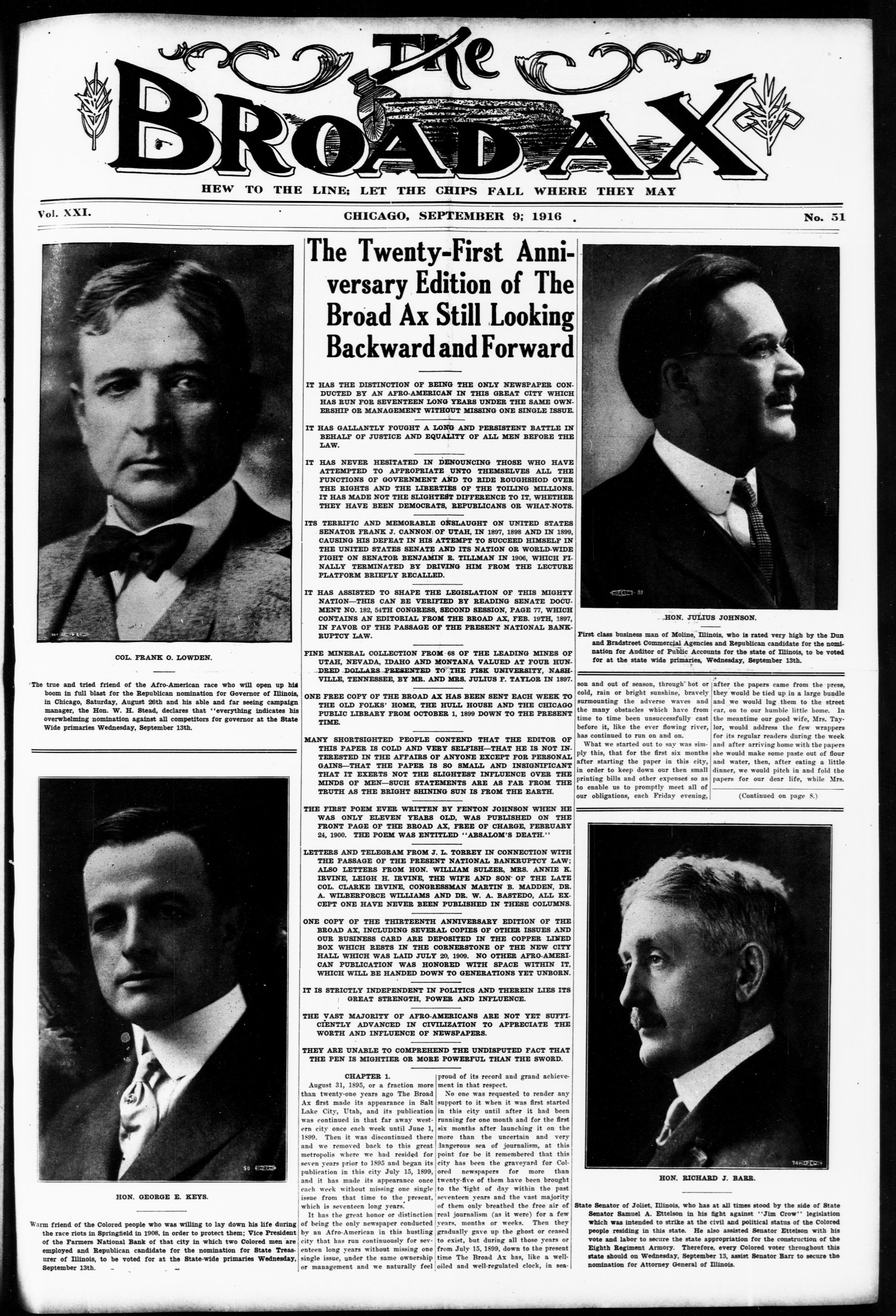
The Twenty-First Anniversary Edition of The Broad Ax Still Looking Backward and Forward
IT HAS THE DISTINCTION OF BEING THE ONLY NEWSPAPER CONDUCTED BY AN AFRO-AMERICAN IN THIS GREAT CITY WHICH HAS RUN FOR SEVENTEEN LONG YEARS UNDER THE SAME OWNERSHIP OR MANAGEMENT WITHOUT MISSING ONE SINGLE ISSUE.
IT HAS GALLANTLY FOUGHT A LONG AND PERSISTENT BATTLE IN BEHALF OF JUSTICE AND EQUALITY OF ALL MEN BEFORE THE LAW.
IT HAS NEVER HESITATED IN DENOUNCING THOSE WHO HAVE ATTEMPTED TO APPROPRIATE UNTO THEMSELVES ALL THE FUNCTIONS OF GOVERNMENT AND TO RIDE ROUGHSHOD OVER THE RIGHTS AND THE LIBERTIES OF THE TOILING MILLIONS. IT HAS MADE NOT THE SLIGHTEST DIFFERENCE TO IT, WHETHER THEY HAVE BEEN DEMOCRATS, REPUBLICANS OR WHAT-NOTS.
ITS TERRIFIC AND MEMORABLE ONSLAUGHT ON UNITED STATES SENATOR FRANK J. CANNON, OF UTAH, IN 1897, 1898 AND IN 1899, CAUSING HIS DEFEAT IN HIS ATTEMPT TO SUCCEED HIMSELF IN THE UNITED STATES SENATE AND ITS NATION OR WORLD-WIDE FIGHT ON SENATOR BENJAMIN R. TILLMAN IN 1906, WHICH FINALLY TERMINATED BY DRIVING HIM FROM THE LECTURE PLATFORM BRIEFLY RECALLED.
IT HAS ASSISTED TO SHAPE THE LEGISLATION OF THIS MIGHTY NATION—THIS CAN BE VERIFIED BY READING SENATE DOCUMENT NO. 182, 54TH CONGRESS, SECOND SESSION, PAGE 77, WHICH CONTAINS AN EDITORIAL FROM THE BROAD AX, FEB. 19TH, 1897, IN FAVOR OF THE PASSAGE OF THE PRESENT NATIONAL BANK-RUPTGY LAW.
FINE MINERAL COLLECTION FROM 68 OF THE LEADING MINES OF UTAH, NEVADA, IDAHO AND MONTANA VALUED AT FOUR HUNDRED DOLLARS PRESENTED TO THE FISK UNIVERSITY, NASHVILLE, TENNESSEE, BY MR. AND MRS. JULIUS F. TAYLOR IN 1897.
ONE FREE COPY OF THE BROAD AX HAS BEEN SENT EACH WEEK TO THE OLD FOLKS' HOME, THE HULL HOUSE AND THE CHICAGO PUBLIC LIBRARY FROM OCTOBER 1, 1899 DOWN TO THE PRESENT TIME.
MANY SHORTSIGHTED PEOPLE CONTEND THAT THE EDITOR OF THIS PAPER IS COLD AND VERY SELFISH—THAT HE IS NOT INTERESTED IN THE AFFAIRS OF ANYONE EXCEPT FOR PERSONAL GAINS—THAT THE PAPER IS SO SMALL AND INSIGNIFICANT THAT IT EXERTS NOT THE SLIGHTEST INFLUENCE OVER THE MINDS OF MEN—SUCH STATEMENTS ARE AS FAR FROM THE TRUTH AS THE BRIGHT SHINING SUN IS FROM THE EARTH.
THE FIRST POEM EVER WRITTEN BY FENTON JOHNSON WHEN HE WAS ONLY ELEVEN YEARS OLD, WAS PUBLISHED ON THE FRONT PAGE OF THE BROAD AX, FREE OF CHARGE, FEBRUARY 24, 1900. THE POEM WAS ENTITLED "ABSALOM'S DEATH."
LETTERS AND TELEGRAM FROM J. L. TORREY IN CONNECTION WITH THE PASSAGE OF THE PRESENT NATIONAL BANKRUPTCY LAW; ALSO LETTERS FROM HON. WILLIAM SULZER, MRS. ANNIE K. IRVINE, LEIGH H. IRVINE, THE WIFE AND SON OF THE LATE COL. CLARKE IRVINE, CONGRESSMAN MARTIN B. MADDEN, DR. A. WILBERFORCE WILLIAMS AND DR. W. A. BASTEDO, ALL EXCEPT ONE HAVE NEVER BEEN PUBLISHED IN THESE COLUMNS.
ONE COPY OF THE THIRTEENTH ANNIVERSARY EDITION OF THE BROAD AX, INCLUDING SEVERAL COPIES OF OTHER ISSUES AND OUR BUSINESS CARD ARE DEPOSITED IN THE COPPER LINED BOX WHICH RESTS IN THE CORNERSTONE OF THE NEW CITY HALL WHICH WAS LAID JULY 20, 1909. NO OTHER AFRO-AMERICAN PUBLICATION WAS HONORED WITH SPACE WITHIN IT, WHICH WILL BE HANDED DOWN TO GENERATIONS YET UNBORN.
IT IS STRICTLY INDEPENDENT IN POLITICS AND THEREIN LIES ITS GREAT STRENGTH, POWER AND INFLUENCE.
THE VAST MAJORITY OF AFRO-AMERICANS ARE NOT YET SUFFICIENTLY ADVANCED IN CIVILIZATION TO APPRECIATE THE WORTH AND INFLUENCE OF NEWSPAPERS.
THEY ARE UNABLE TO COMPREHEND THE UNDISPUTED FACT THAT THE PEN IS MIGHTIER OR MORE POWERFUL THAN THE SWORD.
CHAPTER 1.
proud of its record and grand achievement in that respect.
August 31, 1895, or a fraction more than twenty-one years ago The Broad Ax first made its appearance in Salt Lake City, Utah, and its publication was continued in that far away western city once each week until June 1, 1899. Then it was discontinued there and we removed back to this great metropolis where we had resided for seven years prior to 1895 and began its publication in this city July 15, 1899, and it has made its appearance once each week without missing one single issue from that time to the present, which is seventeen long years.
No one was requested to render any support to it when it was first started in this city until after it had been running for one month and for the first six months after launching it on the more than the uncertain and very dangerous sea of journalism, at this point for be it remembered that this city has been the graveyard for Colored newspapers for more than twenty-five of them have been brought to the light of day within the past seventeen years and the vast majority of them only breathed the free air of real journalism (as it were) for a few years, months or weeks. Then they gradually gave up the ghost or ceased to exist, but during all those years or from July 15, 1899, down to the present time The Broad Ax has, like a well-oiled and well-regulated clock, in sea-
It has the great honor or distinction of being the only newspaper conducted by an Afro-American in this hustling city that has run continuously for seventeen long years without missing one single issue, under the same ownership or management and we naturally feel
83
HON. JULIUS JOHNSON.
First class business man of Moline, Illinois, who is rated very high by the Dun and Bradstreet Commercial Agencies and Republican candidate for the nomination for Auditor of Public Accounts for the state of Illinois, to be voted for at the state wide primaries, Wednesday, September 13th.
son and out of season, through hot or cold, rain or bright sunshine, bravely surmounting the adverse waves and the many obstacles which have from time to time been unsuccessfully cast before it, like the ever flowing river, has continued to run on and on.
after the papers came from the press, they would be tied up in a large bundle and we would lug them to the street car, on to our humble little home. In the meantime our good wife, Mrs. Taylor, would address the few wrappers for its regular readers during the week and after arriving home with the papers she would make some paste out of flour and water, then, after eating a little dinner, we would pitch in and fold the papers for our dear life, while Mrs.
What we started out to say was simply this, that for the first six months after starting the paper in this city, in order to keep down our then small printing bills and other expenses so as to enable us to promptly meet all of our obligations, each Friday evening,
(Continued on page 8.)
74E-0220
HON. RICHARD J. BARB.
State Senator of Joliet, Illinois, who has at all times stood by the side of State Senator Samuel A. Ettelson in his fight against "Jim Crow" legislation which was intended to strike at the civil and political status of the Colored people residing in this state. He also assisted Senator Ettelson with his vote and labor to secure the state appropriation for the construction of the Eighth Regiment Armory. Therefore, every Colored voter throughout this state should on Wednesday, September 13, assist Senator Barr to secure the nomination for Attorney General of Illinois.
[Picture of a man in a suit with a tie].
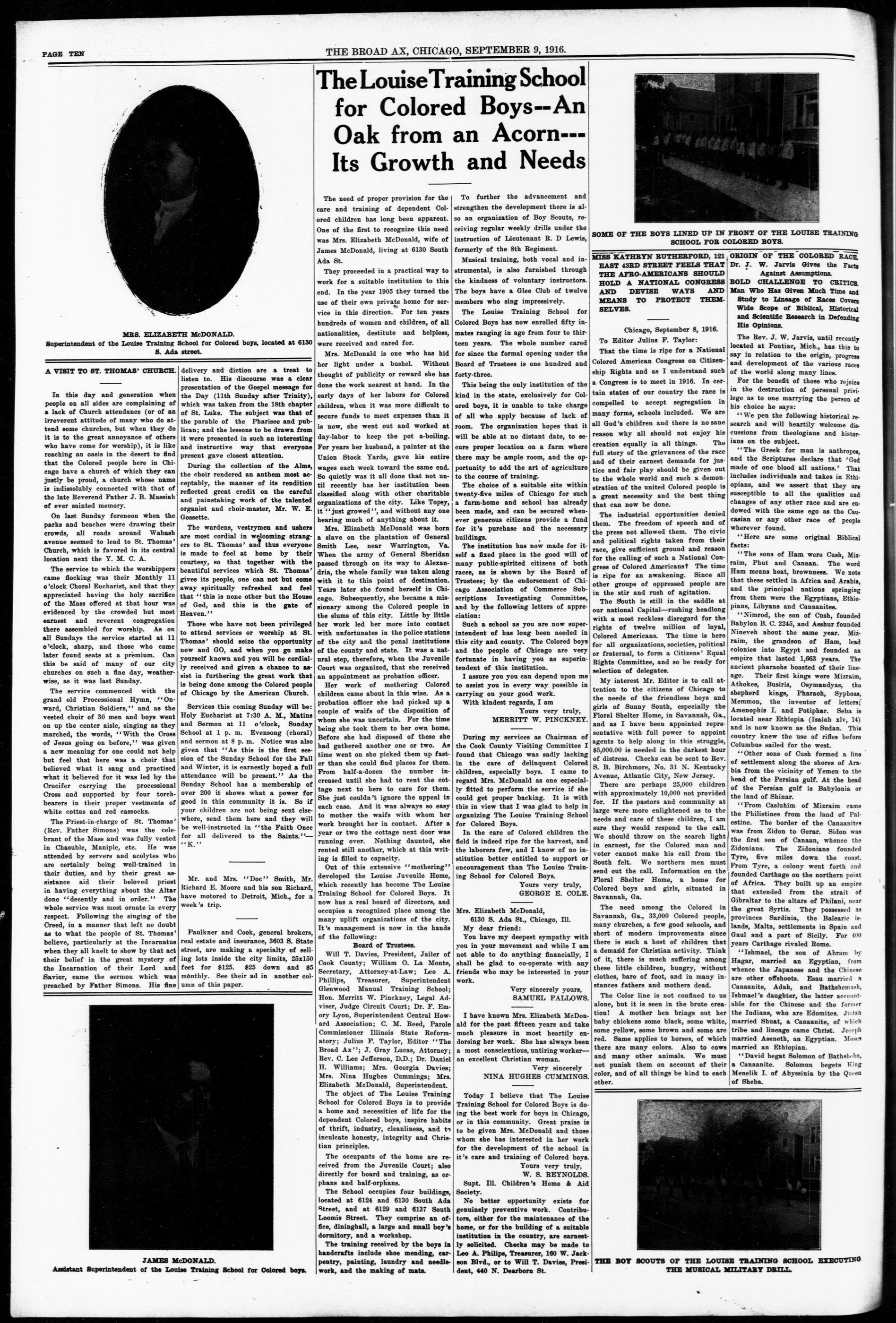
MES. ELIZABETH McDONALD.
Superintendent of the Louise Training School for Colored boys, located at 6130
S. Ada street.
In this day and generation when people on all sides are complaining of a lack of Church attendance (or of an irreverent attitude of many who do attend some churches, but when they do it is to the great annoyance of others who have come for worship), it is like reaching an oasis in the desert to find that the Colored people here in Chicago have a church of which they can justly be proud, a church whose name is indissolubly connected with that of the late Reverend Father J. B. Massiah of ever saisted memory.
On last Sunday forenoon when the parks and beaches were drawing their crowds, all roads around Wabash avenue seemed to lead to St. Thomas' Church, which is favored in its central location next the Y. M. C. A.
The service to which the worshippers came flocking was their Monthly 11 o'clock Choral Eucharist, and that they appreciated having the holy sacrifice of the Mass offered at that hour was evidenced by the crowded but most earnest and reverent congregation there assembled for worship. As on all Sundays the service started at 11 o'clock, sharp, and those who came later found seats at a premium. Can this be said of many of our city churches on such a fine day, weatherwise, as it was last Sunday.
The service commenced with the grand old Processional Hymn, "Onward, Christian Soldiers," and as the vested choir of 30 men and boys went on up the center aisle, singing as they marched, the words, "With the Cross of Jesus going on before," was given a new meaning for one could not help but feel that here was a choir that believed what it sang and practised what it believed for it was led by the Crucifer carrying the processional Cross and supported by four torche-bearers in their proper vestments of white cottas and red cassocks.
The Priest-in-charge of St. Thomas' (Rev. Father Simons) was the celebrant of the Mass and was fully vested in Chasuble, Maniple, etc. He was attended by servers and acolytes who are certainly being well-trained in their duties, and by their great assistance aid their beloved priest in having everything about the Altar done "decently and in order." The whole service was most ornate in every respect. Following the singing of the Creed, in a manner that left no doubt as to what the people of St. Thomas' believe, particularly at the Incarnatus when they all knelt to show by that act their belief in the great mystery of the Incarnation of their Lord and Savior, came the sermon which was preached by Father Simons. His fine
1930
JAMES McDONALD.
Assistant Superintendent of the Louise Training School for Colored boys.
PAGE TEN
delivery and diction are a treat to listen to. His discourse was a clear presentation of the Gospel message for the Day (11th Sunday after Trinity), which was taken from the 18th chapter of St. Luke. The subject was that of the parable of the Pharisee and publican; and the lessons to be drawn from it were presented in such an interesting and instructive way that everyone present gave closest attention.
During the collection of the Alms, the choir rendered an anthem most acceptably, the manner of its rendition reflected great credit on the careful and painstaking work of the talented organist and choir-master, Mr. W. E. Gossette.
The wardens, vestrymen and ushers are most cordial in welcoming strangers to St. Thomas' and thus everyone is made to feel at home by their courtesy, so that together with the beautiful services which St. Thomas' gives its people, one can not but come away spiritually refreshed and feel that "this is none other but the House of God, and this is the gate of Heaven." Those who have not been privileged to attend services or worship at St. Thomas' should seize the opportunity now and GO, and when you go make yourself known and you will be cordially received and given a chance to assist in furthering the great work that is being done among the Colored people of Chicago by the American Church.
Services this coming Sunday will be: Holy Eucharist at 7:30 A. M., Matins and Sermon at 11 o'clock, Sunday School at 1 p. m. Evensong (choral) and sermon at 8 p. m. Notice was also given that "As this is the first session of the Sunday School for the Fall and Winter, it is earnestly hoped a full attendance will be present." As the Sunday School has a membership of over 200 it shows what a power for good in this community it is. So if your children are not being sent elsewhere, send them here and they will be well-instructed in "the Faith Once for all delivered to the Saints."—"K."
Mr. and Mrs. "Doe" Smith, Mr. Richard E. Moore and his son Richard, have motored to Detroit, Mich., for a week's trip.
Faulkner and Cook, general brokers, real estate and insurance, 3603 S. State street, are making a specialty of selling lots inside the city limits, 25x150 feet for $125. $25 down and $5 monthly. See their ad in another column of this paper.
---
THE BROAD AX, CHICAGO, SEPTEMBER 9, 1916.
The Louise Training School for Colored Boys--An Oak from an Acorn---- Its Growth and Needs
The need of proper provision for the care and training of dependent Colored children has long been apparent. One of the first to recognize this need was Mrs. Elizabeth McDonald, wife of James McDonald, living at 6130 South Ada St. They proceeded in a practical way to work for a suitable institution to this end. In the year 1905 they turned the use of their own private home for service in this direction. For ten years hundreds of women and children, of all nationalities, destitute and helpless, were received and cared for.
Mrs. McDonald is one who has hid her light under a bushel. Without thought of publicity or reward she has done the work nearest at hand. In the early days of her labors for Colored children, when it was more difficult to secure funds to meet expenses than it is now, she went out and worked at day-labor to keep the pot a-boiling. For years her husband, a painter at the Union Stock Yards, gave his entire wages each week toward the same end. So quietly was it all done that not until recently has her institution been classified along with other charitable organizations of the city. Like Topsy, it "just grew',' and without any one hearing much of anything about it.
Mrs. Elizabeth McDonald was born a slave on the plantation of General Smith Lee, near Warrington, Va. When the army of General Sheridan passed through on its way to Alexandria, the whole family was taken along with it to this point of destination. Years later she found herself in Chicago. Subsequently, she became a missionary among the Colored people in the slums of this city. Little by little her work led her more into contact with unfortunates in the police stations of the city and the penal institutions of the county and state. It was a natural step, therefore, when the Juvenile Court was organized, that she received an appointment as probation officer.
Her work of mothering Colored children came about in this wise. As a probation officer she had picked up a couple of waifs of the disposition of whom she was uncertain. For the time being she took them to her own home. Before she had disposed of these she had gathered another one or two. As time went on she picked them up faster than she could find places for them. From half-a-dozen the number increased until she had to rent the cottage next to hers to care for them. She just couldn't ignore the appeal in each case. And it was always so easy to mother the waifs with whom her work brought her in contact. After a year or two the cottage next door was running over. Nothing daunted, she rented still another, which at this writing is filled to capacity.
Out of this extensive "mothering" developed the Louise Juvenile Home, which recently has become The Louise Training School for Colored Boys. It now has a real board of directors, and occupies a recognized place among the many uplift organizations of the city. It's management is now in the hands of the following:
Board of Trustees
Will T. Davies, President, Jailer of Cook County; William O. La Monte, Secretary, Attorney-at-Law; Leo A. Phillips, Treasurer, Superintendent Glenwood Manual Training School; Hon. Merritt W. Pinkney, Legal Adviser, Judge Circuit Court; Dr. F. Emory Lyon, Superintendent Central Howard Association; C. M. Reed, Parole Commissioner Illinois State Reformatory; Julius F. Taylor, Editor "The Broad Ax"; J. Gray Lucas, Attorney; Rev. C. Lee Jefferson, D.D.; Dr. Daniel H. Williams; Mrs. Georgia Davies; Mrs. Nina Hughes Cummings; Mrs. Elizabeth McDonald, Superintendent.
The object of The Louise Training School for Colored Boys is to provide a home and necessities of life for the dependent Colored boys, inspire habits of thrift, industry, cleanliness, and to inculcate honesty, integrity and Christian principles.
The occupants of the home are received from the Juvenile Court; also directly for board and training, as orphans and half-orphans.
The School occupies four buildings, located at 6124 and 6130 South Ada Street, and at 6129 and 6137 South Loomis Street. They comprise an office, dininghall, a large and small boy's dormitory, and a workshop.
The training received by the boys in handcrafts include shoe mending, carpentry, painting, laundry and needlework, and the making of mats.
To further the advancement and strengthen the development there is also an organization of Boy Scouts, receiving regular weekly drills under the instruction of Lieutenant R. D Lewis, formerly of the 8th Regiment.
Musical training, both vocal and instrumental, is also furnished through the kindness of voluntary instructors. The boys have a Glee Club of twelve members who sing impressively.
The Louise Training School for Colored Boys has now enrolled fifty inmates ranging in age from four to thirteen years. The whole number cared for since the formal opening under the Board of Trustees is one hundred and forty-three.
This being the only institution of the kind in the state, exclusively for Colored boys, it is unable to take charge of all who apply because of lack of room. The organization hopes that it will be able at no distant date, to secure proper location on a farm where there may be ample room, and the opportunity to add the art of agriculture to the course of training.
The choice of a suitable site within twenty-five miles of Chicago for such a farm-home and school has already been made, and can be secured whenever generous citizens provide a fund for it's purchase and the necessary buildings.
The institution has now made for itself a fixed place in the good will of many public-spirited citizens of both races, as is shown by the Board of Trustees; by the endorsement of Chicago Association of Commerce Subscriptions Investigating Committee, and by the following letters of appreciation:
Such a school as you are now superintendent of has long been needed in this city and county. The Colored boys and the people of Chicago are very fortunate in having you as superintendent of this institution.
I assure you you can depend upon me to assist you in every way possible in carrying on your good work.
With kindest regards, I am
During my services as Chairman of the Cook County Visiting Committee I found that Chicago was sadly lacking in the care of delinquent Colored children, especially boys. I came to regard Mrs. McDonald as one especially fitted to perform the service if she could get proper backing. It is with this in view that I was glad to help in organizing The Louise Training School for Colored Boys.
In the care of Colored children the field is indeed ripe for the harvest, and the laborers few, and I know of no institution better entitled to support or encouragement than The Louise Training School for Colored Boys.
Yours very truly,
GEORGE E. COLE.
Mrs. Elizabeth McDonald.
6130 S. Ada St., Chicago, Ill.
My dear friend:
You have my deepest sympathy with you in your movement and while I am not able to do anything financially, I shall be glad to co-operate with any friends who may be interested in your work.
Very sincerely yours,
SAMUEL FALLOWS.
I have known Mrs. Elizabeth McDonald for the past fifteen years and take much pleasure in most heartily endorsing her work. She has always been a most conscientious, untiring worker—an excellent Christian woman.
Today I believe that The Louise Training School for Colored Boys is doing the best work for boys in Chicago, or in this community. Great praise is to be given Mrs. McDonald and those whom she has interested in her work for the development of the school in it's care and training of Colored boys. Yours very truly, W. S. REYNOLDS. Supt. Ill. Children's Home & Aid Society. No better opportunity exists for genuinely preventive work. Contributors, either for the maintenance of the home, or for the building of a suitable institution in the country, are earnestly solicited. Checks may be made to Leo A. Philips, Treasurer, 160 W. Jackson Blvd., or to Will T. Davies, President, 440 N. Dearborn St.
SOME OF THE BOYS LINED UP IN FRONT OF THE LOUISE TRAINING SCHOOL FOR COLORED BOYS.
THE BOY SCOUTS OF THE LOUISE TRAINING SCHOOL EXECUTING THE MUSICAL MILITARY DRILL.
MISS KATHRYN RUTHERFORD, 121
EAST 453D STREET FEELS THAT
THE AFRO-AMERICANS SHOULD
HOLD A NATIONAL CONGRESS
AND DEVISE WAYS AND
MEANS TO PROTECT THEM-
SELVES.
That the time is ripe for a National Colored American Congress on Citizenship Rights and as I understand such a Congress is to meet in 1916. In certain states of our country the race is compelled to accept segregation in many forms, schools included. We are all God's children and there is no sane reason why all should not enjoy his creation equally in all things. The full story of the grievances of the race and of their earnest demands for justice and fair play should be given out to the whole world and such a demonstration of the united Colored people is a great necessity and the best thing that can now be done.
The industrial opportunities denied them. The freedom of speech and of the press not allowed them. The civic and political rights taken from their race, give sufficient ground and reason, for the calling of such a National Congress of Colored Americans? The time is ripe for an awakening. Since all other groups of oppressed people are in the stir and rush of agitation. The South is still in the saddle at our national Capital—rushing headlong with a most reckless disregard for the rights of twelve million of loyal, Colored Americans. The time is here for all organizations, societies, political or fraternal, to form a Citizens' Equal Rights Committee, and so be ready for selection of delegates.
My interest Mr. Editor is to call attention to the citizens of Chicago to the needs of the friendless boys and girls of Sunny South, especially the Floral Shelter Home, in Savannah, Ga., and as I have been appointed representative with full power to appoint agents to help along in this struggle, $5,000.00 is needed in the darkest hour of distress. Checks can be sent to Rev S. B. Birchmore, No. 31 N. Kentucky Avenue, Atlantic City, New Jersey.
There are perhaps 25,000 children with approximately 10,000 not provided for. If the pastors and community at large were more enlightened as to the needs and care of these children, I am sure they would respond to the call. We should throw on the search light in earnest, for the Colored man and voter cannot make his call from the South felt. We northern men must send out the call. Information on the Floral Shelter Home, a home for Colored boys and girls, situated in Savannah, Ga.
The need among the Colored in Savannah, Ga., 33,000 Colored people, many churches, a few good schools, and short of modern improvements since there is such a host of children that a demand for Christian activity. Think of it, there is much suffering among these little children, hungry, without clothes, bare of foot, and in many instances fathers and mothers dead.
The Color line is not confined to us alone, but it is seen in the brute creation! A mother hen brings out her baby chickens some black, some white, some yellow, some brown and some are red. Same applies to horses, of which there are many colors. Also to cows and many other animals. We must not punish them on account of their color, and of all things be kind to each other.
ORIGIN OF THE COLORED RACE.
Dr. J. W. Jarvis Gives the Facts Against Assumptions.
BOLD CHALLENGE TO CRITICS.
Man Who Has Given Much Time and Study to Lineage of Baces Covers Wide Scope of Biblical, Historical and Scientific Research in Defending His Opinions.
The Rev. J. W. Jarvis, until recently located at Pontiac, Mich., has this to say in relation to the origin, progress and development of the various races of the world along many lines.
For the benefit of those who rejoice in the destruction of personal privilege as to one marrying the person of his choice he says:
"We pen the following historical research and will heartily welcome discussions from theologians and historians on the subject.
"The Greek for man is anthropos, and the Scriptures declare that 'God made of one blood all nations.' That includes individuals and takes in Ethiopians, and we assert that they are susceptible to all the qualities and changes of any other race and are endowed with the same ego as the Caucasian or any other race of people wherever found.
"Here are some original Biblical facts:
"The sons of Ham were Cush, Mizraim, Phut and Canaan. The word Ham means heat, brownness. We note that these settled in Africa and Arabia, and the principal nations springing from them were the Egyptians, Ethiopians, Libyans and Canaanites.
"Nimrod, the son of Cush, founded Babylon B. C. 2245, and Asshur founded Nineveh about the same year. Mizraim, the grandson of Ham, lead colonies into Egypt and founded an empire that lasted 1,663 years. The ancient pharaohs boasted of their lineage. Their first kings were Mizraim, Athokes, Busiris, Osymandyas, the shepherd kings, Pharaoh, Syphoas, Memmon, the inventor of letters; Amenophis I. and Potiphar. Seba is located near Ethiopia (Isaiah xlv, 14) and is now known as the Sudan. This country knew the use of rifles before Columbus sailed for the west.
"Other sons of Cush formed a line of settlement along the shores of Arabia from the vicinity of Yemen to the head of the Persian gulf. At the head of the Persian gulf is Babylonia or the land of Shinar.
"From Casuluhim of Mizraim came the Philistines from the land of Palestine. The border of the Canaanites was from Zidon to Gerar. Sidon was the first son of Canaan, whence the Zidonians. The Zidonians founded Tyre, five miles down the coast. From Tyre, a colony went forth and founded Carthage on the northern point of Africa. They built up an empire that extended from the strait of Gibraltar to the altars of Philani, near the great Syrtis. They possessed as provinces Sardinia, the Balearic islands, Malta, settlements in Spain and Gaul and a part of Sicily. For 400 years Carthage rivaled Rome.
"Ishmael, the son of Abram by Hagar, married an Egyptian, from whence the Japanese and the Chinese are other offshoots. Esau married a Canaanite, Adah, and Bathshemash, Ishmael's daughter, the latter accountable for the Chinese and the former the Indians, who are Edomites. Judah married Shuat, a Canaanite, of which tribe and lineage came Christ. Joseph married Aseneth, an Egyptian. Moses married an Ethiopian.
"David begat Solomon of Bathsheba, a Canaanite. Solomon begets King Menelik I. of Abyssinia by the Queen of Sheba."
[Name]
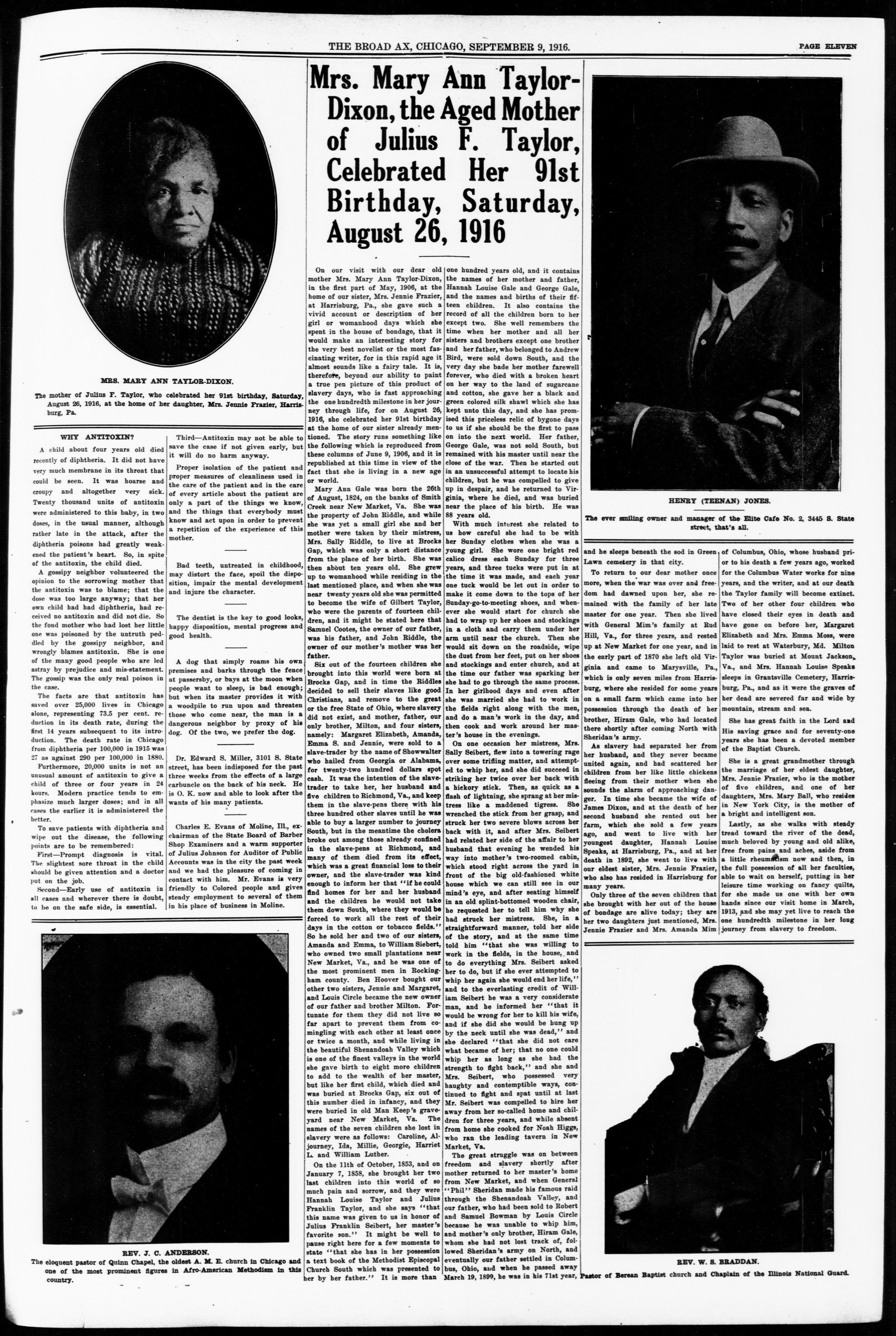
MRS. MARY ANN TAYLOR-DIXON
The mother of Julius F. Taylor, who August 26, 1916, at the home of h burg, Pa.
The mother of Julius F. Taylor, who celebrated her 91st birthday, Saturday August 26, 1916, at the home of her daughter, Mrs. Jennie Frazier, Harris burg, Pa.
WHY ANTITOXIN?
A child about four years old died recently of diphtheria. It did not have very much membrane in its throat that could be seen. It was hoarse and croupy and altogether very sick. Twenty thousand units of antitoxin were administered to this baby, in two doses, in the usual manner, although rather late in the attack, after the diphtheria poisons had greatly weakened the patient's heart. So, in spite of the antitoxin, the child died.
A gossipy neighbor volunteered the opinion to the sorrowing mother that the antitoxin was to blame; that the dose was too large anyway; that her own child had had diphtheria, had received no antitoxin and did not die. So the fond mother who had lost her little one was poisoned by the untruth peddled by the gossipy neighbor, and wrongly blames antitoxin. She is one of the many good people who are led astray by prejudice and mis-statement. The gossip was the only real poison in the case.
The facts are that antitoxin has saved over 25,000 lives in Chicago alone, representing 73.5 per cent. reduction in its death rate; during the first 14 years subsequent to its introduction. The death rate in Chicago from diphtheria per 100,000 in 1915 was 27 as against 290 per 100,000 in 1880. Furthermore, 20,000 units is not an unusual amount of antitoxin to give a child of three or four years in 24 hours. Modern practice tends to emphasize much larger doses; and in all cases the earlier it is administered the better.
To save patients with diphtheria and wipe out the disease, the following points are to be remembered:
First—Prompt diagnosis is vital. The slightest sore throat in the child should be given attention and a doctor put on the job. Second—Early use of antitoxin in all cases and wherever there is doubt, to be on the safe side, is essential.
-
M.
REV. J. C. ANDERSON.
The eloquent pastor of Quinn Chapel, the one of the most prominent figure country.
The eloquent pastor of Quinn Chapel, the oldest A. M. E. church in Chicago and one of the most prominent figures in Afro-American Methodism in this country.
celebrated her 91st birthday, Saturday, or daughter, Mrs. Jennie Frazier, Harris-
Third—Antitoxin may not be able to save the case if not given early, but it will do no harm anyway.
Proper isolation of the patient and proper measures of cleanliness used in the care of the patient and in the care of every article about the patient are only a part of the things we know, and the things that everybody must know and act upon in order to prevent a repetition of the experience of this mother.
Bad teeth, untreated in childhood, may distort the face, spoil the disposition, impair the mental development and injure the character.
The dentist is the key to good looks, happy disposition, mental progress and good health.
A dog that simply roams his own premises and barks through the fence at passersby, or bays at the moon when people want to sleep, is bad enough; but when its master provides it with a woodpile to run upon and threaten those who come near, the man is a dangerous neighbor by proxy of his dog. Of the two, we prefer the dog.
Dr. Edward S. Miller, 3101 S. State street, has been indisposed for the past three weeks from the effects of a large carbuncle on the back of his neck. He is O. K. now and able to look after the wants of his many patients.
Charles E. Evans of Moline, Ill., exchairman of the State Board of Barber Shop Examiners and a warm supporter of Julius Johnson for Auditor of Public Accounts was in the city the past week and we had the pleasure of coming in contact with him. Mr. Evans is very friendly to Colored people and gives steady employment to several of them in his place of business in Moline.
1910
the oldest A. M. E. church in Chicago and its in Afro-American Methodism in this
THE BROAD AX, CHICAGO, SEPTEMBER 9, 1916
Mrs. Mary Ann Taylor- Dixon, the Aged Mother of Julius F. Taylor, Celebrated Her 91st Birthday, Saturday, August 26, 1916
On our visit with our dear old mother Mrs. Mary Ann Taylor-Dixon, in the first part of May, 1906, at the home of our sister, Mrs. Jennie Frazier, at Harrisburg, Pa., she gave such a vivid account or description of her girl or womanhood days which she spent in the house of bondage, that it would make an interesting story for the very best novelist or the most fascinating writer, for in this rapid age it almost sounds like a fairy tale. It is, therefore, beyond our ability to paint a true pen picture of this product of slavery days, who is fast approaching the one hundredth milestone in her journey through life, for on August 26, 1916, she celebrated her 91st birthday at the home of our sister already mentioned. The story runs something like the following which is reproduced from these columns of June 9, 1906, and it is republished at this time in view of the fact that she is living in a new age or world.
Mary Ann Gale was born the 26th of August, 1824, on the banks of Smith Creek near New Market, Va. She was the property of John Riddle, and while she was yet a small girl she and her mother were taken by their mistress, Mrs. Sally Riddle, to live at Brocks Gap, which was only a short distance from the place of her birth. She was then about ten years old. She grew up to womanhood while residing in the last mentioned place, and when she was near twenty years old she was permitted to become the wife of Gilbert Taylor, who were the parents of fourteen children, and it might be stated here that Samuel Cootes, the owner of our father, was his father, and John Riddle, the owner of our mother's mother was her father.
Six out of the fourteen children she brought into this world were born at Brocks Gap, and in time the Riddles decided to sell their slaves like good Christians, and remove to the great or the free State of Ohio, where slavery did not exist, and mother, father, our only brother, Milton, and four sisters, namely: Margaret Elizabeth, Amanda, Emma S. and Jennie, were sold to a slave-trader by the name of Showwalter who hailed from Georgia or Alabama, for twenty-two hundred dollars spot cash. It was the intention of the slave-trader to take her, her husband and five children to Richmond, Va., and keep them in the slave-pens there with his three hundred other slaves until he was able to buy a larger number to journey South, but in the meantime the cholera broke out among those already confined in the slave-pens at Richmond, and many of them died from its effect, which was a great financial loss to their owner, and the slave-trader was kind enough to inform her that "if he could find homes for her and her husband and the children he would not take them down South, where they would be forced to work all the rest of their days in the cotton or tobacco fields." So he sold her and two of our sisters, Amanda and Emma, to William Siebert, who owned two small plantations near New Market, Va., and he was one of the most prominent men in Rockingham county. Ben Hoover bought our other two sisters, Jennie and Margaret, and Louis Circle became the new owner of our father and brother Milton. Fortunate for them they did not live so far apart to prevent them from coming with each other at least once or twice a month, and while living in the beautiful Shenandoah Valley which is one of the finest valleys in the world she gave birth to eight more children to add to the wealth of her master, but like her first child, which died and was buried at Brocks Gap, six out of this number died in infancy, and they were buried in old Man Keep's graveyard near New Market, Va. The names of the seven children she lost in slavery were as follows: Caroline, Aljourney, Ida, Millie, Georgie, Harriet L. and William Luther.
On the 11th of October, 1853, and on January 7, 1858, she brought her two last children into this world of so much pain and sorrow, and they were Hannah Louise Taylor and Julius Franklin Taylor, and she says "that this name was given to us in honor of Julius Franklin Seibert, her master's favorite son." It might be well to pause right here for a few moments to state "that she has in her possession a text book of the Methodist Episcopal Church South which was presented to her by her father." It is more than
one hundred years old, and it contains the names of her mother and father, Hannah Louise Gale and George Gale, and the names and births of their fifteen children. It also contains the record of all the children born to her except two. She well remembers the time when her mother and all her sisters and brothers except one brother and her father, who belonged to Andrew Bird, were sold down South, and the very day she bade her mother farewell forever, who died with a broken heart on her way to the land of sugarcane and cotton, she gave her a black and green colored silk shawl which she has kept unto this day, and she has promised this priceless relic of bygone days to us if she should be the first to pass on into the next world. Her father, George Gale, was not sold South, but remained with his master until near the close of the war. Then he started out in an unsuccessful attempt to locate his children, but he was compelled to give up in despair, and he returned to Virginia, where he died, and was buried near the place of his birth. He was 88 years old.
With much interest she related to us how careful she had to be with her Sunday clothes when she was a young girl. She wore one bright red calico dress each Sunday for three years, and three tucks were put in at the time it was made, and each year one tuck would be let out in order to make it come down to the tops of her Sunday-go-to-meeting shoes, and whenever she would start for church she had to wrap up her shoes and stockings in a cloth and carry them under her arm until near the church. Then she would sit down on the roadside, wipe the dust from her feet, put on her shoes and stockings and enter church, and at the time our father was sparking her she had to go through the same process. In her girlhood days and even after she was married she had to work in the fields right along with the men, and do a man's work in the day, and then cook and work around her master's house in the evenings.
On one occasion her mistress, Mrs. Sally Seibert, flew into a towering rage over some trifling matter, and attempted to whip her, and she did succeed in striking her twice over her back with a hiekory stick. Then, as quick as a flash of lightning, she sprang at her mistress like a maddened tigress. She wrenched the stick from her grasp, and struck her two severe blows across her back with it, and after Mrs. Seibert had related her side of the affair to her husband that evening he wended his way into mother's two-roomed cabin, which stood right across the yard in front of the big old-fashioned white house which we can still see in our mind's eye, and after seating himself in an old splint-bottomed wooden chair, he requested her to tell him why she had struck her mistress. She, in a straightforward manner, told her side of the story, and at the same time told him "that she was willing to work in the fields, in the house, and to do everything Mrs. Seibert asked her to do, but if she ever attempted to whip her again she would end her life," and to the everlasting credit of William Seibert he was a very considerate man, and he informed her "that it would be wrong for her to kill his wife, and if she did she would be hung up by the neck until she was dead," and she declared "that she did not care what became of her; that no one could whip her as long as she had the strength to fight back," and she and Mrs. Seibert, who possessed very haughty and contemptible ways, continued to fight and spat until at last Mr. Seibert was compelled to hire her away from her so-called home and children for three years, and while absent from home she cooked for Noah Higgs, who ran the leading tavern in New Market, Va.
The great struggle was on between freedom and slavery shortly after mother returned to her master's home from New Market, and when General "Phil" Sheridan made his famous raid through the Shenandoah Valley, and our father, who had been sold to Robert and Samuel Bowman by Louis Circle because he was unable to whip him, and mother's only brother, Hiram Gale, whom she had not lost track of, followed Sheridan's army on North, and eventually our father settled in Columbus, Ohio, and when he passed away March 19, 1899, he was in his 71st year,
THE FEDERAL NATIONAL HISTORY SOCIETY
HENBY (TEENAN) JONES.
The ever smiling owner and manager street,
The ever smiling owner and manager of the Elite Cafe No. 2, 3445 S. State street, that's all.
The ever smiling owner and manager of the Elite Cafe No. 2, 3445 S. State street, that's all.
and he sleeps beneath the sod in Green Lawn cemetery in that city.
To return to our dear mother once more, when the war was over and freedom had dawned upon her, she remained with the family of her late master for one year. Then she lived with General Mim's family at Rud Hill, Va., for three years, and rested up at New Market for one year, and in the early part of 1870 she left old Virginia and came to Marysville, Pa., which is only seven miles from Harrisburg, where she resided for some years on a small farm which came into her possession through the death of her brother, Hiram Gale, who had located there shortly after coming North with Sheridan's army.
As slavery had separated her from her husband, and they never became united again, and had scattered her children from her like little chickens fleeing from their mother when she sounds the alarm of approaching danger. In time she became the wife of James Dixon, and at the death of her second husband she rented out her farm, which she sold a few years ago, and went to live with her youngest daughter, Hannah Louise Speaks, at Harrisburg, Pa., and at her death in 1892, she went to live with our eldest sister, Mrs. Jennie Frazier, who also has resided in Harrisburg for many years.
Only three of the seven children that she brought with her out of the house of bondage are alive today; they are her two daughters just mentioned, Mrs. Jennie Frazier and Mrs. Amanda Mim
THE LIFE OF A WOMAN
1930
REV. W. S. BRADDAN
Pastor of Berean Baptist church and CH
Pastor of Berean Baptist church and Chaplain of the Illinois National Guard.
THE NEW YORK TIMES
of the Elite Cafe No. 2, 3445 S. State
that's all.
of Columbus, Ohio, whose husband prior to his death a few years ago, worked for the Columbus Water works for nine years, and the writer, and at our death the Taylor family will become extinct. Two of her other four children who have closed their eyes in death and have gone on before her, Margaret Elizabeth and Mrs. Emma Moss, were laid to rest at Waterbury, Md. Milton Taylor was buried at Mount Jackson, Va., and Mrs. Hannah Louise Speaks sleeps in Grantsville Cemetery, Harrisburg, Pa., and as it were the graves of her dead are severed far and wide by mountain, stream and sea.
She has great faith in the Lord and His saving grace and for seventy-one years she has been a devoted member of the Baptist Church.
She is a great grandmother through the marriage of her eldest daughter, Mrs. Jennie Frazier, who is the mother of five children, and one of her daughters, Mrs. Mary Ball, who resides in New York City, is the mother of a bright and intelligent son.
Lastly, as she walks with steady tread toward the river of the dead, much beloved by young and old alike, free from pains and aches, aside from a little rheumatism now and then, in the full possession of all her faculties, able to wait on herself, putting in her leisure time working on fancy quilts, for she made us one with her own hands since our visit home in March, 1913, and she may yet live to reach the one hundredth milestone in her long journey from slavery to freedom.
---
PAGE ELEVEN
C
How Is This For a Fetching Negligee?
THE FASHION OF THE TIME
PAGE TWELVE
Start Daughter Off to
THIS practical gown for fingering hot weather is developed in rose and crossbar cotton crap. White plique collars and cuffs, together with ball buttons, are the only finish. This is just the right model for the high school girl and may be put up in her becoming color.
---
Vells attached to the hat are arranged in many ways. Sometimes there is a short vell arranged almost like a
How Is This For a
ASLIP of pale blue crepe de chine serves as the base of this feminine robe. Over it are draped two sections of shadow lace, which form skirt, top and sleeves. Please notice what an attractive boudoir cap
frill at the back of the hat. The same arrangement is sometimes made across the front of the hat. Long veils attached to the top of the hat crown float over the shoulders, and many veils hang, like last year's trains. at one side only.
Deep V insets of tucks and insertions of lace, the insets outlined with narrow ruches of silk, are used for trimming taffeta petticoats. ANNA MAY.
Fetching Negligee?
a leftover bit of the lace has provided.
The white beaded nets are in high favor for evening wear.
ANNA MAY.
THE BROAD AX, CHICAGO, SEPTEMBER 9, 1916.
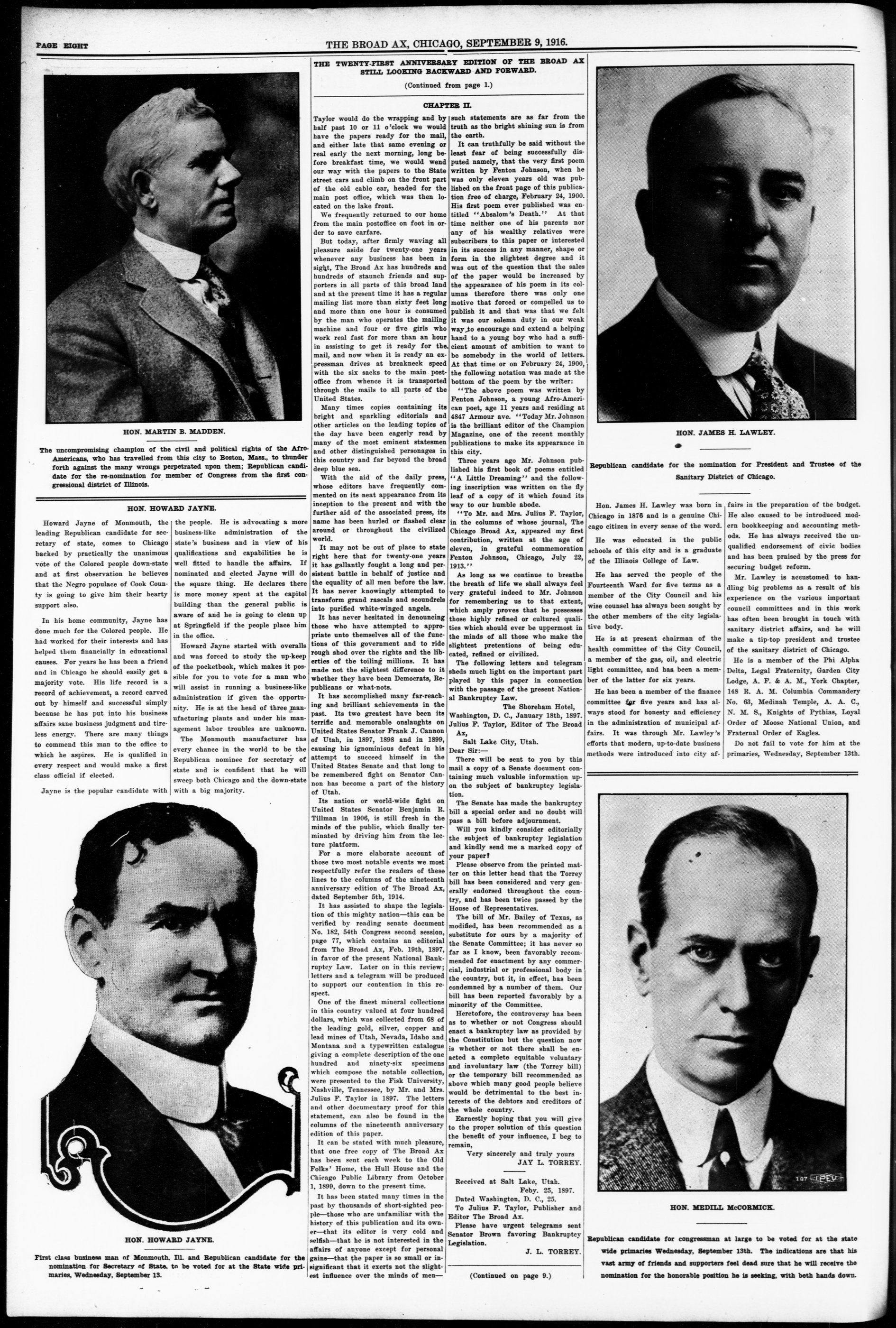
THE TWENTY-FIRST ANNIVERSARY EDITION OF THE BROAD AX STILL LOOKING BACKWARD AND FORWARD.
(Continued from page 9.)
sand majority. At that time his campaign committee issued a little book consisting of more than two million copies, containing his record or the story of his life, it also contained an editorial from the columns of this paper, May 14, 1910, in connection with his oration in favor of "Raising the Battleship Maine". We will reproduce the closing part of our editorial which was written more than two years before his nomination for governor.
"It will be recalled that without expecting to receive any reward here on this earth or glory in the next world, Congressman Sulzer, like a golden knight of olden times, heroically stood by the Negro soldiers of the 25th Regiment, who were dishonorably discharged by President Roosevelt and forever debarred from holding any civil office whatever, under the Federal government, and his eloquent oration in the halls of Congress in favor of restoring the members of that regiment to their rightful position in the army, raised him very high in the estimation of the Afro-Americans throughout the United States, and they would be delighted to see him become Governor of the great state of New York, for they feel that as such he would give each and every one of its citizens a square deal.
Prior to his election hundreds and hundreds of copies of The Broad Ax were, at our expense, as our contribution to his campaign fund, sent to the Colored people residing in many parts of that state urging them to stand by William Sulzer and on the night of the election we sent him a telegram congratulating him on being elected governor of the greatest state in the Union. In a few days from that time we received one of his cards with the following notation written on it: "Come to see me at Albany, New York."
The latter part of Feb., 1913, we started on a visit to our mother at Harrisburg, Pa., and on returning home from our two weeks' visit through the east we came by the way of Albany, New York for the sole purpose of paying our respects to Governor Sulzer. Entering his large room in the state capitol of that state, it was filled with the leading politicians and statesmen of that state, and as we looked all around right sharp we did not see another Colored man in sight. Before we could collect ourselves together one of his assistant secretaries demanded to know who we wanted to see. We very softly informed him that we wished to see Governor Sulzer. Then he asked us if we knew the Governor and we responded that we rather thought so, at the same time handing him our card as it came our turn to be presented to him. He was busy, his head hanging down while the act of signing some state papers and as he looked up, the assistant secretary with our card in his hand started to introduce us but before he could get the words out of his mouth, the Governor jumped up out of his seat and exclaimed, "I do not need an introduction to my old friend, Julius F. Taylor," at the same time warmly grasping us by the hand and throwing his arm around our neck causing us to feel right sheepish for a few moments
Then he returned to his chair and pulling a large chair along side of his, at the same time waving his hand for us to sit in it so we could watch him at close range, conduct the affairs of state of the great state of New York and it was one of the very proudest moments in our life to behold him at that time.
The night before our arrival in Albany, Friday, March 14, he had delivered a great oration in favor of "Home Rule" and on that morning he received hundreds of telegrams congratulating him over its delivery. While he was still engaged in conversing with the politicians and statesmen he handed us a batch of them to read. One of the telegrams was from George F. Peabody one of the leading bankers of New York City, and for a long time one of the Trustees of Tuskegee Institute, Ala., the late Booker T. Washington's School and Treasurer of the Democratic national committee in 1904, and he wished Governor Sulzer "Godspeed in his noble effort to secure home rule for the people of New York."
As the time had arrived to catch the fast express train for Chicago, we only had a short time to visit with him between trains. He wanted to know if there was anything that he could do for us. We responded that there were two things that we wished him to do—first to write a letter to a certain distinguished citizen of the United States—which he did—and second to give the Colored people residing in the Empire state a square deal as he had promised to do. He assured us that "within a very short time we would be well pleased with the treatment which
CHAPTER IV.
Before withdrawing from our presence he requested us to send The Broad Ax to him—that after he had received four copies of the paper of separate dates that he would send us his check for his subscription to it for one year.
From that time to the present or for seventeen long years, William Sulzer has been a constant and steadfast supporter of this publication and aside from our wife and our aged mother, we love him better than any other human being on the face of the broad earth.
Not having a great many Colored people residing in his congressional district, Congressman Sulzer did not mix up much with them. Neither was he interested in their affairs until after he became a regular reader of this paper. As the years rolled by we began to understand him better and better all the time. Finally we wrote him a letter about the middle of June, 1908, in which it was stated that the northern leaders of the Democratic party could not reasonably expect Colored Americans to assist to elect Col. William J. Bryan president of the United States, if Benjamin R. Tillman, James K. Vardaman, John Sharp Williams and other repulsive characters like them would be permitted to attend the Denver convention and vent their bitter racial spleen against the Colored race. We will step aside for a few moments and for the first time permit the thousands of readers of this paper to become familiar with the contents of the letter written by Mr. Sulzer in response to our letter.
115 Broadway,
New York, June 18th, 1908
Julius F. Taylor, Esq.,
Ed. "The Broad Ax'',
Chicago, Ill.
My dear Mr. Taylor:
Your letter just received and contents carefully noted, and I was very glad to hear from you.
Your suggestions are very wise and timely, and they meet with my hearty approval. It would be the height of political folly for the Democratic party in its platform to do anything contrary to what you have so intelligently outlined. Your letter is a model one, and I shall send it to Col. Bryan, and tell him that I concur in all you say, and I hope that he will see to it that nothing is done to alienate the vote of any man in the country.
I am leaving for Denver on the 27th, and expect to stop off at Lincoln for a day or so to confer with Mr. Bryan. You can rely on me to do everything in my power to carry out your wishes. With best wishes for your health and
Very sincerely your friend,
WM. SULZER.
All we desire to say in connection
with the above letter is that it speaks
for itself. During the past seventeen
years we have received well onto one
hundred letters from Mr. Sulzer in
which he expressed his friendship for
us.
Feeling deep down in the bottom of our heart that Mr. Sulzer was willing to take a bold and fearless stand in favor of justice for all men in this country, not White nor black but all men regardless of their race or station in life and especially for the Colored soldiers and the first part of 1909 we penned him several letters according to our views on that all important subject and we will again step aside for a few moments and permit him to give expression to his sentiments in that direction. This letter, like the first one, has never been published in these columns before.
Committee on Military Affairs, House of Representatives U. S.
Washington, D. C., Feb. 2, 1909.
Julius F. Taylor, Esq.
Editor, The Broad Ax,
5040 Armour Ave., Chicago, Ill.
My dear Mr. Taylor:
I have read and re-read your letters
several times, and I appreciate fully
all that you say and will take advantage
of the first opportunity to make a
speech along the lines you indicate.
If there is anything that I can do for
you at any time do not hesitate to let
me know. I appreciate the good work
you are doing as an editor, and read
your paper with much interest.
With best wishes, believe me, as
ever,
Very sincerely yours,
WM. SULZER
On Feb. 27th, 1909, the bill was up in the lower house of Congress for discussion in favor of doing justice to the Colored soldiers already referred to and among the notable men in Congress at that time who lined up on either side of that proposition William Sulzer lead them all in favor of doing justice to the Colored soldiers, his eloquent oration on that occasion which has enshrined him in the hearts of the Colored people throughout this Republic for all time to come appears in another column of this publication.
In 1912, Mr. Sulzer was nominated and elected governor of New York receiving more than two hundred thou-
(Continued on page 14.)
[Name]
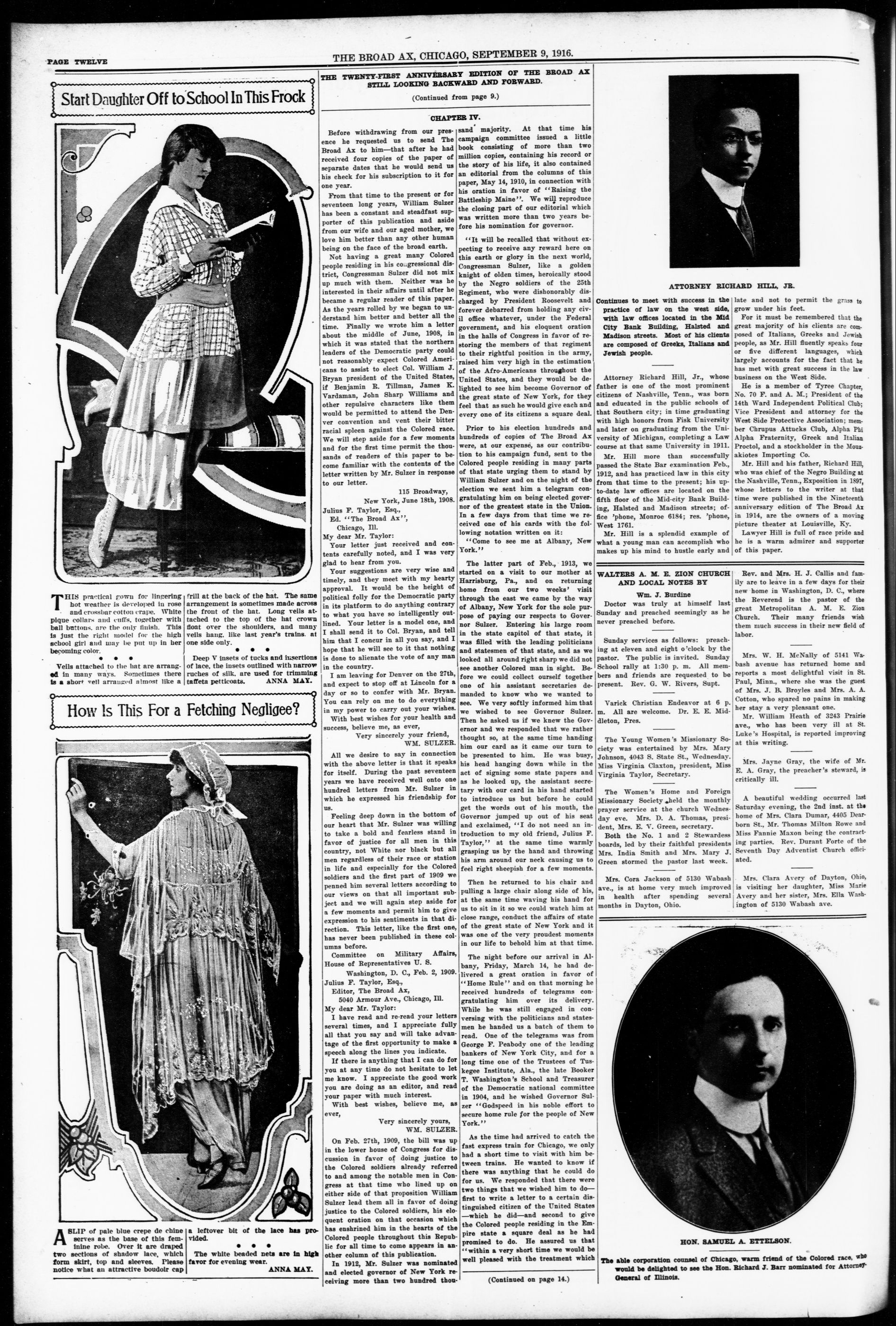
ATTORNEY RICHARD HILL. JB.
Continues to meet with success in the practice of law on the west side, with law offices located in the Mid City Bank Building, Halsted and Madison streets. Most of his clients are composed of Greeks, Italians and Jewish people.
Attorney Richard Hill, Jr., whose father is one of the most prominent citizens of Nashville, Tenn., was born and educated in the public schools of that Southern city; in time graduating with high honors from Fisk University and later on graduating from the University of Michigan, completing a Law course at that same University in 1911.
Mr. Hill more than successfully passed the State Bar examination Feb., 1912, and has practiced law in this city from that time to the present; his up-to-date law offices are located on the fifth floor of the Mid-city Bank Building, Halsted and Madison streets; office 'phone, Monroe 6184; res. 'phone, West 1761.
Mr. Hill is a splendid example of what a young man can accomplish who makes up his mind to hustle early and
WALTERS A. M. E. ZION CHURCH
AND LOCAL NOTES BY
Doctor was truly at himself last Sunday and preached seemingly as he never preached before.
Sunday services as follows: preaching at eleven and eight o'clock by the pastor. The public is invited. Sunday School rally at 1:30 p. m. All members and friends are requested to be present. Rev. G. W. Rivers, Supt.
Varick Christian Endeavor at 6 p. m. All are welcome. Dr. E. E. Middleton, Pres.
The Young Women's Missionary Society was entertained by Mrs. Mary Johnson, 4043 S. State St., Wednesday. Miss Virginia Claxton, president, Miss Virginia Taylor, Secretary.
The Women's Home and Foreign Missionary Society held the monthly prayer service at the church Wednesday eve. Mrs. D. A. Thomas, president, Mrs. E. V. Green, secretary.
Both the No. 1 and 2 Stewardess boards, led by their faithful presidents Mrs. India Smith and Mrs. Mary J. Green stormed the pastor last week.
Mrs. Cora Jackson of 5130 Wabash ave., is at home very much improved in health after spending several months in Dayton, Ohio.
[Image of a man with dark hair and a white shirt and tie].
[Picture of a man in a suit with a tie and a white shirt. The background is black. The man's face is pale, and he has a serious expression. The image is oval-shaped.]
HON. SAMUEL A. ETTELSON.
The able corporation counsel of Chicago would be delighted to see the Hon. General of Illinois.
The able corporation counsel of Chicago, warm friend of the Colored race, who would be delighted to see the Hon. Richard J. Barr nominated for Attorney- General of Illinois.
Wm. J. Burdine
late and not to permit the grass to grow under his feet.
For it must be remembered that the great majority of his clients are composed of Italians, Greeks and Jewish people, as Mr. Hill fluently speaks four or five different languages, which largely accounts for the fact that he has met with great success in the law business on the West Side.
He is a member of Tyre Chapter, No. 70 F. and A. M.; President of the 14th Ward Independent Political Club; Vice President and attorney for the West Side Protective Association; member Chropus Attucks Club, Alpha Phi Alpha Fraternity, Greek and Italian Proctol, and a stockholder in the Mouzakiotes Importing Co.
Mr. Hill and his father, Richard Hill, who was chief of the Negro Building at the Nashville, Tenn., Exposition in 1897, whose letters to the writer at that time were published in the Nineteenth anniversary edition of The Broad Ax in 1914, are the owners of a moving picture theater at Louisville, Ky.
Lawyer Hill is full of race pride and he is a warm admirer and supporter of this paper.
Rev. and Mrs. H. J. Callis and family are to leave in a few days for their new home in Washington, D. C., where the Reverend is the pastor of the great Metropolitan A. M. E. Zion Church. Their many friends wish them much success in their new field of labor.
Mrs. W. H. McNally of 5141 Wabash avenue has returned home and reports a most delightful visit in St. Paul, Minn., where she was the guest of Mrs. J. B. Broyles and Mrs. A. A. Cotton, who spared no pains in making her stay a very pleasant one.
Mr. William Heath of 3243 Prairie ave., who has been very ill at St. Luke's Hospital, is reported improving at this writing.
Mrs. Jayne Gray, the wife of Mr. E. A. Gray, the preacher's steward, is critically ill.
A beautiful wedding occurred last Saturday evening, the 2nd inst. at the home of Mrs. Clara Dumar, 4405 Dearborn St., Mr. Thomas Milton Rowe and Miss Fannie Maxon being the contracting parties. Rev. Durant Forte of the Seventh Day Adventist Church officiated.
Mrs. Clara Avery of Dayton, Ohio, is visiting her daughter, Miss Marie Avery and her sister, Mrs. Ella Washington of 5130 Wabash ave.
```markdown
```
ko, warm friend of the Colored race, who Richard J. Barr nominated for Attorney
PETER H.
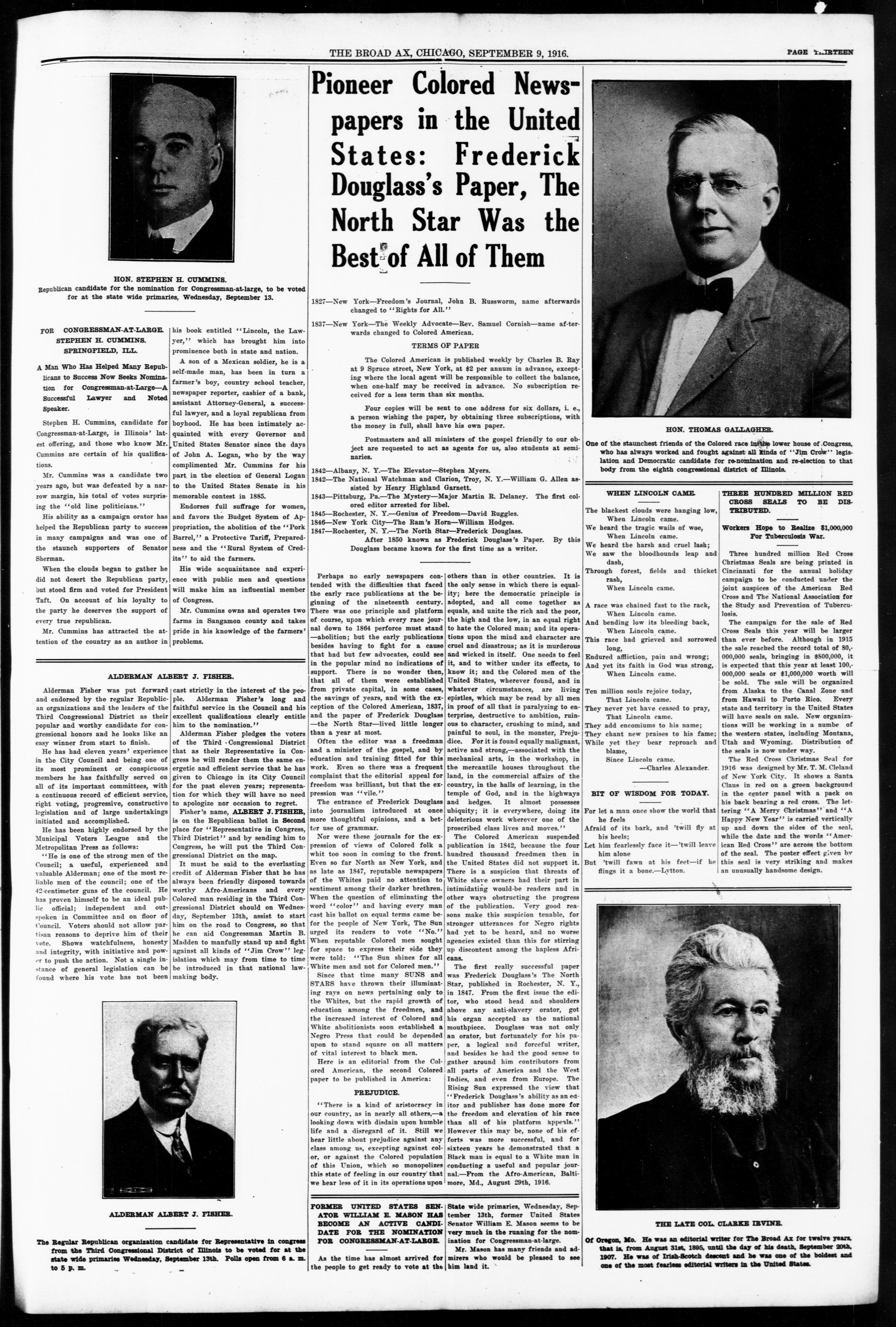
FOR CONGRESSMAN-AT-LARGE.
STEPHEN H. CUMMINS.
SPRINGFIELD, ILL.
A Man Who Has Helped Many Republicans to Success Now Seeks Nomination for Congressman-at-Large—A Successful Lawyer and Noted Speaker.
Stephen H. Cummins, candidate for Congressman-at-Large, is Illinois' latest offering, and those who know Mr. Cummins are certain of his qualifications.
Mr. Cummins was a candidate two years ago, but was defeated by a narrow margin, his total of votes surprising the "old line politicians."
His ability as a campaign orator has helped the Republican party to success in many campaigns and was one of the staunch supporters of Senator Sherman.
When the clouds began to gather he did not desert the Republican party, but stood firm and voted for President Taft. On account of his loyalty to the party he deserves the support of every true republican.
Mr. Cummins has attracted the attention of the country as an author in
ALDERMAN ALBERT J. FISHER
Alderman Fisher was put forward and endorsed by the regular Republican organizations and the leaders of the Third Congressional District as their popular and worthy candidate for congressional honors and he looks like an easy winner from start to finish. He has had eleven years' experience in the City Council and being one of its most prominent or conspicuous members he has faithfully served on all of its important committees, with a continuous record of efficient service, right voting, progressive, constructive legislation and of large undertakings initiated and accomplished. He has been highly endorsed by the Municipal Voters League and the Metropolitan Press as follows:
"He is one of the strong men of the Council; a useful, experienced and valuable Alderman; one of the most reliable men of the council; one of the 42-centimeter guns of the council. He has proven himself to be an ideal public official; independent and outspoken in Committee and on floor of Council. Voters should not allow partisan reasons to deprive him of their vote. Shows watchfulness, honesty and integrity, with initiative and power to push the action. Not a single instance of general legislation can be found where his vote has not been
A. D.
ALDERMAN ALBERT J. FISHER
The Regular Republican organization candidate for Representative in congress from the Third Congressional District of Illinois to be voted for at the state wide primaries Wednesday, September 13th. Polls open from 6 a.m. to 5 p.m.
his book entitled "Lincoln, the Lawyer," which has brought him into prominence both in state and nation. A son of a Mexican soldier, he is a self-made man, has been in turn a farmer's boy, country school teacher, newspaper reporter, cashier of a bank, assistant Attorney-General, a successful lawyer, and a loyal republican from boyhood. He has been intimately acquainted with every Governor and United States Senator since the days of John A. Logan, who by the way complimented Mr. Cummins for his part in the election of General Logan to the United States Senate in his memorable contest in 1885.
Endorses full suffrage for women, and favors the Budget System of Appropriation, the abolition of the "Pork Barrel," a Protective Tariff, Preparedness and the "Rural System of Credits" to aid the farmers.
His wide acquaintance and experience with public men and questions will make him an influential member of Congress.
Mr. Cummins owns and operates two farms in Sangamon county and takes pride in his knowledge of the farmers' problems.
cast strictly in the interest of the people. Alderman Fisher's long and faithful service in the Council and his excellent qualifications clearly entitle him to the nomination. $ ^{1} $ Alderman Fisher pledges the voters of the Third · Congressional District that as their Representative in Congress he will render them the same energetic and efficient service that he has given to Chicago in its City Council for the past eleven years; representation for which they will have no need to apologize nor occasion to regret. Fisher's name, ALBERT J. FISHER, is on the Republican ballot in Second place for "Representative in Congress, Third District" and by sending him to Congress, he will put the Third Congressional District on the map.
It must be said to the everlasting credit of Alderman Fisher that he has always been friendly disposed towards worthy Afro-Americans and every Colored man residing in the Third Congressional District should on Wednesday, September 13th, assist to start him on the road to Congress, so that he can aid Congressman Martin B. Madden to manfully stand up and fight against all kinds of "Jim Crow" legislation which may from time to time be introduced in that national law-making body.
THE BROAD AX, CHICAGO, SEPTEMBER 9, 1916
Pioneer Colored Newspapers in the United States: Frederick Douglass's Paper, The North Star Was the Best of All of Them
1827—New York—Freedom's Journal, John B. Russworm, name afterwards changed to "Rights for All."
1837—New York—The Weekly Advocate—Rev. Samuel Cornish—name af-terwards changed to Colored American.
TERMS OF PAPER
The Colored American is published weekly by Charles B. Ray at 9 Spruce street, New York, at $2 per annum in advance, excepting where the local agent will be responsible to collect the balance, when one-half may be received in advance. No subscription received for a less term than six months.
Four copies will be sent to one address for six dollars, i. e., a person wishing the paper, by obtaining three subscriptions, with the money in full, shall have his own paper.
Postmasters and all ministers of the gospel friendly to our object are requested to act as agents for us, also students at seminaries.
1842—Albany, N. Y.—The Elevator—Stephen Myers.
1842—The National Watchman and Clarion, Troy, N. Y.—William G. Allen assisted by Henry Highland Garnett.
1843—Pittsburg, Pa.—The Mystery—Major Martin R. Delaney. The first colored editor arrested for libel.
After 1850 known as Frederick Douglass's Paper. By this Douglass became known for the first time as a writer.
Perhaps no early newspapers contended with the difficulties that faced the early race publications at the beginning of the nineteenth century. There was one principle and platform of course, upon which every race journal down to 1864 perforce must stand—abolition; but the early publications besides having to fight for a cause that had but few advocates, could see in the popular mind no indications of support. There is no wonder then, that all of them were established from private capital, in some cases, the savings of years, and with the exception of the Colored American, 1837, and the paper of Frederick Douglass—the North Star—lived little longer than a year at most.
Often the editor was a freedman and a minister of the gospel, and by education and training fitted for this work. Even so there was a frequent complaint that the editorial appeal for freedom was brilliant, but that the expression was "vile." The entrance of Frederick Douglass into journalism introduced at once more thoughtful opinions, and a better use of grammar.
Nor were these journals for the expression of views of Colored folk a whit too soon in coming to the front. Even so far North as New York, and as late as 1847, reputable newspapers of the Whites paid no attention to sentiment among their darker brethren. When the question of eliminating the word "color" and having every man cast his ballot on equal terms came before the people of New York, The Sun urged its readers to vote "No." When reputable Colored men sought for space to express their side they were told: "The Sun shines for all White men and not for Colored men." Since that time many SUNS and STARS have thrown their illuminating rays on news pertaining only to the Whites, but the rapid growth of education among the freedmen, and the increased interest of Colored and White abolitionists soon established a Negro Press that could be depended upon to stand square on all matters of vital interest to black men.
Here is an editorial from the Colored American, the second Colored paper to be published in America:
"There is a kind of aristocracy in our country, as in nearly all others,—a looking down with disdain upon humble life and a disregard of it. Still we hear little about prejudice against any class among us, excepting against color, or against the Colored population of this Union, which so monopolizes this state of feeling in our country that we hear less of it in its operations upon
FORMER UNITED STATES SEN- ATOR WILLIAM E. MASON HAS BECOME AN ACTIVE CANDI- DATE FOR THE NOMINATION FOR CONGRESSMAN-AT-LARGE.
As the time has almost arrived for the people to get ready to vote at the
PREJUDICE.
others than in other countries. It is the only sense in which there is equality; here the democratic principle is adopted, and all come together as equals, and unite the rich and the poor, the high and the low, in an equal right to hate the Colored man; and its operations upon the mind and character are cruel and disastrous; as it is murderous and wicked in itself. One needs to feel it, and to tow under its effects, to know it; and the Colored men of the United States, wherever found, and in whatever circumstances, are living epistles, which may be read by all men in proof of all that is paralyzing to enterprise, destructive to ambition, ruinous to character, crushing to mind, and painful to soul, in the monster, Prejudice. For it is found equally malignant, active and strong—associated with the mechanical arts, in the workshop, in the mercantile houses throughout the land, in the commercial affairs of the country, in the halls of learning, in the temple of God, and in the highways and hedges. It almost possesses ubiquity; it is everywhere, doing its deleterious work wherever one of the proscribed class lives and moves."
The Colored American suspended publication in 1842, because the four hundred thousand freedmen then in the United States did not support it. There is a suspicion that threats of White slave owners had their part in intimidating would-be readers and in other ways obstructing the progress of the publication. Very good reasons make this suspicion tenable, for stronger utterances for Negro rights had yet to be heard, and no worse agencies existed than this for stirring up discontent among the hapless Africans.
The first really successful paper was Frederick Douglass's The North Star, published in Rochester, N. Y., in 1847. From the first issue the editor, who stood head and shoulders above any anti-slavery orator, got his organ accepted as the national mouthpiece. Douglass was not only an orator, but fortunately for his paper, a logical and forceful writer, and besides he had the good sense to gather around him contributors from all parts of America and the West Indies, and even from Europe. The Rising Sun expressed the view that "Frederick Douglass's ability as an editor and publisher has done more for the freedom and elevation of his race than all of his platform appeals." However this may be, none of his efforts was more successful, and for sixteen years he demonstrated that a Black man is equal to a White man in conducting a useful and popular journal.—From the Afro-American, Baltimore, Md., August 29th, 1916.
State wide primaries, Wednesday, September 13th, former United States Senator William E. Mason seems to be very much in the running for the nomination for Congressman-at-large. Mr. Mason has many friends and admirers who would be pleased to see him land it.
[Picture of a man in a suit and bow tie].
HON. THOMAS GALLAGHER
One of the staunchest friends of the Coho who has always worked and fought lation and Democratic candidate i body from the eighth congressions
One of the staunchest friends of the Colored race in the lower house of Congress, who has always worked and fought against all kinds of "Jim Crow" legislation and Democratic candidate for re-nomination and re-election to that body from the eighth congressional district of Illinois.
WHEN LINCOLN CAME
The blackest clouds were hanging low. When Lincoln came.
We heard the tragic wails of woe, When Lincoln came.
We heard the harsh and cruel lash; We saw the bloodhounds leap and dash,
Through forest, fields and thicket rash,
When Lincoln came.
A race was chained fast to the rack,
When Lincoln came.
And bending low its bleeding back,
When Lincoln came.
This race had grieved and sorrowed long,
Endured affliction, pain and wrong;
And yet its faith in God was strong,
When Lincoln came.
Ten million souls rejoice today,
That Lincoln came.
They never yet have ceased to pray,
That Lincoln came.
They add encomiums to his name;
They chant new praises to his fame;
While yet they bear reproach and blame,
Since Lincoln came.
BIT OF WISDOM FOR TODAY.
For let a man once show the world that he feels
Afraid of its bark, and 'twill fly at his heels;
Let him fearlessly face it—'twill leave him alone
But 'twill fawn at his feet—if he flings it a bone.—Lytton.
欽定四庫全書
THE LATE COL. CLARKE IRVINE.
Of Oregon, Mo. He was an editorial writer that is, from August 31st, 1895, until 1907. He was of Irish-Scotch descent one of the most fearless editorial w
Of Oregon, Mo. He was an editorial writer for The Broad Ax for twelve years, that is, from August 31st, 1895, until the day of his death, September 20th, 1907. He was of Irish-Scott descent and he was one of the boldest and one of the most fearless editorial writers in the United States.
1
ored race in the lower house of Congress, against all kinds of "Jim Crow" legisl or re-nomination and re-election to that district of Illinois.
THREE HUNDRED MILLION RED CROSS SEALS TO BE DISTRIBUTED.
Workers Hope to Realize $1,000,000 For Tuberculosis War.
Three hundred million Red Cross Christmas Seals are being printed in Cincinnati for the annual holiday campaign to be conducted under the joint auspices of the American Red Cross and The National Association for the Study and Prevention of Tuberculosis.
The campaign for the sale of Red Cross Seals this year will be larger than ever before. Although in 1915 the sale reached the record total of 80,000,000 seals, bringing in $500,000, it is expected that this year at least 100,000,000 seals or $1,000,000 worth will be sold. The sale will be organized from Alaska to the Canal Zone and from Hawaii to Porto Rico. Every state and territory in the United States will have seals on sale. New organizations will be working in a numbe of the western states, including Montana, Utah and Wyoming. Distribution of the seals is now under way.
The Red Cross Christmas Seal for 1916 was designed by Mr. T. M. Cleland of New York City. It shows a Santa Claus in red on a green background in the center panel with a pack on his back bearing a red cross. The lettering "A Merry Christmas" and "A Happy New Year" is carried vertically up and down the sides of the seal, while the date and the words "American Red Cross" are across the bottom of the seal. The poster effect given by this seal is very striking and makes an unusually handsome design.
1
Writer for The Broad Ax for twelve years, all the day of his death, September 20th, sent and he was one of the boldest and writers in the United States.
PAGE 1. IBTEEN
Her Motor Cap Turned Into An Old Fashioned Sunbonnet
V
PAGE FOURTEEN
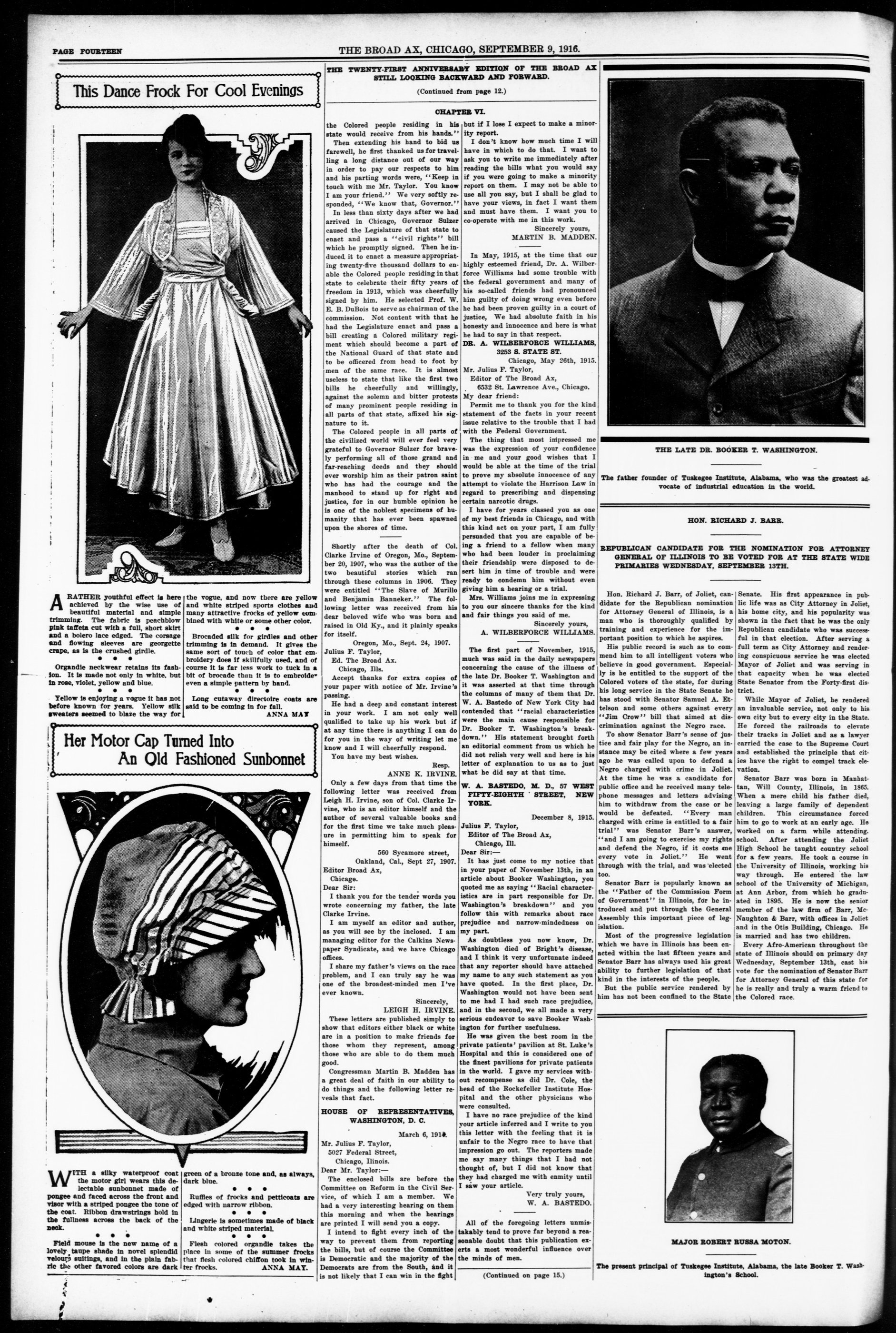
This Dance Frock
RATERTE youthful effect is here achieved by the wise use of beautiful material and simple trimming. The fabric is peachblow pink taffeta cut with a full, short skirt and a bolero lace edged. The corsage and flowing sleeves are georgette crape, as is the crushed girdle.
Organdle neckwear retains its fashion. It is made not only in white, but in rose, violet, yellow and blue.
Yellow is enjoying a vogue it has not before known for years. Yellow silk sweaters seemed to blaze the way for
Her Motor Cap Tur
An Old F
WITH a silky waterproof coat the motor girl wears this delectable sunbonnet made of pongee and faced across the front and visor with a striped pongee the tone of the coat. Ribbon drawstrings hold in the fullness across the back of the neck.
Field mouse is the new name of a lovely taupe shade in novel splendid velour's suitings, and in the plain fabric the other favored colors are dark
the vogue, and now there are yellow and white striped sports clothes and many attractive frocks of yellow combined with white or some other color.
Brocaded silk for girdles and other trimming is in demand. It gives the same sort of touch of color that embroidery does if skillfully used, and of course it is far less work to tuck in a bit of brocade than it is to embroider even a simple pattern by hand.
Long cutaway directoire coats are said to be coming in for fall.
ned Into
fashioned Sunbonnet
green of a bronze tone and, as always,
dark blue.
Ruffles of frocks and petticoats are
edged with narrow ribbon.
Flesh colored organdie takes the place in some of the summer frocks that flesh colored chiffon took in winter frocks. ANNA MAY.
THE BROAD AX, CHICAGO, SEPTEMBER 9, 1916.
THE TWENTY-FIRST ANNIVERSARY EDITION OF THE BROAD AX STILL LOOKING BACKWARD AND FORWARD.
(Continued from page 12.)
CHAPTER VI.
but if I lose I expect to make a minor ity report.
the Colored people residing in his state would receive from his hands." Then extending his hand to bid us farewell, he first thanked us for travelling a long distance out of our way in order to pay our respects to him and his parting words were, "Keep in touch with me Mr. Taylor. You know I am your friend." We very softly responded, "We know that, Governor." In less than sixty days after we had arrived in Chicago, Governor Sulzer caused the Legislature of that state to enact and pass a "civil rights" bill which he promptly signed. Then he induced it to enact a measure appropriating twenty-five thousand dollars to enable the Colored people residing in that state to celebrate their fifty years of freedom in 1913, which was cheerfully signed by him. He selected Prof. W. E. B. DuBois to serve as chairman of the commission. Not content with that he had the Legislature enact and pass a bill creating a Colored military regiment which should become a part of the National Guard of that state and to be officered from head to foot by men of the same race. It is almost useless to state that like the first two bills he cheerfully and willingly, against the solemn and bitter protests of many prominent people residing in all parts of that state, affixed his signature to it.
I don't know how much time I will have in which to do that. I want to ask you to write me immediately after reading the bills what you would say if you were going to make a minority report on them. I may not be able to use all you say, but I shall be glad to have your views, in fact I want them and must have them. I want you to co-operate with me in this work.
Sincerely yours,
MARTIN B. MADDEN.
In May, 1915, at the time that our highly esteemed friend, Dr. A. Wilberforce Williams had some trouble with the federal government and many of his so-called friends had pronounced him guilty of doing wrong even before he had been proven guilty in a court of justice. We had absolute faith in his honesty and innocence and here is what he had to say in that respect.
DR. A. WILBERFORCE WILLIAMS,
3253 S. STATE ST.
Chicago, May 26th, 1915.
Mr. Julius F. Taylor,
Editor of The Broad Ax,
6532 St. Lawrence Ave., Chicago.
My dear friend.
Permit me to thank you for the kind
statement of the facts in your recent
issue relative to the trouble that I had
with the Federal Government.
The Colored people in all parts of the civilized world will ever feel very grateful to Governor Sulzer for bravely performing all of those grand and far-reaching deeds and they should ever worship him as their patron saint who has had the courage and the manhood to stand up for right and justice, for in our humble opinion he is one of the noblest specimens of humanity that has ever been spawned upon the shores of time.
The thing that most impressed me was the expression of your confidence in me and your good wishes that I would be able at the time of the trial to prove my absolute innocence of any attempt to violate the Harrison Law in regard to prescribing and dispensing certain narcotic drugs. I have for years classed you as one of my best friends in Chicago, and with this kind act on your part, I am fully persuaded that you are capable of being a friend to a fellow when many who had been louder in proclaiming their friendship were disposed to desert him in time of trouble and were ready to condemn him without even giving him a hearing or a trial.
Shortly after the death of Col. Clarke Irvine of Oregon, Mo., September 20, 1907, who was the author of the two beautiful stories which ran through these columns in 1906. They were entitled "The Slave of Murillo and Benjamin Banneker." The following letter was received from his dear beloved wife who was born and raised in Old Ky., and it plainly speaks for itself.
Mrs. Williams joins me in expressing to you our sincere thanks for the kind and fair things you said of me.
Sincerely yours,
A. WILBERFORCE WILLIAMS
Oregon, Mo., Sept. 24, 1907.
Julius F. Taylor,
The first part of November, 1915, much was said in the daily newspapers concerning the cause of the illness of the late Dr. Booker T. Washington and it was asserted at that time through the columns of many of them that Dr. W. A. Bastedo of New York City had contended that "racial characteristics were the main cause responsible for Dr. Booker T. Washington's breakdown." His statement brought forth an editorial comment from us which he did not relish very well and here is his letter of explanation to us as to just what he did say at that time.
Ed. The Broad Ax.
Chicago, Ills.
Accept thanks for extra copies of your paper with notice of Mr. Irvine's passing.
He had a deep and constant interest in your work. I am not only well qualified to take up his work but if at any time there is anything I can do for you in the way of writing let me know and I will cheerfully respond.
You have my best wishes.
Resp.
ANNE K. IRVINE.
Only a few days from that time the following letter was received from Leigh H. Irvine, son of Col. Clarke Irvine, who is an editor himself and the author of several valuable books and for the first time we take much pleasure in permitting him to speak for himself.
W. A. BASTEDO, M. D., 57 WEST
FIFTY-EIGHTH ' STREET, NEW
YORK.
December 8, 1915.
Julius F. Taylor,
Editor of The Broad Ax,
Chicago, Ill.
Dear Sir:—
560 Sycamore street.
Oakland, Cal., Sept 27, 1907.
Editor Broad Ax,
It has just come to my notice that in your paper of November 13th, in an article about Booker Washington, you quoted me as saying "Racial characteristics are in part responsible for Dr. Washington's breakdown" and you follow this with remarks about race prejudice and narrow-mindedness on my part.
I thank you for the tender words you wrote concerning my father, the late Clarke Irvine. I am myself an editor and author, as you will see by the inclosed. I am managing editor for the Calkins Newspaper Syndicate, and we have Chicago offices.
As doubtless you now know, Dr. Washington died of Bright's disease, and I think it very unfortunate indeed that any reporter should have attached my name to any such statement as you have quoted. In the first place, Dr. Washington would not have been sent to me had I had such race prejudice, and in the second, we all made a very serious endeavor to save Booker Washington for further usefulness.
I share my father's views on the race problem, and I can truly say he was one of the broadest-minded men I've ever known.
Sincerely,
LEIGH H. IRVINE.
These letters are published simply to show that editors either black or white are in a position to make friends for those whom they represent, among those who are able to do them much good.
He was given the best room in the private patients' pavilion at St. Luke's Hospital and this is considered one of the finest pavilions for private patients in the world. I gave my services without recompense as did Dr. Cole, the head of the Rockefeller Institute Hospital and the other physicians who were consulted.
Congressman Martin B. Madden has a great deal of faith in our ability to do things and the following letter reveals that fact.
HOUSE OF REPRESENTATIVES
WASHINGTON, D. C.
I have no race prejudice of the kind your article inferred and I write to you this letter with the feeling that it is unfair to the Negro race to have that impression go out. The reporters made me say many things that I had not thought of, but I did not know that they had charged me with enmity until I saw your article.
March 6. 1914.
Mr. Julius F. Taylor,
5027 Federal Street,
Chicago, Illinois.
Dear Mr. Taylor:—
The enclosed bills are before the
Committee on Reform in the Civil Service,
of which I am a member. We
had a very interesting hearing on them
this morning and when the hearings
are printed I will send you a copy.
Very truly yours,
W. A. BASTEDO
All of the foregoing letters unmistakably tend to prove far beyond a reasonable doubt that this publication exerts a most wonderful influence over the minds of men.
I intend to fight every inch of the way to prevent them from reporting the bills, but of course the Committee is Democratic and the majority of the Democrats are from the South, and it is not likely that I can win in the fight
(Continued on page 15.)
[Name]
THE LATE DR. BOOKER T. WASHINGTON.
The father founder of Tuskegee Institute, Alabama, who was vocate of industrial education in the world.
The father founder of Tuskegee Institute, Alabama, who was the greatest ad vocate of industrial education in the world.
HON. RICHARD J. BARR.
REPUBLICAN CANDIDATE FOR THE GENERAL OF ILLINOIS TO BE PRIMARIES WEDNESDAY, SEPT
REPUBLICAN CANDIDATE FOR THE NOMINATION FOR ATTORNEY
GENERAL OF ILLINOIS TO BE VOTED FOR AT THE STATE WIDE
PRIMARIES WEDNESDAY, SEPTEMBER 13TH.
Hon. Richard J. Barr, of Joliet, candidate for the Republican nomination for Attorney General of Illinois, is a man who is thoroughly qualified by training and experience for the important position to which he aspires. His public record is such as to commend him to all intelligent voters who believe in good government. Especially is he entitled to the support of the Colored voters of the state, for during his long service in the State Senate he has stood with Senator Samuel A. Ettelson and some others against every "Jim Crow" bill that aimed at discrimination against the Negro race.
To show Senator Barr's sense of justice and fair play for the Negro, an instance may be cited where a few years ago he was called upon to defend a Negro charged with crime in Joliet. At the time he was a candidate for public office and he received many telephone messages and letters advising him to withdraw from the case or he would be defeated. "Every man charged with crime is entitled to a fair trial!" was Senator Barr's answer, "and I am going to exercise my rights and defend the Negro, if it costs me every vote in Joliet." He went through with the trial, and was 'elected too.
Senator Barr is popularly known as the "Father of the Commission Form of Government" in Illinois, for he introduced and put through the General Assembly this important piece of legislation.
Most of the progressive legislation which we have in Illinois has been enacted within the last fifteen years and Senator Barr has always used his great ability to further legislation of that kind in the interests of the people.
But the public service rendered by him has not been confined to the State
[Name]
MAJOR ROBERT RUSSA MOTON
The present principal of Tuskegee Institute, Alabama, the ington's School.
The present principal of Tuskegee Institute, Alabama, the late Booker T. Washington's School.
cute, Alabama, who was the greatest ad-
education in the world.
BARD J. BARR.
THE NOMINATION FOR ATTORNEY
VOTED FOR AT THE STATE WIDE
SEPTEMBER 13TH.
Senate. His first appearance in public life was as City Attorney in Joliet, his home city, and his popularity was shown in the fact that he was the only Republican candidate who was successful in that election. After serving a full term as City Attorney and rendering conspicuous service he was elected Mayor of Joliet and was serving in that capacity when he was elected State Senator from the Forty-first district.
While Mayor of Joliet, he rendered an invaluable service, not only to his own city but to every city in the State. He forced the railroads to elevate their tracks in Joliet and as a lawyer carried the case to the Supreme Court and established the principle that cities have the right to compel track elevation.
Senator Barr was born in Manhattan, Will County, Illinois, in 1865. When a mere child his father died, leaving a large family of dependent children. This circumstance forced him to go to work at an early age. He worked on a farm while attending school. After attending the Joliet High School he taught country school for a few years. He took a course in the University of Illinois, working his way through. He entered the law school of the University of Michigan, at Ann Arbor, from which he graduated in 1895. He is now the senior member of the law firm of Barr, McNaughton & Barr, with offices in Joliet and in the Otis Building, Chicago. He is married and has two children.
Every Afro-American throughout the state of Illinois should on primary day Wednesday, September 13th, cast his vote for the nomination of Senator Barr for Attorney General of this state for he is really and truly a warm friend to the Colored race.
ute, Alabama, the late Booker T. Wash- School.
107
ATTORNEY AUGUSTUS L. WILLIAMS
Republican candidate for the nomination for member of the
Equalization from the 1st congressional district or
Republican candidate for the nomination for member of the State Board of Equalization from the 1st congressional district of Illinois.
Augustus L. Williams, Republican candidate for the nomination of a member of the State Board of Equalization from the First Congressional District, comprising the 1st Ward, 2nd Ward, 3rd Ward from 39th street to 43rd street, and the 4th Ward to Halsted on the west, is making one of the most striking campaigns for the office he is seeking of any of the candidates opposing him. Mr. Williams, in addition to his candidacy for the State Board of Equalization, is representing the west end of the 2nd Ward, comprising fifty precincts, for Hull for Governor. Mr. Williams, when asked what platform he was running on had this to say:
First: A square deal for my constituents in the First Congressional District.
Second: Equal representation in all offices where the patronage is given on a basis of the numerical strength of the people comprising the Republican party in the District.
Third: Honest adjustment of the taxes of the State of Illinois, wherein the corporations of the State will pay its fair proportions of the taxes in ac-
THE AFRO-AMERICAN OF BALTIMORE, MD., CELEBRATED ITS TWENTY-FIFTH BIRTHDAY AUGUST 26th. BROTHER MURPHY PRODUCED ONE OF THE FINEST ANNIVERSARY EDITIONS SO FAR BROUGHT FORTH BY AN AFRO-AMERICAN EDITOR IN THIS COUNTRY.
It Consisted of Sixteen Pages Well Filled with Good Reading Matter and Advertisements.
Last Saturday, August 26th, Brother John H. Murphy, who has been the untiring editor of The Afro-American, Baltimore, Md. for the past 22 years, put forth the 25th anniversary edition
FORMER ALDERMAN HENRY P. BERGEN.
Democratic candidate for the nomination for member of the Trustees of the Sanitary District of Chicago. As a member of the city council, he was known as the "watch dog" of
cordance with the amount of capital they represent. Fourth: Every person and every corporation in the State will get a square deal as far as he can consistently do so among his constituents on the said Board.
Mr. Williams is a man of considerable means and his experience in the taxing bodies of Cook County makes him peculiarly fitted for the office for which he seeks. He is a practicing attorney at the bar in the State of Illinois, and in this capacity he is fearless, ambitious and efficient and we have no doubt but what Mr. Williams is the most qualified man who seeks the position on the Board among the other five aspirants for this position and he should be voted for by the people in his district who believe in efficiency and ability, and we ask our friends to mark a cross in the square in the front of the name of Augustus L. Williams, and for none other in the group of candidates for the office of member of the State Board of Equalization.
Mr. Williams has the endorsement of the regular Republican organization of the first congressional district of Illinois.
of that publication, which was a hummer in every respect. It consisted of 16 pages, well filled with good reading matter, illustrated with cuts and sketches of many of the most progressive men and women in that section of the country; also several prominent White gentlemen felt highly honored to have their pictures in that number of the Afro-American.
It was also chuck full of good advertisements from the front to the last page of that issue of the paper, plainly shows that there is a strong force or power behind it—that brother Murphy is a live wire in the newspaper world and that the Afro-American is one of the best and most enterprising newspapers in this country.
the city treasury. Mr. Bergen has thousands and thousands of friends who would be greatly delighted to see him nominated and elected to the position he is seeking.
THE BROAD AX, CHICAGO, SEPTEMBER 9, 1916
(Continued from page 14.)
In this connection it might be truthfully said that the vast majority of Afro-Americans have not yet sufficiently advanced in civilization to appreciate the power, influence or the real worth of the newspaper for after more than forty years of freedom and progress on the part of Afro-Americans there is only one financial supporter of Negro newspapers to each 35,000 Afro-Americans throughout this country. This is an appalling showing when we take into consideration the fact that there are more than ten million Afro-Americans in the United States.
It can also be truthfully stated that the vast majority of Afro-Americans look upon Colored editors as huge jokes, and they invariably entertain the idea that they are making a great sacrifice on their part to treat them with civility, and many of them who are utterly incapable of making a success in life or conducting successfully any line of business have the nerve to think that they are eminently qualified to teach successful Colored editors how to run or conduct their newspapers.
In speaking of the power and influence of the newspaper, Napoleon, who was one of the greatest warriors of ancient or modern times, on one occasion exclaimed that "he would rather face an army composed of three hundred thousand soldiers with all the accoutrements of modern warfare than to have three newspapers firing into the rear of his army."
The immortal Thomas Jefferson let it be known before passing away from this earth "that as far as he was concerned he would rather reside in a country without a government with plenty of newspapers rather than live in a country with a government and no newspapers."
It was the pens of William Lloyd Garrison, Benjamin Lundy, E. P. Lovejoy, Charles Osborne, Frederick Douglass and a few other brave and courageous men, through the columns of their small newspapers that revolutionized the public sentiment in this country in favor of the abolition of slavery. It was their pens dipped in burning fire and gall which made it possible for others who stood idly by at that time and refused to raise their little finger to assist them in their great and heroic struggles for humanity, to wear the crown or the wreath of glory, later on, owing to the results which flowed from the war of the rebellion.
Right at this very time it seems hard for the Afro-Americans to realize the fact that "there are more than five hundred papers or articles written in opposition to them and in favor of keeping them down intellectually, morally and in every other way; to one article written advocating their elevation along the pathway which leads on up to the highest mental, moral and intellectual attainment.
They are unable to comprehend this great fundamental truth that they will never be able to throw off the yoke of oppression which is fastened around their necks with iron clasps, until they learn to render hearty support to their own newspapers. For there are not ten newspapers in the United States published in the interest of the White race whose editors feel that they are obligated under all circumstances to fight the battles for the Afro-Americans and there are not ten newspapers in this country published in the interest of the Afro-American race that can run one year without depending upon the Whites in the way of advertising and so on.
As we have said before, as long as the Afro-Americans manifest a disposition not to support their own race publication, what can they expect and what do they deserve? Will they not wake up from their long sleeping or snoring spell long enough to drink in this one self evident truth that "there will be no political change in their civil or political status in this country for many years to come and that they will continue to be the under dog in the
Thirteen of Mob That Stormed Allen County Jail Arrested— 100 True Bills May Be Returned.
Lima, O.,—Sixteen alleged members of the mob which stormed the Allen county jail here last week in an attempt to lynch Charles Daniels, a Negro, accused by a White woman, and tortured Sheriff Eley until he told where the prisoner was held, were indicted to-day. The list includes several business men. Thirteen of the sixteen have been arrested and are in the county jail under guard of 100 policemen and deputy sheriffs It is expected that 100 indictments will be returned.
fight until public sentiment is radically changed in their favor through the medium of their own newspapers!
With remarkable ability the average Afro-American can tell you all about the Holy Ghost descending from heaven in the shape of a white dove, which they say made love to Mary the wife of Joseph—the mother of Jesus, who brought three or four other children into this world aside from the son of God. They can explain how Daniel happened to tarry so long in the Lions' den without being devised by them. They can very minutely relate to you that the three Hebrews rested up in the fiery furnace without getting one hair on their heads singed by the roaring flames. But they are as dumb as oysters when they are called upon to elaborate on the achievements of the scholars belonging to their own race.
Therefore, let the Afro-American refrain from spending so much time in studying the wild and visionary stories in the Bible and devote more of his time in familiarizing himself with the literary productions of those of his own flesh and blood; then it will not be hard for him to learn that the pen is more powerful or mightier than the sword.
As Victor Hugo says in his eloquent and classical oration on that great humanitarian "Voltaire," that Voltaire uttered a loud shriek of horror which penetrated down to the bottom of his warm liberty-loving heart, when he beheld the priesthood and the church cutting the tongues out of the mouths of the people, pouring melted lead in their ears, tearing them to pieces over the racks, blinding them by putting out their eyes, simply because they would not yield obedience to the church and the priesthood in all things.
Voltaire, alone, with his pen, in the presence of those united forces, the court, the nobility, the church, capitol, that unconscious power, the blind multitude, that terrible majesty so severe to subjects, so docile to the master, crushing and flattering, kneeling upon the people before the king; that clergy vile, melange of hypocrisy and fanaticism, Voltaire alone, we repeat it, declared war against that collation of all the social iniquities against that enormous and terrible world, and he accepted battle with it. And what dear readers was his weapon? That which has the lightness of the wind and the power of the thunderbolt—a pen. With that weapon he fought, with that weapon he conquered.
Our main contention is that if Voltaire could stand up single-handed alone and work up and create a sentiment which compelled the rulers or the authorities of the church and of France itself to accord to them their religious and political liberty, what could several hundred able Negro writers accomplish in the way of creating public sentiment in favor of the Afro-American being permitted to freely enjoy all of his natural rights, if their publications were properly supported? For it hath been said by that eminent authority who was one of the greatest champions of the manhood rights of the Afro-American—Wendell Phillips—that "Armies are nothing, courts are nothing, laws are nothing, unless they are backed up by public sentiment." And mark our words, the Negro never will have public sentiment on his side in this country until he is willing to heartily and cheerfully support newspapers published exclusively for the advancement of his race.
For printer's ink and education tinged with irony and song saps away the strong foundations of all monumental wrongs.
In conclusion, from the bottom of our warm and sympathetic heart, we most gratefully desire to express our lasting gratitude to each and every one who have in the past and the present time assisted in any way to make it possible for us to present them with a copy of the Twenty-first Anniversary edition of The Broad Ax.
Wilson Campaign Committee Recognizes Roger Sullivan's Close Ally in Appointment.
Charles Boeschenstein, Democratic national committeeman for Illinois, has been taken into the Wilson organization of the national committee.
National Chairman Vance McCormick Thursday announced his appointment as vice chairman of the bureau of political organizations and clubs.
Mr. Boeschenstein is the right hand man of Roger Sullivan in Illinois, and his appointment is taken as recognition of the Sullivan forces, for campaign purposes at least, by the Wilson forces in the east. Mr. Boeschenstein left New York Wednesday night for Chicago to begin his new duties.
CHAPTER V.
19
HENRY MECKLEY
Republican candidate for the nomination
Court for Chicago, residing at 142
primaries, Wednesday, September 1
HENRY MECKLENBURG WALKER.
e for the nomination for Associate Jud
go, residing at 1427 Leland avenue; to
tuesday, September 13.
Republican candidate for the nomination for Associate Judge of the Municipal Court for Chicago, residing at 1427 Leland avenue; to be voted for at the primaries, Wednesday, September 13.
Henry Meeklenburg Walker, the Colored man's friend and Republican candidate for judge of the Municipal Court, was raised on the South Side but now resides on the North Side. He has been engaged in the active practice of law in this city for 24 years. He
AN ADDRESS TO THE REPUBLICAN AND JULIUS JOHNSON FOR THE NATIONAL ACCOUNTS.
The undersigned Republican voters supporting and commending to the Rep. Julius Johnson for the Republican nominee of Illinois. Mr. Johnson has been munty and is very favorably known for candidacy a high reputation for person service, and many years of unselfish life would be a deserved recognition of genius to the State ticket at next fall's election.
F. A. Londee, Senator 33rd Sen. D. tuter; Martin R. Carlson, Mayor, Moline W. E. Taylor, Soil Expert Desere & Co.; Moline; A. G. Anderson, Chairman Reprobate Judge Rock Island County; G. tav Andreen, President Augustana Collec M. T. Budgren, Commissioner Acct a Clerk, Rock Island County; N. A. Lars Sherman W. Searle, Editor Rock Island 33rd Sen. District; Geo. W. Johnson, Fred W. Rinck, Secretary County Rep.
It must be said to the great credit own money in connection with the expedition for Auditor of Public Accounts to other hand one of his chief opponents state office, has forty or fifty men traint and building the voters into support foolish or childish enough to believe that maintain him in some kind of office, a directly and indirectly by holding public.
It is claimed that many of his show roll and drawing their pay out of the while they are spending the people's political boss.
This should in some way or other voters should severely rebuke him at the tember 13th and nominate honest Julius for the state of Illinois.
THE REPUBLICANS OF ILLINOIS INVESTIGATE FOR THE NOMINATION FOR A PRESIDENT.
Republican voters in Rock Island County responding to the Republicans of Illinois to the Republican nomination for Auditor. Johnson has been a highly respected, favorably known throughout the State. Computation for personal integrity, a long years of unselfish labor for party success, recognition of genuine merit and would next fall's election.
AN ADDRESS TO THE REPUBLICANS OF ILLINOIS IN BEHALF OF HON. JULIUS JOHNSON FOR THE NOMINATION FOR AUDITOR OF PUBLIC ACCOUNTS.
The undersigned Republican voters in Rock Island County take pleasure in supporting and commending to the Republicans of Illinois the candidacy of Mr. Julius Johnson for the Republican nomination for Auditor of Public Accounts, State of Illinois. Mr. Johnson has been a highly respected citizen of our community and is very favorably known throughout the State. He brings to his candidacy a high reputation for personal integrity, a long and efficient public service, and many years of unselfish labor for party success. His nomination would be a deserved recognition of genuine merit and would add much strength to the State ticket at next fall's election.
Senator 33rd Sen. District; W. A. Meese, Elison, Mayor, Moline; P. S. McGlyn, Editor, Expert Deere & Co.; L. C. Blanding, Chair, Parson, Chairman Rep. Cen. Co., Rock Isle Island County; G. C. Deetz, Municipal Assistant Augustana College; Wm. McConshield, Commissioner Acct and Fin., R. I.; H. L. County; N. A. Larson, County Judge, N. Auditor Rock Island Union; Thomas Campeo, W. Johnson, Chairman County Secretary County Rep. Cen. Committee.
to the great credit of Mr. Johnson this season with the expenses in his clean cut Public Accounts for the State of Illinois.
His chief opponents who at the present day or fifty men traveling throughout the nation into supporting him, who is a pledge to believe that the taxpayers of the kind of office, although he has made by holding public office.
At many of his shouters and retainers are their pay out of the pockets of the taxing the people's time in working in one way or other be stopped at once, rebuke him at the state wide primaryinate honest Julius Johnson for Auditor Nois.
F. A. Londee, Senator 33rd Sen. District; W. A. Meese, Attorney and Lecturer; Martin R. Carlson, Mayor, Moline; P. S. McGlynn, Editor Moline Dispatch; W. E. Taylor, Soil Expert Deere & Co.; L. C. Mblanding, Chairman Rep. Cen. Com., Moline; A. G. Anderson, Chairman Rep. Cen. Co., Rock Island; Benj. S. Bell, Probate Judge Rock Island County; G. C. Deetz, Municipal Judge, Moline; Gustav Andreen, President Augustana College; Wm. McConschie, Mayor Rock Island; M. T. Rudgren, Commissioner Acct and Fin., R. I.; H. B. Hubbard, County Clerk, Rock Island County; N. A. Larson, County Judge, Rock Island County; Sherman W. Searle, Editor Rock Island Union; Thomas Campbell, Representative 33rd Sen. District; Geo. W. Johnson, Chairman County Rep. Cen. Committee; Pred W. Rinck, Secretary County Rep. Cen. Committee.
It must be said to the great credit of Mr. Johnson that he is spending his own money in connection with the expenses in his clean cut race for the nomination for Auditor of Public Accounts for the State of Illinois, whereas on the other hand one of his chief opponents who at the present time occupies a big state office, has forty or fifty men traveling throughout the state brow beating and bulldozing the voters into supporting him, who is a public leech and he is foolish or childish enough to believe that the taxpayers of this state must always maintain him in some kind of office, although he has made millions of dollars directly and indirectly by holding public office.
It is claimed that many of his shouters and retainers are on the state payroll and drawing their pay out of the pockets of the taxpayers of this state while they are spending the people's time in working in the interest of their political boss.
This should in some way or other be stopped at once and the Republican voters should severely rebuke him at the state wide primaries, Wednesday, September 13th and nominate honest Julius Johnson for Auditor of Public Accounts for the state of Illinois.
CHARLES A. WILLIAMS
Charles A. Williams was born in Ottawa, Illinois, May 1, 1876. His father, Luman A. Williams was the founder and first editor of the Ottawa Daily Journal.
Mr. Williams received his education in the public schools of Ottawa and later attended Central Normal School at Danville, Indiana. Later he attended the law department of Lake Forest University.
During his school days at Ottawa he sold papers on the streets and during vacation time he came to Chicago and sold papers "just for fun," he said.
During the time that he attended Lake Forest University he was connected with the law offices of Robert Rae, and in 1902, after his graduation, he became trial attorney for the firm of Reed and Rogers and remained with that firm until March 1, 1914, at which time he formed a partnership with
T. B. H. C.
CHARLES A. WILLIAMS, REPUBLIC
THE BOARD
ILAMS, REPUBLICAN CANDIDATE TO THE BOARD OF REVIEW.
CHARLES A. WILLIAMS, REPURLIGIAN CANDIDATE FOR MEMBER OF
THE BOARD OF REVIEW.
NBURG WALKER.
n for Associate Judge of the Municipal Leland avenue; to be voted for at the 3.
is able, conscientious and fearless. Being compelled to go out into the world and earn his own living at the early age of ten years, thereafter educating himself at his own expense, his sympathies are always with the poor and unfortunate. Vote for him at the primaries Wednesday, September 13th.
S OF ILLINOIS IN BEHALF OF HON. DEMINATION FOR AUDITOR OF PUB-
in Rock Island County take pleasure in publicans of Illinois the candidacy of Mr. Destination for Auditor of Public Accounts, on a highly respected citizen of our com-
m throughout the State. He brings to his ideal integrity, a long and efficient public labor for party success. His nomination routine merit and would add much strength to
spectfully,
District; W. A. Meese, Attorney and Lec-
; P. S. McGlyn, Editor Moline Dispatch;
L. C. Blanding, Chairman Rep. Cen. Com-
; P. Cen. Co., Rock Island; Benj. S. Bell,
C. Deets, Municipal Judge, Moline; Gus-
; Wm. McConschie, Mayor Rock Island;
And Fin., B. I.; H. B. Hubbard, County
; County Judge, Rock Island County;
Union; Thomas Campbell, Representative
Chairman County Rep. Cen. Committee;
Cen. Committee.
of Mr. Johnson that he is spending his cases in his clean cut race for the nomina-
the State of Illinois, whereas on the
who at the present time occupies a big celling throughout the state brow beating him, who is a public leech and he is
at the taxpayers of this state must always although he has made millions of dollars in office.
taters and retainers are on the state pay-
pockets of the taxpayers of this state time in working in the interest of their
be stopped at once and the Republican
the state wide primaries, Wednesday, Sep-
Johnson for Auditor of Public Accounts
Respectfully.
Martin, under the firm name of Martin and Williams. That firm continues in practice with offices in the People's Life Building.
Mr. Williams, during his practice, has specialized in tax matters and is thus eminently fitted to perform the duties of the office he is now seeking.
He was married December 24, 1902, to Miss Alice Ellsworth, of Ottawa, and resides at 7700 Sangamon street. He has two children.
Mr. Williams is a member of the Chicago Bar Association, a veteran of the Spanish American War, and belongs to numerous fraternal and social clubs and societies. He is at present the Republican County Central Committeeman from the Thirty-second Ward, having been elected by the largest plurality given a committeeman at the recent election.
On account of his popularity many of his friends are declaring that Mr. Williams will lead his ticke at the coming primaries.
CAN CANDIDATE FOR MEMBER OF
OF REVIEW.
PAGE FIFTEEN
FOR THE NEXT THIRTY DAYS THE BROAD AX WILL BE SENT TO ANY ADDRESS IN THE UNITED STATES FOR ONE YEAR FOR ONE DOLLAR
Phones (Calumet 6247
Auto 74-292
The Brunswick
Hotel & Buffet
3004 S. STATE STREET
GEO. W. HOLT, Prop.
The Louise Tr
for Colo
An Oak from an Acorn
TEENAN JO
The Louise Training School for Colored Boys
An Oak from an Acorn Its Growth and Needs
TEENAN JONES' PLACE
3445 SOUTH STATE STREET
Telephone Douglas 4591
The finest and most UP-TO BUFFET and CAFE on the Side. First-Class Entertainer
HENRY "TEENAN" JONES, Prop
Phone Randolph 4758
The finest and most UP-TO-DATE BUFFET and CAFE on the South Side. First-Class Entertainers. HENRY "TEENAN" JONES, Proprietor.
Residence, 2802 S. Tripp Ave.
Phone Lawndale 7055
C. J. Waring
Attorney and Counselor at Law
Suite 18,
143 North Dearborn Street
CHICAGO
Franklin A. Denison
ATTORNEY AT LAW
36 West Randolph St., Chicago
Suite 708 Delaware Building
Tel. Central 3142
FRANK DUNN
J. B. CAHEY
Trustees
Established 1877
TEL. OAKLAND 1850, 1851, 1852
JOHN J. DUNN
WHOLESALE GOAL RETAIL
Fifty-First and Armour Avenue
RAILYARDS
1st St. and L. S. & M. S.
1st St. and Armour Ave.
ONIOAGC
THE BROAD AX
Published Weekly
In this city since July 15th, 1899, without missing one single issue, Be-publicans, Democrats, Catholics, Protestants, single Taxers, Priests, infidels or anyone else can have their say as long as their language is proper and responsibility is fixed.
The Broad Ax is a newspaper whose platform is broad enough for all, ever claiming the editorial right to speak its own mind.
Local communications will receive attention. Write only on one side of the paper.
Subscriptions must be paid in advance.
One Year.....$2.00
Six Months.....1.00
Advertising rates made known on application.
Address all communications to
THE BROAD AX
6418 Champlain Ave., Chicago, Ill.
PHONE WENTWORTH 2597.
JULIUS F. TAYLOR, Editor and Publisher.
Entered as Second-Class Matter Aug. 19, 1902, at the Post Office at Chicago, Illinois, under Act of March 3, 1879.
FOR THE NEXT THIRTY
PAGE SIXTEEN
most UP-TO-DATE LIFE on the South Entertainers.
JONES, Proprietor.
EDWARD FELIX
CIGARS
TOBACCO
CANDIES
NOTIONS
LIGHT GROCERIES
3002 Dearborn Street
Office Hours Office Phones
2 to 4 P. M. Douglas 3522
7 to 8:30 P. M. Auto. 71-777
Sundays 2 to 4 P. M.
EDWARD S. MILLER, M. D.
Physician and Surgeon
Residence
3247 Wabash Avenue
Phone Douglas 2903 Auto 71-867 Chicago
PHONES: OFFICE, MAIN 4188
AUTOMATIC 33-736
RESIDENCE, DREXEL 7990
Walter M. Farmer
ATTORNEY AT LAW
SUITE 708, 184 WASHINGTON ST.
NOTARYPUBLIC CHICAGO
Office Phones: Res. 5133 Sq. Wabash Ave.
Oakland 4662, Aute. 73-058 Phone Drezel 18815
Dr. Theo. R. Mozee
DENTIST
4709 S. STATE STREET
CHICAGO
Hours 9 A. M. to 5 P. M., 7 P. M. to 9 P. M.
Sundays by Appointment
Phone Main 2017 Automatic 32-395
A. L. WILLIAMS
ATTORNEY AND COUNSELOR AT LAW
Suite 706 Firmenich Bldg.
184 W. Washington St.
Residence 5548 Jefferson Av.
Phone Midway 5515 Chicago
A. D. GASH
ATTORNEY AT LAW
118 North La Salle St., Chicago
Suite 615 to 616
PHONE MAIN 2214
Residence 1262 Macalister Place
Telephone Monroe 2714
MILES J. DEVINE
ATTORNEY AT LAW
Suite 313-329 Reaper Block
Clark & Washington Sts.
Phones Central 239
Auto. 41-916
CHICAGO
THE BROAD AX, CHICAGO, SEPTEMBER 9, 1916.
ERNEST WILLIAMSON
26-Passenger Auto Funeral Coaches
Carries Complete Funeral to Any Local Cemetery and Return
Greater Elegance, Half the Cost
My Funeral Compartment Auto-Dors Are Revitalizing Funeral Services in Chicago. They Are Vastly
Preferred to Single Carriages and Autos, as They Insure Far Greater Elegance and Comfort, and Besides
Save More than Half the High Cost of Carriages and Automobiles
Tel. Kenwood 455 Calls Promptly Answered Day or Night Auto. 73-867
ERNEST H. WILLIAMSON
PRIVATE CHAPEL UNDERTAKER NOTARY PUBLIC
5028-5030 S. State St. Automobiles for All Occasions Chicago, Ill.
Real Estate and Insurance
NOTARY PUBLIC
3603 So. State Street, Chicago, Illinois
Tels. Douglas 6759; Auto. 77-086
INSIDE THE LIMITS OF CHICAGO
25x150 Feet
One Hundred
Twenty-Five Dollars
Hundred and Fifty Dollars Down and Five Dollars Up
JESSE B
BANK
One Hundred and Fifty Dollars Twenty-Five Dollars Down and Five Dollars per Month
GARAGE DEPT.
GENERAL BANKING
3 per cent allow
Safety Deposit
REAL BLOCK
As agent buy and sell Real Estate
dents, including payment of taxa
on Chicago Real Estate.
Especially Invites th
JOHN BLOCKI, President
JOHN E.
P
C. E. KREY
5057 South
NOT ON
FOR HIGH GRADU
MEDICINE
All Prescription
ALSO O
BLOCKI'S IDEA
IN BOTT
Recent allowed on Savings Acco-
tive Deposit Vaults, $3.00 per
REAL ESTATE DEPARTMENT
and sell Real Estate on commission, manages estat-
e payment of taxes and locking after assessments
Estate.
Specially Invites the patronage of Chicago business
KI, President
F. W. BLOCK
JOHN BLOCKI & SOFT
PERFUMERS
GO TO
KREYSSLER, Dru-
5057 South State Street
NOT ON THE CORNER
HIGH GRADE DRUGS, CHEMICALS,
MEDICINAL PREPARATIONS
All Prescriptions Carefully Compounde
ALSO CARRY A FULL LINE OF
I'S IDEAL & BLOCKI'S F
IN BOTTLE PERFUMES
3 per cent allowed on Savings Accounts Safety Deposit Vaults, $3.00 per Year
REAL ESTATE DEPARTMENT As agent buy and sell Real Estate on commission, manages estates for non-residents, including payment of taxes and locking after assessments. Money to loan on Chicago Real Estate. Especially Invites the patronage of Chicago business men
JOHN BLOCKI & SON PERFUMERS
C. E. KREYSSLER, Druggist
BLOCKI'S IDEAL & BLOCKI'S FLOWER IN BOTTLE PERFUMES
A. F. CODOZOE,
J. H. WHISTON. Proprietors
CHAS. HARRIS, Manager
The
AN
3030 STATE ST
The Elite Cafe
AND BUFFET
STATE STREET C
John T. Cook M. E. Wimes
Renting & Insurance Dept.
KNER & COOK
General Brokers
State and Insurance
TARY PUBLIC
State Street, Chicago, Illinois
Douglas 6759; Auto. 77-086
A LOT
Red and Fifty Dollars
Down and Five Dollars per Month
JESSE BINGA
BANKER
S. E. Cor. State and 36th Place, Chicago
Telephone Douglas 1565
owed on Savings Accounts
at Vaults, $3.00 per Year
ESTATE DEPARTMENT
State on commission, manages estates for non-resi-
tues and locking after assessments. Money to loan
the patronage of Chicago business men.
F. W. BLOCKI, Treasurer
BLOCKI & SON
PERFUMERS
GO TO
YSSLER, Druggist
South State Street
IN THE CORNER
DE DRUGS, CHEMICALS AND
NATIONAL PREPARATIONS
Lions Carefully Compounded
CARRY A FULL LINE OF
NAL & BLOCKI'S FLOWER
LITTLE PERFUMES
DOUGLAS 5971
Phones DOUGLAS 3256
AUTO. 72-379
Elite Cafe
AND BUFFET
STREET CHICAGO
Auditor of Public Accounts
STATE OF ILLINOIS
Primary Wednesday, September 13, 1916
THE SAN
and SHIP
Length - - - -
Depth - - - -
Width - - - -
THE CANAL
Industrial Locations,
ities, Water Transp
road Connections,
Concrete Building
Direct Connection
via the Illinois Ri
Connection with the
Illinois and Mississippi
Electric Energy
Water Power for
Factory Means L
Economy.
THOMAS A. SMYTH,
JOHN McGILLEN,
F. D. CONNERY,
Karpen
900 So. Michigan Av
SANITARY
CHIP CANAL
- - - - 32 Miles
- - - - 22 Feet
- - - 162 to 290 Feet
OFFERS:
Locations, Dock Facil-
Transportation, Rail-
ctions, Electric Power,
Building Material.
Connection with St. Louis
Illinois River and Direct
with the Gulf via the
Mississippi Rivers.
Energy Created from
Power for the Modern
Means Efficiency and
MYTH, - President
EN, - Chief Clerk
Y, - Comptroller
n Building
gan Ave., CHICAGO
All Eye Trouble
SEE
THE SANITARY and SHIP CANAL
Length - - - - - 32 Miles
Depth - - - - - 22 Feet
Width - - - 162 to 290 Feet
THE CANAL OFFERS:
Industrial Locations, Dock Facilities, Water Transportation, Railroad Connections, Electric Power, Concrete Building Material.
Direct Connection with St. Louis via the Illinois River and Direct Connection with the Gulf via the Illinois and Mississippi Rivers.
Electric Energy Created from Water Power for the Modern Factory Means Efficiency and Economy.
THOMAS A. SMYTH, - President
JOHN McGILLEN, - - Chief Clerk
F. D. CONNERY, - - Comptroller
Eye
TE OPTICAL ROOMS IN THE CITY
S AT THE LOWEST PRICES
3150 S. STATE ST.
Phone Douglas 5308
CHICAGO
THE MOST COMPLETE OPTION
BEST GOODS AT THE L
Consultation or examination
FREE. We have 28 different
ways of testing the eyes and
guarantee to give satisfaction.
315
THE MOST COMPLETE OPTICAL ROOMS IN THE CITY BEST GOODS AT THE LOWEST PRICES
Consultation or examination
FREE. We have 28 different
ways of testing the eyes and
guarantee to give satisfaction.
3150 S. STATE ST.
Phone Douglas 5308
CHICAGO
The Cranford Apartment Building. 3600. Wabash Ave.
HOLIDAY HOTEL
The finest building ever opened to Colored tenants in Chicago Steam heat, electric light, tile baths, marble entrance.
J. W. Casey, Agent,
Phone Randolph 803 74 W. WAS INGTON STREET.
83
Candidate for the Republican Nomination for
DR. LOUIE USSELMANN The Practical O tician
AN ELO
HON. WILLIAM SULZER.
One of the most eloquent and classical orators in this country and the candidate of the American Party for President of the United States.
FORMER GOVERNOR WM. SULZER
A short Sketch of the Man Who Does Things. By Julius Chambers, F. R. G. S.
(Formerly Managing Editor of the N. Y. Herald.)—A man who does things, and who has distinguished himself in straight law, and clean politics, is former Governor Wm. Sulzer—lawyer, lecturer, legislator, and liberal-minded statesman.
Mr. Sulzer was born in Elizabeth, N.J., on March 18, 1863, of German and Scotch-Irish parentage. His father was a farmer near Elizabeth, and William was educated in the country school, and later for the law at Columbia College.
His parents were strict Presbyterians, and intended their son for the ministry; but he preferred the law, and was duly admitted to the bar on attaining his majority in 1884. He soon became recognized as a sound lawyer, and an eloquent public speaker. He has taken an active part in every political campaign, and has been prominent in public life, since 1884. His success in law has only been equalled by his prominence in politics. He was elected to the New York Assembly in 1889, and re-elected for five years. He made a splendid record for usefulness to the State at Albany. No one ever questioned his honesty, his sincerity, or his capability. He served with distinction in the sessions of 1890, 1891, 1892, 1893, and 1894.
He was the leader there of his party, and the Speaker in 1893—one of the youngest on record.
From the first the newspapers were his friends. In 1894 the old Tenth District, of New York City, sent him to the Fifty-fourth Congress. He was returned for eighteen years by increasing majorities. His course in Congress was one of hard work and steady independence. He was a staunch friend of the suffering Cubans. His sympathies are world-wide; his ideas are broad; and his work national—and international.
He introduced the law declaring war against Spain; the constitutional amendment by which United States Senators are elected by direct votes of the people; the law establishing the Bureau of Corporations in the Department of Commerce; and the law increasing the pay of letter carriers. He is the author of the resolution denouncing the Jewish outrages in Russia; the law increasing the pensions of the soldiers and sailors of the Union; the law to raise the wreck of the Maine; the new copyright law; and the income tax amendment to the Constitution. He is the author of the law to re-establish the merchant marine; for a general parcels post; for national aid in the construction of good roads; the law to create a Department of Labor, with a secretary having a seat in the Cabinet; of the law to decrease the cost of living by placing the necessaries of life on the free list; and of many other measures in the interest of the people of the country. His record at Albany, and at Washington, is a monument to his untiring zeal, his indefatigable industry, and his constructive statesmanship.
He has been a delegate to every national convention since 1892. I stood beside him at the Chicago convention in 1896 when Whitney, the chairman of the New York delegation, declined to support Bryan- and counselled the New York delegation to bolt. Mr. Sulzer refused to be led out of the
PAGE TWO
convention hall, and stood alone in his support of Mr. Bryan. Mr. Sulzer prevented the New York delegation from bolting, and kept the Democrats from New York regular. He explained to me at the time that he liked Bryan, and that there were so many good things in the platform that he decided to keep the Party regular. This was an act of great courage for the New Yorkers were then bitterly hostile to Bryan.
Some people have asserted, and many have assumed, that Mr. Sulzer has been a Tammany man. This is not true. He never was a Tammany man; but, on the contrary, from his first entrance into politics, he has always fought Tammany—and all Tammany stands for—the Spoils system and the Graft system. Tammany always was hostile to Mr. Sulzer's political ambitions, but Mr. Sulzer always won, as an Independent Democrat, because the people, regardless of politics, were loyal to him, and he was loyal to the people.
Mr. Sulzer served on several important committees in the House of Representatives. Just as soon as his party gained control there, his colleagues made him chairman of the important and responsible Committee on Foreign Affairs, and he at once made good as a diplomat by keeping the Country out of war with Mexico; by reorganizing the Diplomatic and Consular Service, placing the latter on the merit-system; and aiding the establishment of the Republic of China. He is widely read; is considered a fine international lawyer; and has demonstrated great ability along legislative, executive, and diplomatic lines.
Mr. Sulzer was the choice of the up-State Democrats, for Governor, in 1912, and was elected by over 200,000 votes—the largest plurality ever given a candidate for that office in the history of New York, running far ahead of the Presidential ticket, and thousands and thousands of votes ahead of the State ticket.
Immediately on taking the oath of office he began to do things for the people; for reform; for civic righteousness; and for honest government. He made a great record for honesty, for efficiency, and for practical economy. He saved more money for the taxpayers in less time than any other Executive in the annals of the State. He wrote more good laws on the statute books for the plain people, during his brief term, than any other Governor in the history of the State. He was, beyond successful contradiction, the greatest reform Governor in the pages of the commonwealth. He fought the corrupt bosses; Wall Street; the confederated railroads; the looting plunderbund; the bipartisan "fifty-fifty" grafters; the enemies of the public schools; and every agency of "invisible government"—and all these enemies of the State finally combined to oust him, and conspired successfully to steal his office. After months of a faecical, illegal, and unconstitutional trial, in a packed political court, this corrupt force succeeded—by threats, perjury, bribery, and intimidation—in removing the Governor by just one vote. The Chief Judge of the Court of Appeals, who presided over the travesty, called the "Murphy Court of Infamy," declared the consummation of the conspiracy was anarchy and a disgrace to the State.
The bosses, and the enemies of the people; trumped up all sorts of absurd charges against the Governor, but every one of them was quickly dis-
THE BROAD AX, CHICAGO, SEPTEMBER 9, 1916.
What Governor Sulzer Said Before The United German Singing Societies, at Their Annual Sangerfest, in Syracuse, New York, June 18th, 1913
(This speech was stenographically reported, and is now printed for the first time.)
Mr. Sulzer spoke as follows:
"My friends: The German people love music.
"There is an old saying that the love of music makes good people—that those who love music have no evil in their hearts—that the love of music promotes happiness and insures contentment.
"The German Singing Societies teach this philosophy—and it is a sound philosophy.
"Every believer in his fellowmen should take some interest in music—because it expresses, in universal language, the hope, the longing, and the aspiration of the human heart. A sagacious statesman has said that he cared not who wrote the laws of his country so long as he could write the songs of the people. There is much political wisdom in that observation.
“And so it may be said that it is the songs of the people, from the cradle to the grave, that tell their story—and that make us all that we are, and all that we hope to be.
“Give us us, O give us, the man who sings at his work..” said Carlyle. He will do more in the same time—he will do it better—he will preserve longer. One is scarcely sensible of fatigue whilst he marches to music. The very stars are said to make music as they revolve in their spheres. Wondrous is the strength of cheerfulness, and altogether past calculation its powers of endurance. Efforts, to be permanently useful, must be uniformly joyous—and full of the song of sunshine.
"The people in all times, and in all climes, love the old songs—the songs that mother used to sing—and the folk-songs of the fatherland. It is fitting that on occasions like this these old songs be sung, and that we ponder on all that they mean.
"No one loves music more than I do. No one loves the old songs more than I do. It never hurts an old song to sing it again.
"Music is the artistic expression of our subconscious self—the inexpressible poetry of the soul—uttered in the symphony of sound—the universal language of the human race.
"Years ago, Theodore Thomas, one of our greatest musicians, talking to me about music—from the weird songs of primitive people, to the classic
proved; nevertheless the marionettes in the Court of the Bosses were "ordered" to oust the Governor, because, they said, his campaign statement of election expenses was irregular, notwithstanding that it was shown to be in accordance with the law.
The constitution and laws of New York declare the Governor can only be removed "for wilful and corrupt misconduct in office." The conspirators in the "Murphy Court of Infamy" removed the Governor on a flimsy charge of something he is alleged to have omitted to do long prior to his inauguration—and even this charge was shown to be absolutely false.
Mr. Sulzer is the first man in the history of the world to be removed from a great elective office by a "Packed Star Chamber Political Court" for an alleged trivial dereliction committed, or omitted, before he took office. The illegality and the absurdity of the Murphy proceeding must be as apparent to the layman as it is to the lawyer. The so-called Quack trial was a travesty on Justice. The truth of the matter is that the Governor refused to be bossed; worked
music of the Germans, and the French, and the Italians,—made the observation that America has given to the world not a single bar of original music save the folk songs of Stephen Foster. Investigation compels me to concur in the conclusion. You know those songs of Foster. They ring true. They are as musical now as when they were written. They touch the heartstrings of humanity in our day just as they did in the day of Foster. Those songs are the true music of the Western World. They are becoming more popular with the intervening years. They are human. They are musical. They will never die.
"You know these Foster songs—My Old Kentucky Home; Old Dog Tray; Massa's in the Cold, Cold Ground; Old Black Joe; Old Folks at Home; and Come Where My Love Lies Dreaming. The music of these songs is original. Their melody is ever beautiful and harmonious. They never grow old. They touch the human heart. They are the songs of the people. They are sung by all races, in all places.
"And so, from one end of the world to the other, these songs—written by one of our immortals, whose pathetic life reads like a romance, are the true songs of our country—the real songs of the people of America."
"So, too, in Germany, it is not the classical music of Bach and Wagner, of Chopin and Handel, of Mozart and Beethoven, that moves the masses and appeals to the people, but the old folk songs—the simple songs of the long ago—that satisfy the rank and file and constitute the melodies that the people comprehend. In the fatherland, as here, the real music—the music that sways humanity—is the simple music of the human heart—the melodies of the mind—the music that gives expression to the joys and the fears, to the hopes and the tears, of the plain people.
"The harmony of the spheres proclaims the Creator, and since the morning stars first sang together the rhythmic song of Nature is the music of the stellar universe.
"All honor to the men and the women who teach music. The simple men and women of the world have always been the teachers of the world. The music teacher is now, and ever has been, an advance agent in the onward march of Civilization. These musical teachers do a true work for Progress little appreciated by the unthinking, and yet that which they do has an effect on the minds and the hearts of the time far beyond the conception of the average students of human affairs.
for the people instead of Invisible Government; could not be bought or bullied and had set in motion the machinery of justice to send political grafters to prison. As one of the bosses put it after the trial: "We had to put him out or he would put us in"—meaning that if the bosses did not remove the Governor, the Governor would send them to prison for robbing taxpayers. Just so soon as the Governor was removed, in the latter part of October, 1913, the people re-elected him to the Legislature, on an independent ticket, by a majority of 5 to 1 against all other candidates. This was the Governor's vindication, and a fitting rebuke to the bosses and their manikins in the "Murphy Court of Infamy."
Besides the Governor, in a series of memorable speeches, addressed to the largest crowds which ever assembled in New York, told the true story of the Tammany rottenness in the State, with the result that the entire Tammany ticket was defeated by an avalanche of ballots from the indignant voters. Mr. Sulzer did things in the Legislature of 1914—and made good. That
A. E.
DR. MacENERY J. BROWN.
Physician, surgeon, successful oculist and President of the Workman's Medical Aid Association.
Dr. MacEnery J. Brown, whose offices are located at 3502 South State street, 'phones, Douglas 8078—Auto. 72-384, is one of the best-liked doctors in this city. He is always jovial and at all times conducts himself like a high-class gentleman. At the present time his practice is limited to diseases of the eye and ear.
Lately Dr. Brown bought a new Maxwell touring car, 1917 model, in which he is constantly on the go in looking after his patients. He is the president of the Workmen's Medical Aid Association and Burial Association and he is an honor to the medical profession.
fall he ran for Governor on the American-Prohibition ticket and polled 127, 600 votes, more than six times the normal prohibition vote, and succeeded in defeating every Tammany candidate running for office in the State.
Mr. Sulzer's record speaks for itself. It is a monument of human endeavor in the vineyard of the people. It needs no eulogy. He is the author of more good laws for mankind than any man to-day in America. He has run seventeen times for high public office, and was never defeated before the people but once—in 1914. He is absolutely honest; fearless; true blue; an intense American; a genuine statesman; a man who does things; a great reformer; and the most eloquent champion of a righteous cause in our land.
Mr. Sulzer is a plodder who makes progress; a thinker who acts; an orator who talks facts; a leader who leads; a legislator who legislates; and a statesman who knows the difference between right and wrong; has the courage of his convictions; and dares to do the right regardless of personal consequences.
Mr. Sulzer is a radical. When a thing is wrong he wants to remedy the evil by destroying it root and branch. He is the greatest Progressive in America—and his record proves.it. He has always been a quarter of a century ahead of the times. He is popular with all sorts of conditions of people because of his inherent honesty, his generosity, and his affable manners and sunshiny disposition. No wonder he is so successful as a vote-getter, and that his loyal followers call him "Plain Bill"—and the "Friend of Man"—and that they love him for the enemies he has made.
Governor Sulzer is a "Commoner through and through. The more you know him, the more you see of him the more you study him at close rank—the more you like him, and the more you appreciate what he has done, and glory in his trials and his triumph as He needs no defense. His record is as clean as a hound's tooth. His career
"THE NEGRO SOLDIERS."
On Feb. 27th, 1909, the bill to do justice to the Negro soldiers who were discharged by President Roosevelt and forever debarred from holding any civil position under the federal government, who in later years were proven innocent of attempting to "shootup" Brownsville in 1906, was up in the House of Representatives for discussing and on calling the roll William Salzer like a brave and true blue liberty loving free American answered present at the same time standing on his feet and with all eyes riveted upon him he very eloquently delivered the following short oration on "The Negro Soldiers."
"Mr. Speaker: We have no braver soldiers in the Republic than the Negro troops. I am in favor of doing justice to those Negro soldiers. They are entitled to it. They never have had a square deal in or out of Court.
Lately Dr. Brown bought a new Maxwell touring car, 1917 model, in which he is constantly on the go in looking after his patients. He is the president of the Workmen's Medical Aid Association and Burial Association and he is an honor to the medical profession.
of struggle for higher and better things, from a poor farm boy to the Governorship of the greatest State in the Union, is an epic poem.
Mr. Sulzer is of large stature, standing over six feet in height, with a weight of 185 pounds, which he carries with the grace of a trained athlete. He is abstemious; has sandy hair, and steel blue eyes that look straight into yours and read your innermost thoughts. During the war with Spain he organized a regiment of volunteers and was elected colonel, but for political reasons it was not called into active service.
Mr. Sulzer has been an extensive traveler, and has seen much of the World. In 1908 he married Miss Clara Roedelheim, of Philadelphia, and they live in the Old Home, of the late General "Joe" Hooker, the corner of Fifth avenue and Ninth street, in the heart of the Governor's Old Congressional District, New York City.
The Governor is a 32d degree Mason, has held all the honors in the craft, and years ago became a life member. He is a member of Lloyd Aspinwall Post, G. A. R.; the Army and Navy Union; the Eagles; the Loyal Order of Moose; the League to secure World Peace; the Pioneers of Alaska; the Arctic Brotherhood; Manhattan Club; Press Club; Masonic Club; and other social clubs in Washington and New York City. His most profitable reading has been history, philosophy, and political economy; and his advice to young men is to work hard, cultivate good habits, have a motive in life, and a positive determination to succeed.
Mr. Sulzer is a very busy man, but his spare hours are spent in writing a book on "Political Economy," which his friends believe will be a standard text-book on economic principles. His rugged honesty, his loyalty to his friends, his fearless devotion to every duty, his fidelity to principle, his ability as a champion of the oppressed in every land and in every clime have made his name a household word among the people of America, and as an Apostle of Liberty forever enshrined him in the hearts of humanity.
"The innocent should not be punished for the guilty. I voted in favor of this bill in the Committee on Military Affairs, and I shall vote to pass it through the House. It is honest and it is just.
"It will do justice to the innocent men. If we fail to do justice in this case, we will be false to ourselves, and false to every principle that we revere. If we refuse to do justice to the Colored soldiers who are innocent, we will violate every tenet of our boasted love of fair play. In my opinion, if this bill becomes a law, no guilty man will be able to re-enlist in the army, and no innocent man should be prevented from doing so.
"I have no race prejudice. I want to say that I am now, always have been, and I trust always shall be, in favor of justice to all men—here and everywhere throughout the world—without regard to race or to creed. For justice all seasons summer, and all places a temple."
Wood Studio
EGANT HOME OF DR. AND MRS. GEORGE C. HALL, 3408 SOUTH PARK AVENUE.
LITICAL FIGHT BETWEEN COL. FRANK O. LOWDEN AND
FRANK L. SMITH CONTINUES TO BE WARM.
WEBB STUDIO CHICAGO
LOVELY THREE FLAT BUILDING OWNED BY LAWYER AND MRS
JAMES E. WHITE. 3628 AND 3630 VERON AVENUE.
The greatest of all the contests in the history of this state for the Republican nomination for governor is rapidly drawing to a close. There is no question in our mind about it that the fight or the long to be remembered contest is between Col. Frank O. Lowden and Col. Frank L. Smith, the leading and successful banker of Dwight, Ill., who has for the past year travelled over every inch of ground in this state pleading with the people and the voters in particular to fold their political tents and march under his banner and to say the least he is a very formidable candidate and there is no trouble for anyone to figure it out that he is very much in the running, that he is an up-to-date clear or level-headed business man—that he is accustomed to handling large affairs and being very wise or keen for his day and generation that he would come mighty nigh making a tiptop governor of Illinois.
The Negro Fellowship League at its recent meeting highly endorsed Col. Smith for the nomination for governor of this state.
So it will be up to the managers and the supporters of Col. Lowden, in his race for the nomination for governor to beat or head off Col. Smith and this they feel that they can easily do and they freely contend that there is nothing to it—that it is all over right now but the shouting—that Col. Lowden will be the next governor of Illinois.
The followers of the Hons. Charles S. Deneen and Roy O. West made a grave mistake by not hooking or grabbing onto Col. Smith for if they would have been wise enough to have observed the handwriting on the political walls, a far different story would have been written on September 14, the morning after the primaries, in relation to their political fates.
For if all political signs do not fail state senator Morton D. Hull, will in the final showdown or roundup come in
under the wire as the third or the un lucky horse in the race, as that is the way it appears to a blind man up a tree and to the wisest of the politicians throughout the state of Illinois.
The political woods are full of Colored Republican candidates who are horsing to become members of the Legislature of this state and members of the State Board of Equalization; the Colored candidates for members of the legislature are as follows: first senatorial district, S. B. Turner, Prince Wales Upshaw and B. H. Lucas for members of the State Board of Equalization; same district Augustus L. Williams and Charles A. Griffin, Major Robert R. Jackson, William G. Anderson, David R. Robinson, and William L. Martin, 3rd district; 4th senatorial district, Joseph R. Dunn for member of the State Board of Equalization; for members of the Legislature same district, George O. Brown and William Van Hook, 21st senatorial district for members of the legislature, Russell J. White and Dr. Augustus W. Mercer and Col. Franklin A. Denison has become a candidate for Judge of the municipal court and many of his friends even while he is far away from home with the Eighth regiment, are working for his nomination. There may be several other Colored statesmen standing around somewhere running for office whom we have overlooked.
Hon. Julius Johnson, Republican for the nomination for Auditor of Public Accounts, for the state of Illinois seems to be rushing far in the lead for the nomination for that office, after visiting more than 80 counties throughout the state he has invaded Chicago and from now until the close of the state-wide primaries Wednesday September 13th, he will remain at his headquarters in the Brevoort Hotel, his headquarters are crowded all the time by his old and new friends and by many of the leading politicians from all parts of the state who are jumping into his band wagon.
THE BROAD AX, CHICAGO, SEPTEMBER 9, 1916.
Fine Residences and Flat Buildings Owned by Dr. George C. Hall, Beauregard F. Moseley Alderman Oscar DePriest and Lawyer James E. White
Dr. George Cleveland Hall has been prominently in the public eye throughout this country for many years and it is freely admitted on all sides that he is one of the most distinguished physicians and surgeons that can be found in any part of this country in many days' travel. For more than twenty years Dr. Hall has been the attending surgeon of Provident Hospital and for some time past he has freely devoted much of his valuable time to the holding of surgical clinics and the establishment of infirmaries in many of the leading cities throughout the Southern states.
Many of the very best people in this city are numbered among his patients, which is ample proof that he is a high or first-class M. D.
Dr. Hall is interested in every thing for the advancement and building up of the Afro-American race. He is a member of the National Association for the Advancement of the Colored people; he is a member of the National Negro Business League, the Frederick Douglass Center and the Wabash Avenue Department of the Young Men's Christian Association.
Aside from owning some good income property, Dr. and Mrs. Hall, who are numbered among our good friends, reside in an elegant home of their own at 3408 South Park ave., and Mrs. Booker T. Washington always makes her home with them whenever she visits Chicago.
The following is a short description of the elegant home of Dr. and Mrs. Hall:
Living room and dining room done by interior decorator Risser; living room, 40x16 ft., painted canvas in varying shades of brown, colonial mashogany furniture; dining room, done in delft blue; frieze of conventionalized columbines; picture over mantel painted on wall, of Bitter Root Valley; Montana; wood work, old ivory; hangings of old blue velour; furniture, Elizabethan oak.
The family of Dr. and Mrs. Hall consists of their little adopted daughter, Miss Hortense Hall, who is just as bright and loving as she can be, and Mrs. Hall's sister, Mrs. J. S. Tandy, Mrs. Hall, like her husband, is greatly interested in every thing pertaining to the advancement of the Afro-American race.
Beauregard F. Moseley came into this grand old hustling world somewhere down in Ga., and it is hard to tell just when that event occurred and after receiving his education in the public schools of his native state, he either floated or drifted down the Mississippi River to New Orleans, La., where for some time he held a position of trust under the federal government. In the course of time he decided to cast his lot in the northern section of this country and he, with his family, removed to Montreal, Canada, for in
HON. JULIUS JOHNSON.
REPUBLICAN CANDIDATE FOR THE NOMINATION FOR AUDITOR OF PUBLIC ACCOUNTS FOR THE STATE OF ILLINOIS TO BE VOTED FOR AT THE STATE WIDE PRIMARIES, WEDNESDAY, SEPTEMBER 13TH.
Hon. Julius Johnson of Moline, Illinois, Republican candidate for the nomination for Auditor of Public Accounts for this state was born in this grand old state, April 18, 1871, at Lynn, Henry county, where his highly respected and honored parents who were among the early Swedish settlers, still reside. He received his early education in the public schools of his native town, later on in life attending Augustana College, Rock Island, Illinois, after rounding out his education he returned to farming for several years and in time he became actively interested in a newspaper and in large manufacturing industries at Moline, Illinois.
from every point of view he is more than justly entitled to receive the very highest consideration at the hands of his party.
Mr. Johnson is happily married and he and Mrs. Johnson are the proud parents of two bright and interesting children, they are devoted members of the Lutheran Church and they reside in a lovely home at Moline. Mr. Johnson is a prominent member of many fraternal and benevolent organizations, he is also a member of the Hamilton Club of this city. In his race for the nomination for Auditor of Public Accounts he has so far visited 75 counties out of the hundred and one counties in this state and he will visit the
From time to time he has held various responsible positions in the office of Secretary of State, the State Treasurer, the State Insurance Department and other branches of the state service, therefore he is thoroughly familiar with the business of the various state offices and departments, having a wide acquaintance in all parts of this state and in every way he is just the man to nominate for Auditor of Public Accounts. For more than twenty years he has worked very hard for the success of the Republican party at all times, but this is the first time that he has been a candidate for an elective office and
the meantime he had become happily united in marriage to Miss Carrie Hammond. That part of the far north was too cold for his warm southern blood and in the early '90's he wended his way to this city to make his future home.
Soon after settling in this city "The Chicago Republic", a lusty journalistic youngster made its appearance and by hustling early and late he very successfully ran it until 1896, at which time he began the practice of law
Since his admission to the bar in 1896, he has been a hard student of the law. His extensive law offices have for many years been located at 6221 South Halsted street, and it contains well onto two thousand law books, being one of the finest and most varied collections in this city. It is safe to say that he has more White clients than any other Afro-American lawyer in this part of the country. By strict attention to business and ever watchful of the interest of his many clients he has met with phenomenal success in the world of law.
He has served as President of the Appomattox Club and made it possible for that Club to own its present home. The following is a short description of the elegant home of Mr. and Mrs. Moseley. Their family consists of Miss Bertha Moseley, who is one of the efficient school teachers of Chicago, and grandma Hammond. The house consists of a fine two-story pressed brick and stone front, with parlor, dining room and kitchen on first floor. Lavatory and library in basement. Five bedrooms off hall and lavatory upstairs. Finished in oak trimming and furnished elaborately in modern style.
Lawyer James E. White, who stands very high in the estimation of his fellow-men, was born in North Carolina in 1867, and in time he entered the Howard University, Washington, D. C., graduating therefrom in the college department and the law, receiving the degree of LL.D. from them.
In 1899, he was united in marriage to Miss Isabelle Blackwell of Chatham, Canada, and he has resided in this city since 1895.
Mr. White is a prominent Mason and belongs to every branch of the Masonic order, being a 33rd degree Mason. He is chairman of the Trustee Board of Bethesda Baptist church. All in all, Mr. and Mrs. White are an honor to the human race.
How the Hon. Oscar De Priest has evolved from an employee of the Pulman Palace Car Company to county commissioner and Alderman of the second ward and an extensive property holder has become a part of the history of this county and the great city of Chicago.
from every point of view he is more than justly entitled to receive the very highest consideration at the hands of his party.
Mr. Johnson is happily married and he and Mrs. Johnson are the proud parents of two bright and interesting children, they are devoted members of the Lutheran Church and they reside in a lovely home at Moline. Mr. Johnson is a prominent member of many fraternal and benevolent organizations, he is also a member of the Hamilton Club of this city. In his race for the nomination for Auditor of Public Accounts he has so far visited 75 counties out of the hundred and one counties in this state and he will visit the other 26 counties before he ends his campaign. He has traveled thousands of miles by auto, thereby enabling him to come in close contact with the voters. The Swedish American Republican League of Illinois at its meeting at Peoria the first part of last March, 443 delegates present and voting highly endorsed him for the position he is seeking.
All signs indicate that many Afro Americans will on Wednesday, September 13th, record their votes in favor of his nomination—that he will put one over on all of his opponents and successfully run away with the much sought prize.
WARD STUDIO
CHICAGO
THE BEAUTIFUL HOME OF MR. AND MRS. BEAUEGARD F. MOSELEY,
6248 S. SANGAMON STREET.
The Democratic Ticket
CANDIDATES INDORSED BY THE MANAGING COMMITTEE OF THE
DEMOCRATIC PARTY OF COOK COUNTY.
For Representatives in Congress at Large—WILLIAM ELZA WILLIAMS and JOSEPH O. KOSTNER.
For Judge of the Superior CourtJOSEPH SABATH.
Hon James M. Dailey, Chairman of the managing committee of the Democratic. Party of Cook county, Hon. Roger C. Sullivan and their associates on the managing committee are doing everything in their power and are leaving no stone unturned in their effort to bring about the nomination of every candidate on the regular ticket at the primaries Wednesday, September 13th.
west hwy.
FINE SIX PLAT BUILDING OWNED BY ALDERMAN AND MBS. OSCAR
DRE PRIEST 3754 and 3756 RHOES AVENUE.
For President—WOODBROW WILSON.
For Vice-President—THOMAS MARSHALL.
For Representatives in Congress at Large—W
JOSEPH O. KOSTNER.
For State's Attorney—MACLAY HOYNE.
For Recorder of Deeds—JOSEPH F. CONNE
For Coroner—JAMES B. BOWLER.
For Clerk of the Circuit Court—JOHN W. I.
For Clerk of the Superior Court—JAMES C.
For Surveyor—WILLIAM P. PEENEY.
For Member Board of Review—THOMAS J.
For Member Board of Assessors (full term)—
For Member Board of Assessors (to fill vacant
For President Sanitary District of Chicago—
For Trustees Sanitary District of Chicago—T
RUSHKEWICZ and JAMES A. LONG.
For Judge of the Superior Court—JOSEPH
For Judge of the Circuit Court (to fill vacant
For Judges of the Municipal Court (full term
For Judge of the Municipal Court (to fill vacant
JOHN E. CAVERLY
CHARLES A. WILLIAMS
LEO V. ROEDER
MICHAEL E. MAHER
PHILIP P. BREGSTONE
Hon James M. Dailey, Chairman of the managing committee of the Democratic Party of Cook county, Hon. Roger C. Sullivan and their associates on the managing committee are doing everything in their power and are leaving for every at the ber 1
THE ILLINOIS FEDERATION OF COLORED WOMEN'S CLUBS HAVE ELECTED THEIR NEW OFFICERS AS FOLLOWS:
Mrs. Carrie Lee Hamilton, Cairo, President; Mrs. Ella Woods, Moline, 1st Vice President; Mrs. A. L. Anderson, Du Coyne, 2nd Vice President; Rebecca Logan, Milwaukee, Wis., 3rd Vice President; Mary Douley, Rockford, 4th Vice President; Carrie Drury, Champaign, 5th Vice President; Hattie Wells, Champaign, Secretary; Susie Wallace, Springfield, Assistant Secretary; Mary T. Waring, Chicago, Treasurer; Mrs. Lillian Jamison, Urbana, State Organizer; Mrs. Francis
2. 如图所示
PAGE THREE
ratic Ticket
MANAGING COMMITTEE OF THE
CITY OF COOK COUNTY.
MALL.
George—WILLIAM ELZA WILLIAMS and
NINE.
BOONERY.
W. W. BAINEY.
TES C. GAVIN.
T.
MAS J. WEBB.
(term)—MARTIN J. O'BRIEN.
(vacancy)—JOSEPH CEPAK.
Cicago—THOMAS M. SULLIVAN.
icago—THOMAS M. SULLIVAN, JOSEPH
ONG.
JOSEPH SABATH.
(vacancy)—JACOB H. HOPKINS.
(fill vacancy)—GEORGE V. McINTYRE.
JACOB H. MARX
JOHN F. POWER
I. F. DANKOWSKI
HARRY P. DOLAN
JOHN J. ROONEY
leaving no stone unturned in their effort to bring about the nomination of every candidate on the regular ticket at the primaries Wednesday, September 13th.
Morton, Cor. Secretary; Mrs. Anna Gillis, Alton, Fraternal Secy; Mrs. Fannie Turner, Chicago, Chairman of Ex. Board; Mrs. Ella Stone, Danville, Vice Chairman of Ex. Board; Mrs. Gertrude Davis, Chicago, Chairman of Ways and Means; Mrs. Regina Houston, Statistician; Mignon Watkins, Galesburg, Editor; Lizzie Morgan, Springfield, Chaplain; Ella Berry, Chicago, Parliamentarian.
TRUTH IS POWERFUL
Truth is the most powerful thing in the world, since fiction can only please by its resemblance to it.—Pope.
1920
HON. FRANK W. KORALESKI.
One of the most popular and affable B and warm friend of the Colored nomination as a member of the Bo
One of the most popular and affable Polish-American citizens in Cook County, and warm friend of the Colored race; and Democratic candidate for renomination as a member of the Board of Assessors.
Hon. Frank W. Koraleski, Democratic candidate for re-nomination for member of the Board of Assessors of Cook county to be voted for at the state wide primaries, Wednesday, September 13th, was born in the city of Pough keepsie, New York, on January 7, 1874. The following year his parents moved to Chicago. He received his education at the grammar and high schools of this city. In January, 1895, he graduated from the Chicago College of Law. Immediately thereafter he entered upon the practice of law and soon acquired a large clientage. At present he is a member of the law firm of Irwin and Koraleski, suite 1909 City Hall Square Building. In 1908 he was elected alderman of the 16th ward, and re-elected by an increased majority. In 1910 he was elected a member of the Cook County Board of Assessors, in which position he has proven himself to be an efficient official and has always evinced a zeal for the public
JOSEPH O. LANE—THE UP-TO
DATE AND POPULAR JEWELER.
Joseph O. Lane, the up-to-date and popular jeweler, at 76 E. 31st street, near Michigan avenue, is well and favorably known to hundreds of people in all parts of Chicago, for he has been established in business in this city since 1876 and his credit is A1 with the largest diamond and wholesale jewelry merchants in this city and in New York City.
Mr. Lane carries a fine line of diamond rings and other first class jewelry. He makes a specialty of fine watch and jewelry repairing.
```markdown
```
9
HON, JAMES T. MCDERMOTT
Democratic candidate to succeed himse
sional district of Illinois. He has
1907 and he feels that he has wor
people residing in his district; the
majority of the Democrats residing
in favor of his renomination.
Democratic candidate to succeed himself in congress from the fourth congressional district of Illinois. He has successfully served in that body since 1907 and he feels that he has worked faithfully in the interest of all the people residing in his district; that on Wednesday, September 13, the majority of the Democrats residing in that district will record their votes in favor of his renomination.
PAGE FOUR
Polish-American citizens in Cook County,race; and Democratic candidate for reeard of Assessors. welfare. He is a member of a large Polish benevolent and charitable organization, and has played a prominent part in the movement for the betterment of his people. He is happily married, is the father of two children and resides at 1934 Evergreen avenue
Mr. Koraleski is not only held in the highest esteem by his Polish-American fellow citizens, but he is held in the highest respect by the great mass of people of other nationalities, and as an evidence of this fact he was chosen as one of the Democratic presidential electors in 1912 and shortly after the first of January, 1913, he had the honor of casting the electoral vote for Woodrow Wilson and Thomas R. Marshall for president and vice-president of the United States. The voters of this city and county will be greatly honoring themselves by re-nominating and re-electing him to his present position.
For anything in his line, do not hesitate to call on him. His telephone number is Douglas 5637.
READ RACE LITERATURE
The Negro Year Book for 1916 and 1917, just from the press; all the leading periodicals including all the newspapers of the race, can be found on sale at the establishment of A. D. Hayes, 3640 So. State street. Phone Douglas 72502—Automatic 7586. Mr. Hayes also carries a choice line of cigars, tobacco, notions and stationery. Remember the number and patronize him when you desire anything in his line of business.
```markdown
```
self in congress from the fourth congress- successfully served in that body since ked faithfully in the interest of all the that on Wednesday, September 13, the in that district will record their votes
THE BROAD AX, CHICAGO, SEPTEMBER 9, 1916.
Charles E. Stump Enjoys a Steamboat on the St. James River, Virginia, in Company with Major Robert R. Moton, Emmett J. Scott and Other Distinguished Men
On the James River in Virginia, I am at the place this week where I don't know where to tell you I am, except I am on the James river with some of the many agencies at work for the development and uplift of this race of ours.
We hear and talk about education, yet we don't know of the many ways that are being used to educate our people, and I am so glad that I have been able to get off of the farm for a little while and just get around to see what I can see and hear what I can hear. My very soul has been made happy. I have never met as many representative men and women in all my life and did not know that they lived.
I wrote to you from Kansas City, and then I pulled out from there making a trip into Virginia. I went from Kansas City to St. Louis, and from there to Nashville, Chattanooga, Atlanta, Ga., and at this place I found Rev. Ernest Hall getting installed as pastor of the Liberty Baptist church; and then on to Danville, Va.
Going into Kansas City, and while it was around about my early days, yet I was able to meet some big men, some men I had never known much about, and mingling with those big men, caused me to think that I was getting to be some pumpkins myself. I was thrown with Mr. Emmett J. Scott, secretary of Tuskegee Institute and one of the finest men of this race of ours. I talked with him and other officials of the National Negro Business League.
This organization has brought together some strong men, and they have declared that it must continue to live. Dr. Washington planted this and after living to help to celebrate the 15th anniversary, died and went home to heaven. But then Hon. J. C. Napier was his successor, and he is a good one. The next session goes to Chattanooga.
I have said all of this in order to get to say to you that I have had the pleasure of meeting some other big men, and that is the cause of me being right here where I am. You will recall that one of the leading men, and one of the strongest men of our race was selected to succeed Dr. Washington. It was Dr. Robert R. Moton, who was for a long time connected with Hampton Institute. By training, by ability, by contact Dr. Moton was just the man for the place, and he is going to make good. Already the world is recognizing him as the "Educational Leader," and he is much sought even right now by the people. He was at the National Negro Business League and was a prominent figure in that section of the country. I was delighted to meet him myself. Then I met Major Allen Washington who is the successor to Dr. Moton at Hampton. Now it was these men who invited me to come to Hampton, and join them in a tour up the Nancemond River, and the James River. I did not know what it meant, but accepted the invitation.
They started out Monday morning, August 28, at Franklin, Va. Now there is where I saw the people of all the races come together. They were there to do all the good they could. The mayor had his say, and declared that it was the best thing he had seen since the close of the war. He said that it meant so much to the race.
Now then they took the Seaboard Air Line and rode to Suffolk, where they had automobiles lined up to do the riding of the people. They were there and there to remain. They went around to see the town, and then after supper went to the theatre to hear the speakers, and I meant to say that some of them were to make speeches.
I was there and heard them all. White men and men of our race spoke on the same rostrum and occupied seats on the same stage and there was no mixing. Each occupied the space allotted to him, and that was all. These men said some good things to our people. They had the things all in line. Dr. Moton was the main speaker, as he has been all along the line, and the people were all proud to hear him. He is some speaker, and I am here to tell you that he is going to make the world hear him. He is a fine looking piece of manhood. He is the type of man that would attract attention. After the meeting then we found our
way to the boat named "Hampton," with a man of our race captain. It was owned by Hampton Institute. It was a real large boat, and I found myself in company with some real big educated men. Perhaps it would be of interest to you to know the names of the men who were there with me. Dr. Robert R. Moton, Major Allen Washington, of Hampton Institute; Prof. J. M. Gandy, principal Virginia Normal and Industrial Institute, Petersburg; Prof. W. T. B. Williams, of Hampton, field agent of the Slater Fund, also the Jeans Fund; Dr. A. A. Graham, pastor of a Baptist church, Phoebus, Va., also chairman of the Executive Board of the Negro Organization Society; Prof. M. W. Connor, of Virginia Normal and Industrial Institute, Peterburg; Prof. T. C. Erwin, Petersburg, field agent of the Negro Organization Society; Prof. J. B. Pierce, Hampton, Va., Demonstration Agent; R. Nathaniel Dent, Musical Director of Hampton Institute; Prof. Frank Trigg, president of Virginia Collegiate Institute; Prof E. A. Long, principal Christianburg Industrial Institute; Rev. L. L. Downing, Lynchburg, Presbyterian Church; and Charles Stewart, Chicago. Now then I was there too, just like I was one of those big men.
Getting on the boat each man got his bunk, and we ate watermelon and went to bed. Some of the open air men slept on the deck, while others remained in their bunks. Of course I was one of the bunk men. I wish you could have dropped in. You would have thought that the European war had been transferred to this country. They snored like cannons roaring, and some of them went off like torpedoes, and then there was Prof. Gandy who went like a bass drum. Prof. Williams played tenor; and Prof. Triggs sounded the cornet horn. Then now you want to know who snored like a cannon. That was Prof. Erwin and Major Moton. It was the worth to anybody's circus to have just stepped in and heard those men snoring. None but men, and they took the fare of men.
The boat did not pull out until about 5 o'clock in the morning, and when it started to grunt, all got up and told their experiences. Dr. Graham carried them to a throne of grace, and Dr. Downing carried a sanctified look all day long. It was interesting to see so many brains together. We have made some real progress. Prof. Trigg is not a man to make much fuss but he gets there just the same. He is just one of these modest, well-educated men and when he opens his mouth something is said. He is doing a great work in Lynchburg. I have been there to see him one or two times.
The next place was Smithfield, and we found there some more automobiles, and other kind of things to carry us out just 7 miles to Isle of Wight Court House, right out in the country. They had next door a hotel, and right behind the courthouse was the jail. Of course I did not go to jail, but just remained outside and looked in. I also listened to the speakers, and enjoyed them, and then returned to the boat where I found my bunk and one more time slept like a log. I am now riding and passing the old historic Jamestown. We all know about that place.
I shall have something to say to you in my next about the National Baptist Convention. I shall bring this letter to a stop right now.
J. S. DORSEY, PH. D., CONTINUES TO MEET WITH SUCCESS IN THE DRUG BUSINESS.
J. S. Dorsey, Ph. D., owner of the Arcade Pharmacy, 2701 S. Dearborn street, Phones, Calumet 1904, Calumet 353—Auto 75-655 and manufacturer of Dorsey's White Rose Petrolatum, continues to meet with much success. He carries a nice fresh line of drugs and chemicals and prescriptions are carefully compounded. He is full of race enterprise and is highly deserving of the patronage of the public.
[Name]
COL. AUGUST W. MILLER.
Popular and influential leader of the Rep supporter of Mayor William Hale candidate for the nomination for ch
Popular and influential leader of the Republican party on the West Side a strong supporter of Mayor William Hale Thompson and the regular Republican candidate for the nomination for clerk of the Circuit Court.
Col. August W. Miller, who is very popular with all classes of his fellow citizens, is of German parentage, born June 8, 1861, in the city of Chicago. His father was George M. Miller, Captain of Police before and after the great Chicago fire.
He was educated in the Chicago public schools and St. Ignatius College.
A short time after leaving college he entered the employ of the wholesale millinery firm of Ascher & Barnard Co., remaining with them for twenty-one years, beginning as an entry clerk and rising to general manager of the business was appointed as one of the members of the Board of Local Improvements.
His knowledge of city affairs, gained while serving as alderman, and his vast knowledge of real estate values gained as a member of the Board of Assessors coupled with his knowledge of constructive paving as a representative of one of the paving associations, has eminently fitted him for his present position, that of Superintendent of Streets, to which he was appointed by Mayor Thompson, on account of his qualifications and special fitness for that office.
He left the firm in January, 1898, to establish the wholesale millinery firm of Miller & Probst. He also served as vice-president of the Phoenix foundry. He has resided continuously in the 12th Ward, where he now lives and which he represented in the City Council in 1895 and was re-elected in 1897. He resigned when elected to the Board of Assessors in 1898, when that Board was first organized. He served fourteen years as an assessor, being re-elected three consecutive times. In 1912, after his last term had expired, he connected himself with the Granite Block Manufacturers' Association, and upon the election of Mayor Thompson, he
DEATH OF LEWIS W. DICKERSON.
Lewis W. Dickerson departed this life Saturday, August 26, 1916, at the age of 63 years and 6 months. He was a 33rd degree Mason and a P. N. F. of Oddfellows. He belonged to Occidental Consistory, Godfrey Commandery, St. Luke chapter and Hiram Lodge No. 14. He was also a Shriner, a member of the Eastern Star Chapter and Heroines of Jericho, a member of the old settler club and a Director in the Union Masonic Hall and Mt. Glenwood Cemetery Association. He was a member of Bethesda Baptist Church.
[Name]
HON. PETER M. HOFFMAN.
The most active and one of the very best Coroners that had and Republican candidate for re-nomination a day, September 13th.
The most active and one of the very best Coroners that Cook County has ever had and Republican candidate for re-nomination at the primaries Wednesday. September 13th.
publican party on the West Side a strong Thompson and the regular Republican work of the Circuit Court.
was appointed as one of the members of the Board of Local Improvements. His knowledge of city affairs, gained while serving as alderman, and his vast knowledge of real estate values gained as a member of the Board of Assessors, coupled with his knowledge of constructive paving as a representative of one of the paving associations, has eminently fitted him for his present position, that of Superintendent of Streets, to which he was appointed by Mayor Thompson, on account of his qualifications and special fitness for that office.
During his incumbency of his position on the Board of Local Improvements he instituted many corrective policies and saved for the people during the time he served thousands of dollars in the award of paving contracts and on repairs.
He is a member of many fraternal and charitable organizations. He has been connected with the Second Regiment, Illinois National Guard, for fifteen years of which Regiment he was Lieutenant Colonel.
He is a member of the Illinois State Board of Agriculture from the 5th Congressional District, and resides with his family at 3135 Carlisle Place.
The funeral services began Saturday night at the Masonic Hall, where he laid in state all day Sunday. After Masonic and Oddfellow honors were given him, his body was escorted to the Rawlins undertaking parlors and on Monday was buried in Mt Glenwood.
Mr. Dickerson came to Chicago in 1879. He leaves a sister in Richmond, Va., two nieces and a nephew. Rev. Marten officiated at the funeral services and Mr. Green, Master of Heroine Lodge, was master of ceremonies, which lasted five hours.
1
best Coroners that Cook County has ever re-nomination at the primaries Wedne-
Tuskegee Institute and Preparedness. Famous Institution is Teaching Boys and Girls of Race How to Prepare for Useful Living, A Factor in Promoting National Efficiency
THE LIBRARY
A year ago this time Tuskegee Institute was preparing for the opening of the fall school term. Letters were coming in from various parts of the south and southwest asking that admission to the school be extended to this or that earnest boy and girl. At that time Dr. Washington was with us and we had no thought that his useful life was so near its end.
Today, we are going through the same preparatory activities and arrangements are being made to accommodate the hundreds of boys and girls who have applied for admission. Buildings are being overhauled, dormitories cleaned and the office of the Registrar is the scene of hustle and spirited activity. Instead of Dr. Washington, we have with us to guide the destinies of this great work, another great American and useful citizen, whose sympathies are broad enough to include the problems of all races and whose experiences will stand him in great stead in helping Tuskegee Institute to continue its work as a contributing factor in the upbuilding of our country.
Dr. R. R. Moton, who succeeds Dr. Washington as the Principal of Tuskegee comes to the work with a broad and intimate knowledge of the many sided problem which confronts him. His views on the great question of Negro education were brought forward very emphatically in the in the following extract from an address which he delivered before the Summer School teachers at Tuskegee Institute this past July, Dr. Moton said:
"I am going to say one or two things this morning about the Tuskegee school, about the type of education here at Tuskegee, the type of education which Dr. Washington lived for and died for and which this school stands for, and I am not doing this because it is necessary to defend Tuskegee. It is not necessary."
"I am not defending; I am not apologizing in any sense for anything that Tuskegee has done or has failed to do. I am not offering any apologies for Dr. Washington—anything that he did or did not do. His life is sufficient, his life is complete and his work was rounded out, but I am doing this because perhaps some of you have raised questions and the questions have been raised with you:
"Why Booker Washington during his lifetime, and Tuskegee Institute always advocated a certain type of education for Colored people?"
"Why Hampton and General Armstrong should have emphasized to the Negro race this particular type of education?" They are questions asked not only by you, but by hundreds of other people.
Why did Mr. Washington emphasize what we sometimes narrowly call Industrial Education? What I am about
TOMPKINS DINING HALL, TUSKEGEE INSTITUTE, ALABAMA.
Erected at a Cost of $150,000.
to say is not in the way of an excuse,
or a defense or an apology. Tuskegee
needs no apologies, or excuses from
anybody.
The popular notion of education, as you all know, fifty years ago, one hundred years ago, was a type of education that dealt primarily with books. People thought that what came out of a book was all right. Your parents and my parents were ready to believe indirectly perhaps that book knowledge was the only knowledge that was worth while. Your father believed it and my father believed it. There were reasons why those people believed it. In the first place, they were pretty important people who read and the man who read was the man who bossed and who ruled, who controlled, and not only here in the South, but in the North too, for I remember very well about the incident in the State of Connecticut where men were mobbed because they taught Colored people to read. Not only in the South, but in the North they did not believe in Negro education. Massachusetts held slaves quite as well as Alabama. They got rid of slavery early, as it was not a profitable business. You take a race that has been brought up to believe that a thing they could not have, a particular thing, especially when the governing people had it—it was the most natural thing in the world for the race to want that thing that people said they should not have. It is true of us today. *
When the war freed the slaves, the missionaries came down and they naturally wanted the Negroes to have the kind of education they themselves had experienced, the kind of education that you and I had. It is not surprising, nothing about it that is unusual, so the early missionaries felt that the Negroes should have the kind of education that they had and they felt they should have as high a type of education as they themselves had. I do not like the words "higher education." I like the words "broader education." We will use higher education. They taught the Negro schools and colleges what they themselves had learned. There is no discount, no criticism whatsoever. No unkind criticism should attach itself to them. No finer type, no more beautiful type of Christian people ever lived than came down into the South after the war and they trained men and women who have been the leaders of the Negro race. * * *
With men like Mr. Emmett J. Scott,
Mr. Warren Logan, the venerable
and honored Mr. J. H. Washington, to
help him in the early days, Dr. Booker
T. Washington was able to build up a
plant the value of which is $1,500,000
exclusive of the Endowment Fund. In
1915, there were 1537 students enrolled in the regular school; 225 enrolled at the Children's House Training School; 380 enrolled during the
Summer School and 165 enrolled in the Agricultural Short Course. Since the establishment of the school in 1881, nearly 9000 graduates and undergraduates have gone from Tuskegee Institute equipped for better and more useful living. Aside from the instruction in the Academic and Religious Training Department, forty industries and trades are taught, including brickmaking, tailoring, tinsmithing, sewing, cooking, millinery, printing, shoemaking, blacksmithing and allied industries.
Graduates of the Tuskegee Institute have established twelve schools and are in charge of other smaller schools that are reproducing the work of the parent institution. In this way the Tuskegee idea is being diffused into all parts of the country and thousands of boys and girls who might not otherwise have had the opportunity are permitted to get an education and a trade by reason of the existence of Tuskegee Institute and the sacrifice of the great lamented educator, Dr. Booker T. Washington. Some years ago the late Elbert Hubbard said of Tuskegee Institute:
"At Tuskegee there are nearly sixteen hundred students, and one hundred and fifty teachers. There are two classes of students, "Day School" and "Night School" students. The night school students work all day at any kind of task they are called upon to do. They receive their board, clothing, and a good home—they pay no tuition, but are paid for their labor, the amount being placed to their credit, so when fifty dollars is accumulated they can enter as "Day School Students." The "Day Students" make up the bulk of the scholars. Each pays fifty dollars a year. These all work every other day at manual labor or some useful trade.
Tuskegee has fully twice as many applicants as it can accommodate; but there is one kind of applicant who never receives any favor. This is the man who says he has the money to pay his way, and wishes to take the academic course, only. The answer always is, "Please go elsewhere, there are plenty of schools that want your money. The fact that you have money will not exempt you here from useful labor." This is exactly what every college in the world should say."
It is this sort of an institution which Dr. Moton found when he assumed charge of the work last May and the same strong, stalwart characters who stood by Dr. Washington are to be with him shoulder to shoulder in keeping the work of the school up to the high water mark maintained by Dr. Washington. Dr. Moton has behind him not only the support of his Faculty, but in addition, a board of Trustees who are not Trustees in name only, but rather a strong, efficient working body of representative Americans.
This Board of Trustees of which The Hon. Seth Low is Chairman is proud of the record and achievements of Tuskegee Institute and they never overlook an opportunity to do or say something for the good of the work. Recently, Mr. William G. Willcox, a member of the Board of Trustees and president of the Board of Education of Greater New York, in speaking upon the subject, "Tuskegee's Contribution t) National Efficiency" said in part:
"My own ten years' connection with Tuskegee has been a real education for me. After my first visit I told Mrs. Willecox that I wished we had as good a school for our own children, and each succeeding visit has served to strengthen that favorable impression. If I am able to contribute anything of value to our New York schools in the position of great responsibility which I have just reluctantly accepted, it will be in some degree at least the result of what I have learned
THE MACHINE
STUDENTS AT WORK IN THE MACHINE SHOP, TUSKEGEE INSTITUTE, ALABAMA.
BOOKER T.
WASHINGTON
GOOD
AMERICAN
CITIZEN
FAME
HE NEEDED NO HYPHEN IN WRITING OR PRONOUNCING HIS NAME.
ONE THOUSAND COPIES OF THE TWENTY-FIRST ANNIVERSARY EDITION OF THE BROAD AX TO BE FORWARDED TO MAJOR ROBERT E. MOTON, PRINCIPAL OF TUSKEGEE INSTITUTE, ALABAMA.
The following telegram speaks for itself:
Tuskegee, Ala., Sept. 4, 1916.
Julius F. Taylor,
6418 Champlain Ave., Chicago, Ill.
Mailing today copy of article which is to appear in your anniversary number, also sending three cuts. Hope this will reach you in time. Send us one thousand copies of that issue of The Broad Ax.
```markdown
```
COMPOSING BOOM, PRINTING DEPARTMENT, TUSKEGEE INSTITUTE, ALABAMA.
at Tuskegee, and in so far it may be considered as a slight return from Tuskegee to New York for the help which this city has so generously given Tuskegee in the past. For any public school system might well be proud to offer such physical training and drill as Tuskegee gives in erect and self-reliant bearing, precision, promptness, self-control; such practical education of head and hand alike for efficient workmanship; such lessons in the dignity of labor and the importance and satisfaction of doing a good job in every line of work, all inspired by that fine spirit of service and loyalty which at the Institute they call the Tuskegee spirit."
"If national efficiency depends, not only upon national organization and administration, but also on the surer foundation of the efficiency and initiative of individual citizenship, then surely industrial education is a great national problem, the importance of which is as yet only faintly realized. Hampton and Tuskegee are today among the foremost influences in the entire country for the promotion of industrial education and efficiency. Said a prominent official of the State of Alabama to me a few years ago, "I have no fear that Tuskegee's work will result in any trouble between the races at present, but as things are go-
PAGE FIVE
KEGEE INSTITUTE,
ing now it will not be many years before all of the best mechanics in this vicinity will be found among the Colored men, and the White mechanics will find it difficult to get work and may then make trouble between the races." Naturally I suggested that White boys and girls should have the same training as is given at Tuskegee, and this must inevitably be the final result of Tuskegee's example and influence."
The Thirty-fifth Session of the Tuskegee Institute opens on September 12th, 1916 and from present indications, the first day's enrollment will be the largest in the history of the institution.
.
The image provided does not contain any text. It appears to be a black-and-white photograph of a building, likely a church or a similar structure, with a steep roof and large windows.
THE CHURCH
BETHEL A. M. E. CHURCH.
Thirtieth and Dearborn Sts, Chicago.
SKETCH OF THE LIFE OF REV. W. D. COOK, D. D., PASTOR OF BETHEL A. M. E. CHURCH, CHI-CAGO, ILLINOIS.
The Rev. W. D. Cook, D. D. was born of slave parents in Warrenton, N. C. At the early age of 17 years he was converted in the A. M. E. Church of his native town, and the following year was admitted to the North Conference and has spent thirty-eight consecutive years in the ministry of the A. M. E. Church, having served from the humblest mission and circuit to the leading charges that carry with them grave responsibilities and has given to each a successful administration.
He was educated in the public schools, attended Shaw University, Raleigh, N. C., and graduated from the Theological Department of Harvard University in 1883.
Dr. Cook has served the following appointments: Layetterville, N. C.; Durham, N. C.; Winston, N. C.; Norfolk, Va.; Wilmington, Delaware; Mother Bethel, Phila.; Frankfort, Pa.; Brooklyn, N. Y.; New York City; Atlantic City; St. Louis, Mo.; Quinn Chapel, Chicago, and is now serving Bethel Church, Chicago.
He built the large commodious church at Norfolk, Va., and burned the mortgage of long standing of Bridge St. Church, Brooklyn, and has done some of the hardest work of his great connection.
He succeeded the Rev. T. A. Smythe (deceased) at Bethel and is carrying the work forward to unprecedented success. The immense church is crowded at every service and it is necessary to hold an overflow service on Sunday mornings. Dr. Cook is greatly beloved and respected by the people of Chicago in general, and particularly by the members of his present charge. He is a forceful, eloquent speaker, combines large executive ability with broad business experience, and is making Bethel a strong factor in the religious life of the community.
REV. WILLIAM D. COOK, P. 8.
It was evident several months be-
P.
REV. W. D. COOK, D.D., P.S., THE ELOQUENT AND POPULAR PASTOR OF BÊTHEL A, M. E. CHURCH, CHICAGO.
PAGE SIX
25TH PASTOR.
fore the death of Rev. Smythe that he could not recover from his sickness. All eyes were focused on Bethel. What man should fill the pulpit was on the minds of many. The officers in due respect would not suffer the question to be mentioned while Rev. Smythe continued to live, feeling sure that his place would be acceptably filled when he passed away. Rt. Rev. Bishop Benjamin F. Lee, being present at the funeral, when approached by the officers of the church, informed them he would appoint as Rev. Smythe's successor any one of the Pastors in the Chicago district to Bethel whom the officers may ask for; provided such change would not be detrimental to the church or the position the preacher was then serving. The officers favored the appointment of Rev. W. D. Cook, then Presiding Elder. The choice met the approval of the Bishop and he made the appointment. Rev. W. D. Cook received his appointment from the Bishop March 21st and assumed charge immediately. Rev. Cook is one among the ablest preachers in the connection. During his forty-two years of service he has served successfully some of the largest churches among our people in the United States.
His reputation as a forcible pulpit orator and spiritual leader has never been questioned by preachers or laymen. Steady progress and success have marked the labor of this efficient minister in all the churches he has served. His first communion service held in Bethel, April 9th, 656 persons partook of the holy communion. This number is a record breaker of communicants served at the same time in any A. M. E. Church in the northwest. The strongest evidence showing the loyalty of the members and the people of Bethel who worship therein to Rev. Cook is given in the financial statement of the week of April 10th; membership dues paid for the week $211.60; public collection, Sunday, April 9th, $111.66; from other collections, same day, $37.35; total, $360.61. Rev. Cook is therefore credited with the highest record of communicants at the Lord's table and money paid without any
THE BROAD AX, CHICAGO, SEPTEMBER 9, 1916.
special effort on his part or that of the officers at any quarterly meeting services in the history of the church. Indeed, no pastor has ever been received by the members of Bethel with greater expressions of cordiality and devotion. It must be admitted any large church carries with it not only on Sundays, but every day in the week great and numerous responsibilities which can only be successfully carried on by its Pastor possessing constructive ability, religious zeal, physical power and financial shrewdness—Bethel with its well-organized and harmonious workers of officials, great, Sunday School and Allen Christian Endeavor Society, three powerful choirs, rendering service every Sunday, one for the regular morning and evening services; one for the morning overflow meetings held in the lecture room; one for the Allen Endeavor League, together with the Sunday school orchestra, all rendering faithful service every Sunday and the several well organized working clubs, presents a very formidable combination to strengthen Rev. Cook in his pastoral position. Back of this host are the members and a vast multitude of God loving people who regularly worship in Bethel. Surely Rev. Cook can with propriety stand among the grand galaxy of great and good men in the Centennial Conference in Philadelphia and point to loyal Bethel as second to none in the great African Methodist connection, and also with pardonable pride say: "I am the twenty-fifth pastor in succession of the great lighthouse of African Methodism of the west, a lighthouse with the brilliancy of a powerful searchlight casting its rays in every direction, a light house filled with humble followers of the blessed Savior, the Prince of Peace."
NATIONAL NEWS NOTES.
Brief Bits of News and Comment on Men and Women.
BRINGING NEGEO LABORERS.
Pennsylvania Railroad Officials Seek Men in the South for Unskilled Work.
Philadelphia, Pa.—More than 5,000 Negroes from Georgia and other Southern States have been brought to this city within the past few weeks by the Pennsylvania Railroad officials in an effort to solve the labor problem. Two thousand men arrived last week and are being subjected to the physical examination required by the rules of the road. Most of them will be put to work on the Pennsylvania grain elevator at Girard point.
Agents of the railroad have been at work in various Southern cities more than a month and all have had trouble with the authorities, most of which is cleared up, according to officials of the road here. These agents have been hiring Negroes ranging in age from sixteen to sixty years for unskilled work, offering from $1.50 to $2 a day.
The railroad has discovered that it will not end labor shortage merely to import enough men for the immediate need. In the first batch brought from the South about a month ago, 200 or 300 men secured through Southern employment agencies, quit their jobs within a few weeks. These men were employed on improvement and construction work within a radius of ten miles of Philadelphia, and according to the railroad officials, left to accept jobs with contractors or around munitions plants. It is hoped that the others now being brought in will realize the great opportunity being given them and that they will "stay on the job," instead of quitting as soon as they get a little money ahead.
How High Finance Sees a Present Day Craze.
New York, N. Y.-John H. Davis and Company, Bankers, 10 Wall Street, New York, in their financial circular issued regularly discuss the present day tendency to regulate by law nearly every liberty of the individual. These bankers say: "It never has been our practice to discuss in these circulars subjects not generally recognized as having direct bearing upon the financial and industrial situation. At this time, however, we find good reason to depart from this rule for the purpose of pointing out the dangerous and evil possibilities of the present craze that is disturbing economic and political conditions in so many parts of the country.
"There is a great mass of available testimony that goes to show that in most American communities where Prohibition ha been put in force, its chief efforts have been to drive liquor from the open to cover, to make law-breakers of the people and to displace the milder harmless beverages with spirits less bulky but more powerful and destructive to morals and health. There are prohibition localities in amazing number where the quantity of alcoholic liquors imported is proportionately far in excess of the consumption in places where the traffic is quite free.
"It is in these States that Prohibition is supposed to be most necessary, by
reason of the extensive Negro population, and yet it is the testimony of many of the most reputable Southern newspapers, backed by various court records, that marked increase in crime has followed closely upon the adoption of anti-liquor laws, attributable directly to the immediate development of illicit traffic. In such localities, as everywhere in dry territory, the closing of the openly conducted shop and bar has meant the multiplication of the secret still, the prompt appearance of the "bootlegger" and the opening of the illegal den with all its vicious features. It is the admission of many employers of labor, especially in mining, lumbering and kindred industries, that whereas Prohibition seemed desirable before it was enforced, its result has been increased drunkenness and greater loss of efficiency, this by reason of the use of secretly purchased and quickly consumed liquor of far greater stupefying and poisoning power than that which was available when the traffic was open."
THE MEASURE OF MEN.
When a vacancy occurs in a great concern or industry the employer casts about him for a man big enough to fill it. When he finds his man he begins to examine his credentials, inquire about his standing among men, study his life, his experience, character and reputation. In the last analysis he goes to the man's record, but he wants also to know what men think of him. Has he any friends? Does he keep them? So, in the selection of a candidate for Governor it is well for the republican voters to devote a little time in the closing days of the campaign to the consideration of their candidate. One stands out prominently. In stating this, The State Journal gives it on excellent authority.
Frank O. Lowden—as a man, friend and candidate—has the approval of Senator Lawrence Y. Sherman, Justice James H. Cartwright, former Governor Joseph W. Fifer, Rev. F. W. Gunsalus, the eloquent Chicago divine, Rev. F. O. Sheets, superintendent of the Aurora district of the Methodist Episcopal church, and the Rev Johnston Myers, one of the greatest home missionaries Chicago has ever produced. Without exception they speak of him after an acquaintance extending over twenty years. If all of them did not believe him to be honest and square nothing could induce them to indorse him. They are good citizens themselves and they have high ideals to which they believe Colonel Lowden measures. Then there are B. F. Harris, of Champaign, former president of the Illinois Bankers' Association, and John V. Farwell, of Chicago, great merchant and worker in the cause of the Young Men's Christian Association, in which he has a world-wide reputation. It would be difficult to find two men with greater interest in young men than these. They believe Colonel Lowden worthy the support of all men. It is likely they would tell their friends Lowden will make a great Governor if they did not believe it? They know men, they love Illinois, believe in its future and want to do something constructive to make the future of the state brighter.
All of these men believe Colonel Lowden measures up to the high standard they have set for a Governor. From his rich experience of twenty years on the Illinois supreme bench and two decades as a neighbor of Lowden in Ogle county, Justice Cartwright declares him to be "the ideal standard bearer of the Republican party." Is the unqualified approval of men like these, Mr. Voter, sufficient to convince you of the fitness of Frank O. Lowden for Governor? If it is not, then you are hard to please. The State Journal believes the people of Illinois will give Colonel Lowden an overwhelming indorsement at the primary, Wednesday, September 13.
HON. CHARLES S. WHARTON, REPUBLICAN CANDIDATE FOR THE NOMINATION FOR JUDGE OF MUNICIPAL COURT.
Among the many worthy candidates for judges of the Municipal Court, none is better fitted for that position in every way than Mr. Wharton, who is 41 years old. He was educated at the Graham School, Chicago; Lake High School, Chicago; University of Michigan Law School, Ann Arbor—graduated from latter, 1896.
The following offices have been held by him in the past: Attorney for Township of Lake, 1898-1899; Assistant City Attorney, 1903-1904; Representative in Congress, 1905-1906; Lecturer in Public Schools, under direction of Chicago Daily News, 1908-1912; Attorney State Factory Inspector, 1910-1911.
Be sure and vote for him on Wednesday, September 13th, for one of the judges of the Municipal Court.
[Name]
Trustee of Bethel church, 30th and Dearborn streets, property owner and President of the Frank O. Lowden Club.
ARGENT ARCHER
PHOTO
KENSINGTON
LONDON
MADAM E. AZALIA HACKLEY. Director of Normal Vocal Institute, 3019 Calumet avenue, one of the most talented song birds of the Afro-American race.
Sandy W. Trice, Chief Usher at the Ill. Central 12th St. Station and the following men organized the Frank O. Lowden Club last August, a year ago. Since then they have enrolled more than 300 loyal members. They
BUSSEL ACCUSED OF FAVORING
KIN.
OFFICE RECORDS CITED
A. F. Franks Says Other Treasurers Turned More Interest Into State.
A. F. Franks, a fellow townsman of Andrew Russel of Jacksonville, projected himself last night into the G. O. P. fray for state auditor. He accused Mr. Russel of putting his wife and son on the state pay rolls during his first term as state treasurer. He followed this up with a charge that in his present campaign for state auditor, Mr. Russel has adopted the "rabbit shepherd's squad plan that was worked during the regime of Richard Yates, and has a corps of state employees touring the commonwealth, tacking up Russel campaign lithographs and distributing campaign blandishments and arguments.
SENDS OUT STATEMENT
Mr. Franks' attack came in the form of a statement sent to several candidates for state office and to the offices of Chicago newspapers. Mr. Franks, who is in the cigar business at Jacksonville, prefaces his charges with a remark that he has been stirred by a recent campaign item setting forth that Mr. Russel has turned in more interest money than any of his predecessors as state treasurer.
"Here is a statement procured from the records of the state and part of it from personal observation and part from reliable information," writes Franks. "This is the amount of in-
---
Sandy W. Trice, Pres.; Spencer Watts, vice pres.; Jas Tyndall, vice pres.; R. I. Collins, vice pres.; E. G. Jordan, vice pres.; Wm. R. Ferguson, Treas.; Jas. L. Robinson, Sec.; Juan W. Bell, Cor. Sec.; John Ferguson, Sergeant at Arms.
terest each treasurer turned over to
the state during his term of office, al-
though Mr. Russel's last term includes
only nineteen term up to Aug. 1 last.
John E. Smulski, two years...$169,514.97
Andrew Russel, two years.. 90,306.42
E. E. Mitchell, two years.. 166,221.93
W. Ryan Jr., two years..... 173,900.00
Andrew Russel, 19 months.. 127,900.00
“Below is a table of how much
money each treasurer received during
his respective term and will give an
idea which treasurer should turn in
the most money:
John E. Smulski.....$19,689,119.05
Andrew Russel.....20,376,979.92
E. E. Mitchell.....25,156,558.45
William Ryan Jr.,.....31,440,918.65
Andrew Russel not available at this time.
SON ON PAY ROLL.
"A copy of Andrew Russel's pay roll when he was made treasurer the first time shows one Robbins Russel drawing $75 per month. Mr. Russel has a son by that name. C. B. Russel was on the pay roll drawing $250 per month.
"Dan Mowery of Freeport, on pay roll as watchman, is devoting his time in the interest of Mr. Russel. E. E. Nicholson of Beardstown, Ill., is out looking after inheritance tax for the state by putting up Mr. Russel's picture. Also, Frank Vickery of Jacksonville is doing the same thing as Mr. Nicholson. These two gentlemen are in the employ of Mr. Russel in the treasurer's office and I assume the people are paying their salaries."
[Name]
THEATRICAL NOTES AND COMMENTS BY W. H. SMITH
The seasons of 1916 and 17 are upon us and the outlook is more than encouraging. These conditions were mostly brought about through the continued success of our own Bert A. Williams, who has long since been considered the peer of all comedians and the biggest Box Office attractions of the famous Zigfields Follies. Next to him comes the people's favorite comedian, Sherman H. Dudley, who is now being featured with the biggest and best show in the Columbia Wheel. Dave Marion's "World of Frolics" which ran all the summer at the Columbia here, so highly did Mr. Marion think of Mr. Dudley that a few weeks ago he made him a present of a $3,000 Touring Car, next in order is "Dancing Dotson," who is with "The Step Lively Girls" now at the Columbia here, then there are a number of other Colored Acts that are featured in the big Burlesque Shows, but most of the Colored Acts seek vaudeville of which there is a large number. Among them that are considered Standard Vaudeville Acts are: Fidler Shelton, now playing on the W. V. A. time, being booked solid, Davis & Walker, McCarves & Panky, Trible & Robinson, Cooper & Smith, Rucker & Winfrey, Robinson & Lemonier, The Kemps, Musical Byons, Henderson & Thomas, Musical Spillers, then there are several big acts. Will Mastin and Virgie Richards are the head of the Holiday in Dixie Act with 10 people. A few weeks ago this act created a sensation at McVickers and the N. Y. Variety, the leading vaudeville paper of the world gave them a fine write up in which they made mention that they would be accepted in a Broadway production. The Ten Black Dots is another act that has forged to the front and is in demand in vaudeville. Joe Sheftel and Sam Davis are the features.
Frank Rogers the Premier Ventriloquist has added his wife to his act which makes her the only Colored lady in the world that has been seen in Ventriloquism, it is a decided novelty. The war in Europe has played havoc with amusement in that country, at present there are only a few Colored acts that are working on the Moss and Brell Circuit. Belle Davis & Picks, Scott & Whaley, Singing Harry Brown and two Chicago boys, Miller & Lyles, are all doing well considering war times.
The regular season in our theatres opens on Labor day and we have only the Grand to look to for something bordering on the legitimate as the Pekin has passed away. In the passing of the Pekin as a theatre many regrets were expressed on all sides, it was there that the late Aida O. Walker made her last appearance in this city and it was her greatest triumph, financially, artistically and socially. It was during this engagement which was promoted and financed by Teenan Jones that Miss Walker gathered around her the ones she had taught Terp-
M. C. H.
THE LATE FREDERICK DOUGLASS.
The true history of Afro-American journalism in the United States cannot be written by omitting his name. For seventeen years he was the owner and the editor of the North Star at Rochester, New York and he has the honor of being the first Colored man in the United States to contribute an article to The North American Review in 1884.
sichorean. There were two rival companies, the Happy Girls and the Porto Rico Girls, she had taught and staged both the acts and never did they dance like they did the two weeks they played at the Pekin. She told me it was the happiest moments of her stage life her two weeks' stay at the Pekin.
The Grand has had a verp prosperous sumer season and we have to give all the credit to Billy King and his talented wife, professionally known as Hattie McIntosh. The King Co., have had a run of 18 weeks, changing plays twice weekly, excepting the Carnival Week when by urgent request of the many Masons who were here that the playlet "Now I am a Mason" was continued the entire week to enormous business. Billy King has established a precedent that will be hard for any other producer to duplicate. During his 18 weeks engagement he produced and staged 35 original playlets including lyrics and music. The music was written by his Musical Director, J. Benton Overstreet. Mr. King had surrounded himself with a very versatile Co., both in comedy and drama and singing. Among the male members who showed great ability as one of the best general performers now before the public was Howard Kelly. Mr. Walker showed well as a dancer, but to mention the ladies you have got to hand it to robust Stella Harris, never did she miss fire when she had a song to sing. None will ever forget her singing the "New Dance" and "Walking the Dog." Miss Anna Holt held her own as a Prima Donna. The sousetto honors were divided between Miss Burrows Brooks, who is a very nimble dancer, and Georgia Kelly, who can go some anywhere on the stage. The Manager of the Grand is young in experience and whether he will be able to fill up the gap made vacant by the closing of the King players remains to be seen. I will inform him that a good performance can be given regardless of the color of the actors. Mr. Johnson must come to the conclusion that it is the public that must be catered to and not the performers. He is cheating the public, especially the regular patrons of the Grand whenever he books an act regardless of color or reputation for an entire week. All vaudeville patrons generally attend twice weekly as the policy of the house announces entire change of program Monday and Thursday. It is an injustice to the patrons who go during any of the first 3 days and see 5 new acts then return during the last half of the week to have to only see four acts that will be entertaining, as they don't want to see the one held over the second time. If Mr. Johnson will see this point his last half of the week will see an improvement at the Box Office.
Passing Gimpse of Show Folks.
Madam Patti Brown is a dyed in the wool American Giants base ball fan and rooter. I met at the ball park during the A. B. C. series and was
THE BROAD AX, CHICAGO, SEPTEMBER 9, 1916.
Thomas Jefferson, the Father and the Founder of the Democratic Party Was a Strong Abolitionist
Everybody bows to the man who works his way up from the bottom like Douglass, Lincoln, Grant, Garfield and a host of other Americans, styled "self-made men." Indeed, America is the home of self-made men, but it is given to a mighty few born aristocrats to possess those traits of character that make men great reformers and useful members of society and of their country.
The man who can forego the free, easy and sensuous pleasures open to the scions of a wealthy aristocracy is equally as noble, brave and self-sacrificing a hero as he who comes up from lowly places to power and affluence.
Thomas Jefferson was born rich, he inherited all the landed estates and slaves he ever owned. There was neither ambition nor need for him to shoulder the burdens of government nor to assume any political responsibilities. But his great sense of human justice and right led him to associate largely with the middle class of society, persistently advocate abolition of slavery, and to found the democracy of America upon the basis that the "right of government rests in the consent of the governed." And he meant all the governed, including the slaves, for Jefferson believed in enfranchising the Negro as well as releasing him from bondage.
Jefferson. Abolitionist.
Seven years before Jefferson wrote the Declaration of Independence, when 25 years of age, he was elected a member of the colonial legislature of Virginia and his very first act was to introduce a bill for the emancipation of the slaves of Virginia.
Five years later, in 1774, when the American colonies were forming into a union for self-protection against British aggression he wrote the instructions to the delegates from Virginia to the continental congress, then to convene in Philadelphia. In these instructions he said:
"For the most trifling reasons, and sometimes for no conceivable reason at all, His Majesty (the King of England) has rejected laws of the most salutary tendency. THE ABOLITION OF DOMESTIC SLAVERY is the great object of desire in those colonies where it was, unhappily, introduced in their infant state. But previous to THE ENFRANCHISEMENT OF THE SLAVES WE HAVE, it is necessary to exclude all further importations from Africa. Yet our repeated attempts to effect this, by prohibitions, and by imposing duties which might amount to a prohibition, have been hitherto defeated by His Majesty's negative."
Here is conclusive evidence that Jefferson sought not only the abolition of slavery, but also the enfranchisement of all the slaves then in the country as a means of obtaining their consent (i. e., their votes) to a government of their choice. Nor is this
surprised to see how well she was posted on the fine points of the game. I interviewed her regarding her professional intentions this season and the first thing she fired at me was why I close the Pekin, that she had intended to give a Recital in October but would have to go to some church. At the same time I suggested that all local entertainments could be given in the 8th Regiment Armory if arrangements could be made to that effect. Among the moving picture productions we saw "The Natural Born Gamber," featuring Bert A. Williams, the subject was not the kind to allow an actor of Bert's ability to show to any advantage.
Speaking of movies we will soon see on the local screens a picture that has been promoted and backed by that ever energetic business man Mr. Teenan Jones. Look at the most beautiful business sign on State St., and all it reads is Teenan. The title of the Comedy Picture is "The Barber." Scenerio and produced by Will Foster who produced the "Rail Road Porter." The story deals in everyday adventures of false love and laughable situations. The cast is composed of Edgar Lillison, of the Elite No. 2; Howard Kelly and Stella Harris, of the Billy King Co.; Sam Arnold, Elvin Joynes and others. Mr. Jones is considering the taking over of a theatre on State St., which enterprise would no doubt prove a success.
From time to time I hear many arguments regarding who was the original Big Four Comedians. Well I will inform that the Broad Ax is the first paper to give the correct names.
the only evidence we have of Jefferson's hostility to the slavery system. The original draft of the Declaration of Independence, which he wrote, itself furnishes abundant proof of his position on this question.
In that instrument, as it was first presented to the congress, June 28, 1776, by the committee of which Mr. Jefferson was chairman, contained the following language:
"He has urged cruel war against human nature itself, violating its most sacred rights of life and liberty, in the persons of a distant people who never offended him; captivating and carrying them into slavery in another hemisphere, or to incur a miserable death in their transportation thither. This piratical warfare, the opprobrium of infidel powers, is the warfare of the Christian King of Great Britain. Determined to keep open a market where men should be bought and sold, he has prostituted his negative for suppressing every legislative attempt to prohibit or to restrain this execrable commerce."
As Washington was the military head, so was Jefferson the literary leader of the forces that founded our great democratic republic and from the foregoing it is readily seen that their scheme of government included not only the emancipation of the slaves, but also their incorporation into the body of the new nation's sovereign citizens.
Practical Social Equality.
It has become quite common for southern opponents of Negro equality with other citizens to quote Abraham Lincoln as opposed to such a proposition. Jefferson is never quoted in opposition to equal rights for the very good reason that he never resorted to ordinary political methods for success, but his every act and word strictly conformed to his rugged ideas of right and justice; he believed in absolute equal rights for all men, black or white, and he never uttered a word to the contrary. That he was not averse to social equality with Negroes was evidenced by the entertainment as his guest for several days at Monticello of the great Negro astronomer, Benjamin Banneker. Banneker was the son of a native African and assisted in surveying and laying out the city of Washington, D. C. Published an almanac and came to be a most noted scientist. Jefferson not only entertained Banneker, but invited many noted Virginians to meet and dine with him.
On one occasion when he was speaking against the continuance of slavery in this country, Mr. Jefferson exclaimed that "he trembled for his country when he remembered that God was just and that one hour of slavery or bondage is fought with more misery than whole ages of our colonial oppressions."
Billy Kersands, Harry Fidler, now Fidler & Shelton, Dan Avery, late of Avery & Hart and Jim Crosley, this was the great Minstrel Four. Kersands and Avery are dead. Bailey and Buster are a young team of clever performers who are on the W. V. A. time. There is a rumor that the well known team of Jerome & Lewis have split.
Will Mastons Holiday in Dixie are in Milwaukee, Loew time.
Sidney Perrin is expecting Joe Sandifer to team with him this season, as his wife will stay at home.
Fidler & Shelton are in the city and are booked in all the W. V. A. houses.
It is reported and from Miss Carita Day (herself) that she has permanently retired from the stage and will be married in the near future to a Mr. Wm. Bronston.
Madam Patti Brown has been invited to go to Honolulu and Australia. She informs me that she will make the trip as soon as the war is over.
The Whitney Smart Set will go out this season in a new musical comedy "How Newtown Prepared." The rooster will be about the same as last season, T. L. Corwell will be manager. I have received information from San Francisco, Cal., the Hon. Wise is very sick, he left here some time ago with a company of 20 people, destination, Honolulu. The Qaulity Amusement Co. of New York City, is now operating in New York, Baltimore and Washington. They have gobbled up all the talent they can get with dramatic ability and
Talks on
HEALTH,
CLEANLINESS,
PROPER LIVING,
SANITATION, ETC.
Dr. W. A. DRIVER
3300 So. State Street
Phode Douglass 3617
Health depends upon cleanliness as much as any other condition. The hands serve almost constantly during the hours we are awake. It is a fact that what enters by the mouth often defiles the whole body. The hands convey to the mouth nourishment, which it is possible to contaminate in transit. When we take into consideration the multiple uses of the hands, it is easy to understand the importance of clean hands. It pays to give this matter serious thought for life and death often depend upon this matter of clean hands.
Germs are very small organisms, too small to be seen with the naked eye, but millions of our own contemporaries have seen them by the use of the higher powers of the microscope. It is not a matter of doubt by persons who have done a reasonable amount of reading but we must admit that there are persons who are not so well informed. Those who have seen the micro-organisms under the higher powers of the microscope have doubtless been convinced of the efficacy of germ possibilities. They will be more
in glancing over the names you will notice that the Pekin Stock Co. members are the stars. This same company made Carita Day a flattering offer a few weeks ago for their leading lady. It looks like this same company has made a big success in putting on the Broadway play with Colored players in Colored theatres. Some time ago the management of the Quality Co. wrote me regarding the securing of the Pekin for them to present an aggregation of all stars and embellished by Miss Marie Lucas. Miss Lucas has an orchestra of six young ladies. Owing to the Pekin being discontinued as a theatre, I referred them to the Grand but they may be seen at the old Alhambra as their performance consists of one show a night.
Mr. and Mrs. Billy King will enjoy a much needed rest in their own palatial home on South Park Ave. Mrs. King will give many social functions during her vacation. A number of her girlhood girl friends from Detroit, Mich., will visit her. Lottie Grady has been here several weeks visiting her mother. Manager Klein of the Monograms has been mighty hard at work keeping the houses open during the heated spell. Never before did the heat affect the State Street theatres. The Washington and Star were forced to close. String Beans is attracting the usual attention paid him at the Monogram. Miss Fannie Wise will open next week. She will get a warm welcome with her sweet voice.
Henderson Smith's Ten Dark Knights open in Des Moines, enroute to Minneapolis, Minn.
```markdown
```
HON. S. A. T. WATKINS.
Ex-Assistant Corporation Counsel of Chicago and Supreme Attorney for the Knights of Pythias throughout the world.
Ex-Assistant Corporation Counsel of C Knights of Pythias
CLEAN HANDS
[Name]
cautious than those who have not been so fortunate as to have seen them. Seeing is verily believing. There is no doubt in the minds of those who know of the dangers that the habit of handshaking spreads disease. Filthy hands convey disease because of a combination of circumstances. It is a fine habit to wash the hands frequently in order to avoid accidentally spreading infection.
Those who do not believe in the germ theory are dangerous because they will not take proper precautions. The advanced thinkers of today believe more in prevention than in any branch of therapy. To prevent many maladies remember that the little things count and keep the hands clean. Typhoid fever is one of the terrible diseases spread by dirty hands. No one can say how many other diseases are capable of being spread in such a manner. Keep the hands clean; it is a good habit. It will recommend you as a cautious person. The efficient are so because of cleanliness which is almost if not equivalent to caution and safety. Try safety first and clean hands.
Mrs. E. Azalia Hackley, 3019 Calumet avenue, will leave the 23rd of this month on a singing and concert tour throughout the Eastern states.
Mrs. Louise Usselmann, the affable wife of Dr. Louie Usselmann, the popular jeweler and optician at 3150 S. State street, is considerable assistance to her husband in his place of business. She thoroughly understands how to wait on customers and to sell them anything they desire. Mrs. Usselmann is a very pleasant lady to meet.
MRS. CARRIE WARNER, THE SUCCESSFUL PAINLESS CHIROPODIST.
For more than twelve years, Mrs. Carrie Warner has successfully conducted a painless chiropodist parlor in the downtown district at 120 S. State street, opposite the Palmer House; 'phone, Central 5832.
She resides in a comfortable home at 5323 S. Dearborn street; residence 'phone, Drexel 3061. Mrs. Warner has many customers among the best and the wealthiest class of White persons, and she always greets her patrons with a pleasant smile.
```markdown
```
Chicago and Supreme Attorney for the
us throughout the world.
PAGE SEVEN
```markdown
```
HON. MARTIN B. MADDEN.
The uncompromising champion of the Americans, who has travelled from forth against the many wrongs p date for the re-nomination for regesional district of Illinois.
champion of the civil and politi travelled from this city to B any wrongs perpetrated upon a nation for member of Conga Illinois.
The uncompromising champion of the civil and political rights of the Afro Americans, who has travelled from this city to Boston, Mass., to thunder forth against the many wrongs perpetrated upon them; Republican candidate for the re-nomination for member of Congress from the first congressional district of Illinois.
HON. HOWARD JAYNE.
Howard Jayne of Monmouth, the leading Republican candidate for secretary of state, comes to Chicago backed by practically the unanimous vote of the Colored people down-state and at first observation he believes that the Negro populace of Cook County is going to give him their hearty support also.
In his home community, Jayne has done much for the Colored people. He had worked for their interests and has helped them financially in educational causes. For years he has been a friend and in Chicago he should easily get a majority vote. His life record is a record of achievement, a record carved out by himself and successful simply because he has put into his business affairs sane business judgment and tireless energy. There are many things to commend this man to the office to which he aspires. He is qualified in every respect and would make a first class official if elected. Jayne is the popular candidate with
L
5
J.
HON. HOWARD JAYNE
First class business man of Monmouth, Ill. and Re nomination for Secretary of State, to be voted maries, Wednesday, September 13.
of Monmouth, Ill. and Republi
tary of State, to be voted for
september 13.
First class business man of Monmouth, Ill. and Republican candidate for the nomination for Secretary of State, to be voted for at the State wide primaries. Wednesday, September 13.
PAGE EIGHT
on civil and political rights of the Afro-
n this city to Boston, Mass., to thunder
erpetrated upon them; Republican candi-
member of Congress from the first con-
the people. He is advocating a more business-like administration of the state's business and in view of his qualifications and capabilities he is well fitted to handle the affairs. If nominated and elected Jayne will do the square thing. He declares there is more money spent at the capitol building than the general public is aware of and he is going to clean up at Springfield if the people place him in the office.
Howard Jayne started with overalls and was forced to study the up-keep of the pocketbook, which makes it possible for you to vote for a man who will assist in running a business-like administration if given the opportunity. He is at the head of three manufacturing plants and under his management labor troubles are unknown. The Monmouth manufacturer has every chance in the world to be the Republican nominee for secretary of state and is confident that he will sweep both Chicago and the down-state with a big majority.
J
Ill. and Republican candidate for the to be voted for at the State wide pri-
THE BROAD AX, CHICAGO, SEPTEMBER 9, 1916.
THE TWENTY-FIRST ANNIVERSARY EDITION OF THE BROAD AX STILL LOOKING BACKWARD AND FORWARD.
(Continued from page 1.)
Taylor would do the wrapping and by half past 10 or 11 o'clock we would have the papers ready for the mail, and either late that same evening or real early the next morning, long before breakfast time, we would wend our way with the papers to the State street cars and climb on the front part of the old cable car, headed for the main post office, which was then located on the lake front.
We frequently returned to our home from the main postoffice on foot in order to save carfare.
But today, after firmly waving all pleasure aside for twenty-one years whenever any business has been in sight, The Broad Ax has hundreds and hundreds of staunch friends and supporters in all parts of this broad land and at the present time it has a regular mailing list more than sixty feet long and more than one hour is consumed by the man who operates the mailing machine and four or five girls who work real fast for more than an hour in assisting to get it ready for the mail, and now when it is ready an expressman drives at breakneck speed with the six sacks to the main post-office from whence it is transported through the mails to all parts of the United States.
Many times copies containing its bright and sparkling editorials and other articles on the leading topics of the day have been eagerly read by many of the most eminent statesmen and other distinguished personages in this country and far beyond the broad deep blue sea. With the aid of the daily press, whose editors have frequently commented on its neat appearance from its inception to the present and with the further aid of the associated press, its name has been hurled or flashed clear around or throughout the civilized world.
It may not be out of place to state right here that for twenty-one years it has gallantly fought a long and persistent battle in behalf of justice and the equality of all men before the law. It has never knowingly attempted to transform grand rascals and scoundrels into purified white-winged angels. It has never hesitated in denouncing those who have attempted to appropriate unto themselves all of the functions of this government and to ride rough shod over the rights and the liberties of the toiling millions. It has made not the slightest difference to it whether they have been Democrats, Republicans or what-nots.
It has accomplished many far-reaching and brilliant achievements in the past. Its two greatest have been its terrific and memorable onslaughts on United States Senator Frank J. Cannon of Utah, in 1897, 1898 and in 1899, causing his ignominious defeat in his attempt to succeed himself in the United States Senate and that long to be remembered fight on Senator Cannon has become a part of the history of Utah. Its nation or world-wide fight on United States Senator Benjamin R. Tillman in 1906, is still fresh in the minds of the public, which finally terminated by driving him from the lecture platform.
For a more elaborate account of those two most notable events we most respectfully refer the readers of these lines to the columns of the nineteenth anniversary edition of The Broad Ax, dated September 5th, 1914.
It has assisted to shape the legislation of this mighty nation—this can be verified by reading senate document No. 182, 54th Congress second session, page 77, which contains an editorial from The Broad Ax, Feb. 19th, 1897, in favor of the present National Bankruptcy Law. Later on in this review, letters and a telegram will be produced to support our contention in this respect.
One of the finest mineral collections in this country valued at four hundred dollars, which was collected from 68 of the leading gold, silver, copper and lead mines of Utah, Nevada, Idaho and Montana and a typewritten catalogue giving a complete description of the one hundred and ninety-six specimens which compose the notable collection, were presented to the Fisk University, Nashville, Tennessee, by Mr. and Mrs. Julius F. Taylor in 1897. The letters and other documentary proof for this statement, can also be found in the columns of the nineteenth anniversary edition of this paper.
It can be stated with much pleasure, that one free copy of The Broad Ax has been sent each week to the Old Folks' Home, the Hull House and the Chicago Public Library from October 1, 1899, down to the present time.
It has been stated many times in the past by thousands of short-sighted people—those who are unfamiliar with the history of this publication and its owner—that its editor is very cold and selfish—that he is not interested in the affairs of anyone except for personal gains—that the paper is so small or insignificant that it exerts not the slightest influence over the minds of men—
such statements are as far from the truth as the bright shining sun is from the earth.
It can truthfully be said without the least fear of being successfully disputed namely, that the very first poem written by Fenton Johnson, when he was only eleven years old was published on the front page of this publication free of charge, February 24, 1900. His first poem ever published was entitled "Absalom's Death." At that time neither one of his parents nor any of his wealthy relatives were subscribers to this paper or interested in its success in any manner, shape or form in the slightest degree and it was out of the question that the sales of the paper would be increased by the appearance of his poem in its columns therefore there was only one motive that forced or compelled us to publish it and that was that we felt it was our solemn duty in our weak way to encourage and extend a helping hand to a young boy who had a sufficient amount of ambition to want to be somebody in the world of letters. At that time or on February 24, 1900, the following notation was made at the bottom of the poem by the writer:
"The above poem was written by Fenton Johnson, a young Afro-American poet, age 11 years and residing at 4847 Armour ave. "Today Mr. Johnson is the brilliant editor of the Champion Magazine, one of the recent monthly publications to make its appearance in this city.
Three years ago Mr. Johnson published his first book of poems entitled "A Little Dreaming" and the following inscription was written on the fly leaf of a copy of it which found its way to our humble abode.
"To Mr. and Mrs. Julius F. Taylor, in the columns of whose journal, The Chicago Broad Ax, appeared my first contribution, written at the age of eleven, in grateful commemoration Fenton Johnson, Chicago, July 22, 1913."
As long as we continue to breathe the breath of life we shall always feel very grateful indeed to Mr. Johnson for remembering us to that extent, which amply proves that he possesses those highly refined or cultured qualities which should ever be uppermost in the minds of all those who make the slightest pretentions of being educated, refined or civilized.
The following letters and telegram sheds much light on the important part played by this paper in connection with the passage of the present National Bankruptcy Law.
The Shoreham Hotel, Washington, D. C., January 18th, 1897. Julius F. Taylor, Editor of The Broad Ax,
Salt Lake City, Utah.
Dear Sir:—
There will be sent to you by this mail a copy of a Senate document containing much valuable information upon the subject of bankruptcy legislation.
The Senate has made the bankruptcy bill a special order and no doubt will pass a bill before adjournment.
Will you kindly consider editorially the subject of bankruptcy legislation and kindly send me a marked copy of your paper?
Please observe from the printed matter on this letter head that the Torrey bill has been considered and very generally endorsed throughout the country, and has been twice passed by the House of Representatives.
The bill of Mr. Bailey of Texas, as modified, has been recommended as a substitute for ours by a majority of the Senate Committee; it has never so far as I know, be favorably recommended for enactment by any commercial, industrial or professional body in the country, but it, in effect, has been condemned by a number of them. Our bill has been reported favorably by a minority of the Committee.
Heretofore, the controversy has been as to whether or not Congress should enact a bankruptcy law as provided by the Constitution but the question now is whether or not there shall be enacted a complete equitable voluntary and involuntary law (the Torrey bill) or the temporary bill recommended as above which many good people believe would be detrimental to the best interests of the debtors and creditors of the whole country.
Earnestly hoping that you will give to the proper solution of this question the benefit of your influence, I beg to remain,
Very sincerely and truly yours
JAY L. TORREY.
Dated Washington, D. C., 25.
To Julius F. Taylor, Publisher and Editor The Broad Ax.
Please have urgent telegrams sent Senator Brown favoring Bankruptcy Legislation.
(Continued on page 9.)
CHAPTER II.
J. L. TORREY
[Picture of a man in a suit with a tie].
Republican candidate for the nomination for President and Trustee of the Sanitary District of Chicago.
Hon. James H. Lawley was born in Chicago in 1876 and is a genuine Chicago citizen in every sense of the word.
He was educated in the public schools of this city and is a graduate of the Illinois College of Law.
He has served the people of the Fourteenth Ward for five terms as a member of the City Council and his wise counsel has always been sought by the other members of the city legislative body.
He is at present chairman of the health committee of the City Council, a member of the gas, oil, and electric light committee, and has been a member of the latter for six years.
He has been a member of the finance committee for five years and has always stood for honesty and efficiency in the administration of municipal affairs. It was through Mr. Lawley's efforts that modern, up-to-date business methods were introduced into city af-
THE NEW YORK TIMES
THE NEW YORK TIMES
197 IPEV
HON. MEDILL McCORMICK.
Republican candidate for congressman at large to be wide primaries Wednesday, September 13th. The vast army of friends and supporters feel dead sure nomination for the honorable position he is seeking
for congressman at large to be
Wednesday, September 13th. The
s and supporters feel dead sure
honorable position he is seeking
Republican candidate for congressman at large to be voted for at the state wide primaries Wednesday, September 13th. The indications are that his vast army of friends and supporters feel dead sure that he will receive the nomination for the honorable position he is seeking, with both hands down.
fairs in the preparation of the budget. He also caused to be introduced modern bookkeeping and accounting methods. He has always received the unqualified endorsement of civic bodies and has been praised by the press for securing budget reform. Mr. Lawley is accustomed to handling big problems as a result of his experience on the various important council committees and in this work has often been brought in touch with sanitary district affairs, and he will make a tip-top president and trustee of the sanitary district of Chicago.
He is a member of the Phi Alpha Delta, Legal Fraternity, Garden City Lodge, A. F. & A. M., York Chapter, 148 R. A. M. Columbia Commandery No. 63, Medinah Temple, A. A. C., N. M. S., Knights of Pythias, Loyal Order of Moose National Union, and Fraternal Order of Eagles. Do not fail to vote for him at the primaries, Wednesday, September 13th.
107 IPEV
at large to be voted for at the state
per 13th. The indications are that his
feel dead sure that he will receive the
man he is seeking, with both hands down.
HON. OSCAR HEBEL.
One of Chicago's most brilliant and prominent lawyers, popular German-American citizen and the regular Republican candidate for judge of the Superior Court.
Hon. Oscar Hebel, Republican candidate for judge of the superior court, is so well and favorably known to the voters throughout Cook county, that he needs no long introduction to the many readers of this paper. He came into this world at St. Louis, Mo., on January 6th, 1868, and in 1875 he came to Chicago with his parents, who are highly honorable German-Americans to the backbone, and from that time down to the present he has resided on the north side, receiving his education in the public schools of this city and becoming a full-fledged Chicagoan in every sense of the word.
In the course of time, Mr Hebel decided to become a barrister, and with that object in view, he entered the Chicago College of Law, of Lake Forest University, graduating therefrom, with high honors in the class of 1891. He also entered and received the degree of L.L.D. in the Post Graduate class of the following year. After being admitted to the bar, he became a member of the law firm of Hebel and
State Colored Clubs in Meeting Recommend G. O. P. Ticket
At a session of the Illinois Federation of the Colored Women's clubs held at the Bethel African Methodist Episcopal church on Wednesday afternoon, recommendations were passed endorsing Charles Evans Hughes and Charles W. Fairbanks for president and vicepresident. Telegrams of greetings were sent to the Women's Relief Corps, now in session at Kansas City, Mo., and a resolution was passed condemning the "Birth of a Nation" moving picture. Reports were heard from officers and standing committees.
The statistician reported an enrollment of 2,041 members in 1915 belong-
1920
M.
Major General of the Uniform Banks Knights of Pythia
Commander of the First Battalion of the Eighth Reg
Guards, who occupies a warm spot in the hearts of
and who will on September 13th be re-nominated to
legislature from the 3rd Senatorial District of Illinois
Major General of the Uniform Banks Knights of Pythias throughout the world; Commander of the First Battalion of the Eighth Regiment, Illinois National Guards, who occupies a warm spot in the hearts of his fellow countrymen and who will on September 13th be re-nominated to make the race for the legislature from the 3rd Senatorial District of Illinois.
prominent lawyers, popular German-American candidate for judge of the Superior Haft, with law offices in the old Schiller Building. His law offices are now located on the fourteenth floor of the Cunard Building. In 1895, he was appointed Assisting Prosecuting Attorney of Chicago, by Mayor George B. Swift, and honestly and efficiently serving the people of this great city in that capacity until 1897.
In 1901 he was selected as one of the Election Commissioners by County Judge Orrin N. Carter, in the spring of that same year, that is, 1901, he made the race for City Attorney of Chicago, but he was defeated for that office by Andrew J. Ryan, although he ran far ahead of all the Republicans on the ticket.
In 1904 he was elected member of the Board of Assessors in Cook county by a large majority, serving the people in that capacity until 1910.
Mr. Hebel is an honor to his chosen profession, popular, genial in his manner and he will make a first class judge.
ing to the Colored Women's clubs Many of these are supporting working girls, old folks' and orphans' homes and also reading rooms for boys and girls. One club made a total of 833 visits to the sick. A report on racial history was given. Negroes of prominence mentioned were: Toussaint L'Ouverture, Crispus Attuces, Hiram Revels, Joseph Ramsey, Frederick Douglass, Henry Plummer, Chatam, Booker T. Washington, Dunbar and others.
The evening and this morning's sessions were given over to reports including those from the Northwestern federation in Wichita, Kan., and from the National Association of C. W. C. held in Baltimore, Aug. 6 to 10. These reports were interspersed with music by the Federation choir.—From the News, Champaign, Ills.
THE NEW YORK TIMES
nights of Pythias throughout the world; the Eighth Regiment, Illinois National in the hearts of his fellow countrymen re-nominated to make the race for the District of Illinois.
THE BROAD AX, CHICAGO, SEPTEMBER 9, 1916
CHAPTER III
HON. GEORGE E. KEYS, REPUBLICAN CANDIDATE FOR THE NOMINATION FOR STATE TREASURER OF ILLINOIS TO BE VOTED FOR AT THE STATE WIDE PRIMARIES, WEDNESDAY, SEPTEMBER 13TH.
Shoreham Hotel,
Washington, D. C., February 25, 1897.
Mr. Julius F. Taylor,
Publisher and Editor The Broad Ax,
Salt Lake City, Utah.
Dear Mr. Taylor:—
The copy of The Broad Ax arrived
this morning containing the marked
article headed: "The Torrey Bank-
ruptcy Law."
Please accept the thanks of the
other friends of the cause for this
strong contribution to our literature.
Senator Brown has twice entered objections at critical periods to the consideration of the bill, and if it should fail to pass for want of consideration it will, I think, be largely due to his obstructive tactics. Hence I have telegraphed you and beg to confirm my message as follows: "Please have urgent telegrams sent Senator Brown favoring bankruptcy legislation." There is danger that the bill will not be considered at this session in view of the short time yet remaining. It so, it will fail and will be introduced in the next Congress as a new measure. We shall, however, continue the struggle until the gavel falls on the fourth of March and most earnestly hope that we shall succeed in securing the passage of the bill.
You are without assignment or insolvency laws in Utah, as I am told. Last year there was a larger percentage of those engaged in business in Utah failed than in any other State in the Union, your average being 4.95 per cent, while the average per cent. for the whole country was only something like 1.50 per cent. It is reasonable to conclude that if our bill was passed to protect debtors and creditors that there would be a smaller percentage of failures; the honest debtors would get a discharge; the assets of insolvents would be rateably divided between creditors of equal rights. Are not these results earnestly desired by your citizens? Bespeaking a continuation of your influence, I am.
Very sincerely and truly yours,
JAY. L. TORREY.
The Shoreham,
Washington, D. C., April 1, 1897.
Mr. Julius F. Taylor, Editor,
Salt Lake City, Utah.
Dear Mr. Taylor:—
Your very considerate letter of the
7th ultimo has not been answered sooner
because of my enforced attention to
matters here.
I should not have asked you to send
a telegram if I had known of your
strained relations with the Senator
referred to.
Much obliged for the pointer you
give me as to the Hon. W. H. King. I
will secure an introduction to him at
no distant date.
I have on my table now the proof of an important Senate Document, in which will appear your last able editorial upon the subject of bankruptcy legislation. I have taken the liberty of adding a sentence to it, which I
Hon. George E. Keys, who is undoubtedly one of the best and truest friends of the Colored race within the state of Illinois, was born in this state March, 22, 1880, at Springfield, Sangamon County. He received his early education in the public schools in his home town or city, and finishing his education at a preparatory school in Michigan.
In 1904, he was united in marriage to Miss Frances Paddock of Springfield, and they are the proud and happy parents of two bright and interesting children, a boy and a girl. Mr. Keys is a member of the Christ Episcopal Church, Modern Woodmen, Court of Honor and Travelers' Protective Association. He has always been active in the affairs of his home city, and enjoys an extensive personal and business acquaintance in that section. He is Vice-President of the Farmers National Bank at Springfield, which is one of the most solid banking institutions in any part of this state, and has been actively associated with that bank for the past eighteen years.
ENERGETIC REPUBLICAN. For the past eighteen years he has given his best efforts in politics to the success of the Republican party, and his public office holding has been limited to eight years' service on the Sangamon County Board of Supervisors, to which he was first elected at the age of 24, being twice Chairman of that body. His maternal grandfather was a brother of President Abraham Lincoln's wife. This is the first time that Mr. Keys has ever sought public office carrying any compensation with it. RECENT POLITICAL ACTIVITIES
RECENT POLITICAL ACTIVITIES
During Senator Lawrence Y. Sherman's campaigns of 1912 and 1914, Mr. Keys had charge of the Senator's Springfield office, and conducted an
know will meet with your approval. In the ordinary course, I will have a copy of it sent to you.
You may have noted by the press that even at this early date in the extra session, our bill has been reported without amendment from the Judiciary Committee, and that it has now become the "unfinished business" of the Senate. A few amendments have been made of a friendly character, but they do not go to the extent of striking out or inserting a section of the bill. I will send you a copy of it by this mail.
Hoping that at no distant day to have the pleasure of a personal acquaintance with you, I am
The Shoreham Hotel,
Washington D. C., May 18, 1897.
Julius F. Taylor,
Editor of The Broad Ax,
Salt Lake City, Utah.
My Dear Sir:—
There will be sent to you by this
mail a copy of Senate Doc. No. 182 of
the last Congress. Commencing at
page 76 you will find an able editorial
from your pen. I hope you will be
pleased at the company in which you
find it.
Thanking you on behalf of the men
and bodies named on this letterhead
for your kindness therein, and bespeaking
a continuation of your influence in
behalf of the cause, I am,
Very sincerely and truly yours,
JAY L. TORREY
It might not be out of place to state right here that only one other newspaper published in Utah at that time was honored with its editorial in the senate document referred to and no other Afro-American editor in this country contributed anything in favor of the present National Bankruptcy Law which found its way into that document.
The latter part of November, 1899, while attending a political conference of national importance at the old Sherman House in this city, just as it was drawing to a close, a very tall, clean-cut featured personage approached us who was as straight as an Indian with bright steel blue eyes and as he drew near to us he laid one of his hands on our shoulder at the same time looking us through and through and in a sharp and rather commanding voice he wanted to know our name. Without uttering one word and with our eyes riveted upon his we presented him with one of our business cards. Then he inquired if we were an editor and we simply said "that is what the card indicates." Then he presented us with a very plain small card which simply said "William Sulzer, 115 Broadway, 'New York City'". The card failed to state that at that time he was a member of Congress from the Tenth Congressional District of New York City and that he was one of the most eminent lawyers in this country.
(Continued on page 12.)
extensive correspondence campaign in the Senator's interest over his own signature.
He was Chairman of the Sangamon County Republican Central Committee in 1914, and is pleased to refer Republicans to the excessive pluralities given the party candidates at that election. Although Sangamon County is normally a close county politically, Senator Sherman received a plurality of 4,573, and all Republican candidates at the election received pluralities ranging from 1,936 to 4,735.
He, as well as thousands and thousands of Republicans in all parts, of this state, are thoroughly convinced that much "new blood is needed"; that the young, live element of the Republican party is entitled to recognition on the state ticket at the forthcoming state-wide primaries, Wednesday, September 13th.
It must be said to the everlasting credit of Mr. Keys that he was a member of the Board of Supervisors of Sangamon County during the race riots in 1908; that the Colored population of Springfield will readily and heartily testify as to the valued aid rendered by him in protecting the Colored citizens of that city from the hands of the bloodthirsty mobs, determined on their extermination.
During that dark and disgraceful period, more than half a dozen Colored people were protected and kept upon the premises of Mr. Keys' father, and two Colored men worked unmolested in the Farmers National Bank. Every Colored man throughout the state of Illinois, in view of the above facts should unhesitatingly record his vote on Wednesday, September 13th, in favor of a true friend of the race—George E. Keys; for the Republican nomination for State Treasurer of Illinois.
44
HON. HARRY. B. MILLER.
Popular German American citizen, the cago, warm friend of Alderman Os the nomination for State's Attorney
Popular German American citizen, the vigorous Prosecuting Attorney of Chicago, warm friend of Alderman Oscar De Priest, Republican candidate for the nomination for State's Attorney of Cook county to be voted for at the primaries. Wednesday, September 13.
primaries, Wednesday, September 1 Hon. Harry B. Miller was born in Chicago, March 20, 1884. His parents, Wm. A., and Bertha Miller, are of German descent. He was educated in the public schools of Chicago West Division High School, Lewis Institute and Chicago-Kent College of Law. He was admitted to the bar in December, 1905, and in February, 1906, opened offices in the Association Building for the general practice of law. For about eight years he was counsel for the Western Territorial Headquarters of the Salvation Army corporation, with jurisdiction extending from Chicago to the Hawaiian Islands, and covering in his practice all branches of the law.
He was married in 1910 to Miss Emily Folk of Chicago, and has two sons, Harry B. Miller, Jr., 5 years old, and Howard Austin Miller, 3 years old.
He has been active in Republican politics in the 33rd Ward for a number of years, but never held public office prior to his appointment as City Prosecuting Attorney of Chicago, April 26, 1915.
He is a member of Austin Lodge, A. F. & A. M., Cicero Chapter, R. A. M., Oriental Consistory, Medinah Shrine, Odd Fellows, Maccabees, Loyal Order of Moose, Sons of Veterans,
An Honor to the Afro-American Race.
Ever since 1899 Mr. Blackshear has been one of the efficient clerks in the Local Board of Improvement rooms located in the City Hall, and being very polite and very attentive in the discharge of his duties as one of its clerks, he has earned the respect of all those connected with that department of the city government. He is without a doubt an honor to the Afro-American race.
NICE LITTLE STORE TO TRADE AT.
E. T. Murphy, dealer in plain and fancy groceries and delicatessen goods. Cigars and tobacco. 6414 St. Lawrence ave.
The image provided is too blurry to accurately recognize any text. It appears to be a blank or heavily pixelated area with no discernible content.
[Picture of a man with a mustache and a suit].
HON. MILES J. DEVINE
Ex-City attorney of Chicago, one of the most eminent Bar, extremely popular with all classes of his fell candidate for the nomination for Congressman sional District of Illinois.
Ex-City attorney of Chicago, one of the most eminent lawyers at the Chicago Bar, extremely popular with all classes of his fellow citizens and Democratic candidate for the nomination for Congressman from the Eighth Congressional District of Illinois.
J. N. BLACKSHEAR
X
vigorous Prosecuting Attorney of Chicar De Priest, Republican candidate for of Cook county to be voted for at the 3. Hamilton Club, and others. He lives at 320 North Mason avenue, Austin. Since Mr. Harry B. Miller became City Prosecutor he has kept the attorneys for law violating corporations busy studying city ordinances, and defending suits. As a result of his activities, many convictions have been secured. Some of the accomplishments of Mr. Miller as City Prosecutor, which disclose his qualifications and ability to be county prosecutor, are:
Secured fines against the traction companies for poor street car service. Secured similar penalties for poorly ventilated street cars. Prosecuted and secured fines against railroads for bringing impure milk to Chicago. Waged an unrelenting fight against professional bondsmen. Suppressed certain forms of gambling operations through prosecutions, and the securing of heavy fines. Brought about compliance with sanitary laws without the need and delay of lawsuits. Established the office of city prosecutor on a basis of efficiency and introduced a business-like administration into its methods.
MOTHER FEARS WHITE SLAVERS
SEIZED GIRL.
An "ad" for a position that "sounded too good" caused Mrs. Mary Iverson, 1832 North Albany avenue to retain private detectives Thursday to seek for her seventeen-year old daughter, Lorine. The girl left home Wednesday afternoon in the company of a woman, supposedly to accept a 'high salaried position' in Muskegon, Mich. The pay mentioned in an advertisement caused Mrs. Iverson to fear that her daughter is in the hands of a white slave organization.
---
PAGE NINE