The Broad Ax
Saturday, September 16, 1916
Chicago, Illinois
Page text (machine-generated)
FOR THE NEXT THIRTY DAYS THE BROAD AX WILL BE SENT TO ANY ADDRESS IN THE UNITED STATES FOR ONE YEAR FOR ONE DOLLAR The BROAD AX
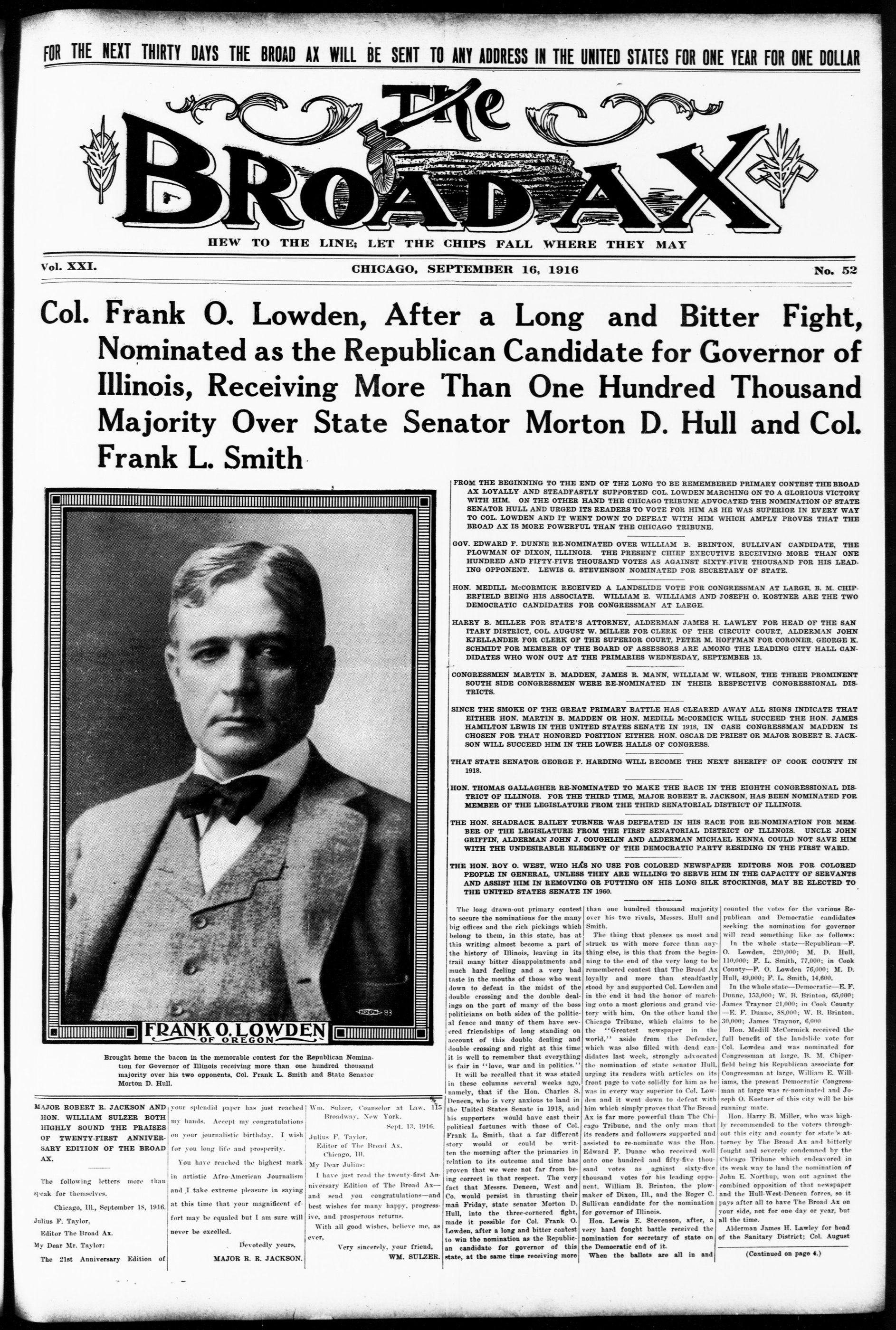
Col. Frank O. Lowden, After a Long and Bitter Fight, Nominated as the Republican Candidate for Governor of Illinois, Receiving More Than One Hundred Thousand Majority Over State Senator Morton D. Hull and Col. Frank L. Smith
FRANK O. LOWDEN
OF OREgon
Brought home the bacon in the memorable contest for the Republican Nomination for Governor of Illinois receiving more than one hundred thousand majority over his two opponents, Col. Frank L. Smith and State Senator Morton D. Hull.
Vol. XXI.
Col. Frank Nomi Illinois Major Frank
Brought home the tion for Gove majority over Morton D. Hu
MAJOR ROBERT R. JACKSON AND
HON. WILLIAM SULZER BOTH
HIGHLY SOUND THE PRAISES
OF TWENTY-FIRST ANNIVERSARY EDITION OF THE BROAD AX.
The following letters more than speak for themselves.
Chicago, Ill., September 18, 1916.
Julius F. Taylor,
Editor The Broad Ax.
My Dear Mr. Taylor:
The 21st Anniversary Edition of
your splendid paper has just reached my hands. Accept my congratulations on your journalistic birthday. I wish for you long life and prosperity.
You have reached the highest mark in artistic Afro-American Journalism and I take extreme pleasure in saying at this time that your magnificent effort may be equaled but I am sure will never be excelled.
Devotedly yours,
MAJOR R. R. JACKSON.
CHICAGO, SEPTEMBER 16, 1916
I have just read the twenty-first Anniversary Edition of The Broad Ax—and send you congratulations—and best wishes for many happy, progressive, and prosperous returns.
With all good wishes, believe me, as ever,
Very sincerely, your friend,
WM. SULZER.
FROM THE BEGINNING TO THE END OF THE LONG TO BE REMEMBERED PRIMARY CONTEST THE BROAD AX LOYALLY AND STEADFASTLY SUPPORTED COL. LOWDEN MARCHING ON TO A GLORIOUS VICTORY WITH HIM. ON THE OTHER HAND THE CHICAGO TRIBUNE ADVOCATED THE NOMINATION OF STATE SENATOR HULL AND URGED ITS READERS TO VOTE FOR HIM AS HE WAS SUPERIOR IN EVERY WAY TO COL. LOWDEN AND IT WENT DOWN TO DEFEAT WITH HIM WHICH AMPLY PROVES THAT THE BROAD AX IS MORE POWERFUL THAN THE CHICAGO TRIBUNE.
GOV. EDWARD F. DUNNE RE-NOMINATED OVER WILLIAM B. BRINTON, SULLIVAN CANDIDATE, THE PLOWMAN OF DIXON, ILLINOIS. THE PRESENT CHIEF EXECUTIVE RECEIVING MORE THAN ONE HUNDRED AND FIFTY-FIVE THOUSAND VOTES AS AGAINST SIXTY-FIVE THOUSAND FOR HIS LEADING OPPONENT. LEWIS G. STEVENSON NOMINATED FOR SECRETARY OF STATE.
HON. MEDILL McCORMICK RECEIVED A LANDSLIDE VOTE FOR CONGRESSMAN AT LARGE, B. M. CHIPERFIELD BEING HIS ASSOCIATE. WILLIAM E. WILLIAMS AND JOSEPH O. KOSTNER ARE THE TWO DEMOCRATIC CANDIDATES FOR CONGRESSMAN AT LARGE.
HARRY B. MILLER FOR STATE'S ATTORNEY, ALDERMAN JAMES H. LAWLEY FOR HEAD OF THE SAN ITARY DISTRICT, COL. AUGUST W. MILLER FOR CLERK OF THE CIRCUIT COURT, ALDERMAN JOHN KJELLANDER FOR CLERK OF THE SUPERIOR COURT, PETER M. HOFFMAN FOR CORONER, GEORGE K. SCHMIDT FOR MEMBER OF THE BOARD OF ASSESSORS ARE AMONG THE LEADING CITY HALL CANDIDATES WHO WON OUT AT THE PRIMARIES WEDNESDAY, SEPTEMBER 13.
CONGRESSMEN MARTIN B. MADDEN, JAMES R. MANN, WILLIAM W. WILSON, THE THREE PROMINENT SOUTH SIDE CONGRESSMEN WERE RE-NOMINATED IN THEIR RESPECTIVE CONGRESSIONAL DISTRICTS.
SINCE THE SMOKE OF THE GREAT PRIMARY BATTLE HAS CLEARED AWAY ALL SIGNS INDICATE THAT EITHER HON. MARTIN B. MADDEN OR HON. MEDILL McCORMICK WILL SUCCEED THE HON. JAMES HAMILTON LEWIS IN THE UNITED STATES SENATE IN 1918, IN CASE CONGRESSMAN MADDEN IS CHOSEN FOR THAT HONORED POSITION EITHER HON. OSCAR DE PRIEST OR MAJOR ROBERT R. JACKSON WILL SUCCEED HIM IN THE LOWER HALLS OF CONGRESS.
THAT STATE SENATOR GEORGE F. HARDING WILL BECOME THE NEXT SHERIFF OF COOK COUNTY IN 1918.
HON. THOMAS GALLAGHER RE-NOMINATED TO MAKE THE RACE IN THE EIGHTH CONGRESSIONAL DISTRICT OF ILLINOIS. FOR THE THIRD TIME, MAJOR ROBERT B. JACKSON, HAS BEEN NOMINATED FOR MEMBER OF THE LEGISLATURE FROM THE THIRD SENATORIAL DISTRICT OF ILLINOIS.
THE HON. SHADRACK BAILEY TURNER WAS DEFEATED IN HIS RACE FOR RE-NOMINATION FOR MEMBER OF THE LEGISLATURE FROM THE FIRST SENATORIAL DISTRICT OF ILLINOIS. UNCLE JOHN GRIFFIN, ALDERMAN JOHN J. COUGHLIN AND ALDERMAN MICHAEL KENNA COULD NOT SAVE HIM WITH THE UNDESIRABLE ELEMENT OF THE DEMOCRATIC PARTY RESIDING IN THE FIRST WARD.
THE HON. ROY O. WEST, WHO HAS NO USE FOR COLORED NEWSPAPER EDITORS NOR FOR COLORED PEOPLE IN GENERAL, UNLESS THEY ARE WILLING TO SERVE HIM IN THE CAPACITY OF SERVANTS AND ASSIST HIM IN REMOVING OR PUTTING ON HIS LONG SILK STOCKINGS, MAY BE ELECTED TO THE UNITED STATES SENATE IN 1960.
The long drawn-out primary contest to secure the nominations for the many big offices and the rich pickings which belong to them, in this state, has at this writing almost become a part of the history of Illinois, leaving in its trail many bitter disappointments and much hard feeling and a very bad taste in the mouths of those who went down to defeat in the midst of the double crossing and the double dealings on the part of many of the boss politicians on both sides of the political fence and many of them have severed friendships of long standing on account of this double dending and double crossing and right at this time it is well to remember that everything is fair in "love, war and in politics."
It will be recalled that it was stated in these columns several weeks ago namely, that if the Hon. Charles S. Deneen, who is very anxious to land in the United States Senate in 1918, and his supporters would have cast their political fortunes with those of Col. Frank L. Smith, that a far different story would or could be written the morning after the primaries in relation to its outcome and time has proven that we were not far from being correct in that respect. The very fact that Messrs. Deneen, West and Co. would persist in thrusting their man Friday, state senator Morton D. Hull, into the three-cornered fight, made it possible for Col. Frank O. Lowden, after a long and bitter contest to win the nomination as the Republican candidate for governor of this state, at the same time receiving more
than one hundred thousand majority over his two rivals, Messrs. Hull and Smith.
The thing that pleases us most and struck us with more force than any thing else, is this that from the beginning to the end of the very long to be remembered contest that The Broad Ax loyally and more than steadfastly stood by and supported Col. Lowden and in the end it had the honor of marching onto a most glorious and grand victory with him. On the other hand the Chicago Tribune, which claims to be the "Greatest newspaper in the world," aside from the Defender, which was also filled with dead candidates last week, strongly advocated the nomination of state senator Hull, urging its readers with articles on its front page to vote solidly for him as he was in every way superior to Col. Lowden and it went down to defeat with him which simply proves that The Broad Ax is far more powerful than The Chicago Tribune, and the only man that its readers and followers supported and assisted to re-nominate was the Hon. Edward F. Dunne who received well onto one hundred and fifty-five thousand votes as against sixty-five thousand votes for his leading opponent, William B. Brinton, the plowmaker of Dixon, Ill., and the Roger C. Sullivan candidate for the nomination for governor of Illinois.
Hon. Lewis E. Stevenson, after, a very hard fought battle received the nomination for secretary of state on the Democratic end of it. When the ballots are all in and
No. 52
BETTER FIGHT, GOVERNOR OF
THOUSAND
FULL AND COLLEGE
FERED PRIMARY CONTEST THE BROAD
ARCHING ON TO A GLORIOUS VICTORY
LOCATED THE NOMINATION OF STATE
HE WAS SUPERIOR IN EVERY WAY
WHICH AMPLY PROVES THAT THE
BETTON, SULLIVAN CANDIDATE, THE
ACTIVE RECEIVING MORE THAN ONE
CITY-FIVE THOUSAND FOR HIS LEAD
MEMETARY OF STATE.
CONGRESSMAN AT LARGE, B. M. CHIPP
JOSEPH O. KOSTNER ARE THE TWO
M. LAWLEY FOR HEAD OF THE SAN
CIRCUIT COURT, ALDERMAN JOHN
GOFFMAN FOR CORONER, GEORGE K.
ONG THE LEADING CITY HALL CAN
TEMBER 13.
W. WILSON, THE THREE PROMINENT
RESPECTIVE CONGRESSIONAL DISC
O AWAY ALL SIGNS INDICATE THAT
BANK WILL SUCCEED THE HON. JAMES
CASE CONGRESSMAN MADDEN IS
THE PRIEST OR MAJOR ROBERT R. JACK-
NEXT SHERIFF OF COOK COUNTY IN
THE EIGHTH CONGRESSIONAL DISC
BACKSON, HAS BEEN NOMINATED FOR
DISTRICT OF ILLINOIS.
COME FOR RE-NOMINATION FOR MEM-
TRICT OF ILLINOIS. UNCLE JOHN
ISALE KENNA COULD NOT SAVE HIM
BY RESIDING IN THE FIRST WARD.
PER EDITORS NOR FOR COLORED
HIM IN THE CAPACITY OF SERVANTS
STOCKINGS, MAY BE ELECTED TO
counted the votes for the various Republican and Democratic candidates seeking the nomination for governor will read something like as follows: In the whole state—Republican—F. O. Lowden, 220,000; M. D. Hull, 110,000; F. L. Smith, 77,000; in Cook County—F. O. Lowden 76,000; M. D. Hull, 49,000; F. L. Smith, 14,600. In the whole state—Democratic—E. F. Dunne, 153,000; W. B. Brinton, 65,000; James Traynor 21,000; in Cook County—E. F. Dunne, 88,000; W. B. Brinton, 30,000; James Traynor, 6,000 Hon. Medill McCormick received the full benefit of the landslide vote for Col. Lowdea and was nominated for Congressman at large, B. M. Chiperfield being his Republican associate for Congressman at large, William E. Williams, the present Democratic Congressman at large was re-nominated and Joseph O. Kostner of this city will be his running mate.
Hon. Harry B. Miller, who was highly recommended to the voters throughout this city and county for state's attorney by The Broad Ax and bitterly fought and severely condemned by the Chicago Tribune which endeavored in its weak way to land the nomination of John E. Northup, won out against the combined opposition of that newspaper and the Hull-West-Deneen forces, so it pays after all to have The Broad Ax on your side, not for one day or year, but all the time.
Alderman James H. Lawley for head of the Sanitary District; Col. August
(Continued on page 4.)
[Picture of a man in a suit with a bow tie].
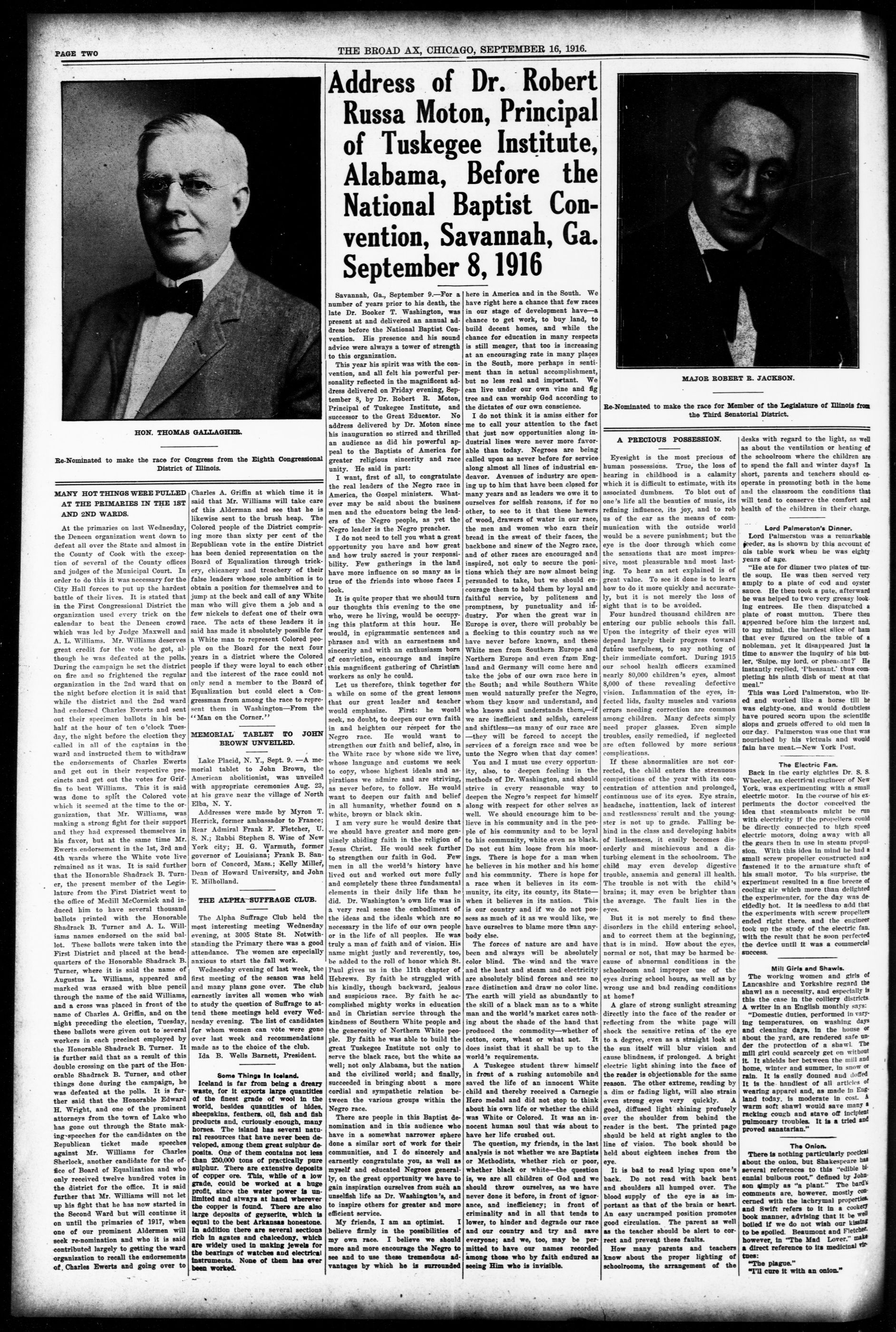
Re-Nominated to make the race for Congress from the Eighth Congressional District of Illinois.
PAGE TWO
HON. THOMAS
Re-Nominated to make the race for District
MANY HOT THINGS WERE PULLED
AT THE PRIMARIES IN THE 1ST
AND 2ND WARDS.
---
Charles A. Griffin at which time it is said that Mr. Williams will take care of this Alderman and see that he is likewise sent to the brush heap. The Colored people of the District comprising more than sixty per cent of the Republican vote in the entire District has been denied representation on the Board of Equalization through trickery, chieanery and treachery of their false leaders whose sole ambition is to obtain a position for themselves and to jump at the beck and call of any White man who will give them a job and a few nickels to defeat one of their own race. The acts of these leaders it is said has made it absolutely possible for a White man to represent Colored people on the Board for the next four years in a district where the Colored people if they were loyal to each other and the interest of the race could not only send a member to the Board of Equalization but could elect a Congressman from among the race to represent them in Washington—From the "Man on the Corner."
MEMORIAL TABLET TO JOHN
BROWN UNVEILED.
Lake Placid, N. Y., Sept. 9. —A memorial tablet to John Brown, the American abolitionist, was unveiled with appropriate ceremonies Aug. 23, at his grave near the village of North Elba, N. Y.
Addresses were made by Myron T. Herrick, former ambassador to France; Rear Admiral Frank F. Fletcher, U. S. N.; Rabbi Stephen S. Wise of New York city; H. G. Warmuth, former governor of Louisiana; Frank B. Sanborn of Coneord, Mass.; Kelly Miller, Dean of Howard University, and John E. Milholland.
THE ALPHA SUFFRAGE CLUB
The Alpha Suffrage Club held the most interesting meeting Wednesday evening, at 3005 State St. Notwithstanding the Primary there was a good attendance. The women are especially anxious to start the fall work. Wednesday evening of last week, the first meeting of the season was held and many plans gone over. The club earnestly invites all women who wish to study the question of Suffrage to attend these meetings held every Wednesday evening. The list of candidates for whom women can vote were gone over last week and recommendations made as to the choice of the club.
Some Things In Iceland.
Some things in Iceland.
Iceland is far from being a dreary waste, for it exports large quantities of the finest grade of wool in the world, besides quantities of hides sheepskins, feathers, oil, fish and fish products and, curiously enough, many horses. The island has several natural resources that have never been developed, among them great sulphur deposits. One of them contains not less than 250,000 tons of practically pure sulphur. There are extensive deposits of copper ore. This, while of a low grade, could be worked at a huge profit, since the water power is unlimited and always at hand wherever the copper is found. There are also large deposits of geyserite, which is equal to the best Arkansas honestone. In addition there are several sections rich in agates and chalcedony, which are widely used in making jewels for the bearings of watches and electrical instruments. None of them has ever been worked.
THE BROAD AX. CHICAGO. SEPTEMBER 16, 1916.
Address of Dr. Robert Russa Moton, Principal of Tuskegee Institute, Alabama, Before the National Baptist Convention, Savannah, Ga. September 8, 1916
Savannah, Ga., September 9.—For a number of years prior to his death, the late Dr. Booker T. Washington, was present at and delivered an annual address before the National Baptist Convention. His presence and his sound advice were always a tower of strength to this organization. This year his spirit was with the convention, and all felt his powerful personality reflected in the magnificent address delivered on Friday evening, September 8, by Dr. Robert R. Moton, Principal of Tuskegee Institute, and successor to the Great Educator. No address delivered by Dr. Moton since his inauguration so stirred and thrilled an audience as did his powerful appeal to the Baptists of America for greater religious sincerity and race unity. He said in part:
I want, first of all, to congratulate the real leaders of the Negro race in America, the Gospel ministers. Whatever may be said about the business men and the educators being the leaders of the Negro people, as yet the Negro leader is the Negro preacher. I do not need to tell you what a great opportunity you have and how great and how truly sacred is your responsibility. Few gatherings in the land have more influence on so many as is true of the friends into whose faces I look.
It is quite proper that we should turn our thoughts this evening to the one who, were he living, would be occupying this platform at this hour. He would, in epigrammatic sentences and phrases and with an earnestness and sincerity and with an enthusiasm born of conviction, encourage and inspire this magnificent gathering of Christian workers as only he could.
Let us therefore, think together for a while on some of the great lessons that our great leader and teacher would emphasize. First: he would seek, no doubt, to deepen our own faith in and heighten our respect for the Negro race. He would want to strengthen our faith and belief, also, in the White race by whose side we live, whose language and customs we seek to copy, whose highest ideals and aspirations we admire and are striving as never before, to follow. He would want to deepen our faith and belief in all humanity, whether found on a white, brown or black skin.
I am very sure he would desire that we should have greater and more genuinely abiding faith in the religion of Jesus Christ. He would seek further to strengthen our faith in God. Few men in all the world's history have lived out and worked out more fully and completely these three fundamental elements in their daily life than he did. Dr. Washington's own life was in a very real sense the embodiment of the ideas and the ideals which are so necessary in the life of our own people or in the life of all people. He was truly a man of faith and of vision. His name might justly and reverently, too, be added to the roll of honor which St. Paul gives us in the 11th chapter of Hebrews. By faith he struggled with his kindly, though backward, jealous and suspicious race. By faith he accomplished mighty works in education and in Christian service through the kindness of Southern White people and the generosity of Northern White people. By faith he was able to build the great Tuskegee Institute not only to serve the black race, but the white as well; not only Alabama, but the nation and the civilized world; and finally, succeeded in bringing about a more cordial and sympathetic relation between the various groups within the Negro race.
There are people in this Baptist denomination and in this audience who have in a somewhat narrow sphere done a similar sort of work for their communities, and I do sincerely and earnestly congratulate you, as well as myself and educated Negroes generally, on the great opportunity we have to gain inspiration ourselves from such an unselfish life as Dr. Washington's, and to inspire others for greater and more efficient service.
My friends, I am an optimist. I believe firmly in the possibilities of my own race. I believe we should more and more encourage the Negro to see and to use these tremendous advantages by which he is surrounded
here in America and in the South. We have right here a chance that few races in our stage of development have—a chance to get work, to buy land, to build decent homes, and while the chance for education in many respects is still meager, that too is increasing at an encouraging rate in many places in the South, more perhaps in sentiment than in actual accomplishment, but no less real and important. We can live under our own vine and fig tree and can worship God according to the dictates of our own conscience.
I do not think it is amiss either for me to call your attention to the fact that just now opportunities along industrial lines were never more favorable than today. Negroes are being called upon as never before for service along almost all lines of industrial endeavor. Avenues of industry are opening up to him that have been closed for many years and as leaders we owe it to ourselves for selfish reasons, if for no other, to see to it that these hewers of wood, drawers of water in our race, the men and women who earn their bread in the sweat of their faces, the backbone and sinew of the Negro race, and of other races are encouraged and inspired, not only to secure the positions which they are now almost being persuaded to take, but we should encourage them to hold them by loyal and faithful service, by politeness and promptness, by punctuality and industry. For when the great war in Europe is over, there will probably be a flocking to this country such as we have never before known, and these White men from Southern Europe and Northern Europe and even from England and Germany will come here and take the jobs of our own race here in the South; and while Southern White men would naturally prefer the Negro, whom they know and understand, and who knows and understands them,—if we are inefficient and selfish, careless and shiftless—as many of our race are—they will be forced to accept the services of a foreign race and woe be unto the Negro when that day comes!
You and I must use every opportunity, also, to deepen feeling in the methods of Dr. Washington, and should strive in every reasonable way to deepen the Negro's respect for himself along with respect for other selves as well. We should encourage him to believe in his community and in the people of his community and to be loyal to his community, white even as black. Do not cut him loose from his moorings. There is hope for a man when he believes in his mother and his home and his community. There is hope for a race when it believes in its community, its city, its county, its State—when it believes in its nation. This is our country and if we do not possess as much of it as we would like, we have ourselves to blame more than anybody else.
The forces of nature are and have been and always will be absolutely color blind. The wind and the wave and the heat and steam and electricity are absolutely blind forces and see no race distinction and draw no color line. The earth will yield as abundantly to the skill of a black man as to a white man and the world's market cares nothing about the shade of the hand that produced the commodity—whether of cotton, corn, wheat or what not. It does insist that it shall be up to the world's requirements.
A Tuskegee student threw himself in front of a rushing automobile and saved the life of an innocent White child and thereby received a Carnegie Hero medal and did not stop to think about his own life or whether the child was White or Colored. It was an innocent human soul that was about to have her life crushed out.
The question, my friends, in the last analysis is not whether we are Baptists or Methodists, whether rich or poor, whether black or white—the question is, we are all children of God and we should throw ourselves, as we have never done it before, in front of ignorance, and inefficiency; in front of criminality and in all that tends to lower, to hinder and degrade our race and our country and try and save everyone; and we, too, may be permitted to have our names recorded among those who by faith endured as seeing Him who is invisible.
M.
MAJOR ROBERT R. JACKSON
Re-Nominated to make the race for Member of the Legislature of Illinois from the Third Senatorial District.
Re-Nominated to make the race for Member of the Legislature of Illinois from the Third Senatorial District.
A PRECIOUS POSSESSION.
Eyesight is the most precious of human possessions. True, the loss of hearing in childhood is a calamity which it is difficult to estimate, with its associated dumbness. To blot out of one's life all the beauties of music, its refining influence, its joy, and to rob us of the ear as the means of communication with the outside world would be a severe punishment; but the eye is the door through which come the sensations that are most impressive, most pleasurable and most lasting. To hear an act explained is of great value. To see it done is to learn how to do it more quickly and accurately, but it is not merely the loss of sight that is to be avoided.
Four hundred thousand children are entering our public schools this fall. Upon the integrity of their eyes will depend largely their progress toward future usefulness, to say nothing of their immediate comfort. During 1915 our school health officers examined nearly 80,000 children's eyes, almost 8,000 of these revealing defective vision. Inflammation of the eyes, infected lids, faulty muscles and various errors needing correction are common among children. Many defects simply need proper glasses. Even simple troubles, easily remedied, if neglected are often followed by more serious complications.
If these abnormalities are not corrected, the child enters the strenuous competitions of the year with its concentration of attention and prolonged, continuous use of its eyes. Eye strain, headache, inattention, lack of interest and restlessness result and the youngster is not up to grade. Falling behind in the class and developing habits of listlessness, it easily becomes disorderly and mischievous and a disturbing element in the schoolroom. The child may even develop digestive trouble, anaemia and general ill health. The trouble is not with the child's brains; it may even be brighter than the average. The fault lies in the eyes.
But it is not merely to find these disorders in the child entering school, and to correct them at the beginning, that is in mind. How about the eyes, normal or not, that may be harmed because of abnormal conditions in the schoolroom and improper use of the eyes during school hours, as well as by wrong use and bad reading conditions at home?
A glare of strong sunlight streaming directly into the face of the reader or reflecting from the white page will shock the sensitive retina of the eye to a degree, even as a straight look at the sun itself will blur vision and cause blindness, if prolonged. A bright electric light shining into the face of the reader is objectionable for the same reason. The other extreme, reading by a dim or fading light, will also strain even strong eyes very quickly. A good, diffused light shining profusely over the shoulder from behind the reader is the best. The printed page should be held at right angles to the line of vision. The book should be held about eighteen inches from the eye.
It is bad to read lying upon one's back. Do not read with back bent and shoulders all humped over. The blood supply of the eye is as important as that of the brain or heart. An easy uncramped position promotes good circulation. The parent as well as the teacher should be alert to correct and prevent these faults. How many parents and teachers know about the proper lighting of schoolrooms, the arrangement of the
desks with regard to the light, as well as about the ventilation or heating of the schoolroom where the children are to spend the fall and winter days? In short, parents and teachers should cooperate in promoting both in the home and the classroom the conditions that will tend to conserve the comfort and health of the children in their charge.
Lord Palmerston's Dinner.
Lord Palmerston was a remarkable feeder, as is shown by this account of his table work when he was eighty years of age.
"He ate for dinner two plates of turtle soup. He was then served very amply to a plate of cod and oyster sauce. He then took a pate, afterward he was helped to two very greasy looking entrees. He then dispatched a plate of roast mutton. There then appeared before him the largest and, to my mind, the hardest slice of ham that ever figured on the table of a nobleman, yet it disappeared just in time to answer the inquiry of his butler, 'Snipe, my lord, or pheasant?' He instantly replied, 'Pheasant.' thus completing his ninth dish of meat at that meal."
This was Lord Palmerston, who lived and worked like a horse till he was eighty-one, and would doubtless have poured scorn upon the scientific slops and gruels offered to old men in our day. Palmerston was one that was nourished by his victuals and would fain have meat—New York Post.
Back in the early eighties Dr. S. S. Wheeler, an electrical engineer of New York, was experimenting with a small electric motor. In the course of his experiments the doctor conceived the idea that steamboats might be run with electricity if the propellers could be directly connected to high speed electric motors, doing away with all the gears then in use in steam propulsion. With this idea in mind he had a small screw propeller constructed and fastened it to the armature shaft of his small motor. To his surprise, the experiment resulted in a fine breeze of cooling air which more than delighted the experimenter, for the day was decidedly hot. It is needless to add that the experiments with screw propellers ended right there, and the engineer took up the study of the electric fan, with the result that he soon perfected the device until it was a commercial success.
Mill Girls and Shawls
The working women and girls of Lancashire and Yorkshire regard the shawl as a necessity, and especially is this the case in the colliery districts. A writer in an English monthly says: "Domestic duties, performed in varying temperatures, on washing days and cleaning days, in the house or about the yard, are rendered safe under the protection of a shawl. The mill girl could scarcely get on without it. It shields her between the mill and home, winter and summer, in snow or rain. It is easily dunned and doffed. It is the handiest of all articles of wearing apparel and, as made in England today, is moderate in cost. A warm soft shawl would save many a racking cough and stave off incipient pulmonary troubles. It is a tried and proved sanitarian."
There is nothing particularly poetical about the onion, but Shakespeare has several references to this "edible biennial bulbous root," defined by Johnson simply as "a plant." The bard's comments are, however, mostly concerned with the lichrymal properties, and Swift refers to it in a cookery book manner, advising that it be well boiled if we do not wish our kissing to be spoiled. Beaumont and Fletcher, in "The Mad Lover," make a direct reference to its medicinal virtues:
"The plague."
"I'll cure it with an onion."
The Electric Fan.
The Onion.
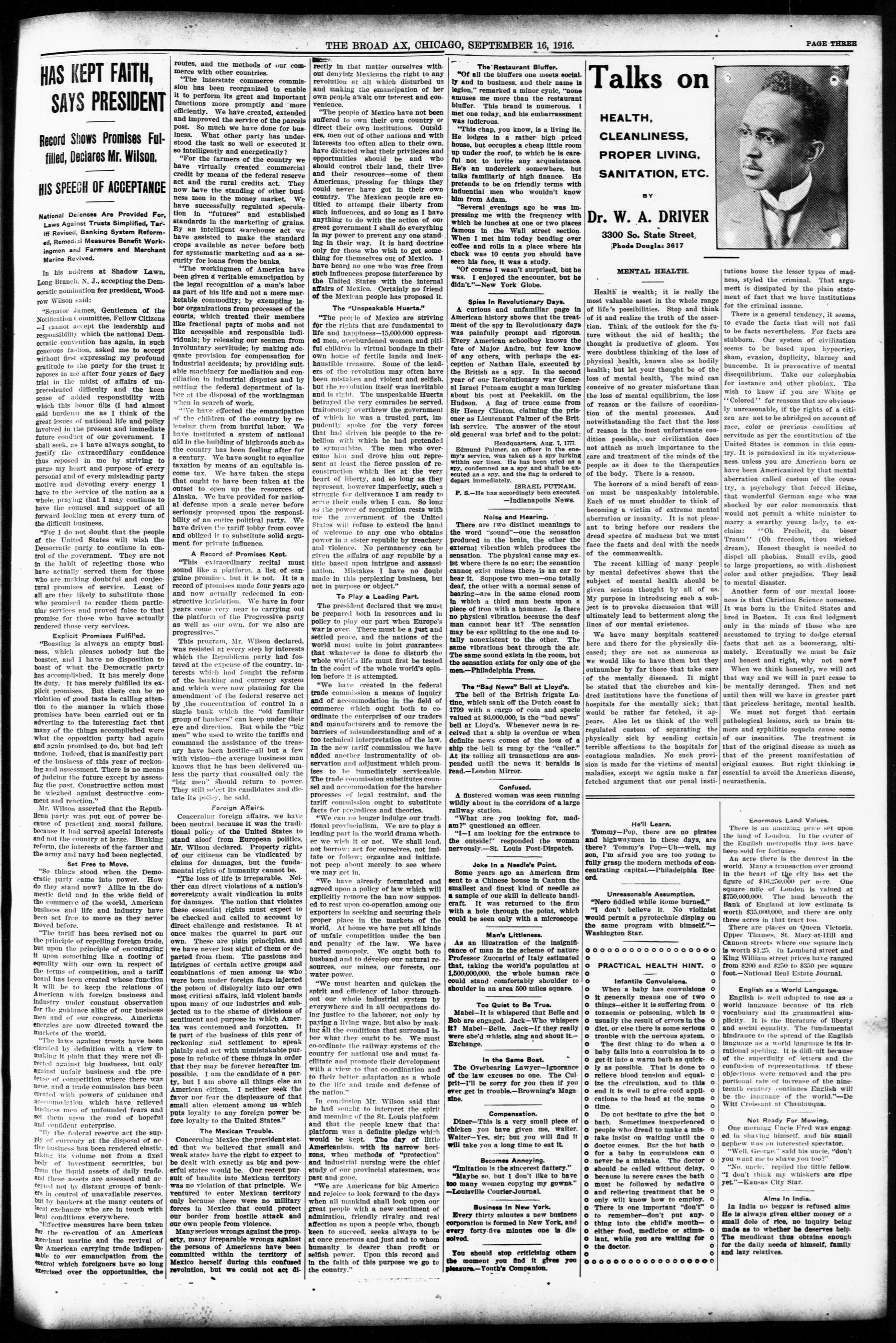
HAS KEPT FAITH, SAYS PRESIDENT
Record Shows Promises Fulfilled, Declares Mr. Wilson.
HIS SPEECH OF ACCEPTANCE
National Defenses Are Provided For, Laws Against Trusts Simplified, Tariff Revised, Banking System Reformed, Remedial Measures Benefit Workingmen and Farmers and Merchant Marine Revived.
In his address at Shadow Lawn, Long Branch, N. J., accepting the Democratic nomination for president, Woodrow Wilson said:
"Senator James, Gentlemen of the Notification Committee, Fellow Citizens — I cannot accept the leadership and responsibility which the national Democratic convention has again, in such generous fashion, asked me to accept without first expressing my profound gratitude to the party for the trust it reposes in me after four years of fiery trial in the midst of affairs of unprecedented difficulty and the keen sense of added responsibility with which this honor fills (I had almost said burdens) me as I think of the great issues of national life and policy involved in the present and immediate future conduct of our government. I shall seek, as I have always sought, to justify the extraordinary confidence thus reposed in me by striving to purge my heart and purpose of every personal and of every misleading party motive and devoting every energy I have to the service of the nation as a whole, praying that I may continue to have the counsel and support of all forward looking men at every turn of the difficult business.
"For I do not doubt that the people of the United States will wish the Democratic party to continue in control of the government. They are not in the habit of rejecting those who have actually served them for those who are making doubtful and conjectural promises of service. Least of all are they likely to substitute those who promised to render them particular services and proved false to that promise for those who have actually rendered those very services.
Explicit: Promises Fulfilled.
Explicit Promises Furnished.
"Boasting is always an empty business, which pleases nobody but the boaster, and I have no disposition to boast of what the Democratic party has accomplished. It has merely done its duty. It has merely fulfilled its explicit promises. But there can be no violation of good taste in calling attention to the manner in which those promises have been carried out or in advertising to the interesting fact that many of the things accomplished were what the opposition party had again and again promised to do, but had left undone. Indeed, that is manifestly part of the business of this year of reckoning and assessment. There is no means of judging the future except by assessing the past. Constructive action must be wieded against destructive comment and reaction."
Mr. Wilson asserted that the Republican party was put out of power because of practical and moral failure, because it had served special interests and not the country at large. Banking reform, the interests of the farmer and the army and navy had been neglected
Set Free to Move
"So things stood when the Democratic party came into power. How do they stand now? Allike in the domestic field and in the wide field of the commerce of the world, American business and life and industry have been set free to move as they never moved before.
"The tariff has been revised not on the principle of repelling foreign trade, but upon the principle of encouraging it upon something like a footing of equality with our own in respect of the terms of competition, and a tariff board has been created whose function it will be to keep the relations of American with foreign business and industry under constant observation for the guidance alike of our business men and of our congress. American energies are now directed toward the markets of the world.
"The laws against trusts have been clarified by definition with a view to making it plain that they were not directed against big business, but only against unfair business and the pretense of competition where there was none, and a trade commission has been created with powers of guidance and accommodation which have relieved business men of unfounded fears and set them upon the road of hopeful and confident enterprise.
"By the federal reserve act the supply of currency at the disposal of active business has been rendered elastic, taking its volume not from a fixed body of investment securities, but from the liquid assets of daily trade, and these assets are assessed and accepted not by distant groups of bankers in control of unavailable reserves, but by bankers at the many centers of local exchange who are in touch with local conditions everywhere.
"Effective measures have been taken for the re-creation of an American merchant marine and the revival of the American carrying trade indispensable to our emancipation from the control which foreigners have so long exercised over the opportunities, the
routes, and the methods of our commerce with other countries.
"The interstate commerce commission has been reorganized to enable it to perform its great and important functions more promptly and more efficiently. We have created, extended and improved the service of the parcels post. So much we have done for business. What other party has understood the task so well or executed it so intelligently and energetically?
"For the farmers of the country we have virtually created commercial credit by means of the federal reserve act and the rural credits act. They now have the standing of other business men in the money market. We have successfully regulated speculation in "futures" and established standards in the marketing of grains. By an intelligent warehouse act we have assisted to make the standard crops available as never before both for systematic marketing and as a security for loans from the banks
"The workingmen of America have been given a veritable emancipation by the legal recognition of a man's labor as part of his life and not a mere marketable commodity; by exempting labor organizations from processes of the courts, which treated their members like fractional parts of mobs and not like accessible and responsible individuals; by releasing our seamen from involuntary servitude; by making adequate provision for compensation for industrial accidents; by providing suitable machinery for mediation and conciliation in industrial disputes and by putting the federal department of labor at the disposal of the workingman when in search of work.
"We have effected the emancipation of the children of the country by releasing them from hurtful labor. We have instituted a system of national aid in the building of highroads such as the country has been feeling after for a century. We have sought to equalize taxation by means of an equitable income tax. We have taken the steps that ought to have been taken at the outset to open up the resources of Alaska. We have provided for national defense upon a scale never before seriously proposed upon the responsibility of an entire political party. We have driven the tariff lobby from cover and obliged it to substitute solid argument for private influence.
A Record of Promises Kept.
"This extraordinary recital must sound like a platform, a list of sanguine promises, but it is not. It is a record of promises made four years ago and now actually redeemed in constructive legislation. We have in four years come very near to carrying out the platform of the Progressive party as well as our own, for we also are progressives."
This program, Mr. Wilson declared, was resisted at every step by interests which the Republican party had fostered at the expense of the country, interests which had fought the reform of the banking and currency system and which were now planning for the amendment of the federal reserve act by the concentration of control in a single bank which the "old familiar group of bankers" can keep under their eye and direction. But while the "big men" who used to write the tariffs and command the assistance of the treasury have been hostile—all but a few with vision—the average business man knows that he has been delivered unless the party that consulted only the "big men" should return to power. They still select its candidates and dictate its policy, he said.
Foreign Affairs.
Concerning foreign affairs, we have been neutral because it was the traditional policy of the United States to stand aloof from European politics. Mr. Wilson declared. Property rights of our citizens can be vindicated by claims for damages, but the fundamental rights of humanity cannot be.
"The loss of life is irreparable. Neither can direct violations of a nation's sovereignty await vindication in suits for damages. The nation that violates these essential rights must expect to be checked and called to account by direct challenge and resistance. It at once makes the quarrel in part our own. These are plain principles, and we have never lost sight of them or departed from them. The passions and intrigues of certain active groups and combinations of men among us who were born under foreign flags injected the poison of disloyalty into our own most critical affairs, laid violent hands upon many of our industries and subjected us to the shame of divisions of sentiment and purpose in which America was contended and forgotten. It is part of the business of this year of reckoning and settlement to speak plainly and act with unmistakable purpose in rebuke of these things in order that they may be forever hereafter impossible. I am the candidate of a party, but I am above all things else an American citizen. I neither seek the favor nor fear the displeasure of that small alien element among us which puts loyalty to any foreign power before loyalty to the United States."
The Mexican Trouble.
Concerning Mexico the president stated that we believed that small and weak states have the right to expect to be dealt with exactly as big and powerful states would be. Our recent pursuit of bandits into Mexican territory was no violation of that principle. We ventured to enter Mexican territory only because there were no military forces in Mexico that could protect our border from hostile attack and our own people from violence.
Many serious wrongs against the property, many irreparable wrongs against the persons of Americans have been committed within the territory of Mexico herself during this confused revolution, but we could not act di-
rectly in that matter ourselves without denying Mexicans the right to any revolution at all which disturbed us and making the emancipation of her own people await our interest and convenience.
The Restaurant Bluffer.
"Of all the bluffers one meets society and in business, and their name legion," remarked a minor cycic, "no amuses me more than the restaurs bluffer. This brand is numerous.
"The people of Mexico have not been suffered to own their own country or direct their own institutions. Outsiders, men out of other nations and with interests too often alien to their own, have dictated what their privileges and opportunities should be and who should control their land, their lives and their resources—some of them Americans, pressing for things they could never have got in their own country. The Mexican people are entitled to attempt their liberty from such influences, and so long as I have anything to do with the action of our great government I shall do everything in my power to prevent any one standing in their way. It is hard doctrine only for those who wish to get something for themselves out of Mexico. I have heard no one who was free from such influences propose interference by the United States with the internal affairs of Mexico. Certainly no friend of the Mexican people has proposed it.
The "Unspeakable Huerta."
"The people of Mexico are striving for the rights that are fundamental to life and happiness—15,000,000 oppressed men, overburdened women and pitiful children in virtual bondage in their own home of fertile lands and inexhaustible treasure. Some of the leaders of the revolution may often have been mistaken and violent and selfish, but the revolution itself was inevitable and is right. The unspeakable Huerta betrayed the very comrades he served, traitorously overthrew the government of which he was a trusted part, impudently spoke for the very forces that had driven his people to the rebellion with which he had pretended to sympathize. The men who overcame him and drove him out represent at least the fierce passion of reconstruction which lies at the very heart of liberty, and so long as they represent, however imperfectly, such a struggle for deliverance I am ready to serve their ends when I can. So long as the power of recognition rests with me the government of the United States will refuse to extend the hand of welcome to any one who obtains power in a sister republic by treachery and violence. No permanency can be given the affairs of any republic by a title based upon intrigue and assassination. Mistakes I have no doubt made in this perplexing business, but not in purpose or object."
To Play a Leading Part.
The president declared that we must be prepared both in resources and in policy to play our part when Europe's war is over. There must be a just and settled peace, and the nations of the world must unite in joint guarantees that whatever is done to disturb the whole world's life must first be tested in the court of the whole world's opinion before it is attempted.
"We have created in the federal trade commission a means of inquiry and of accommodation in the field of commerce which ought both to coordinate the enterprises of our traders and manufacturers and to remove the barriers of misunderstanding and of a too technical interpretation of the law. In the new tariff commission we have added another instrumentality of observation and adjustment which promises to be immediately serviceable. The trade commission substitutes counsel and accommodation for the harsher processes of legal restraint, and the tariff commission ought to substitute facts for prejudices and theories.
"We can no longer indulge our traditional provincialism. We are to play a leading part in the world drama whether we wish it or not. We shall lend, not borrow; act for ourselves, not imitate or follow; organize and initiate, not peep about merely to see where we may get in.
"We have already formulated and agreed upon a policy of law which will explicitly remove the ban now supposed to rest upon co-operation among our exporters in seeking and securing their proper place in the markets of the world. At home we have put all kinds of unfair competition under the ban and penalty of the law. We have barred monopoly. We ought both to husband and to develop our natural resources, our mines, our forests, our water power.
"We must hearten and quicken the spirit and efficiency of labor throughout our whole industrial system by everywhere and in all occupations doing justice to the laborer, not only by paying a living wage, but also by making all the conditions that surround labor what they ought to be. We must co-ordinate the railway systems of the country for national use and must facilitate and promote their development with a view to that co-ordination and to their better adaptation as a whole to the life and trade and defense of the nation."
In conclusion Mr. Wilson said that he had sought to interpret the spirit and meaning of the St. Louis platform, and that the people knew that that platform was a definite pledge which would be kept. The day of little Americanism, with its narrow horizons, when methods of "protection" and industrial nursing were the chief study of our provincial statesmen, was past and gone.
"We are Americans for big America and rejoice to look forward to the days when all mankind shall look upon our great people with a new sentiment of admiration, friendly rivalry and real affection as upon a people who, though keen to succeed, seeks always to be at once generous and just and to whom humanity is dearer than profit or selfish power. Upon this record and in the faith of this purpose we go to the country."
#
The Restaurant Bluffer
"This chap, you know, is a living lie. He lodges in a rather high priced house, but occupies a cheap little room up under the roof, to which he is careful not to invite any acquaintance. He's an underclerk somewhere, but talks familiarly of high finance. He pretends to be on friendly terms with influential men who wouldn't know him from Adam.
"Several evenings ago he was impressing me with the frequency with which he lunches at one or two places famous in the Wall street section. When I met him today bending over coffee and rolls in a place where his check was 10 cents you should have seen his face, it was a study.
"Of course I wasn't surprised, but he was. I enjoyed the encounter, but he didn't."-New York Globe.
Spies In Revolutionary Days.
A curious and unfamiliar page in American history shows that the treatment of the spy in Revolutionary days was painfully prompt and rigorous. Every American schoolboy knows the fate of Major Andre, but few know of any others, with perhaps the exception of Nathan Hale, executed by the British as a spy. In the second year of our Revolutionary war General Israel Putnam caught a man lurking about his post at Peekskill, on the Hudson. A flag of truce came from Sir Henry Clinton, claiming the prisoner as Lieutenant Palmer of the British service. The answer of the stout old general was brief and to the point:
Headquarters, Aug. 7, 177.
Headquarters, Aug. 7, 1777.
Edmund Palmer, an officer in the enemy's service, was taken as a spy lurking within our lines. He has been tried as a spy, condemned as a spy and shall be executed as a spy, and the flag is ordered to depart immediately.
ISRAEL PUTNAM.
P. S.-He has accordingly been executed.
-Indianapolis News.
Noise and Hearing.
There are two distinct meanings to the word "sound"—one the sensation produced in the brain, the other the external vibration which produces the sensation. The physical cause may exist where there is no ear; the sensation cannot exist unless there is an ear to hear it. Suppose two men—one totally deaf, the other with a normal sense of hearing—are in the same closed room in which a third man beats upon a piece of iron with a hammer. Is there no physical vibration, because the deaf man cannot hear it? The sensation may be ear splitting to the one and totally nonexistent to the other. The same vibrations beat through the air. The same sound exists in the room, but the sensation exists for only one of the men—Philadelphia Press.
The "Bad News" Bell at Lloyd's
The bell of the British frigate Lutine, which sank off the Dutch coast in 1799 with a cargo of coin and specie valued at $6,000,000, is the "bad news" bell at Lloyd's. Whenever news is received that a ship is overdue or when definite news comes of the loss of a ship the bell is rung by the "caller." At its tolling all transactions are suspended until the news it heralds is read.—London Mirror.
Confused.
A flustered woman was seen running wildly about in the corridors of a large railway station.
"What are you looking for, madam?" questioned an officer.
"I—I am looking for the entrance to the outside!" responded the woman nervously.—St. Louis Post-Dispatch.
Joke In a Needle's Point.
Some years ago an American firm sent to a Chinese house in Canton the smallest and finest kind of needle as a sample of our skill in delicate handicraft. It was returned to the firm with a hole through the point, which could be seen only with a microscope.
Man's Littleness.
As an illustration of the insignificance of man in the scheme of nature Professor Zuccarini of Italy estimated that, taking the world's population at 1,500,000,000, the whole human race could stand comfortably shoulder to shoulder in an area 500 miles square.
Too Quiet to Be True.
Mabel—It is whispered that Belle and Bob are engaged. Jack—Who whispers it? Mabel—Belle. Jack—If they really were she'd whistle, sing and shout it—Exchange.
In the Same Boat
The Overbearing Lawyer—Ignorance of the law excuses no one. The Culprit—I'll be sorry for you then if you ever get in trouble.—Browning's Magazine.
Compensation.
Diner—This is a very small piece of chicken you have given me, waiter. Walter—Yes, sir; but you will find it will take you a long time to eat it.
Becomes Annoying.
"Imitation is the sincerest fattery." "Maybe so, but I don't like to have too many women copying my gowns." —Louisville Courrier-Journal.
Business In New York.
Every thirty minutes a new business corporation is formed in New York, and every forty-five minutes one is dissolved.
You should stop criticising others the moment you find it gives you pleasure. - Youth's Companion.
Talks on
HEALTH,
CLEANLINESS,
PROPER LIVING,
SANITATION, ETC.
Dr. W. A. DRIVER
3300 So. State Street
Phode Douglas 3617
MENTAL HEALTH.
Health is wealth; it is really the most valuable asset in the whole range of life's possibilities. Stop and think of it and realize the truth of the assertion. Think of the outlook for the future without the aid of health; the thought is productive of gloom. You were doubtless thinking of the loss of physical health, known also as bodily health; but let your thought be of the loss of mental health. The mind can conceive of no greater misfortune than the loss of mental equilibrium, the loss of reason or the failure of coordination of the mental processes. And notwithstanding the fact that the loss of reason is the most unfortunate condition possible, our civilization does not attach as much importance to the care and treatment of the minds of the people as it does to the therapeutics of the body. There is a reason.
The horrors of a mind bereft of reason must be unspeakably intolerable. Each of us must shudder to think of becoming a victim of extreme mental aberration or insanity. It is not pleasant to bring before our readers the dread spectre of madness but we must face the facts and deal with the needs of the commonwealth.
The recent killing of many people by mental defectives shows that the subject of mental health should be given serious thought by all of us. My purpose in introducing such a subject is to provoke discussion that will ultimately lead to betterment along the lines of our mental existence.
We have many hospitals scattered here and there for the physically diseased; they are not as numerous as we would like to have them but they outnumber by far those that take care of the mentally diseased. It might be stated that the churches and kindred institutions have the functions of hospitals for the mentally sick; that would be rather far fetched, it appears. Also let us think of the well regulated custom of separating the physically sick by sending certain terrible affections to the hospitals for contagious maladies. No such provision is made for the victims of mental maladies, except we again make a far fetched argument that our penal insti-
He'll Learn.
Tommy-Pop, there are no pirates and highwaymen in these days, are there? Tommy's Pop-Uh-well, my son, I'm afraid you are too young to fully grasp the modern methods of concentrating capital.-Philadelphia Record.
Unreasonable Assumption:
"Nero fiddled while Rome burned." "I don't believe it. No violinist would permit a pyrotechnic display on the same program with himself."—Washington Star.
PRACTICAL HEALTH HINT.
Infantile Convulsions.
- When a baby has convulsions
- it generally means one of two things—either it is suffering from toxaemia or poisoning, which is usually the result of errors in the diet, or else there is some serious trouble with the nervous system.
- The first thing to do when a baby falls into a convulsion is to get it into a warm bath as quickly as possible. That is done to relieve blood tension and equalize the circulation, and to this end it is well to give cold applications to the head at the same time.
Do not hesitate to give the hot bath. Sometimes inexperienced people who dread to make a mistake insist on waiting until the doctor comes. But the hot bath for a baby in convulsions can never be a mistake. The doctor should be called without delay, because in severe cases the bath must be followed by sedative and relieving treatment that he only will know how to employ. There is one important "don't" to remember—don't put anything into the child's mouth—either food, medicine or stimulant, while you are waiting for the doctor.
PAGE THREE
[Name]
tutions house the lesser types of madness, styled the criminal. That argument is dissipated by the plain statement of fact that we have institutions for the criminal insane.
There is a general tendency, it seems, to evade the facts that will not fail to be facts nevertheless. For facts are stubborn. Our system of civilization seems to be based upon hypocrisy, sham, evasion, duplicity, blarney and combure. It is provocative of mental disequilibrium. Take our colorphobia for instance and other phobiax. The wish to know if you are White or "Colored" for reasons that are obviously unreasonable, if the rights of a citizen are not to be abridged on account of race, color or previous condition of servitude as per the constitution of the United States is common in this country. It is paradoxical in its mysteriousness unless you are American born or have been Americanized by that mental aberration called custom of the country, a psychology that forced Heine, that wonderful German sage who was shocked by our color monomania that would not permit a white minister to marry a swarthy young lady, to exclaim: "Oh Freiheit, du boser Traum" (Oh freedom, thou wicked dream). Honest thought is needed to dispel all phobias. Small evils, good to large proportions, so with dishonest color and other prejudice. They lead to mental disaster.
Another form of our mental looseness is that Christian Science nonsense. It was born in the United States and bred in Boston. It can find lodgment only in the minds of those who are accustomed to trying to dodge eternal facts that act as a boomerang, ultimately. Eventually we must be fair and honest and right, why not now? When we think honestly, we will act that way and we will in part cease to be mentally deranged. Then and not until then will we have in greater part that priceless heritage, mental health.
We must not forget that certain pathological lesions, such as brain tumors and syphilitic sequela cause some of our insanities. The treatment is that of the original disease as much as that of the present manifestation of original causes. But right thinking is essential to avoid the American disease, neurasthenia.
Enormous Land Values.
There is an amazing price set upon the land of London. In the center of the English metropolis tiny lots have been sold for fortunes.
An acre there is the dearest in the world. Many a transaction over ground in the heart of the city has set the figure of $16,250,000 per acre. One square mile of London is valued at $750,000,000. The land beneath the Bank of England at low estimate is worth $25,000,000, and there are only three acres in that tract too.
There are places on Queen Victoria, Upper Thames, St. Mary at-Hill and Cannon streets where one square inch is worth $1.25. In Lombard street and King William street prices have ranged from $200 and $250 to $350 per square foot—National Real Estate Journal.
English as a World Language.
English is well adapted to use as a world language because of its rich vocabulary and its grammatical simplicity. It is the literature of liberty and social equality. The fundamental hindrance to the spread of the English language as a world language is its irrational spelling. It is difficult because of the superfluity of letters and the confusion of representations. If these objections were removed and the proportional rate of increase of the nineteenth century continues English will be the language of the world."—De Witt Croissant at Chauauqua.
Not Ready For Mowing.
One morning Uncle Fred was engaged in shaving himself, and his small nephew was an interested spectator.
"Well, George," said his uncle, "don't you want me to shave you too?"
"No, uncle," replied the little fellow.
"I don't think my whiskers are ripe yet."—Kansas City Star.
Alms In India
In India no beggar is refused alms. He is always given either money or a small dole of rice, no inquiry being made as to whether he deserves help. The mendicant thus obtains enough for the daily needs of himself, family and lazy relatives.
HON. OSC
The Regular Republican Candidate for
[Picture of a man in a suit with a tie].
HON. OSCAR HEBEL.
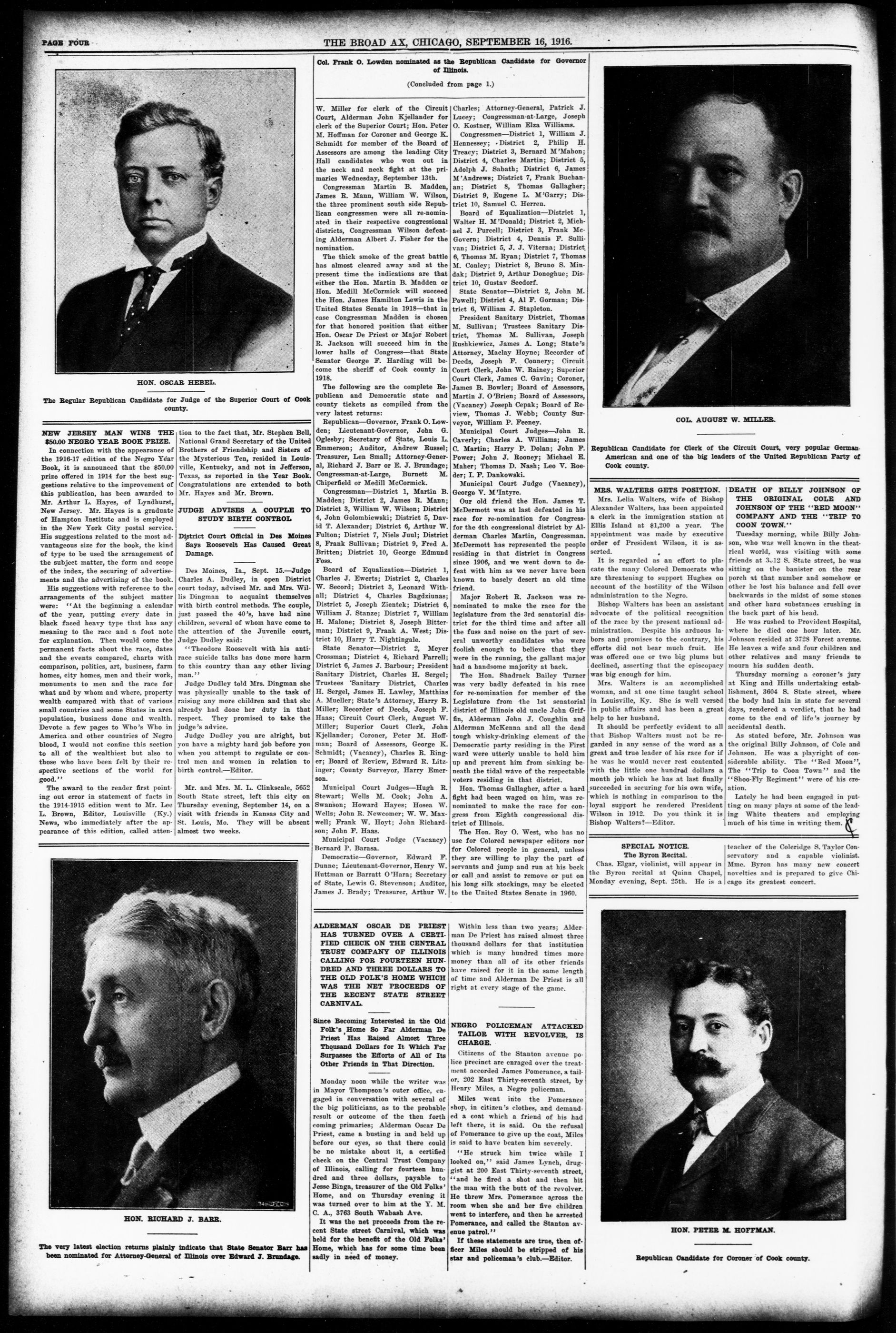
The Regular Republican Candidate for Judge of the Superior Court of Cook county.
NEW JERSEY MAN WINS THE $50.00 NEGRO YEAR BOOK PRIZE. In connection with the appearance of the 1916-17 edition of the Negro Year Book, it is announced that the $50.00 prize offered in 1914 for the best suggestions relative to the improvement of this publication, has been awarded to Mr. Arthur L. Hayes, of Lyndhurst, New Jersey. Mr. Hayes is a graduate of Hampton Institute and is employed in the New York City postal service. His suggestions related to the most advantageous size for the book, the kind of type to be used the arrangement of the subject matter, the form and scope of the index, the securing of advertisements and the advertising of the book.
His suggestions with reference to the arrangements of the subject matter were: "At the beginning a calendar of the year, putting every date in black faced heavy type that has any meaning to the race and a foot note for explanation. Then would come the permanent facts about the race, dates and the events compared, charts with comparison, politics, art, business, farm homes, city homes, men and their work, monuments to men and the race for what and by whom and where, property wealth compared with that of various small countries and some States in area population, business done and wealth. Devote a few pages to Who's Who in America and other countries of Negro blood, I would not confine this section to all of the wealthiest but also to those who have been felt by their respective sections of the world for good."
The award to the reader first pointing out error in statement of facts in the 1914-1915 edition went to Mr. Lee L. Brown, Editor, Louisville (Ky.) News, who immediately after the appearance of this edition, called atten-
P. A. B. C. D. E. F. G. H. I. J. K. L. M. N. O. P. Q. R. S. T. U. V. W. X. Y. Z.
7450203
HON. RICHARD J. BARR
The very latest election returns plainly indicate that been nominated for Attorney-General of Illinois over
The very latest election returns plainly indicate that State Senator Barr has been nominated for Attorney-General of Illinois over Edward J. Brundage.
PAGE FOUR
tion to the fact that, Mr. Stephen Bell, National Grand Secretary of the United Brothers of Friendship and Sisters of the Mysterious Ten, resided in Louisville, Kentucky, and not in Jefferson, Texas, as reported in the Year Book. Congratulations are extended to both Mr. Hayes and Mr. Brown.
JUDGE ADVISES A COUPLE TO
STUDY BIRTH CONTROL
District Court Official in Des Moines Says Roosevelt Has Caused Great Damage.
Des Moines, Ia., Sept. 15.—Judge Charles A. Dudley, in open District court today, advised Mr. and Mrs. Willis Dingman to acquaint themselves with birth control methods. The couple, just passed the 40's, have had nine children, several of whom have come to the attention of the Juvenile court, Judge Dudley said:
"Theodore Roosevelt with his anti-race suicide talks has done more harm to this country than any other living man."
Judge Dudley told Mrs. Dingman she was physically unable to the task of raising any more children and that she already had done her duty in that respect. They promised to take the judge's advice.
Judge Dudley you are alright, but you have a mighty hard job before you when you attempt to regulate or control men and women in relation to birth control.—Editor.
Mr. and Mrs. M. L. Clinkscale, 5652 South State street, left this city on Thursday evening, September 14, on a visit with friends in Kansas City and St. Louis, Mo. They will be absent almost two weeks.
74K02205
indicate that State Senator Barr has of Illinois over Edward J. Brundage.
THE BROAD AX, CHICAGO, SEPTEMBER 16, 1916.
(Concluded from page 1.)
W. Miller for clerk of the Circuit Court, Alderman John Kjellander for clerk of the Superior Court; Hon. Peter M. Hoffman for Coroner and George K. Schmidt for member of the Board of Assessors are among the leading City Hall candidates who won out in the neck and neck fight at the primaries Wednesday, September 13th. Congressman Martin B. Madden, James R. Mann, William W. Wilson, the three prominent south side Republican congressmen were all re-nominated in their respective congressional districts, Congressman Wilson defeating Alderman Albert J. Fisher for the nomination.
The thick smoke of the great battle has almost cleared away and at the present time the indications are that either the Hon. Martin B. Madden or Hon. Medill McCormick will succeed the Hon. James Hamilton Lewis in the United States Senate in 1918—that in case Congressman Madden is chosen for that honored position that either Hon. Oscar De Priest or Major Robert R. Jackson will succeed him in the lower halls of Congress—that State Senator George F. Harding will become the sheriff of Cook county in 1918.
The following are the complete Republican and Democratic state and county tickets as compiled from the very latest returns:
Republican—Governor, Frank O. Lowden; Lieutenant-Governor, John G. Oglesby; Secretary of State, Louis L. Emmerson; Auditor, Andrew Russel; Treasurer, Len Small; Attorney-General, Richard J. Barr or E. J. Brundage; Congressman-at-Large, Burnett M. Chiperfield or Medill McCormick.
Congressman—District 1, Martin B. Madden; District 2, James R. Mann; District 3, William W. Wilson; District 4, John Golombiewski; District 5, David T. Alexander; District 6, Arthur W. Fulton; District 7, Niels Juul; District 8, Frank Sullivan; District 9, Fred A. Britten; District 10, George Edmund Foss.
Board of Equalization—District 1,
Charles J. Ewerts; District 2, Charles
W. Secord; District 3, Leonard Withall;
District 4, Charles Bagdziunas;
District 5, Joseph Zientek; District 6,
William J. Stanze; District 7, William
H. Malone; District 8, Joseph Bitterman;
District 9, Frank A. West; District 10, Harry T. Nightingale.
State Senator—District 2, Meyer Crossman; District 4, Richard Farrell; District 6, James J. Barbour; President Sanitary District, Charles H. Sergel; Trustees 'Sanitary District, Charles H. Sergel, James H. Lawley, Matthias A. Mueller; State's Attorney, Harry B. Miller; Recorder of Deeds, Joseph F. Haas; Circuit Court Clerk, August W. Miller; Superior Court Clerk, John Kjellander; Coroner, Peter M. Hoffman; Board of Assessors, George K. Schmidt; (Vacancy), Charles R. Ringer; Board of Review, Edward R. Litzinger; County Surveyor, Harry Emerson.
Municipal Court Judges—Hugh R. Stewart; Wells M. Cook; John A. Swanson; Howard Hayes; Hosea W. Wells; John R. Newcomer; W. W. Maxwell; Frank W. Hoyt; John Richardson; John F. Haas.
Municipal Court Judge (Vacancy)
Bernard P. Barasa.
Democratic—Governor, Edward F. Dunne; Lieutenant-Governor, Henry W. Huttman or Barratt O'Hara; Secretary of State, Lewis G. Stevenson; Auditor, James J. Brady; Treasurer, Arthur W.
ALDERMAN OSCAR DE PRIEST
HAS TURNED OVER A CERTIFIED CHECK ON THE CENTRAL
TRUST COMPANY OF ILLINOIS
CALLING FOR FOURTEEN HUNDRED AND THREE DOLLARS TO
THE OLD FOLK'S HOME WHICH
WAS THE NET PROCEEDS OF
THE RECENT STATE STREET
CARNIVAL.
Since Becoming Interested in the Old
Folk's Home So Far Alderman De
Priest Has Raised Almost Three
Thousand Dollars for It Which Par
Surpasses the Efforts of All of Its
Other Friends in That Direction.
Monday noon while the writer was in Mayor Thompson's outer office, engaged in conversation with several of the big politicians, as to the probable result or outcome of the then forth coming primaries; Alderman Oscar De Priest, came a busting in and held up before our eyes, so that there could be no mistake about it, a certified check on the Central Trust Company of Illinois, calling for fourteen hundred and three dollars, payable to Jesse Binga, treasurer of the Old Folks' Home, and on the Thursday evening it was turned over to him at the Y. M. C. A., 3763 South Wabash Ave. It was the net proceeds from the recent State street Carnival, which was held for the benefit of the Old Folks' Home, which has for some time been sadly in need of money.
Charles; Attorney-General, Patrick J. Lucey; Congressman-at-Large, Joseph O. Kostner, William Elza Williams. Congressmen—District 1, William J. Hennessey; District 2, Philip H. Treacy; District 3, Bernard M'Mahon; District 4, Charles Martin; District 5, Adolph J. Sabath; District 6, James M'Andrews; District 7, Frank Buchanan; District 8, Thomas Gallagher; District 9, Eugene L. M'Garry; District 10, Samuel C. Herren. Board of Equalization—District 1, Walter H. M'Donald; District 2, Michael J. Purcell; District 3, Frank McGovern; District 4, Dennis F. Sullivan; District 5, J. J. Viterna; District 6, Thomas M. Ryan; District 7, Thomas M. Conley; District 8, Bruno S. Mindak; District 9, Arthur Donoghue; District 10, Gustav Seedorf.
State Senator—District 2, John M. Powell; District 4, Al F. Gorman; District 6, William J. Stapleton.
President Sanitary District, Thomas M. Sullivan; Trustees Sanitary District, Thomas M. Sullivan, Joseph Rushkiewicz, James A. Long; State's Attorney, Maclay Hoyne; Recorder of Deeds, Joseph F. Connery; Circuit Court Clerk, John W. Rainey; Superior Court Clerk, James C. Gavin; Coroner, James B. Bowler; Board of Assessors, Martin J. O'Brien; Board of Assessors, (Vacancy) Joseph Cepak; Board of Review, Thomas J. Webb; County Surveyor, William P. Feeney.
Municipal Court Judges-John R. Caverly; Charles A. Williams; James C. Martin; Harry P. Dolan; John F. Power; John J. Rooney; Michael E. Maher; Thomas D. Nash; Leo V. Roeder; I. F. Dankowski.
Municipal Court Judge (Vacancy), George V. M'Intyre.
Our old friend the Hon. James T. McDermott was at last defeated in his race for re-nomination for Congress-for the 4th congressional district by Alderman Charles Martin, Congressman. McDermott has represented the people residing in that district in Congress since 1906, and we went down to defeat with him as we never have been known to basely desert an old time friend.
Major Robert R. Jackson was nominated to make the race for the legislature from the 3rd senatorial district for the third time and after all the fuss and noise on the part of several unworthy candidates who were foolish enough to believe that they were in the running, the gallant major had a handsome majority at back.
The Hon. Shadrack Bailey Turner was very badly defeated in his race for re-nomination for member of the Legislature from the 1st senatorial district of Illinois old uncle John Griffin, Alderman John J. Coughlin and Alderman McKenna and all the dead tough whisky-drinking element of the Democratic party residing in the First ward were utterly unable to hold him up and prevent him from sinking beneath the tidal wave of the respectable voters residing in that district.
Hon. Thomas Gallagher, after a hard fight had been waged on him, was nominated to make the race for congress from Eighth congressional district of Illinois.
The Hon. Roy O. West, who has no use for Colored newspaper editors nor for Colored people in general, unless they are willing to play the part of servants and jump and run at his beck or call and assist to remove or put on his long silk stockings, may be elected to the United States Senate in 1960.
Within less than two years; Alderman De Priest has raised almost three thousand dollars for that institution which is many hundred times more money than all of its other friends have raised for it in the same length of time and Alderman De Priest is all right at every stage of the game.
NEGRO POLICEMAN ATTACKED
TAILOR WITH REVOLVER, IS
CHARGE.
Citizens of the Stanton avenue police precinct are enraged over the treatment accorded James Pomerance, a tailor, 202 East Thirty-seventh street, by Henry Miles, a Negro policeman.
Miles went into the Pomerance shop, in citizen's clothes, and demanded a coat which a friend of his had left there, it is said. On the refusal of Pomerance to give up the coat, Milcs is said to have beaten him severely.
"He struck him twice while I looked on," said James Lynch, druggist at 200 East Thirty-seventh street, "and he fired a shot and then hit the man with the butt of the revolver. He threw Mrs. Pomerance across the room when she and her five children went to interfere, and then he arrested Pomerance, and called the Stanton avenue patrol."
If these statements are true, then officer Miles should be stripped of his star and policeman's club.—Editor.
A
[Picture of a man in a suit with a tie].
COL. AUGUST W. MILLER
Republican Candidate for Clerk of the American and one of the big lead Cook county.
Republican Candidate for Clerk of the Circuit Court, very popular German-American and one of the big leaders of the United Republican Party of Cook county.
MRS. WALTERS GETS POSITION.
Mrs. Lelia Walters, wife of Bishop Alexander Walters, has been appointed a clerk in the immigration station at Ellis Island at $1,200 a year. The appointment was made by executive order of President Wilson, it is asserted.
It is regarded as an effort to placate the many Colored Democrats who are threatening to support Hughes on account of the hostility of the Wilson administration to the Negro.
Bishop Walters has been an assistant advocate of the political recognition of the race by the present national administration. Despite his arduous labors and promises to the contrary, his efforts did not bear much fruit. He was offered one or two big plums but declined, asserting that the episcopacy was big enough for him.
Mrs. Walters is an accomplished woman, and at one time taught school in Louisville, Ky. She is well versed in public affairs and has been a great help to her husband.
It should be perfectly evident to all that Bishop Walters must not be regarded in any sense of the word as a great and true leader of his race for if he was he would never rest contented with the little one hundred dollars a month job which he has at last finally succeeded in securing for his own wife, which is nothing in comparison to the loyal support he rendered President Wilson in 1912. Do you think it is Bishop Walters?-Editor.
Chas. Elgar, violinist, will appear in the Byron recital at Quinn Chapel, Monday evening, Sept. 25th. He is a
[Name]
M. H.
HON. PETER M. HOFFMAN.
Republican Candidate for Coroner of Coo
Republican Candidate for Coroner of Cook county.
SPECIAL NOTICE. The Byron Recital.
THE Circuit Court, very popular German-ers of the United Republican Party of
DEATH OF BILLY JOHNSON OF THE ORIGINAL COLE AND JOHNSON OF THE "RED MOON" COMPANY AND THE "TRIP TO COON TOWN."
Tuesday morning, while Billy Johnson, who was well known in the theatrical world, was visiting with some friends at 3.12 S. State street, he was sitting on the banister on the rear poreh at that number and somehow or other he lost his balance and fell over backwards in the midst of some stones and other hard substances crushing in the back part of his head.
He was rushed to Provident Hospital, where he died one hour later. Mr. Johnson resided at 3728 Forest avenue. He leaves a wife and four children and other relatives and many friends to mourn his sudden death.
Thursday morning a coroner's jury at King and Hills undertaking establishment, 3604 S. State street, where the body had lain in state for several days, rendered a verdict, that he had come to the end of life's journey by accidental death.
As stated before, Mr. Johnson was the original Billy Johnson, of Cole and Johnson. He was a playright of considerable ability. The "Red Moon", The "Trip to Coon Town" and the "Shoo-Fly Regiment" were of his creation.
Lately he had been engaged in putting on many plays at some of the leading White theaters and employing much of his time in writing them.
teacher of the Coleridge S. Taylor Conservatory and a capable violinist. Mme. Byron has many new concert novelties and is prepared to give Chicago its greatest concert.
[Name]
Coroner of Cook county.
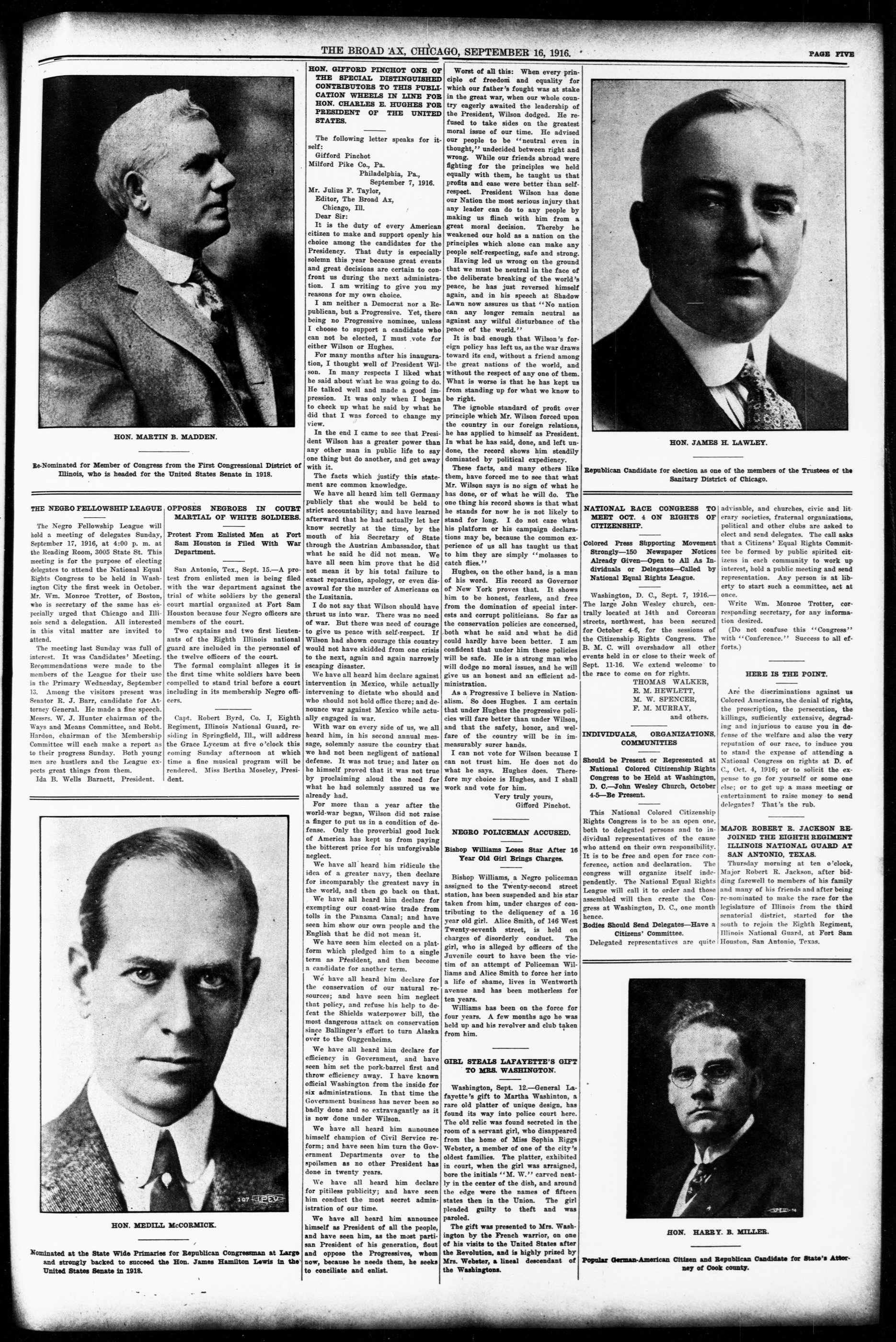
HON. MARTIN B. MADDEN.
Re-Nominated for Member of Congress Illinois, who is headed for the
ber of Congress from the First headed for the United States
Re-Nominated for Member of Congress from the First Congressional District of Illinois, who is headed for the United States Senate in 1918.
Re-Nominated for Member of Congress from the First Congressional District of Illinois, who is headed for the United States Senate in 1918.
THE NEGRO FELLOWSHIP LEAGUE
The Negro Fellowship League will hold a meeting of delegates Sunday, September 17, 1916, at 4:00 p. m. at the Reading Room, 3005 State St. This meeting is for the purpose of electing delegates to attend the National Equal Rights Congress to be held in Washington City the first week in October. Mr. Wm. Monroe Trotter, of Boston, who is secretary of the same has especially urged that Chicago and Illinois send a delegation. All interested in this vital matter are invited to attend.
The meeting last Sunday was full of interest. It was Candidates' Meeting. Recommendations were made to the members of the League for their use in the Primary Wednesday, September 13. Among the visitors present was Senator R. J. Barr, candidate for Attorney General. He made a fine speech. Messrs. W. J. Hunter chairman of the Ways and Means Committee, and Robt. Hardon, chairman of the Membership Committee will each make a report as to their progress Sunday. Both young men are hustlers and the League expects great things from them. Ida B. Wells Barnett. President.
[Image of a man with a serious expression, wearing a suit and tie. The background is plain white. There are no other discernible elements or text.]]
[Image of a man with a serious expression, wearing a suit and tie].
197 LPEV
HON. MEDILL McCORMICK.
Nominated at the State Wide Primarie and strongly backed to succeed the United States Senate in 1918.
Wide Primaries for Republican
and to succeed the Hon. James
ke in 1918.
Nominated at the State Wide Primaries for Republican Congressman at Large and strongly backed to succeed the Hon. James Hamilton Lewis in the United States Senate in 1918.
from the First Congressional District of United States Senate in 1918.
OPPOSES NEGROES IN COURT
MARTIAL OF WHITE SOLDIERS.
Protest From Enlisted Men at Fort Sam Houston is Filed With War Department.
San Antonio, Tex., Sept. 15.—A protest from enlisted men is being filed with the war department against the trial of white soldiers by the general court martial organized at Fort Sam Houston because four Negro officers are members of the court.
Two captains and two first lieutenants of the Eighth Illinois national guard are included in the personnel of the twelve officers of the court.
The formal complaint alleges it is the first time white soldiers have been compelled to stand trial before a court including in its membership Negro officers.
Capt. Robert Byrd, Co. I, Eighth Regiment, Illinois National Guard, residing in Springfield, Ill., will address the Grace Lyceum at five o'clock this coming Sunday afternoon at which time a fine musical program will be rendered. Miss Bertha Moseley, President.
197 PEU
s for Republican Congressman at Large the Hon. James Hamilton Lewis in the
HON. GIFFORD PINCHOT ONE OF THE SPECIAL DISTINGUISHED CONTRIBUTORS TO THIS PUBLICATION WHEELS IN LINE FOR HON. CHARLES E. HUGHES FOR PRESIDENT OF THE UNITED STATES.
The following letter speaks for itself:
Gifford Pinchot
Milford Pike Co., Pa.
Philadelphia, Pa.
September 7, 1916.
Mr. Julius F. Taylor,
Editor, The Broad Ax,
Chicago, Ill.
Dear Sir:
Worst of all this: When every principle of freedom and equality for which our father's fought was at stake in the great war, when our whole country eagerly awaited the leadership of the President, Wilson dodged. He refused to take sides on the greater moral issue of our time. He advised our people to be "neutral even in thought," undecided between right and wrong. While our friends abroad were fighting for the principles we heeded equally with them, he taught us the profits and ease were better than self-respect. President Wilson has done our Nation the most serious injury that any leader can do to any people by making us flinch with him from
It is the duty of every American citizen to make and support openly his choice among the candidates for the Presidency. That duty is especially solemn this year because great events and great decisions are certain to confront us during the next administration. I am writing to give you my reasons for my own choice.
I am neither a Democrat nor a Republican, but a Progressive. Yet, there being no Progressive nominee, unless I choose to support a candidate who can not be elected, I must vote for either Wilson or Hughes.
For many months after his inauguration, I thought well of President Wilson. In many respects I liked what he said about what he was going to do. He talked well and made a good impression. It was only when I began to check up what he said by what he did that I was forced to change my view. In the end I came to see that President Wilson has a greater power than any other man in public life to say one thing but do another, and get away with it. The facts which justify this statement are common knowledge.
We have all heard him tell Germany publicly that she would be held to strict accountability; and have learned afterward that he had actually let her know secretly at the time, by the mouth of his Secretary of State through the Austrian Ambassador, that what he said he did not mean. We have all seen him prove that he did not mean it by his total failure to exact reparation, apology, or even disavowal for the murder of Americans on the Lusitania. I do not say that Wilson should have thrust us into war. There was no need of war. But there was need of courage to give us peace with self-respect. If Wilson had shown courage this country would not have skidded from one crisis to the next, again and again narrowly escaping disaster.
We have all heard him declare against intervention in Mexico, while actually intervening to dictate who should and who should not hold office there; and denounce war against Mexico while actually engaged in war.
With war on every side of us, we all heard him, in his second annual message, solemnly assure the country that we had not been negligent of national defense. It was not true; and later on he himself proved that it was not true by proclaiming aloud the need for what he had solemnly assured us we already had.
For more than a year after the world-war began, Wilson did not raise a finger to put us in a condition of defense. Only the proverbial good luck of America has kept us from paying the bitterest price for his unforgivable neglect.
We have all heard him ridicule the idea of a greater navy, then declare for incomparably the greatest navy in the world, and then go back on that. We have all heard him declare for exempting our coast-wise trade from tolls in the Panama Canal; and have seen him show our own people and the English that he did not mean it. We have seen him elected on a platform which pledged him to a single term as President, and then become a candidate for another term. We have all heard him declare for the conservation of our natural resources; and have seen him neglect that policy, and refuse his help to defeat the Shields waterpower bill, the most dangerous attack on conservation since Ballinger's effort to turn Alaska over to the Guggenheims.
We have all heard him declare for efficiency in Government, and have seen him set the pork-barrel first and throw efficiency away. I have known official Washington from the inside for six administrations. In that time the Government business has never been so badly done and so extravagantly as it is now done under Wilson.
We have all heard him announce himself champion of Civil Service reform; and have seen him turn the Government Departments over to the spoilsmen as no other President has done in twenty years.
We have all heard him declare for pitiless publicity; and have seen him conduct the most secret administration of our time.
We have all heard him announce himself as President of all the people, and have seen him, as the most partisan President of his generation, flout and oppose the Progressives, whom now, because he needs them, he seeks to conciliate and enlist.
Worst of all this: When every principle of freedom and equality for which our father's fought at stake in the great war, when our whole country eagerly awaited the leadership of the President, Wilson dodged. He refused to take sides on the greatest moral issue of our time. He advised our people to be "neutral even in thought," undecided between right and wrong. While our friends abroad were fighting for the principles we held equally with them, he taught us that profits and ease were better than self-respect. President Wilson has done our Nation the most serious injury that any leader can do to any people by making us flinch with him from a great moral decision. Thereby he weakened our hold as a nation on the principles which alone can make any people self-respecting, safe and strong
Having led us wrong on the ground that we must be neutral in the face of the deliberate breaking of the world's peace, he has just reversed himself again, and in his speech at Shadow Lawn now assures us that "No nation can any longer remain neutral as against any wilful disturbance of the peace of the world." It is bad enough that Wilson's foreign policy has left us, as the war draws toward its end, without a friend among the great nations of the world, and without the respect of any one of them. What is worse is that he has kept us from standing up for what we know to be right.
The ignoble standard of profit over principle which Mr. Wilson forced upon the country in our foreign relations, he has applied to himself as President. In what he has said, done, and left undone, the record shows him steadily dominated by political expediency. These facts, and many others like them, have forced me to see that what Mr. Wilson says is no sign of what he has done, or of what he will do. The one thing his record shows is that what he stands for now he is not likely to stand for long. I do not care what his platform or his campaign declarations may be, because the common experience of us all has taught us that to him they are simply "molasses to catch flies."
Hughes, on the other hand, is a man of his word. His record as Governor of New York proves that. It shows him to be honest, fearless, and free from the domination of special interests and corrupt politicians. So far as the conservation policies are concerned, both what he said and what he did could hardly have been better. I am confident that under him these policies will be safe. He is a strong man who will dodge no moral issues, and he will give us an honest and an efficient administration.
As a Progressive I believe in Nationalism. So does Hughes. I am certain that under Hughes the progressive policies will fare better than under Wilson, and that the safety, honor, and welfare of the country will be in immeasurable surer hands.
I can not vote for Wilson because I can not trust him. He does not do what he says. Hughes does. Therefore my choice is Hughes, and I shall work and vote for him.
Very truly yours,
Gifford Pinchot.
NEGRO POLICEMAN ACCUSED.
Bishop Williams Loses Star After 16
Year Old Girl Brings Charges
Bishop Williams, a Negro policeman assigned to the Twenty-second street station, has been suspended and his star taken from him, under charges of contributing to the deliquency of a 16 year old girl. Alice Smith, of 146 West Twenty-seventh street, is held on charges of disorderly conduct. The girl, who is alleged by officers of the Juvenile court to have been the victim of an attempt of Policeman Williams and Alice Smith to force her into a life of shame, lives in Wentworth avenue and has been motherless for ten years. Williams has been on the force for four years. A few months ago he was held up and his revolver and club taken from him.
GIRL STEALS LAFAYETTE'S GIFT
TO MRS. WASHINGTON.
Washington, Sept. 12.—General Lafayette's gift to Martha Washinton, a rare old platter of unique design, has found its way into police court here. The old relic was found secreted in the room of a servant girl, who disappeared from the home of Miss Sophia Riggs Webster, a member of one of the city's oldest families. The platter, exhibited in court, when the girl was arraigned, bore the initials "M. W." carved neatly in the center of the dish, and around the edge were the names of fifteen states then in the Union. The girl pleaded guilty to theft and was paroled.
The gift was presented to Mrs. Washington by the French warrior, on one of his visits to the United States after the Revolution, and is highly prized by Mrs. Webster, a lineal descendant of the Washington.
[Picture of a man in a suit with a patterned tie].
HON. JAMES H. LAWLEY
Republican Candidate for election as or Sanitary Dists
Republican Candidate for election as one of the members of the Trustees of the Sanitary District of Chicago.
Republican Candidate for election as one of the members of the Trustees of the Sanitary District of Chicago.
NATIONAL RACE CONGRESS TO MEET OCT. 4 ON RIGHTS OF CITIZENSHIP.
Colored Press Supporting Movement Strongly—150 Newspaper Notices Already Given—Open to All As Individuals or Delegates—Called by National Equal Rights League.
Washington, D. C., Sept. 7, 1916.—The large John Wesley church, centrally located at 14th and Corcoran streets, northwest, has been secured for October 4-6, for the sessions of the Citizenship Rights Congress. The B. M. C. will overshadow all other events held in or close to their week of Sept. 11-16. We extend welcome to the race to come on for rights.
THOMAS WALKER,
E. M. HEWLETT,
M. W. SPENCER,
F. M. MURRAY,
and others.
INDIVIDUALS, ORGANIZATIONS
COMMUNITIES
Should be Present or Represented at National Colored Citizenship Rights Congress to be Held at Washington, D. C.—John Wesley Church, October 4-5—Be Present.
This National Colored Citizenship Rights Congress is to be an open one, both to delegated persons and to individual representatives of the cause who attend on their own responsibility. It is to be free and open for race conference, action and declaration. The congress will organize itself independently. The National Equal Rights League will call it to order and those assembled will then create the Congress at Washington, D. C., one month hence.
Bodies Should Send Delegates—Have a Citizens' Committee. Delegated representatives are quite
[Image of a man with glasses and a suit]
PEE
HON. HARRY. B. MILLEB.
Popular German-American Citizen and the ney of Co
Popular German-American Citizen and Republican Candidate for State's Attorney of Cook county.
Popular German-American Citizen and Republican Candidate for State's Attorney of Cook county.
THE NEW YORK TIMES
of the members of the Trustees of the
ict of Chicago.
advisable, and churches, civic and lit-
rary societies, fraternal organizations,
political and other clubs are asked to
elect and send delegates. The call asks
that a Citizens' Equal Rights Committe-
tee be formed by public spirited cit-
izens in each community to work up
interest, hold a public meeting and send
representation. Any person is at liberty to start such a committee, act at once.
Write Wm. Monroe Trotter, cor-
responding secretary, for any informa-
tion desired.
(Do not confuse this "Congress" with "Conference." Success to all efforts.)
HERE IS THE POINT
Are the discriminations against us Colored Americans, the denial of rights, the proscription, the persecution, the killings, sufficiently extensive, degrading and injurious to cause you in defense of the welfare and also the very reputation of our race, to induce you to stand the expense of attending a National Congress on rights at D. of C., Oct. 4, 1916; or to solicit the expense to go for yourself or some one else; or to get up a mass meeting or entertainment to raise money to send delegates? That's the rub.
MAJOR ROBERT R. JACKSON REJOINED THE EIGHTH REGIMENT ILLINOIS NATIONAL GUARD AT SAN ANTONIO, TEXAS.
Thursday morning at ten o'clock, Major Robert R. Jackson, after bidding farewell to members of his family and many of his friends and after being re-nominated to make the race for the legislature of Illinois from the third senatorial district, started for the south to rejoin the Eighth Regiment, Illinois National Guard, at Fort Sam Houston, San Antonio, Texas.
44
Republican Candidate for State's Attor-
k county.
PAGE FIVE
PAGE SIX
NORWAY'SMETEOR
The Greatest Tennis Player of Her Sex In the World.
EVEN MEN CAN'T BEAT HER.
There Is One Outstanding Feature of Her Play That Is Evident to Even the Untrained Eye—That Is Her Powerful Forehand Drive.
In the world of lawn tennis Miss Molla Bjurstedt has accomplished that for which others have often striven, but which none has ever before attained. She occupies a unique and envied place in the sphere of her athletic activity. Having spent less than two years in this country, she is the holder of three women's national championships, a record that did not fall to the lot of even the redoubtable Mrs. May Sutton Bundy when she was
S
MISS MOLLA BJURSTEDT.
at the height of her career and with whom she may only be compared. And more, this girl of Norway is the only foreigner to be chosen for the premier position by the ranking committee.
Miss Bjurstedt came to this country unheralded—almost unknown. In December, 1914, a short, sturdy girl stepped from a transatlantic liner to visit New York and passed, comparatively unknown, into the confines of the big city. There was no applause for her then—she was just one of the many—but in less than three months her name was known wherever tennis is played.
Today Miss Bjurstedt is known as the "greatest tennis player of her sex in the world." Indeed, few men can beat her at the game.
BEAUTIFUL FURNITURE
A Treatise on Rare Old Pieces and What They Express.
Have you ever considered the educational value of the modern department store? Probably not, and yet it is one of the greatest educational factors of the age.
Take the Chippendale, for instance—it is tremendously popular. It is the first style that was ever identified with any individual name. Now a precedent is not established without power; therefore there is an obvious reason for the name Chippendale meaning so much, and you have only to look at the surpassing beauty of line and design of the Chippendale product to discover the reason. The Chinese Chippendale combines the beauty of line with that of color and of decoration. A most attractive dining room suit of this description is of battleship gray, with green broadened horsehair upholstering and artistic hand decorations done in silver and gold. The ornamental handles on the buffet drawers are of the appearance of oxidized silver.
Another noticeable artistic touch is the placing of a Chippendale chair in a severely colonial dining room or living room set. This is highly artistic; it takes away the stern note of severity and softens it to pleasing harmony. But, after all, the superbly elegant dining room is furnished in Chippendale.
Unkneaded Graham Bread.
Make a batter of half compressed yeast cake dissolved in a quarter of a cupful of warm water, three cupfuls of graham flour, a teaspoonful of salt. Cover and leave overnight. In the morning add a cupful of sugar and enough graham flour to make a batter so stiff it can be lifted with the hand. Butter pound size coffee cans thoroughly and fill half full, let rise until about three-quarters full and then bake an hour and a quarter in a slow oven. This makes three good loaves.
Easy Rolls.
Boll one pint of fresh milk to make easy rolls. While hot put in one tablespoonful of lard, one and a half teaspoonfuls of salt and three teaspoonfuls of sugar. When cool add one-half cake of compressed yeast, stir in flour for a very stiff sponge, then chop or work lightly and set to rise. When risen chop in a little more flour and let rise again. Then make out as many rolls as are wanted and put the remainder in a tight pan in a cool place until needed.
RIBBON TRIMMINGS.
Ways of Using the New Fzllails For Fall Modes.
As trimmings and the materials of which smart accessories are made of ribbons have risen to the top notch of prominence, there seems to be absolutely nothing which cannot be ribbon trimmed.
Ribbon "harnesses" are being shown for wear over a lace nightdress to make it more elaborate. They are put on separately and snapped in place. Similar harnesses are also being fashioned for wear under thin blouses. Such a harness makes a plain blouse much more elaborate and partly conceals a thin camisole which may be worn beneath it.
A strip of ribbon is sometimes introduced into the chain of a lavaliere where it comes in contact with the neck.
Strips of lace alternate with strips of ribbon to fashion many attractive negligees. Boudolr caps made of a skeleton of ribbons gathered into a knot of rosebuds at the top and held together at the bottom by rosebuds where they overlap are chic.
A classic negligee uses ribbon to offset the crossed Grecian lines from the shoulders to waist and to outline the full panel train which hangs from the shoulders in back.
Wide metallic and brocade ribbons are deep enough to form the bodice in some evening gowns. Soft faille and grossgrain ribbons in cockade effects with flying ends are used to hold up the draperies on evening frocks of soft materials. Again pannlers will be simulated by plaitings of wide ribbon allowed to extend outright from the hips, or deep loops of two toned satin ribbon will serve to make pannler or bustle as successfully as the material.
Wide ribbons for muffs are being tied in many curious ways. Often a bow at the back of the neck makes a fetching finish. Where double ribbons are crossed jeweled slides like those used on watch chains are used to clasp the two strands together. Sometimes a tiny bunch of artificial flowers is tied in the length of the muff ribbon.
A LA MILITAIRE.
This Frenchy Cown Is Also Ecclesiastical In Simplicity.
The fabric used here is velours de laine, an army blue and an Italian gray, which is used for the under-
A
PARISIAN MODEL.
skirt, piping and deep collar. Although of military colors, the cut is almost monkish. Please observe the cats parading on the top hat.
A Birthday Reminder
For a child or even a grownup who is willing to be amused try this scheme for a birthday reminder. You may buy this little contrivance already made or you can try your own hand at fixing it up. It is nothing more than a round candy box painted to represent a birthday cake. Instead of candles, rolled bits of paper on which are written amusing mottoes or birthday wishes are thrust through holes in the box lid. There can be as many candles as you wish, unless the number is too great. For the mottoes use some of those to be found on birthday postcards, or, if you can, make your own. This idea could be carried out likewise for a birthday party, having the real cake in the middle and at each guest's plate a tiny round box painted with water colors to resemble a cake, with one rolled paper candle on which is written a "fortune."
Hash In Peppers
Cut the tops off from three green peppers and soak them in cold water while preparing the filling. Mix one cupful of chopped cold meat and one half cupful of chopped potatoes and season with celery salt. Drain the peppers and fill with the hash mixture. Bake in a hot oven about twenty minutes.
·THE BROAD AX: CHICAGO, SEPTEMBER 16, 1916.
FOR YOUNG FOLKS
FOR YOUNG FOLKS
Sleepy Time Story About a Wicked Witch In Finland.
CRUEL PLAN FOR REVENGE.
How the Schemes of the Arch Plotter Failed to Work Out as She Had Intended—A Finnish Legend—Many Things of Interest to Small People.
Well, said Uncle Ben to Polly Ann and Little Ned, I suppose you are waiting for a story. This time it will be about
FOXES AND SHEEP.
Once upon a time, so long ago that no one even remembers the year, there were no foxes in Iceland, but plenty of sheep—nice woolly sheep living on every farm in the country.
It happened that a man from Iceland was obliged to go to Finland to spend an entire winter there in attending to some business affairs.
Neils was a most attractive young man and every one liked him. Indeed, so very handsome and attractive was he that a wicked old witch fell quite in love with him and wanted to marry him.
Neils, however, had a sweetheart at home and had no mind to give her up for any one, and politely, but firmly, refused to marry the Finnish witch, and as soon as springtime came home he went, in spite of all the entreaties of the witch.
Of course she was very, very ugly and determined to be revenged on Neils.
"Very well, my fine Nells," she said, shaking her first after the ship that was bearing him away. "I'll see that you will regret all your days the slight you have put upon me!" So the witch made every effort to think of a plan to punish the insensible Icelander and at last hit upon a most ingenious and wicked one. She took two foxes and repeated so many charms and incantations over them that they were completely bewitched and ready to obey all her commands. Taking them down to the seashore she put them on board a ship bound for Iceland. "Go!" she ordered, "to that land in which cold hearted men live and destroy the first living thing you meet and ever after all others of the same kind!"
Now the cruel witch was sure the first living things the foxes would meet would be the owners of the ship waiting at the landing place to meet it coming in, and she intended that the foxes should destroy all the people on the island, Neils himself being among them.
As it chanced, however, a sheep that had strayed away from the fold had wandered down to the waterside, and when the bewitched foxes sprang ashore the sheep was directly in their path.
So the poor sheep was sacrificed and the foxes remaining multiplied.
As for Neils he married his sweet-heart and was very, very happy, but never again did he leave his own country.
Mother Goose Pantomime.
"Mother Goose" rimes written line by line on separate slips of paper may be shuffled and handed to players, instructions being given that those receiving the same poem lines shall find each other and stay together. After all the groups have been formed each group can dramatize the little jingle they have been given and let the others guess it. Care should be taken to select rimes that will lend themselves easily to dramatization.
A Youthful Soil Tiller
Equipped with shovel and pail, this little farmer is about to start in farming. It does not matter that this is the season when crops are gathered, not
A
THE FARMER.
sowed; he is determined to plant. Last
sowed he either forgot about gardening,
or else he was enjoying himself
in some other way more to his liking.
Anyhow, he is at it, and a very fine
looking young farmer he is.
MODERN LINGERIE.
Two Charming Garments Made of Silk Jersey Cloth.
Flesh colored silk cut with a V neck and trimmed with val lace and medallions gives this camisole. The panta
0
LOUDOOR TO 3
loons are of rose silk jersey with three
ruffles of self toned taffeta. A brocaded robe in poppy colors is suitable
for fastidious loafers.
SAVORY BOILED FISH.
A Delicious Way to Serve One Course of Your Dinner.
One three or four pound haddock, a cupful of vinegar, a large onion (sliced), a bay leaf, a lemon (sliced), half a teaspoonful of salt, two cupfuls of cream, two egg yolks, two tablespoonfuls of whole black peppers and one tablespoonful of whole cloves.
Clean the fish and leave it whole, retaining the head. Wrap in a fish cloth of cheesecloth or thin muslin. Boil in water to cover, to which has been added the vinegar, onion, bay leaf, sliced lemon and salt. Cook very gently, allowing two hours in the fireless cooker and using one radiator. When done beat together the cream and egg yolks and cook in a double boiler, stirring frequently until the mixture gets a little thick. Then thin with about one-third cupful of the stock in which the fish was boiled and add lemon juice, salt and paprika to taste. Pour over the fish and serve garnished with parsley and sliced lemon. This is a very nice way to cook shad or bluefish, and the same seasonings and sauce can be used for hallibut, smelts, lake trout and salmon.
FOR OUTDOOR WOMEN.
Footwear That Is Modish and Leggins Too.
By all means use woolen stockings. Get a shoe whose sole is at least as big as your stockinged foot, when you put your weight on it. Get a heel as broad and low as you can comfortably walk with, and remember that walking on earth trails and leaf mold is infinitely easier on the nerves than walking on cement.
Have your shoe five to seven inches high; not lower, because rain and cold and mosquitoes have an affinity for unprotected ankles; not higher, because you add expense, weight and stuffy heat without gain. Leggins, if you want them, will protect the calf. They should be of material resembling your skirt and knickerbockers.
Fashiongrams
A frock launched forth for fall is made of beige cloth and velvet. Even the tiny ruffles on the skirt and sleeves are of velvet.
One couldn't help calling a hat military when it is made of khaki silk and trimmed with red ribbon in cartridge plating.
Two toned underwear is something of a novelty. The two shades, which are very pale, are interwoven in pink and blue, white and pale gray or primrose with powder blue.
On hats of felt are narrow hat bands of engraved leather.
A black satin skirt is part of a stunning afternoon costume. The other part is a white broadcloth coat having pockets, collar and cuffs of the satin.
A white felt hat trimmed with black satin gives the finishing touch.
Sweeping Carpets.
Wet your brooms with boiling suds once a week and they will become tough and last much longer. When sweeping, sprinkle a handful of salt on the carpet to carry the dust along; it will make the carpet brighter. Wet newspapers, wrung nearly dry and torn into bits, are also good dust collectors when sweeping. Tea leaves are good to sprinkle on all but very delicate carpets.
KETCHUP TIME.
Excellent Ways to Season Your Winter Meals.
A GOOD MUSHROOM RECIPE.
Tested Ways of Preserving the Succulent Tomato, to Say Nothing of Three Other Savory Relishes For Meat Dishes and Boston Baked Beans.
Ketchup time is here, and it be hooves the good housewife to "put up" some of this appetizer. For tomato ketchup take half a peck of sound, ripe tomatoes and wipe them well, quarter them, place on dishes and scatter with a half pound of salt. Leave for twenty-four hours, drain the juice through a hair sieve into a pan. Add two dozen small capscums and ten shallots, or, if not at hand, two ounces of whole pepper and four tablespoonfuls of onion juice. Simmer for half an hour and then add the tomato, which has been pulped through a fine hair sieve.
Cook for thirty minutes more. Bottle, cork and seal.
Take half a large sleeveless of green walnut shells and place them in a wooden tub with a half pound of coarse salt. Beat and mash them from time to time for six days. Tie up and drain the juice into a pan and continue to mash the shells until all juice is extracted. Strain the liquid into a preserving pan and simmer and skim thoroughly; then add two ounces of brushed ginger, two ounces of allspice, a half ounce of whole pepper, a half ounce of cloves and simmer all gently together for about one hour. Measure out about an equal quantity of spice into each bottle, then fill with the liquid, cork seal thoroughly and keep until the following year.
To one peck of good, sound, fresh mushrooms allow a half pound of coarse salt. Break up and let them stand three hours, and then mash them once or twice a day for two days. Pour the mash into a stone jar and add for each quart one ounce of whole pepper. Place a weighted plate on the jar and stand the jar in a pan of hot water. Bring it to a boil and boll for quite two hours. Strain off the juice and simmer it for thirty minutes. Let it stand, and next day add a table-spoonful of brandy to each pint and again let it stand in a cool place for twenty-four hours. Strain it into small bottles, and be careful not to disturb the dregs. Then cork and seal.
SO SHY.
Also Demure as to Coloring Is This Late Style Turban.
With a mist gray suit of broadcloth goes this piquant little turban, a black
```markdown
```
HER SUIT HAT.
velvet band mounted by two Plymouth Rock wings in natural tones of gray and white. This is the kind of a hat always so becoming to short women.
Good Idea.
What do you throw over your shoulders when you shampoo your head? You should really have something there, for it isn't very pleasant to have the wet hair dangling about. A combing jacket is worn by many persons during the process, but quite a few women do not possess such a thing. A splendid substitute is made by taking two towels, Turkish or crash, and knotting the corners of two ends together. In case the opening through which the head is to pass is not large enough the towels should be joined directly over the shoulders.
Homemade Buttermilk.
Beat sour milk very rapidly for about two minutes, and a superior kind of buttermilk is produced. This is well worth knowing, as much of the buttermilk produced in creameries is unfit to drink and that made from tablets requires a certain temperature which is not always easy to command.
One Chio Way to Make a Frock Is Like This.
The king of American designers just came out with this model, which is built of mouse gray gaberdine and out
M
OFF FOR A HIKE
with a pointed collar and skirt
yoke. The snug sleeves are really
buttoned to the elbow. A gayly beaded
bag of gray velvet is also smart.
HOW TO REST.
The Value of Perfect Relaxation For Fatigued Bodies.
Every woman should learn to rest if she wishes to preserve her good looks. Should she lead a very busy life she must acquire the habit of availing herself of every few spare moments for this purpose. Analyze the art of relaxation.
Hang the arms loosely at the sides and then begin to move them slowly backward and forward from side to side. Then open the fingers wide and shake the hands loosely from the wrists, and after this practice the same exercise with legs and feet.
One beauty expert considers that too many hot baths tend to destroy beauty and advocates a tepid bath every day. Exercise, she urges, also can be indulged in to the point of fatigue, and taken in excess does more harm than good.
When the eyes are heavy and dull it is frequently due to overstrain or internal disorders. Then the liver or kidneys are not functioning properly, the eyeballs are yellowish, and of course this calls for internal correctives. Eye strain frequently causes redness and swelling of the lids and bloodshot to appear. Exposure to heat and cold will also cause similar results. Eyes that are bright and animated, direct in their gaze, usually indicate a healthy body—one of the most beautifully expressive of all nature's gifts. The contrary concludes disorders of the body or eye, frequently a complication of these. The care and attention bestowed upon the eyes will assuredly prolong not only their invaluable service, but their beauty as well.
PONCHO SWEATERS
Something New In Lines For the Sport Girl.
There is a new kind of sweater called the poncho. It's a straight piece of fine colored wool, with an oblong opening at the neck, each two selvages caught at the waist line under the arm with an ornamental band. These selvages as well as the opening at the neck are ornamented with brilliant Indian embroidery.
These sweaters hang in a straight line back and front, and the width of the material is so wisely chosen that it does not extend more than an inch over the top of the arms.
In choosing one be quite sure that it is small enough. Its smart air is instantly obliterated if it is too wide across the chest and falls limply below the shoulders.
Ham Loaf.
Soak half a tablespoonful of granulated gelatin in one and one-half tablespoonfuls of cold water, then dissolve this in a small cupful of boiling water. Pour this over a large cupful of chopped boiled ham. Stand the dish in a pan of cold water and stir the mixture until it begins to thicken. Fold in one cupful of cream that has been beaten thick and a few grains of paprika. Mold in a ring mold. At serving time turn the preparation from the mold, cut in slices and serve with or without mayonnaise.
Corn Pudding.
Place in an earthen jar a pint of corn, one cupful of sweet milk, one tablespoonful of butter, one tablespoonful of sugar, two well beaten eggs, salt and pepper to taste. Beat the eggs thoroughly. Place corn in baking dish, add the milk mixture and bake a golden brown.
Motor Veils That Are Modish Copy This
1
For Hotel Porches Is This Costume
THE WORLD'S FINEST FASHION
A HEXAGONAL mesh in taupe is worn over a brimmed hat. Covering both is a flowing crape veil in dove gray, with a long, fluttering drape to catch the breezes. Both veils may be utilized to protect the face from dust on a long "run."
---
Ribbon, it is said, continues to enjoy a satisfactory popularity and will be used in millinery and on occasional dresses, especially the dress intended for dance or informal evening wear for the young girl and youthful matron.
. . .
Some of the new hats show a front flare in the brim. It turns up and flares back over the face to give a line that is most becoming.
---
Trimming motifs of embroidery on dresses are placed most generally on pockets or on the side of skirts or tunics to simulate pockets on collars and cuffs, belts and girdle or sash
For Hotel Porche
NOTHING could be so chic for hotel vacationists as this outfit of emerald green and white striped brilliantine contrasted with plain white. Bandings of the stripe and white pearl buttons serve as trimming for one of the most modish costumes of the season.
---
The present gorgeousness and infinite variety of fancy handbags would seem impossible to surpass, yet from the advanced models of these accessories for fall we get the promise of still more wonderful ones to come.
---
Puffs and curls, our own or purchased, must adorn our heads for autumn if activity in hair goods shops and beauty parlors is to be regarded as authoritative information. Not, however, are these accessories of hairdressing so much for general use as for evening hair modes.
The influence of stage costuming upon our everyday apparel is easily
ends. Where a dress is in overlouse style or is made with a tunic skirt the embroidery is likely to be placed on this section of the dress in a band effect at the extreme edge or just above the deep hem of the tunic.
---
Buttons, skillfully used, are one of the most effective autumn trimmings. One clever plan is to fasten the wide tabs of flaring collars down with big and striking buttons.
. . .
The upstanding frill around the neck that is cut away a bit at the shoulders is still featured in some of the imported frocks of silk and satin.
---
Marvelously beautiful and true to the originals are the splendid fur fabrics of which many autumn coats will be made. A great number of these coats are provided with collars and other trimming features of real fur that further enrich the appearance of the fur fabric. ANNA MAY.
Is This Costume
traceable when the production is a portrayal of modern life. This being the case, we should look for ostrich trimming on evening gowns and dinner frocks the coming season.
---
- Rainbow coloring in an evening dress of tulle is the novel color combination of a dress recently seen in a shop usually dependable for fashion's trend. What more delightful combination of color can be imagined for the young girl?
---
A charming street frock is made of white crepe de chine, cut with a sort of Russian bodice, heavily trimmed with white soutache braid.
---
Sash ends at the side, of ribbon or violet, are in good style.
So well established are sports clothes that the new color range for autumn embraces a goodly number of splendid colors named for sports and grouped by themselves. ANNA MAY.
THE BROAD AX, CHICAGO, SEPTEMBER 16, 1916.
When One Is Dying.
If ever I have time to relax from the hard labor of living and come down upon my bed to die I ask nothing better of my neighbors than that they will care enough for me to watch the night through with me before the gates. I prefer it to the conventional passing now in vogue where a pussyfooting trained nurse runs everybody out of the house.
I would not be deprived of those last hours of companionship with my own kind. I should have more courage with which to face the uncertainties of my immortality escorted by my familiar mortal kind. I might have something to say, and if I did I'd wish to say it to real folk, not to a doctor and a trained nurse, who would be sure to think I did not know what I was saying, because they are accustomed to deal with the flesh, not the spirit.
Death in my opinion is altogether too strictly censored in polite society. Both the passing and the living should be given more freedom of expression.—Corra Harris in Independent.
Giant Grotto.
The immense cavern known as the Giant grotto is situated near Trieste, Austria, and is said to be the largest known to exist. It consists of one vast chamber, 787 feet long, 433 feet broad and 452 feet high. There are three entrances, two in the roof and one at the edge of the roof, which has been provided with ladders with steps, so that visitors can safely descend into the grotto. Once on the bottom, progress is easy. The cavern contains remarkable groups of stalactites, some of them of gigantic size and others of blaze shapes. The tallest stalactite has a length of little more than thirty-nine feet. No side or underlying caverns have yet been discovered. The bottom of the grotto is 525 feet below the surface of the ground forming the top of the roof, which in turn is about 1,580 feet above sea level. -Pearson's Weekly.
Old Engraved Rings
Among the legends of Greece it is told that the father of Pythagorus, the famous Greek philosopher, was a celebrated engraver of gems, and, according to classical history, both Helen of Troy and Ulysses of Greece wore engraved rings.
Engraving on stones that were partly precious was an art at a very remote age. The British museum proudly boasts the possession of a small square of yellow jasper bearing the figure of a horse and the name and titles of Amenophis II., believed to date back to about the year 1450 B. C. The very finest specimen of engraved gem now in existence is a head of Nero carved on a first water diamond by the brothers Castanzi in the year 1790 A. D.-St. James' Gazette.
Gained Her Object
There's method in some people's seeming miserliness, although the reason for so much privation does not strike ordinary folk as sufficient. A Swiss village owes its fine peal of bells to this sort of self sacrifice.
About ten years ago a widow who had lived in great misery for no less than fifty years went to the commune and presented it with over $4,000 for a peal of bells for the old church. She had saved the amount penny by penny, dressing like a beggar and starving herself. She said she had gained the object of her life.
Breaking a Looking Glass.
The breaking of a looking glass superstition is a very old one. Hundreds of years ago it used to be a common belief that those who wished to harm others could do so by getting pictures or making images of their enemies and destroying them. The destruction of the picture would be followed by the death of its original. Even the victim's reflection in a mirror was enough for the purpose, provided the mirror was promptly broken.
All In.
Friend-1 was just in the art gallery admiring your "Napoleon After Waterloo." The fidelity of expression on Bonaparte's face is positively wonderful. Where did you get it? Mr. Dobber-From life. I got my wife to pose for me the morning after she gave her first reception.-Puck.
An Old Smallpox Cure
The following primitive "cure" for smallpox was discovered by the Leytonspox (England) guardians in one of their registers for the year 1700: "Take thirty to forty live toads and burn them to cinders in a new pot, then crush into a fine black powder. Dose for smallpox, three ounces."
A Matter of Distance.
Aesop was asked how far it was to a certain place. "Let me see you walk," replied Aesop. The man protested that he wished a civil answer. "You foolish person!" said Aesop. "How can I tell how far it is to that town until I see at what pace you travel?"
Three Classes on the Cars.
An Italian drummer explains in the Milan Domencia del Corriere that "in the first class the passengers abuse the trainmen, in the third class the trainmen are rude to the passengers, in the second class the passengers insult each other."
Muffled.
"They tell me Jimson is over his ears in debt."
"Yes; so much so that he can't hear the doorbell when his creditors call"—Exchange.
_____
It is not every man that can afford to wear a shabby coat—Colton.
Memorable Classifications.
Lady Mary Wortley Montagu, omniscient, but sane, announced that though she had lived a long time and seen a great deal she had met only two sorts of people, and they were very much alike—namely, men and women. Mrs. Oliphant had her own way of dividing persons into "those I can talk to and those I can't," while Laurence Hutton used to say that there were only two sorts of persons in the world, those who remember to say "Thank you" and those who do not. "Is he a yes-sayer or a nosayer?" asked Nietzsche, with which simple brevity contrast Galsworthy. "There are two kinds of men in this world—one who will not rest content till he has become master of all the toys that make a fat existence, never looking to see of what sort they are made, and the other for whom life it tobacco and a crust of bread and liberty to take all to pieces, so that his spirit may feel good within him."—Lucy Elliott Keeler in Atlantic Monthly.
Old English Furniture.
That fine old furniture is yet found in Great Britain in many unexpected places is said to be largely due to the stirring up of the country that was given by the great exhibition at London of 1851. This was soon after the development of the railway system in England, and there flocked to London a large number of squires and their wives. A new world had opened to the country dames. The new things had a wonderful fascination for them. On returning home they got rid of much of their old furniture and bought new. Much of the old furniture found its way to secondhand shops and was sold to poor folk who could not afford to buy new. This accounts for the finding today of much good old furniture in small houses in provincial towns and among country people.—Indianapolis News.
Napoleon Obeyed the Mob.
In "The Corsican-A Diary of Napoleon's Life In His Own Words," Bonaparte tells how as an obscure soldier he witnessed some of the opening scenes of the revolution: "I lodged at Rue du Mail, Place des Victories. At the sound of the tocsin and the news that the Tuilleries were attacked I started for the Carousel. Before I had got there in the Rue des Petits Champs I was passed by a mob of horrible looking fellows parading a head stuck on a pike. Thinking I looked too much of a gentleman, they wanted me to shout "Vive la nation!" which I did promptly, as may easily be imagined."
Just Used Him.
They met again at Atlantic City. The young man asked the girl: "Now that you have become engaged to George why have you flirted with me so long and let me take you motoring, golfing and theater going? Why did you encourage me so long when you intended to accept George?" The girl blushed a little and sighed. "I wanted," she said softly, "to test my love for George."—Pittsburgh Chronicle-Telegraph.
He Won the Trick.
"Oh, George, dear," she whispered when he slipped the engagement ring on her tapering finger, "how sweet of you to remember just the sort of stone I preferred! None of the others was ever so thoughtful."
George was staggered but for a moment. Then he came back with: "Not at all, dear. You overrate me. This is the one I've always used."
She was inconsistent enough to cry about it.
Retort Caustic
Artist's Friend (patronizingly) — I think those thistles in your foreground are superbly realistic, old chap! 'Pon my word, they actually seem to be nodding in the breeze, don't you know! Ungrateful Artist—Yes. I have had one or two people tell me they would almost deceive an ass!
A Perfect Being.
Once upon a time there was a human being who never made a mistake. And his neat little tombstone records the fact that he was one day old when he died.—Springfield Union.
Perfect Fit
Clara—Is she satisfied with her divorce suit? Bella—Yes; she wouldn't have it altered for the world.—Chicago Herald.
Bran as a Medicine
Bread or muffins made from bran make a nutritious breakfast food. Because of its coarseness and bulk bran is highly laxative. Persons of sedentary habits and those who eat much meat invariably suffer from constipation. Uncooked bran makes a more active laxative for such cases. It should be eaten once a day—two or three tablespoonfuls of sterilized bran mixed in with the breakfast cereal or stewed fruit or taken with a pinch of salt and milk or cream over it. A warm preparation of uncooked bran can be had by stirring it into soup.
* The aged enjoy the bran bread
* for breakfast, dinner and supper. It does away with the need
* for a cereal at breakfast for
* them. Digestive disturbances are
* apt to result from a too steady
* diet of cereals, and bran preparations prevent and correct disorders of digestion.
*
STYLE TIPS.
One Is Rows of Silk Stitching Used as Trimming.
Just one whisper today about the new modes for fall. Paris openings are over, and the autumn styles are pretty well settled—the Paris styles, that is. American women do not always abide by these styles.
They look over the new modes and select those that appeal to them most, discarding others, and presently the selected modes appear with miraculous swiftness in the shops for everybody to buy. But there are two or three salient features in the Paris styles that cannot be disregarded, even thus early, for their repetition by one contour after another foretells their sure importance as winter style features.
One of these is silk stitching used as a trimming. The Paris frocks and coats are fitted by many seams and darts, all stitched conspicuously in more or less fanciful effect. Pocket flaps, cuffs, revers—they are all garnished with silk stitching, and skirts and tunics have often a score or more of rows of this stitchery, done on the machine in effective chain stitch.
Alpaca is a surprise for the coming season. Both alpaca and mohair are being used by some of the couturiers in tailored frocks for day wear. Some of these models are appealingly chic, as, for instance, a sample frock of black twilled alpaca with a full overskirt pressed into little box plaits and falling almost to the edge of a plain foundation skirt. This frock has a button in back bodice with long, close sleeves and one of the enormous Japanese collars that are to be the rage without doubt. The bodice is loose, flat at back and front and plaited into the waist at the sides. It is attached with a wished seam to the box plaited overskirt, little tabs in the bodice extending down over the plaits to emphasize the long waisted effect. Under this moyen age bodice is a foundation fitted to the waist line and stiffened to insure trimness, though the outer button in back bodice is loose rather than close fitting.
Silks for formal frocks and evening frocks, of course, and Paris whispers that satins and satin surfaced silks will be most in favor. Of these a new silk called soiree is exquisitely beautiful in its lights and shades of color, a most enchanting silk for evening gowns of distinction. Worth and Jenny have brought out stunning gowns in velvet, the Jenny model a slip over the head affair distinctly novel, with bands of Belgian hare for trimming. Very distinguished is an afternoon gown by Premet made of navy blue charmeuse, with a good deal of black chantilly lace draped airily in the bodice and a big Japanese collar of navy blue mousseline draped around throat and shoulders. The combination of navy satin and black lace is particularly elegant and refined, and this gown of Premet is sure to make a decided hit with women of conservative taste. As brilliant as the Premet gown is, quiet and elegant is a Klein dance frock of gold colored silk volle and cream lace, with an underslip of flesh pink silk. The skirt is yards and yards wide, and at the back an odd sash forms a pannier bustle and then trails to the floor, the frock itself being short enough to reveal the feet and ankles.
AUTUMN'S TULIPS.
Here's a Stunning Doily For All Needleworkers.
On a piece of finest linen circularly cut, figured and featherstitched are embroidered a hedge of yellow tulips and
RARE AND BEAUTIFUL.
then spiky greenery. The shading is true to nature and the design, as rare as it is beautiful.
Fatigue Injures Temper.
More than half of the ill temper and irritability displayed by women are due to fatigue, not only of the body, but of the nerves. Every woman should learn how advisable it is to rest daily and to rest in the proper way. After a tiring day, whether it be housework, looking after the children, shopping or paying calls, half an hour's rest will work wonders.
Take off your shoes, put on soft slippers and slip into a loose gown. Pull down the blind; then either lie down or sit in a comfortable easy chair, say, for twenty minutes. Even if you don't sleep you will rest. After bathing, rearranging the hair and getting into fresh clothes you will feel like a totally different woman and equal to any work that may be necessary.
Iced Coffee.
Pour two quarts of boiling water over one-half pound of best coffee and let stand one-half hour; then strain off the clear liquor through cloth, add one quart of milk and one-quarter pound of sugar. Pour into freezer and pack well around with ice and salt. Let it stand an hour before using, then serve in small coffee cups.
PAGE SEVEN
Latest Notes About This Pet Hobby of All Women.
This is the season for blouses. They are needed for a multitude of reasons. The one piece frock has not vanished into the warm summer air because the separate blouse has come into fashion again. It appears to be necessary to have both even in the average wardrobe. There is always a struggle in the mind of the woman who is not plentifully endowed with clothes money as to how she should choose between a suit and a one piece frock for constant service, and probably the married man put it correctly for all women when he said that his wife brought the subject up to him semiannually every day for a fortnight, invariably decided in the end according to her own desires and was dissatisfied about her choice, no matter what it was, for the rest of the season.
One of the advantages of blouse buying is that the average woman can get half a dozen to suit her different needs and moods. This season they are unrolled before her like a brilliant, never ending carpet. The design and the color constantly change. They have reached a degree of variety and gayety that has not been touched in several seasons.
Fine colored muslins, solid and striped, are in the forefront of fashion, and white and colored organdies, which have been so extensively used for neckwear, have been cordially taken up by the makers of blouses.
The plain white organdie waists are embroidered with one or more colors, sometimes in the simple and ever pleasing design of scallops, again in polka dots and triangles of brilliant red and blue, green, black and yellow.
Because polka dot trocks are in fashion we will be able to wear separate blouses of polka dot fabrics with the pleased feeling that we are quite in the middle of the picture. Taffeta and satin are not looked upon with any degree of warmth, but taffeta is applied to chiffon and then embroidered in gold and silver to build up an ornate blouse. Every one knows by this time that the smartest of French blouses drops over the skirt instead of going under it after the manner of a miniature Russian blouse. Cheruit sent this out in white organdle, with a sash of colored silk, and it has led the way for a dozen other conceptions by our own dress-makers.
NOVELTY VEIL
Another Interesting Accessory That Comes "by the Yard." With a close turban, flower wreathed, is worn a flyaway vell that may be as long as preferred, since it comes.
4
FOR MOTORING."
all striped and gay with favorite spring colors, by the yard. Draped horizontally, the effect is picturesque.
Menu For One Week.
Sunday.—Roast beef, Franconia potatoes, creamed cauliflower, orange salad, steamed apple pudding with vanilla sauce.
Monday.—Cold roast beef, hot gravy, scalloped potatoes, peas, pineapple and cake.
Tuesday.—Cottage pie (chopped roast beef, mashed potatoes and gravy), kidney beans, fruit salad, peach taploca with cream and cake.
Wednesday.—Beef coquettes with stewed mushrooms, peas, mince pie and cheese.
Thursday.—Veal cutlets, baked potatoes, macaroni and cheese and apple pie.
Friday.—Creamed fish on toast, banana salad, prune whip and cake.
Saturday.—Baked beans and brown bread, mustard pickles, Dutch apple cake with lemon sauce.
Attractive Chains
The new bead necklaces show combinations of jade and jet, coral and jet or jade, pearls and jet, with imitation pierced gold or silver filigree beads used at effective intervals for ornamentation. One chain, in which jade is used most attractively, has the pierced gold beads, with antique finish, and a piece of Chinese money used as a pendant.
TEENAN JO
TEENAN JONES' PLACE
3445 SOUTH STATE STREET
Telephone Douglas 4591
The finest and most UP-TO BUFFET and CAFE on the Side. First-Class Entertainer
HENRY "TEENAN" JONES, Prop
Phone Randolph 4758
The finest and most UP-TO-DATE BUFFET and CAFE on the South Side. First-Class Entertainers. HENRY "TEENAN" JONES, Proprietor.
Residence, 2802 S. Tripp Ave.
Phone Lawndale 7055
C. J. Waring
Attorney and Counselor at Law
Suite 18,
143 North Dearborn Street
CHICAGO
Franklin A. Denison
ATTORNEY AT LAW
36 West Randolph St., Chicago
Suite 708 Delaware Building
Tel. Central 3142
FRANK DUNN
J. B. CAHEY
Trustees
Established 1877
TEL. OAKLAND 1550, 1551, 1552
JOHN J. DUNN
WHOLESALE COAL RETAIL
Fifty-First and Armour Avenue
RAILYARDS
1st St. and L. S. & M. S.
1st St. and Armour Ave.
OMIOA
THE BROAD AX
Published Weekly
In this city since July 15th, 1899, without missing one single issue, Republians, Democrats, Catholics, Protestants, single Taxers, Priests, infidels or anyone else can have their say as long as their language is proper and responsibility is fixed.
The Broad Ax is a newspaper whose platform is broad enough for all, ever claiming the editorial right to speak its own mind.
Local communications will receive attention. Write only on one side of the paper.
Subscriptions must be paid in advance.
One Year.....$2.00
Six Months.....1.00
Advertising rates made known on application.
Address all communications to
THE BROAD AX
6418 Champlain Ave., Chicago, Ill.
PHONE WENTWORTH 2597.
JULIUS F. TAYLOR, Editor and Publisher.
Entered as Second-Class Matter Aug. 19, 1902, at the Post Office at Chicago, Illinois, under Act of March 3, 1879.
Silence and Speech.
The chief office of silence is to bury all that is evil, and the chief office of speech is to disclose and disseminate all that is good. Let this be done with sincerity and earnestness, for its ultimate benefit to character and to conduct is established beyond a doubt.
Teacher—Willie, you may name three personal pronouns. Willie—He, she and it. Teacher—To what would all three apply? Willie—To a husband, wife and baby.—Exchange.
How They Love Each Other!
Agnes (yawning)—Oh, dear! I feel today as if I were thirty years old.
Marie—Why, what have you been doing to rejuvenate yourself?—Boston Transcript.
Her Definition.
"Can you tell me what a smile is?" asked a gentleman of a little girl. "Yes, sir. It's the whisper of a laugh."—London Answers.
Patience — What did you think of Bob's mustache? Patrice—Oh, it tickled me immensely.—Yonkers Statesman.
Norther hew down the whole forest nor come home without wood.—Servian Proverb.
PAGE EIGHT
Classified.
Oh. Did It?
most UP-TO-DATE
SAFE on the South
Entertainers.
JONES, Proprietor.
EDWARD FELIX
CIGARS
TOBACCO
CANDIES
NOTIONS
LIGHT GROCERIES
3002 Dearborn Street
Office Hours Office Phones
2 to 4 P. M. Douglas 3522
7 to 8:30 P. M. Auto. 71-777
Sundays 2 to 4 P. M.
EDWARD S. MILLER, M. D.
Physician and Surgeon
3101 South State Street
Residence
3247 Wabash Avenue
Phone Douglas 2903 Auto 71-867 Chicago
PHONES: OFFICE. MAIN 4188
AUTOMATIC 33-736
RESIDENCE, DREXEL 7900
Walter M. Farmer
ATTORNEY AT LAW
SUITE 708, 184 WASHINGTON ST.
NOTARYPUBLIC CHICAGO
Office Phones: Res. 5133 So. Wabash Ave.
Oakland 4652, Aute. 73-058 Phone Drezel 18815
Dr. Theo. R. Mozee
DENTIST
4709 S. STATE STREET
CHICAGO
Hours 9 A.M. to 5 P.M., 7 P.M. to 9 P.M.
Sundays by Appointment
Phone Main 2017 Automatic 32-395
A. L. WILLIAMS
ATTORNEY AND COUNSELOR AT LAW
Suite 706 Firmenich Bldg.
184 W. Washington St.
Residence 5548 Jefferson Av.
Phone Midway 5515 Chicago
A. D. GASH
ATTORNEY AT LAW
118 North La Salle St., Chicago
Suite 615 to 618
PHONE MAIN 2214
Residence 1262 Macalister Place
Telephone Monroe 2714
MILES J. DEVINE
ATTORNEY AT LAW
Suite 313-329 Reaper Block
Clark & Washington Sts.
Phones Central 239
Auto. 41-818
CHICAGO
From New York harbor and immediate approaches alone 263 beacon lights to navigation are required, in including forty-six shore lights, two light vessels and thirty-eight lighted buoys; there are 192 buoys of all classes and thirty-seven for signals, including sounding buoys.
The Unsafe Safe.
Willis (ready for school)—Mamma.
they are hoisting a safe down the
street. Mother—Well, be careful not
to walk on the safe side.—Boston
Transcript.
Then and Now.
"Yes, we pay spot cash for everything."
"Ah! I often speak to my husband
about the time when we had to"—Puck.
"She's calling for nectar at the soda
fountain too."—Kansas City Journal.
Her Congenial Job.
Her Congenial Job.
"That pretty girl clerk of yours seems to enjoy her work."
"She does. She opens the proposals."
—Kansas City Journal.
An honorable defeat is better than a mean victory, and no one is really worse for being beaten unless he loses heart.—Sr John Lubbock.
THE BROAD AX, CHICAGO, SEPTEMBER 16, 1916.
26-Passenger Auto Funeral Coaches
Carries Complete Funeral to Any Local Cemetery and Return
Greater Elegance, Half the Cost
My Funeral Compartment Auto-Cars Are Revolutionizing Funeral Service in Siblings. They Are Vastly Preferred to Single Carriages and Autos, as They Insure Far Greater Elegance and Comfort, and Buses
Save More than Half the High Cost of Carriages and Automobiles
Tel. Kenwood 455 Calls Promptly Answered Day or Night Auto. 73-867
ERNEST H. WILLIAMSON
PRIVATE CHAPEL UNDERTAKER NOTARY PUBLIC
5028-5030 S. State St. Automobiles for All Occasions Chicago, Ill.
FAULKNER & COOK
General Brokers
Real Estate and Insurance
NOTARY PUBLIC
3603 So. State Street, Chicago, Illinois
Tels. Douglas 6759; Auto. 77-086
INSIDE THE LIMITS OF CHICAGO
25x150 Feet
One Hund
Twenty-Five Doll
Hundred and Fifty L
Five Dollars Down and Five Dollars
JESSE B
BANK
One Hundred and Fifty Dollars Twenty-Five Dollars Down and Five Dollars per Month
HARVEY MORTON COURT JEWEL HALL JEWEL HALL JEWEL HALL
GENERAL BANKING
3 per cent a Safety Deposit
cent allowed on Savings Acc Deposit Vault $3.00 per
3 per cent allowed on Savings Accounts Safety Deposit Vaults, $3.00 per Year REAL ESTATE DEPARTMENT As agent buy and sell Real Estate on commission, manages estates for non-residents, including payment of taxes and looking after assessments. Money to loan on Chicago Real Estate. Especially Invites the patronage of Chicago business men.
JOHN BLOCKI & SON PERFUMERS
BLOCKI'S IDEAL & BLOCKI'S FLOWER IN BOTTLE PERFUMES
A. F. CODOZOE,
J. H. WHISTON, Proprietors
CHAS. HARRIS, Manager
DOUGLAS 5971
Phones DOUGLAS 3256
AUTO. 72-379
The Elite Cafe
AND BUFFET
3030 STATE STREET
CHICAGO
John T. Cook M. E. Wimes
Renting & Insurance Dept.
KNER & COOK
General Brokers
State and Insurance
TARY PUBLIC
State Street, Chicago, Illinois
Douglas 6759; Auto. 77-086
A LOT
ed and Fifty Dollars
Down and Five Dollars per Month
JESSE BINGA
BANKER
S. E. Cor. State and 36th Place, Chicago Telephone Douglas 1565
owed on Savings Accounts at Vaults, $3.00 per Year
THE SANITARY and SHIP CANAL
Length - - - - - 32 Miles
Depth - - - - - 22 Feet
Width - - - 162 to 290 Feet
THE CANAL OFFERS:
Industrial Locations, Dock Facilities, Water Transportation, Railroad Connections, Electric Power, Concrete Building Material.
Direct Connection with St. Louis via the Illinois River and Direct Connection with the Gulf via the Illinois and Mississippi Rivers.
Electric Energy Created from Water Power for the Modern Factory Means Efficiency and Economy.
THOMAS A. SMYTH, - President
JOHN McGILLEN, - - Chief Clerk
F. D. CONNERY, - - Comptroller
Karpen Building
900 So. Michigan Ave., CHICAGO
THI MOST COMPLETE OPTICAL ROOMS IN THE CITY
BEST GOODS AT THE LOWEST PRICES
The Cranford Apartment Building. 3600-Wabash Ave.
THE BROADWAY
The finest building ever opened to Colored tenants in Chicago Steam heat, electric light, tile baths, marble entrance. J. W. Casey, Agent, Phone Randolph 803 74 W. WASHINGTON STREET.
```markdown
```
Consultation or examination FREE. We have 28 different ways of testing the eyes and guarantee to give satisfaction.
3150 S. STATE ST.
Phone Douglas 5308
CHICAGO