The Broad Ax
Saturday, September 30, 1916
Chicago, Illinois
Page text (machine-generated)
FOR THE NEXT THIRTY DAYS THE BROAD AX WILL BE SENT TO ANY ADDRESS IN THE UNITED STATES FOR ONE YEAR FOR ONE DOLLAR The BROAD AX
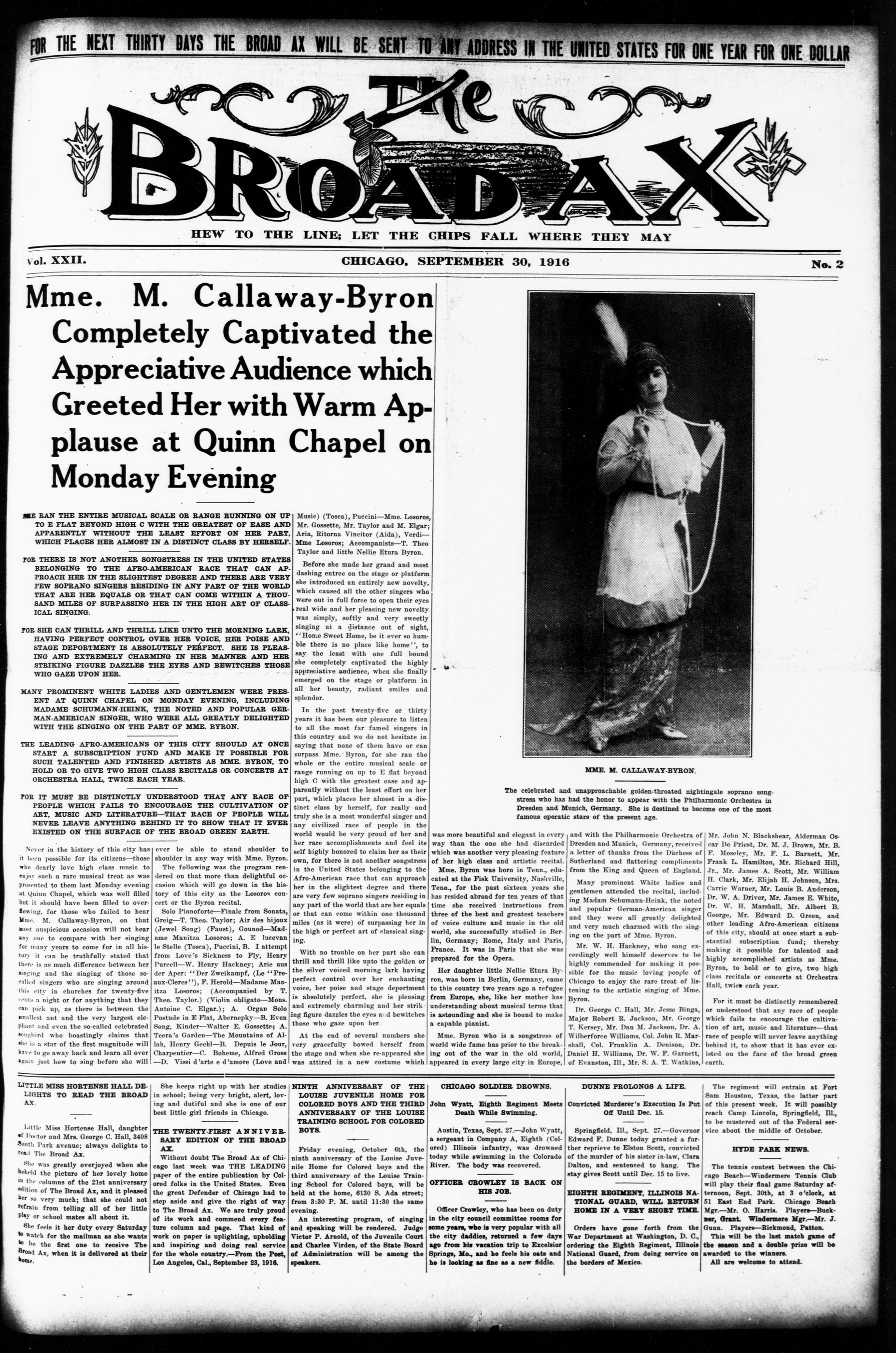
Mme. M. Callaway-Byron Completely Captivated the Appreciative Audience which Greeted Her with Warm Applause at Quinn Chapel on Monday Evening
ME BAN THE ENTIRE MUSICAL SCALE OR RANGE RUNNING ON UP TO E FLAT BEYOND HIGH C WITH THE GREATEST OF EASE AND APPARENTLY WITHOUT THE LEAST EFFORT ON HER PART, WHICH PLACES HER ALMOST IN A DISTINCT CLASS BY HERSELF.
FOR THERE IS NOT ANOTHER SONGSTRESS IN THE UNITED STATES BELONGING TO THE AFRO-AMERICAN RACE THAT CAN APPROACH HER IN THE SLIGHTEST DEGREE AND THERE ARE VERY FEW SOPRANO SINGERS RESIDING IN ANY PART OF THE WORLD THAT ARE HER EQUALS OR THAT CAN COME WITHIN A THOUSAND MILES OF SURPASSING HER IN THE HIGH ART OF CLASSICAL SINGING.
FOR SHE CAN THRILL AND THRILL LIKE UNTO THE MORNING LARK, HAVING PERFECT CONTROL OVER HER VOICE, HER POISE AND STAGE DEPORTMENT IS ABSOLUTELY PERFECT. SHE IS PLEASING AND EXTREMELY CHARMING IN HER MANNER AND HER STRIKING FIGURE DAZZLES THE EYES AND BEWITCHES THOSE WHO GAZE UPON HER.
MANY PROMINENT WHITE LADIES AND GENTLEMEN WERE PRESENT AT QUINN CHAPEL ON MONDAY EVENING, INCLUDING MADAME SCHUMANN-HEINK, THE NOTED AND POPULAR GERMAN-AMERICAN SINGER, WHO WERE ALL GREATLY DELIGHTED WITH THE SINGING ON THE PART OF MME. BYRON.
THE LEADING AFRO-AMERICANS OF THIS CITY SHOULD AT ONCE START A SUBSCRIPT FUND AND MAKE IT POSSIBLE FOR SUCH TALENTED AND FINISHED ARTISTS AS MME. BYRON, TO HOLD OR TO GIVE TWO HIGH CLASS RECITALS OR CONCERTS AT ORCHESTRA HALL, TWICE EACH YEAR.
FOR IT MUST BE DISTINCTLY UNDERSTOOD THAT ANY RACE OF PEOPLE WHICH FAILS TO ENCOURAGE THE CULTIVATION OF ART, MUSIC AND LITERATURE—THAT RACE OF PEOPLE WILL NEVER LEAVE ANYTHING BEHIND IT TO SHOW THAT IT EVER EXISTED ON THE SURFACE OF THE BROAD GREEN EARTH.
Vol. XXII.
Mme. M
Complete
Appreci
Greeted
plause
Monday
SHE RAN THE ENTIRE MUSICAL
TO E FLAT BEYOND HIGH C
APPARENTLY WITHOUT THE
WHICH PLACES HER ALMOST
FOR THERE IS NOT ANOTHER SO
BELONGING TO THE AFRO-
PROACH HER IN THE SLIGHTT
FEW SOPRANO SINGERS RESID
THAT ARE HER EQUALS OR
SAND MILES OF SURPASSING
ICAL SINGING.
FOR SHE CAN THRILL AND THRILL
HAVING PERFECT CONTROL,
STAGE DEPORTMENT IS ABSO
ING AND EXTREMELY CHAR
STRIKING FIGURE DAZZLES
WHO GAZE UPON HER.
MANY PROMINENT WHITE LADIE
ENT AT QUINN CHAPEL OF
MADAME SCHUMANN-HEINK,
MAN-AMERICAN SINGER, WH
WITH THE SINGING ON THE E
THE LEADING AFRO-AMERICANS
START A SUBSCRIPTION FUL
SUCH TALENTED AND FINISH
HOLD OR TO GIVE TWO HIGH
ORCHESTRA HALL, TWICE EAG
FOR IT MUST BE DISTINCTLY U
PEOPLE WHICH FAILS TO BE
ART, MUSIC AND LITERATURE
NEVER LEAVE ANYTHING BE
EXISTED ON THE SURFACE O
Never in the history of this city has it been possible for its citizens—those who dearly love high class music to enjoy such a rare musical treat as was presented to them last Monday evening at Quinn Chapel, which was well filled but it should have been filled to overflowing, for those who failed to hear Mme. M. Callaway-Byron, on that most auspicious occasion will not hear any one to compare with her singing for many years to come for in all history it can be truthfully stated that there is as much difference between her singing and the singing of those so-called singers who are singing around this city in churches for twenty-five cents a night or for anything that they can pick up, as there is between the smallest ant and the very largest elephant and even the so-called celebrated songbird who boastingly claims that she is a star of the first magnitude will have to go away back and learn all over again just how to sing before she will
LITTLE MISS HORTENSE HALL DELIGHTS TO READ THE BROAD AX.
Little Miss Hortense Hall, daughter of Doctor and Mrs. George C. Hall, 3408 South Park avenue; always delights to read The Broad Ax.
She was greatly overjoyed when she beheld the picture of her lovely home in the columns of the 21st anniversary edition of The Broad Ax, and it pleased her so very much; that she could not refrain from telling all of her little play or school mates all about it.
She feels it her duty every Saturday to watch for the mailman as she wants to be the first one to receive The Broad Ax, when it is delivered at their home.
HEW TO THE LINE; LET THE CHIPS FALL WHERE THEY MAY
ever be able to stand shoulder to shoulder in any way with Mme. Byron. The following was the program rendered on that more than delightful occasion which will go down in the history of this city as the Lososors concert or the Byron recital.
Solo Pianoforte—Finale from Sonata, Greig—T. Theo. Taylor; Air des bijoux (Jewel Song) (Faust); Gounod—Madame Manitza Losos; A. E lucevan le Stelle (Tosca), Puccini, B. I attempt from Love's Sickness to Fly, Henry Purcell—W. Henry Hackney; Arie aus der Aper: "Der Zweikampf, (Le "Preaux-Clercs")", F. Herold—Madame Manitza Losos; (Accompanied by T. Theo. Taylor). (Violin obligato—Mons. Antoine C. Elgar.); A. Organ Solo Postine in E Flat, Abernepky—B. Even Song, Kinder—Walter E. Gossette; A. Teera's Garden—The Mountains of Allah, Henry Gechl—B. Depuis le Jour, Charpentier—C. Boheme, Alfred Gross—D. Vissi d'arte e d'amore (Love and
She keeps up with her studies in school; being very bright, alert, loving and dutiful and she is one of our best little girl friends in Chicago.
THE TWENTY-FIRST ANNIVER-
SARY EDITION OF THE BROAD
AX.
Without doubt The Broad Ax of Chicago last week was THE LEADING paper of the entire publication by Colored folks in the United States. Even the great Defender of Chicago had to step aside and give the right of way to The Broad Ax. We are truly proud of its work and commend every feature column and page. That kind of work on paper is uplighting, upholding and inspiring and doing real service for the whole country.-From the Post, Los Angeles, Cal., September 23, 1916.
CHICAGO, SEPTEMBER 30. 1916
Music) (Tosca), Puecini—Mme. Losoros Mr. Gosette, Mr. Taylor and M. Elgar; Aria, Ritorna Vincitor (Aida), Verdi—Mme Losoros; Accompanists—T. Theo Taylor and little Nellie Eura Byron.
Before she made her grand and most dashing entree on the stage or platform she introduced an entirely new novelty, which caused all the other singers who were out in full force to open their eyes real wide and her pleasing new novelty was simply, softly and very sweetly singing at a distance out of sight, "Home Sweet Home, be it ever so humble there is no place like home", to say the least with one full bound she completely captivated the highly appreciative audience, when she finally emerged on the stage or platform in all her beauty, radiant smiles and splendor.
In the past twenty-five or thirty years it has been our pleasure to listen to all the most far famed singers in this country and we do not hesitate in saying that none of them have or can surpass Mme. Byron, for she ran the whole or the entire musical scale or range running on up to E flat beyond high C with the greatest ease and apparently without the least effort on her part, which places her almost in a distinct class by herself, for really and truly she is a most wonderful singer and any civilized race of people in the world would be very proud of her and her rare accomplishments and feel its self highly honored to claim her as their own, for there is not another songstress in the United States belonging to the Afro-American race that can approach her in the slightest degree and there are very few soprano singers residing in any part of the world that are her equals or that can come within one thousand miles (as it were) of surpassing her in the high or perfect art of classical singing.
With no trouble on her part she can thrill and thrill like unto the golden on the silver voiced morning lark having perfect control over her enchanting voice, her poise and stage deportment is absolutely perfect, she is pleasing and extremely charming and her striking figure dazzles the eyes and bewitches those who gaze upon her.
At the end of several numbers she very gracefully bowed herself from the stage and when she re-appeared she was attired in a new costume which
NINTH ANNIVERSARY OF THE LOUISE JUVENILE HOME FOR COLORED BOYS AND THE THIRD ANNIVERSARY OF THE LOUISE TRAINING SCHOOL FOR COLORED BOYS.
Friday evening, October 6th, the ninth anniversary of the Louise Juvenile Home for Colored boys and the third anniversary of the Louise Training School for Colored boys, will be held at the home, 6130 S. Ada street; from 3:30 P. M. until 11:30 the same evening.
An interesting program, of singing and speaking will be rendered. Judge Victor P. Arnold, of the Juvenile Court and Charles Virden, of the State Board of Administration will be among the speakers.
The celebrated and unapproachable golden-throated nightingale soprano song stress who has had the honor to appear with the Philharmonic Orchestra in Dresden and Munich, Germany. She is destined to become one of the most famous operatic stars of the present age.
was more beautiful and elegant in every way than the one she had discarded which was another very pleasing feature of her high class and artistic recital. Mme. Byron was born in Tenn., educated at the Fisk University, Nashville, Tenn., for the past sixteen years she has resided abroad for ten years of that time she received instructions from three of the best and greatest teachers of voice culture and music in the old world, she successfully studied in Berlin, Germany; Rome, Italy and Paris, France. It was in Paris that she was prepared for the Opera.
Her daughter little Nellie Etura Byron, was born in Berlin, Germany, came to this country two years ago a refugee from Europe, she, like her mother has understanding about musical terms that is astounding and she is bound to make a capable pianist.
Mme. Byron who is a songstress of world wide fame has prior to the breaking out of the war in the old world, appeared in every large city in Europe.
CHICAGO SOLDIER DROWNS
Austin, Texas, Sept. 27.—John Wyatt, a sergeant in Company A, Eighth (Colored) Illinois infantry, was drowned today while swimming in the Colorado River. The body was recovered.
OFFICER GROWLEY IS BACK ON
HIS JOB.
Officer Crowley, who has been on duty in the city council committee rooms for some years, who is very popular with all the city daddies, returned a few days ago from his vacation trip to Excelsior Springs, Mo., and he feels his oats and he is looking as fine as a new fiddle.
and with the Philharmonic Orchestra of Dresden and Munich, Germany, received a letter of thanks from the Duchess of Sutherland and flattering compliments from the King and Queen of England.
Many prominent White ladies and gentlemen attended the recital, including Madam Schumann-Heink, the noted and popular German-American singer and they were all greatly delighted and very much charmed with the singing on the part of Mme. Byron.
Mr. W. H. Hackney, who sang exceedingly well himself deserves to be highly commended for making it possible for the music loving people of Chicago to enjoy the rare treat of listening to the artistic singing of Mme. Byron.
Dr. George C. Hall, Mr. Jesse Binga, Major Robert R. Jackson, Mr. George T. Kersey, Mr. Dan M. Jackson, Dr. A. Wilberforce Williams, Col. John R. Marshall, Col. Franklin A. Denison, Dr. Daniel H. Williams, Dr. W. F. Garnett, of Evanston, III, Mr. S. A. T. Watkins.
DUNNE PROLONGS A LIFE.
Convicted Murderer's Execution Is Put Off Until Dec. 15.
Springfield, Ill., Sept. 27.—Governor Edward F. Dunne today granted a further reprieve to Elston Scott, convicted of the murder of his sister in-law, Clara Dalton, and sentenced to hang. The stay gives Scott until Dec. 15 to live.
EIGHTH REGIMENT, ILLINOIS NATIONAL GUARD, WILL RETURN HOME IN A VERY SHORT TIME.
Orders have gone forth from the War Department at Washington, D. C., ordering the Eighth Regiment, Illinois National Guard, from doing service on the borders of Mexico.
No. 2
Mr. John N. Blackshear, Alderman Oscar De Priest, Dr. M. J. Brown, Mr. B. F. Moseley, Mr. F. L. Barnett, Mr. Frank L. Hamilton, Mr. Richard Hill Jr., Mr. James A. Scott, Mr. William H. Clark, Mr. Elijah H. Johnson, Mrs. Carrie Warner, Mr. Louis B. Anderson, Dr. W. A. Driver, Mr. James E. White, Dr. W. H. Marshall, Mr. Albert B. George, Mr. Edward D. Green, and other leading Afro-American citizens of this city, should at once start a substantial subscription fund; thereby making it possible for talented and highly accomplished artists as Mme. Byron, to hold or to give, two high class recitals or concerts at Orchestra Hall, twice each year.
For it must be distinctly remembered or understood that any race of people which fails to encourage the cultivation of art, music and literature—that race of people will never leave anything behind it, to show that it has ever existed on the face of the broad green earth.
The regiment will entrain at Fort Sam Houston, Texas, the latter part of this present week. It will possibly reach Camp Lincoln, Springfield, Ill., to be mustered out of the Federal service about the middle of October.
HYDE PARK NEWS.
The tennis contest between the Chicago Beach—Windermere Tennis Club will play their final game Saturday afternoon, Sept. 30th, at 3 o'clock, at 51 East End Park. Chicago Beach Mgr.—Mr. O. Harris. Players—Buckner, Grant. Windermere Mgr.—Mr. J. Gunn. Players—Riekmond, Patton. This will be the last match game of the season and a double prize will be awarded to the winners.
All are welcome to attend.
PAGE TWO
ABETROTHED LADY
The Daughter of the Former Mary Leiter, Chicago.
HER MARRIAGE A LOVE MATCH
Still In Her Teens, Lady Irene Resembles Her American Mother and Is Said to Be Devoted to the United States.
The marriage of Lord Curzon's eldest daughter, Lady Irene Curzon, to Mr. Guy Benson will be a love match, and the engagement has astonished a great many people, who took it for granted that Lord Curzon would in-
A
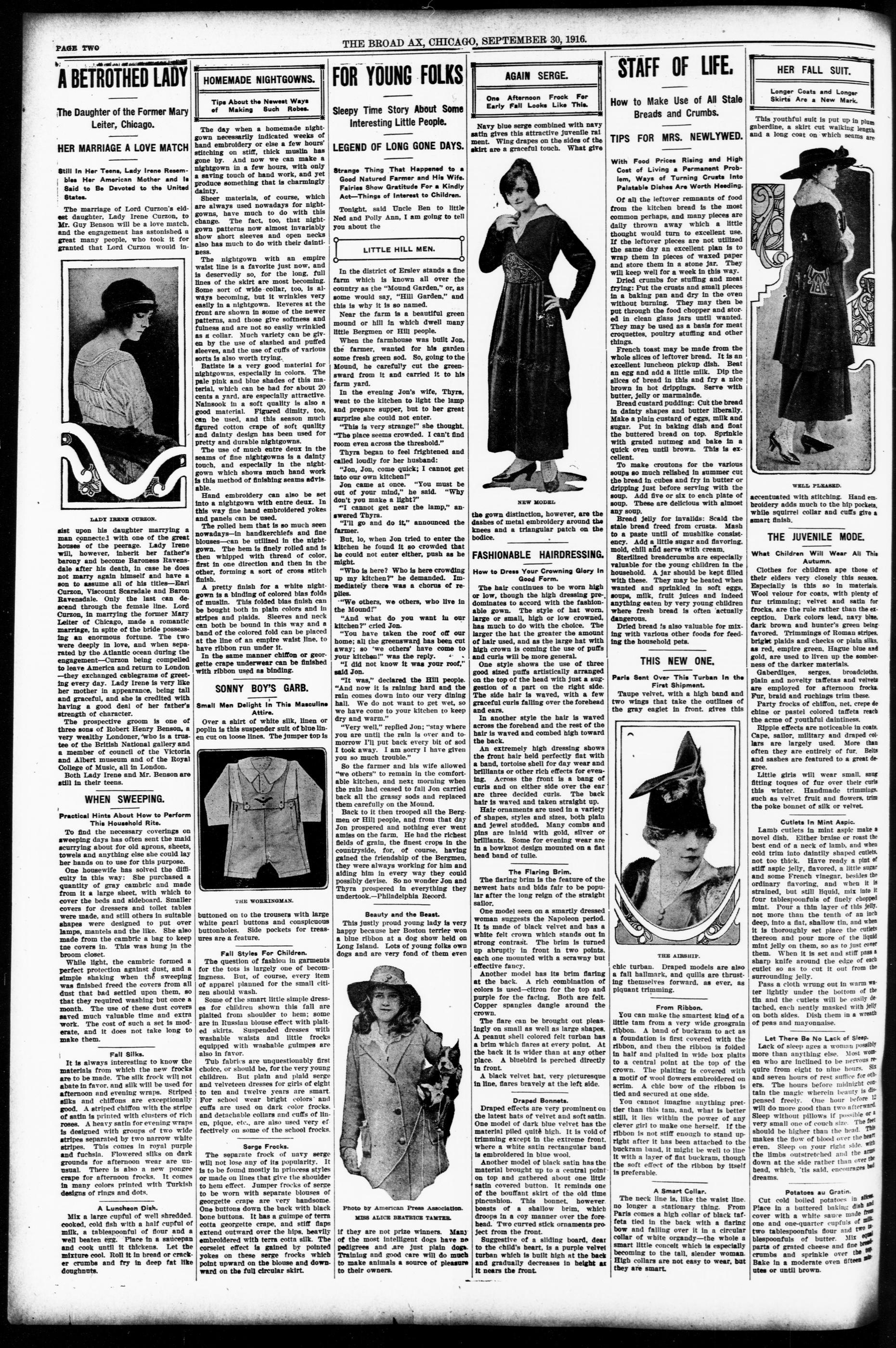
LADY IRENE CURZON.
sist upon his daughter marrying a man connected with one of the great houses of the peerage. Lady Irene will, however, inherit her father's barony and become Baroness Ravensdale after his death, in case he does not marry again himself and have a son to assume all of his titles—Earl Curzon, Viscount Scarsdale and Baron Ravensdale. Only the last can descend through the female line. Lord Curzon, in marrying the former Mary Leiter of Chicago, made a romantic marriage, in spite of the bride possessing an enormous fortune. The two were deeply in love, and when separated by the Atlantic ocean during the engagement—Curzon being compelled to leave America and return to London—the exchanged cablegrams of greeting every day. Lady Irene is very like her mother in appearance, being tall and graceful, and she is credited with having a good deal of her father's strength of character.
The prospective groom is one of three sons of Robert Henry Benson, a very wealthy Londoner, who is a trustee of the British National gallery and a member of council of the Victoria and Albert museum and of the Royal College of Music, all in London. Both Lady Irene and Mr. Benson are still in their teens.
WHEN SWEEPING.
Practical Hints About How to Perform This Household Rite.
To find the necessary coverings on sweeping days has often sent the maid scurrying about for old aprons, sheets, towels and anything else she could lay her hands on to use for this purpose.
One housewife has solved the difficulty in this way: She purchased a quantity of gray cambric and made from it a large sheet, with which to cover the beds and sideboard. Smaller covers for dressers and toilet tables were made, and still others in suitable shapes were designed to put over lamps, mantels and the like. She also made from the cambric a bag to keep the covers in. This was hung in the broom closet.
While light, the cambric formed a perfect protection against dust, and a simple shaking when the sweeping was finished freed the covers from all dust that had settled upon them, so that they required washing but once a month. The use of these dust covers saved much valuable time and extra work. The cost of such a set is moderate, and it does not take long to make them.
Fall Silks.
It is always interesting to know the materials from which the new frocks are to be made. The silk frock will not abate in favor, and silk will be used for afternoon and evening wraps. Striped silks and chiffons are exceptionally good. A striped chiffon with the stripe of satin is printed with clusters of rich roses. A heavy satin for evening wraps is designed with groups of two wide stripes separated by two narrow white stripes. This comes in royal purple and fuchsia. Flowered silks on dark grounds for afternoon wear are unusual. There is also a new ponge crape for afternoon frocks. It comes in many colors printed with Turkish designs of rings and dots.
A. Luncheon Dish.
Mix a large cupful of well shredded, cooked, cold fish with a half cupful of milk, a tablespoonful of flour and a well beaten egg. Place in a saucepan and cook until it thickens. Let the mixture cool. Roll it in bread or cracker crumbs and fry in deep fat like doughnuts.
-
HOMEMADE NIGHTGOWNS.
Tips About the Newest Ways of Making Such Robes.
The day when a homemade nightgown necessarily indicated weeks of hand embroidery or else a few hours' stitching on stiff, thick muslin has gone by. And now we can make a nightgown in a few hours, with only a saving touch of hand work, and yet produce something that is charmingly dainty.
Sheer materials, of course, which are always used nowadays for nightgowns, have much to do with this change. The fact, too, that nightgown patterns now almost invariably show short sleeves and open necks also has much to do with their daintiness.
The nightgown with an empire waist line is a favorite just now, and is deservedly so, for the long, full lines of the skirt are most becoming. Some sort of wide-collar, too, is always becoming, but it wrinkles very easily in a nightgown. Reveres at the front are shown in some of the newer patterns, and those give softness and fulness and are not so easily wrinkled as a collar. Much variety can be given by the use of slashed and puffed sleeves, and the use of cuffs of various sorts is also worth trying. Batiste is a very good material for nightgowns, especially in colors. The pale pink and blue shades of this material, which can be had for about 20 cents a yard, are especially attractive. Nainsook in a soft quality is also a good material. Figured dimity, too, can be used, and this season much figured cotton crape of soft quality and dainty design has been used for pretty and durable nightgowns.
The use of much entre deux in the seams of fine nightgowns is a dainty touch, and especially in the nightgown which shows much hand work is this method of finishing seams advisable.
Hand embroidery can also be set into a nightgown with entre deux. In this way fine hand embroidered yokes and panels can be used.
The rolled hem that is so much seen nowadays—in handkerchiefs and fine blouses—can be utilized in the nightgown. The hem is finely rolled and is then whipped with thread of color, first in one direction and then in the other, forming a sort of cross stitch finish.
A pretty finish for a white night-gown is a binding of colored blas folds of muslin. This folded bias finish can be bought both in plain colors and in stripes and plaids. Sleeves and neck can both be bound in this way and a band of the colored fold can be placed at the line of an empire waist line. to have ribbon run under it.
In the same manner chiffon or georgette crape underwear can be finished with ribbon used as binding.
SONNY BOY'S GARB.
Small Men Delight In This Masculine
Attire.
Over a shirt of white silk, linen or
poplin is this suspender suit of blue lin-
en cut on loose lines. The jumper top is
THE WORKINGMAN.
buttoned on to the trousers with large white pearl buttons and conspicuous buttonholes. Side pockets for treasures are a feature.
Fall Styles For Children.
The question of fashion in garments for the tots is largely one of becomingness. But, of course, every item of apparel planned for the small citizen should wash.
Some of the smart little simple dresses for children shown this fall are plaited from shoulder to hem; some are in Russian blouse effect with plaited skirts. Suspended dresses with washable waists and little frocks equipped with washable gulmpes are also in favor.
Tub fabrics are unquestionably first choice, or should be, for the very young children. But plain and plaid serge and velveten dresses for girls of eight to ten and twelve years are smart. For school wear bright colors and cuffs are used on dark color frocks, and detachable collars and cuffs of linen, plique, etc., are also used very effectively on some of the school frocks.
Serge Frocks.
The separate frock of navy serge will not lose any of its popularity. It is to be found mostly in princess styles or made on lines that give the shoulder to hem effect. Jumper frocks of serge to be worn with separate blouses of georgette crape are very handsome. One buttons down the back with black bone buttons. It has a guipa of terra cotta georgette crape, and stiff flaps extend outward over the hips, heavily embroidered with terra cotta silk. The corsetlet effect is gained by pointed yokes on these serge frocks which point upward on the blouse and downward on the full circular skirt.
THE BROAD AX, CHICAGO, SEPTEMBER 30, 1916.
FOR YOUNG FOLKS
FOR YOUNG FOLKS
Sleepy Time Story About Some Interesting Little People.
LEGEND OF LONG GONE DAYS.
Strange Thing That Happened to a Good Natured Farmer and His Wife. Fairies Show Gratitude For a Kindly Act—Things of Interest to Children.
Tonight, said Uncle Ben to little Ned and Polly Ann, I am going to tell you about the
LITTLE HILL MEN.
In the district of Erslev stands a fine farm which is known all over the country as the "Mound Garden," or, as some would say, "Hill Garden," and this is why it is so named.
Near the farm is a beautiful green mound or hill in which dwell many little Bergmen or Hill people.
When the farmhouse was built Jon, the farmer, wanted for his garden some fresh green sod. So, going to the Mound, he carefully cut the green-sward from it and carried it to his farm yard.
In the evening Jon's wife, Thyra, went to the kitchen to light the lamp and prepare supper, but to her great surprise she could not enter.
"This is very strange!" she thought.
"The place seems crowded. I can't find room even across the threshold."
Thyra began to feel frightened and called loudly for her husband:
"Jon, Jon, come quick; I cannot get into our own kitchen!"
Jon came at once. "You must be out of your mind," he said. "Why don't you make a light?"
"I cannot get near the lamp," answered Thyra.
"I'll go and do it," announced the farmer.
But, lo, when Jon tried to enter the kitchen he found it so crowded that he could not enter either, push as he might.
"Who is here? Who is here crowding up my kitchen?" he demanded. Immediately there was a chorus of replies.
"We others, we others, who live in the Mound!"
"And what do you want in our kitchen?" cried Jon.
"You have taken the roof off our home; all the greenens has been cut away; so 'we others' have come to your kitchen!" was the reply.
"I did not know it was your roof," said Jon.
"It was," declared the Hill people. "And now it is raining hard and the rain comes down into our very dining hall. We do not want to get wet, so we have come to your kitchen to keep dry and warm."
"Very well," repiled Jon; "stay where you are until the rain is over and to tomorrow I'll put back every bit of sod I took away. I am sorry I have given you so much trouble."
So the farmer and his wife allowed "we others" to remain in the comfortable kitchen, and next morning when the rain had ceased to fall Jon carried back all the grassy sods and replaced them carefully on the Mound.
Back to it then trooped all the Bergmen or Hill people, and from that day Jon prospered and nothing ever went amiss on the farm. He had the richest fields of grain, the finest crops in the countryside, for, of course, having gained the friendship of the Bergmen, they were always working for him and alding him in every way they could possibly devise. So no wonder Jon and Thyra prospered in everything they undertook.-Philadelphia Record.
Beauty and the Beast.
This justly proud young lady is very happy because her Boston terrier won a blue ribbon at a dog show held on Long Island. Lots of young folks own dogs and are very fond of them even
A
Photo by American Press Association.
MISS ALICE BEATRICE TAMTER.
if they are not prize winners. Many
of the most intelligent dogs have no
pedigrees and are just plain dogs.
Training and good care will do much
to make animals a source of pleasure
to their owners.
AGAIN SERGE.
One Afternoon Frock For Early Fall Looks Like This.
Navy blue serge combined with navy satin gives this attractive juvenile ralment. Wing drapes on the sides of the skirt are a graceful touch. What give
1
NEW MODEL
the gown distinction, however, are the dashes of metal embroidery around the knees and a triangular patch on the bodice.
FASHIONABLE HAIRDRESSING.
How to Dress Your Crowning Glory In Good Form.
The hair continues to be worn high or low, though the high dressing predominates to accord with the fashionable gown. The style of hat worn large or small, high or low crowned, has much to do with the choice. The larger the hat the greater the amount of hair used, and as the large hat with high crown is coming the use of puffs and curls will be more general.
One style shows the use of three good sized puffs artistically arranged on the top of the head with just a suggestion of a part on the right side.
The side hair is waved, with a few graceful curls falling over the forehead and ears.
In another style the hair is waved across the forehead and the rest of the hair is waved and combed high toward the back.
An extremely high dressing shows the front hair held perfectly flat with a band, tortoise shell for day wear and brillants or other rich effects for evening. Across the front is a bang of curls and on either side over the ear are three decided curls. The back hair is waved and taken straight up. Hair ornaments are used in a variety of shapes, styles and sizes, both plain and jewel studded. Many combs and pins are inlaid with gold, silver or brillants. Some for evening wear are in a bowknot design mounted on a flat head band of tulle.
The Flaring Brim
The flaring brim is the feature of the newest hats and bids fair to be popular after the long reign of the straight sailor.
One model seen on a smartly dressed woman suggests the Napoleon period. It is made of black velvet and has a white felt crown which stands out in strong contrast. The brim is turned up abruptly in front in two points, each one mounted with a scrawny but effective fancy.
Another model has its brim flaring at the back. A rich combination of colors is used—citron for the top and purple for the facing. Both are felt. Copper spangles dangle around the crown.
The flare can be brought out pleasingly on small as well as large shapes. A peanut shell colored felt turban has a brim which flares at every point. At the back it is wider than at any other place. A bluebird is perched directly in front. A black velvet hat, very picturesque in line, flares bravely at the left side.
Draped Bonnets.
Draped effects are very prominent on the latest hats of velvet and soft satin. One model of dark blue velvet has the material piled quite high. It is void of trimming except in the extreme front, where a white satin rectangular band is embroidered in blue wool.
Another model of black satin has the material brought up to a central point on top and gathered about one little satin covered button. It reminds one of the bouffant skirt of the old time pincushion. This bonnet, however, boasts of a shallow brim, which droops in a coy manner over the forehead. Two curved stick ornaments project from the front.
Suggestive of a sliding board, dear to the child's heart, is a purple velvet turban which is built high at the back and gradually decreases in height as it nears the front.
STAFF OF LIFE.
How to Make Use of All Stale Breads and Crumbs.
TIPS FOR MRS. NEWLYWED.
With Food Prices Rising and High Cost of Living a Permanent Problem, Ways of Turning Crusts Into Palatable Dishes Are Worth Heeding.
Of all the leftover remnants of food from the kitchen bread is the most common perhaps, and many pieces are daily thrown away which a little thought would turn to excellent use.
If the leftover pieces are not utilized the same day an excellent plan is to wrap them in pieces of waxed paper and store them in a stone jar. They will keep well for a week in this way.
Dried crumbs for stuffing and meat frying: Put the crusts and small pieces in a baking pan and dry in the oven without burning. They may then be put through the food chopper and stored in clean glass jars until wanted. They may be used as a basis for meat croquettes, poultry stuffing and other things.
French toast may be made from the whole slices of leftover bread. It is an excellent luncheon pickup dish. Beat an egg and add a little milk. Dip the slices of bread in this and fry a nice brown in hot drippings. Serve with butter, jelly or marmalade.
Bread custard pudding: Cut the bread in dainty shapes and butter liberally. Make a plain custard of eggs, milk and sugar. Put in baking dish and float the buttered bread on top. Sprinkle with grated nutmeg and bake in a quick oven until brown. This is excellent.
To make croutons for the various soups so much relished in summer cut the bread in cubes and fry in butter or dripping just before serving with the soup. Add five or six to each plate of soup. These are delicious with almost any soup.
Bread jelly for invalids: Scald the stale bread freed from crusts. Mash to a paste until of mushlike consistency. Add a little sugar and flavoring, mold, chill and serve with cream.
Sterilized breadcrumbs are especially valuable for the young children in the household. A jar should be kept filled with these. They may be heated when wanted and sprinkled in soft eggs, soups, milk, fruit juices and indeed anything eaten by very young children where fresh bread is often actually dangerous.
Dried bread is also valuable for mixing with various other foods for feeding the household pets.
THIS NEW ONE.
Paris Sent Over This Turban In the First Shipment. Taupe velvet, with a high band and two wings that take the outlines of the gray eaglet in front, gives this
A
THE AIRSHIP.
chic turban. Draped models are also a fall hallmark, and quilts are thrusting themselves forward, as ever, as pliant trimming.
From Ribbon
You can make the smartest kind of a little tam from a very wide grosgrain ribbon. A band of buckram to act as a foundation is first covered with the ribbon, and then the ribbon is folded in half and plaited in wide box plaits to a central point at the top of the crown. The plaiting is covered with a motif of wool flowers embroidered on scrim. A chic bow of the ribbon is tied and secured at one side. You cannot imagine anything pretier than this tam, and, what is better still, it lies within the power of any clever girl to make one herself. If the ribbon is not stiff enough to stand upright after it has been attached to the buckram band, it might be well to line it with a layer of flat buckram, though the soft effect of the ribbon by itself is preferable.
A Smart Collar
The neck line is, like the waist line, no longer a stationary thing. From Paris comes a high collar of black taffeta tied in the back with a flaring bow and falling over it in a circular collar of white organdy—the whole a smart little conceit which is especially becoming to the tall, slender woman. High collars are not easy to wear, but they are smart.
HER FALL SUIT.
Longer Coats and Longer Skirts Are a New Mark.
This youthful suit is put up in plum gaberdine, a skirt cut walking length and a long coat on which seams are
A
WELL PLEASED.
accentuated with stitching. Hand embroidery adds much to the hip pockets,
while squirrel collar and cuffs give a smart finish.
THE JUVENILE MODE
What Children Will Wear All This Autumn.
Clothes for children ape those of their elders very closely this season. Especially is this so in materials. Wool velour for coats, with plenty of fur trimming; velvet and satin for frocks, are the rule rather than the exception. Dark colors lead, navy blue, dark brown and hunter's green being favored. Trimmings of Roman stripes, bright plaids and checks or plain silks, as red, empire green, Hague blue and gold, are used to liven up the somberness of the darker materials.
Gabardines, serges, broadcloths, plain and novelty taffetas and velvets are employed for afternoon frocks. Fur, braid and ruchings trim these.
Party frocks of chiffon, net, crepe de chine or pastel colored taffeta reach the acme of youthful daintiness.
Ripple effects are noticeable in coats, Cape, sailor, military and draped collars are largely used. More than often they are entirely of fur. Belts and sashes are featured to a great degree.
Little girls will wear small, snug fitting toques of fur over their curls this winter. Handmade trimmings, such as velvet fruit and flowers, trim the poke bonnet of silk or velvet.
Cutlets In Mint Aspic
Lamb cutlets in mint aspic make a novel dish. Either braise or roast the best end of a neck of lamb, and when cold trim into daintily shaped cutlets, not too thick. Have ready a pint of stiff aspic jelly, flavored, a little sugar and some French vinegar, besides the ordinary flavoring, and when it is strained, but still liquid, mix into it four tablespoonfuls of finely chopped mint. Pour a thin layer of this jelly, not more than the tenth of an inch deep, into a flat, shallow tin, and when it is thoroughly set place the cutlets thereon and pour more of the liquid mint jelly on them, so as to just cover them. When it is set and stiff pass a sharp knife around the edge of each cutlet so as to cut it out from the surrounding jelly.
Pass a cloth wrung out in warm water lightly under the bottom of the tin and the cutlets will be easily detached, each neatly masked with jelly on both sides. Dish them in a wreath of peas and mayonnaise.
Let There Be No Lack of Sleep.
Let There Be No Lack of Sleep.
Lack of sleep ages a woman possibly more than anything else. Most women who are inclined to be nervous require from eight to nine hours. Sizes and seven hours of rest suffice for others. The hours before midnight contain the magic wherein beauty is dispensed freely. One hour before 12 will do more good than two afterward. Sleep without pillows if possible or a very small one of couch size. The feet should be higher than the head. This makes the flow of blood over the heart even. Sleep on your right side, with the limbs outstretched and the arms down at the side rather than over the head, which, 'tis said, encourages bad dreams.
Potatoes au Gratin
Cut cold boiled potatoes in silice Place in a buttered baking dish and cover with a white sauce made from one and one-quarter cupfuls of milk two tablespoonfuls flour and two tablespoonfuls of butter. Mix equal parts of grated cheese and fine breadcrumbs and sprinkle over the top Bake in a moderate oven fifteen minutes or until brown.
Marconi Finds Nothing Notable Has Been Perfected During 'War.
USE OF POISONOUS GASES OLD
Big Lesson of Conflict In Europe Is One of Organization and Transportation. At Work on Signal System Which Will Render Far More Difficult Submarine Warfare.
Rome.—No notable scientific discoveries or inventions are growing out of the great war, in the opinion of William Marconi, the wireless inventor. In a recent interview he declared: "As for war inventions, on the whole there have been no great ones that occur to me. Most of them have been minor ones or applications of knowledge previously at our disposal, 'as in the case of poison gases, if these may
X
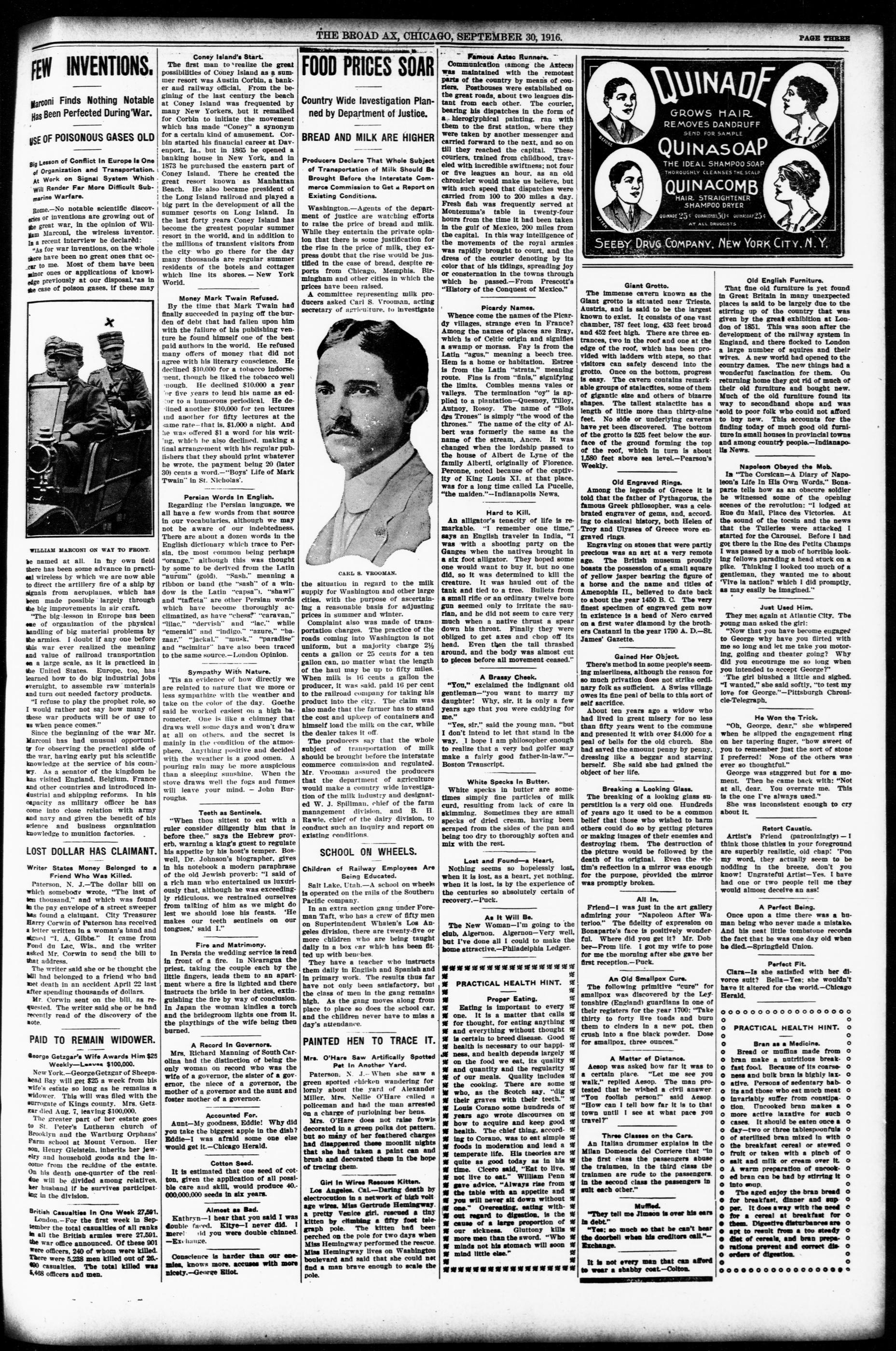
WILLIAM MARCONI ON WAY TO FRONT.
he named at all. In my own field there has been some advance in practical wireless by which we are now able to direct the artillery fire of a ship by signals from aeroplanes, which has been made possible largely through the big improvements in air craft.
"The big lesson in Europe has been one of organization of the physical handling of big material problems by the armies. I doubt if any one before this war ever realized the meaning and value of railroad transportation on a large scale, as it is practiced in the United States. Europe, too, has learned how to do big industrial jobs overnight, to assemble raw materials and turn out needed factory products.
"I refuse to play the prophet role, so I would rather not say how many of these war products will be of use to us when peace comes."
Since the beginning of the war Mr. Marconi has had unusual opportunity for observing the practical side of the war, having early put his scientific knowledge at the service of his country. As a senator of the kingdom he has visited England, Belgium, France and other countries and introduced industrial and shipping reforms. In his capacity as military officer he has come into close relation with army and navy and given the benefit of his science and business organization knowledge to munition factories.
LOST DOLLAR HAS CLAIMANT
Writer States Money Belonged to a Friend Who Was Killed.
Paterson, N. J.—The dollar bill on which somebody wrote, "The last of ten thousand," and which was found in the pay envelope of a street sweeper has found a claimant. City Treasurer Harry Corwin of Paterson has received a letter written in a woman's hand and signed "I. A. Gibbs." It came from Fond du Lac, Wis., and the writer asked Mr. Corwin to send the bill to that address.
The writer said she or he thought the bill had belonged to a friend who had met death in an accident April 22 last after spending thousands of dollars.
Mr. Corwin sent on the bill, as requested. The writer said she or he had recently read of the discovery of the note.
PAID TO REMAIN WIDOWER.
George Getzgar's Wife Awards Him $25
Weekly—Leaves $100,000.
New York.—George Getzgar of Sheeps-
head Bay will get $25 a week from his
wife's estate so long as he remains a
widower. This will was filed with the
surrogate of Kings county. Mrs. Getz
gar died Aug. 7, leaving $100,000.
The greater part of her estate goes
to St. Peter's Lutheran church of
Brooklyn and the Warburg Orphan's
Farm school at Mount Vernon. Her
son, Henry Gleisten, inherits her Jewelry and household goods and the income from the residue of the estate.
On his death one-quarter of the resi-
due will be divided among relatives,
her husband if he survives participa-
ting in the division.
British Casualties In One Week 27,591
London. - For the first week in September the total casualties of all ranks in all the British armies were 27,591,
the war office announced. Of these 901 were officers, 240 of whom were killed.
There were 5,238 men killed out of 26,600 casualties. The total killed was 5,488 officers and men.
Coney Island's Start.
The first man to realize the great possibilities of Coney Island as a summer resort was Austin Corbin, a banker and railway official. From the beginning of the last century the beach at Coney Island was frequented by many New Yorkers, but it remained for Corbin to initiate the movement which has made "Coney" a synonym for a certain kind of amusement. Corbin started his financial career at Davenport, Ia., but in 1865 he opened a banking house in New York, and in 1873 he purchased the eastern part of Coney Island. There he created the great resort known as Manhattan Beach. He also became president of the Long Island railroad and played a big part in the development of all the summer resorts on Long Island. In the last forty years Coney Island has become the greatest popular summer resort in the world, and in addition to the millions of transient visitors from the city who go there for the day many thousands are regular summer residents of the hotels and cottages which line its shores. - New York World.
Money Mark Twain Refused.
Money Mark Twain Refused.
By the time that Mark Twain had finally succeeded in paying off the burden of debt that had fallen upon him with the failure of his publishing venture he found himself one of the best paid authors in the world. He refused many offers of money that did not agree with his literary conscience. He declined $10,000 for a tobacco indorsement, though he liked the tobacco well enough. He declined $10,000 a year for five years to lend his name as editor to a humorous periodical. He declined another $10,000 for ten lectures and another for fifty lectures at the same rate—that is, $1,000 a night. And he was offered $1 a word for his writing, which he also declined, making a final arrangement with his regular publishers that they should print whatever he wrote, the payment being 20 (later 30) cents a word.—"Boys' Life of Mark Twain" in St. Nicholas'.
Persian Words In English
Regarding the Persian language, we all have a few words from that source in our vocabularies, although we may not be aware of our indebtedness. There are about a dozen words in the English dictionary which trace to Persia, the most common being perhaps "orange." although this was thought by some to be derived from the Latin "aurum" (gold). "Sash," meaning a ribbon or band (the "sash" of a window is the Latin "capsa"), "shawl" and "taffeta" are other Persian words which have become thoroughly acclimatized, as have "chess" "caravan," "iliac," "dervish" and "lac." while "emerald" and "indigo." "azure," "bazaar," "jackal." "musk," "paradise" and "scimitar" have also been traced to the same source.-London Opinion.
Sympathy With Nature.
'Tis an evidence of how directly we are related to nature that we more or less sympatize with the weather and take on the color of the day. Goethe said he worked easiest on a high barometer. One is like a chimney that draws well some days and won't draw at all on others, and the secret is mainly in the condition of the atmosphere. Anything positive and decided with the weather is a good omen. A pouring rain may be more auspicious than a sleeping sunshine. When the stove draws well the fogs and fumes will leave your mind. - John Burroughs.
Teeth as Sentinels
"When thou sittest to eat with a ruler consider diligently him that is before thee," says the Hebrew proverb, warning a king's guest to regulate his appetite by his host's temper. Boswell, Dr. Johnson's biographer, gives in his notebook a modern paraphrase of the old Jewish proverb: "I said of a rich man who entertained us luxuriously that, although he was exceedingly ridiculous, we restrained ourselves from talking of him as we might do lest we should lose his feasts. 'He makes our teeth sentinels on our tongues,' said I."
Fire and Matrimony.
In Persia the wedding service is read in front of a fire. In Nicaragua the priest, taking the couple each by the little fingers, leads them to an apartment where a fire is lighted and there instructs the bride in her duties, extinguishes the fire by way of conclusion. In Japan the woman kindles a torch and the bridegroom lights one from it. the playthings of the wife being then burned.
A Record In Governors.
Mrs. Richard Manning of South Carolina had the distinction of being the only woman on record who was the wife of a governor, the sister of a governor, the niece of a governor, the mother of a governor and the aunt and foster mother of a governor.
Accounted For.
Aunt--My goodness, Eddie! Why did you take the biggest apple in the dish? Eddie--I was afraid some one else would get it.-Chicago Herald.
Cotton Seed.
It is estimated that one seed of cotton, given the application of all possible care and skill, would produce 40.000,000,000 seeds in six years.
Almost as Bad.
Kathryn—I hear that you said I was double faced. Kitye—I never did. I merel—I did you were double chinned. —Exchange.
Conscience is harder than our enemies, knows more, accuses with more nicety.—George Elliot.
THE BROAD AX, CHICAGO, SEPTEMBER 30, 1916.
FOOD PRICES SOAR
Country Wide Investigation Planned by Department of Justice.
BREAD AND MILK ARE HIGHER
Producers Declare That Whole Subject of Transportation of Milk Should Be Brought Before the Interstate Commerce Commission to Get a Report on Existing Conditions.
Washington.-Agents of the department of justice are watching efforts to raise the price of bread and milk. While they entertain the private opinion that there is some justification for the rise in the price of milk, they express doubt that the rise would be justified in the case of bread, despite reports from Chicago, Memphis, Birmingham and other cities in which the prices have been raised.
A committee representing milk producers asked Carl S. Vrooman, acting secretary of agriculture, to investigate
[Name]
CARL S. VROOMAN.
the situation in regard to the milk supply for Washington and other large cities, with the purpose of ascertaining a reasonable basis for adjusting prices in summer and winter.
Complaint also was made of transportation charges. The practice of the roads coming into Washington is not uniform, but a majority charge $2\frac{1}{2}$ cents a gallon or 25 cents for a ten gallon can, no matter what the length of the haul may be up to fifty miles. When milk is 16 cents a gallon the producer, it was said, paid 16 per cent to the railroad company for taking his product into the city. The claim was also made that the farmer has to stand the cost and upkeep of containers and himself load the milk on the car, while the dealer takes it off.
The producers say that the whole subject of transportation of milk should be brought before the interstate commerce commission and regulated. Mr. Vroman assured the producers that the department of agriculture would make a country wide investigation of the milk industry and designated W. J. Spillman, chief of the farm management division, and B. H. Rawle, chief of the dairy division, to conduct such an inquiry and report on existing conditions.
SCHOOL ON WHEELS.
Children of Railway Employees Are Being Educated.
Salt Lake, Utah.—A school on wheels is operated on the rails of the Southern Pacific company.
In an extra section gang under Foreman Taft, who has a crew of fifty men on Superintendent Whaten's Los Angeles division, there are twenty-five or more children who are being taught daily in a box car which has been fitted up with benches.
They have a teacher who instructs them daily in English and Spanish and in primary work. The results thus far have not only been satisfactory, but the class of men in the gang remains high. As the gang moves along from place to place so does the school car, and the children never have to miss a day's attendance.
PAINTED HEN TO TRACE IT.
Mrs. O'Hare Saw Artificially Spotted Pet In Another Yard.
Paterson, N. J.-When she saw a green spotted chicken wandering for lorny about the yard of Alexander Miller. Mrs. Nellie O'Hare called a policeman and had the man arrested on a charge of purloining her hens.
Mrs. O'Hare does not raise fowls decorated in a green polka dot pattern, but so many of her feathered charges had disappeared these moonlit nights that she had taken a paint can and brush and decorated them in the hope of tracing them.
Girl In Wires Rescues Kitten
Los Angeles. Cal-Daring death by electrocution in a network of high voltage wires. Miss Gertrude Hemingway, a pretty Venice girl, rescued a tiny kitten by climbing a fifty foot telegraph pole. The kitten had been perched on the pole for two days when Miss Hemingway performed the rescue. Miss Hemingway lives on Washington boulevard and said that she could not find a man brave enough to scale the pole.
Famous Aztec Runners
Communication (among the Aztecs) was maintained with the remotest parts of the country by means of couriers. Posthouses were established on the great roads, about two leagues distant from each other. The courier, bearing his dispatches in the form of a hieroglyphical painting, ran with them to the first station, where they were taken by another messenger and carried forward to the next, and so on till they reached the capital. These couriers, trained from childhood, traveled with incredible swiftness; not four or five leagues an hour, as an old chronicle would make us believe, but with such speed that dispatches were carried from 100 to 200 miles a day. Fresh fish was frequently served at Montezuma's table in twenty-four hours from the time it had been taken in the gulf of Mexico, 200 miles from the capital. In this way intelligence of the movements of the royal armies was rapidly brought to court, and the dress of the courier denoting by its color that of his tidings, spreading joy or consternation in the towns through which he passed.—From Prescott's "History of the Conquest of Mexico."
Picardy Names.
Whence come the names of the Picardy villages, strange even in France? Among the names of places are Bray, which is of Celtic origin and signifies a swamp or morass. Fay is from the Latin "agus," meaning a beech tree. Hem is a home or habitation. Estree is from the Latin "strata," meaning route. Fins is from "finis," signifying the limits. Combles means vales or valleys. The termination "oy" is applied to a plantation—Quesnoy, Tilloy, Autnoy, Rosoy. The name of "Bols des Trones" is simply "the wood of the thrones." The name of the city of Albert was formerly the same as the name of the stream, Ancre. It was changed when the lordship passed to the house of Albert de Lyne of the family Alberti, originally of Florence. Peronne, noted because of the captivity of King Louis XI. at that place, was for a long time called La Pucelle, "the malden." -Indianapolis News.
Hard to Kill.
An alligator's tenacity of life is remarkable. "I remember one time," says an English traveler in India, "I was with a shooting party on the Ganges when the natives brought in a six foot alligator. They hoped some one would want to buy it, but no one did, so it was determined to kill the creature. It was hauled out of the tank and tied to a tree. Bullets from a small rifle or an ordinary twelve bore gun seemed only to irritate the saurian, and he did not seem to care very much when a native thrust a spear down his throat. Finally they were obliged to get axes and chop off its head. Even then the tall thrashed around, and the body was almost cut to pieces before all movement ceased."
A. Brassy Cheek.
"You," exclaimed the indignant old gentleman—"you want to marry my daughter! Why, sir, it is only a few years ago that you were caddying for me."
"Yes, sir," said the young man, "but I don't intend to let that stand in the way. I hope I am philosopher enough to realize that a very bad golfer may make a fairly good father-in-law."—Boston Transcript.
White Specks In Butter.
White specks in butter are sometimes simply fine particles of milk curd, resulting from lack of care in skimming. Sometimes they are small specks of dried cream, having been scraped from the sides of the pan and being too dry to thoroughly soften and mix with the rest.
Lost and Found—a Heart.
Nothing seems so hopelessly lost, when it is lost, as a heart, yet nothing, when it is lost, is by the experience of the centuries so absolutely certain of recovery.—Puck.
As It Will Be.
The New Woman—I'm going to the club, Algenorm. Algenorm—Very well, but I've done all I could to make the home attractive—Philadelphia Ledger.
```markdown
```
PRACTICAL HEALTH HINT.
Proper Eating.
Eating is important to every one. It is a matter that calls for thought, for eating anything and everything without thought is certain to breed disease. Good health is necessary to our happiness, and health depends largely on the food we eat, its quality and quantity and the regularity of our meals. Quality includes the cooking. There are some who, as the Scotch say, "dig their graves with their teeth." Louis Corano some hundreds of years ago wrote discourses on how to acquire and keep good health. The chief thing, according to Corano, was to eat simple foods in moderation and lead a temperate life. His theories are quite as good today as in his time. Cicero said, "Eat to live, not live to eat." William Penn gave advice. "Always rise from the table with an appetite and you will never sit down without one." Overeating, eating without regard to digestion, is the cause of a large proportion of our sickness. Gluttony kills more men than the sword. "Who minds not his stomach will soon mind little else."
---
QUINADE
GROWS HAIR
REMOVES DANDRUFF
SEMD FOR SAMPLE
QUINASOAP
THE IDEAL SHAMPOO SOAP
THOROUGHLY CLEANSSES THE SCALP
QUINACOMB
HAIR STRAIGHTENER
SHAMPOO DRYER
QUINADE 25¢ QUINACOMB50¢ QUINASOAP 25¢
AT ALL DRUGGISTS
SEEBY DRUG COMPANY. NEW YORK CITY. N. Y.
Giant Grotto.
The immense cavern known as the Giant grotto is situated near Trieste, Austria, and is said to be the largest known to exist. It consists of one vast chamber, 787 feet long, 433 feet broad and 452 feet high. There are three entrances, two in the roof and one at the edge of the roof, which has been provided with ladders with steps, so that visitors can safely descend into the grotto. Once on the bottom, progress is easy. The cavern contains remarkable groups of stalactites, some of them of gigantic size and others of bizarre shapes. The tallest stalactite has a length of little more than thirty-nine feet. No side or underlying caverns have yet been discovered. The bottom of the grotto is 525 feet below the surface of the ground forming the top of the roof, which in turn is about 1,580 feet above sea level.—Pearson's Weekly.
Old Engraved Rings:
Among the legends of Greece it is told that the father of Pythagorus, the famous Greek philosopher, was a celebrated engraver of gems, and, according to classical history, both Helen of Troy and Ulysses of Greece wore engraved rings.
Engraving on stones that were partly precious was an art at a very remote age. The British museum proudly boasts the possession of a small square of yellow jasper bearing the figure of a horse and the name and titles of Amenophis II., believed to date back to about the year 1450 B. C. The very finest specimen of engraved gem now in existence is a head of Nero carved on a first water diamond by the brothers Castanzi in the year 1700 A. D.-St. James' Gazette.
Gained Her Object
There's method in some people's seeming miserliness, although the reason for so much privation does not strike ordinary folk as sufficient. A Swiss village owes its fine peal of bells to this sort of self sacrifice.
About ten years ago a widow who had lived in great misery for no less than fifty years went to the commune and presented it with over $4,000 for a peal of bells for the old church. She had saved the amount penny by penny, dressing like a beggar and starving herself. She said she had gained the object of her life.
Breaking a Looking Glass.
The breaking of a looking glass superstition is a very old one. Hundreds of years ago it used to be a common belief that those who wished to harm others could do so by getting pictures or making images of their enemies and destroying them. The destruction of the picture would be followed by the death of its original. Even the victim's reflection in a mirror was enough for the purpose, provided the mirror was promptly broken.
All In.
Friend- I was just in the art gallery admiring your "Napoleon After Waterloo." The fidelity of expression on Bonaparte's face is positively wonderful. Where did you get it? Mr. Dobber—From life. I got my wife to pose for me the morning after she gave her first reception.-Puck.
An Old Smallpox Cure.
The following primitive "cure" for smallpox was discovered by the Leytonshire (England) guardians in one of their registers for the year 1700: "Take thirty to forty live toads and burn them to clinders in a new pot, then crush into a fine black powder. Dose for smallpox, three ounces."
A Matter of Distance.
Aesop was asked how far it was to a certain place. "Let me see you walk," replied Aesop. The man protested that he wished a civil answer "You foolish person!" said Aesop. "How can I tell how far it is to that town until I see at what pace you travel?"
Three Classes on the Car.
An Italian drummer explains in the Milan Domencia del Corriere that "in the first class the passengers abuse the trainmen, in the third class the trainmen are rude to the passengers, in the second class the passengers in suit each other."
Muffled.
"They tell me Jimson is over his earn in debt."
"Tes; so much so that he can't hear the doorbell when his creditors call."—Exchange.
It is not every man that can afford to wear a shabby coat—Colton.
PAGE THREE
MADE
HAIR
ANDRUFF
SAMPLE
SOAP
HAMP00 50AP
ENSES THE SCALP
COMB
LIGHTENER
O DRYER
30¢ QUINRSOAP 25¢
UGGISTS
NEW YORK CITY. N. Y.
Old English Furniture:
That fine old furniture is yet found in Great Britain in many unexpected places is said to be largely due to the stirring up of the country that was given by the great exhibition at London of 1851. This was soon after the development of the railway system in England, and there flocked to London a large number of squires and their wives. A new world had opened to the country dames. The new things had a wonderful fascination for them. On returning home they got rid of much of their old furniture and bought new. Much of the old furniture found its way to secondhand shops and was sold to poor folk who could not afford to buy new. This accounts for the finding today of much good old furniture in small houses in provincial towns and among country people.-Indianapolis News.
Napoleon Obeyed the Mob.
In "The Corsican—A Diary of Napoleon's Life In His Own Words," Bonaparte tells how as an obscure soldier he witnessed some of the opening scenes of the revolution: "I lodged at Rue du Mall, Place des Victories. At the sound of the tocosin and the news that the Tuilleries were attacked I started for the Carousel. Before I had got there in the Rue des Petits Champs I was passed by a mob of horrible looking fellows parading a head stuck on a pike. Thinking I looked too much of a gentleman, they wanted me to shout "Vive la nation!" which I did promptly, as may easily be imagined."
Just Used Him.
They met again at Atlantic City. The young man asked the girl: "Now that you have become engaged to George why have you flirted with me so long and let me take you motorizing, golfing and theater going? Why did you encourage me so long when you intended to accept George?" "The girl blushed a little and sighed. "I wanted," she said softly, "to test my love for George."—Pittsburgh Chronicle-Telegraph.
He Won the Trick
"Oh, George, dear," she whispered when he slipped the engagement ring on her tapering finger, "how sweet of you to remember just the sort of stone I preferred! None of the others was ever so thoughtful."
George was staggered but for a moment. Then he came back with: "Not at all, dear. You overrate me. This is the one I've always used."
She was inconsistent enough to cry about it.
Retort Caustic.
Artist's Friend (patronizingly) — I think those thistles in your foreground are superbly realistic, old chap: 'Pon my word, they actually seem to be nodding in the breeze, don't you know! Ungrateful artist—Yes. I have had one or two people tell me they would almost deceive an ass!
A. Perfect Being.
Once upon a time there was a human being who never made a mistake. And his neat little tombstone records the fact that he was one day old when he died—Springfield Union.
Perfect Fit.
Clara—Is she satisfied with her divorce suit? Bella—Yes; she wouldn't have it altered for the world.—Chicago Herald.
PRACTICAL HEALTH HINT.
```markdown
```
Brap as a Medicine.
Bread or muffins made from bran make a nutritious breakfast food. Because of its coarseness and bulk bran is highly laxative. Persons of sedentary habits and those who eat much meat invariably suffer from constipation. Uncooked bran makes a more active laxative for such cases. It should be eaten once a day—two or three tablespoonfuls of sterilized bran mixed in with the breakfast cereal or stewed fruit or taken with a pinch of salt and milk or cream over it. A warm preparation of uncooked bran can be had by stirring it into soup.
The aged enjoy the bran bread
for breakfast, dinner and sup
per. It does away with the need
for a cereal at breakfast for
them. Digestive disturbances are
apt to result from a too steady
diet of cereals, and bran prepara-
rations prevent and correct dis-
orders of digestion.
PAGE FOUR
HON. GIFFORD PINCHOT OF MIL.
FORD, PIKE COUNTY, PA., SETS
FORTH HIS VIEWS ON CONSERVATION OF NATURAL RESOURCES.
Philadelphia, September 20, 1916
Mr. Julius F. Taylor,
Editor, The Broad Ax,
Chicago, Ill.
My Dear Mr. Taylor:—
The Conservation of natural resources has become one of the largest issues of our time. In the campaign of 1912, it formed one of the chief planks in the Democratic platform, and was often endorsed in Mr. Wilson's speeches. His inaugural address committed him fully to support it.
For these reasons it is important to know what the Wilson Administration has done. As one man deeply interested in Conservation and familiar with the record, I am writing to lay it briefly before you.
When he took office, Mr. Wilson ceased to say much on Conservation, preferring to let the members of his Cabinet speak for him. After his inauguration, the friends of Conservation, regardless of partisanship, offered him their help in putting the Conservation policies through. The opportunity invited action. The fight to save Alaska from the Guggenheims had created a living body of public opinion which lacked only official leadership to save what resources still remained in public hands. It seemed at first that President Wilson would lead.
At the outset of the work of the Wilson Administration in Conservation was good. Congress passed, and Mr. Wilson signed, the Alaska Railroad Bill and the bill which assured Government control of coal lands in Alaska. These measures were excellent, and President Wilson deserves praise for their enactment. So he does for his veto of a bill to give away National Forest lands.
Unfortunately these creditable instances form but little of the record. Politics came into control. Thus a bill seeking to turn the natural resources of Alaska over to a political commission was repeatedly recommended by the Administration through the mouth of the Secretary of the Interior. If passed it would have thrown Alaska into the hands of the special interests and established a policy almost certain to destroy the National control of natural resources everywhere else as well. This measure we were fortunately able to stop.
When Wilson became President, the Reclamation Service, in its great work of irrigating the arid lands of the West, was wholly free from politics. By the mouth of his Secretary of the Interior Wilson advocated, and later signed, a bill which leaves the choice of lands to be reclaimed to a Committee of Congress, and so makes politics dominate the Service.
Director Newell was the man who created the Reclamation Service. He made and kept it one of the most efficient Bureaus under the Government. The Secretary of the Interior forced him out, and replaced him by a Commission in which politicians control'.
The Newlands bill is a Conservation measure which proposes to develop all the resources of our inland waterways—waterpower, navigation, irrigation, and domestic supply;—for the public benefit. Although Wilson strongly endorsed it during his campaign, as President he let it drop, and instead has signed two waterway bills of the old pork-barrel type, which are everything the Newlands bill is not.
Waterpower is the most valuable resource still in public lands. There is undeveloped waterpower in our navigable streams equal to twice the power of every kind now used in the United States. It is a huge prize. For years the waterpower interests have been fighting to seize it, and the Conservationists to save it for the people.
A waterpower measure, the Adamson Bill, came before the House in 1914. It favored monopoly, and gave the special interests, for nothing, the public waterpower on navigable streams. Nevertheless Wilson endorsed it.
On its way through the House, the bad parts of the Adamson bill were stricken out, and the public rights were secured. Thereupon Wilson reversed his previous stand, and endorsed the amended bill. This good bill then went to the Senate, where it was shelved, and the indefensible Shields bill was reported in its place. The Shields bill gives away the public waterpowers forever and for nothing. Both Roosevelt and Taft vetoed bills drawn on the same principle. Yet, by another reversal, the Wilson Administration got behind it, and when a widely circulated public appeal was made to the President for his help to defeat it, he refused.
As to waterpower on the public lands, there is but one reversal instead of two. Wilson first, by the mouth of a member of his Cabinet, endorsed the Ferris bill, which was mainly good. It was replaced in the Senate by the Myers bill, which is thoroughly bad. Among other things this bill actually throws the Grand Canyon, the greatest natural wonder of America, wide open to individual appropriation. Nev-
ertheless, Wilson reversed himself in order to give it in the same way his endorsement. Both as to waterpowers on navigable streams and on public lands, the last reversals leave the Administration standing with the special interests against the people.
The Phelan oil land measure, would hand over to private individuals who have no legal rights the valuable oil lands set. aside as reserves for the Navy. The Navy Department has made public announcement that the mere threat of the Phelan bill's passage has caused it "to seriously consider the advisability of abandoning" the policy of constructing oil burning ships. Only oil burning ships can develop and maintain the high speeds required in modern war, and without them no Navy can be even second class. The Secretary of the Interior actively supported this surrender of National safety to private greed. The Secretary of the Navy and the Attorney General opposed it. Wilson remained neutral and did nothing.
Because Wilson refused to take sides, or took the wrong side, the question whether the people or the interests shall win or lose in the Shields and Myers waterpower bills and the Phelan oil bill is still unsettled. These bills are still before Congress, and will pass or fail at the coming session. The public waterpowers and the efficiency of the Navy are at stake. There can be no compromise between the men who could grab the public resources for private profit, and those who would conserve them for the use of all the people. Either the interests will get them or the people will keep them. There is no middle ground.
To sum up, as in many other matters the promise made was not performed. Instead of progress in conserving our resources, the last two years we have seen a bitter and often a losing fight to hold what we had. Wilson talked well, began to act well, and then, yielding to the political pressure of the special interests, went back on Conservation.
Sincerely yours,
GIFFORD PINCHOT
NATIONAL NEWS NOTES
Brief Bits of News and Comment On Men and Women.
Washington, District of Columbia.—The cabin which was Lincoln's first home, now standing on its original site near Hodgensville, Ky., became the other day the property of the nation. A man who sees it, and later sees the completed great marble memorial to Lincoln on the bank of the Potomac at Washington, will have seen typical edifices of the most symbolic career yet known to the republic. The one is ten logs high on a side; is plastered with soil, and has an outer chimney of logs, sticks and mud. The other is to cost millions; be made and adorned by artists of distinction; and become, next to Mt. Vernon, the home of Washington, the most frequented of all American civic temples.
What enduring monuments these are, not only to Lincoln, but to the 10,000,000 Black men and women and children in America—it was because of the Emancipation Proclamation that Lincoln will longest be remembered.
DR. LYMAN ABBOTT ON TEMPER- ANCE.
New York, N. Y.-Dr. Lyman Abbott, who succeeded Henry Ward Beecher as Pastor of Plymouth Church, Brooklyn, and present editor of The Outlook Magazine, New York City, in an article which was printed in the Ladies Home Journal, writes:
"Are not the temperance folks, unconsciously perhaps, to blame for a very general interpretation of the word temperance as applied only to alcoholic indulgence? It is such a beautiful word, temperance." Can you not tell folks that it applies to all things in life and that the reverse, intemperance, is just as true of religion as of drink!
"We have robbed the word 'temperance' of its noble significance by applying it only to alcoholic drinks, as we have robbed the word 'charity' of much of its significance by applying it only to gifts of money. I should not, however, say that it was a good use of language to speak of one as being intemperate in religion. Temperance means self-control, and generally is applied to the control of the body and its appetites and passions by the intelligence and the will. A physician in one of our great hospitals in New York, who is himself a practical if not an absolute total abstainer, once told me that tea inebriacy is a common vice among the working women of New York, and that it was a fair question if as much injury were not done by intemperate use of tea as by intemperate use of beer. No man has a right to call himself temperate who has not attained the power of self-control."
THE BROAD AX, CHICAGO, SEPTEMBER 30, 1916.
1930
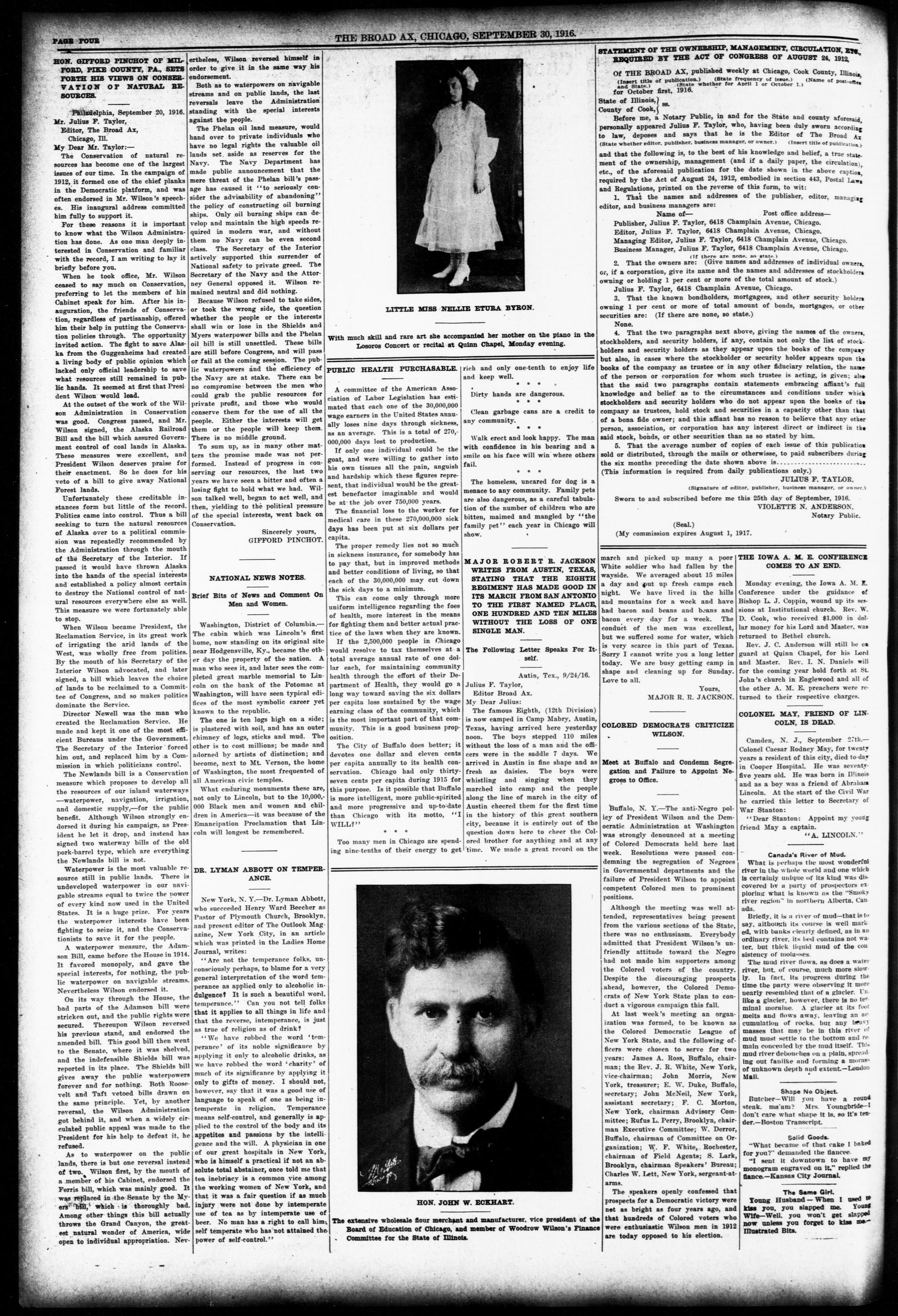
LITTLE MISS NELLIE ETURA BYRON
With much skill and rare art she accompanied her mother on Losoros Concert or recital at Quinn Chapel, Monday
PUBLIC HEALTH PURCHASABLE rich and only one-te and keep well.
With much skill and rare art she accompanied her mother on the piano in the Lososor Concert or recital at Quinn Chapel, Monday evening.
A committee of the American Association of Labor Legislation has estimated that each one of the 30,000,000 wage earners in the United States annually loses nine days through sickness, as an average. This is a total of 270,000,000 days lost to production. If only one individual could be the goat, and were willing to gather into his own tissues all the pain, anguish and hardship which these figures represent, that individual would be the greatest benefactor imaginable and would be at the job over 750,000 years. The financial loss to the worker for medical care in these 270,000,000 sick days has been put at six dollars per capita.
The proper remedy lies not so much in sickness insurance, for somebody has to pay that, but in improved methods and better conditions of living, so that each of the 30,000,000 may cut down the sick days to a minimum. This can come only through more uniform intelligence regarding the foes of health, more interest in the means for fighting them and better actual practice of the laws when they are known.
If the 2,500,000 people in Chicago would resolve to tax themselves at a total average annual rate of one dollar each, for maintaining community health through the effort of their Department of Health, they would go a long way toward saving the six dollars per capita loss sustained by the wage earning class of the community $ _{2} $ which is the most important part of that community. This is a good business proposition.
The City of Buffalo does better; it devotes one dollar and eleven cents per capita annually to its health conservation. Chicago had only thirty-seven cents per capita during 1915 for this purpose. Is it possible that Buffalo is more intelligent, more public-spirited and more progressive and up-to-date than Chicago with its motto, "I WILL?" * * *
Too many men in Chicago are spending nine-tenths of their energy to get
M. H. H.
William H.
HON. JOHN W. ECKHART.
The extensive wholesale flour merchant Board of Education of Chicago, and Committee for the State of Illinois
The extensive wholesale flour merchant and manufacturer, vice president of the Board of Education of Chicago, and member of Woodrow Wilson's Finance Committee for the State of Illinois.
* * *
rich and only one-tenth to enjoy life
and keep well.
* * *
Dirty hands are dangerous.
* * *
Clean garbage cans are a credit to
any community.
* * *
Walk erect and look happy. The man
with confidence in his bearing and a
smile on his face will win where others
fail.
* * *
The homeless, uncared for dog is a
menace to any community. Family pets
are also dangerous, as a careful tabulation
of the number of children who are
bitten, maimed and mangled by “the
family pet” each year in Chicago will
show.
MAJOR ROBERT R. JACKSON
WRITES FROM AUSTIN, TEXAS,
STATING THAT THE EIGHTH
REGIMENT HAS MADE GOOD IN
ITS MARCH FROM SAN ANTONIO
TO THE FIRST NAMED PLACE,
ONE HUNDRED AND TEN MILES
WITHOUT THE LOSS OF ONE
SINGLE MAN.
The Following Letter Speaks For It self.
Autin, Tex., 9/24/16.
My Dear Julius:
The famous Eighth, (12th Division) is now camped in Camp Mabry, Austin, Texas, having arrived here yesterday noon. The boys stepped 110 miles without the loss of a man and the officers were in the saddle 7 days. We arrived in Austin in fine shape and as fresh as daisies. The boys were whistling and singing when they marched into camp and the people along the line of march in the city of Austin cheered them for the first time in the history of this great southern city, because it is entirely out of the question down here to cheer the Colored brother for anything and at any time. We made a great record on the
STATEMENT OF THE OWNERSHIP, MANAGEMENT, CIRCULATION, ETC.
REQUIRED BY THE ACT OF CONGRESS OF AUGUST 24, 1912.
Of THE BROAD AX, published weekly at Chicago, Cook County, Illinois,
(Insert title of publication.) (State frequency of issue.) (Name of post-office
and State.) (State whether for April 1 or October 1.)
for October first. 1916.
Before me, a Notary Public, in and for the State and county aforesaid, personally appeared Julius F. Taylor, who, having been duly sworn according to law, deposes and says that he is the Editor of The Broad Ax (State whether editor, publisher, business manager, or owner.) (Insert title of publication.) and that the following is, to the best of his knowledge and belief, a true statement of the ownership, management (and if a daily paper, the circulation), etc., of the aforesaid publication for the date shown in the above caption, required by the Act of August 24, 1912, embodied in section 443, Postal Laws and Regulations, printed on the reverse of this form, to wit:
1. That the names and addresses of the publisher, editor, managing editor, and business managers are:
Name of— Post office address—
Publisher, Julius F. Taylor, 6418 Champlain Avenue, Chicago.
Editor, Julius F. Taylor, 6418 Champlain Avenue, Chicago.
Managing Editor, Julius F. Taylor, 6418 Champlain Avenue, Chicago.
Business Manager, Julius F. Taylor, 6418 Champlain Avenue, Chicago.
(If there are none, so state)
2. That the owners are: (Give names and addresses of individual owners, or, if a corporation, give its name and the names and addresses of stockholders owning or holding 1 per cent or more of the total amount of stock.)
Julius F. Taylor, 6418 Champlain Avenue, Chicago.
3. That the known bondholders, mortgagees, and other security holders owning 1 per cent or more of total amount of bonds, mortgages, or other securities are: (If there are none, so state.)
None.
4. That the two paragraphs next above, giving the names of the owners, stockholders, and security holders, if any, contain not only the list of stockholders and security holders as they appear upon the books of the company but also, in cases where the stockholder or security holder appears upon the books of the company as trustee or in any other fiduciary relation, the name of the person or corporation for whom such trustee is acting, is given; also that the said two paragraphs contain statements embracing affiant's full knowledge and belief as to the circumstances and conditions under which stockholders and security holders who do not appear upon the books of the company as trustees, hold stock and securities in a capacity other than that of a bona fide owner; and this affiant has no reason to believe that any other person, association, or corporation has any interest direct or indirect in the said stock, bonds, or other securities than as so stated by him.
5. That the average number of copies of each issue of this publication sold or distributed, through the mails or otherwise, to paid subscribers during the six months preceding the date shown above is..... (This information is required from daily publications only.)
Sworn to and subscribed before me this 25th day of September, 1916. VIOLETTE N. ANDERSON. Notary Public.
State of Illinois, ss.
County of Cook,
Before me, a Notary Public, in and for personally appeared Julius F. Taylor, who, by law, deposes and says that he is (State whether editor, publisher, business manager, or and that the following is, to the best of his benefit of the ownership, management (and in etc., of the aforesaid publication for the date required by the Act of August 24, 1912, embark and Regulations, printed on the reverse of the
1. That the names and addresses of the editor, and business managers are:
Name of—
Publisher, Julius F. Taylor, 6418 Champlain Editor, Julius F. Taylor, 6418 Champlain Managing Editor, Julius F. Taylor, 6418 Champlain Business Manager, Julius F. Taylor, 6418
(If there are none, or if a corporation, give its name and the name or holding 1 per cent or more of the Julius F. Taylor, 6418 Champlain Avenue.
3. That the known bondholders, mortgaging 1 per cent or more of total amount securities are: (If there are none, so state).
None.
4. That the two paragraphs next above stockholders, and security holders, if any, or holders and security holders as they appear but also, in cases where the stockholder or books of the company as trustee or in any of the person or corporation for whom such that the said two paragraphs contain state knowledge and belief as to the circumstance stockholders and security holders who do not company as trustees, hold stock and security of a bona fide owner; and this affiant has no person, association, or corporation has any said stock, bonds, or other securities than as
5. That the average number of copies sold or distributed, through the mails or other the six months preceding the date shown as (This information is required from daily press.
(Signature of editor.
Sworn to and subscribed before me this.
(Seal.)
(My commission expires August 1, 1917.
march and picked up many a poor White soldier who had fallen by the wayside. We averaged about 15 miles a day and put up fresh camps each night. We have lived in the hills and mountains for a week and have had bacon and beans and beans and bacon every day for a week. The conduct of the men was excellent, but we suffered some for water, which is very scarce in this part of Texas. Sorry I cannot write you a long letter today. We are busy getting camp in shape and cleaning up for Sunday. Love to all.
Yours,
MAJOR R. R. JACKSON.
COLORED DEMOCRATS CRITICIZE
WILSON.
Meet at Buffalo and Condemn Segregation and Failure to Appoint Negroes to Office.
Buffalo, N. Y.—The anti-Negro policy of President Wilson and the Democratic Administration at Washington was strongly denounced at a meeting of Colored Democrats held here last week. Resolutions were passed condemning the segregation of Negroes in Governmental departments and the failure of President Wilson to appoint competent Colored men to prominent positions.
Although the meeting was well attended, representatives being present from the various sections of the State, there was no enthusiasm. Everybody admitted that President Wilson's unfriendly attitude toward the Negro had not made him supporters among the Colored voters of the country. Despite the discouraging prospects ahead, however, the Colored Democrats of New York State plan to conduct a vigorous campaign this fall.
At last week's meeting an organization was formed, to be known as the Colored Democratic League of New York State, and the following officers were chosen to serve for two years: James A. Ross, Buffalo, chairman; the Rev. J. R. White, New York, vice-chairman; John Morris, New York, treasurer; E. W. Duke, Buffalo, secretary; John McNeil, New York, assistant secretary; F. C. Morton, New York, chairman Advisory Committee; Rufus L. Perry, Brooklyn, chairman Executive Committee; W. Derror, Buffalo, chairman of Committee on Organization; W. F. White, Rochester, chairman of Field Agents; S. Lark, Brooklyn, chairman Speakers' Bureau; Charles W. Lett, New York, sergeant-at-arms.
The speakers openly confessed that prospects for a Democratic victory were net as bright as four years ago, and that hundreds of Colored voters who were enthusiastic Wilson men in 1912 are today opposed to his election.
JULIUS F. TAYLOR,
editor, publisher, business manager, or owner.)
this 25th day of September, 1916.
VIOLETTE N. ANDERSON,
Notary Public.
1917.
THE IOWA A. M. E. CONFERENCE
COMES TO AN END.
Monday evening, the Iowa A. M. E. Conference under the guidance of Bishop L. J. Coppin, wound up its sessions at Institutional church. Rev. W. D. Cook, who received $1.000 in dollar money for his Lord and Master, was returned to Bethel church. Rev. J. C. Anderson will still be on guard at Quinn Chapel, for his Lord and Master. Rev. I. N. Daniels will for the coming year hold forth at St. John's church in Englewood and all of the other A. M. E. preachers were returned to their respective charges.
COLONEL MAY, FRIEND OF LIN
COLN, IS DEAD.
Camden, N. J., September 27th.—Colonel Caesar Rodney May, for twenty years a resident of this city, died to-day in Cooper Hospital. He was seventy-five years old. He was born in Illinois and as a boy was a friend of Abraham Lincoln. At the start of the Civil War he carried this letter to Secretary of War Stanton:
"Dear Stanton: Appoint my young friend May a captain.
"A. LINCOLN."
Canada's River of Mud.
What is perhaps the most wonderful river in the whole world and one which is certainly unique of its kind was discovered by a party of prospectors exploring what is known as the "Smoky river region" in northern Alberta, Canada. Briefly, it is a river of mud—that is to say, although its course is well marked, with banks clearly defined, as in an ordinary river, its bed contains not water, but thick liquid mud of the consistency of molasses.
The mud river flows, as does a water river, but, of course, much more slowly. In fact, its progress during the time the party were observing it more nearly resembled that of a glacier. Unlike a glacier, however, there is no terminal moraine. A glacier at its foot melts and flows away, leaving an accumulation of rocks, but any heavy masses that may be in this river of mud must settle to the bottom and remain concealed by the mud itself. This mud river debouches on a plain, spreading out fanlike and forming a morass of unknown depth and extent.-London Mall.
Shape No Object
Butcher—Will you have a round steak. ma'am? Mrs. Youngbride—don't care what shape it is, so it's tender. Boston Transcript.
Solid Goods.
"What became of that cake I baked for you?" demanded the fiancee.
"I sent it downtown to have my monogram engraved on it," replied the fiancee—Kansas City Journal.
The Same Girl.
Young Husband—When I used to kiss you, you slapped me. Young Wife—Well, you won't get slapped now unless you forget to kiss me—Illustrated Bits.
Talks on
HEALTH,
CLEANLINESS,
PROPER LIVING,
SANITATION, ETC.
BY
Dr. W. A. DRIVER
3300 So. State Street
Phode Douglas 3617
FEMALE DISEASES.
Women must be taught that they can be free from so called "female troubles" only by consultation, examination and treatment conducted by a physician. Any other procedure will fail for reasons any intelligent person can supply. When a woman or a girl has any new condition of the body, she should for the sake of health consult a doctor, not another woman, unless the other is a physician. On account of an unreasonable and hence false modesty, many of the gentler sex suffer in silence the agonies of the damned. Some of these hint of their troubles to others who know little or nothing of the anatomy, physiology and pathology of the female genitalia. Many of the persons appealed to do not know and the unfortunate truth is, they do not know that they do not know. Hence they give advice that is worse than useless, because it delays proper treatment until the millions and millions of disease producing germs have traveled far into the vital processes. As a re-
INTEREST REVIVED IN WASHING-
TON MEMORIAL FUND.
Cotton Prices Cause Response From Rural Schools—Mass Meetings Arranged in Cities—Baptist Convention Urges Support To Fund.
Tuskegee Institute, Ala., September 25.—With the coming of fall and the passing of hot weather, the country is settling down to hard work. Schools are crowded to capacity and business houses are looking forward to a year of prosperity. This is election year and cotton is selling at sixteen cents.
Loyal men and women of the race are, as a consequence of these conditions, again turning their attention to the Booker T. Washington Memorial Fund. Voluntary letters are beginning to come in pledging contributions and outlining arrangements for mass meetings which are to be held in various parts of the country this fall.
Quite a number of rural schools which closed last spring before April 5th, the day set aside for school children to give to the Fund, have asked to be permitted to raise collections this fall. These teachers are faithfully keeping their promises and have written to say that they will send in larger sums than they first thought possible because of the generally better conditions which prevail now in the country districts as against those of the early spring, when there was so much panicky talk of hard times. It is hoped that other teachers of city and rural schools who for one reason or another failed to lift collections from school children last spring will not fail to do so this fall.
The Memorial Fund Committees in various cities which held over their mass meetings and active campaigns until fall are in many instances getting effective work done in arousing the Colored people to the duty of responding to this appeal for one-eighth of the Two-Million-Dollar Memorial Fund to perpetuate the work of the late Booker T. Washington—that is, $250,000. Of the sum which the White people were asked to give to this Fund they have given more than half, while the Colored people have not yet given one-fifth of the amount they were asked to give.
The Colored people of Baltimore, Maryland, have pledged themselves to raise ONE PERCENT OF THE AMOUNT TO BE GIVEN BY THE COLORED PEOPLE. This will be $2,500. Deciding upon a definite amount to be raised is one of the important things, because it outlines for the people just the amount of work they have before them. Besides it gives poise and dignity to the campaign in a city and affords better opportunity for organizing. At the monster mass meeting which they will have in Baltimore on November 18th, there will be an excellent program and on that date the churches, schools, fraternal organizations, and the clubs and societies of various sorts will make their returns, following a whirlwind campaign of the city. Mr. Harry T. Pratt, Dean William Pickens and other prominent Baltimore citizens have written most encouraging letters to Tuskegee Institute regarding the outlook for a successful effort.
[Name]
sult the distressing symptoms finally arrive and the physician alone can realize the gravity of the condition.
Some of the women become invalids, few, a very few, recover with full physiological capability, and many of them die in spite of the earnest efforts of medical science that was called too late. In the first place it is a shame that we have so much ignorance abroad in the land on the sex question as to permit the distress and destruction of humanity by these "social" or sexual pathogenic germs. It is because we have been silent on this very important matter. But the new era is here. The only way to protect is to educate. Teach the women that they should not have female troubles, that they should not have aches and pains and abnormal issues. See a doctor, insist on a thorough examination. Pain is not natural. Even childbirth is now conducted with little or no pain by the average physician.
Be wise and be safe from disease by the grace of the knowledge acquired by the medical profession.
In his annual address before the National Baptist Convention which met at Savannah, Georgia, during the week of September 4th, Dr. E. C. Morris, the president, called upon the members of the convention and the prominent men and women of the race to help raise this $250,000 from among the Colored people. Dr. Morris said: "The National Baptist Convention will greatly honor itself if the hundreds of prominent leaders who are gathered here will throw the full weight of their influence into the efforts now being made to raise our part of the Two-Million-Dollar Memorial Fund to perpetuate the work founded by Dr. Booker T. Washington, the greatest man of his time." With such support from the Baptist denomination, of which Dr. Washington was a member, and with the support of the Memorial Fund Committees in cities and teachers in rural communities, we shall hope to raise, by Thanksgiving Day, a very large part of our share of this Fund. WE SHOULD RAISE $100,000 BY THANKSGIVING DAY.
MESSENGER FOR FORTY-NINE YEARS.
Washington, D. C., (Special).—Shepherd A. Harris, since 1867 employed as messenger for the Washington Bureau of the New York Times, was buried from his home, 995 Florida' avenue, Monday, the funeral taking place from the Nineteenth Street Baptist Church, of which he was a member for many years.
Mr. Harris was sixty-seven years old, and was one of the best known men in Washington, and highly respected by all. He had a wide acquaintance among newspaper and political men, and was well liked by all with whom he came in contact. He came to Washington, immediately after the war, having served as an attendant upon a captain of a Pennsylvania regiment, and took up the position as messenger in the New York Times office, where he remained until his death.
MEMORIAL TO MRS. STOWE
Jacksonville, Fla.—A beautiful memorial window has been placed in the Church of Our Savior, at Mandarin, and dedicated to Harriett Beecher Stowe and Prof. Calvin E. Stowe.
Among these giving subscriptions toward the memorial to the author of Uncle Tom's Cabin were several Colored people.
Whites residing here have started a movement to place a window for Thomas Dixon, author of books aimed at the Negro. They want Dixon clad as a night-rider in the Ku-Klux Klan, a striking contrast to the Stowe memorial.
MAN DIES SAME AS BEAST.
For that which befallthe the son of man befallthe beasts; even one thing befallthe them; as the one diest so diest the other; Yea they have all one breath; so that a man hath no prominence above a beast; for all is vanity. Ex. III, 19. For the living knows that they shall die, but the dead knows not anything neither have they any more a reward. Ecc. IX, 5.
THE BROAD AX, CHICAGO, SEPTEMBER 30, 1916
Charles E. Stump, the Smart Farmer Newspaper Correspondent from Kansas, After His Steamboat Trip up the St. James River in Old Virginia, Again Finds Himself in the State Where You Have to Show Me---Missouri
Mexico, Mo.—Perhaps this is a world that will stand the test of worlds. I have been here for a long time and I am not ready to leave, because it has been my lot in the past year to see so many places since I have been trying to write for the paper. The people are getting acquainted with me, and I am getting acquainted with them, and then I have had some one to tell me that I was smart, and that has given me the big head which may lead to my death.
I have not sent you a letter for a long time and it would take me almost as long to tell you all I have seen and what I have been doing. But then I will try to say just a few things to you.
I told you about my trip up the James River and the visit to Jamestown, Va. Well when I got through there I found my way to Petersburg, Raleigh, N. C., Atlanta, Ga., Jacksonville, Fla., and then to Savannah, Ga., to attend the session of the National Baptist Convention which was one of the greatest in the history of the organization, and it was well attended. People were there by the thousands, and I did not count myself in getting at the number. There were enough without counting me, but if you want me to do so, then put it down so many thousands and one, or I will make the one. Then they raised some money there. It was all reported, and then the Board made the proper appropriations.
I have been going to conventions for years, but I have not been to a Baptist convention where there were so many free social functions. They were there just the same. I got more free eatings, and while the people were paying a dollar a day, the place where I stopped declared that they felt more like paying me a dollar a day for staying there and would not accept a cent of my money. So you see it was free doings for me all the way through.
Rev. E. C. Morris, of Helena, Ark, was elected president; Dr. W. G. Parks, of Philadelphia, vice president; Prof. R. B. Hudson, of Selma, Ala., secretary; Dr. A. J. Stokes, Montgomery, treasurer; Prof. M. M. Rodger, Dallas, Texas, auditor; Rev. C. H. Parrish, Louisville, Ky., statistical secretary; W. J. Latham, of Jackson, Miss., and T. G. Ewing of Nashville were elected the attorneys. Now there were assistant secretaries and other officers that I will not mention, but they put me on the staff of reporters. Muskogee, Okla., was selected as the next annual session.
I went from there to Washington, D. C., to attend the B. M. C. and it was a great big meeting. I want to here congratulate Hon. E. H. Morris, of Chicago, upon his ability as a presiding officer. He is one more president, or grand master as he is called in the B. M. C., and so well is he into the hearts of the people that they would just keep him all of, his life if he will stay, and James F. Needham, in the position of secretary.
But there was something sad connected with that big meeting. You see Dr. E. P. Jones, was some pumkins in Boston, and had his eye on the grand mastership, and thought that soon he would land. In Boston he was placed in the office of the sub-committee of management, and attended all the meetings. But in his zeal to push his Baptist convention, he got mixed up in the affairs in Georgia, and his head fell in the waste basket in Washington, and perhaps he will never see the big position. He came within the sight of the land of promise, but will pass on without ever getting there. He has my sympathy. The Rev. Dr. W. H. Mixon, also had to pick his head out of the waste basket.
It is strange that two preachers should fall from office in the Odd Fellows, but perhaps God wants them to
go about His business for He may be getting ready to bring this world to a sudden stop still.
While in Washington I had the pleasure of being the guest of the Rev. Dr. B. F. Watson, and went to see Editor John E. Murphy of the Afro-American. I visited Philadelphia, Chester, Pa., Wilmington, Del., New York City, New Haven, Conn., Chicago, Ill., St. Louis, Mo.
While in St. Louis, I went to that place where you get your heads put in order, and learn how to fix them up in fine shape. Where they teach you how to make hair grow but I wanted a remedy to stop mine from growing so as to cut down the barbershop bill. To that end I have worked. I went to the Poro college. They met me at the door, and ushered me up to the parlors of Prof. and Mrs. A. E. Malone, and Mr. Malone was soon shaking my lily black hand and telling me to be at home. He carried me down in the business office where I was commanded to be at home. He then told me that they did not work on heads, but taught them how to grow hair.
Soon Mrs. Malone, a modest little woman, who had invested in the hair-growing, came in, and shook hands like she was shaking hands with her own brother. She told me something about her life, and gave me an introduction to all the young women in the office, and believe me they have a host of them there. It is the Poro College. I am proud that Mrs. Malone is able to give employment to so many of our young people. It means so much to have them doing business in this manner. The individual who can bring into life anything that will furnish employment for people is worth something to the world in these times.
I went out to see some other friends, talked with Dr. W. Sampson Brooks, and then got myself together for this place. I came here to spend Sunday the guest of Rev. and Mrs. G. W. Wright, Prof. and Mrs. A. E. Bodine, and all the other people in town who would permit me to be their guest while there. Rev. Wright, as pastor of the Baptist church, and his wife is right by his side.
But now let me tell you about this Prof. Bodine. He is some musician. He can play the violin like that great artist whose name I do not remember. Then when it comes to singing, he goes way up in the air in what you call tenor or something like that. I don't know all the singing voices, but I do know that he is much in demand on account of the wonderful music which comes from his voice. They are calling for him in every direction to give recitals, and at times he answers the calls. But not all of them because he is a planter in this town and is kept busy planting. He is a planter of human bodies after the life has left. So much for that.
I spoke of Mrs. Corine Bodine. You see she is some pumpkins in the Knights and Daughters of Tabor of the state, and holds the position of chief grand recorder. This is a writing position, and she knows how to write. For a long time she was a teacher, but resigned this winter to be at home with her husband. The Lord may bless them with more work to do at the same time. A home is a great thing with an heir.
I think I will bring this letter to a close for this week. I am going to Kansas to clear up the crops, and then get out again soon. I hope to stay clear of the army while there.
SEEK NEGRO IN SLAYING
George White, Negro, is being sought by the police for the fatal shooting of Ollie Small, twenty-six years old, 3151 Federal street, a Negro, who died in the County Hospital Monday.
Black Maria.
Some years ago a writer in the English Notes and Queries, writing about the name "Black Maria" as applied to prison vans, quoted from a periodical, presumably English, named the Million, as follows:
"During the old colonial days Maria Lee, a negress, kept a sailors' boarding house in Boston. She was a woman of gigantic size and prodigious strength and was of great assistance to the authorities in keeping the peace, as the entire lawless element of that locality stood in awe of her. Whenever an unusually troublesome person was to be taken to the station house the services of Black Maria, as she was called, were likely to be required. It is said that she once took at one time and without assistance three riotous sailors to the lockup. So frequently was her help required that the expression 'Send for Black Maria' came to mean 'Take the disorderly person to jail.' It is easy to see how the name became fixed to the prison van."
Our Medal of Honor
The medal of honor of the United States, given for bravery on the field of battle, was first instituted in 1862 by a law approved July 12 of that year. It is a five pointed star of bronze tipped with trefoil, each point containing a crown of laurel and oak. In the middle, within a circle of thirty-four stars, America, personified as Minerva, stands with her left hand resting on the fasces, while her right, in which she holds a shield emblazoned with the American arms, she repulses Discord, represented with two snakes in each hand, the whole suspended by a trophy of two crossed cannon balls and a sword surmounted by the American eagle, which is united by a ribbon of thirteen stripes, palewise, gules and argent and a chief azure, to a clasp composed of two cornucopias and the American arms.
Size of the Roman Empire.
According to the historian Gibbon, the Roman empire "was above 2,000 miles in breadth, from the wall of Antoninus and the northern limits of Docia to Mount Atlas and the Tropic of Cancer; that it extended in length more than 3,000 miles, from the western ocean to the Euphrates; that it was situated in the finest part of the temperate zone, and that it was supposed to contain above 1,600,000 square miles." According to this, the Roman empire was considerably smaller than the United States, the area of which (leaving out Alaska and the islands) is nearly 3,000,000 square miles, or almost twice as big as was the empire of the Caesars.
Airships and Altitude
There are two ways of measuring altitude in a flying machine. One is by triangulation from the ground, which is an involved operation, requiring the services of several trained experts in the calculation of angles from different points on a measured distance on the earth's surface. The second and usual way is by means of a barograph, which is a form of aneroid barometer that records altitude by means of atmospheric pressure. The latter method is not as exact as the former, but is more expeditionous and is approximately correct.
End of the Story:
"Oh, if I were only beautiful," she sighed artfully.
"I wouldn't care if I were you." he said. "You are very intellectual and you have a sweet disposition. Besides, you are nice to your mother, and all that is much better than being beautiful."
And he was never invited to see her again—Pall Mall Gazette.
Happy Boys.
"The Smithers twins are so much alike that their own mother can't tell them apart."
"That must be rather confusing."
"It is, but the boys don't mind it. Their mother never dares to whip either of them for fear it might be the wrong one."—Exchange.
Important.
"My dear, what shall I buy you for your birthday?"
"Consult our jeweler. He knows pretty well what my tastes are."
"And did you tell him anything about the state of my finances?"—Kansas City Journal.
Her Tact.
Howard—Did she refuse you, old man? Coward—Well, in a delicate, indirect way. She told me she never wanted anything she could get easily.
---
The Inattentive Child.
Never scold a child who is dull or heedless nor one who seems to refuse to pay attention. Take such a child to a physician for an examination, for many times there will be found explanations for his conduct—his ears may be diseased or filled with impacted wax, which dulls or prevents his hearing. His eyesight may be so defective as to keep him from fixing his gaze upon anything. Children who are normal and well are bright, alert, attentive and responsive. Those who are ill or suffering from disease of the nervous system, some defect of hearing or vision, are unable to do anything as it should be done and deserve pity and never blame.
Origin of Felt.
Many centuries ago a poor monk was compelled to travel upon a long and arduous journey. His road was rocky, his sandals were worn, and he suffered agonies as he trudged grimly upon his holy errand. One day as he sat by the wayside resting a sheep came up to him, bleating in the most friendly fashion. The good monk peted the sheep and was grateful for its dumb friendliness, when suddenly he had an inspiration. He took out his sheath knife, sheared two handfuls of wool from the sheep and placed one in the heel of either sandal. That afternoon as he trudged along his feet seemed light, his step springy. The wool took the jar from his spine, the impact of the stony road from his aching, swollen feet.
The next morning as he started out he thought to rearrange the wool padding and discovered that the friction and the movement of his feet in the sandals had reduced the wool to a sort of a cloth. Thus was discovered felt, which to this day is one of the most effective substances ever discovered for padding purposes.
How Saccharin Was Discovered.
How Saccharin Was Discovered.
Saccharin is the most valuable substitute for sugar we know. Yet it, like many other present day inventions, had a rather unlikely beginning. It can be taken with impunity by diabetic patients, to whom ordinary sugar is death, and it is many times sweeter than that commodity. And, strangely enough, it has only been known to science since 1887.
That year Dr. Fahlberg was employed upon the all important subject of coal tar derivatives at the Johns Hopkins university. Sitting one evening at tea, he was surprised to find how sweet his bread and butter tasted. He traced the sweetness to his fingers, then to his coat sleeves and finally to one of the bowls of derivatives in his laboratory. Experiments upon himself and animals proved allike the harmlessness of the compound and its extreme sweetness. And saccharin was "discovered."—Exchange
Marines and Their Fingers.
Men with long, tapering "plane" fingers are apt to desert after short service, while those having stubby digits, denoting stability of character and utter lack of the artistic temperament, usually stand by their oaths and make the best marines, according to finger print experts at headquarters of the United States marine corps. Although desertions from the corps are light at all times, it has been found that actors, sign writers and, strange to say, waiters furnish the largest number of deserters. Records, including finger prints, of all men enlisted in the marine corps are kept at headquarters for purposes of identification, and there are cases on record where bodies with finger tips intact have been positively identified through the finger print medium.
Quite Common.
"It's strange what interest: small boys and girls take in boasting about the possessions of themselves and their families.
Mollie, aged nine, and Nancy, a year younger, were trying to outmatch each other at this game, and Mollie was several points ahead in the contest.
"Oh, you should see my mother's fan!" she boasted, thinking to make her victory complete. "It's lovely—all hand painted."
Nancy tossed a scornful head.
"Pooh!" she retorted. "That's nothing. So's our garden fence."
Bold Court Fool.
Ferdinand 11. was a man of very uncertain moods and would allow his jester to take liberties with him one hour while resenting any familiarity the next. One day he turned round on Jonas, his favorite fool, and thundered: "Fellow, be silent! 1 never stoop to talk to a fool!" "Never mind that," answered Jonas. "I do. So please listen to me in your turn."
To Make Sure:
"Won't you please leave the light burning in the hall, mother?" pleaded little Robert as he was being put to bed.
"Nonsense, Bobbie," was the reply.
"Surely you know there isn't anything to be afraid of in the dark."
"Yes, I know, but can't you leave a teeny weeny light so I can see there isn't anything there?" - Exchange.
Bob Burdette's Aside.
When Bob Burdette was addressing the graduating class of a large eastern college for women he began his remarks with the usual salutation, "Young ladies of '97." Then in a horrified aside he added, "That's an awful are for a girl!"
Envelopes.
Envelopes were practically unknown before 1725. About that time one was seen semi-occasionally. As late as 1850 letters were often sent folded and sent ed. Envelopes may be said to have come into use shortly after 1844.—Ex change.
Badly Timed.
Nephew—I tried to get a raise today.
aunt, but the boss refused it. Mrs.
Blunderby—Too bad. Dicky! Perhaps
you didn't approach him at the zoological moment.—Boston Transcript.
Atlas Reipices.
Atlas bore the world on his shoulders. "It is much easier than having it on your conscience." he explained—New York Sun.
The virtue of justice consists in moderation as regulated by wisdom.—Aristotle.
PAGE SIX
Stagestruck Women.
William A. Page, the Chicago crie-
and publicity writer, says in the Woman's Home Companion in an article about stagestruck women:
"And what becomes of them? Caught in the edies of frivolity, many of them temporarily abandon their stage ambitions in the kaleidoscopic life of Broadway. Others live in hall bedrooms, boil eggs over a gas jet and waste their young lives in the fruitless pursuit of a rainbow which they never find, only sooner or later to return home sadly and settle down to forget their stage ambitions. Others study, economize, sincerely strive for engagements, possibly get small roles with some obscure company and start in on a career which will be filled with many, many disappointments. And of the thousands who came so bravely to the front last year how many still remain in the lists? Not counting those who may have gone into musical comedy, perhaps a score still cherish the shrine of Marlowe and of Adams. For the rest, oblivion."
Shaw Didn't Like Himself.
"Many years ago in a house in Ashley Gardens," writes G. Bernard Shaw in the New Witness. "I was walking along a corridor with other guests at a musical evening when I saw coming toward me a man who produced an extraordinarily disagreeable impression on me, a tall young man in evening dress, with a blond beard and, as it seemed to me, a hateful expression.
"He was coming straight at me. I moved aside to avoid him, and he moved, too, apparently to get into my way again. An impulse of rage at this insult was checked just in time by the discovery that instead of walking along a corridor I was crossing a square landing and that the detestable apparition who had chilled my very soul with his abominable aspect was a reflection of myself in the wall of mirror which the tenant of the Ashley Gardens flat had put up to give his cramped dwelling an appearance of spacious magnificence."
Power In Plant Cells
Along with the formation of the sugar, and caused in part by its accumulation, there develop within the minute cells of the blueberry plants enormous osmotic pressures, which enable the plant to push its buds open, F. V. Coville writes in the National Geographic Magazine. These pressures are frequently as high as seven atmospheres or more than 100 pounds to the square inch—a pressure that would start a leak in a low pressure steam engine. The pressure may become as high as thirty atmospheres or 450 pounds to the square inch—a force sufficient to blow the cylinder head off of a thousand horsepower Corliss engine. The reason the plant does not explode is because it is broken up into many extremely small and strongly built cells instead of having one big interior cavity. These minute chambers are often as thick walled proportionately as an artillery shell.
A Famous War Horse.
Bucephalus, the charger that carried Alexander the Great through all his campaigns, received his name from the fact that, although white, he had a black mark resembling an ox's head on his forehead.
A Thessalonian had offered the horse for sale to Philip of Macedon, but as none of the monarch's attendants could manage him the king ordered his owner to take him away. Alexander, who was present, expressed his regret at losing so fine an animal, and Philip replied that he would buy the horse if his son could ride him. The offer was accepted by Alexander, who succeeded in the attempt. Bucephalus would never suffer any other person to mount him.
Airing a Room.
In airing a room there are two things to be remembered first, that the impure air must be allowed to escape and, secondly, that fresh air must be admitted. Impure air in a room is always warm and will therefore rise toward the ceiling, when it will escape if the window is opened at the top, while cold fresh air will enter through the lower part of the window when opened.
A Grand Canyon Sunrise.
A sunrise in the Grand canyon lasts as long as you please. Each hour is a sunrise for some cavern deeper than the last, and, in fact, there are many where it has yet to rise for the first time since the canyon was made by those ages of running water.
His Ashes.
"So you prefer to be cremated when you die?"
"I certainly do."
"Why?"
"So that my remains may be mingled with the ashes of the grate."—London Telegraph.
Parental Care.
"Did your bride's father give her away?"
"No, he didn't. He left me to find out a few things about her for myself."—Baltimore American.
Causes.
Bix-A physician says that yawning is caused by a lack of oxygen in the blood. Dix-Or a lack of pep in the conversation. --Boston Transcript.
The Comeback.
Skinflint—I have no money, but I will give you a little advice. Beggar—Well. If yer ain't got no money yer advice can't be very valuable.
Sooner or later the world comes around to see the truth and do the right—Hillard.
BALDHEADED ALASKAN BEARS
Volcanic Ash Brings Hardship to Bruin on Kadiak Island.
Seward, Alaska.—It will take more than two or three years of enforced diet of straight meat and fish and a loss of hair to seriously set back the bear population of Kadiak island, according to D. Winn of the United States bureau of fisheries.
Kadiak island, says Mr. Winn, in 1912 was covered with volcanic ash at no point at a depth less than eleven inches. The ash killed all vegetation and as all bears are fond of a mixed diet of meat, fish and vegetables, they found 1913 and 1914 unpleasant from a dietary standpoint.
Another effect of the fall of ash, according to Mr. Winn, was the havoc it created with the furry coats of the animals. Bald headed bears are now as common on Kadiak island as bald headed men in the front row of a musical comedy. The ash sifted down on to the skins of the animals as it fell, and the first rain turned it to lye, which had the effect of almost tanning the skins of the bears while yet a part of their personal effects.
WHITTLES VIOLIN FINGERS.
Player Hopes to Increase His Proficiency by Surgery.
Wichita, Kan.—In order to become a more proficient violin artist Mark Sandfort, a member of an orchestra here, had a piece of flesh taken from each of his six fingers. The incisions were drawn together and sewn with horsehair. The operation was performed by Dr. H. S. Hickok, and Sandfort will be able to remove the bandages soon.
Sandfort has won a reputation as a violinist. However, his execution of musical selections was not as good as he desired it to be. He hit upon a plan. He would have his fingers whittled down. He waited until the season closed and had the operation performed.
According to physicians, this is the first time that an operation of this kind has been performed.
BOY FALLS; SERVICE STOPS.
Pastor and Congregation See Lad Hit by Electric Current.
Little Rock, Ark.—Kenneth McEwen eleven years of age, was electrocuted thirty feet in the air on a lighting tower in view of the congregation of a church that was holding services on the church lawn because of the heat. The boy was knocking the wire that supplied current to the lights on the tower against the steel frame to produce sparks. Suddenly a flash of blue flames enveloped him, and he plunged downward, fracturing his skull on the pavement below. He died in a hospital a few minutes later. The pastor of the church, the Rev. E. P. Aldredge, was preaching a special sermon to boys. He rushed over, aided in placing the dying lad in an ambulance and then resumed his sermon, using the accident as a warning to the boys.
GIRL'S PROFIT IN HOGS.
Raising Swine Not a Finishing School
For Debutantes.
Holtville, Cal. - Raising hogs for pleasure and profit is the occupation of Miss Josie Fuller, seventeen, the youngest and best all around feminine pork producer in the Imperial valley.
It is her ambition to become the best expert on hogs in her district. Her herd numbers fifty strong and is increasing. "Pig culture isn't aesthetic work, of course," said Miss Fuller. "It can't be considered a finishing school for debutantes, but there's money in it." She has established a record of developing her porkers for the market at a cost of $3½ cents a pound.
"Women may not admire hogs, but if they don't it's because they know so little about them. Once interested they become just as capable as men in handling swine."
TWO DEATHS IN ONE HOME.
Sees Mother-in-law Stricken With Heart Failure, Then Dies.
Philadelphia - Stricken with heart failure just after she had called her son to dinner at noon. Mrs. Rebecca Thomas, seventy-three years old, a sister of Jesse Pratt, former mayor of Camden, fell dead in the dining room of her Camden home.
Mrs. Madeline Thomas, her daughter-in-law, who was in an adjoining room, ran to her assistance and was leaning over her, trying to lift her form to a couch, when she, too, collapsed and fell lifeless.
ANOTHER QUITS SING SING
Officials Think Prisoner Swam to Liberty.
Ossining, N. Y.—"I'm going into the garden to get some tomatoes for breakfast," said Elmer Schultz, a prisoner at Sing Sing, as he walked out of the power house, where he was doing duty as a fireman. Some hours later the big whistle tooted the message that another prisoner had escaped.
Prison officials had then found two iron pickets had been pulled apart and concluded that Schultz went through the opening, dived into the Hudson and swam to liberty.
Lost Dog Returned Home
New York. After a year's absence a beagle belonging to Louis W. Well of Flushing. N. Y., returned home. Mr. Well went on a hunting trip a year ago and took the beagle along. He lost the dog. The dog seemed to enjoy its homecoming, and the Well family showed its delight in a way that tickled the dog's palate.
THE BROAD AX. CHICAGO. SEPTEMBER 30, 1916.
REWARDS FRIENDS
REWARDS FRIENDS
Retired Manufacturer Remembers Couple Who Aided Him.
MAKES BEQUEST OF $25,000
Had Fled Menace of Zeppelin In His Own Country—In His Will He Declared That Money Was Left Because of "Unusual Kindness."
Philadelphia.—Kindness pays; usually it pays only with happiness.
Kindness means doing your best without hope of gain.
Show kindness to the stranger; he may be a disguised angel.
But be kind to him anyway; he may need your help.
Each opportunity to do a kindness comes but once; don't let one slip.
Fortune came to Mr. and Mrs. Cyrus Jared Gray.
It came to their home in this city in guise of a stranger who lingered a couple of days and died. But he left them $25,000 or property approximating that amount. He was Adolph Geyer, retired London manufacturer, who fed the menace of Zeppelins in his own country. In his will he said the money was left so because of "unusual kindness."
"But we only did what we could for a fellow being in distress," Mrs. Gray said. "We had no idea of compensation. He seemed just friendless and ill."
"The first I saw of him was when a taxi stopped in front of the house. The driver didn't seem to know where to go, and I went out and asked if I could help. Then I saw that Mr. Geyer wasn't able to go any further."
It was early last June that the taxi stopped in Walnut street. The Gray home is one of a row of apartments, old fashioned and unpretentious. But it is pleasant, with vines over the door and porch set with cushioned chairs. It was here that Geyer came after he had found hotels full because of the ad. men's convention.
"I keep boarders, and one room happened to be unoccupied." Mrs. Gray explained. "He had stopped the machine and asked the driver to go to the nearest doctor. He'd been taken ill on the train from New York and rapidly grew worse. We carried him into the house and to bed. The physician we called soon saw there was no help for him."
In the will he made just before his death Geyer said that he had no next of kin or relatives.
RADIO BETWEEN AEROPLANES
Message Sent and Received When Machines Were In Flight.
San Diego, Cal.-What is said to be an important advance in the field of aeronautical radiotelegraphy was achieved here when a wireless message was sent from one aeroplane in flight to another.
Captain C. C. Culver in an army machine piloted by Lieutenant Herbert Dargue received the message, which was transmitted a distance of several miles by Lieutenant W. A. Robertson, who was in another machine guided by A. D. Smith. The message, which read, "National aviation field sets new world's records," was received distinctly by Captain Culver.
According to Captain Culver, this is the first time on record in this country and perhaps in the world that a wireless message has been received by one aeroplane from another while both machines were in flight.
BABY SERVED IN A LAWSUIT.
One-year-old Heir to Share In Million Dollar Estate Summoned.
Bridgeport, Conn.—A one-year-old baby was served with papers in a lawsuit when Deputy Sheriff Cunningham went to Riverside and found little Helen Green at the palatial summer home of her father, Harold Rumsey Green.
The baby is one of twenty heirs of James Green, who died in St. Louis in 1914, leaving an estate of $1,000,000. Two of the heirs, Laura C. Littlebrant and Marian C. Littlebrant of St. Louis, have brought suit to have the will set aside on the ground that Green was incompetent.
Cow Mothers Young Pigs.
Milton. Del.-Because his cow had been milked dry every evening and his family had been compelled to do without milk or butter John Henderson of Broadkil Neck sat up with a gun the other night in the hope of catching the thief. He was astonished to find that the cow was a willing victim of his young pigs, who took turns sucking milk while the old cow lay on the ground for their better provision. The cow is now pasturing within a hog tight fence.
Eats Eel That Nearly Drowned Him. Rochester. N. Y. - While County Clerk William S. Cornwell of Penn Yan was in swimming he cried for help, and when rescuers brought him to shore a five pound eel was found fastened to his right foot. The eel was killed and dressed, and in the evening Cornwell and his friends dined off the fish that nearly drowned him.
Big Pelican Killed.
Middlesboro, Ky.-A beautiful pell can was killed on a farm near Arthur, Tenn., recently. It was a large bird, white with black tips on the wings, which measured seven feet from tip to tip. Its bill measured twelve inches in length, and it stood five feet high.
AREFULLY SEARCH ALL
WHO LEAVE GERMANY
Ears, Nose, Teeth and Toes Are Closely Examined For Information.
Copenhagen.—Every one who leaves Germany by way of Warnemuende for Denmark is stripped. Ears, nose, teeth and toes are examined to see that no information or plans for the enemy are being carried out. Relchstag members, wives of officials, correspondents and laborers are treated the same.
When travelers leave the train they enter a small wooden shed, resembling a temporary bathhouse at an American beach. Here the passports are taken away and examined. The holders are given numbers.
When the passport of a traveler is inspected he is called into another room, where where is questioned about the object of his journey. From here the wayfarer goes into a large room where baggage is examined, while detectives stand in front and back to see that nothing is slipped by.
Every scrap of paper or cardboard is taken away, even wrappings and paper lining to boxes. Cotton is removed from medicine bottles. Cigars are examined, some are cut open; chocolate in sealed packages is opened, the wrapping destroyed and half the chocolate is broken up into bits to see that nothing is hidden. Shoes with new half soles are opened. The searcher feels everything, examines canes to see if they are hollow, opens umbrellas and holds every collar up to the light to see that nothing is written on the lining.
FRANCE PLANNING FOR TUNNEL TO ENGLAND
FRANCE PLANNING FOR TUNNEL TO ENGLAND
Passageway Would Cost $80,000,000, Half to Be Borne by Each Country.
Paris.—France has taken all necessary steps to enter into negotiations with England to build jointly a tunnel under the English channel to connect the two countries, the long talked of project, which the war has revived because it has demonstrated as nothing else could the value of the tube to both countries.
Had the tunnel been in existence in the present conflict it could have been of immeasurable value to England and France for the transportation of troops and supplies and would have liberated French and British war vessels from one of their biggest tasks.
The plans were outlined by M. Sartiaux, chief engineer of the Nord Railway company, who is one of the strongest advocates of the project. He said:
"The tunnel would cost $80,000,000, half of which would be borne by England and half by France. Each country would build one-half of the tunnel. Britain is spending just now $30,000,000 a day and France $20,000,000, so that two days' war time expenditure of both countries would more than cover the cost of making the tunnel.
"It is proposed to make two tunnels—one for traffic from France to England, another for traffic from England to France. Some people seem to think a cross channel tunnel might be a danger because it might fall into the hands of the enemy. To capture the French end would not be an easy task. The mouth of the tunnel on French soil would be ten miles from the coast, and in order to reach it the enemy would have to capture Calais and negotiate three intervening hills of an average height of 150 feet."
MAYOR LEADS IN BIRD WAR.
Poughkeepsie's Executive Gets Hunters to Shoot Starlings.
Poughkeepsie. — To exterminate a flock of blackbirds and starlings which have disturbed the morning repose of the wealthy residents Mayor Daniel W. Wilbur led a band of twelve hunters against the birds at sundown.
Armed with shotguns and rides they attracted several thousand persons, and the police reserves were called out to keep the spectators at a safe distance.
"Colonel Roosevelt has nothing on us when it comes to hunting, I guess," said Mayor Wilbur, standing in his auto directing the attack. "There is no law protecting blackbirds and starlings, and the war will be continued until the last bird is killed."
Soon after the firing began one of the hunters killed two robins. The hunter was deprived of his license on the spot and will be prosecuted by the local game protector.
KRAFT $500.000 WILL FILED
"Old Tanner" of Bronxville Left Piano Secret to Sons.
White Plains, N. Y.-The will of the late Frederick W. Kraft, known as the "old tanner" of Bronxville, who left an estate estimated to be worth close to $500,000, was filed for probate with Surrogate Sawyer at White Plains.
Mr. Kraft, who was eighty-one, held the secret process for the manufacture of high grade leather, which is used in piano keys. The secret was imparted to his sons, William F. and John Kraft, before his death, and after leaving them the bulk of his fortune he requests them to continue the leather business in Bronxville. After leaving his grandson, William Dinmore Kraft, his gold watch and all his valuable diamonds, the decedent bequeaths $2,000 to Frank Gallow, described as "the young man raised."
Early Panama.
The first permanent settlement in the new world was established at Panama Aug. 15, 1519, by Pedrarias, the Spanish governor. In exploring the Pacific coast along the isthmus the Spanish adventurers found a small fishing village called Panama, and on the date given above the governor established his capital there. Two years later, by royal decree, Panama was made a city and the seat of a bishop. Panama became the center for Spanish explorations in North and South America, and many expeditions were sent out from there in search of gold. It was Panama, in 1524, that Pizarro began the voyage which ended in the discovery of Peru. After that a highway was established across the isthmus, following much the same route as the Panama canal, and over this the wealth of Peru was transported to the Spanish treasure ships in the Atlantic. To this day small sections of paved road are to be seen as relics of the old Spanish highway over which so much treasure was carried.
Very Set In His Ways.
The people of Fitchburg in the eighteen thirties resented Joseph Palmer's beard. He was the only bearded man in that part of the country, and he was persecuted for it. When he resisted the attack of several neighbors who proposed to shave him he was put in jail on a charge of unprovoked assault. He far outstayed his sentence, said his son, because he had to pay for all his food, drink and coal for heating, and he considered they cheated him, so he refused to go. The sheriff and jailer, tired of having him there, begged him to leave. Even his mother wrote to him "not to be so set." But nothing could move him. He said that they had put him in there and they would have to take him out, as he would not walk out. They finally carried him out in his chair and placed it on the sidewalk. The neighbors were irritated, not only by Joseph Palmer's beard, but by his general attitude of mind—he was "so set"—Atlantic Monthly.
When Chocolate Was Denounced.
When Chocolate Was Denounced.
Strong passions were roused in the seventeenth century among those who thought chocolate was an invention of the devil. A formidable treatise was written in order to denounce the use of the beverage by monks. The treatise appeared in 1624, but the monks saw to it, by destroying every copy that came their way, that its circulation was small and brief. Chocolate houses succeeded coffee houses in London as centers of a supposed greater refinement, although Roger North described them as centers for the benefit of 'rooks and cullies of quality, where gaming is added to all the rest' and where plots against the state were hatched by idle fellows. — London Graphic.
Shorthand Pioneer.
That the ancients were thoroughly conversant with shorthand is an undisputed fact. It subsequently became a lost art until revived or rediscovered toward the end of the sixteenth century. At this time there lived William Lawrence, who died in 1621 and was buried in the cloister of Westminster abbey. There the visitor may read his epitaph, which includes the following lines:
Shorthand he wrote. His flower in prime did fade.
And hasty death short hand of him hath made.
—London Standard.
Crust of French Bread.
There is one precious quality which distinguishes French bread from all the other breads in the world, the quality, namely, of an extraordinarily thick crust. French bread has a thick, crisp, appetizing crust because it is baked with a fuel composed of poplar branches. The light poplar wood gives an intense heat, which for some reason makes crust as no other fuel will do.-Exchange.
A Novelty.
"When I went home the other night," said Mr. Meekton. "Henrietta mistook me for a burglar."
"It must have been an unpleasant experience."
"I rather enjoyed it. It was the first time in my life Henrietta was ever afraid of me."—Washington Star.
Eager to Practice:
"My boy, you want to practice thrift."
"I know, dad, but I haven't got the tools."
"What do you mean by that?"
"If you'll let me have the $5 I need
I'll see how long I can make it last."—
Detroit Free Press.
Bad Habit.
"I'm going out. Maria, to get a little ozone in my system."
"I do wish, James, you would stop taking them dangerous drugs."—Baltimore American.
England's Army Rifle
The English rifle, the Lee-Enfield, fires thirty-four shots a minute. It is made in ninety-four parts, involving over a thousand operations.
Could Help Her-
Fussy Lady Patient—I was suffering so much, doctor, that I wanted to die. Doctor—You did right to call me in, dear lady—London Opinion.
Directly Over It.
Bacon—What is that watchmaker doing at his bench at night? Egbert—Oh, he's working over time.—Yonkers Statesman.
"Time is money"—yet lots of people with plenty of time on hand try to borrow money.
SNAKE CHARMERS HAVE
VARIETY OF REPTILES
Kansas Boys Have Produced New Sensation In Vicinity of Home.
Salina, Kan.—Two small boys, Willie and Robert Shorl, the elder of whom is but fourteen, have produced a new sensation in the vicinity of their home at Five Mile, where they have a big cage full of writhing, twisting snakes of many varieties. They play with these reptiles without the least sign of fear, going through with all the stunts of professional snake charmers.
The snakes coil themselves about the boys' necks and bodies. The lad look in the eyes of their pets steadily as they play with them, and they handle them with the skill of a professional.
The collection consists of black snakes, black racers, chicken snakes and three ugly looking "rattlers." On Saturday they usually go down on Snake Branch and hunt for more reptiles. However, these new reptiles are not placed with their "pets," but are kept in a separate cage and are usually shipped to owners of small shows and museums, from whom they get from $3 to $5 for each snake. Neither of the boys has ever been bitten. The older boy gave a lecture on snakes before the pupils of the Shoal Creek school. He astonished teacher and pupils allike by his classification of reptiles, giving their Latin names and discussing the harmless or dangerous varieties, taking each from a box as he explained its varied habits.
ASKS THAT ALL HOLIDAYS BE CELEBRATED SATURDAY
Montclair Banker Inaugurates National Movement For Dates at Week End.
Montclair, N. J. - A holiday that would be celebrated over the entire North American continent north of the Rio Grande is one of the possibilities of the Saturday full holiday national movement that has been started here by Alfred N. Chandler, a banker, at 54 Gates avenue. The movement is to be of wide scope, and headquarters, in charge of Mr. Chandler, are to be opened in Newark. The object of the movement is to have the present "fixed date" holidays, except Christmas and New Year's days, shifted to specified Saturdays nearest the dates of their present observance, and as an equivalent offset in annual holiday hours thus gained, the adoption of eight Saturday full holidays in the summer time, including Independence and Labor days.
Whether Washington was born on the twenty-second calendar day of February or on the third Saturday of February; whether Lincoln was born on the twelfth calendar day of February or on the second Saturday of February; whether the Declaration of Independence was adopted on the fourth calendar day of July or on the first Saturday of July; whether Columbus discovered the western hemisphere on the twelfth calendar day of October or on the second Saturday of October—none of these precise dates of the calendar is of paramount importance when compared with the spirit of the event commemorated in the minds of those who are behind the Saturday full holiday national movement.
"The business and professional man in these days begins the week's work on Monday mornings keyed up in spirit for five or five and a half days of continued and uninterrupted effort," said Mr. Chandler in speaking of the movement. "but on the average in every sixth week there comes with a bang a legal holiday in the middle of the week. At such times it becomes difficult to throw off the pressure, to relax, to get the holiday spirit."
DRILLED. MERCURY AT 130.
Japanese Troops Wore Anything They Pleased in Formosa.
Tokyo.-American militiamen drilling on the Mexican border in terrific heat may cool off when they hear that 2,000 Japanese soldiers marched and maneuvered twelve days in Formosa with the mercury as high as 130 degrees F. And only three cases of sunstroke were reported in the entire period.
The first nine days were spent in constant marching, the troops covering 100 miles. Because of the heat the soldiers were permitted to wear any clothing they pleased. Some wore helmets, some straw hats, some knitted underskirts or a thin kilmoon.
Falls Forty Feet on Man's Back.
Chester, Pa. "See a pin and pick it up all that day you'll have good luck." murmured Thomas Delaney as he stopped to pick up a pin at the foot of a scaffold. Then Joseph Gest, aged sixteen, came tumbling from the top of the scaffold and alighted on the former's back. Gest's tumble was over forty feet, and, while he was severely injured, he will recover, physicians say. Delaney was only slightly jarred and continued at work.
Undutiful Sixty years old Sen
Camden, N. J. - William Brun, an undutiful son of some sixty summers, was sentenced to twenty days in the county jail by City Magistrate Stackhouse here for disorderly conduct. William had been intoxicated and had talked back when his ninety-year-old father read him an anti-alcohol lecture and then had resisted punishment.
CITIZENS' CHANCE TO END TAX EVILS
End Tax Conditions In Illinois Due to Constitutional Uniform Tax Requirements—To Be Voted On.
MUST HAVE MAJORITY NOV. 7
Escape of Intangible Property Values From Taxation and Increased Tax Burden on Real Estate. Caused by the Uniformity Rule.
Citizens of Illinois will have the opportunity at the November election to change the basis of the present tax system and make possible modern and just tax laws.
The last general assembly in response to widespread popular demand submitted an amendment to the revenue article of the constitution and thus put responsibility for tax reform squarely up to the voters.
Taxpayers in Illinois have long been aware that the Illinois system was imperfect. They have known that it was not a good revenue producer. At the same time, in too many instances, they have realized that it is unfair—resulting in injustice—and the spectacle of laws defied. Very often, in fact, generally, our laws are just and practical, and when not enforced the failure arises from official neglect. But our tax laws are not of the enforceable class. This is due to the fact that since they were enacted the property conditions they were intended to act upon have been transformed by economic changes.
In 1840 the total full value of all kinds of property in the state was less than $60,000,000. The state tax rate was 20 cents on each $100 valuation. At the present time the full valuation of all kinds of property in the state is about $8,000,000,000. The increase has been more than a hundred times. And the tax rate is two or three times as great as it was in 1840. The total receipts of the state treasury for 1840 was a little more than $300,000. Now they are nearly one hundred times as much.
1916 Taxes on 1818 Basis.
The constitutional requirements in relation to the assessment and taxation of property now are the same as they were in 1840. In fact, they are the same as they were in 1818, when the total revenues of the state were only about $20,000 a year. When our taxation system was adopted there was little or nothing in the state except lands and the visible personal property of the agriculturist. The constitution and laws were built upon the supposition that all property was visible and that it would remain so. In fact, our constitution is a tangible property tax constitution—and the courts in interpreting it have tended to make it even more so.
In the economic development of Illinois new forms of property have arisen. These are known as intangible values. They are made up of secondary forms of value. There are mortgages, money and credits, bonds, stocks of out-of-state corporations, notes and other evidences of interest or debts. Practically none of these is taxed. And as a class they constitute the intangible values which have developed as the state has grown from about a quarter of a million of taxable values in the 50's to nearly eight billions.
Intangible Property Hard to Tax.
The law makes it the duty of the assessor to discover and assess these values. The very fact that they cannot be seen—like lands, railroads, factories—makes it impossible to discover and assess them by the same clerical methods. Drastic inquisitorial methods would have to be employed. All citizens would have to be hailed before the assessor and made to tell everything—as persons of taxable incomes now have to submit to questionary by federal inspectors. And if this were done what would be the result? More taxes? By no means. The person assessed once on his intangibles would simply move them to another state, where taxes on them would not be confiscatory of a third or more of the income, as they are in Illinois.
The pending amendment will make it possible for the legislature to enact laws providing assessing and taxing methods for intangibles that will be as reasonable as other states have adopted. By this means intangible values will be retained in the state, will be induced to present themselves for taxation, the revenue will be increased and the assessing and taxing machinery made simple and workable. Necessity of voting for the amendment, because it must have a majority of all the votes cast November 7. is urged.
Tax Amendment Committee.
A complete organization for educational work promotive of a full understanding of the amendment and the need for it has been effected. This committee is the agency through which all other organizations are acting and has prepared the reading matter necessary for the campaign. Literature or specific information may be obtained from Illinois Tax Amendment Committee: Frank I. Mann. Chairman, Gillman, Illinois; S. B Montgomery, Vice-Chairman, Quincy. Illinois; Douglas Sutherland, Secretary, 804 The Temple, Chicago, Illinois.
TAX LAWS PERMIT ESCAPE OF WEALTH
Secretary of State and Attorney General Issue Official Statement as to Proposed Change. NEEDED REVISION POSSIBLE.
Amendment Would Permit "Suitable Rates and Methods for Just and Sure Taxation, Instead of Present Method Which Allows Millions to Escape."
There is no good reason why any person—even although he is not generally a student of such matters—should not fully understand the pending tax amendment to the Illinois constitution. It is simple, and, in fact, interesting and worthy of study.
The amendment is printed below, in full. As will be seen it does not insert into the constitution anything unusual or revolutionary. It merely takes out of the constitution the requirement that the general assembly shall observe the rule of uniformity in taxation. That is to say, the legislature cannot classify the different kinds of property according to kind and put a different rate on each class. The pending amendment simply removes this restriction from the constitution, but only as to personal property. It does not affect real estate. The amendment follows:
Text of the Amendment
Article IX, Sec. 14.—From and after the date when this section shall be in force the powers of the general assembly over the subject matter of the taxation of personal property shall be as complete and unrestricted as they would be if sections one, three, nine and ten of this article of the constitution did not exist; provided, however, that any tax levied upon personal property must be uniform as to persons and property of the same class within the jurisdiction of the body imposing the same, and all exemptions from taxation shall be by general law, and shall be revocable by the general assembly at any time.
The secretary of state, in compliance with law, has sent to county clerks throughout the state a statement-approved by Attorney General Lucey-for use in election notices, explaining the amendment. After quoting the sections of the constitution to be affected the statement says:
"The only basis upon which taxes may be levied is that of the valuation of property. If the proposed amendment should be adopted, said section 1 of article 9 would be changed by the amendment so as to permit the legislature to enact laws which would substitute different and suitable rates and methods for the just and sure taxation of each of the various classes of personal property, instead of the present so-called "uniform" method, which results in the escape of millions from taxation.
Improved Tax System Possible.
"Laws passed pursuant to said amendment may provide for the assessment of intangible property at a lower rate than other forms of property, it being a matter of common knowledge that a comparatively large part of the intangible property of this state escapes taxation. Therefore, tangible property, such as real estate and various forms of personal property must bear d'proportionate burdens.
"The proposed amendment would affect section 3, to the extent that laws may be passed by the legislature, classifying the personal property which may or may not be exempted by the general assembly, provided that an exemption made must be by general and not special law, and shall not be contractual but revocable at any time.
"Under the proposed amendment sections 9 and 10, would be affected by the amendment to the extent that laws may be passed by the general assembly permitting municipal corporations to levy taxes on personal property according to classes, in such manner as the general assembly may provide by law as it may elect.
"The general assembly may provide by law a different rate of tax on different classes of personal property which the general assembly, as it sees fit, shall provide for by law, but the tax rate shall be uniform as to all property in each class."
Practically there is no opposition to the amendment—certainly none that is likely to be actively effective. But, in this there is danger, for the reason that the amendment may be beaten, even though it have more votes cast for it than are cast against it. This is because the constitution provides that the amendment must receive a majority of the votes of all the electors voting at the election at which the amendment is submitted.
The Illinois Constitution says: "The General Assembly shall have no power to propose amendments * * * to the same article oftener than once in four years." The pending amendment to article IX—Revenue, whether adopted or rejected, prevents the submission of any other tax amendment until 1920. It is recognized in Illinois, as in other states, that needed tax reforms relate almost, if not, entirely to personal property, tax rates and methods of assessment. The amendment entrusts the work of remodeling our personal property tax system to the General Assembly, and, to whom else can it be entrusted?
THE BROAD AX. CHICAGO. SEPTEMBER 30. 1916.
OUR PROSPERITY.
PROMINENT MILLIONAIRE MAGNATES
LABORERS GOING TO WORK
ALDERMEN OFFICE HOLDERS, ETC
SOCIETY LEADERS
If we believe the statistics of our enormous national wealth.
PROMINENT MILLIONAIRE MAGNATES
ALDERMEN, OFFICE HOLDERS, ETC
SOCIETY LEADERS
LABORERS GOING TO WORK
If we believe the personal property tax returns
AMENDMENT HISTORY
Hard Work Has Been Done For Many Years.
Pending Amendment Recommended by Tax Commission Appointed by Governor Deneen in 1910.
The pending amendment to the constitution, to be voted upon November 7, is not the result of a sudden caprice on the part of the legislature. For a decade at least Illinois publicists, tax officials and newspapers have been aware that solution of the problem of Illinois was obstructed by the state constitution. The interfering feature of the constitution was the provision which requires that all taxable property shall be assessed and taxed uniformly. Other states, having similar constitutions, have amended them—or are moving to do so—so that their legislatures can legislate with intelligence and greater freedom in tax matters.
The present movement for the amendment began to take effective form in 1910. In that year the Illinois special tax commission drafted the amendment now pending. This commission was appointed by Governor Deneen under authority of the Fort-sixth general assembly, 1909. The commission was made up of well-known publicists and students of tax problems in Illinois. They were: Messrs. John P. Wilson, Chicago, chairman; Edmund J. James, Urbana, secretary; Ben F. Caldwell, Springfield; A. M. Craig, since dead, Galesburg; A. P. Grout, Winchester; Harrison B. Rlley and B. L. Winchell, Chicago.
This commission investigated the causes of the many evils in the Illinois assessment system and reported its recommendations for remedies to the Forty-seventh general assembly, recommended the submission by the general assembly and adoption by the voters of a new section to the revenue article of the constitution as a necessary first-step to any adequate revision of taxation laws in this state. This proposed new section is the amendment to be voted on November 7.
In 1911 the commission prepared a voluminous report detailing its observations and conclusions concerning the tax condition in Illinois. Among other things is said:
"The most serious difficulties appear in the assessment of personal intangible property, such as moneys and credits, mortgages, bonds and stocks. The assessment of such holdings on the same basis as tangible property appears to be impossible; while, if possible, the result would be highly unjust and inequitable.
"Our study of the tax systems of other states shows clearly that other methods of taxation than the general property tax are both more equitable and, at the same time, more successful as means of raising public revenue from intangible property. But no such methods can be introduced in Illinois under the present constitutional restrictions requiring the taxation of all classes of property on an absolutely uniform basis. It therefore becomes necessary for any adequate change in the system of taxation, that the constitutional provisions should be amended."
The Forty-ninth general assembly in session during the winter and spring of 1915, by a two-thirds vote in each house adopted a joint resolution submitting the proposed amendment to the voters at the election November 7, 1916. With a majority of all the votes cast at that election the amendment will become a part of the state organic law and the legislature, next winter, will have authority to take up the revision of our tax system, so far as personal property is concerned, and enact laws which will become operative July 1, 1917. However, far-reaching investigations of new tax methods employed in other states may require final action in another session.
TAXES GROW HEAVIER
TAXES GROW HEAVIER
Demands For New Public Service Require More Funds.
Revenues From Now-Untaxed Values Necessary to Secure Relief for Burdened Taxpayers.
In considering the pending amendment to the constitution it is pointed out that larger public revenues are more and more required. For the most part this is due to improvement of public service demanded by the people and to extensions of public service. There was a time when we had no health service—and no tax for that purpose. In the same way there was a time when the insane poor were left on the hands of their relatives at large, a menace to the public. If they were paupers they were confined in the county poorhouse. Now they are housed in state institutions. Mothers' pensions are being utilized to preserve homes for dependent children instead of sending them into public institutions at public expense. Contagious diseases are segregated, tuberculosis is being stamped out. Educational institutions have been improved and extended and compulsory education is being enforced. Factory and tenement house inspection is being made more and more efficient. In cities, parks, bathing beaches and playgrounds are being increased and improved. In the country good roads are being extended in every direction. Primary elections and better election and ballot laws safeguard the efforts of the people to express their wishes and rule. The effect of all these and other items of government service has been to increase the revenue requirements of all governments—everywhere. Illinois is not an exception. It is not ahead of the procession.
The conclusion from these facts is that larger revenues, instead of less, have got to be provided for the future. This means greatly increased taxation on real property, unless there is an extension of taxes to other values that now are practically untaxed.
Under the existing Illinois revenue system all kinds of property—not exempt—are taxable at the same rate. This means that the mortgage is taxable at the same rate as the farm. But, as a matter of fact most nearly all mortgages escape taxation entirely. And it is the same way with bonds, stocks, credits, money in bank and all kinds of wealth other than tangible, visible things. That this failure to tax exists is due to intangibles—they cannot be discovered by the assessor. And likewise to tax many of them on full value at full tax rates would be to confiscate a large proportion of their incomes. However, it is recognized, even by the owners of them that they should be taxed in proportion to their ability to bear taxation.
And all of this points directly toward the constitutional amendment to be voted for November 7. which will make it possible to derive public revenues from intangible value taxes. And the voter who wishes to reorder our chaotic tax system and provide adequate incomes for our growing public needs should work for and vote for the amendment. To adopt it requires a majority of all the voters voting at the election.
Increasing Public Expenditures
A writer in the New York Times, Annalist calls attention to the fact that public expenditures are outrunning the growth of population. Commenting on this article the Literary Digest says: "So far there being any mystery attending this increase, it is a thing that may be easily understood, once taxpayers consider what they have been getting for their money. There are better roads, better schools, better hospitals, because more money has been spent for them and the spending of this increase of money has made taxes higher." Better tax systems also are more and more demanded.
---
Illinois Press Comment.
Springfield News-Record: The present system overburdens land and other visible property. It permits intangible property to escape.
Edwardsville Intelligence: Popular willingness to give state legislatures the necessary authority to meet modern and advancing economic conditions, especially in states like New York and Maryland, where the vote was taken on a basis of actual experience, may be reflected in Illinois when the amendment is voted upon.
Illinois State Journal: In all these years no one has raised his voice in defense of the existing scheme.
Chicago Herald: If adopted by the people, as it will be, it (the amendment), will empower the general assembly to enact laws that will take note of the fact that income-producing power as well as market value, must be considered in any fair taxation system.
Troy Call: The pending amendment will not of itself make any change in existing laws.
Watseka Republican: Other states have dealt with the tax problem with considerable success.
Milan Independent: Years of effort have been spent by honesty-loving legislators in getting such an amendment through as we now have to vote upon.
The Farmers' Review: Under the present system, which has been in vogue in Illinois since 1848, greater burdens are constantly heaped upon real property.
Stroctor Free Press: The action of the legislature with reference to the taxing of Illinois is eminently timely.
Galesburg Mail: There is nothing to lead us to believe that the people's verdict will not favor new tax laws.
Elgin News: If all the property in Elgin were actually taxed, the revenue derived therefrom at the present rate would be more than ample. But it never has been and never will be under the present law.
Kewanee Courier: Injustice and inequity should give way to fairness in our Illinois system of taxing and this action of the legislature (submission of the amendment) is a step in the right direction.
Belleville News-Democrat: Other states, similar in character to Illinois, by modern and scientific methods, have made tax-dodging a rare offense, instead of a common habit, and have devised means for taxing effectively and justly those classes of property which largely escape in Illinois.
Dixon Telegraph: In eastern states where the power of centralized wealth in great cities is greater than in Illinois, we see no tendency to exempt this vast (intangible) wealth, but rather the effective taxation of it on a basis, having some regard for the income and character of the property taxed.
Monmouth Review: Let anyone invest his or her savings in bonds, stocks or mortgages, or let anyone put a sum in a savings bank, and Illinois demands annually half or two-thirds of the income from such securities or deposits.
AFFLUENT STATE:
BAD TAX SYSTEM
The states rank as to population: New York, first; Pennsylvania, second; Illinois, third. The great cities of the world, in the order of population are: London, New York, Paris (before the war), Chicago. It is not unlikely that Chicago is now the third city in population. Chicago by far is the second city in the United States—values considered—in manufacturing, and, in point of importance of industrial products, it is generally conceded to be the first. It is the greatest transportation center in the world, and, next to New York, the greatest financial center of the United States. It is a part of Illinois and Illinois is part and parcel of Chicago.
In recent years Illinois has produced cereal crops 20 per cent greater in value than the next highest state. It is second in the production of bituminous coal and fifth as to petroleum and natural gas, third in the value of industrial products and fourth in the number of wage workers—probably first in the number of adult male workers. Measured by the best economic tests Illinois is the most important state in the Union. No state could be dispensed with less easily.
The Illinoisan who sits in the background politically, producing these economic results, has sometimes found fault that closer attention is not given to state policies and better results secured. The pending amendment to the state constitution is a response to his requirements so far as taxation matters go. It will enable the legislature to enact laws that will give business enterprises of all sorts more encouragement, assuring them that they will not be driven from the state by the enforcement of tax policies which have been discarded by other states—especially states which rival and compete with Illinois for first place in material welfare. The amendment will make possible as low rates for farm, industrial and commercial loans as are possible anywhere. And, this will give added impetus to the development of the state. The amendment will be voted on November 7, and must have a majority of all the votes cast at the election to insure its adoption.
PAGE SEVEN
Illinois Press Comment.
Rockford Star: The present system is iniquitous. No one attempts to defend it, for it cannot be defended.
Olney Daily Mail: A constitutional amendment is offered to voters at the November election which will give unmistakable power to the legislature to afford relief.
Shawnetown Democrat: Even if the voter does not mark his ballot it will count as a vote against the amendment, because the amendment must be voted for by a majority of all those who vote for members of the general assembly in order to make it a part of the constitution.
Freeport Standard: No modern revision of our antiquated and unjust personal property tax laws will be possible if the amendment falls. It would be a bad waste of effort if this amendment should fall because of a lack of information or because a few citizens merely forgot about it.
Freeport Bulletin: While taxes are a dry subject, and their discussion in the abstract is not always of compelling interest, there is a personal concern of practically all of us in the matter of taxes.
Decatur Review: The tax amendment can be helped along materially by action taken by campaign committees of the different parties.
Plainfield Enterprise: The present law places a premium on lying and dishonesty. It is hardly to be wondered at that the man who has a modest saving account in bank falls to schedule it for taxation.
Galesburg Republican Register: It is important that the attention of all be centered on this amendment to the end that it may receive the necessary vote to adopt it.
Rockford Register Gazette: The present Illinois system exempts illegally a vast amount of wealth of certain kinds and taxes other property doubly and trebly.
Canton Register: The proposed amendment will give the legislature power to adjust the taxing system to present needs. Without doubt practically all who vote on the amendment will vote for it. There is almost no opposition. The danger is in indifference. Unless the people are sufficiently interested to mark the little ballot the amendment will fall.
Danville Commercial News: The idea of the tax amendment is to pass a law which will enable the collection of taxes from intangible property owners, who at present evade taxation, because the rate is so high they cannot pay it.
Piano News: The Illinois tax system is a school for dishonesty, with the state for teacher. For that reason every voter in the state should post himself on the amendment that is to be voted on November 7.
Paris Beacon: The approval of a majority of the male vote of the state will be necessary to make this amendment a part of our constitution.
The Prairie Farmer: Of most direct interest to farmers, of course, is the double taxation of mortgaged land.
Chicago Tribune: Give the voters the fact, the truth, and they will vote emphatically to abolish the impossible general property tax.
Chicago Examiner: There can be no excuse for a failure to give Illinois the very best tax system pointed out by the research and experience of our sister states.
DOUBLE TAXATION
FAULT OF SYSTEM
Undue Taxation of Evidences of Indebtedness Makes Debtor Pay Twice.
A conspicuous injustice which the constitutional amendment, to be voted on November 7, will make it possible to remedy, is double taxation.
The taxation of mortgaged property and of mortgages as well as some other forms of intangible value occasions frequent complaint of "double taxation." Most farms and most homes in Illinois today are bought on the part-payment plan, a little cash and a note secured by mortgage being given by the purchaser.
A mortgage on land is taxable. And in effect is double taxation. Two tax values have been created where only one before existed. In paying the interest the mortgagor must pay all or part of the tax which the mortgagee is obligated to pay. The fact that the mortgage evades taxation generally does not benefit the mortgagor. Mortgaged land is land burdened with double taxation.
Suppose that a man sells a horse for say $200 and takes a note for it, the note becomes taxable. Suppose, furthur, that the buyer sells the horse to another man for another note, this second note becomes taxable. This same horse may be sold indefinitely on credit creating a taxable value each time that it is sold.
Many other examples might be cited. The merchant who buys a stock of goods on credit may have in bank on assessment day the money to pay his debt. In that case, the money, the goods and the credit are all three subject to taxation and the merchant cannot, now, offset his debt against his money in bank nor the goods on his shelves.
Modern laws regard mortgages and kindred values as differing in character from other property and tax them according to ability to bear the tax. Greater justice and a better basis for revenue result.
TEENAN JO
TEENAN JONES' PLACE
3445 SOUTH STATE STREET
Telephone Douglas 4591
The finest and most UP-TO BUFFET and CAFE on the Side. First-Class Entertainer
HENRY "TEENAN" JONES, Prop
The finest and most UP-TO-DATE BUFFET and CAFE on the South Side. First-Class Entertainers. HENRY "TEENAN" JONES. Proprietor.
Phone Randolph 4758
Residence, 2802 S. Tripp Ave.
Phone Lawndale 7055
C. J. Waring
Attorney and Counselor at Law
Suite 18,
143 North Dearborn Street
CHICAGO
Franklin A. Denison
ATTORNEY AT LAW
36 West Randolph St., Chicago
Suite 708 Delaware Building
Tel. Central 3142
FRANK DUNN
J. B. CAHEYR
Trustees
Established 1877
TEL. OAKLAND 1850, 1851, 1852
JOHN J. DUNN
WHOLESALE COAL RETAIL
Fifty-First and Armour Avenue
RAILYARDS
51st St. and L. S. & M. S.
51st St. and Armour Ave.
ON I O A C C
THE BROAD AX
In this city since July 15th, 1899,
without missing one single issue, Republicans, Democrats, Catholics, Protestants, single Taxers, Priests, infidels or anyone else can have their say as long as their language is proper and responsibility is fixed.
The Broad Ax is a newspaper whose platform is broad enough for all, ever claiming the editorial right to speak its own mind.
Local communications will receive attention. Write only on one side of the paper.
Subscriptions must be paid in advance.
One Year.....$3.00
Six Months.....1.00
Advertising rates made known on application.
Address all communications to
THE BROAD AX
6418 Champlain Ave., Chicago, Ill.
PHONE WENTWORTH 2597.
JULIUS F. TAYLOR, Editor and Publisher.
Entered as Second-Class Matter Aug. 19, 1902, at the Post Office at Chicago, Illinois, under Act of March 3, 1879.
The chief office of silence is to bury all that is evil, and the chief office of speech is to disclose and disseminate all that is good. Let this be done with sincerity and earnestness, for its ultimate benefit to character and to conduct is established beyond a doubt.
Teacher—Willie, you may name three personal pronouns. Willie—He, she and it. Teacher—To what would all three apply? Willie—To a husband, wife and baby.—Exchange.
How They Love Each Other!
Agnes (yawning)-Oh. dear! I feel today as if I were thirty years old. Marie-Why, what have you been doing to rejuvenate yourself?- Boston Transcript.
"Can you tell me what a smile is?" asked a gentleman of a little girl. "Yes, sir. It's the whisper of a laugh."—London Answers.
Patience — What did you think of Bob's mustache? Patrice—Oh, it tickled me immensely.—Yonkers Statesman.
Neither hew down the whole forest nor come home without wood.—Servian Proverb.
PAGE EIGHT
Published Weekly
Silence and Speech.
Classified.
Her Definition
Oh. Did It?
EDWARD FELIX
CIGARS
TOBACCO
CANDIES
NOTIONS
LIGHT GROCERIES
3002 Dearborn Street
Office Hours Office Phones
2 to 4 P. M. Douglas 3522
7 to 8:30 P. M. Auto. 71-777
Sundays 2 to 4 P. M.
EDWARD S. MILLER, M. D.
Physician and Surgeon
3101 South State Street
Residence
3247 Wabash Avenue
Phone Douglas 2903 Auto 71-867 Chicago
PHONES: OFFICE. MAIN 4183
AUTOMATIC 33-736
RESIDENCE. DREXEL 7990
Walter M. Farmer
ATTORNEY AT LAW.
SUITE 708, 184 WASHINGTON ST.
NOTARYPUBLIC CHICAGO
Office Phones: Res. 5133 Ss. Wabash Ave.
Oakland 4662, Auto. 73-658 Phone Drexel 18815
Dr. Theo. R. Mozee
DENTIST
4709 S. STATE STREET
CHICAGO
Hours 9 A. M. to 5 P. M., 7 P. M. to 9 P. M.
Sundays by Appointment
Phone Main 2017
Phone Main 2017 Automatic 32-395
A. L. WILLIAMS
ATTORNEY AND COUNSELOR AT LAW
Suite 706 Firmenich Bldg.
184 W. Washington St.
Residence 5548 Jefferson Av.
Phone Midway 5515 Chicago
A. D. GASH
ATTORNEY AT LAW
118 North La Salle St., Chicago
Suite 615 to 616
PHONE MAIN 2214
Residence 1262 Macalister Place
Telephone Monroe, 2714
Phones Central 239
Auto. 41-916
CHICAGO
From New York harbor and immediate approaches alone 268 beacon lights to navigation are required, including forty-six shore lights, two light vessels and thirty-eight lighted buoys; there are 192 buoys of all classes and thirty-seven for signals, including sounding buoys.
The Unsafe Safe.
Willis (ready for school)—Mamma,
they are hoisting a safe down the
street. Mother—Well, be careful not
to walk on the safe side.—Boston
Transcript.
thing."
"Ah! I often speak to my husband about the time when we had to."—Puck.
"She's calling for nectar at the soda fountain too."—Kansas City Journal.
"She does. She opens the proposals."
—Kansas City Journal.
An honorable defeat is better than a mean victory, and no one is really worse for being beaten unless he loses heart—Sr John Lubbock.
THE BROAD AX, CHICAGO, SEPTEMBER 30, 1916.
Consult me, I can save you
Shipping to all parts of the
Funerals a Specialty. C
Chapel. Call promptly and
Ernest H. V
KENWOOD
455
Under
5028 and 5030 S. S.
Consult me, I can save you Worry, Time and Money. Shipping to all parts of the Country and Automobile Funerals a Specialty. Central Display Rooms and Chapel. Call promptly answered day or night.
FAUL
Real Estate
N
3603 So. S
Tels.
BUY
Renting &
FAULKNER & COOP
General Brokers
Estate and Insurance
NOTARY PUBLIC
8603 So. State Street, Chicago, Illinois
Tels. Douglas 6759; Auto. 77-086
Real Estate and Insurance
NOTARY PUBLIC
3603 So. State Street, Chicago, Illinois
Tels. Douglas 6759; Auto. 77-086
BUY A LOT
INSIDE THE LIMITS OF CHICAGO
25x150 Feet
One Hundred and Fifty Dollars
Twenty-Five Dollars Down and Five Dollars per Month
Hundred and Fifty L
five Dollars Down and Five Dollars
JESSE B
BANK
One Hundred and Fifty Dollars Twenty-Five Dollars Down and Five Dollars per Month
GENERAL BANKING
3 per cent all
Safety Depos
REAL
As agent buy and sell Real E
dents, including payment of u
on Chicago Real Estate.
Especially Invite
cent allowed on Savings Acc Deposit Vaults, $3.00 per REAL ESTATE DEPARTMENT
3 per cent allowed on Savings Accounts Safety Deposit Vaults, $3.00 per Year
As agent buy and sell Real Estate on commission, manages estates for non-residents, including payment of taxes and locking after assessments. Money to loan on Chicago Real Estate.
JOHN BLOCKI, President
C. E. KREU
5057 S
NOT O
FOR HIGH GRA
MEDIC
JOHN BLOCKI & SON PERFUMERS
BLOCKI'S IDEAL & BLOCKI'S FLOWER IN BOTTLE PERFUMES
A. F. CODOZOE, DOUGLAS 5971
J. H. WHISTON, Proprietors Phones DOUGLAS 3256
CHAS. HARRIS, Manager AUTO. 72-379
The Elite Cafe
AND BUFFET
3030 STATE STREET CHICAGO
PETER H. HARRIS
Geo. W. Faulkner
W. S. SMITH
As Near As Your Telephone DISTANCE IMMETERIAL
In a Metropolitan City of this size, death knocks every thirty minutes at some door. Too often that death not only brings sorrow, but misfortune as well. Let the price you pay for a funeral be a business proposition and you will benefit by it in service, quality and cost to you in dollars and cents. The result of my campaign has built for me one of the largest and most magnificent establishments in the world. A visit will convince you.
John T. Cook M. E. Wimes
Renting & Insurance Dept-
John T. Cook M. E. Wimes
Renting & Insurance Dept.
KNER & COOK
General Brokers
State and Insurance
UNTARY PUBLIC
State Street, Chicago, Illinois
Douglas 6759; Auto. 77-086
A LOT
ed and Fifty Dollars
Down and Five Dollars per Month
JESSE BINGA
BANKER
S. E. Cor. State and 36th Place, Chicago Telephone Douglas 1565
owed on Savings Accounts
at Vaults, $3.00 per Year
ESTATE DEPARTMENT
State on commission, manages estates for non-resi-
tates and locking after assessments. Money to loan
LAUREL
THE SANITARY and SHIP CANAL
Length - - - - - 32 Miles
Depth - - - - - 22 Feet
Width - - - 162 to 290 Feet
THE CANAL OFFERS:
Industrial Locations, Dock Facilities, Water Transportation, Railroad Connections, Electric Power, Concrete Building Material. Direct Connection with St. Louis via the Illinois River and Direct Connection with the Gulf via the Illinois and Mississippi Rivers. Electric Energy Created from Water Power for the Modern Factory Means Efficiency and Economy.
THOMAS A. SMYTH, - President
JOHN McGILLEN, - - Chief Clerk
F. D. CONNERY, - - Comptroller
Karpen Building
900 So. Michigan Ave., CHICAGO
THI MOST COMPLETE OPTICAL ROOMS IN THE CITY
BEST GOODS AT THE LOWEST PRICES
The Cranford Apartment Building. 3600 Wabash Ave.
THE NEW YORK MUSEUM
The finest building ever opened to Colored tenants in Chicago. Steam heat, electric light, tile baths, marble entrance.
Phones { Calumet 6247
Auto 74-292
The Brunswick
Hotel & Buffet
3004 S. STATE STREET
GEO. W. HOLT, Prop.
THE SAN
and SHIP
Length - - - -
Depth - - - -
Width - - - -
THE CANAL
Industrial Locations,
ities, Water Transp
road Connections,
Concrete Building
Direct Connection
via the Illinois Ri
Connection with the
Illinois and Mississippi
Electric Energy
Water Power for
Factory Means L
Economy.
THOMAS A. SMYTH,
JOHN McGILLEN,
F. D. CONNERY,
Karpen
900 So. Michigan Av
Eye
Consultation or examination FREE. We have 28 different ways of testing the eyes and guarantee to give satisfaction.
The Cranford Building. 3600
Phones { Douglas 8629
Auto 71-382
The Mission
Buffet and Billiard
3504 S. STATE STREET
CHICAGO, IL
ANITARY
PIP CANAL
32 Miles
22 Feet
162 to 290 Feet
SPECIAL OFFERS:
Applications, Dock Facil-
transportation, Rail-
ions, Electric Power,
Building Material.
Action with St. Louis
River and Direct
with the Gulf via the
Mississippi Rivers.
Energy Created from
for the Modern
ns Efficiency and
TH, - President
- - Chief Clerk
- - Comptroller
Building
n Ave., CHICAGO
All Eye Trouble
SEE
Dr. LOUIE USSELMANN
The Practical O tician
OPTICAL ROOMS IN THE CITY
AT THE LOWEST PRICES
MISSION
and Billiards
DATE STREET
CHICAGO, ILL.
MILES
1 Feet
10 Feet
FERS:
Facil-
Rail-
Power,
Louis
Direct
via the
ers.
from
modern
and
President
Chief Clerk
omptroller
ding
CHICAGO
The Trouble
SEE
USGELMANK
Optical O tician
IN THE CITY
3150 S. STATE ST.
Phone Douglas 5308
CHICAGO
rd Apartment
3600. Wabash Ave.
tment
h Ave.