The Broad Ax
Saturday, November 11, 1916
Chicago, Illinois
Page text (machine-generated)
THE BROAD AX
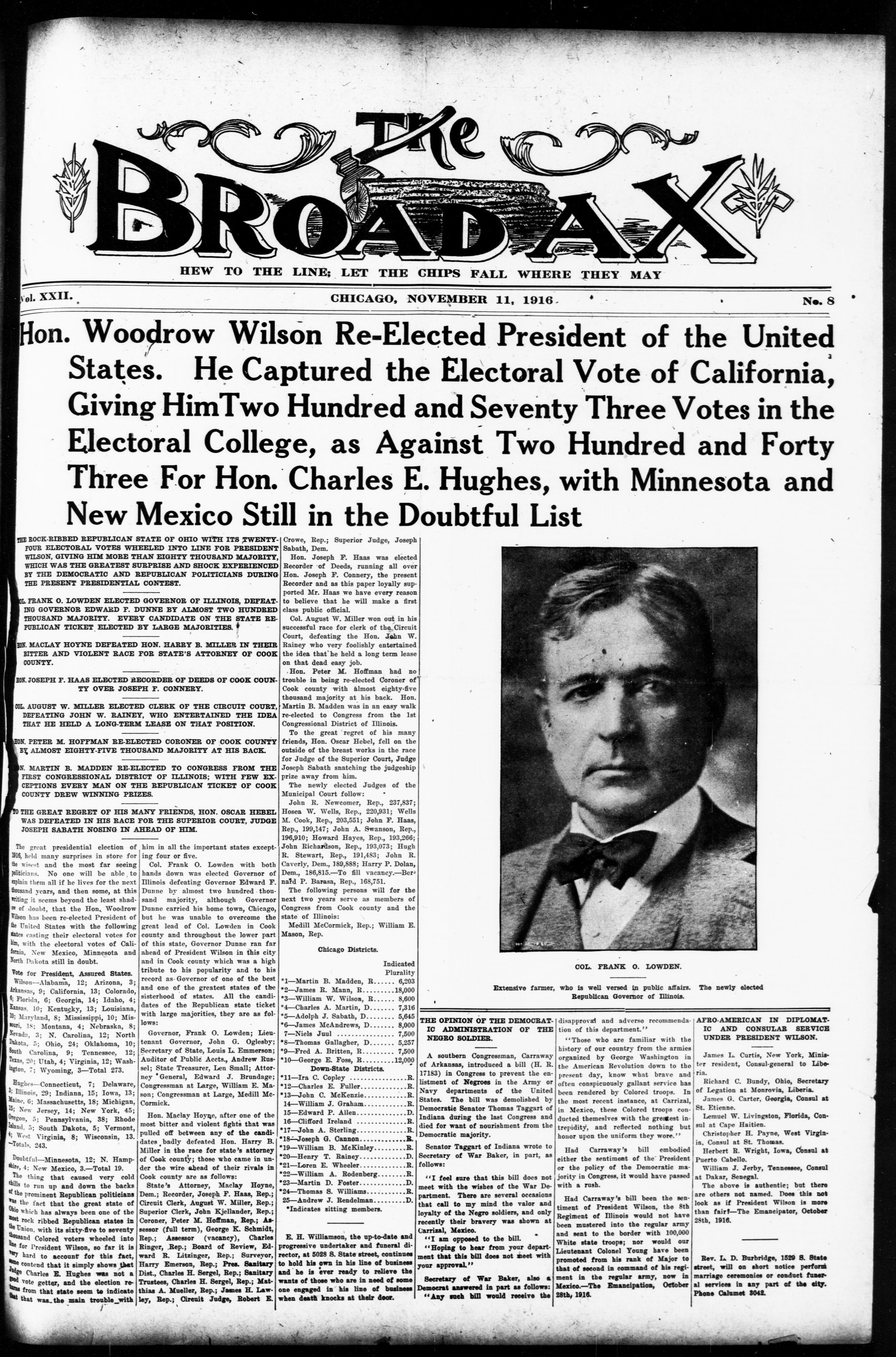
Hon. Woodrow Wilson Re-Elected President of the United States. He Captured the Electoral Vote of California, Giving HimTwo Hundred and Seventy Three Votes in the Electoral College, as Against Two Hundred and Forty Three For Hon. Charles E. Hughes, with Minnesota and New Mexico Still in the Doubtful List
THE ROCK-RIBBED REPUBLICAN STATE OF OHIO WITH ITS TWENTY-FOUR ELECTORAL VOTES WHEELED INTO LINE FOR PRESIDENT WILSON, GIVING HIM MORE THAN EIGHTY THOUSAND MAJORITY, WHICH WAS THE GREATEST SUBPRISE AND SHOCK EXPERIENCED BY THE DEMOCRATIC AND REPUBLICAN POLITICIANS DURING THE PRESENT PRESIDENTIAL CONTEST.
COL. FRANK O. LOWDEN ELECTED GOVERNOR OF ILLANOIS, DEFEATING GOVERNOR EDWARD F. DUNNE BY ALMOST TWO HUNDRED THOUSAND MAJORITY. EVERY CANDIDATE ON THE STATE REPUBLICAN TICKET ELECTED BY LARGE MAJORITIES.
HON. MACLAY HOYNE DEFEATED HON. HARRY B. MILLER IN THEIR BITTER AND VIOLENT RACE FOR STATE'S ATTORNEY OF COOK COUNTY.
HON. JOSEPH F. HAAS ELECTED RECORDER OF DEEDS OF COOK COUNTY OVER JOSEPH F. CONNERY.
COL. AUGUST W. MILLER ELECTED CLERK OF THE CIRCUIT COURT, DEFEATING JOHN W. RAINEY, WHO ENTERTAINED THE IDEA THAT HE HELD A LONG-TERM LEASE ON THAT POSITION.
HON. PETER M. HOFFMAN RE-ELECTED CORONER OF COOK COUNTY BY ALMOST EIGHTY-FIVE THOUSAND MAJORITY AT HIS BACK.
HON. MARTIN B. MADDEN RE-ELECTED TO CONGRESS FROM THE FIRST CONGRESSIONAL DISTRICT OF ILLINOIS; WITH FEW EXCEPTIONS EVERY MAN ON THE REPUBLICAN TICKET OF COOK COUNTY DREW WINNING PRIZES.
10 THE GREAT REGRET OF HIS MANY FRIENDS, HON. OSCAR HEBEL
WAS DEFEATED IN HIS RACE FOR THE SUPERIOR COURT, JUDGE
JOSEPH SABATH NOSING IN AHEAD OF HIM.
Vol. XXII.
Hon. Wool
State
Giving
Elect
Three
New
THE ROCK-RIBBED REPUBLICAN S
FOUR ELECTORAL VOTES WH
WILSON, GIVING HIM MORE T
WHICH WAS THE GREATEST S
BY THE DEMOCRATIC AND N
THE PRESENT PRESIDENTIAL
COL. FRANK O. LOWDEN ELECTED
ING GOVERNOR EDWARD F. H
THOUSAND MAJORITY. EVER
PUBLICAN TICKET. ELECTED
HON. MACLAY HOYNE DEFEATED
BITTER AND VIOLENT RACE
COUNTY.
HON. JOSEPH F. HAAS ELECTED R
TY OVER JOSEPH
COL. AUGUST W. MILLER ELECTED
DEFEATING JOHN W. RAINE
THAT HE HELD A LONG-TERM
HON. PETER M. HOFFMAN RE-ELE
BY ALMOST EIGHTY-FIVE THOUS
HON. MARTIN B. MADDEN RE-ELE
FIRST CONGRESSIONAL DISTRI
CEPTIONS EVERY MAN ON THE
COUNTY DREW WINNING PRIZE
TO THE GREAT REGRET OF HIS M
WAS DEFEATED IN HIS RACE
JOSEPH SABATH NOSING IN A
The great presidential election of 1916, held many surprises in store for the wisest and the most far seeing politicians. No one will be able to explain them all if he lives for the next thousand years, and then some, at this writing it seems beyond the least shadow of doubt, that the Hon. Woodrow Wilson has been re-elected President of the United States with the following states casting their electoral votes for him, with the electoral votes of California, New Mexico, Minnesota and North Dakota still in doubt.
Vote for President, Assured States.
Wilson—Alabama, 12; Arizona, 3; Arkansas, 9; California, 13; Colorado, 6; Florida, 6; Georgia, 14; Idaho, 4; Kansas, 10; Kentucky, 13; Louisiana, 10; Maryland, 8; Mississippi, 10; Missouri, 18; Montana, 4; Nebraska, 8; Nevada, 3; N. Carolina, 12; North Dakota, 5; Ohio, 24; Oklahoma, 10; South Carolina, 9; Tennessee, 12; Texas, 20; Utah, 4; Virginia, 12; Washington, 7; Wyoming, 3—Total 273.
Hughes—Connecticut, 7; Delaware, 3; Illinois, 29; Indiana, 15; Iowa, 13; Maine, 6; Massachusetts, 18; Michigan, 15; New Jersey, 14; New York, 45; Oregon, 5; Pennsylvania, 38; Rhode Island, 5; South Dakota, 5; Vermont, 4; West Virginia, 8; Wisconsin, 13.—Totals, 243.
Doubtful—Minnesota, 12; N. Hampshire, 4; New Mexico, 3.—Total 19.
The thing that caused very cold chills to run up and down the backs of the prominent Republican politicians was the fact that the great state of Ohio has always been one of the most rock ribbed Republican states in the Union, with its sixty-five to seventy thousand Colored voters wheeled into line for President Wilson, so far it is very hard to account for this fact, some contend that it simply shows that Judge Charles E. Hughes was not a good vote getter, and the election returns from that state seem to indicate that that was the main trouble with
him in all the important states excepting four or five.
Col. Frank O. Lowden with both hands down was elected Governor of Illinois defeating Governor Edward F. Dunne by almost two hundred thousand majority, although Governor Dunne carried his home town, Chicago, but he was unable to overcome the great lead of Col. Lowden in Cook county and throughout the lower part of this state, Governor Dunne ran far ahead of President Wilson in this city and in Cook county which was a high tribute to his popularity and to his record as Governor of one of the best and one of the greatest states of the sisterhood of states. All the candidates of the Republican state ticket with large majorities, they are as follows:
Governor, Frank O. Lowden; Lieutenant Governor, John G. Oglesby; Secretary of State, Louis L. Emmerson; Auditor of Public Acts., Andrew Russell; State Treasurer, Len Small; Attorney General, Edward J. Brundage; Congressman at Large, William E. Mason; Congressman at Large, Medill McCormick.
Hon. Maclay Hoyne, after one of the most bitter and violent fights that was pulled off between any of the candidates, badly defeated Hon. Harry B. Miller in the race for state's attorney of Cook county; those who came in under the wire ahead of their rivals in Cook county are as follows: State's Attorney, Maclay Hoyne, Dem; Recorder, Joseph F. Haas, Rep; Cicuit Clerk, August W. Miller, Rep; Superior Clerk, John Kjellander, Rep; Coroner, Peter M. Hoffman, Rep; Assessor (full term), George K. Schmidt, Rep; Assessor (vacancy), Charles Ringer, Rep; Board of Review, Edward R. Litzinger, Rep; Surveyor, Harry Emerson, Rep; Pres. Sanitary Dist., Charles H. Sergel, Rep; Sanitary Trustees, Charles H. Sergel, Rep; Matthias A. Mueller, Rep; James H. Lawley, Rep; Circuit Judge, Robert E.
CHICAGO, NOVEMBER 11, 1916.
Crowe, Rep.; Superior Judge, Joseph Sabath, Dem.
Hon. Joseph F. Haas was elected Recorder of Deeds, running all over Hon. Joseph F. Connery, the present Recorder and as this paper loyally supported Mr. Haas we have every reason to believe that he will make a first class public official.
Col. August W. Miller won out in his successful race for clerk of the Circuit Court, defeating the Hon. John W. Rainey who very foolishly entertained the idea that he held a long term lease on that dead easy job.
Hon. Peter M. Hoffman had no trouble in being re-elected Coroner of Cook county with almost eighty-five thousand majority at his back. Hon. Martin B. Madden was in an easy walk re-elected to Congress from the 1st Congressional District of Illinois.
To the great regret of his many friends, Hon. Oscar Hebel, fell on the outside of the breast works in the race for Judge of the Superior Court, Judge Joseph Sabath snatching the judgeship prize away from him.
The newly elected Judges of the Municipal Court follow:
John R. Neweomer, Rep., 237,837; Hosea W. Wells, Rep., 202,931; Wells M. Cook, Rep., 203,551; John F. Haas, Rep., 199,147; John A. Swanson, Rep., 196,910; Howard Hayes, Rep., 193,266; John Richardson, Rep., 193,073; Hugh R. Stewart, Rep., 191,483; John R. Caverly, Dem., 189,888; Harry P. Dolan, Dem., 186,815—To fill vacancy.—Bernard P. Barasa, Rep., 168,751.
The following persons will for the next two years serve as members of Congress from Cook county and the state of Illinois:
Medill McCormick, Rep.; William E. Mason, Rep.
Chicago Districts
*1—Martin B. Madden, R. ..... 6,203
*2—James R. Mann, R. ..... 18,000
*3—William W. Wilson, R. ..... 8,600
*4—Charles A. Martin, D. ..... 7,310
*5—Adolph J. Sabath, D. ..... 5,645
*6—James McAndrews, D. ..... 8,000
*7—Niels Juul ..... 7,500
*8—Thomas Gallagher, D. ..... 5,257
*9—Fred A. Britten, R. ..... 7,500
*10—George E. Foss, R. ..... 12,000
Down-State Districts.
*11—Ira C. Copley ..... R.
*12—Charles E. Fuller ..... R.
*13—John C. McKenzie ..... R.
*14—William J. Graham ..... R.
*15—Edward P. Allen ..... D.
*16—Clifford Ireland ..... R.
*17—John A. Sterling ..... R.
*18—Joseph G. Cannon ..... B.
*19—William B. McKinley ..... R.
*20—Henry T. Rainey ..... D.
*21—Loren E. Wheeler ..... R.
*22—William A. Rodenberg ..... R.
*23—Martin D. Foster ..... D.
*24—Thomas S. Williams ..... R.
*25—Andrew J. Rendellman ..... D.
Indicates sitting members.
E. H. Williamson, the up-to-date and progressive undertaker and funeral director, at 5028 S. State street, continues to hold his own in his line of business and he is ever ready to relieve the wants of those who are in need of some one engaged in his line of business when death knocks at their door.
107
Extensive farmer, who is well versed in public affairs. The newly elected Republican Governor of Illinois.
THE OPINION OF THE DEMOCRATIC ADMINISTRATION OF THE NEGRO SOLDIER.
A southern Congressman, Carraway of Arkansas, introduced a bill (H. R. 17183) in Congress to prevent the enlistment of Negroes in the Army or Navy departments of the United States. The bill was demolished by Democratic Senator Thomas Taggart of Indiana during the last Congress and died for want of nourishment from the Democratic majority.
Senator Taggart of Indiana wrote to Secretary of War Baker, in part, as follows:
"I feel sure that this bill does not meet with the wishes of the War Department. There are several occasions that call to my mind the valor and loyalty of the Negro soldiers, and only recently their bravery was shown at Carrizal, Mexico.
"I am opposed to the bill.
"Hoping to hear from your department that this bill does not meet with your approval."
Secretary of War Baker, also a Democrat answered in part as follows:
"Any such bill would receive the
who is well versed in public affairs. Republican Governor of Illinois.
disapproval and adverse recommendation of this department."
"Those who are familiar with the history of our country from the armies organized by George Washington in the American Revolution down to the present day, know what brave and often conspicuously gallant service has been rendered by Colored troops. In the most recent instance, at Carrizal, in Mexico, these Colored troops conducted themselves with the greatest intrepidity, and reflected nothing but honor upon the uniform they wore."
Had Carraway's bill embodied either the sentiment of the President or the policy of the Democratic majority in Congress, it would have passed with a rush.
Had Carraway's hill been the sentiment of President Wilson, the 8th Regiment of Illinois would not have been mustered into the regular army and sent to the border with 100,000 White state troops; nor would our Lieutenant Colonel Young have been promoted from his rank of Major to that of second in command of his regiment in the regular army, now in Mexico.—The Emancipation, October 28th, 1916.
No.8
AFRO-AMERICAN IN DIPLOMATIC AND CONSULAR SERVICE UNDER PRESIDENT WILSON.
James L. Curtis, New York, Minister resident, Consul-general to Liberia.
Lemuel W. Livingston, Florida, Consul at Cape Haitien.
Christopher H. Payne, West Virginia, Consul at St. Thomas.
Herbert R. Wright, Iowa, Consul at Puerto Cabello.
William J. Jerby, Tennessee, Consul at Dakar, Senegal.
The above is authentic; but there are others not named. Does this not look as if President Wilson is more than fair?—The Emancipator, October 28th, 1916.
Rev. L. D. Burbridge, 1529 S. State street, will on short notice perform marriage ceremonies or conduct funeral services in any part of the city. Phone Calumet 3042.
94
94
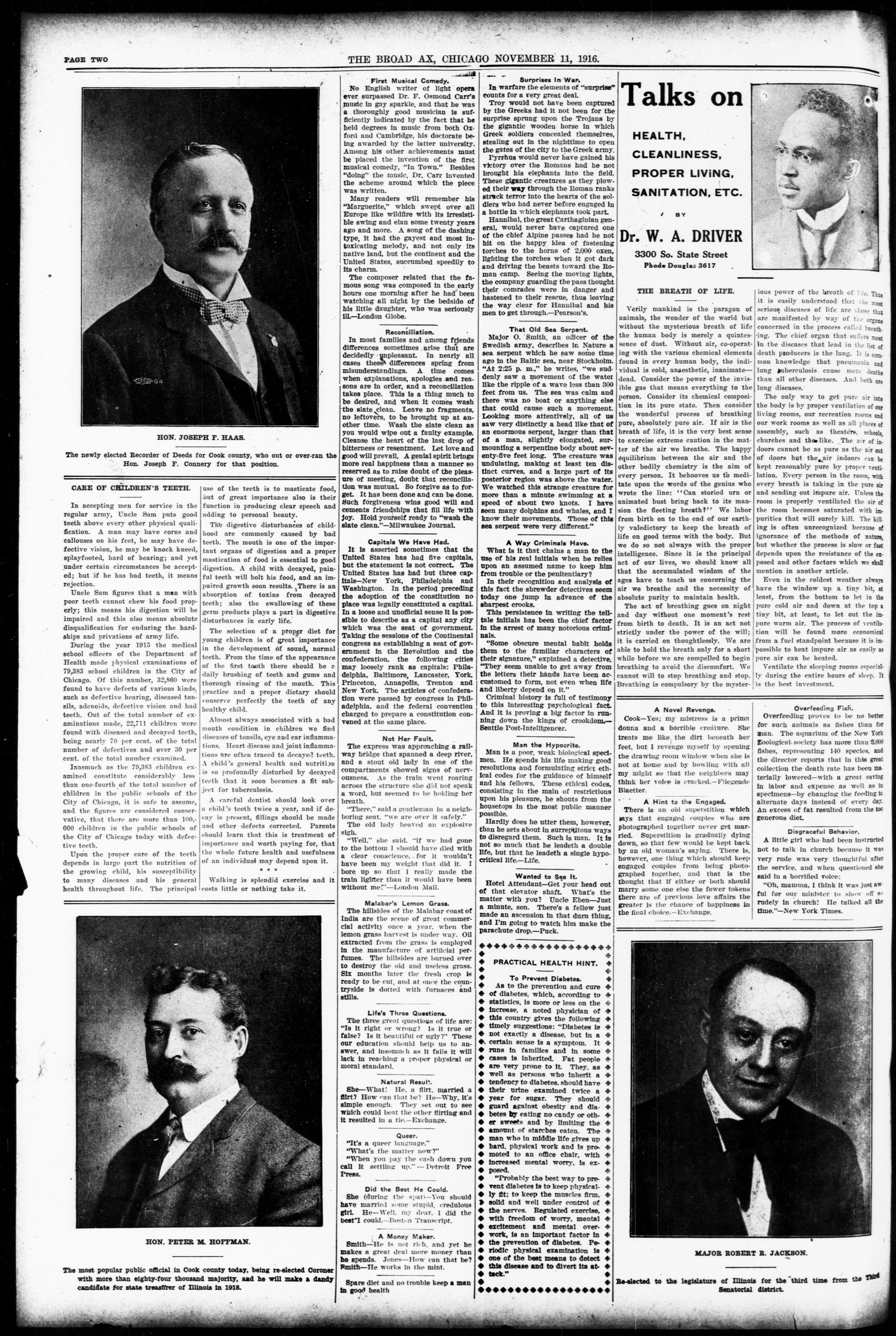
HON. JOSEPH F. HAAS.
The newly elected Recorder of Deeds is Hon. Joseph F. Con
The newly elected Recorder of Deeds for Cook county, who out or over-ran the Hon. Joseph F. Connery for that position.
CARE OF CHILDREN'S TEETH.
In accepting men for service in the regular army, Uncle Sam puts good teeth above every other physical qualification. A man may have corns and callouses on his feet, he may have defective vision, he may be knock knee, splayfooted, hard of hearing; and yet under certain circumstances be accepted; but if he has bad teeth, it means rejection.
Uncle Sam figures that a man with poor teeth cannot chew his food properly; this means his digestion will be impaired and this also means absolute disqualification for enduring the hardships and privations of army life.
During the year 1915 the medical school officers of the Department of Health made physical examinations of 79,383 school children in the City of Chicago. Of this number, 32,860 were found to have defects of various kinds, such as defective hearing, diseased tonsils, adenoids, defective vision and bad teeth. Out of the total number of examinations made, 22,711 children were found with diseased and decayed teeth, being nearly 70 per cent. of the total number of defectives and over 30 per cent. of the total number examined.
Inasmuch as the 79,383 children examined constitute considerably less than one-fourth of the total number of children in the public schools of the City of Chicago, it is safe to assume, and the figures are considered conservative, that there are more than 100,000 children in the public schools of the City of Chicago today with defective teeth.
Upon the proper care of the teeth depends in large part the nutrition of the growing child, his susceptibility to many diseases and his general health throughout life. The principal
[Name]
HON. PETER M. HOFFMAN.
The most popular public official in Cook with more than eighty-four thousand candidate for state treasurer of Ill
The most popular public official in Cook county today, being re-elected Coroner with more than eighty-four thousand majority, and he will make a dandy candidate for state treasurer of Illinois in 1918.
The most popular public official in Cook county today, being re-elected Coroner with more than eighty-four thousand majority, and he will make a dandy candidate for state treasurer of Illinois in 1918.
PAGE TWO
or Cook county, who out or over-ran the very for that position.
use of the teeth is to masticate food, but of great importance also is their function in producing clear speech and adding to personal beauty.
The digestive disturbances of childhood are commonly caused by bad teeth. The mouth is one of the important organs of digestion and a proper mastication of food is essential to good digestion. A child with decayed, painful teeth will bolt his food, and an impaired growth soon results. There is an absorption of toxins from decayed teeth; also the swallowing of these germ products plays a part in digestive disturbances in early life.
The selection of a proper diet for young children is of great importance in the development of sound, normal teeth. From the time of the appearance of the first tooth there should be a daily brushing of teeth and gums and thorough rinsing of the mouth. This practice and a proper dietary should conserve perfectly the teeth of any healthy child. Almost always associated with a bad mouth condition in children we find diseases of tonsils, eye and ear inflammations. Heart disease and joint inflammations are often traced to decayed teeth. A child's general health and nutrition is so profoundly disturbed by decayed teeth that it soon becomes a fit subject for tuberculosis.
A careful dentist should look over a child's teeth twice a year, and if decay is present, fillings should be made and other defects corrected. Parents should learn that this is treatment of importance and worth paying for, that the whole future health and usefulness of an individual may depend upon it.
* * *
Walking is splendid exercise and it costs little or nothing take it.
[Name]
in county today, being re-elected Coroner and majority, and he will make a dandyinois in 1918.
THE BROAD AX. CHICAGO NOVEMBER 11. 1916.
First Musical Comedy.
First Musical Comedy. No English writer of light opera ever surpassed Dr. F. Osmond Carr's music in gay sparkle, and that he was a thoroughly good musician is sufficiently indicated by the fact that he held degrees in music from both Oxford and Cambridge, his doctorate being awarded by the latter university. Among his other achievements must be placed the invention of the first musical comedy, "In Town." Besides "doing" the music, Dr. Carr invented the scheme around which the piece was written.
Many readers will remember his "Marguerite," which swept over all Europe like wildfire with its irresistible swing and elan some twenty years ago and more. A song of the dashing type, it had the gayest and most intoxicating melody, and not only its native land, but the continent and the United States, succumbed speedily to its charm.
The composer related that the famous song was composed in the early hours one morning after he had been watching all night by the bedside of his little daughter, who was seriously ill—London Globe.
Reconciliation
In most families and among friends differences sometimes arise that are decidedly unpleasant. In nearly all cases these differences spring from misunderstandings. A time comes when explanations, apologies and reasons are in order, and a reconciliation takes place. This is a thing much to be desired, and when it comes wash the slate clean. Leave no fragments, no leftovers, to be brought up at another time. Wash the slate clean as you would wipe out a faulty example. Cleanse the heart of the last drop of bitterness or resentment. Let love and good will prevail. A genial spirit brings more real happiness than a manner so reserved as to raise doubt of the pleasure of meeting, doubt that reconciliation was mutual. So forgive as to forget. It has been done and can be done. Such forgiveness wins good will and cements friendships that fill life with joy. Hold yourself ready to "wash the slate clean." -Milwaukee Journal.
Capitals We Have Had.
It is asserted sometimes that the United States has had five capitals, but the statement is not correct. The United States has had but three capitals—New York, Philadelphia and Washington. In the period preceding the adoption of the constitution no place was legally constituted a capital. In a loose and unofficial sense it is possible to describe as a capital any city which was the seat of government. Taking the sessions of the Continental congress as establishing a seat of government in the Revolution and the confederation, the following cities may loosely rank as capitals: Philadelphia, Baltimore, Lancaster, York, Princeton, Annapolis, Trenton and New York. The articles of confederation were passed by congress in Philadelphia, and the federal convention charged to prepare a constitution convened at the same place.
Not Her Fault.
The express was approaching a railway bridge that spanned a deep river, and a stout old lady in one of the compartments showed signs of nervousness. As the train went roaring across the structure she did not speak a word, but seemed to be holding her breath. "There," said a gentleman in a neighboring seat. "we are over it safely." The old lady heaved an explosive sigh. "Well," she said. "if we had gone to the bottom I should have died with a clear conscience, for it wouldn't have been my weight that did it. I bore up so that I really made the train lighter than it would have been without me!"—London Mail.
Malabar's Lemon Grass.
The hillsides of the Malabar coast of India are the scene of great commercial activity once a year, when the lemon grass harvest is under way. Oil extracted from the grass is employed in the manufacture of artificial perfumes. The hillsides are burned over to destroy the old and useless grass. Six months later the fresh crop is ready to be cut, and at once the countryside is dotted with furnaces and stills.
Life's Three Questions
The three great questions of life are: "Is it right or wrong? Is it true or false? Is it beautiful or ugly?" These our education should help us to answer, and insomuch as it fails it will lack in reaching a proper physical or moral standard.
Natural Result
She—What! He, a flirt, married a flirt? How can that be? He—Why, it's simple enough. They set out to see which could beat the other flirting and it resulted in a tie—Exchange.
Queer.
"When you pay the cash down you call it settling up." — Detroit Free Press.
Did the Best He Could.
She (during the spat--You should have married some stupid, credulous girl. He—Well, my dear, I did the best I could—Hospitol Transcript.
A Money Maker.
Smith—He is not rich, and yet he makes a great deal more money than he spends. Jones—How can that be? Smith—He works in the mint.
Spare diet and no trouble keep a man in good health
In warfare the elements of "surprise" counts for a very great deal. Troy would not have been captured by the Greeks had it not been for the surprise sprung upon the Trojans by the gigantic wooden horse in which Greek soldiers concealed themselves, stealing out in the nighttime to open the gates of the city to the Greek army. Pyrrhus would never have gained his victory over the Romans had he not brought his elephants into the field. These gigantic creatures as they plowed their way through the Roman ranks struck terror into the hearts of the soldiers who had never before engaged in a battle in which elephants took part.
Hannibal, the great Carthaginian general, would never have captured one of the chief Alpine passes had he not hit on the happy idea of fastening torches to the horns of 2,000 oxen, lighting the torches when it got dark and driving the beasts toward the Roman camp. Seeing the moving lights, the company guarding the pass thought their comrades were in danger and hastened to their rescue, thus leaving the way clear for Hannibal and his men to get through—Pearson's.
That Old Sea Serpent.
Major O. Smith, an officer of the Swedish army, describes in Nature a sea serpent which he saw some time ago in the Baltic sea, near Stockholm. "At 2:25 p. m.," he writes, "we suddenly saw a movement of the water like the ripple of a wave less than 300 feet from us. The sea was calm and there was no boat or anything else that could cause such a movement. Looking more attentively, all of us saw very distinctly a head like that of an enormous serpent, larger than that of a man, slightly elongated, surmounting a serpentine body about seventy-five feet long. The creature was undulating, making at least ten distinct curves, and a large part of its posterior region was above the water. We watched this strange creature for more than a minute swimming at a speed of about two knots. I have seen many dolphins and whales, and I know their movements. Those of this sea serpent were very different."
A Way Criminals Have.
What is it that chains a man to the use of his real initials when he relies upon an assumed name to keep him from trouble or the penitentiary?
In their recognition and analysis of this fact the shrewder detectives seem today one jump in advance of the sharpest crooks.
This persistence in writing the telltale initials has been the chief factor in the arrest of many notorious criminals.
"Some obscure mental habit holds them to the familiar characters of their signature," explained a detective. "They seem unable to get away from the letters their hands have been accustomed to form, not even when life and liberty depend on it."
Criminal history is full of testimony to this interesting psychological fact. And it is proving a big factor in running down the kings of crookdom—Seattle Post-Intelligence.
Man the Hypocrite
Man is a poor, weak biological specimen. He spends his life making good resolutions and formulating strict ethical codes for the guidance of himself and his fellows. These ethical codes, consisting in the main of restrictions upon his pleasure, he shouts from the housetops in the most public manner possible. Hardly does he utter them, however, than he sets about in surreptitious ways to disregard them. Such is man. It is not so much that he leadeth a double life, but that he leadeth a single hypocritical life.-Life.
Wanted to See It.
Hotel Attendant—Get your head out of that elevator shaft. What's the matter with you? Uncle Eben—Just a minute, son. There's a fellow just made an ascension in that durn thing, and I'm going to watch him make the parachute drop.—Puck.
---
PRACTICAL HEALTH HINT.
To Prevent Diabetes
As to the prevention and cure of diabetes, which, according to statistics, is more or less on the increase, a noted physician of this country gives the following timely suggestions: "Diabetes is not exactly a disease, but in a certain sense is a symptom. It runs in families and in some cases is inherited. Fat people are very prone to it. They, as well as persons who inherit a tendency to diabetes, should have their urine examined twice a year for sugar. They should guard against obesity and diabetes by eating no candy or other sweets and by limiting the amount of starches eaten. The man who in middle life gives up hard, physical work and is promoted to an office chair, with increased mental worry, is exposed.
"Probably the best way to prevent diabetes is to keep physically fit; to keep the muscles firm, solid and well under control of the nerves. Regulated exercise, with freedom of worry, mental excitement and mental overwork, is an important factor in the prevention of diabetes. Periodic physical examination is one of the best means to detect this disease and to divert its attack."
Talks on
HEALTH,
CLEANLINESS,
PROPER LIVING,
SANITATION, ETC.
BY
Dr. W. A. DRIVER
3300 So. State Street
Phode Douglas: 3617
THE BREATH OF LIFE.
Verily mankind is the paragon of animals, the wonder of the world but without the mysterious breath of life the human body is merely a quintessence of dust. Without air, co-operating with the various chemical elements found in every human body, the individual is cold, anaesthetic, inanimate—dead. Consider the power of the invisible gas that means everything to the person. Consider its chemical composition in its pure state. Then consider the wonderful process of breathing pure, absolutely pure air. If air is the breath of life, it is the very best sense to exercise extreme caution in the matter of the air we breathe. The happy equilibrium between the air and the other bodily chemistry is the aim of every person. It behooves us to meditate upon the words of the genius who wrote the line: "Can storied urn or animated bust bring back to its mansion the fleeting breath?" We labor from birth on to the end of our earthly valedictory to keep the breath of life on good terms with the body. But we do so not always with the proper intelligence. Since it is the principal act of our lives, we should know all that the accumulated wisdom of the ages have to teach us concerning the air we breathe and the necessity of absolute purity to maintain health.
The act of breathing goes on night and day without one moment's rest from birth to death. It is an act not strictly under the power of the will; it is carried on thoughtlessly. We are able to hold the breath only for a short while before we are compelled to begin breathing to avoid the discomfort. We cannot will to stop breathing and stop. Breathing is compulsory by the myster-
Cook—Yes; my mistress is a primadonna and a horrible creature. She treats me like the dirt beneath her feet, but I revenge myself by opening the drawing room window when she is not at home and by howling with all my might so that the neighbors may think her voice is cracked.—Fliegende Blaetter.
A Hint to the Engaged.
There is an old superstition which says that engaged couples who are photographed together never get married. Superstition is gradually dying down, so that few would be kept back by an old woman's saying. There is, however, one thing which should keep engaged couples from being photographed together, and that is the thought that if either or both should marry some one else the fewer tokens there are of previous love affairs the greater is the chance of happiness in the final choice.—Exchange.
[Image of a man in a suit with a tie and a serious expression].
JOHN H. HARRIS
MAJOR ROBERT R. JACKSON.
Re-elected to the legislature of Illinois for the third
Senatorial district.
Re-elected to the legislature of Illinois for the third time from the Thir Senatorial district.
A Novel Revenge
[Picture of a man in a suit and tie].
ious power of the breath of life. Thus it is easily understood that the most serious diseases of life are those that are manifested by way of the organs concerned in the process called breathing. The chief organ that suffers most in the diseases that lead in the list of death producers is the lung. It is common knowledge that pneumonia and lung tuberculosis cause more deaths than all other diseases. And both are lung diseases.
The only way to get pure air into the body is by proper ventilation of our living rooms, our recreation rooms and our work rooms as well as all places of assembly, such as theaters, schools, churches and the like. The air of indoors cannot be as pure as the air out of doors but the air indoors can be kept reasonably pure by proper ventilation. Every person in the room, with every breath is taking in the pure air and sending out impure air. Unless the room is properly ventilated the air of the room becomes saturated with impurities that will surely kill. The killing is often unrecognized because of ignorance of the methods of nature but whether the process is slow or fast depends upon the resistance of the exposed and other factors which we shall mention in another article.
Even in the coldest weather always have the window up a tiny bit, at least, from the bottom to let in the pure cold air and down at the top a tiny bit, at least, to let out the impure warm air. The process of ventilation will be found more economical from a fuel standpoint because it is impossible to heat impure air as easily as pure air can be heated.
Ventilate the sleeping rooms especially during the entire hours of sleep. It is the best investment.
Overfeeding proves to be no better for such animals as fishes than for man. The aquarium of the New York Zoological society has more than 3,000 fishes, representing 140 species, and the director reports that in this great collection the death rate has been materially lowered—with a great saving in labor and expense as well as in specimens—by changing the feeding to alternate days instead of every day. An excess of fat resulted from the too generous diet.
Disgraceful Behavior.
A little girl who had been instructed not to talk in church because it was very rude was very thoughtful after the service, and when questioned she said in a horrified voice:
"Oh, mamma, I think it was just awful for our minister to show off so rudely in church! He talked all the time." -New York Times
1.
is for the third time from the Third district.
Overfeeding Fish
Disgraceful Behavior
Carpets of
References to carpets are found among the earliest Egyptian and Assyrian writers. In Egypt, for example, floor and seat coverings were used in temples for religious ceremonies, while about 1500 B. C. they garnished the interiors of the royal palaces. For 400 years following the dynasty of the pharaohs carpet weaving was apparently confined to the Egyptians and Assyrians, an extant example of a floor cover of 705 B. C., taken from the palace at Nineveh, bearing a design of wooden lotus flowers and buds. We ask that the tomb of
Arrian the Persian was covered with a pall of purple Babylonian tapestry, while Callicus, the best reporter of his time, writing the story of the banquet given by one of the Ptolemies, pictures "purple carpets of finest wool with the pattern on both sides and handsome embroidered rugs very beautifully elaborated with figures," a description of which might well apply to the floor or chair coverings in any mansion of today.—New York World.
Just Like a Man.
She hurried down the stairs to join her husband, who was waiting to go out with her to the party.
"Oh, Jack," she cried, "wait a moment!"
"I never saw anything like it!" exclaimed Jack impatiently. "You always forget something. You girls are enough to drive any patient man frantic"
"But, Jack, dear"—
"Oh, go unstairs and get what you want and don't for goodness' sake keep me waiting here any longer."
"But I haven't forgotten anything, dear; it's you"—
"Good gracious! What next, I wonder? I've been dressed ready and waiting for you this last half hour."
"Indeed!" she said frigidly. "Then why is it you have no necktie on?" "Goodness!" he ejaculated. "Why couldn't you tell me that before, instead of staring at me and saying nothing?"—Exchange.
Why Not Be Sensible?
To the enmiled of earth who are looking for a new and lasting sensation we would offer the query, Why not be sensible?
If you have never tried looking at things in a sensible way you cannot imagine what supreme delights there are in an excursion into this little frequented domain of human activity. There are drawbacks, to be sure. But the drawbacks are greatly outweighed by the advantages. We have known people who, after leading unsensible lives from early childhood, have taken up the sensible life and have never led any other life from that time on. That, however, is going to extremes and is therefore to be carefully shunned, but it only goes to show how being sensible can take hold of you if you give it a chance.—Life.
How to Become a Highbrow.
One never can tell the sociological possibility of some little thing that seems hardly worth the saying. Thus if you say, "He swears like a pirate," you are not sociological. But suppose you pull yourself together and say, "Profanity in that it relaxes the inner tension by a sudden nervous discharge and offers a means of escape from social inhibitions, is, when phylogenetically considered, nature's method under the conditions of modern civilized life of producing an outlet for primitive emotions which in an earlier period were apt to take more socially injurious forms, such as piracy." You will then be taken for a sociologist. I do not say you will really be a sociologist, but you will look like one, especially if you add a bibliography.—New Republic.
Preaching and Practice
The noted Danish astronomer Tycho Brahe used to condemn with the severest contempt those persons who ascribed any omen or presage to eclipse of the sun or moon, to comets, the aurora borealis or other appearances in the heavens. He himself was no superstitious that if he chanced to meet an old woman in his morning walk he at once retraced his steps home, fearing that such a meeting might be disaster.
One Economic Failure
Theorist—Our housewives ought to be encouraged to make their own bread. The homemade article would not be so liable to go up. Practical Friend—No; if it's all the kind my wife tried to make it would be too heavy to do any rising—Exchange.
Domestic Amenities
"Guesst. A small package came."
"That must be my vanity box."
"Look at a small package of Cine-
"That must be my vanity box."
"Gee, that wouldn't hold half your
vanity! I expected 'em to unload a
plane case at the very least."—Rich-
mond TimesDispatch.
His Desire.
Aviator--You're up in the air where you wanted to go. You've got more than the worth of your money. What more do you want? Seared Passenger-I want the earth-Exchange.
A Wife's Economics
Husband — Are you aware that it takes three-fourths of my salary to meet your dressmaker's bills? Wife—Goodness gracious! What do you do with the rest of your money?
September.
September has, in turn, contained the following various numbers of days -10, 30, 31 and, finally, 30.
He that is slothful in his work is brother to him that is a great waster. -Bible.
The ill luck attendant on British warships bearing the names of reptiles is almost beyond coincidence. The first of England's fast turbine destroyers was the Viper. She was only 312 tons, but had engines of 10,000 horsepower and could do thirty-five knots. During naval maneuvers she ran into fog, struck the rocks off the Channel islands and broke into three pieces. Three other Vipers have been lost at different times. The Cobra, a similar vessel to the Viper, broke her back in the North sea. Some say she hit a whale, some that it was merely force of wave and weather. In 1890 the Serpent, a gumbat, went on the rocks off the north coast of Spain, with terrible loss of life. The death roll was 173.
Three other Serpents have been lost at different times, three Lizards, two Snakes, one Basilisk and one Crocodile. Does any one wonder, then, that England carefully avoids ships with "snaky" names?—London Answers.
Legend of Holyrood Palace
Holyrood palace, Edinburgh, Scotland, once a British royal residence, is the subject of a strange legend. Robert Louis Stevenson alludes to it in his little book on Edinburgh. “There is a silly story,” he writes, “of a subterranean passage between the castle of Holyrood and a bold highland piper who volunteered to explore its windings. He made his entrance by the upper end, playing a strathspey. The curious footed it after him down the street, following his descent by the sound of the chanter from below, until all of a sudden, about the level of St. Giles’, the music came abruptly to an end and the people in the street stood at fault with hands uplifted. Whether he was choked with gases or perished in a quag or was removed bodily by the evil one remains a point of doubt, but the piper has never again been seen or heard of from that day to this.”
A Traffic Tragedy
The panicky pedestrian hesitated at the intersection of two busy streets. A motorcar was rushing upon him from one direction, from another point a motorcycle was approaching rapidly, an autotruck was coming from behind, and a taxicab was speedily bearing down upon him.
He gave a hopeless glance upward. Directly above him a runaway aeroplane was in rapid descent.
There remained for him but one resource. He was standing upon a manhole cover. Quickly seizing it, he lifted the lid, jumped into the hole—and was run over by a subway train!—New York Times.
The Moslem's Exalted Month:
Ramadan is the month exalted by Moslems above all others. In that month the Koran, according to Moslem tradition, was brought down by Gabriel from heaven and delivered to man in small sections. In that month Mohammed was accustomed to retire from Mecca to the cave of Hira for prayer and meditation. In that month Abraham, Moses and other prophets received their divine revelations. In that month the "doors of heaven are always open, the passages to hell are shut, and the devils are chained." So run the traditions—Christian Herald.
Fifty-Fifty.
"My son," said the father impressively, "you are leading an absolutely useless life. For the last ten years you have done nothing but squander time and money." "That's all right, dad," replied the unrepentant youth. "It isn't as if I was asking you to bear the whole burden. You just furnish the money, and I'll try to find the time."—St. Louis Post-Dispatch.
Something In This.
Instead of the greeting, "How are you?" which makes it easy for your friends to discourse on their alleged ills, why not say "You're looking well?" which puts the burden of proof on the man who thinks he is ill.
There's an interesting bit of psychology in this.—Exchange.
How It Happened
"Strange, one of your twins is blond and the other is a brunette." "Well, we never could afford a maid. I washed one child and my husband washed the other, and that one grew up dark." - Louisville Courler-Journal.
PRACTICAL HEALTH HINT.
Handkerchief Menace.
Hankerchief Menace.
The pocket handkerchief should be abolished, because it is a source of infection long after a person has recovered from such diseases as infantile paralysis and even common colds, says Dr. F. Robbins in the Medical Record. "The day will come," he says, "when the customary cotton rag is replaced by the cheap and clean Japanese paper napkin, which is burned after it has been used. Infants and children are helpless against the rubbing of strange handkerchiefs over their perspiring and grimy faces. The public roller towel of the past was innocuous as compared to the family pocket handkerchief. Bitter experience will drive home the lesson that neglected noses, mouths and throats are largely, if not exclusively, responsible for the ultimate crippling of the unfortunate victims of disease and ignorance."
---
"Of all the bluffers one meets socially and in business, and their name is legion," remarked a minor cynic, "none amuses me more than the restaurant bluffer. This brand is numerous. I met one today, and his embarrassment was ludicrous.
"This chap, you know, is a living lie. He lodges in a rather high priced house, but occupies a cheap little room up under the roof, to which he is careful not to invite any acquaintance. He's an underclerk somewhere, but talks familiarly of high finance. He pretends to be on friendly terms with influential men who wouldn't know him from Adam.
"Several evenings ago he was impressing me with the frequency with which he lunches at one or two places famous in the Wall street section. When I met him today bending over coffee and rolls in a place where his check was 10 cents you should have seen his face, it was a study. "Of course I wasn't surprised, but he was. I enjoyed the encounter, but he didn't."-New York Globe.
Spies In Revolutionary Days.
A curious and unfamiliar page in American history shows that the treatment of the spy in Revolutionary days was painfully prompt and rigorous. Every American schoolboy knows the fate of Major Andre, but few know of any others, with perhaps the exception of Nathan Hale, executed by the British as a spy. In the second year of our Revolutionary war General Israel Putnam caught a man lurking about his post at Peekskill, on the Hudson. A flag of truce came from Sir Henry Clinton, claiming the prisoner as Lieutenant Palmer of the British service. The answer of the stout old general was brief and to the point:
Headquarters, Aug. 7, 1777.
Edmund Palmer, an officer in the enemy's service, was taken as a spy lurking within our lines. He has been tried as a spy, condemned as a spy and shall be executed as a spy, and the flag is ordered to depart immediately. ISRAEL PUTNAM. P. 8.-He has accordingly been executed. -Indianapolis News.
Noise and Hearing.
There are two distinct meanings to the word "sound"—one the sensation produced in the brain, the other the external vibration which produces the sensation. The physical cause may exist where there is no ear; the sensation cannot exist unless there is an ear to hear it. Suppose two men—one totally deaf, the other with a normal sense of hearing—are in the same closed room in which a third man beats upon a piece of iron with a hammer. Is there no physical vibration because the deaf man cannot hear it? The sensation may be ear splitting to the one and totally nonexistent to the other. The same vibrations beat through the air. The same sound exists in the room, but the sensation exists for only one of the men—Philadelphia Press.
The "Bad News" Bell at Lloyd's.
The bell of the British frigate Lutine, which sank off the Dutch coast in 1799 with a cargo of coin and specie valued at $6,000,000, is the "bad news" bell at Lloyd's. Whenever news is received that a ship is overdue or when definite news comes of the loss of a ship the bell is rung by the "caller." At its tolling all transactions are suspended until the news it heralds is read.-London Mirror.
Confused.
A flustered woman was seen running wildly about in the corridors of a large railway station.
"What are you looking for, madam?" questioned an officer.
"I—I am looking for the entrance to the outside!" responded the woman nervously—St. Louis Post-Dispatch.
Joke In a Needle's Point
Some years ago an American firm sent to a Chinese house in Canton the smallest and finest kind of needle as a sample of our skill in delicate handicraft. It was returned to the firm with a hole through the point, which could be seen only with a microscope
Man's Littleness
As an illustration of the insignificance of man in the scheme of nature Professor Zuccarini of Italy estimated that, taking the world's population at 1,500,000,000, the whole human race could stand comfortably shoulder to shoulder in an area 500 miles square.
Too Quiet to Be True
Mabel-It is whispered that Belle and Bob are engaged. Jack-Who whispers it? Mabel-Belle. Jack-If they really were she'd whistle, sing and shout it-Exchange.
In the Same Boat.
The Overbearing Lawyer—Ignorance of the law excuses no one. The Culprit—I'll be sorry for you then if you ever get in trouble.—Browning's Magazine.
Compensation
Diner—This is a very small piece of chicken you have given me, waiter. Waiter—Yes, sir; but you will find it will take you a long time to eat it.
Becomes Annoying.
"Imitation is the sincerest flattery." "Maybe so, but I don't like to have too many women copying my gowns." —Louisville Courier-Journal.
Business In New York
Every thirty minutes a new business corporation is formed in New York, and every forty-3ve minutes one is dissolved.
You should stop criticising others the moment you find it gives you pleasure. - Youth's Companion.
Camera Men and War Pictures. The camera man in search of lively war pictures often enjoys the protection of a special guard, which is especially detailed to protect him. Since the camera does not shoot as far as a gun, the photographer often works at an immense disadvantage. The camera makes a conspicuous target and often draws the enemy's fire. The special camera guard, which originated in one of the early Villa campaigns in Mexico, consists of two picked men, perhaps more, who accompany the photographer or skirmish ahead of him to render his position as safe as possible when the camera is set up. Many thousands of feet of war film have been made while sharpshooters on both sides kept up a steady and effective fire. A guard of two American Indians, both crack shots, were employed for many weeks to protect L. M. Burrud, an American camera man, who accompanied Villa in one of his campaigns. The Indians' stealth and daring in reconnoitering the ground in advance often proved indispensable.—"The Camera Man," by Francis Arnold Collins.
Stage Names and Real.
The extent to which favorite actresses are somebody else off the stage is not well understood. Actors generally play under their own names, but the woman who has achieved a reputation before marriage prefers to retain the name under which she became known rather than assume that of her husband. Some women, too, play while unmarried under another name than the real one.
For instance, Maude Adams is really Miss Kiskadden, and Marie Dressler is Lella Koerber. Jack and Ethel Barrymore are properly called Blythe, and Truly Shattuck is Clarice Erulia de Bucharde, a name rather too long for the stage. Theater goers seem to like short names easily remembered. Trixie Friganza is really Della Edna O'Cahan, and Mary Mannering is Florence Friend; Elsie Janis was formerly Elsie Blowerbower, and Margaret Anglin is Mary Warren. And so it goes through the list—Boston Herald.
Orkney Islands In Pawn.
The Orkney islands, says Pearson's Magazine, do not really belong to Great Britain in the sense that they were ever ceded by treaty or acquired by conquest. They were simply transferred by Denmark to Scotland in 1468, in pledge for the payment of the dowry of the Princess of Denmark, who was married to James III, king of Scotland. In the deed of transfer, which is still in existence, it is specially mentioned that Denmark shall have the right to redeem them at any future time by paying the original amount of the dowry with interest to date.
There is no likelihood, however, that Denmark will ever attempt to exercise her right of redemption, because 60,000 florins, the original amount of the dowry, plus compound interest for 448 years, would amount to perhaps £1,000,000,000,000, and that is a bit more than the islands are worth.
"Thanks For the Ducks."
An official in one of the largest manufacturing concerns in Philadelphia recently showed me the huge plant. I marveled at the labor saving machinery.
"One of our workmen," he said, "has made a great many of the improvements you see in this room. He likes to go duck shooting, and while on a trip for a week or more he thinks out some new way to save labor."
After a moment's pause he added:
"Why, he turned up one day with a plan whereby we save $50,000 a year."
plan whereby we save $50,000 a year," "And what," I inquired, "does that workman get out of it?" "Oh," the happy official replied, "he gets the ducks."—Girard in Philadelphia Ledger.
Simple Arithmetic
A little boy who had not learned how to count one day received three apples from a friend.
He was very pleased and told his mother afterward.
"How many apples did you get?" she asked.
"I don't know just how many mother," he replied, "but I got one in the middle and two outside."—New York Times.
Not Guilty.
Little Charley had been spanked by his mother for stealing cookies. His cousin, who was present, wishing to comfort him, said: "Poor Charley! You have my sympathy." Looking up through his tears, he protested: "I have not! I didn't touch it!"—Boston Transcript.
The Ancient Mayas.
It is urged by an archaeologist that the Mayas, who once inhabited America, had a civilization as far advanced as that of any early people except the Greeks. The dwellers in the jungles of Yucatan, Guatemala and Honduras are believed to be their descendants.
Clam Shells.
Clam shells are susceptible of a fine polish and are used for many ornamental purposes. Chinese carve them into snuffboxes, tops of walking sticks, bracelets and similar articles.
Merely a Delusion.
Insurance Doctor—Any insanity in your family? Cholly-Only-aw—the pater-thinks he's the head of the house. ye know—Boston Globe.
Strong on Bills.
Winkle—My wife would make a good member of congress. Hinkle-Why? Winkle—She's always introducing bills into the house.
Where love and skill work together expect a masterpiece.—Reade.
FOR YOUNG FOLKS
Sleepy Time Story That Is Instructive and Entertaining.
FISH THAT BUILDS A NEST.
Remarkable Little Creature That Displays Great Ingenuity In Constructing a Home For Its Children—Eats Neighbors' Babies—A Cornfield Lady. Tonight, said Uncle Ben, I am going to tell you about
FATHER STICKLEBACK
"What do you think of a fish that builds a nest?" asked Uncle Ben.
"A nest down in the water?" echoed little Ned and Polly Ben.
"Yes," replied Ben, "a nest that looks very much like the nests the birds build in the treetops.
"The fish is named the stickleback. The father fish builds the nest and takes care of the little ones.
"The fish do not live in the nest, but the wife lays the eggs from which the young fish hatch inside of it.
"The nest has two doors, and they open in such directions that the ocean current passes through them instead of beating against the foul walls of the nest and battering them down, as it might do in time.
"The gum with which the fish glues together the parts of the nest is spun out of its body, just as the spider spins out the silk for its web.
"Mrs. Stickleback is a great gadder. After she leaves the eggs in the nest she goes swimming off and never bothers about the little fishes.
"Father Stickleback, who has built the nest, watches over it till the little ones come out of the eggs. Then he guards them until they are old enough to take care of themselves.
"It must be a fine thing to see him swimming about with his little ones flocking about him. If any strange fish tries to bother them Father Stickleback files at him in a fine rage, and it is apt to go hard with the one who makes the trouble, for sticklebacks are fine fighters. They have a row of sharp spines on their backs, and with these they can rip and tear their enemies severely.
"Although so kind to their own young ones, the sticklebacks are not so good to the young of other fishes. Indeed, it is said that it is their weakness for making a meal of their neighbors' bales that has made them so disliked by the other dwellers in the water.
"There is one family of sticklebacks that live in the ocean, and they make their nests of seaweeds gummed together with a sticky thread which the fish supplies.
"There are other sticklebacks that live in fresh water, and their nests are made of small sticks and twigs which they can gather together on the river bottom and are glued together by means of the sticky liquid which the fish provides.
"The openings in the nest are always turned the same way that the water runs, so that it may sweep through instead of against the sides of the nest."
In the Cornfield
All summer long the little girl in the picture has been watching the corn grow. Now that it is taller than herself and about ripe she likes to hide away in the golden forest. Soon the harvesters will come and cut the rel-
THE FARMER
THE HARVEST SPRITE
lowing stalks and the field will be bare
Probably she will regret to see her
playground thus despolled, but there
will come another year, and again the
corn will grow green and then yellow,
and finally once more the harvesters
will gather the grain.
Busy Little Mothers.
We're kept busy, goodness knows,
Washing careless dolles' cloes!
We're kept busy when we're through
Mending them as good as new.
And even then they will wear out,
No matter how we tread about.
Indeed, we fear quite soon 'tis so
Shopping we will have to go.
Philadelphia Record.
---
The Horse Upstairs.
Not long since we were riding on an elevated train in Chicago. We looked out of the car, and there, right at our elbow, was a horse's head, thrust through the upper floor window of a brick building. It was a startling thing. We felt like saying, "Now, what on earth are you doing up here, old man?" But the horse appeared to be very much at home. No doubt he lived there, twenty feet or so from the ground. It was like a jail. He had no barn lot or pasture. When his day's work was over he was taken direct from the wagon to his upstairs stall. Rents were too high for his owner to furnish a stall on the ground. He never had a chance to "roll over" or to nibble at a bit of fresh plowed earth. Yet that horse's life in the city was no more artificial and abnormal than the life of the average city man. The man goes of his own accord, however, and the horse has no choice in the matter. Probably the horses wonder why men want to live together like bees.—Farm Life.
Aztecs and Human Sacrifices.
Aztecs and Human Sacrifices.
Human victims were sacrificed by the Aztecs in various ways and relatively in large numbers. Hubert Howe Bancroft, in his "History of Mexico," says: "The victims were for the most part captives taken in war, and war was often made solely with a view to obtaining them. A large proportion, however, consisted of condemned criminals or slaves, and even of children, bought or presented for the purpose. Moreover, persons sometimes offered themselves voluntarily for the good of the people or for the honor of a god. The greater part of the victims died under the knife, but some were burned alive, and children were often buried alive or drowned, while we hear of criminals being crushed to death between stones. But the most cruel sacrifice of all, and yet the most common, was performed by tearing out the heart of a living human creature at the sacrificial stone."
Haiti's Sans Souci
The palace of 'Sans Souci, erected by Christophe, the black leader of Haiti, is situated in the hills above the level vale of Milot, with a background of forest and a foreground sprinkled with the palms and huts of simple cultivators. Dilapidated ruins and a tangle of tropical trees are the rueful remnants of the glory that was once the palace without care and the garden of delight of the king of slaves.
It was off the coast of Haiti, near the site of this palace, that the flagship of Columbus was wrecked, and here he left most of his men when he returned to Spain for aid. Upon his return to the settlement, which he called "La Navidad," he found the whole party dead, including an Englishman named Allard and an Irishman, who was entered on the Santa Maria's books as William of Galway—National Geographic Magazine.
The Vampire.
This is the vampire: Always inert, sitting still, spending five to seven hours a day looking out the window on the street. Nothing to give, and always giving it. Seeking amusement, entertainment, but never affording any. Taking, but never giving. Sitting quietly and listening to others converse and confer, even when her presence is unwelcome, but saying nothing but an occasional yes or no. Primitive minded and narrow, with nothing to give, she drains others of ideas without retaining them—like a sieve. Thought passes through and beyond her without stopping. She acquires nothing, gives nothing, takes everything. One person alone with her becomes exhausted while she is revivified—New York Globe.
Firm as a Rock:
"There," he said, pulling his shirt sleeves over his brawny arms and surveying the clothes prop which had taken him the best part of the afternoon to fix in the garden. "that's as firm as a rock. Even the combined forces of the elements cannot bring it down."
Later in the day he found the pole on the ground.
"Did you do this?" he roared to his eight-year-old son.
"No, father," was the answer; "a sparrow perched on it. I seed it myself."—London Globe.
A River In Brazil.
The state of Sao Paulo, in the republic of Brazil, has a river that carries one of the longest names of any stream in the world. The name is of Indian origin and is "Tamanduachey" and is also called without saving anything in length "river of the Great Tamanoe."
Air Movements:
The movement of air is variously designated, according to its velocity, as a zephyr, breeze, wind, gale or hurricane. A dense or thick fog, according to the weather bureau, obscures objects at a distance of 1,000 feet.
Prodigy.
"That youngster of yours is pretty bright, eh?"
"Reads Henry James at sight," answered the Boston man.—Kansas City Journal.
Cruel.
Lottie—He wore my photograph over his heart, and it stopped the bullet. Tottie I'm not surprised; darling; it would stop a clock—London Sketch.
One Drawback.
Confession may be good for the soul, but it's often rough on the reputation. -Charleston News and Courier.
Nothing boosts the value of blessings like their removal.-Chicago News.
F. W.
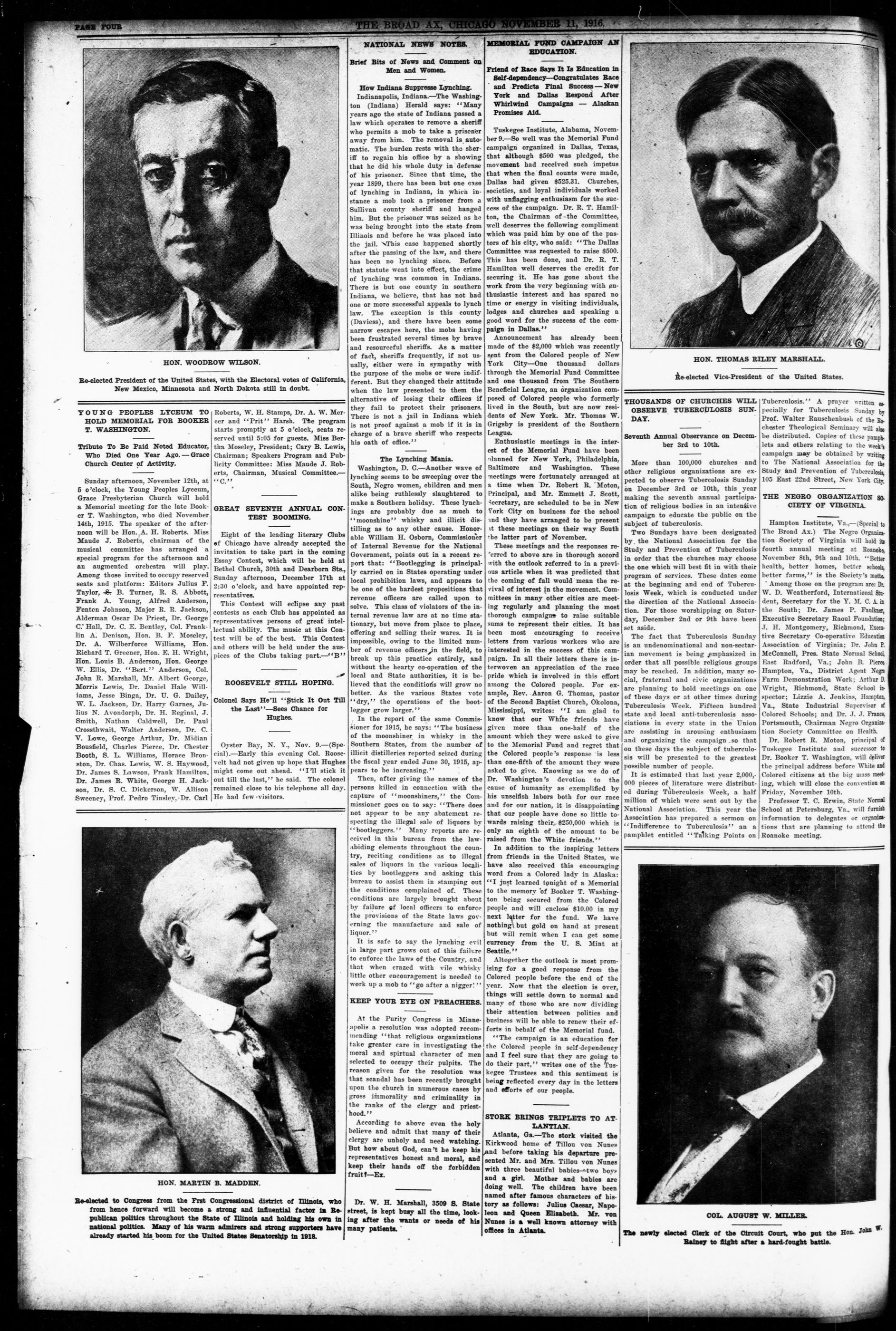
HON. WOODROW WILSON.
Re-elected President of the United State New Mexico, Minnesota and
Re-elected President of the United States, with the Electoral votes of California New Mexico, Minnesota and North Dakota still in doubt.
Re-elected President of the United States, with the Electoral votes of California New Mexico, Minnesota and North Dakota still in doubt.
YOUNG PEOPLES LYCEUM TO
HOLD MEMORIAL FOR BOOKER
T. WASHINGTON.
Tribute To Be Paid Noted Educator,
Who Died One Year Ago. — Grace
Church Center of Activity.
Sunday afternoon, November 12th, at 5 o'clock, the Young Peoples Lyceum, Grace Presbyterian Church will hold a Memorial meeting for the late Booker T. Washington, who died November 14th, 1915. The speaker of the afternoon will be Hon. A. H. Roberts. Miss Maude J. Roberts, chairman of the musical committee has arranged a special program for the afternoon and an augmented orchestra will play. Among those invited to occupy reserved seats and platform: Editors Julius F. Taylor, S. B. Turner, R. S. Abbott, Frank A. Young, Alfred Anderson, Fenton Johnson, Major R. R. Jackson, Alderman Oscar D Priest, Dr. George C' Hall, Dr. C. E. Bentley, Col. Franklin A. Denison, Hon. B. F. Moseley, Dr. A. Wilberforce Williams, Hon. Richard T. Greener, Hon. E. H. Wright, Hon. Louis B. Anderson, Hon. George W. Ellis, Dr. "Bert." Anderson, Col. John R. Marshall, Mr. Albert George, Morris Lewis, Dr. Daniel Hale Williams, Jesse Binga, Dr. U. G. Dailley, W. L. Jackson, Dr. Harry Garnes, Julius N. Avondorph, Dr. H. Reginal, J. Smith, Nathan Caldwell, Dr. Paul Crossthwait, Walter Anderson, Dr. C. V. Lowe, George Arthur, Dr. Midian Bousfield, Charles Pierce, Dr. Chester Booth, S. L. Williams, Horace Bronston, Dr. Chas. Lewis, W. S. Haywood, Dr. James S. Lawson, Frank Hamilton, Dr. James R. White, George H. Jackson, Dr. S. C. Dickerson, W. Allison Sweeney, Prof. Pedro Tinsley, Dr. Carl
[Image of a man with white hair and a dark suit, facing slightly to the right.]
Re-elected to Congress from the Frst Congressional c
from hence forward will become a strong and i
publican politics throughout the State of Illinois
national politics. Many of his warm admirers and
already started his boom for the United States Sen
Re-elected to Congress from the First Congressional district of Illinois, who from hence forward will become a strong and influential factor in Republican politics throughout the State of Illinois and holding his own in national politics. Many of his warm admirers and strong supporters have already started his boom for the United States Senatorship in 1918.
with the Electoral votes of California, North Dakota still in doubt.
Roberts, W. H. Stamps, Dr. A. W. Mercer and "Prit" Harsh. The program starts promptly at 5 o'clock, seats reserved until 5:05 for guests. Miss Bertha Moseley, President; Cary B. Lewis, Chairman; Speakers Program and Publicity Committee: Miss Maude J. Roberts, Chairman, Musical Committee.—"C."
GREAT SEVENTH ANNUAL CON
TEST ROOMING.
Eight of the leading literary Clubs of Chicago have already accepted the invitation to take part in the coming Essay Contest, which will be held at Bethel Church, 30th and Dearborn Sts., Sunday afternoon, December 17th at 2:30 o'clock, and have appointed representatives.
This Contest will eclipse any past contests as each Club has appointed as representatives persons of great intellectual ability. The music at this Contest will be of the best. This Contest and others will be held under the auspices of the Clubs taking part—'B'
ROOSEVELT STILL HOPING.
Colonel Says He'll "Stick It Out Till the Last"'—Sees Chance for Hughes
Oyster Bay, N. Y., Nov. 9.—(Special)—Early this evening Col. Roosevelt had not given up hope that Hughes might come out ahead. "I'll stick it out till the last," he said. The colone remained close to his telephone all day. He had few-visitors.
THE LONDON EDITOR
Congressional district of Illinois, who is strong and influential factor in Re-State of Illinois and holding his own in admirers and strong supporters have United States Senatorship in 1918.
Brief Bits of News and Comment on Men and Women.
How Indiana Suppresse Lynching.
How Indiana Suppresse Lynching.
Indianapolis, Indiana.—The Washington (Indiana) Herald says: "Many years ago the state of Indiana passed a law which operates to remove a sheriff who permits a mob to take a prisoner away from him. The removal is automatic. The burden rests with the sheriff to regain his office by a showing that he did his whole duty in defense of his prisoner. Since that time, the year 1899, there has been but one case of lynching in Indiana, in which instance a mob took a prisoner from a Sullivan county sheriff and hanged him. But the prisoner was seized as he was being brought into the state from Illinois and before he was placed into the jail. This case happened shortly after the passing of the law, and there has been no lynching since. Before that statute went into effect, the crime of lynching was common in Indiana. There is but one county in southern Indiana, we believe, that has not had one or more successful appeals to lynch law. The exception is this county (Daviess), and there have been some narrow escapes here, the mobs having been frustrated several times by brave and resourceful sheriffs. As a matter of fact, sheriffs frequently, if not usually, either were in sympathy with the purpose of the mobs or were indifferent. But they changed their attitude when the law presented to them the alternative of losing their offices if they fail to protect their prisoners. There is not a jail in Indiana which is not proof against a mob if it is in charge of a brave sheriff who respects his oath of office."
The Lynching Mania.
Washington, D. C.—Another wave of lynching seems to be sweeping over the South, Negro women, children and men alike being ruthlessly slaughtered to make a Southern holiday. These lynchings are probably due as much to "moonshine" whisky and illicit distilling as to any other cause. Honorable William H. Osborn, Commissioner of Internal Revenue for the National Government, points out in a recent report that: "Bootlegging is principally carried on in States operating under local prohibition laws, and appears to be one of the hardest propositions that revenue officers are called upon to solve. This class of violators of the internal revenue law are at no time stationary, but move from place to place, offering and selling their wares. It is impossible, owing to the limited number of revenue officers in the field, to break up this practice entirely, and without the hearty co-operation of the local and State authorities, it is believed that the conditions will grow no better. As the various States vote "dry," the operations of the bootleger grow larger."
In the report of the same Commissioner for 1915, he says: "The business of the moonshiner in whisky in the Southern States, from the number of illicit distilleries reported seized during the fiscal year ended June 30, 1915, appears to be increased."
Then, after giving the names of the persons killed in connection with the capture of "moonshiners," the Commissioner goes on to say: "There does not appear to be any abatement respecting the illegal sale of liquors by "bootleggers." Many reports are received in this bureau from the law-abiding elements throughout the country, reciting conditions as to illegal sales of liquors in the various localities by bootleggers and asking this bureau to assist them in stamping out the conditions complained of. These conditions are largely brought about by failure of local officers to enforce the provisions of the State laws governing the manufacture and sale of liquor."
It is safe to say the lynching evil in large part grows out of this failure to enforce the laws of the Country, and that when crazed with vile whisky little other encouragement is needed to work up a mob to "go after a nigger!"
KEEP YOUR EYE ON PREACHERS.
At the Purity Congress in Minneapolis a resolution was adopted recommending "that religious organizations take greater care in investigating the moral and spiritual character of men selected to occupy their pulpits. The reason given for the resolution was that scandal has been recently brought upon the church in numerous cases by gross immorality and criminality in the ranks of the clergy and priesthood." According to above even the holy believe and admit that many of their clergy are unholy and need watching. But how about God, can't he keep his representatives honest and moral, and keep their hands off the forbidden fruit—Ex.
Dr. W. H. Marshall, 3509 S. State street, is kept busy all the time, looking after the wants or needs of his many patients.
MEMORIAL FUND CAMPAIGN AN
EDUCATION.
Friend of Race Says It Is Education in Self-dependency—Congratulates Race and Predicts Final Success—New York and Dallas Respond After Whirlwind Campaigns — Alaskan Promises Aid.
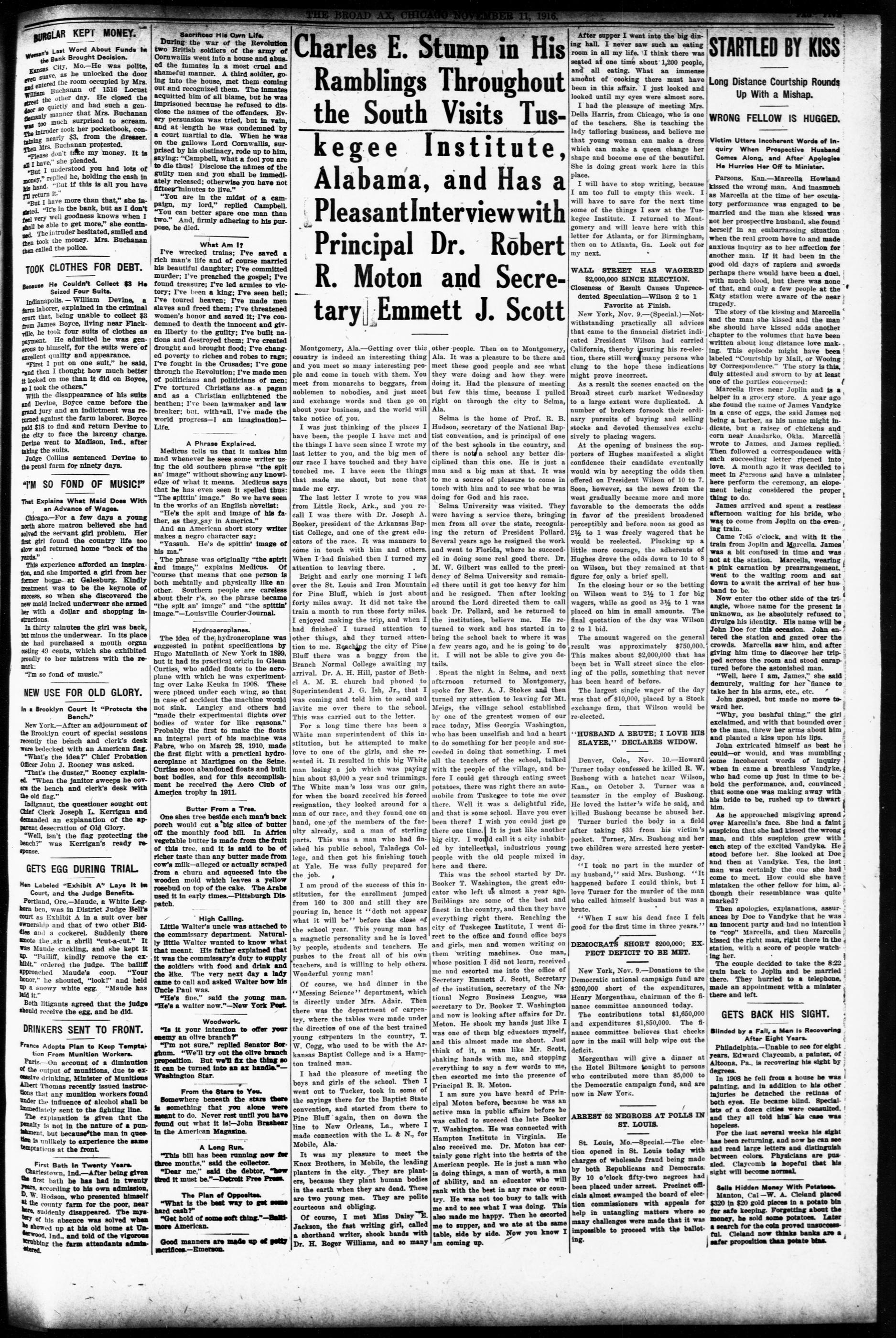
Tuskegee Institute, Alabama, November 9.—So well was the Memorial Fund campaign organized in Dallas, Texas, that although $500 was pledged, the movement had received such impetus that when the final counts were made, Dallas had given $525.31. Churches, societies, and loyal individuals worked with unfagging enthusiasm for the success of the campaign. Dr. R. T. Hamilton, the Chairman of the Committee, well deserves the following compliment which was paid him by one of the pastors of his city, who said: "The Dallas Committee was requested to raise $500. This has been done, and Dr. R. T. Hamilton well deserves the credit for securing it. He has gone about the work from the very beginning with enthusiastic interest and has spared no time or energy in visiting individuals, lodges and churches and speaking a good word for the success of the compa- nion in Dallas."
Announcement has already been made of the $2,000 which was recently sent from the Colored people of New York City—One thousand dollars through the Memorial Fund Committee and one thousand from The Southern Beneficial League, an organization composed of Colored people who formerly lived in the South, but are now residents of New York. Mr. Thomas W. Grigsby is president of the Southern League.
Enthusiastic meetings in the interest of the Memorial Fund have been planned for New York, Philadelphia, Baltimore and Washington. These meetings were fortunately arranged at a time when Dr. Robert R. Moton, Principal, and Mr. Emmett J. Scott, Secretary, are scheduled to be in New York City on business for the school and they have arranged to be present at these meetings on their way South the latter part of November.
These meetings and the responses referred to above are in thorough accord with the outlook referred to in a previous article when it was predicted that the coming of fall would mean the revival of interest in the movement. Committees in many other cities are meeting regularly and planning the most thorough campaigns to raise suitable sums to represent their cities. It has been most encouraging to receive letters from various workers who are interested in the success of this campaign. In all their letters there is interwoven an appreciation of the race pride which is involved in this effort among the Colored people. For example, Rev. Aaron G. Thomas, pastor of the Second Baptist Church, Okolona, Mississippi, writes: "I am glad to know that our White friends have given more than one-half of the amount which they were asked to give to the Memorial Fund and regret that the Colored people's response is less than one-fifth of the amount they were asked to give. Knowing as we do of Dr. Washington's devotion to the cause of humanity as exemplified by his unselfish labors both for our race and for our nation, it is disappointing that our people have done so little towards raising their $250,000 which is only an eighth of the amount to be raised from the White friends."
In addition to the inspiring letters from friends in the United States, we have also received this encouraging word from a Colored lady in Alaska: "I just learned tonight of a Memorial to the memory of Booker T. Washington being secured from the Colored people and will enclose $10.00 in my next letter for the fund. We have nothing but gold on hand at present but will remit when I can get some currency from the U. S. Mint at Seattle." Altogether the outlook is most promising for a good response from the Colored people before the end of the year. Now that the election is over, things will settle down to normal and many of those who are now dividing their attention between politics and business will be able to renew their efforts in behalf of the Memorial fund.
"The campaign is an education for the Colored people in self-dependency and I feel sure that they are going to do their part," writes one of the Tuskegee Trustees and this sentiment is being reflected every day in the letters and efforts of our people.
STORK BRINGS TRIPLETS TO AT-
LANTIAN.
Atlanta, Ga.—The stork visited the Kirkwood home of Tillou von Nunes and before taking his departure presented Mr. and Mrs. Tillou von Nunes with three beautiful babies—two boys and a girl. Mother and babies are doing well. The children have been named after famous characters of history as follows: Julius Caesar, Napoleon and Queen Elizabeth. Mr. von Nunes is a well known attorney with offices in Atlanta.
4
HON. THOMAS RILEY MARSHALL.
THOUSANDS OF CHURCHES WILL
OBSERVE TUBERCULOSIS SUN-
DAY.
Seventh Annual Observance on December 3rd to 10th.
More than 100,000 churches and other religious organizations are expected to observe Tuberculosis Sunday on December 3rd or 10th, this year making the seventh annual participation of religious bodies in an intensive campaign to educate the public on the subject of tuberculosis.
Two Sundays have been designated by the National Association for the Study and Prevention of Tuberculosis in order that the churches may choose the one which will best fit in with their program of services. These dates come at the beginning and end of Tuberculosis Week, which is conducted under the direction of the National Association. For those worshipping on Saturday, December 2nd or 9th have been set aside.
The fact that Tuberculosis Sunday is an undenominational and non-sectarian movement is being emphasized in order that all possible religious groups may be reached. In addition, many social, fraternal and civic organizations are planning to hold meetings on one of these days or at other times during Tuberculosis Week. Fifteen hundred state and local anti-tuberculosis associations in every state in the Union are assisting in arousing enthusiasm and organizing the campaign so that on these days the subject of tuberculosis will be presented to the greatest possible number of people.
It is estimated that last year 2,000,000 pieces of literature were distributed during Tuberculosis Week, a half million of which were sent out by the National Association. This year the Association has prepared a sermon on "Indifference to Tuberculosis" an amphibit entitled "Talking Points on
[Picture of a man in a suit with a bow tie].
COL. AUGUST W. MILLER.
The newly elected Clerk of the Circuit Court, who
Bainey to fight after a hard-fought
The newly elected Clerk of the Circuit Court, who put the Hon. John Rainey to flight after a hard-fought battle.
Tuberculosis." A prayer written especially for Tuberculosis Sunday by Prof. Walter Rauschenbush of the Rochester Theological Seminary will also be distributed. Copies of these pamphlets and others relating to the week's campaign may be obtained by writing to The National Association for the Study and Prevention of Tuberculosis, 105 East 22nd Street, New York City.
THE NEGRO ORGANIZATION SO
CIETY OF VIRGINIA.
Hampton Institute, Va.—(Special to The Broad Ax.) The Negro Organization Society of Virginia will hold its fourth annual meeting at Roanoke, November 8th, 9th and 10th. "Better health, better homes, better schools, better farms," is the Society's motto. "Among those on the program are: Dr. W. D. Weatherford, International Student, Secretary for the Y. M. C. A. in the South; Dr. James P. Faulkner, Executive Secretary Raoul Foundation; J. H. Montgomery, Richmond, Executive Secretary Co-operative Education Association of Virginia; Dr. John P. McConnell, Pres. State Normal School East Radford, Va.; John B. Piershampton, Va., District Agent Negro Farm Demonstration Work; Arthur D. Wright, Richmond, State School inspector; Lizzie A. Jenkins, Hampton, Va., State Industrial Supervisor of Colored Schools; and Dr. J. J. France, Portsmouth, Chairman Negro Organization Society Committee on Health.
Dr. Robert R. Moton, principal of Tuskegee Institute and successor to Dr. Booker T. Washington, will deliver the principal address before White and Colored citizens at the big mass meeting, which will close the convention on Friday, November 10th. Professor T. C. Erwin, State Normal School at Petersburg, Va., will furnish information to delegates or organizations that are planning to attend the Roanoke meeting.
[Image of a man's face with a serious expression, wearing a suit and tie].
It Court, who put the Hon. John W. a hard-fought battle.
Woman's Last Word About Funds in the Bank Brought Decision.
Kansas City, Mo.-He was polite, even suave, as he unlocked the door and entered the room occupied by Mrs. William Buchanan of 1516 Locust street the other day. He closed the door so quietly and had such a gentlemanly manner that Mrs. Buchanan was too much surprised to scream. The intruder took her pocketbook, containing nearly $3, from the dresser. Then Mrs. Buchanan protested.
"Please don't take my money. It is all I have," she pleaded. "But I understood you had lots of money," replied he, holding the cash in his hand. "But if this is all you have I will return it." "But I have more than that," she insisted. "It's in the bank, but as I don't feel very well goodness knows when I shall be able to get more," she continued. The intruder hesitated, smiled and then took the money. Mrs. Buchanan then called the police.
TOOK CLOTHES FOR DEBT.
Because He Couldn't Collect $3 He Seized Four Suits.
Indianapolis. — William Devine, a farm laborer, explained in the criminal court that, being unable to collect $3 from James Boyce, living near Flackville, he took four suits of clothes as payment. He admitted he was generous to himself, for the suits were of excellent quality and appearance.
"First I put on one suit," he said, and then I thought how much better it looked on me than it did on Boyce, so I took the others."
With the disappearance of his suits and Devine, Boyce came before the grand jury and an indictment was returned against the farm laborer. Boyce paid $18 to find and return Devine to the city to face the larceny charge. Devine went to Madison, Ind., after taking the suits.
Judge Collins sentenced Devine to the penal farm for ninety days.
"I'M SO FOND OF MUSIC!"
That Explains What Maid Does With an Advance of Wages.
Chicago.—For a few days a young north shore matron believed she had solved the servant girl problem. Her first girl found the country life too slow and returned home "back of the yards."
This experience afforded an inspiration, and she imported a girl from her former home at Galesburg. Kindly treatment was to be the keynote of success, so when she discovered the new maid lacked underwear she armed her with a dollar and shopping instructions.
In thirty minutes the girl was back, but minus the underwear. In its place she had purchased a mouth organ costing 49 cents, which she exhibited proudly to her mistress with the remark:
"I'm so fond of music."
NEW USE FOR OLD GLORY.
In a Brooklyn Court It "Protects the Bench."
New York.—After an adjournment of the Brooklyn court of special sessions recently the bench and clerk's desk were bedecked with an American flag. "What's the idea?" Chief Probation Officer John J. Rooney was asked. "That's the duster," Rooney explained. "When the janitor sweeps he covers the bench and clerk's desk with the old flag." Indignant, the questioner sought out Chief Clerk Joseph L. Kerrigan and demanded an explanation of the apparent desecration of Old Glory. "Well, isn't the flag protecting the bench?" was Kerrigan's ready response
GETS EGG DURING TRIAL
Hen Labeled "Exhibit A" Lays it in Court, and the Judge Benefits. Portland, Ore.—Maude, a White Leg-horn hen, was in District Judge Bell's court as Exhibit A in a suit over her ownership and that of two other Bidders and a cockerel. Suddenly there smote the air, a shrill "cut-a-cut." It was Maude cackling, and she kept it up. "Pailliff, kindly remove the exhibit," ordered the judge. The ballilf approached Maude's coop. "Your honor," he shouted, "look!" and held up a snowy white egg. "Maude has held it." Both litigants agreed that the judge should receive the egg, and he did.
DRINKERS SENT TO FRONT.
France Adopts Plan to Keep Tempat-
tion From Munition Workers
Paris. On account of a diminution of the output of munitions, due to excessive drinking, Minister of Munitions Albert Thomas recently issued instructions that any munition workers found under the influence of alcohol shall be immediately sent to the fighting line. The explanation is given that the penalty is not in the nature of a punishment, but because the man in question is unlikely to experience the same temptations at the front.
First Bath In Twenty Years
First Bath In Twenty Years. Charlestown, Ind.-After being given the first bath he has had in twenty years, according to his own admission, D. W. Hodson, who presented himself at the county farm for the poor, near here, suddenly disappeared. The mystery of his absence was solved when he showed up at his old home at Underwood, Ind., and told of the vigorous scrubbing the farm attendants administered.
Sacrificed His Own Life.
During the war of the Revolution two British soldiers of the army of Cornwallis went into a house and abused the inmates in a most cruel and shameful manner. A third soldier, going into the house, met them coming out and recognized them. The inmates acquitted him of all blame, but he was imprisoned because he refused to disclose the names of the offenders. Every persuasion was tried, but in vain, and at length he was condemned by a court martial to die. When he was on the gallows Lord Cornwallis, surprised by his obstinacy, up to him, saying: "Campbell, what a fool you are to die thus! Disclose the names of the guilty men and you shall be immediately released; otherwise you have not fifteen minutes to live."
"You are in the midst of a campaign, my lord," replied Campbell "You can better spare one man than two." And, firmly adhering to his purpose, he died.
What Am I?
I've wrecked trains; I've saved a rich man's life and of course married his beautiful daughter; I've committed murder; I've preached the gospel; I've found treasure; I've led armies to victory; I've been a king; I've seen hell; I've toured heaven; I've made men slaves and freed them; I've threatened women's honor and saved it; I've condemned to death the innocent and given liberty to the guilty; I've built nations and destroyed them; I've created drought and brought flood; I've changed poverty to riches and robes to rags; I've fought in the Crusades; I've gone through the Revolution; I've made men of politicians and politicians of men; I've tortured Christians as a pagan and as a Christian enlightened the heathen; I've been lawmaker and law breaker; but, with all, I've made the world progress—I am imagination!—Life.
A Phrase Explained.
Medicus tells us that it makes him mad whenever he sees some writer using the old southern phrase "the spit an' image" without showing any knowledge of what it means. Medicus says that he has even seen it spelled thus: "The spittin' image." So we have seen in the works of an English novelist:
"He's the spit and image of his father, as they say in America."
And an American short story writer makes a negro character say:
"Yassuh. He's de spittin' image of his ma."
The phrase was originally "the spirit and image," explains Medicus. Of course that means that one person is both metally and physically like another. Southern people are careless about their r's, so the phrase became "the spit an image" and "the spittin' image."—Louisville Courier-Journal.
Hydroaeroplanes.
The idea of the hydroaeroplane was suggested in patent specifications by Hugo Matullath of New York in 1899, but it had its practical origin in Glenn Curtiss, who added floats to the aeroplane with which he was experimenting over Lake Keuka in 1908. These were placed under each wing, so that in case of accident the machine would not sink. Langley and others had "made their experimental flights over bodies of water for like reasons." Probably the first to make the floats an integral part of his machine was Fabre, who on March 28, 1910, made the first flight with a practical hydroaeroplane at Martignes on the Seline. Curtiss soon abandoned floats and built boat bodies, and for this accomplishment he received the Aero Club of America trophy in 1911.
Butter From a Tree.
One shea tree beside each man's back porch would cut a big slice of butter off the monthly food bill. In Africa vegetable butter is made from the fruit of this tree, and it is said to be of richer taste than any butter made from cow's milk—alleged or actually scraped from a churn and squeezed into the wooden mold which leaves a yellow rosebud on top of the cake. The Arabe used it in early times.—Pittsburgh Dispatch.
High Calling.
Little Walter's uncle was attached to the commissary department. Naturally little Walter wanted to know what that meant. His father explained that it was the commissary's duty to supply the soldiers with food and drink and the like. The very next day a lady came to call and asked Walter how his Uncle Paul was. "He's fine," said the young man. "He's a waiter now."—New York Post.
Woodwork.
"Is it your intention to offer your enemy an olive branch?" "I'm not sure," replied Senator Sorghum. "We'll try out the olive branch proposition. But we'll fix the thing so it can be turned into an ax handle."—Washington Star.
From the Star to You
Somewhere beneath the stars there is something that you alone were meant to do. Never rest until you have found out what it is!-John Brashear in the American Magazine.
A Long Run.
"This bill has been running now for three months," said the collector.
"Dear me," said the debtor, "how tired it must be."—Detroit Free Press.
The Plan of Opposites.
"What is the best way to get some hard cash?"
"Get hold of some soft thing."—Baltimore American.
Good manners are made up of petty meridices—Emerson.
Charles E. Stump in His Ramblings Throughout the South Visits Tuskegee Institute, Alabama, and Has a PleasantInterviewwith Principal Dr. Robert R. Moton and Secretary Emmett J. Scott
Montgomery, Ala.—Getting over this country is indeed an interesting thing and you meet so many interesting people and come in touch with them. You meet from monarchs to beggars, from noblemen to nobodies, and just meet and exchange words and then go on about your business, and the world will take notice of you.
I was just thinking of the places I have been, the people I have met and the things I have seen since I wrote my last letter to you, and the big men of our race I have touched and they have touched me. I have seen the things that made me shout, but none that made me cry.
The last letter I wrote to you was from Little Rock, Ark., and you recall I was there with Dr. Joseph A. Booker, president of the Arkansas Baptist College, and one of the great educators of the race. It was manners to come in touch with him and others. When I had finished then I turned my attention to leaving there.
Bright and early one morning I left over the St. Louis and Iron Mountain for Pine Bluff, which is just about forty miles away. It did not take the train a month to run those forty miles. I enjoyed making the trip, and when I had finished I turned attention to other things, and they turned attention to me. Reaching the city of Pine Bluff there was a buggy from the Branch Normal College awaiting my arrival. Dr. A. H. Hill, pastor of Bethel A. M. E. church had phoned to Superintendent J. G. Ish, Jr., that I was coming and told him to send and invite me over there to the school. This was carried out to the letter.
For a long time there has been a White man superintendent of this institution, but he attempted to make love to one of the girls, and she resented it. It resulted in this big White man losing a job which was paying him about $3,000 a year and trimmings. The White man's loss was our gain, for when the board received his forced resignation, they looked around for a man of our race, and they found one on hand, one of the members of the faculty already, and a man of sterling parts. This was a man who had finished his public school, Taladega College, and then got his finishing touch at Yale. He was fully prepared for the job.
I am proud of the success of this institution, for the enrollment jumped from 160 to 300 and still they are pouring in, hence it "doth not appear what it will be" before the close of the school year. This young man has a magnetic personality and he is loved by people, students and teachers. He pushes to the front all of his own teachers, and is willing to help others. Wonderful young man!
Of course, we had dinner in the "Messing Science" department, which is directly under Mrs. Adair. Then there was the department of carpentry, where the tables were made under the direction of one of the best trained young carpenters in the country, T. W. Cogg, who used to be with the Arkansas Baptist College and is a Hampton trained man.
I had the pleasure of meeting the boys and girls of the school. Then I went out to Tucker, took in some of the sayings there for the Baptist State convention, and started from there to Pine Bluff again, then on down the line to New Orleans, La., where I made connection with the L. & N., for Mobile, Ala.
It was my pleasure to meet the Knox Brothers, in Mobile, the leading planters in the city. They are planters, because they plant human bodies in the earth when they are dead. These are two young men. They are polite courteous and obliging.
Of course, I met Miss Daisy E. Jackson, the fast writing girl, called a shorthand writer, shook hands with Dr. H. Roger Williams, and so many
other people. Then on to Montgomery, Ala. It was a pleasure to be there and meet these good people and see what they were doing and how they were doing it. Had the pleasure of meeting but few this time, because I pulled right on through the city to Selma, Ala.
Selma is the home of Prof. R. B. Hudson, secretary of the National Baptist convention, and is principal of one of the best schools in the country, and there is not a school any better disciplined than this one. He is just a man and a big man at that. It was to me a source of pleasure to come in touch with him and to see what he was doing for God and his race.
Selma University was visited. They were having a service there, bringing men from all over the state, recognizing the return of President Pollard. Several years ago he resigned the work and went to Florida, where he succeeded in doing some real good there. Dr. M. W. Gilbert was called to the presidency of Selma University and remained there until it got too heavy for him and he resigned. Then after looking around the Lord directed them to call back Dr. Pollard, and he returned to the institution, believe me. He returned to work and has started in to bring the school back to where it was a few years ago, and he is going to do it. I will not be able to give you details.
Spent the night in Selma, and next afternoon returned to Montgomery, spoke for Rev. A. J. Stokes and then turned my attention to leaving for Mt. Meigs, the village school established by one of the greatest women of our race today, Miss Georgia Washington, who has been unselfish and had a heart to do something for her people and succeeded in doing that something. I met all the teachers of the school, talked with the people of the village, and before I could get through eating sweet potatoes, there was right there an automobile from Tuskegee to tote me over there. Well it was a delightful ride, and that is some school. Have you ever been there? I wish you could just go there one time. It is just like another big city. I would call it a city inhabited by intellectual, industrious young people with the old people mixed in here and there.
This was the school started by Dr. Booker T. Washington, the great educator who left us almost a year ago. Buildings are some of the best and finest in the country, and then they have everything right there. Reaching the city of Tuskegee Institute, I went direct to the office and found office boys and girls, men and women writing on them writing machines. One man, whose position I did not learn, received me and escorted me into the office of Secretary Emmett J. Scott, Secretary of the institution, secretary of the National Negro Business League, was secretary to Dr. Booker T. Washington and now is looking after affairs for Dr. Moton. He shook my hands just like I was one of them big educators myself, and this almost made me shout. Just think of it, a man like Mr. Scott, shaking hands with me, and stopping everything to say a few words to me, then escorted me into the presence of Principal R. R. Moton.
I am sure you have heard of Principal Moton before, because he was an active man in public affairs before he was called to succeed the late Booker T. Washington. He was connected with Hampton Institute in Virginia. He also received me. Dr. Moton has certainly gone right into the hearts of the American people. He is just a man who is doing things, a man of worth, a man of ability, and an educator who will rank with the best in any race or country. He was not too busy to talk with me and to see what I was doing. This also made me happy. Then he escorted me to supper, and we ate at the same table, side by side. Now you know I am coming up.
After supper I went into the big dining hall. I never saw such an eating room in all my life. I think there was seated at one time about 1,200 people, and all eating. What an immense amount of cooking there must have been in this affair. I just looked and looked until my eyes were almost sore. I had the pleasure of meeting Mrs. Della Harris, from Chicago, who is one of the teachers. She is teaching the lady tailoring business, and believe me that young woman can make a dress which can make a queen change her shape and boccome one of the beautiful. She is doing great work here in this place.
I will have to stop writing, because
I am too full to empty this week. I
will have to save for the next time
some of the things I saw at the Tuskegee Institute. I returned to Mont-
gomery and will leave here with this
letter for Atlanta, or for Birmingham,
then on to Atlanta, Ga. Look out for
my next.
WALL STREET HAS WAGERED
$2,000,000 SINCE ELECTION.
$2,000,000 SINCE ELECTION.
Closeness of Result Causes Unprecedented Speculation—Wilson 2 to 1
Favorite at Finish.
New York, Nov. 9.—(Special.)—Notwithstanding practically all advices that came to the financial district indicated President Wilson had carried California, thereby insuring his re-election, there still were many persons who clung to the hope these indications might prove incorrect.
As a result the scenes enacted on the Broad street curb market Wednesday to a large extent were duplicated. A number of brokers forsook their ordinary pursuits of buying and selling stocks and devoted themselves exclusively to placing wagers.
At the opening of business the supporters of Hughes manifested a slight confidence their candidate eventually would win by accepting the odds then offered on President Wilson of 10 to 7. Soon, however, as the news from the west gradually became more and more favorable to the democrats the odds in favor of the president broadened perceptibly and before noon as good as $2\frac{1}{2}$ to 1 was freely wagered that he would be reelected. Plucking up a little more courage, the adherents of Hughes drove the odds down to 10 to 8 on Wilson, but they remained at that figure for only a brief spell.
In the closing hour or so the betting on Wilson went to $2\frac{1}{2}$ to 1 for big wagers, while as good as $3\frac{1}{2}$ to 1 was placed on him in small amounts. The final quotation of the day was Wilson 2 to 1 bid.
The amount wagered on the general result was approximately $750,000. This makes about $2,000,000 that has been bet in Wall street since the closing of the polls, something that never has been heard of before. The largest single wager of the day was that of $10,000, placed by a Stock exchange firm, that Wilson would be re-elected.
"HUSBAND A BRUTE; I LOVE HIS
SLAYER." DECLARES WIDOW.
Denver, Colo., Nov. 10.—Howard Turner today confessed he killed R. W. Bushong with a hatchet near Wilson, Kan., on October 3. Turner was a teamster in the employ of Bushong. He loved the latter's wife he said, and killed Bushong because he abused her. Turner buried the body in a field after taking $35 from his victim's pocket. Turner, Mrs. Bushong and her two children were arrested here yesterday.
"I took no part in the murder of my husband," said Mrs. Bushong. "It happened before I could think, but I love Turner for the murder of the man who called himself husband but was a brute.
"When I saw his dead face I felt good for the first time in three years."
DEMOCRAT$ SHORT $200,000; EXP
EXPECT DEFICIT TO BE MET.
New York, Nov. 9.—Donations to the Democratic national campaign fund are $200,000 short of the expenditures, Henry Morgenthau, chairman of the finance committee announced today.
The contributions total $1,650,000 and expenditures $1,850,000. The finance committee believes that checks now in the mail will help wipe out the deficit.
Morgenthau will give a dinner at the Hotel Biltmore tonight to persons who contributed more than $5,000 to the Democratic campaign fund, and are now in New York.
ARREST 52 NEGROES AT POLLS IN ST. LOUIS.
St. Louis, Mo.-Special.-The election opened in St. Louis today with charges of wholesale fraud being made by both Republicans and Democrats. By 10 o'clock fifty-two negroes had been placed under arrest. Precinct officials almost swamped the board of election commissioners with appeals for help in untangling matters where so many challenges were made that it was impossible to proceed with the balloting.
Long Distance Courtship Rounds Up With a Mishap.
WRONG FELLOW IS HUGGED.
Victim Utters Incoherent Words of Inquiry When Prospective Husband Comes Along, and After Apologies He Hurries Her Off to Minister.
Parsons, Kan.—Marcella Howland kissed the wrong man. And inasmuch as Marcella at the time of her osculatory performance was engaged to be married and the man she kissed was not her prospective husband, she found herself in an embarrassing situation when the real groom hove to and made anxious inquiry as to her affection for another man. If it had been in the good old days of rapiers and swords perhaps there would have been a duel, with much blood, but there was none of that, and only a few people at the Katy station were aware of the near tragedy.
The story of the kissing and Marcella and the man she kissed and the man she should have kissed adds another chapter to the volumes that have been written about long distance love making. This episode might have been labeled "Courtship by Mall, or Wooing by Correspondence." The story is this, duly attested and sworn to by at least one of the parties concerned:
Marcella lives near Joplin and is a helper in a grocery store. A year ago she found the name of James Vandyke in a case of eggs, the said James not being a barber, as his name might indicate, but a raiser of chickens and corn near Anadarko, Okla. Marcella wrote to James, and James replied. Then followed a correspondence with each succeeding letter ripened into love. A month ago it was decided to meet in Parsons and have a minister here perform the ceremony, an eloquent being considered the proper thing to do.
James arrived and spent a restless afternoon waiting for his bride, who was to come from Joplin on the evening train.
Came 7:45 o'clock, and with it the train from Joplin and Marcella. James was a bit confused in time and was not at the station. Marcella, wearing a pink carnation by prearrangement, went to the waiting room and sat down to await the arrival of her husband to be.
Now enter the other side of the triangle, whose name for the present is unknown, as he absolutely refused to divulge his identity. His name will be John Doe for this occasion. John entered the station and gazed over the crowds. Marcella saw him, and after giving him time to discover her tripped across the room and stood enraptured before the astonished man.
"Well, here I am, James," she said demurely, waiting for her flance to take in her arms, etc., etc.
John gasped, but made no move toward her.
"Why, you bashful thing," the girl exclaimed, and with that bounded over to the man, threw her arms about him and planted a kiss upon his lips.
John extricated himself as best he could—or would, and was numbling some incoherent words of inquiry when in came a breathless Vandyke, who had come up just in time to behold the performance, and, convinced that some one was making away with his bride to be, rushed up to thwart him.
As he approached misgiving spread over Marcella's face. She had a faint suspicion that she had kissed the wrong man, and this suspicion grew with each step of the excited Vandykue. He stood before her. She looked at Doe and then at Vandykue. Yes, the last man was certainly the one she had come to meet. How could she have mistaken the other fellow for him, although their resemblance was quite marked?
Then apologies, explanations, assurances by Doe to Vandykue that he was an innocent party and had no intention to "cop" Marcella, and then Marcella kissed the right man, right there in the station, with a score of people watching her.
The couple decided to take the 8:22 train back to Joplin and be married there. They hurried to a telephone, made an appointment with a minister there and left.
GETS BACK HIS SIGHT.
Blinded by a Fall, a Man is Recovering After Eight Years.
Philadelphia.—Unable to see for eight years. Edward Claycomb, a painter, of Altoona, Pa., is recovering his sight by degrees.
In 1908 he fell from a house he was painting, and in addition to his other injuries he detached the retinas of both eyes. He became blind. Specialists of a dozen cities were consulted, and they all told him his case was hopeless.
For the last several weeks his sight has been returning, and now he can see and read large letters and distinguish between colors. Physicians are puzzled. Claycomb is hopeful that his sight will become normal.
Sells Hidden Money With Potatoes.
Manton, Cal - W. A. Cleland placed
$320 in $20 gold pieces in a potato bin
for safe keeping. Forgetting about the
money, he sold some potatoes. Later
a search for the coin proved unsuccessful.
Cleland now thinks banks are a
safer proposition than potato bins.
AN ACTIVE QUEEN.
The Dowager of England Attends a Benefit Daily.
WAR VICTIMS HER VOCATION
Often This Ex-Queen Is Seen at Two Matinees, Bazaars or Musicales Each Day, if They Mean Ways of Alleviating the Lot of Soldiers.
Queen Alexandra still remains the most popular member of the royal family of England, although she will celebrate her seventy-third birthday next December, and if King Edward had been alive last March the two would have celebrated the fifty-third anniversary of their marriage. Alexandra takes the utmost pride in her
THE LADY OF THE MIDDLE EAST
QUEEN ALEXANDRA.
personal appearance, and at a distance she gives the impression of being unaffected by time. Nobody thinks of calling the widowed queen the "queen mother" or even the "dowager queen." She objects to being designated by either of these titles in print, and no familiar use of them by the press would lead her friends to adopt them in speaking of her. They don't fit. She doesn't take life so seriously as Queen Mary, does not and never has attempted to interfere in politics and devotes herself now, as always, with studious care to the art of being agreeable and useful to charity and other good work.
Scarcely a day passes that Alexandra does not make at least one public appearance at a war benefit. Sometimes she is seen at two such events. Her daughter, the princess royal (Princess Louise, duchess of Fife), sometimes accompanies her, the mother looking as young as the daughter. The Grand Duchess George of Russia, the niece of Queen Alexandra and the sister of the king of Greece, has been with her aunt at Marlborough House for a year or more and is often seen in public with Queen Alexandra. The Grand Duchess George is good looking and fond of becoming clothes, and she and her two young daughters have given an additional attraction to Alexandra's suit.
ADVANCE MODELS.
Style Tips About Materials and Cuts For Coats.
Winter coats may be roughly summed up in two parts—the short, capel-like shapes with sleeves that ripple over the top of a high waisted, embroidered belt attached to the skirt—these are in the minority, but very smart—and the mannish directore coat featured by Cheruit, Bernard, Doeuklet, Callot and most of the other big houses.
This latter coat will probably be the shape seen on more than half the women this winter. It has a slim top that fits the figure, a small belt that draws attention to itself through buttons or buckles in front and an extra full skirt which convolutes around the figure and in which are exploited several of the newest features. They are difficult to describe in detail. The general idea is that the material is brought back and twisted over in many curious ways, as if the designer had been trying out an experiment with the cloth and had pinched it up into pockets, loose straps and revers and then left them all there.
Old Fashioned Pumpkin Pie
Take two cupfuls of pumpkin (already stewed), a quart of milk, two cupfuls of sugar, a teaspoonful of cinnamon, a teaspoonful of grated nutmex, a teaspoonful of ginger, a tiny pinch of salt, four eggs and small pieces of butter. Beat the eggs and sugar until creamy, add the spices, salt and pumpkin, scald the milk and turn over mixture and piece of butter while warm and beat all well together. Have two medium sized pie plates lined with a good flaky crust, fill with the mixture and bake until firm or from thirty to forty minutes. Serve cold.
To Freshen Your Veil
If vellies are dipped in a saucer or bowl of alcohol and soused, up and down, squeezed in the hand and half dried by squeezing in a towel, then hung out over a towel on a line, they are very soon dry and retain that slight stiffness which is a necessity in a fresh looking vell.
Pointers About Materials And Lines For This Season.
Color and texture are richer and more extravagant than ever, and advance materials show that this year will be as splendid a one, so far as fashions are concerned, as last. Velvets, panne velvets and plushes there will be, and in silks brocaded Venetian effects will be luxuriant used. Accessories are as splendid, as ornate, as are materials. Belt clasps, muff chains, bags of every kind and all the other things which come last in the choosing of a costume, but almost first in the effect will be heavily ornamented with jeweled patterns.
This splendor and richness are found in every kind of garment, frock, evening gown, street clothes and evening wraps. Three uses of the various new materials were shown recently in three designs—ah afternoon frock, street suit and evening coat. The first one of the three was of taupe voile and plush cloth, the voile woven into the stripes of plush. It was an afternoon gown having the waist fastening below the shoulder line with one plush button. The underblouse was of taupe voile, a combination of plush and voile. A band of plush of the same color turned up around the hips, and the skirt was arranged with the stripe running in various directions.
The suit was made of panne velvet with a long pile, mouse colored, and having a waistcoat and undercuffs of sealskin. The coat skirt had three godets.
Neither these materials not these designs would seem to bear out the positive statements made by people that know that the slim silhouette is to be the only silhouette this winter. Perhaps the slimness is not to commence until a bit later, and perhaps this is going to be such a tolerant year as one particularly loves, a year in which one may have the sort of silhouette bestowed by nature and still be in style.
This tendency toward elaboration and near extravagance brings in quantities of embroidery again and many straight, full dresses and long basque blouses which lend themselves well to this kind of trimming. There are many little oldities, too, such as small mantles to go with the dresses and an erratic line to the skirt, making it shorter in front than in the back, to better show the rippling folds of bright colored embroideries and decoration.
Of course this extravagance will not be taken up at once, nor will all women care to adopt it at all, but it will be what is most commonly known as correct.
The colors, both of the embroideries and of the basic materials, have a glory of their own, being old gold, orange, green, deep and rich and full. Chinese and gold embroideries will be generally used.
Especially in evening gowns will the Venetian touch be given, by skirts short in front and having a little square cut train in the back or by the full skirts, with panels training on each side.
UP TO DATE.
So Easily Made For Ice Sports Is This Chic Little Cap.
With a garnet velours worsted coat goes this natty skating cap of garnet velvet, smocked to fit the head. Band-
A.
PREPARED FOR FROSTS.
ing the face is a narrow strip of rabbit fur, a turtle of which finishes the top of the cap. This may be easily copied.
Dyeing With Crape Paper.
Wash crepe de chine waist well, rinse, set aside. Put crepe paper in hot water until water is colored. Add cold water till lukewarm, add one-half cupyf, vinegar and one-third cupyf salt. Put in the waist, let remain until shade desired is reached and then squeeze dry and dry on rack indoors. Press on wrong side with iron moderately heated.
Best Way to Wash Windows.
Take a chamois skin, which can be obtained for 25 cents at any drug store, and using clear, warm water wash the glass clean. Wring out dry and wipe the window, which will be perfectly clear, as there is no lint to adhere to it. Windows are in this way perfectly cleaned in less than half the time it usually takes.
FOR YOUNG FOLKS
Sleepy Time Story About a Boy Who Was Always Untidy.
TAUGHT A USEFUL LESSON.
Strange Thing That Happened One Warm Evening on the Porch—Ramble Through the Grass in Odd Company—A Lion Cub at the Zoo. Little Ned and Polly Ann were waiting when Uncle Ben appeared. Tonight, he said, I will tell you about
A VISIT TO THE ANTS
and Jimmy Jumlper, who hated to get washed and was more often seen with a dirty face than with a clean one.
His mother urged him to be more tidy, and his father scolded; but, after all, it was a little ant that made a better boy of Jimmy.
He was sitting on the porch one evening feeling very sleepy and wishing he could get out of taking the bath that his mother always insisted upon before he crawled into his soft bed.
Jimmy had been nodding several times when he felt his head go around, and before he knew what to think he had slipped down to the ground in front of the porch steps and was looking right into the eyes of a little black ant.
"Hello, Jimmy!" the ant said. "Going to pay us a visit, are you?"
Jimmy didn't say a word, but the ant took hold of one arm and began to hurry him along through a forest of grass. Jimmy, looking up, saw the clover blossoms nodding like tall palms over his head.
The ant whisked Jimmy over to the ant hill near the gate. On top of it sat an ant combing its hair.
"Just show this lad how to comb that mop of his," said the ant who was in charge of Jimmy.
They bustled Jimmy down on the ant hill, and then the ant raised its foot. Jimmy saw a coarse comb on it. It went through his hair very gently. Then it used a finer comb also on the foot.
The ants' bodies were covered with short hair, and when an ant came out of the hill there were sometimes specks of earth on its coat, although the hallways in the ant hill are lined with earth packed down very hard.
When the ant got out into the air it would hurriedly comb of the earth or sponge its body with its tongue.
"If you lived in this ant hill, young man," one of the ants said, "we'd teach you to keep clean. You have soap and brushes and sponges and fresh cloths and towels and a nice tub of water, while we have only our tongues and the combs and brushes we carry with us."
Just then a half dozen ants came hurrying out of the hill. They hung themselves up in the funnest way by their hind feet to a blade of grass, while two of their companions combed and brushed and curried them very much as a horse is curried. Then they dropped off to sleep. As Jimmy began to feel sleepy, he fell asleep, too, and when he awoke he found himself in the chair on the porch.
Naming Lion Cubs
Recently in the Central park zoo in New York city a lioness gave birth to three little cubs. The children who visit the zoo daily were very much interested in the new arrivals, and the
1
Photo by American Press Association.
BABY LION AND GODMOTHER.
keeper of the lions told them that
when the babies were large enough
the children might christen them. So
when the cubs were three weeks old
they were brought out on to the lawn
and named. One of the cubs and its
godmother are herewith shown just
as they were snapped by the camera
man.
Our Little Girls.
When it rains our little girls
Pucker their lips and cry,
But when it clears they dry their tears
And bid the rain goodby.
The Kind of Coat That Gives Utility and Style.
For general comfort is this good looking topcoat of king's blue zibeline, cut with a cape collar, demibelt, slit
THE WORLD'S FINEST COAT
THE VERY LATEST.
pockets and raglan sleeves. Big novelty buttons trim and close the garment.
HOW TO CHOOSE A TURKEY.
Tips For Young Housekeepers Who Celebrate Thanksgiving.
Since to be without turkey on Thanksgiving is to fail to pay proper respect to the great American festival, it behooves the good housewife to be well up in turkey lore, for there are turkeys and turkeys, some as juicy and tender as a spring chicken, while others, also, remain warriors of the barnyard to the bitter end and are as tough and stringy and wellnigh as hard to swallow as india rubber.
To have the turkey tender and delicious on Thanksgiving day, "first catch your hare"—in other words, first select a good bird at the market and then see that it is cooked and basted properly. It is the best plan to shop for the feast at least two days beforehand, for if one waits until the day before all the best birds will be picked out, and only the tougher fowls will be left. A young turkey should have smooth, black legs and a white skin and should weigh at least twelve pounds to be juicy and of good flavor. Very scaly, rough legs indicate age, as do also legs that are hard, for a young fowl's feet and legs should be pliable.
Another good way to pick out a young turkey is to examine the spurs, or, rather, the place where the spurs grow. A year-old turkey has no spurs, but only a flat knob at that place. A turkey that has a spur between a quarter and half an inch long is a last year's fowl, and one with a fully developed spur is over two years old.
To prepare the bird first singe it thoroughly over a sancerful of burning alcohol, then hold it under the faucet and wipe dry. Then make a gash down the turkey's neck, cutting to the bone; fold the skin back over the breast and lift out the crop carefully. Then turn the turkey on its back and make a cut at the end of the breastbone big enough to insert the finger and thumb. Now draw the turkey, taking care not to break the gall. Turn the fowl over again and cut away the oil bag, a tiny gland that lies right over the tail. Few people know of its existence, and it often spoils the flavor of a fine bird if not removed. The turkey should then be washed again and is ready for the dressing.
The Original Koumiss.
Koumiss in its original sense was a fermented beverage prepared from mare's milk. Unlike kefir, there is no dried ferment, seeds or grains with which the fermentation of the mare's milk is started. Native koumiss makers lay great stress on the quality of the milk, the breed of the mares and the condition of the pastures, but it is probable that their troubles ascribed to variations in these conditions are more likely attributable to imperfectly controlled bacteriologic factors. The koumiss which is often made and offered for sale in this country is usually made from cow's milk and therefore more correctly is kefir. Kefir and koumiss are limpid, mildly acid and distinctly alcoholic; yoghurt and other similar drinks are thick curdled milks, decidedly acid, with very little or no alcohol.
Kerosene Lamps.
When the flame of a kerosene lamp smokes up the chimney, although not turned up too high, remove the wicks from the burners when you have good suds water on a washing day and with a cloth and a skewer remove all the sooty fuzz that has collected on the under side. Then put them in the boiler of hot suds water and let them remain there an hour or more. When taken out wipe clean and dry, and the improvement is worth much more than the small amount of work.
POTATO BREADS.
POTATO BREADS.
Boiled "Murphies" Substituted For Part Flour.
APPETIZING AND NUTRITIOUS.
This Mixture Contains More Mineral Matter, Fiber and Moisture Than Ordinary Bread—Delicious Rolls That Keep Well Are Also Another Feature.
[Prepared by the department of agricul-
Excellent bread can be made by using three pounds of boiled and mashed potato and two and one-quarter pounds of good bread flour, according to the baking specialists of the United States department of agriculture. The bread so compounded has a rich brown crust and tender and elastic crumb. It has an appetizing odor and a very agreeable taste, which is preferred by many to that of bread made wholly from flour. When made according to the directions given below potato bread contains more mineral matter, fiber and moisture, but otherwise in composition and nutritive value is practically the same as ordinary bread. Its higher moisture content helps to keep it fresh several days longer than ordinary bread. In localities where there is a surplus of potatoes or where they are very cheap potato bread costs less to make than all flour bread, and in general this is a good way in which to utilize cull potatoes in a palatable food product.
For four one pound loaves are required three pounds of boiled and peeled potatoes, two and one-quarter pounds of good bread flour, three level tablespoonfuls of sugar, one and one-half level tablespoonfuls of salt, one cake of compressed yeast, four tablespoonfuls of water.
Boll with skins on and wash twelve potatoes of medium size. In the evening take one and one-half pounds, or two and one-half solidly packed half pint cupfuls, of the cool mashed potato, add to it the salt, four ounces of flour (one scant half pint cupful) and the yeast rubbed smooth with the water, reserving one spoonful to rinse the cup.
In the morning add the remainder of the potato, the sugar and the rest of the flour. Knead thoroughly until a smooth and very stiff dough is formed. After working the dough, set it to use and handle the dough in the usual manner for breadmaking.
Very good rolls can be made from a similar mixture of boiled potatoes and flour by adding shortening and sugar. The following proportions will yield one dozen small rolls:
Eight ounces of boiled and peeled potatoes, six ounces of sifted flour, one third cake of compressed yeast, three quarters level teaspoonful of salt, two tablespoonfuls of lukewarm water, two tablespoonfuls of sugar, two tablespoonfuls of butter.
Two tablespoonfuls of powdered milk added to the dough will greatly improve the quality of the rolls. Although milk itself or cream may be used, it must be borne in mind that they will increase the liquid content.
Boil, peel and mash the potatoes as directed for bread making. Add in order to this the salt, the powdered milk (if used), the yeast rubbed smooth and mixed with the water, and lastly two tablespoonfuls of flour. Let this mixture stand at a temperature of about 86 degrees F. until the dough begins to collapse. Add to this sponge the butter, the sugar and the remainder of the flour and, if necessary, enough more flour to make a very stiff dough. Knead thoroughly until a smooth dough which is no longer sticky has been formed. Set back to rise again, and when the dough has trebled in volume knead lightly, form into small balls and place not too close together in greased pans. Allow to rise until double in volume and bake twenty minutes in a moderately hot oven.
QUACK! QUACK!
Ducky Doddle Makes a Thanksgiving Favor For Children. As a pleasing variation from the usual bird let us serve duckling for at least the younger members of the
Duck
SO WISE
family. This one is dressed in yellow canvas, with black bill, feet and a shoe button eye. Wing feathers are feigned of black silk embroidery.
Macedoine Salad.
A macedoine salad is merely a mixture of vegetables-almost anything serves.
Built on Military Lines Is This Suit For Fall Maidens.
Straight and rather trim of cut, this suit of army blue is trimmed with steel buttons and a strip of silk braids.
ON THE BORDER
ON THE BORDER.
around the coat bottom. The details of the collar and cuffs are interesting, the choker being sanguely closed with tiny cloth buttons.
WEDDING SHOWERS.
Novel Ideas About What to Give the Betrothed Girl.
After an engagement has been announced the girl's friends usually give some kind of shower, which must be clever and unusual. A pretty idea for a linen shower is to stretch a line some where in the house and pin the gifts on it. After all the guests have arrived the guest of honor is given a small clothes hamper and escorted to the room where the "wash" is hanging and told to take it in.
There was great fun at a recent kitchen shower when one of the girls dressed like a real southern mammy appeared with a small pushcart piled with tinware. Over her handanna she wore a hat made from a colander and trimmed with a dish towel and a sink brush. At her waist dangled a chateaine made of puttypans, cooky cutters, a nutmeg grater, etc.
A sewing club entertained one of its members at a luncheon in this way. In the center of the table was a large round sewing basket lined in her favorite color. Suspended over it on ribbons of different length the same color as the basket was a shower of articles for it—darning ball, scissors, needles and pins, emery, wax, etc.
A very ingenious girl who was giving a handkerchief shower for a friend made a wedding bell from a peach basket covered with white crape paper and tied with white tulle. This she hung over the guest of honor's place and at the psychological moment she pulled a string, letting out all the handkerchiefs in a real shower.
ABOUT KITCHENS
How They Should Be Built to Save Labor.
Some ingenious architect has figured that in getting the 1,005 meals necessary in a year the housekeeper travels 200 miles if the distance between the kitchen range to dining room be but twenty-five feet. If the distance be increased five feet some forty miles is added. These figures are appalling to the comfort of the housekeeper in large kitchens, but practically much depends on the way space is used in a large kitchen. If working tables, etc., are so planned that no long distances have to be traveled between them a large kitchen may prove very convenient and comfortable to work in because of the added space.
Windows placed to the left of the coal range allow for lighting during the daytime which is ideal. The best artificial lighting is by electricity, with emergency gas fixtures should the electric current fail. A large ceiling light, with wall lights above and to the left of the sink and range, furnishes light to the best advantage. The wall light over the sink should be placed so that much work can be done with the aid of this light alone.
A Beat Shaped Veil
The new boat shaped veil is at its best when draped over a rather small hat, also elongated in shape. The veil is thrown over the hat so that the point in front falls well below the base and the sides and back of the veil drape over the sides and back of the hat. These veils are made of fine hexagonal mesh with scattered designs in dots and hand run sprays or vines. A favorite style in the boat shaped veil is in black mesh, very fine, with black velvet stars all around the else as a border and a well scattered diamond shaped device in chenille dots, including a delicate flower spray.
CHINA FINDS IT HARD
TO DISBAND ITS ARMY
Soldiers Love Their Job, and If Not Paid They Loot.
Peking—China's toughest problem now is how to disband the army raised during the revolution. The government, hard pressed for money, will have to raise at least $30,000,000 to pay off the 800,000 men under arms, and unpaid soldiers are always a menace in China. Coolies regard military service as a very desirable occupation. Once enlisted it is difficult to persuade them to retire. They riot and become extremely troublesome if an attempt be made to disband them without liberal payment. The commanding officers are frequently as mercenary as the soldiers. When the government fails to give its soldiers what they regard as adequate pay the troops frequently be handled and loot.
Each province has its own military governor and a distinct military organization, presumably under control of the Peking authorities, but actually independent in most cases. Consequently the Peking government is forced to deal very diplomatically with the military organizations in the provinces, particularly in the remote provinces.
HARVARD MAN FOILS SUN WITH INVENTION
Presses a Button In Bed and the Window Shade Goes Down as if by Magic.
Cambridge, Mass. — Every morning at 7 o'clock Henry R. Guild of Boston, a Harvard senior, rolls over in bed. Seven o'clock is too early for a senior to get up, so Mr. Guild presses a button and the shade at the distant end of his chamber rolls down as if by magic.
No rising sun is going to make him leave his bed unseasonably. Some morning he may miss a four alarm by pressing the button, but he's willing to take the chance, he asserts.
Getting up at 7 a. m. is a high crime at Harvard, the same as admitting Tale has a good football team this year.
Henry Guild framed up a motor, attached to the curtain string and laid wires to his bedside. When the sun throws its rays into his bedroom every morning, weather permitting, he presses a button and the curtain flops tighter than in a vaudeville theater. Mr. Guild's next invention probably will be a trap door to throw tiresome professors into the cellar by means of a button that any student can press. Life's attendant inconveniences aren't going to bother him while electricity can do the work.
FIREMAN SAVES BABY.
Climbed on Pilot of Locomotive, Lifted Infant From Track.
La Crosse, Wis.—Coon valley residents are talking of applying for a Carnegie medal for Fireman Peter Hensgen of the La Crosse and Southeastern. He was in a freight engine cab when he saw a child in the distance on the track.
It was down grade and the brakes were slow to grip. Hensgen climbed out along the footboard to the pilot, grasped a rod and leaned down.
He grabbed the sleeping child with his free hand and lifted her from the track. The child was the little daughter of Mr. and Mrs. Elmer Jacobson. She had wandered away in the afternoon and lay down tired between the hills and went to sleep.
NEW DIMES IN CIRCULATION.
$180,000 Worth of Coins Distributed by the Philadelphia Mint.
Philadelphia. — The new ten cent pieces which have been coined in large quantities at the Philadelphia mint were recently put into circulation for the first time, about $180,000 worth being distributed to banks and trust companies. They were introduced simultaneously in the western states from the Denver mint.
The diverse side of the new dime shows a head of Liberty in profile, while the reverse side shows a bundle of rods in the center and the protruding battleax, symbols of unity. Surrounding the central design is an olive wreath, denoting peace.
The new coins are expected to be in general circulation within a few days.
Child Escapes Coyote.
Bend, Ore.-Attracted to the doorward by an unusual noise being made by her cluck of turkeys, Mrs. Thomas Merchant, living east of Bend, found a coyote running toward her little girl, who was playing in the yard. The animal was frothing at the mouth and is believed to have been rabid. Mrs. Merchant had just time to snatch her daughter up and return to the house before the coyote reached the spot where the little girl was at play.
Arte Kill Bees
Ouirdand, Cal.—Dr. J. H. Callen, who and two hives of bees, much alive, on his Fruitale avenue property, is now occupied in cleaning out two hives of dead bees, victims of an unsuccessful Verdun defense against a horde of marauding ants. The evidence shows that the ants attacked in solid mass formation, carrying the bees' first, second and third line of trenches and then attacking the entrances to the hives.
Claimed It Pierces the Thickest Kind of Armor.
LEAD COVERING DOES IT.
Fired. From Regulation Army Rifle, It Will Penetrate Three-Quarter Inch Steel Plate and Other Objects Beyond. Could Go Through Thirty Men In Row.
New York.—A new bullet, capable of piercing armor as thick as that which covers the famous British "tanks" or that used in making trenches on the Somme bomb and bullet proof, has been invented and tested by the ordnance corps of the United States army. The bullet is of only 30 caliber; but, fired from the regulation army rifle, it will penetrate a three-quarter inch steel plate and other objects beyond. It is said that the bullet would be able to pierce from twenty to thirty men in a row. It has been tested severely at the Sandy Hook proving
BRIGADIER GENERAL CROZIER, CHIEF OF ORDNANCE, U. S. A.
BRIGADIER GENERAL CROZIER, CHIEF OF ORDNANCE, U. S. A. grounds by the ordnance corps, and the statements published concerning its efficacy are the results of actual trials. It has taken many months of experimenting to develop the bullet, which is exactly like the ordinary bullet in appearance, but has an outside covering of lead around the armor piercing center of steel. This lead casing acts as a lubricant in passing the bullet through the steel and is ripped from the steel core as the bullet passes through a solid obstruction.
Only a small number of the bullets have been manufactured, and these were made entirely in government shops. Fifty ordinance and engineer corps officers were present when these were used in the first tests. A three-quarter inch steel plate about forty feet long and twelve feet wide was erected, and behind it were fixed six silhouette targets in the semblance of a soldier.
A detail of men from the coast artillery and ordnance corps did the firing. The bullets would not pierce the steel at 100 yards. At fifty, however, they riddled the steel plate and the silhouette targets behind it.
It is not believed that the new bullet will be valuable or necessary in ordinary infantry engagements in the open. Its worth is said to lie principally in attacks on houses, steel shelters and other obstructions behind which enemy troops are concealed. Tests have been made to demonstrate that the bullets can be fired from a machine gun as well as a rifle.
SAW SIXTEEN BEARS.
Smith Killed and Got the Hides of Four of Them.
Wenatchee, Wash. - The best bear story of the season comes from Merritt, and H. B. Smith is the hero.
Smith one day the other week shot a bear 200 yards off, wounding it in a foreleg. The wounded animal came dashing down toward him and when within 100 feet was brought down with an accurately aimed shot through the heart.
Hardly had Smith fired the second shot, according to the story, when a second black one poked its head over a log near by. One shot finished it. Then bears began to jump all around. Smith began a fusilade. He emerged with four pelts. Smith said he saw sixteen bears in all.
Electric Shock at Organ.
Woodland, Cal.-While playing the organ at the Catholic church during services Byron Derr received an electric shock that rendered him unconscious. His head had come in contact with the switch operating the motor which supplies the air for the pipes. Derr quickly recovered without the congregation knowing of the incident.
THE BROAD AX, CHICAGO NOVEMBER 11, 1916
Middle West Figures Largely In Carnegie Medal Award.
ONE WOMAN ON THE LIST.
Mrs. Olive M. J. Cooper of Battle Creek, Mich., Saved Adult and Three Children From Drowning at Spencerville, Ind., by Swimming Out and Rescuing One at a Time.
Pittsburgh.—The /heroism of John Murray, aged twenty-seven, a laborer, of Chicago, who risked his life to save that of Patrick Eustace, has been rewarded by the Carnegie hero fund commission, which awarded Murray a bronze medal.
Reaching out into an elevator shaft on the nineteenth floor of an uncompleted building in Chicago on June 27, 1911, Murray grasped Eustace, who had fallen from the twentieth floor. Murray gripped an iron beam with one arm and with his free arm caught Eustace as he started down the elevator shaft.
Other heroes from the middle west received honors.
Roger W. Wells of North Madison, Ind., receives a medal. Wells, forty years old, was disabled two weeks from lung congestion, due to fumes when he assisted in rescuing James E. Dougherty from suffocation at Heldelberg, Pa., on March 27, 1916.
George C. Oxley, a merchant of Marlon, Ia., rescued ten-year-old E. Emerson Harte from a runaway at Marlon on Aug. 16, 1915.
Donald H. Stoops, seventeen years old, of Nappanee, Ind., receives a medal because he saved Pauline E. Holmes, thirteen, and L. Beatrice Doswell, fifteen, from drowning at Pickwick Park, Ind., June 16, 1913. Stoops, although he had lost his left arm eight months before, swam to the point where the girls were struggling, pushed one of them ahead of him with his shoulder until she was in shallow water and swam back and rescued the other girl in the same way.
Dana S. Miller, a farm manager of Butler, Ind., is awarded a medal for having saved Elmer McDonald, a laborer, from an enraged bag on Aug. 17, 1912. McDonald had been gored and four ribs were broken. Miller attacked the animal with a pitchfork and was repeatedly knocked down. He finally seized a ring in the bull's nose and clung to it until the animal was subdued.
William T. Best, Owosso, Mich., is listed because he saved three-year-old Carney P. Lamphere from burning after a gasoline explosion at Owosso, Jan. 5, 1915. Best's burns disabled him for six weeks.
One woman is on the list. She is Mrs. Olive M. J. Cooper of Battle Creek, Mich., who saved an adult and three children from drowning at Spencerville, Ind., by swimming out on the St. Joseph river and returning with them one at a time.
TEACHER NEAR DEATH.
Pupil She Corrected Had Nitroglycerine Cap.
Oakbrook, Pa.—Miss May E. Dillon, a teacher in the primary grade of the schools, only realized the next day how narrowly she had escaped death. She was forced to reprimand one of her pupils the other day and used a ruler. The next day she learned that the culprit had a nitroglycerin cap in his pocket at the time.
Lawrence Hine, six years old, one of the pupils, found a can of the explosive in a stone quarry and distributed some caps among his friends. The next day the owner of the caps called at the school, and all the caps were recovered from the pockets and desks of the pupils, who for twenty-four hours were in danger of being hurled in midair together with their schoolhouse and teachers.
SCARED TO DEATH BY SEA.
Raw Lightship Keeper Goes Into Frenzy in First Gale.
Newport, R. I.-A case of a man literally frightened to death has just been reported. Gustav Ljunvall went to Brenton's reef lightship as assistant keeper, but before he had time to become accustomed to his surroundings the wind became a gale, accompanied by great seas, and the ship pitched at disturbing angles.
Jlunvall expressed great fear that the ship would go down. In a frenzy he tried to jump overboard, but was restrained. His violence increased, and the crew put him in an improvised straitjacket and kept him there until he died.
Indian, 122 Years Old, Works Daily.
Mazatian, Mexico. — This western coast town of Mexico claims as a resident the oldest man in the world, Jose Juan Velasquez, an Indian, who, according to all records available, is 122 years old. Velasquez has the agility of a man of less than half his years and works daily as a laborer. He possesses a remarkable memory and is familiar with happenings during the Hidalgo revolution for Mexican independence from Spain in 1810-21.
Horse Wears Trousers.
Charleston, W. Va.—A horse wearing a pair of trousers on its front legs is a novelty seen daily on the streets. The animal is attached to an express wagon, and the owner dresses him in order to protect his forelegs from flies. The trousers are supported by the breastband of the harness.
ASLEEP, NOT DEAD.
Printer Woke Up In Tims to Dodge the
Coroner and Undertaker.
Mount Pleasant, N. Y. - Harry Daugherty, a printer, was dead to all intents and purposes the other evening. The members of the household where he lived so reported to an undertaker and the coroner. The coroner immediately notified the man's parents of his death and asked the relatives if they wanted an investigation made. When the coroner and the undertaker, carrying a dead basket between them, opened the gate leading into the yard they met Dougherty, hale and hearty, going to work. Exhausted from a long day's work, Daugherty had lain down on the bed for a nap when another member of the household, seeing him, became, frightened and, thinking him dead, notified the authorities.
OPERATES ON RIGID JAWS
Surgeon Uses a Cushion of Fat to Make Them Work.
Philadelphia.—A patient whose jaws had been rigid for twenty years, who had never learned to talk and who had been obliged to obtain all his nourishment through a tube, was the subject of one of the many operations performed at the various clinics here as part of the activities of the clinical congress of surgeons of North America.
The joints of the patient's jaws had hardened after an attack of scarlet fever when he was only a year old. Dr. W. Wayne Babcock laid open the stiffened joints, scraped away a hard bony substance which was found covering them and inserted a cushion of fat taken from another part of the man's body.
AUTO AIDS GUNNERS
Makes Adirondacks Accessible For Week End Trips.
Utica, N. Y.—in most sections of the Adirondacks game is plentiful. More and more each year the automobile is being used by gunners, particularly those who live in the cities and towns near the forests.
Thousands of hunters are going into the woods for week end trips, and machines are also used for the purpose of taking the hunters from one good ground to another. This of course relates to small game, and it is surprising how many good places can be covered by this method of gunning.
The new law prohibits any gunning from an automobile, but the machine makes the innermost recesses of the forests accessible to the gunner who has a car.
FLY SAVES BOY'S LIFE.
Accidentally Discharged Bullet Only Hurt His Arm.
La Crosse, Wis.—A fly saved the life of Carl Kaeppler, thirteen years old, while he was hunting in the vicinity of Swift creek with William Stellick, fifteen years old.
Carl felt something irritating his forehead and raised his arm to brush the fly aside. At the same instant Stellick, who was only a few paces distant, accidentally discharged a rifle he was carrying.
The bullet passed through the fleshy part of young Kaeppler's arm and, although most of its force was spent, struck the boy in the head.
Physicians said he probably would have been killed had not his arm been in the way of the bullet.
COYOTE ATTACKS AUTOIST.
After It Was Run Over It Wanted to Bite the Driver.
Reno, Nev.—That a coyote that will attack the front end of any automobile traveling thirty-miles an hour, allow himself to be run over and then get up and attack the driver of the car who out of curiosity stopped to see what damage was done must be mad is the opinion of P. Y. Gillson, who enjoyed this experience on Lakeview hill, near Carson, the other night.
The coyote was game, according to Gillson, but was so badly cut up that it was easily driven off with rocks before it bit any one. Gillson was accompanied on the trip by County Commissioner Henrich.
COUNTRY SHORT OF PENNIES.
Mints Working Twenty-four Hours a Day to Relieve the Conditions.
Washington. — What this country needs today is more penniles, says the treasury department. To that end the Philadelphia and San Francisco mints are working twenty-four hours a day and the Denver mint sixteen hours a day turning them out.
A lot of reasons are given for the shortage, the chief one being the increased use of the copper coins, with every dealer in everything adding a penny every now and then.
Baseball an Element In Will Fight.
New York.—When Ernest G. Woerz, millionaire brewer, on his deathbed ceased to ask whether the Giants won or lost, Katherine Haas, employed in the household, knew a "great change" had come. She testified in the $2,000,000 will contest before Surrogate Cohalan, in New York.
Old Woman Starts Ranch
Sallna. Kan—Mrs. Minerva Conway, seventy years old, has gone to New Mexico, where she will settle on a claim under the rights of a civil war veteran's widow. She takes 320 acres adjoining a claim her son settled on two years ago. She will make it a stock ranch.
SOARS OVER FIGHT
Financier Sees Somme Battle From an Aeroplane.
BEHIND THE GERMAN LINES.
Henry P. Davison of J. P. Morgan & Co. Courses Leisurely Up and Down In Wide Circles Over Battlefield For an Hour, Watching Mighty Drama Directly Below.
New York.—To climb into a French armed aeroplane during moments of a terrific final assault on the Somme, then to course leisurely up and down and in wide circles over the battlefield for an hour watching between one's shoe sides the mighty drama directly below and finally to fly more than three miles straight back over the Germans' country during the battle and get away with it—that would be a flying trip which most Americans would want to talk about when they got home.
But not so Henry P. Davison of J. P. Morgan & Co., who arrived "home from the wars" on the American liner Philadelphia, accompanied by Ms. Da-
Winston Churchill
vision and daughter, Miss Alice. Mr. Davison had done all those things in the air while in France, but he did not seem to think much of the experience. Mr. Davison said that he ascended at Peronne. The French officer first had taken him to a great height—about a mile—and then had swung out over the great guns booming far below. The biplane in which they flew, Mr. Davison said, was arranged admirably for observation of the bombardments and infantry fighting below, and the great height at which he viewed the battle—it was on Sept. 27 last-enabled him to look down upon a tremendous sweep of battle ridden country at all times.
He had made a pretty thorough tour of the trenches at Verdun also, he said in answer to further questions about experiences at the front. Then he had devoted six days solely to traveling by automobile and on foot along the whole line of trenches from Verdun to the British trenches on the Somme. On a nearby table as he spoke was a rusty looking German helmet and a rustier shell case which he had picked up on battlefields, and on the same table was the gray blue steel helmet of France which General Petain had given to him to wear in the trenches.
"No, it wasn't altogether idle curiosity that took me to the front." Mr. Davison said in reply to a final question. "As somebody has put it, there was an opportunity to see history in the making and I took it, not through curiosity, but because I wanted to learn something of military advancement at first hand."
POTATOES LIFT MORTGAGE
Jersey Farmer Raises 9,200 Barrels on Eighty Acres.
Red Bank, N. J. — Henry Holmdel raised 9,200 barrels of potatoes on eighty acres this year. This was at the rate of over 110 barrels and acre.
With the proceeds from the yield he paid off a $20,000 mortgage still remaining on his farm, which he purchased three years ago for $57,000, paying $7,500 down.
Holmdel's crops on 150 acres, where he didn't plant potatoes, returned for the year a profit which the farmer calls "pure velvet."
Ring Upon a Radish.
Tiflin, O.—Four years ago Mrs. W. H. Souger lost a heavy gold band ring in her garden. The other day she pulled up a radish and found the ring only fastened about the root.
PAGE SEVEN
GIFTS FOR HOLY LAND
GO IN CHRISTMAS SHIP
American Collier Will Carry Relief For War Sufferers.
New York.-America's 1916 Christmas ship for the relief of unfortunate victims of the war will leave New York Dec. 1. The American Red Cross is co-operating with the American committee for Armenian and Syrian relief in collecting foodstuffs and clothing to be sent to Syria on a government collier placed at the disposal of the latter committee by Secretary Daniels.
The collection of the Christmas ship cargo is in the hands of Albert W. Staub of the American Red Cross receiving and distributing station at Bush terminal, Brooklyn. Mr. Staub has already received countless bundles of old clothing, unavailable for the cargo, as military regulations preclude the shipment of second hand clothing in this cargo. He said, "It must be emphasized that the only clothing America can send to the unfortunate ones in Turkey must be new and must be sent prepaid to the American Red Cross, Bush terminal, Brooklyn." Mr. Staub sent the following letter from the war relief information and shipping office:
"It is more than significant that the first letter to go out from the newly organized Red Cross war relief information office has to do with a Christmas ship. It is doubly significant that it is to take relief to a people living so near the Holy Land."
MIKE HICKEY TELLS OF HIS REFORMATION
Ex-Pickpocket, With Twenty Years' Prison Record, Talks to 400 Men.
Mike Hickey, once a notorious pick-pocket, with a record of nineteen and a half years behind prison bars, told 400 men at the Harlem branch Y. M. C. A., New York, how he straightened out and how other inhabitants of the underworld could be helped to do the same.
Mike's career as a thief lasted until about four years ago, when he wandered, fresh from Sing Sing, into the Cremorne mission. on Thirty-second street. It ended there. Now he is night man at the Bowery Y. M. C. A. and passes his spare time helping his old pals from Dannemora and Sing Sing to get their feet on the "straight and narrow."
The trouble with the newly emerged convict, he said, was the old story—out into the world with a $10 bill and a wish to keep straight; a job until a cop told the boss of his record, then no more job; broke; one more trick to get money to eat; caught, and back to prison.
What the convict needs is a bit of belief and encouragement when he starts to reform, said Hickey, adding that more and more the employers are beginning to give this, so that many men with long records as criminals are now taking their places in honest life.
MOSQUITOES CLOSE MILLS.
Pest of Insects Compile Plants to Shut Down.
Connell, Tex.-The gulf coast region of east Texas and the western part of Louisiana have been afflicted with the worst scourge of mosquitoes ever known.
Several large lumber mills were forced to close down on account of the pest. Men and animals were tortured by the bites of the insects. Cattle and horses were attacked by veritable hordes of mosquitoes, and the animals huddled together in groups in an effort to protect themselves as much as possible from the bites.
On the farms smudge fires were kept burning constantly to drive away the pests, but these efforts seemed to be of little avail.
HONOR SCHOOL JANITOR.
Veteran Held That Post In the Building For Years.
Indianapolis, Ind.-Shortridge high school of this city each year renders tribute to the memory of some man or woman who has helped in the upbuilding of the institution.
This year the alumni, after discussing the names of several men who had risen to a place of high esteem in the world, chose to honor James Biddy, for twenty-five years janitor of the institution.
A tablet recounting his faithful labors and telling of the cheer he imparted to "his boys and girls" during a quarter of a century has been placed in a conspicuous place in the halls.
Onion and Cracker Diet
Kankakee, IL. -With property valued at $25,000, but with no appetite except when his wife buys the food, at which times he eats "copiously." Ira Palmer, eighty-three years old, maintains that "an onion and a cracker" are enough for any one at a meal, according to the allegations made in a bill for separate maintenance by his wife, Dora. She says that for his comfort she trimmed his beard and cut his hair.
Killed Himself Running.
Bremerton, Wash.—Because Wesley Antony, fifty-four years old, did not want to be late for work recently he ran seven miles around the shores of Puget sound. When he arrived at the navy yard he collapsed and died a few moments later in the Marine hospital.
TEENAN JO
TEENAN JONES' PLACE
3445 SOUTH STATE STREET
Telephone Douglas 4591
The finest and most UP-TO BUFFET and CAFE on the Side. First-Class Entertainer
HENRY "TEENAN" JONES, Prop
Phone Randolph 4758
The finest and most UP-TO-DATE BUFFET and CAFE on the South Side. First-Class Entertainers. HENRY "TEENAN" JONES, Proprietor.
Residence, 2802 S. Tripp Ave.
Phone Lawndale 7055
C. J. Waring
Attorney and Counselor at Law
Suite 18,
143 North Dearborn Street
CHICAGO
Franklin A. Denison
ATTORNEY AT LAW
36 West Randolph St., Chicago
Suite 708 Delaware Building
Tel. Central 3142
FRANK DUNN
J. B. McCAHEY
Trustees
Established 1877
TEL. OAKLAND 1560, 1551, 1552
JOHN J. DUNN
WOLESALE COAL RETAIL
Fifty-First and Armour Avenue
RAILYARDS
1st St. and L. S. & M. S.
1st St. and Armour Ave.
OMIOA
THE BROAD AX
Published Weekly
In this city since July 15th, 1899, without missing one single issue, Republicans, Democrats, Catholies, Protestants, single Taxers, Priests, infidels or anyone else can have their say as long as their language is proper and responsibility is fixed.
The Broad Ax is a newspaper whose platform is broad enough for all, ever claiming the editorial night to speak its own mind.
Local communications will receive attention. Write only on one side of the paper.
Subscriptions must be paid in advance.
One Year.....$2.00
Six Months.....1.00
Advertising rates made known on application.
Address all communications to
THE BROAD AX
6418 Champlain Ave., Chicago, Ill.
PHONE WENTWORTH 2507.
JULIUS F. TAYLOR, Editor and Publisher.
Entered as Second-Class Matter August 19, 1902, at the Post Office at Chicago Illinois, under Act of March 3, 1879.
A. F. CODOZOE,
J. H. WHISTON, Proprietors
CHAS. HARRIS, Manager
The Eli
AND B
3030 STATE STREET
A. F. CODOZOE, DOUGLAS 5971
J. H. WHISTON, Proprietors Phones DOUGLAS 3256
CHAS. HARRIS, Manager AUTO. 72-379
The Elite Cafe
AND BUFFET
3030 STATE STREET CHICAGO
From New York harbor and imme diate approaches alone 208 beacon lights to navigation are required, in cluding forty-six shore lights, two light vessels and thirty-eight lighted buoys there are 192 buoys of all classes and thirty-seven for signals, including sounding buoys.
The Unsafe Safe
Willis (ready for school)—Mamma,
they are hoisting a safe down the
street. Mother—Well, be careful not
to walk on the safe side.—Boston
Transcript.
Then and Now.
"Yes, we pay spot cash for every thing."
"Ah! I often speak to my husband about the time when we had to."—Pearl.
PAGE EIGHT
most UP-TO-DATE LIFE on the South Entertainers. JONES, Proprietor.
EDWARD FELIX
CIGARS
TOBACCO
CANDIES
NOTIONS
LIGHT GROCERIES
3002 Dearborn Street
Office Hours Office Phones
2 to 4 P. M. Douglas 3522
7 to 8:30 P. M. Auto. 71-777
Sundays 2 to 4 P. M.
EDWARD S. MILLER, M. D.
Physician and Surgeon
3101 South State Street
Residence
3247 Wabash Avenue
Phone Douglas 2903 Auto. 71-867 Chicago
PHONES: OFFICE. MAIN 4188
AUTOMATIC 33-736
RESIDENCE, DREXEL 7090
Walter M. Farmer
ATTORNEY AT LAW
SUITE 708, 184 WASHINGTON ST.
NOTARYPUBLIC CHICAGO
Office Phones: Res. 5133 Sq. Walsh Ave.
Oakland 4662, Auto. 73-058 Phone Drexel 18815
Dr. Theo. R. Mozee
DENTIST
4709 S. STATE STREET
CHICAGO
Hours 9 A.M. to 5 P.M., 7 P.M. to 9 P.M.
Sundays by Appointment
Phone Main 2017 Automatic 32-395
A. L. WILLIAMS
ATTORNEY AND COUNSELOR AT LAW
Suite 706 Firmenich Bldg.
184 W. Washington St.
Residence 5548 Jefferson Av.
Phone Midway 5515 Chicago
A. D. GASH
ATTORNEY AT LAW
118 North La Salle St., Chicago
Suite 615 to 618
PHONE MAIN 2214
Residence 1262 Macalister Place
Telephone Monroe 2714
MILES J. DEVINE
ATTORNEY AT LAW
Suite 313-329 Reaper Block
Clark & Washington Sts.
Phones Central 239
Auto. 41-916
CHICAGO
DOUGLAS 5971
Phones DOUGLAS 3256
AUTO. 72-379
te Cafe
BUFFET
CHICAGO
How They Love Each Other! Agnes (yawning)—Oh, dear! I feel today as if I were thirty years old. Marle—Why, what have you been doing to rejuvenate yourself?—Boston Transcript.
Her Definition.
"Can you tell me what a smile is?" asked a gentleman of a little girl.
"Yes, sir. It's the whisper of a laugh."—London Answers.
Oh, Did It?
Patience — What did you think of Bob's mustache? Patrice—Oh, it tickled me immensely.—Yonkers Statesman.
Neither how down the whole forest nor come home without wood.—Servian Proverb.
---
THE BROAD AX, CHICAGO NOVEMBER 11, 1916.
As Near As Your Telephone DISTANCE IMMATERIAL
IN a Metropolitan City of this size, death knocks every thirty minutes at some door. Too often that death not only brings sorrow, but misfortune as well. Let the price you pay for a funeral be a business proposition and you will benefit by it in service, quality and cost to you in dollars and cents. The result of my campaign has built for me one of the largest and most magnificent establishments in the world.
Consult me, I can save you Worry,
Shipping to all parts of the Country
Funerals a Specialty. Central Dis
Chapel. Call promptly answered day
Ernest H. Willia
KENWOOD
455
Undertak
5028 and 5030 S. State St.,
Consult me, I can save you Worry, Time and Money. Shipping to all parts of the Country and Automobile Funerals a Specialty. Central Display Rooms and Chapel. Call promptly answered day or night.
Ernest H. Williamson,
KENWOOD
455
Undertaker AUTOMATIC
73-867
5028 and 5030 S. State St.,
---
SALVATORE DESTITUTO DE LA MEDICINA
JESSE BINGA BANKER
S.E. Cor. State and 36th Place, Chicago Telephone Douglas 1565 GENERAL BANKING
3 per cent allowed
Safety Deposit Vault
REAL ESTATE
As agent buy and sell Real Estate on co-
dents, including payment of taxes and l
on Chicago Real Estate.
Especially Invites the patro
ACTUAL
BETV
cent allowed on Savings Acct
Deposit Vaults, $3.00 per
REAL ESTATE DEPARTMENT
and sell Real Estate on commission, manages est
payment of taxes and locking after assessment
Estate.
Specially Invites the patronage of Chicago business
CTUAL RELATION
BETWEEN
owed on Savings Accounts
at Vaults, $3.00 per Year
ESTATE DEPARTMENT
State on commission, manages estates for non-resi-
kates and locking after assessments. Money to loan
the patronage of Chicago business men.
AL RELATION
ETWEEN
3 per cent allowed on Savings Accounts Safety Deposit Vaults, $3.00 per Year
As agent buy and sell Real Estate on commission, manages estates for non-residents, including payment of taxes and locking after assessments. Money to loan on Chicago Real Estate.
ACTUAL RELATION BETWEEN
Light from a modern
Amber Glow Gas Light
Your Choice of Two Diamonds
In the single-carat yellow stone instead
of white stone—the squirrels would
you.
Squirrels will camp on your trail—for the
if you persist in using flat flame burn-
mantle gas units to light your premises.
The top show the relative proportion of
light from the two units—
Glow Mantle Light (No. 1)
One (No. 2)
With the squirrels—ask us to replace
date flat flames with Amber Glow
at five times the light for less money.
Gas Light & Coke Company
BRANCH OFFICES:
If You Had Your Chance
and you took the sing
of the ten-carat whi
be looking for you.
And the same squirrels will
same reason—if you p
ers instead of mantle g
The sketches at the top sh
the volume of light fro
The Amber Glow M
The Flat Flame (No.
Don't take chances with th
your out-of-date fl
Lights—and get five ti
The Peoples Gas Li
BRANCH
You Had Your Choice of Two Dials
and you took the single-carat yellow stone
of the ten-carat white stone—the squirrels
are looking for you.
The same squirrels will camp on your trail—
same reason—if you persist in using flat flame
its instead of mantle gas units to light your pr
ketches at the top show the relative propor
the volume of light from the two units—
The Amber Glow Mantle Light (No. 1)
The Flat Flame (No. 2)
take chances with the squirrels—ask us to
our out-of-date flat flames with Amber
lights—and get five times the light for less m
The Peoples Gas Light & Coke Comp
BRANCH OFFICES:
T SIDE NORTH SIDE SOUTH
Madison Street 3069-71 Lincoln Avenue 371 West
12th Street 3643 Irving Park Blvd. 3478 Archer
Maukee Avenue 408 West North Avenue 3448 Indiana
Avenue 9051 Comm 11025 Michigan
Madison Street
If You Had Your Choice of Two Diamonds
and you took the single-carat yellow stone instead of the ten-carat white stone—the squirrels would be looking for you.
And the same squirrels will camp on your trail—for the same reason—if you persist in using flat flame burners instead of mantle gas units to light your premises.
The sketches at the top show the relative proportion of the volume of light from the two units—
Don't take chances with the squirrels—ask us to replace your out-of-date flat flames with Amber Glow Lights—and get five times the light for less money.
WEST SIDE
2142 W. Madison Street
1709 West 12th Street
1611 Milwaukee Avenue
2023 Oden Avenue
4023 W. Madison Street
Main Exhibition Room
PEOPLES GAS BUILDING
Telephone Wabash 6000
JOHN BLOCKI, President
JOHN BLOCK
PERF
GO
C. E. KREYSS
I. President F. W. BLOCK
OHN BLOCKI & SO
PERFUMERS
GO TO
F. W. BLOCKI, Treasurer
BLOCKI & SON
PERFUMERS
GO TO
YSSLER. Druggist
JOHN BLOCKI, President F. W. BLOCKI, Treasurer
JOHN BLOCKI & SON
PERFUMERS
GO TO
C. E. KREYSSLER, Druggist
5057 South State Street
NOT ON THE CORNER
FOR HIGH GRADE DRUGS, CHEMICALS AND
MEDICINAL PREPARATIONS
All Prescriptions Carefully Compounded
ALSO CARRY A FULL LINE OF
BLOCKI'S IDEAL & BLOCKI'S FLOWER
IN BOTTLE PERFUMES
PETER H.
Light from an out-of-date
Flat Flame Gas Light
Chicago, Ill.
SOUTH SIDE
731 West 63rd Street
3478 Archer Avenue
3448 Indiana Avenue
9105 Commercial Ave.
10125 Michigan Ave.
QUINADE
GROWS HAIR
REMOVES DANDRUFF
SEND FOR SAMPLE
QUINASOAP
THE IDEAL SHAMPOO SOAP
THOROUGHLY CLEANSSES THE SCALP
QUINACOMB
HAIR STRAIGHTENER
SHAMPOO DRYER
QUINADE 25¢ QUINACOMBS 50¢ QUINASOAP 25¢
AT ALL DRUGGISTS
SEEBY DRUG COMPANY, NEW YORK CITY, N.Y.
THE SANITARY and SHIP CANAL
Length - - - - 32 Miles
Depth - - - - 22 Feet
Width - - - 162 to 290 Feet
THE CANAL OFFERS:
Industrial Locations, Dock Facilities, Water Transportation, Railroad Connections, Electric Power, Concrete Building Material. Direct Connection with St. Louis via the Illinois River and Direct Connection with the Gulf via the Illinois and Mississippi Rivers. Electric Energy Created from Water Power for the Modern Factory Means Efficiency and Economy.
THOMAS A. SMYTH, - President
JOHN McGILLEN, - - Chief Clerk
F. D. CONNERY, - - Comptroller
Karpen Building 900 So. Michigan Ave., CHICAGO
THIS MOST COMPLETE OPTICAL ROOMS IN THE CITY
BEST GOODS AT THE LOWEST PRICES
The Cranford Apartment Building. 3600 Wabash Ave.
THE NEW YORK MUSEUM
The finest building ever opened to Colored tenants in Chicago Steam heat, electric light, tile baths, marble entrance.
Eye
Consultation or examination FREE. We have 28 different ways of testing the eyes and guarantee to give satisfaction.
DR. LOUIE USSELMANN
The Practical O tician
3150 S. STATE ST.
Phone Douglas 5308
CHICAGO