The Broad Ax
Saturday, December 9, 1916
Chicago, Illinois
Page text (machine-generated)
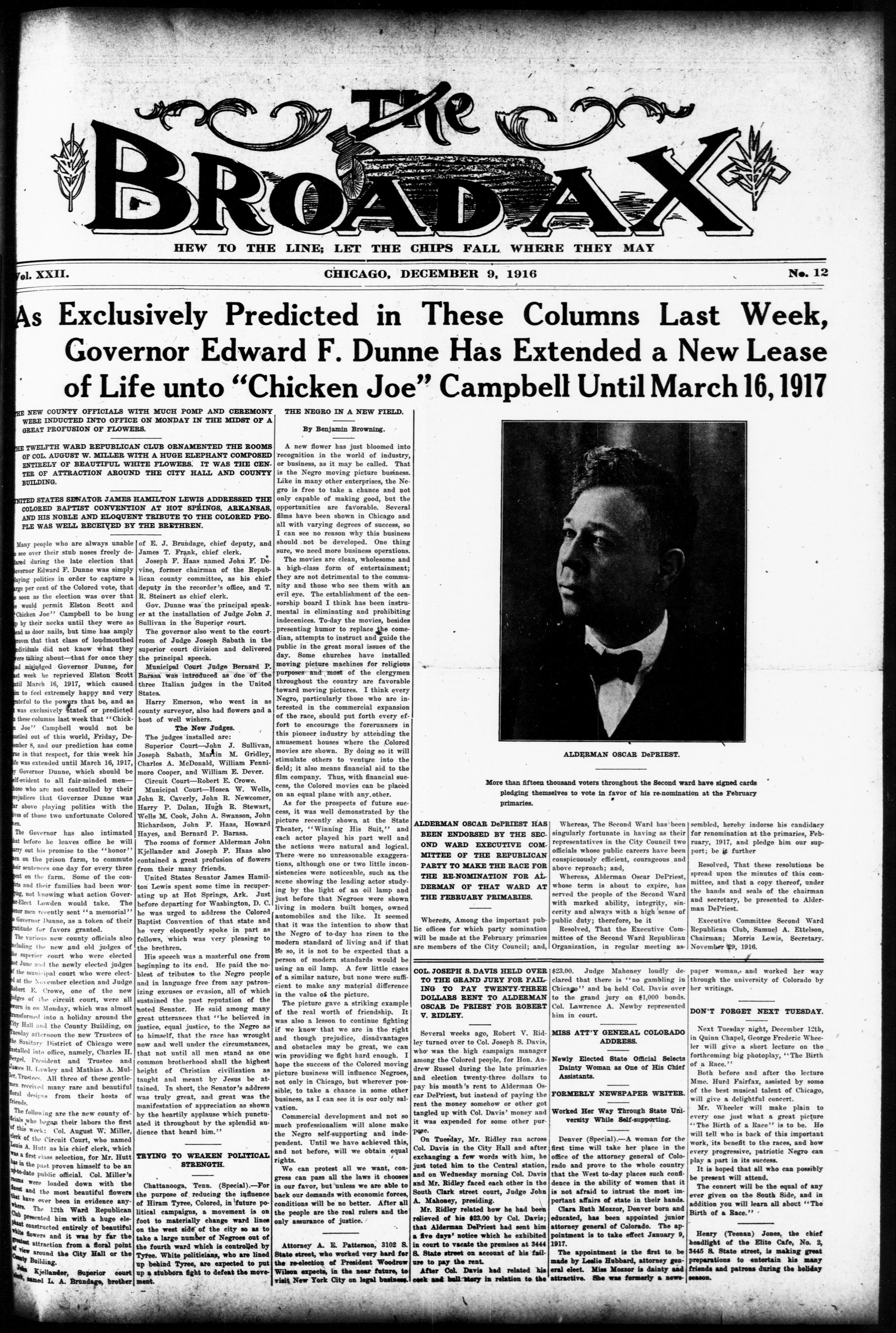
THE BROAD AX
HEW TO THE LINE; LET THE CHIPS FALL WHERE THEY MAY
As Exclusively Predicted in These Columns Last Week, Governor Edward F. Dunne Has Extended a New Lease of Life unto "Chicken Joe" Campbell Until March 16,1917
THE NEW COUNTY OFFICIALS WITH MUCH POMP AND CEREMONY WERE INDUCTED INTO OFFICE ON MONDAY IN THE MIDST OF A GREAT PROFUSION OF FLOWERS.
THE TWELFTH WARD REPUBLICAN CLUB ORNAMENTED THE ROOMS OF COL. AUGUST W. MILLEE WITH A HUGE ELEPHANT COMPOSED ENTIRELY OF BEAUTIFUL WHITE FLOWERS. IT WAS THE CENTER OF ATTRACTION AROUND THE CITY HALL AND COUNTY BUILDING.
UNITED STATES SENATOR JAMES HAMILTON LEWIS ADDRESSED THE COLORED BAPTIST CONVENTION AT HOT SPRINGS, ARKANSAS, AND HIS NOBLE AND ELOQUENT TRIBUTE TO THE COLORED PEOPLE WAS WELL RECEIVED BY THE BRETHREN.
Vol. XXII.
As Exclusive
Gover
of Life
THE NEW COUNTY OFFICIALS WERE INDUCTED INTO OFFICE GREAT PROFUSION OF FLOWER.
THE TWELFTH WARD REPUBLICA OF COL. AUGUST W. MILLER WENTIRELY OF BEAUTIFUL WATER OF ATTRACTION AROUND BUILDING.
UNITED STATES SENATOR JAMES COLORED BAPTIST CONVENTION AND HIS NOBLE AND ELOQUENT PLE WAS WELL RECEIVED BY
Many people who are always unable to see over their stub noses freely declared during the late election that Governor Edward F. Dunne was simply playing politics in order to capture a large per cent of the Colored vote, that is soon as the election was over that he would permit Elston Scott and "Chicken Joe" Campbell to be hung up by their necks until they were as dead as door nails, but time has amply proven that that class of loudmouthed individuals did not know what they were talking about—that for once they had misjudged Governor Dunne, for last week he reprieved Elston Scott until March 16, 1917, which caused him to feel extremely happy and very grateful to the powers that be, and as it was exclusively stated or predicted in these columns last week that "Chicken Joe" Campbell would not be custold out of this world, Friday, December 8, and our prediction has come in that respect, for this week his life was extended until March 16, 1917, by Governor Dunne, which should be self-evident to all fair-minded men—those who are not controlled by their prejudices that Governor Dunne was far above playing politics with the loves of those two unfortunate Colored men.
The Governor has also intimated that before he leaves office he will carry out his promise to the "honor" men on the prison farm, to commute their sentences one day for every three days on the farm. Some of the conflicts and their families had been working, not knowing what action Governor-Elect Lowden would take. The honor men recently sent "a memorial" to Governor Dunne, as a token of their gratitude for favors granted.
The various new county officials also including the new and old judges of the superior court who were elected last June and the newly elected judges of the municipal court who were elected at the November election and Judge Robert E. Crowe, one of the new judges of the circuit court, were all worn in on Monday, which was almost transformed into a holiday around the City Hall and the County Building, on Tuesday afternoon the new Trustees of the Sanitary District of Chicago were installed into office, namely, Charles H. Sergel, President and Trustee and James H. Lawley and Mathias A. Muller, Trustees. All three of the gentlemen received many rare and beautiful floral designs from their hosts of friends.
The following are the new county officials who began their labors the first of this week: Col. August W. Miller, clerk of the Circuit Court, who named Louis A. Hutt as his chief clerk, which was a first class selection, for Mr. Hutt has in the past proven himself to be an up-to-date public official. Col. Miller's rooms were loaded down with the finest and the most beautiful flowers that have ever been in evidence anywhere. The 12th Ward Republican Club presented him with a huge elephant constructed entirely of beautiful white flowers and it was by far the greatest attraction from a floral point of view around the City Hall or the County Building.
John Kjellander, Superior court clerk, named L. A. Brundage, brother
HEW TO THE LINE: LET THE CHIPS FALL WHERE THEY MAY
of E. J. Brundage, chief deputy, and James T. Frank, chief clerk. Joseph F. Haas named John F. Devine, former chairman of the Republican county committee, as his chief deputy in the recorder's office, and T. R. Steinert as chief clerk. Gov. Dunne was the principal speaker at the installation of Judge John J. Sullivan in the Superior court. The governor also went to the courtroom of Judge Joseph Sabath in the superior court division and delivered the principal speech. Municipal Court Judge Bernard P. Barasa was introduced as one of the three Italian judges in the United States. Harry Emerson, who went in as county surveyor, also had flowers and a host of well wishers.
Superior Court—John J. Sullivan, Joseph Sabath, Martin M. Gridley, Charles A. McDonald, William Fennimore Cooper, and William E. Dever. Circuit Court—Robert E. Crowe. Municipal Court—Hosea W. Wells, John R. Caverly, John R. Newcomer, Harry P. Dolan, Hugh R. Stewart, Wells M. Cook, John A. Swanson, John Richardson, John F. Haas, Howard Hayes, and Bernard P. Barasa. The rooms of former Alderman John Kjellander and Joseph F. Haas also contained a great profusion of flowers from their many friends. United States Senator James Hamilton Lewis spent some time in recuperating up at Hot Springs, Ark. Just before departing for Washington, D. C. he was urged to address the Colored Baptist Convention of that state and he very eloquently spoke in part as follows, which was very pleasing to the brethren.
His speech was a masterful one from beginning to its end. He paid the noblest of tributes to the Negro people and in language free from any patronizing excuses or evasion, all of which sustained the past reputation of the noted Senator. He said among many great utterances that "he believed in justice, equal justice, to the Negro as to himself, that the race has wrought now and well under the circumstances, that not until all men stand as one common brotherhood shall the highest height of Christian civilization as taught and meant by Jesus be attained. In short, the Senator's address was truly great, and great was the manifestation of appreciation as shown by the heartily applause which punctuated it throughout by the splendid audience that heard him."
TRYING TO WEAKEN POLITICAL STRENGTH.
Chattanooga, Tenn. (Special)—For the purpose of reducing the influence of Hiram Tyre, Colored, in future political campaigns, a movement is on foot to materially change ward lines on the west side of the city so as to take a large number of Negroes out of the fourth ward which is controlled by Tyre. White politicians, who are lined up behind Tyre, are expected to put up a stubborn fight to defeat the movement.
CHICAGO. DECEMBER 9. 1916
THE NEGRO IN A NEW FIELD.
By Benjamin Browning.
A new flower has just bloomed into recognition in the world of industry, or business, as it may be called. That is the Negro moving picture business. Like in many other enterprises, the Negro is free to take a chance and not only capable of making good, but the opportunities are favorable. Several films have been shown in Chicago and all with varying degrees of success, so I can see no reason why this business should not be developed. One thing sure, we need more business operations.
The movies are clean, wholesome and a high-class form of entertainment; they are not detrimental to the community and those who see them with an evil eye. The establishment of the censorship board I think has been instrumental in eliminating and prohibiting indecentices. To-day the movies, besides presenting humor to replace the comedian, attempts to instruct and guide the public in the great moral issues of the day. Some churches have installed moving picture machines for religious purposes and most of the clergymen throughout the country are favorable toward moving pictures. I think every Negro, particularly those who are interested in the commercial expansion of the race, should put forth every effort to encourage the forerunners in this pioneer industry by attending the amusement houses where the Colored movies are shown. By doing so it will stimulate others to venture into the field; it also means financial aid to the film company. Thus, with financial success, the Colored movies can be placed on an equal plane with any, other.
As for the prospects of future success, it was well demonstrated by the picture recently shown, at the State Theater, "Winning His Suit," and each actor played his part well and the actions were natural and logical. There were no unreasonable exaggerations, although one or two little inconsistencies were noticeable, such as the scene showing the leading actor studying by the light of an oil lamp and just before that Negroes were shown living in modern built homes, owned automobiles and the like. It seemed that it was the intention to show that the Negro of to-day has risen to the modern standard of living and if that be so, it is not to be expected that a person of modern standards would be using an oil lamp. A few little cases of a similar nature, but none were sufficient to make any material difference in the value of the picture.
The picture gave a striking example of the real worth of friendship. It was also a lesson to continue fighting if we know that we are in the right and though prejudice, disadvantages and obstacles may be great, we can win providing we fight hard enough. I hope the success of the Colored moving picture business will influence Negroes, not only in Chicago, but wherever possible, to take a chance in some other business, as I can see it is our only salvation.
Commercial development and not so much professionalism will alone make the Negro self-supporting and independent. Until we have achieved this, and not before, we will obtain equal rights.
We can protest all we want, congress can pass all the laws it chooses in our favor, but unless we are able to back our demands with economic forces, conditions will be no better. After all the people are the real rulers and the only assurance of justice.
Attorney A. E. Patterson, 3102 S. State street, who worked very hard for the re-election of President Woodrow Wilson expects, in the near future, to visit New York City on legal business.
J. B.
More than fifteen thousand voters throughout the Second ward have signed cards pledging themselves to vote in favor of his re-nomination at the February primaries.
ALDERMAN OSCAR DePRIEST HAS BEEN ENDORSED BY THE SECOND WARD EXECUTIVE COMMITTEE OF THE REPUBLICAN PARTY TO MAKE THE RACE FOR THE RE-NOMINATION FOR ALDERMAN OF THAT WARD AT THE FEBRUARY PRIMARIES.
Whereas, Among the important public offices for which party nomination will be made at the February primaries are members of the City Council; and,
COL. JOSEPH S. DAVIS HELD OVER TO THE GRAND JURY FOR FAILING TO PAY TWENTY-THREE DOLLARS RENT TO ALDERMAN OSCAR De PRIEST FOR ROBERT V. RIDLEY.
Several weeks ago, Robert V. Ridley turned over to Col. Joseph S. Davis, who was the high campaign manager among the Colored people, for Hon. Andrew Russel during the late primaries and election twenty-three dollars to pay his month's rent to Alderman Oscar DePriest, but instead of paying the rent the money somehow or other got tangled up with Col. Davis' money and it was expended for some other purpose.
On Tuesday, Mr. Ridley ran across Col. Davis in the City Hall and after exchanging a few words with him, he just toted him to the Central station, and on Wednesday morning Col. Davis and Mr. Ridley faced each other in the South Clark street court, Judge John A. Mahoney, presiding.
Mr. Ridley related how he had been relieved of his $23.00 by Col. Davis; that Alderman Depriest had sent him a five days' notice which he exhibited in court to vacate the premises at 3444 S. State street on account of his failure to pay the rent.
After Col. Davis had related his cook and bull story in relation to the
ALDERMAN OSCAR DePRIEST.
thousand voters throughout the Second wi
selves to vote in favor of his re-nomina
Whereas, The Second Ward has been
singularly fortunate in having as their
representatives in the City Council two
officials whose public careers have been
conspicuously efficient, courageous and
above reproach; and,
Whereas, Alderman Oscar DePriest,
whose term is about to expire, has
served the people of the Second Ward
with marked ability, integrity, sincerity and always with a high sense of public duty; therefore, be it
Resolved, That the Executive Committee of the Second Ward Republican Organization, in regular meeting as-
$23.00. Judge Mahoney loudly declared that there is "no gambling in Chicago" and he held Col. Davis over to the grand jury on $1,000 bonds. Col. Lawrence A. Newby represented him in court.
MISS ATT'Y GENERAL COLORADO ADDRESS.
Newly Elected State Official Selects Dainty Woman as One of His Chief Assistants.
FORMERLY NEWSPAPER WRITER.
Worked Her Way Through State University While Self-supporting.
Denver (Special).—A woman for the first time will take her place in the office of the attorney general of Colorado and prove to the whole country that the West to-day places such confidence in the ability of women that it is not afraid to intrust the most important affairs of state in their hands. Clara Ruth Mozzor, Denver born and educated, has been appointed junior attorney general of Colorado. The appointment is to take effect January 9, 1917.
The appointment is the first to be made by Leslie Hubbard, attorney general elect. Miss Mozzor is dainty and attractive. She was formerly a news-
No.12
sembled, hereby indorse his candidacy for renomination at the primaries, February, 1917, and pledge him our support; be it further
Resolved, That these resolutions be spread upon the minutes of this committee, and that a copy thereof, under the hands and seals of the chairman and secretary, be presented to Alderman DePriest.
Executive Committee Second Ward Republican Club, Samuel A. Ettelson, Chairman; Morris Lewis, Secretary. November 29, 1916.
paper woman, and worked her way through the university of Colorado by her writings.
DON'T FORGET NEXT TUESDAY.
Next Tuesday night, December 12th, in Quinn Chapel, George Frederic Wheeler will give a short lecture on the forthcoming big photoplay, "The Birth of a Race." Both before and after the lecture Mme. Hurd Fairfax, assisted by some of the best musical talent of Chicago, will give a delightful concert. Mr. Wheeler will make plain to every one just what a great picture "The Birth of a Race" is to be. He will tell who is back of this important work, its benefit to the races, and how every progressive, patriotic Negro can play a part in its success. It is hoped that all who can possibly be present will attend. The concert will be the equal of any ever given on the South Side, and in addition you will learn all about "The Birth of a Race."
Henry (Teenan) Jones, the chief headlight of the Elite Cafe, No. 2, 3445 S. State street, is making great preparations to entertain his many friends and patrons during the holiday season.
Dan M. Jackson
Geo. T. Kersey
David A. McGowan
Ahmed A. Rayner
The Emanuel Jackson Undertaking Co., Inc. 2959-61 South State St.
Reliable Service Courteous Treatment Reasonable Prices FREE CHAPEL IN CONNECTION Complete line of Funeral Goods. Automobles for hire
Animals Used to Test Drugs.
Animals Used to Test Drugs
Use is made by chemical manufacturers of various animals, such as chickens, dogs, cats and frogs, to test the efficacy of drugs.
Ergotine, for instance, is tested on chickens in an extremely simple way. Should it fail to turn a chicken's comb black, it is at once known by the experimenter that the drug is worthless.
Dogs are used to test hashish. This is manufactured from female buds of hemp, the male buds having no particular medicinal value. Hashish administered to dogs induces a peculiar pathological condition if the drug is correctly prepared, which is seen in no other animal save man himself.
Digitalis, the heart stimulant, is best tested on frogs. Injecting a drop of the drug into the stomach of the frog, the chemist by means of the kymograph or heart recording machine studies the changes of the frog's heart action, thus obtaining accurate knowledge as to the effect of that particular kind of digitalis.—Exchange
When Thermometers Differ
Why does a weather bureau thermometer show lower temperature in hot weather than the thermometer at the corner drug store? asks the Popular Science Monthly. When discrepancies exist they are due chiefly to the fact that the official thermometer is installed in a wooden cage, where it is open to the air, but screened from both direct sunshine and the heat reflected from surrounding buildings, etc. Only under such conditions does a thermometer measure accurately the temperature of the air. A thermometer in the sunshine becomes much hotter than the air around it, and its reading simply tells us how hot the instrument is, not how hot the air is. In large cities the weather bureau thermometer is often installed on the roof of a high building, where the temperatures differ somewhat from those prevailing at the street level. The object sought in this arrangement is to obtain a record of the natural temperature of the locality in general rather than the artificial temperatures of the city.
Right For the First Time.
One winter a masquerade party was given at New York, at which practically all the great musical lights in the country were present. Very few knew who any of the others were, but in some way Josef Hofmann, the famous pianist, knew one of the disguised men to be a leading musical critic in the city." During the evening the latter, grasping the hand of the pianist, said:
"I don't know who you are, but this hand strikes me very much as the hand of a pianist."
"Quite right," answered Hofmann, "and it is the first time I have ever known you to be right in a musical criticism."
And as no one unmasked during the evening the critic is still wondering who said it.
---
A Double Barreled Scheme.
"Better buy some stock in my proposed copper mine. The operating expenses will be unusually low." "Why so?" "I am going to work it in connection with a school of mines and let the students do the digging."—Spokane Review.
Not the Same.
Tess—He said I looked handsome in that gown, didn't he? Jez—Not exactly. He said that gown looked handsome on you—Exchance.
Eoqlish Question:
Mrs. Oulchaw—Did you see any of
the old masters while you were abroad?
Mrs. Newrich—Mercy, no! They are
all dead.—Exchange.
PRACTICAL HEALTH HINT.
The clothing we wear harbors o myriads of disease germs. This o is especially true of woolen garments. Cotton and silk do not retain germs so readily as wool and are therefore more suitable o for clothing to be worn during exposure to illness. Nurses are obliged to wear cotton garments o when in attendance upon the sick. To destroy germs in clothing there is nothing more potent than bright sunlight and air. Hang clothing, blankets, quilts, etc., outdoors where the sun and wind may beat upon them for several hours, and disease germs lurking in their meshes will be destroyed.
```markdown
```
Phones Calumet 6164
Automatic 71-629
OPEN DAY
AND NIGHT
Automobles for hire
Electest Animals
Writers of a century ago were firm in the conviction that the greyhound was the fastest living animal; some maintained that he could run a mile in a minute. Modern observers, however, have found that the best hound is by no means able to keep pace with a trained race horse. Indeed, the late J. A. Graham, a careful student of such writers, used to say that no living animal could outfoot a modern race horse.
A first rate horse running his best and not handicapped by carrying a rider can run a mile in less than 100 seconds. A fleet hound, such as those used in coursing, can run a mile in about a minute and fifty seconds. A jack rabbit is nearly as fast, and an antelope is considerably faster. Mr. Graham thought an antelope might run a mile across the level prairie in a minute and forty-five seconds.
On the other hand, Mr. Cottar, an old African hunter, thinks that Thomson's gazelle would have no trouble whatever in running away from the fastest horse and that Grant's gazelle and the gerenuk are almost equally fleet—Youth's Companion.
Money No Object
As an instance of the reckless character of the old time British tar an English writer quotes the following authenticated reminiscence:
"One morning, as an officer was standing in Fore street, Devonport, his attention was drawn to three post-chaises, with four horses to each, drawn up at the door of the King's Arms hotel. These were presently driven off. On inquiring what great person had arrived, the officer was informed that all this display was the freak of a common sailor, who had just received £500 in prize money, and, having been granted but a week's leave, his ingenuity had devised the most ostentatious mode of getting rid of this windfall. He had hired one chase and four for himself, another for his hat and a third for his cudgel. It was his intention to make the trip to London and back, which would he hoped, nearly consume the whole sum."
Really Little Known of Poland.
Poland's history, with its fight for freedom, justice and equality, its struggle in defense of Christianity and European civilization and its unselfishness in aiding the weak, made it famous among the world's nations, both in success and adversity. The achievements of the Polish nation in art, music, literature, science and religion are known, as are the life deeds of its great men.
But the industries, mines, trade and natural wealth of that unhappy country have since its partition been to a great extent a sealed book to most of the people outside of the nations attempting to assimilate the Poles. This was principally due to the inability of people from the outside to break through the network of foreign governmental systems in which Poland is enmeshed—Buffalo News.
How Some Insects Multiply
The fecundity of certain insect forms is astounding. The progeny of one little insect, the "hop aphis," sees thirteen generations born to it in a single year and would, if unchecked to the end of the twelfth generation, multiply to the inconceivable number of ten sextillions of individuals. If this brood were marshaled in line, ten to the inch, it would extend to a point so sunk in the profundity of space that light from the head of the procession, traveling at the rate of 184,000 miles a second, would take 2,500 years to reach the earth. In eight years the progeny of a pair of gypsy moths could destroy all the foliage in the United States if unchecked.—Popular Science Monthly.
What Worried Him.
"Papa, dear," said the anxious daughter, "you must not worry because Harold is going to marry me and take me far away from you and mamma."
"Oh, a little thing like that isn't going to worry me," replied the fond parent, "but if he ever does anything that will cause you to come back to us again I'll certainly do him bodily injury."—St. Louis Post-Dispatch
Time to Quit Then
"Do you expect to spend your whole life in the wicked pursuit of riches?" asked the ascetic person. "No," replied the brisk individual. "If I'm not rich by the time I reach fifty years of age I shall consider myself an ignoble failure."—Birmingham Age-Herald.
"Women are so awfully hard to understand."
Puzzled.
THE BROAD AX, CHICAGO, DECEMBER 9, 1916.
Pikes Peak's Cyclopean Eye.
A writer in the Technical World Magazine, describing the immense light on Pikes peak, says:
"The venerable head of that most famous of mountains, Pikes peak, has been given an enormous eye. In Denver, seventy-five miles away, this eye can be seen flashing to and fro on clear nights, and in Colorado Springs, fifteen miles away, the 'company' on the front porch is likely to be shown up in a bright light at any moment by the cog railway's searchlight.
Seeing Stars by Day.
Although it is an old belief that stars can be seen in daylight fro bottom of a deep mine, well, ch or other shaft, the Rev. W. F. A. son maintains that it has no fo tion in fact. Writing in the Jo of the British Astronomical Asst. Mr. Ellison says that the bility of the stars in the dayt i caused by the glare of the atmos illuminated by the rays of the su that there is no reason why a ch or other shaft should sensibly
"The giant light is 14,172 feet above sea level and is capable of flashing signals over most of central Colorado. It has been placed on a platform twenty-five feet above the summit house. Current is supplied by the turbines that convert the power of the peak streams into electricity. The searchlight is attached to a semaphore that the operator moves at will, searching out the dark beauty spots throughout the region or touching upon sections of Colorado Springs and even Denver and Pueblo when the great banks of cloud do not blanket the cities far below."
Lost Skill of Ancients.
From the earliest periods of which we have historical records one of man's greatest problems has been to lift heavy loads rapidly and efficiently. Some of the greatest monuments of antiquity were built under conditions that involved lifting of heavy pieces of building material to great heights, but how it was done we do not know to this day. The manner in which the great stones were raised in Egypt has always been a mystery and probably always will be. It is certain, however, that the builders of these wonderful monuments were possessed of mechanical contrivances that were lost in the dark ages intervening between their time and ours or they possessed patience to a more remarkable degree than is exhibited in any race of men at the present time.—Engineering Magazine.
How Water Freezes
It used to puzzle all thinking people why ponds and rivers do not freeze beyond a certain depth. This depends on a most curious fact—namely, that water is at its heaviest when it reaches 40 degrees F.—that is, 8 degrees above freezing point. On a frosty night as each top layer of water falls to 40 degrees it sinks to the bottom. Therefore the whole pond has to drop to 40 degrees before any of it can freeze. At last it is all cooked to this point, and then ice begins to form. But ice is a very bad conductor of heat. Therefore it shuts off the freezing air from the big body of comparatively warm water underneath. The thicker it gets the more perfectly does it act as a great coat, and that is why even the Arctic ocean never freezes beyond a few feet in thickness.
Underpaid Postage
Insufficient postage on letters is a serious handicap to American business abroad, reports our acting vice consul at Genoa, Italy. A letter from the United States to Italy bearing a two cent stamp entails upon the recipient a payment of at least 6 cents as a penalty. "The poor impression upon Italian firms created by short paid letters," says the report, "becomes, finally, by repetition, very great. Special care in affixing the proper postage would bring ample returns by removing a cause of complaint which has exerted an unfavorable influence in foreign business."
Force of Habit
He was an old merchant who had built up a big business by advertising. "John," said his wife, "what do you want on your tombstone?" "Oh," he answered, "it isn't very important what the text is so long as it gets good space and is well displayed."-London Telegraph.
Salt In the Sea.
The volume of the saline matter in the ocean is a little more than 4,800,000 cubic miles, or, according to the United States geological survey, department of the interior, enough to cover the entire surface of the United States to a depth of 8,500 feet.
Two Views.
"Life," said the optimist, "is one grand sweet song." "Say, rather, a rasping graphophone record," growled the pessimist.-Louisville Courier-Journal.
Pinheads.
"Pa, when is a man a pinhead?"
"When his head stops the point of a thing from going any farther, my son."-Baltimore American.
```markdown
```
PRACTICAL HEALTH HINT.
Keep Flesh on Your Bones.
A liberal allowance of fat is needful for perfecting the shape of the body. Fat gives form and roundness to the body. Fat is needed to help maintain and regulate the body heat. Fat people do not feel uncomfortable from the chilling blasts of winter, as do their less favored lean and lank brothers. Fat acts as a reserve substance which the body can draw upon for nutrition in case of emergency too. If one is inclined to grumble about his weight let him think what it would mean to him to be deprived of his useful protective covering of fat. Deterioration in health usually results when there is a marked loss of fat from the body.
```markdown
```
...
Seeing Stars by Day.
Although it is an old belief that the stars can be seen in daylight from the bottom of a deep mine, well, chimney or other shaft, the Rev. W. F. A. Ellison maintains that it has no foundation in fact. Writing in the Journal of the British Astronomical Association, Mr. Ellison says that the invisibility of the stars in the daytime is caused by the glare of the atmosphere illuminated by the rays of the sun and that there is no reason why a chimney or other shaft should sensibly diminish the glare. Even with a telescope the visibility of stars and planets in the daytime depends greatly upon their color. Red or yellow stars are much more easily seen than white ones, and the telescope must be very carefully focused or even a bright star will be invisible in the bright sky. The planets Venus and Mercury, on the other hand, can be seen better in daylight than in the dark, but most of the planets are less visible in daylight than the stars.
Plainsmen of Argentina.
The gaucho, the Argentine plainsman, sprang from the Spaniard and Indian. He was a nomad. His life of frugality, activity and hazard favored the fittest and fiercest. He knew no law save that of might. He was independent, daring, familiar with violence and careless of life. Had he through a Spanish parent some Moorish strain, he represented in the pampas his ancestors who had galloped over the plains of Arabia. In Argentina's wars of independence, 1810-16, the gaucho played an important part under General San Martin and General Belgrano. In the civil wars that followed he fought under captains of more or less authority, and in the tyrant Rosas, 1830-52, he became the dictator over the lives and fortunes of the higher classes of society. Both in Argentine and Chilean history the tyrant now belongs to a vanished past.—National Geographic Magazine.
Mussels on the Sea Bed.
The mussel's natural home is at the bottom of the sea, never in very deep water and yet deep enough to be nearly always covered at any state of the tide. For preference it likes a bed of sand or smooth, fine gravel. To this bed it attaches itself by the ligature-like growth on the shell known as the byssus, and thus, standing on end with its point to the bottom of the sea, it forms itself in a dense mass so closely packed together that not an inch of the sea floor is visible. As new ones come they do not extend the ground space occupied, but range themselves one on top of another in layers, all firmly fixed together by a living cord of connection. In this position they are exposed to many dangers. A heavy storm may break the mass to pieces and disperse its constituents far and wide. Even if they escape this it is certain that bottom layers will be crushed out of existence.
For Doctor and Lawyer
Mr. Towne of the New York bar in his testimony before the Thompson committee investigating the circumstances surrounding the granting of New York subway contracts, in explanation of why he only received $10,000 for his services, stated that he had neglected for some time to present his bill and had failed to follow the motto engraved on the portal of the University of Bologna (which has faculties in medicine as well as law), which may be translated as follows:
While abed the sick man's lying.
While your client's case you're trying.
That's the time to get your fee.
For when the sick man has recovered.
And the lawsuit's won or smothered.
No one then will care for thee.
--Docket.
Air In the Lungs.
In one minute in a state of rest the average man takes into his lungs about eight liters, or 48.8 cubic inches, of air. In walking he needs sixteen liters, or 97.6 cubic inches; in climbing, twenty-three liters, or 140.3 cubic inches; in riding at a trot, thirty-three liters, or 201.3 cubic inches, and in long distance running fifty-seven liters, or 347.7 cubic inches.
Young, but Wise
"But mamma thinks I am too young to marry."
"Why should she think that? You're much older than she was when she got married, aren't you?
"Yes, but father was drawing a much larger salary at the time than you're getting." -Chicago Herald.
A Friendly Tip.
Sapleigh-Would you-er-advise me to-er-marry a beautiful girl or a sensible girl? Hammersley-I'm afraid you'll never be able to marry either, old man. Sapleigh-Why not? Hammersley-Well, a beautiful girl could do better and a sensible girl would know better-Exchange.
And No Wonder
"What was the trouble?"
"Mr. Jibway's first wife wrote him a long birthday letter every year, and I think it finally got on the second Mrs. Jibway's nerves."-Savannah Press.
Disillusioned.
"Did your husband used to write you poetry before you were married?"
"No, but he used to write me what we both thought was poetry."—Houston Post.
Integrity without knowledge is weak and useless, and knowledge without integrity is dangerous and dreadful.—Johnson.
In the American Magazine Charles M. Schwab says:
"Andrew Carnegie first attracted attention by using his head to think with. It was when he was a telegraph operator on the Pennsylvania railroad under Colonel Thomas A. Scott. One morning a series of wrecks tangled up the line. Colonel Scott was absent and young Carnegie could not locate him. Things looked bad.
"Right then Carnegie disregarded one of the road's strictest rules and sent out a dozen telegraphs signed with Colonel Scott's name, giving orders that would clear the blockade.
"Young man,' said the superintendent a few hours later, 'do you realize that you have broken this company's rules?
"Well, Mr. Scott, aren't your tracks clear and your trains running?' asked the young telegrapher.
"Colonel Scott's punishment was to make Carnegie his private secretary. A few years later, when the colonel retired from office, he was succeeded by the former telegraph operator, then only twenty-eight years old."
The Thespian's Fiasco.
Among Italians, a correspondent in Rome tells me, the origin of the term "fiasco" for failure is believed to have originated in the remark of an old Italian actor. He had in the course of a play to deliver a somewhat lengthy monologue, in which he invariably scored a great success. It was his habit to always hold some object or other in his hand, changing the article every time he appeared and never using the same thing twice. One evening, seeing a wine battle (called in Italian fiasco), he seized it and proceeded on the stage to pronounce his soliloquy. Whether it was that on that occasion the audience was extraordinarily difficult to please or whether it was that the actor was not up to his usual form, the fact remains that for once he did not obtain his customary applause, from which time the phrase "fare fiasco" has become general in the Italian language.—London Chronicle.
Largest Village In the World.
Open, unprotected, utterly indefensible. The Hague has basked, sulling, just behind the storm swept edge of the ocean for centuries. Bleak, shifting downs roll up to the very gardens of its suburban villas; ancient historical forests proffer mild memories of their vastness in woody parks and winding shady ways. It is essentially a place to be at peace.
Although so mingled with the doings of the hotse of Orange that every square has a historical association, every old palace and park its story, though the parliaments of the Dutch states have met there since 1466 and suave ambassadors have brought it weighty questions and strange faces since the sixteenth century, there is a pretty irresponsibility about this "largest village of the world" that has endearled it to the pleasure lover of all ages.—New York Telegram.
Making Mistakes.
Big mep make big mistakes. Little men could not make big mistakes if they tried; they haven't the capacity. The fellow of strong personality, the man who grabs at an opportunity with all his might and goes straight toward its accomplishment hurriedly is more likely to make big mistakes than the wezened of the world who are timid and afraid. But the mistakes do not amount to so much with him—that is the point. The little fellow who makes a mistake is lost. But the big fellow is only encouraged by making a mistake and often is able to drag success over his errors as a giant might drag a bull through the underbrush. The little fellow is not to be blamed, but the big fellow is to be admired.—Columbus (O.) Dispatch.
That Midnight Oil
"I suppose," ventured the interested friend of the family, "that John is still burning the midnight oil at college?" "Yes, indeed," replied the fond but puzzled mother, "but the college must furnish a very inferior quality of oil. John writes me that some midnights the light is so very poor that he can hardly read his hand." — Pittsburgh Chronicle-Telegraph.
College Faculty
From the letter of a father to his son at college:
Dear Harold-Your brief letter came today. I am inclosing the check for the amount you requested. I have heard a great deal of the college faculty. I take it to be the faculty for spending money. Affectionately, FATHER
-New York Post.
Flying Predictions
In 1273 Friar Bacon predicted that flying would "shortly" become a general practice, and Bishop Wilkins in 1652 said, "It will yet be as usual to hear a man call for his wings when he is going on a journey as it is now to hear him call for his boots."
Some People Think So.
"Lucia di Lammermoor is a great favorite of mine," said Mrs. Van Spender to Mrs. Climber, whom she was entertaining at the opera.
"I've never met her," said Mrs. Climber. "Is she attractive?"—New York World.
Proving It
"Yes. They live with his wife's folks."—Browning's Magazine.
I am responsible before God for the work I might have done and did not do—R. A. Torrey.
Close by the great rock of Glencairn is Catlin bay, where is to be found colony so queer that it stands well most as a tribe distinct in itself. Its generations ago during a storm a of Genoese fishermen put into the tered spot and so escaped the sea. In the boats, so history it, were many women, and, they it came so enamored of the spot the huts were built, and they reached Hundreds of years have passed, the little tribe still lingers on. The government has given them a great land, and a village now clusters in the shelter of the bay. Strangest of all is said the population dare not incur for fear it will overstep its boundaries and marriage is allowed only in relation. No marriage, so it is called may take ace in the village must way has been made for it by a dead. The people are squat and ugly and amazingly like one another. It is little colony of cousins, dwelling in the shadow of a great rock and down to the sea in ships to each hard won livelihood.—Exchange
Weakness of the Pilchard
Weakness of the Pilchard
Very similar to the herring, a quick method of distinguishing the pilchard exists in Cornwall, the home of pilchard fisheries. The difference is tween the fish lies in their center gravity, for if one holds a pilchard the back fin it will remain horizontally while a herring tips downward. The seldom sees the fish in the Local markets, however, and in order to its due share of appreciation the cardh has to journey to Italy and Mediterranean. Many factories are in southern England for the express purpose of salting and packing the fish in tins for exportation. The meat used being similar to that used for dines. Pilchards, too, resemble dines, though their flavor is some stronger. Years ago an attempt was made to smoke pilchards—like herring—for home consumption, but the experiment proved useless, for the weight the body broke the neck and the fish fell into the fires—London Answer.
Vegetable Lamb
One of the most remarkable natural fetishes in the world is the Chinese kouchi, called by some people "the vegetable lamb." It is regarded by the natives of China as some supernatural. They believe it is a part vegetable and part animal. The plant certainly bears a resemblance to an animal, although it might be that for a pig as readily as a lamb. The chi is composed principally of the plant part known as rhizome in springs from seed. After attaining height roots and tendrils spring to the fiber and grow downward as they enter the earth. It is this perennial formation which has caused it to be regarded with so much awe. The Chinese claim that after it has reached its full size it ceases to be vegetative and turns animal, feeding upon the tender shoots of plants which grow near it.
It Depends on the Dog
Two Broadway business men before a bar. They were good friends "I'm worried a little," said one. "Chauffeur ran over a dog today killed it." "Oh, I wouldn't worry about a thing like that," said the other. "dog probably got in the way. Dogs are a pest." "But it was your dog." "What!" came from the second. "dog? I'm sorry, but that will cost $100. That chauffeur of yours is careless. I insist on the hundred, derstand." -New York Telegraph
So 'Twould.
"How would you like to take a trip in a submarine?"
"I shouldn't care for that," replied the society bud.
"Why not?"
"Oh, deah! Must I really tell you An ocean voyage would be frightfully boring, you know, if there were no place to dawnce."—Birmingham Age Herald.
Rack Rents.
A "rack rent" is a "rent that is equi- alent to the full net annual value of the real property out of which it issu- er approximately so." By statute in England today rack rent is defined as "not less than two-thirds of the full net annual value of the lands out of which it arises."
Name of the Collie
The collie's name appears to be shrouded in mystery, but there seems to be a fairly reasonable foundation for supposing that it is from "coll" or "collar," on account of the broad white mark round the neck which is seen in the majority of these dogs. -Exchange
Ancient Candles
Candles used by the Romans were composed of string surrounded by either wax or pitch. Splinters of wood covered with fat were used by the English poorer classes about 1300.
What the Trouble Was.
Mills-I notice that you and Brown ley don't speak? Grimm-Well, we had a few words over money, that's all. Mills-Oh, I suppose he owns you some? Grimm-No; he wanted to.
The Minimum.
Mrs. Hoover-Could you give me a little money, dear? Mr. Hoover-Certainly, darling. About how little-Exchange.
Without the spiritual world the material world is a disheartening anguish-Jonbert.
HE LATEST BIRD.
uth Law Flies 590 Miles Without Stopping Once.
traveled Without Hitch at 103 Miles an Hour From Chicago to New York and Had to Land For Gasoline Only. Brooks One World Record.
Miss Law—when she is not flying she is Mrs. William Oliver—weighs 25 pounds and is five feet five inches high. "I don't think I grew or I lost my weight on my trip. These were the figures when I left Chicago," she told after her amazing flight. The twenty-eight year-old woman who flew 90 miles, from Chicago to Hornell, N. , just because she made up her mind he would and asked for a powderuff when she was unstrapped from the seat of her biplane at Governorsland, wore her new laurels as carelessly and as becomingly as she wore the gray Shetland cap which topped her fluffy wind blown yellow hair. She was found behind a screen in an out of the way corner of a New York ho-
1930
Photo by American Press Association.
MISS RUTH LAW.
tel dodging congratulations, telephone calls, invitations to star in the movies or go into vaudeville. She had just returned from a shopping trip, in which she had bought a very becoming white satin waist.
"That," she explained of her opal ring, "was my talisman on the trip from Chicago to the statue of Liberty. It came out of a ring my husband gave me the day we were married. After it was broken I made up my mind to carry it in my pocketbook just for luck. They say I've broken three records, but this trip makes four, for I've smashed the opal's reputation for bringing bad fortune."
A sister of Rodman Law, famed as the "human fly" and parachute jumper, Miss Law, whose full name is Ruth Bancroft Law, was born on March 21, 1857, in Layn, Mass. She received her pilot's certificate on Nov. 20, 1912, four years ago, taking her tests with a Wright biplane. Since that time she has made thousands of exhibition and passenger carrying flights. She broke the altitude record for women on May 27 of this year. In company with several other aviators she appeared at the military tournament at Sheepshead bay. They all competed in the altitude contest, and Miss Law set the high mark for women by flying 11,200 feet.
For Sister
Smart motor scarfs are knitted in gray silk of one color or a color with white. They are made a yard and a half long, twenty inches wide, with a deep fringe on the ends. Knitted turbans are smart, of silk, Angora or ordinary wool.
The monogram, two inches long and a half inch wide, with the letter of the surname an inch long in the middle and the other two initials three-quarters of an inch long linked in the top and bottom in outline effect, is very new. This is usually printed at the upper left hand corner of a kerchief.
Three initials in Gothic or Old English lettering are always in good style and less subject to the caprice of fashion.
Christmas Shopping List
Furs, opera glasses, party bag, feather boa, evening slippers, stationery, subscriptions to magazines, odd pieces of furniture, like chairs, table, book-shelf for her room, fancy or sewing outfits, outfittings for her favorite sports or hobby, as drawing or music, may relieve the young man's suspense week before Christmas.
Buy handkerchiefs this year. Buy them because several who know say that war has made the linen supply magar.
Style Tips About the Very Latest Smart Touches.
If the tailor whom you consult has a pattern of one of those new coats that are built up above the waist line by a series of skillfully arranged gussets, especially placed in the front, then you can safely rely upon it for the original touch which we all hunt as for a needle in a haystack.
Contrary to the first assertions of the early autumn, there are high, straight fur collars still in fashion. They are not in first fashion, but as long as they are worn at all certain women will cling to them for the sake of warmth and because they dispense with the fretting worry of how to hide the neck when a low blower's worn, for, no matter what fashion has decreed, our women have not yet taken up with the high boned collar to any extent.
The colors are rich this winter. Black is not looked upon with an approving eye, and it is not attractive in the fabrics which are chosen for suits, ranging, as they do, over a severely limited area. Broadcloth of the extremely supple weave is insisted upon by sufficiently strong authorities to make it fashionable, but there is no appeal from the popularity of velours. This fabric has been immensely improved since it came to us as a weave that ran threadbare under the least rough usage. Today it stands knocking about with the gaberdines and serges, and its dyeing has also been so perfected that one gets the richest shades of the winter in it.
Blue for some underlying reason that we can't fathom does not hold its place except with a few exceedingly smart designers, and the preference is given to deep tones of red that nearly every woman can find it in her heart to wear.
Bordeaux, with its twin sister shade, burgundy, is sought by the exclusive as well as by those who only want a warm shade on a cold day. Bottle green and several tones of brown, such as copper, bronze, havana, are taken up by hundreds. There are more daring experiments with green than with the other colors, and, of course, the woman who can carry off this color is so proud of the fact that she flaunts her superiority in the face of the public whenever she can.
CHEAPER BREAD.
How Rye Flour Cuts the Cost of Even One Loaf.
With the price of wheat flour soaring almost daily, the housewife is vitally concerned with any suggestions for lowering the cost of the "staff of life." To answer occasional inquiries for methods of utilizing rye flour Miss Pearl MacDonald, in charge of home economics extension at the Pennsylvania State college, has prepared this recipe:
Two cupfuls of liquid (half water and half milk).
Two tablespoonfuls of fat (lard or butter).
Two tablespoonfuls of brown sugar.
A teaspoonful of salt.
A quarter to a whole yeast cake dissolved in a quarter cupful of lukewarm water.
Three to four cupfuls of rye flour.
Enough wheat flour to knead into dough.
Scald liquid, ald fat, sugar and salt. When lukewarm add dissolved yeast and enough flour to make a batter. When light add enough more flour to make a dough. Knead till smooth and elastic. When slightly more than doubled in bulk make into loaves. When light bake from fifty minutes to an hour. A combination of rye and wheat flour gives a lighter and more desirable loaf than one made with rye flour alone.
UNIQUE GIFT.
From a Chinese Baby's Shoe Is Made This Novelty.
Get a pair of delightfully colored Chinese baby shoes and to their tops sew a strip of some equally beautiful
J
A SMALL SIZE
fabric in oriental colors. Close the top with a ribbon drawstring harmonizing, and you have two like this quaint little work bag as a Christmas gift.
Inexpensive Remembrance
Many pretty novelties come in celluloid goods, either silver mounted or adorned with a small miniature or cameo head. Here again 25 cents or $1 will purchase much that is attractive in the way of trinket sets, little fancy boxes, trays, combs, brushes and mirrors.
THE BROAD AX, CHICAGO, DECEMBER 9, 1916.
FOR YOUNG FOLKS
FOR YOUNG FOLKS
Sleepy Time Story About Christmas In a Strange Country.
SANTA CLAUS GETS SURPRISE
Kind Old St. Nicholas, the Good Friend of Children, Imposed Upon—Why He Refused to Fill a Stocking and Never Came Back.
'Tonight, said Uncle Ben to little Ned and Polly Ann, I am going to tell you about a
GIANT BOY'S CHRISTMAS.
Once on a time there was a little giant boy who lived near the edge of Giantland. One day in the woods he had met a little lost boy from Manland: The little boy had been out in the woods looking for Christmas greens.
"Dear, dear," the giant boy said, "would you tell me what you mean by Christmas?"
So the little boy from Manland told him all about Christmas and Santa Claus, and the little giant boy thought Christmas was a fine idea.
"But we don't have it here," he said. "I wish we could get Santa to come to visit the little boys in Giantland."
"Oh, that's easy!" replied the little lost boy. "Just write a letter to Santa. He lives at the north pole. He'll be sure to come to see you then."
Then the little lost boy took the road through the woods that the giant boy said led to Manland, and he was never seen around there again.
That evening the little giant boy told his father and mother about Santa. He also wrote a note to the old gentleman asking him to please come down their chimney that Christmas.
Santa was pleased when he got that letter, but when all the other young giant boys and girls began writing to him he was a good deal worried, because he'd never visited Giantland and felt that the toys which he made for children of ordinary size would scarcely do for giant children.
However, Santa made up his mind he would do the best he could.
On Christmas night he stopped his sleigh on the roof of the giant boy's house. When he saw the big chimney Santa Claus was almost tempted to turn back.
He managed to scramble down, but when he saw the giant boy had hung up his mother's stocking instead of his own he just put his pack on his back and started up the chimney again. The pack full of toys would scarcely have filled the toe of the stocking.
The little giant boy was angry when he got up and placed the stocking empty. "There, now," he cried; "it's all a humbug about Santa Claus! You see, there isn't any Santa Claus after all!" And all the other little giant boys agreed with him, for Santa never came back.
A Fine Winter Sport.
Skiing is a splendid winter sport for those who are fond of exhilarating exercise. It is more practiced in Norway and Sweden and Switzerland than
MILTON
A YOUNG SKIER IN SWITZERLAND.
in this country, but is yearly growing
in popularity. The young skier here
pictured was snapped in the Wengert
Alps, not far from Borne, Switzerland
The young person is attired in a costume well suited to this sport.
Going to Jerusalem.
This is a very popular game for the small girls and boys. Place a row of chairs, facing alternately different ways, through the center of the room, a chair for each player except one. Have some one play a lively tune on the piano, first fast, next slow, very loud and again quite low, while the girls and boys march around the chairs without touching them, but keeping time to the music. Suddenly the music stops, when each one rushes for a chair, and the one left standing is out of the game. Each time the marching recommences a chair is taken away until but one chair remains. The child who succeeds in seating herself or himself in the one remaining chair wins the game.
SLIM ELEGANCE
Modish Suit For Young Girls Built on Good Lines.
Dark green velours is the fabric used for this smart suit, trimmed with a tailor collar, pocket lids and cuffs of
J
FOR THE HOLIDAYS.
Hudson seal skin. Strappings of the velours run around the back of the coat's peplum, and silk stitching also gives a modish finish.
A REAL SANTA CLAUS.
Tips For Interesting Entertainment That Children Like.
When there are many young people a Santa Claus sack causes endless delight. For the complete success of the plan it is necessary for the house to have a convenient chimney and access to the roof. On Christmas morning each person receives a note from Santa Claus requesting him to be in a special room at a certain time. When the time arrives there is a jingling of bells in the chimney and then slides down a tempting looking sack—"from Santa Claus!" The plan is simply worked by collecting all presents into a brown sack, which is securely fastened. Then on Christmas morning one person goes on to the roof and lets down the chimney a rope bearing a strong hook. On to the latter the sack is fixed by another person below, the rope is hauled up the chimney a sufficient distance and let down again at the appointed time.
the favorite Mexican Christmas entertainment—pinata—is good Yuletide merriment and an uncommon way of distributing small presents. A large earthen jar—called in Mexico a cantaro—should be decorated with flowers and evergreens and filled with small presents, bonbons and trinkets. It should then be hung by strong cords from the middle of a ceiling to within about eight feet of the floor. In turn the people are blindfolded, led several times around the room, then brought to within a yard of the jar, given a sturdy stick and told to hit it. Each one takes turn in this until the jar is broken, the successful person being awarded a special prize.
There are many substitutes for the big Christmas tree, one of the best being a large Japanese parasol, open and hung by the handle from the ceiling. It should be gaily decorated with ribbons and tinsel, the presents being arranged along the wires and on stout strings going from the points to the handle.
GIFTS FOR MOTHER.
Furniture That She Would Enjoy All the Year.
When we come to real furniture we find no end of small pieces inexpensive and suitable for Christmas giving which lend themselves agreeably to this room or that and constitute a perfectly "safe" choice. The popular "kidney table," a most attractive invention laboring under an ugly name, is one of these. Two years ago it was only to be found in the most exclusive shops; today we find it wherever good furniture is sold, and with its gracefully curved, traylike top and slender legs, one at each end, it fits into all sorts of places where a "regular" table would be awkward or refuse to go at all. Of mahogany it sells for about $15 in the very finest finish: of oak it is cheaper, and when of real lacquered woods it is more. Not the least charming of the various styles, however, is the kidney table made of whitewood, painted black with a lacquer finish and hand decorated with old fashioned nosegays or quaint, conventional flowers. Here is a practical suggestion for an individual reading table to draw up by a chair, or for a magazine table to stand almost anywhere and keep the litter of periodicals off the library table. or for a bedroom table that will hold a lamp and book.
Another Hint
And, by the way, have you ever considered what a thoroughly enjoyable gift is represented by a year's subscription to some standard magazine, science, sports or brother's special hobby?
CHRISTMAS DINNER
Helps For the Hostess In Planning the Menu.
TIDBITS WITH NOVEL NAMES.
Tested Recipes to Reassure the Young and the Old of a Delectable Meal That Is Also Not Too Heavy For All Dining at Home.
Heap on more wood; the wind is chill. But, let it whistle as it will, We'll keep our Christmas merry still. —Scott.
Casaba Melon With French Cherries. Clear Soup. Celery With Roquefort. Roast Turkey, Bread and Potato Stuffing.
Plum Pudding With Hot and Brandy Sauce.
When the turkey has been drawn and well washed and wiped prepare an old fashioned stuffing as follows: Put four good sized potatoes to boil and place a pat of butter in the iron skillet and into this while melting stir a heaping tablespoonful of chopped onion; stir and brown thoroughly. Break an egg into a pint of fresh breadcrumbs and season with thyme, sage, pepper and salt. Stir all this into the hot skillet and when the potatoes are ready mash them with half a cupful of sweet milk, cream together well and mix with the other ingredients. Fill the turkey, sew the openings, truss neatly and bake in a double pan. The oven should be very hot for the first twenty minutes and then more moderate until nicely browned and quite tender. The time will depend upon the size and fatness of your turkey.
Cauliflower Hongroise.
Cauliflower Honegfose.
Prepare cauliflower as for boiled cauliflower and steam until soft. Separate in pieces and pour over the following sauce: Mix a teaspoonful and a half of mustard, a teaspoonful and a quarter of salt, a teaspoonful of powdered sugar and a teaspoonful and a quarter of paprika. Add the yolks of three eggs lightly beaten, a quarter cupful of olive oil and half a cupful of vinegar. Cook over hot water until mixture thickens. Remove from fire and add two tablespoons of butter cooked with a teaspoonful of finely chopped onion three minutes and a teaspoonful of finely chopped parsley.
Christmas Salad.
Pare and chill as many hothouse tomatoes as you will require. Cut in eighths (not serving sections) and open like petals of a flower on a nest of lettuce leaves. Mash a cream cheese, moisten with French dressing and make into tiny balls the size of a pea. Place eight little cheese balls in the center of each tomato. Serve with French dressing.
Plum Pudding.
One-half pound stale breadcrumbs, one cupful scalded milk, one-quarter pound sugar, four eggs, three-quarter pound raisins, seeded, cut in pieces and floured; one-quarter pound currants, two ounces finely cut citron, one-half pound suet, one-quarter cupful wine, one-half grated nutmeg, three-quarter teaspoonful cinnamon, one-third teaspoonful cloves, one-third teaspoonful mace and one and one-half teaspoonful salt.
Soak breadcrumbs in milk, let stand until cool, add sugar, beaten yolks of eggs, raisins, currants and citron; chop suet and cream by using the hand.
Combine mixtures, then add wine, nutmeg, cinnamon, cloves, mace and whites of eggs beaten stiff. Turn into buttered mold, cover and steam six hours. Serve with brandy or hot sauce.
Coupe Moguin.
Four cupfuls of water, two cupfuls sugar, two cupfuls orange juice, one-quarter cupful of lemon juice, grated rind of two oranges and two tablespoonfuls creme de menthe. Mix first five ingredients and freeze to a mush; then add creme de menthe and continue the freezing. When ready to serve fill champagne or coupe glasses with the ice and garnish with bar-leduc currants and candied orange peel. If one is not fond of creme de menthe it may be omitted.
DAINTY GIFT.
For the Girl Who Does Her Hair In Curl Papers.
No gift would be better appreciated by the fastidious girl than a gift of a pretty boudoir cap. The one shown in
GOOD TO LOOK AT.
the illustration is of dotted net. The ruffle is of val lace, and the cap is lined with dainty pink or blue china silk.
PAGE THREE
Unusual Model Fashioned With Charming Simplicity. Distinctive and picturesque is this dinner frock of black velvet, cut with a snug basque of black shadow lace.
I
THE THOROUGHBRED.
The full train is faced with a soft shade of flesh colored moire, and pocket drapes accentuate the hips. This design is fit for some trousseau.
CHRISTMAS CHOCOLATES.
How to Make Delicious Bonbons That Will Keep
Not often to be bad in store chocolate creams is the flavoring of cordials or liquors that can be added to homemade ones from a well stocked sideboard. They make a delicious combination with the chocolate and keep the candy moist longer than any other filling. Knead a little piece of the fondant until it is warm and soft; make a little hollow in the center, pouring in the cordial from the top and kneading it over. Let it get cold and thoroughly hard before dipping. The coating will be more glossy if you thin the melted chocolate partly with butter instead of all water. It should be the consistency of good, thick cream, and the butter thins it as well as gives it gloss. It should be melted in a pan of water and kept standing in it while coating the bonbons, keeping it at that temperature where it feels warm to the touch. Use a silver butter pick for dipping and insert at the top, and as you take it out twist it so as to give the little curl of chocolate over the top.
LEATHER NOVELTY.
An Attractive Article Which Would Be Suitable For a Man's Den.
A novelty which will be well liked by a bachelor is a picture frame of hand tooled leather in a color of leather which will match or pleasantly con-
1
FOR YOUR BEAU.
trast with the furnishings of his den.
The frame shown here is of moss green leather, and the decoration is a moose's head combined with fir cones.
For Your Friend
Packages of several hundred correspondence cards engraved with monogram or with street address, or both, make an acceptable gift. Even where a girl has her own die these extra cards are useful, provided the engraving is in good taste.
In selecting such paper white is the safest selection. Make sure that the surface will take a fountain pen well. More and more women use this convenient pen, which, with all its good qualities, does not flow with equal ease on all qualities of paper. A smooth, hard finish is best.
Save Your Mint.
To preserve mint for the winter wash the mint leaves in vinegar, drain, chop and put them in wide necked bottles; then cover them with vinegar and an airtight covering—tissue paper dipped in white of egg or milk does excellently. When the mint is required for use add a little more vinegar and sugar to taste and cover the remainder down again. This is a far nicer plan than drying the mint.
PAGE POUB
WILL ORGANIZE SCHOOL CHIL
DREN AS HEALTH CRUSADERS.
New Society Being Launched as Adjunct to Anti-Tuberculosis Campaign
In order to interest the 20,000,000 school children of the United States in the Anti-Tuberculosis campaign, the boys and girls will be organized into Modern Health Crusaders, a new society being formed under the direction of the National Association for the Study and Prevention of Tuberculosis and announced in a bulletin issued today.
Any boy or girl in the United States, not less than 5 nor more than 18, who sells or buys at least 10 Red Cross Seals, and who agrees to the Crusaders Health Rules, will receive a certificate of enrolment. When he sells 25 to 50 Seals, he gets a button and becomes Squire, and when he reaches 100 to 200 Seals, a silver pin with the rank of Knight. Those who sell 500 Seals get a gold pin with the rank of Knight Banneret. Leagues of Modern Health Crusaders will be formed in connection with schools, clubs, churches and other organizations. These will become part of State Legions and later of the National League.
"The object of these organizations," says Charles M. DeForest, National Red Cross Seal Sales Manager, "is not to secure money for the Anti-Tuberculosis movement, but rather to give the children definite tasks whereby they can help the Health Campaign. Every boy and girl must promise to try his best to keep the following rules:
"1. Always breathe fresh air. Never study, work nor play in a room without a window open. Take ten deep breaths every day.
"2. Eat nourishing food and chew it thoroughly. Drink plenty of pure water and use your own cup. Avoid food that is hard to digest, like heavy pie and cake and much candy. Never eat nor drink anything that weakens the body, like alcoholic drinks."
"3. Make sure that everything you put in your mouth is clean. Wash your hands always before eating and bathe your whole body often. Clean your teeth every day. Have a regular time every day for attending to each need of your body.
"4. Exercise every day in the open air. Keep your shoulders straight. Do not smoke before you are grown up.
"5. Get a long night's sleep. Get up smiling. Keep your mind clean and cheerful.
"We hope to give the local leagues other work to do during the year as for example, in clean-up campaigns; distributing literature, swatting flies, etc. As these leagues will all be a part of regular anti-tuberculosis associations, we shall not be multiplying organizations needlessly, but rather we shall be crystallizing an already well defined public health enthusiasm in a way that promises real results." The National Association for the Study and Prevention of Tuberculosis, 105 East 22d street, New York, will send a circular or organization of Modern Health Crusaders to any one on request.
SIXTH 'DAY'S MENU.
Breakfast—Stewed apricots, cornmeal mush, buttered toast, coffee.
Luncheon—Macaroni au gratin, Harvard beets, bread and butter, Cottage pudding, chocolate sauce, tea.
Dinner—Celery soup, cannellon of beef, Turkish pilaf, bread and butter, apple cobbler, vanilla sauce, tea.
Following are the recipes for the more unfamiliar dishes:
Harvard beets—Wash twelve small beets; cook them in boiling water until soft; remove skins and cut beets into thin slices, small cubes, or fancy shapes.
Mix one-half cup sugar and one-half tablespoon cornstarch; add one-half cup of vinegar and let boil five minutes.
Pour this liquor over beets and let them stand on back of range one-half hour. Just before serving add one tablespoon of butter.
Cannelon of Beef—Four pounds of lean beef, cut from the round; two tablespoons of finely chopped parsley; one egg; one teaspoon onion juice; two tablespoons of melted butterine; one-half teaspoon pepper; a few gratings of nutmeg. Chop meat fine and add remaining ingredients in order given. Shape in a roll and place on rack in dripping pan, and arrange slices of fat pork over top; bake thirty minutes. Baste every five minutes with one-fourth cup of butterine, which has been melted in one cup of boiling water.
Turkish Pilaf—Wash and drain one cup of rice; cook it in two tablespoons of butterine until brown; add one and one-half cups of boiling water, and steam until water is absorbed. Then add two cups of hot stewed tomatoes and cook until rice is soft. Season with salt and pepper.
This day's menu is designed for twelve people, and for smaller groups the portions should be reduced.
Charles A. Griffin has removed from 3721 Prairie avenue to 3115 Ellis avenue.
NATIONAL NEWS NOTES.
Brief Bits of News and Comment on Men and Women.
Uncle Sam Wants $200,000,000.
Washington, D. C.—Political economists believe that we have reached the very limit of internal revenue taxation. With more taxes imposed upon the people this year than ever before there is still insufficient revenue to meet our national requirements. It is estimated that a bond issue of more than $200,000,000 will have to be issued.
Take away the $325,000,000 received from liquor, over one-third of the government's entire revenue, and the country will face a shortage of more than $500,000,000. Would the result be a direct tax on every citizen to make up the revenue formerly paid state and federal governments by these interests?
Has prohibition ever proved practical?
Are you willing to greatly increase your own taxes by trying out an experiment that has never fulfilled its extravagant promises during the past sixty or seventy years?
Indians Make Good Students at Hampton.
Hampton, Va.—The forty-ninth year of work at Hampton Institute for the training of leaders in community building began with a number of Indians who are working their way through school without government aid. A few of the Indian boys remained at Hampton for the summer. Several helped in the summer campaign, which is held to raise money for the school and spread the Hampton idea of education. Other boys and girls worked in the North during the summer to earn money for their further training.
Washington, D. C.—The Washington (D. C.) Herald published the following special dispatch from Chattanooga, Tennessee:
"Officials of the various criminal courts of Tennessee and students of crime statistics have been much concerned for several months over a large increase of infractions against the laws of the state as reflected by the work of grand juries. After having on the statutes of Tennessee for seven years a state-wide prohibition law, and a number of lesser laws designed and enacted to aid in the enforcement of the state-wide law, it was confidently expected by the advocates of prohibition, but doubted by opponents that a material reduction would be noted in crime; but instead of a reduction there is a steady increase in practically every grade of crime, from public drunkenness to premeditated murder."
WILSON ELECTION COSTS REACH
$1,730,995 TOTAL.
Chicagoans Liberal Contributors to Democratic National Campaign Fund and Independence League.
Washington, Dec.—Special—The final report of the Democratic national committee on its campaign receipts and expenditures, filed with the House today, shows total receipts of $1,808,348, and total disbursements of $1,684,590. In addition there are ascertained liabilities of $97,005, claims subject to audit of $99,470 and loans to be repaid of $32,000.
The largest contributor was Cleveland H. Dodge. President Wilson contributed $2,500. Of the contributions, $490,175 were in sums less than $100. The loans to be refunded are: Henry S. Priest of St. Louis, $30,000 and F. S. Peabody of Chicago, $2,000. Another loan by Mr. Peabody of $30,000 has already been refunded.
The Woodrow Wilson Independence League acknowledged contributions of $47,119 and expenditures aggregating $46,405, in addition to $7,972 spent for the league by the Democratic national committee. The contributions included $2,000 by Charles R. Crane.
The National Hughes Alliance reported receipts of $13,242 and disbursements of $21,289, besides unpaid bills of $8,273. William Wrigley Jr. of Chicago, who gave $4,250, was the principal contributor.
WENDELL PHILLIPS ANNIEVER
SARY CELEBRATION.
Last Sunday afternoon services were held at the Wendell Phillips High School in honor of the memory of the immortal Wendell Phillips, who was born in Boston, Mass., November 29, 1811, who in time became the greatest of all the workers in the anti-slavery movement in this country. The following program was rendered on the occasion referred to:
Invocation, Rev. Moses Jackson; vocal solo, Mr. Charles Reese; address, "Wendell Phillips, My Ideal," George B. McClelland; piano solo, Miss Nannie Mae Strahorn; vocal solo, Mrs. Peyton; address, "Wendell Phillips, Our Benefactor," A. H. Roberts; song, "Humanity's Hero," Grace Presbyterian choir; offertory. Cary B. Lewis, chairman.
THE BROAD AX, CHICAGO, DECEMBER 9, 1916.
M.
DE. LOUIE
The popular jeweler, 3150 S. State street rings, one each for the lady and get annual essay contest, which will be September 17, at 2:30 o'clock.
The subject to be discussed is "Why it is not a power in the industrial,
The popular jeweler, 3150 S. State street, who has donated two beautiful diamond rings, one each for the lady and gent who will win the prizes in the seventh annual essay contest, which will be held at Bethel church, Sunday afternoon, September 17, at 2:30 o'clock.
The subject to be discussed is "Why is it that the Negro of the United States is not a power in the industrial, political and commercial world?"
MISS COOK TO SPEAK
Brilliant Young Woman to Address the Young People's Lyceum, Sunday, December 10, at 5 O'clock.
Miss Edna Cook, daughter of the Rev. and Mrs. Wm. D. Cook, a graduate of Howard University, executive secretary of the Young Woman's Christian Association, will address the Young People's Lyceum Sunday, December 10, at 5 o'clock at Grace Presbyterian church. The lyceum has been favored with addresses by representatives of the Y. M. C. A., but this will be the first time the women's organization has had a speaker on the program. Miss Cook is a very pleasing and fascinating speaker. She is engaged in the work of making a suitable home for the young women of her race in this city. Mrs. Annes Hackley, soprano, Mrs. Gertrude Towson, contralto, will sing. Prof. T. Theo. Taylor will have a popular artist to appear. Miss Maude J. Roberts has charge of the musical program and Miss Bertha Moseley will preside. The Y. W. C. A. is in the midst of a campaign to raise 1,000 new members, and Miss Cook will endeavor to give much light on the workings of this growing institution. Cary B. Lewis, chairman publicity.
PERSONAL NOTES
Mr. Lucian Murray, of Quincy, Illinois, one of the political geniuses of southern Illinois, is in the city and is the guest of Mr. Beauregard F. Moseley, at his residence, 6248 Sangamon street. He is one of the men who were active in the late campaign and done much towards contributing to the magnificent success of the Hon. Medill McCormick and the Republican party in general. As the wise ones say, "He will be in evidence when the pie is cut."
As we go to press, we learn with much regret of the death of Mrs. Florida Price, the mother of Attorney Beauregard F. Moseley, of this city, at her home in Warrensville, South Carolina. Mrs. Price has not been ill very long; in fact she wrote her son a letter last week and was in good spirits at that time. She leaves surviving her eight children, most of whom are still in the southland. Funeral services will take place in Augusta, Georgia. She was sixty-five years of age, and was a member of the Baptist church.
THE INFORMER, CADIZ, KENTUCKY, REPRODUCED OUR ARTICLE IN FULL ON THE REPUBLICAN NATIONAL COMMITTEE APPROPRIATING ONE HUNDRED THOUSAND DOLLARS FOR THE FOREIGN LANGUAGE WEEKLY NEWSPAPERS AND NOT ONE DOLLAR FOR THE COLORED NEWSPAPERS.
Many of the leading Afro-American newspapers throughout the United States have reproduced our article in full which appeared in these columns November 18, in connection with the Republican National Committee flashing up one hundred thousand dollars for the foreign language weekly newspapers, at the same time booting the editors of Colored newspapers aside without spending one dollar with them in the way of advertising.
The Informer of Cadiz, Kentucky, in its issue of December 1, is one of the many papers which produced the article in full and we wish to thank the newspaper men for giving it so much publicity.
THE NEWLY ELEBOTED OFFICERS OF THE APPOMATTOX CLUB.
Last Saturday evening the annual meeting of the Appomattox Club was
USSELMANN.
at, who has donated two beautiful diamond
ent who will win the prizes in the seventh
held at Bethel church, Sunday afternoon,
is it that the Negro of the United States
political and commercial world?"
held in its parlors, 3441 S. Wabash avenue, and the following officers were elected for the coming year: President, Col James H. Johnson; vice-president, David A. McGowan; secretaries, M. M. Mitchem and Howard Cornwell; treasurer, Hon. Henry S. Anderson; directors, Joseph Brent, Dawson Manson, George H. Jackson and A. L. McBride. Several of the members who at first aspired to some of the official honors, towards the last bucked and gazed and side-stepped to the rear, plainly indicating that they were not anxious to have the unlucky chain lightning to strike them full in the face.
FATHER AND SON FORM SHOE
REPAIRING FIRM.
Detroit, Mich. (Special.)—C. F. Lightfoot and his son, Roy H., have formed a firm to be known as Lightfoot & Son, electrical shoe repairers. They have installed every latest electrical equipment and they state that they intend to get the bulk of the shoe repairing of Detroit. They are located at 204 Watson street. The senior Lightfoot is the son of a well known shoe maker and he boasts of twenty years of experience, which is a strong argument toward the success that they anticipate.
AGED EDITOR DIES AT CHATTA.
NOOGA.
Randolph Miller, editor of the Weekly Blade at Chattanooga, Tennessee, whose death occurred recently, was a native of Virginia. He was eighty-six years of age and had been the editor of the Blade for eleven years. Editor Miller established his residence in Chattanooga many years ago. Although he had meager advantages to get an education in early life, Mr. Miller made a very creditable record as a journalist.
JUDGE GIVES YOUNG MAN PLACE
IN OFFICE.
Kansas City, Kas. (Special).—Judge John T. Sims of the probate court has taken into his office a young Colored man, Mr. Walker Manaway. It is hoped that other officers may follow the example set by Judge Sims. It is only fair to the taxpayers and citizens who are putting something in all the time and getting nothing back. Judge Sims is to be congratulated on being one whose heart and soul stand for justice toward all mankind.
INTERESTING SERVICES AT THE SECOND BAPTIST CHURCH OF HARVEY, ILLINOIS.
Last Sunday a grand rally was held at the Second Baptist church of Harvey, and the members of the Macedonia Baptist church, including its pastor, Rev. R. H. Ragland, were also present. Rev. L. D. Burbridge assisted the pastor of the Second Baptist church, Rev F. Jordan, to conduct the rally and also delivered a sermon.
FORD AUTOMOBILE WORKS AP
POINTS COLORED FOREMAN
Louisville, Ky. (Special). — Young Harry Robinson, Colored, of this city, has been appointed as foreman over all of the stock leaving the great Ford Automobile Works at Detroit, Michigan. This is the first time that such a position has ever been held by a Colored man.
EXCLUSIVELY NEGRO TOWN IS BEING DEPOPULATED.
Aniston, Ala. (Special).—Hobson City, the only exclusive Negro town in the United States, is threatened with depopulation of the recent immigration of so many of its citizens to northern states.
Talks on
HEALTH,
CLEANLINESS,
PROPER LIVING,
SANITATION, ETC.
Dr. W. A. Driver
3300 So. State Street
Phone Douglas 3617
TOBACO POISONING, NICOTNISM
AND ALKALOIDAL POISONING.
The principal constituent of tobacco and snuff is nicotine. Nicotine is fatally poisonous in doses of two or three drops of the alkaloid taken internally. The most dangerous drug poisons are alkaloids and nicotine is probably the most poisonous of them all. Four drops of it will kill a dog within five minutes.
The symptoms of acute nicotine poisoning are nausea, vomiting, muscular relaxation, giddiness, numbness, dilated pupils, diuresis collapse with cold, damp skin, small and thready pulse, and death by heart failure. When the dose is large enough unconsciousness occurs immediately; and after a few respirations death follows within five minutes.
But our concern is not with acute nicotine poisoning; few people ever have it. Our problem is the insidious and more intricate chronic nicotine poisoning that is gradually devitalizing. Its principal danger is its power of deception, which defies accurate demonstration in the majority of individuals. There is no doubt that it is, even in very small amount, injurious to the heart as well as the central nervous system. Enough is absorbed through the mucous membrane of the mouth of addicts to disturb the normal processes of the body. To appreciate the power of tobacco and its acid alkaloid nicotine requires a knowledge of its history and a study of those who have the habit. Its habit forming power makes it the most powerful ally of pneumonia, alcoholic beverages probably excepted. A strong heart is the best aid in the fight against pneumonia; alcohol and tobacco are heart poisons and hence addicts are handicapped in the toxemia called pneumonia.
The introduction and spread of the tobacco habit forms a decidedly interesting chapter in the history of the human race. The name tobacco originated in Haiti or Santo Domingo. It was first used in the form of snuff. It
WAS ABLE TO GIVE CASH BOND.
Atlanta, Ga. (Special.) — While searching M. C. Lucas, Colored, at the police station here, the officers found $206 in the pockets of the prisoner. Lucas was arrested on a disorderly conduct warrant and gave cash bond. It appears that Lucas was one of the industrious sort and had been saving up for many months.
CHIPS
CHIPS
Capt. Nicholas Hunt, president of the Shippy-Hunt-Dormer International Detective Agency, suite 1301 City Hall Square Building, is thoroughly familiar with every branch of the detective work and his detective agency has forged way to the front within the last few years.
Mrs. Bell Clinkscale, of 4915 Wabash avenue, on account of her serious illness was moved to Provident Hospital Saturday evening. Mrs. Dora Black, her daughter from Plattsburg, Mo., who was called to her bedside, is stopping with her brother and sister, Mr. and Mrs. M. L. Clinkscale, at 5652 S. State street.
Mrs. Irene McCoy-Gaines, one of the efficient stenographers of the Juvenile Court, is favorably entertaining the idea of planning and giving another New Years party at her home 6155 Wentworth avenue for the benefit of the boys of the Louise Training School, 6130 S. Ada street.
Miss V. N. Anderson, the popular stenographer, 143 N. Dearborn street, returned home Monday morning from Durham, N. C., where she was the official stenographer for the first session of the National Conference on Education, which was attended by the most noted educators of the race from all parts of the country, Prof. W. E. B. DuBois being one of the principal speakers.
A. E.
is said to have been introduced in England in 1585. In spite of the opposition of popes, priests and potentates, it is the most extensively used habit forming drug on earth, and is still defying every prohibition. It is a matter of record that Pope Urban VIII and Innocent IX issued bulls excommunicating such as used snuff in church that in Turkey smoking was made capital offense, and that in the canton of Bern the prohibition of the use of tobacco was put among the ten commandments. The tobacco industry is now one of the largest. In the year 1915, June 30, the end of the fiscal year, the collections of internal revenue aggregated $79,957,373.
The principal nations of the world not only do not prohibit its use but encourage the use of tobacco. It produces revenue even if it weakens the nation by devilifying the citizens that compose the nation. And remember that it is well known that tobacco owes its principal properties to the presence of that most poisonous alkaloid, nicotine, one of the most rapidly fatal persons known even rivaling prussia and A single drop killed a rabbit in three and a half minutes; one drop placed in the mouth of a full-grown cat produced immediate prostration, continued convulsions and death in seven eight seconds. In Belgium, MSC Count Bocarne was executed for poisoning his brother-in-law with nicotine.
Tobacco smoking has been known to produce violent and even fatal effects. In one case snuff swallowed in which caused death in one hour. Even in bacoe smoke diffused through water and swallowed has caused the death of a young infant. Vodka, absinthe and alcoholic beverages are being prohibited by warring nations, but tobacco is being sent freely to the men at the fraternity Boys use tobacco before liquor. Even an external application of bacoe to the sound skin has produced death. It is never prescribed internally. What are we going to do about it? Tobacco is our worst enemy!
THE BROAD AX
Published Weekly
In this city since July 15th, 1891 without missing one single issue, the publicans, Democrats, Catholics, Protestants, single Taxers, Priests, indels or anyone else can have their say as long as their language is proper and responsibility is fixed.
The Broad Ax is a newspaper where platform is broad enough for all, even claiming the editorial right to speak its own mind.
Local communications will receive attention. Write only on one side of the paper.
Subscriptions must be paid in advance.
Advertising rates made known as pplication.
THE BROAD AX
6418 Champlain Ave., Chicago, IL
PHONE WENTWORTH 2007.
JULIUS P. TAYLOR, Editor and Pub
Misher.
Entered as Second-Class Matter Aug
19, 1902, at the Post Office at Chicago,
Illinois, under Act of March 3, 1902.
SEEKS INCOME TAX RETURN—The Northwestern Mutual Life Insurance Company has started an action against the government to recover $163,994 paid as income tax for 1909 and 1918. Interest from Jan. 20, 1912, also is asked. The company contends it has no net income, because it is a mutual organization, all receipts being held in trust and reserve to meet claim.
WAVER OF OBJECTION TO SPLITTING CAUSES OF ACTION.—The splitting of causes of action is quite thoroughly discussed in the Kentucky Court of Appeals case, Cassidy v. Berkovitz, and Louisville Ry. Co. v. Berkovitz, 55 Southwestern Reporter, 129. The plaintiff, Berkovitz, while driving near a crossing of the defendant road, suffered injury to his person and property, through a collision between one of the defendant road's street cars and defendant Cassidy's automobile which caused the automobile to be curled against plaintiff's wagon. Berkovitz filed two suits against the road and Cassidy, as joint defendants—one or personal injuries and the other for damages to his horses and wagon. The action for damages to his property was tried first, and resulted in a verdict in his favor. After this verdict the defendants attempted to plead the first judgment in bar of the second action, then being tried. The defendants had theretofore filed separate answers in the two cases, and had full knowledge of the separately instituted causes which they now claim should have been joined. Their motion to file amended answers was overruled and a judgment was obtained against them in the personal injury case. Upon this ground they appeal, after a denial of a new trial, after quoting from several cases, which in passing upon the question of溶解 of causes of action and waiver of the right to object to splitting of the same, state, as the object of the rule of res judicata, the protection of the defendant from continued exacerbation from the outgrowth of a single cause of action, the court concludes that the right to rely on that doctrine may be impliedly waived and such a waiver will permit other proceedings on the same subject-matter. In speaking of the instant case, Judge Clarke, in part, says: "Here the actions were filed in the same court at the same time, and the defendant accepted the issue in each case, and made no objection to the filing of separate actions to recover for the different parts of the appellee's one cause of action. They had the opportunity and right, if they so desired, to have had the causes consolidated, or one or the other of them dismissed, but they elected, rather, to try the actions separately, and having so elected, waived their right to object to the splitting of his cause of action by appellee, and the lower court did not err in overruling the motion to file the amended and supplemental answers."
PROVOCATIVE DEFENSE.—"The street crossing at Hickory street, St. Louis avenue, Mulberry, and Santa Fe streets were blocked for twenty-five minutes by a train," says the Kansas City Star. "A. L. Anderson, the conductor, was in the police court to tell why.
"You see, it was this way,' he said. 'We were pulling into Armourdale when the train stopped suddenly. I ran to find what was wrong. Well, the engine was around one curve, the caboose around another, and I couldn't get a signal to either man. The towerman was handing me the back-up and somebody else was giving me the go-ahead. Just then I found an angle cock had dropped from the air tube on one of the cars, and they were trying to line up the switches on me. Then I got a stop word and I found out a pin litter had dropped. I slacked 'en ahead as soon as I could, but I couldn't help matters.'"
"I guess so," said Judge Kyle. "Ten dollars."—The Docket.
Curett Cocker MASTERS.—The question of appointments of masters in chancery of the Circuit Court will be taken up by the judges of that tribunal on Friday next. At a meeting of the judges at the Sherman Hotel there was some discussion of changing the present mode of appointing masters. For some years it has been the method for a judge to recommend whomsoever he desired to master, and his appointment was assured by the entry of an order by the Chief Justice. Instead of pursuing this plan, it has been suggested that the judges have a secret bullet so thin, the appointment will be made by all or a majority of the judges. This matter will be taken up again at the next meeting. The idea is to do away with the individual appointments unless they are concurred in by at least a majority of all the judges.
The new suggestion, however, leaves the door open for an analysis of the fitness and ability of those seeking to become masters. It has been suggested that any one having complaint to make against the present masters, or those contemplating appointment, should have an opportunity to do so, and on the other hand, any information or reappointed would be welcome. The terms of about twenty masters expire next month and there are a few new masters to be appointed.
THE JUDICIAL POINT OF VIEW.
"A just cause does not invite to its assistance improper methods, and an honest mind does not consent to their employment." Woolsey v. Haynes, 165 Fed. Rep. 391, 398, per Philips, Dist. J. Where a brief "may be said to be largely an indiscriminate hotspot discussion and dissertation upon law, mythology, Shakespeare, and the Bible" its general style "is not one to be followed by attorneys conducting litigation before this court." Duncan v. Times-Mirror Co. (Cal. 1898), 52 Pac. Rep. 651, 652, per Curiam. "Courts have no right to marry people who never wished nor intended to be married." Prince v. Edwards (Ala. 1912), 57 So. Rep. 714, 715, per Somerville, J.
"Annastasia Hackett had to be born before she could be baptized." Collins v. German-American Mut. L. Assoc., 112 Mo. A. 209, 222, per Bland, P. J.
"The height of men is not eight feet." Hoagland v. Canfield, 160 Fed. Rep. 146, 160, per Ray, Dist. J.
"Your money,' not 'your life,' is the demand made by the bankrupt act." Holland v. Heyman, 60 Ga. 174, 180, per Bleckley, J.
"There is nothing about the practice of the profession of the law which makes the business dangerous to the public. It does not threaten the public health or safety, nor is it demoralizing to the public." City of Sonora v. Curtin, 137 Cal. 583, 585-586, per Cooper, C.
"A struggling physician or lawyer tendered a fee needs no contract to induce him to accept it." Barker v. Western Union Tel. Co. (Wis. 1908), 114 N. W. Rep. 439, 441, per Dodge, J.
"No more in twentieth-century Canada than in medieval Venice, may a Judge 'to do a great right, do a little wrong.'" Rex v. Michigan Central R. Co., 10 Ont. Wkly. Rep. 660, 670, per Riddell, J.
"We should be slow to believe that human ingenuity has been exhausted in the concoction of an unconstitutional enactment." State v. Springfield Township, 6 Ind. 83, 88, per Stuart, J.
"We must confess to want of respect for precedents which were found in the rubbish of Noah's Ark, and which have outlived their usefulness, if they ever had any." Caples v. State (Okla. 1909), 104 Pac. Rep. 493, 500, per Furman, P. J.
"A man can recollect as well in the Italian language as he can in English." State v. O'Brien, 3 Ida. 374, 380, per Morgan, J.
"I think a man must be a driveling idiot who does not know what beer is." Griffith v. State, 58 Wis. 39, 41, per Orton, J.
"I do not think it necessary to prove that a man was actually found in a snow bank, an ice chest, or a place where the temperature was below freezing in order to justify a jury in finding he had been in a place where things freeze when he is found with frozen feet and hands." Hoagland v. Canfield, 160 Fed. Rep. 146, 160, per Ray, Dist. J.
"A person is not bound to stand quietly and be bitten by a dog, nor to give him what might be called a fair fight among men." Perry v. Phipps, 32 N. C. 259, 262, per Ruffin, C. J.—Reprinted in 11 Bench and Bar.
PHYSICIANS ATTESTING PATIENT'S WILL—ADMISSIBILITY OF EVIDENCE. Points r. Nier (Wash. 157 Pac. 44) passed upon the admissibility of the testimony of physicians attesting a will as to the mental capacity of testator who was their patient, Holcomb, J., held that such evidence was admissible saying:
"Appellants quote the provisions of our statute (section 1214, Rem. & Bal. Code), which reads as follows: 'A regular physician or surgeon shall not, without the consent of his patient, be examined in a civil action as to any information acquired in attending such patient, which was necessary to enable him to prescribe or act for the patient.' Cases are cited to the effect that, under such statutes as this, it is held that the privilege is personal with the patient, and that it applies in testamentary cases and cannot be waived by the heirs and personal representatives. We do not agree with the reasoning or the holding of the cases cited. Wigmore on Evidence, Vol. 4, Section 2390, states the rule as follows: 'To request a physician to attest one's will is by implication to request him to bear testimony, if called on, to all facts affecting the validity of the will, and is therefore a waiver.' * * * Our opinion is, therefore, that if the testatrix requested these physicians to attest her will as witnesses or knowingly assented thereto, she waived the privilege, and they are competent to testify as to the execution of the will and the competency of the maker."
THE BROAD AX. CHICAGO. DECEMBER 9. 1916.
FIGHTS IN THE AIR
Greatest Sport, Says William Thaw, Daring Aviator.
MAN FROM NO MAN'S LAND
Having Forfeited Status as American Citizen by Fighting For France, He Travels Under French Passport—Airmen Go Out to Do Their Task or Never Return.
New York.—William Thaw, the daring American air fighter, who came here to complete his recovery from the wound he got at Verdun, calls himself "a man from no man's land." Having forfeited his status as an American citizen by fighting for France, he is traveling under a French passport. In a talk with the newspaper man he said: "In a short time I expect to be back in France, but where I will rejoin the other American aviators is a military secret. I may tell you, however, we
```markdown
```
WILLIAM TRAW.
have fought at Verdun and in Alsace. Don't ask me about the Somme. By the way, I want it denied for the benefit of my friends that I have as yet been killed. That report, which emanated from Paris, was wholly unfounded.
"Tell of Verdun and how I got the cross of the Legion of Honor? I did my duty, that was all. For my attempt to perform this faithfully I was also promoted to first lieutenant.
"We were stationed last May at Verdun, we of the N124. Wqrd was received from the front that an enemy aeroplane was rising, and I was designated to go up and send it back. I went up and out over the supporting treaches, over the first line trenches, over the German trenches. Then we met.
"As we fought, two other Germans appeared. It was three against one. But I got one machine. Then they got me. I was hit by a bullet and my left arm became helpless. Later I learned my left elbow was shattered. "With my right arm I steered for our lines, for I saw my only chance to escape was retreat. I made what speed I could, but engine trouble developed and I had to volplane. I thought the end had come.
"I was faint with loss of blood and nearly lost consciousness. Finally I landed, and it was in the right place—800 yards behind the first line trenches of the French infantry."
Regarding the death of Norman Prince, a fellow member of the corps, Mr. Thaw said:
"I saw Prince a few minutes before he was ordered up. He went out over the German lines and got his man. On his return it grew hazy and as he neared the landing area he failed to notice a string of telegraph wires. His machine crashed into those, turning over and plunging to the ground. He sustained injuries from which he died."
Speaking of the death of Captain Boeckel, the German aviator whose daring won the respect of all allied aviators, he said it was caused by a collision with a British machine.
WINTER WILL BE SEVERE
Muskratse Are Digging Deep, Say Northern Trappers.
Winona, Minn.—Buy your "heavies" heavier and heap your coal bins, dig out your snow shovels and clean out your furnace flues.
This warning is being sounded by trappers in this section who have advance information on the brand of weather each season.
The trappers base their forecast on the activities of the muskrats. They are digging their homes deep, and the walls are of unusual thickness.
Spelling Book of 1837.
La Grange, Ga.-Some time ago when Nat H. Sledge was having some repairs done on his house there was found between the ceiling and weatherboarding a time worn spelling book which showed the marks of use and age. The book was a "New York Speller," was covered with cloth and bore the date of 1837.
GALLONS OF HONEY IN
CLOSED UP FIREPLACE
Owner Finds Four Years' Work of Bees Too Heavy to Move.
Montclair, N. J.-A. P. Boehm, vice president of B. Altman & Co., New York, closed up a big open fireplace at his residence, 221 Midland avenue, Montclair, four years ago for two reasons. He did not care to use the fireplace, for one thing, and bees in the chimney frequently went down into his dining room. Recently Mr. Boehm decided to use the open fireplace, but found it impossible to lift the sheet of iron he had placed over the outlet to keep out the bees. Believing some bricks from the chimney had fallen down, he set a man to work making the clearance. Operations from the roof stirred up a fuss among the bees, which still inhabited the chimney.
The workman decided to chloroform the bees and, placing a saturated rag upon the end of a long pole, went about the task. When the stick was pulled up again, however, the rag was dripping with honey, the weight of which had made impossible the easy removal of the sheet iron.
The next thing was the boring of a hole in the iron to allow the honey to run out, a big tin pail being used to catch it. That quickly filled up, and another pail was procured. This vessel also filled up, and some kitchen pans and kettles were used. There was no diminution in the flow, and a wash boiler was next used to catch the honey. This also was filled. Before the honey had all run out a dozen vessels, large and small, were sitting around the room, all filled with delicious honey.
CATTLE KING BEGAN
AS HELPER IN MARKET
Romantic Rise of Butcher Boy Who Died Leaving an Estate of $20,000,000.
Oakland, Cal.-The romantic rise of a young German butcher boy, once the butt of jokes at Washington market, in New York, for his inability to speak English, to the position of cattle king of the west and probably the largest single land owner in the country has been revealed by a legal controversy over the administration of his estate in California.
Three years before he died in Oakland, Henry Miller decided his entire $20,000,000 estate to his daughter. Mrs J. Leroy Nickel of San Francisco, to avoid the inheritance tax collectors of the state. The collectors now are attempting to find a way in which they can collect the tax.
Miller came to this country from Wurtemberg, Germany, in 1847. He worked for a time in a small downtown hotel in New York as a porter. Finally he obtained work in Washington market as a apprentice, where he was known as "Potsdam." He saved his money and in December, 1850, joined the gold rush to California. He arrived too late to get to the gold fields and got a job as a second butcher in San Francisco. In ten months he had saved enough to set up for himself. Then the miners who had found the gold came back and, spending their money recklessly, made fortunes for the merchants of the town.
Miller later became associated with Charles Lux, a cattleman, and together they bought hundreds of thousands of acres of grazing land in California, Oregon, Nevada and other western states. They went into the cattle raising business and at one time owned 80,000 head of cattle and 100,000 sheep.
DEER WRECKS AN AUTOMOBILE
Dazzled by Headlight, It Plunges Into Draper Car.
Cold Spring. N. Y.-Game Warden James Barry was called to Peekskill to take charge of the carcass of a big male deer which plunged into an automobile in the darkness before daybreak and wrecked it near, Peekskill village.
The automobile, driven by Algernon Draper of Closter, N. J., was bowling along the Oscawanna road when the buck, emerging from the brush, got in front of the car. The searchlights must have dazzled it, for it plunged headforemost into the machine and was dragged underneath the engine.
Penny a Day Scheme For Church.
Westmont, N. J.—The Ald society of
the Episcopal mission, in order to raise
funds for a new church, have put a
penny a day scheme into operation. A
census of all residents will be made,
probably in conjunction with the other
churches, to ascertain the denomination
of every person in town.
SETS TIN CAN TRAP
FOR THEFT OF HAMS
Riverside, N. J.—A tin can man
trap devised by Joseph Grimmer
at a grocery store is said to have
caught a victim in one Thomas
Jones, a negro. Missing hams
from the storage room. Grimmer
attached a silk thread to a huge
ham and ran the other end out
into the store and attached it to
a tin can. A few days later the
tin can rattled across the floor.
The negro is held for the grand
jury.
FEW SMALL COINS
Directors of Mints Hold Conference to Solve Problem.
INDICATION OF PROSPERITY.
People Among Whom Nickels, Dimes and Quarters Circulate Have More Than Ever Before—Engraving Department Reports Enormous Demand For One and Two Dollar Bills.
New York.—An unprecedented demand for small coins—quarters, dimes, nickels and cents—a demand that is daily straining the resources of the United States treasury department, brought F. H. J. Van Engelken, director of the mint, to New York to see if something could be done to relieve the scarcity. He met officials of all mints here for a conference to devise ways and means of turning out enough small coins to meet the demand.
At the conference were T. W. H. Shanahan, superintendent of the San Francisco mint; Thomas W. Annear, superintendent of the Denver mint; E. D. Hawkins, chief clerk of the San Francisco mint, and Vernon Boyle, superintendent of the New York assay office.
"We never before have been confronted by such an emergency," said Mr. Van Engelken, "and I doubt that we will be able to materially increase the production. Our two large mints now are working twenty-four hours a day, while the smallest is on a sixteen hour shift. They are all at maximum capacity, and their energies are being concentrated on the coins of which we are so short.
"Our idea in holding the conference was to discuss the operation of the mints, probably adopting at all of them suggestions that have proved of benefit in one mint. We are now at capacity. Therefore by the team work which we believe this conference will produce we expect to be able to speed up our production of small coins. The problem is growing more perplexing every day." "What is the reason for the shortage in small coins?" the director of the mint was asked. "There is only one answer," he said. "The people among whom the small coins circulate have more of them than ever before. It is the result of the tremendous prosperity that is getting down to the people who use coins of small denominations.
"I talked recently with the head of the engraving department in Washington. He tells me there is a similar tremendous demand for the dollar and two dollar bills and that this demand is increasing as the holiday season approaches. None of them is returned. They are worn out. Bankers say they are having great difficulty in meeting the demand."
DANCED OFF DIET GAINS.
Net Loss of One and a Half Pounds In Chicago Squad Due to a Ball. Chicago. — Dancing and dieting are not in harmony. The "weighing in" figures of the "diet squad," which demonstrated that 40 cents' worth of food a day is enough for the average individual showed a loss of seventeen and a half pounds when compared with figures of the day before. The answer seems to be that most of them attended the annual dance of the health department. Only two members of the squad showed a gain. Each gained half a pound. Comparing weights with those taken when the test started, seven members gained ten and a half pounds, but the other five members lost twelve pounds—net loss a pound and a half, and all because of the dance.
LOTS OF MONEY IN KANSAS.
Hat Passed For $1,500 Brings Back $2,029.
Smith Center, Kan.—There is a lot of money in Kansas—enough to buy the minister a motorcar merely by passing the hat in a crowd.
So comes the report from Harlan. Kan., where fancy priced hogs, cattle, wheat and corn are the means of sustenance for farmers.
The other day, says J. W. Patlee of this town, a $5,000 church was being dedicated, and the finance committee announced the fund to put the church out of debt lacked $1,500.
"Pass the hat," yelled some one.
The hat contained $2,029 in cash and checks when it got back.
FACES DEATH FOR THEFT.
Old Sea Law Puts Indiana Prisoner In Bad Fix.
Gary, Ind.—Death penalty under an old sea law faces C. A. Shillinger if he is convicted of stealing a compass from a United States Steel company's ore ship.
Under a law passed in 1790, Shillinger, if found guilty, must either be freed or hanged from the yard arm of the ship in Gary harbor. The prisoner will be tried in the United States district court at Indianapolis.
Spanking Replaces Moral Suasion.
New York.—Whatever educators may say of the advantages of moral suasion over the rod, superintendents and trustees for New York's dependent orphans have concluded to the contrary. Good, old fashioned spankings work wonders, they declare. Thirty of them met at the Russell Sage foundation and agreed that the 10,000 orphans under their care were more amenable to spanking than to other forms of reproof.
PAGE FIVE
FIND INDIAN RELICS.
Members of a New Historical Association Cet a Load of Them.
Klamath Falls, Cal.—Loaded down with newly found Indian relics, including pipes, stone war hammers, dishes, grinders, seventy-five arrow heads, ten spear heads, several knives, eleven mortars and more than 100 pestles, J. C. Rutenic, A. C. Yaden, Floyd Brandenburg and George Snyder, members of the recently organized Klamath Historical association, returned recently from a ten days' research expedition through the lava beds.
These beds, lying just across the California line in Modoc county, were the seat of the Modoc Indian war and have furnished many valuable relics during the last few years.
Most of those found on the present trip were gathered along the receding shore of Tule lake, which is being drained at the hands of the United States reclamation service by diverting Lost river, which formerly flowed into it.
ATTACKED BY PET BUCK.
Hatchery Superintendent and Wife Set Upon While Feeding Pet Deer.
Auburn, Me.-John F. Stanley, seventy-six, superintendent of the Maine fish hatchery grounds, and his wife, seventy-one, were nearly killed by a pet buck which suddenly became enraged. Stanley was feeding the animal, which charged on him, breaking several ribs and cutting and bruising him. Mrs. Stanley was awakened by the noise and, clad only in her nightgown, rushed to the enclosure to aid her husband. The buck charged her, too, and would have killed her but for a collie, which set upon the deer and drove him away.
Mrs. Stanley crawled to the telephone, gave the alarm and then fainted. Her husband was found half submerged in a brook and helpless. The buck was killed by order of the state authorities.
PAN-AMERICAN SCHOOL PLAN.
Argentina's Envoy Suggests Interchange of Letters by Pupils.
Washington.—Plans for establishing a system of correspondence between the high schools of Argentina and the United States were discussed at a conference between Ambassador Naon of Argentina and a representative of the Washington bureau of the American Peace society.
"I have already dispatched to one of the Buenos Aires schools letters written by students of the Proctor academy of Andover, N. H.," said the ambassador.
"In due time I shall receive from the principal of the Argentine school a long letter written by the students there, which will be translated and sent on to Andover. Thus the plan may be considered to be definitely under way."
CAT'S BITE CAUSES DEATH.
Brooklyn Pier Watchman Is Stricken With Hydrophobia.
New York.—Hans Jurgensen, fifty years old, of Brooklyn, a watchman on pier 38, Atlantic docks, died in the Long Island College hospital of hydrophobia caused by the bite of his pet cat.
Jurgensen's hand, which was bitten, gave him a little trouble during the first six weeks following the bite, but it was only a few days ago that the hand and arm began to swell. Dr. William M. Ennis of 31 First place, Brooklyn, who was called in, diagnosed it as hydrophobia and caused Jurgensen's removal to the Long Island College hospital, where the diagnosis was verified by physicians from the department of health before his death.
HE DYNAMITED HIMSELE.
Dug a Hole, Packed Explosive In, Lit a Fuse and Dived In to Die.
New York.—This is the way Leon David Rose, forty-five, a foreman blaster of Stony Point, Rockland county, proved to his incredulous friends that he had meant what he had said when he told them that he was going to blow himself up.
He dug a hole about three feet deep in a hillside. He packed sticks of dynamite—there is no way of telling how many—into the hole. Attaching a long fuse to the explosive, he touched a match to the end of it. Then he dived into the hole and, resting on the dynamite, walted.
Fragments of his body were found afterward.
POOR GIRL SPURNS RICHES.
Tires of $10,000 Bargain That Kept Her
In the Country.
Amboy, Ill.-Mary Smith, a poor Chicago girl, who was adopted by James Pankhurst, a wealthy farmer, and his wife on Aug. 13, 1915, with the understanding she was to remain single and act as companion to the aged couple and receive $10,000 upon their death, has grown tired of the bargain and returned to Chicago.
"Money isn't everything in this world," she said. "I want the right to live as I please. I simply find that I do not like to live in the country."
TREES FOR BROADWAY.
Foresters Want to Co-operate With Park Department.
New York.—Foresters employed by the Broadway association will ask to be allowed to co-operate with the park department in placing trees on upper Broadway, it was announced. Difficulty had been experienced in getting trees which would thrive in the city. The association has found that the oriental plane tree does well in the streets, and it is planned to plant these.
PAGE SIX
TWO THOUSAND VOICES
CHORUS CHRISTMAS
Will Be Supplemented by Soloist and Orchestra of Seventy Pieces.
New York.—The New York Community chorus, under the direction of Harry Barnhart, will try to have almost all New York sing on Christmas eve. There will be Christmas songs around the Christmas tree in Madison square, and later the chorus and as many other people as the place can hold will fill Madison Square Garden and sing Handel's "Messiah."
The chorus probably will contain between 1,500 and 2,000 persons, who have been practicing the oratorio for two months. They will be supplemented by a soloist and an orchestra of seventy pieces.
Mr. Barnhart, who, with Arthur Farwell, the composer; W. Kirkpatrick Brice, the treasurer, and Claude Bragdon, the architect and the creator of the "Light" half of "Song and Light," was impressed first by the national ineptitude for music. When listening to a band concert in a park at Rochester he suddenly was struck by the idea that the mute and enchanted crowd would be glad to sing if they had only the opportunity and training. To fill this need he organized a community chorus in Rochester and later a smaller one at Lyons, N. Y. It was only in January of 1916 that the New York Community chorus was attempted, but since then its ranks have been expanding rapidly until it now is necessary to transfer it from the auditorium of De Witt Clinton high school to Madison Square Garden for the Christmas celebration.
SEVEN THOUSAND MILE VOYAGE IS MADE BY TUG
New York.—A remarkable sea voyage of 7,000 miles, from Dordrecht, Holland, to Tampa, Mexico, in a tugboat but sixty feet in length, with a draft of three feet, has just been completed by a crew of men under the leadership of Captain H. Waltaker. Captain Waltaker and his crew, of whom one was E. M. Eden, a young artist of Amsterdam, who made the trip to satisfy a longing for adventure, started home on the steamship Nieuw Amsterdam.
The voyage required eighty-four days' time and was made doubly hazardous by the fact that the tug could carry only twenty-seven tons of coal. Frequent attempts to stop passing vessels to replenish the bunkers failed. Each time the presence of the small boat in the path of a steamship would send the vessel zigzagging away in the belief that the tug might be a disguised submarine.
"We were taken for a submarine a dozen times during the trip," said Mr. Eden, "and each time the vessel took to flight and we could not catch her, although we were badly in need of coal and provisions."
The tug was the Fuerta, built by the Corona Oil company in its shipyards in Holland for use in towing oil barges in the Panuco river. In ordinary circumstances the tug would have been transported lashed to a ship's deck, but the freight rate demanded was deemed exorbitant, and Captain Waltaker was selected to make the voyage with the tug under her own power.
COLONEL OFFERS A REWARD.
Somebody Cut Down Mr. Roosevelt's Sassafras Tree at Sagamore.
Oyster Bay, N. Y.—Colonel Roosevelt is on the trail of malignant malefactors again. This time it is one or more intriped woodmen who, unknown to him, sawed down a large sassafras tree on the colonel's estate, Sagamore Hill.
Colonel Roosevelt offered $25 reward for information leading to the "discovery of the individual who maliciously and feloniously entered my land with a crosscut saw felled a large and valuable sassafras tree, which by its fall partially destroyed an even more valuable beech tree."
If there are any trees to come down at Sagamore Hill the colonel wants to do the chopping himself.
UP A TREE TWENTY HOURS.
Fugitive Delirium Tremens Victim Discards Clothes and Climbs.
Nyack, N. Y.—After passing twenty hours in the topmost branches of a tree, Edgar Tordoff was rescued by hunters. He was arrested suffering from delirium tremens and sent to the almshouse at Viola instead of to jail, and when he tried to eject the inmates was strapped in a straitjacket.
He escaped and wandered through the Ramapo mountains to Ladenowp, where he threw away his clothes and climbed a tree. He was about famished when found by the hunters and Letchworth policemen and may die. Tordoff is a painter.
Work Mine In U. S. Supreme Court. Washington.-Dynamos, motors and other electrical apparatus whizzed and whirred in the supreme court chamber at Washington when the justices viewed a miniature mining plant in full operation. The demonstration, unique in the court's history, was held to give the justices an actual view of a mining patent in operation, one used in many countries and attacked as invalid in a case recently reargued.
GETS $68 A WEEK WASHING.
Girl Gave Up Stenography to Take In Clothes.
Norristown, Pa.—Quitting her position as stenographer to go to the washub. Miss Georgianna Cuthbert is making $68 a week, and she handles only five washes to do it, according to her testimony in the equity action in which she is defendant and Mrs. Marie Lusson, her neighbor, plaintiff.
Miss Cuthbert informed Judge Swartz that one family alone paid her $30, another $12, two $9 and a fifth $8 a week. She gets the business, she says, because she does not use bleach or acids in cleansing them.
"None of the clothing I handle is soiled, only mussed," she said.
Mrs. Marie Lusson seeks to prevent Miss Cuthbert erecting a laundry in the rear of her lot in Ardmore, Pa. Mrs. Lusson says that a laundry there would be undesirable, unhealthy and in violation of building restrictions.
In the testimony experts said a laundry would be unobjectionable; that there would be no dirt, no noise, no smell and, in fact, no reason why this woman should not be permitted to proceed with the laundry.
PAY FARES AFTER 20 YEARS.
Charity Finally Took $1 That Railway Official Refused to Accept
Findlay, O. — Philosophers for centuries have attempted to analyze the conscience of the human race and what prompts it, but have been unsuccessful.
That such a thing does really exist, Charles F. Smith, general manager of the Toledo, Bowling Green and Southern railway, can now testify.
Recently he was sitting in his office when two men walked in and each threw a fifty cent piece on his desk, explaining that twenty years ago they had ridden from the north side to the Tangent depot without paying fare.
That was because they were compelled to stand most of the way. During all this time their consciences, they said, had troubled them and they got no rest until they had returned the money with interest.
Mr. Smith refused to take the money, but Dr. J. P. Baker, head of the Associated charities, who happened in Smith's office at the time, confiscated the money for that purpose.
DEER ATTACKS POSTMAN.
Herd Within Three Miles of Pennsylvania Town.
Huntington, Pa.—Clark Smith, the oldest rural route agent attached to the Huntington postoffice, met with a spitfled attack from a big buck deer while on his return trip a few evenings ago within three miles of this place. A herd of six does, led by a large buck, had been feeding in a mountain meadow and were about to emerge into the open highway just as Smith was driving leisurely past. His horse, a calico colored bronco, seemed to have aroused the fire of the buck, which leaped a fence and attacked the bronco by rearing up and endeavoring to strike it with its forefeet. Mr. Smith used his whip vigorously on the deer. The bronco took fright and finally drew itself and driver to a place of safety. A herd of ten deer, including one elk, has been seen by a farmer at the further end of Smith's route.
DREAMED ABOUT SNAKES.
Then He Woke Up to Find a Three Foot Rattler In His Room.
Altoona, Pa. — George Meritts of Franklinville, Huntingdon county, tossed in the throes of a frightful nightmare and dreamed of rattlesnakes. In bed with Meritts was Samuel Alley of the same place.
When Meritts came to himself he still believed himself dreaming, for a hideous rattle sounded in his ears. Alley also heard it.
The frightful whirr maintained a steady cadence, and both men were then aware that a rattlesnake was in their room. Having no light handy, the men were imprisoned in their bed for some time.
Finally a match and lantern were procured. The snake, more than three feet long, with seven rattles and a button, was coiled in the center of the floor. It was killed.
WANTS TO GET OUT OF JAIL
Amandus Kessler's Plea to Join Marine Corps Likely to Go Unheeded.
New York.—Because he is a good porch climber, rifle shooter and has other marked accomplishments, Amandus Kessler wants to get out of jail at Easton, Pa., and become a fighter for Uncle Sam in the ranks of the United States marine corps, according to an appealing letter addressed to the marine recruiting station in this city.
Amandus wrote several pages in his patriotic outburst and promised to use his influence to awaken his fellow prisoners to the call of the flag if the marines would only come and get him out.
Although the young man claims to be a good, "healthy feller," unfortunately his morals are not in the same flourishing condition, so Amandus and his pals must languish in prison while the marine corps remains heartless but uncontaminated.
Scholars Read Original Poems
Westmont, N. J.-Eighteen grade pupils in the public schools read original poems during the afternoon session, creating considerable amusement and uncovering some latent literary talent. Recently each pupil in this grade was required to make a five minute address without manuscript.
THE BROAD AX, CHICAGO, DECEMBER 9, 1916.
What the Soldiers Eat.
The food of soldiers in the field varies according to their nationalities. The principal meal of the Russian soldier consists of sthee, something between a gruel and a soup, the chief ingredients of which are cabbage, potatoes, oatmeal and fat meat, preferably pork. These are boiled together, with salt and other seasoning, the result being a thick, nourishing and by no means unpalatable dish.
The Italian soldiers, who are splendid marchers, live largely on a farinaceous diet—macaroni, spaghetti and so on. They are also very partial to fruit, which is issued, together with wine and cigars, as part of their rations whenever possible.
No German soldier considers his daily menu complete without a sausage of some kind or other, and the "stronger" its flavor the better. A nutritious pea soup is also a staple of the army ration.
The mainstay of the French soldier consists of his beloved "soup," as he calls it. It is really a thick, nourishing stew, made of meat, potatoes and various other vegetables. The English "Tommy" is omnivorous, but the things he loves above all else are bacon and jam.—Youth's Companion.
Maine's Gum Industry.
Gathering spruce gum has long since become one of the steady minor industries of Maine, where every year about 15,000 tons of crude gum, valued at a third of a million dollars, are harvested The crude article is formed as the result of injury to red and black spruce trees. Hedgehogs feed upon the inner bark of trees, and the injuries they cause, known as "hog cuts," are fruitful sources of gum. Lightning scars, frost cracks, old blazes and the abrasions caused by falling trees and even sap sucker drills are other occasions for gum formation. Around the edges of such wounds little nodules appear and gradually develop into lumps or teats. A wide scar heals slowly and may produce gum around the entire wounded area, while a narrow seam closes so quickly that only a single row of these "nuggets" is possible.—Argonaut.
Transformed Mine
An old abandoned mine near Scalfield, in the Thuringian forest, which in the time of Luther was worked for silver, copper, alum and vitriol, has been discovered by a Berlin geologist to have developed into one of the most beautiful caverns. In the course of centuries the water percolating through the minerals has built up throughout the mine a wonderful labyrinth of stalactites and stalagmites, thrown together with a profusion and brilliance of color which is said to be without parallel. Deep greens, vivid blues, the purest white, yellows of all shades—in fact, the entire scale of color is reproduced over and over again, and yet the colors melt into each other so gently that nowhere is the impression of disagreeable contrast produced.
Why Is It?
Why is it that when there are two swinging doors 75 per cent of the people open the left hand door? Why don't they open the right hand one?
Why is it that 60 per cent of the people walk on the wrong side or in the middle of the sidewalk? Why don't they walk on the right side?
Why is it that 50 per cent of the people don't know how to turn a corner or enter a store? Why is it that they keep close to the building when they ought to be on the outside edge of the sidewalk to enter as they should?
Why is it that people will stand like this... on the sidewalk and talk. Why is it they will not stand like this... Thereby taking up one-half as much space. Why is it?-Boston Post.
Very Free Verse.
Vers libre is certainly taking hold. Much might be said in this connection of its form, its content and whether proficiency in it is innate or acquired. Let it suffice for the moment to record what happened when a music teacher asked her pupils to make up little verses and then make melodies to accompany them. One little boy said he never had made up verses. "Just a little verse," said the teacher. "Well," said the boy, dreamily.
en, said the boy, dreaming
Sometimes the sky at night
Sometimes the sky at night
Looks like a mountain
—New York Post
Due Caution.
"Prisoner at the bar, will you be tried by jury or by the court?"
"By jury, your honor, by jury."
By july, you look so july,
"Humph! Why—er—haven't I seen
you before somewhere?"
"Yes, your honor. I sell you ice in
summer and do your plumbing in
winter."-Richmond Times-Dispatch.
No Joke. Either
"Isn't it awful the way prices have gone up?"
"It surely is. Just think, my husband will have to work three weeks to get money enough to pay for this simple little gown I have on."—Detroit Free Press.
Diplomacy In the Home
Every now and then wife urges husband to buy some new clothes for himself, but if he is a pretty good talker he can get out of it without making her mad.-Fort Worth Star-Telegram.
Very Active.
Bing-He's very active in financial matters, isn't he? Bang-You bet! He owes me $10, and every time he sees me he dodges me.-Town Topics.
Honorable industry always travels the same road with enjoyment and duty, and progress is altogether impossible without it.-Samuel Smiles.
CANAL A SUCCESS
CANAL A SUCCESS
Major General Goethals Says Slides Will Cease.
MAKES REPLY TO CRITICISMS.
Declares That Notwithstanding Calamity Howlers Obstacles Will Be Overcome For All Time—Bog Theory a Myth, as Existing Channel Was Excavated Through Rock.
Washington—Declaring that the earth movements which have frequently interrupted traffic through the Panama canal will finally be overcome for all time, Major General George W. Goethals, in his final report as builder of the canal and governor of the zone, made public by the war department, replies sharply to criticisms of the giant cut, which he charges have seriously affected its commercial rating.
"For some unaccountable reason," he says, "there seems to be a general belief that the entire length of the cut is affected. A report emanating recently
A. B.
MAJOR GENERAL GOETHALS.
from English sources states that the bottom of the canal through this section is found to be a bog, which is constantly being pushed up and through which the dredges have difficulty in maintaining a channel; further, that it is acknowledged on the part of those in charge that the canal is a failure and that American engineers are seeking information in England relative to the Nicaragua route.
"Such reports are false, and there is no foundation for them. Galliard cut extends from Pedro Miguel to Gamba, a distance of 8.75 miles. Every foot of the existing channel was excavated through rock, all of which had to be drilled and blasted. The bog theory is a myth.
"The cut has been stable with the exception of the portions in the vicinity of Culebra and at Cucaracha. The slides at Culebra are on both sides of the waterway, occupying a length of 2,800 feet, while the channel affected by the Cucaracha slide is less than 2,000 feet long, so that out of a total length of 8.75 miles only 0.88 mile is affected."
HID FOR TWENTY-FIVE YEARS.
Fled After Killing Playmate; Comes Home For Trial.
Murphy, N. C.-In an altercation with a playmate twenty-five years ago R. L. Phillips threw a rock, striking the other boy on the head, killing him. Fearful of the consequences, he fled, and for a quarter of a century his whereabouts have not been known even to his own father.
Recently Phillips appeared here and gave himself up to the authorities after revealing his identity. He had been in the west and had accumulated considerable means. His own father and brothers did not recognize him.
He will stand trial for the death of his boyhood playmate.
Woman Overtakes Bear.
Newport, Ore.—Miss Dorothy Lowe,
a schoolteacher at Agate Beach, start-
ed recently to walk to Otter Creek to
visit friends. In the gathering dark-
ness she saw what she thought was a
woman a few feet ahead of her. Wish-
ing company, she quickened her step.
Catching up with the stroller, Miss
Lowe discovered she had overtaken a
black bear. She permitted the bear to
proceed without announcing her pres-
ence.
LICENSE TO WED IS
GIVEN THROUGH KEYHOLE
New York.—Love laughs at locksmiths and quarantines. Professor Frederick Barry of Columbia university wanted a marriage license, but he had diphtheria. A license clerk went to the Barry apartment and obtained answers to the necessary questions through a keyhole. Then he stood twenty feet down the corridor and witnessed the signature of Barry and Miss Ada B. Norris without violating the quarantine regulations.
CHINESE HAVE PLAN TO RID HOUSE OF GHOSTS
CHINESE HAVE PLAN TO RID HOUSE OF GHOSTS
Urge Novel Method of Taking Haunt From American Legation.
Washington.—A legend has gone around Peking that the American legation is haunted; that the shade of an officer who lost his life during the Boxer massacres of white men in 1900 is in the habit of occasionally visiting his old quarters in the legation, greatly to the discomfort of the occupants.
This aroused considerable interest among the Chinese in Peking. Their own spooks, being daily or rather nightly companions, do not excite much attention. But a foreign ghost is quite a new thing. A Chinese gentleman named Hsu Nai Hsuan has taken the matter seriously to heart and has felt moved to write to the American minister expressing his sympathy for the affliction which the legation is undergoing in the matter of a haunted room.
He says that experience has shown in China that the way to rid a house of ghosts is to remove the roof of the building, leaving the interior of the room exposed to the sun and air for some tens of days, after which the roof may be restored and the ghost will no longer frequent the place. Mr. Hsu said that he humbly offered this suggestion, "as foreigners may not be familiar with the proper method of handling ghosts in China." If congress, says the Tokyo Advertiser, is asked to appropriate a sum for the reroofing of the legation at Peking the American people will now understand what it is all about.
FINDS HIDDEN ROOMS IN HOUSE OF MYSTERY
FINDS HIDDEN ROOMS IN HOUSE OF MYSTERY
Carpenter Work on Old Place Reveals Apartments None Knew About.
Chicago.—At 3624 Ellis Park is an old three story frame building that was a home when Ellis park was a woodland. For the last eight or nine years, in a remodeled form, it has been an apartment building.
A few days ago a carpenter, tearing away old planking to build a porch, broke through a wall and made discoveries which made 3624 Ellis Park a house of mystery.
Between the second and third hoors he found a hidden apartment, of which not even John Chamales, new owner of the building, knew. Carefully Frank Wilder, the carpenter, entered through the hole he had made in the wall.
He found a complete set of rooms running from the front to the rear of the building. The walls and ceiling were unfinished. There were no windows and no visible means of exit. There was a small table in one corner with a few dishes on it and an old copper lamp. Rust covered, but with a frying pan of ancient days still on it, there was a stove. Some straw in a corner seemed to indicate where the mysterious occupant of the mystery chamber had slept. A piece of wire between two walls served as a hanger for an old coat. Over everything was a thick layer of dust. In hunting for an exit Wilder came upon a panel in the wall-fastened with a hinge, two big iron hooks and a bar that fitted into iron clasps. It opened upon the staircase and so matched the paneling that it was invisible from the outside.
SAYS HE BURIED GOLD.
Old Man on Way to English Workhouse
Tells of It.
Corning, Cal.-Mrs. T. L. Barkle of
Newlyn, England, in a letter to her
son, the Rev. T. J. Barkle of this city,
states an old man named Kempe, who
came from California less than a dozen
years ago, was found on the verge of
starvation and taken to the workhouse.
Among the old man's effects was found
nearly $5,000. This was all made in
California, and on the way to the
workhouse Kempe said he had buried
about $2,000<sup>3</sup> in California in a hole
five feet deep, but never could find it.
Little is known of Kempe except that
he was a miner in California and returned to England eleven or twelve
years ago.
Somewhere in the mining district of
California a bag containing $2,000 is
buried.
PRIZE DOG SAVES MASTER.
Barks an Alarm When Auto Pins Dr. Hair Against Garage Wall. Bridgeport, Conn.-Dr. James E. Hair, widely known in this country and Canada as a dog expert, probably was saved from death by one of his prize pets when the automobile he was cranking shot forward and pinned him against the wall of the garage. The barking of the dog brought neighbors, who found Dr. Hair unconscious. He was severely bruised in the abdomen, but is expected to recover. Apparently he had thought the engine neutral and had started it without setting the brake.
Shot at Movie Picture
Hammond, - Ind.—Patrons of the Lytic theater were thrown into a panic here when John Sebastian, a foreigner, whipped out a revolver and killed the villain; who was choking the beautiful heroine in the movie. The shot punctured the arch feud's breast. "He was choking the lady," said John, as a policeman led him away.
Our First Theater
In 1752 the first theater in the United States was opened in the colony of Virginia at old Williamsburg. The originator was an English actor, William Hallam, Sr., who brought his own company from overseas and presented "The Merchant of Venice" as the initial performance. The idea spread rapidly, and soon New York, Philadelphia and the other leading communities of colonial America each had its theater. While the Virginia playhouse was the first in the United States, actors had played in the colonies before this date. The first is said to have been the English strolling player Anthony Aston, who was known as Mat Medley. The actor and his art of this day were generally despised by the Puritanical colonists. The Massachusetts legislature passed a law shortly after amateurs had given "The Orphans" at the Coffee House in Boston in 1749 which forbade such performances, prescribing a penalty for actors and spectators alike of $25 each—Exchange.
Curious Baths.
In her book, "My Siberian Year," Miss M. A. Czaplacka, speaking of the social habits of the Siberians.
The celebrant of the fortnightly tide of the bath fills the banya with a dense cloud of steam by sluicing water into a kind of open mouthed oven in the wall of the stove and sits on a dale over against this, dabbing himself all over with water he has taken from the cistern and tempered to a just endurable heat in a tin basin with colder water from a barrel in the corner. Having put himself into a state bordering on suffocation and raised his own temperature several degrees above five point, he pulls open the door, rushes naked into the open air, rolls over and over in the snow, covers himself with it and lies there till the heat of his body has made a pool of water under him. Then he runs back to the banya and flagellates himself with a bunch of twigs as he stands surrounded by a fresh cloud of steam from the oven.
Honesty Extraordinary.
A traveler writing in an Italian magazine says that the Swiss canton of Ticino is inhabited by the most honest folk it is possible to imagine. In most of the Ticinese villages, the writer says, the oldest inhabitants do not remember any case of thleving, but petty, within a lifetime. Lost objects when found must never be taken away. They must be left where they were dropped or placed in a conspicuous position, so that the rightful owner can find his property more easily. The case is cited of an American woman tourist who lost her purse on an excursion in the Val Caprasca. The purse contained gold coin and a jewed watch. Upon returning from her trip she found the purse with its contents intact on a little heap of leaves so placed that it could not fall to atract her attention.
Salaries With Silver Linings.
The highest salaried man in Japan does not receive enough money in that form to pay for the gasoline used by his automobile, for salaries of the managers of business corporations are insignificantly small, says the Japan Times. Salaries, however, are not the total income of business men. Under the Japanese custom there is a liberal bonus system, and the bonus amounts to 300 or 400 times the monthly salary in some cases. The Mitsui company is regarded as the biggest corporation in Japan, and its directors are noted for their large incomes. Each director is said to receive in the form of a bonus about $100,000 a year, although his salary may be only $250 a month.
Legal Wit.
A lawyer was walking into court recently with his length of arm taxed to hold a pile of law books. To him said a friend, pointing to his books: "Why, I thought you carried all that stuff in your head." "So I do," quickly replied the learned counsel, with a knowing wink. "These are for the judges."
Fine Luck.
Mrs. Exe—So you've got a new gown after all. I thought you said you couldn't afford one this season? Mrs. Wye—So I did. But you see my husband had a streak of luck recently. He broke his leg the next day after taking out an accident policy that pays $50 a week—Boston Transcript
Struck the Wrong Spo
Struck the Wrong Cow
A man lost his wife and his cow both in the same week. His neighbors tried to console him by hinting that they would see that he got another wife.
"Yes; you're willing to get me another wife," said he, "but none of you offers to get me another cow."
In the Barber Shop
In the Barber Shop.
"Your hdr," said the aggravating barber to the slightly bald man, "is coming out on top."
"Good!" cried the sensitive victim.
"I knew it was in me. Now, for goodness' sake, don't talk to it or it'll crawl back again."—London Telegraph.
His View of it.
Wife—That girl in the opposite hat is quite a promising singer. Hub-Well, get her to promise that she won't sing any more.—Boston Transcript.
Very Unruly.
Miss Paul—Grace doesn't obey anybody. Miss Pry—No; she doesn't mind her own business.—Town Topic.
Consult duty, not events.—Walter Savage Landor.
Teaching Birds Tricks.
A professor of natural history refutes the statement so frequently made that teaching a bird to draw water needs apparatus and that the learningILITY to the bird.
is cruel.
"The following experience of mine," he says, "proves that it is not so by any means. We bought a young bird last January, so wild that on our approach it flew madly round the cage. We hung the cage low and by patience, after the bird got used to our proximity, induced it to take groundsel, first held at stem's length, then between the fingers, finally from the lips. We used to let him out freely, and he would perch on the loaf next me at breakfast. His perch projected through the wires, and here was his favorite seat when at liberty. Then I tried hanging a bit of groundsel by a short string to the projecting stick. After inspection he pulled it up with his beak. On lengthening the string with a fresh bit of his preferred weed I had the pleasure and interest of seeing him pull up the string with his beak till the flower head was within reach, catching the slack after each pull with one foot and then transferring it to the other, so that the coils were quite neat." -London Globe.
Water Pressure.
As early as 1648 a Frenchman of science named Pascal experimented with pressures applied to liquids and discovered the following law: A pressure applied to any part of the surface of a liquid is transmitted unchanged in amount in every direction through the liquid.
Perhaps the most familiar application of Pascal's law is the hydraulic press. In that machine a pump having a small piston drives water into a large cylinder and thereby forces upward a large piston, which compresses whatever is placed between the platform of the piston and the fixed crossbeam at the top of the press. If the area of the larger piston is 100 times that of the smaller a downward force of one pound exerted on the smaller piston will create an upward force of 100 pounds upon the larger piston.
Home Ground Flour.
Grinding wheat to make flour may be done at home as easily as the grinding of coffee. Thus a family may have whole wheat flour, freshly ground, a thing that is usually difficult to obtain. The New York Medical Journal advises its readers to buy their wheat from seedmen rather than from grocers or feed stores because it will be cheaper and more efficient. The grinder can be used also for cracking wheat, corn, barley, oats, rye and other grains for use as breakfast cereals. And the cereals will need chewing, which will not only strengthen the muscles of the chewers' jaws, but will keep their teeth from decay—that is, if they begin as children. Homemade cereals need long cooking, so a fireless cooker is almost indispensable.
Greek Fire Gunpowder?
M. Zenghels told the Academie des Sciences in Paris recently that he had been studying the "Greek fire" used in war by the Byzantines. The descriptions of this say that it was hurled from a copper tube with a sound like thunder and with a great cloud of smoke. From this he concluded that the Byzantine Greeks had real cannon in which they used explosive mixtures with nitrate as a base. Therefore the honor of the discovery of gunpowder must be given to the engineer Callinus of Heliopolis, who first used it, destroying a Saracen fleet with it in G70 A.D.
The Silent Moon:
Dead silence reigns on the moon. A thousand cannons might be fired and a thousand drums beaten upon that airless world, but no sound could come from them. Lips might quiver and tongues essay to speak, but no action of theirs could break the utter silence of the lunar scene.
Roundabout Way.
"I see where an aviator contrived to have the last word with his wife."
"How on earth did he do it?"
"He didn't exactly do it on earth."
"No?"
"He rose 1,000 feet in the air and dropped a message."—Birmingham Age-Herald.
The Experienced Husband.
"She threatens to sue for divorce."
"What's he say to that?"
"Nothing. When their quarrels get to that point he always keeps still. He's learned from experience that the next move will be a flood of tears."—Detroit Free Press.
Two Sorrows
The sorrow of the woman who cries out her grief on the kitchen towel somehow seems more sincere than that of the woman who puts on a pretty gown, arranges the sofa cushions and turns the lights low before she begins. -Exchange.
Fusay.
Bank Manager—Now please understand, Miss Jones, you must make the books balance. Miss Jones—Oh, Mr. Brown, how fussy you are!—London Punch.
Sound and Sound
"That young Hercules over there is a great musical composer."
"A sound mind in a sound body, eh?"—St. Louis Star.
It is generally more profitable to knock up our defects than to boast of our attaintments.—Carlyle.
MAY FLY TO PARIS
Great Britain Is Spending $250,000,000 In Military Aeronautics This Year—In Half a Dozen Countries Number of Aviators Ranges Between 2,000 and 10,000.
New York.—"A transatlantic aeroplane line is now quite possible owing to improved motors," Henry Woodhouse, member of the board of governors of the Aero club, told 250 members of the Rotary club here.
"The aspect of things in aeronautics," he said, "has been changed. Nowadays the motor can outlast the aviator. Aeroplanes equipped with from two to six motors and carrying up to thirty people can be built for commercial purposes. The largest aeroplane at present has a carrying capacity of fifteen tons, but plans are ready for an aeroplane capable of lifting thirty tons. American aeroplanes and motors are so efficient that a flight of over a thousand miles a day is possible.
"There are 25,000 aeroplanes in use in the world, and the reason why there are not more is that they cannot be supplied fast enough to replace those that are put out of action or worn out.
"Great Britain is spending $250,000,000 in military aeronautics this year. Five hundred thousand people are producing and operating air craft and aeronautic supplies. The American aeronautic industry has orders and pending contracts amounting to $50,000,000.
"In half a dozen countries the number of aviators ranges between 2,000 and 10,000. The United States army and navy have together about a hundred. The European countries have thousands of observation balloons and hundreds of dirigibles. The United States army and navy together have only four observation balloons ordered and one small dirigible."
MAN FIGHTS JELLYFISH.
Swimmer Sent to a Hospital After a Life and Death Struggle.
Santa Barbara, Cal.—G. H. Wilson was sent to the Cottage hospital here in a critical condition recently. He had a life and death struggle with a huge jellyfish. Four hundred feet from shore, off Serena, Wilson was suddenly attacked.
He saw before him what he later said looked like a huge sheet of butter and eggs. Suddenly the strips of yellow and white began to separate from the mass and extend toward him. He turned to swim out of reach when the creature threw its tentacles about him, and the mad fight was on. In the struggle Wilson broke the mass into fragments, but reached the shore exhausted and his face and shoulders stinging as though from scalds.
At the hospital it was said that the patient would recover. His pain at times was so intense that morphine had to be administered. His shoulders and face resemble one mass of poison oak burns.
HE'S A GIANT SUPERMAN
Never Used Meat, Pepper, Alcohol, Tea, Tobacco—Still Single.
Clinton, Mo.-Dusty and travel worn, but with his long strides retaining the vigor of all his eighteen years of backwoods life, Clarence Barton trudged into town after covering 130 miles from Turner, Mo. He came in the heat and dust over the miles of hills afoot to attend the Missouri conferences of the Seventh Day Adventists.
And this youth has lived a strange life in the very modern and up to date state of Missouri.
In all his eighteen years he never tasted a mouthful of meat. Never has a drink of tea or coffee passed his lips. His meager fare of daily food has never been seasoned with pepper. He never has tasted a drop of alcohol in any form and does not know the tang of tobacco smoke. And he is a perfect specimen—a young backwoods giant. Barton excelled in all the sports of the camp.
SHAD SIGN OF MILD WINTER
Caught In Lower Hudson For First Time In Thirty Years.
Dobbs Ferry, N. Y.—Shad were caught in the Hudson river for the first time in thirty years at this season of the year. The fishing experts say that it is an infallible sign of an open winter.
John H. Lange, professional fisherman, caught the shad in the gill nets he had set in the running tideway for striped bass. Lavinas D. Hill, a recognized authority on fishing, said that shad usually went south to warmer waters in the fall, and when caught in the lower Hudson thirty years ago the weather was so mild that the river was open for navigation all through the winter.
Busy Man Offers $1,000 For Wife
THE BROAD AX. CHICAGO. DECEMBER 9. 1916
DIG UP BIG TOOTH OF
PREHISTORIC MASTODON
Well Preserved, Though Found Far Be low Surface of the Ground.
Cottonwood Falls, Kan.—A big tooth which is supposed to have come from the jaw of some mastodon of prehistoric ages, has been unearthed by T. E. Nichols of this city by men employed in making a deep cut on Diamond creek, a mile and a half northeast of Elmldale. The trench had been sunk to a depth of fifty-three feet and had passed through an eight foot gravel strata when the big tooth was found. A soapstone formation was encountered just beneath it.
The tooth is well preserved. It weighs over three pounds, measures a foot and three inches in circumference around its base and is three inches in height from its base to the points of the tooth. It is oblong in shape, its width being three and a half inches. There are six flanges or points to the tooth, which extend upward in regular pairs. The tooth has two large roots, there being about three or four inches of the root intact, but the lower part are broken off. It is believed the tooth belonged to a carnivorous, or flesh eating, animal because of the flanges or sharp points.
After finding the tooth another bone only a few feet away was uncovered by another workman. It is a large flat, round shaped bone, which resembles a kneecap.
FAITHFUL DOG'S BARKING CALLS FATHER TO CHILD
Little One, Playing In Pasture, Where It Strayed, Kicked by Horses.
Wheatland, Wyo.—G. F. Harold's little son, Alvin, two and a half years old, was kicked in the head by a horse the other day, his skull was fractured and other severe wounds, seemingly sufficient to cause death, were sustained.
The father's attention was called to the child by the frantic barking of the farm dog, and upon investigating he found that the dog was guarding the insensible form of the little boy from a bunch of horses in the pasture where the little fellow had wandered in his play.
The child's forehead was crushed, the nose broken and the eye laid open by the flesh being all torn from it. As he was still alive he was rushed to a hospital with all possible speed. The surgeon performed a very delicate operation, lifting the broken bones into position and sewing the torn skin around the eye back into place, and at present writing the little fellow is getting along nicely and gives promise of complete recovery.
That he was not instantly killed is probably due to the fact that the horse's hoof struck a glancing blow, and that he lives at all is because there was a skillful surgeon available.
SISTERS EARN $2,400.
Set New Agricultural Record Raising Cabbages.
Greensburg, Pa. — Four Westmoreland county young women, daughters of Mr. and Mrs. C. H. Smith, near Ruffsdale, have established a new agricultural record in the yield and profits to be derived from a two acre plot of cabbage.
The Misses, Smith, the eldest of whom is eighteen, now have a bank account of $900, with accounts due from Pittsburgh commission men amounting to $900, and a quarter of their cabbage yet remains to be cut and marketed. Buyers estimate the value of the entire field at about $2,400.
Early last spring Smith turned the two acre plot over to his daughters, telling them to make any use of it they desired. The girls, after closely scanning the market reports for weeks, decided to grow cabbages. They set about 18,000 plants.
KILL WHITE FACED IBIS.
Kansas Hunters Were Puzzled, but Professor Solved the Problem.
Topeka, Kan.-A party of hunters were near Stafford when a long legged bird, which looked like a crane and flew like a duck, suddenly rose and started toward Oklahoma.
Six guns spoke at the same time. The bird gave up the southern trip. The men did not know what they had killed. They guessed everything from a mud hen to a wild turkey.
George Stansfield made a secret trip to Lawrence and conferred with some of the professors. They labeled the kill a white faced glossy ibis, a species of waterfowl very rare in Kansas. The coloring is very delicate and changes continually. It is one of the snipe family, but is unfit for food.
* Long Trip of Bible
Mays Landing, N. J.-It will take fifty years of traveling, during which time 100,000 miles will be covered, for a "traveling Bible," now in the lodge quarters of P. O. S. of A. camp, No. 106, to fulfill its mission. The Bible is to be taken from one camp to another in each county until every county in the state has been covered, then it will go to every camp in each county, remaining three weeks with each.
Haiti's Grotesque Army.
When the late President Laconte of Haiti set about to reduce" the size of his army a few years ago many of the generals whom he mustered out of the service were put to breaking rock on the street. At one time there were more officers than men in the Haitian army, according to apparently authentic statements. In former times the pay of a Haitian soldier was small at best, nothing at worst and, at all times insufficient to keep the warrior fed decently. The days for loading coffee on departing ships were great days in Haiti. They were days when the army got a square meal, thanks to the stevedore wages which the men were able to earn, says the National Geographic Magazine. The army officers of Haiti were as fond of gold lace as a mountain girl of bright colors. Small wonder, then, that the regalia of a field marshal was everywhere in evidence. Feeding the Haitian armies in the days before the American "big brother" movement was not a difficult job. Garrison rations consisted of a sugar cane stalk two or three feet long and whatever else the soldier could beg, borrow or steal.
Rocking Chaira
Rocking chairs are an American institution, although they are to be found today pretty much all over the civilized world. In England they are invariably referred to as "American rockers," and indeed this application is not confined to that country. Here and there on the continent you will hear of them in the same category. Authorities are widely at variance as to the time and place of the very first rocker. But that the first one was turned out more than 200 years ago there is little room for doubt. It is fair to assume that it was the invention of a New Englander who loved his ease. He probably invented it to offset the discomforts of the severely straight backed chairs of our early colonial days—Exchange.
Roumanian Peasant Diversions.
"Many hands make light work" is a proverb of the Roumanian peasant often put into practice. Almost every night there is a neighborhood gathering like the old fashioned apple cutting or apple butter boiling in early American rural history. The houses have their turns at these parties, and there is always a kettle of cornmeal mush and baked pumpkin and potatoes and popcorn ready for the occasion. All hands join in the evening program of combing, carding and spinning the household supply of wool or flax, while the neighborhood gossip passes current among the elders and occasional words of love or childish jest among the more youthful members of the party.—National Geographic Magazine.
Donkeys Are Haiti's Food Trains.
Nearly all the produce for the feeding of the population of Port au Prince, Haiti. a city of some 80,000 people, is brought in on the backs of donkeys. The public squares are converted into open air market places, and here the buying and selling goes on from early morning until 4 or 5 o'clock in the afternoon, when the caravans begin their toilsome journey homeward. Situated in a region famous for its fine fish, among them the delectable and plentiful "red snapper," the Haitians eat quantities of salt cod imported from Massachusetts waters. And the quality of this imported staple is such as would not find favor in American markets. - National Geographic Magazine.
First "Outsiders."
Until the nomination of Franklin Pierce for the presidency of the United States the word "outsider" was unknown. The committee on credentials came in to make its report and could not get into the hall because of the crowd of people who were not members of the convention. The chairman of the convention asked if the chairman of the committee was ready to report, and the chairman answered, "Yes, Mr. Chairman, but the committee is unable to get inside on account of the crowd and the pressure of the outsiders." The newspaper reporters took up the word and used it.
Pilloried.
"You druggists have to stand for a good many jokes."
"Yes."
"A drug store is sometimes facetiously alluded to as a pillory."
"About right, too," said the druggist.
"Keeps you penned up most of the time."-Louisville Courler-Journal.
Reassuring.
Irate Gentleman (to his gardener)—What do you mean, sir, by telling people in the village that I'm a stingy master? Gardener—No fear o' me a-doin' the likes o' that, guv'nor. I allus keeps my thoughts to myself—London Punch.
Transmutation:
"Do you think you can turn the baser metals into gold?" "Undoubtedly—if you can guess which way the steel market is going." —Washington Star.
Turn About.
Stella—When you are engaged you tell him that he must economize. Bella—And after you are married he tells you that you must—Puck.
"Jack got through college in three years."
"What of it? I got through in one."
-Harvard Lampoon.
It is better to find excuses for others than for ourselves.
How They Are Safed.
Salute to the national flag, the president and ex-president of the United States and the presidents or sovereigns of foreign states, twenty-one guns; vice president of the United States and foreign ambassadors, nineteen guns; the president of the senate, speaker of the house of representatives, cabinet officers, chief justice, governors within their respective states or territories, governors general of foreign states, civil governors of the Philippine Islands, general of the army, admiral of the navy and same ranks in foreign armies and navies, seventeen guns; United States and foreign ministers plenipotentary, vice governor of the Philippine Islands, assistant secretaries of war or navy, ileutenant general or major general commanding the army and corresponding ranks in the navies, fifteen guns; ministers resident, major generals, rear admirals and corresponding ranks in foreign armies and navies, thirteen guns; charge d'affaires, brigadier generals and corresponding ranks in foreign armies and navies, eleven guns; consuls general, nine guns.
Dawn and the Darkest Hour.
Dawn and the Darkest Hour.
"The darkest hour is just before dawn," is an old English proverb which expresses more poetically the homelier adages, "When things are at their worst they soonest mend," "When gale is highest boat is highest," "The longest day will have an end," "After a storm comes a calm," and finds an equivalent in other languages, as in French, "By dint of going wrong all will come right," in Italian, "I is the eve of well," in Persian, "It is at the narrowest part of the defile that the valley begins to open," and in Hebrew, "When the tale of bricks is doubled Moses comes."
That the nights, as a rule, are darkest just before dawn is doubtless true, for the moon has then reached far on to the western horizon, while the sun is still below the eastern horizon.
Sound Waves.
Science says that the loudness of sounds varies inversely as the square of the distance. This is merely another way of saying that if you walk three times as far away from the source of the sound as you were before its loudness will not be a third what it was, but a ninth of what it was, for nine is the square of three.
On the other hand, the density of the medium which conveys sound is very important. On a frosty night the air is dense. One consequence of this is that an automobile runs better because the engine gets larger supplies of oxygen. Another result is that sounds are heard more loudly. However, the report of a gun high up in the mountains is like the sound of an exploded firecracker.
Father of English Poetry.
The first English bard to attain lasting fame was Geoffrey Chaucer, who was born in London about 1340. "The father of English poetry" was the son of a vintner named John Chaucer and in his youth served the king as a soldier and was taken prisoner by the French. The English king paid $80 for his ransom, which was quite a high price for a poet. Chaucer's most celebrated work, "The Canterbury Tales," was written between 1373 and 1400. It consists of a series of tales supposed to have been told by a company of pilgrims to the shrine of St. Thomas a Becket at Canterbury, and in its pages we get such pictures of English life and ways of thought as are found nowhere else.
Brevity.
Robert Louis Stevenson was a close student of style and has left more than one interesting discussion of the technique of writing. In a letter to R. A. M. Stevenson, dated October, 1883, he says: "There is but one art—to omit! Oh, if I knew how to omit I would ask no other knowledge! A man who knew how to omit would make an 'liad' of a daily paper."
When Pressing Silk
Always press silk under a piece of muslin to prevent the silk from becoming hard and crackly. First dampen the muslin and use a moderately hot iron till the muslin is quite dry.
Forgetful.
"Is Bronson as forgetful as ever?"
"More so. Why, that fellow has to
look himself up in the directory every
night before he goes home from business.
Forgets his address."
PRACTICAL HEALTH HINT.
Headaches.
In these modern times a headache is just as necessary and useful as a fire alarm. It is a warning that something is wrong and that somebody had better get on the job instanter and alter conditions.
What is the commonest cause
of headache? There are a hundred
or more different causes.
Overfatigue, not enough sleep,
sleeping in a stuffy room, overeating or eating something that
disagrees with the stomach, some alight eye defect, an infection or
congestion of the nasal passage
caused by cold—any of these
and many more things bring on
headaches. Chronic inflammation within the nose itself and
also within the bony cavities of
the skull which open into the
nose will cause intense headaches at times. Persistent headaches are danger signals—that warn you to consult a physician.
PAGE SEVEN
John Adams Was a Poor Loser. John Adams, second president of the United States, was not a good loser. He wanted another term and worked hard for it. None of the candidates received a majority of the electoral votes, and the election was thrown into the house of representatives. But Adams had no chance there, for he was third in the race, and only the two having the highest number of electoral votes could be voted for. Thus the choice lay between Jefferson and Burr, and Jefferson won. Adams was very much disgruntled and did everything in his power to make things unpleasant for his successor. He filled every vacant office he could lay his hands on, so as to leave as little patronage as possible for Jefferson. Not only so, but in the closing hours of his administration he and his party associates created twenty-three new judgements, for which there was no necessity, and worked till the stroke of midnight on March 3 filling out and signing commissions for these "midnight judges," as they were called.—Argonaut.
The Hydra Is Its Own Doctor.
The hydra is its own Doctor.
A tiny marine animal which consists merely of a stomach and a mouth surrounded by tentacles and which is capable of turning itself inside out is called the hydra. Sometimes the hydra's mouth becomes overstretched through its taking in too much food, The animal promptly turns itself inside out, ejects the superfluous food and then returns to its normal condition. If it turns itself inside out and can't get back again it eventually dies. The hydra is its own physician and performs miracles of healing. If a tentacle is cut off a complete animal will be formed out of it. If the body is cut in half and the pieces placed together they will grow together again; if not, two entire animals will be formed, and any part of one animal will grow on to the cut surface of another.
Real Heroism.
A story came from Switzerland some years ago of a mountain guide whose name was not preserved. He, with two others, was leading a party over one of the most precipitous passes of the higher Alps. The men, as is usual, were tied to each other by a long rope. As they scaled the wall of ice they slipped on the edge of a frightful chasm. This man was at the end of the rope. Without his weight there was a chance for the others to regain their footing; with it there was none. He cast a glance down at the dark abyss, filled with fathomless snow, then drew his knife from his belt, saying quietly to the man next him: "Tell mother how it was, Jose." He cut the rope and fell, never to be seen of mortal man again.
The Mistake.
In his biography of Alexandre Dumas Harry A. Spurr says that the improvident French author, who hated avarice, was once waiting in line for his cloak at a soiree when he saw a millionaire give a tip of 50 centimes 10 cents) to the servant who handed out his paletot. Dumas, getting his cloak, threw down a 100 franc note. "Iardan, sir; you have made a mistake, I think," said the man, offering to return the note. "No, no, friend," answered Dumas, casting a disdainful glance at the millionaire. "it is the other gentleman who has made the mistake."
Ready For Her
"Who are those husky gentlemen?
I never saw them at one of your musicales before."
"Oh, they're all right."
"Do they sing?"
"No, but they'll come in handy. Mme. Squallerina always wants the plano moved."-Pittsburgh Post.
One Mystery Solved.
He-You say these biscuits are exactly like those your mother used to make? She-Exactly. He-Then that explains why your father paid a physician $50 to say that biscuits of any sort would be absolutely fatal to him. -Richmond Times-Dispatch.
燈燈燈燈燈燈燈燈燈燈燈燈燈燈燈
需源源源源源源源源源源源源源源源源源源源源源源源源源源源源源源源源源源源源源源源源源源源源源源源源源源源源源源源源源源源源源源源源源源源源源源源源源源源源源源源源源源源源源源源源源源源源源源源源源源源源源源
PRACTICAL HEALTH HINT.
Faints and Cuts.
Faintning spells or light states of unconsciousness are frequently encountered and are brought about by lack of a sufficient blood supply for the brain. When a person begins to feel faint he should sit in a chair and hold his head by clasping the hands behind it and forcing it downward. If he is not able to do this he should be laid flat on his back with his feet elevated. A few whiffs of aromatic ammonia or a half teaspoonful in a wine-glassful of cold water is a good remedy, but to have the head low, the feet high, the clothing loosened and plenty of fresh air are the most important measures.
Slight cuts may be bathed with peroxide of hydrogen, but lacerated wounds, especially if dirt has got into the wounds, should be cleansed as soon as possible with gasoline or turpentine and then painted with iodine. If earth has been forced into the wounds they should be made to bleed freely and the services of a physician secured for advice against tetanus or lockjaw. As to burns in a mild degree, a simple dusting powder of borated talcum or ordinary baking soda is sufficient. Olly or sticky dressings should not be encouraged.
QUINA
GROWS
REMOVES
SEND FOR
BETONE
AFTER
QUINA
THE IDEAL
THOROUGHLY CLU
QUINA
HAIR ST
SHAM
QUINADE 25¢ QUINAC
AT ALL
SEEBY DRUG COMPANY
"Don't S
QUINADE
GROWS HAIR
REMOVES DANDRUFF
SEMO FOR SAMPLE
QUINASOAP
THE IDEAL SHAMPOO 50AP
THROUGHLY CLEANSSES THE SCALP
QUINACOMB
HAIR STRAIGHTENER
SHAMPOO DRYER
QUINADE 25¢ QUINASOAP 25¢
AT ALL DRUGGISTS
SEEBY DRUG COMPANY, NEW YORK CITY, N.Y.
"Don't Shoot It"
There's a Better Way
It's guilty, all right, victed of the crime of money. The death
The temptation to shout But you must have another. For this reason the "Wabash 6000"—the criminals" you want to remove them all and re
A Modern Mantle
Mantle Lights give than flat flame burners and "regular money"—morce cake flour and movie good look—a farewell burners and phone now
Wabash Ask
Mantle Light
We have all kinds of requirements and suit NOW.
The Peoples Game
Peoples
TEENAN JO
It's guilty, all right, and it stands
need of the crime of wasting your
money. The death penalty is mild.
The temptation to shoot it at sundown is
you must have another light to put in its
this reason the "better way" is to
Wabash 6000"—tell us how many "flat
minals" you want executed, and order
love them all and replace each one with
Modern Mantle Gas Lift
Mantle Lights give ever so much more
flat flame burners and use less gas. The
regular money"—money you can use for
the flour and movie tickets. So take a
look—a farewell look—at your flat
masters and phone now—
Wabash 6000
Ask for the
Mantle Light Department
We have all kinds of mantle lights to m
requirements and suit all pocketbooks. G
OW.
The Peoples Gas Light & Coke
Peoples Gas Building
NAN JONES' PL
It's guilty, all right, and it stands convicted of the crime of wasting your good money. The death penalty is mild. The temptation to shoot it at sundown is great. But you must have another light to put in its place. For this reason the "better way" is to call "Wabash 6000"—tell us how many "flat flame criminals" you want executed, and order us to remove them all and replace each one with—
A Modern Mantle Gas Light
Mantle Lights give ever so much more light than flat flame burners and use less gas. They save "regular money"—money you can use for pancake flour and movie tickets. So take another good look—a farewell look—at your flat flame burners and phone now—
We have all kinds of mantle lights to meet all requirements and suit all pocketbooks. Get one NOW.
The Peoples Gas Light & Coke Co.
Peoples Gas Building
TEENAN JONES' PLACE
3445 SOUTH STATE STREET Telephone Douglas 4591
The finest and r
BUFFET and CA
Side. First-Class
HENRY "TEENAN"
Residence 1262 Macalister Place
Telephone Monroe 2714
MILES J. DEVINE
ATTORNEY AT LAW
Suite 313-329 Reaper Block
Clark & Washington Sts.
Phones Central 239
Auto. 41-916
CHICAGO
fineest and most UP-TO-
GET and CAFE on the
First-Class Entertainers
BY "TEENAN" JONES, Prop-
62 Macalister Place
one Monroe 2714
J. DEVINE
RNERY AT LAW
329 Reaper Block
Washington Sts.
Office Phones: Res. 51
Oakland 4662, Auto. 73-058 Ph
Dr. Theo. R.
DENTIST
The finest and most UP-TO-DATE BUFFET and CAFE on the South Side. First-Class Entertainers. HENRY "TEENAN" JONES, Proprietor.
PHONES: OFFICE. MAIN 4188
AUTOMATIC 33-736
RESIDENCE, DREXEL 7990
Walter M. Farmer
ATTORNEY AT LAW
SUITE 708, 184 WASHINGTON ST.
NOTARYPUBLIC CHICAGO
Franklin A. Denison
ATTORNEY AT LAW
36 West Randolph St., Chicago
Suite 708 Delaware Building
Tel. Central 3142
FRANK DUNN
J. B. McCAREY
Trustees
Established 1877
TEL. OAKLAND 1680, 1681, 1682
JOHN J. DUNN
NESLEY COAL BETAF
Fifty-First and Armour Avenue
RAILYARDS
Slot St. and L. B. A. H. &
Slot St. and Armour Ave.
DN10AGC
Trustees Established 1877
AND 1880, 1881, 1882
J. DUNN
GOAL RETAIL
and Armora Avenue
A. D. G.
ATTORNEY A
PAGE EIGHT
it, and it stands con-
of wasting your good
penalty is mild.
Not it at sundown is great.
Her light to put in its place.
"better way" is to call
us how many "flat flame
executed, and order us to
place each one with—
Gentle Gas Light
Never so much more light
and use less gas. They save
they you can use for pan-
tickets. So take another
book—at your flat flame
h 6000
for the
t Department
mantle lights to meet all
pocketbooks. Get one
Light & Coke Co.
Gas Building
NES' PLACE
most UP-TO-DATE FE on the South Entertainers.
JONES, Proprietor.
Office Phones: Res. 5133 Sa. Wahash Ave.
Oakland 6662, Auto. 73-058 Phone Drexel 18815
Dr. Theo. R. Mozee
DENTIST
4709 S. STATE STREET
CHICAGO
Hours 9 A. M. to 5 P. M., 7 P. M. to 6 P. M.
Sundays by Appointment
Phone Main 2017 Automatic 32-395
A. L. WILLIAMS
ATTORNEY AND COUNSELOR AT LAW
Suite 706 Firmenich Bldg.
184 W. Washington St.
Residence 5548 Jefferson Av.
Phone Midway 5515 Chicago
A. D. GASH
ATTORNEY AT LAW
118 North La Salle St., Chicago
Suite 618 to 618
PHONE MAIN 2814
THE BROAD AX, CHICAGO, DECEMBER 9, 1916.
As Near As Your Telephone DISTANCE IMMATERIAL
IN a Metropolitan City of this size, death knocks every thirty minutes at some door. Too often that death not only brings sorrow, but misfortune as well. Let the price you pay for a funeral be a business proposition and you will benefit by it in service, quality and cost to you in dollars and cents. The result of my campaign has built for me one of the largest and most magnificent establishments in the world. A visit will convince you.
Consult me, I can save you Worry, Time and Money. Shipping to all parts of the Country and Automobile Funerals a Specialty. Central Display Rooms and Chapel. Call promptly answered day or night.
Ernest H. Williamson,
KENWOOD
455
Undertaker
AUTOMATIC
73-867
JOHN H. HARRIS
Consult me, I can save you Worry, T
Shipping to all parts of the Country
Funerals a Specialty. Central Disp
Chapel. Call promptly answered day
Ernest H. William
KENWOOD
455
Undertake
5028 and 5030 S. State St.,
QUIT AIR BOMBS.
French Decide to Abandon Their Use In War.
ARE REGARDED DANGEROUS.
Extreme Susceptibility of Explosive Has Outweighed Its Wonderful Detonating Qualities — Tremendously Successful Experiments Were Made With Volatile Agent When It Was First Used.
Paris.—After a good deal of experimentation the French army has given up its attempts to use liquid air as a high explosive in warfare, because of its extreme susceptibility to detonate from shock.
Tremendously successful experiments were made with this volatile agent at first, but they were successful only under perfectly agreeable conditions. For instance, bombs for bombarding aeroplanes were made with liquid air as the explosive which some judged to be a hundred times more powerful than bombs of a similar size employing picric acid or any of its prototypes. But it was soon learned that the sudden descent or even rapid swooping of an aeroplane carrying liquid air zombs might set off the dangerous cargo. It happened on one occasion. An aviator dipped suddenly, and nothing was ever found of him or his machine.
Then the bombs were carried over elaborately prepared targets and dropped from captive balloons. The effect of the explosion was marvelous. Instead of reducing the target to matchwood and wreckage, the detonation actually wiped out every vestige of the place where the huge, cumbersome target had been. It was estimated that the concussion of the explosion would have killed any living creature within 150 yards.
Shell charged with liquid air cannot of course be fired from any projectile, the shock of firing would detonate the explosive and wreck the gun. Attempts have been made to use liquid air grenades and liquid air bombs in trench mortars, which are fired by a spring, much as a catapult's missile is projected. But the extreme "touchiness" of the explosive has outweighed its wonderful detonating qualities. The Germans also have failed to utilize liquid air thus far.
A TRUE GEORGE WASHINGTON
He Tells How He Won a Medal "Somewhere In France."
Philadelphia.—George Washington, a United, States marine from Kentucky, who does not bid fair to emulate the truth telling record of his illustrious namesake, marched proudly down Broad street with a newly won sharpshooter's medal plinned to the breast of his uniform.
Attracted by the medal, which closely resembles the Maltese cross worn by some European heroes, an old gentleman asked him how he had won it, and George delivered a picturesque account of stirring deeds on shell torn battlefields, while one by one the crowd gathered and listened in awe-struck silence.
"But I say, old chap," interrupted a stranger, "where did all this happen?" "Oh, somewhere in France," returned George cheerfully, and the spellbinder's audience melted away.
WHAT'S IN A NAME? $500,000.
That's the Claim of Achille Joseph Oishei, Formerly Hoschek.
New York. There is $500,000 in this name, or, rather, in the change of it, if the owner, Achille Joseph Oishei, reckons correctly. Mr. Oishei, a lawyer, living at 180 Sterling place, Brooklyn, says that the family name was Hoschek for 1,400 years, but that his father changed it to Oishel on leaving Austria under a political cloud many years ago.
In running through papers following the death of his mother last April he found one which indicated that he as the eldest surviving Hoschek is entitled to an Italian estate worth $500,000, and he applied to County Judge Fawcett in Brooklyn for permission to assume the old name with a view to making claim on the Italian government. Permission was granted.
---
LAUREL
SEARCH OF YEARS REWARDED
Veteran Finds Daughter Lost to Him Since Civil War.
Decatur, Ill. — When Archibald G. Bottoms returned to Bowling Green, Mo., at the close of the civil war he found his wife had died and the baby daughter he had left behind in 1861 absent, he knew not where.
Fifty-one years after the war ended Mrs. M. H. Roberts of Decatur got track of her father through the pension bureau in Washington and has just returned to Decatur after visiting him. He is ninety-one years old.
"I was placed with a family after my mother died, and they soon moved from Bowling Green to Illinois," said Mrs. Roberts. "They never told me of my parentage until many years afterward, and I never did know in what town I was born. Not long ago I asked J. C. Walsh, a decatur man, to write to Washington, and thus I found out where my father lived."
Bottoms spent years searching for his child after the war.
GIRL INSISTS ON A SHAVE.
Failing to Get One From Barber, She Raises a Row.
Chicago.—Helen Wade entered the barber shop of Charles Collins on West Chicago avenue and, seating herself in a barber chair, demanded a shave. For fifteen minutes the owner argued with her and finally ordered her to leave. She refused to go, and Collins called Policeman John J. Hourigan.
"I'll not leave here until I get a shave, and the sooner the better," the woman insisted.
Hourigan took a razor and began to imitate a barber's motion over her face. Finally he announced that she had been shaved and asked her to leave the shop.
"You can't kid me," the woman said when the policeman told her she had been shaved.
"That razor never touched my face, and I won't leave here."
WILD DOGS ATTACK GARDENER
Pack In Woods Near Greenwood Lake Again Terrorize Residents.
Greenwood Lake, N. J.—The great pack of wild dogs, part of which was exterminated in the woods between here and Lake Mombasha last winter by New Jersey game wardens, has again made its appearance throughout this section, creating a reign of terror in certain sections. The dogs forage on domesticated poultry and even attack persons who cross their path.
Game Warden William C. Klein reports that the pack descended on the Hewitt estate in Ringwood and attacked a gardener. Farmers who have seen the raiders say there are about twenty-five or thirty of them. Game Warden Klein will start on another extermination expedition as soon as all the leaves have fallen.
VALUE OF BABY'S EYES.
Award of $25,000 Is Set Aside by California Superior Court.
San Francisco.—The nominal value of a baby's eye was fixed at $25,000 here by Judge Frank J. Murasky in the superior court, who gave judgment for that amount to the parents of Mary Rubio, one year old, against Mrs. Amalia Razzuuol, midwife. It was alleged that the woman failed to care for the baby's eyes properly at birth, and now the child is blind.
"A pair of baby's eyes are priceless," said Judge Murasky. "No amount of money that this or any court could give, no matter how large the amount, would compensate for their loss."
Twelve Dollars For Snakes.
Oxnard, Cal.—James Benton's latest rattlesnake catch is worth $432. Benton, who lives in Santa Barbara, catches rattlesnakes for a living and recently sold thirty-six of the reptiles for $12 each to Oxnard Chinese, who value them for medicinal purposes, drugs being compounded from the venom. Benton has been bitten a number of times, in one instance almost losing his life. He catches the reptiles with a pronged stick.
With Polyglot Crew Captain is Lonely. New York.—With a mixed crew of Lascars, Icelanders, Greenlanders, deck hands of Slamese extraction, men from Madagascar and some Malays the Cunard liner Pannonia docked here. She carried a cargo, but no passengers, and her captain reports the most lonesome voyage he ever sailed.
3 per cent allowed on Savings Accounts Safety Deposit Vaults, $3.00 per Year
As agent buy and sell Real Estate on commission, manages estates for non-residents, including payment of taxes and locking after assessments. Money to be on Chicago Real Estate.
Especially Invites the patronage of Chicago business men.
The-Cranford Apartment Building. 3600.Wabash Ave.
THE NEW YORK MUSEUM
The finest building ever opened to Colored tenants in Chicago Steam heat, electric light, tile baths, marble entrance.
THE MOST COMPLETE OPTICAL ROOMS IN THE CITY
BEST GOODS AT THE LOWEST PRICES
A. F. CODOZOE.
J. H. WHISTON, Proprietors
CHAS. HARRIS, Manager
DOUGLAS 6971
Phones DOUGLAS 3288
AUTO. 72-379
The Elite Cafe
AND BUFFET
3030 STATE STREET
CHICAGO
THE BANK OF NEW YORK
GENE
BANK
3 per cent allowed on
Safety Deposit Vaults
REAL ESTATE
As agent buy and sell Real Estate on comm
dents, including payment of taxes and locki
on Chicago Real Estate.
Especially Invites the patronage
The Cranford
Building. 3600
The finest building ever opened
Steam heat, electric light, tile baths,
J. V
'Phone Randolph 803
Eye
Consultation or examination
FREE. We have 28 different
ways of testing the eyes and
guarantee to give satisfaction.
JOHN BLOCKI, President
JOHN BLOCK
PERFUME
GO TO
J. W. Casey, Agent,
74 W. WESTINGTON STREET