The Broad Ax
Saturday, December 16, 1916
Chicago, Illinois
Page text (machine-generated)
THE BROAD AX
HEW TO THE LINE; LET THE CHIPS FALL WHERE THEY MAY
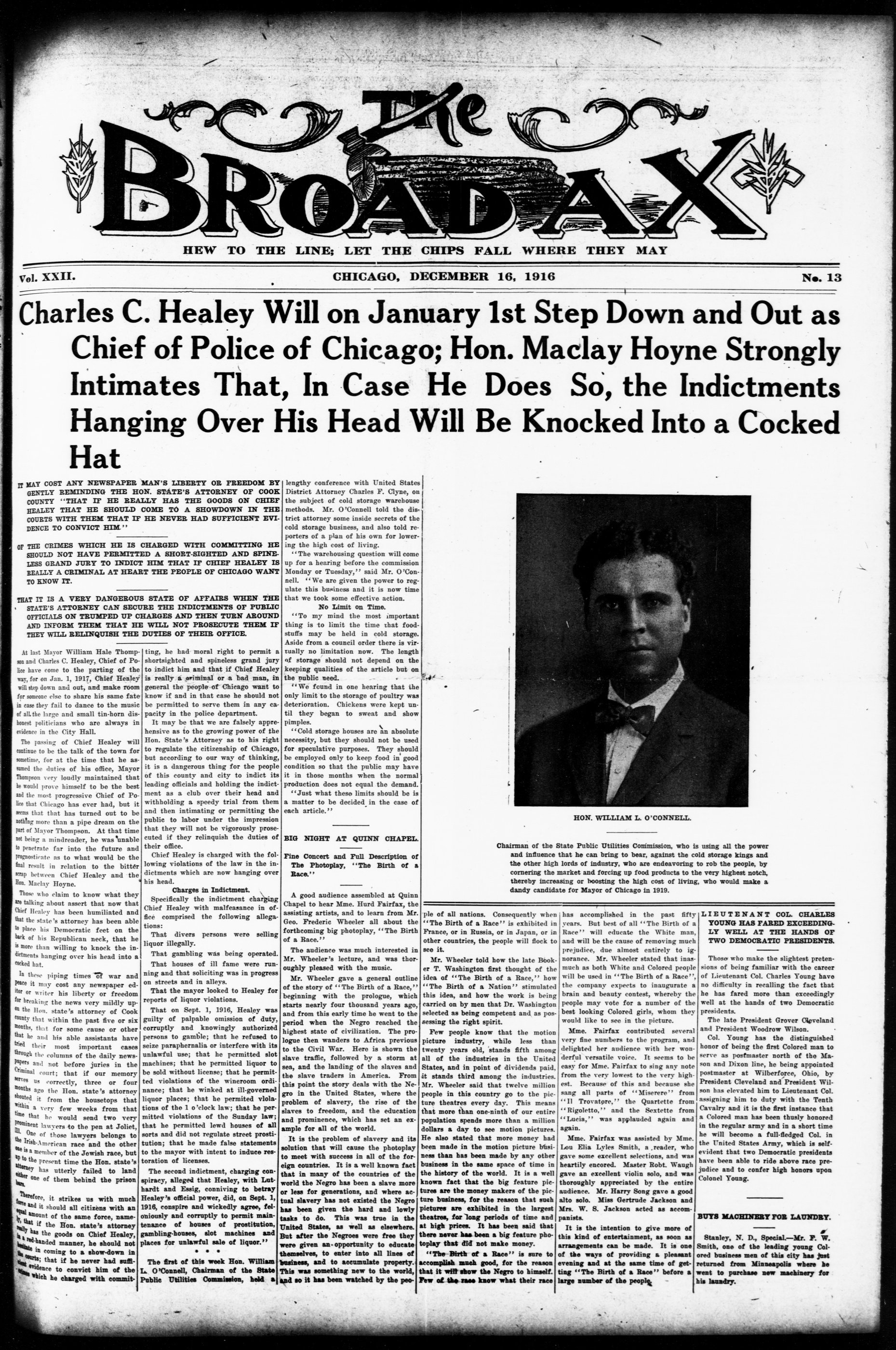
Charles C. Healey Will on January 1st Step Down and Out as Chief of Police of Chicago; Hon. Maclay Hoyne Strongly Intimates That, In Case He Does So, the Indictments Hanging Over His Head Will Be Knocked Into a Cocked Hat
IT MAY COST ANY NEWSPAPER MAN'S LIBERTY OR FREEDOM BY GENTLY REMINDING THE HON. STATE'S ATTORNEY OF COOK COUNTY "THAT IF HE REALLY HAS THE GOODS ON CHIEF HEALEY THAT HE SHOULD COME TO A SHOWDOWN IN THE COURTS WITH THEM THAT IF HE NEVER HAD SUFFICIENT EVIDENCE TO CONVICT HIM."
OF THE CRIMES WHICH HE IS CHARGED WITH COMMITTING HE SHOULD NOT HAVE PERMITTED A SHORT-SIGHTED AND SPINE-LESS GRAND JURY TO INDICT HIM THAT IF CHIEF HEALEY IS REALLY A CRIMINAL AT HEART THE PEOPLE OF CHICAGO WANT TO KNOW IT.
THAT IT IS A VERY DANGEROUS STATE OF AFFAIRS WHEN THE STATE'S ATTORNEY CAN SECURE THE INDICTMENTS OF PUBLIC OFFICIALS ON TRUMPED UP CHARGES AND THEN TURN AROUND AND INFORM THEM THAT HE WILL NOT PROSECUTE THEM IF THEY WILL BELINQUISH THE DUTIES OF THEIR OFFICE.
Vol. XXII.
Charles C
Chief
Intim
Hang
Hat
IT MAY COST ANY NEWSPAPER
GENTLY REMINDING THE H
COUNTY "THAT IF HE REA
HEALEY THAT HE SHOULD
COURTS WITH THEM THAT IF
DENCE TO CONVICT HIM"
OF THE CRIMES WHICH HE IS
SHOULD NOT HAVE PERMITTED
LESS GRAND JURY TO INDIC
REALLY A CRIMINAL AT HEA
TO KNOW IT.
THAT IT IS A VERY DANGEROUS
STATE'S ATTORNEY CAN SECU
OFFICIALS ON TRUMPED UP C
AND INFORM THEM THAT HI
THEY WILL RELINQUISH THE
At last Mayor William Hale Thompson and Charles C. Healey, Chief of Police have come to the parting of the way, for on Jan. 1, 1917, Chief Healey will step down and out, and make room for someone else to share his same fate in case they fail to dance to the music of all the large and small tin-horn dishonest politicians who are always in evidence in the City Hall.
The passing of Chief Healey will continue to be the talk of the town for sometime, for at the time that he assumed the duties of his office, Mayor Thompson very loudly maintained that he would prove himself to be the best and the most progressive Chief of Police that Chicago has ever had, but it seems that that has turned out to be nothing more than a pipe dream on the part of Mayor Thompson. At that time not being a mindreader, he was unable to penetrate far into the future and prognosticate as to what would be the final result in relation to the bitter scrap between Chief Healey and the Hon. Maclay Hoyne.
Those who claim to know what they are talking about assert that now that Chief Healey has been humiliated and that the state's attorney has been able to place his Democratic feet on the back of his Republican neck, that he is more than willing to knock the indictments hanging over his head into a cooled hat.
In these piping times of war and peace it may cost any newspaper editor or writer his liberty or freedom for breaking the news very mildly upon the Hon. state's attorney of Cook county that within the past five or six months, that for some cause or other that he and his able assistants have tried their most important cases through the columns of the daily newspapers and not before juries in the Criminal court; that if our memory serves us correctly, three or four months ago the Hon. state's attorney shouted it from the housetops that within a very few weeks from that time that he would send two very prominent lawyers to the pen at Joliet, III. One of those lawyers belongs to the Irish-American race and the other one is a member of the Jewish race, but up to the present time the Hon. state's attorney has utterly failed to land either one of them behind the prison barn.
Therefore, it strikes us with much force and it should all citizens with an equal amount of the same force, namely, that if the Hon. state's attorney really has the goods on Chief Healey, in a red-handed manner, he should not hesitate in coming to a show-down in the courts; that if he never had sufficient evidence to convict him of the crimes which he charged with commit-
ting, he had moral right to permit a shortsighted and spineless grand jury to indict him and that if Chief Healey is really a criminal or a bad man, in general the people of Chicago want to know if and in that case he should not be permitted to serve them in any capacity in the police department.
It may be that we are falsely apprehensive as to the growing power of the Hon. State's Attorney as to his right to regulate the citizenship of Chicago, but according to our way of thinking, it is a dangerous thing for the people of this county and city to indict its leading officials and holding the indictment as a club over their head and withholding a speedy trial from them and then intimating or permitting the public to labor under the impression that they will not be vigorously prosecuted if they relinquish the duties of their office.
Chief Healey is charged with the following violations of the law in the indictments which are now hanging over his head.
Charges in Indictment.
The second indictment, charging conspiracy, alleged that Healey, with Luthardt and Essig, conniving to betray Healey's official power, did, on Sept. 1, 1916, conspire and wickedly agree, feloniously and corruptly to permit maintenance of houses of prostitution, gambling-houses, slot machines and places for unlawful sale of liquor."
The first of this week Hon. William L. O'Connell, Chairman of the State Public Utilities Commission, held a
CHICAGO, DECEMBER 16, 1916
lengthy conference with United States District Attorney Charles F. Clyne, on the subject of cold storage warehouse methods. Mr. O'Connell told the district attorney some inside secrets of the cold storage business, and also told reporters of a plan of his own for lowering the high cost of living.
"The warehousing question will come up for a hearing before the commission Monday or Tuesday," said Mr. O'Connell. "We are given the power to regulate this business and it is now time that we took some effective action.
No Limit on Time.
"To my mind the most important thing is to limit the time that foodstuffs may be held in cold storage. Aside from a council order there is virtually no limitation now. The length of storage should not depend on the keeping qualities of the article but on the public need.
"We found in one hearing that the only limit to the storage of poultry was deterioration. Chickens were kept until they began to sweat and show pimples.
"Cold storage houses are an absolute necessity, but they should not be used for speculative purposes. They should be employed only to keep food in good condition so that the public may have it in those months when the normal production does not equal the demand. "Just what these limits should be is a matter to be decided in the case of each article."
BIG NIGHT AT QUINN CHAPEL
Pine Concert and Full Description of The Photoplay, "The Birth of a Race."
A good audience assembled at Quinn Chapel to hear Mme. Hurd Fairfax, the assisting artists, and to learn from Mr. Geo. Frederic Wheeler all about the forthcoming big photoplay, "The Birth of a Race."
The audience was much interested in Mr. Wheeler's lecture, and was thoroughly pleased with the music.
Mr. Wheeler gave a general outline of the story of "The Birth of a Race," beginning with the prologue, which starts nearly four thousand years ago, and from this early time he went to the period when the Negro reached the highest state of civilization. The prologue then wanders to Africa previous to the Civil War. Here is shown the slave traffic, followed by a storm at sea, and the landing of the slaves and the slave traders in America. From this point the story deals with the Negro in the United States, where the problem of slavery, the rise of the slaves to freedom, and the education and prominence, which has set an example for all of the world.
It is the problem of slavery and its solution that will cause the photoplay to meet with success in all of the foreign countries. It is a well known fact that in many of the countries of the world the Negro has been a slave more or less for generations, and where actual slavery has not existed the Negro has been given the hard and lowly tasks to do. This was true in the United States, as well as elsewhere. But after the Negroes were free they were given an opportunity to educate themselves, to enter into all lines of business, and to accumulate property. This was something new to the world, and so it has been watched by the peo-
J. B.
Chairman of the State Public Utilities Commission, who is using all the power and influence that he can bring to bear, against the cold storage kings and the other high lords of industry, who are endeavoring to rob the people, by cornering the market and forcing up food products to the very highest notch, thereby increasing or boosting the high cost of living, who would make a dandy candidate for Mayor of Chicago in 1919.
ple of all nations. Consequently when "The Birth of a Race" is exhibited in France, or in Russia, or in Japan, or in other countries, the people will flock to see it.
Mr. Wheeler told how the late Booker T. Washington first thought of the idea of "The Birth of a Race," how "The Birth of a Nation" stimulated this idea, and how the work is being carried on by men that Dr. Washington selected as being competent and as possessing the right spirit.
Few people know that the motion picture industry, while less than twenty years old, stands fifth among all of the industries in the United States, and in point of dividends paid it stands third among the industries. Mr. Wheeler said that twelve million people in this country go to the picture theatres every day. This means that more than one-ninth of our entire population spends more than a million dollars a day to see motion pictures. He also stated that more money had been made in the motion picture business than has been made by any other business in the same space of time in the history of the world. It is a well known fact that the big feature pictures are the money makers of the picture business, for the reason that such pictures are exhibited in the largest theatres, for long periods of time and at high prices. It has been said that there never has been a big feature photoplay that did not make money.
"The Birth of a Race" is sure to accomplish much good, for the reason that it will show the Negro to himself. Few of the race know what their race
has accomplished in the past fifty years. But best of all "The Birth of a Race" will educate the White man, and will be the cause of removing much prejudice, due almost entirely to ignorance. Mr. Wheeler stated that insmuch as both White and Colored people will be used in "The Birth of a Race", the company expects to inaugurate a brain and beauty contest, whereby the people may vote for a number of the best looking Colored girls, whom they would like to see in the picture.
Mme. Fairfax contributed several very fine numbers to the program, and delighted her audience with her wonderful versatile voice. It seems to be easy for Mme. Fairfax to sing any note from the very lowest to the very highest. Because of this and because she sang all parts of "Miserere" from "Il Trovatore," the Quartette from "Rigoleto," and the Sextette from "Lucia," was applauded again and again.
Mme. Fairfax was assisted by Mme. Lou Elia Lyles Smith, a reader, who gave some excellent selections, and was heartily encored. Master Robt. Waugh gave an excellent violin solo, and was thoroughly appreciated by the entire audience. Mr. Harry Song gave a good alto solo. Miss Gertrude Jackson and Mrs. W. S. Jackson acted as accompanists.
It is the intention to give more of this kind of entertainment, as soon as arrangements can be made. It is one of the ways of providing a pleasant evening and at the same time of getting "The Birth of a Race" before a large number of the people.
No.13
LIEUTENANT COL. CHARLES YOUNG HAS FARED EXCEEDINGLY WELL AT THE HANDS OF TWO DEMOCRATIC PRESIDENTS.
Those who make the slightest pretensions of being familiar with the career of Lieutenant Col. Charles Young have no difficulty in recalling the fact that he has fared more than exceedingly well at the hands of two Democratic presidents.
The late President Grover Cleveland and President Woodrow Wilson.
Col. Young has the distinguished honor of being the first Colored man to serve as postmaster north of the Mason and Dixon line, he being appointed postmaster at Wilberforce, Ohio, by President Cleveland and President Wilson has elevated him to Lieutenant Col. assigning him to duty with the Tenth Cavalry and it is the first instance that a Colored man has been thusly honored in the regular army and in a short time he will become a full-fledged Col. in the United States Army, which is self-evident that two Democratic presidents have been able to ride above race prejudice and to confer high honors upon Colonel Young.
BUYS MACHINEY FOR LAUNDRY
Stanley, N. D., Special.-Mr. F. W. Smith, one of the leading young Colored business men of this city has just returned from Minneapolis where he went to purchase new machinery for his laundry.
Dan M. Jackson
Geo. T. Keseray
David A. McGowan
Ahmed A. Rayner
The Emanuel J
Undertaking Co
2959-61 South State
Reliable Service
Reasonable Price
FREE CHAPEL IN CONN
Complete line of Funeral Goods.
The Emanuel Jackson
Undertaking Co., Inc.
2959-61 South State St.
Reliable Service Courteous
Reasonable Prices
FREE CHAPEL IN CONNECTION
Complete line of Funeral Goods. Automob
THE TWENTY-SECOND ANNUAL
RECEPTION
and BA
Given by the
8th Regiment,
Monday, Januar
From 9 P. M. to 2 A
EIGHTH REGIMENT
35th Street and Fore
RECEPTION
and BALL
Given by the
Regiment, Ill. I
day, January 1,
From 9 P. M. to 2 A. M.
TH REGIMENT AR
35th Street and Forest Ave.
RECEPTION and BALL
8th Regiment, Ill. N. G.
Monday, January 1, 1917
From 9 P. M. to 2 A. M.
EIGHTH REGIMENT ARMORY
35th Street and Forest Ave.
MUSIC BY EIGHTH REGIMENT
FULL BAND
Admission :: :: ::
RIGHTS OF PYTH
BALL
KNIGHTS OF PYTHIAS
AND CHRISTMAS TREE
GIVEN BY THE
FIRST REGIMENT, UNI-
Music by First Regiment K.
Christmas
Monday, December 25th
7th REGIMENT A
Thirty-fourth Street and Went
ADMISSION
Telephone Douglas 6568
THE SOLACE BILLIARD
"THE MODERN SCHOOL"
GIVEN BY THE
FIRST REGIMENT, UNIFORM R
Music by First Regiment K. of P. Band
Christmas Night
Monday, December 25th, 1916
IN REGIMENT ARMO
Thirty-fourth Street and Wentworth Ave.
ON - - - - - FIF
Douglas 6568
Auto
THE SOLACE BILLIARD ACADEMY
"EERN SCHOOL" - CLEAN AND
GIVEN BY THE
FIRST REGIMENT, UNIFORM RANK
Music by First Regiment K. of P. Band
Christmas Night
Monday, December 25th, 1916
7th REGIMENT ARMORY
Thirty-fourth Street and Wentworth Ave.
TERREVOUS L. DOUGLAS, Prop.
CIGARS-WHOLESALE AND RETAIL
BOX TRADE A SPECIALTY
3556 South State Street
Young, but Wise.
"But mamma thinks I am too young to marry."
"Why should she think that? You're much older than she was when she got married, aren't you?
"Yes, but father was drawing a much larger salary at the time than you're getting." -Chicago Herald.
A Friendly Tip.
Sapleigh—Would you—er—advise me to—er—marry a beautiful girl or a sensible girl? Hammersley—I'm afraid you'll never be able to marry either, old man. Sapleigh—Why not? Hammersley—Well, a beautiful girl could do better and a sensible girl would know better—Exchange.
And No Wonder.
"What was the trouble?"
"Mr. Jibway's first wife wrote him a long birthday letter every year, and I think it finally got on the second Mrs. Jibway's nerves." -Savannah Press.
Disillusioned.
"Did your husband used to write you poetry before you were married?"
"No, but he used to write me what we both thought was poetry."—Housen Post.
PAGE TWO
Phones Calumet 6164
Automatic 71-629
OPEN DAY
AND NIGHT
Juel Jackson
Bug Co., Inc.
South State St.
Courteous Treatment
Table Prices
IN CONNECTION
s. Automobles for hire
ANNUAL
PTION
BALL
by the
St, Ill. N. G.
January 1, 1917
I. to 2 A. M.
MENT ARMORY
and Forest Ave.
50 Cents
F PYTHIAS
LL
BY THE
UNIFORM RANK
ment K. of P. Band
as Night
ber 25th, 1916
NT ARMORY
and Wentworth Ave.
Automatic 73-657
LIARD ACADEMY
- CLEAN AND RELIABLE
Two men were once talking over their respective sons' careers at college, and one remarked: "Well, I sometimes feel like saying, as did Aaron in the wilderness, 'Behold, I poured in the gold and there came out this caif.'"—New York American.
"Had any luck in the stock market
lately?"
"The best ever."
"How much did you clean up?"
"Not a cent. I listened to a still
small voice and stayed out."—Birmingham
ham Age-Herald.
Distance Lends Enchantment.
She—Do you think it will be all right
for us after we are married to settle a
couple of squares away from my family?
He—I was going to say a couple
of states.—New York Times.
Wife—John, you'll have to take that ball away from baby. He hit sister on the head with it. John—Yes, dear, but you should have seen the curve the little cuss had on it—Puck.
True glory consists in so living as to make the world happier and better for our living—Pilay.
FIFTY CENTS
Chicago
Prudent Man.
Optimism.
THE BROAD AX, CHICAGO, DECEMBER 16, 1916.
OFFICIAL PUBLICATION
Annual statement of the Germania Fire
Insurance Company of New York, in the
State of New York, on the 31st day of
December, 1915, made to the Insurance
Superintendent of the State of Illinois,
pursuant to law.
CAPITAL.
Amount of capital stock paid
up in cash ..... $ 1,000,000.00
INCOME.
Premiums received during the
year ..... $ 3,193,320.84
Interest, rents and dividends
Profit on sale or maturity of
ledger assets ..... 708.63
From all other sources ..... 528.33
Total Income ..... $ 3,525,722.27
DISBURSEMENTS.
Losses paid during the year $ 1,484,845.08
Expenses of adjustment and
settlement of losses ..... 84,429.56
Houses or dividends to stock-
holders ..... 200,000.00
Commission or brokerage ..... 641,369.45
Salaries, fees and all other
charges of officers, clerks,
sales and employees ..... 377,506.28
Rents ..... 31,754.45
Advertising, printing and sta-
tionery, postage, etc ..... 45,915.87
Legal expenses, furniture, fix-
ture and management ..... 21,560.03
Underwriters' boards, fire
department and salvage
corps, fees, etc ..... 29,821.97
Insurance carriers ..... 51,935.54
Repairs, expenses and taxes
on real estate ..... 29,651.36
State insurance departments,
taxes and fees ..... 83,710.52
Oversees fees and taxes ..... 35,462.75
Loss on sale or maturity of
ledger assets ..... 15,491.54
Decrease in book value of
ledger assets ..... 14,547.12
Agents balances charged off ..... 2,895.05
All other disbursements ..... 12,567.63
Total Disbursements .. $ 3,163,464.20
LEDGER ASSETS.
Book value of real estate...$ 738,663.02
Mortgage loans on real estate 720,250.00
Book value of bonds and
cocks...$ 5,753,560.22
Cash in office and bank...$ 570,272.68
Agents' balances...$ 588,785.89
Total Ledger Assets...$ 8,371,931.81
NON-LEDGER ASSETS.
Interest accrued...$ 51,350.50
Other non-ledger assets...$ 15,896.03
Gross Assets...$ 8,439,178.34
DEDUCT ASSETS NOT ADMITTED.
Agents' balances
over three
months due...$ 9,378.49
Book value
estate, bonds
and stocks
over market
value...$ 362,333.47
Special deposits
to secure li-
abilities in
Georgia, Vt.
gains, Canada,
New Mexico,
N. Carolina...$ 37,814.54
409,526.50
LIABILITIES.
Losses adjusted
and unpaid. $ 170,508.67
Losses in pro-
cess of adjust-
ment or
in suspense. 148,480.29
Losses resisted 55,725.00
Total ..... $ 374,713.96
D e d u c t r e-i-n-
surance ..... 108,786.21
Net amount of unpaid losses $ 265,927.75
Total unearned premiums... 3,558,971.56
Salaries, rents, bills, taxes,
etc. 67,410.58
Commissions and brokerage 26,066.66
Other liabilities ..... 1,919.13
Total Liabilities . . . $ 3,920,295.58
BUSINESS IN ILLINOIS.
Total risks taken during the year . . . $32,655,841.00
Total premiums during the year . . . 380,406.74
Total losses incurred during the year . . . 169,789.05
GEO. B. EDWARDS.
President.
GUSTAV KEIH.
Secretary.
Subscribed and sworn to before me this 29th day of January, 1916.
AUGUST C. WAITERLING.
[SEAL] Notary Public.
OFFICIAL PUBLICATION
Annual statement of the German Alliance Insurance Company of New York, in the State of New York, on the 31st day of December, 1915, made to the Insurance Superintendent of the State of Illinois, pursuant to law.
CAPITAL.
Amount of capital stock paid up in cash . . . $ 400,000.00
INCOME.
Premiums received during the year . . . $ 612,421.41
Interests, rentals and dividends . . . 81,232.18
Profit on sale or maturity of ledger assets . . . 2,097.33
Total Income . . . $ 695,750.92
DISBURSEMENTS.
Losses paid during the year. $ 319,319.79
Expenses of adjustment and
settlement of losses. 7,228.47
Interest dividends to stock-
holders. 60,000.00
Commissions or brokerage. 155,710.30
Salaries, fees and all other
charges, dues, clerks, clerks,
agents and employees. 3,490.00
Postage, etc. 2.20
Legal expenses. 25.00
Fire department and salvage
torps, fees, etc. 3,396.94
State insurance departments,
taxes and fees. 14,019.64
Other licenses, fees and taxes 15,499.13
Loss on sale or maturity of
ledge assets. 26,984.43
All other disbursements. 100.00
Total Disbursements. $ 605,775.90
LEDGER ASSETS.
Book value of bonds and
stocks. $ 1,957,104.68
Cash in office and bank. 42,761.08
Agents' balances. 109,961.48
Total Ledger Assets. $ 2,109,827.23
NON-LEDGER ASSETS.
Interest accrued 11,117.00
Gross Assets. $ 2,120,944.23
DEDUCT ASSETS NOT ADMITTED.
Book value real estate, honds
and stocks over market
value ..... $ 179,236.68
Total Admitted Assets..... $ 4,941,707.55
LIABILITIES.
Losses adjusted
and unpaid.$ 68,391.49
Losses in process of ad
justment or
in suspense ..... 238,923.00
Losses resisted. ..... 35,030.00
Total ..... $ 342,344.49
Deduct re-in-
surance ..... 232,510.00
Net amount of unpaid losses$ 109,834.49
Total unearned premiums.. 505,421.30
Salaries, rents, bills, taxes,
etc. ..... 10,000.00
Total Liabilities ..... $ 625,255.79
LEDGER ASSETS.
Book value of real estate... $ 58,388.34
Mortgage loans on real estate 719,794.39
Loans secured by pledge of bonds, stocks or other collateral 32,733.25
Book value of bonds and stocks 381,658.00
Cash in office and bank 29,798.24
Agents' balances 42,144.75
Other ledger assets. 200.00
Total Ledger Assets..... $ 1,264,716.97
NON-LEDGER ASSETS.
Interest and rents due and accrued ..... $ 12,932.26
Gross Assets ..... $ 1,277,649.23
DEDUCT ASSETS NOT ADMITTED.
Agents' balances over three months, due ..... $ 3,390.01
Total Admitted Assets..... $ 1,274,259.22
LIABILITIES.
Losses in process of adjustment or in suspense ..... $ 9,948.00
Losses resisted ..... $ 6,500.00
Total ..... $ 16,448.00
Deduct re-in-insurance ..... 4,372.62
Net amount of unpaid losses. $ 12,075.38
Total unearned premiums ..... 243,622.79
Amount reimbursed on perpetual policies ..... 123.00
Salaries, rents, bills, taxes, etc. ..... 8,000.00
Commissions and brokerage ..... 1,500.00
Total Liabilities ..... $ 265,321.17
BUSINESS IN ILLINOIS.
Total risks taken during the
year ..... $ 4,237,112.00
Total premiums during the
year ..... $ 41,535.12
Total losses incurred during
the year ..... $ 17,707.55
MARTIN MEYERDIRCH,
President.
R. W. MACDONALD,
Ass't. Secretary.
Subscribed and sworn to before me this
31st day of January, 1916.
HOWARD S. SHELDS,
Notary Public.
[SEAL]
OFFICIAL PUBLICATION
Annual statement of the German American Insurance Company of New York, in the State of New York, on the 31st day of December, 1915, made to the Insurance Superintendent of the State of Illinois, pursuant to law.
CAPITAL.
Amount of capital stock paid
up in cash ..... $ 2,000,000.00
INCOME.
Premiums received during the year
$ 9,037,801.97
Invests: rents and dividends
1,122,103.89
Profit a share or maturity of ledger assets
4,137.72
From all other sources.
15,355.99
Total income .....$10,179,399.57
DISBURSEMENTS.
Losses paid during the year.$ 4,876,580.75
Expenses of adjustment and
adjustment of losses..... 127,033.93
Interest or dividends to
stockholders..... 600,000.00
Commissions or brokerage..... 1,731,070.02
Sanitation fees and other
charges of officers, clerks,
agents and employees..... 979,435.65
Rents..... 75,068.31
Advertising, printing and sta-
tion, advertising, etc..... 167,895.58
Legal expenses, furniture, fixtures
and maps..... 35,770.81
Underwriters' boards, fire de-
partment and salvage corps,
fees and taxes..... 186,327.83
Inspection and surveys..... 67,330.92
Repairs, expenses and taxes
on real estate..... 118,283.13
State insurance departments,
taxes and fees..... 201,461.95
Other licenses, fees and taxes..... 91,555.46
Loss on sale or maturity of
ledger assets..... 243,376.01
Agents' balances charged off..... 3,320.39
All other disbursements..... 26,130.17
Total disbursements ..... $ 9,530,640.01
LEDGER ASSETS.
Book value of real estate ... $ 2,682,385.69
Mortgage loans on real estate ... 53,150.00
Book value of bonds and stocks ... 18,566,082.42
Cash in office and bank ... 977,080.14
Agents' balances ... 1,736,374.91
Bills receivable ... 36,000.89
Total Ledger Assets ... $24,051,164.05
NON-LEDGER ASSETS.
Interest accrued ... $ 153,331.52
Other non-ledger assets ... 6,242.23
Gross Assets ... $24,210,737.80
DEDUCT ASSETS NOT ADMITTED.
Agents' bal-
ances over
three
months-station $ 30,883.25
Bills receiv-
able and
loans on
personal sec-
curity ... 1,925.13
Book value
real estate,
bonds and
stocks over
market value 1,746,586.11
Special de-
posits to se-
curity liabil-
ties in Can-
ada, Georgia,
N. Mexico,
N. Carolina,
and Vir-
ginia ... 66,717.00
$ 1,846,111.49
LIABILITIES.
Losses ad-
justed and
unpaid ...$ 194,156.00
Losses in
process of
adjustment
or in sus-
penace ... 1,012,753.00
Losses re-
sisted ... 162,531.00
Total ... $1,369,440.00
Deduct in-in
surance ... 440,414.88
Net amount of unpaid losses.$ 929,025.12
Total unearned premiums..... 9,036,192.28
Salaries, rents, bills, taxes,
etc. ..... 157,117.93
Commissions and brokerage ..... 14,461.48
Other liabilities ..... 10,144.57
Total Liabilities ..... $10,146,941.38
BUSINESS IN ILLINOIS.
Total risks taken during the
year ..... $88,270,233.00
Total premiums during the
year ..... 820,747.13
Total losses incurred during
the year ..... 343,552.48
WILLIAM N. KREMER,
President.
EDWIN M. CRAGIN,
Secretary.
Subscribed and sworn to before me this
25th day of January, 1916.
J. HOMER REED,
Notary Public.
[SEAL]
OFFICIAL PUBLICATION
Annual statement of the German American Insurance Company of Pittsburgh, in the State of Pennsylvania, on the 31st day of December 1915, made to the Insurance Superintendent of the State of Illinois, pursuant to law.
CAPITAL.
Amount of capital stock paid up in cash.....$ 200,000.00
INCOME.
Premiums received during the year.....$ 362,390.45
Interests, rents and dividends
profit on sale or maturity of ledger assets.....108.00
Total Income.....$ 403,255.74
# DISBURSEMENTS.
Losses paid during the year. $ 205,120.82
Expenses of employee and settlement of losses. 5,555.56
Interest or dividends to stockholders. 26,000.00
Commissions or brokerage. 109,448.70
Salaries, fees and all other charge of employee clerks, agents and employees. 19,369.11
Rents. 3,825.00
Advertising, printing and stationery, postage, etc. 4,963.31
Legal expenses, furniture, fixures. 2,018.60
Underwriters' boards, fire department and salvage corps, fees, etc. 6,151.58
Inspection and surveys. 393.77
Repairs, expenses and taxes on equipment. 1,810.88
State insurance departments, taxes and fees. 6,109.46
Other licenses, fees and taxes 3,518.07
Agents' balances charged off. 98.01
All other disbursements. 759.98
LEDGER ASSETS.
Book value of real estate.....$ 46,527.47
Mortgage loans on real estate 521,925.00
Loans secured by pledge of bonds, stocks or other collateral 15,750.00
Book value of bonds and stocks 78,684.00
Cash in office and bank 77,385.79
Agents' balances 67,083.51
Bills receivable 1,835.53
Total Ledger Assets.....$ 809,191.30
NON-LEDGER ASSETS.
Interest and rents due and accrued.....$ 11,381.00
Market value of real estate, bonds and stocks over book value.....$ 5,754.16
Gross Assets.....$ 826,326.46
DEDUCT ASSETS NOT ADMITTED.
Agents' balances over three months, due.....$ 5,612.48
Total Admitted Assets...$ 820,713.98
LIABILITIES.
Losses adjusted and unpaid.....$ 9,646.41
Losses in process of adjustment or in suspense. 51,316.52
Losses resisted... 5,575.00
Total.....$ 66,537.93
Deduct re-insurance.....9,007.55
Net amount of unpaid losses.$ 57,530.38
Total unearned premiums... 315,139.78
Salaries, rents, bills, taxes, etc......$ 5,150.00
Commissions and brokerage... 588.84
Other liabilities.....36.00
Total Liabilities.....$ 378,445.00
BUSINESS IN ILLINOIS.
Total risks taken during the year.....$ 1,887,755.00
Total premiums during the year.....24,186.54
Total losses incurred during the year.....14,951.59
W. J. PATTERSON.
President.
E. P. NIEBAUM,
Secretary.
Subscribed and sworn to before me this 31st day of January, 1916.
WALTER C. MORRIS,
[SEAL]
Notary Public.
OFFICIAL PUBLICATION
Annual statement of the Girard Fire and
Marine Insurance Company of Philadelphia,
in the state of Pennsylvania, on the 31st
day of December, 1915, made to the
Insurance Superintendent of the State of
Illinois, pursuant to law.
CAPITAL.
Amount of capital stock paid
up in cash..... $ 500,000.00
INCOME.
Premiums received during the
year..... $ 729,576.12
Deposit premiums on perpetu-
al risks..... 8,682.30
Interests, rents and dividends
110,902.56
Profit on sale or maturity
ledger assets..... 7,308.03
Increase in book value of ledger
assets..... 2,440.22
From all other sources..... 257.37
DISBURSEMENTS.
Losses paid during the year. $ 374,407.31
Earnings paid during adjustment and settlement of losses. 8,694.45
Deposit premiums returned. 18,618.41
Interest or dividends to stockholders. 100,000.00
Commissions or brokerage. 190,726.01
Statutes and other charges of officers, clerks, agents and employees. 83,331.63
Rents. 12,485.54
Advertising, printing and stationery, faxes, etc. 11,502.33
Legal expenses, furniture, fixtures and maps. 5,800.19
Underwriters' boards, fire department and salvage corps, fees, etc. 19,014.74
Inspections. 3,798.31
Repairs, expenses and taxes on real estate. 7,829.25
State insurance departments, taxes and fees. 17,313.45
Other licenses, fees and taxes 11,027.27
Losses or maturity of ledger assets. 21.90
Decrease in book value of ledger assets. 1,364.38
Agents' balances charged off. 138.14
All other disbursements. 2,353.46
LEDGER ASSETS.
Book value of real estate... $ 211,497.32
Mortgage loans on real estate 235,900.00
Loans secured by pledge of bonds, stocks or other collateral 32,000.00
Book value of bonds and stocks 1,886,545.60
Cash in office and bank 87,215.47
Agents' balances 121,866.48
Bank receivable 3,932.58
Other ledger assets 812.50
Total Ledger Assets... $ 2,579,769.40
NON-LEDGER ASSETS.
Interest and rents due and
accrued ... $ 28,686.00
Market value of real estate,
bonds and stocks over book
value ... $ 55,753.98
Other non-ledger assets ... $ 5,127.34
Gross Assets ... $ 2,667,364.11
DEDUCT ASSETS NOT ADMITTED.
Agents' balances
over three
months, due, $ 1,394.30
Book value real
estate, bonds
and stocks
over market
value ... $ 175,953.10
Special deposits
to secure li-
bilities in
Georgia and
Virginia ... $ 4,967.85
$ 182,315.25
Total Admitted Assets $ 2,485,020.96
LIABILITIES.
Losses adjusted
and unpaid, $ 1,395.00
Losses in process
of adjustment
or in suspense 57,609.00
Losses resisted 5,850.00
Total ... $ 64,854.00
Deduct reinsurance ... 19,357.00
Net amount of unpaid losses, $ 45,497.00
Total unearned premiums ... 940,677.69
Amount reclaimable on per-
petual policies ... 568,178.87
Salaries, rents, bills, taxes,
etc. ... 3,500.00
Total Liabilities ... $ 1,563,853.47
BUSINESS IN ILLINOIS.
Total risks taken during the
year ... $14,228,644.00
Total premiums during the
year ... 142,042.39
Total losses incurred during
the year ... 54,603.07
HENRY M. GRATZ,
President,
EDWARD J. THOMASON,
Secretary.
Subscribed and sworn to before me this
14th day of January, 1916.
JOSEPH KLAPP NICHOLS,
[SEAL]
Notary Public.
Leaves of the Poison Ivy.
No doubt just a picture of poison ivy is enough to cause some folks to shudder and remember the time their face and body became scarlet and swollen from contact with the leaves. How it itched and burned! Yet to rub it was only to make matters worse.
A curious fact is that some persons are immune from this poison, while others must not even breathe the pollen of the plant. It is often confounded with the Virginia creeper, although the difference between this is distinct.
The leaves of the latter are divided into five leaflets, while those of the former have but three, a fact well worth remembering.
Strange enough, the witch hazel plant is sometimes found growing close to the poison ivy. As witch hazel extract is one of the best remedies for ivy poisoning it would seem nature was holding out disease in one hand and a remedy in another.
Heat at the Persian Gulf.
The Persian gulf and its coasts are in summer about the hottest place on earth's surface, a temperature of 120 degrees in the shade being not uncommon, while a black bulb solar thermometer has registered 187 degrees in the sun.
When one remembers that the hottest room in a Turkish bath is usually kept at about 160 degrees the appalling nature of this Persian heat will be better realized.
The greatest heat ever known in England was on Aug. 18, 1883, when a shade temperature of 95 degrees was registered. But on this day the sun temperature did not quite equal that of July 28, 1883, when 162 degrees F. was registered in the sun.
When you consider facts like these it is difficult to believe that our planet receives only one two-thousand-million part of the rays flung out by the sun—London Telegraph.
Odd Titles of Newspapers.
In Columbus, says the Dispatch there is a man whose chief joy is in a collection of newspaper titles.
There are Headlights, Flashlights, Bees, Eagles, Owls, Mirrors and News Letters, but when it comes to Dericka, Meddlers, Telescopes, Flags and Sunbeams the class is limited. In Hot Springs there is published the Arkansas Thomas Cat, and other titles just as unusual are the Sledge Hammer, the Irrepressible, the Silent Worker and Gall.
Frequently it is possible to tell from the title of a newspaper the state in which it is published. For instance, the Chieftain is in Oklahoma, the Rustler and the Larlari are in Texas, Big Hole Breezes in Montana and the Roundup in Wyoming.
"Yes," answered the man who likes to attract attention.
Careful Hubby
Careful Hubby.
"Does your husband subscribe to the theory that kissing transmits germs?" "No; he thinks that germs are mostly transmitted by money and is very careful not to hand me any."—Kansas City Journal.
Woodmen Grow Obsolete.
A steam operated sawing machine fells more trees in an eight hour day than thirty woodmen. It works close to the ground and leaves no stumps standing—Popular Science Month.
Just In Time.
Plaintiff's Lawyer—I rest the case Defendant's Ditto—You ought to it's pretty weak—New York American.
A NEW EMPRESS.
Consort of the Youthful Ruler of Austria-Hungary.
MOTHER OF FOUR CHILDREN,
Not Yet Twenty-five Years Old, This Royal Lady Has Three Sons and a Daughter—Also Two Brothers In the Belgian Army.
The empress of Austria is the thirteenth of the twenty children of Duke Robert of Parma, who was expelled from his sovereign duchy at the age of twelve by its incorporation in the kingdom of Italy. He inherited, however, the immense fortune of the Comte de Chambord and made his home in Virginia, where he assumed the state of a
A.
EMPRESS OF AUSTRIA.
royal personage, with all his inherited titles—grand duke of Tuscany, king of Hanover, duke of Brunswick, duke of Parma, king of Naples, the Two Sicilies and Jerusalem.
Fire of the duke's eight children by his first wife were either feeble minded or insane. His second wife, still living, is the sister of the Archduchess Maria Theresa, mother of the murdered Archduke Francis Ferdinand. She made her home in Paris some years ago and is related to the queen of the Belgians; hence the appearance of her sons in the Belgian army, the Princess Xavier and Sixte. President Polincare recently decorated both with the croix de guerre.
The duchy of Parma was made a part of the kingdom of Italy after 1859, since which time the principal residence of the ducal family has been at the castle of Schwarzau, near Vienna. It was here that the Princess Zita was married on Oct. 21, 1911. Her father, Duke Robert of Parma, who died in 1907, was married first to Princess Maria Pia of the Two Sicilies and secondly to Princess Maria Antonia of Parma. Duke Henry, the present head of the house, is an offspring of the first marriage, the Empress Zita of the second. She was born at the Villa Planare, near Viareggio, on May 9, 1892.
The new emperor has always been devoted to his wife. Their union is said to have been the result of a pure love match. The alliance is said to have been looked on unfavorably by the old emperor—the more particularly as he had hoped, according to persistent rumor, that Charles Francis Joseph would marry a daughter of the Archduchess Marie Valeria, his own daughter, who was married in 1800 to the Archduke Francis Salvator of Hapsburg-Tuscany.
Upon making the acquaintance of the Princess Zita, however, the old emperor relented and soon gave his consent to her marriage to the archduke. It is even said that she so strongly reminded him of his dead wife that he exclaimed that she would make a second Elizabeth.
The new empress has three sons, the eldest of whom, the Archduke Francis Joseph Otto, was born at the Villa Walthelt, near Reflechena, on Nov. 30, 1912. The second, Louis, was born in Feb. 8, 1915. There is also a daughter, Archduke Adelda, who was born Jan. 3, 1914, and a baby son, born last May.
The new emperor is said to be devoted to his family and while an archduke could often be seen on the Vienna Ring wheeling his first son and heir in a perambulator. A model family man, a handsome officer, a linguist, a sportsman, a good soldier and a patron of musical comedy, he has been so far in the minds of the populace very much what a prince ought to be.
Deep Breathing
Deep breathing, sensible breathing, every day breathing—long life depends upon it, good looks always. Yet nineteenth of the world's creatures hate to breathe, and young folks especially are as niggly in the matter of filling their lungs with clean, wholesome air as if they thought they were dealing with poison. Twenty long breaths night and morning will quickly improve the looks of a girl who has begun to go down with study and carelessness, and surely there is no beautier cheaper than deep breathing.
GRANDMOTHER'S SHAWL
How Paisleys Once More Flourish In Today's Fashion.
Once more the little hamlet of Paisley, in Renfrew, Scotland, is on the map, and again the name of Paisley is on the tip of the tongue, as it has not been for some fifty odd years—not since the days when every fashionable woman possessed a Paisley shawl or two in lieu of other cloak or wrap.
All over the land women are getting out old shawls from old dust covered trunks and finding in them a veritable treasure for this winter's wardrobe. There is really a big demand for old Paisleys in the fashionable dressmaker's and milliner's shop, and some women have sold their old shawls instead of having them used for their own costumes. In the meantime strips of Paisley are the most fashionable of the season's trimming, and perhaps because Paisley shawls are not any too plentiful and because imitations are not very satisfactory the vogue will remain good for months to come.
Cashmere trimming is also fashionable, though one would really hesitate at cutting up a genuine antique cashmere even to be in the current of fashion. Always valuable, cashmere shawls are now veritable treasures. One woman owns one for which her grandfather paid $1,000 when he bought it sixty years ago for her grandmother. And another woman possesses a little shoulder shawl, just a scarf a couple of feet wide and four or five long, with ends of the wonderful cashmere work, and the rest of plain black, which cost $100 half a century ago.
These lovely old shawls are really too valuable to cut up for finery that will serve for only a year or two. But they can be very effectively used if they are in good condition for covering a divan or low couch.
HER NEW BLOUSE.
A Model as Charming as It Is Simply Cut.
Georgette crape in straw color, cut surplice fashion and simply trimmed with a sailor color of navy satin and
THE FILM MAKER
GOOD LINES.
squares of navy embroidery gives this blouse designed to go with a suit of navy serge. Two toned blouses occupy much space in smart shops.
Cost of Baked Chicken Pie Dinner For Six Persons.
Cocktail—cranberries, 1 cupful sugar, 2½c; oranges, 4c, .06½
Soup-rice, 1c; parsley, 1c; seasoning, 1c, .03
Celery, .06
8½l. chicken, 16c. to 18c, 59c; potatoes, 4c; crust, 7c; seasoning, 1c, .71
Cranberries, 1 qt., 10c; sugar, 5c, .15
Parsnips, 5c; sauce, 3c, .15
Salad—apples, 4c; celery, 3c; dressing, 8c, .10
Puml budding and sauce, .15
Rolls, 6c; coffee, 6c, .12
½l. nuts, 10c; ½l. cluster ralsing, 12c, .22
Total cost of dinner . $1.78%
Cost of Roast Goose Dinner For Six
Persons.
Cocktail-3 grapefruit.....25
Broth-10 clams @ 2c.....20
Celery, 10c.; olives, 10c.....20
7 lb. goose @ 2c. to 30c; this is 28c.....1.95
Filling-Oysters, 20c.; seasoning 1c.; butter, 6c.....27
1 qt. cranberries, 10c.; sugar, 5c.; ice and salt, 5c.....30
4 pk. potatoes, 8c.; butter, 3c.; milk, 1c.....12
8 onions, 10c.; butter, 3c.; milk, 2c.; seasoning, 1c.....16
Salad-tomatoes, 5c.; gelatin, 5c.; seasoning, 2c.; lettuce, 8c.....20
Cheese, 5c.; parsley and seasoning, 2c. crackers, 3c.....10
Mince pie.....18
Pineapple mousse-pineapple, 12c; cream, 15c.; ice and salt, 3c.....80
Nuts, 10c.; mints, 10c.....20
Rolls, 6c.; coffee, 6c.....12
Total cost of dinner.....$4.46
Of course prices will vary in some localities.
Wine sauce poured over slices of fruit cake makes an excellent dessert. The following recipe is quite easy to follow: Two cupfuls of powdered sugar, one-half cupful of wine and one cupful of butter. Cream the butter. Gradually add the sugar and when very light add the wine, which has been made hot, a little at a time. Place the dish in a pan of hot water and stir for two minutes. The sauce should be smooth and foamy and may be served hot or cold.
THE BROAD AX. CHICAGO. DECEMBER 16. 1916.
FOR YOUNG FOLKS
A Sleepy Time Story About New Year's Resolutions.
Strange Dream About Old Father Time and His Young Successor—Rather Sad Tale of Promises Made and Broken—Time For Skates.
Little Ned and Polly Ann were talking about New Year's resolutions, when Uncle Ben appeared. Tonight, he said, I am going to tell you about
BROKEN RESOLVES.
It isn't any use to make the resolution unless you intend to keep it. I had a dream the other evening. I thought I stood in the palace of old Father Time. In one hand he held his scythe, and in the other the hour glass with which he measures the length of the year.
I noticed that almost the last grain of sand had run out of one end of the glass into the other, and so I was not surprised when he cried in a loud voice:
"It is finished," and a sorrowful old man stepped up and took the old hour glass away from Father Time.
"That's the old year," one of the court people whispered to me.
"Poor old fellow; he's leaving us. We shall never see him any more," some of those in the hall murmured. "He did some good things and was a jolly, good friend, but here comes the New Year. See how much handsome and cleverer he is."
A charming young man was stepping up to the throne of Father Time, handing him another hour glass.
"I have here some young friends that I would like to introduce to your majesty," the youth said. Then I noticed a long line of little creatures standing behind him.
"These are the new year's resolutions of my new subjects on earth," the New Year said. "They are to be my little servants during my reign."
"Ah, indeed!" Father Time said dryly. "I hope they may be a healthier lot than those of last year. There; I think you are going to lose one now."
And every one turned to look at one of the little resolutions that turned suddenly pale.
"Why," exclaimed the New Year, "that's little Ned's resolve always to hang his hat on the hook in the hall."
"He's forgotten," the little resolve moaned. "I'm a broken resolve." And the poor little thing faded away before our eyes.
"Every time a resolve is broken there is less chance of a strong, healthy resolve taking his place next year. If the children knew this perhaps they would be more careful." Father Time said kindly.
"I'll mention it to them, your majesty," I cried. And then I opened my eyes. I had been mapping in my easy chair by the sitting room fire.
A Seasonable Sport
When old Boreas gets busy we have ice and snow and, of course, coasting and skating. The young miss in the pictures is a skater, as you can see. But she is not expert enough to go on single runners, so she wears double
```markdown
```
Photo by American Press Association.
A WEE BIT OF A SKATER.
runner skates, those that help little
folks to stand up more easily. The little girl's name is Florence Williams.
Roar Meat.
The tigers paced their cages, getting hungry for their food.
And the manners of the lions were distinctly rough and rude!
"What do they feed them, auntie?" asked a trembling little mite.
"Raw meat," said auntie, pointing to a keeper just in sight.
As he came the din grew louder, and the rafters rang the more.
The little wide eyed boy looked wise. "Oh, that's what makes them roar!"
—Philadelphia North American.
FOR THE HOLIDAYS.
Fascinating Gown of Metal Cloth For Evening Wear.
Silvery combinations still crowd to the front, and so this dance frock is fashioned of white satin, combined
I
BELLE OF THE BALL.
with metal cloth richly embroidered in silver thread. The dip of the skirt grades down into a pointed train, and silver beads give the shoulder straps.
1917'S DINNER.
How to Prepare It Just Like a Real Chef.
Chestnut Stuffing—Shell and blanch one cupful of Spanish chestnuts. Throw them into boiling hot water and boil them tender. Drain and chop fine. Add two chopped truffles, a teaspoonful of melted butter, a teaspoonful of salt and a dash of pepper. Fill this into the turkey and roast in a quick oven, at first moderate, for three hours, basting every ten minutes.
The menu should begin with soup—consomme a la royale, made after this recipe: Take the meat from one shin of beef and one knuckle of veal. Crack the bones. Cut the meat into small pieces. Put into the bottom of a soup kettle a teaspoonful of sugar; let it brown and add one onion sliced. Stir until that is brown. Take from the fire, put in the bones, then the meat. Cover the whole with five quarts of cold water and simmer gently for four hours. At the end of that time put in one carrot (sliced), one large onion, with four cloves, two bay leaves, a teaspoonful of celery seed, two cloves of garlic. Simmer one hour longer. Strain and stand aside to cool. When cold remove the fat and sediment. Beat the white of two eggs, add them to the consomme, add the juice of half a lemon, bring the mixture to boiling point and strain carefully through a flannel bag or two thicknesses of cheese cloth, and it is ready to use. Season, of course, with salt and pepper.
Next comes lobster timbale. This is how it is made: Chop sufficient cold lobster to make half a pint, pound it in a mortar. Add a teaspoonful of salt, a dash of white pepper and two unbeaten eggs; stir in two tablespoonfuls of cream and then the well beaten whites of three eggs. Fill this mixture into small truffles, either garnished with truffles or oyster crabs, stand the molds in a pan of boiling water and bake in a moderately quick oven for fifteen minutes. Serve with plain cream sauce or with oyster crab sauce.
Cranberry sauce is the inevitable accompaniment of roast turkey. To make it wash one cupful of cranberries, add a cupful of water, bring to boiling point, press through a colander, stir in one pound of sugar and stand away.
Mint shebet tops off the meal. In preparing it, first boil one pint of water and a pound of sugar for five minutes. Bruise the leaves from one bunch of mjut. Stir them into the hot sipur, and when the sipur is cold add the juice of three lemons. Turn into the freezer and freeze. When ready to serve dish, this into punch glasses, pour over a teaspoonful of creme de menthe and serve.
Peanut Brittle.
Shell and chop roasted nuts to measure one pint. Put two pounds granulated sugar in clean frying pan. Stir over slow fire. It will lump, then gradually melt. When pale color and clear add nuts and pour quickly on buttered tin sheet. Roll thin as possible. When cold break up.
Brandy Sauce.
Cream one-third cupful of butter and while beating constantly add gradually one cupful brown sugar and two tablespoonful brandy, drop by drop. Force through a pastry bag with rose tube, and garnish with green leaves and candied cherries.
YOUR COAL BIN.
How to Save Your Black Diamonds Just Now.
VARIOUS KINDS OF SIFTERS.
An Expert Tells Us How to Keep One Eye Peeled on the Furnace While the Other Scans the High Cost of Living. It Pays to Have Implements.
While many women are under the tyranny of the janitor, still others glory in our shame of being a householder and have to do more than theoretically tackle the coal bin. Even if we have a man to feed the furnace and remove the ashes, it might save us some pennies to become better acquainted with some of the coal savers on the market.
First among these may be cited a "heat controller." This may be called the watchdog of the coal bin, as by regulating the heat it prevents unnecessary burning of coal or new building of the fire because through carelessness it was allowed to die out. It has a clock attachment, which can be set at a desired time. For instance, it can be set an hour earlier than the rising time, with the temperature set for 70. When you awake instead of finding a chilly, frigid house the house is warm and comfortable, due to the magic of the heat controller.
With coal at its present price a ton it is wise to have the best kind of a sifter. Various "rotary" styles are on the market, which sift the chaff from the wheat, so to speak, and permit the slightly burned coals to be saved, when they can be used again to bank the fire. These sifters come in various sizes and consist of a hopper fitted to a can. The hopper is equipped with wire mesh, and turning the handle sifts the ashes, but retains the larger partly burned lumps for second use.
One of the conveniences for the householder who has to buy a quantity of coal is the right kind of coal window or chute. One of the most practical on the market is a combined window and chute. The parts are made of strong metal, the window protected by a wire mesh. The parts of the window are so made that opening the window opens the chute within, which is attached to the window and part of it. This relieves the need of extra chutes. The window locks automatically when it is closed, thus being burglar proof. It saves coal being scattered at the entrance of the window and is so made that it seems an integral part of the house and cellar when installed.
No matter what kind of a heating system is used in your home, the boiler must be "jacketed" with some kind of asbestos material. These jackets can be bought for a regular boiler, such as is frequently attached to a kitchen range. The jacket laces up and can be most easily attached. Special sized boilers can have the jackets made to order, or the boiler covered with asbestos composition material used by steamfitters. Keeping the heat in is as much of a coal saver as anything else. The best plant will waste heat if not sufficiently insulated.
The best coal ranges are fitted with dumping grates connected with a chute to a bin in the cellar. This is a great convenience, removing the necessity for dragging buckets of coal and ashes to and from the cellar and about the rooms. Such a chute could be fitted with a sifter and the better grades of ashes saved for use again. It pays those who have the management of a heating system to investigate thoroughly improvements and systems which will help reduce the high cost of heating.
SMALL STYLE.
The Baby Will Need a New Dress For Holidays.
White plque or white linen may be used for this adorable gown, hand embroidered on the yoke, escaloped around neck and short sleeves, laced
SO MODISH.
with narrow velvet ribbon across the would be bolero and belted with a wider ribbon. Any babyish color thus treated would be equally pretty.
To Tuck and Hem.
Garments which are to be tucked by hand are much easier and more neatly done if the tucks are folded by the machine. Adjust the tucker to right size, then adjust the stitch and remove the thread from the needle, tucking just as if the thread were there. In the hand sewing follow the line of the needle pricks. Table linen may be marked in the same manner for hemming by hand.
Basins in which anything made with flour has been mixed should be put to soak in cold water.
PAGE THREE
This Swagger Outfit For the Winter Girl.
The nattiest suit comes in maroon velours featured in loose, square lines particularly adaptable for skating and winter sports. Silk stitching on belt,
1
JACK FROST'S PAL.
neck, coat bottom and cuffs gives a good finish. The moulik's cap is of black hatters' plush with starry flowers done in gray worsteds.
NEW YEAR'S CAKES.
Especially Tasty Recipes For the Family Reunion.
Honey Cakes.—Melt two ounces of butter, a cupful of honey, add the grated rind of a lemon, a tablespoonful of lemon juice, two ounces of almonds cut fine, one-fourth of a teaspoonful of mace, one-half teaspoonful of soda, two and a half cupful of flour; mix thoroughly, cover and set aside until the next morning; roll in sheets one-half inch thick, cut in squares, place in greased and floured pans, bake twenty minutes in a moderate oven. When baked wash over with a sirup made of a cupful of sugar and a half cupful of water boiled to thread; let the sirup cool slightly before using.
Fruit and Nut Cakes.—Cream one-half cupful of butter with a cupful of sugar, add two well beaten eggs, half a cupful of milk, one and a half cupfuls of flour sifted with two teaspoonfuls of baking powder; add one-half cupful each of raisins and finely chopped nuts; bake in small pans, decorate with boiled frosting, small red candies and finely chopped pistachio nuts.
Marzipan.—Half a pound of almond paste, half a pound of pulverized sugar, an ounce and a half of rosewater.
Place all together in a saucepan over a slow fire, working constantly with a spatula. When it no longer sticks to the finger when touched lift to a molding board, dredge well, with pulverized sugar, roll thin, cut in designs and shapes wanted and dry in a warm oven, but do not let it get hard. It should be white.
Almond Jumbles.—Cream two ounces of butter with half a pound of sugar, add the beaten yolks of three eggs, half a cupful of milk, a cupful and two teaspoonfuls of sifted flour, six ounces of finely chopped almonds, half a teaspoonful of water and the whites of two eggs beaten to a stiff froth. Drop in round cakes on a well greased tin and bake immediately.
Pastry Slices.—Half a pound of flour, half a teaspoonful of salt, half a teaspoonful of baking powder, four ounces of lard, a quarter of a cupful of ice water. Sift flour, salt and baking powder together, cut in the lard, mix to a stiff dough with the ice water, turn on the molding board, roll thin, spread with two ounces of butter, two ounces of finely chopped nuts, a quarter of a cupful of brown sugar, add half a cupful of finely minced citron. Roll like jelly roll, cut in slices half an inch thick, place on a wet tin and bake until a delicate brown.
Vermont Penuchi
This is one of the simplest and most delicious homemade candies. Put into a porcelain lined kettle half a pound of granulated sugar, one pound of crushed maple sugar, one and a half gills of cream, a pinch of salt and one tablespoonful of butter. Boll gently to the soft ball stage. Remove from the fire and set the kettle in a vessel of cold water. When the mixture is slightly cooled flavor to taste with almond extract and stir in a quarter of a pound of shelled and halved walnuts. Beat the mixture until very light and creamy and pour into a buttered pan to a depth of half an inch. Mark into oblongs before the candy hardens.
” : - ' \ , t ¢ '
‘paem FOUR THE RROAD AX. CHICAGO. DECEMBER 16. 1916.
KY a
= , | f
N :
“
‘
— AW
MR, PATRICK J. CARR.
One of the wideawake trustees of the Sanitary District of Chicago, successful
real estate dealer and one of the popular leadérs of the Democratic party in
this city.
THE NEW CHAIRMANSHIPS OF) North Shore Channel—Paullin, Breit,
THE TRUSTEES OF THE SANI-|Lawley, Mueller, Carr.
TARY DISTRICT OF CHICAGO. Real Estate Development — Carr,
On Thursday, the trustees of the San-
itary District of Chicago anf the fol
lowing trustees will serve as chairman
and members of the various committees
during the coming year:
Judiciary — Paulin, Breit, Dailey,
‘Mueller, Sergel.
Finanee—Dailey, Paulin, Lawley,
Carr, Sergel.
Engineering—Clark, Dailey, Lawley,
Breit, Carr.
Electrical Development—Breit, Clark,
‘Mueller, Reading, Paullin.
Federal Relations—Reading, Paullin,
Lawley, Carr, Sergel.
‘MOVIES WILL FIGHT TUBERCULO.
sis.
‘National Association produces powerful
drama called ‘‘The Great Truth.’”
Drama has been pleasingly mixed
with tuberculosis in a new motion pie-
ture entitled ‘The Great Truth,’’ just
issued by The National Association for
the Study and Prevention of Tubercu:
losis as an aid in the Red Cross Seal
sale and the fight against consumption.
This is not a dry educational produe-
tion, but a thrilling dramatic story
which drives home the much-needed
lesson that tuberculosis is curable and
that it is not inherited.
‘The story centers about an old man
by the name of David Brown and his
nephew, Paul, who lives ‘with him.
David is a hunchback and obstinately
clings to the belief that he inherited
his tuberculosis of the spine from his
mother, who told him so on her death-
bed. His deformity, together with this
belief, has embittered his life, and al-
though he is very wealthy he finds
nothing of use to do with his money
except to spend it on his nephew. So
obsessed is he with his belief in the
hereditary nature of tuberculosis that
David has forbidden Paul ever to
marry, under penalty of disinheritance.
Reekless of his uncle’s prohibition,
however, Paul falls in love and finally
marries June, the cousin and ward of
Dr. Wright, a prominent tuberculosis
specialist. His-unele promptly orders
him out of his house. A year later,
Paul, from overwork and lack of good
food, breaks down with tuberculosis,
just as his wife is about to give birth
to a child. In despair, he believes that
his baby will inherit hunchback, and
that his uncle’s prophecy of his own
inherited disease has come true. He is
going to shoot himself when the doctor
announces the arrival of a healthy
baby son. Before he knows anything
about the arrival of the baby, David
goes away to forget it all, brooding
bitterly over what he believes is his
nephew's folly in propagating the curse
of tuberculosis. During the year that
follows, Paul is cured of tuberculosis
by proper sanitorium and home care.
It is Christmas Eve and Red Cross
Seals are much in evidence. While
they hope against hope for David's re-
turn, his sudden arrival is announced.
Breaking off her holiday preparations,
June with her family and friends go
to David’s home and quietly enter the
library where the old man is brooding
before the fireplace. June steals up be-
hind him and puts the baby in his lap.
‘He looks from the child to the mother
and then to the father, now completely
restored to health, and then in aston-
ishment exclaims, ‘Why, its back is
straight.’?
‘Then the doctor tells him The Great
‘Truth, that tuberculosis is not inher
ited and that it is curable. With two
living demonstrations before him, Da-
vid is convinced and says, ‘I’m an
old man, but, please God, I can help
to spread The Great Truth.”
The picture will be circulated
through The National Association for
the Study and Prevention of Tubereu-
Josis and a number of state and local
associatiofs affiliated with it, in the-
‘ters, churches, sehdols, and elsewhere.
‘The picture was produced for The Na-
North Shore Channel—Paullin, Breit,
Lawley, Mueller, Carr.
Real Estate Development — Carr,
Clark, Lawley, Mueller, Breit.
Rules—Carr, Paullin, Dailey, Clark,
Mueller.
State and Municipal Belations—
Clark, Breit, Reading, Mueller, Sergel.
_ Labor — Lawley, Paulin, Mueller,
Reading, Sergel.
Stone and Spoil Banks—Mueller,
Breit, Lawley, Carr, Reading.
Health and Public Order—Lawley,
Carr, Reading, Mueller, Sergel.
Calumet-Sag Channel—Reading, Carr,
Lawley, Mueller, Sergel.
Illinois Valley — Mueller, Reading,
Paullin, Lawley, Sergel.
Employment—Paullin, Dailey, Clark,
Breit, Mueller.
tional Association for the Study and
Prevention of Tuberculosis by the
Plimpton Epie Pictures, Inc, of New
York.
THE COLORED CITIZENS OF WASH-
INGTON, D. C., WILL GIVE A
GRAND INAUGURAL BALL IN
HONOR OF THE RE-ELECTION
OF PRESIDENT WOODROW WIL-
sON.
‘The White admirers and supporters
of President Woodrow Wilson have fi-
nally decided that no inaugural ball
will be held on March 4th in honor of
his re-election; that none of the high
captains or leaders of industry will
have the extreme pleasure of doing the
dog-trot with Mrs. Wilson or prome-
nading around the dance hall with her.
‘They will have to be content it show-
ing their teeth and smiling upon her
at the reception which will be held at
the White House on that evening, but
no dancing, which will be a great dis-
appointment to the swell society folks
all over the country, who will flock to
the capitol of the nation on that occa-
sion.
So not to be outdone, the leading
Colored citizens will hold an inaugural
ball on the evening of March 4th, in
Convention Hall, which is one of the
largest and finest halls in that city and
they will be the only high society folks
in Washington, who will assist to re-
dance President Wilson into office.
It is more than self-evident that the
Colored people are progressing along
political lines. For ten or fifteen years
ago, if any Colored man would have
intimated that he was in favor of giv-
ing a grand ball and reception in honér
of a Democratic president, ten or
twenty thousand Colored men and
women would have fallen over each
other in an effort to grab him or lay
hands upon him and toss him Over into
the Potomae River.
Rev. or Brother John Jasper uttered
the truth when he exclaimed that ‘‘the
sun stands still and the world surely
moves.’”
TALES ON EFFICIENCY.
Wesley Chapel is Crowded to Hear
‘Woman Speaker.
‘« Efficiency is not gained by fits and
starts, but by following certain requi-
sites whith are indispensable, the first
being honesty,’’ said Eloise Bibb
Thompson, the principal speaker at the
semi-annual meeting of the Colored
Men's efficiency bureau of Los Angeles
city and county yesterday afternoon.
Wesley chapel, ‘at Eighth and San
Julian streets, was crowded to the
doors with members of the organiza-
tion and their friends to bear Mrs.
Thompson. She is an eloquent speaker
and a special contributor to magazines
and newspapers.. Her talk was chiefly
on the progress of efficient Negroes in
the United States and abroad.
A. E. Low, nephew of the late Seth
Low of New York, general efficiency
expert, who is at present organizing
the forces to be employed at the ngw
Fair Bargain Store, which is soon to
be opened in the old Robinson build-
ing, also addressed the assemblage.
‘Special music formed a pleasing fea-
ture of yesterday’s mecting—From the
Morning Tribune, Los Angeles, Cal.,
December 11, 1916.
DO YOUR CHRISTMAS AND HOLI-
DAY SHOPPING AT HILLMAN’S,
STATE AND WASHINGTON
erevers
_ None of the large department stores
in the downtown distriet, excel Hill
‘man’s, ‘‘The Christmas Store For Ev-
erybody’’ State and Washington
streets. q
For first class goods or articles of
every description, suitable for Christ-
mas or holiday presents, including 2
full and varied line of Indies’ and
gents’ gold watches, diamond rings
and other jewelry are displayed in
great profusion; in fact, everything
that ean be imagined that will add to
the comfort or ornamentation for man,
woman and child, can be found on dis.
play at Hillman’s.
The stock of Christmas and holiday
presents have been selected with rare
taste and good judgment and are very
attractive and pleasing to the eye and
are sold as cheap as first class goods can
be sold by any first class merchandising
house in Chieago.
Mr. Edward Hillman, president of
Hillman’s, who is a keen up-to-date
business man, is well pleased with the
volume of business transacted during
‘the past year and he feels that 1917
will be one of the most prosperous
years that has been witnessed in a long
time.
Fifteen to twenty-five Colored men
and women are constantly employed at
Hillman’s all the time and it is the
store where Colored men and women
should do their Christmas or holiday
shopping.
SUFFRAGE AMENDMENT LOST.
The Negro-Mulatto and Chinese suf-
frage amendment was defeated at the
election on November 7th but the
truth was not known until this week.
The defeat of this measure is surely a
sad commentary on the fairness and in-
telligence of the voters of Oregon a
measure which had for its purpose the
removal from the State Constitution a
barbarie relic of a period of semi-civ-
ilization—The Advoeate, Portland, Or-
egon, December 9, 1916.
It may not be any great crime to
state that for many years that Oregon
has been a rock-ribbed Republican
state, yet its voters will not remove
the old black laws from its statute
books, the vast majority of its citi-
zens at the late presidential election
cast thelr votes in favor of the Hon.
Charles E. Hughes.—Editor.
“WOMEN'S CLOTHES SEND MEN
DOWN TO HELL,’ SAYS PAS-
| Washington, Special. —. Women’s
clothes of to-day make men “‘helpless”
in guarding their morals, Dr. James L
Gordon, a Congressional clergyman,
told a large gathering composed prin-
cipally of young women in a sermon
here.
“If the young men of this federa
tion have not gone hellward head first
it has not been the fault of the young
women,’? Dr. Gordon said.
Dr. Gordon declared present-day
[women ‘‘will gamble away their honor,
womanhood, reputation and even their
destiny.??
“<No stake is too high for a woman,”?
he said.
| ——
NEBRASKA DEMOCRATS APPOINT
RACE MEN.
Lincoln, Nebr., Special—Four Col-
ored men have so far received appoint-
ments under the state democratic ad-
ministration elect. Major Moore and
Col. Wm. Woods were re-appointed to
the positions held by them under pre-
vious administrations, while Secretary
of State, C. W. Pool, has appointed
Fred Bailey as clerk. In addition to
Bailey’s regular work he will assist in
oy cama
AI es es
MM Ser?
Soe ae
~ :
SS a
een w
ie 4 a
oN
| 5 es Sell fe
ae oars:
a ers
ca
The popular jeweler, 3150 8. State street, who has donated two beautiful diamond
rings, one each for the lady and gent who will win the prizes in the seventh
‘annual essay contest, which will be held st Bethel church, Sunday afternoon,
«September 17, at 2:30 o'clock.
‘The subject to be discussed is ‘‘Why is tt that the Negro of the United State
fg not @ power in the industrial, political and commercial world?"*
registration of automobile licenses,
|which is a rather responsible duty.
The fourth sppointment has been
made by the democratic sheriff-clect,
‘Mr. Thompson, in naming » Colored
man as jailor. He will be the first one
of his race in the Court House for
many years. -
|THE GRAND THEATER CONTINUES
TO BETHE BEST AND THE MOST
ATTRACTIVE PLAYHOUSE ON
THE STATE STREET STROLL.
None of the theaters outside of the
loop or the south side can compare
with the Grand Theater, ist and State
street. For, every night in the week,
in fact all of the time, good bills are
presented at considerable expense to
amuse its patrons, which makes it by
far the best and the most attractive
place of amusement on the State street
stroll.
It is generally crowded at both the
first and Becond shows.
‘DEATH OF MBS. MARTHA E. GRAY.
‘The first of this week Mrs: Martha
E. Gray, 4723 Evans avenue, who wa:
‘one of the old settlers, passed away at
Provident Hospital after undergoing
‘an operation.
Funeral services were held this morn.
ing over her remains at Bethesda Bap
tist church, 38th street and Wabash av:
enue. Rev. E. T. Martin officiated
Interment at Graceland cemetery.
SENATE VOTES DOWN NEGEO EX.
CLUSION BILL.
Washington, Special—The Senate,
by a vote of 37 to 32, has rejected Sen-
ator Reed’s amendment to the immi.
gration bill excluding all natives of Af.
rica. Senator Hardwick of Georgia,
made a strong plea for the’amendment.
“This is the White man’s country, ded-
jeated to his civilization,’’ he said.
‘The West Indies exclusion amendment
was lost, 36 to 28.
AFRICAN SULTAN MAKES GREAT
SPLURGE.
The Sultan of Morocco, Moulsy
Youssef, recently performed, for the
first time in his reign, the state jour-
ney to Fez, which is the holy city of
Morocco. In his retinue were 8,000
eon bedizened and decorated
with all the glorious colors of the Ori-
ent. Great honor was paid him by
Europeans and his pilgrimage is re-
ported to have been one of the grand-
lest ever seen.
Charles Travis, 3333 State street, left
the city last Friday morning for Brew-
ton, Ala, to attend the funeral of his
‘aged mother.
Miss Gilberta Bridgwater, a Colored
girl, won the speed and accuracy con-
test in typewriting at the Lincoln High
‘School, Portland, Ore., recently.
‘Mr. and Mrs. Elijah H. Johnson, 3026
‘Vernon avenue, will return home the
first of the week from West Baden,
Ind., where they have been visiting for
the past week.
Col. R. D, Ruffin, who was for some
years quite a noted character in this
city and who was well known among
prominent White real estate men in
the downtown district, passed away
last week. For many years he held a
rather cloudy title to several hundred
thousand acres of coal land located in
Johnson county, Ky.
Sa ee ) —_ Siig 2 a A
= : a 4
: Be ca. p ed .
fe : pi = on q
Cf iv * ;
wed
2 i
\ ny i
pe er Cy
MB, AUGUSTUS L. WILLIAMS.
Extensive real estate owner, successful lawyer and prominent Republican palit,
cian.
NINE HUNDRED THOUSAND DOL-|used as a private hotel and boaniin
LAR FLAT BUILDING WILL BE| house in the immediate vicinity at 55%
ERECTED IN HYDE PARK. Everett Avenue in the person of A 1
Again we see the property of exelu-
sive Hyde Park on the map being im:
proved with high class apartments and
hotels. From the pace that it is going
at the present time this section of Chi-
cago will be noted for its high class ho-
tels the same as the down town section.
A {ow weeks ago we noticed a con
tract"and purchase of the ground for
a large eleven story apartment building
to cost $900,000.00 to be erected in the
vieinity of 55th street and the lake.
Again last week a transfor and pur
chase of a 374 feet tract on Everett
Avenue and the lake at 55th street, it
is said ‘‘there is to built up a high
class hotel, containing 248 guest rooms
‘at a cost of $1,200,000.00"" also it was
said that ‘‘the purchaser paid the enor-
mous sum of $1,000.00 per front foot.
This is ‘considered the highest class
property in all of Hyde Park.
‘The Broad Ax is very proud to learn
upon investigation that one of the race,
a Colored man and a lawyer, is the
owner of 38 feet of ground with a
three story, 17 room, brick building,
‘Mrs. Carter Slaughter of Louisville,
Ky. has sent out invitations announe-
ing the engagement and wedding of her
daughter, Miss Elizabeth Slaughter, to
Mr. Terrevous LaFayette Douglas,
Wednesday evening, December 27th, at
6 o’elock at the home of Mrs Robert A.
Williams, 3544 S. Dearborn street. Re-
ception from 6:30 to 11 o’elock. The
newly married couple will be at home
to their friends after February Ist at
4423 Langley avenue.
wormanys intensive Farming.
Germany bas an area equal only tc
the three states of Minnesota, Iowa
and Missouri Yet Germany produces
three-fifths as much oats, four-fifths
as much barley, six times as many
Potatoes and nine times as much rye
as we produce in the whole United
States. In the last thirty years Ger.
man rye production per acre increased
87 per cent, while the United States
increased 10 per cent; German wheat
increased 58 per cent, ours only 14
per cent; German barley 60 per cent,
the United States 10 per cent; German
oats 8 per cent, our own 6 per cent:
German potatoes 80 per cent, ours 7
Per cent. It is a notable achievement
for a nation whose soil resources are
Poor and which for the last thirty
years bas been thought to be special-
izing on industrial development.—New
‘York Mail.
eS
Maria was a tender, sentimental lit
tle thing, but, to put it mildly, hardly s
beauty. She was very fond of bubby.
but exacted from him rather an undue
amount of attention and service.
“Oh, George,” she complained one
night, “I don't believe you really love
mel! Tell me, would you feel it, dear.
if we were parted?”
/“Bh—what's that?’ said George.
brightening up. \
“I mean if some one were to come
and offer to take me away, give me a
beautiful home and every loving care
and all the best that money could buy.
how would you feel?” :
“It won't happen,” he answered, re
lapstng into moody silence.—Pittaburgb
Chronicle-Telegraph.
‘used as a private hotel and boardiag
house in the immediate vieinity at 55
Everett Avenue in the person of AL
Williams, whose office is located at 14
'W. Washington Street. Mr. Williams
has held title to.this property for some
years, although very few people know
‘this fact. He also owns considerable
‘other property in Hyde Park snd at
‘other points. Mr. Williams is one of
the few men of his race who had the
nerve to purchase 50 feet of land ia
Ojibway, Canada, the new steel city of
that dominion. He paid a nice sum of
money for it, although the ground has
never been broken up for building pur
poses, someday he says that “he ex
pects this purchase to be as valuable as
the Everett Avenue purchase. Wher
asked what he expected to do with the
Everett Avenue property, Mr. Wil
jams smiled and said ‘‘when I gt
married, I expeet to live in it, but im
ease someone wants a high class pieee
of property of its deseription he was
in the market to sell.’’ He said far
ther ‘‘the truth of the matter is be
only purehased the property as basi
ness speculation, pure and simple, with
an eye on the future greatness of this
valuable location’?
Legend of Fyvie Castle.
Fyvie castle, in Scotland, has a cele
“brated ghost. It seems that one of
the lords of Fyvie, early in the castes
history, captured among other prisor
ers a little drummer boy, and because
the boy refused to perform his ofe
for the enemy he was thrust into ts
own drum and thrown off the battle
ments of the castle. Ever since tht
time whenever a member of the fam
ily is going to die the young drum
mer sounds a warning by drummisg
through the long corridors of the cas
tle. This 1s only one“of many cele-
brated Scotch ghosts.
Literary Inference.
“Who wrote ‘The heizhts by stett
men reached and kept were not at
tained by sudden fight. but they while
their companions sleyft were toillng 0
ward in the night?"
“I dunno. Must have been some poet
who hadn't heard about the eizht bow
day.”—Washington Star.
Not Asking Much.
“I presume you hope fortune will
smile on you some day,” remarked
cheery individual.
“No,” replied the pessimistic m8®
“I'm so tired of her frowns that 1
would be satisfied if she simply #8"
me a noncommittal look."— Spokane Be
ia
He Might Be Offended.
“See that dog, Kathi? It has take
the first prize at ten shows and #
valued at 1,000 marks.”
“I wonder if I dare offer bim «
of sausage?"—Fliegende Blaettet.
Has a Heavy Touch.
Jones—Does my daughter's =
practice annoy you? Neizhbor—Ne
all. But, tell me, what does sbe "
mittens or boxing gloves?—Life
How About the Hearst? ah!
Certain musical compositions 1p
been found to be nerve Poles jy
derange the minds of those #0? PY -
them.—Kansas City Star.
Resolve not to be poor; wateneh®
have, spend less. —Dr. Jobo =.
and often impossible. Lung discases follow offender from
The patient who does not use alka- that source than is supposed.
HEALTH, CLEANLINESS, PROPER LIVING, SANITATION, ETC.
Dr. W. A. Driver
3300 So. State Street
Phone Douglas 3617
TEETH AND MOUTH POISONS.
There is probably no greater opportunity to show the value of small forces than to observe the results of the action of germs. The above statement loses its value, for the moment, you remember the first effort you made to use tobacco or its product, suff. The violent suffering of the tobacco beginner is the best argument against this world-wide habit, but the beginner learns, his vital forces continue to receive the poisons; the narcotic effect of the same is to benumb the sensory nerve and intense warnings are held in suspense. The action of germs begins at the first concrete evidence of life and resistance to the destructive activity begins at the same time, or that reason, we fail to get the violent shock that follows the sudden introduction of bodily poisons. Evidence nevertheless plentiful that germs are once the smallest and most powerful material forces.
The foul odor that comes from decay is an evidence of the action of germ life. The germs that produce foul odors are called putrefactive bacteria; they also produce poisons called toxins. The toxins are the waste material from the bodies of the micro-organisms and are able to produce symptoms of all types, from mild to severe, or even death, death of a part or the whole of the body. When germs locate in a deformed tooth or a wound of any kind, they produce disease by sending in their toxins and the distress produced by called various names, according to the name of the part of the body that tears the brunt of the attack and the severity of the bombardment. The security of the disease depends upon the resistance of the patient, care and treatment. Because it is caused by toxins it is called always a toxemia. Toxins are poisons in the same sense as alkaloids, such as nicotine and morphine are poisons. Expert chemists are not always able to differentiate between toxins and alkaloidal poisons, their actions on the body are often identical, making diagnosis difficult and often impossible.
The patient who does not use alka-
Old Ironsides
OLD ironsides is such a cherished national treasure now that it seems incredible that it was once proposed in all seriousness to tear it to pieces for what little value could be got out of the material, remarks the Boston Post. Holmes was a law student at Harvard at the time. He was only a month more than twenty-one years old. He wrote his immortal poem with a lead pen on a stray scrap of paper, yet it has been said:
"This probably is the only case in which a government policy was changed by the verses of a college student." Originally Old Ironsides was one of four sister frigates, the Constitution, the Constellation, the United States and the President. Of the other three, also, only memories remain. The Constellation was broken up, as they intended to break up Old Ironsides. One of the others rotted away at a British dock, and the fourth was lost at sea. Curiously enough, the story of these four sister frigates is one of the least known chapters in American history. Yet it is well worth reading up.—Chicago News.
She Became a Bore
most persons who talk about them-
selves are bores. A writer in the
American Magazine says:
One of the most companionable women I ever knew was so completely transformed by an operation that she unconsciously became a bore to her friends and to her family by tedious repetitions of her hospital experience. Her idea of its importance was so exaggerated that she lost all sense of proportion. Truly her 'operation' became the alpha and omega of her existence. From it all events in her life history dated. It was her sole topic of conversation. No matter how skillfully one might steer the conversational bark away from the dreaded topic, she adroitly brought it back. As a result she became self centered, introspective and a bore to her friends. Her efforts to entertain merely annoyed. Where she hoped to arouse admiration she created disgust, and where she intended sympathy she received only inference.
---
A. E.
loidal poisons habitually is safer from every standpoint, save the anti-toxic power of the habit-forming alkaloid. If he has no toxins to counteract, the alkaloids will prove to be toxic. It is possible that even his germs and their products will not be acted upon by his alkaloid. His alkaloid is then a waste.
The mouth is portal of entry for all nourishment and common sense requires that it be kept clean. Unclean teeth show neglect just as decay in a tooth shows it. If the mouth is thoroughly cleansed before and after meals, many of our diseases, mental and physical, will be cured and prevented. The gum chewing habit has (4) good points at least; (1) it takes food particles from between the teeth, the seat of most beginning decay, (2) it sweetens the breath, (3) makes a pleasant taste and (4) hence—a pleasant disposition.
Teeth and mouth poisons show so many different symptoms in different individuals and even in the same individual at different times that it is a gigantic task to enumerate them. Some are mental and some are physical; some acute and others are chronic; they may be too mild to attract attention and they may be severe enough to produce death of tissue, the ulceration of cancer or even the dissolution of the body.
It is significant that cancer of various parts of the body occurs most frequently after the age that teeth show the effects of lack or proper daily care. We speak of the cancer susceptibility in persons.
Teeth and mouth poisons may enter the body and never cause pain, yet it is possible for their toxins to cause palpitation of the heart and even sudden heart failure. Insanity and varying degrees of mental deterioration has been traced to defective teeth. Common symptoms of tooth and mouth poisons are socalled rheumatism, neuralgia, wry neck (torticollis), headache, nervousness, loss of appetite, diseases of organs far from the focus in the mouth.
Much of the bad temper that is shown is due to a pathology which can be cured by proper teeth and mouth care and treatment.
The Hope of the Poles.
There are more Poles today in the world than ever before, and their fecundity is unrivalled. Their national feeling was never deeper rooted or more intelligent. If a Pole tells you he is in favor of autonomy under Germany or Russia or Austria he is lying for expediency's sake. The Pole wants only one thing, and that is independence. In this are they not like every other nation worth its salt? "Are you a patriot?" said Napoleon in 1810 to John Snadecki, rector of the University of Vilna. "Sire," answered the rector, "from my birth I have learned to love my country, and her misfortunes have only strengthened the love I bear for her." After an additional century of Poland's misfortunes her children, scattered over the whole world, would give the same answer. And there are seven times as many of them now as there were then.-Century.
Very Ancient Warfare.
At the beginning of the Chino-Japanese war one of our military attaches attended a Chinese review. A Chinese regiment took the field and went through a curious performance. They carried long bamboo fishing rod rods, and with these they rushed at one another, yelling wildly and making very queer gestures and grimaces.
"What's the game?" asked our attache.
"This regiment," a Chinese general answered, "is one of our oldest. It is now practising a form of assault which dates from prehistoric times. The idea is to trip the enemy with the long wand, throw water in his face and in his bewilderment at this extraordinary treatment to cut off his head."
First In Something.
According to their own account, the children were first in something at school. One was first in reading, another in arithmetic, another in sports. Bertie alone remained silent. "Well, Bertie, how about you?" his uncle asked. "Aren't you first in anything?"
"Yes," said honest Bertie; "I am first out of the building when the bell rings."—New York Times.
THE BROAD AX, CHICAGO, DECEMBER 16, 1916
HITSATPATRONAGE
HITSATPATRONAGE
Plan to Place Postmasters Under Civil Service.
WOULD MEAN EFFICIENCY.
If Adopted, Act Will Take Away From Members of Congress Their Influence In Selecting Officials and Remove From Politics a Subject of Patronage the Country Over.
Washington.—Plans by which the present method of presidential appointment of postmasters will be abolished and appointments made instead under the civil service are under consideration by the postoffice department. Postmaster General Burleson is said to favor the change.
If adopted the act will take away from members of congress their influence in the selection of postmasters and remove from politics a subject of patronage the country over. Among many members of congress there is a strong sentiment for the law.
The department, it is said, has been handicapped in some of its progress
M. B. H.
Photo by American Press Association.
POSTMASTER GENERAL BURLESON.
sive measures because postmasters were chosen for their popularity rather than for their business ability.
The plan proposed would make postmastership a business which a man must first qualify for before receiving an appointment. It would make possible the promotion of a postmaster from a small office to a larger one, and instead of installing a postmaster for a four year term to remain in one place he would be installed in the office he is best fitted for. If it were found that a postmaster serving in an office with receipts of $10,000 was qualified to serve in an office with receipts of $100,000 he would be in line for promotion to such an office.
By this method the service, it is declared, would be improved and at the same time would be economized and placed on a business basis.
The proposed change would affect 9,192 postmasters, the number now appointed by the president. Of these 567 are first class, 2,212 second class and 6,413 third class.
The totals of first, second and third class by states are as follows: Alabama, 124; Alaska, 11; Arizona, 41; Arkansas, 132; California, 307; Colorado, 115; Connecticut, 122; Delaware, 27; District of Columbia, 1; Florida, 100; Georgia, 196; Hawaii, 12; Idaho, 81; Illinois, 510; Indiana, 275; Iowa, 422; Kansas, 301; Kentucky, 147; Louisiana, 109; Maine, 127; Maryland, 70; Massachusetts, 215; Michigan, 334; Minnesota, 305; Mississippi, 141; Missouri, 300; Montana, 103; Nebraska, 262; Nevada, 27; New Hampshire, 73; New Jersey, 209; New Mexico, 47; New York, 503; North Carolina, 174; North Dakota, 157; Ohio, 376; Oklahoma, 231; Oregon, 112; Pennsylvania, 546; Porto Rico, 16; Rhode Island, 27; South Carolina, 102; South Dakota, 147; Tennessee, 123; Texas, 451; Utah, 149; Vermont, 69; Virginia, 166; Washington, 148; West Virginia, 115; Wisconsin, 307; Wyoming, 37.
Damages to Wooden Leg.
Belgrade, Mont.—John Maggini was escorting a woman friend down a local street when a Northern Pacific switch engine struck him and cut one of his legs in two. He will sue the railway company for $25 damages. The damaged leg was wooden.
LOCOMOTIVE DERAILED
Mason, Tenn.-Jumbo, a ferocious bull, matched his strength against that of a locomotive pulling a freight train up a grade near here the other day. In a field beside the tracks the engine lies on its side only a few feet from Jumbo's dead body. In a hospital at Mason, John Burns, fireman, is seriously injured. The locomotive was hurled down a steep embankment when it collided with the bull's headlong charge, but the animal continued so active that the train crew shot him.
LEFT PRISON A REFORMER.
Quinlan, I. W. W. Leader, Told of Evils He Found as a Convict.
Paterson, N. J.—Patrick Quinlan, the I. W. W. leader, who was released from the New Jersey state prison after serving time for inciting riot, told an audience of 1,000 persons in Turn hall that he was going into prison reform work. He said that he would have a conference in Newark with Thomas Mott Osborne, former warden of Sing Sing, and several other leaders in prison reform. Quinlan was in the Trenton prison for a year and a half. In his recent campaign against conditions in New York prisons Mr. Osborne often spoke of bad conditions in the New Jersey prison.
Quinlan said he was well treated by the prison authorities, but that the physical condition of the prison was bad. He said that the bathing facilities were all right in summer, but that the bathtubs were not used in winter, the prisoners getting only pails of water with which to take baths. He said that 250 men were in a condemned section of the prison and complained that the inmates were allowed to write only one letter a month and that the letters were censored going and coming. He declared that a letter written to him had been given to reporters before he had seen it.
SQUIRREL ATTACKS COP.
Makes Flying Leap, Burying Teeth in Thumb and Forefinger.
New York.—A gray squirrel that had been making a somewhat hopeless hunt for nuts in Morningside park, near One Hundred and Twentieth street, suddenly showed renewed interest in its work as Patrolman Karl M. Huber of the West One Hundred and Twenty-fifth street police station came along a winding path. With a screech in the squirrel tongue that sounded like a long drawn out "Eureka!" the squirrel made a flying leap at the cop. This at least is the version of the squirrel's attack on the cop told by some witnesses. Patrolman Huber, whose version of the incident also should be listened to, says that while he was trying to drive off a squirrel which had alighted on the shoulder of a frightened small boy the squirrel grabbed Huber and tried to crack him.
Dr. M. K. Smith of St. Luke's hospital looked at the policeman's right hand and found that Huber had not come nearer to death than some squirrel tooth marks on the thumb and forefinger.
CAN OF MONEY FOUND.
Small Boys Pay Out $3,000 For 50 Cents' Worth of Candy.
San Francisco, Cal.—Three small boys, whose aggregate age is twenty years, playing near San Francisco's new City and County hospital, unearthed the "end of the rainbow" in the tangible form of a tomato can stuffed with real money.
Five thousand dollars in five dollar notes—federal reserve bills of the issue of 1914—the boys pulled forth and then began an onslaught upon neighboring candy stores. They did not count the money, but exchanged sheaves of the bills for bags of candy.
In all they passed out $3,000 for 50 cents' worth of sweets before they were observed by a police officer, who took the remaining $2,000 in charge.
In the opinion of the police the money was buried by a thief. The money will be returned to the boys if it is not claimed and identified.
GIRL FIGHTS THIEF; $530 SAFE
Miss Bessie Schliiff, Attacked by Bandit, Keeps Payroll.
New York. — Although repeatedly struck in the face by a highwayman, Miss Bessie Schleiff, twenty-one years old, a bookkeeper employed by M. Summergrade, a bedding manufacturer, managed to hold on to the payroll she was carrying and finally beat off her assailant. The girl received the money, amounting to $530, at the State bank. As she passed a coal yard on her way back to the office a young man tried to grab the envelope containing the cash. Several loungers in the coal yard heard the girl's cries, but did not interfere. Finally the bandit fled, after Miss Schleiff had fought him.
FILM SAFE CRACKERS BANNED
Board of Censors Also Bars Heroines Tied to Railroad Tracks.
Harrisburg, Pa.—Films showing safe crackers at work, tramps stealing watches and persons taking drugs are to be eliminated from moving picture exhibitions in Pennsylvania, according to a bulletin issued by the state board of censors. A long list of film plays, some of them thrillers with heroines tied to railroad tracks, is forbidden.
Scores of films in series are enumerated as condemned, including about sixty on the subject of white slavery and twenty-five on Mexican scenes whose manufacturers the censors have been unable to locate. Prizefighting films also have been put under the ban.
Skeleton of Indian Giant.
Oakland, Cal.—A skeleton, believed to be that of an Indian chief, was discovered by two working men engaged in digging gravel on the Frank Williams ranch, a mile and a half west of San Leandro. The bones have been taken in charge by Deputy Coroner Robert Morgan, who declares that from the size of the thigh bone it is evident that the skeleton is that of a man at least eight feet tall. The skeleton is to be sent to the anthropological department of the University of California.
ALIENS TO LEAVE
That May Happen at End of Great War.
ALL AVAILABLE LAND GONE.
Commissioner of Immigration Howe Predicts That United States Will Become an Emigrant Rather Than an Immigrant Nation at the End of Hostilities In Europe.
New York.—A prediction that the United States would become an "emigrant" rather than an "immigrant" nation at the close of the war was made by Commissioner of Immigration Frederic C. Howe at the Sunday evening forum of the Free synagogue.
Mr. Howe took the stand that immigration was purely an economic question and declared that it had been such from the beginning. He said that those who opposed immigration did so because they desired to limit the competition of unskilled foreign labor; those who favored the wide open door did so because it made labor cheap.
He said the immigrant no longer went to the farm because all the available land of the country had been taken up, hundreds of millions of acres being held for purely speculative purposes.
"The immigration problem never existed so long as the land was free for the asking," said Mr. Howe, "and it is this scarceness of land which makes immigration an economic question.
"It is a matter of freeing labor on one hand from the competition of the incoming labor groups from Europe and of insuring to the immigrant an opportunity to work for himself rather than for an employer interested in securing his services at the lowest possible cost.
"I keep more or less in touch with the centers to which go most of the men who pass through Ellis island. I am told that everywhere the men now employed in our shops and factories who at home worked as farmers are saving their money to return to the old country. They have always wished to own their own farms—they came here for that purpose—and they figure that after the war land will be cheap in the countries overseas. This sentiment, spreading among our workers, will result in a serious crisis in our industrial life."
Mr. Howe also discussed the servant question. He said that since the war there had been practically no servant girls coming to this country and that many of those who were in service had left it to enter munition factories and offices, while others had married or died.
To regulate the tide of oriental immigration and, in fact, to check in some measure immigration from any land Dr. Sydney L. Gulick, an authority on Japan, suggested that, for example, if a thousand Syrians came to this country in 1900 and ten years later all had taken out American citizenship then another thousand might be admitted. If, however, only 300 had applied for naturalization papers the decision of the remaining 700 to still be Syrians automatically would keep an equal number of their fellow countrymen in Syria.
RABBITS TO BE "HOT DOGS."
Texas Plant Soon to Make Animals Into Sausage.
Austin, Tex.—A plant for the manufacture of sausage from the meat of the Texas jackrabbit is to be erected soon and put into operation in west Texas, according to an announcement made by Fred W. Davis, state commissioner of agriculture. Promoters of the plant expect to handle most of the annual rabbit crop in their mill.
The Texas state department of agriculture has decided to attempt to create a country wide demand for rabbit meat.
It is expected that not less than a million rabbits, Texas born and reared, will be shipped to New England and eastern markets during the next few months. Commissioner Davis says the rabbits are quoted in some cities at a higher price than turkey or chicken.
NEW COINS ARE HELD UP.
Quarter and Half Dollar Won't Be Out Until First of Year.
Washington.—Issue of the new half dollar designed by Adolph A. Weinman, creator of the new dime, and the new quarter, designed by Herman A. MacNeil, both considered by experts coins of great beauty, was ordered deferred by the treasury department until the beginning of 1917.
The extraordinary demand for small coins—cents, nickels and dimes—is taxing the facilities of the mints, and officials believed calls for the new quarter and half dollar would swamp the mints if they were issued now.
Wedding Party: No Bride.
Wedding Party, No Bride.
Allentown, Pa.--Andrew Mireck the other evening hunted up Arthur Koenig, Allentown's license clerk, and returned a license which, he said, was no longer any good. The day before Mireck and Mary Novatny, a comely girl, had appeared arm in arm and obtained the license. The next day she left him waiting at the church, priest, attendants, guests and all. After waiting several hours the guests disappeared in disappointment, and when Mireck got home for dinner there was a telegram from the girl in which she stated she had changed her mind and would not marry him.
PAGE FIVE
Dr. Robertson of Chicago Issues "Ten Commandments."
WASH HANDS BEFORE EATING
Ice Water, if Taken at All, Should Be Drunk Before Meal—Relish Important In Promoting Gastric Juice, Hence Have Food Served In Appetizing Manner.
Chicago.—Health Commissioner Robertson gave out a list of ten health maxims to be followed by members of his diet squad and the public. The maxims are:
"First.—Come to meals with clean hauds.
"Second.—Eat your meals with good cheer. Worry and grief retard the digestive processes.
"Third.—Avoid extremes of temperature in eating. Do not take food and drink too cold or too hot. Ice water. If taken at all, should be drunk before the meal.
"Fourth.—Eat bread and raw vegetables at the beginning of the meal.
[Image of a man in a suit, holding a book, looking downward.]
Photo by American Press Association.
These stimulate the flow of gastric juice.
"Fifth.—Chew your food thoroughly; your stomach has no teeth. Do not wash down unmasticated food with coffee, tea or other drinks.
"Sixth.—Do not eat to excess. Normally your appetite should be an index of your wants.
"Seventh.—Appetite and relish are important factors in promoting the flow of gastric juice, hence have the food prepared and served in an appetizing manner.
"Eighth.—Do not eat meat, eggs and other proteins to excess.
"Ninth.—If you have a feeling of distress or fullness after a meal your diet or manner of eating needs regulating. If you suffer from belching or regurgitation you should consult a physician for advice.
"Tenth.-Do not engage in excessive physical or mental exertion immediately after a full meal."
FILM OF SUBMARINE SINKING.
Operator on Bridge of Boat Gets Picture of Entire Proceedings.
Paris.—How six members of the crew of the steamer San Bernardo, bound from Philadelphia, saw moving pictures taken on board of a large German submarine just before their ship was sunk by the underwater boat is related by one of the crew, probably the French supercargo, in the Temps.
The German officer when he boarded the vessel noticed a man wearing an overcoat. "Who is this gentleman?" the German asked.
"The supercargo, a French citizen, representing the owners," replied the captain of the San Bernardo.
"Let him come aboard the submarine with the five engineers," said the German. "I shall keep them as hostages."
The six men were kept in conversation on board the submarine by the underwater boat's commander while bombs were being placed on board the San Bernardo. When the steamer blew up there was a moving picture operator on the bridge of the submarine, who took a picture of the entire proceedings.
Dog Saves His Mistress.
Norwalk, Ore.—A pet colli dog probably saved Mrs. Philip Loretz from serious injury the other day when an enraged dehorned cow owned by Mrs. Charles Antrim, a neighbor, charged straight at Mrs. Loretz, knocked her down and butted her fiercely as she lay on the ground. The dog arrived on the scene and, springing at the enraged cow, fastened his teeth in the tender flesh of her nose, at the same time pulling her away from the prostrate woman. The cow gave ground before the dog's attack, and Mrs. Loretz was able to regain her feet and reach a place of safety.
PAUEN OLA
THE BROAD AX
Published Weekly
In this city since July 15th, 1899,
without missing one single issue, Republicans, Democrates, Catholies, Protestants, single Taxers, Priests, infidels or anyone else can have their say as long as their language is proper and responsibility is fixed.
The Broad Ax is a newspaper whose platform is broad enough for all, ever claiming the editorial right to speak its own mind.
Local communications will receive attention. Write only on one side of the paper.
Subscriptions must be paid in advance.
One Year.....$2.00
Six Months.....1.00
Advertising rates made known on application.
Address all communications to
THE BROAD AX
6418 Champlain Ave., Chicago, Ill.
PHONE WENTWORTH 2507
JULIUS F. TAYLOR, Editor and Publisher.
Entered as Second-Class Matter Aug
19, 1902, at the Post Office at Chicago,
Illinois, under Act of March 3, 1879.
Locality.
"Some expert says that it takes fully fifteen minutes to shear a sheep by hand."
"Not if the operation is performed in Wall street."-Baltimore American.
Quite Different
Miss Oldgirl (simpering)—That nice young man said I was quite a mural decoration of the occasion. Miss Pert—He meant you were a wallflower, all right—Baltimore American.
Forgetful
Caretaker—Sir Walter Scott spent a night in this room. 'Ere we 'ave a complete set of 'is works. Intelligent Sightsee—Left 'em be'ind, I suppose?—Passing Show.
"Cut it out," interposed the young lady. "It's bad form to talk about a girl you had."—Louisville Courier-Journal.
What is experience? A poor little hut constructed from the ruins of the palace of gold and marble called our illusions.
Cautious.
"Ive discovered a system by which my employer could get all the work in his office done with half the force he employs now."
"Why don't you tell him about it and earn his undying gratitude?
"I don't dare to. He might decide that I am one of the men he could do without."-St. Louis Post-Dispatch.
Portugal's Big Diamond.
It is claimed for the Braganza, which formed part of the Portuguese crown jewels, that it is the biggest diamond in the world, weighing 1,860 carats. Some doubt exists, however, as to whether it is a real diamond, as no official testing can be authenticated. It was found in Brazil in 1741.-London Telegraph.
In most oriental countries sunset brings quiet to the streets and there is little night life. But on Theater street, Yokohama, 11 o'clock at night sees the great crowds leaving the movies, which are close together, and the resulting scene is one never to be forgotten. Humanity packed too close for comfort surges in an unbroken tide from one end of the street to the other. Add to this mass of many hued forms the taking down of the highly colored banners and you have a scene that makes the dropping of the big top at home look like a side show.
Sometimes the lights on the water produce an effect almost Venetian in charm, but the bulky canal boat lacks the artistic lines of the gondola, and the water sends forth a scent which might be called by a plainer name. The newspaper boy rushes through the narrow streets hurling the sheets to right and left as he runs and ringing the bells at his waist to announce his arrival. -Christian Herald.
Burdette and the Towel.
The story of how Bob Burdette began to write for publication is rather interesting. His wife was an invalid, and most of his verses and short stuff were written solely for her entertainment. One day he was talking to Frank Hatton, who later became postmaster general under Arthur. Hatton was then editing the Burlington Hawkeye. "Bob," said Hatton, "when you get through reading your stuff to your wife hand it over to me and I'll print it."
One of the first things he turned over was his famous ode to the printing office towel. This is part of it:
Over and under was blacker than thunder and daily put on a more inkler hue. Until one windy morning without any warning
It fell on the floor and was broken in two.
—Charles B. Lewis (M. Quad) in New York Sun.
---
DIG UP BIG TOOTH OF PREHISTORIC MASTODON
Well Preserved, Though Found Far Below Surface of the Ground.
Cottonwood Falls, Kan.—A big tooth which is supposed to have come from the jaw of some mastodon of prehistoric ages, has been unearthed by T. E. Nichols of this city by men employed in making a deep cut on Diamond creek, a mile and a half northeast of Elmdale. The trench had been sunk to a depth of fifty-three feet and had passed through an eight foot gravel strata when the big tooth was found. A soapstone formation was encountered just beneath it.
The tooth is well preserved. It weighs over three pounds, measures a foot and three inches in circumference around its base and is three inches in height from its base to the points of the tooth. It is oblong in shape, its width being three and a half inches. There are six flanges or points to the tooth, which extend upward in regular pairs. The tooth has two large roots, there being about three or four inches of the root intact, but the lower parts are broken off. It is believed the tooth belonged to a carnivorous, or flesh eating, animal because of the flanges or sharp points. After finding the tooth another bone only a few feet away was uncovered by another workman. It is a large flat, round shaped bone, which resembles a kneecap.
FAITHFUL DOG'S BARKING CALLS FATHER TO CHILD
FAITHFUL DOG'S BARKING CALLS FATHER TO CHILD
Little One, Playing In Pasture, Where It Strayed, Kicked by Horses.
Wheatland, Wyo.—G. F. Harold's little son, Alvin, two and a half years old, was kicked in the head by a horse the other day, his skull was fractured and other severe wounds, seemingly sufficient to cause death, were sustained.
The father's attention was called to the child by the frantic barking of the farm dog, and upon investigating he found that the dog was guarding the insensible form of the little boy from a bunch of horses in the pasture where the little fellow had wandered in his play.
The child's forehead was crushed, the nose broken and the eye laid open by the flesh being all torn from it. As he was still alive he was rushed to a hospital with all possible speed. The surgeon performed a very delicate operation, lifting the broken bones into position and sewing the torn skin around the eye back into place, and at present writing the little fellow is getting along nicely and gives promise of complete recovery.
That he was not instantly killed is probably due to the fact that the horse's hoof struck a glanding blow, and that he lives at all is because there was a skillful surgeon available.
SISTERS EARN $2,400.
Set New Agricultural Record Raising Cabbages.
Greensburg, Pa. — Four Westmoreland county young women, daughters of Mr. and Mrs. C. H. Smith, near Ruffsdale, have established a new agricultural record in the yield and profits to be derived from a two acre plot of cabbage.
The Misses Smith, the eldest of whom is eighteen, now have a bank account of $900, with accounts due from Pittsburgh commission men amounting to $900, and a quarter of their cabbage yet remains to be cut and marketed. Buyers estimate the value of the entire field at about $2,400.
Early last spring Smith turned the two acre plot over to his daughters, telling them to make any use of it they desired. The girls, after closely scanning the market reports for weeks, decided to grow cabbages. They set about 18,000 plants.
KILL WHITE FACED IBIS.
Kansas Hunters Were Puzzled, but Professor Solved the Problem.
Topeka, Kan.-A party of hunters were near Stafford when a long legged bird, which looked like a crane and few like a duck, suddenly rose and started toward Oklahoma.
Six guns spoke at the same time. The bird gave up the southern trip. The men did not know what they had killed. They guessed everything from a mud hen to a wild turkey.
George Stansfield made a secret trip to Lawrence and conferred with some of the professors. They labeled the kill a white faced glossy ibis, a species of waterfowl very rare in Kansas. The coloring is very delicate and changes continually. It is one of the snipe family, but is unfit for food.
Long Trip of Bible
Mays Landing, N. J.-It will take fifty years of traveling, during which time 100,000 miles will be covered, for a "traveling Bible," now in the lodge quarters of P. O. S. of A. camp, No. 106, to fulfill its mission. The Bible is to be taken from one camp to another in each county until every county in the state has been covered, then it will go to every camp in each county, remaining three weeks with each.
THE BROAD AX. CHICAGO. DECEMBER 16. 1916
MAY FLY TO PARIS
Transatlantic Aeroplane Line Is Possible. Says Woodhouse.
Great Britain Is Spending $250,000,000 In Military Aeronautics This Year—In Half a Dozen Countries Number of Aviators Ranges Between 2,000 and 10,000.
New York.—“A transatlantic aeroplane line is now quite possible owing to improved motors,” Henry Woodhouse, member of the board of governors of the Aero club, told 250 members of the Rotary club here.
"The aspect of things in aeronautics," he said, "has been changed. Nowadays the motor can outlast the aviator. Aeroplanes equipped with from two to six motors and carrying up to thirty people can be built for commercial purposes. The largest aeroplane at present has a carrying capacity of fifteen tons, but plans are ready for an aeroplane capable of lifting thirty tons. American aeroplanes and motors are so efficient that a flight of over a thousand miles a day is possible.
"There are 25,000 aeroplanes in use in the world, and the reason why there are not more is that they cannot be supplied fast enough to replace those that are put out of action or worn out.
"Great Britain is spending $250,000,000 in military aeronautics this year. Five hundred thousand people are producing and operating air craft and aeronautic supplies. The American aeronautic industry has orders and pending contracts amounting to $50,000,000.
"In half a dozen countries the number of aviators ranges between 2,000 and 10,000. The United States army and navy have together about a hundred. The European countries have thousands of observation balloons and hundreds of dirigibles. The United States army and navy together have only four observation balloons ordered and one small dirigible."
MAN FIGHTS JELLYFISH.
Swimmer Sent to a Hospital After a Life and Death Struggle.
Santa Barbara, Cal.—G. H. Wilson was sent to the Cottage hospital here in a critical condition recently. He had a life and death struggle with a huge jellyfish. Four hundred feet from shore, off Serena, Wilson was suddenly attacked.
He saw before him what he later said looked like a huge sheet of butter and eggs. Suddenly the strips of yellow and white began to separate from the mass and extend toward him. He turned to swim out of reach when the creature threw its tentacles about him, and the mad fight was on. In the struggle Wilson broke the mass into fragments, but reached the shore exhausted and his face and shoulders stinging as though scalds.
At the hospital it was said that the patient would recover. His pain at times was so intense that morphine had to be administered. His shoulders and face resemble one mass of poison oak burns.
HE'S A GIANT SUPERMAN.
Never Used Meat, Pepper, Alcohol, Tea, Tobacco—Still Single.
Clinton, Mo.—Dusty and travel worn, but with his long strides retaining the vigor of all his eighteen years of backwoods life, Clarence Barton trudged into town after covering 130 miles from Turner, Mo. He came in the heat and dust over the miles of hills afoot to attend the Missouri conferences of the Seventh Day Adventists.
And this youth has lived a strange life in the very modern and up to date state of Missouri.
In all his eighteen years he never tasted a mouthful of meat. Never has a drink of tea or coffee passed his lips. His meager fare of daily food has never been seasoned with pepper. He never has tasted a drop of alcohol in any form and does not know the tang of tobacco smoke. And he is a perfect specimen—a young backwoods giant. Barton excelled in all the sports of the camp.
SHAD SIGN OF MILD WINTER.
Caught In Lower Hudson For First Time In Thirty Years.
Dobbs Ferry, N. Y.—Shad were caught in the Hudson river for the first time in thirty years at this season of the year. The fishing experts say that it is an infallible sign of an open winter.
John H. Lange, professional fisherman, caught the shad in the gill nets he had set in the running tideway for striped bass. Lavinas D. Hill, a recognized authority on fishing, said that shad usually went south to warmer waters in the fall, and when caught in the lower Hudson thirty years ago the weather was so mild that the river was open for navigation all through the winter.
Busy Man Offers $1,000 For Wife.
Busy Man Offers $1,000 For Wife.
New York.-Too busy to play the role of sutor himself, Albert F. Shore, a business man, has commissioned a friend to find him a wife. If the friend succeeds before Christmas in discovering a girl about twenty-four years old, either blond or brunette, but studious and not a social butterfly, he will receive $1,000. And if he has not succeeded at that time then any person may earn the $1,000 by producing a suitable bride. Shore is thirty-four years old. He is of medium height, dark complexion and dark curly hair.
Teaching Birds Tricks.
A professor of natural history prefutes the statement so frequently made that teaching a bird to draw water needs apparatus and that the learning is cruelty to the bird.
"The following experience of mine," he says, "proves that it is not so by any means. We bought a young bird last January, so wild that on our approach it flew madly round the cage. We hung the cage low and by patience, after the bird got used to our proximity, induced it to take groundsel, first held at stem's length, then between the fingers, finally from the lips. We used to let him out freely, and he would perch on the loaf next me at breakfast. His perch projected through the wires, and here was his favorite seat when at liberty. Then I tried hanging a bit of groundsel by a short string to the projecting stick. After inspection he pulled it up with his beak. On lengthening the string with a fresh bit of his preferred weed I had the pleasure and interest of seeing him pull up the string with his beak till the flower head was within reach, catching the slack after each pull with one foot and then transferring it to the other, so that the coils were quite neat."—London Globe.
Water Pressure
As early as 1648 a Frenchman of science named Pascal experimented with pressures applied to liquids and discovered the following law: A pressure applied to any part of the surface of a liquid is transmitted unchanged in amount in every direction through the liquid.
Perhseps the most familiar application of Pascal's law is the hydraulic press. In that machine a pump having a small piston drives water into a large cylinder and thereby forces upward a large piston, which compresses whatever is placed between the platform of the piston and the fixed crossbeam at the top of the press. If the area of the larger piston is 100 times that of the smaller a downward force of one pound exerted on the smaller piston will create an upward force of 100 pounds upon the larger piston.
Home Ground Flour
Grinding wheat to make flour may be done at home as easily as the grinding of coffee. Thus a family may have whole wheat flour, freshly ground, a thing that is usually difficult to obtain. The New York Medical Journal advises its readers to buy their wheat from seedmen rather than from grocers or feed stores because it will be cheaper and more efficient. The grinder can be used also for cracking wheat. corn, barley, oats, rye and other grains for use as breakfast cereals. And the cereals will need chewing, which will not only strengthen the muscles of the chewers' jaws, but will keep their teeth from decay—that is, if they begin as children. Homemade cereals need long cooking, so a fireless cooker is almost indispensable.
Greek Fire Gunpowder?
M. Zengheli told the Academie des Sciences in Paris recently that he had been studying the "Greek fire" used in war by the Byzantines. The descriptions of this say that it was hurled from a copper tube with a sound like thunder and with a great cloud of smoke. From this he concluded that the Byzantine Greeks had real cannon in which they used explosive mixtures with nitrate as a base. Therefore the honor of the discovery of gumpowder must be given to the engineer Callinicus of Hellopolis, who first used it, destroying a Saracen fleet with it in 670 A. D.
The Silent Moon:
Dead silence reigns on the moon. A thousand cannons might be fired and a thousand drums beaten upon that alright world, but no sound could come from them. Lips might quiver and tongues essay to speak, but no action of theirs could break the utter silence of the lunar scene.
Roundabout Way.
"I see where an aviator contrived to have the last word with his wife."
"How on earth did he do it?"
"He didn't exactly do it on earth."
"No?"
"He rose 1,000 feet in the air and dropped her a message."—Birmingham Age-Herald.
The Experienced Husband.
"She threatens to sue for divorce."
"What's he say to that?"
"Nothing. When their quarrels get to that point he always keeps still. He's learned from experience that the next move will be a flood of tears."—Detroit Free Press.
Two Sorrows.
The sorrow of the woman who cries out her grief on the kitchen towel somehow seems more sincere than that of the woman who puts on a pretty gown, arranges the sofa cushions and turns the lights low before she begins. —Exchange
Fusay.
Bank Manager—Now please understand, Miss Jones, you must make the books balance. Miss Jones—Oh, Mr. Brown, how fussy you are!—London Punch.
Sound and Sound.
"That young Hercules over there is a great musical composer."
"A sound mind in a sound body, eh?"—St. Louis Star.
It is generally more profitable to reckon up our defects than to boast of our attainment—Carlyle.
When the late President Laconte of Haiti set about to reduce the size of his army a few years ago many of the generals whom he mustered out of the service were put to breaking rock on the street. At one time there were more officers than men in the Haitian army, according to apparently authentic statements. In former times the pay of a Haitian soldier was small at best, nothing at worst and at all times insufficient to keep the warrior fed decently. The days for loading coffee on departing ships were great days in Haiti. They were days when the army got a square meal, thanks to the stevedore wages which the men were able to earn, says the National Geographic Magazine. The army officers of Haiti were as fond of gold lace as a mountain girl of bright colors. Small wonder, then, that the regalia of a field marshal was everywhere in evidence. Feeding the Haitian armies in the days before the American "big brother" movement was not a difficult job. Garrison rations consisted of a sugar cane stalk two or three feet long and whatever else the soldier could beg, borrow or steal.
Rocking Chairs.
Rocking chairs are an American institution, although they are to be found today pretty much all over the civilized world. In England they are invariably referred to as "American rockers," and indeed this application is not confined to that country. Here and there on the continent you will hear of them in the same category. Authorities are widely at variance as to the time and place of the very first rocker. But that the first one was turned out more than 200 years ago there is little room for doubt. It is fair to assume that it was the invention of a New Englander who loved his ease. He probably invented it to offset the discomforts of the severely straight backed chairs of our early colonial days—Exchange.
Roumanian Peasant Diversions.
Roumanian Peasant Diversions.
"Many hands make light work" is a proverb of the Roumanian peasant often put into practice. Almost every night there is a neighborhood gathering like the old fashioned apple cutting or apple butter boiling in early American rural history. The houses have their turns at these parties, and there is always a kettle of cornmeal mush and baked pumpkin and potatoes and popcorn ready for the occasion. All hands join in the evening program of combing, carding and spinning the household supply of wool or flax, while the neighborhood gossip passes current among the elders and occasional words of love or childish jest among the more youthful members of the party.—National Geographic Magazine.
Donkys Are Haiti's Food Trains. Nearly all the produce for the feeding of the population of Port au Prince, Haiti, a city of some 60,000 people, is brought in on the backs of donkeys. The public squares are converted into open air market places, and here the buying and selling goes on from early morning until 4 or 5 o'clock in the afternoon, when the caravans begin their toilsome journey homeward. Situated in a region famous for its fine fish, among them the delectable and plentiful "red snapper," the Haitians eat quantities of salt cod imported from Massachusetts waters. And the quality of this imported staple is such as would not find favor in American markets. - National Geographic Magazine.
First "Outsiders."
Until the nomination of Franklin Pierce for the presidency of the United States the word "outsider" was unknown. The committee on credentials came in to make its report and could not get into the hall because of the crowd of people who were not members of the convention. The chairman of the convention asked if the chairman of the committee was ready to report, and the chairman answered, "Yes, Mr. Chairman, but the committee is unable to get inside on account of the crowd and the pressure of the outsiders." The newspaper reporters took up the word and used it.
Pilloried.
"You druggists have to stand for a good many jokes."
"Yes."
"A drug store is sometimes facetiously alluded to as a pillory."
"About right, too," said the druggist. "Keeps you penned up most of the time."-Louisville Courler-Journal.
Reassuring.
Irate Gentleman (to his gardener)—
What do you mean, sir, by telling people in the village that I'm a stingy master? Gardener—No fear o' me a-doln' the likes o' that, guv'nor. allus keeps my thoughts to myself.—London Punch.
Transmutation
"Do you think you can turn the baser metals into gold?"
"Undoubtedly—if you can guess which way the steel market is going."
-Washington Star.
Turn About.
Stella—When you are engaged you tell him that he must economize. Bella—And after you are married he tells you that you must—Puck.
It is better to find excuses for others than for ourselves.
Close by the great rock of Gibraltar is Catlin bay, where is to be found a colony so queer that it stands out most as a tribe distinct in itself. Many generations ago during a storm a fleet of Genoese fishermen put into the shattered spot and so escaped the fury of the sea. In the boats, so history has it, were many women, and they became so enamored of the spot that huts were built, and they remained. Hundreds of years have passed, and the little tribe still lingers on. The government has given them a grant of land, and a village now clusters in the shelter of the bay. Strangest of all, it is said the population do not increase for fear it will overstep its boundary, and marriage is allowed only in rotation. No marriage, so it is claimed, may take place in the village until a way has been made for it by a death. The people are squat and ugly and look amazingly like one another. It is a little colony of cousins, dwelling apart in the shadow of a great rock and going down to the sea in ships to earn a hard won livelihood—Exchange.
Weakness of the Pilchard
Very similar to the herring, a qualit
method of distinguishing the plichard
exists in Cornwall, the home of the
plichard fisheries. The difference be-
tween the fish lies in their center of
gravity, for if one holds a plichard by
the back fin it will remain horizontal
while a herring tips downward. Our
seldom sees the fish in the London
markets, however, and in order to grit
its deare share of appreciation the
plichard has to journey to Italy and
the Mediterranean. Many factories exist
in southern England for the express
purpose of salting and packing the fish in tins for exportation, the method
used being similar to that used for ma-
dines. Plichards, too, resemble ma-
dines, though their flavor is somewhat
stronger. Years ago an attempt was
made to smoke plichards—like herrings
—for home consumption, but the expe-
ment proved useless, for the weight of
the body broke the neck and the fish
fell into the fires.—London Answer
Vegetable Lamb
One of the most remarkable natural fetishes in the world is the Chinese kouchi, called by some people "the vegetable lamb." It is regarded by the natives of China as something supernatural. They believe it to be part vegetable and part animal. The plant certainly bears a resemblance to an animal, although it might be taken for a pig as readily as a lamb. Kouchi is composed principally of the plant part known as rhizome and springs from seed. After attaining the height roots and tendrils spring from the fiber and grow downward and they enter the earth. It is this peculiar formation which has caused it to be regarded with so much awe. The Chinese claim that after it has reached its full size it ceases to be vegetable and turns animal, feeding upon the tender shoots of plants which grow near it.
It Depends on the Dog.
Two Broadway business men men before a bar. They were good friends "I'm worried a little," said one. "My chauffeur ran over a dog today and killed it." "Oh, I wouldn't worry about a little thing like that," said the other. "The dog probably got in the way. These dogs are a pest." "But it was your dog."
But it was you do.
"What!" came from the second. "dog? I'm sorry, but that will cost you $100. That chauffeur of yours is careless. I insist on the hundred, derstand." - New York Telegraph.
So 'Twould.
"How would you like to take a trip in a submarine?"
"I shouldn't care for that," replied the society bud.
"Why not?"
"Oh, deah! Must I really tell you An ocean voyage would be frightful boring, you know, if there were no place to dawnce."—Birmingham Age Herald.
Back Rents
A "rack rent" is a "rent that is equivalent to the full net annual value of the real property out of which it issuer or approximately so." By statute England today rack rent is defined as "not less than two-thirds of the full net annual value of the lands out of which it arises."
Name of the Collie
The collie's name appears to be shrouded in mystery, but there seems to be a fairly reasonable foundation for supposing that it is from "coll" or "collar," on account of the broad white mark round the neck which is seen in the majority of these dogs. -Exchange
Ancient Candles
Candles used by the Romans were composed of string surrounded by either wax or pitch. Splinters of wood covered with fat were used by the English poorer classes about 1300.
What the Trouble Was.
Mills—I notice that you and Brownley don't speak? Grimm—Well, we had a few words over money, that's all. Mills—Oh, I suppose he owes you some? Grimm—No; he wanted to.
The Minimum.
Mrs. Hoover—Could you give me a little money, dear? Mr. Hoover—Certainly, darling. About how little I Exchange.
Without the spiritual world the material world is a disheartening anguish—Joubert.
UPSETS VALUABLE AUTO
TO SAVE LIFE OF A DOG
Four Passengers Are Hurt, and Then the Car Burns Up.
Mineola, N. Y.—A dog which trotted along the Fulton roadway in the path of auto traffic on the Hempstead plains indirectly caused the loss of a large touring car and the injury of its four occupants, Dr. Henry N. Read and Mrs. Read and their two sons, Lewis E. Edmund.
and Edmund Read, acting as chauffeur, came upon the dog at a turn off in the read and attempted to turn aside, but the auto skidded and turned completely over twice after the physician and his family had been thrown clear of the revolving body of the car. A. C. Vandewater called an ambulance from the Nassau hospital. Dr. Read, seventy years old, and his wife, aged sixty, were in serious condition from shock, and their sons were cut and bruised. All were taken to the hospital. Shortly after the accident, which occurred about a mile east of Hempstead, the dry grass of the Hempstead plains became limited from some unknown cause, and despite the efforts of persons living near by to extinguish the flames or to rescue the auto, the fire reached the gasoline tank and exploded it. The car, which lay bottom up in a ditch, was consumed to the steel framework.
SANTA CLAUS BANS WAR TOYS FOR THE KIDDIES
Everything Else For the Children Being Made In Great Kensington Plants.
Philadelphia.—Santa Claus sat in his workshop. "Twas nearing the middle of December—the children's own month—and Santa was wondering what they'd like in their stockings.
"Haven't you been reading the papers?" queried his first assistant. "War—nothing but war! Give 'em soldiers this year. Tin soldiers with medals on their breasts, and muskets and cannon and block fortresses and real submarine ships that will sink and war aeros that will fly! Give the babies the war to play with!"
But Santa gazed with sad eyes. "Peace on earth," he said softly. "Men stay each other, but the children of men mustn't cherish thoughts of murder. We'll give them their dolls and their toy animals to teach them love, and pray through them it may rule all men."
That's what Santa Claus said. He gave orders that never a cannon nor a soldier was to be made in his workshop. And he sent out word to all his assistant workshops up and down the world that he didn't care to drive his reindeer along housetops this year for the purpose of dropping war toys down chimneys. At the big toy factories in Kensington the word that Santa Claus sent down from the north pole was received joyfully. The factories never did make many war toys. This year they'll make almost none.
But dolls are there—dolls and dolls and dolls. There are "roly dollies," designed for children so tiny that their boys must sort of take care of themselves. Then there are dolls that nearly approach old fashioned, too handsome French dolls; golden curls, blood red smiles, fixed, stary eyes and ruffled gowns. And best of all, there are character dolls—modeled after real, live, breathing boys and girls. They wear their straight, soft looking hair bobbed; their cheeks are only pink as regular children's checks are pink; their little gingham dresses were designed and made by a dressmaker who for years was a children's dressmaker.
LOSES SUIT: SHOOTS JUDGE
Three Persons Wounded as They Enter Courtroom.
Hammond, Ind. — Judge Charles E. Greenwald of the superior court here was shot in the right arm and side, but not fatally; Louis De Douw, his salif, was wounded fatally, and George Robbins, a juror in a case before the judge, was shot in the head by Michael Innik, who is said to have barbed a crudge against the courts for many years.
Innik, supposedly unbalanced, was defeated in a damage suit against the standard Oil company twenty years ago for an injury to his arm. He approached the judge as the latter, followed by the bailiff and the juror, was entering the courtroom. He asked the judge to help him renew his suit, but the judge hurried on. Innik then opened fire. De Douw and Robbins were shot when they went to the rescue. Innik is under arrest.
HE REACHES HOME IN TIME FOR OWN FUNERAL
New York. After an absence of three days in hospital Michael Addison reached home in time to halt his own funeral. He got to his house as the undertakers brought in a pine box from the same hospital he had been in. Just then the mourners began to arrive. Addison's daughter fainted. The pine box contained another Michael Addison, and the mourning was transferred to another part of the city.
FIND INDIAN RELICS.
Members of a New Historical Association Get a Load of Them.
Klamath Falls, Cal.-Loaded down with newly found Indian relics, including pipes, stone war hammers, dishes, grinders, seventy-five arrow heads, ten spear heads, several knives, eleven mortars and more than 100 pestles, J. C. Rutenic, A. C. Yaden, Floyd Brandenburg and George Snyder, members of the recently organized Klamath Historical association, returned recently from a ten days' research expedition through the lava beds.
These beds, lying just across the California line in Modoc county, were the seat of the Modoc Indian war and have furnished many valuable relics during the last few years.
Most of those found on the present trip were gathered along the receding shore of Tule lake, which is being drained at the hands of the United States reclamation service by diverting Lost river, which formerly flowed into it.
ATTACKED BY PET BUCK.
Hatchery Superintendent and Wife Set Upon While Feeding Pet Deer.
Auburn, Me.-John F. Stanley, seventy-six, superintendent of the Maine fish hatchery grounds, and his wife, seventy-one, were nearly killed by a pet buck which suddenly became enraged. Stanley was feeding the animal, which charged on him, breaking several ribs and cutting and bruising him. Mrs. Stanley was awakened by the noise and, clad only in her nightgown, rushed to the enclosure to aid her husband. The buck charged her, too, and would have killed her but for a collie, which set upon the deer and drove him away.
Mrs. Stanley crawled to the telephone, gave the alarm and then fainted. Her husband was found half submerged in a brook and helpless. The buck was killed by order of the state authorities.
PAN-AMERICAN SCHOOL PLAN.
Argentina's Envoy Suggests Interchange of Letters by Pupils.
Washington.—Plans for establishing a system of correspondence between the high schools of Argentina and the United States were discussed at a conference between Ambassador Naon of Argentina and a representative of the Washington bureau of the American Peace society.
"I have already dispatched to one of the Buenos Aires schools letters written by students of the Proctor academy of Andover, N. H.," said the ambassador.
"In due time I shall receive from the principal of the Argentine school a long letter written by the students there, which will be translated and sent on to Andover. Thus the plan may be considered to be definitely under way."
CAT'S BITE CAUSES DEATH.
Brooklyn Pier Watchman Is Stricken With Hydrophobia.
New York.—Hans Jurgensen, fifty years old, of Brooklyn, a watchman on pier 38, Atlantic docks, died in the Long Island College hospital of hydrophobia caused by the bite of his pet cat. Jurgensen's hand, which was bitten, gave him a little trouble during the first six weeks following the bite, but it was only a few days ago that the hand and arm began to swell. Dr. William M. Ennis of 31 First place. Brooklyn, who was called in, diagnosed it as hydrophobia and caused Jurgensen's removal to the Long Island College hospital, where the diagnosis was verified by physicians from the department of health before his death.
HE DYNAMITED HIMSELF.
Dug a Hole, Packed Explosive In, Lit a Fuse and Dived In to Die.
New York.—This is the way Leon David Rose, forty-five, a foreman blaster of Stony Point, Rockland county, proved to his incredulous friends that he had meant what he had said when he told them that he was going to blow himself up.
He dug a hole about three feet deep in a hillside. He packed sticks of dynamite—there is no way of telling how many—into the hole. Attaching a long fuse to the explosive, he touched a match to the end of it. Then he dived into the hole and, resting on the dynamite, walted.
Fragments of his body were found afterward.
POOR GIRL SPURNS RICHES.
Tires of $10,000 Bargain That Kept Her in the Country.
Amboy, Ill.-Mary Smith, a poor Chicago girl, who was adopted by James Pankhurst, a wealthy farmer, and his wife on Aug. 13, 1915, with the understanding she was to remain single and act as companion to the aged couple and receive $10,000 upon their death, has grown tired of the bargain and returned to Chicago.
"Money isn't everything in this world," she said. "I want the right to live as I please. I simply find that I do not like to live in the country."
TREES FOR BROADWAY.
Foresters Want to Co-operate With Park Department.
New York.—Foresters employed by the Broadway association will ask to be allowed to co-operate with the park department in placing trees on upper Broadway, it was announced. Difficulty had been experienced in getting trees which would thrive in the city. The association has found that the oriental plane tree does well in the streets, and it is planned to plant these.
THE BROAD AX, CHICAGO, DECEMBER 16, 1916.
GIRL JILTS ARE FALSE,
SAYS PROFESSOR SHAW
Don't Believe Her When She Says She'll Be Your Friend.
New York.—"When a girl says, 'I cannot be your wife, but I'll be your friend,' she tries to speak the truth, but butters a psychological falsehood," declared Professor Charles Gray Shaw, head of the philosophy department of the New York university, in a lecture at the institution.
Professor Shaw argued that no woman could be a friend to men or to women, because a friend requires a clear cut personality and a disinterested outlook on life. Both of these, he asserted, women lack. He also declared that friendships between men were passing from the earth.
"Woman cannot be a friend because she is never an individual, for to be an individual one must stand alone," he said. "Only those who stand alone can come together."
Professor Shaw said that woman was like a planet—well adapted to revolve about some center, "but not organized in such a way as to stand alone."
"Unfortunately, masculine friendships are just passing from the earth, and in the course of time friends will be found only in museums, along with other aboriginal products. This melancholy situation is due to the fact that modern life tends to destroy personality and a philosophic view of the world. Man is bound to man not by ties of friendship, but by bonds of professionalism which are usually of a commercial character."
INDIAN TRIBES USE
WHISTLING LANGUAGE
Able to Express Their Thoughts Perfectly by Its Use, Says Mining Engineer.
Carlisle, Pa. -That entire tribes of Indians in Mexico carry on long conversations by means of whistling is asserted by Harold T. Mapes, mining engineer, who was for twelve years in Mexico, but now lives in Carlisle.
Mapes declares that the Indians have a whistling language and are able to express their thoughts perfectly by its use. He says it is not a series of signs or calls signifying danger, love, fear, peace, war, etc., but a regular language, by which the most subtle shades of thought may be expressed.
Like people in other parts of the world, the Mexican Indians occasionally whistle for their dinners, only they are able to explain by their whistles exactly what kind of a dinner they want—either a simple meal of tortillas and frijoles or a more elaborate feast of enchiladas and mole guajalote, with cervez or vino.
Mapes says that he understands that the whistling language has been handed down from generation to generation from the time of the Toltecs and Aztecs and that Indian lovers can put a world of tenderness and passion into their whistled declarations of love or stir their fellows to heroic deeds by the fierceness with which they whistle a call to arms.
A whistling language has been used from time immemorial by the Swiss mountaineers, and Neapolitan sailors converse frequently by means of whistling. Convicts in the big jails in Naples converse freely by means of whistling, and there is apparently no limit to their whistling vocabulary.
BIRD DOG WEARS GLASSES
Georgia Setter Does Good Work After Visit to Oculist.
Moultrie, Ga.-Fanny, a thoroughbred setter, wears spectacles. She was fitted with glasses by an oculist, who found that she had astigmatism.
For years Fanny has been known as one of the best hunting dogs in this section. Before the opening of the quall season this year she went to the fields by herself and on returning showed evidence of bad falls. Fanny could not help falling into ditches and running into trees. Then it was discovered that her eyes had become affected.
It is believed the glasses will correct the trouble. At least Fanny now is doing her work as well as usual.
HE KNEW.
Austrian Tells Who It Is That Elects a President.
Hammond, Ind.—Jorn Bosovich, late of Austria, applied to the federal court for citizenship papers. Clerk Hemstock put the questions and got these answers:
"Who is president of the United States?"
"Mr. Wilson."
"Who makes the laws?"
"The congress."
"Who elects the president?"
"California."
He got the papers.
Bank Robber Returns $5.
Scranton, Pa.—A letter with $5 inclosed has been received by the Pine Brook bank. The letter said that the writer held up the teller and took the money at the point of a revolver. "I am taking the first opportunity to pay it back," said the letter, which was postmarked Moscow, Pa. The bank officials will have the missive framed. The robber entered the bank and pointing a revolver at the teller, George Browning, demanded $25. Browning handed out $5, which satisfied him.
Directors of Mints Hold Conference to Solve Problem.
INDICATION OF PROSPERITY.
People Among Whom Nickels, Dimes and Quarters Circulate Have More Than Ever Before—Engraving Department Reports Enormous Demand For One and Two Dollar Bills.
New York.—An unprecedented demand for small coins—quarters, dimes, nickels and cents—a demand that is daily straining the resources of the United States treasury department, brought F. H. J. Van Engelken, director of the mint, to New York to see if something could be done to relieve the scarcity. He met officials of all mints here for a conference to devise ways and means of turning out enough small coins to meet the demand.
At the conference were T. W. H. Shanahan, superintendent of the San Francisco mint; Thomas W. Annear, superintendent of the Denver mint; E. D. Hawkins, chief clerk of the San Francisco mint, and Vernon Boyle, superintendent of the New York assay office.
"We never before have been confronted by such an emergency," said Mr. Van Engelken, "and I doubt that we will be able to materially increase the production." Our two large mints now are working twenty-four hours a day, while the smallest is on a sixteen hour shift. They are all at maximum capacity, and their energies are being concentrated on the coins of which we are so short.
"Our idea in holding the conference was to discuss the operation of the mints, probably adopting at all of them suggestions that have proved of benefit in one mint. We are now at capacity. Therefore by the team work which we believe this conference will produce we expect to be able to speed up our production of small coins. The problem is growing more perplexing every day." "What is the reason for the shortage in small coins?" the director of the mint was asked. "There is only one answer," he said. "The people among whom the small coins circulate have more of them than ever before. It is the result of the tremendous prosperity that is getting down to the people who use coins of small denominations.
"I talked recently with the head of the engraving department in Washington. He tells me there is a similar tremendous demand for the dollar and two dollar bills and that this demand is increasing as the holiday season approaches. None of them is returned. They are worn out. Bankers say they are having great difficulty in meeting the demand."
DANCED OFF DIET GAINS
Net Loss of One and a Half Pounds in Chicago Squad Due to a Ball. Chicago. — Dancing and dieting are not in harmony. The "weighing in" figures of the "diet squad," which demonstrated that 40 cents' worth of food a day is enough for the average individual showed a loss of seventeen and a half pounds when compared with figures of the day before. The answer seems to be that most of them attended the annual dance of the health department. Only two members of the squad showed a gain. Each gained half a pound. Comparing weights with those taken when the test started, seven members gained ten and a half pounds, but the other five members lost twelve pounds—net loss a pound and a half, and all because of the dance.
LOTS OF MONEY IN KANSAS.
Hat Passed For $1,500 Brings Back $2,029.
Smith Center, Kan.—There is a lot of money in Kansas—enough to buy the minister a motorcar merely by passing the hat in a crowd.
So comes the report from Harlan, Kan., where fancy priced hogs, cattle, wheat and corn are the means of sustenance for farmers.
The other day, says J. W. Patlee of this town, a $5,000 church was being dedicated, and the finance committee announced the fund to put the church out of debt lacked $1,500.
"Pass the hat," yelled some one.
The hat contained $2,029 in cash and checks when it got back.
FACES DEATH FOR THEFT.
Old Sea Law Puts Indiana Prisoner In Bad Fix
Gary, Ind.—Death penalty under an old sea law faces C. A. Shillinger if he is convicted of stealing a compass from a United States Steel company's ore ship.
Under a law passed in 1790, Shillinger, if found guilty, must either be freed or hanged from the yard arm of the ship in Gary harbor. The prisoner will be tried in the United States district court at Indianapolis.
Spanking Replaces Moral Suasion.
New York.—Whatever educators may say of the advantages of moral suasion over the rod, superintendents and trustees for New York's dependent orphans have concluded to the contrary. Good, old fashioned spankings work wonders, they declare. Thirty of them met at the Russell Sage foundation and agreed that the 10,000 orphans under their care were more amenable to spanking than to other forms of reproof.
GALLONS OF HONEY IN
CLOSED UP FIREPLACE
Owner Finds Four Years' Work of Bees Too Heavy to Move.
Montclair, N. J.-A. P. Boehm, vice president of B. Altman & Co., New York, closed up a big open fireplace at his residence, 221 Midland avenue, Montclair, four years ago for two reasons. He did not care to use the fireplace, for one thing, and bees in the chimney frequently went down into his dining room.
Recently Mr. Boehm decided to use the open fireplace, but found it impossible to lift the sheet of iron he had placed over the outlet to keep out the bees. Believing some bricks from the chimney had fallen down, he set a man to work making the clearance. Operations from the roof stirred up a fuss among the bees, which still inhabited the chimney.
The workman decided to chloroform the bees and, placing a saturated rag upon the end of a long pole, went about the task. When the stick was pulled up again, however, the rag was dripping with honey, the weight of which had made impossible the easy removal of the sheet iron.
The next thing was the boring of a hole in the iron to allow the honey to run out, a big tin pail being used to catch it. That quickly filled up, and another pail was procured. This vessel also filled up, and some kitchen pans and kettles were used. There was no diminution in the flow, and a wash boiler was next used to catch the honey. This also was filled. Before the honey had all run out a dozen vessels, large and small, were sitting around the room, all filled with delicious honey.
GATTLE KING BEGAN
AS HELPER IN MARKET
GATTLE KING BEGAN
AS HELPER IN MARKET
Romantic Rise of Butcher Boy Who Died Leaving an Estate of $20,000,000.
Oakland, Cal.-The romantic rise of a young German butcher boy, once the butt of jokes at Washington market, in New York, for his inability to speak English, to the position of cattle king of the west and probably the largest single land owner in the country has been revealed by a legal controversy over the administration of his estate in California.
Three years before he died in Oakland, Henry Miller deeded his entire $20,000,000 estate to his daughter, Mrs. J. Leroy Nickel of San Francisco, to avoid the inheritance tax collectors of the state. The collectors now are attempting to find a way in which they can collect the tax.
Miller came to this country from Wurttemberg, Germany, in 1847. He worked for a time in a small downtown hotel in New York as a porter. Finally he obtained work in Washington market as a apprentice, where he was known as "Potsdam."
He saved his money and in December, 1850, joined the gold rush to California. He arrived too late to get to the gold fields and got a job as a second butcher in San Francisco. In ten months he had saved enough to set up for himself. Then the miners who had found the gold came back and, spending their money recklessly, made fortunes for the merchants of the town.
Miller later became associated with Charles Lux, a cattleman, and together they bought hundreds of thousands of acres of grazing land in California, Oregon, Nevada and other western states. They went into the cattle raising business and at one time owned 80,000 head of cattle and 100,000 sheep
DEER WRECKS AN AUTOMOBILE
Dazzled by Headlight, It Plunges Into Draper Car.
Cold Spring. N. Y.—Game Warden James Barry was called to Peekskill to take charge of the carcass of a big male deer which plunged into an automobile in the darkness before daybreak and wrecked it near Peekskill village.
The automobile, driven by Algenorm Draper of Closter, N. J., was bowling along the Oscawanna road when the buck, emerging from the brush, got in front of the car. The searchlights must have dazzled it, for it plunged headforemost into the machine and was dragged underneath the engine.
Penny a Day Scheme For Church
Westmont, N. J.-The Ald society of the Episcopal mission, in order to raise funds for a new church, have put a penny a day scheme into operation. A census of all residents will be made, probably in conjunction with the other churches, to ascertain the denomination of every person in town.
+
+
+ SETS TIN CAN TRAP
+ FOR THEFT OF HAMS
Riverside, N. J.—A tin can man
trap devised by Joseph Grimmer
at a grocery store is said to have
caught a victim in one Thomas
Jones, a negro. Missing hams
from the storage room, Grimmer
attached a silk thread to a huge
ham and ran the other end out
into the store and attached it to
a tin can. A few days later the
tin can rattled across the floor.
The negro is held for the grand
jury.
PAGE SEVEN
Liquid Fire In War.
Liquid fire as a war weapon is thus described in an English journal:
In the earliest models the combustible liquid was propelled by a gas condenser out of a portable or fixed reservoir and was lighted by some automatic device as it escaped from the nozzle of the projecting instrument.
Later a double barreled liquid gun was devised, having the upper barrel much smaller than the lower and pivoted so as to turn independently. The fluid is shot from the two barrels simultaneously, but only that from the upper one ignites automatically.
This small, burning stream is so directed that it unites with the larger nonburning one at any desired point and then, of course, ignites the larger jet. The small stream is then shut off, the large one continuing to flow.
The flames do not spread backward along the jet toward the nozzle, but are carried forward to the target and, striking the ground, form a veritable sheet of fire, which continues to ignite the fluid as fast and as long as it falls.
The Making of Chipped Glass.
Sheets of glass that are covered with a shell-like raised pattern are in use for screens, partitions, electric light fixtures and other purposes. This chipped glass, for the pattern is often really chipped out of the surface, involves a process that is interesting. The sheet of glass to be treated is placed under a sand blast in order to give it a grain. This ground surface is next treated with a solution of good glue, and the glass is placed in a drying room on a rack, where it remains for some hours. Next the sheets of glass are removed to the chipping room, where they are placed on edge back to back, with the coated surfaces outward. This room is heated by steam colls, and when the heat is turned on the glue reaches its utmost degree of desiccation and curls off the glass in pieces from the size of a dime to that of a silver dollar, but it adheres so closely to the glass that in its effort to get free it tears a piece off the surface, the result being a beautiful pattern.
Why the Baby Cries.
Now we know why the baby cries. For a long time the cause was velled in obscurity. It might be an inaccessible pin, or it might be the helpless discrepancy betwix the heavenly kingdom and this world, or it might be a plain case of colic, called by what newfanged term you please. It has remained for an advertising expert to discover that the baby cries in order to advertise. It is the baby's effective announcement in the imperative mood that he wants to be up and petted or he wants the moon or he wants something else, and "he won't be happy till he gets it." There is no denying that for an infant industry the baby's advertising is a great success. Nearly every time he gets results, and the most astute and alert professional solicitor cannot show a higher percentage of success.-Philadelphia Ledger.
Only a "Slip of a Boy."
One night while Mme, Sarah Bernhardt and her company were playing "L'Algon" in Montreal a very angry man left the auditorium and clamored at the box office for the return of his money. The manager naturally wanted to know why.
"I paid to see Mme. Bernhardt act," the man stormed, "and she's not acting."
"Mme. Bernhardt is acting," replied the astonished manager.
"No, she is not," retorted the man. "She does not take the part of the empress, and the only other characters are a man and the slip of a boy who plays the young duke."
It took ever so long to convince him that the "slip of a boy" was Bernhardt herself.—All Around Magazine.
His Magnificent Memory.
"Children." squeaked the ancient man, "I can remember just as well as if it was yesterday when I was a boy and beefsteak and potatoes were so cheap that we had 'em at our house most every day and were always permitted to eat all we wanted of 'em. Oh, I tell ye I've got a wonderful—hee, hee—memory."
Later the children said among themselves: "Truly, Uncle Gulliver has an amazing memory. He can recollect things that could not possibly have happened."—Kansas City Star.
Dispatching Business.
Counsel For the Defense—Your honor, you neglected to ask the prisoner if she had anything to say as to why sentence should not be pronounced. Judge—Inasmuch as the prisoner is a woman, we will omit that formality in order to dispose of the case in some reasonable time—Pittsburgh Press.
Stage Name.
"Yes, I am going on the stage."
"Well, I hope you succeed in making a name for yourself."
"That has already been attended to, my dear. I picked a really beautiful one out of a romantic novel."—Louisville Courier-Journal.
A Real Defender-
"Big" brother is reasonably good about defending little sister, but the real serious trouble comes when "big" sister sees some one imposing on little brother.-Fort Worth Star-Telegram.
Omar—Miss Almee certainly has a lovely complexion, hasn't she? Hazel—Yes; and the stingy thing won't tell me what brand she uses.—Exchange.
The man who pays an ounce of principle for a pound of popularity gets badly cheated.
QUINADE
GROWS HAIR
REMOVES DANDRUFF
SEND FOR SAMPLE
QUINASOAP
THE IDEAL SHAMPOO SOAP
THOROUGHLY CLEANSSES THE SCALP
QUINACOMB
HAIR, STRAIGHTENER
SHAMPOO DRYER
QUINADE 25¢ QUINASOAP 25¢
AT ALL DRUGGISTS
SEEBY DRUG COMPANY, NEW YORK CITY, N.Y.
"Don't Shoot It"
There's a Better Way
It's guilty, all
victed of the crimi
money. The de
The temptation to
But you must have a
For this reason the
"Wabash 6000"
criminals" you wa
remove them all an
A Modern
Mantle Lights
than flat flame burns
"regular money"—
cake flour and mo
good look—a fare
burners and phone
Wa
Mantle I
We have all kin
requirements and a
NOW.
The Peoples
Peop
is guilty, all right, and it stands
need of the crime of wasting your
money. The death penalty is milder.
The temptation to shoot it at sundown is
you must have another light to put in it.
This reason the "better way" is the
Wabash 6000"—tell us how many "flame
animals" you want executed, and order
love them all and replace each one with
Modern Mantle Gas L
Mantle Lights give ever so much more
flat flame burners and use less gas. The
regular money"—money you can use for
flour and movie tickets. So take a
look—a farewell look—at your flame
mers and phone now—
Wabash 6000
Ask for the
Mantle Light Department
We have all kinds of mantle lights to
requirements and suit all pocketbooks. GO
OW.
The Peoples Gas Light & Coke
Peoples Gas Building
NAN JONES' PL
It's guilty, all right, and it stands convicted of the crime of wasting your good money. The death penalty is mild. The temptation to shoot it at sundown is great. But you must have another light to put in its place. For this reason the "better way" is to call "Wabash 6000"—tell us how many "flat flame criminals" you want executed, and order us to remove them all and replace each one with—
A Modern Mantle Gas Light
Mantle Lights give ever so much more light than flat flame burners and use less gas. They save "regular money"—money you can use for pancake flour and movie tickets. So take another good look—a farewell look—at your flat flame burners and phone now-
We have all kinds of mantle lights to meet all requirements and suit all pocketbooks. Get one NOW.
The Peoples Gas Light & Coke Co.
Peoples Gas Building
TEENAN JONES' PLACE
3445 SOUTH STATE STREET Telephone Douglas 4591
The finest and
BUFFET and
de. First-Clas
HENRY "TEENA
Evidence 1262 Macalister P.
Telephone Monroe 2714
MILES J. DEVINE
ATTORNEY AT LAW
Suite 313-329 Reaper Block
Clark & Washington Sts.
Central 239
Aute 41-916
CHI
finest and most UP-TOC ET and CAFE on the First-Class Entertainer BY "TEENAN" JONES, Prop
The finest and most UP-TO-DATE BUFFET and CAFE on the South Side. First-Class Entertainers. HENRY "TEENAN" JONES, Proprietor.
PHONES: OFFICE, MAIN 4183
AUTOMATIC 33-736
RESIDENCE, DREXEL 7090
alter M. Farm
ATTORNEY AT LAW
TE 708, 184 WASHINGTON
CARYPUBLIC CHIC
banklin A. Denis
ATTORNEY AT LAW
M. Farmer
ATTORNEY AT LAW
184 WASHINGTON ST.
LIC CHICAGO
Phone Main 2017
A. L. WILLE
ATTORNEY AND COURT
Suite 706 Firmer
184 W. Washi
PAGE EIGHT
and it stands con-
stantly wasting your good
penalty is mild.
Not it at sundown is great.
For light to put in its place.
Better way" is to call
us how many "flat flame
executed, and order us to
place each one with—
Gas Light
over so much more light
and use less gas. They save
you you can use for pan-
ckets. So take another
book—at your flat flame
6000
for the
Department
mantle lights to meet all
pocketbooks. Get one
Light & Coke Co.
as Building
NES' PLACE
POST UP-TO-DATE FE on the South Entertainers. JONES, Proprietor.
Office Phones: Res. 5133 S. Wahooh Ave.
Oakland 6662. Auto. 73-658 Phone Dreszel 18815
Dr. Theo. R. Mozee
DENTIST
4709 S. STATE STREET
CHICAGO
Hours 9 A. M. to 5 P. M., 7 P. M. to 6 P. H.
Sundays by Appointment
Phone Main 2017 Automatic 32-395
A. L. WILLIAMS
ATTORNEY AND COUNSELOR AT LAW
Suite 706 Firmenich Bldg.
184 W. Washington St.
THE BROAD AX, CHICAGO, DECEMBER 16, 1916.
As Near As Your Telephone DISTANCE IMMATERIAL
IN a Metropolitan City of this size, death knocks every thirty minutes at some door. Too often that death not only brings sorrow, but misfortune as well. Let the price you pay for a funeral be a business proposition and you will benefit by it in service, quality and cost to you in dollars and cents. The result of my campaign has built for me one of the largest and most magnificent establishments in the world. A visit will convince you.
Consult me, I can save you Worry, Time and Money. Shipping to all parts of the Country and Automobile Funerals a Specialty, Central Display Rooms and Chapel. Call promptly answered day or night.
PETER H.
5028 and 5030 S. State St.,
Plants That Give Heat.
We do not, as a rule, think of plants as giving out heat, yet at certain times some flowers show an astonishing rise of temperature. Most remarkable in this respect are certain kinds of Arum. Just at the opening of the flower in these cases there is a great liberation of heat. This is due to the fact that the respiration, or breathing, is at such times very vigorous. Some very interesting experiments have been carried out in connection with these Arums by means of placing a thermometer just inside the spathe. One of the most remarkable cases was that of a species growing on the Mediterranean coast and known as Arum Italicum. The temperature of the air was 60 degrees at the time of the experiment. That inside the spathe was 110 degrees. At that time the blossoms, which when expanded are practically scentless, gave out a fragrance suggestive of wine. It is said that plants of this type are particularly common in Mexico—St. Nicholas.
Prefects In France
Mayors are appointed in France in much the same way as in England, but the prefect is a permanent government official, with infinitely greater power and of much more importance. He is the supreme head of a department—of which there are eighty-six—and it is his duty to see that the laws passed in Paris are carried out properly in every commune of his department. He has control over the police and even over the military should their services be required in an industrial or political dispute. He sees that the taxes are collected, and every public improvement scheme is submitted to him in order that he may decide by whom the cost should be borne. The post of prefect is well paid and often leads to higher things. For instance, M. Paul Cambon held three prefectures before he was given a diplomatic post—London Spectator.
"A Thief of Health."
"The man who coughs or sneezes in your presence without covering his mouth with a handkerchief is a thief," the bulletin of the St. Louis health department says.
"He is a thief of health and comfort," continues the bulletin. "Of course he does not know it, and he does not mean to injure his friends and companions, but he does that very thing every time he coughs or sneezes without protecting his mouth and nose with his handkerchief.
"Watch the people who are afflicted and take note of how few persons use a handkerchief when sneezing or coughing. They scatter grip germs in offices, workshops, stores, and within twenty-four to forty-eight hours thousands of persons are infected. Nobody seems to think it worth while to use a handkerchief."
Conclusive.
On one occasion Herr Stelnitz, the famous chess master, was discussing political economy with a distinguished professor in England, and the Malthusian theory came up. After the usual arguments the veteran chess player thus wound up the controversy: "It's all nonsense what they say. You tell me a poor man has no right to have a large family. You say his doing so is not honest, is a positive injury to his country and to humanity. I tell you you are wrong, and I will prove it. My father was a poor man—a very poor man. My father was an honest man—a very honest man. Well, he had thirteen children, and I, Wilhelm Stelnitz, the chess champion of the world, I am the thirteenth."
Gamest Fighters.
Sparrows are proverbially pugnacious. Sometimes a tree will be a sparrow battleground, and for ten minutes it will be as lively as a dog fight. Probably the finest fighter/in the world, quadruped or biped, is the gamecock. He is a match for anything his size in the world if he gets a fair field and no favor. He is as quick as a flash of lightning, and his spurs are terrible weapons, quite as effective as a pair of bayonets, and used much more scientifically and forcefully.—London Telegraph.
John Adams' inauguration.
John Adams, the second president, saw more persons weeping at his inauguration than he had ever seen at any funeral and said of it: "Whether it was because of the loss of a beloved president or the accession of an unpopular one, I cannot say."
Chicago, Ill.
From Emeric to America.
From Emeric to America.
The transformations that take place in a name as it passes through different languages can only be accounted for by carelessness in transmission. One would scarcely expect the name of Emeric, the name of a plious Hungarian prince of the eleventh century, who was made a saint, to take the form of Amerigo in Italian and of Amery and Emery in English. The name in German, but little changed from the original, is Emmerich. This obscure Hungarian saint has been a person of consequence in this world, for from his name has come that of this great continent. In the fifteenth century, in the Italian form of Amerigo, it was bestowed upon an Italian navigator surnamed Vespucci, and this continent, by a still further mutilation of the name, came to be known as America. When King Stephen of Hungary was choosing a name for his son he could scarcely have imagined that the name chosen was to be the parent of the word America and that poor old Christopher Columbus was thereby to be despoiled of a recognition that is far from being compensated for by the term Columbia.—Indianapolis News.
Both Were Envious
It was in Cleveland, and the day was hot. The Mastodons had just finished their parade, and Charles Frohman, perspiring and wearing the abhorred silk hat, entered the box office of the opera house on Cleveland avenue. Sitting in the treasurer's seat he saw a sturdy lad fingering a pile of silver dollars. He slipped them in and out with amazing dexterity. Hearing a noise, he looked up and beheld young Frohman with the tile tilted back on his head. The boys' eyes met. Into each came a wistful look.
"I wish I had that silk hat of yours," said the boy at the window.
"I wish I could do what you are doing with that money," was the response of the envied one.
Such was the meeting of two men who afterward became dominant figures in the theatrical world. The boy with the dollars was A. L. Erlanger. —"Charles Frohman, Manager and Man."
Milkmaida In London.
At one time it was a common thing to see milkmaids in Fleet street. London milkmaids of past days were usually strongly built Irish or Welsh girls, mostly Welsh, but how long ago it is since one yodeled in Fleet street it is difficult to say. Yet only a few years ago a milkmaid actually practiced her calling in the open in central London. Two cows were attached to the "Milk fair" in St. James' park, near Spring gardens, and a tumblerful of milk "fresh from the cow" was a popular beverage. The "fair," which was held by a family descended from the original holders of an old privilege granted by royalty, was abolished by order of the office of works.-London Chronicle.
Not Drastlo.
Of the unconscious humor of witnesses the following is not a bad example:
Magistrate—I understand, then, that after heckling the candidate the defendant became very violent and abusive?
Constable—Yes, sir.
"And so," continued the magistrate, "you used drastic measures to remove him?"
Constable—No, sir; I used my club.
Creased Ribbons
Crushed ribbons should not be frowned; it makes them shiny. Dampen them and then fold them smoothly and tightly around a rolling pin or empty bottle. This will remove slight creases. There is nothing for very bad creases but to iron them.
The Difference In Dogs
You can keep a real fine dog in food at an expense of about $10 a month, while a real sorry dog can get out and make a living for himself.—Fort Worth Star-Telegram.
No Initiative Wanted.
Rich Man—My daughter, sir, has never wanted for anything. Poor Suior—Then for heaven's sake don't make her begin now! She wants me!—Philadelphia Bulletin.
Mocking Him.
"Fortune will smile on you some day, my boy."
"Maybe so, dad, but just at present she's giving me the laugh."—Detroit Free Press.
THE MUSEUM OF THE ARTS
GENERAL BANKING 3 per cent allowed on Savings Ac Safety Deposit Vaults, $3.00 per
cent allowed on Savings Ac Deposit Vaults, $3.00 per
3 per cent allowed on Savings Accounts Safety Deposit Vaults, $3.00 per Year
REAL ESTATE DEPARTMENT
As agent buy and sell Real Estate on commission, manages estates for no dents, including payment of taxes and locking after assessments. Money on Chicago Real Estate.
Especially Invites the patronage of Chicago business men.
and sell Real Estate on commission, manages est
payment of taxes and locking after assessment
Estate.
Specially Invites the patronage of Chicago business
Cranford Apart
building. 3600. Wabash
A building ever opened to Colored tena
electric light, tile baths, marble entranc
As agent buy and sell Real Estate on commission, manages estates for non- dents, including payment of taxes and locking after assessments. Money to be on Chicago Real Estate. Especially Invites the patronage of Chicago business men.
The Cranford Building. 3600
The finest building ever opened
Steam heat, electric light, tile baths,
J. V
Phone Randolph 803
74 W
The Cranford Apartment Building. 3600. Wabash Ave.
THE NEW YORK CITY MUSEUM
The finest building ever opened to Colored tenants in China Steam heat, electric light, tile baths, marble entrance.
All Eye Trouble
SEE
DR. LOUIE USSELMAN
The Practical O tic
THE MOST COMPLETE OPTICAL ROOMS IN THE CITY
BEST GOODS AT THE LOWEST PRICES
Consultation or examination
FREE. We have 28 different
ways of testing the eyes and
guarantee to give satisfaction.
3150 S. STATE ST
Phone Douglas 5308
CHICAGO
JOHN BLOCKI, President
JOHN BLOCK
PERFUME
GO TO
KI, President F. W. BLOCKI
OHN BLOCKI & SC
PERFUMERS
JOHN BLOCKI, President
F. W. BLOCKI, Treasurer
JOHN BLOCKI & SON
PERFUMERS
GO TO
C. E. KREYSSLER, Druggist
5057 South State Street
NOT ON THE CORNER
FOR HIGH GRADE DRUGS, CHEMICALS AND
MEDICINAL PREPARATIONS
All Prescriptions Carefully Compounded
ALSO CARRY A FULL LINE OF
BLOCKI'S IDEAL & BLOCKI'S FLOWER
IN BOTTLE PERFUMES
A. F. CODOZOE,
J. H. WHISTON, Proprietors
CHAS. HARRIS, Manager
DOUGLAS 8071
Phones DOUGLAS 3080
AUTO. 72-250
The Elite Cafe
AND BUFFET
3030 STATE STREET
CHICAGO
---
on Savings Accounts
ults, $3.00 per Year
rd Apartment
8600. Wabash Ave.
opened to Colored tenants in Ch
baths, marble entrance.
J. W. Casey, Agent,
74 W. WAS INGTON STREET
All Eye Trouble
SEE