The Broad Ax
Saturday, December 30, 1916
Chicago, Illinois
Page text (machine-generated)
THE BROAD AX
Health and the New Economic Conditions to be Discussed at the Tuskegee Negro Conference to Be Held January 17 and 18,1917
ALL HOME COMING OF THE by the citizens of Chicago, both White
TIGHTING SEVENTH REGIMENT. and Colored.
Health and Economic be Discuss Tuskegeeference January 17
The foundation for the success of the Tuskegee Negro Conference has been erected upon helpful everyday discussions of matters of immediate and practical importance to the race and to the South, the land where the majority of these people live and must work out their future.
The South is losing millions of dollars every year and the Negro race is seriously hampered in its progress because of sickness among the Colored people. To equip the race to meet the conditions of the future with vigorous health and resisting power, it is essential that these fundamental laws of health be impressively brought to their attention and methods adopted to prevent the great waste from sickness brought on by ignorance and carelessness.
It has therefore been decided to give considerable attention to the question of Negro Health at the next Tuskegee Conference which is to be held at Tuskegee Institute, January 17 and 18, 1817.
Farmers' Conference.
The Agricultural Parade this year will not only include an exhibition of the various activities at Tuskegee Institute, but will also by means of the various floats, show how the new economic conditions are being met by the farmers of the South. The parade will form promptly at ten o'clock on Wednesday morning, the 17th, and after making a circle of the principal throughfares at the Institute, will conclude its march near the Chapel where the various floats will then be on exhibition. After the parade, the visitors and delegates will be escorted through the various industrial and agricultural departments where demonstrations and exhibitions of interest and instruction will be held.
From 12:15 to 1:00 lunch will be served the visiting farmers and friends and after lunch the Conference proper will open in the Chapel with a brief address by Dr. Robert R. Moton, Principal of Tuskegee Institute. Expressions upon the life of the late Dr. Boaker T. Washington and reports from Local Conferences will occupy important places on the program before the meeting is turned over to a discussion of "The new economic conditions now facing the South."
"Raising cotton under boll-weevil conditions;" "Diversifying crops," "Live stock raising" are among the many phases of complex situations initiated in this new economic condition. The viewpoint of farmers, landlords, preachers, teachers, merchants and bankers upon these subjects, based upon their actual experiences will lend
THE HOME COMING OF THE FIGHTING SEVENTH REGIMENT.
The fighting and far famed Seventh Regiment, Col. Daniel Moriarty Command, is right now on its way home from San Antonio, Texas, where it has been bravely serving its country on the Mexican border for the past six months.
On its arrival at Fort Sheridan, the first of the coming week and shortly after it has been mustered out of the federal service a reception and a home coming will be extended to Col. Moriarty and his gallant men
---
HEW TO THE LINE; LET THE CHIPS FALL WHERE THEY MAY
first-hand information which will be of immense value in reaching some conclusions as to methods. Workers' Conference.
The Conference of Workers will be held in the Assembly Room of the Academic Building, beginning Thursday morning, the 18th, at 9:00 o'clock and will continue till 4:00 with a one-hour intermission for lunch. The subjects for discussion in the morning are, "Health Improvement for Efficiency;" "Food as a Factor in Health;" "The National Health Week movement as an aid to better health conditions." The entire afternoon session will be given over to a discussion of the control of preventable diseases. In connection with the Workers' Conference a special meeting will discuss the "Life and conduct of girls in boarding schools." Lady Deans from fifty schools have been invited to take a part in this discussion.
Some Features Briefly Described.
The Tuskegee Institute Choir will sing the Old Time Spiritual and Plantation Melodies.
Various National Health Organizations, the U. S. Government, the Alabama State Board of Health, and some of the largest insurance companies have been invited to send Health Exhibits for the Conference.
A special free clinic will be held at the John A. Andrew Memorial Hospital during the two days' session and many prominent specialists will be present to assist Dr. Kenney.
Charts containing valuable information regarding crop, health and living conditions are being prepared by Mr. Work, editor of the Negro Year Book, to be displayed in Chapel.
A unique exhibition will show how Tuskegee Institute is solving its own health problem.
An exhibition of corn and canned goods will be held in the frame building near the Chapel. Prizes will be awarded as follows: For the best corn there will be three premiums of $5.00, $3.00 and $2.00; for the best canned goods also three premiums of $5.00, $3.00 and $2.00.
Among the persons invited to be present and speak during the Conference are Mrs. G. H. Mathis, Diversification Agent for the Alabama Bankers' Association; Mr. Bruce Kennedy, Secretary of the Montgomery Chamber of Commerce; Dr. Dowling, the famous Health Specialist of Louisiana; Dr. J. E. McCulloch, Secretary of the Southern Sociological Congress; Dr. A. M. Moore, who is doing splendid work among the Negro rural schools of North Carolina, and Editor B. J. Davis of the Atlanta Independent.
The following committee will have charge of the affair: Rev. Father Edward A. Kelly, former Chaplain of the Regiment; Major Edward H. White, Major Thomas J. Sullivan, Hon. John P. Hopkins, ex-mayor of Chicago; Robert E. Burke and Edward J. Kelly. Col. Moriarty and his men were the best and the truest friends that the Eighth Regiment had while it was in Texas and Col. F. A. Denison and his men will assist to extend a warm home coming to the famous fighting Seventh Regiment.
M.
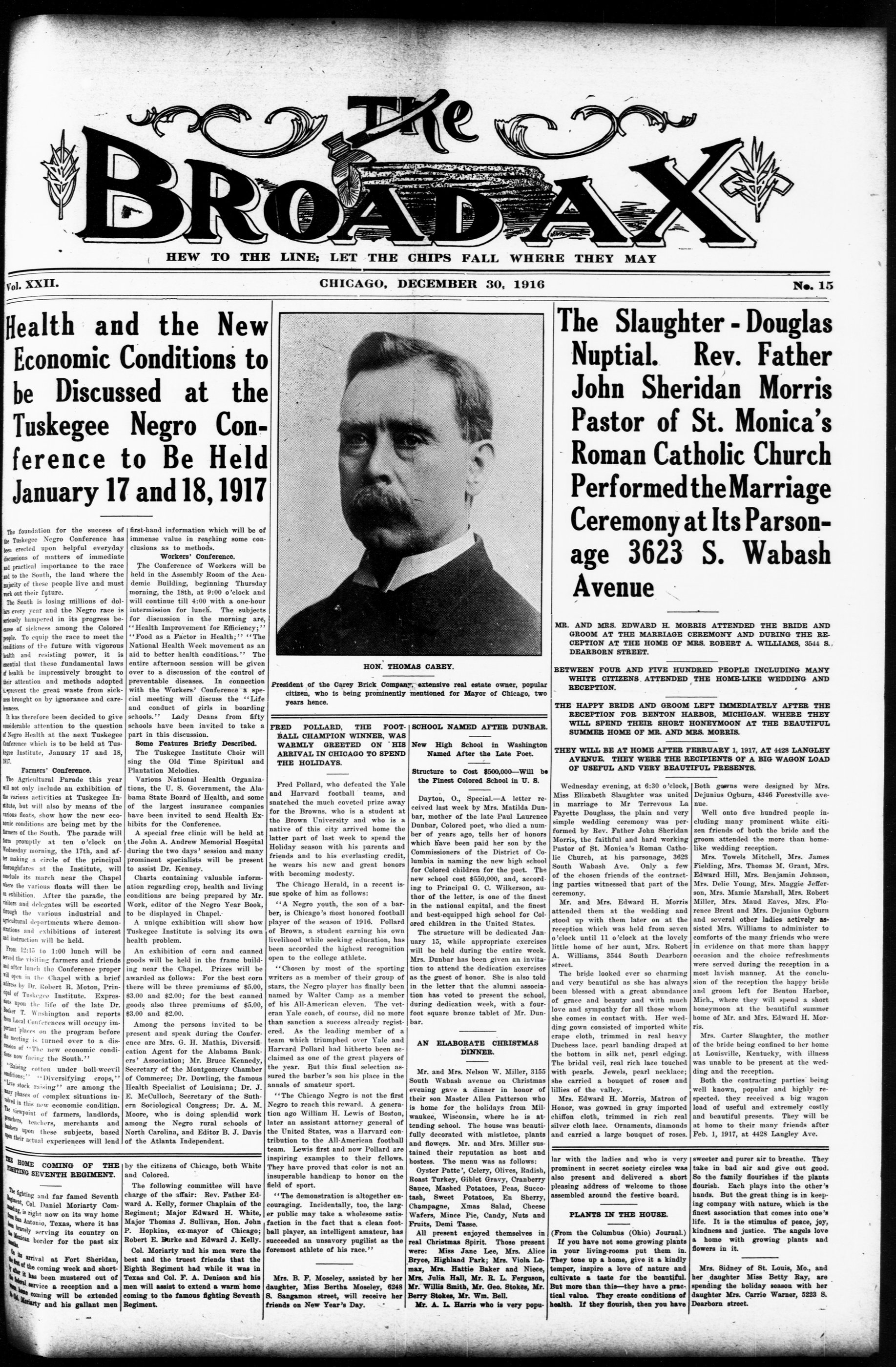
HON. THOMAS CAREY. President of the Carey Brick Company, extensive real estate owner, popular citizen, who is being prominently mentioned for Mayor of Chicago, two years hence.
President of the Carey Brick Company, extensive real estate owner, popular citizen, who is being prominently mentioned for Mayor of Chicago, two years hence.
FRED POLLARD, THE FOOTBALL CHAMPION WINNER, WAS WARMLY GREETED ON HIS ARRIVAL IN CHICAGO TO SPEND THE HOLIDAYS.
Fred Pollard, who defeated the Yale and Harvard football teams, and snatched the much coveted prize away for the Brown's, who is a student at the Brown University and who is a native of this city arrived home the latter part of last week to spend the Holiday season with his parents and friends and to his everlasting credit, he wears his new and great honors with becoming modest.
The Chicago Herald, in a recent issue spoke of him as follows:
"A Negro youth, the son of a barber, is Chicago's most honored football player of the season of 1916. Pollard of Brown, a student earning his own livelihood while seeking education, has been accorded the highest recognition open to the college athlete.
"Chosen by most of the sporting writers as a member of their group of stars, the Negro player has finally been named by Walter Camp as a member of his All-American eleven. The veteran Yale coach, of course, did no more than sanction a success already registered. As the leading member of a team which triumphed over Yale and Harvard Pollard had hitherto been acclaimed as one of the great players of the year. But this final selection assured the barber's son his place in the annals of amateur sport.
"The Chicago Negro is not the first Negro to reach this reward. A generation ago William H. Lewis of Boston, later an assistant attorney general of the United States, was a Harvard contribution to the All-American football team. Lewis first and now Pollard are inspiring examples to their fellows. They have proved that color is not an insuperable handicap to honor on the field of sport.
"The demonstration is altogether encouraging. Incidentally, too, the larger public may take a wholesome satisfaction in the fact that a clean football player, an intelligent amateur, has succeeded an unsavory pugilist as the foremost athlete of his race."
Mrs. B. F. Moseley, assisted by her daughter, Miss Bertha Moseley, 6248 S. Sangamon street, will receive her friends on New Year's Day.
extensive real estate owner, popular mentioned for Mayor of Chicago, two
SCHOOL NAMED AFTER DUNBAR.
New High School in Washington Named After the Late Poet.
Structure to Cost $500,000—Will be the Finest Colored School in U. S.
Dayton, O., Special.—A letter received last week by Mrs. Matilda Dunbar, mother of the late Paul Laurence Dunbar, Colored poet, who died a number of years ago, tells her of honors which have been paid her son by the Commissioners of the District of Columbia in naming the new high school for Colored children for the poet. The new school cost $550,000, and, according to Principal G. C. Wilkerson, author of the letter, is one of the finest in the national capital, and the finest and best-equipped high school for Colored children in the United States.
The structure will be dedicated January 15, while appropriate exercises will be held during the entire week. Mrs. Dunbar has been given an invitation to attend the dedication exercises as the guest of honor. She is also told in the letter that the alumni association has voted to present the school, during dedication week, with a four-foot square bronze tablet of Mr. Dunbar.
AN ELABORATE CHRISTMAS
DINNER.
Mr. and Mrs. Nelson W. Miller, 3155 South Wabash avenue on Christmas evening gave a dinner in honor of their son Master Allen Patterson who is home for the holidays from Milwaukee, Wisconsin, where he is attending school. The house was beautifully decorated with mistletoe, plants and flowers. Mr. and Mrs. Miller sustained their reputation as host and hostess. The menu was as follows: Oyster Patte', Celery, Olives, Radish, Roast Turkey, Giblet Gravy, Cranberry Sauce, Mashed Potatoes, Peas, Succotash, Sweet Potatoes, En Sherry, Champagne, Xmas Salad, Cheese Wafers, Mince Pie, Candy, Nuts and Fruits, Demi Tasse.
All present enjoyed themselves in real Christmas Spirit. Those present were: Miss Jane Lee, Mrs. Alice Bryce, Highland Park; Mrs. Viola Lomax, Mrs. Hattie Baker and Niece, Mrs. Julia Hall, Mr. R. L. Ferguson, Mr. Willis Smith, Mr. Geo. Stokes, Mr. Berry Stokes, Mr. Wm. Bell.
Mr. A. L. Harris who is very popu-
The Slaughter - Douglas Nuptial. Rev. Father John Sheridan Morris Pastor of St. Monica's Roman Catholic Church Performed the Marriage Ceremony at Its Parsonage 3623 S. Wabash Avenue
MR. AND MRS. EDWARD H. MORRIS ATTENDED THE BRIDE AND GROOM AT THE MARRIAGE CEREMONY AND DURING THE RECEPTION AT THE HOME OF MRS. ROBERT A. WILLIAMS, 3544 S. DEARBORN STREET.
BETWEEN FOUR AND FIVE HUNDRED PEOPLE INCLUDING MANY WHITE CITIZENS. ATTENDED THE HOME-LIKE WEDDING AND RECEPTION.
THE HAPPY BRIDE AND GROOM LEFT IMMEDIATELY AFTER THE RECEPTION FOR BENTON HARBOR, MICHIGAN. WHERE THEY WILL SPEND THEIR SHORT HONEYMOON AT THE BEAUTIFUL SUMMER HOME OF MR. AND MRS. MORRIS.
THEY WILL BE AT HOME AFTER FEBRUARY 1, 1917, AT 4428 LANGLEY AVENUE. THEY WERE THE RECIPIENTS OF A BIG WAGON LOAD OF USEFUL AND VERY BEAUTIFUL PRESENTS.
Wednesday evening, at 6:30 o'clock, Miss Elizabeth Slaughter was united in marriage to Mr Terrevous La Fayette Douglass, the plain and very simple wedding ceremony was performed by Rev. Father John Sheridan Morris, the faithful and hard working Pastor of St. Monica's Roman Catholic Church, at his parsonage, 3623 South Wabash Ave. Only a few of the chosen friends of the contracting parties witnessed that part of the ceremony.
Both gowns were designed by Mrs. Dejunius Ogburn, 4346 Forestville avenue.
Well onto five hundred people including many prominent white citizen friends of both the bride and the groom attended the more than home-like wedding reception.
Mrs. Towels Mitchell, Mrs. James Fielding, Mrs. Thomas M. Grant, Mrs. Edward Hill, Mrs. Benjamin Johnson, Mrs. Delie Young, Mrs. Maggie Jefferson, Mrs. Mamie Marshall, Mrs. Robert
Mr. and Mrs. Edward H. Morris attended them at the wedding and stood up with them later on at the reception which was held from seven o'clock until 11 o'clock at the lovely little home of her aunt, Mrs. Robert A. Williams, 3544 South Dearborn street. The bride looked ever so charming and very beautiful as she has always been blessed with a great abundance of grace and beauty and with much love and sympathy for all those whom she comes in contact with. Her wedding gown consisted of imported white crape cloth, trimmed in real heavy Duchess lace, pearl banding draped at the bottom in silk net, pearl edging. The bridal veil, real rich lace touched with pearls. Jewels, pearl necklace; she carried a bouquet of roses and lillies of the valley. Mrs. Edward H. Morris, Matron of Honor, was gowned in gray imported chiffon cloth, trimmed in rich real silver cloth lace. Ornaments, diamonds and carried a large bouquet of roses.
lar with the ladies and who is very prominent in secret society circles was also present and delivered a short pleasing address of welcome to those assembled around the festive board.
PLANTS IN THE HOUSE
(From the Columbus (Ohio) Journal.) If you have not some growing plants in your living-rooms put them in. They tone up a home, give it a kindly temper, inspire a love of nature and cultivate a taste for the beautiful. But more than this—they have a practical value. They create conditions of health. If they flourish, then you have
No.15
Both gowns were designed by Mrs. Dejunius Ogburn, 4346 Forestville avenue.
Well onto five hundred people including many prominent white citizen friends of both the bride and the groom attended the more than homelike wedding reception.
Mrs. Towels Mitchell, Mrs. James Fielding, Mrs. Thomas M. Grant, Mrs. Edward Hill, Mrs. Benjamin Johnson, Mrs. Delie Young, Mrs. Maggie Jefferson, Mrs. Mamie Marshall, Mrs. Robert Miller, Mrs. Maud Eaves, Mrs. Florence Brent and Mrs. Dejunius Ogburn and several other ladies actively assisted Mrs. Williams to administer to comforts of the many friends who were in evidence on that more than happy occasion and the choice refreshments were served during the reception in a most lavish manner. At the conclusion of the reception the happy bride and groom left for Benton Harbor, Mich., where they will spend a short honeymoon at the beautiful summer home of Mr. and Mrs. Edward H. Morris.
Mrs. Carter Slaughter, the mother of the bride being confined to her home at Louisville, Kentucky, with illness was unable to be present at the wedding and the reception.
Both the contracting parties being well known, popular and highly respected, they received a big wagon load of useful and extremely costly and beautiful presents. They will be at home to their many friends after Feb. 1, 1917, at 4428 Langley Ave.
sweeter and purer air to breathe. They take in bad air and give out good. So the family flourishes if the plants flourish. Each plays into the other's hands. But the great thing is in keeping company with nature, which is the finest association that comes into one's life. It is the stimulus of peace, joy, kindness and justice. The angels love a home with growing plants and flowers in it.
Mrs. Sidney of St. Louis, Mo., and her daughter Miss Betty Ray, are spending the holiday season with her daughter Mrs. Carrie Warner, 5223 S. Dearborn street.
OWNERS AND DIRECTORS
Dan M. Jackson
Geo. T. Kersey
David A. McGowan
Ahmed A. Rayner
The Emanuel J
Undertaking Co
2959-61 South St
Reliable Service Co
Reasonable Price
FREE CHAPEL IN CON
Complete line of Funeral Goods.
Reliable Service Courteous Treatment Reasonable Prices
THE TWENTY-SECOND ANNUAL RECEPTION and BA
RECEPTION and BALL
Given by the
8th Regiment,
Monday, January
From 9 P. M. to 2 A
EIGHTH REGIMENT
35th Street and Fore
8th Regiment, Ill. N. G.
Monday, January 1, 1917
From 9 P. M. to 2 A. M.
EIGHTH REGIMENT ARMORY
35th Street and Forest Ave.
MUSIC BY EIGHTH REGIMENT
FULL BAND
Admission :: :: :: ::
Telephone Douglas 6568 Auto
THE SOLACE BILLIARD ACADEMY
"THE MODERN SCHOOL" - CLEAN AND
TERREVOUS L, DOUGLAS, Prop.]
CIGARS—WHOLESALE AND RETAIL
BOX TRADE A SPECIALTY
3556 South State Street
CAN OF MONEY FOUND.
Small Boys Pay Out $3,000 For 50 Cents' Worth of Candy.
San Francisco, Cal.—Three small boys, whose aggregate age is twenty years, playing near San Francisco's new City and County hospital, unearthed the "end of the rainbow" in the tangible form of a tomato can stuffed with real money.
Five thousand dollars in five dollar notes—federal reserve bills of the issue of 1914—the boys pulled forth and then began an onslaught upon neighboring candy stores. They did not count the money, but exchanged sheaves of the bills for bags of candy.
In all they passed out $3,000 for 50 cents' worth of sweets before they were observed by a police officer, who took the remaining $2,000 in charge.
In the opinion of the police the money was buried by a thief. The money will be returned to the boys if it is not claimed and identified.
GIRL FIGHTS THIEF: $530 SAFE
Miss Bessie Schlieff, Attacked by Bandit, Keeps Payroll.
New York. — Although repeatedly struck in the face by a highwayman, Miss Bessie Schlieff, twenty-one years old, a bookkeeper employed by M. Mummergrade, a bedding manufacturer, managed to hold on the payroll she was carrying and finally beat off her assailant.
The girl received the money, amounting to $530, at the State bank. As she passed a coal yard on her way back to the office a young man tried to grab the envelope containing the cash. Several loungers in the coal yard heard the girl's cries, but did not interfere. Finally the bandit fled, after Miss Schlieff had fought him.
FILM SAFE CRACKERS BANNED
Board of Censors Also Bare Heroines Tied to Railroad Tracks.
Harrisburg, Pa.—Films showing safe crackers at work, tramps stealing watches and persons taking drugs are to be eliminated from moving picture exhibitions in Pennsylvania, according to a bulletin issued by the state board of censors. A long list of film plays, some of them thrillers with heroes tied to railroad tracks, is forbidden.
Scores of films in series are enumerated as condemned, including about sixty on the subject of white slavery and twenty-five on Mexican scenes whose manufacturers the censors have been unable to locate. Prisefighting films also have been put under the ban.
In the like a lion squirrel.
This a squirrel some whose should he was which he a fright grabbed.
Dr. M. tal look hand and come near rel tooth finger.
PAGE TWO
Phones Calumet 6164
Automatic 71-629
OPEN DAY
AND NIGHT
AUEL Jackson
BAG Co., Inc.
North State St.
Courteous Treatment
Table Prices
IN CONNECTION
s. Automobles for hire
ANNUAL
PTION
BALL
by the
St, Ill. N. G.
January 1, 1917
1. to 2 A. M.
MENT ARMORY
and Forest Ave.
50 Cents
Automatic 73-657
BLIARD ACADEMY
- CLEAN AND RELIABLE
DOUGLAS, Prop.]
t Chicago
LEFT PRISON A REFORMER.
Quinlan, I. W. W. Leader, Told of Evil He Found as a Convict. Paterson, N. J.-Patrick Quinlan, the I. W. W. leader, who was released from the New Jersey state prison after serving time for inciting riot, told an audience of 1,000 persons in Turn hall that he was going into prison reform work. He said that he would have a conference in Newark with Thomas Mott Osborne, former warden of Sing Sing, and several other leaders in prison reform. Quinlan was in the Trenton prison for a year and a half. In his recent campaign against conditions in New York prisons Mr. Osborne often spoke of bad conditions in the New Jersey prison.
Quinlan said he was well treated by the prison authorities, but that the physical condition of the prison was bad. He said that the bathing facilities were all right in summer, but that the bathhuts were not used in winter, the prisoners getting only pails of water with which to take baths. He said that 250 men were in a condemned section of the prison and complained that the inmates were allowed to write only one letter a month and that the letters were censored going and coming. He declared that a letter written to him had been given to reporters before he had seen it.
SQUIRREL ATTACKS COP.
Makes Flying Leap, Burying Teeth In Thumb and Forefinger.
New York.—A gray squirrel that had been making a somewhat hopeless hunt for nuts in Morningside park, near One Hundred and Twentleth street, suddenly showed renewed interest in its work as Patrolman Karl M. Huber of the West One Hundred and Twenty-fifth street police station came along a winding path. With a screech in the squirrel tongue that sounded like a long drawn out "Eureka!" the squirrel made a flying leap at the cop. This at least is the version of the squirrel's attack on the cop told by some witnesses. Patrolman Huber, whose version of the incident also should be listened to, says that while he was trying to drive off a squirrel which had alighted on the shoulder of a frightened small boy the squirrel grabbed Huber and tried to crack him.
Dr. M. K. Smith of St. Luke's hospital looked at the policeman's right hand and found that Huber had not come nearer to death than some squirrel tooth marks on the thumb and forefinger.
THE BROAD AX, CHICAGO, DECEMBER 30, 1916
OFFICIAL PUBLICATION
Annual statement of the Germania Fire Insurance Company of New York, in the State of New York, on the 31st day of December, 1915, made to the Insurance Superintendent of the State of Illinois, pursuant to law.
INCOME.
Premiums received during the
matter ..... $ 3,193,320.84
Interest, rents and dividends ..... 331,164.47
Profit on sale or maturity of
ledger assets ..... 708.69
From all other sources ..... 528.33
Total Income ..... $ 3,525,722.27
DISBURSEMENTS.
Losses paid during the year $ 1,484,845.08
Expenses of adjustment and
settlement of losses. 84,429.56
Interest or dividends to stock-
holders 200,000.00
Construction or brokerage. 641,369.45
Salaries, fees and all other
charges of officers, clerks,
agents and employees. 377,506.28
Rent. 31,754.45
Advertising, printing and sta-
tionery, postage, etc. 45,915.87
Legal expenses, furniture, fixtures
and maps. 21,560.03
Underwriting boards, fire
department and salvage
corps, fees, etc. 29,821.97
Inspection and surveys. 51,935.54
Repairs, expenses and taxes
marginal to total. 29,651.36
State insurance departments,
taxes and fees. 83,710.52
Other licenses, fees and taxes 35,462.75
Loss on sale or maturity of
assets. 15,491.54
Decrease in book value of
ledger assets 14,547.12
Agents' balances charged off. 2,680.05
All other disbursements. 12,676.63
Total Disbursements $ 3,163,464.20
LEDGER ASSETS.
Book value of real estate... $ 738,663.02
Mortgage loans on real estate
Book value of bonds and
stocks ... $ 5,753,500.22
Cash in office and bank ... $ 570,272.88
Agents' balances ... $ 588,785.89
Total Ledger Assets ... $ 8,371,931.89
NON-LEDGER ASSETS.
Interest accrued ..... $ 51,350.50
Other non-ledger assets..... 15,898.03
Gross Assets ..... $ 8,439,178.34
DEDUCT ASSETS NOT ADMITTED.
Agents' balances
over three
months due..$ 9,378.49
Book value real
estate, bonds
and stocks
over market
value ..... 362,333.47
Special deposits
to secure li-
liabilities in
Georgia, Virginia,
Canada,
New Mexico,
N. Carolina . 37,814.54
409,526.50
Total Admitted Assets..... $ 8,029,651.84
LIABILITIES.
Losses adjusted
and unpaid ..$ 170,508.67
Losses in process
of ad-
justment or
in suspense. 148,480.29
Losses resisted 55,725.00
Total ..... $ 374,713.96
Deduct re-in-
surance ..... 108,786.21
Net amount of unpaid losses. $ 295,927.75
Total unearned premiums. $ 3,558,971.56
Salaries, rents, bills, taxes,
etc. 67,410.58
Commissions and brokerage. 26,066.66
Other liabilities 1,919.13
Total Liabilities $ 3,920,295.68
BUSINESS IN ILLINOIS.
Total risks taken during the
year $32,655,841.90
Total premiums during the
year 380,406.74
Total losses incurred during
the year 169,789.05
GEO. B. EDWARDS.
President.
GUSTAV KEHN.
Secretary.
Subscribed and sworn to before me this
29th day of January, 1916.
AUGUST C. WAITERLING.
Notary Public.
OFFICIAL PUBLICATION
Annual statement of the German Alliance Insurance Company of New York, in the State of New York, on the 31st day of December, 1915, made to the Insurance Superintendent of the State of Illinois, pursuant to law.
CAPITAL.
Amount of capital stock paid
up in cash.....$ 400,000.00
INCOME.
Premiums received during the
year.....$ 612,421.41
Interests, rents and dividends
81,232.18
Profit on sale or maturity of
ledger assets.....2,097.33
Total Income.....$ 695,750.92
DISBURSEMENTS.
Losses paid during the year, $ 319,319.79
Expenses of adjustment and
settlement of losses.....7,228.47
Interest or dividends to stock-
holders.....60,000.00
Commissions or brokerage.....155,710.30
Salaries, fees and all other
charges of officers, clerks,
agents and employees.....3,490.00
Postage, etc.....2,20
Legal expenses.....25.00
Fire department and salvage
corps, fees, etc.....3,396.94
State insurance departments,
taxes and fees.....14,019.64
Other licenses, fees and taxes.....15,499.13
Loss on sale or maturity of
ledger assets.....26,984.43
All other disbursements.....100.00
Total Disbursements.....$ 605,775.90
LEDGER ASSETS.
Book value of bonds and
stocks ..... $ 1,957,104.68
Cash in office and bank ..... 42,761.07
Agents' balances ..... 109,661.48
Total Ledger Assets ..... $ 2,109,827.23
NON-LEDGER ASSETS.
Interest accrued ..... 11,117.00
Gross Assets ..... $ 2,120,944.23
DEDUCT ASSETS NOT ADMITTED.
Book value real estate, bonds
and stocks over market
value ..... $ 179,236.68
Total Admitted Assets ..... $ 1,941,707.55
LIABILITIES.
Losses adjusted and unpaid..$ 68,301.49
Losses in process of adjustment or in suspense. 238,923.00
Losses resisted. 35,030.00
Total .....$ 342,344.49
Deduct re-insurance ..... 232,510.00
Net amount of unpaid losses$ 109,834.49
Total unearned premiums... 505,421.30
Salaries, rents, bills, taxes, etc. 10,000.00
Total Liabilities ..... $ 625,255.79
BUSINESS IN ILLINOIS.
Total risks taken during the year ..... $16,123,774.00
Total premiums during the year ..... 145,867.60
Total losses incurred during the year ..... 67,940.02
WILLIAM N. KREMER.
President.
EDWIN M. CRAGIN.
Secretary.
Subcribed and sworn to before me this 25th day of January, 1916.
J. HOMER REED.
Notary Public.
[SEAL]
up in cash.....$ 2,000,000.00
INCOME.
Premiums received during the
year ..... $ 9,037,801.97
Interests, rents and dividends
1,122,103.89
Profit on sale or maturity of
ledger assets ..... 4,137.72
From all other sources ..... 15,355.99
Total income $10,179,399.57
DISBURSEMENTS.
Losses paid during the year $ 4,876,580.75
Expenses of adjustment and settlement of losses... 127,033.93
Interest paid to dividends to stockholders... 600,000.00
Commissions or brokerage... 1,731,070.02
Salaries, fees and all other charges or office clerks, agents and employees... 979,435.65
Rents... 75,068.31
Advertising, printing and stationery, postage... 167,895.58
Layaway furniture, fixtures and maps... 35,770.81
Underwriters' boards, fire department and salvage corps, fees etc... 186,327.83
Inspections and surveys... 67,330.92
Repairs, expenses and taxes on real estate... 118,283.13
State insurance departments, taxes and fees... 201,461.05
Other taxes, fees and taxes... 91,555.46
Loss on sale or maturity of ledger assets... 243,376.01
Agents' balances charged off... 3,520.39
All other disbursements... 26,130.17
Total disbursements $ 9,530,640.01
LEDGER ASSETS.
Book value of real estate... $ 2,682,385.69
Mortgage loans on real estate
53,150.00
Book value of bonds and
bonds
18,566,082.42
Cashier's office and bank... $ 777,000.18
Agents balances... $ 1,736,374.91
Bills receivable... $ 36,090.89
Total Ledger Assets... $24,051,164.05
NON-LEDGER ASSETS.
Interest accrued... $ 153,331.52
Other non-ledger assets... $ 6,242.23
DEDUCT ASSETS NOT ADMITTED.
Agents' ba-
ances over
three
months, due.$ 30,883.25
Bills receiv-
able and
loans on
personal sec-
curity .... 1,925.13
Book value
real estate,
bonds and
stocks over
market value 1,746,586.11
Special de-
posits to se-
cure labili-
ties in Can-
ada, Georgia,
N. Mexico,
N. Carolina,
and Vir-
gina ..... 66,717.00
$ 1,846,111.49
LIABILITIES.
Losses ad-
justed and
unpaid ... $ 194,156.00
Losses in
process of
adjustment
or in sus-
pense ... 1,012,753.00
Losses re-
sisted ... 162,531.00
Total ... $1,869,440.00
Deduct re-in-
surance ... 440,414.88
Net amount of unpaid losses. $ 929,025.12
Total unearned premiums... 9,036,192.28
Salaries, rents, bills, taxes,
etc. 157,117.93
Commissions and brokerage... 14,461.48
Other liabilities... 10,144.57
Total Liabilities... $10,146,941.38
BUSINESS IN ILLINOIS.
Total risks taken during the
year $88,270,233.00
Total premiums during the year
820,747.13
Total losses incurred during
the year 343,552.48
WILLIAM N. KREMER,
President.
EDWIN M. CRAGIN,
Secretary.
Subscribed and sworn to before me this
25th day of January, 1918.
J. HOMER NEED,
Notary Public.
[SEAL]
OFFICIAL PUBLICATION
Annual statement of the German American Insurance Company of Pittsburgh, in the State of Pennsylvania, on the 31st day of December, 1915, made to the Insurance Superintendent of the State of Illinois, pursuant to law.
CAPITAL.
Amount of capital stock paid
up in cash.....$ 200,000.00
INCOME.
Premiums received during the
year.....$ 362,390.45
Interests, rents and dividends
40,757.29
Profit on sale or maturity of
ledger assets.....108.00
Total Income.....$ 403,255.74
DISBURSEMENTS.
Losses paid during the year.....$ 205,120.82
Expenses of adjustment and
settlement of losses.....5,555.56
Interest or dividends to
stockholders.....26,000.00
Commissions or brokerage.....109,448.70
Salaries, fees and all other
charges of officers, clerks,
agents and employees.....19,369.11
Rates.....3,825.00
Advertising, printing and sta-
tionery, postage, etc.....4,963.31
Legal expenses, furniture, fixtures
and maps.....2,018.60
Underwriters' boards, fire de-
partment, corps, fees, etc.....6,151.58
Inspection and surveys.....393.77
Repairs, expenses and taxes
on real estate.....1,810.88
State insurance departments,
taxes and fees.....6,100.46
Other licenses, fees and taxes
Agents' balances charged off.....98.01
All other disbursements.....793.98
Total Disbursements.....$ 395,149.85
LEDGER ASSETS.
Book value of real estate...$ 46,527.47
Mortgage loans on real estate 521,925.00
Loans secured by pledge of bonds, stocks or other collateral 15,750.00
Book value of bonds and stocks 78,684.00
Cash in office and bank 77,385.79
Agents' balances 67,085.51
Bills receivable 1,835.53
Total Ledger Assets...$ 809,191.30
NON-LEDGER ASSETS.
Interest and rents due and accrued $ 11,381.00
Market value of real estate, bonds and stocks over book value 5,754.16
Gross Assets...$ 826,326.46
DEDUCT ASSETS NOT ADMITTED.
Agents' balances over three months, due $ 5,612.48
Total Admitted Assets...$ 820,713.98
LIABILITIES.
Losses adjusted
and unpaid.....$ 9,646.41
Losses in process
of adjustment
or in suspense. $ 51,314.52
Losses resisted... $ 5,755.00
Total .....$66,537.93
Deduct re-insurance ..... $ 9,007.55
Net amount of unpaid losses.$ 57,530.38
Total unearned premiums... 315,139.78
Salaries, rents, bills, taxes,
etc. ..... 5,150.00
Commissions and brokerage... 588.84
Other liabilities ..... 36.00
Total Liabilities.....$ 378,445.00
BUSINESS IN ILLINOIS.
Total risks taken during the year ..... $ 1,887,755.00
Total premiums during the year ..... 24,186.54
Total losses incurred during the year ..... 14,951.59
W. J. PATTERSON,
President.
E. P. NIEBAUM,
Secretary.
Subscribed and sworn to before me this 31st day of January, 1916.
WALTER C. MORRIS,
[SEAL]
Notary Public.
OFFICIAL PUBLICATION
Annual statement of the Girard Fire and Marine Insurance Company of Philadelphia, in the State of Pennsylvania, on the 31st day of December, 1915, made to the Insurance Superintendent of the State of Illinois, pursuant to law.
up in cash $ 500,000.00
INCOME.
Premiums received during the year $ 729,576.12
Deposit premiums on perpetual risks $ 8,682.30
Interests, taxes and dividends 110,902.56
Profit on sale or maturity of ledger assets $ 7,308.03
Increase in book value of ledger assets $ 2,440.22
From all other sources $ 257.37
$89,106.00
DISBURSEMENTS.
Losses paid during the year, $ 374,407.31
Expenses of adjustment and settlement of losses ... 8,694.45
Deposit premiums returned ... 18,618.40
Interest dividends to stockholders ... 100,000.00
Commissions or brokerage ... 190,726.01
Salaries, fees and all other charges of officers, clerks, agents and employees ... 83,331.63
Rent ... 12,485.54
Advertising, printing and stationery, postage, etc. ... 11,502.33
Legal expenses, furniture, fixtures and maps ... 5,800.19
Underwriters' boards, fire department and salvage company ... 19,014.74
Inspection and surveys ... 3,798.31
Repairs, expenses and taxes on real estate ... 7,829.25
State insurance departments, taxes and fees ... 17,313.45
Other licenses, fees and taxes ... 11,027.27
Loss on or maturity of ledger assets ... 21.90
Decrease in book value of ledger assets ... 1,364.38
Agents' balances charged off. ... 138.14
All other disbursements ... 2,353.46
Total Disbursements..... $ 868,426.76
LEDGER ASSETS.
Book value of real estate. $ 211,497.32
Mortgage loans on real estate $ 235,900.00
Loans secured by pledge of
bonds, stocks or other collateral
$ 32,000.00
Book value of bonds and
stocks $ 1,886,545.80
Cash in office and bank $ 87,215.47
Agents' balances $ 121,866.48
Bills receivable $ 3,032.03
Other ledger assets. $ 812.50
Total Ledger Assets..... $ 2,579,769.40
NON-LEDGER ASSETS.
Interest and rents due and
accrued ..... $ 28,688.09
Market value of real estate
bonds and stocks over book
value ..... $ 55,753.89
Other non-ledger assets ..... $ 5,127.34
Gross Assets ..... $ 2,667,328.11
DEDUCT ASSETS NOT ADMITTED.
Agent's balances
over three
months, due... $ 1,394.30
Book value real
estate, bonds
and stocks
over market
value ..... $ 175,953.10
Special deposits
to secure li-
abilities in
Georgia and
Virginia ..... $ 4,967.85
$ 182,315.25
Total Admitted Assets $ 2,485,020.98
LIABILITIES.
Losses adjusted
and unpaid.. $ 1,395.00
Losses in process
of adjustment
or in suspense $ 57,600.00
Losses resisted. $ 8,580.00
Total ..... $ 64,854.00
Deduct reinsurance
..... $ 19,357.00
Net amount of unpaid losses. $ 45,497.00
Total unearned premiums. $ 946,677.00
Amount reclaimable on per-
petual policies. $ 568,178.57
Salaries, rents, bills, taxes,
etc. ..... $ 3,500.00
Total Liabilities ..... $ 1,563,533.47
BUSINESS IN ILLINOIS.
Total risks taken during the
year $ 141,228,644.00
Total premiums during the
year ..... 142,042.28
Total losses incurred during
the year ..... 54,603.07
HENRY M. GRATZ,
President.
EDWARD J. THOMASON,
Secretary.
Subscribed and sworn to before me this
14th day of January, 1916.
JOSEPH KLAPP NICHOLS,
Notary Public.
[SEAL]
Leaves of the Poison ivy.
No doubt just a picture of poison ivy is enough to cause some folks to shudder and remember the time their face and body became scarlet and swollen from contact with the leaves. How it itched and burned! Yet to rob it was only to make matters worse.
A curious fact is that some persons are immune from this poison, while others must not even breathe the poison of the plant. It is often confounded with the Virginia creeper, although the difference between this is distract. The leaves of the latter are divided into five leaflets, while those of the former have but three, a fact well worth remembering.
Strange enough, the witch hazel plant is sometimes found growing close to the poison ivy. As witch hazel extract is one of the best remedies for fry poisoning it would seem nature was holding out disease in one hand and a remedy in another.
Heat at the Persian Gulf.
The Persian gulf and its coasts are in summer about the hottest place on earth's surface, a temperature of 120 degrees in the shade being not too common, while a black bulb solar thermometer has registered 187 degrees in the sun.
When one remembers that the hottest room in a Turkish bath is usually kept at about 160 degrees the appalling nature of this Persian heat will be better realized.
The greatest heat ever known in England was on Aug. 18, 1893, when a shade temperature of 95 degrees was registered. But on this day the sun temperature did not quite equal that of July 28, 1885, when 162 degrees F. was registered in the sun.
When you consider facts like these it is difficult to believe that our planet receives only one two-thousand-million part of the rays flung out by the sun.—London Telegraph.
Odd Titles of Newspapers.
In Columbus, says the Dispatch there is a man whose chief joy is in a collection of newspaper titles.
There are Headlights, Flashlights Bees, Eagles, Owls, Mirrors and News Letters, but when it comes to Derriks Meddlers, Telescopes, Flags and Sunbeams the class is limited. In Hot Springs there is published the Arkansas Thomas Cat, and other titles just as unusual are the Sledge Hammer, the Irrepressible, the Silent Worker and Gall.
Frequently it is possible to tell from the title of a newspaper the state in which it is published. For instance the Chleftain in Oklahoma, the Rustier and the Larlart in Texas, Big Hole Breezes in Montana and the Roundup in Wyoming.
"Yes," answered the man who likes to attract attention.
"Any particular make?"
"No; I merely want one that will make people turn round and stare at me when I pass."
"Oh, you don't need a special type for that. Get the ordinary car and exceed the speed limit."—Birmingham Age-Herald.
Careful Hubby.
"Does your husband subscribe to the theory that kissing transmits germs?"
"No; he thinks that germs are mostly transmitted by money and is very careful not to hand me any."—Kansas City Journal.
Woodmen Grow Obsolete.
A steam operated sawing machine fells more trees in an eight hour day than thirty woodmen. It works close to the ground and leaves no stumps standing.—Popular Science Monthly.
Just In Time.
Plaintiff's Lawyer—I rest the case. Defendant's Ditto—You ought to. It's pretty weak.—New York American.
Countess Nada Now Becomes a Princess.
She is an Expert at Tennis, Has Lived in England Much, and Is of Rare Beauty and Charm—Said to Be a Love Match.
The popularity won by the young Countess Nadeja Torby, daughter of H. L. H. the Grand Duke Michael of Russia and the Countess Torby, has been a feature of English society for some years past; notably, too, in lawn circles, Countess "Nada" being
V
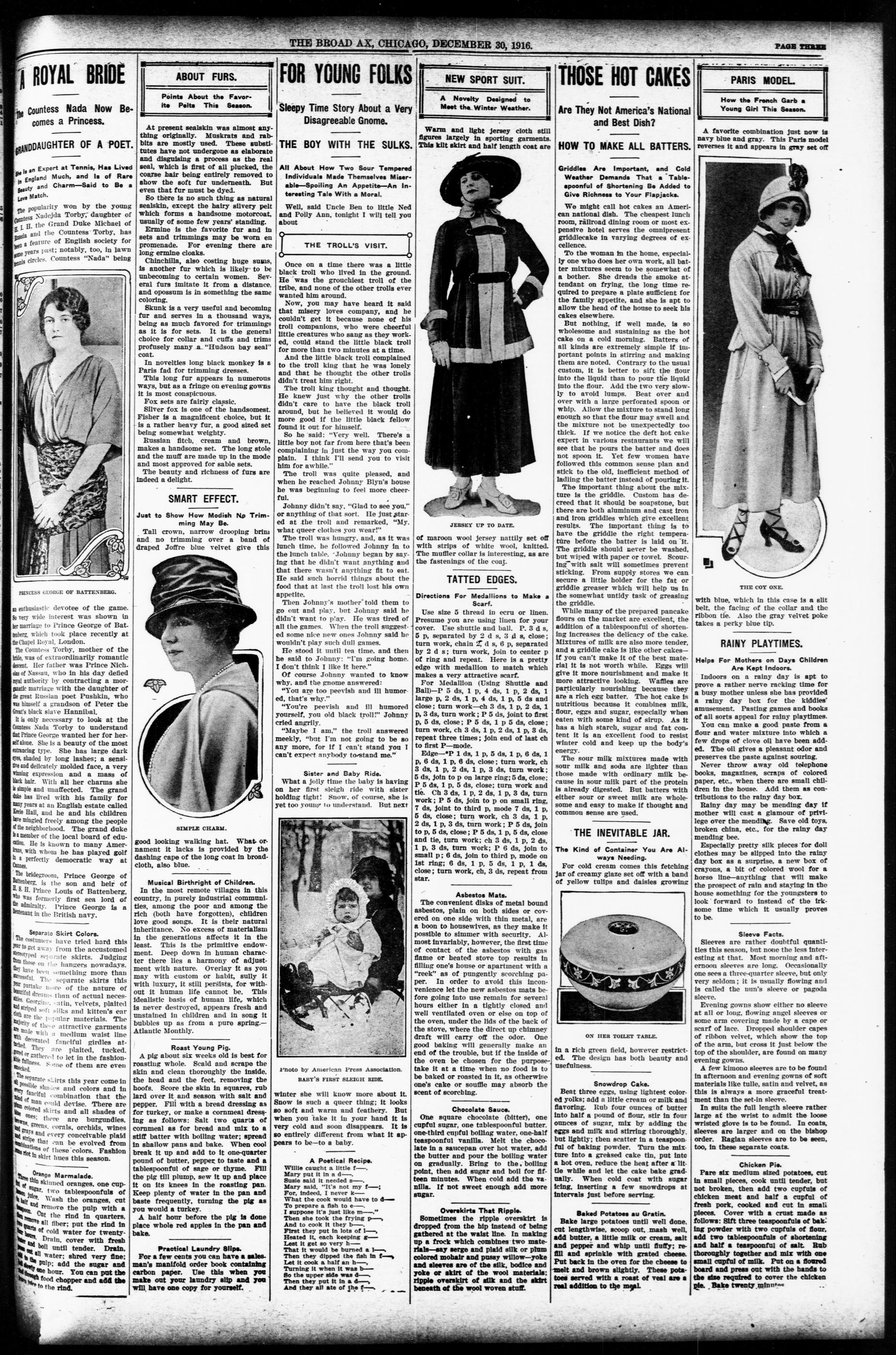
PRINCESS GEORGE OF BATTENBERG.
an enthusiastic devotee of the game. So very wide interest was shown in her marriage to Prince George of Battenberg, which took place recently at the Chapel Royal, London.
The Countess Torby, mother of the bride, was of extraordinarily romantic descent. Her father was Prince Nicholas of Nassau, who in his day defied royal authority by contracting a morganatic marriage with the daughter of the great Russian poet Pushkin, who was himself a grandson of Peter the Great's black slave Hannibal.
It is only necessary to look at the Countess Nada Torby to understand that Prince George wanted her for herself alone. She is a beauty of the most entrancing type. She has large dark eyes, shaded by long lashes; a sensitive and delicately molded face, a very winning expression and a mass of black hair. With all her charms she is simple and unaffected. The grand duke has lived with his family for many years at an English estate called Keele Hall, and he and his children have mingled freely among the people of the neighborhood. The grand duke is a member of the local board of education. He is known to many Americans, with whom he has played golf in a perfectly democratic way at Cannes.
The bridegroom, Prince George of Battenberg, is the son and heir of H. S. H. Prince Louis of Battenberg, who was formerly first sea lord of the admiral. Prince George is a bridegroom in the British navy.
Separate Skirt Colors.
GENERATE SKIRT COLORS.
The costumes have tried hard this year to get away from the accustomed stereotyped separate skirts. Judging from those on the hangers nowadays, they have been something more than successful. The separate skirts this year partake more of the nature of beautiful dreams than of actual necessities. Georgine, satin, velvets, plaited and striped soft silks and kitten's car cloth are the popular materials. The majority of these attractive garments are made with a medium waist line with decorated fanuele girdles attached. They are plaited, tucked, grenel or gathered to let in the fashionable fullness. Some of them are even mocked.
the separate skirts this year come in all possible shades and colors and in every funnel combination that the mind of man could devise. There are plum colored skirts and all shades of blue ones; there are burgundies, browns, greens, corals, orchids, wines and grays and every conceivable plaid and stripe that can be evolved from combinations of these colors. Fashion name flirt in skirt hues this season.
Orange Marmalade
cut a thin skimmed oranges, one cup-
ful of sugar, two tablespoonfuls of
juice. Wash the tablespoonfuls of
the half and remove the pulp with a
mason jar. Cut the rind in quarters,
remove all fiber; put the rind in
two quarters of cold water for twenty-
hours. Drain, cover with fresh
pump out all water; shred very fine;
add to the pulp; add the sugar and
dilvy one hour. You can put the
pump into food chopper and add the
pump into the rind.
ABOUT FURS.
Points About the Favorite Pelts This Season.
At present sealskin was almost anything originally. Muskrats and rabbits are mostly used. These substitutes have not undergone as elaborate and disguise a process as the real seal, which is first of all plucked, the coarse hair being entirely removed to show the soft fur underneath. But even that fur must be dyed.
So there is no such thing as natural sealskin, except the hairy slivery pelt which forms a handsome motorcoat, usually of some few years' standing.
Ermine is the favorite fur and in sets and trimmings may be worn en promenade. For evening there are longermine cloaks.
Chinchilla, also costing huge sums, is another fur which is likely to be unbecoming to certain women. Several furs imitate it from a distance, and opossum is in something the same coloring.
Skunk is a very useful and becoming fur and serves in a thousand ways, being as much favored for trimmingms as it is for sets. It is the general choice for collar and cuffs and trims profusely many a "Hudson bay seal" coat.
In novelties long black monkey is a Paris fad for trimming dresses.
This long fur appears in numerous ways, but as a fringe on evening gowns it is most conspicuous.
Fox sets are fairly classic.
Silver fox is one of the handsomest. Fisher is a magnificent choice, but it is a rather heavy fur, a good sized set being somewhat weighty. Russian fitch, cream and brown, makes a handsome set. The long stole and the muff are made up in the mode and most approved for sable sets. The beauty and richness of furs are indeed a delight.
SMART EFFECT.
Just to Show How Modish No Trimming May Be.
Tall crown, narrow drooping brim and no trimming over a band of draped Joffre blue velvet give this
J
SIMPLE CHARM.
good looking walking hat. What or
nament it lacks is provided by the
dashing cape of the long coat in broad
cloth, also blue.
Musical Birthright of Children
In the most remote villages in this country, in purely industrial communities, among the poor and among the rich (both have forgotten), children love good songs. It is their natural inheritance. No excess of materialism in the generations affects it in the least. This is the primitive endowment. Deep down in human character there lies a harmony of adjustment with nature. Overlay it as you may with custom or habit, sully it with luxury, it still persists, for without it human life cannot be. This idealistic basis of human life, which is never destroyed, appears fresh and unstained in children and in song it bubbles up as from a pure spring.—Atlantic Monthly.
Roast Young Pig.
A pig about six weeks old is best for roasting whole. Scald and scrape the skin and clean thoroughly the inside, the head and the feet, removing the hoofs. Score the skin in squares, rub lard over it and season with salt and pepper. Fill with a bread dressing as for turkey, or make a cornmeal dressing as follows: Salt two quarts of cornmeal as for bread and mix to a stiff batter with boiling water; spread in shallow pans and bake. When cool break it up and add to it one-quarter pound of butter, pepper to taste and a tablespoonful of sage or thyme. Fill the pig till plump, sew it up and place it on its knees in the roasting pan. Keep plenty of water in the pan and baste frequently, turning the pig as you would a turkey.
A half hour before the pig is done place whole red apples in the pan and bake.
Practical Laundry Slips.
For a few cents you can have a salesman's manifold order book containing carbon paper. Use this when you make out your laundry slip and you will have one copy for yourself.
THE BROAD AX, CHICAGO, DECEMBER 30, 1916.
FOR YOUNG FOLKS
Sleepy Time Story About a Very Disagreeable Gnome.
All About How Two Sour Tempered Individuals Made Themselves Miserable—Spoiling An Appetite—An Interesting Tale With a Moral.
Well, sald Uncle Ben to little Ned and Polly Ann, tonight I will tell you about
THE TROLL'S VISIT.
Once on a time there was a little black troll who lived in the ground. He was the grouchiest troll of the tribe, and none of the other trolls ever wanted him around.
Now, you may have heard it said that misery loves company, and he couldn't get it because none of his troll companions, who were cheerful little creatures who sang as they worked, could stand the little black troll for more than two minutes at a time.
And the little black troll complained to the troll king that he was lonely and that he thought the other trolls didn't treat him right.
The troll king thought and thought. He knew just why the other trolls didn't care to have the black troll around, but he believed it would do more good if the little black fellow found it out for himself.
So he said: "Very well. There's a little boy not far from here that's been complaining in just the way you complain. I think I'll send you to visit him for awhile."
The troll was quite pleased, and when he reached Johnny Blyn's house he was beginning to feel more cheerful.
Johnny didn't say, "Glad to see you," or anything of that sort. He just started at the troll and remarked, "My queer clothes you wear!"
The troll was hungry, and, as it was lunch time, he followed Johnny in to the lunch table. Johnny began by saying that he didn't want anything and that there wasn't anything fit to eat. He said such horrid things about the food that at last the troll lost his own appetite.
Then Johnny's mother told them to go out and play, but Johnny said he didn't want to play. He was tired of all the games. When the troll suggested some nice new ones Johnny said he wouldn't play such dull games.
He stood it until tea time, and then he said to Johnny: "I'm going home. I don't think I like it here."
Of course Johnny wanted to know why, and the gnome answered:
"You are too peevish and ill humored, that's why."
"You're peevish and ill humored yourself, you old black troll!" Johnny cried angrily.
"Maybe I am," the troll answered meekly, "but I'm not going to be so any more, for if I can't stand you I can't expect anybody to stand me."
Sister and Baby Ride.
What a jolly time the baby is having on her first sleigh ride with sister holding tight! Snow, of course, she is yet too young to understand. But next
A
Photo by American Press Association.
BABY'S FIRST SLEIGH RIDE.
winter she will know more about it. Snow is such a queer thing; it looks so soft and warm and feathery. But when you take it in your hand it is very cold and soon disappears. It is so entirely different from what it appears to be—to a baby.
A Poetical Recipe.
A Poetical Recipe.
Willie caught a little f—
Mary put it in a d—
Susie said it needed s—
Mary said, "It's not my f—;
Indeed, it never k—
What the cook would have to d—
To prepare a fish to e—
I suppose it's just like m—"
Then she took the frying p—
And to cook it they b—
First they put in lots of l—
Heated it, each keeping g—
Lest it get so very h—
That it would be burned a l—
Then they dipped the fish in f—
Let it cook a half an h—
Turning it when it was b—
So the upper side was d—
Then they put it in a d—
And they all ate of the f—
A Novelty Designed to Meet the Winter Weather.
Warm and light jersey cloth still figures largely in sporting garments. This kilt skirt and half length coat are
1
JERSEY UP TO DATE.
of maroon wool jersey nattily set off
with strips of white wool, knitted.
The muffler collar is interesting, as are
the fastenings of the coat.
TATTED EDGES.
Directions For Medallions to Make a Scarf.
Use size 5 thread in ecru or linen.
Presume you are using linen for your cover. Use shuttle and ball. P 3 d s, 5 p, separated by 2 d s, 3 d s, close; turn work, chain Z d s, 6 p, separated by 2 d s; turn work, join to center p of ring and repeat. Here is a pretty edge with medallion to match which makes a very attractive scarf.
For Medallion (Using Shuttle and Ball)—P 5 ds, 1 p, 4 ds, 1 p, 2 ds, 1 large, 2 ds, 1 p, 4 ds, 1 p, 5 ds and close; turn work—ch 3 ds, 1 p, 2 ds, 1 p, 3 ds, turn work; P 5 ds, joint to first, p 5 ds, close; P 5 ds, 1 p 5 ds, close; turn work, ch 3 ds, 1 p, 2 ds, 1 p, 3 ds, repeat three times; join end of last ch to first P—mode.
Edge—*P 1 ds, 1 p, 5 ds, 1 p, 6 ds, 1 p, 6 ds, 1 p, 6 ds, close; turn work, ch 3 ds, 1 p, 2 ds, 1 p, 3 ds, turn work; 5 ds, join to p on large ring; 5 ds, close; P 5 ds, 1 p, 5 ds, close; turn work and tie. Ch 3 ds, 1 p, 2 ds, 1 p, 3 ds, turn work; P 5 ds, join to p on small ring, 7 ds, joint to third p, mode 7 ds, 1 p, 5 ds, close; turn work, ch 3 ds, 1 p, 2 ds, 1 p, 3 ds, turn work; P 5 ds, join to p, 5 ds, close; P 5 ds, 1 p, 5 ds, close and tie, turn work; ch 3 ds, 1 p, 2 ds, 1 p, 3 ds, turn work; P 6 ds, join to small p; 6 ds, join to third p, mode on 1st ring; 6 ds, 1 p, 5 ds, 1 p, 1 ds, close; turn work, ch, 3 ds, repeat from star.
Asbestos Mats.
The convenient disks of metal bound asbestos, plain on both sides or covered on one side with thin metal, are a boon to housewives, as they make it possible to simmer with security. Almost invariably, however, the first time of contact of the asbestos with gas flame or heated stove top results in filling one's house or apartment with a "reck" as of pungently scorching paper. In order to avoid this inconvenience let the new asbestos mats before going into use remain for several hours either in a tightly closed and well ventilated oven or else on top of the oven, under the lids of the back of the stove, where the direct up chimney draft will carry off the odor. One good baking will generally make an end of the trouble, but if the inside of the oven be chosen for the purpose take it at a time when no food is to be baked or roasted in it, as otherwise one's cake or souffle may absorb the scent of scorching.
Chocolate Sauce
One square chocolate (bitter), one cupful sugar, one tablespoonful butter, one-third cupful boiling water, one-half teaspoonful vanilla. Melt the chocolate in a saucepan over hot water, add the butter and pour the boiling water on gradually. Bring to the, boiling point, then add sugar and boil for fifteen minutes. When cold add the vanilla. If not sweet enough add more sugar.
Overakirta That Ripple.
Sometimes the ripple overskirt is dropped from the hip instead of being gathered at the waist line. In making up a frock which combines two materials—say serge and plaid silk or plum colored mohair and pussy willow—yoke and sleeves are of the silk, bodice and yoke or skirt of the wool materials; ripple overskirt of silk and the skirt beneath of the wool woven stuff.
THOSE HOT CAKES
Are They Not America's National and Best Dish?
HOW TO MAKE ALL BATTERS.
Griddles Are Important, and Cold Weather Demands That a Table-spoonful of Shortening Be Added to Give Richness to Your Flapjacks.
We might call hot cakes an American national dish. The cheapest lunch room, railroad dining room or most expensive hotel serves the omnipresent griddlecake in varying degrees of excellence.
To the woman in the home, especially one who does her own work, all batter mixtures seem to be somewhat of a bother. She dreads the smoke attendant on frying, the long time required to prepare a plate sufficient for the family appetite, and she is apt to allow the head of the house to seek his cakes elsewhere.
But nothing, if well made, is so wholesome and sustaining as the hot cake on a cold morning. Batters of all kinds are extremely simple if important points in stirring and making them are noted. Contrary to the usual custom, it is better to sift the flour into the liquid than to pour the liquid into the flour. Add the two very slowly to avoid lumps. Beat over and over with a large perforated spoon or whip. Allow the mixture to stand long enough so that the flour may swell and the mixture not be unexpectedly too thick. If we notice the deft hot cake expert in various restaurants we will see that he pours the batter and does not spoon it. Yet few women have followed this common sense plan and stick to the old, inefficient method of ladling the batter instead of pouring it.
The important thing about the mixture is the griddle. Custom has decreed that it should be soapstone, but there are both aluminum and cast iron and iron griddles which give excellent results. The important thing is to have the griddle the right temperature before the batter is laid on it. The griddle should never be washed, but wiped with paper or towel. Scouring with salt will sometimes prevent sticking. From supply stores we can secure a little holder for the fat or griddle greaser which will help us in the somewhat untidy task of greasing the griddle.
While many of the prepared pancake flours on the market are excellent, the addition of a tablespoonful of shortening increases the delicacy of the cake. Mixtures of milk are also more tender, and a griddle cake is like other cakes—if you can't make it of the best material it is not worth while. Eggs will give it more nourishment and make it more attractive looking. Waffles are particularly nourishing because they are a rich egg batter. The hot cake is nutritious because it combines milk, flour, eggs and sugar, especially when eaten with some kind of sirup. As it has a high starch, sugar and fat content it is an excellent food to resist winter cold and keep up the body's energy.
The sour milk mixtures made with sour milk and soda are lighter than those made with ordinary milk because in sour milk part of the protein is already digested. But batters with either sour or sweet milk are wholesome and easy to make if thought and common sense are used.
THE INEVITABLE JAR.
The Kind of Container You Are Always Needing.
For cold cream comes this fetching jar of creamy glaze set off with a band of yellow tullips and daisies growing
ON HER TOILET TABLE.
in a rich green field, however restricted. The design has both beauty and usefulness.
Snowdrop Cake.
Beat three eggs, using lightest colored yolks; add a little cream or milk and flavoring. Rub four ounces of butter into half a pound of flour, stir in four ounces of sugar, mix by adding the eggs and milk and stirring thoroughly, but lightly; then scatter in a teaspoonful of baking powder. Turn the mixture into a greased cake tin, put into a hot oven, reduce the heat after a little while and let the cake bake gradually. When cold coat with sugar icing, inserting a few snowdrops at intervals just before serving.
Baked Potatoes au Gratin
Bake large potatoes until well done, cut lengthwise, scoop out, mash well, add butter, a little milk or cream, salt and pepper and whip until fluffy; refill and sprinkle with grated cheese. Put back in the oven for the cheese to melt and brown slightly. These potatoes served with a roast of veal are a real addition to the meal.
PAGE THREE
How the French Garb a Young Girl This Season.
A favorite combination just now is navy blue and gray. This Paris model reverses it and appears in gray set off
J.
THE COY ONE.
with blue, which in this case is a slit belt, the facing of the collar and the ribbon tie. Also the gray velvet poke takes a perky blue tip.
RAINY PLAYTIMES.
Helps For Mothers on Days Children Are Kept Indoors.
Indoors on a rainy day is apt to prove a rather nerve racking time for a busy mother unless she has provided a rainy day box for the kiddies' amusement. Pasting games and books of all sorts appeal for rainy playtimes. You can make a good paste from a flour and water mixture into which a few drops of clove oil have been added. The oil gives a pleasant odor and preserves the paste against souring. Never throw away old telephone books, magazines, scraps of colored paper, etc., when there are small children in the house. Add them as contributions to the rainy day box.
Rainy day may be mending day if mother will cast a glamour of privilege over the mending. Save old toys, broken china, etc., for the rainy day mending bee.
Especially pretty silk pieces for doll clothes may be slipped into the rainy day box as a surprise, a new box of crayons, a bit of colored wool for a horse line—anything that will make the prospect of rain and staying in the house something for the youngsters to look forward to instead of the irksome time which it usually proves to be.
Sleeve Facts.
Sleeves are rather doubtful quantities this season, but none the less interesting at that. Most morning and afternoon sleeves are long. Occasionally one sees a three-quarter sleeve, but only very seldom; it is usually flowing and is called the nun's sleeve or pagoda sleeve.
Evening gowns show either no sleeve at all or long, flowing angel sleeves or some arm covering made by a cape or scarf of lace. Dropped shoulder capes of ribbon velvet, which show the top of the arm, but cross it just below the top of the shoulder, are found on many evening gowns.
A few kimono sleeves are to be found in afternoon and evening gowns of soft materials like tulle, satin and velvet, as this is always a more graceful treatment than the set-in sleeve.
In suits the full length sleeve rather large at the wrist to admit the loose wristed glove is to be found. In coats, sleeves are larger and on the bishop order. Raglan sleeves are to be seen, too, in these separate coats.
Chicken Pie.
Pare six medium sized potatoes, cut in small pieces, cook until tender, but not broken, then add two cupfuls of chicken meat and half a cupful of fresh pork, cooked and cut in small pieces. Cover with a crust made as follows: Sift three teaspoonfuls of baking powder with two cupfuls of flour, add two tablespoonfuls of shortening and half a teaspoonful of salt. Rub thoroughly together and mix with one small cupful of milk. Put on a floured board and press out with the hands to the size required to cover the chicken ple. Bake twenty minutes.
PAGE FOUR
REVIVAL OF THE 'FORCE BILL'
Senator Penrose cannot hope to accomplish anything beyond the public agitation of the question by reviving the "force bill." The present congress will not look with sympathy upon any attempt to put the federal elections under federal control, especially when that attempt is avowedly made by a Republican with frankly confessed partisan motives. Senator Penrose's solicitude for the disfranchised Negroes of the South, it is unnecessary to say, has none of that zeal for political equality which ought to form the chief motive force of a movement of this character. It is not to be denied that the present conditions surrounding the electoral and congressional representation of the South are far from equitable, but the moment is hardly propitious for effective agitation. Notwithstanding the Democratic origin of the recent demands for the abolition of the electoral college and the substitution of direct popular voting for president and vicepresident, it is idle to look for Democratic support for any movement looking to the limitation of the political power of the South. Had a tidal wave swept the Republicans into control of the federal government there might have been some reason in taking up at this time the problem of enforcing the second section of the fourteenth amendment of the constitution. Perhaps Senator Penrose means his anouncement to be a warning answer to the agitation for the substitution of a direct popular vote by states for the present system of votes by electors but even in that case it promises to accomplish little but the revival of bitter controversy.
There is no doubt whatever that sooner or later the problem of rectifying the existing inequalities in representation will have to be faced. The country has been very tolerant of a system which has given the solid South a wholly disproportionate voice in national councils. This toleration has hitherto been given in the interests of peace and because, except under exceptional conditions, the vote of the solid South was not an invariably determining factor in national elections or in congress. But with the results of the elections of 1912 and 1916 as object lessons, the impossibility of an indefinite extension of this tolerance is becoming increasingly evident. The question cannot be separated from partisanship, of course, but when it shall be seriously taken up it ought to be made the subject of deliberate endeavor and one of the vital issues of a national campaign. Without an express mandate from the people neither the present nor the next congress is likely to give the matter serious consideration even were the political complexion of either such as to justify the expectation that a reduction of Southern representation came within the area of practical politics. Senator Penrose's advocacy of a reform in this direction will not help the cause, for much the same reason that his espousals of reform in Pennsylvania do not command that respect which the subject, itself would seem to call for.—Public Ledger Philadelphia, Pa.
JOHN R. HAWKINS
Stirs Church Council at St. Louis— Fearlessly Tells Why Colored Men are Leaving the South.
Addressing himself to a part of a report made to the Church Council recently held in St. Louis and of which Bishop Wilbur P. Thirkield, former president of Howard University, was one of the signers, John R. Hawkins, LLB., financial secretary of the A. M. E. Church, stirred the convention and made the blood of manly men tingle as he poured forth in words of simple truth, the cause of the Negro leaving the south. The particular part of the paragraph which he answered was:
"There is also among the Negroes an increasing distrust of the White race and a growing contempt for its religion and its sense of justice—feelings which are breeding a new spirit of antagonism and aggression."
The St. Louis Globe Democrat under deep headlines quoted the following from his address:
"Strong expressions, perhaps the strongest of the sessions of the Council were made by John R Hawkins, financial secretary of the A. M. E. Church, on the cause of the Negroes' growing distrust of the south.
"He declares that members of his race were leaving the south by hundreds of thousands. If you travel on the train you will see them. They sit with bated breath; they are afraid to tell you why. Conditions have become intolerable. The whole problem rests with the white men who have control of the government and the railroads and municipalities. If you want to settle it right, go back to your homes and confer with a few Negroes, who will tell you the truth, if it be guaranteed that they wont be run away from their homes. They love their homes, but life as it is is not worth the living there.
"This speaker referred his hearers to paragraphs in the report where it was stated that: 'degradation is not an inherent racial defect, but the joint product of ignorance and neglect. The same things poison human life, the same things build it up, whatever the color of the tabernacle in which it lives. The social creed of the Federal Council is as applicable to Southern Negroes as to Northern immigrants. Equal rights and complete justice for all men in all relations of life, the protection of family, the fullest possible development of every child, the safe guarding of women. the abatement and prevention of poverty, protection from the wastes of the liquor traffic, the conservation of health.'"
THE MENACE OF THE RAT.
One hundred sixty-five millions of dollars is a heap of money. Anyhow, it is more than most of us carry around with us. And yet this tremendous sum of money is what it is costing the United States to feed the rats in this country. This, it is estimated, is the food cost alone, to say nothing of the destruction caused by rats in many other ways.
The Department of Health has frequently called attention to the rat menace as a means of spreading disease. The United States Government is fighting rats all the time in countries that are liable to have bubonic plague. The U. S. Public Health authorities have also discovered, and have long ago promulgated the fundamental fact, that the only way to get rid of rats, is to build against them. This means rat-proofing construction in all our buildings that are inhabited or infested by rats.
It is a singular fact that the rat is the only wild animal that lives in the abodes of man. In many localities rats over-run dwelling places; others confine their tenancy to barns, grainaries, wharves, docks and office buildings. All of the old office buildings in the loop district are infested with rats. They are a source of constant annoyance to hotel keepers and restaurants. The Department of Health is serving notices every day to people of this class to rid their premises of rats, and at least, to keep them out of the rooms where their foodstuffs are stored. It seems to be almost an impossible task.
The newer type of buildings are practically rat-proof; many of them wholly so. and are, therefore, not infested. But, as stated, the older types of buildings swarm with them. In St. Louis recently a large hotel was torn down as being the cheapest method of ridding it of rats. It was first thought that it might be made rat-proof. This was found impossible, so the building was wrecked and will be replaced by a modern rat-proof structure.
If Chicago needs anything now, it needs legislation that will provide for the proper construction of buildings to make them rat-proof.
One hundred sixty-five millions of dollars is estimated as the annual food cost to the people of this country for rats. This sum spent in rat-proofing construction each year would soon rid the country of these dangerous and expensive pests. The need of the hour is proper legislation as to building ordinances. Some of the cities of the United States have already enacted ordinances along these lines. Chicago should not longer delay action in this important matter.
* * *
Old age comes fast enough without special invitation through diseased tonsils and bad teeth.
It is bad enough for men and women to destroy their own brains, burn up their stomachs, and knock out their nerves, livers, kidneys, hearts and blood vessels; but to leave a legacy of feeble minds and broken bodies to their children is still worse. This is where the regulation of individual liberty becomes a community matter, just as the fight against diphtheria, tuberculosis and the drug habit, is a social, community and race fight.
DEATH OF MRS. CLARA STUDY:
MRE
It was exclusively announced in these columns last week that Mrs. Clara Studymire, 445 E. 32nd street, chairman of the Board of Directors of the Phyllis Wheatley Home, active and prominent member of Grace Presbyterian Church, would in the near future undergo an operation at Provident Hospital, but instead of becoming a patient at that hospital, on Saturday morning, she was operated on at the Hahnemann Hospital, 2814 Ellis avenue and the first operation not being successful, she had to undergo the second one which resulted in her death right on the operating table. Funeral services were held over her remains Tuesday afternoon from her late home. Interment at Oakwood Cemetery. Rev. Moses M. Jackson officiated.
Mrs. Studymire leaves a husband, a son eighteen years old who had arrived home from school just in time to embrace her before she expired, other relatives and hosts of friends to lament her untimely death.
THE BROAD AX, CHICAGO, DECEMBER 30, 1916.
1910
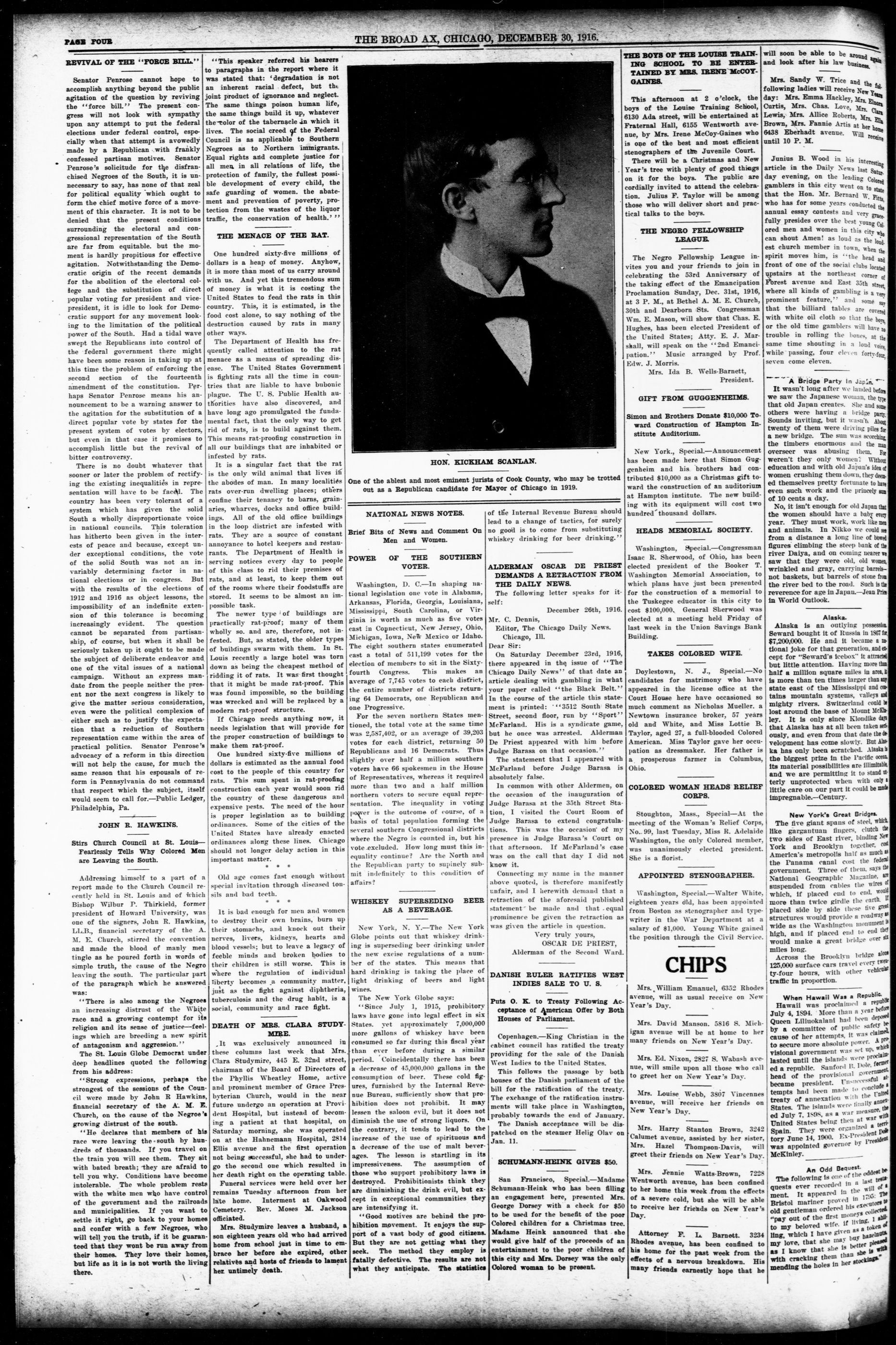
HON. KICKHAM SCANLAN.
One of the ablest and most eminent jurists of Cook County, who may be trotted out as a Republican candidate for Mayor of Chicago in 1919.
One of the ablest and most eminent jurists of Cook County, who may be trotted out as a Republican candidate for Mayor of Chicago in 1919.
NATIONAL NEWS NOTES.
Brief Bits of News and Comment On Men and Women.
POWER OF THE SOUTHERN VOTER.
Washington, D. C.—In shaping national legislation one vote in Alabama, Arkansas, Florida, Georgia, Louisiana, Mississippi, South Carolina, or Virginia is worth as much as five votes cast in Connecticut, New Jersey, Ohio, Michigan, Iowa, New Mexico or Idaho. The eight southern states enumerated cast a total of 511,199 votes for the election of members to sit in the Sixty-fourth Congress. This makes an average of 7,745 votes to each district, the entire number of districts returning 64 Democrats, one Republican and one Progressive.
For the seven northern States mentioned, the total vote at the same time was 2,587,402, or an average of 39,203 votes for each district, returning 50 Republicans and 16 Democrats. Thus slightly over half a million southern voters have 66 spokesmen in the House of Representatives, whereas it required more than two and a half million northern voters to secure equal representation. The inequality in voting power is the outcome of course, of a basis of total population forming the several southern Congressional districts where the Negro is counted in, but his vote excluded. How long must this inequality continue? Are the North and the Republican party to supinely submit indefinitely to this condition of affairs?
WHISKEY SUPERSEDING BEER
AS A BEVERAGE.
New York, N. Y.-The New York Globe points out that whiskey drinking is superseding beer drinking under the new excise regulations of a number of the states. This means that hard drinking is taking the place of light drinking of beers and light wines.
The New York Globe says:
"Since July 1, 1915, prohibitory laws have gone into legal effect in six States, yet approximately 7,000,000 more gallons of whiskey have been consumed so far during this fiscal year than ever before during a similar period. Coincidentally there has been a decrease of 45,000,000 gallons in the consumption of beer. These cold figures, furnished by the Internal Revenue Bureau, sufficiently show that prohibition does not prohibit. It may lessen the saloon evil, but it does not diminish the use of strong liquors. On the contrary, it tends to lead to the increase of the use of spirituous and a decrease of the use of malt beverages. The lesson is startling in its impressiveness. The assumption of those who support prohibitory laws is destroyed. Prohibitionists think they are diminishing the drink evil, but except in exceptional communities they are intensifying it.
"Good motives are behind the prohibition movement. It enjoys the support of a vast body of good citizens. But they are not getting what they seek. The method they employ is fatally defective. The results are not what they anticipate. The statistics
sts of Cook County, who may be trotted Mayor of Chicago in 1919. of the Internal Revenue Bureau should lead to a change of tactics, for surely no good is to come from substituting whiskey drinking for beer drinking."
ALDERMAN OSCAR DE PRIEST
DEMANDS A RETRACTION FROM
THE DAILY NEWS.
The following letter speaks for itself:
December 26th, 1916
Mr. C. Dennis,
Editor, The Chicago Daily News.
On Saturday December 23rd, 1916, there appeared in the issue of "The Chicago Daily News" of that date an article dealing with gambling in what your paper called "the Black Belt." In the course of the article this statement is printed: "3512 South State Street, second floor, run by "Sport" McFarland. His is a syndicate game, but he once was arrested. Alderman De Priest appeared with him before Judge Barasa on that occasion." The statement that I appeared with McFarland before Judge Barasa is absolutely false.
In common with other Aldermen, on the occasion of the inauguration of Judge Barasa at the 35th Street Station, I visited the Court Room of Judge Barasa to extend congratulations. This was the occasion of my presence in Judge Barasa's Court on that afternoon. If McFarland's case was on the call that day I did not know it.
Connecting my name in the manner above quoted, is therefore manifestly unfair, and I herewith demand that a retraction of the aforesaid published statement be made and that equal prominence be given the retraction as was given the article in question.
Very truly yours,
OSCAR DE PRIEST,
Alderman of the Second Ward.
DANISH RULER RATIFIES WEST
INDIES SALE TO U. S.
Puts O. K. to Treaty Following Acceptance of American Offer by Both Houses of Parliament.
Copenhagen.—King Christian in the cabinet council has ratified the treaty providing for the sale of the Danish West Indies to the United States.
This follows the passage by both houses of the Danish parliament of the bill for the ratification of the treaty. The exchange of the ratification instruments will take place in Washington, probably towards the end of January. The Danish acceptance will be dispatched on the steamer Helig Olav on Jan. 11.
SCHUMANN-HEINK GIVES $50.
San Francisco, Special.—Madame Schumann-Heink who has been filling an engagement here, presented Mrs. George Dorsey with a cheek for $50 to be used for the benefit of the poor Colored children for a Christmas tree. Madame Heink announced that she would give half of the proceeds of an entertainment to the poor children of this city and Mrs. Dorsey was the only Colored woman to be present.
THE BOYS OF THE LOUISE TRAIN-
ING SCHOOL TO BE ENTER-
TAINED BY MRS. IRENE McCOY-
GAINES.
This afternoon at 2 o'clock, the boys of the Louise Training School, 6130 Ada street, will be entertained at Fraternal Hall, 6155 Wentworth avenue, by Mrs. Irene McCoy-Gaines who is one of the best and most efficient stenographers of the Juvenile Court. There will be a Christmas and New Year's tree with plenty of good things on it for the boys. The public are cordially invited to attend the celebration. Julius F. Taylor will be among those who will deliver short and practical talks to the boys.
THE NEGRO FELLOWSHIP
LEAGUE.
The Negro Fellowship League invites you and your friends to join in celebrating the 53rd Anniversary of the taking effect of the Emancipation Proclamation Sunday, Dec. 31st, 1916; at 3 P. M., at Bethel A. M. E. Church, 30th and Dearborn Sts. Congressman Wm. E. Mason, will show that Chas. E. Hughes, has been elected President of the United States; Atty. E. J. Marshall, will speak on the "2nd Emancipation." Music arranged by Prof Edw. J. Morris.
Mrs. Ida B. Wells-Barnett,
President.
GIFT FROM GUGGENHEIMS.
Simon and Brothers Donate $10,000 Toward Construction of Hampton Institute Auditorium.
New York., Special.—Announcement has been made here that Simon Guggenheim and his brothers had contributed $10,000 as a Christmas gift toward the construction of an auditorium at Hampton institute. The new building with its equipment will cost two hundred thousand dollars.
HEADS MEMORIAL SOCIETY
Washington, Special.—Congressman Isaac R. Sherwood, of Ohio, has been elected president of the Booker T. Washington Memorial Association, to which plans have just been presented for the construction of a memorial to the Tuskegee educator in this city to cost $100,000. General Sherwood was elected at a meeting held Friday of last week in the Union Savings Bank Building.
TAKES COLORED WIFE.
Doylestown, N. J., Special.—No candidates for matrimony who have appeared in the license office at the Court House here have occasioned so much comment as Nicholas Mueller. a Newtown insurance broker, 57 years old and White, and Miss Lottie B. Taylor, aged 27, a full-blooded Colored American. Miss Taylor gave her occupation as dressmaker. Her father is a prosperous farmer in Columbus, Ohio.
COLORED WOMAN HEADS RELIEF
CORPS.
Stoughton, Mass., Special—At the meeting of the Woman's Relief Corps, No. 99, last Tuesday, Miss R. Adelaide Washington, the only Colored member, was unanimously elected president. She is a florist.
APPOINTED STENOGRAPHER
Washington, Special.—Walter White, eighteen years old, has been appointed from Boston as stenographer and typewriter in the War Department at a salary of $1,000. Young White gained the position through the Civil Service.
CHIPS
Mrs. William Emanuel, 6352 Rhodes avenue, will as usual receive on New Year's Day.
Mrs. David Manson, 5816 S. Michigan avenue will be at home to her many friends on New Year's Day.
Mrs. Ed. Nixon, 2827 S. Wabash avenue, will smile upon all those who call to greet her on New Year's Day.
Mrs. Louise Webb, 3807 Vineennes avenue, will receive her friends on New Year's Day.
Mrs. Harry Stanton Brown, 3242 Calumet avenue, assisted by her sister, Mrs. Hazel Thompson-Davis, will greet their friends on New Year's Day.
Mrs. Jennie Watts-Brown, 7228
Wentworth avenue, has been confined
to her home this week from the effects
of a severe cold, but she will be able
to receive her friends on New Year's
Day.
Attorney F. L. Barnett. 3234
Rhodes avenue, has been confined to
his home for the past week from the
effects of a nervous breakdown. His
many friends earnestly hope that he
will soon be able to be around again and look after his law business.
Mrs. Sandy W. Trice and the followling ladies will receive New Year day: Mrs. Emma Hackley, Mrs. Elnora Curtis, Mrs. Chas. Love, Mrs. Clara Lewis, Mrs. Allice Roberts, Mrs. Elia Brown, Mrs. Fannie Artis at her home 6438 Eberhard avenue. Will receive until 10 P. M.
Junius B. Wood in his interesting article in the Daily News last Saturday evening, on the leading Colored gambblers in this city went on to state that the Hon. Mr. Bernard W. Fitts, who has for some years conducted the annual essay contests and very gracefully presides over the best young Colored men and women in this city who can shout Amen! as loud as the loudest church member in town, when the spirit moves him, is "the head and front of one of the social clubs located upstairs at the northeast corner of Forest avenue and East 35th street where all kinds of gambling is a very prominent feature," and some say that the billiard tables are covered with white oil cloth so that the boys or the old time gamblers will have no trouble in rolling the bones, at the same time shouting in a loud voice while passing, four eleven forty-four seven come eleven.
A Bridge Party in Japan
It wasn't long after we landed before we saw the Japanese woman, the type that old Japan creates. She and some others were having a bridge party. Sounds inviting, but it wasn't. About twenty of them were driving piles for a new bridge. The sun was scorching the timbers enormous and the man overseer was abusing them. We weren't they only women? Without education and with old Japan's idea of women crushing them down, they deceived themselves pretty fortunate to have even work and the princely sum of 10 cents a day.
No, it isn't enough for old Japan that the women should have a baby every year. They must work, work like men and animals. In Nikko we could see from a distance a long line of snow figures climbing the steep bank of the river Dalya, and on coming nearer we saw that they were old, old women wrinkled and gray, carrying barrels-not baskets, but barrels of stone from the river bed to the road. Such is the reverence for age in Japan—Jean Prieur in World Outlook.
Alaska.
Alaska is an outlying possession. Seward bought it of Russia in 1867 for $7,200,000. He and it became a national joke for that generation, and except for "Seward's icebox" it attracted but little attention. Having more than half a million square miles in area, it is more than ten times larger than any state east of the Mississippi and contains mountain systems, valleys and mighty rivers. Switzerland could be lost around the base of Mount McKinley. It is only since Klondike that Alaska has at all been taken so easily, and even from that date the development has come slowly. But Alaska has only been scratched. Alaska is the biggest prize in the Pacific ocean its material possibilities are illimitable and we are permitting it to stand utterly unprotected when with only a little care on our part it could be made impregnable. -Century.
New York's Great Bridge.
The five giant spans of steel, which like gargantuan fingers, clutch the two sides of East river, blinding New York and Brooklyn together, cost America's metropolis half as much as the Panama canal cost the federal government. Three of them, says the National Geographic Magazine, are suspended from cables the wires of which, if placed end to end, would more than twice winkle the earth. If placed side by side these five great structures would provide a roadway as wide as the Washington monument is high, and if placed end to end they would make a great bridge over six miles long.
Across the Brooklyn bridge alone 125,000 surface cars travel every twenty-four hours, with other vehicular traffic in proportion.
When Hawaii Was a Republic. Hawaii was proclaimed a republic July 4, 1894. More than a year before Queen Lillianokalani had been deposed by a committee of public safety because of her attempts, it was claimed to secure more absolute power. A provisional government was set up, which lasted until the islands were proclaimed a republic. Sanford B. Dole, former head of the provisional government, became president. Unsuccessful attempts had been made to conclude a treaty of annexation with the United States. The islands were finally annexed July 7, 1898, as a war measure, the United States being then at war with Spain. They were organized a territory June 14, 1900. Ex-President Dole was appointed governor by President McKinley.
An Odd Bequest
An Old Bequeat
The following is one of the oldest bequests ever recorded in a last testament. It appeared in the will of a Bristol mariner proved in 1795: The old gentleman ordered his executors to "pay out of the first monies collected to my beloved wife, if living, I am allying, which I have given as a token of my love, that she may buy hazelnuts as I know that she is better pleased with cracking them than she is with mending the holes in her stockings."
Talks on
HEALTH, CLEANLINESS, PROPER LIVING, SANITATION, ETC.
Dr. W. A. Driver
3300 So. State Street
Phone Douglas 3617
HEALTH CONSERVATION.
One of our greatest contemporaries says that the next advances in health conservation will be in matters which are founded on the habits of the people. We should study the effects of the habits of the people so as to make our lives sublime. Our children are the men and women of the future and their habits will determine their destiny. Their habits are the result of the forces that are brought to bear upon them in the various ways of life's school or the school of experience. Health conservation should begin at the beginning. It is easier to teach a child than it is to correct an adult. Our schools are for the teaching of the child and our corrective departments of government are for the reformation of adults, who we failed to properly educate in the first place. If we are to do the work of education finally in corrective institutions, such as hospitals, infirmaries, asylums, jails, penitentiaries and other penal institutions, it is best to begin at the beginning and educate the children in the conservation of health. Our health departments should be inseparably linked with educational and corrective departments in order that the most effective work can be done.
The criminal and insane are considered sick by those who are held to be qualified to know. Society is en-
Father of English Poetry.
The first English bard to attain lasting fame was Geoffrey Chaucer, who was born in London about 1340. "The father of English poetry" was the son of a vintuer named John Chaucer and in his youth served the king as a soldier and was taken prisoner by the French. The English king paid 890 for his ransom, which was quite a high price for a poet. Chaucer's most celebrated work, "The Canterbury Tales," was written between 1373 and 1400. It consists of a series of tales supposed to have been told by a company of pilgrims to the shrine of St. Thomas a Becket at Canterbury, and in its pages we get such pictures of English life and ways of thought as are found nowhere else.
Brevity.
Robert Louis Stevenson was a close student of style and has left more than one interesting discussion of the technique of writing. In a letter to R. A. M. Stevenson, dated October, 1883, he says: "There is but one art—to omit! Oh, if I knew how to omit I would ask no other knowledge! A man who knew how to omit would make an 'Iliad' of a daily paper."
When Pressing Silk
Always press silk under a piece of muslin to prevent the silk from becoming hard and crackly. First dampen the muslin and use a moderately hot iron till the muslin is quite dry.
Forgetful
"Is Bronson as forgetful as ever?"
"More so. Why, that fellow has to
bok himself up in the directory every
night before he goes home from busi-
ness. Forgets his address."
PRACTICAL HEALTH HINT.
Headaches.
- in these modern times a headache is just as necessary and useful as a fire alarm. It is a warning that something is wrong and that somebody had better get on the job instanter and after conditions.
What is the commonest cause of headache? There are a hundred or more different causes. Overfatigue, not enough sleep, sleeping in a stuffy room, overeating or eating something that disfigures with the stomach, some slight eye defect, an infection or compression of the nasal passage caused by cold—any of these and many more things bring on headaches. Chronic inflammation within the nose itself and also within the bony cavities of the skull which open into the nose will cause intense headaches at times. Persistent headaches are danger signals that warn you to consult a physician.
[Name]
titled to know the cause of every individual case in order to benefit posterity. No one wills to be sick, unsound, insane; if given proper help, no one will be so unfortunate. The government will ultimately be so efficient that it will be impossible for the miseries that we now endure to exist. The government will ultimately concern itself with the habits of the people and will forbid bad habits by nipping them in the bud.
Bad habits are the cause of all disease and it is the business of the government to force the people by education and by training to be efficient. To teach efficiency and enforce it, all branches of the government must be efficient. The governments have been guilty of getting revenue from the bad habits of the people but the system is destructive to the government itself. The government is slowly but surely cleaning house. Strong drink is condemned by nations; tobacco is the next unhealthy habit for indictment and condemnation. The life insurance companies are strong for health conservation and they are a powerful factor against bad habits. Tobacco habit and its effect on health is being given attention by some companies.
For the sake of health conservation we must have the best mental and physical training. We must have right habits, good habits.
No Previous Experience.
Traffic Cop (to autolist whose car has just been in a bad collision)—That's the most complete smashup I ever saw. Autolist (proudly)—Thank you. And, would you believe it, it's the first one I ever bad!—Puck.
How They Are Saluted.
Salute to the national flag, the president and ex-president of the United States and the presidents or sovereigns of foreign states, twenty-one guns; vice president of the United States and foreign ambassadors, nineteen guns; the president of the senate, speaker of the house of representatives, cabinet officers, chief justice, governors within their respective states or territories, governors general of foreign states, civil governors of the Philippine Islands, general of the army, admiral of the navy and same ranks in foreign armies and navies, seventeen guns; United States and foreign ministers plenipotentiary, vice governor of the Philippine Islands, assistant secretaries of war or navy, lieutenant general or major general commanding the army and corresponding ranks in the navies, fifteen guns; ministers resident, major generals, rear admirals and corresponding ranks in foreign armies and navies, thirteen guns; charge d'affaires, brigadier generals and corresponding ranks in foreign armies and navies, eleven guns; consuls general, nine guns.
Dawn and the Darkest Hour.
"The darkest hour is just before dawn," is an old English proverb which expresses more poetically the homelier adages, "When things are at their worst they soonest mend," "When gale is highest boat is highest," "The longest day will have an end," "After a storm comes a calm," and finds an equivalent in other languages, as in French, "By dint of going wrong all will come right;" in Italian, "I is the eve of well;" in Persian, "It is at the narrowest part of the defile that the valley begins to open," and in Hebrew, "When the tale of bricks is doubled Moses comes."
That the nights, as a rule, are darkest just before dawn is doubtless true, for the moon has then reached far on to the western horizon, while the sun is still below the eastern horizon.
Sound Waves.
Science says that the loudness of sounds varies inversely as the square of the distance. This is merely another way of saying that if you walk three times as far away from the source of the sound as you were before its loudness will not be a third what it was, but a ninth of what it was, for nine is the square of three.
On the other hand, the density of the medium which conveys sound is very important. On a frosty night the air is dense. One consequence of this is that an automobile runs better because the engine gets larger supplies of oxygen. Another result is that sounds are heard more loudly. However, the report of a gun high up in the mountains is like the sound of an exploded firecracker.
THE BROAD AX. CHICAGO, DECEMBER 30, 1916
"To Give Him the Sack."
Two noblemen in the reign of Maximilian II.—1564-1566—one a German, the other a Spaniard, who had each rendered a great service to the emperor, asked the hand of his daughter in marriage. Maximilian said that as he esteemed them both alike it was impossible to choose between them and therefore their own prowess must decide it; but, being unwilling to risk the loss of either by engaging them in deadly combat, he ordered a large sack to be brought and declared that he who should put his rival into it should have his fair Helena. And this whimsical combat was actually performed in the presence of the imperial court and lasted an hour. The unhappy Spanish nobleman was first overcome, and the German succeeded in enveloping him in the sack, putting him upon his back and laying him at the emperor's feet. This comical combat is said to be the origin of the phrase "Give him the sack," so common in the literature of courting.
Squeaky Shoes.
"While conducting a research for information on the origin of certain fashions of the past," writes Zim in the Cartoons Magazine, "I discovered the reason for the existence of the squeak in shoes. The squeak was once deemed fashionable, and men of great importance in the affairs of the country demanded it in their footwear, and cobblers were paid 2 shillings extra for putting it in. The squeak boot denoted the approach of some one of importance, and the way was made clear at once in the same manner as a bicycle's shrill whistle warns you to look to your interests. During the squeaky period men found it difficult to sneak into the house after 12 p. m. without being discovered and disgraced. Removing the shoes before entering the house is an invention which followed the squeaky鞋 era, and, while the former is now almost absolute, the latter is still in vogue and as popular as ever with married men."
McTavish's Compromise.
A canny Scot owned a wonderful badger it it was reported no dog could tackle. However, a friend of his had a dog he proposed to back against the badger, and a match was in due course made for £100, to come off in two months' time.
As the time drew near there were rumors that all was not right with the dog, and the Scot's friends were making sure of victory for him.
Imagine their surprise and disgust when they heard that McTavish had accepted £50 as a compromise in lieu of the £100.
"You've been done, Mac," said one of them. "The dog is so mangy and unfit he could not kill a rat."
"Ah," said McTavish, "I dare say, I dare say, but my badger is dead."—London Globe.
Early Marriage In China.
It is nothing rare in China for boys twelve to fourteen years old to marry. The physical, moral and intellectual development of the contracting parties has nothing to do with the matter. Other considerations entirely regulate the affair.
An old Chinese aphorism says that the great business of life is ended when the sons and daughters are married. The Chinese parents do not care to run the danger of postponing the marriage of their children, especially of their sons, until after their own death.—Exchange.
Bright Youth.
Caller—So your son Willie has started work as an office boy. How is he getting along? Fond Mother—Splendidly! He already knows who ought to be discharged and is merely waiting to get promoted so that he can attend to it. *Pittsburgh Chronicle-Telegraph*.
Just So.
"Hubby, diamonds are said to be the same as cash."
"What of it?"
"I wish you would buy me a few rings."
"Your idea is that they will be cash on hand?"—Louisville Courier-Journal.
Just a Shade.
"I come of a very old family. We
have a family ghost."
"We have two."
"I guess that gives you a shade the
best of it."
PRACTICAL HEALTH HINT.
Do Not Lose Sleep.
Dr. Richard C. Cabot, the well known physician, says in an article on health in the American Magazine:
"To avoid overeating and alcohol and the tobacco habit are matters of self control. To get the sleep one needs (which means all that one can possibly soak into one's system within twenty-four hours) often takes courage—the courage to refuse invitations, to invite ridicule, to seem odd or puritanic. I believe that more minor illnesses are due to lack of sleep than to any other recognizable factor. A person catches cold, gets lumbago, is constipated or headache ridden because his vitality is below par, his physical expenditure beyond his physical income. Sleep would set him square with the world, but to get sleep means sacrificing the evening's fun. This he won't do, and so he runs in debt and is chronically edging toward a breakdown."
```markdown
```
First Feeding Bottle. Possibly a hollow gourd constituted the first baby's feeding bottle. Torn from its parent tree, its edible interior would have found its way to the stomach of its adult plucker, after which the hollow shell would be filled with milk or other liquid refreshment for the satisfaction of the infant. In tropical countries, again, the cocoanut would constitute a natural feeding bottle, already filled with the necessary nourishment.
Without, however, indulging in speculation of this kind it may be noted that the archaic vase room at the British museum contains specimens of feeding bottles—tetnoe, archaeologists call them—dating back to between 600 and 700 years before Christ. These very early babies' bottles are usually globular in shape, are elaborately decorated and are covered with small knobs which, it is conjectured, were used to hang tiny bells upon. In short, the feeding bottle of those days was also a rattle and a picture book combined.
Government Crop Estimates
Government Crop Estimates. Nearly 2,000,000 schedules are handled each year in the bureau of crop estimates of the United States department of agriculture in making up the government monthly crop reports, according to the annual report of the chief of the bureau of crop estimates. Nearly 100,000 names are on the voluntary crop reporting lists; forty-four paid agents are constantly making personal investigations, one agent covering a state, and a force of 100 clerks is employed in Washington to handle the large number of reports from the voluntary crop reporters and to keep records of crop information of this and foreign countries. The work of crop reporting has been so improved and systematized that estimates of production of important products can be made with a close degree of accuracy. The most complete record in existence is kept in the bureau of the estimates and statistics relating to the world's crops and live stock.
Sugar.
Our word "sugar" is sold to be derived from the Arabic "sukkar," the article itself having got into Europe through the Arabian Mohammedans, who overran a great part of the world in the seventh, eighth and ninth centuries. According to Dr. Van Lippman, a Dutch writer, as a result of the Arab invasion of Persia sugar found its way into Arabia, whence again its culture was carried to Cyprus, Rhodes, Sicily and Egypt. In the last named country the preparation of sugar was greatly improved, and the Egyptian product became widely famous. From Egypt the industry spread along the northern coasts of Africa and so entered Spain, where, about the year 1150, some fourteen refineries were in operation. Columbus introduced sugar cane into the new world.
Origin of "Fusilier."
Fusilier was originally the name of a soldier armed with a light flintlock musket called the fusil. At the time of the English civil war (1642-52) the term "firelock" was usually employed to distinguish these weapons from the more common matchlock muskets. Out of these companies of "firelocks" grew the "fusiliers." In the latter part of the Thirty Year war (1643) fusiliers were simply mounted troops with the fusil, as carbiniers were with the carbine. The senior fusilier regiment in the British service, the Seventh Royal fusiliers, City of London regiment, was formed on the French model in 1688.
Area of the Moon.
The moon always presents the same face to us, as is evident from the permanency of the various markings on her surface. This proves that with respect to the earth she revolves on an axis, and the time of rotation is exactly equal to the time of revolution around the earth-viz, a little over twenty-seven days. The moon's surface contains about 14,685,000 square miles, or nearly four times the area of Europe.
Both Bluffers.
"If I rejected you, would you commit suicide?"
"I don't know, girlie. Your sixteen-year-old sister is very attractive. In a few years"—
But she accepted him forthwith, and he is working hard now to meet the installments on an engagement ring.—Louisville Courler-Journal.
Satisfied.
"I was brought up on a farm, and I'm glad of it." "Yes?"
"You bet your life! Whenever I think I'm working too hard I just stop and think of the time when I had to get up at 4 o'clock and work like a slave until dark."-New York World.
Proved His Case
Mother—The whipping you had yesterday does not seem to have improved you. Your behavior has been even worse today. Willie-That's what I wanted to prove. You said I was as bad as I possibly could be yesterday. I knew you were wrong.
His Inheritance
Askitt—Did young Dodge inherit any thing from his father? Noitt—Yes. I believe he inherited the old man's desire to avoid work.—Exchange.
Corrected.
Poet—How can a chap get rich on $10 capital? Reporter—You probably mean, "How can he get richer."—Puck.
Habits, if not resisted, soon become necessity.—St. Augustine.
Fixing the Christmas Sweeper
The revolving brush of the ordinary carpet sweeper is driven by the friction of the wheels on which the sweeper runs against driving wheels on either end of the brush axle. To insure good friction the peripheries of all of these wheels are covered with tightly fitting rubber rings. In time these rings wear out, or the rubber becomes hardened and loses its grip. An efficient method of repairing a sweeper having imperfect or worn rubber rings is to cover the wheels with common electricians' tape, such as is employed for covering joints in wire. The tape should first be wound around the periphery of the wheel until a covering nearly equal to the thickness of the original ring is attained. This should then be secured in place by passing the tape around the ring and between the spokes of the wheels. The gripping power of the tape is fully equal to that of the original rubber rings, and the sweeper will be good for service until other parts wear out.
Arsenic Absorbed by Hair
New light has been thrown on the legal side of arsenic poisoning, says the Scientific American. It has been found that arsenic compounds are absorbed by the hair of living persons, though not absorbed after death. In the hair of man arsenic has been known to reach a concentration of one to five parts in 100,000. The deposit takes place in the hair after it has been absorbed by the abdominal organs, liver and kidneys in particular. Therefore in cases of acute, quick poisoning a chemical analysis of the hair would show no arsenic, while it would be found in the liver and kidneys. On the other hand, slow arsenic poisoning were suspected analysis would show arsenic in the hair, but not in the liver and kidneys, and it could safely be assumed that the poisoning was not recent. The legal value of such evidence is apparent.
The African Marriage System
The African Marriage System.
You cannot fancy how deeply complicated the African marriage system is or how many ramifications there may be to a "woman's palace." One day Mr. Heminger was sitting in a hut talking with two members of his congregation, wives of one husband. He was talking to them about their sns, which were of an obvious character. The younger woman had been accused of stealing food. Then he turned to the elder, Wawa, she of the ten children, five of them dead and five of them cruel.
"Wawa," he said, "why cannot you live at peace with this wife of your husband? Why are you always quarrelling?" (They are notorious scrappers.) "Well," said Wawa, "she was bought with one of my children, and I cannot forget it."-Jean Kenyon Mackenzie in Atlantic.
Selfishness.
It is curious how little selfishness is understood. It is generally assumed to be an intense regard for oneself, when in reality it is a supreme disregard. Unselfishness, on the other hand, is a higher regard for oneself. Selfishness is only a form of destruction. It is produced by soul avarice. What we put into ourselves draws no interest. It is constantly deteriorating in value. Selfishness is an ingrowing shortsightedness. Selfishness is also a form of sincerity. Selfish people deceive nobody. They wear their selfishness on their sleeves. Their sincerity about it is something so apparent as almost to cause a sense of admiration for its genuineness.—Life.
Hot Cross Bun In History:
The hot cross bun has both antiquity and tradition in its favor. Its history traces back not only to the time of Cecrops and Astarte, but also to the Jewish passover cakes and the cross marked wafer or eucharistic bread adopted by the early Christians and mentioned in St. Chrysostom's liturgy. The substitution of the cross mark for the horn mark on the surface of the bun by the Greeks is supposed to have been done for the purpose of dividing more easily the bun into four equal parts. Similar cross marked buns were found in the ruins of Herculaneum.
A Success After All.
"What became of the Yardle girl who was ambitious for a stage career?"
"She turned out much better than her friends expected."
"You don't mean to tell me she's starring now?"
"No, indeed. She's the mother of six children and has a husband who doesn't run around at night."—Birmingham Age-Herald.
Busy.
"Loafley tells me he hasn't been so busy for years."
"Nonsense! That job he has is a cinch. He never has to work hard there."
"That's just it. He's been fired, and he's chasing around after another job now."-Exchange.
The Method.
Willis—What kind of a school is your son attending? Gillis—Very fashionable, one of those institutions where you develop the mind without using it—Life.
Early Precept.
Kind Lady—How'd you learn to pick pockets? Pickpocket—By watchin' me mother fishin' fer change in th' old man's trousers!—Albany Knickernocker Press.
Every brave man is a man of his word.—Corneille.
PAGE FIVE
The Great: Expender.
In 1834, after an exiting debate of several weeks, congress passed a resolution censuring President Andrew Jackson for removing the public deposits from the old National bank. The resolution as passed by congress declared "that the president in the late executive proceedings in relation to the public revenue has assumed upon himself authority and power not conferred by the constitution and laws, but in derogation of both." The action of congress made Jackson and his friends very angry, and Senator Thomas Benton of Missouri gave notice that he would bring forward every year a resolution to expunge the resolution of censure. After a struggle of three years Benton's resolution was finally passed, and black lines were drawn around the resolution of censure, with the inscription, "Expunged by the order of the senate this 16th day of January, 1837." Senator Benton was nicknamed "the great expunger." His service to Jackson on this matter was considered the more remarkable because many years before he and Jackson had a pistol fight in a hotel at Nashville, in which Jackson was wounded and Benton was pitched headlong downstairs.
Never.
"Never" is a word which is wrongly defined in the dictionary.
In that book we gather the understanding that "never" means not at all, forevermore.
But—
Each day in our broad land young women vow that they will never forgive young men.
Men lift their right hands to high heaven and swear that they will never take another drink.
Husbands promise never to forget to write every day.
Wives promise never to make another extravagant and foolish purchase.
Candidates aver that they will never run for office again.
Women say they will never speak to some one any more.
In all these cases "never" means any length of time from one hour to four days.—Life.
Louis' Compliment to Conde.
One need not overlook the enormous shortcomings of Louis XIV, as a man and as a king to admit that in some important respects he "tried to do his duty." He was a hard working sovereign both in the sphere of administration and in that social sphere which was to his mind no less important. So courteous that he never passed the poorest woman about the palace without lifting his hat, he carried polite consideration to the level of a fine art. In the way of courteous speech there are few things nobler than his remark to the great Conde as the old hero was slowly ascending the great marble staircase at Versailles. Conde apologized for being so long in mounting the steps, at the top of which the king stood waiting. "Ah, cousin," Louis replied, "one moves slowly when one is laden with laurels."
Little Surprises
"Mister, here's them five tons of coal you ordered this morning."
"No, sir, this isn't the real, genuine olive oil. That's the reason we sell it so cheap."
"You don't need to waste any sympathy on me, old peg. I am satisfied with my job, my boss and my wages."
"Gentlemen, the conductor is asking us to move forward in the car. Come on; there's plenty of room."
"Young man, we find that we have not been paying you enough, so we'll increase your salary $10 a week, beginning today." - Portland Express.
How Easter Is Reckoned.
The Christian festival of Easter corresponds to the Pascha or Passover of the Jewish faith. Easter day (from which the rest of religious movable feasts are recorded) is invariably the first Sunday succeeding the fourteenth day of the calendar moon which (fourteenth day) falls on or next after March 21. If the fourteenth day should be Sunday, Easter day would be the Sunday following.
Air and Hunger
Experiments have shown that the air of an unventilated, occupied room contains substances which in some way and without producing conscious discomfort and detectable physiological symptoms diminishes the appetite for food.—Exchange.
```markdown
```
PRACTICAL HEALTH HINT.
Typhoid Fever
A noted English sanitarian has said that every time one dies from typhoid fever some one should be hanged. Aside from this view and in the light of modern medical science, typhoid deaths are now admittedly the result of sanitary blunders or criminal carelessness. The existence of typhoid fever bears the stigma of disgrace for two reasons—first, because we know more about its prevention and its filth source than most any other disease and, second, because its presence betrays filth, either as to our food and drink or as to our personal habits. Ignorance is no longer a cloak under which to hide the disgrace of typhoid fever. Keep your home and surroundings absolutely clean, keep yourself and your clothing absolutely clean, keep your food absolutely clean, and you will have no typhoid fever.
BAUEN OLA
THE BROAD AX
Published Weekly
In this city since July 15th, 1899, without missing one single issue, Republicans, Democrates, Catholies, Protestants, single Taxers, Priests, infidels or anyone else can have their say as long as their language is proper and responsibility is fixed.
The Broad Ax is a newspaper whose platform is broad enough for all, ever claiming the editorial right to speak its own mind.
Local communications will receive attention. Write only on one side of the paper.
Subscriptions must be paid in advance.
One Year.....$2.00
Six Months.....1.00
Advertising rates made known on application.
Address all communications to
THE BROAD AX
6418 Champlin Ave., Chicago, Ill.
PHONE WENTWORTH 2597.
JULIUS F. TAYLOR, Editor and Publisher.
Entered as Second-Class Matter August 19, 1902, at the Post Office at Chicago, Illinois, under Act of March 3, 1879.
Locality.
"Some expert says that it takes fully fifteen minutes to shear a sheep by hand."
"Not if the operation is performed in Wall street."-Baltimore American.
Quite Different.
Miss Oldgirl (simpering)—That nice young man said I was quite a mural decoration of the occasion. Miss Pert—He meant you were a wallflower, all right—Baltimore American.
Forgetful
Caretaker—Sir Walter Scott spent a night in this room. 'Ere we 'ave a complete set of 'is works. Intelligent Sightseer—Left 'em be'ind, I suppose?—Passing Show.
She Didn't Understand.
"Galahad"—he began.
"Cut it out," interposed the young lady. "It's bad form to talk about a girl you had."—Louisville Courier-Journal.
What is experience? A poor little hut constructed from the ruins of the palace of gold and marble called our illusions.
Cautious.
"Ive discovered a system by which my employer could get all the work in his office done with half the force he employs now."
"Why don't you tell him about it and earn his undying gratitude?"
"I don't dare to. He might decide that I am one of the men he could do without."-St. Louis Post-Dispatch
Portugal's Big Diamond.
It is claimed for the Braganza, which formed part of the Portuguese crown jewels, that it is the biggest diamond in the world, weighing 1,800 carats. Some doubt exists, however, as to whether it is a real diamond, as no official testing can be authenticated. It was found in Brazil in 1741.-London Telegraph.
Night Scenes In Yokohama.
In most oriental countries sunset brings quiet to the streets and there is little night life. But on Theater street, Yokohama, 11 o'clock at night sees the great crowds leaving the movies, which are close together, and the resulting scene is one never to be forgotten. Humanity packed too close for comfort surges in an unbroken tide from one end of the street to the other. Add to this mass of many hued forms the taking down of the highly colored banners and you have a scene that makes the dropping of the big top at home look like a side show.
Sometimes the lights on the water produce an effect almost Venetian in charm, but the bulky canal boat lacks the artistic lines of the gondola, and the water sends forth a scent which might be called by a plainer name. The newspaper boy rushes through the narrow streets hurling the sheets to right and left as he runs and ringing the bells at his waist to announce his arrival—Christian Herald.
Burdette and the Towel.
The story of how Bob Burdette began to write for publication is rather interesting. His, wife was an invalid, and most of his verse and short stuff were written solely for her entertainment. One day he was talking to Frank Hatton, who later became postmaster general under Arthur. Hatton was then editing the Burlington Hawkey. "Bob," said Hatton, "when you get through reading your stuff to your wife hand it over to me and I'll print it."
One of the first things he turned over was his famous ode to the printing office towel. This is part of it:
Over and under was blacker than thunder And daily put on a more inkier hue Until one windy morning without any warning It fell on the floor and was broken in two.
—Charles B. Lewis (M. Quad) in New York Sun.
---
PLANLONG FLIGHT
Miss Law Will Try to Soar Across Continent.
START FROM SAN FRANCISCO
Will Ask Aero Club of America to Time Her—Estimates Trip Will Take Thirty Hours' Flying Time—She Will Be Sole Occupant of Machine. Which Can Carry Two Passengers.
New York.—From San Francisco to New York by aeroplane—that is the latest ambition of Miss Ruth Law. She announced she had accepted the offer of the president of an aeroplane company to build for her a new type of machine especially for long distance flying.
"I will make the flight under my own auspices, just as I did the trip from Chicago," Miss Law said. "The Aero Club of America will time me.
THE MAYFIELD
MISS LAW LANDING AFTER FLIGHT.
but I will be in complete charge of all the arrangements. I estimate the trip will take thirty hours' flying time.
"This new machine will carry ten hours' fuel supply, will be capable of a sustained speed of more than 100 miles an hour and will be practical for the business man who must make a hurried trip to Chicago or elsewhere and doesn't find it convenient to wait for a train."
Miss Law, who established an American cross country record of 500 miles by the recent trip from Chicago to New York, left for Buffalo to supervise the construction of the machine. The first tryout will be given within a month, and the transcontinental journey will follow soon afterward.
The avatrix believes that reliability and safety are more important factors in popularizing air travel than speed. Consequently she will attempt to see that these elements are contained in the new flier. It will carry two passengers, but Miss Law will be the sole occupant on the coast to coast trip. The plucky bird woman's last spectacular appearance was when she flew over the statue of Liberty on Dec. 2, when the lighting system built by popular subscriptions was dedicated. She rode in an illuminated aeroplane which left a comet-like tail of fire behind it.
VOTED ILLEGALLY 52 YEARS.
Man Who Thought He Was a Citizen Naturalized at Last.
Denver.—James Lockart, a rancher near Ordway, Colo., was granted naturalization papers in the United States district court here after exercising all the rights of citizenship for fifty-two years. Lockhart, a native of Ireland, assumed that he was a citizen because of naturalization papers believed to have been issued to his father before his son had reached his majority. He has voted at every presidential election since the civil war, of which he is a veteran; held a commission in the United States army, served as a delegate to the Republican national convention, served as sheriff of Gibson county, Ind., and has taken an active part in politics for many years.
The question of his citizenship arose when he filed on government land in southern Colorado and it was learned that he was not native born and that no record was available to show that his father had become naturalized.
Finds Dime In Fish's Gill.
Wichita, Kan.-W. E. Smith was recently fishing in the Little Arkansas just below the Central street dam and landed a big channel catfish weighing one and a half pounds. The catch was a beauty, and Mr. Smith hurried to extract the hook from its mouth. As he ran his finger through the fish's left gill he found something metallic and upon extracting it found it to be a bright, shiny ten cent piece.
THE BROAD AX. CHICAGO. DECEMBER 30. 1916.
PLAN TO STRENGTHEN
ARMY FLYING SERVICE
Course of Instruction For Field Officers
at San Diego.
New York.—Plans have been practically completed for the establishment of additional army aviation stations and schools. Stations and schools have already been instituted at Mineola, N. Y.; Chicago, San Diego, Cal.; Newport News, San Antonio, Miami, Fla., and Columbus, N. M. It is expected that stations will soon be established at Philadelphia and Memphis.
A corps of instructors will be maintained at each station, and classes for national guard officers and reserve aviators will be held. It is planned to cover the entire country with stations and schools, and it is believed that they will serve to develop an efficient corps of active and reserve aviators.
One of the latest features inaugurated by the aviation section of the signal corps is a course of instruction for field officers. It will be conducted at San Diego. Several officers have already been detailed to take the course offered there. The signal corps has now purchased or let the contracts for 350 machines, ninety of which are water machines. About $7,000,000 will be required to purchase all the material which has been contracted for by the corps.
ONLY WHITE HORSES ARE SEEN IN GERMAN CITIES
Dark Animals Used For Army. Four-fifths of Taxis In Berlin Electrified.
Berlin.—Almost all the horses you see working in the towns and fields in Germany are white or flea bitten gray. All the other colors are used for army work. The whites are not, their color being too conspienuous. But the demand for horses has been so great that even the whites are used when they are young, being painted dark. The horses left for civilian purposes are the old ones. Most of those you find attached to the ancient droskhies on Unter den Linden look as if they were cousins to the eohippus that Noah took with him into the ark.
The age of the drivers corresponds to the antiquity of their steeds. Most of them are graybeards, but by way of paradox their girths are as great as those of their horses are small.
Four-fifths of the taxis are electrified, which enables them to proceed at a slow, dignified pace for short stretches. The few internal combustion motors left use benzol in place of gasoline, which is sharply restricted to official need—military, industrial and those of the high personages. In spite of the leather shortage, the German soldier still clings to his boots. The bulk of the German soldiery is recruited from the agricultural class, which has been accustomed to boots and does not willingly use other footwear.
SHARK GOT HALF HIS CATCH.
Sudden End of Fisherman's Great Expectations.
Honolulu.—What promised to be one of the biggest ulua catches of the season for Tax Collector Charles T. Wilder was spolled when a big shark took half of the fish's body as Wilder was pulling it in with his reel.
Wilder was having a fine tussle with what seemed a mighty game fish. His line sagged, and he felt only a slow moving weight at the end of it. When he lifted from the water he found only half a fish—the head and fore portion of the body. The tail and hind part were entirely gone. Scratches on the side of the fish showed that the shark had made two grabs, the second being successful. This seems to put an end to the theory that a shark cannot bite under water or upright, for nothing else could have bitten off that tail.
LINK BOYS IN LONDON AGAIN
Fog Said to Have Been the Worst In Fifty Years.
London.—A fog which settled over London recently is described as being the most dense in fifty years. From early morning until a late hour London was a city of perpetual night.
The inconvenience was greatest in the evening owing to the light restrictions. Omnibuses stopped running and taxi-cabs disappeared from the streets. Pedestrians in the street carried torches. In the Strand torches were lighted and soldiers new to the metropolis had to be led about like blind men.
Washington.—The treasury department received a contribution for the "conscience fund," consisting of what had been three $100 gold notes and four $50 gold notes. The sender wrote that for "duties withheld" he desired to make restitution of the sum of $500. He said he had cut the five notes in two and when he should see in the newspapers that his communication had been received at the treasury department he would send the missing halves to the collector of the port of New York.
A CONVICT'S WORD
Lewis Returns to Sing Sing Ahead of Time.
WENT TO WIFE'S FUNERAL
Physician Declares That Prisoner Would Have Come Back Even if No Guard Had Been Sent Along With Him—Convicts Decide to Give New Warden a Chance.
Ossining, N. Y.—As a graphic illustration of the determination of the prisoners in Sing Sing to give a square deal to William H. Moyer, the new warden, Abe Lewis, a convict who had been granted permission by Governor Whitman to attend, with a guard, the funeral of his wife in Brooklyn, returned to the prison twelve hours ahead of time.
When Lewis learned that Mr. Moyer was to begin his work as warden he decided to come back immediately to demonstrate to the new warden that the prisoners could be safely trusted with privileges. Lewis is regarded as one of the most reliable prisoners. He has spent seven years in Sing Sing.
With only twenty months more to serve the convict learned that his wife, who had stuck by him through everything, had died suddenly. Their three young children were left without any one to care for them. The news nearly prostrated the prisoner. He implored Calvin Derrick, the acting warden, to let him go to Brooklyn to see the face of his wife once more and to arrange for the care of his children.
Permission from Governor Whitman was obtained by telegraph, and Lewis and a guard started for New York. In Brooklyn Lewis learned that Mr. Moyer surely was to assume the wardenments Lewis hurried back to the prison. The convict turned up there unexpectedly, although the governor had granted him permission to stay overnight.
"He would have come back just the same even if no guard had been sent along with him," commented Dr. Barry, the prison physician.
The convicts are frankly relieved now that the "permanent" warden has taken charge of the prison. Life for them within the last year has just been one warden after another. With every succession to office came changes in discipline, modification of privileges and doubt and mistrust on the part of the prisoners.
"I'm glad he's come at last," said one of the leaders of the prisoners.
"We've been on tenterhooks every time a new man came in, and we've been on the anxious seat every time a man went out. Now we can settle down to a regular life.
"We're going to give the new warden a chance to show how he stands. He's promised to meet us halfway, and we'll do our share. Nobody is going to start anything inside until he has a chance to make good his word."
FORTUNE IN ELOPEMENT.
Father Will Inherit Through Publicity That Was Brought About.
San Francisco, Cal.-Through publicity attending the wrecked romance of their eighteen-year-old daughter, Signe, the Gerstad family of Bellingham, Wash., it was said here, is about to come into a fortune.
The girl recently became a temporary ward of the police through the arrest of D. M. Delmas, with whom she had eloped on his promise to marry her. After being arrested on a bad check charge Delmas was identified as an escaped convict from a penitentiary in Texas, where he had wrecked a bank. The girl was sent home.
Attorney Sydney P. Robertson of this city told recently of having received a letter from a firm of Chicago attorneys asking for the address of Hilgar Gerstad, the girl's father, sought for years as heir to an estate in Sweden. The Chicago attorneys, the letter said, had read of the girl's escapade in a Chicago paper.
BOY PROVES BEST FARMER.
Montclair Lad Makes Plot of 20 by 100 Feet Pay $56.
Montclair, N. J.—Robert Hickie, a sixteen-year-old Montclair boy, raised vegetables worth $56 on a plot of ground 20 by 100 feet assigned him last spring by the Montclair community gardens committee. His was the most productive and attractive of the fifty-six gardens cultivated during the past season, Supervisor George Huttenlock reported to President Dallas Flannagan.
Two tracts of land were at the disposal of the community gardens committee, and by cultivating the vacant lots the gardeners made productive 115,850 square feet of land that otherwise would have yielded nothing.
The gardens furnished vegetables to 287 persons during the growing season, besides quantities of celery, carrots and cabbage for winter consumption.
Hen Gobbles Pearl
Portland, Ore.—Mrs. Lettle Trapp of this city has a valued pet hen named Clarice. The other day as Mrs. Trapp was feeding her fowls Clarice leaped affectionately up to her shoulder, spiced a valuable pearl in Mrs. Trapp's earring, gobbled it and leaped down again, gulping. Mrs. Trapp screamed, first with pain as the pearl was wrenched away and then with horror at her loss. She caught Clarice and imprisoned her, but could not make up her mind to have the pet dispatched so that the jewel could be recovered.
LOST KEYS, FROZE TO DEATH.
Barge Captain Found Dead, Caught In Cabin Window.
New York--Captain Frank McGee of the barge Frank Becker of Kingston, N. Y., was found dead from exposure on his barge, which was made fast at pier 22 of the New York Dock company at the foot of Pacific street, Brooklyn. He had evidently gone ashore and forgotten to take his keys. The body was found halfway through the window of his cabin at the stern of the barge.
When Thomas Henry, the night watchman, was going his rounds he saw the legs and feet of a man hanging from the cabin window of the Frank Becker and found the body was cold. Dr. Shutter of the Long Island College hospital said that Captain McGee had died from exposure and had been trying to get into his cabin when the window slammed down and caught his spine, so that he was unable to get in or out. He had been with friends until 2 o'clock in the morning and had gone down to the pler an hour later, it was said. He was forty-five years old.
BLOW UP POLICE STATION.
Boston Harbor Squad Escapes Injury. Neighbors Shaken Up. Boston.—The station of the harbor police in the north end district was partly wrecked by an explosion of dynamite that had been placed against the outside wall apparently with intent to destroy the building. Four policemen were inside, three of them asleep in the dormitory, just above the place where the explosion tore a hole in the wall, but all escaped harm. Residents of the populous tenements along Commercial and Salutation streets, near by, were scared as their houses were shaken, plaster was cracked and broken glass fell about them.
The police said that the explosion was intended probably as an act of retaliation because some unlicensed meetings led by industrial agitators had been broken up recently by officers. Several suspected persons were questioned, but no arrests were made. The residents of the district are largely foreigners.
MILLIONS IN CASH MOVED.
Fifth Avenue Hardly Notices the Transfer of Wealth.
New York.—Many millions in cash securities were transferred across Fifth avenue when the Fifth avenue office of the Guaranty Trust company of New York was moved from the southwest to the southeast corner of that thoroughfare and Forty-third street. The deposits alone of this office total nearly $40,000,000. How much was in the 2,500 safe deposit boxes is beyond conjecture. The work of removal was guarded by special officers belonging to the bank and by squads of city policemen and detectives.
The task began at the close of business with the cutting away of the steel bars on the Forty-third street side of the trust company's old quarters and continued several hours. Traffic on Fifth avenue was not interrupted, and the transfer of all this wealth was practically unnoticed by the passsby.
MULES LOVE MUSIC.
Rancher Has the Phonograph Play While He Breaks In Colts.
Marysville, Cal.—George A. Gage of Sutter county says he is the first "musical farmer." Gage raises mules and horses. He has a big music box on his farm, and he plays band pieces, preferably soothing melodies and waltzes, when he is breaking his mule colts.
"Mules love music," says Gage. "I discovered that ten years ago when I drove Benjamin Harrison—the orneriest old mule you ever saw—to Yuba City when a brass band was playing.
"The mule had one of his balky, contrary spells that day," Gage said, "and I could hardly do a thing with Benjamin until we got to Yuba City. You'd never believe it if I told you the change just a few band selections made in that animal. From that day until Benjamin's death he was the gentlest, lovesting old mule you ever would want to see."
RISK FINE FOR CHARITY.
Young Women Sell Cigarettes Without Federal License.
San Francisco.—Sweet charity caused 250 young women to break the federal laws. If the penalty should be enforced they will be fined $500 each, a total of $125,000.
Uncle Sam has a law that mentions a license of $240 required of those who would sell cigars or tobacco in any form. The 250 women sold cigarettes to the public for the benefit of blind soldiers, and, according to J. J. Scott, internal revenue collector, they are inable because they neglected to get licenses.
Now, there were 450,000 cigarettes sold. If the law should be enforced each cigarette disposed of would cost its fair vender between 27 and 28 cents.
Fish Knocks Man Down.
Salina, Kan.-E. A. Hillman of Wakeeney has a sore face, caused by a tussle with a large catfish which he attempted to catch with his hands while swimming. The fish was seen under a log at the edge of the creek apparently asleep. Hillman slipped his hands along the side of the fish and had almost closed his fingers through the gills when his fashship came to life and jumped for liberty. It struck Hillman such a blow in the face that he was thrown off his balance and his face badly lacerated, and then the fish escaped.
GIRL CONDUCTORS
Twelve Hundred Are Now Employed In London.
THEIR WORK IS HEALTHFUL
Benefit In Physique and Complexion by Open Air Life—All Under Care of Lady Doctor—Their Average Earnings Run to About $10 a Week, Every Class Represented.
London.—Twelve hundred girls are employed as London bus conductors, and more are wanted. All sorts of documents are offered to them, including the assurance that the work is healthy and even patroltic.
The manager of the London General Omnibus company says:
"We have had to contradict several reports that the girls on our busses are unable to stand the strain of the work and that in consequence they are leaving our employ.
"Every week we put on about eighty new conductresses and would increase
H:24
GIRL BUS CONDUCTOR.
the number if we could. We can deal with hundreds more at once.
"Each pupil receives not only free tuition for a period of two or three weeks, but is paid 50 cents a day for her time. After they have qualified the average earnings run to about $10 a week.
"There is no abnormal sickness among the girls. They like the work and benefit in physique and completion by the open air life. They are all under the care of a lady doctor.
"Since March we have interviewed 16,000 applicants and are very careful in our selection. Among our ranks almost every class is represented. Quite 10 per cent of the girls have never worked before and take up the work from purely patriotic motives. There is not the slightest reason to suppose that they will be unable to stand the work during the winter, and 'staff work' is not so trying as the public imagines."
WANTS NOISELESS ENGINES.
Hising Locomotives Disturb Rest in Oakland, Pa.
Pittsburgh.—Oakland, the acropolis of Pittsburgh, with its great halls of art and learning, is marred by a misuse worse by far than the vendors whose presence desecrated the Coliseum in Rome or the Rialto bridge in Venice, according to members of the Oakland board of trade. This misuse is declared to be the night long and day long hissing and funding of lec motives. This, John Diming, a member of the board, pointed out, is not only detrimental to Oakland as a center of art, but it robs men, both artists and business men, of their sleep.
Mr. Dimling in an impassioned speech told of locomotives, huge monsters which seemed to take a demonical deign in standing for hours sporting infernal fumes and hissing mischief through their pop valves. Repeated protests to the railroad company, he said, were of no avail. A committee was directed to ask the courts to grant an injunction against the railroad company similar to the one granted some years ago by the supreme court to a Junction Hollow resident now dead.
```markdown
```
GIRL, FOLLOWING FASHION,
CHARGED WITH INSANITY
Kansas City.—"If all young women followed the dictates of fashion to the letter there would be few out of the asylum," was the way a sanity commission put it when it ordered the liberation of Margaret Wagner, seventeen years old, who was held on complaint of her mother. The latter thought the girl insane because, despite cold weather, she wore decollete gowns and short skirts. The daughter's defense was, "All the other girls dress that way."
TWO THOUSAND VOICES IN
CHORUS CHRISTMAS EVE
Will Be Supplemented by Soloist and Orchestra of Seventy Pieces.
New York.—The New York Community chorus, under the direction of Harry Barnhart, will try to have almost all New York sing on Christmas eve. There will be Christmas songs around the Christmas tree in Madison square, and later the chorus and as many other people as the place can hold will fill Madison Square Garden and sing Handel's "Messiah."
The chorus probably will contain between 1,500 and 2,000 persons, who have been practicing the oratorio for two months. They will be supplemented by a soloist and an orchestra of seventy pieces.
Mr. Barnhart, who, with Arthur Farwell, the composer; W. Kirkpatrick Rice, the treasurer, and Claude Braggdon, the architect and the creator of the "Light" half of "Song and Light," was impressed first by the national ingenuity for music. When listening to a band concert in a park at Rochester he suddenly was struck by the idea that the mute and enchanted crowd would be glad to sing if they had only the opportunity and training.
To fill this need he organized a community chorus in Rochester and later a smaller one at Lyons, N. Y. It was only in January of 1916 that the New York Community chorus was attempted, but since then its ranks have been expanding rapidly until it now is necessary to transfer it from the auditorium of De Witt Clinton high school to Madison Square Garden for the Christmas celebration.
SEVEN THOUSAND MILE
VOYAGE IS MADE BY TUG
Mistaken a Dozen Times For Submarine In Trip Across
Atlantic.
New York.—A remarkable sea voyage of 7,000 miles, from Dordrecht, Holland, to Tampico, Mexico, in a tugboat but sixty feet in length, with a draft of three feet, has just been completed by a crew of men under the leadership of Captain H. Waltaker. Captain Waltaker and his crew, of whom one was E. M. Eden, a young artist of Amsterdam, who made the trip to satisfy a longing for adventure, started home on the steamship Nieuw Amsterdam.
The voyage required eighty-four days' time and was made doubly hazardous by the fact that the tug could carry only twenty-seven tons of coal. Frequent attempts to stop passing vessels to replenish the bunkers failed. Each time the presence of the small boat in the path of a steamship would send the vessel zigzagging away in the belief that the tug might be a disguised submarine.
"We were taken for a submarine a dozen times during the trip," said Mr. Eden, "and each time the vessel took to flight and we could not catch her, although we were badly in need of coal and provisions."
The tug was the Fuerta, built by the Corona Oil company in its shipyards in Holland for use in towing oil barges in the Panaco river. In ordinary circumstances the tug would have been transported lushed to a ship's deck, but the freight rate demanded was deemed exorbitant, and Captain Waltaker was selected to make the voyage with the tug under her own power.
COLONEL OFFERS A REWARD
Somebody Cut Down Mr. Roosevelt's
Sassafras Tree at Sagamore.
Oyster Bay, N. Y.—Colonel Roosevelt is on the trail of malignant malefactors again. This time it is one or more intrigued woodsmen who, unknown to him, swned down a large sassafras tree on the colonel's estate, Sagamore Hill. Colonel Roosevelt offered $25 reward for information leading to the "discovery of the individual who maliciously and feloniously entered my land and with a crosson saw felled a large and valuable sassafras tree, which by its fall partially destroyed an even more valuable beech tree." If there are any trees to come down at Sagamore Hill the colonel wants to do the chopping himself.
UP A TREE TWENTY HOURS.
Positive Delirium Tremens Victim Discards Clothes and Climbs.
Nyack, N. Y. After passing twenty hours in the topmost branches of a tree, Edgar Tordoff was rescued by hunters. He was arrested suffering from delirium tremens and sent to the alshouse at Viola instead of to jail, and when he tried to eject the inmates was strapped in a straitjacket. He escaped and wandered through the Ramapo mountains to Ladentown, where he threw away his clothes and stabbed a tree. He was about famish when found by the hunters and Letchworth policemen and may die. Tordoff is a painter.
Work Mine In U. S. Supreme Court.
Worse electrical apparatus whizzed and whirred in the supreme court chamber of a miniature mining plant in full operation. The demonstration, unique in the court's history, was held to give the justice an actual view of a miniature country and attacked as in a case recently reargued.
Wonderful Rainier Park. This is the heart of the playground, worshiped by the red men in the days of old, and here in the evidence of scores of mineral springs bubbling from the ground one feels more keenly the puissance of God. To the left from the road, looking as if it were but a block away, rises Mount Tacoma, its sides showing the purplish lines of ice, great snow fields and jagged rocks. Yet it is five miles from the springs to Nisqually glacier, over a road as smooth as pavement and broken at almost every length of the car by vistas of surpassing beauty. Now it is a forest of silver, high tree trunks dotting the sides of a peak stripped of their branches and bark and whitened by the elements. Now it is a glimpse of Nisqually river, which takes its origin from the glacier of that name, as it tumbles along over its rocky bed, and now it is a forested peak rising toothlike out of the jaw of this mighty range of which Mount Tacoma, "the mountain that was God," in the picturesque language of the Indians, is a part.-Ralph P. Mulvane in National Magazine.
Sunset and 12 o'Clock.
The habit of counting 12 o'clock at sunset is very ancient. The Turks, Greeks and most other people in the Levant have almost always counted 12 o'clock from sunset, and to this day the common people cannot understand that their clocks have to be changed every day and not ours. The Turks have officially adopted meridian time, but only since the Young Turks came into power—that is, since 1908. The change was even then not made immediately. It encountered a great deal of opposition on religious grounds, because the Mohammedan hours of prayer are regulated by the sun. And the common people still stick to the old system. Only in Constantinople and Smyrna are there many Turks who keep the official meridian time, and the great majority of people throughout the Turkish dominions still count 12 o'clock, as their ancestors have from time immemorial, at sunset.—New York Times.
The Famous "Green Man of Brighton."
In October, 1806, an individual was to be observed at Brighton, England, who walked out every day dressed in green from head to foot—green shoes, green gloves, green handkerchief and other articles to match. This eccentric person lived alone, knew nobody, and in his house the curtains, the wall paper, the furniture, even the plates and dishes and the smallest toilet articles, offered an uninterrupted sequence of green. Having starred on his career, there was obviously no reason to stop, and with full consistency he carried his scruples so far as to eat nothing but fruit and vegetables of the same green color. The consequences were extremely disastrous. One fine day the green man jumped from his window into the street, rushed forward and performed a second somersault from the top of the nearest cliff.
Some Trees.
In the angle between the Kings and Kern canyons lies a woodland empire beside which the Harz and Black forest of Germany would appear almost diminutive. Within the borders of the Sequoia National park and the General Grant National park near by there are no fewer than 1,166,000 sequoia trees, and of these 12,000 are more than ten feet in diameter. In the Sequoia National park stands the largest tree in the world—not the tallest, but the largest—the General Sherman tree, with a diameter of 36.5 feet and a height of 279.9 feet. Its massive trunk and branches contain about 1,000,000 feet of lumber, board measure. This is equal to the amount of lumber that is cut from forty acres of average Minnesota timberland—Argonaut.
Self Convicted
"Say, pa," queried small Bobby, "what is gossiping, anyway?" "Gossiping, my son," replied the old man, "if we get right down to the plain, unvarnished facts, is lying. But why do you ask?" "Because," answered the young investigator, "ma says you do a lot of gossiping every time your business keeps you late at the office."—Exchange.
Too Much Practice
"Does your minister practice what he preaches?" the newcomer questioned. "He does," the citizen answered, with a sigh, "and I'd be perfectly willing to have him stop. He lives next door to me and begins at 7 o'clock Sunday morning to practice what he is going to preach."—New York Times.
Divided It.
Scene—Police court during dispute over eight day clock.
Magistrate—I award the clock to the plaintiff.
Defendant—Then what do I get?
Derendan—Then what do I get?
Magistrate—I'll give you the eight days.—London Stray Storles.
Sharks and Death
There is an old yet still operative superstition among seafaring men that when a shark persistently follows a vessel it is a sign that some person on board is going to die, the alleged reason being that the great fish can scent death.
Fashionable.
Willie—Paw, what is a fashionable resort? Paw—A place where you can obtain the least comfort and the most style for the most money, my son.—Cincinnati Enquirer.
Oh, how bitter a thing it is to look into happiness through another man's eyes!—"As You Like It," II, 7.
THE BROAD AX, CHICAGO, DECEMBER 30, 1916
GETS $68 A WEEK WASHING
Girl Gave Up Stenography to Take In Clothes.
Norristown, Pa.—Quitting her position as stenographer to go to the washub, Miss Georgianna Cuthbert is making $68 a week, and she handles only five washes to do it, according to her testimony in the equity action in which she is defendant and Mrs. Marle Lusson, her neighbor, plaintiff.
Miss Cuthbert informed Judge Swartz that one family alone paid her $30, another $12, two $9 and a fifth $5 a week. She gets the business, she says, because she does not use bleach or acids in cleansing them.
"None of the clothing I handle is soiled, only mussed," she said.
Mrs. Marle Lusson seeks to prevent Miss Cuthbert erecting a laundry in the rear of her lot in Ardmore, Pa. Mrs. Lusson says that a laundry there would be undesirable, unhealthy and in violation of building restrictions.
In the testimony experts said a laundry would be unobjectionable; that there would be no dirt, no noise, no smell and, in fact, no reason why this woman should not be permitted to proceed with the laundry.
PAY FARES AFTER 20 YEARS.
Charity Finally Took $1 That Railway Official Refused to Accept.
Findlay, O. — Philosophers for centuries have attempted to analyze the conscience of the human race and what prompts it, but have been unsuccessful. That such a thing does really exist, Charles F. Smith, general manager of the Toledo, Bowling Green and Southern railway, can now testify.
Recently he was sitting in his office when two men walked in and each threw a fifty cent piece on his desk, explaining that twenty years ago they had ridden from the north side to the Tangent depot without paying fare. That was because they were compelled to stand most of the way. During all this time their consciences, they said, had troubled them and they got no rest until they had returned the money with interest.
Mr. Smith refused to take the money. but Dr. J. P. Baker, head of the Associated charities, who happened in Smith's office at the time, confiscated the money for that purpose.
DEER ATTACKS POSTMAN.
Herd Within Three Miles of Pennsylvania Town.
Huntington, Pa., Clark Smith, the oldest rural route agent attached to the Huntington postoffice, met with a spirited attack from a big buck deer while on his return trip a few evenings ago within three miles of this place.
A herd of six does, led by a large buck, had been feeding in a mountain meadow and were about to emerge into the open highway just as Smith was driving leisurely past.
His horse, a calico colored bronco, seemed to have aroused the lre of the buck, which leaped a fence and attacked the bronco by rearing up and endeavoring to strike it with its forefeet. Mr. Smith used his whip vigorously on the deer. The bronco took fright and finally drew itself and driver to a place of safety.
A herd of ten deer, including one elk, has been seen by a farmer at the further end of Smith's route.
DREAMED ABOUT SNAKES.
Then He Woke Up to Find a Three Foot Rattler In His Room.
Altoona, Pa. — George Meritts of Franklinville, Huntingdon county, tossed in the throes of a frightful nightmare and dreamed of rattlesnakes. In bed with Meritts was Samuel Alley of the same place.
When Meritts came to himself he still believed himself dreaming, for a hideous rattle sounded in his ears. Alley also heard it.
The frightful whirr maintained a steady cadence, and both men were then aware that a rattlesnake was in their room. Having no light handy, the men were imprisoned in their bed for some time.
Finally a match and lantern were procured. The snake, more than three feet long, with seven rattles and a button, was coiled in the center of the floor. It was killed.
WANTS TO GET OUT OF JAIL.
Amandus Kessler's Plea to Join Marine Corps Likely to Go Unheeded.
New York.—Because he is a good porch climber, rifle shooter and has other marked accomplishments, Amandus Kessler wants to get out of jail at Easton, Pa., and become a fighter for Uncle Sam in the ranks of the United States marine corps, according to an appealing letter addressed to the marine recruiting station in this city.
Amandus wrote several pages in his patriotic outburst and promised to use his influence to awaken his fellow prisoners to the call of the flag if the marines would only come and get him out.
Although the young man claims to be a good, "healthy feller," unfortunately his morals are not in the same flourishing condition, so Amandus and his pals must languish in prison while the marine corps remains heartless but uncontaminated.
Scholars Read Original Poems.
Westmont, N. J.-Elighteen grade pupils in the public schools read original poems during the afternoon session, creating considerable amusement and uncovering some latent literary talent. Recently each pupil in this grade was required to make a five minute address without manuscript.
The food of soldiers in the field varies according to their nationalities. The principal meal of the Russian soldier consists of sthee, something between a gruel and a soup, the chief ingredients of which are cabbage, potatoes, oatmeal and fat meat, preferably pork. These are boiled together, with salt and other seasoning, the result being a thick, nourishing and by no means unpalatable dish. The Italian soldiers, who are splendid marchers, live largely on a farinace diet—macaroni, spaghetti and so on. They are also very partial to fruit, which is issued, together with wine and cigars, as part of their rations whenever possible. No German soldier considers his daily menu complete without a sausage of some kind or other, and the "stronger" its flavor the better. A nutritious pea soup is also a stole of the army ration. The mainstay of the French soldier consists of his beloved "soup," as he calls it. It is really a thick, nourishing stew, made of meat, potatoes and various other vegetables. The English "Tommy" is omnivorous, but the things he loves above all else are bacon and jam.—Youth's Companion.
Maine's Gum Industry.
Gathering spruce gum has long since become one of the steady minor industries of Maine, where every year about 15,000 tons of crude gum, valued at a third of a million dollars, are harvested. The crude article is formed as the result of injury to red and black spruce trees. Hedgehogs feed upon the inner bark of trees, and the injuries they cause, known as "hog cuts." are fruitful sources of gum. Lightning scars, frost cracks, old blazes and the abrasions caused by falling trees and even sap sucker drills are other occasions for gum formation. Around the edges of such wounds little nodules appear and gradually develop into lumps or teats. A wide scar heals slowly and may produce gum around the entire wounded area, while a narrow seam closes so quickly that only a single row of these "nuggets" is possible.—Argonaut.
Transformed Mine
An old abandoned mine near Scalfield, in the Thuringian forest, which in the time of Luther was worked for silver, copper, alum and vitriol, has been discovered by a Berlin geologist to have developed into one of the most beautiful caverns. In the course of centuries the water percolating through the minerals has built up throughout the mine a wonderful labyrinth of stalactites and stalagmites, thrown together with a profusion and brilliance of color which is said to be without parallel. Deep greens, vivid blues, the purest white, yellows of all shades—in fact, the entire scale of color is reproduced over and over again, and yet the colors melt into each other so gently that nowhere is the impression of disagreeable contrast produced.
Why Is It?
Why is it that when there are two swinging doors 75 per cent of the people open the left hand door? Why don't they open the right hand one?
Why is it that 60 per cent of the people walk on the wrong side or in the middle of the sidewalk? Why don't they walk on the right side?
Why is it that 50 per cent of the people don't know how to turn a corner or enter a store? Why is it that they keep close to the building when they ought to be on the outside edge of the sidewalk to enter as they should?
Why is it that people will stand like this . . . on the sidewalk and talk. Why is it they will not stand like this . . . Thereby taking up one-half as much space. Why is it?—Boston Post.
Very Free Verse
Vers libre is certainly taking hold. Much might be said in this connection of its form, its content and whether proficiency in it is innate or acquired. Let it suffice for the moment to record what happened when a music teacher asked her pupils to make up little verses and then make melodies to accompany them. One little boy said he never had made up verses.
"Just a little verse," said the teacher.
"Well," said the boy, dreamily:
Sometimes the sky at night
Looks like a spotted egg.
—New York Post.
Due Caution:
"Prisoner at the bar, will you be tried by jury or by the court?"
"By jury, your honor, by jury."
"Humph! Why—er-haven't I seen you before somewhere?"
"Yes, your honor. I sell you ice in summer and do your plumbing in winter."-Richmond Times-Dispatch.
No Joke Either
"Isn't it awful the way prices have gone up?"
"It surely is. Just think, my husband will have to work three weeks to get money enough to pay for this simple little gown I have on."—Detroit Free Press.
Diplomacy In the Home.
Every now and then wife urges husband to buy some new clothes for himself, but if he is a pretty good talker he can get out of it without making her mad.-Fort Worth Worth-Telegram.
Very Active.
Bing—He's very active in financial matters, isn't he? Bang—You bet! He owes me $10, and every time he sees me he dodges me.—Town Topics.
Honorable industry always travels the same road with enjoyment and duty, and progress is altogether impossible without it.—Samuel Smiles.
TO LIE NEAR HER FIVE
HUSBANDS IS LAST WISH
Mrs. Van Sickle Had Personally Erected Tombones to Them.
La Crosse, Wis.—To be buried in her own private cemetery in a corner of her farm near the graves of her five husbands was the last wish of Mrs. Emma C. Van Sickle, who died recently.
Over the graves of her husbands are tombstones erected by the wife's own hands. One has this verse inscribed upon it:
Clintie, my heart clings to thee, love. In heaven I hope to meet above. You was ever kind and true to me. So was I to you. Emma C.
Another reads:
"Peter, died Jan. 12, 1854, aged fifty-three years. By Emma."
The other three stones are small and the inscriptions brief. One reads "D. C. V." another "P. D. C." and the third "P. E."
WAR DRIVES FOREIGN THIEVES TO AMERICA
Detectives Expect Big Haul In Jewelry at Some Society Event This Winter.
Washington.—If you happen to own a jewel collection and your taste runs toward wearing it in public, you had better hire a bodyguard this winter. The United States is overrun with European crooks, some of them the smoothest thieves on the continent.
Private detective and police agencies in New York, Boston, Philadelphia, Washington, Chicago and other big centers are looking forward to one of the most active years in the last decade. It's all on account of the European war, which has made theft hardly worth while on a big scale across the water.
In Washington there's a detective agency which specializes in the guarding of guests and jewelry at big social functions. The business of this agency is not confined to events at the capital, for private detectives of faultless manner and speech are sent out on jobs as far west as Chicago by this same agency.
One man who has devoted years of experience and his organization of sleuths to the protection of social leaders and their guests recently returned from a trip that extended north to Boston and west to the Mississippi.
"It's going to be a big year for agencies like ours," he said. "Within the past twelve months Europe has been sending over some of the cleverest jewel thieves this country has ever seen, and they have only come here when it was clear that robbery as a profession was up against hard times abroad until the war was over."
INHERITANCE, AFTER YEARS.
Rover Never In One Place Long Enough to Apply For It.
St. Louis.—George Welse, a former sailor and of an admitted roving disposition, recently received $390.25 from the local free legal aid bureau, representing his share of the estate of an uncle who died in Adrian, Mich., eighteen years ago.
Weise applied to the bureau several days ago and asked Matthew Conckling, assistant superintendent, to assist him in getting his inheritance. He explained that he had never applied for it because since the death of his uncle he had not been long enough in one place to take the time to apply for his share.
Conckling wrote to Adrian and in reply to his letter received one from E. A. Cole, present owner of the property of Weise's uncle, Edward Bauer, containing the money due Weise and a quit claim deed to the property for the latter's signature.
DRIVES MILES FOR MAIL
Farmer Will Not Allow Rural Carrier to Bring It.
Smith Center, Kan.—Frank Nichols lives on route No. 5 out of this city. For years Nichols has stubbornly refused to have his mail come by carrier, although a route runs right by his door. Each Saturday he makes the eleven mile drive from home and gets his mail out of the postoffice here.
He insists the carrier system is an unnecessary expense to the government and that it is putting false and injurious notions into the rising generations on the farms.
2,000,000 ORANGES TOO RIPE
Shipments Valued at $50,000 Are Destroyed In Week.
New York. — Two million oranges, much too ripe for consumption, were destroyed in New York by a squad under the supervision of Lucius P. Brown, head of the bureau of foods and drugs of the department of health.
The oranges were taken from shipping and railroad terminals. They aggregated about 250 tons and were mostly from Porto Rico and Jamaica. The loss to the shippers was about $50,000.
Wed at Stack's High Top.
Florence, Colo.—Bessie Norton, aged twenty-one, and Joseph Bowling, twenty-six years old, were married on top of a 200 foot concrete smokestack in an oil plant here recently. Practically the entire city witnessed the ceremony, which was performed by the Rev. W. J. Kidd.
PAGE SEVEN
Our First Theater
In 1752 the first theater in the United States was opened in the colony of Virginia at old Williamsburg. The originator was an English actor, William Hallam, Sr., who brought his own company from overseas and presented "The Merchant of Venice" as the initial performance. The idea spread rapidly, and soon New York, Philadelphia and the other leading communities of colonial America each had its theater. While the Virginia playhouse was the first in the United States, actors had played in the colonies before this date. The first is said to have been the English strolling player Anthony Aston, who was known as Mat Medley. The actor and his art of that day were generally desplied by the Puritanical colonists. The Massachusetts legislature passed a law shortly after amateurs had given "The Orphans" at the Coffee House in Boston in 1749 which forbade such performances, prescribing a penalty for actors and spectators alike of $25 each. —Exchange.
Curious Baths.
In her book, "My Siberian Year," Miss M. A. Czaplacka, speaking of the social habits of the Siberlaks, says: "The celebrant of the fortnightly rite of the bath fills the banya with a dense cloud of steam by sluicing water into a kind of open mouthed oven in the wall of the stove and sits on a dais over against this, dabbing himself all over with water he has taken from the cistern and tempered to a just endurable heat in a tin basin with colder water from a barrel in the corner. Having put himself into a state bordering on suffocation and raised his own temperature several degrees above fever point, he pulls open the door, rushes naked into the open air, rolls over and over in the snow, covers himself with it and lies there till the heat of his body has made a pool of water under him. Then he runs back to the banya and flagellates himself with a bunch of twigs as he stands surrounded by a fresh cloud of steam from the oven."
Honesty Extraordinary.
A traveler writing in an Italian magazine says that the Swiss canton of Ticino is inhabited by the most honest folk it is possible to imagine. In most of the Ticinese villages, the writer says, the oldest inhabitants do not remember any case of thieving, however petty, within a lifetime. Lost objects when found must never be taken away. They must be left where they were dropped or placed in a conspicuous position, so that the rightful owner can find his property more easily. The case is cited of an American woman tourist who lost her purse on an excursion in the Val Caprasca. The purse contained gold coin and a jewelled watch. Upon returning from her trip she found the purse with its contents intact on a little heap of leaves, so placed that it could not fall to attract her attention.
Salaries With Silver Linings
The highest salaried man in Japan does not receive enough money in that form to pay for the gasoline used by his automobile, for salaries of the managers of business corporations are insignificantly small, says the Japan Times. Salaries, however, are not the total income of business men. Under the Japanese custom there is a liberal bonus system, and the bonus amounts to 300 or 400 times the monthly salary in some cases.
The Mitsuil company is regarded as the biggest corporation in Japan, and its directors are noted for their large incomes. Each director is said to receive in the form of a bonus about $100,000 a year, although his salary may be only $250 a month.
Legal Wit.
A lawyer was walking into court recently with his length of arm taxed to hold a pile of law books. To him said a friend, pointing to his books: "Why, I thought you carried all that stuff in your head." "So I do," quickly replied the learned counsel, with a knowing wink. "These are for the judges."
Fine Luck.
Mrs. Exe—So you've got a new gown after all. I thought you said you couldn't afford one this season? Mrs. Wye—So I did. But you see my husband had a streak of luck recently. He broke his leg the next day after taking out an accident policy that pays $50 a week.—Boston Transcript.
Struck the Wrong Spot.
A man lost his wife and his cow both in the same week. His neighbors tried to console him by hinting that they would see that he got another wife.
"Yes; you're willing to get me another wife," said he, "but none of you offers to get me another cow."
In the Barber Shop
"Your hair." said the aggravating barber to the slightly bald man, "is coming out on top." "Good!" cried the sensitive victim. "I knew it was in me. Now, for goodness' sake, don't talk to it or it'll crawl back again."—London Telegraph.
His View of It.
Wife-That girl in the opposite fat is quite a promising singer. Hub-Well, get her to promise that she won't sing any more.-Boston Transcript
Very Unruly.
Miss Paul—Grace doesn't obey anybody. Miss Pry—No; she doesn't even mind her own business.—Town Topics.
Consult duty, not events. — Walted Savage Landor.
QUINA
GROWS
REMOVES
SEND FOR
QUINA
THE IDEAL S
THOROUGHLY CLE
QUINA
HAIR STR
SHAMP
QUINADE 25¢ QUINADE
AT ALL
SEEBY DRUG COMPANY
"Don't S
There's a B
It's guilty, all right
victed of the crime or
money. The death
The temptation to she
But you must have another
For this reason the "Wabash 6000"—the
criminals" you want e
remove them all and re
A Modern Ma
Mantle Lights give
than flat flame burners a
"regular money"—more
cake flour and movie
good look—a farewell
burners and phone now
QUINADE
GROWS HAIR
REMOVES DANDRUFF
SEND FOR SAMPLE
QUINASOAP
THE IDEAL SHAMPOO 50AP
THROUGHLY CLEANSSES THE SCALP
QUINACOMB
HAIR STRAIGHTENER
SHAMPOO DRYER
QUINADE 25¢ QUINACOMBS 50¢ QUINASOAP 25¢
AT ALL DRUGGISTS
SEEBY DRUG COMPANY, NEW YORK CITY, N.Y.
"Don't Shoot It"
It's guilty, all right, and it stands convicted of the crime of wasting your good money. The death penalty is mild. The temptation to shoot it at sundown is great. But you must have another light to put in its place. For this reason the "better way" is to call "Wabash 6000"—tell us how many "flat flame criminals" you want executed, and order us to remove them all and replace each one with—
A Modern Mantle Gas Light
Mantle Lights give ever so much more light than flat flame burners and use less gas. They save "regular money"—money you can use for pancake flour and movie tickets. So take another good look—a farewell look—at your flat flame burners and phone now—
Wabash 6000
Ask for the
Mantle Light Department
We have all kinds of requirements and suit a NOW.
The Peoples Gas
Peoples
TEENAN JO
We have all kinds of mantle lights to m
requirements and suit all pocketbooks. G
DW.
The Peoples Gas Light & Coke
Peoples Gas Building
NAN JONES' PL
We have all kinds of mantle lights to meet all requirements and suit all pocketbooks. Get one NOW.
The Peoples Gas Light & Coke Co.
Peoples Gas Building
TEENAN JONES' PLACE
3445 SOUTH STATE STREET Telephone Douglas 4591
The finest and most
BUFFET and CA
Side. First-Class
HENRY "TEENAN"
Residence 1262 Macalister Place
Telephone Monroe 2714
MILES J. DEVINE
ATTORNEY AT LAW
Suite 313-329 Reaper Block
Clark & Washington Sts.
Phones Central 239
4uto. 41-916
CHICAGO
finest and most UP-TO-ET and CAFE on the First-Class Entertainers BY "TEENAN" JONES, Prop
The finest and most UP-TO-DATE BUFFET and CAFE on the South Side. First-Class Entertainers. HENRY "TEENAN" JONES, Proprietor.
PHONES: OFFICE, MAIN 4183
AUTOMATIC 33-736
RESIDENCE, DREXEL 7900
SUITE 708, 184 WASHINGTON ST.
NOTARYPUBLIC CHICAGO
Franklin A. Denison
ATTORNEY AT LAW
36 West Randolph St., Chicago
Suite 708 Delaware Building
Tel. Central 3142
FRANK DUNN
J. B. McCAHEY
Trustees
Established 1877
TEL. OAKLAND 1850, 1851, 1852
JOHN J. DUNN
MOBILE SALE COAL RETAIL
Fifty-First and Armour Avenue
RAILYARDS
Slot St. and L. B. A. H. B.
Slot St. and Armour Ave.
CHICAGO
Central 3142
Trustees Established 1877
AND 1850, 1851, 1852
J. DUNN
GOAL RETAR
A. D. G
ATTORNEY AT
---
PAGE EIGHT
mantle lights to meet all pocketbooks. Get one
Light & Coke Co.
as Building
NES' PLACE
Most UP-TO-DATE
FE on the South
Entertainers.
JONES, Proprietor.
Office Phones: Res. 5133 So. Webash Ave.
Oakland 6662. Auto. 73-058 Phone Drezel 18815
4709 S. STATE STREET
CHICAGO
Hours 9 A. M. to 5 P. M., 7 P. M. to 6 P. M.
Sundays by Appointment
Phone Main 2017 Automatic 32-395
A. L. WILLIAMS
ATTORNEY AND COUNSELOR AT LAW
Suite 706 Firmenich Bldg.
184 W. Washington St.
Residence 5548 Jefferson Av.
Phone Midway 5515 Chicago
A. D. GASH
ATTORNEY AT LAW
118 North La Salle St., Chicago
Suite 615 to 616
PHONE MAIN 3214
THE BROAD AX, CHICAGO, DECEMBER 30, 1916.
As Near As Your Telephone DISTANCE IMMATERIAL
IN a Metropolitan City of this size, death knocks every thirty minutes at some door. Too often that death not only brings sorrow, but misfortune as well. Let the price you pay for a funeral be a business proposition and you will benefit by it in service, quality and cost to you in dollars and cents. The result of my campaign has built for me one of the largest and most magnificent establishments in the world. A visit will convince you.
Consult me, I can save you Worry, Time and Money. Shipping to all parts of the Country and Automobile Funerals a Specialty. Central Display Rooms and Chapel. Call promptly answered day or night.
PETER H. HARRIS
5028 and 5030 S. State St.,
Plants That Give Heat
We do not, as a rule, think of plants as giving out heat, yet at certain times some flowers show an astonishing rise of temperature. Most remarkable in this respect are certain kinds of Arum. Just at the opening of the flower in these cases there is a great liberation of heat. This is due to the fact that the respiration, or breathing, is at such times very vigorous. Some very interesting experiments have been carried out in connection with these Arums by means of placing a thermometer just inside the spathe. One of the most remarkable cases was that of a species growing on the Mediterranean coast and known as Arum Itallicum. The temperature of the air was 60 degrees at the time of the experiment. That inside the spathe was 110 degrees. At that time the blossoms, which when expanded are practically scentless, gave out a fragrance suggestive of wine. It is said that plants of this type are particularly common in Mexico.-St. Nicholas.
Prefects In France.
Mayors are appointed in France in much the same way as in England, but the prefect is a permanent government official, with infinitely greater power and of much more importance. He is the supreme head of a department—of which there are eighty-six—and it is his duty to see that the laws passed in Paris are carried out properly in every commune of his department. He has control over the police and even over the military should their services be required in an industrial or political dispute. He sees that the taxes are collected, and every public improvement scheme is submitted to him in order that he may decide by whom the cost should be borne. The post of prefect is well paid and often leads to higher things. For instance, M. Paul Cambon held three prefectures before he was given a diplomatic post—London Spectator.
"A Thief of Health."
"The man who coughs or sneezes in your presence without covering his mouth with a handkerchief is a thief," the bulletin of the St. Louis health department says.
"He is a thief of health and comfort," continues the bulletin. "Of course he does not know it, and he does not mean to injure his friends and companions, but he does that very thing every time he coughs or sneezes without protecting his mouth and nose with his handkerchief.
"Watch the people who are afflicted and take note of how few persons use a handkerchief when sneezing or coughing. They scatter grip germs in offices, workshops, stores, and within twenty-four to forty-eight hours thousands of persons are infected. Nobody seems to think it worth while to use a handkerchief."
Conclusive.
On one occasion Herr Stelnitz, the famous chess master, was discussing political economy with a distinguished professor in England, and the Malthusian theory came up. After the usual arguments the veteran chess player thus wound up the controversy: "It's all nonsense what they say. You tell me a poor man has no right to have a large family. You say his doing so is not honest, is a positive injury to his country and to humanity. I tell you you are wrong, and I will prove it. My father was a poor man—a very poor man. My father was an honest man—a very honest man. Well, he had thirteen children, and I, Wilhelm Stelnitz, the chess champion of the world, I am the thirteenth."
Gamest Fighters.
Sparrows are proverbially pugnacious. Sometimes a tree will be a sparrow battleground, and for ten minutes it will be as lively as a dog fight. Probably the finest fighter in the world, quadruped or biped, is the gamecock. He is a match for anything his size in the world if he gets a fair field and no favor. He is as quick as a flash of lightning, and his spurs are terrible weapons, quite as effective as a pair of bayonets, and used much more scientifically and forcefully.—London Telegraph.
John Adams' inauguration.
John Adams, the second president, saw more persons weeping at his inauguration than he had ever seen at any funeral and said of it: "Whether it was because of the loss of a beloved president or the accession of an unpopular one, I cannot say."
Chicago, Ill.
From Emeric to America. The transformations that take place in a name as it passes through different languages can only be accounted for by carelessness in transmission. One would scarcely expect the name of Emeric, the name of a plous Hungarian prince of the eleventh century, who was made a saint, to take the form of Amerigo in Italian and of Amory and Emery in English. The name in German, but little changed from the original, is Emmerich. This obscure Hungarian saint has been a person of consequence in this world, for from his name has come that of this great continent. In the fifteenth century, in the Italian form of Amerigo, it was bestowed upon an Italian navigator surmamed Vespucci, and this continent, by a still further mutilation of the name, came to be known as America. When King Stephen of Hungary was choosing a name for his son he could scarcely have imagined that the name chosen was to be the parent of the word America and that poor old Christopher Columbus was thereby to be despoiled of a recognition that is far from being compensated for by the term Columbia—Indianapolis News.
Both Were Envious.
It was in Cleveland, and the day was hot. The Mastodons had just finished their parade, and Charles Frohman, perspiring and wearing the abhorred silk hat, entered the box office of the opera house on Cleveland avenue. Sitting in the treasurer's seat he saw a sturdy lad fingering a pile of silver dollars. He slipped them in and out with amazing dexterity. Hearing a noise, he looked up and beheld young Frohman with the tile tilted back on his head. The boys' eyes met. Into each came a wistful look.
"I wish I had that silk hat of yours," said the boy at the window.
"I wish I could do what you are doing with that money," was the response of the envied one.
Such was the meeting of two men who afterward became dominant figures in the theatrical world. The boy with the dollars was A. L. Erlanger. —"Charles Frohman, Manager and Map."
Milkmaids In London
At one time it was a common thing to see milkmaids in Fleet street. London milkmaids of past days were usually strongly built Irish or Welsh girls, mostly Welsh, but how long ago it is since one yodeled in Fleet street it is difficult to say. Yet only a few years ago a milkmaid actually practiced her calling in the open in central London. Two cows were attached to the "Milk fair" in St. James' park, near Spring gardens, and a tumblerful of milk "fresh from the cow" was a popular beverage. The "fair," which was held by a family descended from the original holders of an old privilege granted by royalty, was abolished by order of the office of works.-London Chronicle.
Not Drastic.
Of the unconscious humor of witnesses the following is not a bad example:
Magistrate—I understand, then, that after heckling the candidate the defendant became very violent and abusive?
Constable—Yes, sir.
"And so," continued the magistrate,
"you used drastic measures to remove him?"
Constable—No, sir; I used my club.
Creased Ribbons.
Crushed ribbons should not be frowned; it makes them shiny. Dampen them and then fold them smoothly and tightly around a rolling pin or empty bottle. This will remove slight creases. There is nothing for very bad creases but to iron them.
The Difference In Dogs
You can keep a real fine dog in food at an expense of about $10 a month while a real sorry dog can get out and make a living for himself.—Fort Worth Star-Telegram.
No Initiative Wanted.
Rich Man—My daughter, sir, has never wanted for anything. Poor Suitor—Then for heaven's sake don't make her begin now! She wants me!—Philadelphia Bulletin.
"Fortune will smile on you some day, my boy."
"Maybe so, dad, but just at present she's giving me the laugh."—Detroit Free Press.
S. E. Cor. State and 36th Place, Chicago
GENERAL BANKING 3 per cent allowed on Savings Ac Safety Deposit Vaults, $3.00 per
cent allowed on Savings Accounts Deposit Vaults, $3.00 per Year
3 per cent allowed on Savings Accounts Safety Deposit Vaults, $3.00 per Year REAL ESTATE DEPARTMENT
As agent buy and sell Real Estate on commi dents, including payment of taxes and lockin g on Chicago Real Estate.
Especially Invites the patronage
The Cranford Building. 3600
The finest building ever opened
Steam heat, electric light, tile baths,
J. V
and sell Real Estate on commission, manages estates for non-real
payment of taxes and locking after assessments. Money to loa
Estate.
Specially Invites the patronage of Chicago business men.
Cranford Apartment
Building. 3600. Wabash Ave.
It building ever opened to Colored tenants in Chicago.
Electric light, tile baths, marble entrance.
As agent buy and sell Real Estate on commission, manages estates for non-residents, including payment of taxes and locking after assessments. Money to loan on Chicago Real Estate.
Especially Invites the patronage of Chicago business men.
The Cranford Apartment Building. 3600. Wabash Ave.
THE MASTER'S HOUSE
The finest building ever opened to Colored tenants in Chicago Steam heat, electric light, tile baths, marble entrance. J. W. Casey, Agent, Phone Randolph 803 74 W.W. WASHINGTON STREET.
All Eye Trouble
SEE
DR. LOUIE USSELMAN
The Practical O ticie
THE MOST COMPLETE OPTICAL ROOMS IN THE CITY
BEST GOODS AT THE LOWEST PRICES
Consultation or examination
FREE. We have 28 different
ways of testing the eyes and
guarantee to give satisfaction.
3150 S. STATE ST
Phone Douglas 5308
CHICAGO
JOHN BLOCKI, President
JOHN BLOCKI
PERFUME
GO TO
C. E. KREYSSI
5057 South St
NOT ON THE
FOR HIGH GRADE DRUG
MEDICINAL PRE
All Prescriptions Caref
ALSO CARRY A FU
BLOCKI'S IDEAL & E
IN BOTTLE P
A. F. CODOZOE,
J. H. WHISTON, Propristers
CHAS. HARRIS, Manager
The Elite
AND BU
---
OHN BLOCKI & SON
PERFUMERS
GO TO
KREYSSLER, Druggist
5057 South State Street
NOT ON THE CORNER
HIGH GRADE DRUGS, CHEMICALS AND
MEDICINAL PREPARATIONS
All Prescriptions Carefully Compounded
ALSO CARRY A FULL LINE OF
KI'S IDEAL & BLOCKI'S FLOWER
IN BOTTLE PERFUMES
CHAS. HARRIS, Manager
The Elite Cafe
AND BUFFET
3030 STATE STREET CHICAGO
---
BROOKLYN MUSEUM OF ART
Telephone Douglas 1565
J. W. Casey, Agent,
24 W. INSTON STREET,
3150 S. STATE ST.
Phone Douglas 5308
CHICAGO
F. W. BLOCKI, Treasurer
DOUGLAS 5971
Phones DOUGLAS 3258
AUTO. 72.379