The Broad Ax
Saturday, January 20, 1917
Chicago, Illinois
Page text (machine-generated)
THE BROAD AX
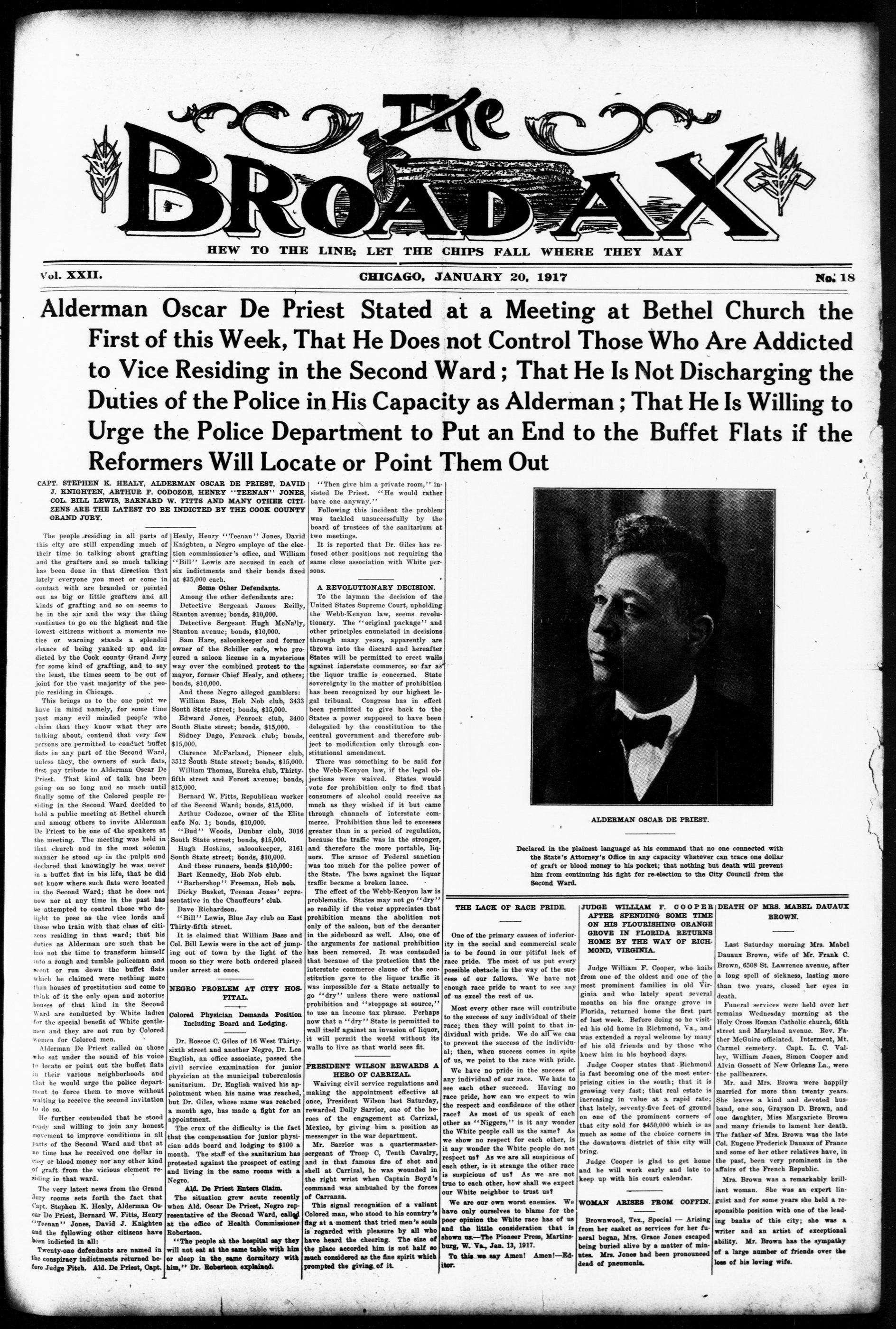
Alderman Oscar De Priest Stated at a Meeting at Bethel Church the First of this Week, That He Does not Control Those Who Are Addicted to Vice Residing in the Second Ward; That He Is Not Discharging the Duties of the Police in His Capacity as Alderman; That He Is Willing to Urge the Police Department to Put an End to the Buffet Flats if the Reformers Will Locate or Point Them Out
CAPT. STEPHEN K. HEALY, ALDERMAN OSCAR DE PRIEST, DAVID J. KNIGHTEN, ARTHUR F. CODOZOE, HENRY "TEENAN" JONES, COL. BILL LEWIS, BARNARD W. FITTS AND MANY OTHER CITIZENS ARE THE LATEST TO BE INDICTED BY THE COOK COUNTY GRAND JURY.
Vol. XXII.
Alderman O
First of
to Vice
Duties o
Urge th
Reform
CAPT. STEPHEN K. HEALY, ALD.
J. KNIGHTEN, ARTHUE F. CO.
COL. BILL LEWIS, BARNARD
ZENS ARE THE LATEST TO BE
GRAND JURY.
The people residing in all parts of this city are still expending much of their time in talking about grafting and the grafters and so much talking has been done in that direction that lately everyone you meet or come in contact with are branded or pointed out as big or little grafters and all kinds of grafting and so on seems to be in the air and the way the thing continues to go on the highest and the lowest citizens without a moments notice or warning stands a splendid chance of being yanked up and indicted by the Cook county Grand Jury for some kind of grafting, and to say the least, the times seem to be out of joint for the vast majority of the people residing in Chicago.
This brings us to the one point we have in mind namely, for some time past many evil minded people who claim that they know what they are talking about, contend that very few persons are permitted to conduct buffet flats in any part of the Second Ward, unless they, the owners of such flats, first pay tribute to Alderman Oscar De Priest. That kind of talk has been going on so long and so much until finally some of the Colored people residing in the Second Ward decided to hold a public meeting at Bethel church and among others to invite Alderman De Priest to be one of the speakers at the meeting. The meeting was held in that church and in the most solemn manner he stood up in the pulpit and declared that knowingly he was never in a buffet flat in his life, that he did not know where such flats were located in the Second Ward; that he does not now nor at any time in the past has attempted to control those who delight to pose as the vice lords and those who train with that class of citizens residing in that ward; that his duties as Alderman are such that he has not the time to transform himself into a rough and tumble policeman and scent or run down the buffet flats which he claimed were nothing more than houses of prostitution and come to think of it the only open and notorius houses of that kind in the Second Ward are conducted by White lades for the special benefit of White gentlemen and they are not run by Colored women for Colored men.
Alderman De Priest called on those who sat under the sound of his voice to locate or point out the buffet flats in their various neighborhoods and that he would urge the police department to force them to move without waiting to receive the second invitation to do so.
He further contended that he stood ready and willing to join any honest movement to improve conditions in all parts of the Second Ward and that at no time has he received one dollar in easy or blood money nor any other kind of graft from the vicious element residing in that ward.
The very latest news from the Grand Jury rooms sets forth the fact that Capt. Stephen K. Healy, Alderman Oscar De Priest, Bernard W. Fitts, Henry "Teenan" Jones, David J. Knighten and the following other citizens have been indicted in all:
Twenty-one defendants are named in the conspiracy indictments returned before Judge Fitch. Ald. De Priest, Capt.
Healy, Henry "Teenan" Jones, David Knighten, a Negro employee of the election commissioner's office, and William "Bill" Lewis are accused in each of six indictments and their bonds fixed at $35,000 each.
Some Other Defendants.
Among the other defendants are:
Detective Sergeant James Reilly,
Stanton avenue; bonds, $10,000.
Detective Sergeant Hugh McNally,
Stanton avenue; bonds, $10,000.
Sam Hare, saloonkeeper and former
owner of the Schiller cafe, who procured a saloon license in a mysterious way over the combined protest to the mayor, former Chief Healy, and others; bonds, $10,000.
And these Negro alleged gamblers:
William Bass, Hob Nob club, 3433
South State street; bonds, $15,000.
Edward Jones, Fenrock club, 3400
South State street; bonds, $15,000.
Sidney Dago, Fenrock club; bonds, $15,000.
Clarence McFarland, Pioneer club,
3512 South State street; bonds, $15,000.
William Thomas, Eureka club, Thirty-fifth street and Forest avenue; bonds, $15,000.
Bernard W. Fitts, Republican worker of the Second Ward; bonds, $15,000.
Arthur Codozoe, owner of the Elite cafe No. 1; bonds, $10,000.
“Bud” Woods, Dunbar club, 3016
South State street; bonds, $15,000.
Hugh Hoskins, saloonkeeper, 3161 South State street; bonds, $10,000. And these runners, bonds $10,000: Bart Kennedy, Hob Nob club. "Barbershop" Freeman, Hob nob. Dicky Basket, Teenan Jones' representative in the Chauffeurs' club. Dave Richardson. "Bill" Lewis, Blue Jay club on East Thirty-fifth street. It is claimed that William Bass and Col. Bill Lewis were in the act of jumping out of town by the light of the moon so they were both ordered placed under arrest at once.
NEGRO PROBLEM AT CITY HOSPITAL.
Colored Physician Demands Position Including Board and Lodging.
Dr. Roscoe C. Giles of 16 West Thirty-sixth street and another Negro, Dr. Lea English, an office associate, passed the civil service examination for junior physician at the municipal tuberculosis sanitarium. Dr. English waived his appointment when his name was reached, but Dr. Giles, whose name was reached a month ago, has made a fight for an appointment.
The crux of the difficulty is the fact that the compensation for junior physician adds board and lodging to $100 a month. The staff of the sanitarium has protested against the prospect of eating and living in the same rooms with a Negro.
Ald. De Priest Enters Claim.
The situation grew acute recently when Ald. Oscar De Priest, Negro representative of the Second Ward, called at the office of Health Commissioner Robertson.
"The people at the hospital say they will not eat at the same table with him or sleep in the same dormitory with him," Dr. Robertson explained.
CHICAGO, JANUARY 20, 1917
"Then give him a private room," insisted De Priest. "He would rather have one anyway." Following this incident the problem was tackled unsuccessfully by the board of trustees of the sanitarium at two meetings. It is reported that Dr. Giles has refused other positions not requiring the same close association with White persons.
A REVOLUTIONARY DECISION.
To the layman the decision of the United States Supreme Court, upholding the Webb-Kenyon law, seems revolutionary. The "original package" and other principles enunciated in decisions through many years, apparently are thrown into the discard and hereafter States will be permitted to erect walls against interstate commerce, so far as the liquor traffic is concerned. State sovereignty in the matter of prohibition has been recognized by our highest legal tribunal. Congress has in effect been permitted to give back to the States a power supposed to have been delegated by the constitution to the central government and therefore subject to modification only through constitutional amendment.
There was something to be said for the Webb-Kenyon law, if the legal objections were waived. States would vote for prohibition only to find that consumers of alcohol could receive as much as they wished if it but came through channels of interstate commerce. Prohibition thus led to excesses greater than in a period of regulation, because the traffic was in the stronger, and therefore the more portable, liquors. The armor of Federal sanction was too much for the police power of the State. The laws against the liquor traffic became a broken lance.
The effect of the Webb-Kenyon law is problematic. States may not go "dry" so readily if the voter appreciates that prohibition means the abolition not only of the saloon, but of the decanter in the sideboard as well. Also, one of the arguments for national prohibition has been removed. It was contended that because of the protection that the interstate commerce clause of the constitution gave to the liquor traffic it was impossible for a State actually to go "dry" unless there were national prohibition and "stoppage at source," to use an income tax phrase. Perhaps now that a "dry" State is permitted to wall itself against an invasion of liquor, it will permit the world without its walls to live as that world sees fit.
PRESIDENT WILSON REWARDS A
HERO OF CARRIZAL
Waiving civil service regulations and making the appointment effective at once, President Wilson last Saturday, rewarded Dolly Sarrrior, one of the heroes of the engagement at Carizal, Mexico, by giving him a position as messenger in the war department.
Mr. Sarrrior was a quartermaster-mergeant of Troop C, Tenth Cavalry, and in that famous fire of shot and shell at Carizal, he was wounded in the right wrist when Captain Boyd's command was ambushed by the forces of Carranza.
This signal recognition of a valiant Colored man, who stood to his country's flag at a moment that tried men's souls is regarded with pleasure by all who have heard the cheering. The size of the place accorded him is not half so much considered as the fine spirit which prompted the giving of it.
J.
Declared in the plainest language at his command that no one connected with the State's Attorney's Office in any capacity whatever can trace one dollar of graft or blood money to his pocket; that nothing but death will prevent him from continuing his fight for re-election to the City Council from the Second Ward.
THE LACK OF RACE PRIDE.
One of the primary causes of inferiority in the social and commercial scale is to be found in our pitiful lack of race pride. The most of us put every possible obstacle in the way of the success of our fellows. We have not enough race pride to want to see any of us excel the rest of us.
Most every other race will contribute to the success of any individual of their race; then they will point to that individual with pride. We do all we can to prevent the success of the individual; then, when success comes in spite of us, we point to the race with pride.
We have no pride in the success of any individual of our race. We hate to see each other succeed. Having no race pride, how can we expect to win the respect and confidence of the other race? As most of us speak of each other as "Niggers," is it any wonder the White people call us the same? As we show no respect for each other, is it any wonder the White people do not respect us? As we are all suspicious of each other, is it strange the other race is suspicious of us? As we are not true to each other, how shall we expect our White neighbor to trust us?
We are our own worst enemies. We have only ourselves to blame for the poor opinion the White race has of us and the little consideration that is shown us.-The Pioneer Press, Martinsburg, W. Va., Jan. 13, 1917.
To this we say Amen! Amen!-Editor.
ALDERMAN OSCAR DE PRIEST.
lainest language at his command that no attorney's Office in any capacity whatever good money to his pocket; that nothing be timing his fight for re-election to the C
JUDGE WILLIAM F. COOPER AFTER SPENDING SOME TIME ON HIS FLOURISHING ORANGE GROVE IN FLORIDA RETURNS HOME BY THE WAY OF RICHMOND, VIRGINIA.
Judge William F. Cooper, who hails from one of the oldest and one of the most prominent families in old Virginia and who lately spent several months on his fine orange grove in Florida, returned home the first part of last week. Before doing so he visited his old home in Richmond, Va., and was extended a royal welcome by many of his old friends and by those who knew him in his boyhood days.
Judge Cooper states that Richmond is fast becoming one of the most enterprising cities in the south; that it is growing very fast; that real estate is increasing in value at a rapid rate; that lately, seventy-five feet of ground on one of the prominent corners of that city sold for $450,000 which is as much as some of the choice corners in the downtown district of this city will bring.
Judge Cooper is glad to get home and he will work early and late to keep up with his court calendar.
WOMAN ARISES FROM COFFIN
Brownwood, Tex., Special — Arising from her casket as services for her funeral began, Mrs. Grace Jones escaped being buried alive by a matter of minutes. Mrs. Jones had been pronounced dead of pneumonia.
No.18
DEATH OF MRS. MABEL DAUAUX
BROWN.
Last Saturday morning Mrs. Mabel Dauaux Brown, wife of Mr. Frank C. Brown, 6508 St. Lawrence avenue, after a long spell of sickness, lasting more than two years, closed her eyes in death.
Funeral services were held over her remains Wednesday morning at the Holy Cross Roman Catholic church, 65th street and Maryland avenue. Rev. Father McGuire officiated. Interment, Mt. Carmel cemetery. Capt. L. C. Valley, William Jones, Simon Cooper and Alvin Gossett of New Orleans La., were the pallbearers.
Mr. and Mrs. Brown were happily married for more than twenty years. She leaves a kind and devoted husband, one son, Grayson D. Brown, and one daughter, Miss Margariete Brown and many friends to lament her death. The father of Mrs. Brown was the late Col. Eugene Frederick Dauaux of France and some of her other relatives have, in the past, been very prominent in the affairs of the French Republic.
Mrs. Brown was a remarkably brilliant woman. She was an expert linguist and for some years she held a responsible position with one of the leading banks of this city; she was a writer and an artist of exceptional ability. Mr. Brown has the sympathy of a large number of friends over the loss of his loving wife.
Dan M. Jackson
Geo. T. Kersey
David A. McGowan
Ahmed A. Rayner
The Emanuel
Undertaking
2959-61 South
Reliable Service
Reasonable
Reliable Service & Courteous Treatment
Reasonable Prices
FREE CHAPEL IN CONNECTION
Complete line of Funeral Goods. Automobiles for hire
Telephone Douglas 6568 Automatic 73-657
THE SOLACE BILLIARD ACADEMY
"THE MODERN SCHOOL" - CLEAN AND RELIABLE
THE SOLACE BILLIARD ACADEMY
TERREVOUS L, DOUGLAS, Prop.
CIGARS-WHOLESALE AND RETAIL
BOX TRADE A SPECIALTY
3556 South State Street
A Sepulcher of Broken Hearts.
In the old Franciscan church of the Holy Cross rises one of the two monuments disdainful Florence condescended to give her greatest poet, whose greatest honor lies in his gift to the world at one splendid sweep of a pure and recreated Italian language—until his time halting and feeble—in that immortal masterpiece of literature, the "Divina Commedia."
This church might well be known as the Broken Hearts instead of Santa Croce, for near Dante's cenotaph—his exiled ashes still rest in Ravenna—lies the body of that other terrific genius, Michelangelo, who, broken in spirit, died gladly when the city so dear to his heart fell once more upon dark and tyrannous days. And Galilei is here, too, and Alfieri, and Machiavelli, and many another a brilliant train.
Michelangelo's last work is in the nearby church of San Lorenzo, in the mortuary chapel of the Medici, the great house which deigned to favor him with its patronage or its enmity throughout his life.-National Geographic Magazine.
A recent automobile accident in an up state county resulted in the death of the driver and the injury of two passengers.
The coroner summoned several witnesses, among them a farmer living near the scene of the accident. There was voluminous testimony regarding the high speed at which the car traveled. Witnesses said, too, that the road was in bad repair. The coroner finally reached the farmer who lived near the scene.
"What would you say about this accident, Mr. Swiggett?" the coroner asked.
"Well, if I was writin' that young man's epitaph," the witness drawled, "I'd say he died tryin' to git sixty miles a hour out of a ten mile road."
—Indianapolis News.
Joachim Murat was in his day the best dressed man in the world. Born in 1767 in a village near Cahors the son of a day laborer, he was sent to a Jesuit school to be educated for the priesthood. He ran away, joined the army, and sixteen years after he had become a lieutenant he was a field marshal, duke of Cleves and Berg, with Napoleon's sister, Caroline, as his wife, and finally, by the grace of his brother-in-law, was created king of Naples. In all stations he paid the closest attention to his attire and wore in battle gold embroidered and jeweled uniforms which would have made him conspicuous at a court function, and dressed himself as for a review when he was led forth to be shot.—New York Tribune.
He Was Just Thinking
"Mary," said a man to his spouse, who was gifted with a rapidly moving tongue, "did you ever hear the story of the precious gems?"
"No," she replied. "What is it?"
"No, she replied. What is it?"
"It's a fairy legend that my grandmother told me when I was a boy," the husband continued. "It was about a woman from whose lips fell a diamond or a ruby at every word she spoke."
"Well?" said his wife as he paused.
"That's all there is of it, my dear," he replied. "But I was just thinking if such things happened nowadays I could make my fortune as a jeweler."
An Englishman was once traveling in the south of Ireland when he came to a village called Skibbereen. The name struck him as very peculiar and odd, and he asked a villager why the town was so called. "Sure," the villager replied, "I thought even an Englishman could have seen the reason for that. It called Skibbereen to distinguish it from other places of the same name."—Christian Register.
One of its moons circles Mars every seven hours. In consequence of this rapid revolution it appears to the inhabitants of Mars (if there be any) to rise in the west and set in the east.
PAGE TWO
Telephone Douglas 6568
His Epitaph.
A Famous Dresser.
Skibbereen.
Mars and Its Moons
Phones Calumet 6164
Automatic 71-629
OPEN DAY
AND NIGHT
CLEAN AND RELIABLE
Chicago
"What is political economy, dad?" "To be perfectly candid, my son, I can't tell you. Sometimes I think there isn't any such thing."—Philadelphia Bulletin.
Making a Distinction
Banker—I stole but $10,000, and I had the opportunity to steal a million. Lawyer—But you didn't. And $10,000 is a state prison offense—Town Topics.
```markdown
```
PRACTICAL HEALTH HINT.
Careful investigations have shown that the physically perfect man is almost impossible to find. Almost every one who has reached the age of thirty has some impairment or defect of his body. It may be only a defective tooth or a single digestive disturbance, or it may be trouble with the kidneys that will develop into Bright's disease if it is not attended to promptly. Out of 2,000 men and women examined 70 per cent were found to have impairments of a more or less serious nature, while all the remaining 30 per cent had some defects of a minor character.
Are you sure you are physically perfect? If you are not, you had better arrange for a careful medical examination. Little defects or impairments if neglected may cause untold suffering and loss. Discover them in time by having your body inspected.
Anatomically
"I've been pondering over a very singular thing."
"What is it?"
"How putting a ring on a woman's third finger should place you under her thumb." - Pearson's Weekly.
Fixed, but a Fixture
"Do you think you can fix this car?" inquired the luckless motorist.
"I think so." replied the village blacksmith, who was something of a wag, as he moved around in the shade of the spreading chestnut tree. "When I get through with it if it is not fixed in one way it will be in another."
And he was right.—Richmond Times-Dispatch.
Well Guarded
Electric burglar alarms surround Uncle Sam's treasury at Washington and are tested every fifteen minutes, day and night.
```markdown
```
PRACTICAL HEALTH HINT.
Morning Headache.
Early morning headaches may be due to many causes—eye strain, kidney trouble, dissipation, too much smoking, overeating of proteins, excessive mental labor or too high blood pressure. The Medical Record quotes some observations by the French doctor, Renon, which extended over fifteen years and in which he found in many cases excessively high blood tension.
When the persistent headaches are so severe that they unfit the sufferer for work it is generally found that his heart is enlarged and his kidneys are affected. Such cases often speedily terminate fatally, but intensive treatment will alleviate the symptoms. The Medical Record says coal tar derivatives and tobacco must be shut off. The patient must have mental rest. He must go on a purely milk diet for at least a week, after which he may eat fruits and vegetables on certain days for two weeks more. A light, low protein regimen follows for several weeks.
THE BROAD AX. CHICAGO. JANUARY 20, 1917.
THE COMPLETE
LETTER WRITER
The following suggestion for "The Complete Business Letter Writer for 1916," by A. Parker Nevin, is going the rounds of the press.
Model No. 1—Quoting Price for Goods. Smith Manufacturing Company.
Referring to your letter (see Postal Regulation, p. 126, pp 44) of the 28th we (a corporation organized under the laws of Ohio, certificate filed in the office of the Secretary of New York State, New York) beg to advise you that we can quote the price of $20 (see United States Revised Statutes, Laws of 1914, sec. 18) per ton, carload lots (see Interstate Commerce Ruling 259; also see dicta in 128 U. S. 264; Brown vs. Pennsylvania R. R. Co., 168 Pa. 267). This quotation is special to you (see ruling of Department of Justice in the matter of Brown Milling Co.) and is made subject to our right to claim immunity (see N. Y. Penal Code, pp 48). If you receive a better quotation from any other of our competitors you will, of course, advise us under the authority of U. S. Revised Statutes, pp 2247, sub. 2. We shall be glad to fill your order (subject to rule laid down in leading case of Jackson vs. Cobb, 126 U. S. 232) and will ship according to your instruction (see Rule 37, New York Public Utility Commission). Very truly yours.
J.P. JONES President
JONES MANUFACTURING Co.
State of Ohio, County of Fairfield, ss:
J. P. Jones, being duly sworn, deposes and
being sent to the court, going letter to his counsel and has been
advised that it is legal. That deponent is
not a director of any bank, trust company
or transportation company. That the
Jones Manufacturing Company has never
had its charter forfeited, nor has de-
pendent been bound by either State
or Federal Grand Jury.
P. P. WHITE, Notary Public.
ODDS AND ENDS.
The lives of practically all men famous in the business world as shown in the history of industry during the past twenty-five years will prove to you the practical value of the "stick to it" principle of life. Armour stuck to beef, Harriman and Hill to railroads, Edison to electricity, Carnegie and Schwab to steel, Rockefeller to oil, Morgan to finance, and so on without end. All these captains of industry and thousands of others that might be mentioned had the faculty of "sticking" to a job until they made good.
"The time has come," said James W. Wadsworth, Jr., United States Senator-elect from New York, recently, "when business men should give heed to what is going on in the legislative bodies of the country. I see in the future except this heed is given a development which will prevent the individual from carrying on his business, honest though he may be, with his own initiative and enterprise."
Do not be a clock watcher in the ranks of industry. Those who wait for hours to strike or whistles to blow and "soldier" at the bench, machine or in the office seldom or never get very far ahead in the ranks. They never get any more pay because they are not worth more and often are worth less than they get. Remember the old adage that a man who never does any more or as much as he gets paid for never gets very much pay.
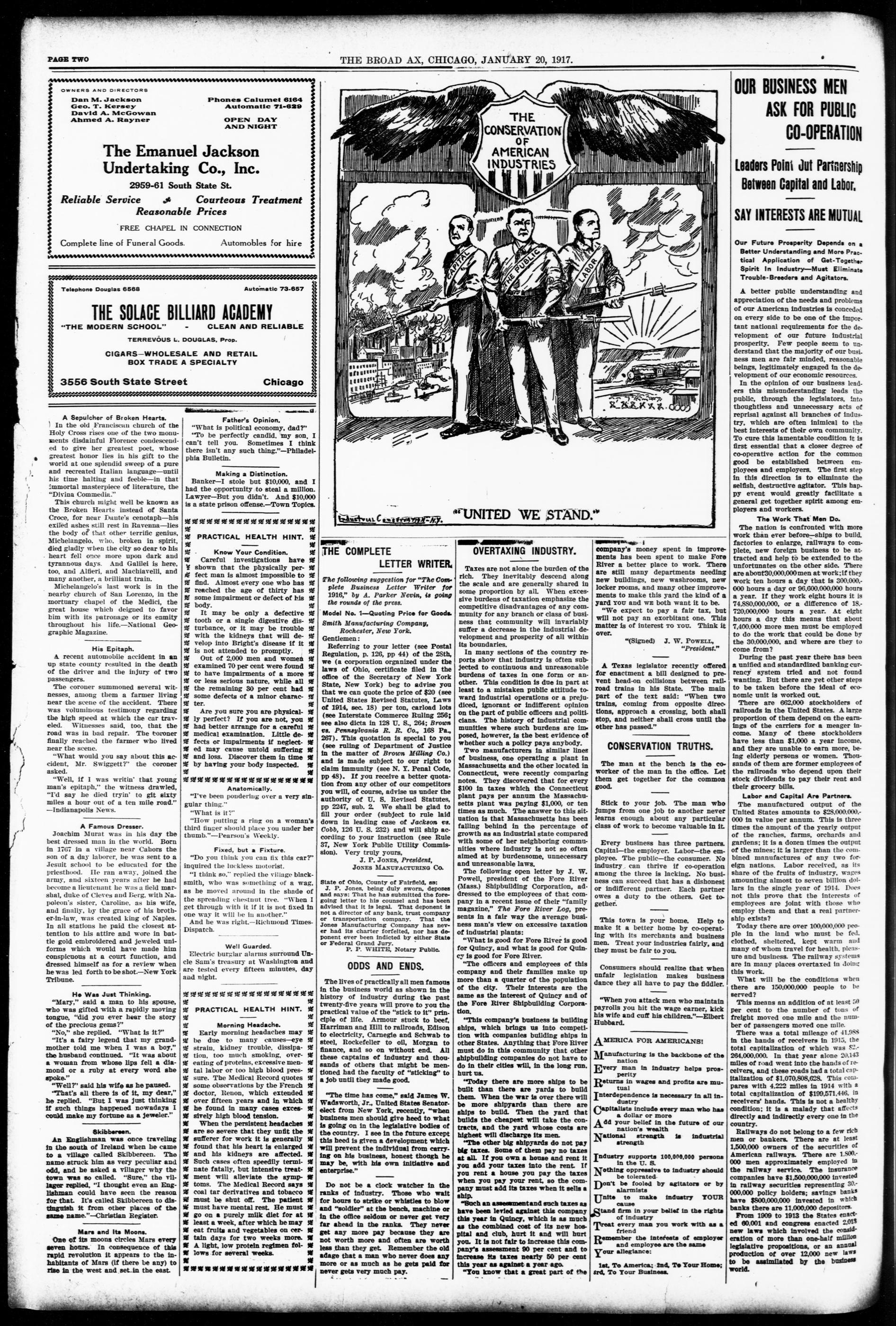
"UNITED WE STAND."
OVERTAXING INDUSTRY.
Taxes are not alone the burden of the rich. They inevitably descend along the scale and are generally shared in some proportion by all. When excessive burdens of taxation emphasize the competitive disadvantages of any community for any branch or class of business that community will invariably suffer a decrease in the industrial development and prosperity of all within its boundaries.
In many sections of the country reports show that industry is often subjected to continuous and unreasonable burdens of taxes in one form or another. This condition is due in part at least to a mistaken public attitude toward industrial operations or a prejudiced, ignorant or indifferent opinion on the part of public officers and politicians. The history of industrial communities where such burdens are imposed, however, is the best evidence of whether such a policy pays anybody.
Two manufacturers in similar lines of business, one operating a plant in Massachusetts and the other located in Connecticut, were recently comparing notes. They discovered that for every $100 in taxes which the Connecticut plant pays per annum the Massachusetts plant was paying $1,000, or ten times as much. The answer to this situation is that Massachusetts has been falling behind in the percentage of growth as an industrial state compared with some of her neighboring communities where industry is not so often aimed at by burdensome, unnecessary and unreasonable laws. The following open letter by J. W. Powell, president of the Fore River (Mass). Shipbuilding Corporation, addressed to the employees of that company in a recent issue of their "family magazine," The Fore River Log, presents in a fair way the average business man's view on excessive taxation of industrial plants:
"What is good for Fore River is good for Quincy, and what is good for Quincy is good for Fore River.
"The officers and employees of this company and their families make up more than a quarter of the population of the city. Their interests are the same as the interest of Quincy and of the Fore River Shipbuilding Corporation.
"This company's business is building ships, which brings us into competition with companies building ships in other States. Anything that Fore River must do in this community that other shipbuilding companies do not have to do in their cities will, in the long run, hurt us.
"Today there are more ships to be built than there are yards to build them. When the war is over there will be more shipyards than there are ships to build. Then the yard that builds the cheapest will take the contracts, and the yard whose costs are highest will discharge its men.
"The other big shipyards do not pay big taxes. Some of them pay no taxes at all. If you own a house and rent it you add your taxes into the rent. If you rent a house you pay the taxes when you pay your rent, so the company must add its taxes when it sells a ship.
"Such an assessment and such taxes as have been levied against this company this year in Quincy, which is as much as the combined cost of its new hospital and club, hurt it and will hurt you. It is not fair to increase this company's assessment 90 per cent and to increase its taxes nearly 50 per cent this year as against a year ago. "You know that a great part of the
---
company's money spent in improvements has been spent to make Fore River a better place to work. There are still many departments needing new buildings, new washrooms, new locker rooms, and many other improvements to make this yard the kind of a yard you and we both want it to be.
"We expect to pay a fair tax, but will not pay an exorbitant one. This matter is of interest to you. Think it over.
"(Signed) J. W. PowELL,
"President."
A Texas legislator recently offered for enactment a bill designed to prevent head-on collisions between railroad trains in his State. The main part of the text said: "When two trains, coming from opposite directions, approach a crossing, both shall stop, and neither shall cross until the other has passed."
CONSERVATION TRUTHS.
The man at the bench is the coworker of the man in the office. Let them get together for the common good.
Stick to your job. The man who jumps from one job to another never learns enough about any particular class of work to become valuable in it.
Every business has three partners. Capital—the employer. Labor—the employee. The public—the consumer. No industry can thrive if co-operation among the three is lacking. No business can succeed that has a dishonest or indifferent partner. Each partner owes a duty to the others. Get together.
This town is your home. Help to make it a better home by co-operating with its merchants and business men. Treat your industries fairly, and they must be fair to you.
Consumers should realize that when unfair legislation makes business dance they all have to pay the fiddler.
"When you attack men who maintain payrolls you hit the wage earner, kick his wife and cuff his children."—Elbert Hubbard.
AMERICA FOR AMERICANS!
Manufacturing is the backbone of the nation
Every man in industry helps prosperity
Returns in wages and profits are mutual
Interdependence is necessary in all industry
Capitalists include every man who has a dollar or more
Add your belief in the future of our nation's wealth
National strength is industrial strength
Industry supports 100,000,000 persons in the U. S.
Nothing oppressive to industry should be tolerated.
Don't be fooled by agitators or by alarmists
Unite to make industry YOUR cause
Stand firm in your belief in the rights of industry
Treat every man you work with as a friend
Remember the interests of employer and employee are the same
Your allegiance:
1st, To America; 2nd, To Your Home; 3rd, To Your Business.
OUR BUSINESS MEN ASK FOR PUBLIC CO-OPERATION
Leaders Point Jut Partnership Between Capital and Labor. SAY INTERESTS ARE MUTUAL
Our Future Prosperity Depends on a Better Understanding and More Practical Application of Get-Together Spirit In Industry-Must Eliminate Trouble-Breeders and Agitators.
A better public understanding and appreciation of the needs and problems of our American industries is conceded on every side to be one of the important national requirements for the development of our future industrial prosperity. Few people seem to understand that the majority of our business men are fair minded, reasonable beings, legitimately engaged in the development of our economic resources.
In the opinion of our business leaders this misunderstanding leads the public, through the legislators, into thoughtless and unnecessary acts of reprisal against all branches of industry, which are often inimical to the best interests of their own community. To cure this lamentable condition it is first essential that a closer degree of co-operative action for the common good be established between employees and employers. The first step in this direction is to eliminate the selfish, destructive agitator. This happy event would greatly facilitate a general get together spirit among employers and workers.
The Work That Men Do.
The nation is confronted with more work than ever before—ships to build, factories to enlarge, railways to complete, new foreign business to be attracted and help to be extended to the unfortunates on the other side. There are about 30,000,000 men at work; if they work ten hours a day that is 300,000,000 hours a day or 96,000,000 hours a year. If they work eight hours it is 74,800,000,000, or a difference of 18.720,000,000 hours a year. At eight hours a day this means that about 7,400,000 more men must be employed to do the work that could be done by the 30,000,000, and where are they to come from?
During the past year there has been a unified and standardized banking currency system tried and not found wanting. But there are yet other steps to be taken before the ideal of economic unit is worked out.
There are 662,000 stockholders of railroads in the United States. A large proportion of them depend on the earnings of the carriers for a meager income. Many of these stockholders have less than $1,000 a year income, and they are unable to earn more, being elderly persons or women. Thousands of them are former employees of the railroads who depend upon their stock dividends to pay their rent and their grocery bills.
Labor and Capital Are Partners
The manufactured output of the United States amounts to $28,000,000,000 in value per annum. This is three times the amount of the yearly output of the ranches, farms, orchards and gardens; it is a dozen times the output of the mines; it is larger than the combined manufactures of any two foreign nations. Labor received, as its share of the fruits of industry, wages amounting almost to seven billion dollars in the single year of 1914. Does not this prove that the interests of employees are joint with those who employ them and that a real partnership exists?
Today there are over 100,000,000 people in the land who must be fed, clothed, sheltered, kept warm and many of whom travel for health, pleasure and business. The railway systems are in many places overtaxed in doing this work.
What will be the conditions when there are 150,000,000 people to be served?
This means an addition of at least 50 per cent to the number of tons of freight moved one mile and the number of passengers moved one mile.
There was a total mileage of 41,988 in the hands of receivers in 1915, the total capitalization of which was $24,264,000,000. In that year alone 20,143 miles of road went into the hands of receivers, and these roads had a total capitalization of $1,070,808,628. This compares with 4,222 miles in 1914 with a total capitalization of $199,571,446, in receivers' hands. This is not a healthy condition; it is a malady that affects directly and indirectly every one in the country.
Railways do not belong to a few rich men or bankers. There are at least 1,500,000 owners of the securities of American railways. There are 1,800,000 men approximately employed in the railway service. The insurance companies have $1,500,000,000 invested in railway securities representing 30,000,000 policy holders; savings banks have $800,000,000 invested in which banks there are 11,000,000 depositors. From 1909 to 1913 the States enacted 60,001 and congress enacted 2,013 new laws which involved the consideration of more than one-half million legislative propositions, or an annual production of over 12,000 new laws to be assimilated by the business world.
Widow of Skeffington, Executed Irish Editor, Is In America.
HERE WITH HER SON, OWEN.
Plans to Write and Lecture In This Country With the Hope of Interesting Us In the Future Freedom of Ireland. Is an Intellectual Type.
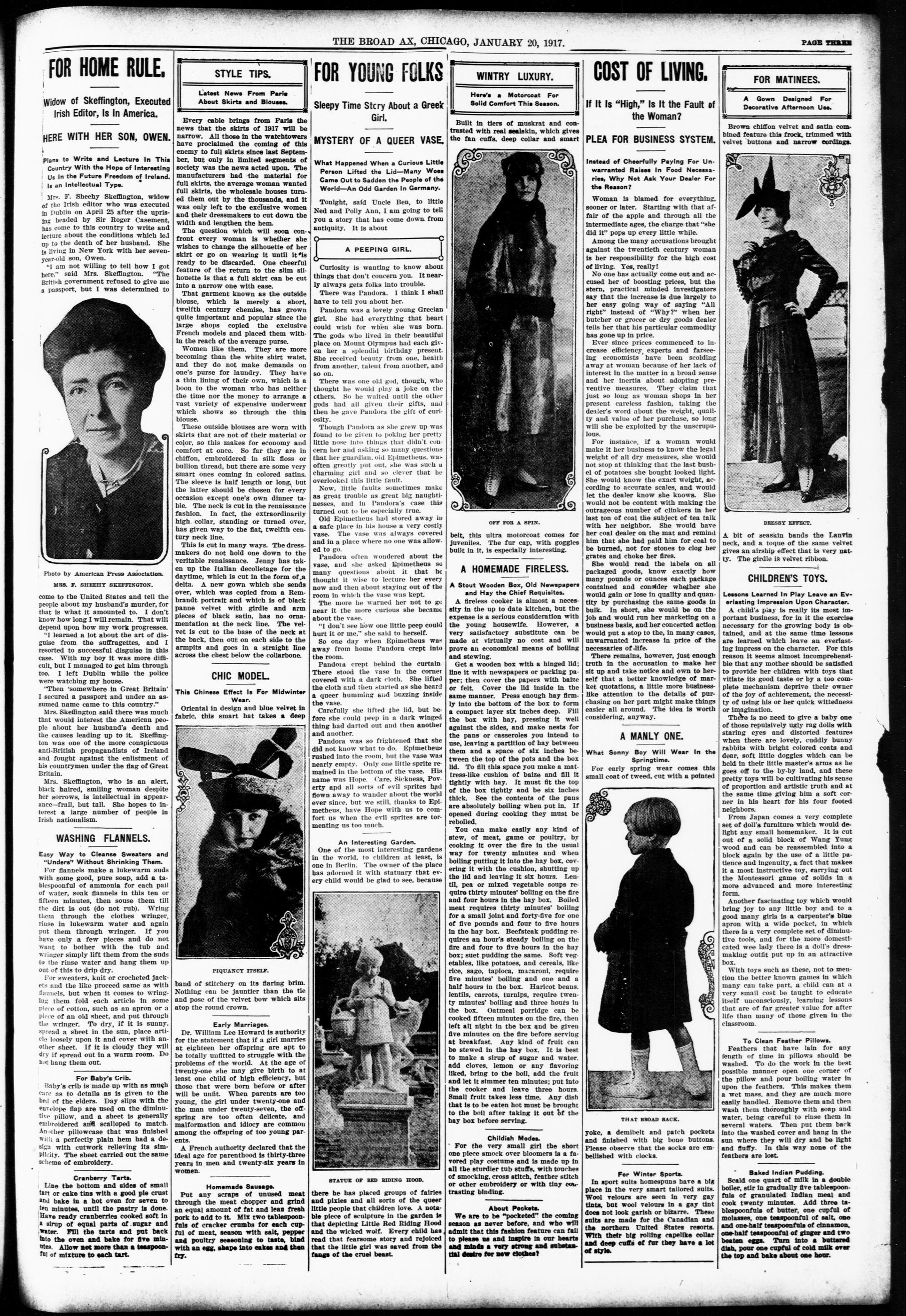
Mrs. F. Sheehy Skeffington, widow of the Irish editor who was executed in Dublin on April 25 after the uprising headed by Sir Roger Casement, has come to this country to write and lecture about the conditions which led up to the death of her husband. She is living in New York with her seven-year-old son, Owen.
"I am not willing to tell how I got here," said Mrs. Skeffington. "The British government refused to give me a passport, but I was determined to
Mary Ann
Photo by American Press Association.
MRS. F. SHEEHY SKEFFINGTON.
come to the United States and tell the people about my husband's murder, for that is what it amounted to. I don't know how long I will remain. That will depend upon how my work progresses.
"I learned a lot about the art of disguise from the suffragettes, and I resorted to successful disguise in this case. With my boy it was more difficult, but I managed to get him through too. I left Dublin while the police were watching my house.
"Then 'somewhere in Great Britain' I secured a passport and under an assumed name came to this country."
Mrs. Skeffington said there was much that would interest the American people about her husband's death and the causes leading up to it. Skeffington was one of the more conspicuous anti-British propagandists of Ireland and fought against the enlistment of his countrymen under the flag of Great Britain.
Mrs. Skeffington, who is an alert, black haired, smiling woman despite her sorrows, is intellectual in appearance—frail, but tall. She hopes to interest a large number of people in Irish nationalism.
WASHING FLANNELS.
Easy Way to Cleanse Sweaters and "Unders" Without Shrinking Them.
For flannels make a lukewarm suds with some good, pure soap, add a tablespoonful of ammonia for each pair of water, soak flannels in this ten or fifteen minutes, then souse them till the dirt is out (do not rub). Wring them through the clothes wringer, rinse in lukewarm water and again put them through wringer. If you have only a few pieces and do not want to bother with the tub and wringer simply lift them from the suds to the rinse water and hang them up out of this to drip dry.
For sweaters, knit or crocheted jackets and the like proceed same as with flannels, but when it comes to wringing them fold each article in some piece of cotton, such as an apron or a piece of an old sheet, and put through the wringer. To dry, if it is sunny, spread a sheet in the sun, place article loosely upon it and cover with another sheet. If it is cloudy they will dry if spread out in a warm room. Do not hang them out.
For Baby's Crib.
Baby's crib is made up with as much care as to details as is given to the bed of the elders. Day slips with the envelope flap are used on the diminutive pillow, and a sheet is generally embroidered and scalloped to match. Another pillowcase that was finished with a perfectly plain hem had a design with cutwork relieving its simplicity. The sheet carried out the same scheme of embroidery.
Cranberry Tarts.
Line the bottom and sides of small tart or cake tins with a good pie crust and bake in a hot oven for seven to ten minutes, until the pastry is done. Have ready crberries cooked soft in a srup of equal parts of sugar and water. Fill the tarts and put back into the oven and bake for five minutes. Allow not more than a teaspoonful of mixture to each tart.
STYLE TIPS.
Latest News From Paris About Skirts and Blouses.
Every cable brings from Paris the news that the skirts of 1917 will be narrow. All those in the watchtowers have proclaimed the coming of this enemy to full skirts since last September, but only in limited segments of society was the news acted upon. The manufacturers had the material for full skirts, the average woman wanted full skirts, the wholesale houses turned them out by the thousands, and it was only left to the exclusive women and their dressmakers to cut down the width and lengthen the hem.
The question which will soon confront every woman is whether she wishes to change the silhouette of her skirt or go on wearing it until it*is ready to be discarded. One cheerful feature of the return to the slim silhouette is that a full skirt can be cut into a narrow one with ease.
That garment known as the outside blouse, which is merely a short, twelfth century chemise, has grown quite important and popular since the large shops copied the exclusive French models and placed them within in the reach of the average purse.
Women like them. They are more becoming than the white shirt waist, and they do not make demands on one's purse for laundry. They have a thin lining of their own, which is a boon to the woman who has neither the time nor the money to arrange a vast variety of expensive underwear which shows so through the thin blouse.
These outside blouses are worn with skirts that are not of their material or color, so this makes for economy and comfort at once. So far they are in chiffon, embroidered in silk floss or bullion thread, but there are some very smart ones coming in colored satins. The sleeve is half length or long, but the latter should be chosen for every occasion except one's own dinner table. The neck is cut in the renaissance fashion. In fact, the extraordinarily high collar, standing or turned over, has given way to the flat, twelfth century neck line.
This is cut in many ways. The dressmakers do not hold one down to the veritable renaissance. Jenny has taken up the Italian decolletage for the daytime, which is cut in the form of a delta. A new gown which she sends over, which was copied from a Rembrandt portrait and which is of black panne velvet with girdle and arm pieces of black satin, has no ornamentation at the neck line. The velvet is cut to the base of the neck at the back, then out on each side to the armpits and goes in a straight line across the chest below the collarbone.
CHIC MODEL
This Chinese Effect Is For Midwinter Wear.
Oriental in design and blue velvet in fabric, this smart hat takes a deep
C
PIQUANCY ITSELF.
band of stitchery on its flaring brim.
Nothing can be jauntier than the tie
and pose of the velvet bow which sits
atop the round crown.
Early Marriages
Dr. William Lee Howard is authority for the statement that if a girl marries at eighteen her offspring are apt to be totally unfitted to struggle with the problems of the world. At the age of twenty-one she may give birth to at least one child of high efficiency, but those that were born before or after will be unfit. When parents are too young, the girl under twenty-one and the man under twenty-seven, the offspring are too often delicate, and malformation and idiocy are common among the offspring of too young parents.
A French authority declared that the ideal age for parenthood is thirty-three years in men and twenty-six years in women.
Homemade Sausage.
Put any scraps of unused meat through the meat chopper and grind an equal amount of fat and leans fresh pork to add to it. Mix two tablespoonfuls of cracker crumbs for each cupful of meat, season with salt, pepper and poultry seasoning to taste, blind with an egg, shape into cakes and then fry.
THE BROAD AX, CHICAGO, JANUARY 20, 1917.
FOR YOUNG FOLKS
FOR YOUNG FOLKS
Sleepy Time Stcry About a Greek Girl.
MYSTERY OF A QUEER VASE.
What Happened When a Curious Little Person Lifted the Lid—Many Woes Came Out to Sadden the People of the World—An Odd Garden In Germany.
Tonight, said Uncle Ben, to little Ned and Polly Ann, I am going to tell you a story that has come down from antiquity. It is about
A PEEPING GIRL
Curiosity is wanting to know about things that don't concern you. It nearly always gets folks into trouble.
There was Pandora. I think I shall have to tell you about her.
Pandora was a lovely young Grecian girl. She had everything that heart could wish for when she was born.
The gods who lived in their beautiful place on Mount Olympus had each given her a splendid birthday present. She received beauty from one, health from another, talent from another, and so on.
There was one old god, though, who thought he would play a joke on the others. So he waited until the other gods had all given their gifts, and then he gave Pandora the gift of curiosity.
Though Pandora as she grew up was found to be given to poking her pretty little nose into things that didn't concern her and asking so many questions that her guardian, old Epimetheus, was often greatly put out, she was such a charming girl and so clever that he overlooked this little fault.
Now, little faults sometimes make as great trouble as great big naughtinesses, and in Pandora's case this turned out to be especially true.
Old Epimetheus had stored away in a safe place in his house a very costly vase. The vase was always covered and in a place where no one was allowed to go.
Pandora often wondered about the vase, and she asked Epimetheus so many questions about it that he thought it wise to lecture her every now and then about staying out of the room in which the vase was kept.
The more he warned her not to go near it the more curious she became about the vase.
"I don't see how one little peep could hurt it or me," she said to herself.
So one day when Epimetheus was away from home Pandora crept into the room.
Pandora crept behind the curtain. There stood the vase in the corner covered with a dark cloth. She lifted the cloth and then started as she heard a queer humming and buzzing inside the vase.
Carefully she lifted the lid, but before she could peep in a dark winged thing had darted out and then another and another.
Pandora was so frightened that she did not know what to do. Epimetheus rushed into the room, but the vase was nearly empty. Only one little sprite remained in the bottom of the vase. His name was Hope. Care, Sickness, Poverty and all sorts of evil sprites had flown away to wander about the world ever since, but we still, thanks to Epimetheus, have Hope with us to comfort us when the evil sprites are tormenting us too much.
An Interesting Garden.
One of the most interesting gardens in the world, to children at least, is one in Berlin. The owner of the place has adorned it with statuary that every child would be glad to see, because
THE WOLF AND THE WATER BANK
STATUE OF RED RIDING HOOD.
there he has placed groups of fairies and pixies and all sorts of the queer little people that children love. A notable piece of sculpture in the garden is that depicting Little Red Riding Hood and the wicked wolf. Every child has read that fearsome story and rejoiced that the little girl was saved from the fangs of the cruel beast.
WINTRY LUXURY.
Here's a Motorcoat For Solid Comfort This Season.
Bullet in tiers of muskrat and contrasted with real scalskin, which gives the fan cuffs, deep collar and smart
THE WINTER COAT
OFF FOR A SPIN.
belt, this ultra motorcoat comes for juveniles. The fur cap, with goggles built in it, is especially interesting.
A HOMEMADE FIRELESS.
A Stout Wooden Box, Old Newspapers and Hay the Chief Requisites.
A fireless cooker is almost a necessity in the up to date kitchen, but the expense is a serious consideration with the young housewife. However, a very satisfactory substitute can be made at virtually no cost and will prove an economical means of boiling and stewing.
Get a wooden box with a hinged lid; line it with newspapers or packing paper; then cover the papers with balze or felt. Cover the lid inside in the same manner. Press enough hay firmly into the bottom of the box to form a compact layer six inches deep. Fill the box with hay, pressing it well against the sides, and make nests for the pans or casseroles you intend to use, leaving a partition of hay between them and a space of six inches between the top of the pots and the box lid. To fill this space you make a mattress-like cushion of balze and fill it tightly with hay. It must fit the top of the box tightly and be six inches thick. See the contents of the pans are absolutely boiling when put in. If opened during cooking they must be rebolled.
You can make easily any kind of stew, of meat, game or poultry, by cooking it over the fire in the usual way for twenty minutes and when boiling putting it into the hay box, covering it with the cushion, shutting up the lid and leaving it six hours. Lentil, pea or mixed vegetable soups require thirty minutes' boiling on the fire and four hours in the hay box. Boiled meat requires thirty minutes' boiling for a small joint and forty-five for one of five pounds and four to five hours in the hay box. Beefsteak pudding requires an hour's steady boiling on the fire and four to five hours in the hay box; suet pudding the same. Soft vegetables, like potatoes, and cereals, like rice, sago, tapioca, macaroni, require five minutes' boiling and one and a half hours in the box. Haricot beans, lentils, carrots, turnips, require twenty minutes' boiling and three hours in the box. Oatmeal porridge can be cooked fifteen minutes on the fire, then left all night in the box and be given five minutes on the fire before serving at breakfast. Any kind of fruit can be stewed in the hay box. It is best to make a sirup of sugar and water, add cloves, lemon or any flavoring liked, bring to the boll, add the fruit and let it simmer ten minutes; put into the cooker and leave three hours. Small fruit takes less time. Any dish that is to be eaten hot must be brought to the boll after taking it out of the hay box before serving.
Childish Modes
For the very small girl the short one piece smock over bloomers is a favored play costume and is made up in all the sturdier tub stuffs, with touches of smocking, cross stitch, feather stitch or other embroidery or with tiny contrasting binding.
About Pockets.
We are to be "pocketed" the coming season as never before, and who will admit that this fashion feature can fail to please us and inspire in our hearts and minds a very strong and substantial desire for new clothes?
COST OF LIVING.
If It Is "High," Is It the Fault of the Woman?
PLEA FOR BUSINESS SYSTEM.
Instead of Cheerfully Paying For Unwarranted Raises In Food Necessaries, Why Not Ask Your Dealer For the Reason?
Woman is blamed for everything, sooner or later. Starting with that affair of the apple and through all the intermediate ages, the charge that "she did it" pops up every little while.
Among the many accusations brought against the twentieth century woman is her responsibility for the high cost of living. Yes, really!
No one has actually come out and accused her of boosting prices, but the stern, practical minded investigators say that the increase is due largely to her easy going way of saying "All right" instead of "Why?" when her butcher or grocer or dry goods dealer tells her that his particular commodity has gone up in price. Ever since prices commenced to increase efficiency, experts and farseeing economists have been scolding away at woman because of her lack of interest in the matter in a broad sense and her inertia about adopting preventive measures. They claim that just so long as woman shops in her present careless fashion, taking the dealer's word about the weight, quality and value of her purchase, so long will she be exploited by the unscrupulous.
For instance, if a woman would make it her business to know the legal weight of all dry measures, she would not stop at thinking that the last bushel of potatoes she bought looked light. She would know the exact weight, according to accurate scales, and would let the dealer know she knows. She would not be content with making the outrageous number of clinkers in her last ton of coal the subject of tea talk with her neighbor. She would have her coal dealer on the mat and remind him that she had paid him for coal to be burned, not for stones to clog her grates and choke her fires.
She would read the labels on all packaged goods, know exactly how many pounds or ounces each package contained and consider whether she would gain or lose in quality and quantity by purchasing the same goods in bulk. In short, she would be on the job and would run her marketing on a business basis, and her concerted action would put a stop to the, in many cases, unwarranted increase in price of the necessaries of life.
There remains, however, just enough truth in the accusation to make her sit up and take notice and own to herself that a better knowledge of market quotations, a little more business-like attention to the details of purchasing on her part might make things easier all around. The idea is worth considering, anyway.
A MANLY ONE.
What Sonny Boy Will Wear In the Springtime.
For early spring wear comes this small coat of tweed, cut with a pointed
I
THAT BROAD BACK.
yoke, a demibelt and patch pockets and finished with big bone buttons. Please observe that the socks are embellished with clocks.
For Winter Sports
In sport suits homespun have a big place in the very smart tailored suits. Wool velours are seen in very gay tints, but wool velours in a gay tint does not look garish or bizarre. These suits are made for the Canadian and the northern United States resorts. With their big rolling capelike collar and deep cuffs of fur they have a lot of style.
PAGE THREE
A Gown Designed For Decorative Afternoon Use.
Brown chiffon velvet and satin combined feature this frock, trimmed with velvet buttons and narrow cordings.
10
DRESSY EFFECT.
A bit of seaskin bands the Lanvin neck, and a toque of the same velvet gives an alrship effect that is very natty. The girdle is velvet ribbon.
CHILDREN'S TOYS.
Lessons Learned In Play Leave an Everlasting Impression Upon Character. A child's play is really its most important business, for in it the exercise necessary for the growing body is obtained, and at the same time lessons are learned which leave an everlasting impress on the character. For this reason it seems almost incomprehensible that any mother should be satisfied to provide her children with toys that vitiate its good taste or by a too complete mechanism deprive their owner of the joy of achievement, the necessity of using his or her quick wittedness or imagination.
There is no need to give a baby one of those repulsively ugly rag dolls with staring eyes and distorted features when there are lovely, cuddy bunny rabbits with bright colored coats and dear, soft little doggies which can be held in their little master's arms as he goes off to the by-by land, and these pretty toys will be cultivating his sense of proportion and artistic truth and at the same time giving him a soft corner in his heart for his four footed neighbors.
From Japan comes a very complete set of doll's furniture which would delight any small homemaker. It is cut out of a solid block of Wang Yung wood and can be reassembled into a block again by the use of a little patience and ingenuity, a fact that makes it a most instructive toy, carrying out the Montessori game of solids in a more advanced and more interesting form.
Another fascinating toy which would bring joy to any little boy and to a good many girls is a carpenter's blue apron with a wide pocket, in which there is a very complete set of diminutive tools, and for the more domesticated wee lady there is a doll's dress-making outfit put up in an attractive box.
With toys such as these, not to mention the better known games in which many can take part, a child can at a very small cost be taught to educate itself unconsciously, learning lessons that are of far greater value for after life than many of those given in the classroom.
To Clean Feather Pillows.
Feathers that have lain for any length of time in pillows should be washed. To do the work in the best possible manner open one corner of the pillow and pour boiling water in upon the feathers. This makes them a wet mass, and they are much more easily handled. Remove them and then wash them thoroughly with soap and water, being careful to rinse them in several waters. Then put them back into the washed cover and hang in the sun where they will dry and be light and fuzzy. In this way none of the feathers are lost.
Baked Indian Pudding.
Scald one quart of milk in a double boiler, stir in gradually five tablespoonfuls of granulated Indian meal and cook twenty minutes. Add three tablespoonfuls of butter, one cupful of molasses, one teaspoonful of salt, one and one-half teaspoonfuls of cinnamon, one-half teaspoonful of ginger and two beaten eggs. Turn into a buttered dish, pour one cupful of cold milk over the top and bake about one hour.
Ireland
M.
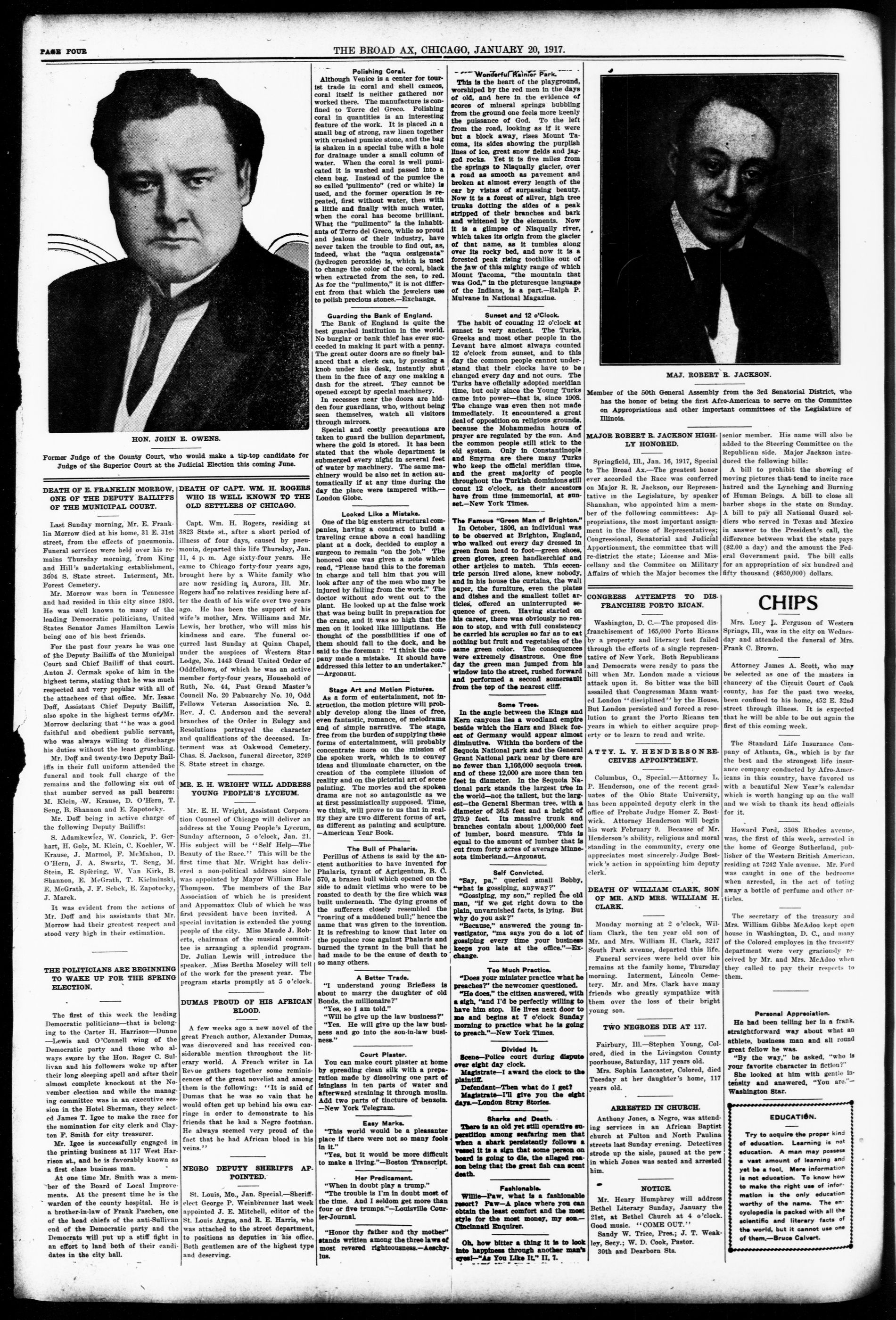
HON. JOHN E. OWENS.
Former Judge of the County Court, who would make Judge of the Superior Court at the Judicial Elec
Former Judge of the County Court, who would make a tip-top candidate for Judge of the Superior Court at the Judicial Election this coming June.
DEATH OF E. FRANKLIN MORROW,
ONE OF THE DEPUTY BAILIFFS
OF THE MUNICIPAL COURT.
Last Sunday morning, Mr. E. Franklin Morrow died at his home, 31 E. 31st street, from the effects of pneumonia. Funeral services were held over his remains Thursday morning, from King and Hill's undertaking establishment, 3604 S. State street. Interment, Mt. Forest Cemetery. Mr. Morrow was born in Tennessee and had resided in this city since 1893. He was well known to many of the leading Democratic politicians, United States Senator James Hamilton Lewis being one of his best friends.
For the past four years he was one of the Deputy Bailiffs of the Municipal Court and Chief Bailiff of that court. Anton J. Cermak spoke of him in the highest states, stating that he was much respected and very popular with all of the attachees of that office. Mr. Isaac Doff, Assistant Chief Deputy Bailiff, also spoke in the highest terms of Mr. Morrow declaring that "he was a good faithful and obedient public servant, who was always willing to discharge his duties without the least grumbling. Mr. Doff and twenty-two Deputy Bailiffs in their full uniform attended the funeral and took full charge of the remains and the following six out of that number served as pall bearers: M. Klein, W. Krause, D. O'Hern, T. Seng, B. Shannon and E. Zapotocky. Mr. Doff being in active charge of the following Deputy Bailiffs:
S. Adamkewicz, W. Conrick, P. Gerhart, H. Golz, M. Klein, C. Koehler, W. Krause, J. Marmol, F. McMahon, D. O'Hern, J. A. Swartz, T. Seng, M. Stein, E. Spiering, W. Van Kirk, B. Shannon, E. McGrath, T. Kielminski E. McGrath, J. F. Sebek, E. Zapotocky, J. Marek.
It was evident from the actions of Mr. Doff and his assistants that Mr. Morrow had their greatest respect and stood very high in their estimation.
THE POLITICIANS ARE BEGINNING TO WAKE UP FOR THE SPRING ELECTION.
The first of this week the leading Democratic politicians—that is belonging to the Carter H. Harrison—Dunne—Lewis and O'Connell wing of the Democratic party and those who always swore by the Hon. Roger C. Sullivan and his followers woke up after their long sleeping spell and after their almost complete knockout at the November election and while the managing committee was in an executive session in the Hotel Sherman, they selected James T. Igoe to make the race for the nomination for city clerk and Clayton F. Smith for city treasurer.
Mr. Igoe is successfully engaged in the printing business at 117 West Harrison st., and he is favorably known as a first class business man.
At one time Mr. Smith was a member of the Board of Local Improvements. At the present time he is the warden of the county hospital. He is a brother-in-law of Frank Paschen, one of the head chiefs of the anti-Sullivan end of the Democratic party and the Democrats will put up a stiff fight in an effort to land both of their candidates in the city hall.
PAGE FOUR
DEATH OF CAPT. WM. H. ROGERS
WHO IS WELL KNOWN TO THE
OLD SETTLERS OF CHICAGO.
Capt. Wm. H. Rogers, residing at 3823 State st., after a short period of illness of four days, caused by pneumonia, departed this life Thursday, Jan. 11, 4 p. m. Age sixty-four years. He came to Chicago forty-four years ago, brought here by a White family who are now residing in Aurora, Ill. Mr. Rogers had no relatives residing here after the death of his wife over two years ago. He has been the support of his wife's mother, Mrs. Williams and Mr. Lewis, her brother, who will miss his kindness and care. The funeral occurred last Sunday at Quinn Chapel, under the auspices of Western Star Lodge, No. 1443 Grand United Order of Oddfellows, of which he was an active member forty-four years, Household of Ruth, No. 44, Past Grand Master's Council No. 20 Pabuarchy No. 10, Odd Fellows Veteran Association No. 2. Rev. J. C. Anderson and the several branches of the Order in Eulogy and Resolutions portrayed the character and qualifications of the deceased. Interment was at Oakwood Cemetery, Chas. S. Jackson, funeral director, 3249 S. State street in charge.
MR. E. H. WRIGHT WILL ADDRESS
YOUNG PEOPLE'S LYCEUM.
Mr. E. H. Wright, Assistant Corporation Counsel of Chicago will deliver an address at the Young People's Lyceum, Sunday afternoon, 5 o'clock, Jan. 21. His subject will be "Self Help—The Beauty of the Race." This will be the first time that Mr. Wright has delivered a non-political address since he was appointed by Mayor William Hale Thompson. The members of the Bar Association of which he is president and Appomattox Club of which he was first president have been invited. A special invitation is extended the young people of the city. Miss Maude J. Roberts, chairman of the musical committee is arranging a splendid program. Dr. Julian Lewis will introduce the speaker. Miss Bertha Moseley will tell of the work for the present year. The program starts promptly at 5 o'clock
DUMAS PROUD OF HIS AFRICAN BLOOD.
A few weeks ago a new novel of the great French author, Alexander Dumas, was discovered and has received considerable mention throughout the literary world. A French writer in La Revue gathers together some reminiscences of the great novelist and among them is the following: "It is said of Dumas that he was so vain that he would often get up behind his own carriage in order to demonstrate to his friends that he had a Negro footman. He always seemed very proud of the fact that he had African blood in his veins."
NEGRO DEPUTY SHERIFFS AP.
POINTED.
St. Louis, Mo., Jan. Special—Sheriff-elect George P. Weinbrenner last week appointed J. E. Mitchell, editor of the St. Louis Argus, and R. E. Harris, who was attached to the street department, to positions as deputies in his office. Both gentlemen are of the highest type and deserving.
THE BROAD AX. CHICAGO. JANUARY 20, 1917.
Polishing Coral.
Polishing Coral.
Although Venice is a center for tourist trade in coral and shell cameos, coral itself is neither gathered nor worked there. The manufacture is confined to Torre del Greco. Polishing coral in quantities is an interesting feature of the work. It is placed in a small bag of strong, raw linen together with crushed pumice stone, and the bag is shaken in a special tube with a hole for drainage under a small column of water. When the coral is well pumilated it is washed and passed into a clean bag. Instead of the pumice the so called "pulimento" (red or white) is used, and the former operation is repeated, first without water, then with a little and finally with much water, when the coral has become brilliant. What the "pulimento" is the inhabitants of Terro del Greco, while so proud and jealous of their industry, have never taken the trouble to find out, as, indeed, what the "aqua ossigenata" (hydrogen peroxide) is, which is used to change the color of the coral, black when extracted from the sea, to red. As for the "pulimento," it is not different from that which the jewelers use to polish precious stones—Exchange.
Guarding the Bank of England.
The Bank of England is quite the best guarded institution in the world. No burglar or bank thief has ever succeeded in making it part with a penny. The great outer doors are so finely balanced that a clerk can, by pressing a knob under his desk, instantly shut them in the face of any one making a dash for the street. They cannot be opened except by special machinery. In recesses near the doors are hidden four guardians, who, without being seen themselves, watch all visitors through mirrors. Special and costly precautions are taken to guard the bullion department, where the gold is stored. It has been stated that the whole department is submerged every night in several feet of water by machinery. The same machinery would be also set in action automatically if at any time during the day the place were tampered with.—London Globe.
Looked Like a Mistake.
One of the big eastern structural companies, having a contract to build a traveling crane above a coal handling plant at a dock, decided to employ a surgeon to remain "on the job." The honored one was given a note which read, "Please hand this to the foreman in charge and tell him that you will look after any of the men who may be injured by falling from the work." The doctor without ado went out to the plant. He looked up at the false work that was being built in preparation for the crane, and it was so high that the men on it looked like illiputians. He thought of the possibilities if one of them should fall to the dock, and he said to the foreman: "I think the company made a mistake. It should have addressed this letter to an undertaker." —Argonaut.
Stage Art and Motion Pictures
As a form of entertainment, not instruction, the motion picture will probably develop along the lines of free, even fantastic, romance, of melodrama and of simple narrative. The stage, free from the burden of supplying these forms of entertainment, will probably concentrate more on the mission of the spoken work, which is to convey ideas and illuminate character, on the creation of the complete illusion of reality and on the pictorial art of scene painting. The movies and the spoken drama are not so antagonistic as we at first pessimistically supposed. Time, we think, will prove to us that in reality they are two different forms of art, as different as painting and sculpture. -American Year Book.
The Bull of Phalaris.
Perillus of Athens is said by the ancient authorities to have invented for Phalaris, tyrant of Agrigentum, B. C. 570, a brazen bull which opened on the side to admit victims who were to be roasted to death by the fire which was built underneath. The dying groans of the sufferers closely resembled the "roaring of a maddened bull;" hence the name that was given to the invention. It is refreshing to know that later on the populace rose against Phalaris and burned the tyrant in the bull that he had made to be the cause of death to so many others.
A. Better Trade.
"I understand young Briefless is about to marry the daughter of old Bonds, the millionaire?"
"Yes, so I am told."
"Will he give up the law business?"
"Yes. He will give up the law business and go into the son-in-law business."
Court Plaster.
You can make court plaster at home by spreading clean silk with a preparation made by dissolving one part of isinglass in ten parts of water and afterward straining it through muslin. Add two parts of tincture of benzoin.—New York Telegram.
Easy Marks.
"This world would be a pleasanter place if there were not so many fools in it."
"Yes, but it would be more difficult to make a living."—Boston Transcript.
Her Predicament.
"When in doubt play a trump."
"The trouble is I'm in doubt most of the time. And I seldom get more than four or five trumps."—Louisville Courier-Journal.
"Honor thy father and thy mother" stands written among the three laws of most revered righteousness.—Aeschylus.
Wonderful Hainier Park. This is the heart of the playground, worshiped by the red men in the days of old, and here in the evidence of scores of mineral springs bubbling from the ground one feels more keenly the puissance of God. To the left from the road, looking as if it were but a block away, rises Mount Tacoma, its sides showing the purplish lines of ice, great snow fields and jagged rocks. Yet it is five miles from the springs to Nisqually glacier, over a road as smooth as pavement and broken at almost every length of the car by vistas of surpassing beauty. Now it is a forest of silver, high tree trunks dotting the sides of a peak stripped of their branches and bark and whitened by the elements. Now it is a glimpse of Nisqually river, which takes its origin from the glacier of that name, as it tumbles along over its rocky bed, and now it is a forested peak rising toothlike out of the jaw of this mighty range of which Mount Tacoma, "the mountain that was God," in the picturesque language of the Indians, is a part.-Ralph P. Mulvane in National Magazine.
Sunset and 12 o'Clock
The habit of counting 12 o'clock at sunset is very ancient. The Turks, Greeks and most other people in the Levant have almost always counted 12 o'clock from sunset, and to this day the common people cannot understand that their clocks have to be changed every day and not ours. The Turks have officially adopted meridian time, but only since the Young Turks came into power—that is, since 1908. The change was even then not made immediately. It encountered a great deal of opposition on religious grounds, because the Mohammedan hours of prayer are regulated by the sun. And the common people still stick to the old system. Only in Constantinople and Smyrna are there many Turks who keep the official meridian time, and the great majority of people throughout the Turkish dominions still count 12 o'clock, as their ancestors have from time immemorial, at sunset—New York Times.
The Famous "Green Man of Brighton." In October, 1806, an individual was to be observed at Brighton, England, who walked out every day dressed in green from head to foot—green shoes, green gloves, green handkerchief and other articles to match. This eccentric person lived alone, knew nobody, and in his house the curtains, the wall paper, the furniture, even the plates and dishes and the smallest toilet articles, offered an uninterrupted sequence of green. Having started on his career, there was obviously no reason to stop, and with full consistency he carried his scruples so far as to eat nothing but fruit and vegetables of the same green color. The consequences were extremely disastrous. One fine day the green man jumped from his window into the street, rushed forward and performed a second somersault from the top of the nearest cliff.
Some Trees.
In the angle between the Kings and Kern canyons lies a woodland empire beside which the Harz and Black forest of Germany would appear almost diminutive. Within the borders of the Sequoia National park and the General Grant National park near by there are no fewer than 1,166,000 sequoia trees, and of these 12,000 are more than ten feet in diameter. In the Sequoia National park stands the largest tree in the world—not the tallest, but the largest—the General Sherman tree, with a diameter of 36.5 feet and a height of 279.9 feet. Its massive trunk and branches contain about 1,000,000 feet of lumber, board measure. This is equal to the amount of lumber that is cut from forty acres of average Minnesota timberland—Argonaut.
Self Convicted
"Say, pa," querled small Bobby,
"what is gossiping, anyway?"
"Gossiping, my son," replied the old man, "if we get right down to the plain, unvarnished facts, is lying. But why do you ask?"
"Because," answered the young investigator, "ma says you do a lot of gossiping every time your business keeps you late at the office."—Exchange.
Too Much Practice
"Does your minister practice what he preaches?" the newcomer questioned.
"He does," the citizen answered, with a sigh, "and I'd be perfectly willing to have him stop. He lives next door to me and begins at 7 o'clock Sunday morning to practice what he is going to preach."—New York Times.
Divided It.
Scene—Police court during dispute ever eight day clock.
Magistrate—I award the clock to the plaintiff.
Defendant—Then what do I get?
Magistrate—I'll give you the eight days.—London Stray Stories.
Sharks and Death:
There is an old yet still operative superstition among seafaring men that when a shark persistently follows a vessel it is a sign that some person on board is going to die, the alleged reason being that the great fish can scent death.
Fashionable
Willie—Paw, what is a fashionable resort? Paw—A place where you can obtain the least comfort and the most style for the most money, my son.—Cincinnati Enquirer.
Oh, how bitter a thing it is to look into happiness through another man's eyes!—"As You Like It," II, 7.
J.
MAJ. ROBERT R. JACKSON
Member of the 50th General Assembly from the 3rd has the honor of being the first Afro-American to on Appropriations and other important committee Illinois.
Member of the 50th General Assembly from the 3rd Senatorial District, who has the honor of being the first Afro-American to serve on the Committee on Appropriations and other important committees of the Legislature of Illinois.
MAJOR ROBERT R. JACKSON HIGH
LY HONORED.
Springfield, Ill., Jan. 16, 1917, Special to The Broad Ax.-The greatest honor ever accorded the Race was conferred on Major R. R. Jackson, our Representative in the Legislature, by speaker Shanahan, who appointed him a member of the following committees: Appropriations, the most important assignment in the House of Representatives; Congressional, Senatorial and Judicial Apportionment, the committee that will re-district the state; License and Miscellany and the Committee on Military Affairs of which the Major becomes the
CONGRESS ATTEMPTS TO DIS
FRANCHISE PORTO RICAN.
Washington, D. C.—The proposed disfranchisement of 165,000 Porto Ricans by a property and literacy test failed through the efforts of a single representative of New York. Both Republicans and Democrats were ready to pass the bill when Mr. London made a vicious attack upon it. So bitter was the bill assailed that Congressman Mann wanted London "disciplined" by the House. But London persisted and forced a resolution to grant the Porto Ricans ten years in which to either acquire property or to learn to read and write.
ATTY. L. Y. HENDERSON RE
CRIVES APPOINTMENT.
Columbus, O., Special.—Attorney L. P. Henderson, one of the recent graduates of the Ohio State University, has been appointed deputy clerk in the office of Probate Judge Homer Z. Bostwick. Attorney Henderson will begin his work February 9. Because of Mr. Henderson's ability, religious and moral standing in the community, every one appreciates most sincerely. Judge Bostwick's action in appointing him deputy clerk.
DEATH OF WILLIAM CLARK, SON OF MER. AND MRS. WILLIAM H. CLARK.
Monday morning at 2 o'clock, William Clark, the ten year old son of Mr. and Mrs. William H. Clark, 3217 South Park avenue, departed this life. Funeral services were held over his remains at the family home, Thursday morning. Interment, Lincoln Cemetery. Mr. and Mrs. Clark have many friends who greatly sympathize with them over the loss of their bright young son.
TWO NEGROES DIE AT 117.
Fairbury, Ill.—Stephen Young, Colored, died in the Livingston County poorhouse, Saturday, 117 years old. Mrs. Sophia Lancaster, Colored, died Tuesday at her daughter's home, 117 years old.
ABRESTED IN CHURCH
Anthony Jones, a Negro, was attending services in an African Baptist church at Fulton and North Paulina streets last Sunday evening. Detectives strode up the aisle, paused at the pew in which Jones was seated and arrested him.
Mr. Henry Humphrey will address Bethel Literary Sunday, January the 21st, at Bethel Church at 4 o'clock. Good music. "COME OUT." Sandy W. Trice, Pres.; J. T. Weakley, Seey.; W. D. Cook, Pastor. 30th and Dearborn Sts.
NOTICE
from the 3rd Senatorial District, who pro-American to serve on the Committee tant committees of the Legislature of senior member. His name will also be added to the Steering Committee on the Republican side. Major Jackson introduced the following bills:
A bill to prohibit the showing of moving pictures that tend to incite race hatred and the Lynching and Burning of Human Beings. A bill to close all barber shops in the state on Sundays. A bill to pay all National Guard soldiers who served in Texas and Mexico in answer to the President's call, the difference between what the state pays ($2.00 a day) and the amount the Federal Government paid. The bill calls for an appropriation of six hundred and fifty thousand ($650,000) dollars.
Mrs. Lucy L. Ferguson of Western Springs, Ill., was in the city on Wednesday and attended the funeral of Mrs. Frank C. Brown.
Attorney James A. Scott, who may be selected as one of the masters in chancery of the Circuit Court of Cook county, has for the past two weeks, been confined to his home, 452 E. 32nd street through illness. It is expected that he will be able to be out again the first of this coming week.
The Standard Life Insurance Company of Atlanta, Ga., which is by far the best and the strongest life insurance company conducted by Afro-Americans in this country, have favored us with a beautiful New Year's calendar which is worth hanging up on the wall and we wish to thank its head officials for it.
Howard Ford, 3508 Rhodes avenue, was, the first of this week, arrested in the home of George Sutherland, publisher of the Western British American, residing at 7242 Yale avenue. Mr. Ford was caught in one of the bedrooms when arrested, in the act of toting away a bottle of perfume and other articles.
The secretary of the treasury and Mrs. William Gibbs McAdoo kept open house in Washington, D. C., and many of the Colored employees in the treasury department were very graciously received by Mr. and Mrs. McAdoo when they called to pay their respects to them.
He had been telling her in a frank, straightforward way about what an athlete, business man and all round great fellow he was.
"By the way," he asked, "who is your favorite character in fiction?" She looked at him with gentle intensity and answered, "You are."—Washington Star.
Try to acquire the proper kind of education. Learning is not education. A man may possess a vast amount of learning and yet be a fool. Mere information is not education. To know how to make the right use of information is the only education worthy of the name. The encyclopedia is packed with all the scientific and literary facts of the world, but it cannot use one of them.—Bruce Calvert.
CHIPS
CHIPS
Personal Appreciation.
EDUCATION.
72
ALDERMAN JOSEPH HIGGINS SMITH.
• One of the popular city fathers of the City Council who is proving himself to be the best Alderman that has ever sat in that body from the 14th ward.
FIND INDIAN RELICS.
Members of a New Historical Association Get a Load of Them.
Klamath Falls, Cal.—Loaded down with newly found Indian relics, including pipes, stone war hammers, dishes, grinders, seventy-five arrow heads, ten spear heads, several knives, eleven mortars and more than 100 pestles, J. C. Rutenic, A. C. Yaden, Floyd Brandenburg and George Snyder, members of the recently organized Klamath Historical association, returned recently from a ten days' research expedition through the lava beds.
These beds, lying just across the California line in Modoc county, were the seat of the Modoc Indian war and have furnished many valuable relics during the last few years.
Most of those found on the present trip were gathered along the receding shore of Tule lake, which is being drained at the hands of the United States reclamation service by diverting Lost river, which formerly flowed into it.
ATTACKED BY PET BUCK.
Hatchery Superintendent and Wife Set Upon While Feeding Pet Deer.
Auburn, Me.-John F. Stanley, seventy-six, superintendent of the Maine fish hatchery grounds, and his wife, seventy-one, were nearly killed by a pet buck which suddenly became enraged. Stanley was feeding the animal, which charged on him, breaking several ribs and cutting and bruising him. Mrs. Stanley was awakened by the noise and, clad only in her nightgown, rushed to the enclosure to alld her husband. The buck charged her, too, and would have killed her but for a collie, which set upon the deer and drove him away.
Mrs. Stanley crawled to the telephone, gave the alarm and then fainted. Her husband was found half submerged in a brook and helpless. The buck was killed by order of the state authorities.
PAN-AMERICAN SCHOOL PLAN
Argentina's Envoy Suggests Interchange of Letters by Pupila.
Washington.—Plans for establishing a system of correspondence between the high schools of Argentina and the United States were discussed at a conference between Ambassador Naon of Argentina and a representative of the Washington bureau of the American Peace society.
"I have already dispatched to one of the Buenos Aires schools letters written by students of the Proctor academy of Andover, N. H." said the ambassador.
"In due time I shall receive from the principal of the Argentine school a long letter written by the students there, which will be translated and sent on Toandover. Thus the plan may be considered to be definitely under way."
CAT'S BITE CAUSES DEATH.
Brooklyn Pier Watchman Is Stricken With Hydrophobia.
New York--Hans Jurgensen, fifty years old, of Brooklyn, a watchman on pier 83. Atlantic docks, died in the Long Island College hospital of hydrophobia caused by the bite of his pet cat. Jurgensen's hand, which was bitten, gave him a little trouble during the first six weeks following the bite, but it was only a few days ago that the hand and arm began to swell. Dr. William M. Ennis of 81 First place, Brooklyn, who was called in, diagnosed it as hydrophobia and caused Jurgensen's removal to the Long Island College hospital, where the diagnosis was verified by physicians from the department of health before his death.
City Council who is proving himself to at in that body from the 14th ward.
Boumanian Peasant Diversions.
"Many hands make light work" is a proverb of the Roumanian peasant often put into practice. Almost every night there is a neighborhood gathering like the old fashioned apple cutting or apple butter boiling in early American rural history. The houses have their turns at these parties, and there is always a kettle of cornmeal mush and baked pumpkin and potatoes and popcorn ready for the occasion. All hands join in the evening program of combing, carding and spinning the household supply of wool or flax, while the neighborhood gossip passes current among the elders and occasional words of love or childish jest among the more youthful members of the party.—National Geographic Magazine.
Donkeys Are Haiti's Food Trains. Nearly all the produce for the feeding of the population of Port au Prince, Haiti, a city of some 60,000 people, is brought in on the backs of donkeys. The public squares are converted into open air market places, and here the buying and selling goes on from early morning until 4 or 5 o'clock in the afternoon, when the caravans begin their toilome journey homeward. Situated in a region famous for its fine fish, among them the delectable and plentiful "red snapper," the Haitians eat quantities of salt cod imported from Massachusetts waters. And the quality of this imported staple is such as would not find favor in American markets. — National Geographic Magazine.
First "Outsiders"
Until the nomination of Franklin Pierce for the presidency of the United States the word "outsider" was unknown. The committee on credentials came in to make its report and could not get into the hall because of the crowd of people who were not members of the convention. The chairman of the convention asked if the chairman of the committee was ready to report, and the chairman answered, "Yes, Mr. Chairman, but the committee is unable to get inside on account of the crowd and the pressure of the outsiders." The newspaper reporters took up the word and used it.
"You druggists have to stand for a good many jokes."
"Yes."
"A drug store is sometimes facetiously alluded to as a pillory."
"About right, too," said the druggist. "Keeps you penned up most of the time."-Louisville Courier-Journal.
Irate Gentleman (to his gardener)—What do you mean, sir, by telling people in the village that I'm a stingy master? Gardener—No fear o' me a-doin' the likes o' that, guv'nor. I allus keeps my thoughts to myself.—London Punch.
"Do you think you can turn the baser metals into gold?" Undoubtedly—if you can guess which way the steel market is going." Washington Star.
Stella—When you are engaged you tell him that he must economize. Bella—And after you are married he tells you that you must—Puck.
"Jack got through college in three yean."
"What of it? I got through in one."
-Harvard Lampoon.
It is better to find excuses for others than for ourselves.
Pilloried
Reassuring.
Transmutation.
Turn About.
Finished.
THE BROAD AX, CHICAGO, JANUARY 20, 1917
Charles E. Stump, After Visiting the Potato King James G. Grove of Edwardsville, Kansas, Resumes His Travels Through Oklahoma and Other Sections of the Southwest
Nowata, Okla.—There is lots of pleasure in getting away from the farm and going around over the country to see what is going on and how it is going on, but you will find me dropping back to the farm every day or so, and to me this is much pleasure and joy.
Since writing to you last I have been in Kansas, but you will see that I am out—in fact my last letter was from Kansas. I had the pleasure of going to several points in the state. I have been to the farm of our best potato planter. I am sure that you have heard of J. G. Grove, the man who has become wealthy in the potato business, and it is because he knows how to put potatoes in the ground and then how to get them out, and then he has been blessed with a family of his own to help him do this potato act.
I have been to see him several times, and the Lord knows that I have tried hard to make good, and if I have failed it has not been because I failed to try. It was in company with Mrs. Norine Davis, and Mrs. James Adams, of Kansas City that I made the trip to Edwardsville, Kans. Getting off at Grove's station, the first thing to attract your attention is that fine red brick mansion, standing on a hill. It was there where Mr. Grove and his family spend their idle time, for that to them is home, and it is a home I am here to tell you. I was so delighted to look into this mansion.
It is a house two stories high, made of some kind of fine brick. On the first floor is his parlor, library, sitting room, dining room, kitchen, and a large basement, but it is full of potatoes and coal for the winter use. On the second floor are the bed rooms, and on the top floor, is a place for his children. This would make it three stories rather than two, for there is a winter play-house for his children, while they have a regular play-house, a regular park for them—in fact everything to make a home life is to be found. I take pleasure in telling you about this wonderful man, and his nearly 2,500 acres of land. He is doing his work and is doing it well and at the same time he is getting ready to help his people. He is putting good men into good homes, and making it possible for them to pay for their homes. I consider this helping humanity.
He has a brother out there with some good property. Well plenty to be found, and at night I had the pleasure of meeting the people of the community. We are making great headway in this country. Mr. Grove was in Kansas City, serving his county and state on the jury, but his wife and daughters and sons received the party and made it pleasant for us until he got home. We farmers can well understand each other. Spending the day there, I returned to Kansas City, and next day had the pleasure of talking to the people at the Metropolitan Baptist church, Rev. D. A. Holmes, pastor. The same was true of the next afternoon, for I was called upon to address the women there, and it was some source of pleasure to talk to these women.
Mrs. Willa Dwiggins, presided over the meeting, and made a big speech introducing me. She is one of the most introducingest women in the country, and when she was through those people all knew me and there was not much left for me to say or do. Well I had a short say at any rate. It was one of the meetings you read about, although I did not read anything about it.
All the Difference
A resident of a metropolis on the Pacific coast had occasion to fill a sunken place in the lawn of his country home. Desiring expert advice before undertaking the venture, he looked up a friend of his who did a good deal of contract work in excavating and grading lines for the municipality. "Say, Reilly," he inquired, "about how much would it cost to fill a hollow of such and such dimensions with stone?"
"Is it for you or is it for the city?" asked Reilly.—Saturday Evening Post
Next found me getting around meeting friends. I met and talked with them, and then left there for other parts of Kansas, going first to the city of Hutchinson. Passing through Wichita, found the Rev. W. Sampson Brooks right at the stable waiting for me, to greet me and shake my hands, and say that he had heard that I was going to pass through and wanted me to stop by and take dinner with him when I returned. His invitation was accepted. He assured me that his wife would be delighted to have me. He is blessed with a good wife. Mrs. Brooks is one of the finest women in this country. I was delighted to have the pleasure of seeing her.
It was a pleasure to be in that city and look around. Rev. S. B. Butler had gone to Topeka to take part in a meeting there and help to save sinners. They had given a fine banquet to Rev. E. T. Fishback, and other things had happened. But I must not forget to tell you that I went to Salina, Kans., and there I had some time. Reaching the city I was met by one of the busiest men in the town, W. W. Shobe, and teted in his fine automobile over to a meeting, or a conference with the representative who was about to be off for Topeka to make laws. They came there to have an understanding and get his position on some of the measures that were to come up. He was frank and told them that he was a Quaker and believed in human rights and for his life he would not do anything to encourage them, but stood ready to help them in their efforts to climb.
Sunday morning I was in Sunday school right on time, being toted in the automobile, and spoke at 11 o'clock. I accepted an invitation to speak for the Y. M. C. A., which brought together 150 White men, and they served lunch and then had me to talk to them. It was as I thought, a man talking to men, and while I spoke to them they listened to me and invited me to come again. I spoke to men of our race at 4 o'clock, Y. M. C. A., at 5:15, women at 6 o'clock and at 8 o'clock spoke at the church. This was speaking 6 times in one Sunday, and that is certainly going some. I spent only Sunday there and left Monday morning for this place via Wichita, taking that dinner with Dr. Brooks, supper with Miss Gertrude M. Owen, talked with Lawyer E. P. Blakemore, one great man; he was sick, went around a little with Dr. Brooks and visited the school over which Prof. Barnett presides. Went out to another school, talked with Dr. G. G. Brown, the man who retired from the presidency of that Interstate Literary, and who is some doctor as well as some educator.
Off for Nowata, and it was a nice ride. I am here visiting that interesting school I told you about in my last letter or one a long time ago. I was the guest of Misses Booker and Ellis, spoke at the church. Took breakfast at the home of Mr. and Mrs. Joseph Daniels, dinner at Mrs. R. H. White, and supper with Mrs. Homer Flakes, that fine housekeeper. I got to see much of this place, and I am now ready to leave. I will not be able to say all I want to say about Prof. Hughes and his teachers. I visited the department of science or something like that where cooking, sewing and all those kind of things are taught to a queen's taste.
But now I must bring this letter to a stop for this time. I will write to you again.
Velocity of Raindrops
Of course we all know that it would be an utter impossibility for storm clouds to form and rain to fall were it not for the miles of atmosphere that rises above our heads. But, supposing it were possible for human beings to exist in an atmosphere that only rose to a level with their mouths and that storm clouds could form in the region outside such a low grade atmosphere, then every raindrop would prove as fatal to earthly creatures as if it were a steel bullet fired from a dynamite gun—London Nature.
Talks on
Talks on
HEALTH,
CLEANLINESS,
PROPER LIVING,
SANITATION, ETC.
Dr. W. A. Driver
3300 So. State Street
Phone Douglas 3617
AUTOINTOXICATION
The symptom complex called auto intoxication is the one central point of agreement of all schools of medicine. By autointoxication is meant any disease manifestation which can be traced to the alimentary canal as a first physical cause. It is obviously admitted that there must be a first mental cause; but we are inclined to relegate to the rear the primary causes when they are not physical. Nevertheless the real causes of physical ills originate somewhere and we are compelled to admit that defective thought is the real first cause of all disease.
What enters the gastrointestinal tract is the result of thought. What enters the mouth defies the body or acts otherwise. The alimentary canal has a double duty; it furnishes a tube from which the nourishment of every cell in the body is accomplished and by the same tube the drainage scheme is largely carried on. Most of the diseases of the body can be traced to improper food and drink or to some toxic agent entering the mouth, the portal of the alimentary tract.
Many diseases, due to autoinfection (also called autointoxication and alimentary toxemia) are extensive and important, although apparently far away from any connection with the
Well Preserved, Though Found Far Below Surface of the Ground.
Cottonwood Falls, Kan.—A big tooth which is supposed to have come from the jaw of some mastodon of prehistoric ages, has been unearthed by T. E. Nichols of this city by men employed in making a deep cut on Diamond creek, a mile and a half northeast of Elmldale. The trench had been sunk to a depth of fifty-three feet and had passed through an eight foot gravel strata when the big tooth was found. A soapstone formation was encountered just beneath it.
The tooth is well preserved. It weighs over three pounds, measures a foot and three inches in circumference around its base and is three inches in height from its base to the points of the tooth. It is oblong in shape, its width being three and a half inches. There are six flanges or points to the tooth, which extend upward in regular pairs. The tooth has two large roots, there being about three or four inches of the root intact, but the lower parts are broken off. It is believed the tooth belonged to a carnivorous, or flesh eating, animal because of the flanges or sharp points.
After finding the tooth another bone only a few feet away was uncovered by another workman. It is a large flat, round shaped bone, which resembles a kneecap.
FAITHFUL DOG'S BARKING CALLS FATHER TO CHILD
FAITHFUL DOG'S BARKING CALLS FATHER TO CHILD
Little One, Playing In Pasture, Where It Strayed, Kicked by Horses.
Wheatland, Wyo.—G. F. Harold's little son, Alvin, two and a half years old, was kicked in the head by a horse the other day, his skull was fractured and other severe wounds, seemingly sufficient to cause death, were sustained.
The father's attention was called to the child by the frantic barking of the farm dog, and upon investigating he found that the dog was guarding the insensible form of the little boy from a bunch of horses in the pasture where the little fellow had wandered in his play.
The child's forehead was crushed, the nose broken and the eye laid open by the flesh being all torn from it. As he was still alive he was rushed to a hospital with all possible speed. The surgeon performed a very delicate operation, lifting the broken bones into position and sewing the torn skin around the eye back into place, and at present writing the little fellow is getting along nicely and gives promise of complete recovery.
That he was not instantly killed is probably due to the fact that the horse's hoof struck a glanding blow, and that he lives at all is because there was a skillful surgeon available.
PAGE FIVE
A. E.
gastrointestinal tract. Constipation is one of the most commonly known manifestations of autointoxication; it is not a disease but a symptom of the most important autointoxication.
Alimentary poisoning from improper food is widespread; the symptoms are from mild to severe and are often so late in appearing that they are not associated with the dietary folly. The vicious cycle is begun in deficient thinking, and ends with different failures of health, called by various names which befuddles the thoughtless.
Meat from the carcasses of slaughtered animals is responsible for most of the food-autointoxications.
The panacea for all toxemias is prophylaxis or prevention. It is possible to find the proper honest dietary; there must be an aseptic dietary or an antitoxic dietary. The London Society has widened the symmetrical theory which is the basis of vegetarianism (neo-vegetarianism). It is in harmony with universal law that health, happiness and life are normal, that disease, misery and death are abnormal and that man has the power to choose the normal by obedience to the law of nature and that vegetarianism is coincident with obedience to natural law. Animal products, milk, eggs, butter, cheese and vegetable foods contain in assimilable form all the chemical elements for perfect nutrition.
New York.—An unprecedented demand for small coins—quarters, dimes, nickels and cents—a demand that is daily straining the resources of the United States treasury department, brought F. H. J. Van Engelken, director of the mint, to New York to see if something could be done to relieve the scarcity. He met officials of all mints here for a conference to devise ways and means of turning out enough small coins to meet the demand.
At the conference were T. W. H. Shanahan, superintendent of the San Francisco mint; Thomas W. Annear, superintendent of the Denver mint; E. D. Hawkins, chief clerk of the San Francisco mint, and Vernon Boyle, superintendent of the New York assay office.
"We never before have been confronted by such an emergency," said Mr. Van Engelken, "and I doubt that we will be able to materially increase the production. Our two large mints now are working twenty-four hours a day, while the smallest is on a sixteen hour shift. They are all at maximum capacity, and their energies are being concentrated on the coins of which we are so short.
"Our idea in holding the conference was to discuss the operation of the mints, probably adopting at all of them suggestions that have proved of benefit in one mint. We are now at capacity. Therefore by the team work which we believe this conference will produce we expect to be able to speed up our production of small coins. The problem is growing more perplexing every day."
"What is the reason for the shortage in small coins?" the director of the mint was asked.
"There is only one answer," he said.
"The people among whom the small coins circulate have more of them than ever before. It is the result of the tremendous prosperity that is getting down to the people who use coins of small denominations.
"I talked recently with the head of the engraving department in Washington. He tells me there is a similar tremendous demand for the dollar and two dollar bills and that this demand is increasing as the holiday season approaches. None of them is returned. They are worn out. Bankers say they are having great difficulty in meeting the demand."
DANCED OFF DIET GAINS.
Net Loss of One and a Half Pounds in Chicago Squad Due to a Ball.
Chicago. — Dancing and dieting are not in harmony.
The "weighing in" figures of the "diet squad," which demonstrated that 40 cents' worth of food a day is enough for the average individual showed a loss of seventeen and a half pounds when compared with figures of the day before. The answer seems to be that most of them attended the annual dance of the health department.
Only two members of the squad showed a gain. Each gained half a pound. Comparing weights with those taken when the test started, seven members gained ten and a half pounds, but the other five members lost twelve pounds—net loss a pound and a half, and all because of the dance.
PAUG OLA
THE BROAD AX
Published Weekly
In this city since July 18th, 1899, without missing one single issue, Republicans, Democrat, Catholics, Protestants, single Taxers, Priests, infidels or anyone else can have their say as long as their language is proper and responsibility is fixed.
The Broad Ax is a newspaper whose platform is broad enough for all, ever claiming the editorial right to speak its own mind.
Local communications will receive attention. Write only on one side of the paper.
Subscriptions must be paid in advance.
One Year.....$2.00
Six Months.....1.00
Advertising rates made known on application.
Address all communications to
THE BROAD AX
6418 Champlain Ave., Chicago, Ill.
PHONE WENTWORTH 2507
JULIUS P. TAYLOR, Editor and Publisher.
Entered as Second-Class Matter Aug
19, 1902, at the Post Office at Chicago
Illinois, under Act of March 3, 1879.
Suffrage In Norway.
Among the most important laws enacted by Norway since women have had the vote are the two maternity insurance laws of 1909 and 1915 and the divorce law of 1910.
"Since the women in Norway have got the vote," says Ella Anker in Jus Suffragil, "they have turned their chief attention to their rights and duties as wives and mothers. Education and economic independence are the basis of woman's freedom, but her greatest work and happiness will be as wife and mother. It is an astonishing fact that in all these centuries, while men have taught us that woman's place is in the home, they have neglected to prepare us for the chief duties of our home life."
Norwegian women have also given particular strength to the work for "rational housekeeping" by the establishment of a state high school for the education of teachers for the elementary housekeeping schools, to a campaign against consumption and to the support of the peace movement.
Eiffel's Tower.
The most famous tower since that of Babel is the Eiffel tower in Paris, a monument to the engineering genius of Gustave Eiffel. The tower of Babel was reared in the hope that it might afford a passage to heaven, but the builders, we are told in Genesis, were folled by their language being confounded.
Gustave Eiffel had no such ambition in rearing the highest edifice the world has ever seen. It is a tower dedicated to science. Its rearing was one of the greatest engineering feats of modern times and was a result of experiments undertaken to prove the greatest limit to which metallic pliers in viaducts could be safely pushed. It is now the world's must celebrated wireless telegraph station.
Eiffel tower is 1,000 feet in height and is constructed of iron lattice work, 7,300 tons of iron being used in its construction. A system of elevators carries visitors to the top.
Uncle Sam's Uniforms
An act of congress, approved March 1, 1911, entitled "An act to protect the dignity and honor of the uniform of the United States," provides "that hereafter no proprietor, manager or employee of a theater or other public place of entertainment or amusement in the District of Columbia or in any territory, the district of Alaska or insular possessions of the United States shall make or cause to be made any discrimination against any person lawfully wearing the uniform of the army, navy, revenue cutter service or marine corps of the United States because of that uniform, and any person making or causing to be made such discrimination shall be guilty of a misdemeanor, punishable by a fine not exceeding $500."
A Curiosity of Sound.
If when riding in a balloon at a height, say, of 2,000 feet a charge of guncotton be fired electrically 100 feet below the car, the report, though really as loud as a cannon, sounds no more than a pistol shot, possibly partly owing to the greater rarity of the air, but chiefly because the sound, having no background to reflect it, simply spends itself in the air. Then, always and under all conditions of atmosphere, there ensues absolute silence until the time for the echo back from earth has fully elapsed, when a deafening outburst of thunder rises from below, rolling on often for more than half a minute.
She Meant Well
The late Sir Wilfrid Lawson, the rigid apostle of temperance, while on a week end visit made the acquaintance of a sharp young lady of seven, to whom on leaving he said: "Now, my dear, we have been talking some time, I am sure you have no idea who I am."
"Oh, yes, I have," the little misy replied. "You are the celebrated drunkard."—London Graphic.
Actively Aid Welfare Plans of Every Description For Employees. PHILANTHROPY NOT INTENT.
Comfort and Contentment of the Workers Considered Paramount. Hundreds of millions of dollars have been expended during the past decade by American manufacturers for those forms of industrial betterment, in behalf of employees, that are generally classed as philanthropic or beyond the mere requirements of laws and contracts.
Decent manufacturers—and they are in the vast majority—as are the decent people of other classes—are opposed to grinding child labor, and they strive to pay a living wage to all of their employees. They go much farther than that, as a study of American industry will show. They devote time, money and effort to provide every possible supplementary means for promoting the convenience, the comfort, the health, contentment and happiness of their workers and of the families of employees. Very few manufacturers consider such work or expenditure to be philanthropy, but, rather, a necessary feature of their business. While their motives may be as altruistic as those of the average of mankind, they find that it is good, from the business point of view, to promote as far as possible the welfare of their employees. Industrial betterment pays.
Industrial betterment means an attempt to provide the best kind of working and living conditions, and it implies the co-operative responsibility of the wage earner and the employer in bringing those conditions about and in improving them from time to time. It is not a dole to be handed to the wage earner, but is a token of that spirit of mutuality which, under right conditions, should permeate industry.
A thorough description of industrial betterment activities in the United States would require more space than is contained in the most voluminous encyclopaedias to be found in the libraries. Indeed, volumes might be written about the welfare work of a single corporation alone—the National Cash Register Company, for instance, or the International Harvester Company, the United States Steel Corporation, Cheney Brothers, the Curtis Publishing Company, the Bethelem Steel Company, the American Telephone and Telegraph Company, the Eastman Kodak Company, any one of the leading railroad companies, the principal banks, Wanamaker's, or any of a host of other concerns which has developed activities of the sort. There is hardly a concern in the country doing business on a fairly extensive scale that has not initiated some form of industrial betterment for its employees. The honors do not go to the larger companies exclusively either, for many of the smaller business units have developed this side of their activities to a remarkable extent. Naturally it is easier for the larger corporations to put highly trained specialists in charge of the various branches of industrial betterment work.
The fundamentals of industrial betterment are observed in furnishing pleasant, sanitary, safe working conditions. Educational and entertainment features, facilities for study and recreation, special opportunities for the exercise of thrift and provisions tending to remove the dread of and to mitigate the sufferings occasioned by sickness, disability or invalidity are matters which next receive attention. Well lighted, well ventilated and otherwise pleasant and safe working places, restaurants, reading rooms and libraries, rest rooms, emergency kits and hospitals, club rooms, assembly rooms, gymnasiums, lockers and bathing facilities, recreation grounds, bonus and profit sharing plans, special housing accommodations, facilities for the purchase of homes on easy payments, discounts in the purchase of goods, industrial and other educational classes, lectures for entertainment or instruction, moving pictures, excursions, field days, medical attendance, safety committees for accident and fire prevention, sickness, disability and invalidity funds, insurance or benefit associations and pensions are some of the customary features of industrial betterment work the variety of which has no limit.
Tens of thousands of lives are saved each year and hundreds of thousands of lesser accidents are prevented annually through the accident prevention campaign and feature of industrial betterment.
The Eastman Kodak Company in five years reduced the accidents in its plants by over 75 per cent per annum through a progressive safety campaign. The Pennsylvania Railroad in ten months decreased the serious injuries of its 33,242 shop employees over 63 per cent by the installation of safety devices and by the constant instruction of the workmen in exercising due caution. As a result of its safety campaign the United States Steel Corporation reduced serious and fatal accidents in its various plants by 46 per cent since 1906. Each year 2,800 of the men employed by the corporation escape who would have been injured under the previous conditions.
THE BROAD AX. CHICAGO. JANUARY 20. 1917.
GET TOGETHER FOR PERMANENT PROSPERITY.
Every man and woman engaged in American factories, mills and mines, whether they know English or speak it, are naturalized or intend to become citizens, have a direct interest in maintaining industrial prosperity. When times are good, all workers should not only be thrifty in habit and lay up a little something for possible rainy days, but they should do all they can to keep the good times with us. Simply because your language is different from that of the foreman, overseer, superintendent, manager or owner of the plant in which you earn a living, is no excuse for misunderstanding your own common interest in prosperity by hating your partner in your own industry or listening to and following the gospel of dissension and violence which selfish agitators so often preach.
Do not blindly follow the man who tells you how hard your lot is. Often he is doing so untruthfully and for the purpose of getting you to contribute membership money for his own support in idleness. Agitators get rich by preying on the men in American industry, whom they urge into unlawful or harmful acts by misrepresenting conditions or holding out foolish and false promises of better things if they follow their orders. You know conditions yourself, and you know or ought to know that the man or men whom the agitator who pictures your employer as on inhuman driving machine is actually a partner with you, interested in having the plant or industry successful.
The more successful your plant or industry becomes, the more room for you to grow with it there will be. It should be your feeling, then, that you will not do as little as you may find it convenient to do, but to do just as much as you possibly can do, and then reasonably expect to share in the rewards that always come to the efficient worker.
Do not be a clock watcher in the factory. Those who wait for hours to strike or whistles to blow and "soldier" at the bench, machine or in the office, never get ahead in the ranks of industry. They never get any more pay because they are not worth any more, and often are worth less than they get. Remember the old adage that a man who never does any more or as much as he gets paid for, never gets paid for any more than he does.—Industrial Conservation, N. Y.
PUTTING BUSINESS RIGHT WITH THE PUBLIC
A few years ago some big industrial organizations and certain railroads employed business tactics which, according to the popular idea, would make the financial adventures of Pizarro, Morgan or Captain Kidd look as amateurish as the verbal exploits of Bobby Make-Believe.
All are more or less acquainted with the details. We will concede that there were some glaring abuses, but the public when it came to apply a remedy ignored the fact that these were peculiar to comparatively few institutions and instead of tackling the trouble where it lay furiously assailed everything classifiable as business—the trust magnate, the independent manufacturer ready and anxious to obey the law, the small retailer, a law abiding and useful citizen—the innocent and the guilty suffering alike. Seemingly the law was invoked not to regulate, but to persecute.
There could be but one result. Business was demoralized, and the whole country has felt the evil effects. Now the public is beginning to realize its error and in a rather grudging way is making some concessions.
Business is being permitted to speak for itself, and a movement has been instituted by the leading business men of the country under the title of the National Industrial Conservation Movement for the purpose of repairing the damage that has been done. Nothing revolutionary is contemplated. The plan is simply to educate the public by taking it into the business man's confidence. Meetings will be held in various trade and industrial centers. All classes of citizens will be invited. The purpose of these meetings is to give the public a new and correct viewpoint as to the effects of drastic legislation and restriction of business on the prosperity of the country. Every effort will be made to give the public a clear view of the problems and difficulties which beset business.
Special favors are not sought through these meetings, only fair play. It is believed that once the citizen grasps the situation his whole attitude toward business will change and that he will readily co-operate toward bringing about better conditions. Commercial and other clivc organizations and the local press are already showing great interest in this movement, and it is reasonable to believe that much good will come from it- Industrial Conservation, N. Y.
Common Capitalists
Every man or woman who possesses a dollar or owns a set of tools is a capitalist. People generally make the mistake of thinking that the only form of capital in existence is the national currency—the dollar, franc, ruble, mark, lire or pound sterling. Yet everybody knows that many a successful business man's only original capital was brains, knowledge, ability, determination or ingenuity. It would be well for more people to recognize this truism before abetting, either by action or attitude, ceaseless efforts on the part of some political or either self seekers, to hobble business men and industrial development. Such is the spirit of industrial patriotism which is needed in America.—Industrial Conservation, New York.
One of Nature's Mysteries.
One of Nature's Mysteries. One of the most sudden changes in animal life revealed in geologic history took place about the close of the mesozoic era, or age of reptiles, as it is sometimes popularly called. In mesozoic time the most powerful animals were huge land reptiles, known as dinosaurs, whose bones have been found in abundance in the Rocky mountain region. At or near the end of mesozoic time these great monsters suddenly disappeared from the western country as well as from the remainder of the world. They left no descendants, but in the following age of mammals, or cenozoic era, their places as rulers of the earth were taken by the mammals. The cause of the disappearance of these great reptiles has been a matter of rather fruitless speculation. Any explanation which will be acceptable must also account for the disappearance of a great many forms of animal life and the great modification of most of the others, both on land and in the sea. Some general cause which would bring about changes in climate and other conditions of life seems to be a necessary part of any satisfactory explanation.
Friction Skins
Several theories have been advanced to explain the corrugations of fingers, palms and soles, but the most plausible one is that expressed by the term "friction skins," given by Mrs. Harris H. Wilder. Not only man, but all the monkeys and apes have such ridges on the skin of the grasping part of their hands and feet. And, strangely enough, the American opossum and tree porcupine, the Asian phalangers and South American monkeys have just such corrugations on their tails.
The openings of the ducts of the sweet glans are along the tops of the ides. They supply the slight moisture that is necessary to proper grasping. The Journal of Herculity, in a long study of hand and foot prints, remarks that a man instinctively moistens the palms of his hands when he wishes to grasp securely.
The pattern of finger prints is generally hereditary, but every individual develops his own details.
Tracer Shells.
It is one thing to stop a hostile battery in an artillery duel and another problem altogether to hit it. The locality may be well known, but the range difficult to determine. To simplify matters in this respect "tracer" shells are used. Into the base of the shell a metal case is screwed containing a material which is self igniting as the projectile rushes through space. For night operations the material used in the "tracer" bursts into a brilliant flame, but by day the "tracer" leaves a trail of dense black smoke. By this means the gunners are able to watch and time the shell right up to the moment the explosion takes place, and by knowing the locality in which the shell bursts the adjustment to the range of the target is comparatively a simple matter.-London Mall.
Just an Accident.
Two boys had indulged in a physical encounter on the playground. At the end of the affray they were summoned before the teacher to give an account of their misdeeds. One of them had a bloody nose. The teacher looked upon this sanguinary feature with horror and endeavored to instill in its inflictor certain pacific principles.
"Now, Billy," she said, "I think you ought to apologize to Jimmie."
"Huh! I ain't a gain to apologize for no accident!" Billy answered.
"Accident? Why, Billy, how can you call it an accident? Didn't you intend to hit Jimmie on the nose?"
"No, mom, I didn't. I swung fer his eye an' missed!"—Cleveland Plain Dealer.
Settling a Bill.
When Andrew Jackson lived at Salisbury, N. C., he once attended court at Rockford, then the county seat of Surry, and left without paying his bill, which was duly charged up against him on the hotel register, which seems to have been the hotel ledger at that time, and so stood for many years. When the news of the victory of the 5th of January, 1815, was received in this then remote section the old landlord turned back the leaves of the register, took his pen and wrote under the account against Andrew Jackson, "Settled in full by the battle of New Orleans."
Pills to Prevent Earthquakes.
"I remember," says Addison in the two hundred and fortieth Tatier, "when our whole island was shaken with an earthquake some years ago there was an impudent mountebank who sold pills which, as he told the country people, were 'very good against an earthquake.'"—London Saturday Review.
Head Work.
"Marla, you'll never be able to drive that nail with a flatiron. For heaven's sake, use your head!" admonished Mr. Stubbins. And then he wondered why she would not speak to him the rest of the day.—Puck.
Johnny's Reasoning.
Sunday School Teacher—What is conscience, Tommy? Tommy—An inward monitor. Sunday School Teacher—And what is a monitor, Johnny? Johnny—An ironclad boat—Chicago News.
Their Charges
Lady—I want to sue my husband for divorce. Lawyer—What are your charges? Lady—What are yours first? —Boston Transcript.
Do as well as you can today, and perhaps tomorrow you may be able to do better.—Bv. John Newton.
Penya at a Banquet.
People probably eat more judiciously today than they did when Samuel Pepys wrote the following account of his holiday menu:
"We had a fricasee of rabbits and chickens, a leg of mutton, boiled; three carps in a dish, a great dish of a side of lamb, a dish of roasted pigeons, a dish of four lobsters, three tarts, a lamprey pie—a most rare pie—a dish of anchovies, good wine of several sorts and all things mighty noble, to my great content."
The striking thing about this feast, which was probably a typical one of its day (1603), is that it is composed almost entirely of meat and fish, relieved only by pastry and wine. If there were any vegetables in it Pepys did not consider it necessary to mention them, and it is possible that there were none. Potatoes were hardly known in England at that time, and many other vegetables now considered necessaries were either not known or were rarely used.-San Francisco Bulletin.
Metchnikoff's Dream.
Dr. Elle Metchnikoff, the great Russian medical scientist, who for many years made his home in Paris, was the son of an officer of the Russian guard. He had the figure of a moujik, an abundant, uncultivated beard, long hair and big, dreamy eyes. This savant had much of the simplicity of the visionary. Possessed by the problems of disease and sorrow, he was convinced that all would be for the best if man could recover the primitive purity of his organs. In this paradise which he would restore and that science might realize he held that man should never suffer and that at the end of approximately 160 years he would die with the same ease that one falls asleep in the evening. In the world that Dr. Metchnikoff has left he had explained that the body was a very imperfect machine and that there were 105 organs or remains of organs that were superfluous, useless and even dangerous.—Cri de Paris.
Measuring a Rainfall.
The depth of the sheet of water that would lie on level ground if none of the water were lost by evaporation or soaking into the soil represents the amount of rainfall of a given storm and is measured by a rain gauge. The standard rain gauge of the weather bureau consists of a funnel shaped receiver eight inches in diameter at the top, surmounted by a cylinder of one and one-half inches in height and eight inches in diameter. The funnel is placed in a cylindrical reservoir, 2.53 inches in diameter and twenty inches in height. The area of the cross section of the reservoir is to that of the receiver as one to ten, or one inch of rain falling in the receiver corresponds with ten inches of water in the gauge, being magnified ten times for the convenience and accuracy of measurement.
Ancient Chinese Ingenuity.
We are assured that the taxicab is no new thing, being in its general principles a thing known to the ancient Romans. But now an orientalist goes even further and asserts that mechanical carts capable of registering distances traveled by counting and recording the revolutions of very large cartwheels, connected by cogs with other concentric or eccentric horizontal and perpendicular wheels of proportionate diameters, have been well known to the Chinese for 1,700 or 1,800 years. On the top of the cart was the figure of a man holding a drum, which he beat when one li, a third of a mile, was traveled. Some carts had in addition a figure holding a cymbal, which was struck when the drum had been beaten ten times.
Use of Maps.
A board inspector, having a few minutes to spare after examining the school, put a few questions to the lower form boys on the common objects in the schoolroom.
"What is the use of the map?" he asked, pointing to one stretched across the corner of the room, and half a dozen shrill voices answered in measured articulations:
"Please, sir, it's to hide master's bicycle."—London T-Bits.
Careless Speech:
"I hear the Grabcoin have hired a tutor for young Reginald Grabcoin."
"Yes; but whenever Mr. Grabcoin mentions the new member of the household Mrs. Grabcoin is greatly humiliated."
"Why so?"
"Mr. Grabcoin has a way of pronouncing 'tutor' as if the person referred to did exercises on the trombone, cornet or some other kind of horn." -St. Louis Post-Dispatch.
Limited.
"Do you remember, Tommy," asked the friend of the family, "to love your neighbor as yourself?"
"Always," replied young Thomas, "but then dad is always telling me not to have too good an opinion of myself."—Richmond Times-Dispatch.
How Women Judge
Mrs. Flatbush- Does she judge people by their clothes? Mrs. Bensonhurst- She does if they're hanging out on the line with the wash in the back yard. Yonkers Statesman.
Plain Spoken.
"A plain spoken man, you say," I never saw his equal. Why, there isn't a woman in this town who would ask his opinion of her baby."—Birmingham Age-Herald.
Intellect annuels fate. So far as a man thinks, he is free—Emerson.
Its Backbone Is a Spring.
The snapping bug has a spring in his back like a knife. When not in use as a spring it serves him as a backbone, so you see he is a believer in scientific efficiency and makes one part of his machinery do the work of two. His spring backbone, or backbone spring, if you prefer, gives him power to jump, which in turn gives him his name. Nature probably gave him the spring to help him get on his feet when he's on his back. You've noticed how helpless some insects are when you lay them on their backs. Not this one, however. He slips his backbone out of its groove and then slips it back again suddenly. The spring pops him up in the air; he turns a somersault and drops right side up. Spring backbones are common in several other beetles, remarks the Philadelphia North American. The beetle of the pestiferous wireworm, which destroys the farmer's crops, has a spring in his back. Other members of the family make their homes in trees or decayed wood.
A Good Shot.
The town boaster was in a reminiscent mood and for the benefit of the crowd of young loafers gathered at the village store had been recalling the stirring times on the first election day after the war in the southern town where he had lived.
"Yes-sir-ee, that was a hot time," he concluded. "They was a lot of shoot-in' took place, and I done my share of it, I tell you. Why, fellers. I shot and shot until my old revolver just felt hot to my hands."
Turning to another old man who had come from the same southern town, he said rather condescendingly: "Why, Jim, you must 'a' been there that day. How many times did you shoot?"
Jim spat with deliberation, rolled his eyes reflectively and answered: "Jesst once. I was right in the thick of it when the fight begun, and I shot round the corner and down into a cellar." Youth's Companion.
No Black on Nature's Palette
Nature uses no black in any part of her work. I will not except the blackberry and the so called black pansy. On a bright, clear day shadows on the snow are pale ultramarine blue; under a blue sky in midsummer the color of the placid lake is cobalt blue and the shadows on the grass are lilac; on a weathered gray board walk they are nearly as blue as the sky itself. The palpitating atmosphere of a warm July lifts the coloring of the landscape to a higher but softer key instead of reducing it with gray, and in the autumn, when the sugar maple's leaves are turned to gold, the shadows on the trunk and every gray rock in the vicinity are tinged with strong lilac. In fine, when the sun shines everything, even the shadow, which we are prone to believe is gray, is replete with color.—F. Schuyler Mathews.
Hitting at the Ball.
Jim used to play in 85. His game was fairly good—could putt, approach and cut the ball, was steady with his wood. Then Jim read all the golfer's books, absorbed each written line and found his game was going bad. He played in 89. Kind friends essayed to help Jim out—instructed what to do. He followed all their kindly tips—and played in 92. And then he cut out theories—just practiced day by day, with different clubs a-hitting at the ball where'er it lay. So Jim now finds an 80 is no trick to play at all if he practices plain hitting—just plain "hitting at the ball."—Golfers' Magazine.
The Retort Courteous
James Russell Lowell was once a guest at a banquet in London where he was expected to reply to a toast. The speaker who preceded Mr. Lowell said many contemptuous things about the people of the United States, avowing and repeating again and again that they were all braggarts. As American minister at the court of St. James Lowell could hardly overlook this speech, so as he arose he said smilingly: "I heartily agree with the gentleman who has just spoken. Americans do brag a great deal, and I don't know where they got the habit. Do you?"
Above the Vulgar Gaze
Until 1870 it was against the law and sacred custom for any subject to look at the emperor of Japan. His political advisers and attendants saw only his back. When he first left the palace the shutters of all the houses had to be drawn, and no one was permitted in the streets. Even today, when the emperor has the privilege of driving through the streets like one of his subjects, it is not considered quite proper to cast a glance at him.
A Young Pessimist
First Office Boy—The old man's ste-
nographer just told me she loved me
for myself alone. Do you think she's
kidding? Second Office Boy—No, cer-
tainly not. Probably the old gink is
going to raise your salary to $5 a week
and has told her about it—Boston
Globe.
Useful Attachment
"I wonder how that rough looking fellow with his terrible language keeps his place in a ladies' hairdressing parlor?"
"I think it is because the patrons of the place heard his talk made one's hair curl."-Baltimore American.
Not Tender.
No, Maude, dear; we very much doubt that you could hurt a canaleb by treading on its tows.—Philadelphia Record.
Waste not fresh tears over old grief.
—Euripides.
PRESIDENT'S DAY.
Mr. Wilson's Crowded Schedule Calls For Early Rising.
LIKES GOLF AND BILLIARDS.
Out of Bed at 5 a. m., Bathes and Is In Study Not Later Than 5:30—Always Retires Before 11—Reads Poetry Aloud and Takes Pleasure In Latest Detective Stories.
Washington.—President Wilson has a well defined schedule mapped out for his daily work when in Washington. He sticks to this schedule closely. It calls for his arising at the early hour of 5 o'clock. Then he has his bath and is in his study not later than 5:30 o'clock, says the Louisville Courier-Journal in a recent account of the president's schedule.
Usually the president is met in his study by his stenographer, Charles Swen. Charlie, as he is known about the White House, takes dictation until 8 o'clock, which is the president's breakfast hour. Breakfast over, Mr. Wilson is accustomed to return to his study to continue his morning dictating.
About 9:30 o'clock in the morning the president receives a list of appointments which Secretary Tumulty has made for him at the executive offices. These engagements never begin until
THE GOLFING CLUB
Photo by American Press Association.
THE PRESIDENT AS A GOLFER.
10 o'clock. Few of them are for longer than half an hour. These engagements run up until about 12 o'clock, the president always leaving the office building for the White House for luncheon not later than 1 o'clock.
Usually the president's afternoons have been given over to recreation. Of course the president played golf but a few times during the railroad crisis. He then only did so because Dr. Grayson thought it advisable for him to get a little outdoor exercise. On the motor rides and at the golf matches Mrs. Wilson was always his companion.
The motor trips are usually over by 6 o'clock, so there is ample time to prepare for 7 o'clock dinner. Most of the president's evenings have been devoted to work.
For the last few months there has been a great mystery about the White House. It has to do with one of the means which the president employs to relax from his presidential duties. This form of amusement is nothing more than the popular game of pool, or, speaking in more polite terms, pocket billiards.
When the conditions are normal at the White House the president has two means of relaxation other than playing billiards. He takes great delight in reading poetry aloud. The other form of amusement is the reading of detective stories. He gets the latest books of this sort.
President Wilson does not believe it wise to keep the midnight oil burning. Therefore the hour of 11 o'clock usually finds him in bed. More often it is before 11 o'clock that he retires. This is necessary because of his early risings.
LIFE RACE WITH WOLVES.
Three Trappers Tell of Their Experiences With Pack.
Standish, Mich. — Three trappers, Charles Leonard, George Weston and Bert Parker, reached here the other day from a hunting trip in the Lake Superior region and told of a race for their lives with a wolf pack while returning from their traps. The men were on skates three miles from the nearest cabin when the wolves made their appearance.
One of the trappers fired his rifle when the pack approached them, and the wolves quickly tore one of their wounded members to pieces, giving the hunters time for a start to get ahead of the brutes.
Several times when the wolves were nearly on them this was repeated, the men said, until they finally reached the cabin.
FIND HEART ON RIGHT
SIDE, LIVER ON LEFT
FIND HEART ON RIGHT
SIDE, LIVER ON LEFT
Body of William King Described as Left Handed Both Inside and Out.
St. Louis.—The body of William King, which has been preserved for twenty months, is described by an anatomist as "left handed, both inside and out," according to a statement made public at the City hospital.
In May, 1915, King, who was thirty-five years old, applied at the hospital for treatment. He said he was a laborer and had lived most of his life in Wisconsin. He was suffering from typhoid fever.
When asked who should be notified in case of his death King said: "Don't worry about that. Just cut me up and examine my body. There's something wrong with me besides the fever."
He died a few days later. When surgeons made an examination of the body they found one of the most abnormal cases in the history of surgery. The heart was on the right side, the liver on the left; the appendix was on the left side and the spleen on the right. The stomach was turned around completely. On the left lung were three lobes; the right lung had but two. The left kidney was larger and lower than the right one.
DANCE TO WIRELESS
MUSIC MILES AWAY
Phonograph at High Bridge, N. Y., Heard All Over House at Morristown, N. J.
New York.—What was declared to be the world's first wireless dance was held at 29 Morris avenue, Morristown, N. J., the home of Theodore E. Gaty, vice president of the Fidelity and Casualty Insurance company of this city. His two sons—John P. and Theodore E. Gaty, Jr., the latter home from Cornell for the Christmas holidays—got up a dance and throughout the evening the seven or eight couples who had been invited danced to music that was played on a phonograph in High Bridge, at the northern end of Manhattan, about forty miles away from Morristown by air line.
Mr. Gaty and his sons are enthusiastic amateurs in the science of radio telephony and telegraphy. A friend, P. F. Godley of Montclair, who is a radio engineer, made use of the Lee de Forest audien detector and the sound amplifier invented by Dr. Edwin H. Armstrong of Columbia, the inventions which made transcontinental telephony possible, as well as a wireless telephone message to Honolulu. Mr. Godley, who is only twenty-seven years old, adapted the two devices to amateur use and attached them to a phonograph horn in the Gaty home.
The phonograph that furnished the dance music was played in the High Bridge plant of the De Forest Radio Telephone and Telegraph company, and the musical sound waves were received by the amateur receiver, over Mr. Gaty's house.
When the faint sounds, which, coming from the receiver, could scarcely be detected by the ear, passed through the combined sound amplifiers and then through the megaphone they could be heard all over the house.
FROM MISSOURI TO PANAMA
Bottle Found After Being Six Months Afloat.
Hartville, Mo.—A list of names which a party of Springfield normal school students sealed in a soda pop bottle which was thrown into the James river at Turner, Mo., last June has been returned in a letter received by Miss Opal Pope of this place, one of the young women whose names were on the list.
The letter was written by a member of the crew of the United States ship Raleigh, which reached San Francisco recently after being stationed off the coast of Panama. The writer said he found the bottle on the beach while in Panama.
WILL AID WEARY HORSES.
School Children Plan Farm For Worn-out Dobbinses.
Youngstown, O.-Members of the Junlor Humane society here have contributed the nucleus of a fund which they will raise to rent or buy a rest farm for worked out horses.
It is planned to have the farm for use next summer. Many school children have pledged support to the fund getting project, and senior humane workers expect their little associates will succeed in their plans.
BANK INSURES ASSETS
FOR TWENTY-FOUR HOURS
New York.—A $90,000,000 protective insurance policy for twenty-four hours was purchased by the Chatham and Phoenix National bank to cover the transfer of its assets from 192 Broadway to the new offices of the bank in the Singer building, a distance of about a block and a half. About $16,000,000 in cash was carried to the new quarters in an armored car, with armed guards at the front and rear, and there were guards stationed every fifty feet between the two buildings.
THE BROAD AX, CHICAGO, JANUARY 20, 1917
Children Long Separated by the Civil War Meet.
SEARCH BEGUN BY BROTHER.
Bushwhackers Raided Home, Killed Parents and Drove Children Into Woods—Adopted In Different Homes, Survivors Drifted Apart—Meeting Between Sisters and Brother Pathetic.
Clarinda, Ia.—A tragedy of the civil war which resulted in the separation of three children of a Missouri family was recalled recently by the reunion of the three children who had been separated during the long period, too young at the time to maintain a correspondence, and it was only after much effort and correspondence that the members of the family were enabled to meet and hold a reunion after so long a separation.
Living near Laclede, Mo., was a family named Deer. Bushwhackers raided their home, killed the parents and drove the children into the woods, where they passed a night in terror.
The children were Mary Deer, eight years old; Addie Deer, six years old, and a brother two years old. Upon the girl of eight years devolved the task of keeping the others with her and to valyly try to console them. Speaking of the terrifying incidents of the night, Mary, now Mrs. Mary Rahn of this city, told how the baby boy cried to be taken to his mother.
In the morning the children made their way to Laciede, where they were found nearly dead from exposure and fright and crying bitterly. A man who chanced to run across the children was so filled with pity that he took them in charge, fed them and cared for them for several days until he had succeeded in locating all three in homes, into which they were finally adopted.
Thus torn apart, the children did not again hear from each other. Mary spent her entire girlhood as a nurse girl in a family where there were several children, and from them she managed to learn to read and write. She was taken to Illinois, where she married. Addie Deer was taken with the brother to Crete, Neb., where the girl married and where the boy grew to manhood and where he still resides. Addie married and lost her husband. She was married a second time to a Mr. Downing, owner of a large ranch near Glenwood Springs, Colo. Some time ago the brother began a search for his sisters. It was an apparently hopeless task, but by perseverance, much correspondence and long range inquiry he managed to find them, and all held a reunion at the home of Mrs. Downing in Colorado.
Mrs. Rahn soon after her marriage moved from Illinois to this county. She is now a widow, sixty years of age. The meeting between the sisters and brother was pathetic despite the fact that a separation of over fifty years had obviously tended to break down the feeling of family relationship.
WAR AFFECTS WATER TOO.
No Soda Ash to Soften City's Drinking Supply.
Columbus, O.-Hard water will be the best the filtration plant can furnish consumers the rest of the winter unless something is done to increase the available supply of soda ash, one of the chief chemicals used in the softening process. Superintendent O'Shaughnessy of the Columbus water plant said that soda ash could not be had at any price owing to inability of railroads to furnish adequate transportation facilities; also the Barberont plants, where the city's supply of soda ash is obtained, have been handicapped during the last few weeks because of a shortage of fuel. No soda ash has been used at the filtration plant for several days. Since the war began soda ash has advanced $44 a ton. Water can be softened to a certain degree by lime, but soda ash must be added to get the desired softness.
WAR ON CATS SAVES
Good Hunting In New Jersey Since Feline Slaughter Started.
Trenton, N. J.-A report of the New Jersey fish and game commission recently issued states that the wholesale extermination of cats in Burlington county during the 1915 epidemic of foot and mouth disease has resulted in sportsmen finding Burlington among the best hunting grounds in the state.
Game animals and birds are more plentiful in the county than for years, and scores of hunters have repeatedly bagged their legal limit of ten rabbits; also qualis, pheasants and squirrels. It is held that the chief factor in the increase in game animals and birds as well as song birds in that county was the warfare on cats by both hunters and farmers. Sportsmen found hundreds of prowling homeless cats in the woods and fields preying upon native birds and animals and killed them.
Newspaper on Fig Leaves.
Santa Cruz, Cal.-Because of the high cost of paper and the failure of subscribers to pay up, Luther McQueston, publisher of the Mountain Echo at Boulder creek, printed an edition of his weekly on fig leaves. The edition consists of five dried leaves pinned together with a twig and printed on both sides and contains news items, classified and legal advertising and an editorial in which McQueston sets forth his reasons for "returning to first principles for print paper."
FOUND IMAGE IN CAVE
Crude Stone Idol Probably Antedates Indian Mound Builders.
Madisonville, Ky.—E. L. Littlepage of the Morton Gap country brought to this place recently a stone image that is a curiosity and probably of historic value.
Mr. Littlepage found it at the edge of a cave on a high elevation in North Christian county, Ky., while investigating some prospective oil land belonging to him. The cave is located in a wild and broken section of land uncultivated and but thinly inhabited.
The image is rudely carved out of a tough, ferrous sandstone. It is about six inches in height and is well preserved, except for a slight injury on one side of its head and slight weathering of one arm. The figure is in a sitting position, with its legs doubled under its body and arms extended in front with hands resting on its knees.
The image is evidently a relic of an idol worshiping people and antedates any old Indian relic found in various Indian mounds in western Kentucky.
WIDOW SAVES TREES.
Turns Commissioners From Those Planted by Her Husband.
St. Cloud, Mich.—"Woodman, spare that tree; touch not a single bough." Thus quoted Mrs. Mary Splcer, widow, as she pleaded for the preservation of trees planted by her husband, long dead.
It was three years ago that Mrs. Splcer started her battle with city officials over the maintenance of this arborian inheritance. She was called upon to enter another skirmish the other day when sidewalk bids were opened, in which provision was to have been made for the removal of the trees.
Mrs. Spicer's "pets" fringe a lot on which her modest little home is built. "Walt until I am gone and you may remove them," she told the city commissioners, who took her words to heart. When sidewalk bids were opened there were proposed contracts on other jobs, but on the Widow Spicer's property—not a word.
EIGHTY. WANTS HEART BALM
Woman Is Deaf, Has Lost Right Eye and Is a Little Lame.
Utica, N. Y.-Mrs. Almira Kingsbury is just a little on the right side of eighty years old. She is rather deaf. She has lost her right eye and her left thumb. Besides she is a little lame.
But she took the stand to testify that Robert Roberts of Trenton, seventy-six years old and a farmer, had been so smitten with her charms at first sight that he urged her to marry him. Then she said he broke troth and she sued for breach of promise. They met at an employment agency where he sought a housekeeper.
Judge Hazard told Mrs. Kingsbury's attorney, "i think your client is clearly entitled to about 6 cents." However, the case was held open for more evidence.
MUSKRATS CUT MEAT PRICE
Serve as Substitute In Many Families of Moderate Means In New Jersey.
Alloway, N. J.-Muskrats are cutting the high cost of living in this region. With the price of meats hitting the high spots, there is an unprecedented demand for their carcasses, commonly known as "water rabbits."
Trappers, who this season are securing on an average of nearly $1 each for muskrat pelts, are adding considerable extra revenue to their usual season's profits by selling the meat to villagers and to outside buyers. It is estimated that an average of 3,000 "water rabbits" are disposed of every week in Salem alone, where they serve as a substitute for meat in many families of moderate means.
BOTTLE DRIFTS 6.600 MILES.
Determines Currents Off South American Coast.
Seattle, Wash.—After drifting 6,600 miles in the south Pacific a bottle containing a position report from the steamship Eureka of Seattle thrown overboard off the Peruvian coast by Captain J. E. Guptill, the vessel's master, Feb. 9, 1915, was found March 1, 1916, on the beach at Tamasua, Yasawa group, Fiji islands.
There has been a difference of opinion among mariners as to the set of the current off the coast of South America, and the finding of the message is of great value, as it determines the direction of the flow of ocean water in that part of the world.
HOGS CLIMB ORANGE TREES.
Fruit Diet Pleases the Swine Best, but Not the Orchardist.
Riverside, Cal.-W. H. Bacchus has chased his hogs out of his orange grove. He's tired of having them climbing in the orange trees.
After some oranges were blown from the trees by the wind the hogs passed up the usual pasturage and, standing on their hind feet, ate all the golden balls they could reach. Then some of them began to climb trees.
"Nix on this orange fed pork," said Bacchus as he arranged for a new pasture.
Minister Travels by Benjamin
Paris.-General Hubert Lyautey, the
minister of war in the new French
cabinet, arrived in Paris after a
voyage full of incidents from Morocco,
where he was French resident general.
The new war minister crossed from
Tangier to Gibraltar in a submarine,
and his train was delayed by the snow
in Spain, thus obliging him to decline
King Alfonso's invitation to dinner.
LONDON'S MALADY
Writer Suffered From Strange Illness In Australia.
BAFFLING TO PHYSICIANS.
Novelist Bravely Fought Mysterious Sickness Which Could Not Be Diagnosed by Australian Specialists. Finally Decided He Had Been Torn to Pieces by Ultra Violet Rays.
Sydney, Australia.—The recent death of Jack London, the California novelist, recalls the extraordinary physical reasons for his stay of about five months in Australia in 1908-9. London was a blond, and his sojourn, from what he himself subsequently wrote in "The Cruise of the Snark" and the alcoholic memoir "John Barleycorn" and those in the commonwealth who became intimate with him now remember, was one of torture. He left the cockleboat Snark, in which he and his wife had been cruising about the Pacific, at one of the islands and came.
THE WILLIAM H. HARRIS
Photo by American Press Association.
JACK LONDON IN THE WOODS.
with Mrs. London, to Sydney in November, 1908, by steamer. He said of his Australian golem:
"I went to Australia to go into a hospital, where I spent five weeks. I spent five months miserably sick in hotels. The mysterious malady that afflicted my hands was too much for the Australian specialists. It was unknown in the literature of medicine. No case like it had ever been reported. It extended from my hands to my feet so that at times I was as helpless as a child. On occasion my hands were twice their natural size, with seven dead and dying skins peeling off at the same time. There were times when my tenails in twenty-four hours grew as thick as they were long. After filing them off inside another twenty-four hours they were as thick as before. The Australian specialists agreed that the malady was nonparasitic and therefore it must be nervous."
The alliment did not mend, and the novelist and his wife had to abandon the cruise in the Snark. Yet when London had returned to California, where his health had invariably been excellent, his recovery was complete, and strangely enough the California climate is very like that of Australia. Later on London ran across the book written by Colonel Charles E. Woodruff, United States army medical corps, entitled "Effects of Tropical Light on White Men," and what had baffled the Australian specialists was no longer inexplicable. London wrote to Colonel Woodruff describing his illness in Australia, and the latter, whose researches in tropical medicine, especially in the Philippines, have given him a high repute in his profession, replied that he had been similarly afflicted in the Philippines. Besides himself, Colonel Woodruff wrote to the novelist, no fewer than sixteen other United States army surgeons were utterly at a loss to account for the colonel's malady. But in time the colonel solved the riddle. London says:
"I had a strong predisposition toward tissue destructiveness by tropical light. I had been torn in pieces by ultra violet rays."
PUTS UP EGGS AS BAIL BOND
What's More, Police Accept Them From Reckless Driver.
Hutchinson, Kan.—When J. J. Pankratz, a farmer, arrested on a charge of reckless driving, learned the amount of his bond he was unable to put up the cash and could think of no one on whom to call.
He said he had with him no personal property of value, but offered to put up a case of eggs for his appearance in police court. The bond was accepted.
Gas Kills Dogs.
St. Paul.—Guillaume and Pietro, the dog pets of Joseph Demalo, were found dead from gas fumes in their master's home. They died by their own paws. The room in which they lay was filled with gas. Demalo denies they committed suicide. He says they heard rats in the store and in attempting to open the door of the oven turned on the gas.
PAGE SEVEN
TEACHING INDIANS IS THIS WOMAN'S HOBBY
Mrs. Molineux Declares Red Man Can Be Led, but Will Not Be Driven.
Salt Lake City.—To have mothered one or possibly two tiny lives through the strenuous days of early infancy is a task that most women consider plenty, but Mrs. Elizabeth Molineux, until recently a teacher in the United States Indian service, has the distinction of having mothered a whole tribe of Plute Indians, and claims the satisfaction of having raised them, old and young, from a condition bordering on the squalid state where they consider cleanliness next to godliness and, one and all, are heartily in favor of both.
Mrs. Mollineux recently resigned her post as teacher on the Shivwits reservation in southern Utah and is in Salt Lake resting preparatory to going to Ketchikan, Alaska, to take charge of the Episcopal church's mission school there. She is a guest at the home of the Right Rev. Paul Jones, bishop of the Episcopal diocese of Utah, while here.
Indians have become a hobby with this diminutive little Scotchwoman. She speaks their languages and in her eight years of service with the Indian department has been intimately associated with the trials and tribulations that beset poor Lo on his native heath. Mrs. Molineux is an ardent churchwoman and attributes her success in dealing with Indians to the fact that by blending religious teachings with the "three R's" she has dismissed distrust of her from the minds of her charges and has always been regarded by them more in the light of a friend than a teacher. She declared the Indian mind to be susceptible to teaching if properly approached, but adds that he can be led but will not be driven.
CHASING A COYOTE IN AUTO EXCITING SPORT
Hound, Sighting Game, Leaps Over Mud Shield and Lands Twenty Feet Ahead of Car.
Larned, Kan.—An exciting coyote chase in automobiles took place near Hanston. The party consisted of Bill Hann, John Hann, Mr. and Mrs. Irvin Seaman and William Warring. They went in two cars and took three grey-hounds in each car.
Mr. Warring says that auto polo is mild compared with the way those two cars chased across the prairie, ravines and bluffs after coyotes. He said that his speedometer registered forty miles one time when he dared to glance at it, and he was afraid to look again.
They were going along between twenty and thirty miles an hour at the time they started up the first coyote, and when the biggest hound in Mr. Warring's car sighted the wolf it leaped over the wind shield and hood and landed running twenty feet ahead of the car. The coyote was a big fellow, but the hounds finally brought him down, the big hound throwing him, while the others pinned him down.
While chasing the first coyote the other auto nearly ran over another one, which leaped up almost from under the wheels of the car. The men shot at it several times, wounding it, but because of the speed of the bounding car could get but poor aim. It finally ran into a hole and was fished out with a wire. Messrs. Hann and Seaman have killed many coyotes.
WIRELESS PLANT IN BED.
Annapolis Middle Receives Messages Through Springs.
Annapolis, Md.—That a series of bedsprings connected by wires makes a satisfactory condenser for a wireless station has been proved by Midshipman J. B. Dow of the fourth class at the Naval academy.
Dow has connected the springs of his own and his two roommates' beds and attached them to a receiver. He has been able to pick up messages sent from and to the Arlington station. He has found out that it is not necessary to open the windows of his room in Bancroft hall or even to remove the bedding.
It is stated that Dow's use of the bedsprings to receive radio messages may be of considerable practical value.
Waits Fifty Years For Father's Gift.
Pittsburgh, Pa.-It cost fifty years of
waiting and a lawsuit against his step-
mother, but John W. Baker of New
Bloomfield recently received $525,
turned over to his mother by his father
in 1867. It was to be his on his father's death, but Mrs. Rebecca T.
Baker, stepmother and administratrix,
withdid payment.
GIRL SUES DRUGGIST
FOR LOSS OF HER HAIR
New York.—The efficacy of peroxide as a hair bleach was brought into question when Katie Gottdank, sixteen years old, asked $5,000 damages from Julius Kalish, incorporated, drug-gist. In trying to transform herself into a blond she lost part of her hair, and what she had left became brick red. She exhibited a shoe box full of hair. Miss Gottdank's grandfather, Carl Weisshar, a barber, was not allowed to qualify as an expert.
TEENAN JO
TEENAN JONES' PLACE
3445 SOUTH STATE STREET
Telephone Douglas 41591
The finest and most
BUFFET and CA
Side. First-Class
HENRY "TEENAN"
Residence 1262 Macalister Place
Telephone Monroe 2714
MILES J. DEVINE
ATTORNEY AT LAW
Suite 313-329 Reaper Block
Clark & Washington Sts.
Phones Central 239
Auto 41-919
CHICAGO
The finest and most UP-TO-DATE BUFFET and CAFE on the South Side. First-Class Entertainers. HENRY "TEENAN" JONES, Proprietor.
PHONES. OFFICE. MAIN 4183
AUTOMATIC 33-736
RESIDENCE. DREXEL 7000
Walter M. Farmer
ATTORNEY AT LAW
SUITE 708, 184 WASHINGTON ST.
NOTARYPUBLIC CHICAGO
Franklin A. Denison
ATTORNEY AT LAW
36 West Randolph St., Chicago
Suite 708 Delaware Building
FRANK DUNN Trustees established 1877
J. B. McCAHEY
TEL. OAKLAND 1650, 1651, 1652
JOHN J. DUNN
WOLESALE GOAL RETAR
Fifty-First and Armour Avenue
RAILYARDS
51st St. and L. S. A. H. S.
51st St. and Armour Ave.
Both Were Envious.
It was in Cleveland, and the day was hot. The Mastodons had just finished their parade, and Charles Frohman, perspiring and wearing the abhorned silk hat, entered the box office of the opera house on Cleveland avenue. Sitting in the treasurer's seat he saw a sturdy lad fingering a pile of silver dollars. He slipped them in and out with amazing dexterity. Hearing a noise, he looked up and beheld young Frohman with the tile tilted back on his head. The boys' eyes met. Into each came a wistful look.
"I wish I had that silk hat of yours," said the boy at the window.
"I wish I could do what you are doing with that money," was the response of the envied one.
Such was the meeting of two men who afterward became dominant figures in the theatrical world. The boy with the dollars was A. L. Erlanger. —"Charles Frohman, Manager and Map."
Milkmaids In London.
At one time it was a common thing to see milkmaids in Fleet street. London milkmaids of past days were usually strongly built Irish or Welsh girls, mostly Welsh, but how long ago it is since one yodeled in Fleet street it is difficult to say. Yet only a few years ago a milkmaid actually practiced her calling in the open in central London. Two cows were attached to the "Milk fair" in St. James' park, near Spring gardens, and a tumblerful of milk "fresh from the cow" was a popular beverage. The "fair," was held by a family descended from the original holders of an old privilege granted by royalty, was abolished by order of the office of works.-London Chronicle
Of the unconscious humor of witnesses the following is not a bad example:
Magistrate—I understand, then, that after heckling the candidate the defendant became very violent and abusive?
Constable—Yes, sir.
"And so," continued the magistrate, "you used drastic measures to remove him?"
Constable—No, sir; I used my club.
Crushed ribbons should not be tron-
ded; it makes them shiny. Dampen
them and then fold them smoothly and
tightly around a rolling pin or empty
bottle. This will remove slight creases.
There is nothing for very bad creases
but to iron them.
The Difference In Dogs
You can keep a real fine dog in food at an expense of about $10 a month, while a real sorry dog can get out and make a living for himself.—Fort Worth Star-Telegram.
Ne Initiative Wanted.
Rich Man—My daughter, sir, has never wanted for anything. Poor Sultor—Then for heaven's sake don't make her begin now! She wants me!—Philadelphi Bulletin.
"Fortune will smile on you some day, my boy."
"Maybe so, dad, but just at present she's giving me the laugh."—Detrett Free Press.
PAGE EIGHT
Tel. Central 3142
Not Draestle
Constable—Yes, sir
Crozzed Ribbons
Mocking Him.
Office Phones: Res. 5133 So. Washoug Ave.
Oakland 4652. Auto. 73-658 Phone Dresel 18:15
Dr. Theo. R. Mozee
DENTIST
4709 S. STATE STREET
CHICAGO
Hours 9 A.M. to 5 P.M., 7 P.M. to 6 P.M.
Sundays by Appointment
Phone Main 2017
Suite 706 Firmenich Bldg.
184 W. Washington St.
Residence 5548 Jefferson Av.
Phone Midway 5515 Chicago
118 North La Salle St., Chicago
Suite 615 to 616
PHONE MAIN 2214
How to Prepare It Just Like a Real Chef.
Chestnut Stuffing—Shell and blanch one cupful of Spanish chestnuts. Throw them into boiling hot water and boil them tender. Drain and chop fine. Add two chopped truffles, a teaspoonful of melted butter, a teaspoonful of salt and a dash of pepper. Fill this into the turkey and roast in a quick oven, at first moderate, for three hours, basting every ten minutes.
The menu should begin with soup—consomme a la royale, made after this recipe: Take the meat from one shin of beef and one knuckle of veal. Crack the bones. Cut the meat into small pieces. Put into the bottom of a soup kettle a teaspoonful of sugar; let it brown and add one onion sliced. Stir until that is brown. Take from the fire, put in the bones, then the meat. Cover the whole with five quarts of cold water and simmer gently for four hours. At the end of that time put in one carrot (sliced), one large onion, with four cloves, two bay leaves, a teaspoonful of celery seed, two cloves of garlic. Simmer one hour longer. Strain and stand aside to cool. When cold remove the fat and sediment. Beat the white of two eggs, add them to the consomme, add the juice of half a lemon, bring the mixture to boiling point and strain carefully through a flannel bag or two thicknesses of cheese cloth, and it is ready to use. Season, of course, with salt and pepper.
Next comes lobster timbale. This is how it is made: Chop sufficient cold boiled lobster to make half a pint, pound it in a mortar. Add a teaspoonful of salt, a dash of white pepper and two unbeaten eggs; stir in two tablespoonfuls of cream and then the well beaten whites of three eggs. Fill this mixture into small molds, either garnished with truffles or oyster crabs, stand the molds in a pan of boiling water and bake in a moderately quick oven for fifteen minutes. Serve with plain cream sauce or with oyster crabs sauce.
Cranberry sauce is the inevitable accompaniment of roast turkey. To make it wash one cupful of cranberries, add a cupful of water, bring to boiling point, press through a colander, stir in one pound of sugar and stand away.
Mint sherbet tops off the meal.
In preparing it, first boil one pint of water and a pound of sugar for five minutes. Bruise the leaves from one bunch of mint. Stir them into the hot sip, and when the sip is cold add the juice of three lemons. Turn into the freezer and freeze. When ready to serve dish this into punch glasses, pour over a teaspoonful of creme de menthe and serve.
Peanut Brittle
Shell and chop roasted nuts to measure one pint. Put two pounds granulated sugar in clean frying pan. Stir over slow fire. It will jump, then gradually melt. When pale color and clear add nuts and pour quickly on buttered tin sheet. Roll thin as possible. When cold break up.
Brandy Sauce.
Cream one-third cupful of butter and while beating constantly add gradually one cupful brown sugar and two tablespoonful brandy, drop by drop. Force through a pastry bag with rose tube, and garnish with green leaves and candied cherries.
THE BROAD AX, CHICAGO, JANUARY 20, 1917.
As Near As Your Telephone DISTANCE IMMATERIAL
IN a Metropolitan City of this size, death knocks every thirty minutes at some door. Too often that death not only brings sorrow, but misfortune as well. Let the price you pay for a funeral be a business proposition and you will benefit by it in service, quality and cost to you in dollars and cents. The result of my campaign has built for me one of the largest and most magnificent establishments in the world. A visit will convince you.
Consult me, I can save you Worry, Time and Money. Shipping to all parts of the Country and Automobile Funerals a Specially. Central Display Rooms and Chapel. Call promptly answered day or night.
JOHN H. HARRIS
Consult me, I can save you Worry," Shipping to all parts of the Country Funerals a Specialty. Central Disp Chapel. Call promptly answered day
Ernest H. William
KENWOOD
455
Undertake
5028 and 5030 S. State St.,
Great Britain Is Spending $250,000,000
In Military Aeronautics This Year—In Half a Dozen Countries Number of Aviators Ranges Between 2,000 and 10,000.
New York.—"A transatlantic aeroplane line is now quite possible owing to improved motors," Henry Woodhouse, member of the board of governors of the Aero club, told 250 members of the Rotary club here.
"The aspect of things in aeronautics," he said, "has been changed. Nowadays the motor can outlast the aviator. Aeroplanes equipped with from two to six motors and carrying up to thirty people can be built for commercial purposes. The largest aeroplane at present has a carrying capacity of fifteen tons, but plans are ready for an aeroplane capable of lifting thirty tons. American aeroplanes and motors are so efficient that a flight of over a thousand miles a day is possible.
"There are 25,000 aeroplanes in use in the world, and the reason why there are not more is that they cannot be supplied fast enough to replace those that are put out of action or worn out.
"Great Britain is spending $250,000,000 in military aeronautics this year. Five hundred thousand people are producing and operating air craft and aeronautic supplies. The American aeronautic industry has orders and pending contracts amounting to $50,000,000.
"In half a dozen countries the number of aviators ranges between 2,000 and 10,000. The United States army and navy have together about a hundred. The European countries have thousands of observation balloons and hundreds of dirigibles. The United States army and navy together have only four observation balloons ordered and one small dirigible."
MAN FIGHTS JELLYFISH.
Swimmer Sent to a Hospital After a Life and Death Struggle.
Santa Barbara, Cal.-G. H. Wilson was sent to the Cottage hospital here in a critical condition recently. He had a life and death struggle with a huge jellyfish. Four hundred feet from shore, off Serena, Wilson was suddenly attacked.
He saw before him what he later said looked like a huge sheet of butter and eggs. Suddenly the strips of yellow and white began to separate from the mass and extend toward him. He turned to swim out of reach when the creature threw its tentacles about him, and the mad fight was on. In the struggle Wilson broke the mass into fragments, but reached the shore exhausted and his face and shoulders stinging as though scalds.
At the hospital it was said that the patient would recover. His pain at times was so intense that morphine had to be administered. His shoulders and face resemble one mass of poison oak burns.
HE'S A GIANT SUPERMAN.
Never Used Meat, Pepper, Alcohol, Tea, Tobacco—Still Single.
Clinton, Mo.—Dusty and travel worn, but with his long strides retaining the vigor of all his eighteen years of backwoods life, Clarence Barton trudged into town after covering 130 miles from Turner, Mo. He came in the heat and dust over the miles of hills afoot to attend the Missouri conferences of the Seventh Day Adventists.
And this youth has lived a strange life in the very modern and up to date state of Missouri.
In all his eighteen years he never tasted a mouthful of meat. Never has a drink of tea or coffee passed his lips. His meager fare of daily food has never been seasoned with pepper. He never has tasted a drop of alcohol in any form and does not know the tang of tobacco smoke. And he is a perfect specimen—a young backwoods giant. Barton excelled in all the sports of the camp.
SHAD SIGN OF MILD WINTER.
Caught in Lower Hudson For First Time In Thirty Years.
Dobbs Ferry, N. Y.—Shad were caught in the Hudson river for the first time in thirty years at this season of the year. The fishing experts say that it is an infallible sign of an open winter.
John H. Lange, professional fisherman, caught the shad in the gill nets he had set in the running tideway for striped bass. Lavinas D. Hill, a recognized authority on fishing, said that shad usually went south to warmer waters in the fall, and when caught in the lower Hudson thirty years ago the weather was so mild that the river was open for navigation all through the winter.
Chicago, Ill.
The Making of Chipped Glass. Sheets of glass that are covered with a shell-like raised pattern are in use for screens, partitions, electric light fixtures and other purposes. This chipped glass, for the pattern is often really chipped out of the surface, involves a process that is interesting. The sheet of glass to be treated is placed under a sand blast in order to give it a grain. This ground surface is next treated with a solution of good glue, and the glass is placed in a drying room on a rack, where it remains for some hours. Next the sheets of glass are removed to the chipping room, where they are placed on edge back to back, with the coated surfaces outward. This room is heated by steam coils, and when the heat is turned on the glue reaches its utmost degree of desiccation and curls off the glass in pieces from the size of a dime to that of a silver dollar, but it adheres so closely to the glass that in its effort to get free it tears a piece off the surface, the result being a beautiful pattern.
Why the Baby Cries.
Now we know why the baby cries. For a long time the cause was veiled in obscurity. It might be an inaccessible pin, or it might be the helpless discrepancy betwixt the heavenly kingdom and this world, or it might be a plain case of colic, called by what newfangled term you please. It has remained for an advertising expert to discover that the baby cries in order to advertise. It is the baby's effective announcement in the imperative mood that he wants to be up and petted or he wants the moon or he wants something else, and "he won't be happy till he gets it." There is no denying that for an infant industry the baby's advertising is a great success. Nearly every time he gets results, and the most astute and alert professional solicitor cannot show a higher percentage of success.—Philadelphia Ledger.
Only a "Slip of a Boy."
One night while Mme. Sarah Bernhardt and her company were playing "L'Algion" in Montreal a very angry man left the auditorium and clamored at the box office for the return of his money. The manager naturally wanted to know why.
"I paid to see Mme. Bernhardt act," the man stormed, "and she's not acting."
"Mme. Bernhardt is acting," replied the astonished manager.
"No, she is not," retorted the man.
"She does not take the part of the empress, and the only other characters are a man and the slip of a boy who plays the young duke."
It took ever so long to convince him that the "slip of a boy" was Bernhardt herself.—All Around Magazine.
His Magnificent Memory.
"Children." squeaked the ancient man, "I can remember just as well as if it was yesterday when I was a boy and beefsteak and potatoes were so cheap that we had 'em at our house most every day and we always permitted to eat all we wanted of 'em. Oh, I tell ye I've got a wonderful—hee, hee—memory!" Later the children said among themselves: "Truly, Uncle Gulliver has an amazing memory. He can recollect things that could not possibly have happened."—Kansas City Star.
Dispatching Business.
Counsel For the Defense—Your honor, you neglected to ask the prisoner if she had anything to say as to why sentence should not be pronounced. Judge—Inasmuch as the prisoner is a woman, we will omit that formality in order to dispose of the case in some reasonable time.—Pittsburgh Press.
Stage Name.
"Yes, I am going on the stage."
"Well, I hope you succeed in making a name for yourself."
"That has already been attended to my dear. I picked a really beautiful one out of a romantic novel."—Louisville Courier-Journal.
A Real Defender
"Big" brother is reasonably good about defending little sister, but the real serious trouble comes when "big" sister sees some one imposing on little brother.-Fort Worth Star-Telegram.
Stingy!
Omar—Miss Almee certainly has a lovely complexion, hasn't she? Hazel—Yes; and the stingy thing won't tell me what brand she uses.—Exchange.
The man who pays an ounce of principle for a pound of popularity gets badly cheated.
JESSE BINGA BANKER
S. E. Cor. State and 36th Place, Chicago
Telephone Douglas 1565
GENERAL
BANKING
3 per cent allowed on Savings Accounts
Safety Deposit Vaults, $3.00 per Year
cent allowed on Savings Ac Deposit Vaults, $3.00 per
owed on Savings Accounts at Vaults, $3.00 per Year
3 per cent allowed on Savings Accounts Safety Deposit Vaults, $3.00 per Year REAL ESTATE DEPARTMENT As agent buy and sell Real Estate on commission, manages estates for non-residents, including payment of taxes and looking after assessments. Money to loan on Chicago Real Estate.
As agent buy and sell Real Estate on comm
dents, including payment of taxes and lookin
on Chicago Real Estate.
Especially Invites the patronage
The Cranford
Building. 3600
The finest building ever opened
Steam heat, electric light, tile baths,
J. V
and sell Real Estate on commission, manages estates payment of taxes and locking after assessment Estate. Specially Invites the patronage of Chicago business.
The Cranford Apartment Building. 3600. Wabash Ave.
The building ever opened to Colored tenant electric light, tile baths, marble entrance
state on commission, manages estates for non-residential uses and looking after assessments. Money to loan the patronage of Chicago business men.
Anford Apartment
No. 3600. Wabash Ave.
ver opened to Colored tenants in Chicago tile baths, marble entrance.
Especially Invites the patronage of Chicago business men.
The Cranford Apartment Building. 3600. Wabash Ave.
THE BROADWAY
The finest building ever opened to Colored tenants in Chicago Steam heat, electric light, tile baths, marble entrance. J. W. Casey, Agent, Phone Randolph 803 74 W. WAS INGTON STREET.
All Eye Trouble
SEE
DR. LOUIE USSELMANN
All Eye Trouble
SEE
DR. LOUIE USSELMAN
The Practical O tici
THE MOST COMPLETE OPTICAL ROOMS IN THE CITY
BEST GOODS AT THE LOWEST PRICES
Consultation or examination
FREE. We have 28 different
ways of testing the eyes and
guarantee to give satisfaction.
3150 S. STATE ST
Phone Douglas 5308
CHICAGO
JOHN BLOCKI, President
JOHN BLOCK
PERFUME
GO TO
KI, President F. W. BLOCK
OHN BLOCKI & SO
PERFUMERS
GO TO
A. F. CODOZOE,
J. H. WHISTON, Proprietors
CHAS. HARRIS, Manager
DOUGLAS 5971
Phones DOUGLAS 3258
AUTO. 72.379
The Elite Cafe
AND BUFFET
3030 STATE STREET
CHICAGO
THE MUSEUM OF THE ARTS
J. W. Casey. Agent,
74 W. WAS. INSTON STREET