The Broad Ax
Saturday, January 27, 1917
Chicago, Illinois
Page text (machine-generated)
THE BROAD AX
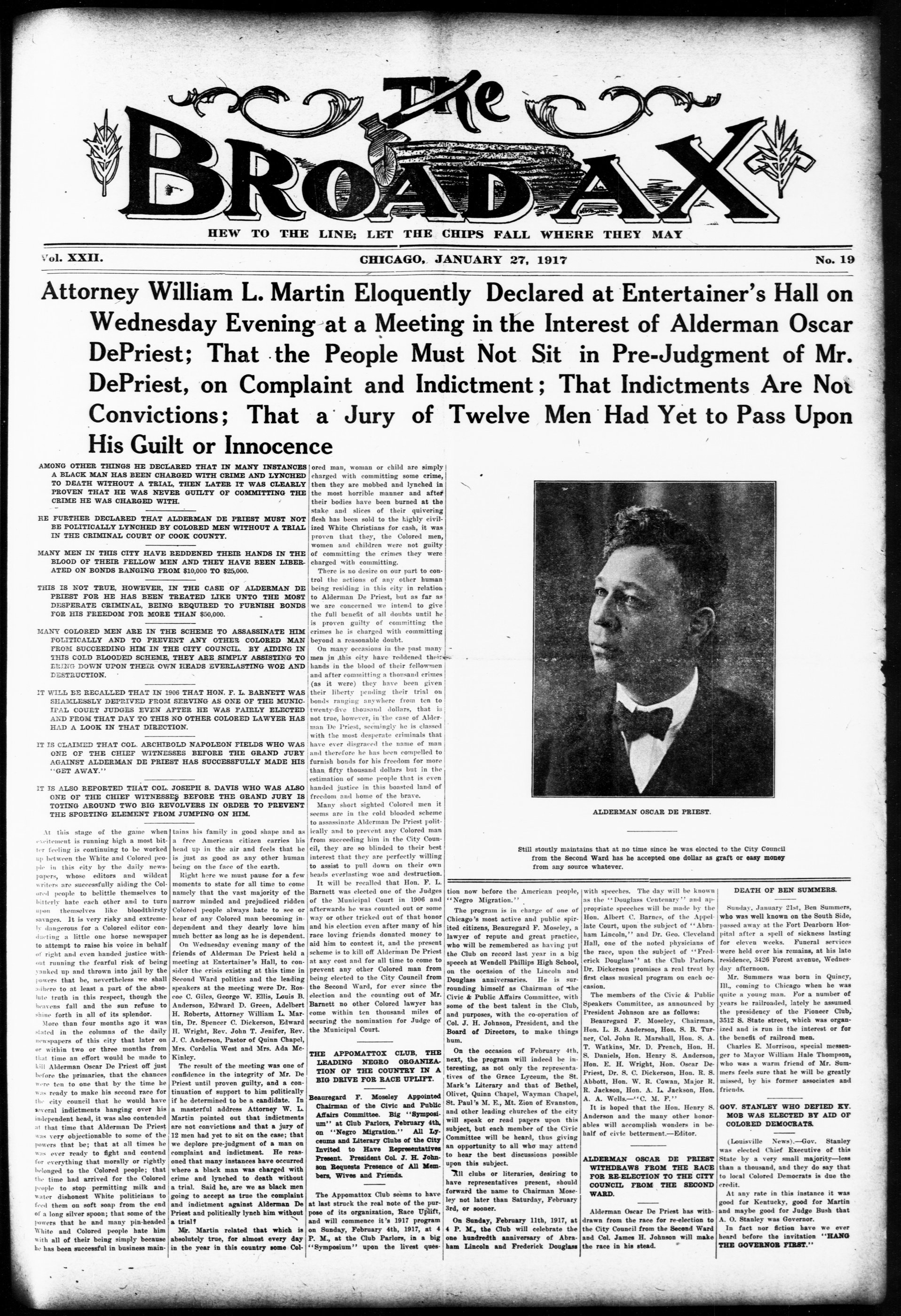
Attorney William L. Martin Eloquently Declared at Entertainer's Hall on Wednesday Evening at a Meeting in the Interest of Alderman Oscar DePriest; That the People Must Not Sit in Pre-Judgment of Mr. DePriest, on Complaint and Indictment; That Indictments Are Not Convictions; That a Jury of Twelve Men Had Yet to Pass Upon His Guilt or Innocence
AMONG OTHER THINGS HE DECLARED THAT IN MANY INSTANCES A BLACK MAN HAS BEEN CHARGED WITH CRIME AND LYNCHED TO DEATH WITHOUT A TRIAL, THEN LATER IT WAS CLEARLY PROVEN THAT HE WAS NEVER GUILTY OF COMMITTING THE CRIME HE WAS CHARGED WITH.
HE PURTHER DECLARED THAT ALDERMAN DE PRIEST MUST NOT BE POLITICALLY LYNCHED BY COLORED MEN WITHOUT A TRIAL IN THE CRIMINAL COURT OF COOK COUNTY.
MANY MEN IN THIS CITY HAVE REDDENED THEIR HANDS IN THE BLOOD OF THEIR FELLOW MEN AND THEY HAVE BEEN LIBERATED ON BONDS RANGING FROM $10,000 TO $25,000.
THIS IS NOT TRUE, HOWEVER, IN THE CASE OF ALDERMAN DE PRIEST FOR HE HAS BEEN TREATED LIKE UNTO THE MOST DESPERATE CRIMINAL, BEING REQUIRED TO FURNISH BONDS FOR HIS FREEDOM FOR MORE THAN $50,000.
MANY COLORED MEN ARE IN THE SCHEME TO ASSASSINATE HIM POLITICALLY AND TO PREVENT ANY OTHER COLORED MAN FROM SUCCEEDING HIM IN THE CITY COUNCIL. BY AIDING IN THIS COLD BLOODED SCHEME, THEY ARE SIMPLY ASSISTING TO BRING DOWN UPON THEIR OWN HEADS EVERLASTING WOE AND DESTRUCTION.
IT WILL BE RECALLED THAT IN 1906 THAT HON. F. L. BARNETT WAS SHAMLESSLY DEPRIVED FROM SERVING AS ONE OF THE MUNICIPAL COURT JUDGES EVEN AFTER HE WAS FAIRLY ELECTED AND FROM THAT DAY TO THIS NO OTHER COLORED LAWYER HAS HAD A LOOK IN THAT DIRECTION.
IT IS CLAIMED THAT COL. ARCHIBOLD NAPOLEON FIELDS WHO WAS ONE OF THE CHIEF WITNESSES BEFORE THE GRAND JURY AGAINST ALDERMAN DE PRIEST HAS SUCCESSFULLY MADE HIS "GET AWAY."
IT IS ALSO REPORTED THAT COL. JOSEPH S. DAVIS WHO WAS ALSO ONE OF THE CHIEF WITNESSES BEFORE THE GRAND JURY IS TOTING AROUND TWO BIG REVOLVERS IN ORDER TO PREVENT THE SPORTING ELEMENT FROM JUMPING ON HIM.
Vol. XXII.
Attorney W
Wednes
DePries
DePries
Convict
His Guide
AMONG OTHER THINGS HE DECEMBER
A BLACK MAN HAS BEEN CHRIST
TO DEATH WITHOUT A TRIAL
PROVEN THAT HE WAS NEVER
CRIME HE WAS CHARGED WITH
HE FURTHER DECLARED THAT HE
BE POLITICALLY LYNCHED BY
IN THE CRIMINAL COURT OF
MANY MEN IN THIS CITY HAVE
BLOOD OF THEIR FELLOW M
ATED ON BONDS RANGING FRE
THIS IS NOT TRUE, HOWEVER,
PRIEST FOR HE HAS BEEN
DESPERATE CRIMINAL, BEING
FOR HIS FREEDOM FOR MORE
MANY COLORED MEN ARE IN THE
POLITICALLY AND TO PREV
FROM SUCCEEDING HIM IN THE
THIS COLD BLOODED SCHEME
BEING DOWN UPON THEIR OWN
DESTRUCTION.
IT WILL BE RECALLED THAT IN THE
SHAMLESSLY DEPRIVED FROM
IPAL COURT JUDGES EVEN A
AND FROM THAT DAY TO THIS
HAD A LOOK IN THAT DIRECT
IT IS CLAIMED THAT COL. ARCHIT
ONE OF THE CHIEF WITNESS
AGAINST ALDERMAN DE PRIN
“GET AWAY.”
IT IS ALSO REPORTED THAT COL.
ONE OF THE CHIEF WITNESS
TOTING AROUND TWO BIG R
THE SPORTING ELEMENT FROM
At this stage of the game when excitement is running high a most bitter feeling is continuing to be worked up between the White and Colored people in this city by the daily newspapers, whose editors and wildcat writers are successfully aiding the Colored people to belittle themselves to bitterly hate each other and to turn upon themselves like bloodthirsty savages. It is very risky and extremely dangerous for a Colored editor conducting a little one horse newspaper to attempt to raise his voice in behalf of right and even handed justice without running the fearful risk of being yanked up and thrown into jail by the powers that be, nevertheless we shall adhere to at least a part of the absolute truth in this respect, though the heavens fall and the sun refuse to shine forth in all of its splendor.
More than four months ago it was stated in the columns of the daily newspapers of this city that later on or within two or three months from that time an effort would be made to kill Alderman Oscar De Priest off just before the primaries, that the chances were ten to one that by the time he was ready to make his second race for the city council that he would have several indictments hanging over his independent head, it was also contended at that time that Alderman De Priest was very objectionable to some of the powers that be; that at all times he was ever ready to fight and contend for everything that morally or rightly belonged to the Colored people; that the time had arrived for the Colored people to stop permitting milk and water dishonest White politicians to feed them on soft soap from the end of a long silver spoon; that some of the powers that be and many pin-headed White and Colored people hate him with all of their being simply because he has been successful in business main-
---
trains his family in good shape and as a free American citizen carries his head up in the air and feels that he is just as good as any other human being on the face of the earth. Right here we must pause for a few moments to state for all time to come namely that the vast majority of the narrow minded and prejudiced ridden Colored people always hate to see or hear of any Colored man becoming independent and they dearly love him much better as long as he is dependent. On Wednesday evening many of the friends of Alderman De Priest held a meeting at Entertainer's Hall, to consider the crisis existing at this time in Second Ward politics and the leading speakers at the meeting were Dr. Roscee C. Giles, George W. Ellis, Louis B. Anderson, Edward D. Green, Adelbert H. Roberts, Attorney William L. Martin, Dr. Spencer C. Dickerson, Edward H. Wright, Rev. John T. Jenifer, Rev. J. C. Anderson, Pastor of Quinn Chapel, Mrs. Cordelia West and Mrs. Ada McKinley.
The result of the meeting was one of confidence in the integrity of Mr. De Priest until proven guilty, and a continuation of support to him politically if he determined to be a candidate. In a masterful address Attorney W. L. Martin pointed out that indictments are not convictions and that a jury of 12 men had yet to sit on the case; that we deplore pre-judgment of a man on complaint and indictment. He reasoned that many instances have occurred where a black man was charged with crime and lynched to death without a trial. Said he, are we as black men going to accept as true the complaint and indictment against Alderman De Priest and politically lynch him without a trial?
Mr. Martin related that which is absolutely true, for almost every day in the year in this country some Col-
CHICAGO, JANUARY 27, 1917
ored man, woman or child are simply charged with committing some crime, then they are mobbed and lynched in the most horrible manner and after their bodies have been burned at the stake and slices of their quivering flesh has been sold to the highly civilized White Christians for cash, it was proven that they, the Colored men, women and children were not guilty of committing the crimes they were charged with committing.
There is no desire on our part to control the actions of any other human being residing in this city in relation to Alderman De Priest, but as far as we are concerned we intend to give the full benefit of all doubts until he is proven guilty of committing the crimes he is charged with committing beyond a reasonable doubt.
On many occasions in the past many men in this city have reddened their hands in the blood of their fellowmen and after committing a thousand crimes (as it were) they have been given their liberty pending their trial on bonds ranging anywhere from ten to twenty-five thousand dollars, that is not true, however, in the case of Alderman De Priest, seemingly he is classed with the most desperate criminals that have ever disgraced the name of man and therefore he has been compelled to furnish bonds for his freedom for more than fifty thousand dollars but in the estimation of some people that is even handed justice in this boasted land of freedom and home of the brave.
Many short sighted Colored men it seems are in the cold blooded scheme to assassinate Alderman De Priest politically and to prevent any Colored man from succeeding him in the City Council, they are so blinded to their best interest that they are perfectly willing to assist to pull down on their own heads everlasting woe and destruction.
It will be recalled that Hon. F. L. Barnett was elected one of the Judges of the Municipal Court in 1906 and afterwards he was counted out or some way or other tricked out of that honor and his election even after many of his race loving friends donated money to aid him to contest it, and the present scheme is to kill off Alderman De Priest at any cost and for all time to come to prevent any other Colored man from being elected to the City Council from the Second Ward, for ever since the election and the counting out of Mr. Barnett no other Colored lawyer has come within ten thousand miles of securing the nomination for Judge of the Municipal Court.
THE APPOMATTOX CLUB, THE LEADING NEGRO ORGANIZATION OF THE COUNTRY IN A BIG DRIVE FOR RACE UPLIFT.
Beauregard F. Moseley Appointed Chairman of the Civic and Public Affairs Committee. Big "Symposium" at Club Parlors, February 4th, on "Negro Migration." All Lyceums and Literary Clubs of the City Invited to Have Representatives Present. President Col. J. H. Johnson Requests Presence of All Members, Wives and Friends.
The Appomattox Club seems to have at last struck the real note of the purpose of its organization, Race Uplift, and will commence it's 1917 program on Sunday, February 4th, 1917, at 4 P. M., at the Club Parlors, in a big "Symposium" upon the livest ques-
Still stoutly maintains that at no time since he was elected to the City Council from the Second Ward has he accepted one dollar as graft or easy money from any source whatever.
tion now before the American people, "Negro Migration." The program is in charge of one of Chicago's most active and public spirited citizens, Beauregard F. Moseley, a lawyer of repute and great practice, who will be remembered as having put the Club on record last year in a big speech at Wendell Phillips High School, on the occasion of the Lincoln and Douglass anniversaries. He is surrounding himself as Chairman of the Civic & Public Affairs Committee, with some of the best talent in the Club, and purposes, with the co-operation of Col. J. H. Johnson, President, and the Board of Directors, to make things hum.
On the occasion of February 4th, next, the program will indeed be interesting, as not only the representatives of the Grace Lyceum, the St. Mark's Literary and that of Bethel, Olivet, Quinn Chapel, Wayman Chapel, St. Paul's M. E., Mt. Zion of Evanston, and other leading churches of the city will speak or read papers upon this subject, but each member of the Civic Committee will be heard, thus giving an opportunity to all who may attend to hear the best discussions possible upon this subject.
All clubs or literaries, desiring to have representatives present, should forward the name to Chairman Moseley not later than Saturday, February 3rd, or sooner.
On Sunday, February 11th, 1917, at 4 P. M., the Club will celebrate the one hundredth anniversary of Abraham Lincoln and Frederick Douglass
with speeches. The day will be known as the "Douglass Centenary" and appropriate speeches will be made by the Hon. Albert C. Barnes, of the Appellate Court, upon the subject of "Abraham Lincoln," and Dr. Geo. Cleveland Hall, one of the noted physicians of the race, upon the subject of "Frederick Douglass" at the Club Parlors, Dr. Dickerson promises a real treat by first class musical program on each occasion.
The members of the Civic & Public Speakers Committee, as announced by President Johnson are as follows: Beauregard F. Moseley, Chairman, Hon. L. B. Anderson, Hon. S. B. Turner, Col. John R. Marshall, Hon. S. A. T. Watkins, Mr. D. French, Hon. H. S. Daniels, Hon. Henry S. Anderson, Hon. E. H. Wright, Hon. Oscar DePriest, Dr. S. C. Dickerson, Hon. R. S. Abbott, Hon. W. R. Cowan, Major R. R. Jackson, Hon. A. L. Jackson, Hon. A. A. Wells.—"C. M. F."
It is hoped that the Hon. Henry S. Anderson and the many other honorables will accomplish wonders in behalf of civic betterment—Editor.
ALDERMAN OSCAR DE PRIEST WITHDRAWS FROM THE RACE FOR RE-ELECTION TO THE CITY COUNCIL FROM THE SECOND WARD.
Alderman Oscar De Priest has withdrawn from the race for re-election to the City Council from the Second Ward and Col. James H. Johnson will make the race in his stead.
No.19
DEATH OF BEN SUMMERS.
Sunday, January 21st, Ben Summers, who was well known on the South Side, passed away at the Fort Dearborn Hospital after a spell of sickness lasting for eleven weeks. Funeral services were held over his remains, at his late residence, 3426 Forest avenue, Wednesday afternoon.
Mr. Summers was born in Quincy, Ill., coming to Chicago when he was quite a young man. For a number of years he railroaded, lately he assumed the presidency of the Pioneer Club, 3512 S. State street, which was organized and is run in the interest or for the benefit of railroad men.
Charles E. Morrison, special messenger to Mayor William Hale Thompson, who was a warm friend of Mr. Summers feels sure that he will be greatly missed, by his former associates and friends.
GOV. STANLEY WHO DEFIED KY.
MOB WAS ELECTED BY AID OF COLORED DEMOCRATS.
(Louisville News).—Gov. Stanley was elected Chief Executive of this State by a very small majority—less than a thousand, and they do say that to local Colored Democrats is due the credit. At any rate in this instance it was good for Kentucky, good for Martin and maybe good for Judge Bush that A. O. Stanley was Governor. In fact nor fiction have we ever heard before the invitation "HANG THE GOVERNOR FIRST."
Dan M. Jackson
Gloe T. Kersey
David A. McGowan
Ahmed A. Rayner
The Emanuel Jackson Undertaking Co., Inc. 2959-61 South State St.
Reliable Service Courteous Treatment Reasonable Prices
FREE CHAPEL IN CONNECTION
Complete line of Funeral Goods. Automobiles for hire
Fleetest Animals
Writers of a century ago were firm in the conviction that the greyhound was the fastest living animal; some maintained that he could run a mile in a minute. Modern observers, however, have found that the best hound is by no means able to keep pace with a trained race horse. Indeed, the late J. A. Graham, a careful student of such ratters, used to say that no living animal could outfoot a modern race horse.
A first rate horse running his best and not handicapped by carrying a rider can run a mile in less than 100 seconds. A fleet hound, such as those used in coursing, can run a mile in about a minute and fifty seconds. A jack rabbit is nearly as fast, and an antelope is considerably faster. Mr. Graham thought an antelope might run a mile across the level prairie in a minute and forty-five seconds.
On the other hand, Mr. Cottar, an old African hunter, thinks that Thomson's gazelle would have no trouble whatever in running away from the fastest horse and that Grant's gazelle and the gerenuk are almost equally fleet. -Youth's Companion.
Money No Object.
As an instance of the reckless character of the old time British tar an English writer quotes the following authenticated reminiscence:
"One morning, as an officer was standing in Fore street, Devonport, his attention was drawn to three post-chaises, with four horses to each, drawn up at the door of the King's Arms hotel. These were presently driven off. On inquiring what great person had arrived, the officer was informed that all this display was the freak of a common sailor, who had just received 1500 in prize money, and, having been granted but a week's leave, his ingenuity had devised the most ostentatious mode of getting rid of this whirlfall. He had hired one chase and four for himself, another for his hat and a third for his cudgel. It was his intention to make the trip to London and back, which would, he hoped, nearly consume the whole sum."
Really Little Known of Poland.
Poland's history, with its fight for freedom, justice and equality, its struggle in defense of Christianity and European civilization and its unselflessness in aiding the weak, made it famous among the world's nations, both in success and adversity. The achievements of the Polish nation in art, music, literature, science and religion are known, as are the life deeds of its great men.
But the industries, mines, trade and natural wealth of that unhappy country have since its partition been to a great extent a sealed book to most of the people outside of the nations attempting to assimilate the Poles. This was principally due to the inability of people from the outside to break through the network of foreign governmental systems in which Poland is enmeshed.-Buffalo News.
How Some Insects Multiply
The fecundity of certain insect forms is astounding. The progeny of one little insect, the "hop aphis," sees thirteen generations born to it in a single year and would, if unchecked to the end of the twelfth generation, multiply to the inconceivable number of ten sextillions of individuals. If this brood were marshaled in line, ten to the inch, it would extend to a point so sunk in the profundity of space that light from the head of the procession, traveling at the rate of 184,000 miles a second, would take 2,500 years to reach the earth. In eight years the progeny of a pair of gypsy moths could destroy all the foliage in the United States if unchecked.—Popular Science Monthly.
What Worried Him
"Papa, dear," said the anxious daughter, "you must not worry because Harold is going to marry me and take me far away from you and mamma."
"Oh, a little thing like that isn't going to worry me," replied the fond parent, "but if he ever does anything that will cause you to come back to us again I'll certainly do him bodily injury."—St. Louis Post-Dispatch.
Time to Quit Then.
"Do you expect to spend your whole life in the wicked pursuit of riches?" asked the ascetic person.
"No," replied the brisk individual.
"If I'm not rich by the time I reach fifty years of age I shall consider myself an ignoble failure."—Birmingham Age-Herald.
"Women are so awfully hard to understand!"
PAGE TWO
Phones Calumet 6164
Automatic 71-629
OPEN DAY
AND NIGHT
Automobles for hire
In the American Magazine Charles M. Schwab says:
"Andrew Carnegie first attracted attention by using his head to think with. It was when he was a telegraph operator on the Pennsylvania railroad under Colonel Thomas A. Scott. One morning a series of wrecks tangled up the line. Colonel Scott was absent and young Carnegie could not locate him. Things looked bad.
"Right then Carnegie disregarded one of the road's strictest rules and sent out a dozen telegraphs signed with Colonel Scott's name, giving orders that would clear the blockade.
"Young man,' said the superintendent a few hours later, 'do you realize that you have broken this company's rules?
"Well, Mr. Scott, aren't your tracks clear and your trains running?' asked the young-telegrapher.
"Colonel Scott's punishment was to make Carnegie his private secretary. A few years later, when the colonel retired from office, he was succeeded by the former telegraph operator, then only twenty-eight years old."
The Thespian's Fiasco.
Among Italians, a correspondent in Rome tells me, the origin of the term "fasco" for failure is believed to have originated in the remark of an old Italian actor. He had in the course of a play to deliver a somewhat lengthy monologue, in which he invariably scored a great success. It was his habit to always hold some object or other in his hand, changing the article every time he appeared and never using the same thing twice. One evening, seeing a wine battle (called in Italian fasco), he seized it and proceeded on the stage to pronounce his soilloquy. Whether it was that on that occasion the audience was extraordinarily difficult to please or whether it was that the actor was not up to his usual form, the fact remains that for once he did not obtain his customary applause, from which time the phrase "fare fasco" has become general in the Italian language.—London Chronicle.
Largest Village In the World.
Open, unprotected, utterly indefensible, The Hague has basked, smiling, just behind the storm swept edge of the ocean for centuries. Bleak, shifting downs roll up to the very gardens of its suburban villas; ancient historical forests proffer mild memories of their vastness in woody parks and winding shady ways. It is essentially a place to be at peace.
Although so mingled with the doings of the house of Orange that every square has a historical association, every old palace and park its story, though the parliaments of the Dutch states have met there since 1466 and snive ambassadors have brought it weighty questions and strange faces since the sixteenth century, there is a pretty irresponsibility about this "largest village of the world" that has endearled it to the pleasure lover of all ages.—New York Telegram.
Making Mistakes
Big men make big mistakes. Little men could not make big mistakes if they tried; they haven't the capacity. The fellow of strong personality, the man who grabs at an opportunity with all his might and goes straight toward its accomplishment hurriedly is more likely to make big mistakes than the weazened of the world who are timid and afraid. But the mistakes do not amount to so much with him—that is the point. The little fellow who makes a mistake is lost. But the big fellow is only encouraged by making a mistake and often is able to drag success over his errors as a giant might drag a bull through the underbrush. The little fall is not to be blamed, but the big fellow is to be admired.—Columbus (O.) Dispatch
That Midnight Oil
"I suppose," ventured the interested friend of the family, "that John is still burning the midnight oil at college?" "Yes, indeed," replied the fond but puzzled mother, "but the college must furnish a very inferior quality of oil. John writes me that some midnights the light is so very poor that he can hardly read his hand." — Pittsburgh Chronicle-Telegraph.
From the letter of a father to his son at college:
Dear Harold—Your brief letter came today. I am inclosing the check for the amount you requested. I have heard a great deal of the college faculty. I take it to be the faculty for spending money. Accidentally FATHBR.
New York Post
College Faculty.
THE BROAD AX, CHICAGO JANUARY 27, 1917.
GIRL JILTS ARE FALSE,
SAYS PROFESSOR SHAW
Don't Believe Her When She Says
She'll Be Your Friend.
New York.—"When a wife says, 'I cannot be your wife, but I'll be your friend,' she tries to speak the truth, but utters a psychological falsehood," declared Professor Charles Gray Shaw, head of the philosophy department of the New York university, in a lecture at the institution.
Professor Shaw argued that no woman could be a friend to men or to women, because a friend requires a clear cut personality and a disinterested outlook on life. Both of these, he asserted, women lack. He also declared that friendships between men were passing from the earth.
"Woman cannot be a friend because she is never an individual, for to be an individual one must stand alone," he said. "Only those who stand alone can come together."
Professor Shaw said that woman was like a planet—well adapted to revolve about some center, "but not organized in such a way as to stand alone." "Unfortunately, masculine friendships are just passing from the earth, and in the course of time friends will be found only in museums, along with other aboriginal products. This melancholy situation is due to the fact that modern life tends to destroy personality and a philosophic view of the world. Man is bound to man not by ties of friendship, but by bonds of professionalism which are usually of a commercial character."
INDIAN TRIBES USE
WHISTLING LANGUAGE
Able to Express Their Thoughts Perfectly by Its Use, Says Mining Engineer.
Carlisle, Pa.—That entire tribes of Indians in Mexico carry on long conversations by means of whistling is asserted by Harold T. Mapes, mining engineer, who was for twelve years in Mexico, but now lives in Carlisle.
Mapes declares that the Indians have a whistling language and are able to express their thoughts perfectly by its use. He says it is not a series of signs or calls signifying danger, love, fear, peace, war, etc., but a regular language, by which the most subtle shades of thought may be expressed.
Like people in other parts of the world, the Mexican Indians occasionally whistle for their dinners, only they are able to explain by their whistles exactly what kind of a dinner they want—either a simple meal of tortillas and frjoles or a more elaborate feast of enchiladas and mole guajalote, with corvex or vino.
Mapes says that he understands that the whistling language has been handed down from generation to generation from the time of the Toltecs and Aztecs and that Indian lovers can put a world of tenderness and passion into their whistled declarations of love or stir their fellows to heroic deeds by the fierceness with which they whistle a call to arms.
A whistling language has been used from time immemorial by the Swiss mountaineers, and Neapolitan sailors converse frequently by means of whistling. Convicts in the big jails in Naples converse freely by means of whistling, and there is apparently no limit to their whistling vocabulary.
BIRD DOG WEARS GLASSES.
Georgia Setter Does Good Work After Visit to Oculist.
Moultrie, Ga.—Fanny, a thorough-bred setter, wears spectacles. She was fitted with glasses by an oculist, who found that she had astigmatism.
For years Fanny has been known as one of the best hunting dogs in this section. Before the opening of the quail season this year she went to the fields by herself and on returning showed evidence of bad falls. Fanny could not help falling into ditches and running into trees. Then it was discovered that her eyes had become affected.
It is believed the glasses will correct the trouble. At least Fanny now is doing her work as well as usual.
HE KNEW.
Austrian Tells Who It Is That Elects a President.
Hammond, Ind.—Jorn Bosovich, late of Austria, applied to the federal court for citizenship papers. Clerk Hemstock put the questions and got these answers:
"Who is president of the United States?"
"Mr. Wilson."
"Who makes the laws?"
"The congress."
"Who elects the president?"
"California."
He got the papers.
Bank Robber Returns $5
Scranton, Pa.—A letter with $5 inclosed has been received by the Pine Brook bank. The letter said that the writer held up the teller and took the money at the point of a revolver. "I am taking the first opportunity to pay it back," said the letter, which was postmarked Moscow, Pa. The bank officials will have the missive framed. The robber entered the bank and pointing a revolver at the teller, George Browning, demanded $25. Browning handed out $5, which satisfied htm.
Teaching Birds Tricks.
A professor of natural history refutes the statement so frequently made that teaching a bird to draw water needs apparatus and that the learning is cruel to the bird.
"The following experience of mine," he says, "proves that it is not so by any means. We bought a young bird last January, so wild that on our approach it flew madly round the cage. We hung the cage low and by patience, after the bird got used to our proximity, induced it to take groundsel, first held at stem's length, then between the fingers, finally from the lips. We used to let him out freely, and he would perch on the loaf next me at breakfast. His perch projected through the wires, and here was his favorite seat when at liberty. Then I tried hanging a bit of groundsel by a short string to the projecting stick. After inspection he pulled it up with his beak. On lengthening the string with a fresh bit of his preferred weed I had the pleasure and interest of seeing him pull up the string with his beak till the flower head was within reach, catching the slack after each pull with one foot and then transferring it to the other, so that the colls were quite neat."—London Globe.
Water Pressure.
As early as 1648 a Frenchman of science named Pascal experimented with pressures applied to liquids and discovered the following law: A pressure applied to any part of the surface of a liquid is transmitted unchanged in amount in every direction through the liquid.
Perhaps the most familiar application of Pascal's law is the hydraulic press. In that machine a pump having a small piston drives water into a large cylinder and thereby forces upward a large piston, which compresses whatever is placed between the platform of the piston and the fixed crossbeam at the top of the press. If the area of the larger piston is 100 times that of the smaller a downward force of one pound exerted on the smaller piston will create an upward force of 100 pounds upon the larger piston.
Home Ground Flour.
Grinding wheat to make four may be done at home as easily as the grinding of coffee. Thus a family may have whole wheat flour, freshly ground, a thing that is usually difficult to obtain. The New York Medical Journal advises its readers to buy their wheat from seedsmen rather than from grocers or feed stores because it will be cheaper and more efficient. The grinder can be used also for cracking wheat, corn, barley, oats, rye and other grains for use as breakfast cereals. And the cereals will need chewing, which will not only strengthen the muscles of the chewers' jaws, but will keep their teeth from decay—that is, if they begin as children. Homemade cereals' need long cooking, so a fireless cooker is almost indispensable.
Greek Fire Gunpowder?
M. Zenghelis told the Academie des Sciences in Paris recently that he had been studying the "Greek fire" used in war by the Byzantines. The descriptions of this say that it was hurled from a copper tube with a sound like thunder and with a great cloud of smoke. From this he concluded that the Byzantine Greeks had real cannon in which they used explosive mixtures with nitrate as a base. Therefore the honor of the discovery of gunpowder must be given to the engineer Callinicus of Hellopolis, who first used it, destroying a Saracen fleet with it in 670 A. D.
The Silent Moon.
Dead silence reigns on the moon. A thousand cannons might be fired and a thousand drums beaten upon that alright world, but no sound could come from them. Lips might quiver and tongues essay to speak, but no action of theirs could break the utter silence of the lunar scene.
Roundabout Way.
"I see where an aviator contrived to have the last word with his wife."
"How on earth did he do it?"
"He didn't exactly do it on earth."
"No?"
"He rose 1,000 feet in the air and dropped her a message."—Birmingham Age-Herald.
The Experienced Husband.
"She threatens to sue for divorce."
"What's he say to that?"
"Nothing. When their quarrels get to that point he always keeps still. He's learned from experience that the next move will be a flood of tears."—Detroit Free Press.
Two Sorrows.
The sorrow of the woman who cries out her grief on the kitchen towel somehow seems more sincere than that of the woman who puts on a pretty gown, arranges the sofa cushions and turns the lights low before she begins. —Exchange.
Fussy.
Bank Manager—Now please understand, Miss Jones, you must make the books balance. Miss Jones—Oh, Mr. Brown, how fussy you are!—London Punch.
Sound and Sound
"That young Hercules over there is a great musical composer."
"A sound mind in a sound body, eh?"
-St. Louis Star.
It is generally more profitable to reckon up our defects than to boast of our attainments—Carlyle.
ALIENS TO LEAVE
That May Happen at End of Great War.
ALL AVAILABLE LAND GONE.
Commissioner of Immigration Howe Predicts That United States Will Become an Emigrant Rather Than an Immigrant Nation at the End of Hostilities In Europe.
New York.—A prediction that the United States would become an "emigrant" rather than an "immigrant" nation at the close of the war was made by Commissioner of Immigration Frederic C. Howe at the Sunday evening forum of the Free synagogue.
Mr. Howe took the stand that immigration was purely an economic question and declared that it had been such from the beginning. He said that those who opposed immigration did so because they desired to limit the competition of unskilled foreign labor; those who favored the wide open door did so because it made labor cheap.
He said the immigrant no longer went to the farm because all the available land of the country had been taken up, hundreds of millions of acres being held for purely speculative purposes.
"The immigration problem never existed so long as the land was free for the asking," said Mr. Howe, "and it is this scarceness of land which makes immigration an economic question.
"It is a matter of freeing labor on one hand from the competition of the incoming labor groups from Europe and of insuring to the immigrant an opportunity to work for himself rather than for an employer interested in securing his services at the lowest possible cost.
"I keep more or less in touch with the centers to which go most of the men who pass through Ellis island. I am told that everywhere the men now employed in our shops and factories who at home worked as farmers are saving their money to return to the old country. They have always wished to own their own farms—they came here for that purpose—and they figure that after the war land will be cheap in the countries overseas. This sentiment, spreading among our workers, will result in a serious crisis in our industrial life."
Mr. Howe also discussed the servant question. He said that since the war there had been practically no servant girls coming to this country and that many of those who were in service had left it to enter munition factories and offices, while others had married or died.
To regulate the tide of oriental immigration and, in fact, to check in some measure immigration from any land Dr. Sydney L. Gullick, an authority on Japan, suggested that, for example, if a thousand Syrians came to this country in 1000 and ten years later all had taken out American citizenship then another thousand might be admitted. If, however, only 300 had applied for naturalization papers the decision of the remaining 700 to still be Syrians automatically would keep an equal number of their fellow countrymen in Syria.
RABBITS TO BE "HOT DOGS."
Texas Plant Soon to Make Animals Into Sausage.
Austin, Tex.—A plant for the manufacture of sausage from the meat of the Texas jackrabbit is to be erected soon and put into operation in west Texas, according to an announcement made by Fred W. Davis, state commissioner of agriculture. Promoters of the plant expect to handle most of the annual rabbit crop in their mill.
The Texas state department of agriculture has decided to attempt to create a country wide demand for rabbit meat.
It is expected that not less than a million rabbits, Texas born and reared, will be shipped to New England and eastern markets during the next few months. Commissioner Davis says the rabbits are quoted in some cities at a higher price than turkey or chicken.
NEW COINS ARE HELD UP.
Quarter and Half Dollar Won't Be Out Until First of Year.
Washington.—Issue of the new half dollar designed by Adolph A. Weinman, creator of the new dime, and the new quarter, designed by Herman A. MacNeil, both considered by experts coins of great beauty, was ordered deferred by the treasury department until the beginning of 1917.
The extraordinary demand for small coins—cents, nickels and dimes—is taxing the facilities of the mints, and officials believed calls for the new quarter and half dollar would swamp the mints if they were issued now.
Wedding Party: No Bride.
Allentown, Pa.—Andrew Mireck the other evening hunted up Arthur Koenig, Allentown's license clerk, and returned a license which, he said, was no longer any good. The day before Mireck and Mary Novatny, a comely girl, had appeared arm in arm and obtained the license. The next day she left him waiting at the church, priest, attendants, guests and all. After waiting several hours the guests disappeared in disappointment, and when Mireck got home for dinner there was a telegram from the girl in which she stated she had changed her mind and would not marry him.
Leaders Point Out Partnership Between Capital and Labor.
SAY INTERESTS ARE MUTUAL
Our Future Prosperity Depends on a Better Understanding and More Practical Application of Get-Together Spirit In Industry—Must Eliminate Trouble-Breeders and Agitators. A better public understanding and appreciation of the needs and problems of our American industries is conceded on every side to be one of the important national requirements for the development of our future industrial prosperity. Few people seem to understand that the majority of our business men are fair minded, reasonable beings, legitimately engaged in the development of our economic resources.
In the opinion of our business leaders this misunderstanding leads the public, through the legislators, into thoughtless and unnecessary acts of reprisal against all branches of industry, which are often inimical to the best interests of their own community. To cure this lamentable condition it is first essential that a closer degree of co-operative action for the common good be established between employees and employers. The first step in this direction is to eliminate the selfish, destructive agitator. This happy event would greatly facilitate a general get together spirit among employers and workers.
The Work That Men Do.
The nation is confronted with more work than ever before—ships to build, factories to enlarge, railways to complete, new foreign business to be attracted and help to be extended to the unfortunates on the other side. They are about 30,000,000 men at work; if they work ten hours a day that is 300,000,000 hours a day or 96,000,000 hours a year. If they work eight hours it is 74,800,000,000, or a difference of 18,720,000,000 hours a year. At eight hours a day this means that about 7,400,000 more men must be employed to do the work that could be done by the 30,000,000, and where are they to come from?
During the past year there has been a unified and standardized banking currency system tried and not found wanting. But there are yet other steps to be taken before the ideal of economic unit is worked out.
There are 662,000 stockholders of railroads in the United States. A large proportion of them depend on the earnings of the carriers for a meager income. Many of these stockholders have less than $1,000 a year income, and they are unable to earn more, being elderly persons or women. Thousands of them are former employees of the railroads who depend upon their stock dividends to pay their rent and their grocery bills.
Labor and Capital Are Partners
Labor and Capital Are Partners.
The manufactured output of the United States amounts to $28,000,000,000 in value per annum. This is three times the amount of the yearly output of the ranches, farms, orchards and gardens; it is a dozen times the output of the mines; it is larger than the combined manufactures of any two foreign nations. Labor received, as its share of the fruits of industry, wages amounting almost to seven billion dollars in the single year of 1914. Does not this prove that the interests of employees are joint with those who employ them and that a real partnership exists?
Today there are over 100,000,000 people in the land who must be fed, clothed, sheltered, kept warm and many of whom travel for health, pleasure and business. The railway systems are in many places overtaxed in doing this work.
What will be the conditions when there are 150,000,000 people to be served?
This means an addition of at least 50 per cent to the number of tons of freight moved one mile and the number of passengers moved one mile.
There was a total mileage of 41,988 in the hands of receivers in 1915, the total capitalization of which was $2,264,000,000. In that year alone 20,143 miles of road went into the hands of receivers, and these roads had a total capitalization of $1,070,808,628. This compares with 4,222 miles in 1914 with a total capitalization of $109,571,146, in receivers' hands. This is not a healthy condition; it is a malady that affects directly and indirectly every one in the country.
Railways do not belong to a few rich men or bankers. There are at least 1,500,000 owners of the securities of American railways. There are 1,800,000 men approximately employed in the railway service. The insurance companies have $1,500,000,000 invested in railway securities representing 30,000,000 policy holders; savings banks have $800,000,000 invested in which banks there are 11,000,000 depositors. From 1909 to 1913 the States enacted 60,001 and congress enacted 2,013 new laws which involved the consideration of more than one-half million legislative propositions, or an annual production of over 12,000 new laws to be assimilated by the business world.
FOR HOME RULE.
Widow of Skeffington, Executed Irish Editor, Is In America.
HERE WITH HER SON, OWEN.
Plans to Write and Lecture In This Country With the Hope of Interesting Us In the Future Freedom of Ireland. Is an Intellectual Type.
Mrs. F. Sheehy Skeffington, widow of the Irish editor who was executed in Dublin on April 25 after the uprising headed by Sir Roger Casement, has come to this country to write and lecture about the conditions which led up to the death of her husband. She is living in New York with her seven-year-old son, Owen.
"I am not willing to tell how I got here," said Mrs. Sheffington. "The British government refused to give me a passport, but I was determined to
Mary Ann
Photo by American Press Association.
MRS. F. SHEEHY SKEEFINGTON.
come to the United States and tell the people about my husband's murder, for that is what it amounted to. I don't know how long I will remain. That will depend upon how my work progresses.
"I learned a lot about the art of disguise from the suffragettes, and I resorted to successful disguise in this case. With my boy it was more difficult, but I managed to get him through. I left Dublin while the police were watching my house.
"Then 'somewhere in Great Britain' I secured a passport and under an assumed name came to this country."
Mrs. Skeffington said there was much that would interest the American people about her husband's death and the causes leading up to it. Skeffington was one of the more conspicuous anti-British propagandists of Ireland and fought against the enlistment of his countrymen under the flag of Great Britain.
Mrs. Skeffington, who is an alert, black haired, smiling woman despite her sorrows, is intellectual in appearance—frail, but tall. She hopes to interest a large number of people in Irish nationalism.
WASHING FLANNELS.
Easy Way to Cleanse Sweaters and "Unders" Without Shrinking Them.
For flannels make a lukewarm suds with some good, pure soap, add a tablespoonful of ammonia for each pair of water, soak flannels in this ten or fifteen minutes, then souse them till the dirt is out (do not rub). Wring them through the clothes wringer, rinse in lukewarm water and again put them through wringer. If you have only a few pieces and do not want to bother with the tub and wringer simply lift them from the suds to the rinse water and hang them up out of this to drip dry.
For sweaters, knit or crocheted jackets and the like proceed same as with flannels, but when it comes to wringing them fold each article in some piece of cotton, such as an apron or a piece of an old sheet, and put through the wringer. To dry, if it is sunny, spread a sheet in the sun, place article loosely upon it and cover with another sheet. If it is cloudy they will dry if spread out in a warm room. Do not hang them out.
For Baby's Grib.
Baby's crib is made up with as much care as to details as is given to the bed of the elders. Day slips with the envelope flap are used on the diminutive pillow, and a sheet is generally embroidered and scalloped to match. Another pillowcase that was finished with a perfectly plain hem had a design with cutwork relieving its simplicity. The sheet carried out the same scheme of embroidery.
Cranberry Tarts
Line the bottom and sides of small tart or cake tins with a good pie crust and bake in a hot oven for seven to ten minutes, until the pastry is done. Have ready cranberries cooked soft in a syrup of equal parts of sugar and water. Fill the tarts and put back into the oven and bake for five minutes. Allow not more than a teaspoonful of mixture to each tart.
STYLE TIPS.
Latest News From Paris About Skirts and Blouses.
Every cable brings from Paris the news that the skirts of 1917 will be narrow. All those in the watchtowers have proclaimed the coming of this enemy to full skirts since last September, but only in limited segments of society was the news acted upon. The manufacturers had the material for full skirts, the average woman wanted full skirts, the wholesale houses turned them out by the thousands, and it was only left to the exclusive women and their dressmakers to cut down the width and length them the hem.
The question which will soon confront every woman is whether she wishes to change the silhouette of her skirt or go on wearing it until it is ready to be discarded. One cheerful feature of the return to the slim silhouette is that a full skirt can be cut into a narrow one with ease.
That garment known as the outside blouse, which is merely a ,short, twelfth century chemise, has grown quite important and popular since the large shops copied the exclusive French models and placed them within the reach of the average purse.
Women like them. They are more becoming than the white shirt waist, and they do not make demands on one's purse for laundry. They have a thin lining of their own, which is a boon to the woman who has neither the time nor the money to arrange a vast variety of expensive underwear which shows so through the thin blouse.
These outside blouses are worn with skirts that are not of their material or color, so this makes for economy and comfort at once. So far they are in chiffon, embroidered in silk floss or bullion thread, but there are some very smart ones coming in colored satins. The sleeve is half length or long, but the latter should be chosen for every occasion except one's own dinner table. The neck is cut in the renaissance fashion. In fact, the extraordinarily high collar, standing or turned over, has given way to the flat, twelfth century neck line.
This is cut in many ways. The dressmakers do not hold one down to the veritable renaissance. Jenny has taken up the Italian decoletage for the daytime, which is cut in the form of a delta. A new gown which she sends over, which was copied from a Rembrandt portrait and which is of black panne velvet with girdle and arm pieces of black satin, has no ornamentation at the neck line. The velvet is cut to the base of the neck at the back, then out on each side to the armpits and goes in a straight line across the chest below the collarbone.
CHIC MODEL.
This Chinese Effect Is For Midwinter Wear.
Oriental in design and blue velvet in fabric, this smart hat takes a deen
O
PIQUANCY ITSELF.
band of stitchery on its flaring brim.
Nothing can be jauntier than the tie and pose of the velvet bow which sits atop the round crown.
Early Marriages.
Dr. William Lee Howard is authority for the statement that if a girl marries at eighteen her offspring are apt to be totally unfit to struggle with the problems of the world. At the age of twenty-one she may give birth to at least one child of high efficiency, but those that were born before or after will be unfit. When parents are too young, the girl under twenty-one and the man under twenty-seven, the offspring are too often delicate, and malformation and idiocy are common among the offspring of too young parents.
A French authority declared that the ideal age for parenthood is thirty-three years in men and twenty-six years in women.
Homemade Sausage.
Put any scraps of unused meat through the meat chopper and grind an equal amount of fat and lean fresh pork to add to it. Mix two tablespoonfuls of cracker crumbs for each cupful of meat, season with salt, pepper and poultry seasoning to taste, bind with an egg, shape into cakes and then fry.
THE BROAD AX, CHICAGO JANUARY 27.1917.
You can make easily any kind of stew, of meat, game or poultry, by cooking it over the fire in the usual way for twenty minutes and when boiling put it into the hay box, covering it with the cushion, shutting up the lid and leaving it six hours. Lentil, pea or mixed vegetable soups require thirty minutes' boiling on the fire and four hours in the hay box. Boiled meat requires thirty minutes' boiling for a small joint and forty-five for one of five pounds and four to five hours in the hay box. Beefsteak pudding requires an hour's steady boiling on the fire and four to five hours in the hay box; suet pudding the same. Soft vegetables, like potatoes, and cereals, like rice, sago, tapioca, macaroni, require five minutes' boiling and one and a half hours in the box. Haricot beans, lentils, carrots, turnips, require twenty minutes' boiling and three hours in the box. Oatmeal porridge can be cooked fifteen minutes on the fire, then left all night in the box and be given five minutes on the fire before serving at breakfast. Any kind of fruit can be stewed in the hay box. It is best to make a sip of sugar and water, add cloves, lemon or any flavoring liked, bring to the boil, add the fruit and let it simmer ten minutes; put into the cooker and leave three hours. Small fruit takes less time. Any dish that is to be eaten hot must be brought to the boil after taking it out of the hay box before serving.
For the very small girl the short one piece smock over bloomers is a favored play costume and is made up in all the sturdier tub stuffs, with touches of smocking, cross stitch, feather stitch or other embroidery or with tiny contrasting binding.
We are to be "pocketed" the coming season as never before, and who will admit that this fashion feature can fail to please us and inspire in our hearts and minds a very strong and substantial desire for new clothes?
FOR YOUNG FOLKS
Sleepy Time Stcry About a Greek Girl.
What Happened When a Curious Little Person Lifted the Lid—Many Woes Came Out to Sadden the People of the World—An Odd Garden In Germany.
Tonight, said Uncle Ben, to little Ned and Polly Ann, I am going to tell you a story that has come down from antiquity. It is about
A PEEPING GIRL
Curiosity is wanting to know about things that don't concern you. It nearly always gets folks into trouble.
There was Pandora. I think I shall have to tell you about her.
Pandora was a lovely young Grecian girl. She had everything that heart could wish for when she was born.
The gods who lived in their beautiful place on Mount Olympus had each given her a splendid birthday present. She received beauty from one, health from another, talent from another, and so on.
There was one old god, though, who thought he would play a joke on the others. So he waited until the other gods had all given their gifts, and then he gave Pandora the gift of curiosity.
Though Pandora as she grew up was found to be given to poking her pretty little nose into things that didn't concern her and asking so many questions that her guardian, old Epimetheus, was often greatly put out, she was such a charming girl and so clever that he overlooked this little fault.
Now, little faults sometimes make as great trouble as great big naughtinesses, and in Pandora's case this turned out to be especially true.
Old Epimetheus had stored away in a safe place in his house a very costly vase. The vase was always covered and in a place where no one was allowed to go.
Pandora often wondered about the vase, and she asked Epimetheus so many questions about it that he thought it wise to lecture her every now and then about staying out of the room in which the vase was kept.
The more he warned her not to go near it the more curious she became about the vase.
"I don't see how one little peep could hurt it or me," she said to herself.
So one day when Epimetheus was away from home Pandora crept into the room.
Pandora crept behind the curtain. There stood the vase in the corner covered with a dark cloth. She lifted the cloth and then started as she heard a queer humming and buzzing inside the vase.
Carefully she lifted the lid, but before she could peep in a dark winged thing had darted out and then another and another.
Pandora was so frightened that she did not know what to do. Epimetheus rushed into the room, but the vase was nearly empty. Only one little sprite remained in the bottom of the vase. His name was Hope. Care, Sickness, Poverty and all sorts of evil sprites had dawn away to wander about the world ever since, but we still, thanks to Epimetheus, have Hope with us to comfort us when the evil sprites are tormenting us too much.
An Interesting Garden.
One of the most interesting gardens in the world, to children at least, is one in Berlin. The owner of the place has adorned it with statuary that every child would be glad to see, because
THE FISHING STATUE
STATUE OF RED RIDING HOOD.
there he has placed groups of fairies and pixies and all sorts of the queer little people that children love. A notable piece of sculpture in the garden is that depicting Little Red Riding Hood and the wicked wolf. Every child has read that fearsome story and rejoiced that the little girl was saved from the fangs of the cruel beast.
图示
WINTRY LUXURY.
Here's a Motorcoat For Solid Comfort This Season.
Built in tiers of muskrat and contrasted with real scalskin, which gives the fan cuffs, deep collar and smart
THE WINTER COAT
OFF FOR A SPIN.
belt, this ultra motorcoat comes for juveniles. The fur cap, with goggles built in it, is especially interesting.
A HOMEMADE FIRELESS
A Stout Wooden Box, Old Newspapers and Hay the Chief Requisites. A fireless cooker is almost a necessity in the up to date kitchen, but the expense is a serious consideration with the young housewife. However, a very satisfactory substitute can be made at virtually no cost and will prove an economical means of boiling and stewing.
Get a wooden box with a hinged lid; line it with newspapers or packing paper; then cover the papers with balze or felt. Cover the lid inside in the same manner. Press enough hay firmly into the bottom of the box to form a compact layer six inches deep. Fill the box with hay, pressing it well against the sides, and make nests for the pans or casseroles you intend to use, leaving a partition of hay between them and a space of six inches between the top of the pots and the box lid. To fill this space you make a mattress-like cushion of balze and fill it tightly with hay. It must fit the top of the box tightly and be six inches thick. See the contents of the pans are absolutely boiling when put in. If opened during cooking they must be reboiled
Childish Modes
About Pocketz
COST OF LIVING.
If It Is "High," Is It the Fault of the Woman?
PLEA FOR BUSINESS SYSTEM.
Instead of Cheerfully Paying For Unwarranted Raises In Food Necessaries, Why Not Ask Your Dealer For the Reason?
Woman is blamed for everything, sooner or later. Starting with that affair of the apple and through all the intermediate ages, the charge that "she did it" pops up every little while.
Among the many accusations brought against the twentieth century woman is her responsibility for the high cost of Living. Yes, really!
No one has actually come out and accused her of boosting prices, but the stern, practical minded investigators say that the increase is due largely to her easy going way of saying "All right" instead of "Why?" when her butcher or grocer or dry goods dealer tells her that his particular commodity has gone up in price. Ever since prices commenced to increase efficiency experts and farseeing economists have been scolding away at woman because of her lack of interest in the matter in a broad sense and her inertia about adopting preventive measures. They claim that just so long as woman shops in her present careless fashion, taking the dealer's word about the weight, quality and value of her purchase, so long will she be exploited by the unscrupulous.
For instance, if a woman would make it her business to know the legal weight of all dry measures, she would not stop at thinking that the last bushel of potatoes she bought looked light. She would know the exact weight, according to accurate scales, and would let the dealer know she knows. She would not be content with making the outrageous number of clinkers in her last ton of coal the subject of tea talk with her neighbor. She would have her coal dealer on the mat and remind him that she had paid him for coal to be burned, not for stones to clog her grates and choke her fires.
She would read the labels on all packaged goods, know exactly how many pounds or ounces each package contained and consider whether she would gain or lose in quality and quantity by purchasing the same goods in bulk. In short, she would be on the job and would run her marketing on a business basis, and her concerted action would put a stop to the, in many cases, unwarranted increase in price of the necessaries of life.
There remains, however, just enough truth in the accusation to make her sit up and take notice and own to herself that a better knowledge of market quotations, a little more businesslike attention to the details of purchasing on her part might make things easier all around. The idea is worth considering, anyway.
A MANLY ONE.
What Sonny Boy Will Wear In the Springtime.
For early spring wear comes this small coat of tweed, cut with a pointed
```markdown
```
THAT BROAD BACK.
yoke, a demibelt and patch pockets and finished with big bone buttons. Please observe that the socks are embellished with clocks.
For Winter Sports
In sport suits homespun have a big place in the very smart tailored suits. Wool velours are seen in very gay tints, but wool velours in a gay tint does not look garish or bizarre. These suits are made for the Canadian and the northern United States resorts. With their big rolling capelike collar and deep cuffs of fur they have a lot of style.
PAGE THREE
A Gown Designed For Decorative Afternoon Use.
Brown chiffon velvet and satin combined feature this frock, trimmed with velvet buttons and narrow cordings.
THE FASHION OF THE TIME
DRESSY EFFECT.
A bit of seasick bands the Lanvin neck, and a toque of the same velvet gives an alrship effect that is very nasty. The girdle is velvet ribbon.
CHILDREN'S TOYS.
Lessons Learned In Play Leave an Everlasting Impression Upon Character.
A child's play is really its most important business, for in it the exercise necessary for the growing body is obtained, and at the same time lessons are learned which leave an everlasting impress on the character. For this reason it seems almost incomprehensible that any mother should be satisfied to provide her children with toys that vitiate its good taste or by a too complete mechanism deprive their owner of the joy of achievement, the necessity of using his or her quick wittedness or imagination.
There is no need to give a baby one of those repulsively ugly rag dolls with staring eyes and distorted features when there are lovely, cuddy bunny rabbits with bright colored coats and dear, soft little doggies which can be held in their little master's arms as he goes off to the by-by land, and these pretty toys will be cultivating his sense of proportion and artistic truth and at the same time giving him a soft corner in his heart for his four footed neighbors.
From Japan comes a very complete set of doll's furniture which would delight any small homemaker. It is cut out of a solid block of Wang Yung wood and can be reassembled into a block again by the use of a little patience and ingenuity, a fact that makes it a most instructive toy, carrying out the Montessori game of solids in a more advanced and more interesting form.
Another fascinating toy which would bring joy to any little boy and to a good many girls is a carpenter's blue apron with a wide pocket, in which there is a very complete set of diminutive tools, and for the more domesticated wee lady there is a doll's dress-making outfit put up in an attractive box.
With toys such as these, not to mention the better known games in which many can take part, a child can at a very small cost be taught to educate itself unconsciously, learning lessons that are of far greater value for after life than many of those given in the classroom.
To Clean Feather Pillows.
Feathers that have lain for any length of time in pillows should be washed. To do the work in the best possible manner open one corner of the pillow and pour boiling water in upon the feathers. This makes them a wet mass, and they are much more easily handled. Remove them and then wash them thoroughly with soap and water, being careful to rinse them in several waters. Then put them back into the washed cover and hang in the sun where they will dry and be light and fluffy. In this way none of the feathers are lost.
Baked Indian Pudding.
Scaid one quart of milk in a double boiler, stir in gradually five tablespoonfuls of granulated Indian meal and cook twenty minutes. Add three tablespoonfuls of butter, one cupful of molasses, one teaspoonful of salt, one and one-half teaspoonfuls of cinnamon, one-half teaspoonful of ginger and two beaten eggs. Turn into a buttered dish, pour one cupful of cold milk over the top and bake about one hour.
PAGE FOUR
AN INTERESTING ARTICLE ON SOME OF THE PHASES OF THE NEGRO IN THE UNITED STATES BY JOHN W. FELTON.
The thirteenth census of the United States taken in 1910 shows the total population of the Negro to be approximately 10,000,000 people, or to be more exact, 9,827,763 excluding its outlying possessions of Alaska, Hawaii, Porto Rico, Danish West Indies, and those engaged in military and naval services. From 100 to 1910, the Negro population increased 11.2 per cent while the White population increased 22.3. The figures at a glance will disclose that the percentage of increase of the Whites is twice as great as that of the Negro, but this difference as many know, is due in a very large degree to the steady immigration of the Whites while there is very little immigration of Negroes, his increase being the natural increase resulting from the excess of births over deaths.
The state of Georgia contains the largest number of Negroes of any state in the union; it has a Negro population of 1,176,987. There are two states in the United States that have a majority of Negroes; the first one is Mississippi with a percentage of 56.2 of Negroes and the next is South Carolina with 55.2 per cent.
West Virginia has the smallest percentage of Negroes of any of the Southern states. The Colored people of this state constitute only 5.3 of the population.
There are 2,952 counties in the United States and of these there are 110 in which there are no Negroes. Texas leads in this respect with 28 counties destitute of the race of color (thank heaven). I think it would be a good thing if they would vacate the entire state then there would not be a repetition of the Waco horror.
The city that contains the largest number of Colored people in Washington, D. C., which has 94,446. The other cities containing the largest number according to the order in which they are named are: New York, New Orleans, Baltimore, Philadelphia, Memphis and Birmingham.
"Along the Color Line" is the production of the depraved mind of W. B. Smith, a Southerner. In this book, which could influence only the prejudiced and poor thinking class of any nationality on account of its vague and inconsistent arguments, he says that the Negro is dying out and ultimately there will be none left on this soil.
Let us pause a moment to see if that is true. In 1870 his population was 4,800,000; in 1880, 6,500,000; in 1890, 7,400,000; in 1900, 8,800,000 and now it is 10,000,000. If that is dying out, the principals of mathematics have been falsely taught.
But Thomas Nelson Page, his Southern brother of Virginia does not think as he does and he seems to have gone to a different school. In his book "The Negro," he says: "The Negro race has already doubled three times in the United States since the beginning of the last century, and unless conditions change, it is possible that before the end of the century there may be between sixty and eighty millions of Negroes in this country; a situation which will tax all, and more than all, of the wisdom and constancy of the White race."
There is another writer that predicts even greater numbers of Negroes in the future. A. H. Stone author of "The American Race Problem" gives the opinion of Prof. E. W. Gillam which he says was published in 1883 and 1884 in the "North American Review." According to Prof. Gillam, the population of the Negro in 1980 will be 200,000,000. Some writers have advanced the theory that within 200 years the Negroes will out number the Whites.
The rapidly increasing population of the Negro is troubling the White man in no small degree. The Southerner especially fears his political strength, the Northerner\his industrial and commercial strength. The Southerner has always said that the Negro was worthless, shiftless and a menace to civilization. If this is what he thinks of the Negro why is it that he is exerting every possible influence to keep him from coming North?
He has appealed to the Negro from the press to stay in the South; he has promised him better wages; he has promised him better treatment; he has in some places made him sign long contracts before giving him employment; he has even promised to stop lynching him.
Has the hegira of the Negro at last opened the prejudiced eyes of the Southerner? Has he realized that the Negro is after all, something rather than an object to be sneered at and humiliated? Has he finally realized that fifty and seventy-five cents a day is not enough to support a family decently? Let us hope that there will be a complete revolution in conditions in the South soon. All of them cannot leave now but those that remain should contend for everything that is due them as laborers, professional men and citizens.
NATIONAL NEWS NOTES
Brief Bits of News and Comment on Men and Women.
INQUIRY IN NEGRO ARRESTS.
Savannah, Ga.—The Police Committee of the City Council is conducting an investigation into the wholesale arrests made by the police department of Negroes who were said to be leaving Savannah to work in the North. Attorneys for the Negroes, employed by the Colored Business Men's League, maintain that the majority of those arrested were young Negro students and that the arrests were illegal, and without cause.
Boston, Mass.—Boston has voted by 53,495 to 29,997 to continue the licensed saloon. This does not mean that the "Hub" endorses intemperance, but that it prefers regulation to prohibition. Possibly Boston voters had in mind the neighboring city of Portland which, under the Maine prohibitory law had been tolerating 50 illegal, wide-open saloons. Mayor Chapman's recent order to close these saloons disclosed 100 "blind tigers" doing a thriving business. An amendment by Senator Underwood to leave the question to a popular vote of Washingtonians, women and men, was defeated. This debate and Mr. Bryan's advocacy of national prohibition prompted Henry Watterson, editor of the Louisville Courier-Journal, to say: "Intelligent self-control is doing much to draw men away from strong drink. Science is doing much to abridge disease. But the regeneration of men must proceed from within and is of slow growth. We cannot hope to eliminate death, nor is prohibition likely to end drunkenness."
JURY TO HEAR CASE OF "JIM CROW" SCHOOL ROOM.
Mother of Colored Children Fights Segregation at Downingtown.
West Chester, Pa.—Several weeks ago Mrs. Rebecca Simms, Colored, of Downingtown, refused to send her two daughters to the public school, because, she contended, that they were discriminated against on account of their color. She was twice arrested for violation of the compulsory educational law, and on the second occasion was fined $4.40, which she declined to pay, and was committed to prison by Justice Hunter Wills. Through her counsel she applied to the court for allowance to appeal from the summary conviction.
At the hearing she testified that all the Colored children had been taken from the five lower grades and placed in a basement room under the care of one teacher, a young Colored man.
CONTAGIOUS DISEASE DONT'S.
Don't forget that you should keep a child at home and away from other children, if sick in any degree.
Don't fail to get a doctor and learn what is the matter with the child. Take no risk.
Don't forget that diphtheria antitoxin given the first day saves the child. If given later, some will not be saved.
Don't wait until the second day of illness before calling a doctor.
Don't allow anyone to visit a child in any way sick until it is certain the illness is not the beginning of a contagious disease.
Don't forget that measles, whooping cough, scarlet fever and diphtheria are conveyed every day because this rule is not followed.
Don't allow a child not feeling well to go to school, kindergarten, Sunday school, the nickel theatre or visit with playmates. A child is a danger to others on the first day of the onset of all the contagious diseases. The nature of a contagious disease is hardly ever determined the first day of the attack.
Don't chance any slight indisposition.
Don't neglect a cold, sore throat, cough or slight rash. It may be the beginning of a contagious disease.
Don't fail to protect the public, your neighbors and your other children from the danger lurking in these slight ailments.
Don't give your neighbor's children a contagious disease. The results are the same, if you do so ignorantly instead of purposely.
Don't let the child with a cold, cough or sore throat mingle with or play with other children.
Don't let your children go visiting or play with other children, just because you want to get them out of the house for a time. Keep the ailing child at home where it belongs.
* * *
Wind to the skin, variations in heat and cold, are but natural stimuli to the constitution. We have nervous and vascular systems that require these stimuli. Too many shirts and double windows have been disastrous to many
THE BROAD AX. CHICAGO JANUARY 27. 1917.
73
HON. WILLIAM H. WEBER.
Secretary of the Board of Assessors of Cook County, also manager and secretary of the Cook County Republican Committee who is popular with all factions of his party who would make an ideal candidate for State Treasurer of Illinois in 1918.
a man. Dr. Grenfell, on the bleak coast of Labrador, hustles pneumonia victims out of five or six shirts, out of their tight, overheated and overcrowded hovels into a tent in the snow and cures them.
* * *
Don't dig your grave with your teeth. While cold weather demands a diet richer in fats and meats and other proteins, one must remember that the average man is not exercising as much in Winter as he is when the outdoor season is on, and therefore, should limit his dinners to just this side of overheating. Stuffing, lack of exercise, poor ventilation and alcoholies, are the factors that favor pneumonia.
When your home is invaded with a contagious disease, it is your duty to give your best co-operation to the health officials in their efforts to prevent the spread of the disease and thus protect the public health.
STAFF AND FIELD OFFICERS OF THE EIGHTH REGIMENT AT THE APOMATTOX CLUB.
This evening a luncheon and smoker will be given at the Appomattox, 3441 S. Wabash Ave., in honor of the members of the club who saw service at the Mexican Border.
Col. Franklin A. Denison, Lieut. Col. James H. Johnson, Major Robert R. Jackson, Major Otis B. Dunean, Major James R. White, M. C., Capt. Leonard W. Lewis, M. C., Capt. Benj. E. Pinekney, Capt. Jas. S. Nelson, Capt. Stewart A. Betts', Capt. John Fry, Lieut. Spencer C. Dickerson, M. C. Lieut. Samuel A. McGowan, Lieut. Robt. A. J. Shaw, Lieut. Chas. S. Duke, Sergt. Harry Bogar, Sergt. Albert C. Blue.
"Health of the Command," Major Jas. R. White; "What it takes to make a Soldier," Major R. R. Jackson; "The Quarter Master's Problem," Lieut. R. A. J. Shaw; "Military Discipline," Lieut. Col. Jas. H. Johnson; "Our Record," Col. Franklin A. Denison. Please come in Service Uniform, Spencer C. Dickerson, Chairman, Entertainment Committee.
THE NEGRO FELLOWSHIP
LEAGUE.
The Negro Fellowship League will discuss the Second Ward Vice Conditions and Their Remedy at its meeting, Sunday, January 28, at 4 P. M. at 3005 State St. The speakers will be the Hons. C. E. Merriam and F. L. Barnett. Last Sunday the League discussed the Race Review offered by Secretary J. E. Hughes. Special time was given to considering indictments, the Marjorie Delbridge case which the president had investigated and reported there on, also Dr. Gile's case in the Municipal Sanitarium, and the Douglas Improvement Association at the Bethel Church last Tuesday night. Each of these subjects brought forth much discussion. The League also sent a letter of congratulations to Governor A. O. Stanley of Frankfort, Kentucky, for having stopped lynching. Voted to send a letter to Health Commissioner Robertson, supporting the contention that Dr. Giles should be given what was due him as the result of his civil
* * *
---
Programme.
of Cook County, also manager and secre-
can Committee who is popular with all
take an ideal candidate for State Treas-
service victory. The League will also
have its Douglas Day at the Reading
Room, Sunday, February 4.
SOME CLASS TO THIS PORTER.
Negro Arrested for Speeding in Own Limousine, is Freed.
"Oh, for the life of a porter, a porter, a porter," softly warbled a spectator in the South Side court to himself the other morning as he watched David Allen, Negro porter on a Santa Fe Pullman, walk out of the court room, climbed in his 1917 model 8 cyclinder limousine and drive proudly away. Allen, who lives at 2313 Highland avenue had just been discharged on a charge of speeding.
"Whose car were you driving?" asked Judge Kiernan.
"I was driving my own," answered Allen.
"That so?" said the judge in surprise. "And what sort of work do you do for a living?"
"I'm a Pullman porter on the Santa Fe."
"And you are able to purchase and maintain a big limousine?"
"Yes, sir," answered Allen. "I run down in the oil territory in Oklahoma and the rich men down there are liberal with their cash."
"I wouldn't mind having your job myself," declared the judge. "I'm going to discharge you, mainly because I like to see a Negro who spends his money in a better way than shooting craps."—K. C. Journal.
THE ALPHA SUFFRAGE CLUB
The Alpha Suffrage Club held its annual meeting at the Reading Room, 3005 State street, Wednesday evening, January 24. After reports by the officers, the president announced it to be an impossibility for her to accept the presidency of the Alpha Suffrage Club for another term and recommended Dr. Fannie Emanuel to the consideration of the club. Mrs. Emanuel had already endeared herself to the club for the faithful work she had done as chairman of the Ways and Means Committee. During the past year she raised $50 and paid it in the Illinois Equal Suffrage Association. As a pledge from the Alpha Suffrage Club, thus giving to our club two life members in the State Suffrage Association. She also helped to raise the sum of $40 which the club donated towards one month's rent of the Reading Room. She was unanimously chosen president.
EARLIEST MEN AMERICANS?
Geologists Say Bones in Florida Deposit Are 125,000 Years Old.
Human beings inhabited the North American continent more than 125,000 years ago, according to the findings of E. O. Sellards, State Geologist of Florida, and Professor Oliver P. Hay, who made public results of a study of fossil remains discovered in Florida. Their opinion, however, is not fully concurred in by other scientists. Human bones intermingled with those of the mastodon, sabertooth tiger, and other extinct animals were found in the deposit at Vero, Florida,
I. B. W. Barnett.
and thither six geologists and anthropologists made their way immediately to study the find. Their report will be made in the January-February (1917) issue of the Journal of Geology.
AFRICAN BLOOD AMONG THE IRISH.
The fact that Ireland was once populated with Africans is not a new fact, since it has been known to scientists and historians for many years. The same, however, has been brought again to the front in Wm. H. Babcock's article on The Races of Britain, published in the Scientific Monthly. The author quoted as follows: "While Ireland is apparently its present center—(center of the African diffusion) most of its lineaments are such as lead us to Africa as its birthplace, I believe this Africanoid type to be of high antiquity."
PORTRAITS OF BLACK RULERS
DISCOVERED IN EGYPT.
In the November number of "Art and Archaeology," James Henry Breasted the world-famous archeologist and scientist, announces the discovery of the studio of an Egyptian portrait sculptor belonging to 1400 B.C. It was called the house of chief sculptor, Thutmose." All of the portraits are remarkable for the fact that they are unmistakable of Africans, especially that of Queen mother Tiv. The ones of Ranofe and the Queen of king Ikhnaton are also impressive with pronounced Negro characteristics.
S. WATTS SUCCESSFULLY ENGAGED IN THE TAILORING, CLEANING AND REPAIRING BUSINESS.
Spencer Watts, has for some time been successfully engaged in the tailoring, repairing and cleaning business at 1234 Indiana avenue, and all the railroad men arriving and departing from the twelfth street Illinois Central station, patronize Mr. Watts, who is always on to his job and he does their work in apple pie order.
WHITE YOUTH SENTENCED FOR
ATTACKING NEGRO GIRL.
Ashdown, Ark. (Special)—Fred Edwards, a White youth of Texarkana, Ark., is under sentence of 99 years in State's prison for having attacked a Negro girl. He has been convicted in Circuit Court here.
COLORED CLERK MAKES RECORD
Mr. Raymond J. Knox, a Colored railway clerk running between Kansas City, Missouri and Omaha, Nebraska has made his third consecutive 100 per cent examination of estates by routes.
FIVE ROOM COTTAGE FOR SALE
AT A BIG BARGAIN.
Five room cottage on the South Side, toilet and gas, lot 25x125, east front, one block from street car line, for sale for $1,650. Phone, Douglas 7047.
CHIPS
Mrs. Mamie Clark, 6155 Wentworth avenue; returned home last Friday morning from Tuscon, Arizona, where she has been visiting since last August.
Mrs. Booker T. Washington and Mrs. Fred R. Moore have been elected to fill vacancies in the membership of the board of directors of the National League on Urban Conditions.
Attorney William L. Martin, 184 W. Washington street; feels more than positive; that Alderman Oscar De-Priest will be re-nominated and re-elected to the City Council from the second ward.
There are Colored people—some who stand away up in the social and educational scale—who are more tickled with a four-line "mention" in a White newspaper than with a half-column "write-up" in the best Colored journal on earth.
Miss Helen Bell, 5642 Grove avenue, is just as bright as she can be and she is making good as a stenographer for T. W. Champion & Co., real estate dealers, renting, loans and insurance, 5107 S. State street. Phone Drexel 3244. See ad in another column of this paper.
Attorney Timothy J. Fell, who occupies a home like suite of law offices on the eleventh floor, of the Chamber of Commerce Building; would make a cracker candidate, for judge of the Superior Court, as he possesses a well trained legal mind and a manly and a first class gentleman every day in the week.
D. C. Smith, who was for a long time engaged in the real estate business at 3120 S. State street and who was an active member and one of the officers of Bethesda Baptist church, passed away the latter part of last week. Funeral services were held over his remains Monday at the home of his brother on the West Side.
TO BUILD SHIPS AT COST PRICE Bethlehem Steel Will Make Offer to Uncle Sam.
BIDS ON 16 INCH NAVY SHELLS
No Chance For Profit In Them Under Present Tests, Grace Says—Possible Explanation of the Prices Made by an English Firm Which Bids Under All American Manufacturers.
Speaking recently before the Terraplin Club of Philadelphia, Eugene G. Grace, President of the Bethlehem Steel Company, said in part:
In a peculiar sense Bethlehem Steel serves the American people.
For example, though we have been able to obtain in Europe almost any price, we have adhered, in our charges to the United States Government, to the basis of prices established before the war began.
We agreed—if the Government would abandon its plans for a Federal plant—to make armor for our Navy at any price the Government itself might consider fair.
Our ordnance plants are at the disposal of the nation at a fair operating cost, plus a small margin, thus saving the Government investment and depreciation.
One of the special needs of the new navy is sixteen-inch guns—guns sixty feet long and capable of hurting a 2000 pound shell with such power and accuracy as to hit a 50 foot square target fifteen miles away.
We have undertaken voluntarily to construct, at a cost of $4,500,000, a plant fitted to build sixteen-inch guns. Under no conceivable circumstances can orders which we may receive for this plant pay even a fair return on the investment.
Considerable comment has been made upon the fact that a British manufacturer recently bid less than American manufacturers for sixteen and fourteen-inch shells for the navy.
I am unable to state the basis upon which the English bid was made. It should be remembered, however, that this bid was for a specific shell, samples of which are being sent over for test—a test not yet made.
Two years ago we took an order for 2400 fourteen-inch armor-piercing shells at a contract price of $768,000, to be delivered within a certain time or we had to pay a large penalty.
The only specifications for making these shells are that they shall be of a certain size and must pierce armor-plate at a certain velocity on impact. It is impossible to foretell the exact conditions of the tests.
We had madelarge quantities of shells in the past which had been accepted. But in placing this particular order the Department altered the angle at which the tested shells must pierce armorplate. The result, however, has been absolute inability on our part to produce in any quantity, shells which will meet these novel tests. In fact, we know of no process of projectile-making through which it is possible to produce in quantities shells which will conform to the requirements.
The result is that up to now on that contract of $768,000, we have put into actual operating expense $447,881, and have been penalized for non-delivery $495,744., a total of $943,625., with no receipts whatever.
Such was the experience in the light of which we were called upon recently to bid for sixteen-inch shells.
We bid on these shells at approximately the same rate per pound as that of a fourteen-inch shell contract of one year ago upon which the Government awarded contracts.
We have not the slightest idea what profit there will be in the making of these shells. We do not know that there will be any. There is no certainty that it would be possible for us to deliver a shell to meet the test.
For officers in the Navy to assume that any bid made under such conditions is "exorbitant" is utterly unfair.
We bid on the new battle-cruisers sums which Navy department experts, after examination of our books, found would yield a profit of less than ten per cent. We agreed to assume risks for increased costs of materials and labor, that made it possible that these contracts might yield no profit whatever.
The costs run beyond the amount appropriated by Congress on the basis of the cost estimates made a year ago.
And because shipbuilders could not alter the inexorable cost facts and reduce bids to early estimates of the Navy Department, the prices are called "exorbitant."
It would be a real advantage to be relieved of this naval construction. The profit from it cannot possibly amount to much, and the responsibility is enormous.
We have determined to make this offer to the American Government.
"If you will build two of the battle cruisers in Government navy yards, we will build the other two at the ascertained cost of building the ships in the Government yards, without additional expense or commissions of any kind. We will also contract to have our ships ready for service ahead of the Government ships."
Wonderful Rainier Park.
This is the heart of the playground, worshiped by the red men in the days of old, and here in the evidence of scores of mineral springs bubbling from the ground one feels more keenly the puissance of God. To the left from the road, looking as if it were but a block away, rises Mount Tacoma, its sides showing the purplish lines of ice, great snow fields and jagged rocks. Yet it is five miles from the springs to Nisqually glacier, over a road as smooth as pavement and broken at almost every length of the car by vistas of surpassing beauty. Now it is a forest of silver, high tree trunks dotting the sides of a peak stripped of their branches and bark and whitened by the elements. Now it is a glimpse of Nisqually river, which takes its origin from the glacier of that name, as it tumbles along over its rocky bed, and now it is a forested peak rising toothlike out of the jaw of this mighty range of which Mount Tacoma, "the mountain that was God," in the picturesque language of the Indians, is a part.-Ralph P. Mulvane in National Magazine.
Sunset and 12 o'Clock
The habit of counting 12 o'clock at sunset is very ancient. The Turks, Greeks and most other people in the Levant have almost always counted 12 o'clock from sunset, and to this day the common people cannot understand that their clocks have to be changed every day and not ours. The Turks have officially adopted meridian time, but only since the Young Turks came into power—that is, since 1908. The change was even then not made immediately. It encountered a great deal of opposition on religious grounds, because the Mohammedan hours of prayer are regulated by the sun. And the common people still stick to the old system. Only in Constantinople and Smyrna are there many Turks who keep the official meridian time, and the great majority of people throughout the Turkish dominions still count 12 o'clock, as their ancestors have from time immemorial, at sunset—New York Times.
The Famous "Green Man of Brighton." In October, 1806, an individual was to be observed at Brighton, England, who walked out every day dressed in green from head to foot—green shoes, green gloves, green handkerchief and other articles to match. This eccentric person lived alone, knew nobody, and in his house the curtains, the wall paper, the furniture, even the plates and dishes and the smallest toilet articles, offered an uninterrupted sequence of green. Having started on his career, there was obviously no reason to stop, and with full consistency he carried his scruples so far as to eat nothing but fruit and vegetables of the same green color. The consequences were extremely disastrous. One fine day the green man jumped from his window into the street, rushed forward and performed a second somersault from the top of the nearest cliff.
Some Trees.
In the angle between the Kings and Kern canyons lies a woodland empire beside which the Harz and Black forest of Germany would appear almost diminutive. Within the borders of the Sequoia National park and the General Grant National park near by there are no fewer than 1,166,000 sequoia trees, and of these 12,000 are more than ten feet in diameter. In the Sequoia National park stands the largest tree in the world—not the tallest, but the largest—the General Sherman tree, with a diameter of 36.5 feet and a height of 279.9 feet. Its massive trunk and branches contain about 1,000,000 feet of lumber, board measure. This is equal to the amount of lumber that is cut from forty acres of average Minnesota timberland—Argonaut.
Self Convicted
"Say, pa," querled small Bobby,
"what is gossiping, anyway?"
"Gossiping, my son," replied the old man, "if we get right down to the plain, unvarnished facts, is lying. But why do you ask?"
"Because," answered the young investigator, "ma says you do a lot of gossiping every time your business keeps you late at the office."—Exchange.
Too Much Practice
"Does your minister practice what he preaches?" the newcomer questioned.
"He does," the citizen answered, with a sigh, "and I'd be perfectly willing to have him stop. He lives next door to me and begins at 7 o'clock Sunday morning to practice what he is going to preach."—New York Times.
Divided It.
Scene—Police court during dispute over eight day clock.
Magistrate—I award the clock to the plaintiff.
Defendant—Then what do I get?
Magistrate—I'll give you the eight days.—London Stories.
Sharks and Death
There is an old yet still operative superstition among seafaring men that when a shark persistently follows a vessel it is a sign that some person on board is going to die, the alleged reason being that the great fish can scent death.
Fashionable.
Wille—Paw, what is a fashionable resort? Paw—A place where you can obtain the least comfort and the most style for the most money, my son.—Cincinnati Enquirer..
Oh, how bitter a thing it is to look into happiness through another man's eyes—"As You Like It," II, 7.
Polishing Coral.
Polishing Coral.
Although Venice is a center for tourist trade in coral and shell cameos, coral itself is neither gathered nor worked there. The manufacture is confined to Torre del Greco. Polishing coral in quantities is an interesting feature of the work. It is placed in a small bag of strong, raw linen together with crushed pumice stone, and the bag is shaken in a special tube with a hole for drainage under a small column of water. When the coral is well pumilated it is washed and passed into a clean bag. Instead of the pumice the so called "pulimento" (red or white) is used, and the former operation is repeated, first without water, then with a little and finally with much water, when the coral has become brilliant. What the "pulimento" is the inhabitants of Terro del Greco, while so proud and jealous of their industry, have never taken the trouble to find out, as, indeed, what the "aqua ossigenata" (hydrogen peroxide) is, which is used to change the color of the coral, black when extracted from the sea, to red. As for the "pulimento," it is not different from that which the jewelers use to polish precious stones.—Exchange.
Guarding the Bank of England.
The Bank of England is quite the best guarded institution in the world. No burglar or bank thief has ever succeeded in making it part with a penny. The great outer doors are so finely balanced that a clerk can, by pressing a knob under his desk, instantly shut them in the face of any one making a dash for the street. They cannot be opened except by special machinery. In recesses near the doors are hidden four guardians, who, without being seen themselves, watch all visitors through mirrors. Special and costly precautions are taken to guard the bullion department, where the gold is stored. It has been stated that the whole department is submerged every night in several feet of water by machinery. The same machinery would be also set in action automatically if at any time during the day the place were tampered with.—London Globe.
Looked Like a Mistake
One of the big eastern structural companies, having a contract to build a traveling crane above a coal handling plant at a dock, decided to employ a surgeon to remain "on the job." The honored one was given a note which read, "Please hand this to the foreman in charge and tell him that you will look after any of the men who may be injured by falling from the work." The doctor without ado went out to the plant. He looked up at the false work that was being built in preparation for the crane, and it was so high that the men on it looked like illiputians. He thought of the possibilities if one of them should fall to the dock, and he said to the foreman: "I think the company made a mistake. It should have addressed this letter to an undertaker." —Argonaut.
Stage Art and Motion Pictures.
As a form of entertainment, not instruction, the motion picture will probably develop along the lines of free, even fantastic, romance, of melodrama and of simple narrative. The stage, free from the burden of supplying these forms of entertainment, will probably concentrate more on the mission of the spoken work, which is to convey ideas and illuminate character, on the creation of the complete illusion of reality and on the pictorial art of scene painting. The movies and the spoken drama are not so antagonistic as we at first pessimistically supposed. Time, we think, will prove to us that in reality they are two different forms of art, as different as painting and sculpture. -American Year Book.
The Bull of Phalaris.
Perillus of Athens is said by the ancient authorities to have invented for Phalaris, tyrant of Agrimentum, B. C. 570, a brazen bull which opened on the side to admit victims who were to be roasted to death by the fire which was built underneath. The dying groans of the sufferers closely resembled the "roaring of a maddened bull;" hence the name that was given to the invention. It is refreshing to know that later on the populace rose against Phalaris and burned the tyrant in the bull that he had made to be the cause of death to so many others.
A Better Trade.
"I understand young Briefless is about to marry the daughter of old Bonds, the millionaire?"
"Yes, so I am told." "Will he give up the law business?" "Yes. He will give up the law busi ness and go into the son-in-law busi ness."
Court Plaster
You can make court plaster at home by spreading clean silk with a preparation made by dissolving one part of isinglass in ten parts of water and afterward straining it through muslin. Add two parts of tincture of benzoin. -New York Telegram.
Easy Marks.
"This world would be a pleasanter place if there were not so many fools in it."
"Yes, but it would be more difficult to make a living."—Boston Transcript.
Her Predicament:
"The trouble is I'm in doubt most of the time. And I seldom get more than four or five trumps."—Louisville Courier-Journal.
"Honor thy father and thy mother" stands written among the three laws of most revered righteousness.—Aeschylus.
THE BROAD AX, CHICAGO JANUARY 27.1917
Charles E. Stump Writes on Some of the Proposed "Jim Crow" Legislation Which Will Effect the Afro-Americans Residing in Many of the States. He Continues His Travels Through the South Land
Dallas, Texas—Just at this time the legislatures of the several states are meeting and there are so many men who want to make a mark, and to plan for reelection or to go to some other position, and in this I fear that we are to be the sufferers. For when it comes to the question of race, all a man has to do is to invent something new and he is called a big man.
I said something new, but I do not mean just what I have said, but I mean all he has to do is to say something about the Negro, something that will stir up prejudice and hatred, something that will look like making the Negro go way back and sit down and he is called a great man. It is hard to tell just how many laws will be placed on the books this year which will strike at the people of ours.
For instance there is Kansas, and it comes to the front with segregation, or something like that. They want to pass a bill which will strike at cities of certain population, in other words they want a law which will make it possible for Kansas City, Kans., to have a special law looking to segregation. I do not know whether or not this bill has been introduced in the general assembly or not, and if it has not it is coming, for the people of Kansas City are demanding it. They had a meeting a few weeks ago, and wanted the mayor of the city, and the common council to pass such a law, but it failed to do so. That is to say that had enough of the White men pledged to pass it, but the mayor blocked the game and said that it should not be voted on until after the Supreme Court has passed on the Baltimore and Louisville cases, and then if they stood Kansas City might fall in line. I wonder if there is really much religion in the White man, and if so I would like to know where he keeps it. I am getting disgusted with my state, and I may yet sell out my farm and move down to the other place.
Then there is an effort to cut off the support from two schools, and this will be another big blunder in the state, yet I understand that it will not be done. I am going to tell you that it will not be done will wait until it has closed, and then I will tell you about it. Of course there will be some laws introduced. But I am not going to worry your mind with mean things, but want that you shall join with me in the service of the Lord, for He will do all things well to those who love Him, but it would seem it is a long time getting around to us, but let us wait and murmur not.
I wish I could tell you all the places
I have been and all the things I have
seen since I wrote to you the last time,
for that would be of some real interest
and benefit, but I cannot and you will
just wait and hear all I have to say,
and if I leave out anything you will
not know it because you don't know.
I do not know where I was when I wrote the last letter myself, but it strikes me that I was in Kansas, for I have been hanging around in the state looking after farm and farming. I am getting ready for next spring. So I am now away from that place, and now right down here in Texas. I have been to Nowata, Oklahoma again, and from there to Fort Smith, Ark., and even to Cleremore, Oklahoma, which is one of those places where the people go when they get sick. I may have told you about this stream, and will now come back to Hot Springs, for I was highly entertained there at Hotel Shelton, on Walnut street. It is really some hotel and you would enjoy it if you could just stop there once. Then people really know how to run a hotel just like White folks.
But Hot Springs is full of interesting things as I have told you before, and I was delighted to get there. From there I jumped to Texarkana, going over the Iron Mountain. This road is making good accommodation for our
people, but here and there you will find the White man who will impose on us. For instance changing at Benton, I got on the main line and the first thing to attract my attention was the vender sitting down puffing his smoke in the face of two of our women. Now although I am a jet black, I turned red in the face, and at once protested against this kind of treatment. He wanted to know if I was the superintendent, and of course I told him no and he told me to go back and sit down. I had started to him to pay my respect, when one of the train crew came and I demanded that he stop, and that man ordered him to cut it out, and he just walked from one end. of the car to the other end, looking at me.
It is strange how White men will make laws, and then break them and protest against us when we want them to keep it. Such is life.
I have told you no doubt about the Pythian bath house under the management of John T. T. Warren, and many other things there. Now I am right here in Texarkana, and then to Clarksville, Texas. In this I had the pleasure of meeting some real men in town. I met Dr. G. M. Munchus, one of the best physicians, and a man who is a mingler with his own people. He is some pumpkins, in this affairs of life. Then on to Sherman, and in this town I met the grand Chancellor of the Knights of Pythias, Dr. A. N. Prince, who is some doctor himself, and a born leader of men. It was a pleasure to touch this wonderful man, and to see what he was doing for his people. He is just one of the men who is making things go. Dr. Prince, went into the saddle sometime ago when the Grand Lodge was without big money or anything else, but he knew how to organize men, how to put them to work, so he declared like Lord Nelson, "The Pythians expects every man to do his duty," and it has been done. Now if he should retire from his present position, he would leave them in good shape. I told you about that temple which was erected under his administration, and which is a monument. The history of the Pythians of Texas can never be written without the name of A. N. Prince, and he is a prince, believe me. The building is easily worth $180,000. Now you see what we are doing.
The Lord has been kind to him. He has a companion, that is a wife in the broadest sense of the word. She is standing right by the side of her husband, and then there are two boys to bless their life.
I had the pleasure of spending an hour in his office, and I could not count the people who came in to "sult" with him as a physician, and then he toted me around in his automobile for a while that I might get a good sight at his sick people. Then I saw his mail for one day, but he has a man there who can turn it out like oiled lightning.
I talked with Mrs. Prince, and met many other people there in the town, and then off to Marshall, Texas, to visit Wiley University. Dr. M. W. Dogan, the president was away, so I talked with Dean Randolph, and others of the faculty, and had a fine time. Now you see I am in Dallas, and here I am with Prof. M. M. Rodgers, Grand Keeper of Records and Seal and a great big man. It is wonderful to see how busy this one man is. I will have to tell you many things about him in another letter.
But here, I must say just a few words of sadness, much to my regret. Information comes to me that the wife of Rev. R. E. Jones, editor of the Southwestern Christian Advocate, is no more. She has paid the debt we all must pay. She was indeed a good woman, but God has so ordained that the good and the bad, high and low, rich and poor, must all some day die, and it behooves them all to be ready alike.
[Name]
The germs of disease have no chance in the battle with a perfect natural resistance. Do not weaken your resistance by dirty habits and ignorant practices and associations. Keep clean physically and mentally. Take a bath every day in comfortable water. Don't keep bad company.
Vietims of alcoholic indulgence are easier for germs than total abstainers. Smoking invites coughs, "eolds," lagripe and pneumonia. Be honest with yourself and a "cold," lagripe, tonsillitis, pneumonia and other destructives forces will not be able to harm you in the least.
Avoid germs. Avoid germ carriers. Avoid the causes of "eolds" and pneumonia because prevention is the best treatment.
Joachim Murat was in his day the best dressed man in the world. Born in 1767 in 4th village near Cahors the son of a day laborer, he was sent to a Jesuit school to be educated for the priesthood. He ran away, joined the army, and sixteen years after he had become a lieutenant he was a field marshal, duke of Cleves and Berg, with Napoleon's sister, Caroline, as his wife, and finally, by the grace of his brother-in-law, was created king of Naples. In all stations he paid the closest attention to his attire and wore in battle gold embroidered and jeweled uniforms which would have made him conspicuous at a court function, and dressed himself as for a review when he was led forth to be shot.—New York Tribune.
"Mary," said a man to his spouse, who was gifted with a rapidly moving tongue, "did you ever hear the story of the precious gems?"
"No," she replied. "What is it?"
"It's a fairy legend that my grandmother told me when I was a boy," the husband continued. "It was about a woman from whose lips fell a diamond or a ruby at every word she spoke."
"Well?" said his wife as he paused.
"That's all there is of it, my dear," he replied. "But I was just thinking if such things happened nowadays I could make my fortune as a jeweler."
An Englishman was once traveling in the south of Ireland when he came to a village called Skibbereen. The name struck him as very peculiar and odd, and he asked a villager why the town was so called. "Sure," the villager replied, "I thought even an Englishman could have seen the reason for that. It called Skibbereen to distinguish it from other places of the same name."—Christian Register.
Telephone Douglas 6568 Automatic 73-657
THE SOLACE BILLIARD ACADEMY
"THE MODERN SCHOOL" - CLEAN AND RELIABLE
TERREVOUS L. DOUGLAS, Prop.
CIGARS—WHOLESALE AND RETAIL
BOX TRADE A SPECIALTY
3556 South State Street Chicago
Talks on
Talks on
HEALTH,
CLEANLINESS,
PROPER LIVING,
SANITATION, ETC.
COLDS AND PNEUMONIA.
Every year following the holidays and during the month of January, there is an increase in the death rate from disease of the air passages and lungs. Pneumonia is the most dangerous of the quick death dealing destructive forces. A “cold” is always the sprout of pneumonia; it is the telltale evidence of error in living methods. A “cold” often follows overeating and the reckless annual Christmas debauch called celebration that is still the custom among the people. The habit of drinking egg-nogg, (whiskeynogg is a more appropriate name) is a common predisposing cause of the after Christmas “cold” or lagripe that grows and grows, until “home remedies and patent medicine cause it to become a full fledged pneumonia, showing the chill, cough, blood stained sputum, (spit), stitch like pain in the side, footed breath, great prostration, high fever and other miseries. Then the distress brings the family to its senses and a doctor is called. He should have been consulted before the “cold” was contracted or at least after the bad bargain with death had gone as far as a “cold.” It is not too late to pull the patient out of the danger of death, even pneumonia has been contracted; but it is not fair to the sick to wait until the bad bargain (contracted pneumonia) has been
Just as I am about to close this letter, I am handed a letter from my friend in Washington, D. C., Rev. W. H. Jernagin, D. D. pastor of the Mt. Carmel Baptist church, and one of the strong men of our race. I will just let you read for yourself his letter to me:
"I am writing you a few lines to say that we had a very sad Christmas. Mrs. Mattie Clementine Sayles, my daughter died suddenly at my home Christmas day at 4:20. She was here to take dinner with us and helping to prepare same when death claimed her." This is indeed sad, and I wish to extend my sympathy to Dr. Jernagin, his wife and daughters in this sad hour, although a little late. The news has just reached me.
I shall have more to say to you in another letter.
The newspaper editors and publishers throughout the country, greatly sympathize with editor Nick Chiles of The Plaindaler, Topeka, Kan., over the recent great loss which he has sustained in the death of his constant and devoted wife, who constantly for many years stood by his side and greatly assisted him in bringing forth each week his publication, thereby enabling him to meet with success in the journalistic world and to raise him far above the ordinary citizen in the most important affairs in this country.
Saves on Help.
"Women seem successful in business."
"They have advantages. A woman can keep a set of books and a card index in her head."—Louisville Courler. Journal.
PAGE FIVE
delivered.
Consult the doctor and find out how to prevent "colds," coughs, lagripe, and other fore runners of pneumonia. You are contracting pneumonia when you are in over-crowded assembly; and when you sit or sleep in rooms with closed windows you are contracting the early advance agent of pneumonia. Inspiration pneumonia and "colds," lagripe and tonsillitis are invited by ignorance of the laws of personal hygiene. Do not inhale the air laden with dust, soot and tobacco smoke, because to do so is to predispose your body, especially the lungs to pneumonia.
He Was Just Thinking.
"No" she replied. "What is it?"
Skibbereen.
JAVE OLA
Published Weekly
In this city since July 15th, 1899, without missing one single issue, Republicans, Democrats, Catholics, Protestants, single Taxers, Priests, infidels or anyone else can have their say as long as their language is proper and responsibility is fixed.
The Broad Ax is a newspaper whose platform is broad enough for all, ever claiming the editorial right to speak its own mind.
Local communications will receive attention. Write only on one side of the paper.
Subscriptions must be paid in advance.
One Year.....$2.00
Six Months.....1.00
Advertising rates made known on application.
Address all communications to
THE BROAD AX
6418 Champlain Ave., Chicago, Ill.
PHONE WENTWORTH 2597.
JULIUS F. TAYLOB, Editor and Publisher.
Entered as Second-Class Matter Aug
19, 1902, at the Post Office at Chicago
Illinois, under Act of March 3, 1879.
Suffrage In Norway.
Among the most important laws enacted by Norway since women have had the vote are the two maternity insurance laws of 1909 and 1915 and the divorce law of 1910.
"Since the women in Norway have got the vote," says Ella Anker in Jus Suffragi, "they have turned their chief attention to their rights and duties as wives and mothers. Education and economic independence are the basis of woman's freedom, but her greatest work and happiness will be as wife and mother. It is an astonishing fact that in all these centuries, while men have taught us that woman's place is in the home, they have neglected to prepare us for the chief duties of our home life."
Norwegian women have also given particular strength to the work for "rational housekeeping" by the establishment of a state high school for the education of teachers for the elementary housekeeping schools, to a campaign against consumption and to the support of the peace movement.
Eiffel's Tower:
The most famous tower since that of Babel is the Eiffel tower in Paris, a monument to the engineering genius of Gustave Eiffel. The tower of Babel was reared in the hope that it might afford a passage to heaven, but the builders, we are told in Genesis, were folled by their language being confounded.
Gustave Eiffel had no such ambition in rearing the highest edifice the world has ever seen. It is a tower dedicated to science. Its rearing was one of the greatest engineering feats of modern times and was a result of experiments undertaken to prove the greatest limit to which metallic piers in viaducts could be safely pushed. It is now the world's must celebrated wireless telegraph station.
Eiffel tower is 1,000 feet in height and is constructed of iron lattice work, 7,300 tons of iron being used in its construction. A system of elevators carries visitors to the top.
Uncle Sam's Uniforms
An act of congress, approved March 1, 1911, entitled "An act to protect the dignity and honor of the uniform of the United States," provides "that hereafter no proprietor, manager or employee of a theater or other public place of entertainment or amusement in the District of Columbia or in any territory, the district of Alaska or insular possessions of the United States shall make or cause to be made any discrimination against any person lawfully wearing the uniform of the army, navy, revenue cutter service or marine corps of the United States because of that uniform, and any person making or causing to be made such discrimination shall be guilty of a misdemeanor, punishable by a fine not exceeding $500."
A Curiosity of Sound.
If when riding in a balloon at a height, say, of 2,000 feet a charge of guncotton be fired electrically 100 feet below the car, the report, though really as loud as a cannon, sounds no more than a pistol shot, possibly partly owing to the greater rarity of the air, but chiefly because the sound, having no background to reflect it, simply spends itself in the air. Then, always and under all conditions of atmosphere, there ensues absolute silence until the time for the echo back from earth has fully elapsed, when a deafening outburst of thunder rises from below, rolling on often for more than half a minute.
She Meant Well.
The late Sir Wilfrid Lawson, the rigid apostle of temperance, while on a week end visit made the acquaintance of a sharp young lady of seven, to whom on leaving he said: "Now, my dear, we have been talking some time. I am sure you have no idea who I am."
"Oh, yes, I have," the little missy replied. "You are the celebrated drunkard."—London Graphic
SHOPS AND PLANTS FAVOR INDUSTRIAL BETTERMENT WORK
Actively Aid Welfare Plans of Every Description For Employees. PHILANTHROPY NOT INTENT.
Comfort and Contentment of the Workers Considered Paramount.
Hundreds of millions of dollars have been expended during the past decade by American manufacturers for those forms of industrial betterment, in behalf of employees, that are generally classed as philanthropic or beyond the mere requirements of laws and contracts.
Decent manufacturers—and they are in the vast majority—as are the decent people of other classes—are opposed to grinding child labor, and they strive to pay a living wage to all of their employees. They go much farther than that, as a study of American industry will show. They devote time, money and effort to provide every possible supplementary means for promoting the convenience, the comfort, the health, contentment and happiness of their workers and of the families of employees. Very few manufacturers consider such work or expenditure to be philanthropy, but, rather, a necessary feature of their business. While their motives may be as altruistic as those of the average of mankind, they find that it is good, from the business point of view, to promote as far as possible the welfare of their employees. Industrial betterment pays.
Industrial betterment means an attempt to provide the best kind of working and living conditions, and it implies the co-operative responsibility of the wage earner and the employer in bringing those conditions about and in improving them from time to time. It is not a dole to be handed to the wage earner, but is a token of that spirit of mutuality which, under right conditions, should permeate industry.
A thorough description of industrial betterment activities in the United States would require more space than is contained in the most voluminous encyclopaedias to be found in the libraries. Indeed, volumes might be written about the welfare work of a single corporation alone—the National Cash Register Company, for instance, or the International Harvester Company, the United States Steel Corporation, Cheney Brothers, the Curtis Publishing Company, the Bethelem Steel Company, the American Telephone and Telegraph Company, the Eastman Kodak Company, any one of the leading railroad companies, the principal banks, Wanamaker's, or any of a host of other concerns which has developed activities of the sort. There is hardly a concern in the country doing business on a fairly extensive scale that has not initiated some form of industrial betterment for its employees. The honors do not go to the larger companies exclusively either, for many of the smaller business units have developed this side of their activities to a remarkable extent. Naturally it is easier for the larger corporations to put highly trained specialists in charge of the various branches of industrial betterment work.
The fundamentals of industrial betterment are observed in furnishing pleasant, sanitary, safe working conditions. Educational and entertainment features, facilities for study and recreation, special opportunities for the exercise of thrift and provisions tending to remove the dread of and to mitigate the sufferings occasioned by sickness, disability or invalidity are matters which next receive attention. Well lighted, well ventilated and otherwise pleasant and safe working places, restaurants, reading rooms and libraries, rest rooms, emergency kits and hospitals, club rooms, assembly rooms, gymnasiums, lockers and bathing facilities, recreation grounds, bonus and profit sharing plans, special housing accommodations, facilities for the purchase of homes on easy payments, discounts in the purchase of goods, industrial and other educational classes, lectures for entertainment or instruction, moving pictures, excursions, field days medical attendance, safety committees for accident and fire prevention, sickness, disability and invalidity funds, insurance or benefit associations and pensions are some of the customary features of industrial betterment work the variety of which has no limit.
Tens of thousands of lives are saved each year and hundreds of thousands of lesser accidents are prevented annually through the accident prevention campaign and feature of industrial betterment.
The Eastman Kodak Company in five years reduced the accidents in its plants by over 75 per cent per annum through a progressive safety campaign The Pennsylvania Railroad in ten months decreased the serious injuries of its 33,242 shop employees over 63 per cent by the installation of safety devices and by the constant instruction of the workmen in exercising due caution. As a result of its safety campaign the United States SteelCorporation reduced serious and fatal accidents in its various plants by 46 per cent since 1906. Each year 2,300 of the men employed by the corporation escape who would have been injured under the previous conditions.
THE BROAD AX. CHICAGO JANUARY 27. 1917.
GET TOGETHER FOR PERMANENT PROSPERITY.
Every man and woman engaged in American factories, mills and mines, whether they know English or speak it, are naturalized or intend to become citizens, have a direct interest in maintaining industrial prosperity. When times are good, all workers should not only be thrifty in habit and lay up a little something for possible rainy days, but they should do all they can to keep the good times with us. Simply because your language is different from that of the foreman, overseer, superintendent, manager or owner of the plant in which you earn a living, is no excuse for misunderstanding your own common interest in prosperity by bating your partner in your own industry or listening to and following the gospel of dissension and violence which selfish agitators so often preach
Do not blindly follow the man who tells you how hard your lot is. Often he is doing so untruthfully and for the purpose of getting you to contribute membership money for his own support in idleness. Agitators get rich by preying on the men in American industry, whom they urge into unlawful or harmful acts by misrepresenting conditions or holding out foolish and false promises of better things if they follow their orders. You know conditions yourself, and you know or ought to know that the man or men whom the agitator who pictures your employer as on inhuman driving machine is actually a partner with you, interested in having the plant or industry successful.
The more successful your plant or industry becomes, the more room for you to grow with it there will be. It should be your feeling, then, that you will not do as little as you may find it convenient to do, but to do just as much as you possibly can do, and then reasonably expect to share in the rewards that always come to the efficient worker.
Do not be a clock watcher in the factory. Those who wait for hours to strike or whistles to blow and "soldier" at the bench, machine or in the office, never get ahead in the ranks of industry. They never get any more pay because they are not worth any more, and often are worth less than they get. Remember the old adage that a man who never does any more or as much as he gets paid for, never gets paid for any more than he does.—Industrial Conservation, N. Y.
PUTTING BUSINESS RIGHT WITH THE PUBLIC
A few years ago some big industrial organizations and certain railroads employed business tactics which, according to the popular idea, would make the financial adventures of Pizarro, Morgan or Captain Kidd look as amateurish as the verbal exploits of Bobby Make-Believe.
All are more or less acquainted with the details. We will concede that there were some glaring abuses, but the public when it came to apply a remedy ignored the fact that these were peculiar to comparatively few institutions and instead of tackling the trouble where it lay furiously assailed everything classifiable as business—the trust magnate, the independent manufacturer ready and anxious to obey the law, the small retailer, a law abiding and useful citizen—the innocent and the guilty suffering alike. Seemingly the law was invoked not to regulate, but to persecute.
There could be but one result. Business was demoralized, and the whole country has felt the evil effects. Now the public is beginning to realize its error and in a rather grudging way is making some concessions.
Business is being permitted to speak for itself, and a movement has been instituted by the leading business men of the country under the title of the National Industrial Conservation Movement for the purpose of repairing the damage that has been done. Nothing revolutionary is contemplated. The plan is simply to educate the public by taking it into the business man's confidence. Meetings will be held in various trade and industrial centers. All classes of citizens will be invited. The purpose of these meetings is to give the public a new and correct viewpoint as to the effects of drastic legislation and restriction of business on the prosperity of the-country. Every effort will be made to give the public a clear view of the problems and difficulties which beset business.
Special favors are not sought through these meetings, only fair play. It is believed that once the citizen grasps the situation his whole attitude toward business will change and that he will readily co-operate toward bringing about better conditions. Commercial and other civic organizations and the local press are already showing great interest in this movement, and it is reasonable to believe that much good will come from it-Industrial Conservation, N. Y.
Common Capitalists.
Every man or woman who possesses a dollar or owns a set of tools is a capitalist. People generally make the mistake of thinking that the only form of capital in existence is the national currency—the dollar, franc, ruble mark, lire or pound sterling. Yet every body knows that many a successful business man's only original capital was brains, knowledge, ability, determination or ingenuity. It would be well for more people to recognize this trulism before abetting, either by action or attitude, ceaseless efforts on the part of some political or other self-seekers, to hobble business men and industrial development. Such is the spirit of industrial patroltion which is needed in America.—Industrial Conservation, New York.
One of Nature's Mysteries.
One of the most sudden changes in animal life revealed in geologic history took place about the close of mesozoic era, or age of reptiles, as it is sometimes popularly called. In mesozoic time the most powerful animals were huge land reptiles, known as dinosaurs, whose bones have been found in abundance in the Rocky mountain region. At or near the end of mesozoic time these great monsters suddenly disappeared from the western country as well as from the remainder of the world. They left no descendants, but in the following age of mammals, or cenozoic era, their places as rulers of the earth were taken by the mammals. The cause of the disappearance of these great reptiles has been a matter of rather fruitless speculation. Any explanation which will be acceptable must also account for the disappearance of a great many forms of animal life and the great modification of most of the others, both on land and in the sea. Some general cause which would bring about changes in climate and other conditions of life seems to be a necessary part of any satisfactory explanation.
Friction Skins.
Several theories have been advanced to explain the corrugations of fingers, palms and soles, but the most plausible one is that expressed by the term "friction skins," given by Mrs. Harris H. Wilder. Not only man, but all the monkeys and apes have such ridges on the skin of the grasping part of their hands and feet. And, strangely enough, the American opossums and tree porcupines, Australian phalangers and South American monkeys have just such corrugations on their tails.
The openings of the ducts of the sweat glands are along the tops of the ridges. They supply the slight moisture that is necessary to proper grasping. The Journal of Heredity, in a long study of hand and foot prints, remarks that a man instinctively moistens the palms of his hands when he wishes to grasp securely.
The pattern of finger prints is generally hereditary, but every individual develops his own details.
Tracer Shells.
It is one thing to stop a hostile battery in an artillery duel and another problem altogether to hit it. The locality may be well known, but the range difficult to determine. To simplify matters in this respect "tracer" shells are used. Into the base of the shell a metal case is screwed containing a material which is self igniting as the projectile rushes through space. For night operations the material used in the "tracer" bursts into a brilliant flame, by by day the "tracer" leaves a trail of dense black smoke. By this means the gunners are able to watch and time the shell right up to the moment the explosion takes place, and by knowing the locality in which the shell bursts the adjustment to the range of the target is comparatively a simple matter.-London Mail.
Just an Accident.
Two boys had indulged in a physical encounter on the playground. At the end of the affray they were summoned before the teacher to give an account of their misdeeds. One of them had a bloody nose. The teacher looked upon this sanguinary feature with horror and endeavored to instill in its inflictor certain pacific principles.
"Now, Billy," she said, "I think you ought to apologize to Jimmie."
"Huh! I can't a gain to apologize for no accident!" Billy answered.
"Accident? Why, Billy, how can you call it an accident? Didn't you intend to hit Jimmie on the nose?"
"No, mom, I didn't. I swung for his eye an' missed!"—Cleveland Plain Dealer.
Settling a Bill.
When Andrew Jackson lived at Salisbury, N. C., he once attended court at Rockford, then the county seat of Surry, and left without paying his bill, which was duly charged up against him on the hotel register, which seems to have been the hotel ledger at that time, and so stood for many years. When the news of the victory of the 8th of January, 1815, was received in this then remote section the old landlord turned back the leaves of the register, took his pen and wrote under the account against Andrew Jackson, "Settled in full by the battle of New Orleans."
Pills to Prevent Earthquakes
"I remember," says Addison in the two hundred and fortieth Tatler. "when our whole island was shaken with an earthquake some years ago there was an impudent mountebank who sold pills which, as he told the country people, were 'very good against an earthquake.'"—London Saturday Review.
Head Work
"Maria, you'll never be able to drive that nail with a flatiron. For heaven's sake, use your head!" admonished Mr. Stubbins. And then he wondered why she would not speak to him the rest of the day.—Puck.
Johnny'a Reasoning.
Sunday School Teacher-What is conscience. Tommy? Tommy-An inward monitor. Sunday School Teacher-And what is a monitor, Johnny? Johnny-An ironclad boat-Chicago News.
Their Charges.
Lady—I want to sue my husband for divorce. Lawyer—What are your charges? Lady—What are yours first?—Boston Transcript.
Do as well as you can today, and perhaps tomorrow you may be able to do better.—Rev. John Newton.
Penys at a Banquet.
People probably eat more judiciously today than they did when Samuel Peps wrote the following account of his holiday menu:
"We had a cricasee of rabbits and chickens, a leg of mutton, boiled; three carps in a dish, a great dish of a side of lamb, a dish of roasted pigeons, a dish of four lobsters, three tarts, a lamprey pie—a most rare pie—a dish of anchovies, good wine of several sorts and all things' mighty noble, to my great content."
The striking thing about this feast, which was probably a typical one of its day (1663), is that it is composed almost entirely of meat and fish, relieved only by pastry and wine. If there were any vegetables in it Pepys did not consider it necessary to mention them, and it is possible that there were none. Potatoes were hardly known in England at that time, and many other vegetables now considered necessaries were either not known or were rarely used.-San Francisco Bulletin.
Metchnikoff's Dream.
Dr. Elie Metchnikoff, the great Russian medical scientist, who for many years made his home in Paris, was the son of an officer of the Russian guard. He had the figure of a moujik, an abundant, uncultivated beard, long hair and big, dreamy eyes. This savant had much of the simplicity of the visionary. Possessed by the problems of disease and sorrow, he was convinced that all would be for the best if man could recover the primitive purity of his organs. In this paradise which he would restore and that science might realize he held that man should never suffer and that at the end of approximately 160 years he would die with the same ease that one falls asleep in the evening. In the world that Dr. Metchnikoff has left he had explained that the body was a very imperfect machine and that there were 105 organs or remains of organs that were superfluous, useless and even dangerous.—Cri de Paris.
Measuring Rainfall.
The depth of the sheet of water that would lie on level ground if none of the water were lost by evaporation or soaking into the soil represents the amount of rainfall of a given storm and is measured by a rain gauge. The standard rain gauge of the weather bureau consists of a funnel shaped receiver eight inches in diameter at the top, surmounted by a cylinder of one and one-half inches in height and eight inches in diameter. The funnel is placed in a cylindrical reservoir, 2.53 inches in diameter and twenty inches in height. The area of the cross section of the reservoir is to that of the receiver as one to ten, or one inch of rain falling in the receiver corresponds with ten inches of water in the gauge, being magnified ten times for the convenience and accuracy of measurement.
Ancient Chinese Ingenuity.
We are assured that the taxicab is no new thing, being in its general principles a thing known to the ancient Romans. But now an orientalist goes even further and asserts that mechanical carts capable of registering distances traveled by counting and recording the revolutions of very large cartwheels, connected by cogs with other concentric or eccentric horizontal and perpendicular wheels of proportionate diameters, have been well known to the Chinese for 1,700 or 1,800 years. On the top of the cart was the figure of a man holding a drum, which he beat when one li, a third of a mile, was traveled. Some carts had in addition a figure holding a cymbal, which was struck when the drum had been beaten ten times.
Use of Maps.
A board inspector, having a few minutes to spare after examining the school, put a few questions to the lower form boys on the common objects in the schoolroom.
"What is the use of the map?" he asked, pointing to one stretched across the corner of the room, and half a dozen shrill voices answered in measured articulations:
"Please, sir, it's to hide master's bicycle."—London Tit-Bits.
Careless Speech.
"I hear the Grabcoins have hired a tutor for young Reginald Grabcoin."
"Yes; but whenever Mr. Grabcoin mentions the new member of the household Mrs. Grabcoin is greatly humiliated."
"Why so?"
"Mr. Grabcoin has a way of pronouncing 'tutor' as if the person referred to did exercises on the trombone, cornet or some other kind of horn," -St. Louis Post-Dispatch.
Limited.
"Do you remember, Tommy," asked the friend of the family, "to love your neighbor as yourself?"
"Always," replied young Thomas, "but then dad is always telling me not to have too good an opinion of myself."—Richmond Times-Dispatch.
How Women Judge
Mrs. Flatbush- Does she judge people by their clothes? Mrs. Bensouhurst- She does if they're hanging out on the line with the wash in the back vapl- Yonkers Statesman.
Plain Spoken:
"A plain spoken man, you say?"
"I never saw his equal. Why, there isn't a woman in this town who would ask his opinion of her baby."—Birmingham Age-Herald.
Intellect annuels fate. So far as a man thinks, he is free—Emerson.
Its Backbone Is a Spring.
The snapping bug has a spring in his back like a knife. When not in use as a spring it serves him as a backbone, so you see he is a believer in scientific efficiency and makes one part of his machinery do the work of two. His spring backbone, or backbone spring, if you prefer, gives him power to jump, which in turn gives him his name. Nature probably gave him the spring to help him get on his feet when he's on his back. You've noticed how helpless some insects are when you lay them on their backs. Not this one, however. He slips his backbone out of its groove and then slips it back again suddenly. The spring pops him up in the air; he turns a somersault and drops right side up. Spring back bones are common in several other beetles, remarks the Philadelphia North American. The beetle of the pestiferous wireworm, which destroys the farmer's crops, has a spring in his back. Other members of the family make their homes in trees or decayed wood.
A Good Shot.
The town boaster was in a reminiscent mood and for the benefit of the crowd of young loafers gathered at the village store had been recalling the stirring times on the first election day after the war in the southern town where he had lived.
"Yes-sir-ee, that was a hot time," he concluded. "They was a lot of shootin' took place, and I done my share of it, I tell you. Why, fellers, I shot and shot until my old revolver just felt hot to my hands."
Turning to another old man who had come from the same southern town, he said rather condescendingly: "Why. Jim, you must 'a' been there that day. How many times did you shoot?"
Jim spat with deliberation, rolled his eyes reflectively and answered: "Jest once. I was right in the thick of it when the fight begun, and I shot round the corner and down into a cellar." Youth's Companion.
No Black on Nature's Palette.
Nature uses no black in any part of her work. I will not except the blackberry and the so called black pansy. On a bright, clear day shadows on the snow are pale ultramarine blue; under a blue sky in midsummer the color of the placid lake is cobalt blue and the shadows on the grass are illac; on a weathered gray board walk they are nearly as blue as the sky itself. The palpitating atmosphere of a warm July day lifts the coloring of the landscape to a higher but softer key instead of reducing it with gray, and in the autumn, when the sugar maple's leaves are turned to gold, the shadows on the trunk and every gray rock in the vicinity are tinged with strong illac. In fine, when the sun shines everything, even the shadow, which we are prone to believe is gray, is replete with color.—F. Schuyler Mathews.
Hitting at the Ball.
Jim used to play in 85. His game was fairly good—could putt, approach and cut the ball, was steady with his wood. Then Jim read all the golfer's books, absorbed each written line and found his game was going bad. He played in 89. Kind friends essayed to help Jim out—instructed what to do. He followed all their kindly tips—and played in 92. And then he cut out theries—just practiced day by day, with different clubs a-hitting at the ball where'er it lay. So Jim now finds an 80 is no trick to play at all if he practices plain hitting—just plain "hitting at the ball."—Golfers' Magazine.
The Retort Courteous
James Russell Lowell was once a guest at a banquet in London where he was expected to reply to a toast. The speaker who preceded Mr. Lowell said many contemptuous things about the people of the United States, arowing and repeating again and again that they were all braggarts. As American minister at the court of St. James Lowell could hardly overlook this speech, so as he arose he said smilingly: "I heartily agree with the gentleman who has just spoken. Americans do brag a great deal, and I don't know where they got the habit. Do you?"
Above the Vulgar Gaze
Until 1870 it was against the law and sacred custom for any subject to look at the emperor of Japan. His political advisers and attendants saw only his back. When he first left the palace the shutters of all the houses had to be drawn, and no one was permitted in the streets. Even today when the emperor has the privilege of driving through the streets like one of his subjects, it is not considered quite proper to cast a glance at him.
A Young Pessimist.
First Office Boy—The old man's ste
nographer just told me she loved me
for myself alone. Do you think she's
kidding? Second Office Boy—Xo, cert
nally not. Probably the old gink is
going to raise your salary to $5 a week
and has told her about it.—Boston
Globe.
Useful Attachment
"I wonder how that rough looking fellow with his terrible language keeps his place in a ladies' hairdressing parlor?"
"I think it is because the patrons of the place heard his talk made one's hair curl."—Baltimore American.
Not Tender.
No. Maude, dear; we very much doubt that you could hurt a canal boat by treading on its tows.—Philadelphia Record.
Waste not fresh tears over old griefs.—Eurlipides.
PRESIDENT'S DAY.
Mr. Wilson's Crowded Schedule Calls For Early Rising.
LIKES GOLF AND BILLIARDS.
Out of Bed at 5 a. m., Bathes and Is In Study Not Later Than 5:30—Always Retires Before 11—Reads Poetry Aloud and Takes Pleasure In Latest Detective Stories.
Washington.—President Wilson has a well defined schedule mapped out for his daily work when in Washington. He sticks to this schedule closely. It calls for his arising at the early hour of 5 o'clock. Then he has his bath and is in his study not later than 5:30 o'clock, says the Louisville Courier-Journal in a recent account of the president's schedule.
Usually the president is met in his study by his stenographer, Charles Swem. Charlie, as he is known about the White House, takes dictation until 8 o'clock, which is the president's breakfast hour. Breakfast over, Mr. Wilson is accustomed to return to his study to continue his morning dictating.
About 9:30 o'clock in the morning the president receives a list of appointments which Secretary Tumulty has made for him at the executive offices. These engagements never begin until
GOLF
Photo by American Press Association.
THE PRESIDENT AS A GOLFER.
10 o'clock. Few of them are for longer than half an hour. These engagements run up until about 12 o'clock, the president always leaving the office building for the White House for luncheon not later than 1 o'clock.
Usually the president's afternoons have been given over to recreation. Of course the president played golf but a few times during the railroad crisis. He then only did so because Dr. Grayson thought it advisable for him to get a little outdoor exercise. On the motor rides and at the golf matches Mrs. Wilson was always his companion.
The motor trips are usually over by 6 o'clock, so there is ample time to prepare for 7 o'clock dinner. Most of the president's evenings have been devoted to work.
For the last few months there has been a great mystery about the White House. It has to do with one of the means which the president employs to relax from his presidential duties. This form of amusement is nothing more than the popular game of pool, or, speaking in more polite terms, pocket billiards.
When the conditions are normal at the White House the president has two means of relaxation other than playing billiards. He takes great delight in reading poetry aloud. The other form of amusement is the reading of detective stories. He gets the latest books of this sort.
President Wilson does not believe it wise to keep the midnight oil burning. Therefore the hour of 11 o'clock usually finds him in bed. More often it is before 11 o'clock that he retires. This is necessary because of his early risings.
LIFE RACE WITH WOLVES.
Three Trappers Tell of Their Experiences With Pack.
Standish, Mich. — Three trappers, Charles Leonard, George Weston and Bert Parker, reached here the other day from a hunting trip in the Lake Superior region and told of a race for their lives with a wolf pack while returning from their traps. The men were on skates three miles from the nearest cabin when the wolves made their appearance.
One of the trappers fired his rifle when the pack approached them, and the wolves quickly tore one of their wounded members to pieces, giving the hunters time for a start to get ahead of the brutes.
Several times when the wolves were nearly on them this was repeated, the man said, until they finally reached the cabin.
FIND HEART ON RIGHT
SIDE, LIVER ON LEFT
Body of William King Desoribed as
Left Handed Both Inside and Out.
St. Louis.—The body of William King, which has been preserved for twenty months, is described by an anatomist as "left handed, both inside and out," according to a statement made public at the City hospital.
In May, 1915, King, who was thirty-five years old, applied at the hospital for treatment. He said he was a laborer and had lived most of his life in Wisconsin. He was suffering from typhoid fever.
When asked who should be notified in case of his death King said: "Don't worry about that. Just cut me up and examine my body. There's something wrong with me besides the fever."
He died a few days later. When surgeons made an examination of the body they found one of the most abnormal cases in the history of surgery. The heart was on the right side, the liver on the left; the appendix was on the left side and the spleen on the right. The stomach was turned around completely. On the left lung were three lobes; the right lung had but two. The left kidney was larger and lower than the right one.
DANCE TO WIRELESS
MUSIC MILES AWAY
Phonograph at High Bridge, N. Y.,
Heard All Over House at
Morristown, N. J.
New York.—What was declared to be the world's first wireless dance was held at 29 Morris avenue, Morristown, N. J., the home of Theodore E. Gaty, vice president of the Fidelity and Casualty Insurance company of this city. His two sons—John P. and Theodore E. Gaty, Jr., the latter home from Cornell for the Christmas holidays—got up a dance and throughout the evening the seven or eight couples who had been invited danced to music that was played on a phonograph in High Bridge, at the northern end of Manhattan, about forty miles away from Morristown by air line.
Mr. Gaty and his sons are enthusiastic amateurs in the science of radio telephony and telegraphy. A friend, P. F. Godley of Montclair, who is a radio engineer, made use of the Lee de Forest audien detector and the sound amplifier invented by Dr. Edwin H. Armstrong of Columbia, the inventions which made transcontinental telephony possible, as well as a wireless telephone message to Honolulu. Mr. Godley, who is only twenty-seven years old, adapted the two devices to amateur use and attached them to a phonograph horn in the Gaty home.
The phonograph that furnished the dance music was played in the High Bridge plant of the De Forest Radio Telephone and Telegraph company, and the musical sound waves were received by the amateur receiver over Mr. Gaty's house.
When the faint sounds, which, coming from the receiver, could scarcely be detected by the ear, passed through the combined sound amplifiers and then through the megaphone they could be heard all over the house.
FROM MISSOURI TO PANAMA
Bottle Found After Being Six Months Afloat.
Hartville, Mo.—A list of names which a party of Springfield normal school students sealed in a soda pop bottle which was thrown into the James river at Turner, Mo., last June has been returned in a letter received by Miss Opal Pope of this place, one of the young women whose names were on the list.
The letter was written by a member of the crew of the United States ship Raleigh, which reached San Francisco recently after being stationed off the coast of Panama. The writer said he found the bottle on the beach while in Panama.
WILL AID WEARY HORSES.
School Children Plan Farm For Worn-out Dobbinses.
Youngstown, O.—Members of the Junior Humane society here have contributed the nucleus of a fund which they will raise to rent or buy a rest farm for worked out horses.
It is planned to have the farm for use next summer. Many school children have pledged support to the fund getting project, and senior humane workers expect their little associates will succeed in their plans.
BANK INSURES ASSETS
FOR TWENTY-FOUR HOURS
New York.—A $90,000,000 protective insurance policy for twenty-four hours was purchased by the Chatham and Phoenix National bank to cover the transfer of its assets from 192 Broadway to the new offices of the bank in the Singer building, a distance of about a block and a half. About $16,000,000 in cash was carried to the new quarters in an armored car, with armed guards at the front and rear, and there were guards stationed every fifty feet between the two buildings.
THE BROAD AX, CHICAGO JANUARY 27. 1917
FAMILY REUNITED.
FAMILY REUNITED.
Children Long Separated by the Civil War Meet.
SEARCH BEGUN BY BROTHER.
Bushwhackers Raided Home, Killed Parents and Drove Children Into Woods—Adopted In Different Homes, Survivors Drifted Apart—Meeting Between Sisters and Brother Pathetic. Clarinda, Ia.—A tragedy of the civil war which resulted in the separation of three children of a Missouri family was recalled recently by the reunion of the three children who had been separated during the long period, too young at the time to maintain a correspondence, and it was only after much effort and correspondence that the members of the family were enabled to meet and hold a reunion after so long a separation.
Living near Lacede, Mo., was a 'family named Deer. Bushwhackers raided their home, killed the parents and drove the children into the woods, where they passed a night in terror. The children were Mary Deer, eight years old; Addie Deer, six years old, and a brother two years old. Upon the girl of eight years devolved the task of keeping the others with her and to vainly try to console them. Speaking of the terrifying incidents of the night, Mary, now Mrs. Mary Rahn of this city, told how the baby boy cried to be taken to his mother.
In the morning the children made their way to Laclede, where they were found nearly dead from exposure and fright and crying bitterly. A man who chanced to run across the children was so filled with pity that he took them in charge, fed them and cared for them or several days until he had succeeded in locating all three in homes, into which they were finally adopted. Thus torn apart, the children did not gain hear from each other. Mary sent her entire girlhood as a nurse girl in a family where there were several children, and from them she managed to learn to read and write. She was taken to Illinois, where she married. Addie Deer was taken with the brother to Crete, Neb., where the girl married and where the boy grew to manhood and where he still resides.
Addie married and lost her husband. She was married a second time to a Mr. Downing, owner of a large ranch near Glenwood Springs, Colo. Some time ago the brother began a search for his sisters. It was an apparently hopeless task, but by perseverance, much correspondence and long range inquiry he managed to find them, and all held a reunion at the home of Mrs. Downing in Colorado. Mrs. Rahn soon after her marriage moved from Illinois to this county. She is now a widow, sixty years of age. The meeting between the sisters and brother was pathetic despite the fact that a separation of over fifty years had obviously tended to break down the feeling of family relationship.
WAR AFFECTS WATER T00.
No Soda Ash to Soften City's Drinking Supply.
Columbus, O.-Hard water will be the best the filtration plant can furnish consumers the rest of the winter unless something is done to increase the available supply of soda ash, one of the chief chemicals used in the softening process. Superintendent O'Shaughnessy of the Columbus water plant said that soda ash could not be had at any price owing to inability of railroads to furnish adequate transportation facilities; also the Barberton plants, where the city's supply of soda ash is obtained, have been handicapped during the last few weeks because of a shortage of fuel.
No soda ash has been used at the filtration plant for several days. Since the war began soda ash has advanced $44 a ton. Water can be softened to a certain degree by lime, but soda ash must be added to get the desired softness.
WAR ON CATS SAVES GAME
Good Hunting In New Jersey Since Feline Slaughter Started.
Trenton, N. J.-A report of the New Jersey fish and game commission recently issued states that the wholesale extermination of cats in Burlington county during the 1915 epidemic of foot and mouth disease has resulted in sportsmen finding Burlington among the best hunting grounds in the state.
Game animals and birds are more plentiful in the county than for years, and scores of hunters have repeatedly bagged their legal limit of ten rabbits; also qualis, pheasants and squirrels. It is held that the chief factor in the increase in game animals and birds as well as song birds in that county was the warfare on cats by both hunters and farmers. Sportsmen found hundreds of prowling homeless cats in the woods and fields preying upon native birds and animals and killed them.
Newspaper on Fig Leaves.
Santa Cruz, Cal.—Because of the high cost of paper and the failure of subscribers to pay up, Luther McQuestion, publisher of the Mountain Echo at Boulder creek, printed an edition of his weekly on fig leaves. The edition consists of five dried leaves planned together with a twig and printed on both sides and contains news items, classified and legal advertising and an editorial in which McQuestion sets forth his reasons for "returning to first principles for print paper."
FOUND IMAGE IN CAVE
Crude Stone Idol Probably Antedates Indian Mound Builders.
Madisonville, Ky.—E. L. Littlepage of the Morton Gap country brought to this place recently a stone image that is a curiosity and probably of historic value.
Mr. Littlepage found it at the edge of a cave on a high elevation in North Christian county, Ky., while investigating some prospective oil land belonging to him. The cave is located in a wild and broken section of land uncultivated and but thinly inhabited.
The image is rudely carved out of a tough, ferrous sandstone. It is about six inches in height and is well preserved, except for a slight injury on one side of its head and slight weathering of one arm. The figure is in a sitting position, with its legs doubled under its body and arms extended in front, with hands resting on its knees.
The image is evidently a relic of an idol worshiping people and antedates any old Indian relic found in various Indian mounds in western Kentucky.
WIDOW SAVES TREES.
Turns Commissioners From Those Planted by Her Husband.
St. Cloud, Mich.—"Woodman, spare that tree; touch not a single bough." Thus quoted Mrs. Mary Splcer, widow, as she pleaded for the preservation of trees planted by her husband, long dead.
It was three years ago that Mrs. Splcer started her battle with city officials over the maintenance of this arborian inheritance. She was called upon to enter another skirmish the other day when sidewalk bids were opened, in which provision was to have been made for the removal of the trees.
Mrs. Spicer's "pets" fringe a lot on which her modest little home is built. "Wait until I am gone and you may remove them," she told the city commissioners, who took her words to heart. When sidewalk bids were opened there were proposed contracts on other jobs, but on the Widow Spicer's property—not a word.
EIGHTY, WANTS HEART BALM
Woman Is Deaf, Has Lost Right Eye and Is a Little Lame.
Utica, N. Y.-Mrs. Almira Kingsbury is just a little on the right side of eighty years old. She is rather deaf. She has lost her right eye and her left thumb. Besides she is a little lame.
But she took the stand to testify that Robert Roberts of Trenton, seventy-six years old and a farmer, had been so smitten with her charms at first sight that he urged her to marry him. Then she said he broke troth and she sued for breach of promise. They met at an employment agency where he sought a housekeeper.
Judge Hazard told Mrs. Kingsbury's attorney, "I think your client is clearly entitled to about 6 cents." However, the case was held open for more evidence.
MUSKRATS CUT MEAT PRICE.
Serve as Substitute In Many Families of Moderate Means In New Jersey.
Alloway, N. J.-Muskrats are cutting the high cost of living in this region. With the price of meats hitting the high spots, there is an unprecedented demand for their carcasses, commonly known as "water rabbits."
Trappers, who this season are securing on an average of nearly $1 each for muskrat pelts, are adding considerable extra revenue to their usual season's profits by selling the meat to villagers and to outside buyers. It is estimated that an average of 3,000 "water rabbits" are disposed of every week in Salem alone, where they serve as a substitute for meat in many families of moderate means.
BOTTLE DRIFTS 6.600 MILES
Determines Currents Off South American Coast.
Seattle, Wash.—After drifting 6,000 miles in the south Pacific a bottle containing a position report from the steamship Eureka of Seattle thrown overboard off the Peruvian coast by Captain J. E. Guptill, the vessel's master, Feb. 9, 1915, was found March 1, 1916, on the beach at Tamasua, Yasawa group, Fiji islands.
There has been a difference of opinion among mariners as to the set of the current off the coast of South America, and the finding of the message is of great value, as it determines the direction of the flow of ocean water in that part of the world.
HOGS CLIMB ORANGE TREES
Fruit Diet Pleases the Swine Best, but Not the Orchardist.
Riverside, Cal.-W. H. Bacchus has chased his hogs out of his orange grove. He's tired of having them climbing in the orange trees.
After some oranges were blown from the trees by the wind the hogs passed up the usual pasturage and, standing on their hind feet, ate all the golden balls they could reach. Then some of them began to climb trees.
"Nix on this orange fed pork," said Bacchus as he arranged for a new pasture.
Paris.—General Hubert Lyautey, the minister of war in the new French cabinet, arrived in Paris after a voyage full of incidents from Morocco, where he was French resident general. The new war minister crossed from Tangier to Gibraltar in a submarine, and his train was delayed by the snow in Spain, thus obliquing him to decline King Alfonso's invitation to dinner.
Writer Suffered From Strange Illness In Australia.
Novelist Bravely Fought Mysterious
—Sickness Which Could Not Be Diagnosed by Australian Specialists.
Finally Decided He Had Been Torn to Pieces by Ultra Violet Rays.
Sydney, Australia.—The recent death of Jack London, the California novelist, recalls the extraordinary physical reasons for his stay of about five months in Australia in 1908-9. London was a blond, and his sojourn, from what he himself subsequently wrote in "The Cruise of the Snark" and the alcoholic memoir "John Barleycorn" and those in the commonwealth who became intimate with him now remember, was one of torture. He left the cockleboat Snark, in which he and his wife had been cruising about the Pacific, at one of the islands and came.
THE WEEKLY PRESS
Photo by American Press Association.
JACK LONDON IN THE WOODS.
with Mrs. London, to Sydney in November, 1908, by steamer. He said of his Australian golfer:
"I went to Australia to go into a hospital, where I spent five weeks. I spent five months miserably sick in hotels. The mysterious malady that afflicted my hands was too much for the Australian specialists. It was unknown in the literature of medicine. No case like it had ever been reported. It extended from my hands to my feet so that at times I was as helpless as a child. On occasion my hands were twice their natural size, with seven dead and dying skins peeling off at the same time. There were times when my toenails in twenty-four hours grew as thick as they were long. After filing them off inside another twenty-four hours they were as thick as before. The Australian specialists agreed that the malady was nonparasitic and therefore it must be nervous."
The aliment did not mend, and the novelist and his wife had to abandon the cruise in the Snark. Yet when London had returned to California, where his health had invariably been excellent, his recovery was complete, and strangely enough the California climate is very like that of Australia. Later on London ran across the book written by Colonel Charles E. Woodruff, United States army medical corps, entitled "Effects of Tropical Light on White Men," and what had baffled the Australian specialists was no longer inexplicable. London wrote to Colonel Woodruff describing his illness in Australia, and the latter, whose researches in tropical medicine, especially in the Philippines, have given him a high repute in his profession, replied that he had been similarly afflicted in the Philippines. Besides himself, Colonel Woodruff wrote to the novelist, no fewer than sixteen other United States army surgeons were utterly at a loss to account for the colonel's malady. But in time the colonel solved the riddle. London says:
"I had a strong predisposition toward tissue destructiveness by tropical light. I had been torn in pieces by ultra violet rays."
PUTS UP EGGS AS.BAIL BOND
What's More, Police Accept Them From Reckless Driver.
Hutchinson, Kan.—When J. J. Pankratz, a farmer, arrested on a charge of reckless driving, learned the amount of his bond he was unable to put up the cash and could think of no one on whom to call.
He said he had with him no personal property of value, but offered to put up a case of eggs for his appearance in police court. The bond was accepted.
Gas Killa Dogs.
St. Paul - Guillaume and Pietro, the dog pets of Joseph Demalo, were found dead from gas fumes in their master's home. They died by their own paws. The room in which they lay was filled with gas. Demalo denies they committed suicide. He says they heard rats in the stove and in attempting to open the door of the oven turned on the gas.
PAGE SEVEN
TEACHING INDIANS IS THIS WOMAN'S HOBBY
TEACHING INDIANS IS THIS WOMAN'S HOBBY
Mrs. Molineux Declares Red Man Can Be Led, but Will Not Be Driven.
Salt Lake City.—To have mothered one or possibly two tiny lives through the strenuous days of early infancy is a task that most women consider plenty, but Mrs. Elizabeth Molineux, until recently a teacher in the United States Indian service, has the distinction of having mothered a whole tribe of Plute Indians, and claims the satisfaction of having raised them, old and young, from a condition bordering on the squallid state where they consider cleanliness next to godliness and, one and all, are heartily in favor of both.
Mrs. Mollineux recently resigned her post as teacher on the Shivwits reservation in southern Utah and is in Salt Lake resting preparatory to going to Ketchikan, Alaska, to take charge of the Episcopal church's mission school there. She is a guest at the home of the Right Rev. Paul Jones, bishop of the Episcopal diocese of Utah, while here.
Indians have become a hobby with this diminutive little Scotchwoman. She speaks their languages and in her eight years of service with the Indian department has been intimately associated with the trials and tribulations that beset poor Lo on his native heath. Mrs. Molineux is an ardent churchwoman and attributes her success in dealing with Indians to the fact that by blending religious teachings with the "three R's" she has dismissed distrust of her from the minds of her charges and has always been regarded by them more in the light of a friend than a teacher. She declared the Indian mind to be susceptible to teaching if properly approached, but adds that he can be led but will not be driven.
CHASING A GOYOTE IN AUTO EXCITING SPORT
CHASING A GOYOTE IN AUTO EXCITING SPORT
Hound, Sighting Game, Leaps Over Mud Shield and Lands Twenty Feet Ahead of Car.
Larned, Kan.—An exciting coyote chase in automobiles took place near Hanston. The party consisted of Bill Hann, John Hann, Mr. and Mrs. Irvin Seaman and William Warring. They went in two cars and took three grey-hounds in each car.
Mr. Warring says that auto polo is mild compared with the way those two cars chased across the prairie, ravines and bluffs after coyotes. He said that his speedometer registered forty miles one time when he dared to glance at it and he was afraid to look again.
They were going along between twenty and thirty miles an hour at the time they started up the first coyote, and when the biggest hound in Mr. Warring's car sighted the wolf it leaped over the wind shield and hood and landed running twenty feet ahead of the car. The coyote was a big fellow, but the hounds finally brought him down, the big hound throwing him, while the others pinned him down.
While chasing the first coyote the other auto nearly ran over another one, which leaped up almost from under the wheels of the car. The men shot at it several times, wounding it, but because of the speed of the bounding car could get but poor aim. It finally ran into a hole and was washed out with a wire. Messrs. Hann and Seaman have killed many coyotes.
WIRELESS PLANT IN BED.
Annapolis Middle Receives Messages Through Springs.
Annapolis, Md.-That a series of bedsprings connected by wires makes a satisfactory condenser for a wireless station has been proved by Midshipman J. B. Dow of the fourth class at the Naval academy.
Dow has connected the springs of his own and his two roommates' beds and attached them to a receiver. He has been able to pick up messages sent from and to the Arlington station. He has found out that it is not necessary to open the windows of his room in Bancroft hall or even to remove the bedding.
It is stated that Dow's use of the bedsprings to receive radio messages may be of considerable practical value.
Waits Fifty Years For Father's Gift.
Pittsburgh, Pa.—It cost fifty years of waiting and a lawsuit against his stepmother, but John W. Baker of New. Bloomfield recently received $525, turned over to his mother by his father in 1867. It was to be his on his father's death, but Mrs. Rebecca T. Baker, stepmother and administratrix, had withheld payment.
```markdown
```
GIRL SUES DRUGGIST
FOR LOSS OF HER HAIR
New York.—The efficacy of peroxide as a hair bleach was brought into question when Katie Gottdank, sixteen years old, asked $5,000 damages from Julius Kalish, incorporated, druggist. In trying to transform herself into a blond she lost part of her hair, and what she had left became brick red. She exhibited a shoe box full of hair. Miss Gottdank's grandfather, Carl Welsshar, a barber, was not allowed to qualify as an expert.
TEENAN JO
TEENAN JONES' PLACE
3445 SOUTH STATE STREET Telephone Douglas 4591
The finest and r
BUFFET and CA
Side. First-Class
HENRY "TEENAN"
Residence 1262 Macalister Place
Telephone Monroe 2714
MILES J. DEVINE
ATTORNEY AT LAW
Suite 313-329 Reaper Block
Clark & Washington Sts.
Phones Central 239
Auto 41-916
CHICAGO
finest and most UP-TO-DATE ET and CAFE on the South First-Class Entertainers. Y "TEENAN" JONES, Proprietor.
The finest and most UP-TO-DATE BUFFET and CAFE on the South Side. First-Class Entertainers. HENRY "TEENAN" JONES, Proprietor.
PHONES. OFFICE. MAIN 4158
AUTOMATIC 33-736
RESIDENCE, DREXEL 7990
Walter M. Farmer
ATTORNEY AT LAW
SUITE 708, 184 WASHINGTON ST.
NOTARYPUBLIC CHICAGO
Franklin A. Denison
ATTORNEY AT LAW
36 West Randolph St., Chicago
Suite 708 Delaware Building
Central 3142
Trustees Established 1877
AND 1850, 1851, 1852
J. DUNN A. D. GASH
Tel. Central 3142
FRANK DUNN
J. B. McCAHEY Trustees Established 1877
TEL. OAKLAND 1650, 1651, 1652
JOHN J. DUNN
MIDLANDS COAL RETAIL
Fifty-First and Armour Avenue
RAILYARDS
51st St. and L. S. & M. B.
51st St. and Armour Ave.
We Sell
Eight feet of "Con tube hose, w easily attach For
t feet of "Concealo" flexible metal tube hose, with screw connection, easily attached to any gas outlet, For $1.95
Eight feet of "Concealo" flexible metal tube hose, with screw connection, easily attached to any gas outlet,
and present each purchaser with one
No.1 Eclip
Over two h
home these
day during
They are ne
ers and just
tra he
No.1 Eclipse Space Heater
Over two hundred people carried home these little heaters in one day during the recent cold snap.
They are neat little portable heaters and just the thing for the "extra heat" you sometimes need so badly. Easily moved and can be screwed on any gas fixture.
No.1 Eclipse Space Heater
Over two hundred people carried home these little heaters in one day during the recent cold snap. They are neat little portable heaters and just the thing for the "extra heat" you sometimes need so badly. Easily moved and can be screwed on any gas fixture.
```markdown
```
Do not wait until you are cold and uncomfortable. Get one now and have it ready for emergencies. They can be had, ready wrapped, at any of our branch stores, or at the main office, downtown. We do not deliver them.
Peoples Gas Light & Coke Company
The Peoples Gas Li
The Peoples Gas Light & Coke Company
KINKY
HAIR
Atlanta, Ga.
Exelento Med. Co.
Gentlemen.
My picture shows you what you ask.
EXELENTO
QUININE
POMADE
Has done for my hair.
Before I used it, my hair was short, coarse, and poor for a 38 inches long, and so soft and silky that I want it to up any way I want it.
CELIA GREER.
Your truly.
Don't let some fake Kink Remover fool you. You really can't straighten your hair until it's nice and long. That's what
EXELENTO QUININE
POMADE
does, removes Dandruff, feeds the Roots of the hair, and makes it grow long, soft and silky. After using a few times you can tell the difference, and after it will it be so pretty and long that you can fix it up to suit you. If Exelento don't do as we claim, we will give your money back. 25c by mail on receipt of stamps or coin.
AGENTS WANTED EVERYWHERE.
Write P. Partikainen.
EXELENTO MEDICINE CO., Atlanta, Ga.
---
---
PAGE EIGHT
Office Phones: Res. 5133 So. Wabash Ave.
Oakland 4602, Aste. 73-058 Phone Drevel 18815
Dr. Theo. R. Mozee
DENTIST
4709 S. STATE STREET
CHICAGO
Hours 9 A. M. to 5 P. M., 7 P. M. to 6 P. S.
Sundays by Appointment
Phone Main 2017
Residence 5548 Jefferson Av.
Phone Midland 5515 Chicago
118 North La Salle St., Chicago
Suite 615 to 616
PHONE MAIN 2214
THE BROAD AX, CHICAGO JANUARY 27, 1917.
As Near As Your Telephone DISTANCE IMMATERIAL
IN a Metropolitan City of this size, death knocks every thirty minutes at some door. Too often that death not only brings sorrow, but misfortune as well. Let the price you pay for a funeral be a business proposition and you will benefit by it in service, quality and cost to you in dollars and cents. The result of my campaign has built for me one of the largest and most magnificent establishments in the world. A visit will convince you.
Consult me, I can save you Worry, Time and Money. Shipping to all parts of the Country and Automobile Funerals a Specialty. Central Display Rooms and Chapel. Call promptly answered day or night.
J. B. H.
5028 and 5030 S. State St.,
Great Britain Is Spending $250,000,000 In Military Aeronautics This Year—In Half a Dozen Countries Number of Aviators Ranges Between 2,000 and 10,000.
New York.—"A transatlantic aeroplane line is now quite possible owing to improved motors," Henry Woodhouse, member of the board of governors of the Aero club, told 250 members of the Rotary club here.
"The aspect of things in aeronautics," he said, "has been changed. Nowadays the motor can outlast the aviator. Aeroplanes equipped with from two to six motors and carrying up to thirty people can be built for commercial purposes. The largest aeroplane at present has a carrying capacity of fifteen tons, but plans are ready for an aeroplane capable of lifting thirty tons. American aeroplanes and motors are so efficient that a flight of over a thousand miles a day is possible.
"There are 25,000 aeroplanes in use in the world, and the reason why there are not more is that they cannot be supplied fast enough to replace those that are put out of action or worn out.
"Great Britain is spending $250,000,000 in military aeronautics this year. Five hundred thousand people are producing and operating air craft and aeronautic supplies. The American aeronautic industry has orders and pending contracts amounting to $50,000,000.
"In half a dozen countries the number of aviators ranges between 2,000 and 10,000. The United States army and navy have together about a hundred. The European countries have thousands of observation balloons and hundreds of dirigibles. The United States army and navy together have only four observation balloons ordered and one small dirigible."
MAN FIGHTS JELLYFISH.
Swimmer Sent to a Hospital After a Life and Death Struggle.
Santa Barbara, Cal.—G. H. Wilson was sent to the Cottage hospital here in a critical condition recently. He had a life and death struggle with a huge jellyfish. Four hundred feet from shore, off Serena, Wilson was suddenly attacked.
He saw before him what he later said looked like a huge sheet of butter and eggs. Suddenly the strips of yellow and white began to separate from the mass and extend toward him. He turned to swim out of reach when the creature threw its tentacles about him, and the mad fight was on. In the struggle Wilson broke the mass into fragments, but reached the shore exhausted and his face and shoulders stinging as though from scalds.
At the hospital it was said that the patient would recover. His pain at times was so intense that morphine had to be administered. His shoulders and face resemble one mass of poison oak burns.
HE'S A GIANT SUPERMAN.
Never Used Meat, Pepper, Alcohol, Tea, Tobacco—Still Single.
Clinton, Mo.—Dusty and travel worn, but with his long strides retaining the vigor of all his eighteen years of backwoods life, Clarence Barton trudged into town after covering 130 miles from Turner, Mo. He came in the heat and dust over the miles of hills afoot to attend the Missouri conferences of the Seventh Day Adventists.
And this youth has lived a strange life in the very modern and up to date state of Missouri.
In all his eighteen years he never tasted a mouthful of meat. Never has a drink of tea or coffee passed his lips. His meager fare of daily food has never been seasoned with pepper. He never has tasted a drop of alcohol in any form and does not know the tang of tobacco smoke. And he is a perfect specimen—a young backwoods giant. Barton excelled in all the sports of the camp.
SHAD SIGN OF MILD WINTER.
Caught in Lower Hudson For First Time In Thirty Years.
Dobbs Ferry, N. Y.—Shad were caught in the Hudson river for the first time in thirty years at this season of the year. The fishing experts say that it is an infallible sign of an open winter.
John H. Lange, professional fisherman, caught the shad in the gill nets he had set in the running tideway for striped bass. Lavinas D. Hill, a recognized authority on fishing, said that shad usually went south to warmer waters in the fall, and when caught in the lower Hudson thirty years ago the weather was so mild that the river was open for navigation all through the winter.
LAURENCE
The Making of Chipped Glass. Sheets of glass that are covered with a shell-like raised pattern are in use for screens, partitions, electric light fixtures and other purposes. This chipped glass, for the pattern is often really chipped out of the surface, involves a process that is interesting. The sheet of glass to be treated is placed under a sand blast in order to give it a grain. This ground surface is next treated with a solution of good glue, and the glass is placed in a drying room on a rack, where it remains for some hours. Next the sheets of glass are removed to the chipping room, where they are placed on edge back to back, with the coated surfaces outward. This room is heated by steam coils, and when the heat is turned on the glue reaches its utmost degree of desiccation and curls off the glass in pieces from the size of a dime to that of a silver dollar, but it adheres so closely to the glass that in its effort to get free it tears a piece off the surface, the result being a beautiful pattern.
Why the Baby Cries.
Now we know why the baby cries. For a long time the cause was velled in obscurity. It might be an inaccessible pin, or it might be the helpless discrepancy betwix the heavenly kingdom and this world, or it might be a plain case of colic, called by what newfangled term you please. It has remained for an advertising expert to discover that the baby cries in order to advertise. It is the baby's effective announcement in the imperative mood that he wants to be up and petted or he wants the moon or he wants something else, and "he won't be happy till he gets it." There is no denying that for an infant industry the baby's advertising is a great success. Nearly every time he gets results, and the most astute and alert professional solicitor cannot show a higher percentage of success. Philadelphia Ledger.
Only a "Slip of a Boy."
One night while Mme. Sarah Bernhardt and her company were playing "L'Aiglon" in Montreal a very angry man left the auditorium and clamored at the box office for the return of his money. The manager naturally wanted to know why.
"I paid to see Mme. Bernhardt act," the man stormed, "and she's not acting."
"Mme. Bernhardt is acting," replied the astonished manager.
"No, she is not," retorted the man. "She does not take the part of the empress, and the only other characters are a man and the slip of a boy who plays the young duke."
It took ever so long to convince him that the "slip of a boy" was Bernhardt herself—All Around Magazine.
His Magnificent Memory.
"Children." squeaked the ancient man, "I can remember just as well as if it was yesterday when I was a boy and beefsteak and potatoes were so cheap that we had 'em at our house most every day and we always permitted to eat all we wanted of 'em. Oh, I tell ye I've got a wonderful—hee, hee—memory!" Later the children said among themselves: "Truly, Uncle Gulliver has an amazing memory. He can recollect things that could not possibly have happened."—Kansas City Star.
Dispatching Business.
Counsel For the Defense—Your honor, you neglected to ask the prisoner if she had anything to say as to why sentence should not be pronounced. Judge—Inasmuch as the prisoner is a woman, we will omit that formality in order to dispose of the case in some reasonable time—Pittsburgh Press.
Stage Name.
"Yes, I am going on the stage."
"Well, I hope you succeed in making a name for yourself."
"That has already been attended to, my dear. I picked a really beautiful one out of a romantic novel."—Louisville Courier-Journal.
A Real Defender
"Big" brother is reasonably good about defending little sister, but the real serious trouble comes when "big" sister sees some one imposing on little brother.-Fort Worth Star-Telegram.
Stingy!
Omar—Miss Almee certainly has a lovely complexion, hasn't she? Hazel—Yes; and the stingy thing won't tell me what brand she uses.—Exchange.
The man who pays an ounce of principle for a pound of popularity gets badly cheated.
THE MUSEUM OF THE ARTS
S. E. Cor. State and 36th Place, Chicago
Telephone Douglas 1565
GENERAL
BANKING
3 per cent allowed on Savings Accounts
Safety Deposit Vaults, $3.00 per Year
cent allowed on Savings Ac Deposit Vaults, $3.00 per
owed on Savings Accounts at Vaults, $3.00 per Year
3 per cent allowed on Savings Accounts Safety Deposit Vaults, $3.00 per Year REAL ESTATE DEPARTMENT
As agent buy and sell Real Estate on commi dents, including payment of taxes and locking on Chicago Real Estate.
Especially Invites the patronage
The Cranford Building. 3600
The finest building ever opened
Steam heat, electric light, tile baths,
J. V
and sell Real Estate on commission, manages estates, payment of taxes and locking after assessment of Estate. Specially Invites the patronage of Chicago business.
Cranford Apartment Building. 3600. Wabash Ave.
It building ever opened to Colored tenant electric light, tile baths, marble entrance
state on commission, manages estates for non-residual taxes and locking after assessments. Money to loan the patronage of Chicago business men.
Anford Apartment
g. 3600. Wabash Ave.
ever opened to Colored tenants in Chicago, tile baths, marble entrance.
As agent buy and sell Real Estate on commission, manages estates for non-residents, including payment of taxes and locking after assessments. Money to loan on Chicago Real Estate.
Especially Invites the patronage of Chicago business men.
The Cranford Apartment Building. 3600. Wabash Ave.
The Cranford Apartment Building. 3600. Wabash Ave.
THE FLOORING OF THE FIRST FLOOR OF THE NEW YORK MUSEUM.
The finest building ever opened to Colored tenants in Chicago Steam heat, electric light, tile baths, marble entrance. J. W. Casey, Agent, Phone Kandolph 803 74 W.WAS INGTON STREET.
All Eye Trouble
SEE
DR. LOUIE USSELMANN
The Practical O tician
LETE OPTICAL ROOMS IN THE CITY
ODS AT THE LOWEST PRICES
All Eye Trouble
SEE
DR. LOUIE USSELMAN
The Practical O tici
THE MOST COMPLETE OPTICAL ROOMS IN THE CITY
BEST GOODS AT THE LOWEST PRICES
Consultation or examination
FREE. We have 28 different
ways of testing the eyes and
guarantee to give satisfaction.
3150 S. STATE ST
Phone Douglas 5308
CHICAGO
F. W. BLOCKI, Treasurer
BLOCKI & SON
PERFUMERS
JOHN BLOCKI. President
JOHN BLOO
PERFUME
GO TO
BLOCKI. President F. W. BLOCKI
JOHN BLOCKI & SC
PERFUMERS
A. F. CODOZOE,
J. H. WHISTON, Proprietors
CHAS. HARRIS, Manager
DOUGLAS 5971
Phones DOUGLAS 3288
AUTO. 72-379
The Elite Cafe
AND BUFFET
3030 STATE STREET
CHICAGO
J. W. Casey, Agent,
24 W. W. INGTON STREET.
3150 S. STATE ST.
Phone Douglas 5308
CHICAGO